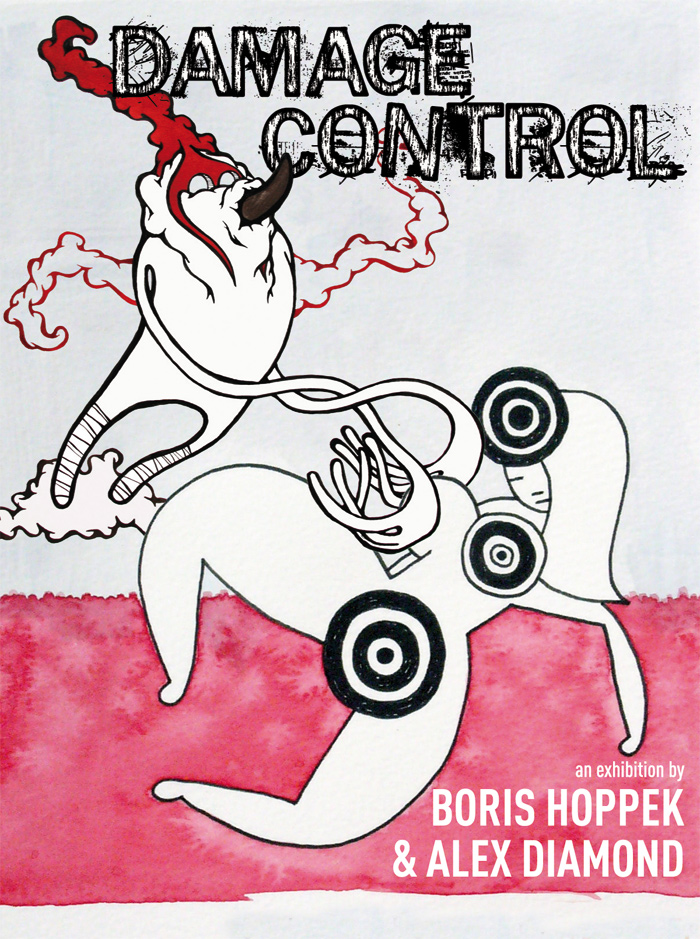
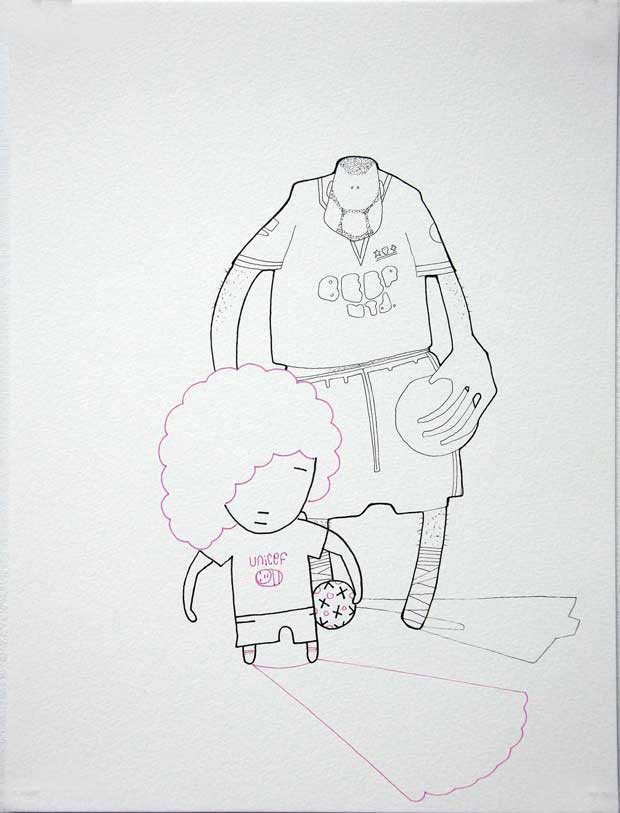
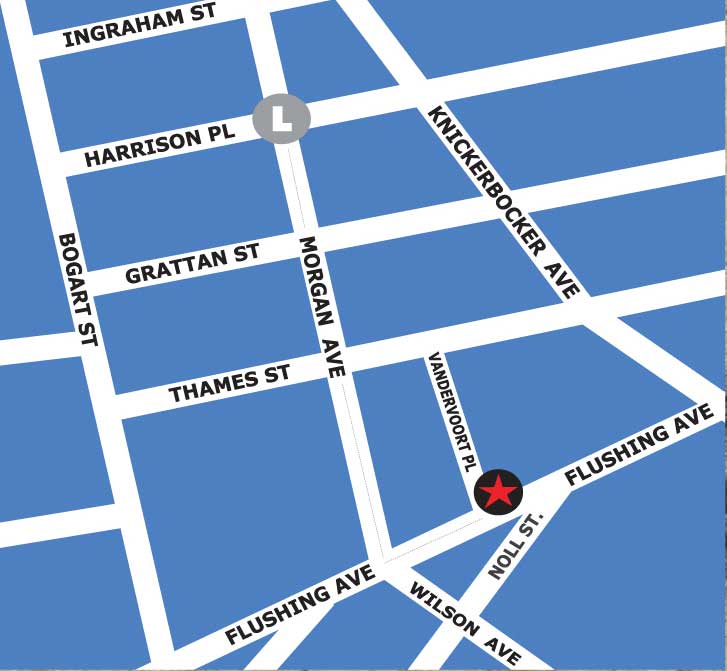
To save their reputation and do a bit of DAMAGE:CONTROL the wise visionaries at Factory Fresh have flown in Boris Hoppek and Alex Diamond from Hamburg sister gallery Helium Cowboy to stage an unforgettable show tonight in Bushwick.
Tonight at Factory Fresh
This is what they have to say about it:
“The exhibition is called DAMAGE:CONTROL – each of the artists supplied one of the words when finding a joint theme for the show. Who does the damage and who’s controlling it is hard to tell, all we can leak is that we know who contributed which word
Although being close friends for a long time, Boris Hoppek and Alex Diamond have never collaborated this closely in the past. Everyone involved in the show is really happy with the result: it seems like the perfect match; the works correspond nicely, and the whole set up of the room couldn’t be more harmonic.
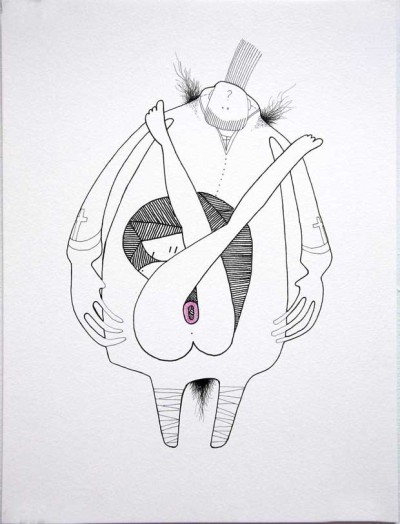
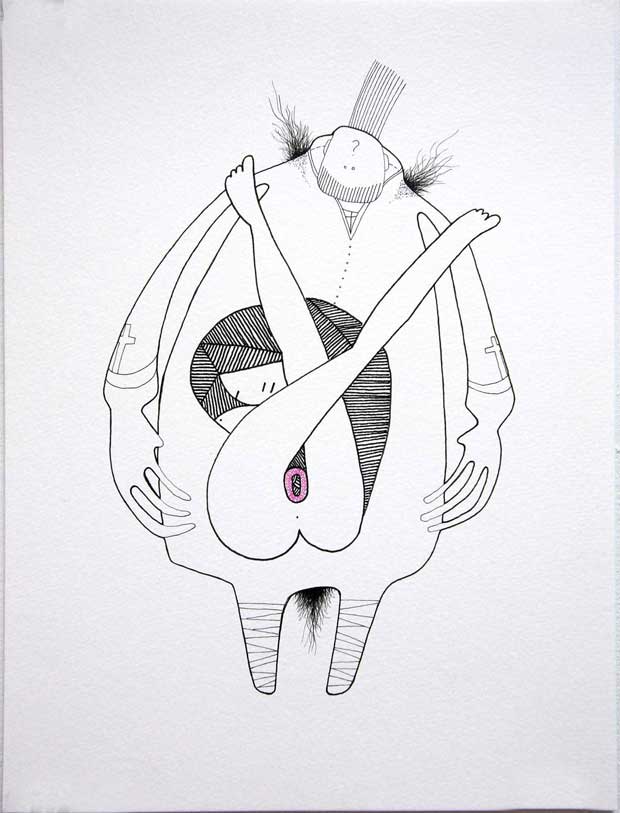
While Boris will be showing photos and watercolors, Alex brought along brand new china ink brush drawings as well as a series of collages. Most of the work has never been exhibited before and was specifically created for the Factory Fresh show.
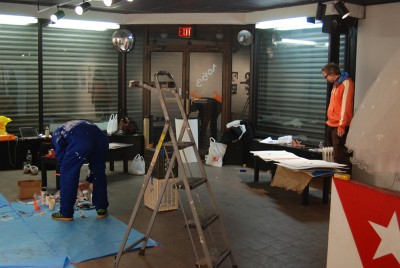
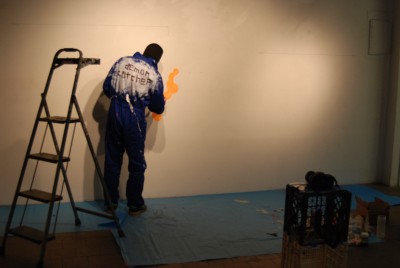
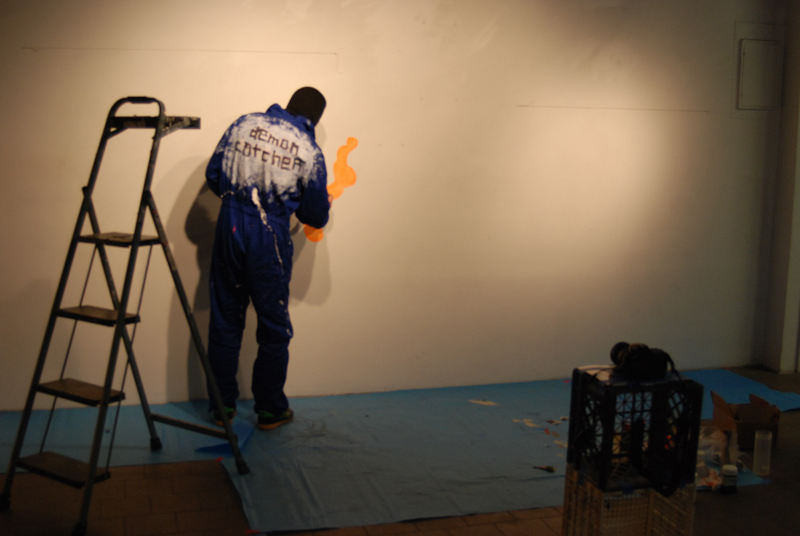
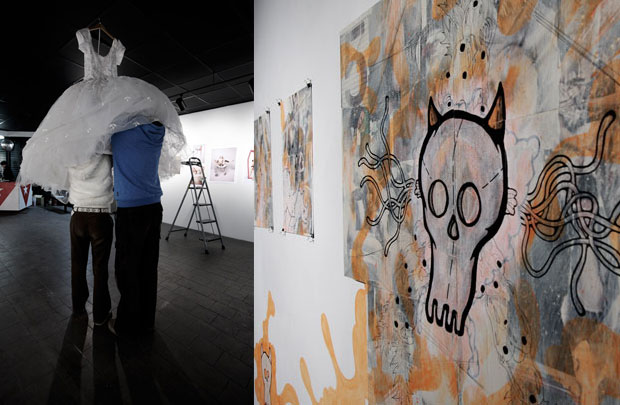
On location, Boris installed a new upskirt installation (this time you have to slip underneath a beautiful, vintage wedding dress), as well as painting one of the walls with markers. Alex has been busy creating a new piece of collage work (assembled and painted on the gallery floor).
It seems to be heavily influenced by this trip, and sports quite an unusual motive compared to others. It comes on 4 wood panels, that are attached to each others, and is integrated into a wall painting, jointly with the six new collages he brought along on this journey. The work is called “Demon skull”.”
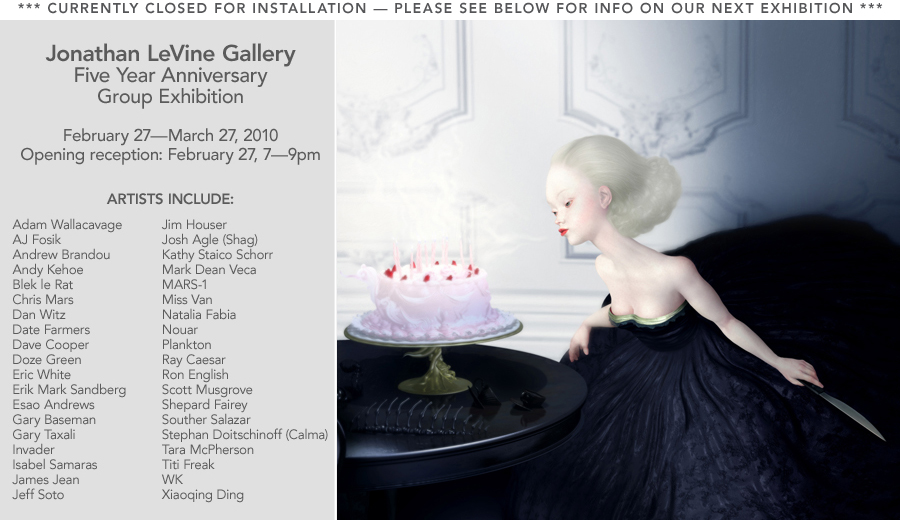
Jonathan Levine Gallery Presents: Five Year Anniversary Group Exhibition
Jonathan LeVine Gallery
Five Year Anniversary
Group exhibition
February 27, 2010 through March 27, 2010
NEW YORK, NY (January 26, 2010) — Jonathan LeVine Gallery will celebrate its fifth anniversary with a commemorative group exhibition featuring exceptional and exemplary new works by forty artists who are either currently represented by the gallery or who have exhibited at the gallery in the past five years. The exhibition will be on view from February 27—March 27, 2010, and there will be an opening reception on Saturday, February 27, from 7—9pm.
Since 2005, Jonathan LeVine Gallery has been an important venue for Street Art (ephemeral work placed in public urban environments) and Pop Surrealism (work influenced by illustration, comic book art, and pop culture imagery). As such, the pieces in this exhibition—comprised of paintings, drawings, and sculptures—will be primarily figurative with a strong sense of narration.
Artists in this exhibition have developed prominent creative voices for themselves as individuals, while also playing valuable roles within the historical context of the larger Street Art and/or Pop Surrealism movements. All of them have been influential in shaping the gallery’s program, creating work with a unique counter-culture point of view.
In LeVine’s words: “I believe that my program represents a generational shift, and that the artists who I work with will continue to define the evolution of this genre.”
Artists with work in the exhibition include (more to come):
Adam Wallacavage
AJ Fosik
Andrew Brandou
Andy Kehoe
Blek le Rat
Chris Mars
Dan Witz
Date Farmers
Dave Cooper
Doze Green
Eric White
Erik Mark Sandberg
Esao Andrews
Gary Baseman
Gary Taxali
Invader
Isabel Samaras
James Jean
Jeff Soto
Jim Houser
Josh Agle (aka Shag)
Kathy Staico Schorr
Mark Dean Veca
Miss Van
Natalia Fabia
Ray Caesar
Ron English
Scott Musgrove
Shepard Fairey
Souther Salazar
Stephan Doitschinoff (aka Calma)
Susan Crawford (aka Plankton Art Company)
Tara McPherson
Titi Freak
WK Interact
Xiaoqing Ding
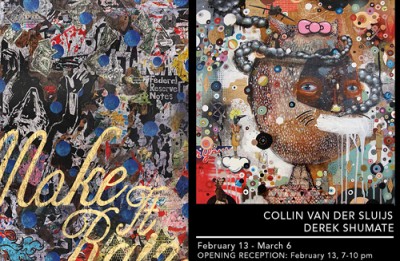
The invitation for Stealth Above the Radar (by Derek Shumate)
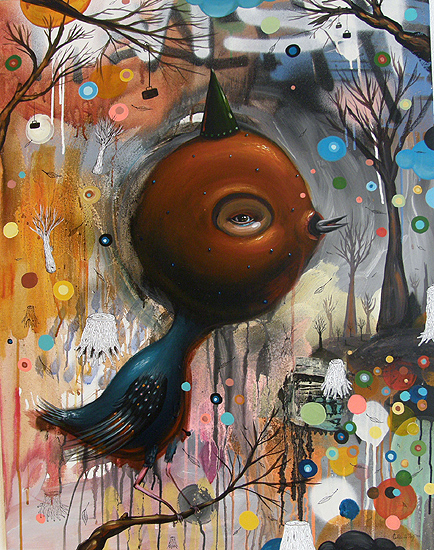
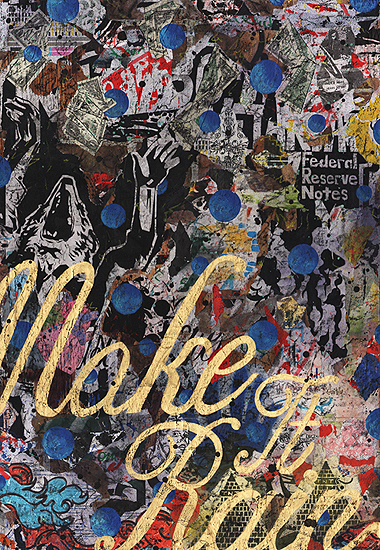
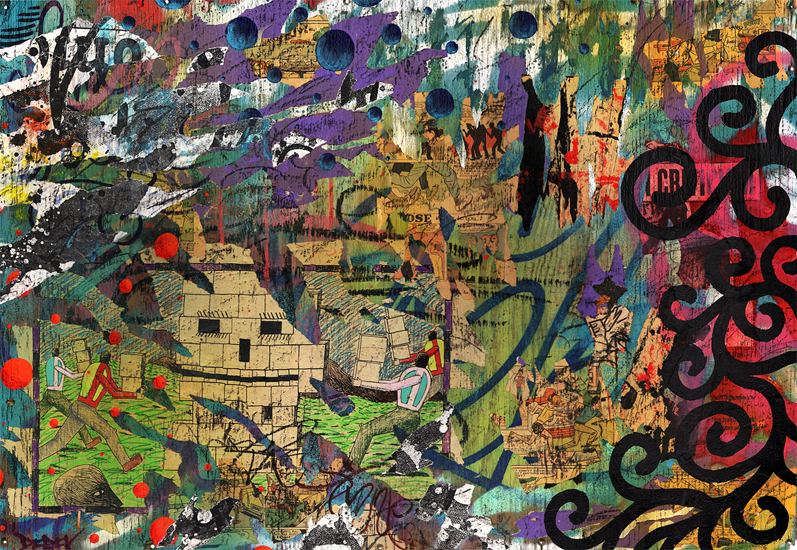
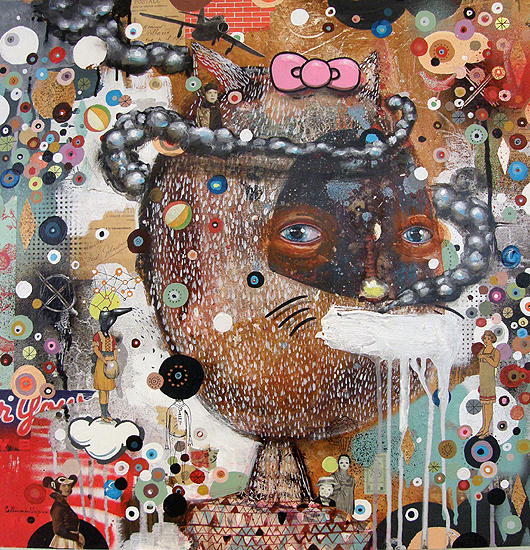
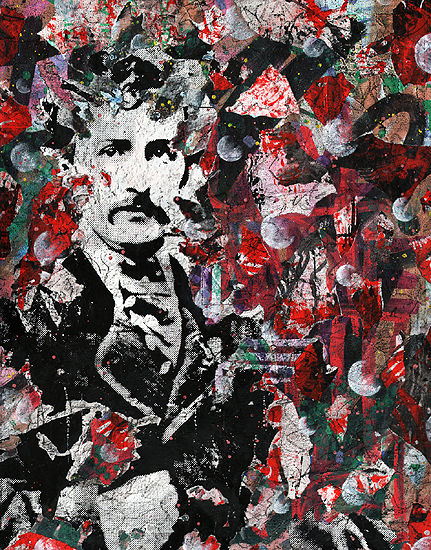
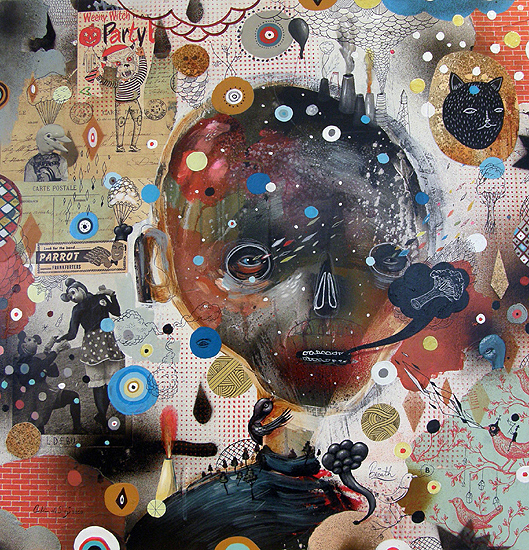
Brooklynite Gallery is pairing Collin Van Der Sluijs, a Dutchman from the Netherlands, with Derek Shumate from Houston for Saturday’s “Stealth: Above the Radar” show, and these two share one thing in the eyes of the gallery.“We strongly felt that these two emerging artists deserved a bigger stage to showcase their exceptional talent,” says Rae McGrath of the Bed Stuy venue. Enough said.
The gallery has championed under-exposed artists in the past, and this time they bring two guys whose minds are Cuisinarts of colorful cultural and historical references, spilling out and across their canvasses. Each guy has a different set of figures and forms, animal and mineral, calligraphy and patterns, but there is a similarity in assembly, self referencing, and even in their processes.
BSA had an opportunity to talk to both artists, see some of the new work that will be shown, and find out more about them.
Brooklyn Street Art:How would you describe your style of painting?
Collin Van Der Sluijs: Most of the time I’m working on paintings about my life, so for me it’s autobiographical work that I make. I take little aspects (or big ones) from my daily life, and I translate them into my images.
Collin Van Der Sluijs “Float” (courtesy Brooklynite)
Derek Shumate: My style? Usually I tell people “Mixed-Medium” or “Abstract” but I feel as if it’s much more than that. At times I feel like we’re all going through similar experiences, facing dire straits and that this artwork pouring out is a result of this energy. We’re all bombarded with information on a daily basis and multi-tasking to survive in this confusing world that seems to be speeding off the rails.
Derek Shumate “Make it Rain” (courtesy Brooklynite)
Brooklyn Street Art:Both of you guys’ work contain many different elements, ranging from figures to textures to shapes and text. Can you talk about how you assemble your work, or how you decide on what is included?
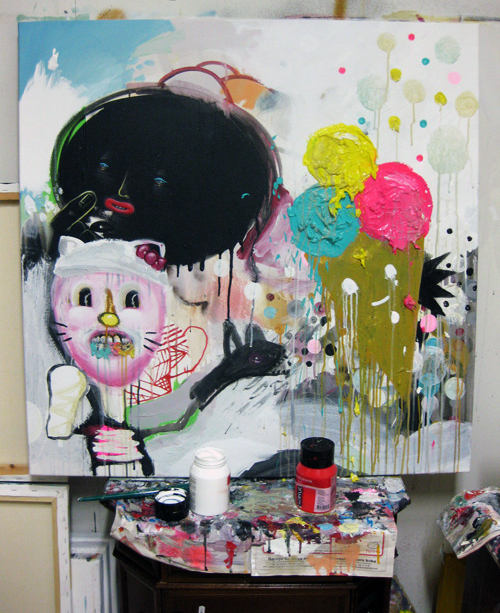
Collin Van Der Sluijs: Basically, some elements appear in my work during the process of making it. Sometimes I also erase things when they don’t match with the things that are happening in my head.
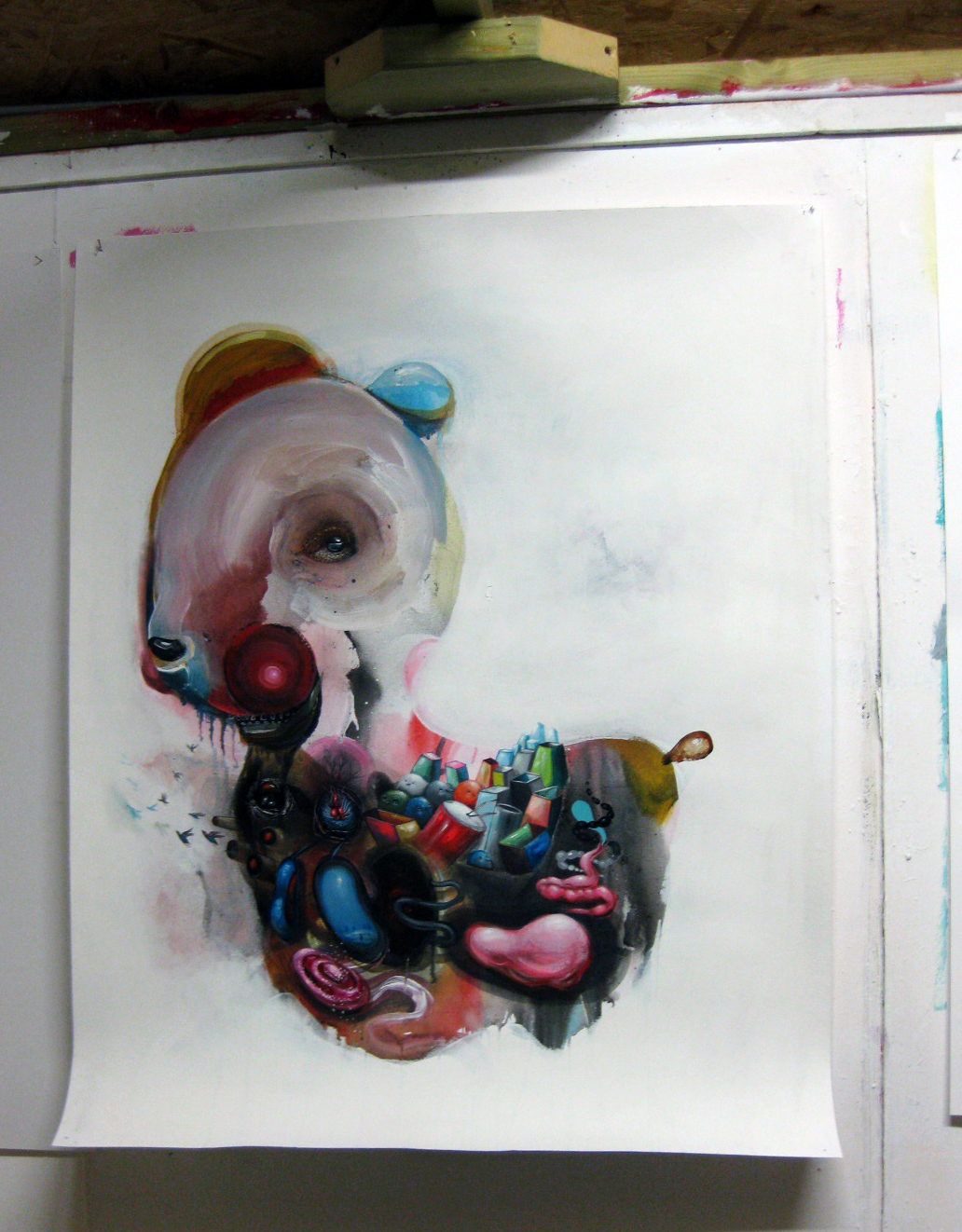
A view inside Collin’s studio.
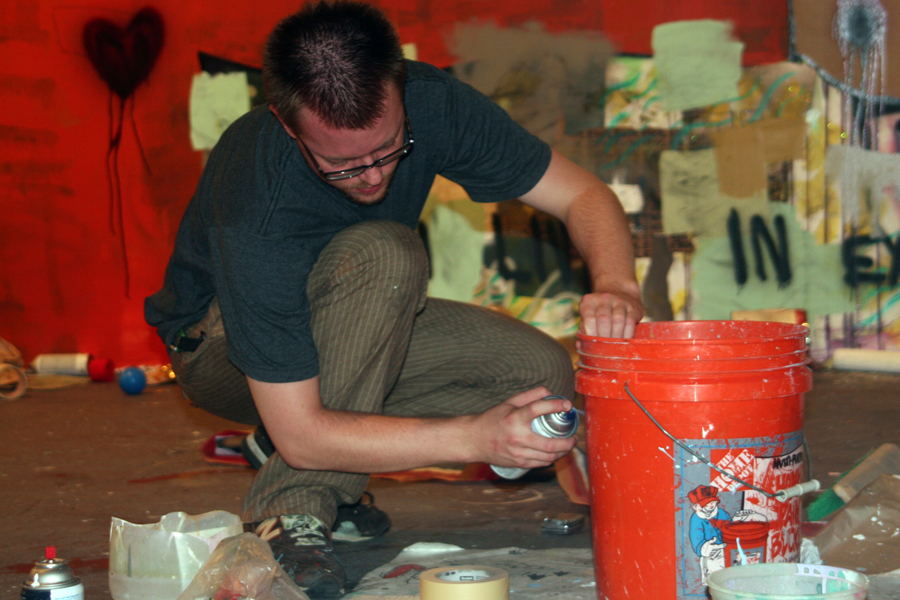
Derek Shumate: I don’t really have a defined process. Basically I’m always gathering bits and particles of things I like that come through my life and I spend vast amounts of time filtering it out into what you see. A lot of the elements in my larger paintings are fragments of prints and other works I’ve done in the past. I’ll also mix in stuff from my childhood sketchbooks.
It really depends on the mood of the piece. I start by putting down a few layers of colors and take it from there. Once I grasp a concept I start to hide little relevant elements as I build up the piece to something that works for me compositionally. Regardless, every piece contains various mediums such as inks, oils and acrylics. It’s almost as if I’m just attempting to harmonize everything I’ve got onto the surface at hand.
Collin Van Der Sluijs “Infinity” (courtesy Brooklynite)
Brooklyn Street Art:Collin, you have talked about consumer behavior and it’s affect on your work. How does it impact your work? Collin Van Der Sluijs: I grew up in a small village and it’s still fun to see big cities. I travel a lot but it always surprises me when there is a 70% off sale sign in the window of a big shopping mall and I see everybody lines up like sheep. You know what I mean? I think about this and its’ visual communication. I like it and hate it at the same time. I think of these kind of things when I work.
Derek Shumate “JWB” (courtesy Brooklynite)
Brooklyn Street Art: Derek, you use a lot of collaged pieces and textures and the occasional figure. Do you ever think of doing portraiture?
Derek Shumate: Sometimes. I’ve had ideas to do a series of different people like politicians, pop icons and other people of influence. I feel as if I’m heading more in that direction because there’s so much going on in the world right now and I want to put these people that are in charge into a new light, so-to-speak. You’ll probably see more portraiture from me in the future.
Derek hanging out on a fire escape working out ideas in a sketchbook. (image courtesy the artist)
Brooklyn Street Art: Does Street Art influence you in any way Collin? Collin Van Der Sluijs: Well, not really to be honest, I’m basically a studio artist. In 1999 and 2000 street art was big in my town, but a lot of people put like 3 stickers up somewhere and build a reputation out of that. That’s lame. There are some people I admire in the street art scene, but I think I can count them on my ten fingers.
One of Collins’ pieces in the studio references the effect of consumer garbage on the innerworkings of natural life.
Brooklyn Street Art: How about you Derek, does Street Art play a part in your creative life at all?
Derek Shumate: Most Definitely. The streets of Brooklyn to be specific.
I lived in New York for a few years and I would walk the streets on a daily basis, absorbing not only the art but also the weathered architecture and other surfaces.
I’d document and participate in the organic, collaborative atmosphere we were all creating.
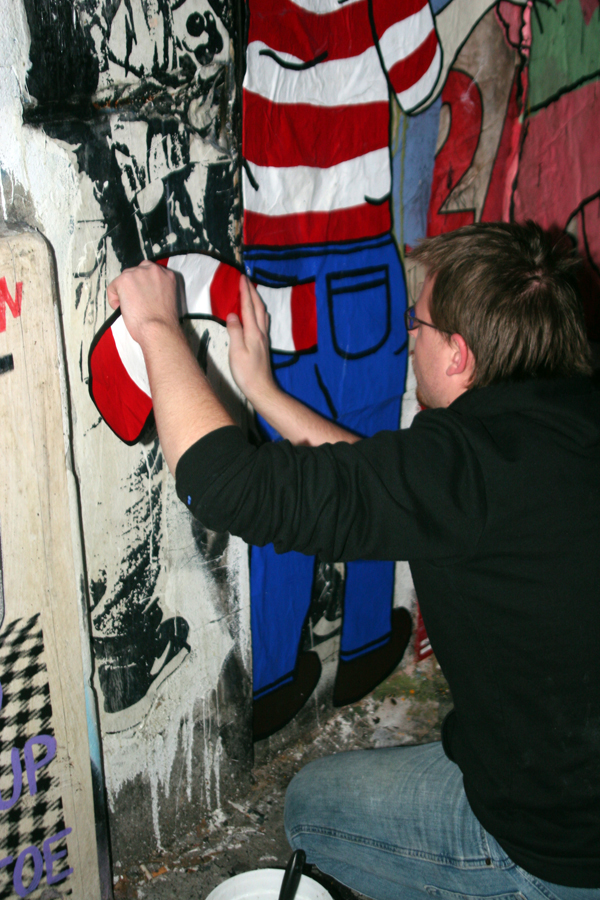
Doing a Waldo (image courtesy Derek Shumate)
I felt at home with creativity and potential everywhere I’d look. I’d never before interacted with my environment in such a way. I’ve got photo collections of all the street art and graffiti I admire from different cities I’ve visited over the years. However, nothing that I’ve found has the charm that exists in Brooklyn.
Brooklyn Street Art: Collin, what’s your favorite part of the creative experience?
Collin Van Der Sluijs: When things go wrong. Then, with a little adjustment I can make it good again, or better. Small things like that put the strawberry on the cake, for me.
Brooklyn Street Art: Collin says he likes when things go wrong! Derek, what’s your favorite part of the creative experience?
Derek Shumate: Finishing the piece! Well, not really. That’s a great feeling but of all the other parts I’d have to choose that moment where I’m completely lost in the piece and absolutely nothing else in the world matters. I’m sure anyone who creates is familiar with this amazing feeling.
Derek at work in his studio.
But like Collin, I also like it when you totally f*ck something up but then later you realize it was the most perfect mistake that could have ever happened because it leads you in directions you never thought you’d venture to and takes your skills and pieces to new heights.
BRONZE, SILVER, and GOLD Tooth Caps to be bestowed upon BROOKLYNIPIANS.
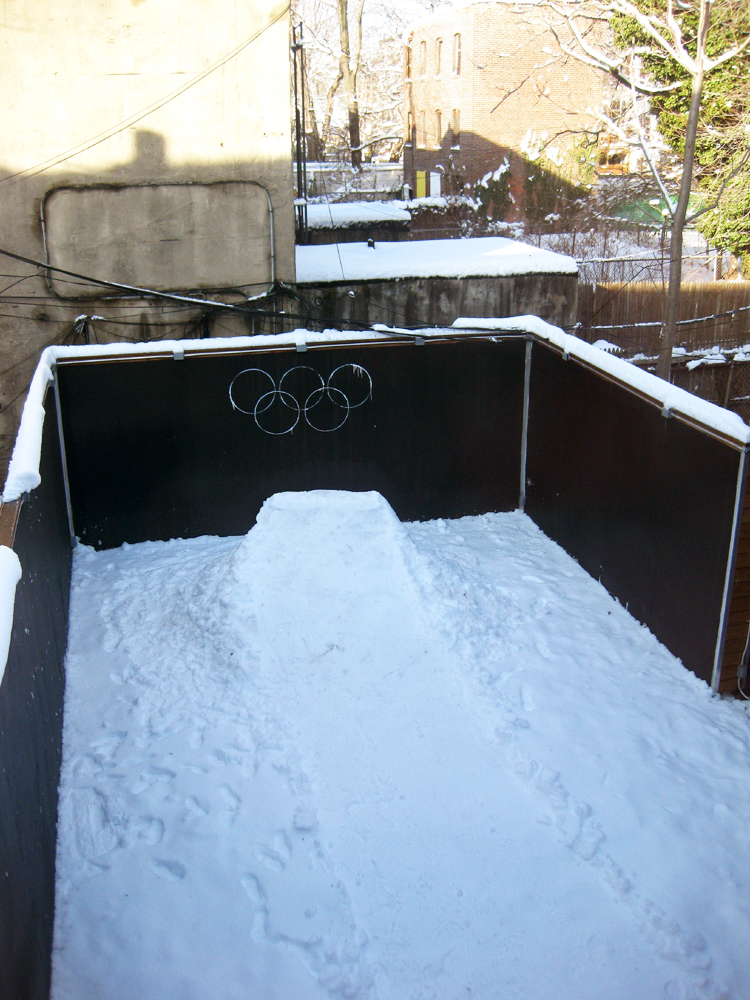
Brooklynite Gallery transformed the backyard into an outside WINTER SPORTS ARENA overnight thanks to the Blizzard of ’10 !
Amid the hugh and clamor of setting up their first show of the year this Saturday, Rae and Hope have managed to put out a call for all LUGE competitors for the big event
This year introduces a new event to the games called “La Crusher”, which involves skis, ballet, a sled, brass knuckles and kung fu moves.
As your first feat of Olympian strength and to qualify for the competition, all applicants will be required to watch this video in it’s entirety:
Factory Fresh Presents: Pufferella “I know You Are But What Am I” and Josh Mccutchen “Polymetrochromanticism”
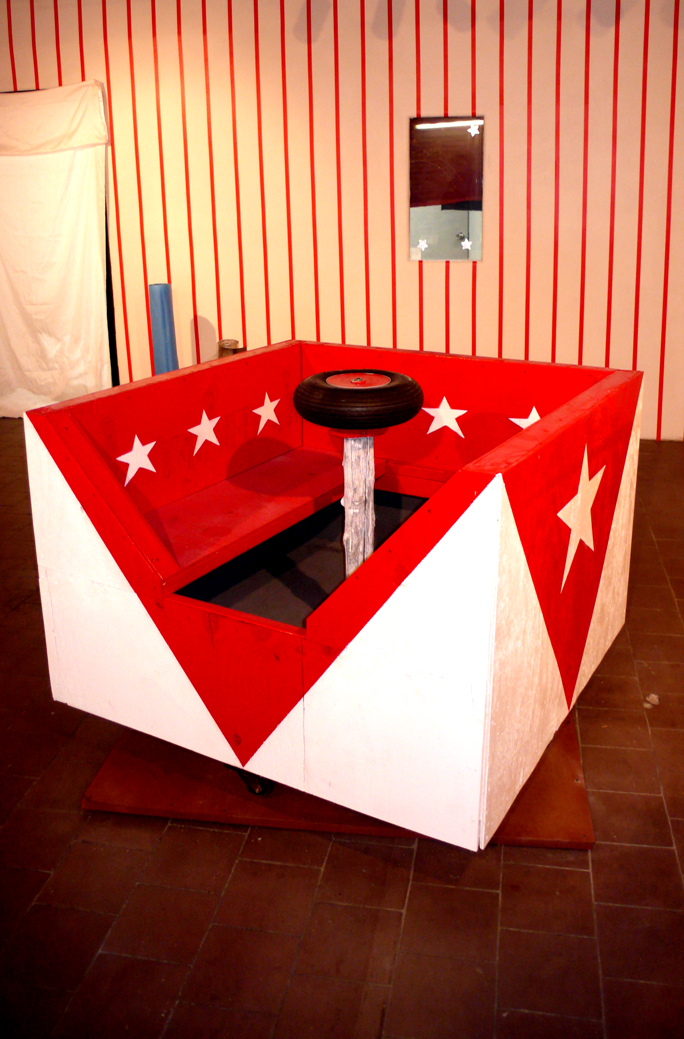
It’s only a one-week show folks, and Adam has built a sit-n-spin ride that will make you blow all that Genesee Cream Ale like Linda Blair around the front gallery, so you don’t want to miss this opening!
Before we go to the show, a little background; Street Artist Pufferella has played a pivotal role in the New York Street Art scene by running Orchard Street Art Gallery for 7 years with Ad Deville on the Lower East Side of Manhattan, opening the doors and clearing the way for many aspiring graffiti writers and street artists to show their work in a new public setting, many for the first time.
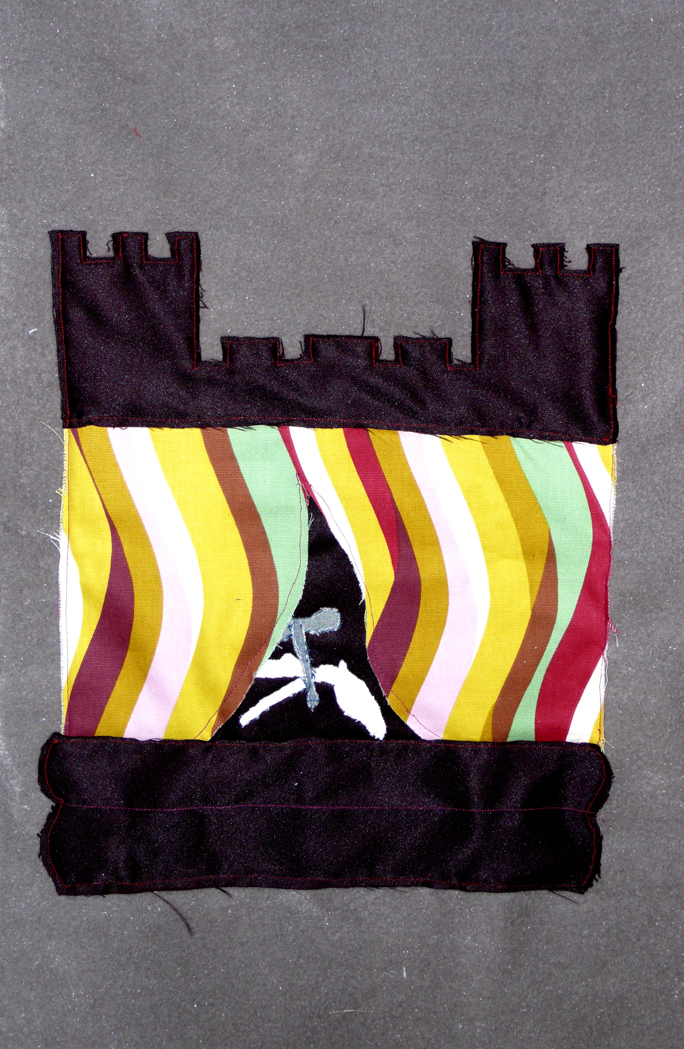
After losing their lease due to greedy landlords, they moved to Bushwick in Summer 2008 to open Factory Fresh, another gallery that opened it’s arms to emerging and better-known street artists and fine artists. On her own, Pufferella has quietly established her own fine art work, consisting primarily of sewn pieces that may be more traditional flat “canvasses” or full-blown soft sculptures.
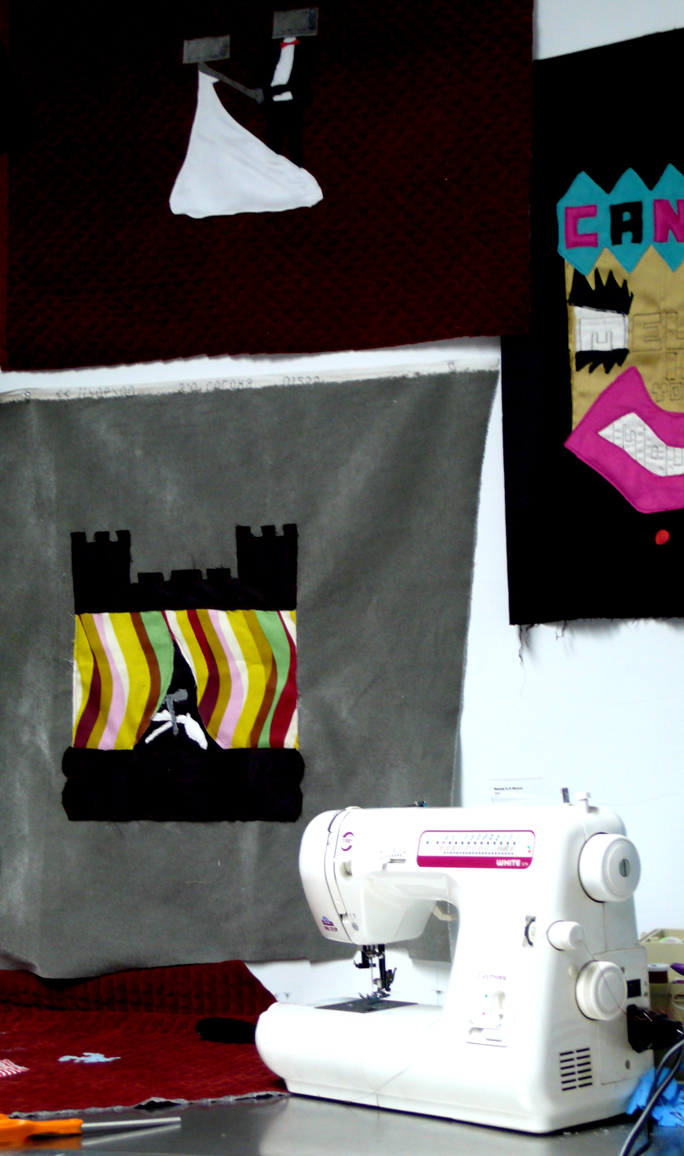
Taking a break from the sewing machine, Pufferella shows us the inner sanctum of her office at Factory Fresh, which is carefully hung with fabric pieces for the show, effectively blocking all eyes from seeing in the window or over the counter.
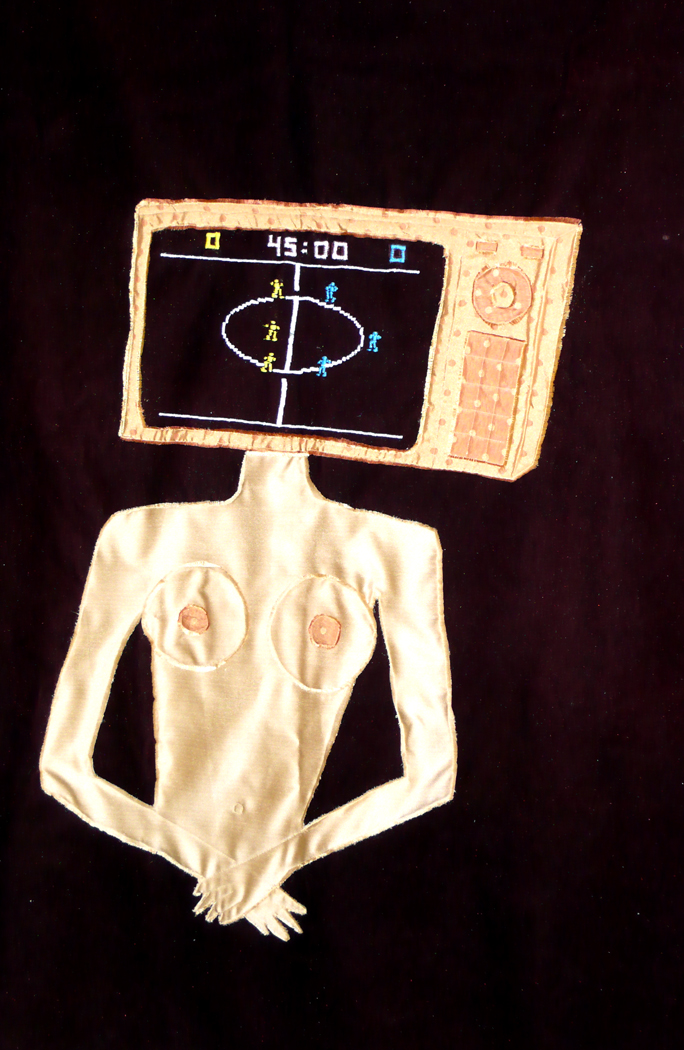
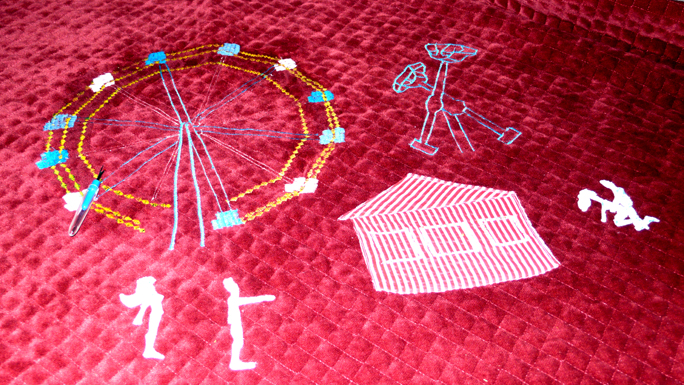
The collection of new pieces are brightly colorful, boldly warm. The shiny solid shapes and figures are stiffly posed in simple arrangements, floating in awkward proximity to one another, creating a momentary scene or flash of action. Sewn on lush fabrics, they can take special importance because of the spareness in number and bluntness of geometry.
It’s when these pieces are finished and seen together as a group that Pufferella can get overwhelmed with their significance and she questions if she has been too open as an artist. Speaking about her art and her life, a dual set of impulses emerge – frequently warring with one another. It may be this ongoing conflict that gives many of the pieces a raw energy that is captured in action.
Brooklyn Street Art: I don’t see as much sexual activity in this show as I thought I would.
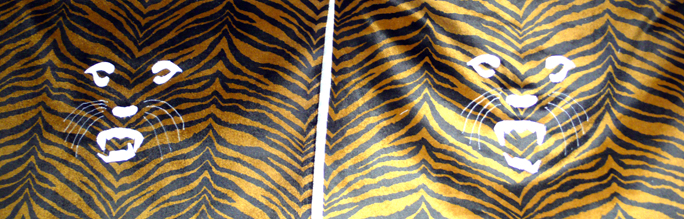
Pufferella: Oh, yeah? There’s I’d say a good third of the show has those themes. There are some other things going on. Like the tigers! They are so cute I want to take them home with me.
Brooklyn Street Art: So, about these various couples in positions… do you like to imagine sexual relations in unusual places?
Pufferella: I think these are all personal things. Stuff I’ve done or things I think about. I’m very private but I’d say I’m a little wild in certain places.
Brooklyn Street Art: Well, this is the thing; You feel like it is very private and yet you are holding an exposition of it in a very public way.
Pufferella: Isn’t that what art is? Aren’t you supposed to put your soul into it? If I was like, “what am I doing?” then I would produce graphic design. So for me it is that pure. I’m not doing it to sell it, necessarily. So that’s why it’s like, “I think it would be funny if cotton candy fell in love with carrot.”
Brooklyn Street Art: Do you ever have problems or fights with your sewing machine?
Pufferella: Yeah, I mean, I have to oil it, take care of it. I know what the problems are. That sewing machine is like my baby.
When stuff falls out of place, like the pins fall out or I get sliced by stuff, I get pissed. Like when stuff moves and you get a ripple and you have to go back… I spend a lot of time fixing stuff. But I also know what I’m doing wrong. There’s a backing that I’m supposed to put on all of this and my mom gives it to me. She’s like, “Why aren’t you using this?” but I don’t like the way it comes out. It comes out so “crafty”.
So I like it to be a little messed up. Like those kinks and things, I think for me, are what really keeps it “art”. I don’t know.
Brooklyn Street Art: So it’s an effect that you don’t like when you see it, like it has too much of a “finished” quality.
Pufferella: Well, I come from quilters too, and I went to art school and they didn’t because they were farm people who made beautiful quilts, to keep them warm, and they did them nicely. So, I try to differentiate. I know what that (quilting) is, and I’ve tried but I’ve come close.
Brooklyn Street Art: You are afraid of becoming too “crafty”?
Pufferella: Definitely. I think people expect this work to be “craft”. It’s like “appliqué” – like what’s the defining line between me and appliqué? Very little, but I’m hanging on to it.
Brooklyn Street Art: Right, there is a fine line… where suddenly someone is saying, “Can you make a pillow for me?”
Pufferella: And I have done that. Like I did Abe Lincoln Jr.’s bird. But I made it poop and poop-balls came out of it. Yeah the other thing that makes it “art” is the idea. I think when people make quilts they look at patterns.
A Cat and Dog scene from Pufferella’s 2005 show at Pink Pony (Image courtesy Pufferella)
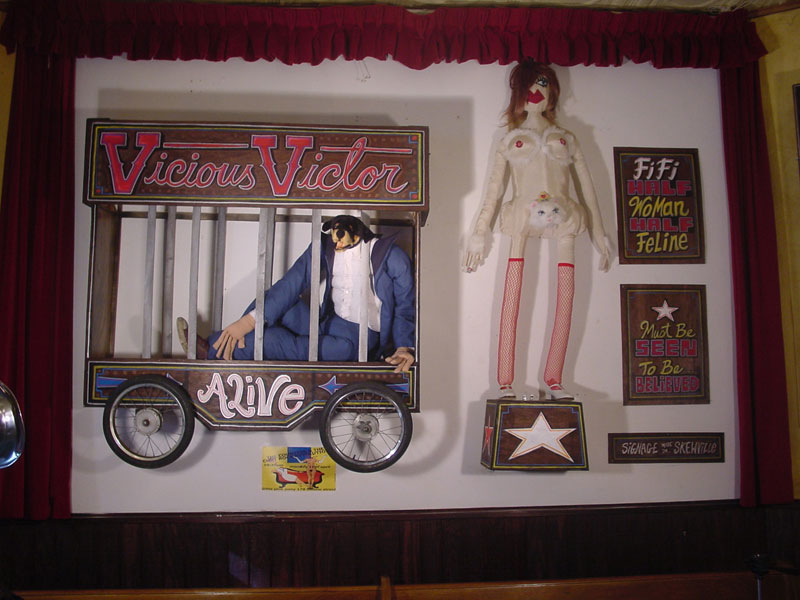
Brooklyn Street Art: Some of these themes are related to circus or performance or childhood fantasy? Pufferella: Yeah, I guess that I feel like it is always coming back to those things. Like my 2005 show at Pink Pony, where I made a circus. I guess that is just what I think about a lot. Funny, carnivale, freaks. I feel like I’m very normal on the outside but very weird on the inside.
Brooklyn Street Art: Can you give me three adjectives? Pufferella: For me?
Brooklyn Street Art: Don’t think about it. Pufferella: Shiny. Giggly. Dark.
Brooklyn Street Art: Okay. Pufferella: Like I think there is that dark humor to everything.
Brooklyn Street Art: Like “Funhouse” humor. Pufferella: Yeah.
Brooklyn Street Art: Did you go to state fairs, or county fairs when you were a kid? Pufferella: Yes, and I think I have that dual nature because my parents were raised on farms, but then they moved and raised us in a different life. We traveled and did all these things that they didn’t really do. So I think there is that dual thing. Like sometimes they were having us milk cows but then taking us to New York City. It was always that way. I grew up in Morristown, New Jersey, which is just outside New York. I did the whole club thing at 16, but I had these roots where I would go back to Michigan and see my Grandma.
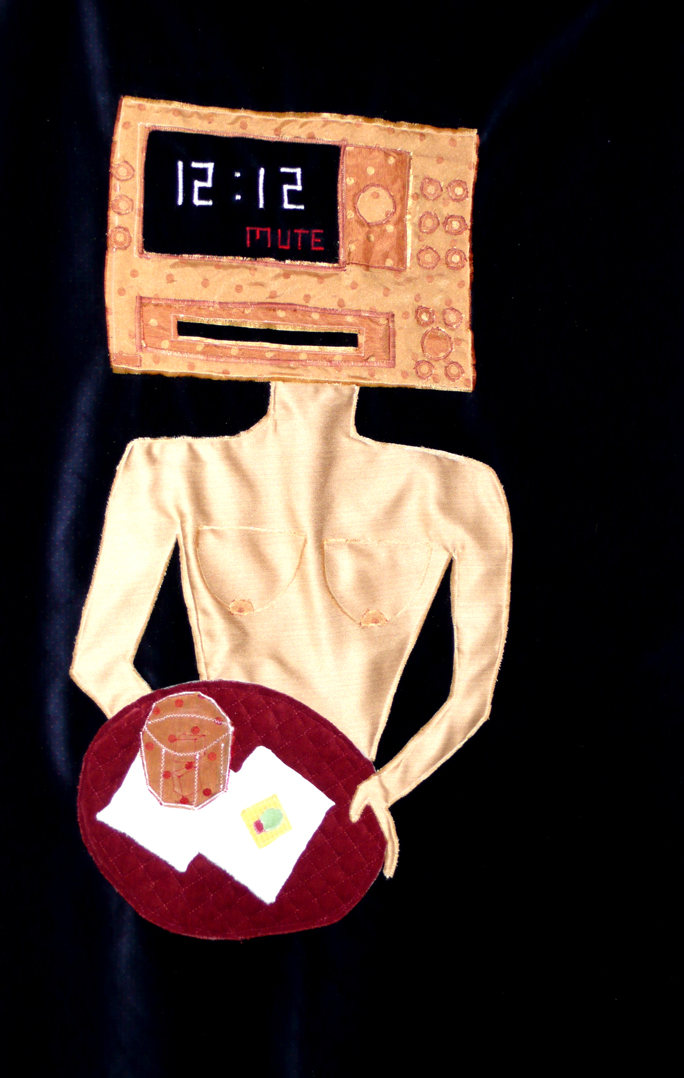
Brooklyn Street Art: Did you tell me this is the ideal woman? Pufferella: “The Perfect Wife” Yeah, that piece is about how I don’t feel like I get heard a lot of times. Like I have to say stuff a bazillion times. I might as well be like a video game playing and I might as well have my shirt off. That’s the whole thing with guys. Like I might as well just be serving drinks, playing music, with the mute button on.
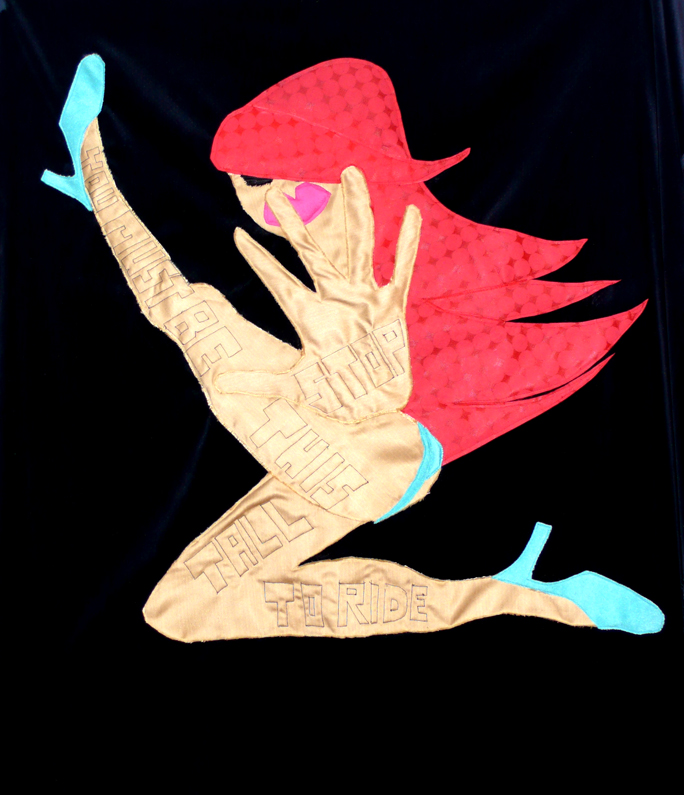
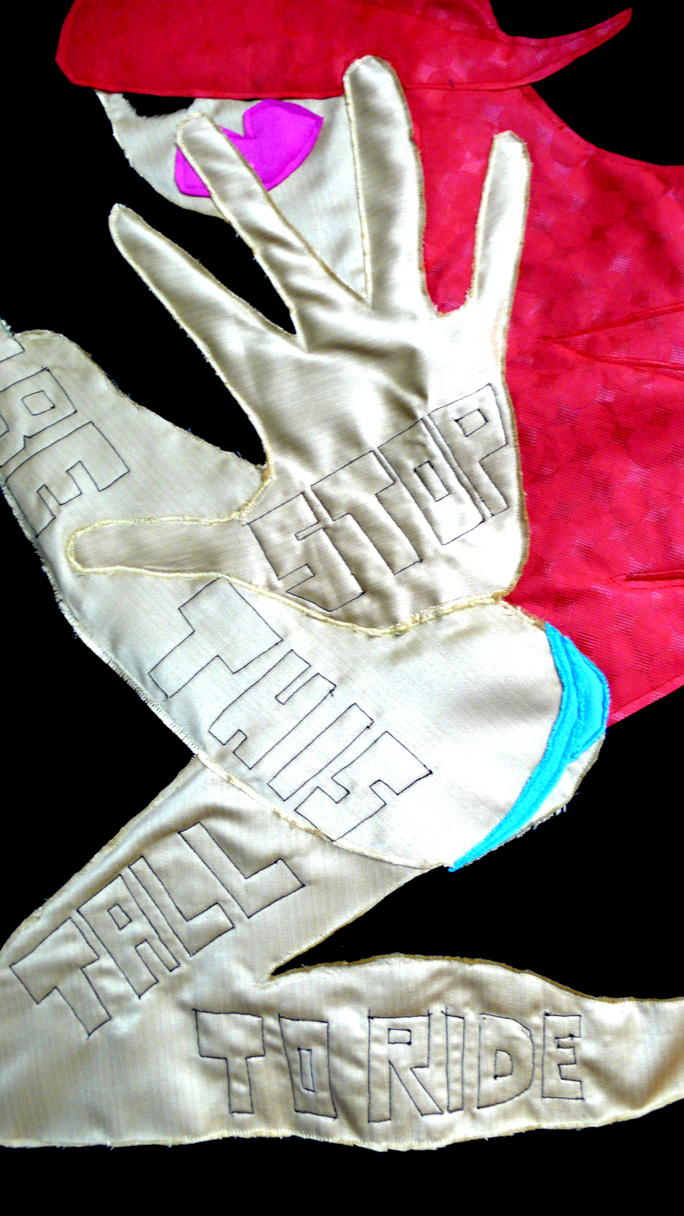
Brooklyn Street Art: What about this powerful image? Can you describe her? Pufferella: “You Must Be This Tall To Ride” – this porn pose, like she is stripper dancing, but giving you a rule. It’s like a sign for entering an amusement park ride. So the top of the leg would indicate the height the person must be, and then the other meaning could be for sex. Like it could say “to ride me”, but it doesn’t. That one came about from preparing for a show I was supposed to do with Thundercut and Gaëtane (Michaux), but it got cancelled. So we were all supposed to do a sign.
Brooklyn Street Art: So it is this “come-on” pose coupled with this rejection at the same time.
Pufferella: It is, isn’t it? It could be used for a boy or a girl. She’s very bold. I think that’s the boldest piece I’ve probably done, with all that hair.
Brooklyn Street Art: It’s full of energy and action and movement and power. Pufferella: Yeah, it’s funny, I have a hard time looking at that one. Sometimes when I’m all done, I actually cry. I don’t really like my work.
Brooklyn Street Art: Really?
Pufferella: Yeah, like I had a breakdown. Just looking at all of it and what it all means, and really kind of having that put in your face, in a way, it’s like “maybe this is the reality”. Like “What am I trying to say? Why is this what comes out of me?”
Brooklyn Street Art: It’s revelatory, perhaps.
Pufferella: Yeah, I guess. Like I do the drawing, and I guess it doesn’t mean as much as what it ends up being in the end when it comes to life.
Brooklyn Street Art: That’s interesting how it causes discomfort and emotional turbulence. Pufferella: Yeah, I probably wouldn’t do this show if I could back out now. Now that it’s all ready to go I would probably not show it. Because it is like “what am I doing?” The work is very personal I guess.
<<< >> .. .>>> ..>> ..>
Pufferella has been sewing creations for the front room and Josh McCutcheon will be showing himself publicly for the first time in the back room.
And now for your viewing pleasure, a promotional video for the show done by Pufferella’s dearest friends at PLAZTIK MAG
Polymetrochromanticism
The Artwork of Josh Mccutchen
Josh McCutchen lives and works in Bushwick, Brooklyn and this is his debut show at Factory Fresh. His narrative works are about mythology, science & technology, social commentary, body image, polymorphic shapes, and abstract urban landscapes.
As a television personality Josh hosted “Does This Look Infected” on MTVU network from 2005-2007. When he’s not painting modern masterpieces, Josh is the host, writer, producer, and editor of the Josh McCutchen Show. You can see him in action at http://www.youtube.com/joshmccutchen
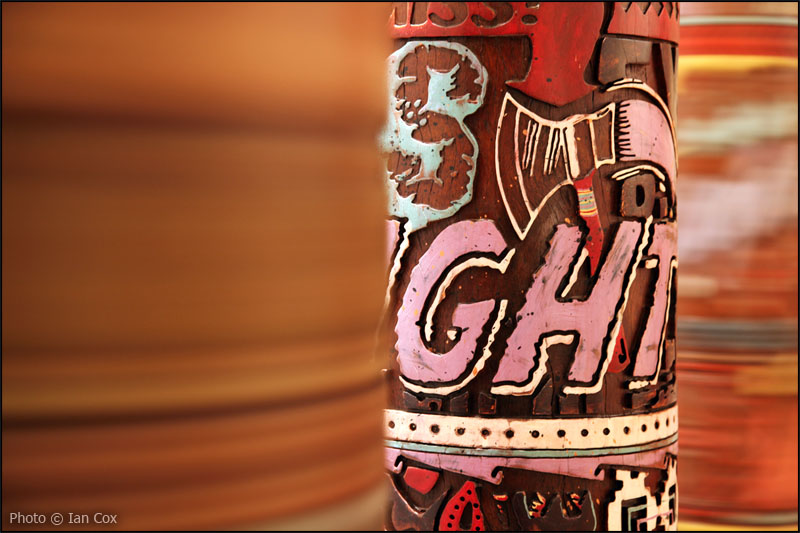
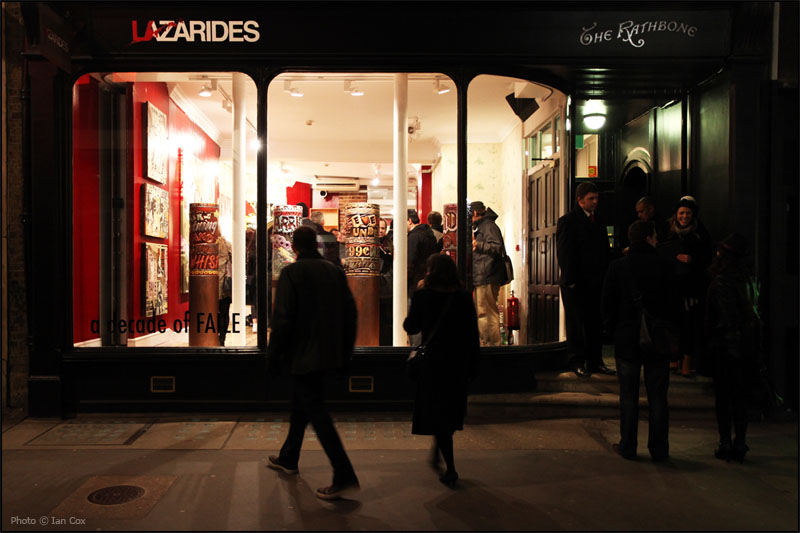
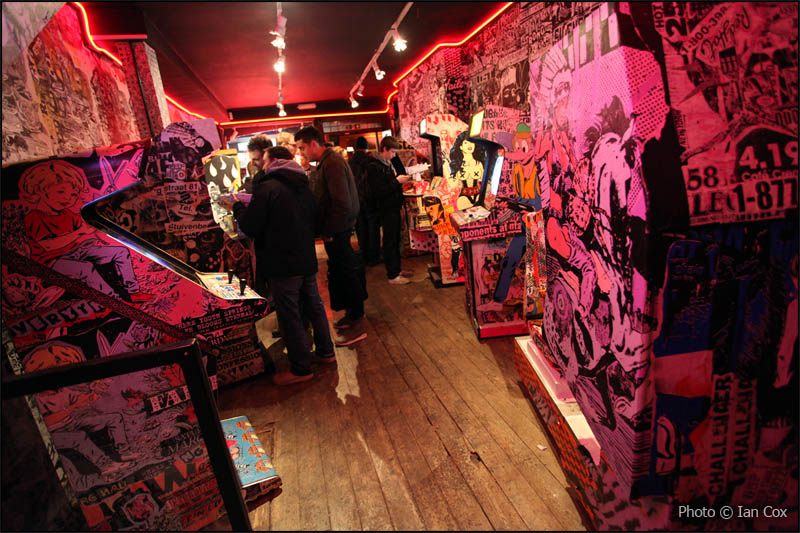
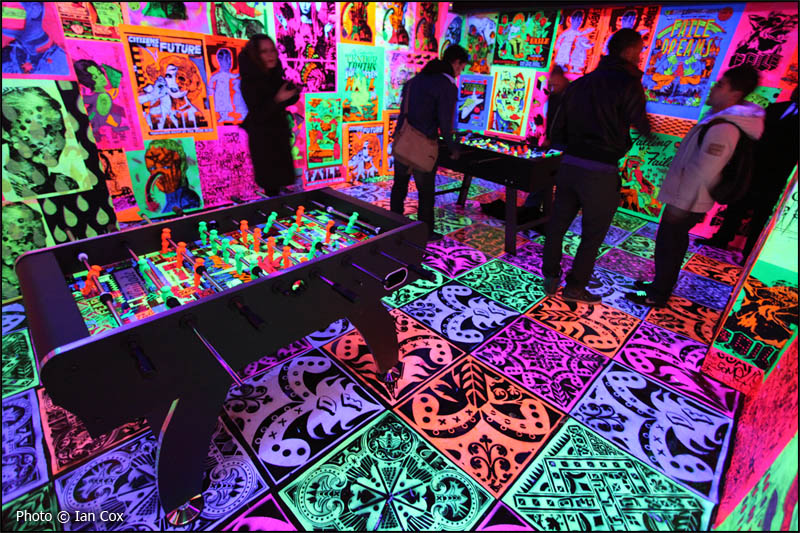
Faile & Bast – three Brooklyn street art creative forces of natureare mounting an experiential exhibition at Lazarides Greek Street Gallery in London right now.Longtime collaborators, the trio have combined their signature elements to create a distinctive conceptual show that includes an arcade installation, the Virgin Mary, Humpty Hump, and high-heeled boots.
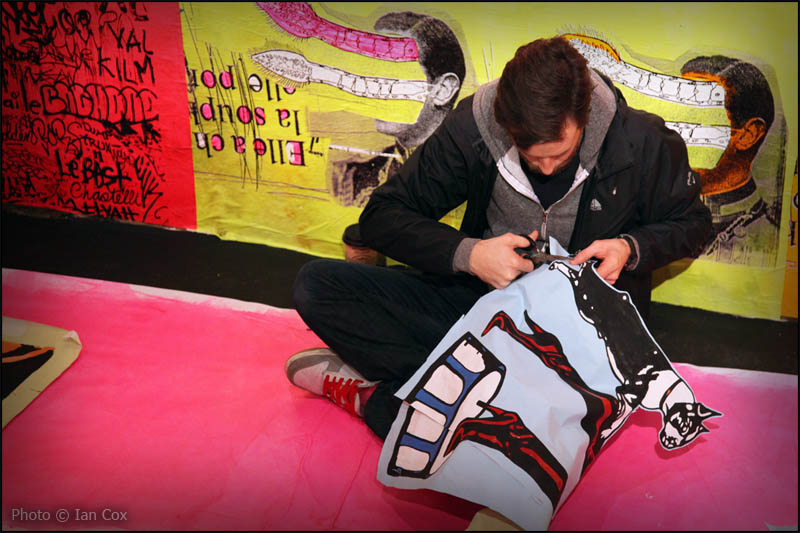
Here are some behind-the-scenes teasers from street art photographer Ian Cox.
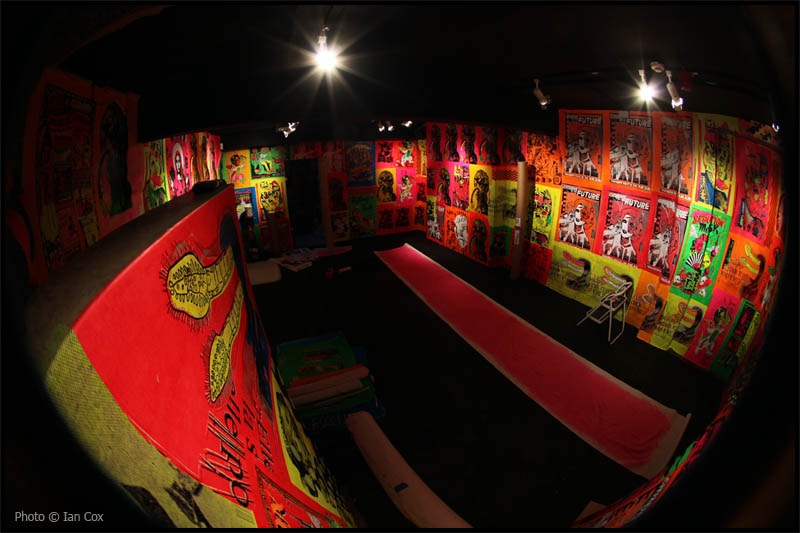
“Just a little more flourescent pink and orange, and we can throw the doors open!” Lazarides Greek Street Gallery is be-decked with new wildness from Faile and Bast.
A begging dog, high-heeled stilleto boots, and a soapbox - looks like the S&M Circus is back in town!
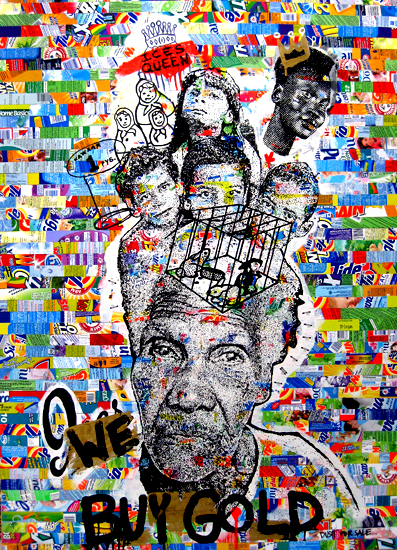
"ICES QUEEN" RAE Acrylic & Ink on Reclaimed Laundry Detergent Bottles 48 in x 36 in x 2 in Image Courtesy of the gallery
“UNCONVENTIONAL CONVICTION”
RAE
November 20 – December 18
OPENING RECEPTION: November 20, 6-9PM
. . . . . . . . . . . . . . . . . . . . . . . . .
Long before the emergence of Brooklynite Gallery, owner and curator Rae McGrath was constructing artwork of his own in many forms. Schooled in fine arts, raised immersed in the graffiti/breakdance culture of the 80’s and holding down a diverse range of blue collar jobs, has allowed RAE to create an eclectic range of visuals for an exhibition aptly titled “Unconventional Conviction”.
Over the years RAE has spent countless hours on the streets of New York City and other parts of the world, engaging then photographing the everyday person. Usually drawn to the elderly or youth— because of their experiences or lack thereof, RAE often finds similarities to his own life, connecting the dots through his grainy black and white photos which are then hand-painted or silk-screened into pieces that include block text and hand-drawn areas. The second part to RAE’s work involves the gathering and transformation of found objects— namely hundreds of brightly colored plastic laundry detergent bottles. Spending ample time in and around laundromat dumpsters throughout Brooklyn, RAE has amassed quite a collection of these bottles which he then dissects, using cutting techniques once learned while working as a deli worker and butcher. His tales are told on top of mosaic patterns full of vibrant colors and textual information.
For RAE, the vivid and hopeful Pop Art color schemes and graphic detail of the laundry bottles prove to be the perfect juxtaposition to his own urban Brooklyn upbringing and the countless cast of characters of his youthful working class existence. In the end, RAE uses these dynamic combinations to his advantage creating rich and strange alternate realities.
The world’s oldest known “Portrait” is believe to be created over 27,000 year ago. So why after all this time is it still the most often used subject of creation? A portrait often speaks much less about the physical features we are viewing, then it does about what’s behind the gaze in ones eyes or the telling angles of their mouth. This fascination continues to intrigue us through the work of three street artists who use traditional and non-traditional techniques to create their own brand of “PORTRAITS”.
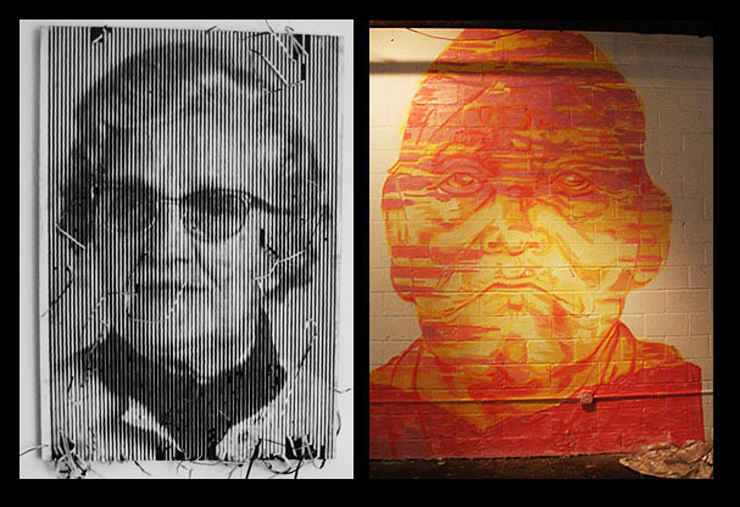
Just because street art tandem, STEN & LEX are widely considered to be the pioneers of “stencil graffiti” in their Italian homeland, doesn’t necessarily mean they are content with resting on the title. Best known for introducing their “halftone stencil” technique, these two self-proclamined “Hole School” artists spend ample time hand-cutting pixel dots and lines to compose their imagery which is best viewed from a distance. Choosing to forgo the common pop culture imagery often associated with street art, STEN & LEX’s subject matter pulls no punches. Saints, Popes and the Italian Christian Church were primarily referenced early on –minus the often added social commentary. However, most recently and for their upcoming exhibition here, the subjects of choice comes from the historic Italian archives they’ve rescued. The 1960’s, 70’s and 80’s portraits from all walks of life are the focus this time around, as they are put through the rigorous transformation of stencil cutting style that is trademark STEN & LEX. The final appearance of these portraits appear to have been fed halfway through a paper shredder then pulled back at the last minute leaving the shreds left to dangle. The images are for the most part of common folk—young and old. People who have lived lives and have stories to tell. Just read their faces.
Seems as if the young, hard charging NYC street artist GAIA has been showcasing his bold imagery to the masses since before he could walk. Well maybe it hasn’t been quite that long but over the past few years he’s managed to garner a lot of attention by using more traditional techniques to create his wildlife animals and distinguishing human portraits. Taking a more intelligent, reflective approach to his work, this “old sole” uses wood block carvings and hand-drawn methods to achieve the fur textures of bears, tigers and rabbits as well as the worn lines in the faces of his latest portrait series entitled, “Legacy.” At it’s core, “Legacy” raises the question of infrastructure design and how we are forced to live with the decisions, good or bad, created by figures such as Robert Moses, James Wilson Rouse & Mies van der Rehoboth, all of whom have shaped parts of the American landscape. GAIA also plans on featuring a series of faded self portraits called “Sunsets”. Sunsets are a portrait of the nature of the street artist as an identity. It’s a pseudonym, to the person behind the work and the conflict between the secret, the collective and the fame of the individual. Some of the work is directly painted onto reclaimed street posters and found materials.
Gallery hours: Thursday – Saturday from 1pm – 7pm or by appointment.
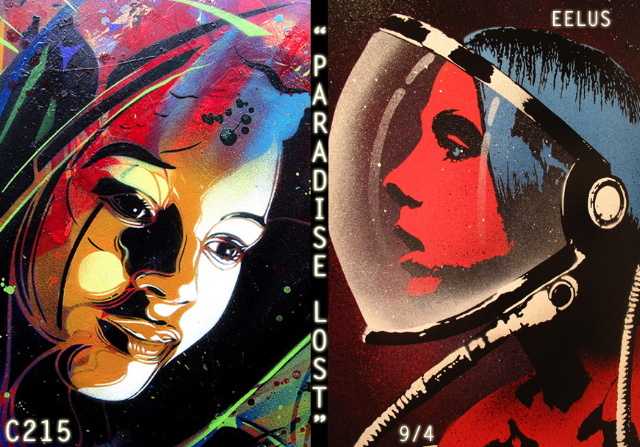
BROOKLYNITE GALLERY proudly presents the work of stencil artists C215 and EELUS with “PARADISE LOST“
“PARADISE LOST”
C215 • EELUS
September 4 – October 2, 2010
Opening Night – September 4th, 7-10pm
Never is there more an exciting time for a gallery and it’s curators than when they are in a position to be able to present work from artists who are on the cusp of breaking out and distancing themselves from the pack. As we at Brooklynite Gallery proudly present, “Paradise Lost” a two-man exhibition by stencil-based artists C215 and Eelus —this is clearly the case. Loosely exploring themes of innocence, wonder and the imagination we experience as kids, both artists approach these themes from unique perspectives in both subject matter and stencil technique —clearly at the top of their games.
No other artist working in the public space today connects with the streets like C215. With striking murals in varying size and scope all over the globe, he not only paints pictures of everyday people and society’s “outcasts” —he connects with them. Portraits of the elderly, middle-aged and children are carefully chosen; often reflecting the past, present and future in the gaze of their expressions. At times his subjects gain your attention with grittiness and distress —and his stencils are cut that way; short, sharp and of the two-color variety. Other times his subjects are radiant and fantastical —and again, his stencils are cut that way; graceful, curved and full movement. Now, as C215 begins to evenly balance the time between doing ‘street work’ and having a gallery presence, we’re beginning to see this well-rounded artist can no longer be put into one single ‘category’. Highly regarded by his peers as one of the top stencil artists working today, more than ever C215′s work exudes confidence. Continually transforming and perfecting his stencil techniques, experimenting with various surfaces and color theories, C215 doesn’t have to speak a word about the range of emotions he channels through his work… We can easily see and feel it for ourselves.
On the heels of his high impact solo exhibition in London last February, UK artist Eelus has officially arrived on the scene with an unusual set of tricks up his sleeve. Toying with the future expectations of adolescence, while juxtaposing sci-fi, sexual tension and poignant text, his imagery is reminiscent of a bizarre dream you wake up from and struggle to find it’s meaning. Eelus’ work often feels like a still frame from a complex film that points us in the right direction, yet still manages to give us only enough information to draw our own conclusions. Depending on which strings he wants to tug, his often three-color palette is used to strike just the right emotion when applied to surfaces ranging from canvas and wood to vintage metal signage. It all seems to be coming together as Eelus‘ work continues to stir conversation amongst his early fans as well new ones, both of whom anticipate his next print release and debate on which image it should contain.
Join us at Brooklynite during the un-official, last weekend of summer for an Opening Night Party and new work from both C215 and Eelus, including outside murals that is sure leave viewers wanting more. For further information or photos, kindly contact Hope McGrath at pr@brooklynitegallery.com.
Who knew some artists’ equated painting a picture on a surface with a bare-fisted street brawl? A tension-filled, back and forth struggle between their medium and tools all while producing visual ideas with an often far different meaning from what your eyes are actually seeing.
One could argue that, “Surface Tension”, the new exhibition from Guy Denning and David Walker, two artists, who through the human form, explore two different concepts, using two entirely different techniques, should be aptly billed as “Guy Denning vs. David Walker”. “Surface Tension” aims to explore the stress that festers behind the processes of creation and the battles won and lost between an artist and his medium. The show also revisits that old cliché about how painting is all about the external expression of the inner processes of art and the artist.
Wielding brushes and knives, Guy Denning battles a myriad of ideas that stir around in ones head in the hope that the visual translation might become the remedy. These disparate thoughts that don’t connect to anyone or anything in particular, yet continue to reoccur, are expressed through precarious self-portraits and female figures who at times are featured in crude, semi-abandoned locations. Behind layers of oil paint and turpentine, it would appear upon near completion, Denning’s work was then forcefully blasted in one direction with a fire-hose. His work has all the makings of a piece by a classically trained painter, yet the added angst of a back street fist-fight. According to a past journal entry, Denning states, “Any narrative is at best buried beneath the layers of fragmented visual metaphor and allegory”. One can then only assume that Denning’s subjects, such as soldiers pointing Browning heavy machine-guns in a sub-basement, women struggling with sexuality and self-portraits that appear to be anything but, are in part speaking possibly about… “unattainable goals”? In the end, as Denning puts it… “It all seems to go round in circles”.
For David Walker, much of this “Surface Tension” is self-inflicted. The gestural approach Walker uses when creating his alluring female portraits can only be achieved using a self-imposed rule of “no brushes, only spray-paint” techniques. Up until this exhibition, Walker also abstained from using a color palette other than black, white and pink. For now he’s trashed that rule and instead explores a diverse and at times clashing range of hues and metallics, giving a nod to the days of ‘acquiring’ spray paint from wherever you could and using what you had on hand, which results in refreshing and off-key color combinations. There is also further exploration into abstract tagging and photo-realism, all executed in layer upon layer of spray paint. For Walker, the subject of his work inherently lies in the facial expression– just the right one that is. Using found imagery pillaged from peoples photo albums, snapshots and old magazines, Walker is in constant search of a precise emotion or tilt of the head that evokes a visceral response and can expand the distance between his work and that of an intelligible portrait artist.
Both artists will continue to travel on different paths leading up to their joint exhibition here, where they will finally come together to not only display work on canvases, but also in mural form on the walls of our outdoor space and elsewhere.
If you would like more photos of the art or have any other questions about this show kindly contact me. Thank you.
Street art welcomes all manner of materials and methods, typically deployed without permission and without apology. This hand-formed wire piece …Read More »
 BROOKLYN STREET ART LOVES YOU MORE EVERY DAY