All posts tagged: Italy

Wunderkammern Gallery Presents “Nature’s Revenge” LUDO Solo Show (Rome, Italy)’

LUDO

Wunderkammern presents the young urban artist Ludo for his first solo show in Italy,: nature, both magnificent and menacing, challenges humankind from the walls of the city.

On show in Rome from 21st January at Wunderkammern, where he is making his first appearance
in Italy, the young French artist Ludo is one of the most innovative and promising on the urban art
scene. He has left his mark in major cities throughout the world (Paris, London, Zurich, Oslo, New
York, Los Angeles and Chicago), with surreal and bewildering works that are perfectly integrated
with the context in which he places them.

Ludo’s creatures emerge from reassuring greyscale images blended with acid green that is poured
onto paper, sending out a message of humility for contemporary society. Elegant and vindictive,
the artist’s creations belong in fact to the series Nature’s Revenge and Bugs: plants and insects
drawn with botanic precision, which have evolved into mechanical, chemical and technological
hybrids as a way of defending themselves against people’s aggression.

With his latest series, entitled Co-Branding, major brands like Chanel, Dior, Calvin Klein, H&M and
Benetton are transformed into aggressive and inappropriate images that nonetheless seem
perfectly in line with the aesthetic canons of contemporary publicity, thus contrasting consumers’
inurement to bombardment by multinational brands promoting luxury and much more.

On the occasion of his exhibition at Wunderkammern, Ludo will present a series of works on paper
and canvas from the series Nature’s Revenge and Co-Branding, as well as sculptures created
specifically for the gallery. Images of a proud and haunting nature, where the aesthetic canons of
advertising are filtered by the artist’s ironic and mocking eye.

WUNDERKAMMERN
via Gabrio Serbelloni 124, Roma
web: www.wunderkammern.net
email: wunderkammern@wunderkammern.net
Tel: +390645435662
ingresso gratuito

Read more

Mondo Pop Gallery Presents: “Street Parade” (Rome, Italy)

Mondo Pop
brooklyn-street-art-mondo-pop-gallery

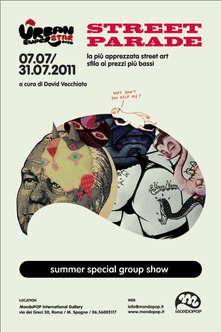
Summer special group show dal 7 al 31 Luglio

OPENING PARTY

giovedì 7 luglio H 19.00

con aperitivo e DJset

***

Street Parade

La Street Art accessibile che entra in galleria

Dal 7 al 31 luglio 2011  MondoPOP International Gallery passa in rassegna alcuni dei migliori lavori di Street Art degli ultimi anni, a prezzi riveduti. Mentre la street art cresce a quotazioni inaccessibili MondoPOP presenta una mostra in cui le migliori firme italiane si possono comprare oltre che ammirare!

Una nuova tappa dello Urban Superstar Project, evento curatoriale e  mediatico consolidato nella realtà artistica nazionale iniziato al Museo MADRE di Napoli nel 2009, riconfermaro nel 2010 e ora itinerante.

Un viaggio nell’universo duro e puro dell’arte urbana per ritrovare le origini di una forma espressiva che rivendica origini semplici nonostante il trend mainstream.

Artisti italiani e internazionali che danno un contributo tangibile alla definizione di New Art, con opere in mostra a prezzi accessibili.

L’opportunità di comprare opere originali per tutti i fan della corrente.

Nuovi lavori di promettenti street artist per mantenere un filo conduttore con la strada.

La migliore chance dell’estate per toccare la Street Art con mano.

Come di rito a MondoPOP si festeggerà l’opening della mostra sabato 7 luglio dalle 19 con musica e aperitvo, dj set.

Artisti:

Allegra Corbo, Bigfoot, Becca, Buff Monster,  Diavù , Boris Hoppek, Camilla Falsini, Diamond, El Gato Chimney, Fupete, Giò Pistone, Ian Stevenson, Jeremy Fish,

Mr Klevra, Mr Wany, Nicola Alessandrini, Odö, Scarful, Sone, Sten&Lex, 100Taur, 999, #

Read more

A Visit to La Biennale Di Venezia 2011

ILLUMInazioni – ILLUMInations, la Biennale di Venezia

54th International Art Exhibition

Writer Lea Schleiffenbaum was recently in Venice for the Biennial and she kept an eye out for Street Art for us, but quickly discovered the streets were under water.  With art from 89 countries, however, she found the city to be rich with spectacle and possibility.

by Lea Schleiffenbaum for BSA.

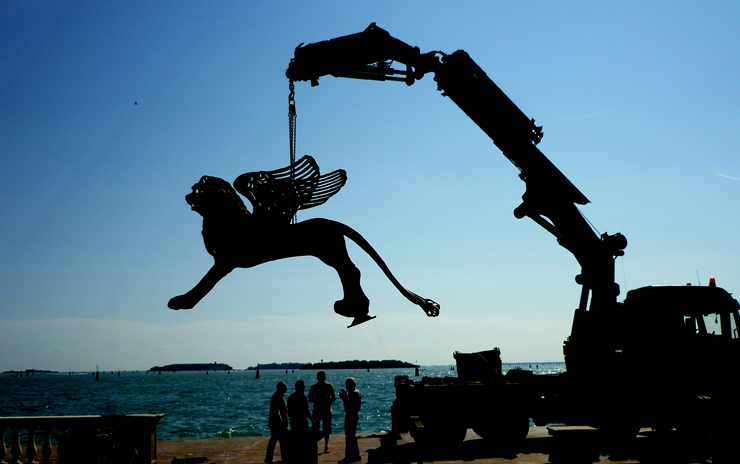
brooklyn-street-art-Lea Schleiffenbaum-venice-beinnale-2011-the Golden-Lion-web

Installing The Golden Lion (photo © Lea Schleiffenbaum)

Everything takes a bit longer in Venice. The small, north-Italian city is car-free, the only modes of transportation are so-called Vaporettos—boat-buses—or water taxis, both hard to find and slow. Walking is usually the fastest solution, as long as one does not get lost in the city’s maze of canals and narrow alleyways. I arrive at three in the afternoon—I am here to attend the opening of ILLUMInazioni – ILLUMInations, the 54th Venice Biennial—by the time I get to the apartment I am staying in, it is five. Getting lost or helping others trying to find their way is almost part of the Biennial experience. The best thing to do is to let go, adjust to Venice time, wander, and allow one self to be surprised. In the end getting lost might not be the worst; from the months of June to November every corner, every piazza, and every palace in Venice might hide another national contribution, a Pavilion, or a small exhibition.

brooklyn-street-art-Lea Schleiffenbaum-venice-beinnale-2011-US Pavilion-Allora-Calzadilla, performance-outside-web

US Pavilion. Allora and Calzadilla performance outside (photo © Lea Schleiffenbaum)

This year’s Biennale is curated by Bice Curinger, director of the Kunsthaus in Zurich and founder of the contemporary art publication Parkett. With ILLUMInazioni – ILLUMInations the Swiss curator set out to explore contemporary art for its inner essence. “Popularization,” she warns, “should not be at the expense of complexity.” Following such rather elitist ambitions in search of value, self-reflectivity, and depth, Curinger turned the 54th Venice Biennial into a serious, well-organized, but rather sober exhibition.  Aiming to connect contemporary art with its pre-modern routs, she decided to include three paintings by old master Tintoretto, the painter of light. The masterpieces are hung in the first room of the Central Pavilion in the Giardini, following Philippe Parreno’s light installation Marque. The exhibition continues with big names, including works by Seth Price, Christopher Wool, Sigmar Polke, and Cindy Sherman. On display are high quality works by high quality artists. Everything fits; nothing is too crazy, nothing very surprising.

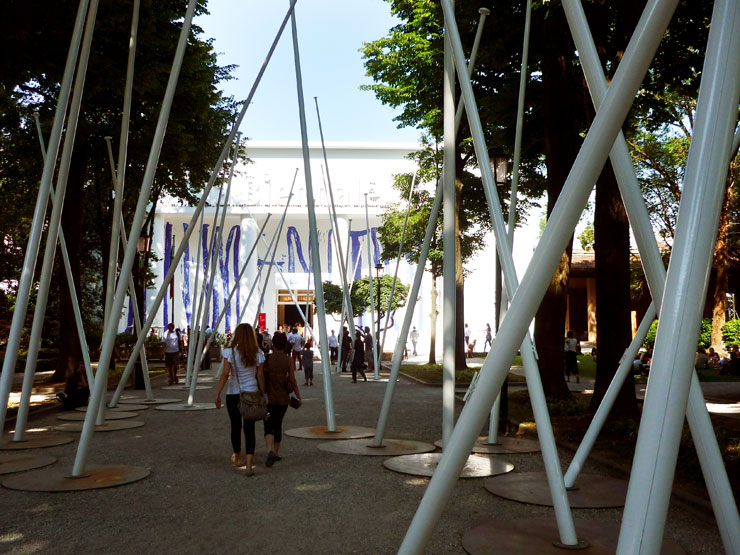
Brooklyn-Street-Art-copyright-Lea-Lea-Schleiffenbaum-Central-Pavilion-Giardini-frontal-view

A steady stream of attendees at the Central Pavilion in the Giardini (photo © Lea Schleiffenbaum)

My slight disappointment with the Central Pavilion is softened by a visit to the Arsenale, the second venue curated by Curinger. The pace here is good. Curinger takes her viewers from large-scale installations, to smaller more intimate sculptures, paintings, and photographs. Monica Bonvicini is followed by Klara Liden, Rosmarin Trockel, and Urs Fischer whose candle wax replica of Giambologna’s famous sculpture The Rape of the Sabine Women will slowly burn down as the exhibition continues. Video work interrupts the general flow of the show in regular intervals, giving the viewer a chance to stand still for a moment and watch. Christian Marclay’s wonderful film The Clock stands out especially. Three days later I hear he won the Golden Lion for best artwork—which he fully deserves.

Brooklyn-Street-Art-copyright-christian-Marclay-clock-june2011

Promotional still from “The Clock” by Christian Marclay

By far the most interesting concept Curinger introduced to this year’s Biennale is the so-called Para-Pavilion: Pavilions created by artists for artists. It is great to see artists set their work into a dialogue with other artists and cultures. Young Chinese artist Song Dong for example, collected one hundred old doors in Beijing and reconfigured them in Venice inviting African-French artist Yto Barrada, and British artist Ryan Gander to show their work within them. Eccentric as always, Austrian artist Franz West asked a total of 40 artists to fill his Para-Pavilion – a reproduction of his kitchen in Vienna – among them Mike Kelley, Sarah Lucas, Josh Smith, and Anselm Reyle.

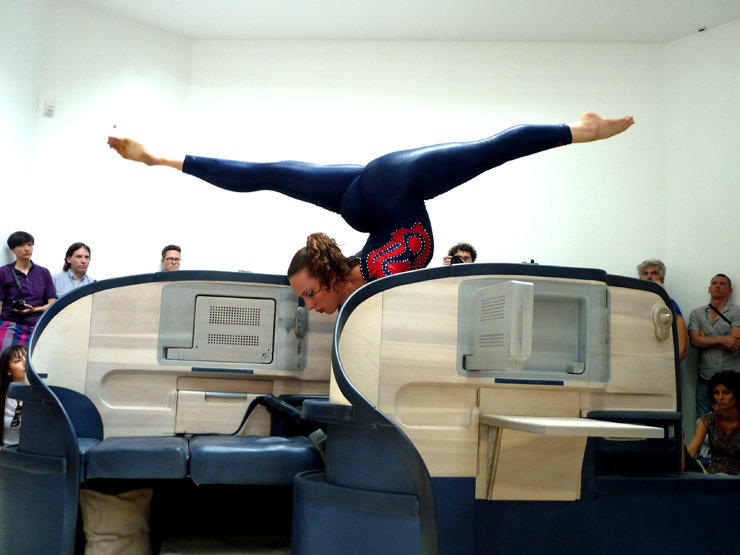
brooklyn-street-art-Lea Schleiffenbaum-venice-beinnale-2011-US- Pavilion-Calzadilla, performance-web

US Pavilion. Allora and Calzadilla performance inside (photo © Lea Schleiffenbaum)

This year’s Golden Lion for best national Pavilion was awarded Germany, for its reconstruction of a stage set by artist and director Christoph Schlingensief. Last year, Christoph succumbed to a long fight against cancer. A Church of Fear vs. the Alien Within was the second part of a trilogy written by Schlingensief following his first round of chemotherapy. Sitting on church benches in a dark candle lit room, visitors become witnesses to an artist trying to deal with life, death, and illness. Video projections of decaying animals, war, and fight sceneries are occasionally accompanied by a Wagner symphony; sometimes the voice of a woman reads aloud from the transcript of the play. It is hard to settle back into Biennial mode after such an intense and engaging installation.

The US is represented by Allora and Calzadilla. Working with former Olympic Athletes that execute choreographed performances on old US airway seats and upside down tanks, the Cuban-American artist duo questions heroic gestures and national self-presentation. Just like the Olympic games, international biennials swing somewhere in between competitive performance and peaceful encounter. Thomas Hirschhorn transformed the Swiss Pavilion into a vibrating Gesamtkunstwerk made of aluminum foil, old magazines, cardboard, and ear sticks. The Crystal of Resistance is a very physical, almost organic installation. Asking what art can do, how it can change the status quo, Hirschhorn engages his viewers in questions of politics, aesthetics, and transience. Hany Armanious’ subtle yet beautiful sculptural installations in the Australian Pavilion present a nice contrast to the many large-scale installations and performance pieces. Armanious casts everyday objects to reconfigure them in poetic assemblages. The French Pavilion stands right in front of the Australian Pavilion, and this year it stars Christian Boltanski, who deals with birthrates, death, and arbitrariness. This year’s choice for the Polish Pavilion has caused quite a bit of turmoil. Rather than choose a local Polish artist, the commissioners invited Israeli artist Yael Bartana to represent the country. Under the title …and Europe will be stunned, the young artist shows a film trilogy that asks Polish-Jews from all over the world to return to their country of origin, which needs them.

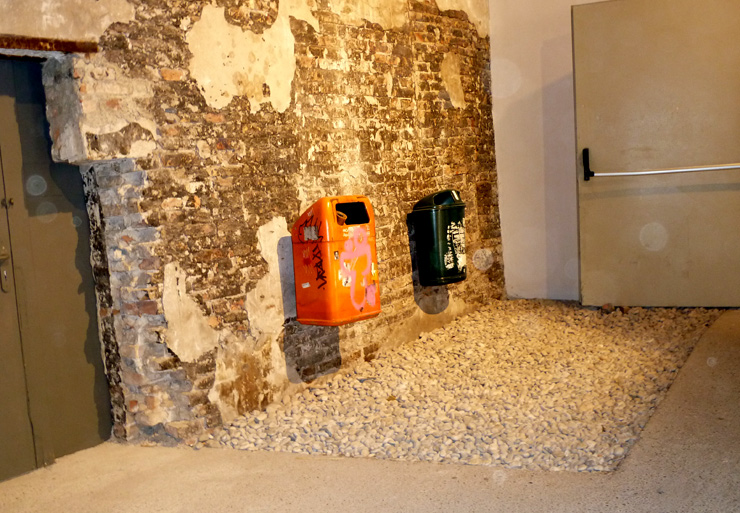
brooklyn-street-art-Lea Schleiffenbaum-venice-beinnale-2011-Arsenale- Klara-Liden- Trash-cans-web

Arsenale. Klara Liden Trashcans (photo © Lea Schleiffenbaum)

A total of 89 countries are represented in this year’s Biennial, the most of any Biennial so far. Those who don’t have a pavilion in the Giardini or the Arsenale are scattered across the city in one of Venice’s grand houses or palaces. Political statements are followed by aesthetic expressions, rebellious actions by poetic gestures. Of course, Venice is ridiculous, over the top, an incorporation of art-world glam and spectacle. But in between getting lost, queuing, and meeting old friends and acquaintances, one inevitably ends up discovering some previously unknown artists, and sees new work of already loved ones. In the end the visit is always worth it.

~ Lea Schleiffenbaum

brooklyn-street-art-Lea Schleiffenbaum-venice-beinnale-2011-web

Venice (photo © Lea Schleiffenbaum)

ILLUMInazioni – ILLUMInations, la Biennale di Venezia, 54th International Art Exhibition,

June 4th – November 27th 2011

Read more

Images of the Week 05.28.11

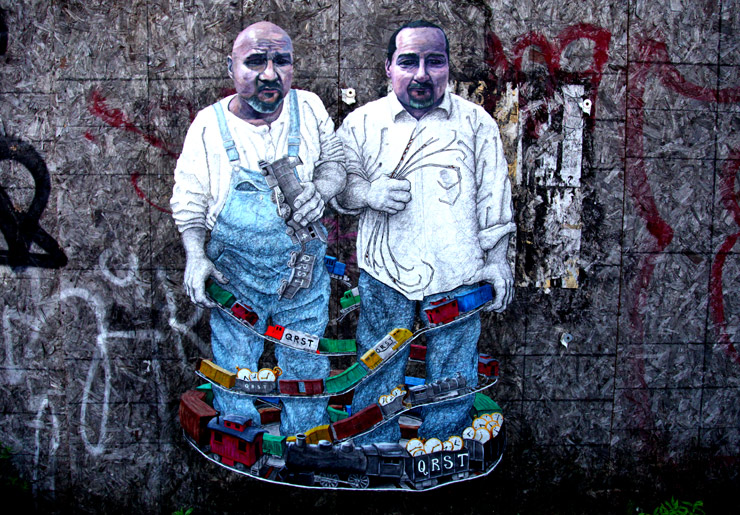
Our weekly interview with the street, this week featuring 9, Bast, Death is Free, Deform, Enzo & Nio, Hellbent, Mauro Fassino, Kophns and QRST.

brooklyn-street-art-qrst-jaime-rojo-05-11-web-8QRST (photo © Jaime Rojo)

brooklyn-street-art-qrst-jaime-rojo-05-11-web-9

QRST (photo © Jaime Rojo)

brooklyn-street-art-qrst-jaime-rojo-05-11-web-10

QRST (photo © Jaime Rojo)

brooklyn-street-art-9-jaime-rojo-05-11-web-6

9 (photo © Jaime Rojo)

brooklyn-street-art-bast-jaime-rojo-05-11-web-7

Bast (photo © Jaime Rojo)

brooklyn-street-art-death-is-free-artist-jaime-rojo-05-11-web-1

Death is Free (photo © Jaime Rojo)

brooklyn-street-art-deform-jaime-rojo-dubai-05-11-web

Deform. Caution Ribbon in Dubai (photo © Deform)

brooklyn-street-art-unknown-jaime-rojo-05-11-web-2

Doesn’t he look pretty Mao? Unknown (photo © Jaime Rojo)

brooklyn-street-art-enzo-nico-jaime-rojo-05-11-web-11

Enzo & Nio (photo © Jaime Rojo)

brooklyn-street-art-unknown-jaime-rojo-05-11-web-12

Unknown (photo © Jaime Rojo)

brooklyn-street-art-hellbent-jaime-rojo-05-11-web-5

Hellbent reminds us of the importance of dental hygiene. (photo © Jaime Rojo)

brooklyn-street-art-kophns-carlos-gonzalez-05-11-web

Kophns on an abandoned motel in Silverlake, CA (photo © Carlos Gonzalez)

brooklyn-street-art-unknown-jaime-rojo-05-11-web-13

Unknown. I imagine he doesn’t know what he’s talking about. Discuss! (photo © Jaime Rojo)

brooklyn-street-art-mauro-fassino-italy-jaime-rojo-dubai-05-11-web

Mauro Fassino “BIOmorphing” street installation in Trento, Italy. “My work describes the integration between humanity and nature, it is made by steel painted with enamel, artificial turf and stickers” MF (photo © courtesy of the artist)

brooklyn-street-art-david-foote-anne-koch-jaime-rojo-05-11-web-4

David Foote and Anne Koch “The Nest”. It’s not Street Art but it is a beautiful installation at Honey Space Gallery in Chelsea on view through May 29. We’ll keep you apprised of any golden eggs that may appear. (photo © Jaime Rojo)

brooklyn-street-art-unknown-jaime-rojo-05-11-web-3

Unknown (photo © Jaime Rojo)

brooklyn-street-art-cayuga-lake-ithaca-new-york-jaime-rojo-web

A haunted scene on Cayuga Lake. Ithaca, NY (photo © Jaime Rojo)

Read more

Jesus Waves Italy’s Flag in Turin

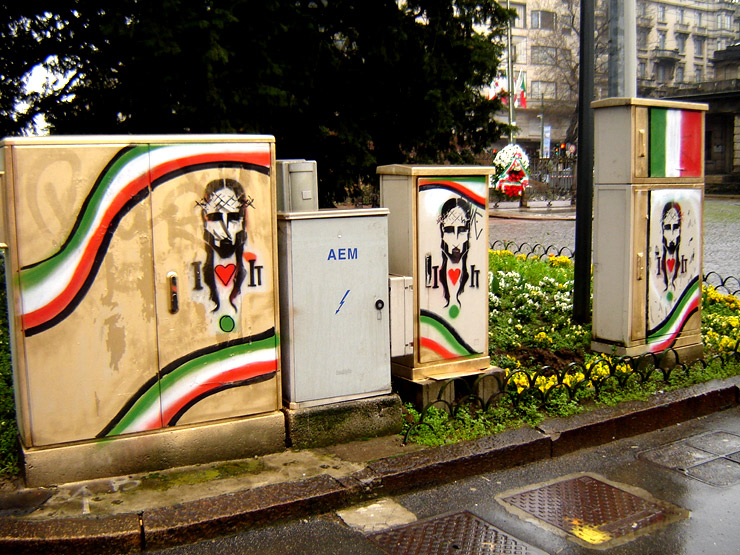
Street Artist Angel Cruciani Commemorates 150 Years of Italian Unity

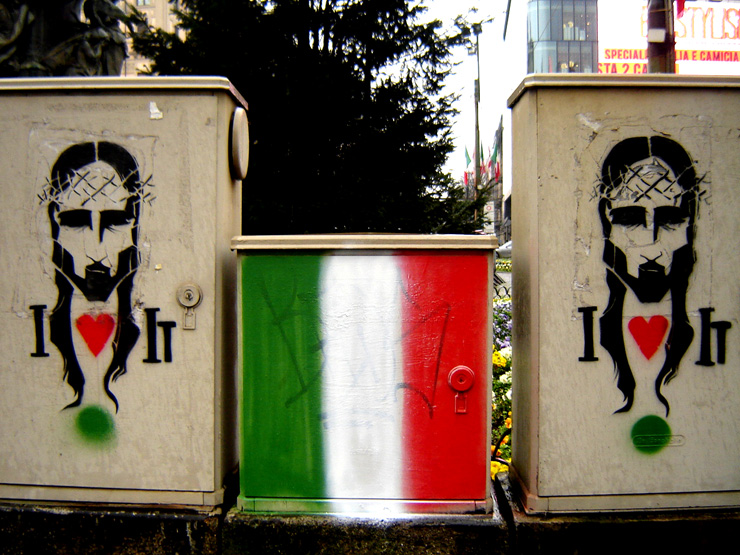
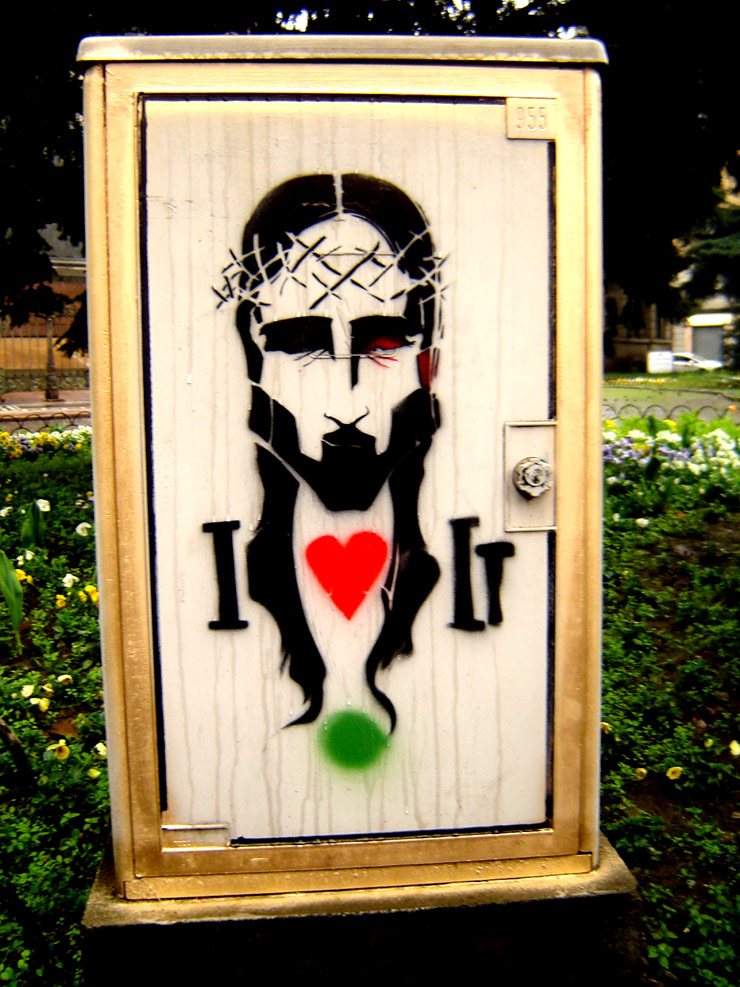
This month Italy commemorates 150 years of unification. In March 1861 Turin became the first capital of Italy after the political and social movement known as il Risorgimento brought together most of the city-states from the Italian Peninsula. Rome was not part of this unification as it was still controlled by the Pope as part of the Papal States. In 1871 Rome became the third and last capital city of Italy.

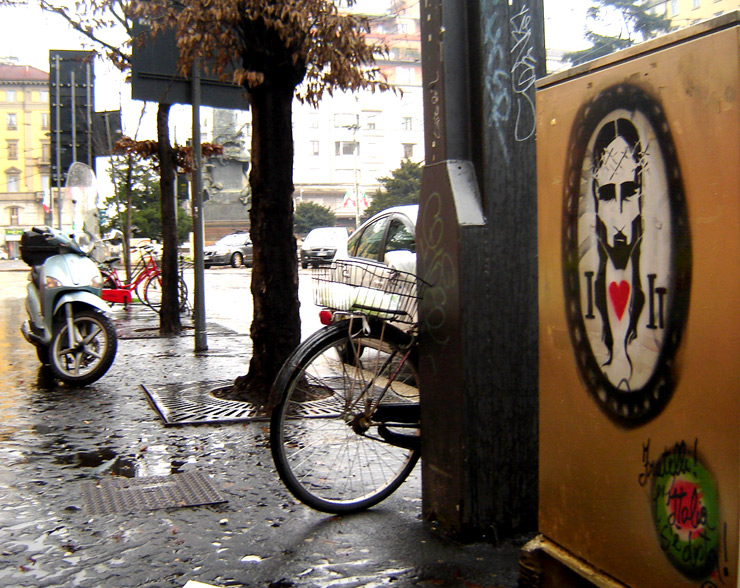
To mark this occasion Italian artist Angel Cruciani has been busy stenciling numerous cities across Italy with a stylized and nationalistic portrait of Jesus, essentially unifying Church and State. Taking it’s cue from narrow facial lines in The Shroud of Turin, the stencil campaign brings the “Jesus Street” project all over Italy’s plazas and main streets.

brooklyn-street-art-angel-cruaciani-jesus-on-the-streets-of-italy-1-web

Angelo Cruciani  (photo © Veronica for BSA)

brooklyn-street-art-angel-cruaciani-jesus-on-the-streets-of-italy-2-web

Angelo Cruciani  (photo © Veronica for BSA)

brooklyn-street-art-angel-cruaciani-jesus-on-the-streets-of-italy-3-web

Angelo Cruciani  (photo © Veronica for BSA)

brooklyn-street-art-angel-cruaciani-jesus-on-the-streets-of-italy-4-web

Angelo Cruciani  (photo © Veronica for BSA)

Brooklyn-Street-Art-WEB-Copyright-Wikipedia-negatives_of_the_shroud_of_Turin

A negative of the Shoud of Turin from Wikipedia

Read more

Street Artist John J. Mahyo Takes on the Mafia

When was the last time you saw Street Art addressing organized crime? No, not posters for Uggs, silly, the Godfather/Tony Soprano kind of thing…

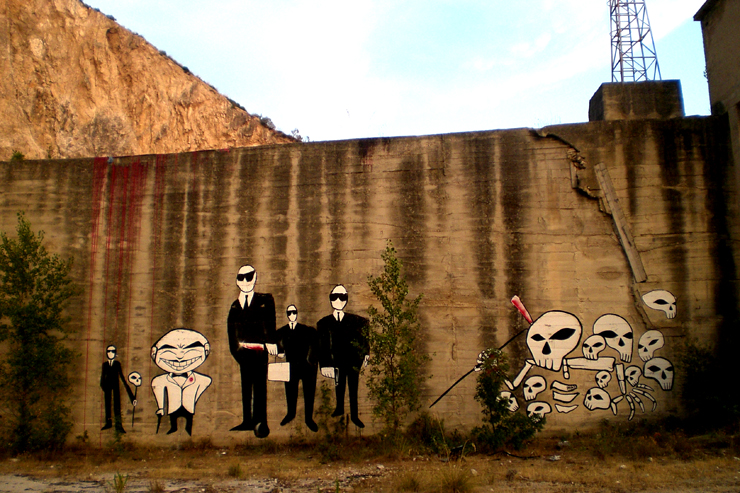
Take a look at these photos by artist John J. Mahyo, who traveled to an abandoned stone quarry in southern Italy for a representational retelling of stories related to the reported crime family, Camorra. Influenced by the book, “Gomorrah” by Roberto Saviano that reportedly unmasked a modern day crime family, thus meriting 24-hour police protection for the author, Mahyo worked with photographer and artist Elp Supra to create this homage to the victims of organized crime. In his words, “It’s a simple guerrilla action against Mafia and a support to the civic engagement of Roberto.

John J. Mahyo. Caserta, Italy. (Photo © Elp Supra)

John J. Mahyo. Caserta, Italy. (Photo © Elp Supra)

Mahyo, who speaks oddly in the third person about himself, answered a few questions about the work.

Brooklyn Street Art: Can you expand a bit on the use of death (skeletons) and the “business men” in the large mural?
John J. Mahyo: Certainly… The skeletons represent the Mafia’s victims ready to relive and get revenge against their nemesis, represented by a mobster and his killers and assistants.

John J. Mahyo "Ginevra Risman" (Photo © Elp Supra)

John J. Mahyo “Ginevra Risman” (Photo © Elp Supra)

Brooklyn Street Art: The portrait of the lady sits on a bed of arms. Could you expand on those symbols and their juxtaposition?
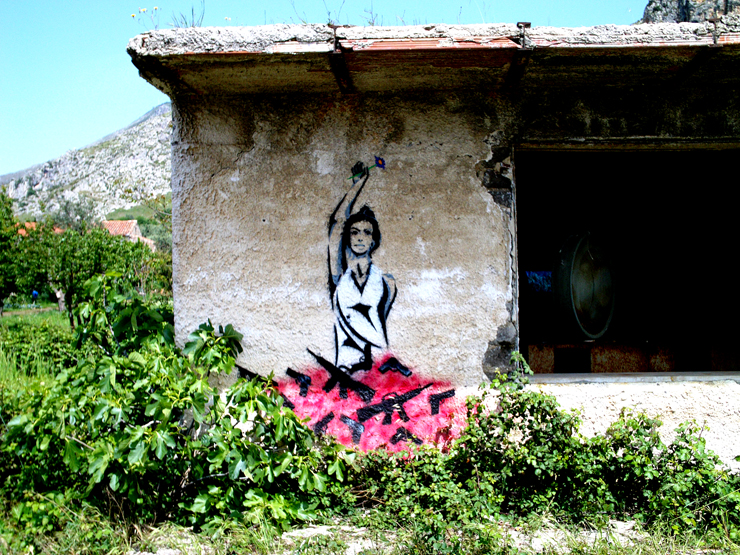
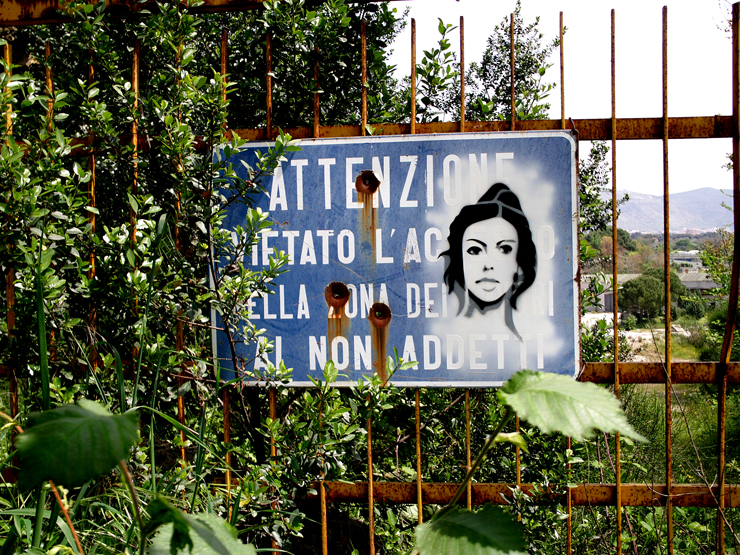
John J. Mahyo: The lady is Ginevra Risman (anagram of a notorious Italian actress); she looks like an “Avenging Angel” just emerging from a pool of blood, AK-47, Thompson and Beretta guns

John J. Mahyo. "Ginevra Risman" (Photo © Elp Supra)

John J. Mahyo. “Ginevra Risman” (Photo © Elp Supra)

Brooklyn Street Art: Can you tell us a little bit more about you and about Roberto? Who is John J. Mahyo?
John J. Mahyo:
Well, he was born as a graffiti artist in 1997 and at the sunrise of the 3rd Millennium he began to also create Street Art (the evolution of “writing”). Mahyo doesn’t consider himself an artist but a communicator; he asserts that art is a genuine communication that can be used as a weapon to win lost causes. Just like Roberto Saviano, who wrote “Gomorrah”, the best-selling book translated in 51 countries, where he describes the clandestine particulars of the Camorra business.

More info at:
http://johnjmahyo.wordpress.com/2010/10/04/fighting-mafia/
http://en.wikipedia.org/wiki/Roberto_Saviano

Read more
Fun Friday 10.08.10

Fun Friday 10.08.10

Fun-Friday

Fun Friday

Erik Burke and Cahil Muraguh

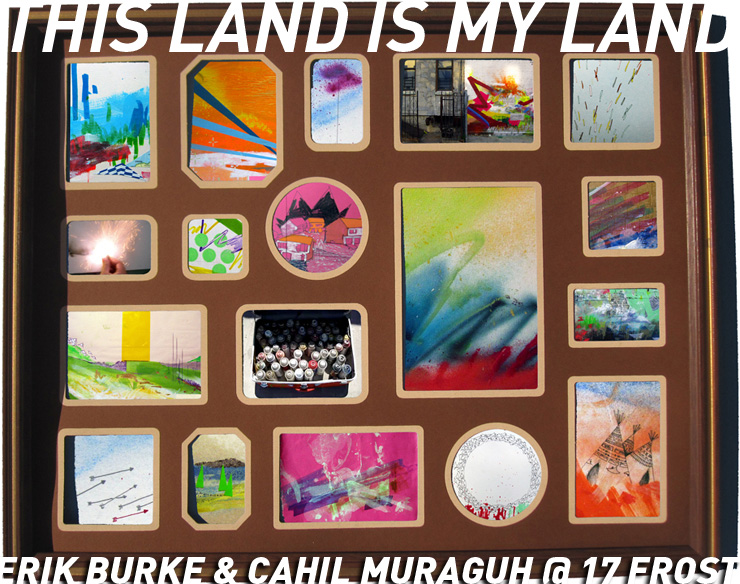
“This Land Is My Land”brooklyn-street-art-MY-LAND-erik-burke-cahil-muraghu-17-frost-gallery1

Experimental show space 17 Frost in Brooklyn tonight hosts the opening of a show that summons Woody Guthrie from the ethers to talk about a time when average working American citizens were asserting their right over resources from multinational companies. An unconventional mashup of NYC graffiti and Hudson River School this show boldly challenges you to make connections where you didn’t know there were any.  Reconciling urban abstract with pastoral landscapes can’t be easy, but when both are your influences you are bound to find the is a germ of something new.

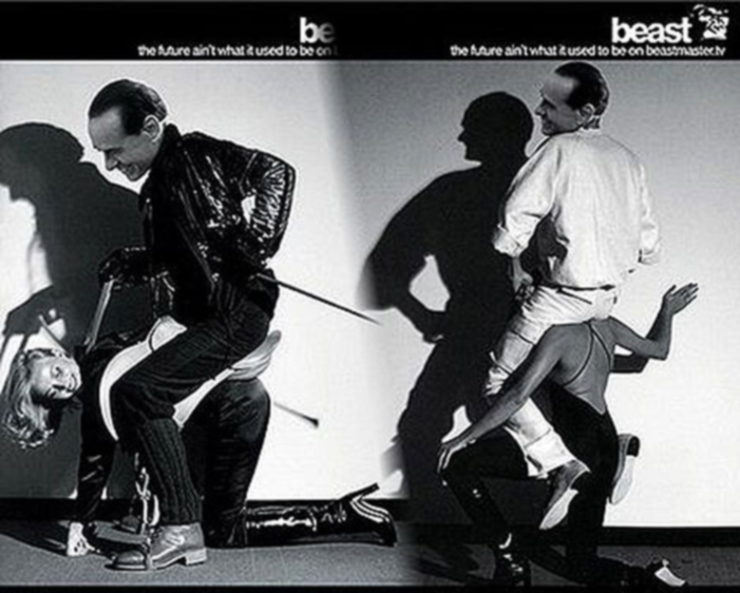
Ride ‘Em Cowboy – Beast & Berlusconi

Furious Italian Prime Minister Silvio Berlusconi has ordered in inquiry after 16 giant posters showing him riding young models like horses sprung up overnight in Milan.

The faked images – some showing the playboy PM beating the girls’ bottoms with a riding crop – are said to be the work of a local Banksy-style street artist called Beast.

More here

berl

Mundano Modifies Political Posters in Brazil

In another politically engaged Street Art take on graphic messaging in the public sphere, Brazilian Street Artist Mundano is re-styling posters for the  Presidential elections currently taking place in Brazil.

Know Hope in Toronto Tonight

Street Artist Know Hope is currently in Toronto for tonight’s opening of his solo show “There Is Nothing Dear (There Is Too Much Dear)” at the Show and Tell Gallery.  “I’m really excited about this show and the pieces in it. Toronto is also a really cool city,” says the artist.

brooklyn-street-art-know-hope-show -and-tell-gallery

Skewville charms the French

Or at least that’s what Adam says he did.

FAME Wrap Up Video

Italy was once again treated to some of the best worldwide large scale installations of work by Street Artists in one place for the FAME festival. Here is a summary of the scene.

Read more

Wunderkammern Presents: Invader “Roma 2010 And Other Curiosities” (Rome, Italy)

Invader
brooklyn-street-art-invader-Wunderkammern-Rome

Roma 2010 and other curiosities

From 23rd October to 21st December, Wunderkammern exhibition space will host the first Italian solo show of Invader: “Roma 2010 and other curiosities”.

Invader is an artist working in anonymity. Born in 1969 in Paris, he is one of the most important and original international street artists and has exhibited in many prestigious galleries and museums across the world.

Invader is known above all for his public interventions inspired to the Arcade Game Space Invaders, created in 1978 in Japan. His operations are tied up to creative practices of “interference” through which he traces unique trails in the collective space, shaping new signs in the urban landscape. The naturally public formality of his interventions – suspended between visibility and anonymity and between real and virtual spaces – as well as the choice of icons present in the collective memory and practices of the youngest generations, offers a meaningful and original reading of our cultural patrimony.

With the invasion of Rome occurred over the summer, the artist has finally added the Italian capital in the list of the more than forty cities he has invaded so far: from Katmandu to Bangkok, from small urban centres to great city metropolises such as New York, Hong Kong, Los Angeles and above all Paris.

The exhibition at Wunderkammern will present various aspect of his work: from the alias replicating the space invaders of Roma to works made with his original RubikCubism technique, by means of the coloured modules of the famous puzzle, re-presenting images extrapolated from the realm of art history or popular culture, along with specific installations and curiosities. The invasion guide of Roma and the brand new 19th printed invasion map will also be presented in exclusivity at the opening.

On the occasion of the artist’s presence in the city, Wunderkammern’s exhibition space opens once again to the dialectic comparison between ordinary and extraordinary, by drawing its own poetry closer to Invader’s narrative language. The artist revisits the urban space generating wonder and transforming daily routes into unique journeys.

Opening: sabato 23 ottobre 2010 – ore 18.00

Indirizzo: via Gabrio Serbelloni 124, Roma

Date esposizione: Dal 23 ottobre al 21 dicembre 2010. Aperto dal lundedì al giovedì dalle 17.00 to 20.00 o su appuntamento al 349 8112973.

Testo critico di Achille Bonito Oliva

Read more

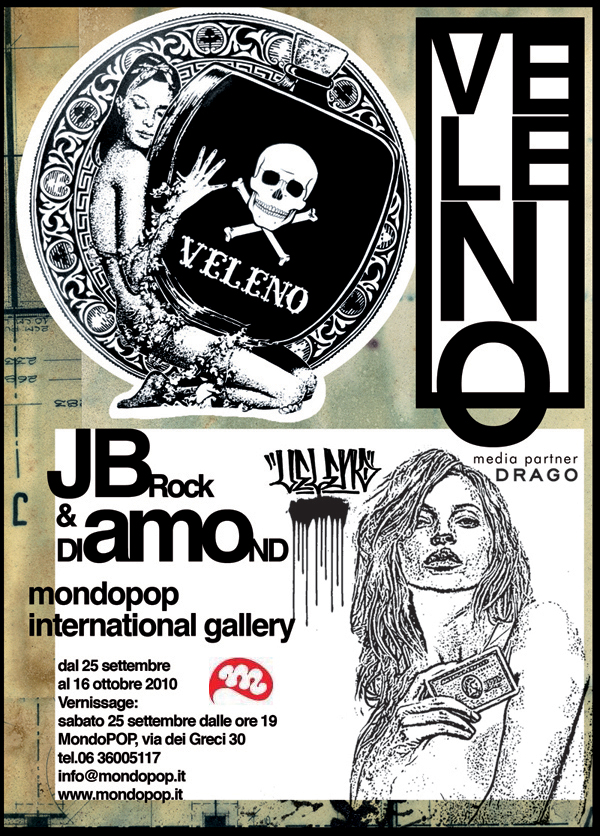
MondoPop International Gallery Presents: Veleno(Poison) A Shared Solo Show By Diamond and JB Rock (Rome, Italy)

Veleno
brooklyn-street-art-mondo-pop-international-gallery-web

VELENO
(Poison)

A shared solo show by Diamond and JB Rock

Two of the most popular Italian street artists will meet @MondoPOP gallery from Sept. 25 to present their new exhibition: VELENO (POISON)
Jb Rock & Diamond have worked with their interpretations of “poison”: lethal potion, sweet addiction that slowly destroys, charm and murder at the same time.

Diamond. Image Courtesy of the Gallery

The two street artists are well known in Italy and abroad for being away from the clichés of their genre, with artistic references to a taste that goes back to the wonderful women of Mucha or to the American pin-up, involving the manic precision in their amazing patterns and details that recall Art Nouveau’s artists as Horta. Even their tecnique is versatile: spray, ink, acrylic and even BIC pen.

JB Rock. Image Courtesy Of The Gallery

From 25th Sepetember MondoPOP’s gallery presents their work.
“Drugs are the real poison” for JB Rock, that portraits without criticism or condemnation the essence of modern icons.
“Love Filters” in Diamond: something that enchant and simultaneously destroys.

Canvas and paper painted with brushes and pens and dipped in poison, of course.

VELENO

http://www.mondopop.info/veleno/logo_drago.jpg

A shared solo show by Diamond and JB Rock,
from Sept 25th until Oct 20th 2010.
||||  David Vecchiato | Serena Melandri

||||  MondoPOP International Gallery/Art Shop of Rome
||||  via dei Greci 30
||||  00187 Roma / Italy
||||  info@mondopop.it
||||
||||  www.mondopop.it

Read more
Street Art Photographers: Capturing Ephemera Part 2

Street Art Photographers: Capturing Ephemera Part 2

Brooklyn-Street-Art-Capturing-Ephemera-part-2

We continue with Part 2 of our interview with Becki Fuller, Stefan Kloo, and Luna Park; three Street Art photographers who have reached a certain stature among their peers for their contributions to the scene.  As each describes their work and their experiences as documenters and creative artists, one can see that their level of understanding goes beyond merely academic or stenographic while including elements of both. From beginner to expert, there are artists on both side of the camera and the very nature of Street Art provides a forum for each.

Google Maps does a pretty good job at simply documenting streets. These professionals and others like them know how to discern, interpret and present the work of Street Artists in ways that can add context, meaning, breath and life. We heartily thank these three artists for their candid and insightful responses (and incisive wit!) and we look forward to including many other voices in the ongoing discovery that is Street Art today.
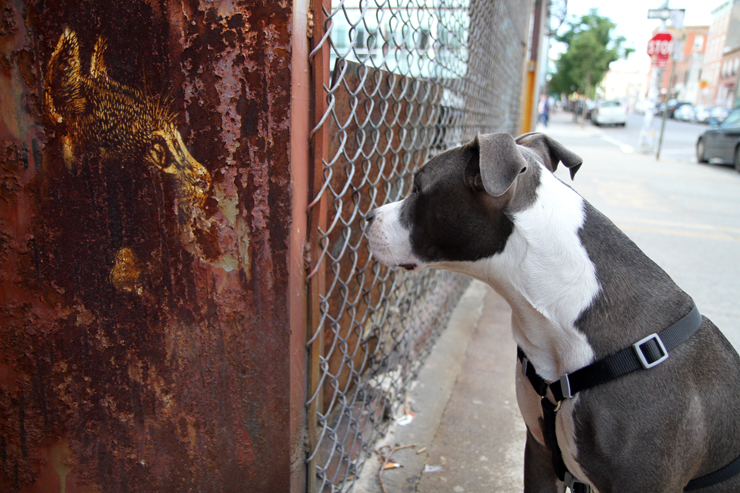
C215 © Becki Fuller

C215 © Becki Fuller

Brooklyn Street Art: Five years ago the act of documenting pieces by street artists was the work of a relative handful of photographers. Thanks to new technology there are more photographers today documenting it and some Street Artists document their own work, posting images on their personal Flickr pages and web sites before the photographers get to them. How do you feel about this and does it change your view of your efforts or you view of the artists?

Brooklyn-Street-Art-Becki-Fuller-competitionBecki Fuller: I say the more people who are interested in street art enough to document it, the better! But yes, it has definitely changed things. When I first started shooting street art, I easily received a lot of attention just because there was a much smaller group of people who were documenting it and sharing it. And for a while it took some of the fun out of it for me when I realized that people were trading locations with each other or getting them from artists even before the work went up, really turning on the pressure to photograph a piece within hours of its appearance. But I quickly came to terms with what I want to do and what I am willing to do in order to continue enjoying street art photography. I honestly don’t pay too much attention to much of what other people are doing, just because I need to maintain balance in my life and I need to keep my competitive spirit in check.

As far as the artists themselves photographing their work goes, well, that’s their right…but (with a few exceptions, such as JR) they also tend to reinforce where their talents lie, and it’s not in photography.

Luna Park: Street art has come of age in the era of social media. Thanks to modern technology, everyone is a photographer now and everyone has the tools with which to position himself or herself within the scene and, if desired, promote themselves within the art marketplace. Where there wasn’t a street art media or blogosphere five years ago, there most certainly is now. The speed at which images are disseminated has been amplified and the whole world is watching. That artists photograph and promote their own work is only natural – some do a better job of it than others – and that’s their prerogative. The Internet has an insatiable appetite and it constantly demands more content; as a result, I feel more pressure now than ever to continue to deliver the goods.
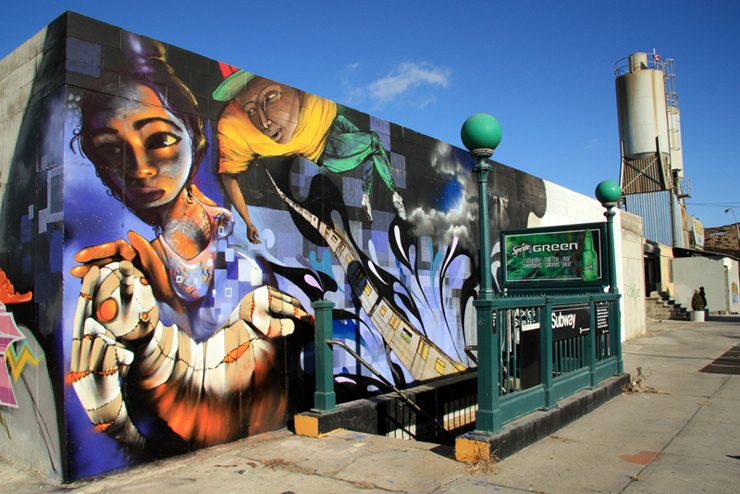
Cern, Cekis, Inti. © Luna Park

Cern, Cekis, Inti. © Luna Park

There are definitely more players on the documentation field, but I enjoy a little friendly competition, as it motivates me to keep on top of my game. Thanks to my relationships with many artists and my standing in the community, I am often tipped off to the locations of pieces from artists directly or others who share my interests. Five years ago I would have left the house with my camera, without any expectations of what I might find and open to discovery. Sometimes I miss that.

Today I go about following up on leads or hunches much more strategically, all the while ready to adjust my travels around the city as needed. Of course there are still plenty of serendipitous sightings – I revel in every lucky, random encounter. The downside of having achieved a certain level of recognition is that I get a ton of unsolicited email, either from artists eager to introduce me to their work or from PR flacks and marketers desperate to have me shill their products to their target audience. At times it can feel very calculated and cynical, yet by and large I remain unaffected by this type of maneuvering. I am still passionate about street art after all these years and thankful for all the wonderful people that have come into my life because of it. I am never bored, as I constantly have places to go and things to see. My enthusiasm is wholly driven by inspiration and the desire to play it forward.

Brooklyn-Street-Art-stefan-kloo-ponyStefan Kloo: I’m absolutely O.K. with others doing the same thing, patrolling the same alleys, getting the same shots. How can you not. It’s like stone soup; it just gets better with everybody contributing the missing ingredient. So you got a better shot, got it first, got the only shot before its gone? What of it? – It’s not a competition! And don’t expect anything in return, most of the artists don’t. If it chaps your hide that someone else got the same shot or got it first, it either means that you’re taking yourself too serious or that you’re a bit of a one trick pony. Just find a different angle, heck find a different subject if your doing it for the approval of others.

The artists deserve props first and are entitled to a “clean take” on their work. We know how fleeting it is and how often a photo is all you got to show for. Whenever possible it’s probably for the better not to rely on others to document your work. Flickr and the blogosphere definitely changed things for me, for the better. Where I used to practically work in a vacuum I now get to flaunt the shots to peers I didn’t know I had. What’s not to like about that?
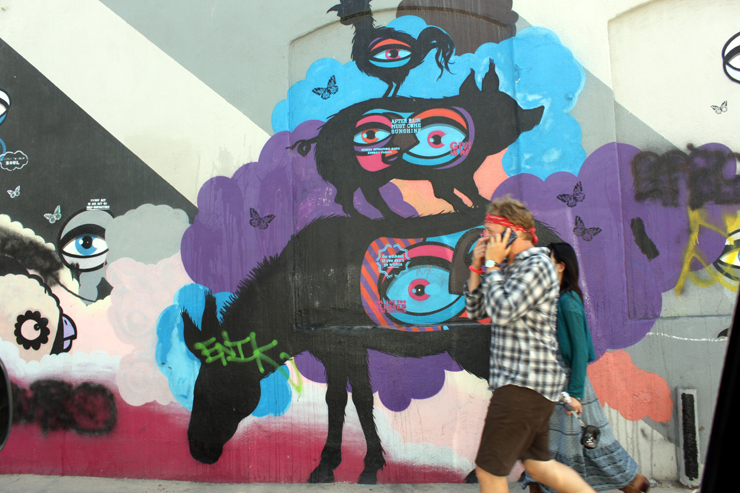
Roa and Chase in Venice, CA. © Stefan Kloo

ROA and Chase in Venice, CA. © Stefan Kloo

Brooklyn Street Art: Today there are many websites dedicated to showcasing street art around the world. Many people who run the sites take images and post them without permission or credit to the photographer. What is your opinion of this and should photographers take any action?

Brooklyn-Street-Art-Becki-Fuller-slapBecki Fuller: Honestly, it really pisses me off when artists or people who should know better do that…I enjoy receiving a nod of recognition for my efforts as much as anyone anywhere does. I spend a lot of time, thought, and money doing what I do, often going into debt just to upgrade my camera or buy a new lens, all without receiving any monetary compensation. I can’t even tell you how many books my photographs have been included in, and it is usually rare for me to receive even so much as a free copy in return. So to directly lift my image and treat it as if it is your own is a slap in the face, as far as I am concerned.

Luna Park: I realize that in putting things online, I open my work up to being stolen, but I still believe the benefits outweigh the risks. It’s unfortunate, but there are unscrupulous sites that continue to post unaccredited photographs, including a few within the larger street art community. I am keenly aware of the pressure to break stories online, but not crediting your sources is just downright disrespectful.

I’ve also encountered an attitude from certain artists who believe that they are not only entitled to dictate what is done with my photographs of their work, but also to freely distribute my photographs without credit. I put a lot of effort into displaying work in the best possible light and always credit artists – it is unfathomable to me that some people think that photographs magically take themselves. I understand that viewers are primarily looking at the artwork depicted, but having a good photograph of it is half the battle. Aside from demanding that credit omissions be rectified, I don’t know what else photographers can do. I am opposed to watermarking, as I find them incredibly distracting. Brooklyn-Street-Art-Stefan-Kloo-dick
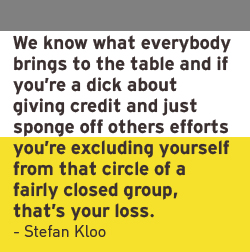
Stefan Kloo: That’s a kick in the taco. You can’t be happy about it. But I don’t think of myself as that important that it warrants a fuzz. I’d like to think that we (street art aficionados) are among friends. We know what everybody brings to the table and if you’re a dick about giving credit and just sponge off others efforts you’re excluding yourself from that circle of a fairly closed group, that’s your loss. It also goes to motive – if you don’t have it in you to credit someone when due, what’s it all about for you then? It’s a lot like having an “assistant” painting or pasting your work – you’re on the outside looking in. If that’s all you got, you’re missing the point. However, the photos should make the rounds, almost regardless of who took the shot.

The art and the artists who created it are the key. Which should not stop you from calling bull on the jockeys and hang them by their nut purse till death is welcome… If anyone makes a buck of a street art photo, two people should get a cut: the artist and the photographer. O.K., and the publisher if you put it in a book. Simple, no? Luckily that’s a dilemma that does not play out very often…
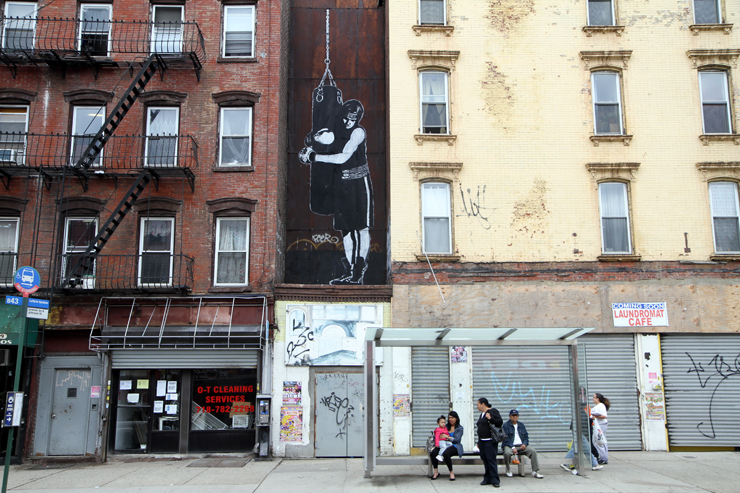
Dolk © Becki Fuller

Dolk © Becki Fuller

Brooklyn Street Art: Some art critics have suggested that Street Art enthusiasts, photographers in particular, lack an intellectual and artistic approach to the art that they document and are unable to truly understand Street Art. What’s your opinion on this?

Becki Fuller: At the risk of sounding like a dolt, I don’t think that it is necessary to intellectualize art in order to enjoy it. While a greater understanding of art can definitely enhance your appreciation, I believe that over intellectualizing art leads to a sterile and heartless environment. That’s the main thing that really turned me off from the Chelsea gallery scene in the 2000s and really lead me to Street Art in the first place. Everything seemed so conceptual to the point where you couldn’t enjoy an opening without reading about it first. So I would counter than anyone who believes that you need a PhD in order to appreciate and understand street art probably doesn’t know the first thing about really seeing street art in the first place. Brooklyn-Street-Art-Becki-Fuller-phd

As far as lacking an artistic approach goes, well, I guess that just depends on the individual. On one hand you have urban photographers such as Nils Müller, Mr. T and Keegan Gibbs. When I look at their photographs, the graffiti/street art becomes secondary to the fact that I am looking at a wicked piece of artwork in its own right. Then you have photographers who become better known for where they have gone, the artwork that they have photographed, and the sheer bulk of what they have to offer. Within this group there are varying levels of artistry, but I would say that all of us do it out of passion and that passion itself can become what is most beautiful about your work.
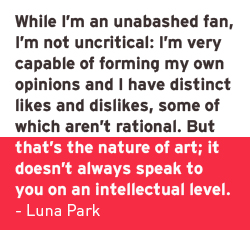
Brooklyn-Street-Art-Luna-Park-capableLuna Park: Hogwash. To dismiss all street art photographers as unsophisticated fan boys is an unfair characterization and a gross oversimplification. We are as varied in our backgrounds and talents as the artists whose work we document. In discussing the quality of street art photography, one must differentiate between two issues: the work being documented and the photography itself. Regarding the work being documented, street art photographers are uniquely positioned to recognize trends, chart artistic growth, and identify influences within our own particular street art microcosms. While I’m an unabashed fan, I’m not uncritical: I’m very capable of forming my own opinions and I have distinct likes and dislikes, some of which aren’t rational. But that’s the nature of art; it doesn’t always speak to you on an intellectual level. Astute followers of my photo stream know that what I post is heavily curated, that is, what is missing from my Flickr speaks volumes. I walk past mediocre art on a daily basis; if it doesn’t engage me, I don’t waste time photographing it. If anything, I would say my taste in street art has become decidedly more refined over the years.
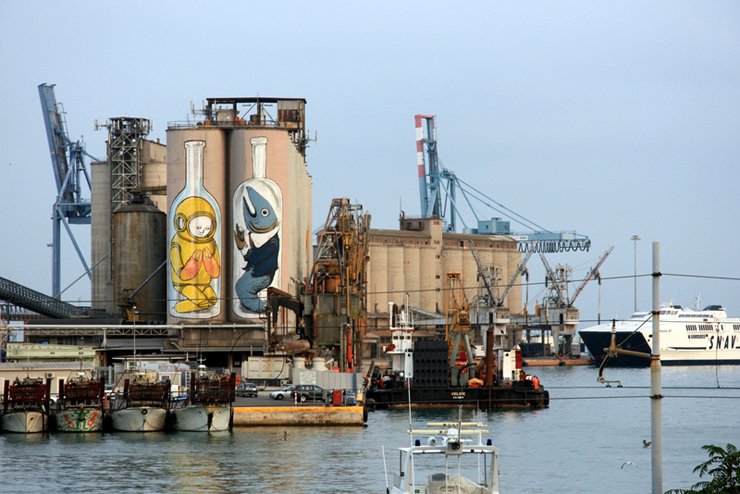
Blu, Erica Il Cane. Anacona, Italy. © Luna Park

Blu, Erica Il Cane. Anacona, Italy. © Luna Park

Regarding my photography, I believe it too has matured over time. It has long-since been my goal for my photographs to reflect my passion and enthusiasm for street art. I aim to capture work in the best possible light, all the while taking context, materials and possible interpretations into consideration. Over years of observation, I have developed a deep and profound understanding of this incredibly diverse subject matter. I have embraced street art wholeheartedly and internalized it. It has had a pronounced influence on my photography and, as a result, my photography has become my own kind of street art.

Being that I am so close to the subject matter, I am hard pressed to put it into any kind of larger, art historical context. Nor do I necessary see that as my role or responsibility, at least not at this point in time. We are in the midst of a truly global art phenomenon whose parameters have yet to be set. Given the right context and the proper forum, I am willing to engage anyone in an intellectual conversation about the critical merits of street art. In the meantime – and as long as I am in the position to do so – I will continue doing what I love, explore this magnificent, vibrant yet decrepit city, absorb as much amazing art as possible, and create photographs as mementos. And when I run out of steam, maybe I’ll finally sit down and write a book about it one day.

Stefan Kloo: That’s rich…and rather laughable. It’s more the other way around – the trained critic approaches street art mostly with the established criteria his academic training provides. That’s only fair but won’t buy you a drink. In street art it’s about the raw authenticity, the creative kick and the unadulterated pleasure a grievously misguided act of vandalism can provide. If you can’t grasp that a lot of it is simply about mixing things up, you probably should not get on that ride. It’s still a lot about class and that we can’t allow to consolidate the established art world and the slippery street. It’s just snobbery, mostly a vain argument, but it fills the day. I honestly don’t see a conflict between, say, a painting by Poussin or Pollock and a Faile paste or a C215 stencil. In the end it’s how it speaks to you and if there’s a challenge in it for you. Only then do you need to query how relevant it is in terms of cultural anthropology.

What does a critic reply to Banksy’s sentiment “I’m not so interested in convincing people in the art world that what I do is ‘art,’ – I’m more bothered about convincing people in the graffiti community that what I do is really vandalism.” ? Doesn’t that wrap up the whole argument?
Brooklyn-Street-Art-Stefan-Kloo-OpinionsStreet art represents a definite paradigm shift in the arts. It’s just a very liberating kick in the ass of bourgeois attitudes towards anything and the arts in particular. Most critics fail to recognize that, and can’t handle the rule bending imposition street art represents. The fact that street art gets by and continues to evolve in theory and practice without the sanctimonious blessing of the art establishment is testimony that the joke’s on them. And we already know how the wine and cheese crowd will speculate the wits out of the genre to buy back their long lost subversive streak and hipness credentials, blissfully oblivious that if you can afford to pay the prices street art commands in the galleries you are all out of street cred and are just buying a commodity. Street artists do perfectly well without the critics’ half-hearted labels and boilerplate opinions. Who needs it? When did punk ever ask for approval?

<<<>  > << > < > < > > <<<>>>>>>BSA<<<>  > << > < > < > > <<<>>>>>>BSA

Street Art Photographers: Capturing Ephemera Part 1

To see more of Stefan Kloo’s work go here.

To see more of Luna Park’s work go here.

To see more of Becki Fuller’s work go here.

Becki and Luna’s blog The Street Spot is here.

Read more