BSA guest writer Robin Grearson talks about herself, the Street Artist Quel Beast, and the unknowable beast within.
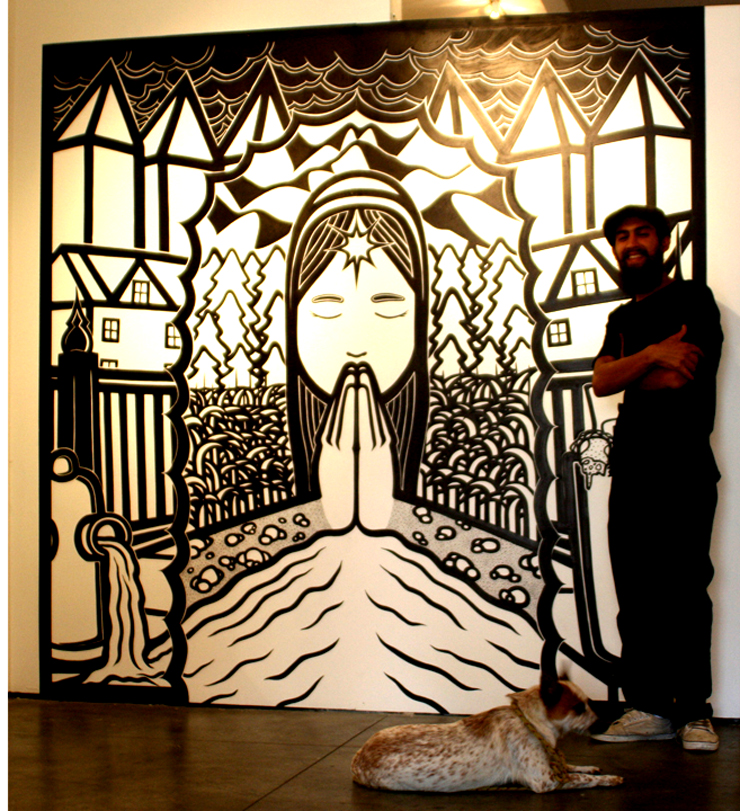
I headed to Bushwick’s Wreck Room last week to talk to Quel Beast about art and see how he’s doing. He’s pasting up some work indoors this week, at Kings County, and a new street piece was almost ready for Chelsea. The Wreck Room is an unpretentious spot where secrets flow easily, and so, over beer and fried pickles, Quel Beast confided to me his frustrations, some obsessions, and what he would do if he couldn’t make art. But he remained quiet about the street piece, which made me nervous.
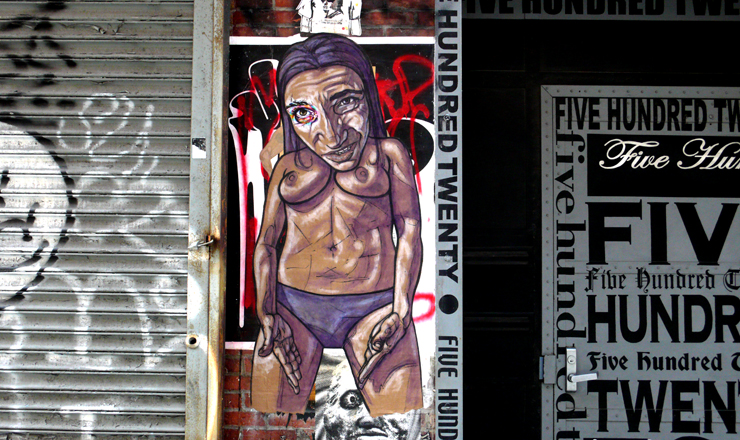
Until today, I hadn’t seen it. It’s a woman; full length, but cocky. She taunts passers-by to check her out once, maybe twice. She’s not wearing much. That much I remembered. She’s like his Chelsea kiss, or, postcard: Dear Art Crawlers. With love from Brooklyn, Quel Beast.
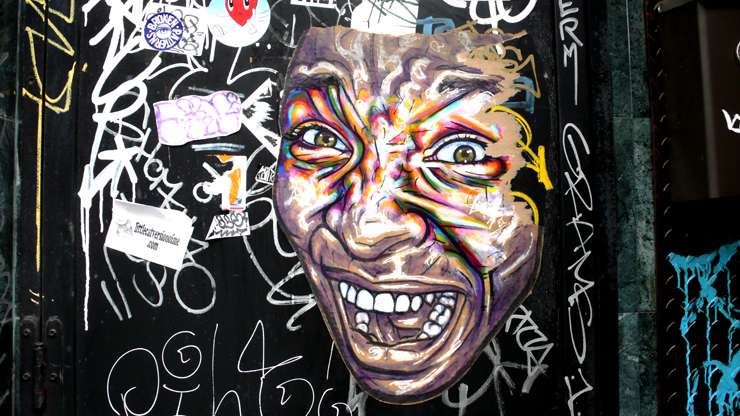
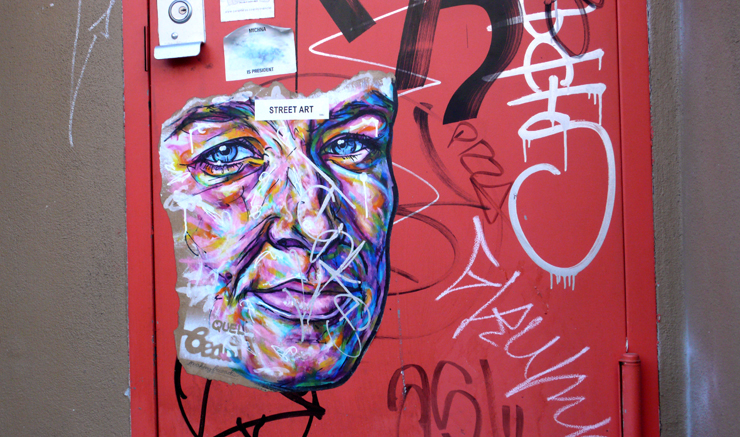
He shows me on his iPhone some of the portraits for the show, called “Back That A$$ Up,” after the Juvenile/L’il Wayne song and video. It’s hours, many beers, two more locations and some wine later, before I ask about the Chelsea girl. Quel Beast answers offhandedly that she’s…weird. I’m sure he knows a better word because he says it like it’s a question. He’s into the piece, and says it exemplifies the direction he sees his style heading. But his question mark says, maybe I’ll hate it, a possibility I hadn’t considered.
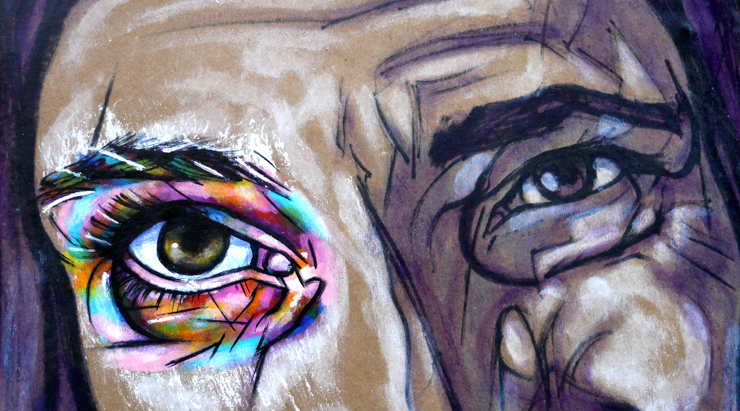
I posed for the photo he’s working from to create her. So she’s me, and she’s not. I start wondering if, while painting testosterone-soaked me, her sneer has maybe gotten to him. But then, art is supposed make you feel something, which is the conversation we’ve been having. And I wonder what I will feel when I see her.
Quel Beast compares art to music, harshly. Placed side by side, art gets its ass kicked. “Art isn’t good enough,” he says, with reverence for music’s power to evoke feeling, stir memory and stir senses. People quickly filter out tags and stickers as visual noise, he points out, adding, “You don’t have a personal experience with someone’s name, the way you can with music.”
“I hate art. Art sucks,” Quel Beast declares, and we laugh. He’s describing his exasperation with the impossibility of art to realize his ideal of it.
But even as he’s describing most art as dismissible in contrast to music, he is a little distracted, scanning stickers and tags on the tables and walls, naming the artists. “Why can’t art do what music can do?,” Quel Beast wonders, and lays down a gauntlet. “An artist has a responsibility to reach out and grab someone the same way a ridiculously awesome song does.”
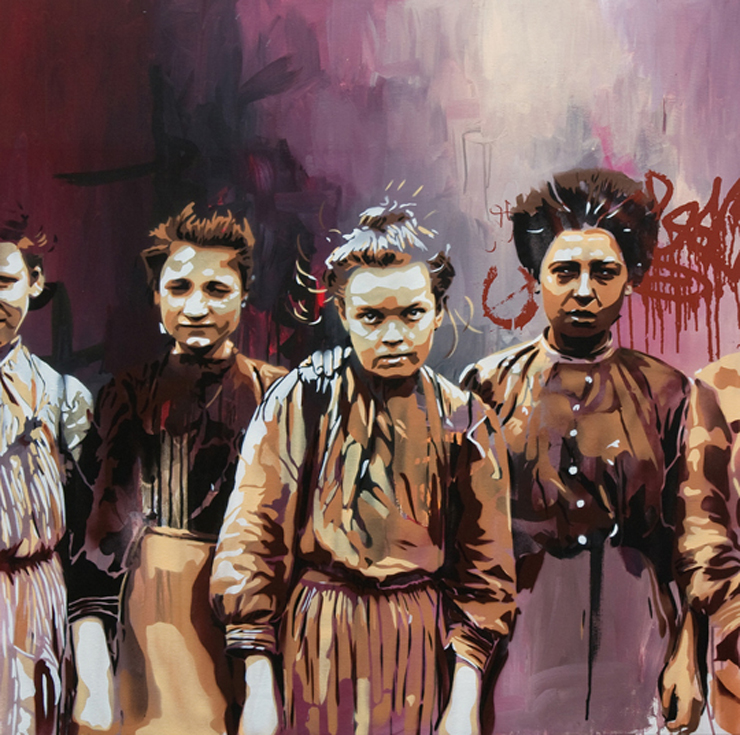
So it’s natural that Quel Beast’s portraits would have music in their souls; for him, “Back That A$$ Up” is the track that conjures the flow and energy of shared experience that he aspires to render in his paintings. But the series is no fan letter: Quel Beast is looking through the video’s lens at his own agenda. He’s retrofitted his painted subjects as though they were plucked from frames of the video, undressed them, and reversed the gender roles.
He designed the portrait series as his inquiry into the source of our judgments. Where do conclusions come from, for instance, about a two-dimensional woman who may be posturing instead of pouting but in other ways remains unknowable? “Why is it that just because you put your body into certain positions, people will assume anything about you, your identity or your sexuality?,” Quel Beast asks, without knowing the answer.
Juvenile and L’il Wayne provide Quel Beast with audio inspiration for his paintings, but their lyrics tow the misogyny-and-hetero line. Quel Beast reveals only a cool nonchalance about this apparent collision of cultures. By co-opting the rappers’ revelers in an effort to unlock an insight or two on identity politics, won’t Quel Beast ostensibly alienate those fans who would be drawn to a show inspired by hip hop? The more secrets he tells me, the more a picture emerges of someone who doesn’t mind making people uncomfortable.
Early this morning, Quel Beast showed me the Chelsea girl. She has my straight, boyish hips, and a casual, male confidence that is impervious to judgment. Within that masculinity, though, something remains defiantly feminine. He looked at me and said with a shrug, “If there’s one thing I learned from rap, it’s how to deal with haters.” —Robin Grearson
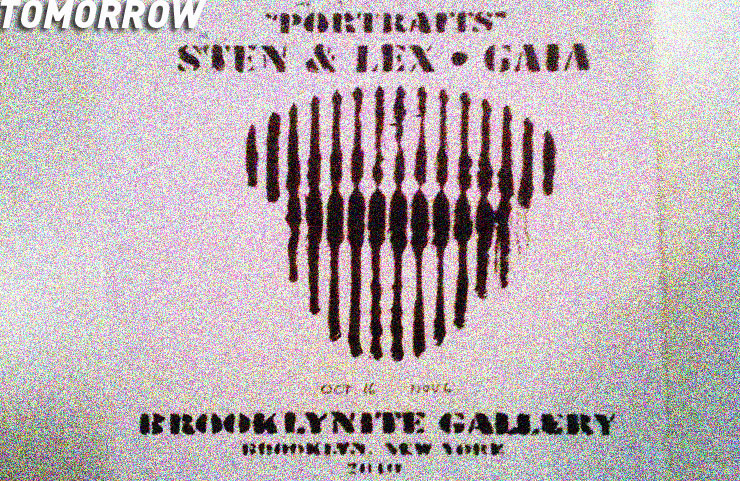
“Portraits” by Sten + Lex with Gaia at Brooklynite
This is a hot shot straight to Number Uno on the charts Ladies and Germs. Italians with their own understated stencil technique and UES wild-eyed jerkin chicken man. Read more on this show here from yesterday on BSA.
Dan Taylor “Notes from the Inside”
Pandemic is reliably snarky, eclectic, and often on the money. Keep your eye on them because they also think. A lot.
From The Philadephia Mural Arts Program, an animated mural handed back and forth amongst several artists, in the style of Exquisite Corpse.
Artists: Eve Biddle/Joshua Frankel, Rodney Camarce,Bonnie Brenda Scott, Seth Turner, Mauro Zamora. Curated by Sean Stoops.
Ben Eine at The Moniker Art Fair
“Hell’s Half Acre”
Kind of like going to Macys!
Launched in October 12th and produced by Lazarides in collaboration with Tunnel 228 and off-site exhibition of Dante’s “Inferno”.
Via Babelgum.
Visitors explore a unique interpretation of the nine circles of hell through the vision of artists including Conor Harrington, Vhils, George Osodi, Antony Micallef, Doug Foster, Todd James, Paul Insect, Mark Jenkins, Boogie, Ian Francis, Polly Morgan, Jonathan Yeo.
David Choe Goes to Hell
Here’s his creation of his piece for Lazaride’s “Hell’s Half Acre”.
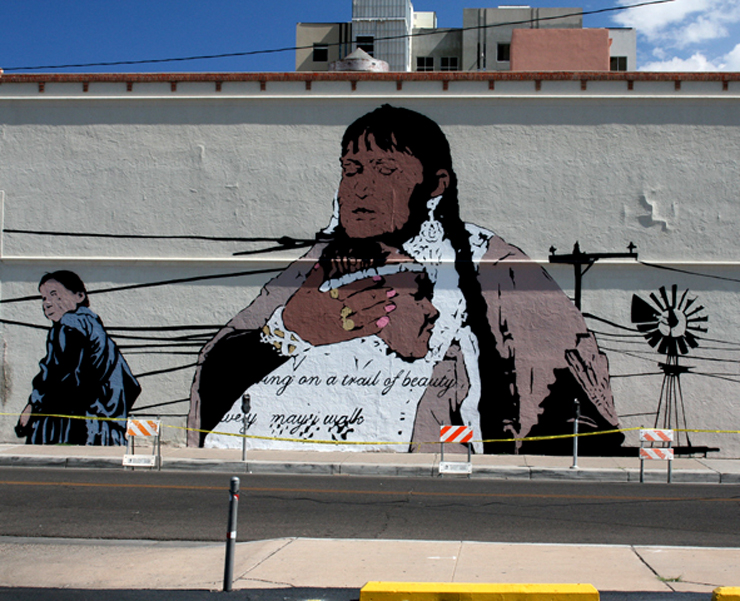
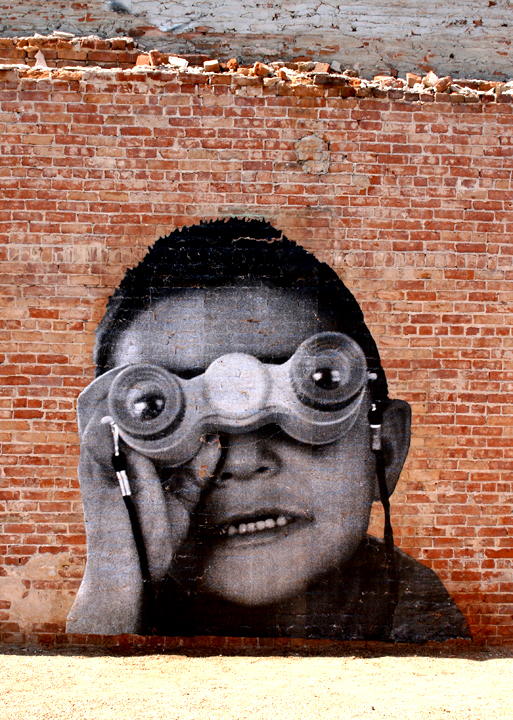
Brooklyn Street Artist Chris Stain just returned from Albuquerque, New Mexico where he participated in a program called STREET ARTS: A Celebration of Hip Hop Culture & Free Expression and he put up a huge version of his “Conductor” piece on this big brick wall.
Chris Stain “Conductor”
Stain was participating in a new arts collaboration event organized by Fran at 516 Arts and a number of other organizations dedicated to social justice and equal rights. He attended the event as a participating artist but he also took numerous photographs of the art on the street and in the gallery.
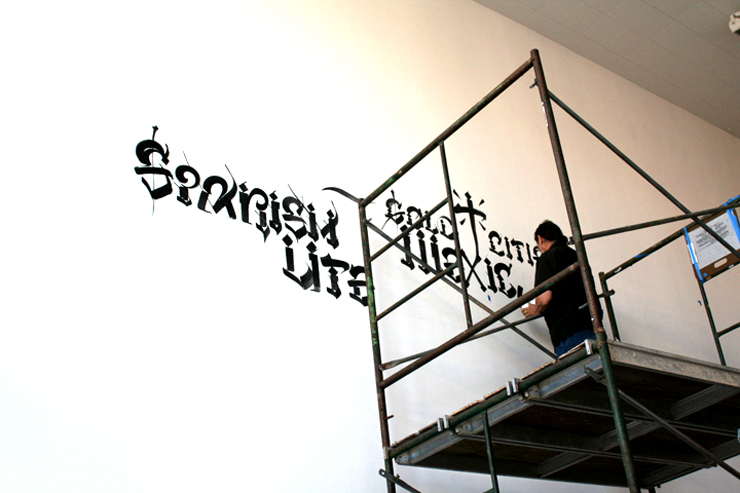
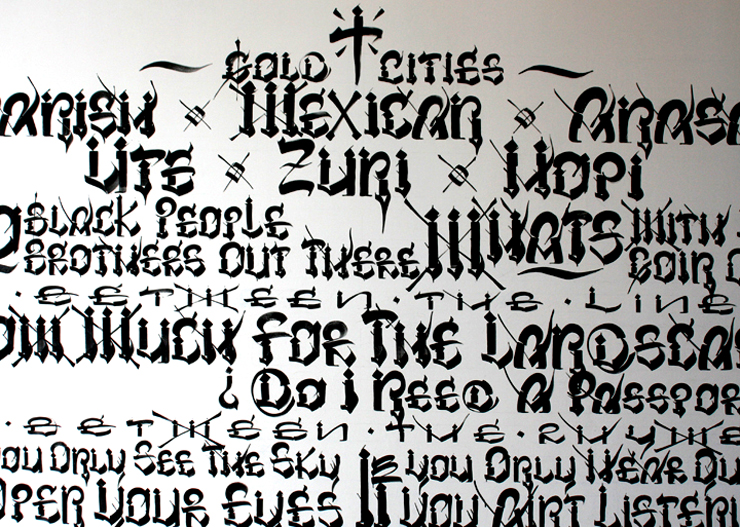
Guest artists performers and speakers from across the country and the world included Chaz Bojórquez, Henry Chalfant, Chris Stain, SWOON, Shepard Fairey, Slinkachu, Gaia, Gajin Fujita, Amiri Baraka, Cecil Taylor, Kevin Coval, Amalia Ortiz, Dafnis Prieto, Dave Hickey, Molodi, Jonathan Khumbulani Nkala and more.
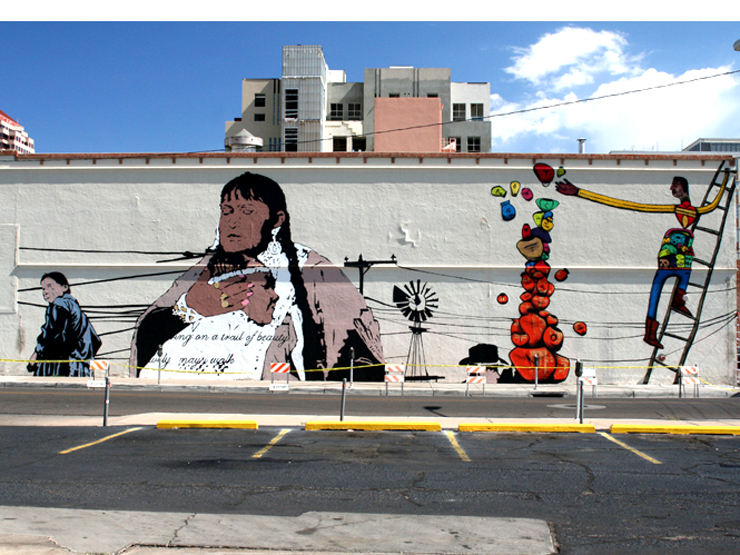
“Long Mayi Walk 2”, by Chris Stain at 516 Arts.
Mr. Stain reports, “I was very fortunate to spend five days in New Mexico compliments of 516 Arts and their supporters. It was certainly amazing to meet some of the people whose work I have admired for a very long time, namely Chaz Bojorquez and Henry Chalfant.”
Chris Stain. “Long Mayi Walk”
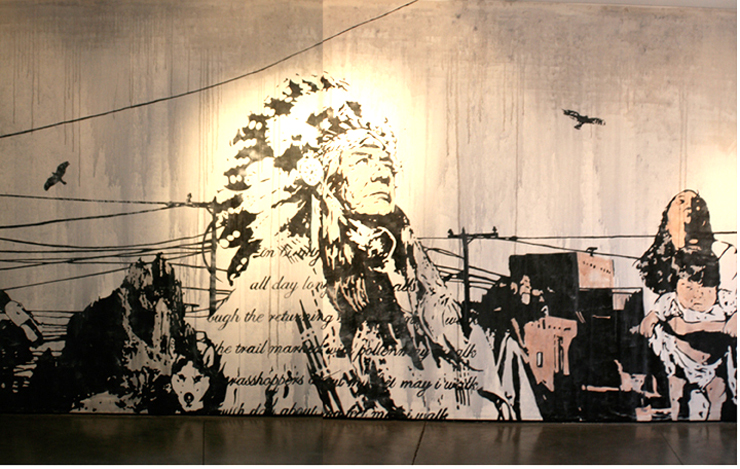
Chris Stain worked side by side on this wall with Jaque Fragua
“It seems like Jaque and I have known each other for many lifetimes. There was a feeling of mutual respect for the work and the meanings behind it. Jaque brings his Native American culture off the res(ervation) and out of his heart and onto the street,” observes Chris.
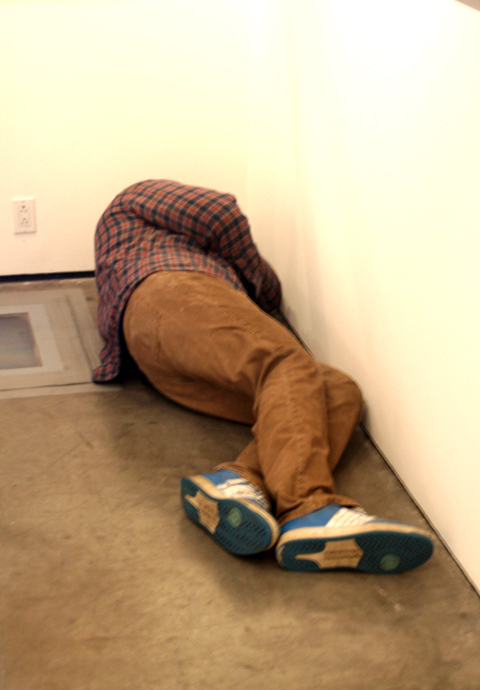
Dude, I am so beat I’m just going to take a little cat nap if you don’t mind. A piece by Mark Jenkins shot by Chris Stain
Chaz Bojórquez
Says Chris, “It was quite a shock to be there watching a master letterer working his craft. I had just got his new book, The Art and Life of Chaz Bojorquez, in the mail a few days before leaving for my trip. I knew he was in the show but I didn’t know he would be installing as well.”
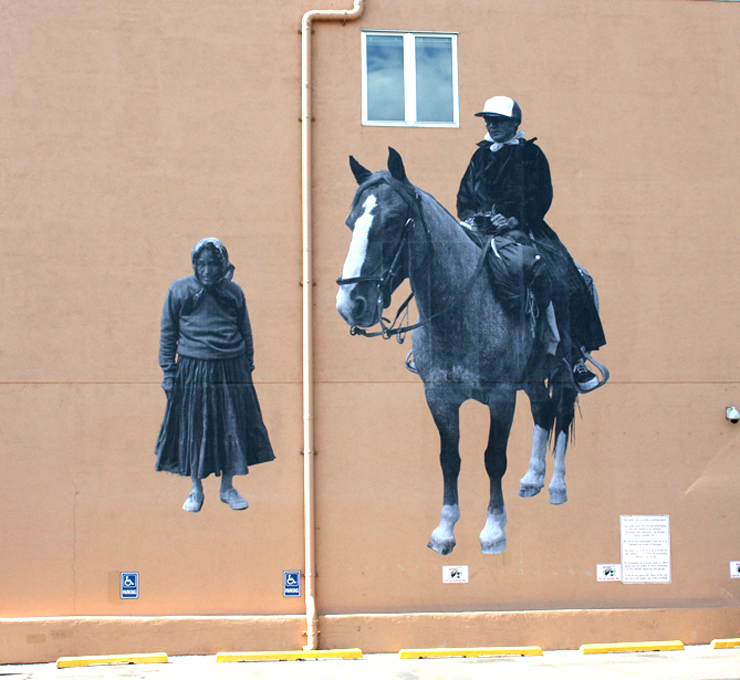
Chip Thomas took some of the photos that he uses for his street art on the Navajo Reservation where he lives and works. According to Chris, “he mixes his wheatpaste from the same Blue Bird flour that most residents use in baking.”
Steven Gutierrez poses with his assistant in front of his piece.
Special thanks to Chris Stain for sharing this with BSA readers. Learn more about Chris and read his blog on http://www.chrisstain.com/
“516 ARTS offers adventurous programs that address current issues in world culture, presenting innovative and interdisciplinary exhibitions, events and educational activities in a variety of art forms, including visual and literary arts, film, video and music.
STREET ARTS: A Celebration of Hip Hop Culture & Free Expression, a new arts collaboration in October and November, organized in partnership with the ACLU-NM and involving 25 local organizations. It centers around a two-part exhibition at 516 ARTS titled Street Text: Art From the Coasts & The Populist Phenomenon, which examines Street Art and its evolution into an international cultural movement. The project celebrates art in the urban environment and explores issues of freedom of expression. It includes an exciting line-up of related exhibitions, new Downtown murals, spoken word, music, dance, talks, Street Art tours, a Hip Hop Film Festival and a Spoken Word Festival titled SHOUT-OUT: A Festival of Rhythm & Rhyme at multiple venues (November 4-7).
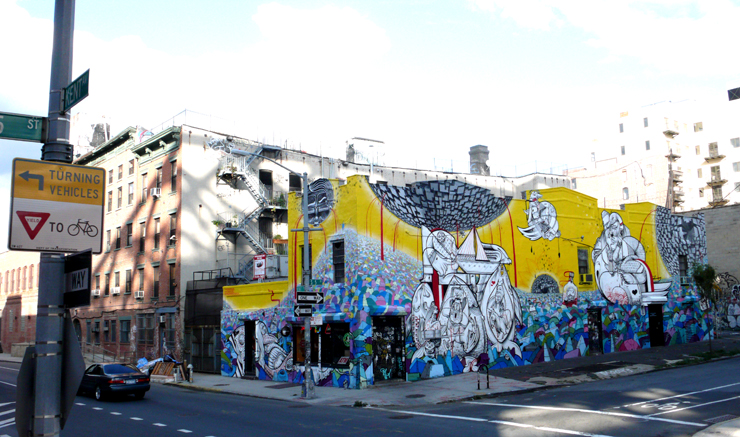
New Mural in Williamsburg Pays Tribute to Beatles Just In Time for John’s 70th
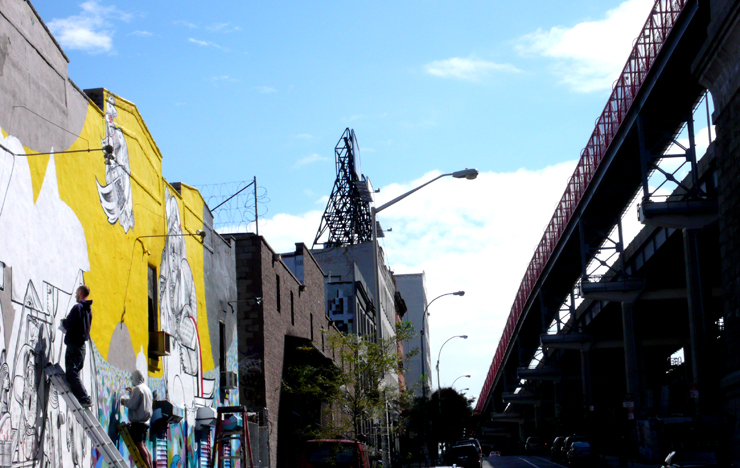
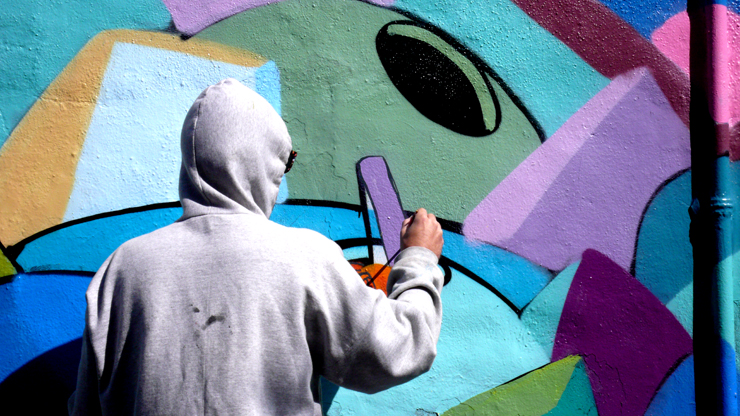
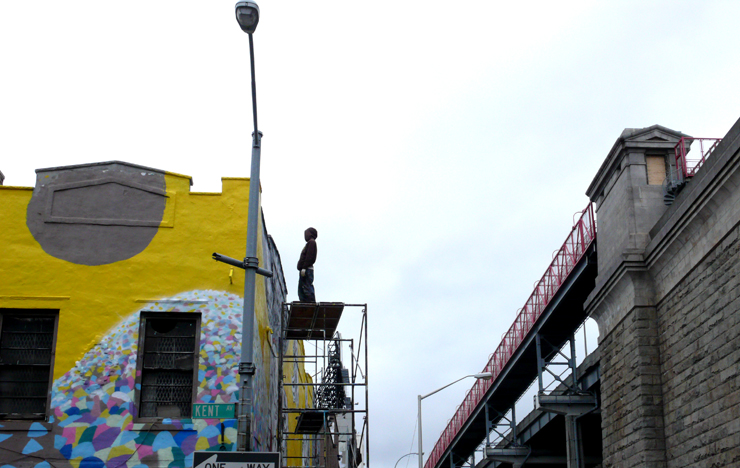
The Spanish twins really could have used a Yellow Submarine as the rain was sloshing around their small band during the installation of this one. For four days they set out to paint their new mural, titled “Lucy In The Sky With Diamonds”, an updated psychedelic bouquet sprading across a corner building in Williamsburg housing the infamous Rock Star Bar, where many a hair raising band has fought to break the sound barrier.
This year the Autumn weather in New York city has ranged from constant deluge to glorious days of sparkling gold sunlight and the smell of wood burning from the neighbor’s chimney. How and Nosm climbed ladder after ladder with R Robots as soon as the rain would stop. Unfortunately, they had to spend a lot of time standing in the doorway waiting for it to clear. As they told me “As long as the wall is dry we paint, and it’s OK if we get wet”.
Every time I went by to see how they were doing they were scurrying up and down ladders and balancing on scaffoldings. Once in a while each guy had to walk across the street to look back and check on the progress. Everpresent in the shadow of the Williamburg bridge was the roaring of traffic above, the screeching of trains, and the raucous noise of heavy trucks on Kent Ave. Occasional pedestrians stopped to say hello and ask questions, but mostly this part of town is unfettered by interruption. Unless you count the rain.
Who decides what messages and images are displayed in the public? When it comes to advertising, images and graphics are supposedly governed by “community standards”, meaning a body of some sort passes judgment on the worthiness of an image or message based on a common understanding of the collective opinion. More often than not, unless there is a vocal protest from a potent fraction of a community, standards are merely the guidelines to push against to grab attention and a tiny piece of mind share.
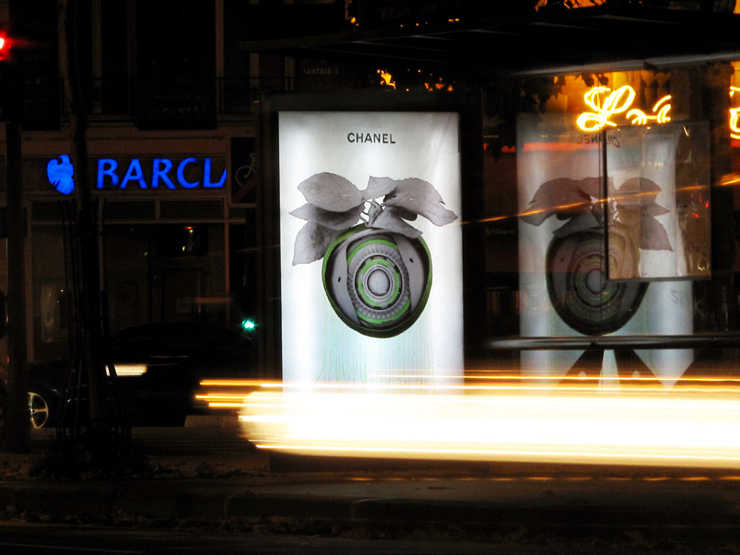
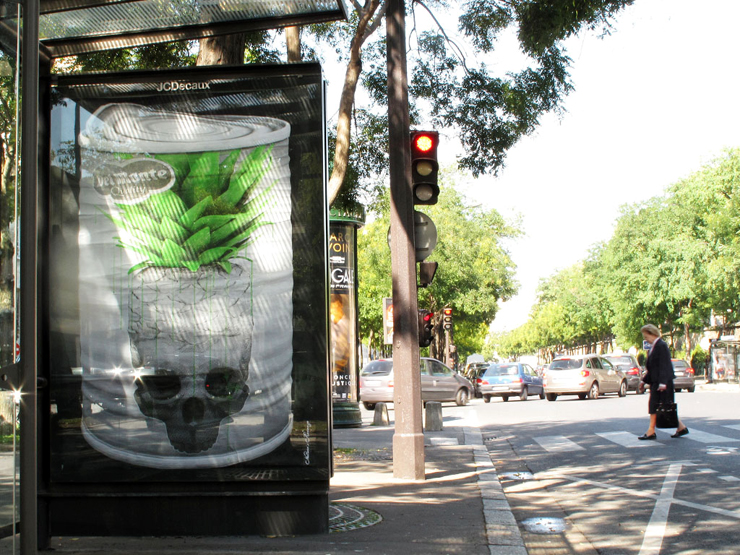
As these standards evolve, so do the broadly drawn boundaries of what an advertiser can use to sell a product, whether it is on a sticker, billboard, mural, or high-gloss kiosk. “It’s almost like you can put a dildo on a billboard as long as the brand or logo is there to validate it as another normal commercial,” says French Street Artist Ludo, who has been merging his art with the commercial art in bus shelters.
Ludo’s series is called “co-branding”, a seamless appropriation of existing ads that can be strikingly beautiful and even unnoticeable by the casual observer. These pieces merge so well with the context that they might very well be mistaken by genuine ads.He talks about a piece that re-invents a Chanel advertisement by noting the high-concept imagery that appears in typical ads for high-end consumer goods. “The overabundance of ultra aesthetic visuals in some ads now, the kind of arty stuff that only Karl Lagerfield will enjoy, is so annoying to me that it made me want to hijack my own work and brand them as an other campaign. It’s funny how in fact people see it as advertising because of the logo but are also kind of disturbed by the image.”
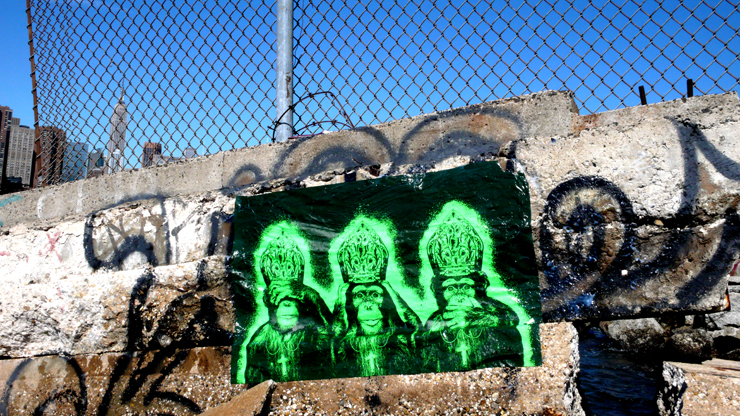
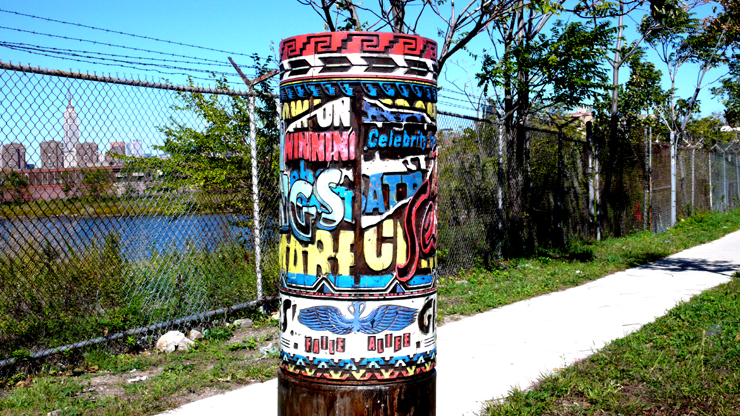
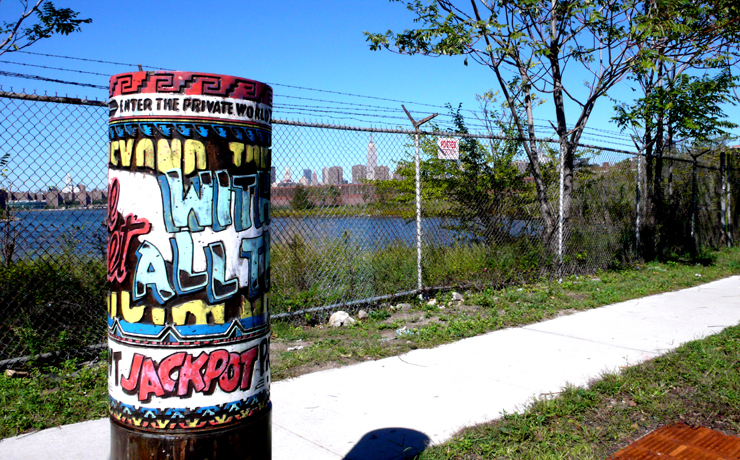
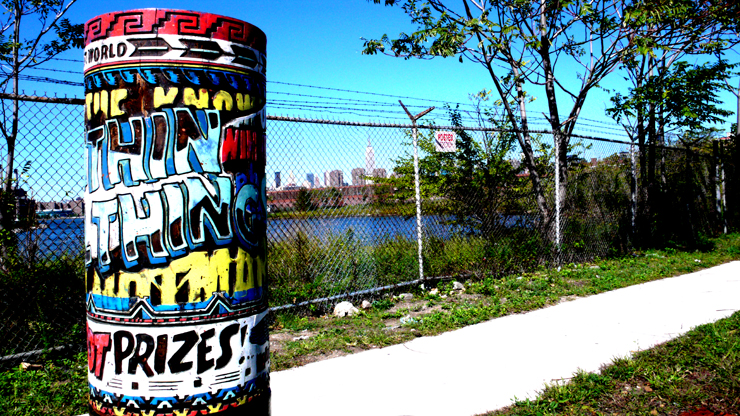
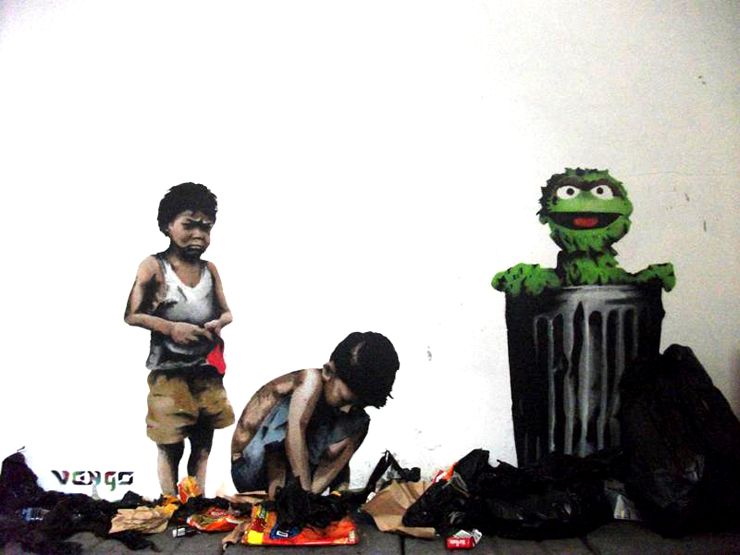
This week, K-Guy primates appeared in the urban jungle of NYC while Vango, in Kiellarny, Ireland touched on American pop culture and Brooklyn’s own Faile gifted NYC with an amazing Prayer Wheel.
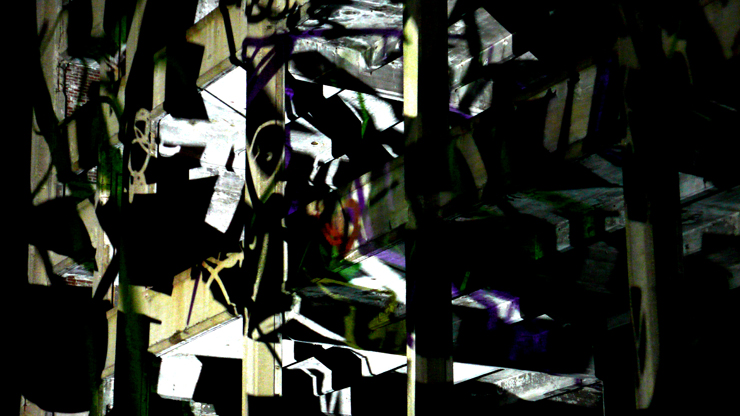
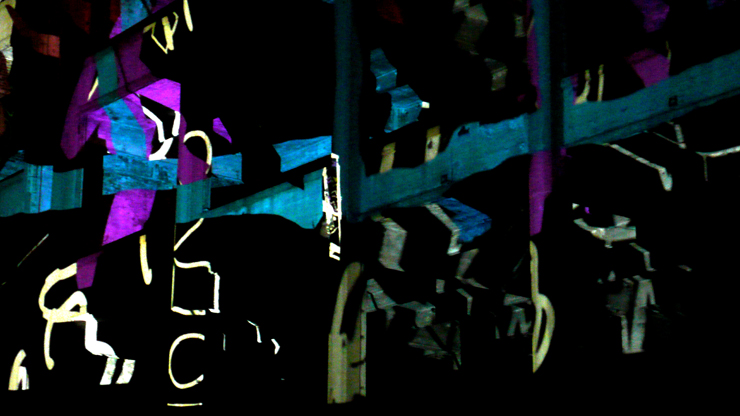
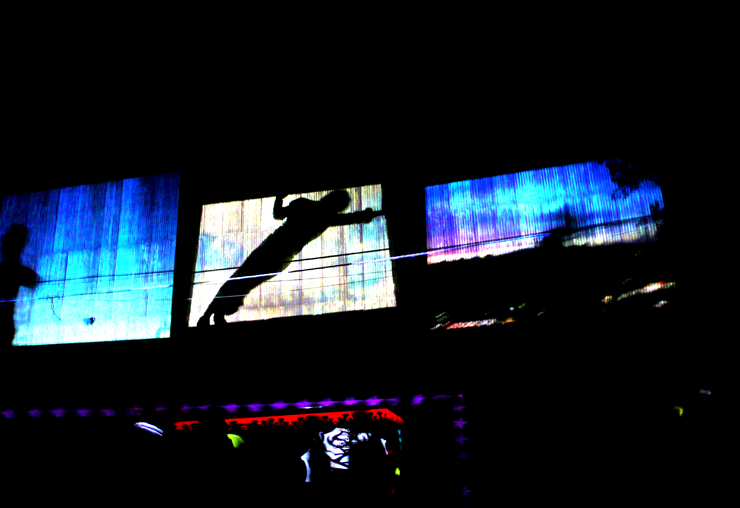
A lady, perhaps in her late 60’s or early 70’s with small wire-rimmed glasses stood on the pavement grinning in front of our flickering video projection time-lapses of Street Artists putting up work. She only turned from the screen once to make sure that her posse was also watching. When the video ended, with shoulders pinch up toward her grey fluffy hair, she clapped her hands quietly in front of her smiling mouth, and went back to the sidewalk to talk to her friends about it. She asked them if they had seen it. They had. A bit of wonder for us, her excitement.
We like to think that all of the artists involved in the first ever Nuit Blanche festival in New York received a similar experience for all of their efforts. As artists, few things make us happier than when we get to see the faces of the public enjoying the art being presented.
In New York there aren’t many venues where both the artists and the public get to mingle and talk directly with each other in an open and unrestricted environment: No VIP rooms, no PR handlers, no spokespeople, no velvet ropes, admission tickets, no one looking down their nose. The organizers of “Bring to Light” made this possible for one glorious night in Greenpoint, Brooklyn. Perhaps 10,000 art lovers got out of their homes to enjoy one evening of free enlightenment without restriction.
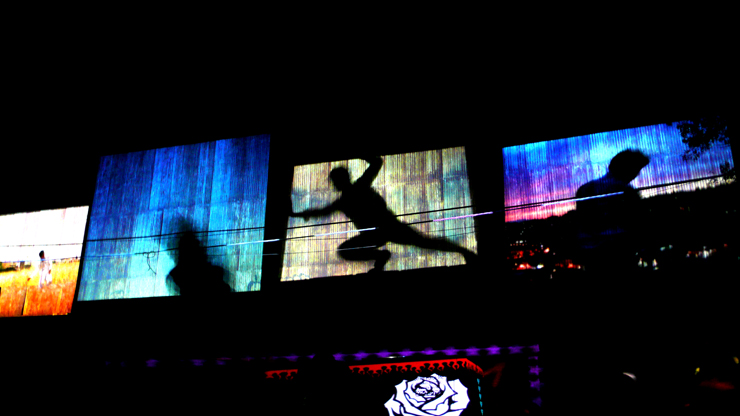
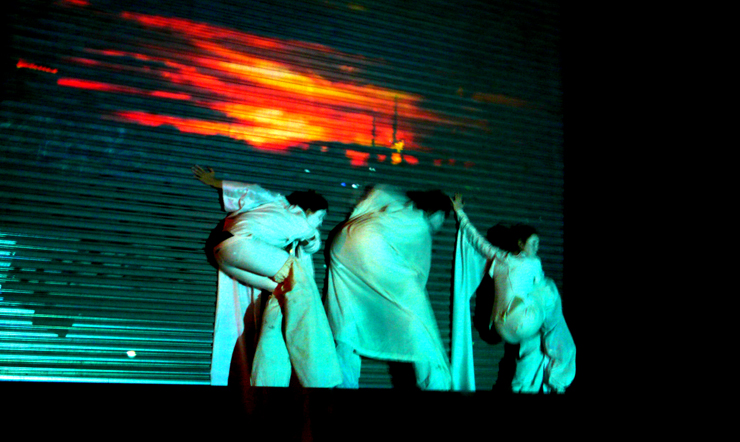
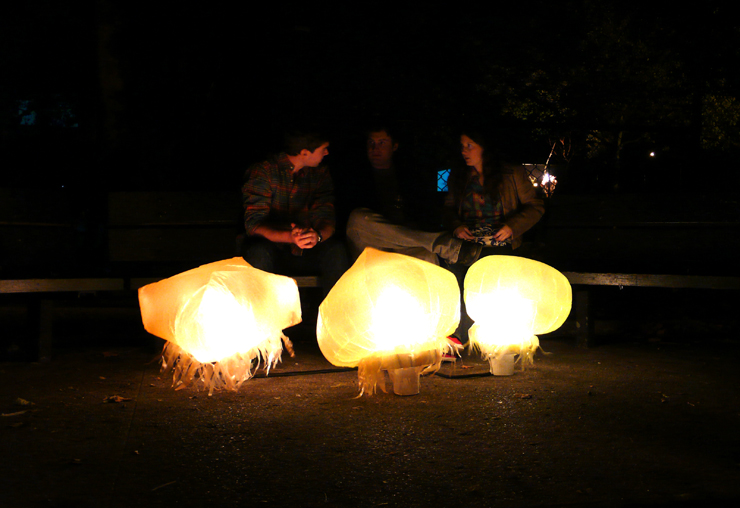
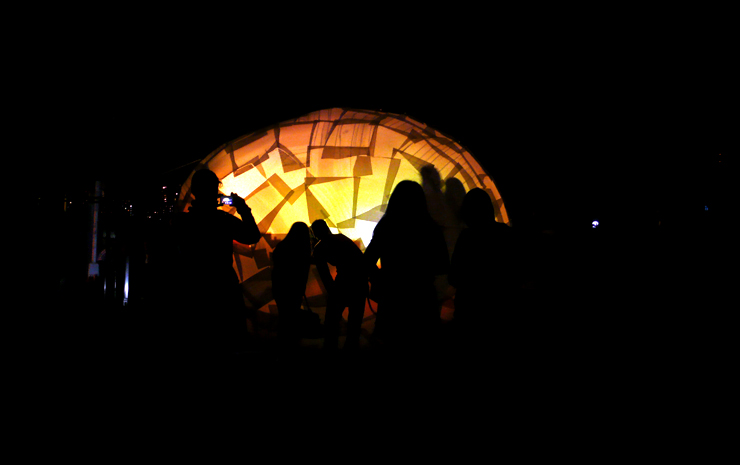
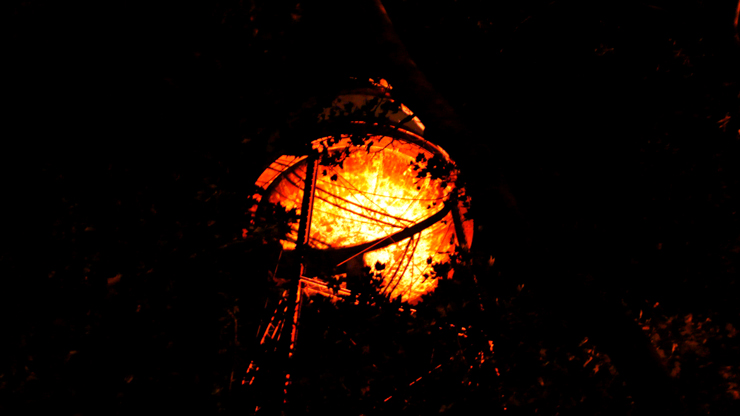
With a five-hour convulsing light carnival by 60 artists, many of whom are well known for avant garde innovation, “Bring to Light” brought to life this former maritime hub of North Brooklyn that once blustered with lumber yards and rope factories. Now a rusty hopscotch of weathered industrial architecture, burned out lots, and faded hopes, Greenpoint in recent years has bloomed with the lifeblood of artists overflowing from neighboring Williamsburg. Aided by a crisp autumn night and Greenpoint’s Open Studios weekend, where artists open their doors to the public, “Bring To Light” was suddenly pulsating with the feet of thousands of art fans. All manner of projectors blasted on the walls with myriad images, forms, and shapes, some breathtakingly beautiful. Other artists created sculptures and installations that worked as light vessels and amorphous creatures while collaborative dancers entertained groupings of appreciative observers.
The show’s organizer DoTank:Brooklyn, calls itself a public vessel for interdisciplinary exploration, and Nuit Blanche seemed like the perfect showcase for everything these (mostly) urban planners are about. More interested in taking action than talking about it, their collective sense of focused urgency is like a refreshing gale of cool October air. Since they actually know how to plan and work with local civic and citizen groups, they were able to pull off New York City’s very first Nuit Blanche event in less than 3 months, and on a shoestring budget.
While DoTank had the initial idea, the Nuit Blanche ball started rolling when festival producer Ethan Vogt got involved to steer the effort in late July. DoTank had experience organizing participator events in public space and Ethan brought his background in film production and a passion for creating cinematic experience outside of traditional venues.
DoTanker Ken Farmer, originally from Memphis, Tennessee usually is riding his bike around the city or working as a consultant at Project for Public Spaces, a nonprofit planning, design and educational organization. He likes to ride his bike around the city and scope out cheap places to eat, or “blue collar hollas”, as he calls them.
A Boston born New Yorker since ’02, Ethan Vogt is a filmmaker who makes documentaries for organizations, music videos with found footage, and has produced three feature films with Andrew Bujalski. Now developing a masters thesis about Media in Performance and Architecture at NYU, Vogt hopes to produce Nuit Blanch for at least the next couple years in New York.
Brooklyn Street Art spoke to both guys about the success of their first Nuit Blanche in New York.
Brooklyn Street Art: How do you feel about the event, now that you are a few days on the other side of it?
Ken Farmer: We could not be more excited about how things turned out. Great weather, great crowd, great support from the community and a great response from both people who attended as well as those who have seen post-event coverage.
Ethan Vogt: Yeah, we are all just thrilled with how it came together – I’ve heard nothing but positive things from artists, visitors, and Greenpoint residents. I would say it exceeded our expectations and we were just in awe of what we had “organized” and “produced.”
Brooklyn Street Art: How long has this event been in the planning?
Ken Farmer: The idea began in July and planning really began in August. We were on pins and needles until the last minute getting the permits approved due to apprehension about an event with no prior history in NYC. Luckily, some key leaders like Councilman Stephen Levin and Borough President Marty Markowitz really believed in the event and helped us get over the hump.
Brooklyn Street Art: Would you call yourselves artists?
Ken Farmer: I’d say…artist and organizer…maybe that’s a curator?…of public spaces.
Ethan Vogt: Sure, I’d say I’m an artist and creative producer. I actually was going to do a projection project for the festival before I got too busy producing. You can see some of my projections and photography online. I feel like my art-making allows me to be a better producer, I often think about what I would want from a producer if I was the artist and then try to be that kind of producer.
Brooklyn Street Art: Who had the idea of launching New York’s first Nuit Blanche, and why did you think it was important to pursue and execute?
Ken Farmer: DoTanker Ted Ulrich organized a similar event in Atlanta and other team members had experienced Nuit Blanche events in other countries. We knew that it provided such a creative transformation of public spaces. Given our interest in short-term interventions to transform the way public space is experienced…we had to try.
Brooklyn Street Art: Can you talk about one of your favorite projections or performances from Saturday night?
Ken Farmer: We had some pretty well known light artists like Chris Jordan and Ryan Uzilevsky, but the thing that amazed me was the way the art, performers and crowd coalesced into a seamless experience. It wasn’t about individuals or feature pieces, it was about the transformed landscape that emerged collectively. This was our curatorial goal, but the reality far exceeded our expectations.
Ethan Vogt: So many of the pieces were amazing, it is hard to choose. I loved the percussion performance, “Scaffolding” by Tom Peyton with Terence Caulkins, Eddie Cooper, Lily Faden, Leo Kremer, and Mike Skinner, I also thought that the way that crowds were interacting with “A Small Explosion” by Kant Smith, “Light & Glass Dance” by Miho Ogai, “Oculus” by Nathaniel Lieb & Sarah Nelson Wright, and “Untitled (Drums, Lights) by Peter Esveld & Philippo Vanucci was remarkable and a very vibrant way of people connecting to artwork that I haven’t seen very many other places in my life.
Brooklyn Street Art: What role does public art play in the life of a neighborhood or a city?
Ken Farmer: It should be a manifestation of its surroundings showcasing the local identity. And it should compel us to appreciate our surroundings–aesthetically, whimsically, critically. But it is frustrating how often it falls short.
Ethan Vogt: I’m no expert on this but I think public art should encourage reflection, debate, and connection. New public spaces like the “High Line” in Chelsea are the kind of thing that I believe embodies this and I would love to someday be involved in producing a project like that.
Brooklyn Street Art: We’re always talking about the intersection between Street Art, Urban Art, Public Art, Performance, Projection Art – do you think that there is a growing interest among city dwellers in reclaiming public space for art?
Ethan Vogt: Yes, Yes, Yes! – I think this festival really struck a chord and that people looking for an authentic, non-consumer, artistic, participatory, and community experience.
Ken Farmer: I think there is a growing interest in authentic, and interactive public art. We are in a beautiful era of D.I.Y. culture. The big, corporate commissioned public art pieces in lifeless lower Manhattan plazas are old news. People want something more relatable and more dynamic. We are seeing a proliferation of low-cost, pop-up elements in public spaces. Some may see it as art, others as amenity, either way…its terrific.
Brooklyn Street Art: Were you surprised how difficult it could be to pull this off?
Ken Farmer: The difficulty lies in the need to do everything by the books. We intend to make this an annual tradition that gets better every year. So we dotted the “i’s” and crossed the “t’s”, which was costly, fiscally as well as temporally, but essential to building community support.
Ethan Vogt: It was extremely difficult to get all the pieces together to make this work but the reward of the experience was well worth it and things will certainly be easier next year.
Brooklyn Street Art: Do you think most people who see the show have any idea the amount of work that goes into it?
Ethan Vogt: I’m not sure if they have a sense of the work but I don’t care, I’m just glad they came out and had a night to remember. Hopefully they might continue to support us next year.
Ken Farmer: Hopefully they don’t know how much work goes in. I think the biggest barometer of the event’s success was how calm it felt. It was amazing to have that big of a crowd, with that many artists and that much excitement, yet have things seem so orderly.
We are extremely appreciative of how the crowd received the event…Thank You New York!
DoTank:Brooklyn is always looking for new partners. Please contact them at info@dotankbrooklyn.org
“Bring to Light” was organized by: Do Tank: Brooklyn Michael Doherty, Ken Farmer, Aurash Khawarzad, Tom Peyton, and Ted Ullrich
Produced by: Ethan Vogt, Furnace Media
Co-produced by: Pepin Gelardi, Jacquie Jordan, Annie de Mayo, Anna Muessig, Stephen Zacks
Please visit the Bring To Light site and click on their Kick Starter Campaign. They are only a few hundred dollars from reaching their fundraising goal. They need your support!
Think of all the beauty still left around you and be happy. http://4rbyf.th8.us #optimism #hope #beauty
Send.
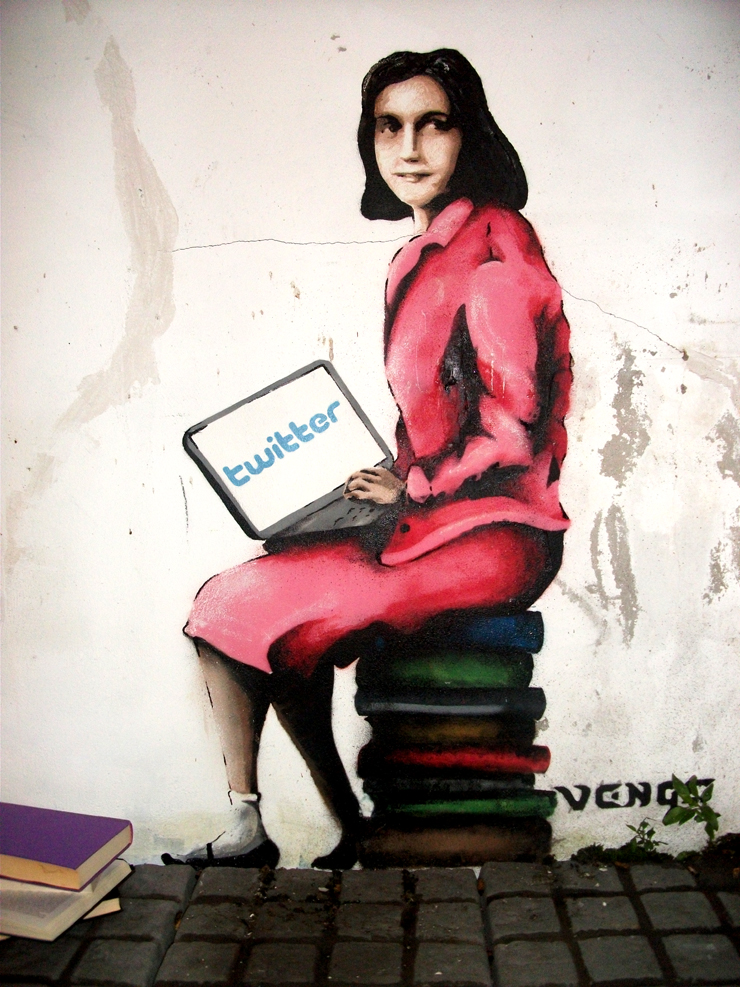
103 characters and her followers would have had an update of exactly what Anne Frank was thinking. The inner life of this girl, as recorded in her diary, has inspired many an artist, author, movie director, painter, and writer to contemplate their own.
Irish stencil Street Artist Vango has just imagined Anne Frank as she might be today – sending her personal thoughts and observations, status updates. It’s a tricky minefield of human history to tread for an artist and the implications of a wireless data stream available to all are still being assessed by contemporary culture. As our historical touchstones are viewed through these new screens, sometimes it can be jolting and will raise questions. What parallels exist today, and what has been fundamentally changed by our creation?
Brooklyn Street Art:With this new stencil you have updated an image of Anne Frank using what we are calling “social media”. What inspired you to create this piece?
Vango: Well, I always like merging the past with the present in my work and I especially like painting historic characters using the modern equivalent of their chosen medium. Today everyone ‘s on Twitter or Facebook expressing themselves to the world, which is a positive thing, except 99% of what they say is irrelevant bulls**t. On the flip side, 65 years ago this young girl actually had something to say that was unheard in her lifetime.
BSA
Brooklyn Street Art:Tell us a bit about the Street Art scene in Ireland.
Vango: Obviously Ireland isn’t known for Street Art but there are some talented artists emerging, especially in the last year or two like KARMA, ADW, Canvaz, Maser and of course Conor Harrington.
BSA
Brooklyn Street Art:Who would you cite as an inspiration as an artist?
Vango: As a stencil artist it’s hard not to mention Banksy. Lots of stencil artists are reluctant to admit that Banksy had an influence on them at the risk of sounding like stale copy cats. That’s understandable but I’d rather be honest and admit that Banksy had a major role in my decision to pick up a can. The guy makes it look so easy again and again and the least he deserves is homage from newbie stencil artists.
BSA
Brooklyn Street Art:Why do you think Street Art is important and relevant in today’s art world? Vango: It’s there for everyone to see, like it or not. It demands to be noticed and as you can tell it’s succeeding. You can be on a train, walking to work or driving home and see art that’s just as thought provoking as art you have to go out of your way to find. I think that ‘s important because nobody seems to have time anymore. If you have a job and a favorite TV show, your day is spent.
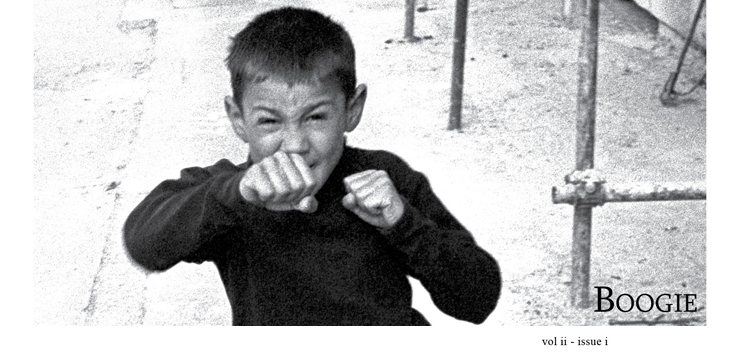
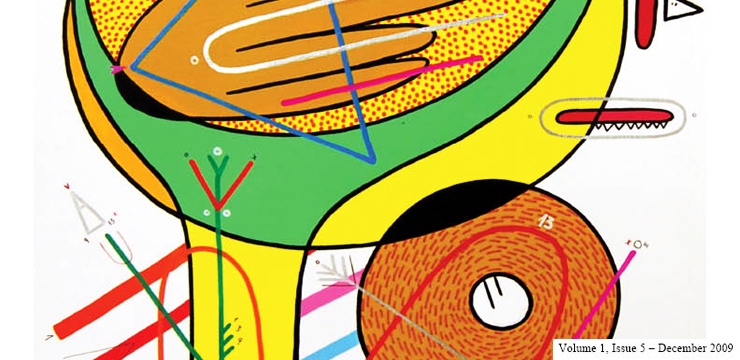
Detail of a photograph by Boogie on the cover of The Art Street Journal
Print publishing has been a heavyweight boxer on the mat with both shoulders pinned down for the last 7, 8, 9, 10 years. The multitude of problems that plague the publishing industry these days are rapid-fire punches: The down-shift economy, ad dollars swinging for social media, the high cost of print, and changing consumer behavior all sing the coda of the paper page. A recent survey published in Oriella Digital Journalism found that more than half of journalists surveyed think that their printed journals will eventually be knocked out cold by online.
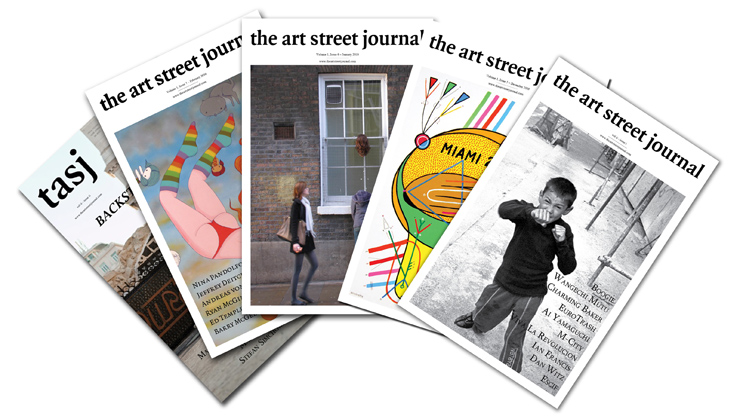
Given this current climate, how can you dream of publishing a new free art magazine? Even the most entrepreneurial art fans would be discouraged, but Seth and Elisa Carmichael are no strangers to obstacles and their project, The Art Street Journal, is now in it’s second successful year.
Their L.A. gallery ‘Carmichael Gallery for Contemporary Art’ had already been in business for about a year when they were hit by personal trouble. The new bride Elisa, a British citizen and an Australian resident, had to leave the continental USA to tend to some very important and grievous family affairs back home. Compounding her hardship, Elisa discovered her return to The United States was barred due to visa technicalities. A prolonged calvary of Kafkaesque events ensued before she was able to re-unite with her young husband in California. It was during this time they began planning a newspaper about the thing they both love most: art.
Elisa and Seth are avid supporters of contemporary, street and urban art and believe that art must play a significant place in human development. Elisa’s new idea of editing and publishing a journal would focus on celebrating and supporting the arts and the community involved in its creation.
Detail of a piece by Sixeart on the cover of The Art Street Journal
We wanted to know what motivates Elisa to continue with her almost quixotic path to publishing and distributing a free print journal when many well-established and respected journals are folding by the dozen.
Brooklyn Street Art:Why are you and Seth publishing a printed journal when most publications in print are struggling to survive? What keeps you motivated to continue to publish it?
Elisa Carmichael: We have always wanted to have a magazine – it’s something we’d talked about doing for a long time. We enjoy blogs and considered starting one of our own, but decided in the end that we’d rather do something a bit different.
We have a shared love of books and magazines that goes back long before we met and believe that nothing can replace the magic of print. The Art Street Journal (TASJ) has given us a unique opportunity to support the artists and events that interest us in a medium we want to help keep alive.
We’ve received so many kind notes and words of encouragement from readers all over the world in the past year. It means so much to us that people enjoy TASJ. Connecting to a broad network of international art lovers has been a key motivator in keeping us going.
Aside from the enjoyment we derive from putting each issue together, our motivation comes from the positive response and rapid growth of our readership. It has been really interesting to monitor: Even though TASJ is a free publication, we really weren’t sure anyone would be interested in it. We have some great supporters out there – galleries, museums, clothing stores, cafes, specialty bookstores and individuals doing drop-offs at various locations in their cities around the world.
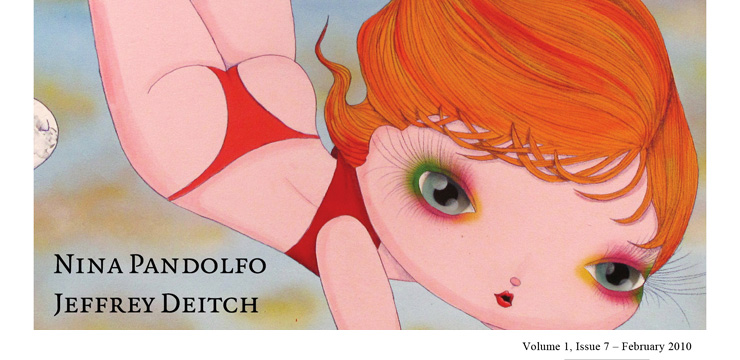
Detail of a piece by Nina Pandolfo on the cover of The Art Street Journal
Brooklyn Street Art:The journal’s main focus is in Street and Urban art. What drove you to this art genre in the first place?
Elisa Carmichael: TASJ certainly supports street and urban art, but its focus is really contemporary art as a whole. You will see many artists featured on our pages who have a street background because we love the energy inherent in Street Art. It’s an art form we are both very passionate about and believe has an important place in art history.
That said, TASJ is not a Street/Urban art magazine. Our aim is to curate content that combines the best art from the underground, emerging, and mainstream established worlds. The journal has an aesthetic through-line that links the artists we cover, regardless of their background, and I think that comes across when turning its pages. We also try to keep the editorial diverse and internationally focused, as well as give time to people and events that haven’t had too much coverage from other media outlets.
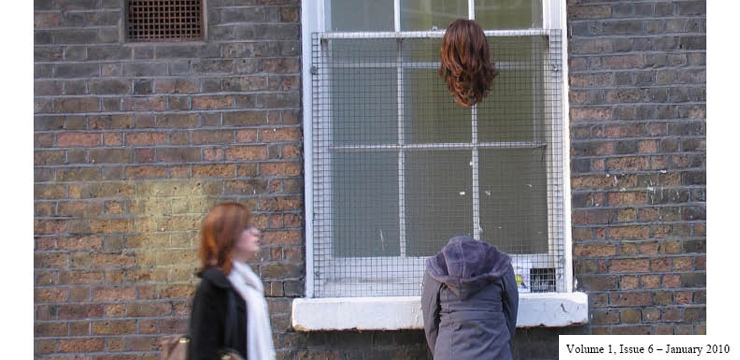
Detail of a piece by Street Artist Mark Jenkins on the cover of The Art Street Journal
Brooklyn Street Art: What’s your ultimate goal with TASJ?
Elisa Carmichael: There’s a place for all sorts of publications in the marketplace, but for us, the number one goal is to get the message out about the art we love to as many people as possible. We don’t believe that every nice independent art magazine needs to cost $20; there should be something out there that everyone can have access to. TASJ will always remain free.
We have a lot of different plans and goals —TASJ has quickly become a far bigger project than we originally envisioned and at this point it is really our second business. At the same time, we’re trying to let it develop organically and improve it a bit each time we bring an issue out. In one year our 4 page black and white newspaper is a full color magazine-style periodical.
Another goal we have is to show our art world associates that it’s possible for gallerists to want to support other galleries and artists, even when there is no personal or financial relationship. There is far too much cattiness and rivalry in the art world as it is without our contributing to it. We know how hard it is to stay alive and make things happen in this business and we respect the people out there who are doing just that. We like the fact that we’ve been able to build a little platform from which to celebrate those people and not ask for anything in return.
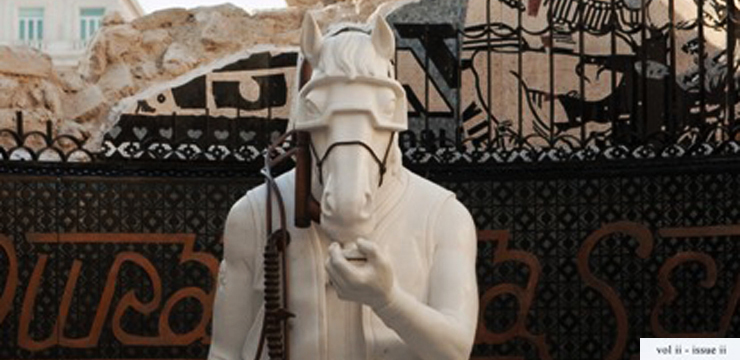
Detail of a piece by Faile on the cover of The Art Street Journal
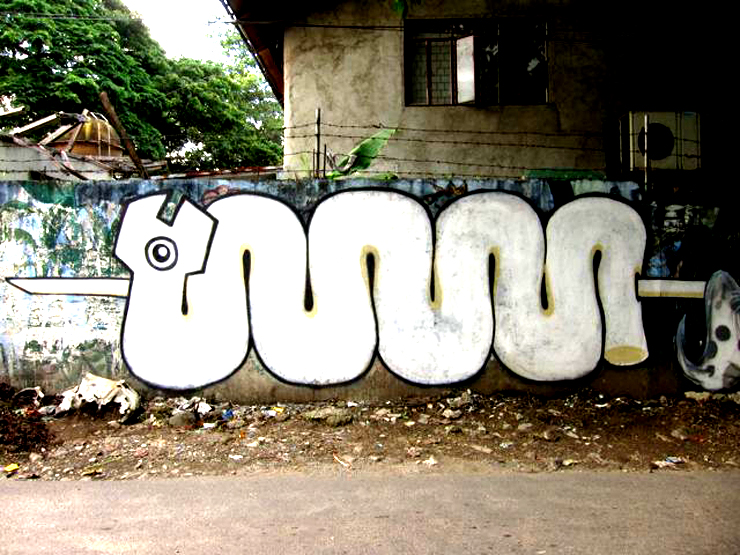
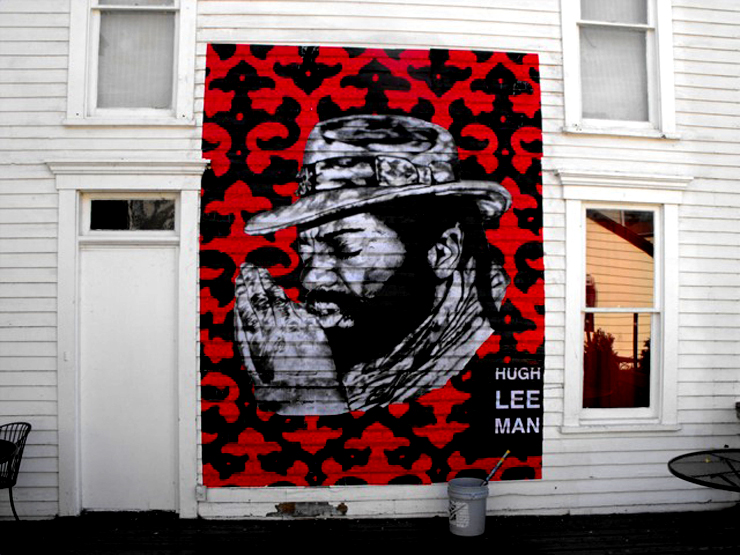
Our weekly interview with the street; this week featuring Cake, Company, Cozy, Deform Industry, Hugh Leeman, Muffin Man CCB, and a knitted padlock cozy.
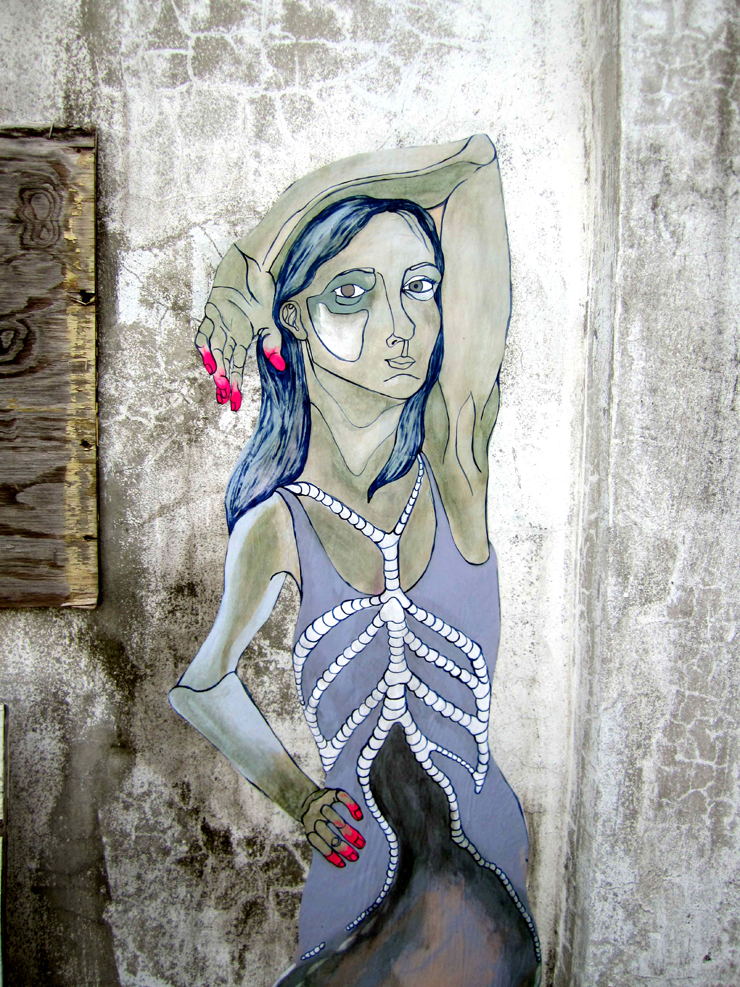
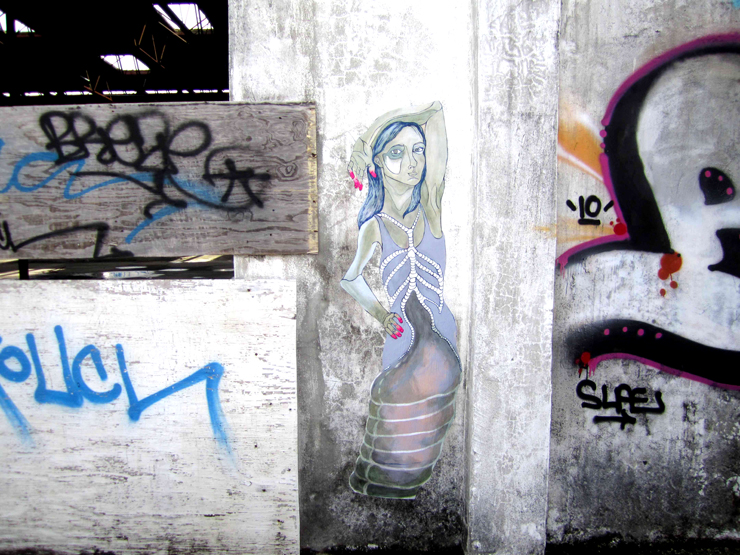
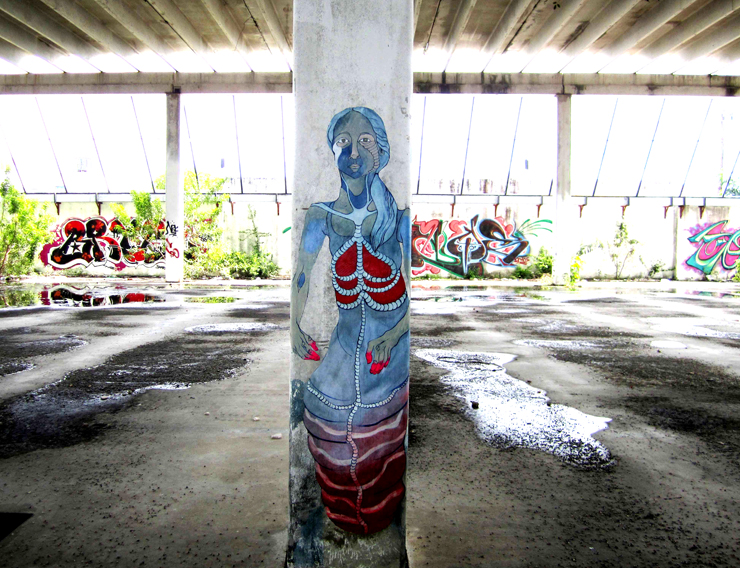
We begin this week with three new pieces from Cake:
Continuing her residency at The Fountainhead in conjunction with Primary Flight in Miami, Cake has been introducing marked and subtle changes to her work recently.
About these life-sized characters Cake says, “I have gone into finer detail with the anatomical overtones- highlighting one aspect of the skeletal structure instead of several and honing in on it. My colors are a result of many layers of washes and yes, I am partial to blue shades right now for some reason- I think its because it goes nice with the fluorescent pink fingertips each of these figures have.”
Street art welcomes all manner of materials and methods, typically deployed without permission and without apology. This hand-formed wire piece …Read More »
 BROOKLYN STREET ART LOVES YOU MORE EVERY DAY