Editorz

Moniker BK 2018 Catalogue Introduction Text by BSA

Moniker BK 2018 Catalogue Introduction Text by BSA

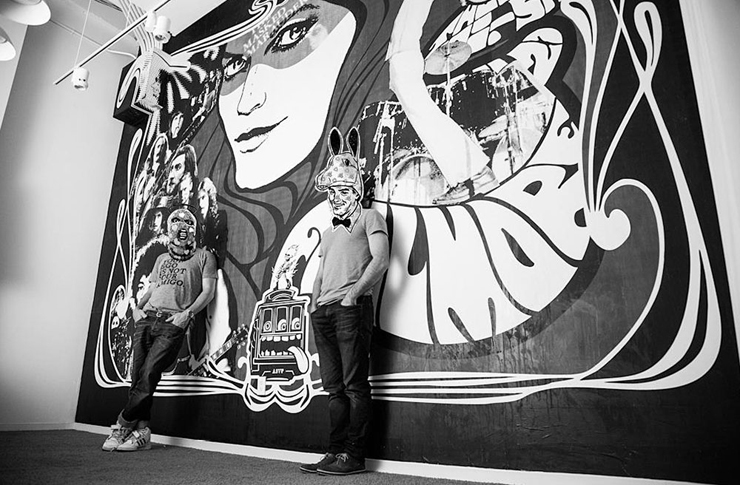
For the past few days we’ve been highlighting some of the artists whose brand new works will be debuted this week at Moniker International Art Fair this week. We are pleased that our editor in chief, Steven P. Harrington, was asked to write the Moniker catalogue introduction and today we share with you his original text to give you an idea of his perspective on having this art fair in BK.


From the seedy to the sublime, Brooklyn’s underground and street culture always bubbles up to the surface like hot gritty pavement tar when you least expect it – maybe because it’s character is so diverse and scrappy; a perpetual underdog, a fighter who never tires. Likewise Moniker has blazed many dark streets during its first nine years in search of new unusual inspiration and authentic voices. For its New York debut Moniker again short-circuits expectations and takes up a seriously innovative residence in the street culture epicenter of BKLN.

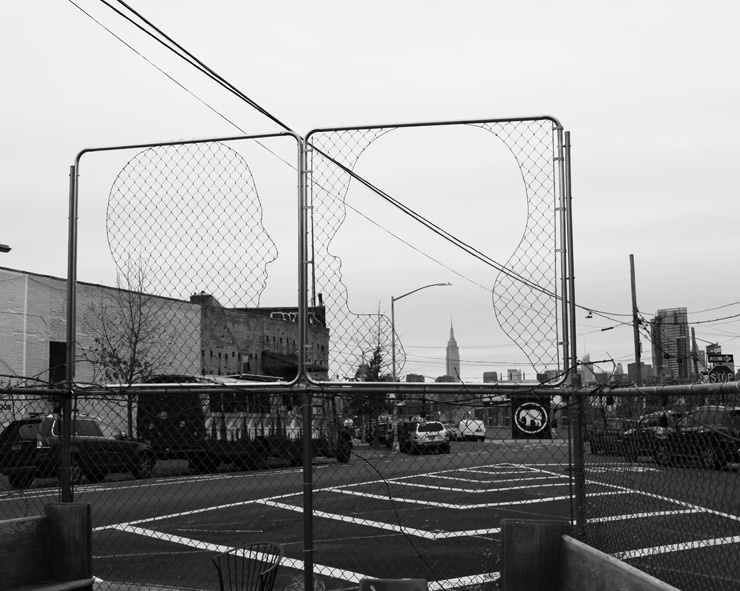
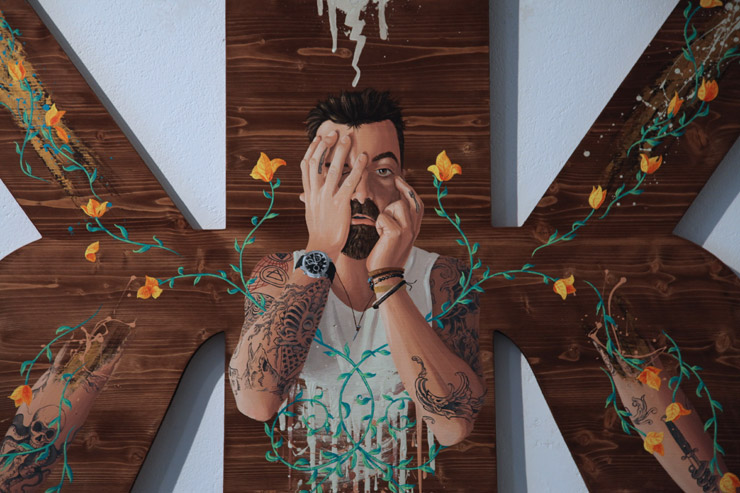
Icy & Sot (photo © Jaime Rojo)

In the modern Urban Art story Brooklyn is known for giving birth to epic 1970s train writers like Dondi, 80s train/canvas artists like Daze, crossover iconoclast graffiti/Street Artists like REVS in the 90s, and Street Art innovators like Bäst, Faile, Judith Supine, Skewville and Swoon in the 00s. Currently it claims the thickest density of international murals by urban aerosol wizards anywhere in the city – with the Bushwick Collective proliferating an epic scene of styles in the 2010s that brings a river of fans and tours out on the L train on any given sunny Saturday.

An earlier Bast in Brooklyn (photo ©Jaime Rojo)

Curated, experiential, and immersive, Moniker again goes right to the source of this Street Art scene that has jolted many international collectors out of their comfort zones and sparked life into Contemporary Art in a way that nobody foresaw.

With an awesome shot of Gotham across the river and just adjacent to Williamsburg this site is where 4,000 workers in factories manufactured nautical rope for the Merchant Marine in the previous century, later becoming a marginalized and abandoned industrial neighborhood that was like a powerful magnet to Street Artists and graffiti writers until only recently.

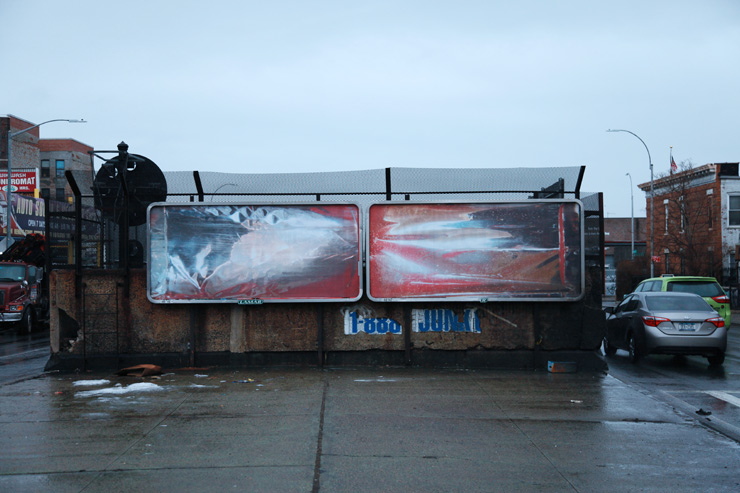
Specter (photo © Jaime Rojo)

Right here only a decade ago my partner and I threw a Street Art burlesque show for 300 avant-art fans behind a graffiti supply store; acrobats, fire tagging and drunken DJs included. Months later, with abandoned buildings and empty lots at our disposal, we projected Street Art images meta-style on walls around the neighborhood along with 20 or so projection artists for BK’s own version of a renegade Nuit Blanche.

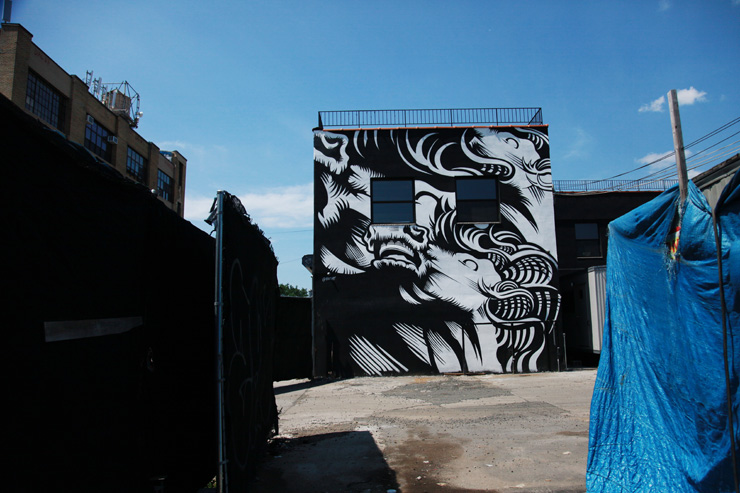
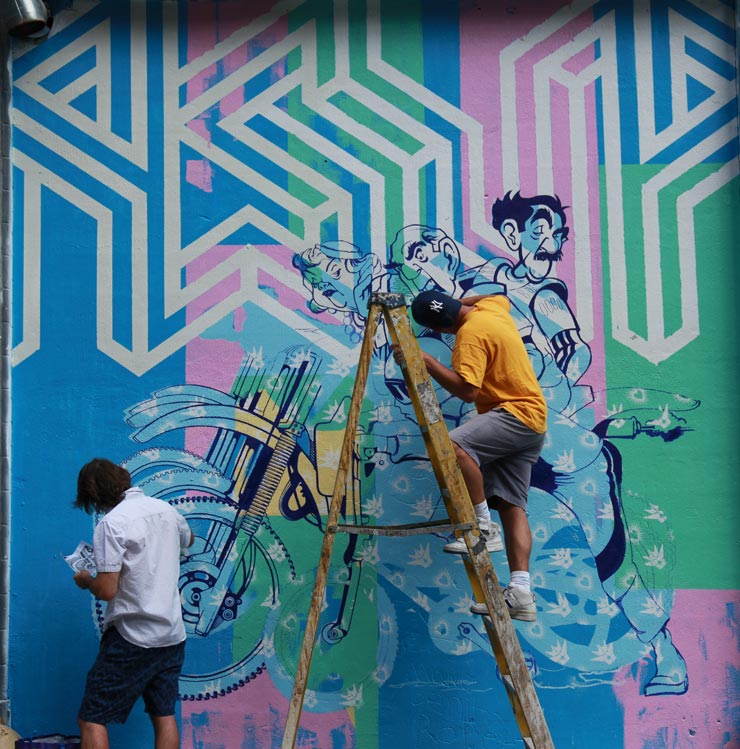
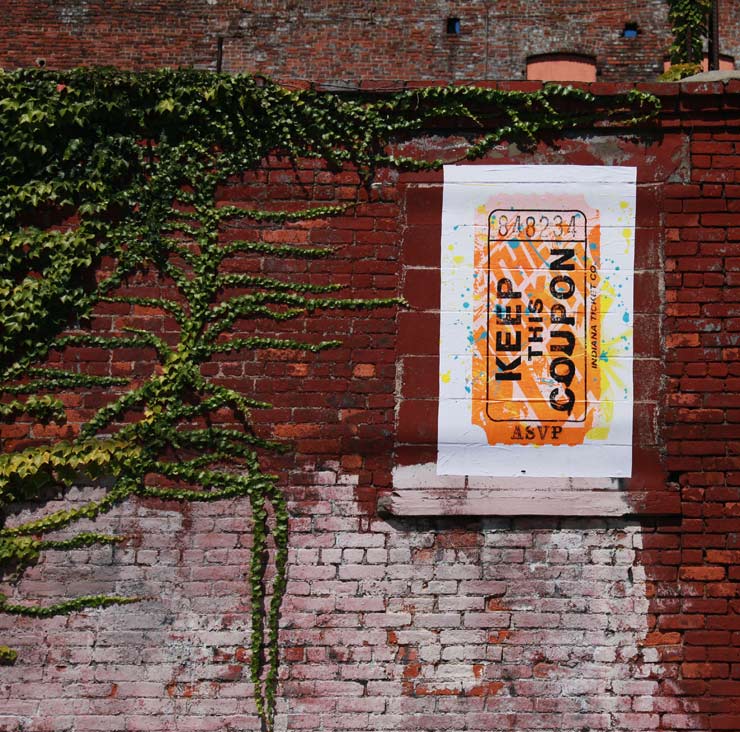
ASVP (photo © Jaime Rojo)

Only a block or two from where Moniker is sited graffiti throwups and bubble letters were scattered everywhere, squatters started fires to keep warm and scare off rats, skater kids regularly rode the underground paradise called “Autumn Bowl” by sneaking through a hole in the wall, and Banksy did one of his famous New York residency pieces here in 2013, “This site contains blocked messages.” The hardcore and anonymous REVS himself used a blowtorch to weld a dozen or so sculptures around this neighborhood during the 00s and ‘10s. There is at least one remaining.

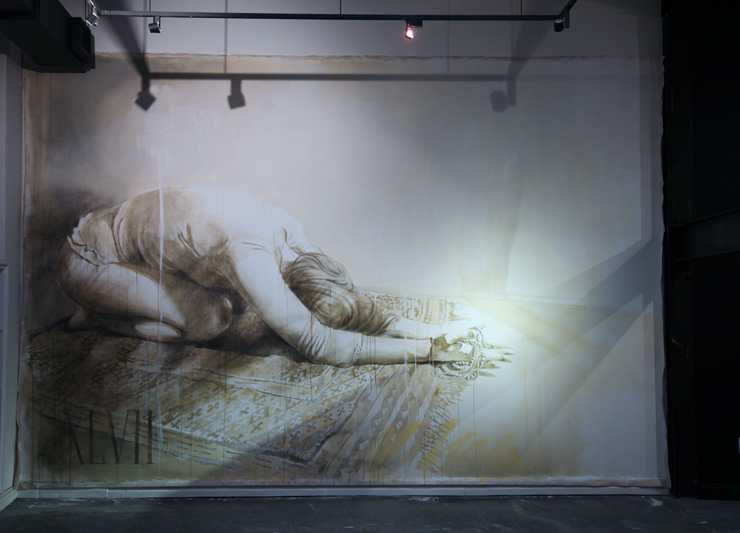
FaithXLVII (photo © Jaime Rojo)

And now Moniker 2018 beams out a new international signal to you from here, channeling that explosive Brooklyn DIY creative spirit up to the soaring ceilings of the Greenpoint Terminal Warehouse, effectively recreating the kind of immersive street carnival atmosphere that proved the ideal laboratory for Street Artists in BK like like Skewville, Dan Witz, Aiko, Mark Jenkins and countless others.

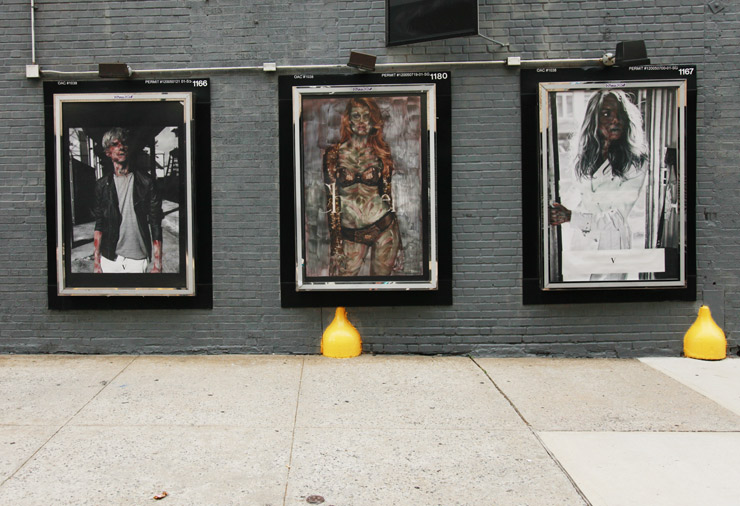
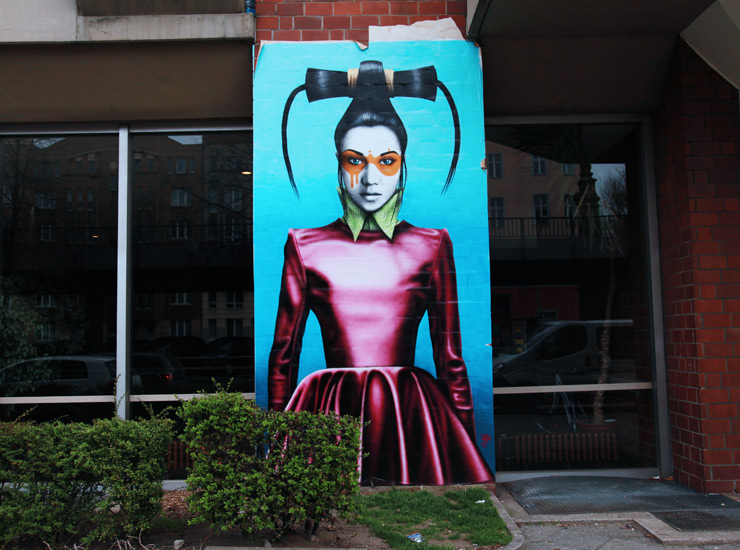
Now Moniker is introducing you to a dynamic crop of work by street practitioners on Brooklyn streets like Icy & Sot, Specter, and ASVP as well as the international high-profilers who have put work on the street here like Faith XLVII, FinDAC and Vermibus.

Vermibus (photo © Jaime Rojo)

As Urban Contemporary takes a solid hold in art world parlance it’s only right that a unique event like this challenges the rules for installations. All original new work from a handpicked highly curated group of 27 exhibitors, you will not have seen these installations and pieces previously. Judging by the hefty buzz leading up to Moniker 2018 in Brooklyn, you might not see them again.

Reminds me of Street Art.

FinDAC (photo © Jaime Rojo)


Read more
ASVP x Moniker x BSA

ASVP x Moniker x BSA

In advance of Moniker in Brooklyn this May, we are interviewing some of the artists who are influenced both by street practice and fine art as the contemporary urban art category continues to evolve. Today, BSA is talking to ASVP.

Bushwick, Brooklyn-based locals ASVP are a collaboration between Simon Grendene and Victor Anselmi, whose influences on the street in the print lab are drawn from advertising, pop/comic book culture, even Street Art.

Working since 2008 to develop a unique hand drawn style, they have done a number of murals on the street and special projects for corporate clients, including a mural for the recently completed William Vale Hotel in Williamsburg and a 70’ long mural commissioned by the city of Basel. Taking inspiration from many sources its the combination of painting and quality print making that remains central to their process and aesthetic.

ASVP (photo © Jaime Rojo)

Brooklyn Street Art: How would you describe your work to someone who is seeing it for the first time?
ASVP: If you’re seeing our work for the first time, we’re probably not there.

If we were, we wouldn’t tell them what to think or feel.

BSA: What is your intersection with Brooklyn and it’s history of Street Art and graffiti?
ASVP: Bushwick is an artistic community and that’s exactly what brought us here.

Another artist heard we were looking for a space, reached out and invited us to see the building where his studio was. We’ve been here ever since.

ASVP (photo © the artists)

BSA: What’s most important to you?
ASVP: Probably never having to stop making the work we do, before wanted to.

BSA: Are graffiti and Street Art allowed to change, or should there be a strict definitions they adhere to?
ASVP: Punk isn’t something that sounds like something, it’s the act of rebellion. Graffiti and Street Art are the same.

We hope the forms and styles always change. If it’s installed, pasted or painted with permission, it may be art, but it’s not something we would call Street Art or Graffiti.

ASVP (photo © Jaime Rojo)

BSA: Moniker says your work has been influential and/or fundamental to urban & contemporary art’s growth. Can you see their point?
ASVP: Sure. The creative atmosphere of Urban & Contemporary Art is oxygen that everyone is breathing. We’re happy to be a part of what is inspiring others. We’re equally happy to be on the receiving end of this, through the friends, artists who continually influence us and the work we make.

BSA: Name one artist whose work you admire today.
ASVP: Dave Chappelle


For more information please go to Moniker Art Fair HERE.

Read more
Derek Gores x Moniker x BSA

Derek Gores x Moniker x BSA

In advance of Moniker in Brooklyn this May, we are interviewing some of the artists who are influenced both by street practice and fine art as the contemporary urban art category continues to evolve. Today, BSA is talking to Derek Gores.

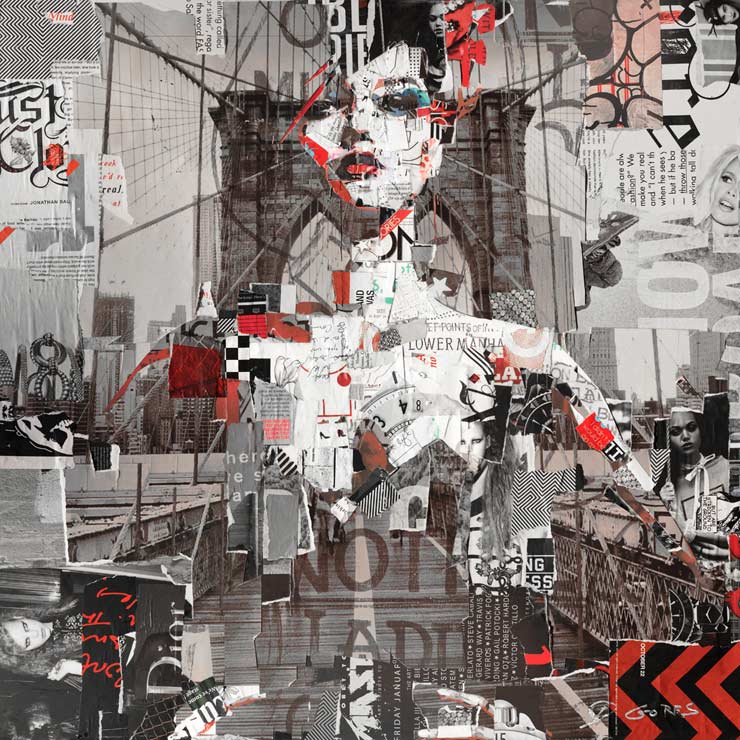
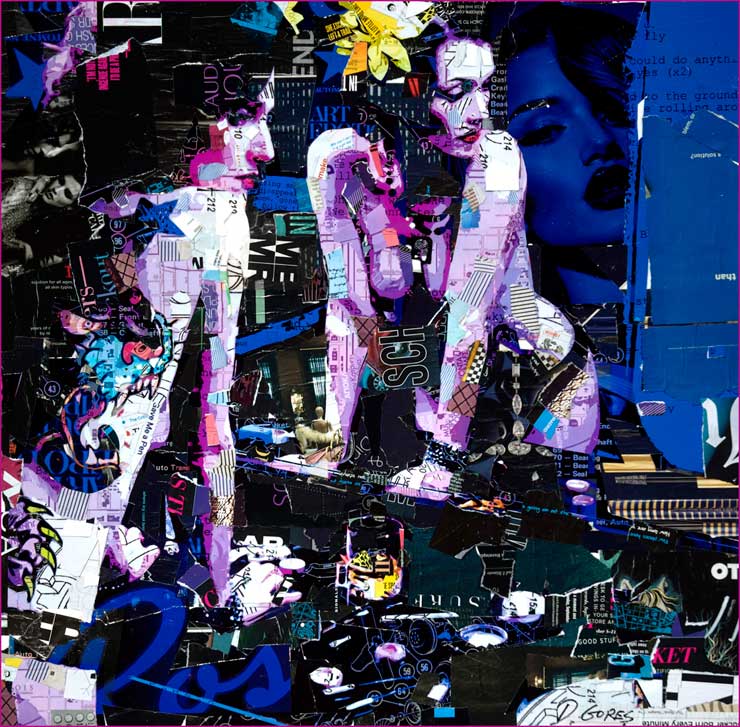
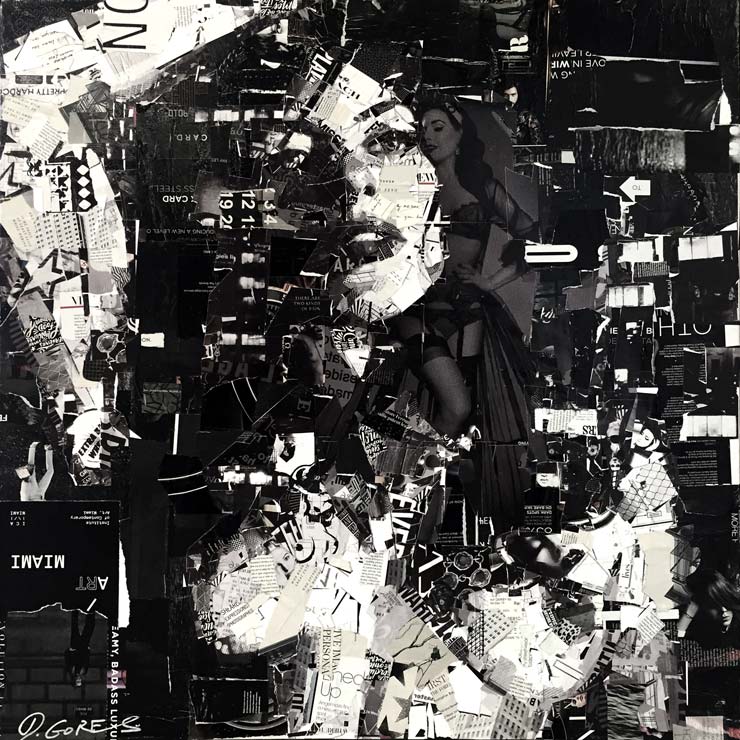
Commercial artist Derek Gores uses collage to create his citified fantasies about sex and power and scatters them across the canvas. He will be one of the artists doing a solo art installation at Moniker in Brooklyn this year.

Derek Gores Full Volume Brooklyn Bridge (photo courtesy of the artist)

BSA: How would you describe your work to someone who is seeing it for the first time? Derek Gores: Collage with recycled paper, magazines, maps, lyrics, photos. A visual battle between image and abstraction. A beautiful chaos of words, spaces, hints of a story that develops in front of me. Feminist superheroes.

BSA: What is your intersection with Brooklyn and it’s history of Street Art and graffiti? 
Derek Gores: I was born in New York but have lived in Florida most of my life. Like many, I crave the buzz of the city but with a tight neighborhood density. The street art world has a constant big world/small world pulse. I don’t do murals particularly, but most of my best art friends go big.

Derek Gores. Could do Anything (photo courtesy of the artist)

BSA: What’s most important to you?
Derek Gores: Being present in the art. Keeping the senses Live.

BSA: Are graffiti and Street Art allowed to change, or should there be a strict definitions they adhere to?
Derek Gores: Oh they must, like any art form, be always destroying and rekindling. Even within one artist. New school becomes old school. Love it, honor it, stand on it’s shoulders.

BSA: Name one artist whose work you admire today.
Derek Gores: Hyland Mather

Derek Gores Pretty Hardcore (photo courtesy of the artist)


For more information please go to Moniker Art Fair HERE.

Read more
BSA Images Of The Week: 04.29.18

BSA Images Of The Week: 04.29.18

BSA-Images-Week-Jan2015

Mexico, Norway, Brooklyn – a typical week of BSA Images.

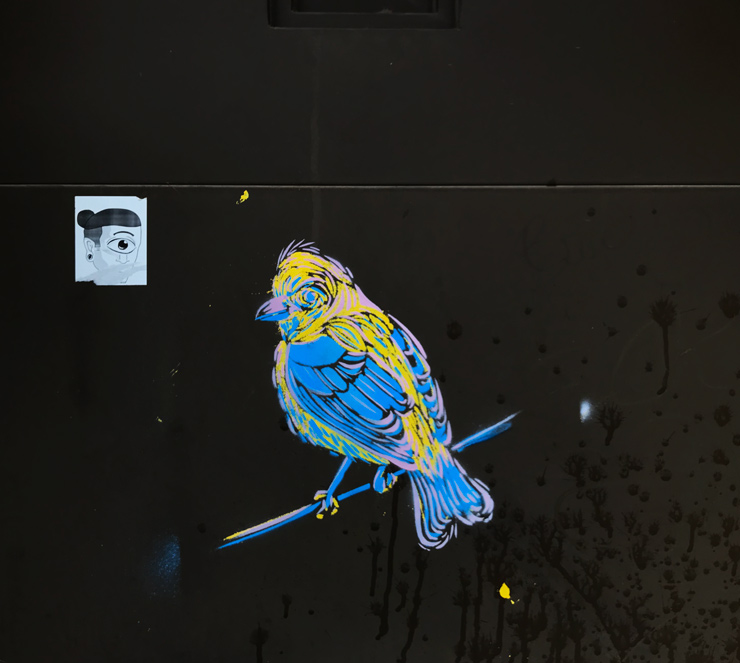
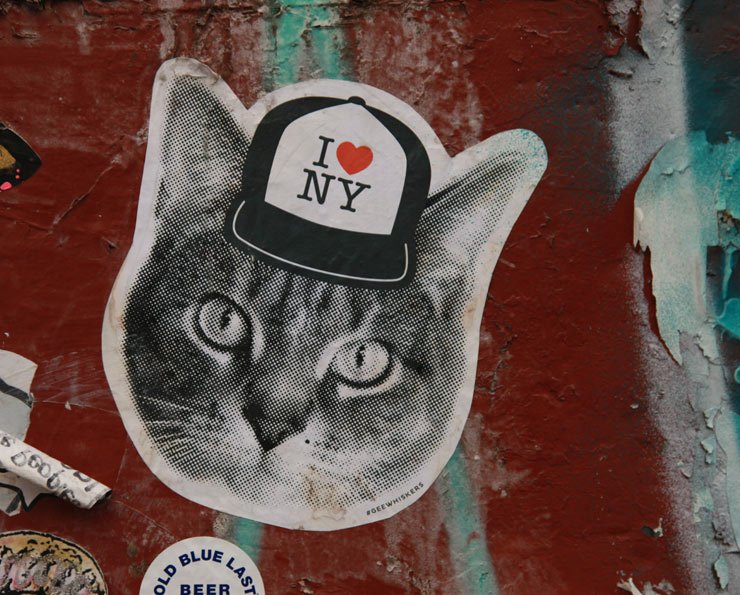
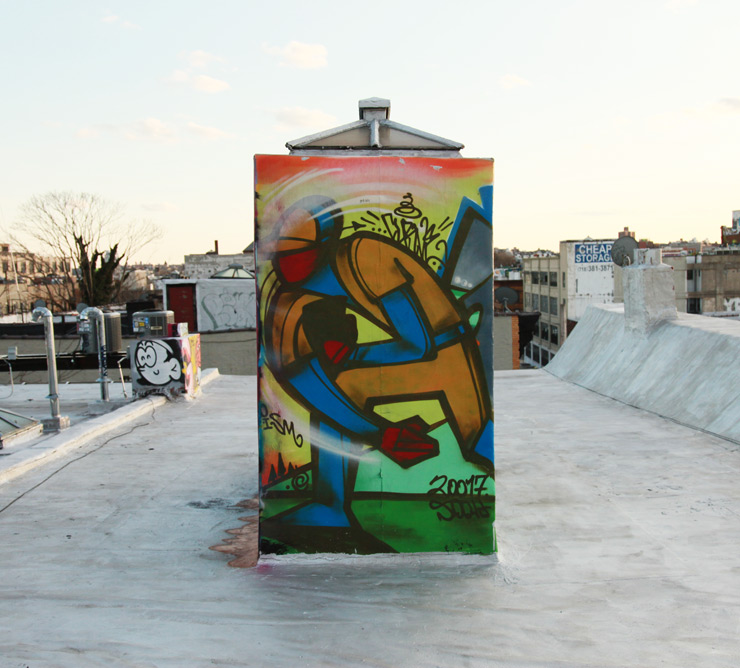
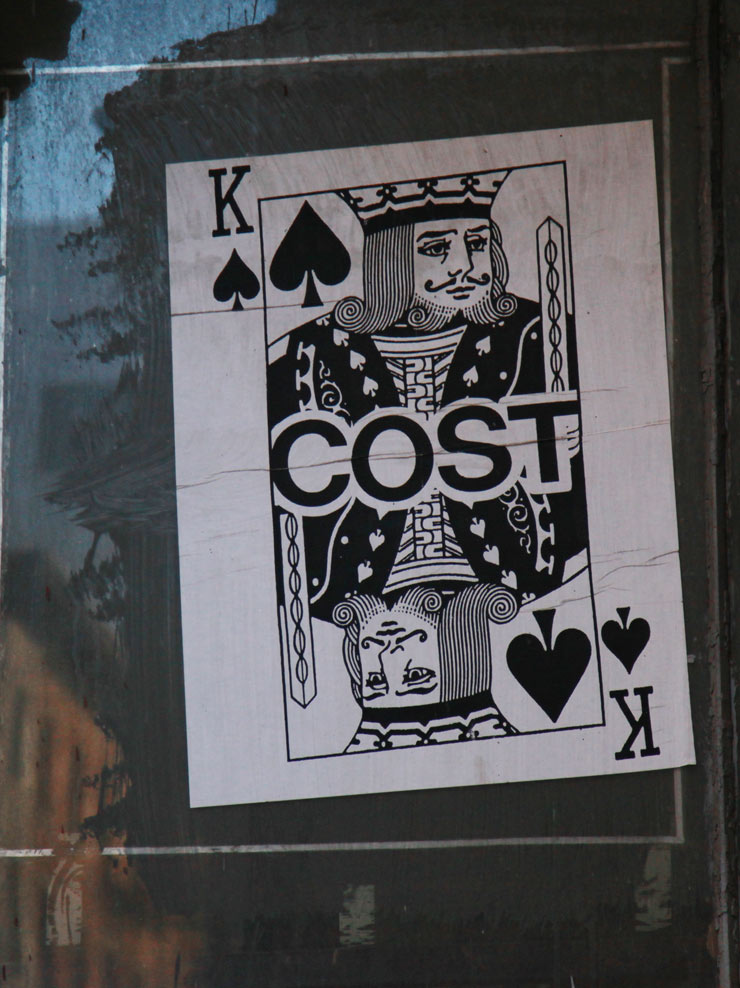
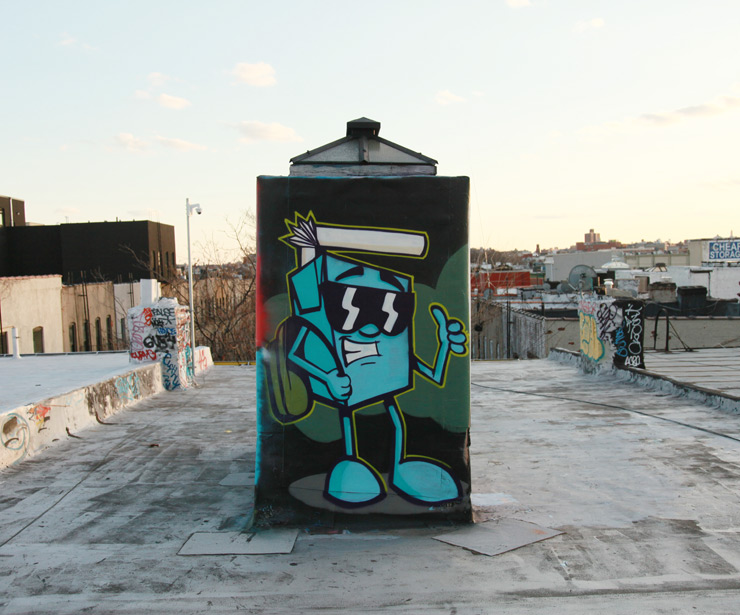
Here’s our weekly interview with the streets, this week featuring Abraham Chaco, BustArt, Cost, Curve, El Xupet Negre, Gee Whiskers, JMZ, JPS, Juce, Raf Urban, The Reading Ninja, and Turtle Caps.

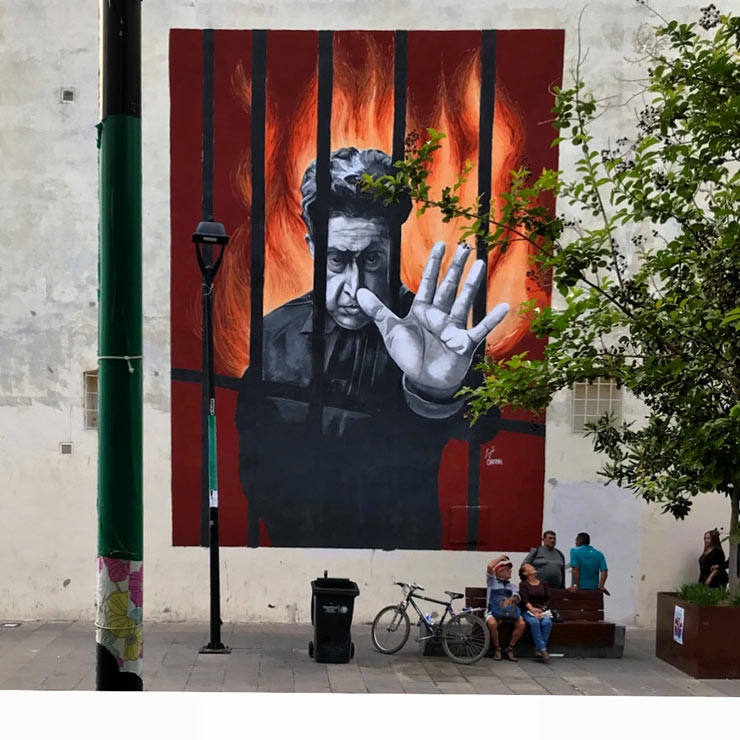
Top Image: Christina pays homage to the Mexican master and social realist painter David Alfaro Siqueiros in Chihuahua, Mexico. (photo © Jaime Rojo)

Abraham Chacon. Detail. Chihuahua, Mexico. (photo © Jaime Rojo)

Abraham Chacon. Chihuahua, Mexico. (photo © Jaime Rojo)

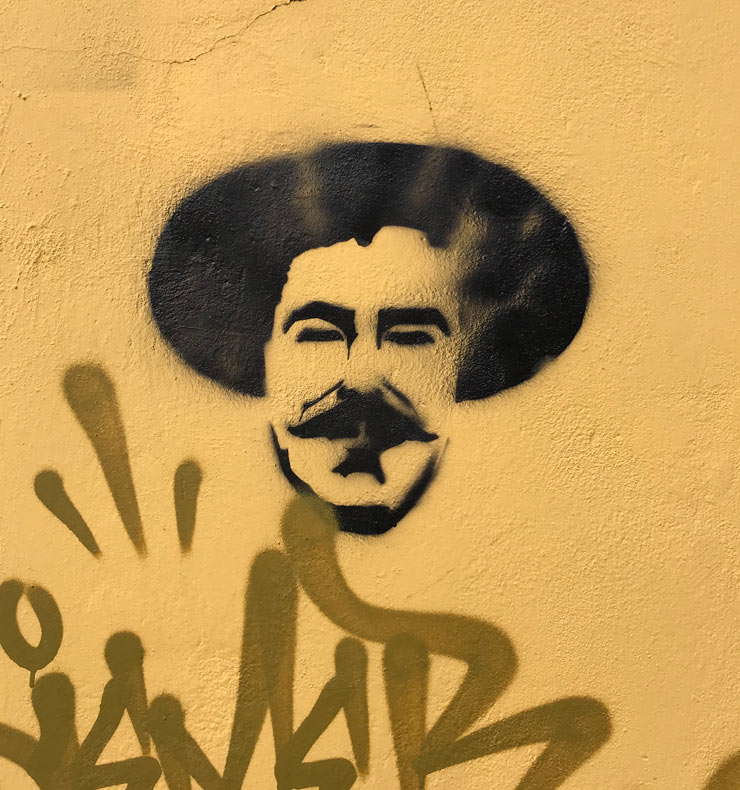
Unidentified artist paints a stencil of Pancho Villa in Chihuahua, Mexico. (photo © Jaime Rojo)

Unidentified artist. Chihuahua, Mexico. (photo © Jaime Rojo)

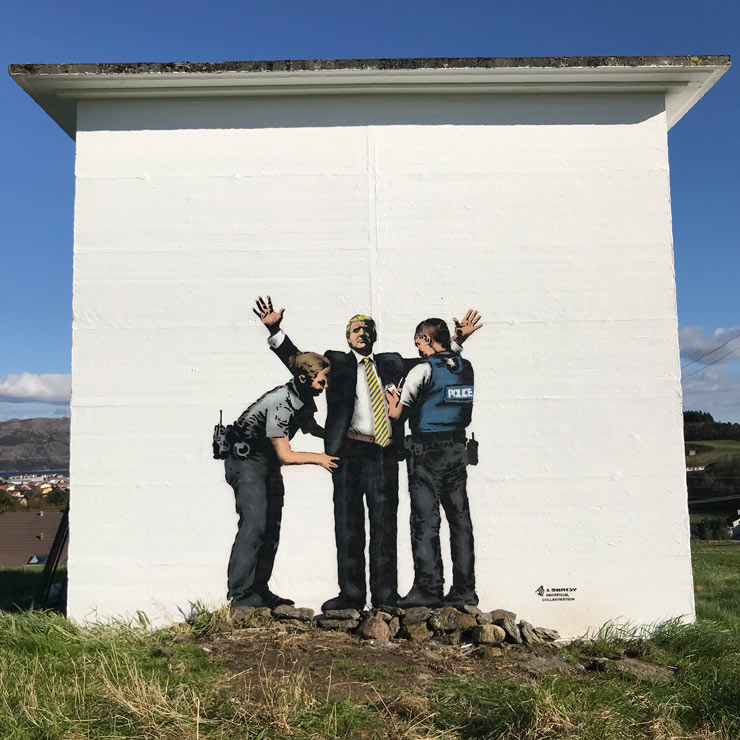
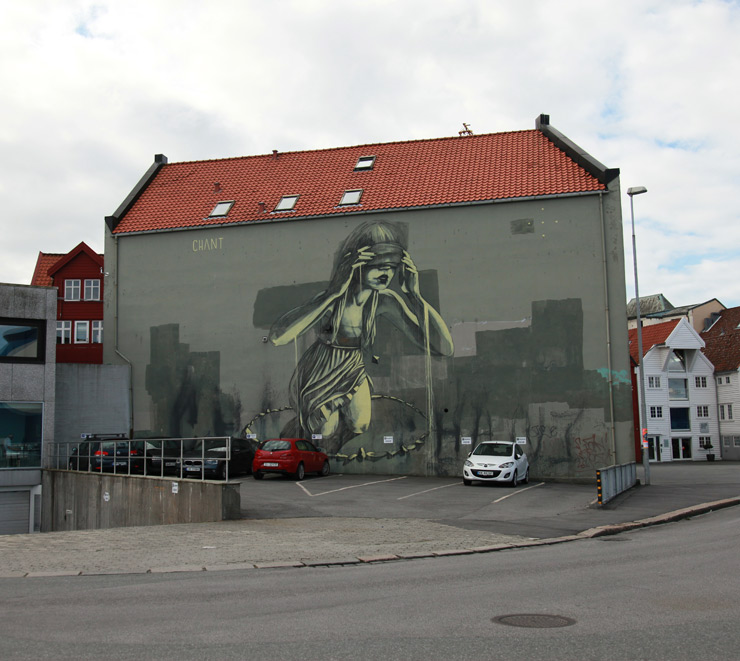
JPS makes an arrest in Stavanger, Norway. (photo © Tor Staale Moen )

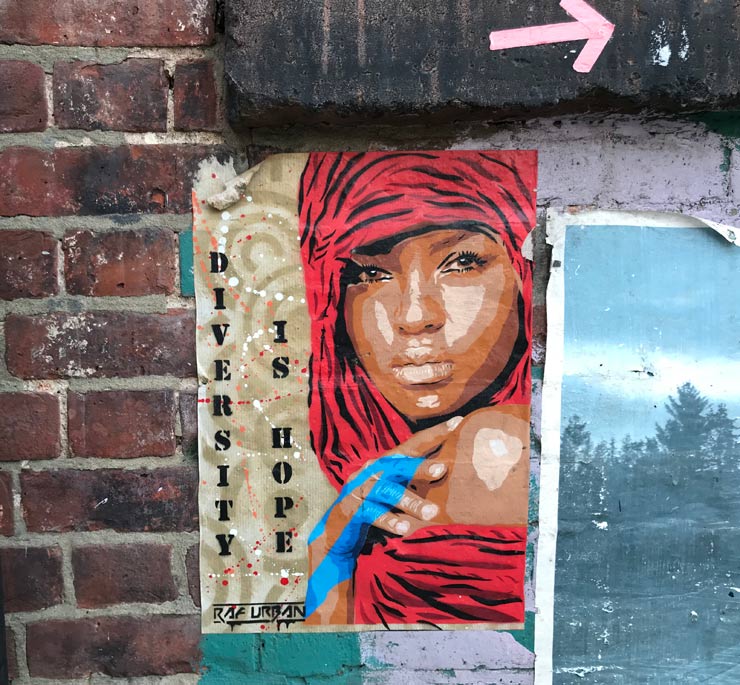
Raf Urban (photo © Jaime Rojo)

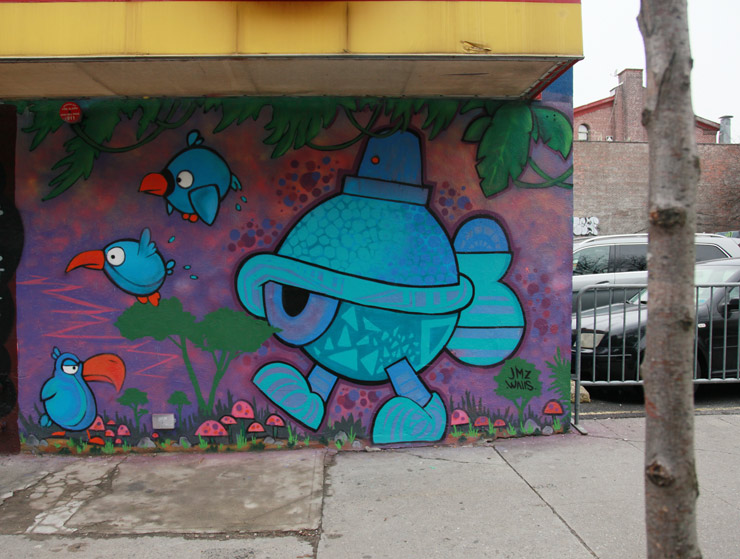
Turtle Caps for JMZ Walls. (photo © Jaime Rojo)

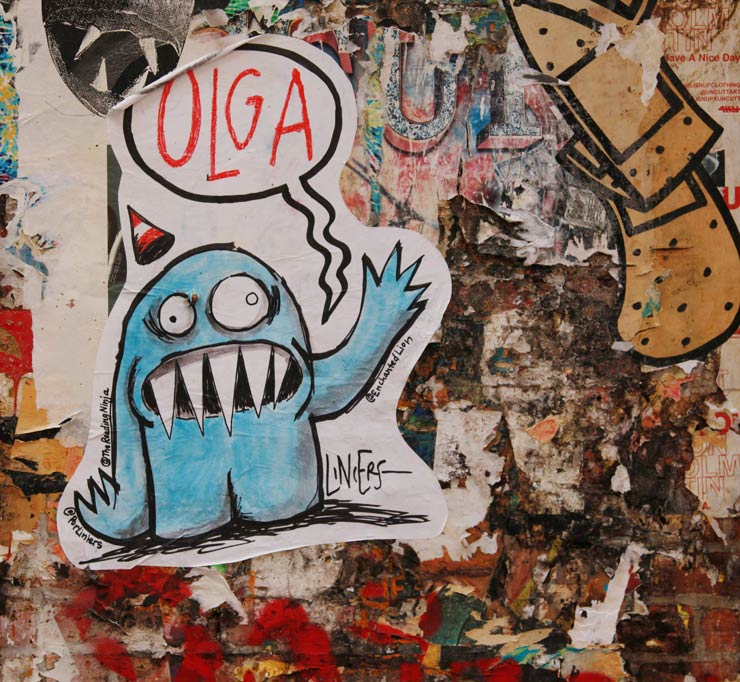
The Reading Ninja (photo © Jaime Rojo)

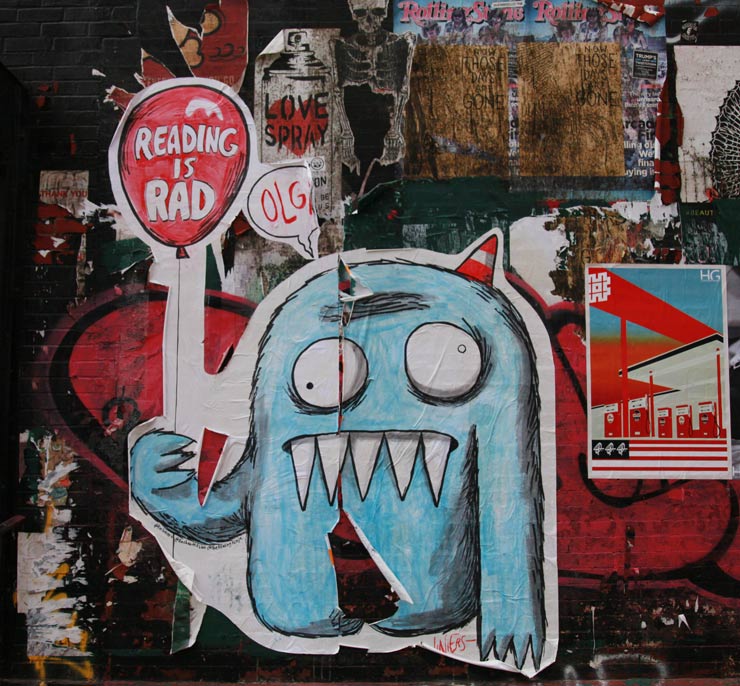
The Reading Ninja (photo © Jaime Rojo)

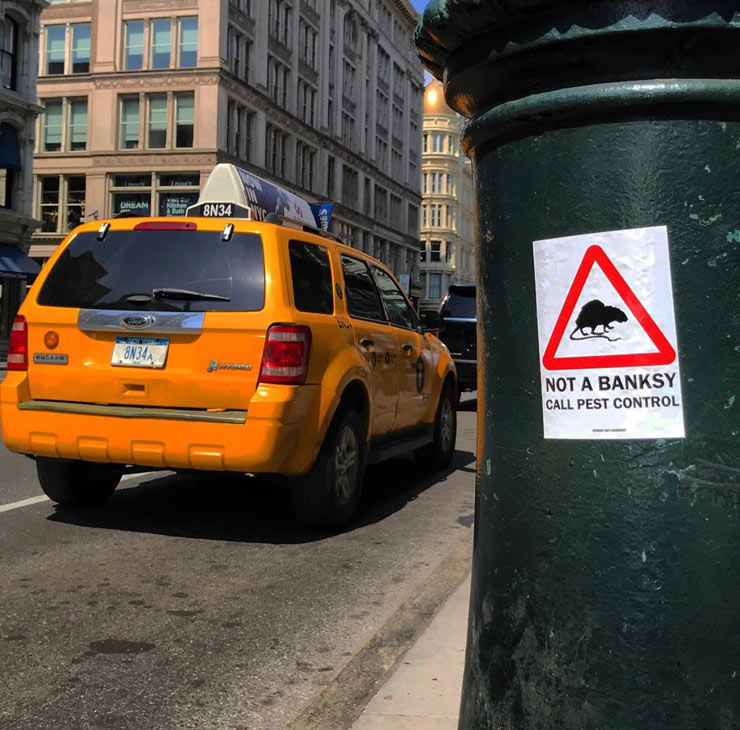
Street Art Anarchy (photo © Jaime Rojo)

Truckers caps are still running in trendy cat circles apparently. Gee Whiskers (photo © Jaime Rojo)

Curve (photo © Jaime Rojo)

COST (photo © Jaime Rojo)

Juce (photo © Jaime Rojo)

El Xupet Negre for The Bushwick Collective. (photo © Jaime Rojo)

Unidentified Artist (photo © Jaime Rojo)


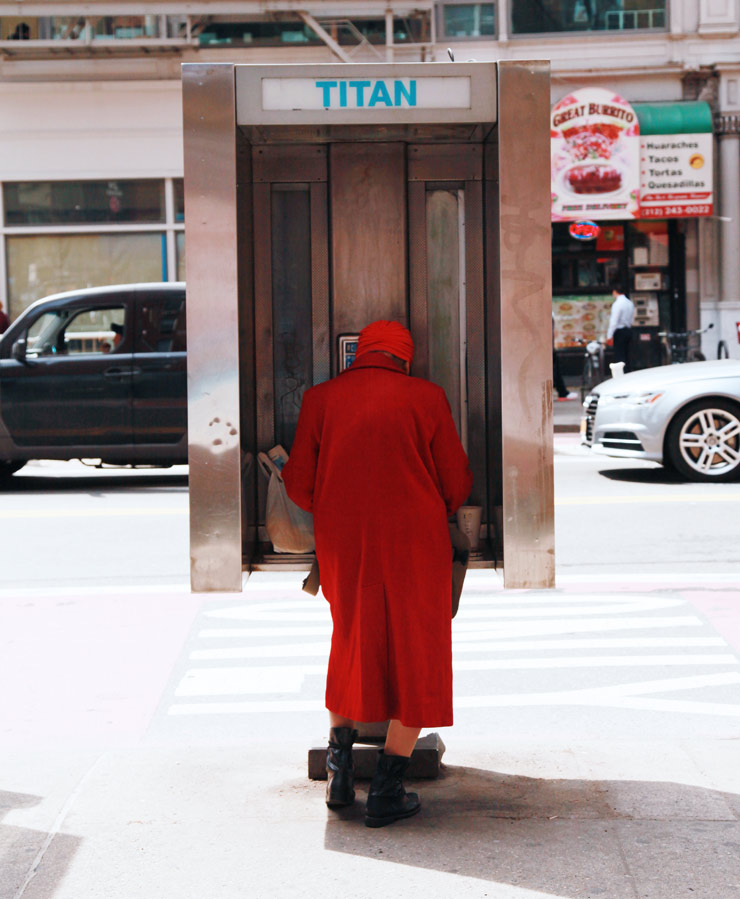
Untitled. The lady in red. Manhattan. April 2018. (photo © Jaime Rojo)


Read more
Egle Zvirblyte x Moniker x BSA (interview)

Egle Zvirblyte x Moniker x BSA (interview)

In advance of Moniker in Brooklyn this May, we are interviewing some of the artists who are influenced both by street practice and fine art as the contemporary urban art category continues to evolve. Today, BSA is talking to Egle Zvirblyte.

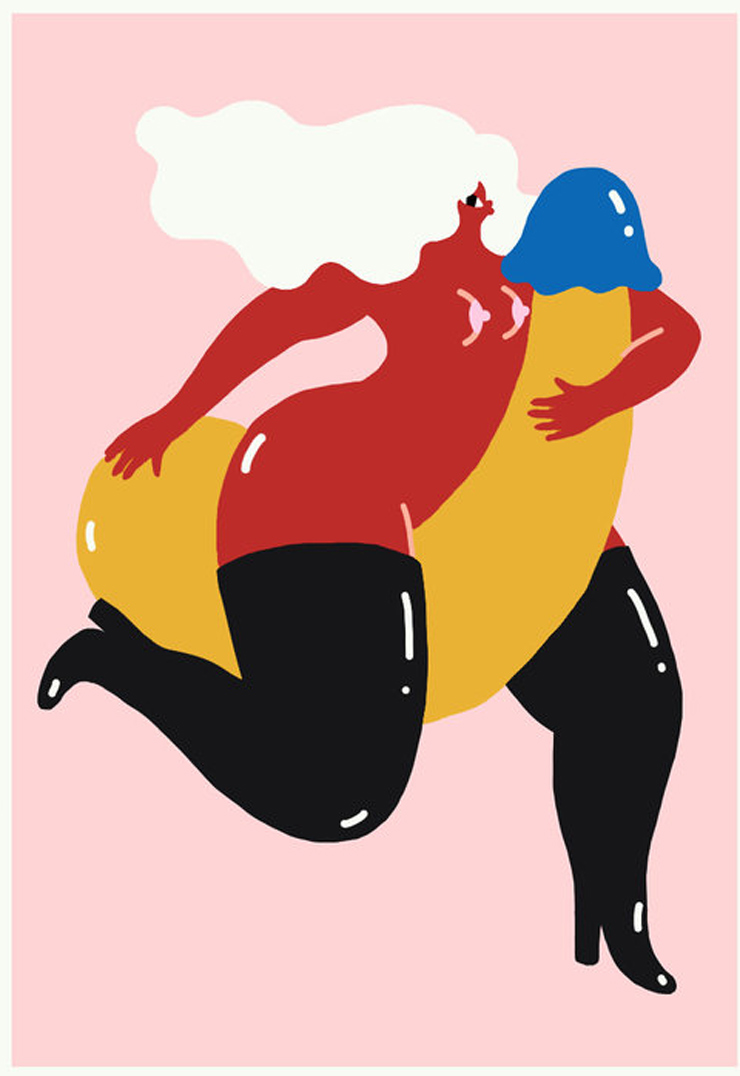
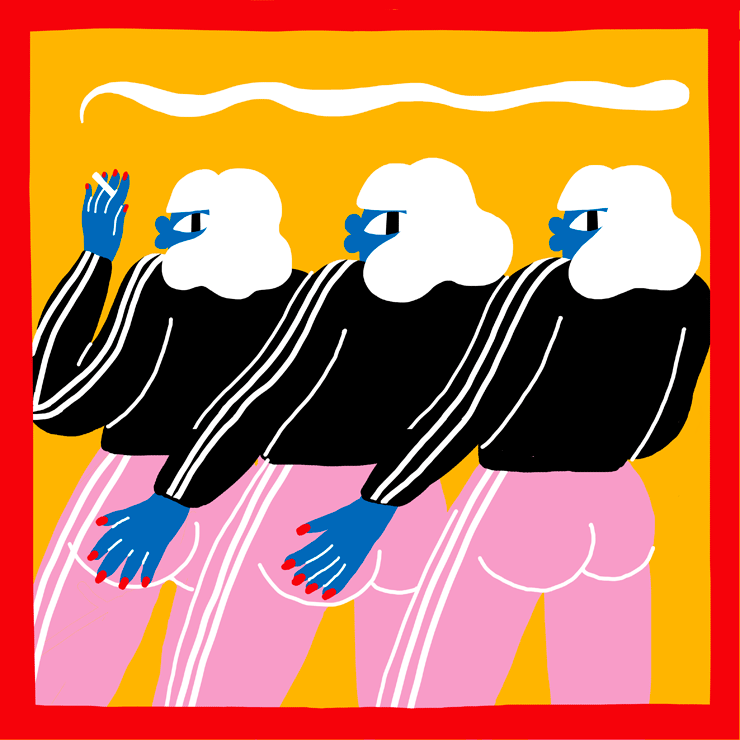
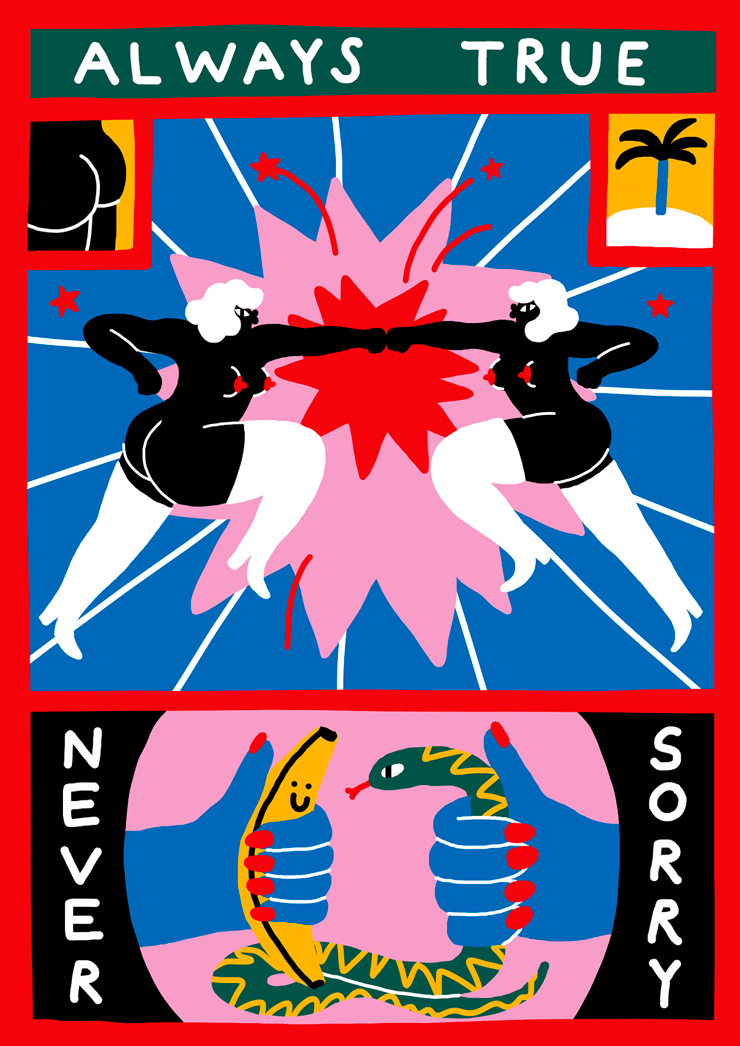
A modern champion of voluptuous female sexuality in eye-popping technicolor, the Lithuanian illustrator, commercial artist, and muralist Egle Zvirblyte sets minds ablaze with a knowing smile courtesy her not-so-discreet organic shapes that please and play. Her Brooklyn visit while showing at Moniker will bring more graphic girl power to the street as well as the art fair.

A student of Film and Spatial Design in London, she has been creating her own 2-D graphic mindspace in cities like Melbourne, Bali, Tokyo and Barcelona – now splitting here time between London and Vilnius.

Egle Zvirblyte. “Mushroom Tamer” (image © the artist)

Brooklyn Street Art: How would you describe your work to someone who is seeing it for the first time?
Egle Zvirblyte: My work is bright, juicy, punch-your-face explosion. It’s funny and self-aware. I like to explore real and fictional human relationships with themselves and the surrounding universe.

BSA: What is your intersection with Brooklyn and it’s history of Street Art and graffiti?
Egle Zvirblyte: I come from an illustration background but I have been schooled in street art history by my ex-graffiti-writer boyfriend. I’m enjoying being a fresh-faced baby on the scene.

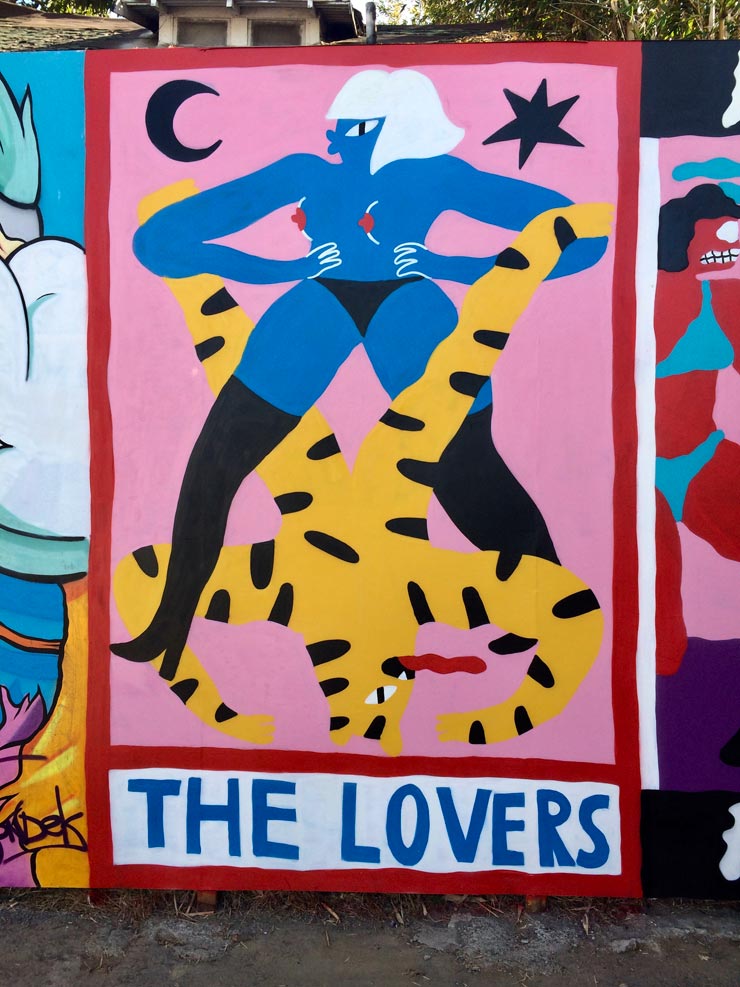
Egle Zvirblyte. “The Lovers” (photo courtesy of the artist)

BSA: What’s most important to you?
Egle Zvirblyte: To be able to create freely, to constantly grow as a person and as an artist, and to be excited about the future.

BSA: Are graffiti and Street Art allowed to change, or should there be a strict definitions they adhere to?
Egle Zvirblyte: I believe that like with any art, you should know your history, but be here to create a new one. Everything is a constant evolution, why try to stop it?

Egle Zvirblyte.  “Got Your Back” (photo courtesy from the artist)

BSA: Moniker says your work has been influential and/or fundamental to urban & contemporary art’s growth. Can you see their point?
Egle Zvirblyte: I’m not sure yet where I stand in the grand scheme of things, but I guess I do have a strong voice as a woman artist. Not that I’m trying to be loud or didactic, but that I’m creating irreverent work from very personal experience, staying as honest as I can. I think people relate to that.

BSA: Name one artist whose work you admire today.
Egle Zvirblyte: Gabriel Alcala

Egle Zvirblyte.  “Always True Never Sorry” (photo courtesy from the artist)


For more information please go to Moniker Art Fair HERE.

Read more
BSA Film Friday: 04.27.18 / Chop ‘Em Down Films Special

BSA Film Friday: 04.27.18 / Chop ‘Em Down Films Special

bsa-film-friday-JAN-2015

Our weekly focus on the moving image and art in the streets. And other oddities.

Now screening :
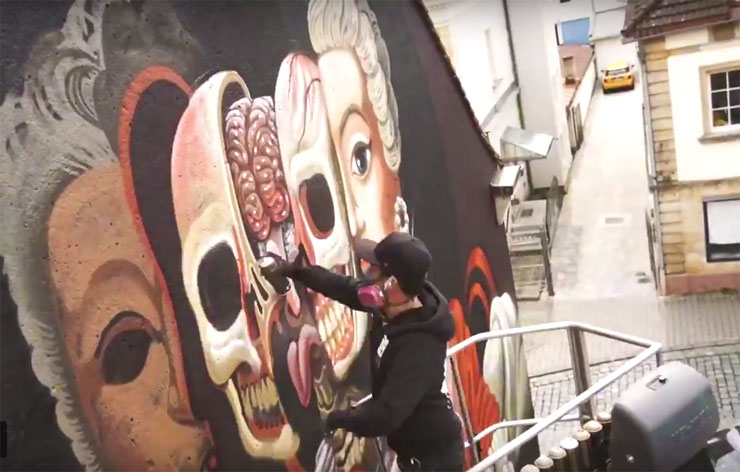
1. Nychos “Wilhelmine von Bayreuth”
2. RETNA X Vhils in Echo Park
3. TRAV MSK
4. OKUDA; FALLAS VALENCIA 2018

bsa-film-friday-special-feature

BSA Special Feature: Spotlight on Chop’em Down Films

We continue to watch and admire the filmmaker Zane Meyer as he follows the artists in the Street Art and related scenes, bringing his own definitive perspective to the story, often transforming it into something more.

With a background in SoCal skater culture and a nomadic rolling approach to capturing the internal adventure, Meyer is bringing his full potential to this game. He’s down distinctive audio as well, adding timbre, humor, jolting alarm and soul. His company Chop’em Down Films is celebrating its first decade and he’s moving into his 4th and its exciting to think what the next ten hold for this director full of vision.

Nychos “Wilhelmine von Bayreuth”

Because Nychos is all about the soaring chopping power chords of metal in audio and the slicing apart of animals, people, and brand icons visually, this deliciously controlled mahem is almost going to make you feel guilty for the joy to take watching it. But why?

RETNA X Vhils in Echo Park

Getting it right again, this sampling of the voice of white authority praises and insults simultaneously. Laid against the swagger of Retna and Vhils triumphantly astride their wall, the happy horror of it all comes to life in one minute flat. A sports analogy via colonialism, “The Autumn Wind” is meant to talk about the lore of football as narrated by John Facenda, but in this context the battle is artists against the elements and the wall.

TRAV MSK

Mystery and stories of the city cloak this narrative of letterist Trav MSK as he interpolates the nighttime blinking of messages against the sky, and the quick movement of shadows just outside your periphery. Suddenly its a defiant act of staged vandalism across walls of photography and illustration in a gallery like setting, and a boxtruck tag of the paint sponsor’s name.


OKUDA; FALLAS VALENCIA 2018

Yes, Street Art is ephemeral, but OKUDA San Miguel just set it on fire!” we said last month as the Fallas festival in Valencia brought the artist to the front of the celebration, only to burn his creation to the ground.

Read more
Bom.K x Moniker x BSA

Bom.K x Moniker x BSA

In advance of Moniker in Brooklyn this May, we are interviewing some of the artists who are influenced both by street practice and fine art as the contemporary urban art category continues to evolve. Today, BSA is talking to Bom.K.

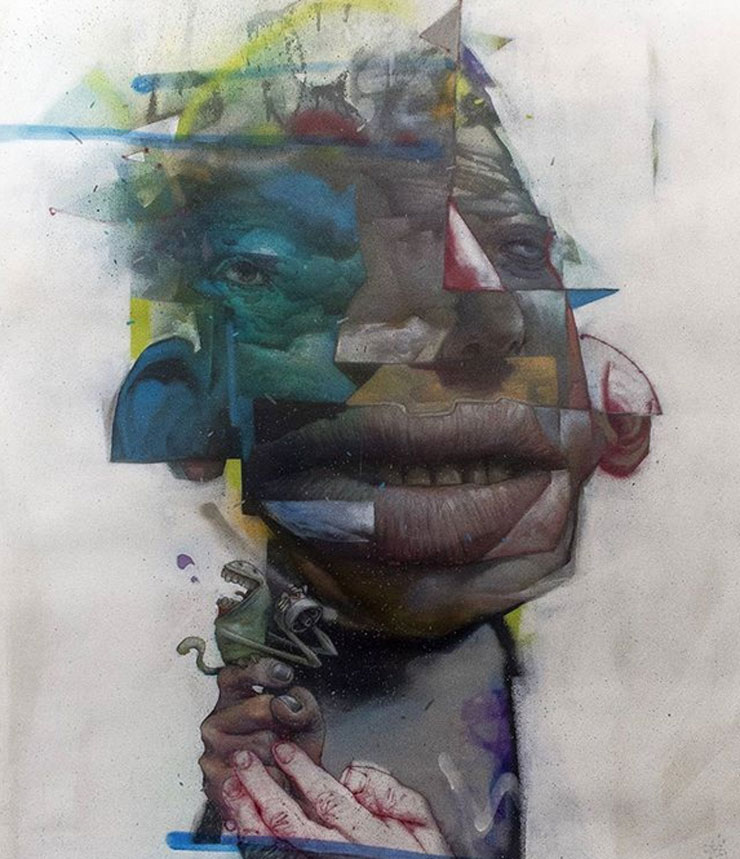
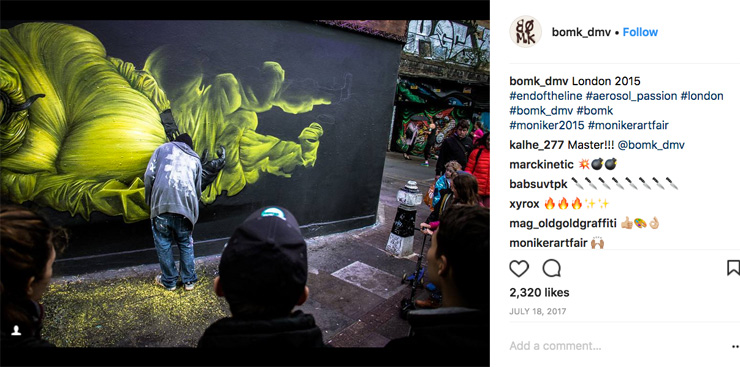
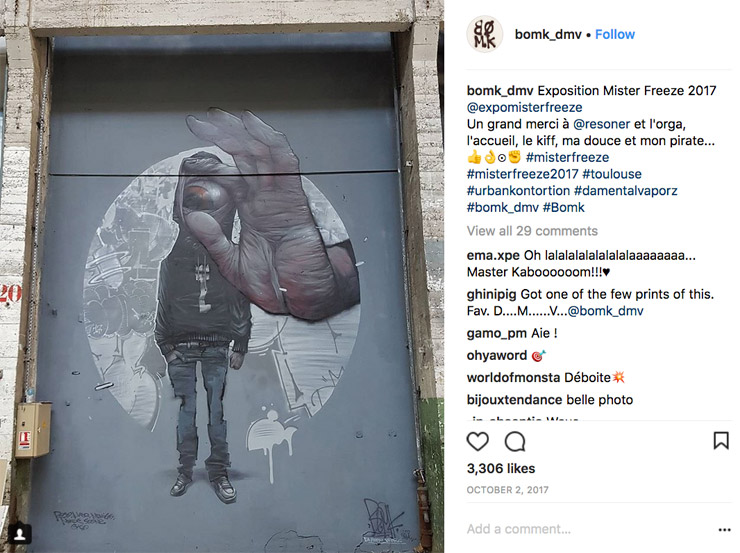
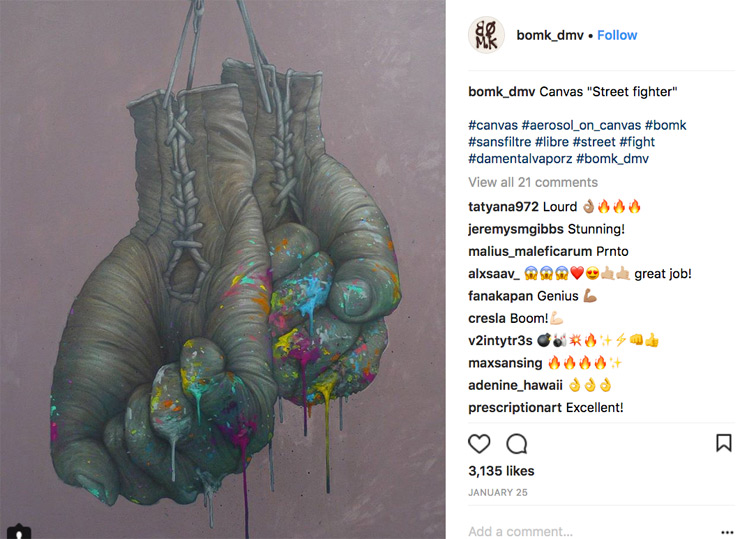
Parisian painter Bom.k develops huge frescoes that are truly evocative of the universe he grew up in; “Brutal, dirty, violent, suburban,” he says. Hellish monsters push through the wall in rage, nude figures contort and twist, grotesque hybrids of humans and animals and chimeras and nightmares overwhelm with a technically masterful touch and sometimes a sense of gentle humor. He says he draws upon his life experience, obviously in concert with an outstanding imagination.

Bom.K canvas “Embrouille part03” (copyright the artist)

A teenager in the early nineties with “Spray Can Art” and “Subway Art” in his possession and as inspiration, he says that these were “sacrosanct Bibles” from Prigoff, Chalfant, and Cooper that inducted him into the language of the street with a distinct New York inspiration. He did multiple tags, throw-ups, and frescos showing off lettering and character skills before co-founding Da Mental Vaporz with Iso as the century turned.

Steadfastly developing his craft and body of work on walls, Bom.k has brought his infernal bestiary into gallery settings in Paris, Denmark, LA, Berlin, and elsewhere. He’s published an illustration based book, created sculpture, prints, and of course outstanding canvasses that will summon fearful beasts of such dimension that Francis Bacon would invite them for dinner and possibly meet afterward at a dark bar with Gonzo for drinks.

Bom.K (photo from the artist’s Instagram account)

Brooklyn Street Art: How would you describe your work to someone who is seeing it for the first time
Bom.k: I would describe it as an instant projection from my imagination. It is a picture made by my thoughts and transposed into a medium by the action of painting or drawing.

BSA: Do you have any personal experience with Brooklyn and its history of Street Art or graffiti?
Bom.k: The graffiti scene and street art in Brooklyn has certainly been very influential in the world. I have never painted in Brookyn yet, but like many others it would be a great pleasure to be able to.

Bom.K (photo from the artist’s Instagram account)

BSA: What’s most important to you?
Bom.k: To be original and to feel good about my technique.

BSA: Are graffiti and Street Art allowed to change, or should there be a strict definitions they adhere to?
Bom.k: Graffiti and street art don’t have to respond to rules if the goal of the rules is to  control and judge. It should appeal to as many people as possible. The practice has to stay free and independent.

Bom.K (photo from the artist’s Instagram account)

BSA: Moniker says your work has been influential and/or fundamental to urban & contemporary art’s growth. Can you see their point?
Bom.k: Oh, it’s a strong statement. I’m not sure to be the best person to talk about that. I hear sometimes that my work has been an inspiration for some artists. This is quite gratifying to hear it but I can’t say more. I have no idea about it. I just focus on my work.

BSA: Name one artist whose work you admire today.
Bom.k: I can name around a hundred without much effort. One among so many others, Dran.


For more information please go to Moniker Art Fair HERE.


Read more
FaithXLVII x Moniker x BSA

FaithXLVII x Moniker x BSA

In advance of Moniker in Brooklyn this May, we are interviewing some of the artists who are influenced both by street practice and fine art as the contemporary urban art category continues to evolve. Today, BSA is talking to FaithLXVII.

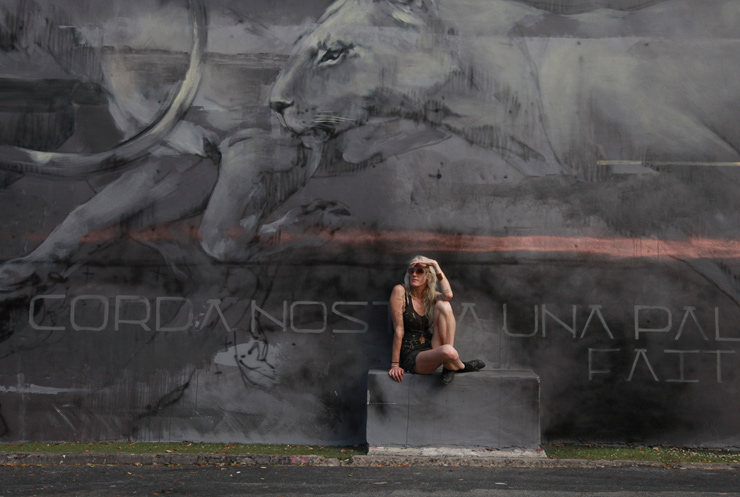
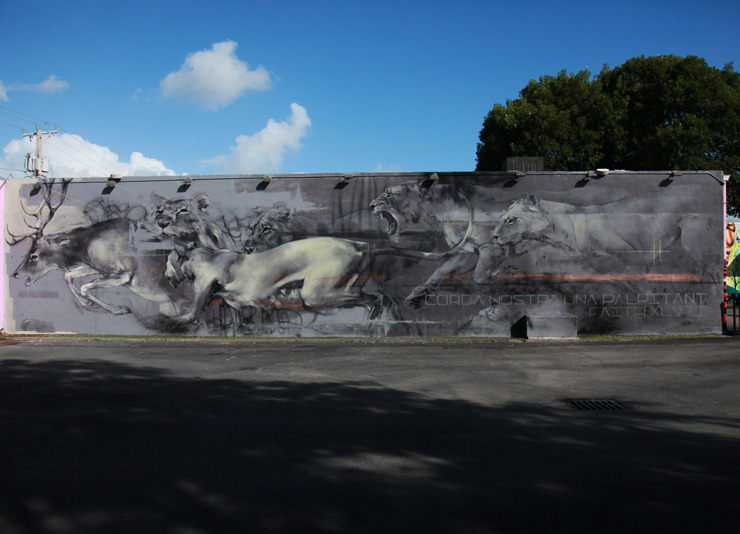
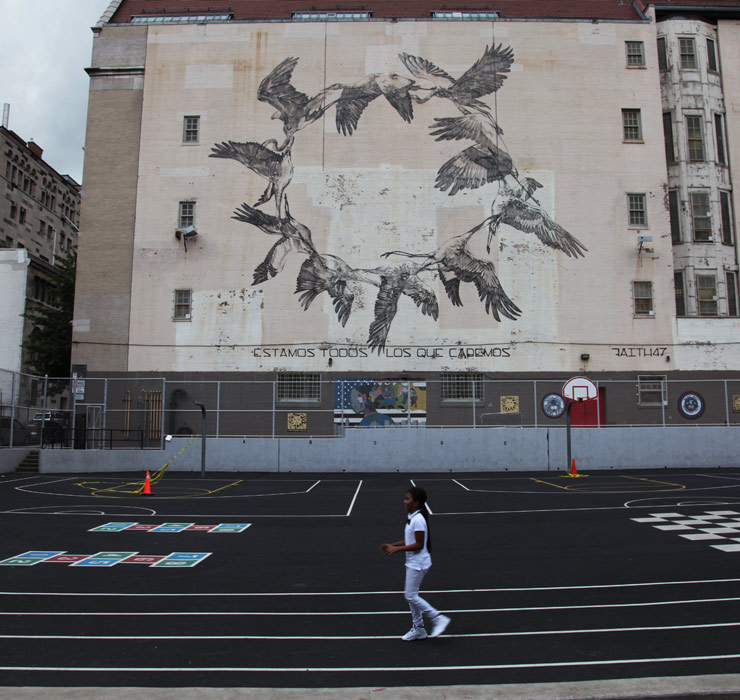
A wistful interconnectedness is a common thread through the work of South African graffiti/Street Artist/muralist/fine artist Faith47, her calm monochromatic palette in service to eloquent expressions of internal, emotional and spiritual matters.

Painting and traveling around the world for two decades, her confident virtuosity is able to communicate with quiet strength, a subtlety not often found in the urban environment.

FaithXLVII (photo © Jaime Rojo)

“Through her work, Faith47 attempts to disarm the strategies of global realpolitik, in order to advance the expression of personal truth,” says her current bio, and we spoke with her for a minute about her participation in Moniker.

BSA:How would you describe your work to someone who is seeing it for the first time?
FaithXLVII: How can one explain in words a language that is not verbal?

BSA:What’s most important to you?
FaithXLVII: These days what is most important to me is keeping a calm and centered state of mind.

FaithXLVII (photo © Jaime Rojo)

BSA:Are graffiti and Street Art allowed to change, or should there be a strict definitions they adhere to?

FaithXLVII: One can’t stop the clouds from moving. Nothing is permanent. We all know that the essence/ethos of how things started is now watered down. Nevertheless there are things that have grown out of what was. That is what interests me, the progression and evolution of certain artists who expand and refine their practice over the years.

BSA: Name one artist whose work you admire today.
FaithXLVII: Blu

FaithXLVII (photo © Jaime Rojo)


For more information please go to Moniker Art Fair HERE.

Read more
Lisbon Part II: Where Street Art is Becoming “Urban Contemporary”

Lisbon Part II: Where Street Art is Becoming “Urban Contemporary”

Street Art, graffiti, and murals are adding to the cultural character of Lisbon streets, this is undisputed. A quick tour of a museum show, a gallery exhibition, a hybrid art supply store/residency, and an artist’s studio give you an idea of the spirited and inventive contributors who are affecting the cityscape from behind closed doors as well.  Just ask artists and organizers here in the Portuguese capital a few questions and you’ll hear (and see) how the Street Art and graffiti scene graffiti scenes are also evolving to fine art and “urban contemporary”.

An Escher Show Reminds Us of His Influential Eye


Our look inside Lisbon begins with a visit to the M.C. Escher exhibition at the Museu de Arte Popular, which lays on a tract of land between Avenida de Brasília and the lapping waves of the waterfront. For some reason you always start or end near the water here, perhaps because this is where the city’s complex history brings you with nearly three centuries of international trade, culture and maritime lore forms the the foundation of this rich culture.

What brings us here today is the eclectic Dutch graphic artists work that is in our minds directly related to Street Art for a couple of reasons. A serendipitous intersection of visiting while the traveling exhibition stopped here, we had no idea that Escher’s original drawings of architecture and impossible spaces would be so handily on display for us to visually interrogate – and the artists’ wit and guile locked us into his gaze for an afternoon.
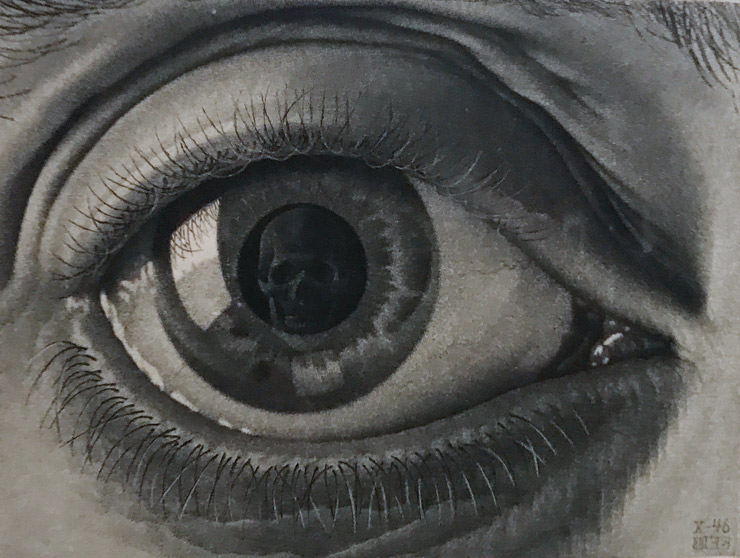
M.C. Escher. Museu De Arte Popular. Lisbon, Portugal. (photo © Jaime Rojo)

Known perhaps best for his works popularized during the surrealist and op art youth culture of 1960s and 70s, his mathematically-inspired illusions on famous rock album covers, posters, and advertisements are often reflected in the works of Street Artists today who also play with photorealism, hyperrealism, and flights of rhythmic visual fancy.
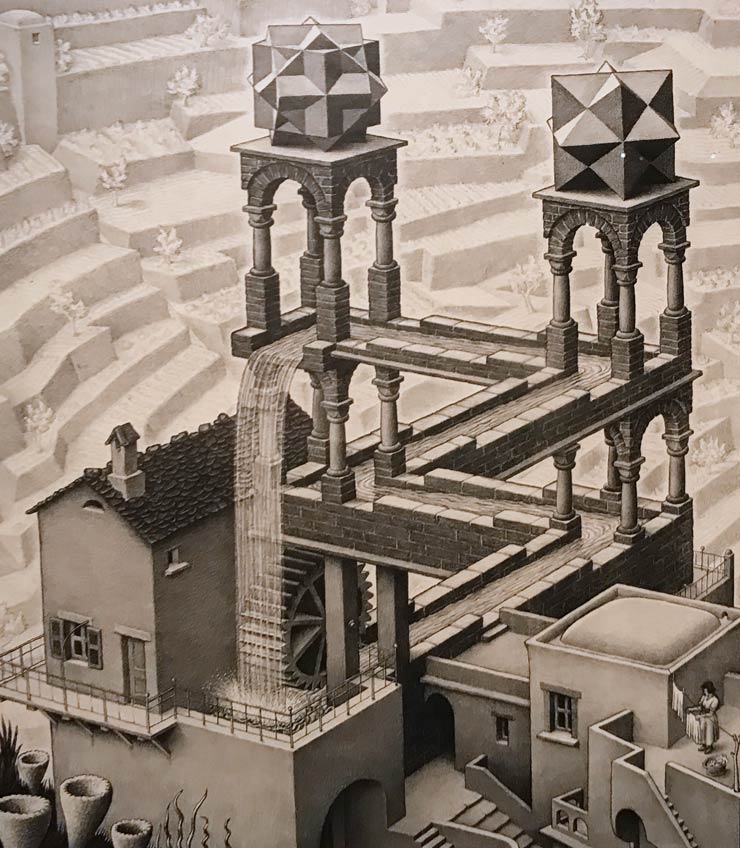
M.C. Escher. Museu De Arte Popular. Lisbon, Portugal. (photo © Jaime Rojo)

Secondly, as we had previously learned from architect Dennis Leo Hegic in Berlin, who was deeply involved in the design of the Urban Nation Museum for Urban Contemporary Art (UN) interiors, Escher’s famous drawings had inspired the museums walkway that wends its way overhead throughout the space. We were eager to examine many of the drawings which effectively play on bending perspective.

At any given point along the path of that walkway you are granted views near and far but you are unsure exactly how, and as you tour the artworks on walls you feel yourself inperceptibly rising and lowering your own angle. It may give the impression that you are in some way inside an Escher riddle yourself.
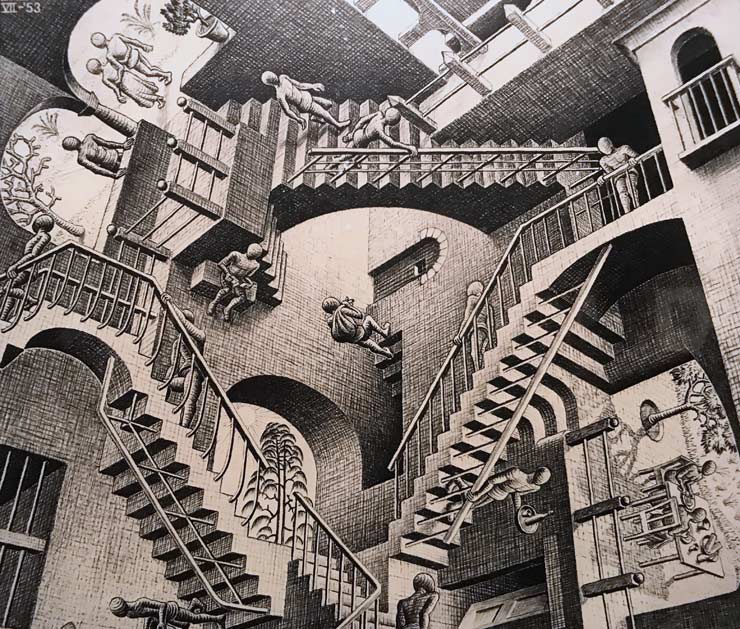
M.C. Escher. Museu De Arte Popular. Lisbon, Portugal. (photo © Jaime Rojo)

As museum curators at the UN, we were interested to see the original works of visual play that inspired the Graft Architects team to create the stunning interior of the haus in Berlin. We also better understood why Hegic refers to Graft as “the Rock´n´Rollers within the German architecture.”
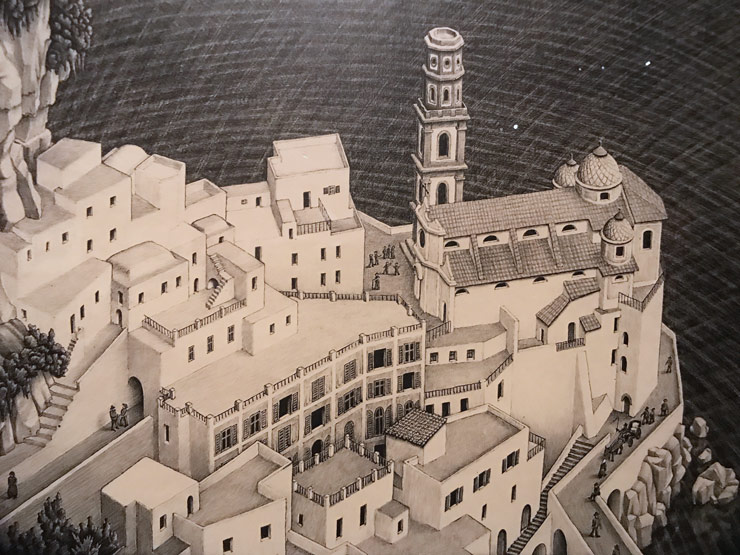
M.C. Escher. Museu De Arte Popular. Lisbon, Portugal. (photo © Jaime Rojo)

The darkened corridors of the exhibit itself seemed to play tricks on our bearings as we looked upon Eschers “subjects and patterns of mathematical precision, impossible objects, explorations of infinity, reflection, symmetry and perspective.”

Into the Gallery with Underdogs


Gallery Manager Raul Carvahlo leads us through the Mário Belém exhibition on display in the former industrial low-rise building that houses the Underdogs Gallery down by the river in an area of the city many remember for old factories and which is now becoming better known for its vast warehouses accommodating the city’s startup and coworking scene.
Mário Belém. Detail. Underdogs Gallery. Lisbon, Portugal. (photo © Jaime Rojo)

“He always has this surreal quality,” says Raul about the 50 or so paintings, reliefs, lazer wood-cut sculptures, and suspended mobile installations by Belém that surround three sides of the pitched ceilinged space. “He uses his work to express his fantasy world and he is quite gifted with a number of techniques.”

Owned and guided by one of Lisbon’s best known Street Artist’s Vhils (Alexandre Farto), Carvahlo says that the 400 sm space is meant to act as a platform that provides support and encouragement to local and younger artists as well as the bigger names.
Mário Belém. Detail. Underdogs Gallery. Lisbon, Portugal. (photo © Jaime Rojo)

As an internationally recognized portraitist known for an unusual technique of blasting away the façade of a building to reveal the personality hidden within it, Vhils and the gallery also partner with and feature the occasional international Street Artist sensation like last year’s Shepard Fairey show, where the two collaborated on a street wall. This spring a full-scale exhibition blow-out by Downtown New York 1990s Street Art icon WK Interact is happening in the gallery with a large scale work also on the street.

Since the Underdogs space opened in 2013 and the initiative began in 2010, Vhils and company have invited a powerhouse parade of former or current Street Artists like Nunca, Sainer, Finok, Okuda San Miguel, How Nosm, Pixel Pancho, Remed, Cyrcle, Anthony Lister, and Felipe Pantone to mount shows and murals here – effectively putting the city on the map for high-quality international urban contemporary art.
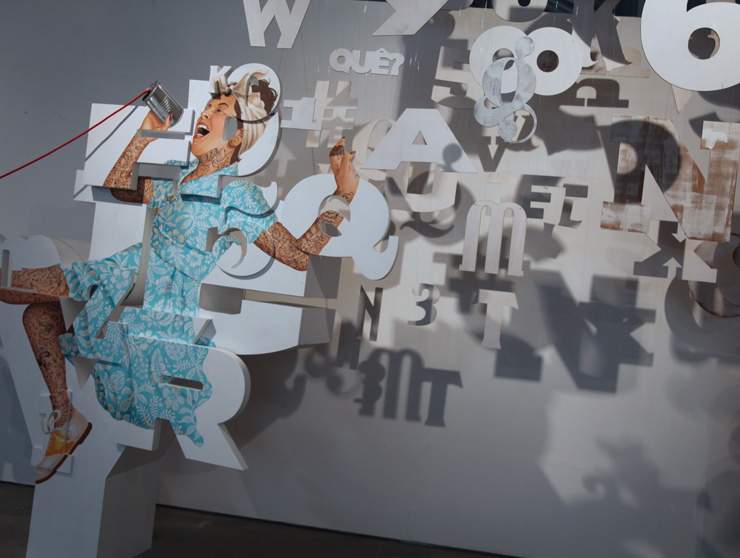
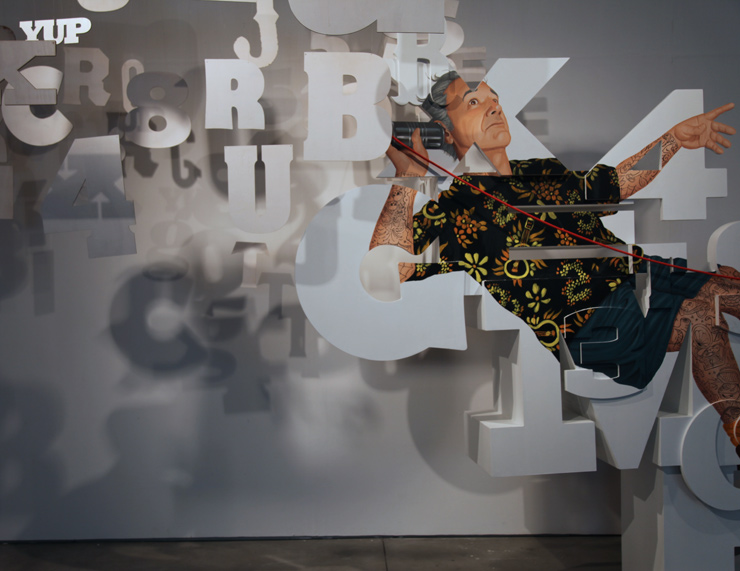
Mário Belém. Detail. Underdogs Gallery. Lisbon, Portugal. (photo © Jaime Rojo)

Notably Underdogs has also provided their platform to more conceptual artists in the Street Art/public art scene like Pedro Matos, Wasted Rita and ±MaisMenos±, perhaps indicating a healthy respect for cerebral engagement and interventions that are not primarily aesthetic.

Among the local talents, the gallery also gives support to artists like André da Loba the illustrator and sculptor known for his 2-D emblematic works in publications like the New York Times and Washington Post as well as the illustrator AkaCarleone, a 33 year-old Portuguese former graffiti writer now commercial illustration/graphic artist who has worked commercially with a number of international brands. He has also created a municipal wall mural in the city and elsewhere.
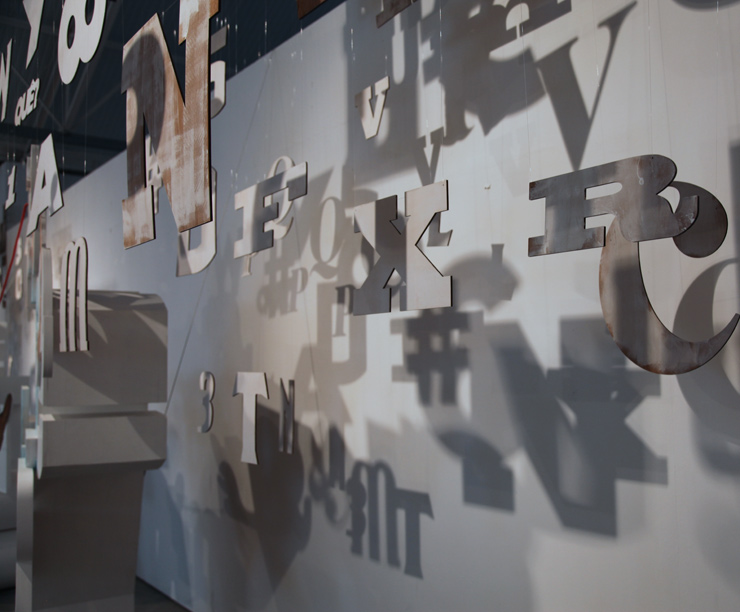
Mário Belém. Detail. Underdogs Gallery. Lisbon, Portugal. (photo © Jaime Rojo)

“We’ve been working with him for quite a few years now and in 2018 we will be doing a big show with him,” says Raul of the poppy bright politics-free collages of typography, characters, and geometric forms. Later when touring with Carvalho through Lisbon streets we see on a rising hillside in the more historic part of town a large mural by AKACarleone overlooking the valley below, visible from many vantage points.
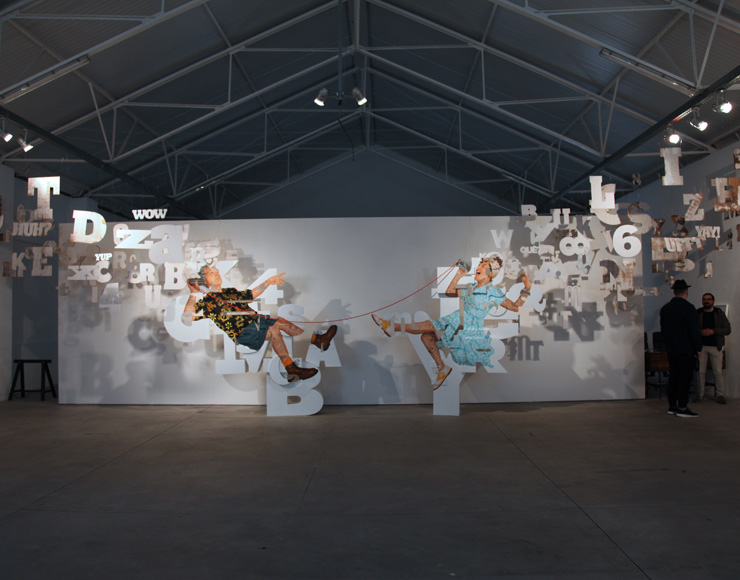
Mário Belém. Underdogs Gallery. Lisbon, Portugal. (photo © Jaime Rojo)

Propaganda Posters, Art Supplies, and Street Art Tours


As a more accessible and commercial extension to the brand The Underdogs Gallery works collaboratively with their storefront space on Rua da Cintura in Porto de Lisboa only a 15 minute drive along the waterfront from here.
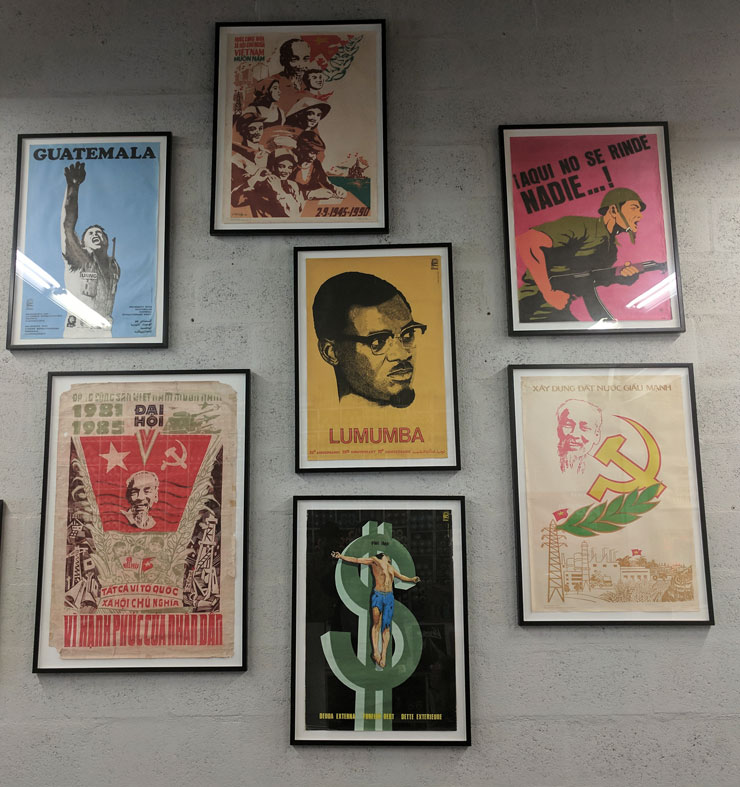
20th Century Propaganda Posters culled from the personal collection of Alexandre Farto AKA VHILS exhibited at the Underdogs Store. Lisbon, Portugal. (photo © Steven P. Harrington)

Shaped like a red brick channel that opens on one end into the Tagus River estuary that flows past into the Atlantic, the Underdogs store is part art supplies, print store, exhibition space, café, and mural tour company. In addition it just happens to have two small artist residencies above looking over (and on display for) art fans and tourists who make the small spot into a bustling and vibrant hub.
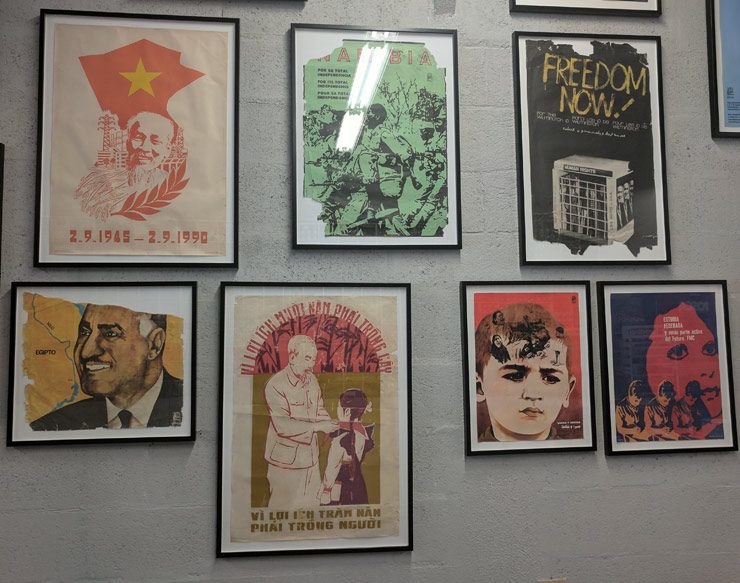
20th Century Propaganda Posters culled from the personal collection of Alexandre Farto AKA VHILS exhibited at the Underdogs Store. Lisbon, Portugal. (photo © Steven P. Harrington)

Raul tells us it is a family affair for Farto, with a father in business who acts as integral advisor and guide as Vhils continues to expand an international presence and nutures the business on many aspects of Street Art-graffiti-contemporary art here.

A member of an early 2000s loosely formed artist collective called Visual Street Performance that held annual exhibitions, a co-organizer of the seminal Crono Project in 2010/11 with Pedro Soares Neves and Angelo Milano, and more recently co-curator of the MURO Urban Art Festival, his is a formidable creative force that influences the flow of this multi-player and quickly professionalizing scene.
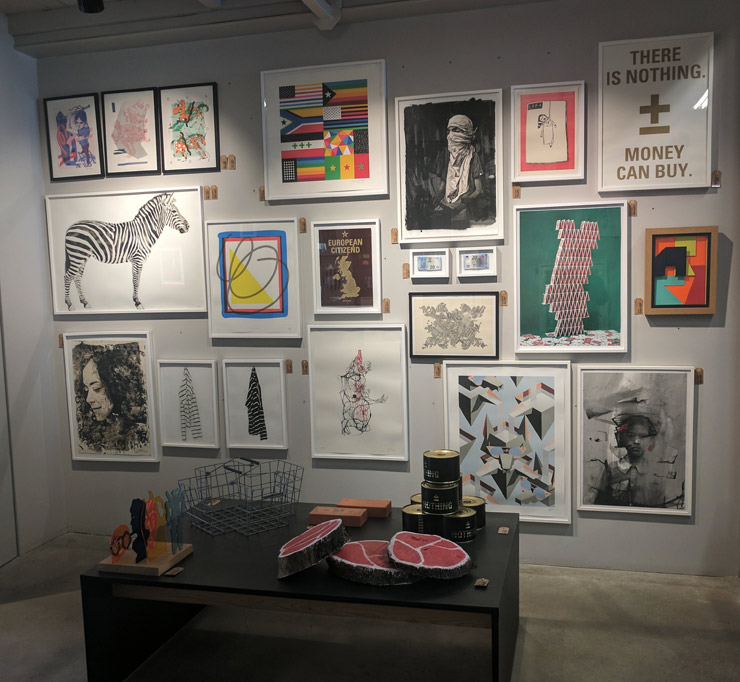
Prints for sale at the Underdogs Store. Lisbon, Portugal. (photo © Steven P. Harrington)

Beginning as a graffiti vandal writing his name in Seixal on the outskirts of Lisbon, Vhils now works with the government on occasion to facilitate public art projects and uses his own high profile art practice to spread socio-political goodwill internationally while proudly promoting his own heritage and city.
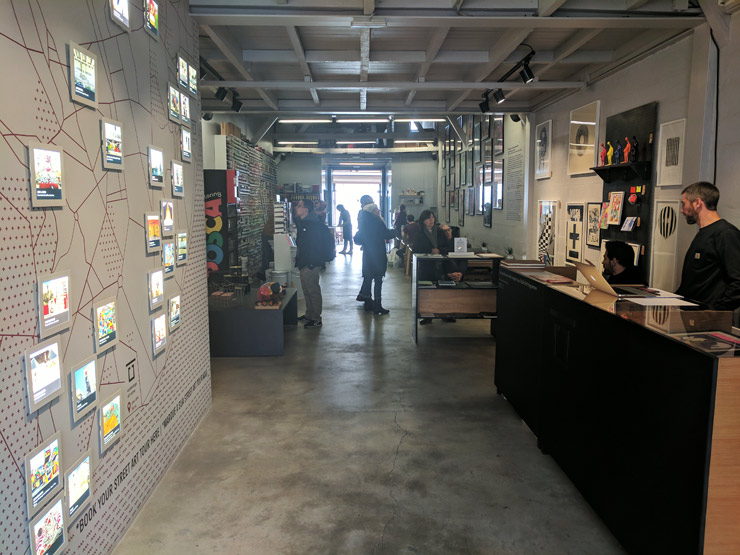
Underdogs Store on the foreground with the Montana store on the background sharing the same space. Lisbon, Portugal. (photo © Steven P. Harrington)
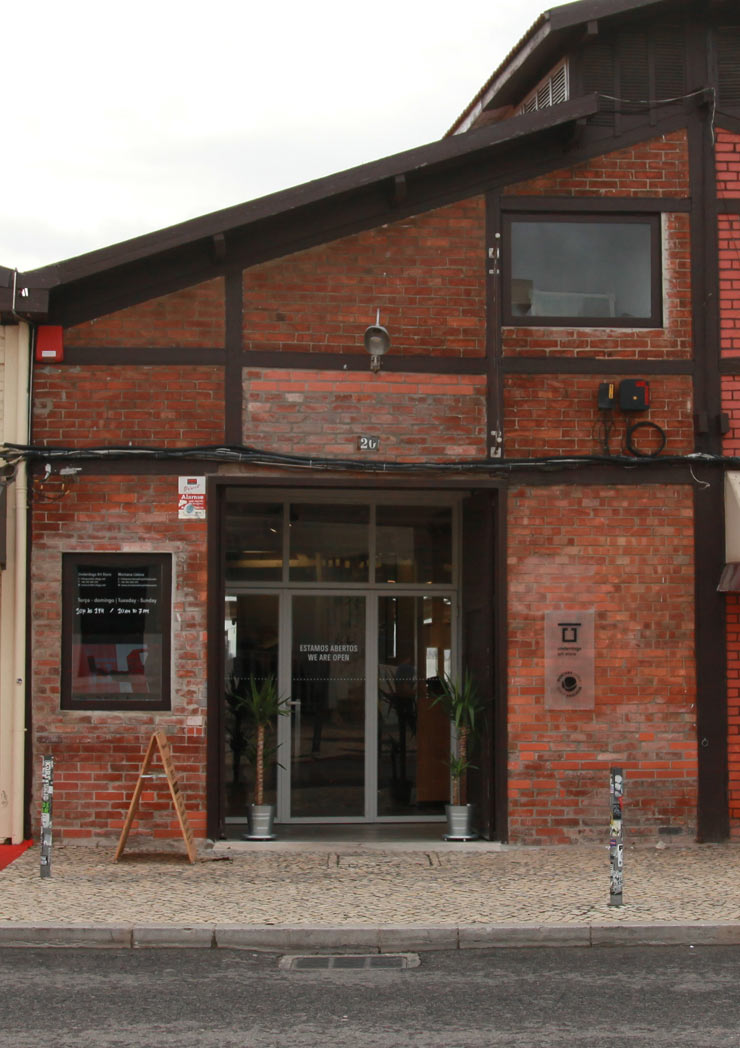
Underdogs Store. Lisbon, Portugal. (photo © Jaime Rojo)

In Studio with Add Fuel


Another local talent that Underdogs works with is Diogo Machado, otherwise known as Add Fuel. A trained graphic designer and illustrator well versed in the language of skating and his own youth as a graffiti writer, he’s become known internationally for his characters and his large-scale stencil-painted murals that incorporate the classic and traditional visual patterning of Portuguese tile work, or Azulejo.

On an overcast day his buddy and slightly younger peer, the sculptural Street Artist who works with recycled trash, Bordallo II, offers to take us to Cascais, a coastal town 30 kilometers west of Lisbon, where Add Fuel lives and has his studio.
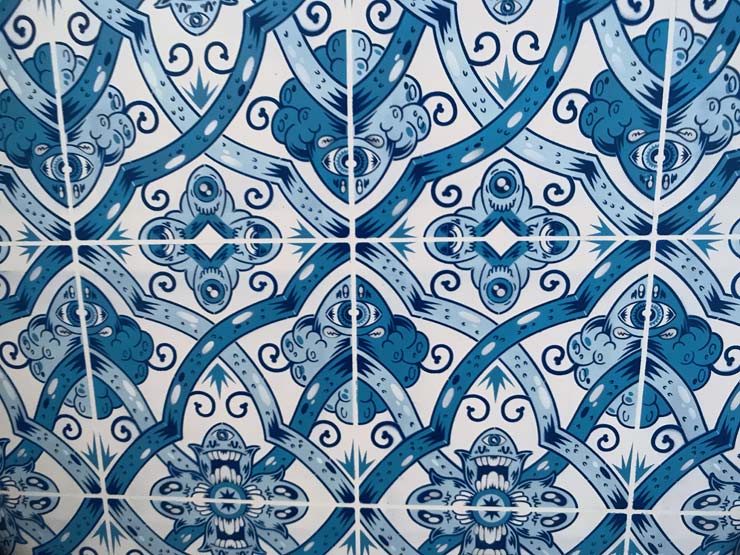
Add Fuel. Studio Visit. Cascais, Portugal. (photo © Jaime Rojo)

The brightly lit and spotless split level studio has a public viewing room in the front and his office/studio in the back, where a firing kiln that Bordallo II likes to experiment with sits in the corner. The two of them assemble a number of materials together and load them into the kiln while we gaze at the primarily blue and white artworks of symmetrical repetitions interspersed with Pop and cartoon elements that he is better known for in galleries.

While we visit the two of them break off into rapid-fire Portuguese conversations about some collaborative projects they are working on – and we learn that Add Fuel often gives his rejected tiles and discards to the recycling Bordallo II. “For me there are no mistakes,” says Bordallo II, “I love mistakes.”
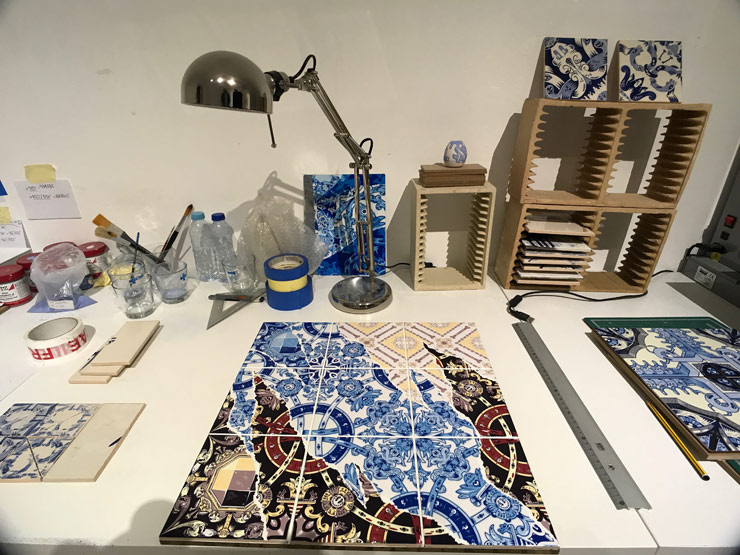
Add Fuel. Studio Visit. Cascais, Portugal. (photo © Jaime Rojo)

Add Fuel shows us screen prints, giclee high definition prints, lithographs, and multi-tile mounted works that he has for sale or is shipping to galleries and art fairs throughout Europe and the US. He even has created textiles – covering a chair using a technique called sublimation on fabric to reproduce the patterning of his tile creations.

“I think I have a lot of inspiration from cartoons and from 80s skate culture,” he says. “I also like Jim Phillips’ work. He made so many great skate graphics at that time. I sort of mix and match and create my own cartoon style. There are always some elements that people will recognize like some Disney character’s hands or some old cartoon characters’ eye but they are all sort of mixed together.”
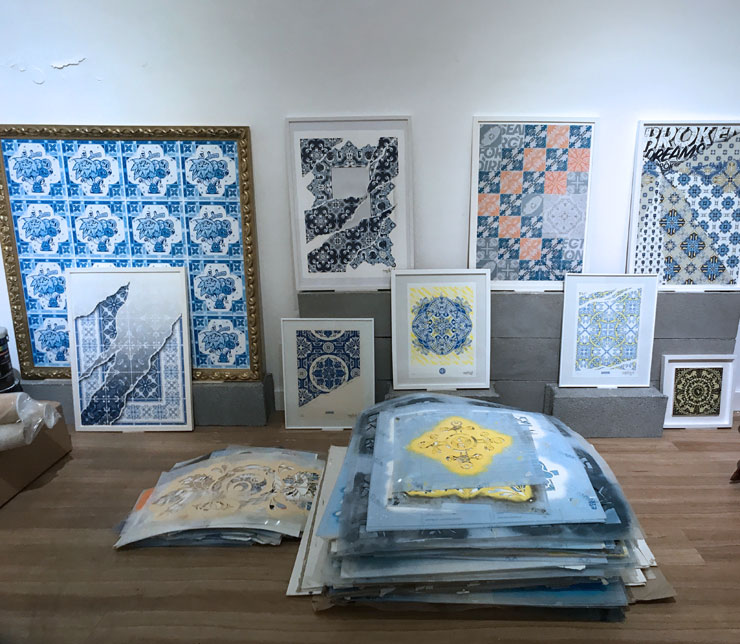
Add Fuel. Studio Visit. Cascais, Portugal. (photo © Jaime Rojo)

Working with the DNA strands of Portuguese design that go back centuries may scare some artists, but Add Fuel considers it an inheritance that he respects and has the latitude to mess with to make it accessible to modern audiences.

“I also use similar elements of the original tiles,” he says showing you the tiles that Lisbon buildings are skinned in. “Like this geometric one is a very traditional Portuguese or Mediterranean pattern and I just added some small details, why not?”
Add Fuel. Studio Visit. Cascais, Portugal. (photo © Jaime Rojo)

Bordalo II interjects, “You just f**ked it up.” The chide is answered rapidly.

“Yeah I just steal stuff, you know?,” Add Fuel retorts playfully. “Its not all from my imagination, I just stole it.”
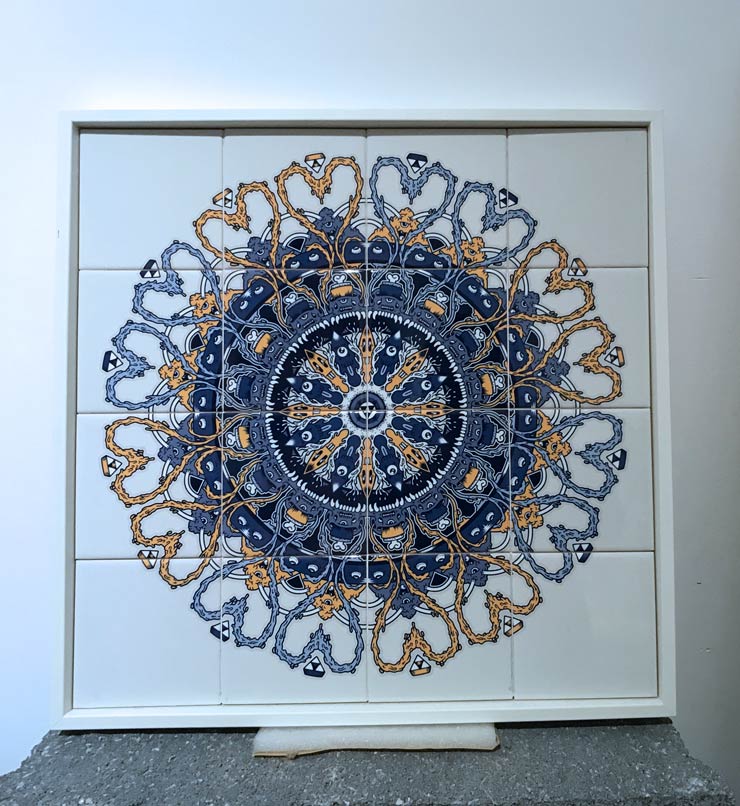
Add Fuel. Studio Visit. Cascais, Portugal. (photo © Jaime Rojo)

Then he turns to another tile work. “This one here is actually a two model pattern – is based on 13th century Portuguese leather work- small details that were in leather belts. But once tile making began the tile makers often took patterns from leather making and iron making as well. So many of the ornamental aspects that you see in tiles come from other artisans as well. I also grabbed them and then made them into something new.”

This moment is ripe for art in the streets for Lisbon, and based on the conversations we had and the artists and curators we met in galleries, museums, and studios, the collaborative action inside the door is as lively as the stuff out in public.


With most gratitude to Raul Carvalho, General Manager of Underdogs Gallery and to Pedro Soares Neves for taking the time to talk to us, for sharing their knowledge and insights with us and for showing us around Lisbon. Sincere thanks as well to Diogo Machado AKA Add Fuel for letting us visit his studio and for Bordallo II for taking us there.



This is the second of two articles with BSA in Lisbon in collaboration with UN Berlin, it was originally published on the Urban Nation website, and the project is funded in part with the support of Urban Nation Museum for Urban Contemporary Art (UN) in Berlin.

Read more
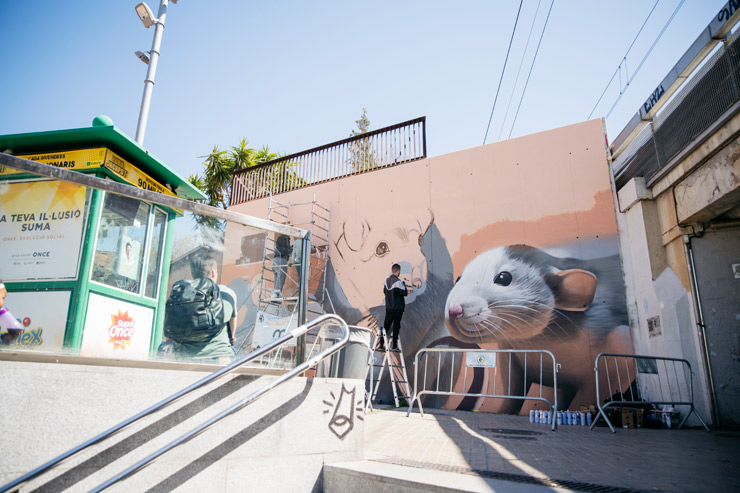
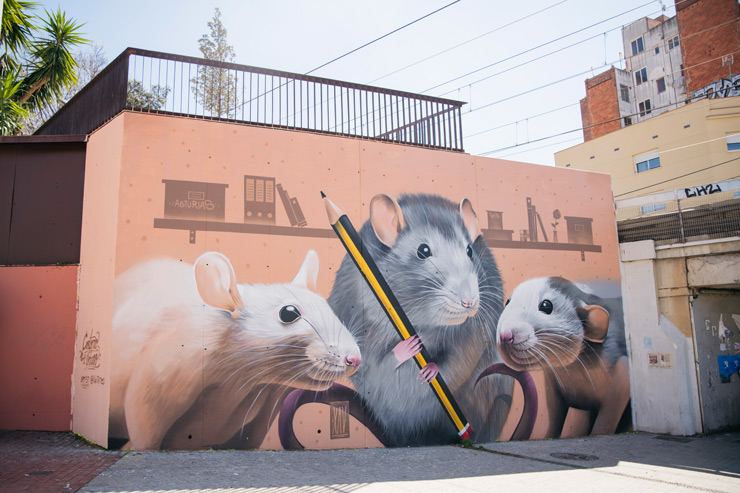
3 Library Rats from XAV for Contorno Urbano 12 + 1

3 Library Rats from XAV for Contorno Urbano 12 + 1

“I was a library rat. Libraries are the mainstays of democracy. The first thing dictators do when taking over a country is close all the libraries, because libraries are full of ideas and differences of opinion, all the things we say we want in a free and open society.”

– novelist David Baldacci


XAV. “The 3 Rodents” Contorno Urbano Foundation. 12 + 1 Project. L’Hospitalet de Llobregat, Barcelona. (photo © Clara Antón)

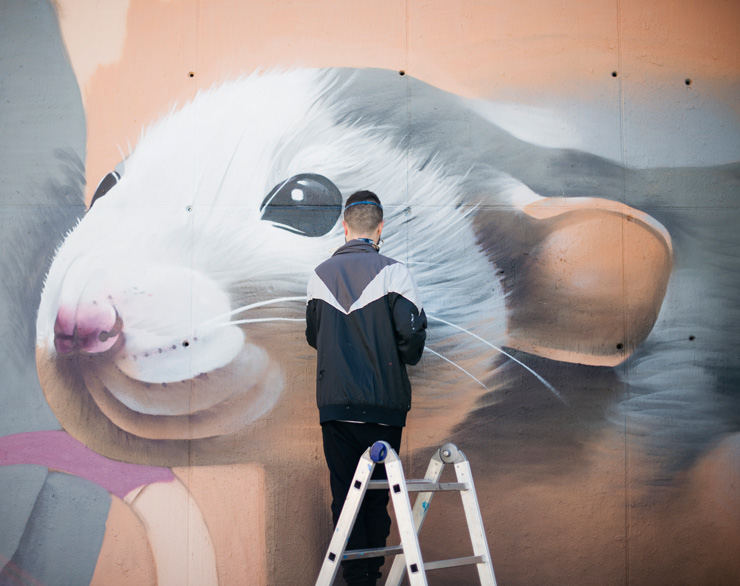
Spanish graffiti writer and tattoo artist Xav gives his own literal interpretation of the saying ‘library rat’ here in his new mural for Project 12+1 in Barcelona. Beginning with graffiti as a teen in Asturias (northern Spain) in the mid 2000s Xav has since honed a photorealist style on walls that has given him many commercial opportunities and taken him to participate in Street Art and graffiti festivals.

XAV. “The 3 Rodents” Contorno Urbano Foundation. 12 + 1 Project. L’Hospitalet de Llobregat, Barcelona. (photo © Clara Antón)

But that doesn’t mean Xav doesn’t appreciate the folks who hang out in libraries and the value they have to everyone – he actually studied and taught himself most of what he knows about his craft. He also gives respect to the graffiti tradition and to his peers; if you look closely you may see the name of the recently passed graffiti writer Treze hidden in the mural, along with a shout out to his hometown of Asturias.

XAV. “The 3 Rodents” Contorno Urbano Foundation. 12 + 1 Project. L’Hospitalet de Llobregat, Barcelona. (photo © Clara Antón)

XAV. “The 3 Rodents” Contorno Urbano Foundation. 12 + 1 Project. L’Hospitalet de Llobregat, Barcelona. (photo © Clara Antón)

XAV. “The 3 Rodents” Contorno Urbano Foundation. 12 + 1 Project. L’Hospitalet de Llobregat, Barcelona. (photo © Clara Antón)

Read more
BSA Images Of The Week: 04.22.18 – Focus on BKFOXX

BSA Images Of The Week: 04.22.18 – Focus on BKFOXX

BSA-Images-Week-Jan2015

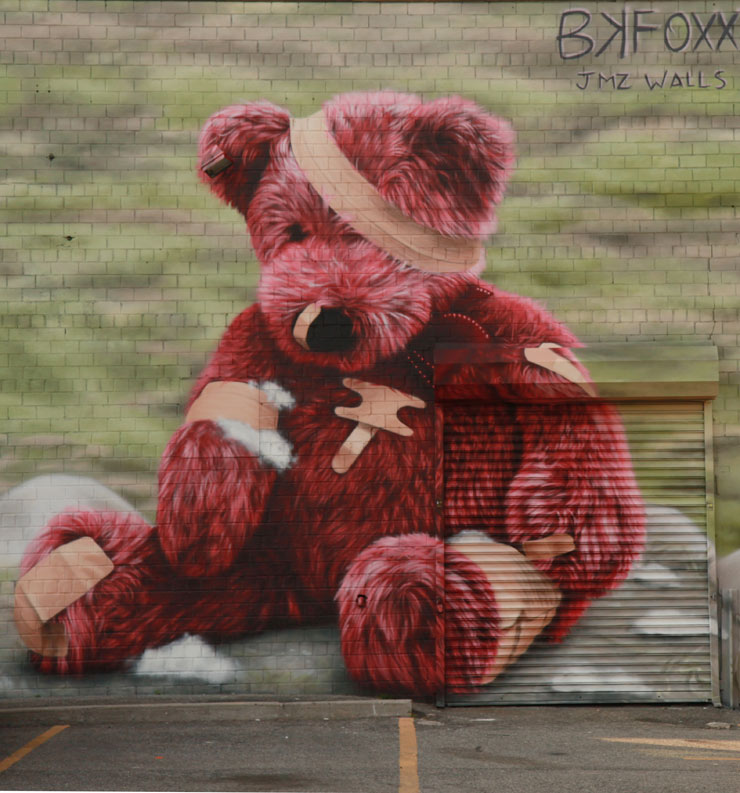
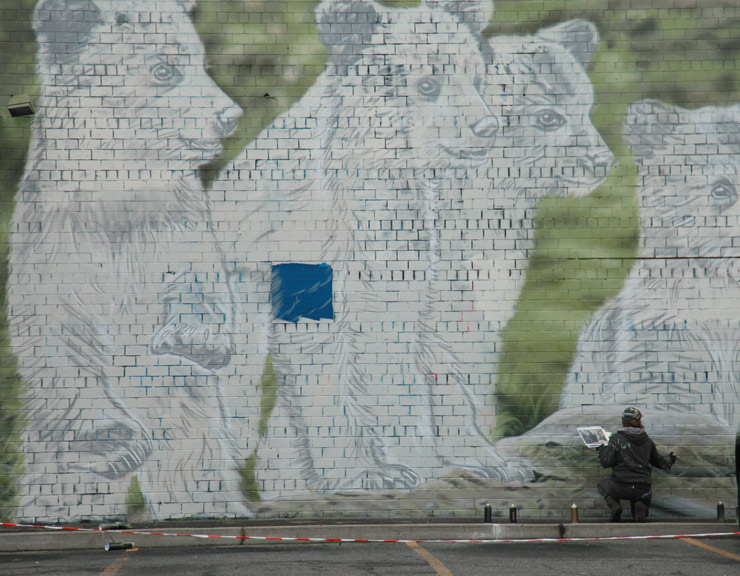
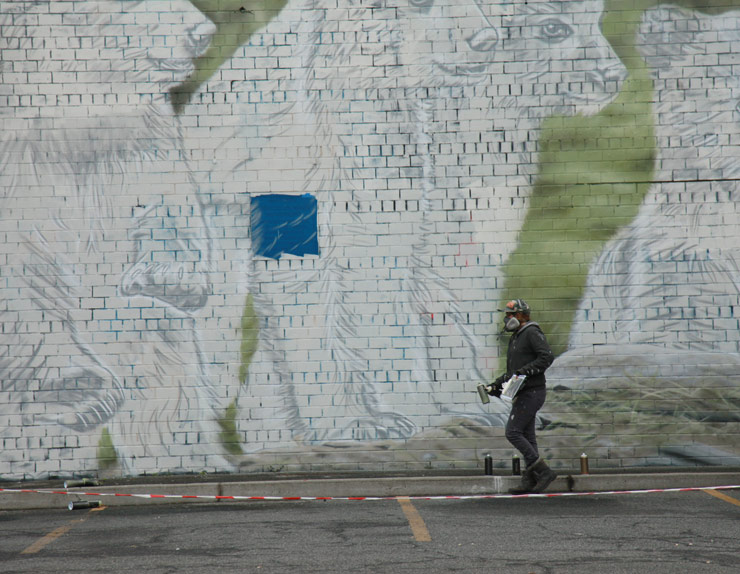
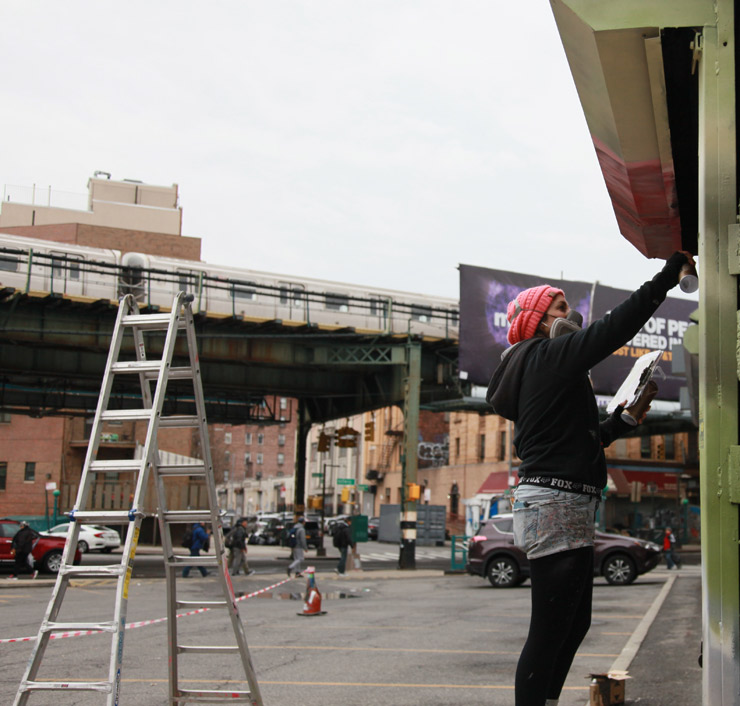
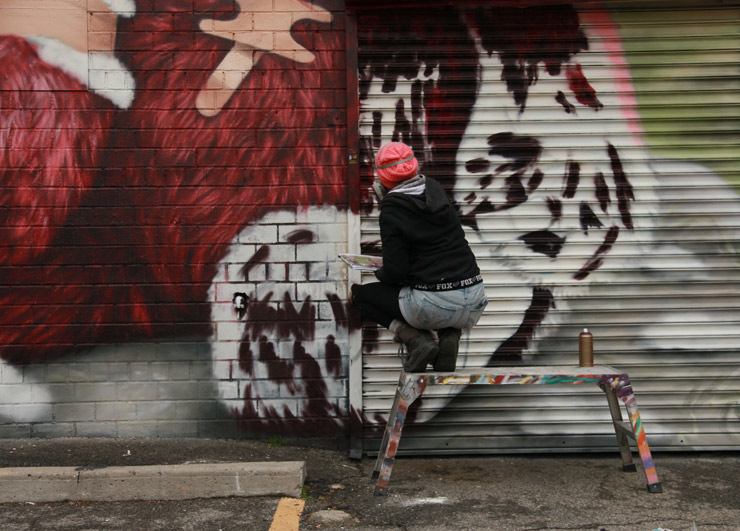
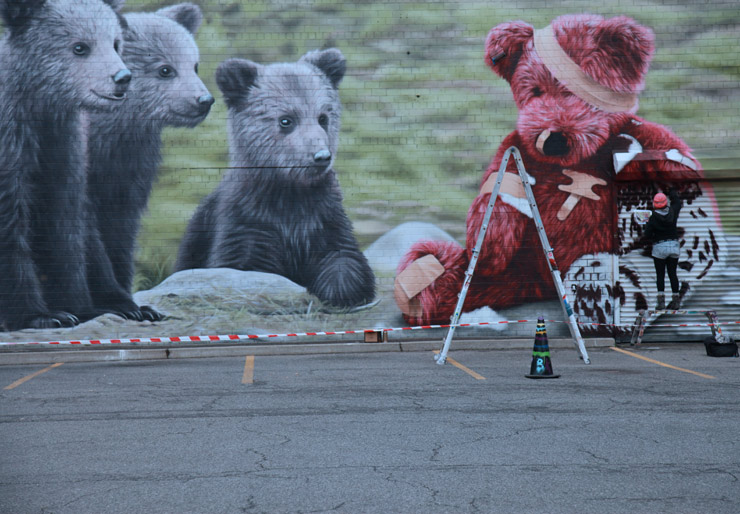
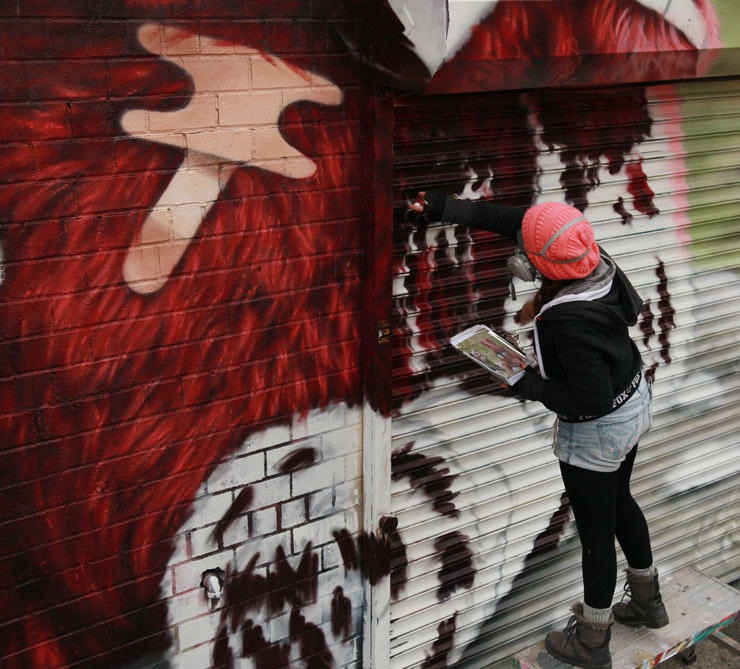
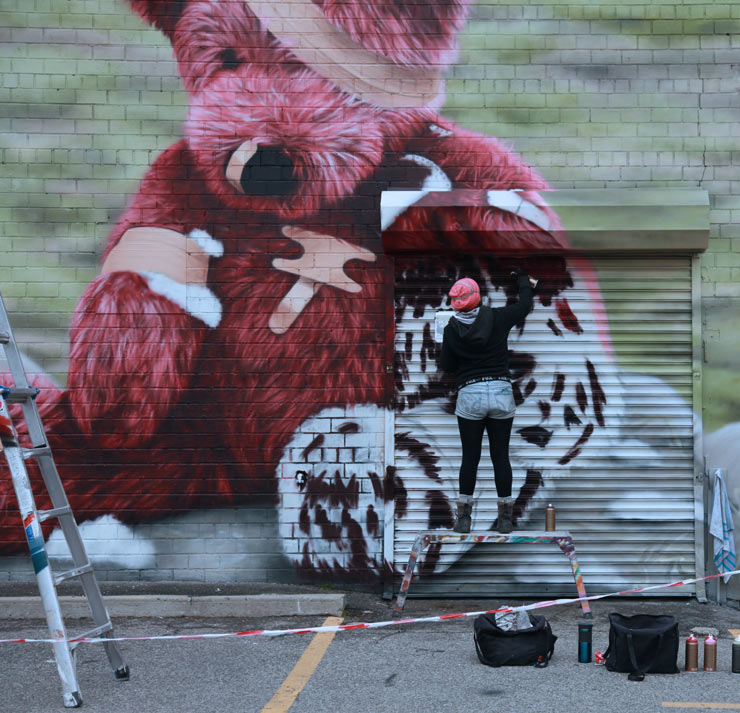
Welcome to BSA Images of the Week. Normally on Sunday we give you a hit parade of different pieces on the street so you can stay connected with the movement on the street. This Sunday we are looking at work-in-progress images of just one large piece by New York Street Artist BKFoxx, one artist of the current mural-making generation who draw inspiration from advertising, pop culture and photography, melding them together into a polished photo-hyperrealism.

An occasionally formally trained artist who joins the many professionally skilled artists who have put in the time on the current legal mural wall scene. Now travelling the world to paint at festivals as well as putting up walls in NYC, she is frank about her current home in Long Island and her roots, recently telling Graffiti Street “I’m from the suburbs. I was raised in a culture vacuum, so I’m just trying to learn as I go. It’s terrible.”

BKFOXX. Detail. JMZ Walls. Bushwick, Brooklyn. (photo © Jaime Rojo)

It is a disarming admission perhaps for the hardcore graffiti scene that once characterized the New York street, but an otherwise perfect position for a globalized cultural hierarchy that been flattened by ubiquitous digital communications that obliterate boundaries. It’s a healthy message: we’re all trying to learn so bring your best game.

We have found a certain refreshing straightforward attitude among the late Millenials and first outliers of Gen Z that is not defiant to that “old” street order necessarily. Instead they seem ready to face the New Order of late capitalism with the communication tools that they have gathered and refined along the way.

BKFOXX. WIP. JMZ Walls. Bushwick, Brooklyn. (photo © Jaime Rojo)

While there has been a lot of hand-wringing by critics from the 1st wave (80s-90s) and 2nd wave (90s-00-10s) of graffiti/Street Art over the exploding mural movement for reasons rooted in hard-won scrappy street cred (and some nostalgia) no one is debating the New Muralisms’ powerful impact worldwide on public space, even if there is not yet appreciable critical discourse. From the old rebels turned gatekeepers there is a guarded and qualified appreciation yes, but probably not enough props are given for the new space that this muralism is creating for more artists and voices.

With a commercial eye toward the natural world and larger societal issues BKFoxx chooses subjects for their emotional impact and their ability to translates easily for an image-savvy audience whose endless hours of personal screen entertainment has produced an expectation for big budget Hollywood and consumer culture slickness with high-production values.

BKFOXX. WIP. JMZ Walls. Bushwick, Brooklyn. (photo © Jaime Rojo)

With much consideration and dedication to the craft of painting as well as content, this can be seen as a departure from the hit-and-run Street Art culture of a decade ago, one that can only be accomplished with many hours and days on a legal mural.

BKFoxx sees with a photographers eye and sometimes directs the image to address subtext, even with biting critique: an American movie/tv culture that normalizes violence, the consumer acquisition mindset that reduces human interactions to superficiality, our disrespect for the same Earth that we depend on. It’s a credence built around the metaphoric image, whether with direct agenda or not, and BKFoxx is gifted at crafting some the strongest ones to communicate.

BKFOXX. WIP. JMZ Walls. Bushwick, Brooklyn. (photo © Jaime Rojo)

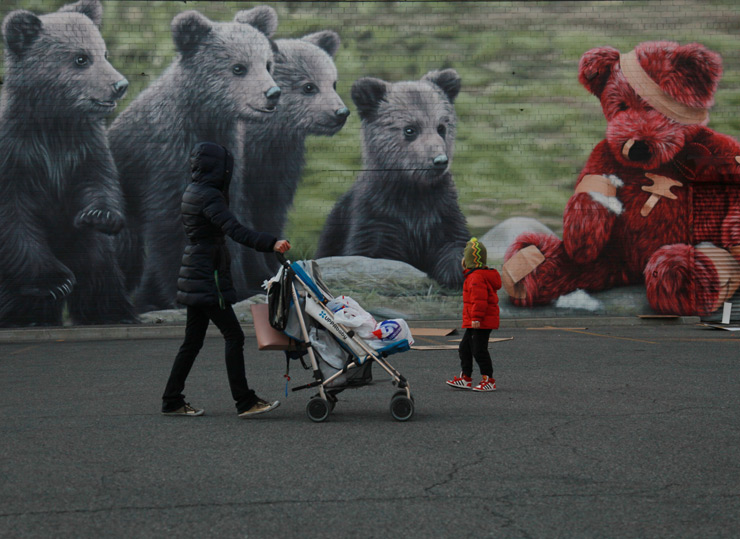
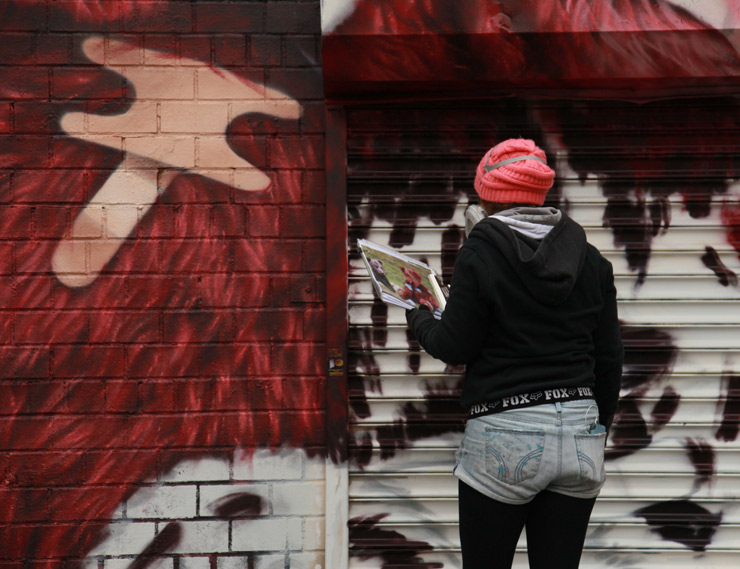
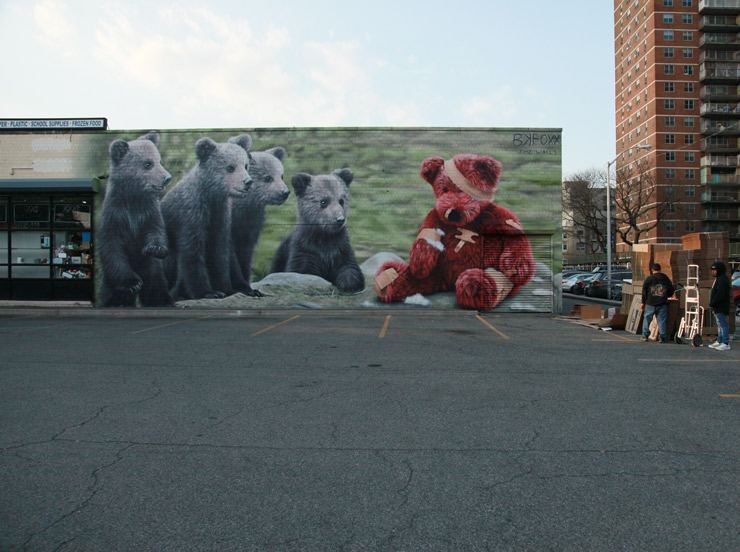
We spoke with her this week about her newest mural in Brooklyn, a fictionally realistic scene of actual bear cubs looking with curiosity at a patched up toy bear. We asked her a few questions in between her breaks.

BSA: The animals depicted in your work have the feel as if you personally know them. Do you know some of them?
BKFoxx: Some of them. The less wild ones. I try to take my own photos as much as possible, but it’s tough when you’re painting a grizzly bear.

BSA: How do you communicate with animals – through conversation?
BKFoxx: You communicate with animals the same way you do with someone who doesn’t speak a word of your language. And it’s difficult, but when you have a moment of understanding between you, it’s one of the best feelings.

BKFOXX. WIP. JMZ Walls. Bushwick, Brooklyn. (photo © Jaime Rojo)

BSA: What do you think will happen when wildlife runs out of space because of increasing encroachment of human displacement of their habitat?
BKFoxx: I don’t know. I hope it doesn’t come to that. I think the thing people seem to miss is that their environment is everything around them, not one person or one place, but everyone and everything. Nobody lives in a vacuum. We are all affected by the world, no matter how far it seems from us sometimes. Taking care of the environment is taking care of ourselves.

BSA: There’s realism in your work but it goes beyond that. Your pictures are often imbued with social commentary. How did you become interested in social issues and why is so important for you to give them voice on your work?
BKFoxx: Social issues are just human issues. I paint things that I think, that I feel, affect me or people I care about. It’s actually hard for me to paint sometimes unless I am able to speak through it, I need to feel like there’s a reason for the work. And like I mentioned in the last answer, your environment is everyone. If I can improve the lives of the people around me, the quality of my own life will improve. And the world is so small these days, everyone is not too far away.

BKFOXX. WIP. JMZ Walls. Bushwick, Brooklyn. (photo © Jaime Rojo)

BSA: There’s also a mild sense of humor in your work, a gentle wit about it. Do you agree and if so can you talk about it?
BKFoxx: Part of the challenge for me is being able to say something important and profound but also keep the image itself light. I want you to want to look at it and find it aesthetically pleasing, even it’s about something kind of negative. And I like things that are tongue in cheek and clever – life without a sense of humor is pretty terrible.

BSA: What is the biggest challenge to painting outdoors in the city besides the weather?
BKFoxx: Being (usually alone) in an uncontrolled environment and trying to focus all my energy on working at the same time. And honestly, being a female. But only because people take so many more liberties when interacting with women than men. I know people, mostly strangers wouldn’t be sneaking up on me and hovering a foot above my shoulder or grabbing me for a photo if I were a dude.

BKFOXX. WIP. JMZ Walls. Bushwick, Brooklyn. (photo © Jaime Rojo)

BSA: Who was your biggest influence when you were growing up?
BKFoxx: My dad. He is one of the best people I’ve ever met, everyone loves him – I’m very lucky to have him. He has always been incredibly supportive of anything I’ve wanted to do, and he really genuinely doesn’t care what I do as long as I am happy.

We used to play John Madden football on our Sega when I was a little kid. He would beat the crap out of me, and then at 60-0 he’d let me score and pretend I did it myself. I’d celebrate for a second, and then catch him smiling and throw a tantrum that he gave me any free points, which then made him laugh really hard. He’s my guy.

“Thanks so much to everyone who came to the opening and to everyone who supports my work!”

BKFOXX. WIP. JMZ Walls. Bushwick, Brooklyn. (photo © Jaime Rojo)

BSA: When you paint you listen to music. What’s on your play list?
BKFoxx: All kinds of stuff, depends on my mood. I have a classical playlist, a hip hop playlist, an alternative playlist – just having something going helps me focus and block out the world around me a little bit.

BSA: Have you ever lived someplace else besides Long Island?
BKFoxx: I was born on Long Island and have always lived there – although I won’t always live in NY. I keep moving closer to the boroughs but New York City life is expensive and small – I need some space for paint. So sometimes I feel like I live in Brooklyn during the day and sleep on Long Island at night.


BKFOXX. Detail. JMZ Walls. Bushwick, Brooklyn. (photo © Jaime Rojo)

BKFOXX. JMZ Walls. Bushwick, Brooklyn. (photo © Jaime Rojo)


LowBrow Artique is currently hosting a small exhibition by BKFoxx and she has created a limited edition print called “The Long Road Ahead ” for it.


Read more
Icy & Sot x Moniker x BSA

Icy & Sot x Moniker x BSA

In advance of Moniker in Brooklyn this May, we are interviewing some of the artists who are influenced both by street practice and fine art as the contemporary urban art category continues to evolve. Today, BSA is talking to Icy & Sot.

Human rights, ecological justice, and socio-political issues dominate the world news with regularity and brothers ICY & SOT have found an original dual voice to address them on the street in places like the US, Iran, Germany, China, Norway, even Tbilisi, Georgia.
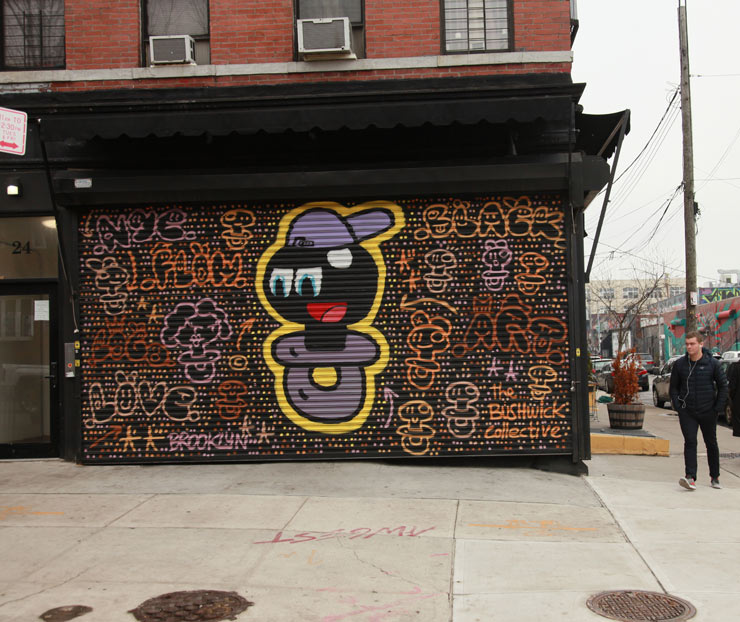
Iranian born and bonifide Brooklyn peeps for the last four years, these twenty-something guys started out on skateboards in Tabriz and still take them from their apartment to their studio in Bushwick. They have also taken their stencil work, interventions, murals and video installations into the street, the gallery, the museum, and private collections.

Icy & Sot (photo © Jaime Rojo)

Grabbing and holding hard to tenants artistic freedom without censorship, their minimalist style of discourse hits directly without the scolding tone of some overtly political work on the street, allowing the simplicity of the situation to speak for itself.

BSA: How would you describe your work to someone who is seeing it for the first time?
ICY & SOT: We do different type of works, but if we wanna to describe something in general it is that it’s simple and has a message that is easy to understand.

BSA: What is your intersection with Brooklyn and it’s history of Street Art and graffiti?
ICY & SOT: We love Brooklyn because of its diversity and the energy in the city. We feel lucky to be living and working in a city with a rich history of graffiti and street at and art in general – and being part of it now.

Icy & Sot (photo © Jaime Rojo)

BSA: What’s most important to you?
ICY & SOT: Beers 🙂

BSA: Are graffiti and Street Art allowed to change, or should there be a strict definitions they adhere to?
ICY & SOT: Everything is allowed to change

BSA: Moniker says your work has been influential and/or fundamental to urban & contemporary art’s growth. Can you see their point?
ICY & SOT: Yes, maybe

BSA: Name one artist whose work you admire today.
ICY & SOT: John Fekner

Icy & Sot (photo © Jaime Rojo)


For more information please go to Moniker Art Fair HERE.

Read more