Asbury Park has always had a taste for spectacle. From its late-19th-century beginnings as a seaside resort to the vaudeville performers, amusement rides, carousel music, carnival attractions, and rock-and-roll legends that followed, this stretch of the Jersey Shore has long invited people to become part of the show.
The old boardwalk architecture still carries some of that theatrical swagger, and the salt air supplies an atmosphere that no stage designer could quite reproduce. This September, with the Sea.Hear.Now music festival brought thousands to the beach for performances by the Strokes, Pixies, Fontaines D.C., and others, the city once again became a gathering place for music, public art, and the magical, quirky, spontaneous street-level encounters that make seaside towns particularly entertaining.
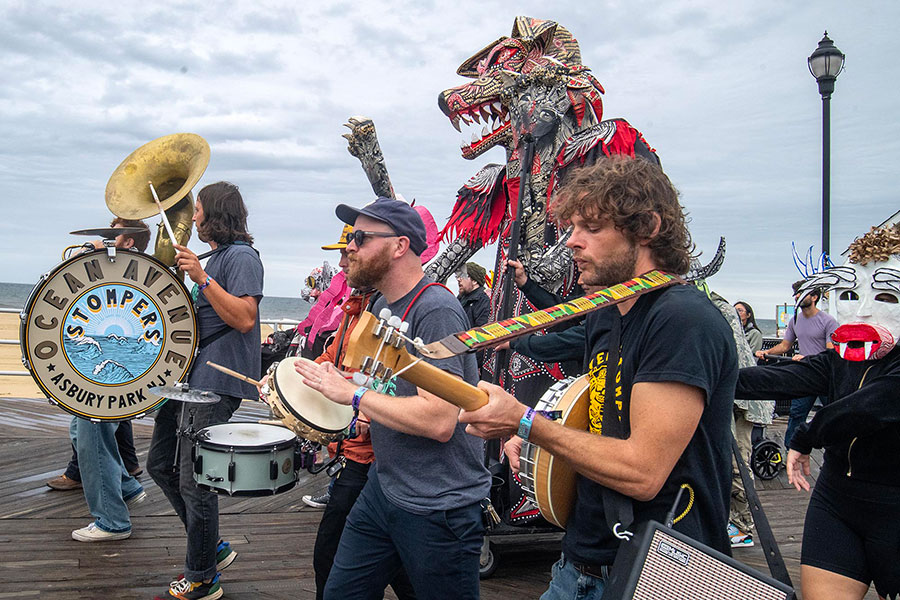
Into that atmosphere came Dennis McNett’s fourth annual March of Medusa, a glorious and somewhat unruly procession of fantastical creatures, handmade masks, flags, and mythological characters brought to life by artists and community participants. McNett, whose Wolfbat creations draw on woodcut traditions, folklore, and the communal rituals of carnival, was joined by artists Swoon, Adam Wallacavage, Jodi Rice, Steve Olson, Jude Harzer, and others who contributed masks and sculptural works. Ben Venom supplied flags, and the Ocean Avenue Stompers kept the procession moving. Swoon’s involvement was a natural fit for an artist whose work has long crossed between the street, immersive installations, and collaborative public projects. The art had legs, occasionally horns, and plenty of company as it made its way along the boardwalk.
Meanwhile, the surrounding streets and beachfront architecture offered another kind of performance. Portuguese street artist Add Fuel brought his intricately patterned Carnival Nautical mural to the First Avenue Pavilion, weaving references to Asbury Park’s maritime architecture into his signature blue-and-white tile vocabulary. Shepard Fairey returned to the city with portraits of Chuck D and Joe Strummer, alongside tributes to punk icons and a restoration of his earlier megaphone mural, connecting the city’s musical inheritance to dissent, independence, and the democratic possibilities of public expression. With rock music spilling across the beach, enormous painted creatures moving through the crowd, and murals occupying the walls, Asbury Park offered a lively reminder that street art doesn’t always stand still. Sometimes it marches, dances, makes a racket, and invites everybody else to join in.
Thanks to photographer Martha Cooper for sharing her fantastic photos that capture the heart of Asbury Park.
Graffiti has spent decades being chased off trains, scrubbed from walls, prosecuted in courtrooms, and occasionally welcomed into museums with …Read More »
TRIPL a.k.a. Furious. Repainting Subway Art. Ruyzdael Publishing. The Netherlands, 2024. Reprinted from the original review. Before opening this book, …Read More »
 BROOKLYN STREET ART LOVES YOU MORE EVERY DAY