 BROOKLYN STREET ART LOVES YOU MORE EVERY DAY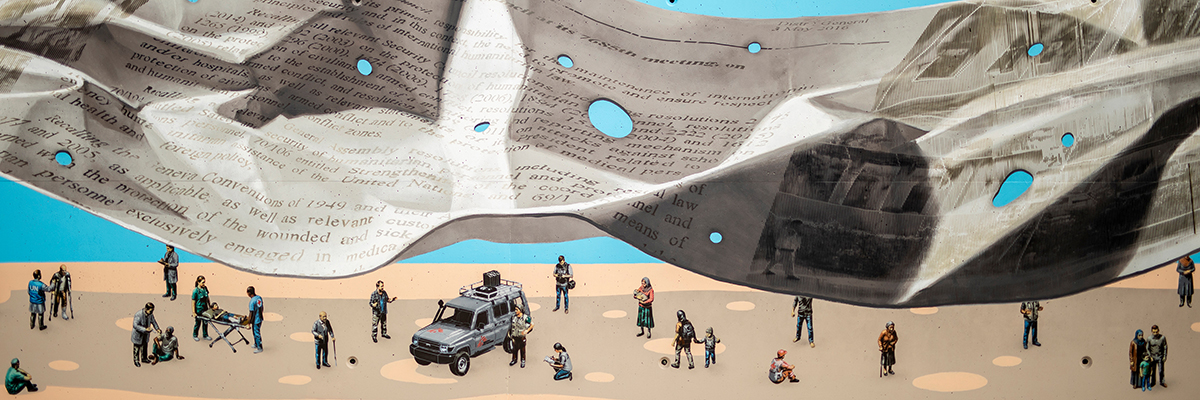
There may be no more damning symbol of the international community’s failure to protect human life than a sheet of paper.
Governments may complain of scarcity but apparently have little trouble finding the money, weapons, technology, intelligence networks and enormous industrial capacity necessary to prosecute wars, while somehow lacking the political will to build an equally formidable system for protecting the doctors, nurses, ambulances and hospitals trying to keep people alive inside them. Ten years ago, the UN Security Council unanimously adopted Resolution 2286, demanding precisely that protection. Yet the resolution established no automatic sanctions, independent investigative authority or enforcement mechanism capable of making its promises real.
The consequences are no abstraction: recent monitoring identifies state actors as responsible for the great majority of violence against healthcare, with Russia’s attacks in Ukraine and Israel’s attacks in Gaza and the wider region among the most extensive recent examples; Sudan and Myanmar are also among the gravest contemporary situations, according to reporting and monitoring by Médecins Sans Frontières, the World Health Organization, the International Committee of the Red Cross, and the Safeguarding Health in Conflict Coalition.
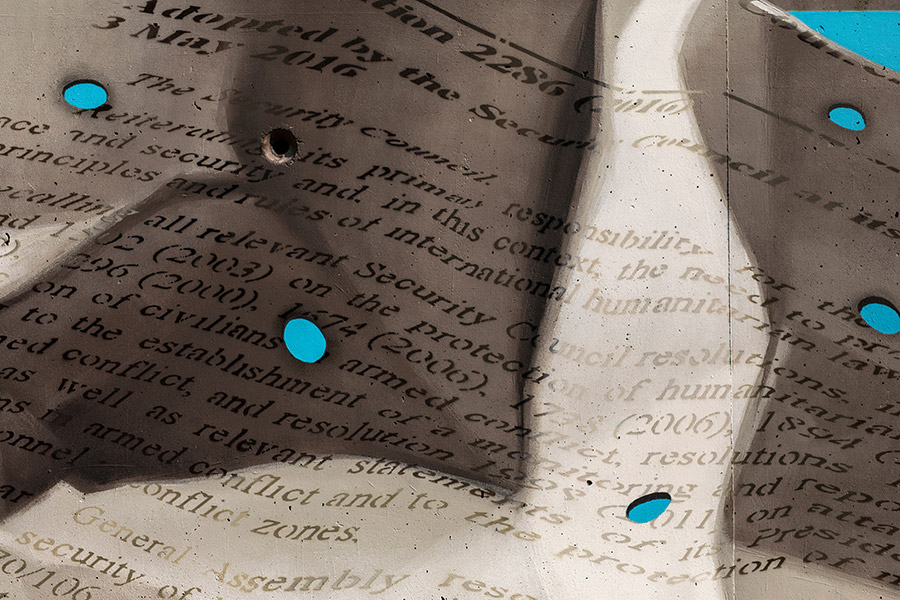
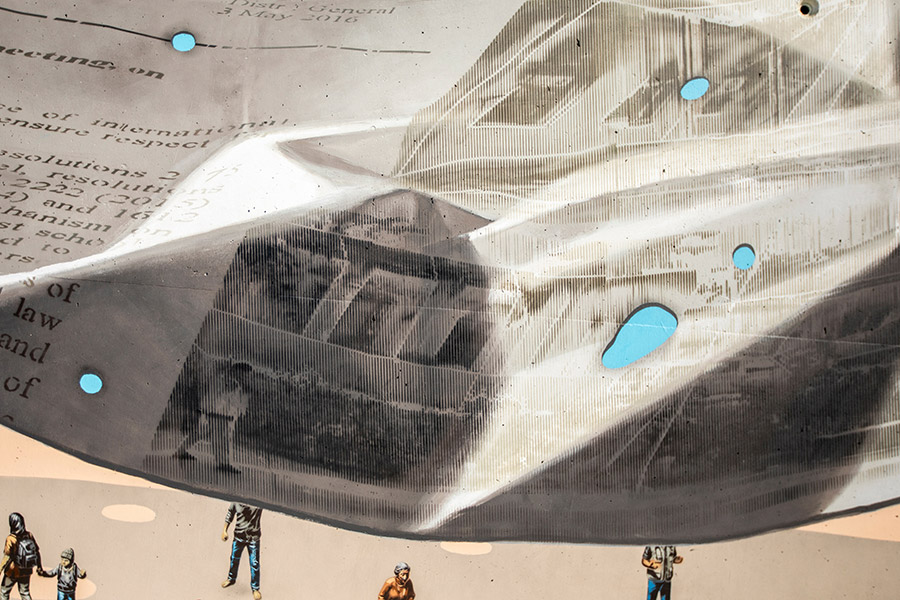
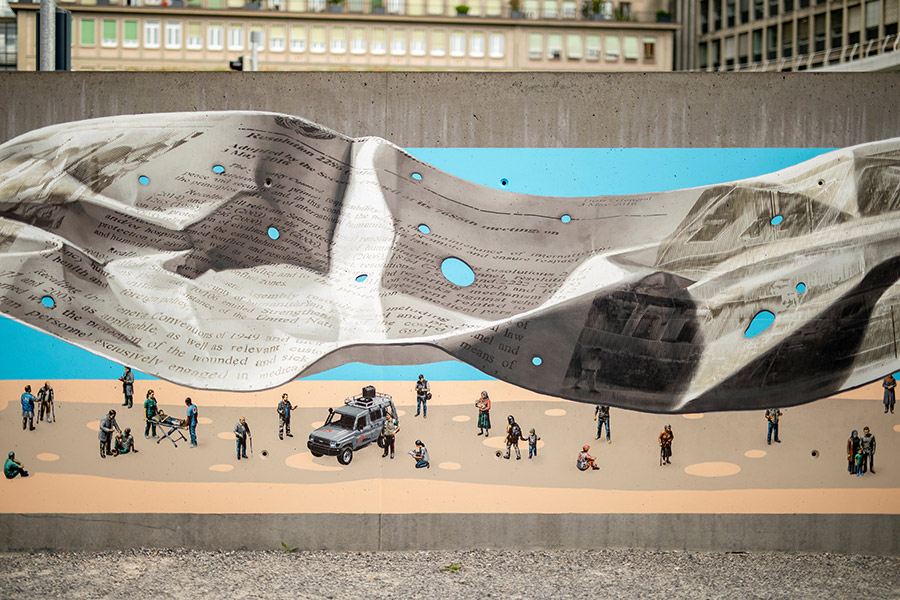
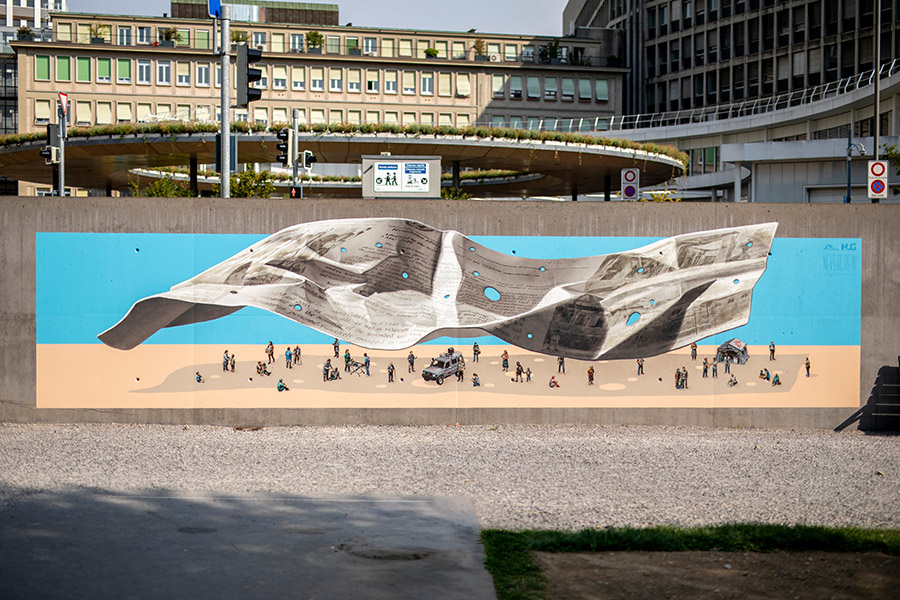
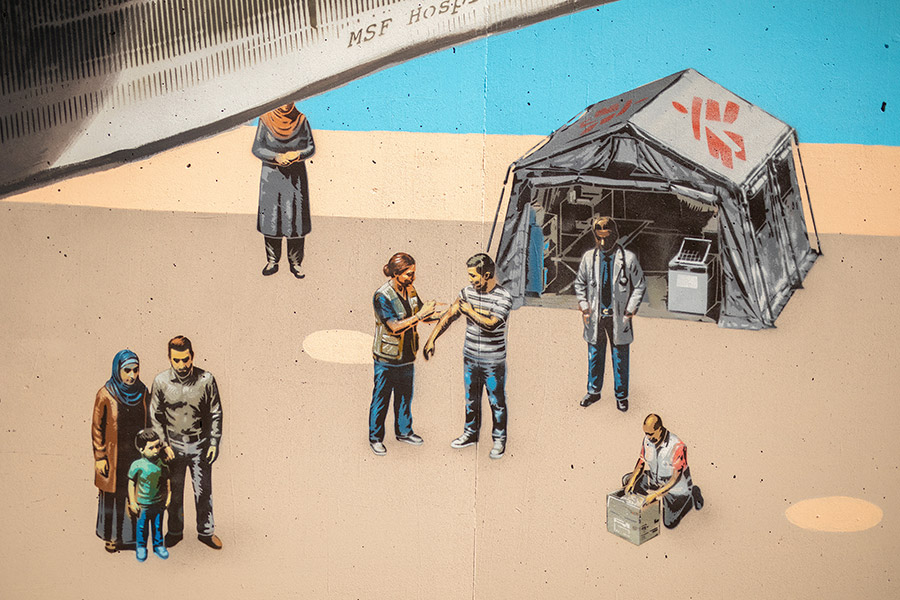
Into this contradiction steps Swiss artist duo NEVERCREW—Christian Rebecchi and Pablo Togni—whom have just painted the exceptionally powerful Paper-thin, unveiled on World Humanitarian Day at Parc des Chaumettes, directly opposite Geneva University Hospitals. Rather than illustrate warfare, they have painted the failure of the system intended to restrain it. An enormous rendering of Resolution 2286 buckles across the wall like a roof over miniature doctors, patients, humanitarian workers, ambulances and temporary medical facilities. But the roof is torn, burned and punctured with holes. Parts of the document incorporate ghostly images of actual sites of violence, including MSF’s trauma hospital in Kunduz, Afghanistan, bombed by a U.S. gunship in 2015, killing 42 people, and Baghdad’s Canal Hotel, bombed in 2003, killing 22. Protection is literally overhead—and yet for the victims it can feel useless.

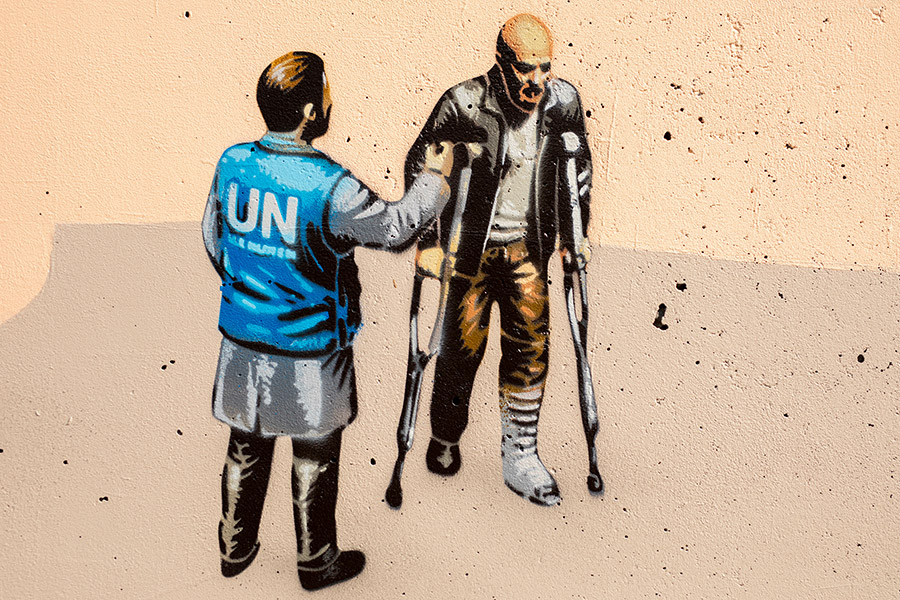
That inversion is what gives Paper-thin its force. From a distance, the enormous floating document is monumental; up close, the tiny human figures make the moral equation painfully simple. A medic attends to an injured person, another team carries a patient on a stretcher, families wait, an ambulance stands ready. These are not combatants and there is nothing heroic or theatrical about their actions: people are simply trying to keep other people alive. Above them hangs an international promise incapable of stopping the violence passing straight through it. NEVERCREW describe the sheet as a roof whose holes reveal that “this protection is vulnerable.”

The mural was formally inaugurated last week on August 19th, bringing together representatives of MSF, HUG, the International Committee of the Red Cross, the World Health Organization and the Canton of Geneva. Of the remarks delivered that day, Yasmine Praz, the ICRC’s Director of Operations, gave perhaps the clearest articulation of what Paper-thin is asking us to confront: