The concept album was born in the Stoned Age when TV was black and white, back when disaffected teens had to trudge for blocks and blocks outside on the sidewalk to the record store and carry their rock and roll home on large heavy vinyl platters called albums, sometimes double albums.
Rewarded for their hard work and sacrifice, these pioneering music fans opened those two record concept albums and used the big flat surface to pick the seeds out from their marijuana stash and roll a reefer.
Then they dropped the needle, turned up the dial, and lied on their back on their single beds surrounded by the two speaker stereophonic sound that gently vibrated their black-light posters on the wall, reading the song lyrics and metaphorically taking a wild and magical trip inside the cover art of the album.
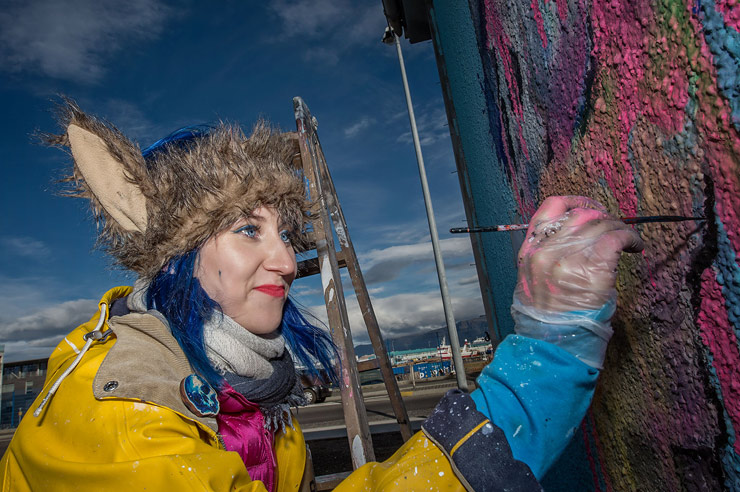
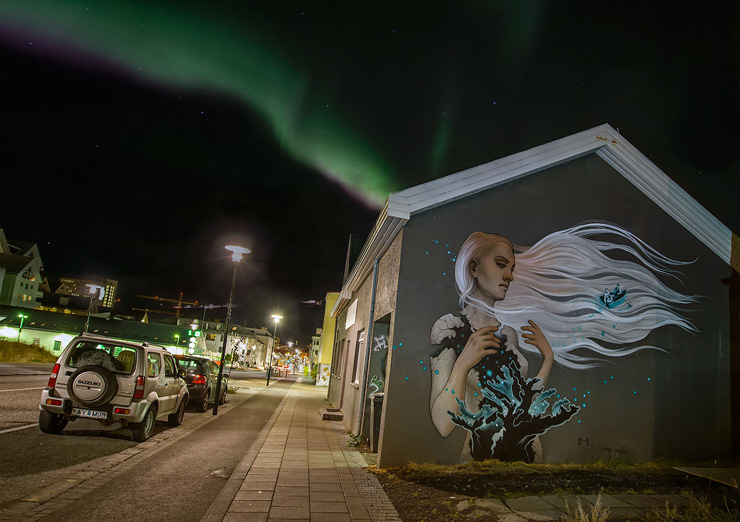
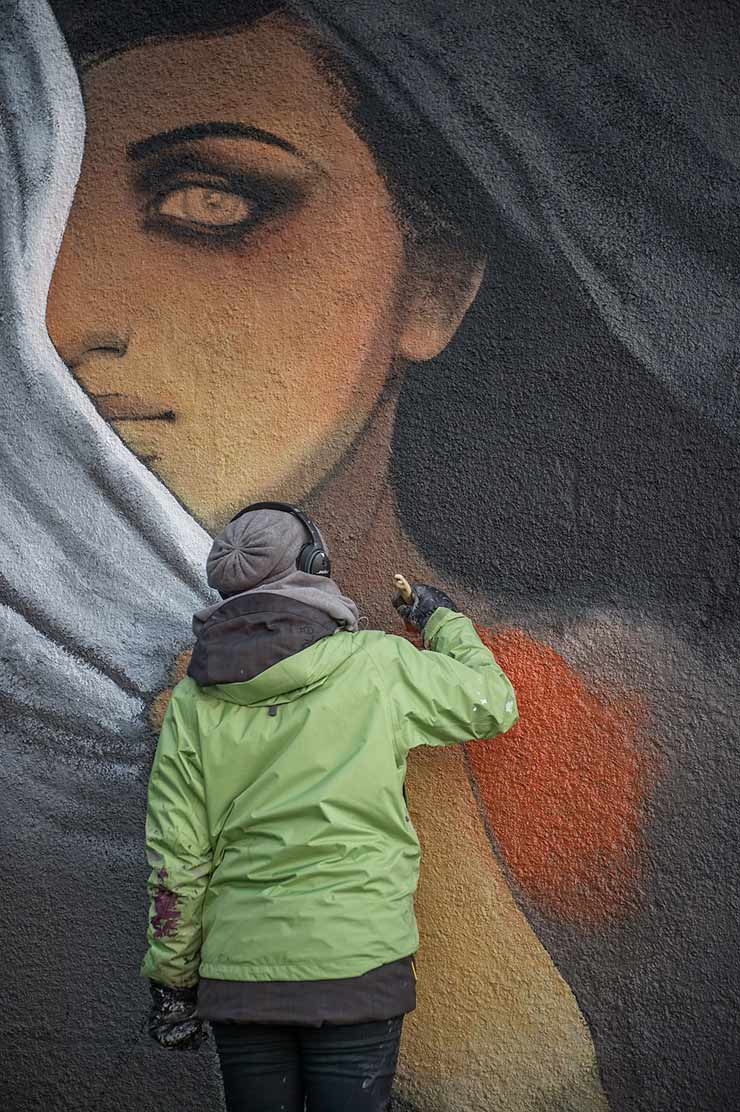
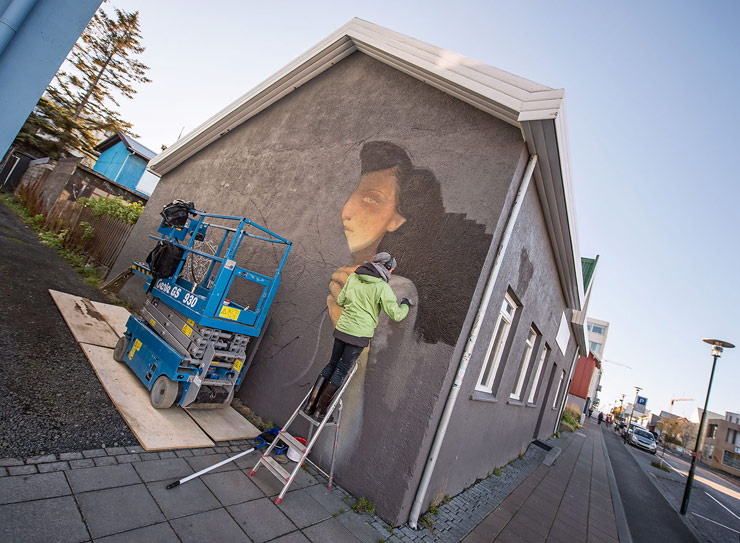
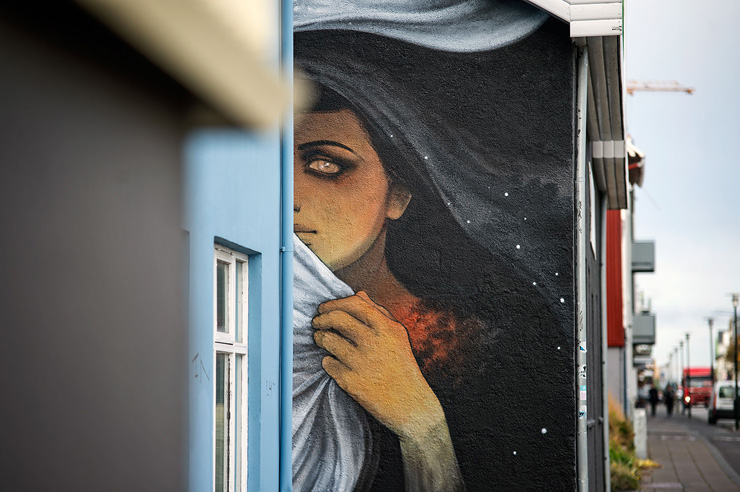
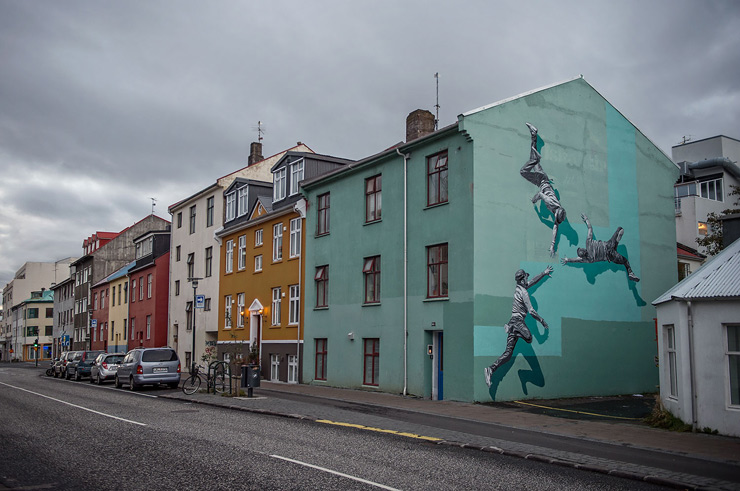
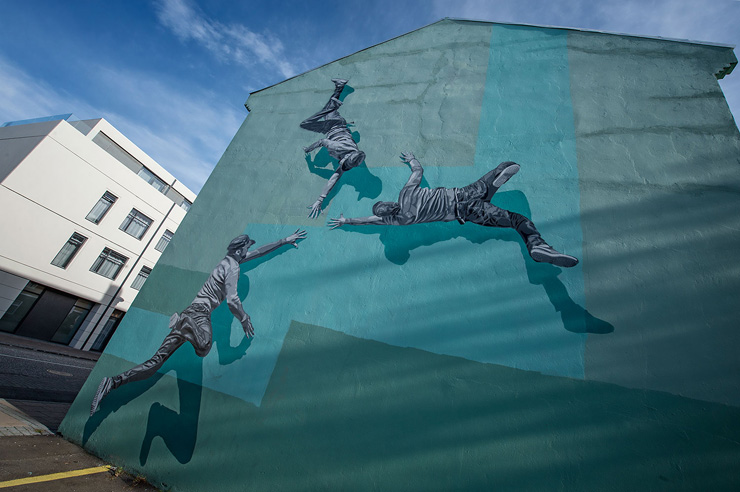
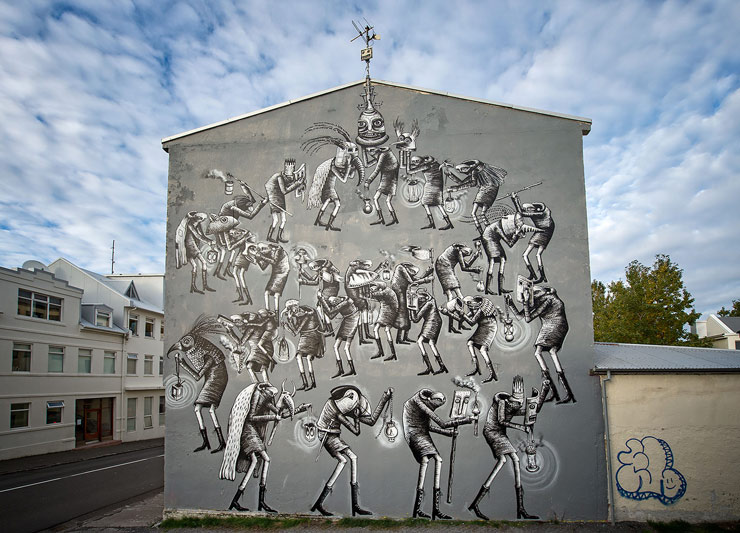
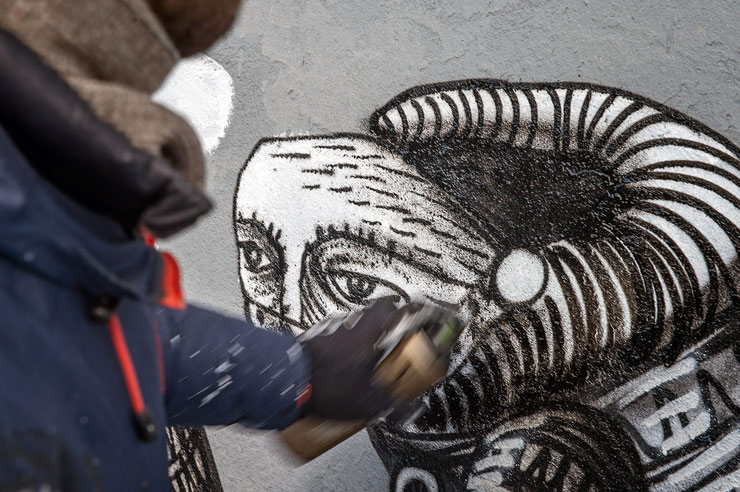
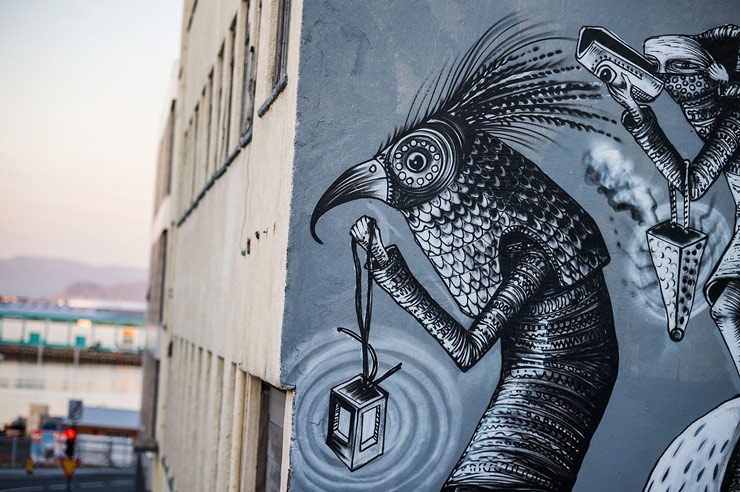
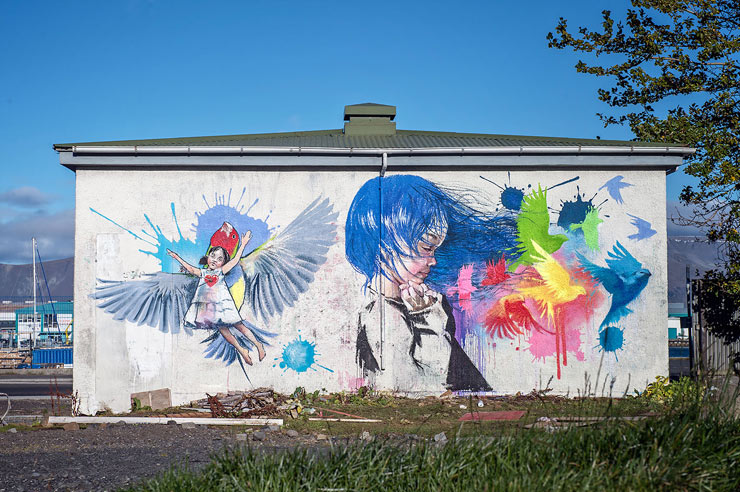
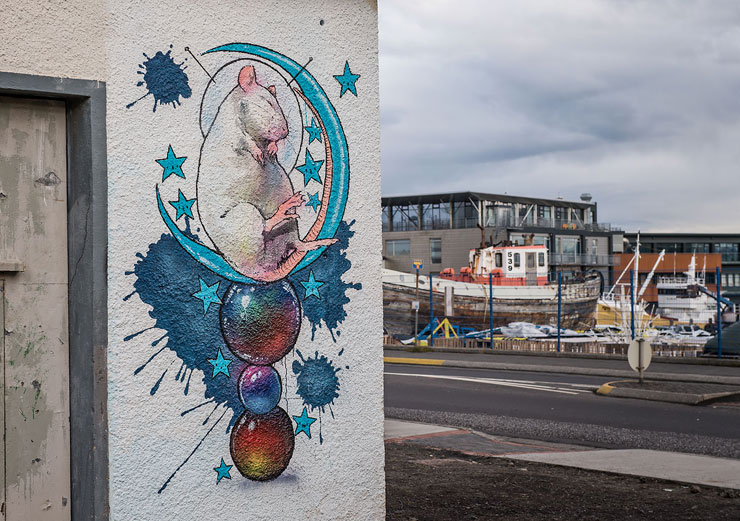
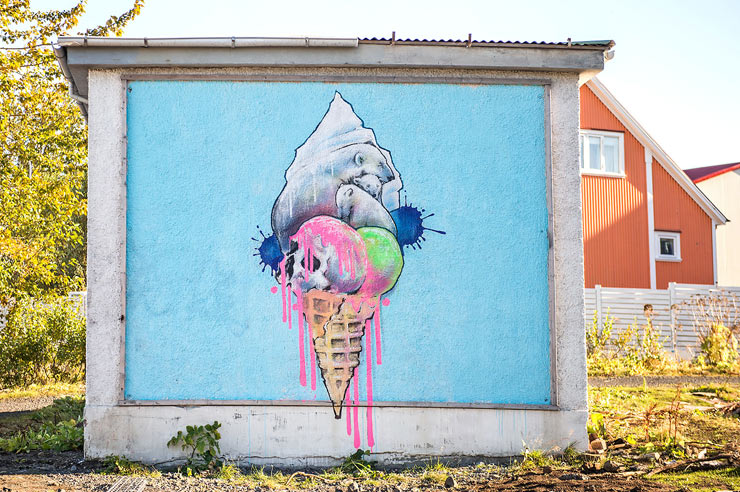
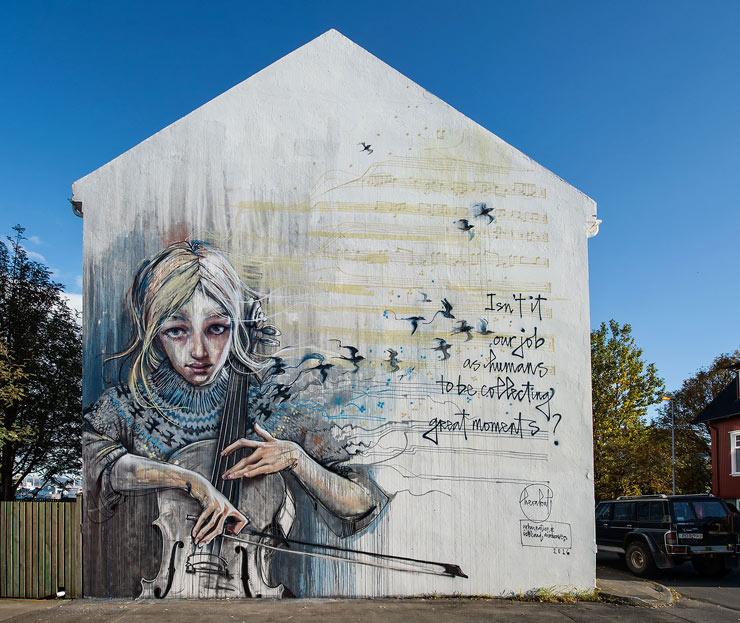
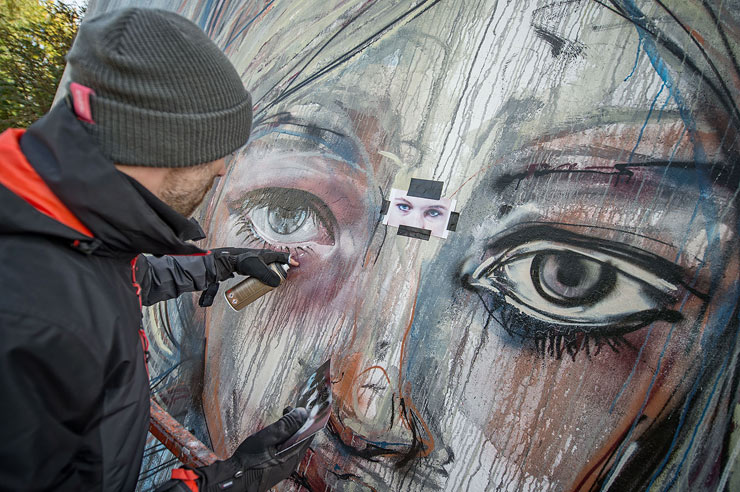
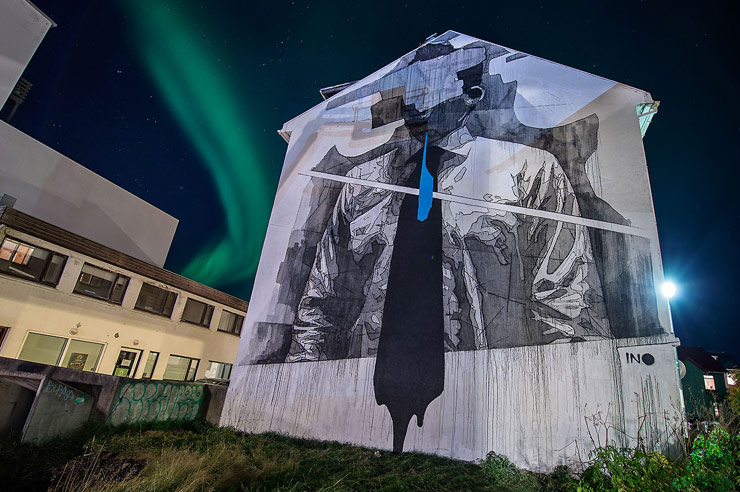
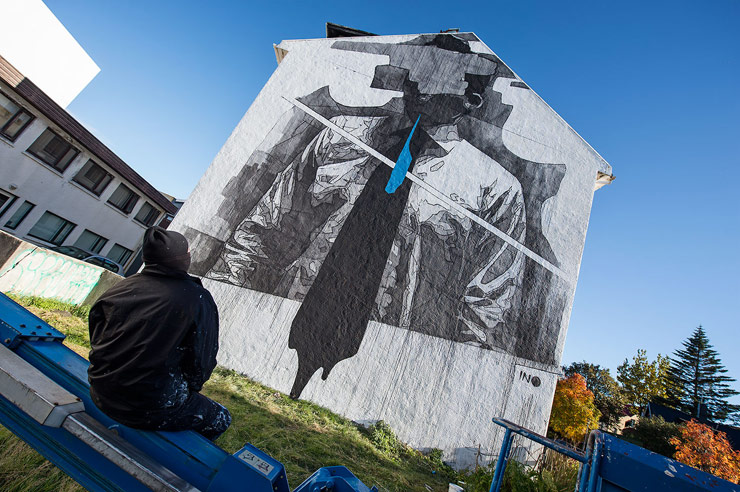
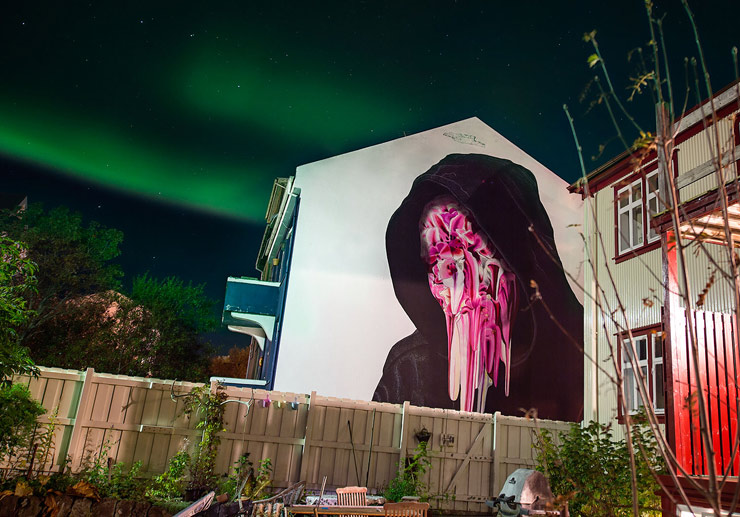
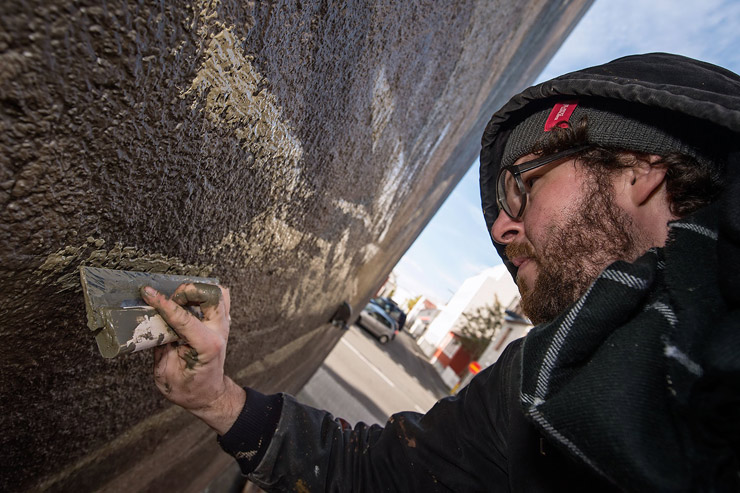
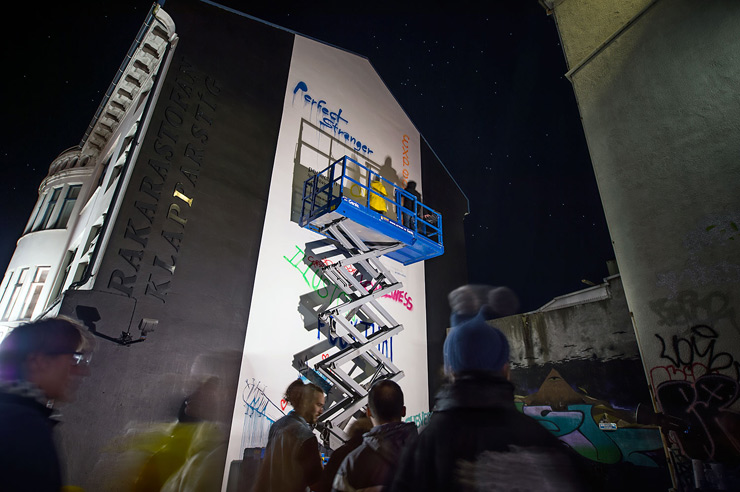
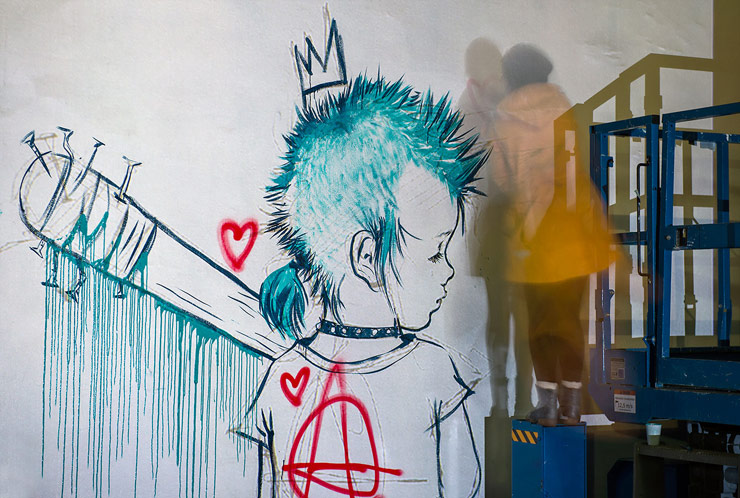
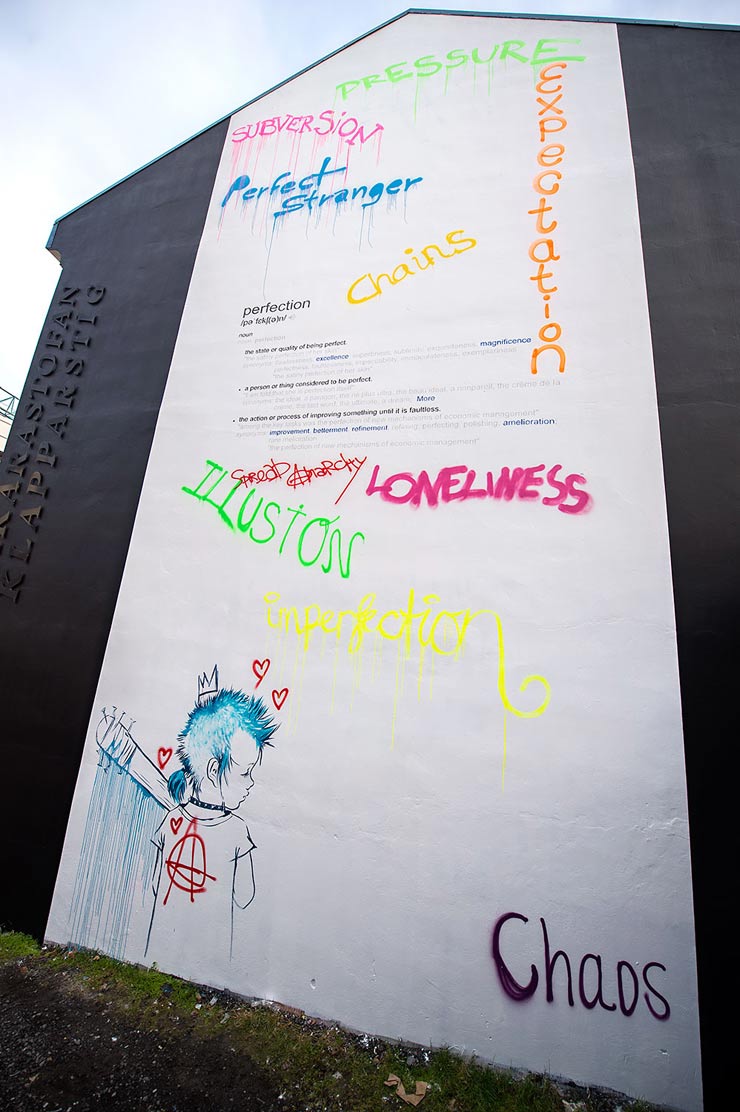
“We paint the music you love to hear,” says Yasha Young in Reykavik, Iceland, as she imagines the thousands of music fans who will inundate this city in a few weeks for “Iceland Airwaves”.
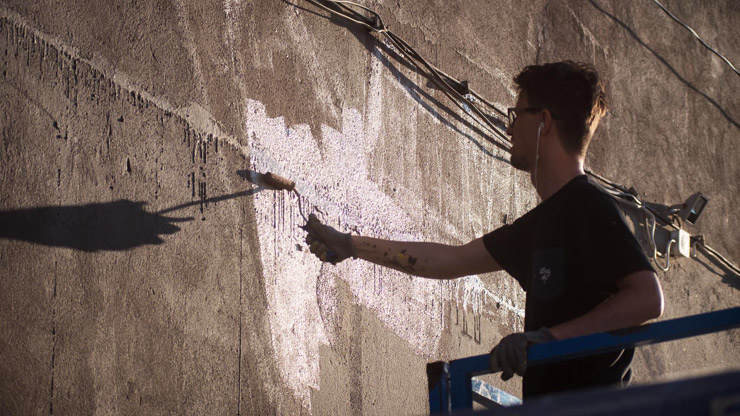
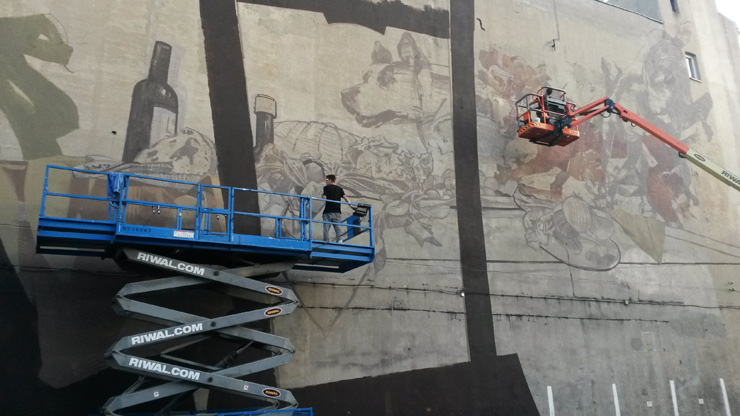
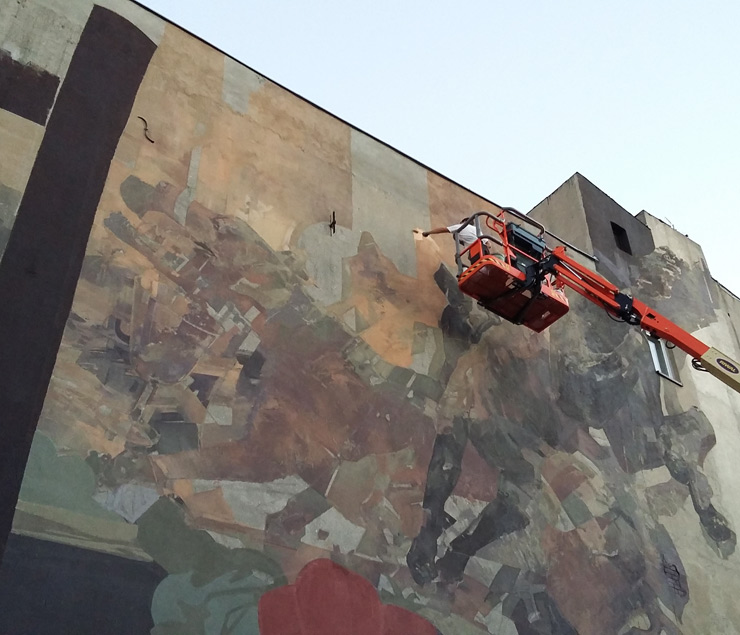
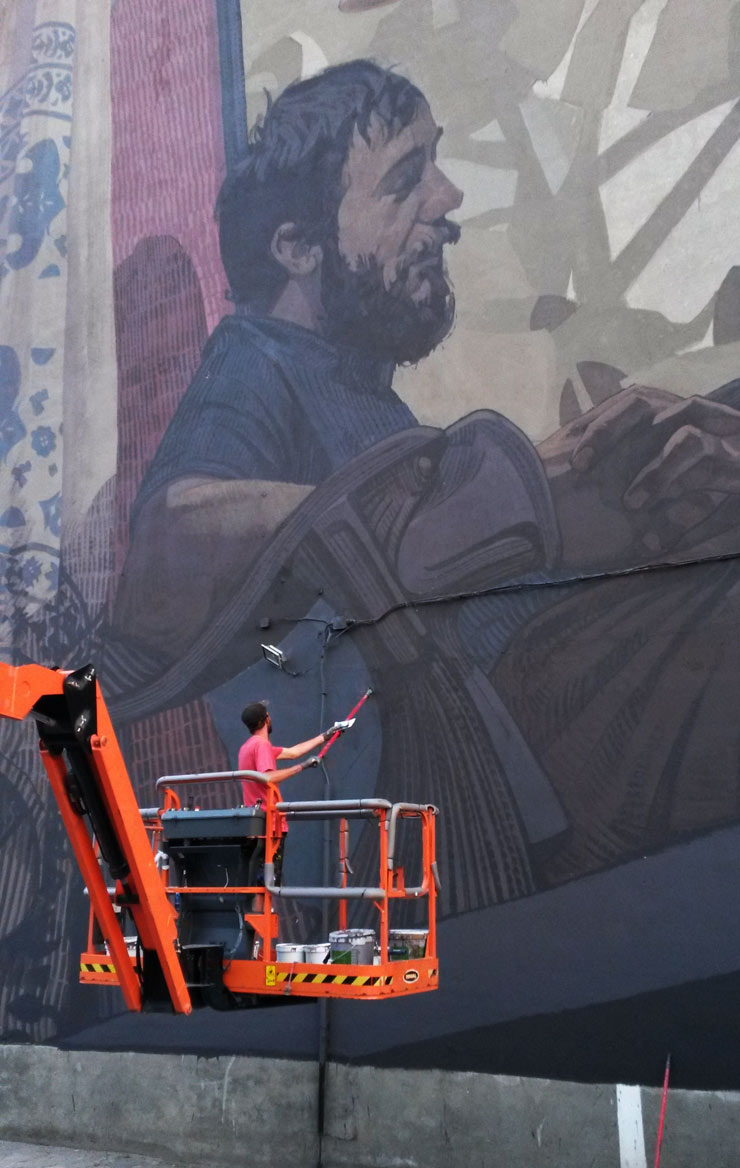
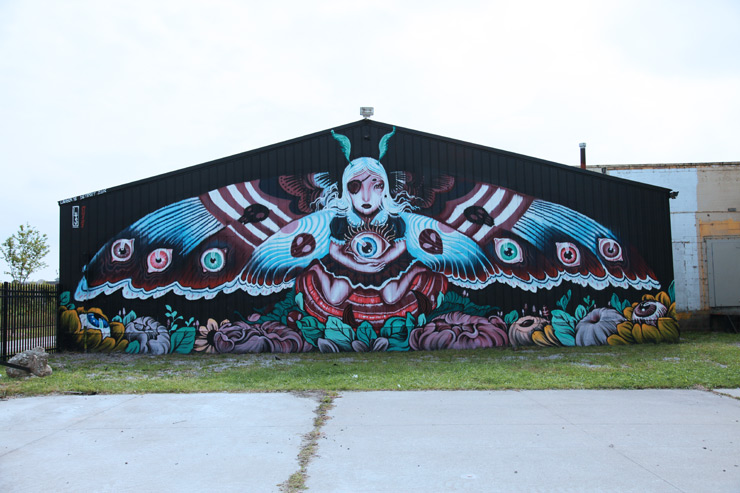
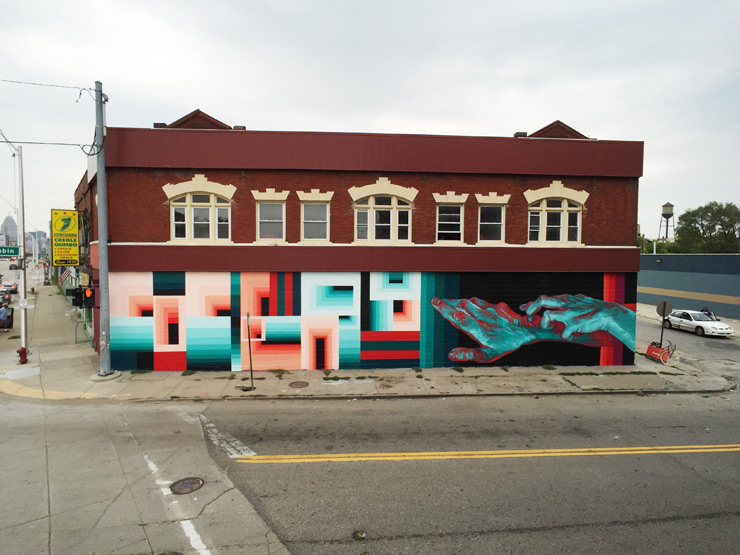
For the second year Urban Nation, the Berlin-based arts organization working primarily within the Urban Contemporary Art scene, brings the musicians a powerful visual partner called “Wall Poetry”.
By pairing one musician/group with one visual artist/group, Young, the director of UN, wants to re-create the concept album where the eyes have a newly created entryway into the music. Of course its only one interpretation but countless stories can be evoked from this intercultural exchange.
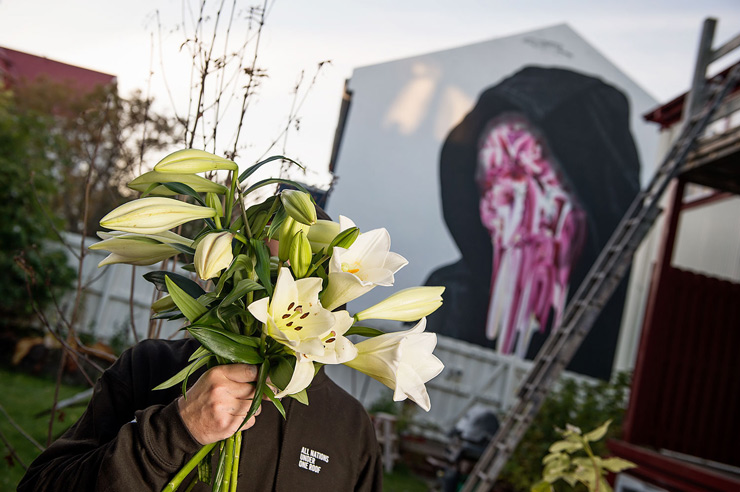
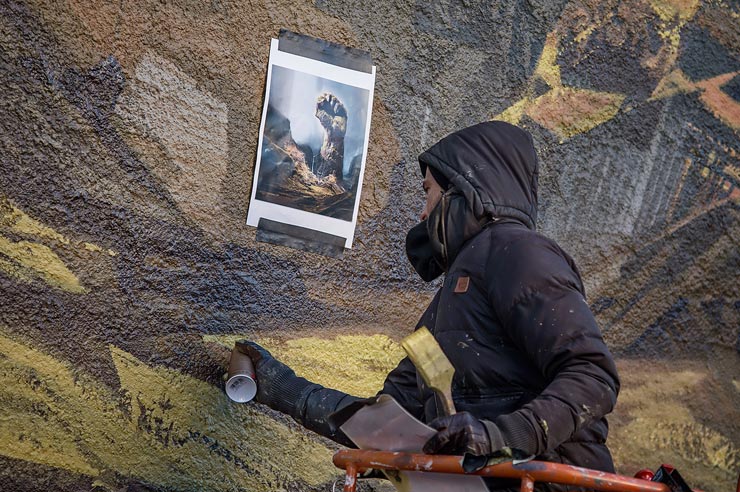
It’s the second year for the program, and we are very lucky to have these exclusive shots from Nikka Kramer of some of the first walls going up in advance of the festival, which this year features over 200 bands. Check out the stunning atmospheric images featuring northern lights; a poetry of their own.
Curator Carlo McCormick quotes Novalis by way of describing this new exhibit of an eclectic blend of terrific troublemakers, pop-culture hijackers, and show-stopping crowd pleasers drawn from cities all around the Street Art/ graffiti /urban art scene today – and forty years ago. This is a welcoming walk of unexpected intersections that only McCormick and co-curator Ethel Seno could imagine – and pull together as a panoply of street wizardry that acknowledges activism, artistry, anarchy, and aesthetics with a sincere respect for all. It will be interesting to see how this show is viewed by people who follow the chaotic street scene today in the context of its evolution and how they read the street signs in this city.
McCormick, in his customary self-effacing humor, expects there to be some shit flying – as anyone who is involved in this scene expects from the hard-scrabble rebellious margins and subcultures that this art-making interventionist practice rises from. There also are a growing and coalescing mini-legion of scholars and academics who are currently grappling with the nature and characteristics of this self-directed art-making practice rooted often in discontent – now organized inside an exhibition that is ticketed and sold as a family friendly show.
In his descriptions of the public sphere, the writer, historian, author, and cultural critic McCormick often refers to graffiti and street artists messing with “contested space”. It’s an apt description whether we are talking about the public space in high-density gleaming metropolises or the bombed-out grid-less and polluted quagmires of human fallibility and urban un-planning that dot our globe; all public space its nature is contested.
Here is a place used by many artists to protest, agitate, advocate, or deliver critique – and many of the artists in this exhibition have done exactly this in their street practice, often pushing limits and defining new ones. Dig a little into many of the individual story lines at play here and you’ll see that the vibrant roots of social revolution are pushing up from the streets through the clouds of propaganda and advertising, often mocking them and revealing them in the process.
Ultimately, this Magic City experience is an elixir for contemplating the lifelong romance we have with our cities and with these artists who cavort with us within them. “Our Magic City is a place and a non-place,” McCormick says in a position statement on the exhibit. “It is not the physical city of brick and mortar but rather the urban space of internalized meanings. It is the city as subject and canvas, neither theme park nor stage set, but an exhibition showcasing some of the most original and celebrated artists working on and in the city today.”
BSA curated the film program for Magic City with a dynamic array of some of the best Street Art related films today presented together in a relaxed environment. In this video hosted by Andreas Schanzenbach you get a taste of the works that are showing that we draw from our weekly surveys on BSA Film Friday. Over the last few years we have had the honor of presenting live in-person to students and scholars and fans an ever-evolving collection of videos that speak to the spirit experimentation, discovery and culture-jamming outrageousness of urban interventions, graffiti and Street Art. The BSA Film Program at Magic City presents a survey of some of the very best that we have seen recently.
Magic City artists include: Akrylonumerik, Andy K, Asbestos, Ben Heine, Benuz, Biancoshock, Bordalo II, Brad, Downey, Dan Witz, Daze, Ernest Zacharevic, Ganzeer, Henry Chalfant, HERAKUT, Icy & Sot, Isaac Cordal, Jaime Rojo, Jens Besser, Juandres Vera, Lady Aiko, Leon Keer, Loomit, MAD C, Mark Bode, Martha Cooper, Oakoak, Odeith, Olek, Ori Carin / Benjamin Armas, Qi Xinghua, Replete, ROA, Ron English, Shepard Fairey, Skewville, SpY, Tristan Eaton, Truly, WENU Crew, Yok & Sheryo
The BSA Film Program for Magic City includes the following artists: Borondo, Brad Downey & Akay, Ella + Pitr, Faile, Farewell, Maxwell Rushton, Narcelio Grud, Plotbot Ken, Sofles, Vegan Flava, Vermibus
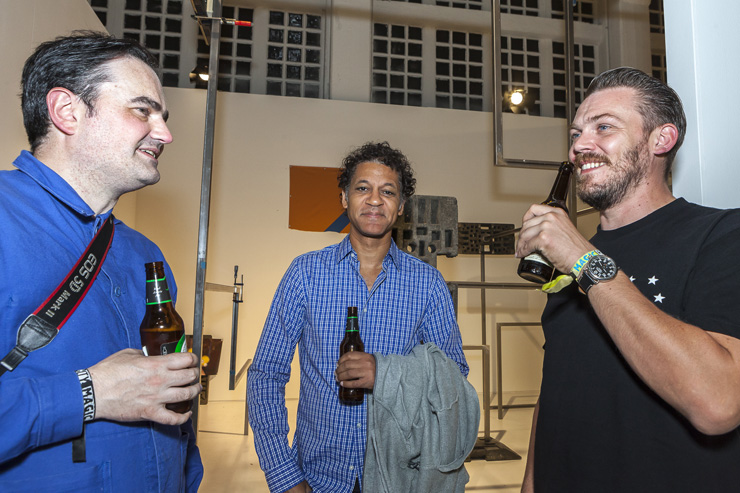
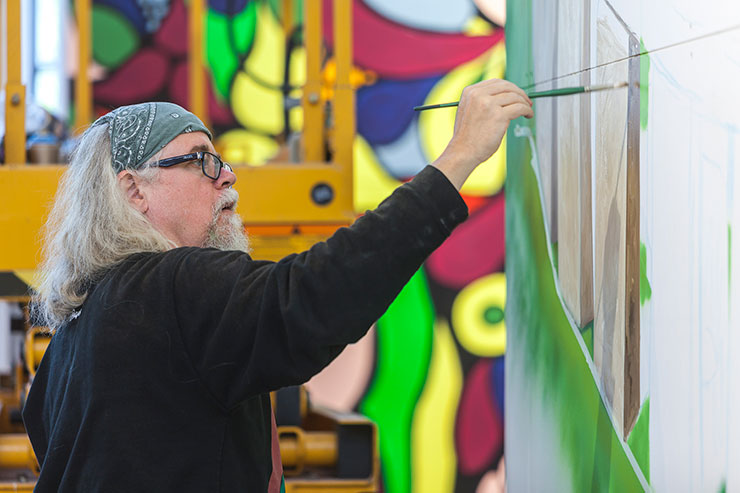
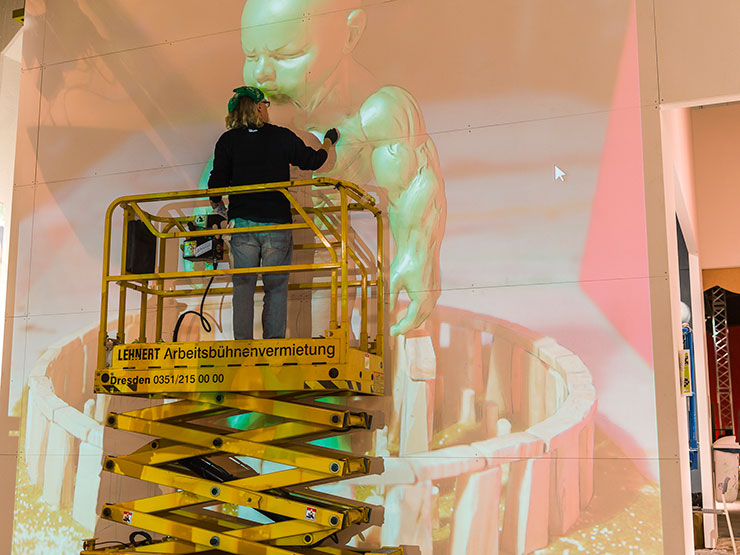
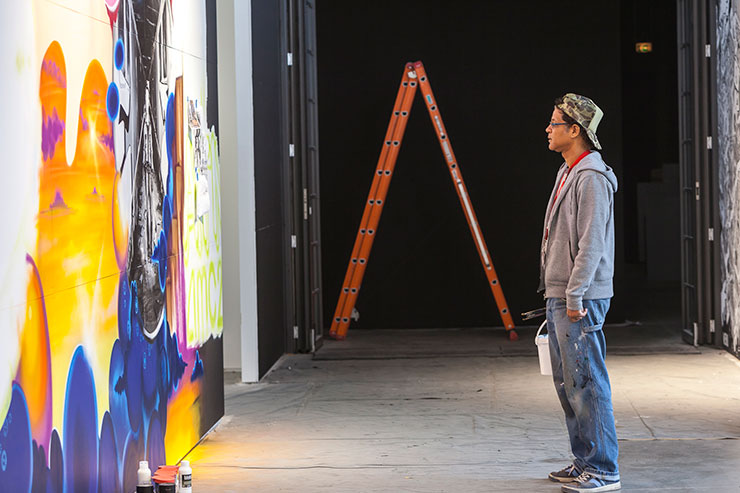
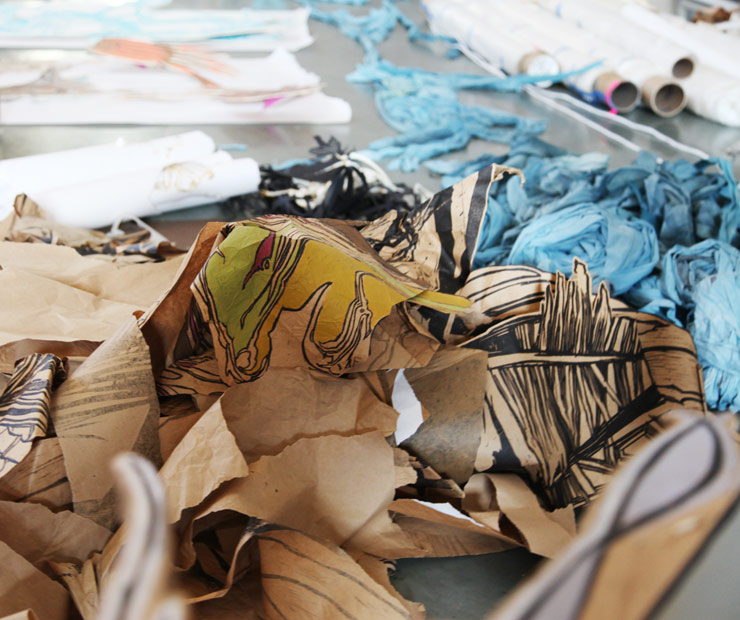
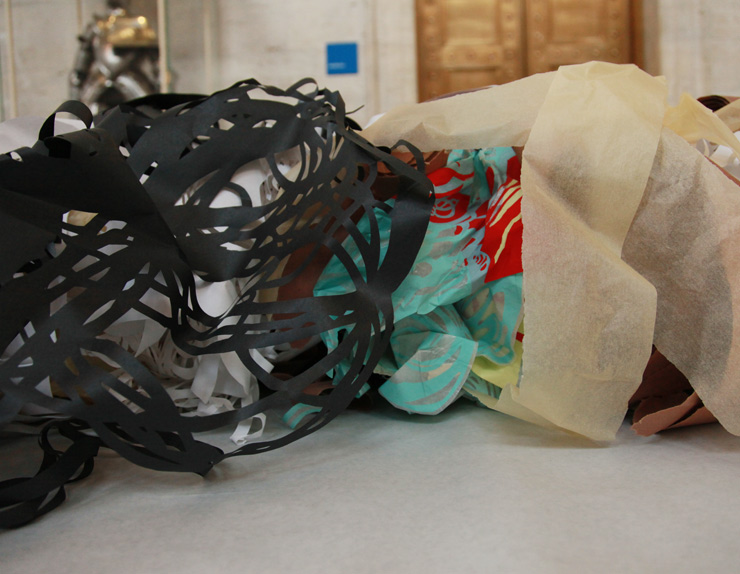
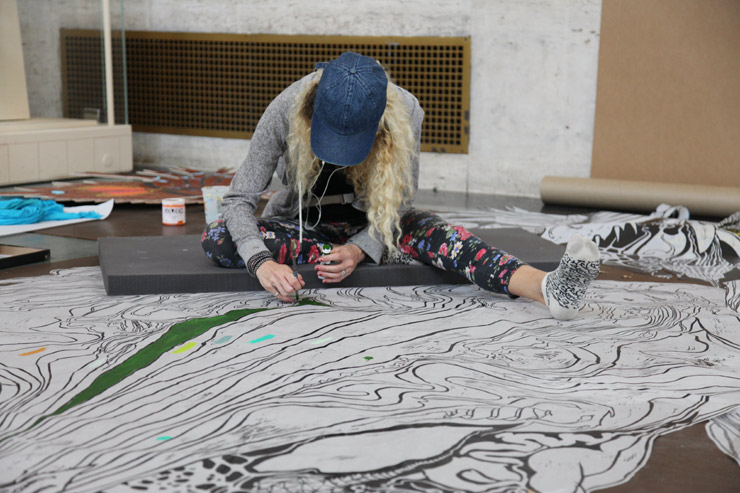
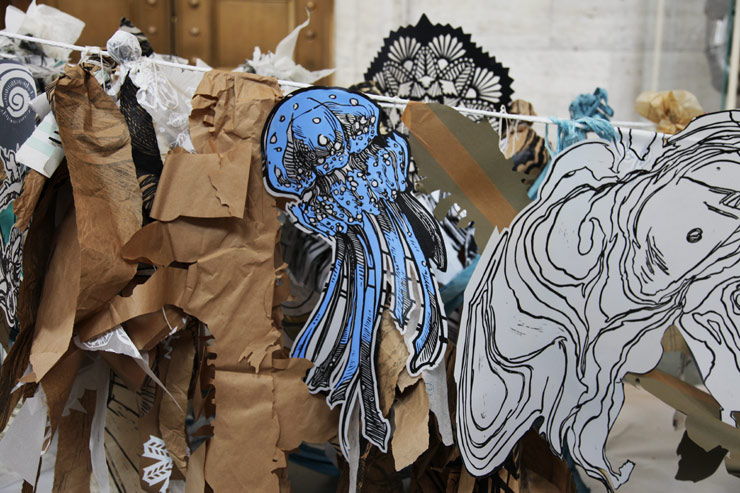
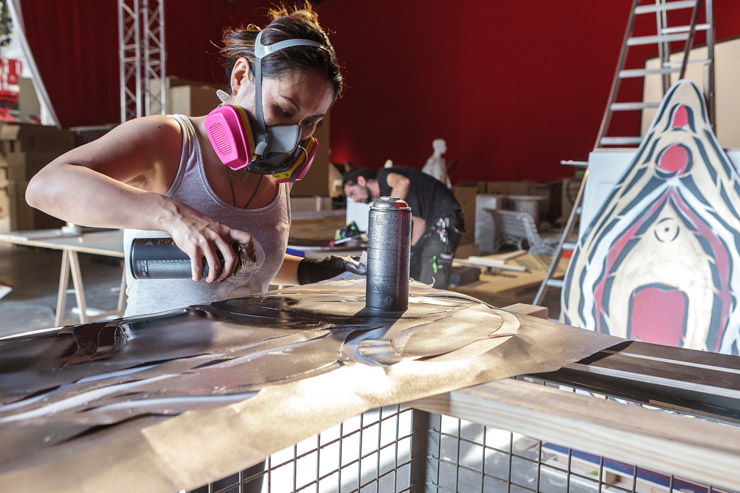
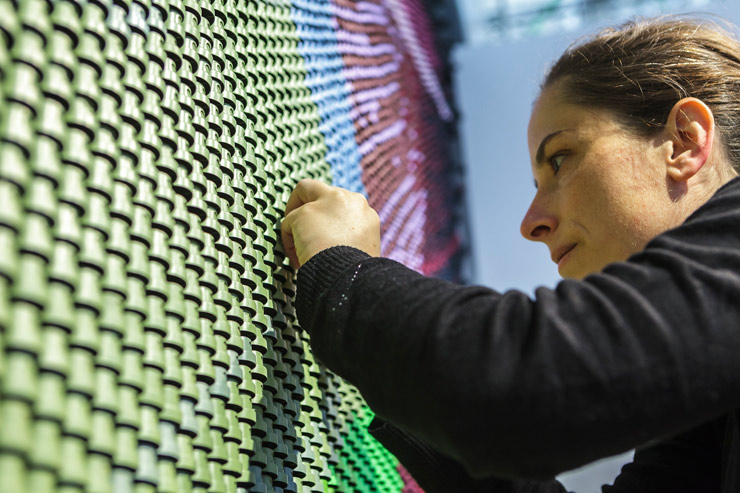
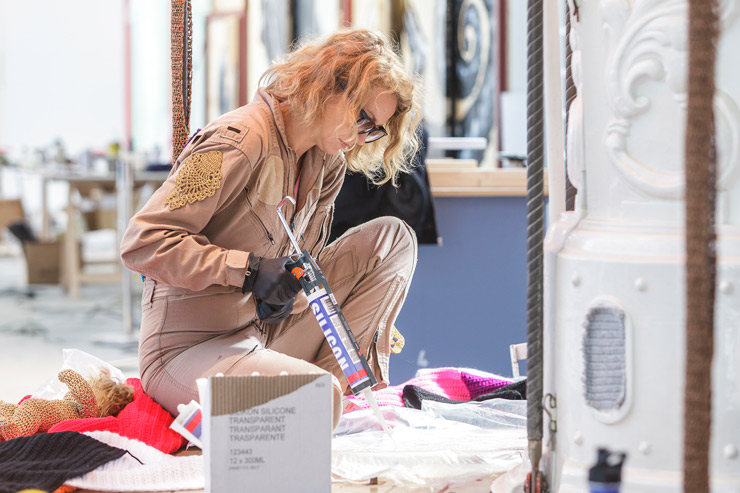
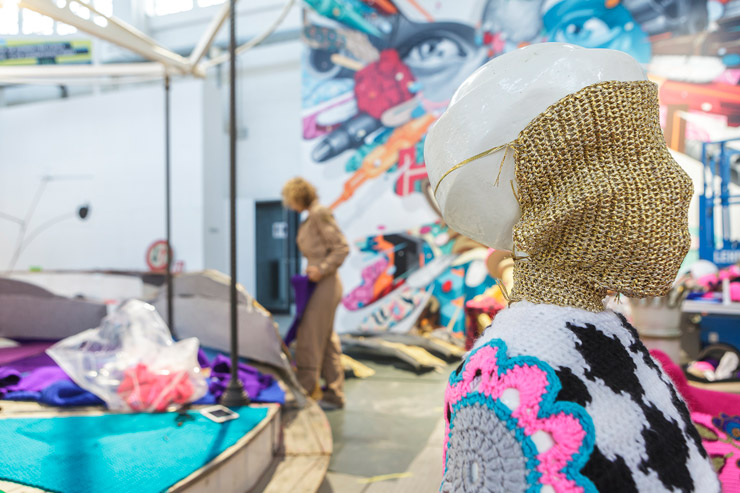
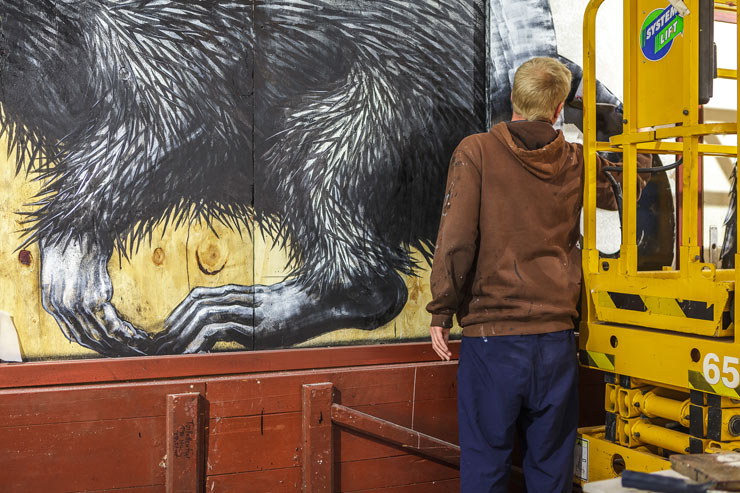
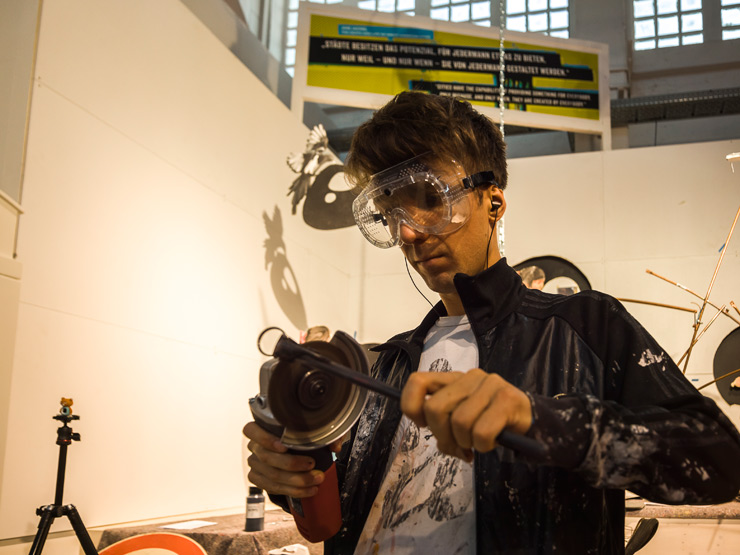
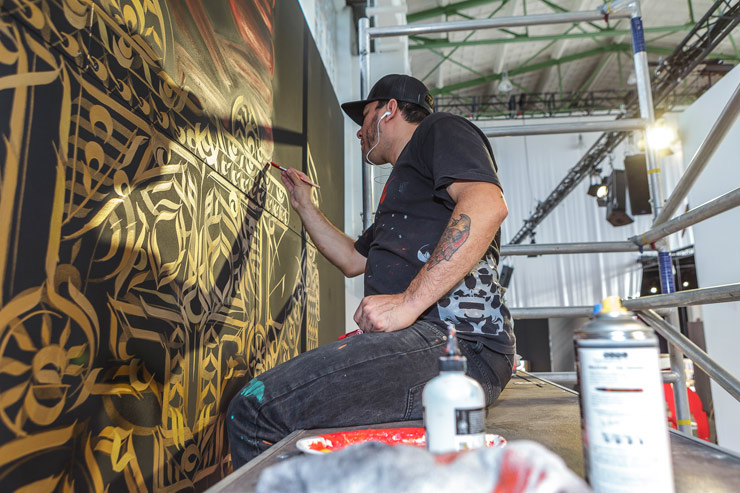
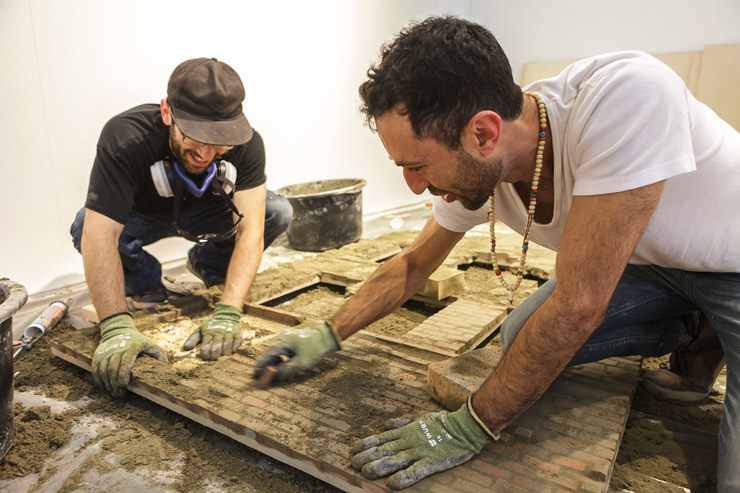
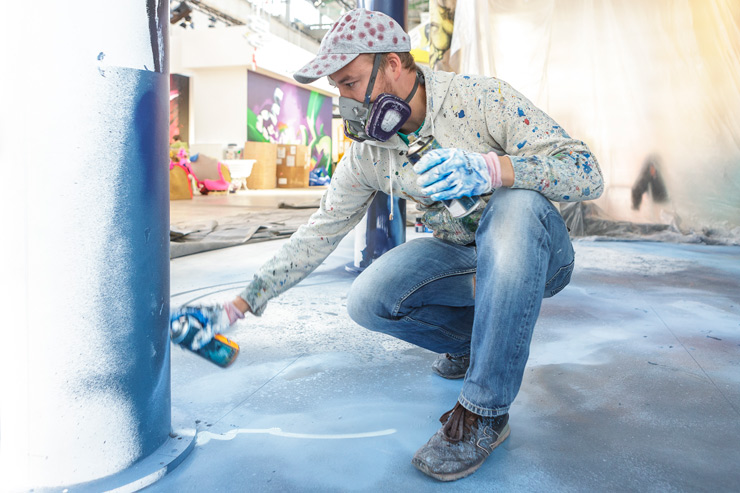
Some behind the scenes shots days before the Premiere
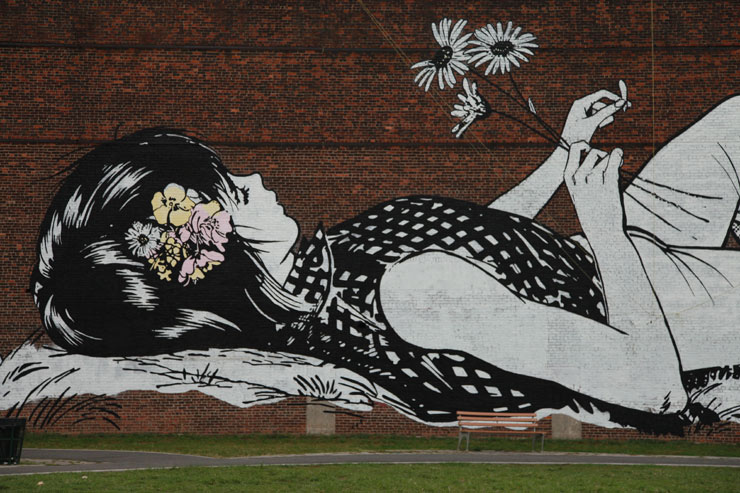
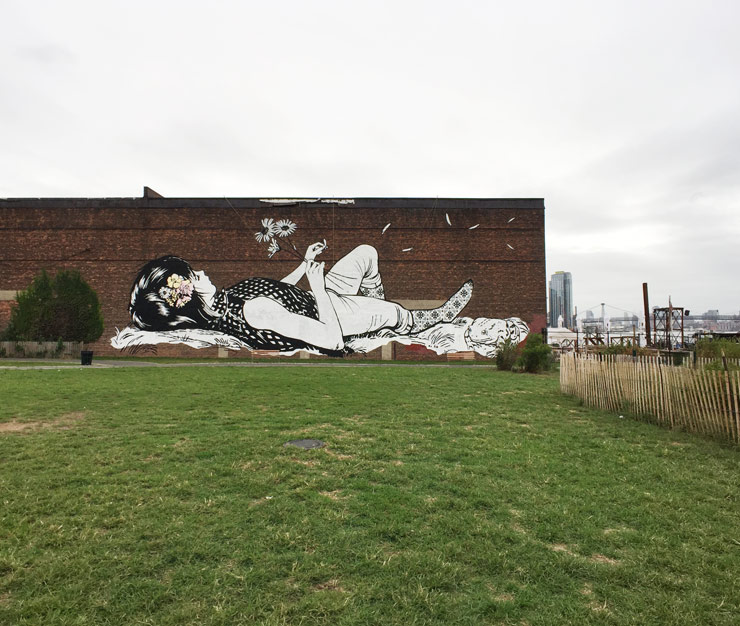
He loves me, he loves me not. He loves me, he tells me I’m an idiot because I trust scientists about climate change and that actually it is a hoax created by the Chinese.
Sorry, everything reminds us of Donald J. Trump and his outlandish claim for the presidency. Even when we are looking at the new Faile mural in Greenpoint, Brooklyn called Love Me, Love Me Not.
The Greenest Pointis an initiative that wants to raise awareness of Climate Change and three Street Artists have just completed two murals here in Brooklyn to support it. The organization says that they hope to gather “together people from different backgrounds, professions and skill-sets who are bonded by aligned values and a common vision.” By integrating Street Art with technology, film, sound and voice, they hope that we’ll be more capable of piecing together the climate change puzzle as a collective.
We don’t pretend to be scientists, but we trust the ones we have and we decided that this week we would dedicate BSA Images of the Week just to this new project and this topic. We also know that it is now well-documented that tobacco companies fought us citizens with disinformation and legislative trickery for decades before they finally admitted that smoking was killing us and our families, so there is reason to believe that oil companies and related industries who flood our media and politicians with money are possibly buying time while we’re all heating up the atmosphere.
Here are new images of the two new murals in Greenpoint and Williamsburg, Brooklyn and an interview with the three artists who participated; Vexta, Askew, and long time Greenpoint studio residents, Faile.
BSA:Why do you think art is an important vehicle to highlight climate issues? Faile: We feel it’s important to create work that can resonate with people on an emotional level. Something that we can live with everyday and that has a place in our lives that brings meaning to our experience. This is how we think people must learn to connect to climate change. It’s not something you can just think about, it’s something that you have to do everyday. It has to become part of you. We hope art has the power to be that wink and nod that you are on the right track. That the little things you do are meaningful and that change starts with you in the most simple of ways.
BSA:Greenpoint has a history of blue collar communities who worked in factories producing goods for the both the merchant marine and the USA Navy. Those factories are all gone and only a few of the original settlers remain in the neighborhood such as the Polish community. How do you think the murals painted for the festival relate to them? Vexta: Our collaborative mural hopefully offers a voice to people directly to people who will become a part of the history of Greenpoint and its legacy. We will have QR codes installed that link to video pieces that physically give Askew’s subjects a voice as well as linking to the birds calls and information about their situation. Faile: We tried to be aware of the history of Greenpoint. The communities that make this neighborhood what it is. We tried to incorporate some nods to them through the work, specifically with the traditional Polish pattern in the socks. Unfortunately, Greenpoint is also home to some of the worst ecological disasters this country has ever experienced, the effects of which are still present. We wanted to bring something positive and something beautiful to the neighborhood that spoke to everyone. There are other historical murals in the neighborhood so it didn’t feel like it required another.
The neighborhood is also quickly changing. It’s home to many young families and has a vibrant creative class, not to mention our studio for the last 12 years. When creating an artwork in a public space, especially a park, there’s always that balance of trying to make something that people can connect with on a visceral, then psychological level in an immediate way–once that connection is made you hope they can dig a little deeper into the more subversive side of the meaning.
BSA:Do you think art and in particular the murals painted for this festival have the power to change the conversation on climate change and positively move and engage the people who either are indifferent to the issue or just refuse to believe that climate change is a real issue caused by humans? Faile:Whether you believe it or not there are basic things that people can do in their everyday lives to create a more beautiful environment around them. Picking up trash, recycling, being mindful that our resources are precious – none of these really imply that you have to have an opinion about climate change. Just the fact that we have a green space now in Transmitter Park is progress towards an environment that we can fall in love with.
We think that’s ultimately what the idea of Love Me, Love Me Not is asking. What kind of environment do you want? Do you want renewable green spaces that offer future generations beauty and room to reflect within nature? Or do you want to pave over the toxic soil and oil spills with the risk of repeating the past? If people can even ask themselves that question then we are at least engaging them into the dialogue where the seeds of action can be planted.
BSA:Why do you think art is an important vehicle to highlight climate issues? Vexta: For me as an artist it is the means that I have to talk about what I know to be important. Art also stands as this symbolic, most often visual, gesture that can bring people together, ignite debate and shine a light towards a new way of thinking that is perhaps still in the shadows of the mainstream. There is no more pressing issue right now than Climate Change.
There was a famous piece of graffiti up for a long time in my home city of Melbourne that read “No Jobs on a Dead Planet” in a beautiful font running down a power plant chimney. This work spurred my thinking back before I had begun making art professionally. That simple creative action out in public space was powerful and it spoke a simple truth and showed me that you can do a lot with a little. Art and art out in the streets is a great vehicle for talking about issues like climate change, because its a gesture in a shared space, it provides something to meditate on or think about that ultimately is a shared reality, this makes sense to me as climate change is a problem we need to work together to address.
Askew: I think that in particular art in the public space can be a very powerful way to put messaging on issues that matter right out in front of people who may not otherwise engage with it. Also an artist has the freedom to make the image captivating in a way that perhaps other platforms for speaking about serious issues don’t. People get bombarded with so much conflicting information every day especially via the mainstream media, art can put people in the contemplative space to engage differently.
BSA:You have participated in at least one other art festival whose principal mission is to highlight the well being of our ecology and our planet. What would you say is unique characteristic of The Greenest Point that differentiates it from other festivals with equal goals? Askew: Well I think this is different because it’s so focused on a specific place whereas the scope of other events I’ve painted look more generally at global issues. I think it’s great for communities to narrow their focus to directly around them to tackle very tangible local change. If every neighborhood did that globally, imagine the impact. Vexta: I agree with Askew, What is special about The Greenest Point is that it’s very locally based yet has a global focus. The Greenest Point has brought so many different parts of our local community together, from creatives to government to business. It has shown us that people in our neighborhood really care about Climate Change.
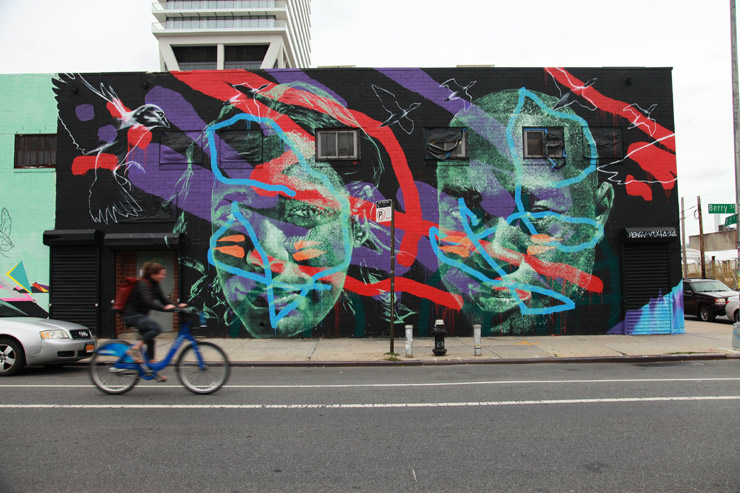
BSA:Your collaborative mural with Askew represents the current and future generations of children. What do you think is the principal message to send to the children so they are more aware of the problems facing our planet? Vexta: My mural with Askew represents a coming together of numerous ideas. The future belongs to the youth and the world’s children will be the ones most impacted by Climate Change. I think they are really aware of this problem and it’s a very scary prospect. Our mural brought together not only representations of young people but also birds found in the NY state area that are currently climate threatened & endangered (according to Audubon’s Birds and Climate Change Report) as well as icebergs made of my shapes that represent the particles that make up all matter.
I would hope that we can inspire them to feel empowered to make small changes that they see as being possible whilst also acknowledging that all the other parts of our world – the birds, animals, water, air and land are just as important as they are. We are all in this together.
Askew: For me personally, celebrating young local people who are giving their time to make change in Greenpoint around sustainability and community-building issues is immediately inspiring to other young people.
BSA:Do you think art and in particular the murals painted for this festival have the power to change the conversation on climate change and positively move and engage the people who either are indifferent to the issue or just refuse to believe that climate change is a real issue caused by humans?
Askew: Everything we do has impact, positive and negative – that’s the duality we deal with inhabiting this space. It’s a closed system, resources are finite and so we must respect them and do our best to live in harmony with this earth that supports us and live peacefully amongst each other and the various other creatures we share this planet with. No one thing is going to make pivotal change but everyone being mindful and keeping the conversation and action going is what will make a difference.
Our special thanks to the team at The Greenest Point and to the artists for sharing their time and talent with BSA readers.
In the northern hemisphere and in dirty Brooklyn the new season of Fall is upon us and in our minds we begin to hear Sinatra’s “Autumn in New York” intermingled with Van Morrison’s “Moondance”under the cover of October skies. Yet on a hike through the Catskills just north of the city to see the leaves as they turn colors you reach a peak and look down on the rolling hills and the Hudson River below, smell the crisp clean air and listen.
What is that sound?
The buzzing of the city has left you momentarily and there is nothing but silence, spare the rustling of leaves blowing by your boots.
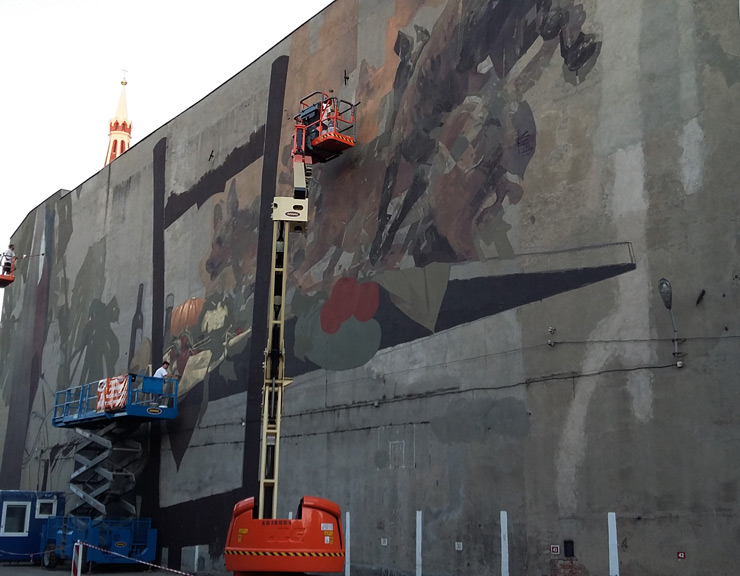
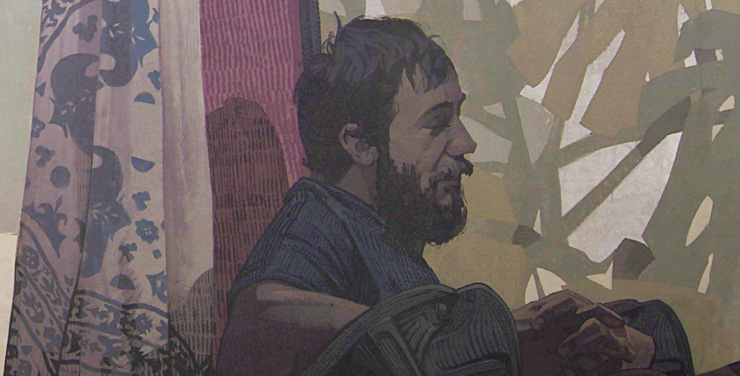
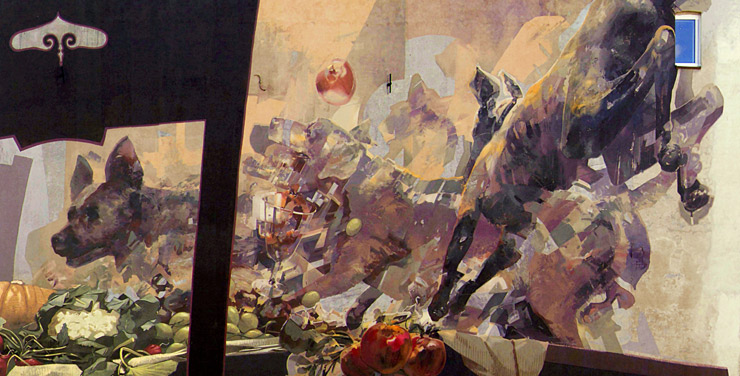
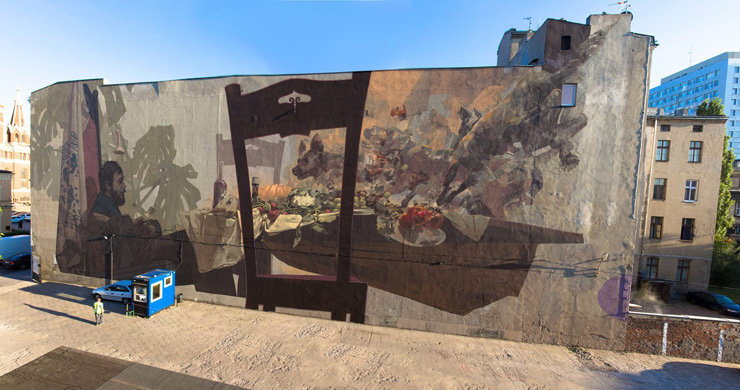
Perhaps this is the kind of silence that Etam Crew and Robert Proch are speaking of in their home country of Poland, which is also enjoying this turn from summer to autumn. Their new mural “Enjoy the Silence” combines the distinctly different styles through a shared palette of earthen tones, with Proch subtly softening the sharp illustrations of Bezt and Sainer with an impressionism that unifies. This is the harvest of three artists who have been working hard on their respective crafts.
Part of the newly branded initiative UNIQA Art Łódź, “Silence” is one of the few murals that will be made in this mural-soaked city as curator Michał Bieżyński slowly moves the focus to sculptural installations in public space.
Happily, BSA has been there since the inception of the Łódź project and we’re pleased that we can continue to partner with Bieżyński to bring BSA readers these exclusive images of the new mural and a fresh new YouTube video of it’s process.
Our weekly focus on the moving image and art in the streets. And other oddities.
Now screening :
1. “Street Food” from Mathieu Roquigny
2. Moses & Taps™ in Moscow 3. Panmela Castro in NYC “Women’s Rights are Human Rights”
4. Detroit: Murals In The Market. By Selina Miles
5. Murals In The Market 2016 Brings 40+ New Murals To Detroit. By Selina Miles
BSA Special Feature: “Street Food” from Mathieu Roquigny
Some simple stencil activism well placed can be very effective. Vulgar, absurd, playful. Call it what you want, but Mathieu Roquigny is the first one we have seen do it. Do not view during your morning donut and coffee.
Moses & Taps™ in Moscow
Famed train writers and fine artists in the gallery, Moses & Taps got a gig with a paint manufacturer and made a short 50 second overview of three walls they recently did in Moscow.
Panmela Castro in NYC “Women’s Rights are Human Rights”
With her lyrical touch and the softest of soundtracks, Panmaela Castro makes New York look like a welcoming tropical oasis. Also we thank her for the reminder that women’s rights are human rights, because it is evident that not everyone knows this.
Detroit: Murals In The Market. By Selina Miles
We had the pleasure of meeting the spectacular video storyteller Selina Miles in Detroit. She only confirmed to us that the spirit and intellect and talent are all there and so much more is in store from this fine person. Here are a couple of the short videos she made with the 1xRun team while in the Motor City.
Dozens Of Murals Take Shape In Eastern Market For Murals In The Market 2016. By Selina Miles
Emerging from the clouded seas in the wake of the BP Oil spill of 2010 in the Gulf of Mexico, the sea deity Thalassa first rose in the New Orleans Museum of Art in the summer of 2011. Street Artist Swoon remembers the disaster and her response to the worst oil spill in U.S. history.
“She came from the gulf oil spill – even though she’s one of those pieces that people think of as being so optimistic.” The street artist eventually did find it optimistic as well, but the devastation of the air, water, sand, animal life and people’s individual economics was a lot to bear. “I am an Ocean baby,” she says of her upbringing on Daytona Beach.
“I am a Florida kid and an ocean person – and it was such an intensely emotional event for everyone. So when they asked me to do a piece I was only thinking about the ocean and so Thalassa came out of that.” Of course it wasn’t only in the museum – Thelassa also appeared wheat-pasted on the street and became a part of the family of recurring characters in other artworks and shows.
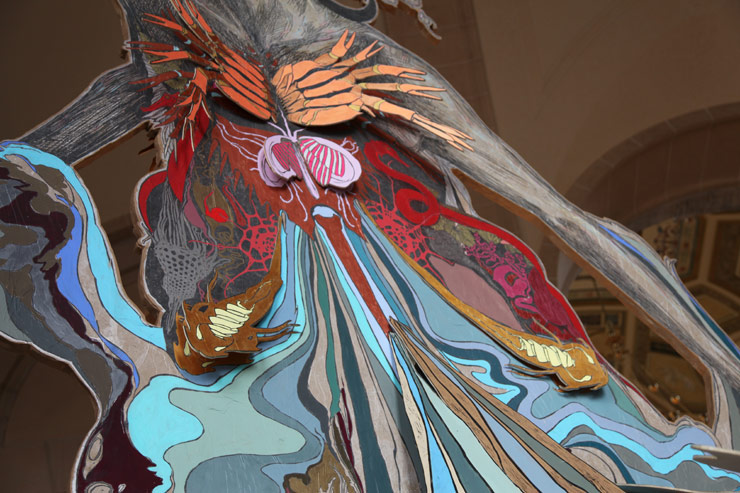
This week, four years after Thalassa’s initial debut into museum life and public life, she takes up residence at The Detroit Institute of Arts (DIA Detroit) and already the lobby of this main entrance has been clogged with skyward looking guests, many of them seeing Swoons’ work for the first time.
Here it does feel celebratory, with the cloud of paper, mylar and fabric ephemera buffeting in the wake of the mother of all sea creatures.
Here at the Woodward Avenue entrance Detroit visitors are feeling hopeful as well, with plans for the new rapid transit line just outside the museum, past Rodin’s “The Thinker”. Inside as well the DIA’s new director Salvador Salort-Pons is said to be breathing new life into this huge encyclopedic institution, with new acquisitions from artists like Mickelene Thomas and an upcoming rocking exhibit into which Detroit native Jack White figures prominently.
As Detroit is pushing itself to rise from economic devastation, Thalassa and her quick 20 foot tall elevation at the entrance are perhaps symbols of artists at the forefront of recovery. How apt that an artist from the street is representing new generations from inside the museum, using a regenerative symbol that speaks of our ecological systems and our responsibility to protect, not simply ravage, the Earth and the seas.
With a bosom of sea creatures and a curvaceous series of lines that undulate and ripple outward, Thalassa is on view until next March. While here in Detroit Swoon is preparing for a new show at DIA patron Anthony Curis’s gallery downtown on October 8th at The Library Collective.
Swoon’s Thalassa will be on view at the Detroit Institute of Arts (DIA) Woodward Ave. Lobby from Saturday, Sept. 24 through March 19, 2017. Additionally the artist will hold an artist lecture at DIA at 1:00 pm on October 1st. The talk is free with museum admission. Click HERE for more information.
The Moscow Manege Hosts International and Local Street Artists for a Biennale
Moscow presents a Street Artist’s exhibition, but the streets have almost none.
When Street Art and it’s associated cousins move inside the possible outcomes are many. With exhibitions like this you are seeing urban becoming very contemporary.
The Artmossphere Biennale jump-starts the debate for many about how to best present the work of Street Artists and organizers here in Moscow chose a broad selection of curators from across a spectrum of private, commercial, academic and civically-inspired perspectives to present a solid range of artists from the graffiti and Street Art world inside a formal hall.
To be clear, unless it is illegal and on the street, it is not graffiti nor Street Art. That is the prevailing opinion about these terms among experts and scholars of various stripes and it is one we’re comfortable with. But then there are the commercial and cultural influences of the art world and the design industries, with their power to reshape and loosen terms from their moorings. Probably because these associated art movements are happening and taking shape before our eyes and not ensconced in centuries of scholarship we can expect that we will continue to witness the morphing our language and terminologies, sometimes changing things in translation.
Definitions aside, when you think of more organic Street Art scenes which are always re-generating themselves in the run-down abandoned sectors of cities like Sao Paulo, New York, Melbourne, Paris, Mexico City, London, and Berlin, it is interesting to consider that this event takes place nearly on the grounds of the Kremlin under museum like security.
An international capital that ensures cleanly buffed walls within hours of the appearance of any unapproved Street Art or graffiti, Moscow also boasts a growing contingent of art collectors who are young enough to appreciate the cultural currency of this continuously mutating hybrid of graffiti, hip hop, DIY, muralism, and art-school headiness. The night clubs and fashionable kids here are fans of events like hip-hop and graffiti jams, sometimes presented as theater and other times as “learning workshops” and the like.
Plugging into this idea of street and youth culture is not a singular fascination – there is perhaps an association with the rebellious anti-authoritarian nature of unregulated art in the streets that fuels the interest of many. With graffiti and hip-hop culture adoption as a template, newer expressions of Street Art culture are attractive as well with high profile artists with rebel reputations are as familiar in name here as in many cities. New festivals and events sometimes leverage this renegade free-spirit currency for selling tourism and brands and real estate, but here there also appears to be an acute appreciation for its fine art expression – urban contemporary art.
MOSCOW’S MANEGE AND “DEGENERATE ART”
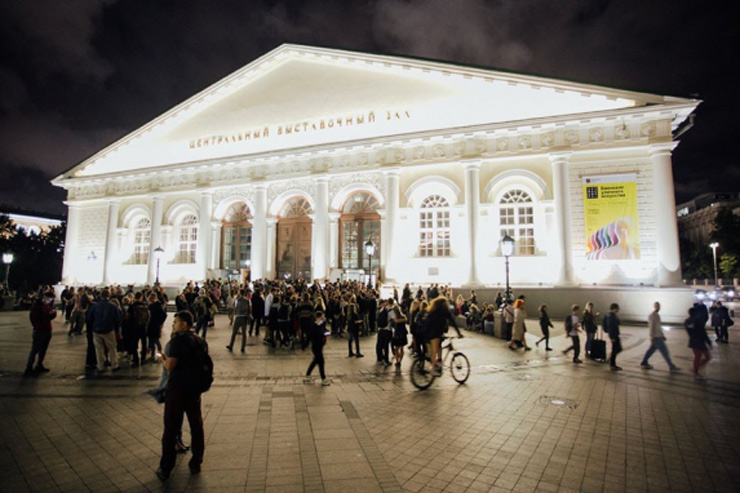
So ardent is the support for Artmossphere here that a combination of public and private endorsements and financial backing have brought it to be showcased in a place associated with high-culture and counter-culture known as the Moscow Manege (Мане́ж). The location somehow fits the rebellious spirit that launched these artists even if its appearance wouldn’t lead you to think that.
The 19th century neo-classical exhibition hall stands grandly adjacent to Red Square and was built as an indoor riding school large enough to house a battalion of 2,000 soldiers during the 1800s. It later became host to many art exhibitions in the 20th century including a famous avant-garde show in 1962 that Soviet Premier Nikita Khrushchev famously derided as displaying ‘degenerate’ art.
One of the artists whose work was criticized, painter and sculptor Ernst Neizvestny, challenged the label defiantly and won accolades afterward during his five decade career that followed, including receiving many awards and his work being collected worldwide by museums. Russian President Vladimir Putin is quoted as calling him “a recognised master and one of the best contemporary sculptors”. In January of this year at the age of 90, Neizvestny’s return to Menage featured an extensive exhibition. He passed away August 9th (The Moscow Times), only weeks before Artmossphere opened.
In some kindred spirit many of these artists at Artmossphere have done actual illegal work on the streets around the world during their respective creative evolutions, and graffiti and Street Art as a practice have both at various times been demonized, derided, dismissed and labeled by critics in terms synonymous with “degenerate”.
A CLEAN CITY
“Moscow is mostly very clean,” says Artmossphere co-founder and Creative Director Sabine Chagina, who walks with guests during a sunny afternoon in a busy downtown area just after the opening. “But we do have some good graffiti crews,” she says as we round the corner from the famous Bolshoi Theater and soon pass Givenchy and Chanel and high-end luxury fashion stores. Shortly we see a mural nearby by French artist Nelio, who painted a lateral abstracted geometric, possibly cubist, piece on the side of a building here in 2013 as part of the LGZ Festival.
If there was graffiti here in Moscow, it was not on full display very readily in this part of town. In driving tours, rides on the extensive metro train system, and in street hikes across the city a visitor may find that much of the illegal street art and graffiti common to other global capitals is illusive due to a general distaste for it and a dedicated adherence to buffing it out quickly.
For a pedestrian tourist Moscow appears in many ways as fully contemporary and architecturally rich as any international world-class metropolis. One of the cleanest places you’ll visit, the metro is almost museum-like in some instances; the historic districts spotless, public fountains, famed statues of important historical figures. All is efficiently ordered and – a welcome surprise – most public space is free of advertisements interrupting your view and your thoughts.
Come to think of it, the sense of commercial-celebrity media saturation that is present in other cities doesn’t appear to permeate the artists psyche here at the Biennale – so there’s not much of the ironic Disney-Marilyn-supermodel-Kardashian-skewering of consumerism and shallowness in this exhibition that you may find in other Urban Art events.
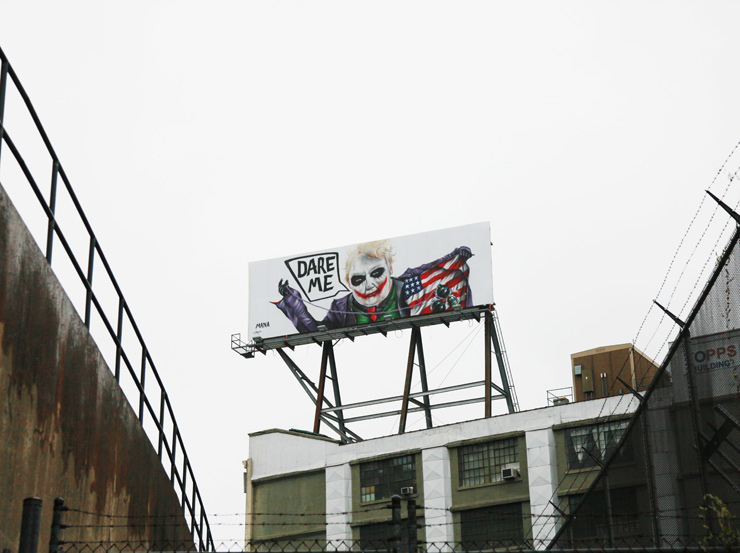
Also, unlike a Street Art-splattered show in London for example that may rudely mock Queen Elizabeth or art in New York streets that present Donald Trump styled as a pile of poo and Hillary Clinton as Heath Ledger’s Joker, we didn’t see over-the-top Putin satires either. So personality politics don’t seem directly addressed in this milieu. According to some residents there was an outcropping of huge festival murals by Street Artists here just a few years ago but more recently they have been painted over with patriotic or other inspiring murals, while others have been claimed for commercial interests.
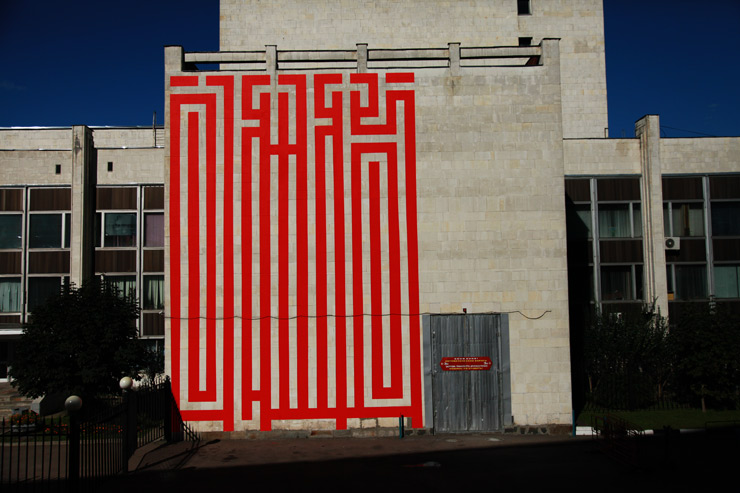
Starved for some gritty street scenes, it is all the more interesting to see the one live mural painting that we were able to catch – a 6-story red-lined op-art tag by the French graffiti writer L’Atlas. Far from Manege, placed opposite a cineplex in what appears to be a shopping mall situated far from the city’s historical and modern centers, our guide tells us half-jokingly that he is not sure that we are still in Moscow.
Here L’Atlas says that he has painted his bar-code-like and cryptic nom-de-plume with an assistant on a cherry picker for a few days and he says that no one has stopped to ask him about it, neither to comment or criticize. Actually one man early one morning returning home from a disco did engage him briefly, but it was difficult to tell what he was talking about as he may have had a few drinks.
This lack of public commentary is mainly notable because in other cities the comments from passersby can be so ubiquitous that artists deliberately wear stereo headphones to prevent interruption and to be more productive. Sometimes the headphones are not actually playing music.
This Street Art Biennale nonetheless is gaining a higher profile among Urban Art collectors and its associated art dealers and the opening and later auction reaches directly to this audience. Included this year with the primary “Invisible Walls” exhibition are satellite events in association with local RuArts Gallery, Tsekh Belogo at Winzavod, and the Optika Pavilion (No. 64) at VDNKh.
The opening night event itself is wide and welcoming, a mostly youthful and populist affair with celebratory speeches and loosely organized group photos and an open bar. Added together with a press conference, a live DJ, virtual reality headsets, interactive artworks, major private business sponsors, government grants, ministers of culture, gallerists, and quirkily fashionable art fans, this is a polished presentation of a global culture that is filtered through the wide lense of the street.
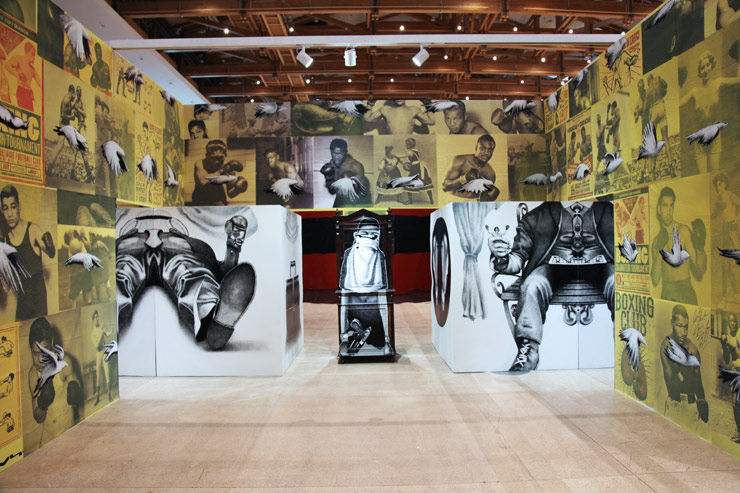
Perhaps because the exhibition hall is a cavernous rectangle with exposed beams on the ceiling and many of the constructed white walls that mimic vendor booths, it has the air of an art fair. There are thankfully no salespeople pacing back and forth watching your level of interest. People tend to cluster before installations and talk, laugh, share a story, pose for a selfie.
The theme seems very appropriately topical as geopolitical, trade-related, social, digital, and actual walls appear to be falling down rapidly today while the foundations of new ones are taking shape. Catalyzed perhaps by the concept and practices of so-called “globalization” – with its easy flow of capital and restricted flow of humans, we are all examining the walls that are shaping our lives.
With 60+ international artists working simultaneously throughout this massive hall, newly built walls are the imperative for displaying art, supporting it, dividing it. These are the visible ones. With so many players and countries represented here, one can only imagine that there are a number of invisible walls present as well.
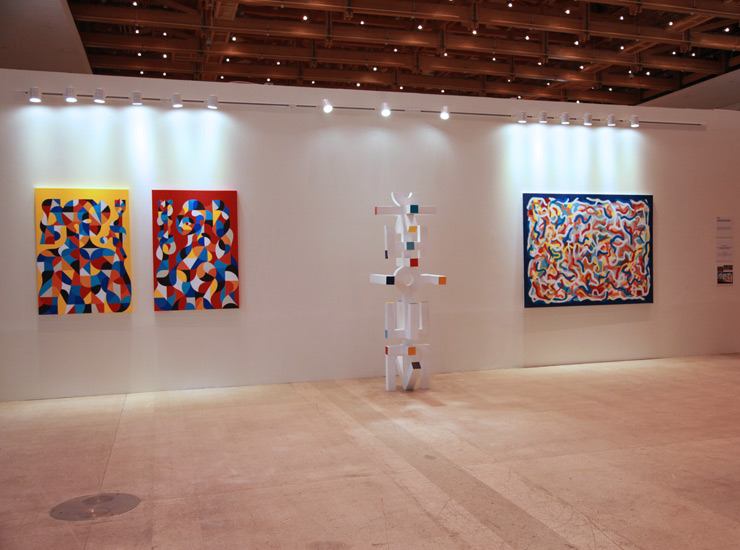
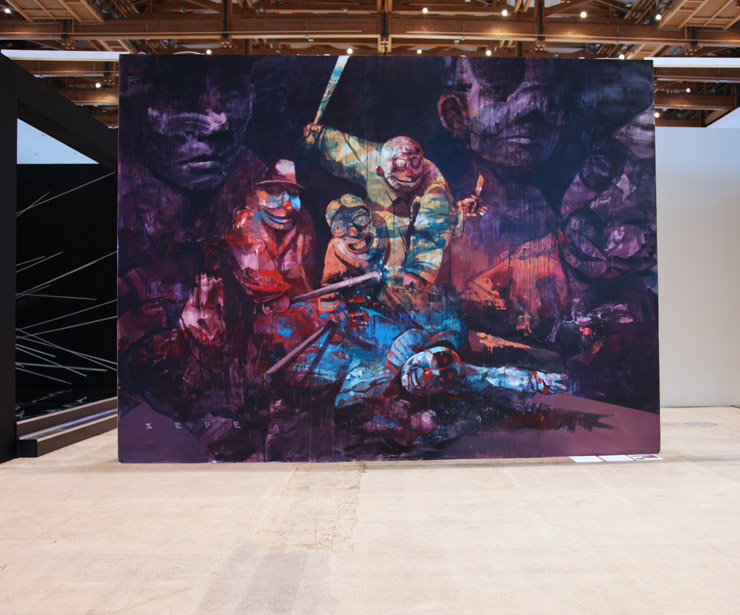
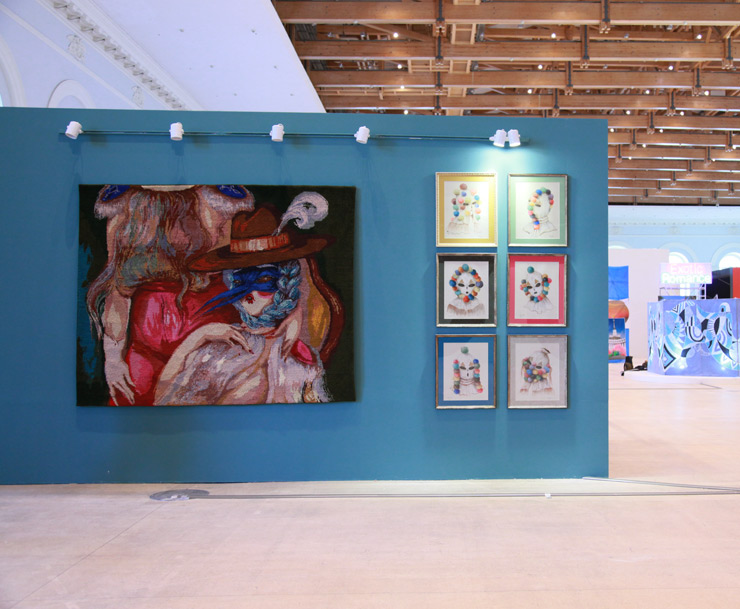
The theme has opened countless interpretations in flat and sculptural ways, often expressed in the vernacular of fine art with arguable nods to mid-20th century modernists, folk art, fantasy, representational art, abstract, conceptual, computer/digital art, and good old traditional graffiti tagging. Effectively it appears that when Street Art and graffiti artists pass the precipice into a multi-disciplinary exhibition such as this, one can reframe Urban/Street as important tributaries to contemporary art – but will they re-direct the flow or be subsumed within it?
The work often can be so far removed from street practice that you don’t recognize it as related.
Aside from putting work up in contested public space without permission and under cover, an average visitor may not see a common thread. These works run aesthetic to the conceptual, painterly to the sculptural, pure joy and pure politics. But then, that is we began to see in the streets as well when the century turned to the 21st and art students in large numbers in cities like New York and London and Berlin skipped the gatekeepers, taking their art directly to the public.
Perhaps beneath the surface or just above it, there is a certain anarchistic defiance, a critique of social, economic, political issues, a healthy skepticism toward everyone and everything that reeks of hypocritical patriarchal power structures. Perhaps we’re just projecting.
Looking over the 60+ list of names, it may be striking to some that very few are people of color, especially in view of the origins of the graffiti scene. Similarly, the percentage of women represented is quite small. We are familiar with this observation about Urban Art in general today, and this show mirrors the European and American scene primarily, with notable exceptions such as Instagrafite’s home-based Brazilian crew of 4 artists. As only one such sampling of a wide and dispersed scene, it is not perhaps fair to judge it by artists race, gender, or background, but while we speak of invisible walls it is worth keeping our eyes on as this “scene” is adopted into galleries, museums, and private collections.
Following are some of the artists on view at Artmossphere:
ASKE
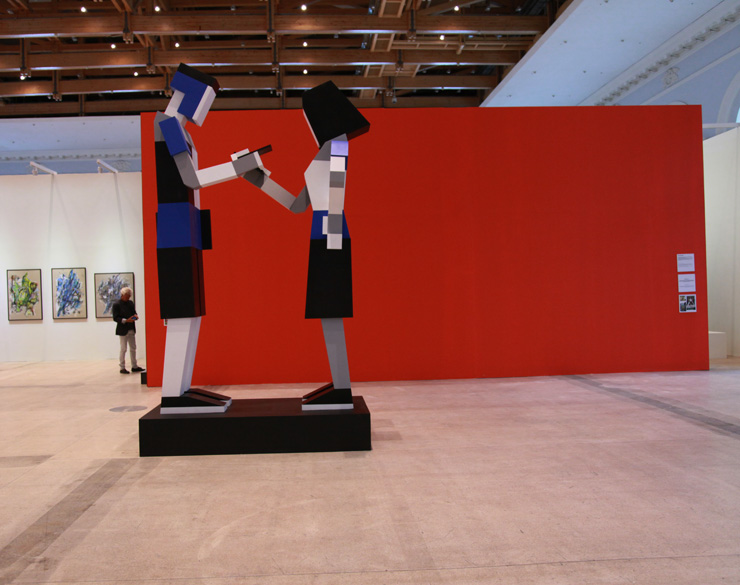
Certainly Moscow native ASKE is gently mocking our mutated modern practices of communicating with his outsized blocked abstraction of a close couple riveted to their respective electronic devices, even unaware of one another.
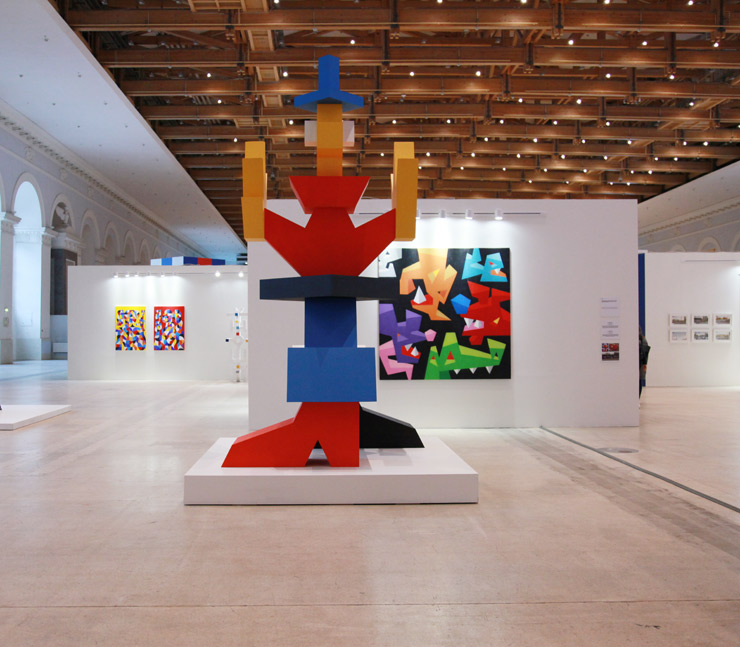
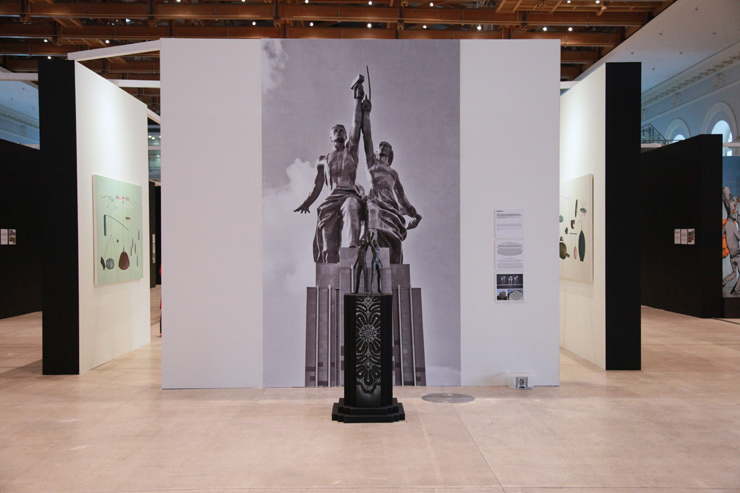
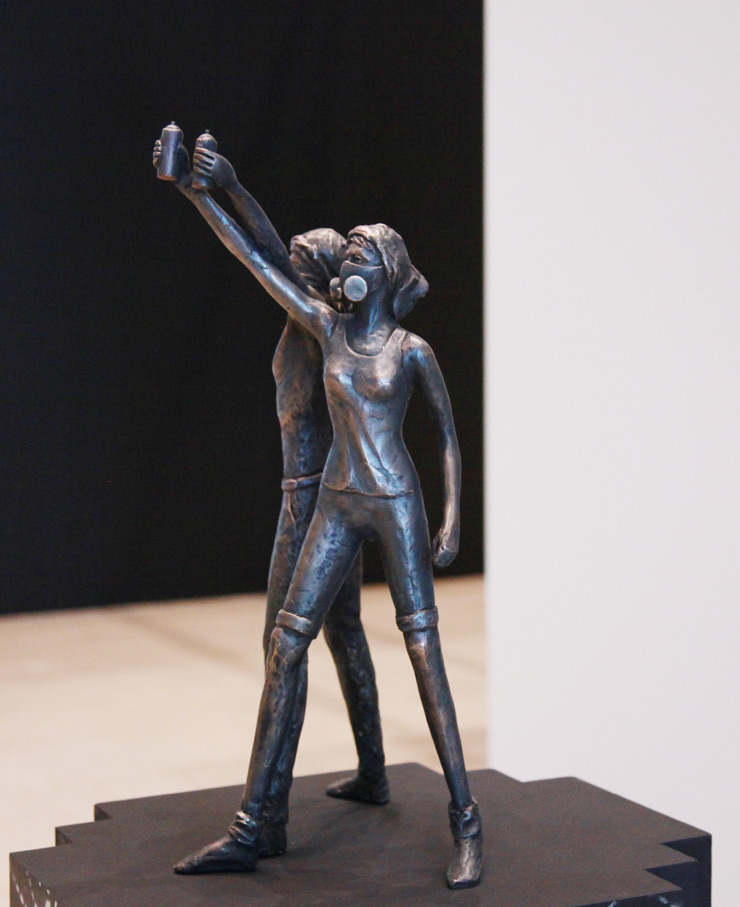
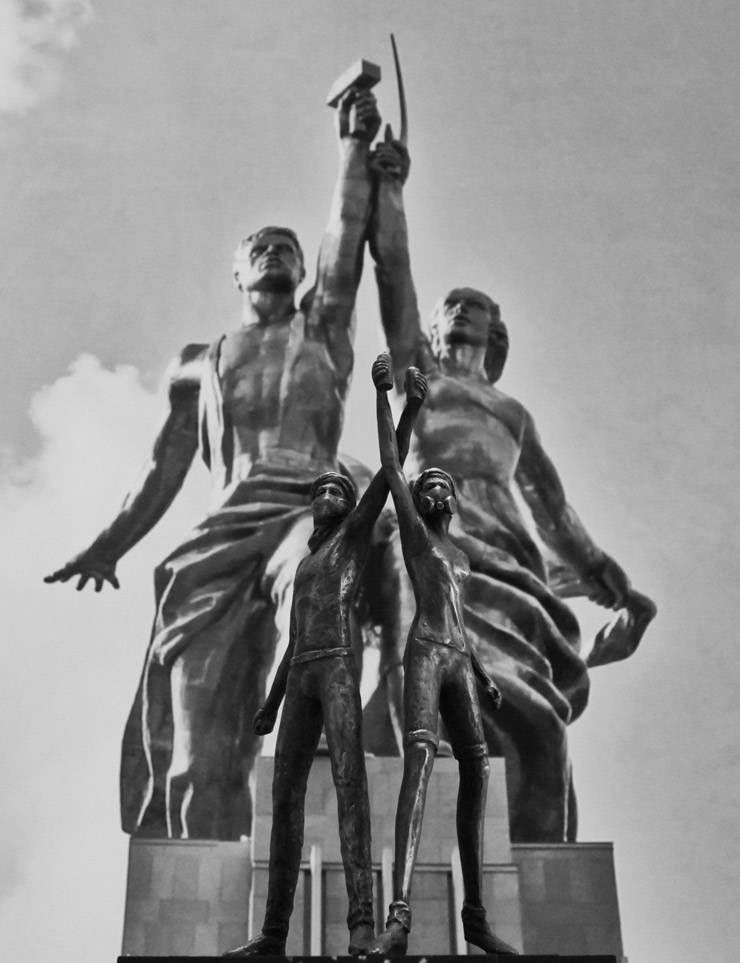
Warsaw based NeSpoon creates a sculpture of another couple. Heroically presenting her vision of what she calls the iconic “Graffiti Writer” and “Street Art Girl”, they face the future with art instruments in hand ready to make their respective marks. She says her work is emblematic of a permanent financial insecurity for a generation she calls the “PRECARIAT”.
“ ‘Precariat’ is the name of the new emerging social class,” says curator, organizer, and NeSpoon’s partner Marcin Rutkiewicz when talking about the piece during the press conference. “These are young people living without a predictable future, without good jobs, without social security. It’s a class in the making and probably these people don’t have any consciousness or global unity of interest. But they are the engines of protest for people all over the world – like Occupy Wall Street, Gezi Park in Turkey, or the Arab Spring.”
The artist developed the sculpture specifically for this exhibition and planned it over the course of a year or so. Born of a social movement in Poland by the same name, the sculpture and its sticker campaign on the street represent “a kind of protest against building walls between people who are under the same economical and social situation all over the world,” says Rutkiewicz.
LI-HILL
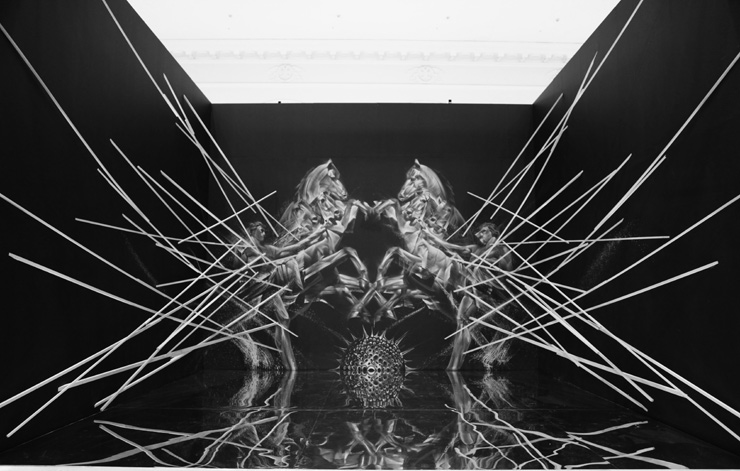
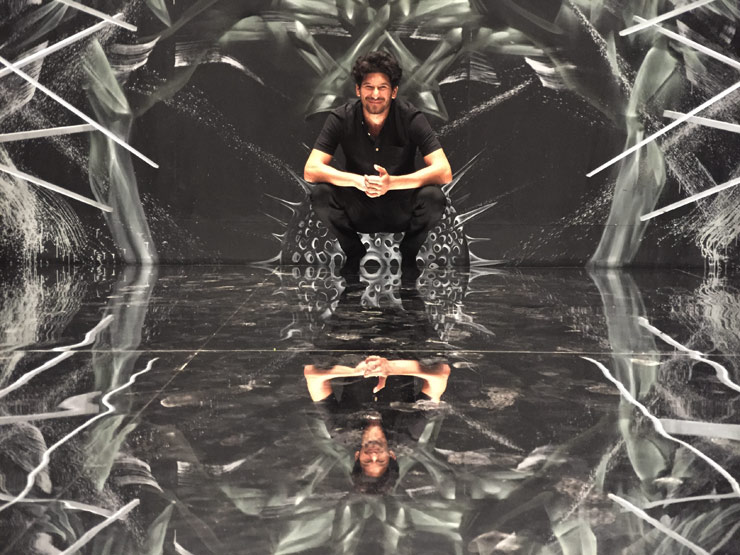
Artist Li-Hill says his piece “Guns, Germs, and Steel” directly relates to the divisions between civilizations due to a completely uneven playing field perpetuated through generations. Inspired by the 1997 trans-disciplinary non-fiction book by Jared Diamond, Li-Hill says the Russian sculptural group called “The Horse Tamers” represents mankind’s “ability to harness power of the natural world and to be able to manipulate it for its advantage.”
“The horse is one of the largest signifiers and is a catalyst for advancement in society because it has been for military use, for agriculture, for transportation,” he says. “It was the most versatile of the animals and the most powerful.” Here he painted a mirror image, balanced over a potential microbial disaster symbol, and he and the team are building a mirrored floor to “give it this kind of infinite emblem status.”
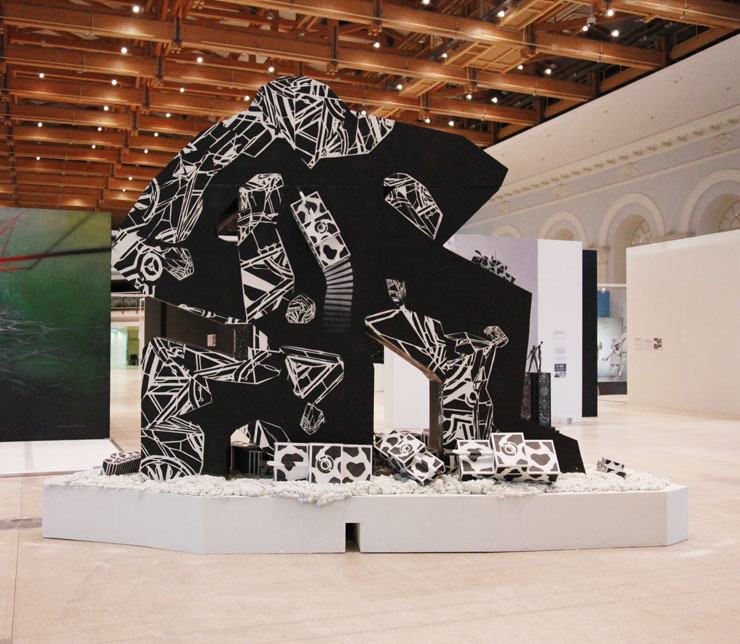
Afloat in the middle of some of these walled areas M-City from Poland is choosing to be more direct thematically in his three dimensional installation of plywood, plaster, aerosol and bucket paint, and machine blown insulation.
“It is an anti-war piece,” he says, and he speaks about the walls between nations and a losing battle of dominance that ensures everyone will be victim.”
“It’s kind of a monster who destroys arms,” he says of this temporary sculpture with a lording figure crushing tanks below.
“He is destroying the tanks but at the same time he is also a destroyer – so it’s a big circle. Nothing is positive that can come out of this. There is always someone bigger.” He says the piece is inspired by the political situations in Europe today and the world at large.
HOTTEA
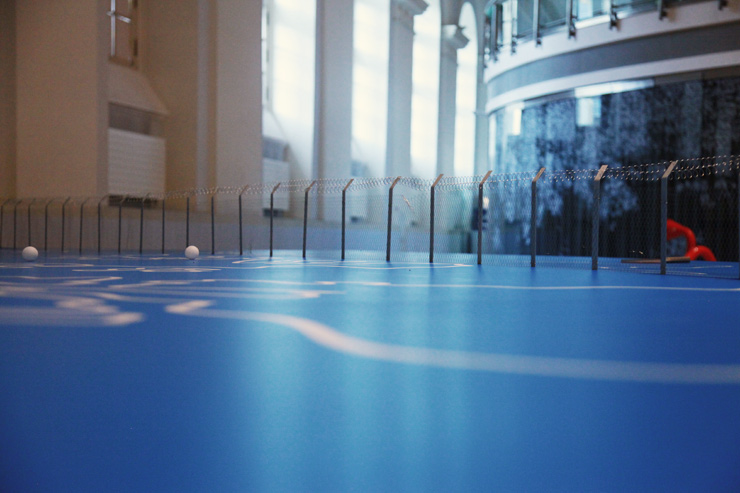
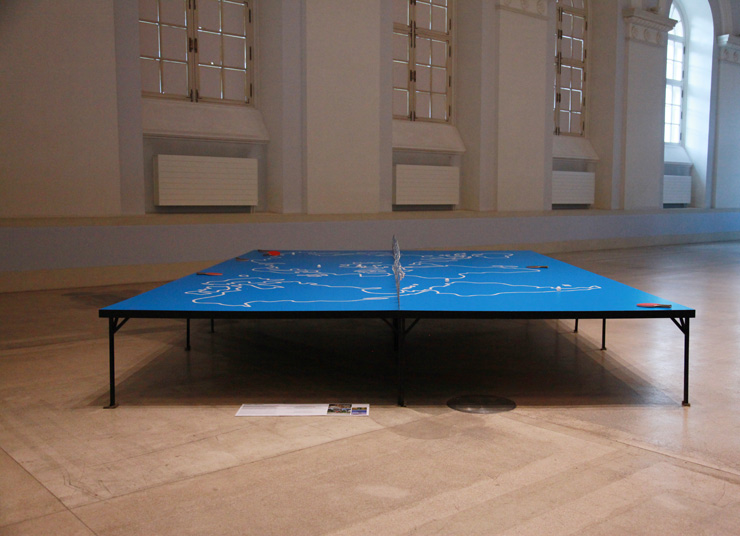
Minneapolis based HOTTEA usually does very colorful yarn installations transforming a huge public space, but for Artmossphere he is taking the conceptual route. The walk-in room based on the Whack-A-Mole game presents holes which a visitor can walk under and rise above.
Visitors/participants will experience the physical separation of space, and perhaps contemplate facing one another and interacting or ignoring one another. It is something he says he hopes will draw attention to how many walls we have allowed ourselves to distract from human interactions.
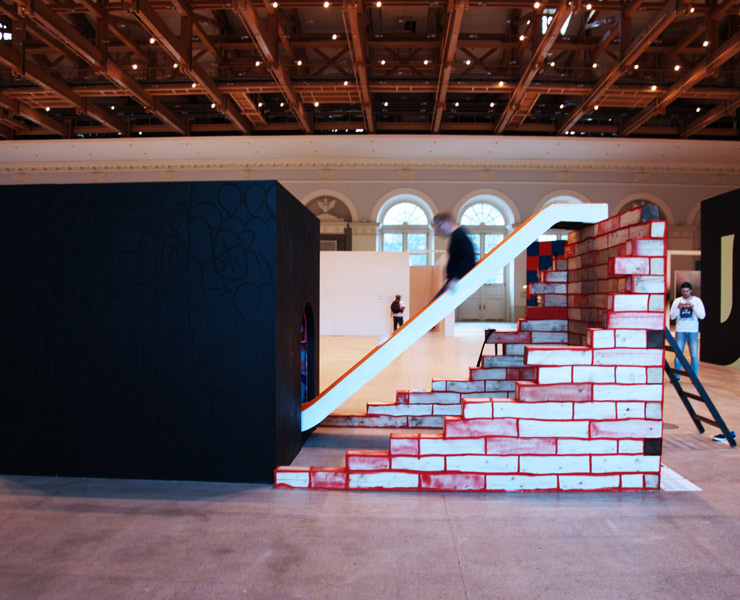
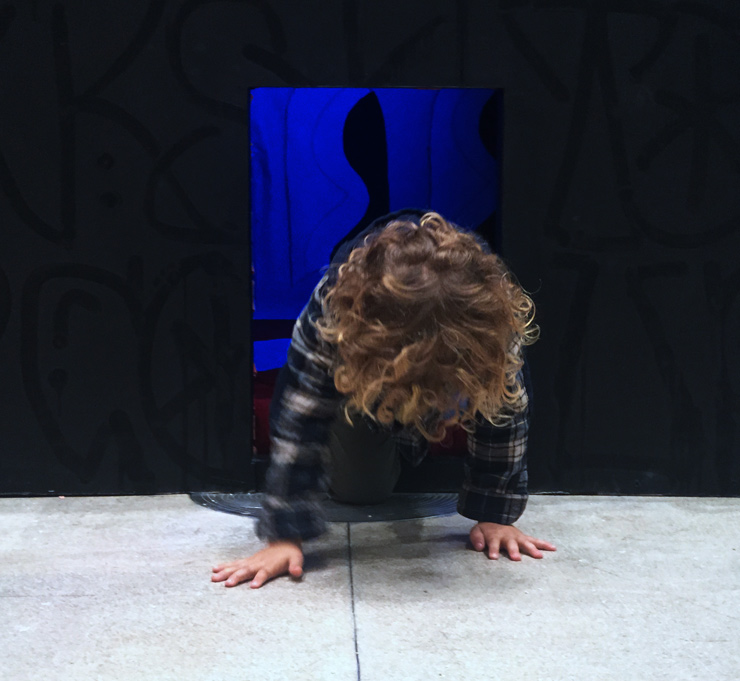
Englands’ Sick Boy calls his project The Rewards System, where guests are invited to climb a ladder over a brick wall and descend down a slide into a darkened house, setting off a series of sensors that activate a variety of multisensory lights and tantalizing patterns. After landing and being rewarded the visitor is forced to exit on hands and knees through a too-small square door.
“The concept of the show is about invisible walls so I was thinking about there being barriers in your life and I thought about the reward of endorphins one experiences for achieving a task – a small amount of endorphins. So I thought I would build a house that signifies the reward system,” he explains.
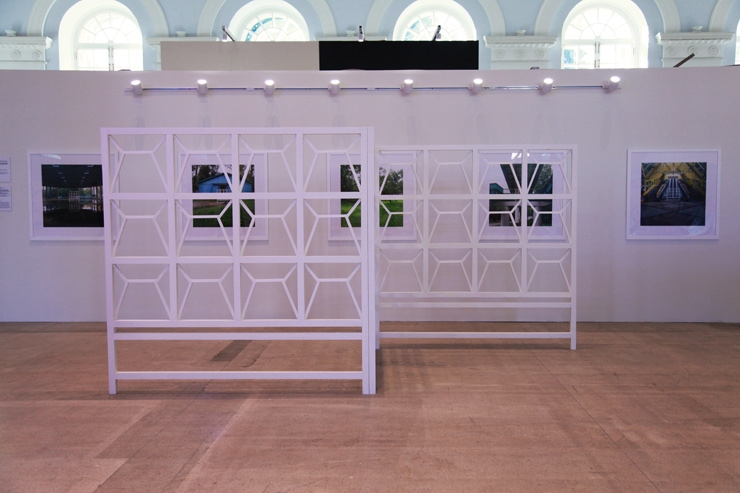
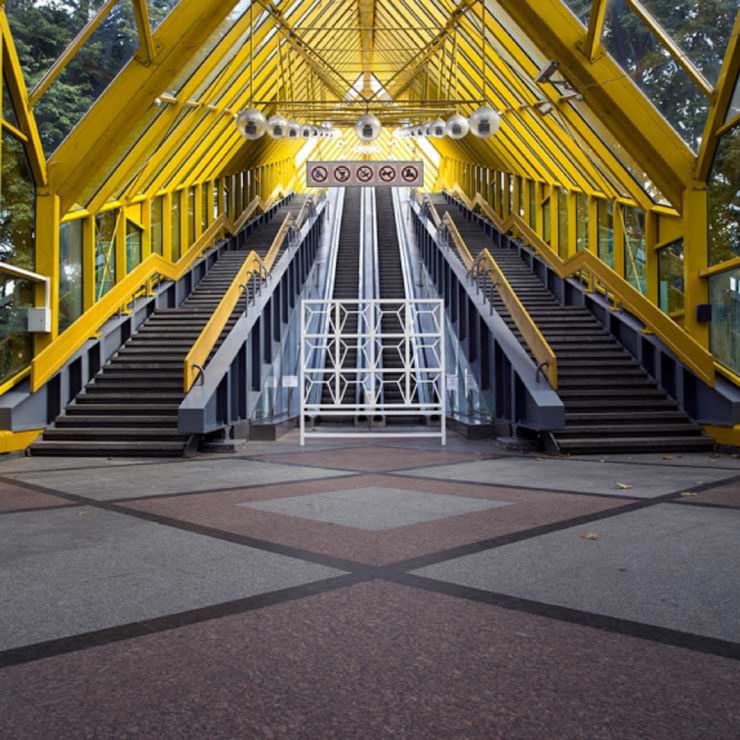
Atlanta/Seattle based Derek Bruno reached back to the Leonid Brezhnev years and into Moscow’s Gorky Park for his series of site specific installations based on Soviet Cement Fence type PO-2. The iconic fence was re-created in a nearby studio and Bruno shot photographs of his 10-15 minute “interventions” in the park itself, revisiting a field of design called “technical aesthetics.”
In a statement Bruno explains “Since the end of the Soviet Union, the iconic fence has become a persistent and ever present reminder of former delineations of space; while new forms of boundaries shape the digital and sociopolitical landscapes. “
REMI ROUGH
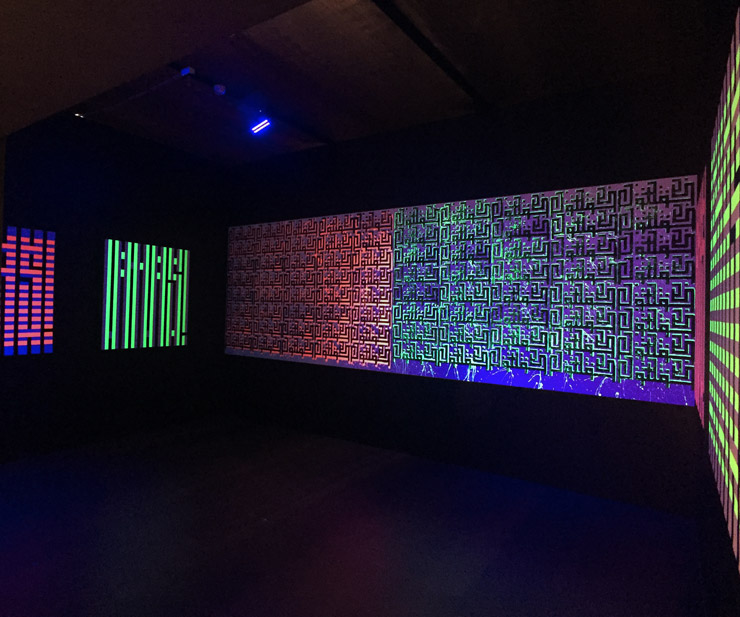
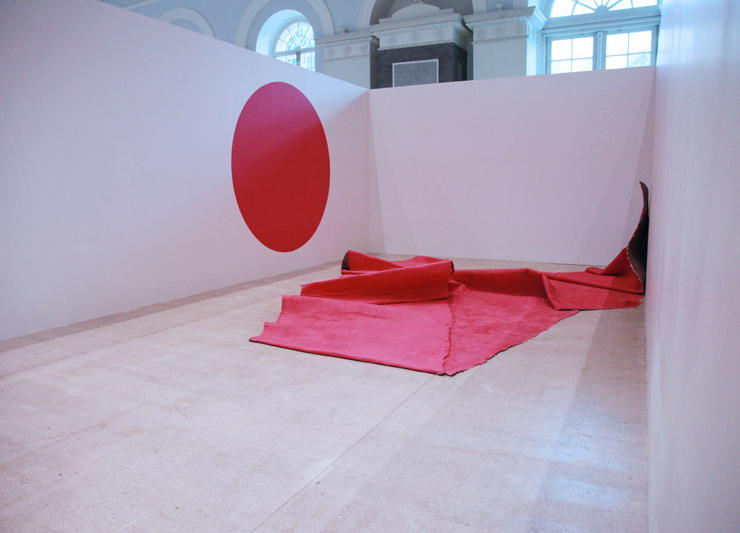
Remi Rough is known for his smartly soaring abstract geometry in painted murals and smaller scale works, and for Moscow he wanted to strip it back to the basics, approaching a white box with one undulating graphic composition.
“My idea was that Moscow’s a bit ‘over the top’,” he says, and he decided to strip back the audacity and go for simplicity, which actually takes courage.
“I said ‘you know what?’ – I want to do something with the cheapest materials you can possibly get. These two pieces literally cost 3000 rubles ($50). It’s made of felt, it’s like a lambs wool. I think they use it for flooring for construction.” Depending on the angle, the pink blotted material may translate as a swath of otherworldly terrain or a metaphorical bold vision with all the hot air let out.
“I wanted to do something peaceful and calming and use natural materials – something that’s different from what I usually do – but I use the folds in the fabric and the pink color – two things that I usually use a lot.”
ALEXEY LUKA
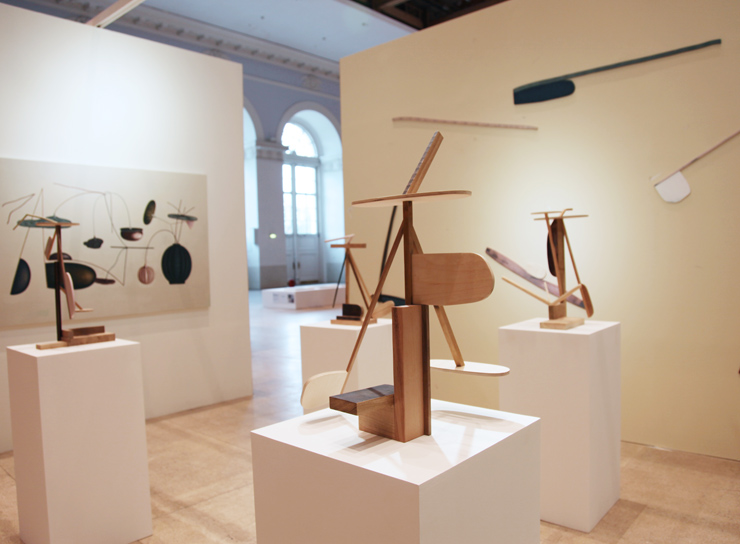
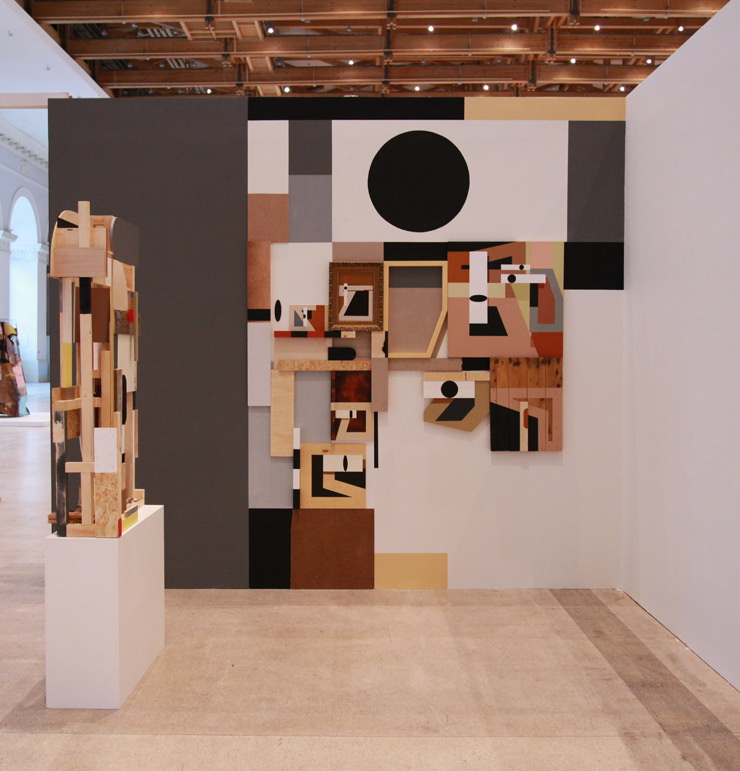
Moscow’s Alexey Luka is also challenging himself to stretch creatively by taking his wall collage installations of found wood and converting them into free-standing sculptures.
“For this biennale I tried to make something different so now I am going from the assemblages to 3-D.” The constructed media is warm and ordered, reserved but not without whimsy.
“My work is made from found wood – I use it with what I found on the street and my shapes and my graphics – so it’s kind of an experiment with three dimensions,” and he confirms that most of this wood is sourced here in Moscow.
We ask him about the number of eyes that peer out from his installation. Perhaps these eyes are those of Muscovites? “They are just like observers,” he says.
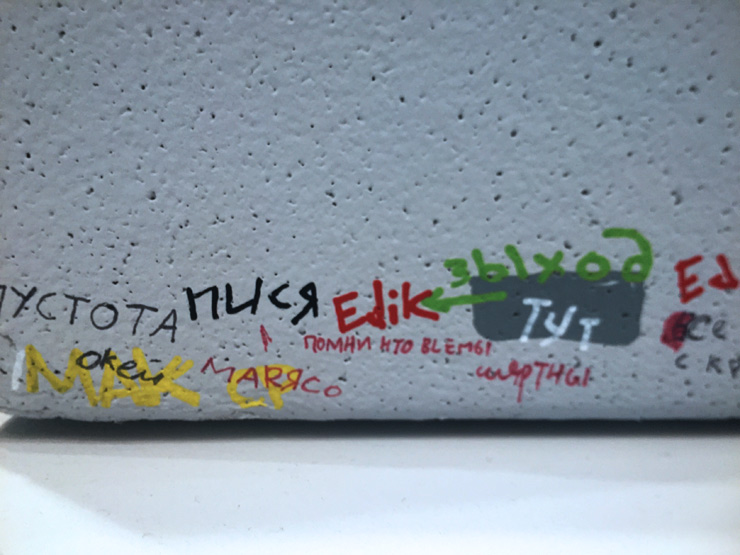
Torino’s Mimmo recreated the Moscow Olympic Village from the 1980 games in miniature presented as on a plainly brutalist platform. The sculpture is austere in detail on the hulking towers save for the tiny graffiti tags, throwies, rollers, extinguisher tags, and the like at the bases and on the roofs.
Curator Christian Omodeo tells us that Mimmo recreated the massive village based on his direct study of the site as it stands today; a housing project that has hundreds of families — and a hip-hop / graffiti scene as well.
It is striking that the scale reduces the impact of the graffiti – yet when experienced at eye-level it retains a potency. Even so, by recasting the relationship between viewer and mark-making, this graffiti actually seems “cute” because of its relative size to the viewer.
BRAD DOWNEY
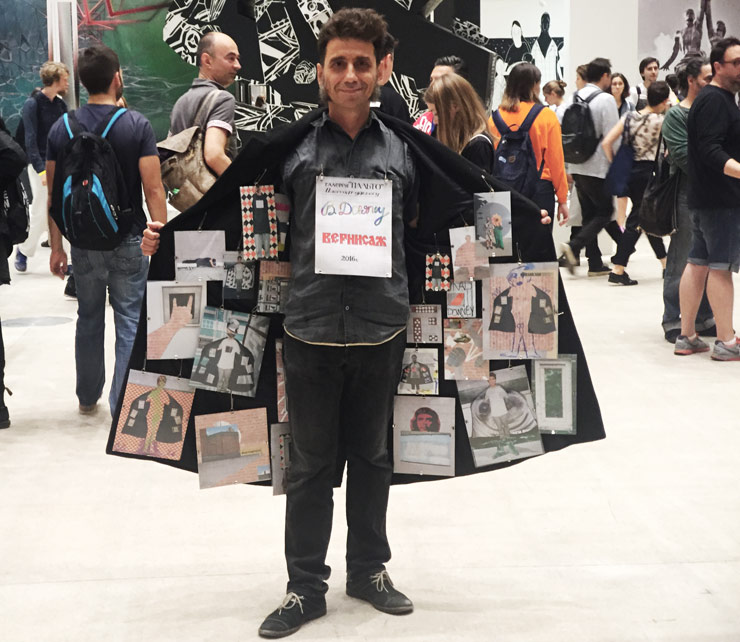
Brad Downey and Alexander Petrelli hi-jacked the opening of the Biennale by circulating within the exhibit as a gallery with artworks for sale. With Downey performing as a street-huckster pushing his own art products, Mr. Patrelli showcased new Downey photo collages and drawings inside his mobile “Overcoat Gallery”
A charming Moscow art star / gallerist / performance artist, Mr. Patrelli is also a perennial character at openings and events in the city, by one account having appeared at 460 or so events since 1992 with his flashing overcoat. The artworks also feature Patrelli, completing a self-referential meta cycle that continued to circle the guests at the exhibition.
International artists participating in the Artmossphere Biennale 2016 include: Akacorleone, Alex Senna, Brad Downey, Chu (Doma), Orilo (Doma), Claudio Ethos, Demsky, Christopher Derek Bruno, Filippo Minelli, Finok, Galo, Gola Hundun, Hot Tea, Jaz, Jessie and Katey, Johannes Mundinger, L’Atlas, LiHill, LX One, M-city, TC, Mario Mankey, Martha Cooper, Miss Van, Nespoon, Millo, Pablo Benzo, Pastel, Paulo Ito, Proembrion, Remed, Remi Rough, Rub Kandy, Run, Sepe, Sickboy, Smash 137, Sozyone Gonsales, SpY, The London Police, Trek Matthews, Wes 21.
This article is a result of a Brooklyn Street Art partnership with Urban Nation Museum For Urban Contemporary Art in Berlin and was originally published at Urban Nation Museum For Urban Contemporary Art
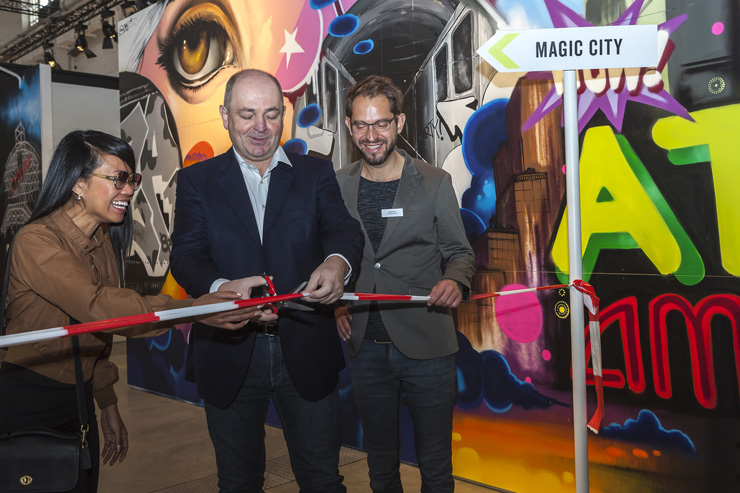
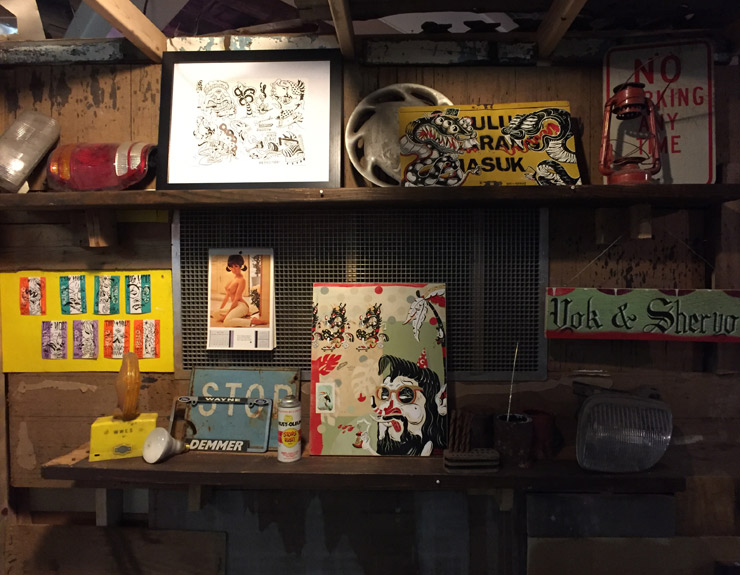
“The special magic that comes from our cities is germinated in the mad sum of their improbable juxtapositions and impossible contradictions,” says curator Carlo McCormick when talking about the new show opening in Dresden, Germany this week in a former engine factory called Magic City : The Art of the Street.
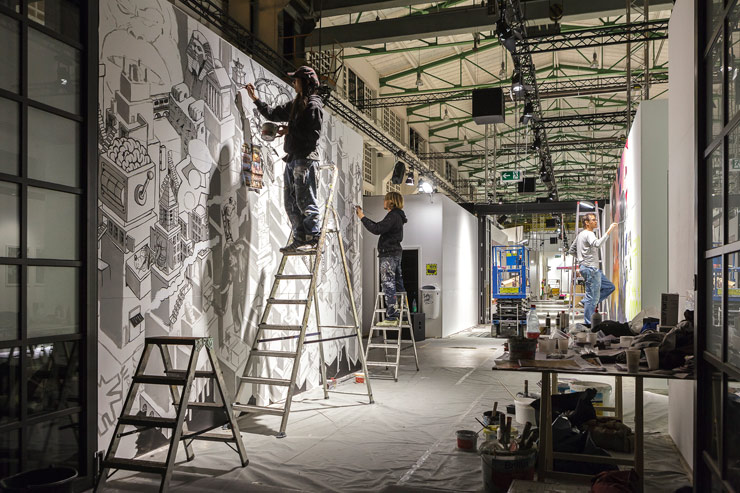
Along with curator Ethel Seno and a creative team (full disclosure, BSA is part of it) McCormick is evoking an interstitial city that rises from the streets in many urban centers globally. Whether it is graffiti, Street Art, urban interventions, detournement, adbusting, or myriad cultural refinements, artists and activists are commonly, sometimes radically, altering the city and our experience of it.
By engaging some of the best visual and intellectual examples of the whole current scene with a full knowledge of our recent past, Magic City lays out a route for you to appreciate the individual and a sense of the cumulative. It’s bold and somewhat romantic move to look for magic in the Graffiti / Street Art / Urban Art scene. Some may argue that it consists of nothing less.
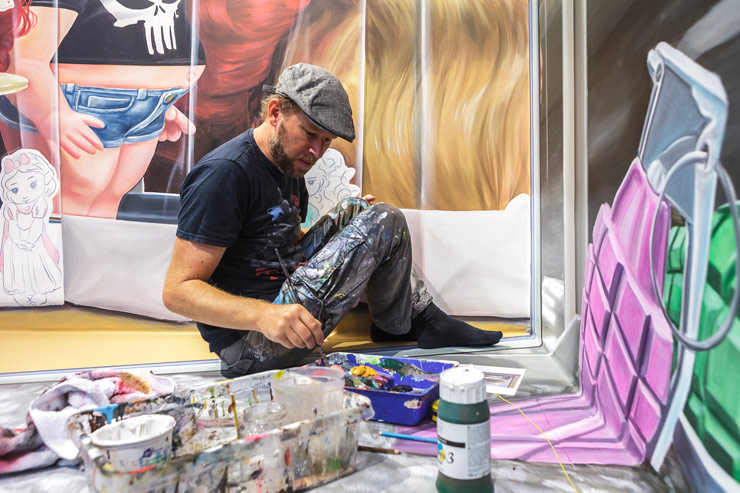
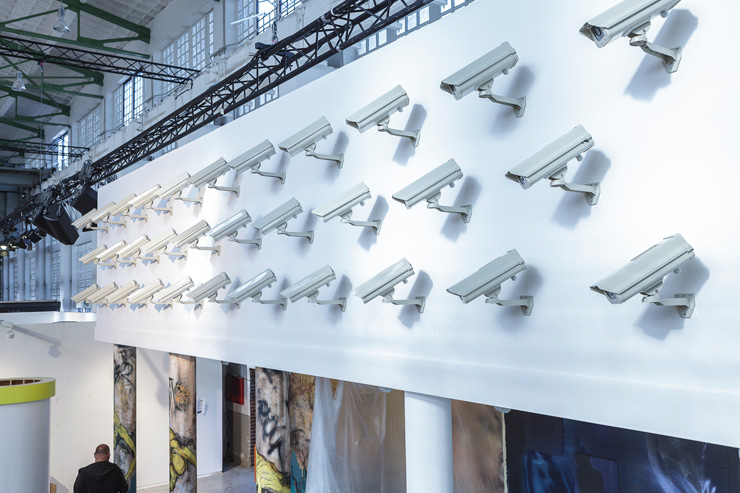
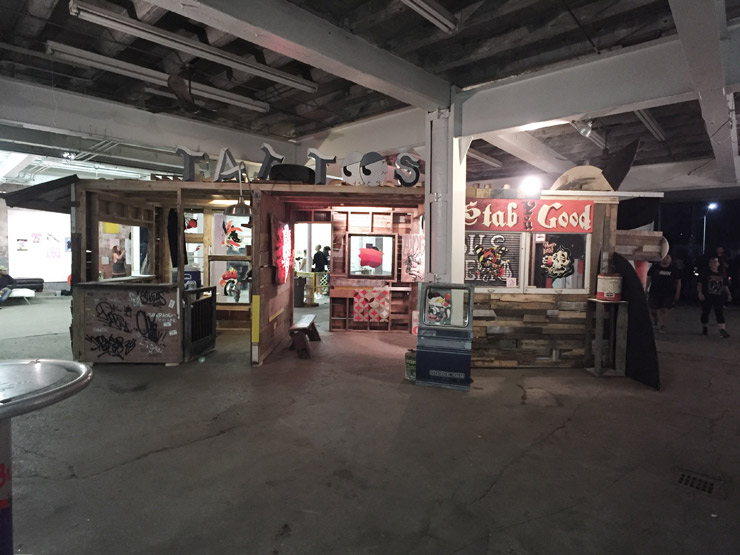
Over the last few weeks about 40 artists have been installing brand new pieces and environments in the long wide factory space in advance of the grand preview this weekend. Here are some process shots of the building of a Magic City.
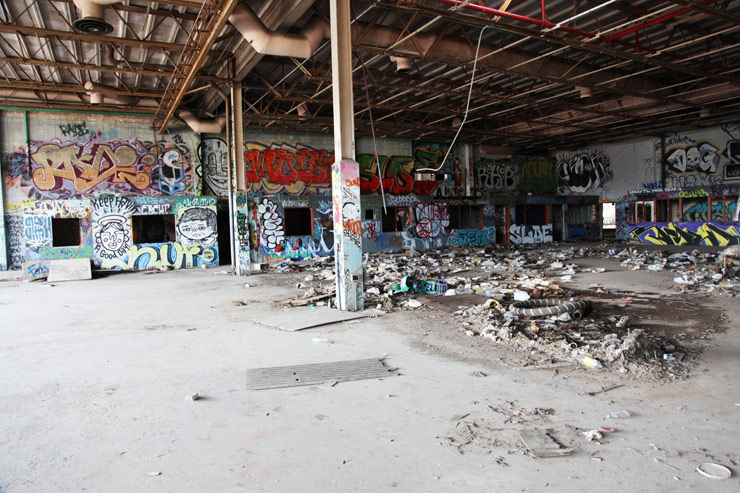
Running through many of the streets fanning from Detroit’s’ downtown will lead you to a graffiti scene that gave birth to the large murals being celebrated in the city center. It is a cognitive dissonance for many at this moment when Detroit’s Mayor Mike Duggan’s name comes into conversation as making political hay by targeting Street Artists – especially while that same genre is employed to brandish the creative vitality of a financially bankrupted yet proud American powerhouse like the Motor City.
Here in the dank darkened hallways of former factories and warehouses that once pumped life through an economy lies some of the DNA that can grow a creative resurgence. These property owners may have abandoned the citizenry and taxpayer and the bond of their promise to honor community, and that charge is often made as wide swaths of people are without work or pensions or viable social mobility. Technically these property owners would be entitled to prosecute the artists and taggers for vandalism – but many have skipped town with the wealth they gained here and left the city to deal with these architectural carcasses.
Contemplate now with us the intersection of illegal art-making crossing paths with celebrated cultural recognition and commercial reward. It is a fiery collision of intertwined ironies. The Street Art paradox in Detroit and elsewhere is that the work of vandals eventually becomes celebrated by greater society, but until then you should look over your shoulder.
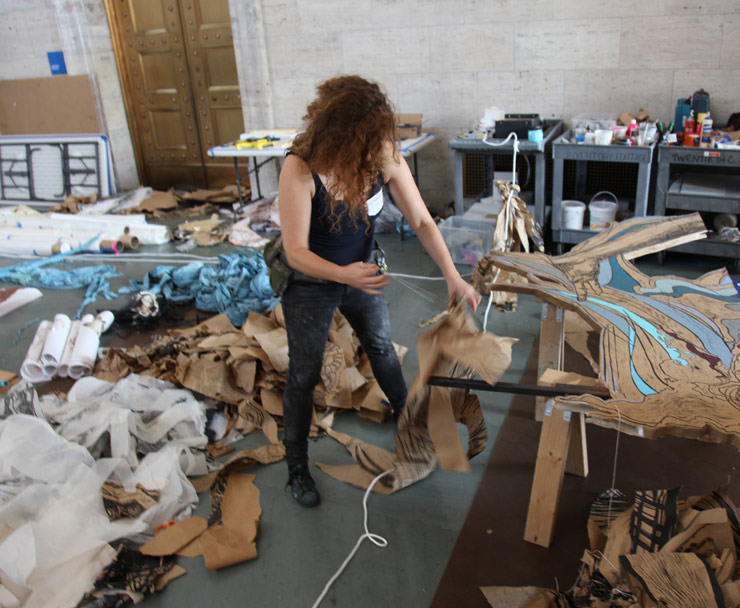
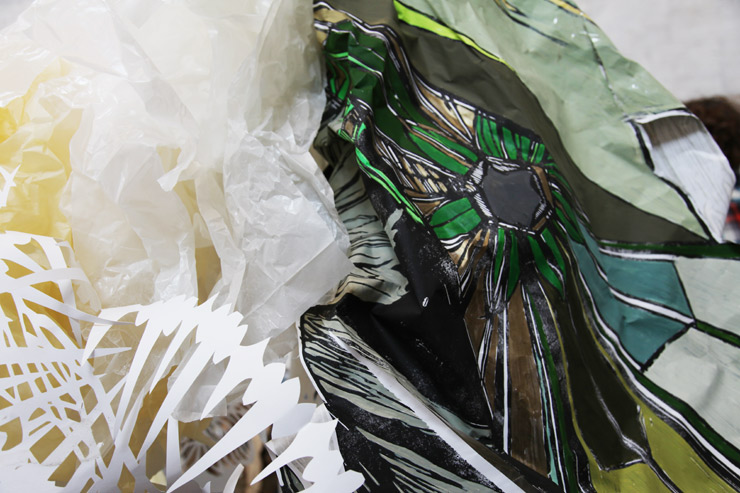
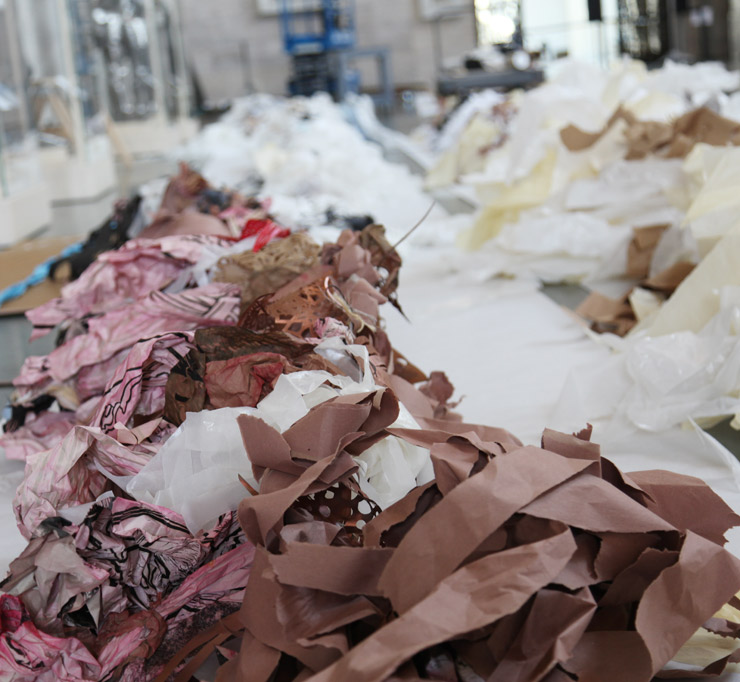
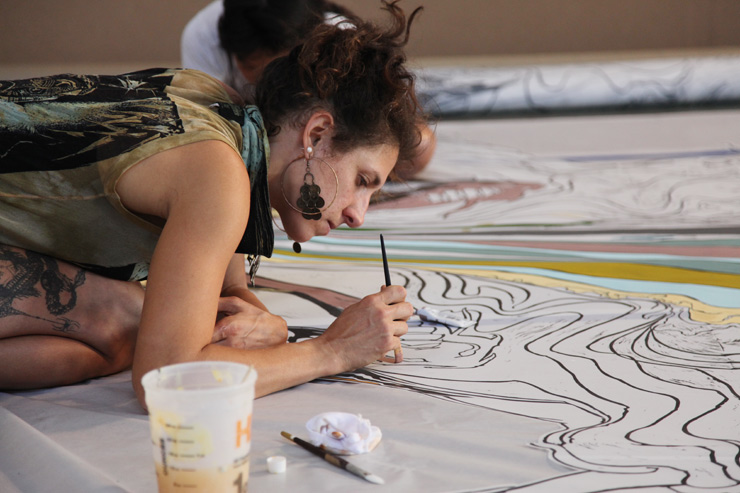
This is the city where Shepard Fairey was threatened with a 10-year jail sentence and simultaneously feted for his soaring murals. With a new director/ president/ CEO who is the same age as Fairey, the Detroit Institute of Arts (DIA) is currently unveiling a new installation by Brooklyn Street Artist Swoon in the entryway of the Beaux-Arts building’s Woodward Avenue. During the installation Salvador Salort-Pons walks with Swoon through hundreds of pieces of hand-cut paper and linoprint that are spread across the tiled floors discussing logistics.
Her character Thalassa is suspended high where a chandelier had hung and as you gaze upward you may wonder how many museum goers will know that Swoon began her career by illegally pasting papercut works and characters like Thalassa on the street in the late 1990s Brooklyn, risking arrest and prosecution.
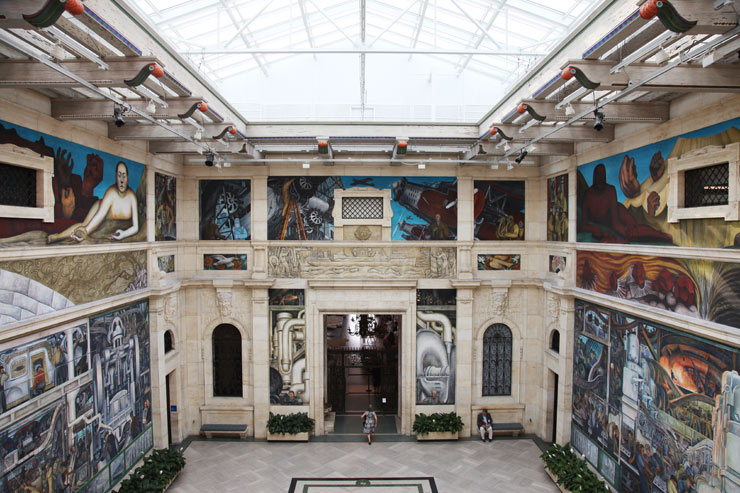
As we speak with Callie Curry, the artist known as Swoon, she marvels aloud that her work is hanging very near Rivera Court, a collection of 27 frescoes by the socialist-themed Mexican muralist Diego Rivera – which are now officially national historic landmarks. Her work in recent years has been featured in larger and more prominent institutions from the Venice Biennale to the Brooklyn Museum and LA MOCA’s “Art in the Streets” exhibition in 2011 in Los Angeles. For most Street Artists in their teens and 20s like Swoon was when she was doing illegal work, gallery doors are closed, let alone museum doors. The streets are the gallery and a petri dish for experimentation and engaging with the public.
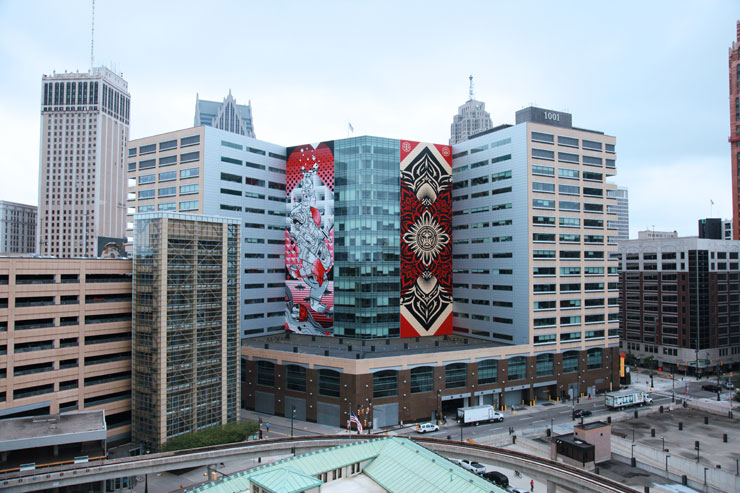
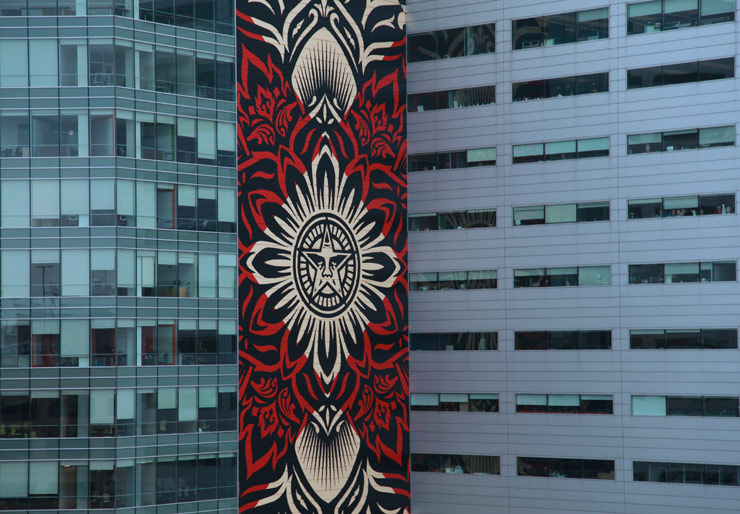
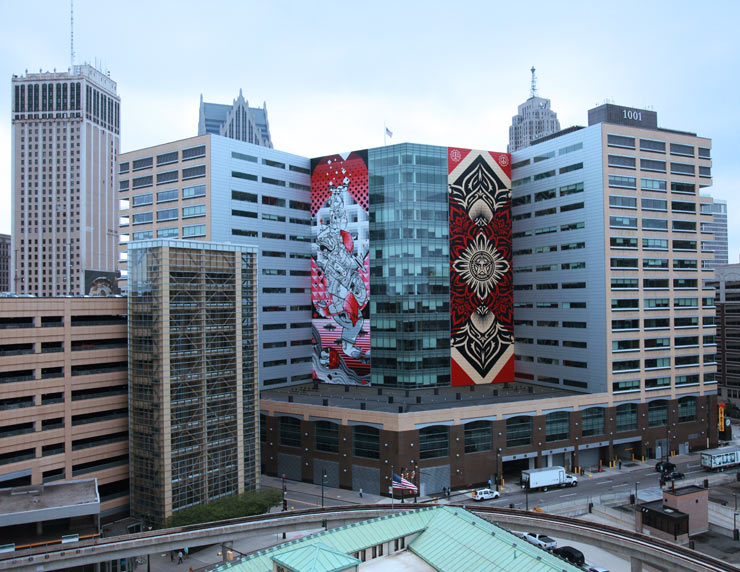
At the opposite end of the illegal spectrum are real estate interests who are actively inviting Street Artists to paint on their walls, like the multi-story twin pieces by Fairey and the German graffiti-writing train-tagging vandal brothers How & Nosm. 30 plus artists, many of them previous/current vandals were invited to paint inside the a vertical parking garage name Z and the alleyway adjacent to it in Downtown Detroit. We can cite cities and towns and real estate developers and business improvement districts who are seeking out these artists to activate public space in places like Miami, Philadelphia, New York, London, Lodz, Rio de Janeiro, Hong Kong, Dubai, and New Delhi, among others.
The Library Street Collective in downtown Detroit, whose founder Anthony Curis is a big supporter of DIA and who will host a gallery show opening October 8th with Swoon as well, is facilitating a public mural for her to paint legally. It is sort of an open secret that the majority of these artists on the Library Street Collective roster ran the streets doing illegal work on trains and public and privately owned walls and would have been pursued by real estate interests years ago for other reasons that include handcuffs. Most will tell you that they used the streets and street culture to hone their skills, and truthfully it is a fact that adds to their street cred and saleability among certain collectors.
So here’s the message Street Artists are getting – don’t expect any institutional, academic or commercial support or nurturing of your talent or skills or craft. You are on your own. In fact you will be demonized and reviled and pursued and dealt with punitively. If, through the help of other artists and cultural workers in the graffiti and Street Art community and some serious luck, you can still persist and become marketable, your work will be recognized as worthwhile and rewarded.
Cultivate, no. Harvest, yes.
In the case of New York train writers from the late 1970s like Futura, you may still need to be a bicycle messenger through Manhattan streets dodging taxis and Town cars for many years to pay your rent and support your family before commercial and institutional support actually rewards your talent. In the case of the majority of graffiti and Street Artists, that opportunity has yet to arrive, and may not.
One model of commercial and community support that is bridging the gap between the streets, artists, collectors, and the people who live and work in Detroit is the second annual “Murals in the Market” festival that is just completed. Originated by a local business couple named Roula David who serves as the festival’s director and Jesse Cory, who with Dan Armand founded a successful online art print business called 1xRUN. Ms. Roula and Mr. Cory also run the bricks-and-mortar gallery called Inner State. Working with neighborhood associations and businesses, the festival is supported by grants, local businesses, and the pairs’ personal investment.
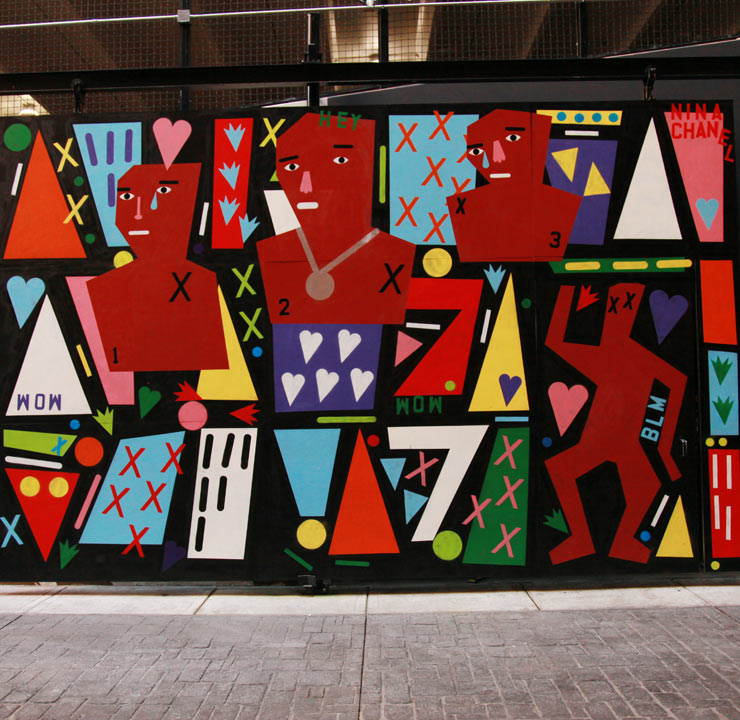
The open air Eastern Market has a bustling, even booming, reputation for fostering fresh lifeblood of economic activity that supports local fresh organic farmers, makers, artisans, restaurants, families, and football tailgaters. This year about 50 local and international graffiti and Street Artists painted walls of factories and warehouses with impunity, and with maps given for finding the locations. Local galleries and businesses and only a few national brands, like an energy drink maker who sponsors artists with residencies, all provided a wild night of performances and art shows for a few thousand fans who swarmed the streets looking at and posing with art and their friends.
The talents draw across disciplines, with great variations in approach, background, history, influences, and ability. With so many people walking the map route to see and engage with the works, a common comment was “why do I need to go to a museum when I can see this for free on the street?” They may also meet the artist in person.
With precious little governmental support for arts these days and at programs in public schools often cut out entirely in the US, many of these artists who began on the streets say they were pleased to participate in some formal program and to have an opportunity to show their work without fear of reprisal. They also showed fine art works in the crowded gallery show and heard presentations from photographers and designers who were deeply involved in the early punk and hip-hop scenes that rose in parallel with graffiti and Street Art.
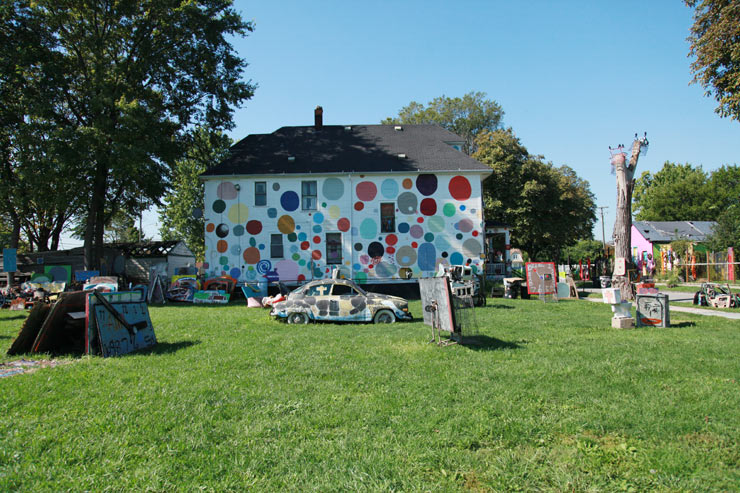
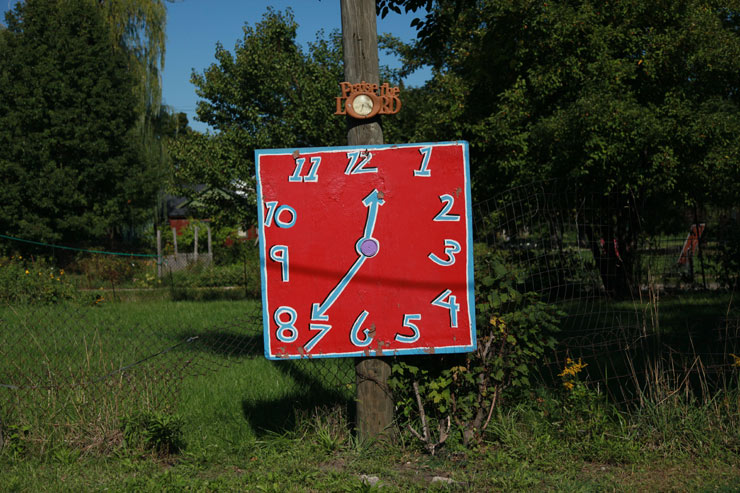
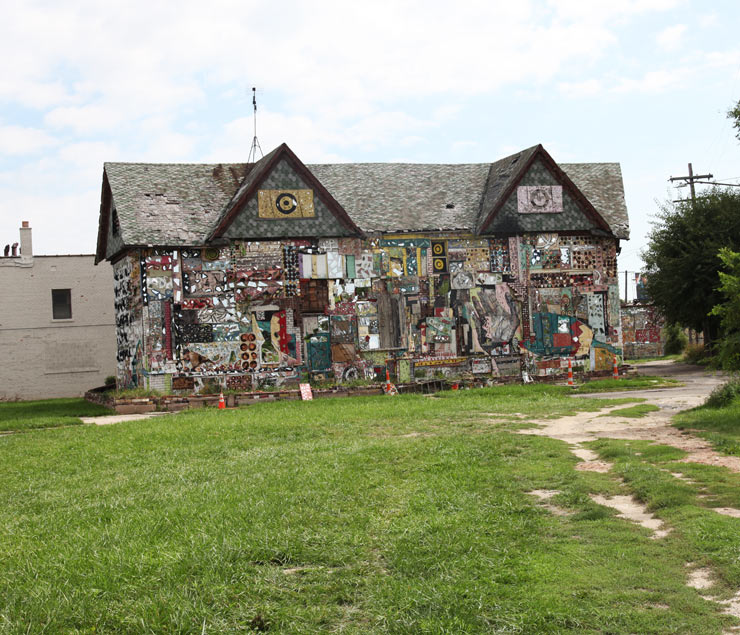
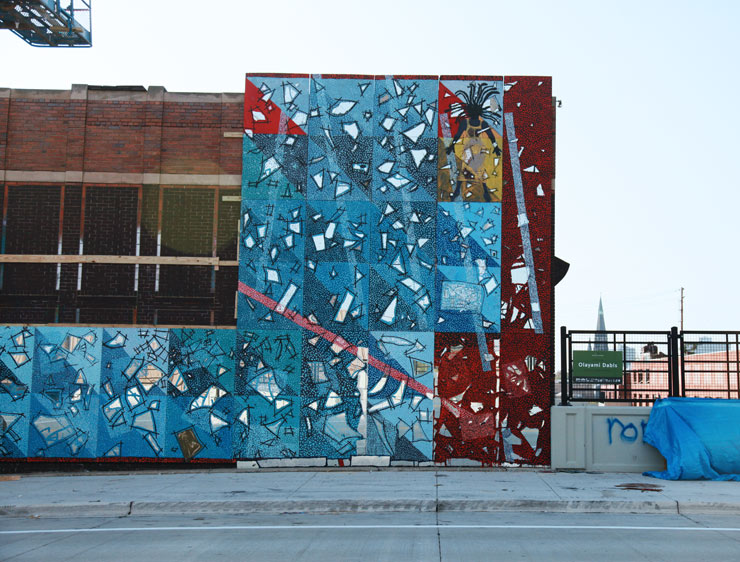
David and Cory routinely host talks and special events at Inner State and they allow it to be used by local design entrepreneurs and planners to host their own openings or meetings. Corey says they have worked hard to be inclusionary rather than exclusionary: fostering connections to important cultural contributors like the pioneering Detroit outdoor environmental artists Trey Guyton of The Heidelberg Project and Olayami Dabls with his Mbad African Bead Museum. In fact, both of these artists are featured artists in this years Murals in the Market.
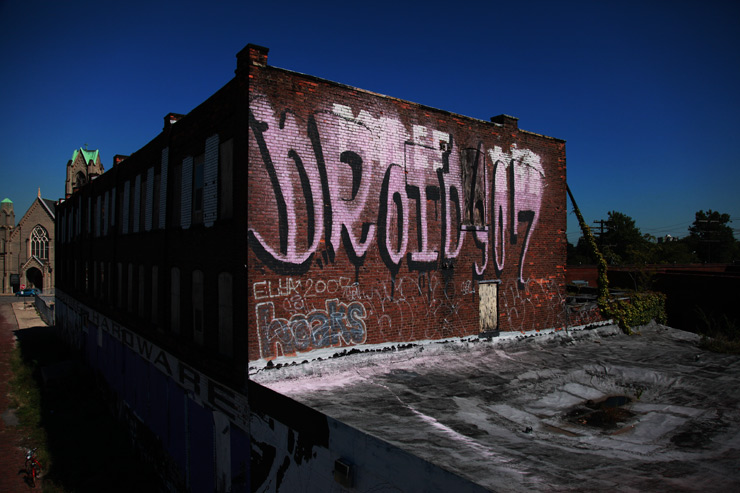
Additionally, the Murals in the Market scene commingled this week at a ‘Detroit Family Reunion’ bonfire, barbecue, and screening of “WastedLand 2” by filmmaker Andrew Shirley at Lincoln Street Art Park, which lies adjacent to a grassroots recycling center called Recycle Here! Shirley also curated the two-floor warehouse exhibition that pairs the wild untamed raw-graff artistry of the primarily New York based 907 Crew and a group of local Detroit graffiti kings who sprayed fresh elaborate show pieces side by side.
Collectively this alchemy of Murals in the Market and the active Graff/Street Art scene is precisely what is needed and what the artists and their admirers deserve. It is an inclusionary model that recognizes, nurtures and preserves the antecedents of the current global Street Art scene. It also lets young people in their teens and twenties know that this is an evolving artist community that is alive and dynamic – not a collection of dead people who they cannot relate to. If you look for it, you can see that the street is presenting a collective voice that is sometimes transgressive and draws upon the challenged communities living in these United States of Anxiety. Often there are the seeds of promise.
Museums and other institutions are missing a huge opportunity to engage with young audiences by ignoring these constituencies, and we encourage a kind of whole-hearted curatorial risk-taking that acknowledges the fuzzy grey areas and attempts to salvage the pertinent contributions of an active creative class. In our travels and writings and curatorial endeavors we have seen the promise and the talent. The work needs to be considered in a manner that far exceeds the calculation of its perceived market value – much of this work opens doors to our collective creative future.
As ever, when it comes to big name shows, institutional recognition, commercial adaptation, community-based efforts, and on-the-margins badassery, one can often find compelling reasons to love the continuum of Street Art / graffiti and their many tributaries and trajectories.
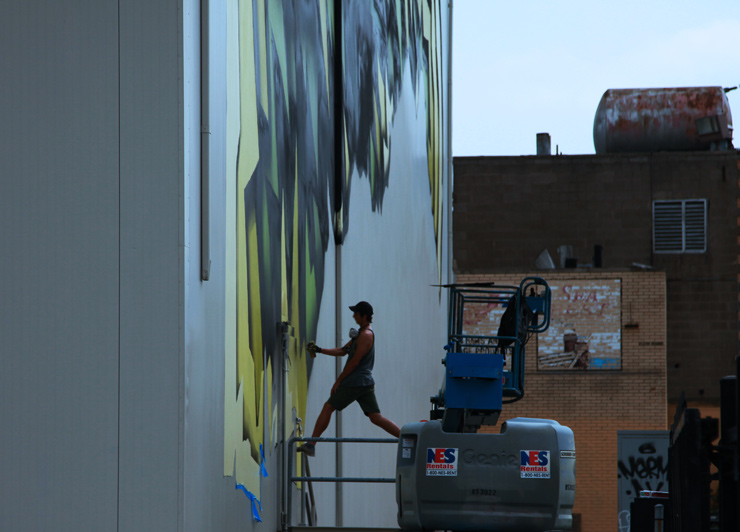
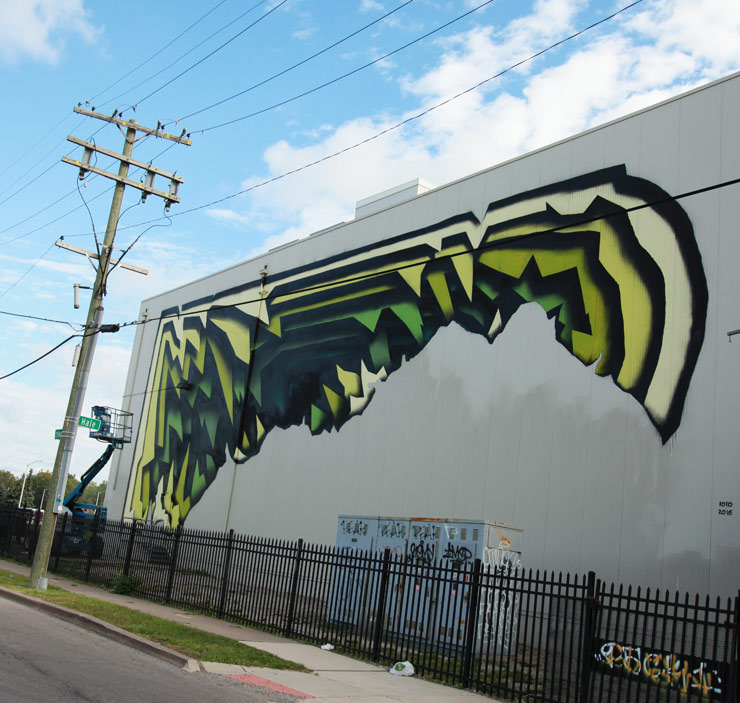
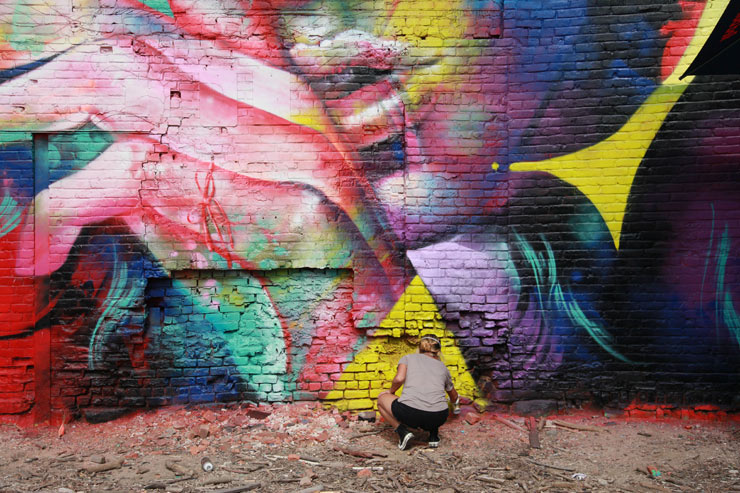
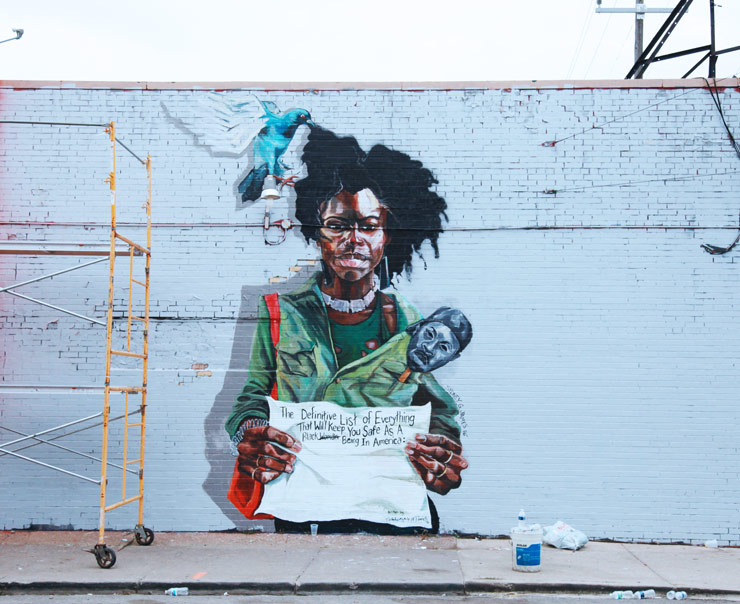
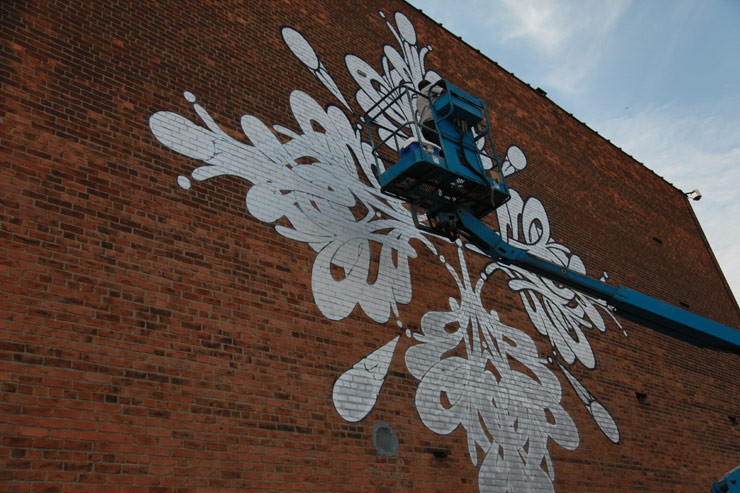
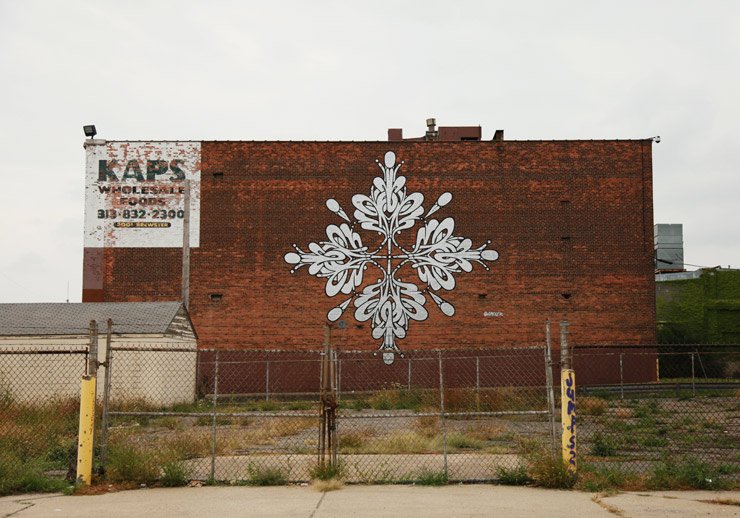
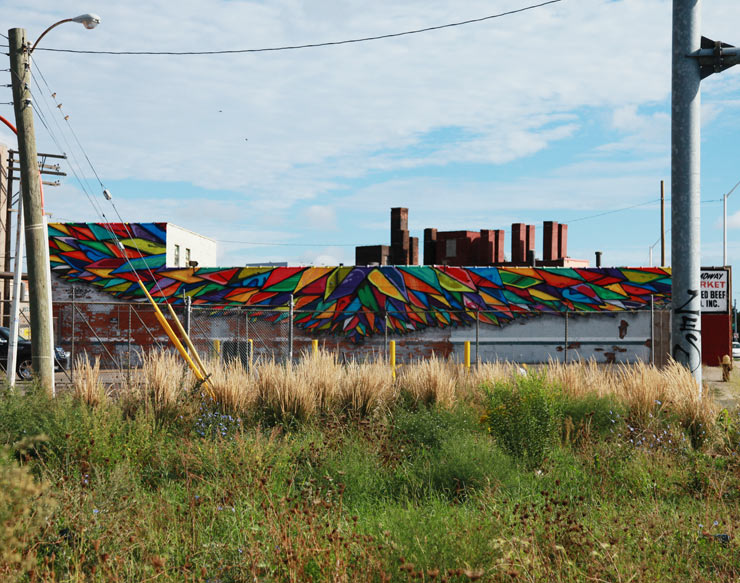
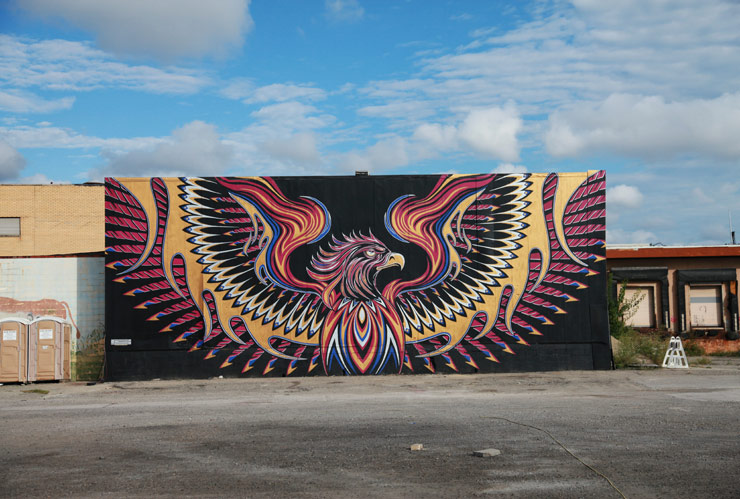
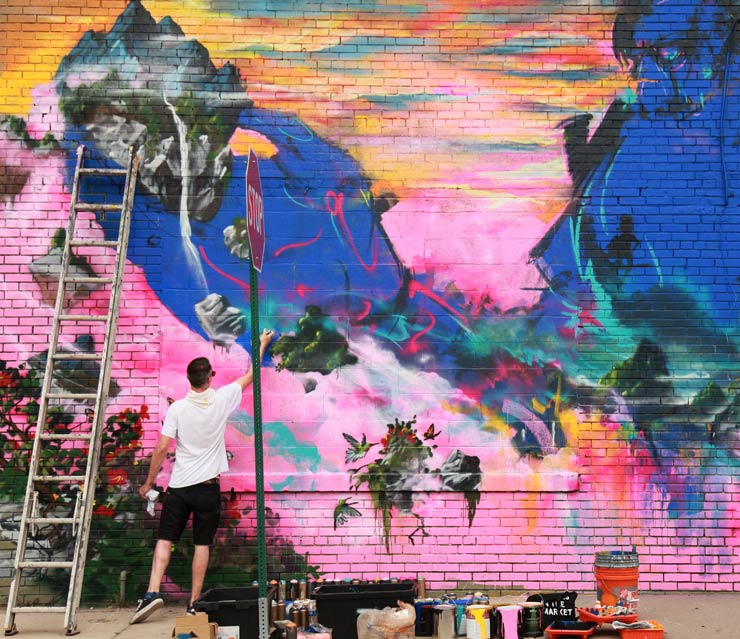
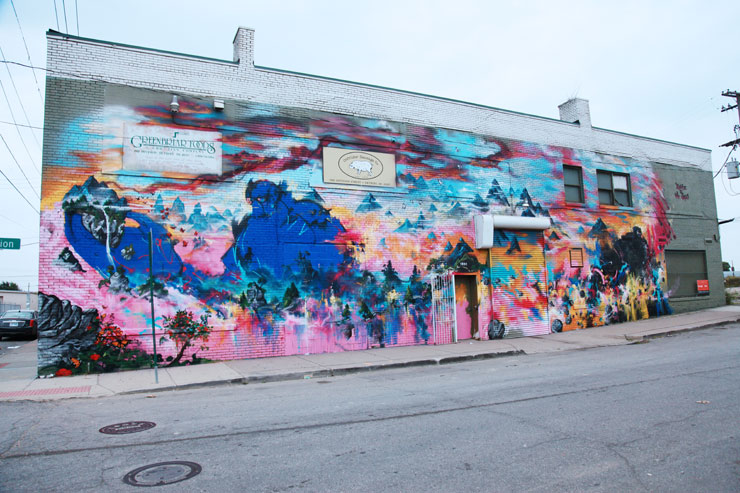
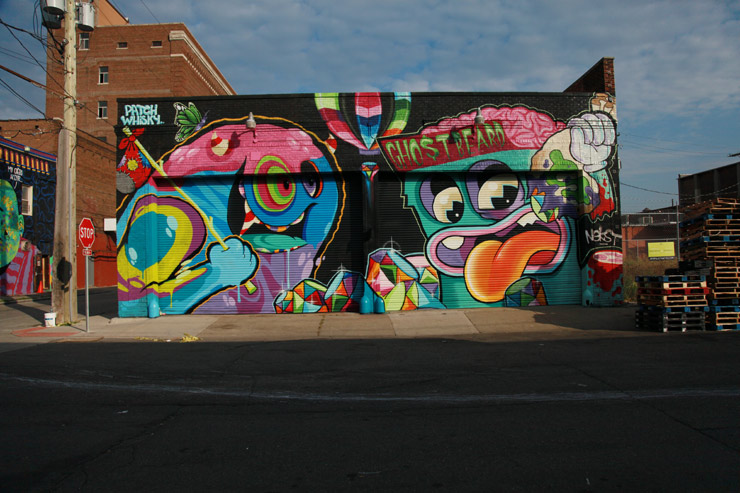
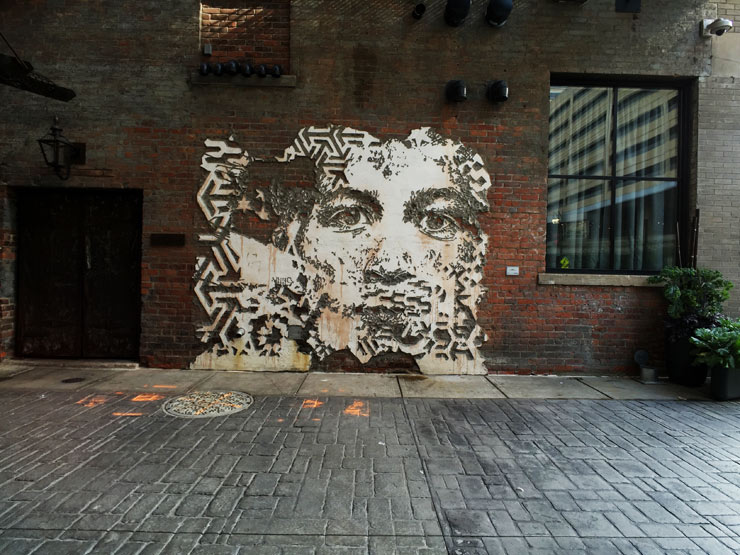
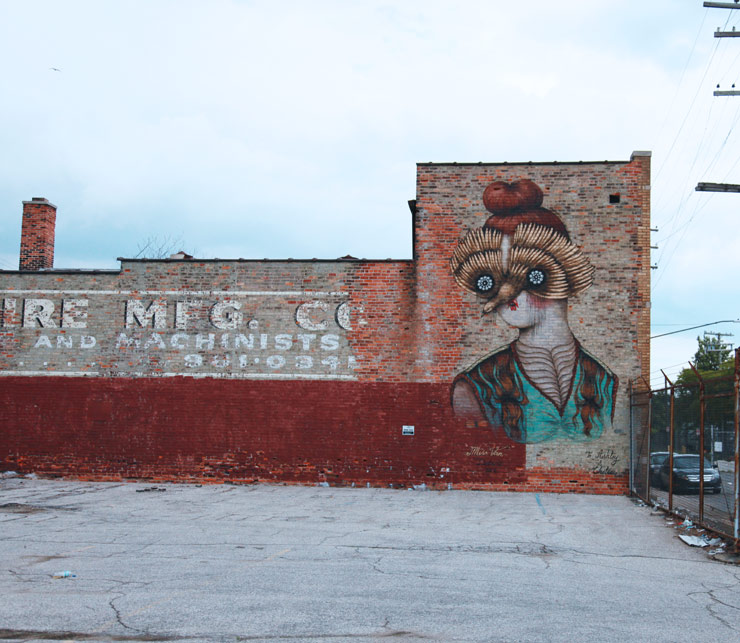
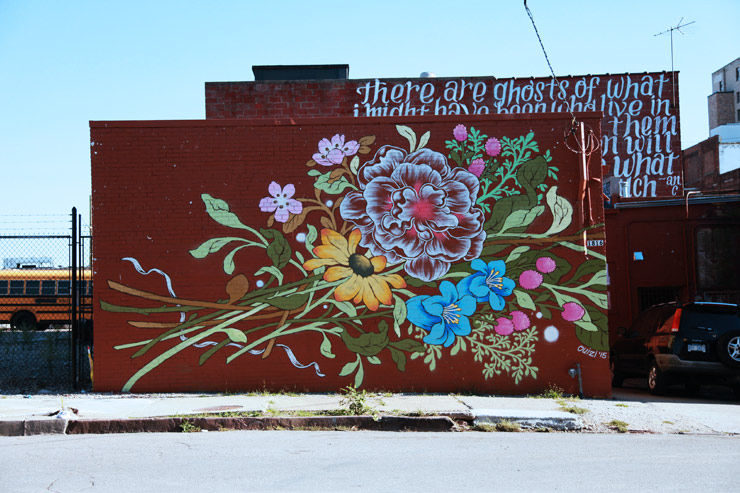
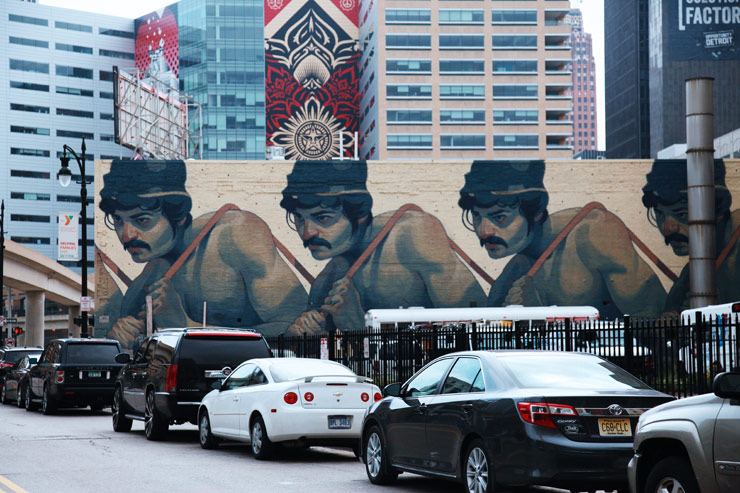
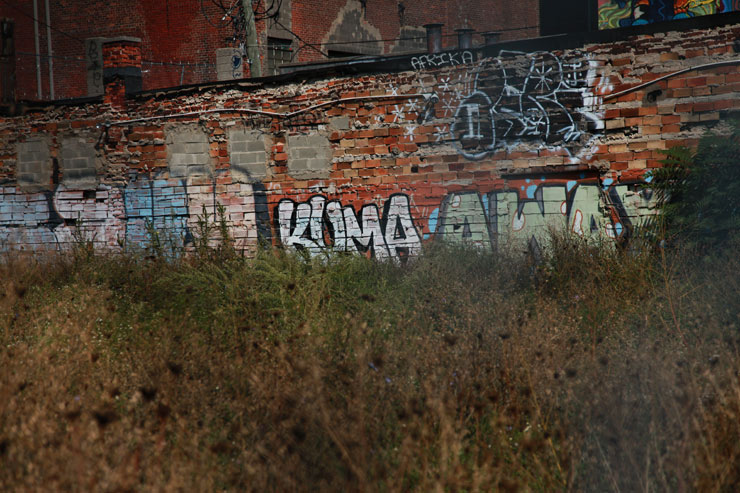
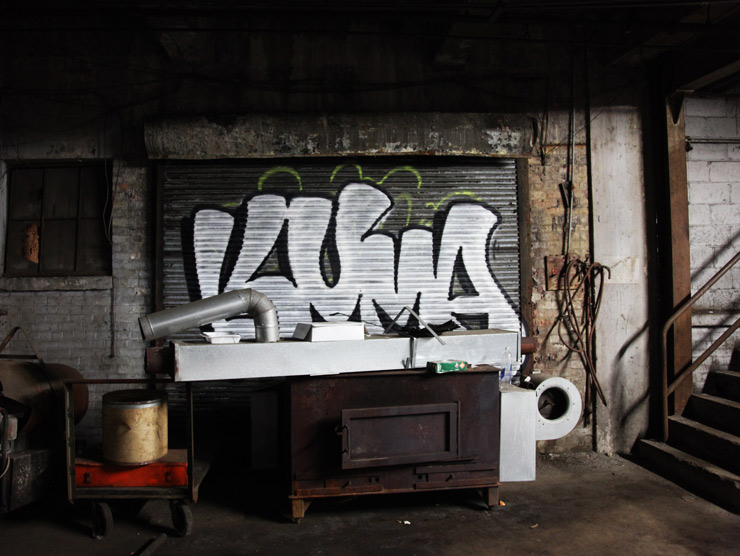
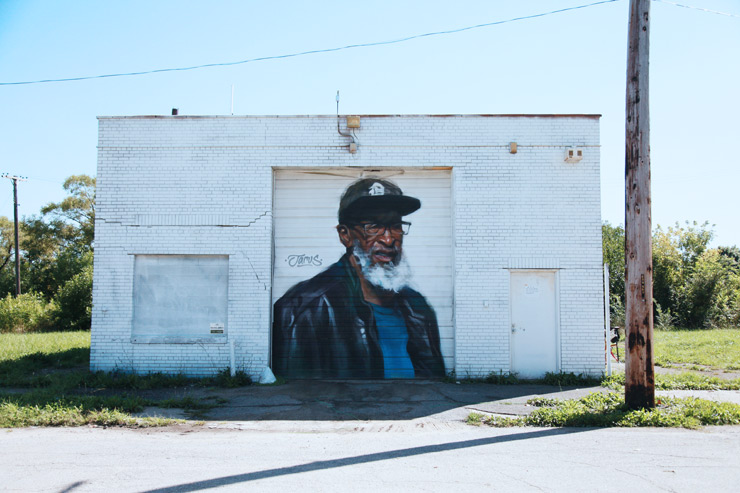
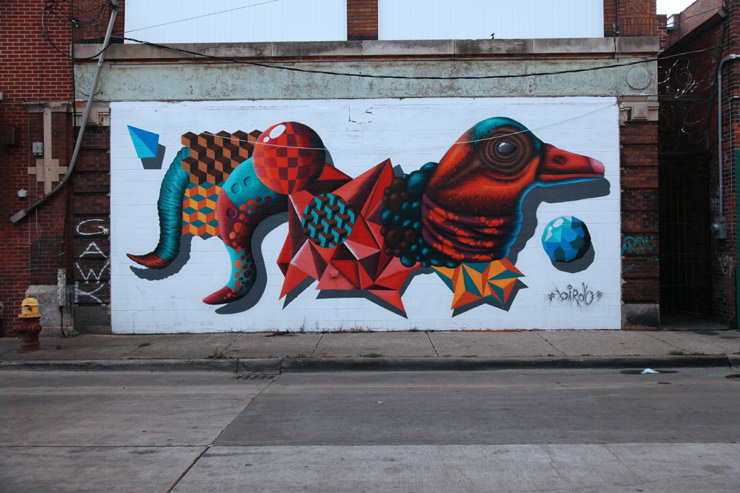
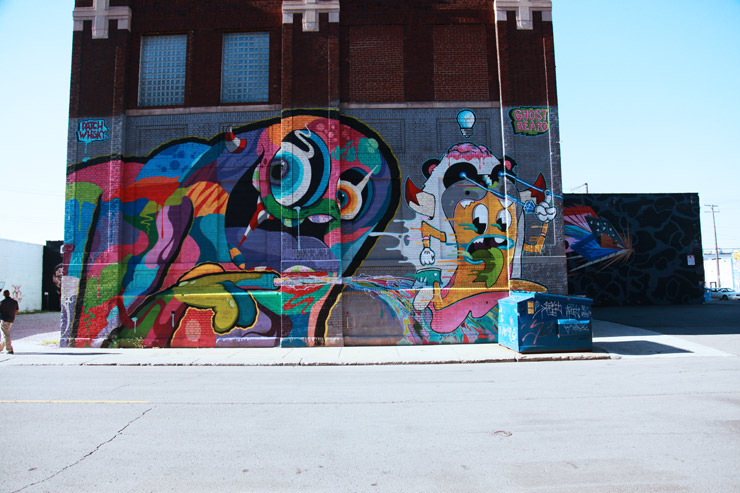
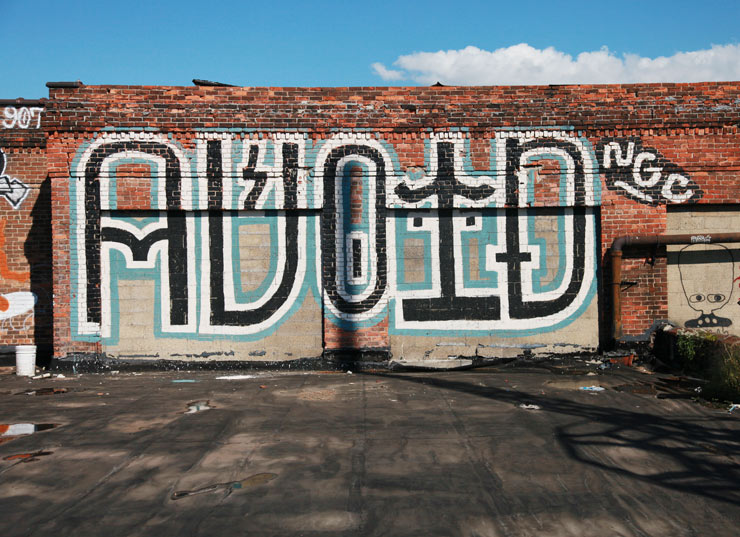
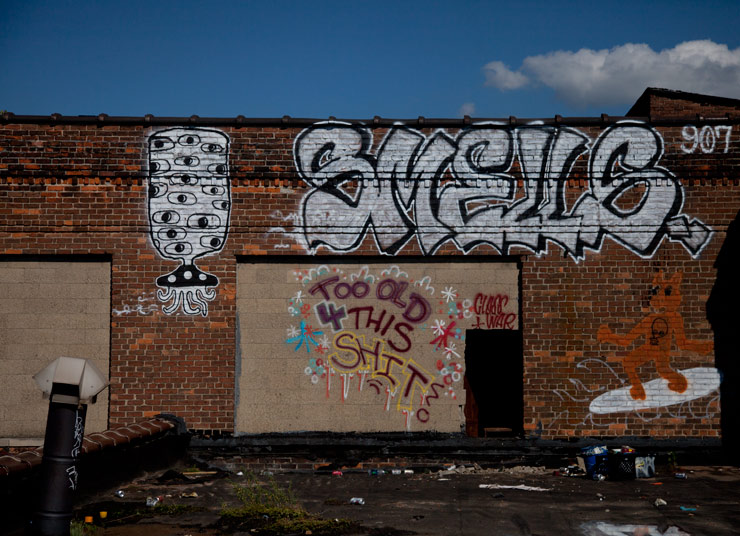
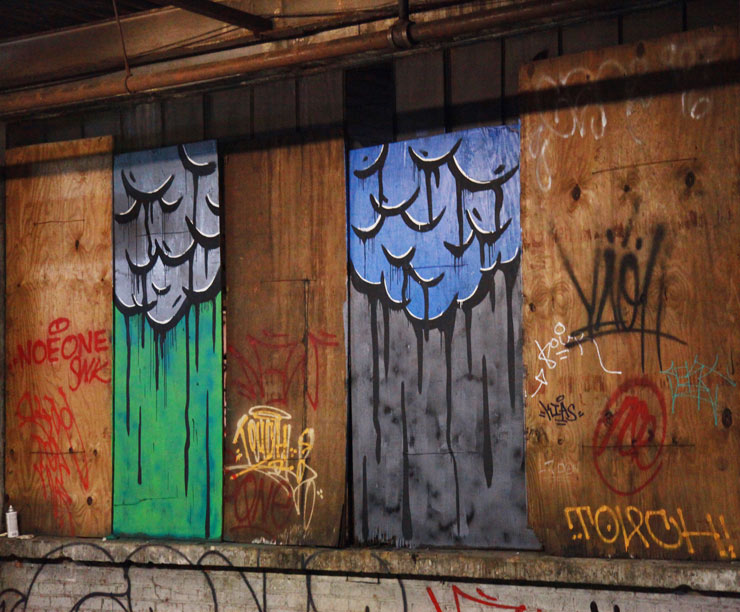
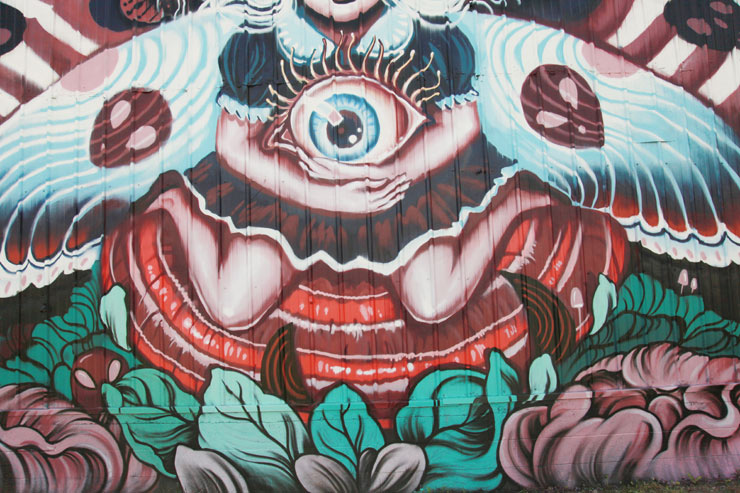
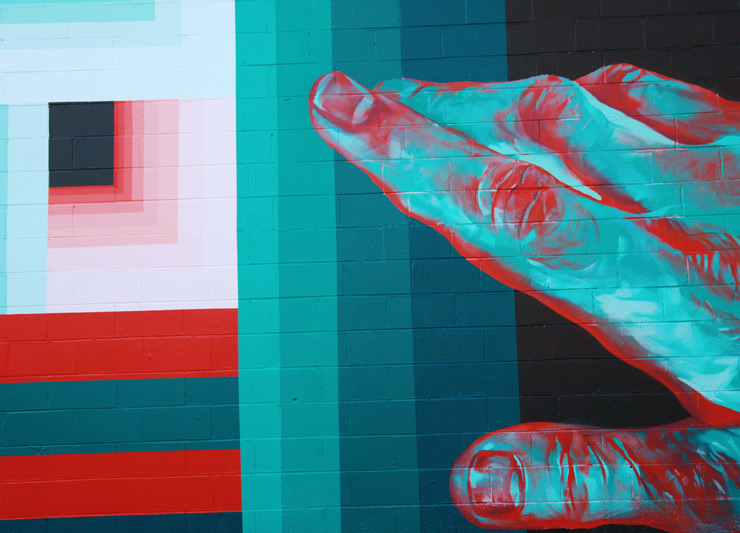
Our selections for this week’s edition of BSA Images Of The Week are harvested from Detroit streets and rooftops and hidden little spots – the murals painted for this year’s edition of Murals In The Market, those are coming later on. Enjoy.
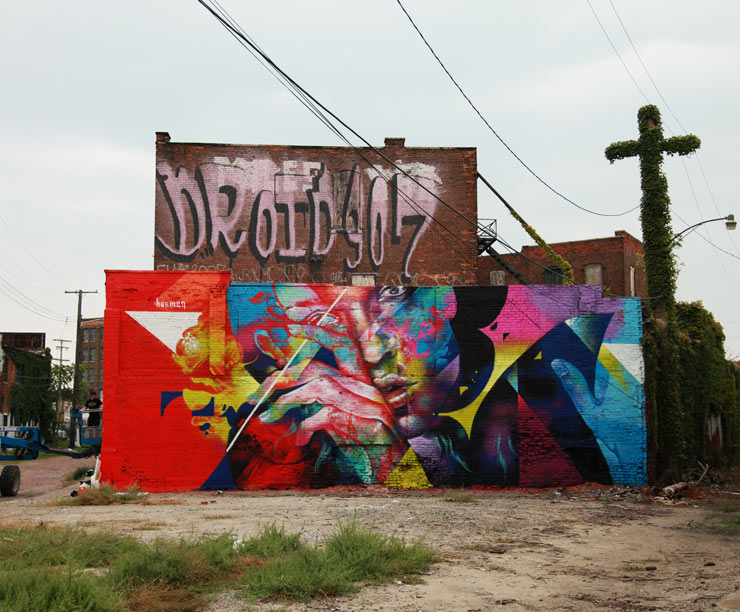
So, here’s our weekly interview with the street, this week featuring 907 Crew, Aryz, Avoid, Birdo, Dark Clouds, Droid, Ghostbeard, How & Nosm, Jarus, Kuma, Miss Van, NGC, Ouizi, Patch Whisky, Shepard Fairey, Smells, UFO, Vhils.
This week BSA is in Detroit with our hosts 1XRun for the Murals in the Market festival they are hosting with 50+ artists from various countries and disciplines and creative trajectories. In a city trying to rise from the economic and post-industrial ashes it is often the dynamic grassroots energy and vision of artists that sets the tone for how the community evolves.
Detroit rocked in many ways this week, not least because Roula David and Jesse Corey know how to manage a big moveable feast of walls and artists and food and lodging and parties and openings and donuts and a print business and gallery and still manage to have quality time with Oscar, their four year old chocolate pug-mix master who pretty much goes wherever he wants and investigates the scene.
Together David and Corey and the team spread their wings wide to make sure everybody gets taken care of, and we salute their talent and passion. The 1XRun crew, and there are like 20 of them, don’t mess around when getting equipment and cold water bottles and cans of paint and ladders to the artists, along with a hundred other small and large favors and forms of assistance that make this thing run smoothly. And kindly.
The details can really make the difference, in life and in art of course. Today we’ll show you some of the details of a few pieces that resonate from this years collection of vibrating visuals on the street in this part of east Detroit. And you can see that some murals are close to being finished as well. A selection of the completed walls will follow soon from this successful second year of Murals in the Market.
Our weekly focus on the moving image and art in the streets. And other oddities.
Now screening :
1. Detroit Quick Shots – Yok & Sheryo, Swoon, Heidleberg Project
2. HERAKUT -> Im heutigen Videoupdate von der Magic City
BSA Special Feature: Detroit Quick Shots
As you know we in town for Murals in the Market and are riding around Detroit’s attractive and less attractive and bombed-out portions to get a feel of the place. Once in a while Jaime remembers that he wants to try out his phone video editing chops and captures something to share.
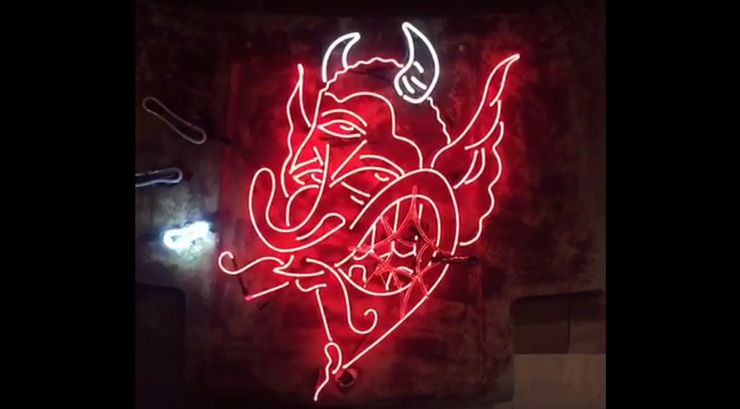
Here’s the blinking Yok & Sheryo sign at their opening with 1xRun at the headquarters.
Here’s Swoon at the Detroit Institute of Art (DIA) preparing the installation of her Thalassa piece, the reception for which is Saturday night.
And this is short tour through some of the installation aspects of the 30-year art project by Tyree Guyton, founder and artistic director of The Heidelberg Project. Following that is a short documentary so you can understand a little more about the project and it’s importance and relevance of so-called “environmental” public art exhibition.
HERAKUT -> Im heutigen Videoupdate von der Magic City Kreativphase trifft Andreas auf das Street Art Kollektiv HERAKUT
The Magic City exhibition, curated by Carlo McCormick and Ethel Seno in Dresden, Germany is currently a beehive of installation by arriving artists. We’ve curated the film exhibition portion, The BSA Film Program, and our director of photography Jaime Rojo is one of the featured artists. Check out the Magic City channel on YouTube to see the full compliment of interviews like this one with Herakut.
Street art welcomes all manner of materials and methods, typically deployed without permission and without apology. This hand-formed wire piece …Read More »
 BROOKLYN STREET ART LOVES YOU MORE EVERY DAY