 BROOKLYN STREET ART LOVES YOU MORE EVERY DAY
Feel chained to your cell phone? That’s the plan.
Not that you don’t have free will and could quit your phone any time. Of course, you could.
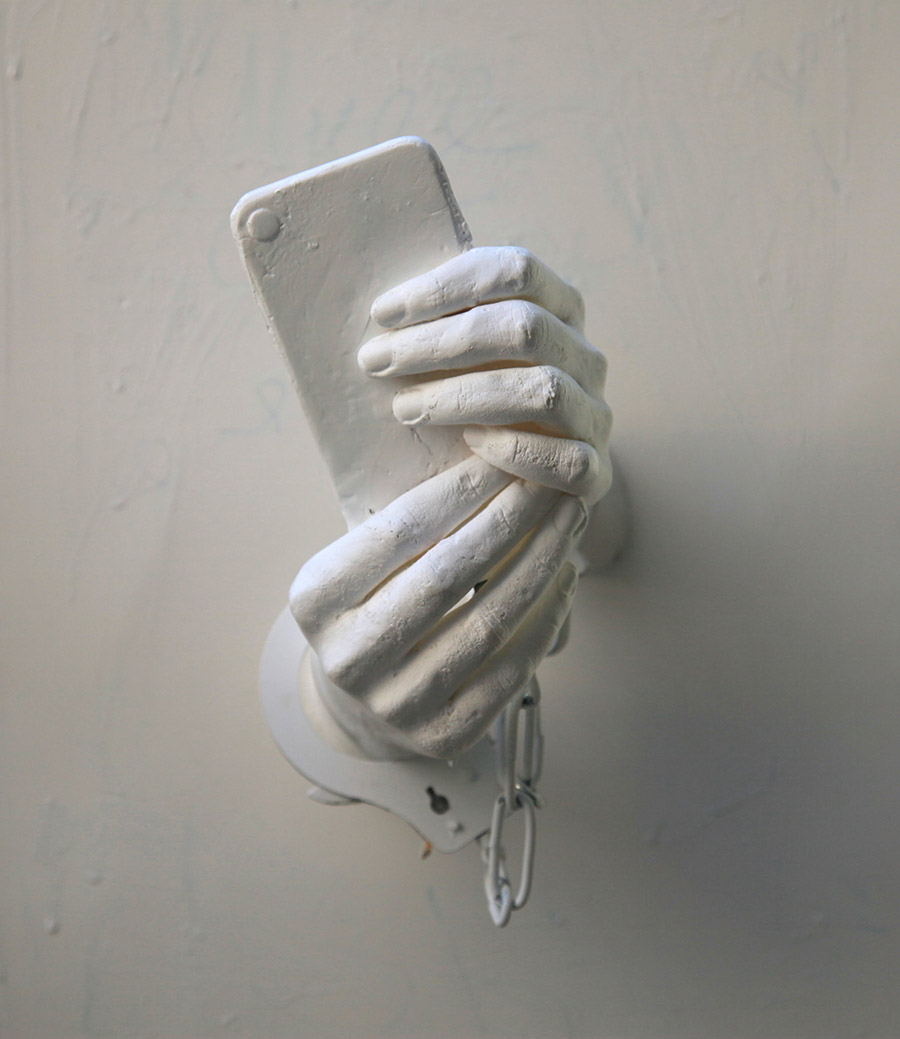
Street artist Leon Reid works conceptually often, and in this case, as a sculptor alongside you on the street in Bed-Stuy, Brooklyn. The message is self-explanatory, and yet, you would have to look up from your phone scrolling to see it, so many will miss it.
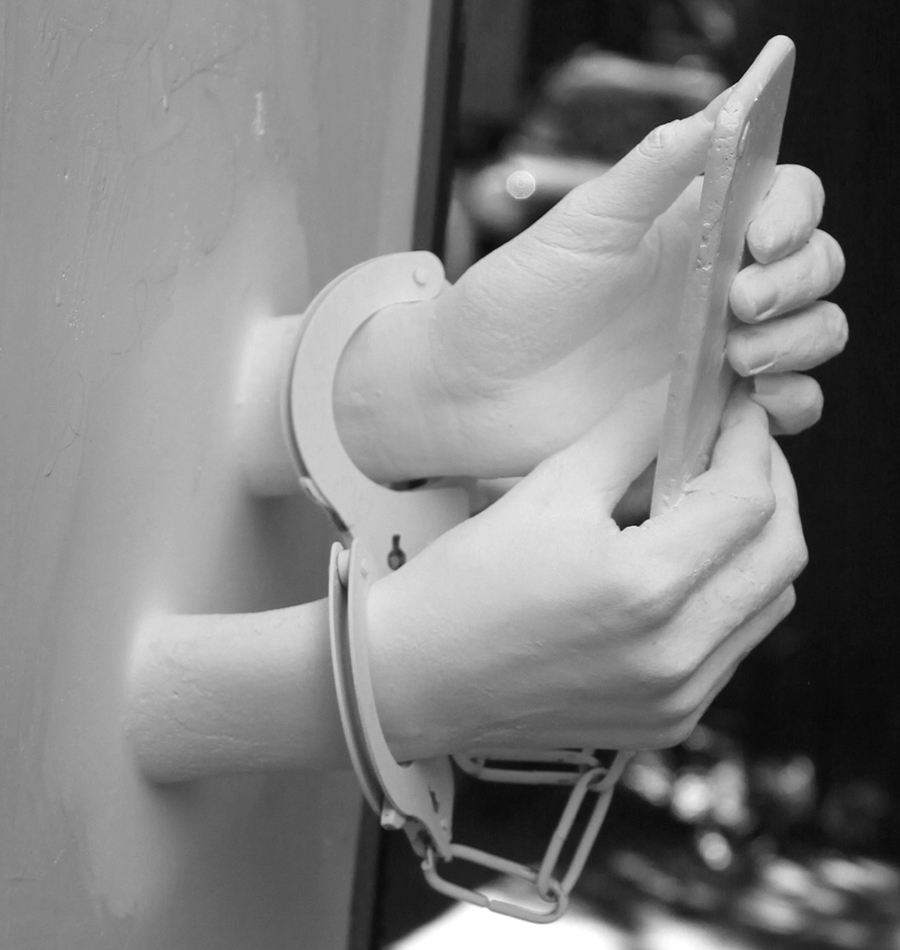
Brooklyn Street Art: The sculpture depicts a pair of handcuffed hands holding a mobile phone. The hands are restricted, yet the work’s title is “Of a Free Will”. Can you please elaborate?
Leon Reid: Many times when I observe people holding their smartphones I ask “Is that person holding their phone because they want to or they need to?” It’s impossible to answer completely but still I wonder. 15 years ago, many folks used smartphones because they were curious about the potential of a new tool. Of course, advertising guided most people to buy smartphones, but then social media slapped advertising in everyone’s face 24/7/365. This exposure weakened the argument that we’re all using our phones because we want to. The infrastructure of our society is now designed around smartphones; you can’t enter certain buildings without it; in some cases you can’t travel, eat or see a doctor without it. I believe that we as a society decided to freely carry out the Free Will of technology corporations; we cuffed our own hands to it.
BSA: You’ve been installing your work in public for a long time. Have you noticed any differences in the difficulties inherent in installing works on the streets from the early days of your practice to today’s environment?
LR: Yes, when I started writing graffiti in 1995, in most instances, we did not have to worry about surveillance cameras recording us; there simply were fewer cameras in existence.
Though I am not active as a graffiti artist as I once was, those doing it now must be prepared to be filmed -in fact many film themselves. The further you go back in graffiti history the more artists had to operate like ninjas. Stealth was a quality that was honored among writers. However, the exposure of graffiti and street-art through documentation has brought a broad acceptance of the art from -one that I never expected to see- so that many times artists can do their work in public with permission.

BSA: You mentioned that your work was defaced/vandalized within days of being put on the street. Why did you choose to restore it?
LR: So this piece has gotten a lot of attention in the neighborhood because I believe most people are at a point where they can understand its message. Within a week, someone added two additional messages to the work; one was a statement about Immigration enforcement, the other about the Israel/Gaza War. I have my opinions on both of these topics however the markings made three unrelated messages on one artwork and they distracted from the original message. I removed the additional messages, but was conflicted in doing so. I’ve long known that once an artist puts their work on public display, they cannot control how the public interacts with it. If the messages persist, I have to let it be.

BSA: How has the rapid evolution of technology, such as the sophistication of smartphones, the apps, and Social Media, changed the way in which art is experienced now? Are there any pros or cons in your opinion?
LR: So, in my ideal world, everyone would have the possibility to see great works of art -be it on the streets or in a museum- in person. This for a variety of reasons cannot happen. Most of us will only see great works of art through media. However sometimes, a great photographer can capture a great work of art in a moment; perhaps a child is able to touch a graffiti wall because they cannot do so in a museum, a photographer is there to snap the moment and the picture becomes a symbol of what that artwork can mean to people. If this photograph inspires people to see the work in person that is a pro. The con is if so many people turn up not to look at the work, but to photograph themselves beside it. If such a thing happens too much it can alter both the community where the work lives and the meaning of the work itself.
“Of a Free Will” is part of a larger street-art exhibition organized by Novo Collective titled “Playground of the Invisible”