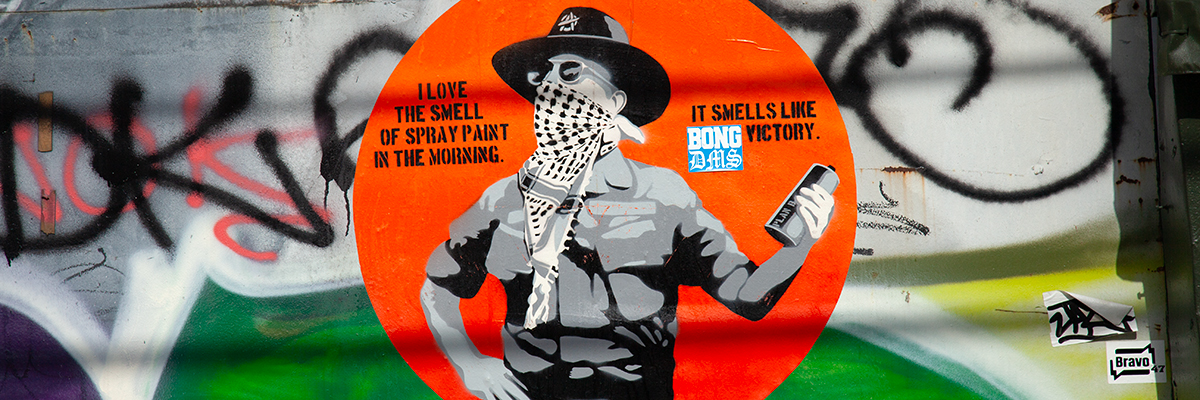
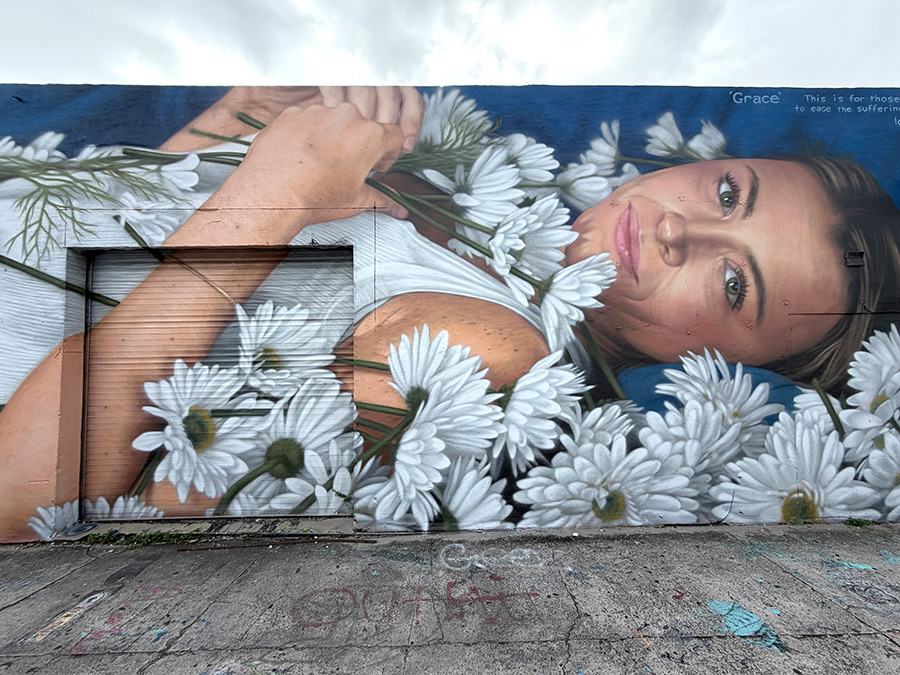
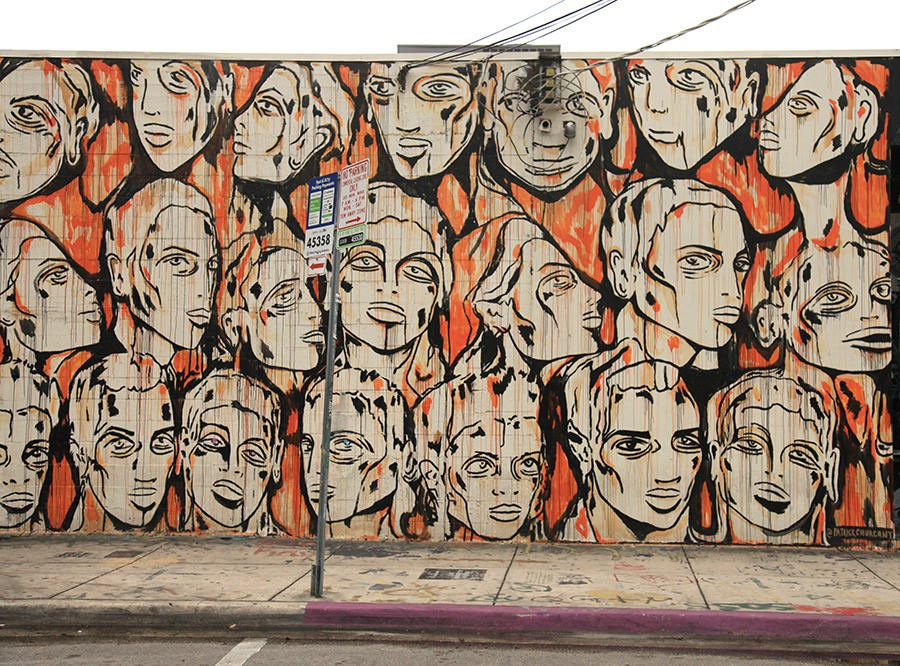
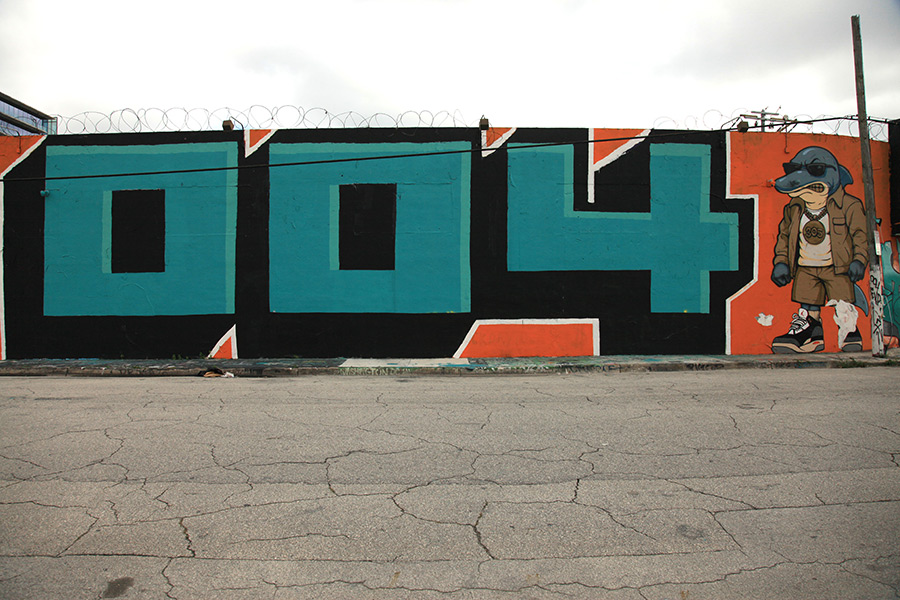
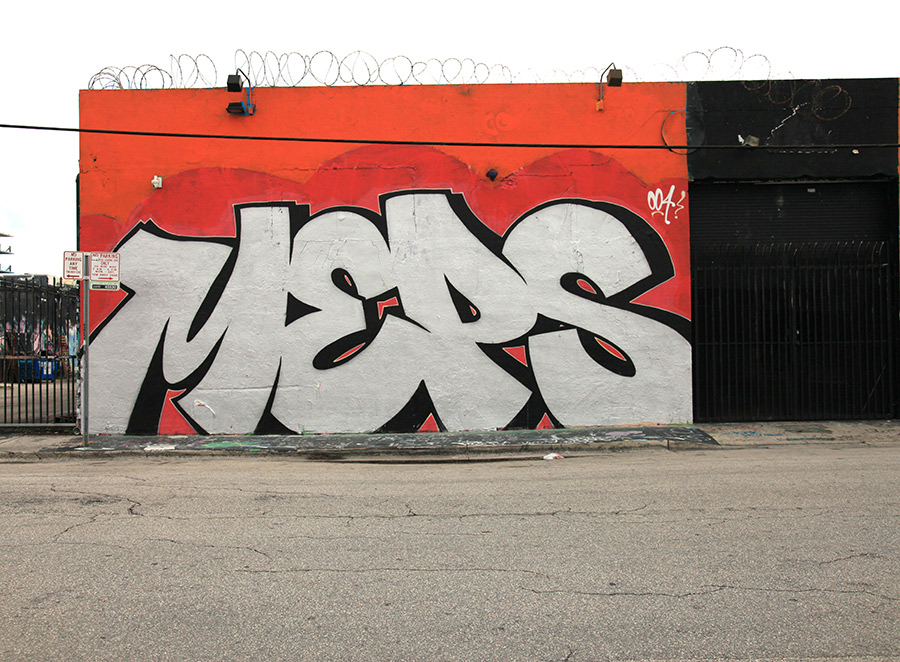
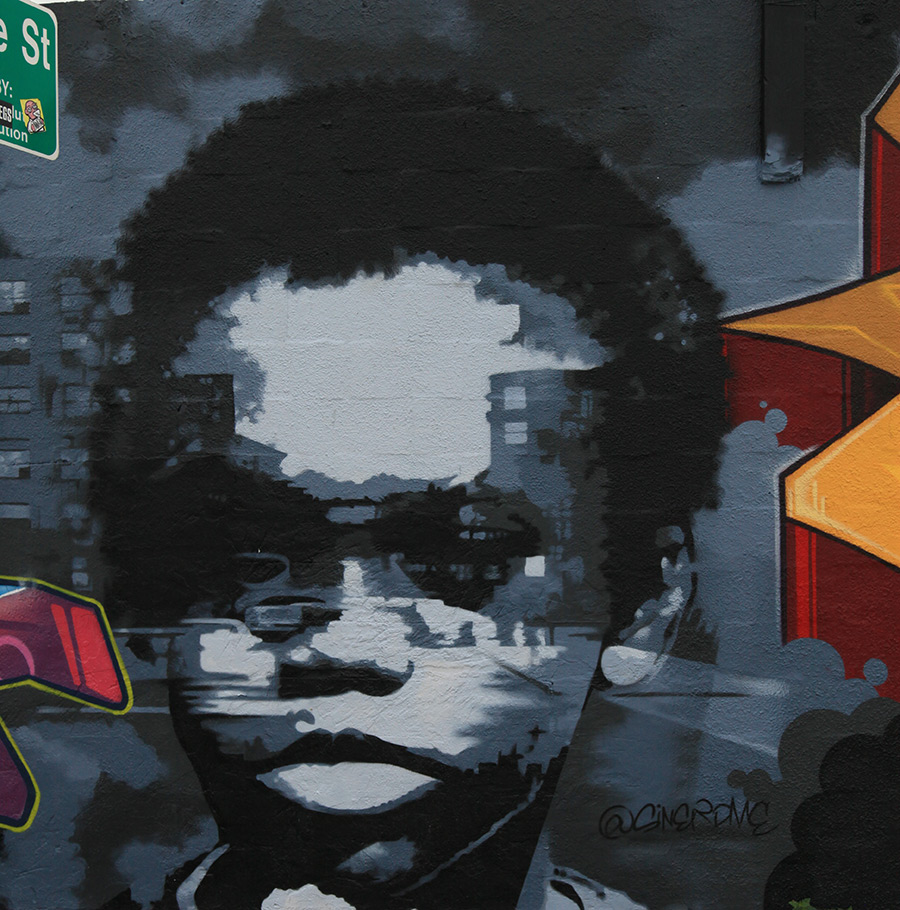
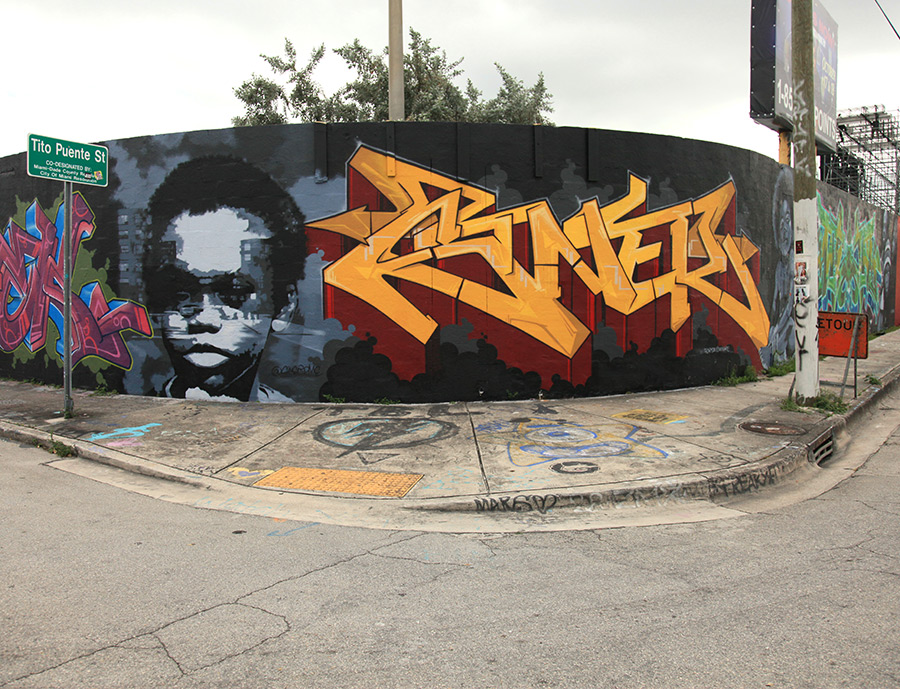
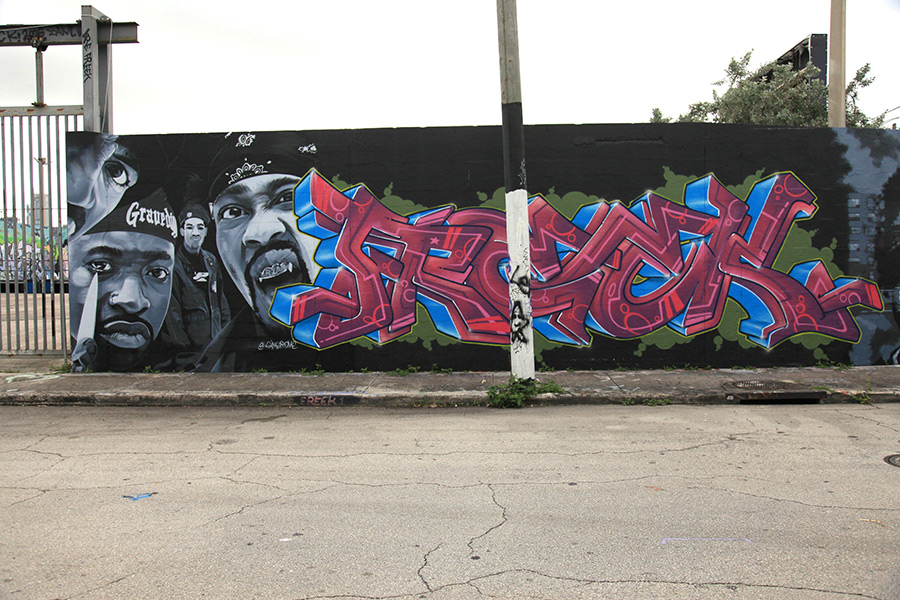
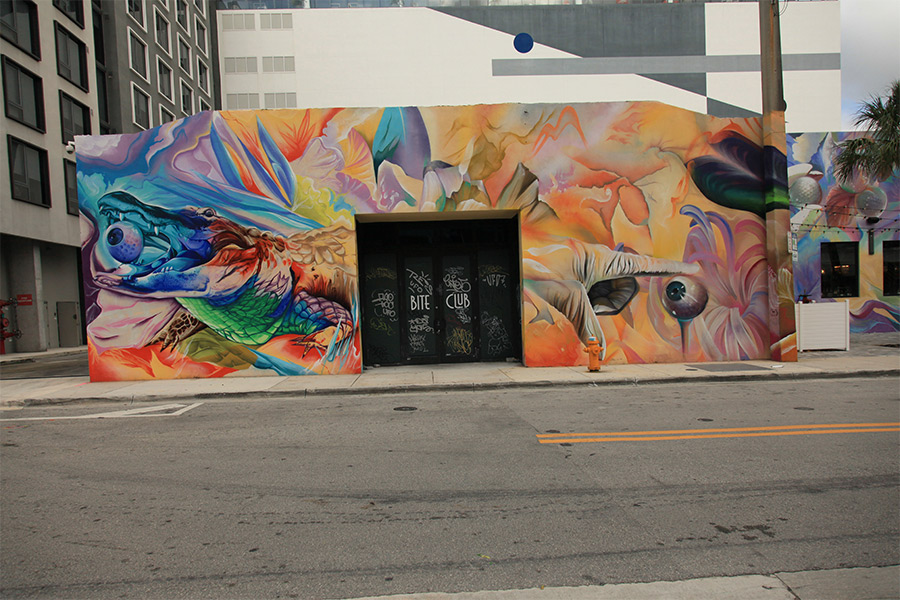
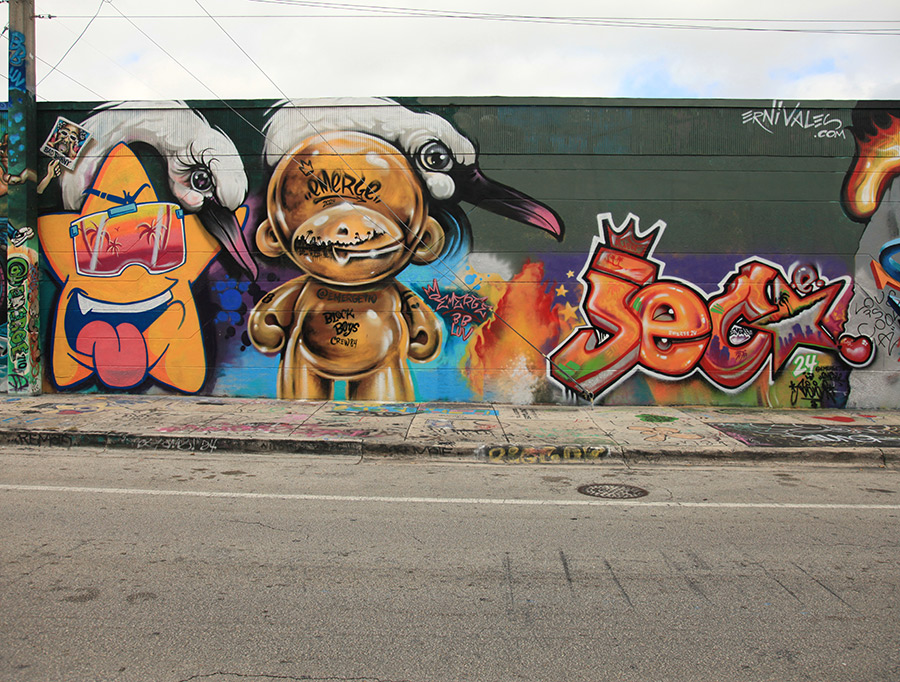
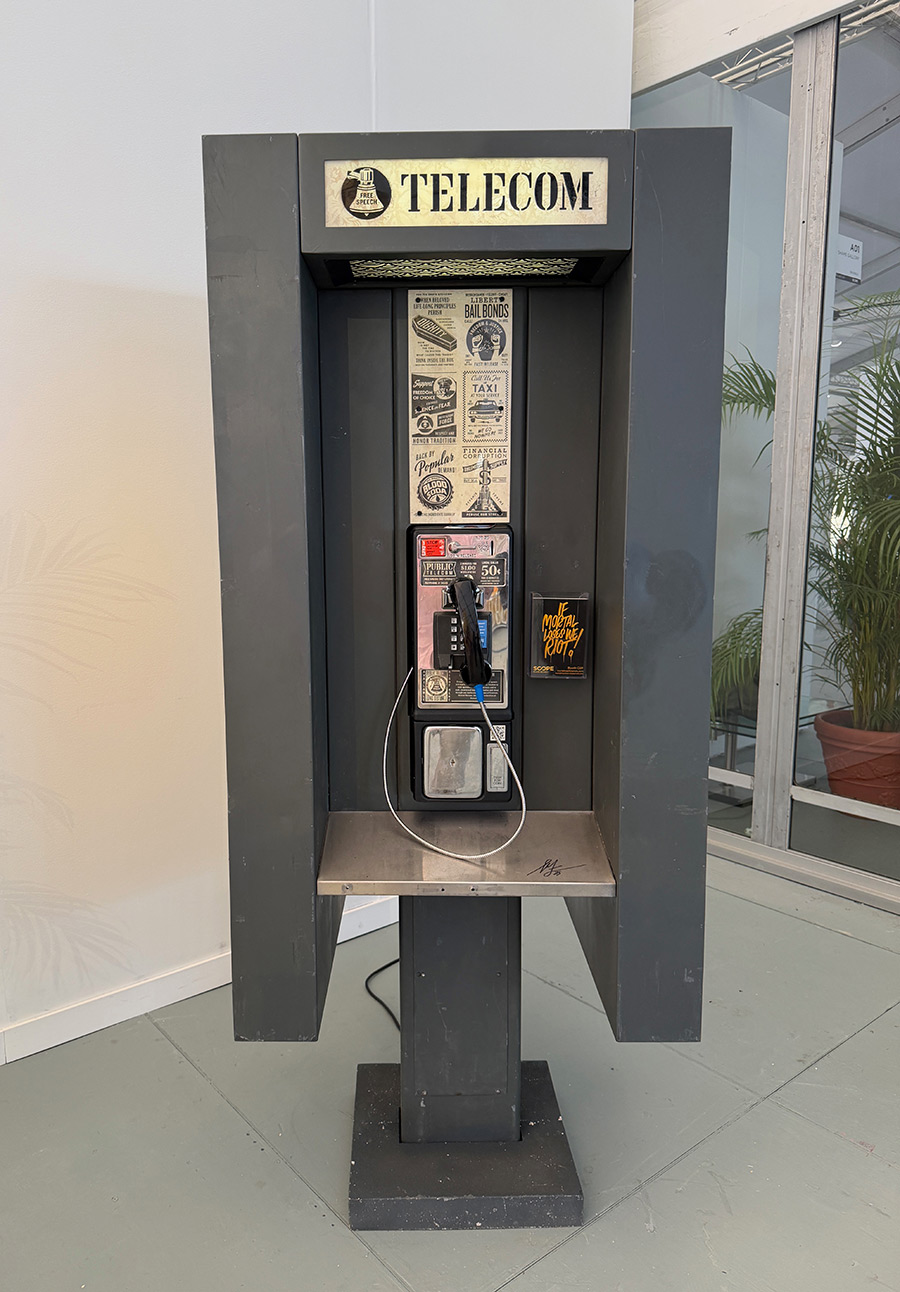
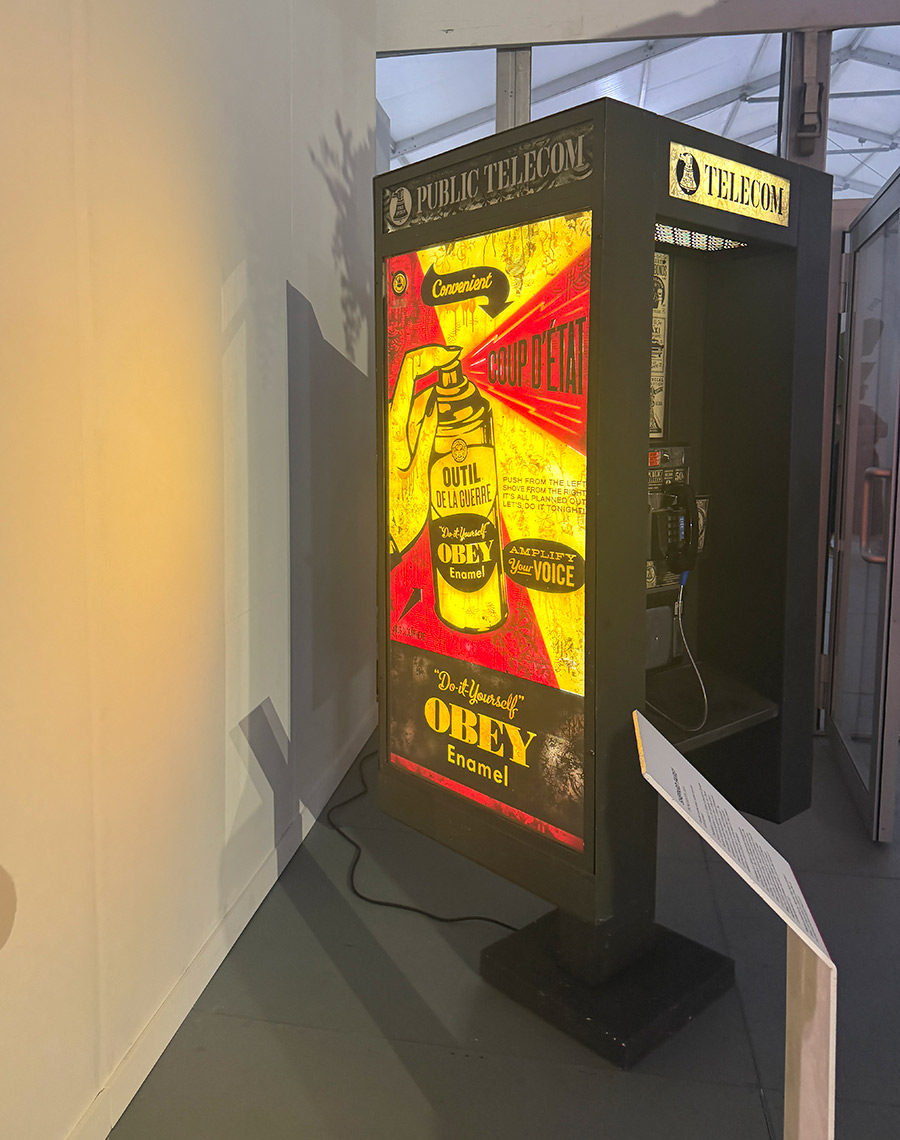
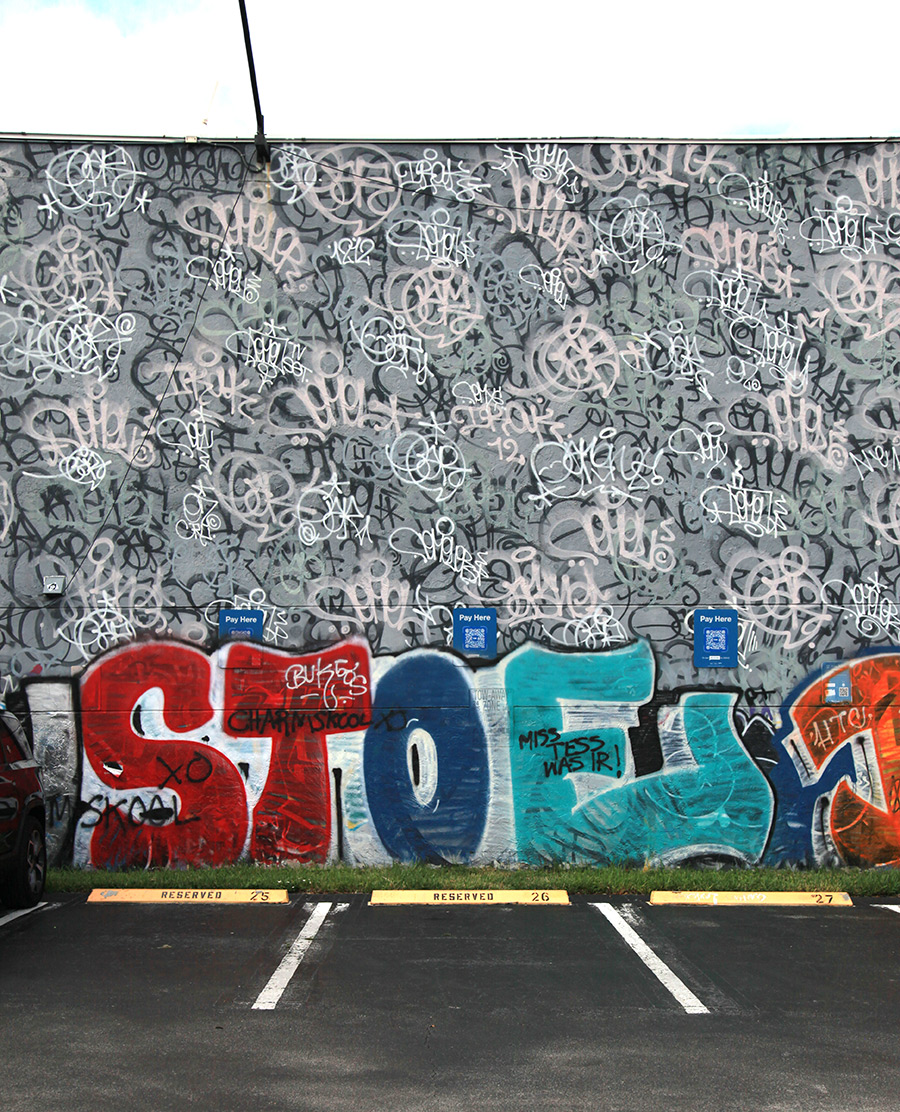
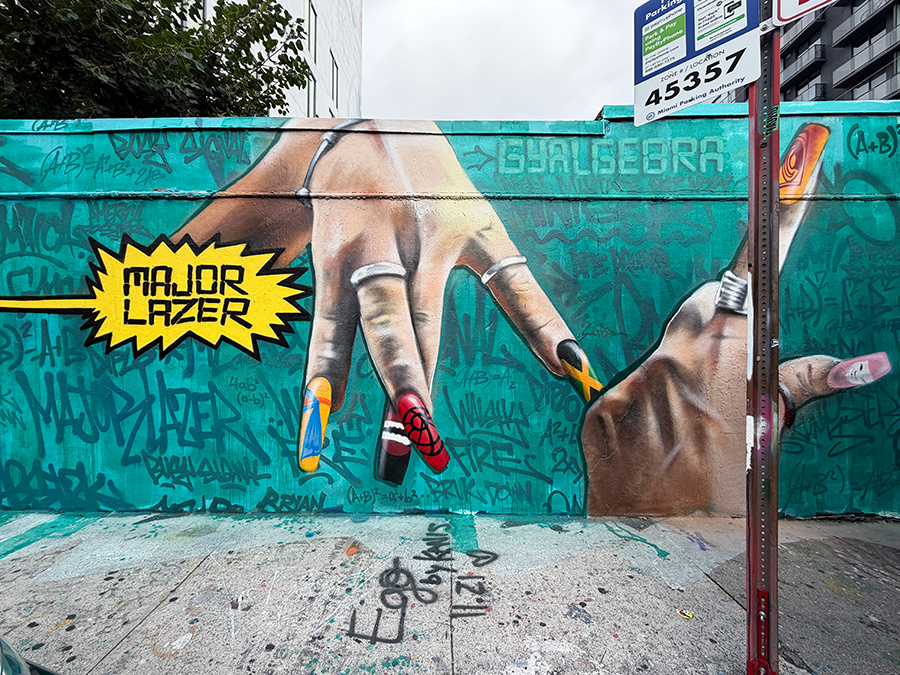
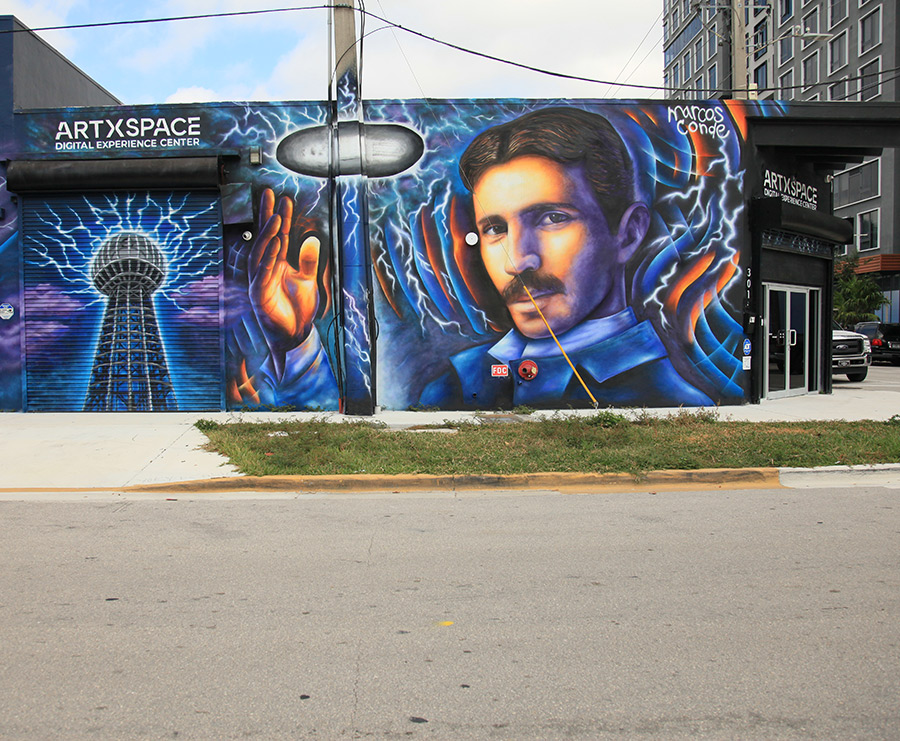
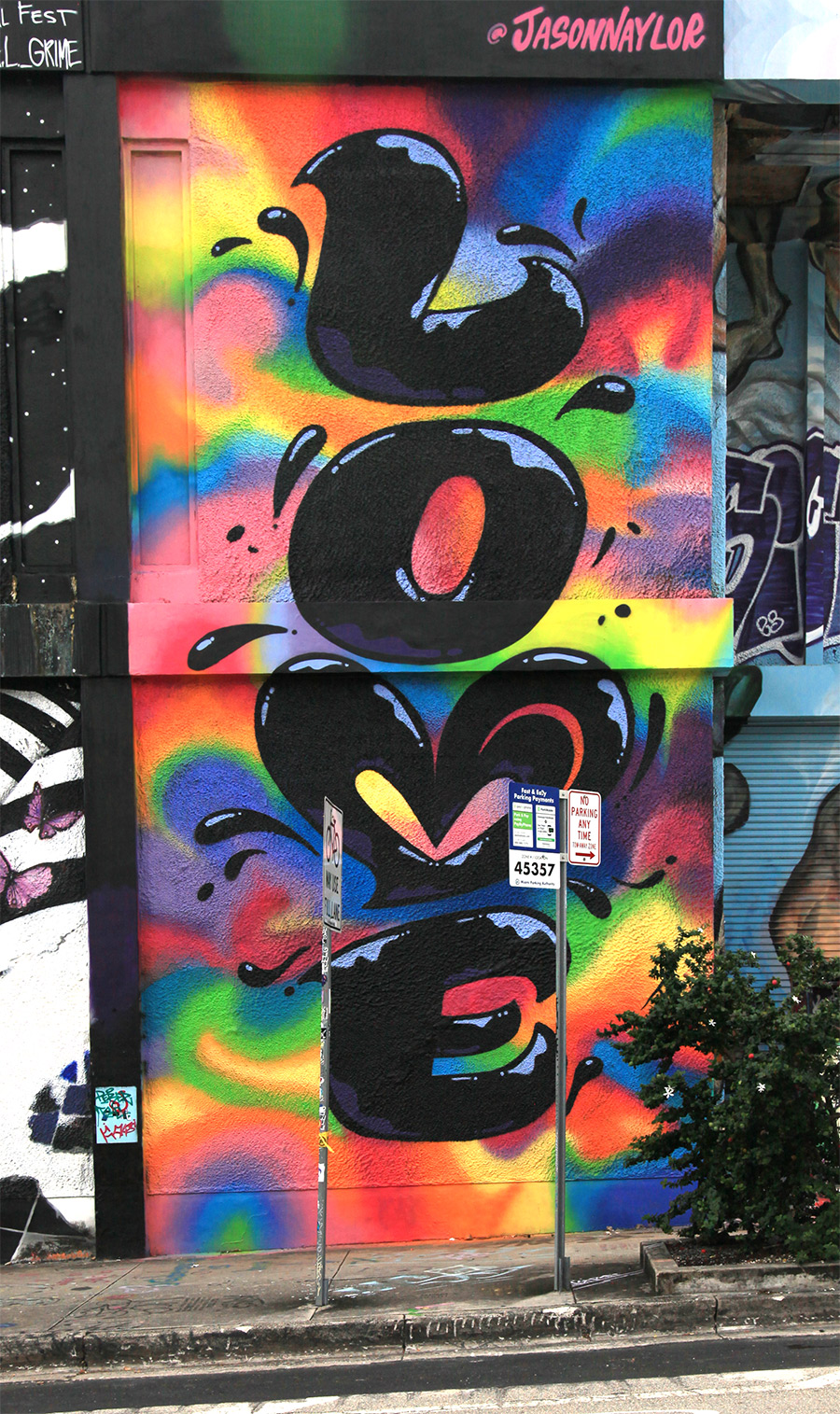
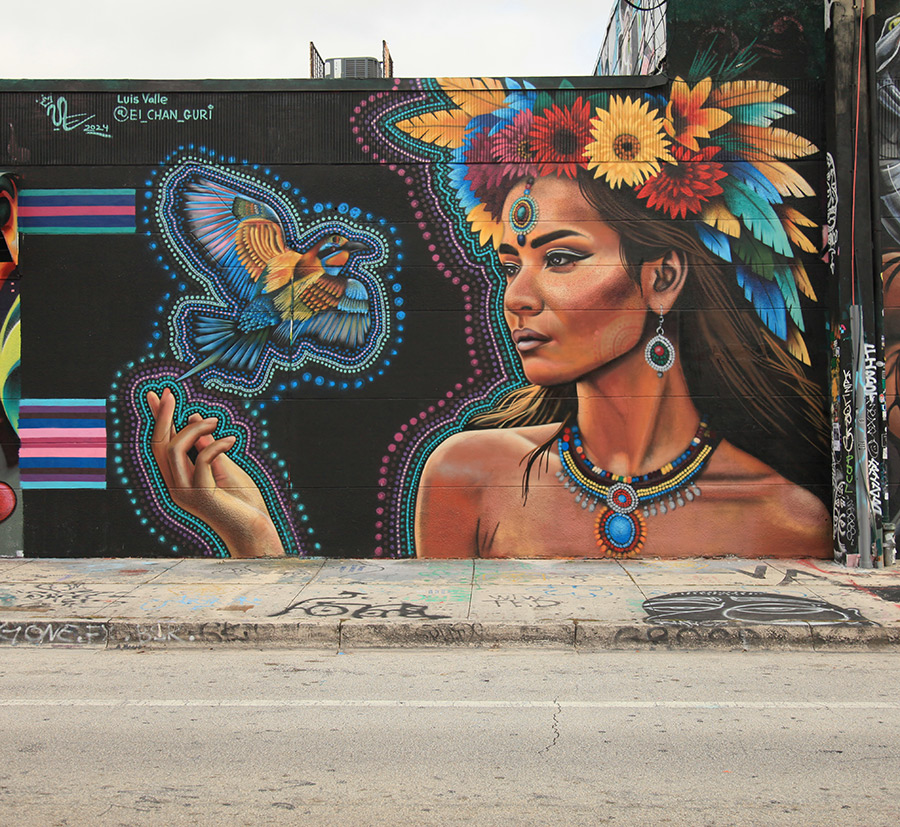
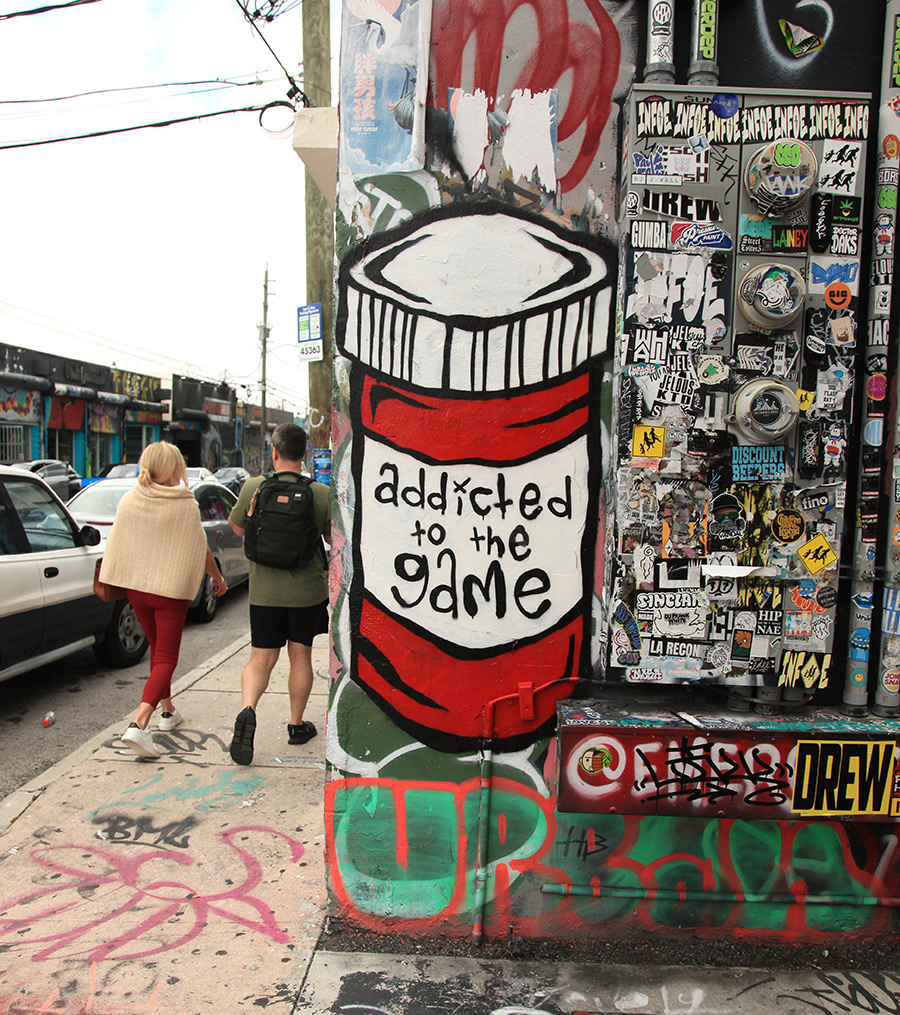
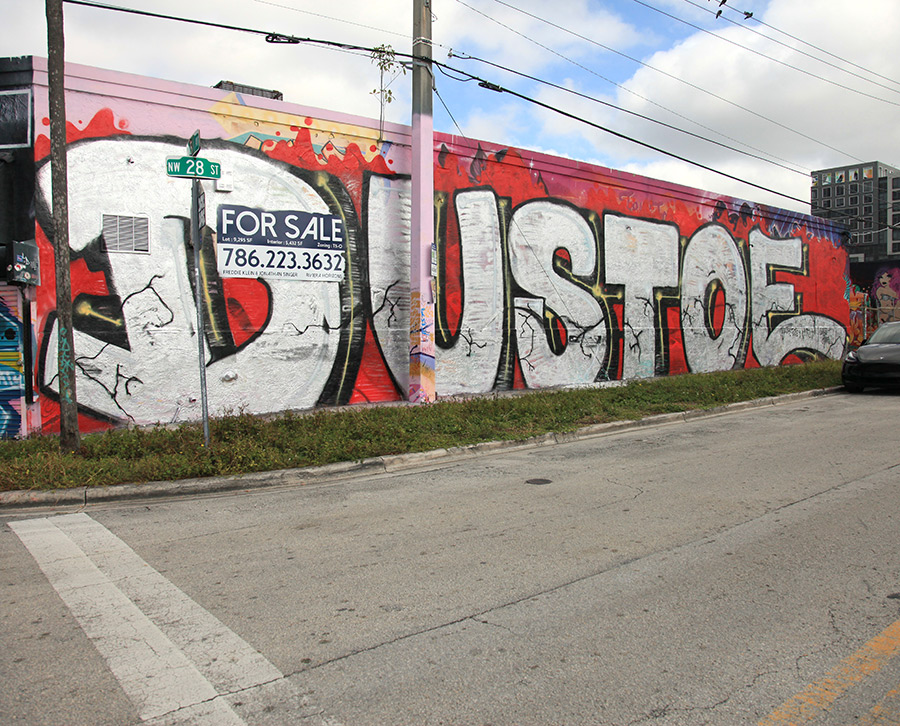
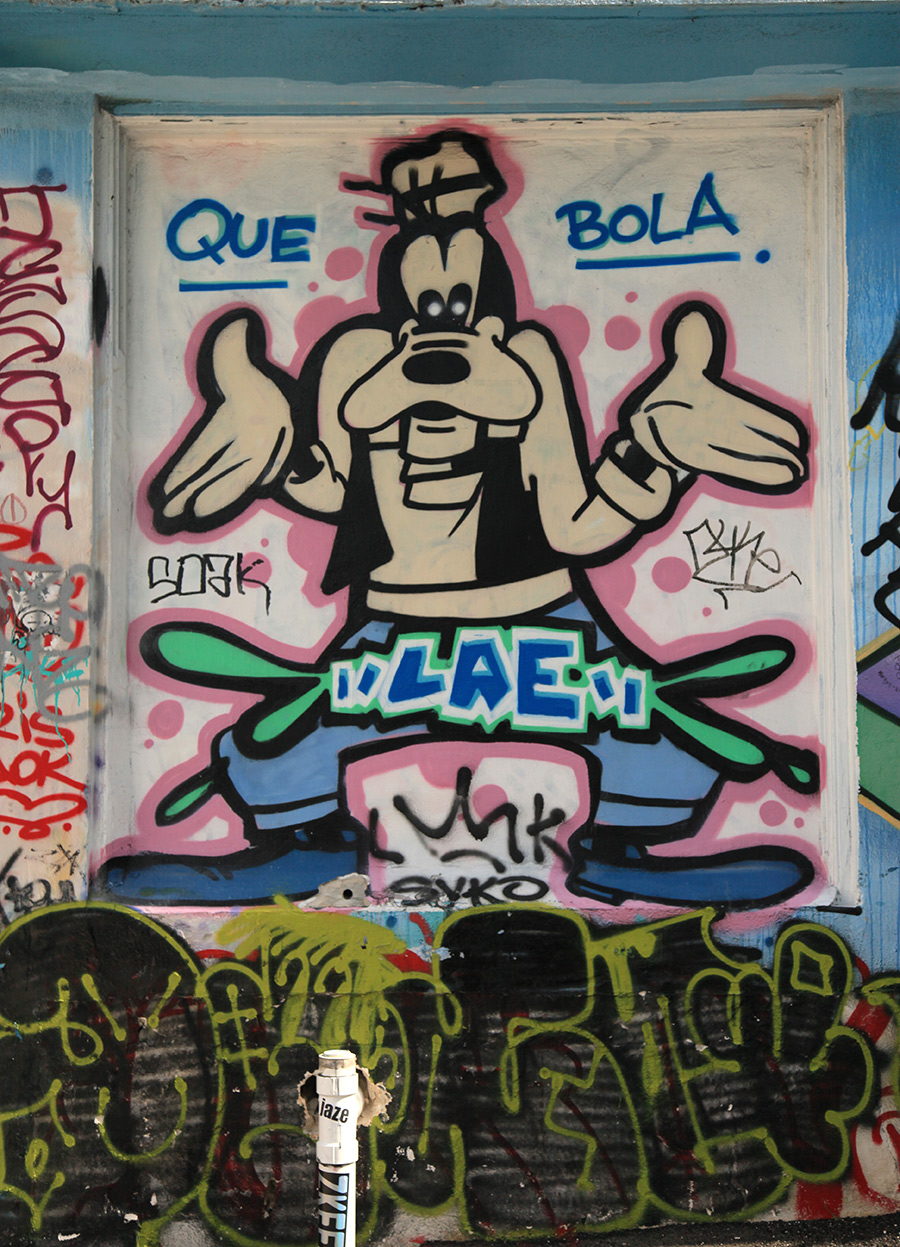
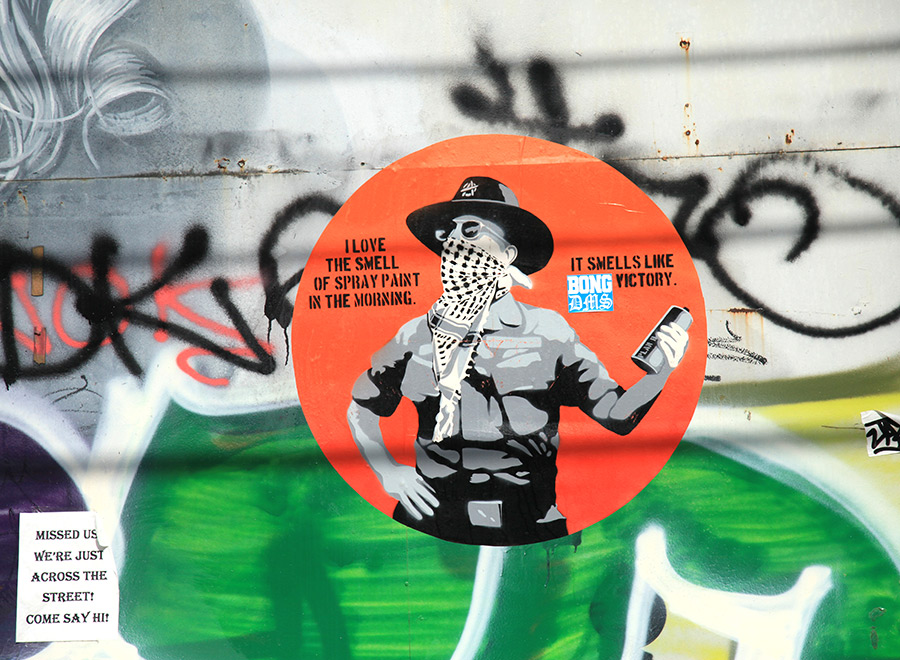
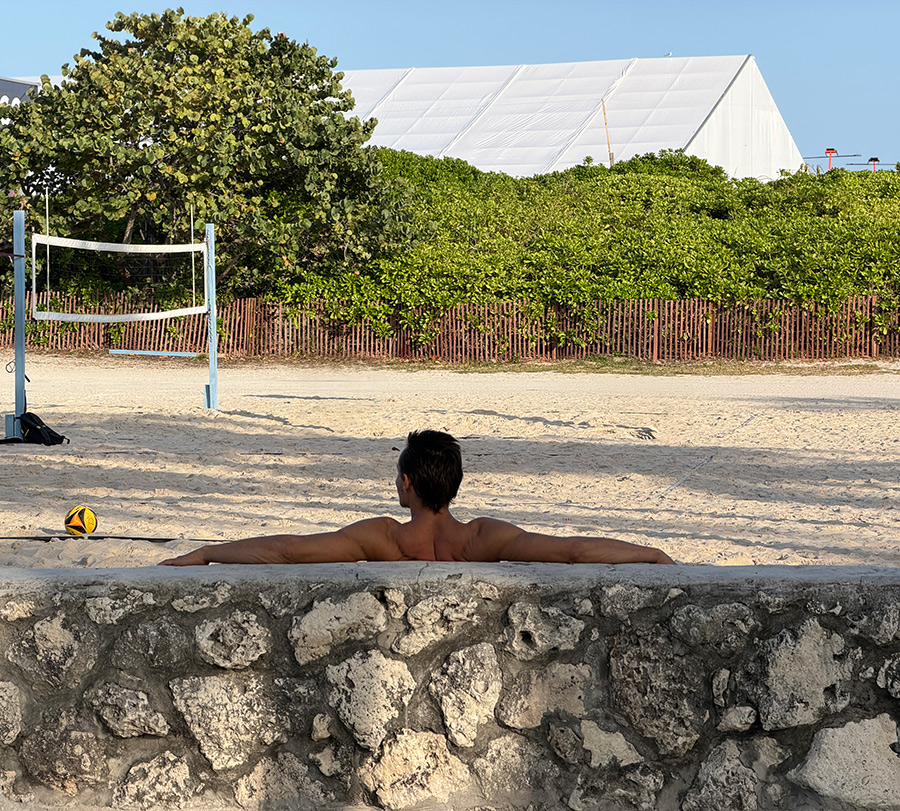
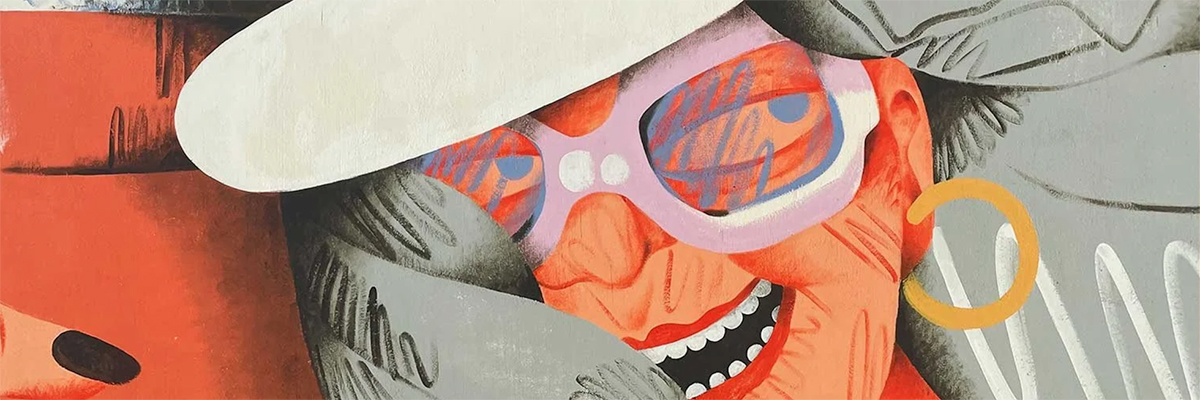
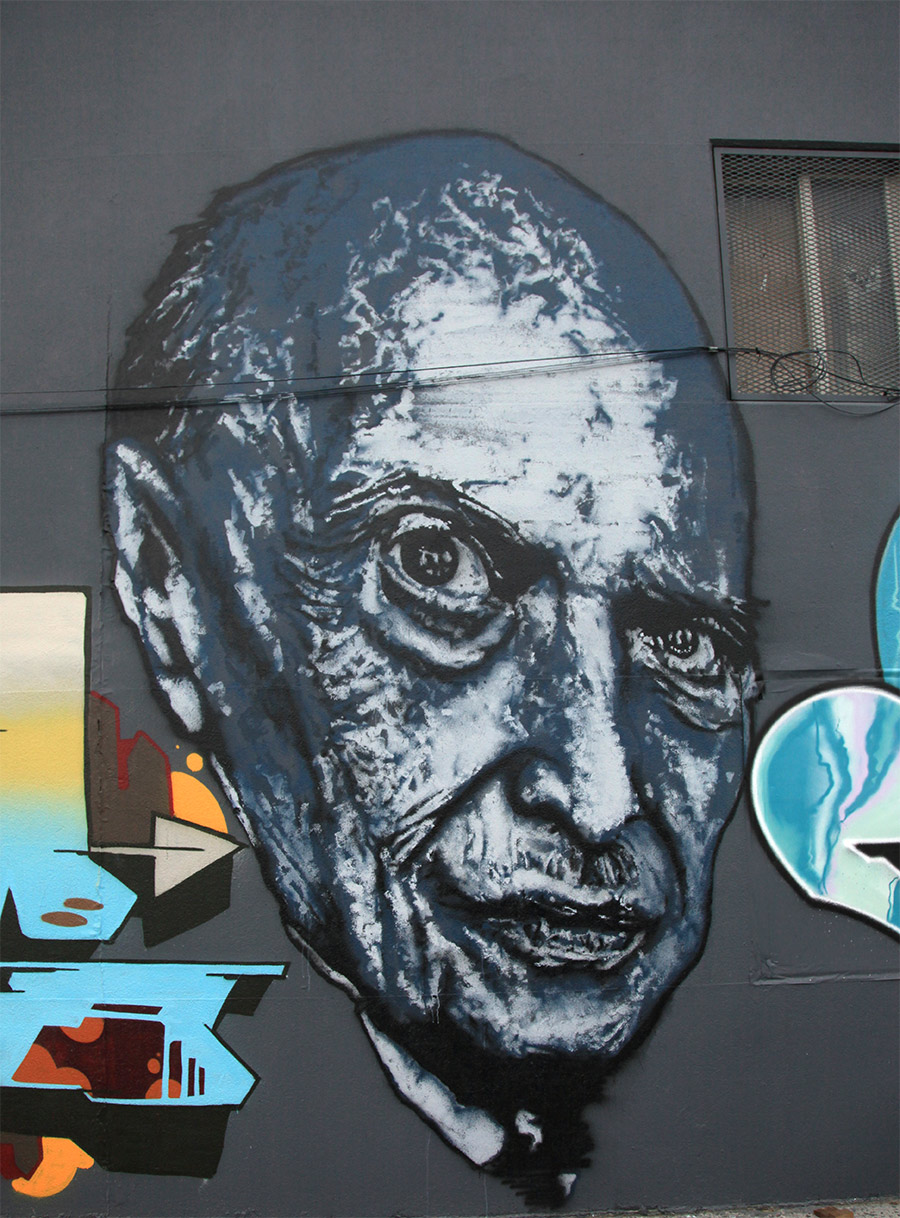
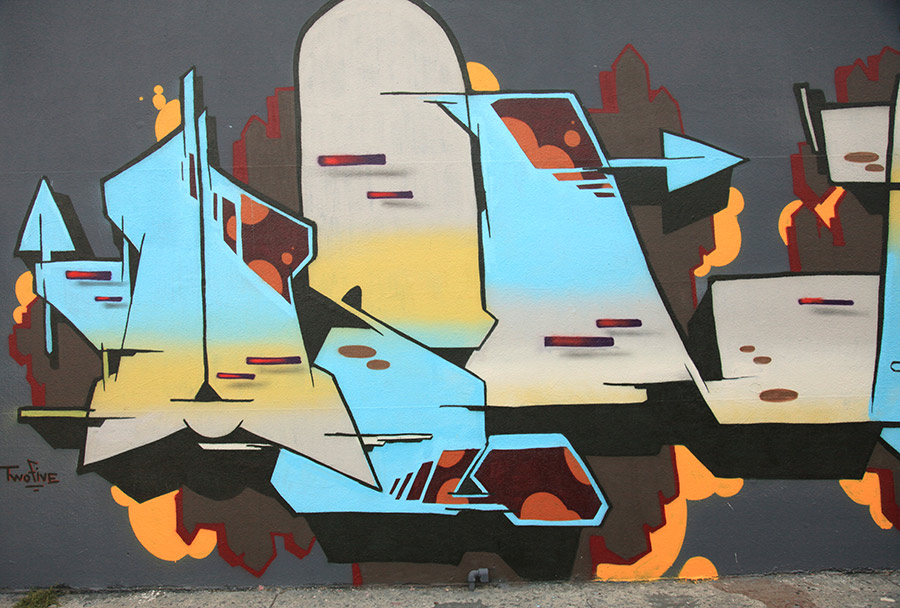
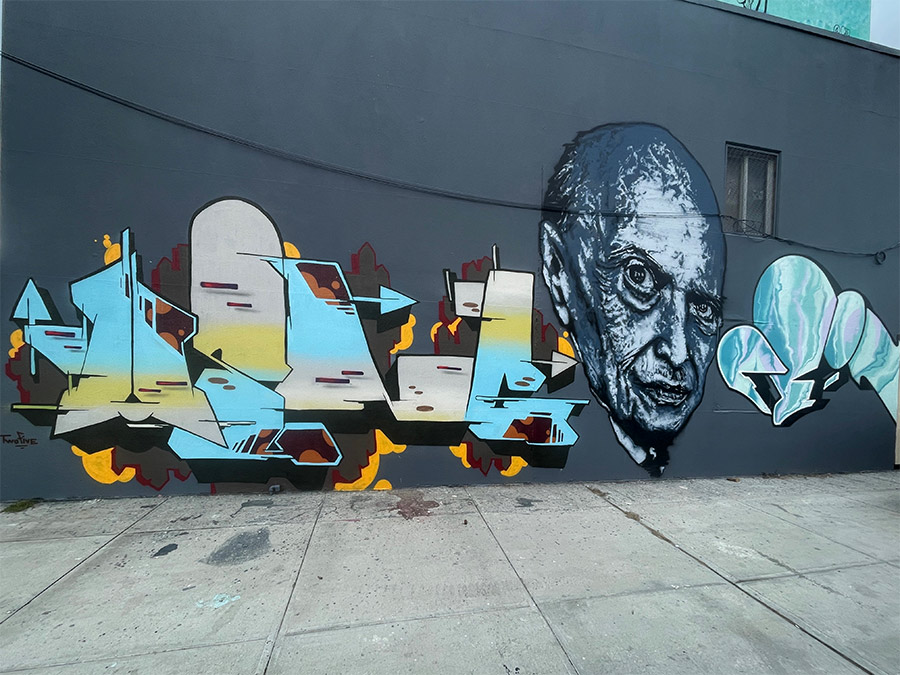
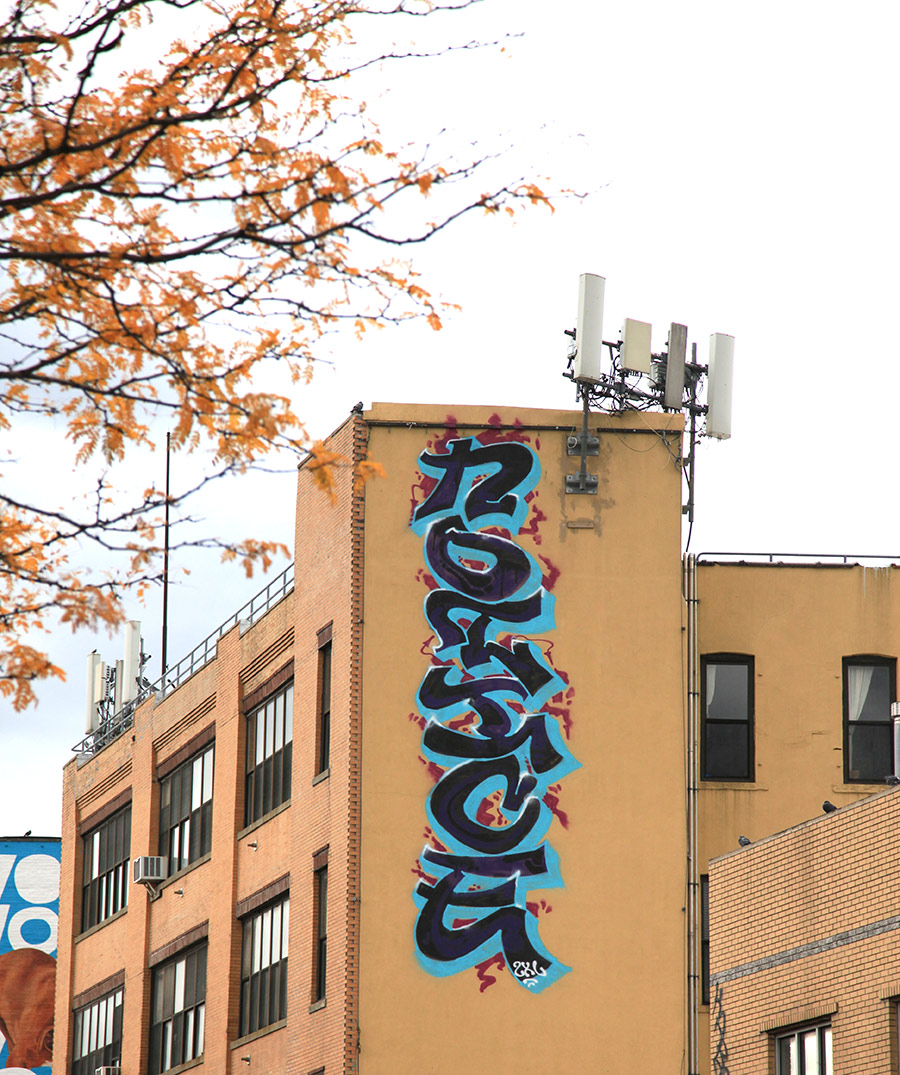
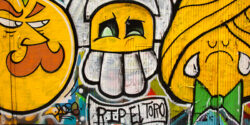
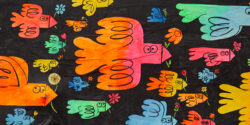
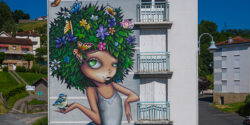
Welcome to BSA Images of the week, where we have been surfing through street art in Miami for 7 days. Wynwood keeps upping the ante in terms of spectacle: the entire neighborhood this week has been awash in events, openings, dinners, tours, panel discussions, gallery openings, exhibition boxing, live music performed in store windows, boisterous rooftop cocktails, sponsor ‘activations’, stickers, t-shirts, lanyards, festivalized clubs with fire jugglers and whirling light shows, and pop-up playgrounds in nontraditional venues like parking lots and warehouses. Many people catch these events when they look up from their phones.
Clubs with long lines on the sidewalk are running hot on reggaeton and Latin trap, colliding Bad Bunny’s stadium-sized hooks with Karol G, Rauw Alejandro, Feid, and Peso Pluma, all cut and slammed into sweat-soaked house – with EDM drops. It’s loud, physical, and relentless — the sexy fashion and sleek swagger on the nighttime sidewalk is all fueled by a heavy bass heartbeat blasting out the door and off the roof. If your window panes are thumping rhythmically louder than the air conditioner hum inside the hotel room at 2 am, you are in Wynwood. Also, why are you asleep, bro?
Oops — almost forgot to mention the painting. These days, the lineup is broad: graffiti writers, street artists, mural painters, and plenty of contemporary artists testing their footing out in public. The range of styles is wide — genuinely wide — and if we’re being honest, a fair number of walls double as neatly disguised brand exercises, selling trends back to us in fresh packaging.
We’ve met plenty of real creators along the way — people with muscle memory, ideas of their own, and a sense of why this work matters. But there’s also a growing crowd of art-fair regulars who’ve vacuumed up the look of graffiti and street art, mixed it with a few drips and gestures, and sent it right back out. In their work, you’ll spot familiar DNA — KAWS, Basquiat, Fairey, Warhol, Banksy — sliced, layered, splashed, and lettered across the surface. It’s street art by collage and citation, often stripped of the context that made those references meaningful in the first place.
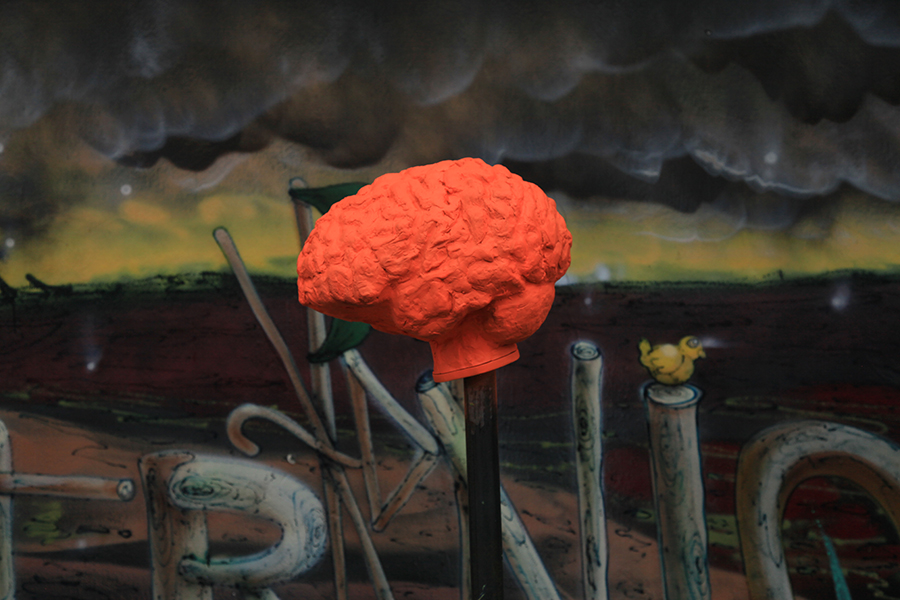
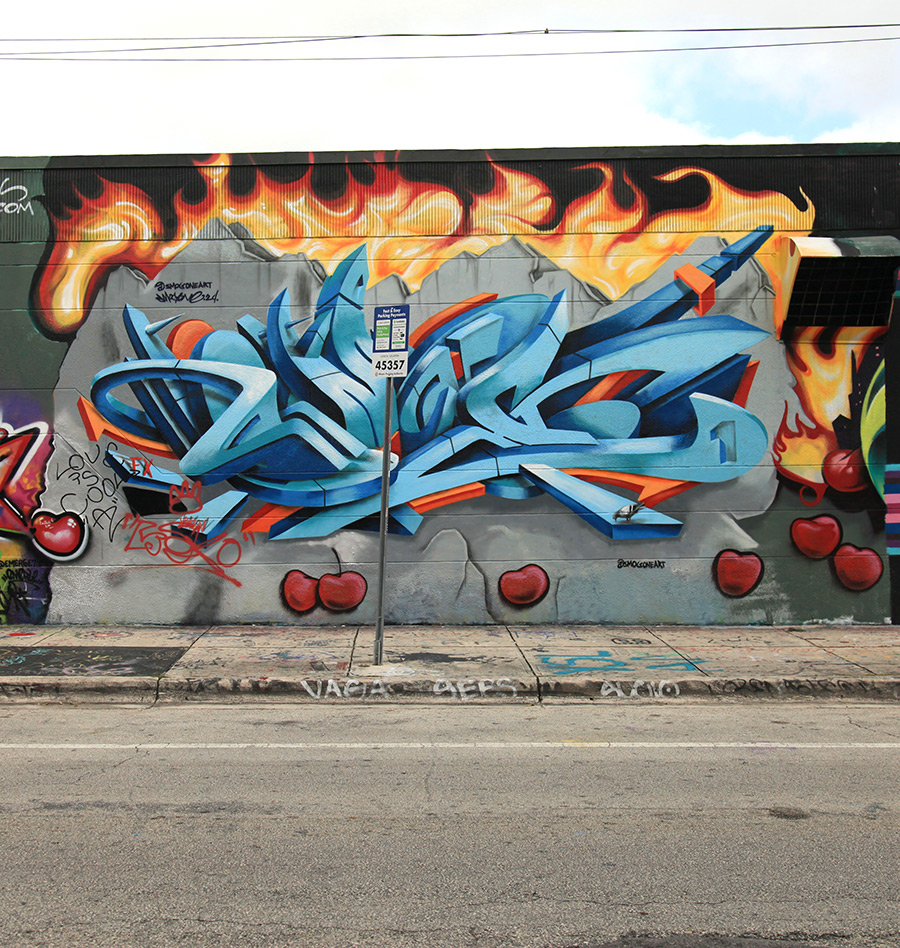
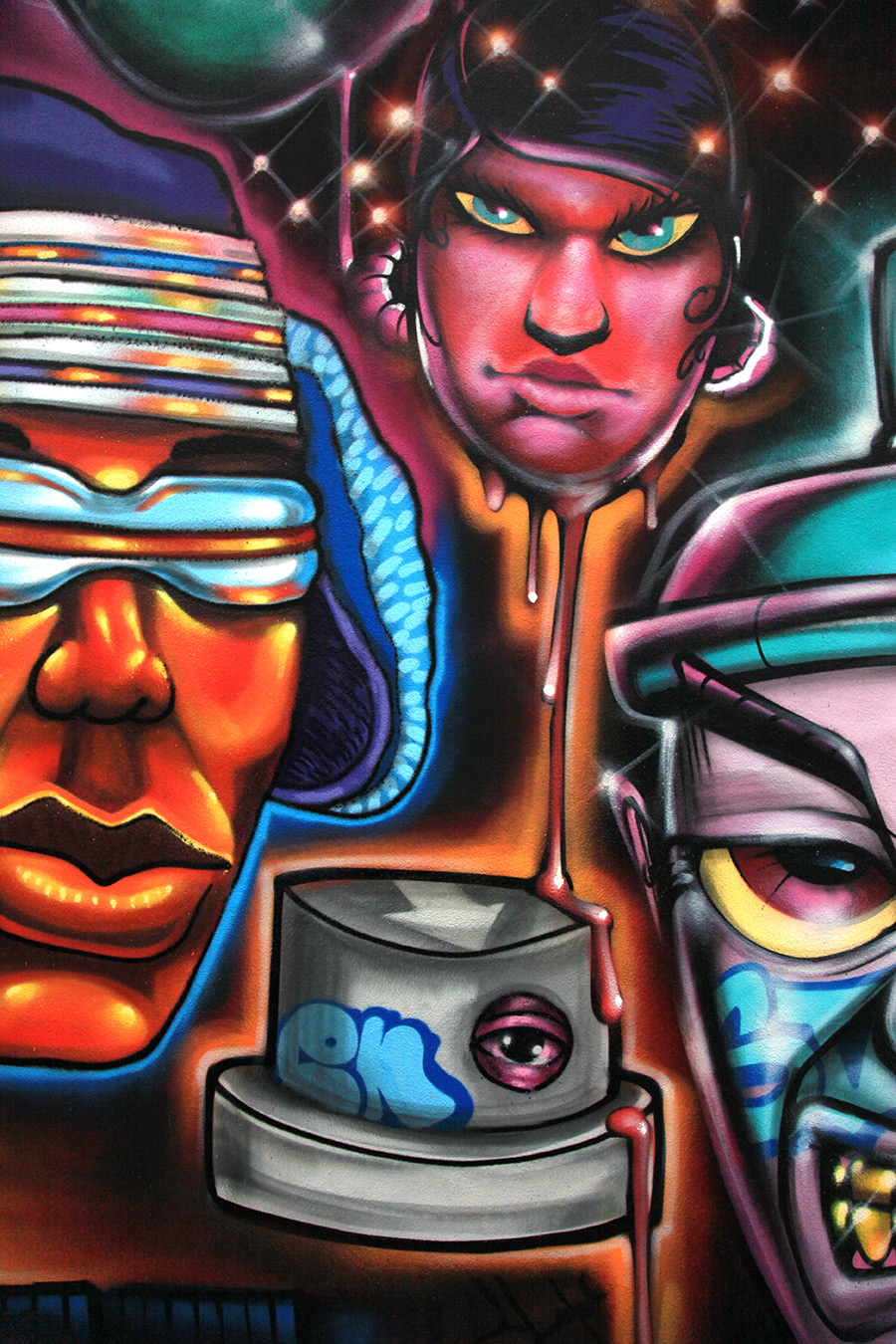
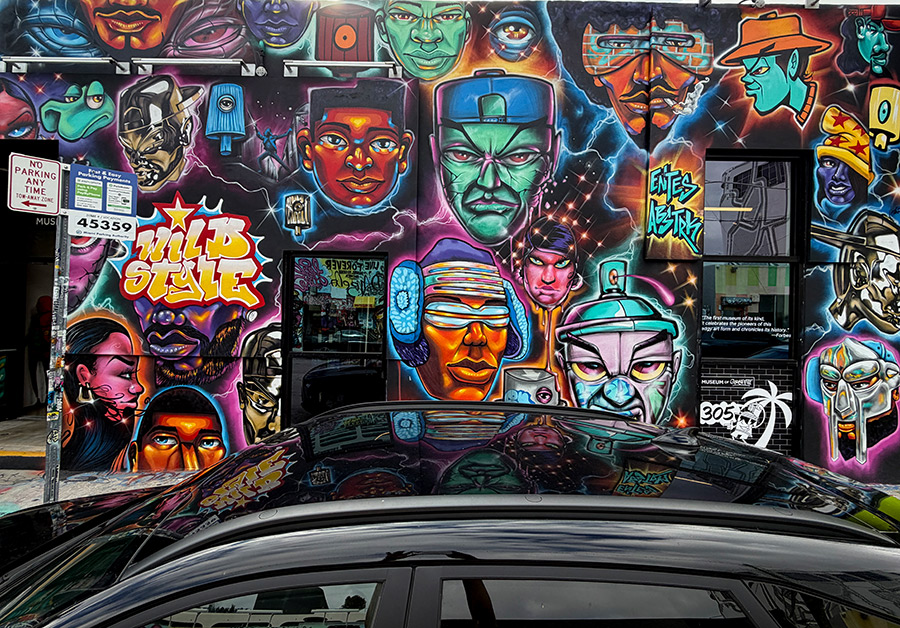
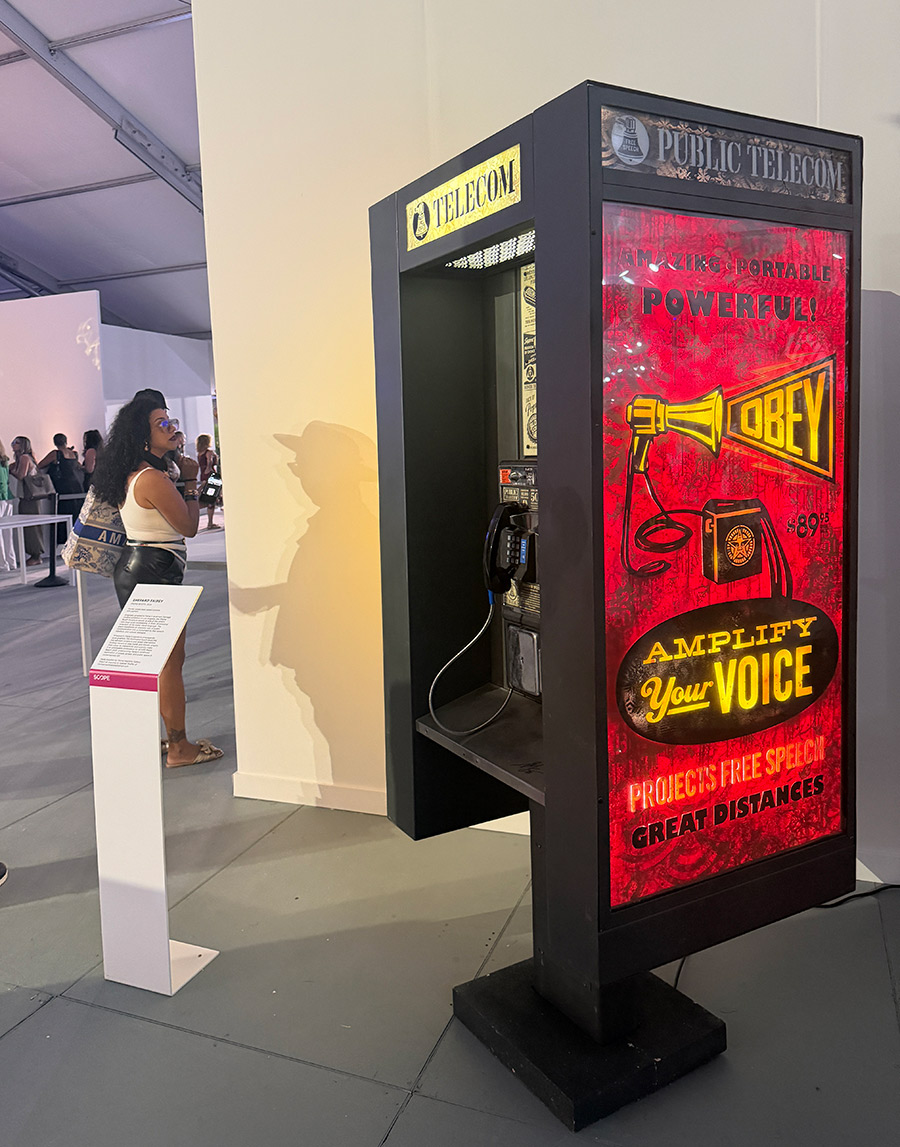
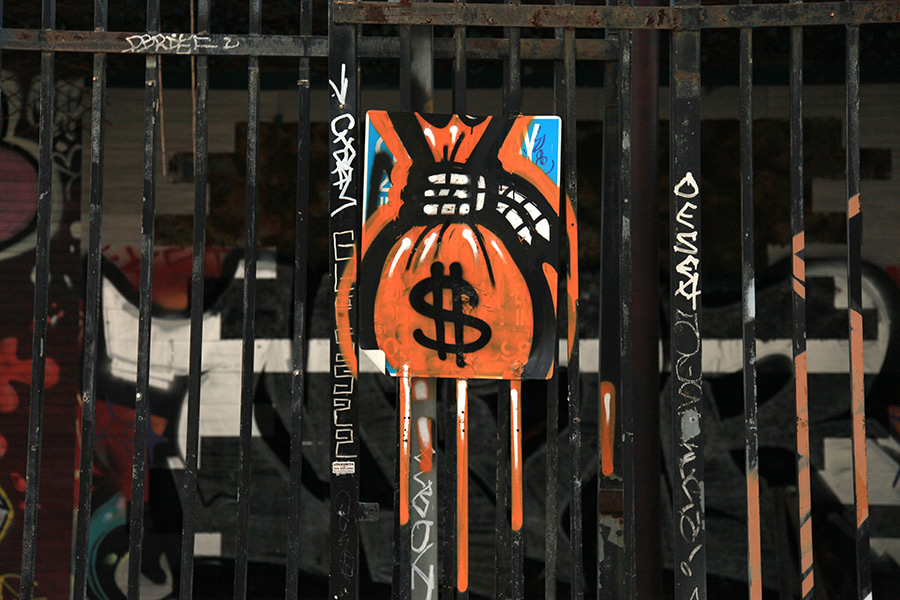
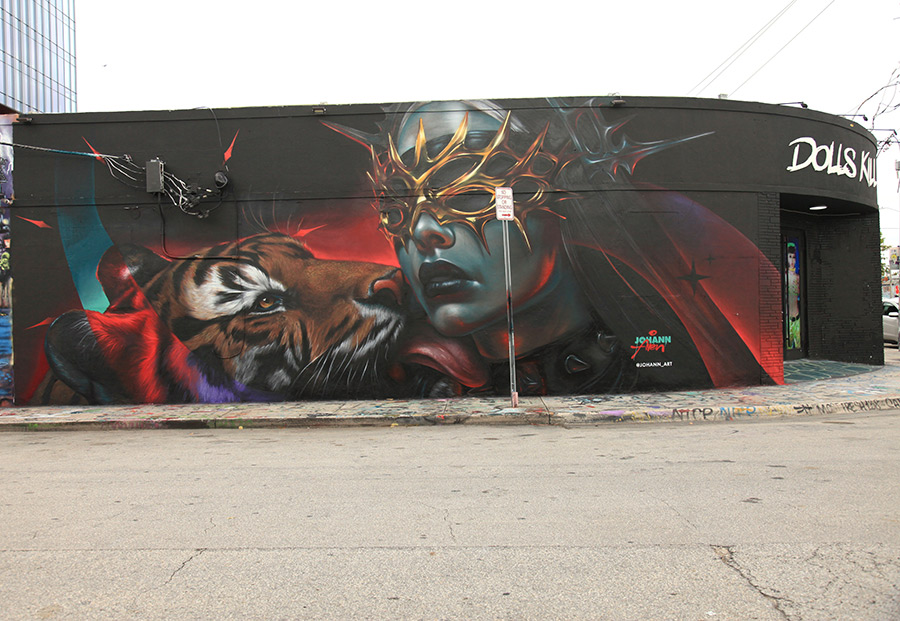
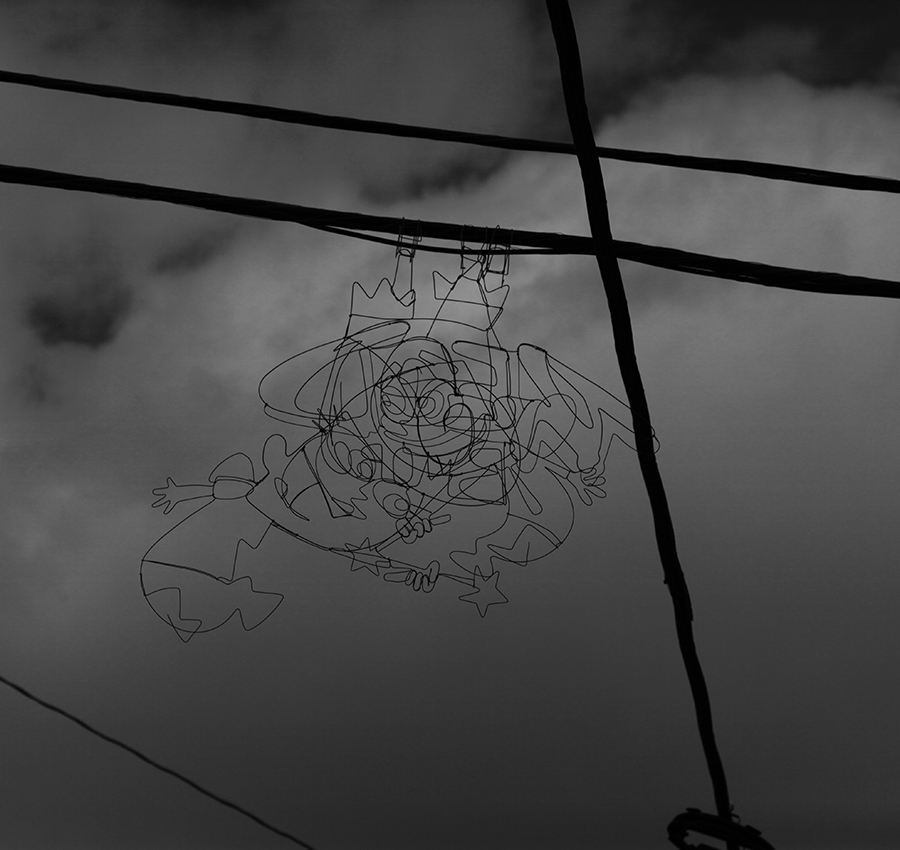
Here’s a selection of works seen on the street this week in Wynwood, Miami, including: Aine, BK Foxx, Dirt Cobain, Dustoe, Earsnot, EMERGE, Entes, Gyalgebra, Jason Naylor, Johann Aven, Lae, Luis Valle, Marcos Conde, MEPS, Patrick Churcany, Saturno, Shepard Fairey, SMOG ONE, STOE, and TATS004.
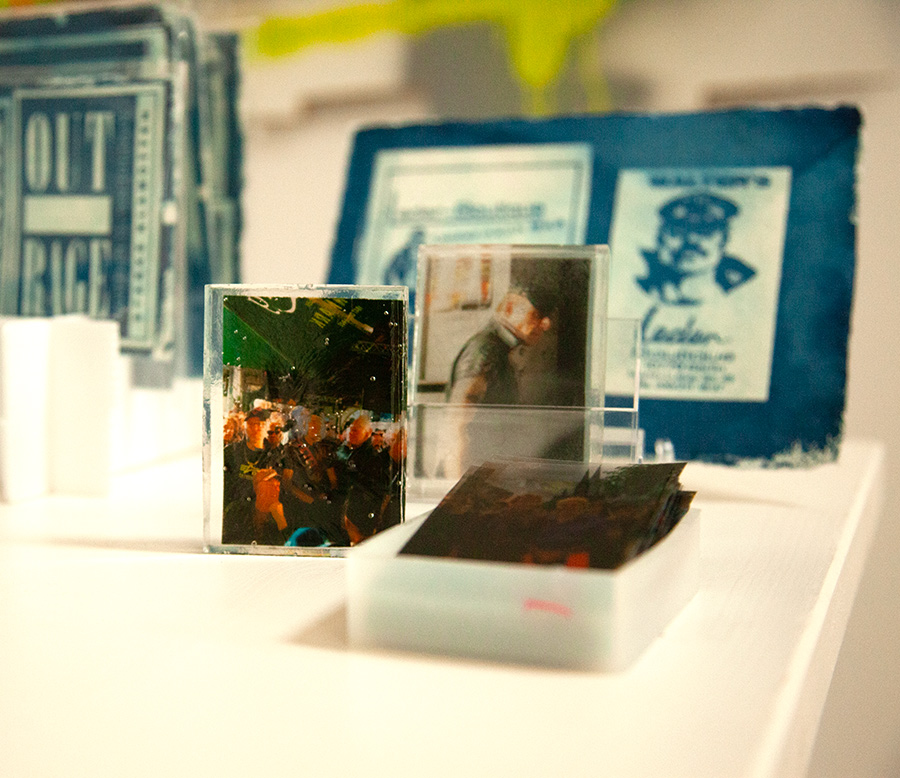
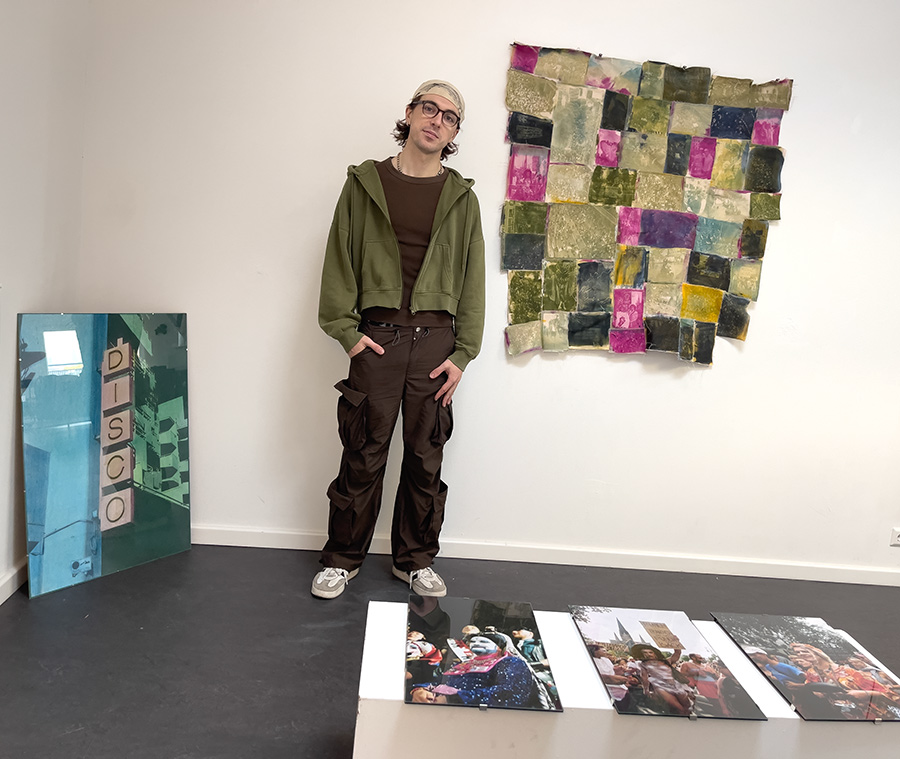
The first Martha Cooper Scholar in Photography, Dylan Mitro, has completed his residency year of study and development in Berlin. Along the way, he became more closely aligned with his identity as a documentary photographer, a storyteller, an archivist of history, and a member of the queer community. Looking back on his project of study hosted by Berliner Leben and Urban Nation Museum, he says his appreciation for social movements came into focus, as did his role as aphotographer in capturing people and preserving cultural memory.
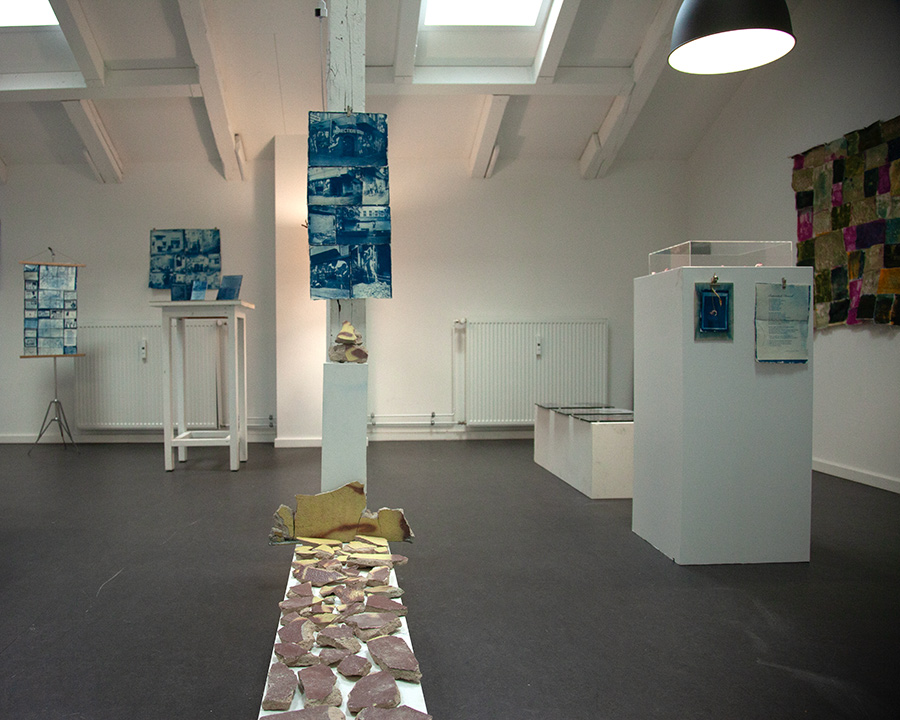
We spent a few hours speaking with him in the rooftop space atop the Urban Nation Museum talking about his experiences over the past year and looking at the materials that he created. We took away a few lessons on culture, art, preservation, and being present.
“Before I can be a person with a camera, I have to be a person they can trust… I cannot be exploitative, especially with communities that have been exploited so much.”
Photography Isn’t Just Style; It’s Witnessing.
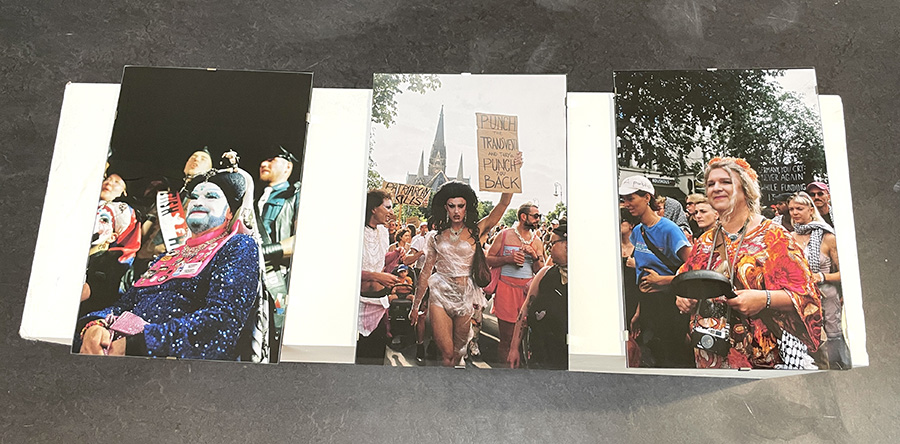
For Dylan Mitro, the camera has become less an instrument of aesthetics than a way of being present when history is unfolding before him. His “24 hours of protest” sequence of photos from animated and boisterous marches and demonstrations on the streets of Berlin is where this becomes clearest. He describes being in the street, whether raucous or quietly vigilant, with “thousands of people coming towards me,” running through the crowd and asking, “Can I take your photo?” as events unfolded in real time.
That sense of urgency and adrenaline is exactly what he admires in Martha Cooper’s work: her “always on” state, the way she treats the street as a field site and people as subjects rather than props. Dylan understands, as Martha does, that the most meaningful images are not staged or pretty; they are “honest and raw,” capturing people at protests, in queer nightlife, and in ordinary moments of showing up for one another. When he looks back at his protest images this year and says, “This is why I’m doing it,” he’s telling us that he recognizes that these fleeting, unposed encounters would otherwise vanish, leaving no trace in official records. Street photography through an ethnological lense, in his hands, becomes a way of witnessing courage and vulnerability in the moment and preserving it for those who come after.
“In the moment it’s so high energy, but then when you see the photos you’re like—okay, this is why I’m doing it.”
Archiving and Re-Photography are Acts of Care and Resistance.
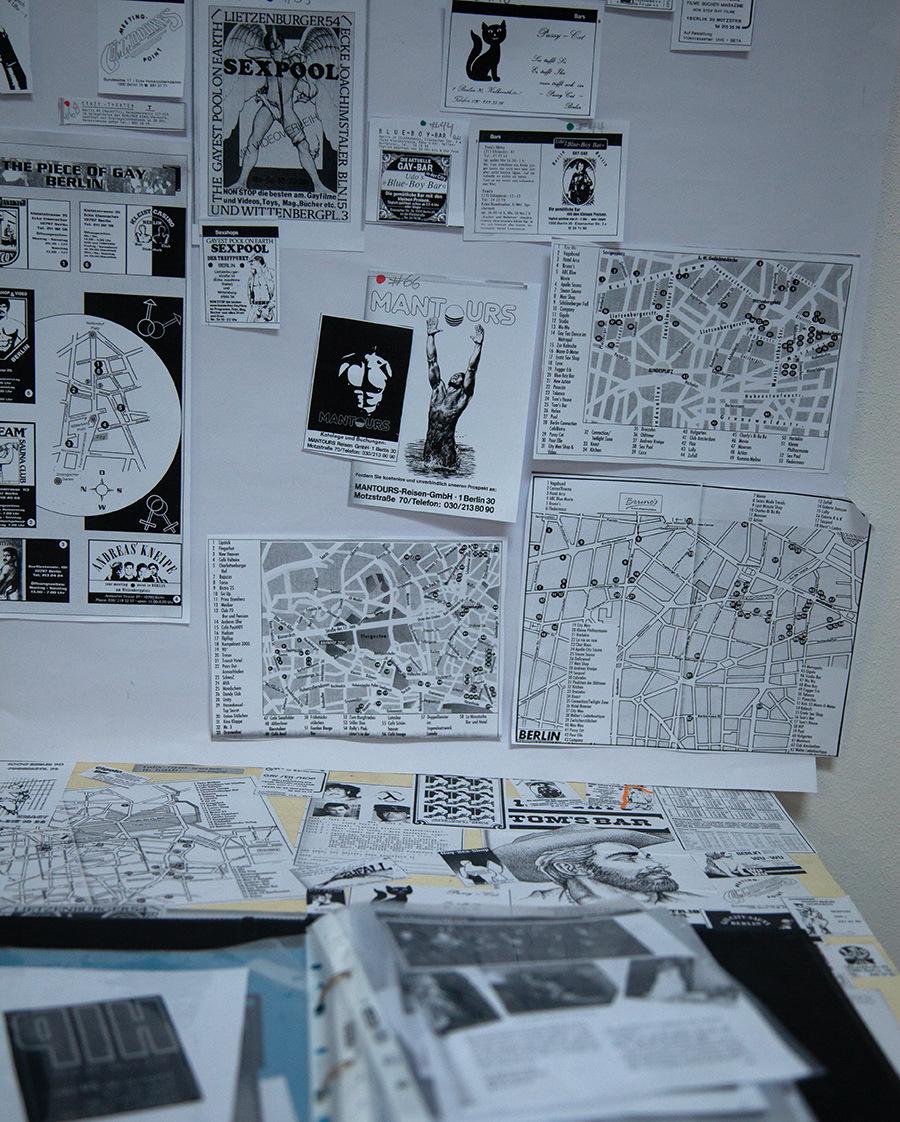
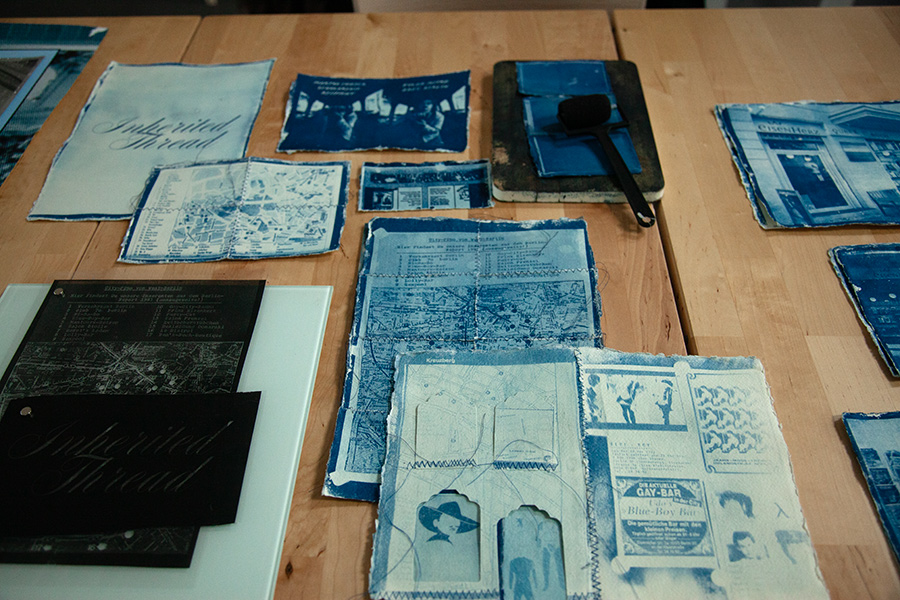
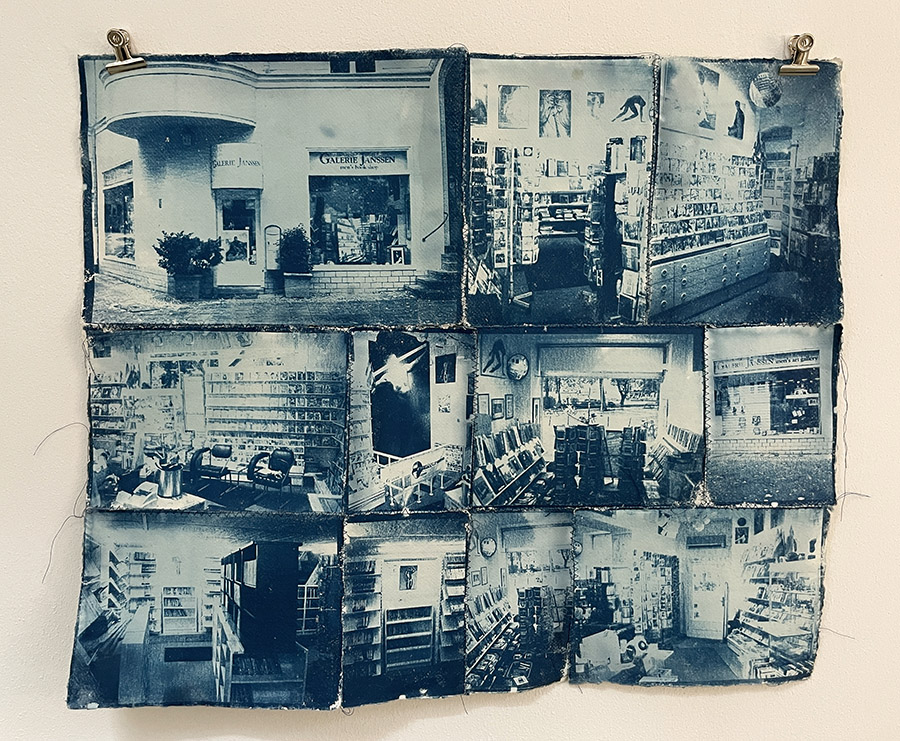
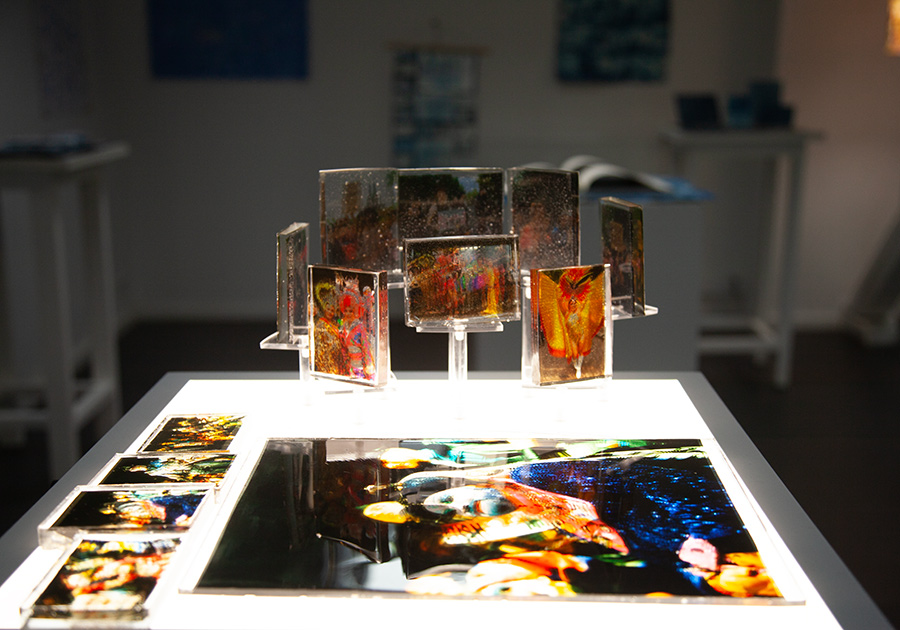
Dylan’s unconventional project of re-photographing and reactivating historic photos begins in the archive and brings people to speak to us here, now. He related his experience of making contact with private collectors of LGBTQ+ history and organizations who have documented queer history in Berlin, sifting through collections, commercial advertising, and personal stories without quite knowing what he was looking for. Possibly because people hid their identity for protection, some things were just out of reach, and Mitro related how images “appear… in this almost ghostly, haunting way.” From our perspective, this work looks like a fresh battle against erasure.
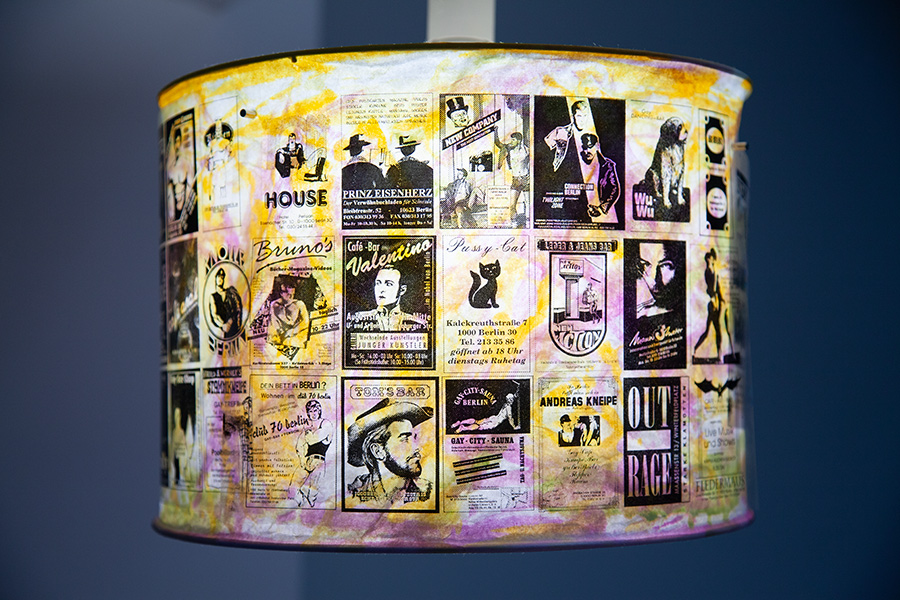
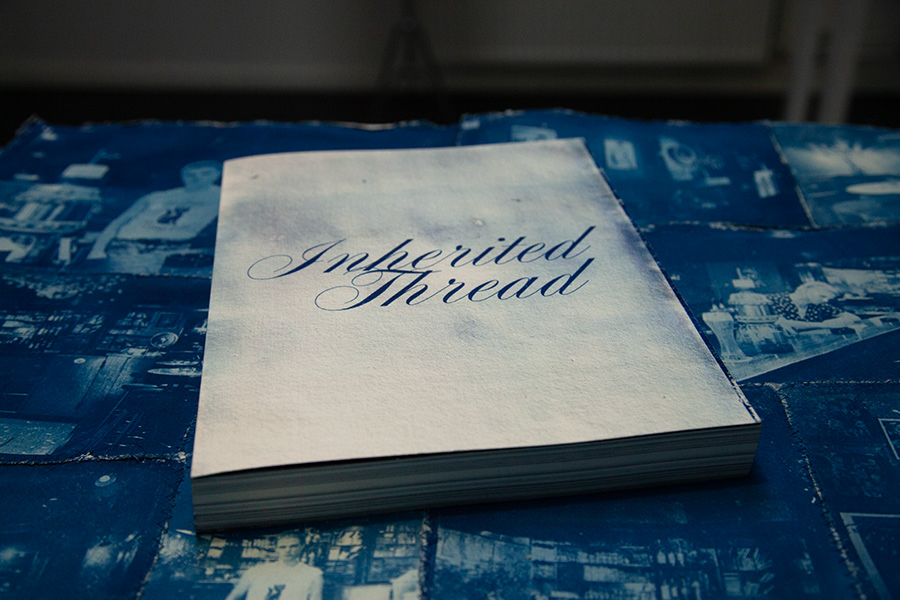
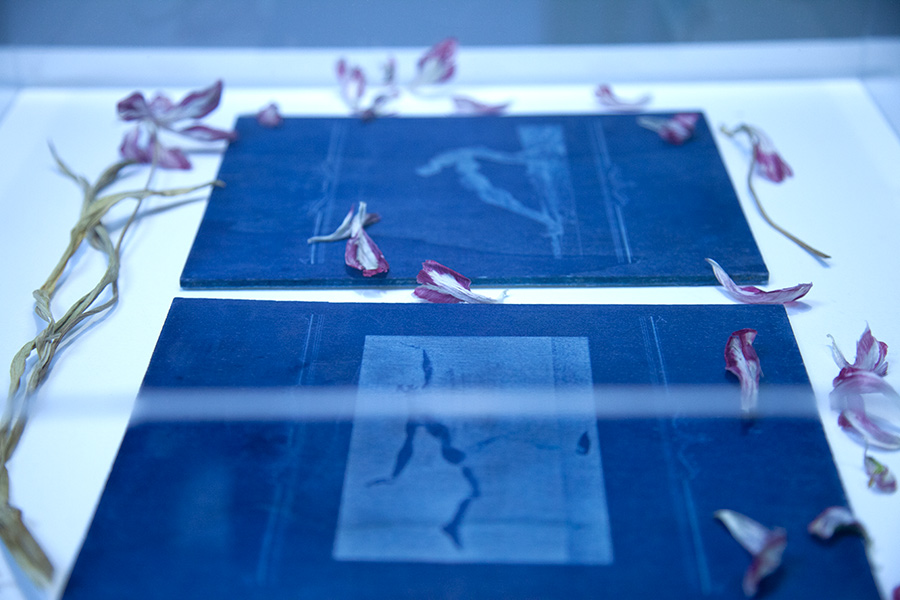
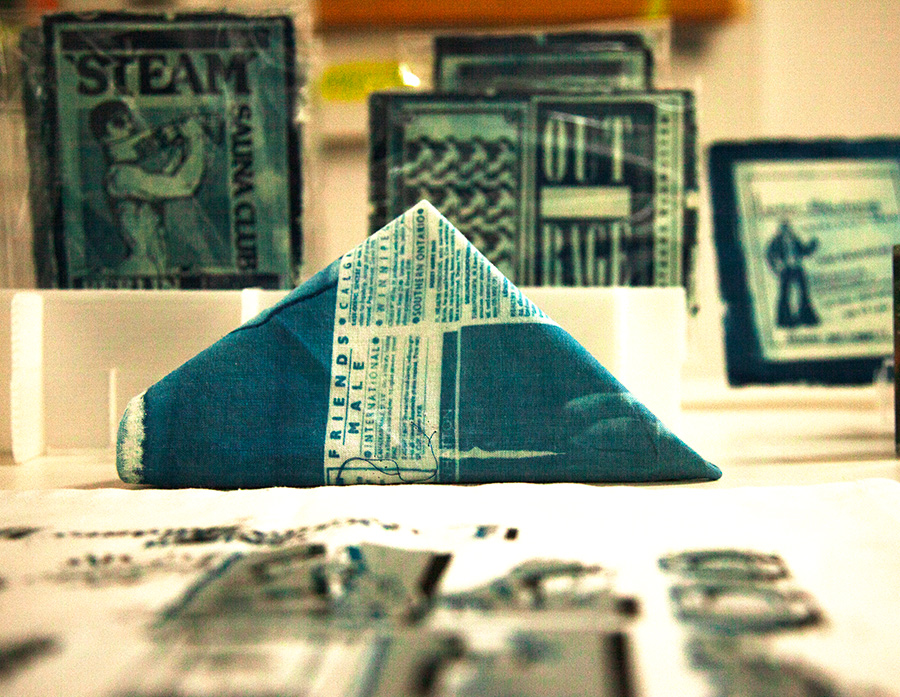
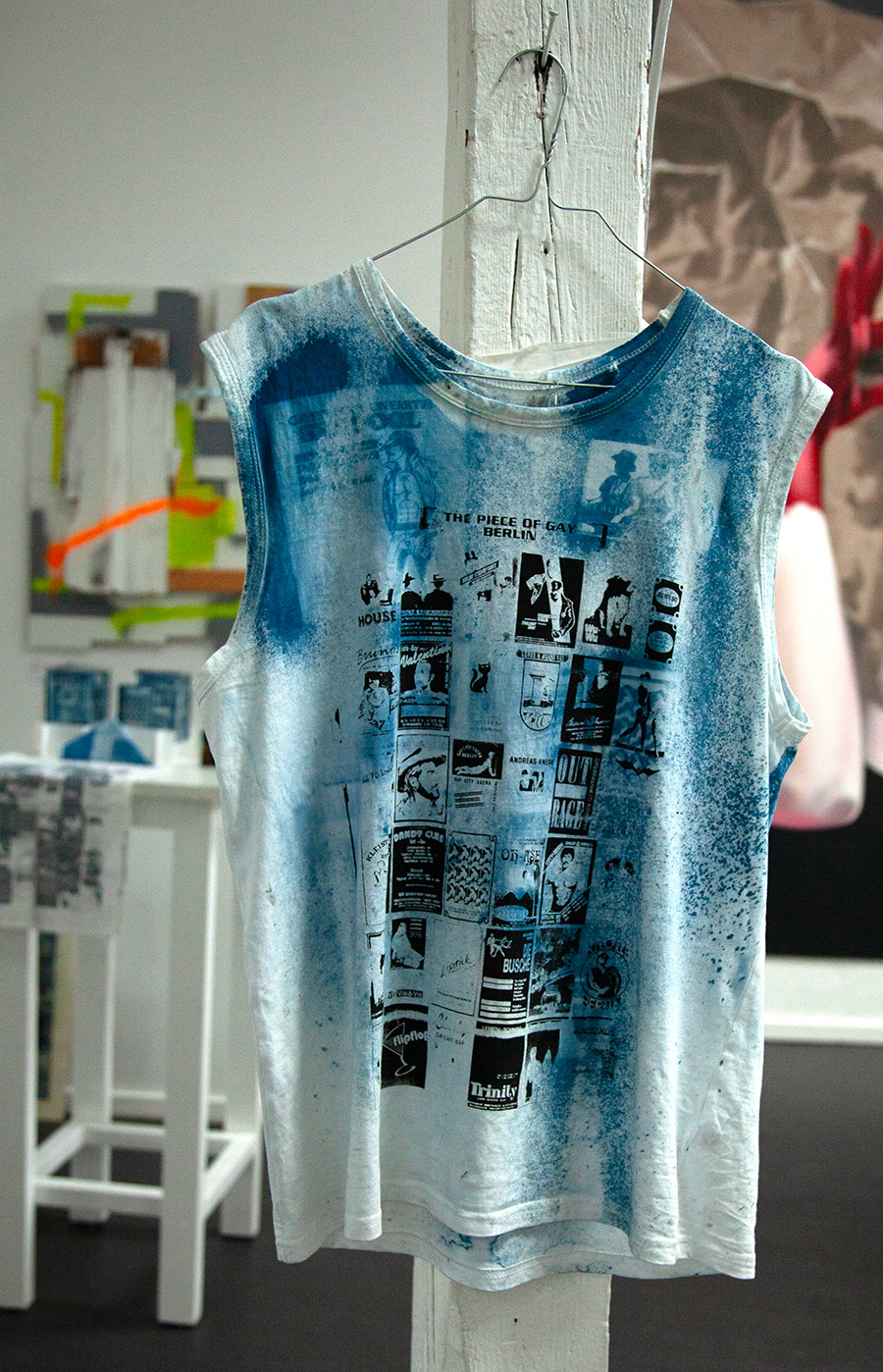
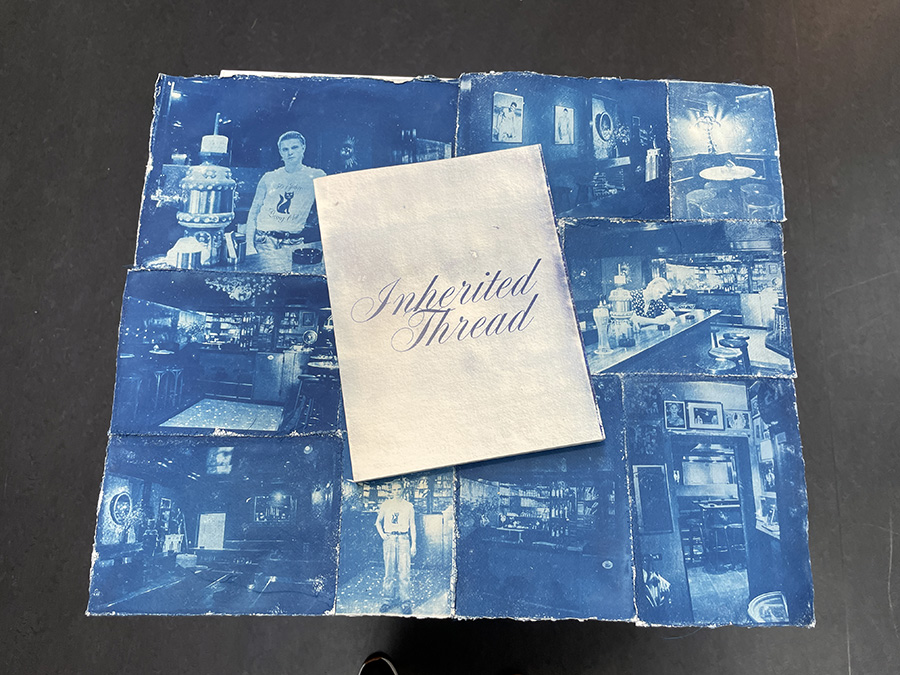
His research led him to retrace the locations of social clubs and bookstores and to pore over a varied and deep selection of printed and digitized materials at the LGBTQIA+ archives at the Schwules Museum in Berlin, including the publication Berlin von Hinten. Thanks to the careful collecting and preservation by many in the Berlin community, the artist says he found himself faced with an overwhelming array of diverse materials to study. Mitro brought his own scanner into the reading room, mechanically capturing pages to “deal with later,” making sure nothing important slipped past him in the flood. When he began making cyanotypes from sex journals, classifieds, and Berlin bar magazines like Berlin von Hinten, he was not merely appropriating images but changing their context and use, turning fragile, easily discarded ephemera into durable goods like book pages, prints, even shirts that he wore into the public and to the opening of his exhibition.
“The beautiful thing about an archive is you don’t know what you’re looking for when you go in, and then it just appears to you in this almost ghostly, haunting way.”
Thoughtful in his description of this self-created research process, he appears fully aware of an ethical minefield that he kept seeing in the materials: the sexualization of hustlers, questions of consent, the AIDS epidemic unfolding in the background, and the way one scandalous case can be used to demonize and smear an entire community. He also remarks on how much things have changed as queer culture has learned from its own past and become more equitable and inclusive. For him, to re-photograph, to print, to bind, is to refuse both erasure and simplistic moral panic. It is an act of care for those who lived through those years and a quiet resistance to the ways queer histories are flattened, censored, or selectively remembered.
Passing the Torch: How New Artists Build on Earlier Legacies
Dylan repeatedly frames his work as a kind of “grief politics” — a way to process his own grief and “collective grief” through images and stories. While he handles materials that can be considered crass, campy, or uncomfortable, he treats them as evidence of what previous generations built so that people like him can enjoy the relative freedoms they have now. During the conversation, we recalled that on earlier Zoom calls in the year, he talked about “recognizing the work that our ancestors have done… so we can enjoy the freedoms that we have now,” and he confirmed that this became central to his mission. In practical terms, this shows up in small but telling decisions.
Looking over materials and images, he noticed that many photographs in these magazines are uncredited or minimally credited; however, it was vital for him to reconstruct a credit page in his own book from the publication’s credit lists, even when he could not match each image to a specific name. He sees this as “doing the work for the crediting now,” anticipating a future researcher who might ask “who took this?” and refusing to leave them with a dead end.
His admiration for the photographer Martha Cooper is also part of it: he recognizes that she endured periods when her work was underappreciated, then gradually became a reference point for entire scenes and was treasured for their historical significance. By aligning his practice with her documentary, ethnological approach — attentive, long-term, grounded in real communities — Mitro is situating himself in a lineage of photography that tells our stories to each other and future generations.
When Time, Space, and Support Open a Path for an Artist
Dylan Mitro arrived in Berlin after a decade in Toronto, working punishing 14–15-hour days on commercial shoots and features, a rhythm he describes as “so unsustainable.” The residency allowed him to step off that treadmill and begin a course of study in a new city on another continent. He talked about the stark contrast: in the exact moment that he got the news about being selected for the residency, he learned the news of a close family member’s illness. As he talks, you realize that the year in Berlin became a hinge between these two realities — a chance to focus on his art and a forced confrontation with “what are these next chapters of my life?”
“It’s grief politics… how do I deal with my grief that’s also collective grief? And I deal with that in all of my work.”
With a new perspective, removed from Toronto, he considers that he cannot simply “jump right back into the way I was living.” While he regroups in Ontario and supports family, you can see that the residency gave him room to experiment: scanning archives, learning cyanotype techniques, organizing negatives by place, developing a whole book, and then pivoting mid-project to the “24 hours of protest” series that ties everything together. Along the way, he learned how to structure a day when nobody is calling call time, manage the pressure to enjoy and study the city, and answer the uncomfortable question he keeps coming back to: “Why are you doing it. The support he receives — from the scholarship, the residency, and mentors — may make it possible for him to build a thoughtful, ethically grounded body of work that he could not have assembled in the gaps between commercial gigs.
Regarding his project, the cultural ground keeps shifting, and Mitro couldn’t have been more timely. In a political climate in the Western world where there is a backtracking on human rights and queer and trans lives are attacked and simplified, this kind of photography and archiving says: we were here, we are complex, and our images won’t disappear.
Throughout the conversation, Dylan connects his work directly to the present rise of fascism and reactionary politics. He notes that people now often say, “You can be queer anywhere in the city,” as if dedicated spaces and organizing structures were no longer necessary. He counters this by pointing back to history: earlier generations had to fight for those spaces and used them to manage when “the world kind of feels so helpless.” At the same time, he sees how quickly media and political actors can weaponize isolated events — a murder, a scandal, a stereotype — to brand entire communities as dangerous, from gay men in the 1990s to immigrants and trans people today.
That’s precisely why he went to the archive, sat with the original materials, and made new work grounded in lived experience rather than sensational headlines. His insistence on consent and trust in photographing protests, especially when working with trans folks, is part of the same refusal to flatten people into symbols. He’s acutely aware that much of the public visual language around queerness is still dominated by highly sexualized images, corporate Pride floats, and what he and the sponsors describe as “rainbow capitalism.”
By pairing reactivated archival images with new, candid protest photographs, Mitro constructs a more layered record: people organizing and dancing, grieving and celebrating, dressing up and just existing. In the shadow of book bans, anti-trans legislation, and cultural backlash, his project quietly insists that queer and trans lives are not a recent “trend” or a single issue to be voted up or down. They are entire worlds, spanning decades, and his camera — like Martha Cooper’s — is there to make sure those worlds are seen and remembered.
“I know I’m not going back to the life that I had before… I’m really reshaping how things are gonna be moving forward.”
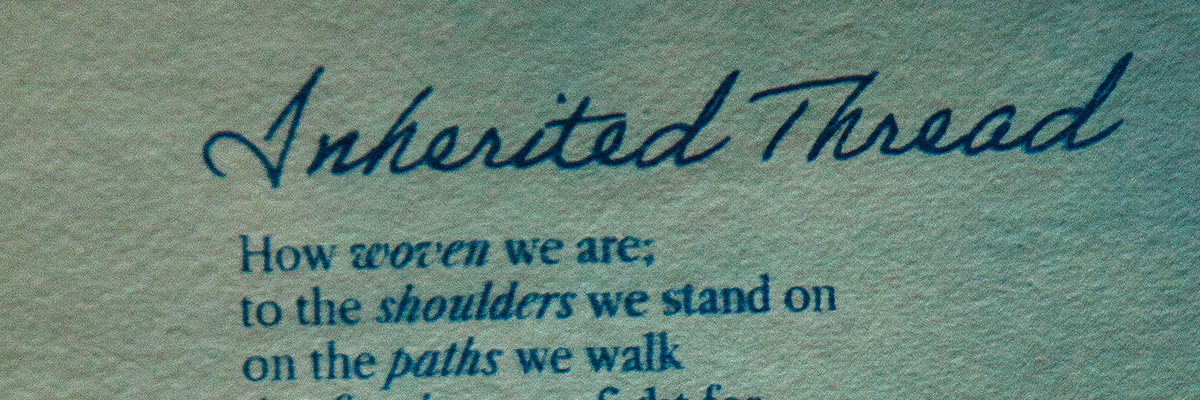
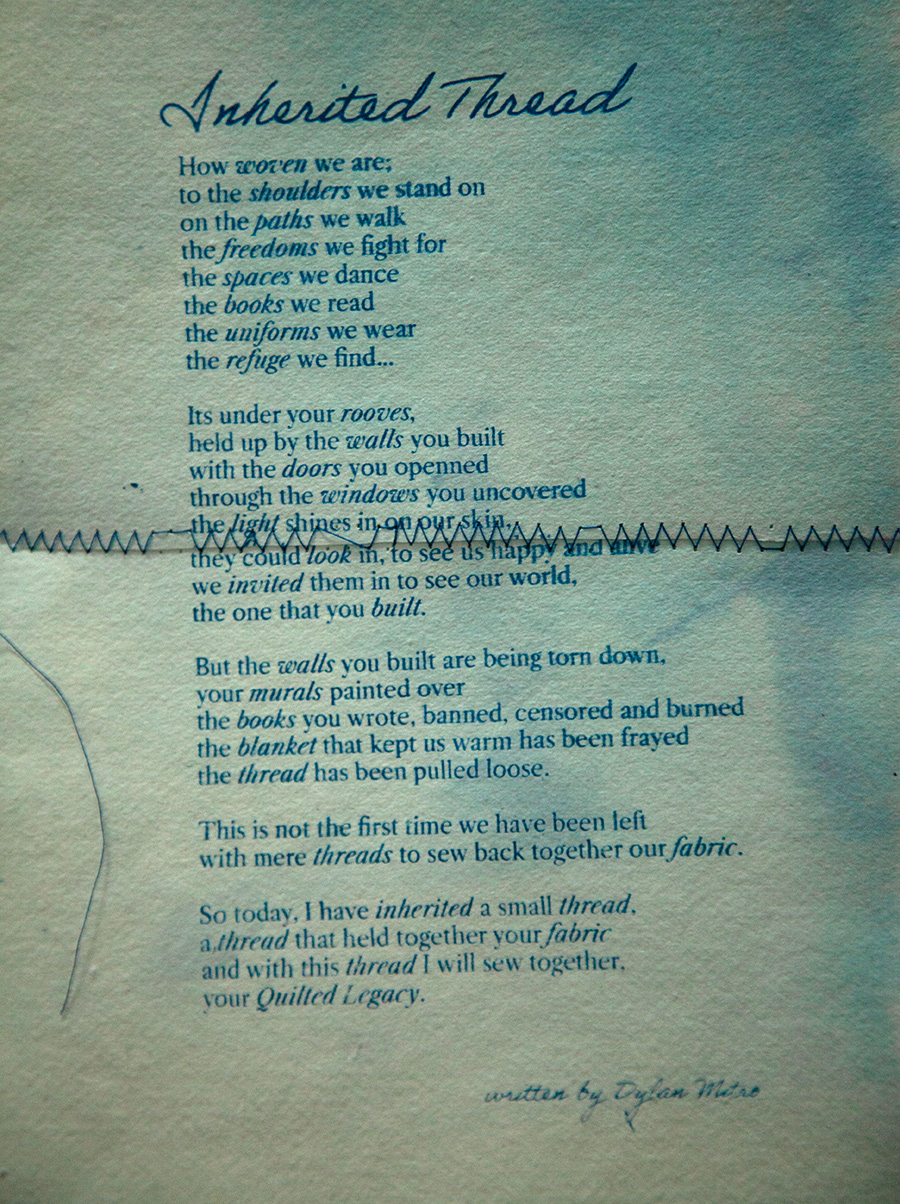
Click HERE to read our first interview with Dylan, where he speaks in depth about their project Inhereted Thread for their Fresh A.I.R. Residency and the Martha Cooper Scholar for Photography 2025.
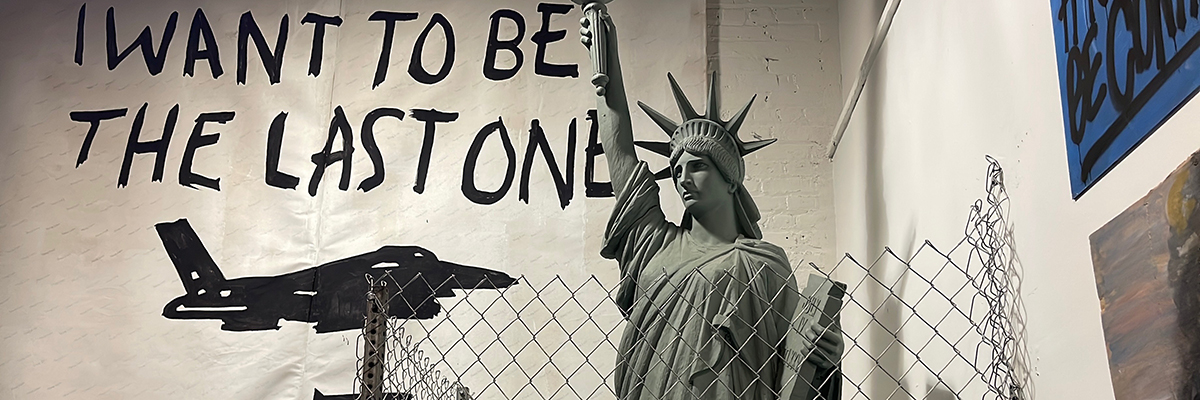
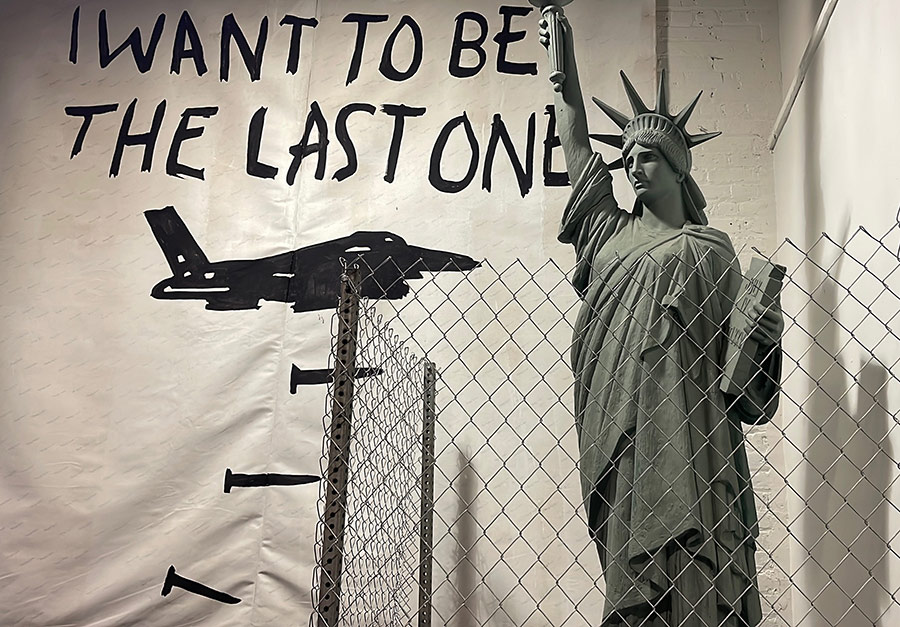
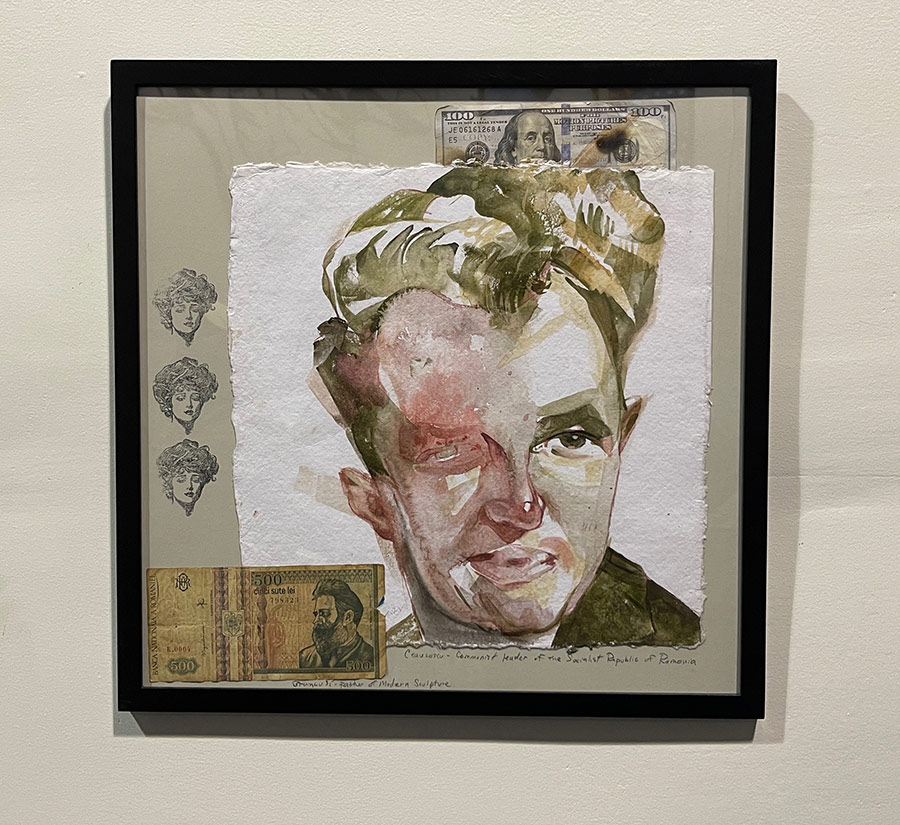
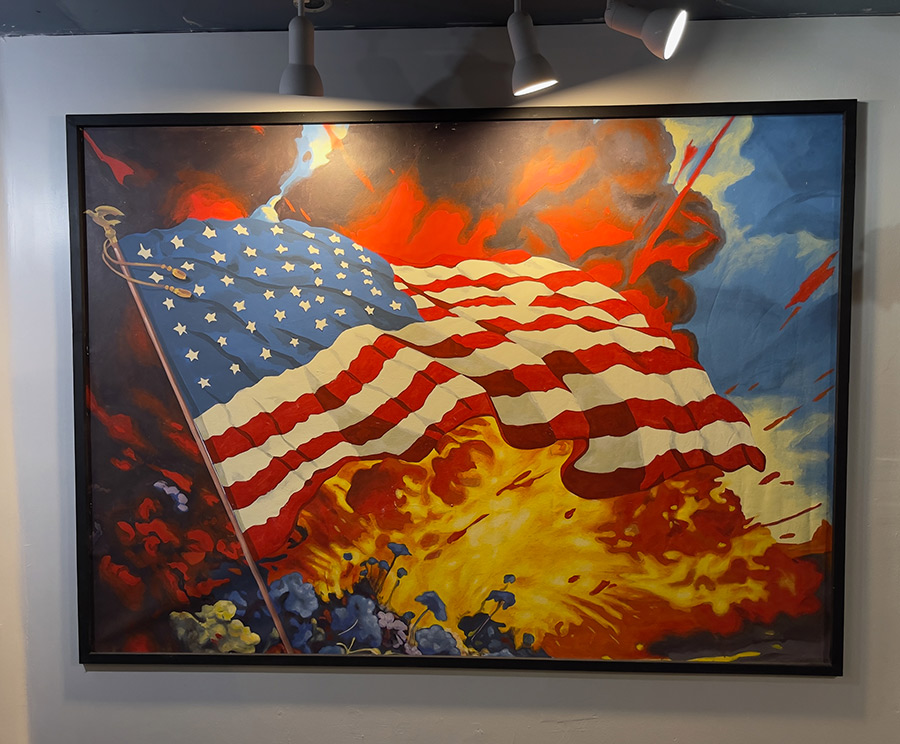
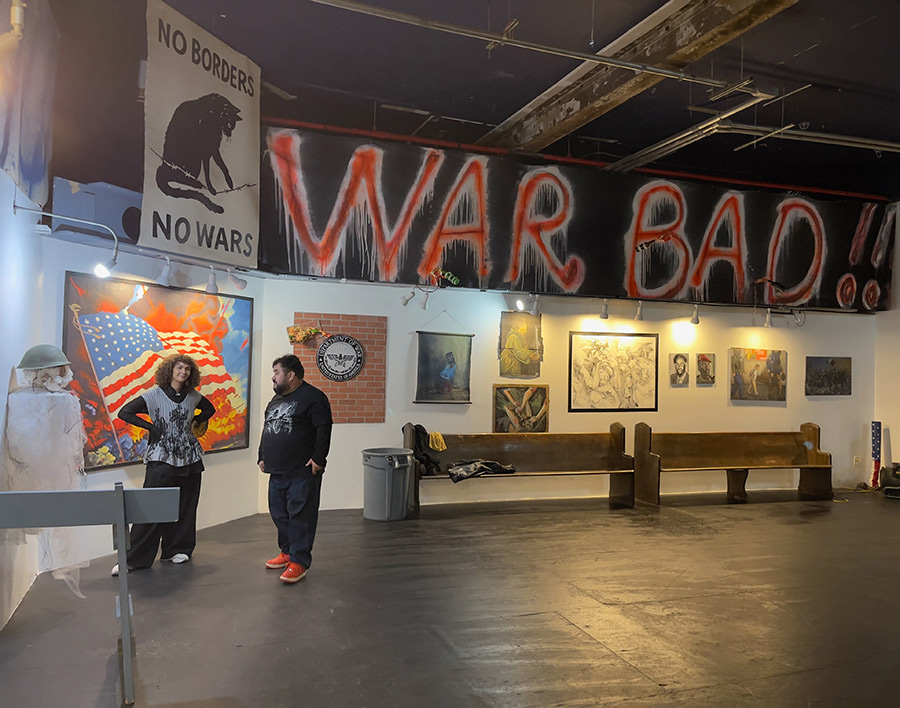
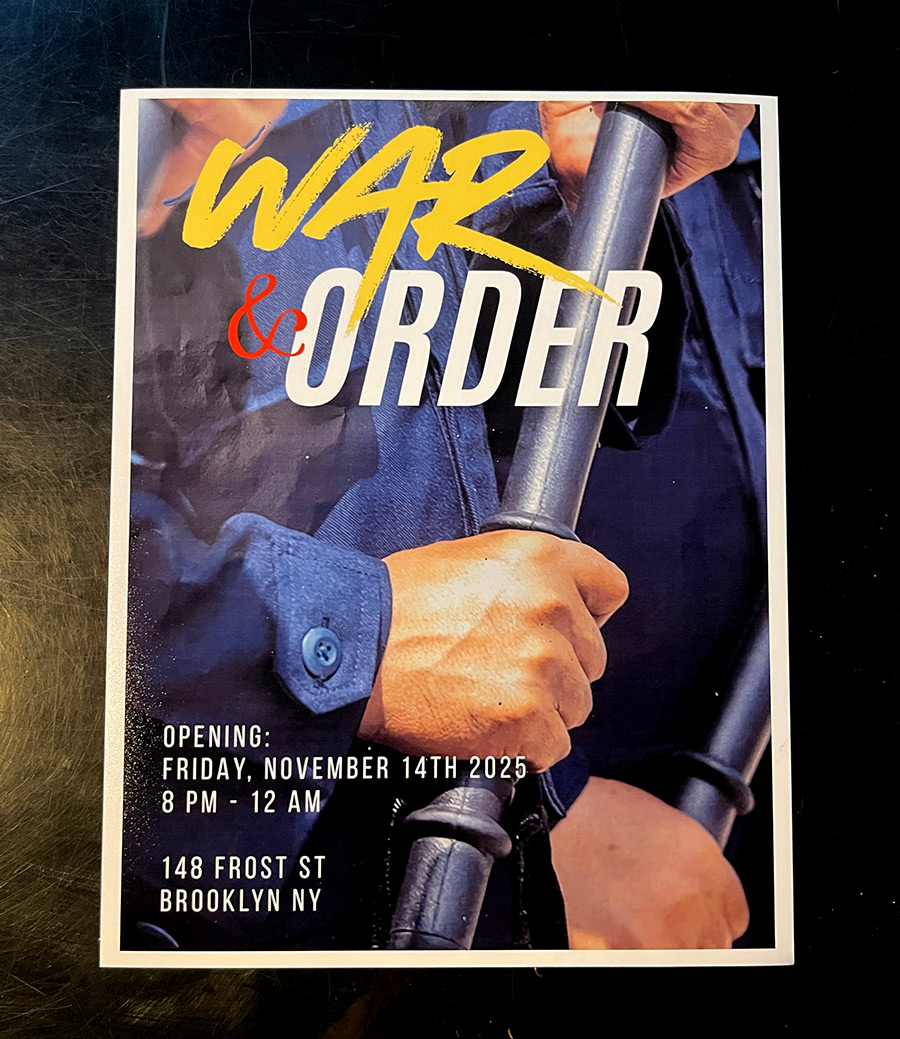
After a successful, painful, and funny take-down of the Dollar bill at their last group show, the artists-run collectivists at 148 Frost Gallery are smoking again with their newest installations and canvases related to the biggest money-maker of all time: War.
“War & Order” features street artists, contemporary artists, outside artists and those adjacent ruminating on the role and roll of the war machine in the 2020’s with Gabriel Specter, Renelerude, Escif, Dan Sabau, Kazuhiro Imafuku, M Shimek, and Cash4 on the march.
Between those two shows, this gallery may have captured the moment prophetically, like a seer in a storm, evaluating the past and anticipating what is next.
During WWI, all major governments resorted to a programmed money printing. Whether by design or incompetence, the results were undeniable: economic destabilization, often hyperinflation, internal chaos, political upheaval, and war. For many decades people swore that we would never let that happen again. But most of those people are dead now, and the dollar today is worth a nickle, compared to a century ago.
What is that saying, often paraphrased, “history doesn’t repeat, but it often rhymes.”?
“War and Order” enlists international and local artists for a pointed, and occasionally mischievous, look at the world we’ve managed to build for ourselves. It doubles as inquiry and needling social commentary, with each artist charting our tangled relationship with war, the creeping architecture of the police state, and the long shadow of militarism, surveillance, and planetary harm—all unfolding in an age where social media spins narratives and we scroll past catastrophe.
Murals, installations, paintings, and performances push these ideas, probe our past, and interrogate the present. It’s uncomfortable, for sure. What comes next, we have a dreadful guess. But there is a countenance of repairing the broken, correcting injustices, healing pain – even though this is not the focus. As the organizers put it, the exhibition is “our protest, our loud speaker to the world—an unedited, unsilenced voice.”
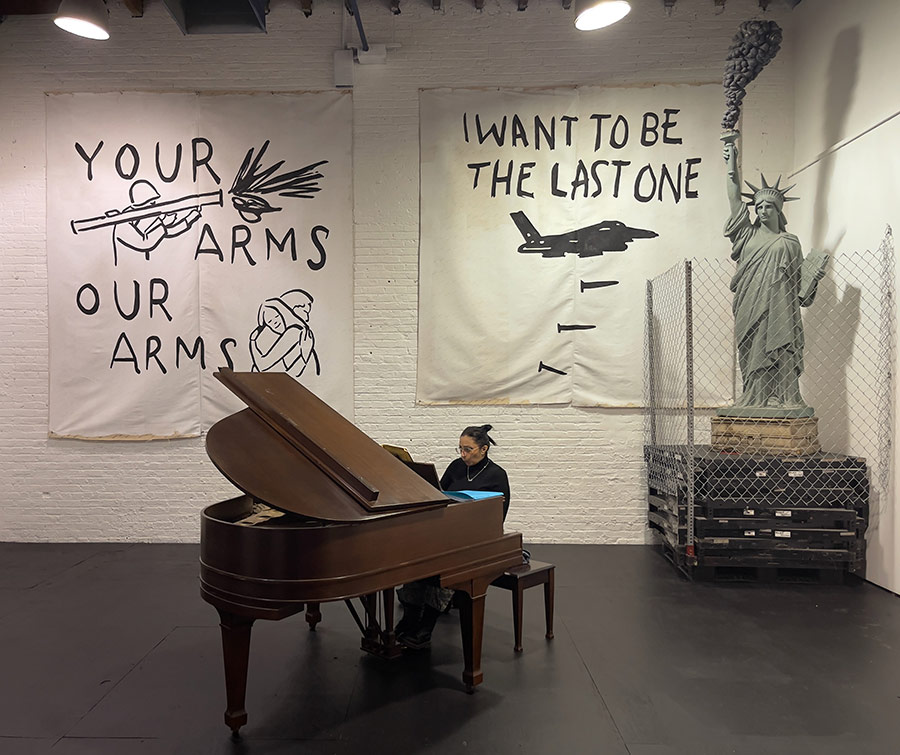
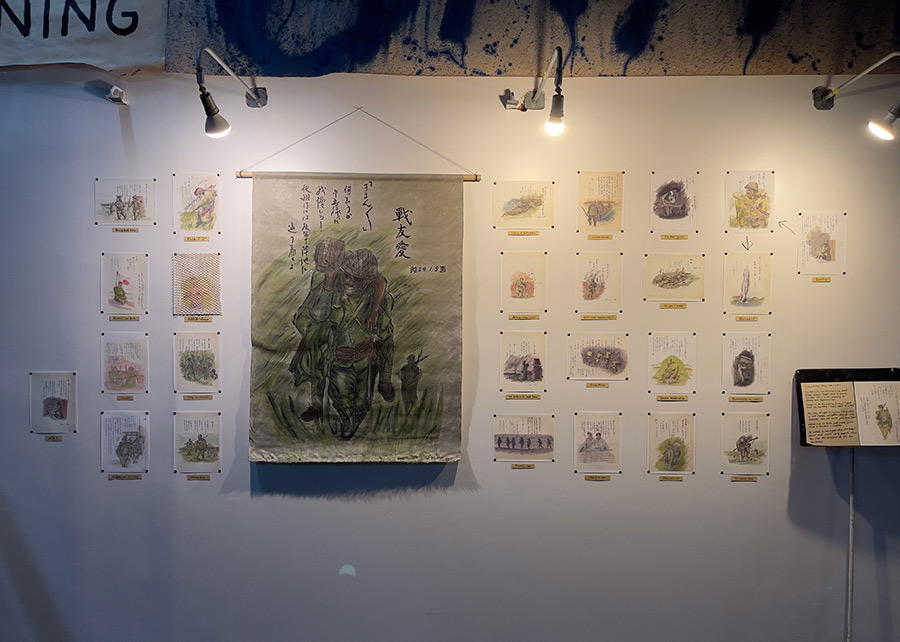
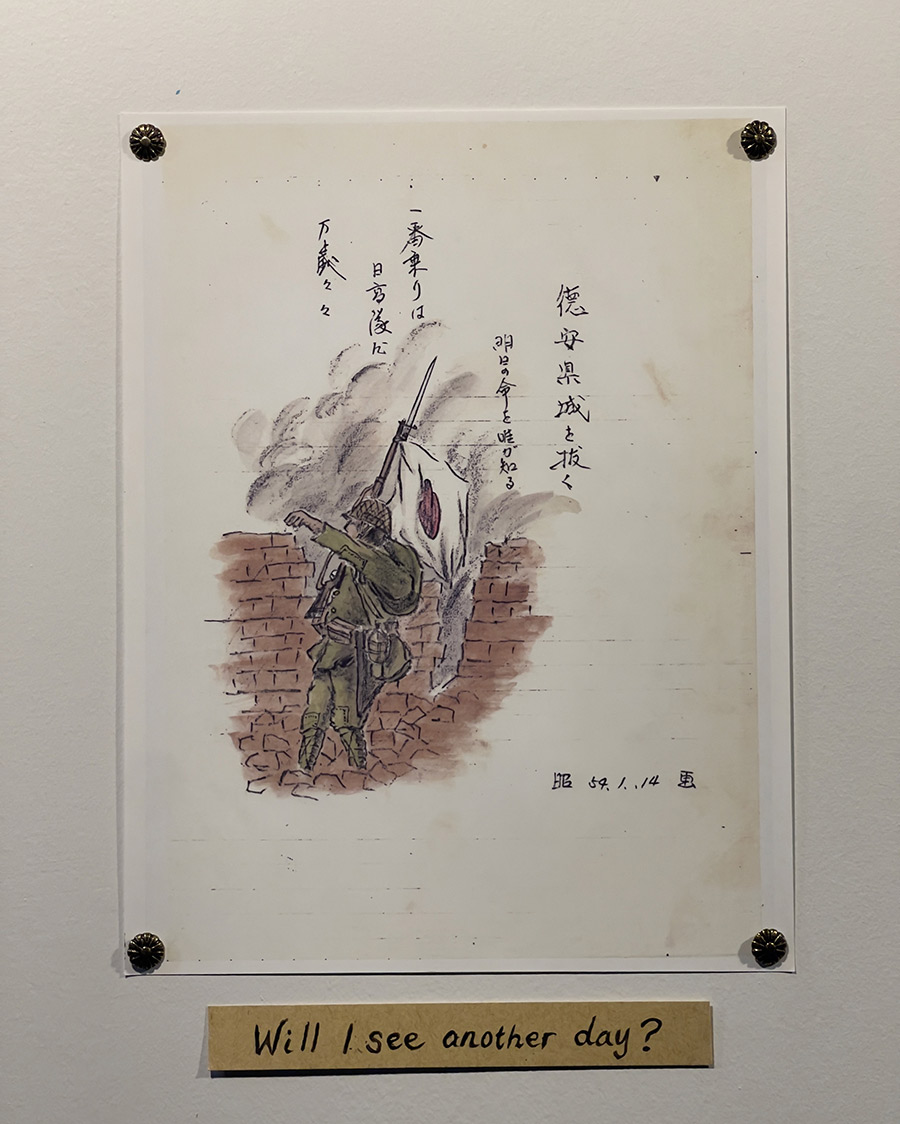
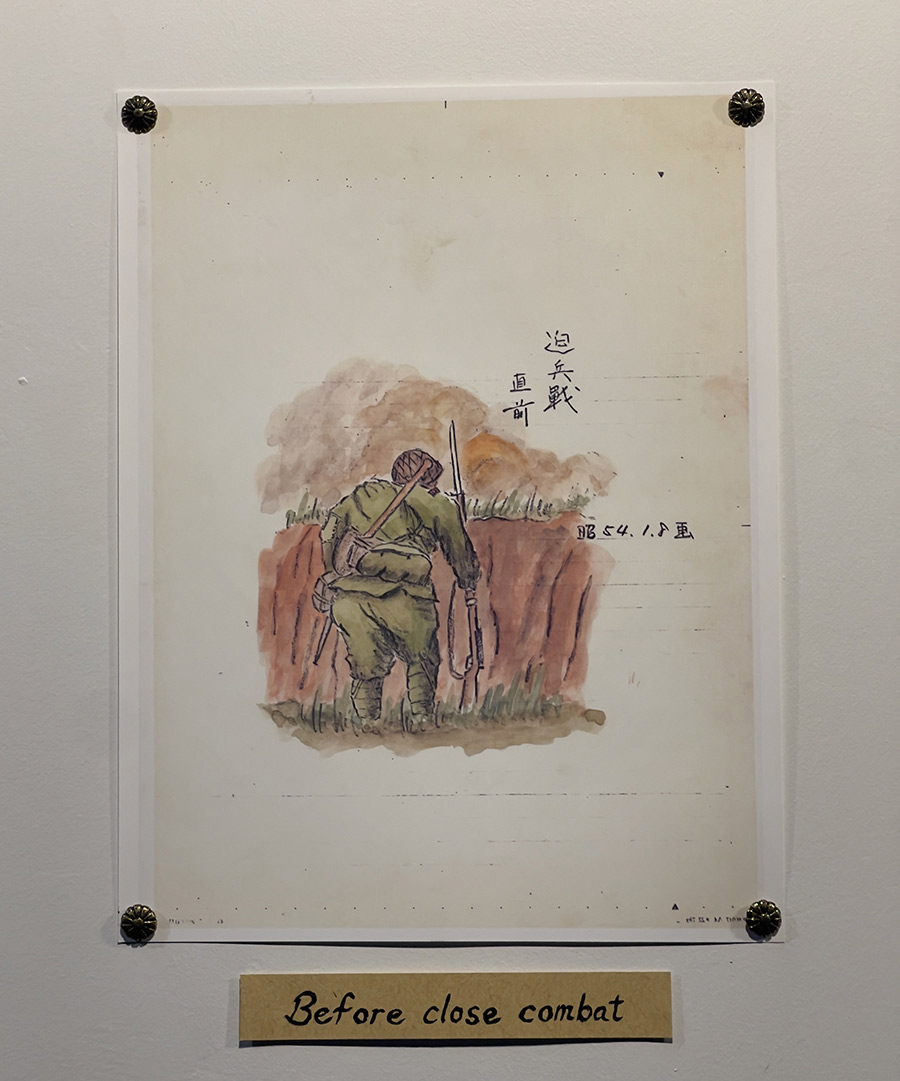
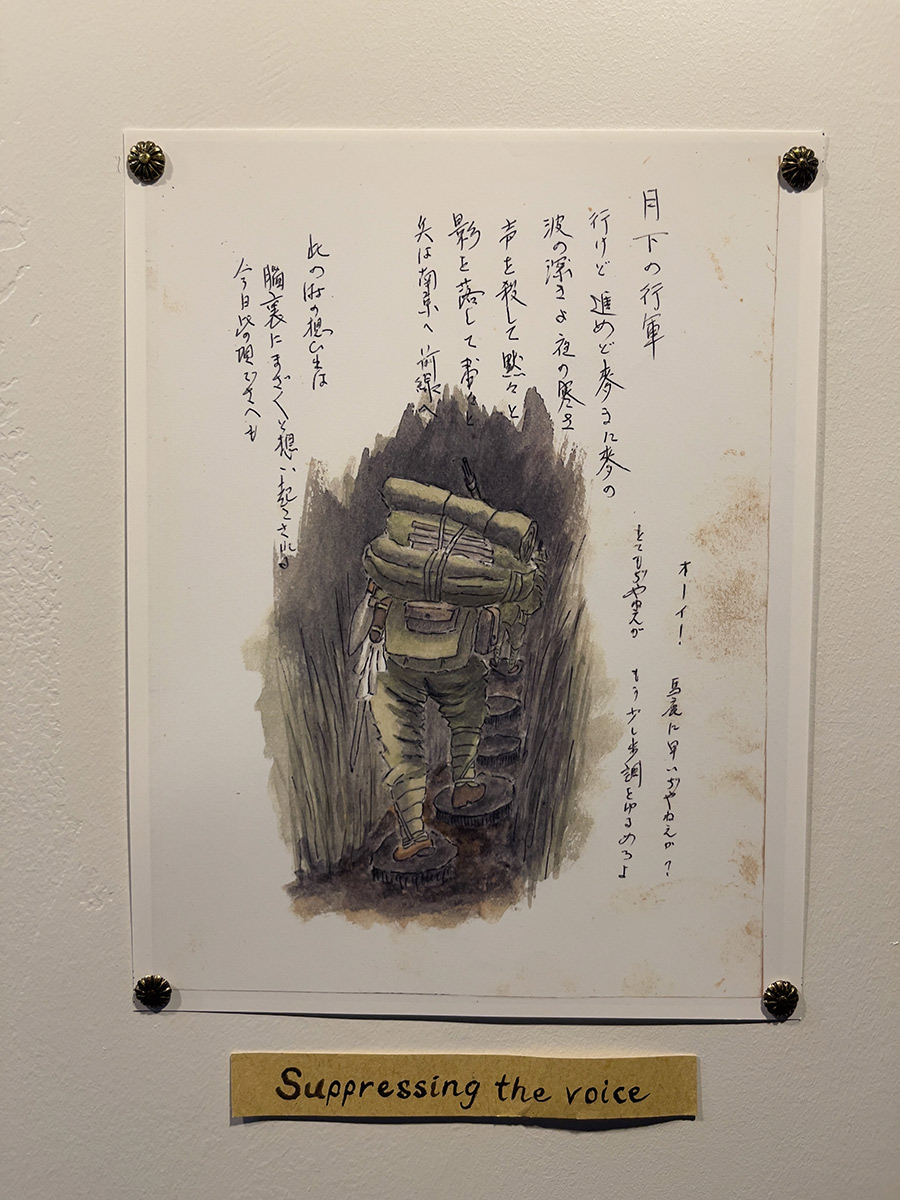
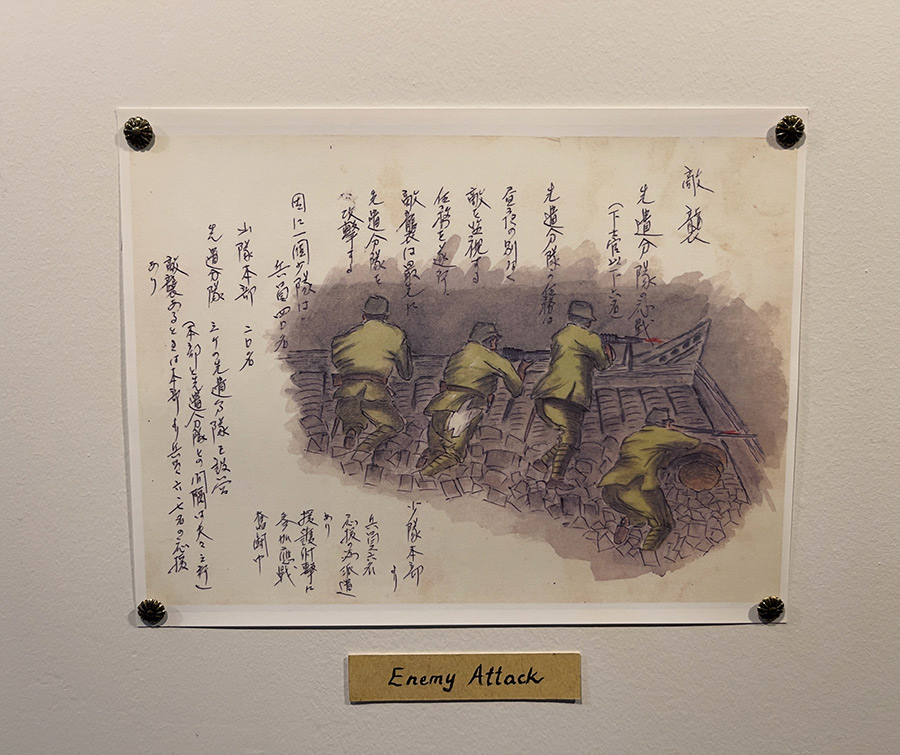
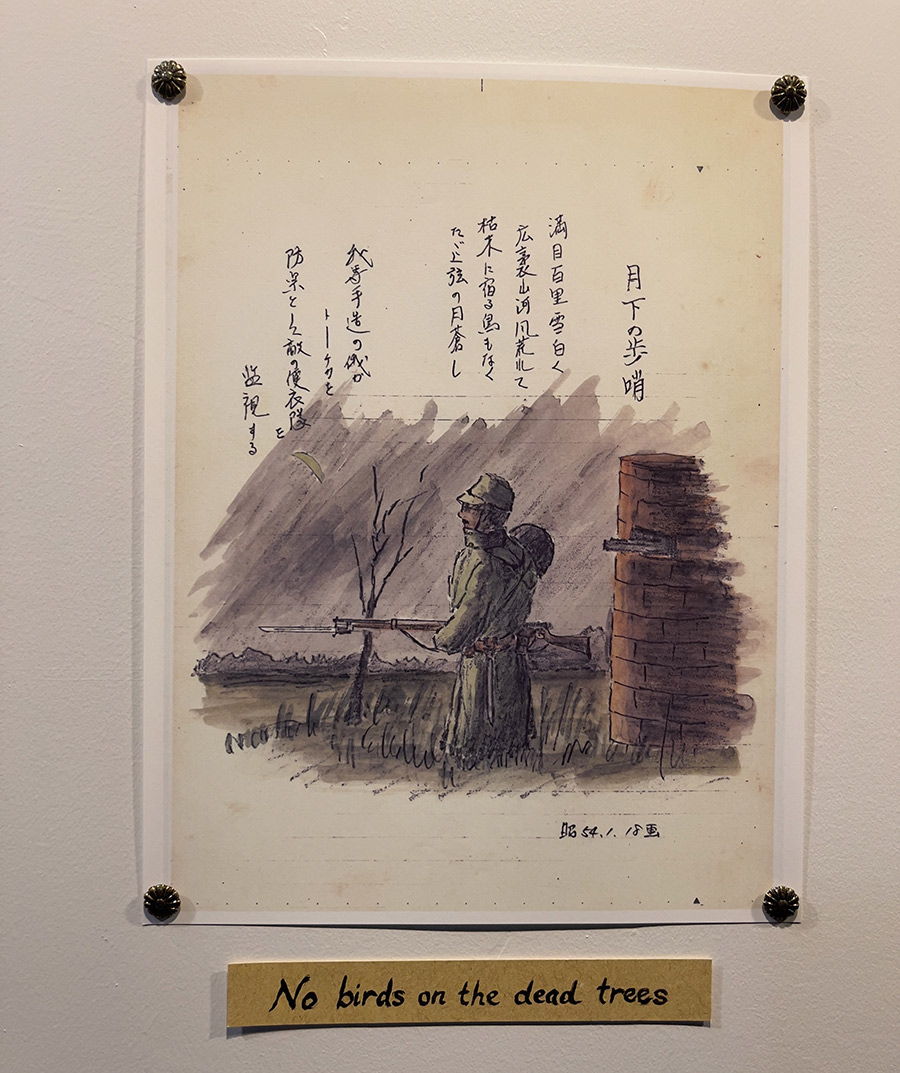
Kazuhiro Imafuku’s watercolors read like a plaintive diary of a soul under siege—an illustrated reckoning as he “displays and deciphers” his grandfather’s service in the Manchurian war. Though distant in time and culture, the story feels painfully familiar to the stories of soldiers here and abroad today. His grid of small works echoes the disarming clarity of Escif’s massive hand-painted banners hanging around the homemade gallery space, where the Spanish conceptualist delivers coded commentary in a deceptively plain voice, sharpened by deep critique. Elsewhere and throughout, artists confront imperial overreach, immigration persecution, and high-tech terror without flinching—perhaps daring us not to look away.
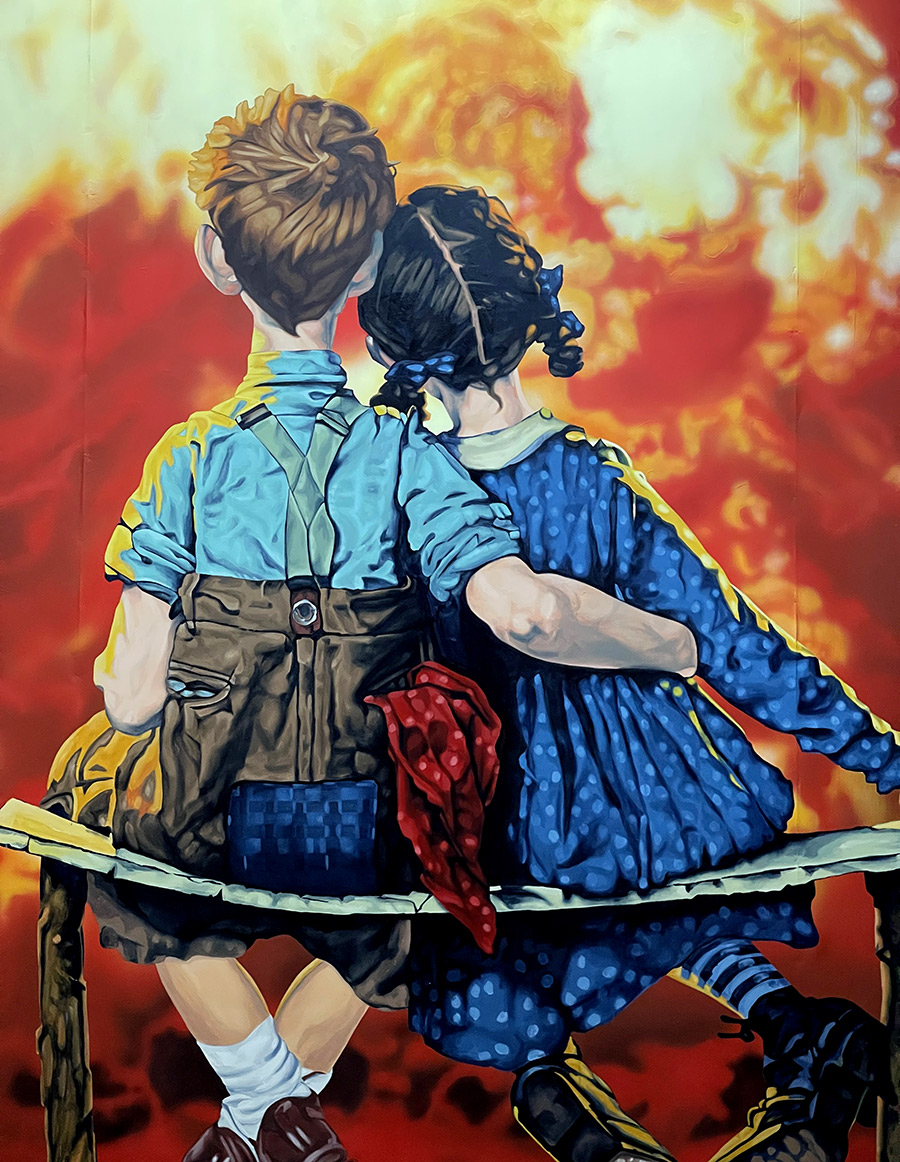
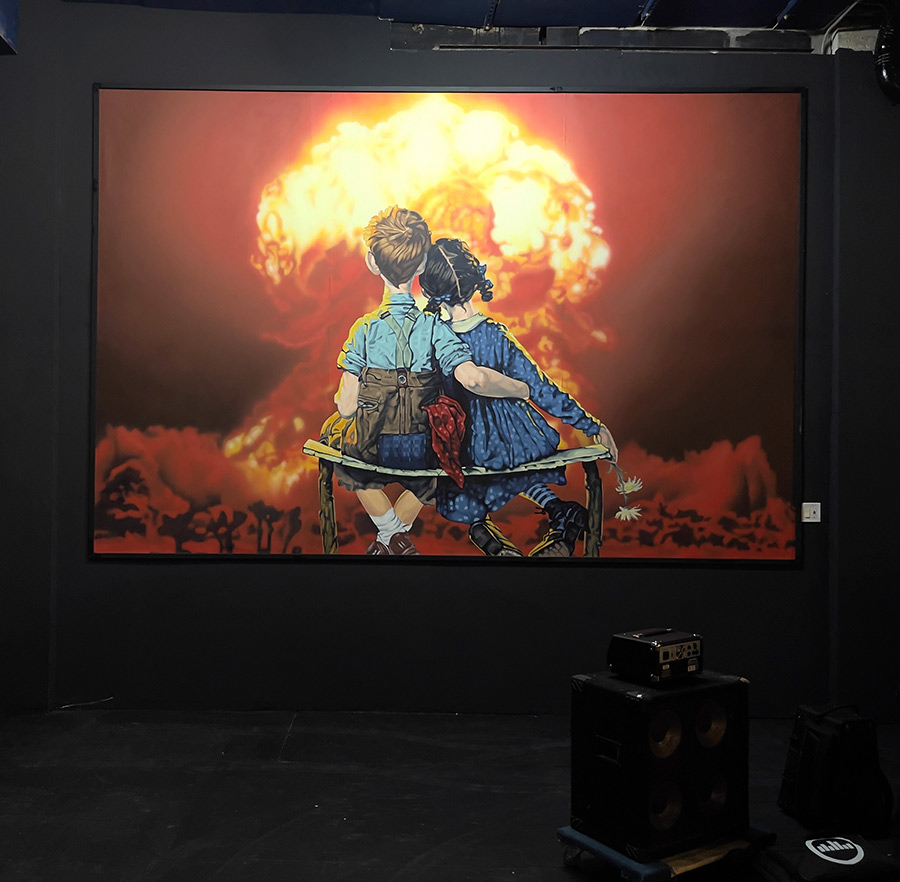
Specter’s opus “Expressive Love” calls to mind the glib narcissism of the 20th century westerner historically, a simplistic Norman Rockwell sentimentality that sees the ideal in spite of the truth. It also calls to mind the last enormous propaganda push that engulfed continents for the profits of a few, the fake ‘war on terror’ of the 2000s, when an Internet meme featured UK Prime Minister Tony Blair happily posing for a selfie before a hellfire scene from the oilfields of Iraq.
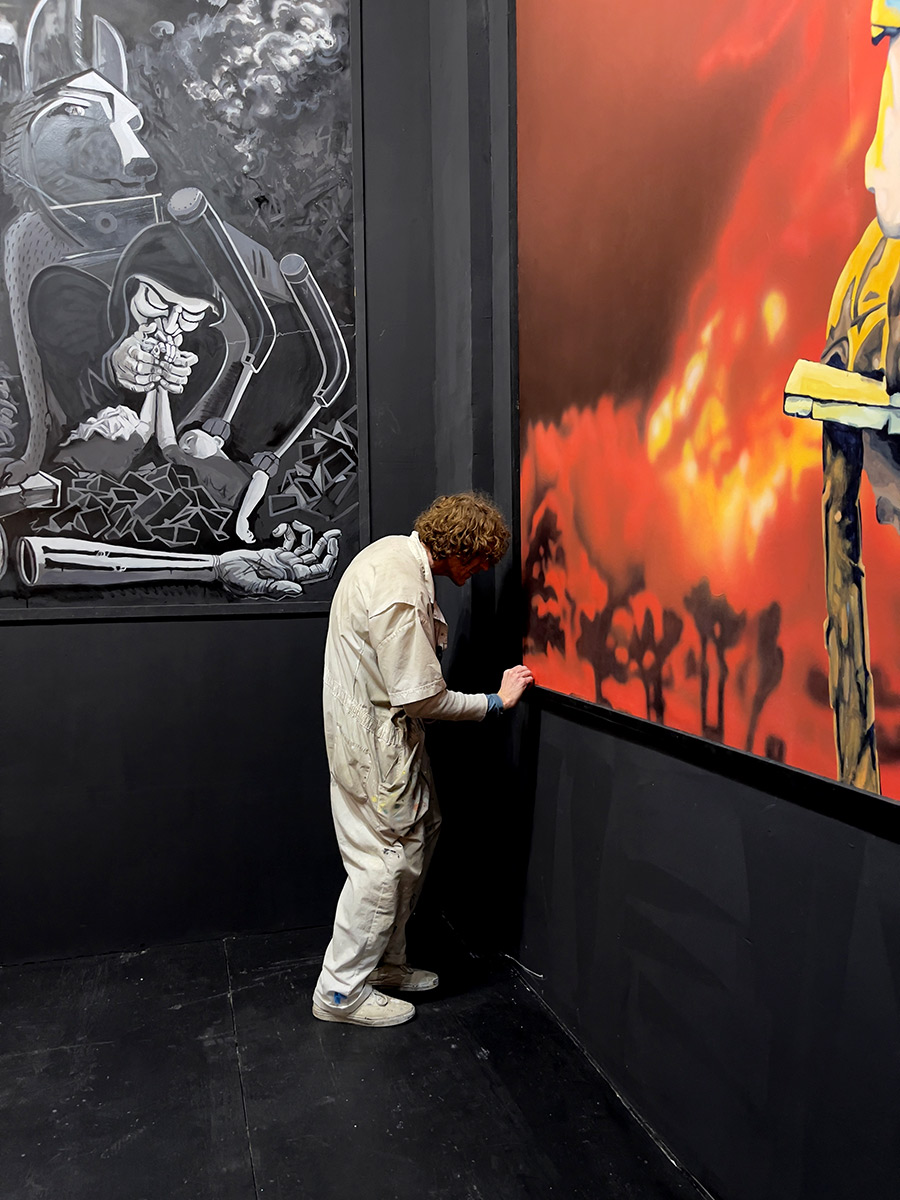
Adjacent to Specter, the French street artist Rene LeRude presents a disjointed monochrome macabre missive of winners and losers updated with dark tech, echoing the dimension, and disconnected field of vision of Guernica by Picasso – a phalanx of streaming cameras mounted to the wall next to it make sure the scene is monitored and broadcast for best effect. These are the suffering and distorted figures that Picasso was protesting, reported without humanity in black and white back then; atrocities committed against civilians; violence unleashed by authoritarian regimes. LeRude’s own neo-cubism strikes a similarly expressive distortion, his own moral indictment.
This is the kind of work you can still encounter in Brooklyn today, in a warehouse space that brings together music, art, theater, and other forms that resist easy classification. Rooted in DIY culture, punk, activism, and inclusion, Frost doesn’t need to be idealized—only recognized for its commitment to fostering conversations that many would rather sidestep.
We spoke with curators and artists Gabriel Specter and Rene La Rude about the show,
Brooklyn Street Art: “War & Order” is described as both a social study and a critique of global affairs. What was the initial spark that inspired you and the other artists involved in the show to frame the exhibition around the tension between war and order, and did the original idea evolve as you and the rest of the artists began discussing the show?
Gabriel Specter: The initial spark was our current political state. Where freedom of expression and protest are being silenced. We wanted to make a show where the artist could speak their minds without censorship. Each artist added their voice, and through that, there was a natural evolution of the original idea.
BSA: The exhibition explores our “personal and collective relationships to war and the threat of the police state.” How do you balance your own perspective as an artist with the collective voices and experiences represented in the show?
GS: Part of having your own perspective is about respecting and listening to others perspectives at the same time so the show reflected that type of idea creating a nice balance.
BSA: The show is described as “our protest, our loudspeaker to the world.” How do you see visual art functioning as a form of protest or resistance today—especially in an era dominated by social media and engineered narratives?
GS: I feel like people are starting to value real interactions more and word of mouth is coming back in vogue so I believe the underground has a real power to effect change and as they say a picture tells a million words!
BSA: Since we have known you, and your work on the streets, you have been consistent with delivering messages highlighting a scope of social issues that are relevant to our society. When you began this practice social media and AI didn’t exist. Do you think these new digital tools are useful for you in the transmission of your work? If so how?
GS: New tools are always helpful, can save time, make you more self-sufficient and help you reach new audiences but they can also dilute a lot of your messages and take away the edge and reality of what you’re trying to get across.
BSA: The exhibition includes murals, installations, and paintings. How did you decide which mediums best convey the urgency and emotional weight of these themes? I think the combination of mediums gives an overall experience and that is what we were really trying to achieve.
GS: We have the power of scale in the murals, the intimacy of the smaller paintings and the raw visceral nature of the installation.
BSA: In an age of “mass desensitization to violence,” what emotional or intellectual response do you hope visitors will leave with after experiencing War & Order?
GS: I hope they care about people’s lives and recognize that life is important even the lives of those you disagree with. People are not pawns, they are flesh and blood and we should never forget this.
BSA to Specter and Rene LaRude: The murals are compelling and powerful, with references to both Picasso and Rockwell. How did you decide to use these two paintings as inspiration for your murals?
GS: I chose the work by Rockwell as inspiration exactly for this reason that it is revered as a romantic time in American history. The kids depicted would have been of “The Greatest Generation”
We still cling to this American Iconography today. It is rebranded and used for promoting a xenophobic political message, so for me this iconography was the perfect tool to use to flip the narrative.
Rene LaRude: It wasn’t an easy decision given the impact the piece has had over the years.
I wanted to make use of certain things from Guernica, narrative, composition, and of course colour (or lack thereof) to apply it to what is happening now.
The piece is about Gaza and the litany of war crimes that have been committed. I wanted to honor the original composition and change elements to stories relevant in Palestine. The use of greyscale is because Gaza has been turned into a land of rubble. even things which are not grey are covered in dust.
My effort is certainly overly dense and packed in but then again, that’s just what I wanted to get across in many ways.
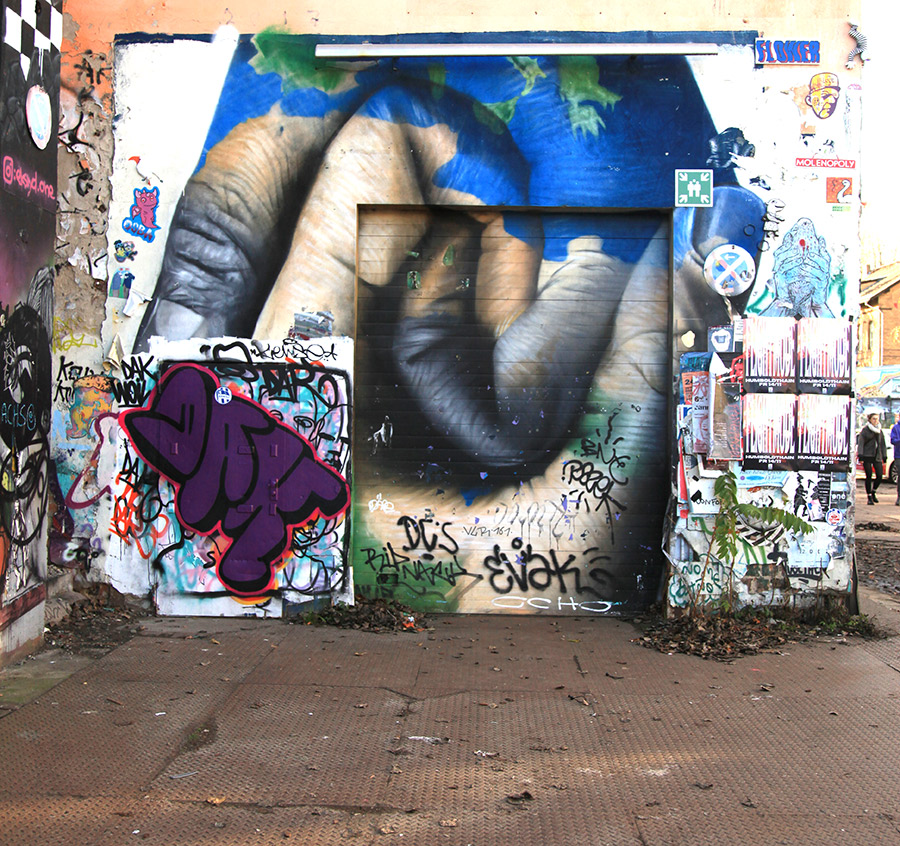
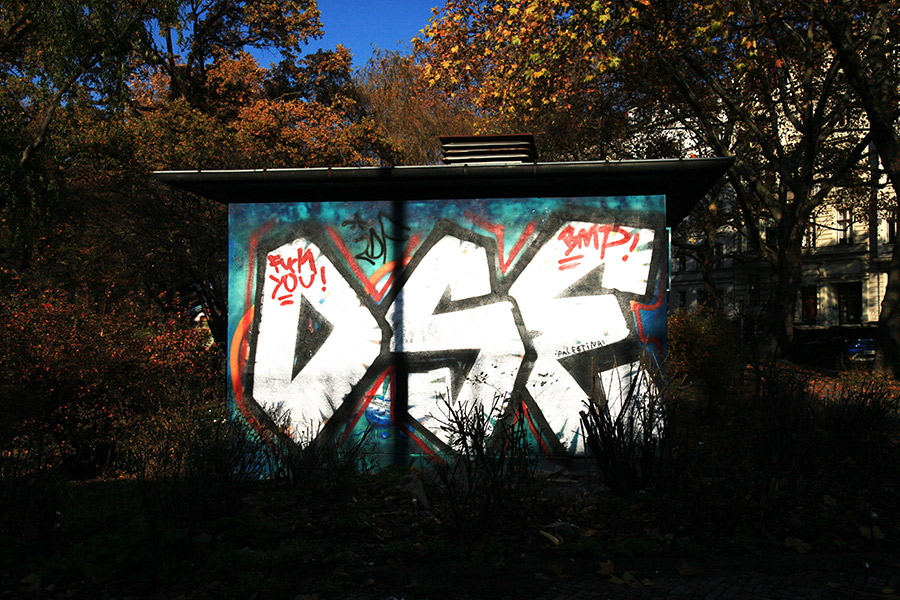
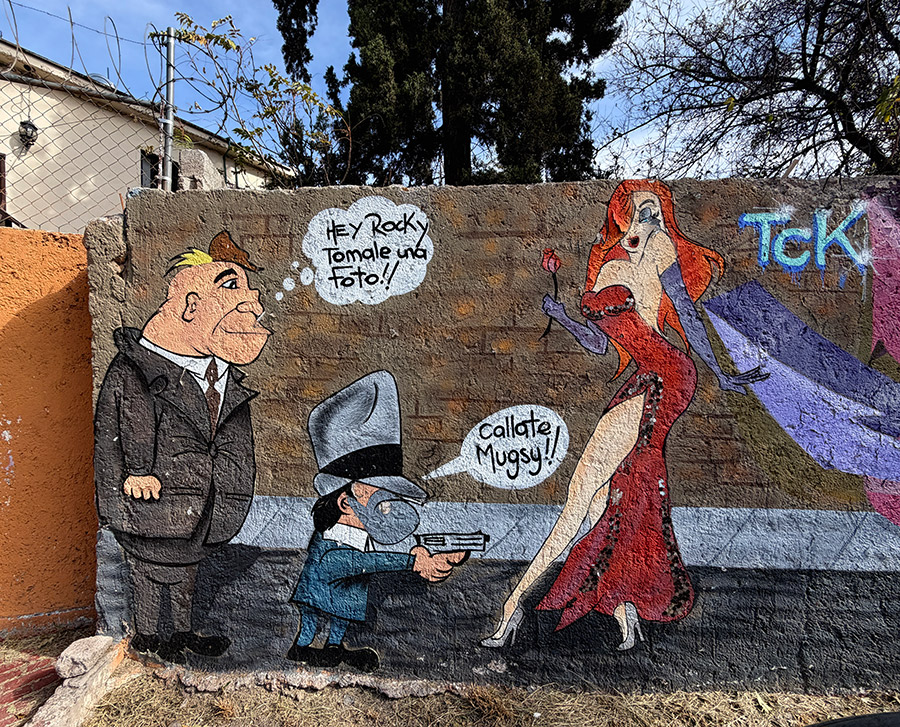
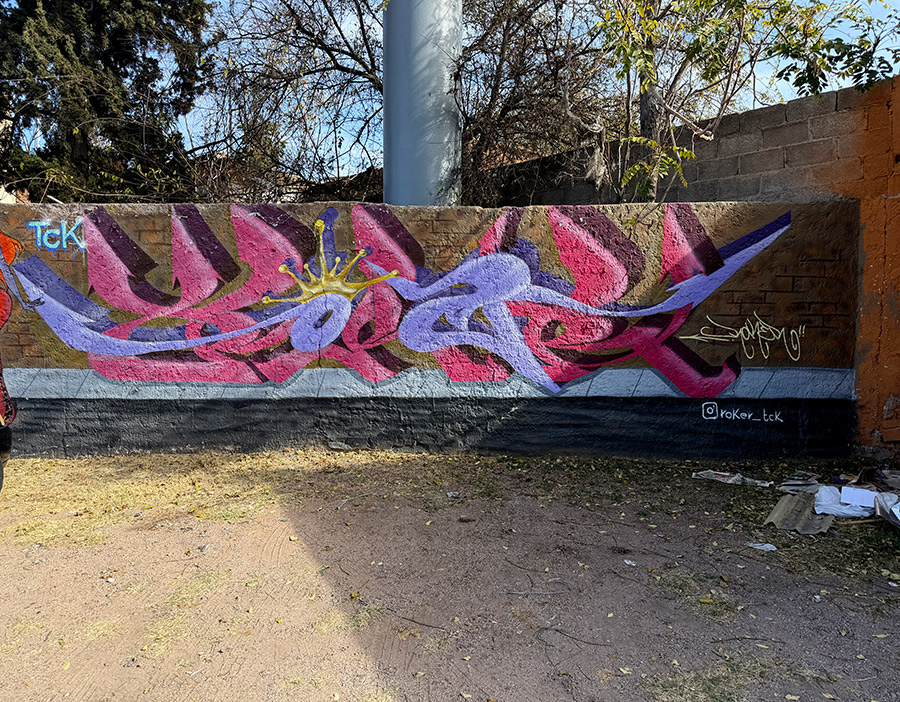
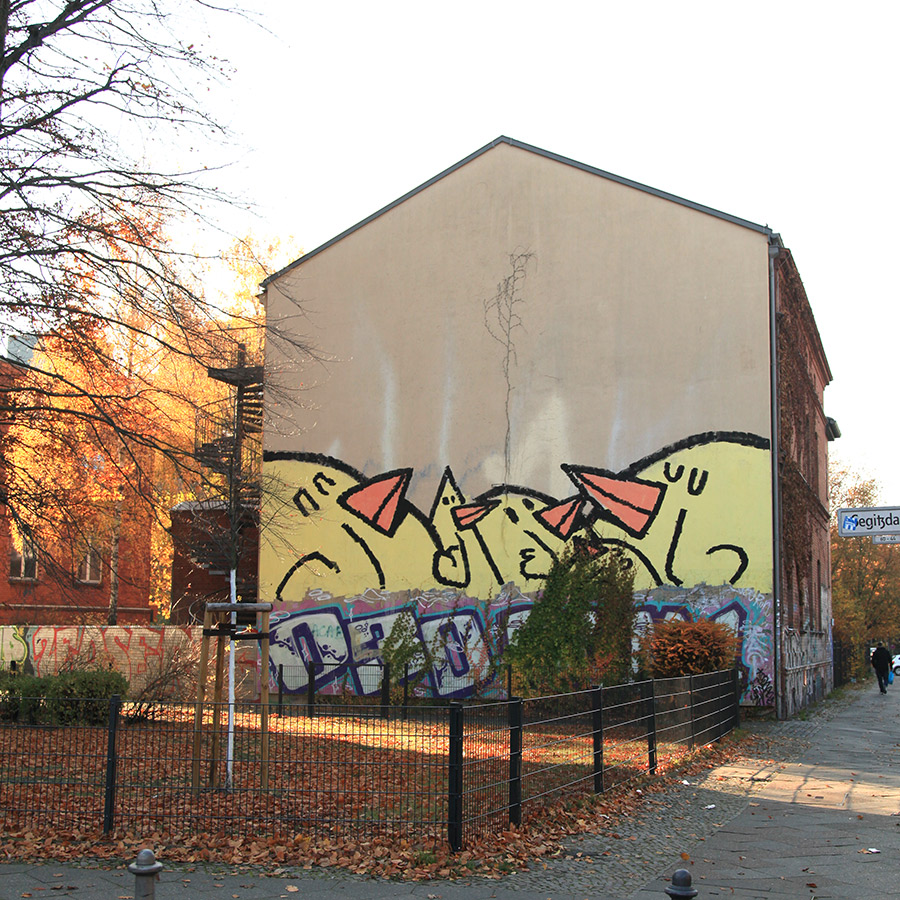
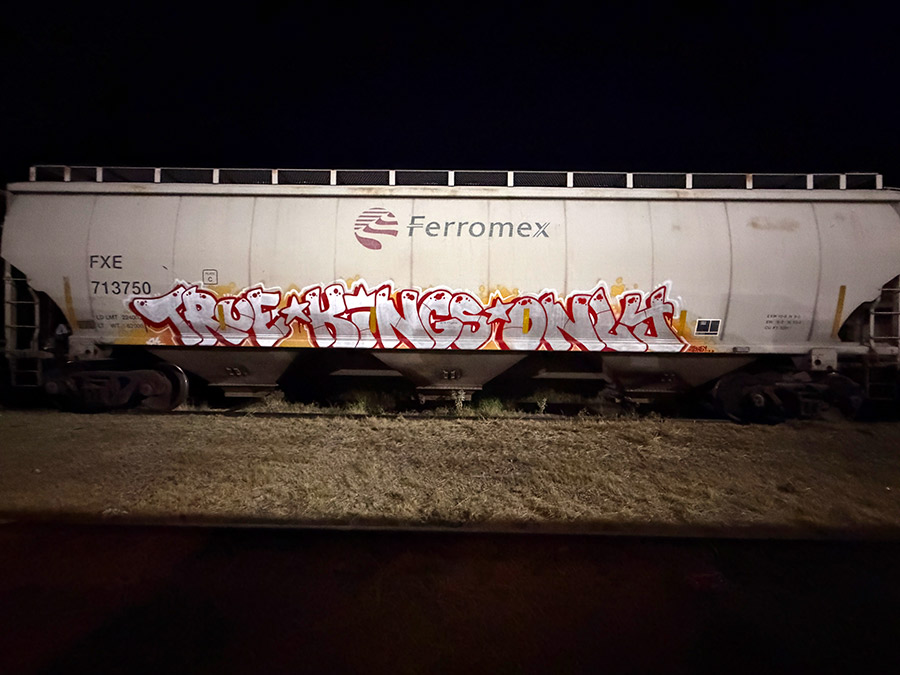
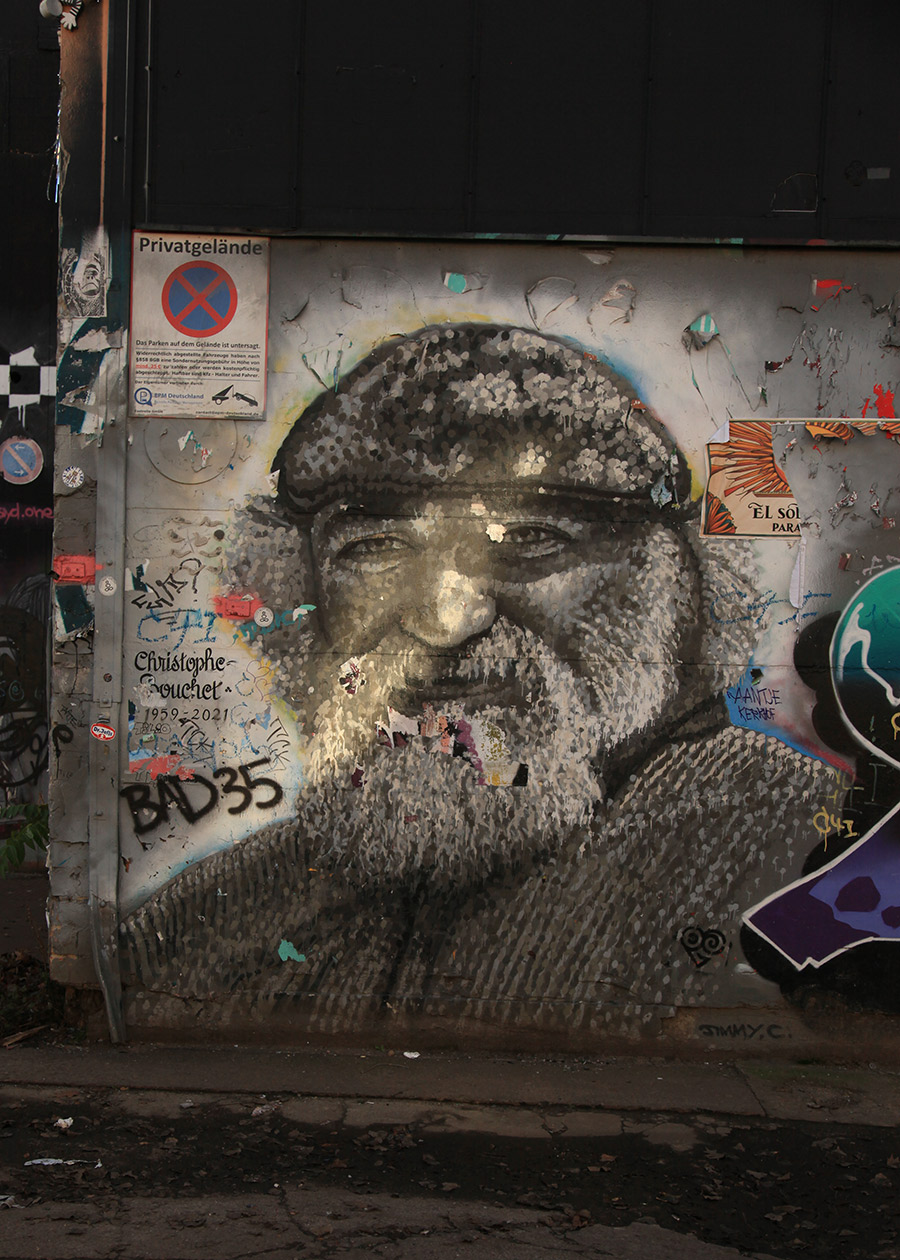
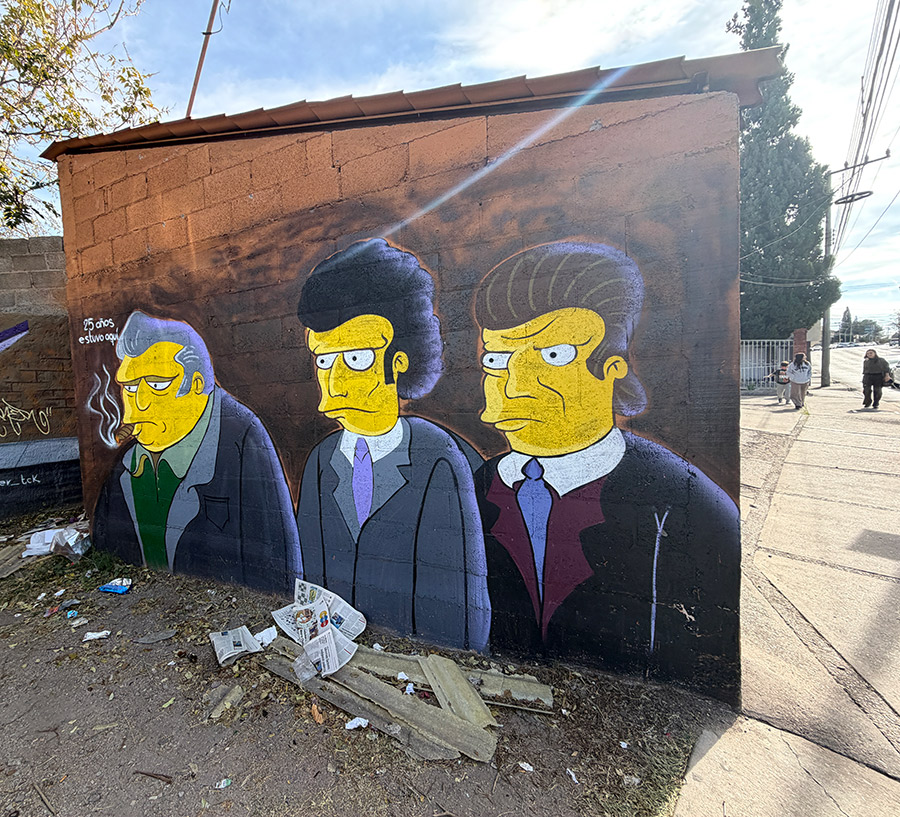
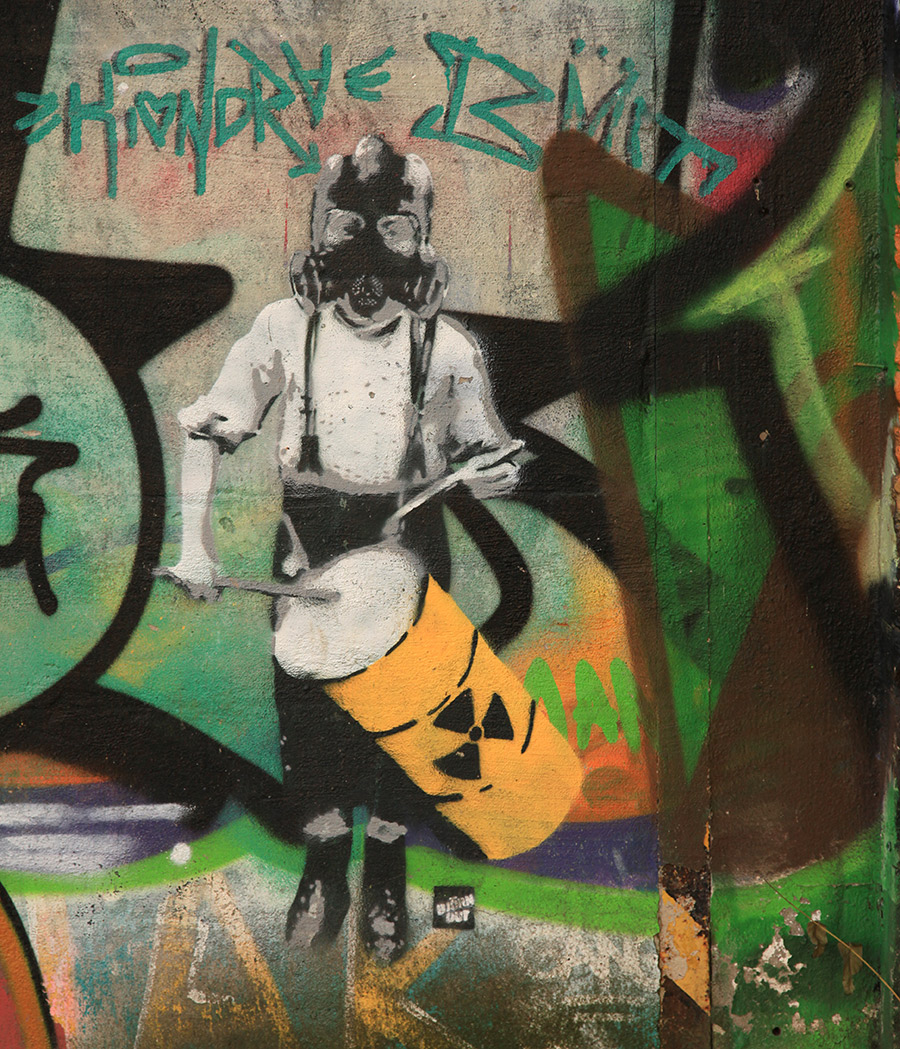
Welcome to BSA Images of the Week! It’s a melange of cities and styles this week from Berlin, Brooklyn, and Chihuahua, Mexico. The week has been a traditional holiday time in New York and in the US, and people really reconnected with each other with a vengeance, so eager are we to pretend that these are normal times. It is a laundry list of what is going haywire today. Still, families hosted families, many had “friendsgiving” celebrations, volunteered to serve meals to folks through various organizations, or sat quietly at home and made a list of things they were thankful for. Gratitude is the attitude.
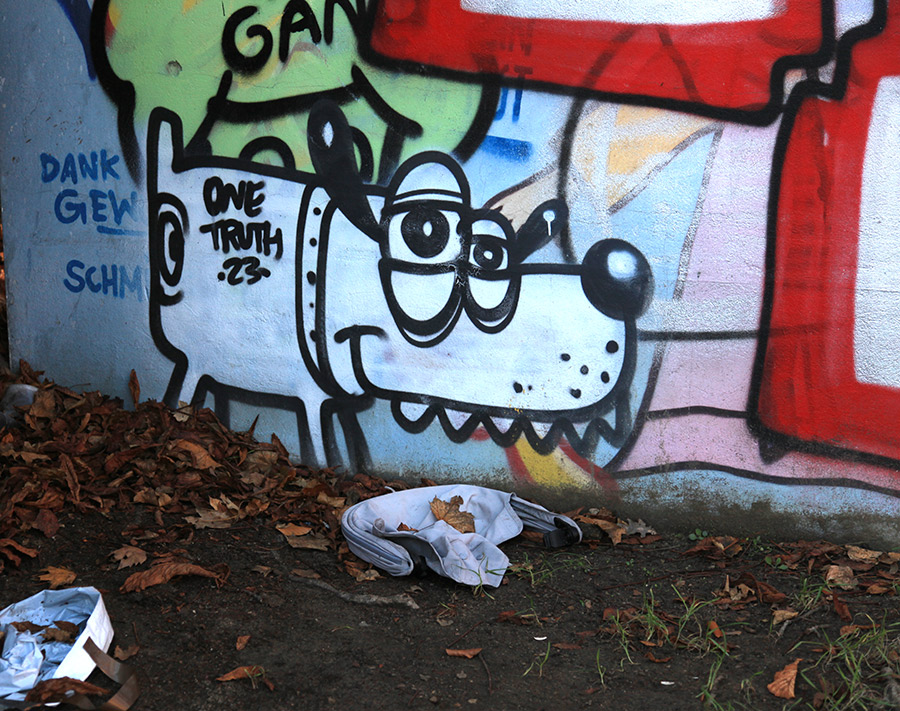
Join us for this week’s wild ride through the streets and hidden margins of cities, our weekly interview with the street. This week we feature BAD35, Birds CRS Crew, Bjorn Out, DSE, ESFER, Fractures194, J’Dart, Mate, MODE NBC, One Truth, Roker TCK, Sestry Feldamn, and TBanBox.
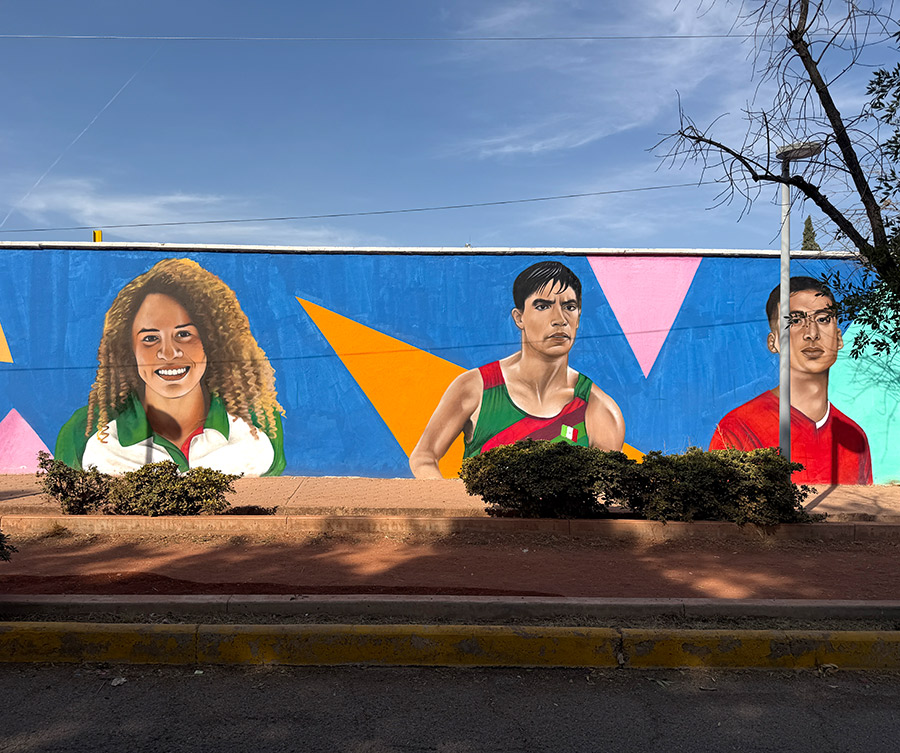
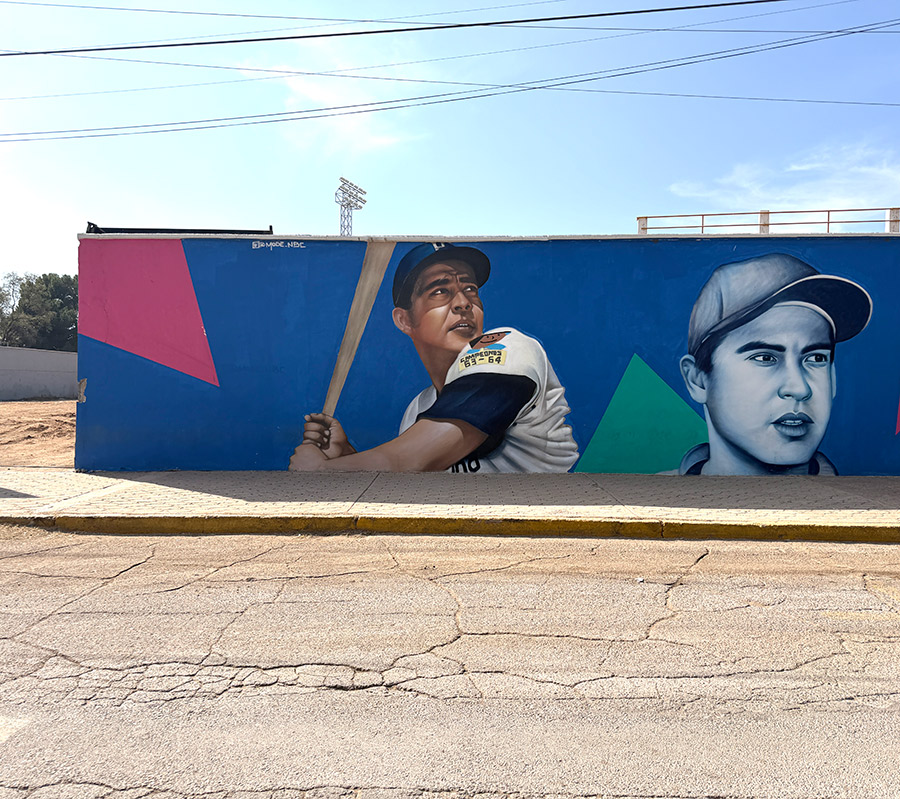
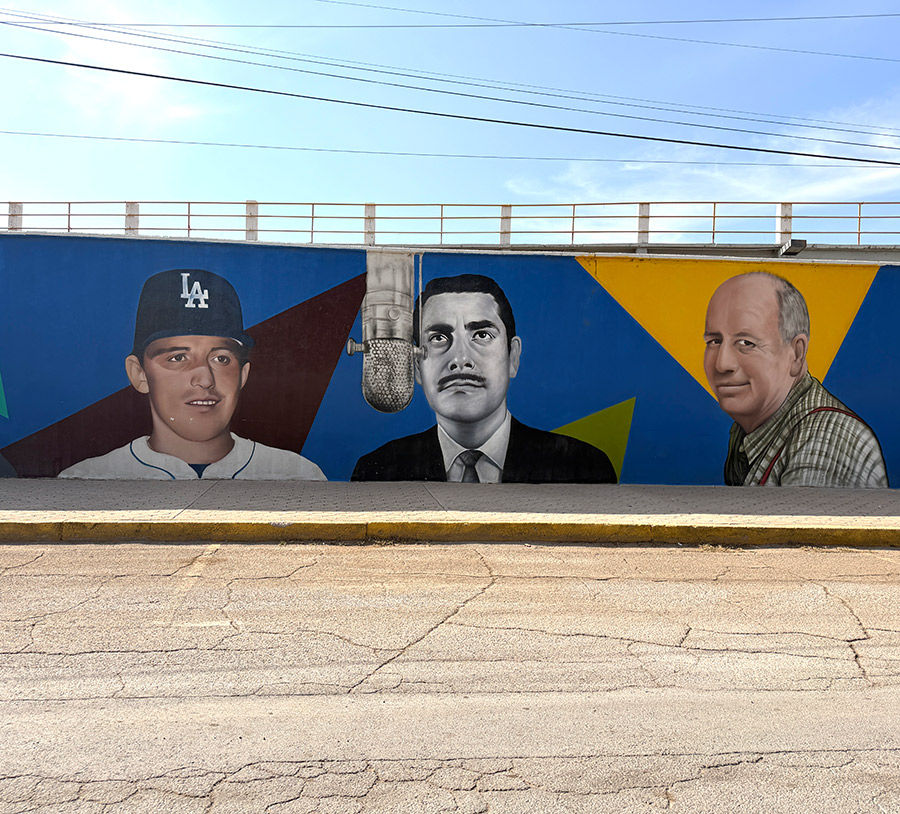
Mexican street artist, muralist, and graffiti writer Mode Orozco — known as Mode NBC — is currently transforming the perimeter walls of Estadio de Béisbol Manuel L. Almanza in Chihuahua City with a sweeping new mural. Originally from Tijuana and active for more than 25 years in graffiti and large-scale portraiture, he has gained recognition for honoring sports icons, including UFC champion Brandon Moreno and boxer Yamileth Mercado, on public walls throughout northern Mexico.
This latest commission from the State of Chihuahua highlights standout hometown baseball players, along with respected broadcasters, sports journalists, and Mexican Olympians who have earned medals on the world stage. Mode NBC has been working on the piece intermittently for the past two months and expects to complete it by the end of December — adding another significant chapter to his ongoing celebration of athletes who inspire their communities.
When Seth said ‘Laos,’ there was no way she was going to say ‘no,’ Martha Cooper will tell you.
After all, Laos is where she learned to drive a motorbike in the 1960s — a place she remembers by its dusty roads, warmth, and creative kids who know how to make their own fun. Sixty years later, she’s back with a camera in hand, documenting French street artist Seth Globepainter (Julien Malland) as he works his familiar magic at the edge of the Mekong.
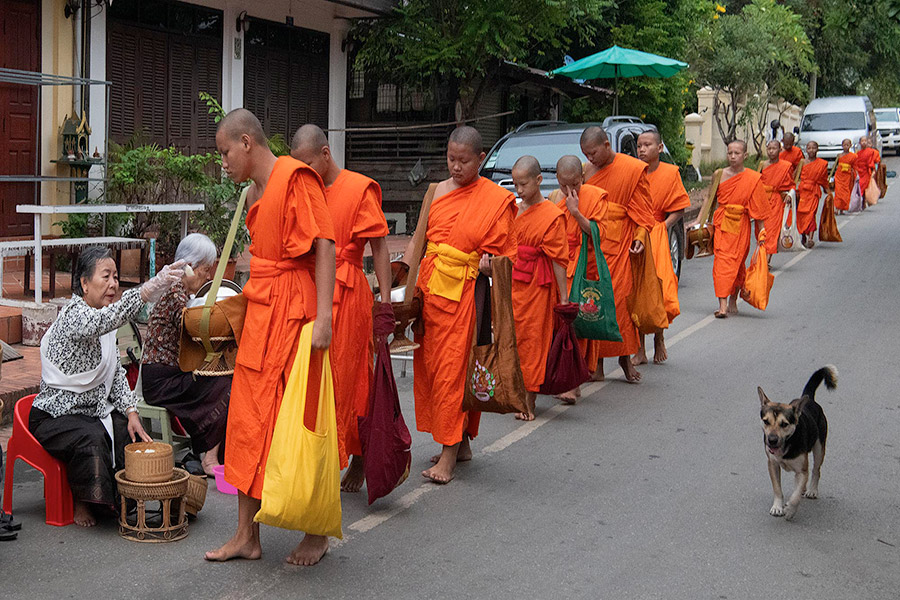
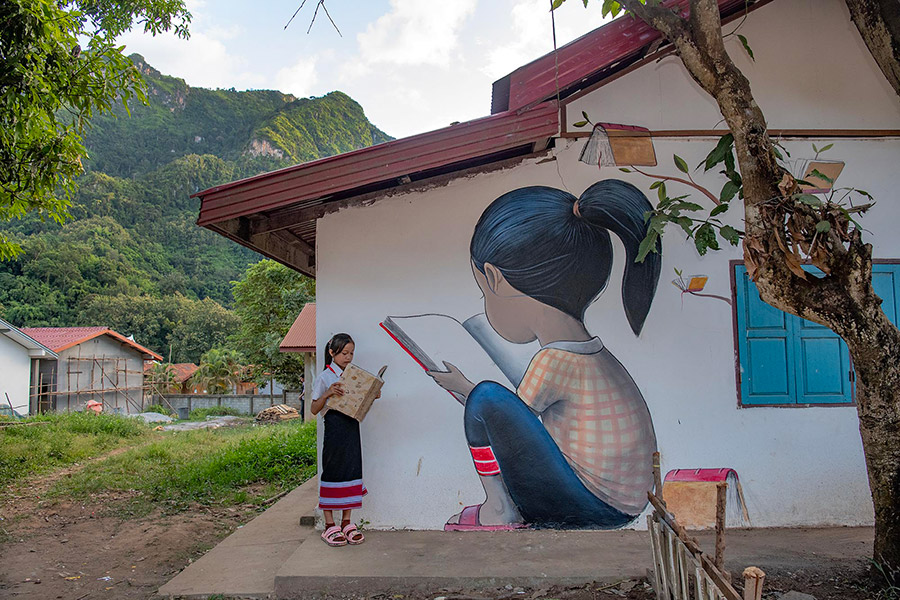
Luang Prabang — a UNESCO World Heritage town framed by two rivers — is a place where ritual and imagination walk the same path. Early mornings mean barefoot monks collecting alms; afternoons mean kids splashing by the river or painting bold birds across the school walls. Seth’s murals slide right into that rhythm: playful figures, wide-eyed wonder, a bit of folklore and fantasy — public art as storytelling through the words and images of kids.
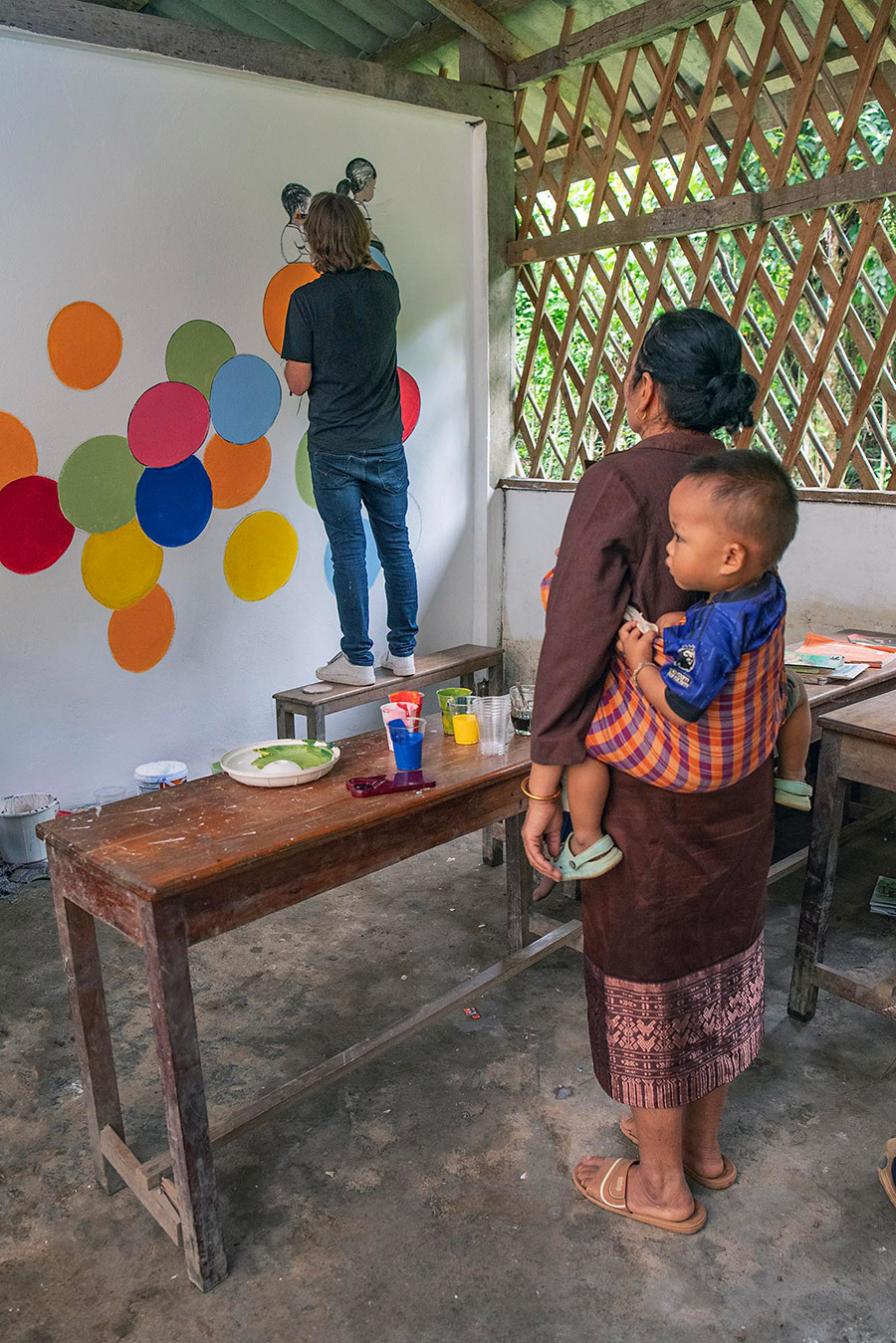
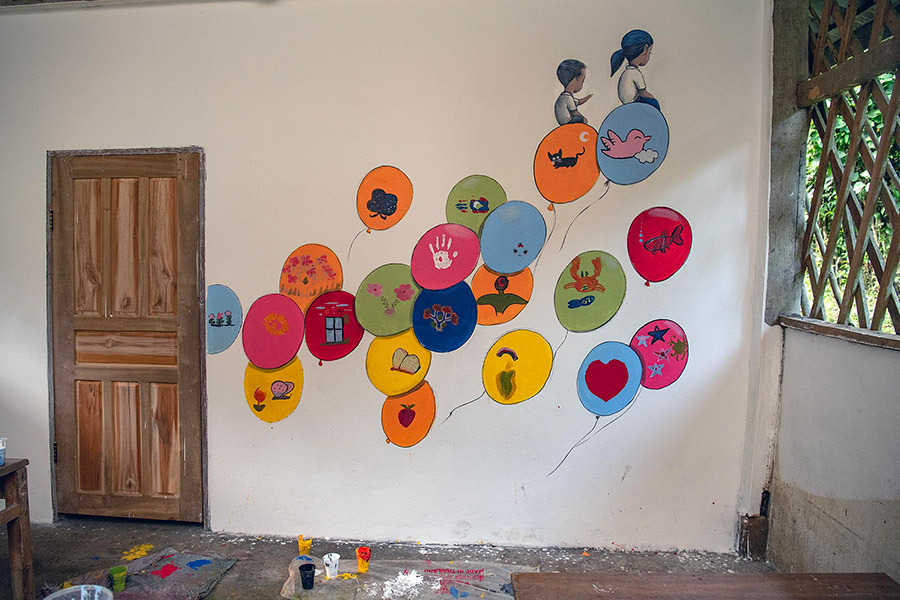
Seth was sure to stop at Lao Friends Hospital for Children, the only free pediatric hospital in Northern Laos. His mural — inspired by Hmong embroidered history cloths — became what he called an “extraordinary garden”on his Instagram – possibly one of heritage and healing. When Seth is around, young students are often seen taking brushes into their own hands, adding birds and shapes to a Free Expression Wall that gives them a chance to be collaborative. Martha, never far from the action, captures the imagination and concentration in their faces — the same instinct that drew her to kids on the streets of New York’s Lower East Side in the 1970s.
Further north in the rural Hoy Bor and Hoy Phoung villages, Seth teamed up with NKSEEDS to transform school walls into collaborative canvases. One piece — titled “Past Future” — honors Khmu tradition with a woman carrying her child. Another project invited every kid to paint a “fetish bird” flying toward the light. Students walked on bamboo stilts and played sport games together- and of course grabbed brushes as Martha documented small hands, bright colors, and the delight of making something permanent together.
Folklore, Masks, and Mischief
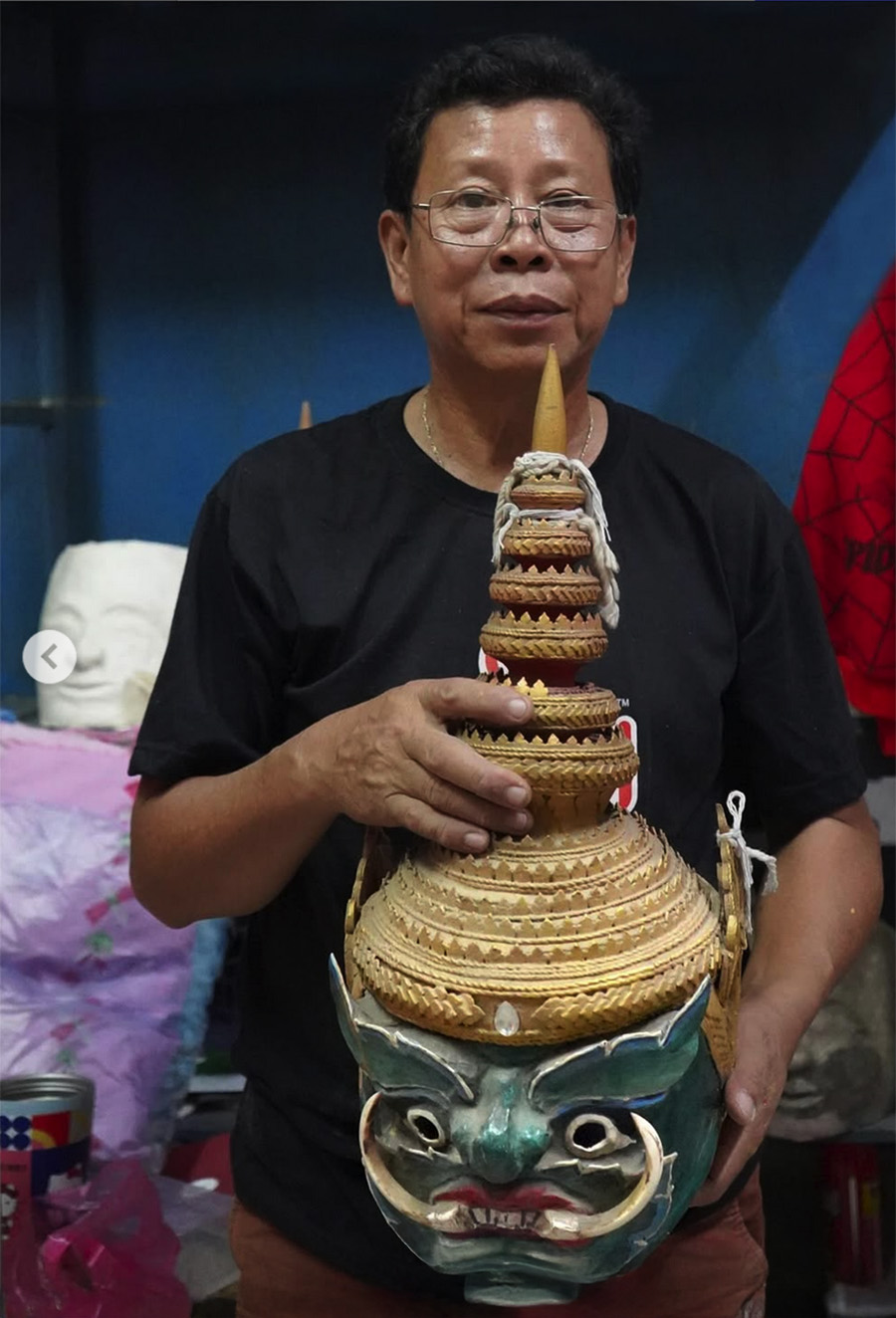
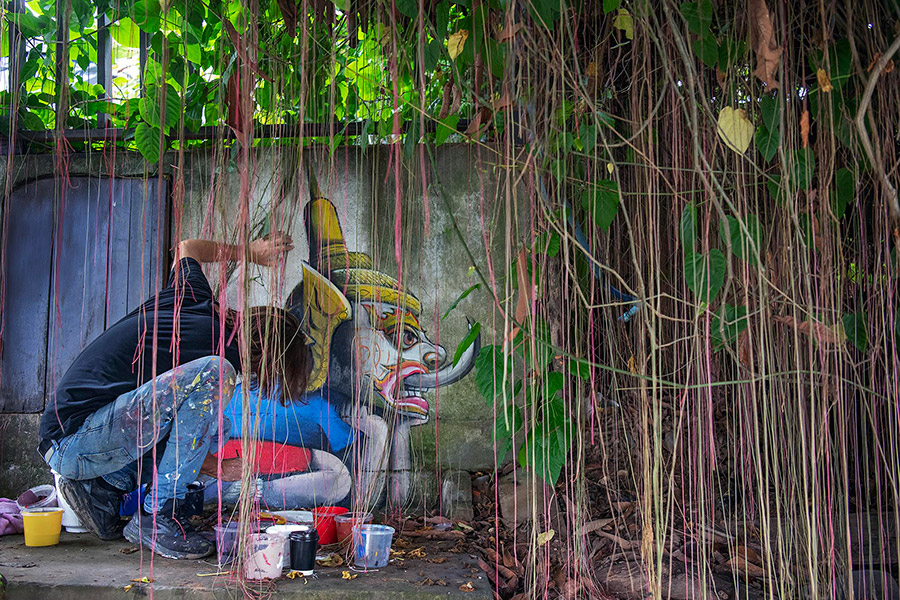
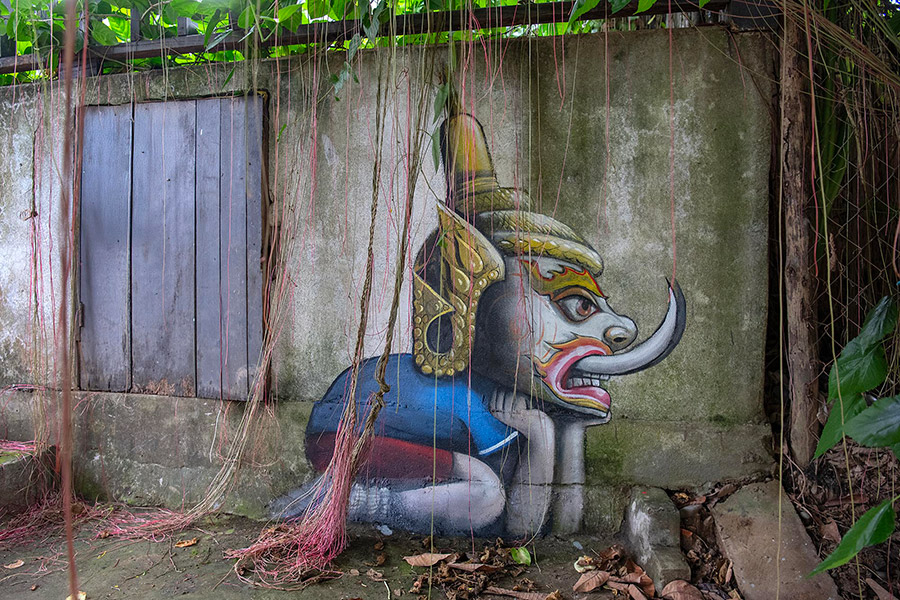
Meeting the Royal Ballet mask-maker in Luang Prabang gave Seth a new spark. He adapted a demon mask from the Phra Lak Phra Ram — Laos’ own Ramayana — and painted it atop the crouched body of a local kid. Minutes later, a boy wearing the real mask squatted beside the mural, turning tradition into a living side-by-side remix. Martha’s photos catch a perfect squeeze between imagination and reality that defines Seth’s work.
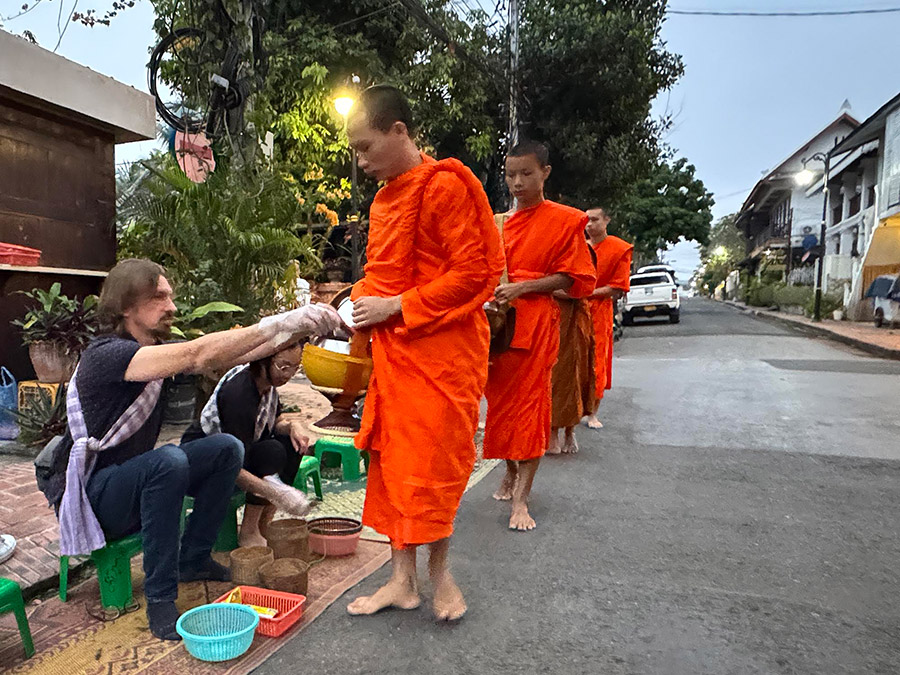
Martha also managed to document the alms-giving ritual at dawn that Seth participated in. Every morning, usually at dawn, Buddhist monks walk silently through the streets in a single line carrying bowls.
Laypeople — often sitting or kneeling — place food into the monks’ bowls. This food is usually prepared rice, fruit, or other simple offerings. In Laos, this ritual is widely observed. Laos is predominantly Theravada Buddhist, and alms-giving is a daily part of community life.
This trip marks another chapter in Seth and Martha’s shared habit of chasing childhood imagination across the world — Kenya, Haiti… and now Laos. With support from curator and author Alisa Phommahaxay (Asian Street Art: Une Anthologie), who helped open doors to schools, families, and the children’s hospital, they kept everything relaxed and personal: art made with people, not just for them.
In dusty schoolyards and along the Mekong’s quiet edges, a camera and a paintbrush appear to be a splendid combination that brings people a little closer. Kids still invent games from whatever’s nearby — bamboo poles, bare feet, a splash of color — and Martha still recognizes that spark in an instant. Walls evolve, decades pass, but that simple creative heartbeat remains easy to find.
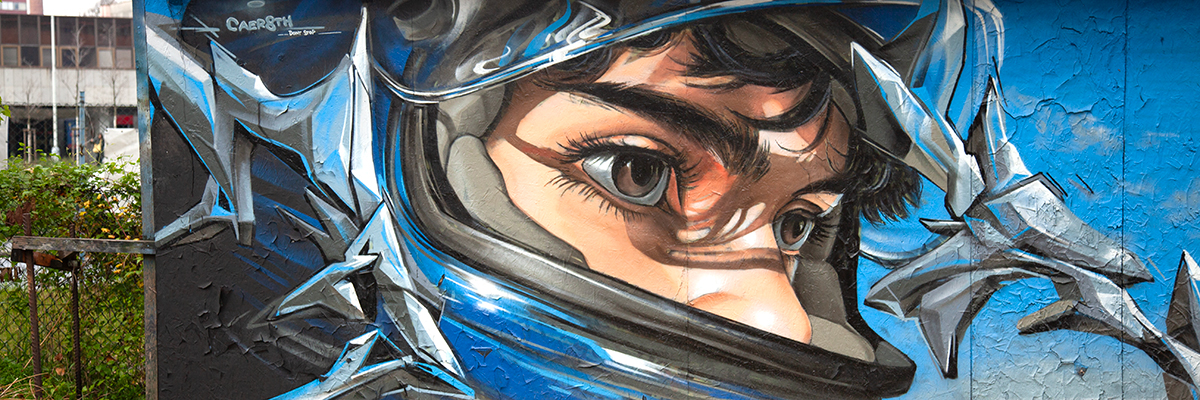
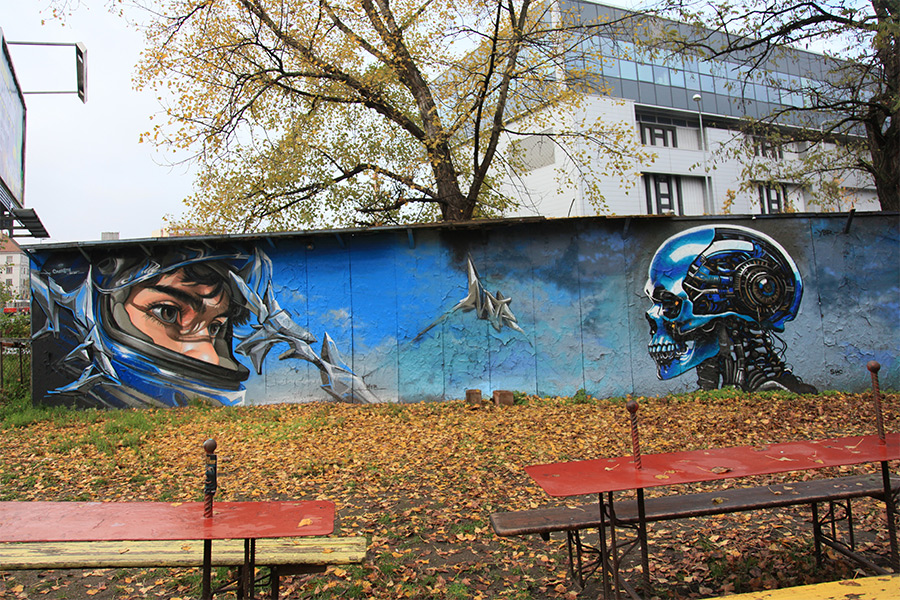
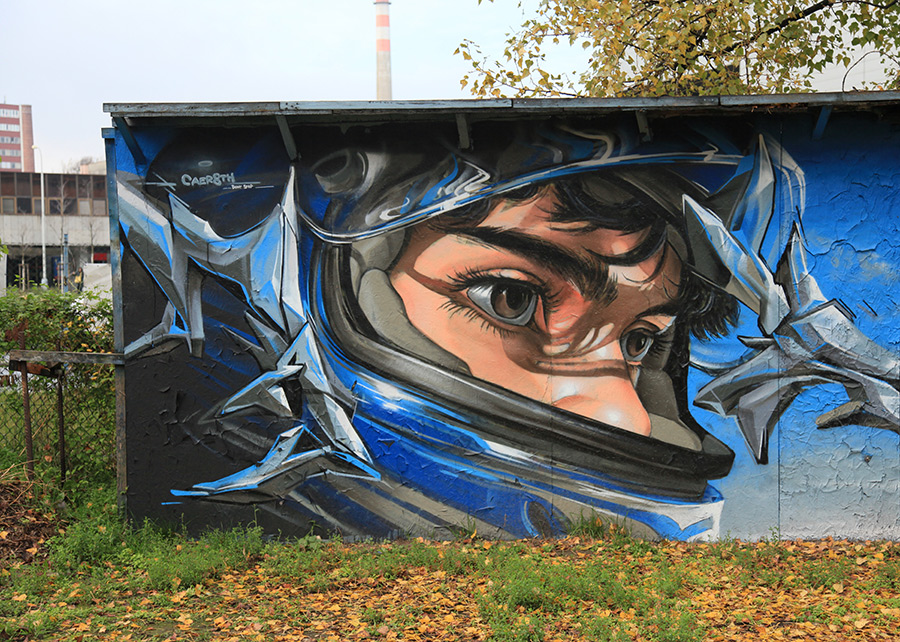
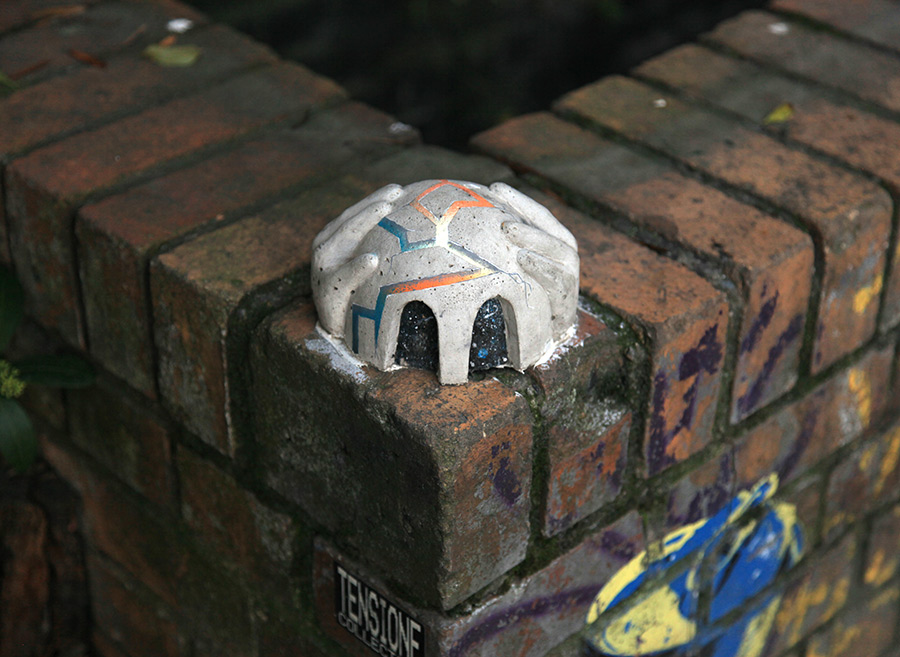
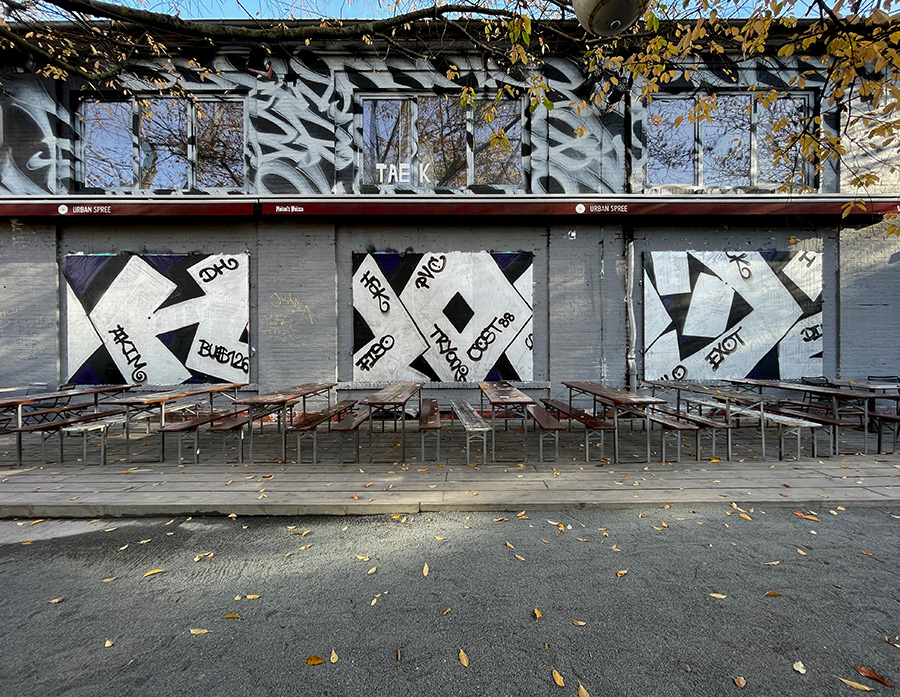
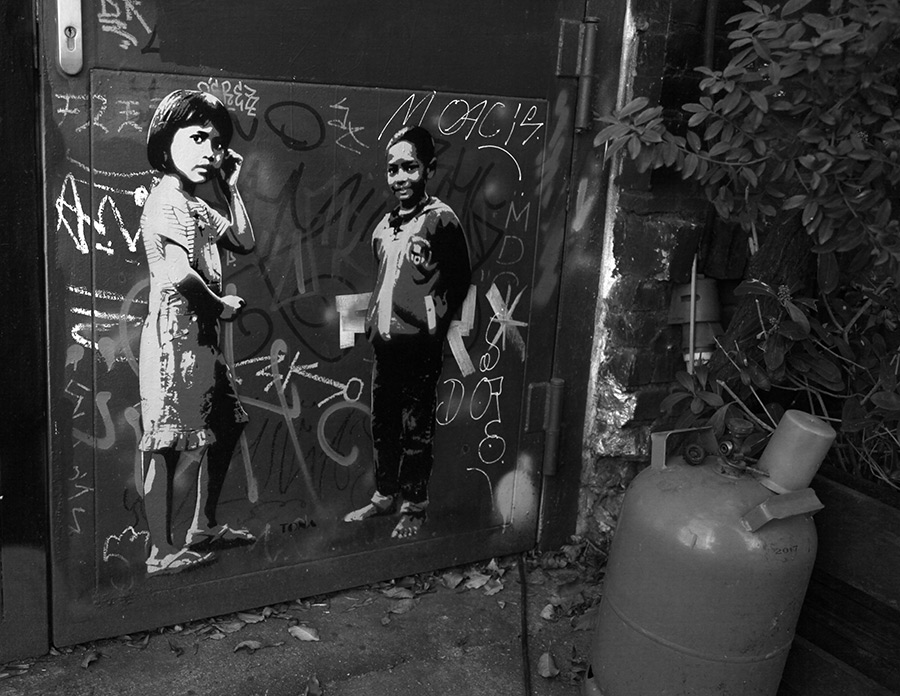
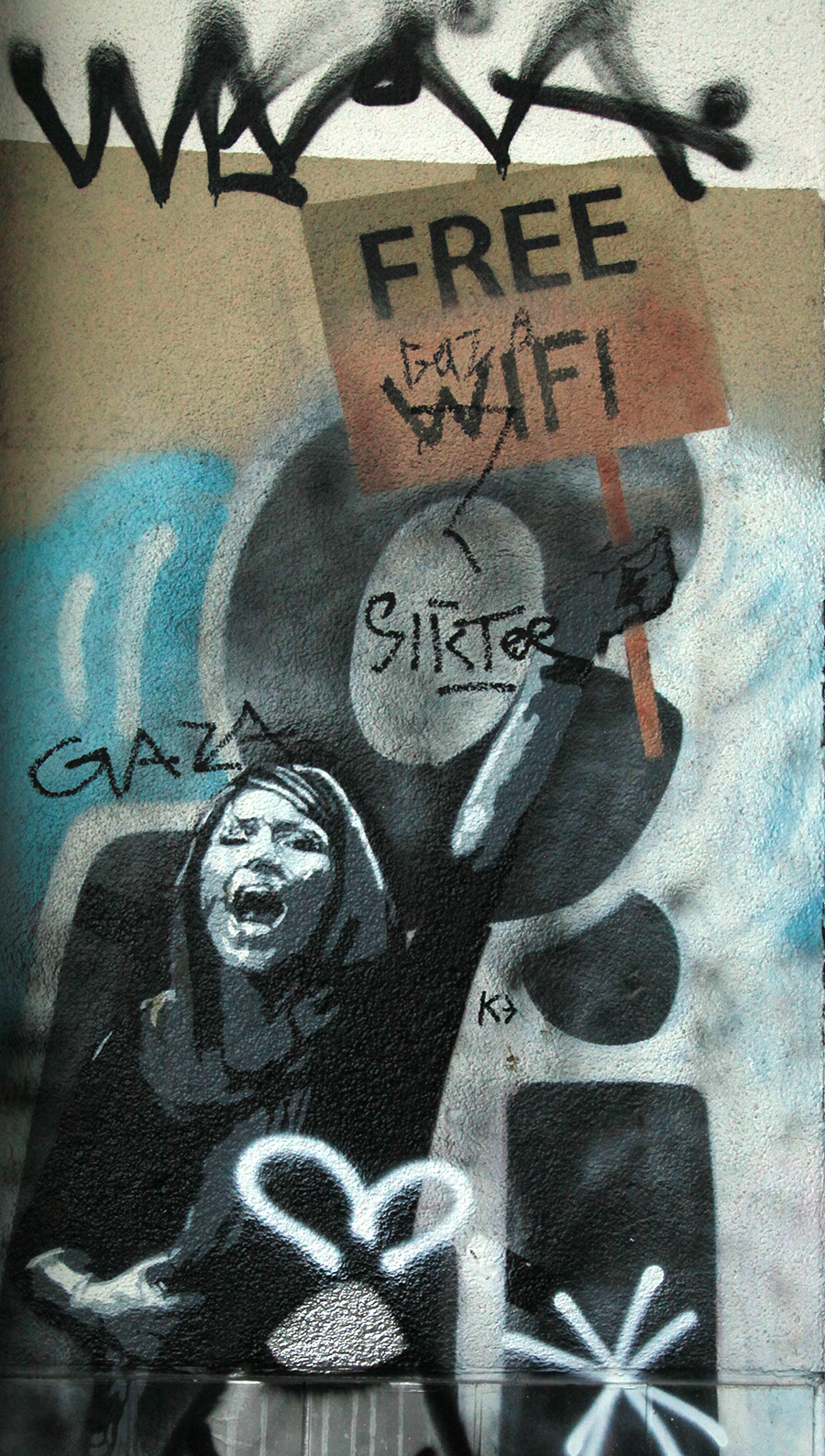
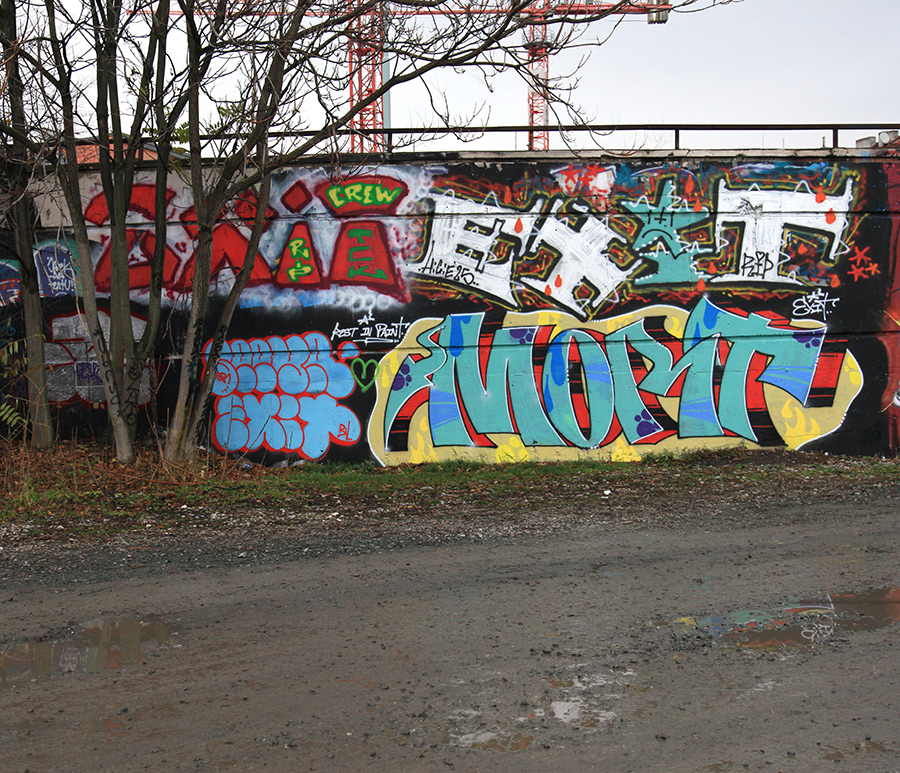
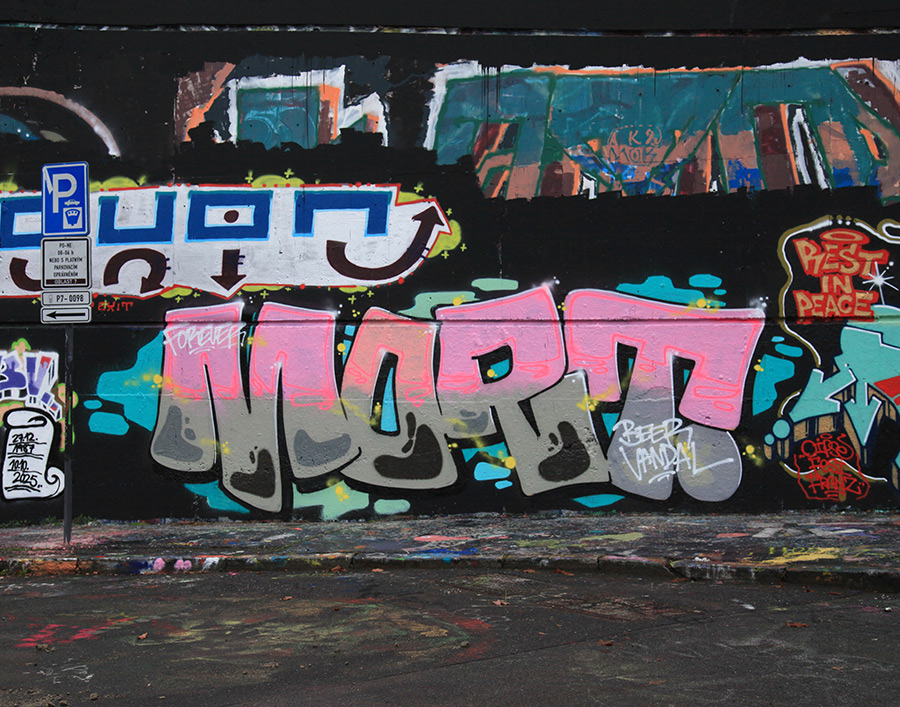
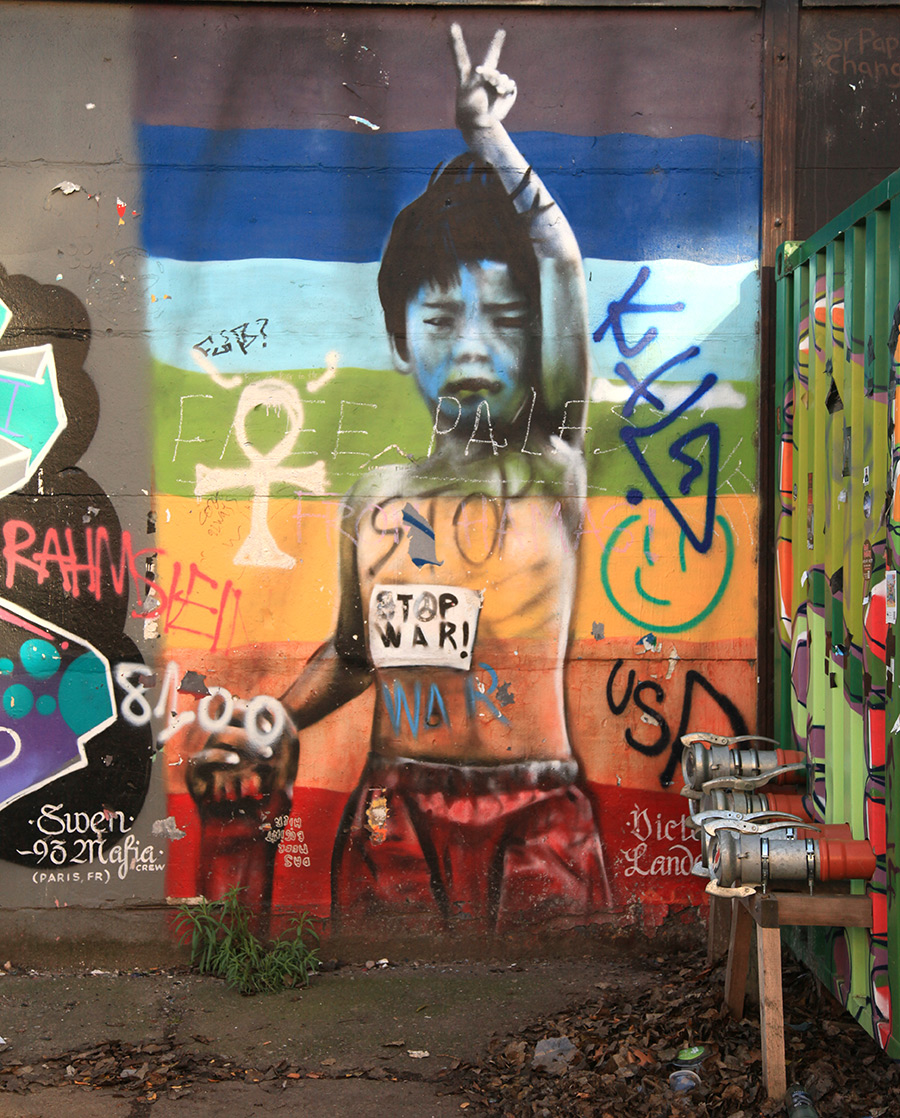
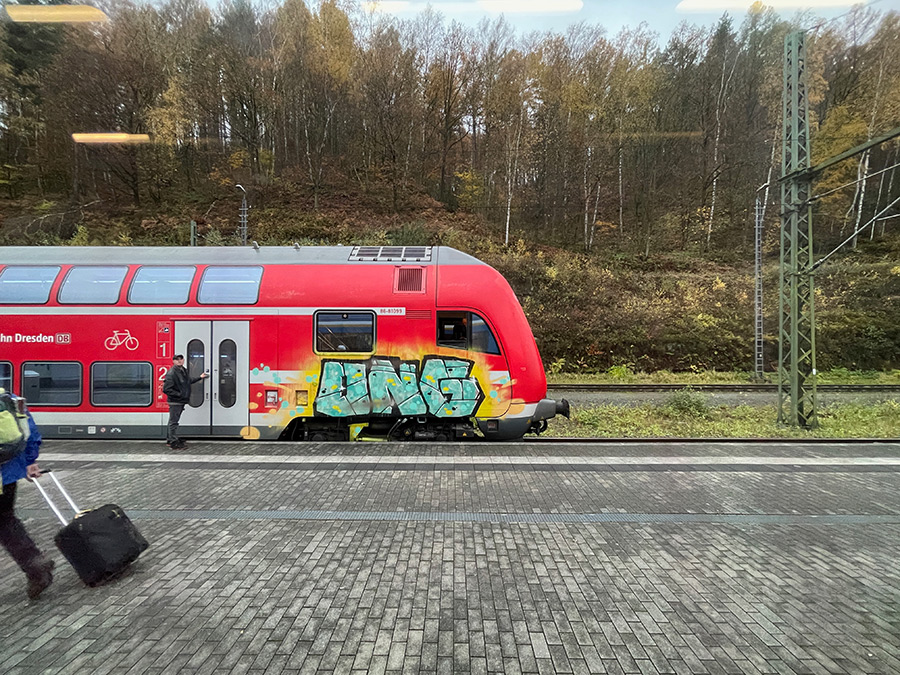
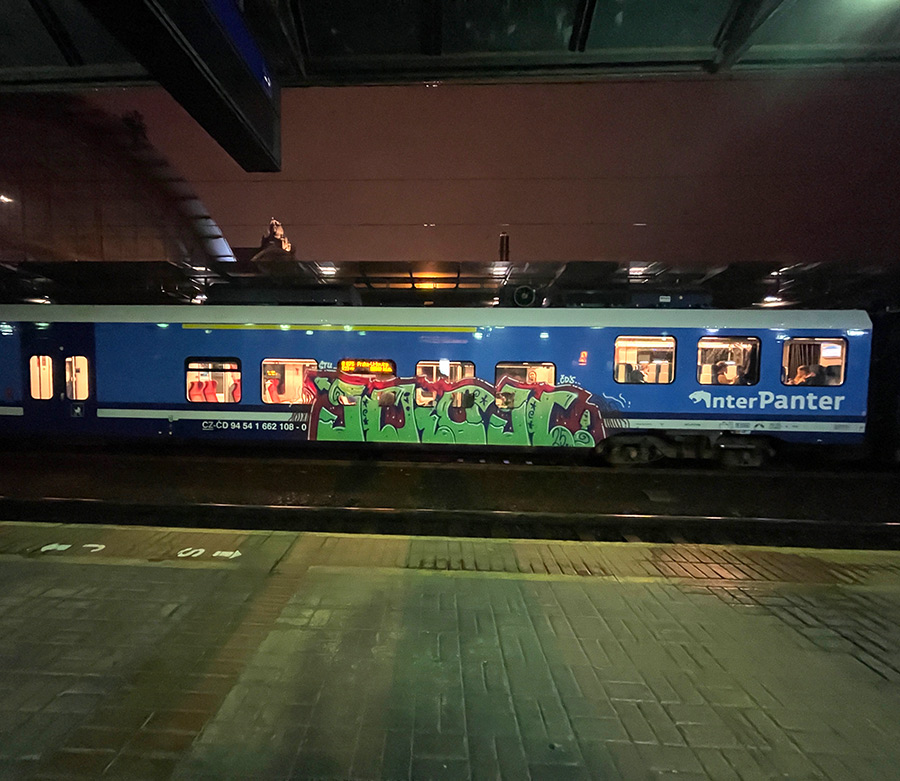
This week we’re hitting Berlin and Prague on a quick-turn street survey, looking at how each city is evolving its own visual language in real time. You feel the contrast immediately: Berlin may still carry the reputation for boundary-stretching experimentation, but Prague is stepping forward with its own confident push — inventive palettes, disciplined letterforms, and murals that challenge the assumptions of what belongs in a city celebrated for its Gothic and Baroque silhouettes. Where Berlin is sprawling now with more sanctioned façades and yet an intense train graffiti scene, Prague concentrates its energy into transitional zones and tight networks of writers and muralists. Both cities are accelerating — but Prague surely has a particular spark right now, maybe because it’s new to us, or because you can divine a kind of tension between reverence and rebellion that makes walls talk in new ways.
Berlin’s streets are currently balancing big, commissioned façade murals with a still-active, letter-based graffiti scene that keeps pushing trains, rooftops, and hidden spots. Artists and writers are freely mixing spray paint with stencils, paste-ups, installations, and interventions, turning infrastructure and abandoned spaces into experimental laboratories. Political and social commentary remains central and fully reflects the conversations you hear, with quick-strike formats like posters and stickers addressing gentrification, migration, targeted geopolitical screeds, and a sense of increasing surveillance. At the same time, more legal and curated walls are emerging, opening opportunities for scale and collaboration while possibly sharpening a tension with the underground scene. If that’s a correct assessment, Berlin points toward an even sharper split: increasingly hybrid mural practices on sanctioned surfaces and faster, more disruptive actions in the rest of contested spaces, which tourists may not sense are diminishing, but locals assure you they are.
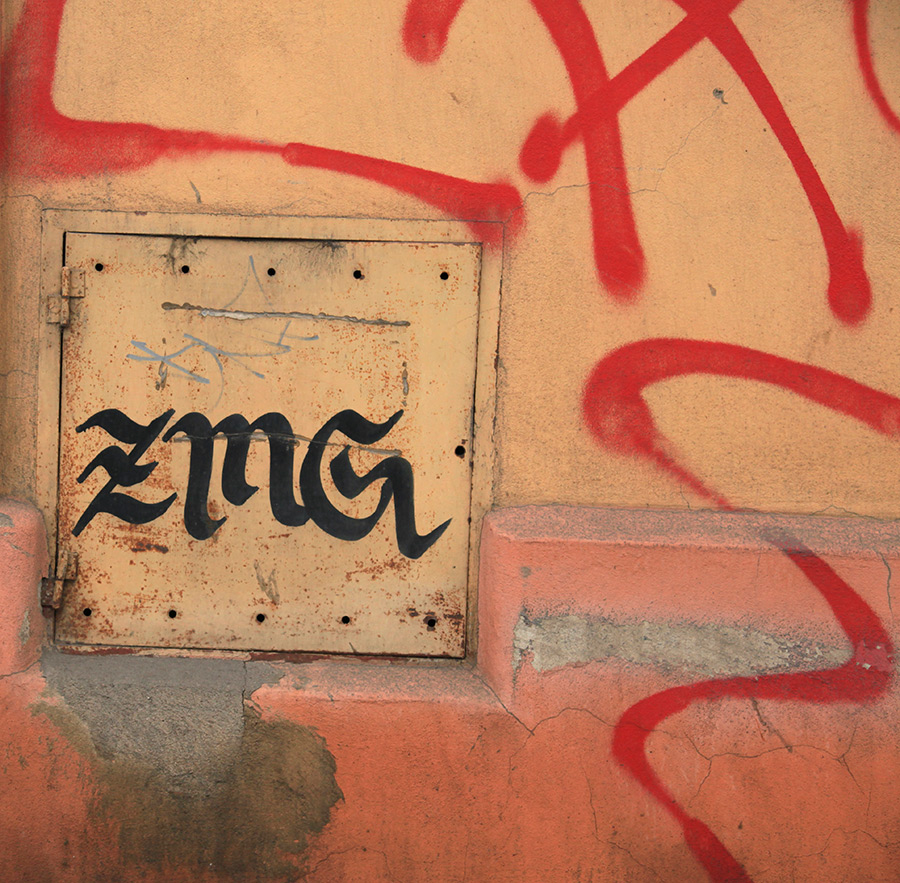
Smaller in scale than Berlin but fueled by a strong talent pool, Prague’s hybrid of academically inclined muralism and street-taught graffiti culture feels agile and confident. It is a city where the past stands tall, and the future writes itself across the margins. Maybe you would say it thrives on a tension between its historic Gothic and Baroque architecture and a new generation that likes to test what belongs elsewhere on the city’s walls. You’ll find those who push a hybrid language of abstract fields, figurative lines, and unconventional color, and others inject an assertive brand of pop-inflected text and graphic punch. As it is the 21st century, we are interested in finding conceptual figures we hear about who are raising questions about public space and control. At the same time, the graffiti scene keeps the pulse fast and restless: rooftops, tunnels, and rail corridors loaded with wild palettes, overlapping styles, and formats that nod to tradition, while stretching its edges. You’ll find most of this in transitional spaces — industrial seams, construction coverings, legal walls, and edges just beyond the postcard views.
Here is a quick drop into a melange of things we found in both for our weekly interview with the street, this week featuring 1UP Crew, B.S., Caer8th, Dibs, Exit RIP, EXOT Diamonds, Gunther Schaefer, MORT RIP, ONG, Paradox, Phoebe Graphy, Tona, XOXO, ZMG, and Zosen Bandito.
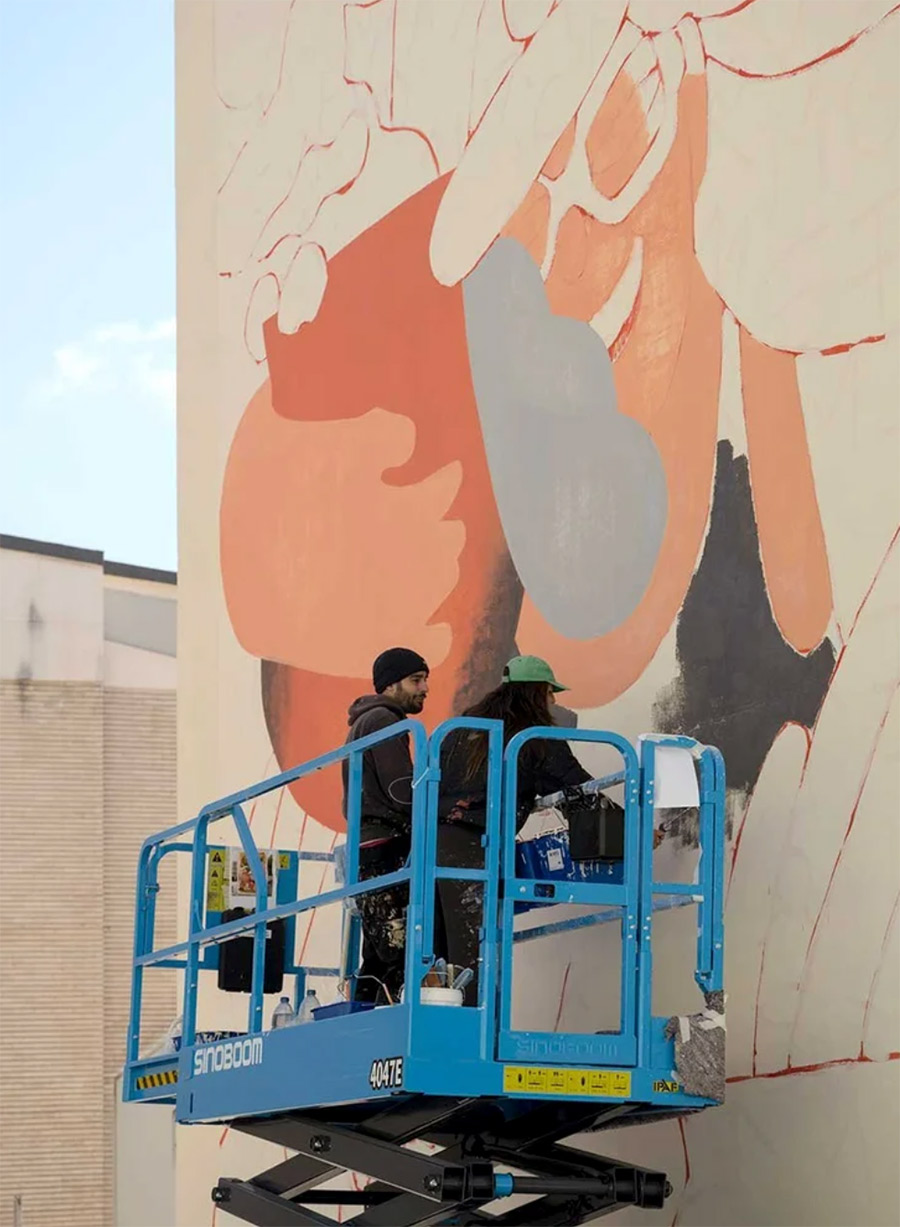
Marina Capdevila has completed a new mural titled “Compartiendo Muros”, painted at Colegio Público Nuestra Señora de la Concepción in Madrid. The project is part of the Madrid City Council’s Sharing Walls program, which brings artists into public spaces across the city. The project also includes workshops and conversations with students at the school.
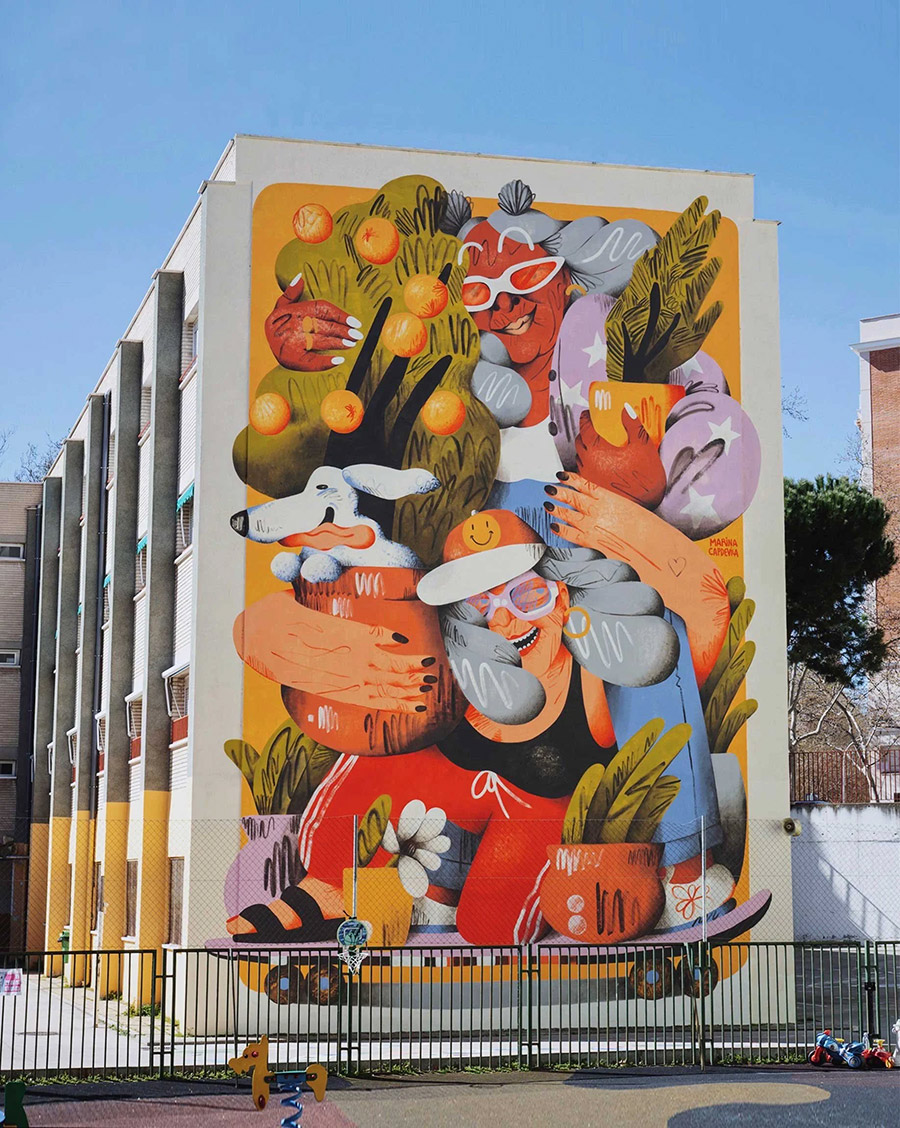
“Compartiendo Muros” features Capdevila’s recurring cast of older women in playful, contemporary scenes — here on skateboards, surrounded by plants, and outfitted with everyday tech.
Marina Capdevila. Compartiendo Muros Project. Madrid, 2025. (photo courtesy of the artist)
As her style continues to evolve, Capdevila refines her language of joy, exaggeration, and everyday rebellion — especially when her subjects are the elders who are often cropped out of the picture. Long-time observers will note that a direction that feels more textured and improvisational, without losing the clean graphic pounce/punch she’s known for.
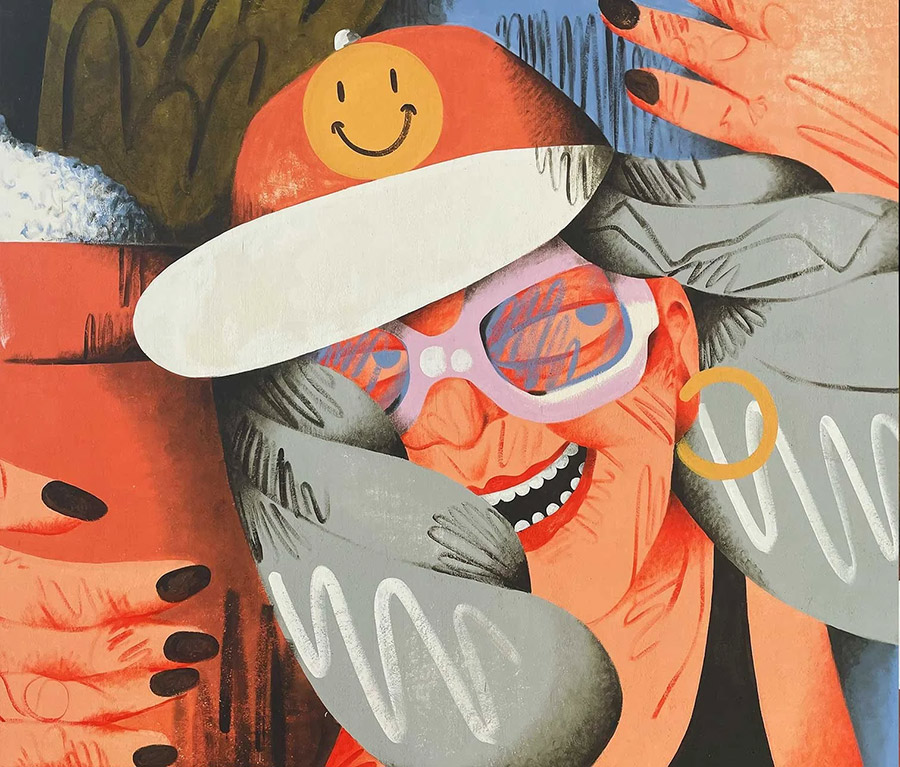
Marina Capdevila. Detail. Compartiendo Muros Project. Madrid, 2025. (photo courtesy of the artist)
Hard-edged shapes bump against charcoal-like marks and quick gestures, as if she’s inviting us into the creative process rather than polishing it too much. Her stylish grandmothers sprawl across the wall with irrepressible swagger; eyes dart from sunglasses to oranges, plants, dogs and daisies — a mural in motion with soft spray volumes and playful scribbles. Cute or coarse? Obviously both. With her tightening of this hybrid technique, spatially stacked for impact, it’s a notable step forward.
Capdevila’s ongoing ode to aging with sun-ripened color and individual flair lands as pure confidence. The artist’s own personal style runs right alongside it — a spirit of joy, and a reminder of our lifelong superpowers.
Marina Capdevila. Detail. Compartiendo Muros Project. Madrid, 2025. (photo courtesy of the artist)Marina Capdevila. Compartiendo Muros Project. Madrid, 2025. (photo courtesy of the artist)
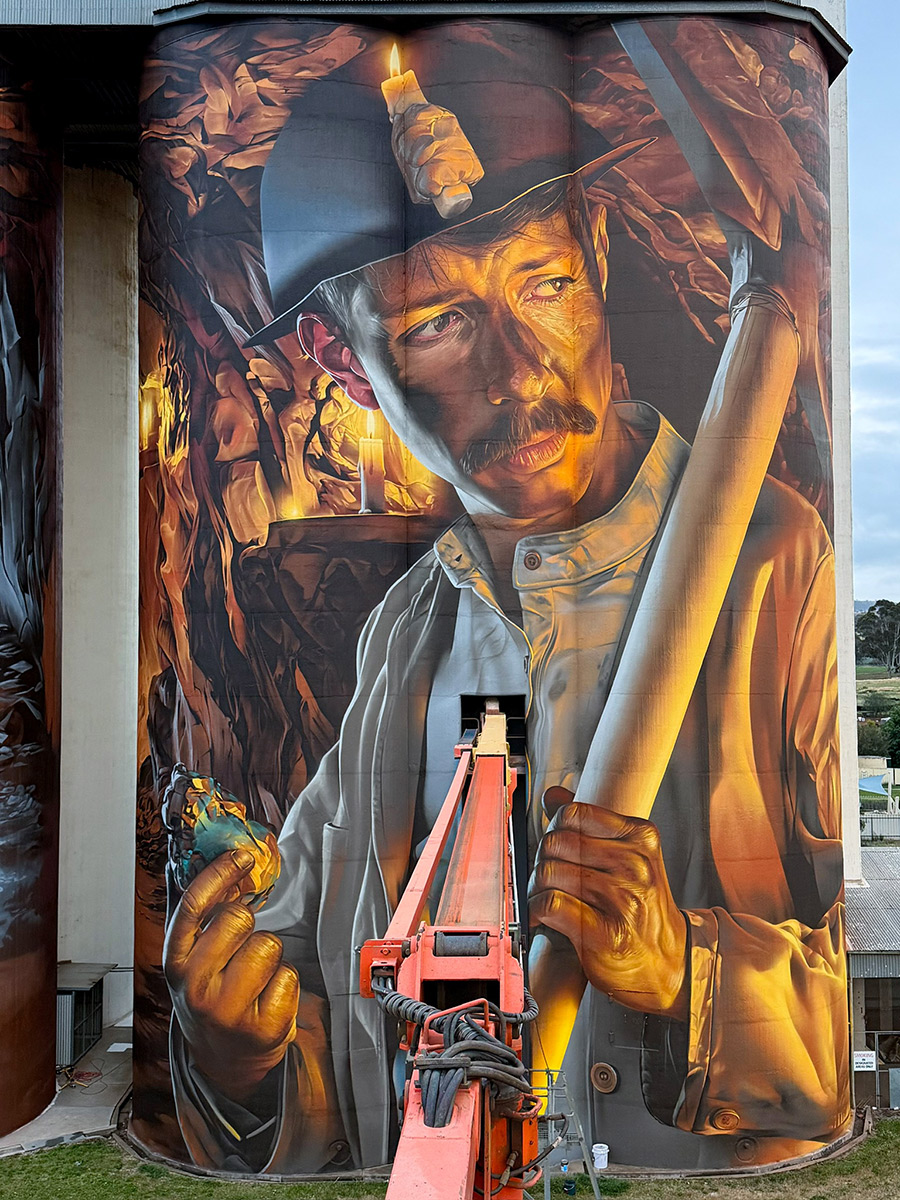
Born outside Sydney and based in Glasgow, Sam Bates—SMUG—began the way many graffiti writers do: skateboards, hip-hop, and late-night missions to get his name up.
That early graffiti period sharpened his sense of scale and texture. Over time, his work stretched beyond letters toward faces and figures—painting freehand—evolving into what some have called a stylized realism. We might say it is stylized realism with a twist, because the people SMUG paints are recognizably themselves and yet just a half-step into a dream—close enough to touch, strange enough to study. His characters, whether a tired worker, a mischievous child, or a curious bird, are rooted in real life and heightened just enough to suggest a larger story and possibly a punchline you hadn’t anticipated.
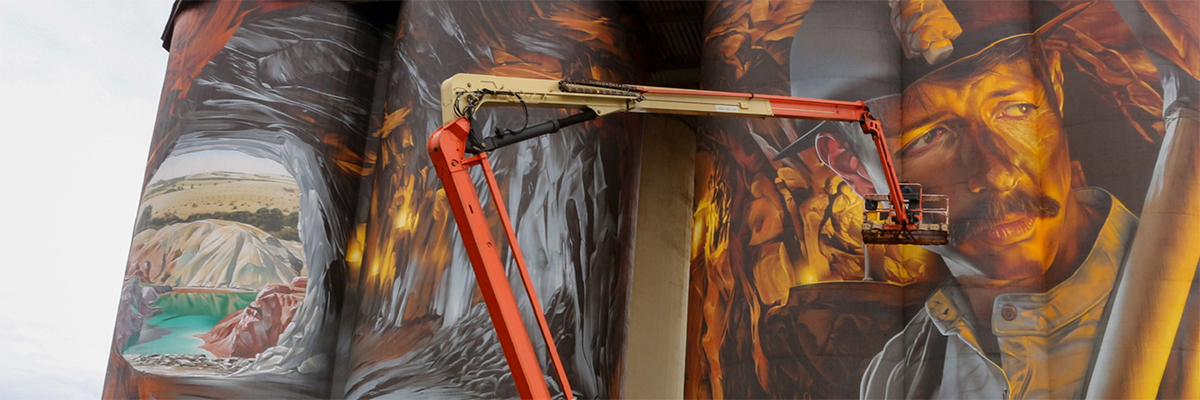
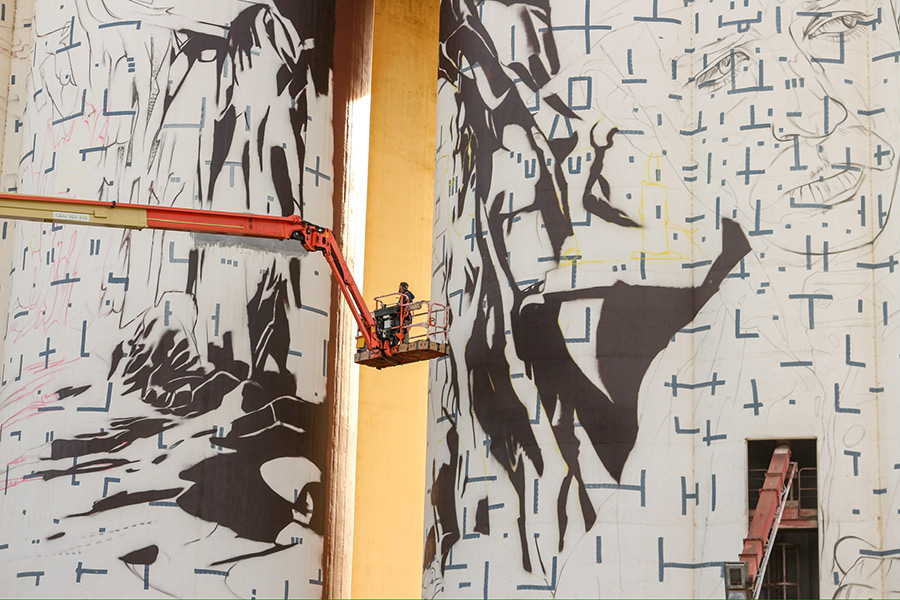
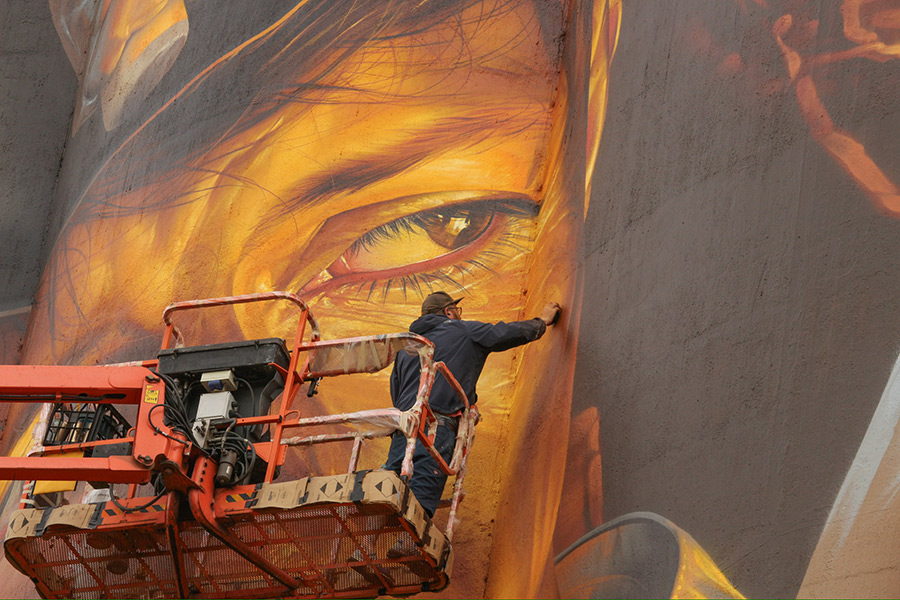
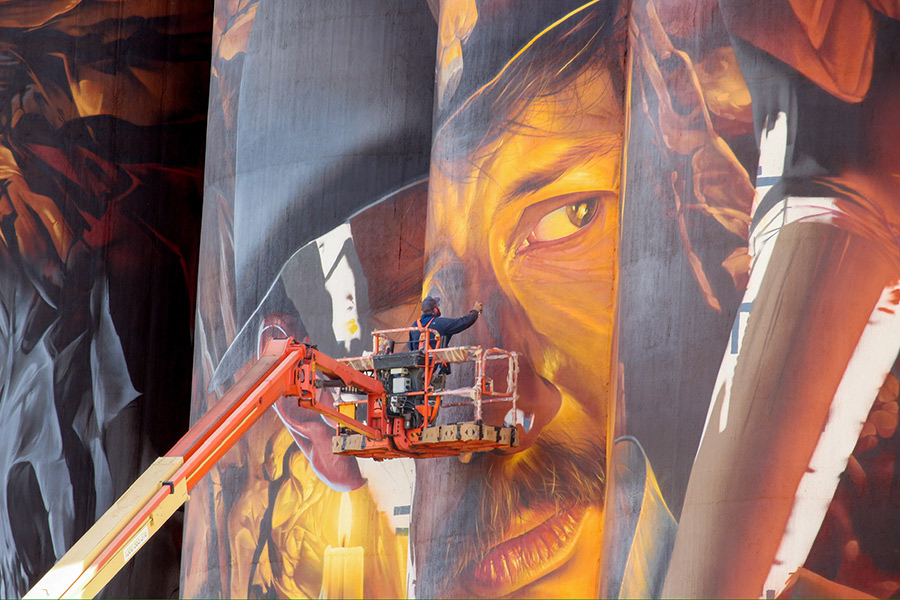
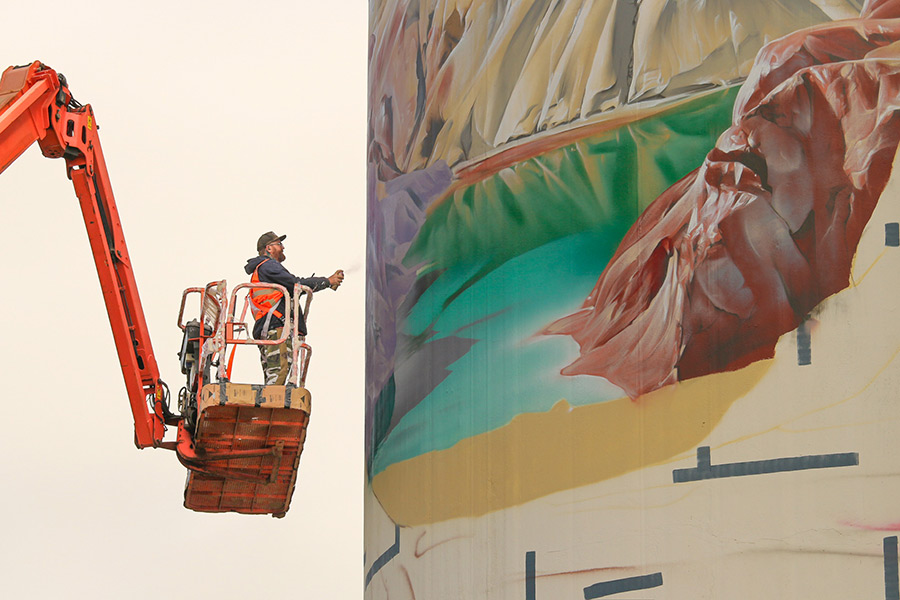
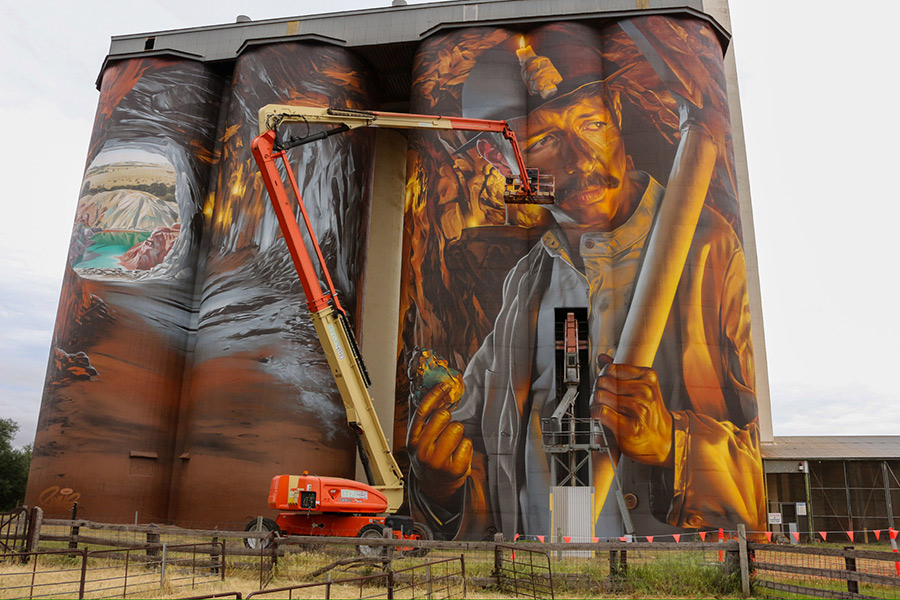
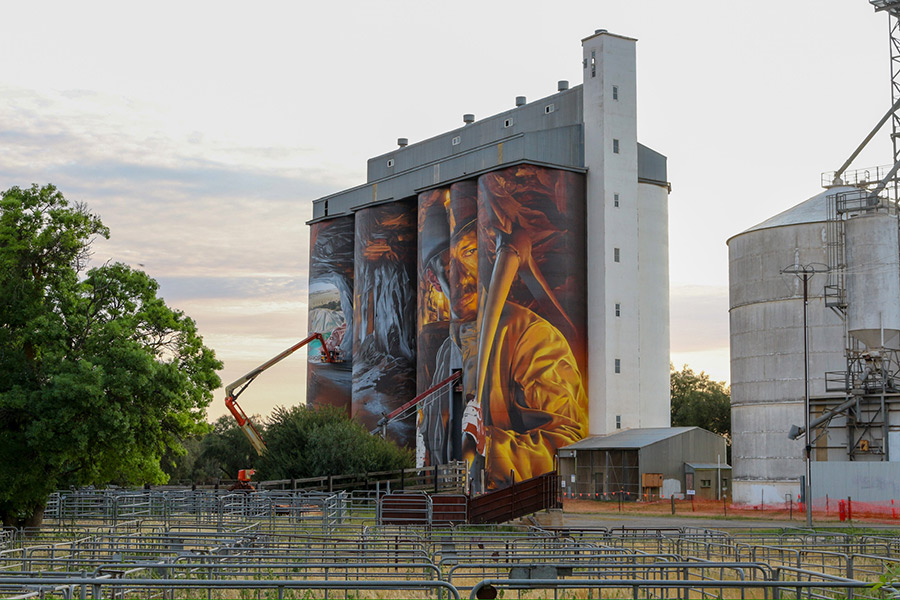
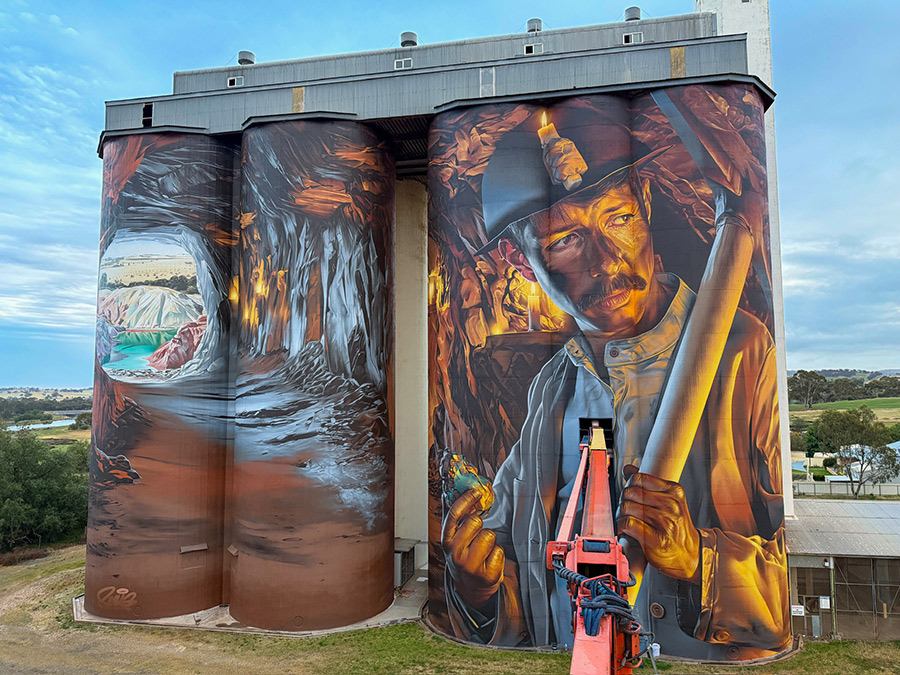
SMUG’s walls can now be found in cities across Europe and Australia—from the Glasgow City Centre Mural Trail to festival sites in Edinburgh, Melbourne, Kotka, and North Hobart, as well as the rural stretches where grain silos tower like cliffs above their towns. Silos have become something of a specialty, especially in Australia, and his work has joined a growing effort to treat these industrial structures as community landmarks rather than leftovers waiting to decay. Juddy Roller, the Melbourne-based creative studio behind the Silo Art Trail, has been central in connecting SMUG and other artists with local communities and producers, including the new mural here in Kapunda.
Kapunda’s silos stand at the edge of one of Australia’s earliest copper mining settlements, and the story told through paint reflects that history—an 1840s miner at work underground, a scene lit with grit, not nostalgia. It’s a reminder of the physical cost that built the town and, by extension, the country. This miner is not a romantic emblem; he is a working figure whose story has largely gone unpictured. Scale and proximity do the rest: a giant face meets the viewer head-on, turning past industry into a present encounter.
As history often does, it becomes a conversation about now. Many here in Kapunda say the town is changing—creatively, economically—and the silo artwork is one of the most visible signs of that shift. The project grew from a community campaign, and the result feels local in the best way: a monument to people. In SMUG’s hands, realism serves memory and identity—and, as you know, a wall (or a silo) can tell a fuller story than a plaque ever could.
If this is stylized realism with a twist, the twist may be perspective: look up, look closer, and see what a town chooses to show the world on a canvas impossible to ignore.
Welcome to BSA Images of the Week. Photographer Jaime Rojo hit the ground running upon getting back to dirty old Brooklyn this week from a Berlin/Prague tour. Lots to report from there on the walls, in the gallery, and in the museum spaces – and more to come for you to enjoy. In the meantime, here’s what he found on the streets of NYC; a mash-up of handstyles, graphics, pop cues, fine-art chops, humor, sarcasm, reverence, and straight-up rebellion — cultures colliding and talking back.
We begin the show with a new portrait of the much-loved graffiti and street art photographer Martha Cooper, based on a photo by Corey Nickols and painted by Swed Oner (Mathieu Taupenas) in Bushwick with Joe Ficalora and the Bushwick Collective by his side. Born in the south of France in the 80s, a graffiti writer in the late 90s, Swed Oner is now known for his hyper-realistic, monochrome portraits of people transformed into religious icons – featuring a “halo” motif for framing.
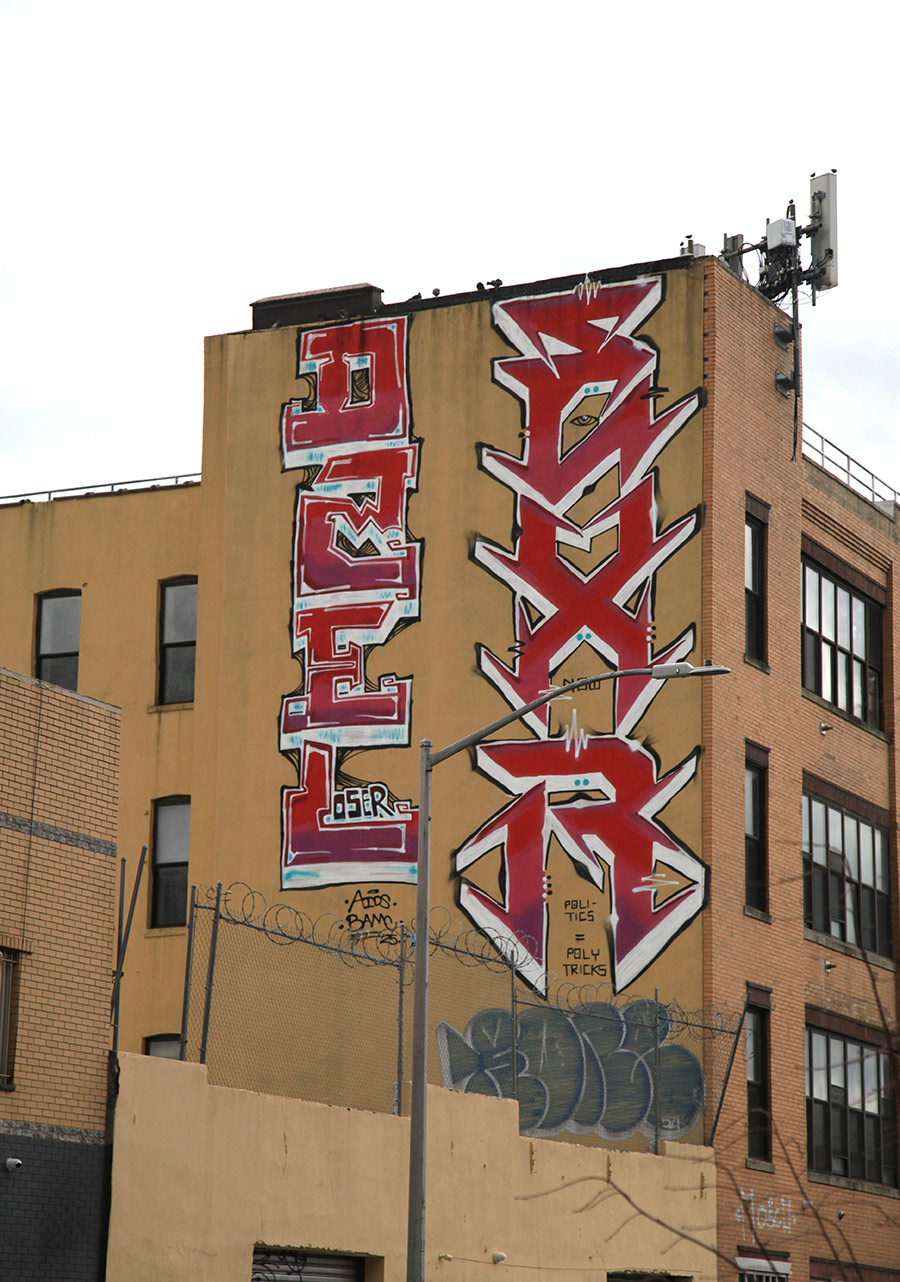
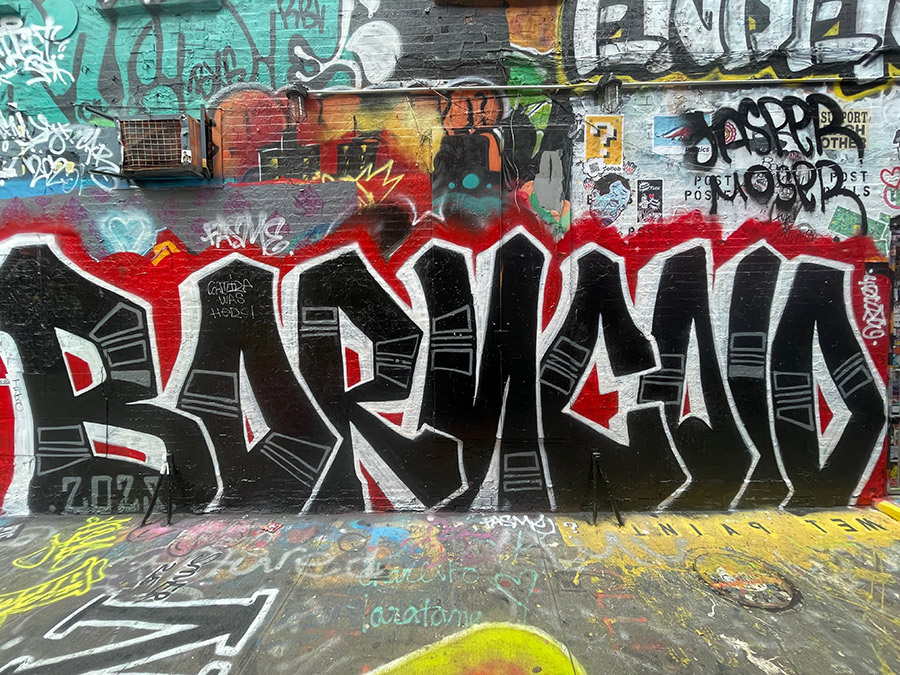
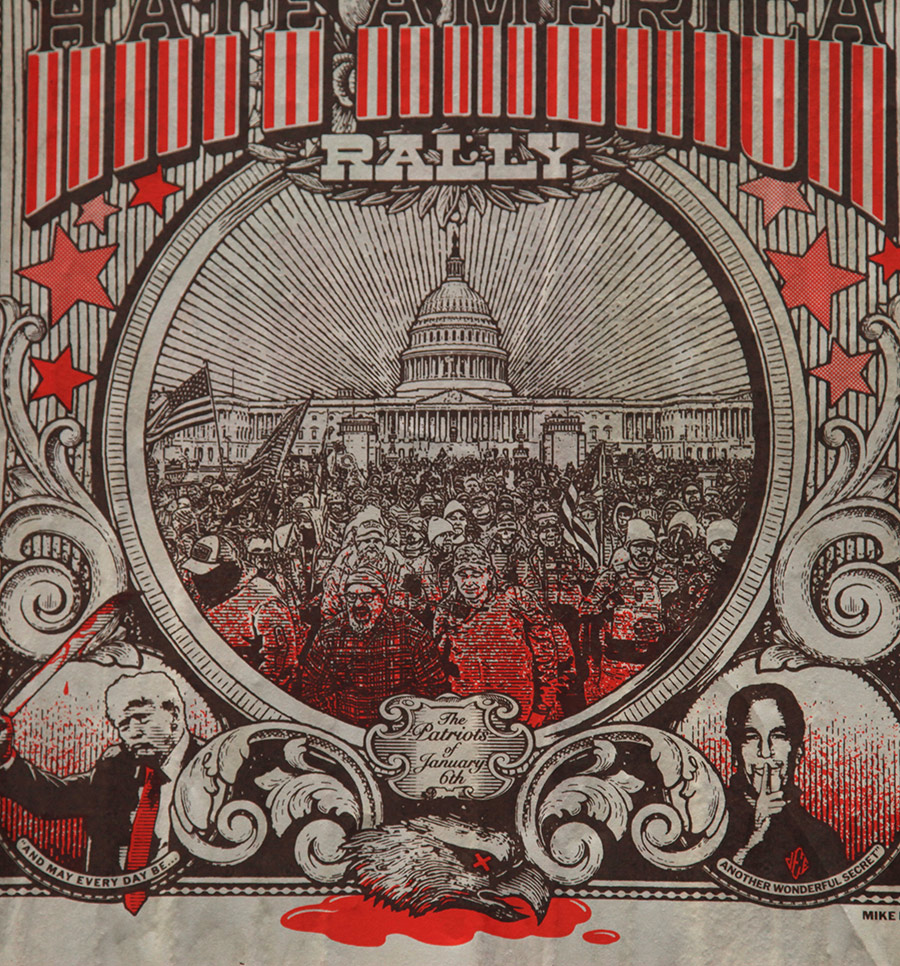
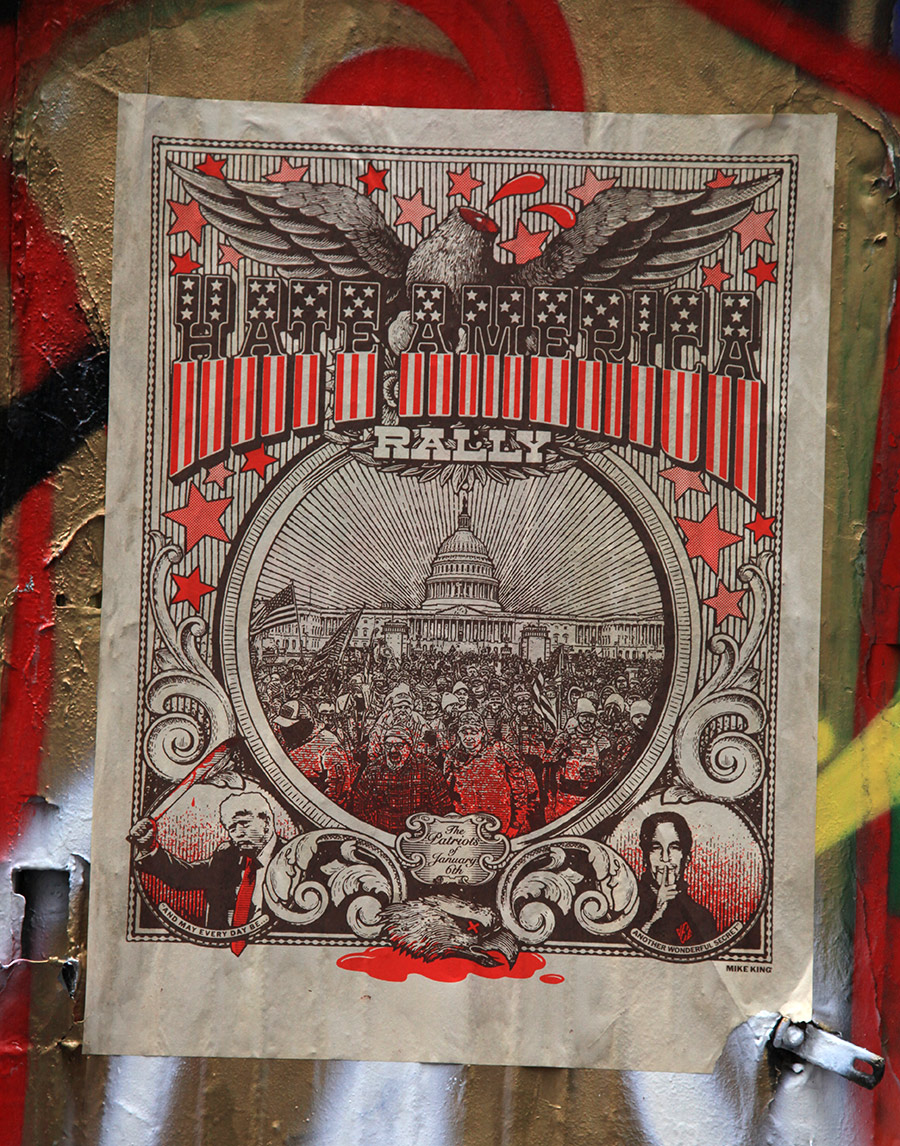
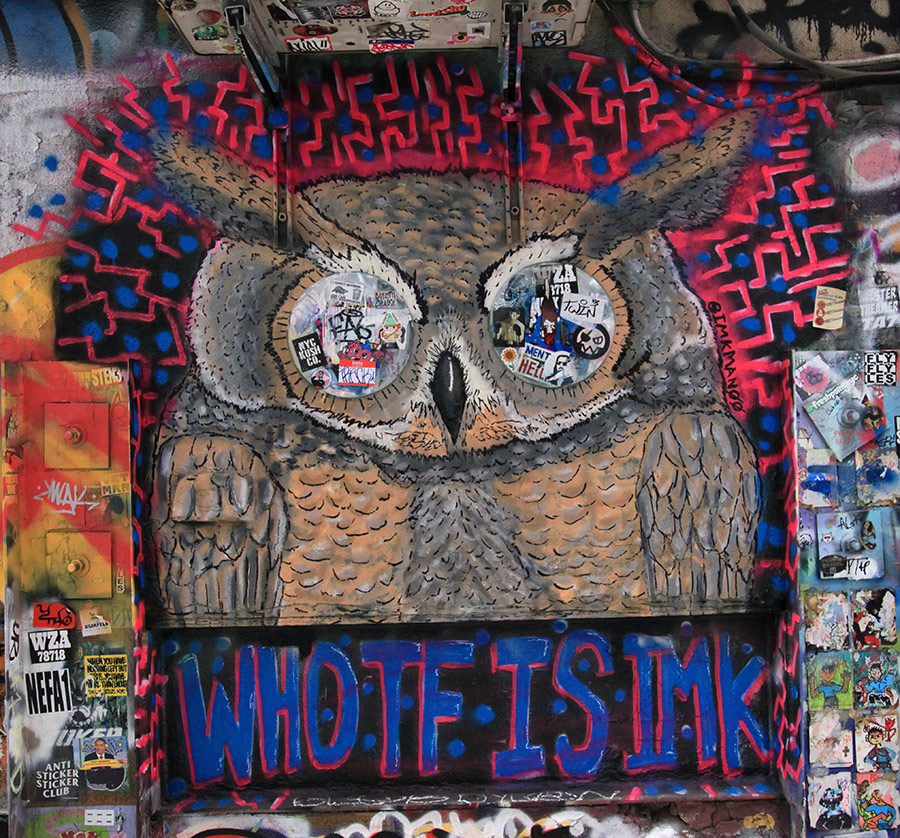
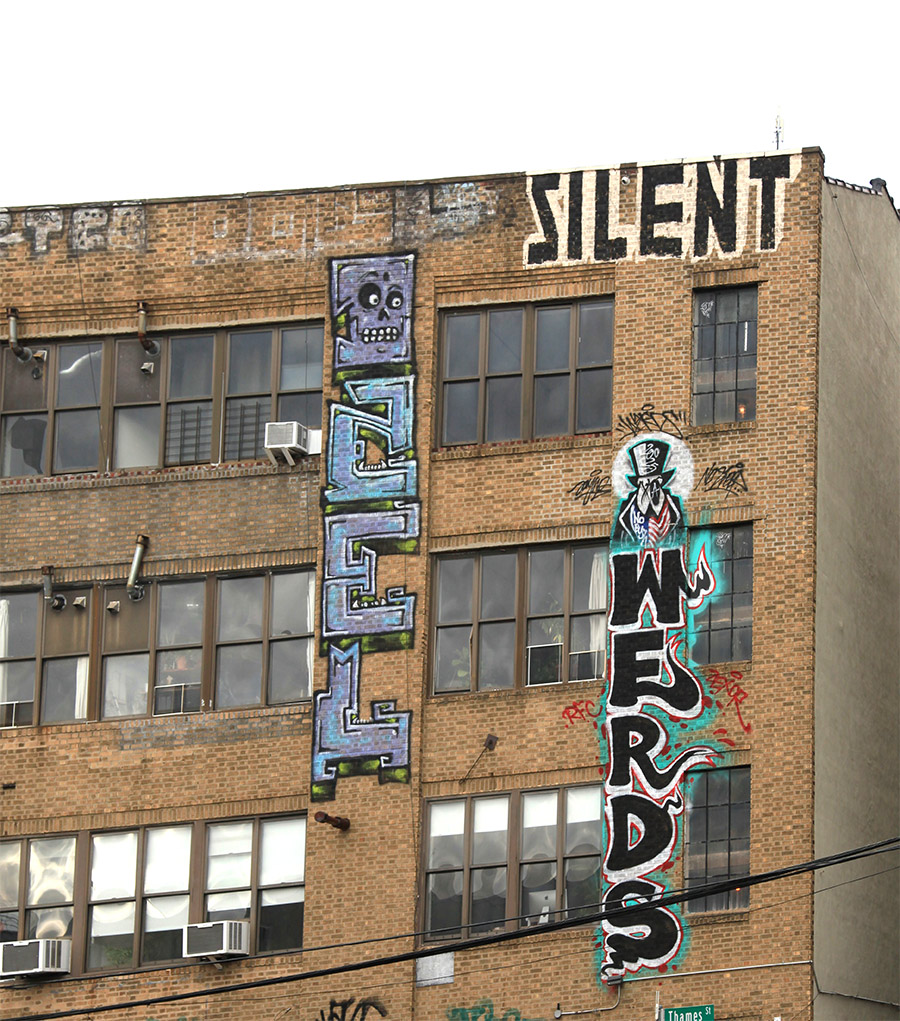
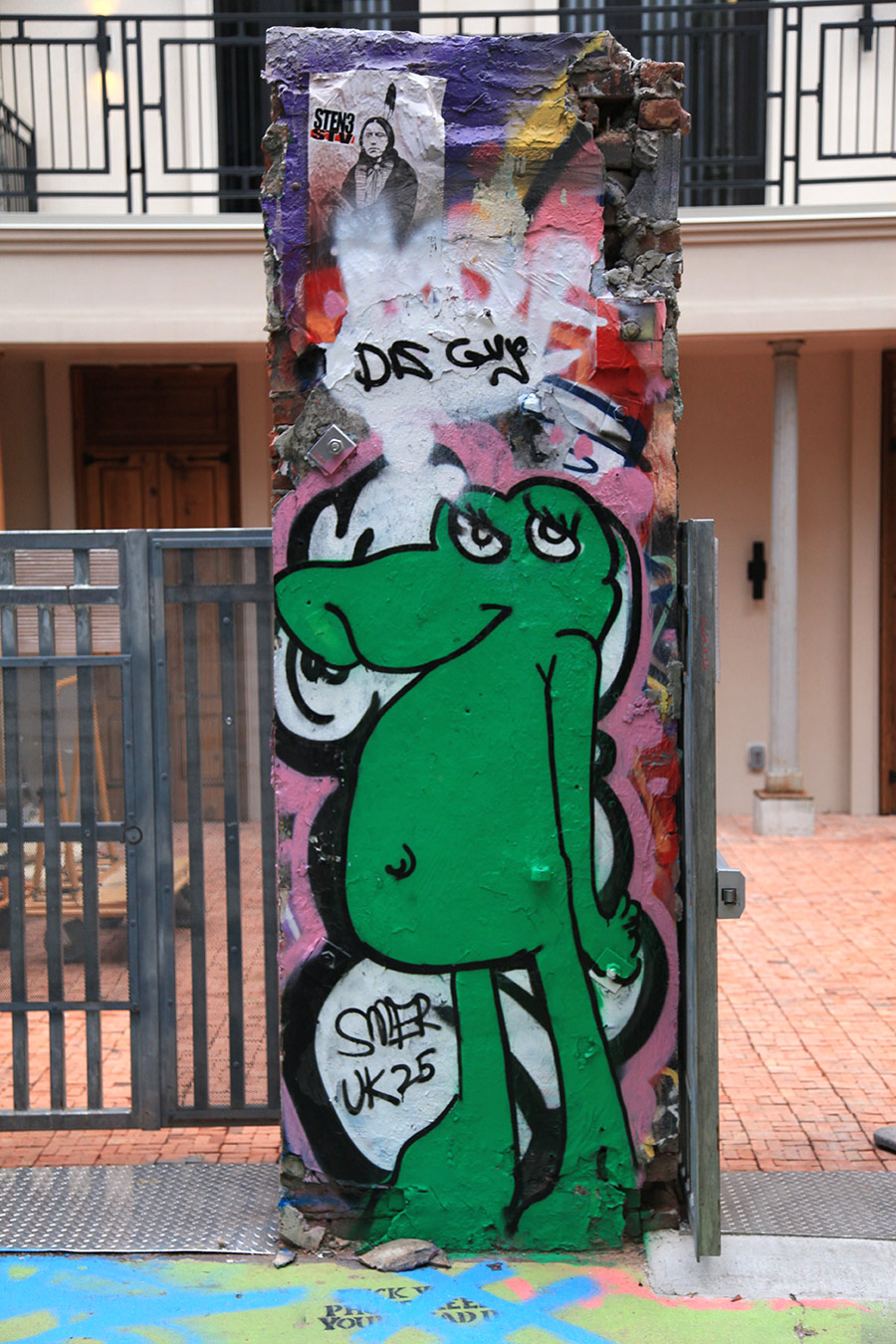
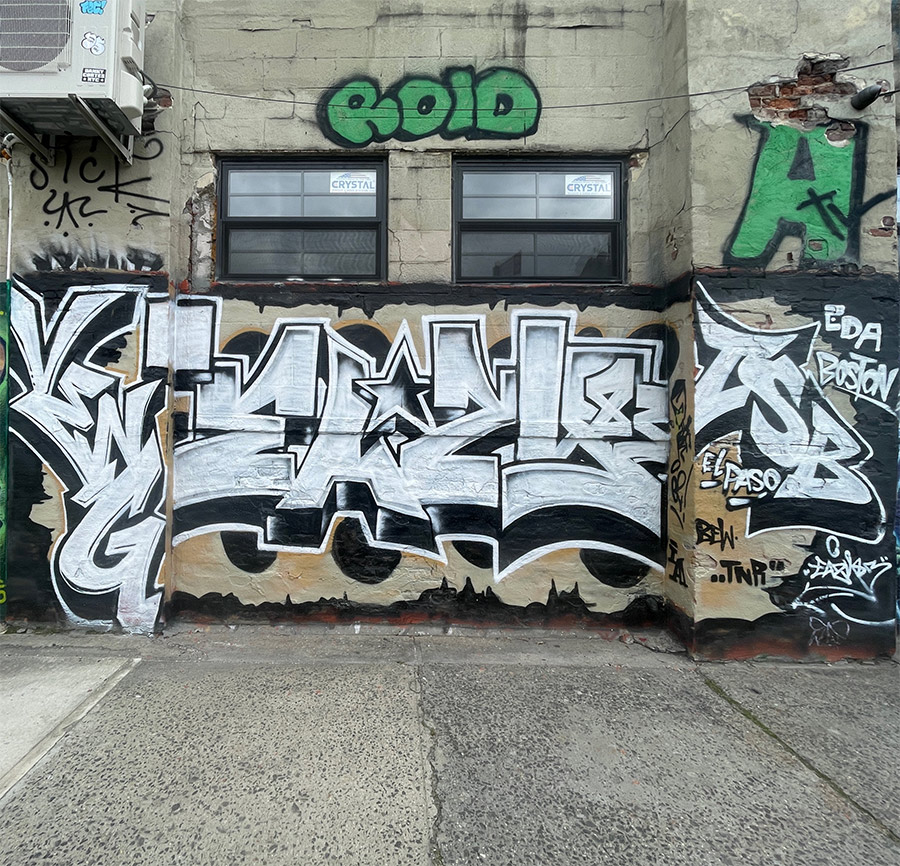
Featuring Dzel, EAZV, EXR, Gloom, Homesick, IMK, ISB, Jodi Da Real, KAMZ, Mike King, Notice, RIP Money, Shwan McArt, Silent, Smaer, Two Five, VENG, Warios, Werds, and ZOZS.
For more than two decades, MrKas has carried his Porto-born graffiti instincts across continents, painting walls from Ireland to Malta, Greece, the Netherlands, the Azores, and beyond. Festivals such as Waterford Walls, Meeting of Styles in Tampere, Kings Spray in Amsterdam, and the Pompeii Street Art Festival have shaped his evolution, each one adding another chapter to his ongoing dialogue between realism, memory, and perception. Yet no matter how far he travels, there is a steady pull that brings him back to Portugal. The return is not nostalgic but purposeful—a way to ground his practice in the places that shaped his earliest sense of community and identity.
MrKas. Generations. Riodades, Portugal. (photo courtesy of the artist)
What began as youthful graffiti—an impulsive act sparked by a stray spray can on a Porto street—has matured into a visual language built on precision, layered imagery, and portraits that seem to exist between dimensions. Today, he combines the discipline of photorealism with deliberate ruptures: cut-outs, geometric interference, and the feeling that an image is being assembled or disassembled in real time. The tension is central to his work.
MrKas. Generations. Riodades, Portugal. (photo courtesy of the artist)
His newest mural, Generations, created for the Douro Street Art Festival in the village of Riodades, carries some of those ideas into a deeply local context. Painted on the walls of the town’s school, the work reflects the artist’s engagement with the region’s everyday life. “In Riodades, among the vineyards and mountains of the Douro Valley, I found a story of identity and belonging,” he says.
MrKas. Generations. Riodades, Portugal. (photo courtesy of the artist)
The mural depicts three figures—“three souls,” in his words—each one connected to a facet of the village’s character: childhood and learning, music and harmony, tradition and joy. In the section showing the musician’s hands playing an instrument, the composition tilts between realism and constructed image, pointing directly to the layered, intergenerational act of keeping culture alive.
This appears as a recognition of the people who define the Douro’s cultural continuity. “This mural is more than paint. It’s a tribute to the people who keep culture alive. Here, the future begins with roots—strong, real, and human,” MrKas tells us.
MrKas. Generations. Riodades, Portugal. (photo courtesy of the artist)MrKas. Generations. Riodades, Portugal. (photo courtesy of the artist)
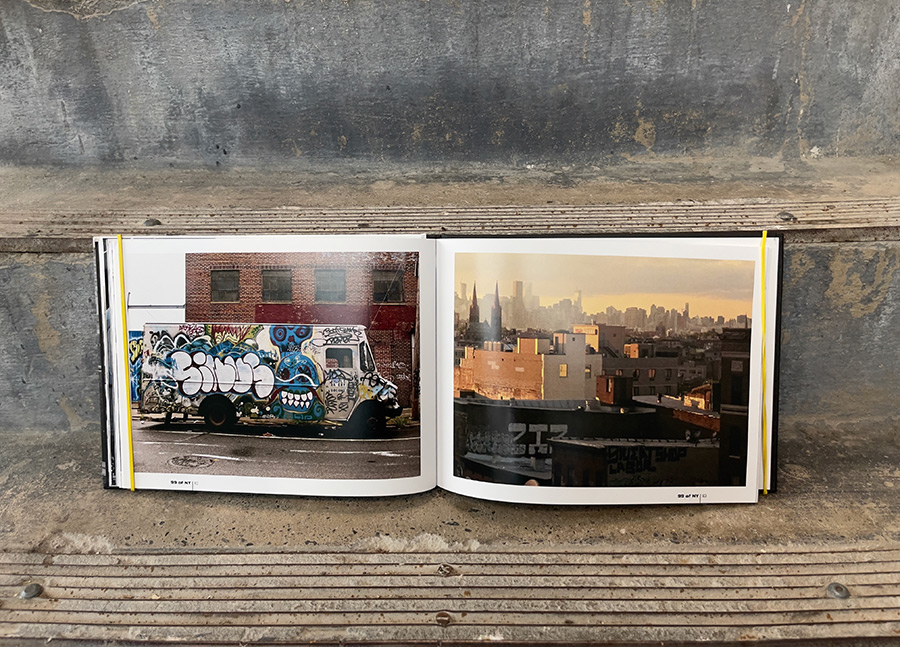
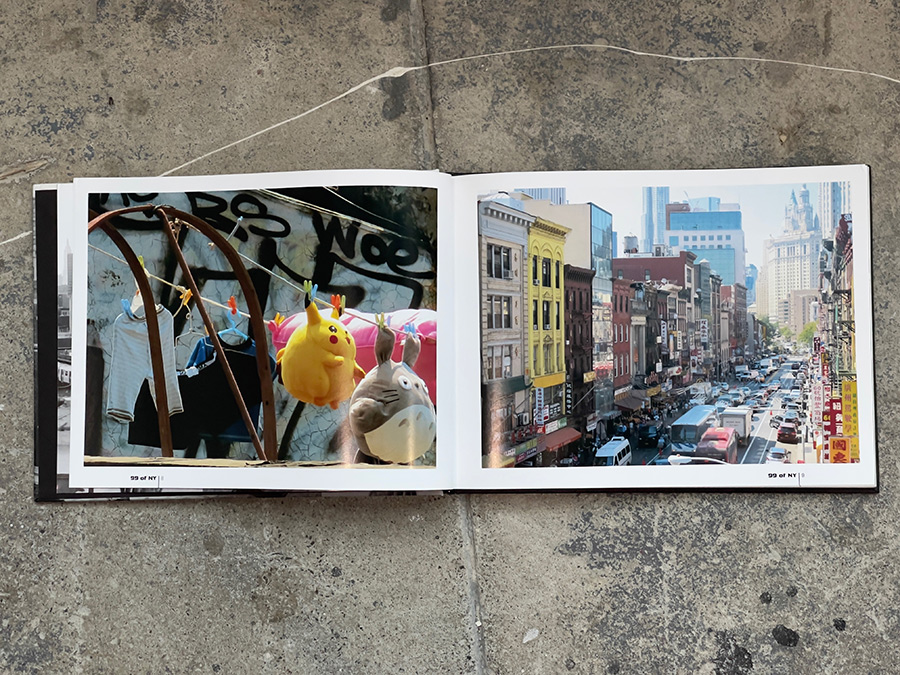
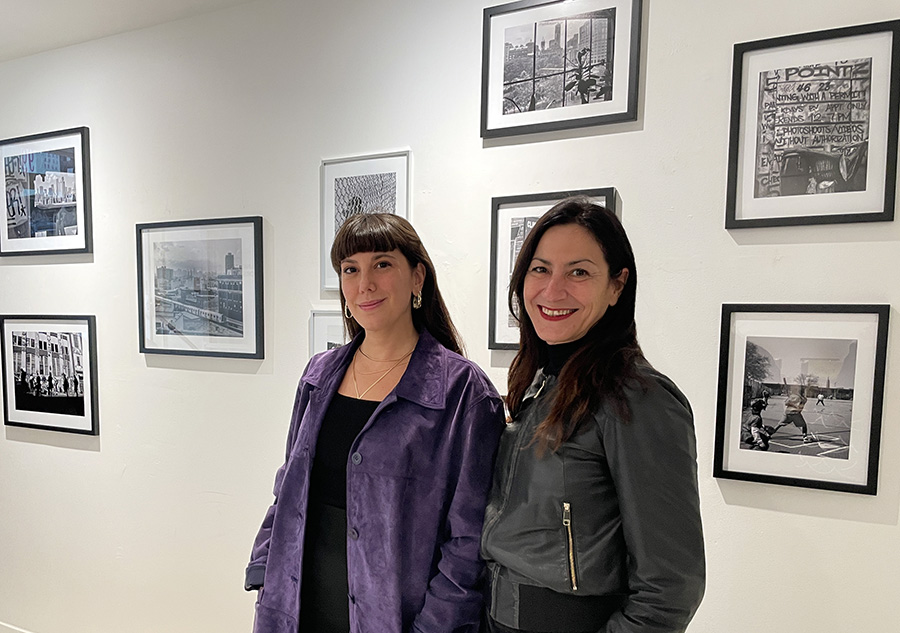
For one week this fall, BlankMagBooks in New York quietly hosted photographs by Sonny Gall from her new publication 99 of NY, released by King Koala Press with text by Mila Tenaglia. The exhibition was small but telling — a passing moment in the life of a project that had already taken a decade to form.
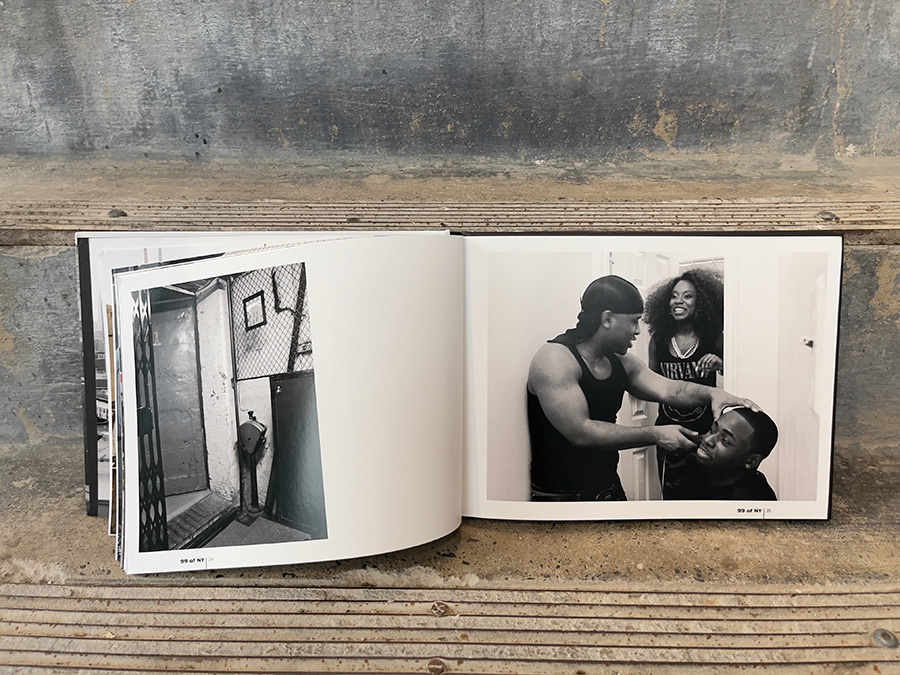
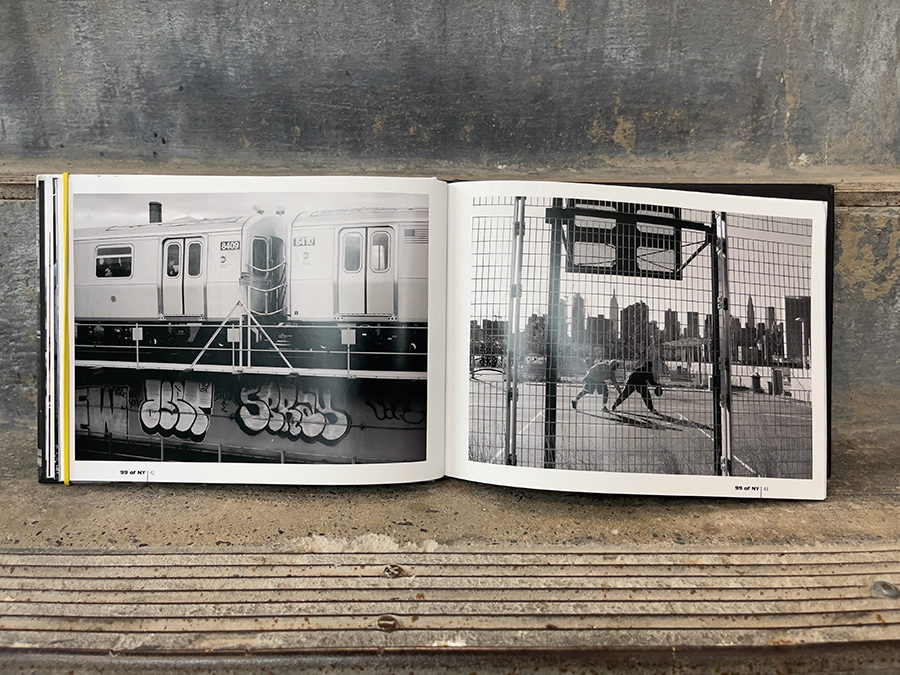
Described by the publisher as “a compositional and documentary endeavor that unfolded naturally over the course of a decade,” 99 of NY gathers 99 photographs across 110 pages, printed in both color and black and white, in a durable hardcover, album-sized format. True to King Koala’s limited-edition tradition, it’s a finely produced object — modest in scale and rich in substance — that rewards slow looking and quiet reading.
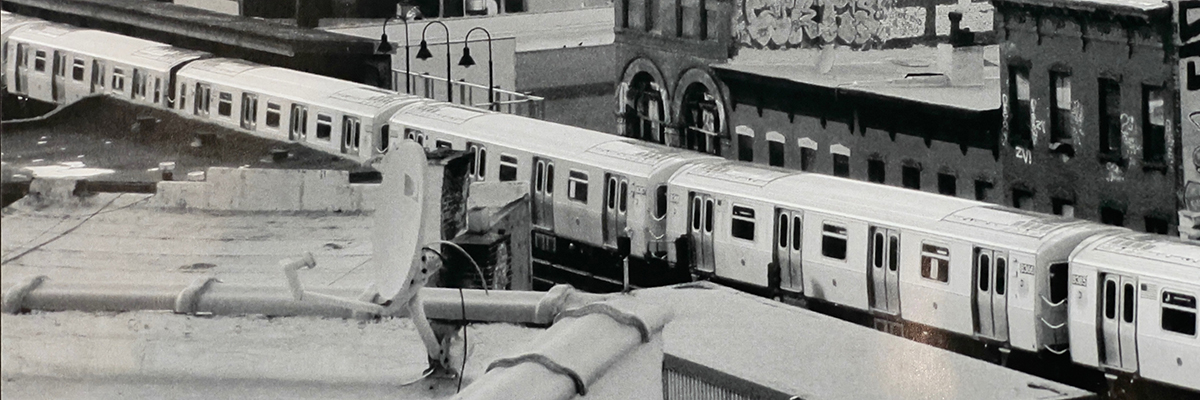
Gall’s images vibrate and render when leaning toward the overlooked: empty lots in Queens, warehouse walls, families at home, scattered pigeons, playgrounds under scaffolding. They are fragments of a living city seen with patience and affection, moments that feel at once offhand and deliberate. Tenaglia’s accompanying texts deepen those impressions without overexplaining, their language as sharp and unadorned as the photographs themselves, yet evocative of the unseen – with a poetic wandering appropriate for the attitude of discovery. Together they capture what it means to move through New York — not as spectacle, but as encounter.
Gall, born in Milan and long settled in New York, brings a deep familiarity with the city’s hip-hop and graffiti circles and a sensitivity to its architecture and light. Tenaglia, from Rome by way of Pescara, came to New York through journalism and documentary film, drawn to stories that find beauty in imperfection. Their partnership is grounded in trust, a love for street culture, and shared intuition: one sees, the other shapes the narrative.
99 of NY feels like the city it portrays — restless, imperfect, alive. The brief gallery presentation served as an echo of the book’s essence, but it’s the pages themselves that hold the weight: a decade or more of lived experience distilled into images and words that ask to be read slowly, with attention and care.
We spoke with Gall and Tenaglia about their work:
Brooklyn Street Art:When did you first begin to see yourself as a photographer, rather than simply someone taking pictures?
Sonny Gall: Honestly, I still see myself simply as someone who takes photos to satisfy a personal instinct and sense of pleasure. It was friends, acquaintances, and even people I didn’t know—my Instagram followers—who started calling me a photographer and encouraged me to pursue this project more seriously.
BSA:What do you feel you’re capturing in your photographs of New York — is it its people, geometry, pulse, or something more elusive?
Sonny Gall: What draws me in are all the things often associated with graffiti and street art—the play of colors, architectural contrasts, the diversity of people, and those small details that catch my eye on an aesthetic level. I tend to visualize compositions that I enjoy framing and coming back to later.
BSA:How do graffiti and street culture weave into the moments you frame — are they a backdrop, a rhythm, or a conversation within your images?
Sonny Gall: Graffiti and street art are what primarily capture my attention. I love framing them within the urban context of the city. They’ve become a defining element of my work, giving my photos rhythm, identity, and a distinctive character.
BSA:When did this project first take shape for you, and in what ways has your vision of the city evolved since then?
Sonny Gall:99 of NY was conceived in 2013 but stayed on hold for several years. Life happened, but the idea never left me. With the encouragement of friends and family, I realized I needed someone to help bring it to life. That’s when I reached out to my friend Mila Tenaglia, in 2021, during Covid. We had both moved from Italy to New York around the same time, sharing similar experiences and a deep love for the city. I immediately knew she would be the perfect partner—our visions aligned naturally. With her structured writing and my photography, we created something beyond a book: a visual and emotional portrait of a transforming New York—our New York—rapidly reshaped by gentrification.
BSA: If someone could not see these images, what would you want them to understand about them through your words?
Mila Tenaglia: I’d want the writing to pull readers straight into that chaotic, creative spiral that is New York — a city of bombed-out corners, tags, graffiti, and gestures that still breathe in the semi-illegality of pure expression. Every mark on a wall is an act of self-definition: it demands nothing, yet it insists on being seen. I hope that pulse — the urgency, the defiance, the raw emotion — can be felt even without the images, carried only by the words.
BSA: The city is chaotic and unpredictable — how do you capture its essence in language?
Mila Tenaglia: That’s a beautiful question — one I ask myself all the time. My life and my work, built around culture, people, and documentary storytelling, keep me on the streets every day. I live and work within the pulse of the city. After so many years here — in a place I can finally call home — I think I’ve absorbed something of its rhythm. Like a painter with a brush, I’ve tried to translate that rhythm into language, to turn what I see and live into words that still breathe New York’s restlessness.
99 of NY by Sonny Gall. Written by Mila Tenaglia. King Koala Press. Italy 2025
BSA: Whose words or voices have most inspired your own?
Mila Tenaglia: I’ve always been drawn to voices that carry both fire and fragility — writers who turn experience into resistance. Oriana Fallaci, with her fearless confrontation of power, taught me that truth has a pulse and a price. Patti Smith showed me how poetry can be lived — raw, unfiltered, born from the noise of the streets. Joan Didion taught me the precision of silence, how restraint can be as powerful as rebellion. And Rebecca Solnit, with her wandering intellect, reminds me that thinking and walking are the same act — a way of mapping the world through attention. Together, they form a kind of compass: their words move through chaos with grace, and that’s what I try to do too — to find beauty without erasing the struggle. There are many other names I could mention, but right now I feel like highlighting these voices in particular.
 BROOKLYN STREET ART LOVES YOU MORE EVERY DAY