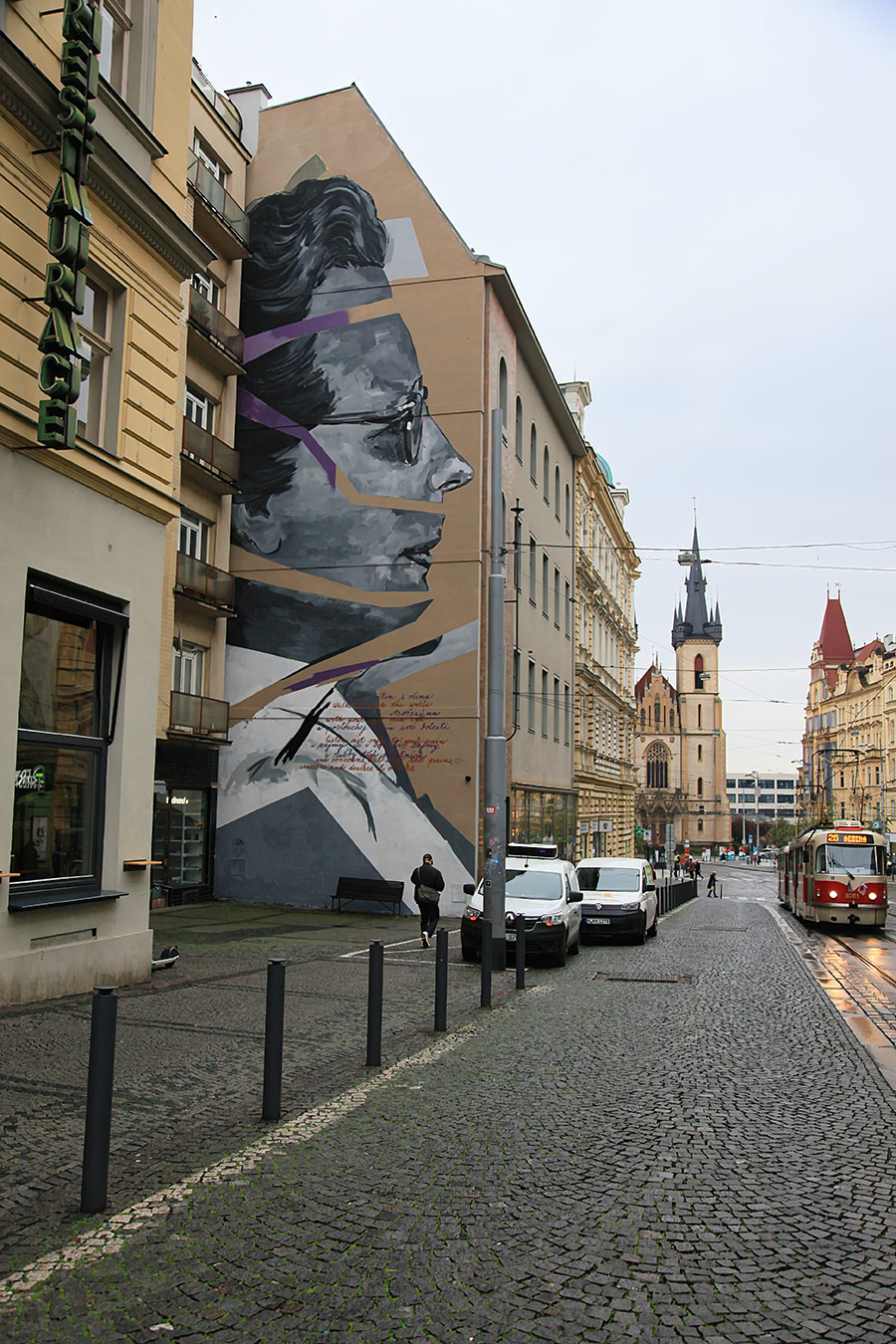
Berlin brings one of its unsung heroes to a wall this month as part of an Urban Nation mural program. On October 9, 2025, UN inaugurated “Akkord,” the newest addition to its long-running One Wall program—a series built on the premise that it is possible a single wall can carry a powerful message in a community. Created by the Berlin-based collective Innerfields, this mural rises above Schwambzeile 7 in Charlottenburg-Nord, transforming an ordinary apartment façade into a site of memory, artistry, and civic reflection. Following the One Wall charge, it’s meant to be public art with purpose: direct, accessible, and impossible to ignore.
Innerfields, who have operated at various times as a trio and a duo since forming in 1998, are well known in Berlin’s street art community for their blend of figurative realism and symbolic abstraction. Emerging from the city’s graffiti culture, they often explore the interplay between humanity, technology, and nature—our coexistence and our contradictions. Their murals are recognizable for their human subjects rendered with near-classical precision, often set against conceptual frameworks that invite reflection rather than spectacle.
For Akkord, the artists turned their focus to Maria Terwiel, a member of the German resistance executed by the Nazis in 1943 for distributing anti-regime leaflets. The mural’s imagery—Terwiel playing an accordion whose keys morph into those of a typewriter, with the sheet music transforming into the very leaflets she once duplicated—captures the merging of art, intellect, and defiance. The work’s title plays on the dual meaning of “chord” and “accord”: harmony in music, and solidarity in human endeavor.
The concept and design was developed through a workshop with students from the Anna-Freud-Schule and Akkord intends to be as much a pedagogical project as a memorial. It engages young Berliners in reclaiming a silenced voice – and translating history into visual language. In a city that wears its past in layers of paint, Innerfields’ wall may remind us that resistance can take many forms—and that in the right hands, even an accordion can be an instrument of liberty.
GO TO URBAN NATION BERLIN TO READ MORE ABOUT “AKKORD”, INNERFIELDS, AND THE ONE WALL PROJECT
Shoe IS MY MIDDLE NAME. Niels Show Meulman 2016. (photo courtesy of MCL)
Reprinted from the original review by BSA for the Martha Cooper Library.
Graffiti writer, calligrapher, painter, typographer—Meulman’s professional identities have long orbited the written mark. “Shoe Is My Middle Name” gathers those decades-deep orbits into one gravitational field, presenting a mid-career survey whose scale and heft match the artist’s sweeping gestures. Photographs of murals, canvases, and poetry scrolls are sequenced chronologically yet feel rhythmic, echoing the repetitive muscle memory that turns letters into pictures.
The early chapters recall a precocious Amsterdam teen who imported New YorkWild-Style back to Europe after meeting Dondi White, while later spreads document how that fluency in urban letterforms morphed into what critics dubbed “calligraffiti.” Ink splashes, broom-wide strokes, and squeegee drags demonstrate Meulman’s commitment to an all-in mark: once pigment meets surface, there are, as he writes, “no half steps.” Quotes, diary fragments, and the full-page poem “A Writer’s Song” punctuate the visuals, anchoring grand abstractions in an autobiographical voice both swaggering and reflective.
Shoe IS MY MIDDLE NAME. Niels Show Meulman 2016. (photo courtesy of MCL)Shoe IS MY MIDDLE NAME. Niels Show Meulman 2016. (photo courtesy of MCL)
Title: Shoe IS MY MIDDLE NAME Published: Lebowski Publishers / Overamstel. Amsterdam, 2016. Author: Niels Shoe Meulman Language: English
Graffiti is a living monument—an act of doing rather than keeping.
Rafael Schacter has been offering an alternative to institutional monumentality in his latest book Monumental Graffiti (2024). He buttressed his alternative view during his keynote speech for the New York 2025 Tag Conference (BSA is a sponsor). To a packed audience at the Museum of the City of New York, Schacter talked about a monumentality that is grounded in community, embodiment and the acceptance of transience as truth.
Rafael Schacter. Monumental Graffiti. Tracing Public Art and Resistance in The City. MIT Press. 2024
In his talk and his book, the London-based art historian argues that monuments and graffiti can illuminate each other: monuments don’t need to be grand or permanent, but can be understood—as their Latin root monere suggests—as acts that remind, advise, or warn. Drawing on counter-monuments and non-Western traditions, he would like to redefine monuments as socially and emotionally engaging public artifacts that may be ephemeral, community-driven, and conceptually monumental rather than physically imposing.
Using images and examples from streets around the world, Schacter, who is also the author of The World Atlas of Street Art and Graffiti, furthers his vision by exploring how graffiti can itself be a monumental form, demanding public attention and reframing both graffiti and monuments as cultural acts that mark and speak socially. He then examined memorial practices within graffiti culture, where community-created walls and tributes function as grassroots monuments that commemorate loss and address social issues.
A curator and theorist of urban art, Schacter expands on this, distinguishing between spraycan memorials—visible, collective, and community-respected—and memorial tags, which he describes as intimate, cryptic gestures of remembrance shared within the subculture. Schacter contrasts these living practices with the illusion of permanence accorded institutional monuments, showing how graffiti’s embrace of impermanence subverts traditional ideas of stability and authority. Finally, through his discussions of memory through disappearance and the memorial tag as embodied memory, he proposed that graffiti’s transience itself becomes a vessel for remembrance, where memory endures not in material form, but in repeated acts of writing, risk, and presence.
We asked Schacter about the nature of monuments in graffiti and street art—whether an illegal wall piece can ever transcend vandalism, what happens when a tag vanishes, who decides what deserves to be remembered, and whether a true monument is built from the ground up or imposed from above.
BSA:If graffiti can be a monument, what happens to the idea of permanence? You describe monuments as “reminders, warnings, and advice” rather than fixed objects. For people used to thinking of monuments something of bronze, stone, or concrete, how could one reconcile the beauty of graffiti’s impermanence with our instinctive desire to preserve something that we value?
Rafael Schacter: Great question! So many points I could spend hours unpacking! But, to keep myself focused, the key thing to note here is that preservation is by no means only related to permanence; i.e., the relationship between remembering and forgetting on the one hand and presence and absence on the other, is really not so straightforward:
Is it not true that things that are ever-present are often the most easy to forget?
In many cultures outside the West, for example, destruction is something that is core to techniques of commemoration – the heat of destruction burning memory into mind. And in cities crammed with institutional monuments, with thousands of bronze men on horseback, is it not the case that they often seem to, in fact, provoke amnesia!
Is it not a fact that things that become absent are often the most intensely memorable?
I totally agree that graffiti’s impermanence can be beautiful (often physically so, in terms of the way it degrades and becomes part of its surroundings), but more than just beautiful, its disappearance can lead to a heightened sense of memory; let alone push the focus towards the beauty of practice and performance and not just the beauty of the final image itself.
BSA:Who decides what’s worthy of being a monument? Normally it is the decision of institutions or governments, but this new path suggests others may decide what is worthy of monumentalizing. A monument created bottom up or top down – which is a truer monument, or is that a silly question?
RS: Ha! Not silly at all! I’m currently in the middle of teaching my lecture course on public art, and this is a critical part of what we’re discussing. So yes, in most of our cities, this is in fact a legal question – in England, for example, there is what is termed the Schedule of Monuments, a list defining and delimiting what appears under this term, and there is specific legislation surrounding what happens if an artefact is within the list. But, as you say, monuments – monuments as public artefacts or inscriptions that remind, advise, or warn us – come not just from the State but so too from the grassroots. Sometimes these non-state monuments can become formally sanctioned, but whether they do or not, they can be incredibly powerful forms that exist far beyond the necessity or even visibility of officialdom. Which form is ‘truer’ or more ‘authentic’ is always context specific, however.
But all I personally know is that I can be moved more by a spontaneous shrine than by an institutional memorial, by the handwritten note attached to a bouquet of flowers laid by the side of a monument than I could be by the monument in itself! More than anything I just want to move us away from only seeing these permanent, stoney, neo-classical public sculptures as monuments, and in fact see the way monuments can exist through diverse materials and in diverse locations outside of the confines of officialdom.
BSA:If a tag disappears, does the monument die—or does it live in memory? Certainly its disappearance and decay impacts its ability to have lasting impact.
RS: How do we remember things? Do we remember from looking at them? And how do we look at them? Do we look differently when we know something is not going to last? But what about not just looking! Can we remember things through a set of gestures? Through a movement? Through a dance? Can we remember something via lighting a candle that we know will burn out?
When things disappear, memory can often burn even brighter – the presence of absence often being more powerful than physical presence itself. So yes! Disappearance effects visibility, the ability to be co-present with an image, but the image can live on both in the person that made that image as much as in those who saw it, and saw it knowing it would at some point disappear!
BSA:Does a city full of graffiti become a city full of monuments? If we take the argument to heart, then every wall might hold a kind of public archive or memorial. Is a monument made by a vandal illegally still vandalism, or should it be honored and preserved for posterity?
RS:First, YES – when I say graffiti is a monument I mean that literally not metaphorically, and so absolutely yes, the walls of our cities are a constantly transforming archive that holds immense amount of information and history. Whether we term this vandalism or not actually makes no difference. (But is it not the overbearing monuments of the city that are themselves vandalism, themselves the destruction and the blight that damages our cities – I mean, I can think of plenty of examples of large-scale public art that are total degradations of our public sphere). Yet that doesn’t mean I think graffiti should be preserved, absolutely not. Preservation, as I talk about in the book in terms of examples of indigenous material culture, can often itself be destructive. If you preserve something, freezing that thing in time, you can often be more likely to forget what it represents than if you let it naturally degrade. Preservation, then, can be destructive, and destruction preservative!
BSA: Graffiti has turned up in unexpected corners of sacred buildings — scratched into the walls of Christian churches, carved into stone lintels of synagogues. They may be names, coats of arms, or a portrait of the parish cat. When you think about these quiet, unauthorized marks across different faiths, how might your idea of graffiti as a kind of monument apply to them?
RS: I love the idea of what you term ‘quiet’ here. Because often it is the smallest, most marginal, minor forms of graffiti that can be the most powerful. Yes, big graffiti is GREAT, and often very overtly monumental (I’m thinking of the incredible work of RAMS MSK at the moment for example). But smaller marks can be monumental in their effect too, a tiny tag at the edge of a wall containing as much style as a massive masterpiece. So yes, monument is not simply about size. Bigger is not necessarily better. And sometimes it’s the smallest marks that cut the deepest!
Rafael Schacter. Monumental Graffiti. Tracing Public Art And Resistance in The City. The MIT Press. Massachusetts Institute of Thechnology. 2024. USA.
If you were in the room Friday night at The New School, you caught Matteo Pasquinelli throwing down ideas that lit up the crowd with his keynote “AI and Madness: On the Disalienation of the General Intellect.” It kicked off the Vera List Center Forum 2025: Matter of Intelligence—a weekend asking who gets to define intelligence and what happens when machines, bodies, and institutions all start claiming a piece of it. Later, over a community dinner, we met artists, curators, journalists, researchers, and assorted brainiacs who traded stories about neural nets, algorithms, kimchee, pulled pork, and tarot card readings that were available at many tables.
The rest of the weekend unfolded in forums with titles that could’ve doubled as concept-album tracks: “Embodied Intelligence: The Art of Sensing,”“Artificial Agency and Autonomy,”“Collective Intelligence and the Politics of Data,” and “Unlearning Intelligence.” If the weekend has a takeaway, it’s that intelligence isn’t something we own; it’s something we’re swimming in. Like all the street art and graffiti that city dwellers are surrounded by daily on walls, trains, doorways, and fences – it’s not exactly organized by algorithm, but patterns do emerge if you care to decode them.

So here’s our weekly interview with the street, this week featuring CKT Crew, Dain, Dmote, Dream, Famen, King157, KNOT!, Luch, Mr. Cenz, OptimoNYC, Phetus88, SHOCK, Skulz, Staino, Stevie Dobetter, and Sweater Bubble.
Sometimes street art festivals run headlong into battles with local politics or corporate brands that believe murals should only be decorative—certainly not inclusive of certain communities or certain politics. To be clear: all art is political. If you like a mural, chances are it aligns with your worldview. Don’t make the mistake of believing otherwise.
Last year, MIAU Fanzara ran squarely into that truth. In early 2024 the local council introduced a “facades ordinance” demanding prior approval of sketches—an a priori filter on themes and imagery that organizers publicly rejected as censorship. With organizers refusing to comply, the 2024 edition was “paused.” Over the summer, it appears that the dispute widened, drawing criticism from cultural bodies and press coverage that framed the rule as a curb on artistic freedom. In September, the council rescinded the ordinance—but it also withdrew the long-standing €6,000 municipal subsidy, a small but symbolically vital line that had helped the festival function, according to new reports and locals.
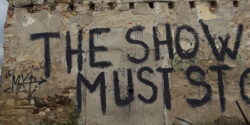
This year, the money didn’t return—but the people did. In 2025, neighbors opened their walls, volunteers handled logistics, and artists worked without fees. MIAU’s ninth edition went ahead without public subsidies, sustained by community energy and a shared conviction that public space is for public voices. All of this sounds rather like the vox populi itself — unruly, creative, and unwilling to be managed by decree. The result wasn’t just a program; it was a popular mandate painted on stucco and brick.
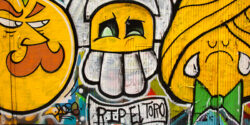
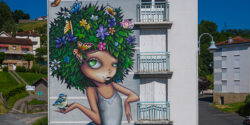
What follows is a selection from this year’s walls: pieces that speak in bright, unvarnished tones about memory, ecology, migration, gender, and the everyday. Funding can be cut. A festival can be paused. But when the people choose color over silence, the paint somehow finds a way.
Thank you to photographer Lluis Olive for sharing new shots of MIAU 2025
To read more about the censorship battle at the Fanzara “MIAU Festival”:
“Fanzara se queda sin festival de grafiti tras 10 años por la nueva norma municipal del PP” — El País (July 6, 2024). A report on the 2024 cancellation after the facades ordinance imposed prior screening of murals. (El País)
“Fin al bloqueo del MIAU de Fanzara nueve meses después: el Ayuntamiento aprueba por unanimidad retirar la Ordenanza municipal de fachadas” — Cadena SER, Radio Castellón (September 7, 2024). On the council’s vote to withdraw the ordinance and the simultaneous end of municipal funding. (Cadena SER)
“El festival de grafitis de Fanzara sobrevive al intento de censura previa con la solidaridad de vecinos y artistas” — El País (July 5, 2025). Coverage of the 2025 edition returning without subsidies, powered by residents and volunteers. (El País)
(Additional context: El País summarized the ordinance’s withdrawal and loss of the €6,000 grant on Sept. 7, 2024; local outlets like Castellón Plaza and NMPNU documented the 2025 edition proceeding “a pecho descubierto,” without public funds. (El País))
Seth: On Walls. Julien Malland. 2023. (photo courtesy of MCL)
Reprinted from the original review.
On Walls presents a decade of mural work by French street artist Julien Malland, known as Seth Globepainter. Published by Editions de La Martinière and distributed by Abrams, the book documents Seth’s travels through urban and rural communities worldwide, placing his distinct visual language into diverse local contexts shaped by history, conflict, and transition.
Seth’s imagery blends saturated palettes, geometric constructions, and elements of folklore. His recurring figures—faceless children—are staged within environments that suggest both vulnerability and resilience. Across 256 pages, On Walls traces a path from Phnom Penh to Palestine, from Haiti to Ukraine, each mural shaped by the physical and social landscapes where it was created.
Seth: On Walls. Julien Malland. 2023. (photo courtesy of MCL)Seth: On Walls. Julien Malland. 2023. (photo courtesy of MCL)
Title: SETH on Walls Published: Editions de La Martiniere. 2022. Distributed by Abrams. An imprint of ABRAMS, 2023. Author: SETH Language: English
Welcome to BSA Images of the Week. This fall in New York institutional museum offerings, people are checking out “Sixties Surreal” at the Whitney, “Robert Rauschenberg: Life Can’t Be Stopped” at the Guggenheim, “Coco Fusco: Tomorrow, I Will Become an Island” at El Museo del Barrio, Yvette Mayorga’s “PLEA$URE GARDEN$” Midnight Moment in Times Square, “Monet and Venice” and “Seydou Keïta: A Tactile Lens” at the Brooklyn Museum.
The Whitney offers all Fridays free from 5–10 p.m., every second Sunday free, and if you’re 25 or under, it’s always free. The Museum of Modern Art welcomes New York State residents free of charge every Friday from 5:30–8:30 p.m. (proof of residency required). The Solomon R. Guggenheim Museum invites visitors to pay what they wish on Mondays and Saturdays from 4–5:30 p.m., with a suggested minimum of one dollar. The New-York Historical Society follows suit with pay-as-you-wish admission on Fridays from 5–8 p.m. And for those who prefer art in the Bronx, the Bronx Museum of the Arts remains free every day of the week. And right here in Brooklyn, the Brooklyn Museum opens its doors every First Saturday of the month from 5–11 p.m. for free admission with registration, and visitors are always welcome to pay what they can at the desk.
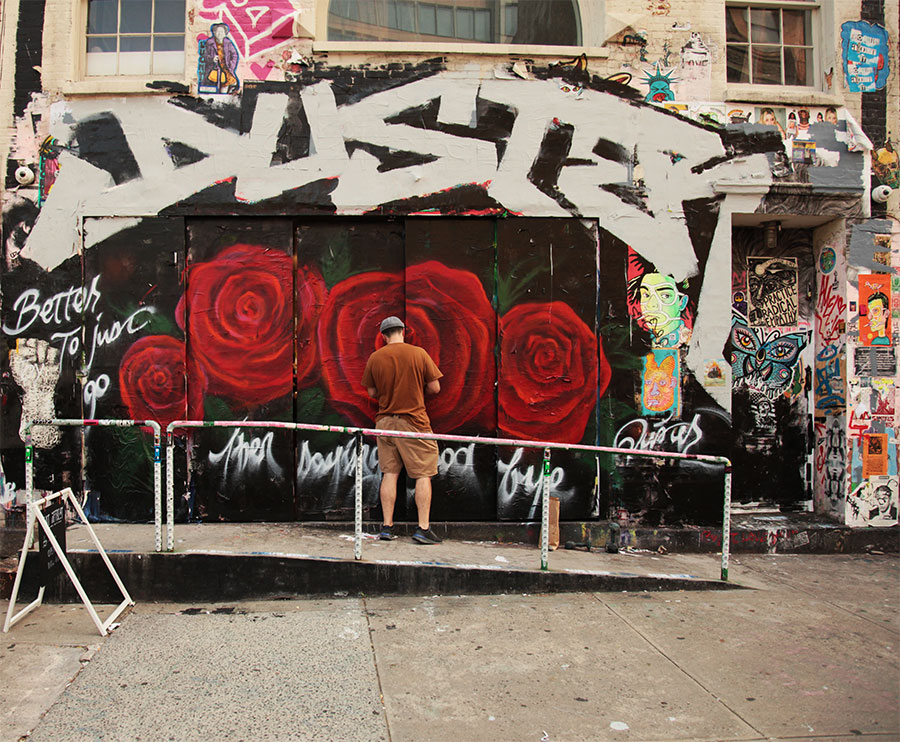
Meanwhile, much of our street art is busy with cats, pop icons, ambient dread, and general sweetness. For anyone assuming the scene remains activist or subversive, evidence is not plentiful. Still, it photographs beautifully.
Here is our weekly interview with the street, this week featuring Chloe, I Am Frankie Botz, Jappy Agoncillo, Jeff Rose King, Kam S. Art, Lucia Dutazaka, Mad Villian, Man in the Box, Manuel Alejandro, Nandos Art, Rommer White, Sonni, Sophia Messore, and Tone Wash.
Not that you don’t have free will and could quit your phone any time. Of course, you could.
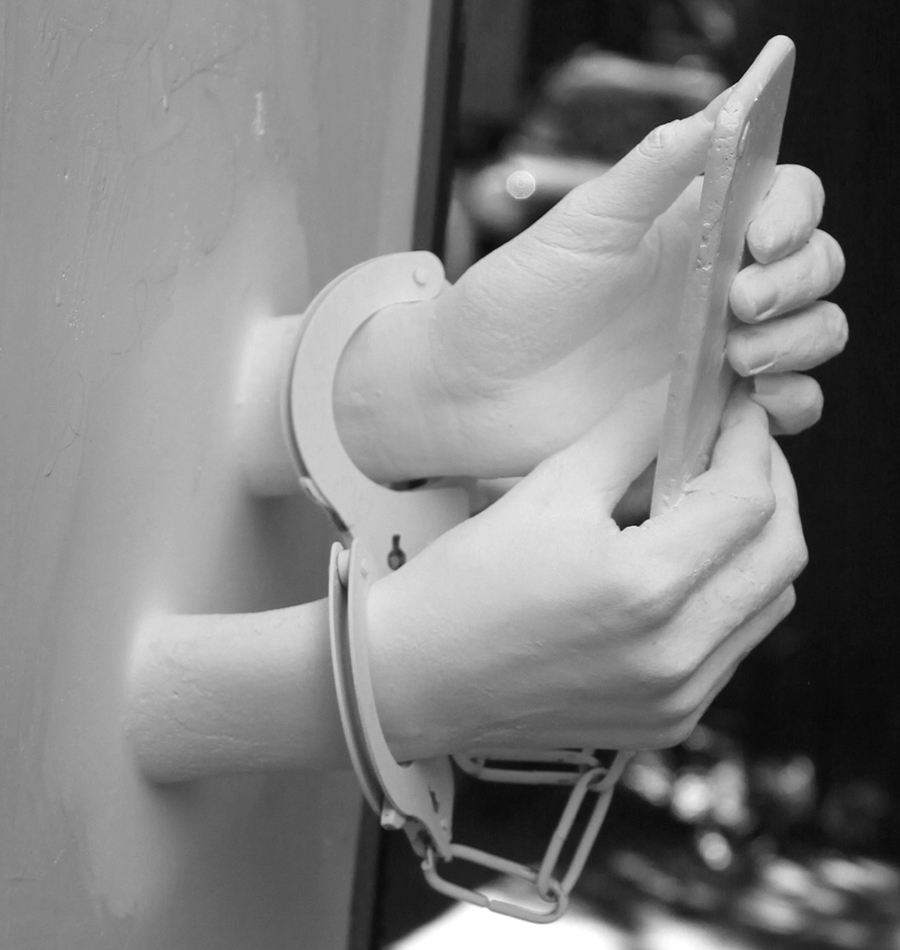
Street artist Leon Reid works conceptually often, and in this case, as a sculptor alongside you on the street in Bed-Stuy, Brooklyn. The message is self-explanatory, and yet, you would have to look up from your phone scrolling to see it, so many will miss it.
Brooklyn Street Art:The sculpture depicts a pair of handcuffed hands holding a mobile phone. The hands are restricted, yet the work’s title is “Of a Free Will”. Can you please elaborate? Leon Reid: Many times when I observe people holding their smartphones I ask “Is that person holding their phone because they want to or they need to?” It’s impossible to answer completely but still I wonder. 15 years ago, many folks used smartphones because they were curious about the potential of a new tool. Of course, advertising guided most people to buy smartphones, but then social media slapped advertising in everyone’s face 24/7/365. This exposure weakened the argument that we’re all using our phones because we want to. The infrastructure of our society is now designed around smartphones; you can’t enter certain buildings without it; in some cases you can’t travel, eat or see a doctor without it. I believe that we as a society decided to freely carry out the Free Will of technology corporations; we cuffed our own hands to it.
BSA:You’ve been installing your work in public for a long time. Have you noticed any differences in the difficulties inherent in installing works on the streets from the early days of your practice to today’s environment? LR: Yes, when I started writing graffiti in 1995, in most instances, we did not have to worry about surveillance cameras recording us; there simply were fewer cameras in existence.
Though I am not active as a graffiti artist as I once was, those doing it now must be prepared to be filmed -in fact many film themselves. The further you go back in graffiti history the more artists had to operate like ninjas. Stealth was a quality that was honored among writers. However, the exposure of graffiti and street-art through documentation has brought a broad acceptance of the art from -one that I never expected to see- so that many times artists can do their work in public with permission.
BSA: You mentioned that your work was defaced/vandalized within days of being put on the street. Why did you choose to restore it? LR: So this piece has gotten a lot of attention in the neighborhood because I believe most people are at a point where they can understand its message. Within a week, someone added two additional messages to the work; one was a statement about Immigration enforcement, the other about the Israel/Gaza War. I have my opinions on both of these topics however the markings made three unrelated messages on one artwork and they distracted from the original message. I removed the additional messages, but was conflicted in doing so. I’ve long known that once an artist puts their work on public display, they cannot control how the public interacts with it. If the messages persist, I have to let it be.
BSA:How has the rapid evolution of technology, such as the sophistication of smartphones, the apps, and Social Media, changed the way in which art is experienced now? Are there any pros or cons in your opinion? LR: So, in my ideal world, everyone would have the possibility to see great works of art -be it on the streets or in a museum- in person. This for a variety of reasons cannot happen. Most of us will only see great works of art through media. However sometimes, a great photographer can capture a great work of art in a moment; perhaps a child is able to touch a graffiti wall because they cannot do so in a museum, a photographer is there to snap the moment and the picture becomes a symbol of what that artwork can mean to people. If this photograph inspires people to see the work in person that is a pro. The con is if so many people turn up not to look at the work, but to photograph themselves beside it. If such a thing happens too much it can alter both the community where the work lives and the meaning of the work itself.
“Of a Free Will” is part of a larger street-art exhibition organized by Novo Collective titled “Playground of the Invisible”
POLINIZA DOS (or “Polinizados”) is the annual urban-art program at the Universitat Politècnica de València (UPV), running since 2006 and turning the Vera campus into a working outdoor studio each May. It’s organized by UPV’s Área de Acción Cultural and built around site-specific murals by invited artists—recent lineups have included 108, Lidia Cao, Musa71, Felipe Pantone, Gordo Pelota, Wasted Rita and Catarina Lira Pereira—alongside public programs like artist talks, guided walkthroughs (often led by painting professor Joan Peiró), and family workshops under “Menudo Poliniza”.
Some past editions have also added fanzine markets and campus exhibitions. With support from the Generalitat Valenciana’s Department of Education, Culture and Sport, the festival’s 20th edition (May 12–16, 2025) emphasized some of the “gestural” languages of contemporary muralism and produced fresh interventions – with an educational track open to the public. The works typically remain on campus from one edition to the next, a sort of living record of Valencia’s evolving perspectives and voices in street culture.
Our special thanks to photographer Luis Olive Bulbena, who provided some images of his recent visit to the campus.
Welcome to BSA Images of the Week. As Fall arrives the leaves turn, the lattes spice up, and Washington does its ghoul impression by shutting down the government, shuttering what’s public while pretending it’s principled. This great pumpkin is being hollowed out, and some appear to be waiting for it to collapse. Ah, but we’ve had these tricksters at our door before, their masks artfully placed.
Happily, street art runs the gamut, and not all of it is scary, despite the times. The first piece in this week’s collection seeks to be reassuring by quoting Bob Marley’s song Three Little Birds, when he sings, “Don’t worry about a thing because every little thing is gonna be alright”. (see the video at the end of today’s posting)
Let’s see what the street art tea leaves are saying. Here is our weekly interview with the street, this week featuring Barbara Galiniska, Below Key, Gane, Hope, Jason Naylor, Merk, Mike King, Miki Mu, Modomatic, Pin, Steph Costello, and Tover.
A new show brings together three artists whose work has created instantly recognizable visual systems that rely on repetition, symbols, and cultural icons. While two are rooted in unsanctioned work in public space and the third is identified with the gallery and market system, all three have generated debates about art’s role in mass culture and have extended their practices into new contexts through collaboration.
Shepard Fairey (US) began in the late 1980s with his Obey Giant sticker campaign and became widely known for his 2008 Hope poster for Barack Obama. His work blends graphic design, propaganda aesthetics, and pop culture, often described as politically engaged and connected to punk and DIY culture. Fairey maintains a long-standing commitment to public space through posters, murals, and interventions, while also working in galleries and commercial arenas worldwide.
Invader (France) began in the late 1990s and is known for his prolific and, some would say criptic, ceramic mosaic “invasions” of pixelated characters installed on city walls. His work is described as playful, systematic, and grounded in both nostalgia and the strategies of street art, with thousands of pieces spread worldwide with a marketing panache that rivals the other two show men here. Invader’s practice is fundamentally based in unsanctioned public interventions, making urban space his primary exhibition surface.
Damien Hirst (UK) rose to prominence in the late 1980s and 1990s as part of the so-called Young British Artists, a term that is evergreen and could easily be applied today or any day, but that is a different story. His work spans installation, painting, and sculpture, often addressing themes of mortality, spectacle, and the value of art in the market. Overlapping his show mates practices, Hirst has created large-scale outdoor sculptures and commissioned public displays, but unlike Fairey and Invader, his practice is not rooted in unsanctioned public space and is primarily mediated through institutions and collectors.
Triple Trouble underscores both the divergence and overlap in the practices of Fairey, Hirst, and Invader. Fairey and Invader bring decades of direct engagement with unsanctioned public space, and Hirst’s influence has been shaped through institutional and market frameworks, yet all three employ systems of repetition and iconic imagery that reach wide audiences. By staging collaborative works one may examine the point where street culture, contemporary art, and mass media converge. Conceptually the theme stretches each to meet the other, and in the process, clears new ground for experimentation – while illustrating the individual practice in stronger relief
Newport Street Gallery in London, in association with HENI, presents Triple Trouble (10 October 2025 – 29 March 2026), an exhibition of new collaborative works by Shepard Fairey, Damien Hirst, and Invader.
“Finding ‘an ALO’ in East London is something like stumbling across treasure.”, say Lara and Greg, curators of a new show of his work this month.
Italian-born, Hackney-based painter ALO (Aristide Loria) returns to BSMT with BARDO, his third solo exhibition at the Dalston gallery. Often described as an Urban Expressionist, he brings drawn, pattern-rich portraits from his street illustrations into the gallery, working with brushes, paint, and pens rather than spray. His practice grew in public view—portraits that could be found on doorways and arches—and here they are grounded and approachable.
BARDO opens with a private view on October 2nd and runs through the 12th, presenting 33 new works made during the last two years. Taking its title from a liminal “in-between,” the show holds figures in a quiet pause, with city and nature edging into frame. It’s a continuation of ALO’s steady line between studio and street—precise mark-making, bright palettes, and a human presence you may stumble upon outside or inside BSMT.
ALO (photo courtesy of BSMT)ALO (photo courtesy of BSMT)ALO (photo courtesy of BSMT)
Visit the Exhibition
“BARDO”. Opening, October 2nd, 6-9 pm
The show runs from October 3rd to October 12th, 2025.