BSA Film Friday: 01.27.17

BSA Film Friday: 01.27.17

bsa-film-friday-JAN-2015

Our weekly focus on the moving image and art in the streets. And other oddities.

Now screening :
1. Dripped on The Road/ Episode One
2. Dripped on The Road/ Episode Two
3. RURALES
4. D*Face at “Unexpected” in Northwest Arkansas


bsa-film-friday-special-feature

BSA Special Feature: Dripped on The Road/ Episode One: Jamaica Moon.

Following closely on the heels of our story yesterday of graffiti in rural Morocco by city-based originators of aerosol sprayed tags and pieces in the US and Europe (some of whose first mark-making began in the 1970s), here we have a new video series about a traveling artist residency of formally educated twenty-something creators whose temporary home base is an RV taking their street practice across country. The routes, eras, and participants are different, but there are many overlapping themes.

While you are crafting definitions for urban art and Street Art, here are newer practitioners endeavoring to observe and define according to their background and experiences – all in a sort of self-observing therapeutic environment. While remarkably different from the originators of the graffiti/Street Art scene in many ways, each is looking to explore and embrace the possibility and freedoms afforded.

It’s good to see artists pushing beyond their personal comfort zones and studying their process for accessing the creative spirit to share. For some it’s a long way from “getting up” in traditional street parlance but it is still fundamentally about “getting up”.


Dripped on The Road/ Episode Two: The Stand Back. From Elixir Motion Picture


RURALES

Now to the Polish pig farms! Another Street Art/Mural road trip movie, this time across Poland with JAYPOP, Seikon, Krik KONG and filmmaker Cuba Goździewicz. See the discoveries, the relationships, the reactions to the work from a warm and considered human perspective.

The beauty of randomness and the randomness of beauty. These guys are fully engaged with their surroundings, the opportunity, the myriad people they befriend or portend to make allies. It’s an uncharted trip where permissions are sought and often refused, but they never stop painting somehow.

Seeing the work here on barns and sheds and even a small car, these are paintings they still call graffiti. With cats and cows and chickens and horses nearby, the new murals and illustrations still feel integral, like a continuation of a conversation.


D*Face at Unexpected in Northwest Arkansas

“I guess this year it’s like a two part mural/installation”, says London Street Artist D*Face of his second annual project with the JustKids organization.

“It feels like you can make a change here. Like you could really make an impact,” says D*Face of his enormous immersed arrows the size of telephone poles in Fort Smith, Arkansas.

A well known international artist, curator, gallery owner, D*Face nonetheless is drawn by something stronger than fame in the city “They are much more appreciative of people coming here and trying to do something positive.”


Read more
Where Graffiti Art Is The Rose of The Desert : Spraying Outside the Jardin

Where Graffiti Art Is The Rose of The Desert : Spraying Outside the Jardin

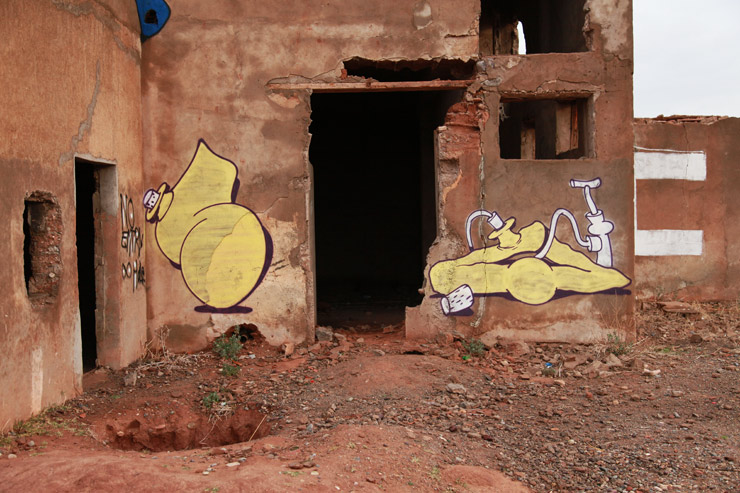
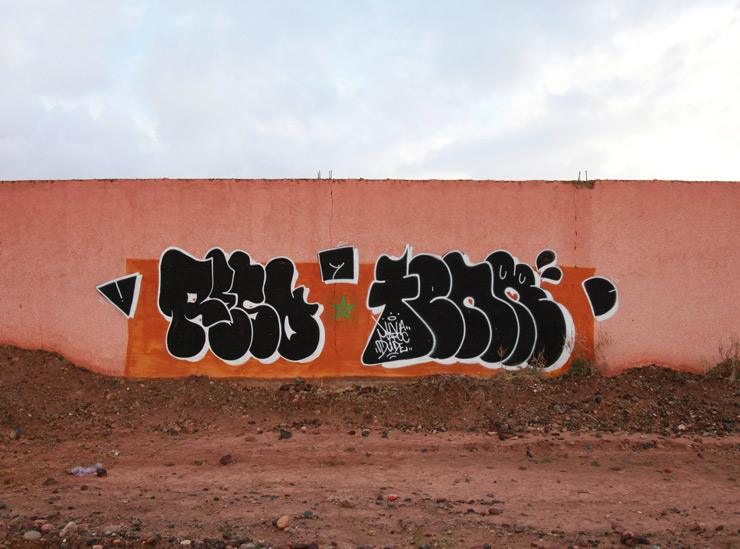
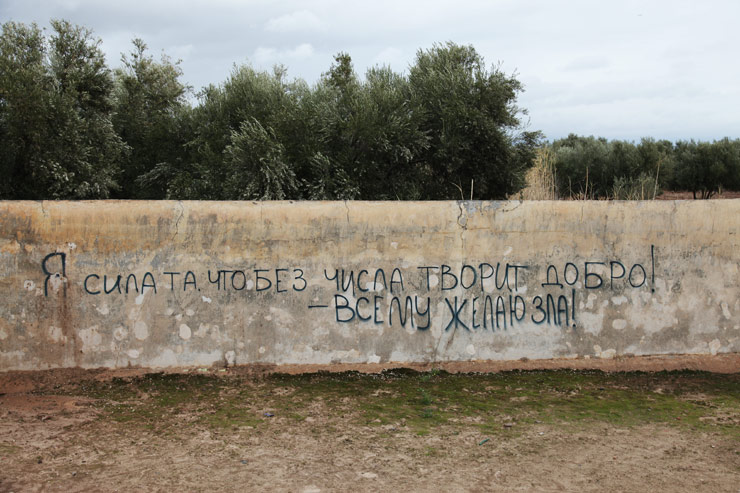
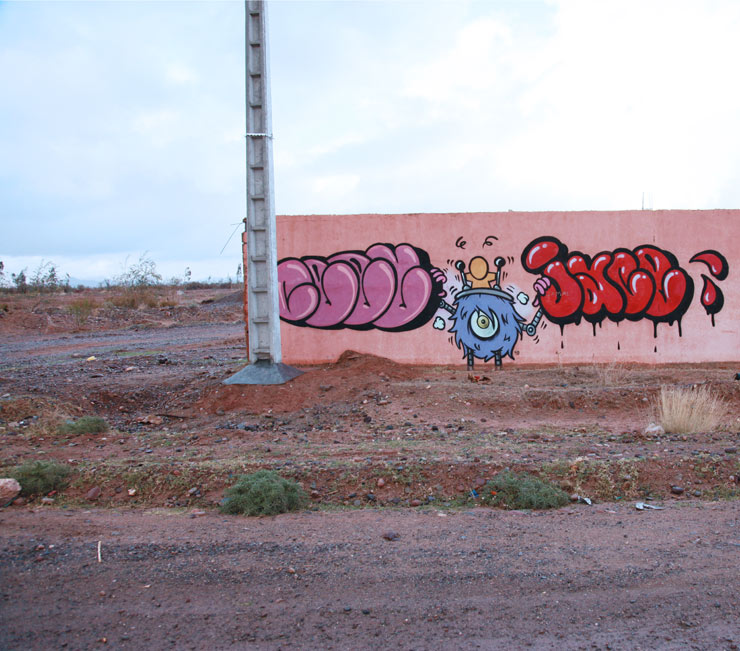
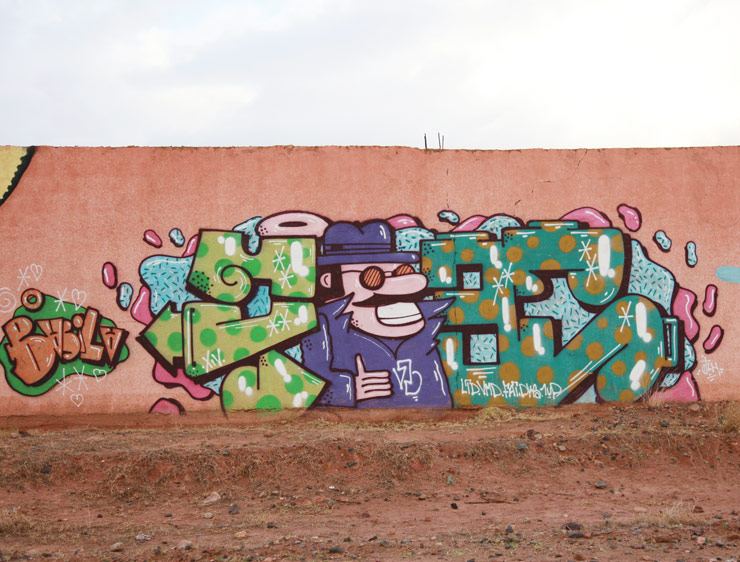
When you are a renowned graffiti writer living 25 minutes outside of Marrakech at an artists compound and painting in your studio to prepare for an upcoming exhibition on canvas, sometimes you still are activated by wanderlust to go out and catch a tag. Or something more elaborate.

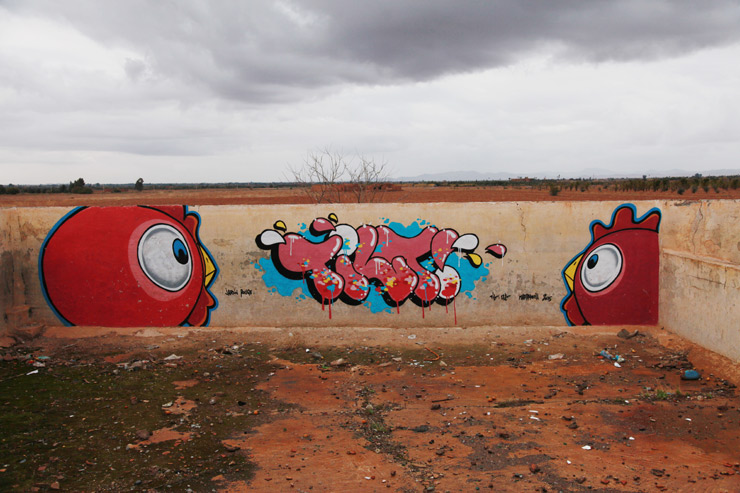
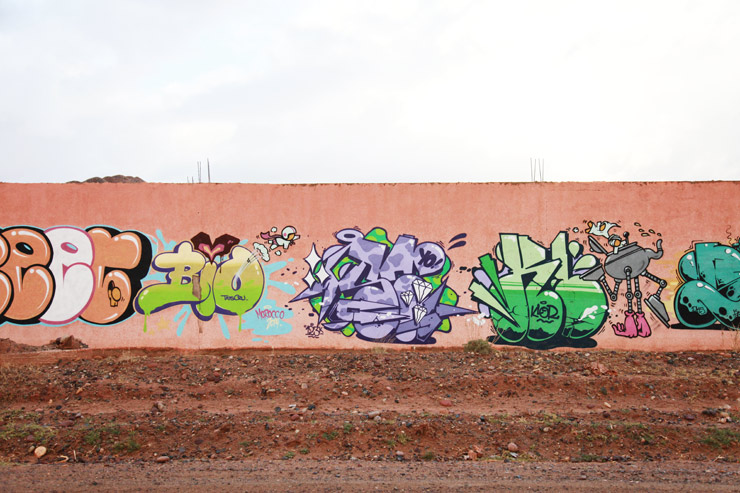
Ceet . Tilt . Clone. Jardin Rouge, Morocco. (photo © Jaime Rojo)

Jardin Rouge has hosted some of best known American and European graffiti writers such as members of Tats Cru, Daze, Ceet, Jace and Tilt as well as Street/Mural Artists like Kashink, Mad C and Hendrick Beikirch (ECB) over the past few years, inviting them to paint and sculpt new works in roomy quiet studios and on the buildings of the property itself.

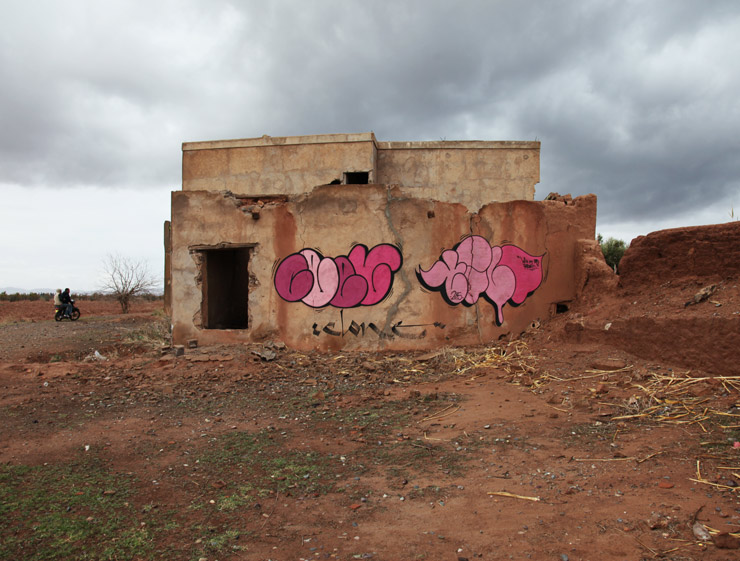
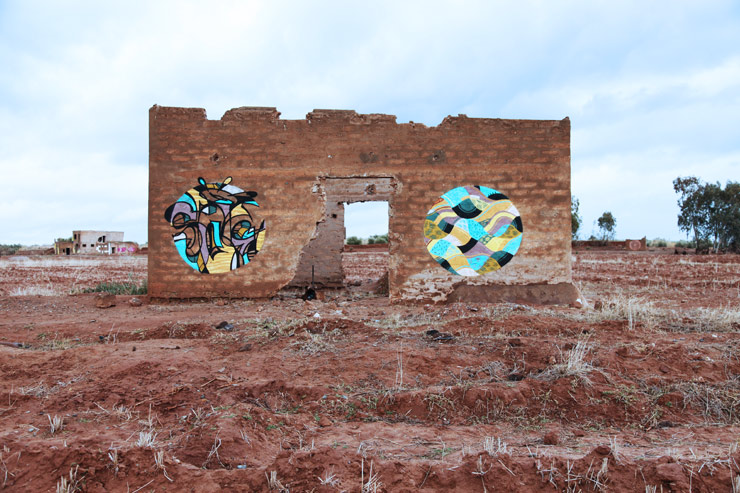
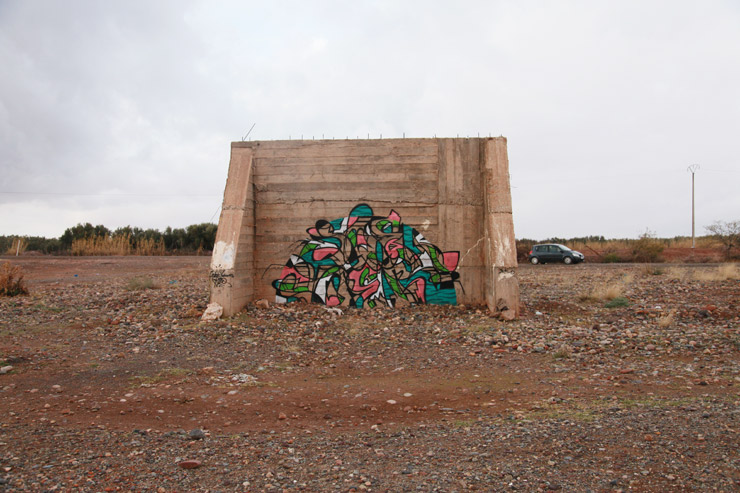
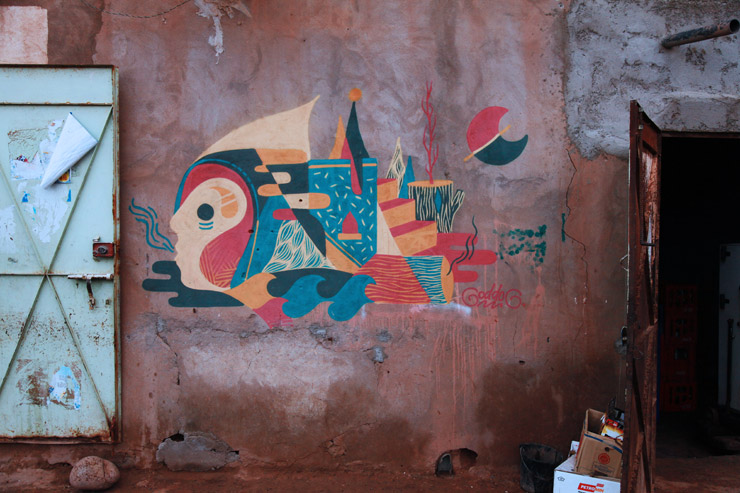
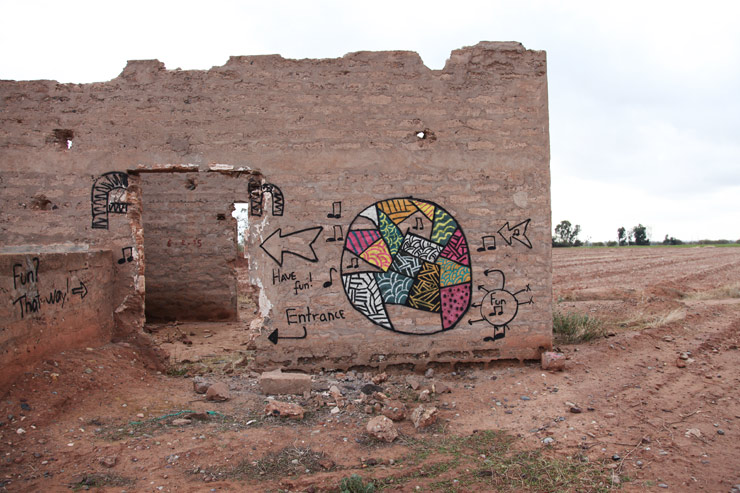
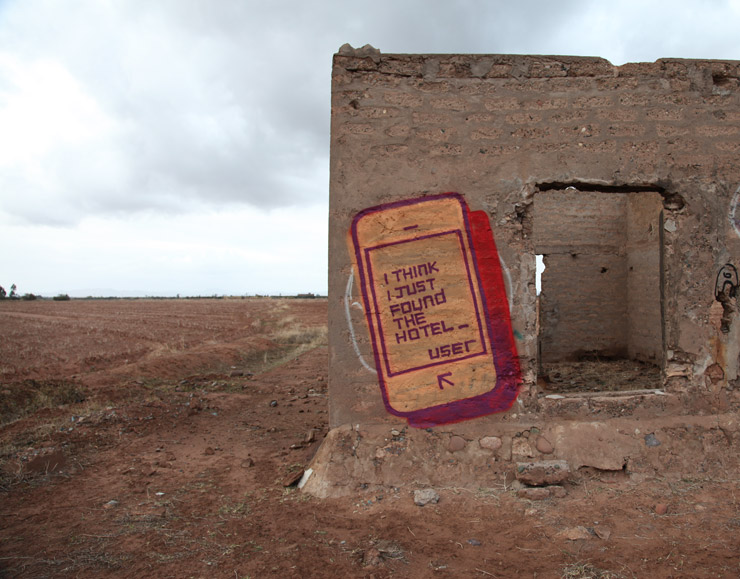
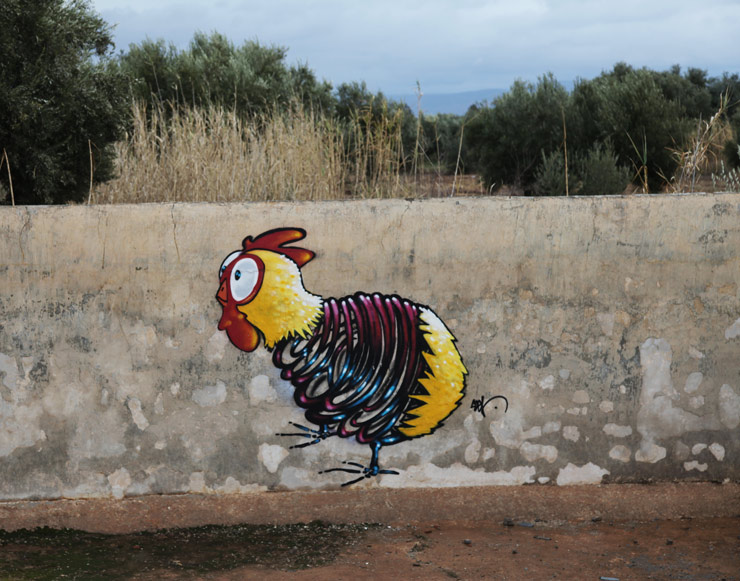
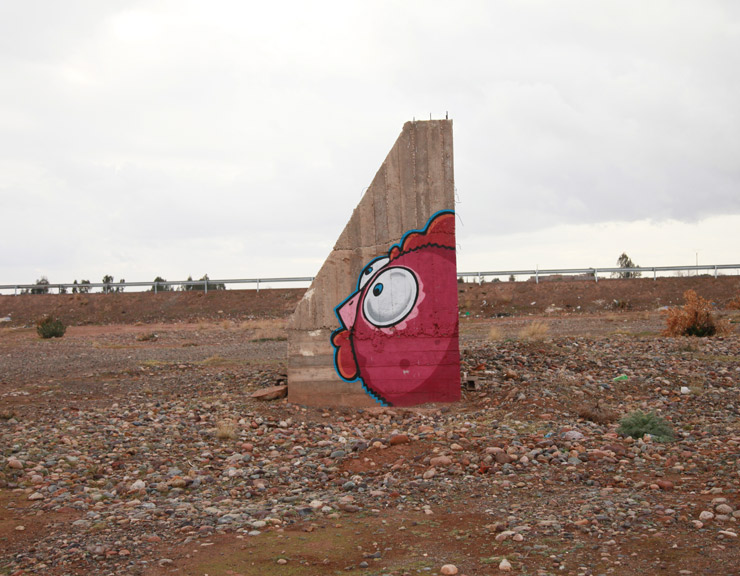
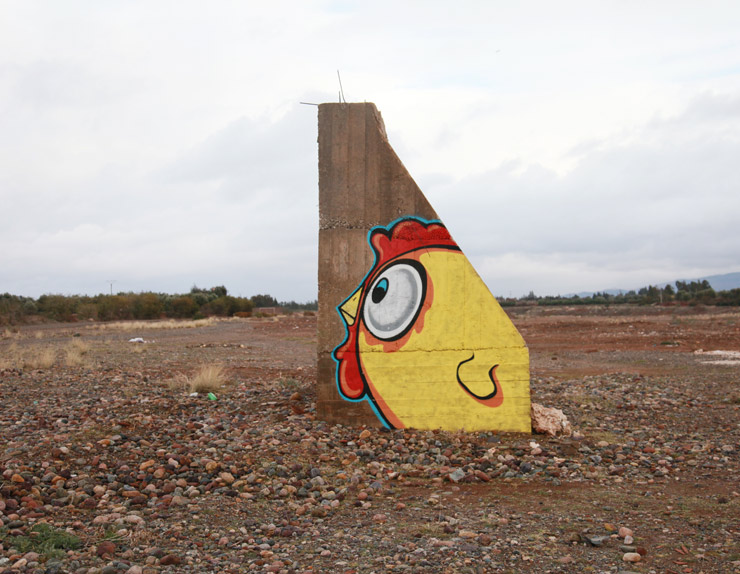
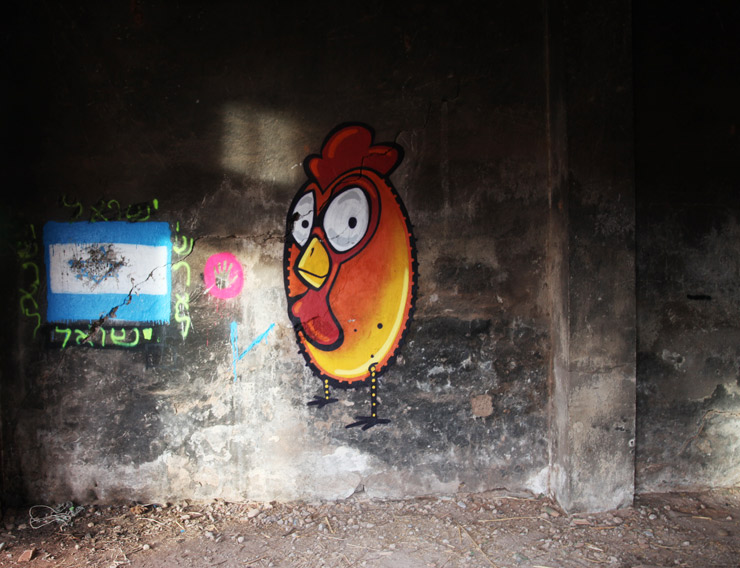
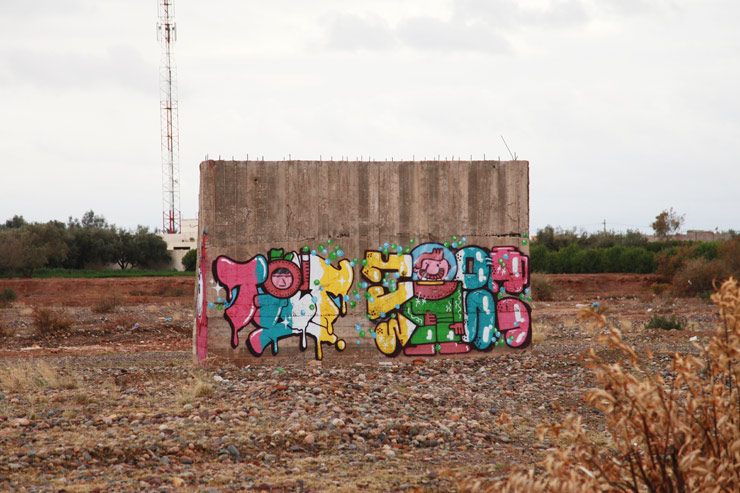
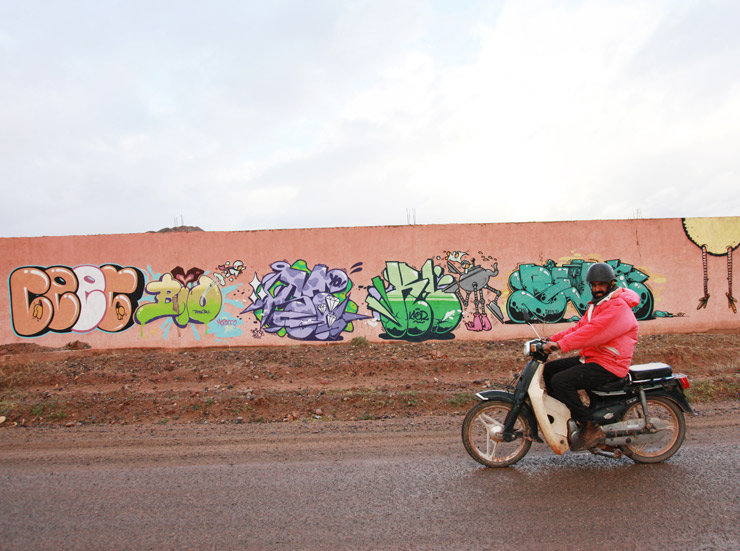
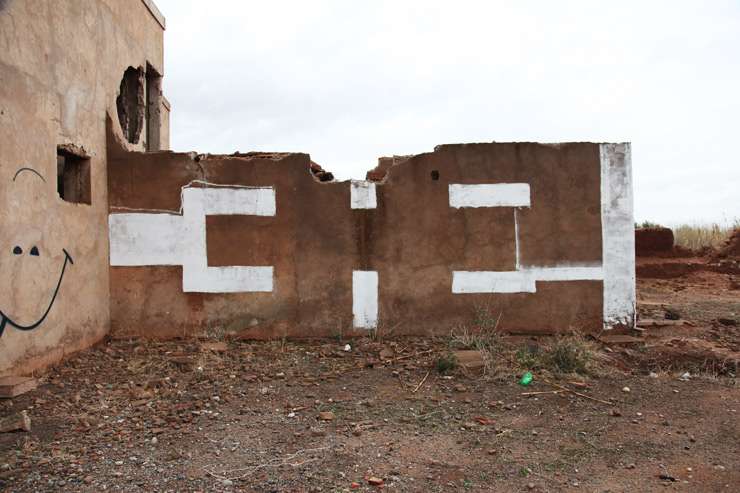
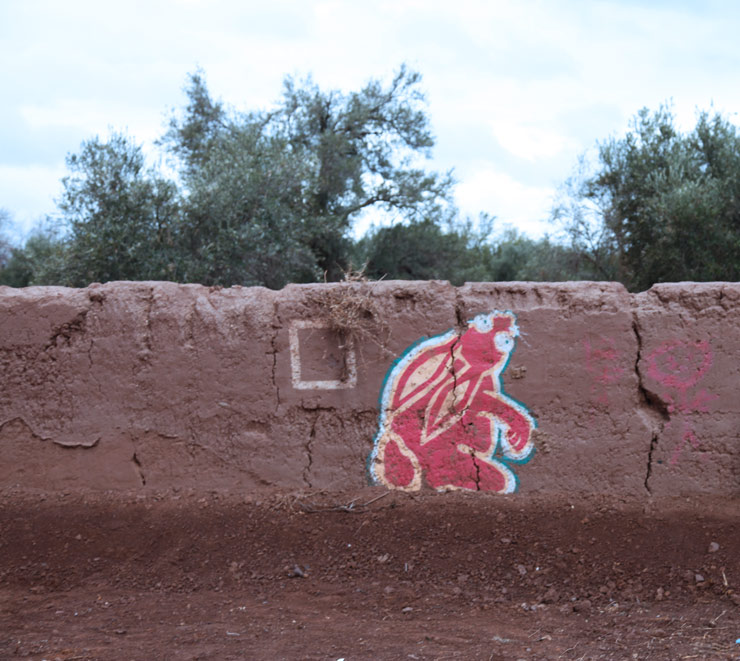
As you leave the compound and take a long walk or motorcycle ride up the lonely and narrow dusty roads and gaze through ruddy fields past lines of olive trees you’ll discover bubbled and colorful aerosol works on dilapidated structures, half walls, and cratered remnants of buildings that rise just above the rich red soil.

Ceet . Tilt. Jardin Rouge, Morocco. (photo © Jaime Rojo)

Suddenly the visual language of the inner city overflows the margins into agrarian areas, this time by way of a fervent patronage of this painting practice as art form. The distinction happens more often these days with festivals, galleries, museums, brands, collectors, fans inviting urban artists to suburban or ex-urban oasis to create their signature work very far removed from its original context.

Until now most of the fiery debates about graffiti and Street Art moving into the mainstream have focused on whether it belongs in institutions, or needs to be studied in academia, or if it ceases to be graffiti or street art when it is made for the gallery canvas or brought into the gallery directly from the street. Here, it is going anywhere but mainstream.

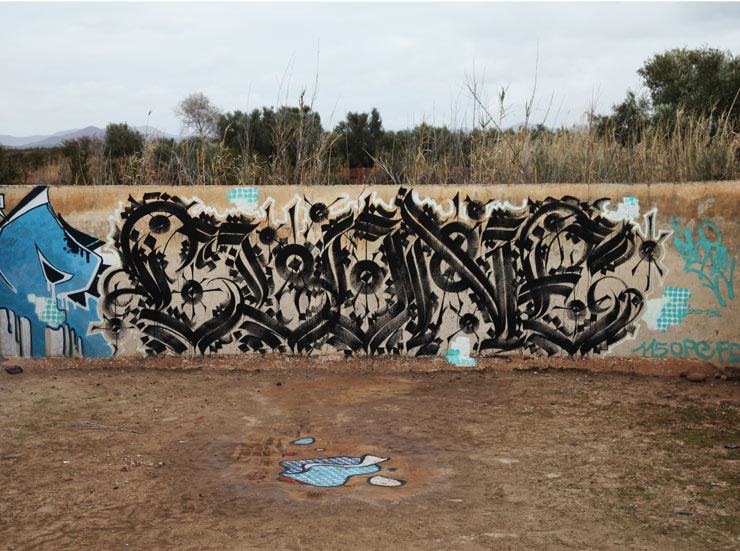
Clone. Jardin Rouge, Morocco. (photo © Jaime Rojo)

What do we call graffiti writing or characters from one city when it is introduced to another city, as has happened for decades thanks to the nomadic nature of couch-surfing artists and the adventurous practices of the graffiti tribe. And what happens when it goes for a hike further afield?

What do you call it when artists like Yok & Sheryo are on perpetual spraycation in places like Ethiopia or Mexico or when ROA is spraying his monochromatic animals in fields of Latin America or when New York graffiti icons are providing a backdrop to livestock that are chewing their cud and flipping their tales at flies?

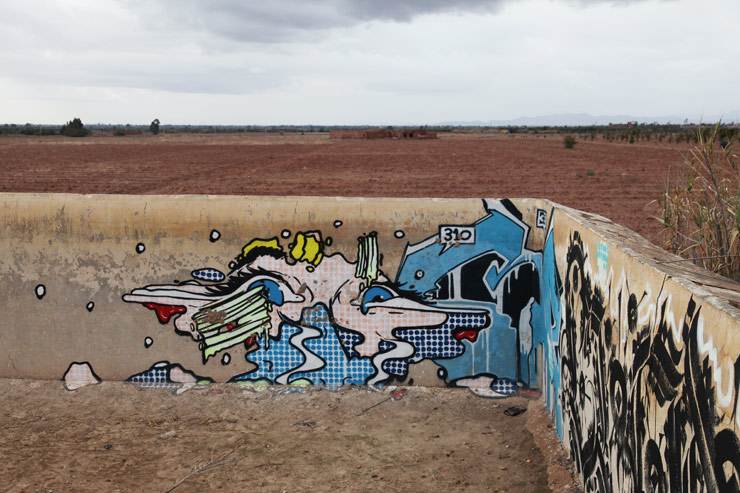
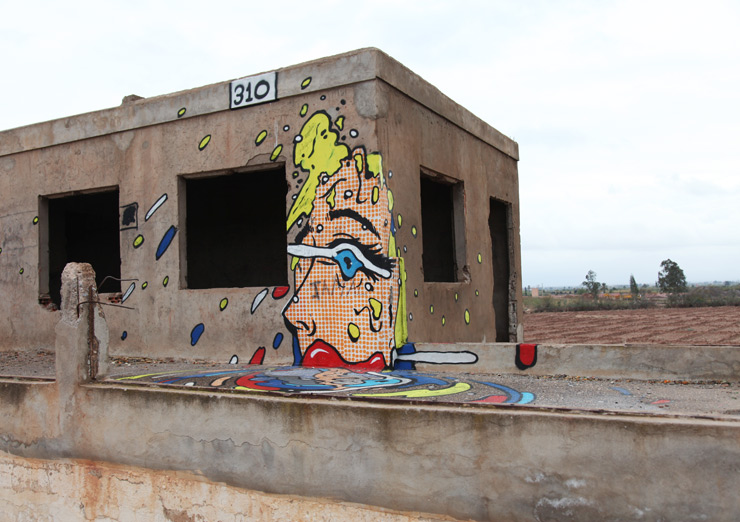
310. Jardin Rouge, Morocco. (photo © Jaime Rojo)

Is the graffiti and Street Art practice intrinsically tied to location or citizenship or local identity? Is is somehow made new by its audience?

There is much concern expressed today about graffiti and Street Artists losing their “street cred” (ibility) or authenticity by painting permissioned murals in their home cities or at festivals they have been invited to.

310. Jardin Rouge, Morocco. (photo © Jaime Rojo)

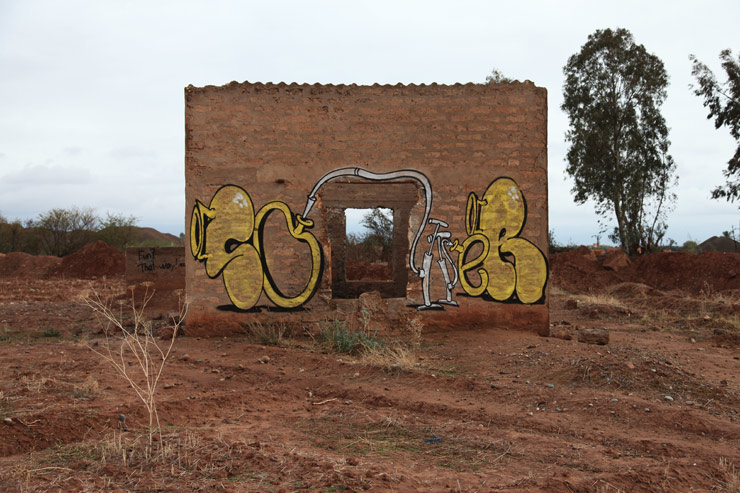
In many countries and regions there are no norms regarding aerosol art, so none are violated when an artist decides to spray a multicolored bubble tag on an old milk house next to a collapsed dairy barn.

One wonders how to contemplate the work of artists whose culture has often been marginalized when the work itself keeps appearing in unexplored margins.

As usual, the movement of these art forms and their various practices are in flux, continuously on the morph. At the very least the new context draws the work into strong relief, allowing a new way to regard its aesthetics.

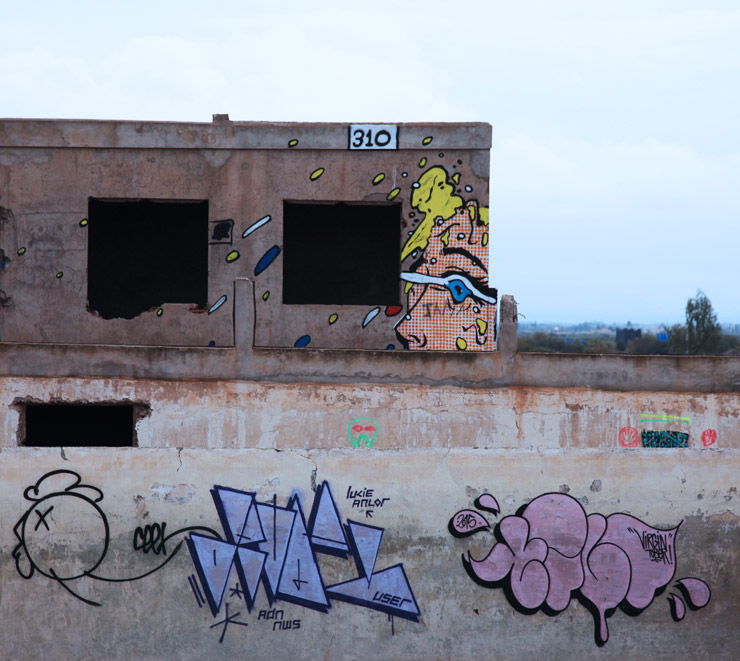
310 .  Ceet . Tilt. Jardin Rouge, Morocco. (photo © Jaime Rojo)

Reso. Jardin Rouge, Morocco. (photo © Jaime Rojo)

Reso. Jardin Rouge, Morocco. (photo © Jaime Rojo)

Reso. Jardin Rouge, Morocco. (photo © Jaime Rojo

Reso . Goddog. Jardin Rouge, Morocco. (photo © Jaime Rojo)

Reso. Jardin Rouge, Morocco. (photo © Jaime Rojo)

Goddog. Jardin Rouge, Morocco. (photo © Jaime Rojo)

Goddog. Jardin Rouge, Morocco. (photo © Jaime Rojo)

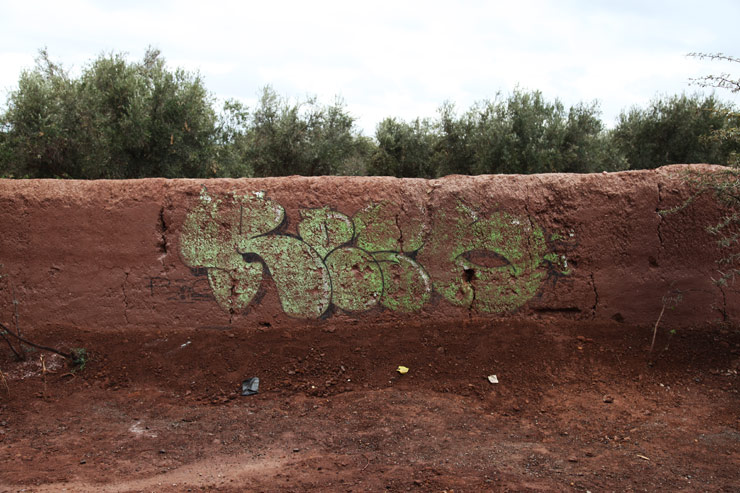
Unidentified artist. Jardin Rouge, Morocco. (photo © Jaime Rojo)

Ceet. Jardin Rouge, Morocco. (photo © Jaime Rojo)

Ceet. Jardin Rouge, Morocco. (photo © Jaime Rojo)

Ceet. Jardin Rouge, Morocco. (photo © Jaime Rojo)

Ceet. Jardin Rouge, Morocco. (photo © Jaime Rojo)

Tilt . Poes. Jardin Rouge, Morocco. (photo © Jaime Rojo)

Unidentified Artist. Jardin Rouge, Morocco. (photo © Jaime Rojo)

Ceet . Jace. Jardin Rouge, Morocco. (photo © Jaime Rojo)

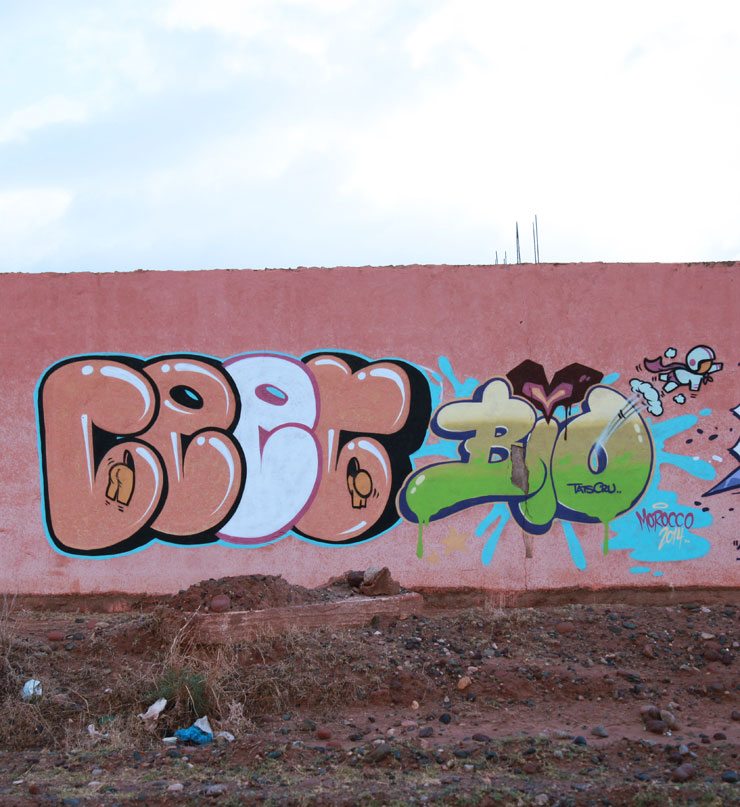
Ceet . Jace . Bio Tats Crew . 123 Klan . Klor.  Jardin Rouge, Morocco. (photo © Jaime Rojo)

Ceet . Bio Tats Crew . 123 Klan . Klor. Jardin Rouge, Morocco. (photo © Jaime Rojo)

Ceet . Bio Tats Crew . 123 Klan . Klor. Jardin Rouge, Morocco. (photo © Jaime Rojo)

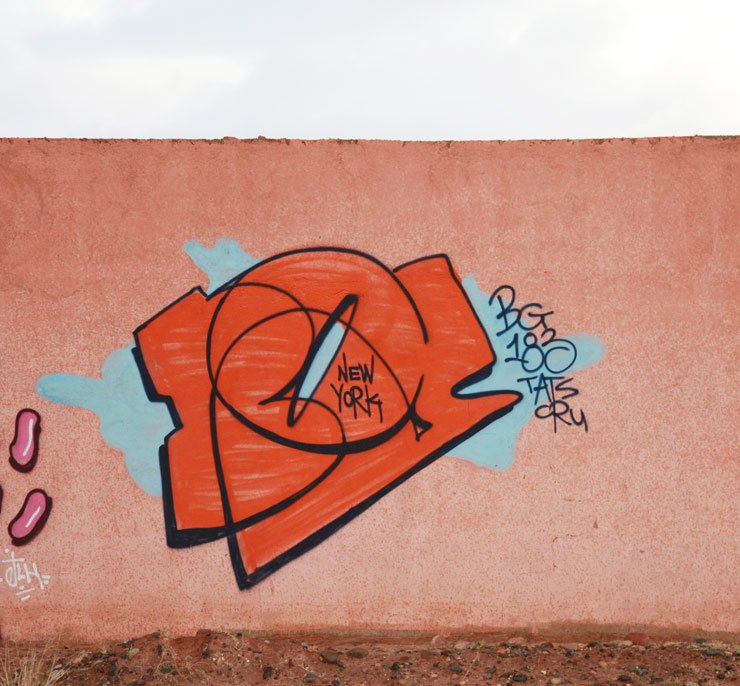
Tats Crew BG183. Jardin Rouge, Morocco. (photo © Jaime Rojo)

Ceet . Bio Tats Crew. Jardin Rouge, Morocco. (photo © Jaime Rojo)

Reso. Jardin Rouge, Morocco. (photo © Jaime Rojo)

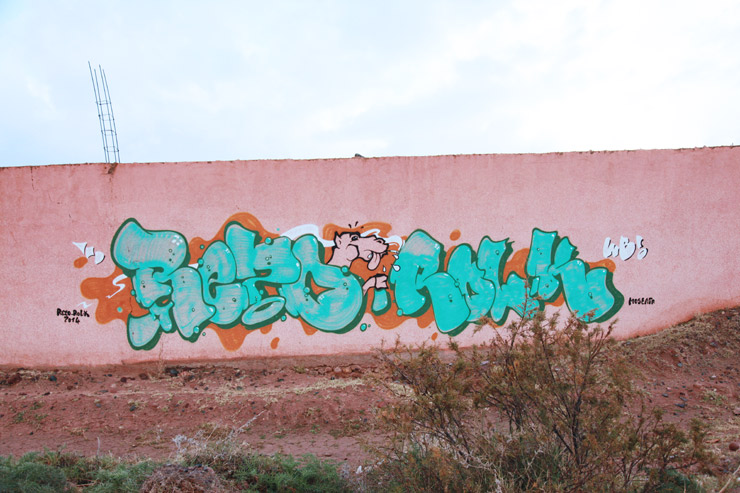
Rezo . Rolk.  Jardin Rouge, Morocco. (photo © Jaime Rojo)

Basila . Unidentified artist. Jardin Rouge, Morocco. (photo © Jaime Rojo)

DE. Jardin Rouge, Morocco. (photo © Jaime Rojo)

Unidentified artist. Jardin Rouge, Morocco. (photo © Jaime Rojo)


Read more
Signs of a New Movement: From the Women’s March On Washington

Signs of a New Movement: From the Women’s March On Washington

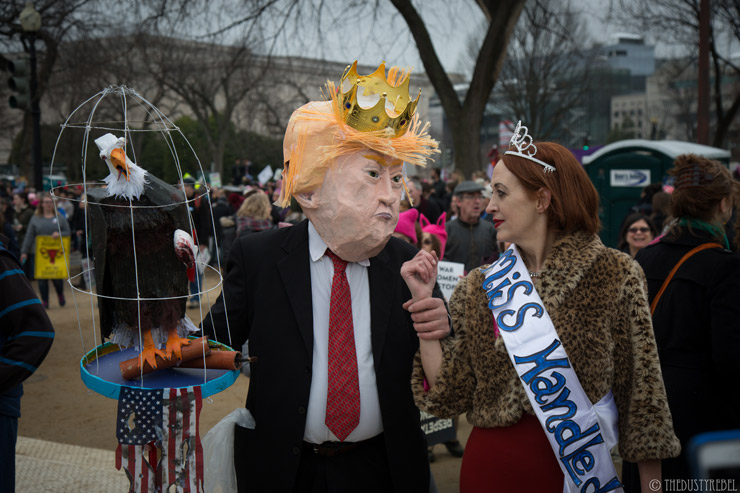
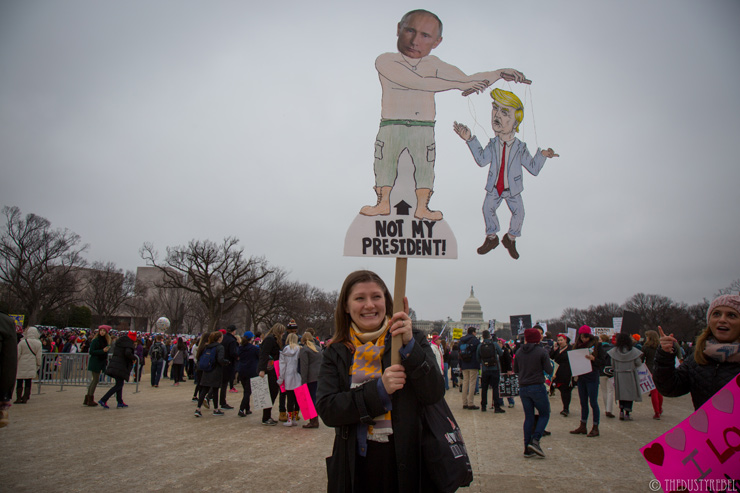
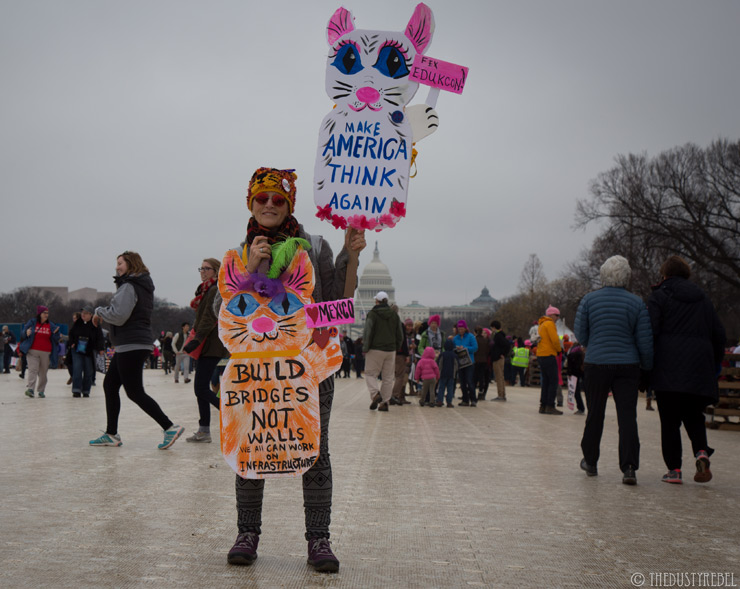
First conceptualizing and then actually hand-making a sign to take to a march is a variant of Street Art – part of the theatrical, political, personal, contentious activation of public space that you individually can take entirely with your own act of creativity. For pros and amateurs alike it can seem enthralling, liberating, even risky to put your artistic skill and opinions out there for others to gaze upon and analyze.

Still a protected form of speech (so far), the results of your industry can be thrilling, humorous, confusing, absolutely enraging. Depends.

King of beauty shows grips the arm of Miss Handled. Women’s March On Washington, DC. January 21, 2017.  (photo © The Dusty Rebel)

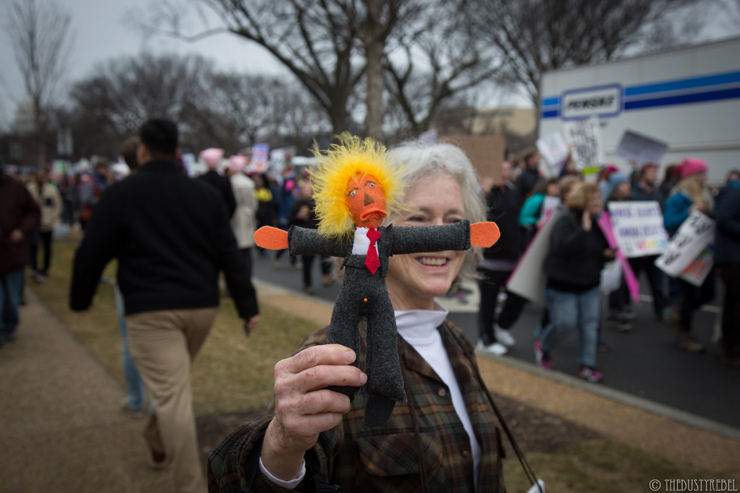
On the occasion of Donald Trump’s first day as president, January 21st brought an enormous flood of defiant and celebratory art, performance, and chanting to Washington. Also, thousands of pink crocheted ‘pussy’ hats.

We follow Street Art wherever we go around the world and we are always on the lookout for new, effective, poetic, strident, abstract, in-context messages and techniques. This march met and exceeded expectations.

 Women’s March On Washington, DC. January 21, 2017.  (photo © The Dusty Rebel)

With three times as many attendees as the actual inauguration, the Women’s March in Washington D.C. on Saturday may have been the biggest in US history. Reportedly there were hundreds of “sister marches” which it spawned across the world. Just in terms of math that means an unprecedented number of aesthetically inclined people were challenging themselves to make signs, props and all manner of theatrical costumery to get their point across.

 Women’s March On Washington, DC. January 21, 2017.  (photo © The Dusty Rebel)

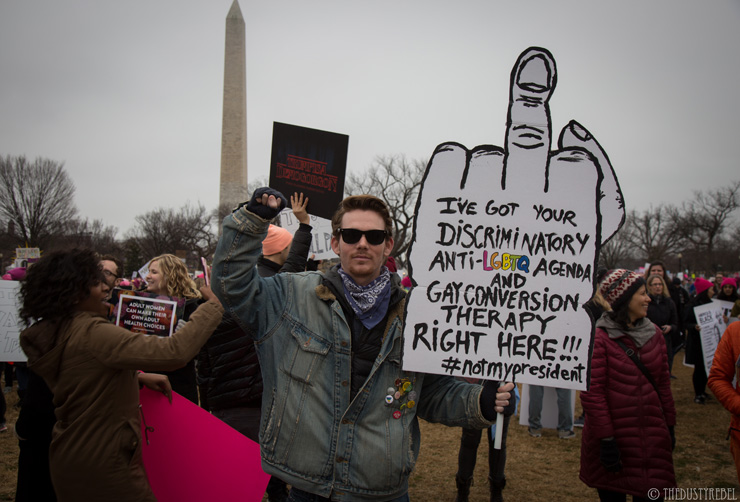
“I’m from Columbus, Indiana – home of Mike Pence and that is very discouraging for me because I do not support Mike Pence’s views on LGBTQ rights at all. I am here to protect my daughters, and my granddaughter. I am here to protect Women’s Rights. I am here to protect the immigrants in this country, who have made this country strong. I believe this is a nation of immigrants. I believe our country has been hijacked by a narcissistic, self-centered, very very sick human being. And I think we all must stand up against this and fight back now. And that’s why I’m here!”

Themes addressed often spoke to subtle and overt misogyny and women’s empowerment and dominion over their health, bodies, intelligence, families; all in direct response to Trump’s cavalier disparagement and violence toward women on the record and alleged in courts.

Other topics of signs for this least favorite new president skewered Russian involvement in the election, a cabinet of mostly white male billionaires from banking and oil, his mocking of a person with disabilities, racism toward anyone not white, a mocking disregard for all environmental matters, and cats.

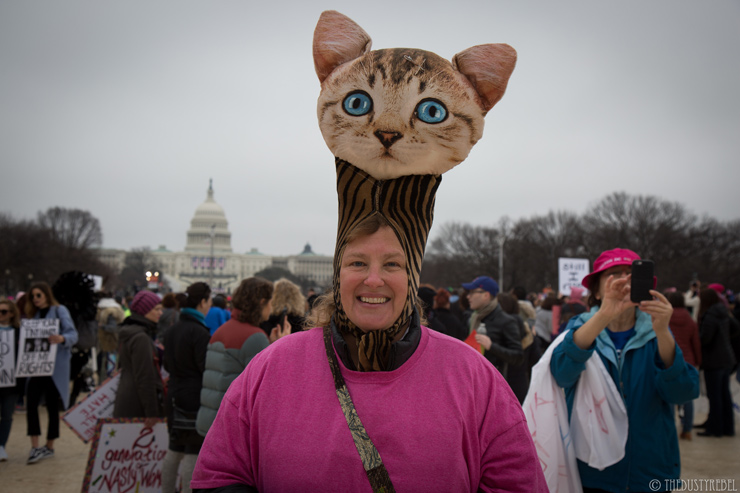
You undoubtedly agree that cats are appropriate for nearly any march, as long as you don’t expect any actual cats to actually march, because that would be beneath them.

 Women’s March On Washington, DC. January 21, 2017.  (photo © The Dusty Rebel)

“We will not go away! Welcome to your first day!” was one of many chants that the New York photographer named The Dusty Rebel heard during his two day survey of the streets of the capital.

A dedicated eagle eye on the streets capturing buskers, beauties, prosletizers, preachers, politicos, and flim-flammers, Dusty says that this visit to DC was an overwhelming experience and sometimes challenging to capture. We’re thankful that he did and that he shares some of his favorite shots with BSA readers today.

 Women’s March On Washington, DC. January 21, 2017.  (photo © The Dusty Rebel)

In fact, this momentous series of marches across the world looks like it may have launched a new political movement, possibly sparking an increased level of engagement of citizenry with the wheels of government. It’s hard to tell but at least for now it’s brought more handmade art to the street.

“Sounds like it’s already time to start coming up with new sign ideas!,” says Becki F. on her Facebook page when it has been announced that the next march is being planned for April 15th – tax day. One possible outcome will be that the President admits that yes, people do care about his tax returns.

Plush female symbol made from a recycled vintage quilt by Jewelry designer Cat Luck. Women’s March On Washington, DC. January 21, 2017.  (photo © The Dusty Rebel)

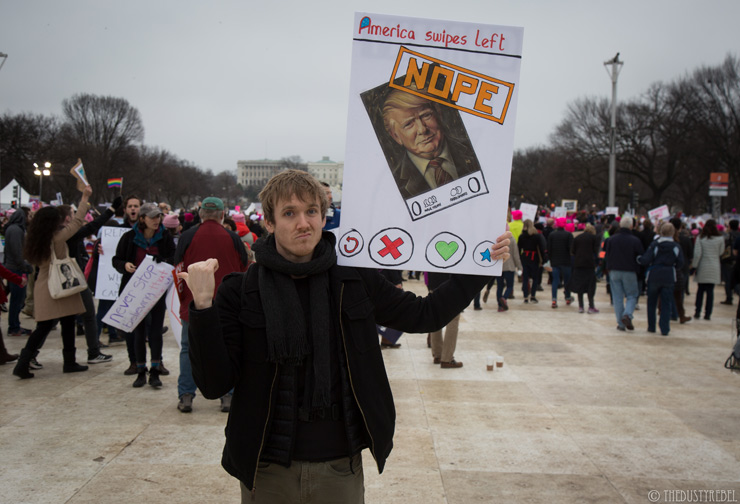
Someone is not feeling Tindr. America Swipes Left sign by Steve Dean. Women’s March On Washington, DC. January 21, 2017.  (photo © The Dusty Rebel)

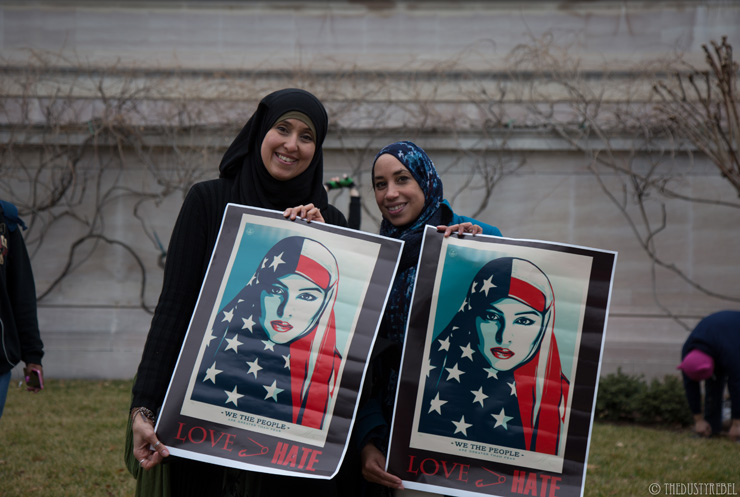
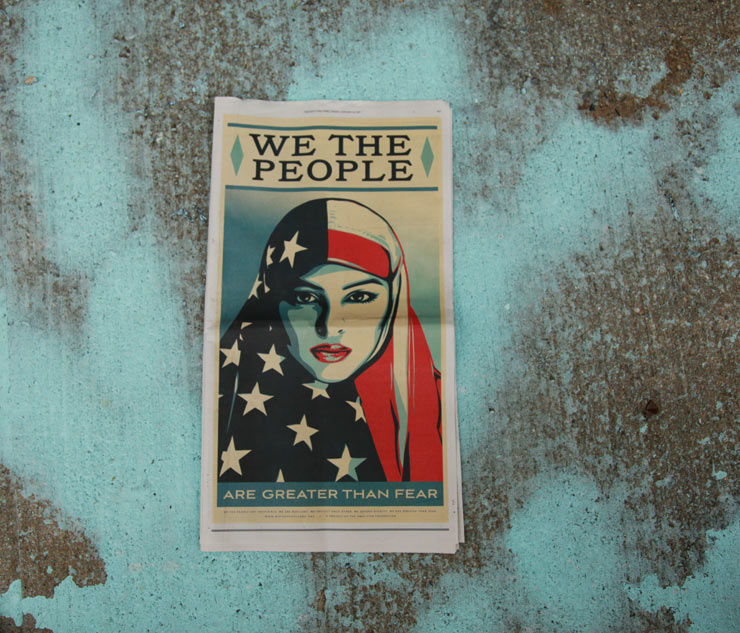
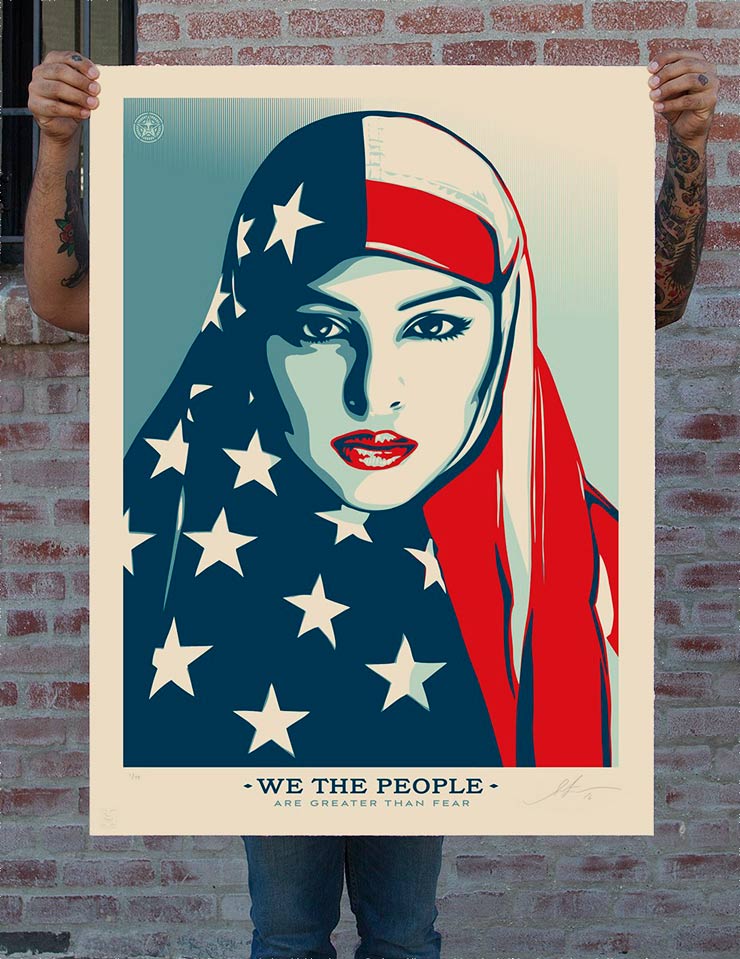
One of Shepard Fairey’s newest posters proved inspirational to many in the Muslim community as well as many supporters, some of whom donned US flags as hijabs.  Women’s March On Washington, DC. January 21, 2017.  (photo © The Dusty Rebel)

Many signs featured images of Star Wars character Princess Leia as a tribute to the actress who played her and who recently passed away, Carrie Fisher stars as the princess leads The Resistance. Women’s March On Washington, DC. January 21, 2017.  (photo © The Dusty Rebel)

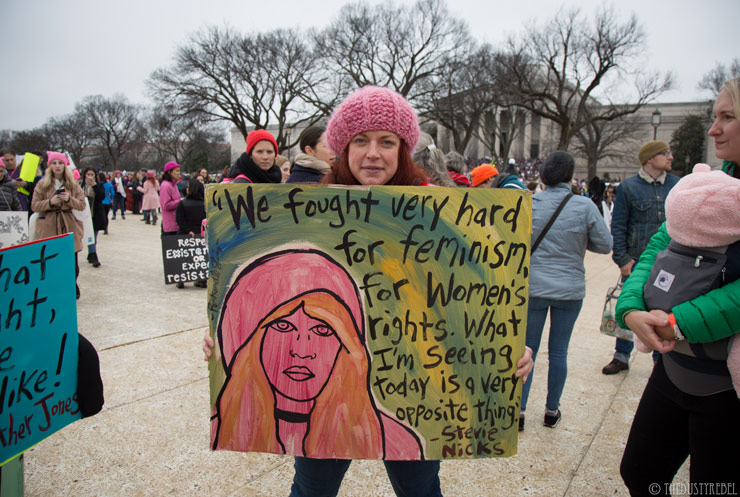
Musician Stevie Nicks was quoted on this sign by Panhandle Slim from Savannah, GA, while Madonna blathered curse words at the mic. Music released in response to Trump/Pence’s election/inauguration include new songs by A Tribe Called Quest, John Mellencamp, Tori Amos, Arcade Fire with Mavis Staples, Green Day, Gorillaz, Coco Rosie, and a growing list. March On Washington, DC. January 21, 2017.  (photo © The Dusty Rebel)

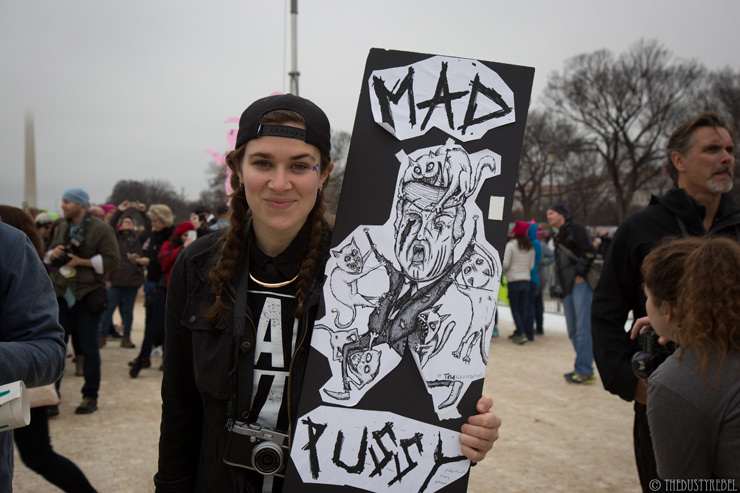
 Mad Pussy sign by Taramarie Mitravich. Women’s March On Washington, DC. January 21, 2017.  (photo © The Dusty Rebel)

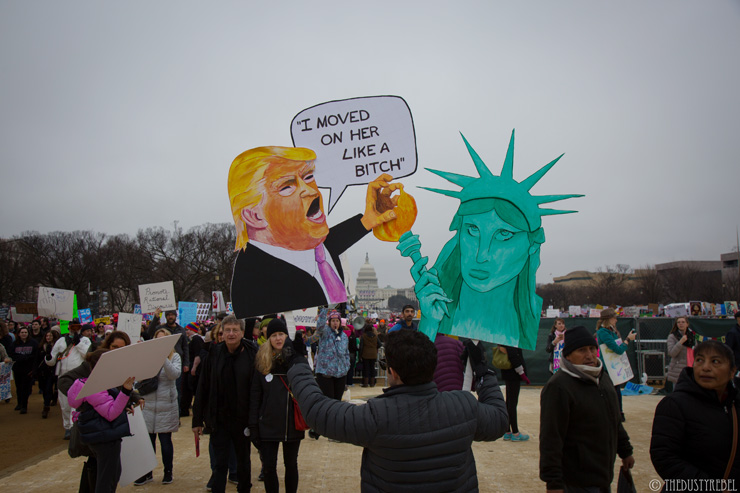
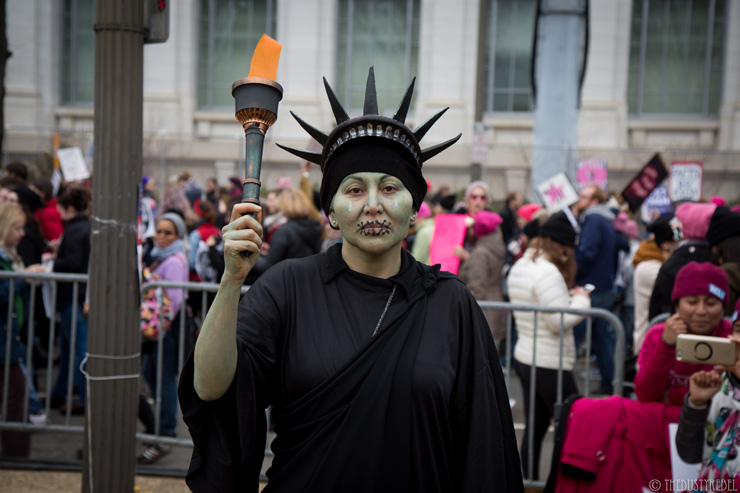
Using a Trump quote from a video tape released in October, this sign features the Statue of Liberty. Women’s March On Washington, DC. January 21, 2017.  (photo © The Dusty Rebel)

Here the Statue of Liberty is portrayed as silenced. Women’s March On Washington, DC. January 21, 2017.  (photo © The Dusty Rebel)

 Women’s March On Washington, DC. January 21, 2017.  (photo © The Dusty Rebel)

 Women’s March On Washington, DC. January 21, 2017.  (photo © The Dusty Rebel)


To learn more about the Women’s March On Washington or to get involved click HERE


Read more
Two Miami Schools Enveloped in Murals : The RAW Project in Wynwood

Two Miami Schools Enveloped in Murals : The RAW Project in Wynwood

Reimagining Art in Wynwood: The RAW Project.

The National Endowment for the Arts (NEA) received $148 million in 2016. The war budget, also called the “Defense Budget”, was approved for $582 billion for this year.

For comparison’s sake, that means the “Defense Budget” is 3,900 times the size of the NEA.

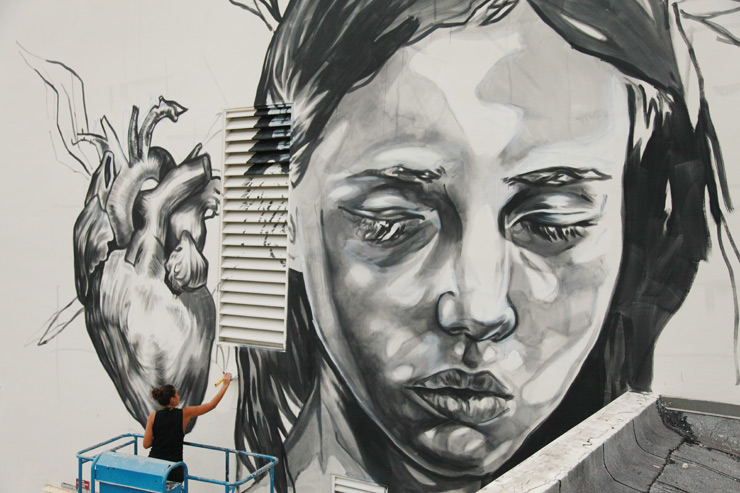
Paola Delfin at work on her mural at The Eneida M. Hartner elementary school. Wynwood, Miami. 2016 (photo © Jaime Rojo)

Arts and artists get very little or no financial or institutional support from the federal, state, or local government in the United States, which is always a shock for Europeans to learn – and many won’t believe it when you tell them. This website, for example, receives no funding or grants from any organization despite publishing daily for almost nine years, and it has remained non-commercial during that entire time.

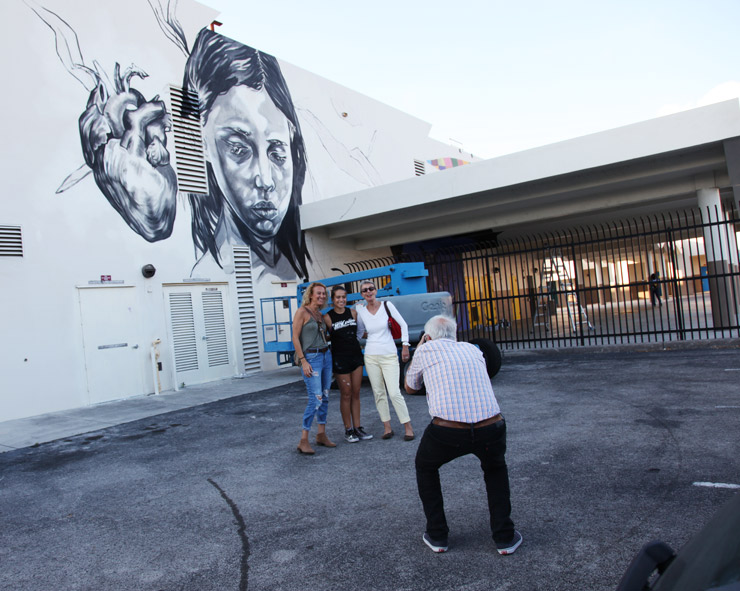
Paola Delfin with some fans. Eneida M. Hartner elementary school. Wynwood, Miami. 2016 (photo © Jaime Rojo)

It may be getting even worse for the arts in the US now that the new Trump administration in Washington is proposing cutting all funding from the National Endowment for the Arts. Arts and music programs in many American schools have already been eliminated slowly but surely over the last 40 years since the beginning of trickle-down economics in the 1980s.

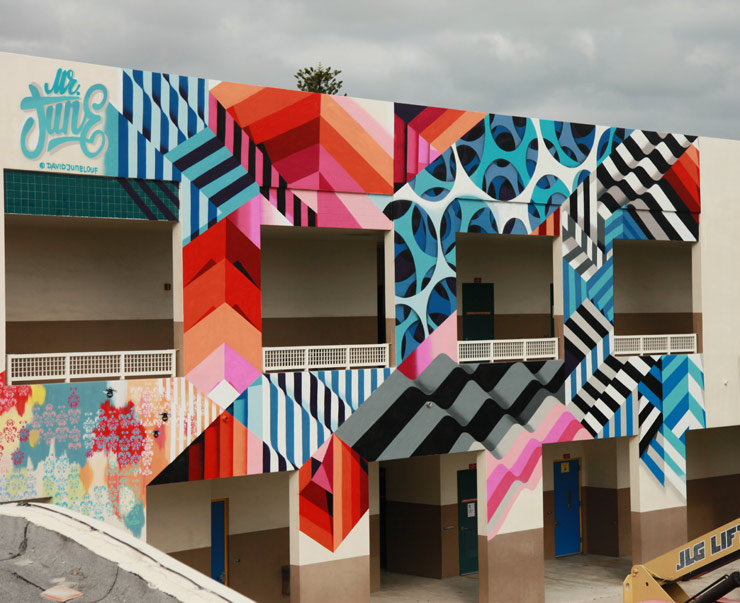
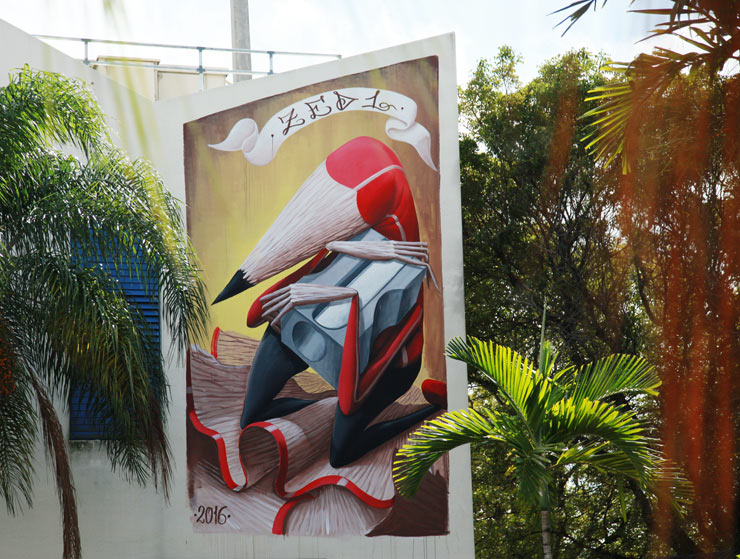
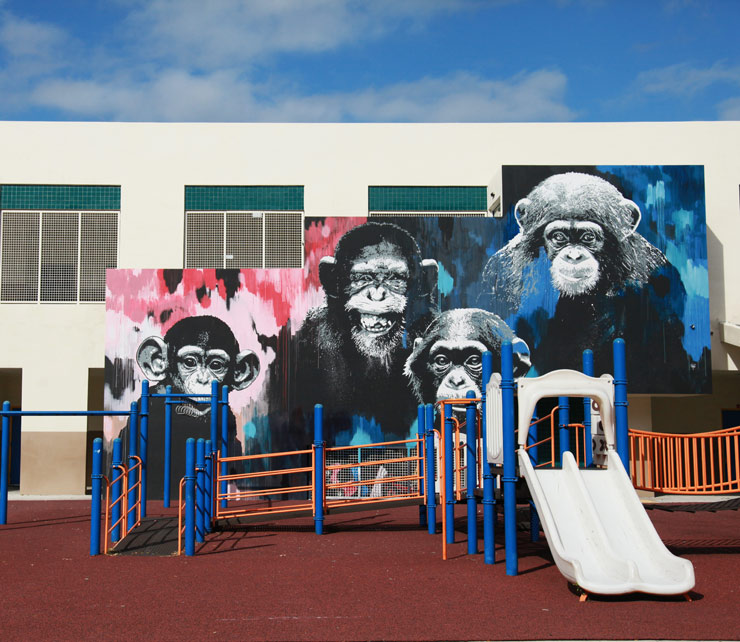
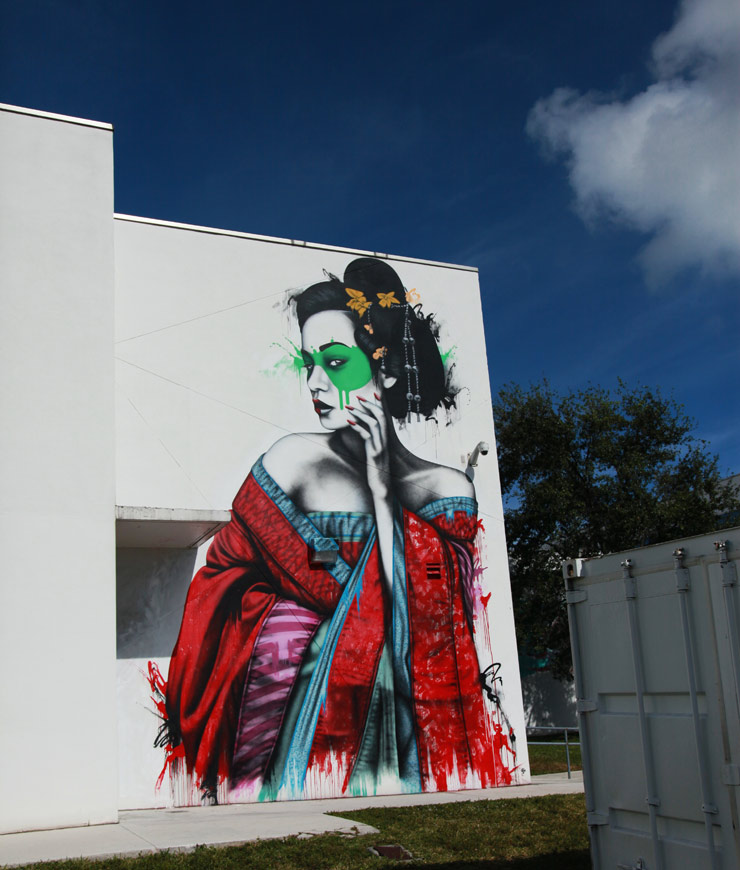
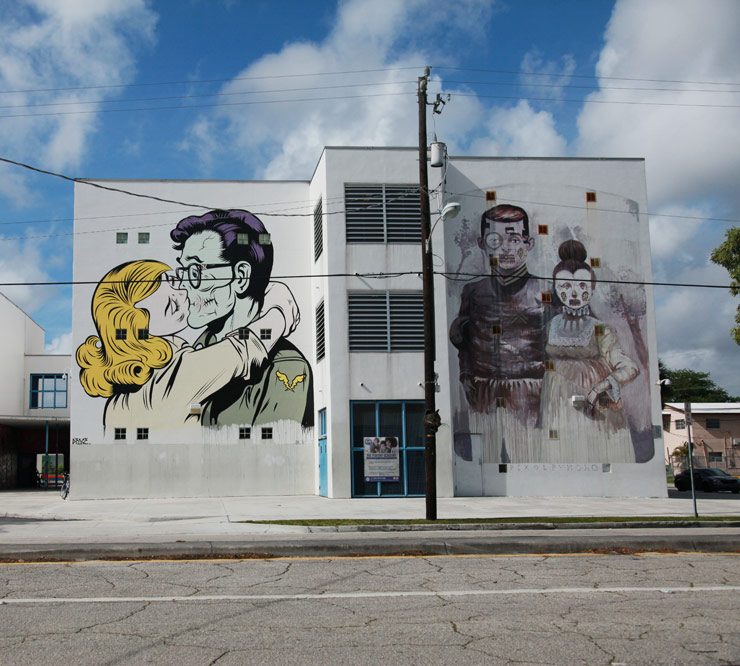
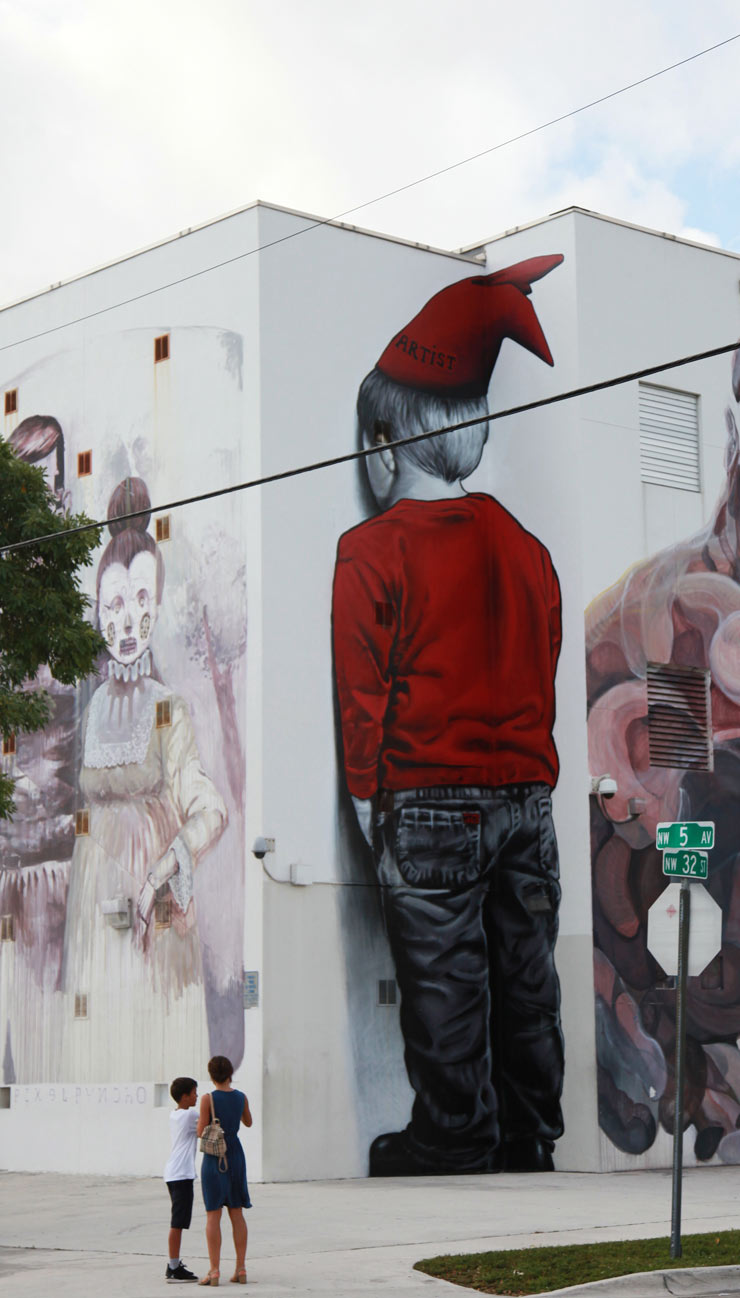
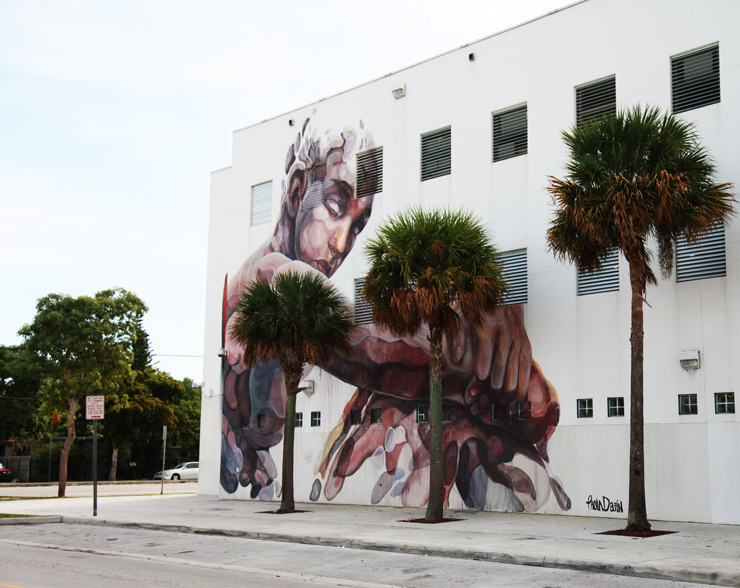
That is why it is rather astounding that two of Miami’s Wynwood schools, Eneida M. Hartner elementary school and Jose De Diego middle school, are completely covered in murals.

Mr. June. Eneida M. Hartner elementary school. Wynwood, Miami. 2016 (photo © Jaime Rojo)

The Raw Project in Wynwood, Miami is the initiative of Robert De Los Rios, who partnered with private contributors, did fundraising, and asked a coalition of artists to paint the walls of the schools for the kids.


Part of its success of course is due to the status of the Wynwood neighborhood as a magnet for graffiti and Street Artists over the last decade or so. Already coming to Wynwood for Art Basel or to partake in a related art event, these artists have given of themselves and their talents to create a completely unique and dynamic environment for students to learn and grow up around.

Zed1. Eneida M. Hartner elementary school. Wynwood, Miami. 2016 (photo © Jaime Rojo)

We captured a number of these walls during successive visits over the last few years and share them with BSA readers today.

Please consider donating to the school organization to continue this program and to refresh or replace murals as they age. http://www.projectwynwood.com/raw/

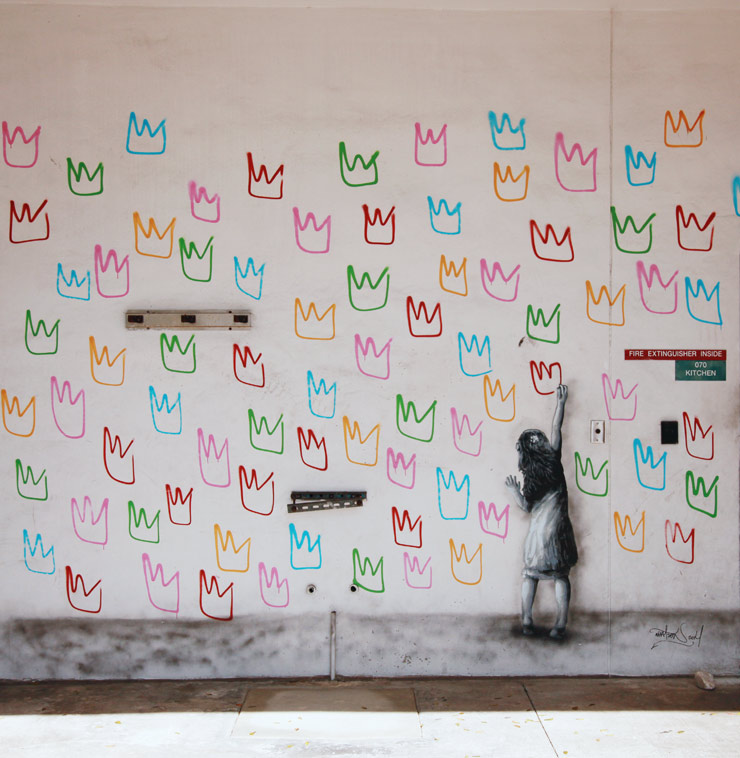
Martin Whatson. Eneida M. Hartner elementary school. Wynwood, Miami. 2016 (photo © Jaime Rojo)

Martin Whatson. Eneida M. Hartner elementary school. Wynwood, Miami. 2016 (photo © Jaime Rojo)

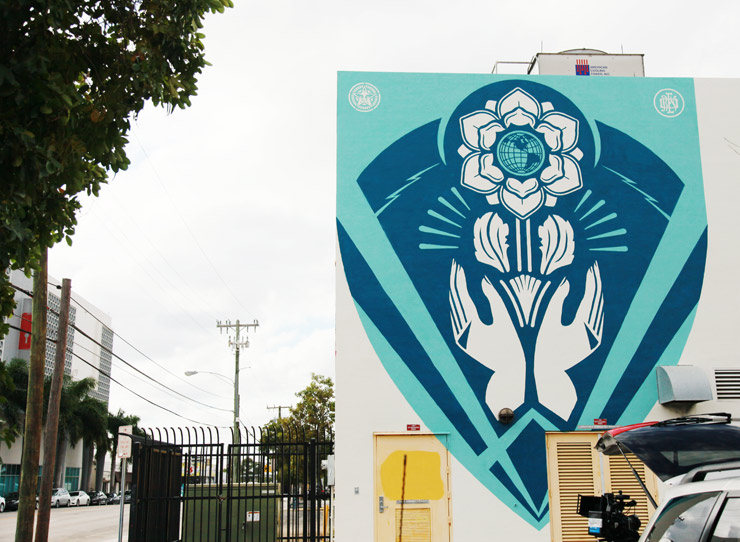
Shepard Fairey. Eneida M. Hartner elementary school. Wynwood, Miami. 2016 (photo © Jaime Rojo)

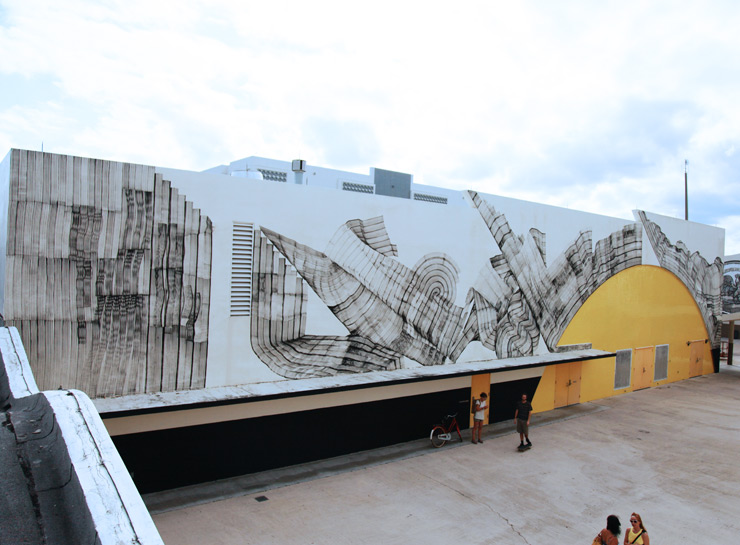
2501. Eneida M. Hartner elementary school. Wynwood, Miami. 2016 (photo © Jaime Rojo)

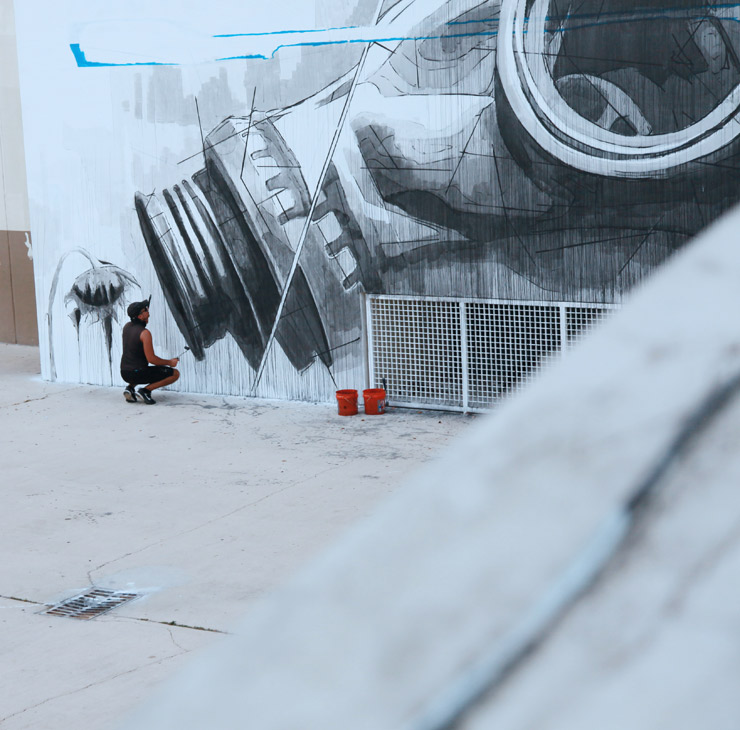
INO at work on his mural at The Eneida M. Hartner elementary school. Wynwood, Miami. 2016 (photo © Jaime Rojo)

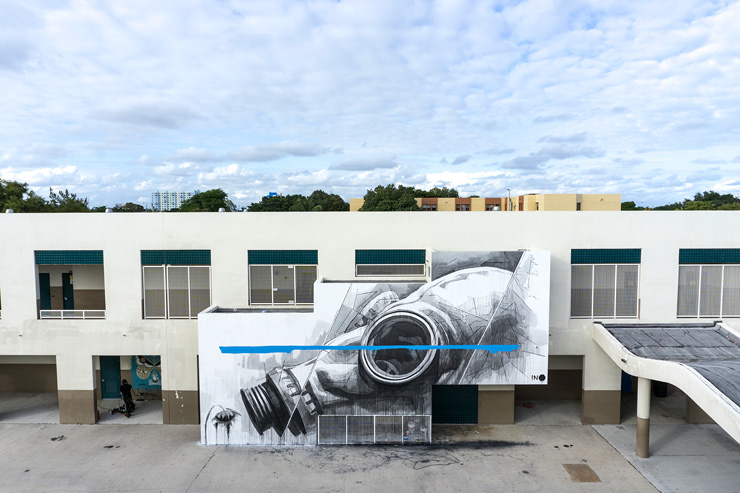
INO. Eneida M. Hartner elementary school. Wynwood, Miami. 2016 (photo © INO)

Kevin Ludo at work on his mural at The Eneida M. Hartner elementary school. Wynwood, Miami. 2016 (photo © Jaime Rojo)

Kevin Ludo. Eneida M. Hartner elementary school. Wynwood, Miami. 2016 (photo © Jaime Rojo)

Louis Masai at work on his mural at The Eneida M. Hartner elementary school. Wynwood, Miami. 2016 (photo © Jaime Rojo)

Louis Masai at work on his mural at The Eneida M. Hartner elementary school. Wynwood, Miami. 2016 (photo © Jaime Rojo)

Louis Masai. The Eneida M. Hartner elementary school. Wynwood, Miami. 2016 (photo © Emil Walker)

Dan Witz. Eneida M. Hartner elementary school. Wynwood, Miami. 2016 (photo © Jaime Rojo)

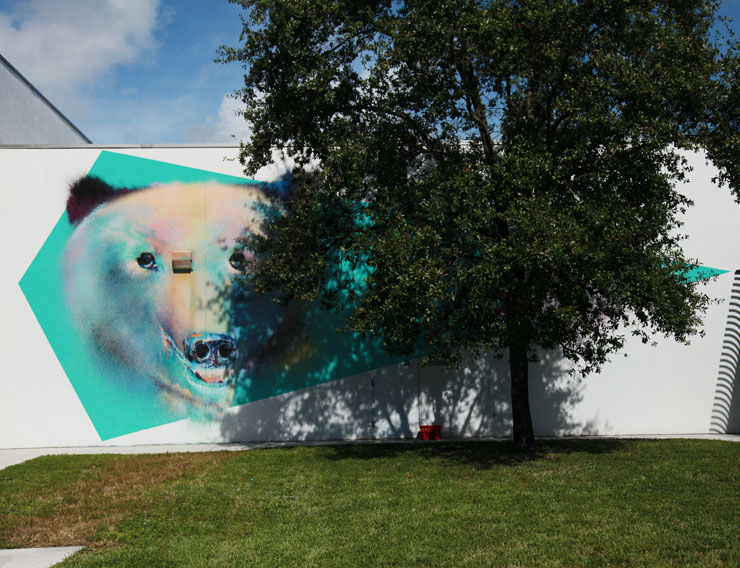
Pip Squeak. Eneida M. Hartner elementary school. Wynwood, Miami. 2016 (photo © Jaime Rojo)

Axel Rod. Jose De Diego middle school. Wynwood, Miami. 2014 (photo © Jaime Rojo)

Bik Ismo. Jose De Diego middle school. Wynwood, Miami. 2014 (photo © Jaime Rojo)

Findac. Jose De Diego middle school. Wynwood, Miami. 2014 (photo © Jaime Rojo)

D*Face on the left with Pixel Pancho on the right. Jose De Diego middle school. Wynwood, Miami. 2014 (photo © Jaime Rojo)

MTO. Jose De Diego middle school. Wynwood, Miami. 2014 (photo © Jaime Rojo)

Paola Delfin. Jose De Diego middle school. Wynwood, Miami. 2014 (photo © Jaime Rojo)

Spencer Keeton Cunnigham. Jose De Diego middle school. Wynwood, Miami. 2014 (photo © Jaime Rojo)

Word To Mother. Jose De Diego middle school. Wynwood, Miami. 2014 (photo © Jaime Rojo)

Pastel. Jose De Diego middle school. Wynwood, Miami. 2014 (photo © Jaime Rojo)

Jose Mertz . Lister. Jose De Diego middle school. Wynwood, Miami. 2014 (photo © Jaime Rojo)

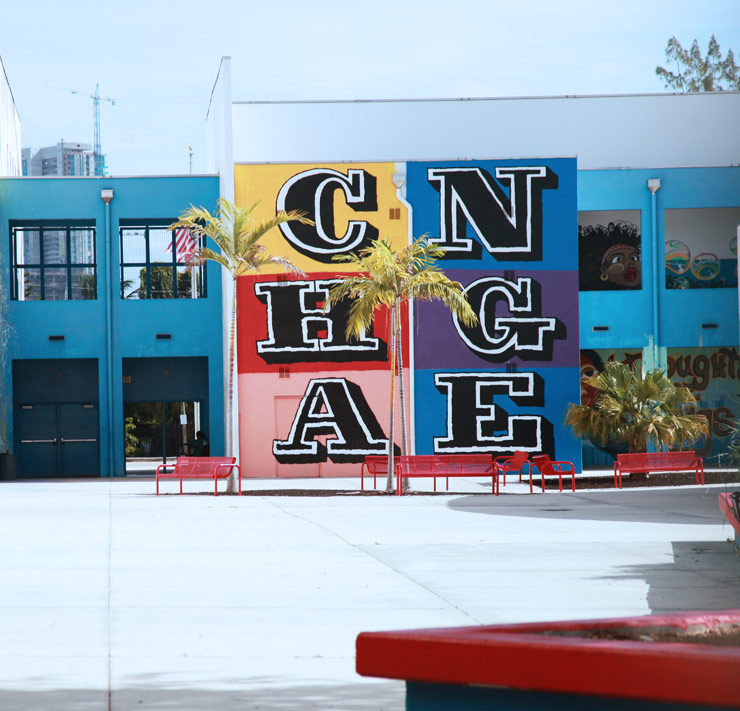
Looks like the kids at the Jose De Diego middle school are being inspired by the art of Ben Eine. Wynwood, Miami. 2014 (photo © Jaime Rojo)

Martin Whatson. Jose De Diego middle school. Wynwood, Miami. 2014 (photo © Jaime Rojo)

Txemy. Jose De Diego middle school. Wynwood, Miami. 2014 (photo © Jaime Rojo)


Read more
“Sprout And Ruler”: Gola Hundun Nude In Abandoned Masonic Temple (VIDEO)

“Sprout And Ruler”: Gola Hundun Nude In Abandoned Masonic Temple (VIDEO)

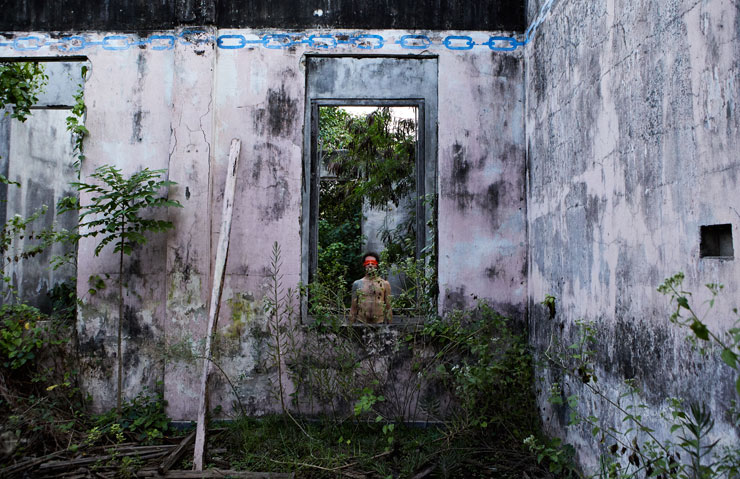
Street Artist Gola Hudun likes to get naked and frolic around abandoned old buildings making art. But then, who doesn’t?

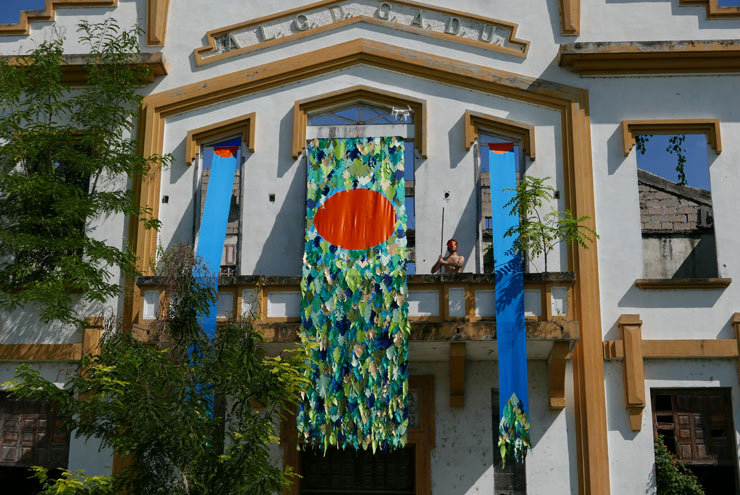
Gola Hundun for Artesano Project 2016 in The Dominican Republic. (photo © Mario Delgado)

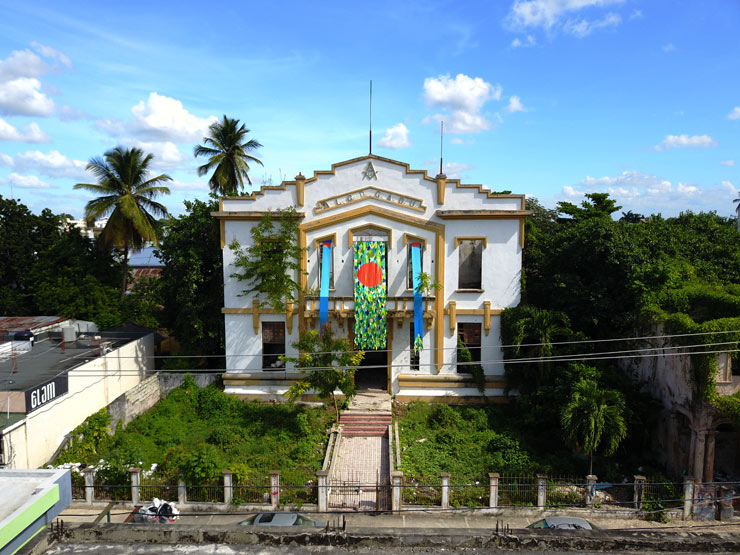
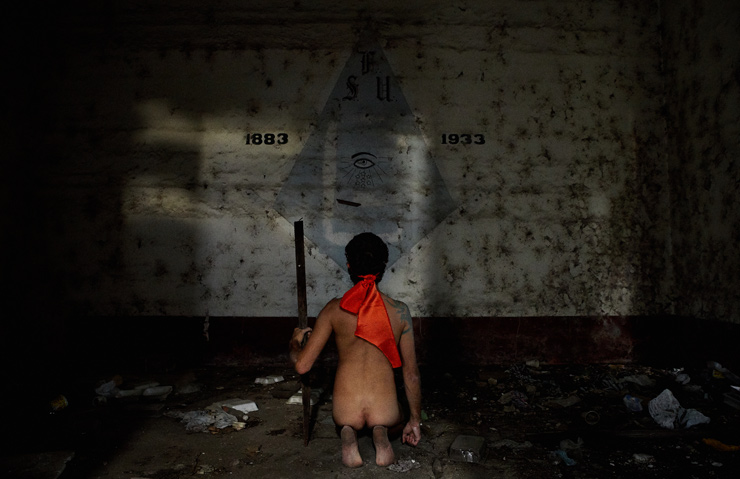
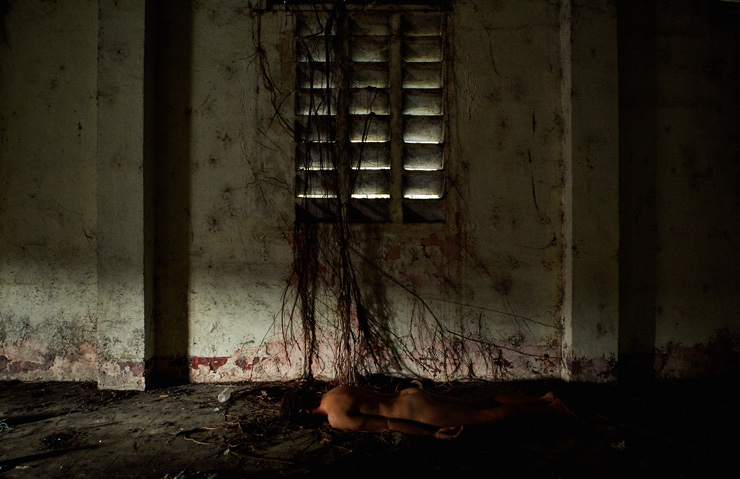
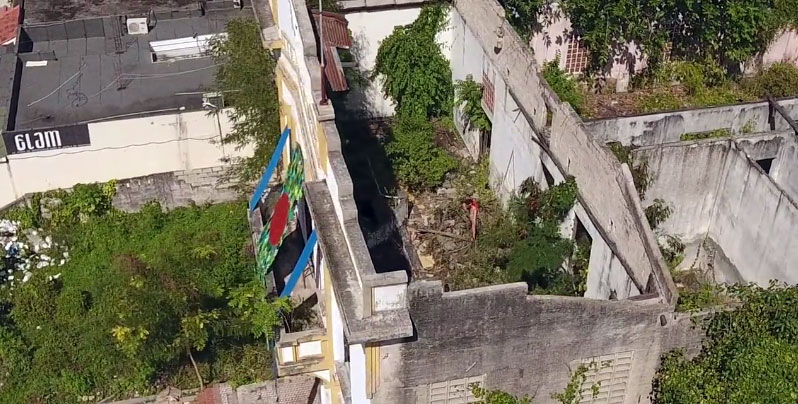
Here in San Pedro de Macoris in the Dominican Republic the Italian natural science alchemist was transfixed by the image of this abandoned Masonic Temple, with its vines and trees popping from windows and wrapping around its walls. To him, it symbolizes the inextricable connection of nature and the man made, with each alternately dancing with one another, and then trying to overpower the other. For those of you trying to prognosticate the outcome of that rivalry, we’ll venture a theory that in the end nature wins.

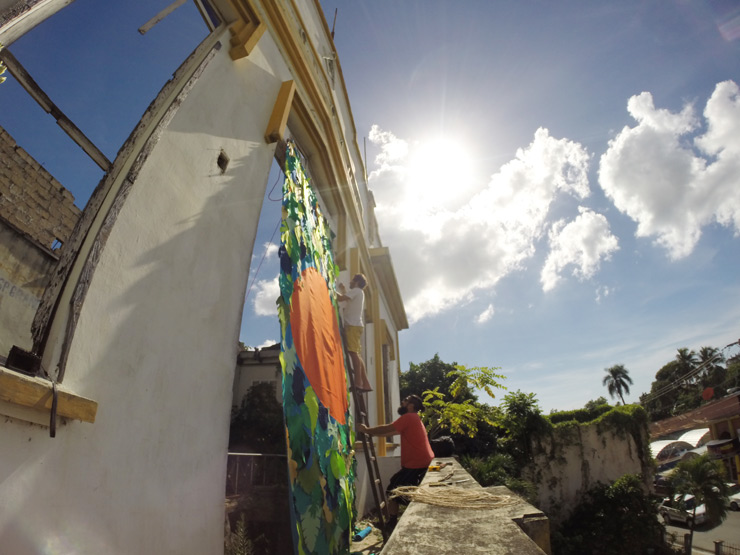
Gola Hundun at work on his piece for Artesano Project 2016 in The Dominican Republic. (photo © Sookie Gully Art)

Inspired by the leafy takeover of this man-made temple of worship, Gola wanted to add leaves of his own. “For me this piece represent the dichotomy between the creative chaos of nature and the necessity of human beings to define the laws of the Universe. These are both part of nature.”

His latest installation is part of the Artesano Project, and Gola considers himself as a facilitator, a conduit of what is a pre-ordained takeover of this space by natural design.

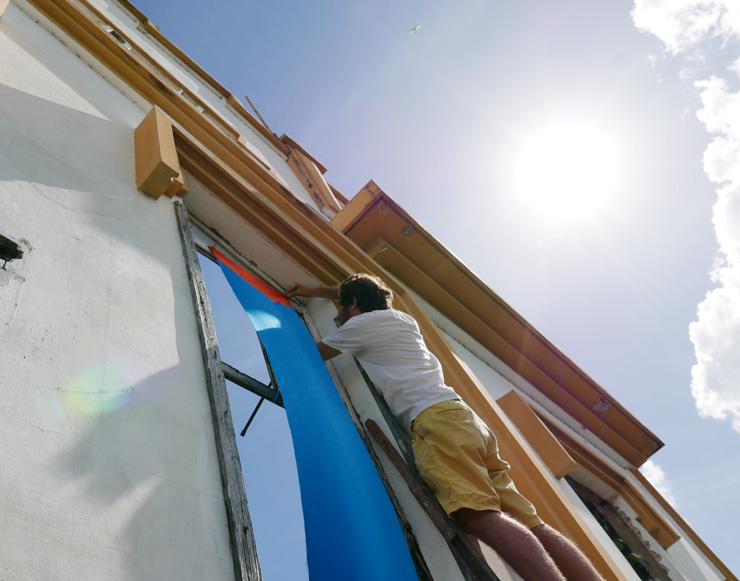
Gola Hundun at work on his piece for Artesano Project 2016 in The Dominican Republic. (photo © Sookie Gully Art)

“The Mother Goddess take back the space of the temple of the Great Architect of the Universe,” he explains as he strips down to his birthday suit to pose among the ruins and with his piece called “Sprout and Ruler.”

“The insertion of a human element is a way to bring inside the scene the Masonic rituals of a passing grade,” he says. “The nudity is a symbol for nature and paganism.”

Gola Hundun at work on his piece for Artesano Project 2016 in The Dominican Republic. (photo © Sookie Gully Art)

Gola Hundun at work on his piece for Artesano Project 2016 in The Dominican Republic. (screenshot from video below)

Gola Hundun at work on his piece for Artesano Project 2016 in The Dominican Republic. (photo © Sookie Gully Art)

Gola Hundun at work on his piece for Artesano Project 2016 in The Dominican Republic. (photo © Sookie Gully Art)

Gola Hundun for Artesano Project 2016 in The Dominican Republic. (photo © Mario Delgado)

Gola Hundun for Artesano Project 2016 in The Dominican Republic. (photo © Mario Delgado)

Gola Hudun at work on his piece for Artesano Project 2016 in The Dominican Republic. (screenshot from video below)

Read more
BSA Images Of the Week: 01.22.17

BSA Images Of the Week: 01.22.17

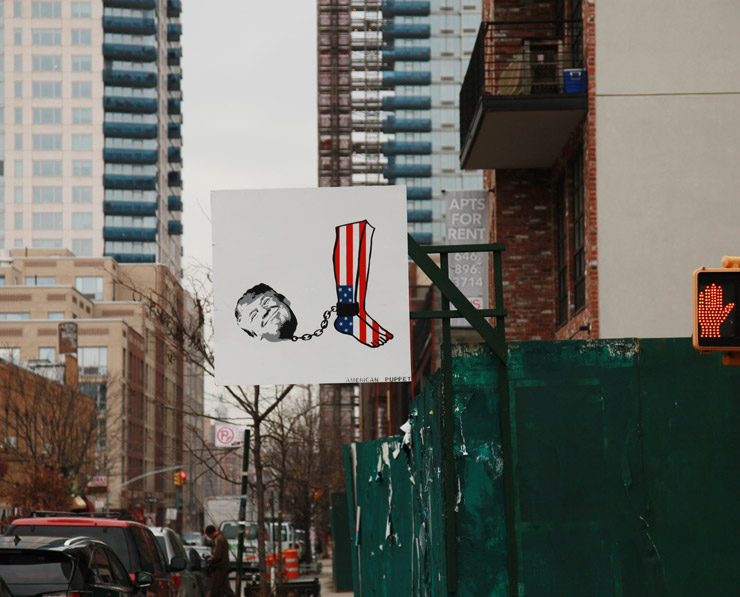
BSA-Images-Week-Jan2015Inauguration week was just as bumpy as you could have expected with an incredibly divided country discussing the outgoing president, the incoming president, the foreign interference and weird circumstances around the actual election, the nearly all white all billionaire cabinet nominees, and the Women’s March‘s that vastly overwhelmed Trumps ceremony attendee numbers while “sister” marches took place in nearly 700 cities around the world. This president, more than any one in decades, is galvanizing people to take action and get involved, just not in the way he might have preferred and we’ve been seeing a steady dialogue on the street about him since last fall.

He certainly wasted no time by signing his first executive order within minutes of being sworn in, one that aims to repeal Obamacare and that would deny health care. In the early and mid-2000s there was a lot of anti-Bush/ anti-war street art. At this inauguration George W. looked giddy and relaxed (despite a poncho battle) perhaps because he might not be the most disliked president of the century after all. Trump v. Obama inauguration numbers were pretty stark, and this week Trump’s national approval ratings have tanked, although a fresh war always tends to perk up a presidents approval numbers, so maybe he can start one of those. Not sure if his popularity would go up or down if he triggered a crisis in the financial markets, but it does feel like absolutely anything is possible with this wildcard. You can be sure that Street Art will be probably be there to respond! We’re keep our eyes open.

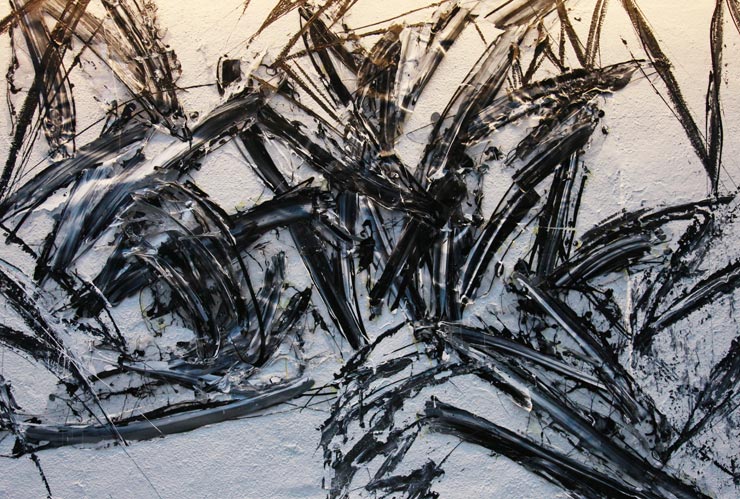
So here’s our weekly interview with the streets, this week featuring Adline, City Kitty, D7606, Drsco, El Sol 25, Hek Tad, Homo Riot, Jerk Face, Jose Feliz Perez, Lunge Box, Meguru Yamaguchi, Michael Vasquez, Nimai Keston, Not Art, Shepard Fairey, Sheryo & the Yok, and Vicki Da Silva.

First image above: American Puppet (photo © Jaime Rojo)

Shepard Fairey (photo © Jaime Rojo)

Vicki Da Silva (photo © Vicki Da Silva)

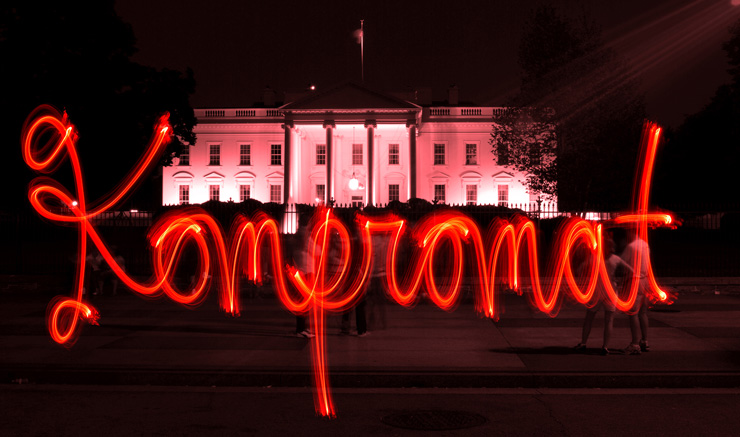
Yeah, we didn’t know what it meant either so we looked it up. Here’s what Wikipedia says: Kompromat (Russian: компромат; IPA: [kəmprɐˈmat], short for компрометирующий материал, literally “compromising material”) is the Russian term for compromising materials about a politician or other public figure. Such materials can be used to create negative publicity, for blackmail, or for ensuring loyalty.

In other words, light artist Vicki Da Silva is referencing the apparent influence of the Russian government over the presidential election by smearing Clinton publicly with information they had found. Luckily they didn’t find any information to influence Trump in any way.

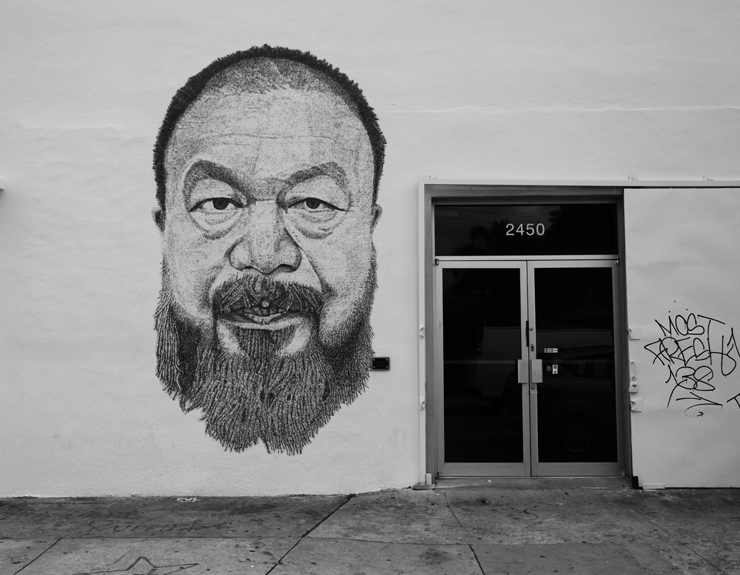
Nimai Kesten. This is the wheat-pasted mural of Ai Wei Wei before Hebru Brantley added goggles to it. Wynwood, Miami. (photo © Jaime Rojo)

Adine (photo © Jaime Rojo)

DRSCO (photo © Jaime Rojo)

Jeffrey Gibson with a quote from James Baldwin for #artinadplaces (photo © Jaime Rojo)

Homo Riot (photo © Jaime Rojo)

El Sol 25 (photo © Jaime Rojo)

Obey and friends in Wynwood, Miami. (photo © Jaime Rojo)

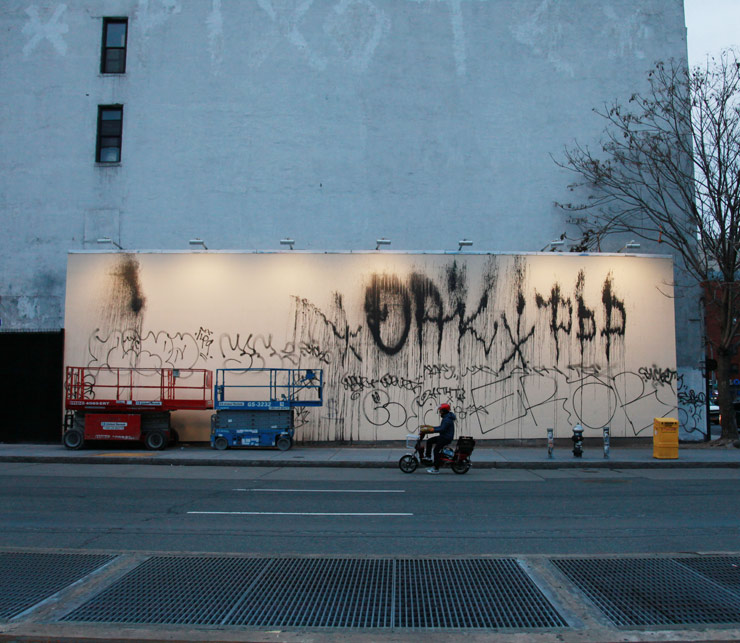
Some writers couldn’t resist the white huge canvas that was the Houston Wall, freshly primed for Pichi & Avo’s turn to paint on it this week. (photo © Jaime Rojo)

The Yok & Sheryo in Wynwood, Miami. (photo © Jaime Rojo)

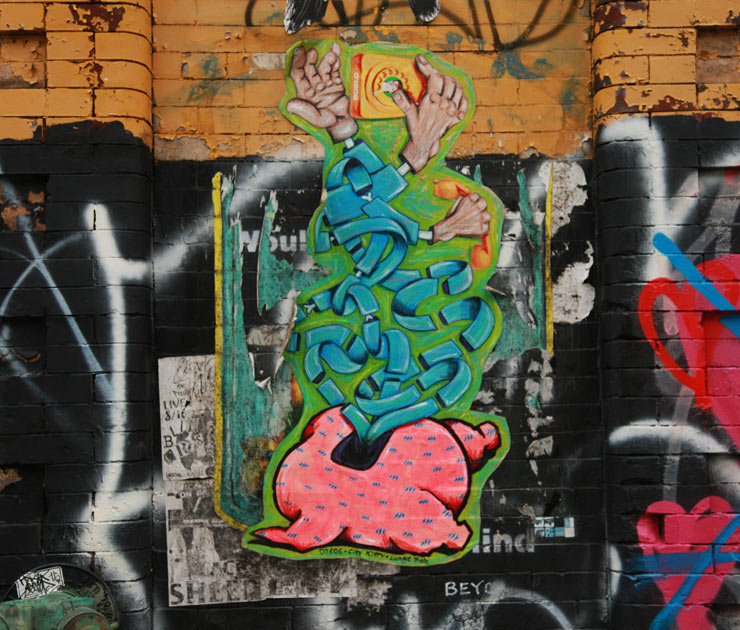
D7606 . City Kitty . Lunge Box collaboration. (photo © Jaime Rojo)

Meguru Yamaguchi (photo © Jaime Rojo)

Meguru Yamaguchi. Detail. (photo © Jaime Rojo)

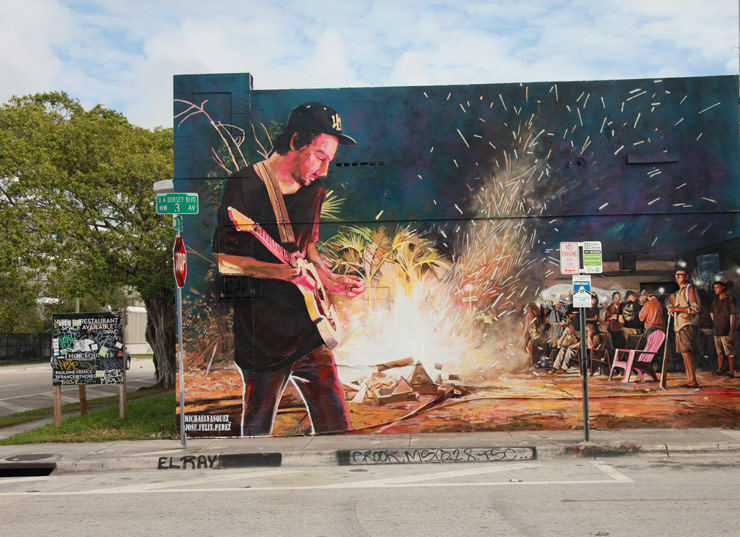
Michael Vasquez . Jose Felix Perez in Wynwood, Miami. (photo © Jaime Rojo)

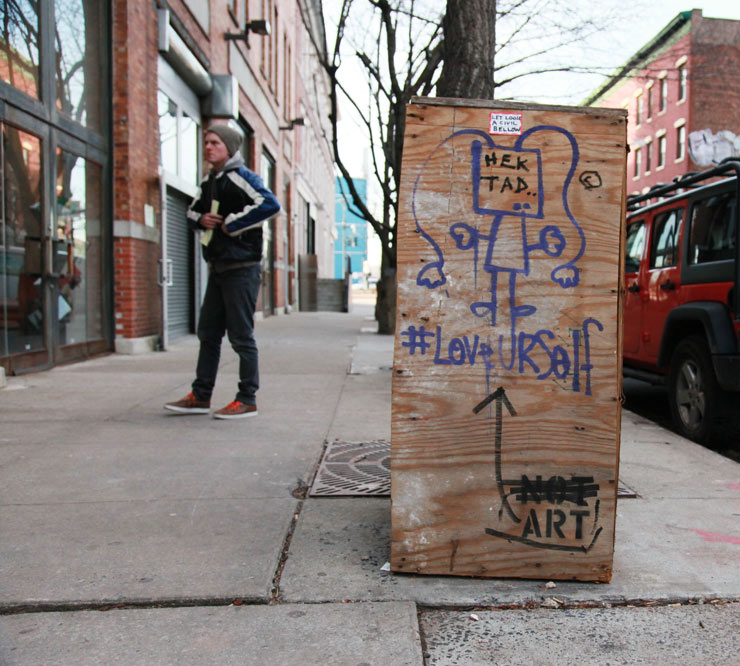
This piece of plywood was tagged several times by different artists at different times. (photo © Jaime Rojo)

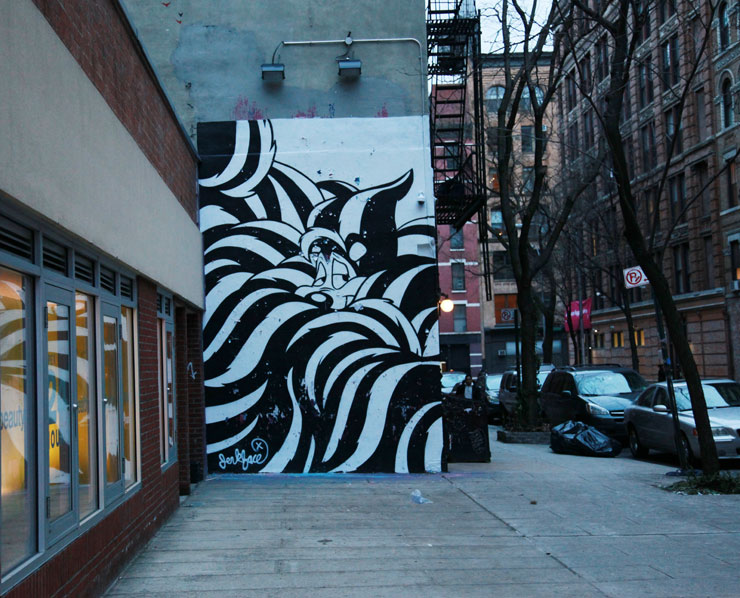
Jerk Face (photo © Jaime Rojo)

Looks like Pepe Le Pew is lurking around for some lovely lady skunk to walk by so he can use his famously suave pickup lines;

“Permit me to introduce myself, I am your new lover.”

“Where are you, my little object of art? I am here to collect you.”

“Is it possible to be too attractive?”

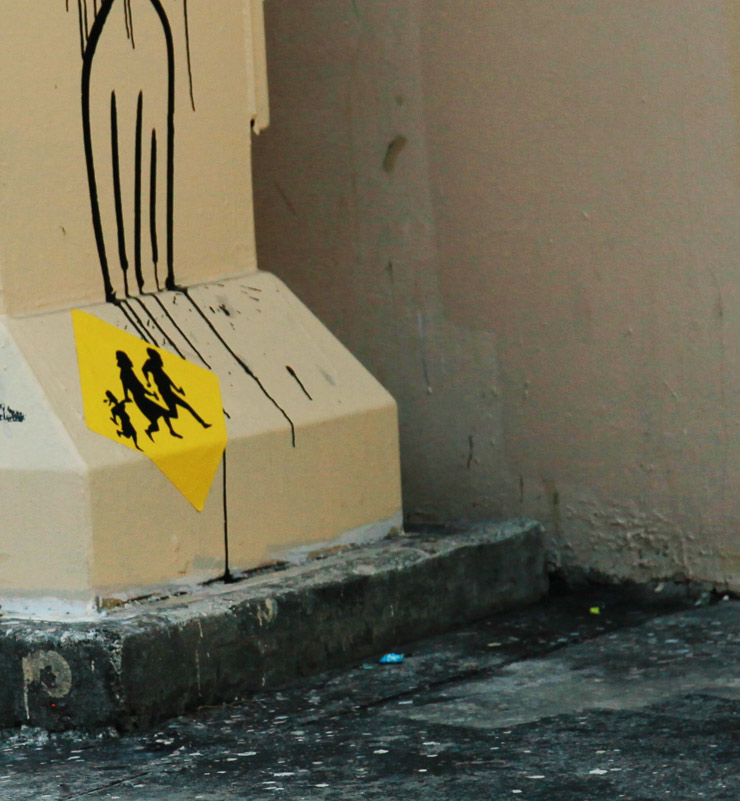
Humans Crossing (photo © Jaime Rojo)

Untitled. Manhattan, NYC. January 2017. (photo © Jaime Rojo)


Read more
MEGGS and Miya Welcome “Temple Children” to Hawai’i

MEGGS and Miya Welcome “Temple Children” to Hawai’i

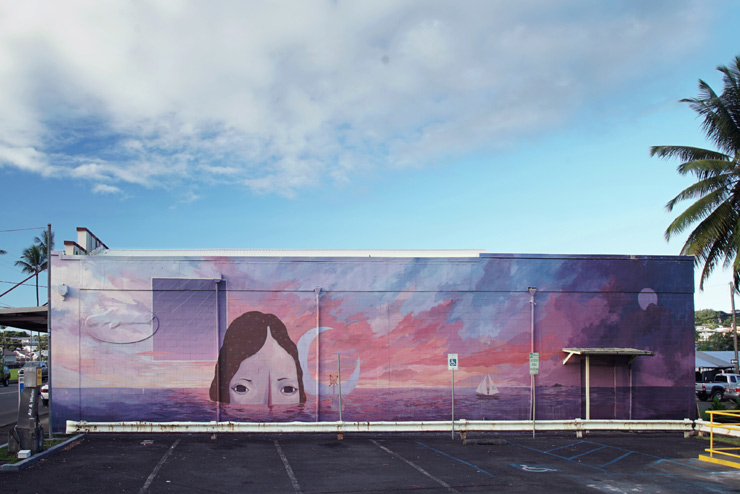
New images and an interview today from Hawai’i with Melbourne native Street Artist David ‘MEGGS’ Hooke and his partner Miya Tsukazaki who together are envisioning the mural festival concept as something more holistic.
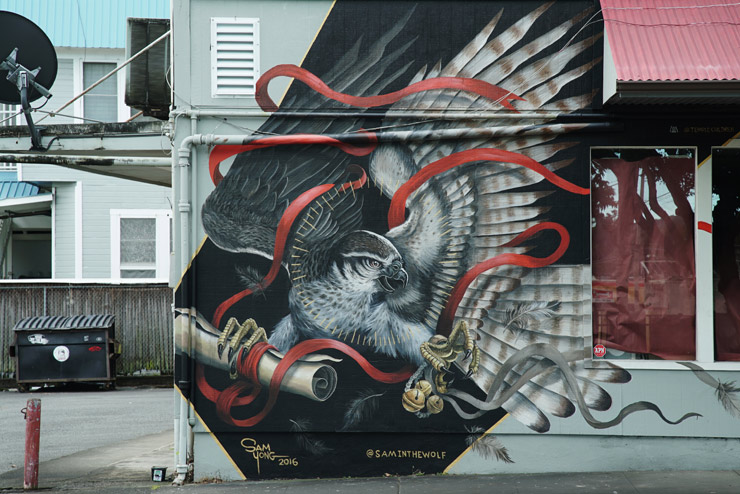
Sam Yong. Temple Children 2016. Hilo, Hawaii. (photo © Cory Martin )

The Temple Children project is partially a reaction to the devolved commercial model of mural festivals that use art and artists to imbue brands and cities with a vaguely “edgy” veneer – minus its counter-culture roots – and cynically factored as part of a marketing strategy to “target demographics” and ultimately “move product”.

It’s also a bold and ambitious re-imagining of a better world through art, creativity, community…and food.

Food Education. Temple Children 2016. Hilo, Hawaii. (photo © Cory Martin)

By framing the mural event as one element of a larger worldview, you can also expect to learn and participate through eco-tours, sustainability volunteering, and a group residency, among other activities and experiences.

“The name of our organization was inspired by Miya’s name, which translates to ‘Temple’ in Japanese,” MEGGS tells us. “Our efforts are to evolve a creative platform for the betterment of the planet and a humanity-led envisioning of the Earth as our ‘temple.’ ”
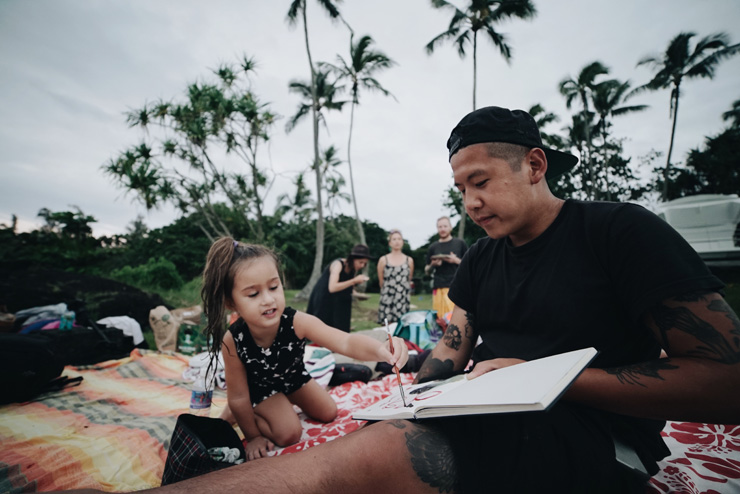
Keiki Outreach with Sam Yong, aka In The Wolf. Temple Children 2016. Hilo, Hawaii. (photo © Cory Martin)

So who are these ‘Temple Children’, you may ask? Are they actually children? Miya tells us “The name refers to our network of artists, creatives, and friends around the world who share in this vision. A Temple Child chooses to channel their skills and talents towards benefiting the greater good, ultimately increasing this universal consciousness.”

We had an opportunity to see MEGGS and Miya in Detroit in September when they did their pilot program installation in conjunction with “Murals in the Market” and the folks from 1xRun. Their they told us of a new vision they were developing in Hilo, the hometown of Miya that would hopefully add to the definition of mural festival – without calling it that specifically.
Yoskay Yamamoto. Temple Children 2016. Hilo, Hawaii. (photo © Cory Martin )

Today we share with BSA readers an interview with both MEGGS and Miya about their first immersive “Temple Children” event this fall, which featured works and workshops and kids programming and food harvesting and prep with artists including artists Jet MartinezYoskay YamamotoRick HaywardEmily DeversSam YongKai’ili KaulukukuiBrandy Serikaku, and filmmaker Cory Martin along with murals painted earlier in the year by MEGGS  Lauren YS  and Wooden Wave.
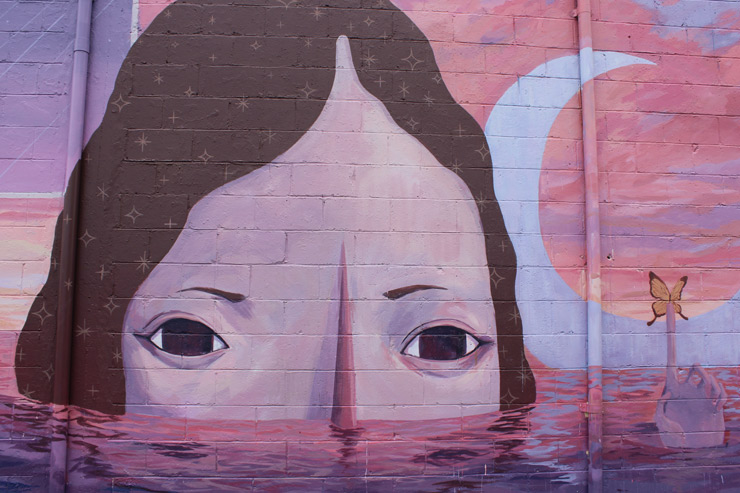
Yoskay Yamamoto. Detail. Temple Children 2016. Hilo, Hawaii. (photo © Cory Martin )

In their interview the two talked about their shared vision to merge visual arts and sustainable innovation at the community level.

Brooklyn Street Art: Let’s begin with something very wrong that we see a lot of: massive food waste almost everywhere we travel, including the US. Why do we waste so much food? From outsized portions and all-you-can-eat buffets, to supermarkets following a strict policy on expiration dates who throw out perfectly good food. Food waste includes our everyday habits and practices at home. What can be done?

MEGGs: Food waste is undoubtedly a serious challenge for our generation and we feel that it comes back to one of our core values – mindfulness. Taking a moment to think about where your food comes from, how much money you spend on food, where your food waste ends up and what that does to the environment are all very simple concepts that will minimize food waste. Being thoughtful about how much you consume, what foods you buy, and where these foods come from is one of the easiest ways to conserve energy and reduce one’s carbon footprint (and not to mention save money!).
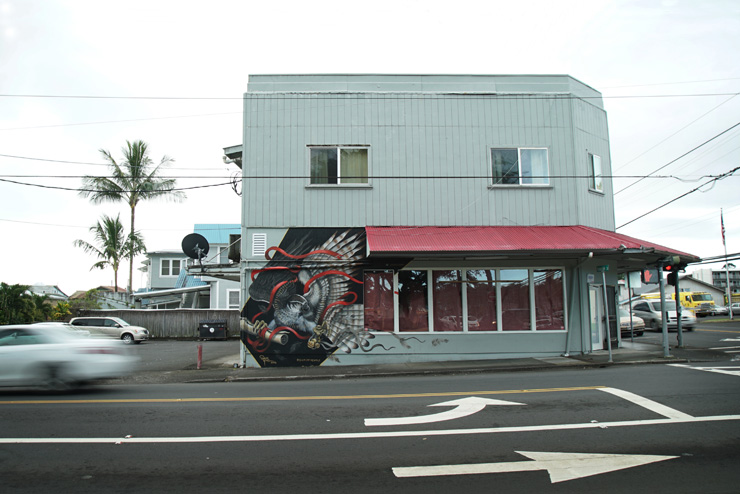
Sam Yong. Temple Children 2016. Hilo, Hawaii. (photo © Cory Martin )

Miya: We are big advocates of the locavore movement. Through our projects, we encourage others to buy local and seasonal foods and teach people why this is critical, both socially and environmentally. It’s not only an easy way to prevent pollution that is associated with the transportation of food; eating local (and organic when possible) is healthier for the mind and body because the quality of the food is undoubtedly higher.

Through our recent project, we were able to put these ideas into action and served our artists and team near to 100% of Big Island-sourced foods. It was a challenge to say the least, but we prioritized it and made it happen through our own cooking and through donations from like-minded farms and businesses in the Hilo community.
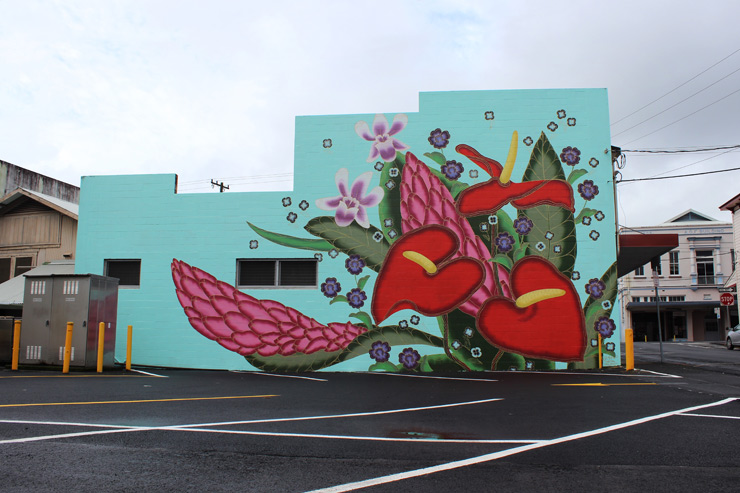
Jet Martinez. Temple Children 2016. Hilo, Hawaii. (photo © Cory Martin )

MEGGS: We educated our visiting artists on the cultural values of food here in Hawai’i and why being mindful of food is vital for the future of our planet. They all seemed to absorb what we had to offer them and repeatedly commented on how they felt better every day and had more energy for painting. We’ve witnessed the positive impacts of incorporating these values into our projects firsthand and look forward to seeing how our food sustainability efforts unfold.

Brooklyn Street Art: What connection does an artist have in the community where they paint? Many new urban art festivals are criticized for what we have called a “cultural imperialism” that imposes art that is not in tune with the culture or even in context with its surroundings. Is there another way to conceive of an Urban Art mural festival?

MEGGS: Sometimes the artist has a deep connection and other times no connection at all – which may pose a problem during this unpredictable time in history. While we 100% appreciate art for art’s sake, we created this platform for meaningful artworks that will have a lasting positive effect.

Miya: Yes, we do believe there is another way to conduct a mural festival and this concept is one of the main reasons we chose to take our projects back to the basics, and strip the idea of ‘mural festival’ altogether. We consider it a sustainability project, where the murals are a byproduct of a bigger scope – to encourage real connections between our artists, the community, and the environment.
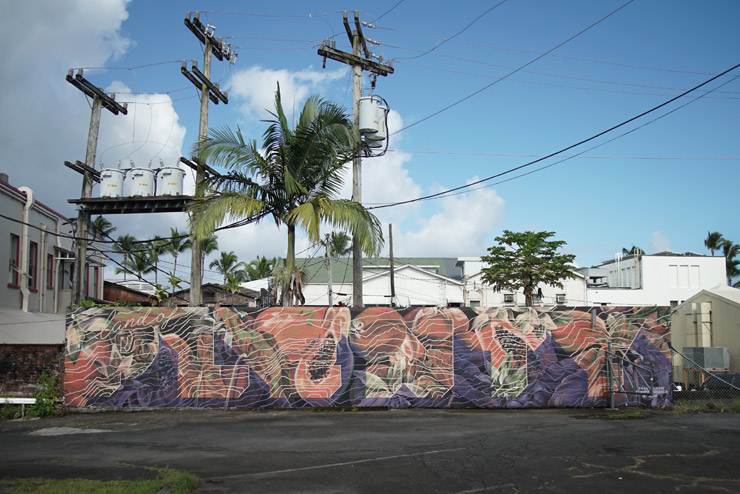
Frank & Mimi. Temple Children 2016. Hilo, Hawaii. (photo © Cory Martin )

MEGGS: Both of us have been involved in many mural festivals in recent years and it is quite often that during these urban art festivals we experience a division between an artist and the community they paint in. Sometimes the community is left out of the process or completely ignored from thought when these artworks are conceived, leaving them feeling disconnected. We hope our resulting public art inspires and uplifts the public (especially the kids!), as we thoughtfully integrate our artists into the communities where we hold our projects.

Miya: By connecting them with the local culture, environment, people, and food, we encourage them to bring forth messages of sustainability and positivity for the community to enjoy. It is not an easy thing to do, and we feel very lucky that we are able to do it.
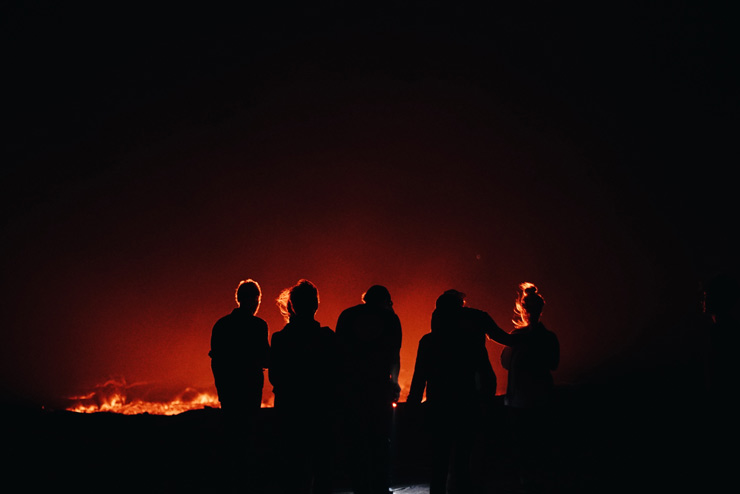
Kilauea Ecoguides take Temple Children on a “Lava Trek.” Temple Children 2016. Hilo, Hawaii. (photo © Cory Martin)

Brooklyn Street Art: You address themes of food sustainability, the environment and art education. What is art’s role and the artists’ role when it comes to addressing social causes? Should art be necessarily activist? Subversive? Antagonistic?

MEGGS: We don’t believe that art or public art should be anything other than the artist intends it to. We both tend to connect a bit deeper, however, to artworks that have underlying messages expressing thoughts or reactions to environmental and social issues.
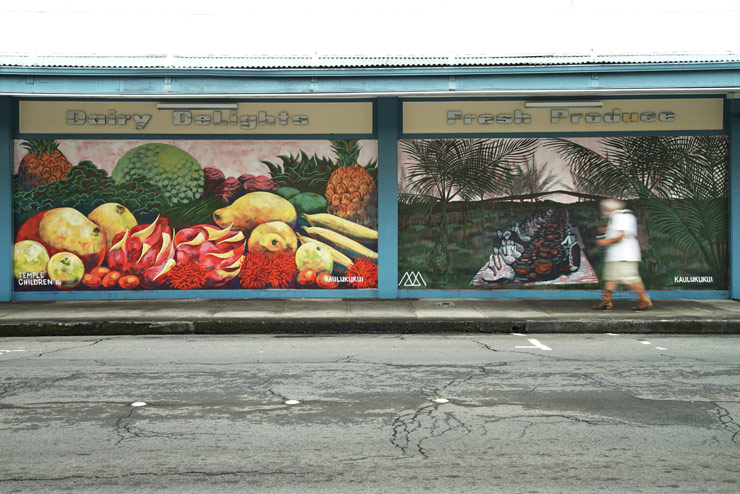
Kai’ili Kaulukukui. Temple Children 2016. Hilo, Hawaii. (photo © Cory Martin )

Miya: Our Temple Children platform is a space for artists who want to explore these feelings and be a part of a larger common goal. There is a give and take involved, with an emphasis on the give. It’s not for everyone, and our projects are specific to those who are on the same wavelength or are moving towards it.
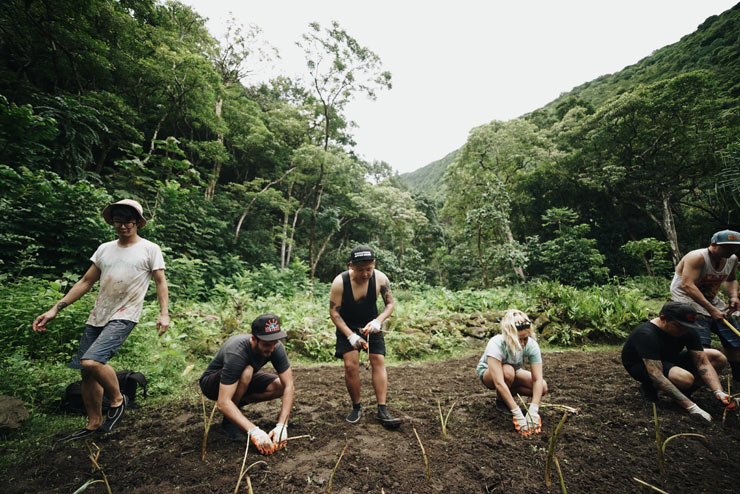
Lo’i restoration with Pohaha I Ka Lani. Temple Children 2016. Hilo, Hawaii. (photo © Cory Martin)

Brooklyn Street Art: We just saw the “Paint the Revolution: Mexican Modernism” exhibition at the Philadelphia Museum of Art and we were profoundly moved by the ferocity and fearlessness in which Diego Rivera, Orozco, Siqueiros, Tina Modotti, Alvarez Bravo and many other Mexican artists embraced the burning social issues of their time and used their work to call out the hypocrisies and corruption in society and government. Can art be impactful and inspire positive change in social/political matters in today’s world?

Miya: We’d like to think so! We believe that art can be a contributing factor to social change, especially in regards to the dialogue and awareness surrounding social and environmental issues. The challenge that an artist can face, however, is deciding how to best contribute their skills to inspire the actions necessary to make a change.
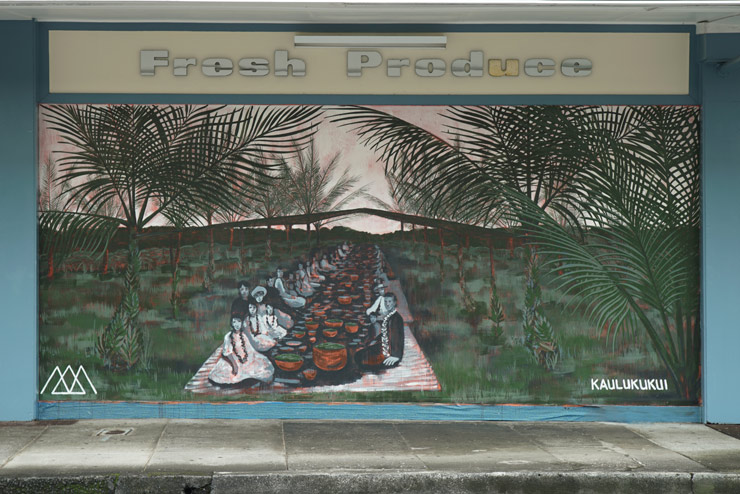
Kai’ili Kaulukukui. Detail. Temple Children 2016. Hilo, Hawaii. (photo © Cory Martin )

MEGGS: Whether it is through physical action, fundraising, aligning and supporting community and environmental organizations, etc… the possibilities really are endless if an artist decides to use his or her art to influence these matters. We see it happening more and more due to our planet’s current environmental, social, and political climate.
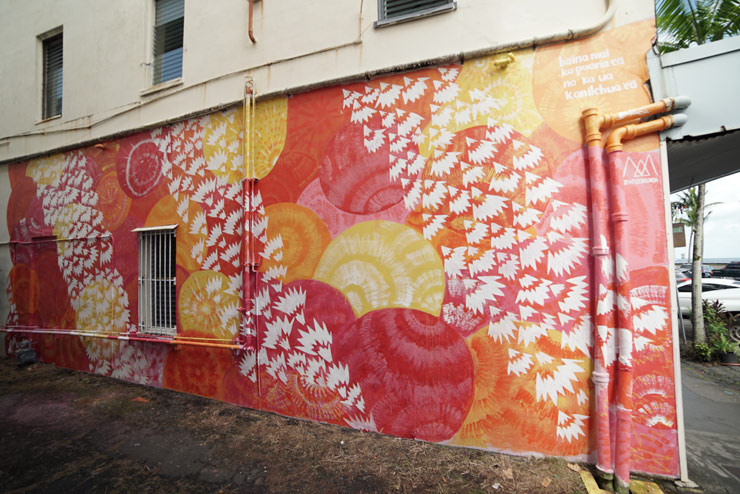
Brandi Serikaku. Temple Children 2016. Hilo, Hawaii. (photo © Cory Martin)

Brooklyn Street Art: What is your formula for giving the artists enough time to paint, explore, conduct workshops and even do a little reforestation?

Miya: We set out with an ambitious 10-day minimum requirement that everyone be on island. Given that this project is paid and includes accommodations and all meals, we felt it was a reasonable commitment of time. There were no objections because our roster of artists were very excited to come and experience what the Big Island has to offer.

MEGGS: They spent 3 days getting to know each other and immersing in adventure and volunteer work, 5 days painting the murals, and 2-3 days at a beach house where we could relax and hike to the lava flow. There isn’t a fool-proof formula in place because of unforeseen obstacles (weather in the tropics and lifts breaking for example), but we feel 10 days to two weeks is a good amount of time to achieve all of the goals we set for the project, including the mural painting.
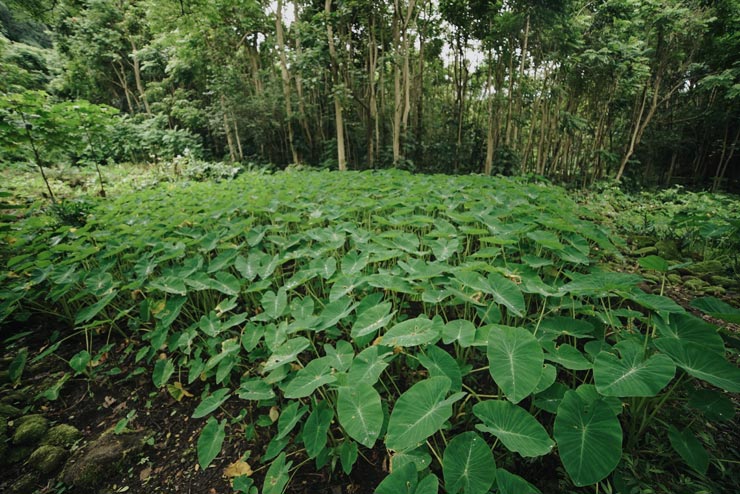
Lo’i restoration with Pohaha I Ka Lani. Temple Children 2016. Hilo, Hawaii. (photo © Cory Martin)

Brooklyn Street Art: Who are you inspired by – or what’s inspiring to you to continue Temple Children?

MEGGS: This project is inspired by many factors. The first is our ‘global community’ of friends and artists who we consider our family. Although we are miles apart, it seems we are all fighting for a common cause and it is comforting to know that you aren’t alone on this sometimes discouraging and unpredictable journey. It’s not only a support network, it fuels us to continue to exchange ideas with other like-minded people for the betterment of our communities and environmental sustainability.
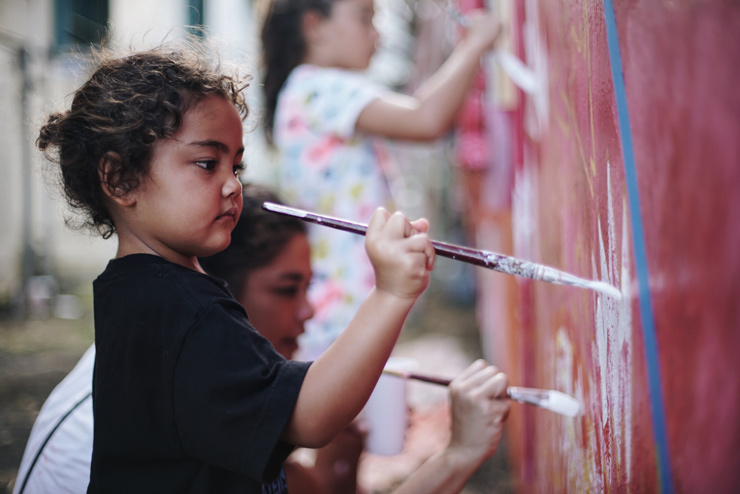
Keiki Outreach with Brandy Serikaku. Temple Children 2016. Hilo, Hawaii. (photo © Cory Martin)

Miya: Which leads to another inspiration – the keiki, or kids. We’ve experienced first-hand the pure joy that the kids feel when they see or help with a mural, and it is a goal of ours to do what we can to uplift future generations in smaller communities with less resources. Many of them are not exposed to what the world has to offer them, and we bring global ideas and artists from faraway places to teach them that they can pursue their art and creativity as a legitimate career path.

MEGGS: Most importantly, we are inspired by Mother Earth and her natural wonders. The threatened state of our planet is the ultimate motivation to do whatever we can to help protect our resources for every living being that shares this special place.

Kilauea Ecoguides. Lava Trek. Temple Children 2016. Hilo, Hawaii. (photo © Cory Martin)

To learn more about Temple Children click HERE

Temple Children is currently raising funds for the Standing Rock Sioux Tribe in support of their efforts against the Dakota Access Pipeline. 100% of the proceeds from this limited run of 40 pieces goes to the Standing Rock Sioux Tribe.

Find out more by clicking HERE

@templechildren  @houseofmeggs
Read more
Fairey & Friends Respond Graphically: “We The People” & Women’s March Posters for Download

Fairey & Friends Respond Graphically: “We The People” & Women’s March Posters for Download

If the popular response to this poster campaign is an indication, there will be many in the streets.

The “We the People” project with Street Artist and activist Shepard Fairey, Ernesto Yerena and Jessica Sobogal originally aimed to raise $60,000 on their Kickstarter page with the non-profit Amplifier Foundation.

They received 22 times their goal.


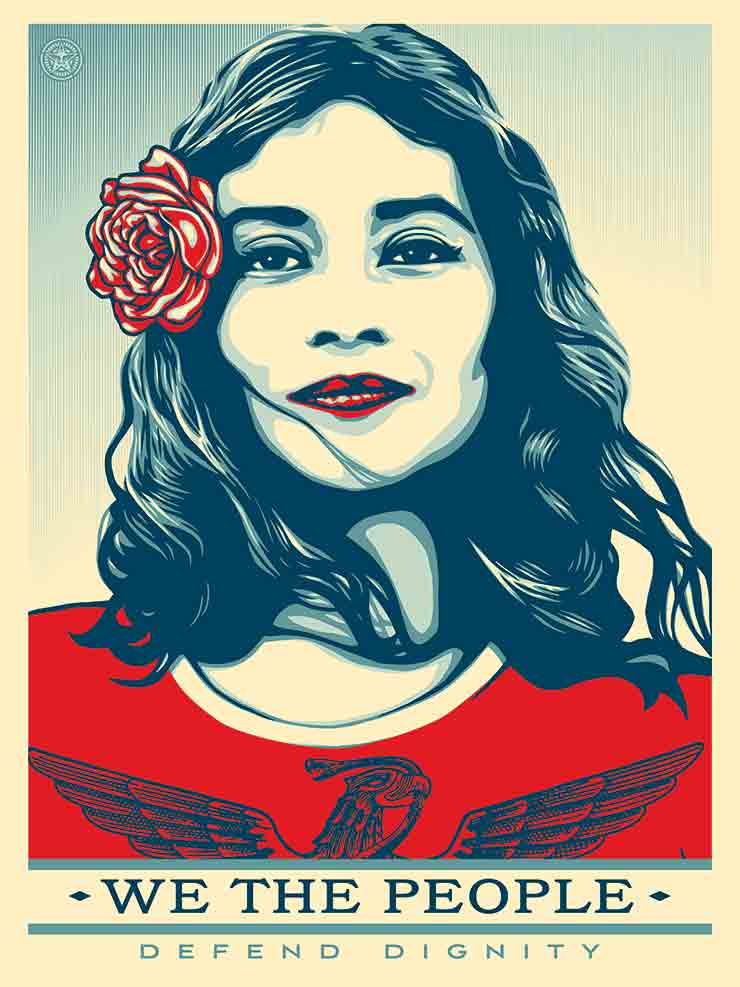
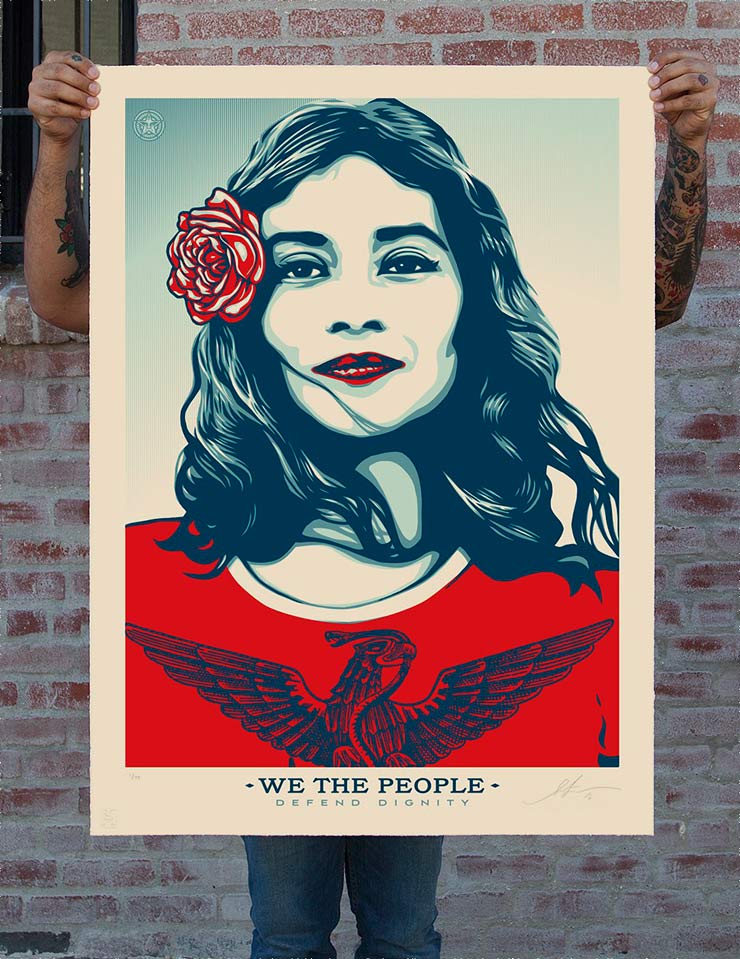
We The People: Defend Dignity

Shepard Fairey. We The People. (photograph by Arlene Mejorado)

The first words in the US Constitution and the majority of whom did not vote for the incoming president, “We The People” will appear in full page ads in The Washington Post, The New York Times, and USA Today,” according to Shepard Fairey in an interview yesterday.


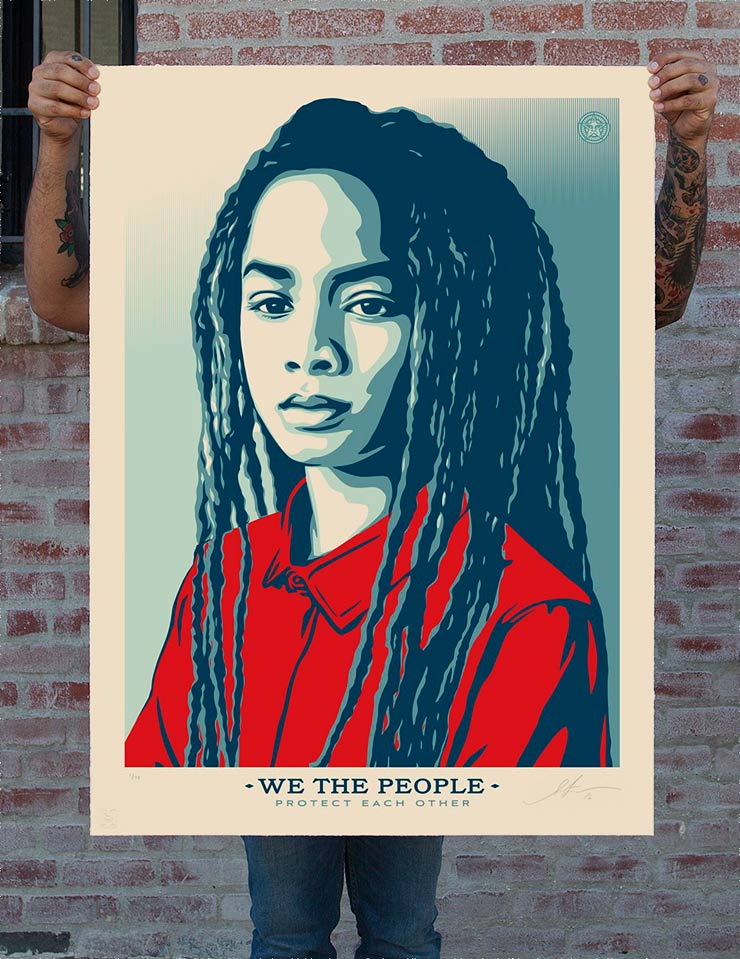
We The People: Protect Each Other

Shepard Fairey. We The People. (photograph by Arlene Mejorado)

Rather than focusing on the visage of the new president, Donald Trump, as his iconic red, and blue “Hope” poster of then-candidate Barack Obama did, these new posters by Fairey and team feature communities that the conservative white right wing can’t bring themselves to treat equally – Native American, African American, Muslim, and Latinos.

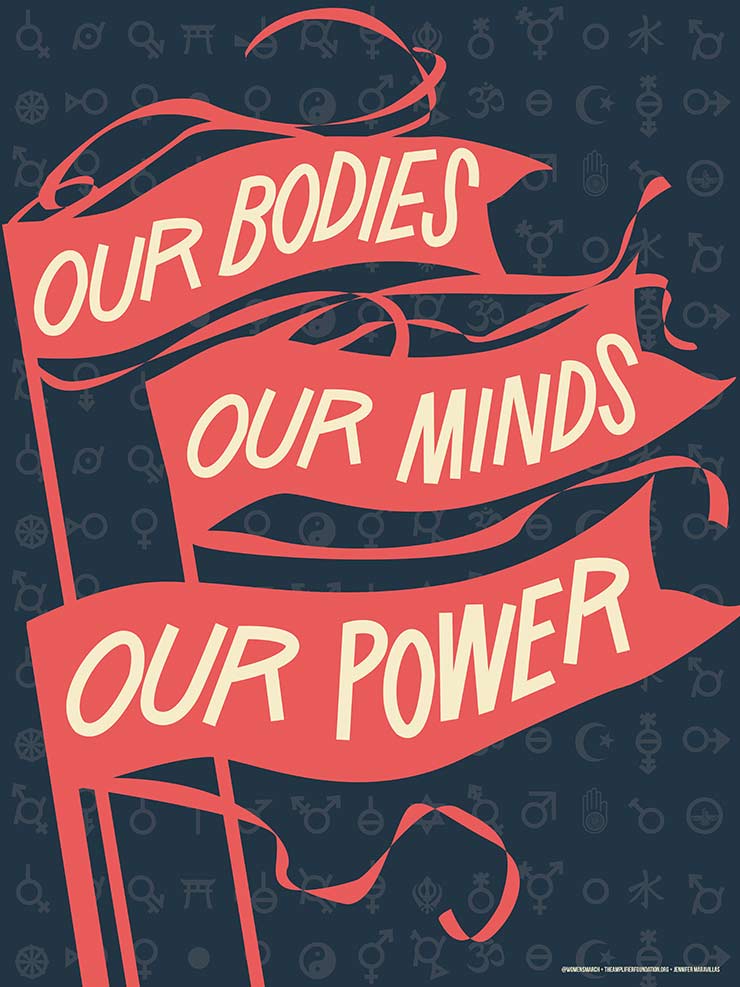
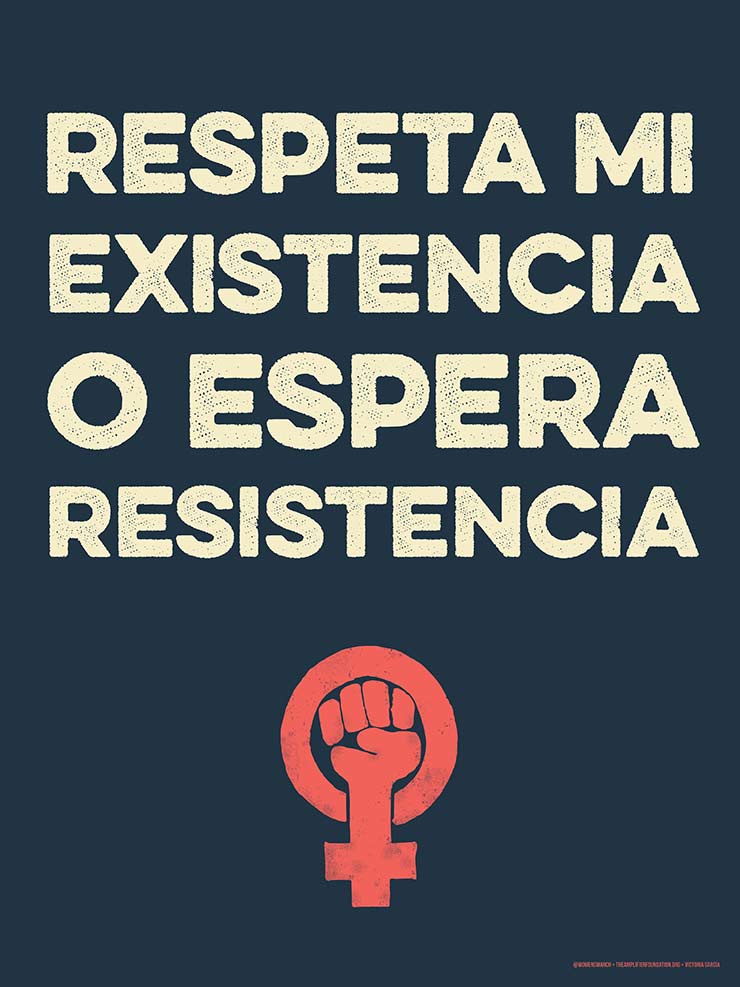
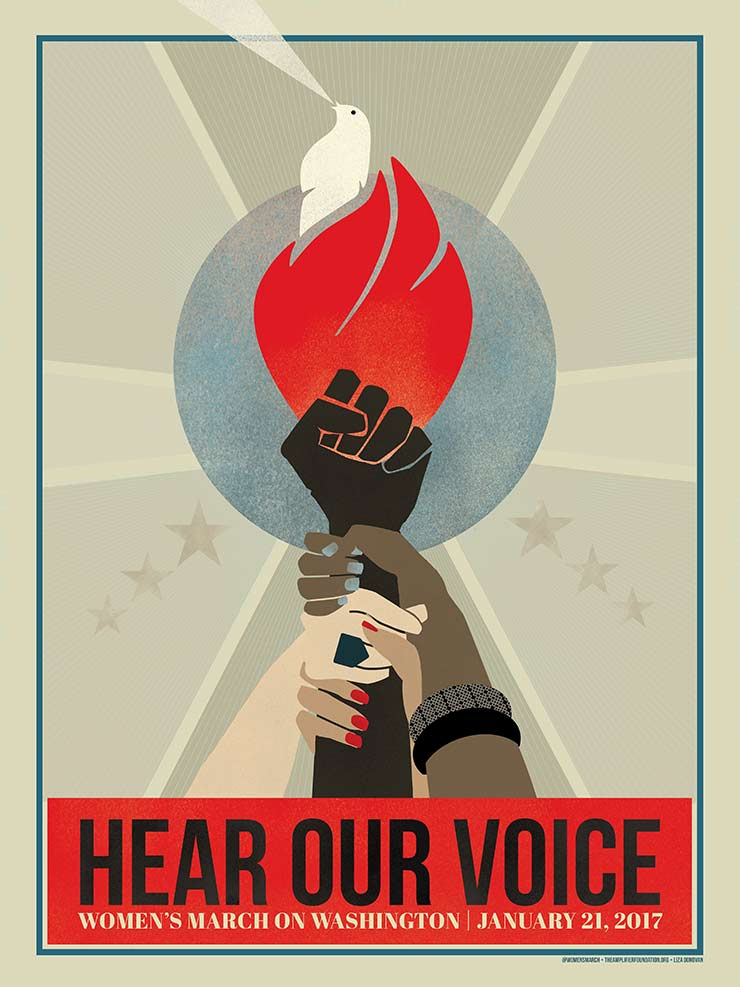
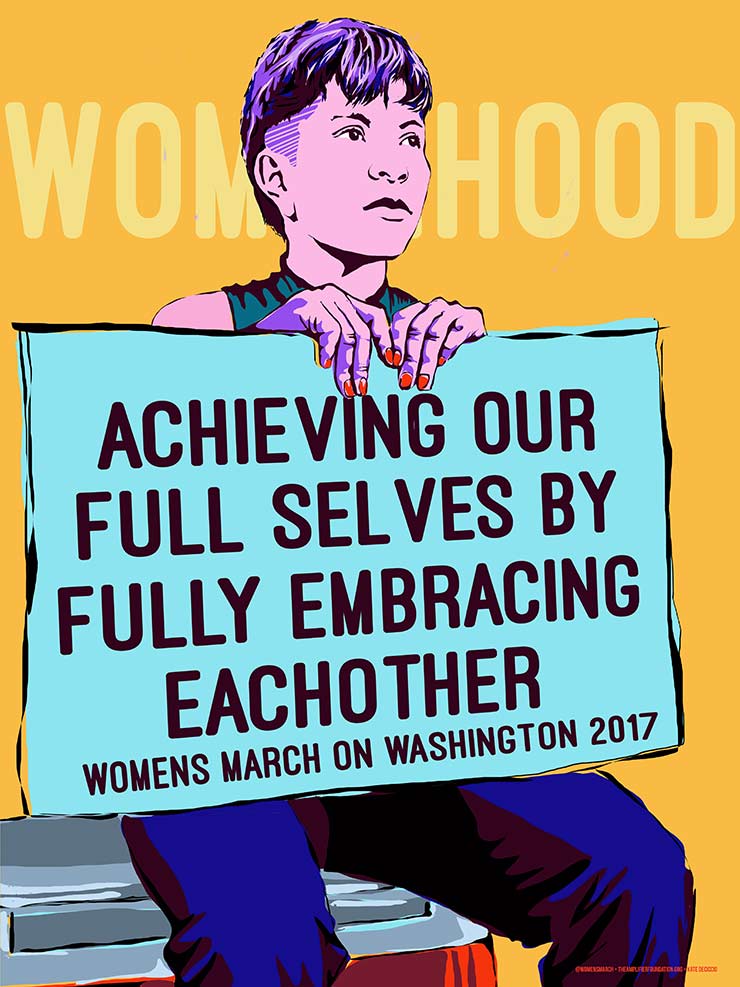
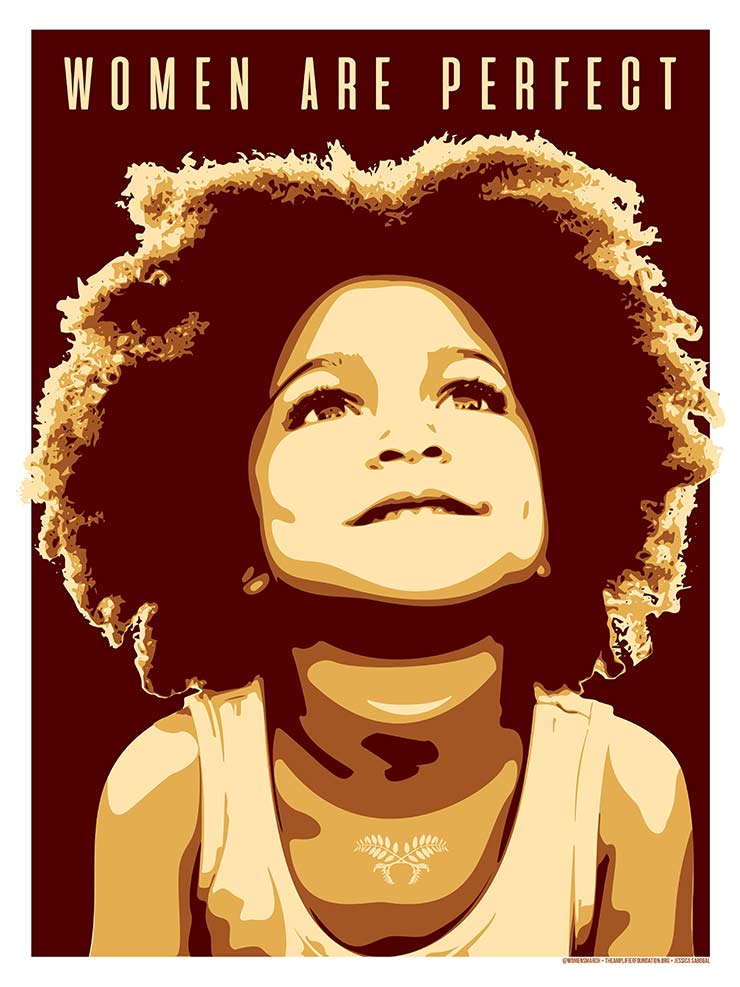
The posters have been printed and distributed in the millions by now and you can download and print high resolution versions of them yourself below. You’ll also see that there are five new posters designed specifically for the Women’s March tomorrow in Washington, New York, Chicago, Los Angeles, and an estimated 616 other cities around the world that are also hosting marches called “sister marches”.

We The People: Are Greater Than Fear

Shepard Fairey. We The People. (photograph by Arlene Mejorado)


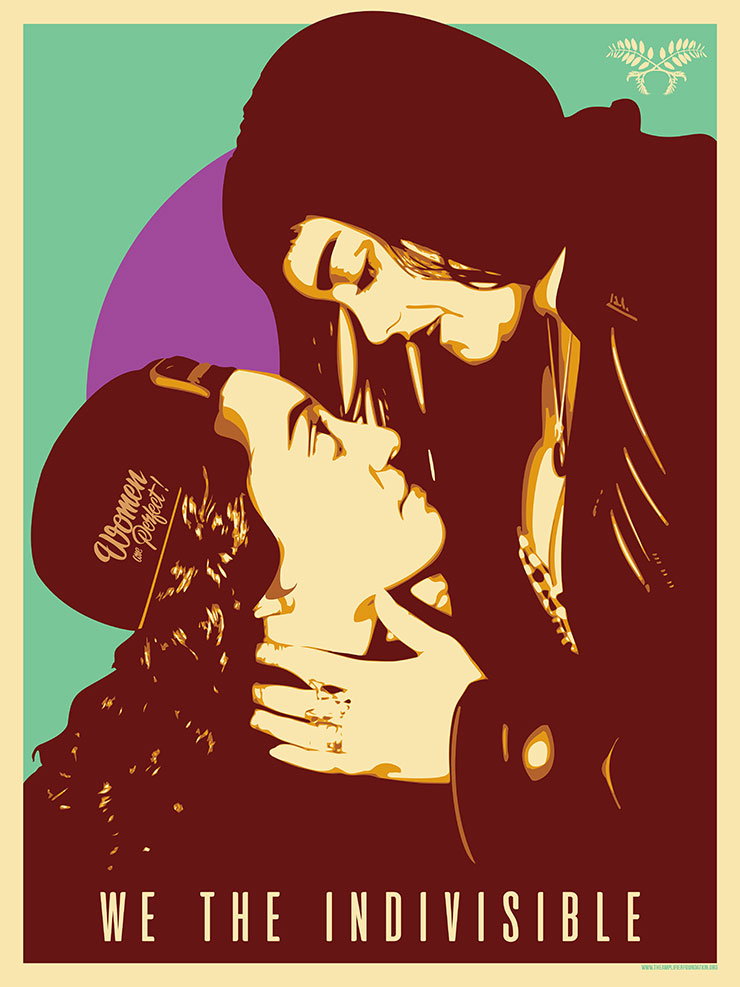
Jessica Sobogal “We the Indivisible” for the We the People Campaign.

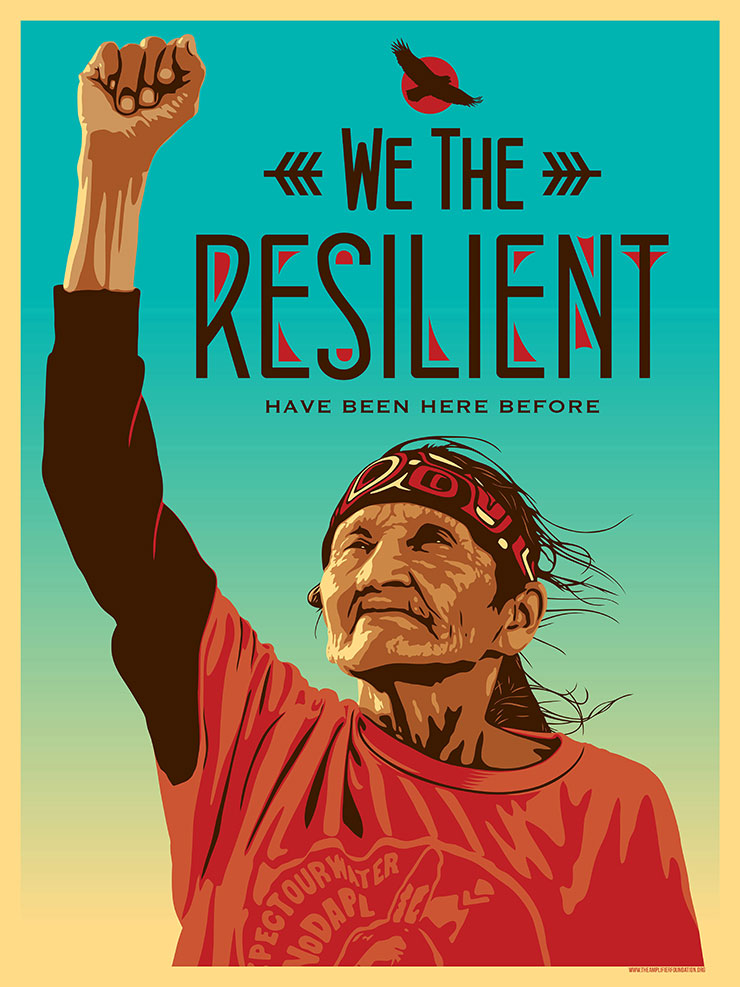
Ernesto Yerena for the “We the People” Campaign


Below are a few posters from a growing roster of posters for the Women’s March on Washington. Check below for a button to download them.

Amplifier Foundation


Download Zip file of high res versions of “We the People” posters to print here:


Download Zip file of high res versions of “Women’s March” posters to print here:


From the Kickstarter Page

SHEPARD FAIREY is one of the most accomplished street artists in the world, and creator and founder of Obey Clothing and Obey Giant, first becoming known for his “Andre The Giant has a Posse” sticker campaign while at the Rhode Island School of Design. He became widely known during the 2008 presidential election for his Barak Obama “Hope” poster.
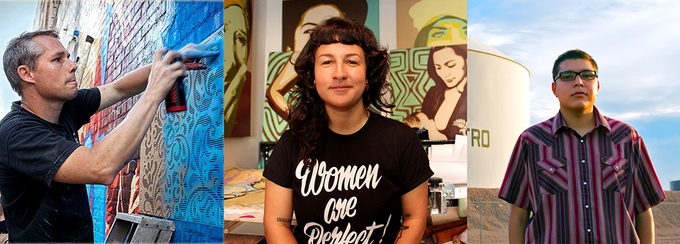
JESSICA SABOGAL is a first generation Colombian American muralist. Her art serves as a haven, a tribute, a creative outlet of adoration and exaltation for women with stories often untold. Her pieces possess a vision of female identity that is revolutionary and powerful, brave and beautiful. Most recently she has created a visual campaign entitled, “Women Are Perfect” which attempts to spread this simple but necessary notion worldwide.

ERNESTO YERENA is an artist living in Los Angeles.  His art brings political concerns to light with subject matter that depicts cultural icons, rebels and everyday people voicing their stance against oppression. While Yerena identifies as Chicano he also strongly identifies as Native/Indigenous to this continent which is often seen in his work. Highly recognized for his activism, Yerena is the founder and curator of the Alto Arizona Art campaign (2010) as well as a founding member of the We Are Human campaign (2009).

THE AMPLIFIER FOUNDATION:  Our non-profit is dedicated to amplifying the voices of grassroots movements through art and community engagement. We do this by funding collaborations between those movements and contemporary artists so that their messages can reach a wider audience. Our goal is to flip artists into activists and observers into participants.


Read more
Sculptor John Ahearn Brings Iconic New Yorkers to Streets to Meet the Neighbors

Sculptor John Ahearn Brings Iconic New Yorkers to Streets to Meet the Neighbors

When you want to experience the neighborhoods of New York, you go walking on our streets. When you want to study the people who are New York, you go to John Ahearn.

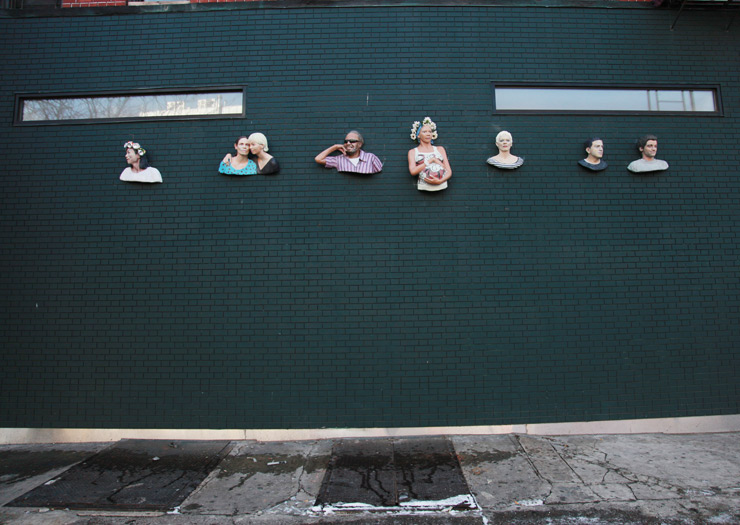
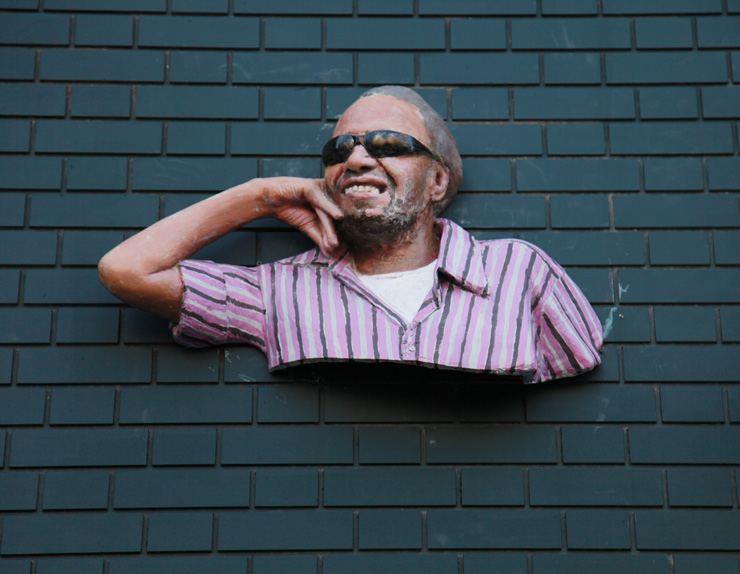
John Ahearn. Delancy Street Denizens (on John Ahearn imagination). Delancy Street, NY. January 2017. (photo © Jaime Rojo)
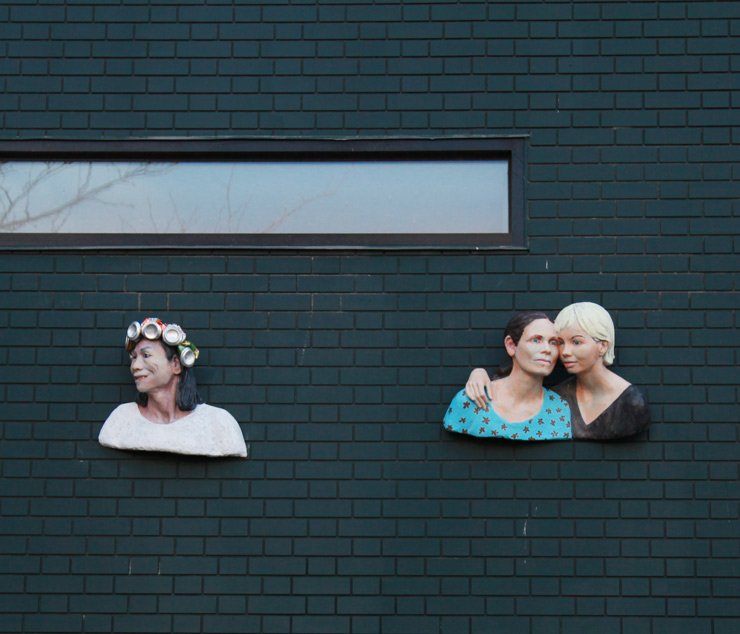
From left to right: Chin Chih Yang, Coleen Fitzgibbon and daughter Kelly Otterness, Steve Cannon, Juanita Lanzo, Pat Place, James Fuentes and Lee Quinones.

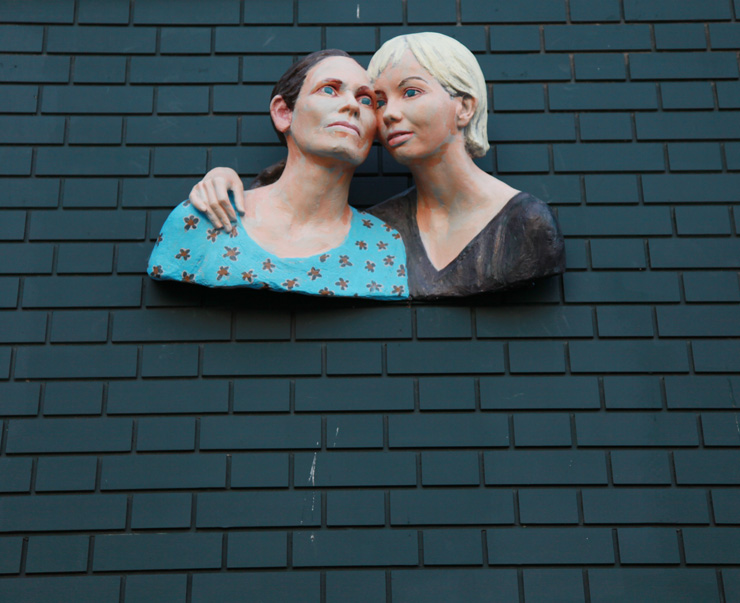
For nearly forty years on the streets of New York this artist has been casting New Yorkers and attaching them to walls for all to see, to watch, to talk to, to argue with. In all our self-possessed and artful individual non-homogeneity, with our multitude of languages, accents, trades, styles, opinions, attitudes, and dreams John captures us, and then shares us with the neighbors.

Long before “Humans of New York” presented the idiosyncrasies in this crazy enigmatic rat trap of a city, sculptures by John Ahearn were capturing a certain bluntly tender honesty of the character of his sitters and their family members and, in doing so, giving them a certain immortality that few could claim.

John Ahearn. Chin Chih Yang, Coleen Fitzgibbon and daughter Kelly Otterness. (photo © Jaime Rojo)

That kind of honesty may get you in hot water occasionally of course, as a public art installation during the early 1990s once revealed, when Ahearn sculpted everyday street people from his Bronx neighborhood and dared elevate them as worthy of public display. The incident caused vitriol and pearl clutching and chest pounding and a lot of spilled ink in the The New Yorker, so splendid and nerve-strumming were his honest portrayals of New Yorkers.

It also revealed latent here-to-fore unspoken prejudice, pride, racism, and classism and put it all muddily and bloodily on parade; in other words, an American story. The writer Jane Kramer rightly asked in that article’s title “Whose Art Is It?” – a lengthy piece which was later published as a book. As many artists who take their inspiration from the street and who give their work to the street will tell you, Ahearn had already answered that question of whose are it is. It’s yours.

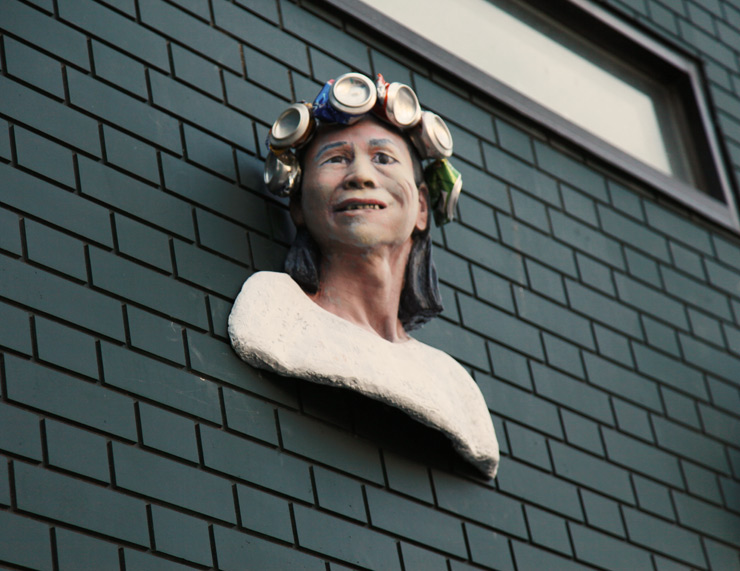
Chin Chih Yang a native Taiwanese artist whose performance art sounds the alarm for the planet. He was cast on the sidewalk at 56 Delancey St. 5/4/15 (photo © Jaime Rojo)

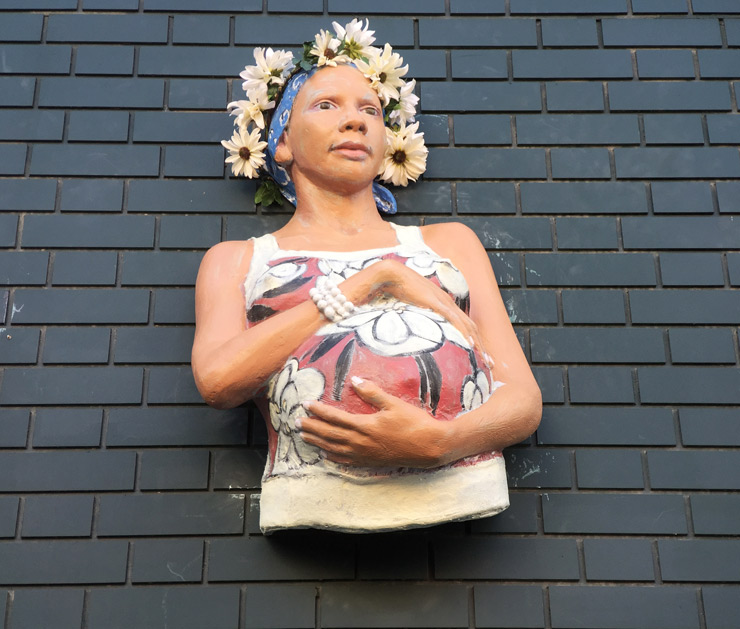
A brand new installation this month on Manhattan’s Lower East Side by Ahearn again elevates your neighbors to a recognized position of prominence, recalling local cultural history and those of our families. As his custom of working within context demands, this line up of people is as significant as their location. A post punk musician from the downtown scene that flourished here when artists flooded this neighborhood and the city was broke, a colorful performance artist, a gallerist, a hometown all city 1970s train writer, John’s own lady pregnant with their child. These are personal stories of life in this city, here on the wall while the cars and taxis and delivery box trucks and tractor trailers roar and halt and honk and rumble by 24 hours a day.

John Ahearn. Artist and graffiti writer Lee Quinones, childhood and early adult life cast from 1986 in Mr. Ahearn’s Bronx studio. (photo © Jaime Rojo)

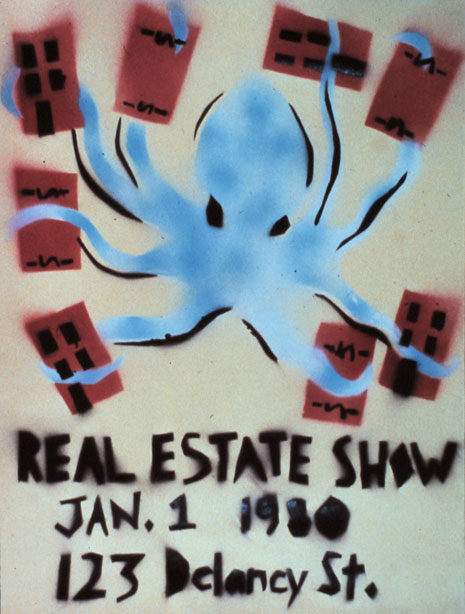
“The life on Delancey Street is the aim of the work. Friends from Colab took over a building there in January 1980 and proclaimed it “The Real Estate Show,” says Ahearn of the touchstone illegal show that happened four blocks from this new installation on James Fuentes Gallery. It is almost like he’s reflecting wistfully on that earlier time with this new choice of subjects recalling the art scene in this part of town – as if the geography of the city might invoke the hallmark Bohemian spirit that has been steadily and mercilessly stamped out by shiny bulldozers of impossible rents and dull luxury hotels serving rooftop cocktails.

The seminal “Real Estate Show” opened on the last day of 1979 and closed the first day of 1980 by force of city officials, who are said to have padlocked the art inside the building and out of reach of everyone, including Ahearn. The show and the events surrounding it highlighted the same issues that struggling artists in many cities are facing across the country today; trying to develop alternative spaces in a hostile rental market, city agency bureaucracy, largely absent institutional support, murky grey areas of legality/illegality, crime, real estate speculators, intimidation and of course, gentrification.

John Ahearn. Filmmaker Coleen Fitzgibbon and daughter Kelly Otterness cast 6/15/15 at her nearby Ludlow St. studio. (photo © Jaime Rojo)

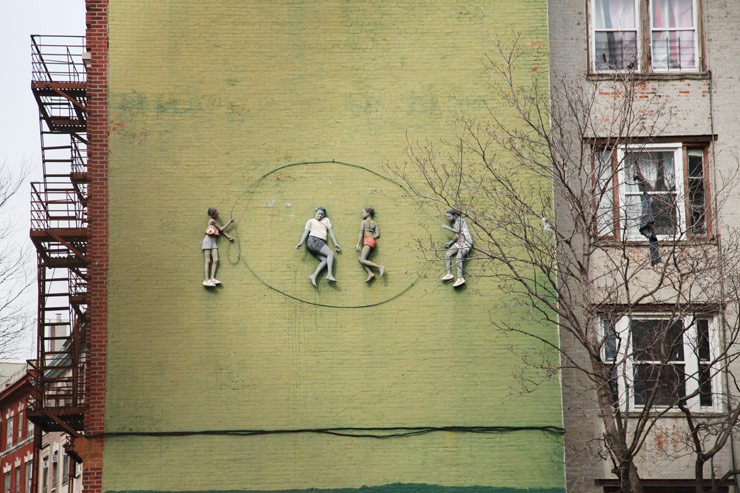
The police shutdown of that show galvanized the artist community and became part of the Downtown art scene lore and along with three other LES galleries James Fuentes himself made an homage to The Real Estate Show in 2014. Fuentes also posed for one of these new sculptures for “Delancey Street” while at one of those galleries, Cuchifritos, located down the block. Ironically, Fuentes is further connected to the work of Ahearn by dint of growing up in the early 1980s directly across the street from an Ahearn public sculpture mural called “Bronx Double Dutch” (1981-82), a casted mural of girls jumping rope that still hangs there today. (see below)

Ahearn had begun his public sculptures only a year or two earlier in 1979. “I was casting faces of neighbors at Fashion Moda in the Bronx in 1979 and people passing on the street would stop and watch,” he says. After meeting the nephew of a guy who owned a nearby statuary factory, John and Rigoberto Torres began to work together as a team.

John Ahearn. Steve Cannon, poet and founder of Tribes cast nearby at his home (with Bob Holman) 3/13/15 (photo © Jaime Rojo)

“I gave Rigoberto some materials and he cast some friends on the sidewalk on his block at Walton Avenue,” he says of the partnership that lasted a number of years. “I moved to Rigoberto’s block soon after.” Both built their craft and confidence and community ties by setting up a long-time public presence working on the street and eventually set up a studio together on Dawson Street to begin making a series of permanent fiberglass culture murals.

Today on a warm summer day you can find John on the street in the summer in the Bronx, or out at Welling Court in Queens, or a Street Art festival in Baltimore, casting the people who are calm enough to stick straws up their noses and be draped with wet plaster and to remain still until it dries.

John Ahearn. Juanita Lanzo artist and mother of John’s son Carlos was originally cast naked in 5/13/09, but was “clothed” for this presentation in 2015. (photo © Jaime Rojo)

Even in 1980 it was a challenge for children to complete a sitting for him. “It became a point of pride for young kids to demonstrate their confidence,” he says, blue eyes smiling. “The little kids would come up to us and say “Let me do it! I’m ready!’ and I would say “No, you’re not ready, you have to wait!” When Ahearn talks with his infectious enthusiasm, you know he’s giving as much energy to his work as he is getting from it and he can tell you countless stories about the people he has profiled, what kind of work they do, who they are married to, where they went to school.

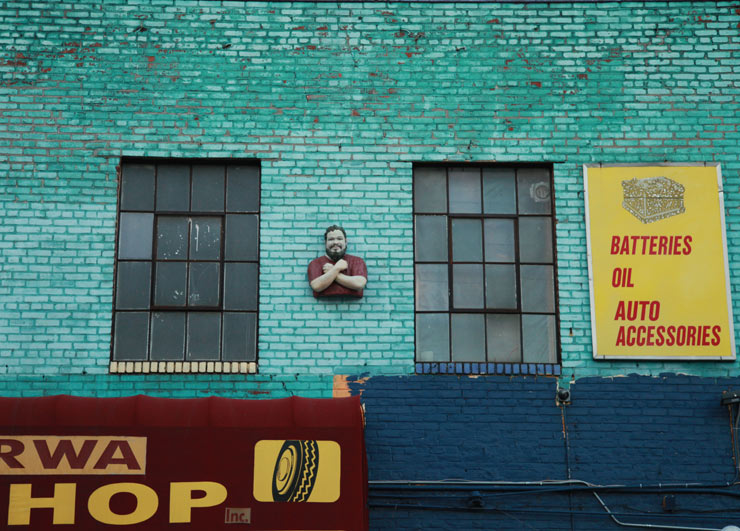
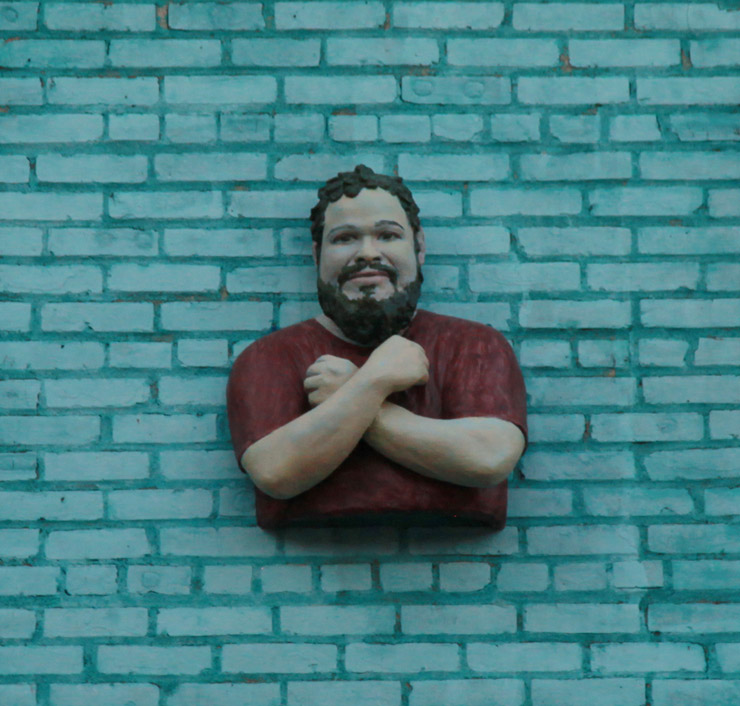
John Ahearn. Monxo Lopez. The Bronx. January 2017. (photo © Jaime Rojo)

Just this past Saturday on the blue bricked wall over a tire shop near his studio in the Bronx Ahearn installed his most recent portrait of a neighbor whom he has known for years. Monxo Lopez went to school with John’s wife Juanita in Puerto Rico and he is a social organizer and professor who lives nearby the tire shop, John tells you. Posing in the Bronx ‘resistance’ gesture that also recalls the borough’s letter “x”, Lopez had been trying to get John to make this of him for a couple of years, but the scheduling didn’t fall into place.

The newest work is just as authentic as ever, distilling personality, stories,  relationships and inferred community in the same way that all of John Ahearn’s sculptures do.

John Ahearn. Monxo Lopez. The Bronx. January 2017. (photo © Jaime Rojo)

“I always liked this tire shop better than my studio space nearby because it is so social. It’s loud and bustling,” he says with something you could may interpret as glee.

“Everyone is yelling and telling jokes all day,” he says. “The owner, Mike, and I are friends – I wanted my sculpture to share this great space and Mike liked the idea.”

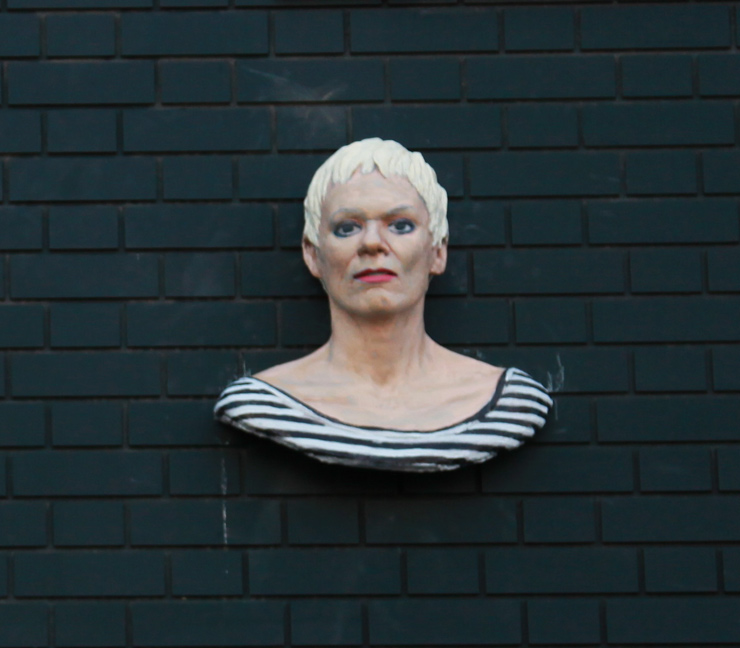
John Ahearn. Pat Place, crucial punk guitarist (Contortions, Bush Tetras) cast nearby at her home in 6/17/15. (photo © Jaime Rojo)

John Ahearn. James Fuentes born in the neighborhood, early childhood in view of the “Bronx Double Dutch” mural. Cast as “Homeboy” 4/22/14 as part of his “Real Estate Show” homage. (photo © Jaime Rojo)

John Ahearn. “Bronx Double Dutch at Kelly Street”. The Bronx, NYC. (photo © Jaime Rojo)

The photo above shows the “Bronx Double Dutch” mural mentioned in the caption below James Fuentes photo. The mural which was erected around 1981 – 1982 at Intervale Ave and Kelly St depicts four local girls, Frieda, Javette, Towana and Stancey at play as part of Mr. Ahearn and Mr. Torres series Homage to The People of The Bronx.


John Ahearn. “Bronx Double Dutch at Kelly Street”. The Bronx, NYC. (photo © Jaime Rojo)

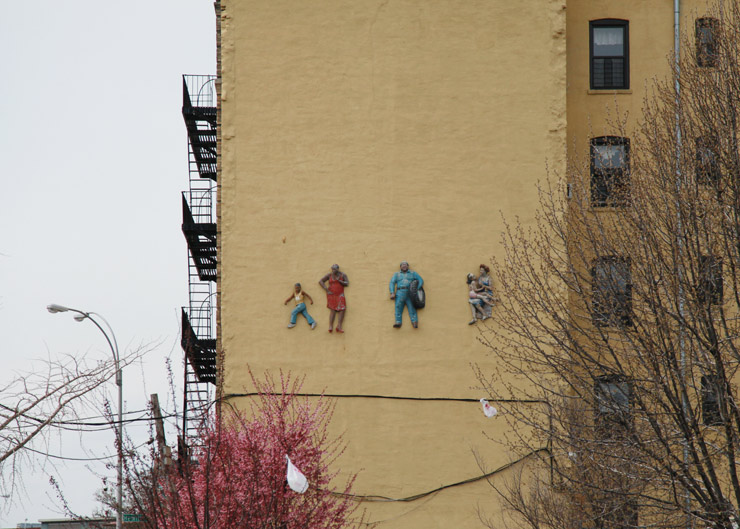
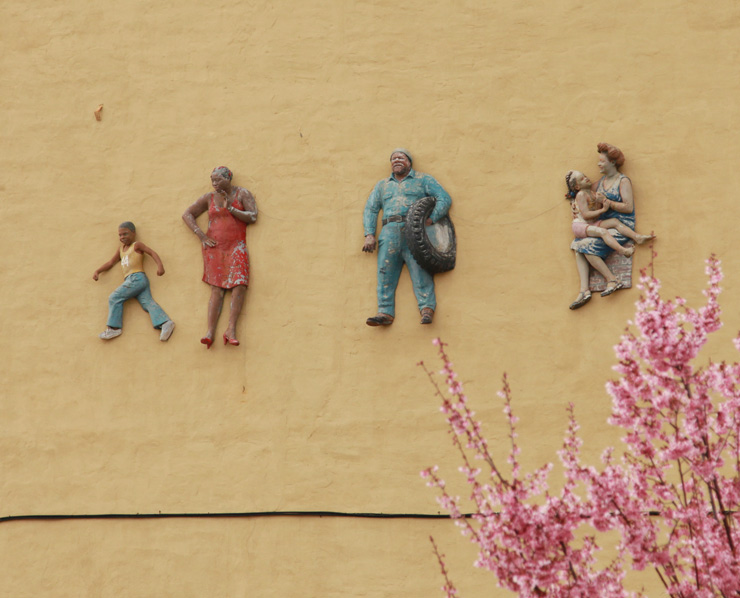
John Ahearn. “Life on Dawson Street” From left to right: Thomas, Barbara, Pedro with Tire, and Pat and Lelana at Play. The Bronx 1982- 83. (photo © Jaime Rojo)

John Ahearn. “Life on Dawson Street” From left to right: Thomas, Barbara, Pedro with Tire, and Pat and Lelana at Play. The Bronx 1982- 83. (photo © Jaime Rojo)

 

Real Estate Show Poster by Becky Howland

Read more
“All Big Letters” Opens, Curated by RJ Rushmore

“All Big Letters” Opens, Curated by RJ Rushmore

ALL BOLD CAPS.

Early graffiti train writers knew they could gain their widest audience on elevated train tracks the same way cigarette manufacturers broadcast from billboards looming above streets. BLADE emblazoned entire train sides with his five letters, as did LEE with his three. Audacious, confident, commanding: the ultimate tag.

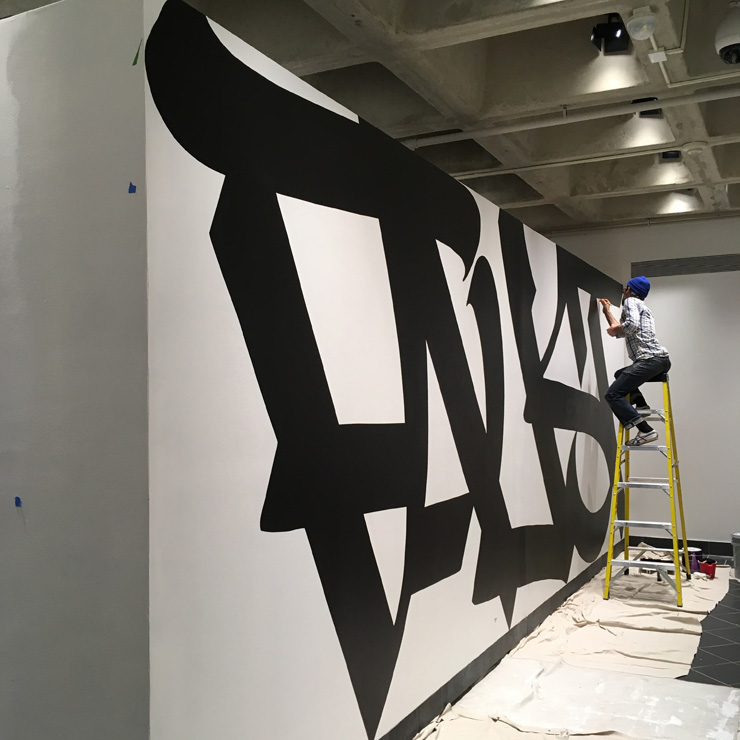
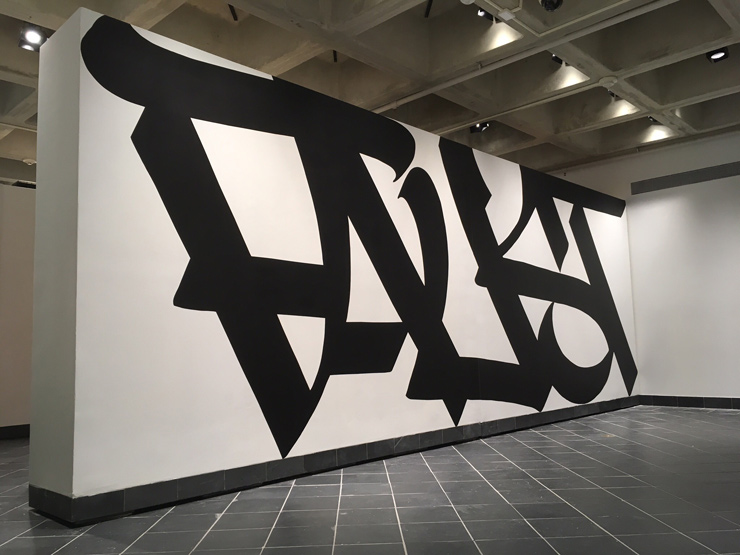
Faust at work on his installation. All Big Letters. Cantor Fitzgerald Gallery At Haveford College. Philadelphia. (photo © Courtesy of RJ Rushmore)

In 2017 the bold technique helps to cut through the information clutter as well, even when your billboard is reduced to a canvas the size of a smart phone icon. Keep it simple, brash, attention grabbing. RAMBO of course does slaughter actual billboards regularly across NYC, and on the street level the technique works as well, as Brooklyn’s graffiti writer FAUST can attest with his ever enlarging scripted tag recently emblazoned in metallic gold across a long wall in Berlin with Urban Nation. Here Faust is preparing his tag with ALL BIG LETTERS for ALL BIG LETTERS, a new exhibition opening Friday at Haverford College in Pennsylvania.

The new show is “is less about the art of graffiti and more about the craft of writing it,” says curator RJ Rushmore, editor in chief of Vandalog and alumnus of Haverford, in his description of the show. Rushmore enjoys the and studies the lore as much as the technique and here he brings a balanced cross-section of photographers, mark makers, painters, and ingenious tool crafters together to examine the methods of creating illicit missives meant to broadcast publicly. With thoughtful position paper at hand, the somewhat recent grad returns to the campus’ Cantor Fitzgerald Gallery with an exhibit that “acknowledges and investigates the surprising variety of tools that artists use,” to make hopefully a BIG impression. In the end, after all it’s how you use the tools and ALL BIG LETTERS examines strategies and techniques of hard driving urban artists working in the public sphere to capture your attention.

Faust. All Big Letters. Cantor Fitzgerald Gallery At Haveford College. Philadelphia. (photo © Courtesy of RJ Rushmore)


All Big Letters opens Friday January 20th at Haveford College’s Cantor Fitzgerald Gallery. Click HERE for more details.

Read more
Julien De Casabianca, Angry Gods, and Hacking Disaster in Kathmandu

Julien De Casabianca, Angry Gods, and Hacking Disaster in Kathmandu

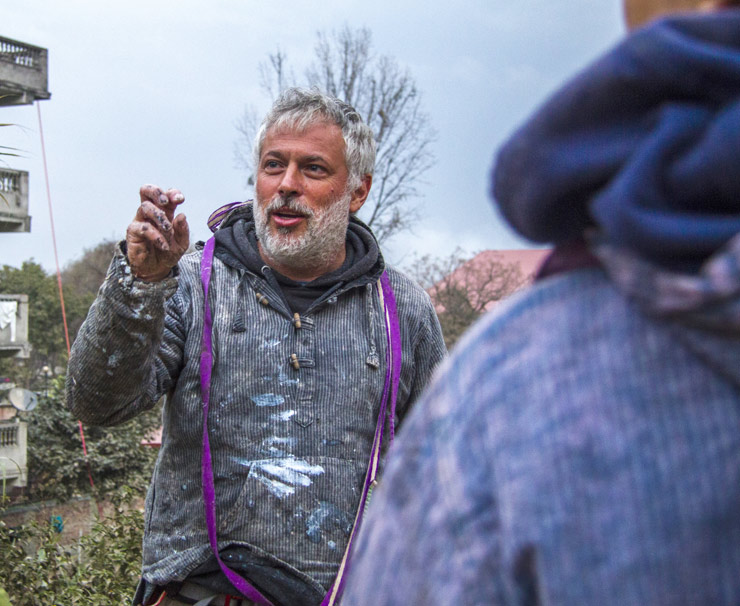
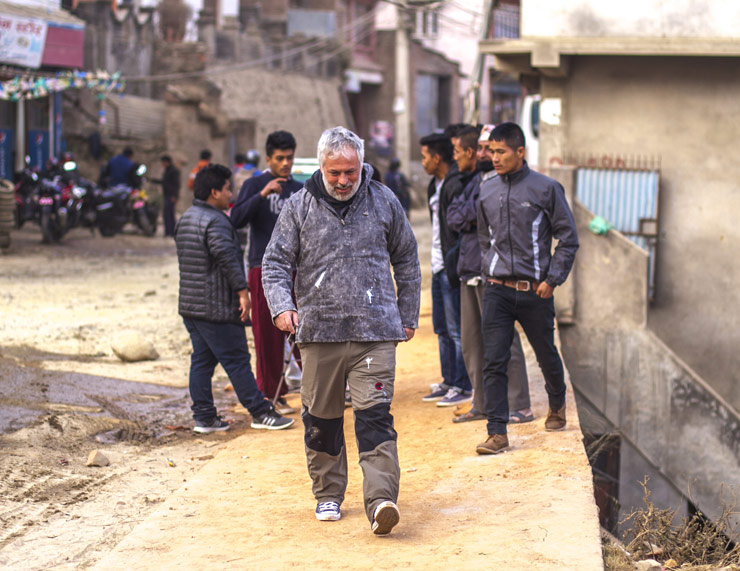
If you are not going into the museum to see art, Julien De Casabianca is happy to bring it out to the street for you. Additionally, if the museum has been closed by an earthquake, he’ll make sure the art gets a public viewing nonetheless.

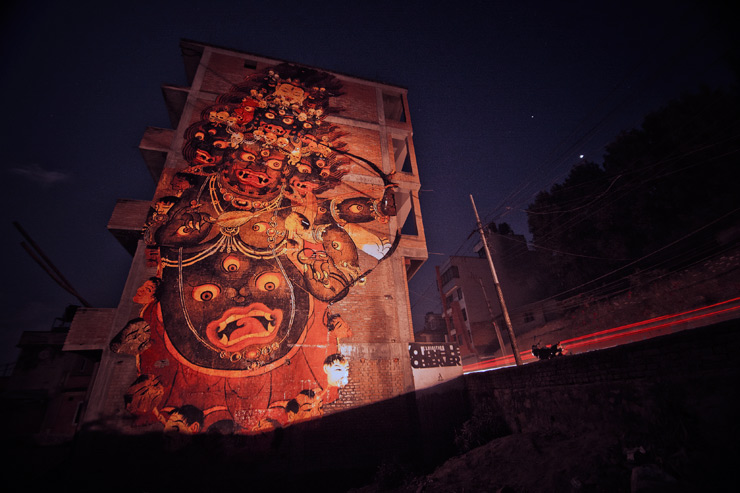
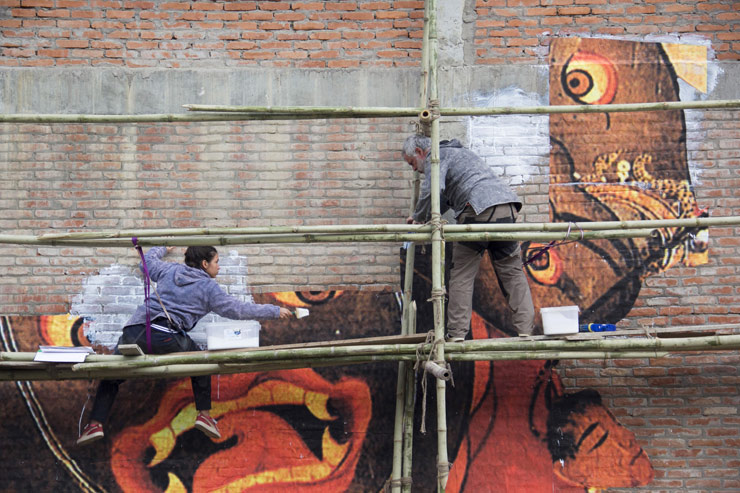
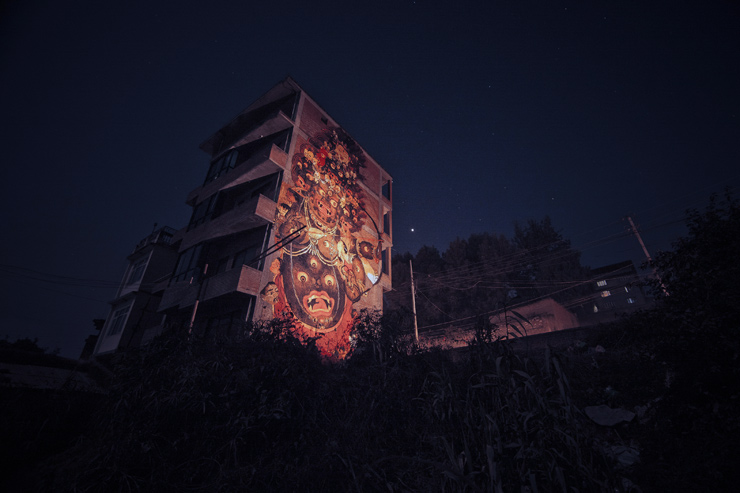
Julien De Casabianca. Outings Project. Kathmandu, Nepal. January, 2017 (photo © Karma Tshering Gurung & Sanam Tamang/ Artudio)

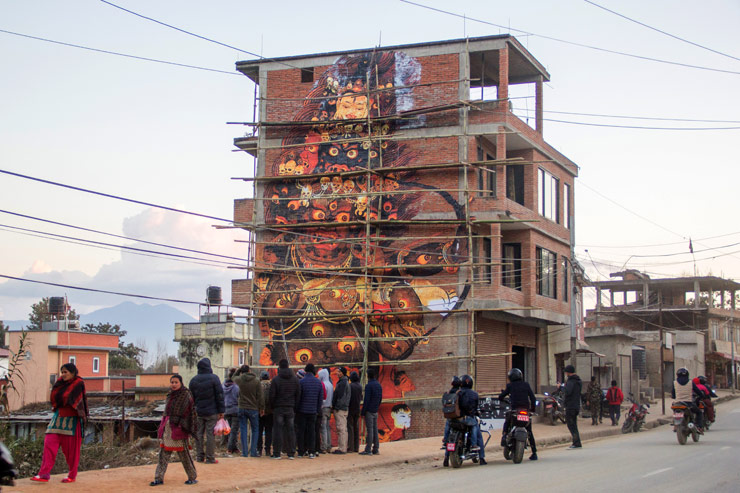
In Kathmandu recently Street Artist Julien de Casabianca continued his Outings Project by bringing a centuries-old painting outside to the side of the Artudio building in Swoyambhu on Chhauni Hospital Road with the help of Matt Rockwell of the humanitarian hackers group called DisasterHack.

He tells us that the obstacles to getting this piece up seemed insurmountable at times due to the broken social and infrastructural systems in Nepal that still plague people even today, nearly two years since the catastrophic earthquake that killed nearly 9,000 and injured 22,000 more.

Julien De Casabianca. Outings Project. Kathmandu, Nepal. January, 2017 (photo © Matthew Rockwell/DisasterHack)

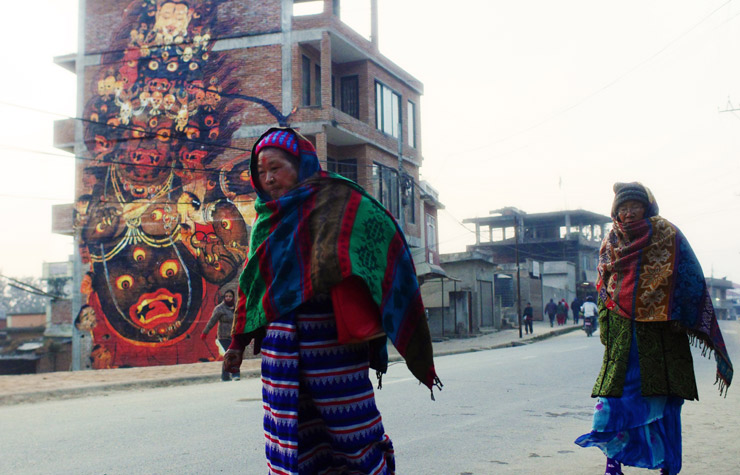
The image itself is of a scary/reassuring Mahākāla – is a deity common to Hinduism, Buddhism and Sikhism which contains layers of meaning and is full of symbolism referring to the mystical, spiritual, and allegorical matters.

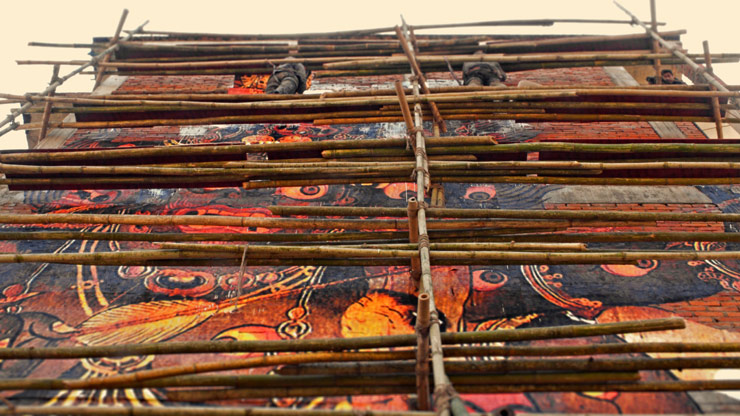
Among the challenges of wheat-pasting the fiery god piece was an ongoing sense of light vertigo from climbing, walking, and balancing on a bamboo constructed scaffolding, not to mention the difficulty of securing art materials.

Julien De Casabianca. Outings Project. Kathmandu, Nepal. January, 2017 (photo © Karma Tshering Gurung & Sanam Tamang/ Artudio)

With a goal of re-imagining how technology and art can be utilized to create social transformation and economic independence in challenging  communities, the organizers of DisasterHack say they are building a flexible network of humanitarians who can use their technical skills to hack human solutions in developing societies.

With that in mind, you know that while this new wheat-pasted art may be just a piece of art to some, to others it is a reverent reminder of a cultures history and a sign of hope for the future.

Julien De Casabianca. Outings Project. Kathmandu, Nepal. January, 2017 (photo © Karma Tshering Gurung & Sanam Tamang/ Artudio)

We spoke with Julien about his experience bringing this localized historical art work to the community who they may never see it otherwise.

Brooklyn Street Art: How was your experience in Kathmandu?
Julien de Casabianca: It was great meetings with Matt from DisasterHack and making an incredible project in a crazy country where everything is so difficult, long, painful; and where almost everyone has been in some kind of deep personal pain since the earthquake happened. We pasted it on a Artudio building where they have children’s art workshops and from up on the scaffolding we could see all of Kathmandu, a hurting city.

Julien De Casabianca. Outings Project. Kathmandu, Nepal. January, 2017 (photo © Karma Tshering Gurung & Sanam Tamang/ Artudio)

BSA: How was the experience on the bamboo scaffolding? Bamboo is about the strongest material there is but still it requires a bit of trust in the people who build the scaffolding no?
JC: It’s scary yes, just totally flexible under your feet! Even though we added some security fence and safety harnesses, you still feel in like your equilibrium is being questioned all the time.

BSA: What were you doing in Katmandu besides putting up this enormous piece?
JC: I was in Katmandu just to paste this monumental piece. I had pasted in India a few weeks before and I wanted to give a gift to DisasterHack because of the good work they do – they have many art and technology programs for kids. They even are working on designing and building prosthetic limbs for disabled children using 3D printers. They’ve done an incredible job in Nepal since the terrible earthquake.

Julien De Casabianca. Outings Project. Kathmandu, Nepal. January, 2017 (photo © Karma Tshering Gurung & Sanam Tamang/ Artudio)

BSA: What is the meaning of the piece? Is it based on a classic painting that was housed in a museum in Nepal?
JC: As always, I use traditional local paintings that are found in museums. In Kathmandu the museum was closed because of the earthquake, so I found it on the web. The

Mahākāla is a sort of god, a guardian, protector, even though he has a scary body and face. I don’t know a lot about it; I asked some priests from the temples and monasteries all around if it was ok to paste this giant Mahākāla in front of Swayambunath temple, which build at the start of 5th century. They were so enthusiastic, happy and grateful. They told us that the Mahākāla has

Julien De Casabianca. Outings Project. Kathmandu, Nepal. January, 2017 (photo © Karma Tshering Gurung & Sanam Tamang/ Artudio)

The 3 eyes symbolize his understanding of past, present and future. They said that his crown of skulls represent the five poisoned disappointments; anger, desire, ignorance, jealousy, and pride – but all are transformed by wisdom.

BSA: Do you know who originally painted it and when?
JC: We don’t know, nobody does. But most likely it was painted sometime between 7 and 15 centuries ago!

Julien De Casabianca. Outings Project. Kathmandu, Nepal. January, 2017 (photo © Karma Tshering Gurung & Sanam Tamang/ Artudio)


Read more
Martin Luther King Day : “This is no time for apathy or complacency.”

Martin Luther King Day : “This is no time for apathy or complacency.”

“We are now faced with the fact that tomorrow is today. We are confronted with the fierce urgency of now. In this unfolding conundrum of life and history, there “is” such a thing as being too late. This is no time for apathy or complacency. This is a time for vigorous and positive action.”

― Martin Luther King Jr. , April 4, 1967, Riverside Church, New York

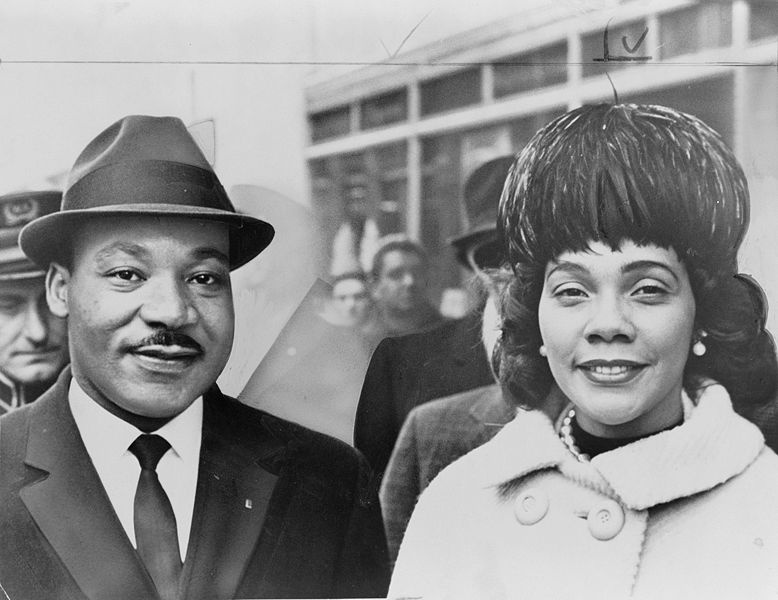
Martin Luther King Jr. and Coretta Scott King. Library of Congress Prints and Photographs Division. New York World-Telegram and the Sun Newspaper Photograph Collection.

As we remember Dr. Martin Luther king and his legacy, we are reminded that each of us has to consider seriously our individual and collective roles as a part of the equation and to fight for what is right, and good, and just, and fair for every man and woman. May his words above inspire us to keep the fight alive and to seize this moment to disempower oppression and tyranny at their first steps, not their 10th or 20th steps.

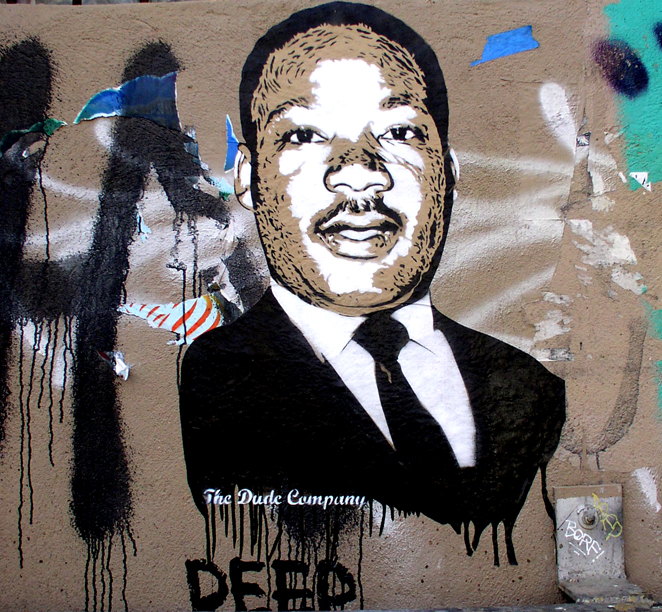
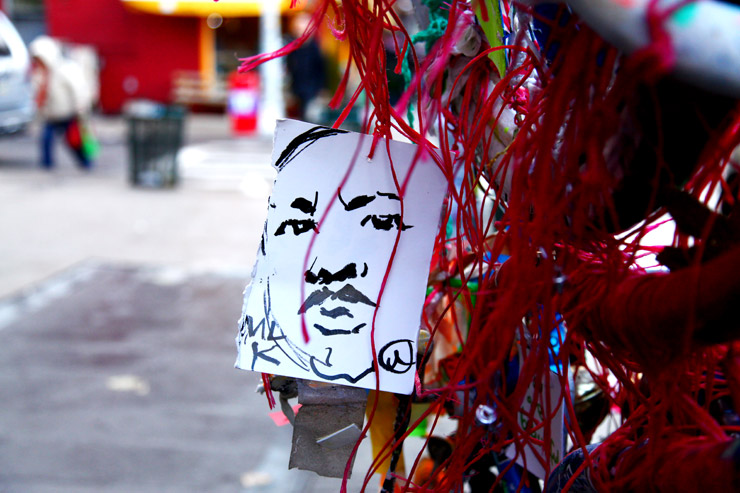
Here are some pieces of Street Art that honor the words and deeds of Dr. King.

The Dude Company. Martin Luther King Jr. (photo © Jaime Rojo)

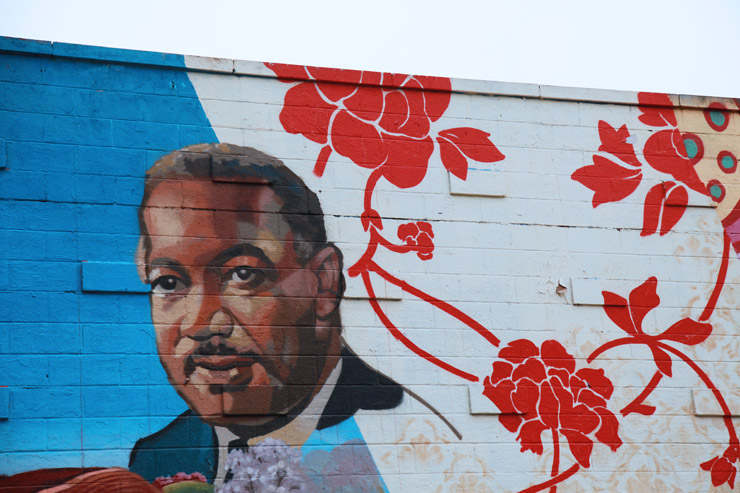
Martin Luther King Jr. (photo © Jaime Rojo)

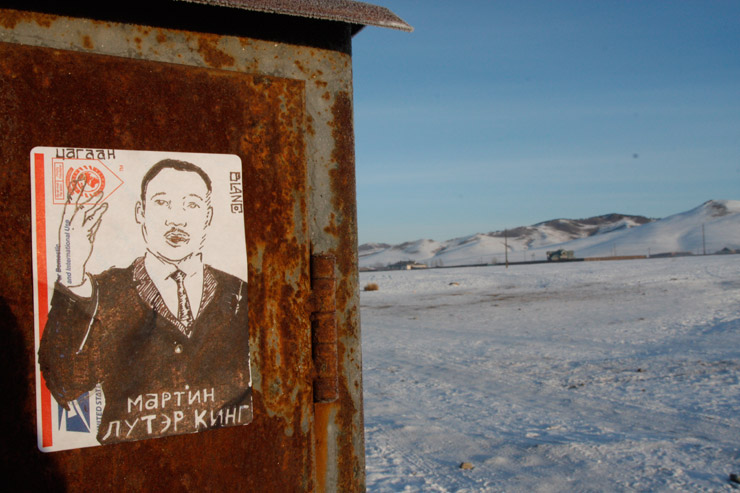
Blanco. Martin Luther King Jr. in Mongolia. 2012. (photo © Blanco)

Martin Luther King Jr. by Air3. This is a part of a larger mural in Brooklyn. (photo © Jaime Rojo)

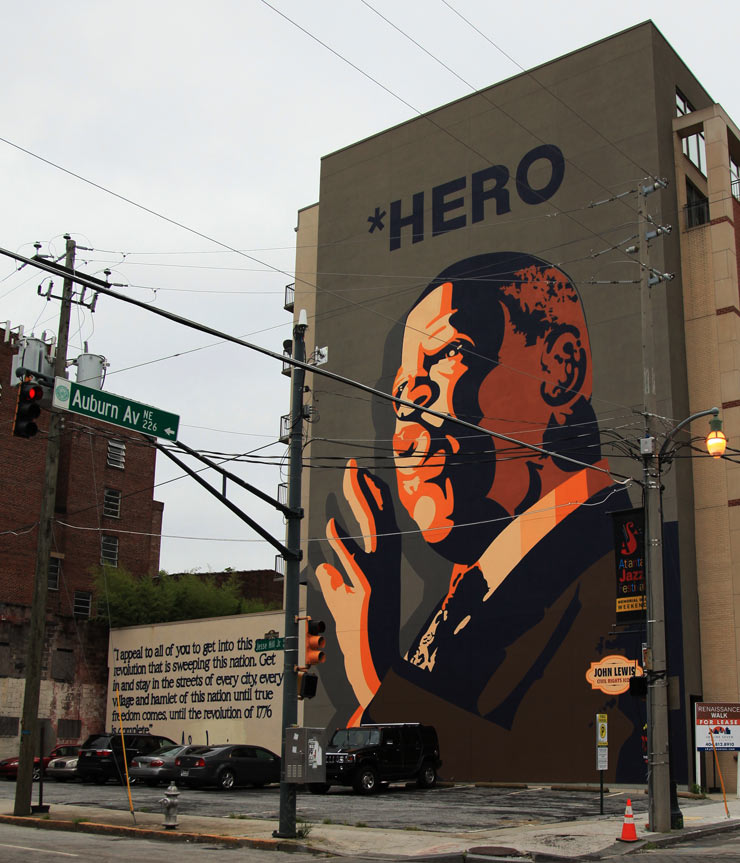
Rep. John Lewis was honored on the streets of Atlanta with this large mural by Sean Schwab for The Loss Prevention collective. Painted in the same community where Dr. King was raised, the mural depicts The Honorable Mr. Lewis for his work as a civil rights leader to end legalized racial discrimination and segregation. He was also the youngest speaker at the March On Washington in 1963. Mr. Lewis currently serves in The United States Congress representing Georgia’s 5th District since 1987. (photo © Jaime Rojo)

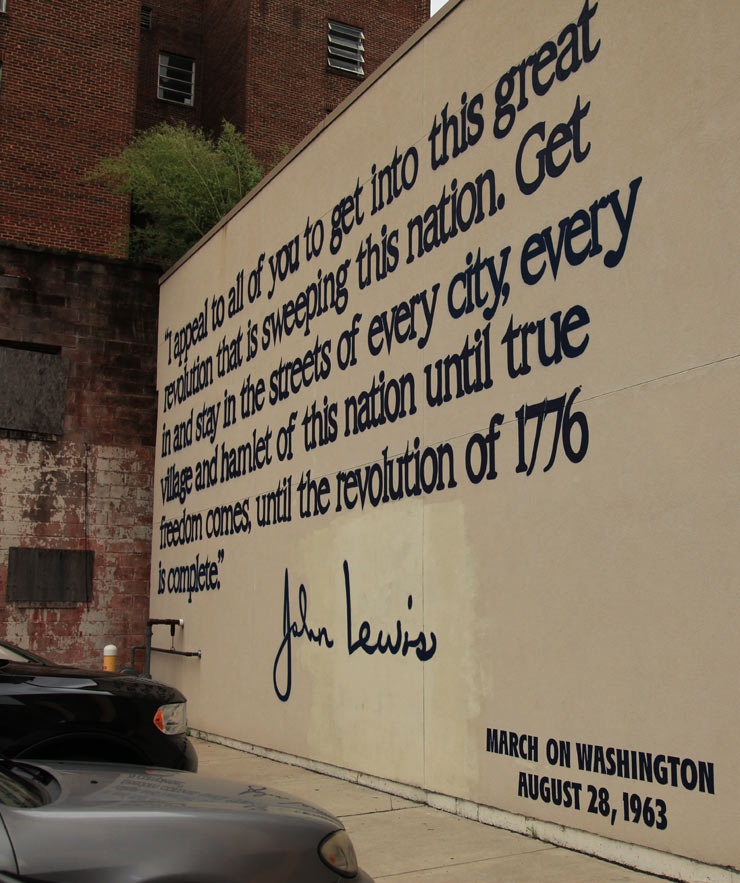
The Loss Prevention. John Lewis. March On Washington. August 28, 1963. (photo @ Jaime Rojo)

Read more