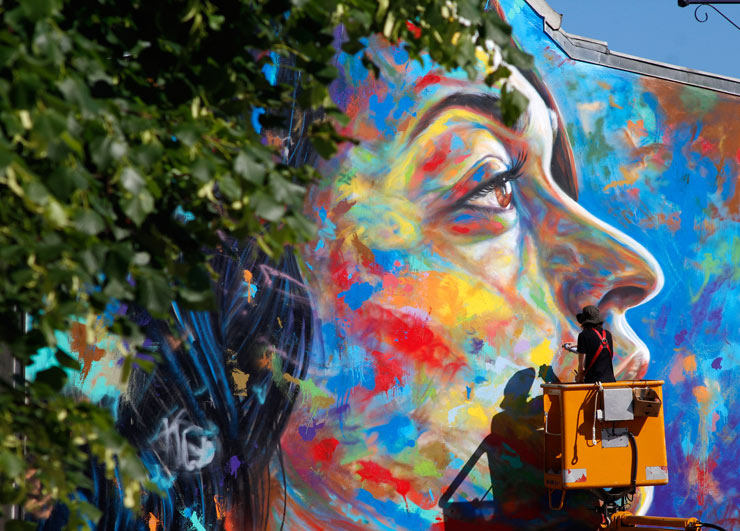
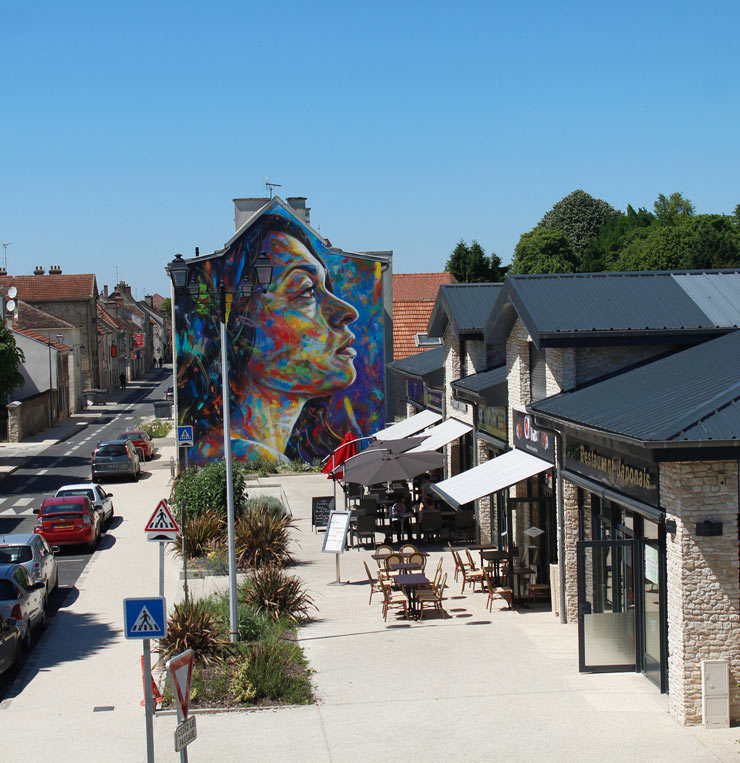
“Wall Street Art”: The merging together of two phrases (Wall Street, Street Art) that never had much to do with each other, but now sometimes do.
Additionally it is the newly branded mural program/festival across 24 municipalities in France under the artistic direction of Jourdain Gautier, whose name you may recognize from his founding and directorial roles with Mathgoth Gallery, LE MUR, and 100 Walls for Youth – all Paris based efforts.
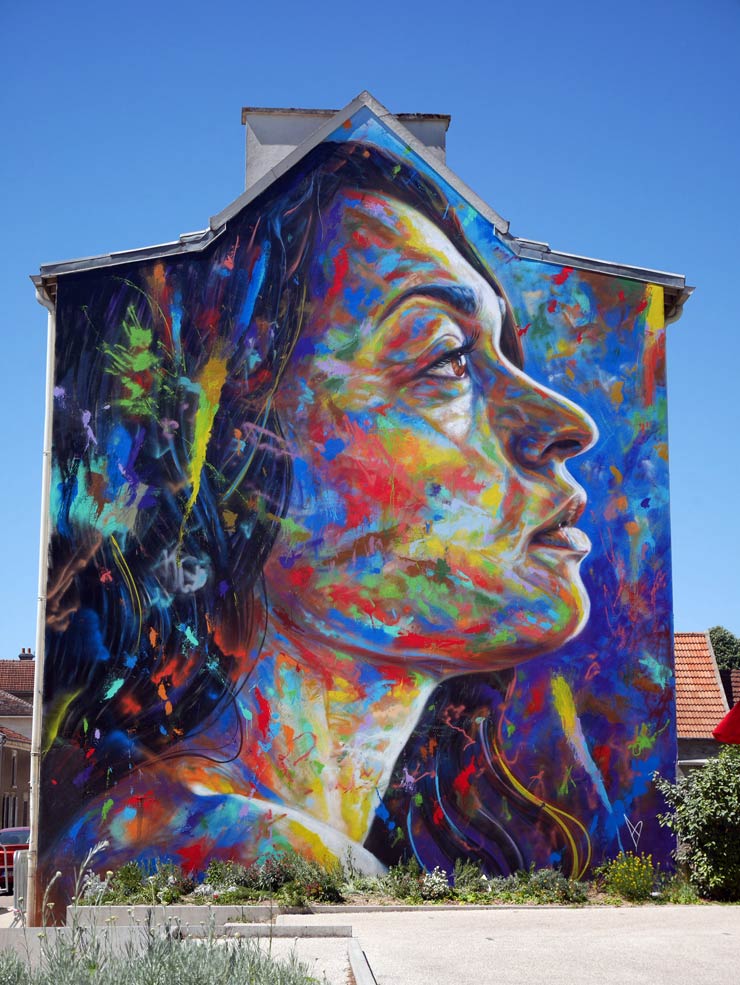
“Wall Street Art” has expanded and renamed Essone – a festival that previously hosted walls by artists like Speedy Graphito, Clet, Cranio, and Monkeybird, among others, and now brings us a new wall in Lieusaint.
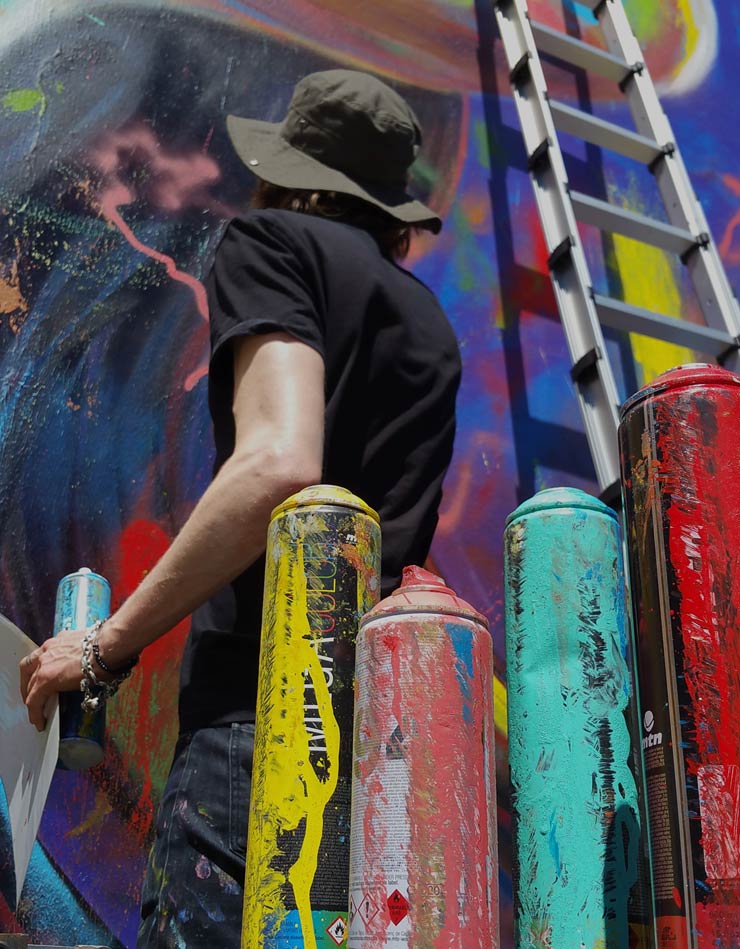
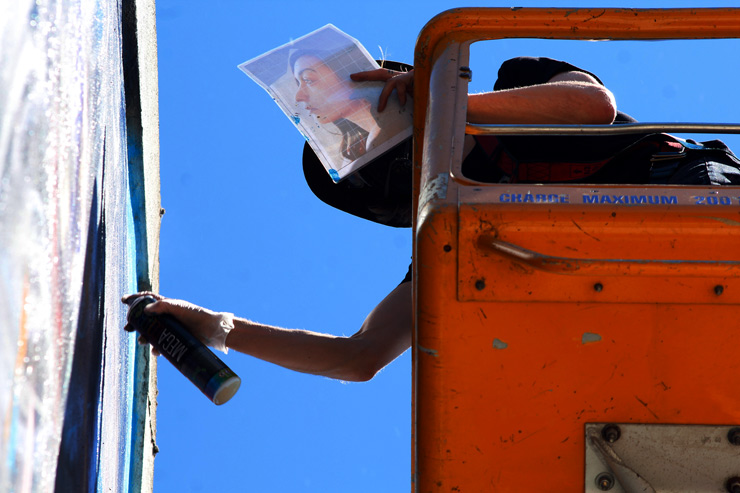
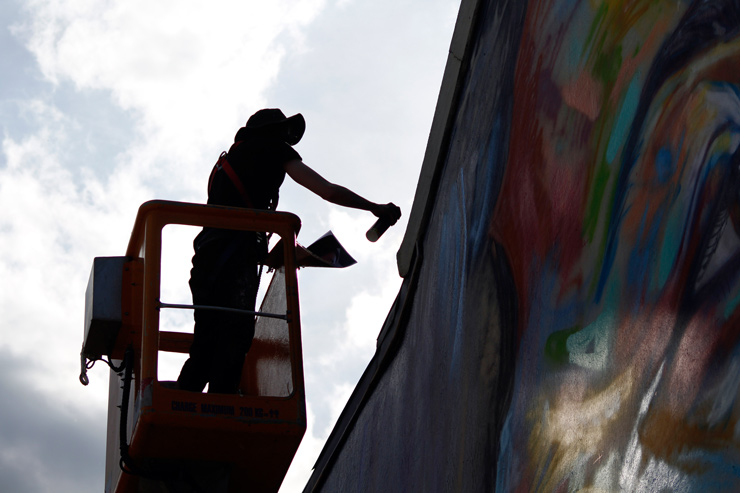
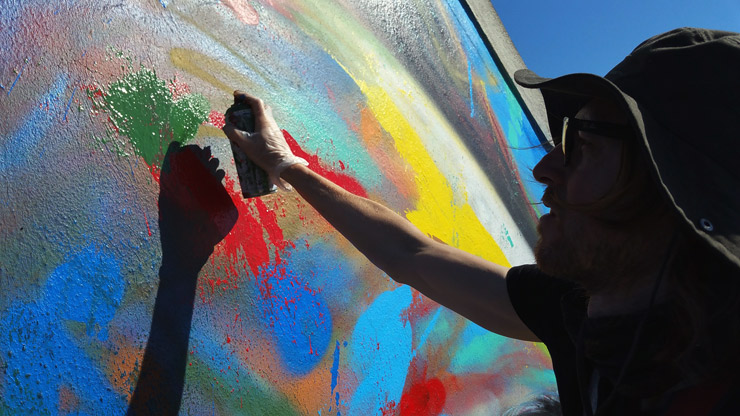
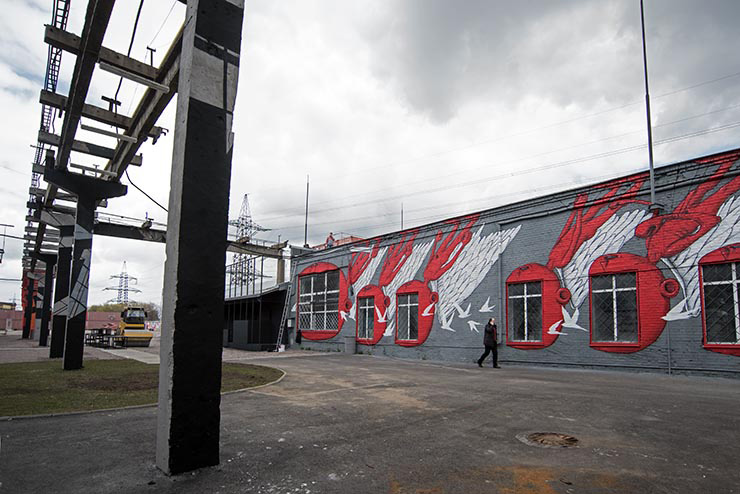
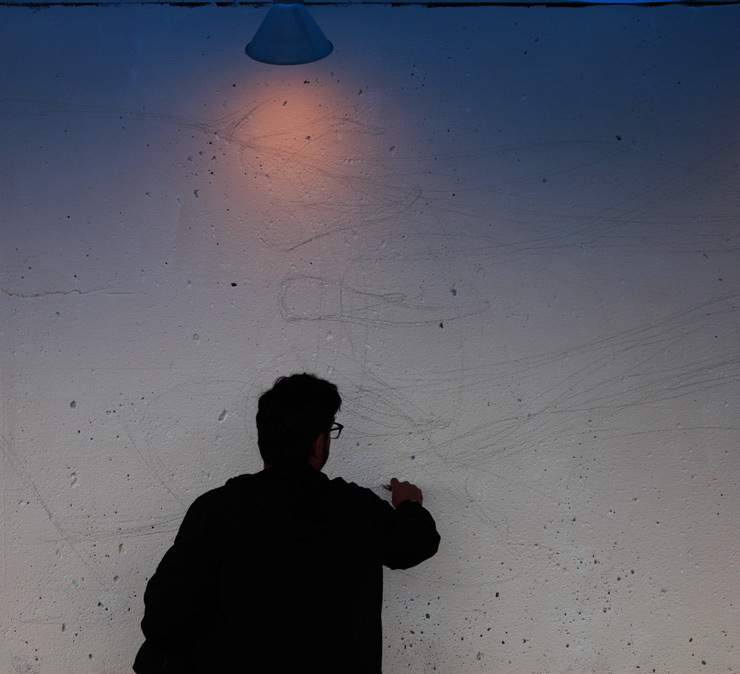
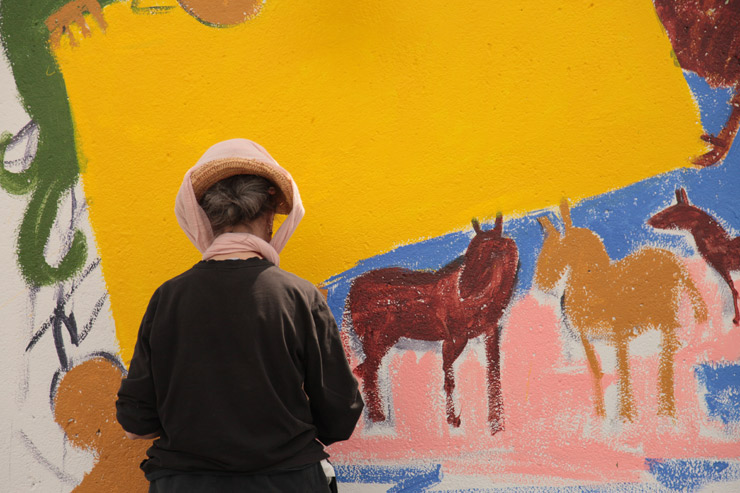
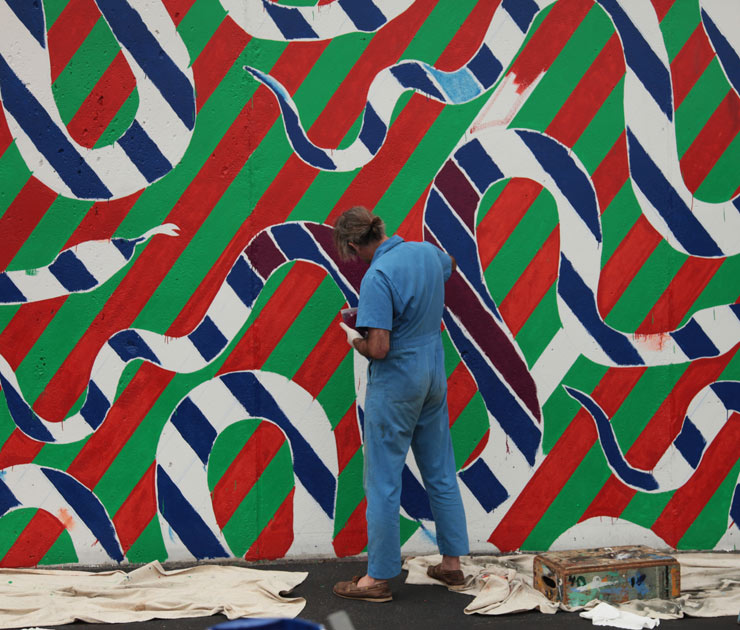
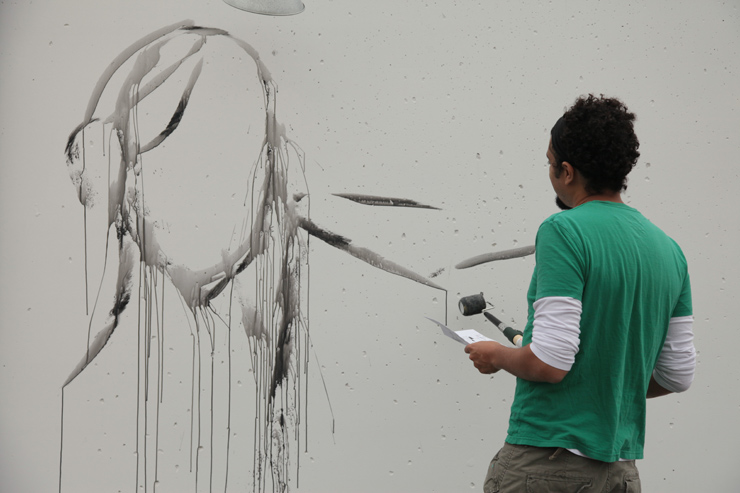
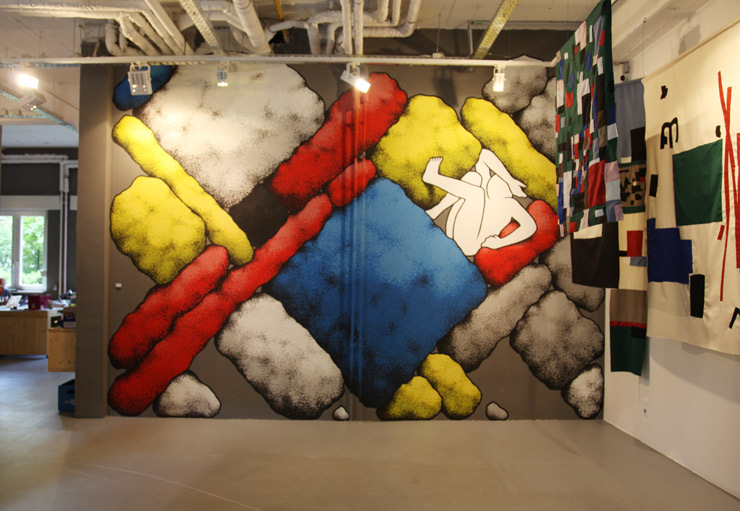
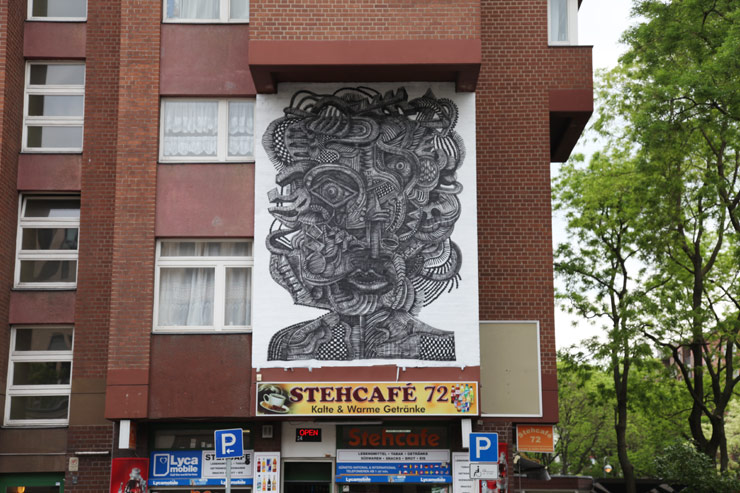
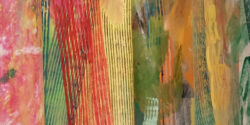
We begin today with David Walker, the Englishman who lives in Berlin whose singular styling of female subjects is known in tens of cities across the world. You’ve seen his work here many times, turning his attentive adoration to the countenance of this wistful sky-gazing figure. “One recognizes the artist’s particular style where layer after layer, the different colors end up forming a portrait that sometimes borders with hyperrealism, and especially in the eye,” says Jourdain.
Beginning this Tuesday the next artist in the program, Germany’s ECB, will begin his mural in EVRY. We hear stories as well of other greats in the program like Case Maclaim, Fintan Magee, C215, and Astro.
Meanwhile, you can catch Case Maclaim here in Brooklyn today and tomorrow with the Bushwick Collective at the annual Block Party.
Our weekly focus on the moving image and art in the streets. And other oddities.
Now screening :
1.“BROKEN MOTOR” by Soniconoclasm
BSA Special Feature: “BROKEN MOTOR” by Soniconoclasm
Today just one video that isn’t Street Art. But it is the street. And it is art.
For graffiti writers and Street Artists who traverse the streets and blocks and empty lots and tunnels at night, you see a side of the city that is hidden, imperfect, and often rather rough.
Whether its catching a quick tag or spraying out a 3-day installation on the Houston Street wall, you keep running into people. In the case of Houston street it is an endless stream, sometimes a river, of thousands of people during the course of the day and night.
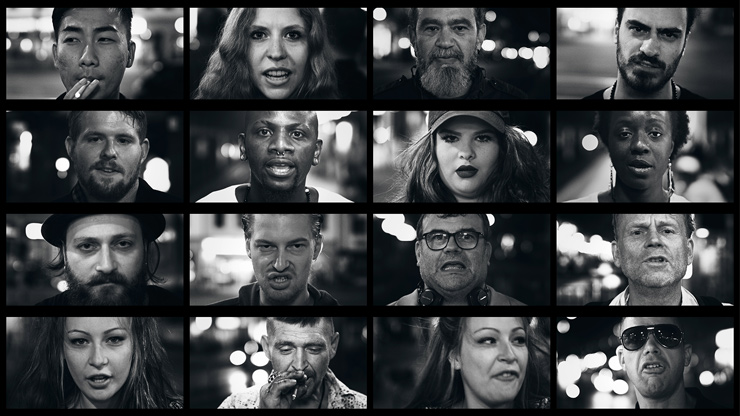
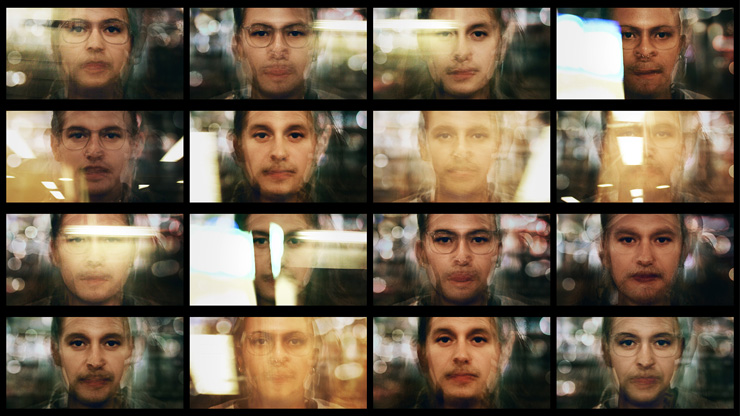
Soniconoclasm by Sebastian Purfürst / Lem Studios. Photo stills from the video.
We’ve even stayed up with artists painting through the night on Houston and seen the sun coming up again on the pavement, long stretches of roaring trucks and cars and thumping stereos and screeching brakes and police sirens accompanying giggling bridle showers, pumped up loudmouthed bros, sarcastic leathered rockers, preppie helicopter moms, khakied dads, tired sanitation workers, drugged dreamers, earnest art-school students, lonely ladies in short skirts, head-down dishwashers, bored suburban teens looking for any kind of adventure, greasy mechanics, bug-eyed investment bankers, smile-gleaming media wiseguys, power-ponytailed sports joggers, washed out addicts, bearded ladies, muscled jocks, winsome winners, losing lotharios. Everyone owns the city and everyone is owned by it.
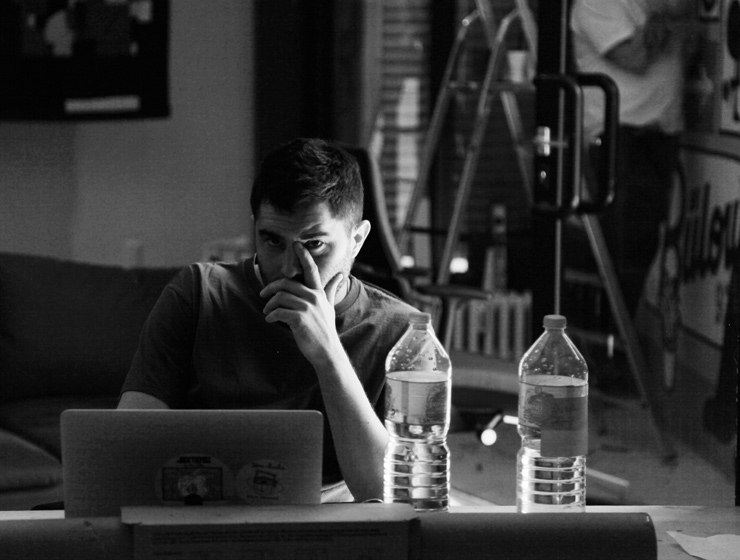
In Berlin recently we met a photographer/media artist/musician who showed us a music video he just made of regular people whom you might meet on the city streets at night. This spring he asked more than 25 of them to recite phrases and “cut-up of army radio slang phrases” and by splicing them together with his band mate’s recitation of the lyrics synched to their lips, the rawness and rage and disconnected connectedness of people whom you can meet on the street rang true. “
Soniconoclasm by Sebastian Purfürst / Lem Studios. Photo still from the video.
This unvarnished quality bypasses the styled self-awareness of a lot of commercial media, and the anger actually comes across as fear. Perhaps you’ll think its too dark in demeanor – but then suddenly the melding together of the faces into one common entity makes it magic, even transcendent – revealing a simple sameness of everyone.
“This suspenseful individuality of the people is almost completely dissolved in the chorus,” says Sebastian Purfürst of his video with bandmate Markus F.C.Buhl.
Together they are called SONICONOCLASM.
BROKEN MOTOR — VIDEO CREDITS://
Director: Sebastian Purfürst Co-Director: André Störiko Producer: SONICONOCLASM DoP: André Störiko
Editing | Post: Sebastian Purfürst
Track written and produced by Sebastian Purfürst with Markus Buhl
Vocals by Markus Buhl
Lyrics by Sebastian Purfürst and Markus Buhl.
Recorded, edited and mixed by
Sebastian Purfürst at LEM-Studios, Berlin.
A New Exhibition Marks the 1917 Revolution in St. Petersburg at the Street Art Museum
This spring, a hundred years since the Russian Revolution, a new Street Art inspired exhibition in St. Petersburg may reflect the ambivalence that competing storylines produce in the re-telling of history. A hundred years since the workers movement displaced the Czar and his family following three hundred years of power, the streets don’t look like they will return to the Bloody Sunday of hundreds of workers lying on the pavement, but a certain unruly violence can be sensed in the performances and artworks nonetheless.
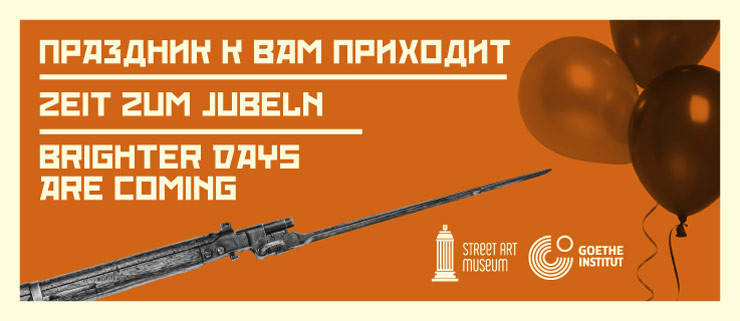
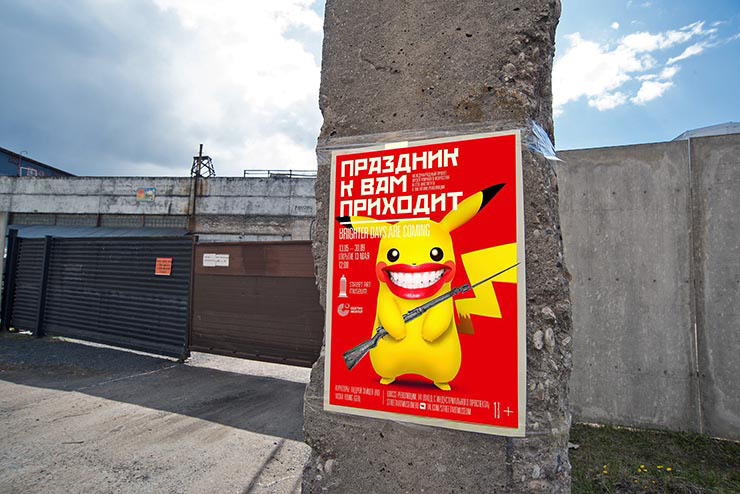
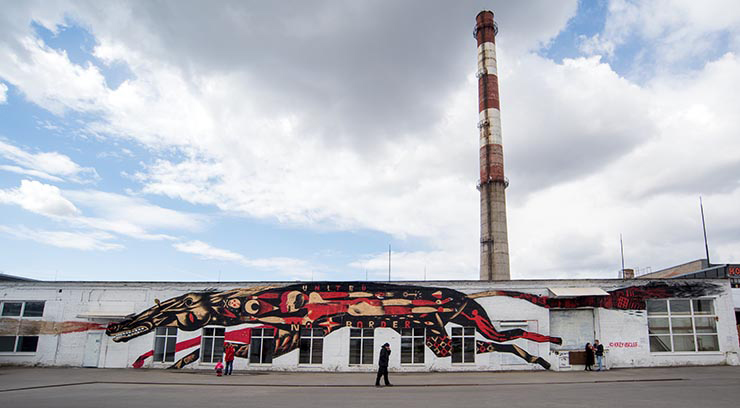
“Brighter Days Are Coming”, co-curated by Andrey Zaitsev, the director of Street Art Museum and Yasha Young, director of the Urban Nation Museum for Urban Contemporary Art in Berlin, brings the voices of 60 current artists with roots in the Street Art/ graffiti practice to discuss that specific revolution or the theme of revolution itself. Largely from Russia and using everything from aerosol to concrete to bricks to bones to smoke, it would appear that the effects of 1917 are even now difficult to resolve.
The Street Art scene is familiar with the schizophrenia of identity and the loosely tossed labels that never exactly fit. Multiple participants and categories of art-in-the-street now apply – perhaps reflective of the multiple individual stations one can occupy in society: citizen/ loyalist/ worker/ owner/ globalist/ revolutionary/ consumer. Awash in the borderless Internet of everything and nothing, it is often the youngest adults for whom Street Art appeals and has currency, an imperfect authenticity you can engage with. Ironically, there may be a way to accommodate these ubiquitous monuments of Lenin and other static heroes in your periphery as you walk by them playing with Pokémon on your digital device. One way is to make them your own.
Clicking “Like” Won’t Do It
There is a struggle today to discern the cultural weight and meaning of visual culture because hierarchies have been flattened and distance is seemingly elastic in our digital experience. Iconic Lenin may mistakenly be reduced to icon Lenin, a simplified button on one’s phone. The digital space can create a sense of intimacy with strangers and yet an odd distance when considering actual lives of peasants, or the fight of the workers, or the struggle of artists for that matter.
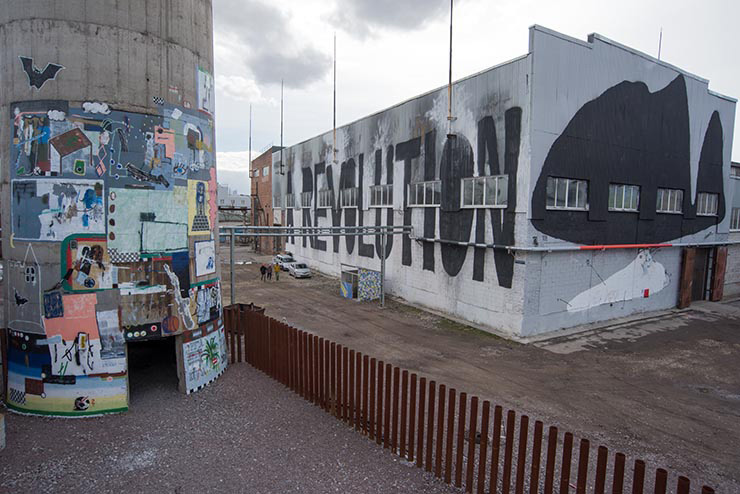
One sure way to appreciate art is to see it in person, to contemplate while gazing on the expanse of an enormous mural or trudging across the grounds of this plastics factory/ Street Art Museum on the outskirts the former Petrograd – one that was begun by twenty-somethings in love with global Street Art and is heavily populated with them.
Indeed a low-budget looking satirical promotional video for the exhibition posted on the Street Art Museum Instagram page appears as a mocking half-hearted celebration by costumed Russian Millenials and Gen Z’s dancing around a smiley icon cake whose dynamite candle suddenly explodes in a bit of stock video of a fiery Armageddon.
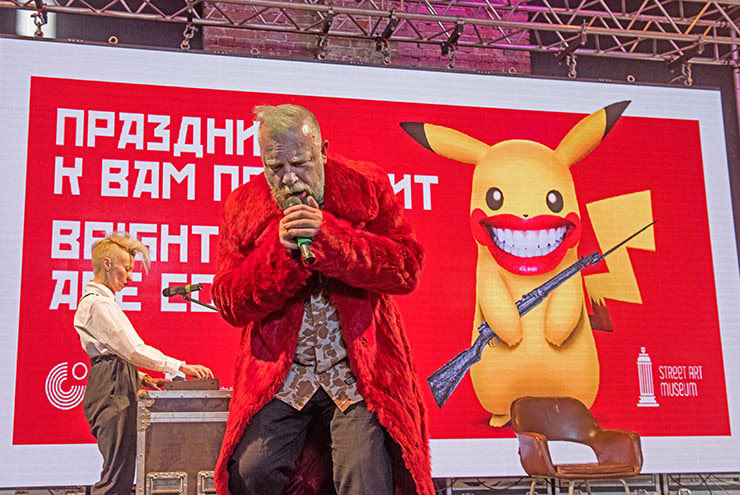
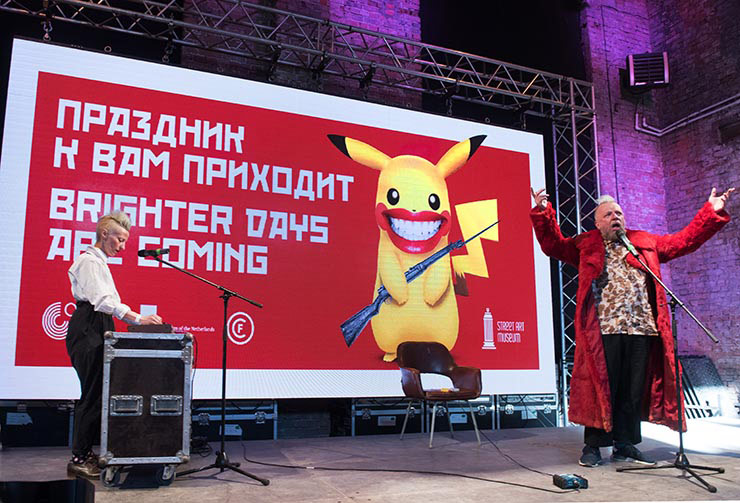
What is the future or past we’re celebrating? Does anyone know? Thanks to the explosion the video feels humorously heavy in the foreboding sarcasm department. Maybe it is just an insider reference to a favorite movie scene or video game. There ARE, after all, three curious Pokémon characters at the kitchen table. The official poster features the cheerful sunshine-yellow Pokémon with lipstick and a full-mouthed smile. Somehow it has more credibility than any human figure, smiling and terrifically positive that the future is bright.
The fourth such large exhibition in this suburban factory campus and its open outside space since the museum received official accreditation in 2012, this season at The Street Art Museum features 60 or so artists from 12 countries who look to the events 1917 for inspiration. As organizers note on the museum website, the topic is being addressed with retrospective shows this year by great museums worldwide including The MOMA in New York, Tate Modern in London, the Hermitage, the Russian Museum, and the Tretyakov Gallery in Russia.
“The main object is the heritage of the Russian avant-garde, whose world-spanning and messianic spirit had a serious effect on the development of contemporary art,” explains the site. For practitioners and fans of the graffiti and Street Art scenes that have evolved in cities globally during the last 50 years, one revolution or another is never far from their mind at all. At the epicenter of history here in Shosse Revolutsii, the Street Art Museum is an appropriate place to at least contemplate the subject.
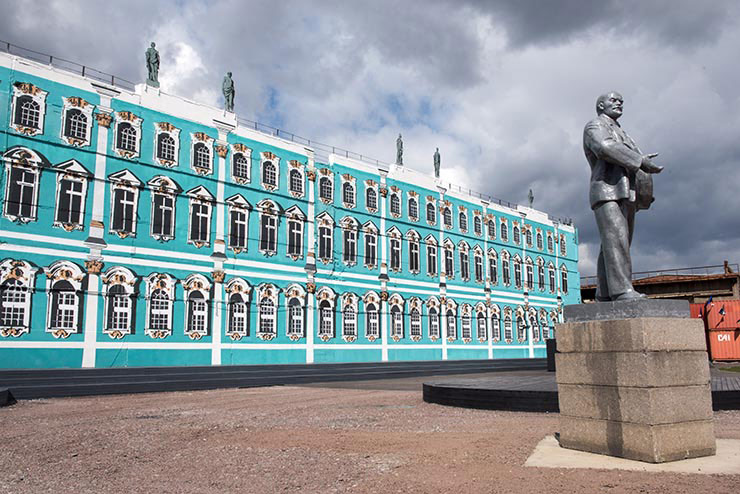
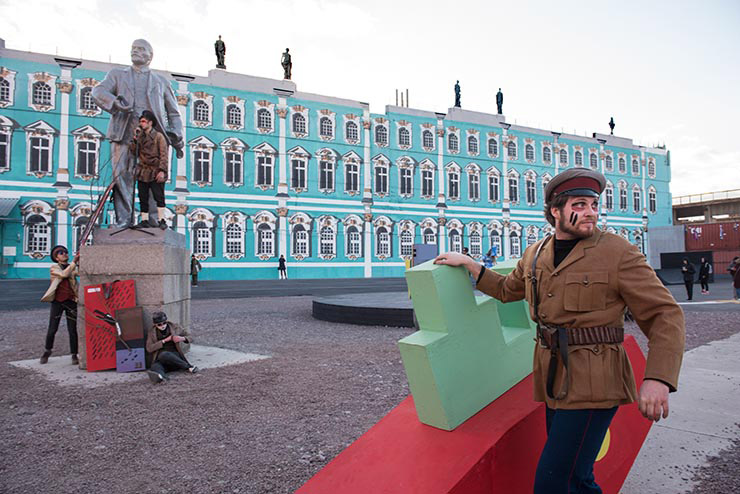
Large scale installations on walls throughout the compound are complemented by sculptures in open spaces; some of them interactive, others static, still others are reproductions of historic and recognizable figures. Most commanding would be the Lenin. Most remarkable would be the reproduction of The Hermitage.
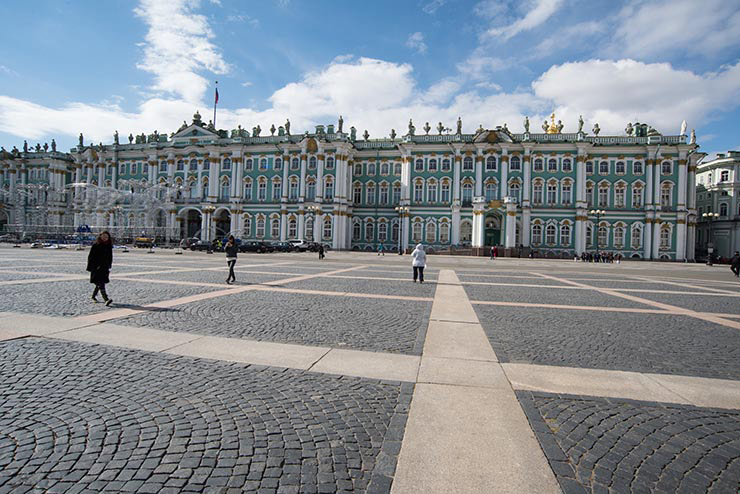
The recreating of The Winter Palace façade is a guilty delight, one of the 6 buildings of The actual Hermitage that holds the world’s largest collection of paintings only kilometers from here. A world icon of the revolution since being stormed in the fall of 1917, the massive aquatic (or French) blue facsimile of the façade in this museum courtyard provides a haunted, riveting, and admittedly comedic context for everything that passes by it, behind it, before it.
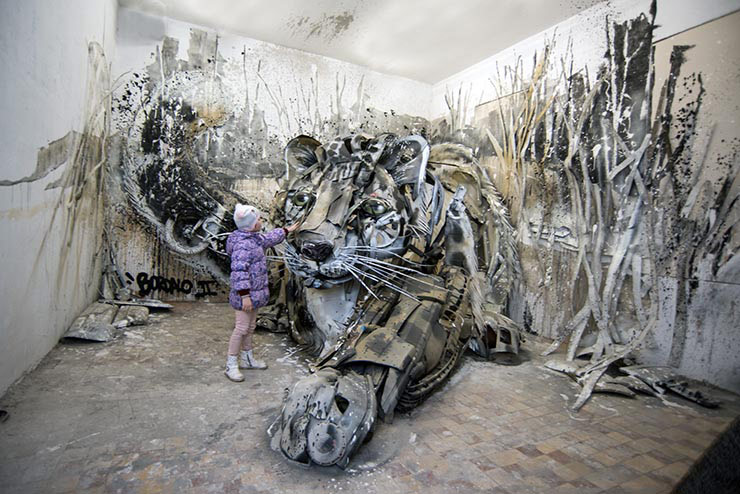
Elsewhere Lisbon based Street Artist Bordalo II has brought his practice of creating an endangered animal with local garbage for his installation of the famous Russian Snow Leopard – an animal now critically endangered, with its numbers estimated by some as 100 or less. One may wonder, certainly these artists do, what animal species will still be here in 2117.
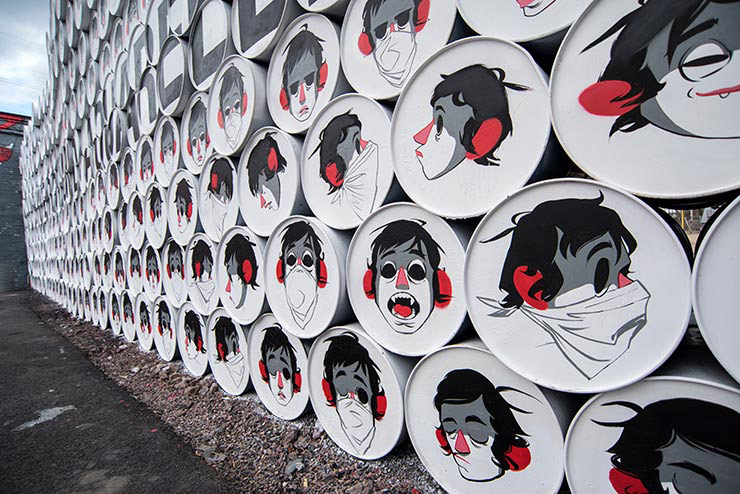
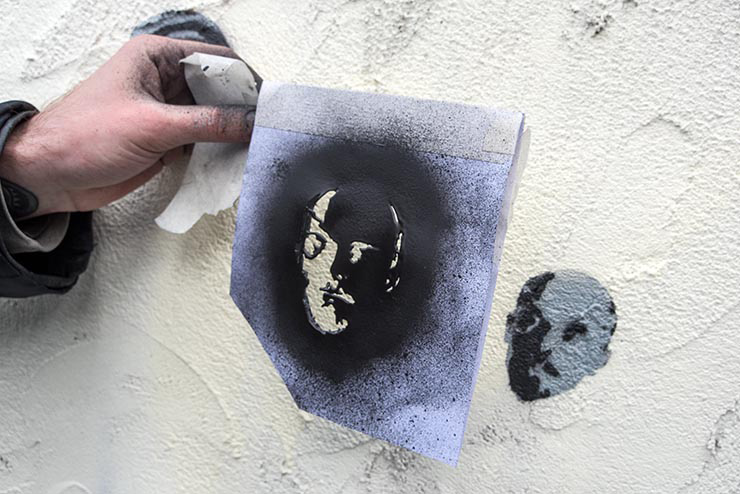
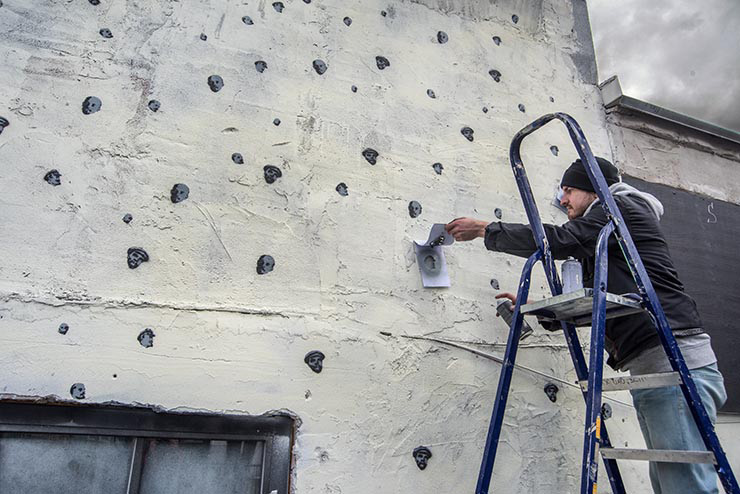
Russian artist Dima Rebus watercolor painted one of his character’s faces on the bottoms of 340 oil barrels by hand as a nod to the mobs of people who gathered together to form the the uprisings of the revolution. He says he has plans to disperse the mob wall, to vanish it at the end of the exhibition, painting each person out one by one with spray paint. Entitled “Life Goes On” the artist says, “Revolutions happen and pass, but life goes on.”
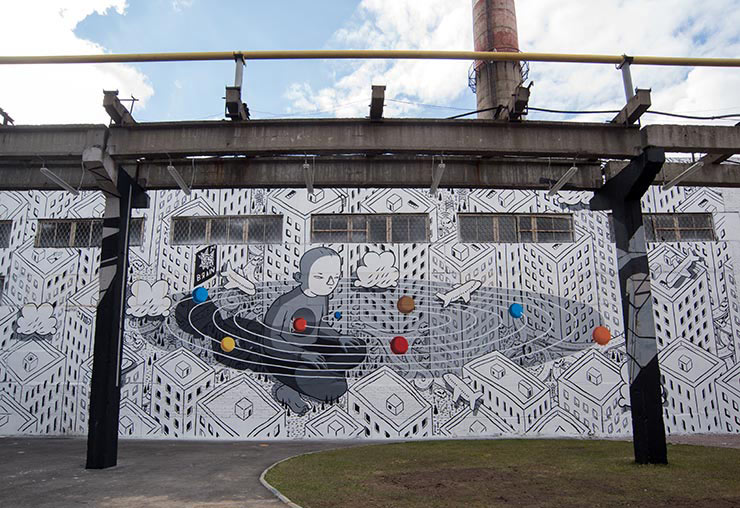
The Italian illustration-style Street Artist name Millo painted one of his imaginary highrise milieus where a giant child is at play in the center of an urban setting. The revolution here is the represented by the ripples of waves passing literally through the character, he says. On social media he describes it this way, “Each planet follows its orbit and all of them are the personification of the revolutions lived by the main figure. The message I want give is to find your personal revolution. When something is getting over is the exact moment to find the strength to revolution”.
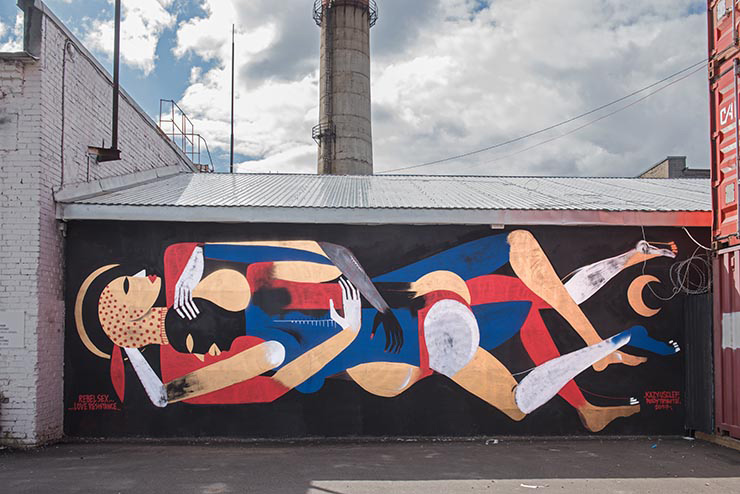
French Street Artist Kazy Usclef (above and below) normally draws influences from Futurism and Suprematism so his connection to the Russian avant-garde is a short distance. He also isn’t afraid to touch upon current political sore spots.
In “Rebel Sex Love Resistance,” the two entwined figures are female and one is wearing a balaclava, features that together are perhaps subtle references to the activist art music group named Pussy Riot, famously contentious and Anti-Putin.
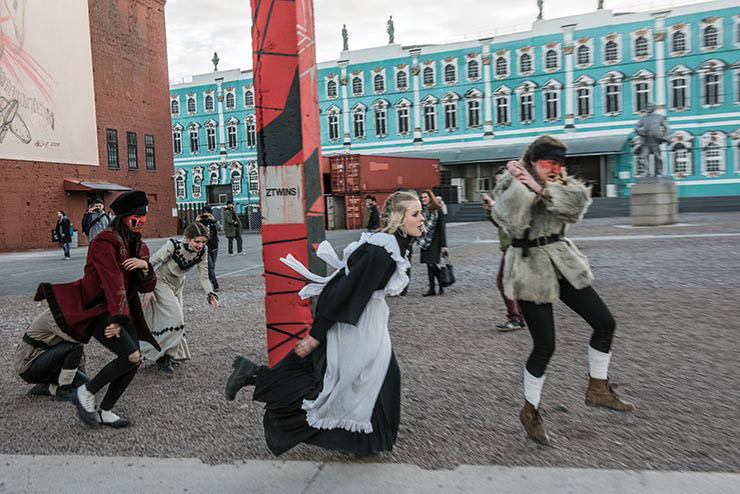
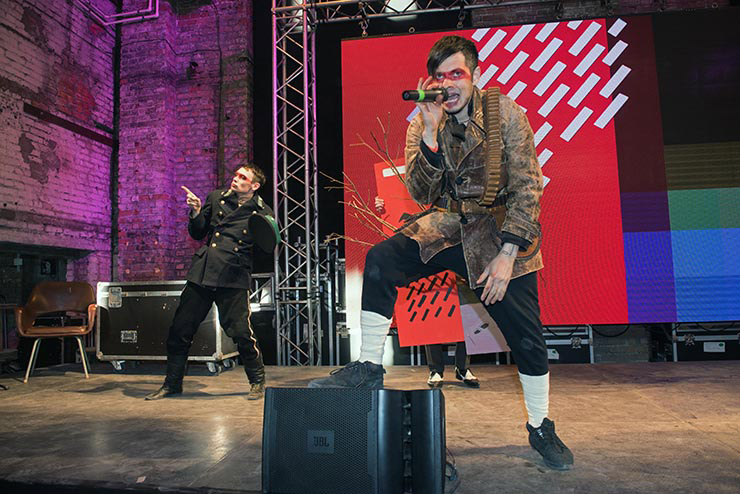
During its opening days the exhibition featured ongoing performances by contemporary artists and independent theater troupes, turning the courtyard into a stage and the “Hermitage” into a set.
Lead by curator and theater director Danil Vache, costumed performers appear to take inspiration from specific historical events and themes of radical change, societal rupture, militarism, and the uprising of poor and working class to claim power. Inside and onstage, live performances of poetry, speeches, and music were featured throughout the week.
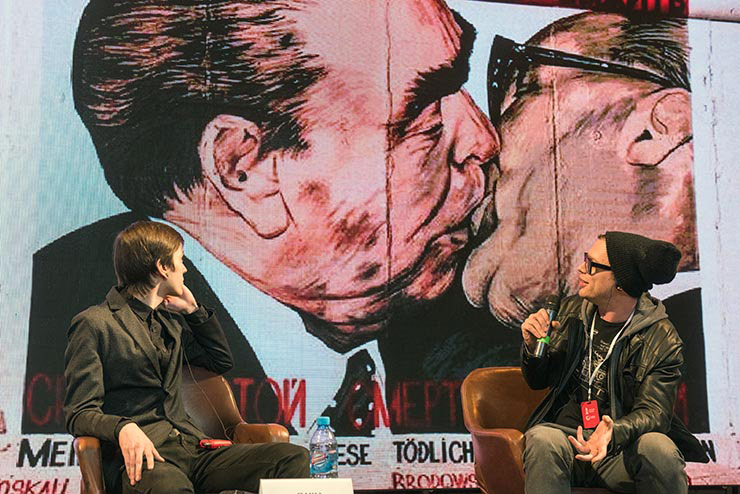
Additionally there were a few panel discussions and forums like “Simulacrums of Revolution,” where moderating curator/ theatrical producer Mihail Oger spoke in conversation before an audience with guests like American graffiti/Street Art photographer Martha Cooper, Ukrainian artist Pasha Kas; Russian graffiti writer and contemporary artist Maxim Ima, graffiti/public artist Anton Polsky (known as Make), and Urban Nation (UN) Cultural Manager Denis Leo Hegic. Hegic, who spoke before images of the Berlin Wall during his presentation, tells us about his and the UN’s involvement with the exhibition.
BSA:The title of the exhibition is sort of a satiric, sunny reference to a happy future – “Brighter Days Are Coming”, yet it is cast directly under the shadow of the hardship and conflicted relationship Russian’s and all of us have with the past. How did you see the exhibition responding to this dichotomy?
Denis Leo Hegic: The title of the forum “Simulacrums of Revolution” is actually a good supplement to the title of the exhibition itself, since the idea was not to define revolution or to claim revolutionary DNA, but to reflect on what is the “Representation” of revolution on various levels and in our own understanding, in historical, scientific definitions and in the artistic representation.
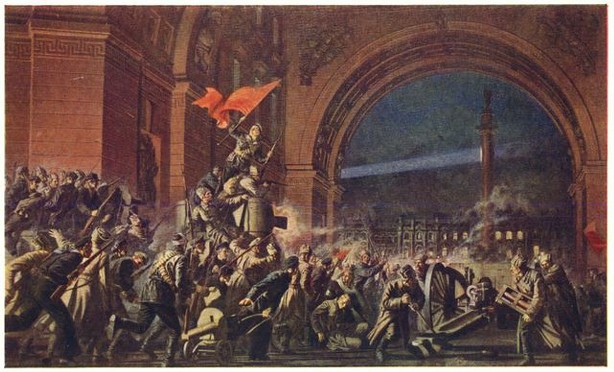
Hegic points to the age old practice by humans of the falsification of historical events to form a narrative. He also points to “fake winter palace or the fake museum” and compares it to the famous painting “The Storm on the Winter Palais” by Pawel Petrowitsch Sokolow-Skalja as examples of re-writing history. You can almost anticipate that Hegic will transition readily into the topic of “fake news” or “propaganda,” but he takes another damning route instead.
“We can draw parallels to the fakeness of our own representation today – with our own “curated” Instagram accounts, or the millions of selfies we make from flattering angles – this seems to be a considerable part of our daily thought and activities. This is where I see the direct link to the representational powers of every revolution in our own present time.”
He also disagrees with how we characterized the title of the exhibition, “Brighter Days Are Coming.”
“The title should not necessarily be understood as a satiric one,” he explains. “Brighter days are always about to come. The light will inevitably win over the darkness and human optimism will remain a motor that keeps our evolution process in motion. Ironically, our evolution itself might bring our extinction too – but under the assertion ‘Brighter Days Are Coming’ we do continue to live and to hope.”
The museum itself, stationed on the campus of an operating plastics factory and under the directorship of the son of the owner, highlights some of the conundrums of featuring autonomous global public art movements in a time and place where official state messages speak more to loyalty than revolution. For many critics, Street Art belongs in the street, so the very existence of this institution is a non-starter.
Finally it is notable that St. Petersburg itself has very little of what you may call an “organic” Street Art scene – and one does not see Fascist or AntiFa post-Soviet graffiti furiously scrawled here. This appears to be comfortable protected space for debate about theory and history not easily identified by a graffitied or muralled exterior.
But these are only a few of the multiple ironies at play in the organized chaos of today, where the German Goethe Institute and Berlin’s Urban Nation Museum of Urban Contemporary Art are partnering with the St Petersburg Street Art Museum to launch a show commemorating the 100th anniversary of the Russian Revolution. For those who do not know at that time Russia and Germany were engaged together with Austria in a brutal and bloody war that killed three million people.
For the sixty or so artists and performers participating inside these factory walls you may also wonder how or if their work has been affected by the work of this Revolutionary era’s giants in literature, ballet, painting, music and movies — people like Serge Diaghilev, Igor Stravinsky, Sergei Eisenstein, Vladimir Mayakovsky and Kazimir Malevich. Each of these names became as closely identified with their disciplines as the politically, socially, anthropologically tumultuous eras they worked within.
As in every era, today technological revolutions are affecting all people regardless of nationality or national politics.
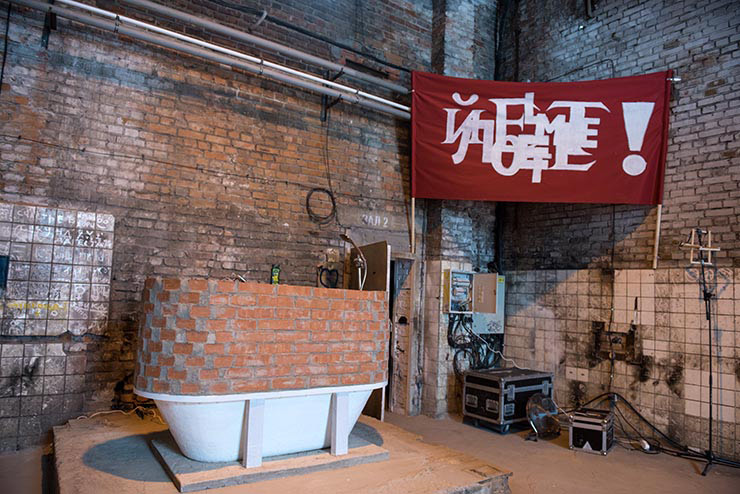
The Iranian Street Art duo who currently live in Brooklyn, Icy & Sot, steer clear of the politics of nations in their installation by building a wall – itself overlaid with political overtones – but here it is intended as a metaphor for protecting privacy. By bricking up the periphery of a bathtub, the brothers contemplate “No Privacy”, an occurrence enabled by our complicity (and obliviousness) to being tracked and followed by strangers via our smart phones.
“The bathtub and shower are everyone’s private place,” they tell us. “In this installation, even though we built a wall around the tub there is still no privacy because there is a smart phone playing music nearby, enabling some entity to always watch or listen to you.”
A Final Word
By focusing this large exhibition at its original epicenter organizers are bound to strike nerves and inflame passions and, although Russians don’t appear to be exactly celebrating the centennial, the opinions about who deserves blame and credit for the events that unfolded are all over the map. Which is why, perhaps, curators looked far for new takes on the topic.
“First and foremost this exhibition was meant as a representation of a broad international scene,” says Denis Leo Hegic as he talks again about the perspectives artists here bring to the topic of revolution. “The artists curated by the UN were all coming from different countries, bringing different ideas of portrayal and embodiment of revolutionary experience. The starting point of this revolution in 1917 did not stop at national boarders and claimed to be an international or even global movement.”
“Similar this is probably the most direct, democratic and largest global art movement today so the choice to bring international guests, with their own historic and different national backgrounds and their individual talents and approaches to creation – these were the most valuable contributions to the exhibition and the audience.”
Our sincerest thanks to Martha Cooper for sharing these photographs with BSA readers! We really appreciate all that she does and who she is to so many.
Krys has been doing graffiti since 1985 and is one of the pioneers of graffiti in the Soviet Union. He was inspired when he first saw the American documentary “Hip Hop and Its History” when he was 14 years old. Basket and Max are also pioneers of graffiti in the USSR.
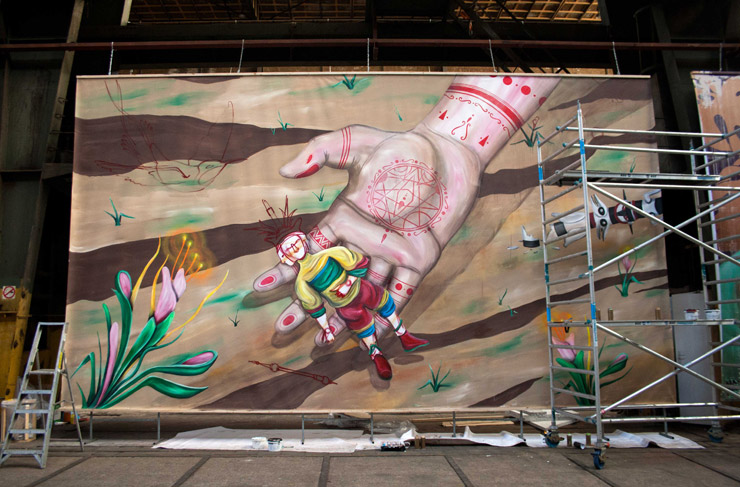
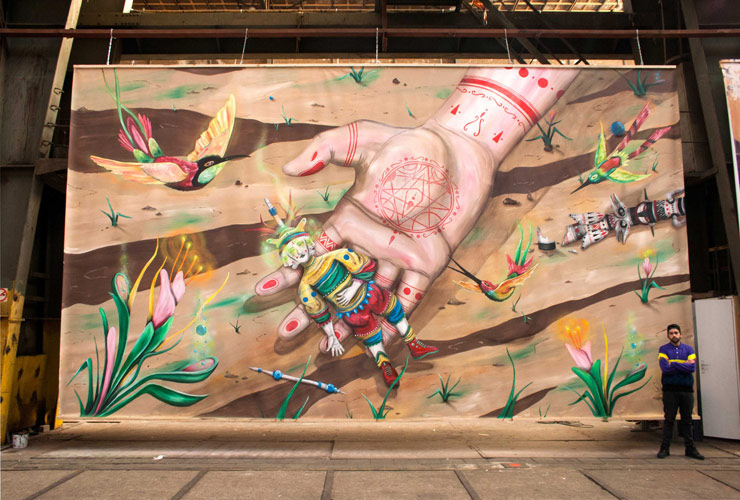
Entrepreneur and visionary Peter Ernst Coolen continues afoot with his plans for Amsterdam’s Street Art/Urban Contemporary art museum sometime next year at NDSM Wharf, and a number of artists have been preparing new works for the space and the great occasion.
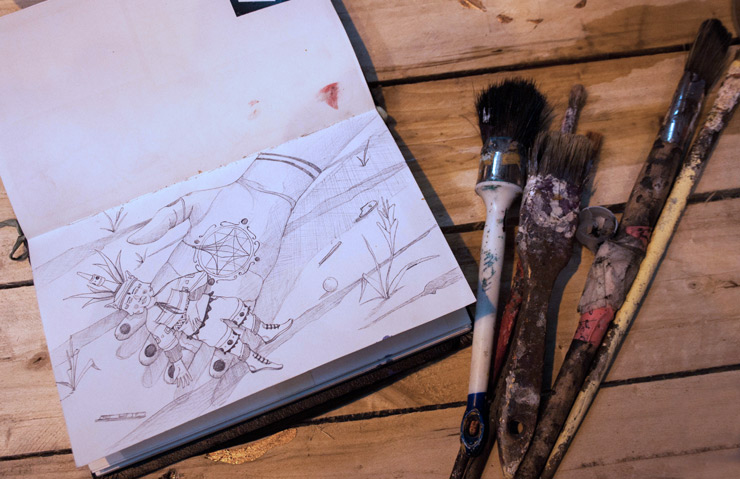
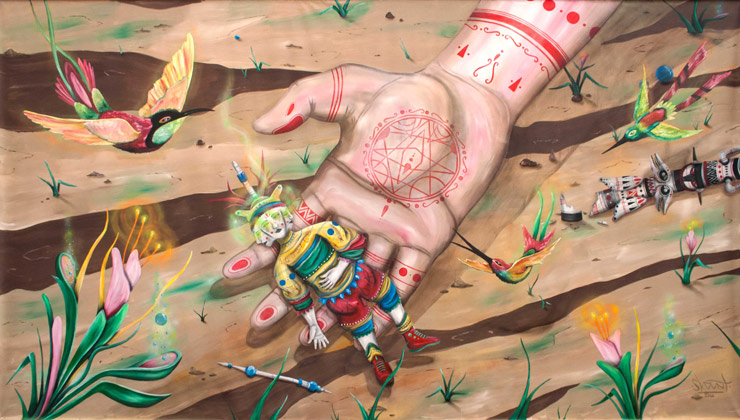
Today we have a sneak peak at the huge-scale canvas by one of the streets spiritual wizard-like creators, Skount from Spain.
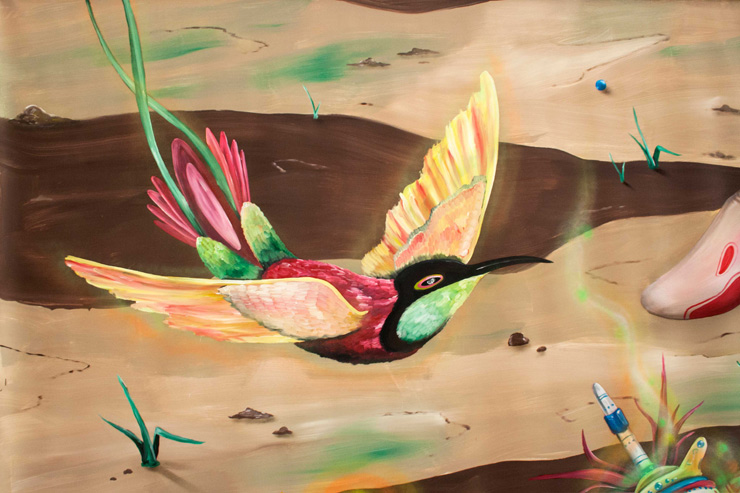
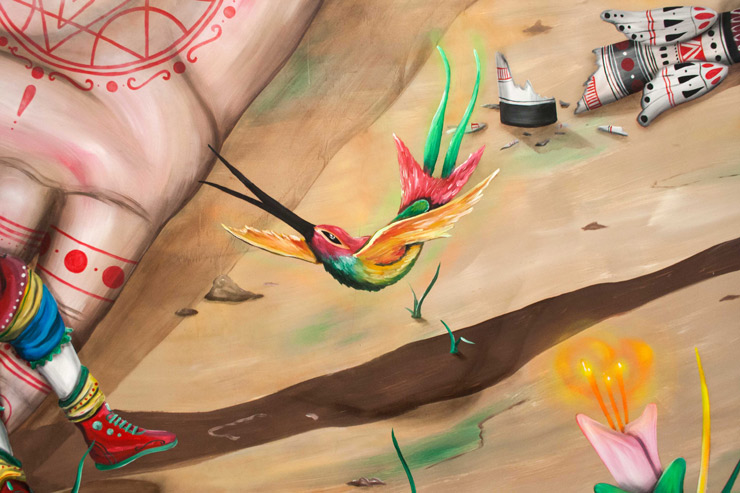
“A few months ago I painted the wall called “Protection, Natural Cohesion and the Soul’s Messengers”, he says of the new mural inspired by the legends of the X ts’unu’um (Hummingbird in Maya) and the relationship of the human with nature and the celestial.
“All the cultures that have existed in our history have bequeathed us their most intimate experience through symbolic language,” he says, spoken like a graffiti fan actually. But for Skount this symbolic language is to assist people to relate to the spiritual world, to synthesize a mystical relationship with life through the symbol, facilitating an encounter between the divine and the human.
“In this mural I have illustrated a hand (as a symbol of blessing and protection) with a drawn circle, holding a human entity, since above all the symbolic cosmos, the circle arises, like the wheel of life that spins the whole nature, with its cycles, its rhythms and its eternal movement. It is, therefore, the totality, the integrity and the realization,” he explains. Only when you see the final photo here can one appreciate the scale of the new indoor work, as well as the size of the future museum here in Amsterdam.
These Animals Are Eating All the Plastic You are Throwing Away. Yuck.
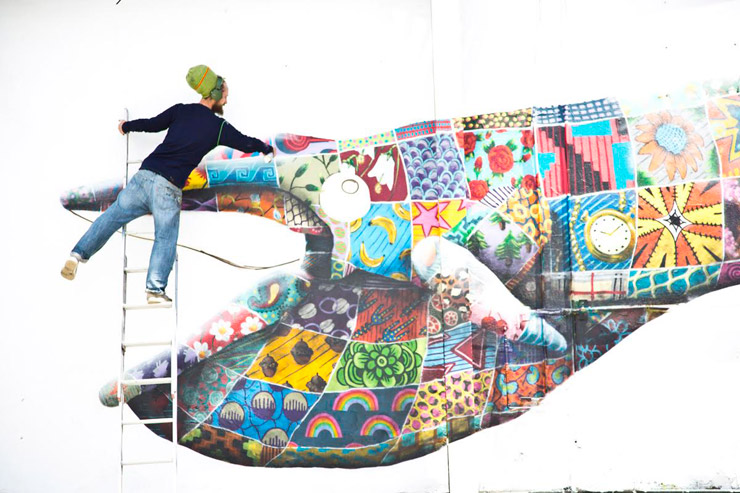
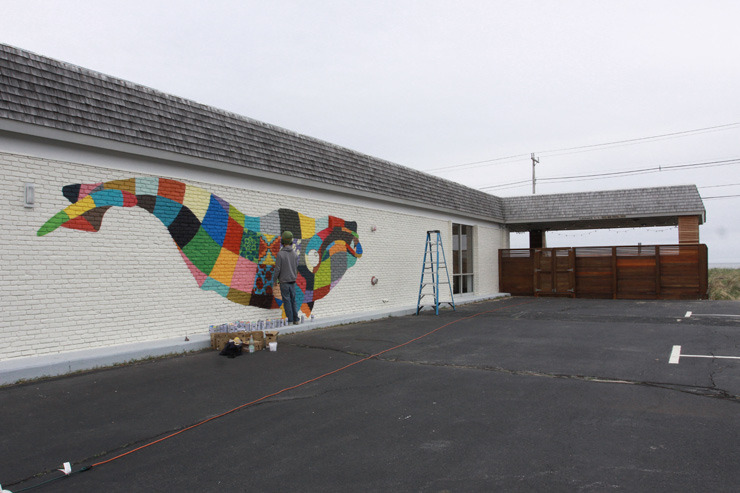
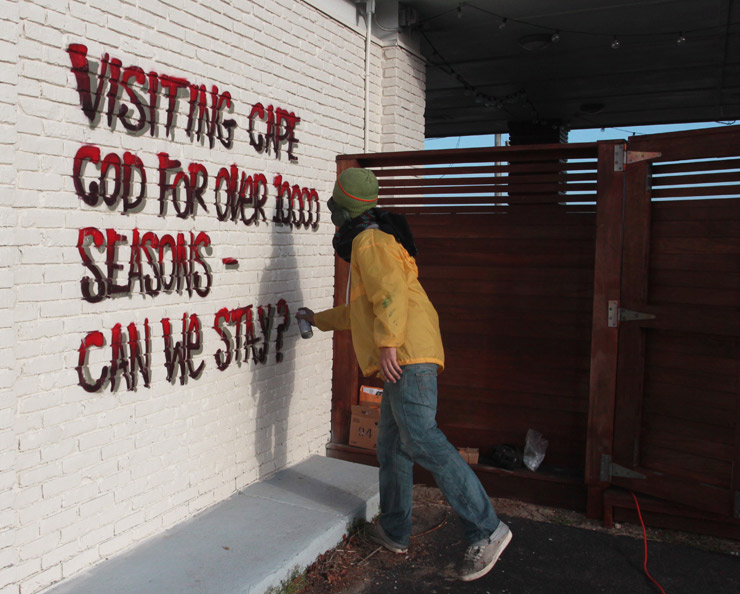
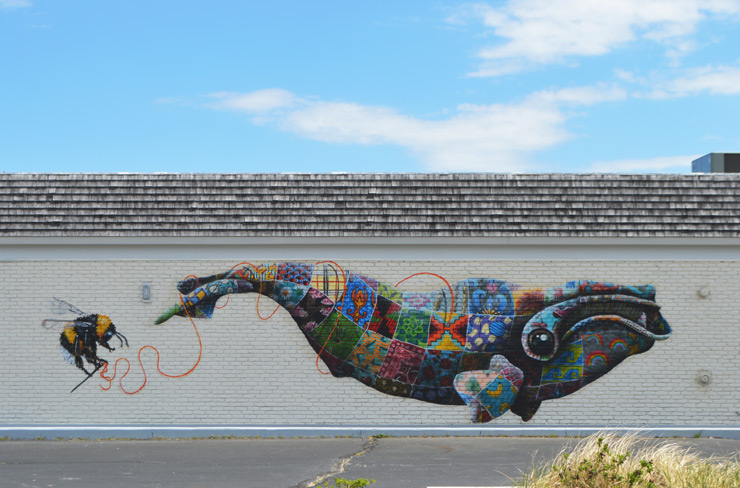
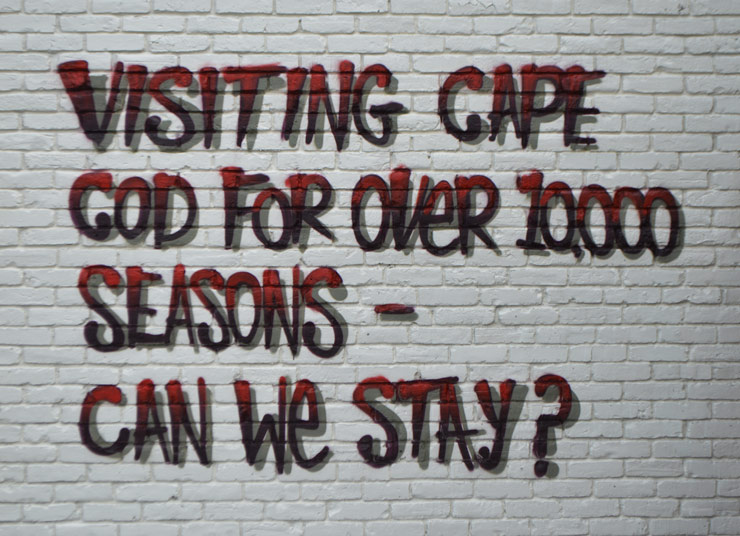
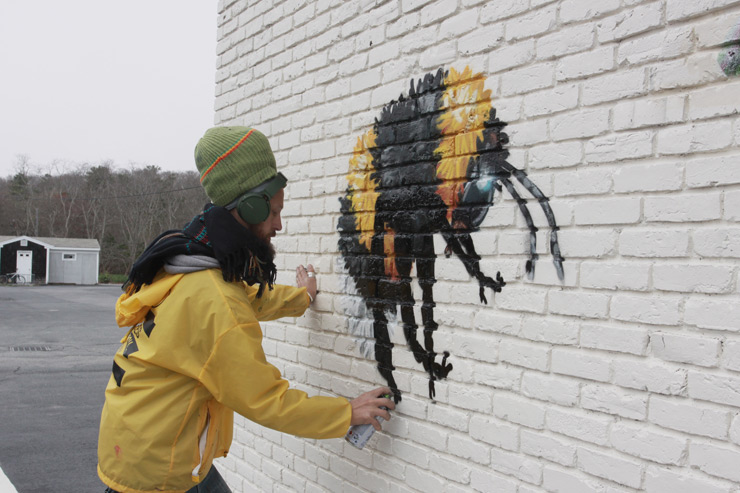
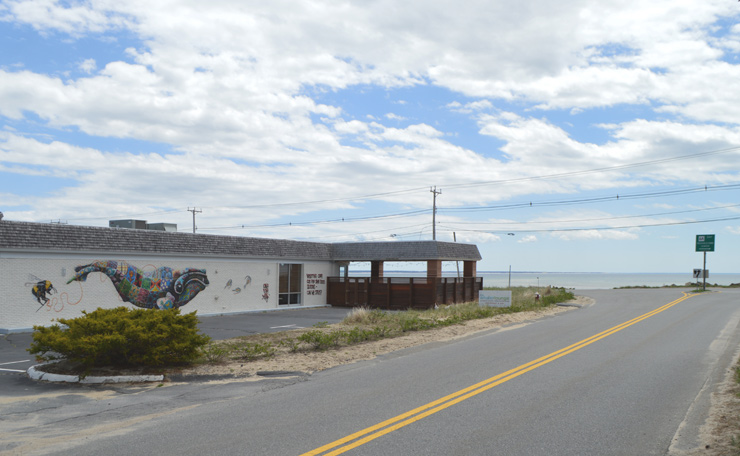
London Street Artist Louis Masai has just returned to the US to do three murals – one in alliance with the Right Whale Research Association (R.W.R.A) in Cape Cod Massachusetts, and two in Los Angeles where he is currently having a solo show at C.A.V.E. gallery entitled “The Sixth Extinction”.
With his work intrinsically tied to environmentalism and disappearing species, Masai told us at great length about a few people and organizations he worked with when making these new pieces. He also educated us about the DIRECT relationship that you and we have with killing off species and causing their suffering by using plastics. Here are a few excerpts from our conversation to better appreciate the work that Louis is doing right now.
“Cape Cod attracts a continuous flow of summertime tourists to its quaint villages of seafood shacks, lighthouses, beaches and whale watching excursions,” Louis says. “Its economy however, is steeped in a controversial whale hunting history of blood.” He worked with Lisa Sette from R.W.R.A. to create this new mural in the town. He also shared some of Lisa’s statements about the project here:
“I feel like a lot of us in the US are feeling isolated due to the current political climate. What better way to bring the community together than through a mural that highlights the most critically endangered large whale in the Northwest Atlantic that happens to spend winter and spring in our waters. The mural is bringing people together and allowing for conversations to begin – unexpected conversations.”
Lisa Sette continues, “Of course when in company of biologists, advocates and real life eco-warriors, it’s impossible to not become even more inspired by the impacts that a species like the right whale faces. The North Atlantic right whale is a baleen whale, they are listed as a rapidly decreasing, critically endangered species, with only a few over 500 left. Baleen whales feed on zooplankton and krill; they take large gulps of water and then filter out their tiny prey using baleen plates. During feeding season, usually from spring to fall, right whales may eat more than 2,600 pounds of zooplankton per day, and of course today that also includes a huge amount of plastics.”
Laura Ludwig, of the Center for Coastal Studies, often gives presentations about plastics in the environment.
“Once you’ve seen the images of whales’ stomachs packed solid with plastic bags; or of albatrosses who’ve died after ingesting a diet of nothing but bottle caps; or of an osprey chick who entangled itself in a balloon string used as nesting material — once you’ve seen familiar plastic items as the instrument of death for innocent animals, the path reveals itself.”
100% of the ocean is now infected with plastic, says Laura. What can WE do to try and help rectify this issue? These are Laura’s top three tips.
Over 300,000,000 straws are used every day in the US alone: swear off plastic straws and bring your own metal, glass or rubber straw if you like to use them.
BYORB: there are over 5 trillion plastic bags used every year around the world — 160,000 per second, if you break it down per capita. Bring Your Own Reusable Bag and refuse thin film plastic bags.
Bottle water is a scam: over 50 billion bottles of water are sold in the US alone annually, and only 20% of them are “recycled”. Stop buying water in plastic bottles — BYOB, again!
Louis tells us that when in Cape Cod he took one of those famous whale-watching trips. To say he was excited is an understatement. He also may be exagerating a little.
“It literally blew my eyes out of their sockets – I saw Right Whales, Fin Back Whales, Sei Whales, Humpback Whales, and Dolphins too. Naturally, he made like-minded friends there and caught up with Charles Mayo better known as Stormy, the director of the Right Whale Ecology Program, who told him how big whales also get caught up in plastic nets and other crap we throw away – trapped!
We don’t have space here to recount a rescue mission he did with a whale named Ibis, we can will tell you this part of the story. “After several hours Ibis tired from dragging floats and stopped swimming. It was only then that we were able to cut the nets and ropes from around her. We had freed her,” says Charles. “This rescue mission evolved to us creating specialized tools and a system for freeing entangled whales and we still use floats, buoys and boats to slow the whales to this day.”
It may seem obvious, but the real solution is for you and us to stop throwing this crap away to begin with. It doesn’t magically disappear.
Louis says that he learned that rescuers “are only able to save about 50% of entangled right whales, and 80% of humpbacks, the majority of them are struggling out at sea and never reported to the rescue team. Rescuing them is only a stopgap measure and the real work needs to be done in stopping them getting entangled in the first place.”
“I hope that my mural will raise some thoughts amongst the thousands of tourists visiting Cape Cod. Perhaps they might even think twice about using the straws, plastic bags and water bottles still available in Cape Cod.”
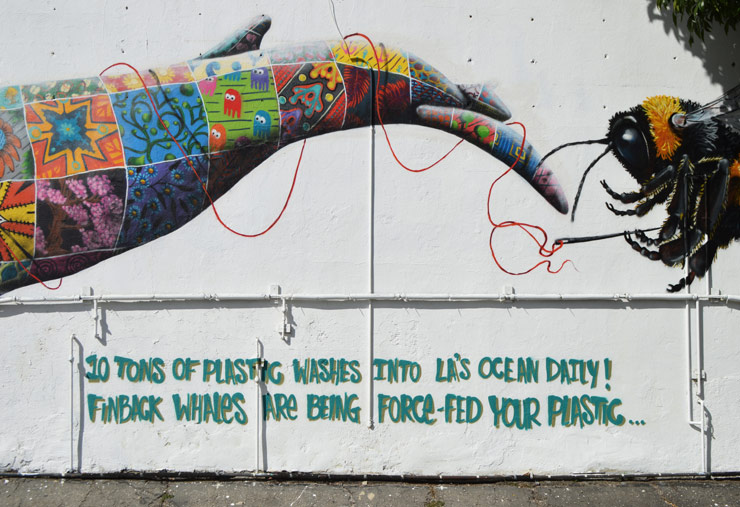
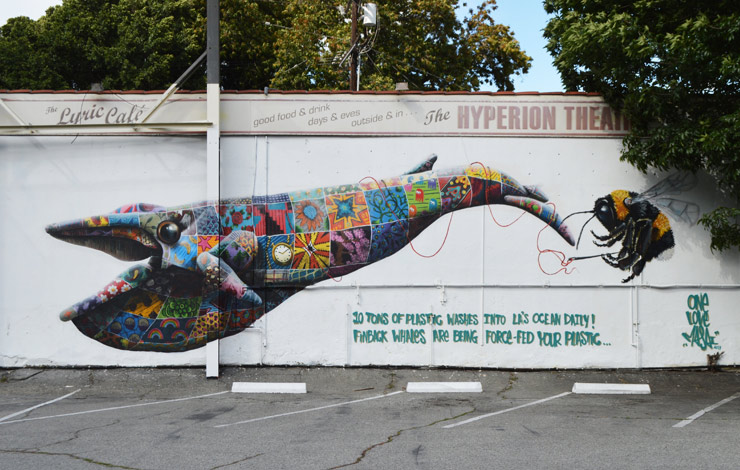
When he got to L.A. for his show ‘Sixth Extinction’ with C.A.V.E Gallery he painted a finback whale, which is a visitor to the waters of L.A, “Another baleen whale suffering the same punishment of plastics in the ocean. I read that a ridiculous 10 metric tones of plastic enter the L.A Ocean per day, which is comparative to more than the weight of a London bus. The result of this painting was a challenge to the owner of the wall, “The Lyric Hyperion’. They are now on a route towards eliminating the use of plastics in their service.”
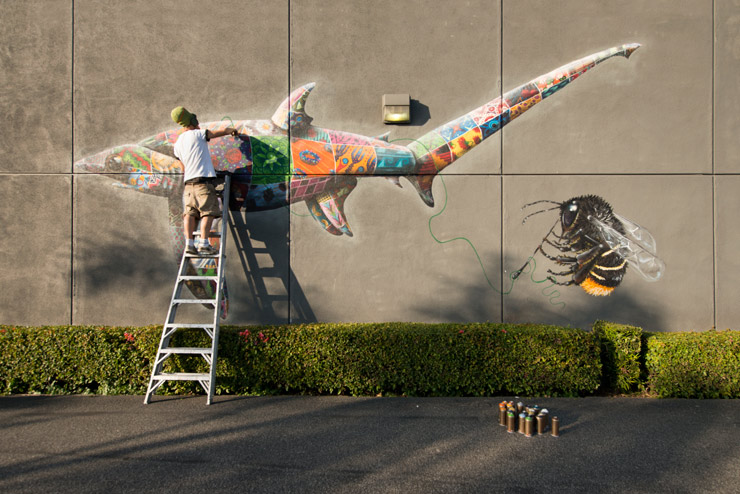
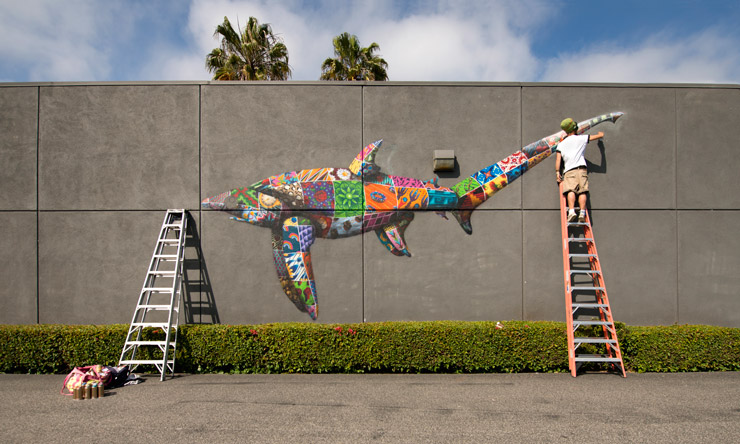
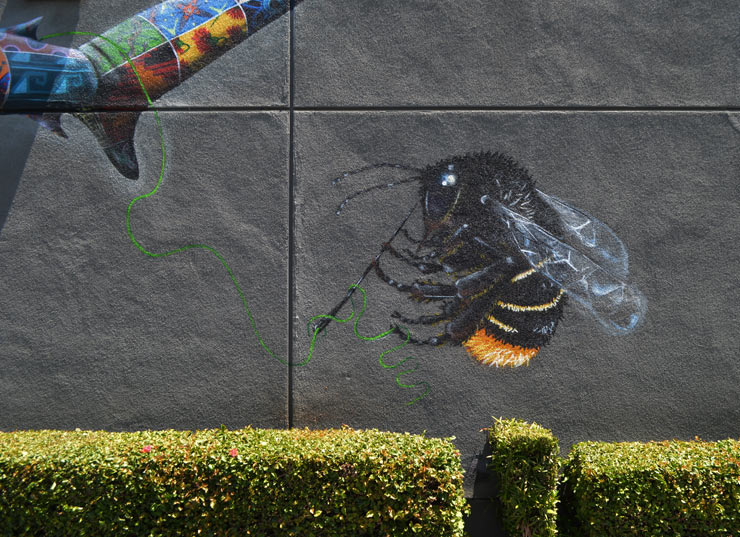
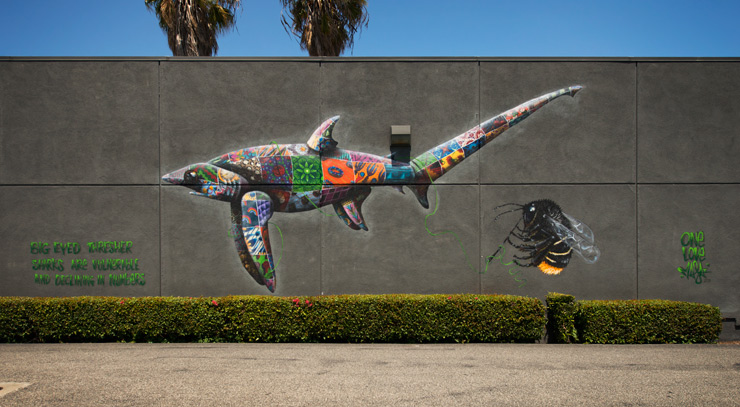
Louis’ last painting for this trip was of a big-eyed Thresher shark, another ocean species that is suffering an apparent decline in population in Californian waters. In addition to a vulnerable life-history characteristic, these sharks are suffering from a continued fishing pressure from pelagic fleets which has the species listed as vulnerable.
“Most of the species I highlight, if not all, are in danger of their lives due to evidential climate change, I’m back in London now and realizing that my trips to and from the states have many, many more endangered species to lift a light for.”
This means we still have a lot to learn from the art of Louis Masai.
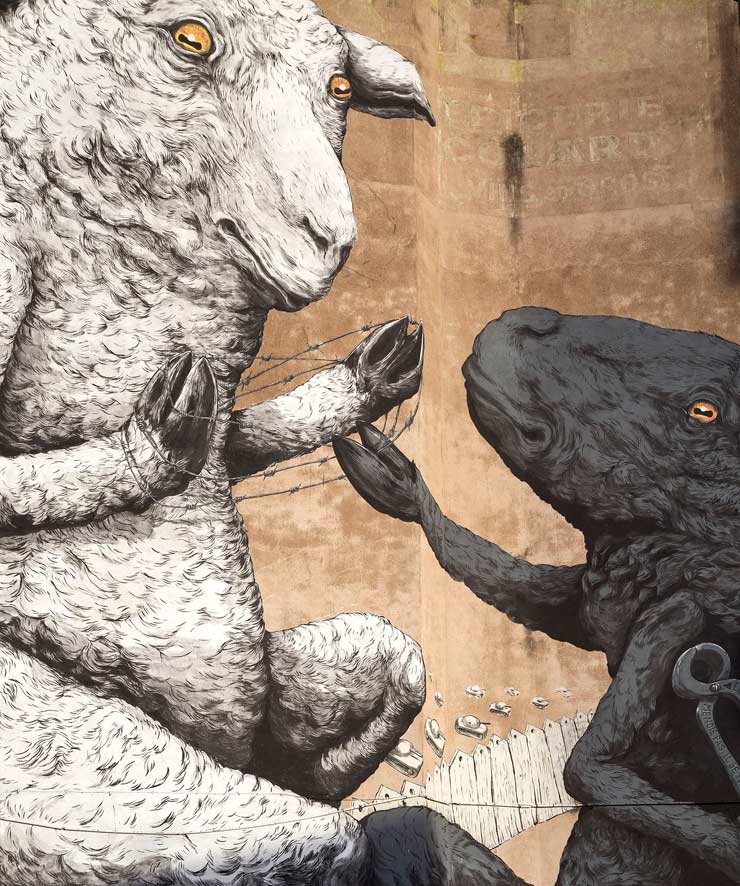
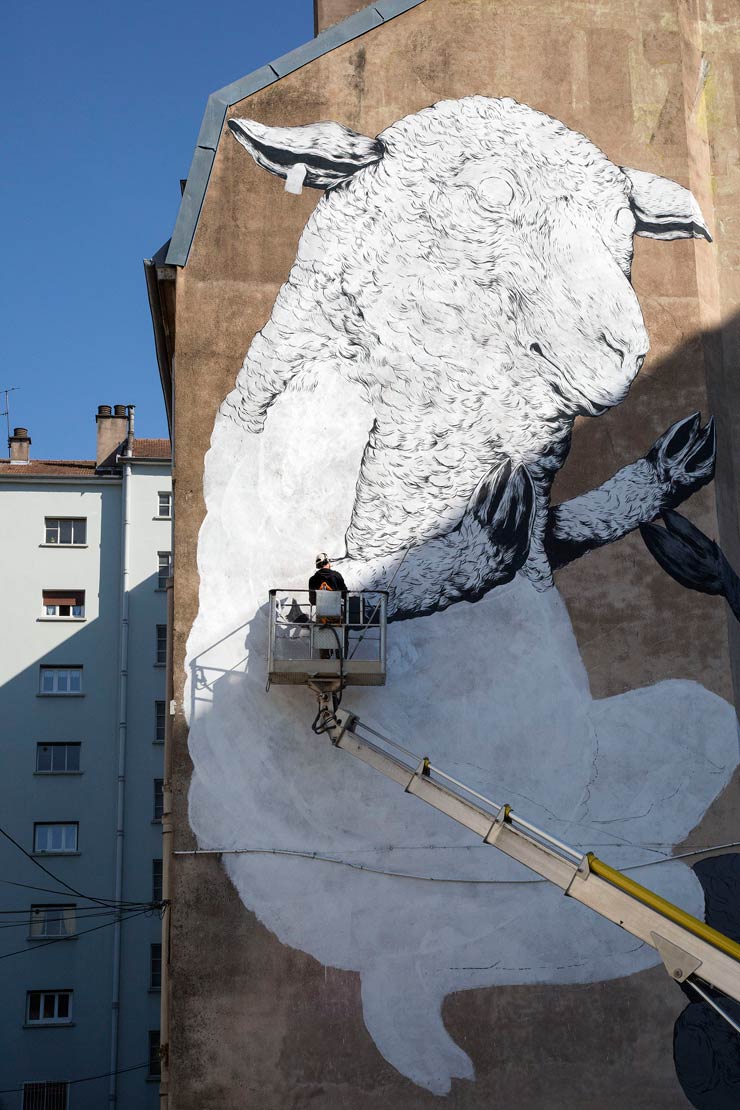
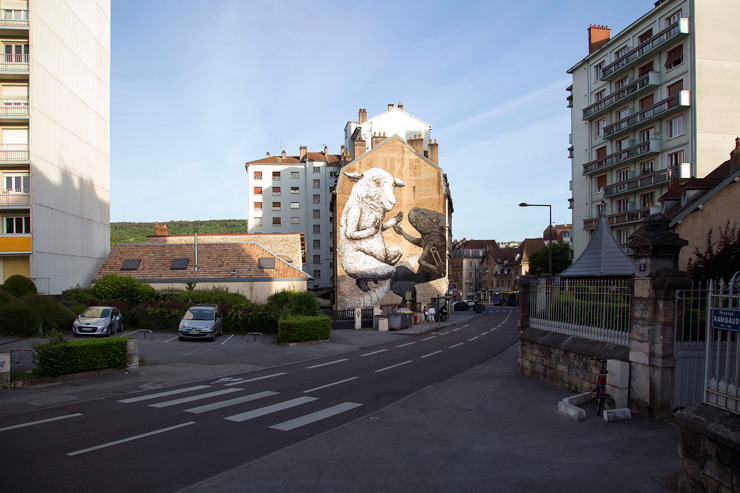
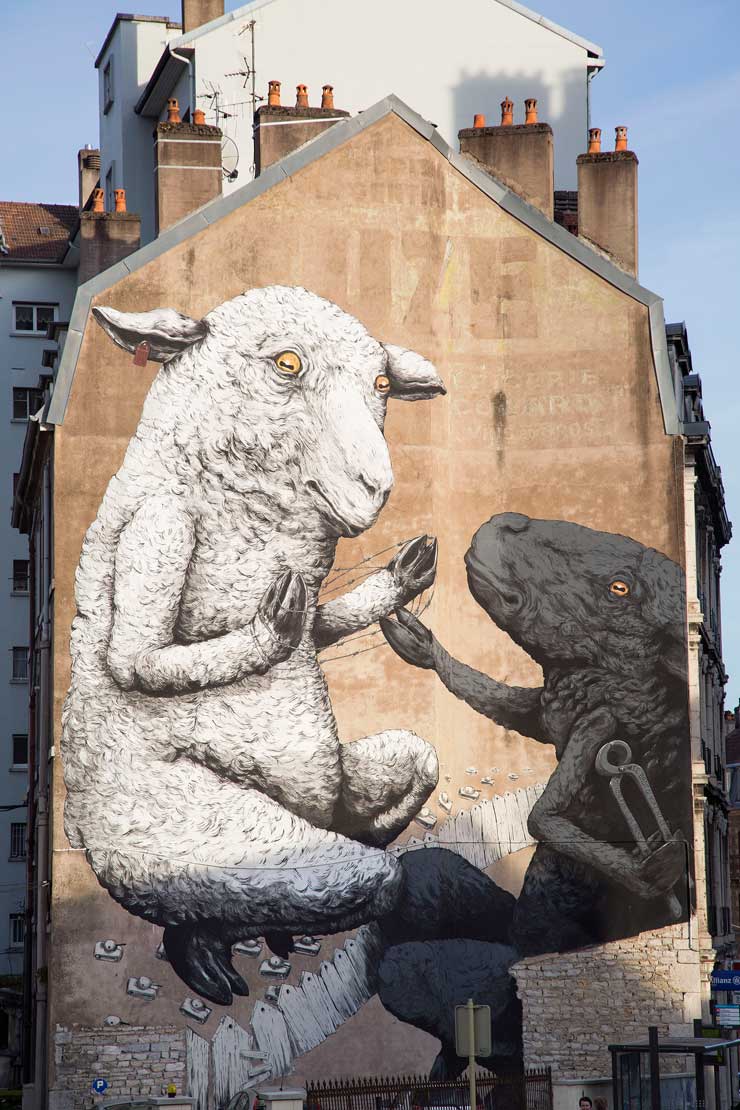
The Bologna native whose animal world personifies the behavioral traits of humans – sometimes with alarming accuracy – brings this cuddly pairing to a large wall at 8 rue des Chaprais in Northeastern French town.
But are they so cuddly? Standing on either side of a fenceline and with armaments all around on the ground by one of the sheep, his neighbor is capable of freeing the him from his barbed wire conundrum, but the tool of liberty remains secreted behind his back.
The indoor museum exhibition explores the ages of life, the perception of the world as children and adults. As it turns out, so does the outdoor exhibition.
Meanwhile, New York is getting clobbered by rain and new Street Art and murals and is electrified with the excitement of the beginning of summer. Coney Island, Bushwick, Little Italy are hot for new stuff going up again, David Choe is at the Houston Wall this week, the Bushwick Collective Block Party is June 3, and Ad Hoc’s Welling Court begins June 10.
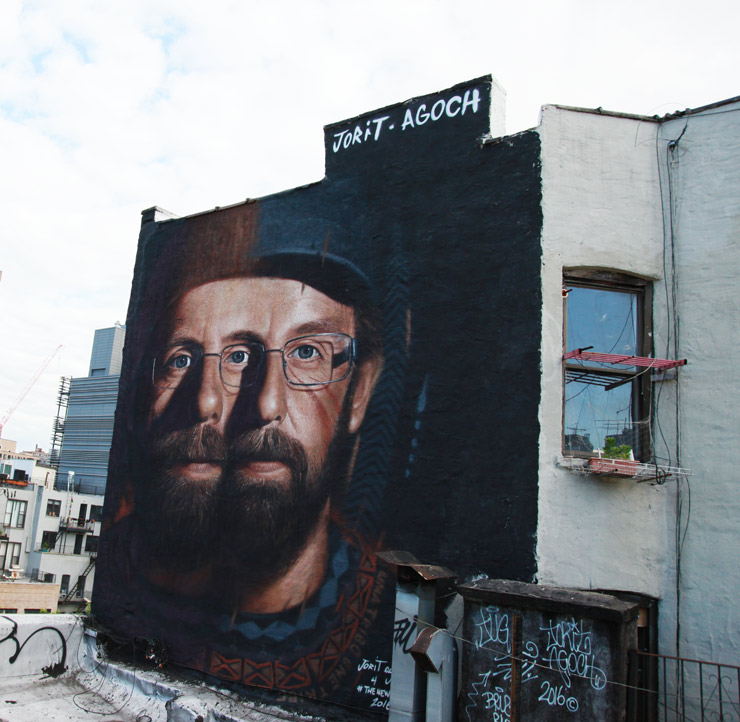
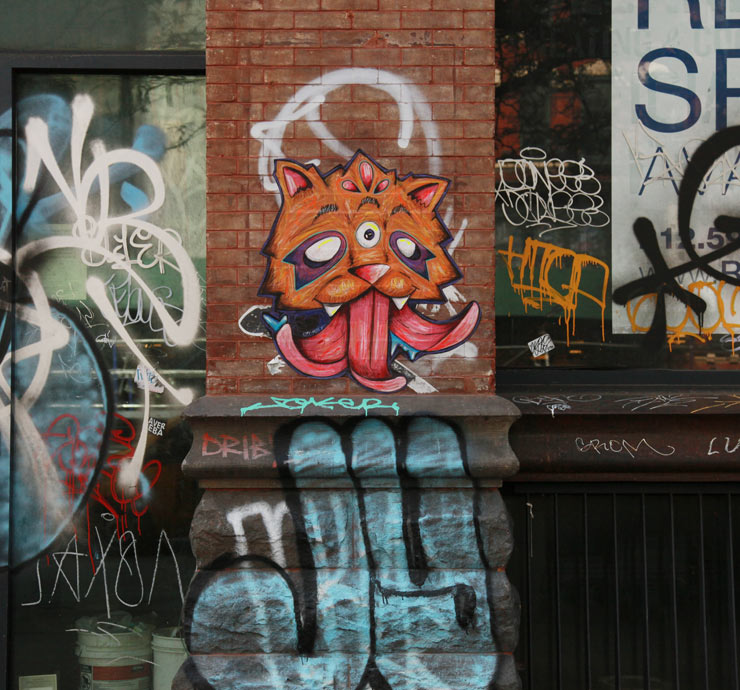
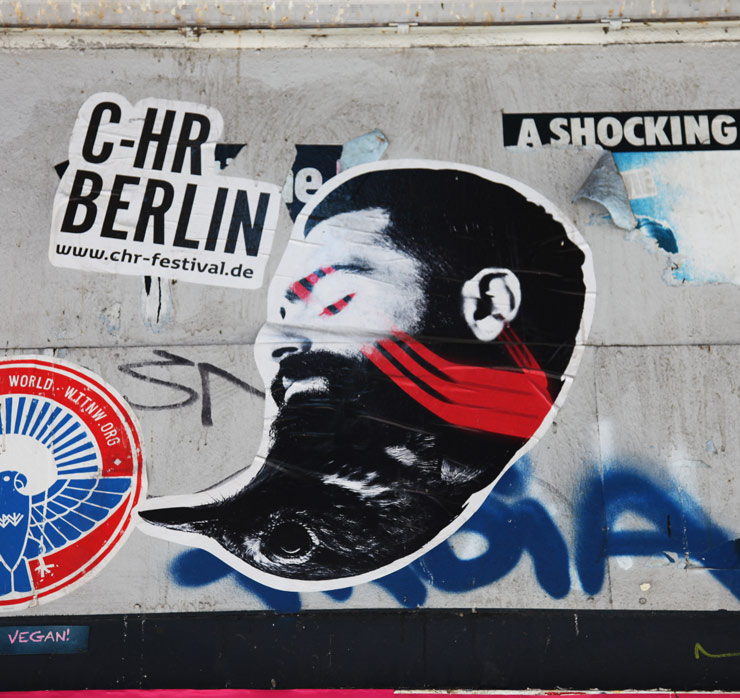
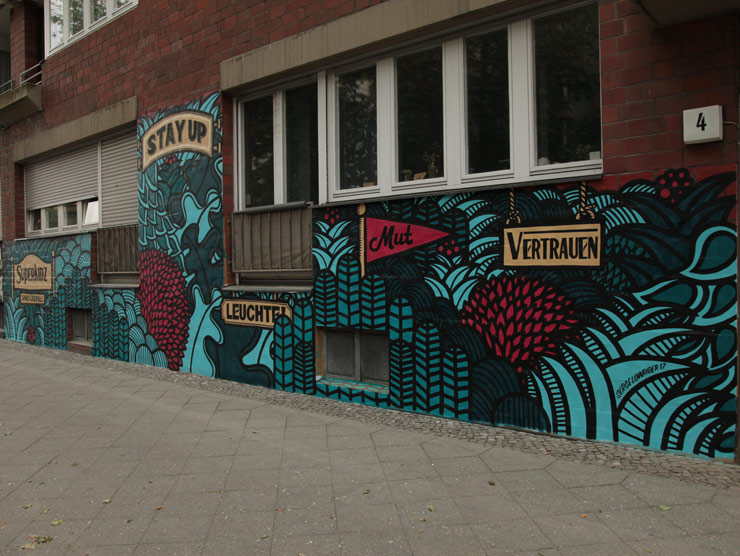
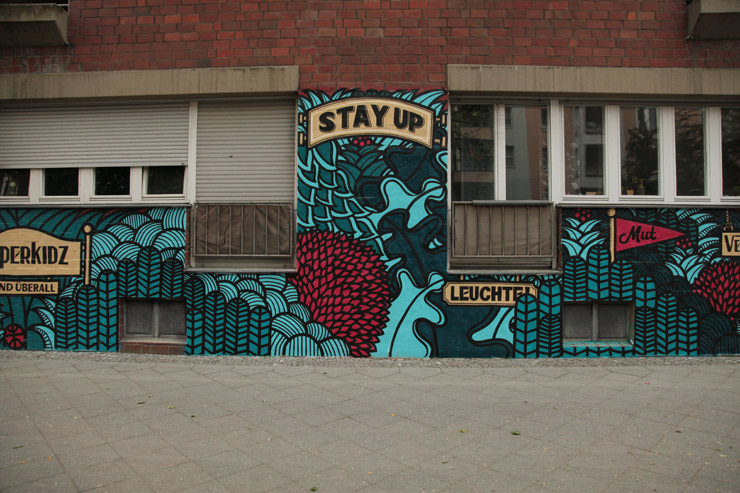
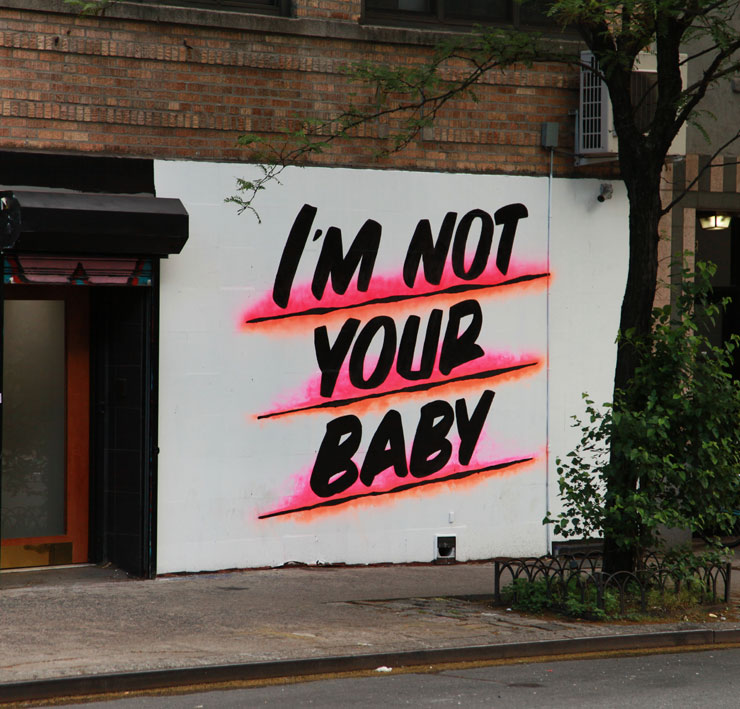
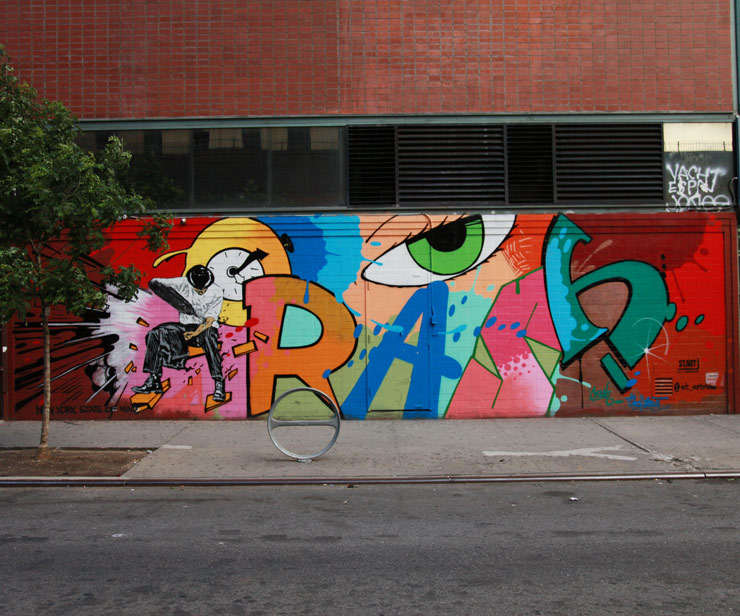
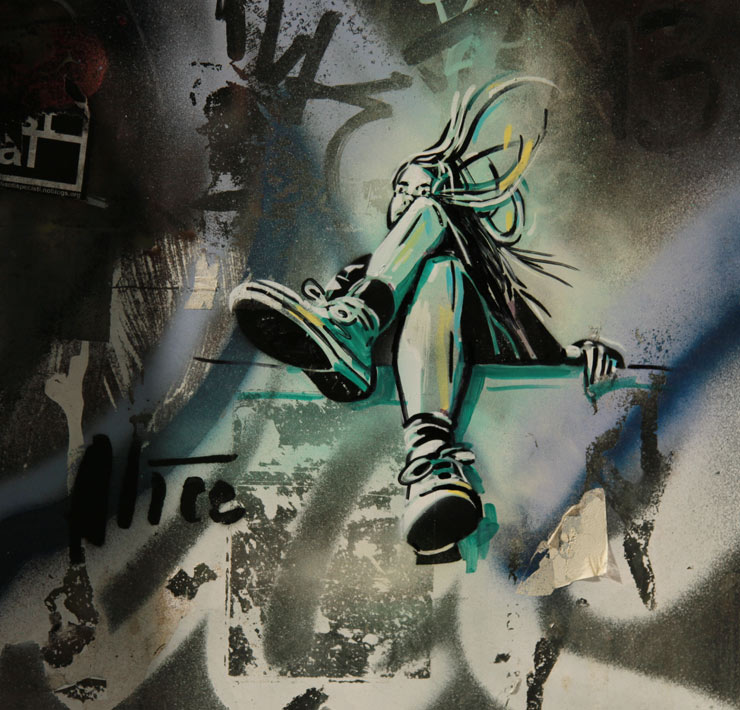
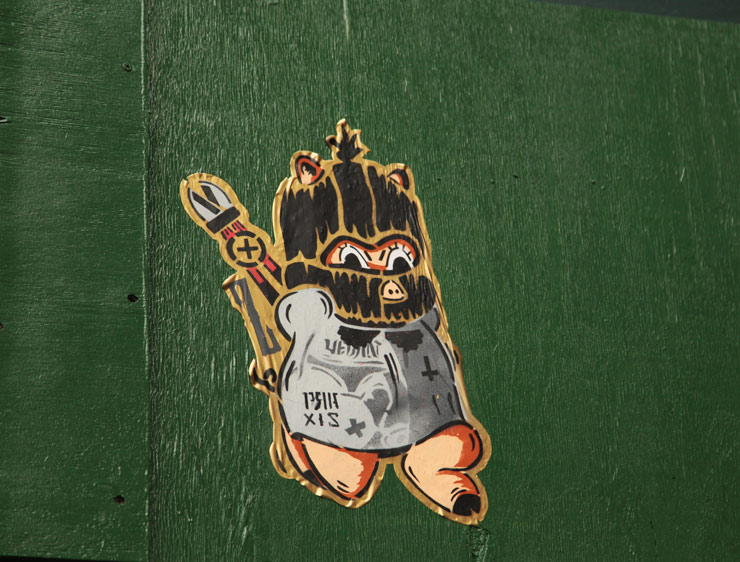
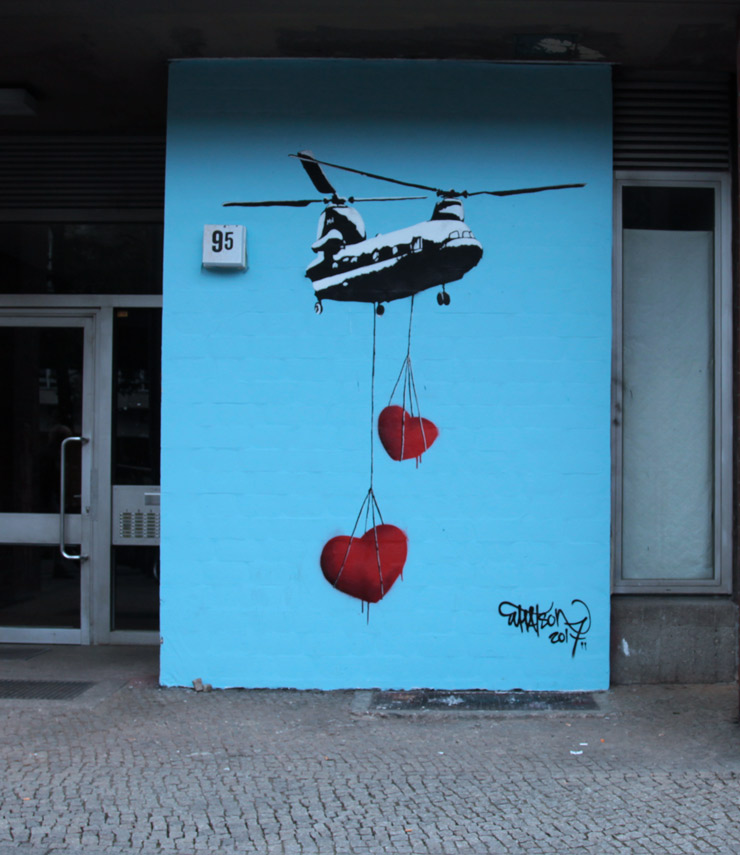
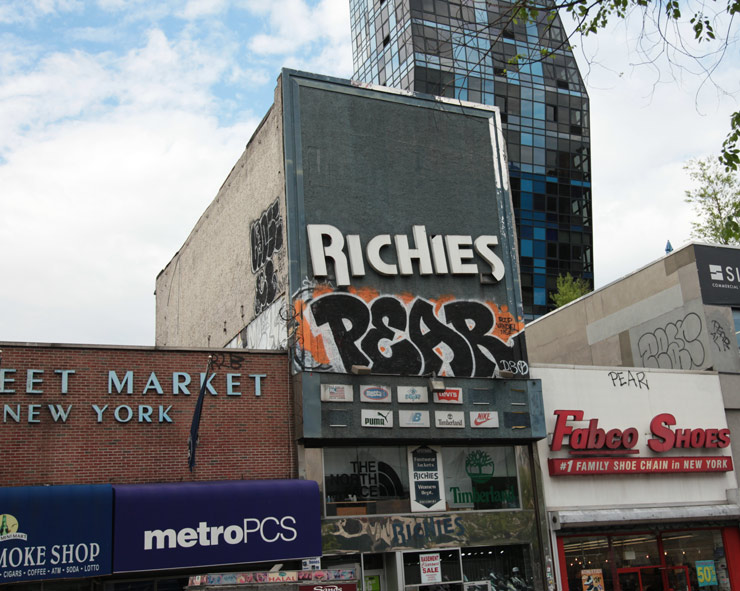
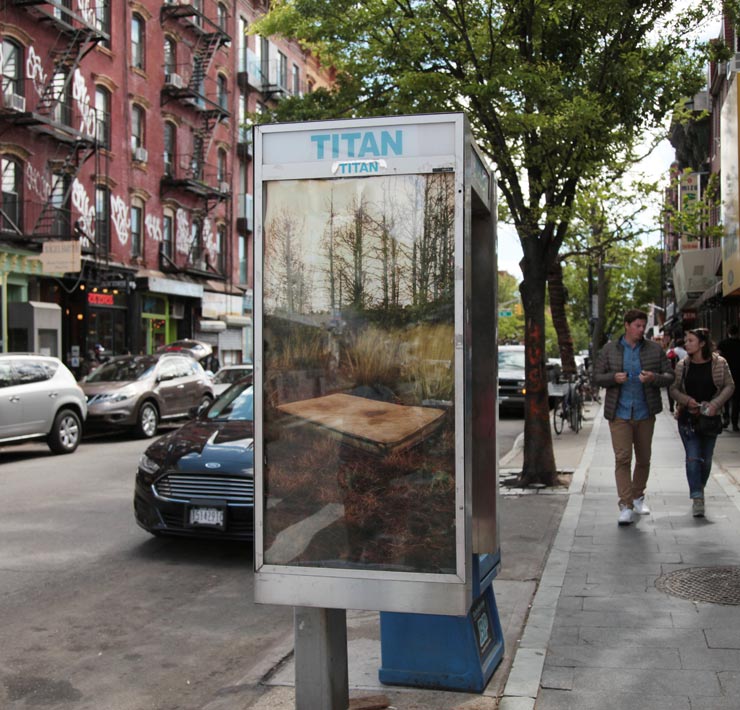
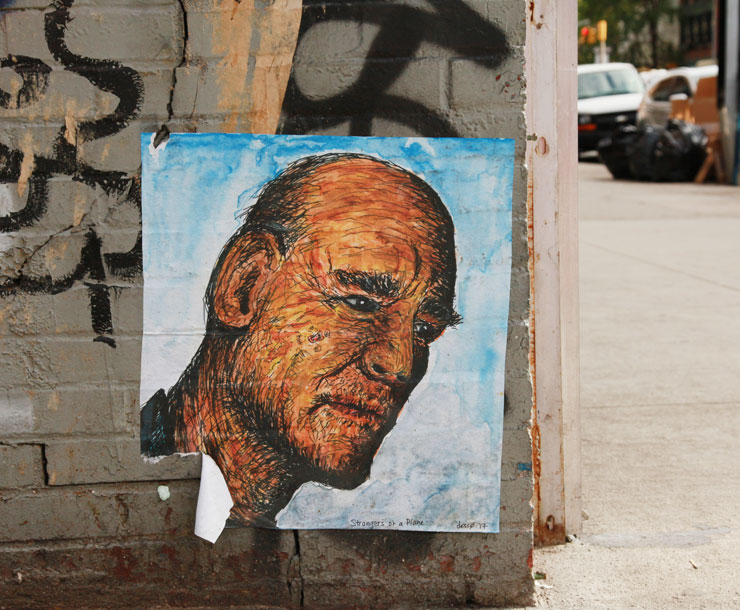
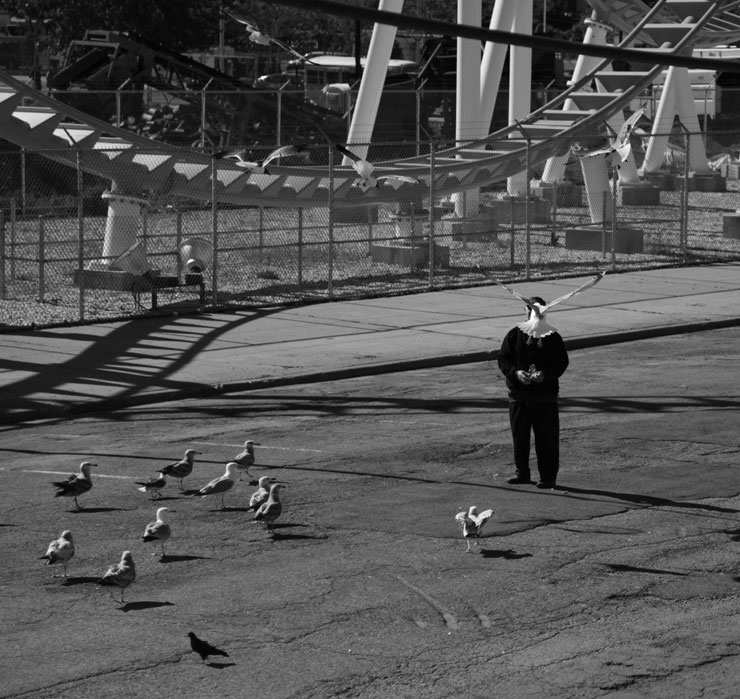
Here’s our weekly interview with the streets, this week featuring: Alice Pasquini, Baron Von Fancy, Blanco, City Kitty, Crash, Drsc0, Erosie, Jim Drain, Jorit Agoch, kaNO, Martin Whatson, Nick Walker, Pear, Rocket 01, Serge Lowrider, and Tod Seelie.
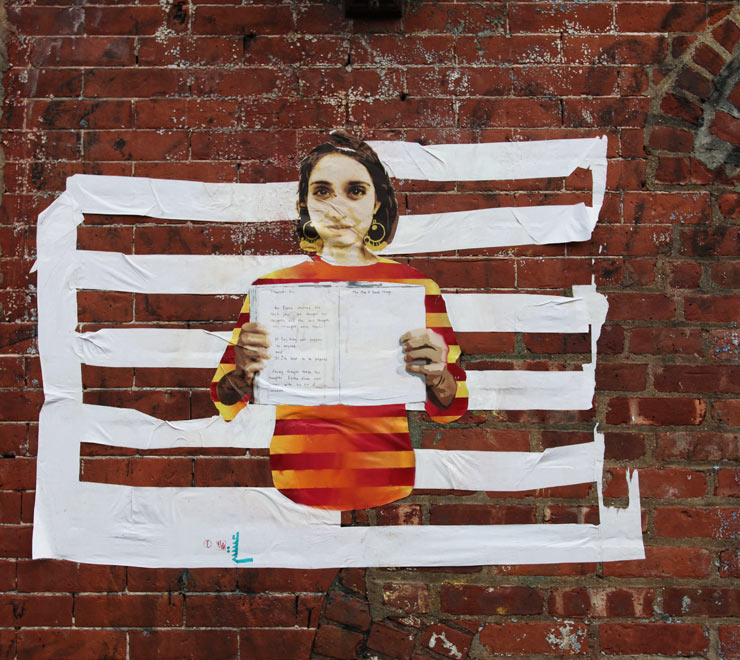
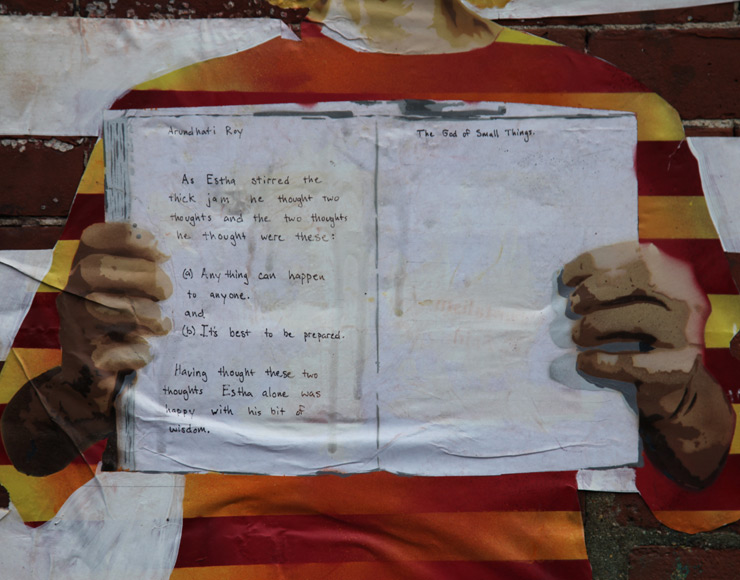
“As Estha stirred the thick jam he thought Two Thoughts and the Two Thoughts he thought were these:
a) Anything can happen to anyone.
and
b) It is best to be prepared.”
― Arundhati Roy, The God of Small Things
“Strong individual artistic statements in the streets can create these magical, deeply human moments in your everyday routine and push you out of the frame,” says Sebastian Purfürst. “It’s an alternative and amazingly uncontrollable channel of human to human communication.”
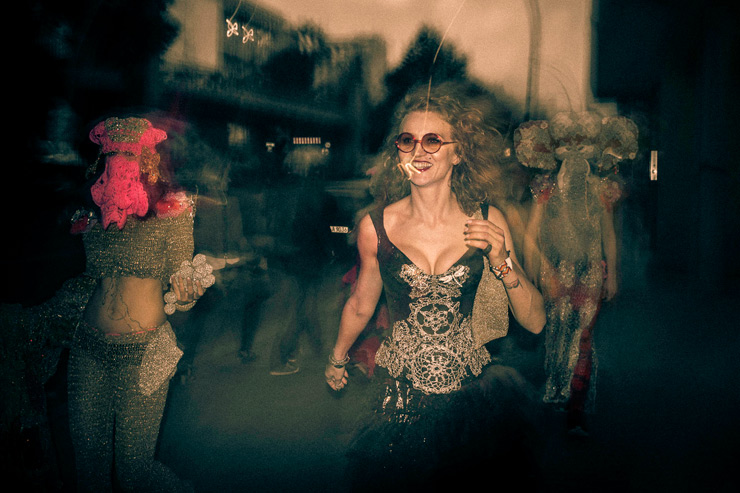
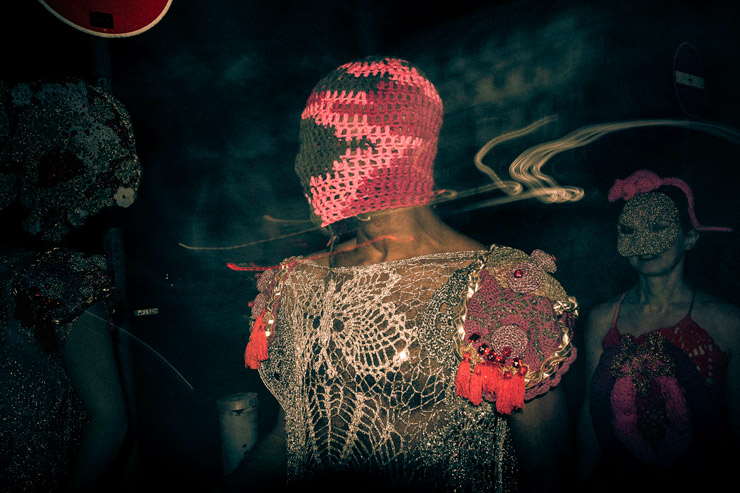
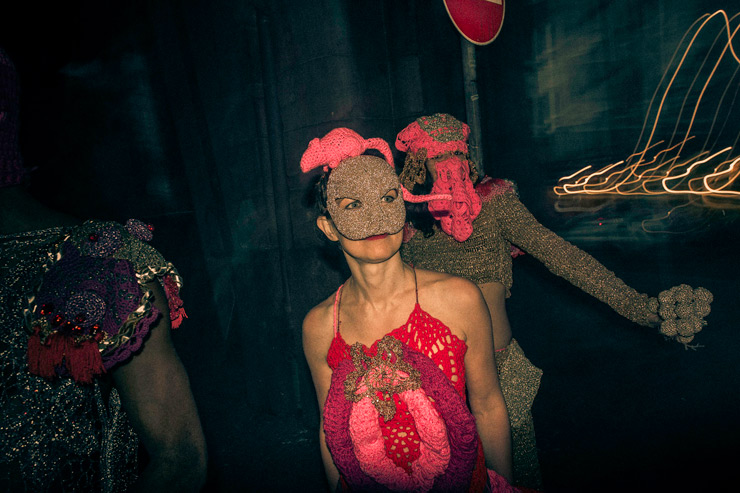
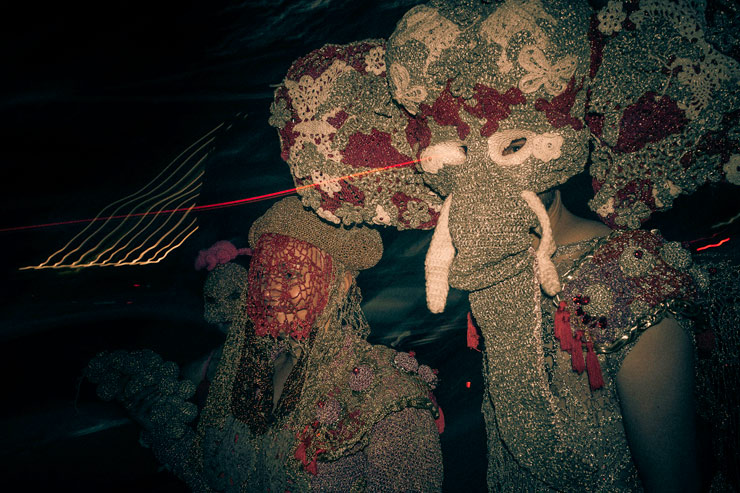
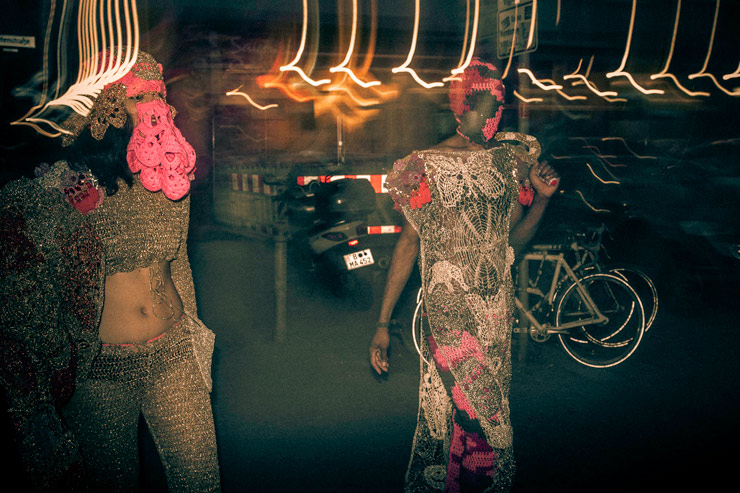
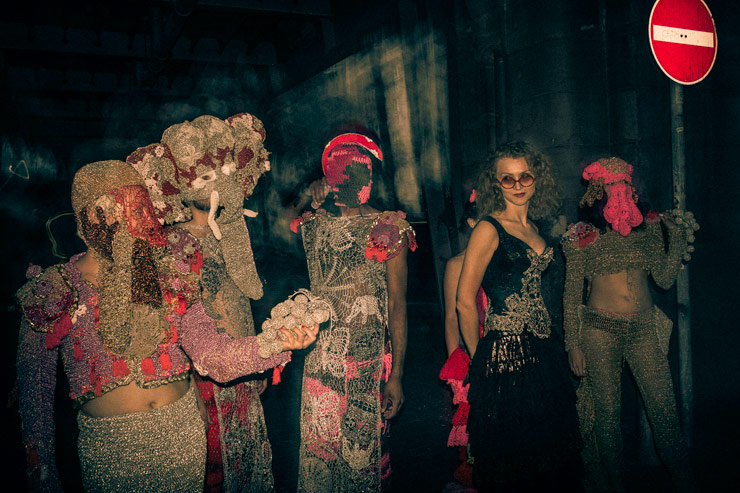
Multi-dimensional artists like the Polish-now-Brooklyn-based OLEK find it difficult to describe their work because they fall into many categories; installation, sculpture, performance, theater. Often they create their own category entirely, unconcerned with labels and dogmatically narrow definitions. Thanks to the elastic quality of her crocheted art materials, you may see people wearing them at official events, at dinners, in a swimming pool, or simply crossing a busy Berlin street on a Friday night.
As guests shuttled back and forth across Bülowstrasse to see the shows inside the raw space of the soon-to-be UN museum and the polished gallery space of the UN Project M/12 show, you may have caught one of those Olek moments where her costumed performers traipsed and cavorted along the sidewalks, momentarily distracting attention from the sex workers whose neighborhood this is.
“For me street art has the potential to turn the anonymous, commercial urban space into a walkable, immersive space to think and to feel, provoking new perspectives, ideas and communication,” says photographer Sebastian Purfürst, a Berliner who captured these inside/outside images last week and likens them to Street Art as much as live performance that occupies and activates public space.
A video/new media artist and musician whose sound and visual design has appeared in commercial, artistic, theatrical and academic settings Purfürst tells us that he was mesmerized by the immersive spectacle that unfolded and transformed the environment. “Street art has the chance to act and react fast, directly and in a totally unexpected way – literally over night. It’s a direct physically manifested response to a world.”
The warmth of the spring night made their languorous limbs entangle as the Olek performers danced, posed, capered and marched, silently interacting with traffic and passersby, their creator strolling languidly among them in an impossible corset and red-rimmed round glasses.
“Strong individual artistic statements in the streets can create these magical, deeply human moments in your everyday routine and push you out of the frame,” says Sebastian. “It’s an alternative and amazingly uncontrollable channel of human to human communication.”
They were just a few moments to experience, and we’re glad Purfürst captured them. The images are full of energy and an insouciant charge of electricity and blood and flesh elevating the senses, street ephemera that wafts into you, through you, past you.
Our weekly focus on the moving image and art in the streets. And other oddities.
Now screening :
1. Nuart Aberdeen 2017 – The Movie.
2. Edjinn for 12 + 1 Project in Barcelona
3. Trump Meets the Pope on the Street
4. Dale Grimshaw at Memorie Urbane 2017
5. “The Brainwashing of My Dad.”
BSA Special Feature: Nuart Aberdeen 2017: The Movie.
Not to be confused with Nuart Aberdeen 2017: The Board Game, or Nuart Aberdeen 2017: The Cheese, or Nuart Aberdeen 2017: The Stuffed Baby Panda.
Herewith is The Movie, courtesy of director Doug Gillen at Fifth Wall TV and the team at Nuart Aberdeen. This mini-movie gives you a greater context to see the festival in during a cold spring week in this northern seaside town in Scotland where Street Art and murals are something brand new to many – an opportunity to experience public space in a communal way, or an individual one. Nevermind the bigger questions, enjoy the sense of discovery here. You can see how Doug is using his arsenal of sound and visual tools to weave scenes together and tell his own particular story here, and it is quite a nice bit of poetry. Hope you enjoy!
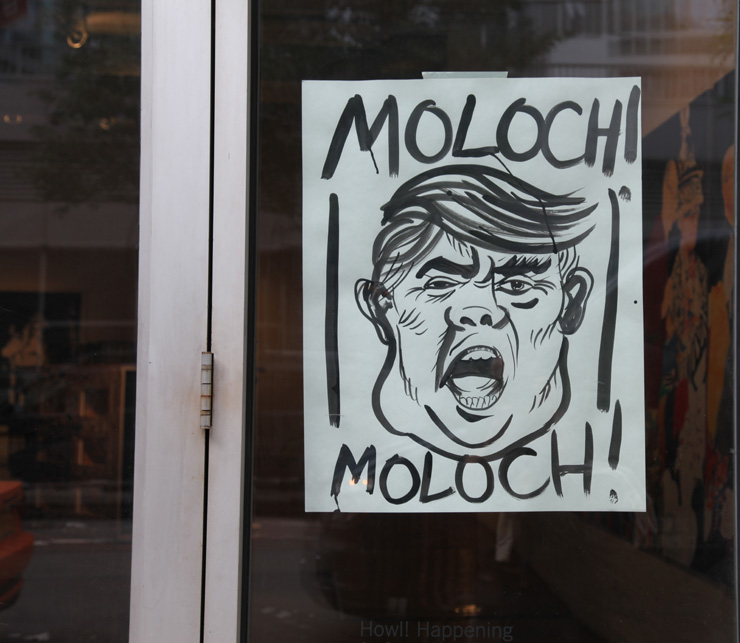
The street continues to lambast Trump at every turn, including here in anticipation of his visit this week with the Pope here in Rome. Claimed by a Street Artist named TVBoy his name is reported as Salvatore Benintende. Regarding the actual visit, the Pope looked like he had some indigestion during the event.
Dale Grimshaw at Memorie Urbane 2017
Couldn’t be fresher! This piece was just finished this week at part of the Memorie Urbane 2017 festival by artist Dale Grimshaw.
What Happened to Dad?
Not related to Street Art, but have you heard of propaganda? For anyone who cares to see it, the media is a tool of war, and US citizens have have been under attack. This trailer caught our eye this week – its about what America is looking like after 30 years of gradual continuous assault on our minds. We are being taught to hate and distrust one another, but we actually don’t. And it is not stopping. “The Brainwashing of My Dad.”
After all that sun and surf and sashaying up the boardwalk in espadrilles and a big hat, what smashing city girl doesn’t like to throw on a fresh coat fire-engine-red lipstick ? Smart Sallys know that fresh paint on the kisser can bring a bevy of new beaus to take those lips for a ride.
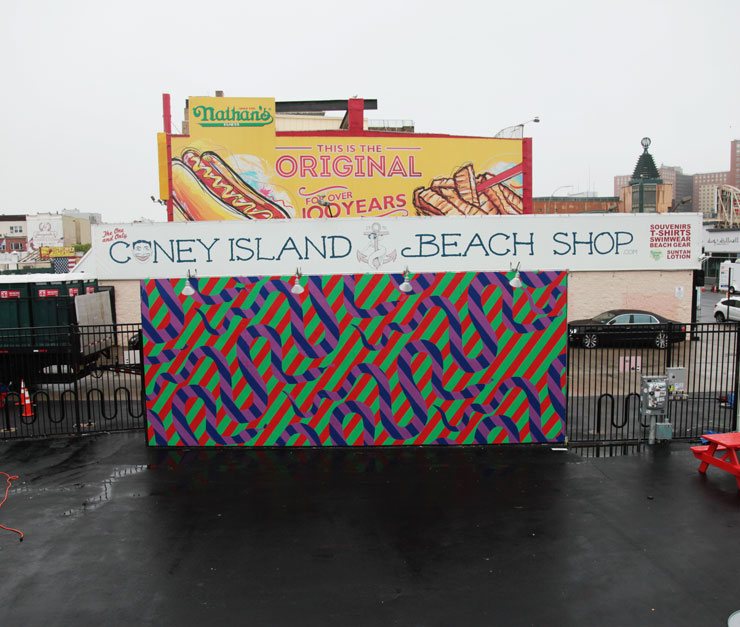
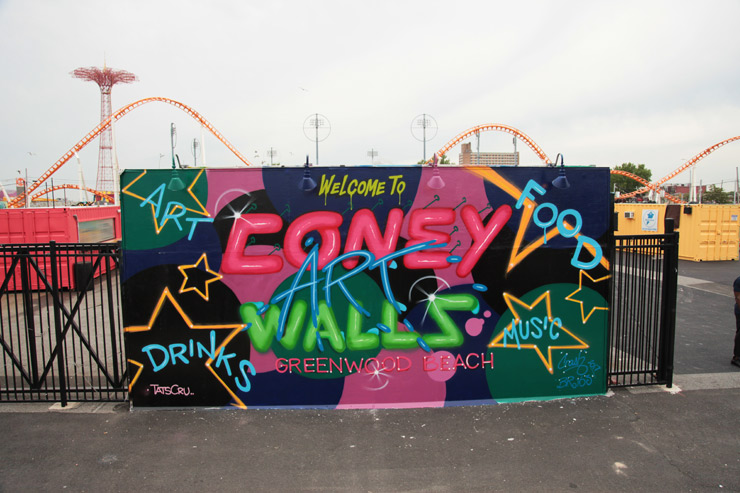
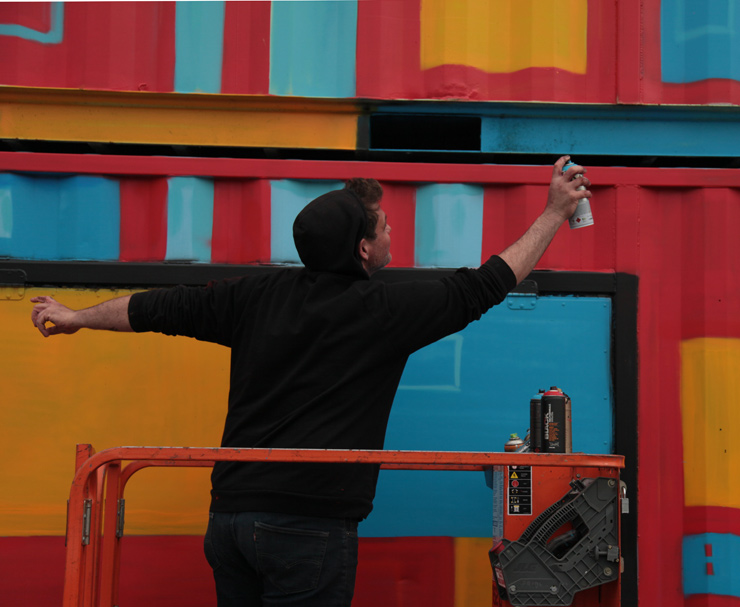
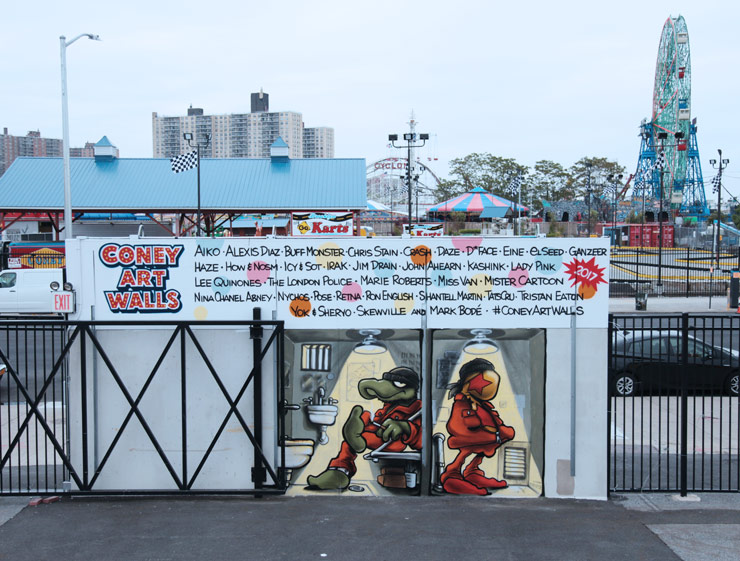
Coney Art Walls is getting a solid touch-up for the new summer season too here in this waterside Brooklyn hotspot as a number of new artists have just joined the procession.
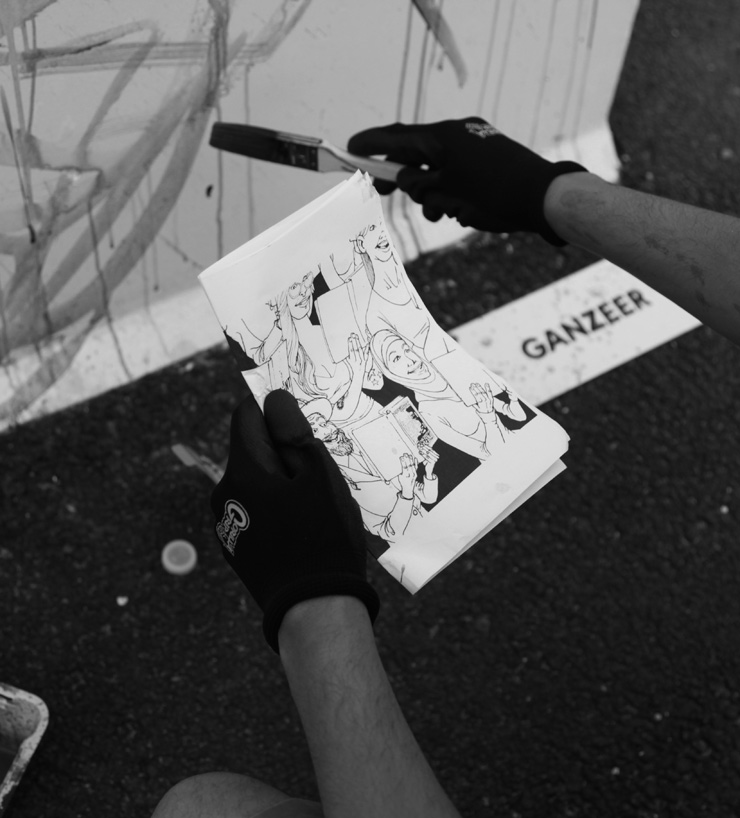
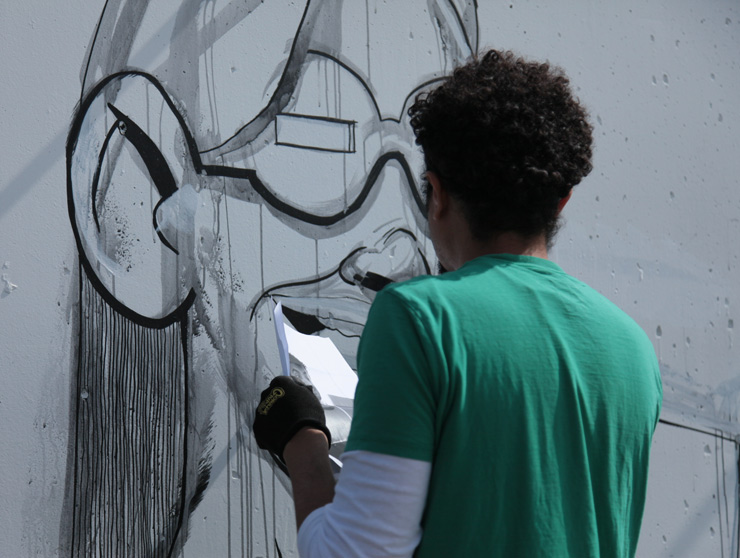
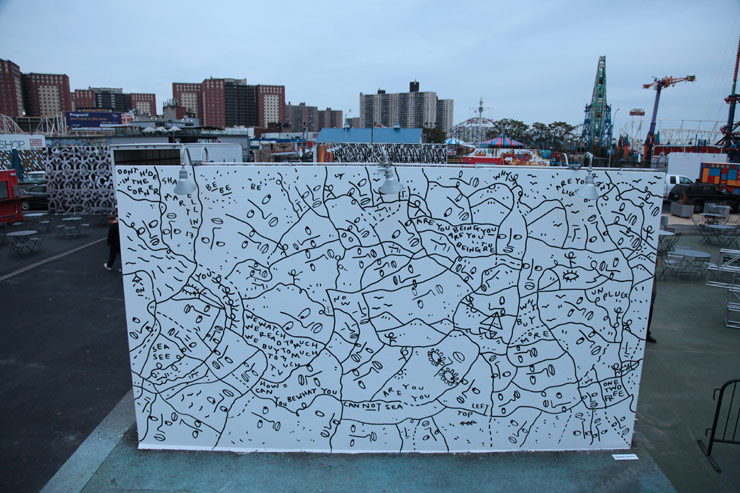
Unofficially the first weekend of summer tomorrow, you can be assured that there will be popcorn, cotton candy, beer, flip-flops, a bit of sleaze and a lot of freak show parading around these newly painted pieces by Crash, Alexis Diaz, Jim Drain, Ganzeer, Shantell Martin, Lee Quinones, Marie Roberts, Mark Bodé, Skewville and Chris Stain.
This outdoor museum of murals by Street Artists and graffiti writers is again curated by that two headed curiosity of the “Art Hypnotist” Jeffrey Deitch and “Real Estate Lion” Joseph Sitt for the third colorful year. Curious visitors to the Coney Art Walls are once again regaled with a labyrinthine tour of walls painted by artists of all backgrounds here on this gritty city beachfront that roils with raven-haired shimmery mermaids and muscled snake handlers with handle bar mustaches.
The elegant ring master Deitch tells us that many of the previous years walls are returning for another show season but that the program has added artists from as far away as equestrian England, enticing Egypt, passionate Puerto Rico, cray-cray California and good old fast-talking New York – a place so nice they had to name it twice.
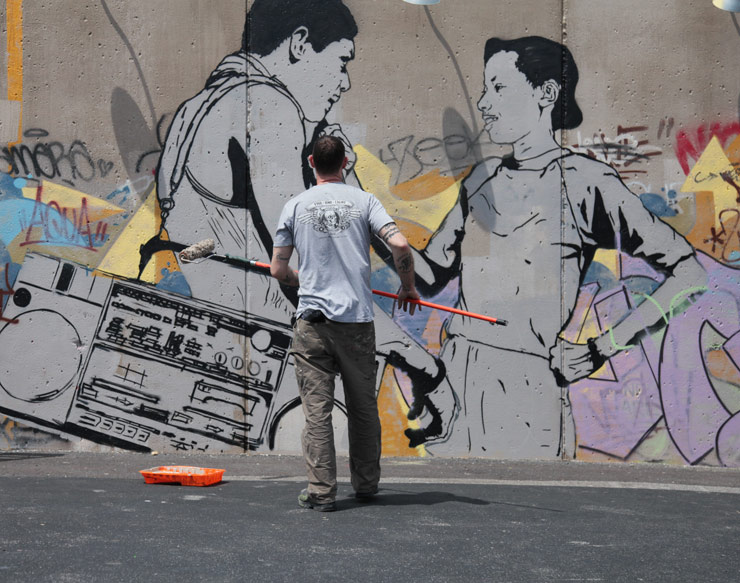
One particular attraction for the hometown crowd will be the spectacular and splendiferous Lee Quinones, who famously painted hundreds of whole-cars on the NYC subway during graffiti’s halcyon days of the late 70s and early 80s.
Only a lucky few ladies and gentlemen will get to see this punctilious wizard of aerosol painting his wall LIVE with their own eyes. The rest of the crowd will undoubtedly be screaming on a nearby mechanized tilty-ride or looking longingly for someone to smooch under the boardwalk.
Returning champion Coney Art Walls this summer will include those by John Ahearn, Aiko, Buff Monster, D*Face, Daze, Eine, eL Seed, Haze, How & Nosm, Icy & Sot, IRAK, Kashink, Lady Pink, The London Police, Miss Van, Mister Cartoon, Nina Chanel Abney, Nychos, RETNA, Ron English, Pose, Sheryo & Yok, Tats Cru, and Tristan Eaton.
“The graffiti and Street Art movements – they have all these tentacles and they can be non-linear.”
A new exhibition in Berlin’s neighborhood of Schöneberg epitomizes one of the central schisms that has vibrated through Street Art and graffiti for years: the question of where to draw boundaries between these two scenes. Each may have been born in the margins of society but are now evermore commingled. Debates aside, everyone agrees that once in the gallery space, street become fine art after all.
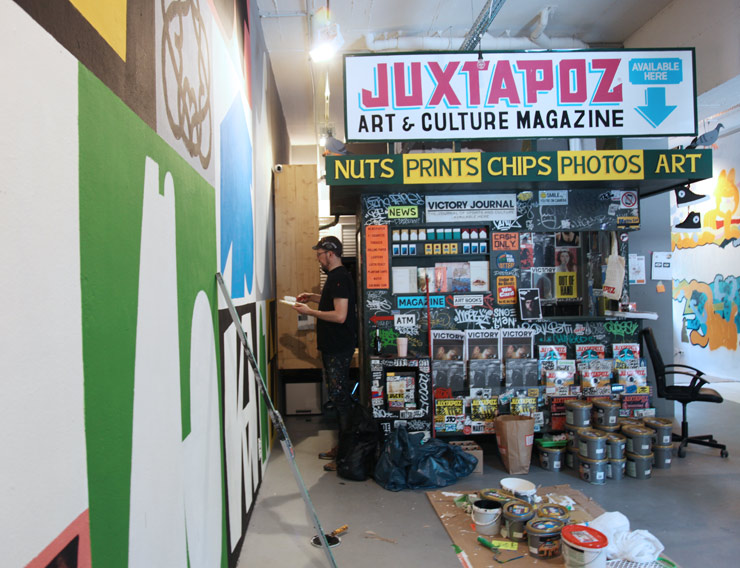
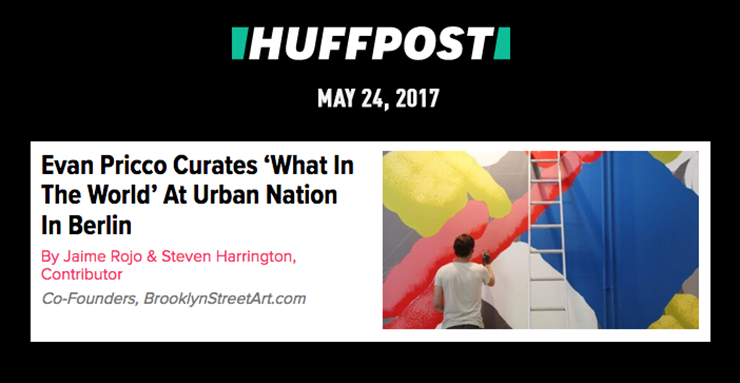
As Editor-in-Chief of the San Francisco based art magazine Juxtapoz and curator of this “What in the World” show at Urban Nation’s project space, Evan Pricco is well aware of the landmines that can explode when one is negotiating the terminologies and practices of sundry sub-cultural art manifestations that have bubbled to the surface in the last decades and which now often melt with one another inextricably.
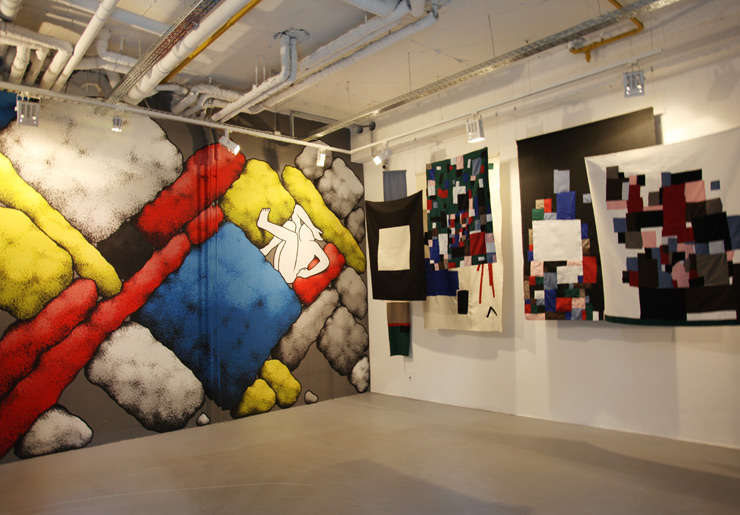
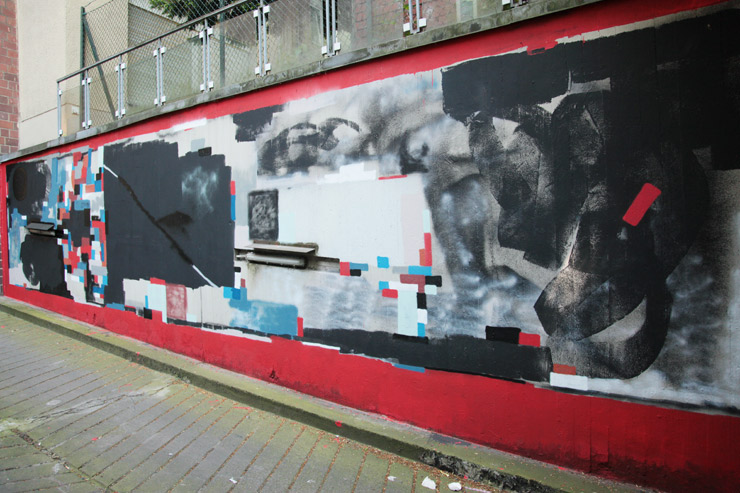
“The graffiti and Street Art movements – they have all these tentacles and they can be non-linear,” Evan says as we walk down a subterranean parking ramp to see a low, long outdoor mural by Sweden’s EKTA; an abstract series of roughly square patches that closely emulate the sewn panels he has suspended from the ceiling inside the gallery.
Speaking of the tentacles, he continues, “It can be starting points to end points – it can be end points to starting points. There are all of these different cultures that grew out of that 1970s-80s set of counter-culture art movements.”
“I think the people that I really wanted in this show are kind of on the periphery of that. They clearly dip their toe into those movements, are clearly influenced by them. Their practice doesn’t necessarily fit in with what is going on in Street Art and graffiti but also its informed by it.”
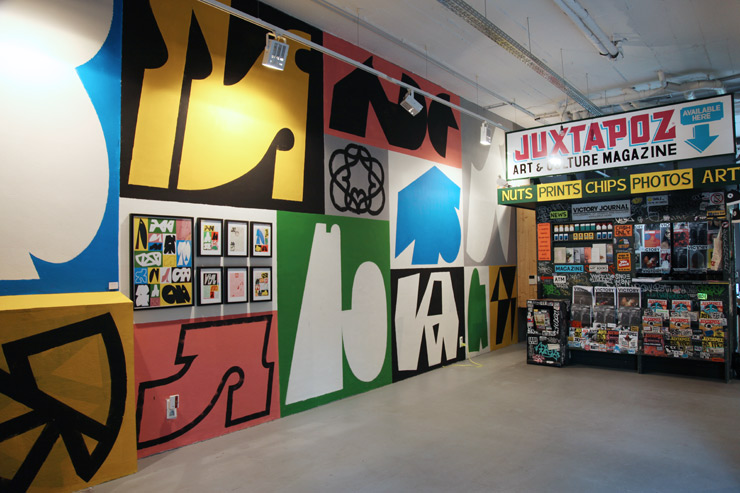
To introduce a new crop of artists to Urban Nation that haven’t been shown here yet, Pricco choses some of Europes street/mural/conceptual artists who emphasize color and mood, an expansionist approach that he welcomes at the magazine as well. Not surprisingly, the range reflects some of the same interests you’ll find flipping through the influential art publication; old school graffiti, commercial illustration, comic book history, abstract fine art, political art, some lowbrow, some conceptual. There is even Grotesk’s newsstand, the actual one that he designed and constructed with Juxtapoz that sat in Times Square in October 2015.
Primarily from Europe and raised in the hothouse of the 1990s epic graffiti scenes that enthralled youth in many EU big cities, this group of 7 artists each has moved their practice forward – which may lose them some street cred and gather new audiences.
Included are Berlin’s Daan Botlek, Sweden’s EKTA, Ermsy from France, Erosie from the Netherlands, Hyuro from Spain, Serge Lowrider from Switzerland and Zio Ziegler from the US. If you speak to any of them, you may find the commonality is the freedom they actively give themselves to pursue an autonomous artistic route not easily categorized.
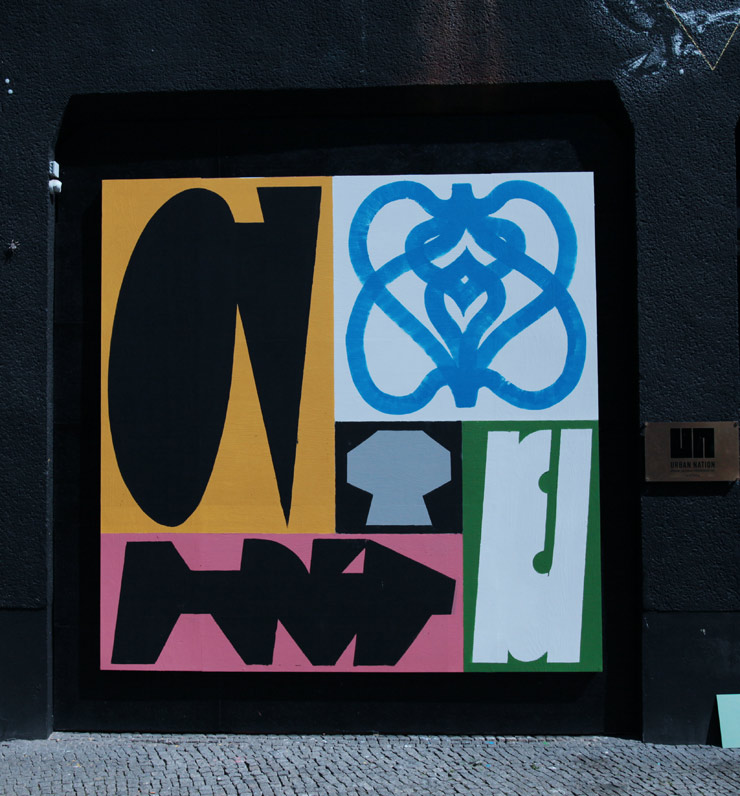
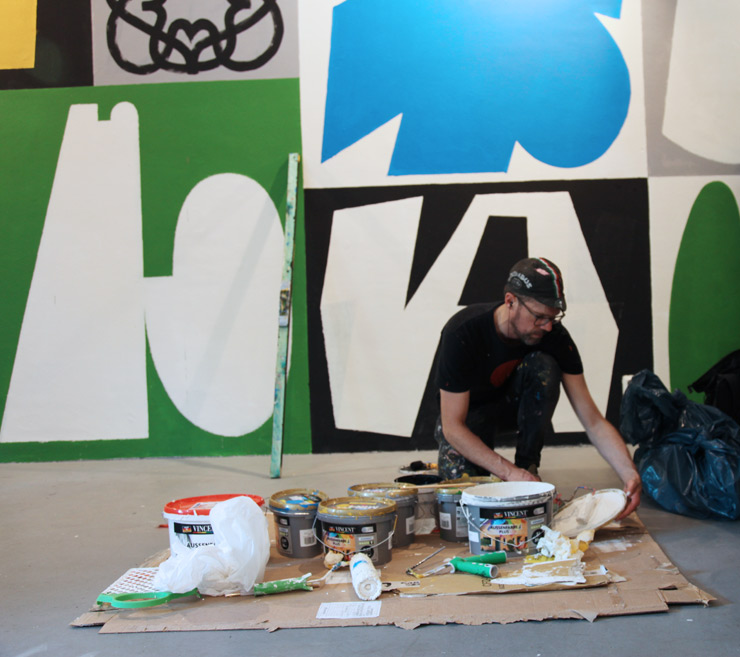
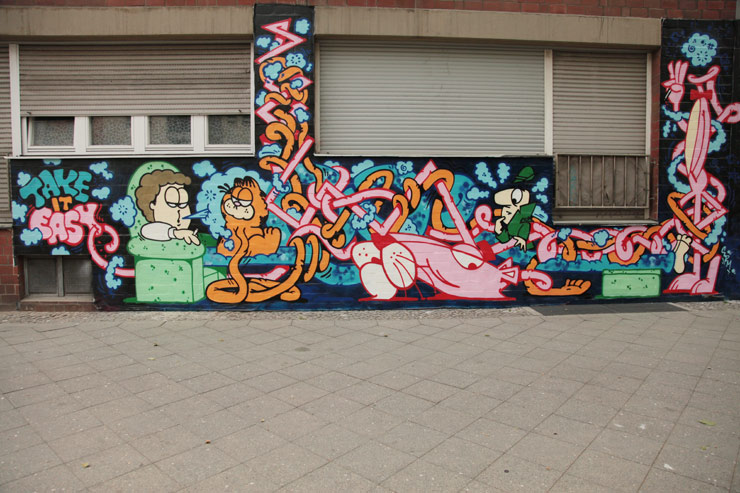
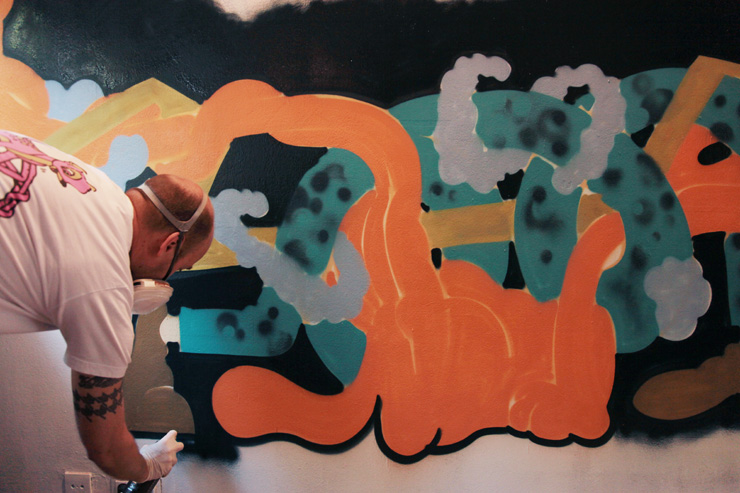
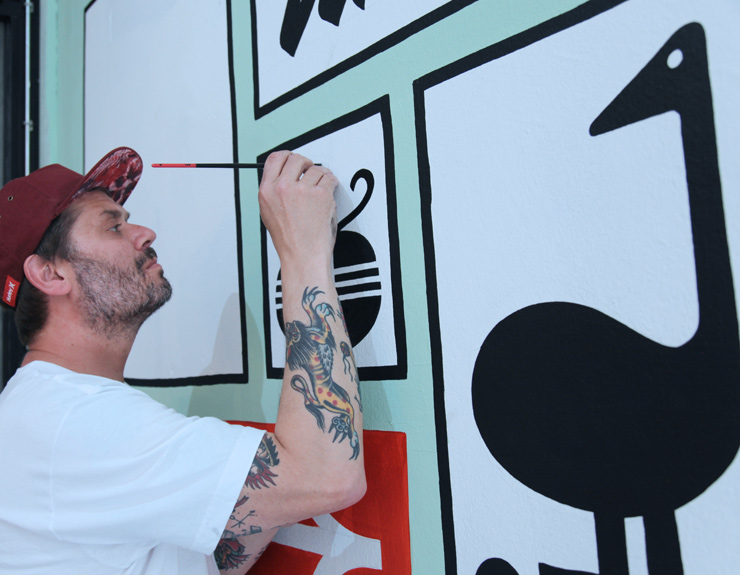
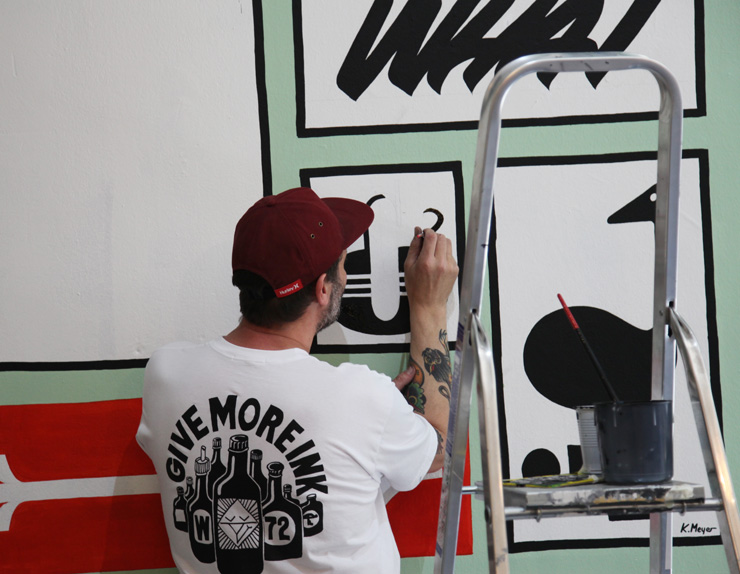
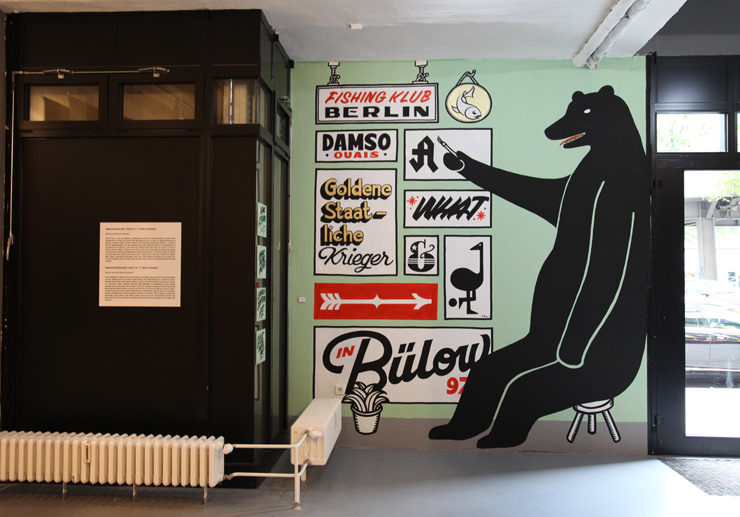
Lowrider is clearly in love with the letter-form, as is the graffiti tradition, but he steers sharply toward the calligraphic practices of crisp sign-painting and inverting the pleasantly banal messaging of advertising from an earlier era. Perhaps the tight line work overlaps with tattoo and skater culture, two creative brethren frequently in the mix in graffiti and Street Art scenes.
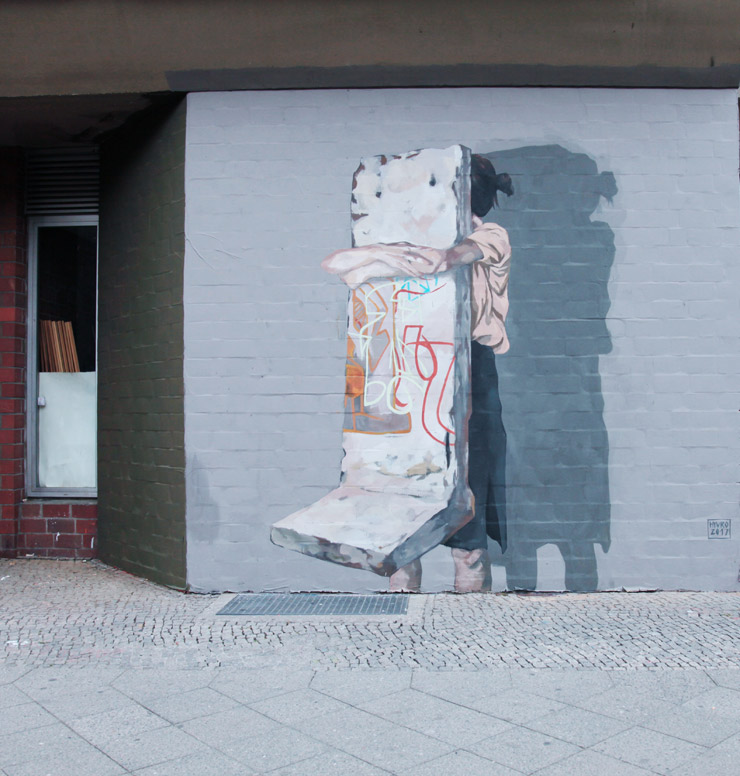
Hyuro uses a figurative symbolism heavy with metaphor and a color palette that is too understated for the flashy graphics that many associate with today’s mural festivals, yet she’s built a dedicated following among Street Art fans who admire her poke-you-in-the-eye activist streak. Daan Botleks’ figures wander and cavort amidst an abstractedly shaped world calling to mind the shading of early graffiti and the volumizing pointillism of Seurat after some wine.
Painter Jeroen Erosie emphatically will tell you that he was in love with graffiti when he first did it on the streets as a teenager – and for many years afterwards. But he says he ultimately bristled at a scene that had once symbolized freedom to him but had become too rigid and even oppressive in its rules about how aesthetics should be practiced by people – if they were to earn respect within the clan.
At Saturday nights opening along Bülowstrasse with the front doors open to the busy street and with the sound of the elevated train swooshing by overhead, Erosie explained with a gleeful certainty his process of deconstruction that led him to this point. “I removed one of the pillars of graffiti from my work and I liked the result, the change. So I started to remove more pillars, one by one,” he says, describing the evolution that transformed his letter forms and colors into these simplified and bold bi-color icons that may call to mind Matisse’s cut outs more than graffiti bubble-tags, but you’ll easily draw the correlation if you try.
The Project M series of exhibitions over the past three years with Urban Nation, of which this is the 12th, have featured curators and artists from many backgrounds, disciplines, and geographies as well. The myriad styles shown have included sculpture, stencil, wheat paste, collage, calligraphy, illustration, screen-printing, decoupage, aerosol, oil painting, and even acrylic brush. It has been a carefully guided selection of graffiti/Street Art/urban art/fine art across the 12 shows; all presented respectfully cheek to jowl, side by side – happily for some, uncomfortably for others.
The ultimate success of the Project M series, initiated by UN Artistic Director Yasha Young, is evident in just how far open it has flung the doors of expectation to the museum itself. When the house opens in four months it will be a reflection to some extent 140 or so artists who pushed open those doors with variety of styles emblematic of this moment – converging into something called Urban Contemporary.
“What in the World” indeed: this show is in perfect alignment with the others in its wanton plumbing of the genres.
“I was trying to find people that are not part of the regular circuit – and I don’t mean that in a negative way but I mean there is kind of a regular circuit of muralism and Street Art right now – but I was looking for people who are really sort of on that periphery,” Pricco says. “Also because they are coming from these different parts of Europe, which to me sort of represents Juxtpoz’ reach, and they all kind of know each other but they’ve never really met – they all kind of bounce off of each other.”
Brooklyn Street Art:This grouping sounds anathema to the loyalty that is often demanded by these scenes – particularly the various graffiti scenes in cities around the world. You are describing an artistic practice that has a sort of casual relationship to that scene.
Evan Pricco: Right. And I think all of these artists have these graffiti histories but they weren’t completely satisfied with that kind of moniker or label. So it is slightly expanding out now. And then there’s something about them that makes me think of crafts, especially with Serge who is more of a sign-painter. I felt that all of these people approached their work in a way that felt very craft-oriented to me, and I really appreciated that. That’s kind of what I wanted to show too.
Brooklyn Street Art:Each of these artists appears to have a certain familiarity with the art world that is outside a more strict definition of street culture – graffiti and Street Art and their tributaries. Would you say that you could see a certain development of personal style in this collection of primarily European artists that might be due to exposure to formal art history or other cultural influences?
Evan Pricco: Good question, and that could be the case for a few of the artists in the show, but I think the characteristics of each artist in the show is more of a result of the world getting smaller and influences and boundaries just blurring. You can see it Ermsy’s pop-culture mash-ups, or Erosie’s exploration of lettering and color; it’s not really about one place anymore but a larger dialogue of how far the work reaches now than ever before.
Erosie and I were having this conversation this morning about this, this idea of access and influences being so widespread. And that is exactly what I wanted to do. “What In the World” is sort of a nod to not really having to have boundaries, or a proper definition, but a feeling that something is happening. Its not Street Art, its not graffiti, but its this new wave that is looking out, looking in, and finding new avenues to share and make work.
Brooklyn Street Art:From comic books to politics to activism to abstract to sign painting, this show spans the Hi-Low terrain that Juxtapoz often seeks to embrace in many ways. Is it difficult to find common threads or narratives when countenancing such variety?
Evan Pricco: We have been so fortunate with the magazine that we have been able to expand the content in the last few years, and the threads are starting to connect solely based on the idea that the creative life is what you make of it. There may not be a direct connection between Serge Lowrider and Mark Ryden, but there is a connection in the idea of craftsmanship and skill and how one goes about applying that skill in the art world. That is always wanted I wanted to help bring to Juxtapoz – this idea that variety in the art world is healthy and finds its own connections just in the fact that it exists and is being made.
Brooklyn Street Art:Many of these names are not household names, though some have ardent fans within more narrow channels of influence. What role does a curator play by introducing these artworks/artists to a new audience and what connections would you like a viewer to make?
Evan Pricco: First and foremost, these are some of my absolute favorite artists making work right now. I do have the advantage of traveling a lot and meeting different people and seeing their process, but I really wanted to bring together a group that I hadn’t personally met but admired and communicated with from afar.
I was thinking about this when I walked by Hyuro’s wall this morning. Her work is incredibly strong, and it has this really fascinating way of being a story and narrative from wall to wall while remaining fresh and really site-specific. Her work here just blew me away; its so subtle, has this really unique almost anonymous quality to it, but has a ton of thought and heart in it.
Really it would be great if the audience sees this and finds her other work, and starts seeing this really beautiful story emerging, these powerful political, social and economic commentaries. So really, I want that. I want this to be a gateway of looking at work and artists and then jumping into their really fantastically complex careers.
Brooklyn Street Art:Urban Nation has invited curators from around the world and Berlin during these 12 “Project M” shows, each with a take on what “art in the streets” is, how it has evolved, and how it is affecting contemporary art. What makes this show stand out? Evan Pricco: I really do think what makes it stand out is that it represents all the things Juxtapoz stands for; Opening up an audience to something new and different. I think there is an aesthetic that the Project M shows have had, which I like, but I didn’t want to repeat what everyone had done before.
This is most definitely a Juxtapoz show; I mean our damned Newsstand that Grotesk designed is right in the middle of the space. But that is like this “representation” of the print mag, and all the walls around it are the avenues the magazine can take you; sign painting, textiles, graffiti, abstraction, conceptual art, murals, comics, politics. … So maybe in that way, the fact that the magazine is 23 years old and has covered such a big history of Lowbrow, Graffiti and other forms of art, this is a nice encapsulation of the next wave and generation.
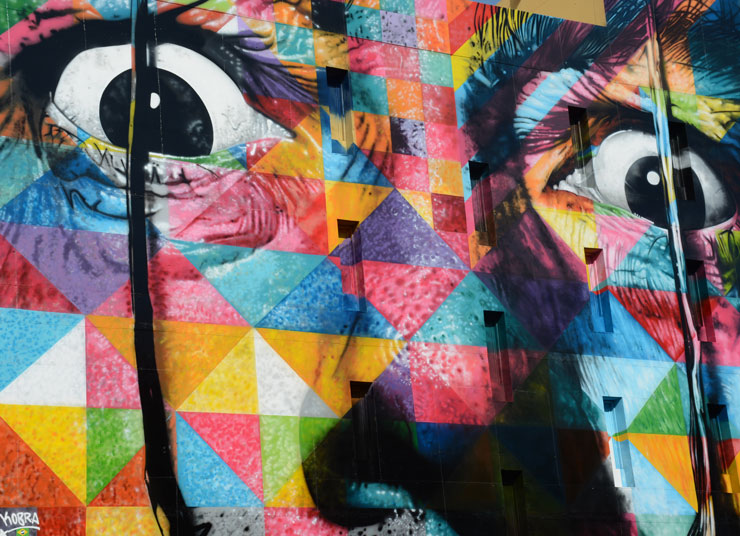
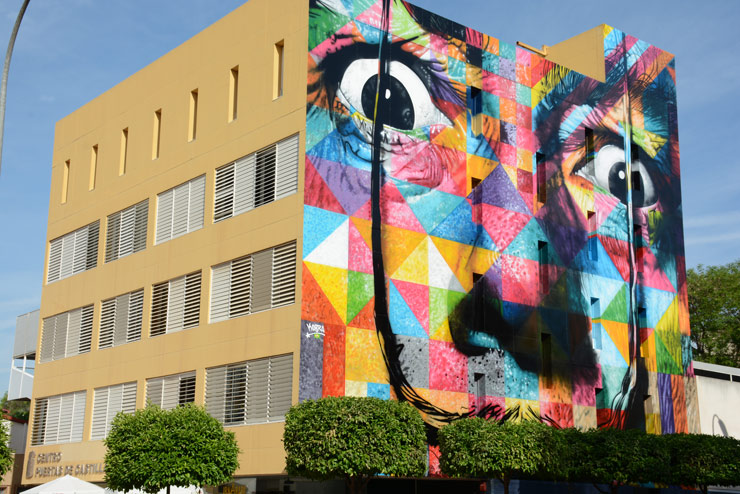
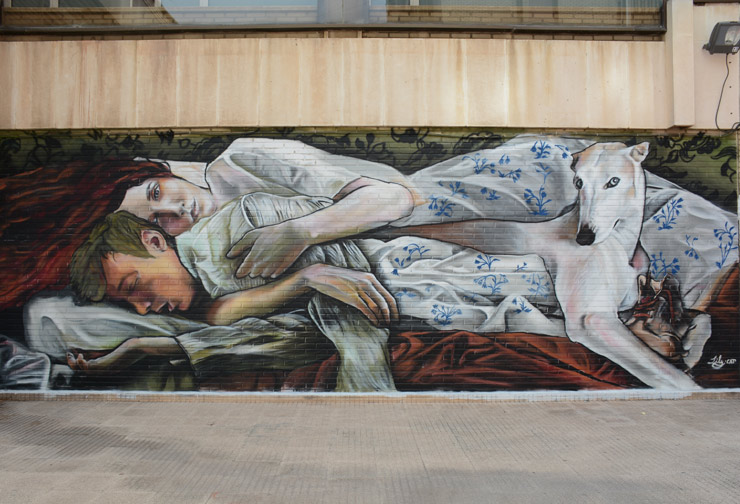
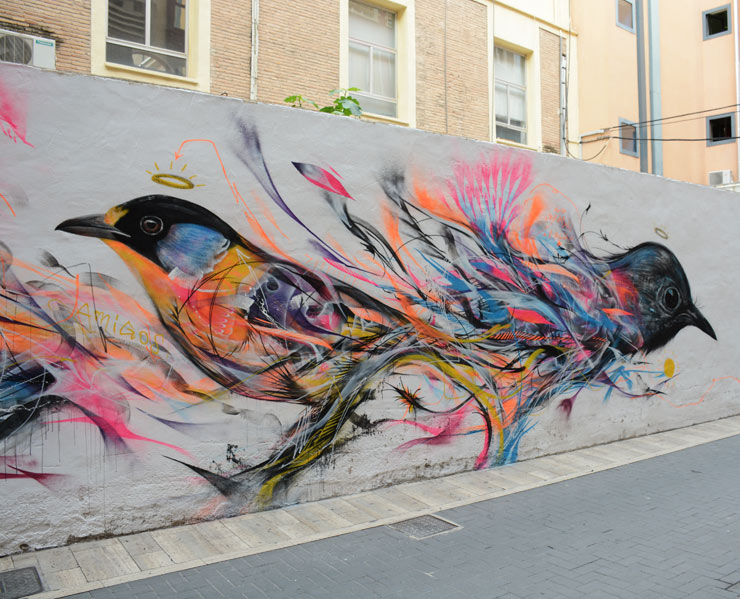
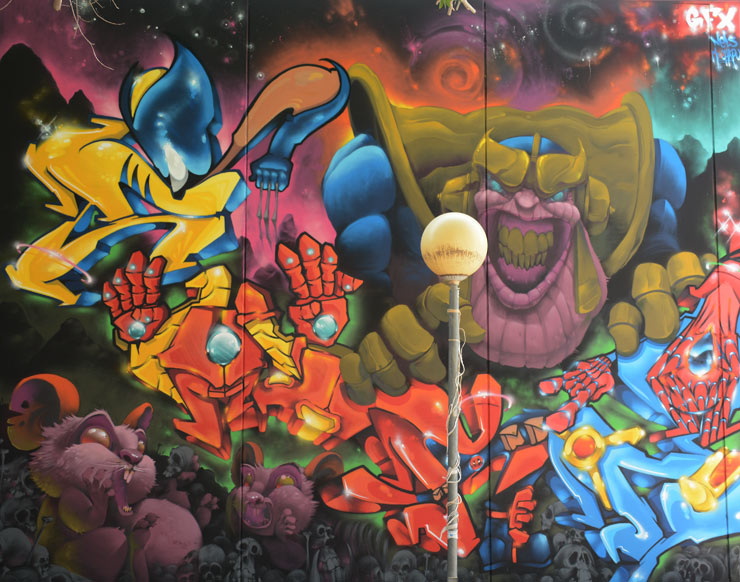
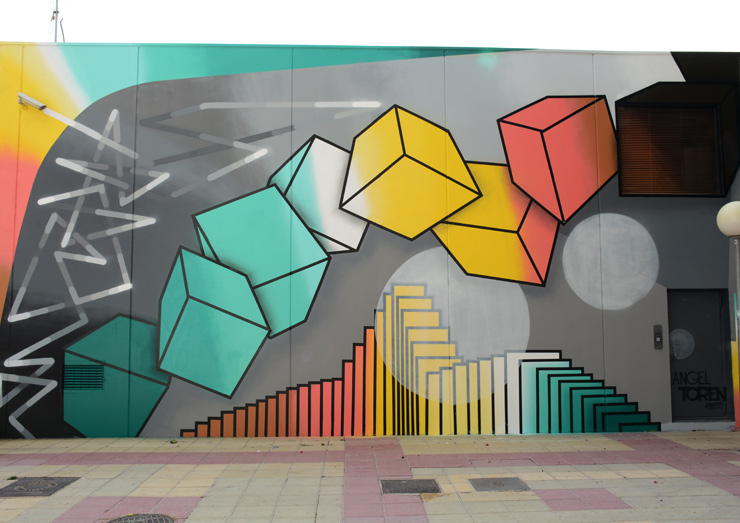
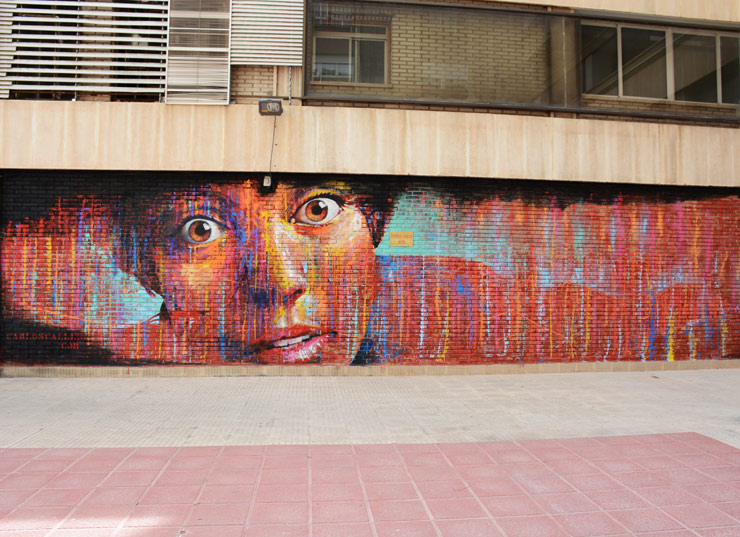
In April the Museum of Fine Arts of Murcia (Mubam) in Southeastern Spain mounted an exhibition gathering 85 artists from 23 countries entitled ‘Urban Art: from the street to the museum’. Among the artists include Blek Le Rat, Blade, Cope2, Shepard Fairey, Vinz, Vhils, London Police, Futura, JonOne, Bordalo II, Dran, even Cornbread – who is credited by many as having lit the fire under graffiti in Philadelphia in the late 1960s.
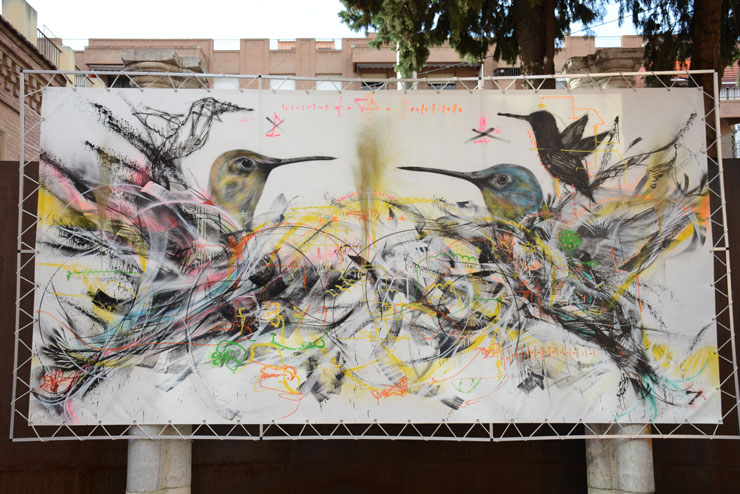
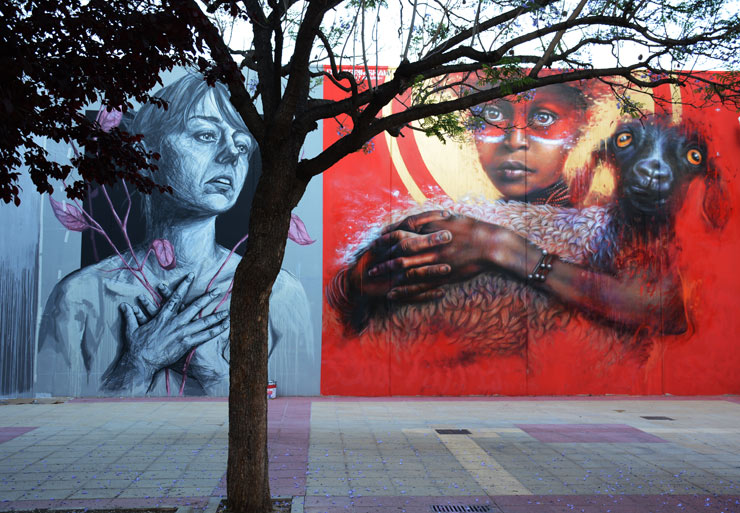
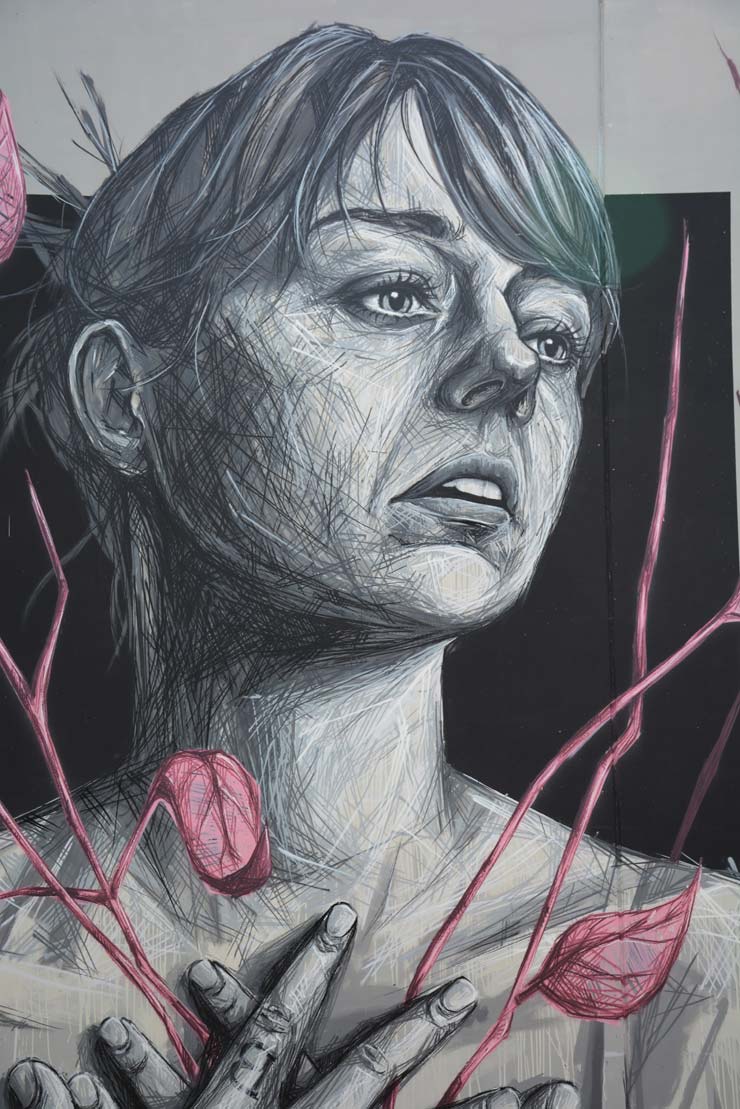
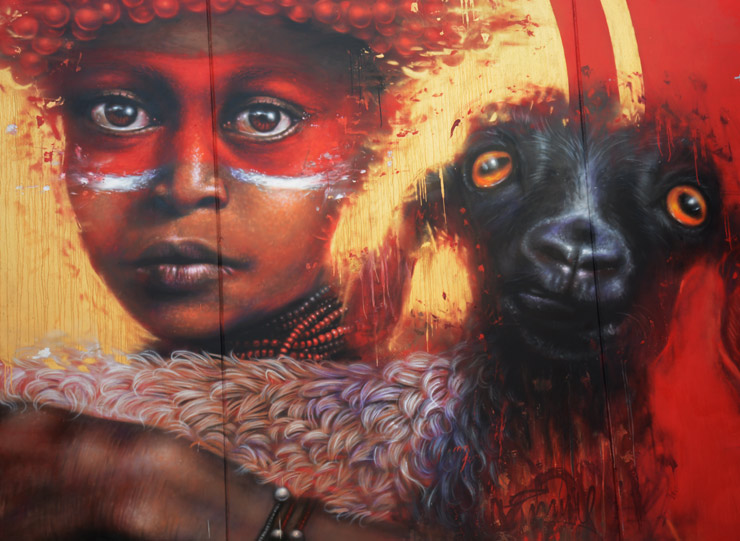
Outside, where this scene originated, the museum also created an exhibition of many current practitioners in the areas of graffiti, Street Art, and mural making in different locations in the city of Murcia – including names like Kobra, L7M, Callizo, Lily Brik, and Dale Grimshaw.
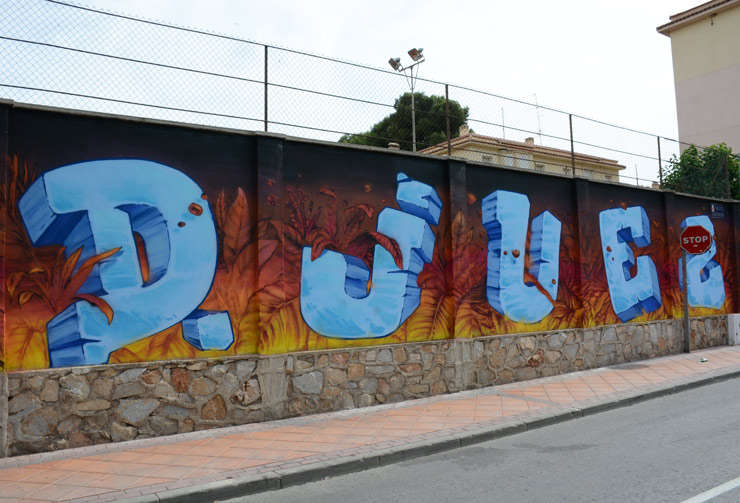
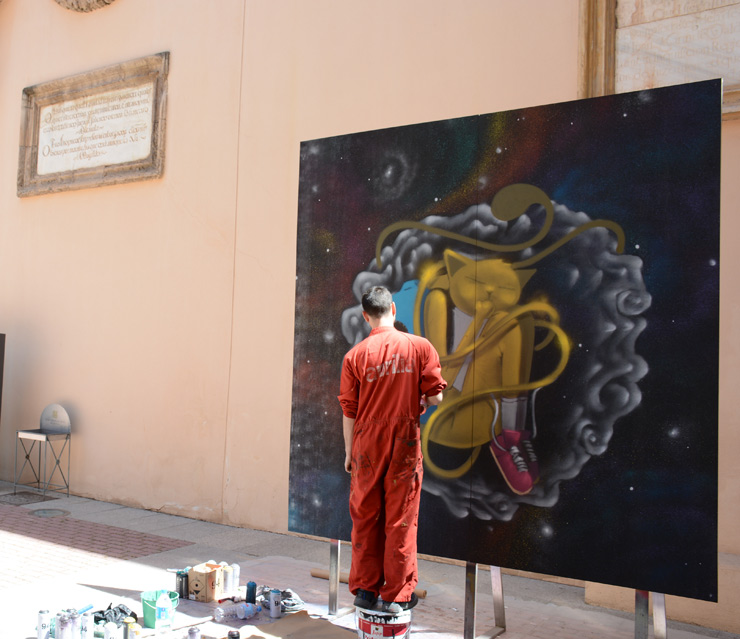
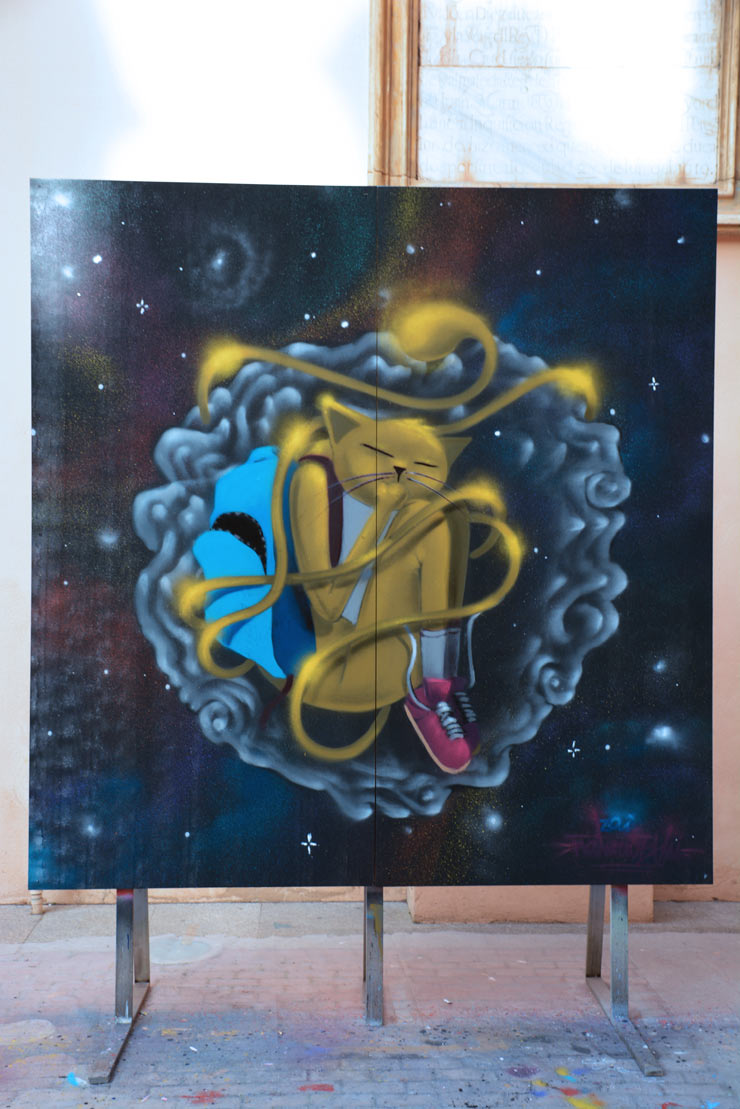
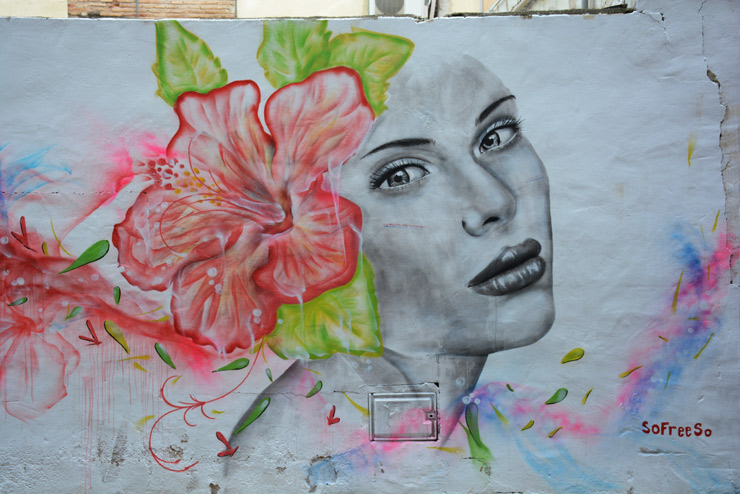
Here are a few examples of new works in the streets for the Murcia Street Art Project as captured by photographer Lluis Olive Bulbena especially for BSA readers.
 BROOKLYN STREET ART LOVES YOU MORE EVERY DAY