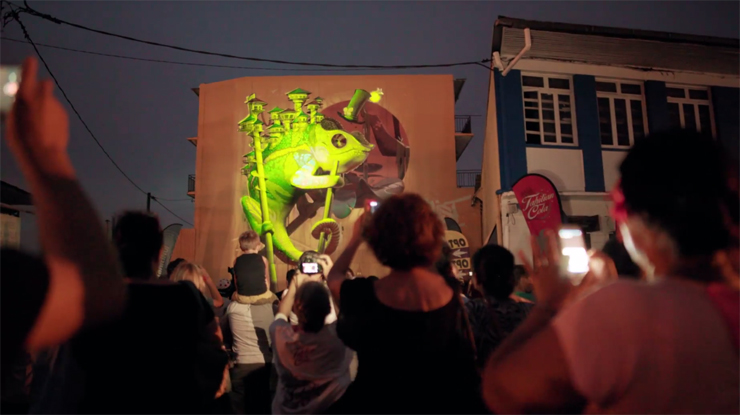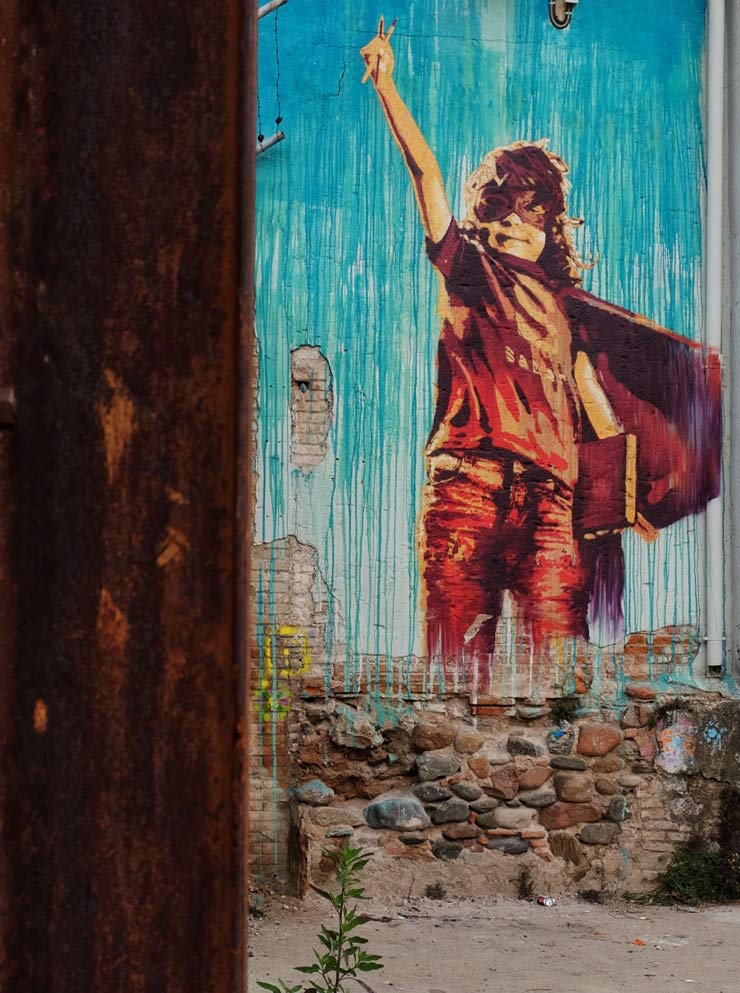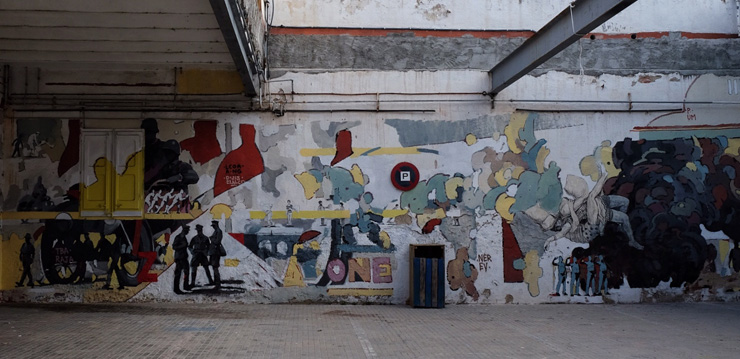
A Street View From Inside the Doors of Mexico City ; Galleries, Studios, Museums, and the Metro

A Street View From Inside the Doors of Mexico City ; Galleries, Studios, Museums, and the Metro

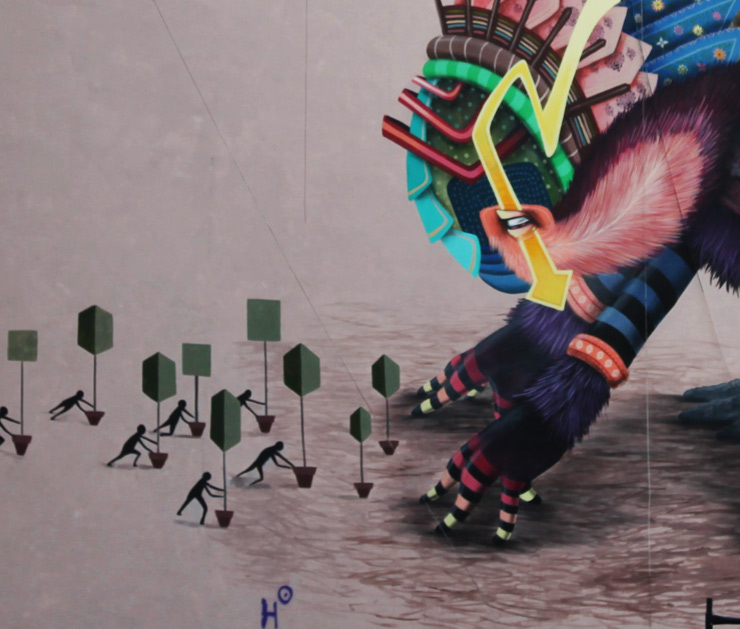
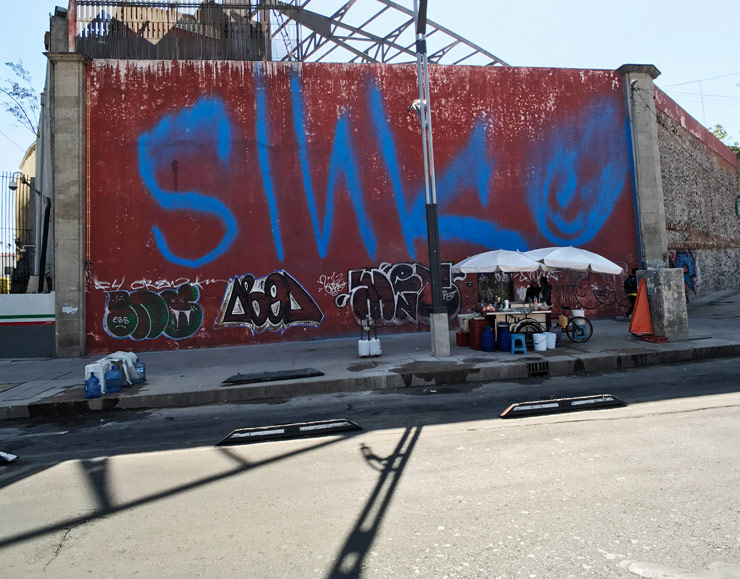
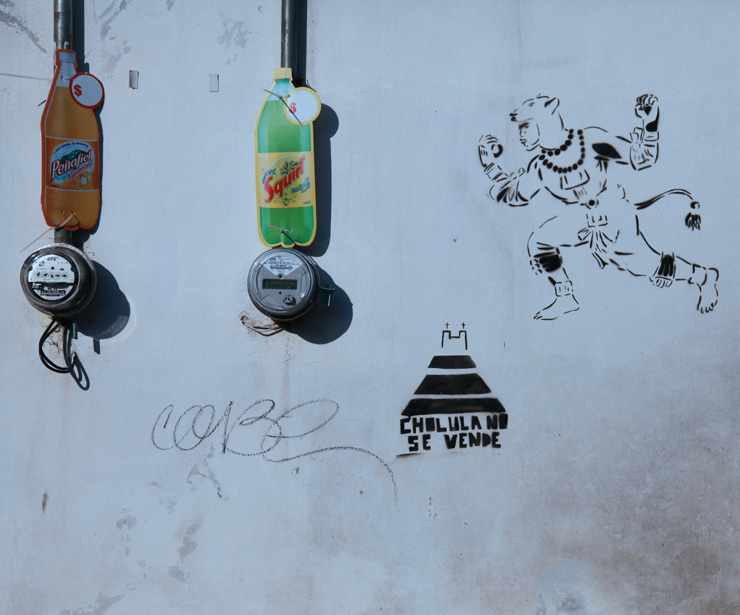
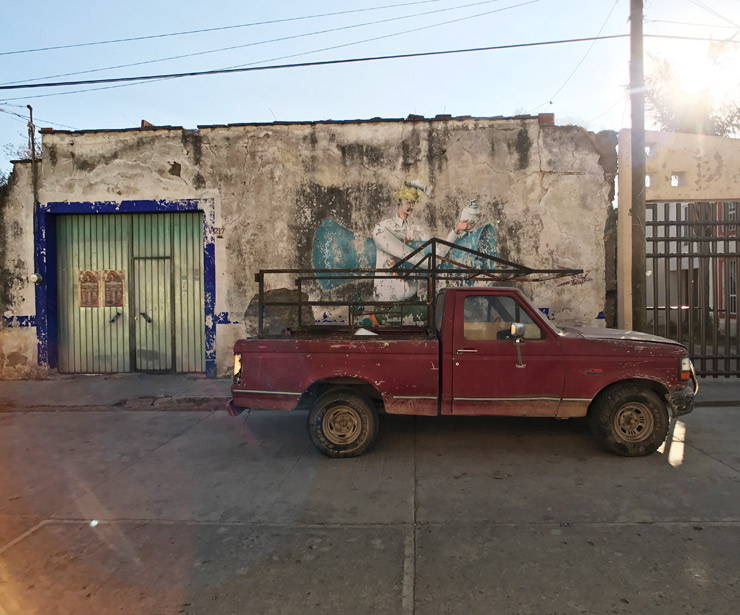
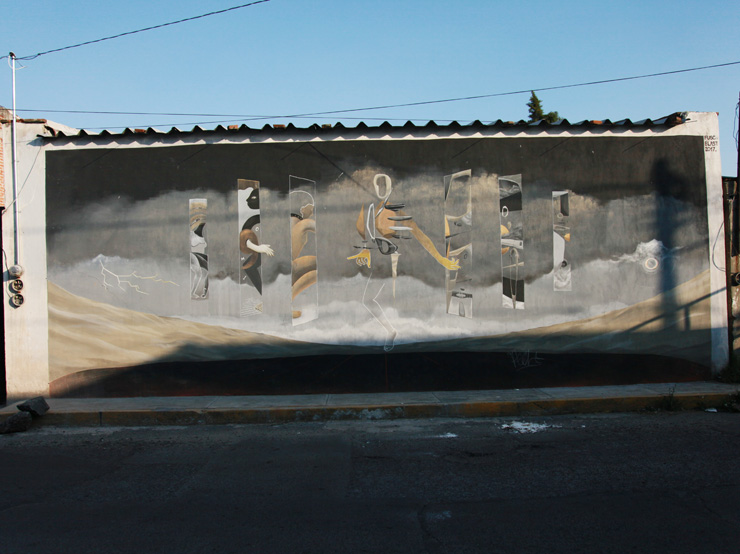
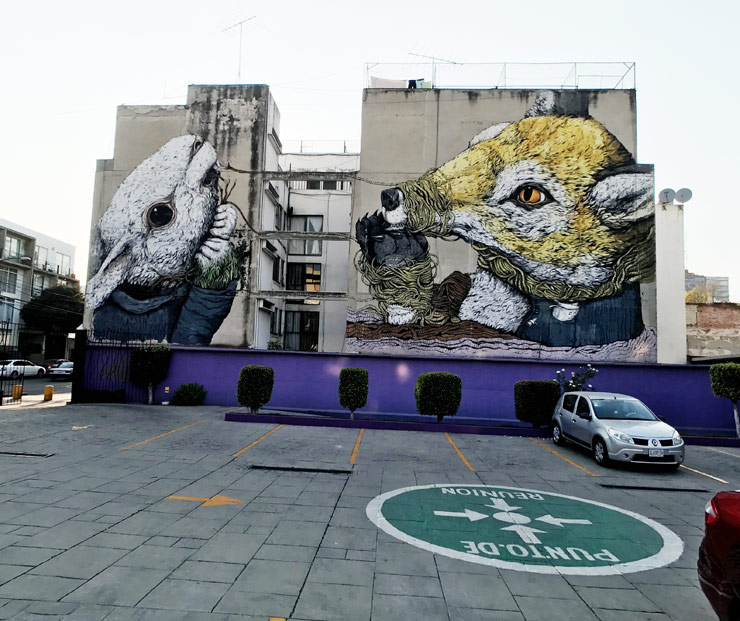
Street Art and graffiti and their relatives often go inside these days, including in Mexico City, where we recently found some interesting new intersections between urban art and contemporary art when we wandered off the streets into studio, gallery, and even museum spaces.

Here we’ll show you images from a few of these places, including; a versatile gallery and performance space that happens to serve pizza, a toy museum and the Street Art visionary who runs it who has facilitated some of the best installations around the city that you’ll see, a visit with a Mexican mural/fine artist who has made serious waves on the Street Art stage as well as museums, three Argentinians setting up a temporary art-making studio in preparation for a gallery show, and a serendipitous run-in with Keith Haring on a train in a metro station.
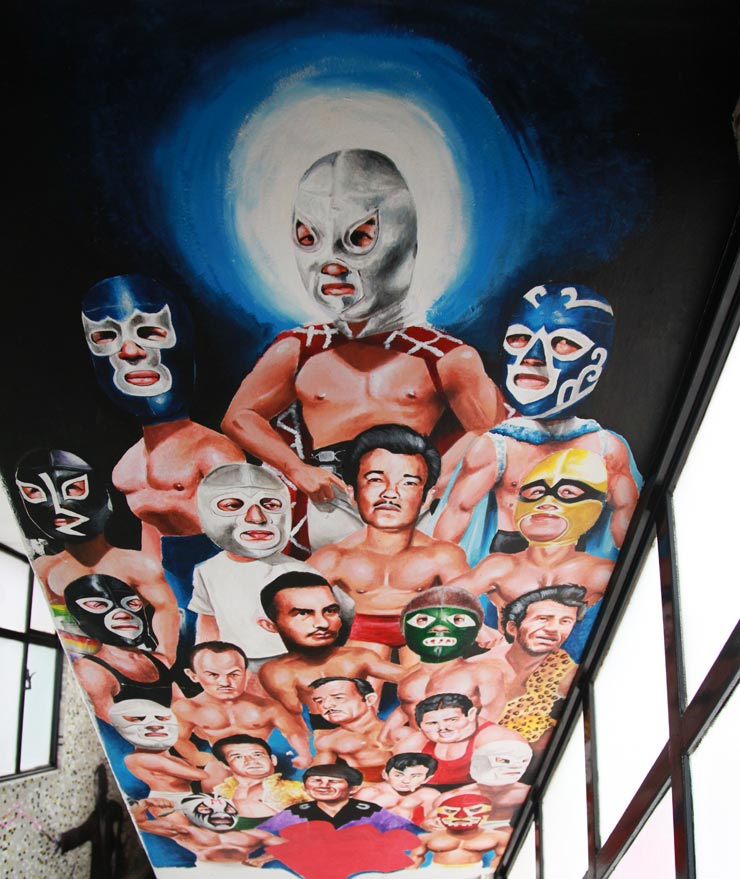
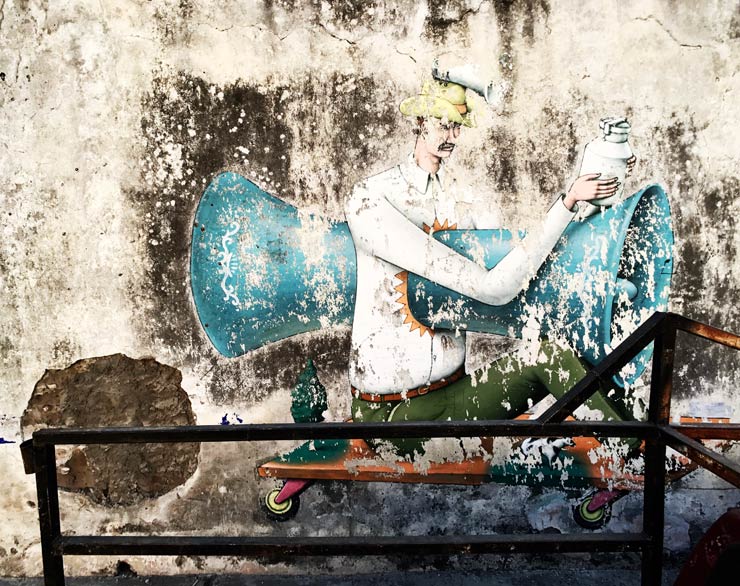
Bernardo Flores pays tribute to Mexican Luchadores on the walls, ceilings in the Antique Toy Museum (MUJAM) that features murals and tags by Street Artists throughout the exhibitions and up on the roof. Mexico, City. (photo © Jaime Rojo)

Perhaps taking its name from the largest cemetery in the city, or simply the Pantheon, the Roman temple with its multiple galleries leading off the grand rotunda, this Panteón opened in spring 2017 and is funded by Mexican pizza chain scion.

Inside a finely appointed 200 year old colonial mansion and former headquarters of the Mexican Academy of Language on Calle Donceles, one of the oldest streets in the city, the spacious two story building is now hosting a live concert stage with a bar off the pizza restaurant court on the first floor. Climb the winding stairs to discover an open balcony ringed with well-curated shows of current art movements that break your expectations in their diversity and quality, hung with care and well-lit in high-ceilings former libraries and entertaining salons, replete with hardwood floors and articulated cream and oak mouldings.
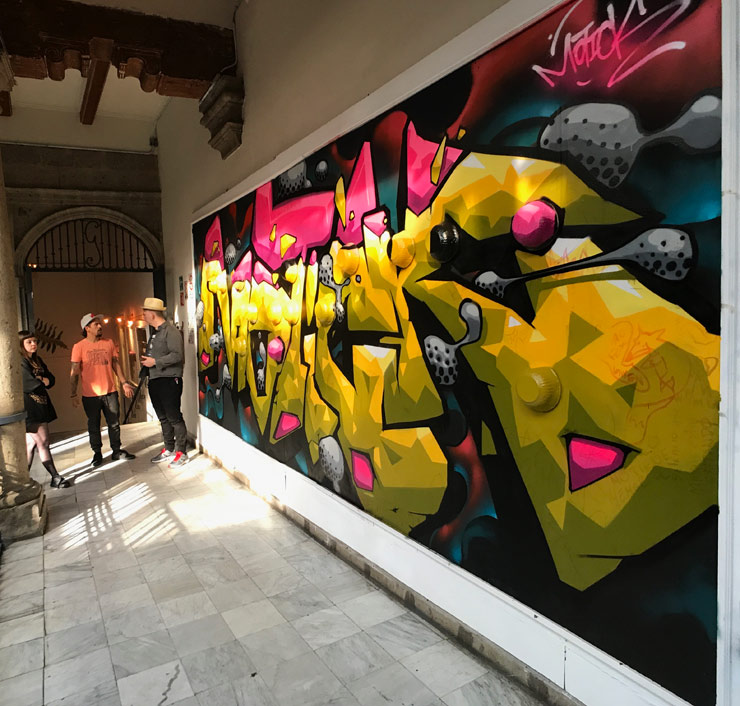
Motick. Centro Cultural Panteón. Mexico, City. (photo © Jaime Rojo)

“I think frontiers are breaking apart across the world,” says director and curator Andres Medina, who is creating a blended focus on graffiti writers, Street Artists, master screen printers, illustrators, and painters whose work is informed by elements of street culture like tattoo, dark pop, skater culture.

The 9 month old series of exhibitions and shows have included group shows, installations, and pop up shops by Mexican street heavyweights like Street Artist/muralist Smithe, original 90s stencilist Watchavato, and modern stylemaster Buster Duque, who has helped out with some selected burners on the roof. The tight vision of the shows is quietly bringing inquisitive fans as well.

“So we are getting at least one international visitor per week who wants to know more about our projects,” he says. As an editor of zines and a student of films, he gradually has been defining his focus on curation with themes that have an almost personal touchstone that he develops with the artists along with curator Mariela Gomez, and they both speak about a need for gallery exhibitions to evolve.
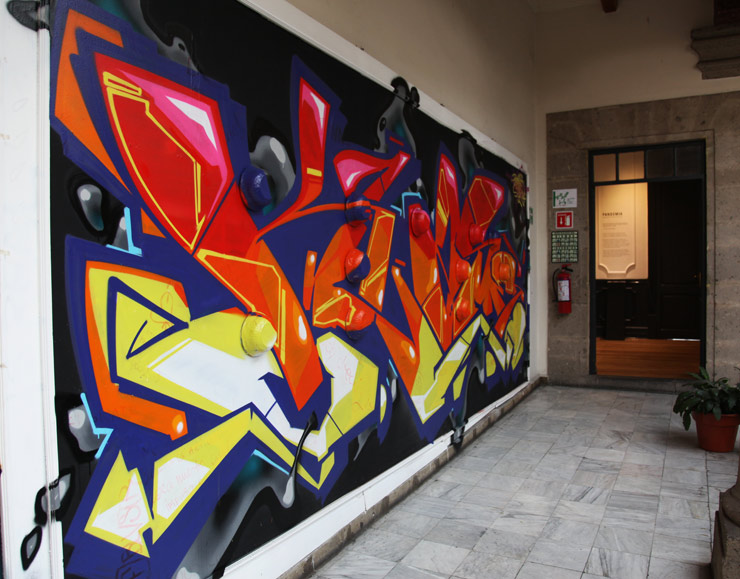
KlaseOne. Centro Cultural Panteón. Mexico, City. (photo © Jaime Rojo)
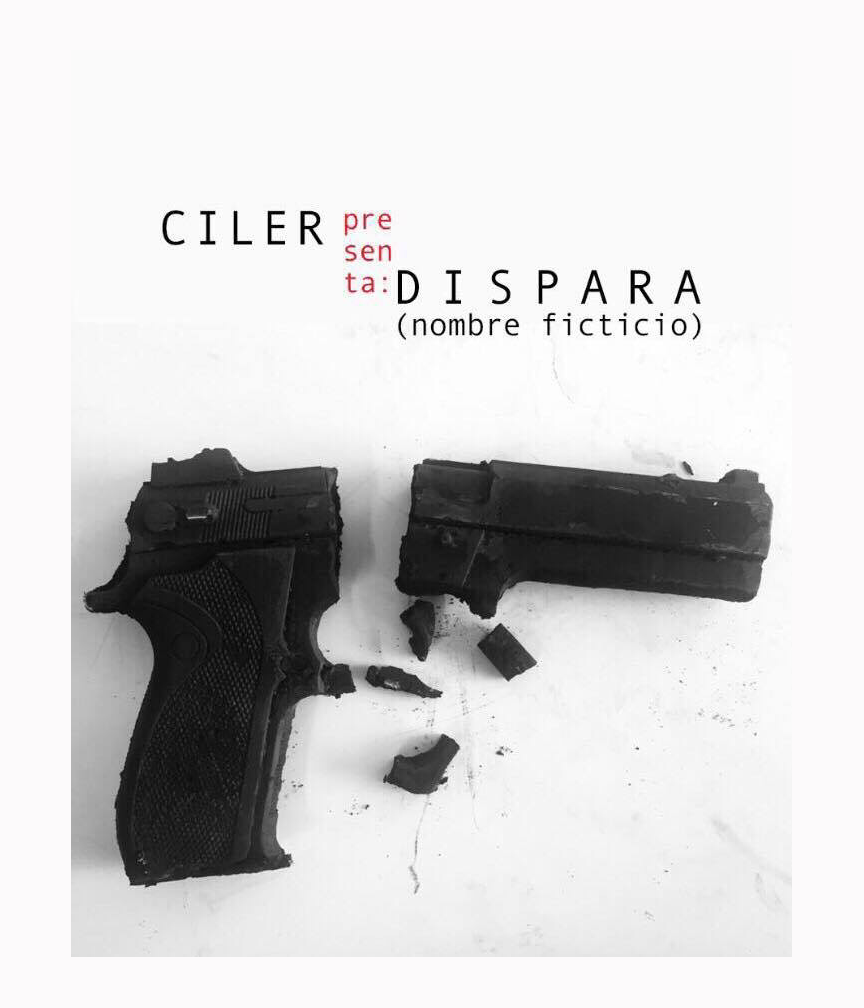
“One of the things that excites us the most is the idea of an exhibition as more of a ‘happening’. We want there to be a part that is graphic and a part that is an experience,” he says as he leads us to a separate white walled colonial space where handguns are made from molds in black wax and guests at the opening scrawled missives across makeshift walls related to violence in society. “It’s meant as an interactive critique,” he says, “these are guns that shoot ideas.”

Attendees are not typical art patrons interested only in collecting – for this show about violence and terror, “Dispara” by the Mexico City artist Ciler, the invited guests were policy makers, elected officials, journalists, even Tito Fuentes the lead singer of the popular rock band Molotov, as well as people directly affected by gun violence. “It was a pretty emotional night,” says Mariela Gomez, who recounts the fiery conversations that began when guests realized that they could express their thoughts about gun violence and organized crime, which is more-or-less openly terrorizing certain neighborhoods and cities in the country.
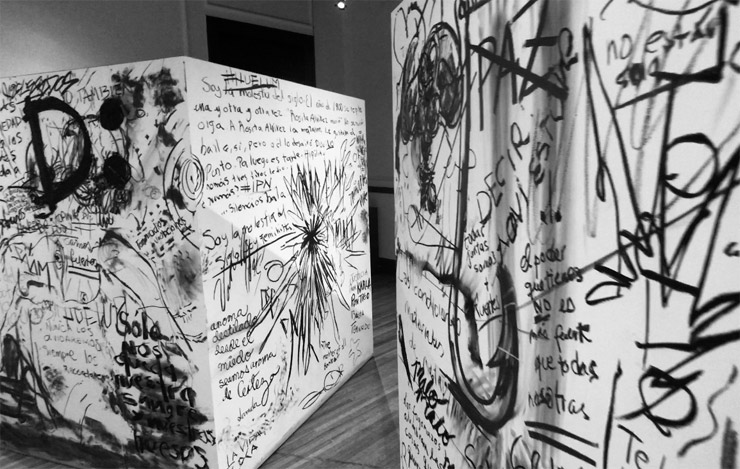
Ciler. “Dispara (nombre ficticio)”. Centro Cultural Panteón. Mexico, City. (photo © Jaime Rojo)
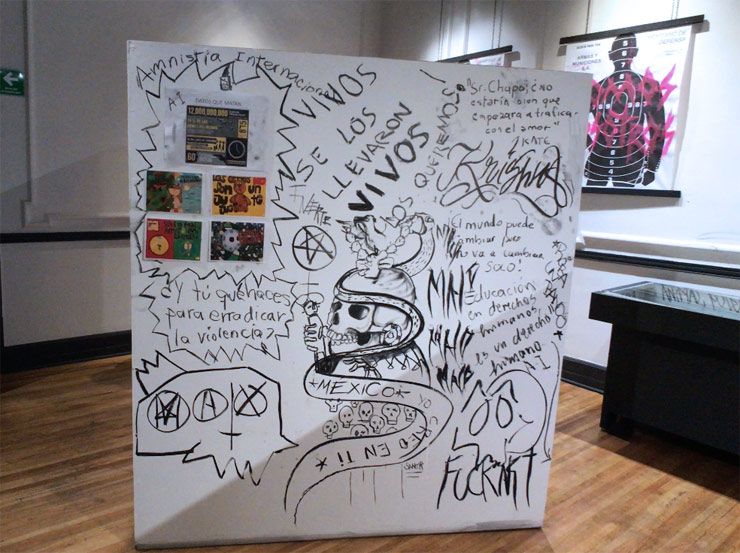
Ciler. “Dispara (nombre ficticio)”. Centro Cultural Panteón. Mexico, City. (photo © Jaime Rojo)
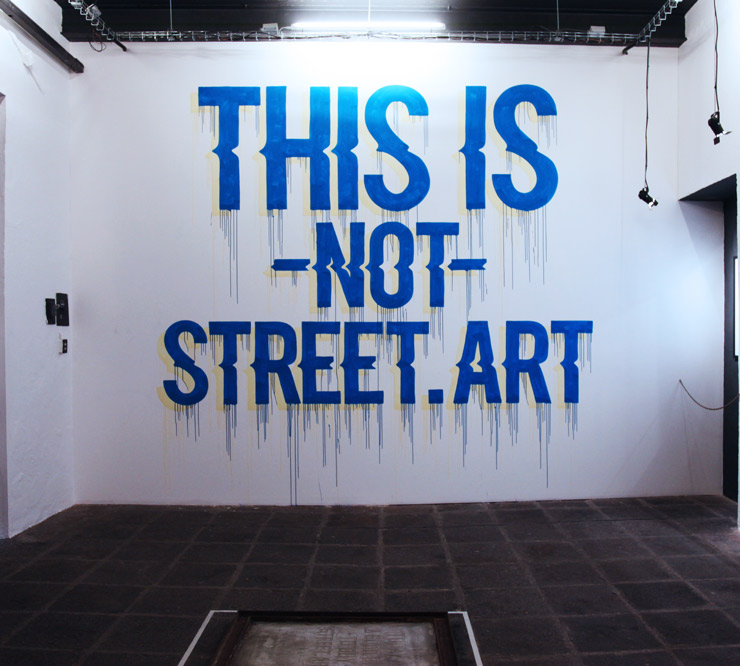
Wachavato. “No Esto No Es Lo Que Fue” Centro Cultural Panteón. Mexico, City. (photo © Jaime Rojo)
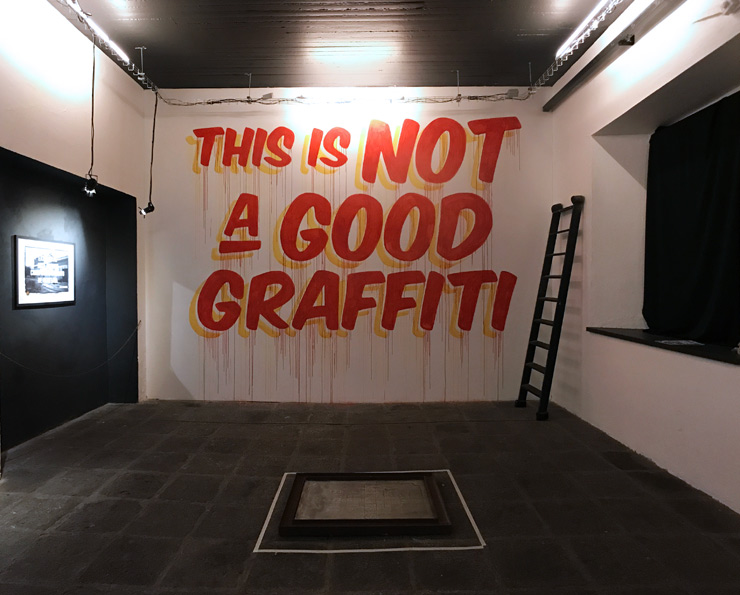
Wachavato. “No Esto No Es Lo Que Fue” Centro Cultural Panteón. Mexico, City. (photo © Jaime Rojo)

“Once everyone was here we found that everyone wanted to make art as well; so they all became part of ‘the happening’,” she says. Guests broke the guns, wrote screeds across the walls, even blasted black paint with a power tool “Everyone was covered in black dust and wax, were breathing some of it” she says,” which goes along with the concept of violence in society – no one can escape it really.”

Still young and at the behest of a fast food business, it’s unclear what kind of mandate Panteón has, but the owner has long term leased the historic building next door to further the show, which will now include his brother’s burger café and a freshly poured concrete mini-skate park and we climb a tattered yet elegant staircase to tour through grand raw spaces that will house martial arts, yoga training and yes, the occasional sports branded pop-up store. It’s a formula attempted before – life-style and entertainment intermixing with the plastic arts – and it will be good to see the integrity of the art game supported here. The balance is hard to strike, but it can be done.
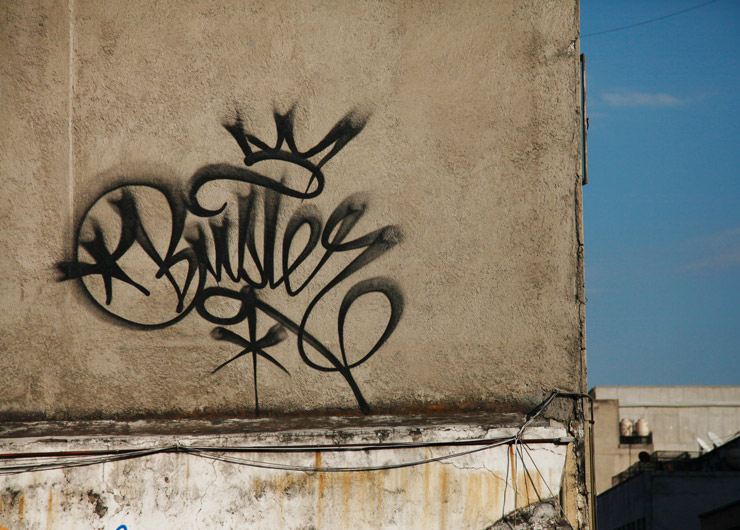
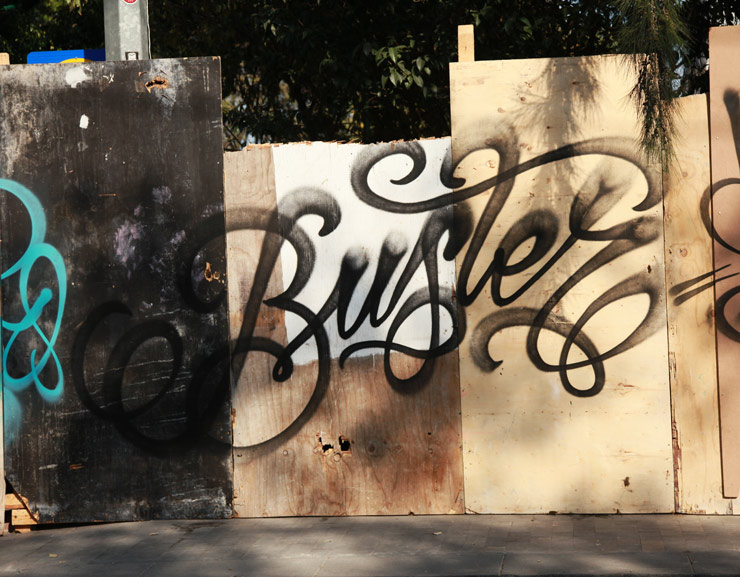
Buster. Centro Cultural Panteón. Mexico, City. (photo © Jaime Rojo)

Museum of Toys and Art on the Streets

A Street Art proponent and personal brand champion, Roberto Shimizu is the second generation 30-something who is running the five-story, decade old Museo Del Juguete Antiguo (Antique Toy Museum) aka MUJAM with his ever-curious and professional collector father in the Colonia Doctores neighborhood. A stylistically unremarkable structure in the thick of this middle class eclectic cluster of cantinas, mechanics garages, and a hospital, most of the streets are named after famous physicians and many of the initial Street Artists who painted his parking lot and roof have also gone on to make names for themselves.
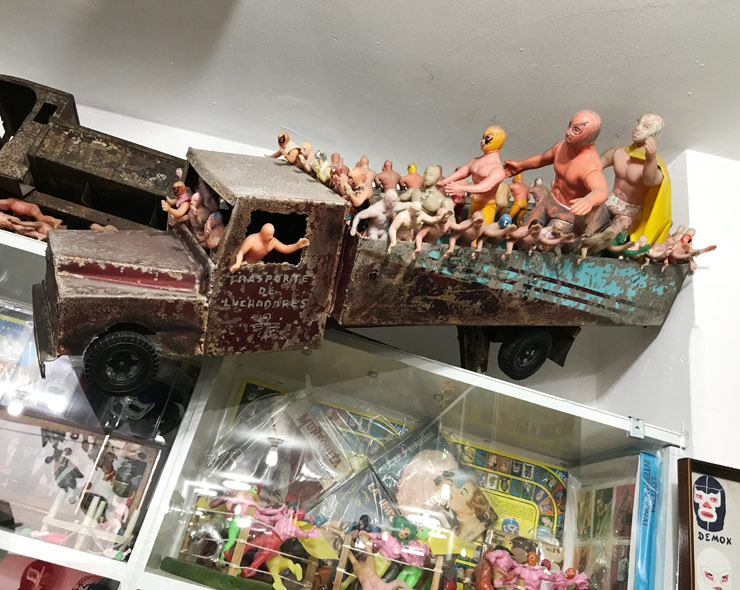
Antique Toy Museum (MUJAM). Mexico, City. (photo © Jaime Rojo)
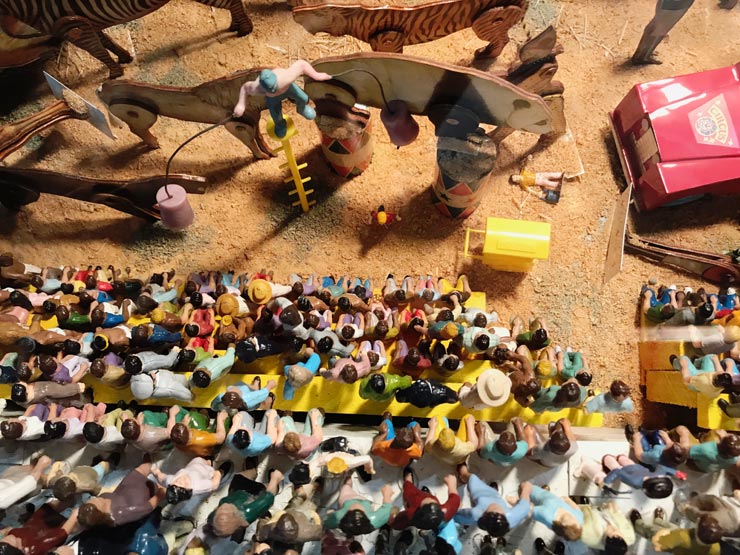
The Circus. Detail. Antique Toy Museum (MUJAM). Mexico, City. (photo © Jaime Rojo)
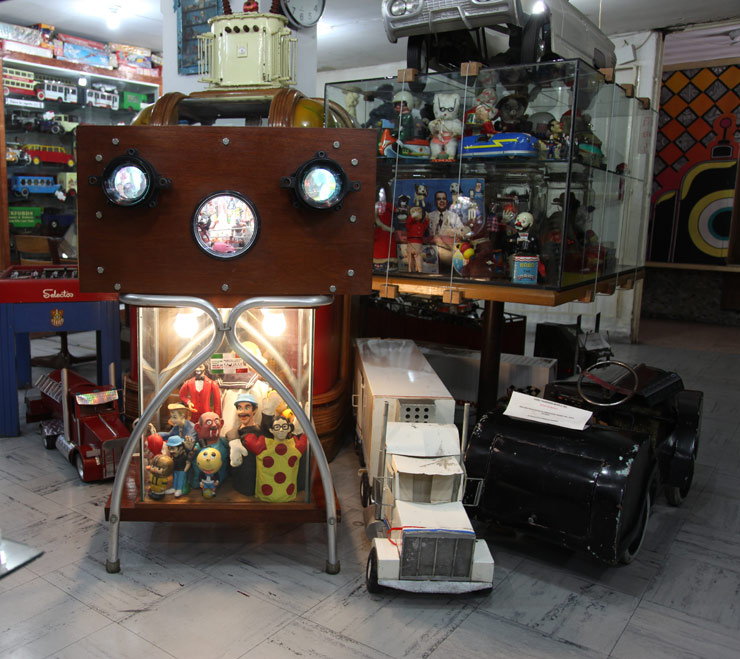
Antique Toy Museum (MUJAM). Mexico, City. (photo © Jaime Rojo)

With a few hundred thousand toys carefully arranged in “toy environments” customized from industrial machinery and unusual found items, these surreal scenes may move animatronically or glitter under rotating lights – or get pinched and refracted through specialized viewers. If you are not high on something, there will be no need to do so before entering the meandering homemade and hand-loved MUJAM. Just unbutton your childhood imagination and you’ll find complete display cases of original illustrations and figures of Mexican comedic character Cantinflas, or an arrangement of stuffed bunnies dancing erotically, or a colorful parade of luchador dolls with Shimizu-customized fashions that play with proportions and sometimes reverse their genders – getting married to each other.
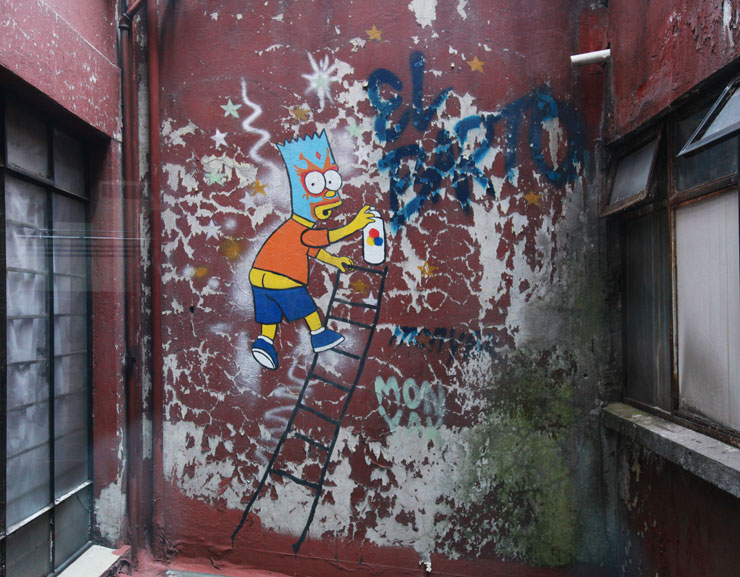
Pavel Ioudine. Antique Toy Museum (MUJAM). Mexico, City. (photo © Jaime Rojo)

The beyond eclectic collection, estimated at only 5% of the total 60-year collection that has been hand-archived and warehoused, is only enhanced by large paintings by ROA or M-City that have graced the walls outside and the 75 or so intermediate and medium sized murals sprinkled through rooms, hallways, pillars, ceilings, stairwells throughout the museum, including a by-invitation-only rooftop gallery.

The younger Shimizu (and new father) weaves in and out of neighborhood streets with us in his truck the same way he navigates the museum, brooding and swerving and pulling aside to hold forth with bits of historical fanfare and numerical details, peppered by behind-the-scenes stories of intrigue and dalliances – all set off by his own striped and checked slim-waisted sartorial selections that effect an elegant carnival barker, a sixties mod rocker, or the mysteriously aloof millionaire in a family board game.
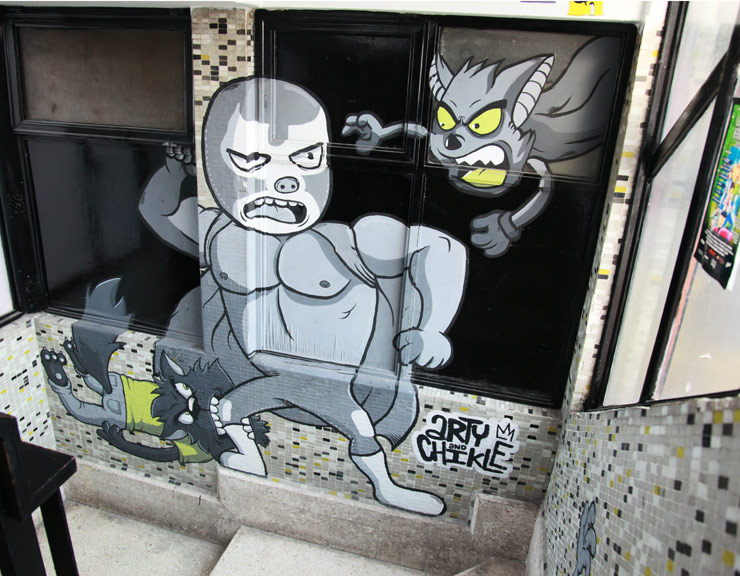
Arty & Chikle. Antique Toy Museum (MUJAM). Mexico, City. (photo © Jaime Rojo)
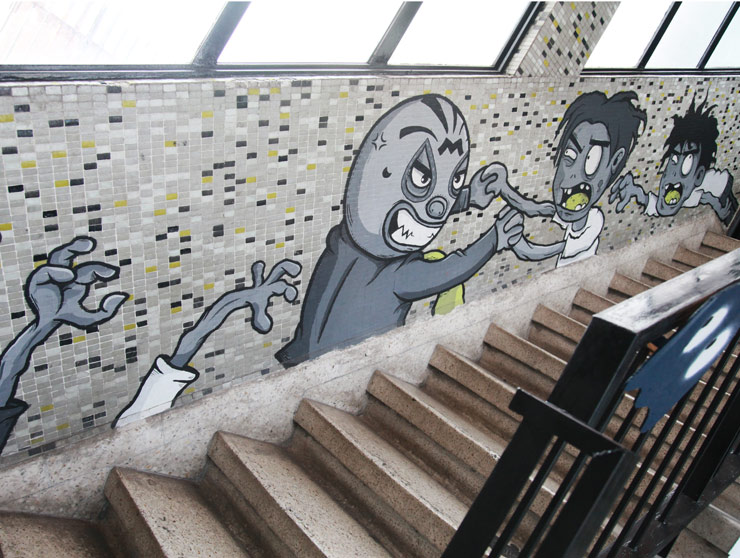
Arty & Chikle. Antique Toy Museum (MUJAM). Mexico, City. (photo © Jaime Rojo)
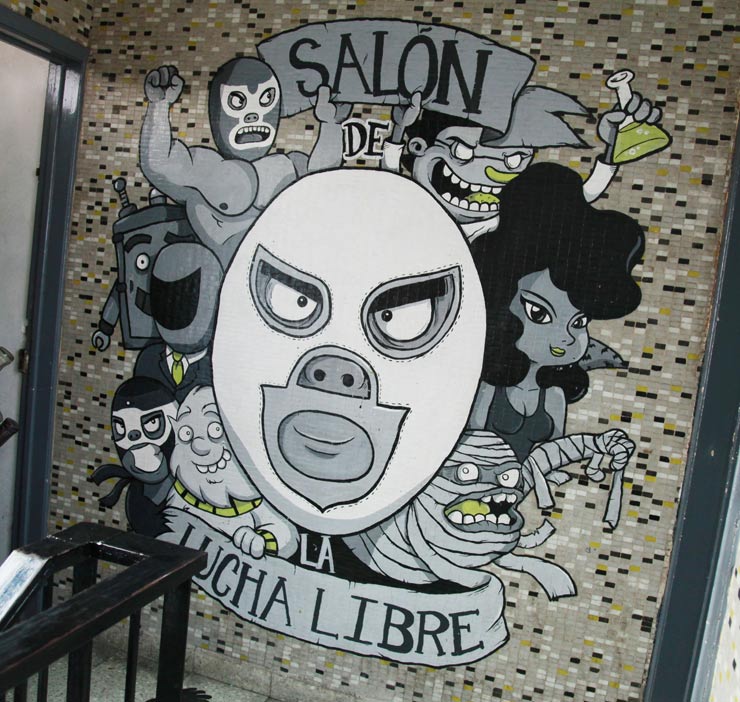
Arty & Chikle. Antique Toy Museum (MUJAM). Mexico, City. (photo © Jaime Rojo)

Aligned with more commercial partners in the past when bringing appreciable Street Art names to Mexico City, Roberto says he prefers the organically grown festivals and exhibitions that have taken root in a few cities to the brand-flogging lifestyle-delivering “influencers” who are Snap-chatting their way through a Street Art tour. His own public/private collection of walls that he has organized over the last decade or so is rather impossible to categorize stylistically, veering from the cartoon to folkloric, photorealistic to abstract, magical-mystical to wildstyle bubbles.

With all these participants it is a come-one-come-all collection that reminds you of the vast reenactment of a circus that is under glass on the second floor, a menagerie of strongmen, tigers, lions, bearded ladies, and assorted crowds of various configurations lined up on the periphery of the big show.

Saner in Studio
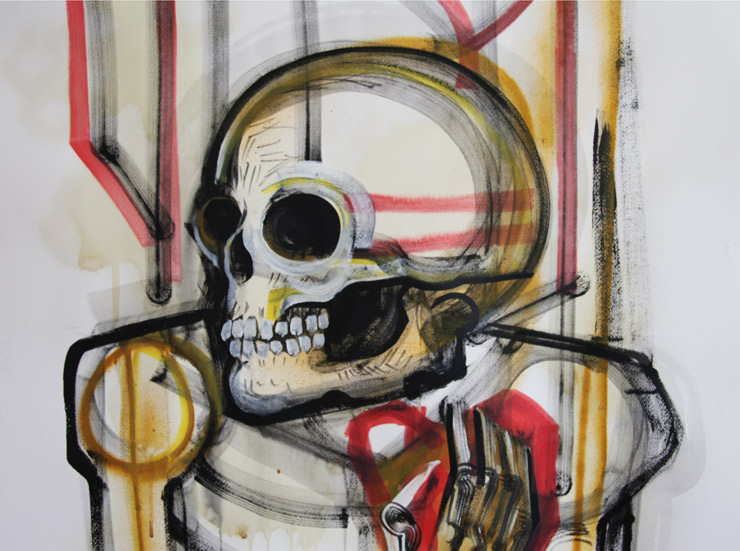
Saner. Work in progress. Studio Visit. Mexico, City. (photo © Jaime Rojo)

In a gated, if worn but serene, community of two story ranch houses built in the 1960s and 70s, the painter Saner has his studio and home. He meets you at the ornate iron gate to his concrete patio and invites you in while speaking on his phone to see the sun-sharpened shapes inside, a personal welcome replete with mask-painted characters interacting on the dining room wall, two large sculptural facsimiles of him and his wife and bright back deck.

A meteorically-rising yet not flashy spirit on the Street Art circuit, Saner is enjoying steady success with a carefully selected path of public walls, gallery shows and even museum representation in the last decade. Sitting in the small front living room while his beige retriever and muse chews through a basket of dog toys and vies for his masters attention, you can see that Saner’s art world accomplishments haven’t distracted him from a grounded view of Mexican socio-political history, his deep love for its people, and his almost mystical, darkly emotional storytelling.
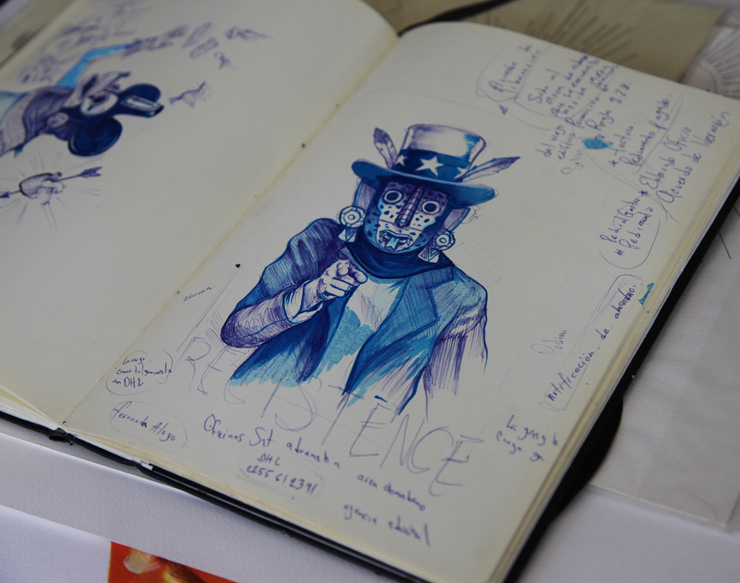
Saner. Studio Visit. Mexico, City. (photo © Jaime Rojo)

In his studio you see his latest sketchbook that he is slowly building page-by-page with details of figures overlapping and radiating and sometimes dancing in warlike poses among the fern and fauna. His crossed-arm stance while leaning on his worktable tells you that he’s waiting for your ideas to help propel the conversation, partially because he is shy, partially as a challenge. A graffiti writer here during the explosive 1990s scene on the streets and trained as a graphic designer, his identity as a Mexican painter became more important to him as he grew older and he began to be less concerned with emulating European or American visual and cultural language.
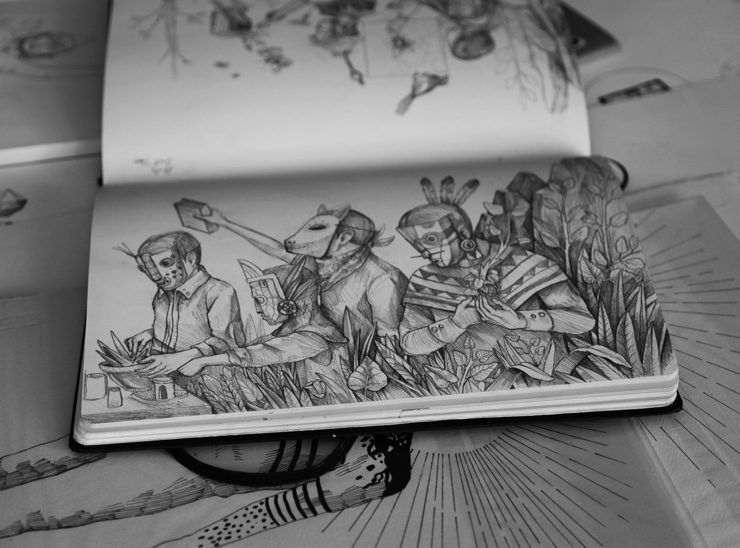
Saner. Studio Visit. Mexico, City. (photo © Jaime Rojo)

You look at the hand-illustrations of figures and costume, weaponry, instruments, flowers, feathers, and wild animals, and you realize that any of these could be the paintings you have seen on walls in neighborhoods and canvasses in galleries – suddenly perhaps a little awed to be in this artists sacred studio space. Then the talk turns to his dog and his recent travels across the world and you know that its just one guys’ greatness, that’s all.

3 Argentinian Street Artists in Studio
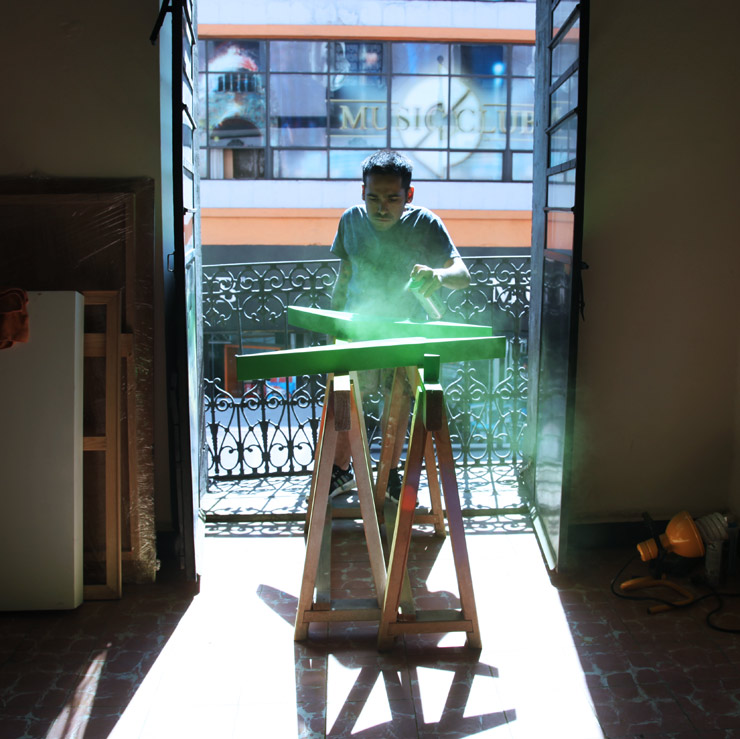
Elian. Studio Visit. Centro Historico. Mexico City. (photo © Jaime Rojo)

The thick air is thumping with a live-performance of a 1980s Judas Priest song by the house band in a musical instrument store across the street here in the crowded old central district of the city at lunchtime. With French doors flung open over your head from the second floor, a cloud of green aerosol envelopes the body of Street Artist Elian and creates a silhouette as he coats an organic form carved from wood on the worktable before him. The shape will join others mounted on a wall next week in Toba Gallery as a smaller 3-D interpretation of his abstract compositions that he sprays across massive walls on buildings and even parking garages for festivals and private clients across Europe, the US, Russia, and his native Argentina.
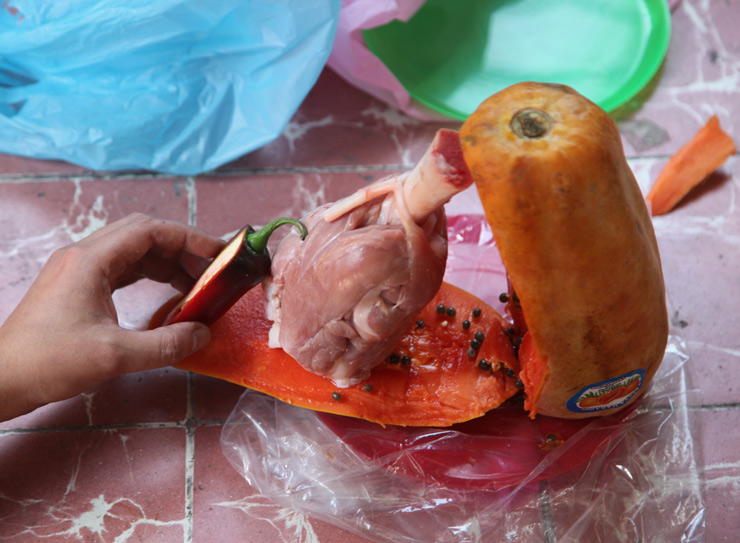
Ever. Studio Visit. Centro Historico. Mexico City. (photo © Jaime Rojo)

In this raw colonial former home with chipping paint and rusted hinges, the rooms serve as studios for a number of artists who pass by the small news stand with lottery-tickets and cigarettes before jogging up the central steps that are lit by an open sky. Also readying for the 3-artist show called “Deforme¨ are two Street Art brothers from the scene who have often painted in the same city with him, JAZ and Ever Siempre. Together the three are pushing their creativity beyond the work they are each known for in murals at festivals, each saying they are a little tired of the way the organic and illegal Street Art scene morphed into legal and often approved murals, even though they appreciate being paid by these events that are partially funded by municipalities or commercial interests. A symbol of mobility and fraternidad in the scene, local Street Art/graffiti artist Smithe, who is loaning the studio space to the artists as they prepare, also owns Toba.
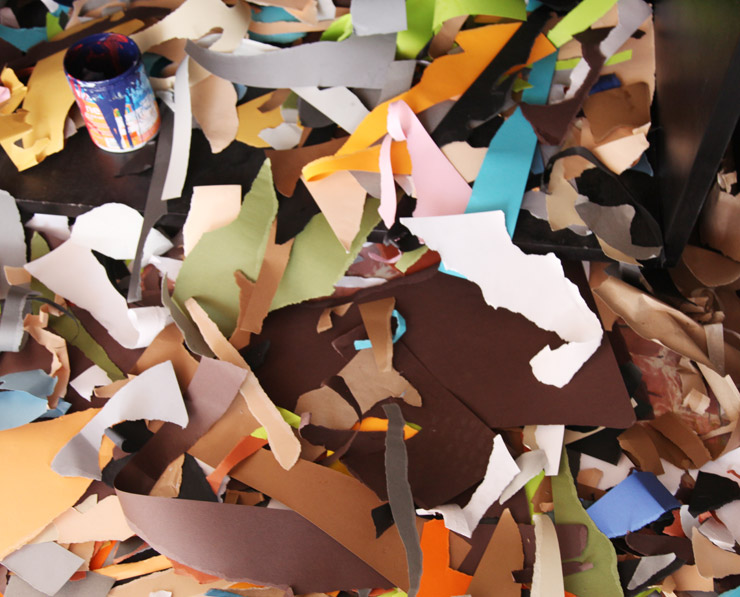
JAZ. Studio Visit. Centro Historico. Mexico City. (photo © Jaime Rojo)

Speaking of galleries, the Celaya brothers have begun a number of commercial enterprises and spaces in the last half-decade, looking for the right formula for capitalizing on the Street Art zeitgeist and partnering with corporate brands. Not far from an enormous mural by the London-based D*Face, their most recent contemporary art gallery in Colonia Roma Norte was featuring a solo show “Trompe L’oeil” by the Italian born, Berlin-based Street Artist/ fine artist Agostino Iacurci as he adds a third dimension to his ornately synthetic forms and sophisticated bright palette. Curated by Vittorio Parisi, the room is spare, the sculptures pleasantly innocent, and slyly humorous.
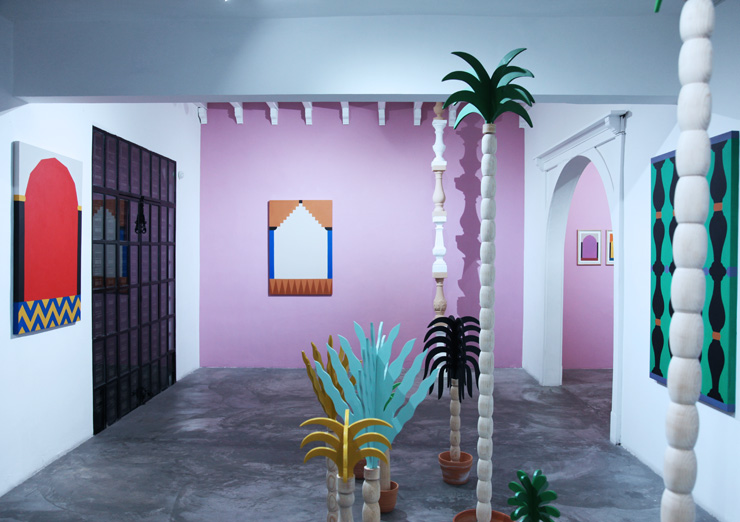
Agostino Iacurci. “Trompe L’oeil” solo exhibition at Celaya Brothers Gallery. (photo © Jaime Rojo)

Keith Haring on a Train

The metro train system in Mexico City, like many aspects of public life over the last two decades, is a faded shade of its previous zeal. It may also be the damage from a large earthquake three months earlier that shook this city, which adds to a feeling of insecurity as you navigate the swarming crowds and watch packed trains pull away while you wait your turn to board. You may also get a bit forcefully pick-pocketed in the middle of the day on one of these trains, as did your author, so you may favor zippers inside your clothing the next time you return.
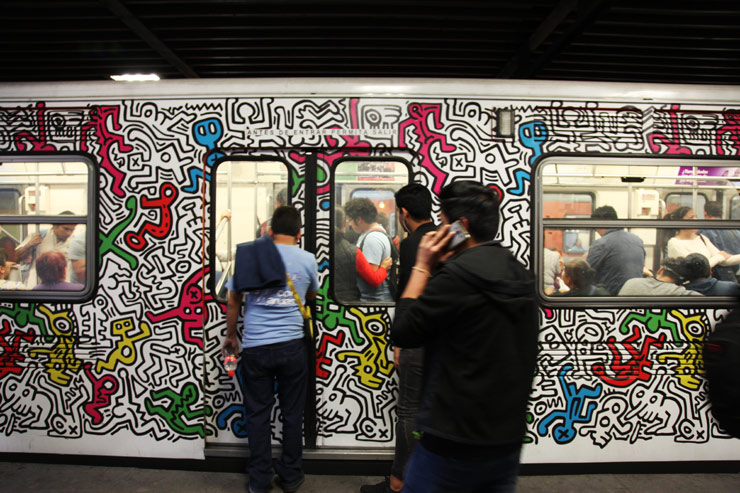
Keith Haring on a whole car on the Metro. Mexico City. (photo © Jaime Rojo)

Hearkening back to the lack of public services in New York’s when it was fiscally broke in the 70s and 80s and Street Artists Keith Haring wrote freely on empty ad-spaces in the subway, it felt a little like the spirit of the Street Artist appeared unexpectedly in front of us while we waited for our next underground connection in this magic city. A swath of colorful characters jumping every which way across the full cars, the familiarly active Haring symbols of figures herked and jerked into place while the cars went through a series of starts and sudden stops. The riders slid back and forth, clutching their straphangers, and we quickly fumbled for a shot of this Mexico City train covered with the welcoming sight of a New York Street Artist who sparkled at the dawn of the go-go portion of the 80s, soon taken in the sadness of the AIDS-panic portion that struck the city.

Undoubtedly, the Street Art and graffiti scene continue to expand and morph into other scenes and venues – many now inside. For some, this is anathema to the true spirit of the mark-making practice that first took root in unsanctioned acts in illegal places, often in open defiance of accepted norms. For others, this route indoors only strengthens the appeal of voices that are now speaking inside the organizational structures we build, and it is remarkable to see such a diverse and lively number of examples throughout this doorway to Latin America aided by very gracious and friendly Mexican hosts at every stop we made.


Below are more images and video from the Antique Toy Museum, MUJAM – Mexico City
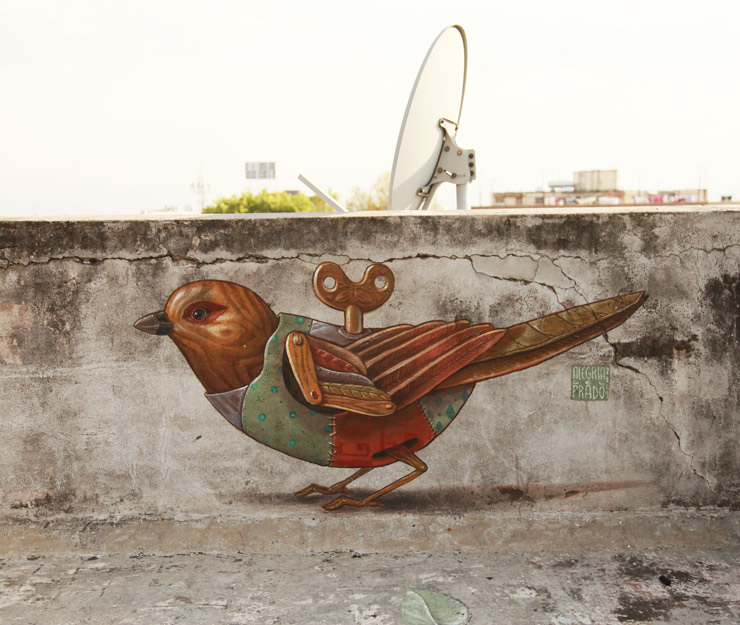
Alegria Prado. Roof top. Antique Toy Museum (MUJAM). Mexico, City. (photo © Jaime Rojo)
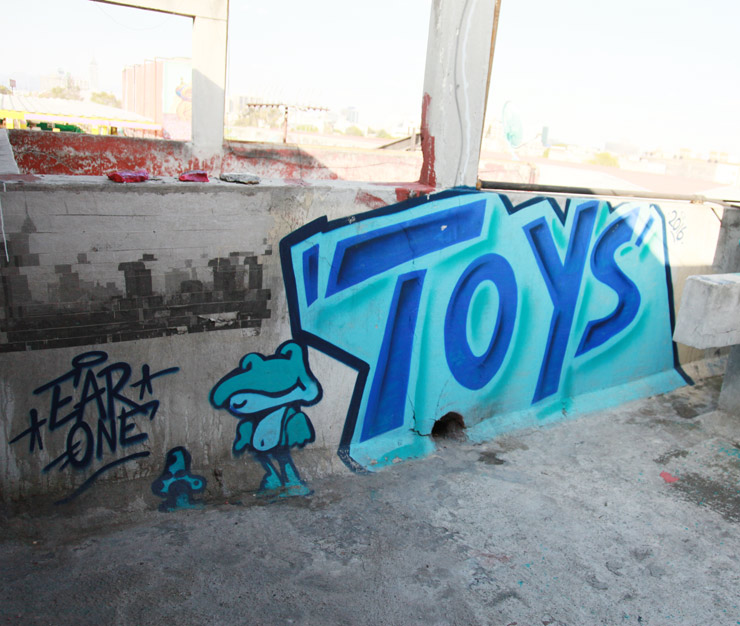
Ear One has a good play on words here, and a nod to cartoonist Vaughn Bodē, whose work inspired a generation of graffiti writers on the Roof top. Antique Toy Museum (MUJAM). Mexico, City. (photo © Jaime Rojo)
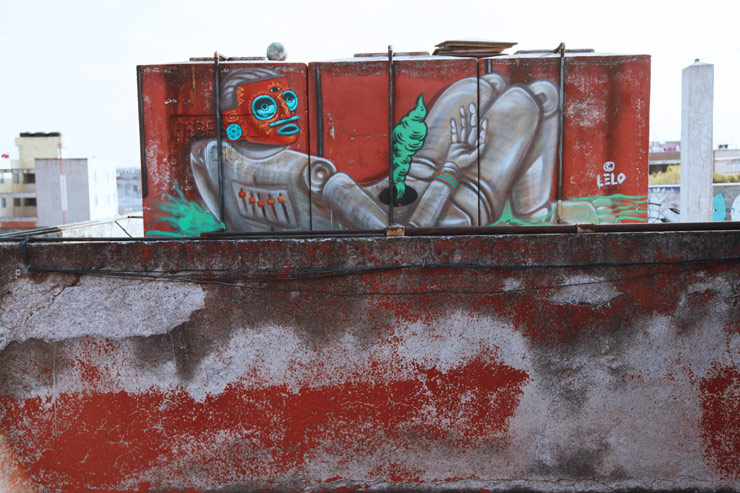
LELO. Roof top. Antique Toy Museum (MUJAM). Mexico, City. (photo © Jaime Rojo)
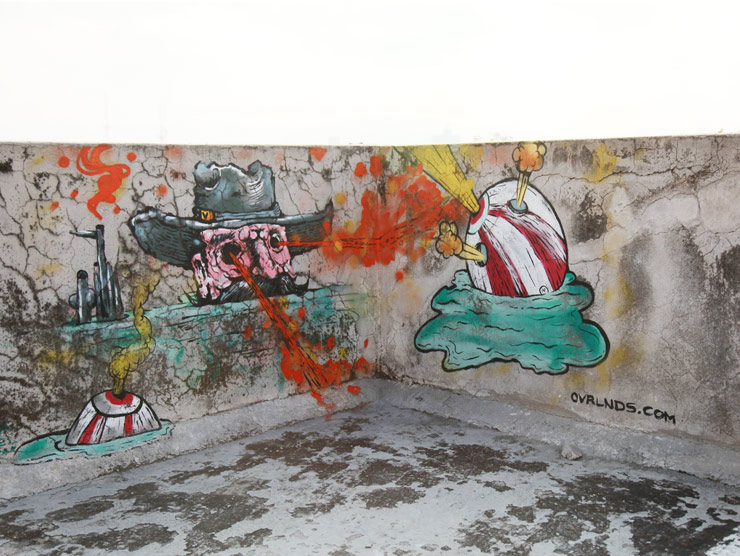
Ovrlnds. Roof top. Antique Toy Museum (MUJAM). Mexico, City. (photo © Jaime Rojo)
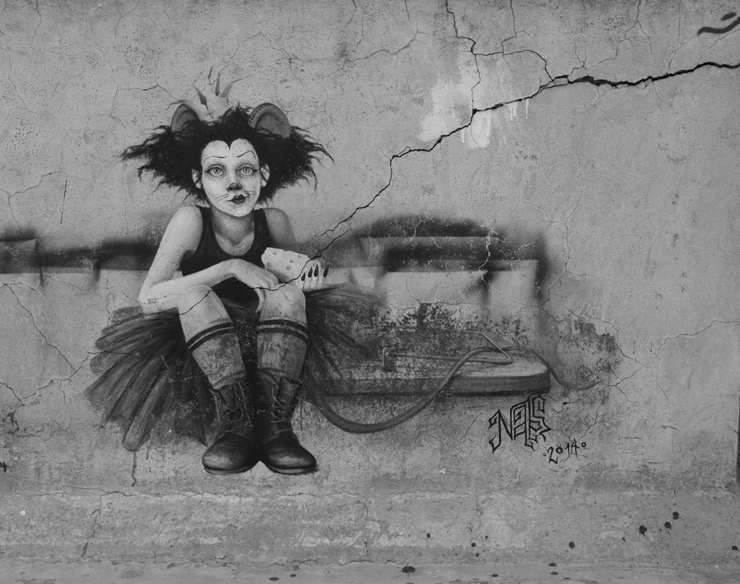
NAS. Roof top. Antique Toy Museum (MUJAM). Mexico, City. (photo © Jaime Rojo)
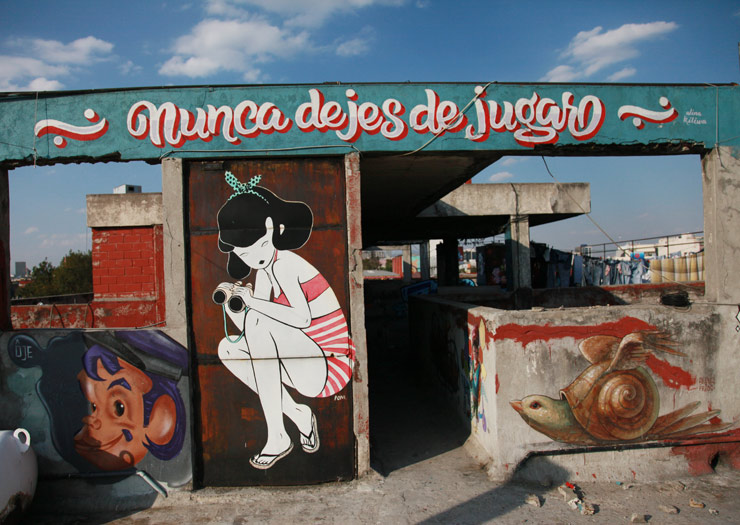
Alina Kiliwa . OJE . Alegria Prado. Roof top. Antique Toy Museum (MUJAM). Mexico, City. (photo © Jaime Rojo)
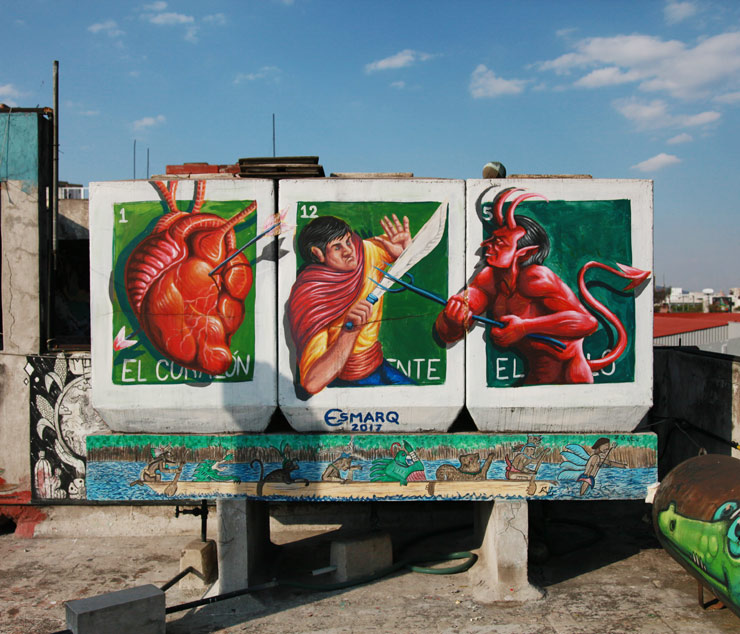
EsMARQ. Roof top. Antique Toy Museum (MUJAM). Mexico, City. (photo © Jaime Rojo)
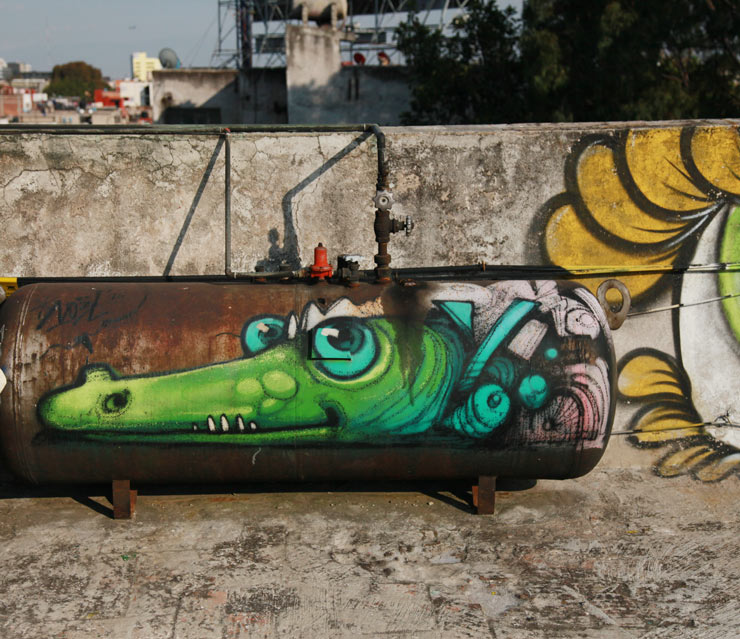
Noel. Roof top. Antique Toy Museum (MUJAM). Mexico, City. (photo © Jaime Rojo)
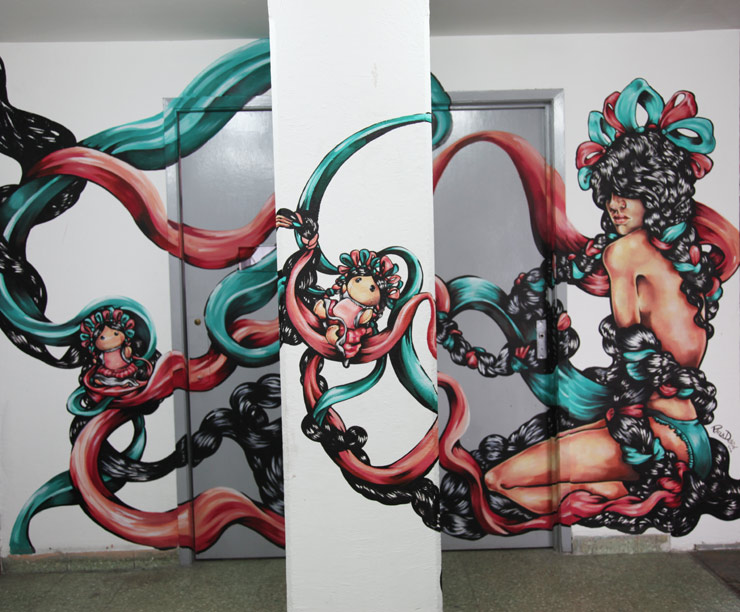
Paola Delfin. Antique Toy Museum (MUJAM). Mexico, City. (photo © Jaime Rojo)
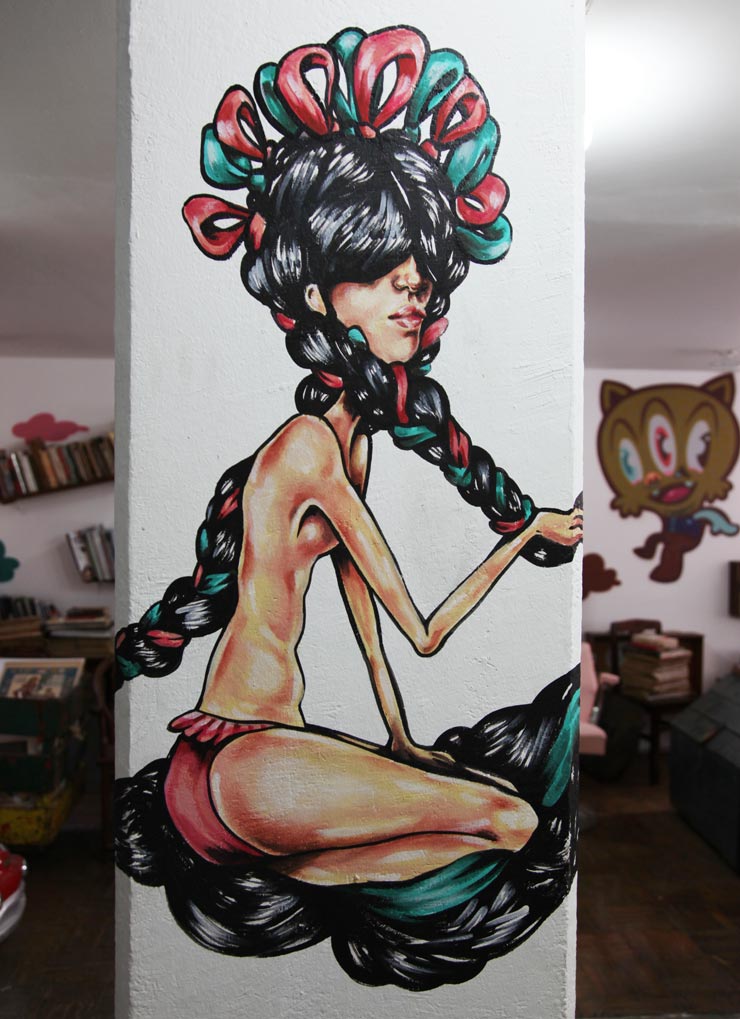
Paola Delfin. Antique Toy Museum (MUJAM). Mexico, City. (photo © Jaime Rojo)
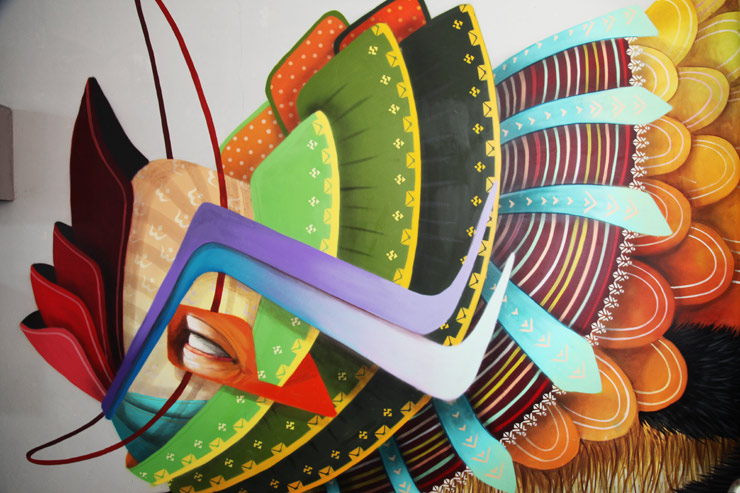
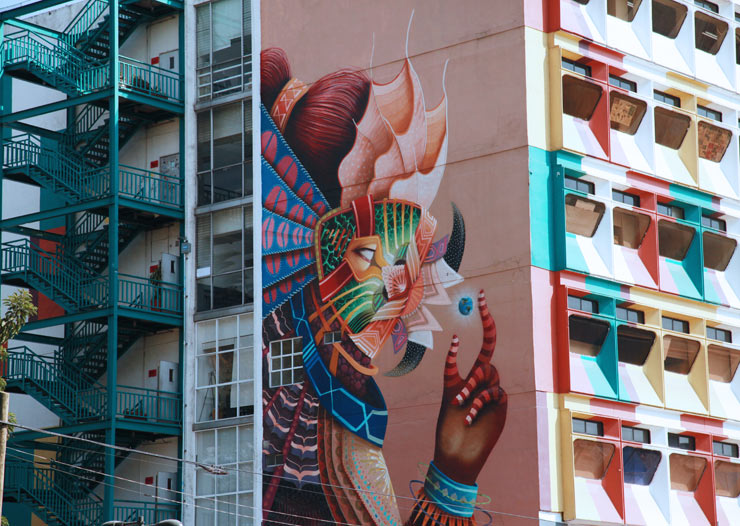
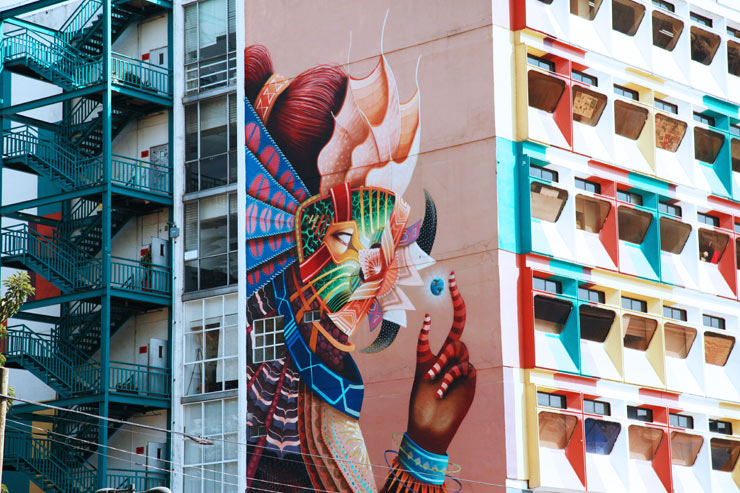
Curiot. Detail. Antique Toy Museum (MUJAM). Mexico, City. (photo © Jaime Rojo)
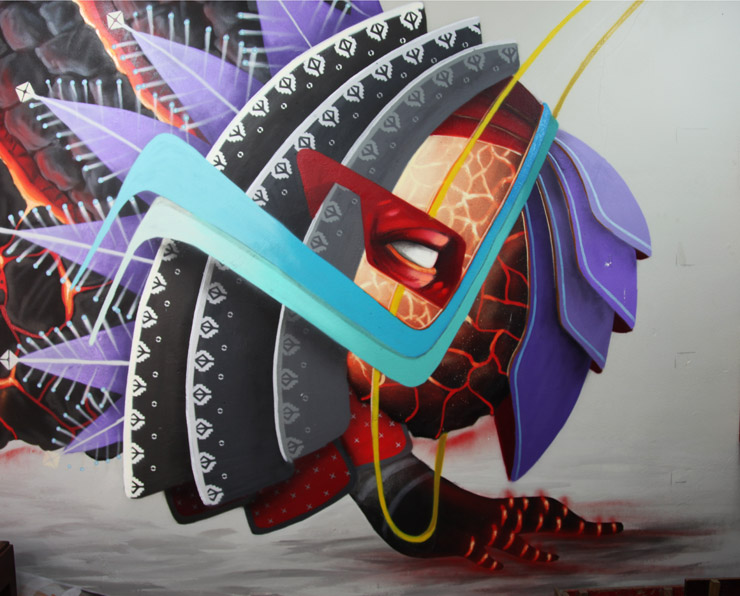
Curiot. Detail. Antique Toy Museum (MUJAM). Mexico, City. (photo © Jaime Rojo)
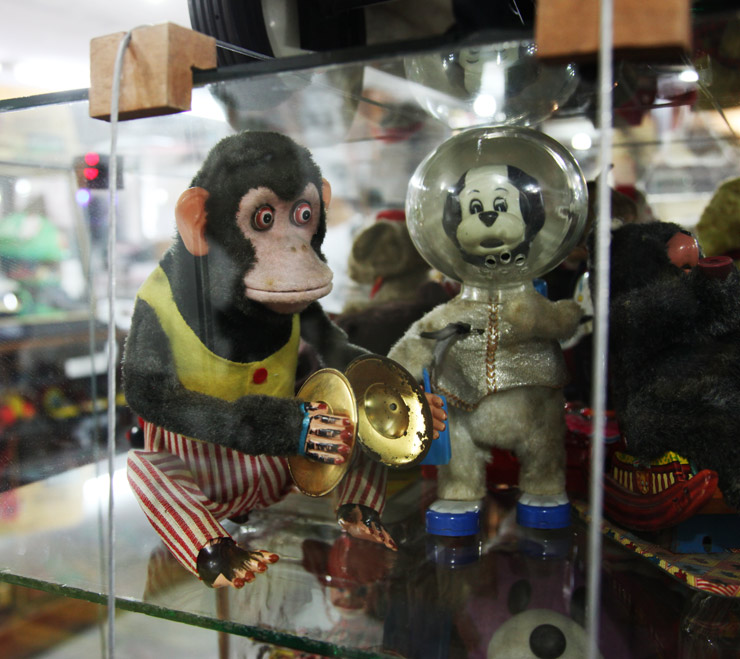
This toy monkey served as the inspiration for a political mural by artist Erica Il Cane a few years ago visible to the street. See A Mexican Mural “Manifesto”, Blackened Flag Colors, and Censorship. Antique Toy Museum (MUJAM). Mexico, City. (photo © Jaime Rojo)
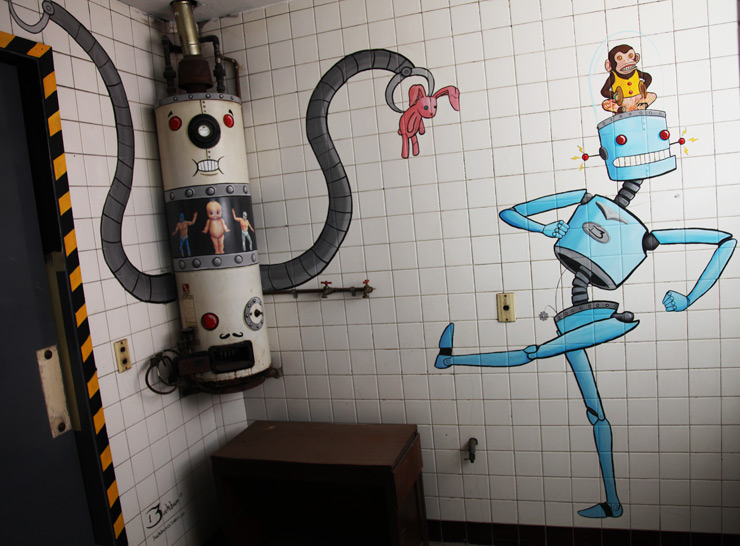
Daniel Bauchsbaum. Antique Toy Museum (MUJAM). Mexico, City. (photo © Jaime Rojo)
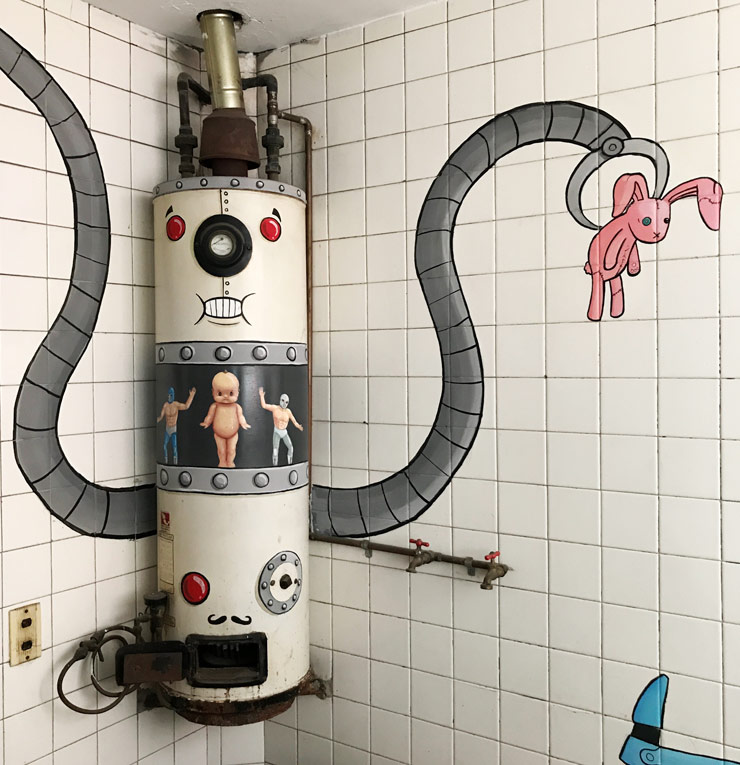
Daniel Bauchsbaum. Antique Toy Museum (MUJAM). Mexico, City. (photo © Jaime Rojo)



This is the second of two articles with BSA in Mexico City in collaboration with UN Berlin, it was originally published on the Urban Nation website, and the project is funded in part with the support of Urban Nation Museum for Urban Contemporary Art (UN) in Berlin.


Additional coverage by BSA in Mexico City:

An Unlikely Museum for Street Art? MUJAM is in the MX MIX : BSA X UN X Mexico City: Day 1

Saner, Mexican Muralist and Painter, Studio Visit. BSA X UN X Mexico City: Day 2

Panteón and Watchavato “No Esto No Es Lo Que Fue” Opens In Mexico City

Exploring New Techniques and Processes with Elian, Jaz and Ever in Mexico City

BSA Images Of The Week: 11.26.17 Mexico City Special


This article is also published on the Urban Nation museum website:
Read more
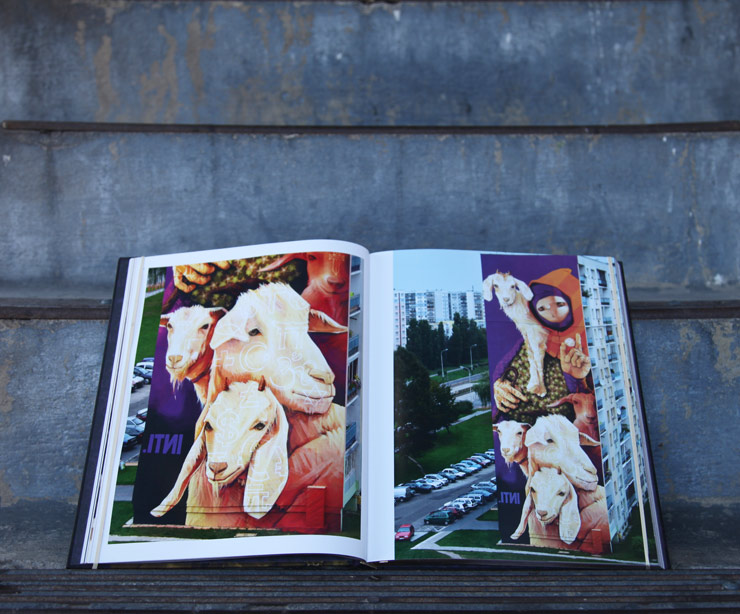
INTI Commands First Monograph : Color, Carnaval y Resistencia

INTI Commands First Monograph : Color, Carnaval y Resistencia

“Certainties, simple explanations, last hopes, magic thoughts and fears. All of them confronted by what is evident.”

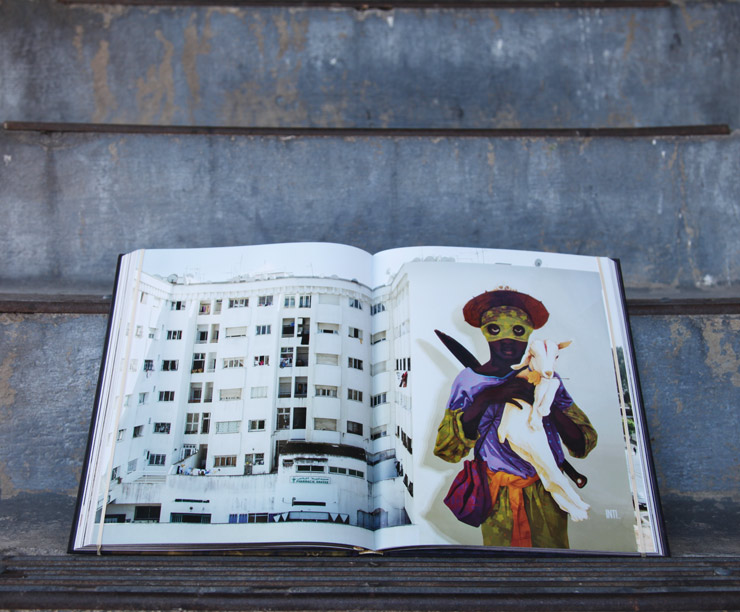
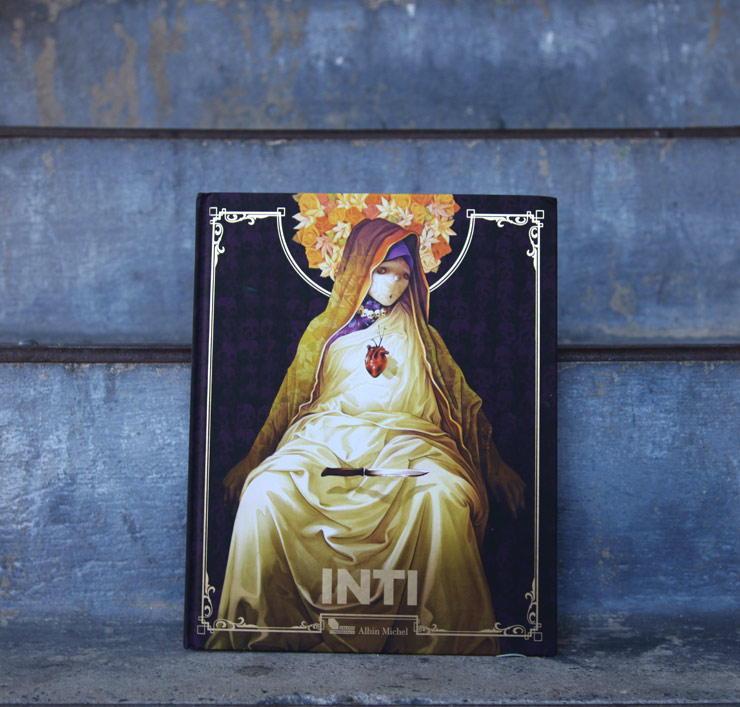
Thus describes the figure slung with bullets, holding a necklace with a cross and delicately balancing a small green apple on his index finger on a larger than life mural in Santiago, Chili. The visual language of this graffiti/Street Artist and muralist name Inti is his to wield, a cosmic folk that glows with celestial waves surrounding an other-worldly race of characters.

INTI. Éditions Albin Michel, 2017. Paris, France.

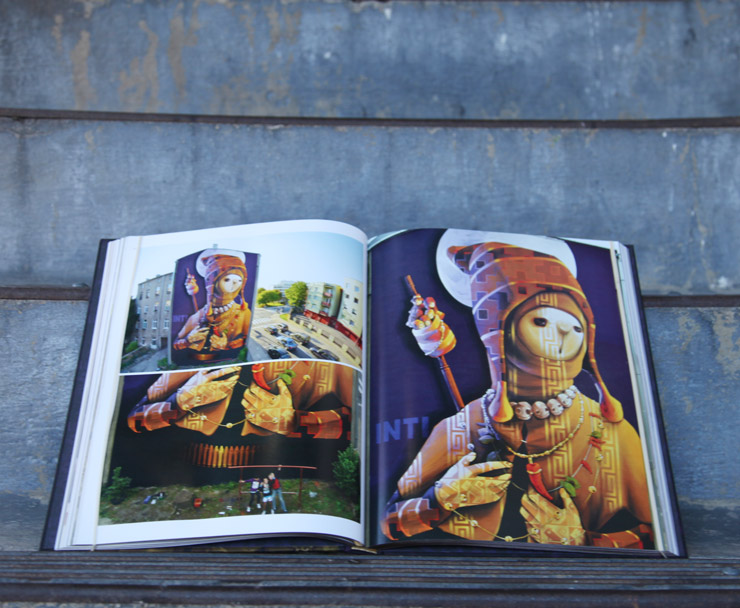
The messages these massive murals carry may be layered, their determination and commitment is not to be doubted. His new grandly gilded monograph certainly earns your attention, and keeps it with quality materials, photography, and accessible crisp writing by Pablo Aravena that dares to be esoteric when describing the artists work.

Born from a post dictatorship community muralism that blossomed in the 80s and 90s as the country forged a new identity, the explosive graffiti scene that first captured the imagination and street practice of the teenage Inti was eventually channeled into a fine art education and formal study of the tenets and techniques of the painters. Paired with a fascination with religious dogma, the traditions of carnival and the symbols of power, hope, ornament and sustenance, Inti is forging a language known to him and his characters in a way that still can foster an empathetic response from the viewer of his massive murals in places as farflung as Honolulu, Boras, Beirut, Belgium.

INTI. Éditions Albin Michel, 2017. Paris, France.

The Valparaíso-born artist whose name translates in Incan to ‘Sun’ is a master of light as well, shining it in gentle cadences across singular figures who could be multi-natural, sans-national, or inter-stellar.

Gathered in folds of robes, adorned in floating baubles and brightly glowing with reflecting patterns and gentle animals in arms, they may be evocative of carnival figures, fortune tellers, and of religious seers from around the world and throughout history, as is his universal searching for meaning, ultimately sharing some truths too no doubt.

INTI. Éditions Albin Michel, 2017. Paris, France.

INTI. Éditions Albin Michel, 2017. Paris, France.

INTI. Éditions Albin Michel, 2017. Paris, France.

INTI. Éditions Albin Michel, 2017. Paris, France.


INTI: Color, Carnaval y Resistencia by Inti Castro (Author),‎ Pablo Aravena (Author)

Trilingual French/Spanish/English.

Read more
BSA Images Of The Week: 01.07.18

BSA Images Of The Week: 01.07.18

BSA-Images-Week-Jan2015

Welcome back! This is our first Images of the Week in weeks! So much has changed since last year!

For example we had a Bomb Cyclone this week, which no one had ever heard of before. It sounded like it was made up for ratings on the Weather Channel which is still trying to give storms individual names and is still thought of as very dumb for doing so.

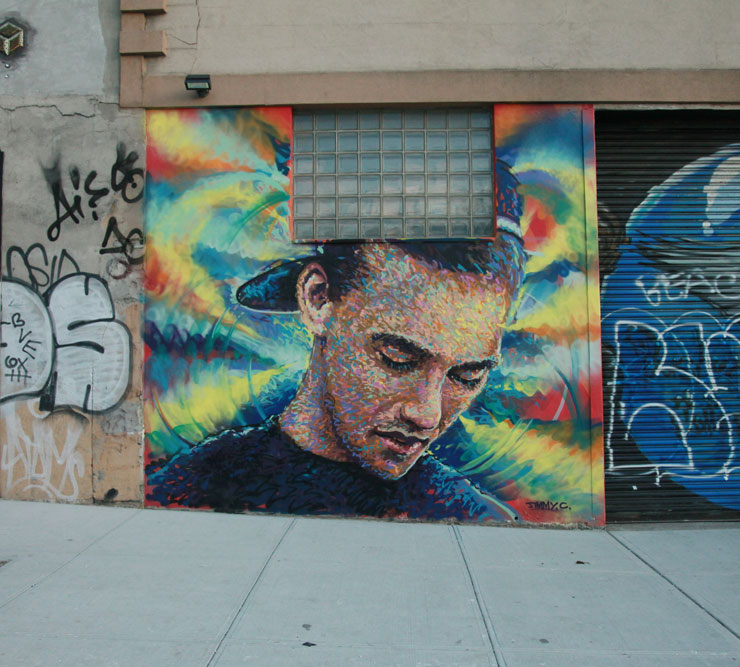
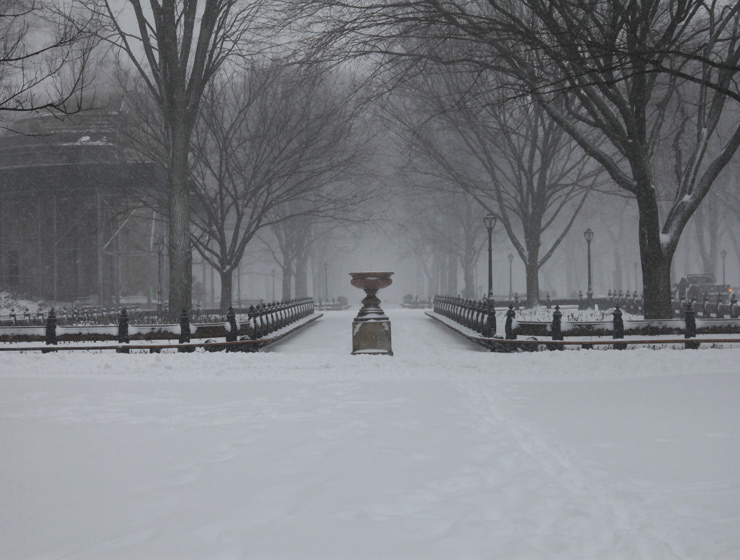
The winter bomb cyclone closed all the schools, chased cars and people off the streets. Jaime took the snowstorm opportunity to go to Central Park and shoot video till his battery died. Once the temperature dipped to 3 degrees farenheit (-14 celcius) with strong winds, seeing Street Art in New York was sort of something to do as you stumbled and slipped passed it in a hurry to the deli or laundromat or job if you work in medical services or drive a snow plow.

Luckily for us all, that was the only bomb we have had to deal with, but with the Very Stable Genius we have misleading the country, no one can say for sure for how long .

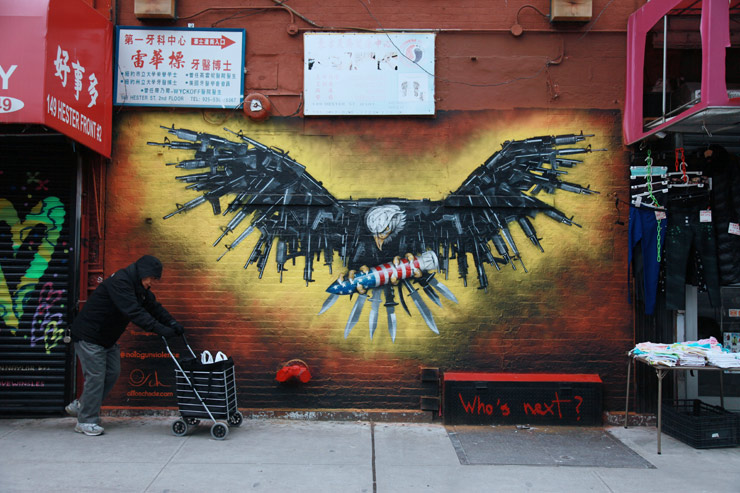
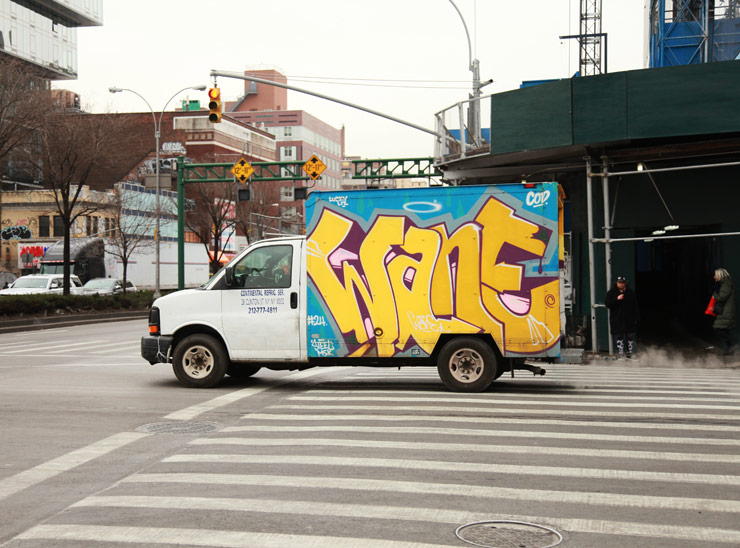
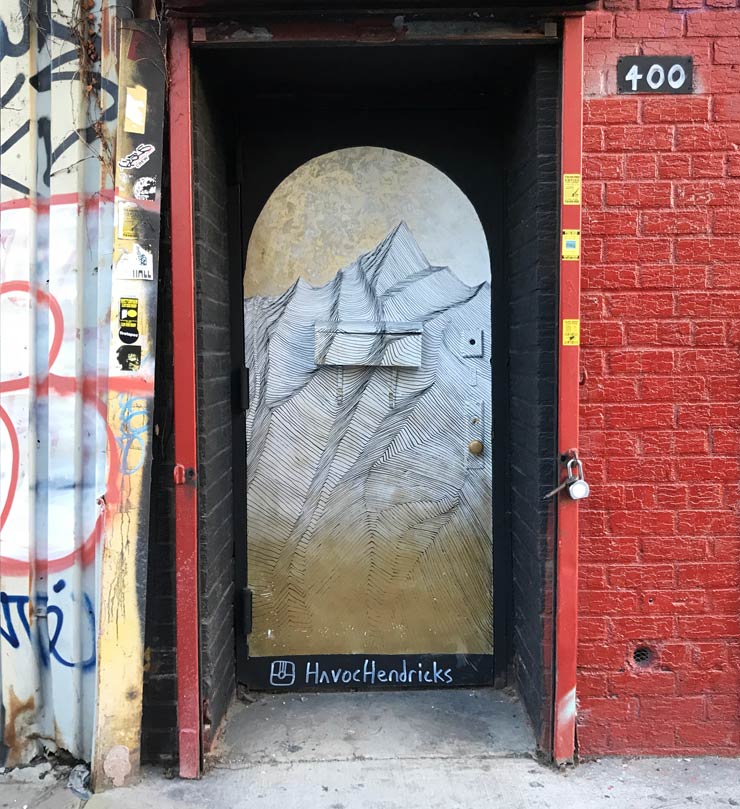
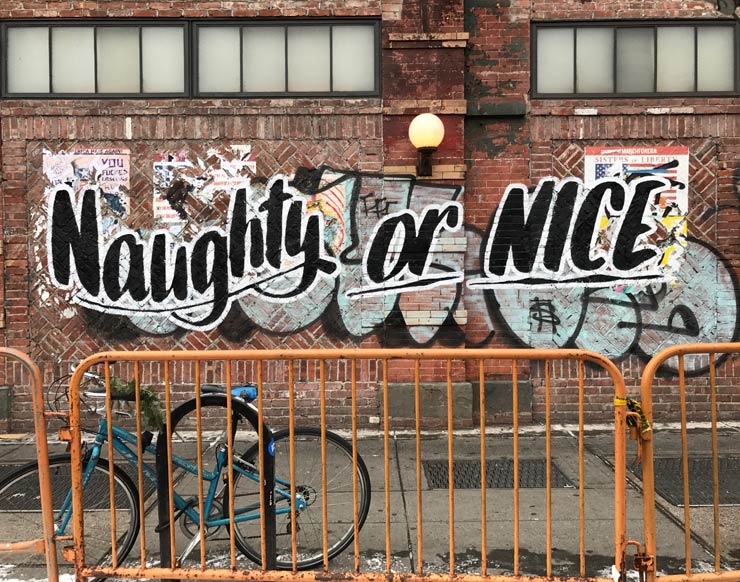
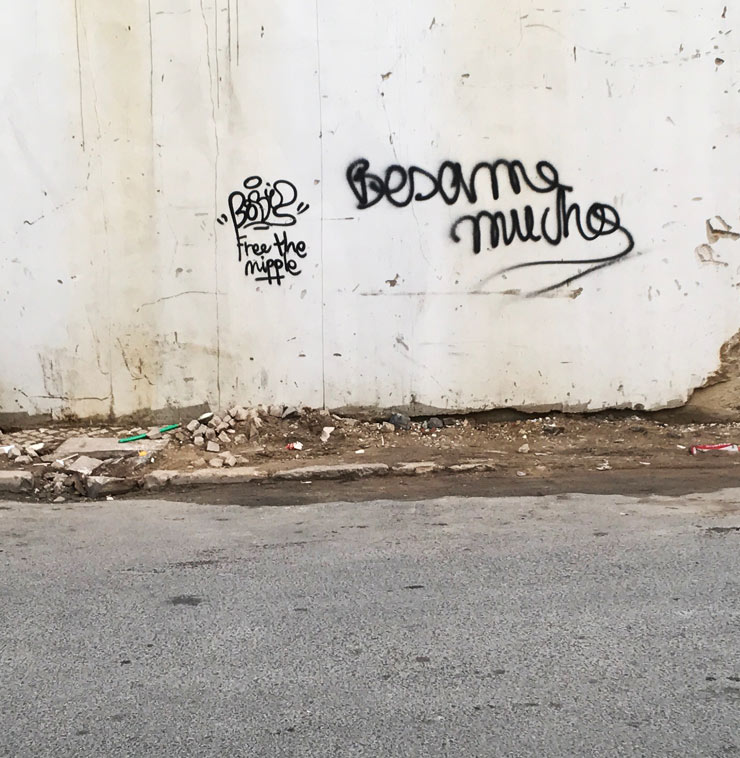
Here’s our weekly interview with the streets, this week featuring Ai Wei Wei, Baron Von Fancy, Bäst, Basto, Havoc Hendricks, Jimmy C, Juce Boks, Li-Hill, Otto Schade, Tinta Crua, Tomadee, Wane, Wk Interact, and Zola.

Top Image: Zola (photo © Jaime Rojo)

Tomadee (photo © Jaime Rojo)

Skewville (photo © Jaime Rojo)

Li-Hill for St Art Now in the LES. (photo © Jaime Rojo)

Li-Hill for St Art Now in the LES. (photo © Jaime Rojo)

Li-Hill for St Art Now in the LES. (photo © Jaime Rojo)

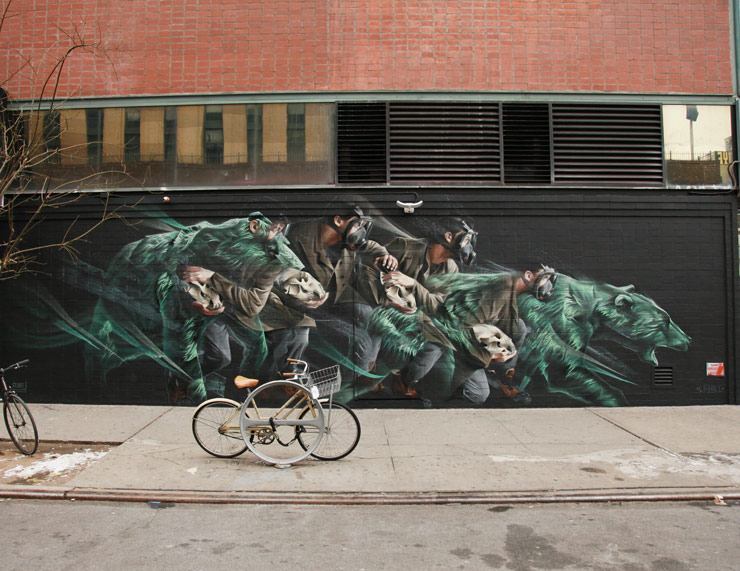
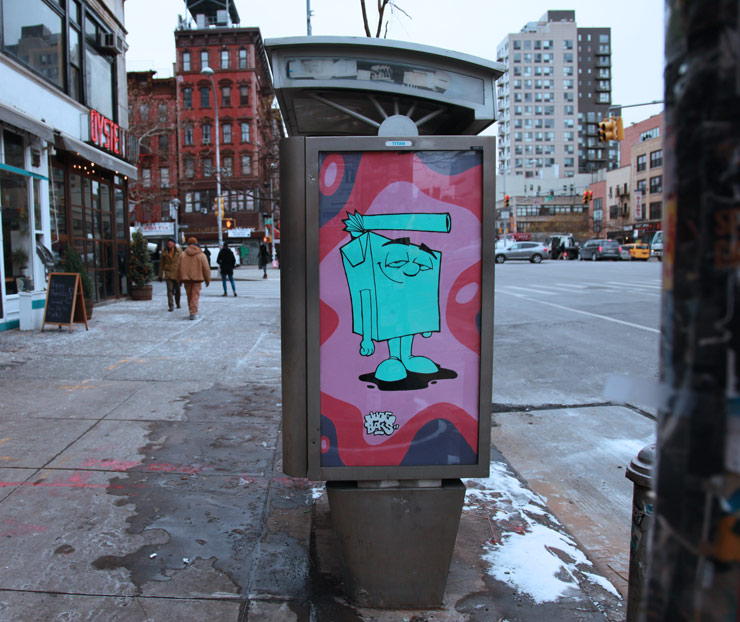
Juce Boks phone booth ad takeover. This one was hand painted one of a kind…boom! (photo © Jaime Rojo)

WK Interact (photo © Jaime Rojo)

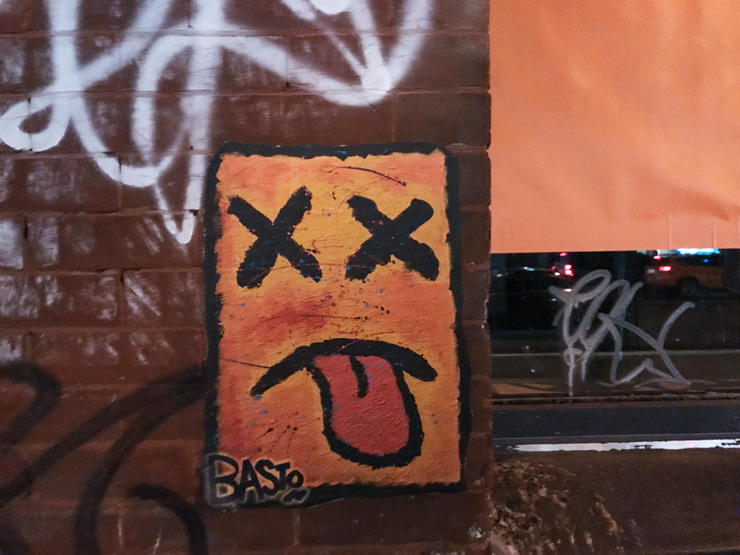
Baston (photo © Jaime Rojo)

Otto Schade for East Village Walls. (photo © Jaime Rojo)

Wane (photo © Jaime Rojo)

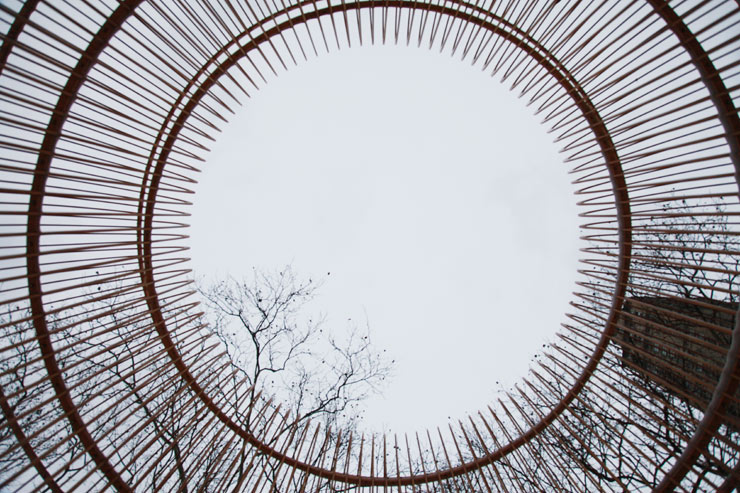
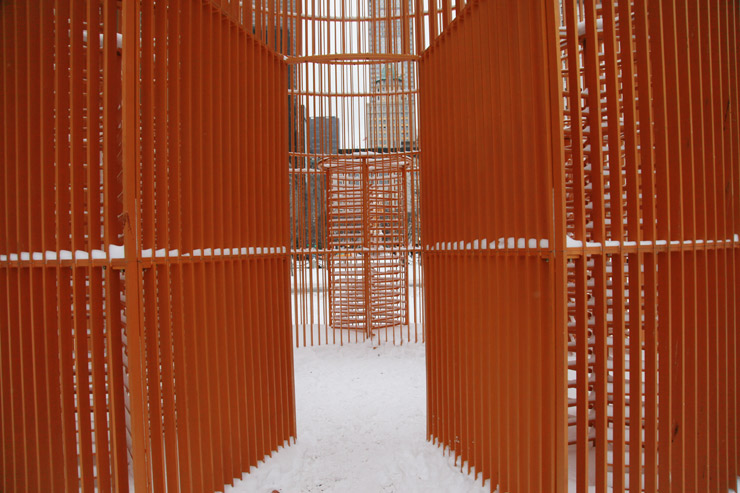
Ai Weiwei. “Good Fences Make Good Neighbors”. Detail. NYC wide multimedia/multi site exhibition for Public Art Fund. Central Park, NYC. (photo © Jaime Rojo)

Ai Weiwei. “Good Fences Make Good Neighbors”. Detail. NYC wide multimedia/multi site exhibition for Public Art Fund. Central Park, NYC. (photo © Jaime Rojo)

Havoc Hendricks (photo © Jaime Rojo)

Fanakapan for East Village Walls. (photo © Jaime Rojo)

Tinta Crua in Lisbon. (photo © Jaime Rojo)

Baron Von Fancy (photo © Jaime Rojo)

Unidentified artists in Lisbon. (photo © Jaime Rojo)

CEBEP (photo © Jaime Rojo)

Jimmy C for The Bushwick Collective. (photo © Jaime Rojo)

Untitled. Bomb Cyclone of 2018. Central Park, NYC. January 2018. (photo © Jaime Rojo)

Read more
Delusional Again, Jonathan LeVine Is Looking For You

Delusional Again, Jonathan LeVine Is Looking For You

Uh-oh, looks like Jonathan’s stumbled onto something.

A wild mushroom on a tree in the Enchanted Forest perhaps? A half-full dime bag on the deli floor? The contemporary art worlds Next Great Artist?

Okay its true he may not be the very stable genius you were hoping for, but Jonathan LeVine does have a serious and respected record for championing cutting edge art, high/low art, and everything along that slick and slippery slope of contemporary-street-graffiti-urban-tattoo-punk-dark-pop-surreal-calligraffiti-painterly-oftenly-culture-jamming-détournement-cramming-neo-outsider-crimefighter-biclighter-sidewinder genres which constitute our art requirements today.

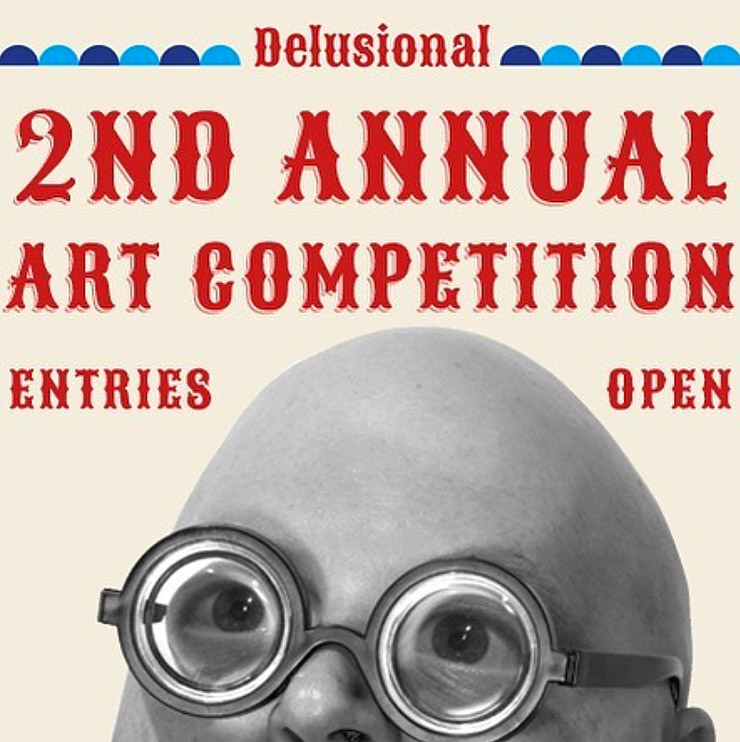
He also has smashingly good taste at picking jurors for the 2nd “Delusional Art Competition”, which is kicking off on this frigid January day in New York where the temperature is 6 degrees and the wind is blowing harder than a Bushwick drag ball. What a perfect way to prepare for a summer group show this August at Jonathan LeVine Projects!

Read below for details on this opportunity for artists to get their stuff seen and, based on the successful group show from the first Delusional, the quality of ideas and execution is going to be high! So will many of the attendees, no doubt.


DELUSIONAL ART COMPETITION

Jonathan LeVine Projects is holding their second “Delusional Art Competition”. Submissions from around the world are welcomed in all 2D and 3D mediums (excluding photography, video, and performance art). We encourage artists from all backgrounds and styles to submit work. Up to 40 finalists will be selected for inclusion in a summer group show from August 1 – 25. Winners will be announced at the opening. Enter for your chance to win a solo exhibition, a group exhibition, promotional opportunities, cash prizes, inclusion in an art fair, and more!

JURORS

The second “Delusional Art Competition” will be reviewed by high profile jurors including:

Evan Pricco (Editor of Juxtapoz)
Yasha Young (Director of Urban Nation)
Steven P. Harrington & Jaime Rojo (Brooklyn Street Art founders)
Tara McPherson (Artist)
Jeff Soto (Artist)
Jonathan LeVine (Gallerist)

PRIZES 

1st Place – Solo Exhibition at Jonathan LeVine Projects
2nd Place – Participation in a group show at Jonathan LeVine Projects
3rd Place – A week of promotion via Jonathan LeVine Projects social media platforms

All finalists will feature on the Delusional website and be listed on the gallery’s highly trafficked Artsy page. Select entries will be promoted on the gallery’s extensive social media networks. Artists will also receive extensive worldwide promotion in the form of email marketing, press release announcements, and widespread social media marketing. Winning images will be seen by an International audience including, art collectors, curators, and other galleries.

ENTRY REQUIREMENTS

• 1 image for each 2D work submitted, 2 images for each 3D work submitted
• Work details (title, year, medium, dimensions, price)
• Pricing: $45 for 3 submissions ($10 for each additional submission)
**Size limit: Paintings – 5 x 5 feet; Sculptures – 5 x 4 feet

All submitted artworks must be for sale (priced at a reasonable market rate) and available to be exhibited from August 1 – 25, 2018. When an art work is sold, Jonathan LeVine Projects will earn a commission of fifty percent (50%) of the net proceeds from the sale.

The deadline to apply to the Jonathan Levine Projects Delusional Art Competition is May 20, 2018.

CLICK HERE TO ENTER YOUR SUBMISSION

ABOUT THE GALLERY

Jonathan Levine Projects is committed to new and cutting edge art, exploring the terrain of the high/low and everything in between. As a youth growing up in Trenton, New Jersey during the 1980s, Jonathan LeVine recognized the appeal of countercultural aesthetics including punk flyers, comics, graffiti and tattoos.  In 2001, after years of independently curating at alternative venues, he decided to open a gallery specializing in this nascent art movement.  Many people called him and this risky endeavor “delusional”, however, seventeen years later, he’s now the owner of one of the most well know gallery’s in the world and has cultivated the careers of many renowned artists.  Jonathan LeVine is now looking for new artists to join the family. Are you Delusional enough?


Read more
BSA Film Friday: 01.05.18

BSA Film Friday: 01.05.18

bsa-film-friday-JAN-2015

Our weekly focus on the moving image and art in the streets. And other oddities.

Now screening :
1. ONO’U Tahiti 2017. A video re-cap by Selina Miles
2. Private View: Ian Strange via Nowness
3. Desprestigio by Pejac
4. Bonus Video. What the hell is a “Bomb Cyclone”?

bsa-film-friday-special-feature

BSA Special Feature: ONO’U Tahiti 2017. A video re-cap by Selina Miles

There is so much going on that you might miss during a mural festival. Aside from the progress of the artists at different rates in various locations around a city, which is a standard expectation, each festival is so unique in its personality and people that you cannot predict what you are likely to see next.

In Tahiti you can expect gorgeous natural beauty, and with ONO’U you can also expect a fashion show, a live projection mapping with the community, a panel discussion, a museum opening, delicious foods, flowers in your hair, and stories about the native people, wildlife, religious customs, colonialism, the value of the currency, and face painting. That’s before the weekend.

Filmmaker Selina Miles takes you up above it and directly streetside, a clear-visioned romantic who sees the beauty and the eclectic nature of our nature. Today we’re pleased to show her wrap up of October’s events in French Polynesia on the islands of Tahiti and Raiatea.

Private View: Ian Strange via Nowness

Continuing the attack on sublime suburbia to gain vengeance on the evil within, former Street Artist Kid Zoom, now Ian Strange, has the funding to do large and elaborate decimations and capture them on film for exhibition. Here is a private view, as it were, of a series of private matters made public.


Desprestigio by Pejac

Prestigious indeed.

A riveting bit of documentary storytelling that leads you to his newest artwork, Pejac takes a glocal story and reveals the folly of man. It happened 15 years ago, and is happening every few days all over the globe while the Earth’s economy is still firmly in the grip of the oil industry.

“This piece talks about the tragedy (of Prestige) that covered the coast of my country (and my region) in black 15 years ago, and whose damages to nature are still visible today,” says Pejac.  “I chose this particular case, but want to extend it to all the environmental tragedies that happen on our seas and oceans every few years. Desprestigio works as a dark souvenir of a fact that should not be forgotten: we must, and can, be much better guests on Earth. After all, this work is a message in a bottle.’’

Bonus Video. What the hell is a “Bomb Cyclone”?

We started this week’s Film Friday with Tahiti’s tropical weather and end it with our own Jaime Rojo wading through the snow in New York’s Central Park yesterday for what the news services informed us all was called a “bomb cyclone”. For most of us, it looked like a snowstorm. The blustery wind and the snow and rapidly dropping temperatures meant that many stayed inside and many took the opportunity to see the natural beauty of this whitewashing of the urban environment. Here are a few choice shots Rojo got yesterday for you from right in the middle of Manhattan.

Read more
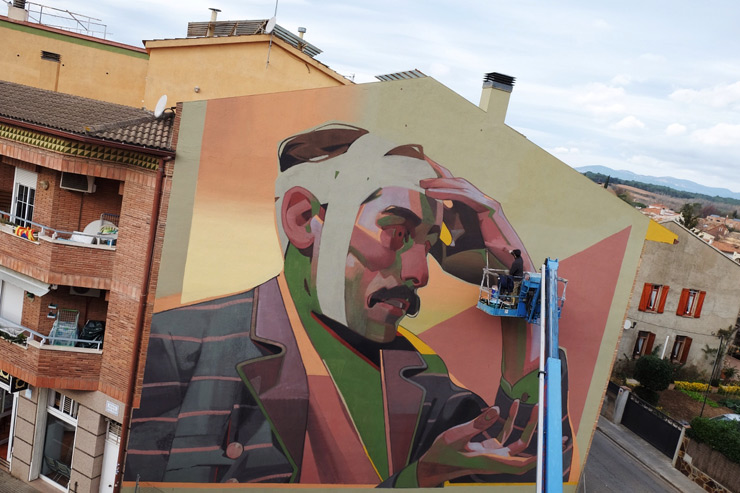
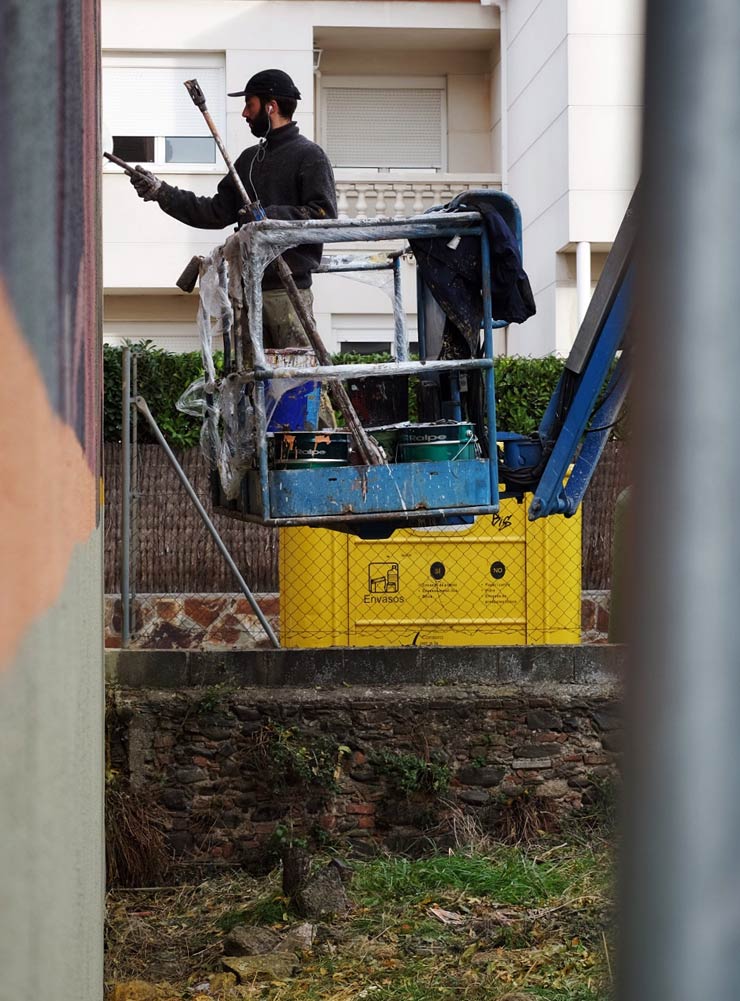
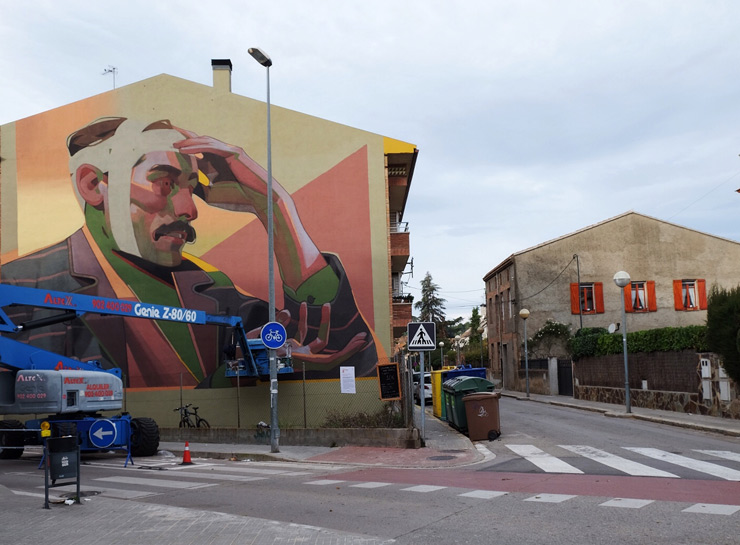
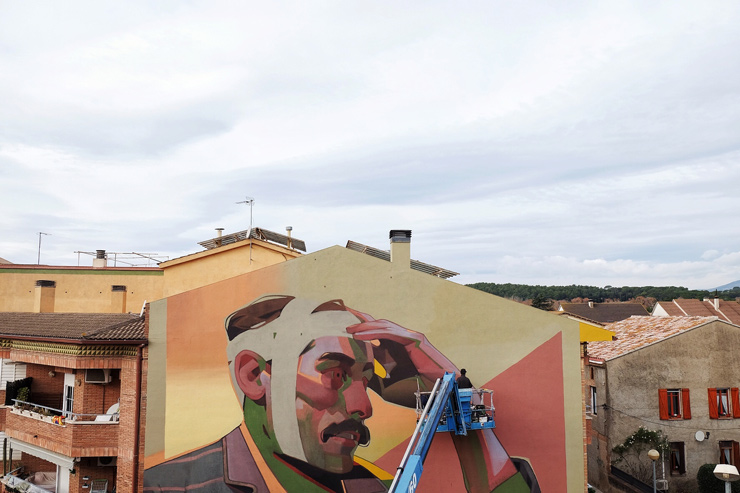
The Weeknd: Fer Alcala in Cardedeu, Granollers and Baladona, Catalunya, Spain.

The Weeknd: Fer Alcala in Cardedeu, Granollers and Baladona, Catalunya, Spain.

Today we take a random walk around some of the most interesting street art in the metropolitan area of Barcelona with photographer and fervent observer of the scene, Fer Alcala, who shares with BSA readers about his own participation in the scene as a documentarian and vibrant part of the street ecosystem. An insatiable chaser of Street Art and murals, Fer doesn’t let a recent back operation keep him down for long and soon you are off discovering more in Granollers, Cardedeu, and who knows where else!


– by Fer Alcala

2017 was a weird year for me. It’s been more than 6 months that I’m trying to learn how to live in pain as I have a problem in my backbone which is healing as a Work In Process (WIP). At the same time, I’ve had the chance of collaborating with lots of artists, taking part in very interesting projects and shooting tons of photos. However it has not always been easy for me to find the motivation and the energy to go out there and hit the streets.

Roc Blackblock. Granollers, Spain. December 2017. (photo © Fer Alcalá)

Apart from all this, you know how it works; There’s that spark, that unavoidable feeling that pushes you to do what you love to do despite everything else. So, this is what happened to me some weeks ago while being alone at home: I HAD to go for a walk, yes or yes. So, I did.

I had the need to go to Badalona and check some of the latest pieces of Spogo out. Spogo’s work is familiar to the BSA readers:  One of the finest abstract artists in the country, Spogo opens walls in his hometown and gives the chance to other artists to paint in his playground, developing a homeland legacy that is appreciated by neighbors, pedestrians and fellow artists. In these times when street art and gentrification are becoming almost synonymous, Spogo’s personal effort contributes to beautify the city through collabs with Elbi Elem, Tayone, Ángel Toren, Lost Optics, Kazzius or Nico Barrios & Toni Cuatrero.

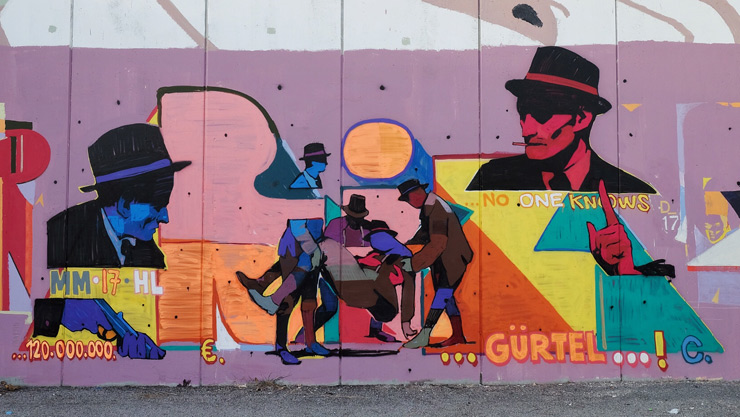
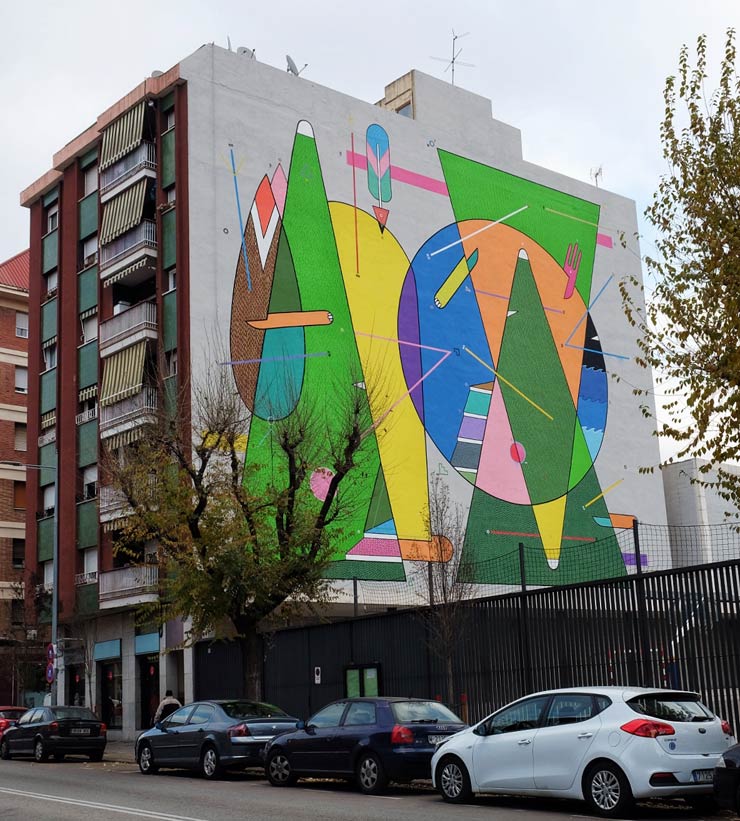
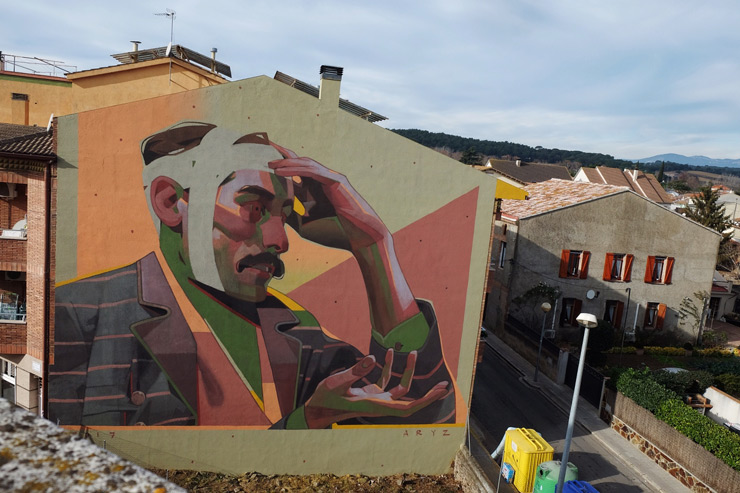
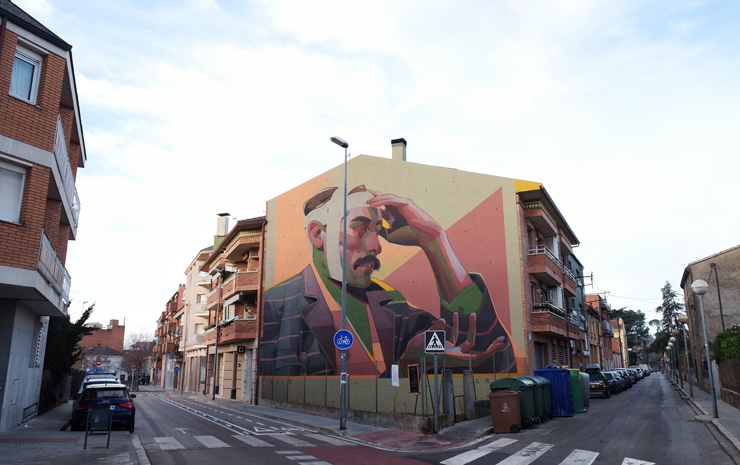
Aryz . Gurtel. Ofidirect/Cardedeu, Spain. December 2017. (photo © Fer Alcalá)

In the meanwhile, it’s nice to find a big wall by H101 by chance, almost feeling it as a tribute to the defunct Sixe wall in the opposite side of the highway which was replaced by some useless gardening ad. It was also a great pleasure to find ‘Inocente II’, the great mural by Mohamed Lghacham and Iván Floro, two friends that hadn’t painted together in 6 years and whose figurative skills are reaching mastership levels.

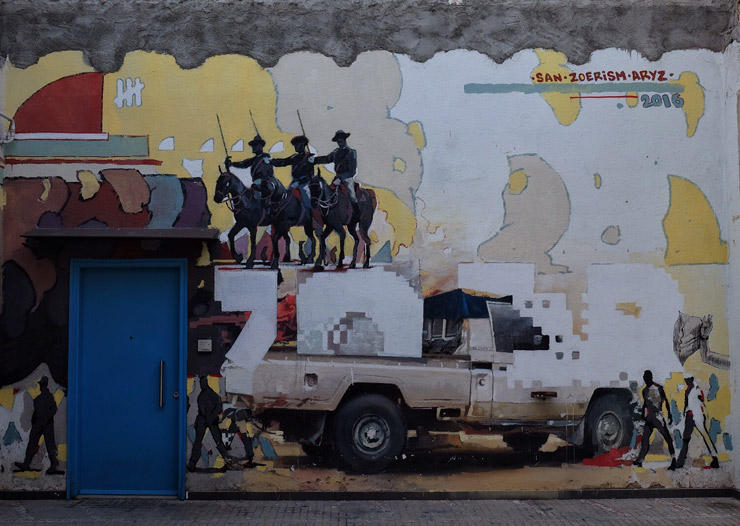
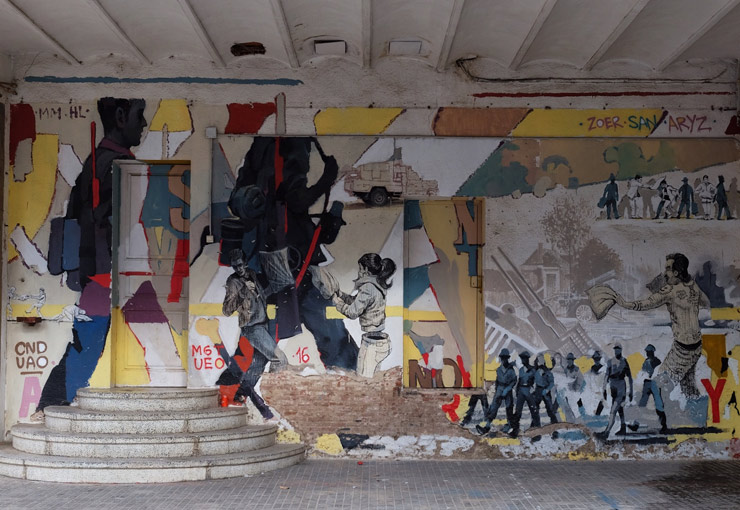
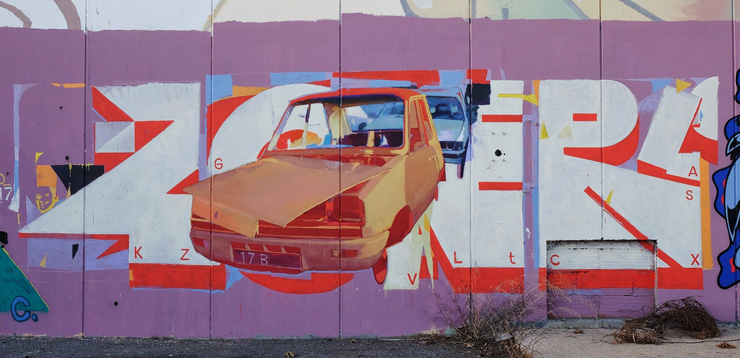
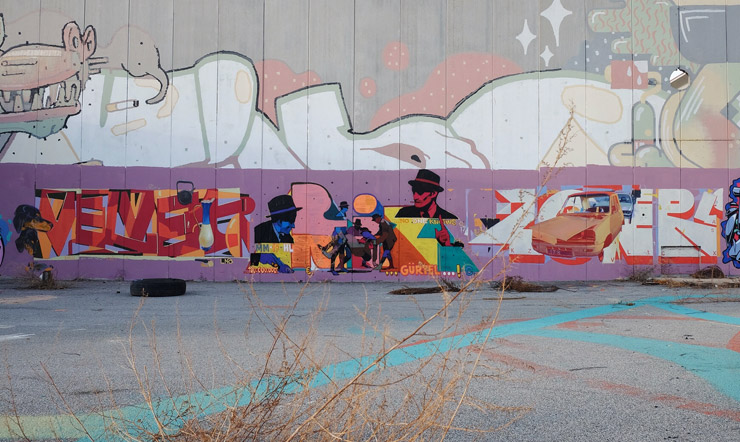
So, in order to keep on feeding my hunger for art, I decided to visit the always interesting city of Granollers with about 60,000 inhabitants which is 40 minutes away from Barcelona by train, after seeing online what Velvet and Zoer had created for ‘Murs que parlen (Walls that speak)’. Murs que parlen is a project promoted by Granollers’ town hall, a project which they say is seeking to give life and color to some medium and large scale walls of the city. The result of the work of the French artistic duo, who were advised by Aryz on the occasion, is one of my personal faves in Catalunya this year.

Aryz . San . Zoer. Granollers, Spain. December 2017. (photo © Fer Alcalá)

I love how Zoer has explained the whole process in his IG account:

‘One month ago, Velvet and me started painting this mural in Granollers / Catalunya. Relating an artistic action to its close environment and context is a big question as: Does the mural/ public space/ art have to make a clear connection with its time or to a special meaning? The population of Catalunya expressed recently its will of autonomy and most generally the possibility of reorganizing the society around a strong regional and cultural defense. As foreigners, we can only watch and interpret the information from a certain distance.

The Can Bassa district in Granollers is a very quiet district, let’s say mostly Castillan, or inhabited by people from all of the country. We were invited to take a look at the academic system here, by giving a class to young art students and by visiting the primary school though the high school. The focus is set on the personal development and awakening in creative fields, developing an atmosphere of exchange and curiosity.

Aryz . San . Zoer. Granollers, Spain. December 2017. (photo © Fer Alcalá)

In a dance class, where children were training, we found dozens of drum sticks in a blue plastic basin. Besides that we had the chance to meet Toni Cumella and to visit his splendid ceramic factory. Their ceramics are designed for architecture mainly, where a million single pieces can shape an ensemble, become a pattern, a second skin to a concrete structure.

Well known for having designed this sophisticated ceiling ceramic map for the Santa Caterina market in Barcelona, they worked as well with Renzo Piano on the Centro Botin, creating a sensational floating pattern from thousands of ceramic disks modeling the facade and reflecting the light. During the inauguration, musicians were playing percussion using the ceramic facade as a giant drum with thousands of pads’.

Aryz . San . Zoer. Granollers, Spain. December 2017. (photo © Fer Alcalá)

It’s great to see how interacting with the locals and taking into account the neighbors’ participation is becoming so important and giving meaning to the artist’s work, even becoming a norm in several projects all over the world.

My next stop was another Murs que parlen wall. It’s strange because almost no one out there has taken pics of this colossal Sixe Paredes piece. I tried to shoot it from the courtyard of the school, but the place was closed and nobody was working that day. To know more about this beautiful work, please check this nice documentary that a local TV filmed for the occasion.

Sixe Paredes. Granollers, Spain. December 2017. (photo © Fer Alcalá)

It has been approximately four years since I had the chance to visit Roca Umbert. This cultural facility keeps some almost hidden gems by Aryz, Zoer, and Daniel Muñoz ‘SAN’ and Roc Blackblock, among others. Born as a tribute to Ferrer i Guardia and the modern school, with 250 students taking part in the process, this is what Roc said about it on his FB page at that time: ‘We arrived to the conclusion that education, knowledge and wisdom are the real superpowers that allow us to face all the challenges with success’.

One of the things that I love about Granollers is that it has everything: big walls, random ones all over the city, abandoned factories…and the ditch. Home of a superb, but now buffed old smoking bird by Aryz, this never ending urban canvas offers tons of great art by some of the biggest and more interesting names in da house: Aryz, Rostro, Cinta Vidal and Peeta, Japon, Treze … this list could go on forever, so here you have an small selection of what you can find down there. And, please, be careful if you decide to cross the river.

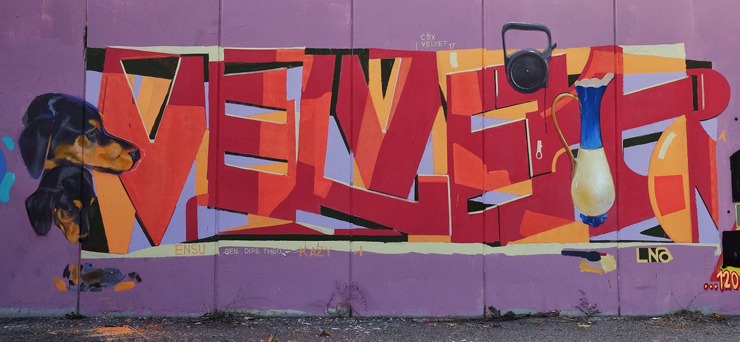
Velvet. Ofidirect/Cardedeu, Spain. December 2017. (photo © Fer Alcalá)

As I was on fire, I decided to take the train and go to Cardedeu. This almost 13 km2 village is a creative gold mine. Aryz’s and Cinta Vidal’s homeplace, Cardedeu’s outskirts gives shelter to one of the most admired abandoned factories in the biz: Ofidirect. I’ve been here several times with lots of different friends, artists and colleagues and everybody loves the place.

It was the first time that I was there alone and I have to say that I was almost overwhelmed by the silence and the majesty of this concrete and brick space. Being some kind of a private playground for the MixedMedia Crew and other artists and graffiti writers, Ofidirect is still alive preserving its urban decay beauty and charm. It was funny for me to see how Zoer, Velvet and Aryz had got some fun in there apart from the big Wall in Granollers.

Zoer. Ofidirect/Cardedeu, Spain. December 2017. (photo © Fer Alcalá)

After a 40 minutes walk to go back to Cardedeu, some beer, and a train and back to Barcelona, I was at home editing pics and speaking with friend artist @elbielem. She asks me about an Aryz mural in Cardedeu. ??? I had no clue about what she was talking and Aryz painting in his hometown on kind of a big wall? He’s one of my favorite artists and I had been there for hours and I haven’t got any f*cking idea about it? Well: sh*t happens. Best street art hunter (hate this title…) ever.

I went back to Cardedeu the next day very soon in the morning, but that, my friends, is a different story

Velvet . Aryz . Gurtel . Zoer. Ofidirect/Cardedeu, Spain. December 2017. (photo © Fer Alcalá)

Treze. Ofidirect/Cardedeu, Spain. December 2017. (photo © Fer Alcalá)

Los Ratos. Ofidirect/Cardedeu, Spain. December 2017. (photo © Fer Alcalá)

Sergi Marqués. Ofidirect/Cardedeu, Spain. December 2017. (photo © Fer Alcalá)

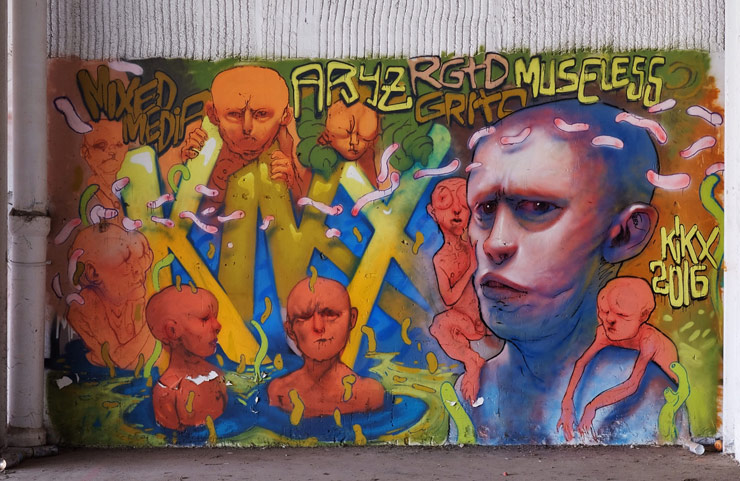
KIKX. Ofidirect/Cardedeu, Spain. December 2017. (photo © Fer Alcalá)

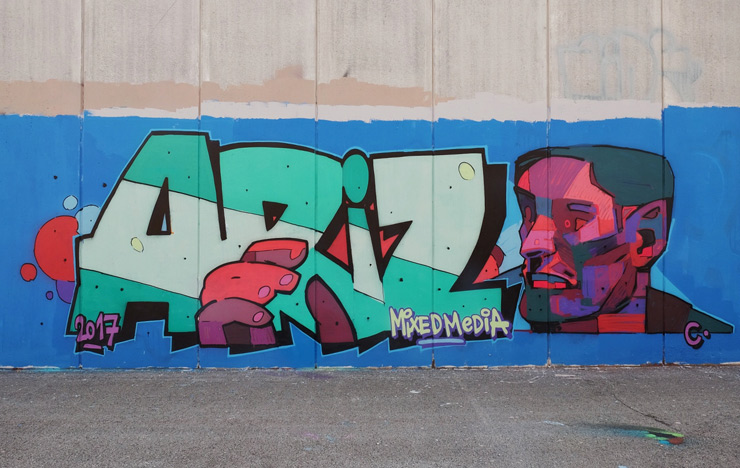
Aryz. Ofidirect/Cardedeu, Spain. December 2017. (photo © Fer Alcalá)

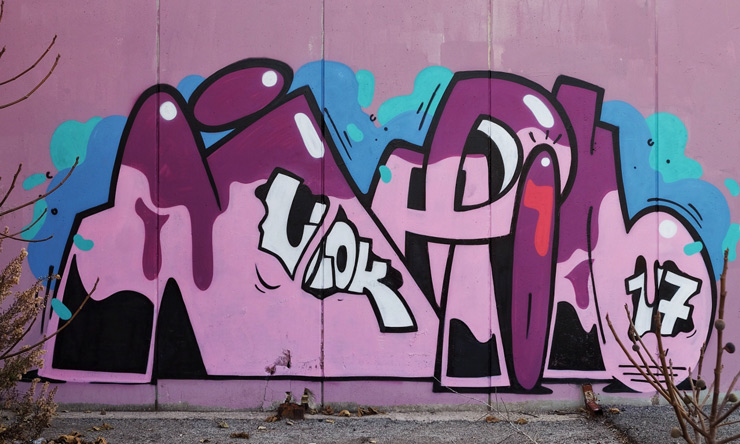
Japon VLOK. Ofidirect/Cardedeu, Spain. December 2017. (photo © Fer Alcalá)

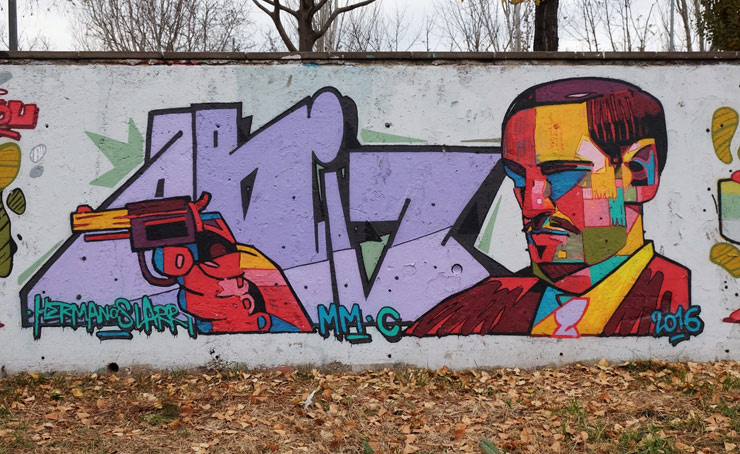
Aryz. Granollers, Spain. December 2017. (photo © Fer Alcalá)

Rostro. Granollers, Spain. December 2017. (photo © Fer Alcalá)

Aryz . Rostro. Granollers, Spain. December 2017. (photo © Fer Alcalá)

Cinta Vidal . Peeta. Granollers, Spain. December 2017. (photo © Fer Alcalá)

Mohamed Lghacham . Iván Floro. “Inocente II” Baladona, Spain. December 2017. (photo © Fer Alcalá)

‘This wall is the second part of another one that I painted two years ago about the same issue,” says artist Mohamed Lghacham who painted this wall with assistance of Iván Floro.

“Its main character is a friend of mine who was born on December 28th which is the ‘Santos Inocentes’ day in Spain (note: this is the equivalent of the April’s fool day in the States). Basically, it consists on playing little jokes on your friends and relatives. When my friend was a little kid and it was his birthday his classmates didn’t trust him, thinking that he was just kidding. There’s not a big concept behind the piece: it’s just something anecdotal that seems funny to me.

The idea about painting that mural came from Badiu Jove Badalona as one of the activities of Conect’Art which is an art fair for young creators that takes place in the city.” Lghacham says he would like to thank his assistant Floro.  “Everything went great and I guess that we will work together often in the near future.”

Spogo . Nico Barrios . Tony Cuatreros. Baladona, Spain. December 2017. (photo © Fer Alcalá)

Spogo . Elbi Elem. Baladona, Spain. December 2017. (photo © Fer Alcalá)

H101. Baladona, Spain. December 2017. (photo © Fer Alcalá)


Instagram handles:

Sixe @sixeparedes, Spogo @spogo15, Elbi Elem @elbielem , Tayone @tayone.abz , Ángel Toren @angeltoren , Lost Optics @lostoptics, Kazzius @kaz.zius or Nico Barrios @mrnobodysmind ,Toni Cuatrero @tonicuatrero, H101 @h1_01, Mohamed Lghacham @oiterone, Iván Floro @van_vuu, Velvet @velvetcsx, Zoer @zoerism, Aryz @mr_aryz, Daniel Muñoz ‘SAN’ @danielmunoz_san, Rostro @rostrovalseca , Cinta Vidal @cinta_vidal & Peeta @peeta_ead , Japon @japonvlok , Treze @acidcollapse, Peeta @peeta_ead , Japon @japonvlok , Treze @acidcollapse

Read more
Aryz Says ‘Adios’ to 2017 in his Hometown of Cardedeu, Spain.

Aryz Says ‘Adios’ to 2017 in his Hometown of Cardedeu, Spain.

Today on BSA we have the photographer Fer Alcala to share his experiences and photos as he was capturing the newest mural from Aryz in his hometown in Spain at the very end of the year.


– by Fer Alcala

La cultura, by Aryz

– or, “How I almost missed the chance of shooting part of the creative process of this wall by one of the top names in the business 40 minutes away from my home.”

Aryz. Cardedeu, Spain. (photo @ Fer Alcalá)

So, yes: this is how stupid I can get. After spending a big part of the day in the Cardedeu (the hometown of the artist Aryz) area, I had to find out after returning to my home. It was thanks to a friend, the artist Elbi Elem, who told me that Aryz was painting his, let’s say, ‘1st official large scale mural’ in his village, 10 minutes away from the place I had had lunch at that day. This is what happens when you are a digital dummy and the obsolescence of the iOS on your shitty mobile phone doesn’t allow you to see the Stories and Moments on Instagram.

I felt so embarrassed that I decided to go there the next day in order to calm my feelings of guilt down. First time in the morning. Maybe I’m exaggerating a little bit for dramatic purposes, but trust me: I felt like a complete dumb ass.

Aryz. Cardedeu, Spain. (photo @ Fer Alcalá)

Anyone who shows a minimum of interest about street art or, as the main character of these lines prefers, about contemporary muralism, knows who Aryz is. So, I’m not here to write a deep essay about his prolific and outstanding work all over the world. I prefer to share with whoever will be reading this my personal experience with the artist throughout these last years.

I have to say that, although I admire Aryz’ work, we aren’t friends or anything. I think that maybe we have met personally 4 or 5 times in our whole lives and this was the first time that I had the chance of taking some shots of him at work. Once said that, I’ve been lucky enough to visit his studio twice, due to 2 principal reasons: the mediation duties of common friend Anna Cammany (aka @troballola), and Aryz’ hospitality. One of these occasions was really special for me as we were accompanied by Martha Cooper and Jay ‘Terror161’ Edlin, two legends of the photography and the graffiti world, who were in town as lecturers for the Openwalls Conferences 2015 edition.

Aryz. Cardedeu, Spain. (photo @ Fer Alcalá)

Not being a mitoman, I’ve asked for only 2 autographs in my whole life: to Danish pro skater Nicky Guerrero when I was fourteen and to Martha Cooper, after I was already a grown man. So, yes: maybe that moment was kind of unforgettable for me. And, what can I say? You don’t everyday have the chance to be shooting in an abandoned factory in the middle of nowhere with friends and with artists who you have admired since years ago.

Plus I enjoyed witnessing the nice meeting between Martha, Jay & Aryz at his wonderful cabinet of curiosities in the presence of the artist’s mum. I have pics of this day that won’t be ever published as I think this was a private moment that should remain just in the attendants’ hearts and memories. And I got a couple of good stories in my pocket from that day too.

Aryz. Cardedeu, Spain. (photo @ Fer Alcalá)

One of the reasons why I’m explaining all this, it’s that I want to emphasize the fact that we are speaking not only about a great artist, but also about a great human being who trusted me and was super generous with me even when he almost didn’t know me at all. And, excuse me: you can be the greatest artist on earth, but if you suck as a person, my interest is gone. Well, as I’ve said, this isn’t the case.

Going back to my visit to Cardedeu, it was easy to find the wall after some searching on the Internet. What I wasn’t expecting was that Aryz was already there giving the last touches to the piece. Yes: both of us are early risers. So, after saying ‘hi’ and some small talk, I started to shoot from the ground. I liked the location of the wall, but speaking from a ‘photography’ point of view, it was a pain in the ass for taking pics because of the fences, the signs, the lights… At least, there were no shadows.

Aryz. Cardedeu, Spain. (photo @ Fer Alcalá)

I asked a neighbor from the building in front of the piece if she had a good angle of the mural from her balcony. The answer was negative, but she kindly offered to me the keys of the rooftop. This was like pure gold for me. Gracias Eulalia.

As it always is, it was nice being up there. The view was great and I had a nice perspective of Cardedeu’s landscape. You could see how Aryz’ color selection was harmoniously matching the surroundings, creating a beautiful composition. A pedestrian asked the artist about the meaning of the piece. Aryz answered that his work is not about that. He almost demanded that the viewer make a personal effort about thinking and getting his own conclusions.

Aryz. Cardedeu, Spain. (photo @ Fer Alcalá)

And I agree with that. As he has said in the past, his dialogue is not with the citizens: it’s with the wall, the building, the architecture, and the city… We are just spectators of his artwork, but he is not working for us. Although there can be a deep meaning and sense behind his most important works, maybe we should get involved. And this is challenging and enjoyable.

There’s this very well known saying here in Spain that says: ‘Nadie es profeta en su tierra’ (ed. note; roughly, ‘no man is a profit in his own land’). Well, when Jesus Christ supposedly said that, I’m pretty sure he wasn’t thinking about Aryz.

Aryz. Cardedeu, Spain. (photo @ Fer Alcalá)

Aryz. Cardedeu, Spain. (photo @ Fer Alcalá)

Aryz. Cardedeu, Spain. (photo @ Fer Alcalá)

Read more
Mexico City: Aerosol Artists, Aztecs and Magic on the Street

Mexico City: Aerosol Artists, Aztecs and Magic on the Street

Every city has its own particular energy; it’s own articulated rhythm, its own unique chaos.

Mexico City’s is full of flourish and aspiration and fascination for the international new, while firmly rooted in respect for the past. When it comes to Street Art, murals, graffiti and discordant sub-cultural art movements that can disrupt the norm, this city shows the capacity to absorb and adapt and to continue moving forward, providing meaningful insights into the true nature of its people.

Curiot. Detail. For Lienzo Capital Project with Street Art MUJAM. (photo © Jaime Rojo)

This magic city of more than 20 million is often referred to as a gateway to Latin America: economically, socially, and politically. With high tech industry, banks, multi-national companies, a university system that serves 300,000 students, 150 museums, three UNESCO World Heritage sites… you can see why. With heavy traffic despite a subway system and many forms of public transportation, it can take hours for you to cross Mexico City (Distrito Federal (D.F)) and you can be assured that you’ll probably never see all 16 boroughs.

El Mac. Detail. All City Canvas 2012. (photo © Jaime Rojo)

As Street Art and its associated movements move through Central and South America, invariably D.F. appears as an important tierra cultural to traverse. From an active graffiti scene and occasional mural festivals to a growing gallery representation and increasing museum interest, urban artists are capturing the attention of the Americas, making heads spin in public space. With Mexico City capturing nearly all the aspects at once, today we take a look at the city and give you only a few examples of the art in the streets here.

El Mac. All City Canvas 2012. (photo © Jaime Rojo)

The September 19th earthquake of 2017 shook Mexico City exactly 32 years after 10,000 lost their lives in a larger one, the largest. With broken sidewalks and taped off buildings still as physical evidence, you can hear in the voices the trauma that rocked tall buildings back and forth like huge ships on the sea. In addition to these more physical shocks, the city has been rocked in recent years by a rising evidence of frightening power shifts relating to drug traffickers, accusations of institutional corruption, and a sharply rising economic inequality that is transforming developing/developed societies across the globe.

Built upon the ruins of the Aztec city called Tenochtitlán, which was one of the worlds largest in the 15th century, Mexico City appears persistently ebullient when banding together against adversity. Determined to excel beyond the horrors of conquest by the Spanish that decimated an entire indigenous culture, still the ruins rise above the ground and this multi-hued global city rumbles forward with determination.

Unidentified Artist (photo © Jaime Rojo)

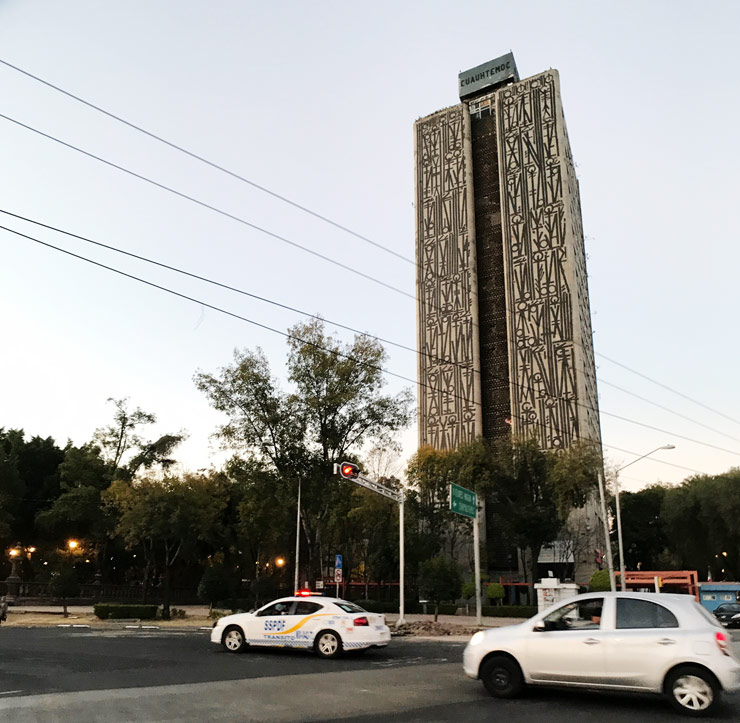
Sleek high rises and brightly patterned folkloric art and aerosol sprayed graffiti tags next to massive murals all blend and swirl like the jarabe Tapatío hat dance from block to block – a decisive commixture of the “brand new” with a heritage of indigenous/invader cultures that ruled here hundreds of years before. Today it’s a hybrid of purposeful optimism and wizened survival instincts that pushes the city forward, despite the shocks endured.

SEGO. All City Canvas 2012. (photo © Jaime Rojo)

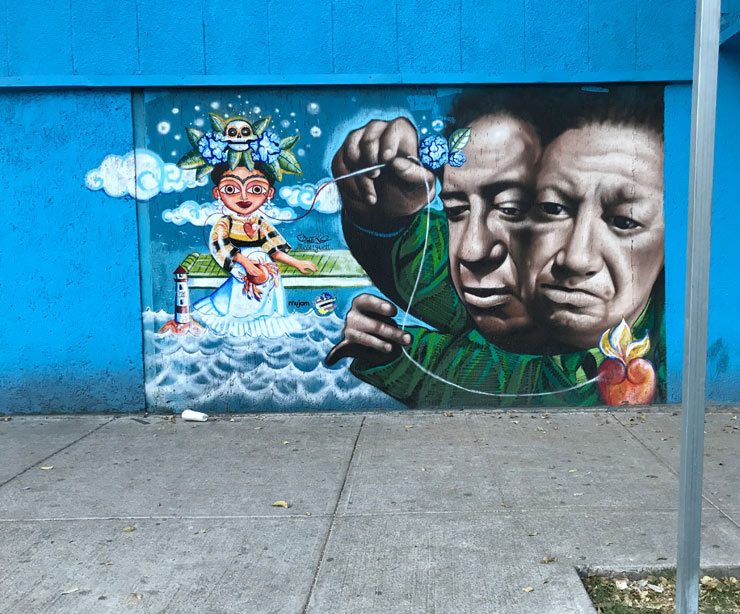
The magic and realism so famously combined by authors like Garcia Márquez and Esquivel along with the brutal honesty of Mexican filmmakers like Inarritu, del Toro and Cuaron is fused onto the bricks of colonial mansions and cinderblock industrial neighborhoods like Roma-Condesa and Centro Histórico. These colonias and others like Xochimilco and Coyoacán are historic, commercial, somehow always in transition.

Buster (photo © Jaime Rojo)

As you walk and weave over the chunks of disrupted sidewalks, the local mechanic’s car-repair taking place on the curb is complimented by the smell of stacks of fresh tortillas from the tiny tortilleria. The booming tented markets of witty pop-culture t-shirts, knock-off sneakers, and decorative phone cases are sharing your memory space with the eye-popping magenta, sea foam green, and lemon sherbert yellow hues of huge layered toile netting as quinceañera skirts plumped full of Dior and displayed regally behind full glass windows, shop after shop.

The narrow street in old Centro Historico surges with the sound of a live heavy metal band demonstrating the equipment at a music store at lunch time, and three Argentinian Street Artists (Ever, Elian, and Jaz) are creating plumes of aerosol paint from the opened second floor veranda doors across the street while home-made Judas Priest reverberates over and around the slowly moving bumper-to-bumper traffic.

Arty & Chikle. “Only Love”. Street Art MUJAM in collaboration with the Mexico City National Youth Institute for Young Adults. (photo © Jaime Rojo)

Of Mexico, “it’s always high noon and what glows is fuchsia and what’s dead is dead,” said author Henry Miller in his book Black Spring, and some spirit of that rings true here where so many objects and situations you encounter can be amazing and revelatory and yet locals simply roll them in a tortilla and toss it on a hot oiled comal for dinner.

The music options alone can be illustrative of the variety here: Las Madrigalistas are performing holiday classics in the Palacio Bellas Artes, Ricky Martin just played free for 100,000 in the Zocalo, there is an active punk scene that rivals many, a hiphop scene that draws fans from nearby cities, and a reverence for 1980s artists like Depeche Mode and The Misfits, and an almost religious devotion to Morrisey.

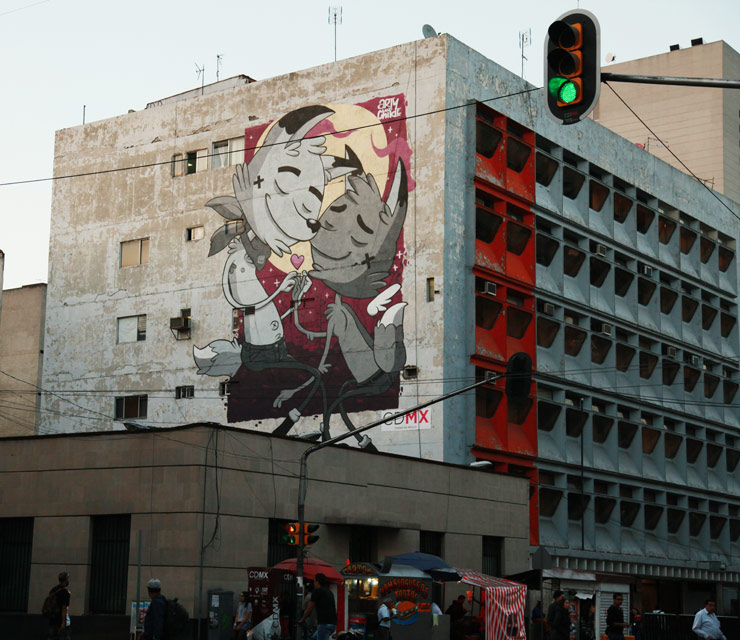
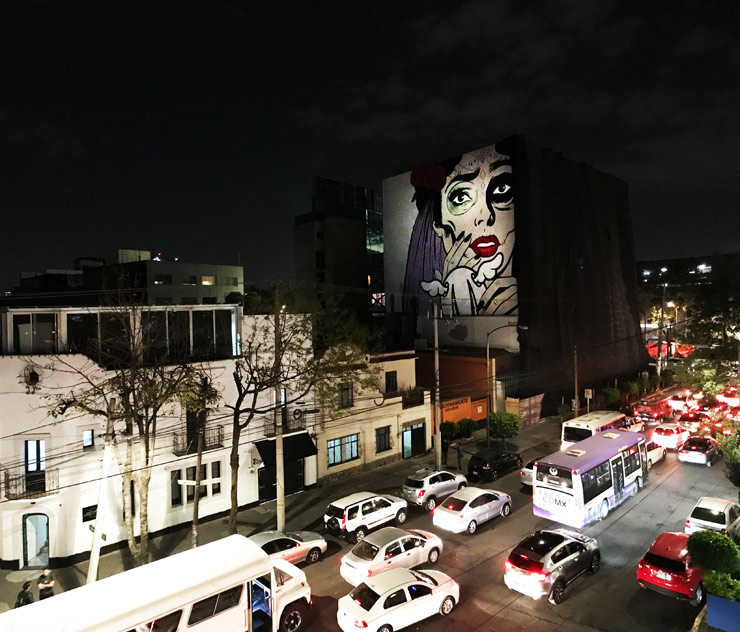
D*Face (photo © Jaime Rojo)

The scale of the murals can be as vast as the city, equally eclectically handmade and warm. Thanks to a rich heritage of mural-making and artists like Orozco, Rivera, and Siqueiros in the last century, the new generation of Mexicanos are interpolating the currents that ripple and wave through a society wedded to fierce independence and tradition. Today it is again rocked by our instant access to information and a global sense of modernity.

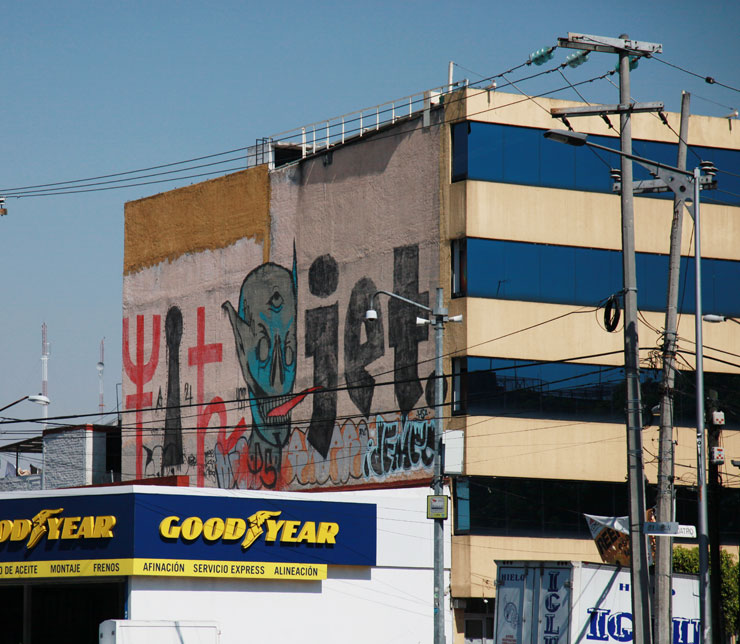
JET (photo © Jaime Rojo)

Interezni Kazki. All City Canvas 2012. (photo © Jaime Rojo)

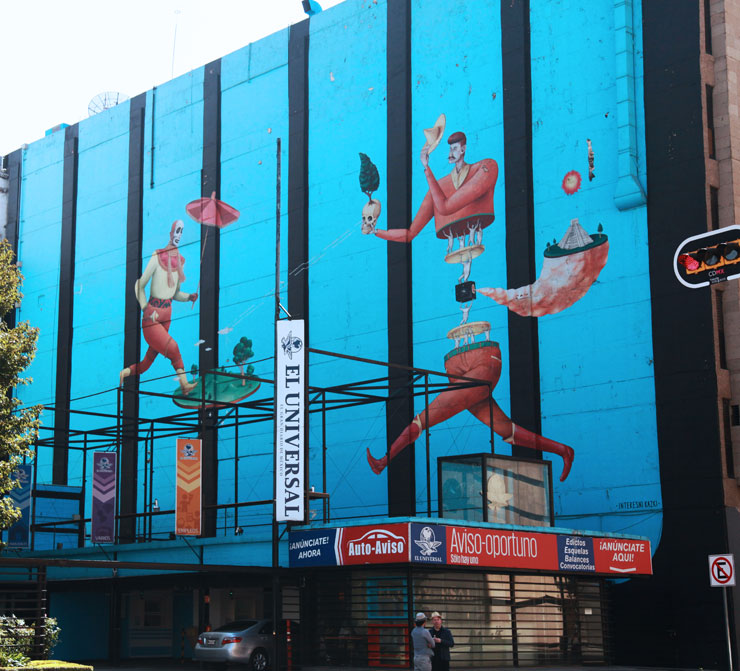
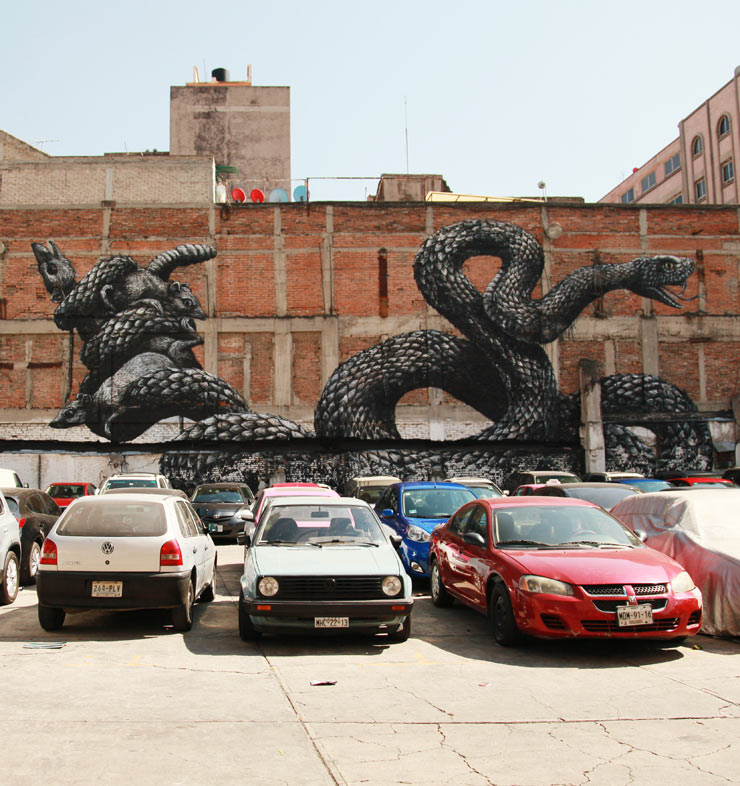
This means that an international Street Art scene in D.F. features not only Mexican alchemists like Saner, Curiot, Farid Rueda, Lesuperdemon, Dhear and Sego (among others) but also invites the English D*Face, Italians Ericailcane and BLU, Belgian ROA, Los Angelianos Retna and El Mac, Polish M-City, Argentian JAZ and German duo Herakut to influence the voice of the street. With a visual wealth of inspiration and disruptive or unusual imagery in play on the street, this still  jittery city smiles and confronts you as the year turns, a response that is in flux and fiesta, sorrow and memory, outrage and magic.

ROA. All City Canvas 2012. (photo © Jaime Rojo)

While traveling through the city with Roberto Shimizu, a central figure in the modern Street Art/mural scene here, and by visiting Street Artists and critical curators and organizers in studios and alternative spaces inside and outside the city, we garnered a greater appreciation for the complexity of the story here. It is distinctly different from the model we’ve seen elsewhere and explains the less showy trajectory that this still organic ecosystem has taken.

Unidentified Artist (photo © Jaime Rojo)

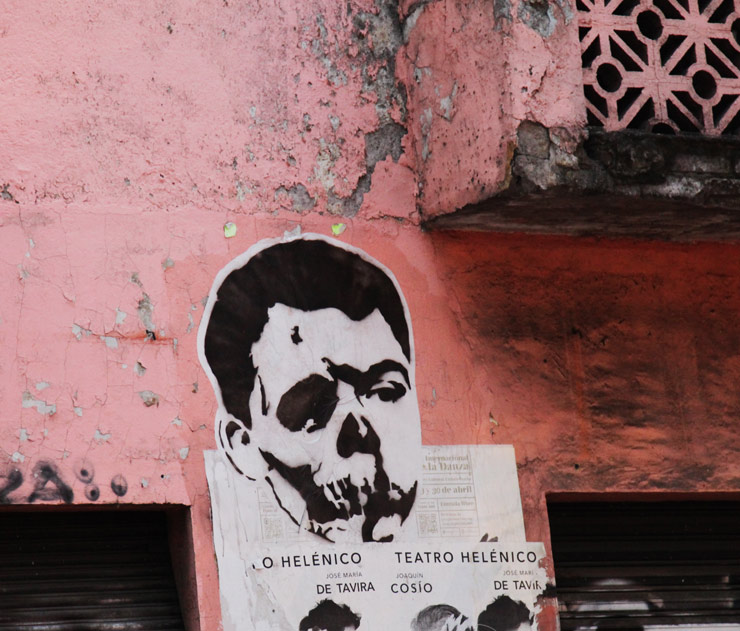
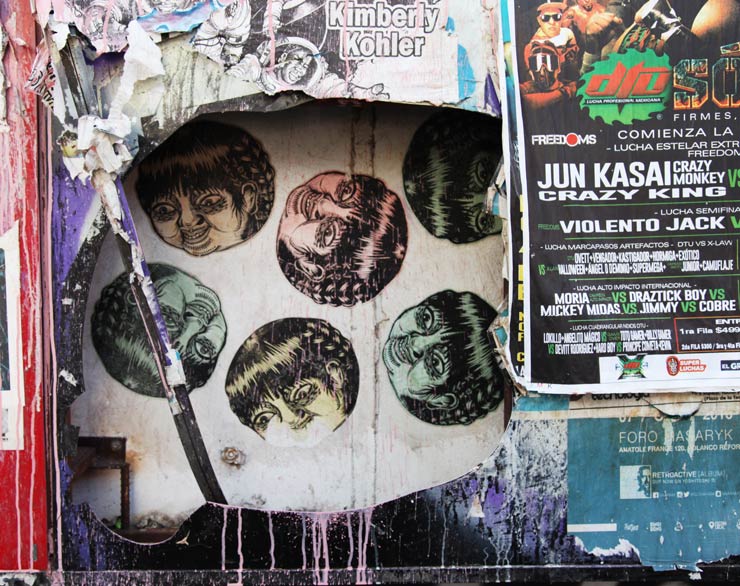
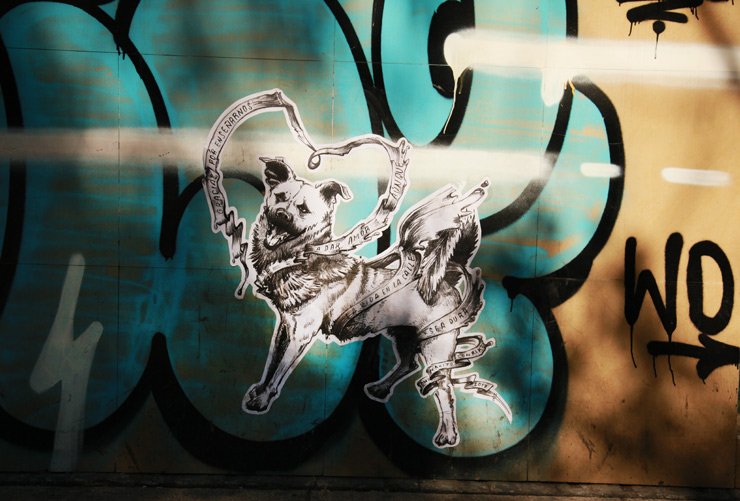
As in most cities today you’ll find the organic and autonomous quality of works is best represented by one-off, handmade individual pieces of art and stickers throughout neighborhoods, many anonymous. These are not the large scale legal murals that unfamiliar observers sometimes refer to as Street Art. These are still the lifeblood of any real Street Art scene and are often indicators of its truer eclectic nature.

Unidentified Artist (photo © Jaime Rojo)

Maybe because there isn’t a large collector base for this work, or because some brands/marketers have already cheapened its image a bit, but Street Art hasn’t blossomed in the gallery world here to a great extent. Instead, true cultural curators like Shimizu have consistently led it directly to his festival programs or his family’s Mexico City’s Antique Toy Museum (MUJAM), and professors at the Universidad Nacional Autónoma de México (UNAM) are teaching about it to students .

Milamores and El Flaco. La Linea Street Art. Cholula, Puebla. 2012. (photo © Jaime Rojo)

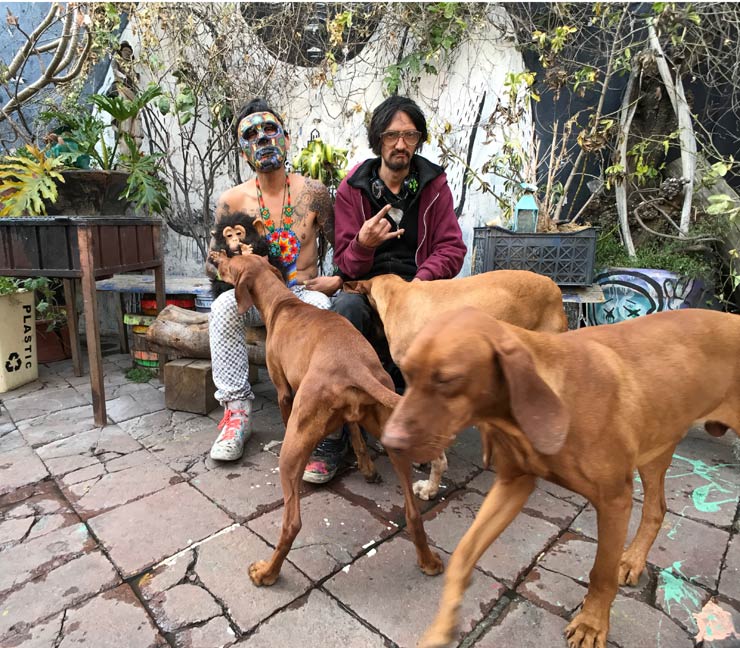
We usually find the true nature of Street Art here is still in the streets – and in the artists community. In the Chulula area of nearby Puebla outside Mexico City, the mysterious renaissance seer named Milamores has quietly curated walls of many local and international artists over the last half decade, offering his compound and dogs for rest and companionship in a supportive artists space. Together with video animation artist Flaco he is presenting Street Art via Virtual Reality experiences that are in tandem with his organically grown mural program. Built on the site of a collapsed building from the 1985 earthquake, the artist/activist collective and community garden Huerto Roma Verde provides classes and workshops on art, sustainable architecture, gardening, and theater and has helped many artists to with mural opportunities as well.

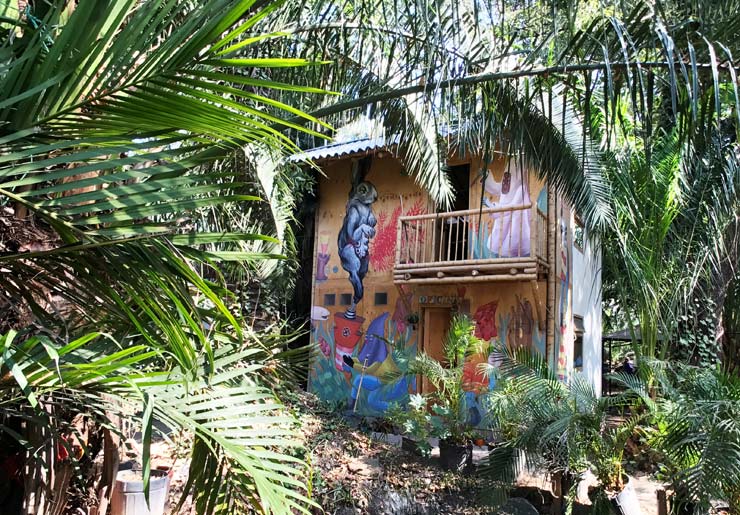
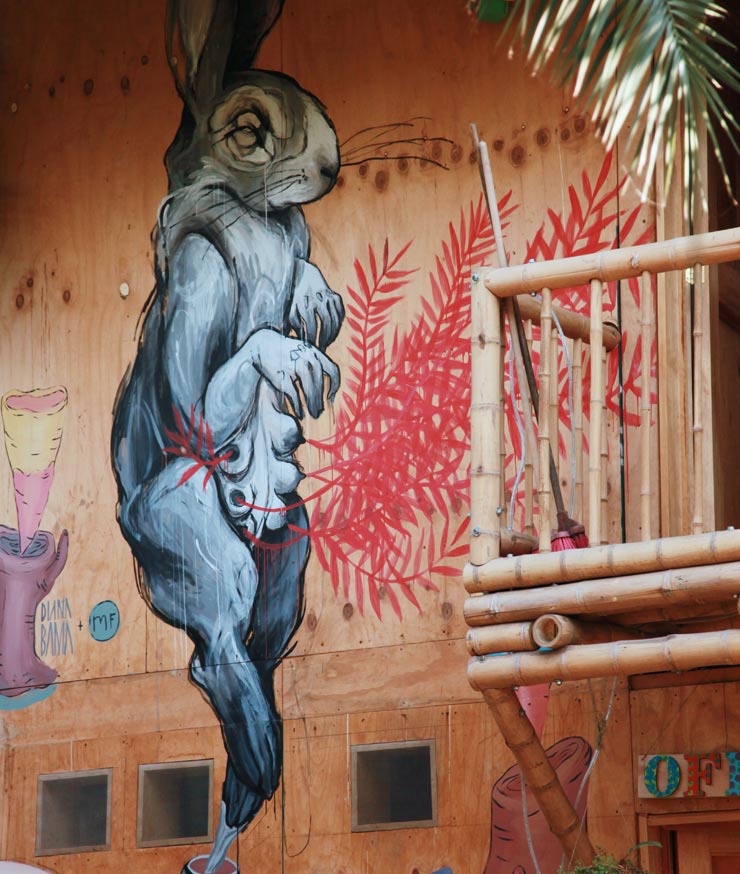
Diana Bama . Martin Ferreira. Huerto Roma Verde. (photo © Jaime Rojo)

Diana Bama . Martin Ferreira. Huerto Roma Verde. (photo © Jaime Rojo)

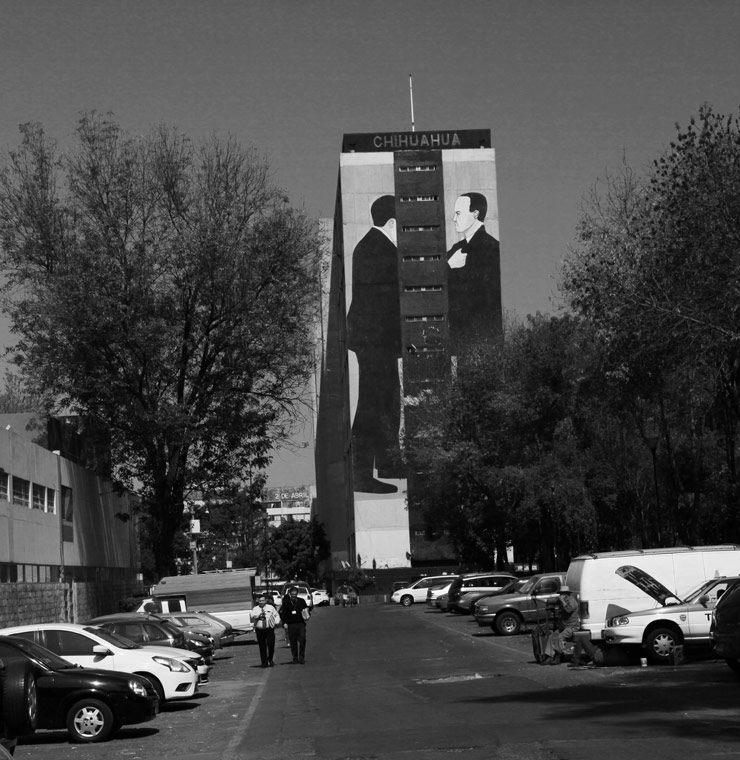
As an emblem of the conflicting and harmonious forces at play, we cite the relatively recent mural painted by the Spanish Street Artist Escif on the wall of the Chihuahua housing complex on the Plaza of Three Cultures just north of the city center. Illustrating the privately funded public projects that Street Artists are doing now throughout cities, this one plumbs the unhealed wounds and still unanswered questions of a shocking event of political repression almost 50 years ago here in the plaza designed by Mario Pani.

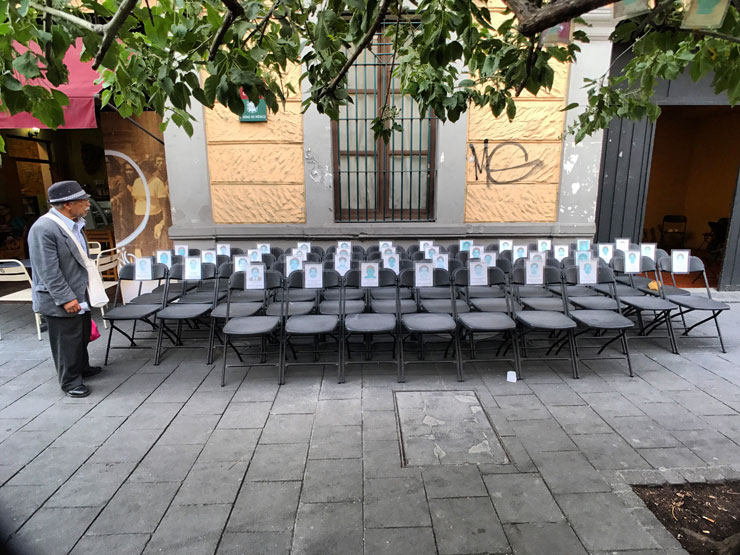
Not only does the plaza physically join together a Spanish colonial church and the remains of a pre-Columbian Aztec temple with the 13 story housing complex, the square is most known today for the October 1968 suppression of a student movement where troops ran directly over the ruins and fired on a peaceful rally and secret police captured and tortured student leaders who were speaking from the balcony. Protest art and public installations about the 2014 Iguala mass kidnapping of 43 disappeared students recall the stories from 1968 today, and many make connections between the events.

Unidentified Artist. Installation in El Centro Historico for the 43 Desaparecidos. (photo © Jaime Rojo)

Some academics have said the crushing of the student movement was part of a secret “dirty war” by the government to quiet dissent and present a unified Mexico image to the world ahead of the upcoming Olympics, but Shimizu tells us that visiting politicians to Escif’s new wall are pleased with the mural and made a tour by bus with guests to admire it. A monument to the Tlatelolco massacre stands in the plaza memorializing the events, and Escif made a few statements about his interpretation of his mural.

“As in my previous works, there is not a limited meaning in the ‘Chihuahua Mural’, but as many meanings as people try to approach it with,” said Escif to us recently about the two suited figures. He discusses his research into the events that took place, but ultimately he leaves the painting more open to interpretation. “Those two guys painted on the wall can be secretive executives, military officers, corporate people or anybody. That will depend on who sees the wall and his previous experiences.”

Unidentified Artist (photo © Jaime Rojo)

For visitors to Mexico City looking for the local Street Art or graffiti scene it is helpful to recognize that this moment for a near-global fascination for art in the streets is here also intertwined with a national and local history, cultural pride, and the treasured heritage of indigenous peoples.

While so-called “western” countries may see a rebellious disaffected rage or critique as an overarching narrative for the graffiti and Street Art scene in New York, London, or Berlin, it may be that Mexico City, and Latin America by extension, is also very cognizant of its roots, in love with them even, always infusing new work with a certain respect for their progenitors. For an art practice that is characterized in part for its ephemerality the context of this particular urban environment reminds you of its often remarkable resilience.

Dueke . Miss1 Guette for MUJAM. (photo © Jaime Rojo)

RETNA. The Beauty Project, 2017. (photo © Jaime Rojo)

ROA. La Linea Street Art. Cholula, Puebla. 2012. (photo © Jaime Rojo)

ROA. La Linea Street Art. Cholula, Puebla. 2012. (photo © Jaime Rojo)

ROA. La Linea Street Art. Cholula, Puebla. 2012. (photo © Jaime Rojo)

ROA. La Linea Street Art. Cholula, Puebla. 2012. (photo © Jaime Rojo)

Curiot (photo © Jaime Rojo)

Curiot. Detial. (photo © Jaime Rojo)

SINKO (photo © Jaime Rojo)

Unidentified Artist (photo © Jaime Rojo)

Interezni Kazki. La Linea Street Art. Cholula, Puebla. 2012. (photo © Jaime Rojo)

Interezni Kazki. La Linea Street Art. Cholula, Puebla. 2012. (photo © Jaime Rojo)

Unidentified Artist (photo © Jaime Rojo)

Kill Joy . Mazatl. La Linea Street Art. Cholula, Puebla. (photo © Jaime Rojo)

Unidentified Artist (photo © Jaime Rojo)

Fusca .  Blast. La Linea Street Art. Cholula, Puebla. (photo © Jaime Rojo)

Erica Ilcane. (photo © Jaime Rojo)


This is the first of two articles with BSA in Mexico City in collaboration with UN Berlin, it was originally published on the Urban Nation website, and the project is funded in part with the support of Urban Nation Museum for Urban Contemporary Art (UN) in Berlin.

Read Part II here:

A Street View From Inside the Doors of Mexico City ; Galleries, Studios, Museums, and the Metro


Additional coverage by BSA in Mexico City:

An Unlikely Museum for Street Art? MUJAM is in the MX MIX : BSA X UN X Mexico City: Day 1

Saner, Mexican Muralist and Painter, Studio Visit. BSA X UN X Mexico City: Day 2

Panteón and Watchavato “No Esto No Es Lo Que Fue” Opens In Mexico City

Exploring New Techniques and Processes with Elian, Jaz and Ever in Mexico City

BSA Images Of The Week: 11.26.17 Mexico City Special


This article is also published on the Urban Nation museum website:
 

Read more
Happy New Year 2018 from your Friends at BSA!

Happy New Year 2018 from your Friends at BSA!

Happy New Year from your friends at BSA!

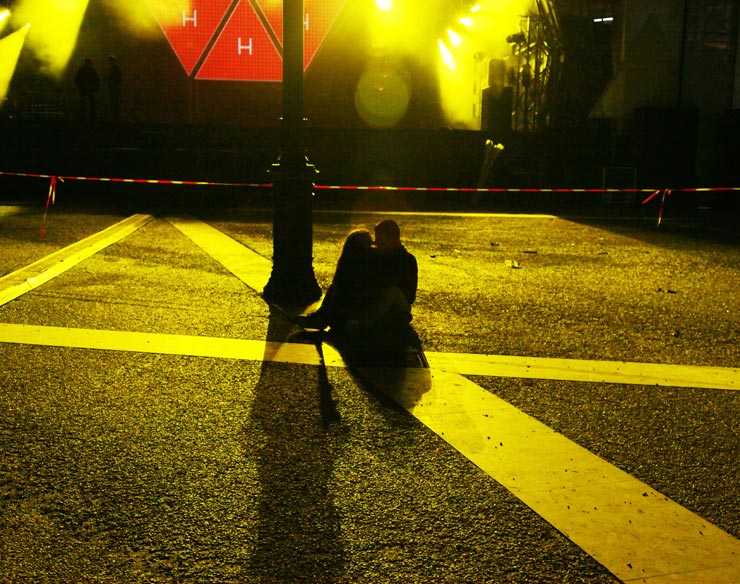
Here’s an image of the show preparations for last night’s NYE concert in the plaza of Lisbon, the Praça do Comércio, where a young couple sat oblivious to the sound, light, and screen rehearsal booming around them this week – focused only on one another. We thought it was a great way to start 2018 with the hopes of youth in love – and love in general for all of us, no?

In the year just passed we were so very lucky to meet some of the most talented, erudite, free-thinking, politically savvy, emotionally unhinged, malajusted, and brilliant artists, organizers, curators, academics, social scientists, fans, photographers, videographers, directors, writers, debaters and street-wise people around the global Street Art scene. Respect!

Thanks to all of the artists and organizers who showed us around their cities in person in ’17 in Mexico, Hong Kong, Scotland, Germany, Sweden, French Polynesia, and Lisbon. As a special call-out we would like to thank the 150 artists inside and 40 artists outside who worked with us and our full UN team to created the opening inaugural show at Urban Nation (UN) and the Martha Cooper Library in Berlin.

Our thanks also for the support and advice from those who have the expertise and really have our backs. Without the open and welcoming members of this global Street Art-Graffiti-Urban Art-Contemporary Art community who lead us in the right direction we cannot possibly share as much as we do with BSA readers. Also, we are thankful for the obstacles and difficult times – they have made us stronger and more appreciative.

As BSA celebrates our 10th year in 2018, we invite you to come with us!

Finally, to recap the names of our annual BSA holiday tradition, we would like to thank the artists who dared to have Wishes and Hopes for 2018;

Esteban Marin

Felipe Pantone

Miss Van

Vermibus

Faith XLVII

Fintan Magee

Pixel Pancho

NeSpoon

Saner

Various & Gould

1Up Crew

Case Maclaim

M-City

The Yok & Sheryo

OLEK

DOT DOT DOT


Read more
DOT DOT DOT: Wishes And Hopes For 2018
DOT DOT DOT: Wishes And Hopes For 2018
   

As we draw closer to the new year we’ve asked a very special guest every day to take a moment to reflect on 2017 and to tell us about one photograph that best captures the year for them. It’s an assortment of treats to surprise you with every day – to enjoy and contemplate as we all reflect on the year that has passed and conjure our hopes and wishes for 2018. This is our way of sharing the sweetness of the season and of saying ‘Thank You’ to each of you for inspiring us throughout the year.

*******

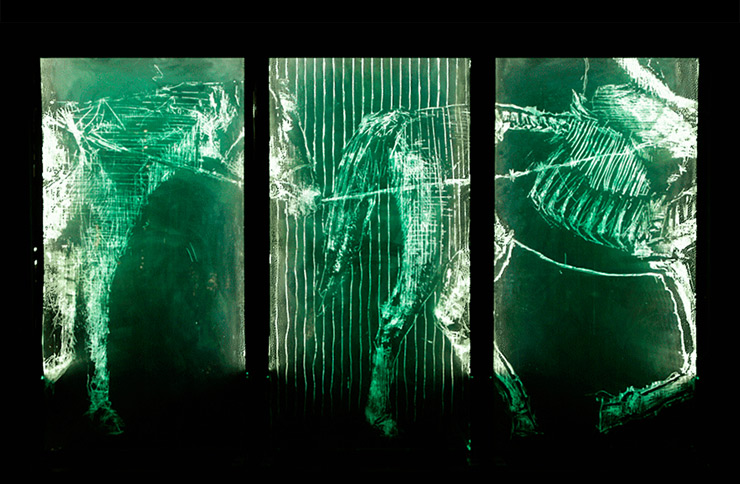
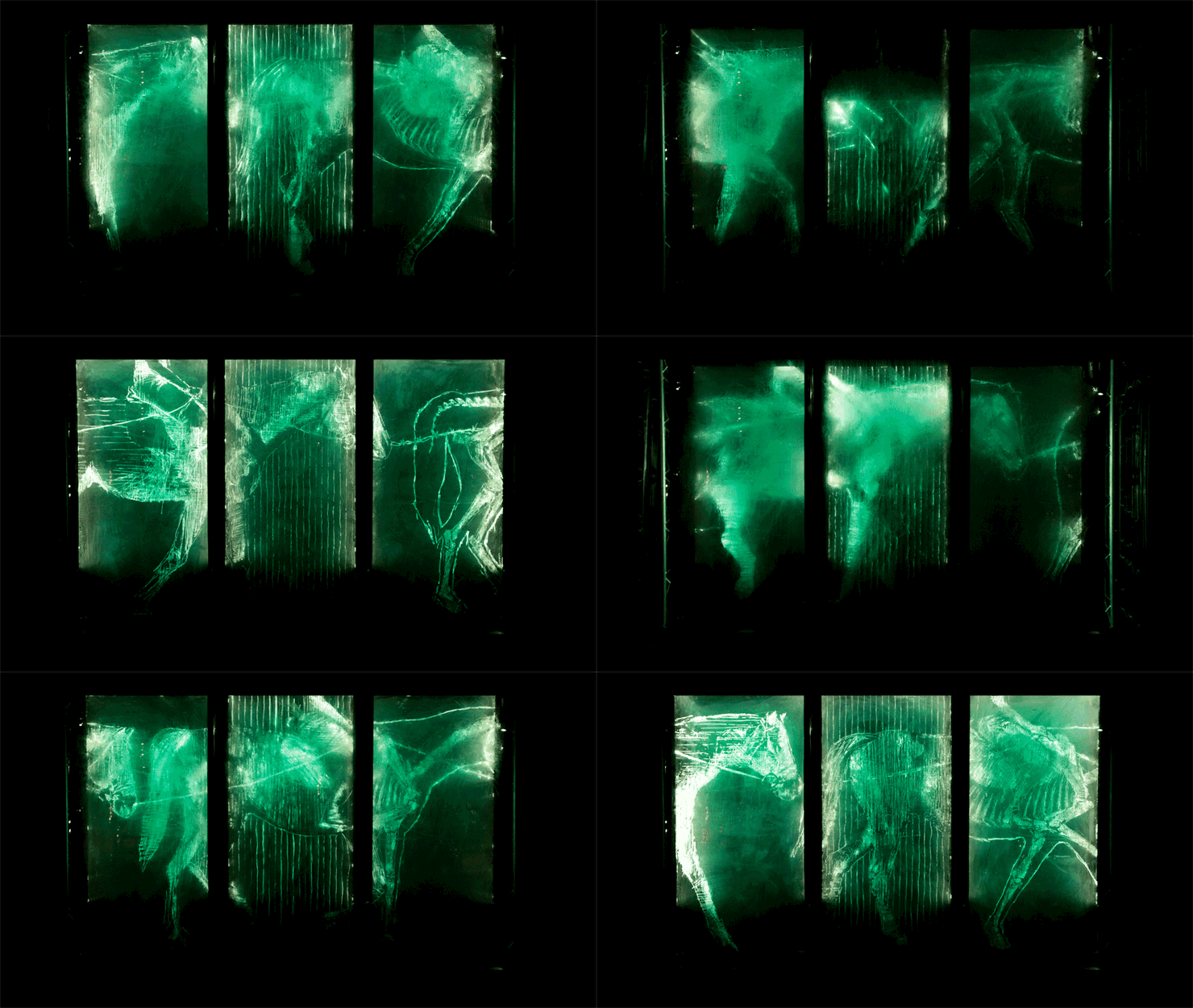
The Norwegian visual, public and conceptual artist DOT DOT DOT continues to define and explore his voice in his stencil works, whether solo or in collaboration. This year his detailed illustrations of vintage spray cans drew attention to his bonifides as an aerosol culture preservationist and his indoor/outdoor installations with the Urban Nation Museum for Urban Contemporary Art (UN) exposed him and his work to new audiences. For a 90s graff writer growing up outside Oslo, the move to an international stage continues, as does his taste for discovery. Today, at the beginning of the New Year, DOT DOT DOT says he is inspired by the work of another Street Artist/fine artist, Borondo, and his animated multi-layered glass installation on the art mile at Urban Nation this September- encouraging each of us to move forward.


DOT DOT DOT

We all have ended up in a certain safe path, and when something works it’s difficult to step back and break out.

“Hierarchie” by Gonzalo Borondo at the opening of the new Urban Nation Museum for Urban Contemporary Art (UN) in Berlin, is a proof that we evolve.

“I wish the best to everyone out there to never stop growing, never be the same, make room for the possible and to believe in creating infinity… Happy New Year!


Artist: Gonzalo Borondo

September 16th, 2017

Location: Berlin, Germany

(Photo/Video: Gerdi Petanaj)


DOT DOT DOT

Read more
OLEK: Wishes And Hopes For 2018

OLEK: Wishes And Hopes For 2018

As we draw closer to the new year we’ve asked a very special guest every day to take a moment to reflect on 2017 and to tell us about one photograph that best captures the year for them. It’s an assortment of treats to surprise you with every day – to enjoy and contemplate as we all reflect on the year that has passed and conjure our hopes and wishes for 2018. This is our way of sharing the sweetness of the season and of saying ‘Thank You’ to each of you for inspiring us throughout the year.

*******

Poland-born Brooklyn-residing crochet innovator OLEK devises and implicates and eradicates and constructs and executes abstract emotions and socio-politically charged strategies into her public performance pieces and installations in places as far-flung as India and Stockholm and Raleigh, North Carolina. Few fools are suffered, local volunteers are engaged, and heroicism seems always within reach as the crocheted crusader takes on issues of inequality, systemic-institutional bias, alienation, discrimination, immigration, the war machine, the refugees that are created by it, the psychic wounds created by it. Sometimes it feels like each day we get to see a different expression of OLEK’s heart and creativity in the public arena. Today she shares with us a chance encounter she had with two women this year and how it inspired her to have courage and to spread its message.


OLEK

A conversation between Lama and Sarah:

Lama: When I saw them, I was really scared.
Sarah: I started thinking: “How did we do it?  How did we find the courage to do something like that?”
Lama: Do you think one of our vests might be there?
Sarah: I don’t know.
Lama: Can you imagine if one of them is ours?
Sarah: When I first saw them I felt the chills all over my body. I immediately remembered everything and felt that someone is thinking about us.

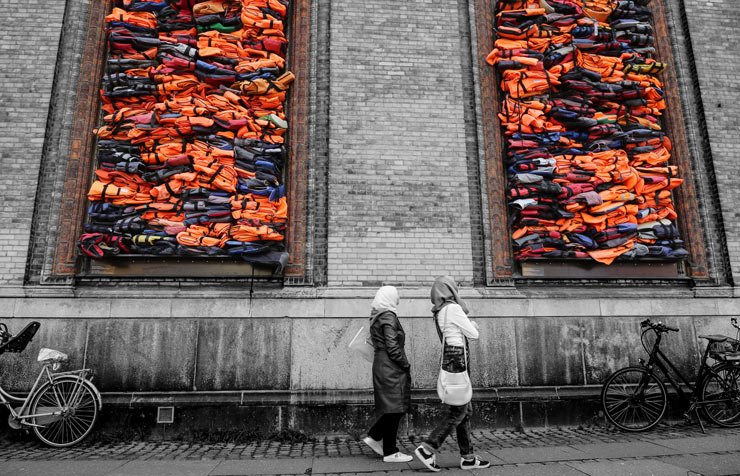
I met these two brave women while working on an exhibition in the Avesta Museum in Sweden. They have became a huge inspiration for my work and recently I’ve decided to shoot a documentary about their ability to create a new life in a strange country after being forced to flee their home in Syria. On September 18th, 2017 we took a train from Berlin to Stockholm, and this journey became the set for a dialog about their very difficult and dangerous trip. During our 2 hour stopover in Copenhagen, we decided to leave the train station and wander around the city. This is how we coincidently arrived at Ai Weiwei’s installation ‘Soleil Levant,’ created out of 3,500 life jackets.

With this image, I wish everyone in the upcoming year deep, resilient and unlimited courage. Courage to step outside of one’s comfort zone; Courage to start all over again if necessary; Courage to chase your dream; Courage to speak out; Courage to listen to your heart; Courage to succeed.

Olek. Lama and Sarah in front of Ai Weiwei’s installation ‘Soleil Levant’ created out of 3,500 life jackets, Copenhagen, Denmark, September 18th 2017. (photo courtesy of Olek)


OLEK

Read more
The Yok & Sheryo: Wishes And Hopes For 2018

The Yok & Sheryo: Wishes And Hopes For 2018

As we draw closer to the new year we’ve asked a very special guest every day to take a moment to reflect on 2017 and to tell us about one photograph that best captures the year for them. It’s an assortment of treats to surprise you with every day – to enjoy and contemplate as we all reflect on the year that has passed and conjure our hopes and wishes for 2018. This is our way of sharing the sweetness of the season and of saying ‘Thank You’ to each of you for inspiring us throughout the year.

*******

The on-the-road nature of this graffiti-illustration-Street Art couple is becoming legend, with the Australian Yok and Singaporean Sheryo professionally spray-cationing across the world regularly, monthly, annually with their own particular hybrid of skater-tattoo-cartoon-rebel-traditional-culture reinventing itself in the moment, in the space. Officially Brooklyn citizens, the two wield aerosol cans as much to entertain themselves as to confound you, with their two aesthetic styles now seamlessly becoming one. Not content to present a pretty world, Yok and Sheryo investigate and analyze darker human impulses and psychological eccentricities with their characters and the trouble they can get into with monsters and pizza. Today Y&S tell us about an improvised piece they did this year in Bombay just for good luck.


THE YOK & SHERYO

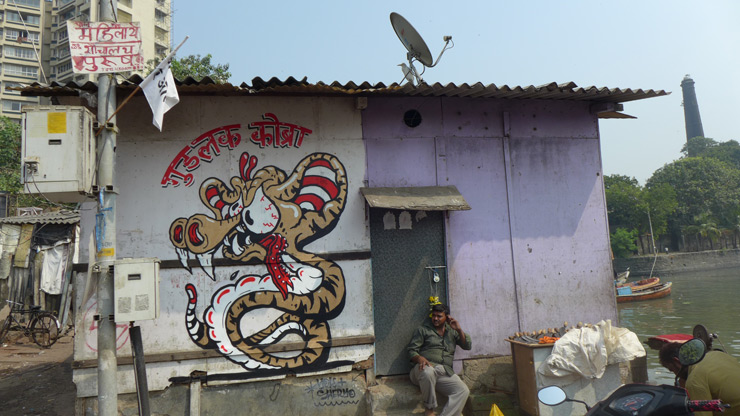
We chose this photo because it is a glimpse of us on the road, this was an extra piece we painted while at a festival. A wall opportunity fell through so we made this piece instead.

These spontaneous paintings are what we enjoy most about traveling and we wish for more of these adventures in 2018.

The text translates to “Good Luck Cobra”

We like to leave little good luck charms in places we visit.

The Yok & Sheryo. Bombay, India. November 24, 2017. (photo © The Yok & Sheryo)

The Yok & Sheryo

Read more