New York has long acted as a magnet for graffiti and street artists from around the world—not just because of its mythology, but because this is where the culture took shape, evolved, fractured, and spread outward over more than five decades. For many, that history still matters.
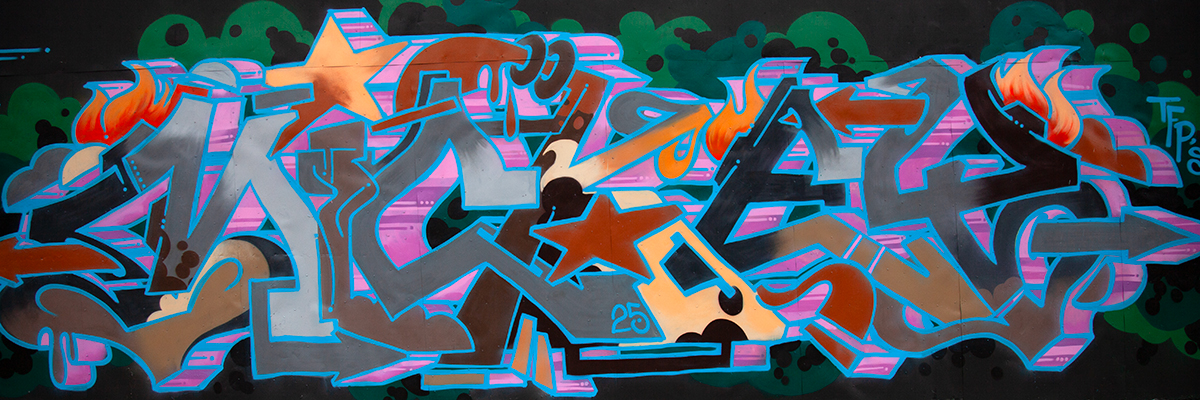
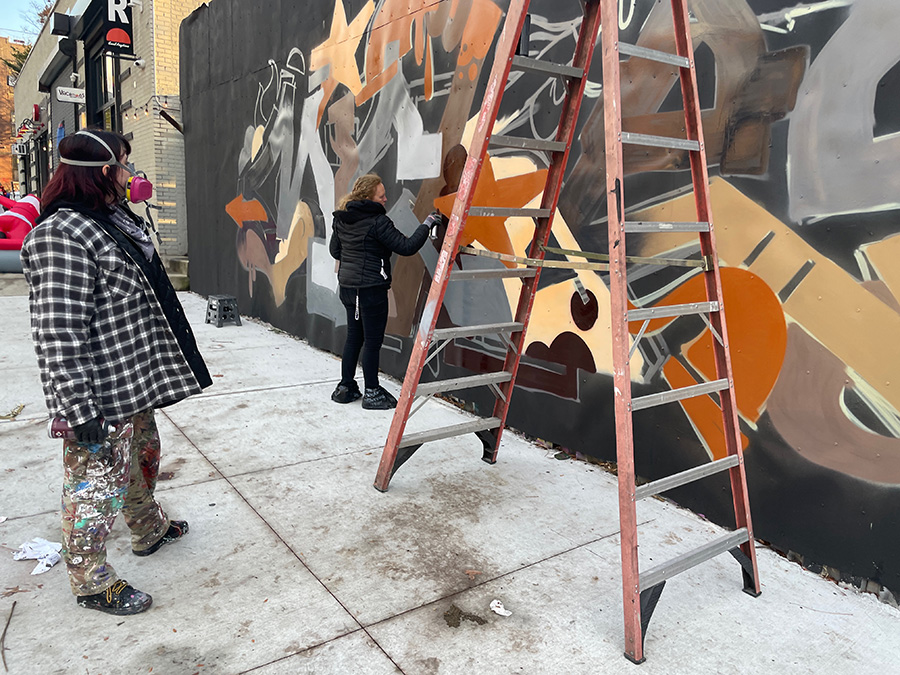
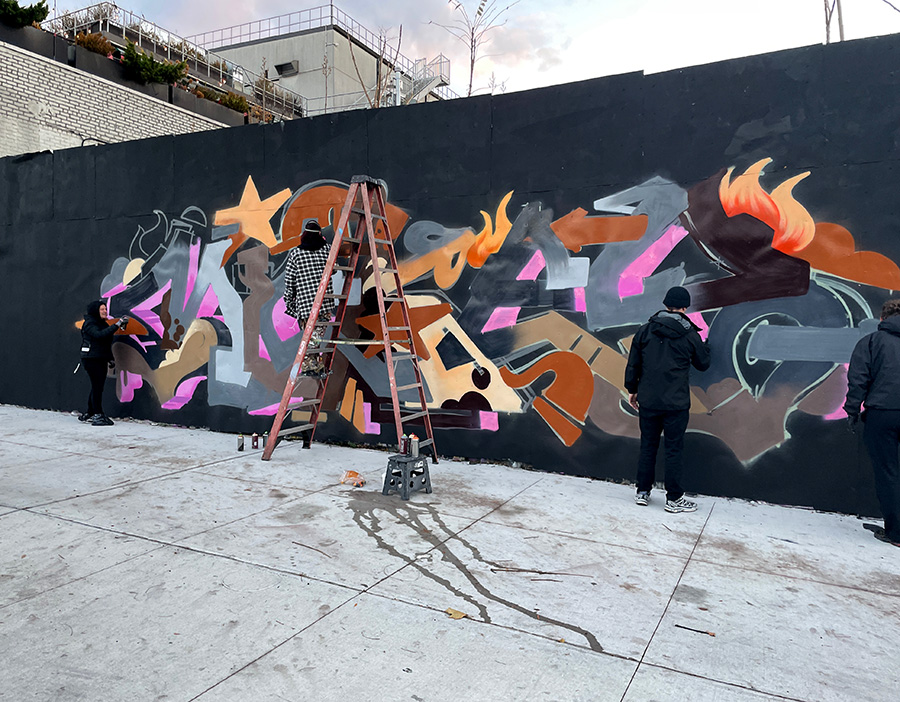
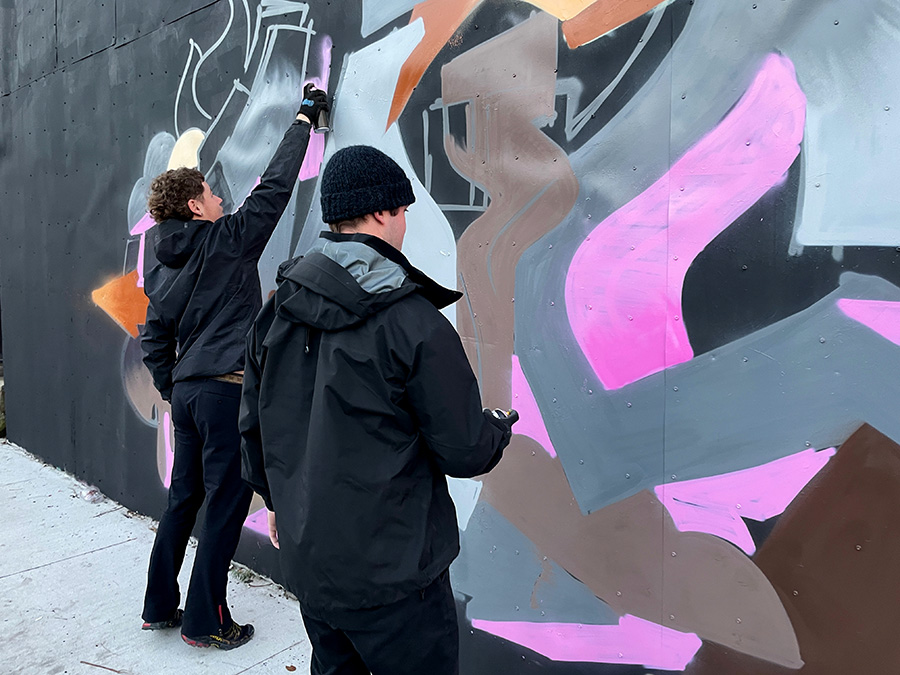
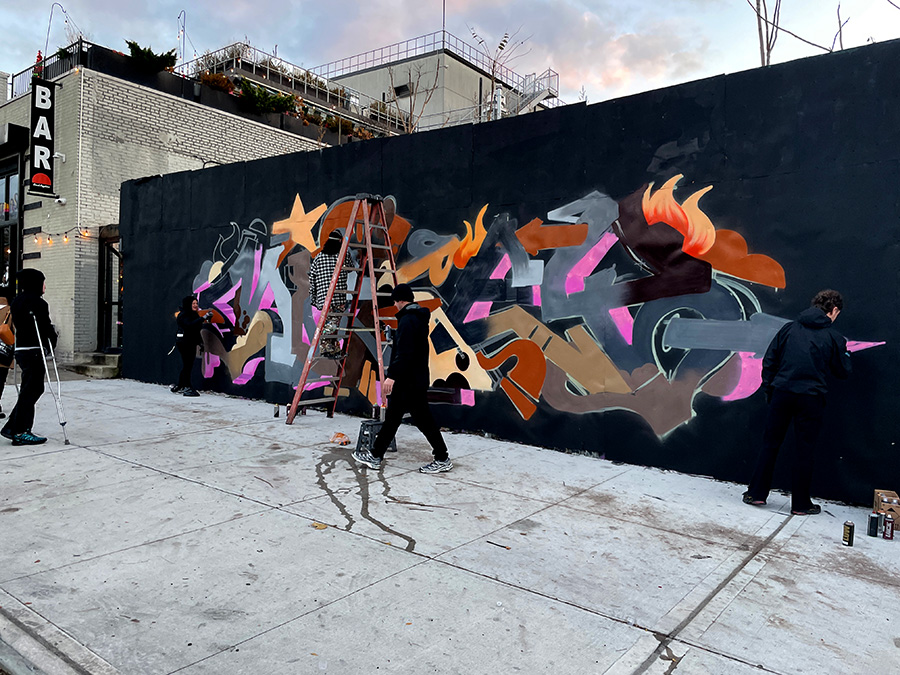
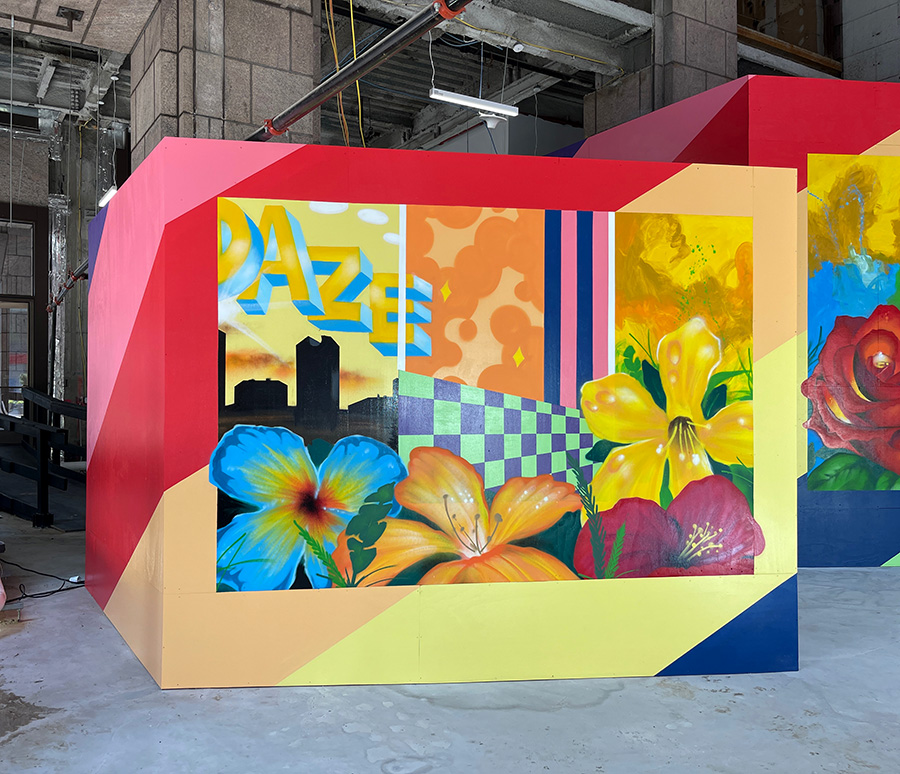
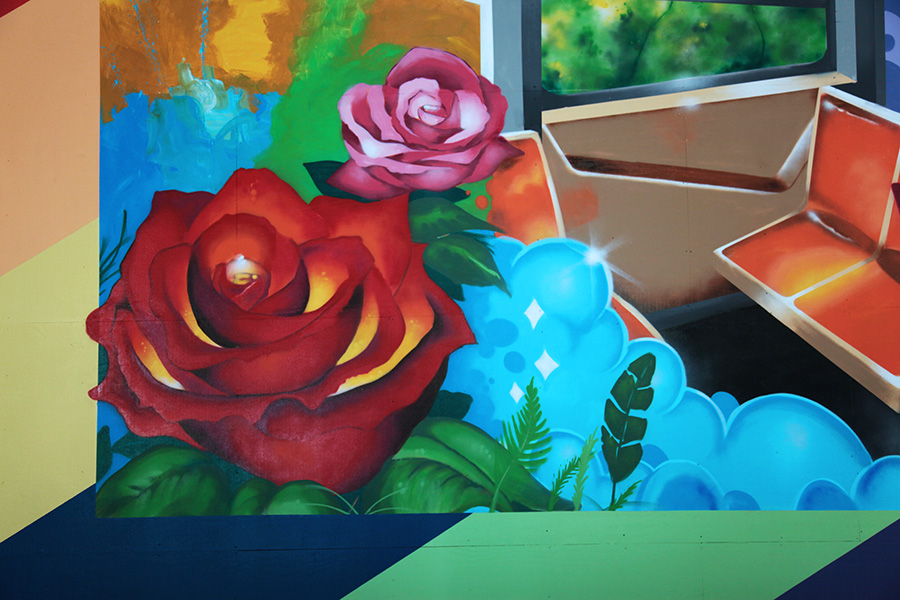
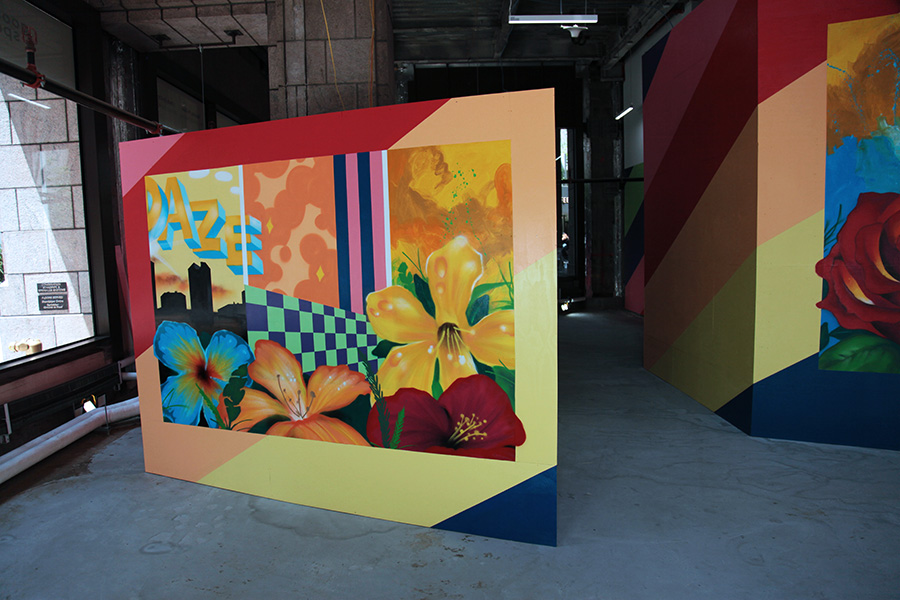
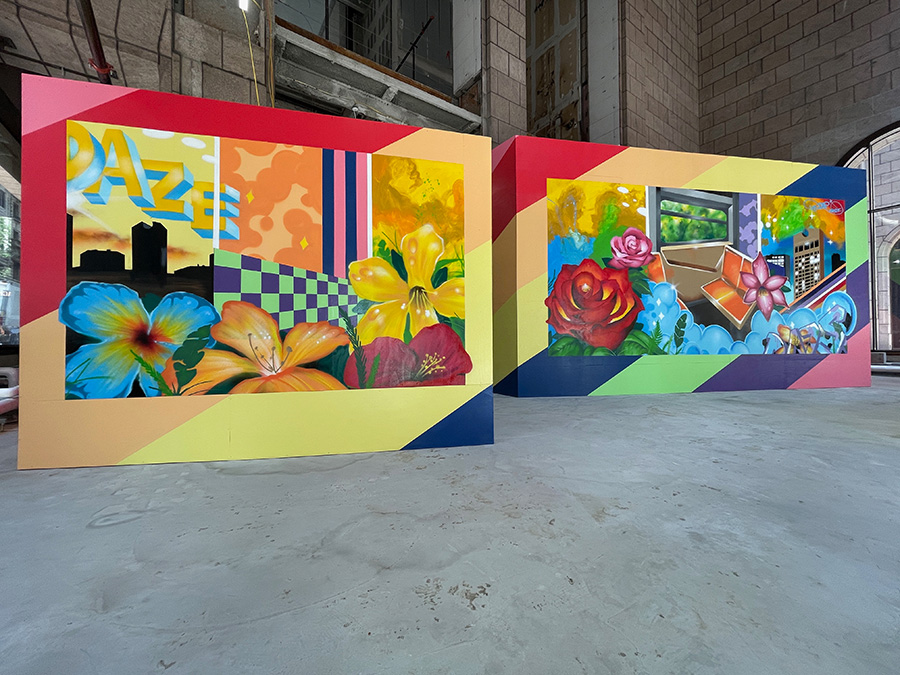
So when Mick La Roc—an important figure in the international graffiti scene who has been writing and painting since the 1980s—recently passed through Brooklyn and took on a new wall, the response was immediate. Despite freezing temperatures, tough winds, and the limited available hours of a short winter day, the block began to fill with young writers and established artists alike. They were eager to meet her, reconnect, paint alongside her, and help bring the piece to completion before she returned to Amsterdam. BSA caught up with Mick La Roc as cans were passed, layers were added, and a multigenerational wall came together—an appropriate setting for an artist whose history and approach have always leaned toward inclusion and exchange.
Mick La Roc came up as a graffiti writer at a time when very few women were visible or welcomed in the culture. Her presence was not positioned as a statement so much as a commitment—showing up, painting, and earning respect through practice. That early grounding in graffiti’s codes, risks, and sense of community shaped her understanding of the street as a place of shared experience as well as rock-solid performance, and it continues to inform how she approaches both public and studio work.
Over time, La Roc has moved between street and studio without severing ties to graffiti’s history or its people. Through decades of activity, she has accumulated a deep reservoir of firsthand stories, images, and lived knowledge—an informal archive built through participation and some retrospection. She shares that history openly, often working alongside younger writers and painters, pairing her own experience with new voices in ways that emphasize continuity rather than hierarchy.
Alongside this role, La Roc has maintained an active international presence for more than four decades, with work appearing on the streets and in exhibitions in cities including New York, Berlin, London, and Paris. She has participated in festivals, group exhibitions, and gallery projects that situate her practice within broader conversations around graffiti, street art, and urban contemporary culture. Her work is often discussed alongside other women who helped expand the field’s visual and social possibilities, while remaining firmly rooted in the graffiti lineage that shaped her early years.
Brooklyn Street Art:You’ve painted in cities all over the world, but New York carries a particular weight in graffiti history. What does it feel like to be back here, painting in Bushwick today? Mick La Roc: It’s really great to be back in New York. Bushwick kind of blew me away. There’s so much street art and graffiti now. The last time I was here was about ten years ago, and it didn’t feel like this at all. What I’m seeing now is really impressive, and I’m happy to be part of it.
BSA:Compared to your last visit, what stands out most to you about how the neighborhood has changed visually? Mick La Roc: It definitely feels like there’s more work now. It keeps expanding. I think more people are open to having their walls or buildings painted compared to the last time I was here.
BSA:Bushwick has become a place where graffiti and street art coexist very closely. How does that mix read to you as someone who came up through graffiti? Mick La Roc: I see a lot of street art, and also a lot of graffiti. To me it’s kind of like Japanese and English—you need both languages. So I think the balance is okay. Honestly, though, I haven’t analyzed it too much. I’ve mostly just been walking around, taking it all in.
BSA:You started writing and painting in the early 1980s, long before graffiti was widely accepted. When did New York first enter the picture for you? Mick La Roc: I started writing my name in 1983, and I started painting in 1985. The first time I came to New York was in 1993.
BSA:Do you remember where you landed when you first arrived? Mick La Roc: I stayed in South Ozone Park. That’s actually where I painted my first pieces here. On 104th Street, I did my first train, and I also painted my first really big piece—it was about this size (gesturing toward the current wall)—at the Franklin K. Lane schoolyard.
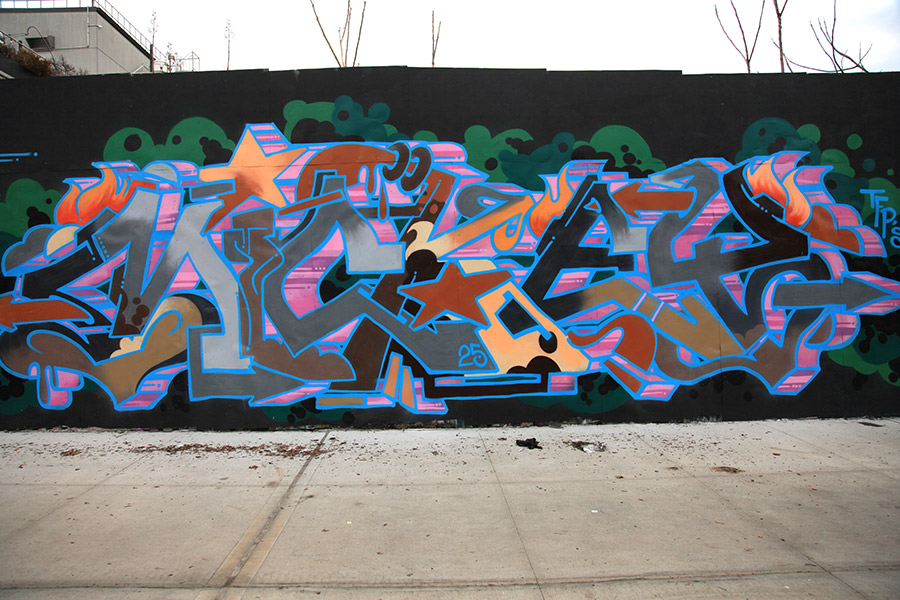
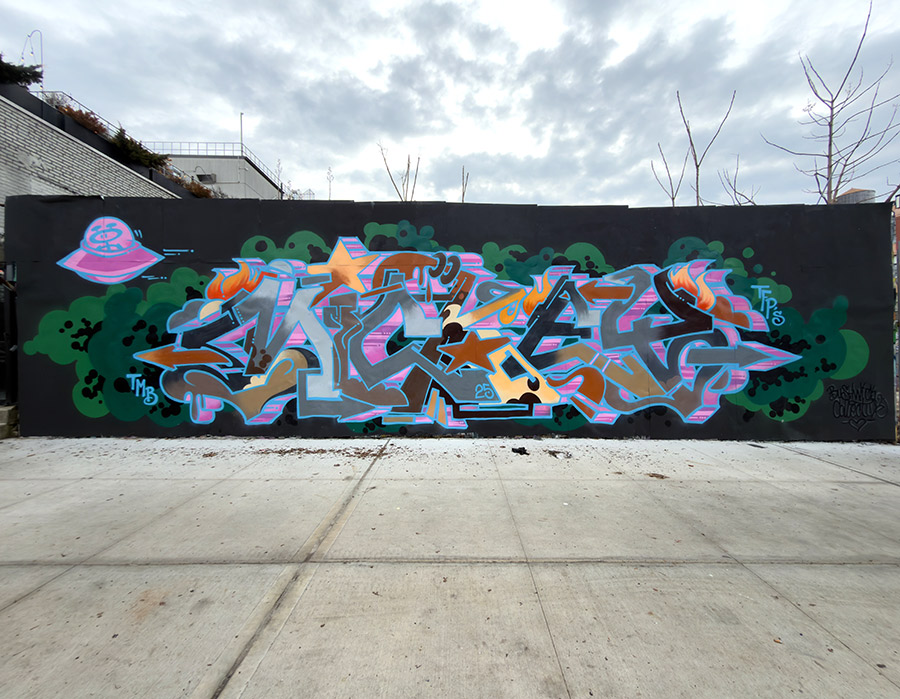
Brooklyn Street Art:What are you working on here today, and why did you choose this approach for this wall? Mick La Roc: I’m doing a traditional New York–style name piece. Style writing. Just my name.
Brooklyn Street Art:This wall turned into a group effort pretty quickly. Who ended up painting with you today? Mick La Roc: I’ve been really lucky. Nikki, who has worked closely with Lady Pink over the years, is here with me, which I really appreciate. And then a few guys from the scene stopped by—people I know—telling me their New York stories as they’re living them right now. I asked if they wanted to help out, and they jumped in. That was really nice.
Brooklyn Street Art:There’s a strong sense of respect and familiarity happening around this wall. Does that kind of spontaneous collaboration still matter to you? Mick La Roc: Yeah, it really does. When the Bushwick Collective offered me this wall and I saw the size of it, I thought, why not do the biggest one? Go big or go home!
Michal Škapa (b. 1978, Prague), known in graffiti circles as Tron, is one of the defining figures of the Czech graffiti movement. He emerged in the first wave of Prague writers in the early–mid 1990s, active in influential crews such as DSK, CAP, NUTS, and TOYZ. His reputation grew not only through his presence on Prague’s walls and train lines but also through some of his under-the-radar painting exploits — always a symbolic moment for graffiti writers testing their ambition.
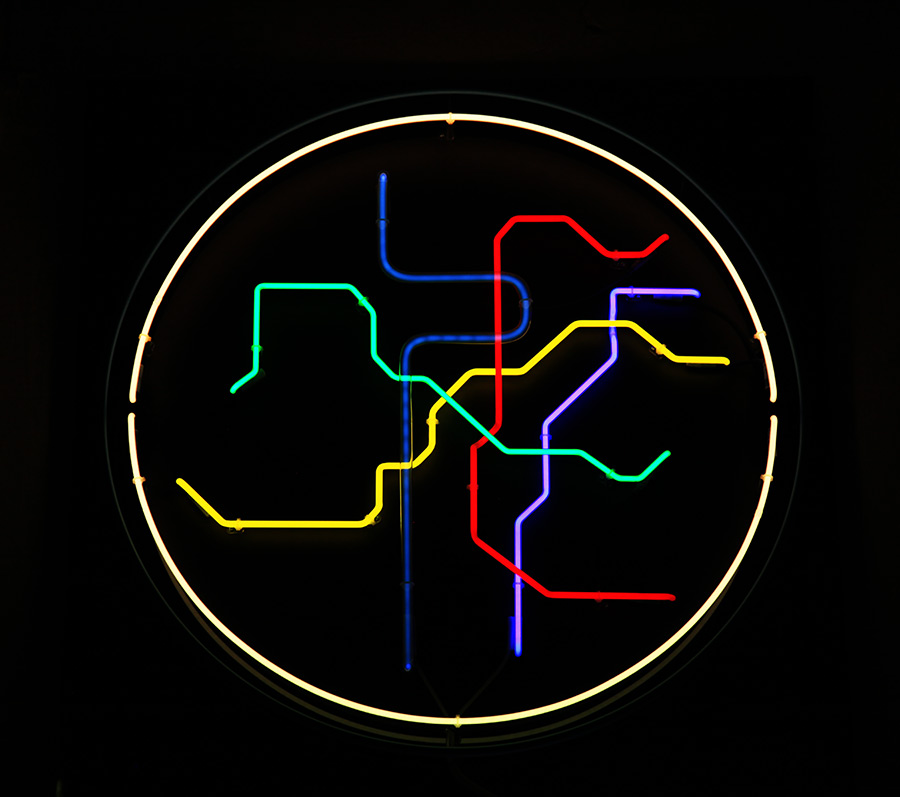
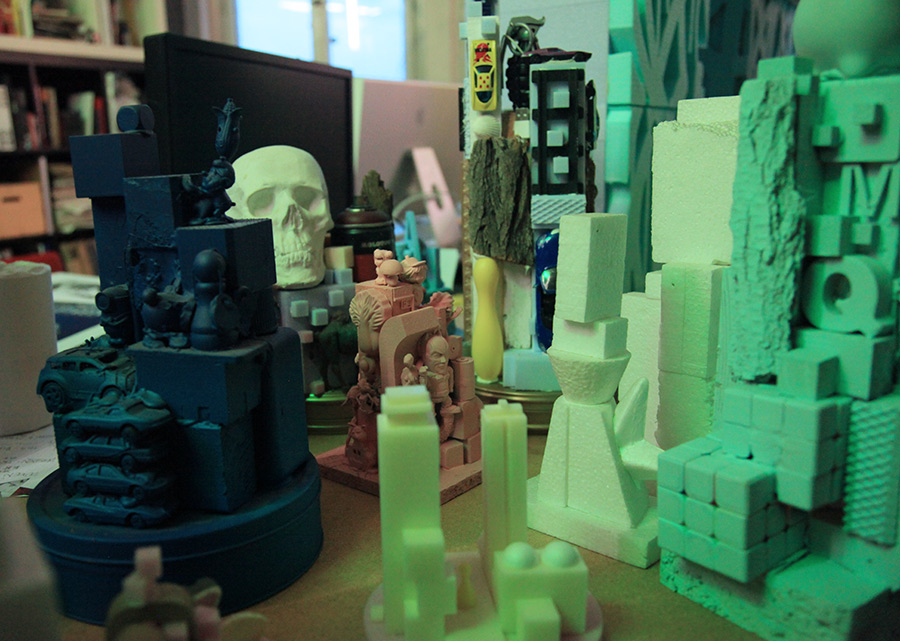
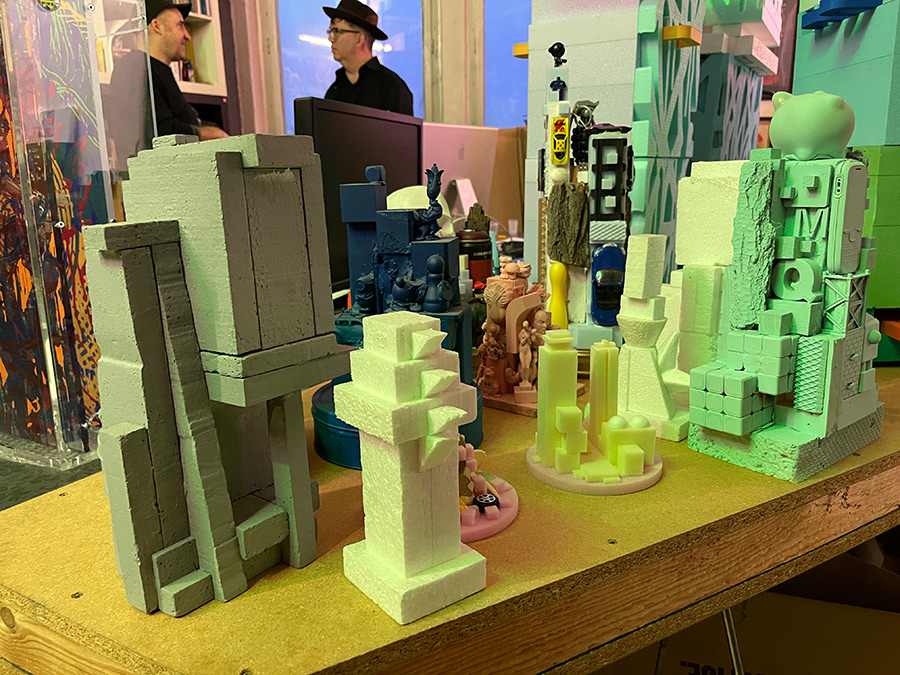
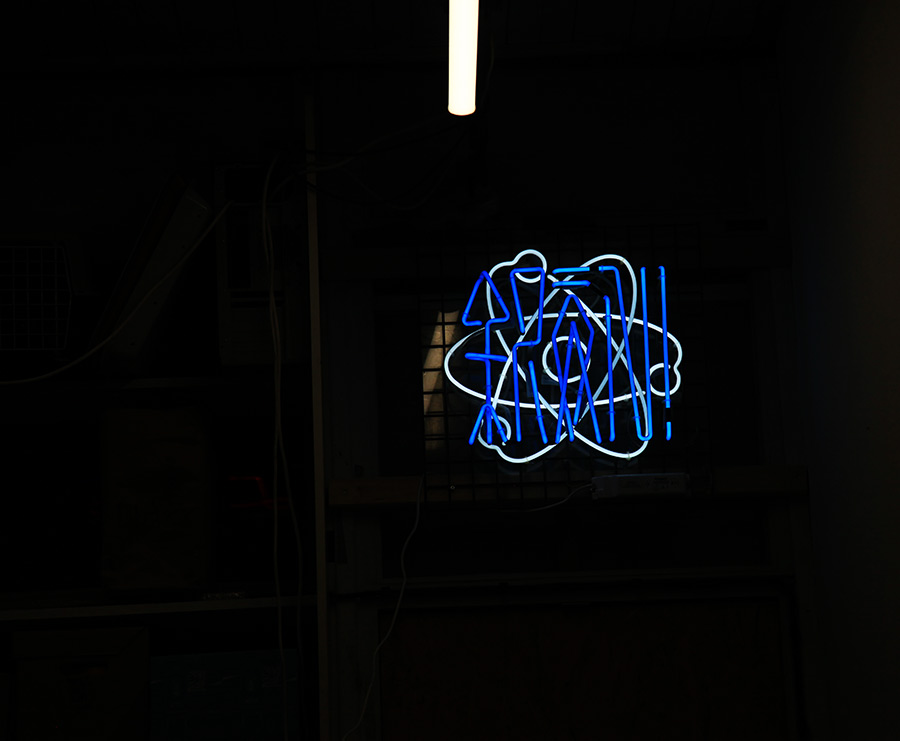
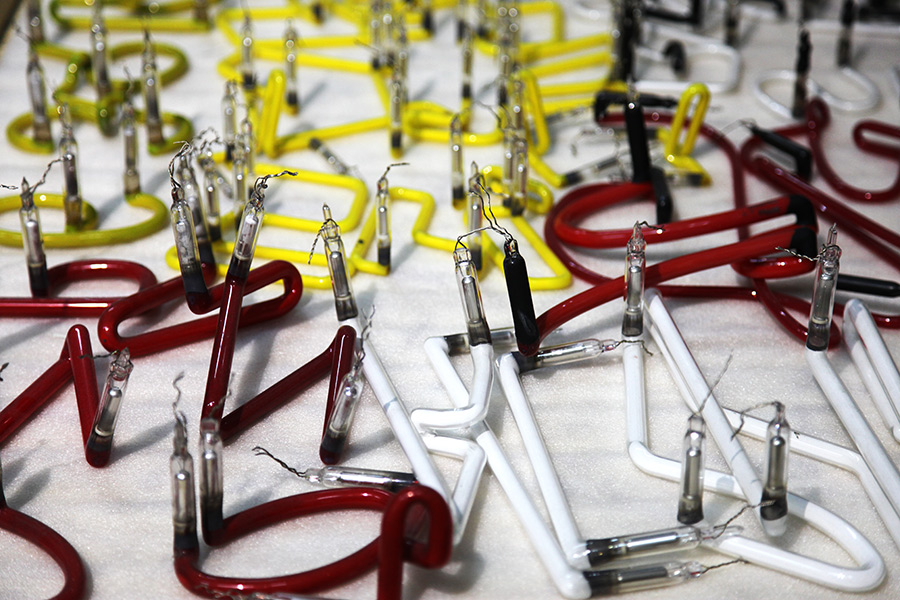
Over nearly three decades, he has expanded from traditional graffiti into murals, airbrush figurative work, acrylic “manuscript” abstractions, neon and light installations, and site-specific projects, while maintaining a clear connection to the tempo, structure, and discipline of lettering. His long associations with Trafačka/Trafo Gallery and MeetFactory placed him within two of Prague’s most important hubs for post-1990s urban and contemporary art, and his work with The Chemistry Gallery and the Urban Pictus festival may have brought him greater international reach.
Within the Czech Republic, Škapa is recognized as an artist who successfully bridged illegal writing, large-scale public works, and the gallery world. He co-founded the Analog!Bros serigraphy workshop, creates commercial visual works and has exhibited across significant Czech venues. On the mural tip, he is associated with massive works such as Kosmos — a 350-meter mural along the runway wall at Václav Havel Airport — and Vesmír medúz (The Universe of Jellyfish) in Prague’s Karlín district for Urban Pictus, both large semi-abstract compositions that merge cosmic imagery with undersea forms. His illuminated works for the Signal Festival and other public commissions may further assert his role in redefining how Czech graffiti vocabulary evolves into a contemporary visual language.
Škapa’s trajectory parallels that of many European artists who began as train writers in the 1990s and gradually expanded into broader artistic practices, yet his work feels distinctly rooted in Prague’s cultural landscape. Writers of his generation absorbed global influences through books, films, and early media circulation, but their reinterpretation of those sources unfolded within a city experiencing dramatic social and urban transformation.
In contrast to artists who favor punchline-driven street interventions or pop-derived collage, Škapa’s work leans toward atmosphere — cosmic, psychological, occasionally sci-fi — a sensibility shared by several Czech artists who transitioned from the underground into muralism, abstraction, and installation. The local ecosystem of DIY spaces, collectives, and multi-disciplinary hubs like Trafačka and MeetFactory helped shape this approach, and Škapa stands out as one of the artists who synthesizes and creates accordingly.
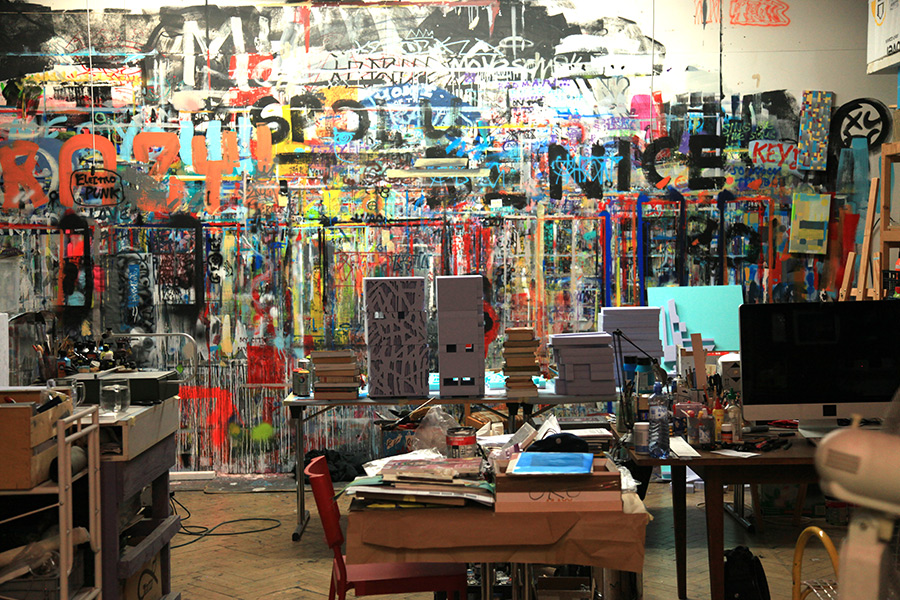
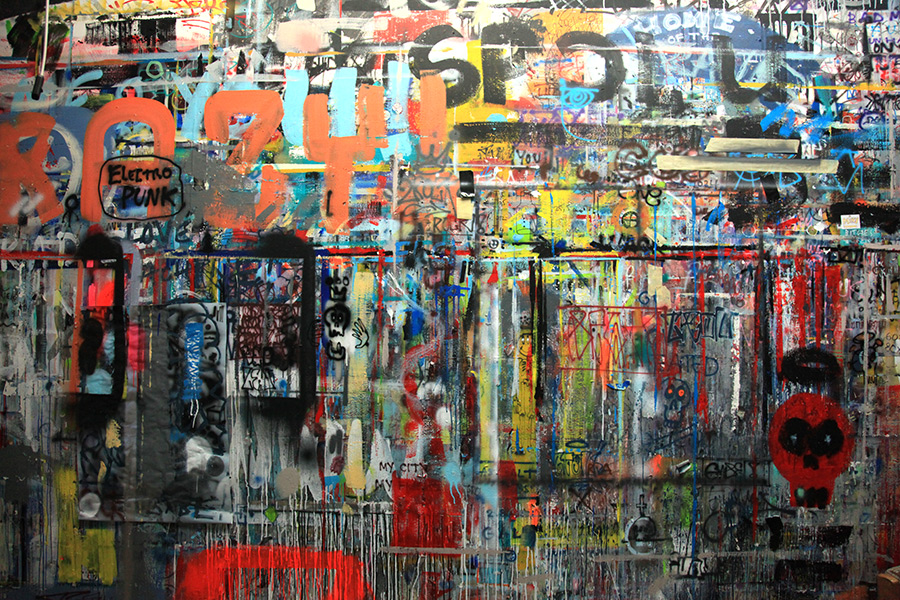
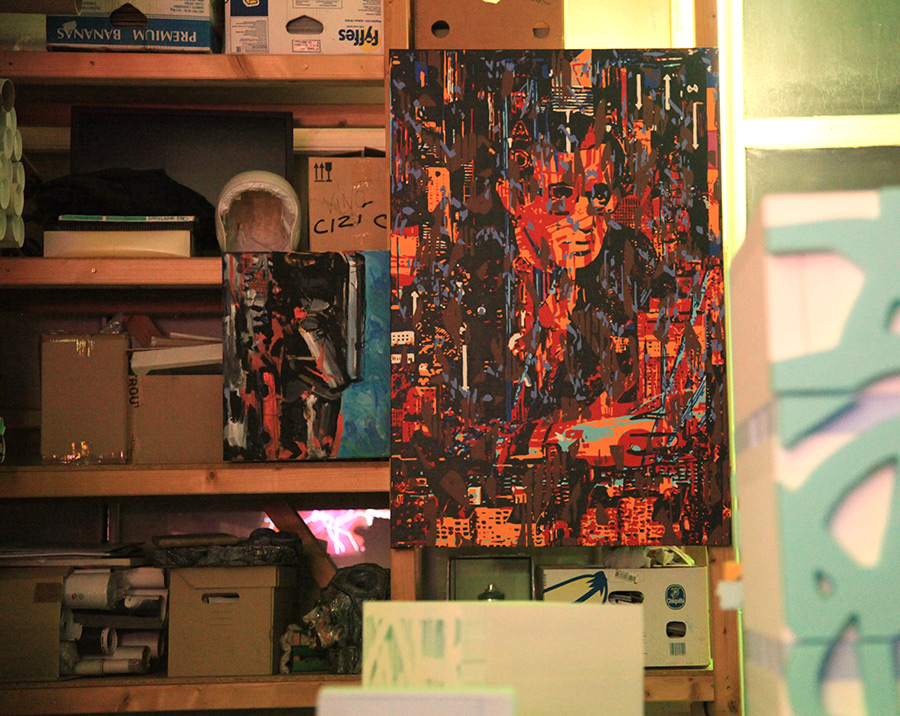
We had the opportunity to tour the artist’s studio, see many of his works in progress, to read the layering of the walls, and to learn from his wide-ranging experience and storytelling what themes drive him. Among them were these three: the construction of a personal alphabet, cross-media experimentation, and the transformation of graffiti experience into contemporary practice.
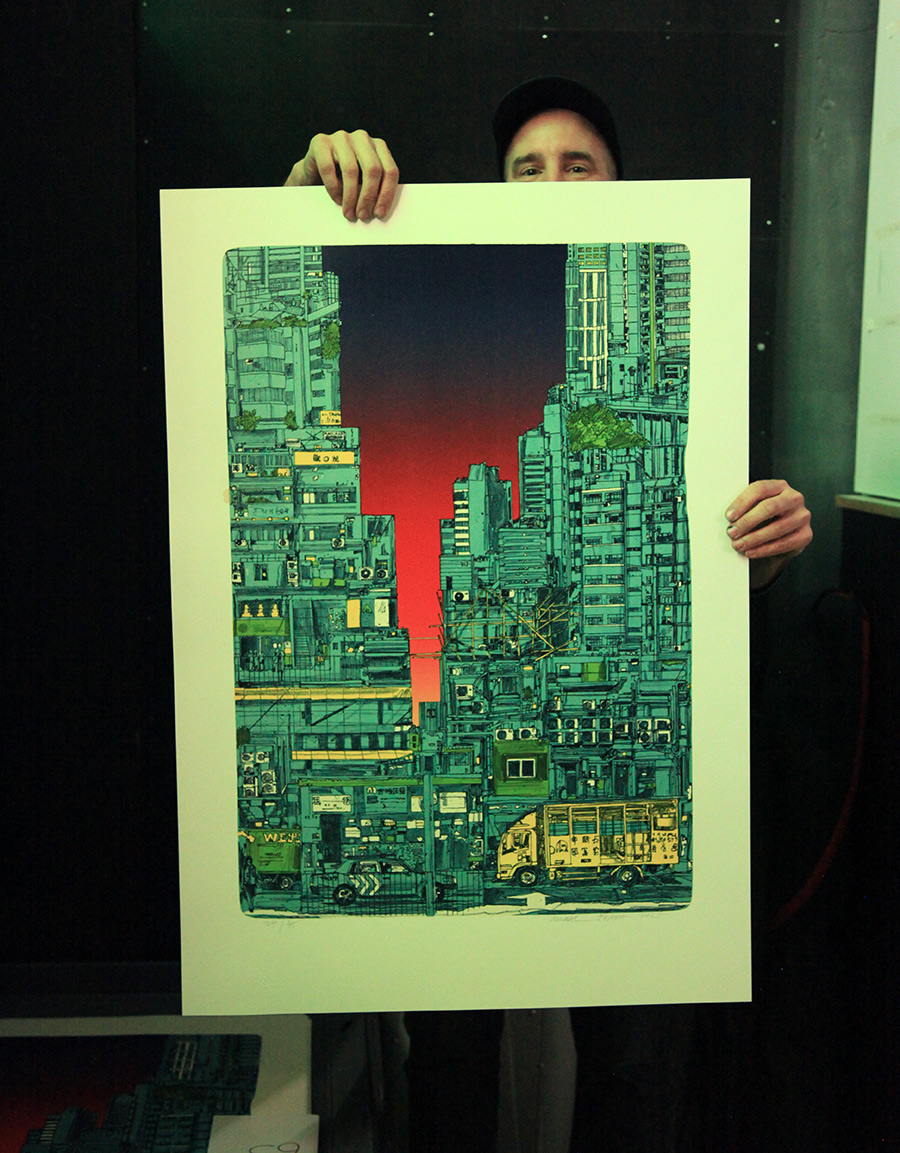
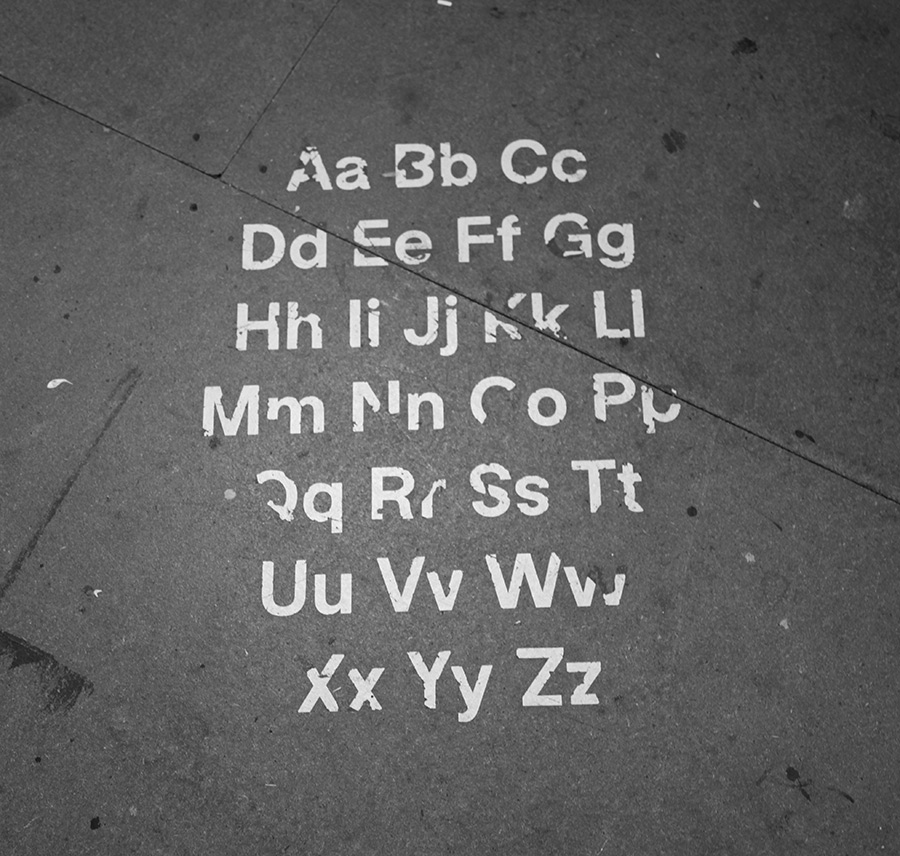
Škapa’s studio makes clear how central his self-created alphabet is to his practice — a system that merges graffiti logic with global typographic traditions. He describes it as “based on the Latin alphabet but mixed with inspirations from Brazil, heavy-metal logos, ruins, all kinds of writing systems,” his is a layered script that allows him to embed messages and structure his compositions. Some of his works contain readable words; others dissolve into semi-abstract fragments that behave like scaffolding or urban grids. Skapa is in love with the urban cityscape and its language pushes up like a raised grid into many of his works.
As he put it, “I work with my own alphabet… I put some messages in the canvas. You can find the letters if you look.” His alphabet becomes both a personal code and a generative architecture, a way to “build” cities, atmospheres, and imagined systems that tie back to his years on the street.
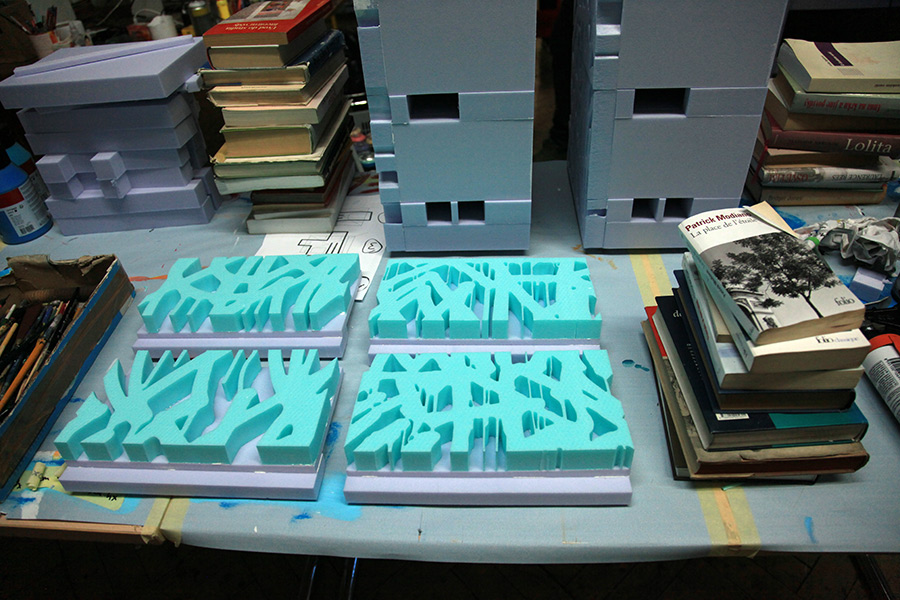
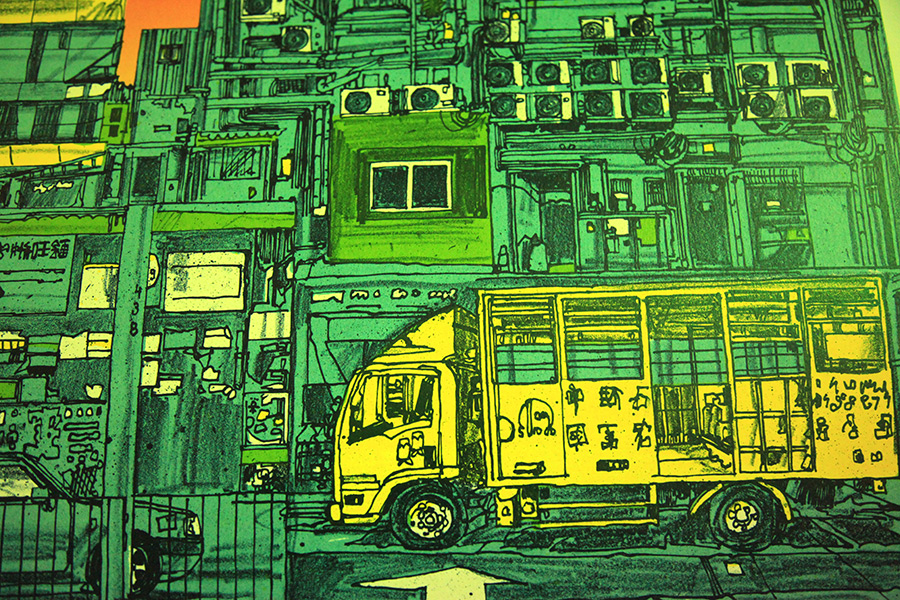
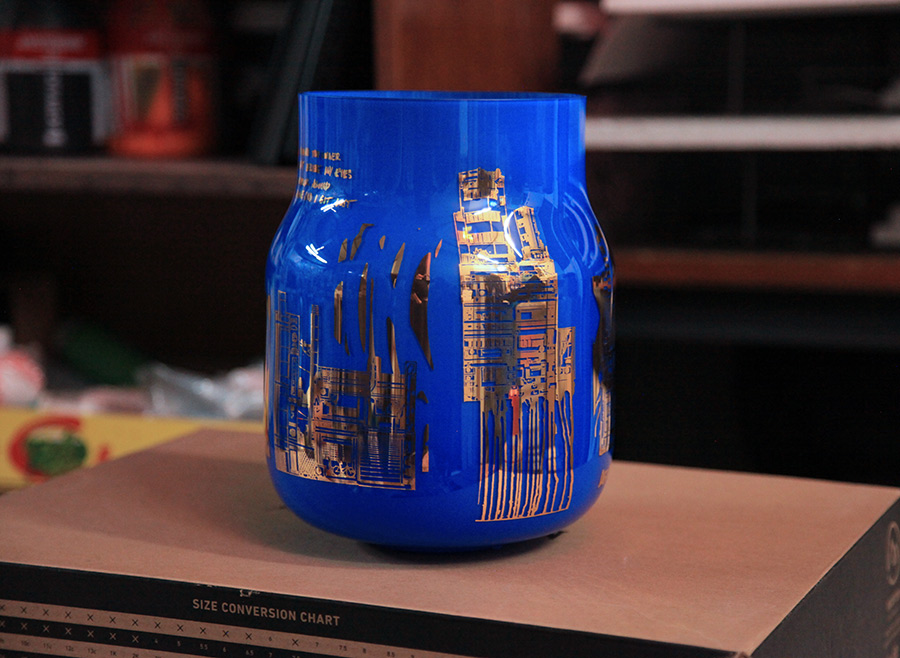
With great appetite for discovery, Škapa moves fluidly between media — neon, lithography, silk-screen, drawing, comics, hand-painted canvases, sculptural models — driven not by stylistic restlessness but by a desire to test how each material can host or distort his visual language. His collaborations with Czech glass studios illustrate this curiosity. He showed us vases produced through layered techniques involving silk-screened transfers, hand-drawn enamel lines, and kiln-fused materials.
“I love to experiment,” he said. “I’m still searching. I change styles a little, but it’s all connected.”
His neon-cube sculptures, glass models, and smoked-glass vessels borrow from Czech glassmaking’s legacy while extending it into a hybrid territory shaped by graffiti structure, sci-fi atmosphere, and architectural imagination.
It Emerges from Graffiti as Origin, Ethos, and Continuum
Škapa’s early years as a writer in post-revolution Prague remain a defining foundation for the artist. He recounts discovering graffiti in a city that felt grey and decaying, then experiencing the shock of Berlin’s scene and, later, painting trains in New York just before 9/11.
“It was like shining diamonds in the grey,” he said of graffiti’s arrival in 1990s Prague.
The energy of those years — improvisation, risk, collaboration, and an irreverent sense of possibility — continues to shape his work. He is clear that he is not “bringing graffiti into the gallery,” but rather transforming its mindset:
“You cannot take it from the streets and just exhibit it. You have to transform it.” His temporary, large-scale installations — painted walls later repainted white, layered panels reassembled into new environments — reflect graffiti’s ephemerality while channeling its instinct for immersion, confrontation, and city-scale rhythm.
Škapa’s studio practice reveals an artist who continues to translate three decades of experience into a visual language that is still expanding. His alphabet operates as both structure and code — a personal script rooted in graffiti’s devotion to the written mark. His cross-media experiments, moving from neon to lithography to Czech glass, reflect a sustained curiosity about how ideas behave when they migrate across materials and traditions. And his grounding in early graffiti culture remains an ethical engine, shaping how he thinks about improvisation, community, and the life cycle of artworks.
Taken together, these themes show how Škapa has built a practice inseparable from Prague’s cultural landscape while remaining fully engaged in a broader conversation about how street-born creativity transforms within contemporary art.
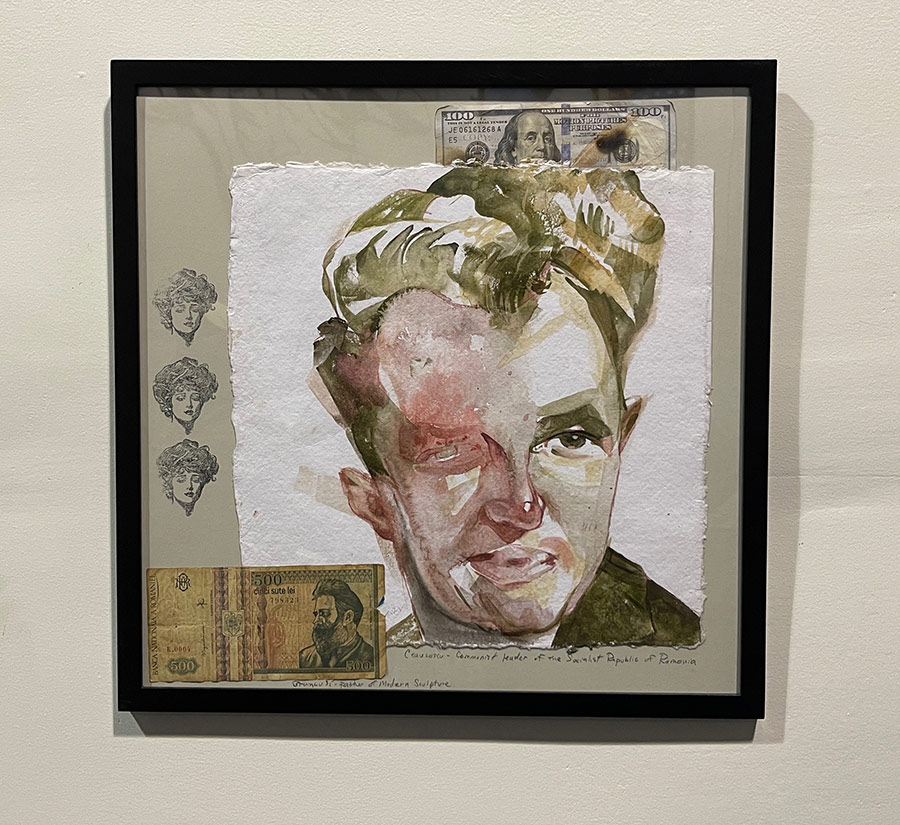
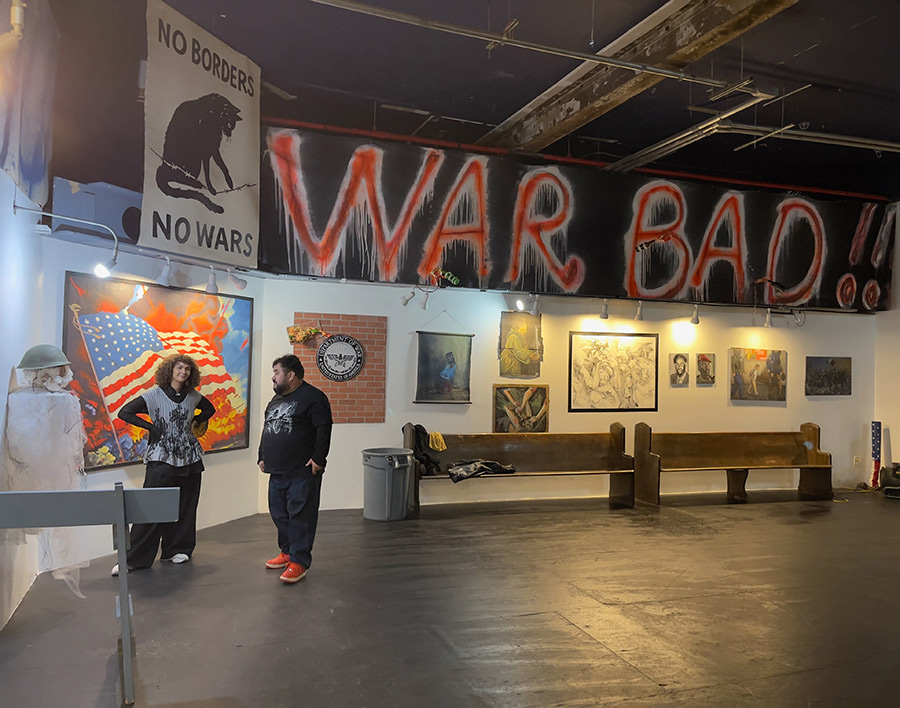
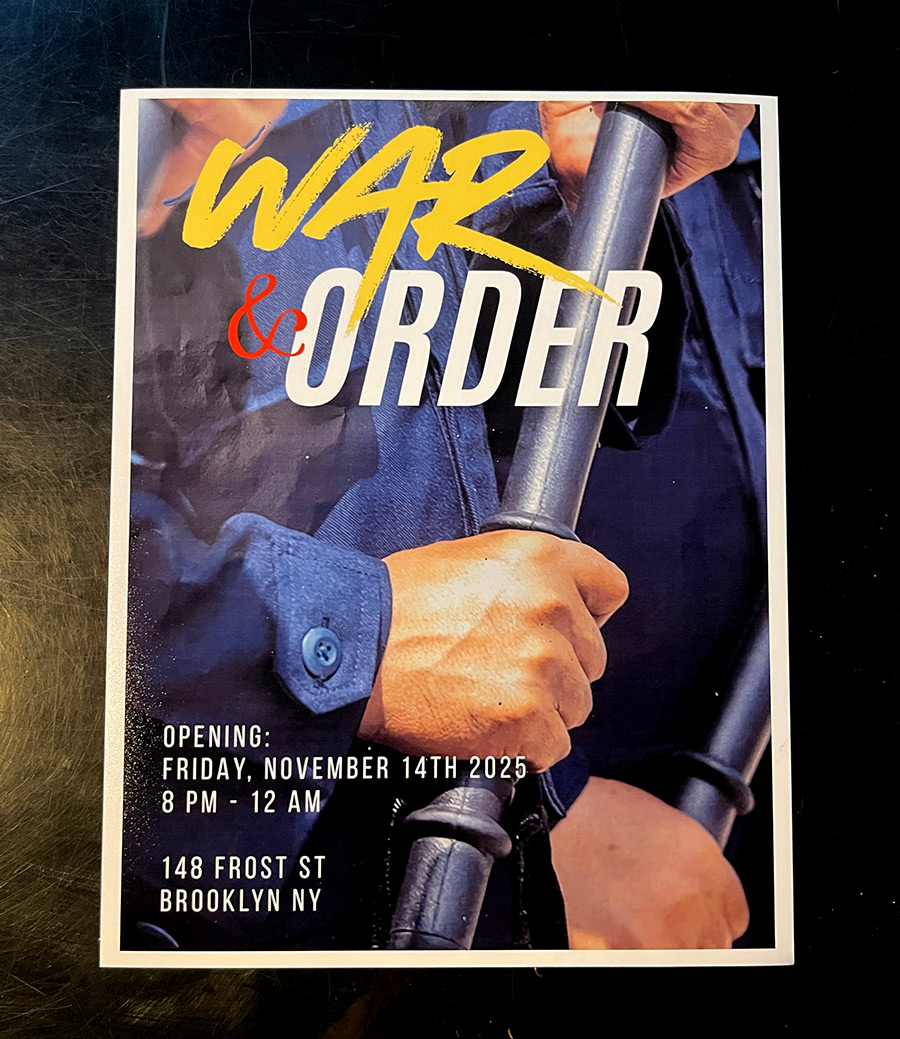
After a successful, painful, and funny take-down of the Dollar bill at their last group show, the artists-run collectivists at 148 Frost Gallery are smoking again with their newest installations and canvases related to the biggest money-maker of all time: War.
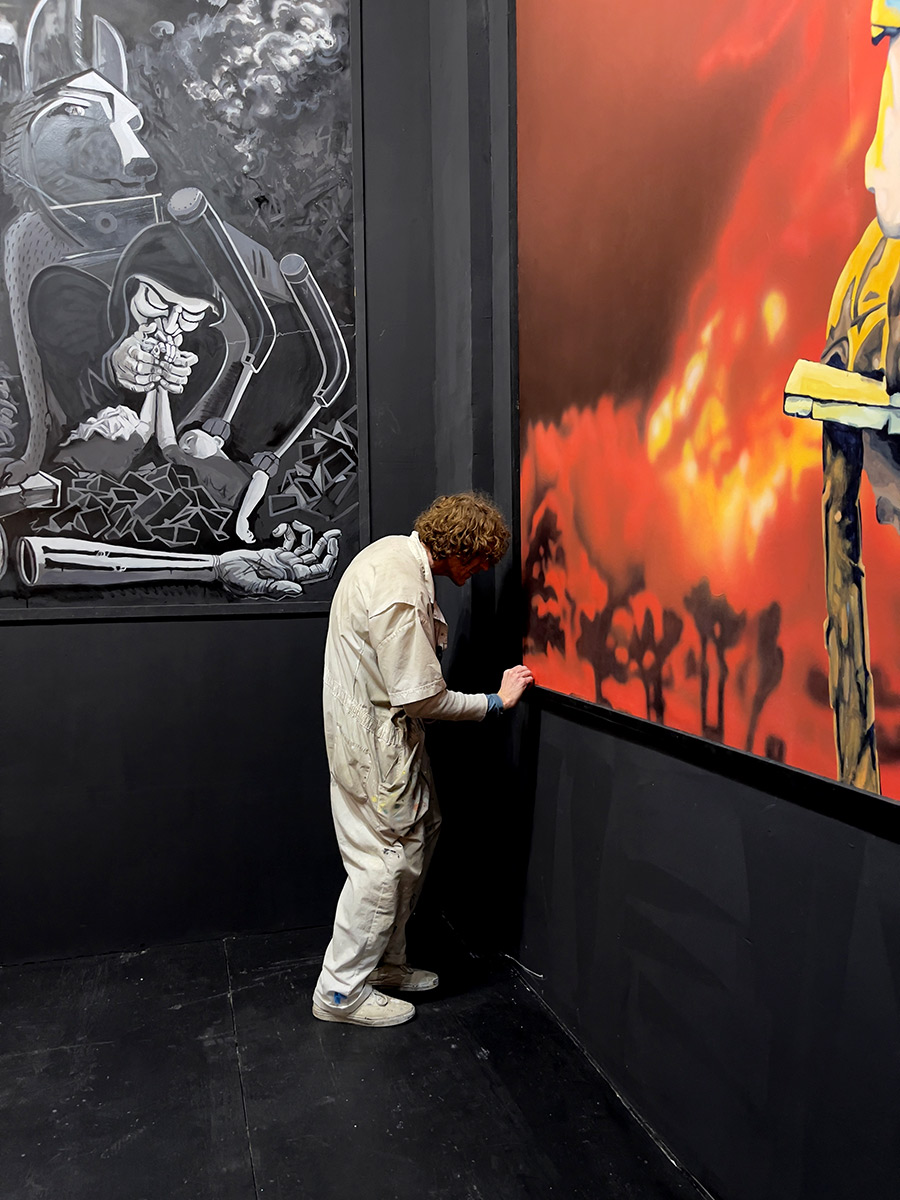
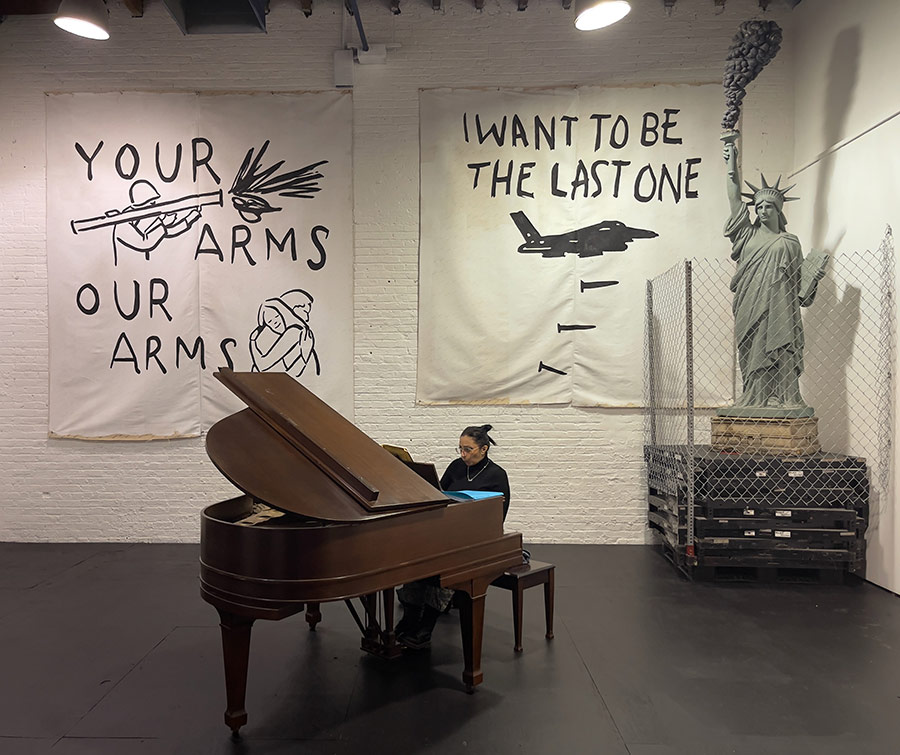
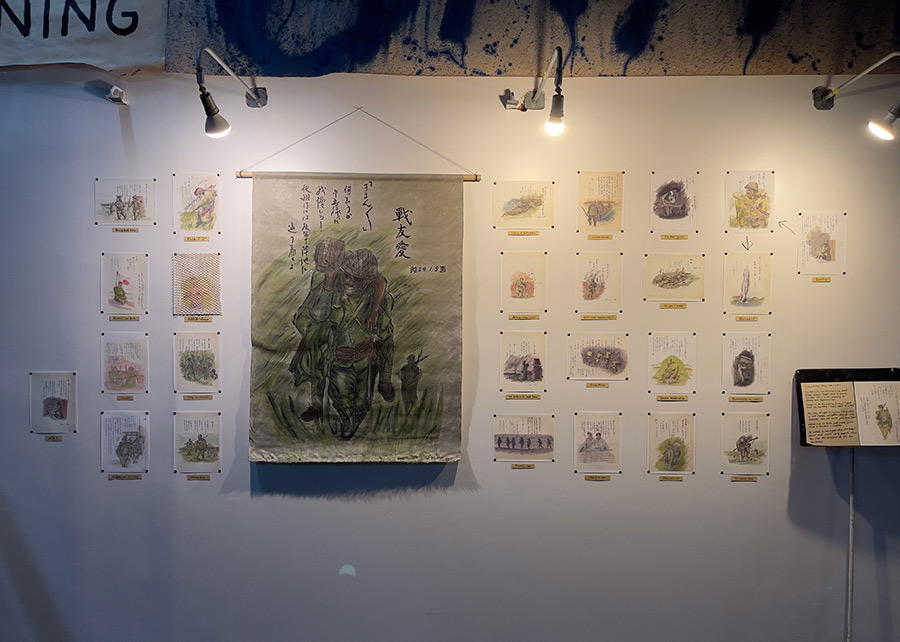
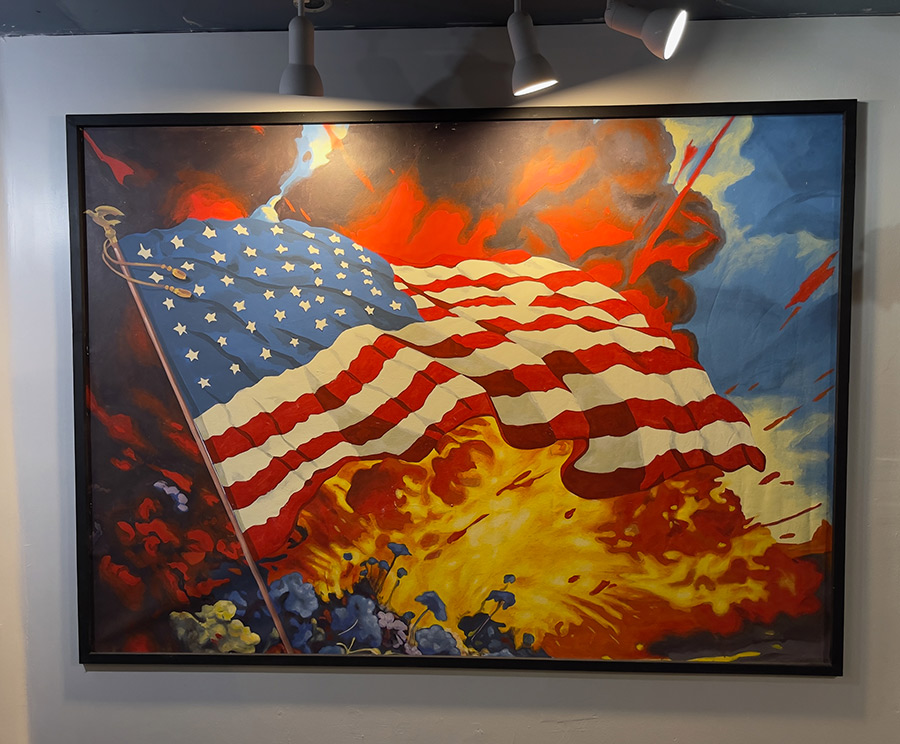
“War & Order” features street artists, contemporary artists, outside artists and those adjacent ruminating on the role and roll of the war machine in the 2020’s with Gabriel Specter, Renelerude, Escif, Dan Sabau, Kazuhiro Imafuku, M Shimek, and Cash4 on the march.
Between those two shows, this gallery may have captured the moment prophetically, like a seer in a storm, evaluating the past and anticipating what is next.
During WWI, all major governments resorted to a programmed money printing. Whether by design or incompetence, the results were undeniable: economic destabilization, often hyperinflation, internal chaos, political upheaval, and war. For many decades people swore that we would never let that happen again. But most of those people are dead now, and the dollar today is worth a nickle, compared to a century ago.
What is that saying, often paraphrased, “history doesn’t repeat, but it often rhymes.”?
“War and Order” enlists international and local artists for a pointed, and occasionally mischievous, look at the world we’ve managed to build for ourselves. It doubles as inquiry and needling social commentary, with each artist charting our tangled relationship with war, the creeping architecture of the police state, and the long shadow of militarism, surveillance, and planetary harm—all unfolding in an age where social media spins narratives and we scroll past catastrophe.
Murals, installations, paintings, and performances push these ideas, probe our past, and interrogate the present. It’s uncomfortable, for sure. What comes next, we have a dreadful guess. But there is a countenance of repairing the broken, correcting injustices, healing pain – even though this is not the focus. As the organizers put it, the exhibition is “our protest, our loud speaker to the world—an unedited, unsilenced voice.”
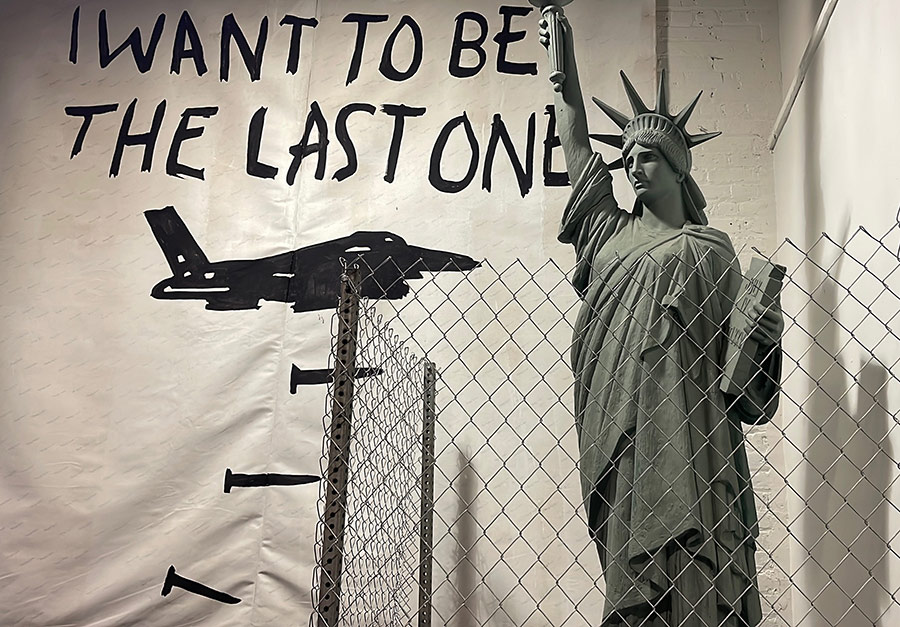
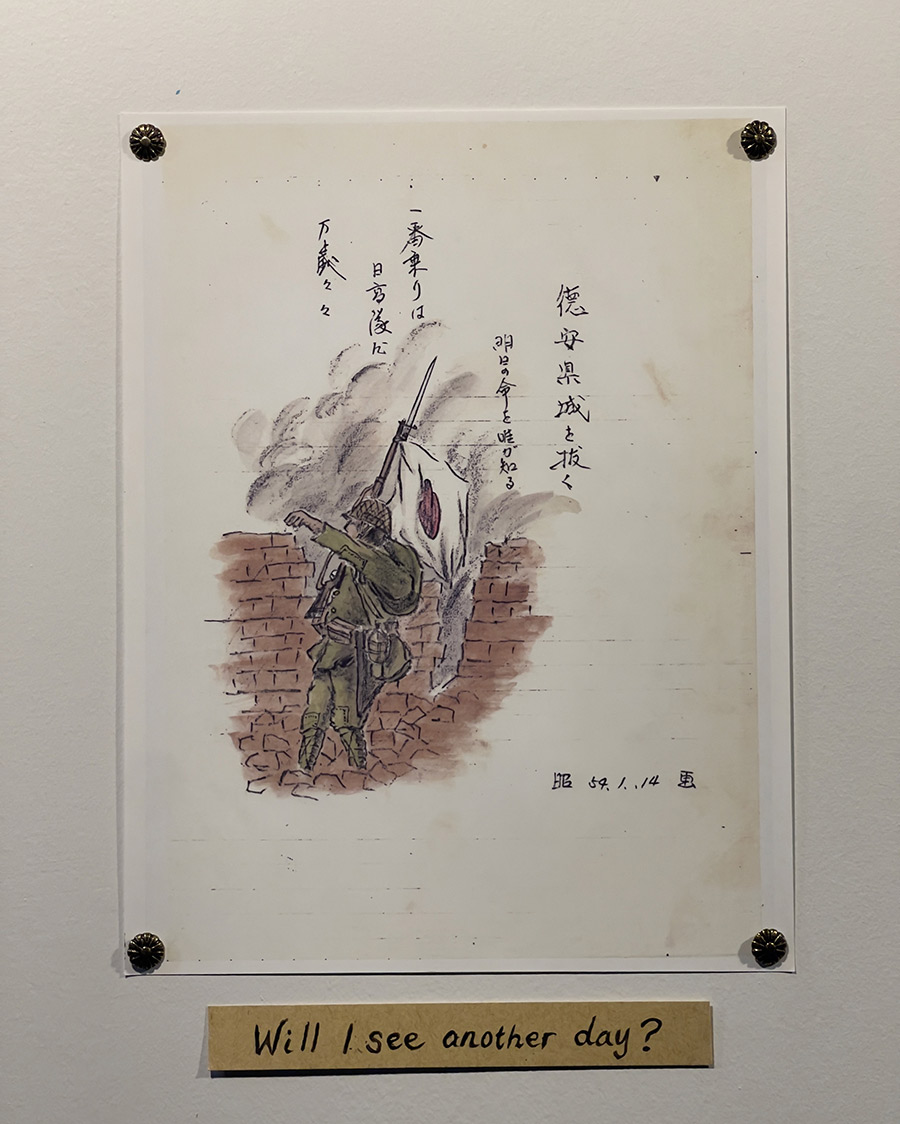
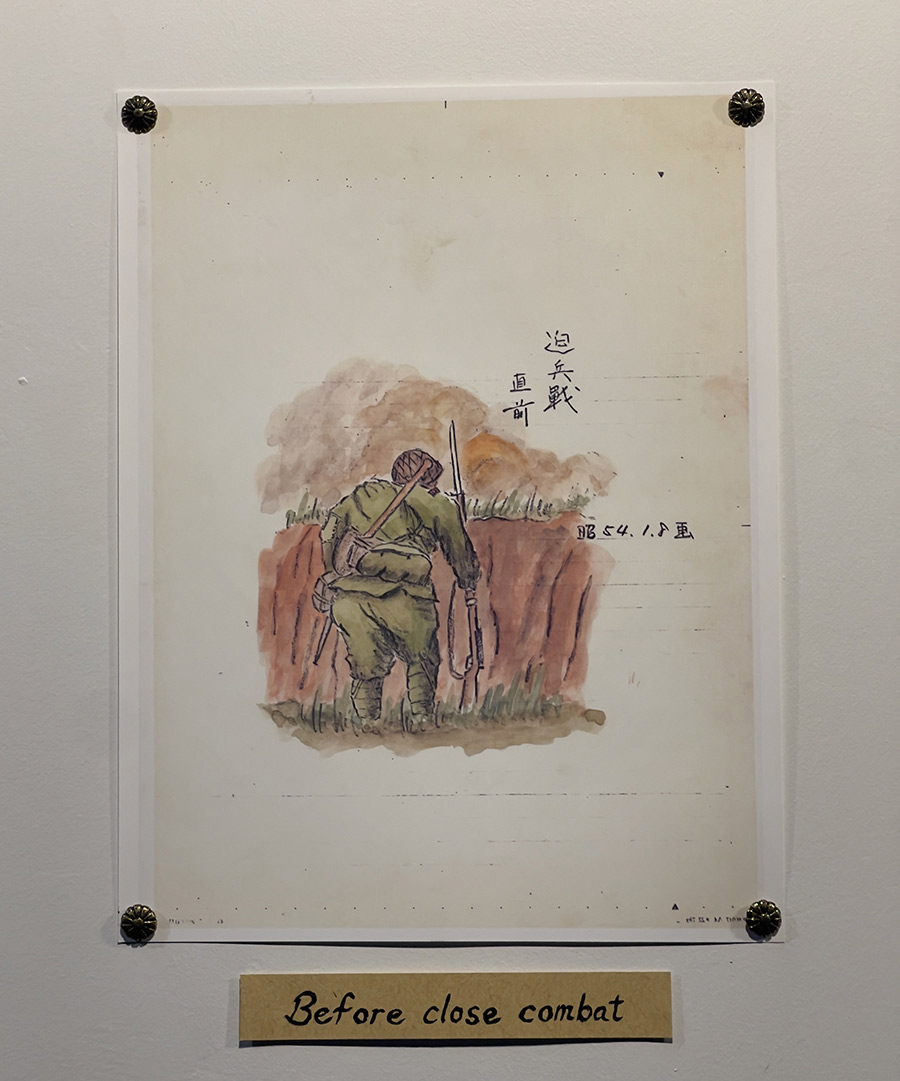
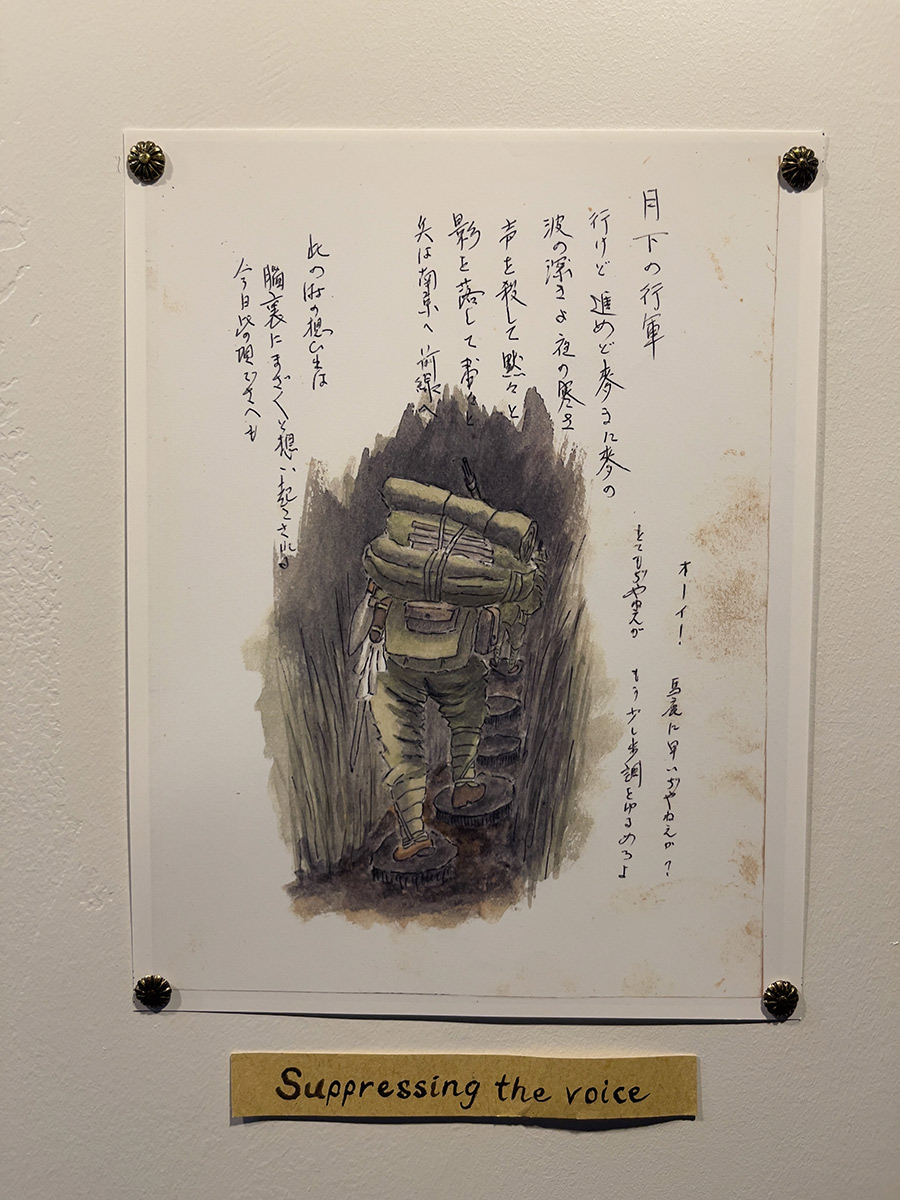
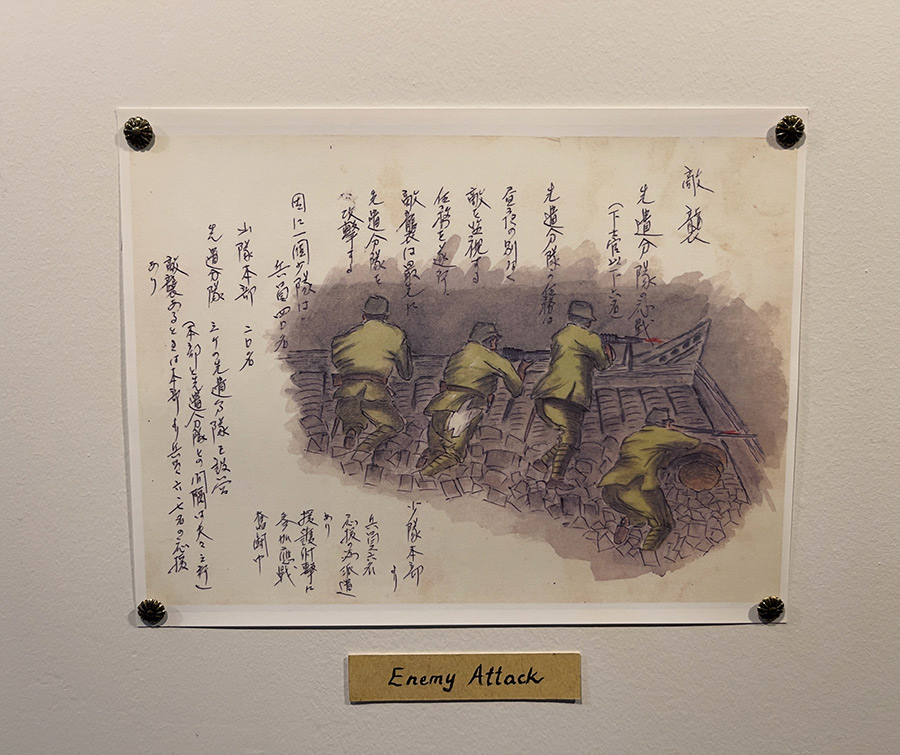
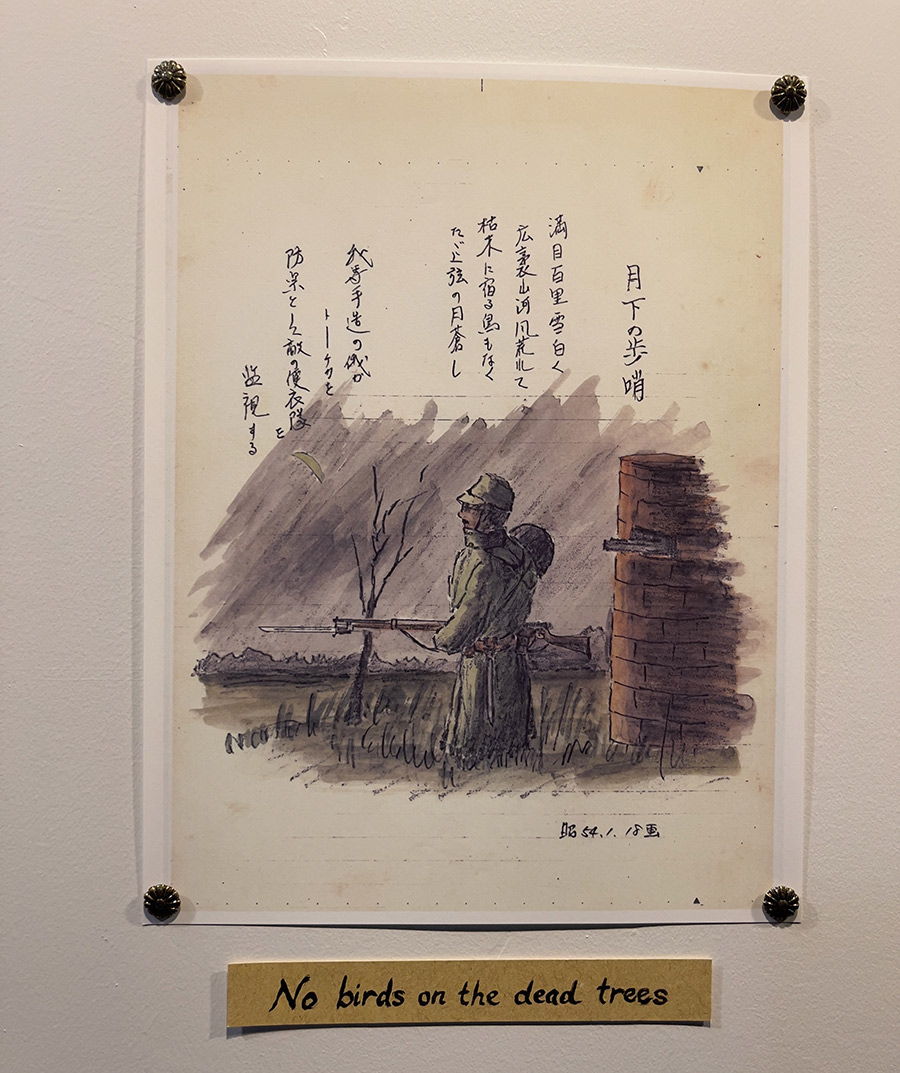
Kazuhiro Imafuku’s watercolors read like a plaintive diary of a soul under siege—an illustrated reckoning as he “displays and deciphers” his grandfather’s service in the Manchurian war. Though distant in time and culture, the story feels painfully familiar to the stories of soldiers here and abroad today. His grid of small works echoes the disarming clarity of Escif’s massive hand-painted banners hanging around the homemade gallery space, where the Spanish conceptualist delivers coded commentary in a deceptively plain voice, sharpened by deep critique. Elsewhere and throughout, artists confront imperial overreach, immigration persecution, and high-tech terror without flinching—perhaps daring us not to look away.
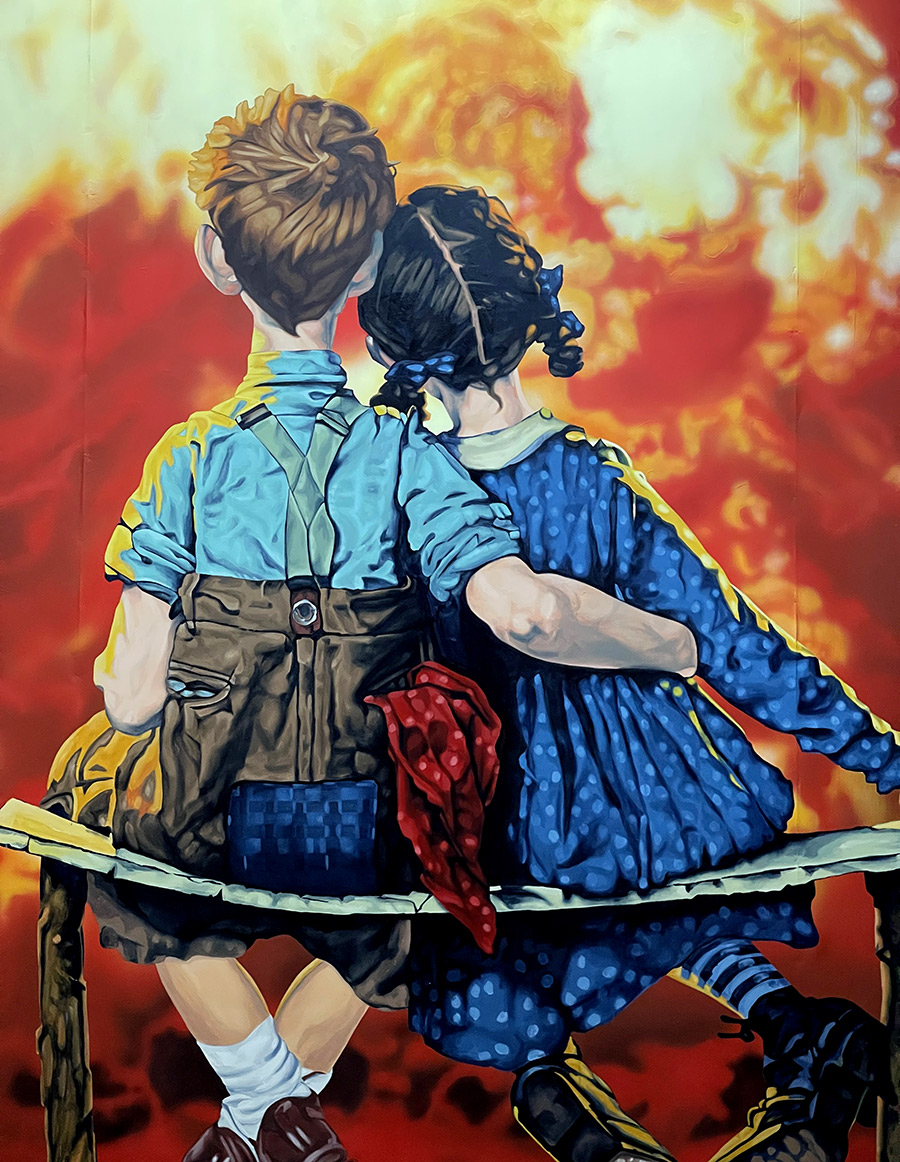
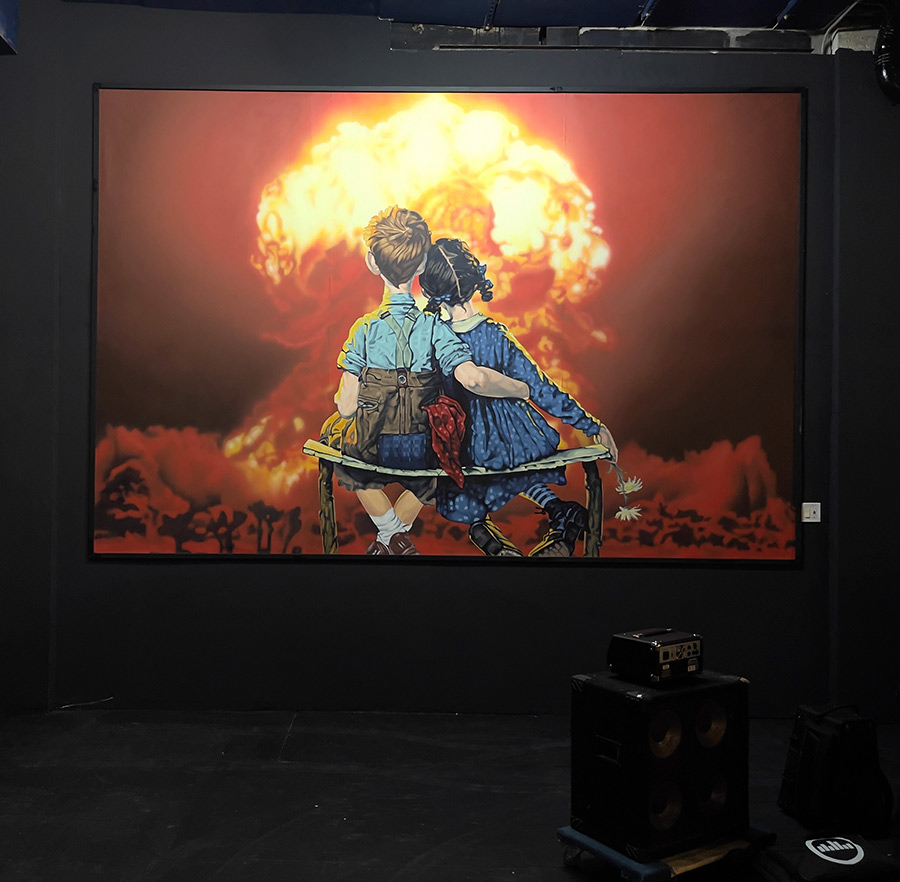
Specter’s opus “Expressive Love” calls to mind the glib narcissism of the 20th century westerner historically, a simplistic Norman Rockwell sentimentality that sees the ideal in spite of the truth. It also calls to mind the last enormous propaganda push that engulfed continents for the profits of a few, the fake ‘war on terror’ of the 2000s, when an Internet meme featured UK Prime Minister Tony Blair happily posing for a selfie before a hellfire scene from the oilfields of Iraq.
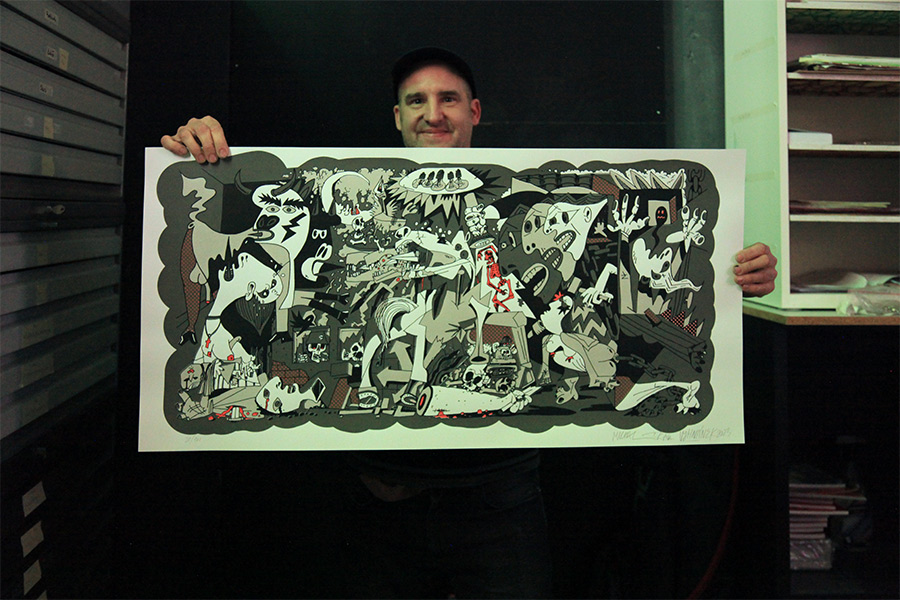
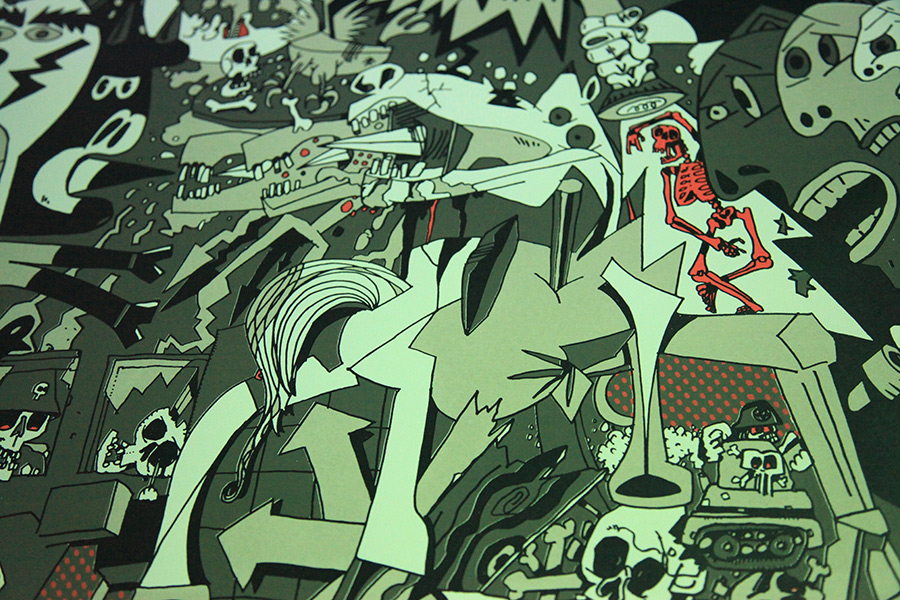
Adjacent to Specter, the French street artist Rene LeRude presents a disjointed monochrome macabre missive of winners and losers updated with dark tech, echoing the dimension, and disconnected field of vision of Guernica by Picasso – a phalanx of streaming cameras mounted to the wall next to it make sure the scene is monitored and broadcast for best effect. These are the suffering and distorted figures that Picasso was protesting, reported without humanity in black and white back then; atrocities committed against civilians; violence unleashed by authoritarian regimes. LeRude’s own neo-cubism strikes a similarly expressive distortion, his own moral indictment.
This is the kind of work you can still encounter in Brooklyn today, in a warehouse space that brings together music, art, theater, and other forms that resist easy classification. Rooted in DIY culture, punk, activism, and inclusion, Frost doesn’t need to be idealized—only recognized for its commitment to fostering conversations that many would rather sidestep.
We spoke with curators and artists Gabriel Specter and Rene La Rude about the show,
Brooklyn Street Art: “War & Order” is described as both a social study and a critique of global affairs. What was the initial spark that inspired you and the other artists involved in the show to frame the exhibition around the tension between war and order, and did the original idea evolve as you and the rest of the artists began discussing the show?
Gabriel Specter: The initial spark was our current political state. Where freedom of expression and protest are being silenced. We wanted to make a show where the artist could speak their minds without censorship. Each artist added their voice, and through that, there was a natural evolution of the original idea.
BSA: The exhibition explores our “personal and collective relationships to war and the threat of the police state.” How do you balance your own perspective as an artist with the collective voices and experiences represented in the show?
GS: Part of having your own perspective is about respecting and listening to others perspectives at the same time so the show reflected that type of idea creating a nice balance.
BSA: The show is described as “our protest, our loudspeaker to the world.” How do you see visual art functioning as a form of protest or resistance today—especially in an era dominated by social media and engineered narratives?
GS: I feel like people are starting to value real interactions more and word of mouth is coming back in vogue so I believe the underground has a real power to effect change and as they say a picture tells a million words!
BSA: Since we have known you, and your work on the streets, you have been consistent with delivering messages highlighting a scope of social issues that are relevant to our society. When you began this practice social media and AI didn’t exist. Do you think these new digital tools are useful for you in the transmission of your work? If so how?
GS: New tools are always helpful, can save time, make you more self-sufficient and help you reach new audiences but they can also dilute a lot of your messages and take away the edge and reality of what you’re trying to get across.
BSA: The exhibition includes murals, installations, and paintings. How did you decide which mediums best convey the urgency and emotional weight of these themes? I think the combination of mediums gives an overall experience and that is what we were really trying to achieve.
GS: We have the power of scale in the murals, the intimacy of the smaller paintings and the raw visceral nature of the installation.
BSA: In an age of “mass desensitization to violence,” what emotional or intellectual response do you hope visitors will leave with after experiencing War & Order?
GS: I hope they care about people’s lives and recognize that life is important even the lives of those you disagree with. People are not pawns, they are flesh and blood and we should never forget this.
BSA to Specter and Rene LaRude: The murals are compelling and powerful, with references to both Picasso and Rockwell. How did you decide to use these two paintings as inspiration for your murals?
GS: I chose the work by Rockwell as inspiration exactly for this reason that it is revered as a romantic time in American history. The kids depicted would have been of “The Greatest Generation”
We still cling to this American Iconography today. It is rebranded and used for promoting a xenophobic political message, so for me this iconography was the perfect tool to use to flip the narrative.
Rene LaRude: It wasn’t an easy decision given the impact the piece has had over the years.
I wanted to make use of certain things from Guernica, narrative, composition, and of course colour (or lack thereof) to apply it to what is happening now.
The piece is about Gaza and the litany of war crimes that have been committed. I wanted to honor the original composition and change elements to stories relevant in Palestine. The use of greyscale is because Gaza has been turned into a land of rubble. even things which are not grey are covered in dust.
My effort is certainly overly dense and packed in but then again, that’s just what I wanted to get across in many ways.
Street art functions best when it is a witness, not only a declaration. “I was here, I am here” is the simplified version, and often there are clues that tell you so much more.
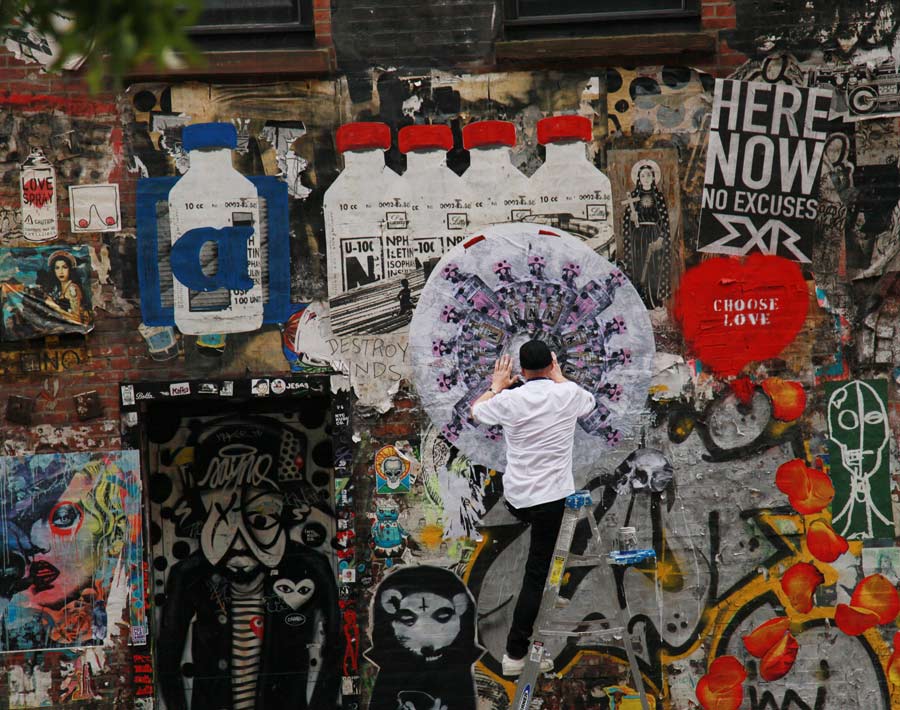
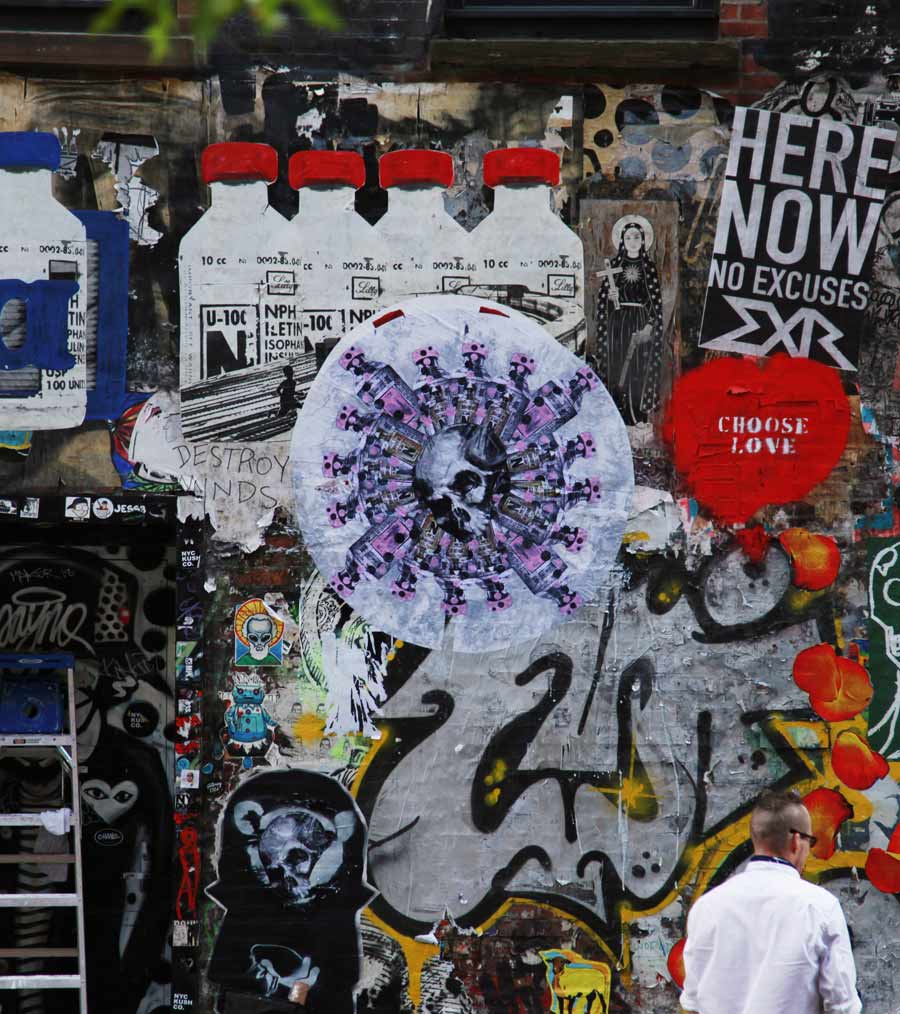
In the case of New York’s Appleton, that voice speaks of more than presence: it traces a life lived, marked by survival, activism, and visual urgency.
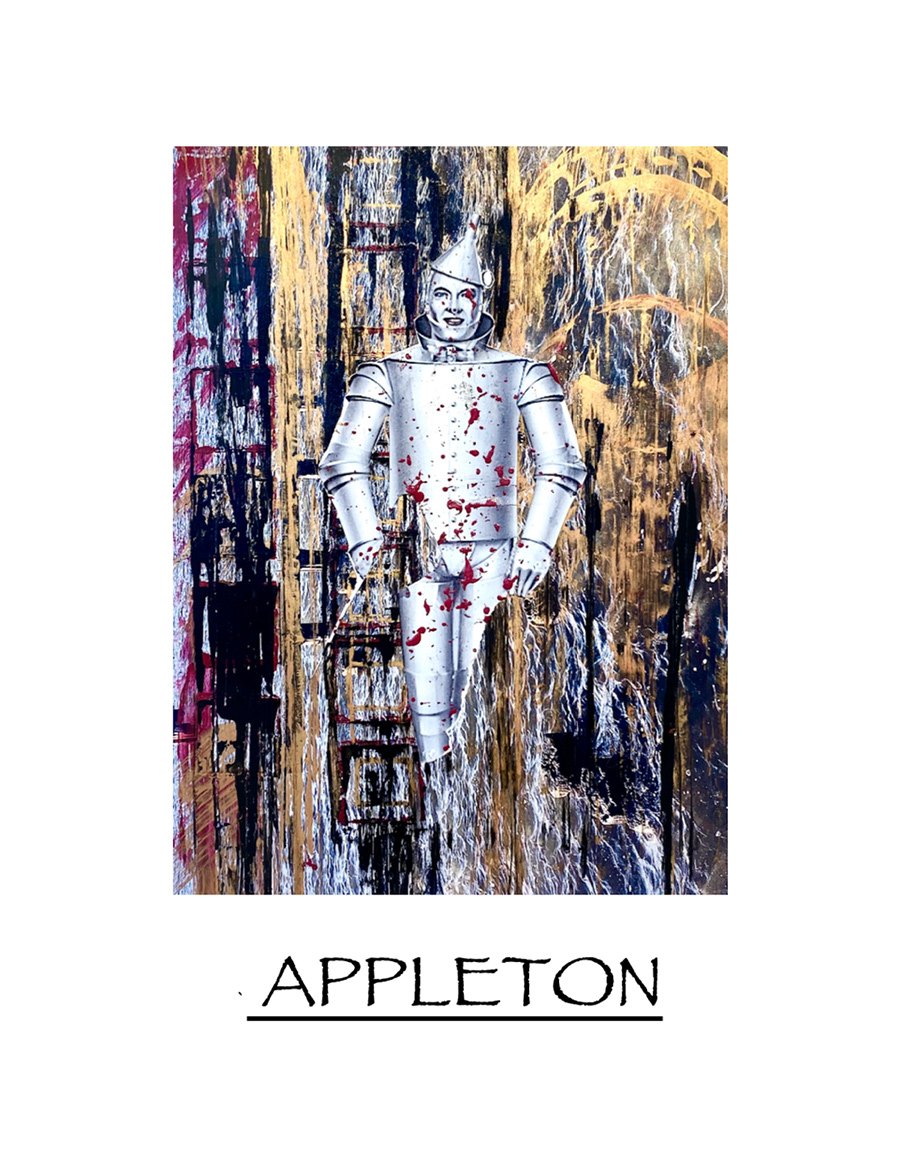
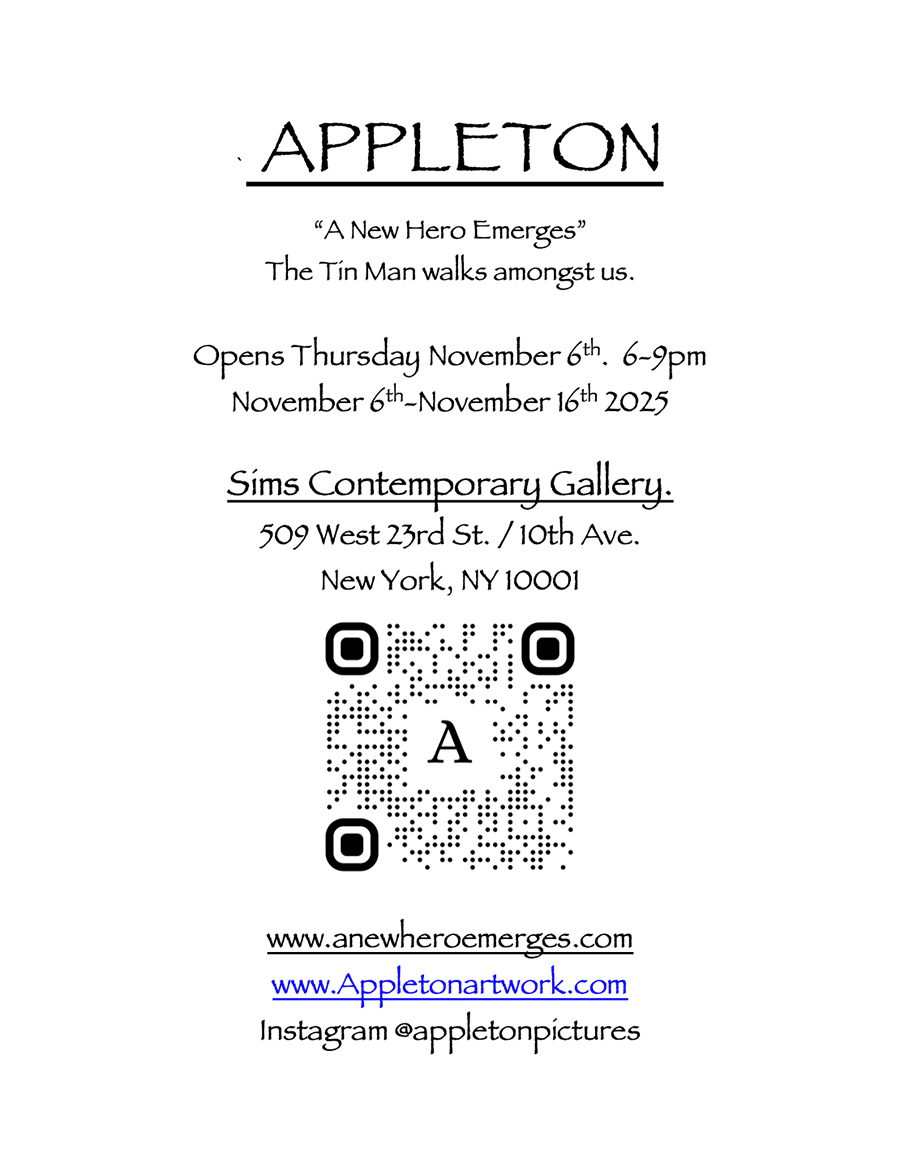
This week he returns to Chelsea with his new solo exhibition—A New Hero Emerges—to be held at Sims Contemporary, 509 W 23rd St (10th Ave), New York City, opening Thursday, November 6, 2025.
Appleton (image courtesy of the artist)
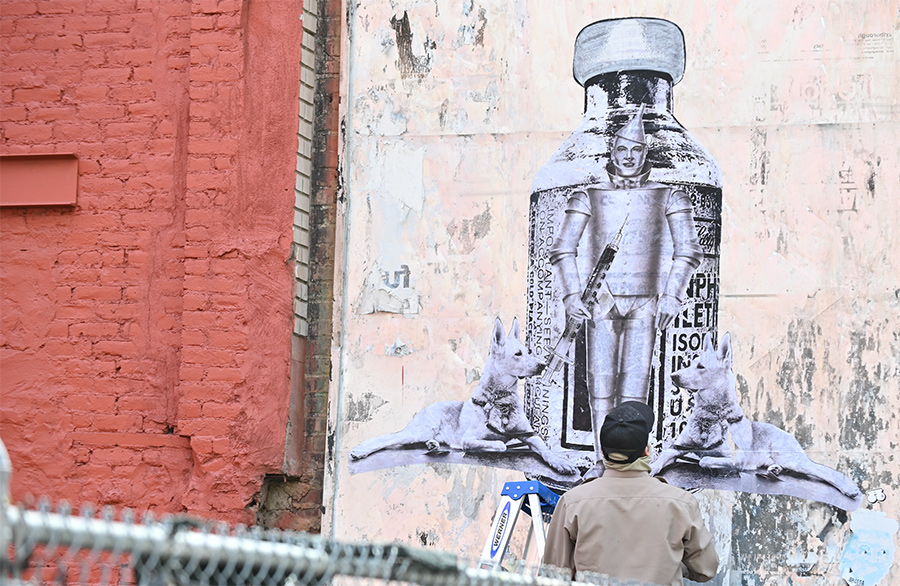
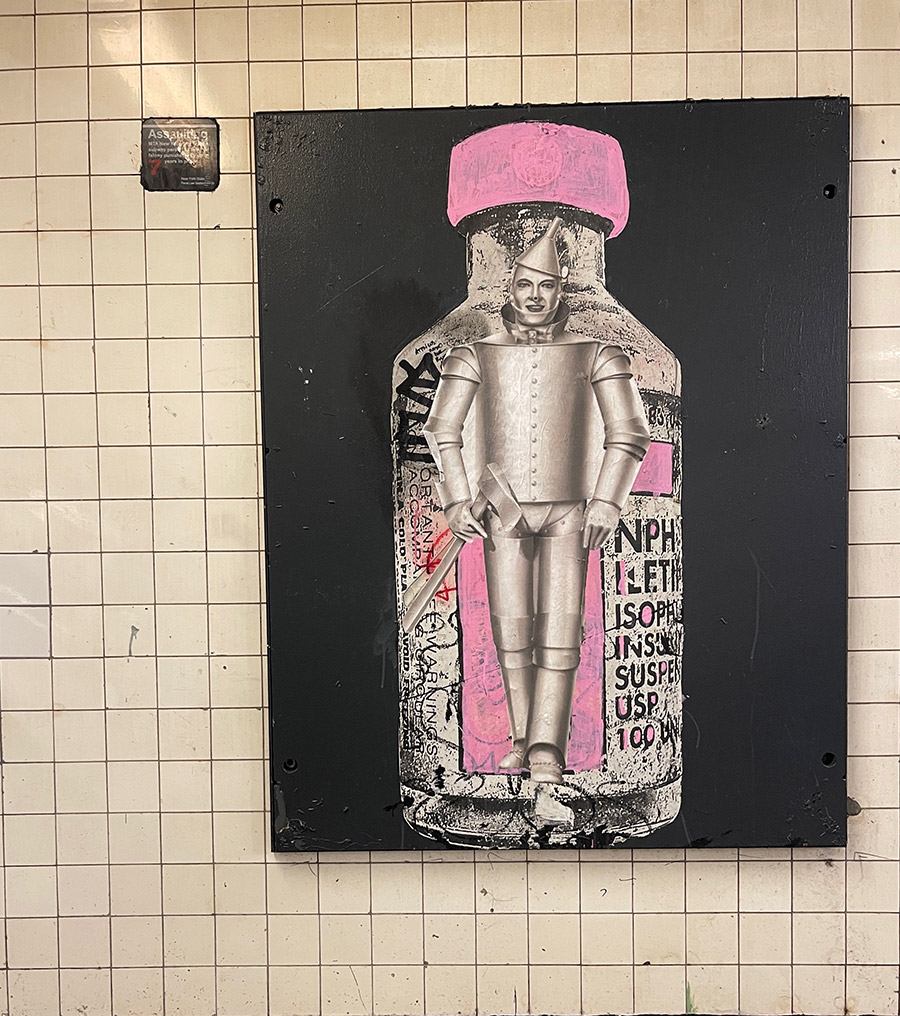
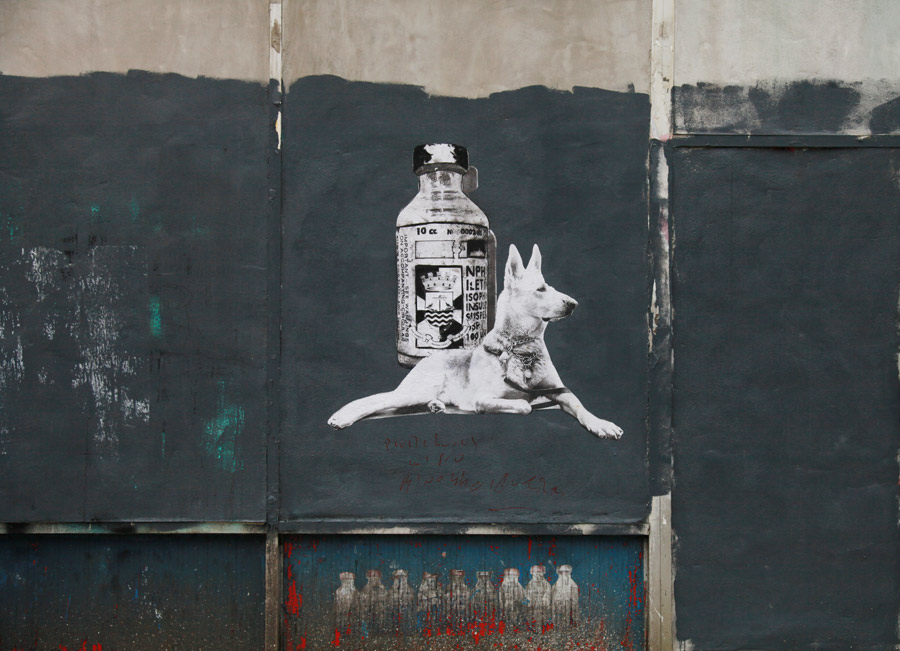
Artist, activist & speaker, he’s been developing a compelling body of work on the street over the last decade or so – with the goal of raising awareness of type 1 diabetes, which he is directly affected by. With street art, painting, photography, and sculpture, his lived experience becomes the substrate of his art: the insulin vials, the syringes, the shoes of children, the climb of street-wheatpastes from New York’s High Line to alleyways abroad.
In the new show, his metaphorical reach expands. A New Hero Emerges draws on the iconography of the Tin Man from The Wonderful Wizard of Oz—that winning figure of armor, of missing heart, of longing—as a symbol of perseverance, courage, and compassion. Although we know that Oz didn’t give anything to the Tin Man that he didn’t already have – in this example, a heart. Appleton’s motto may well be: “Oil to the Tin Man is insulin to the diabetic.” It’s street-art poetics meeting personal reality.
Over the years, Appleton has taken his message across U.S. cities and continents: gallery shows from New York to Los Angeles, Miami to San Francisco; street-walls from Busan to Barcelona, London to Lisbon, Bangkok to Berlin. His past solo exhibitions include Out of the Cold (NYC, 2016), Too Young for Type One (LA, 2017), and Too Young for Type One II (NYC, 2019). His role extends beyond the wall: he is Artist-in-Residence and speaker with $dedoc #dedocvoices, sharing in major diabetes-/health-conferences (e.g., Madrid #EASD60, Lisbon #ISPAD50, Bangkok #ADA85th).
As part of the street-art community, he uses the anonymity of the city to amplify a deeply personal voice. The “tag” Appleton is, in fact, his grandmother’s maiden name and his middle name—an intentional reclaiming of identity.
Approaching the opening of A New Hero Emerges, we spoke with Appleton thinking about his practice, empathy of strangers, survival in the city, street art presence and gallery fame.
Brooklyn Street Art: What is the message you are sending out to the world?
Appleton: That we are all one. That we are all in this together. In this daily struggle & hope for a cure.
Diabetes can really be… Forgive me, a fucking nightmare that a lot of people hide the difficulties even from their closest friends.
BSA: What is the response, if any, you’d like to receive from the public?
Appleton: A wide range of responses people describe my work as inspiring, thought-provoking, and moving.
Others are disturbing, even cynical.
I went into a coma at six years old and almost died.
An older sister died before I was born of unrecognized diabetes.
In one of my Street pieces, it says Diabetes coming to a child near you and someone wrote over a day later, “a child sees this.”
I cleaned it up and wrote back I hope so I knew what Diabetes was at when I was six so should every six year old talk to eat better and be aware of conditions that they might not recognize.
I went into a coma from unrecognized diabetes, and it still happens today.
Diabetes masquerading as the common cold as something else, and even in today’s age, doctors still miss it.
That’s pretty much my mission in a nutshell as an artist and a person with decades of lived diabetic experience.
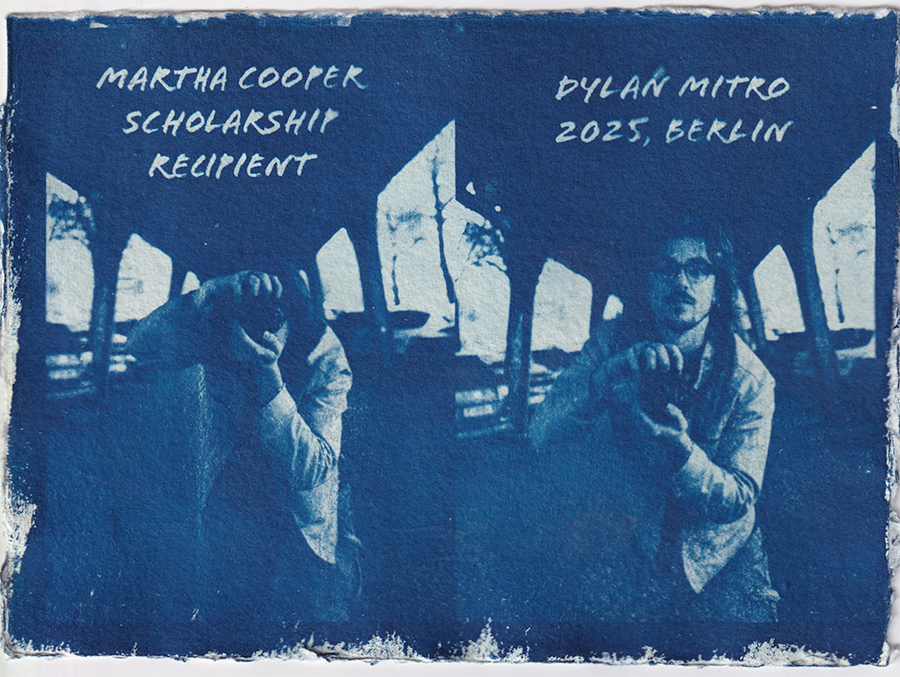
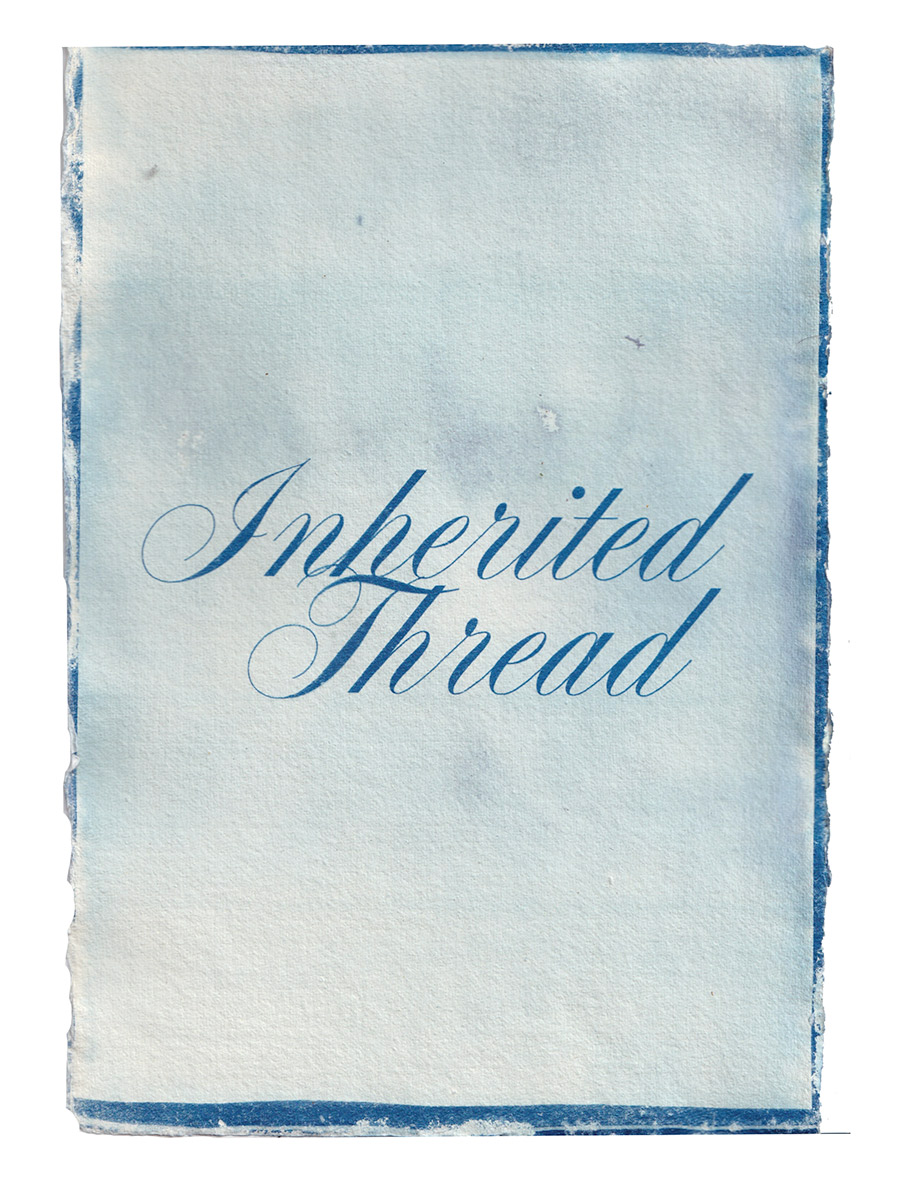
Berlin has always been a city that remembers through reinvention—a fitting place for the first recipient of a photography scholarship named in honor of a pioneering ethnographer whose seventy-year career preserved worlds in flux. The recipient of the first Martha Cooper Scholarship for Photography, the Canadian photographer and researcher Dylan Mitro, has spent recent months in the city exploring its queer memory through Inherited Thread, a project that draws together archival study, re-photography, and contemporary documentation. Their work, soon to be exhibited in Berlin, revisits Schöneberg’s queer nightlife ecology from the 1980s onward, asking how we inherit histories that were often hidden, erased, or displaced—and how we might keep them alive through art and documentation.
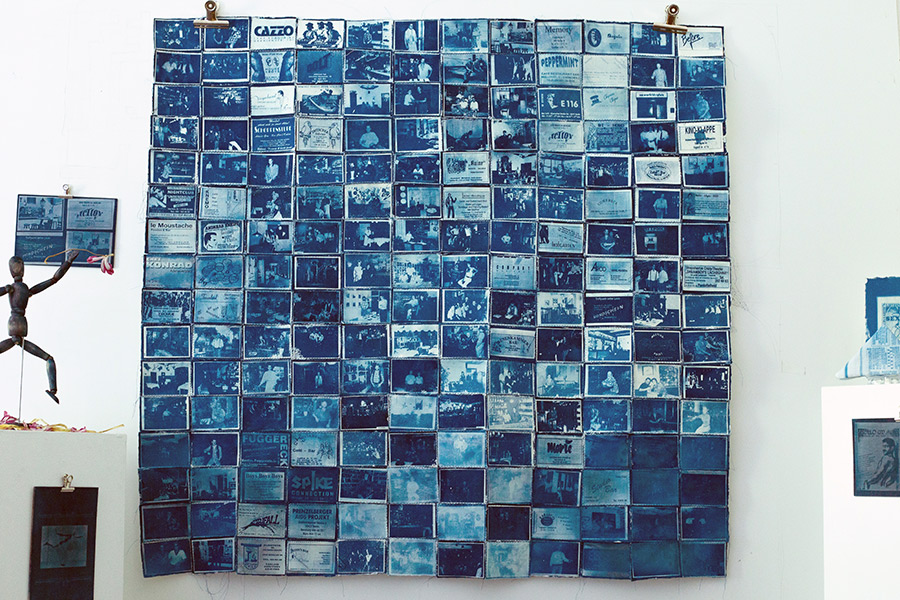
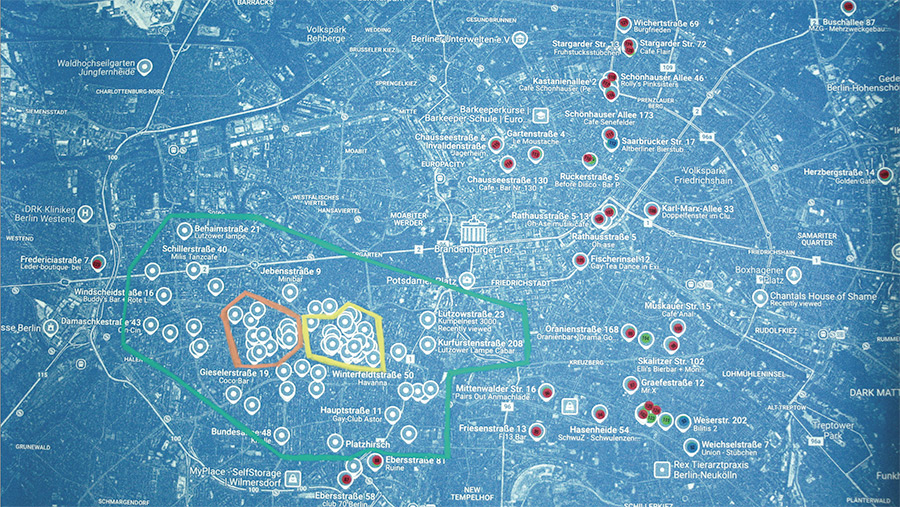
Inherited Thread takes as its starting point Berlin von Hinten, a gay tourism atlas first published in 1981 that catalogued Berlin’s bars, bookstores, and venues at a time when queer life existed largely in coded networks. From this modest guidebook, Dylan reconstructs a cultural topography: visiting surviving sites, mapping closed ones, and photographing their present forms. Their fieldwork extends into the archives of the Schwules Museum and Spinnboden, where they piece together ephemera—ads, zines, snapshots, and personal notes—that once charted a thriving but precarious social world. Each recovered address becomes a point of dialogue between past and present, what was lived, and what remains.
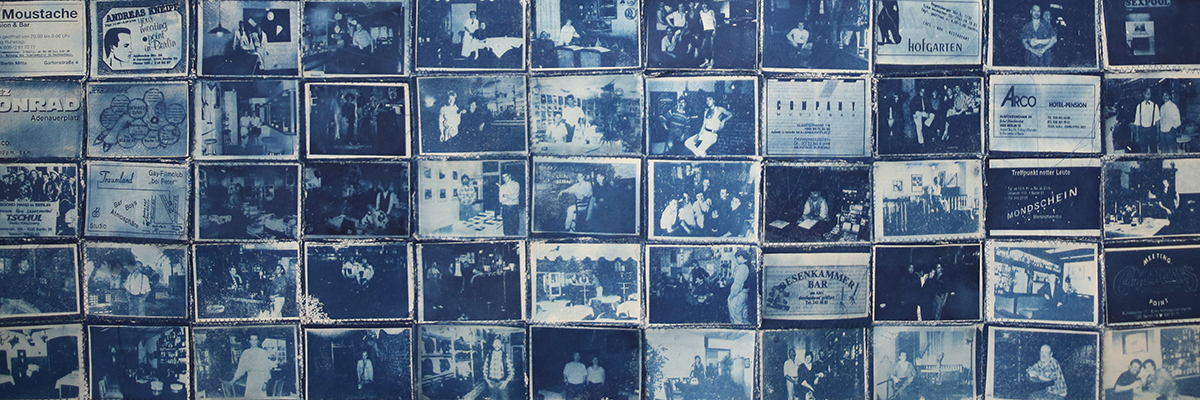
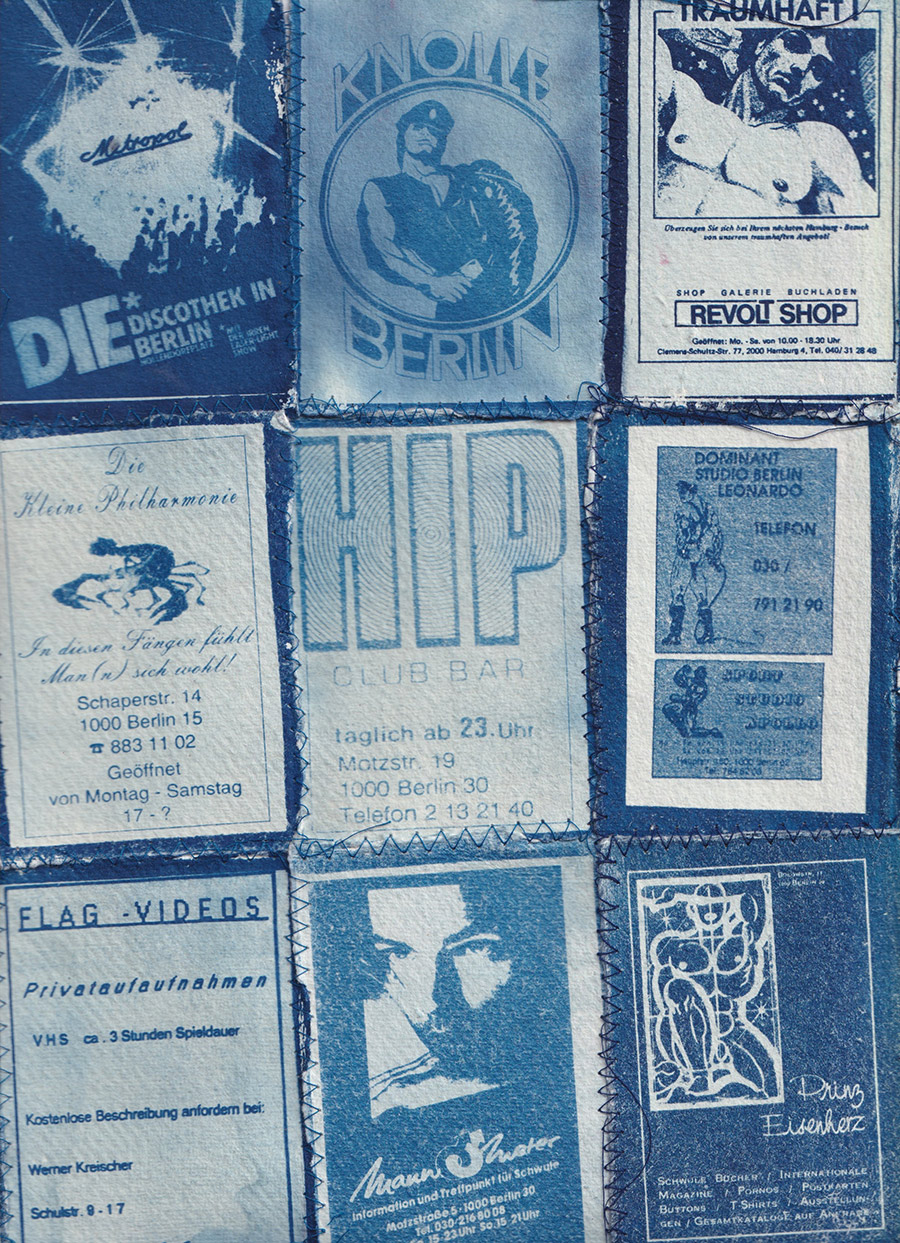
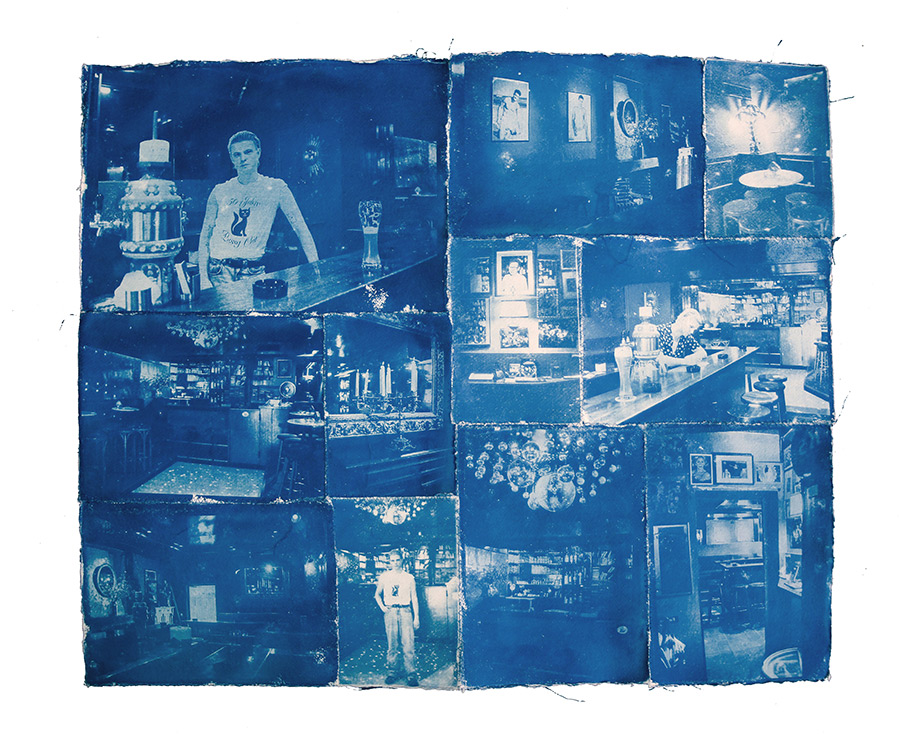
Materially, the project echoes themes of loss and persistence. Cyanotype quilts made from archival interiors fade from clarity to a certain ghostliness; resin-encased photos hold light like memory suspended, and weatherproof plaques marking the sites of vanished community. These gestures of preservation aren’t presented as nostalgia; they propose to keep history embodied and visible. Mitros’s own approach to documentation asserts that the everyday places where people gathered, danced, and organized are as vital to collective memory as any monument.
As Dylan prepares for their Berlin exhibition in November, Inherited Thread unfolds as a living, site-specific memory atlas of queer life—stitched from archival guides, re-photographed spaces, and the testimony of those who remember. It reflects a city still negotiating its relationship to memory, visibility, and belonging. And like the scholarship’s namesake, whose life’s work has championed careful observation, human imagination, and dignity, Dylan’s practice reminds us that documentation, when done with empathy and rigor, is itself an act of care.
“Inherited Thread attempts to better understand our Queer histories through archival ephemera. Dylan has conducted research in the LGBTQIA+ archives of the Schwules Museum. Focussed on the historic publication Berlin Von Hinten, a Gay tourism atlas first published in 1981, showcasing nightlife and community spaces that defined Berlin in the 1980s and 1990s. Revisiting and mapping forgotten landscapes through printmaking and photography, this project seeks to explore the inheritance of historical LGBTQIA+ spaces, and how to keep their stories alive.”
Following is our interview with the artist, researcher, and photographer.
I. Artistic Practice and Methodology
Brooklyn Street Art:For the exhibition for the Fresh A.I.R. you are using cyanotype printing on cotton-rag paper and making a quilt with some of them, positioning photography within a tactile, craft-based framework. Could you elaborate on how this interplay of image and textile informs the conceptual and affective dimensions of the project?
Dylan Mitro: My concept for this work involved printing cyanotypes on cotton rag paper and quilting them together, sourcing the material from a 1980’s and 1990’s Gay Tourist Publication titled ‘Berlin Von Hinten’ by Bruno Gmünder. This journey of research has been such a vast exploration of Berlin’s history, I felt I was having to sew together the LGBTQIA+ history that I was learning, as an attempt to retell stories of the community here in Berlin. Through the cyanotype sun printing process, the images were printed one print at a time, so it was unpredictable how they would turn out. Once I had 100s of these prints finished, it was clear that some turned out more visible than others with ghost-like qualities. This process felt very metaphorical to our LGBTQIA+ history and how a lot of these people, places and stories had been lost to time.
I decided to compose the cyanotypes like a quilt with both the photographs, advertisements and maps of Berlin’s; Gay, Lesbian Bars, Cafes, Discos, Travesti clubs, and sex shops. It felt like I was sewing back together a mere echo of these places and their stories from Berlin in the 1980s and 1990s. These two decades of the 1980s and 1990s are so poignant in the community, connected to the AIDS epidemic. As a Queer artist I try to navigate and understand further how to measure the loss the community faced in this time. With my body of work titled ‘Inherited Thread’ to both refer physically to the ways I have quilted together the cyanotype prints, but also to refer to the process this research has taken me on, in threading together the question of how, we as the next generation of the LGBTQIA+ community inherit the stories and spaces of those that came before us.
BSA: You will be drawing extensively on archival materials from Berlin Von Hinten (1981–1997). How do you approach the ethical and aesthetic considerations of working with such archives—particularly when recontextualizing them within a contemporary queer landscape?
DM: I think when dealing with any LGBTQIA+ historical material, you have to understand how personal perspective affects your lens, as the landscape within the community has changed. There was much to consider when dealing with a body of work like the ‘Berlin Von Hinten’. First, this book was mainly made for ‘Gay’ male tourists, looking to explore the homosexual life of Berlin, but was not limited to just that perspective. It shared both Trans and Lesbian spaces in its publication as well. But when dealing with the ethics of the ‘Berlin Von Hinten’ publication itself, it is necessary to acknowledge that it was made from and for a masculine, predominantly white gay male clientele.
So I had to acknowledge that, though this was a rich part of Berlin’s LGBTQIA+ history, it was certainly a limited perspective and not the full picture of the scene. Looking at any ‘Gay’ history, you have to acknowledge how prejudice and exclusionary rhetoric within the scene was certainly present and still exists in the present. I was approaching these books as a Gender Queer artist who is also a tourist trying to discover Berlin but from a contemporary lens. Approaching the research and acknowledging the influence this publication had within the Gay community is important. This work has not been intended to criticize the publication but to celebrate the way it was able to so intimately time capsule part of the 1980s and 1990s Gay scene here in Berlin through its writing, mapping and photography.
A majority of the aesthetics I was interested in were the advertisements in the publication. A lot of the focus is catered to the homoerotic, macho, masculinity. This aesthetic is not what I personally prescribe to. Still, I find the use of this homoerotic aesthetic to market sexually charged spaces for Gay tourism at a time within the peak of the AIDS epidemic very interesting. So all of this was considered as I worked through these published books.
BSA: You will be creating/presenting many of these historical photos and places re-photographed. What is the protocol for doing this?
DM: I could not have started any of this research without the support and access to the wonderful Schwules Museum Library and archive. I owe a lot of this research to their continued support. My protocol to present these historical photos was to take high-quality scans of these pages within the Berlin Von Hinten. These pages included photos of rare glimpses into the interiors of LGBTQ+ spaces in Berlin in the 1980s and 1990s. I recorded all of the accreditation of photographers that were published within the book and reprinted them within my research. As I was researching, I wasn’t only collecting photographs of these establishments but also their advertised addresses.
After the scans were finished, I created my own photo negatives on transparent acetate paper of the historical images. These photo negatives were made to print cyanotype copies of the images. After I digitally documented the addresses of these spaces into a Google Maps folder to create a digital map of where these places existed. From there, I was able to understand which of these places were still open and operating as the same business 40 years later. From the 200 businesses I documented, only 12 were still open; operating under the same name. So as a part of the project I visited some of those establishments and worked to photograph them the way they were in the original book 40 years later.
BSA:When you revisit surviving venues to echo the 1980s interior shots, how do you determine vantage point, focal length, framing, and lighting to balance fidelity to the historical images with your own authorial choices? What does re-photographing do in reference to history?
DM: I approached the photographs more organically, trying to document these spaces in a way that would allow for the environment’s ambience to speak for itself and for it to be understood within the photographs. I wanted to think if these photos were to be viewed in 40 years from now, how could these be a documentation of the spaces themselves, like the photos from the Berlin Von Hinten. I made sure to photograph the rooms without any customers in them, as the photos were more about the environment. I am attempting to continue the documentation and archive these current spaces as they are now, before they are lost to time. So it does feel like I am continuing the narrative of archiving to prevent the story of these places from being lost.
BSA: Provenance, description, and preservation must be a challenging process: What is your workflow for recording provenance and metadata (dates, addresses, names/roles, consent, cross-references to Berlin von Hinten) and for long-term preservation (file naming, etc)?
DM: My attempt at cataloging my findings and recording the metadata of researching was for a more artistic storytelling approach. To organize each of the places I had researched with its photograph, advertisements, and descriptions on each page. Recording when these places were established and which ones still exist. There are pages I have dedicated to crediting the authorship of these previous Berlin Von Hinten publications.
In the conversation around long-term preservation, I would consider my approach to be more artistic than technical. I still have to remind myself that this work is from the lens of an artistic practice over the short course of 10 months, and with that I feel it is still a work in progress with the intention of creating dialogue involving an open-ended question: how do we approach the idea of Inheritance of history within our LGBTQIA+ communities? – the answer is one that we each have to seek out and learn for ourselves. I have been working in LGBTQIA+ archives for years now, and it’s overwhelming how much material there is within the archives to be rediscovered. I hope others are inspired to dive into it.
II. Community, Space, and Memory
BSA:Central to the project are spaces such as Pussy Cat Bar and Eisenherz Book store, both historically significant to Berlin’s queer community. Can you talk about navigating the process of documenting these living spaces in a manner that both honors their historical legacies and engages with their present realities?
DM: The spaces I have photographed and interviewed were documented with very different approaches based on their history and contemporary positioning. Pussy Cat has been around since 1974, founded by two lesbians, and has always had its doors open to all, being very inclusive. When I photographed their space, I wanted to capture the ambience. The bar’s essence owes much to Daniela, Pussycat’s owner from 1998 until her death in November 2020; she’d worked there since 1982. Her former sidekick “Donna” (an employee since ’85) now runs the show, preserving Daniela’s legacy. I included portraits of the owner Donna and Jan, a young bartender who has been working there for just a few years. I spoke to Donna about the history of the bar, hearing stories about its legacy. While with Jan, I spoke about what it means for the next generation to be coming to a spot like Pussy Cat. I asked about the current climate, of the importance of a bar like Pussy Cat, and how it fosters intergenerational connections.
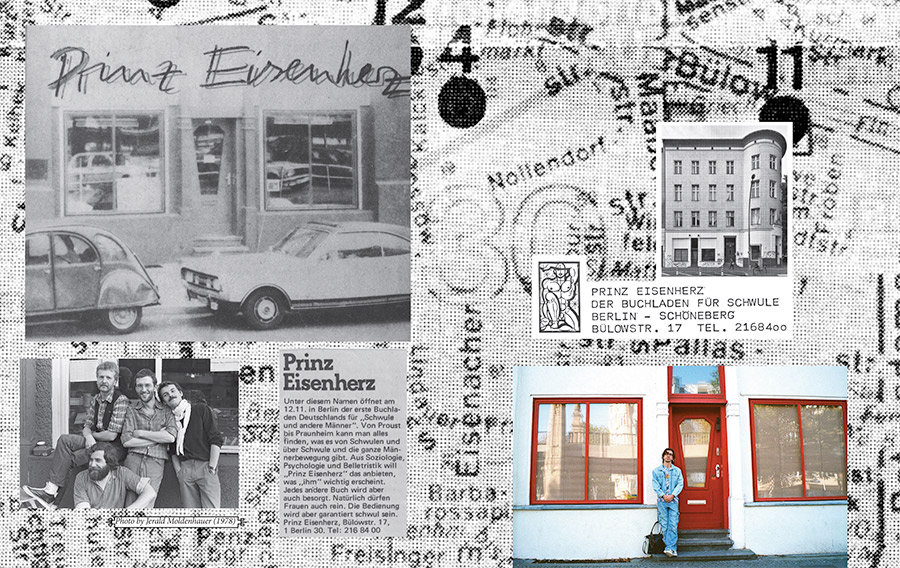
For Eisenherz Bookstore, it had a huge significance to Queer history here in Berlin. It is the longest-standing LGBTQIA+ bookstore in all of Europe. It opened in 1978, as a Gay bookstore called Prinz Eisenherz located at Bülowstraße 1, just down the street from my studio here at Fresh A.I.R. and across the street from where this project will be exhibited. Eisenherz is where the story of my research starts, as the founders of Berlin Von Hinten – Bruno Gmünder and Christian Von Maltzahn were two of the five founders of the Prinz Eisenherz bookstore.
When I photographed and interviewed the current owners of the Eisenherz, Roland Müller-Flashar and Franz Brandmeier, they talked about their involvement in the business since the 1980s. We spoke about how they changed the name and made the bookstore more inclusive over the years. They still to this day host book readings and gallery openings. As a business, I talked to them about their legacy and how vital their store is to the community. They shared with me photographs of the official opening in 1978 to contribute to the publication of the work. I photographed portraits of the owners and their colleagues to create a current time capsule of their store and the ones who keep it running. In a climate of LGBTQIA+ book bannings, it’s a significant social fabric for the community to access history and current local and international voices.
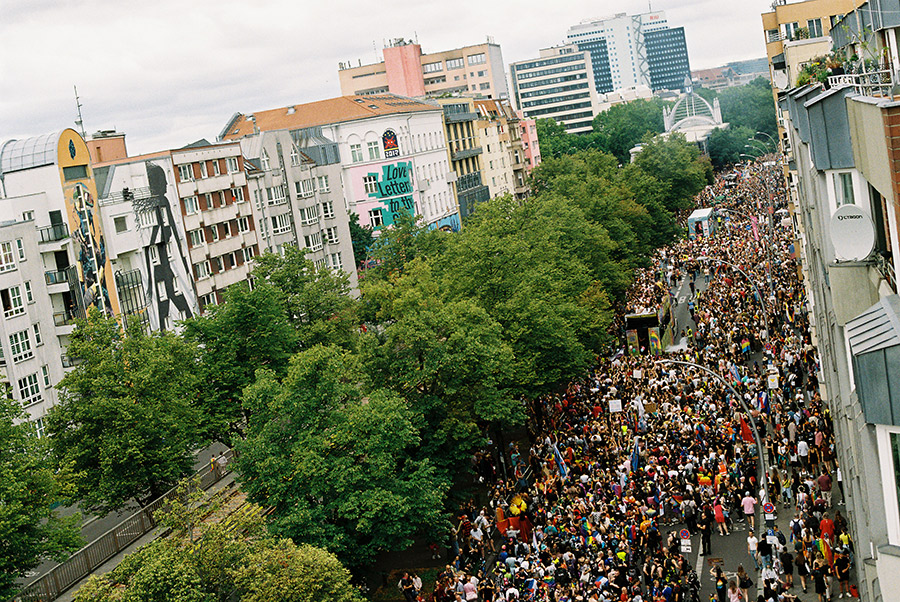
BSA:When you engage with events such as the Community Dyke March and Christopher Street Day, your work intersects with both activist and celebratory dimensions of queer visibility. How did your immersive engagement with these communities inform your visual and conceptual strategy or the outcome?
DM: I intend to document Queer history as a celebration. However, I cannot ignore that Pride is also a protest. I felt compelled to capture the ongoing struggles the community still faces and the freedoms we must continue to fight for. While in residence, there was Berlin Pride in July, and within 24 hours, there were three marches that I wanted to document. There was the Community Dyke March, the Christopher Street Day March, and the International Queer Pride for Liberation March. I think it is powerful to show those who show up in the streets, and to document their power.
Activism and celebration are not binary, and to celebrate the strength of their ability to show up in the streets and fight for rights and freedoms is important. I think it is essential to acknowledge how easy it is for us to forget the sacrifices that have given us our freedoms today. We are here today with the rights and freedoms we have because of the elders who came before us, and the activism in the streets they did. There is still so far to go, and I think it’s important to document and archive the ongoing fight for future generations to witness the brave trailblazers of today.
BSA:You’re pairing your visual works with interviews and a book, integrating oral histories with photographic documentation. What are the narratives and/or perspectives you’re most focused on to share with the public?
DM: I will have a book that will document the whole journey of my research and where it leads. This includes how many of these LGBTQIA+ spaces are on the verge of disappearing as the community shifts. I look to ask the community what it means to inherit these histories. How is the torch passed on and how can we find more intergenerational connections, threading a link to the past and finding more of a moral responsibility to them instead of just approaching them from the position as a consumer.
BSA:The inclusion of archival artifacts—such as pieces of the original mural wall outside Connection club and printed publications like Berlin Von Hinten—places in the foreground a dialogue between image, object, and place. How do these material elements shape the way people can react to your work?
DM: For the project to include archival artifacts like the Berlin Von Hinten publication and pieces of the exterior mural from Connection Club, I want to bring attention to the value and importance of these objects visually. For the Connection Club mural, it was unexpectedly demolished as I was in my residency, and I actively became a part of the project unexpectedly. The mural on the exterior of Connection Club was a large display of Gogo dancers and Drag Queens painted in 1997. The entire mural was coming down without any means of preserving it. I believe this was probably the Largest and oldest gay mural in the Schonenberg neighbourhood, and there was no relative concern about attempting to preserve it. So I decided to photograph and document the demolition and went into the dumpster of rubble to collect some of the broken pieces of the mural to exhibit as a part of the exhibition. It was an unexpected moment in the project that encapsulated the work into a physical object. We aren’t just losing the spaces for the community; we are also losing the artworks on their walls and the stories they tell. So having it in the exhibition allows the viewer to witness the continued deterioration of Queer spaces and the current climate.
BSA: Berlin’s queer history is both deeply entrenched and dynamically evolving. How do you situate your work within this broader historical continuum, and what conversations do you hope it sparks within institutional and public contexts?
DM: Berlin’s Queer history is so deep, it is why I was first drawn to this city. But I think once I arrived and started my research, I was so overwhelmed by how vast that history was. I didn’t know where to start or how to encapsulate it into a project. But I think once I familiarize myself with the context of how I am approaching Berlin, I can ask questions in my work without trying to answer them. I wanted to hopefully have people ask their own questions of how do we inherit our Queer histories, how do we memorialize not just the grief we endured, but to memorialize it.
To familiarize ourselves with how our community has come together throughout history to fight for the freedoms that can so easily be taken away—and are actively being taken away now. At a time when the digital age is isolating us further from each other, I hope this work encourages the public to find importance in our histories and actively engage with it. I wanted people to visit and support these places that are still around and respect their deep historical roots. I wanted to find the threads that link what we enjoy and consume today within the community because of what came before us. Hopefully more people will be inclined to go to places like Pussy Cat, Eisenherz bookstore, or the Schwules Museum Library Archive to find stories they are interested in finding out more about.
BSA:Did you find it difficult for the subjects you were pursuing to engage with you and to open up more with their stories and legacy? What are the challenges for an artist and researcher like you when asking people to be frank and open with you about their stories?
DM: From the beginning, I knew as an English-speaking outsider from Canada, I had to accept that I was approaching this project from that perspective. I did have some apprehensions at the beginning about approaching people to ask more about the history because I wanted to make sure I had enough knowledge of the history to ask the right questions. But I tried my best to immerse myself in the community to understand and feel what type of climate it truly is. Thankfully, the residence was located right in the heart of the historic Gay district of Schöneberg. From leather cruising bars to the Gay cafes, I visited them all, and within the context of being an outsider trying to learn more about the history of these places, I had to be patient.
As a Documentary film director, I have done many interviews in my life, so I am familiar with talking with strangers, but it was essential to gain trust with them. I do think that because I don’t speak German there was certainly a barrier to get through to get the most intimate version of the stories but there was a ‘matter of fact’ approach that most people I talked to gave. I noticed that each of the people I interviewed had a very clear understanding of ‘How things are now’. The community relies heavily on tourism, so its clientele has a transient mentality. I could really get a sense from each of them that it’s still a lot of work to keep up running a business and it’s not easy.
So for me to come in to ask questions and take up their time, I needed to be patient and work with them on their terms. Some places were more difficult than others, getting myself into some interesting situations, as some were quite closed off. In those moments, I had to respect their choices and pivot just to accept that there are countless other stories to focus on. For those who were open and invited me into their world to listen to their stories, I am eternally grateful. I hope that more Queers my age understand their responsibility to the community and become more interested in LGBTQIA+ history. It’s our obligation as the next generation to not only be consumers of the culture but to become active participants within the framework in an effort to keep these LGBTQIA+ spaces and stories alive.
Dylan is an alumnus of Class #10 of Fresh A.I.R. The project is an artist-in-residence program of the Berliner Leben Foundation. Dylan is the first recipient of the Martha Cooper Scholarship for Photography under Fresh A.I.R. They will be exhibiting their project at the Fresh A.I.R. exhibition opening on November 7th.
Fresh A.I.R. Scholarship Exhibition #10
“I AM FLUX: The Freedom of Being and the Possibilities of Becoming”
Opening Reception: Thursday, November 6, 2025, 7–10 PM Exhibition Dates: November 7, 2025 – March 29, 2026 Opening Hours: Tuesday/Wednesday: 10 AM – 6 PM Thursday to Sunday: 12 PM – 8 PM Location: Project Space of the URBAN NATION Museum, Bülowstraße 97, 10783 Berlin
Open House: Saturday, November 8, 2025, 2–8 PM, Bülowstraße 7, 10783 Berlin
For more information about Fresh A.I.R. click HERE
For more LGBTQIA+ related projects under the Fresh A.I.R. Program click the links below:
Graffiti is a living monument—an act of doing rather than keeping.
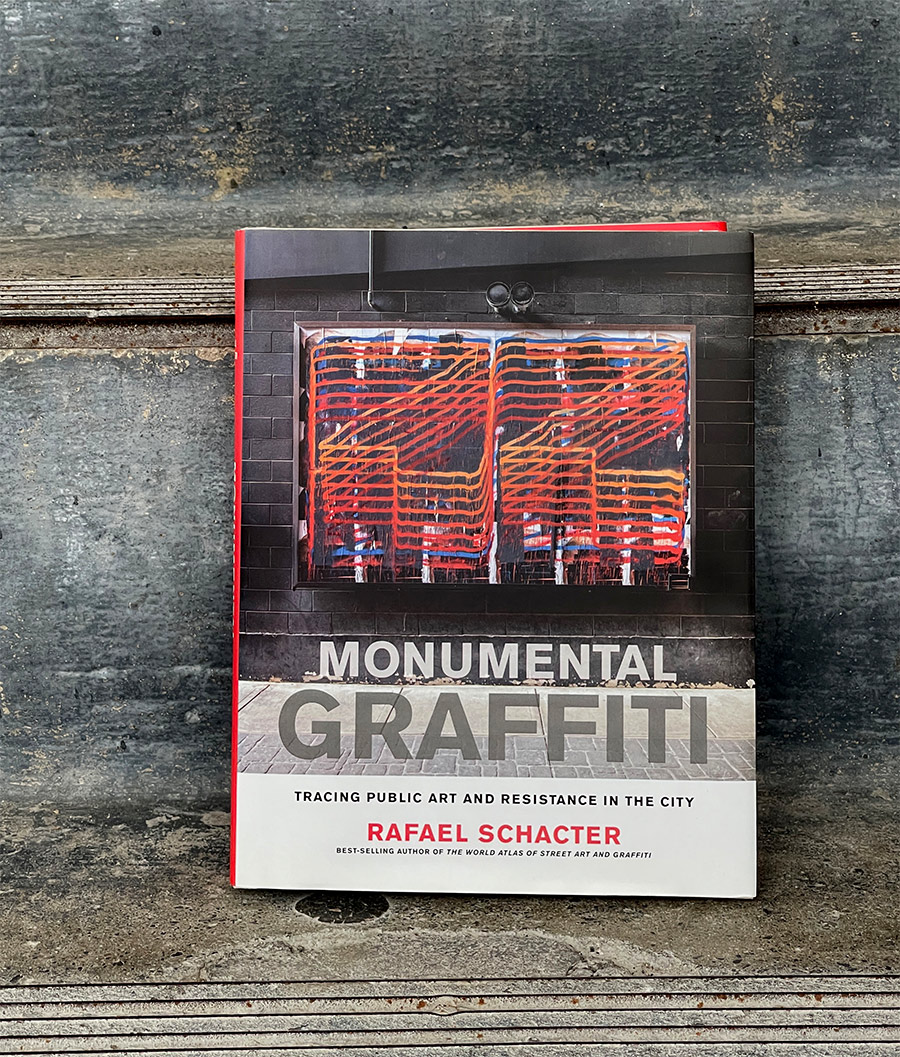
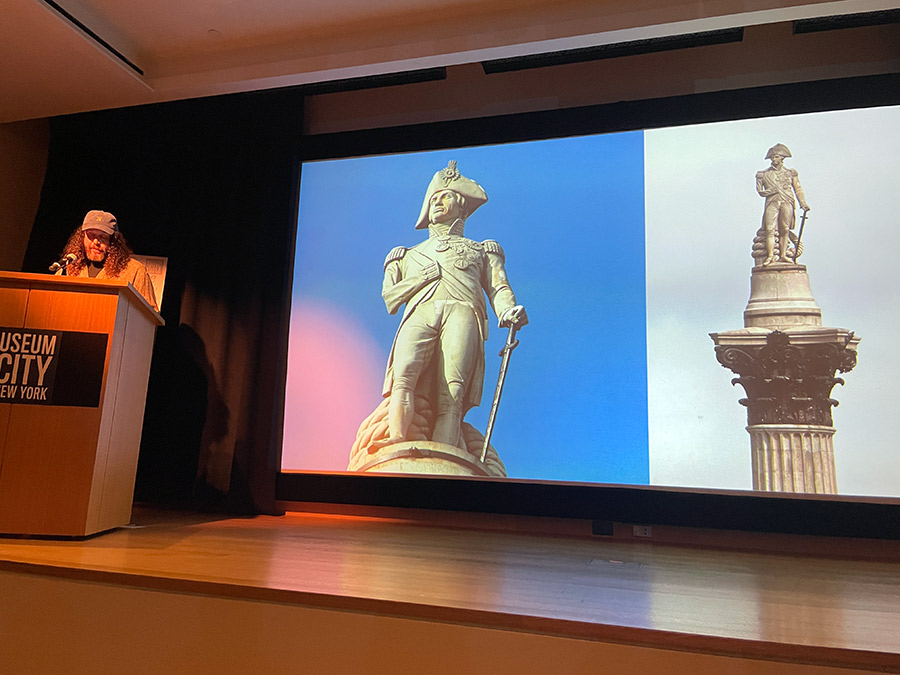
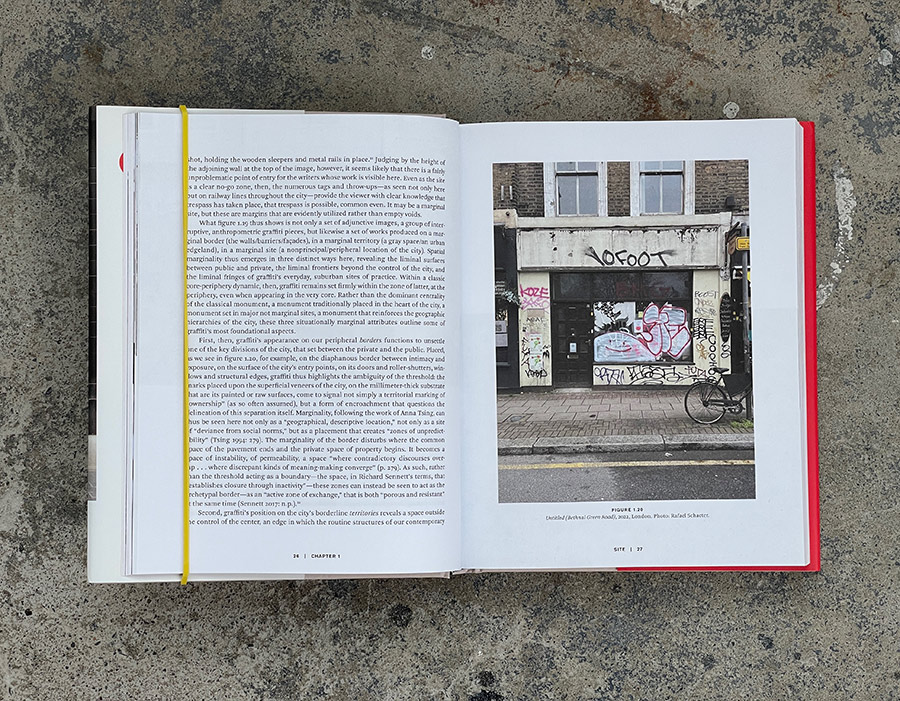
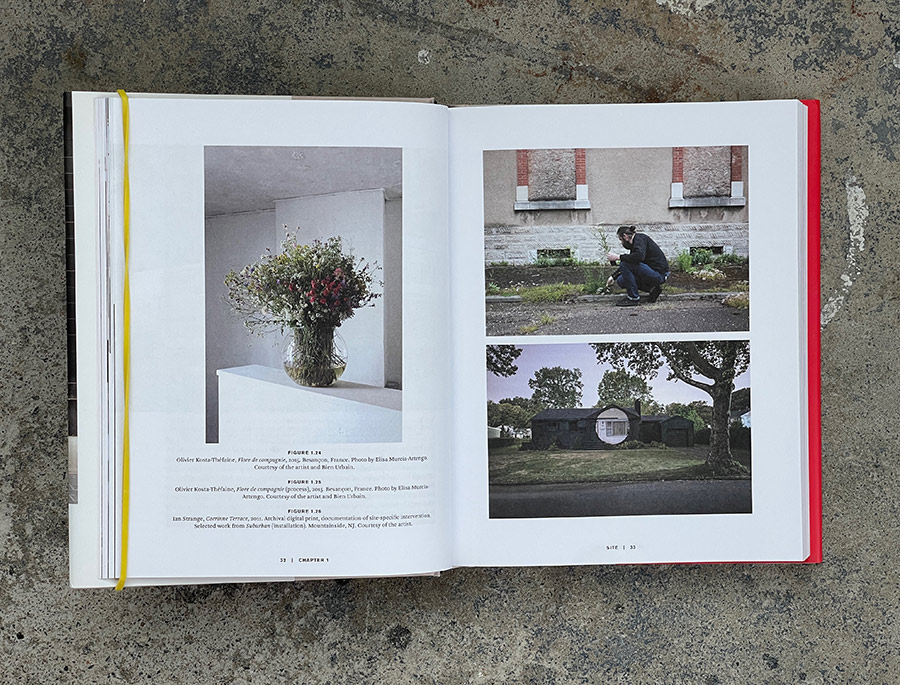
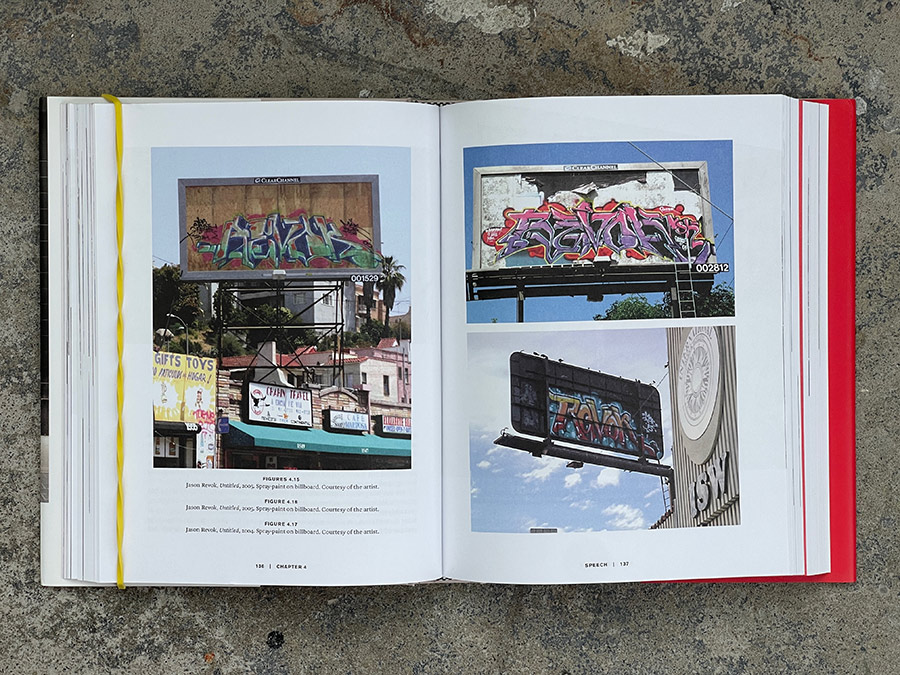
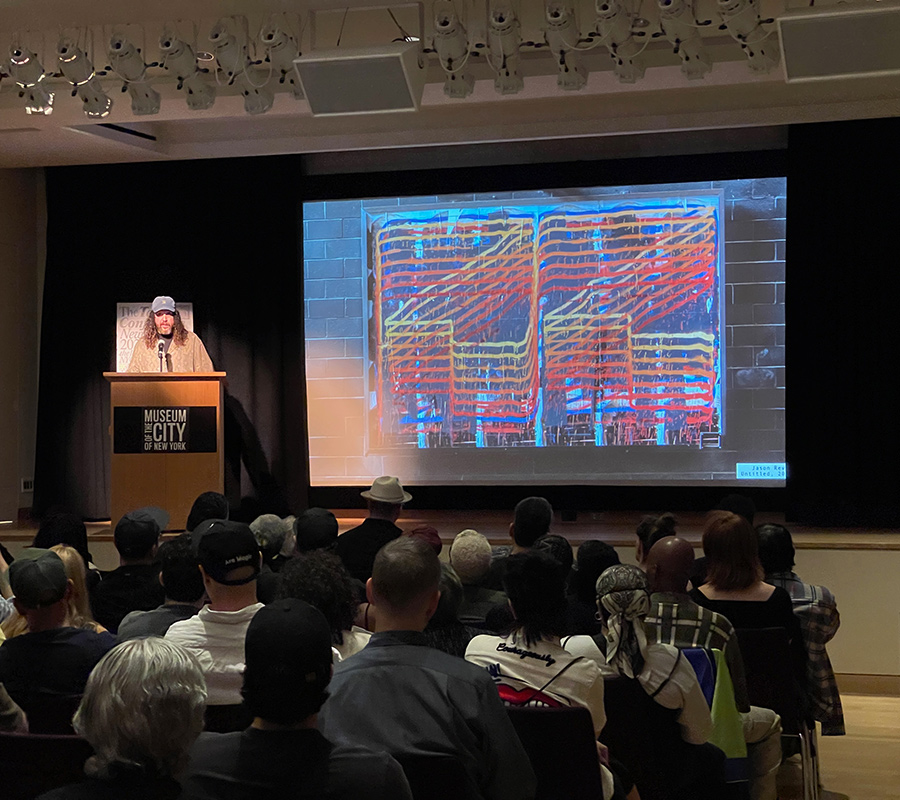
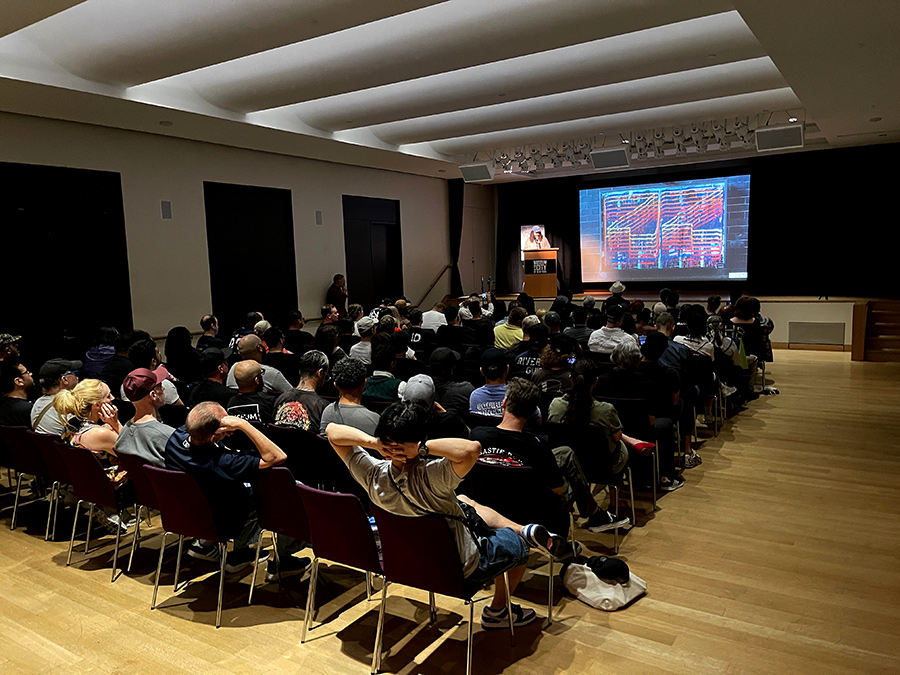
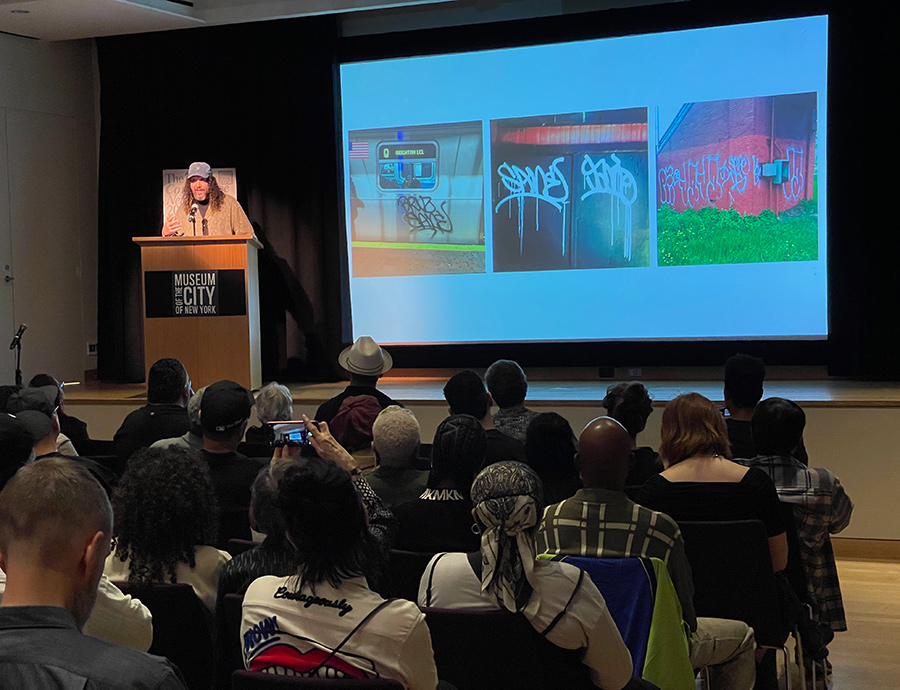
Rafael Schacter has been offering an alternative to institutional monumentality in his latest book Monumental Graffiti (2024). He buttressed his alternative view during his keynote speech for the New York 2025 Tag Conference (BSA is a sponsor). To a packed audience at the Museum of the City of New York, Schacter talked about a monumentality that is grounded in community, embodiment and the acceptance of transience as truth.
Rafael Schacter. Monumental Graffiti. Tracing Public Art and Resistance in The City. MIT Press. 2024
In his talk and his book, the London-based art historian argues that monuments and graffiti can illuminate each other: monuments don’t need to be grand or permanent, but can be understood—as their Latin root monere suggests—as acts that remind, advise, or warn. Drawing on counter-monuments and non-Western traditions, he would like to redefine monuments as socially and emotionally engaging public artifacts that may be ephemeral, community-driven, and conceptually monumental rather than physically imposing.
Using images and examples from streets around the world, Schacter, who is also the author of The World Atlas of Street Art and Graffiti, furthers his vision by exploring how graffiti can itself be a monumental form, demanding public attention and reframing both graffiti and monuments as cultural acts that mark and speak socially. He then examined memorial practices within graffiti culture, where community-created walls and tributes function as grassroots monuments that commemorate loss and address social issues.
A curator and theorist of urban art, Schacter expands on this, distinguishing between spraycan memorials—visible, collective, and community-respected—and memorial tags, which he describes as intimate, cryptic gestures of remembrance shared within the subculture. Schacter contrasts these living practices with the illusion of permanence accorded institutional monuments, showing how graffiti’s embrace of impermanence subverts traditional ideas of stability and authority. Finally, through his discussions of memory through disappearance and the memorial tag as embodied memory, he proposed that graffiti’s transience itself becomes a vessel for remembrance, where memory endures not in material form, but in repeated acts of writing, risk, and presence.
We asked Schacter about the nature of monuments in graffiti and street art—whether an illegal wall piece can ever transcend vandalism, what happens when a tag vanishes, who decides what deserves to be remembered, and whether a true monument is built from the ground up or imposed from above.
BSA:If graffiti can be a monument, what happens to the idea of permanence? You describe monuments as “reminders, warnings, and advice” rather than fixed objects. For people used to thinking of monuments something of bronze, stone, or concrete, how could one reconcile the beauty of graffiti’s impermanence with our instinctive desire to preserve something that we value?
Rafael Schacter: Great question! So many points I could spend hours unpacking! But, to keep myself focused, the key thing to note here is that preservation is by no means only related to permanence; i.e., the relationship between remembering and forgetting on the one hand and presence and absence on the other, is really not so straightforward:
Is it not true that things that are ever-present are often the most easy to forget?
In many cultures outside the West, for example, destruction is something that is core to techniques of commemoration – the heat of destruction burning memory into mind. And in cities crammed with institutional monuments, with thousands of bronze men on horseback, is it not the case that they often seem to, in fact, provoke amnesia!
Is it not a fact that things that become absent are often the most intensely memorable?
I totally agree that graffiti’s impermanence can be beautiful (often physically so, in terms of the way it degrades and becomes part of its surroundings), but more than just beautiful, its disappearance can lead to a heightened sense of memory; let alone push the focus towards the beauty of practice and performance and not just the beauty of the final image itself.
BSA:Who decides what’s worthy of being a monument? Normally it is the decision of institutions or governments, but this new path suggests others may decide what is worthy of monumentalizing. A monument created bottom up or top down – which is a truer monument, or is that a silly question?
RS: Ha! Not silly at all! I’m currently in the middle of teaching my lecture course on public art, and this is a critical part of what we’re discussing. So yes, in most of our cities, this is in fact a legal question – in England, for example, there is what is termed the Schedule of Monuments, a list defining and delimiting what appears under this term, and there is specific legislation surrounding what happens if an artefact is within the list. But, as you say, monuments – monuments as public artefacts or inscriptions that remind, advise, or warn us – come not just from the State but so too from the grassroots. Sometimes these non-state monuments can become formally sanctioned, but whether they do or not, they can be incredibly powerful forms that exist far beyond the necessity or even visibility of officialdom. Which form is ‘truer’ or more ‘authentic’ is always context specific, however.
But all I personally know is that I can be moved more by a spontaneous shrine than by an institutional memorial, by the handwritten note attached to a bouquet of flowers laid by the side of a monument than I could be by the monument in itself! More than anything I just want to move us away from only seeing these permanent, stoney, neo-classical public sculptures as monuments, and in fact see the way monuments can exist through diverse materials and in diverse locations outside of the confines of officialdom.
BSA:If a tag disappears, does the monument die—or does it live in memory? Certainly its disappearance and decay impacts its ability to have lasting impact.
RS: How do we remember things? Do we remember from looking at them? And how do we look at them? Do we look differently when we know something is not going to last? But what about not just looking! Can we remember things through a set of gestures? Through a movement? Through a dance? Can we remember something via lighting a candle that we know will burn out?
When things disappear, memory can often burn even brighter – the presence of absence often being more powerful than physical presence itself. So yes! Disappearance effects visibility, the ability to be co-present with an image, but the image can live on both in the person that made that image as much as in those who saw it, and saw it knowing it would at some point disappear!
BSA:Does a city full of graffiti become a city full of monuments? If we take the argument to heart, then every wall might hold a kind of public archive or memorial. Is a monument made by a vandal illegally still vandalism, or should it be honored and preserved for posterity?
RS:First, YES – when I say graffiti is a monument I mean that literally not metaphorically, and so absolutely yes, the walls of our cities are a constantly transforming archive that holds immense amount of information and history. Whether we term this vandalism or not actually makes no difference. (But is it not the overbearing monuments of the city that are themselves vandalism, themselves the destruction and the blight that damages our cities – I mean, I can think of plenty of examples of large-scale public art that are total degradations of our public sphere). Yet that doesn’t mean I think graffiti should be preserved, absolutely not. Preservation, as I talk about in the book in terms of examples of indigenous material culture, can often itself be destructive. If you preserve something, freezing that thing in time, you can often be more likely to forget what it represents than if you let it naturally degrade. Preservation, then, can be destructive, and destruction preservative!
BSA: Graffiti has turned up in unexpected corners of sacred buildings — scratched into the walls of Christian churches, carved into stone lintels of synagogues. They may be names, coats of arms, or a portrait of the parish cat. When you think about these quiet, unauthorized marks across different faiths, how might your idea of graffiti as a kind of monument apply to them?
RS: I love the idea of what you term ‘quiet’ here. Because often it is the smallest, most marginal, minor forms of graffiti that can be the most powerful. Yes, big graffiti is GREAT, and often very overtly monumental (I’m thinking of the incredible work of RAMS MSK at the moment for example). But smaller marks can be monumental in their effect too, a tiny tag at the edge of a wall containing as much style as a massive masterpiece. So yes, monument is not simply about size. Bigger is not necessarily better. And sometimes it’s the smallest marks that cut the deepest!
Rafael Schacter. Monumental Graffiti. Tracing Public Art And Resistance in The City. The MIT Press. Massachusetts Institute of Thechnology. 2024. USA.
Not that you don’t have free will and could quit your phone any time. Of course, you could.
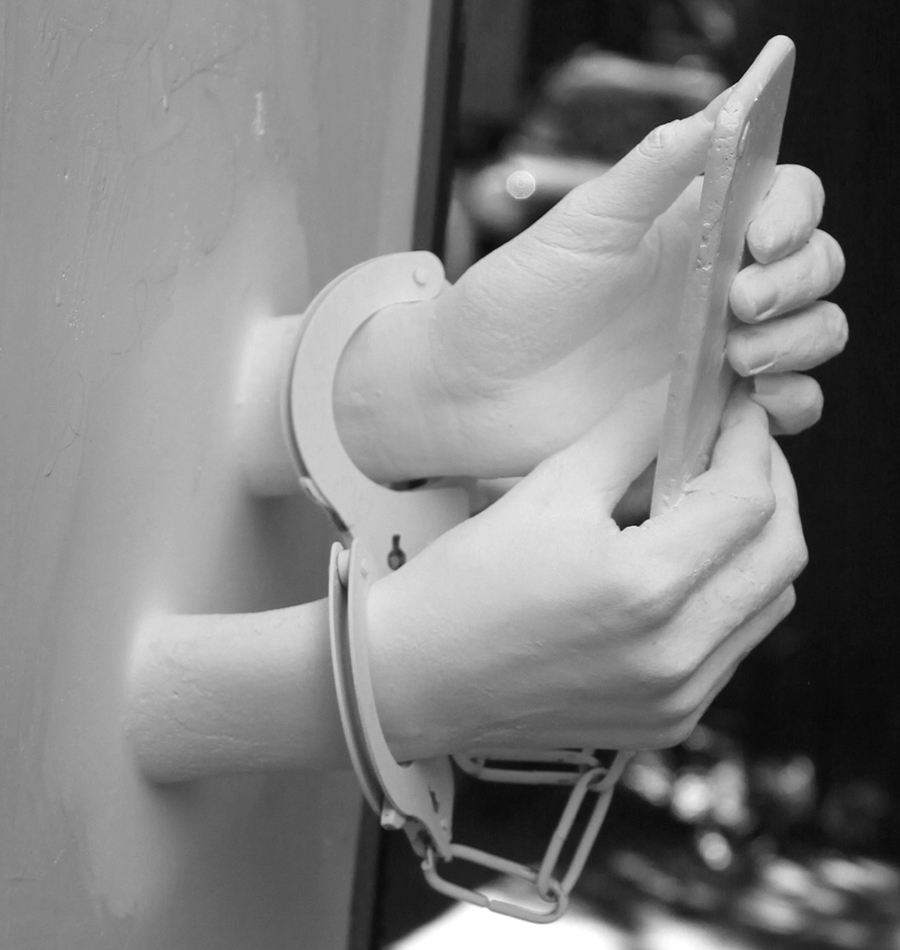
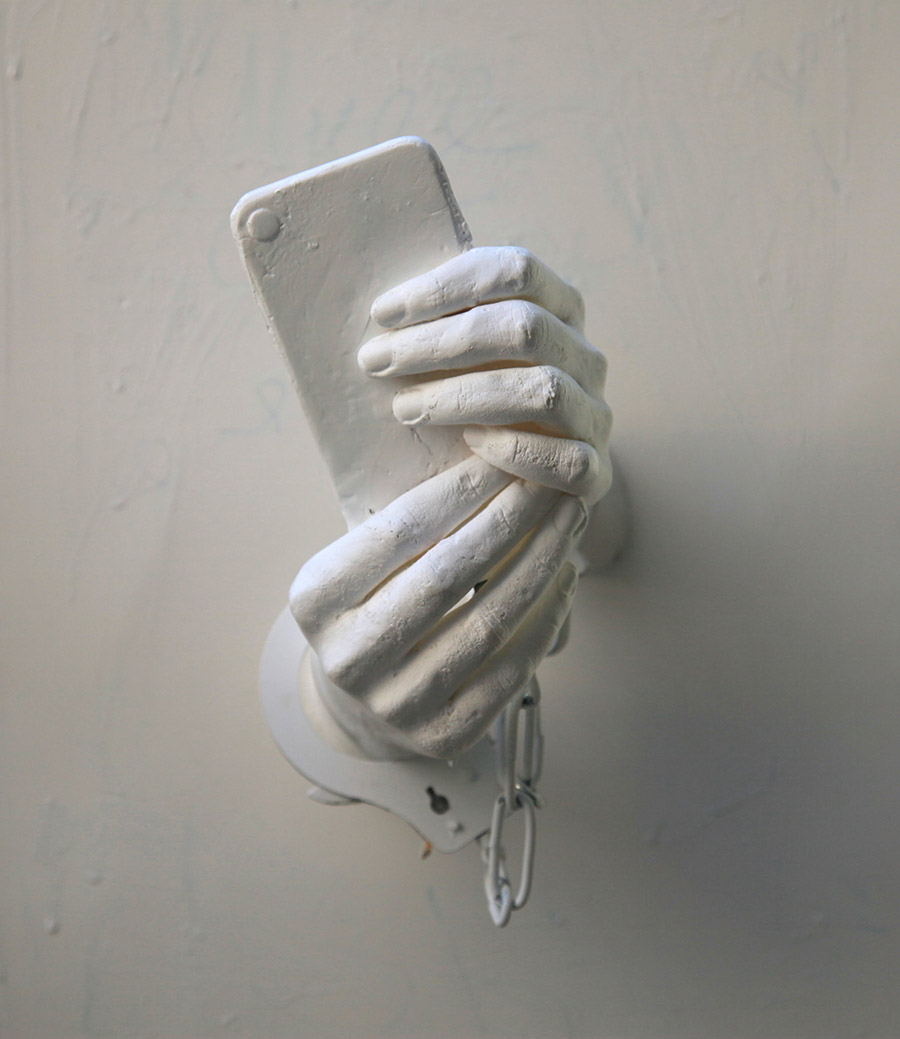
Street artist Leon Reid works conceptually often, and in this case, as a sculptor alongside you on the street in Bed-Stuy, Brooklyn. The message is self-explanatory, and yet, you would have to look up from your phone scrolling to see it, so many will miss it.
Brooklyn Street Art:The sculpture depicts a pair of handcuffed hands holding a mobile phone. The hands are restricted, yet the work’s title is “Of a Free Will”. Can you please elaborate? Leon Reid: Many times when I observe people holding their smartphones I ask “Is that person holding their phone because they want to or they need to?” It’s impossible to answer completely but still I wonder. 15 years ago, many folks used smartphones because they were curious about the potential of a new tool. Of course, advertising guided most people to buy smartphones, but then social media slapped advertising in everyone’s face 24/7/365. This exposure weakened the argument that we’re all using our phones because we want to. The infrastructure of our society is now designed around smartphones; you can’t enter certain buildings without it; in some cases you can’t travel, eat or see a doctor without it. I believe that we as a society decided to freely carry out the Free Will of technology corporations; we cuffed our own hands to it.
BSA:You’ve been installing your work in public for a long time. Have you noticed any differences in the difficulties inherent in installing works on the streets from the early days of your practice to today’s environment? LR: Yes, when I started writing graffiti in 1995, in most instances, we did not have to worry about surveillance cameras recording us; there simply were fewer cameras in existence.
Though I am not active as a graffiti artist as I once was, those doing it now must be prepared to be filmed -in fact many film themselves. The further you go back in graffiti history the more artists had to operate like ninjas. Stealth was a quality that was honored among writers. However, the exposure of graffiti and street-art through documentation has brought a broad acceptance of the art from -one that I never expected to see- so that many times artists can do their work in public with permission.
BSA: You mentioned that your work was defaced/vandalized within days of being put on the street. Why did you choose to restore it? LR: So this piece has gotten a lot of attention in the neighborhood because I believe most people are at a point where they can understand its message. Within a week, someone added two additional messages to the work; one was a statement about Immigration enforcement, the other about the Israel/Gaza War. I have my opinions on both of these topics however the markings made three unrelated messages on one artwork and they distracted from the original message. I removed the additional messages, but was conflicted in doing so. I’ve long known that once an artist puts their work on public display, they cannot control how the public interacts with it. If the messages persist, I have to let it be.
BSA:How has the rapid evolution of technology, such as the sophistication of smartphones, the apps, and Social Media, changed the way in which art is experienced now? Are there any pros or cons in your opinion? LR: So, in my ideal world, everyone would have the possibility to see great works of art -be it on the streets or in a museum- in person. This for a variety of reasons cannot happen. Most of us will only see great works of art through media. However sometimes, a great photographer can capture a great work of art in a moment; perhaps a child is able to touch a graffiti wall because they cannot do so in a museum, a photographer is there to snap the moment and the picture becomes a symbol of what that artwork can mean to people. If this photograph inspires people to see the work in person that is a pro. The con is if so many people turn up not to look at the work, but to photograph themselves beside it. If such a thing happens too much it can alter both the community where the work lives and the meaning of the work itself.
“Of a Free Will” is part of a larger street-art exhibition organized by Novo Collective titled “Playground of the Invisible”
When graffiti and street art lace up hiking boots and head into rural or fully natural settings, some feel conflicted about the potential harm to plants, soil, and water. Naturalists argue that human hands should leave no trace—certainly not one out of harmony with the site. In the built environment, on the other hand—cities, towns, suburbs, strip malls, fast-food restaurants, roller rinks, bowling alleys, factories, condos, lawyers’ offices, hospitals, laundromats—the conversation around street artists and graffiti writers tends to focus on property and real-estate value, less on our impact on the Earth.
Sea162 (Alonso Murillo) is a Spanish graffiti/mural artist from the Madrid region, long associated with Collado Villalba north of the city. He began writing graffiti in the 1990s, later moving from classic graffiti into large-scale murals; his current approach merges graffiti know-how with site-responsive painting in natural or semi-natural settings.
He is known for a kind of “nature street art”: fauna and flora rendered on quarry faces, walls, and outdoor structures, frequently using earth-based pigments he gathered and developed from sites across Spain (including the Canary Islands). His compositions often integrate the rock’s relief to create volume, capitalizing on the site’s natural features.
Sea162’s approach has led him down paths street-art fans don’t typically associate with the culture, yet his evolution feels organic—especially as he has developed a practice with natural pigments. He has competed in Spain’s Liga Nacional de Graffiti in multiple editions (2021–2024). This year the Museo Nacional de Ciencias Naturales (MNCN-CSIC, Madrid) presented his 90×7 m mural “Evolución,” made with natural pigments and accompanied by a museum display about its materials and process.
He has participated in Spanish and European street-art initiatives, including painting a wolf at an outdoor rock-art event in France and multiple municipal or regional projects in Spain. His 2023 mural “El Tritón Miguelón” on the circular La Palla irrigation pond in Garcibuey (Salamanca) was selected “Best Mural of the World – April 2023” by Street Art Cities.
We asked Sea162 about his practice and this new installation:
Brooklyn Street Art:Can you tell us about the setting, the placement of the art? Is it a natural swimming “pool” somewhere in a forest? SEA162: It’s an old stone quarry in the village where I live northwest of Madrid. It is inside the mountains.
BSA: The objects depicted on the mural appear to be seashells. What can you tell us about the different species of shells you painted on the rocks? SEA162: It does look like seashells, but these are organic forms that connect with the forms of the rock in a free manner of expression.
BSA:You mentioned you used natural pigments collected from different places in Spain. What can you tell us about your process of collecting and making the pigments? Do you use plants, flowers, soil, and rocks? SEA162: I usually use rocks and pigments made from minerals.
BSA:Can you describe your process of planning and selection when you paint in a natural environment? SEA162: At the beginning, I try to find a way to connect with the place and the environment. After I select the location, I begin to work on the idea and its design
BSA:By using natural pigments, is it your intention for the artwork to be washed by rain and other natural elements? SEA162: I find it essential to take care, to protect the environment and the work for the future, by natural, yet resistant materials.
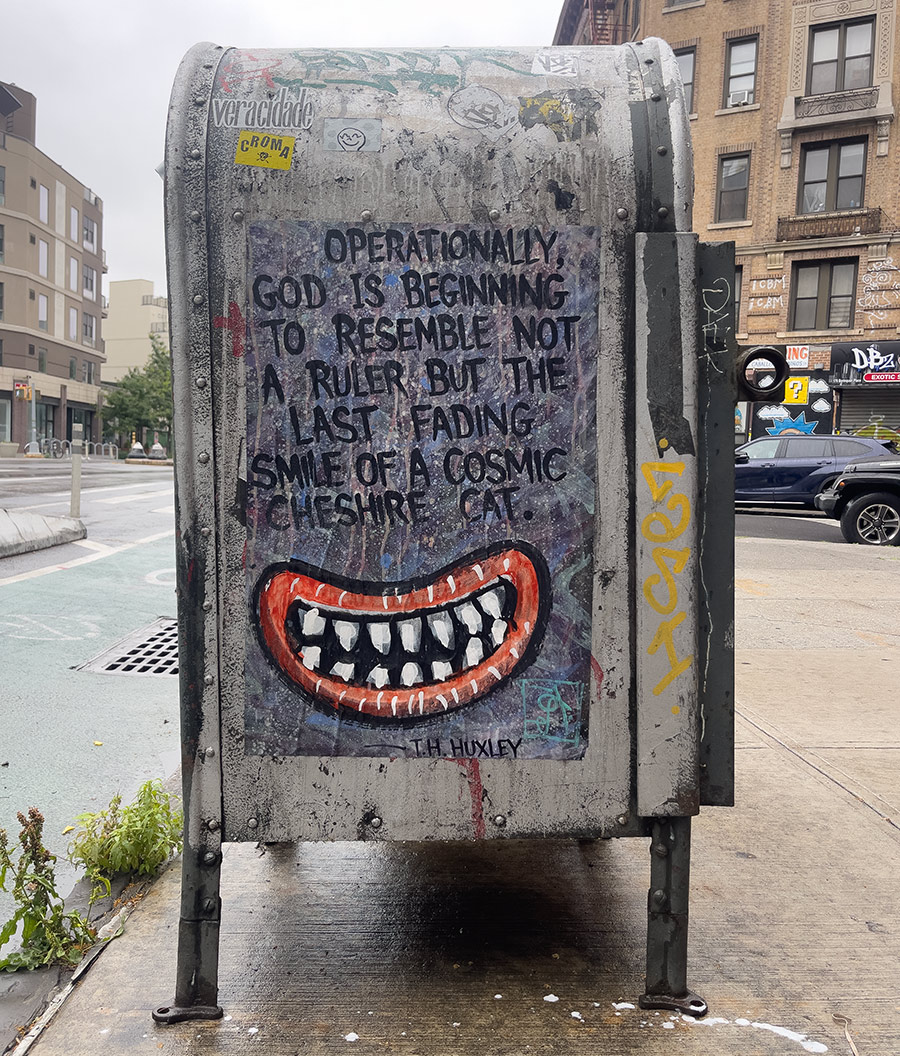
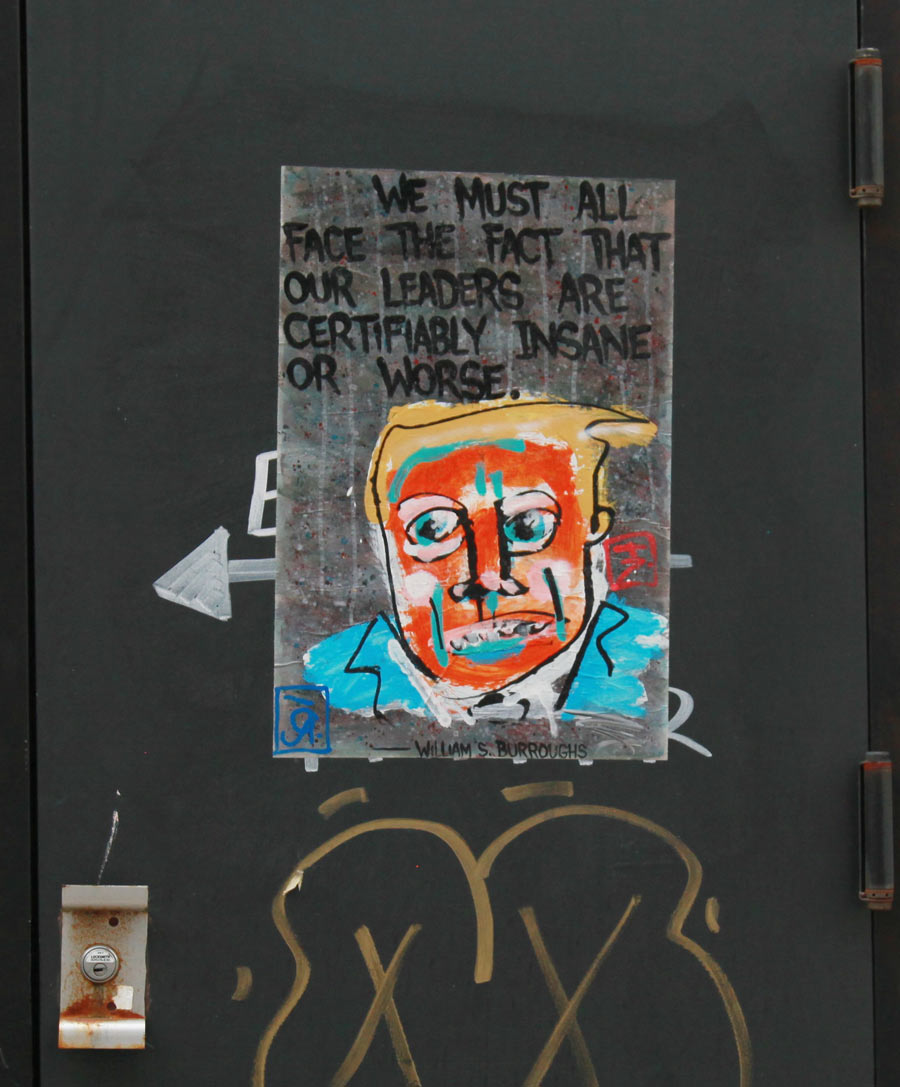
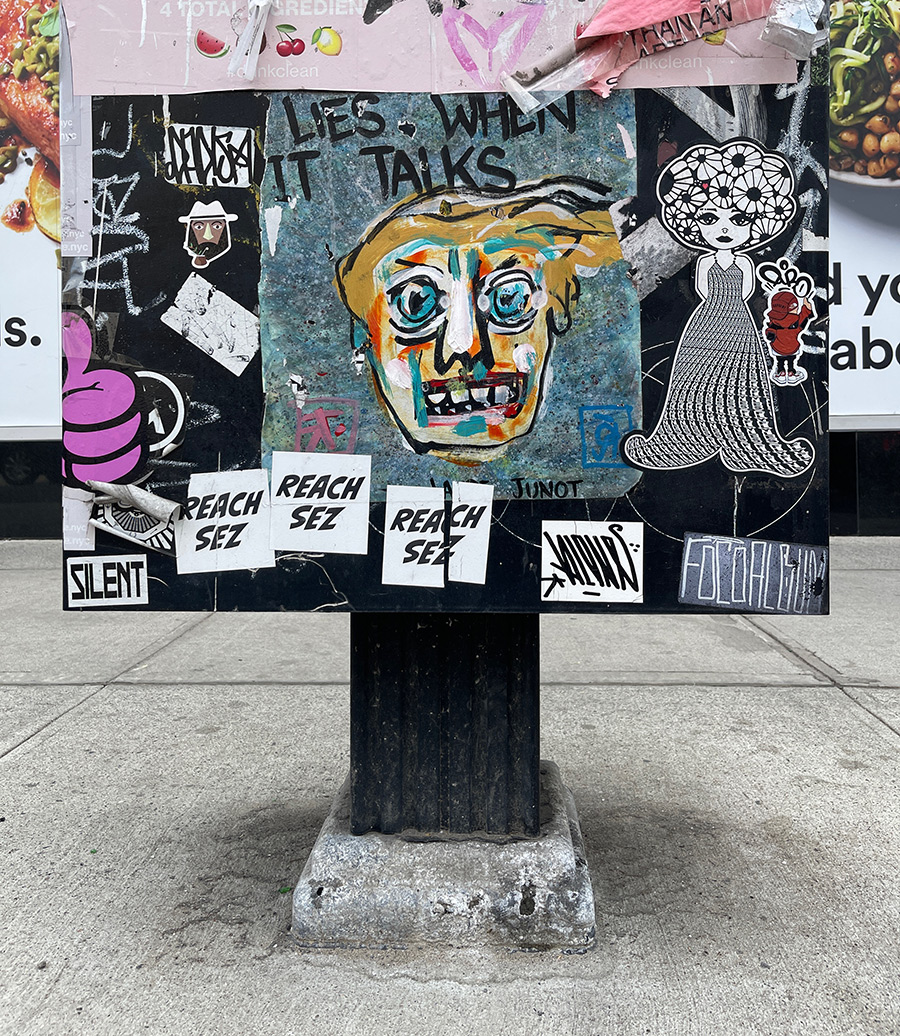
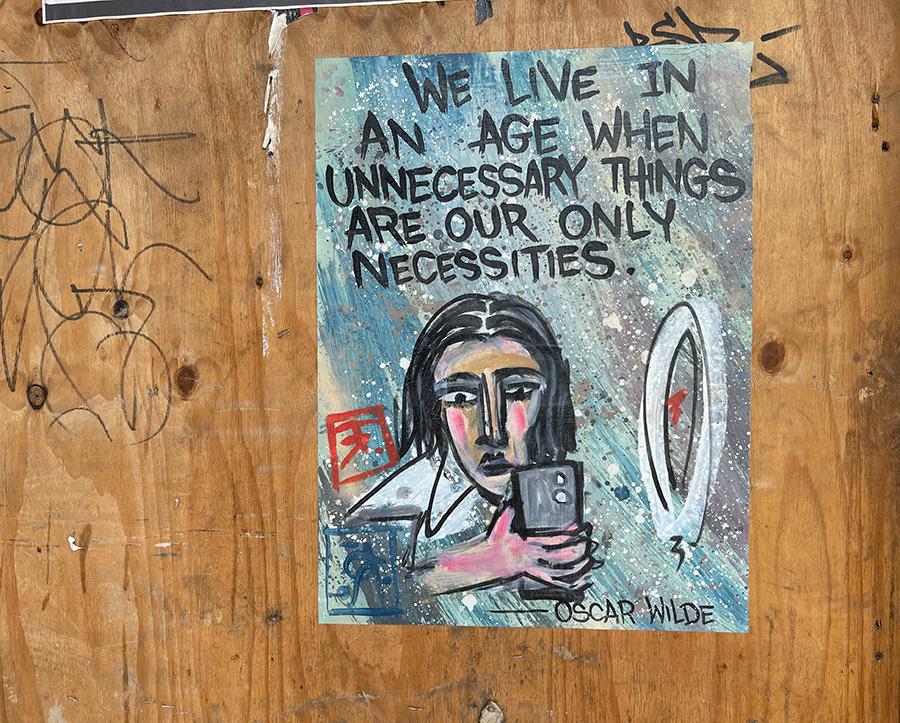
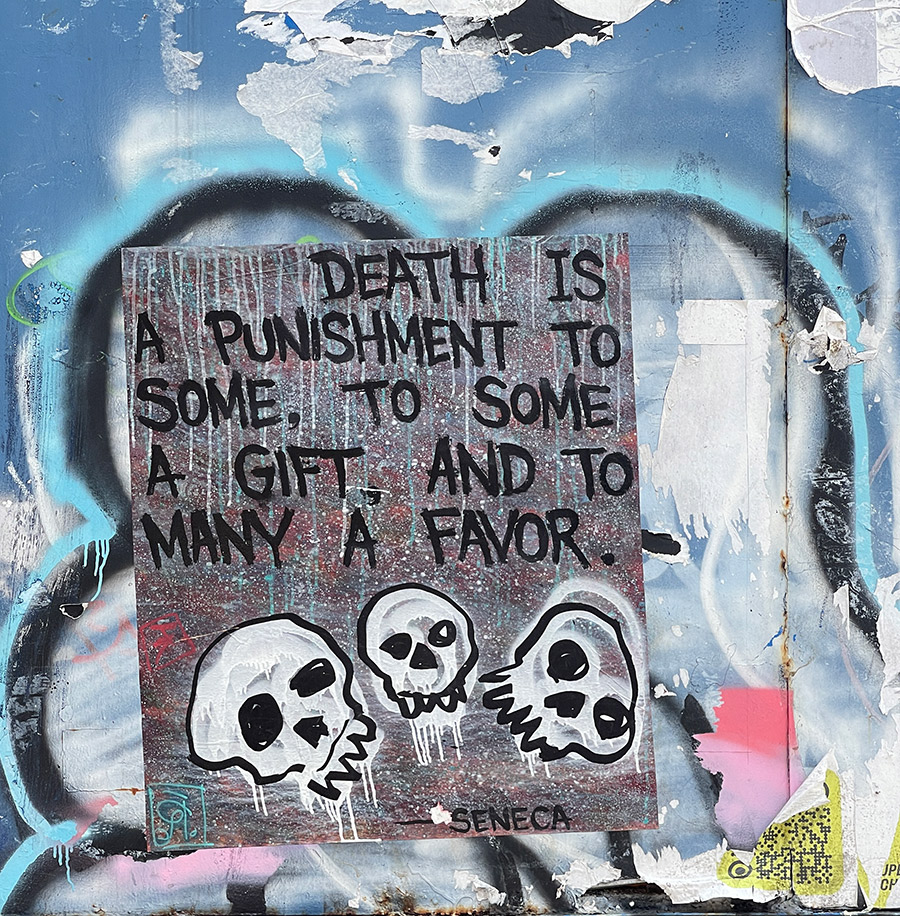
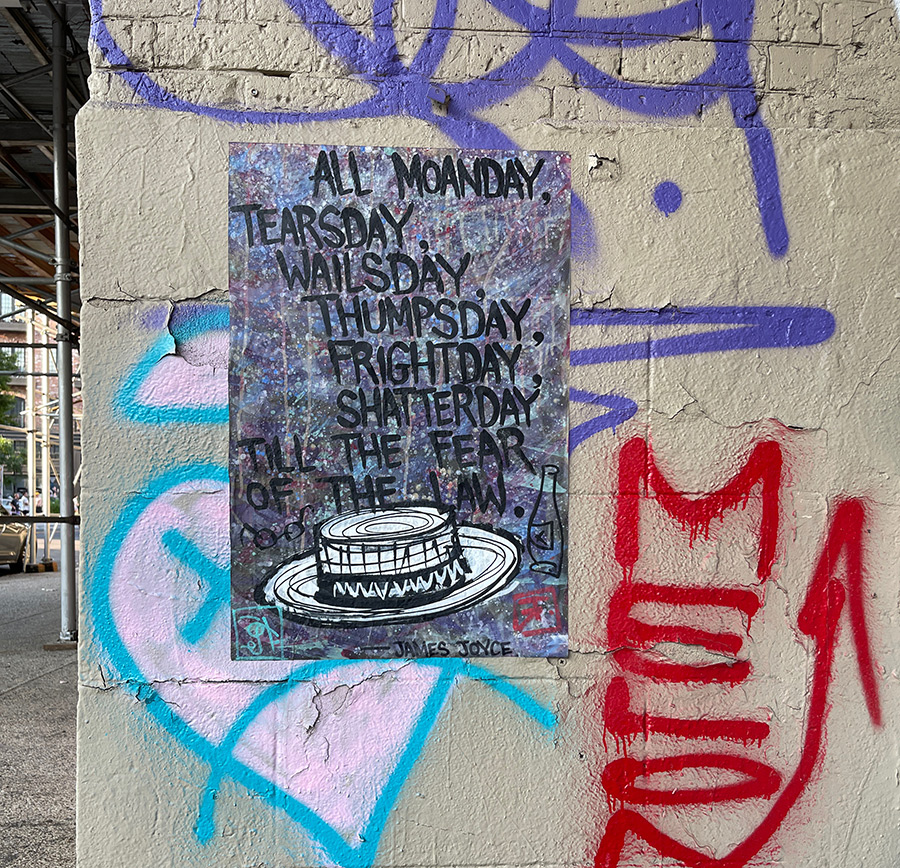
Rene Lerude & Alex Itin aren’t populists chasing the lowest common denominator with their hand-rendered one-off posters and stickers. As street artists, you might call them intellectual pranksters: observers who like their wisdom salted with cynicism, their philosophy dressed in humor, and their politics wrapped in that oily fish paper called irony. Look at the company they keep — literary heavyweights, satirists, philosophers, and contrarians. Instead of quoting hip-hop pioneers, political activists, or contemporary street philosophers, they platform Wilde, Bierce, Carlin, Vidal, and Burroughs onto that empty boarded-up lot you just trudged past.
Their words are colorfully tinted weapons, cutting through hypocrisy and mocking social pretensions. Their figures are caricature, maudlin, murky, and nearly masterfully messy. The style and understatement are of the moment, yet it carries a timeless skepticism — a stoic philosophy rooted in reason, rationality, and inquiry.
Popping up on the street often enough to grab your attention, the bards and seers they quote give you a good sense of where their heads are at: Oscar Wilde, Seneca, James Joyce, Junot Díaz, Laurence J. Peter, William S. Burroughs, T.H. Huxley, Francis Bacon, Ambrose Bierce, Gore Vidal, and George Carlin. It’s a crew of contrarians, cynics, and truth-tellers — a reminder that Rene & Alex are carrying these voices into the street not as decoration, but as conversation starters, provocations, and the occasional punchline.
Naturally, we had to talk with them, to see how they plug into the current street art scene and the fiercely independent energy of the artist-directed 17 Frost Gallery in Brooklyn that has been mounting shows by various curators over the last decade or more. That space has had more lives than a stray cat — raw, investigatory, and, when you least expect it, collaborative in a magpie sort of way. Are all the real artists today disillusioned, disgusted and absurdly darkly funny? Maybe. Or maybe every generation of free-thinkers has simply been awake, willing to poke at sore spots, willing to question conventional wisdom. With language that performs as much as it provokes, Rene & Alex show a respect for the long arc of human thought — always filtered through the grin of a trickster.
Brooklyn Street Art:When did you decide to collaborate with your art? RENE: I started making stickers to put up in bars relating to alcohol, amusing insights, quips, etc. This was around 2016. I ran out of good ones fairly quickly, so this just opened up to any topic I found interesting. Originally, these were just markers on the white stickers. I then decided to make backgrounds that looked like surfaces I was working on — paint-splattered and marked from years of use. Essentially, an abstract mess. One late evening at the Frost Gallery, Alex saw a bunch which had room under the text and went to town. That was that.
ALEX: While curating at 17 Frost Gallery, I became inspired by the open-mic Sundays we were running that attracted mostly musicians and stand-up comedians, and the odd poet. I wondered if you could do a similar thing with visual artists, street artists, and graf people. We started doing Tuesday sticker nights. One could work on any media, but the sticker game was the unifying concept: low cost, popular, public, and open for low-stakes creative collaboration… but mostly it was an excuse to hang out and meet lots of like-minded artists.
One of the things I always like to talk with artists about is money — how to make it, keep it, shake it out of trees, etc. It’s an interesting thing as a bill is about the size of a sticker. Surviving as an artist is brutal stuff, so educating yourself and your community about legal and financial questions is just good practice.
“One of the things I always like to talk with artists about is money — how to make it, keep it, shake it out of trees, etc. Surviving as an artist is brutal stuff, so educating yourself and your community about legal and financial questions is just good practice.” — Alex
In one such conversation, I was ranting about music, copyright laws, and how people in a band get or don’t get paid. I said something like Miles Davis got paid, the band usually didn’t (unless they brought the song with them). And I think I pretended to be an angry bassist ranting about Miles. A friend walked in the door and announced with great authority that Miles Davis owes him money. That joke sort of stuck and Rene wrote down the quote, and I drew a trumpet. For a while, it was just “Miles Davis owes me money,” signed by any of his many collaborators. Eventually, we started looking for other quotes.
BSA:What’s your collaboration process? Do you pass the artwork back and forth, or do you work on it together in the studio? RENE: I start the process by producing a couple of hundred stickers and posters from newsprint. Then comes the lengthy task of going through one of dozens of aphorism books and writing them all out. I pass this on to Alex and wait. He gives them back to me, I archive them, then we split them amongst ourselves.
“I see the country in a dangerous place, and positive bromides are not as important as anger and cogent analysis of our present state. So I wanted a bit of salt and burn… while still being funny.” — Alex
ALEX: The first collaborations were done together at 17 Frost, but eventually we were passing them back and forth in envelopes, often between London and New York.
BSA:How do you choose the spots in the street to place the final work? RENE: If it’s a sticker, somewhere in the cut where it won’t get taken over, but still in decent reading distance. Posters just anywhere that might rock a while.
ALEX: Placement is for me just part of putting up stickers. It’s usually a walk and improvised art installation. I try to hug up to artists I like or to try and interact with text or image. Rene hangs most of the posters, so I’m not sure how he chooses spots for those.
BSA:Alex, do you draw the characters before or after the words are given to you by Words on the Street? ALEX: Rene usually does the background and text, and I work into that.
BSA:Are the characters based on real humans? Are they portraits of people you know or see in public space? ALEX: Some of the drawings are just cartoons with broad archetypes, but also there are a lot of portraits of the various quoted people. These are drawn from photos — a thing I never do in my own studio practice. There are also a lot of Trump portraits.
BSA:Rene, you use quotes from famous people, politicians, and literature. Do you sometimes write your own thoughts and use them in collaboration with Alex? RENE: I have done a few myself, though I’ll check to make sure it hasn’t been said before — in as much as you can. Alex does more frequently than me, so we have done quite a few of those over the years.
ALEX: I have written a few quotes attributed to -itin. “Branding is for cattle” is a favorite.
BSA:Many times the messages and drawings are funny, salty, biting, and poignant. Is it hard to keep a balance when doing the art? Do you even think about keeping a balance? ALEX: One of the things I was playing with was the overly positive, banal affirmation-type quotes you see in a lot of street art. I see the country in a dangerous place, and positive bromides are not as important as anger and cogent analysis of our present state. So I wanted a bit of salt and burn… while still being funny.
BSA:The current political atmosphere must be a bonanza for your creativity and productivity in your art. Do you feel overwhelmed by the dangerous path the country is going? If you feel angry at the current administration’s actions and policies, do you use your art to channel the anger? RENE: Oddly enough I haven’t made any new posters or stickers in a couple years. Most quotes worth their salt are in some way timeless — vernacular can be different, but the sentiments always come to relevancy as time passes. That said, it’s come to a point where more of them are becoming relentlessly applicable as the weeks and months pass.
ALEX: The second term has created a quandary. I got okay at doing Trump, but I just don’t want to see his face or give any more attention to that narcissist. So it’s a quandary.
If you know Shepard Fairey, then you already know: he’s never been one to sit back and let the powers that be go unchecked, from his own plugged-in and purposeful wiseguy perspective. From Andre the Giant Has a Posse wheatpastes in the ’90s to “Hope” posters on campaign walls, his work straddles the intersections of street art, punk defiance, political critique, and populist propaganda with a purpose. He’s a true lifer—rooted in skate culture, DIY ethos, anti-authoritarian graphics, and a conviction that art can and should speak truth to power.
In this new poster campaign, DEI-TY, Shepard zeroes in on a cultural moment when long-standing efforts to make society more inclusive are being flipped upside down by those seeking to divide and conquer. Always direct, yet heavy with symbolism and art/design history, the new poster artwork pulls from Orwellian surveillance aesthetics and throws an unmistakable orange glow over its intended subject. Yes, it’s Trump—but it’s also a larger warning learned from our human history to beware of personality cults, shallow populism, and manufactured outrage.
What follows is a wide-ranging interview that captures Fairey’s frustration, clarity, and urgency—served up with the kind of seasoned insight that comes from decades of navigating art, activism, and political absurdity. Now you’ll see a sharpness in his tone that speaks to the times: an artist who considers the stakes clearly and isn’t mincing words. If you’ve followed his career, you’ll recognize the heat generated by his signature mix of bold graphics and civic fire. If you’re new to it, welcome to the resistance—art’s not dead, and Fairey’s not done.
At the end of the article, you’ll find a selection of previous works that speak to the arc of Shepard’s creative and cultural engagement. Youcan also download the new DEI-TY poster for free, to print, paste, share, and use however you see fit. Once again Fairey demonstrates that in the face of rising intolerance and authoritarian power plays, silence is complicity—and art is one hell of a megaphone.
_____________
BSA: Your poster flips the acronym DEI from a framework for equity into a confrontation with authoritarian ego. In a list of topics to address, what gave you the spark for this specific artwork?
Shepard Fairey: Of course, the verbal assault on the DEI programs at colleges and corporations infuriated me, but it became something more serious when Trump began to rescind funding to colleges and deny contracts to companies with DEI programs. I think Trump attacks DEI because he associates it with “woke” people who don’t support him. The bottom line is that Trump rewards those who stroke his ego and punishes those who don’t. Having someone that shallow and petty influence policies that impact millions is incredibly dangerous. In my original post, I laid out the definitions of Diversity, Equity, and Inclusion because they are concepts that are pretty hard for a rational, fair-minded person to disagree with. Here they are again:
Diversity: the condition of having or being composed of differing elements: variety.
Equity: the quality of being fair and impartial.
Inclusion: the act or practice of including people who have historically been excluded (often because of their race, gender, sexuality, or disability).
BSA: Many times, you have critiqued cults of personality and authoritarianism with your work. In DEI-TY, the term “self-proclaimed deity” seems aimed squarely at that. Is it the figure or the ideology that folks have beef with?
Shepard Fairey: Both. I’ve described Trump, the specific “self-proclaimed deity” referred to in the print, as the festering zit that is the hideous manifestation of the underlying bacteria. The analogy isn’t entirely accurate, though, because in Trump’s case, his influence makes the bacteria even more toxic. It’s a brutal cycle. Trump encourages his followers to scapegoat the vulnerable, vocalize and act on their worst prejudices, and then he feels emboldened to behave like a dictator and double down on the most inflammatory rhetoric and cruel policies. This is a cycle and culture that erodes civility and democracy.
BSA: You’re offering these prints as free downloads, which suggests a sense of urgency and mass mobilization. Do you see DEI-TY as part of a larger visual resistance? How do you hope people will use it?
Shepard Fairey: I always want people to mobilize. I use my art to inspire people to care, because they won’t act if they don’t care. Some of my pieces, such as DEI-TY, can also serve as tools to convey an idea… tools I’d like anyone to be able to use if they are inspired. Visibility for a counter-narrative is essential to mobilizing people and shifting culture.
BSA: How do people navigate the increasing weaponization of terms like “DEI” in political and media discourse? Do you see this poster as an intervention in a culture war? As an aside, how much of this is a genuine concern to average people, and how much is ginned up to get us to fight with each other?
Shepard Fairey: DEI should be unassailable as an idea. Somehow, Trump has turned people against bedrock principles of American philosophy like diversity, equity, and inclusion, which should be universal, while normalizing lying, scapegoating, and undermining democracy, all of which should be universally unacceptable. Yes, the culture war is his aim, and the attacks on DEI don’t impact everyone directly, but I’m a believer in the concept that injustice anywhere threatens justice everywhere.
BSA: This new imagery echoes some of your earlier pieces that blend Orwellian surveillance aesthetics with activist messaging. What’s different about DEI-TY?
Shepard Fairey: You’re right about the Orwellian aesthetic. Trump is a fascist and a menace. He doesn’t genuinely believe in freedom, except for the freedom to be a dictator. He is very Big Brother-esque in his approach to purging dissenters from government and education. The main difference is that this print uses orange (for obvious reasons) and this print addresses general principles AND specific villains. I’d love for 1984 to be irrelevant, but unfortunately, it might be more relevant in this moment than ever before in U.S. history.
SHEPARD IS OFFERING THESE TWO NEW POSTERS ABOVE FOR FREE. CLICK HERE FOR A FREE DOWNLOAD
Following are a few from the vault from Fairey that run parallel in political, social, and stylistic spirit.
Statement from Shepard Fairey for the release of the new poster:
“Please read the words DIVERSITY, EQUITY, and INCLUSION and think deeply about their meaning – individually and collectively.
Diversity: the condition of having or being composed of differing elements: variety.
Equity: the quality of being fair and impartial.
Inclusion: the act or practice of including people who have historically been excluded (often because of their race, gender, sexuality, or disability).
DEl is meant only to enhance the priority of our institutions and workplaces to provide equal opportunity to the many groups that make up our beautifully diverse nation.
These formerly unassailable ideas have been aspirationally woven into our nation’s entire history, even if our idea of who is equal has thankfully evolved to include more than just white men.
From the Declaration of Independence to the 14th Amendment granting equal protection for all citizens, to the 15th Amendment granting Black men the right to vote, to the
19th Amendment granting women the right to vote, to the Civil Rights Act outlawing discrimination based on race, color, religion, sex, or national origin, we have moved toward a more fair and less discriminatory society. The symbolism of the Statue of Liberty as a welcoming beacon to those fleeing forms of discrimination to find refuge in the melting pot of the US is a cornerstone of the American story. The current attack on DEl is nothing less than a betrayal of American values and aspirations. The attack on DEl is very literally a Republican policy of discriminating against those who oppose discrimination in their businesses and organizations.
When have racism, sexism, homophobia, or the like been okay in plain sight from our leadership, much less turned into law that punishes those trying to provide equality? I feel like I’m in a dystopian mirror world. Terrifyingly, this is here and now, and catalyzed mainly by one power-hungry narcissist who is a deranged, egomaniacal, insecure, tyrannical, yapster. If you oppose the mean-spirited embrace of discrimination like I do, please use every tool at your disposal to push back, especially by voting in EVERY election, including the midterms. We have power in numbers if we use it!”
In a decisive nod to the city that shaped him, legendary graffiti artist DAZE (Chris Ellis) has unveiled two new large-scale murals at 550 Madison Avenue, transforming the building’s soaring street-level space into a canvas that bridges worlds. Painted live in public view, these works are part of “Above Ground Midtown: MCNY x DAZE.” With their vibrant forms, layered textures, and intuitive energy, DAZE’s murals draw from the pulse of New York City, the geometry of Philip Johnson’s iconic building design, and the surrounding garden oasis that gently appears in midtown Manhattan.
To fans of New York graffiti and street art, DAZE needs no introduction. A member of the second wave of graffiti writers in the late 1970s and early ’80s, he began painting subway trains as a student at the High School of Art and Design, developing a signature style marked by wildstyle lettering, surreal characters, and a painterly sense of movement. Over the decades, he has nurtured a career, evolving into a fine artist while continuing to honor the raw urban energy of his roots. “I think of these pieces as a continuation of a language I started developing underground,” DAZE tells us. “Only now, we’re bringing it out into the light—quite literally.”
Curator Sean Corcoran of the Museum of the City of New York sees this installation as an extension of the museum’s current exhibition, Above Ground: Art from the Martin Wong Graffiti Collection, which includes early works by DAZE and many of his contemporaries. “This project is about visibility—making sure the public understands graffiti not just as something from the past, but as a living, evolving art form with deep ties to the city’s history,” he says. “Having DAZE create these murals in real time, for anyone to see, reinforces the idea that this movement was always meant to be in dialogue with the street—and with the people of New York.”
BSA asked DAZE and Corcoran a couple of questions about the project:
Brooklyn Street Art (BSA): DAZE, these new canvases feel like they’re in direct conversation with the city itself — its architecture, movement, street energy, and natural elements. How do they reflect your biography as a New Yorker and a writer who came up in the 1970s and ’80s?
DAZE: In creating these two paintings I wanted to capture the feeling of someone somehow say, in a taxi, going uptown and watching how the cityscape changes from one neighborhood to the next. At the same time I wanted to inject certain natural images within the painting. Even though we all live in a city that is noisy and congested, there are still areas where one can find a nice park to sit and have a quiet moment. I felt like that side of the city had to be represented too.
BSA: You created these pieces live, in a high-visibility Midtown space, a far cry from painting trains in the dark. What does it mean to you to create something so public and above-ground in the heart of a city you’ve been documenting and writing a visual diary for over 40+ years?
DAZE: I was very aware of the architecture of the building and its history. One of the unique things about the space is that the ceilings are so high. It’s an interior space, however, you feel as if you’re outside, which is quite unique.
It was amazing to create something large scale in an area of New York City that receives both many tourists and people who are working there. It exposes my work to a new audience.
BSA: Sean, DAZE’s career spans the early days of illegal train writing to significant institutional recognition — how does his presence here at 550 Madison, and possibly in the Martin Wong Collection, help tell a fuller story of graffiti’s evolution in New York?
Sean Corcoran: Daze’s career is an excellent example of the trajectory of a number of the artistically ambitious writers who emerge from the “train writing”’ era movement that developed a long and impactful studio career that helped export the regional subculture to a worldwide phenomenon. Martin Wong, the Lower East Side painter and generous donor of the majority of the Museum’s collection of more than 300 paintings and 60 black books, was interested in telling the story of this a youth culture that largely sprung up in New York City.
He wanted to trace the youthful rebellion of you people painting on subway trains and public spaces, but he was equally interested in the communication and artistic inclinations as well, and he actively encouraged and supported this by not only buying canvases, but by being a friend and sometimes mentor.
BSA: The title Above Ground for the Martin Wong Collection—and this above-ground exhibition by a writer known for his work on underground trains—suggests a subculture being brought into the light. In curating this collection today at the MCNY, what conversations do you hope it sparks about the place of artists like DAZE in both the art world and the cultural history of the city?
Sean Corcoran:Above Ground is intended to loosely trace the early efforts of train writers as they moved out of the tunnels and layups and into the studio. The exhibition notes the importance of several transitional moments in this history – The United Graffiti Artists (founded in 1972), Sam Esses Studio in 1980, the advent of East Village galleries like Fun and 51X soon after in the early 1980s, and then the jump to blue chip galleries, including Sidney Janis, and opportunities in Europe. These are all examples of the long road these artists took in developing their careers. The paintings in the gallery reflect both Martin’s collection and the various paths the artists took, from maintaining a letter-based art to moving into abstraction and figuration. The exhibition ends in the early 1990s just as the “train writing era” ends, but we all know that that was just the end of the beginning of the story…..
Interview with Doug Gillen | Video Feature from Fifth Wall TV
Ghosts of concrete modernism and whispered nostalgia drift through “The Morning Will Change Everything,” the first solo museum exhibition by Spanish artist Sebas Velasco, now on view at the History Museum of Bosnia and Herzegovina in Sarajevo. In this new video interview, filmmaker and art observer Doug Gillen sits down with Velasco to unpack the layers of emotional and political weight carried in these oil-painted nocturnes—each a meditation on memory, architecture, and the complex afterglow of Yugoslavia’s post-socialist present.
Sebas Velasco. The Morning Will Change Everything. (image still from the video by Doug Gillen for Fifth Wall TV)
The conversation reflects Velasco’s realism, influenced by photography – reinterpreted by hand and heart. “It’s a love story with the region, for sure,” he tells Gillen, reflecting on years of travel and a growing personal bond with Sarajevo and its surrounding cities. His works hum, layering light, concrete, shadow, and silence to capture what it feels like. “Maybe the nostalgia I paint is for something I’ve never really known,” he says.
Sebas Velasco. The Morning Will Change Everything. (image still from the video by Doug Gillen for Fifth Wall TV)
Set inside the former Museum of the Revolution—a hulking modernist edifice now asserting its cultural relevance—the exhibition includes Velasco’s paintings alongside films, photographs, and collaborations that stretch across borders and disciplines. It’s an act of giving back to a city that continues to inspire. “We wanted this to be more than paintings on a wall,” he explains. “To feel like home—for other artists too.”
Watch the full interview below to hear from Velasco in his own words, and to feel the atmosphere of a show that makes the past present—and personal.
Sebas Velasco. The Morning Will Change Everything. (image still from the video by Doug Gillen for Fifth Wall TV)Sebas Velasco. The Morning Will Change Everything. (image still from the video by Doug Gillen for Fifth Wall TV)
 BROOKLYN STREET ART LOVES YOU MORE EVERY DAY