Photographer Lluis Olive took a quick
trip recently to Madrid and he did what he loves to do; took photos of graffiti
and shared with us his new discoveries. This one caught our attention.
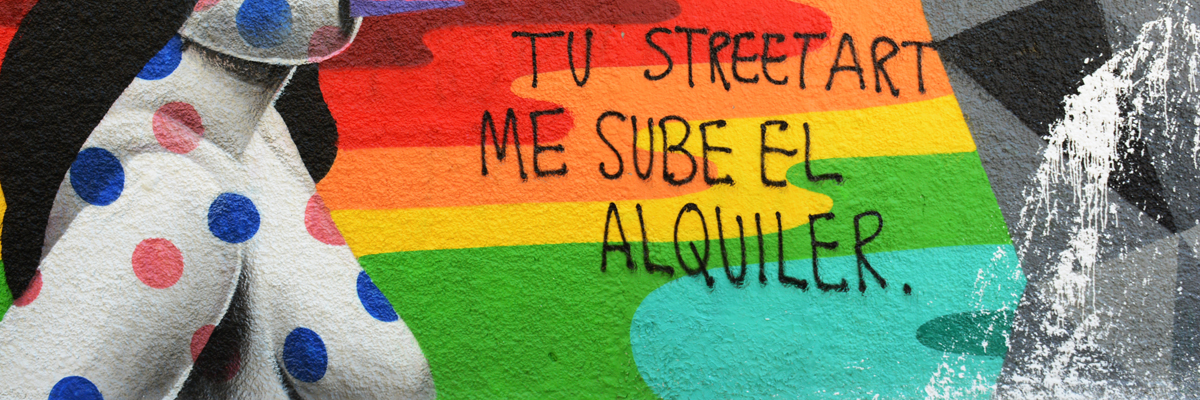
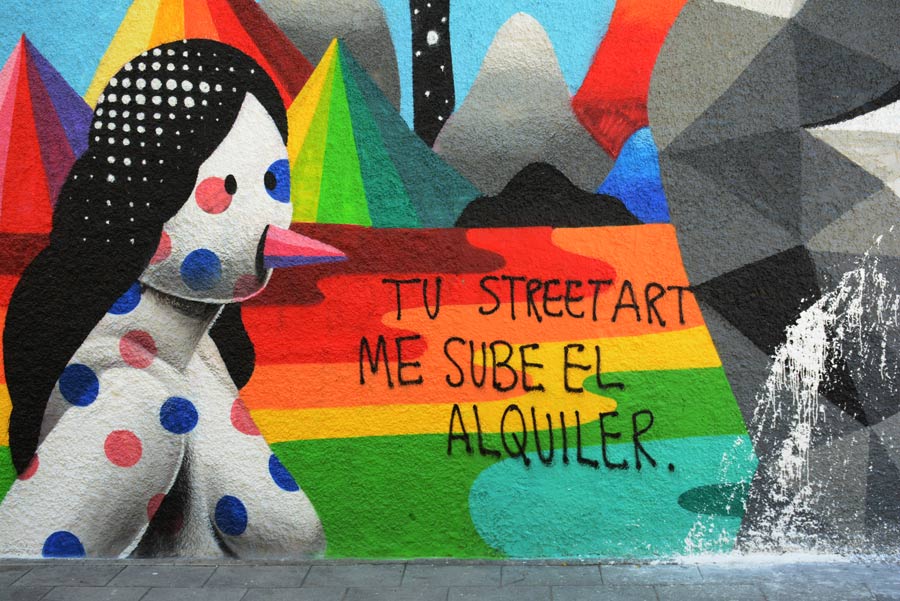
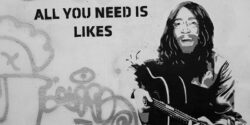
On Calle Embajadores he found
that a mural by the Madrid based artist Okuda was dissed with “Tu Street
Art Me Sube El Alquiler” or roughly, “Your Street Art Makes My Rent Go
Higher”.
And the writer has a point, going
to the heart of gentrification, and its connection to art.
It goes like this: Rotten,
abandoned, vermin infested and derelict neighborhoods with large industrial
buildings left in a state of decay are “discovered” by creatives who
make them their homes and studios. Artists work to make any environment
aesthetically pleasing, and that’s often their downfall.
Last night in a Brooklyn beer
garden a buddy told us that he had taken a complete toxic dump in the lot
behind his apartment and slowly transformed it into a beautiful garden. For his
efforts, he said, the landlord wanted to raise his rent because he now has an
attractive garden apartment that he should be charging a higher price for,
according to the market. Punished for success?
This aerosol defacement of Okuda’s
mural is a partially accurate statement– at least indirectly. But let’s not
scapegoat the artist as the one to blame for gentrification. That’s an
oversimplification of a complex cycle that no one appears able to diffuse
effectively because the incentivized real estate system is surely twisted in
many cities.
Jeez, that only took 50 years. “Stonewall Riot Apology: Police Actions Were ‘Wrong,’ Commissioner Admits”, cooed the New York Times this week. Of course the NYT headline at the time focused on how the helmeted, armed police were affected, rather than the couple of hundred citizens who they harrassed, intimidated and beat up for being many shades of LGBTQ – “Four Policeman Hurt in Village Raid”. Thankfully Macy’s and HSBC bank and all the corporations ran to the rescue of those folks in 1969 and throughout the 1970s and 1980s, 90s, right?
Aside from the multiple lessons we all continue to learn in the fights for people’s equality across society and in our institutions, one lesson comes through loudly and clearly: real, meaningful change almost never comes from the top down. Social, political, and economic justice comes from the grassroots, rank-and-file, everyday people fighting day after day, year after year.
That’s why we keep our eyes on graffiti, Street Art and all manner of expression on the street – its proven to be a reliable source for the vox populi.
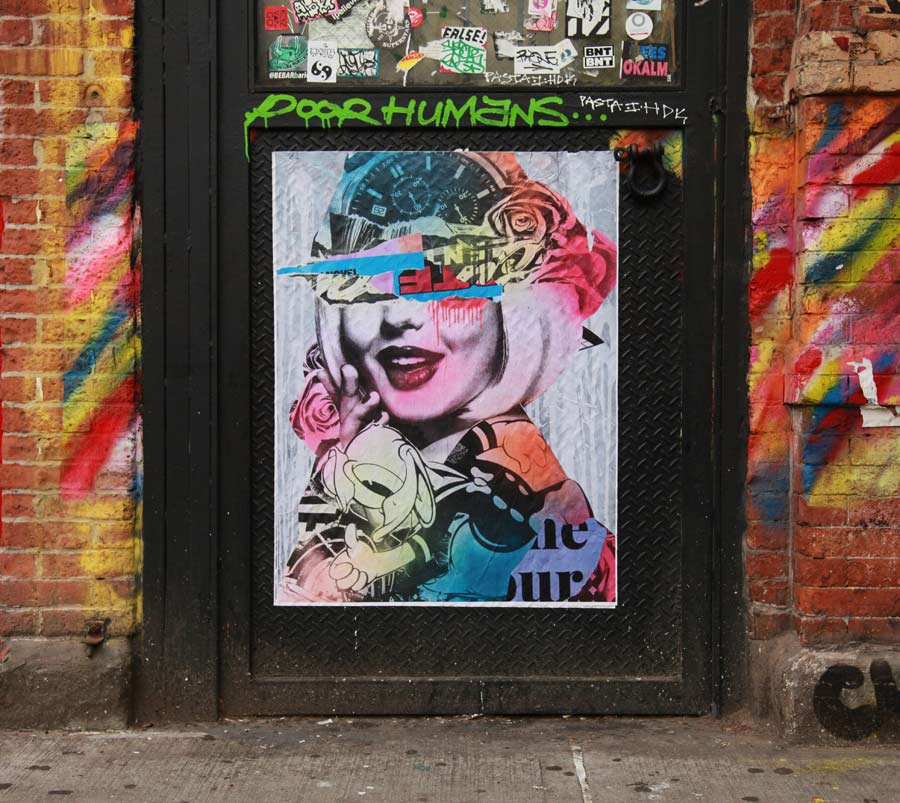
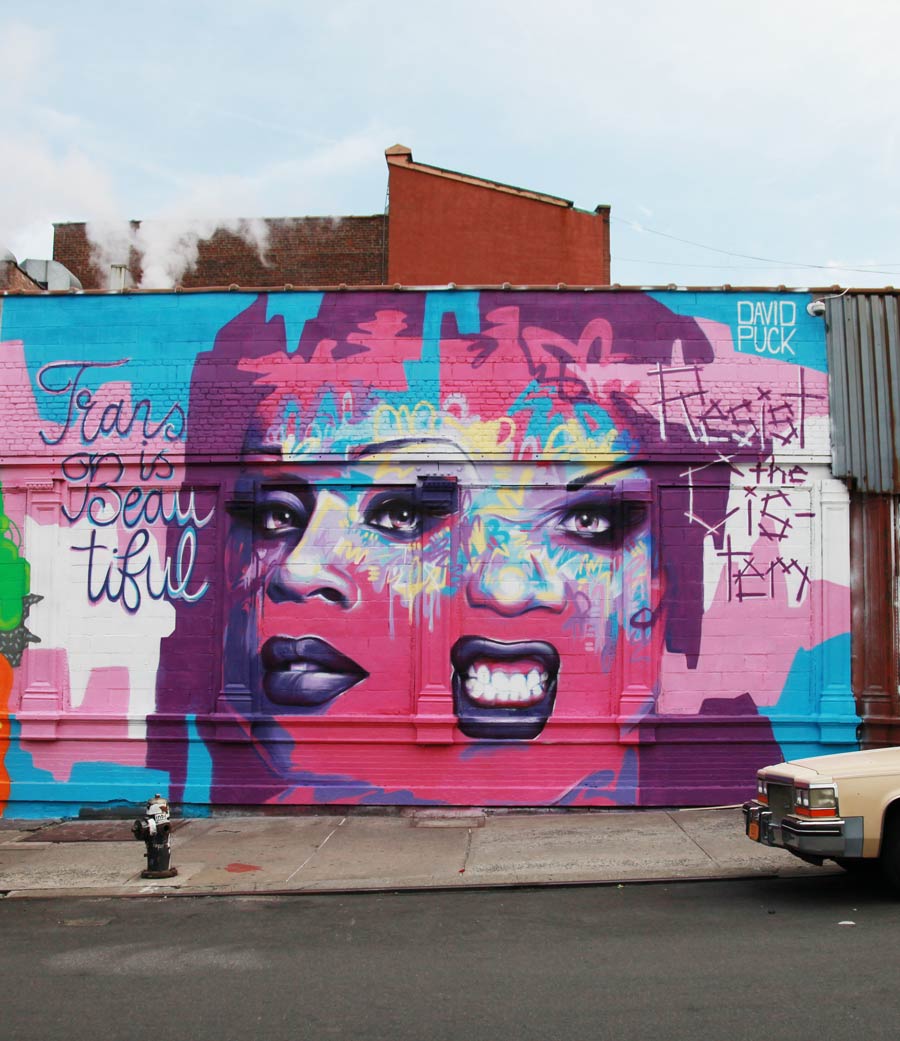
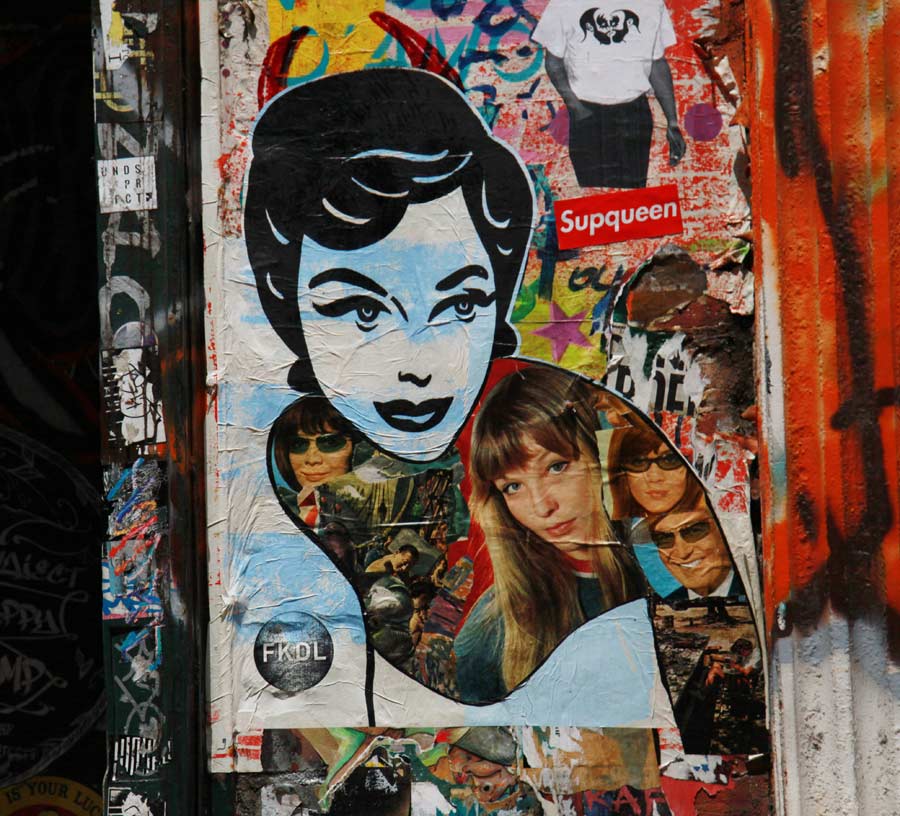
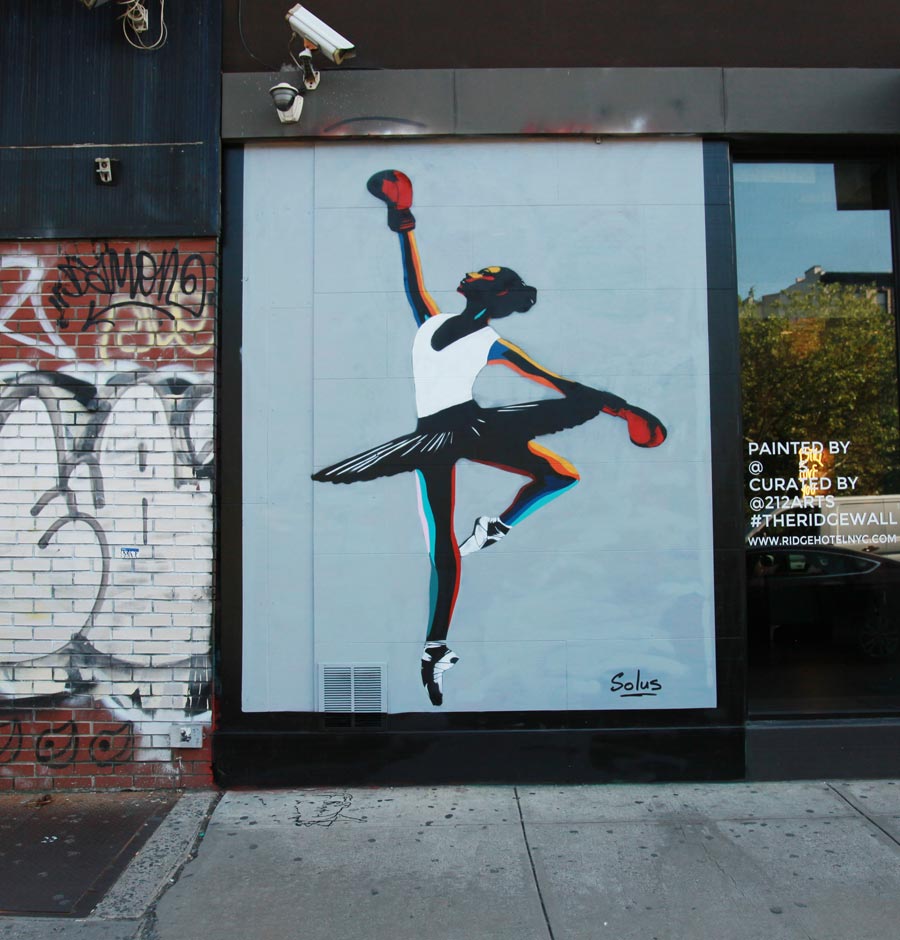
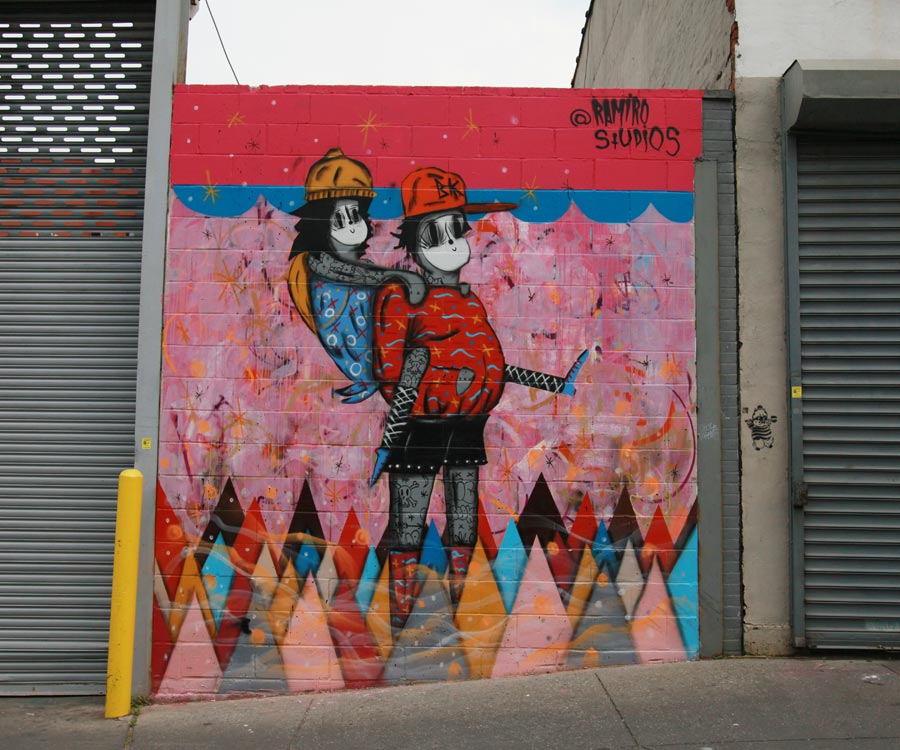
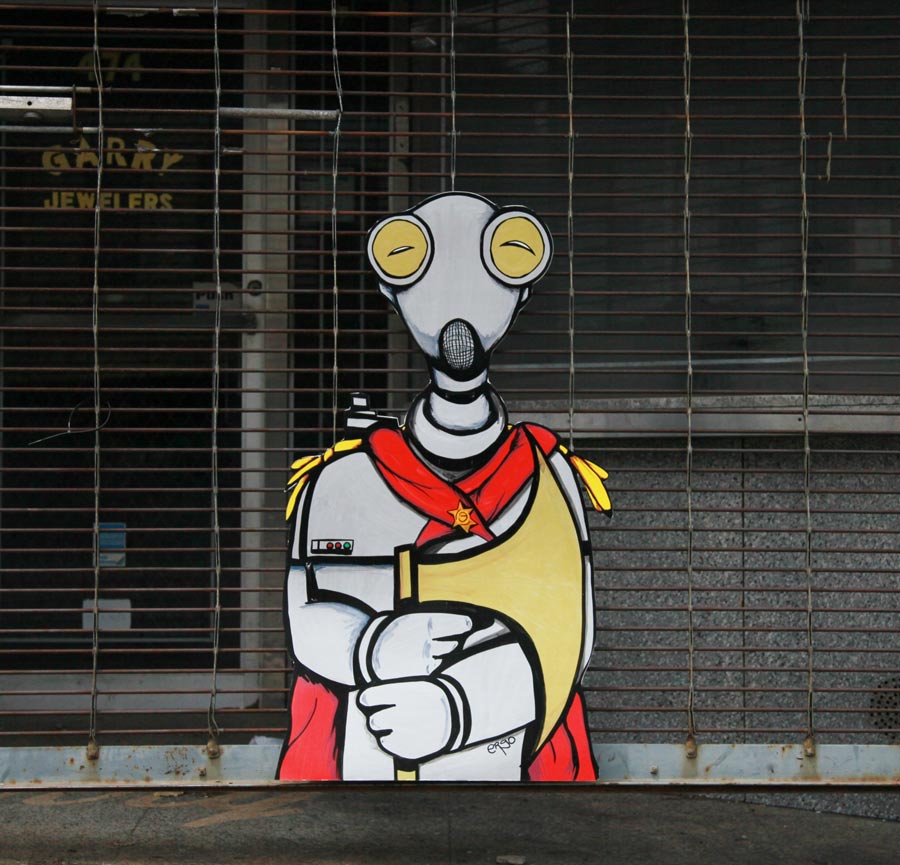
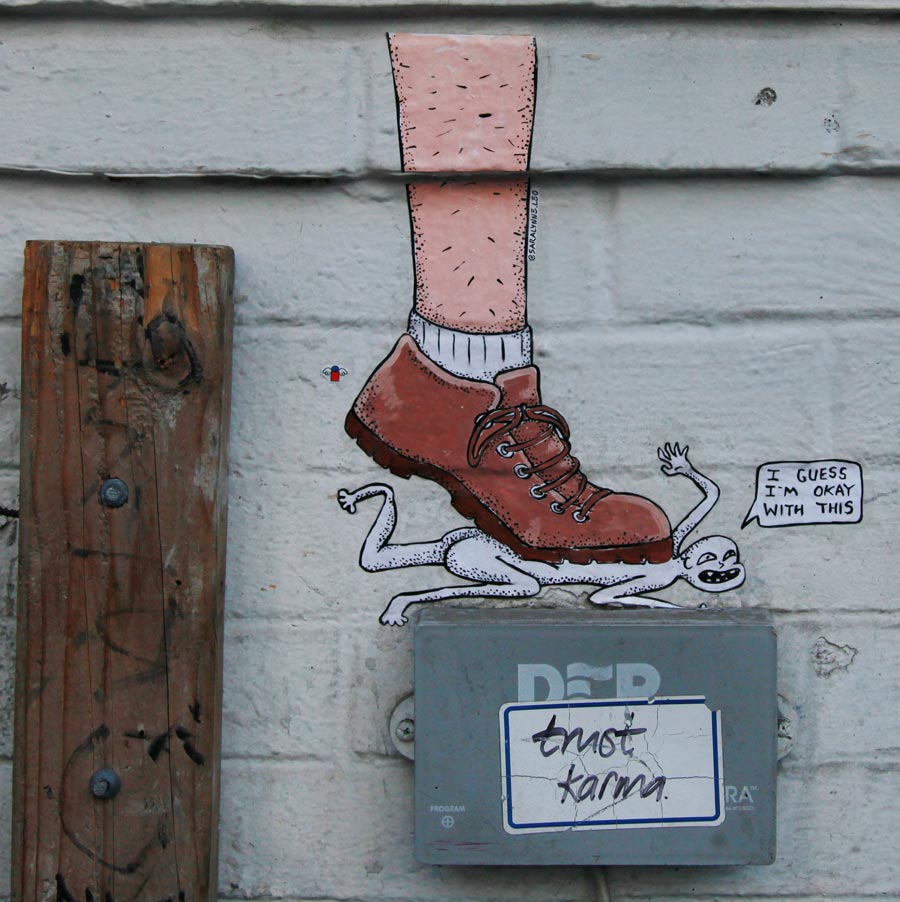
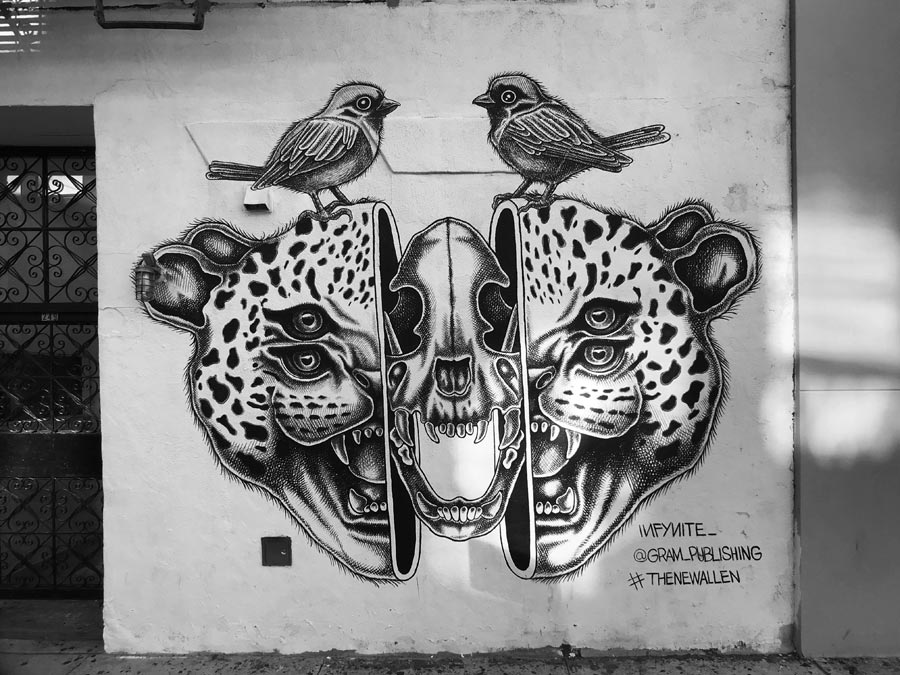
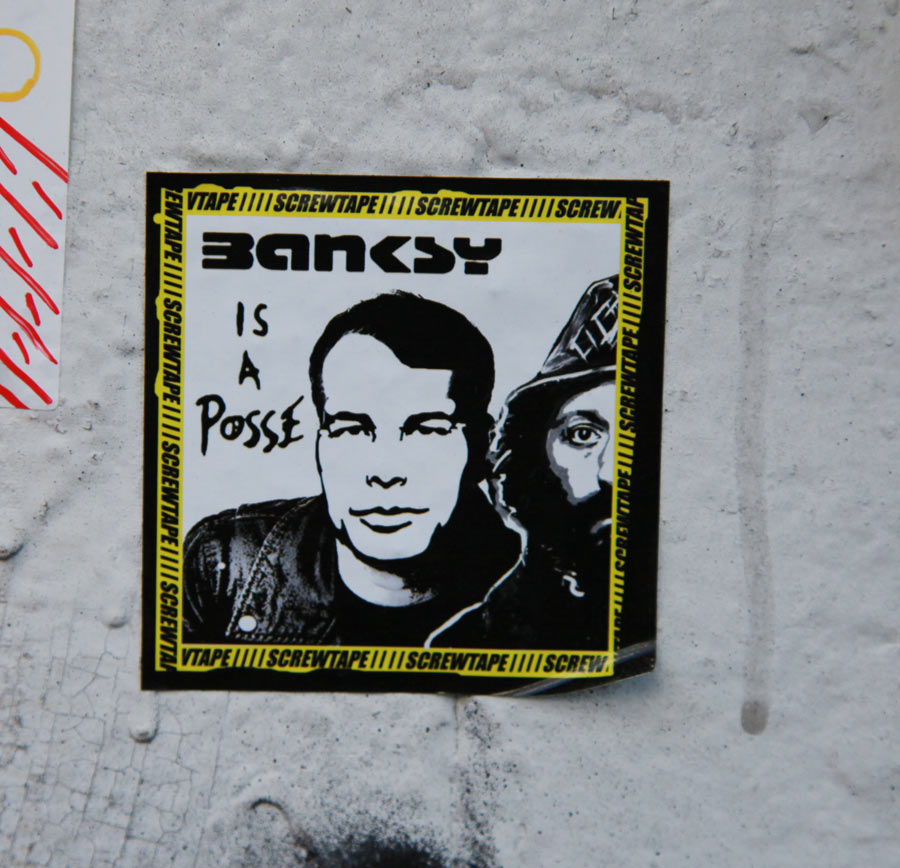
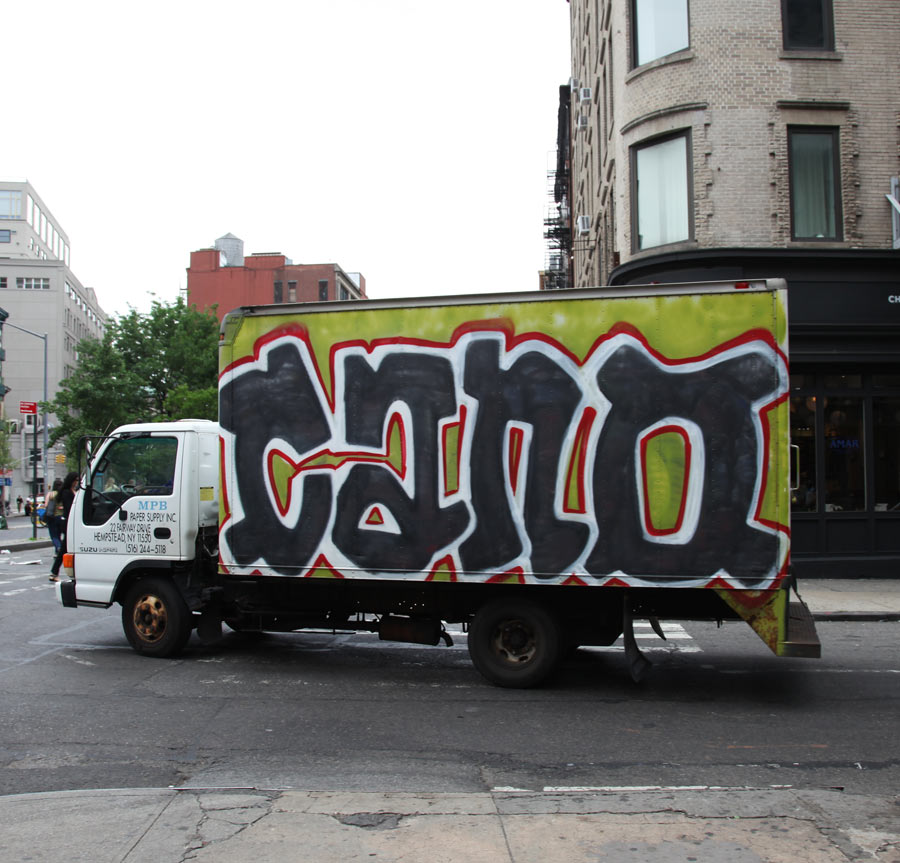
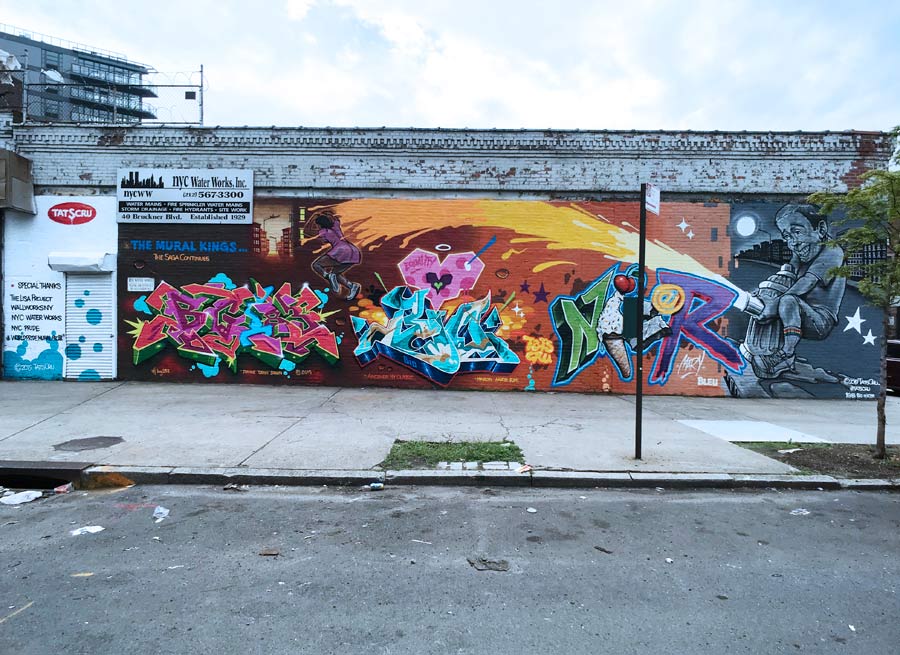
So here’s our weekly interview with the street, this time featuring CANO, Carl Paoli, Dain, David Puck, El Ergo, FKDL, Infynite, Isabelle Ewing, Justin T. Russo, Little Ricky, Meres One, Ramiro Davaro-Comas, Sara Lynne Leo, Screwtape, SeeTF, Skewville, Solus, and Stray Ones.
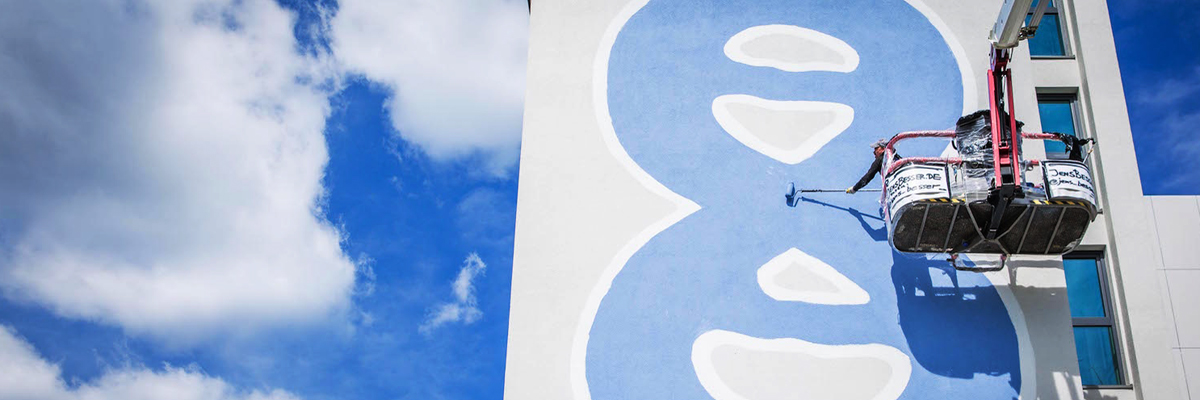
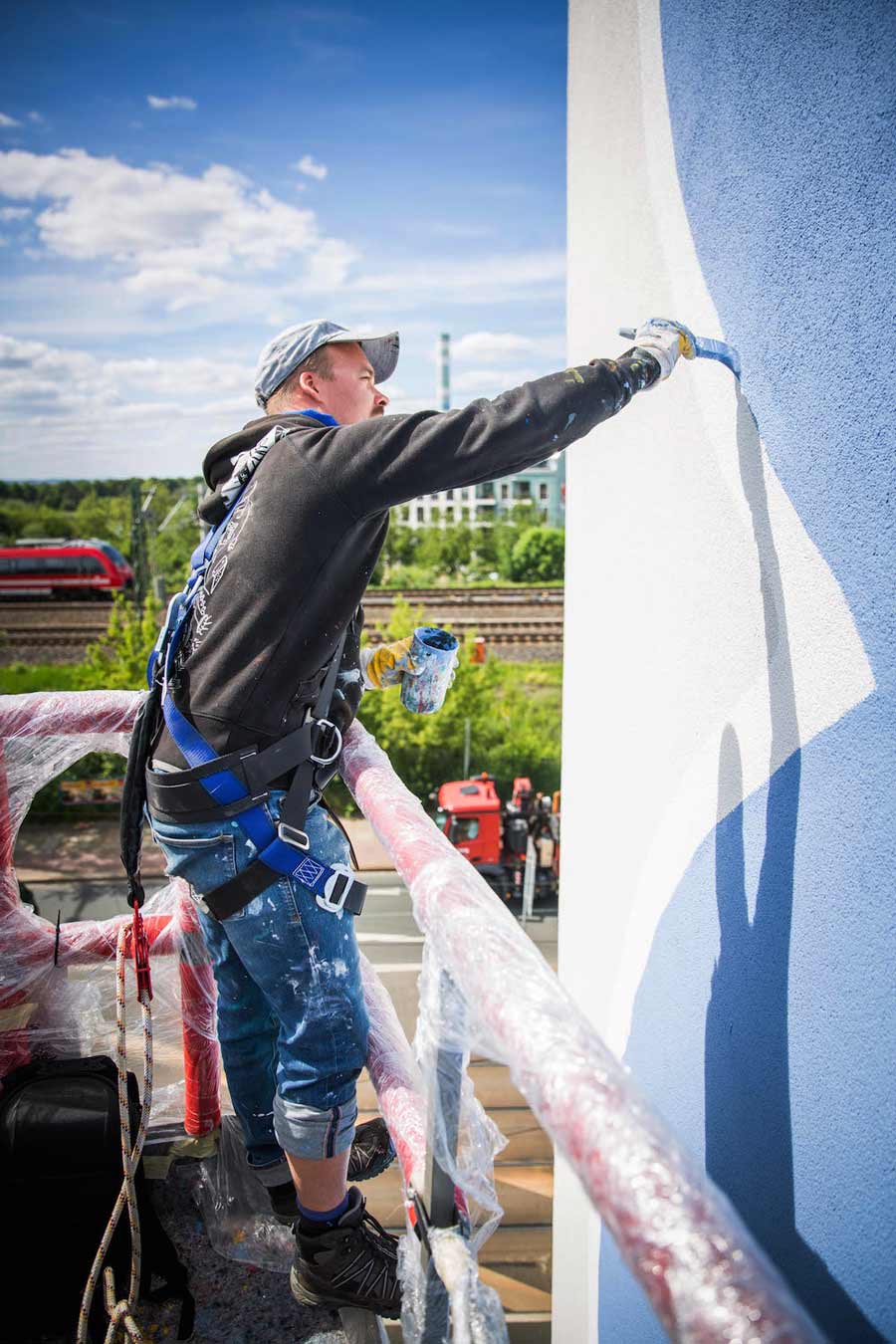
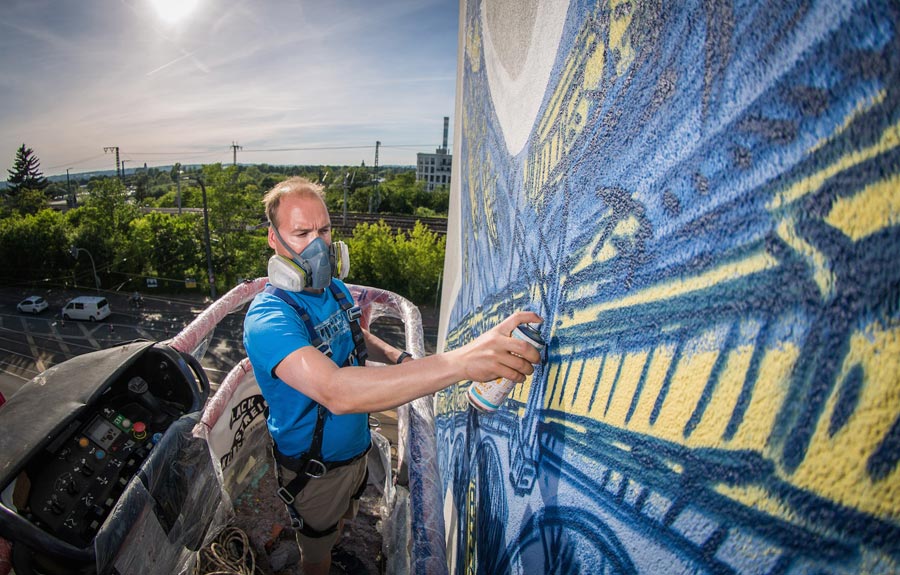
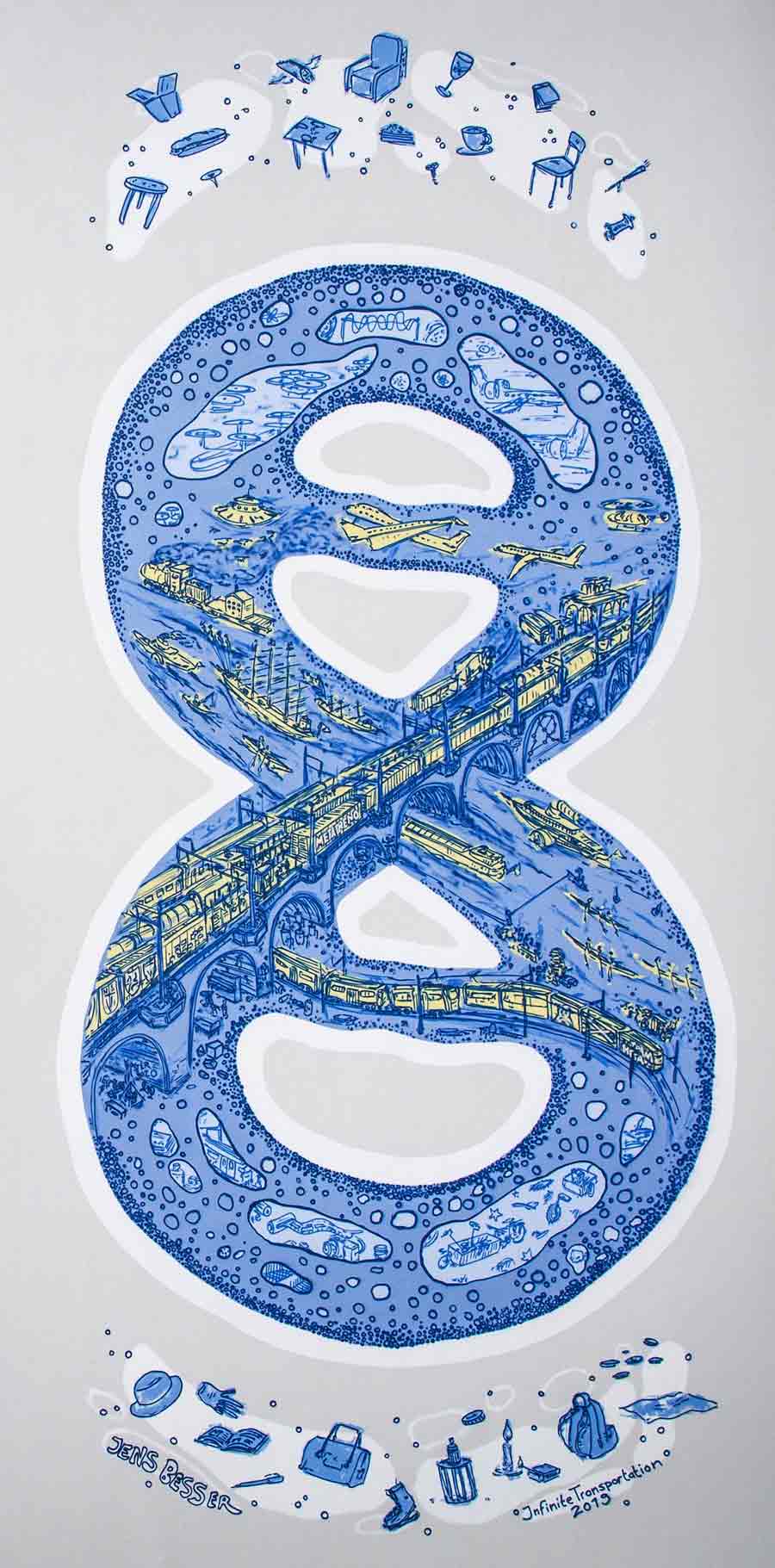
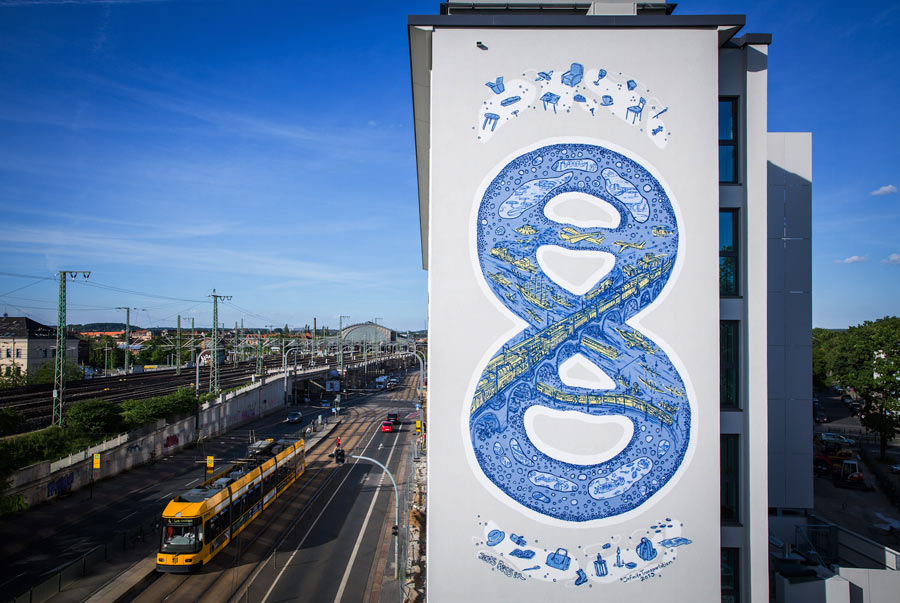
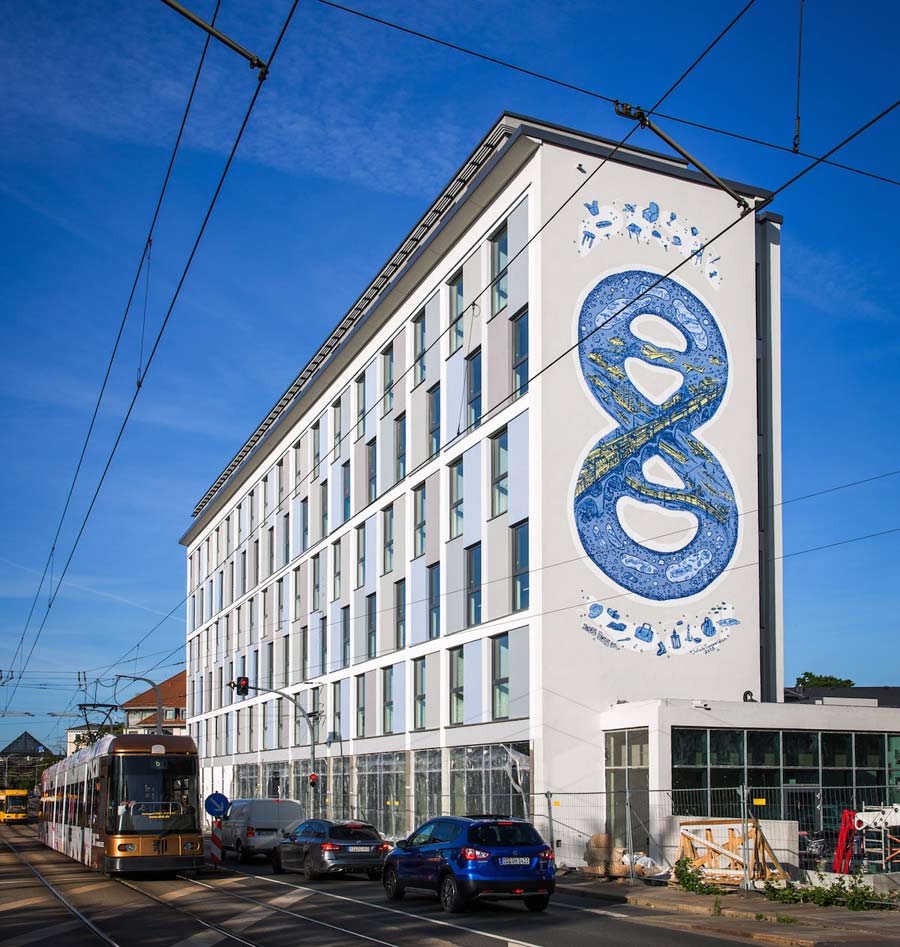
Urban artist and urbanist Jens Besser from Dresden, Germany paints the city into his city. An organizer of mural programs and avid bicyclist throughout this historic Saxony capital of a half million, Mr. Besser has a keen interest in all forms of transportation which keeps a city running 24 hours a day, seemingly infinitely.
He used brushes and cans for a new mural he painted on the side of a hotel May 27 – June 3, and in it Jens includes many of these modes inside his illustration-style painting that runs along the looping symbol of infinity: trains, planes, drones, buses, boats, and of course bicycles. A world within his world, closer inspection will reveal details of city life to you if you take a moment – including a rave party under the bridge.
He tells us he took inspiration for certain elements from Adams & Itso, the artist duo known for finding and constructing domestic settings in the margins of urban life – see the #Metatreno hashtag on the side of passing freight. For Jens Besser, urban life is a theater, and on center stage here for this mural called “Der Unendliche Verkehr”, the city is an ongoing play of never-ending movement.
Our weekly focus on the moving image and art in the streets. And other oddities.
Now screening : 1. Non-Trivial – Jesse Hazelip 2. Banksy Overlooked in Venice 3. DEGON 12+1 Project / Contorno Urbano Foundation. Barcelona 4. Christian Rex van Minnen ponders aloud about the creative process and how words can’t really explain a painting. 5. Gonzalo Borondo MERCI. Teaser #2
BSA Special Feature: Non-Trivial – Jesse Hazelip
“People think ‘Oh, prison is for people that are bad.’ That’s
not the case. It’s a racist system. We need to raise the awareness on that.,”
says graffiti writer, street artist and fine artist Jesse Hazelip in this new
video.
In addition to speaking about his technique of engraving
animal skulls, he speaks about the US justice system of incarceration that he
compares to a “mass epidemic that is affecting marginalized people, mainly people
of color who are black and brown.”
Preach!
Banksy Overlooked in Venice
The Street Artist Banksy posted this video to cry crocodile tears on his Instagram during the Venice Biennale. “Despite being the largest and most prestigious art event in the world, for some reason I’ve never been invited.” Is the large seafaring vessel spread over multiple canvasses a self portrait, perhaps? It’s simply massive.
Christian Rex van Minnen ponders aloud about the creative process and how words can’t really explain a painting.
It begins with the heaviest of sighs.
“There’s never really a blank canvass moment in my process.
There is a constant cycle of paintings that are at very stages of completion”
“ I guess I see these as just one long continuous painting”
And so we end our excepts from the dramatic reading.
Thumbs up to visual effects editor Mike Gaynor.
Gonzalo Borondo MERCI. Teaser #2
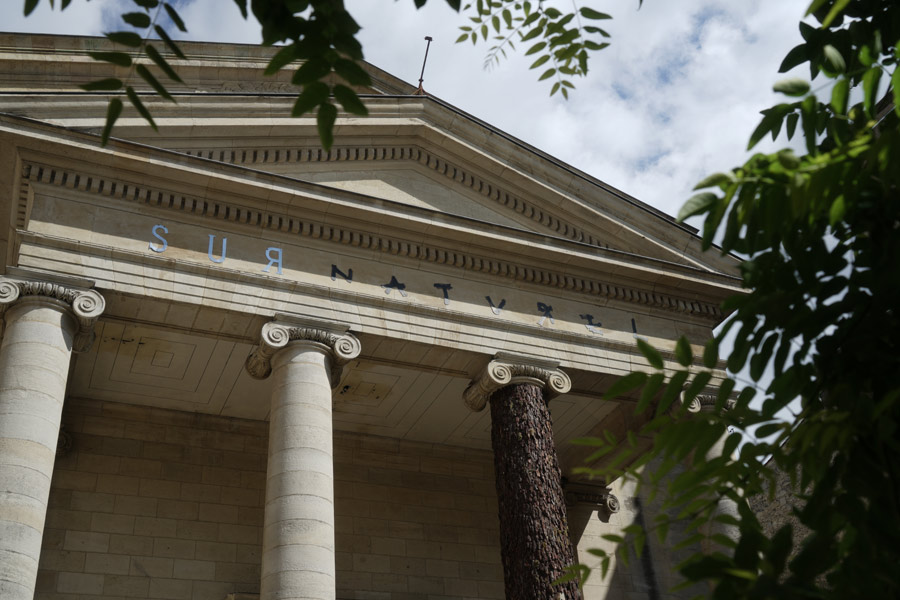
Spanish Street Artist and installation artist Borondo is taking over a church, bringing the cathedral qualities of the dark forest with him. His teasers for this project (culminating as “Merci” on June 21) are as illuminating as they are elusive.
“The church has been closed for 30 years,” we wrote this week. “If you wait long enough the natural world will overtake this temple, covering it with moss, wrapping it with ivy, filling it with trees. “
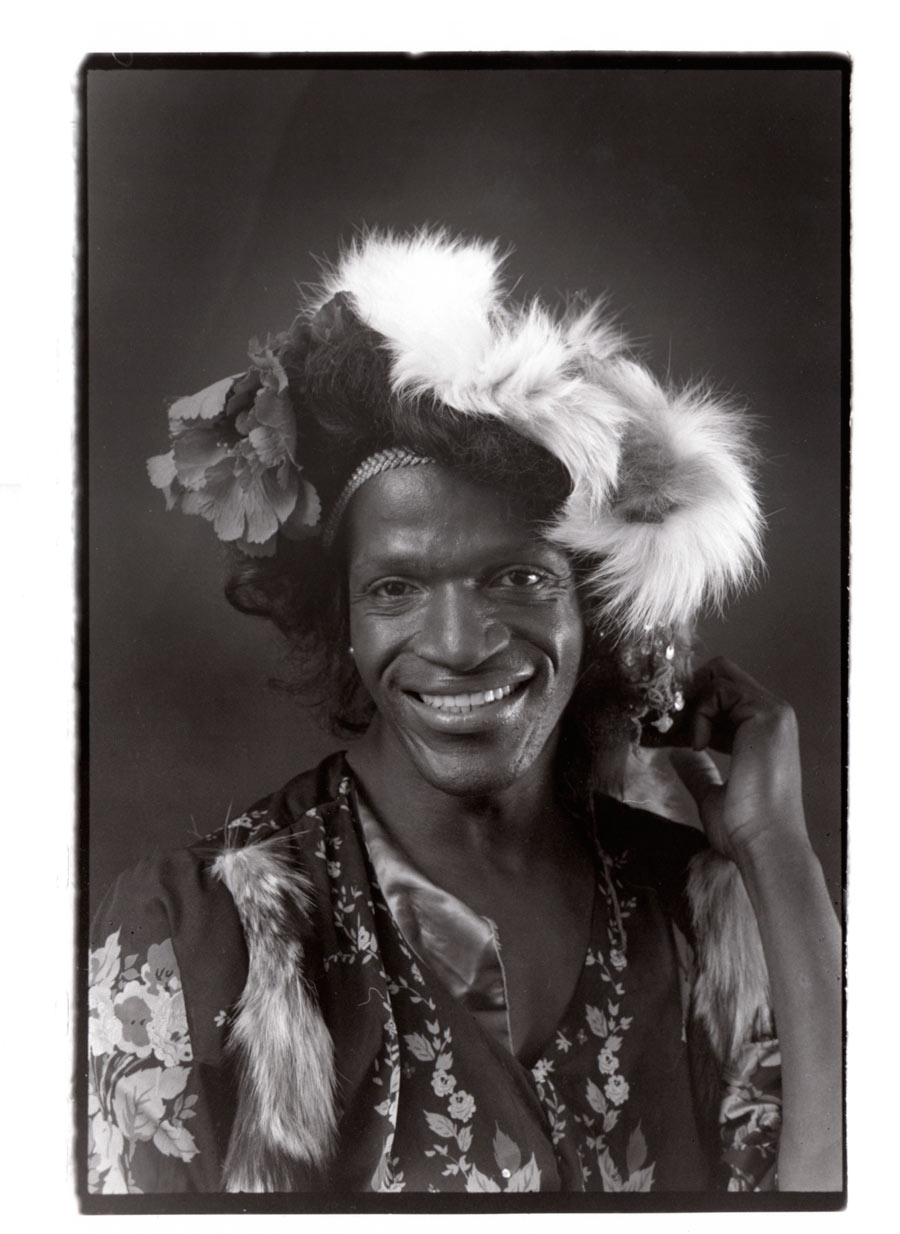
Queer artists and writers in the graffiti and Street Art scene have always been present but like everywhere else in the culture they were more or less bullied by peers to deny it or keep it hidden. It might strike you as ironic or even hypocritical that a subculture of people who feel largely marginalized would propagate another layer of rejection onto their own peers, but humans and clans can be mysterious. And we don’t forget that it was the fags and drag queens who fought against the police in 1969, and who ultimately won through sacrifice, persistence, and collaboration – despite the odds.
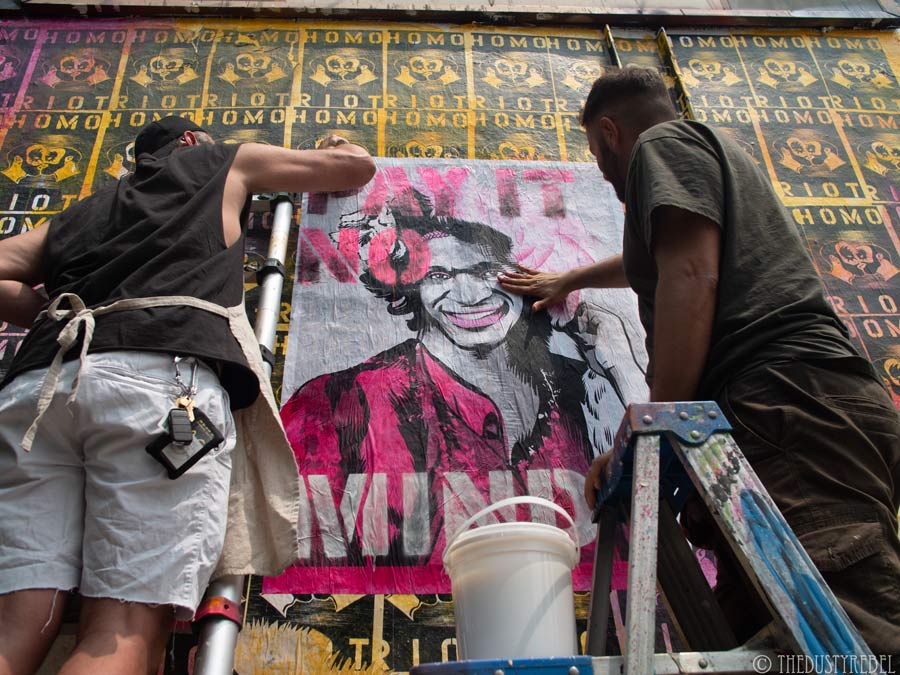
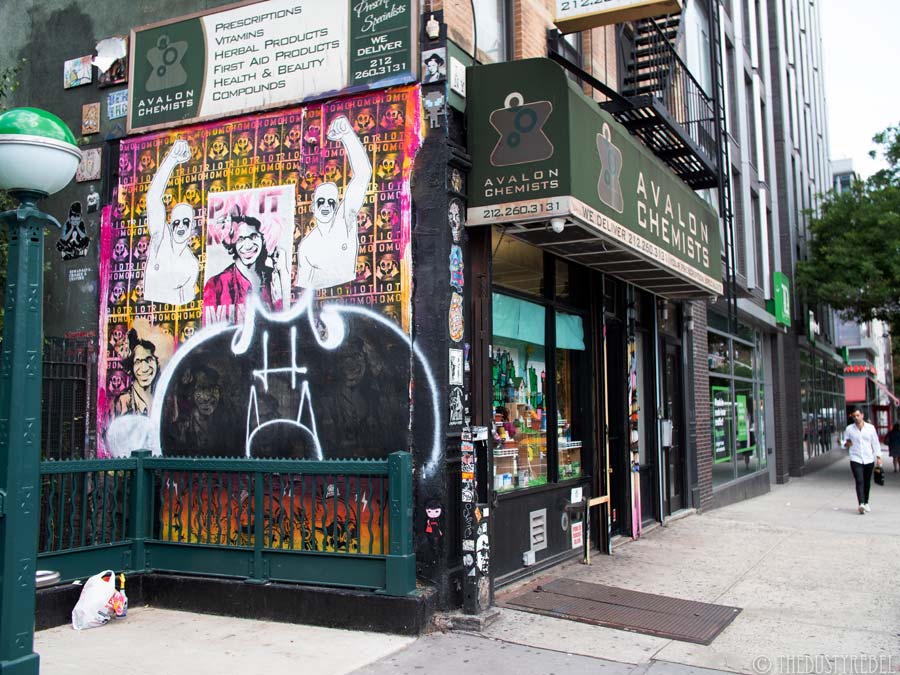
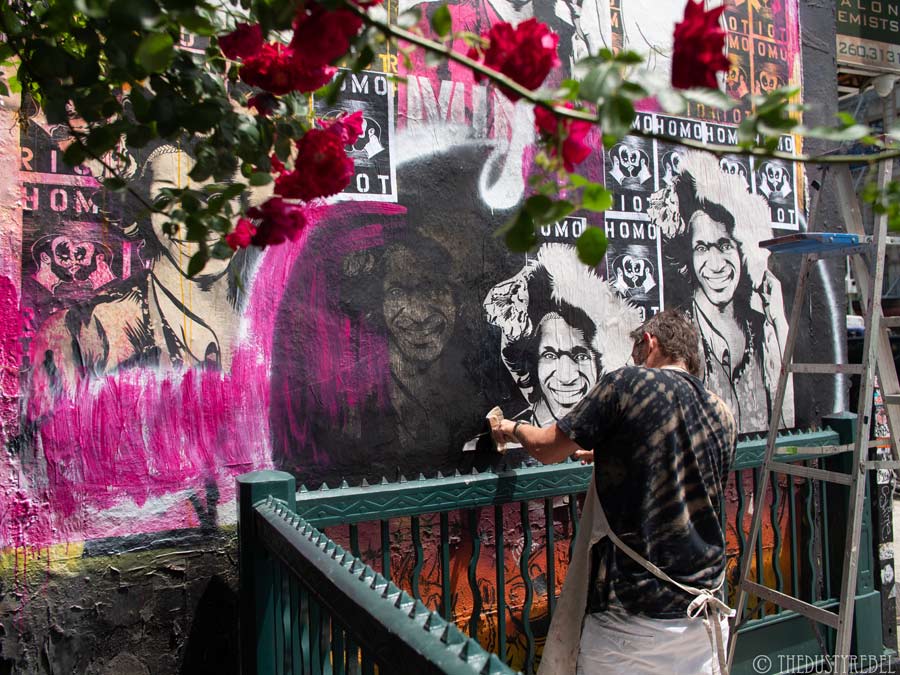
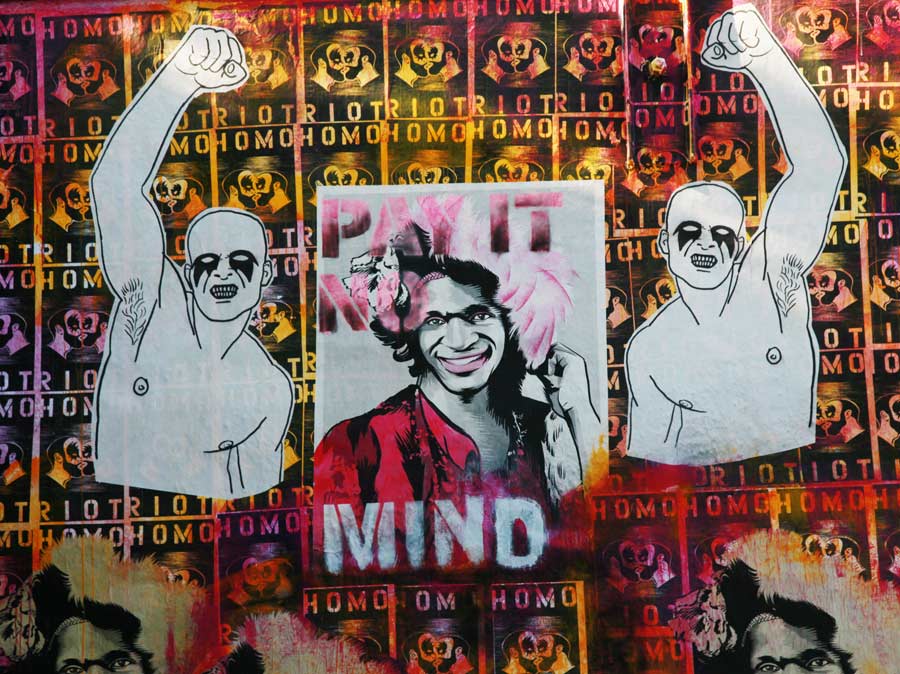
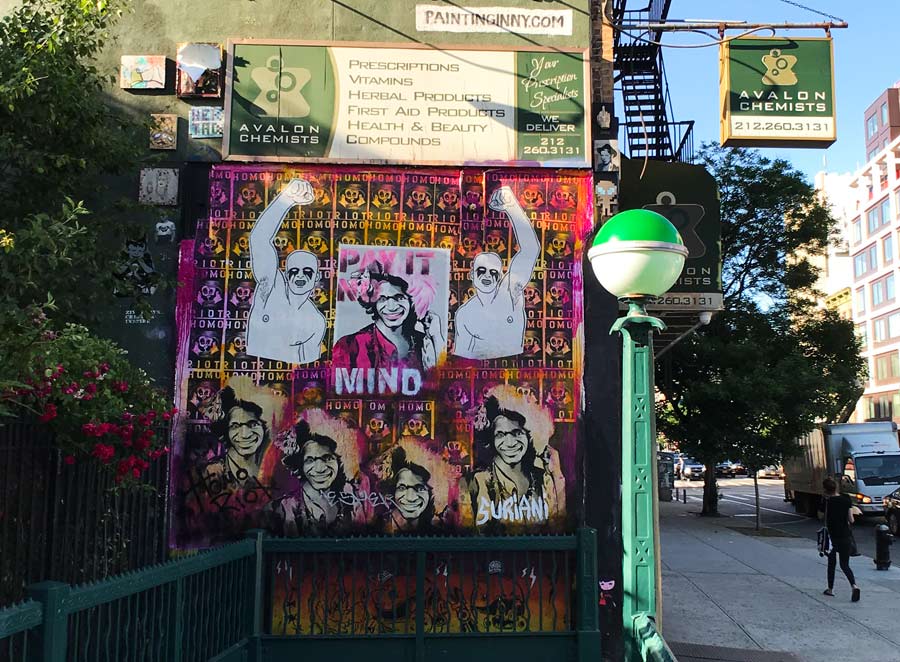
As attitudes slowly change in mainstream society, LGBTQ+ peeps with aerosol cans, stickers, stencils and wheat-pastse are also using graff and Street Art to bring their issues to walls around the city. Today we talk to two artists – Homo Riot and Suriani, along with photographer, film maker, and social activist The Dusty Rebel, who organized their own wall this week to collaborate in saluting one of those Stonewall queens who fought back, Marsha P. Johnson. Even after this new piece was vandalized, the crew simply went back to work to put it up again. The accompanying text and probable title of the piece is “Pay It No Mind”
BSA: Dusty, you’ve been thinking about this wall for Pride for a long time now. The Dusty Rebel (Daniel Albanese): For over a year and a half, I have been traveling around the world filming my documentary about the global Queer Street Art movement. Very little attention has been paid to the topic, which I find curious since so many street art pioneers were queer. In my exploration, I have found that many queer-identifying street artists primarily install their work without permission and it’s often more subversive- which stands in contrast to the growing dominance of muralism.
This wall is actually the kick off to a series of Queer Street Art that will be coming to NYC for Pride Month. I have partnered with Art In Ad Places, Keep Fighting NYC, and other community based projects to create a queer alternative to the overwhelming flood of corporate pride events. While not part of Reclaim Pride Coalition’s inaugural Queer Liberation March on June 30th, I was inspired by the activists who have organized to bring the “Spirit of Stonewall” directly to the street, and who are keeping the focus on the continuing needs of the LGBTQ+ community
BSA:What’s the genesis of your idea for this installation? Getting walls in NYC for artists to paint free of charge is almost impossible. How did you manage to get this sweet spot? The Dusty Rebel: Because it’s seems rare that queer artists get to paint overtly queer legal murals, I wanted to find a way to bring one to New York City. Several months ago, I contacted my good friend Steve Stoppart, and asked him if I could have his wall on Houston — just one block over from where Keith Haring painted the legendary Bowery mural in 1982. Immediately, he said yes and told me I had permission to do anything I wanted. We have no corporate sponsor, so the wall is totally funded by all of us chipping in as a community.
Once I had the wall, I immediately
reached out to Suriani and Home Riot — two artists I have known for years, and
who’s work had inspired me to start my film.
BSA:Almost as soon as the piece was completed someone defaced it. What was the message they tried to send by disrespecting the art and the artists? And how did you respond? The Dusty Rebel: I know street art is ephemeral, and I also know that work that is unapologetically queer is especially targeted. So I knew it was coming, I just didn’t expect something that big and that fast in less than 30 hours. We made this piece as a community, for our community. We really wanted to start conversation about the issues that LGBTQ+ people face, and to honor the memory of Marsha P. Johnson and the Stonewall Riot. To have that important conversation cut short felt like a punch in the gut
In terms of how we dealt with it – we
knew who it was, so we reached out to him and explained why the mural was
important. He said he wasn’t motivated by homophobia and apologized. And I get
it. I’ve known enough vandals to understand that sometimes when your bombing
you’re not necessarily thinking about what you’re hitting. But we had planned
for something like that, so we were ready to “pay it no mind” and to restore
the mural.
BSA:How did Homo Riot and Suriani approach the collaborative aspect of the installation. The Dusty Rebel: We began planning this wall over seven months ago. I told them I wanted it to be a celebration of queer liberation and make reference to New York’s history. While they are familiar with each other’s work, neither had met in person. Both artists have very different aesthetics. Homo Riot’s work being more homoerotic and aggressive, while Suriani’s is a colorful exploration of gender. So I knew it would be a challenge, but I also knew they would take the collaboration seriously. This wasn’t just two artists who were slapping their work next to each other. They listened to each other and compromised, without compromising their artistic voices. So, I’m very proud of them and the wall they created.
BSA: Why do you think it’s important to have queer perspectives in Street Art? Homo Riot: Street art is egalitarian. It’s open to all and its consumption is not restricted to a particular class, creed or level of education. And because it’s ubiquitous in our current environment, it provides opportunities for queer and marginalized people to be visible. In urban environments, queer art becomes part of the landscape and our presence hopefully becomes part of the collective consciousness making way for acceptance and inclusion. In small towns and long stretches of interstate, representations of LGBTQ+ art are important for those members of our community who are isolated and may feel alone.
BSA: Why do you think it’s important to have queer perspectives in Street Art? Suriani: I think it is important to have queer perspectives in all kinds of art or environments. Street Art is a space of free self-expression. It happens in public space, so it is accessible to everyone. Queer culture traditionally occurs in closed spaces due to the repression and violence LGBTQ+ people have suffered throughout history. Expressing our values and points of view to a larger public might spread awareness of our existence and help our communities in our fights for equality in terms of acceptance and rights
The official art world is already aware of these issues as we can see with the Brooklyn Museum’s current exhibition “Nobody Promised You Tomorrow: Art 50 Years After Stonewall“. The problem is that only a very limited percentage of the population has access to museums. Urban Art is part of the city, it comes to people instead of waiting for people to come to it. Our message is directly visible to everyone who’s out there in public space: Inside of that resides its main power.
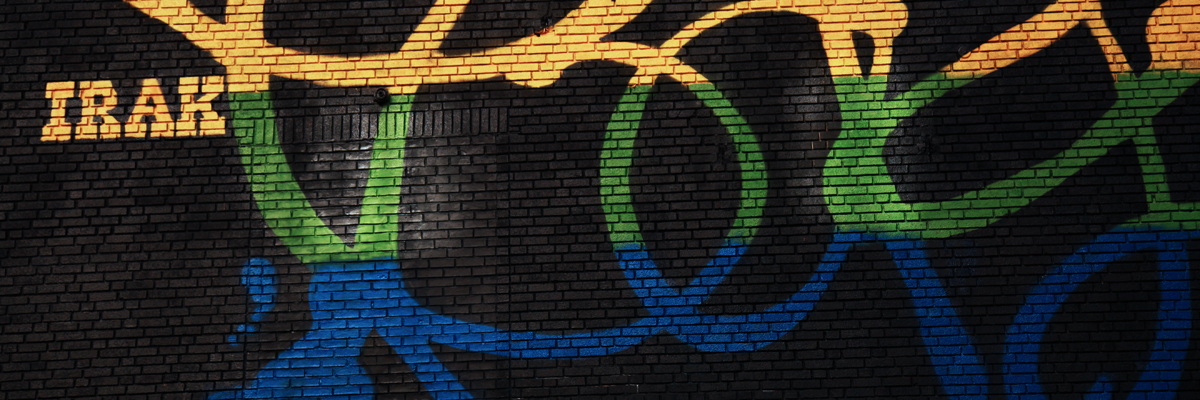
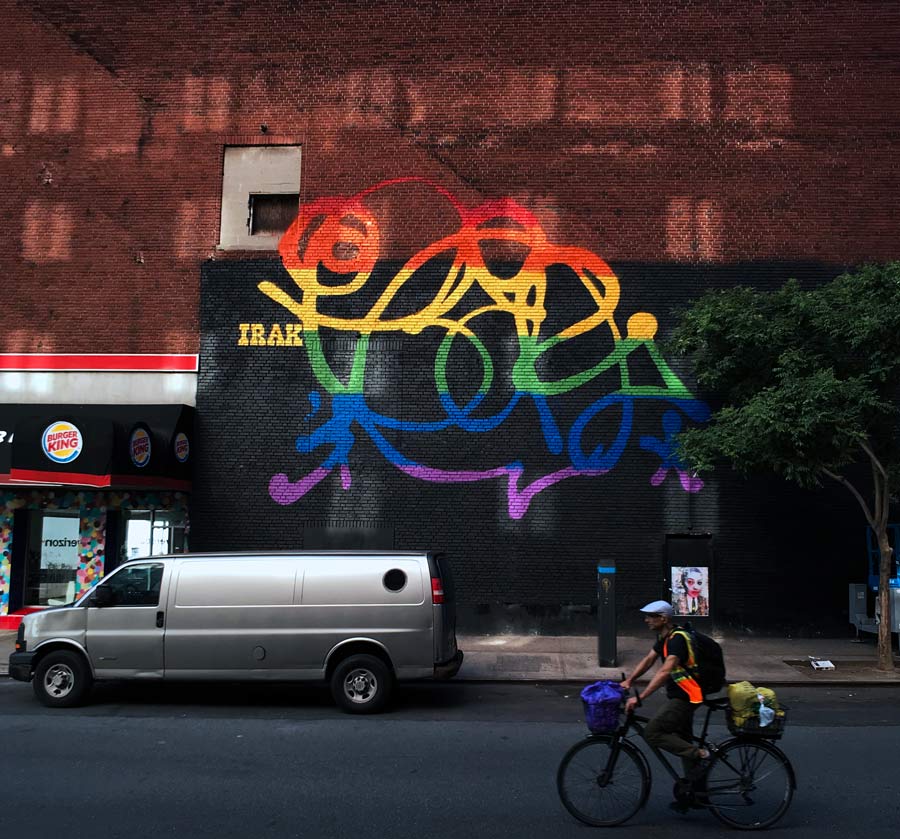
Murals and pieces just can’t crush tagging, and Kunle Martins aka EARSNOT, founder of the IRAK CREW, would probably tell you that you shouldn’t even try. It’s the buttery essence of the street.
Here he’s bringing it for World Pride 2019, and yes, he’s multi-color killing it.
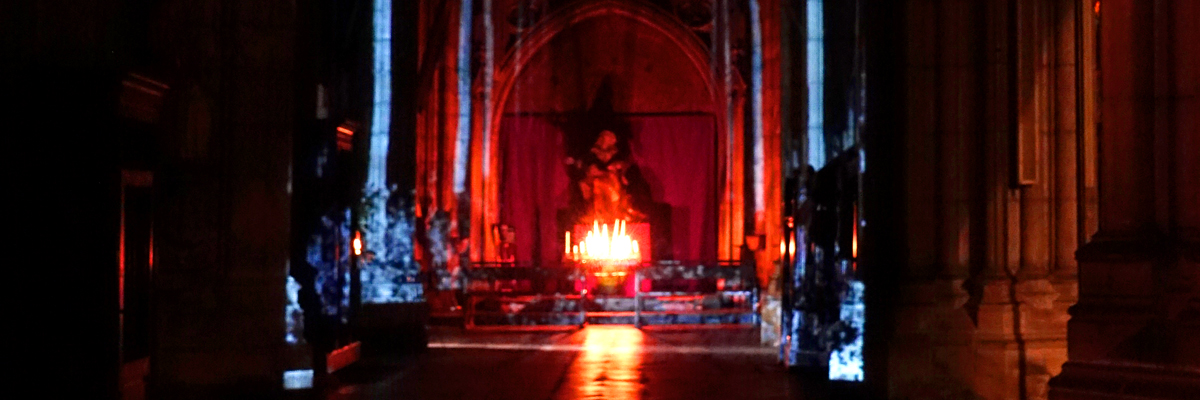
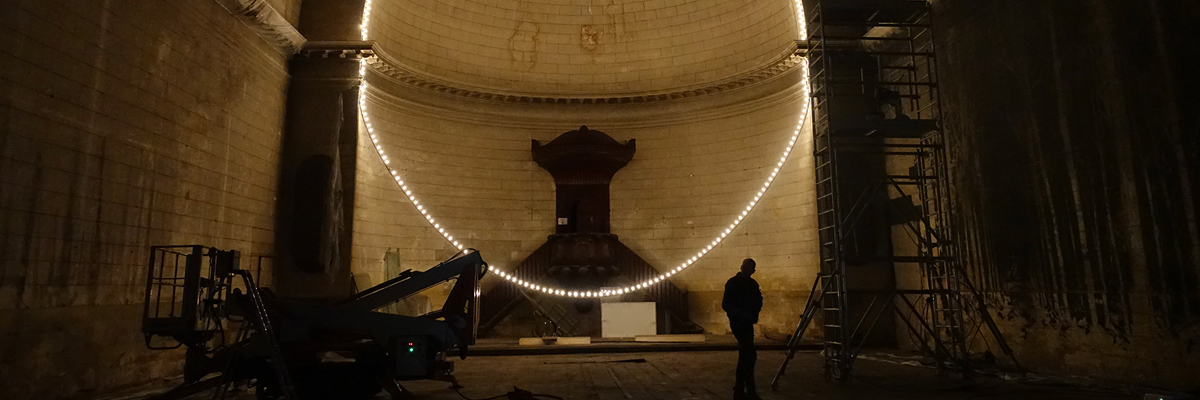
The church has been closed for 30 years. If you wait long enough the natural
world will overtake this temple, covering it with moss, wrapping it with ivy, filling
it with trees.
Borondo. “Merci” Le Temple des Chartrons. Bordeaux, France. June 2019. (photo courtesy of Borondo)
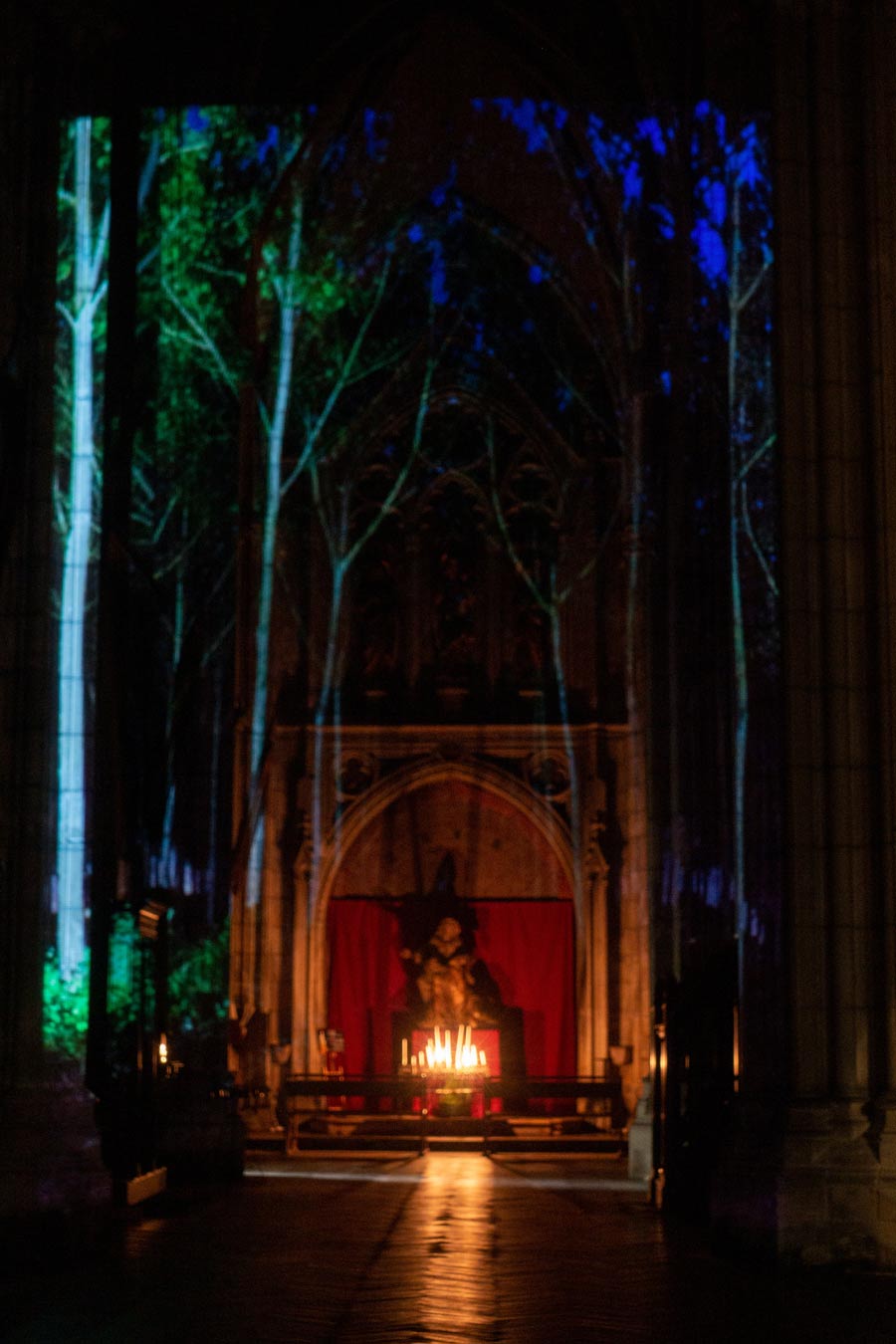
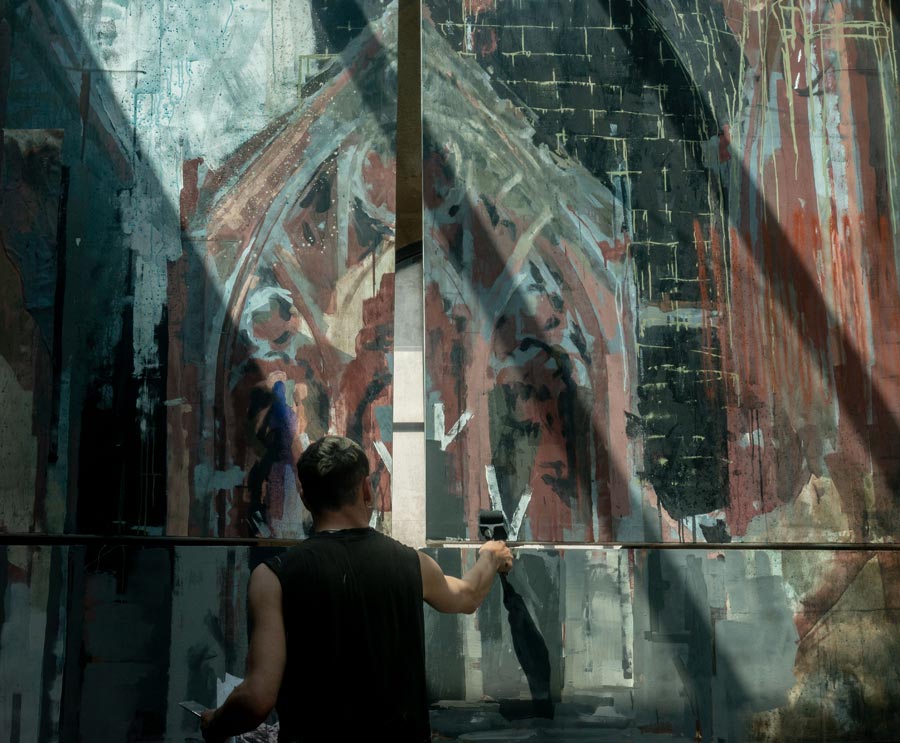
Borondo is already there. “The columns are connected to trees,” he says as
he projects a tall thin ghostly forest down the nave to the apse in preparation
for his multimedia installation at the summer solstice.
As he researches this environment and the forests and gardens of Bordeaux
the Street Artist is studying decay, growth, re-growth, and the dialogue
between architecture and the world that preceded us.
Borondo. “Merci” Le Temple des Chartrons. Bordeaux, France. June 2019. (photo courtesy of Borondo)
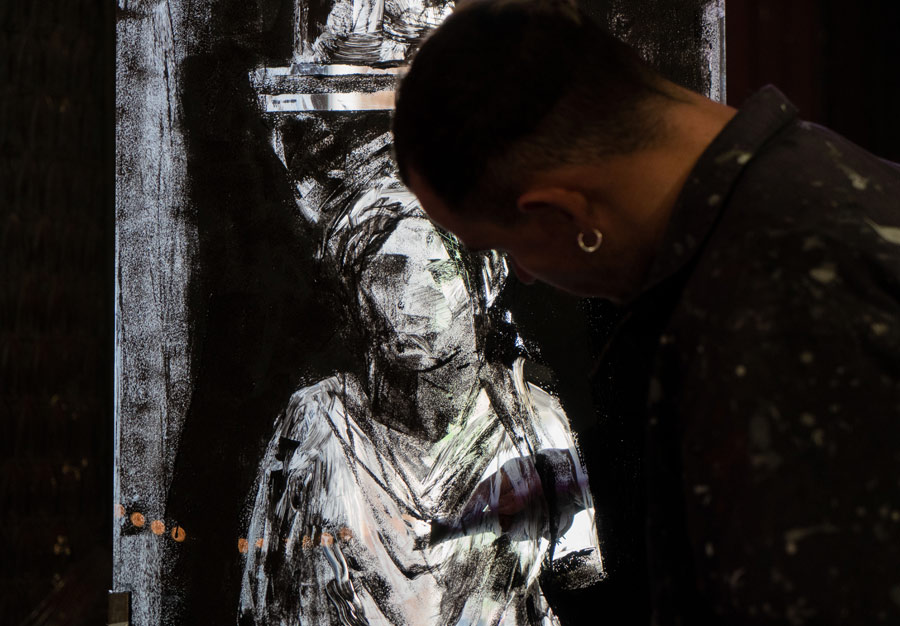
As he prepares the paintings, projections, and sounds he looks for the
duality of our experiences as well – the fear and the attraction that a holy house
can evoke, as well as an immense and thick forest, full of movement and
stirring.
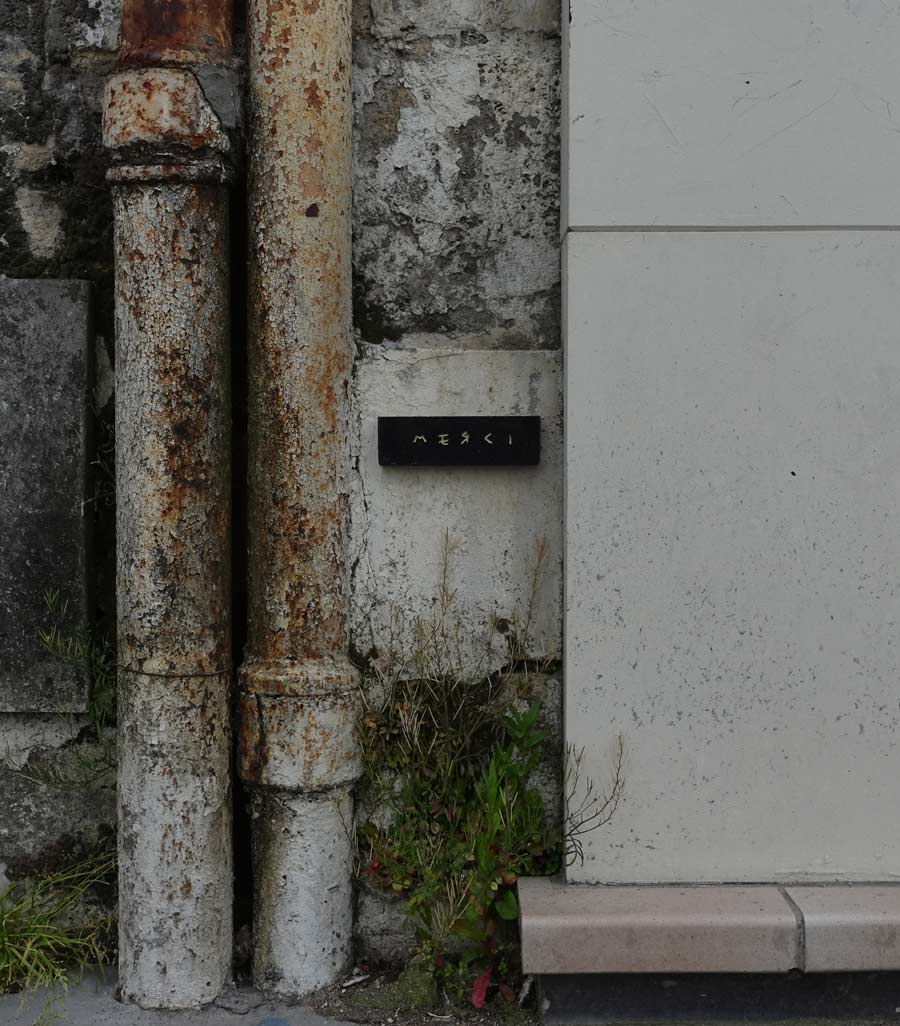
Who will fall to their knees here and cry it out to the sky first? “Merci !” “Mercy !”
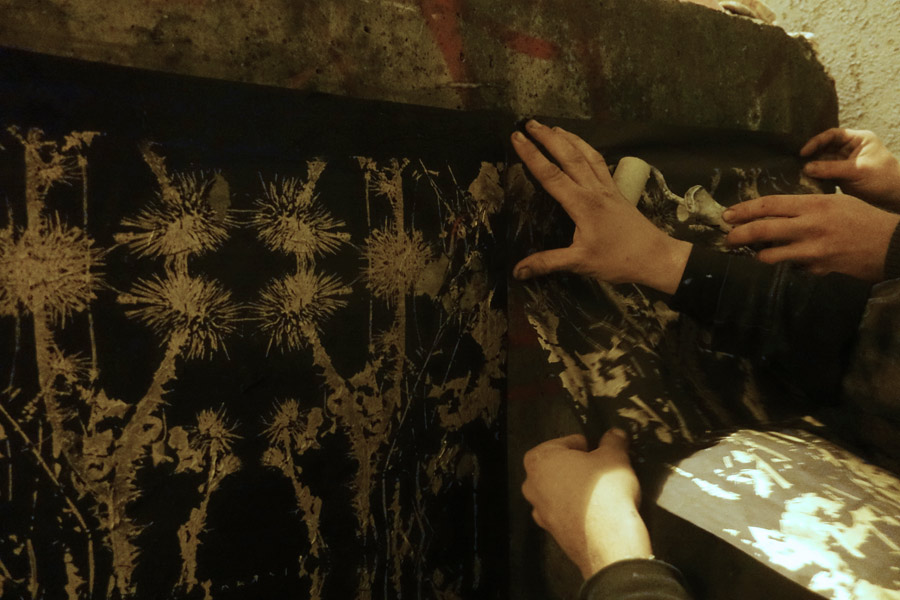
Borondo. “Merci” Le Temple des Chartrons. Bordeaux, France. June 2019. (photo courtesy of Borondo)Borondo. “Merci” Le Temple des Chartrons. Bordeaux, France. June 2019. (photo courtesy of Borondo)Borondo. “Merci” Le Temple des Chartrons. Bordeaux, France. June 2019. (photo courtesy of Borondo)Borondo. “Merci” Le Temple des Chartrons. Bordeaux, France. June 2019. (photo courtesy of Borondo)
See our first installment on “Merci” by Borondo here on BSA :
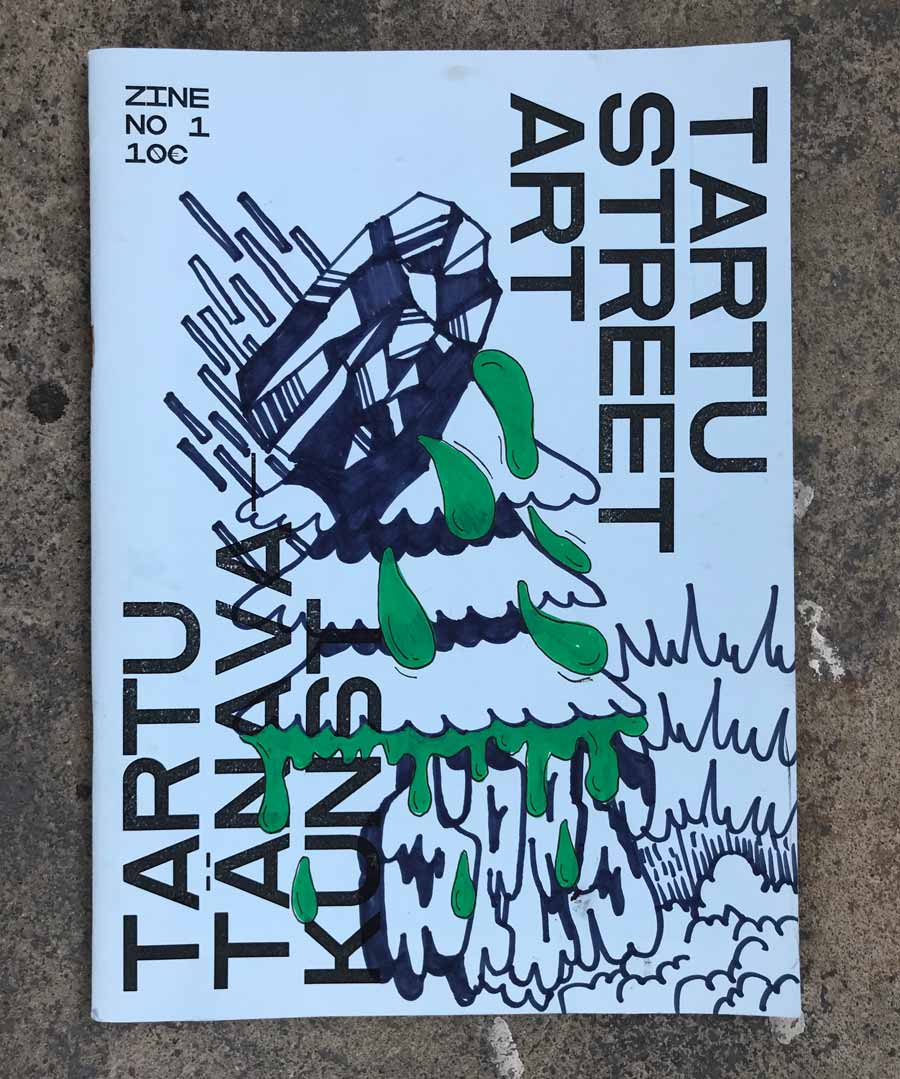
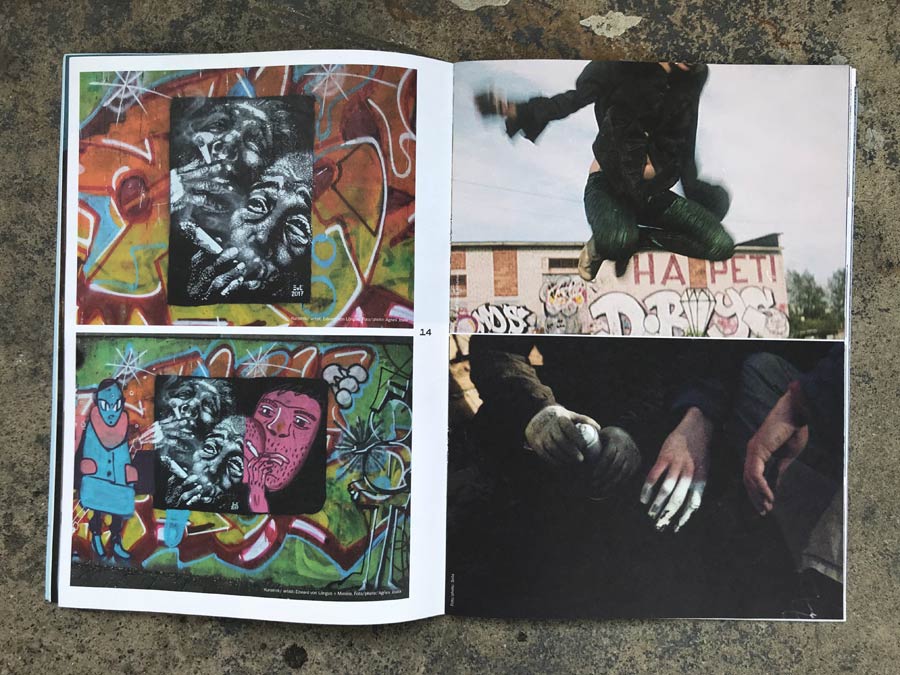
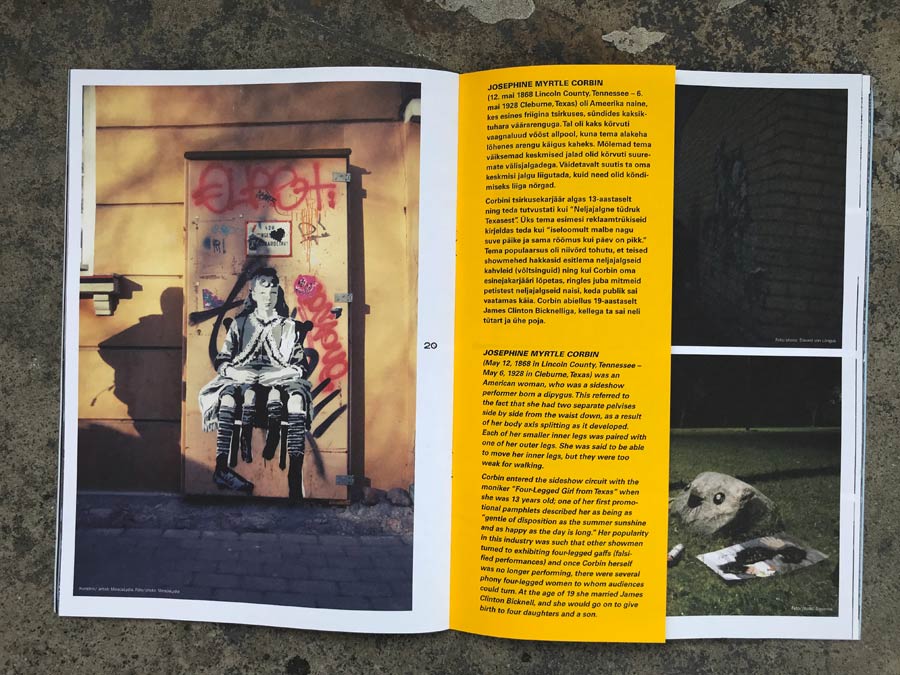
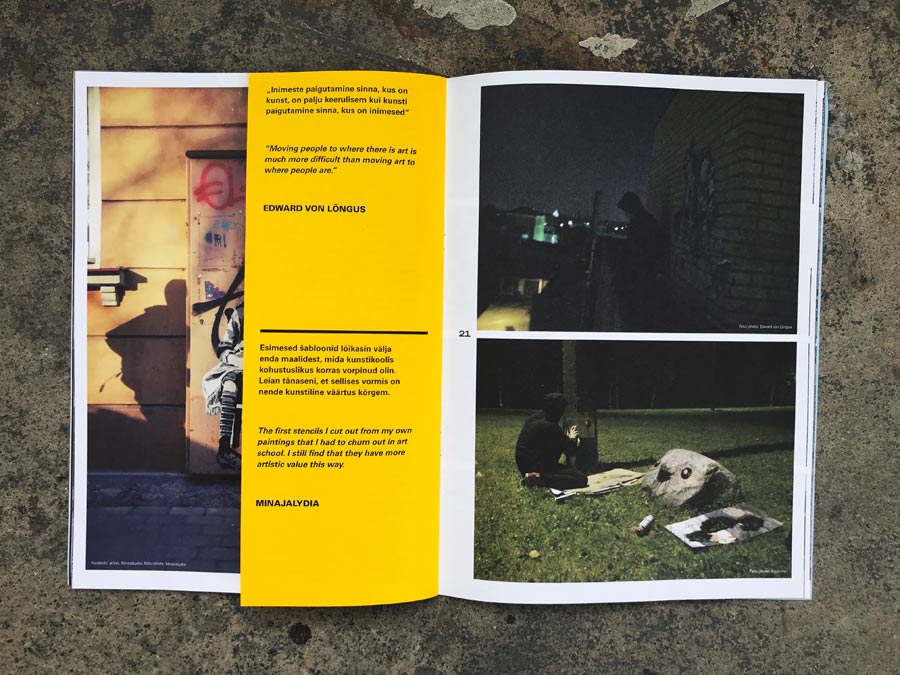
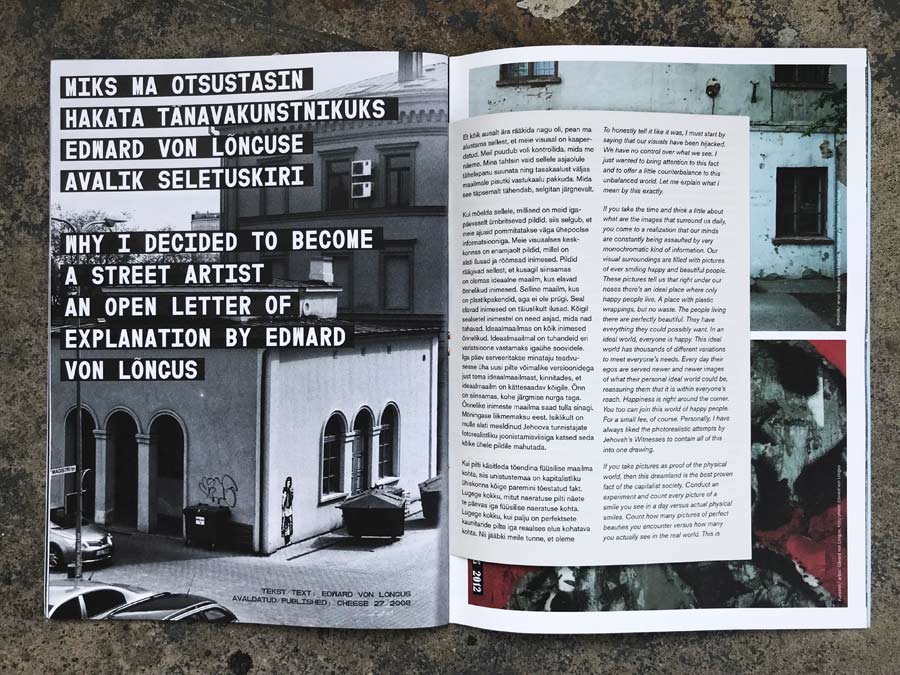
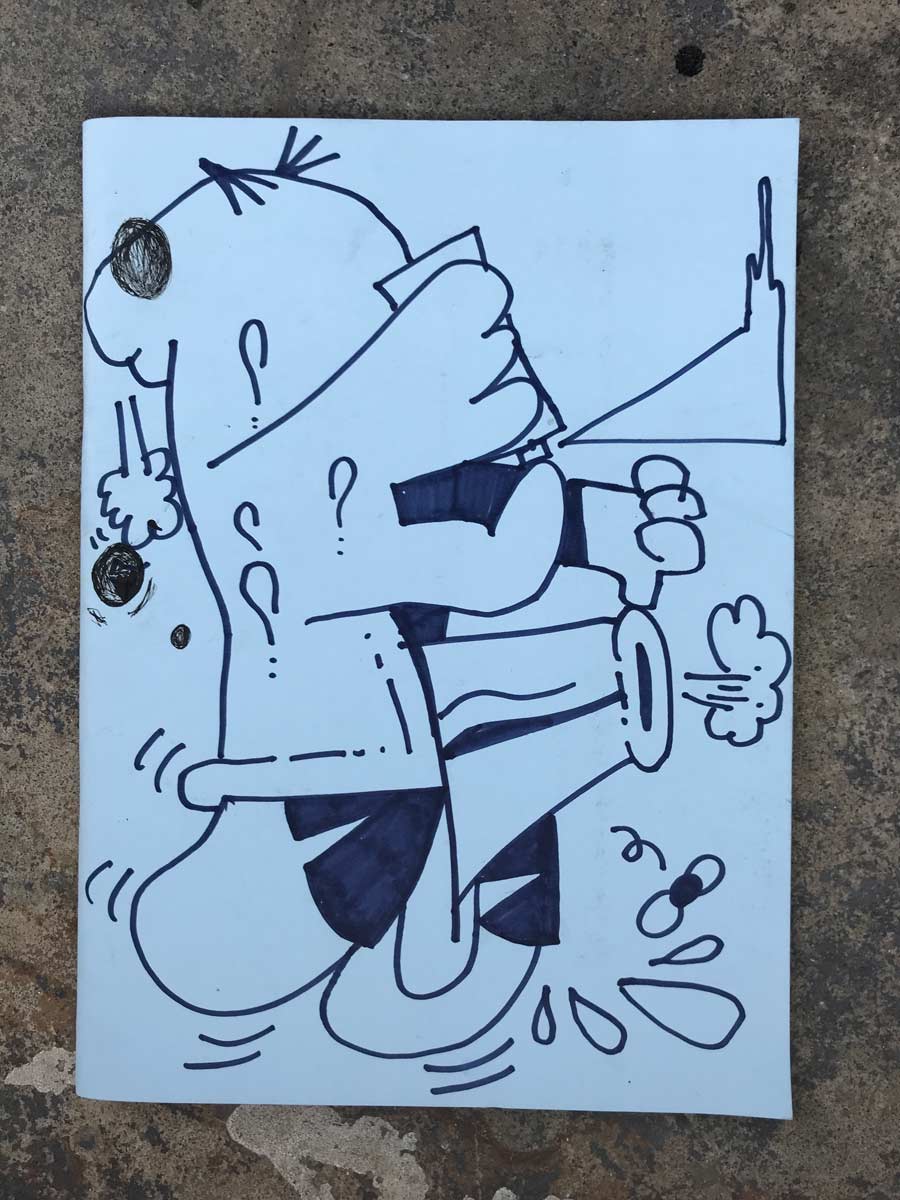
Almost a decade after the Stencibility festival began in Tartu, Estonia, and just in time for the launch of their 2019 program, the first edition zine has been released. Full of images, essays, interviews, and personal experiences of art in the streets in this eastern European city of 93,000, the opening foreword is by co-founder of the festival, who goes by a one name moniker of Sirla, and who serves as editor of the issue along with longtime organizer Kadri Lind.
Championing a pretty straight-forward
philosophy toward individual artistic participation in the streets, Stencibility
has stayed clear of common commercial pitfalls familiar to festival organizers
while espousing a refreshing philosophy of inclusion and participation.
Yes, there are film programs and artists talks, and even tours and “tabling” with educational information, but there is not a discernable “positioning” for sales or branding of those events, keeping them within the realm of social study, urban studies, expression, and possibly self-realization. It helps that Tartu as a city supports the festival, owing as much to its history as a university town as its desire to retain or attract many of the younger population who flooded out of the city in the post-Soviet era.
Aside from Sirla’s reasoned, seasoned and insightful observations and distinctions that help define the Street Art scene locally and trends in international discussions, we’re also excited and intrigued by the ground rules of the Stencilbility manifesto that are printed just inside the zine. It clearly places some civic responsibility squarely on the shoulders of the artistic intervener:
Public space belongs to everyone who uses it.
It is everyone’s duty to take care of it, like you would your own home
The purpose of street art is to enrich, not deface, public space.
All additions are welcome. If you don’t like it, improve it.
To guarantee ultimate creative freedom, act according to your conscience, not laws and regulations.
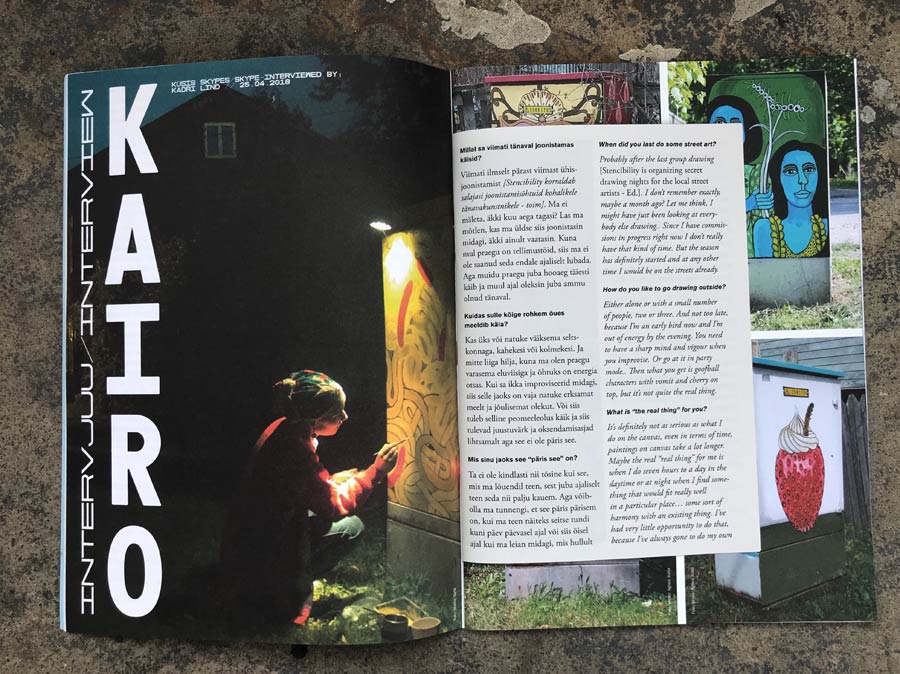
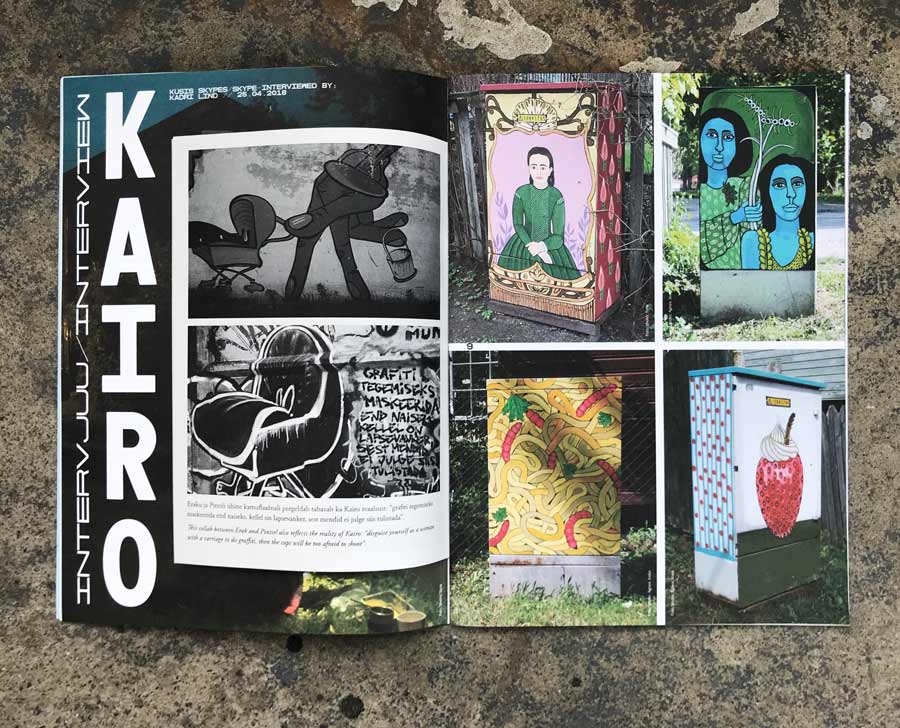
Indicative of the open-minded atmosphere that brings illegal art-making in the streets is one of the interviews in the zine with artist Kairo. She spends hours painting electrical boxes with various decorative motifs and styles and has coined her own term to describe her technique as “acryliti“, a blending of the word acrylic and graffiti.
So unconcerned is Kairo about transgressing public/private space with her art practice that half of her street gear is paint and the other half is her baby in a stroller. Not a tagger per se, she’s had her share of late night excursions with two or three others, but that cat-and-mouse game that seems to energize vandals in western countries isn’t on display.
“Actually, there haven’t been as many incidents as maybe I’d like,” she says. “That might just exemplify the special friendly atmosphere of Tartu. The police have never talked to me, only driven by. They have startled me, but never engaged with me directly. And people have asked me with a confused look, why do I do this at night? I answered them, ‘I don’t have time during the day.’”
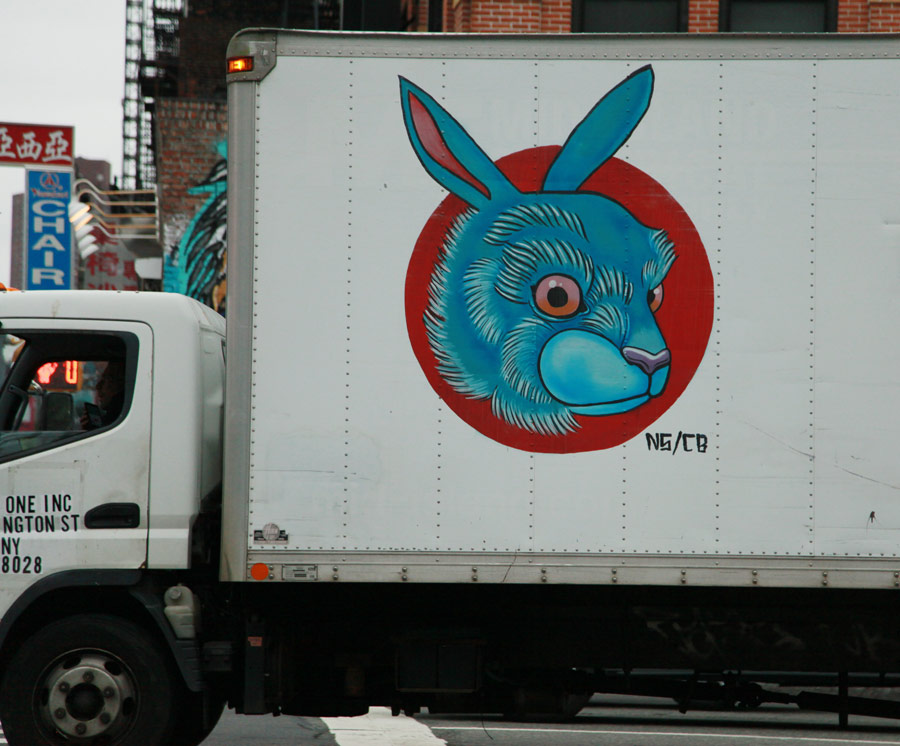
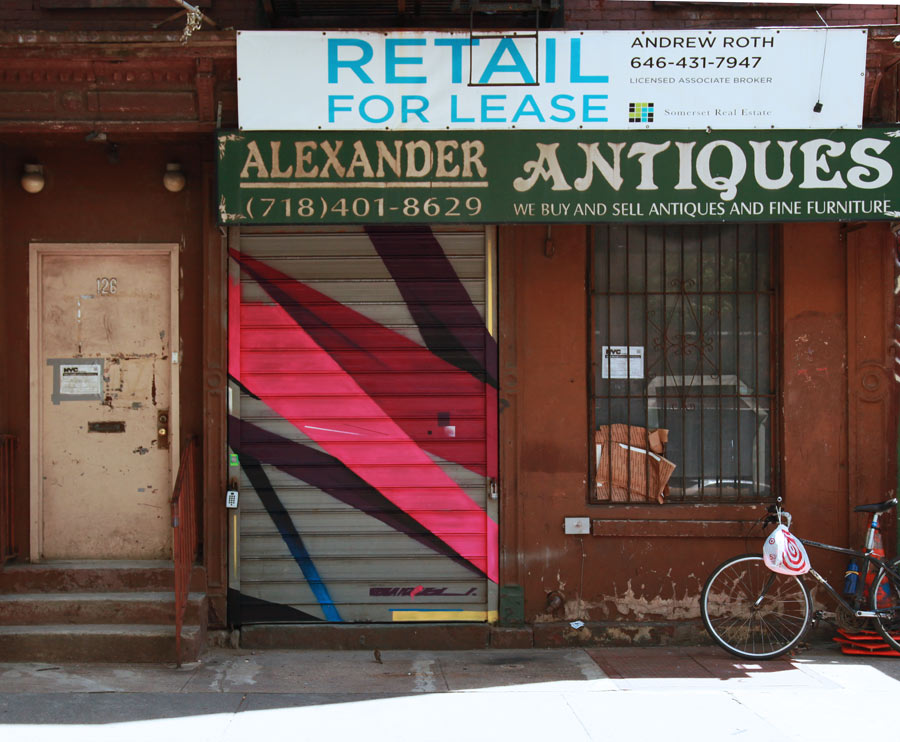
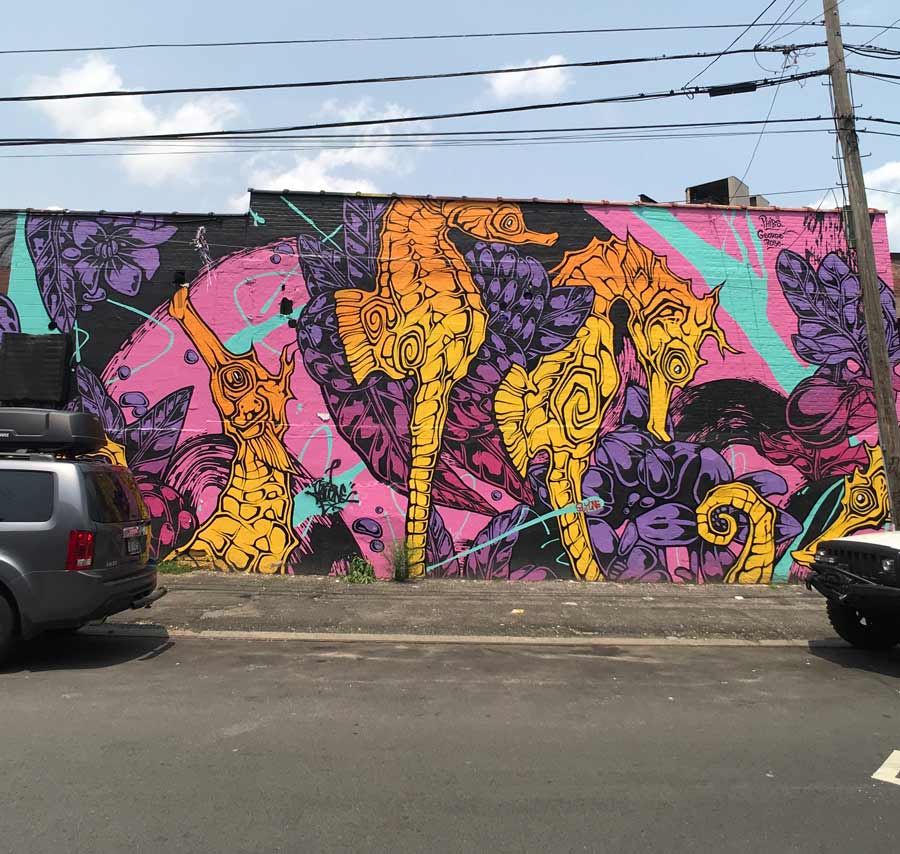
So here’s our weekly interview with the street (or boardwalk), this time featuring BG 183, Bio, BR163, Crash, George Rose, Indie 184, Love Pusher, Nicer, Nick Walker, NS/CB, PHibs, Remi Rough, Rubin415, Steph Burr, and Tats Cru, yo!
She’s painted inside a parking garage in Detroit. She’s painted huts in The Gambia. She has painted a Norwegian lighthouse, an abandoned New York subway tunnel, and we watched her paint while balancing on a rickety patchwork of a hot tin roof in Marrakech.
Lucy McLauchlan is intuitive about interpreting her environment, and no two mural pieces are ever completely the same, even though natural rhythms and graphic motifs overlap. Now back in hometown Birmingham, the Street Artist, muralist, and fine artist is preparing for a solo show opening next week called UNFOLD.
The title can easily be interpreted as her own creative process, which appears to be illuminating and revelatory to her as much as anyone – a mystery of life unfolding before her as she travels the world.
It also reminds us of this tree wrapping process she was doing in the dark woods when we saw her last August in Moscow. She coated the bark of the trees with a non-harmful ink/paint and then literally pressed large canvasses on them. The results were the ultimate “wood-block” print, another example of what she calls her “deep respect for nature”.
The
week-long pop-up show will run all week, and will include mixed media used on
paper, canvas and will feature Matthew Watkins films running in the space that
capture Lucy at work.
Our weekly focus on the moving image and art in the streets. And other oddities.
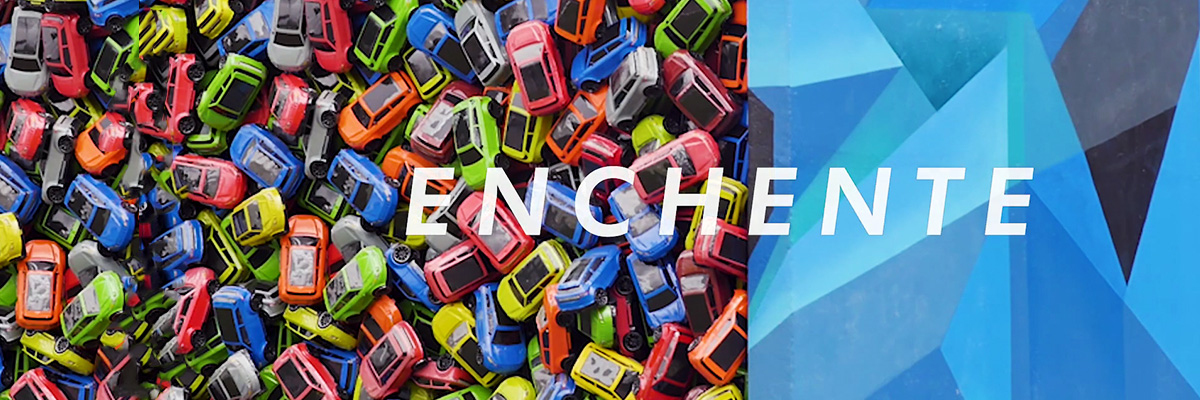
Now screening : 1. ENCHENTE (FLOOD) Eduardo Srur and Tché Ruggi 2. “LA PARED ES NUESTRA” por ESCIF (spanish) 3. Shepard Fairey. Facing the Giant: Three Decades of Dissent. Part 1 4. Hot Tea. New installation in Asbury Park, NJ for Wooden Walls Project.
BSA Special Feature: ENCHENTE (FLOOD) Eduardo Srur and Tché Ruggi
News from Brazil this month reminds us that annual flooding in São Paulo kills people and destroys homes, thanks to the city being built on one of the largest river basins in the country. Public artists Eduardo Srur and Tché Ruggi combine mural painting and sculpture to address the struggles that people here face – including the displacement of people and homes and destruction of their lives.
The artists say, “With its exponential urban growth, the conflict of space
between the water and the city is getting more violent each year. The public
art portrayed is an answer to this sad reality of São Paulo. The film put light
on this conflict and approaches the relation of the
public art with the city and its inhabitants.”
“LA PARED ES NUESTRA” por ESCIF (spanish)
A new retrospective video on the community
wall created in response to a people’s history. Inspired by the neighborhood
movements of 1970s Spain, specifically the city of Sant Feliu de Llobregat, an
open call to paint a central wall was responded to by 300 applicants in 42
countries. The jury selected 12 finalists and in council with local city
council, local artists, and local historians and community leaders, an
international jury selected Street Artist and ‘artivist” Escif as winner of the
residency.
With thanks to the artist, the
community, and to Kaligrafics urban art organization and Contorno Urbano
Foundation and jury members Jaime Rojo (Brooklyn Street Art, NY), Mónica
Campana (Living Walls, ATL), Veronica Werkmeister (IMVG, Vitoria), Fernando
Figueroa (Doctor of Art History) and Esteban Marín (President, Fundación
Contour Urbano), here is the story.
Shepard Fairey. Facing the Giant: Three Decades of Dissent. Part 1 by Chop ’em Down Films.
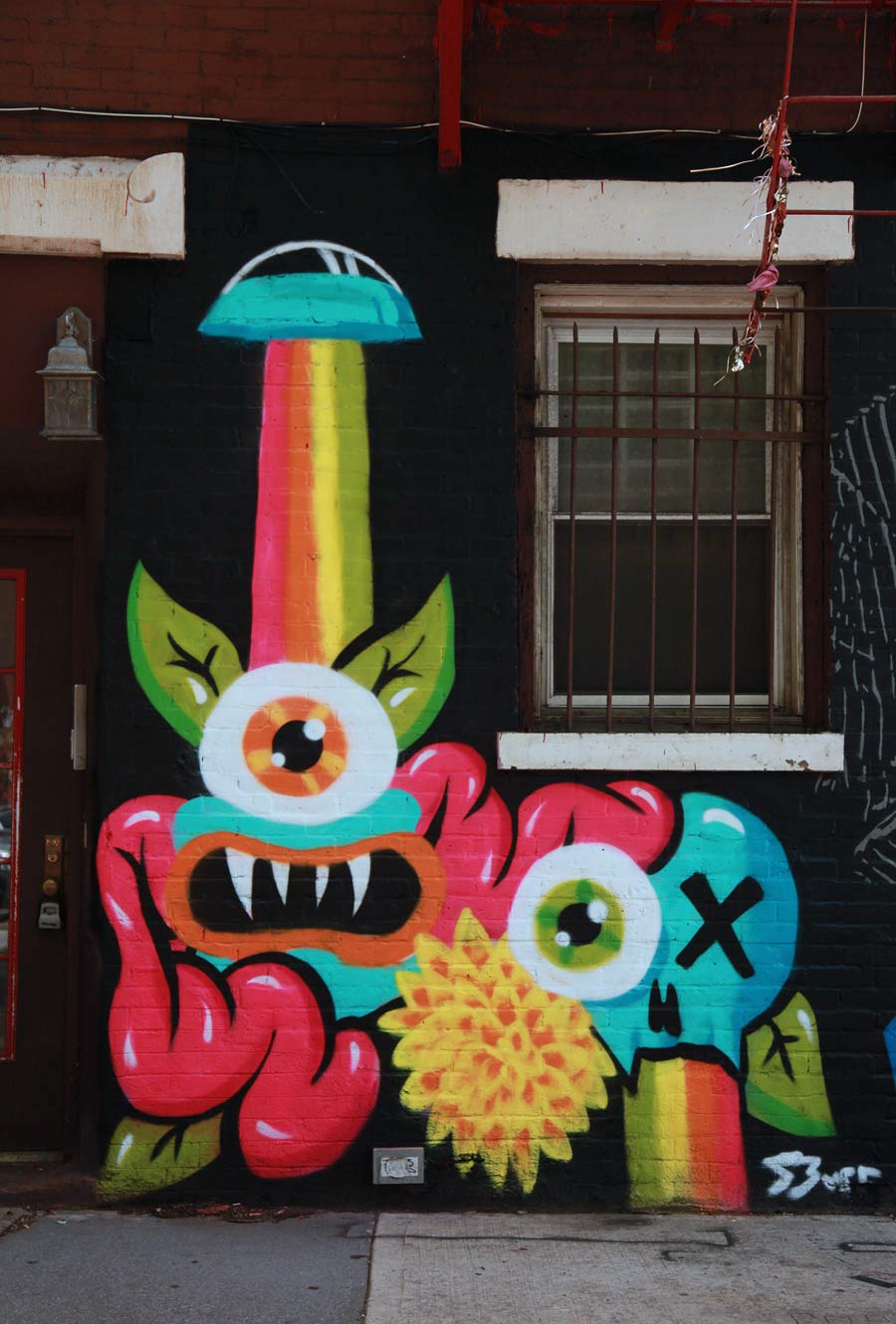
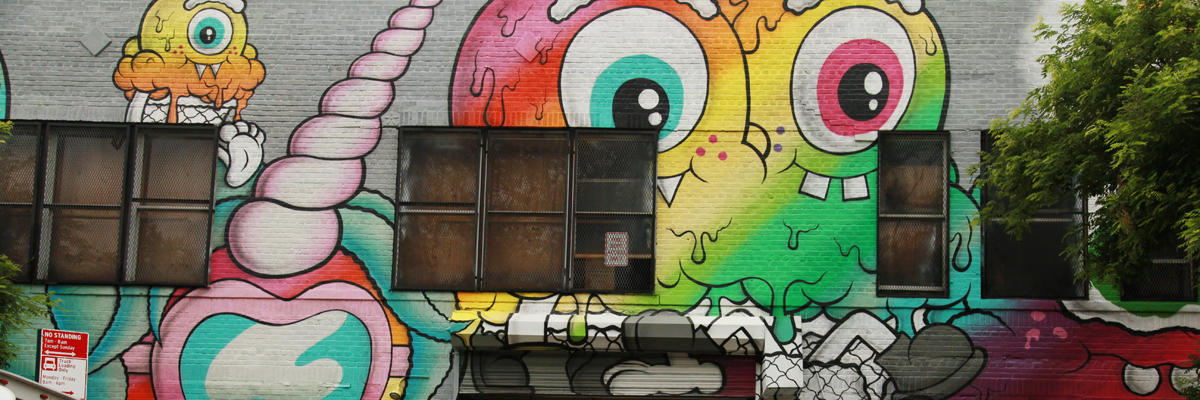
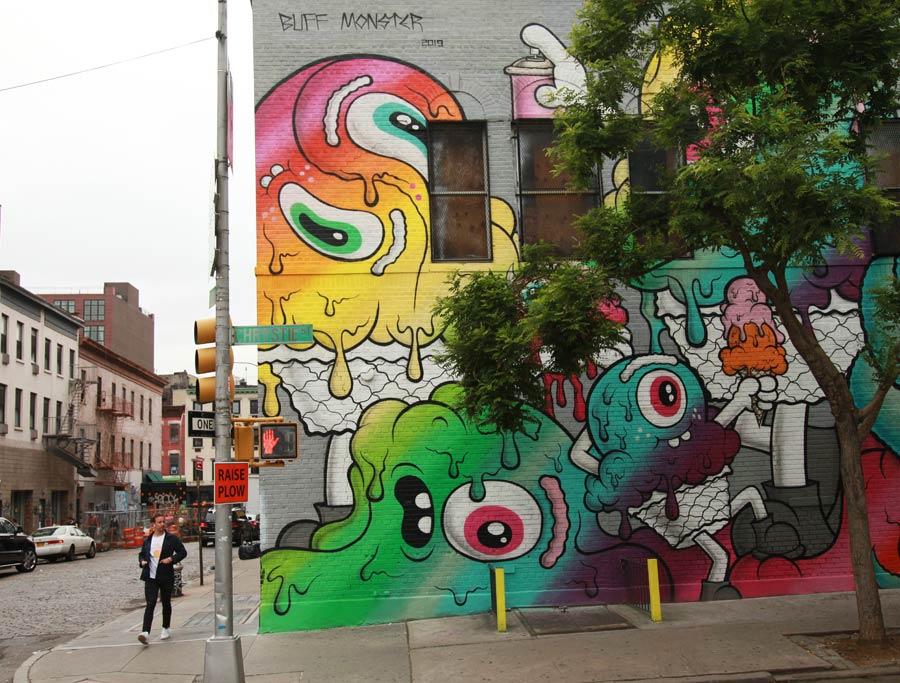
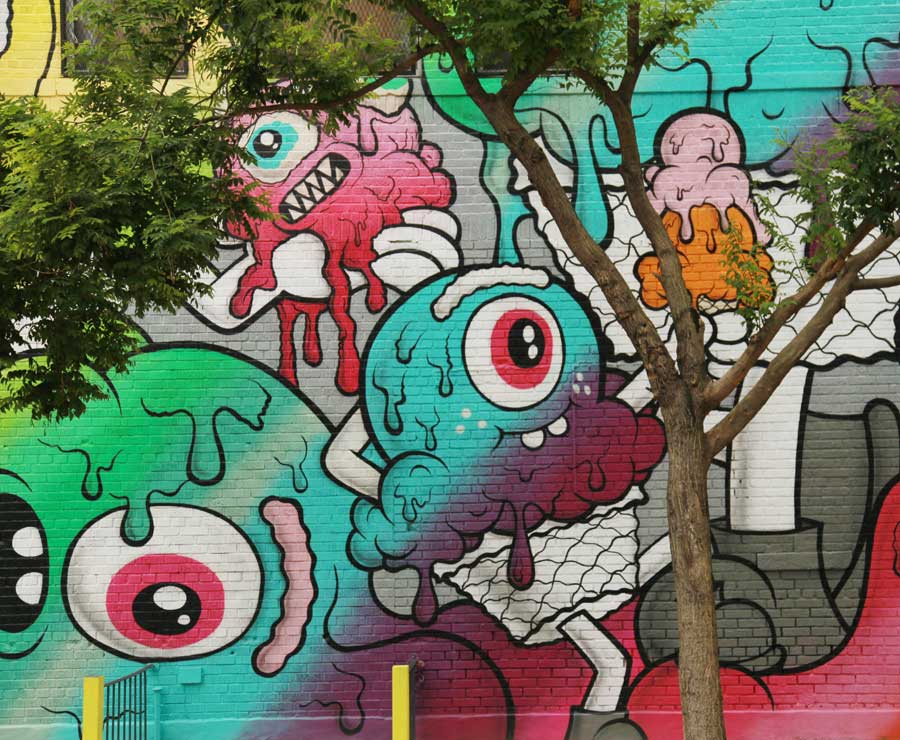
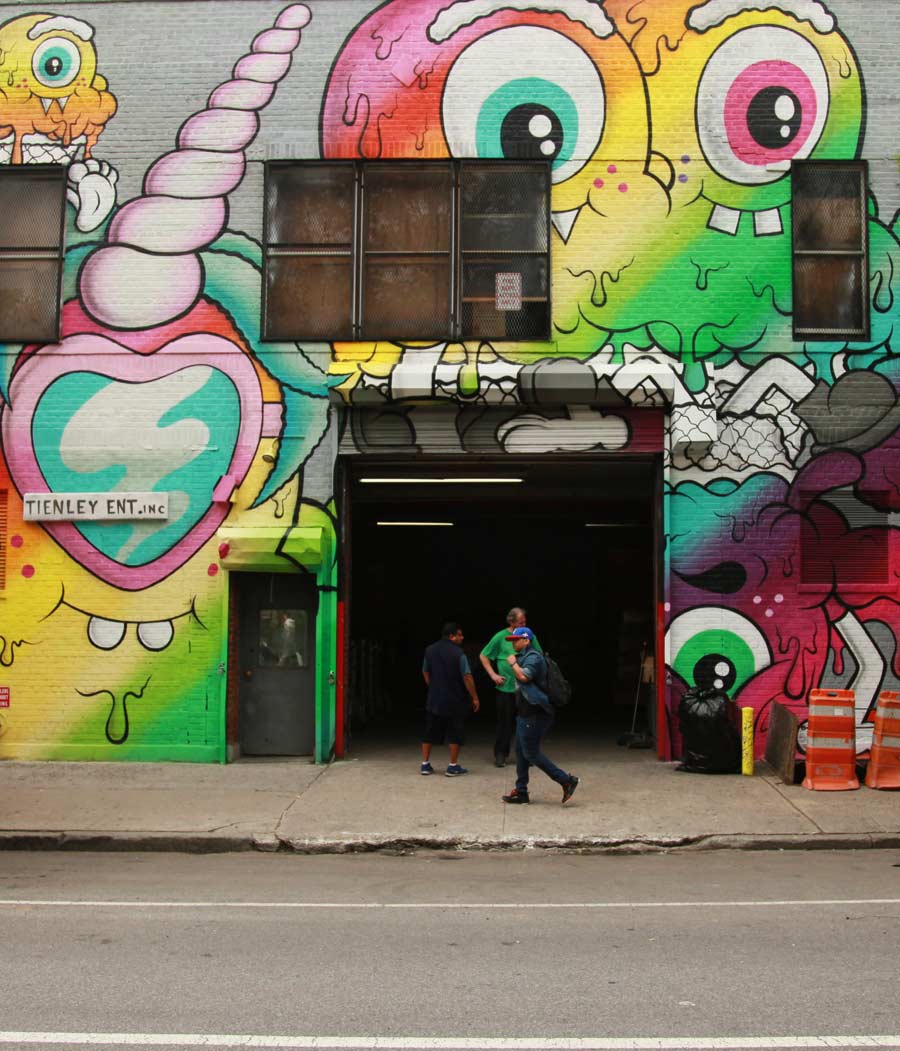
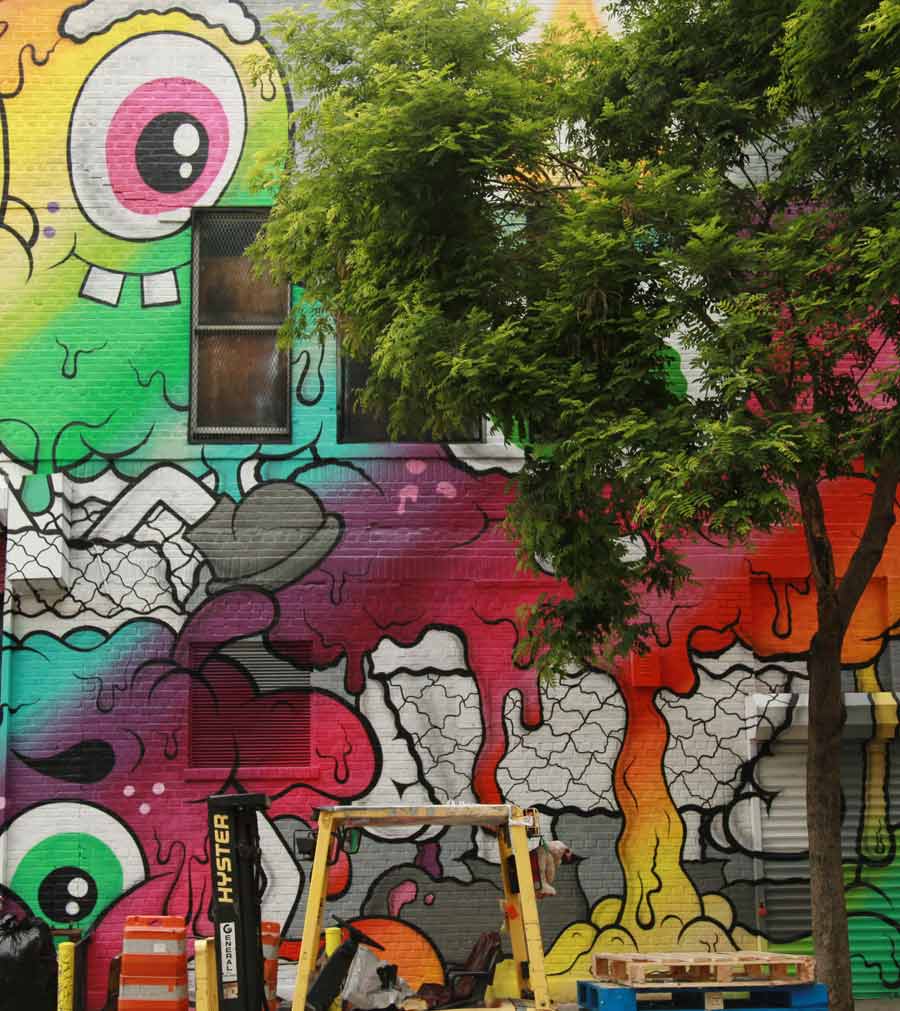
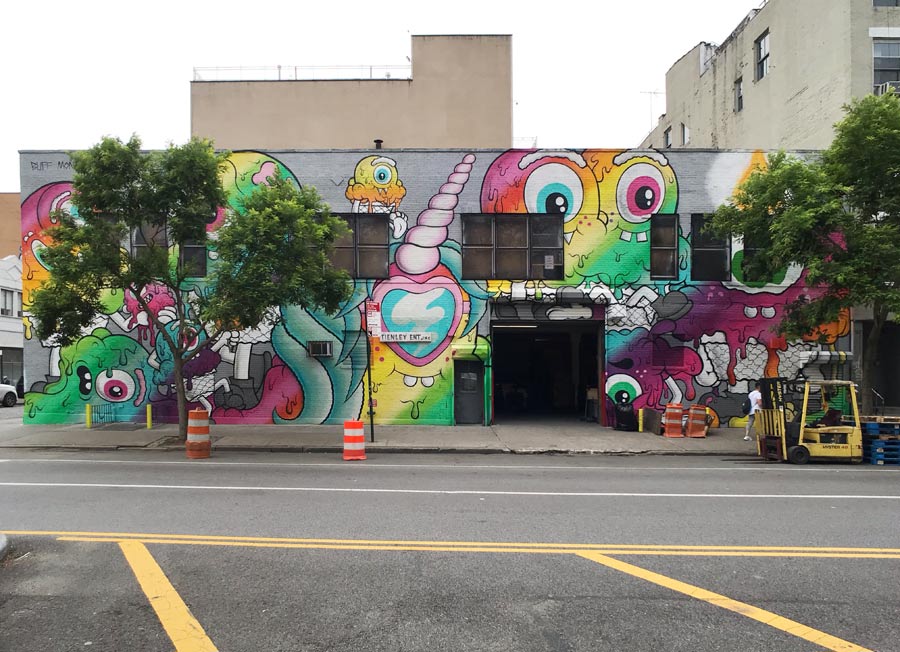
Just in time New York’s Pride Month events, Street Artist Buff Monster unveils a wash of color and melty characters in lower Manhattan to commemorate the 50 anniversary of the Stonewall Riots in Greenwich Village.
Over the next month a number of artists will be painting murals across the city as part of World Pride and we hope that in some way this campaign will reach those across the world who still long to be free but who are restricted by laws, even threatened, persecuted, and killed for being gay, lesbian, bisexual, trans, or otherwise queer.
We talked to Buff to see what he was thinking when he was painting this mural over 6 days.
“It’s
nice to see that NYC is getting involved in what looks to be the biggest pride
celebration ever, but there still so many places around the US that are super
conservative and unwilling to be inclusive after all these years,” he tells us.
“It’s a shame that equality for all is still an issue in 2019, when we have so
many other serious issues in the world that need to be addressed. It seems like
there are news articles every day about this administrations’ efforts to
undermine the progress we’ve made; so there is no better time to paint this
mural.”
BSA: What are the thematic elements that correspond to Pride and the rights of LGBTQ people?
Buff Monster: The characters have a bunch of mixed emotions, which mirrors the long journey for equality of the LGBTQ community. Putting together a diverse set of my cartoony ice cream characters, filled with the iconic rainbow, seemed like a good way to bring a bit of levity to a very serious issue.
All
in all though, I think the colors and the characters create a positive and
optimistic image, in line with this year’s Pride celebration and the future of
equality. I’m really happy with how it turned out and I think it’s a really
nice addition to the neighborhood.
 BROOKLYN STREET ART LOVES YOU MORE EVERY DAY