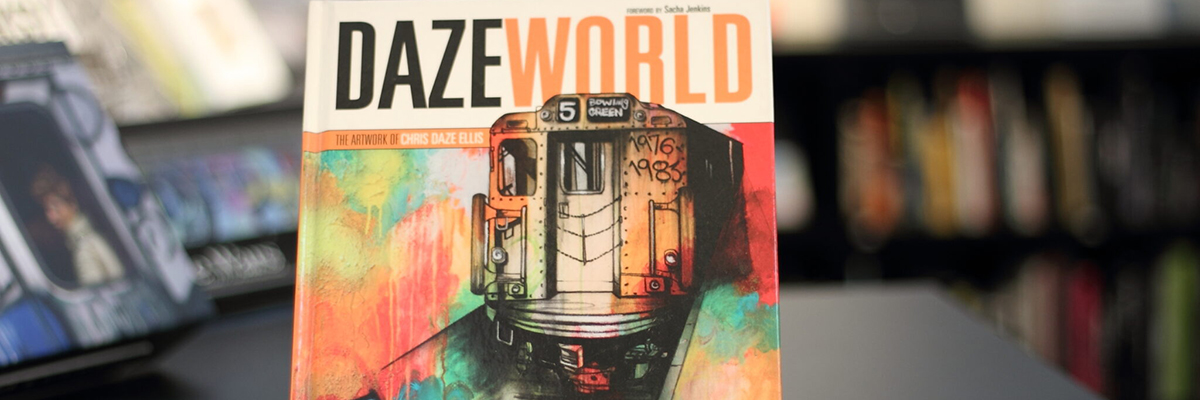
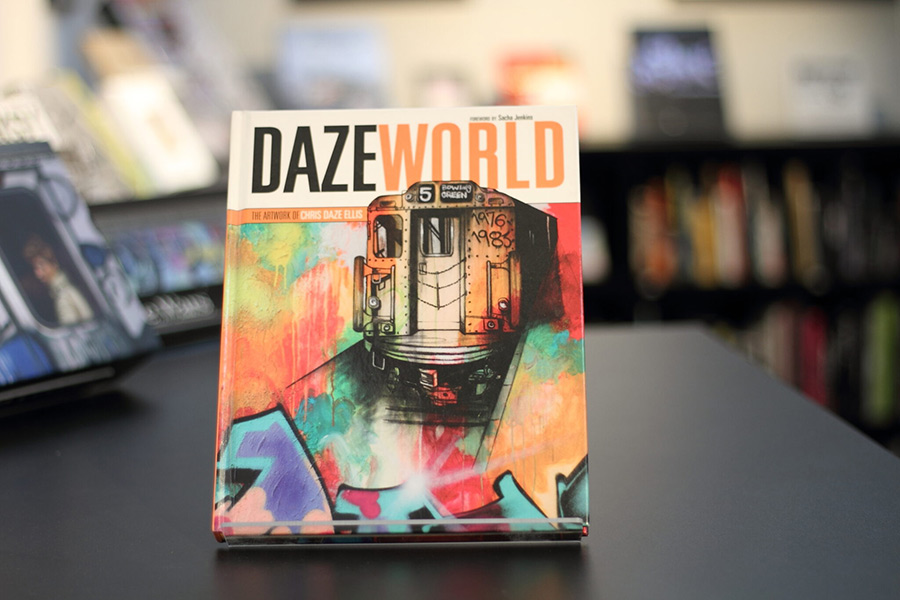
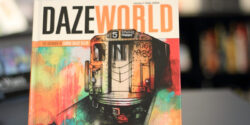
Dazeworld. The Artwork of Chris “Daze” Ellis. Chris “Daze” Ellis. 2016
Reprinted from the original review.
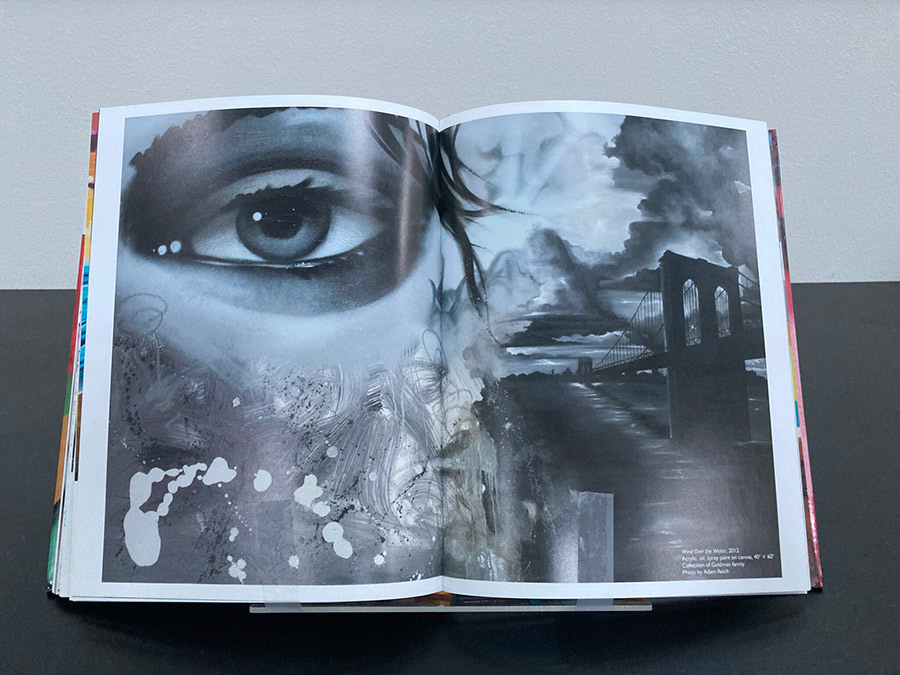
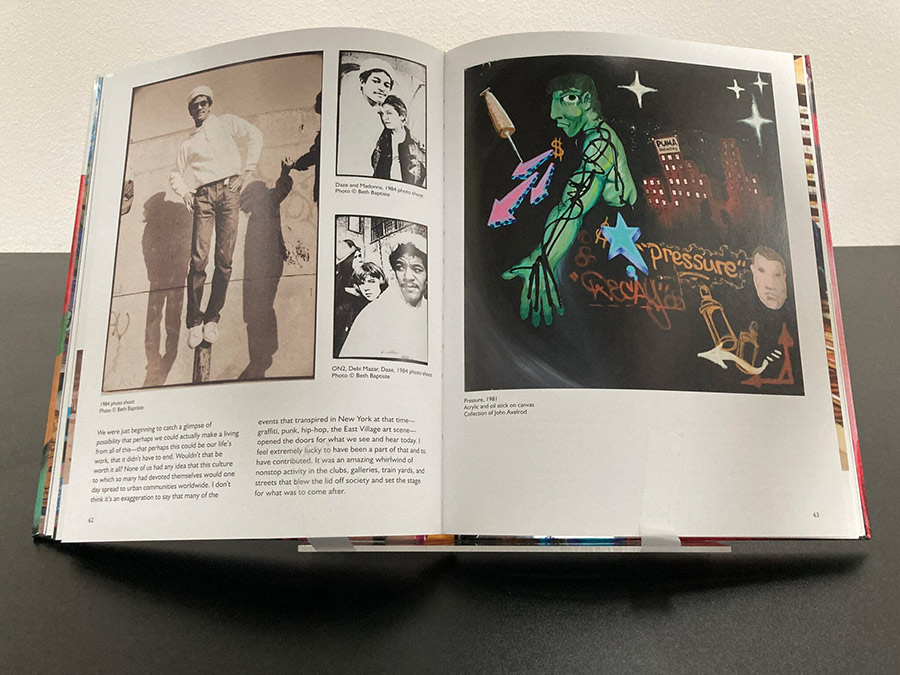
Daze’s world has always been kinetic—its energy drawn from the tracks, tunnels, and streets that once defined New York City’s pulse. Dazeworld: The Artwork of Chris “Daze” Ellis captures that charge across four decades of work, documenting his evolution from teenage train writer to established painter and mentor. Published by Schiffer, the 168-page monograph gathers over 250 photographs—many previously unseen—that chart an artist moving between public space and private reflection.
In these pages, Daze’s early graffiti runs again across the MTA’s rolling stock, documented by Martha Cooper and others who witnessed the golden age firsthand. Those images, raw and archival, sit beside luminous canvases and murals that reveal a mature painter unafraid of introspection. As Daze writes in his introduction, this is not an autobiography in the literal sense but a guided journey through formative moments – “the seminal points that shaped my art and allowed me to continue to evolve as an artist.”
Text Steven P. Harrington & Jaime Rojo Fotos Eveline Wilson
Title: Dazeworld. The Artwork of Chris “Daze” Ellis. Published: Schiffer Publishing LTD, 2016 Author: Chris “DAZE” Ellis Language: English
Djerbahood: Open Air Museum of Street Art. Mehdi Ben Cheikh. 2015
Reprinted from the original review.
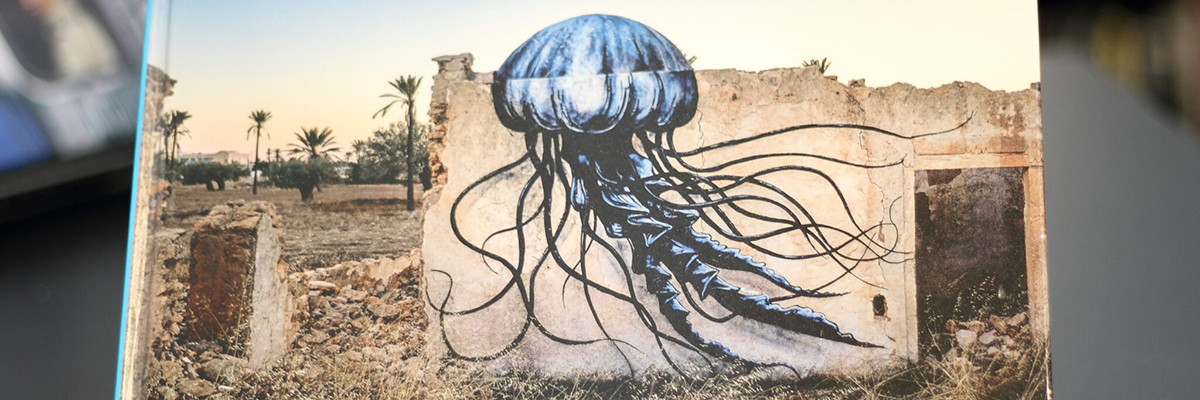
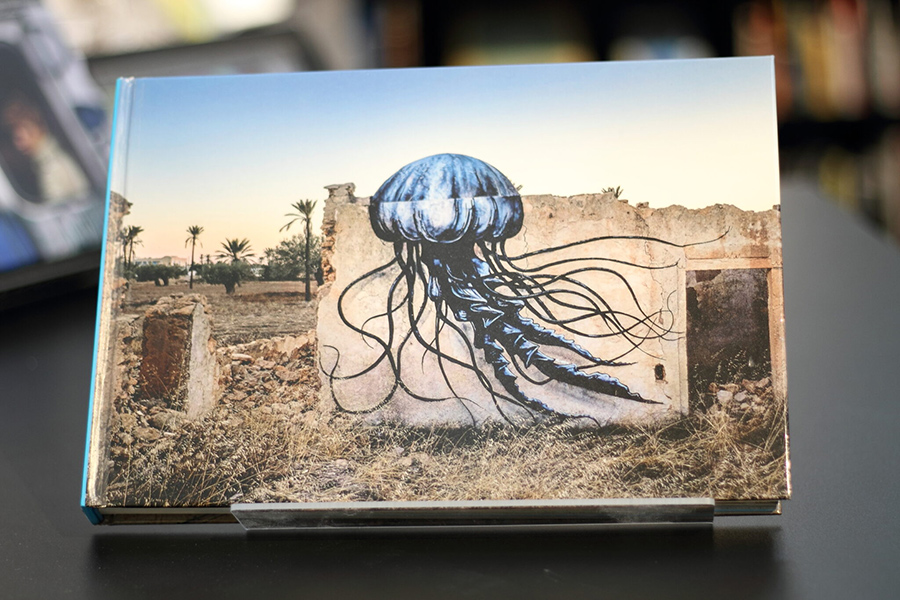
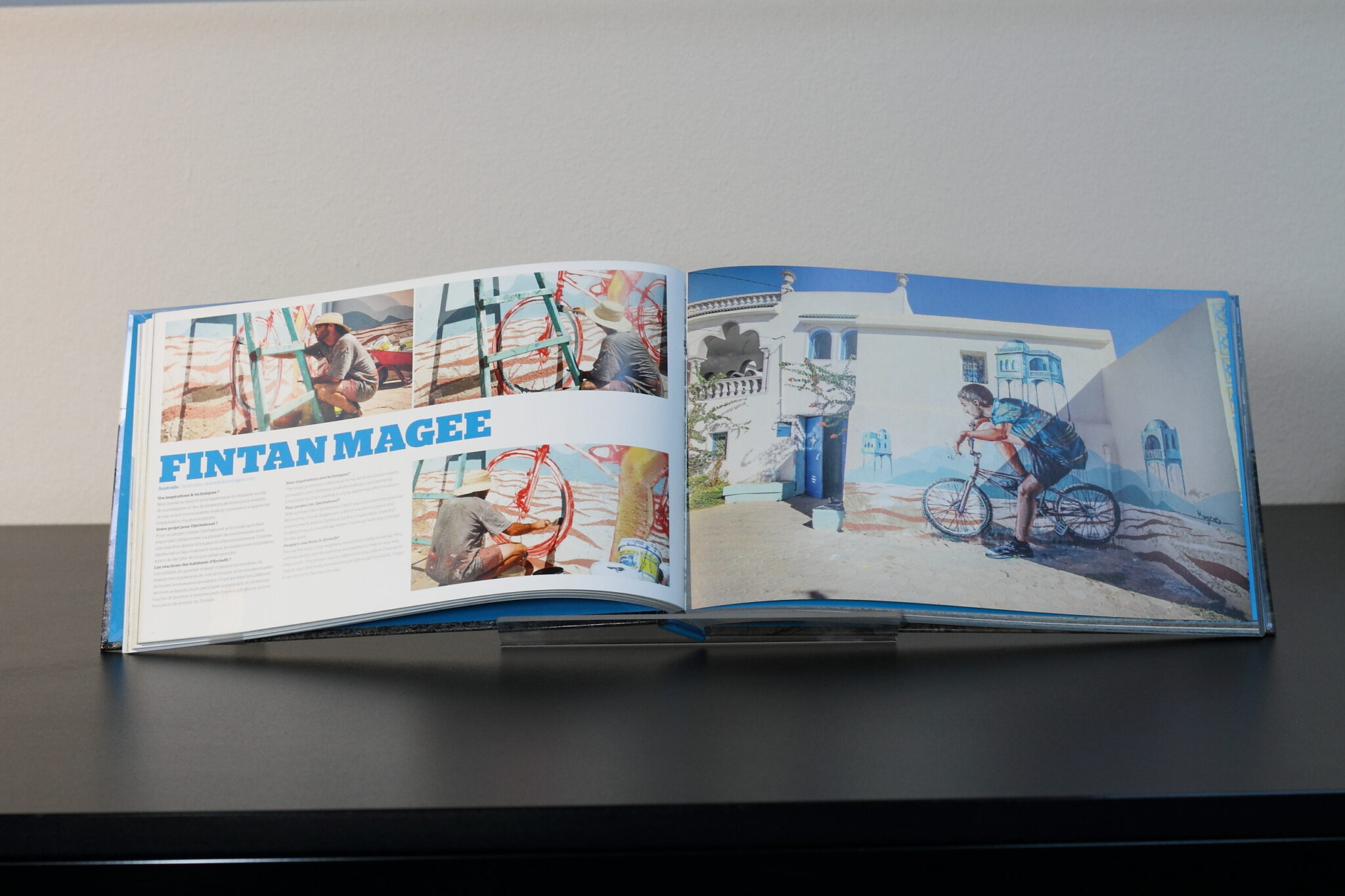
If Tour Paris 13 was the demolition swan song of an era, Djerbahood may feel like an expansive sunrise on the other side of the world. Conceived by gallerist and curator Mehdi Ben Cheikh and realized in the whitewashed village of Erriadh on the island of Djerba, Tunisia, this project gathered more than one hundred artists from thirty countries to create what Ben Cheikh calls a “museum à ciel ouvert”—an open-air museum under the North African sun. The resulting book, published by Albin Michel, offers a monumental visual record of this transformation: 500 photographs across 272 pages, documenting walls, artists, and villagers in a rare moment of collective creation.
In these images, the desert light hits walls like paper. Works by eL Seed, ROA, Pantonio, Phlegm, Jaz, Fintan Magee, Curiot, Inti, and Sebas Velasco coexist with local architecture—white domes, low arches, latticed shadows—turning the town into a living gallery. As Brooklyn Street Art observed in its review, Djerbahood “absorbs your mind and imagination, giving you a sense of the place and the people who live there.” It’s true: the book’s pacing—half atlas, half photo-essay—lets readers wander through alleys as if following the scent of plaster and sea air.
Text Steven P. Harrington & Jaime Rojo Fotos Eveline Wilson
Title: Djerbahood: Open Air Museum of Street Art Published: Published by Albin Michael / Galerie Itinerrance, Paris, 2015 Author: Mehdi Ben Cheikh Language: English
WAONE: Worlds of Phantasmagoria, Vol. 1. Vladimir Manzhos. 2020
Reprinted from the original review.
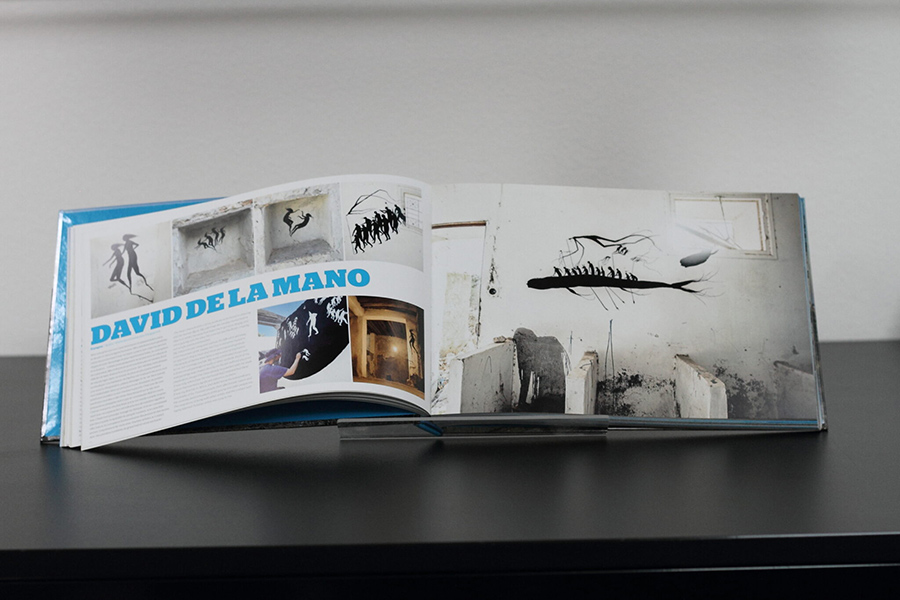
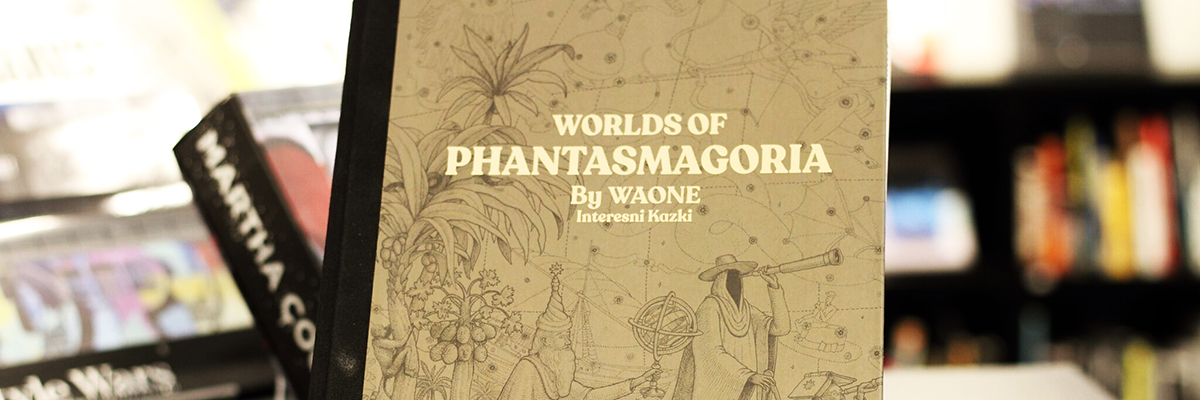
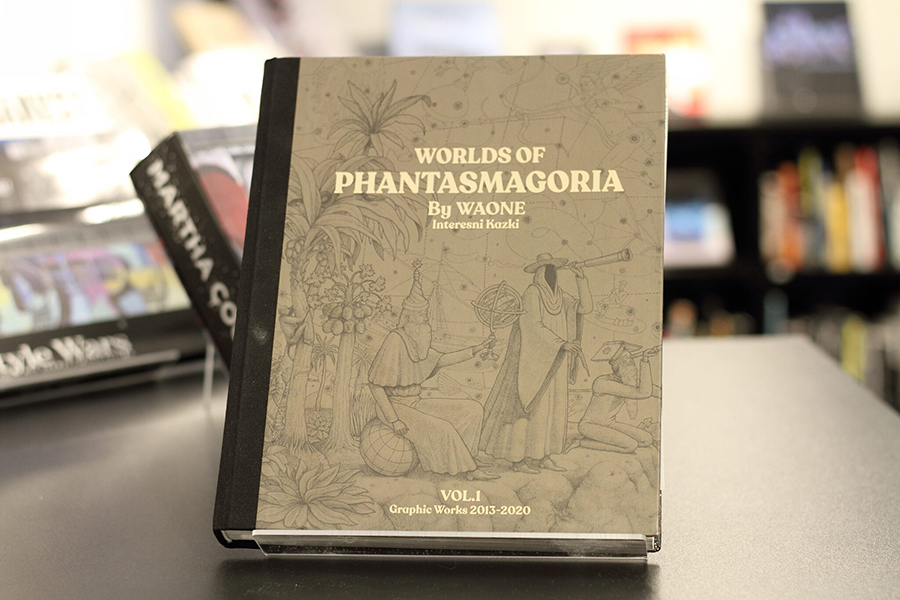
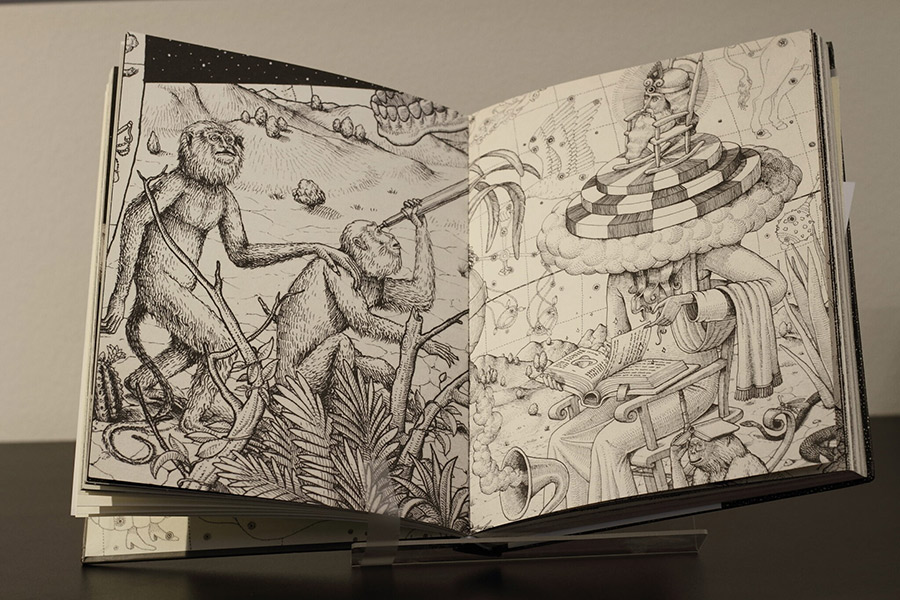
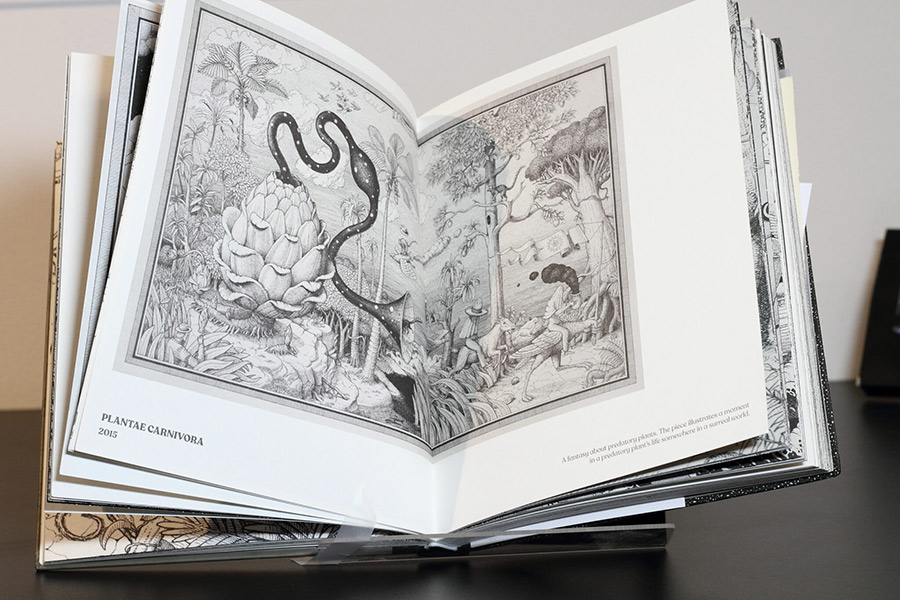
Worlds of Phantasmagoria, Vol. 1 is a comprehensive exploration of the monochromatic works of Ukrainian artist Vladimir Manzhos, known as WAONE. Spanning the years 2013 to 2020, this 208-page hardcover book provides a chronological view of his artistic evolution. It highlights his transition from large-scale, colorful murals in public spaces to intricate black-and-white compositions created in the studio.
The book features a range of works, including murals, ink drawings, etchings, and lithographs, each accompanied by detailed narratives from the artist. These descriptions provide insight into WAONE’s creative process and the philosophical themes that underpin his work. Drawing inspiration from mythology, folklore, science, and personal introspection, his pieces weave together surreal imagery with symbolic depth.
With the aesthetics of a musty and mythical library, the illustrations open the preconceptions of psychology, offering myriad views through recombining familiar elements into unusual associations. In the process, you travel with Waone as he dedicates himself to this uncolorful view, which is nonetheless rich, if not tinged with a bit of antiseptic horror.
Text Steven P. Harrington & Jaime Rojo Fotos Eveline Wilson
Title: WAONE: Worlds of Phantasmagoria, Vol. 1 Published: WAWE 2020 Author: Vladimir Manzhos (WAONE) Language: English
Bill Posters. The Street Art Manual. September, 2020.
Reprinted from the original review.
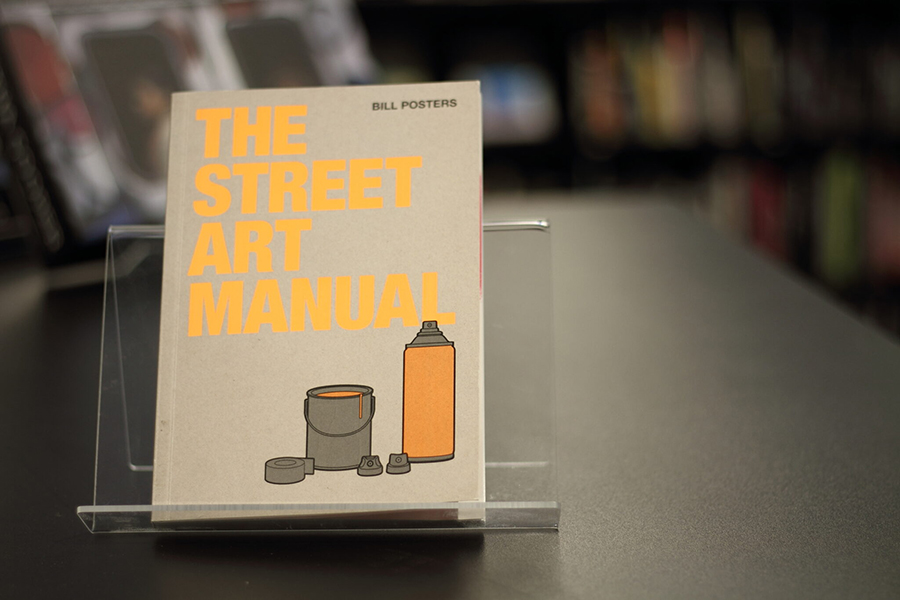
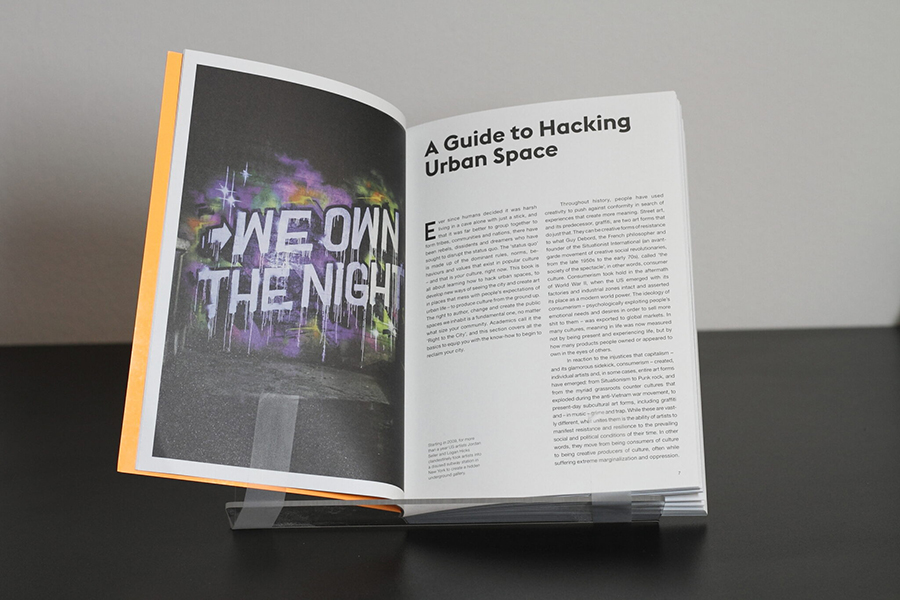
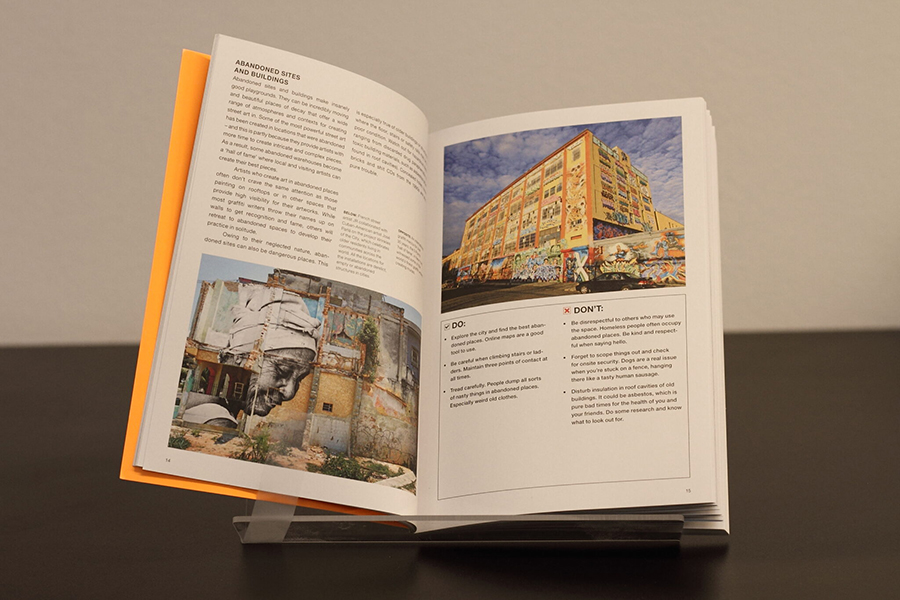
A field guide to resistance and reinvention, The Street Art Manual by artist and agitator Bill Posters is equal parts DIY toolkit, art history primer, and subversive etiquette handbook. Structured with the confidence of a seasoned practitioner and the welcoming, humorous tone of a supportive older sibling, the book offers practical instruction and philosophical grounding for anyone intent on engaging with public space creatively—and responsibly.
Posters, co-founder of the Brandalism project and known for controversial deep-fake online campaigns like Spectre, brings a broad knowledge of global activist art movements to the table. From Beuys’ notion of “social sculpture” to John Fekner’s typographic landmines and the ACT UP visuals of the AIDS crisis, the opening chapters trace a lineage of public dissent that informs his own practice. These references aren’t dusty citations but sharp reminders that creativity in the streets has always been more than aesthetics—sometimes it feels like survival, strategy, and classic satire.
Text Steven P. Harrington & Jaime Rojo Fotos Eveline Wilson
Title: The Street Art Manual Published: Laurence King Publishing. September 08, 2020 Author: Bill Posters Language: English
LOVE LETTERS TO THE CITY at Urban Nation Museum, Berlin
A newly released Interview snippet with curator Michelle Houston and Steven P. Harrington from the opening of the exhibit toys with the question of where art belongs and who gets to decide.
Has this been settled to your satisfaction?
Video credits: Commissioned by Stiftung Berliner Leben. Shot by Alexander Lichtner & Ilja Braun. Post-production, additional footage, graphics, and a final version by Michelle Nimpsch for YAP Studio/YES, AND… productions GmbH & Co. KG
“Love Letters To The City” is currently on view at Urban Nation Museum Berlin. Click HERE for more details about the exhibition, schedules, directions, events, and programs.
Named in honor of photographer Martha Cooper—whose lifelong commitment to documenting everyday life, cultural expression, and human dignity has shaped how communities around the world are seen and understood—the Martha Cooper Scholarship (MCS) supports long-form documentary photography that reflects shared human experience and social responsibility. For the 2027 cycle, the Foundation Berliner Leben will award its third Martha Cooper Scholarship, continuing a multi-year commitment to sustained, thoughtful photographic practice.
The scholarship offers a photographer from Africa, Asia, or Latin America the opportunity to spend 10 months developing an artistic documentary project that engages with contemporary social realities and contributes to greater cross-cultural understanding. In line with values often emphasized by Urban Nation Museum, the program recognizes documentary photography as a vital tool for visibility, dialogue, and empathy in an increasingly complex world.
The Martha Cooper Scholarship is grounded in the annual theme of Fresh A.I.R., Stiftung Berliner Leben’s residency program, which addresses current social and political conditions while foregrounding the diversity of lived experience and perspective. The selected 2027 scholar will live and work in a Fresh A.I.R. residency in Berlin-Schöneberg throughout the scholarship period. The current call is for the 12th class of Fresh A.I.R, running from February 2027 to November 2027.
Click HERE to learn more about the Martha Cooper Scholarship and who qualifies to apply.
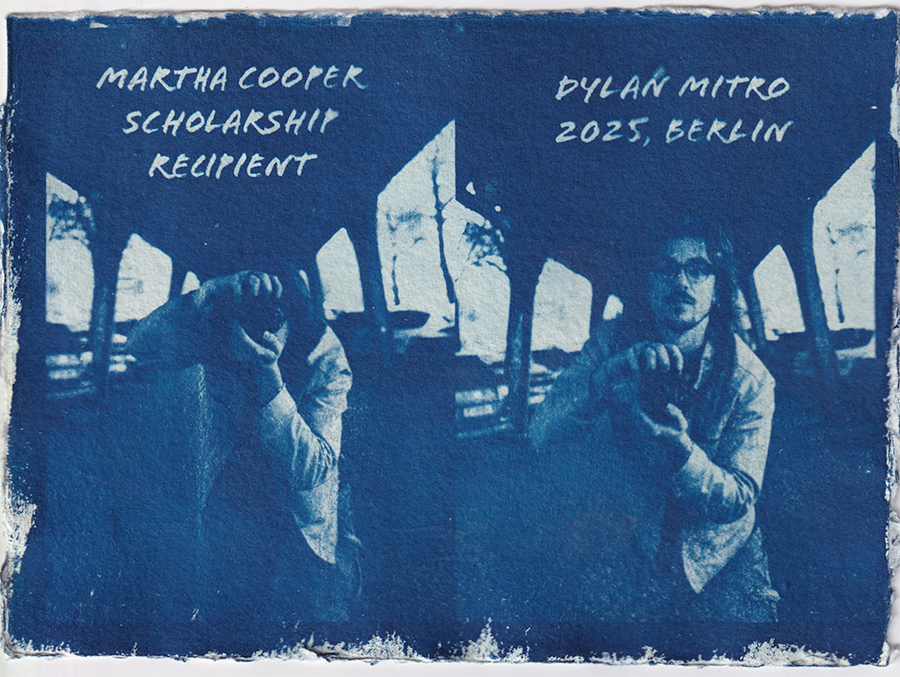
The first Martha Cooper Scholarship was awarded to photographer Dylan Mitro for the 2025 MCS. Mr. Mitro was chosen from dozens of submissions. Dylan successfully completed his scholarship in November of 2025 with an exhibition of his proposal and work in Berlin. Click HERE and HERE to read about Dylan’s work during his time as the MCS Scholar in Berlin.
The second Martha Cooper Scholarship was awarded to photographer Mourad Fedouache of Morocco for the 2026 MCS. Mr. Fedouache will arrive in Berlin on February 1st to begin his 10-month residency as the second MCS Scholar, which will conclude in November of this year.
Berlin has always been a city that remembers through reinvention—a fitting place for the first recipient of a photography scholarship named in honor of a pioneering ethnographer whose seventy-year career preserved worlds in flux. The recipient of the first Martha Cooper Scholarship for Photography, the Canadian photographer and researcher Dylan Mitro, has spent recent months in the city exploring its queer memory through Inherited Thread, a project that draws together archival study, re-photography, and contemporary documentation. Their work, soon to be exhibited in Berlin, revisits Schöneberg’s queer nightlife ecology from the 1980s onward, asking how we inherit histories that were often hidden, erased, or displaced—and how we might keep them alive through art and documentation.
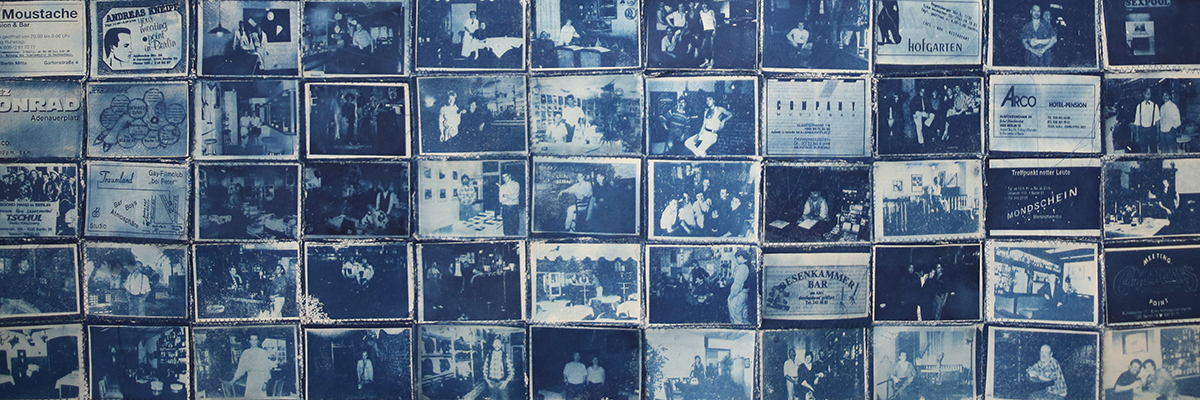
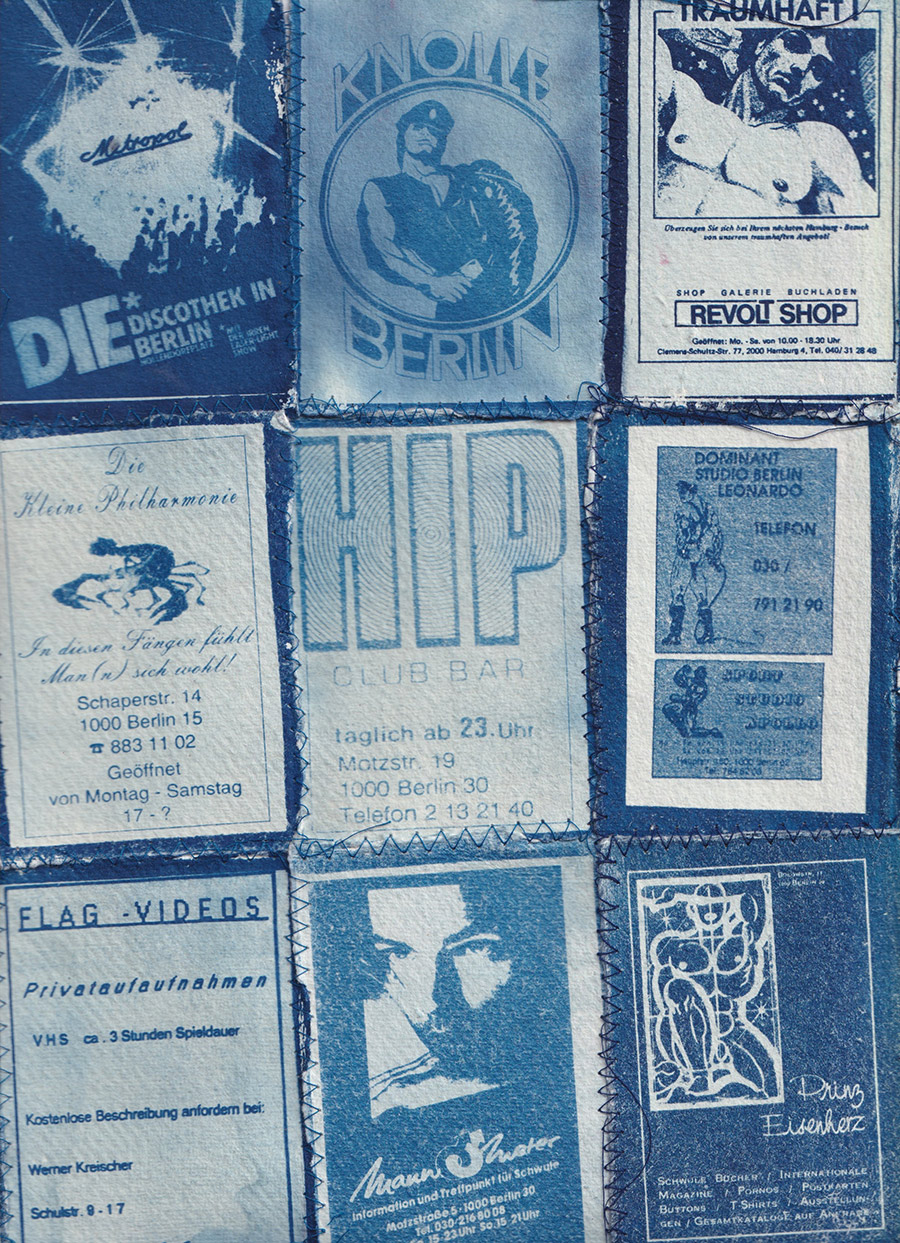
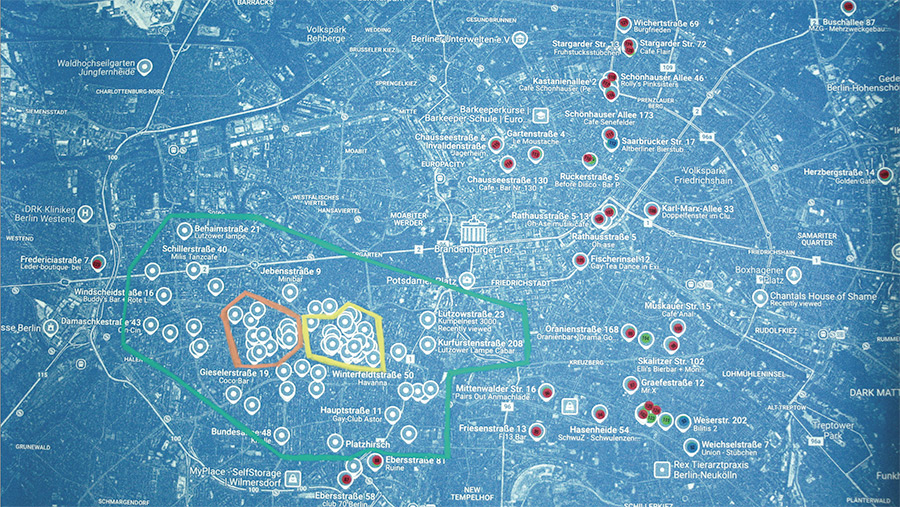
Inherited Thread takes as its starting point Berlin von Hinten, a gay tourism atlas first published in 1981 that catalogued Berlin’s bars, bookstores, and venues at a time when queer life existed largely in coded networks. From this modest guidebook, Dylan reconstructs a cultural topography: visiting surviving sites, mapping closed ones, and photographing their present forms. Their fieldwork extends into the archives of the Schwules Museum and Spinnboden, where they piece together ephemera—ads, zines, snapshots, and personal notes—that once charted a thriving but precarious social world. Each recovered address becomes a point of dialogue between past and present, what was lived, and what remains.
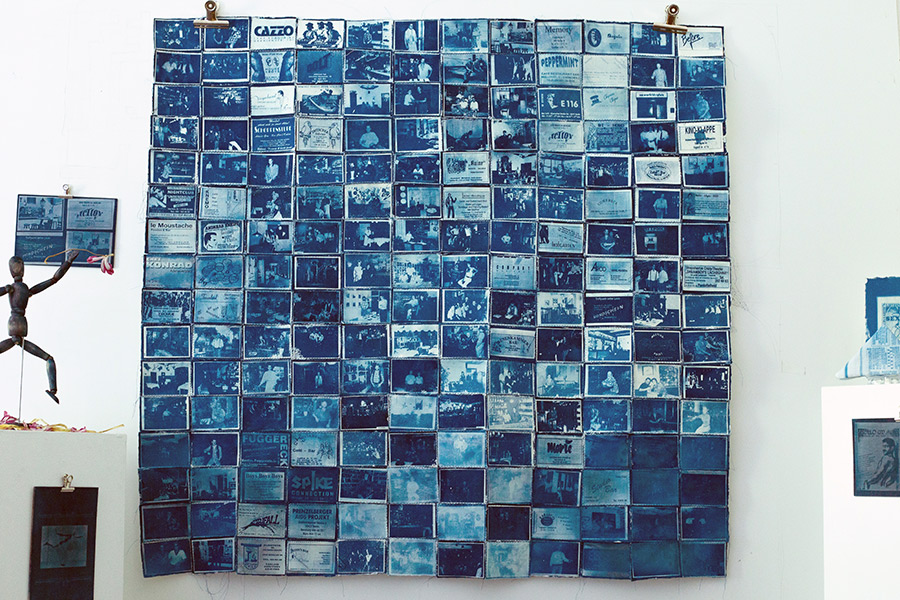
Materially, the project echoes themes of loss and persistence. Cyanotype quilts made from archival interiors fade from clarity to a certain ghostliness; resin-encased photos hold light like memory suspended, and weatherproof plaques marking the sites of vanished community. These gestures of preservation aren’t presented as nostalgia; they propose to keep history embodied and visible. Mitros’s own approach to documentation asserts that the everyday places where people gathered, danced, and organized are as vital to collective memory as any monument.
As Dylan prepares for their Berlin exhibition in November, Inherited Thread unfolds as a living, site-specific memory atlas of queer life—stitched from archival guides, re-photographed spaces, and the testimony of those who remember. It reflects a city still negotiating its relationship to memory, visibility, and belonging. And like the scholarship’s namesake, whose life’s work has championed careful observation, human imagination, and dignity, Dylan’s practice reminds us that documentation, when done with empathy and rigor, is itself an act of care.
“Inherited Thread attempts to better understand our Queer histories through archival ephemera. Dylan has conducted research in the LGBTQIA+ archives of the Schwules Museum. Focussed on the historic publication Berlin Von Hinten, a Gay tourism atlas first published in 1981, showcasing nightlife and community spaces that defined Berlin in the 1980s and 1990s. Revisiting and mapping forgotten landscapes through printmaking and photography, this project seeks to explore the inheritance of historical LGBTQIA+ spaces, and how to keep their stories alive.”
Following is our interview with the artist, researcher, and photographer.
I. Artistic Practice and Methodology
Brooklyn Street Art:For the exhibition for the Fresh A.I.R. you are using cyanotype printing on cotton-rag paper and making a quilt with some of them, positioning photography within a tactile, craft-based framework. Could you elaborate on how this interplay of image and textile informs the conceptual and affective dimensions of the project?
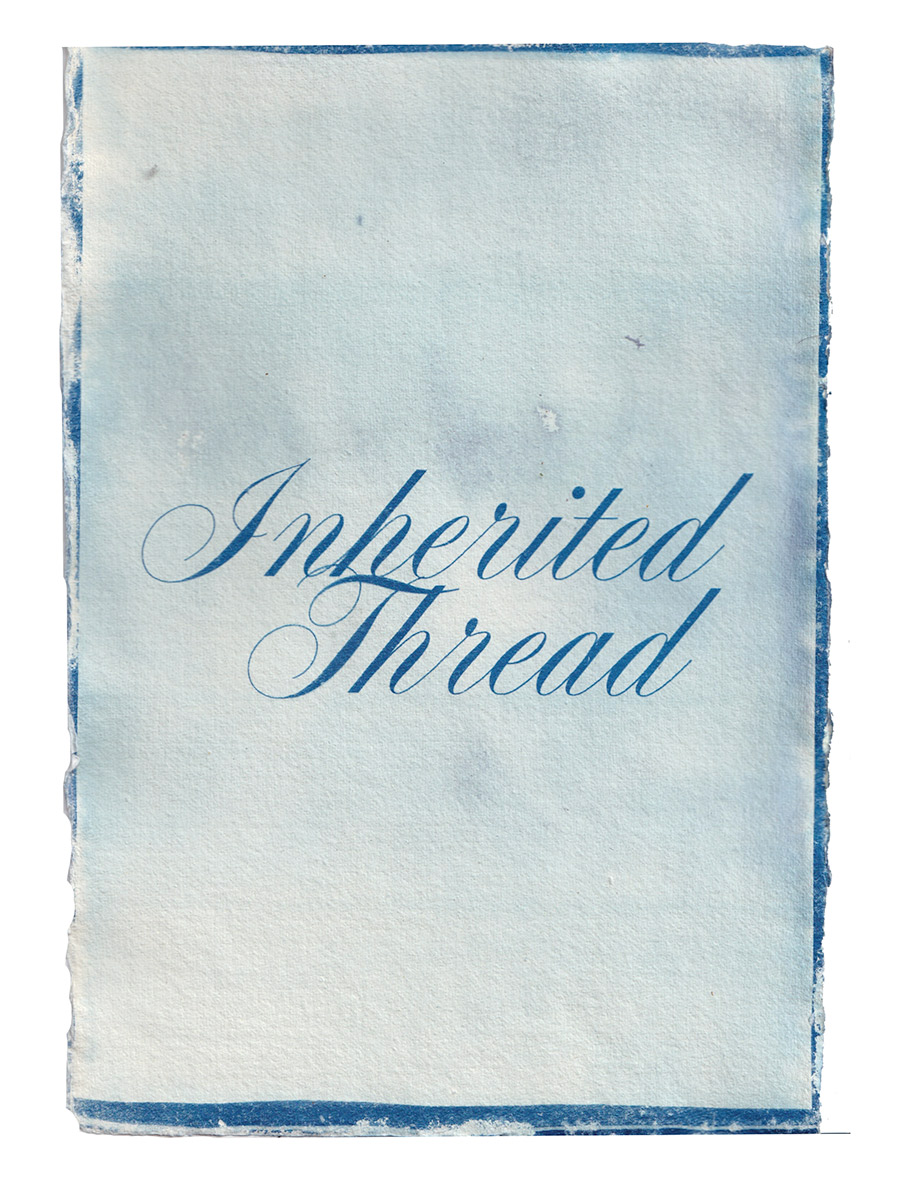
Dylan Mitro: My concept for this work involved printing cyanotypes on cotton rag paper and quilting them together, sourcing the material from a 1980’s and 1990’s Gay Tourist Publication titled ‘Berlin Von Hinten’ by Bruno Gmünder. This journey of research has been such a vast exploration of Berlin’s history, I felt I was having to sew together the LGBTQIA+ history that I was learning, as an attempt to retell stories of the community here in Berlin. Through the cyanotype sun printing process, the images were printed one print at a time, so it was unpredictable how they would turn out. Once I had 100s of these prints finished, it was clear that some turned out more visible than others with ghost-like qualities. This process felt very metaphorical to our LGBTQIA+ history and how a lot of these people, places and stories had been lost to time.
I decided to compose the cyanotypes like a quilt with both the photographs, advertisements and maps of Berlin’s; Gay, Lesbian Bars, Cafes, Discos, Travesti clubs, and sex shops. It felt like I was sewing back together a mere echo of these places and their stories from Berlin in the 1980s and 1990s. These two decades of the 1980s and 1990s are so poignant in the community, connected to the AIDS epidemic. As a Queer artist I try to navigate and understand further how to measure the loss the community faced in this time. With my body of work titled ‘Inherited Thread’ to both refer physically to the ways I have quilted together the cyanotype prints, but also to refer to the process this research has taken me on, in threading together the question of how, we as the next generation of the LGBTQIA+ community inherit the stories and spaces of those that came before us.
BSA: You will be drawing extensively on archival materials from Berlin Von Hinten (1981–1997). How do you approach the ethical and aesthetic considerations of working with such archives—particularly when recontextualizing them within a contemporary queer landscape?
DM: I think when dealing with any LGBTQIA+ historical material, you have to understand how personal perspective affects your lens, as the landscape within the community has changed. There was much to consider when dealing with a body of work like the ‘Berlin Von Hinten’. First, this book was mainly made for ‘Gay’ male tourists, looking to explore the homosexual life of Berlin, but was not limited to just that perspective. It shared both Trans and Lesbian spaces in its publication as well. But when dealing with the ethics of the ‘Berlin Von Hinten’ publication itself, it is necessary to acknowledge that it was made from and for a masculine, predominantly white gay male clientele.
So I had to acknowledge that, though this was a rich part of Berlin’s LGBTQIA+ history, it was certainly a limited perspective and not the full picture of the scene. Looking at any ‘Gay’ history, you have to acknowledge how prejudice and exclusionary rhetoric within the scene was certainly present and still exists in the present. I was approaching these books as a Gender Queer artist who is also a tourist trying to discover Berlin but from a contemporary lens. Approaching the research and acknowledging the influence this publication had within the Gay community is important. This work has not been intended to criticize the publication but to celebrate the way it was able to so intimately time capsule part of the 1980s and 1990s Gay scene here in Berlin through its writing, mapping and photography.
A majority of the aesthetics I was interested in were the advertisements in the publication. A lot of the focus is catered to the homoerotic, macho, masculinity. This aesthetic is not what I personally prescribe to. Still, I find the use of this homoerotic aesthetic to market sexually charged spaces for Gay tourism at a time within the peak of the AIDS epidemic very interesting. So all of this was considered as I worked through these published books.
BSA: You will be creating/presenting many of these historical photos and places re-photographed. What is the protocol for doing this?
DM: I could not have started any of this research without the support and access to the wonderful Schwules Museum Library and archive. I owe a lot of this research to their continued support. My protocol to present these historical photos was to take high-quality scans of these pages within the Berlin Von Hinten. These pages included photos of rare glimpses into the interiors of LGBTQ+ spaces in Berlin in the 1980s and 1990s. I recorded all of the accreditation of photographers that were published within the book and reprinted them within my research. As I was researching, I wasn’t only collecting photographs of these establishments but also their advertised addresses.
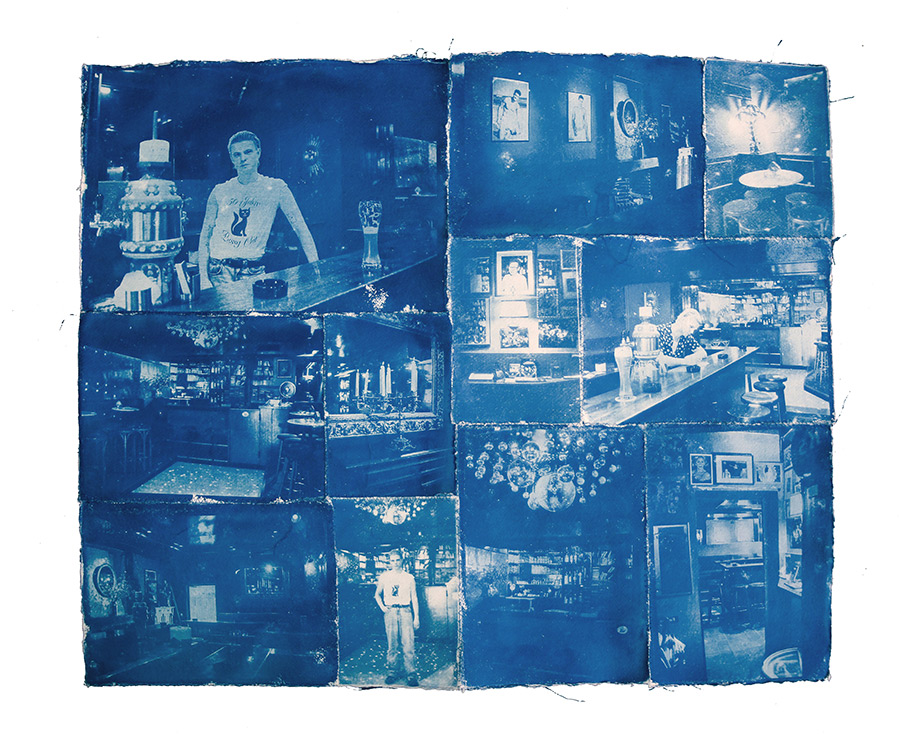
After the scans were finished, I created my own photo negatives on transparent acetate paper of the historical images. These photo negatives were made to print cyanotype copies of the images. After I digitally documented the addresses of these spaces into a Google Maps folder to create a digital map of where these places existed. From there, I was able to understand which of these places were still open and operating as the same business 40 years later. From the 200 businesses I documented, only 12 were still open; operating under the same name. So as a part of the project I visited some of those establishments and worked to photograph them the way they were in the original book 40 years later.
BSA:When you revisit surviving venues to echo the 1980s interior shots, how do you determine vantage point, focal length, framing, and lighting to balance fidelity to the historical images with your own authorial choices? What does re-photographing do in reference to history?
DM: I approached the photographs more organically, trying to document these spaces in a way that would allow for the environment’s ambience to speak for itself and for it to be understood within the photographs. I wanted to think if these photos were to be viewed in 40 years from now, how could these be a documentation of the spaces themselves, like the photos from the Berlin Von Hinten. I made sure to photograph the rooms without any customers in them, as the photos were more about the environment. I am attempting to continue the documentation and archive these current spaces as they are now, before they are lost to time. So it does feel like I am continuing the narrative of archiving to prevent the story of these places from being lost.
BSA: Provenance, description, and preservation must be a challenging process: What is your workflow for recording provenance and metadata (dates, addresses, names/roles, consent, cross-references to Berlin von Hinten) and for long-term preservation (file naming, etc)?
DM: My attempt at cataloging my findings and recording the metadata of researching was for a more artistic storytelling approach. To organize each of the places I had researched with its photograph, advertisements, and descriptions on each page. Recording when these places were established and which ones still exist. There are pages I have dedicated to crediting the authorship of these previous Berlin Von Hinten publications.
In the conversation around long-term preservation, I would consider my approach to be more artistic than technical. I still have to remind myself that this work is from the lens of an artistic practice over the short course of 10 months, and with that I feel it is still a work in progress with the intention of creating dialogue involving an open-ended question: how do we approach the idea of Inheritance of history within our LGBTQIA+ communities? – the answer is one that we each have to seek out and learn for ourselves. I have been working in LGBTQIA+ archives for years now, and it’s overwhelming how much material there is within the archives to be rediscovered. I hope others are inspired to dive into it.
II. Community, Space, and Memory
BSA:Central to the project are spaces such as Pussy Cat Bar and Eisenherz Book store, both historically significant to Berlin’s queer community. Can you talk about navigating the process of documenting these living spaces in a manner that both honors their historical legacies and engages with their present realities?
DM: The spaces I have photographed and interviewed were documented with very different approaches based on their history and contemporary positioning. Pussy Cat has been around since 1974, founded by two lesbians, and has always had its doors open to all, being very inclusive. When I photographed their space, I wanted to capture the ambience. The bar’s essence owes much to Daniela, Pussycat’s owner from 1998 until her death in November 2020; she’d worked there since 1982. Her former sidekick “Donna” (an employee since ’85) now runs the show, preserving Daniela’s legacy. I included portraits of the owner Donna and Jan, a young bartender who has been working there for just a few years. I spoke to Donna about the history of the bar, hearing stories about its legacy. While with Jan, I spoke about what it means for the next generation to be coming to a spot like Pussy Cat. I asked about the current climate, of the importance of a bar like Pussy Cat, and how it fosters intergenerational connections.
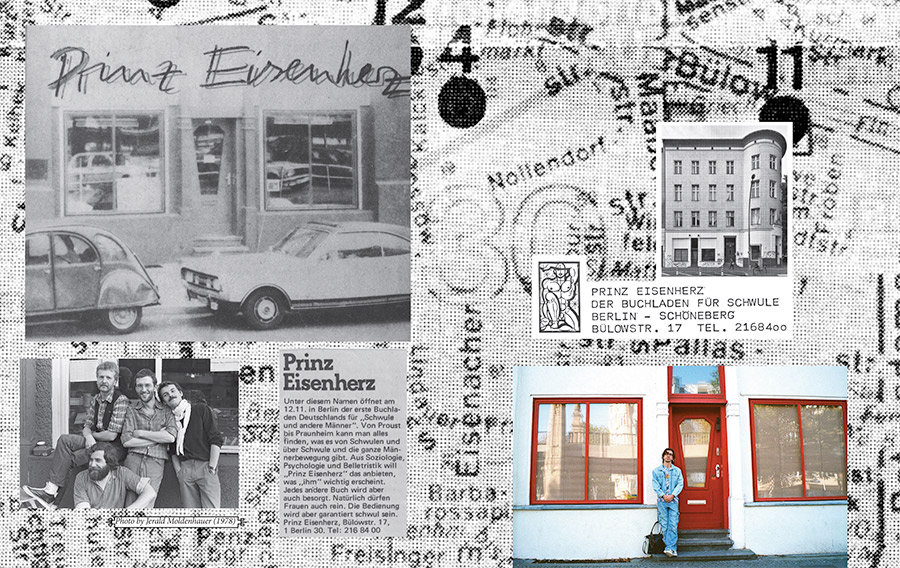
For Eisenherz Bookstore, it had a huge significance to Queer history here in Berlin. It is the longest-standing LGBTQIA+ bookstore in all of Europe. It opened in 1978, as a Gay bookstore called Prinz Eisenherz located at Bülowstraße 1, just down the street from my studio here at Fresh A.I.R. and across the street from where this project will be exhibited. Eisenherz is where the story of my research starts, as the founders of Berlin Von Hinten – Bruno Gmünder and Christian Von Maltzahn were two of the five founders of the Prinz Eisenherz bookstore.
When I photographed and interviewed the current owners of the Eisenherz, Roland Müller-Flashar and Franz Brandmeier, they talked about their involvement in the business since the 1980s. We spoke about how they changed the name and made the bookstore more inclusive over the years. They still to this day host book readings and gallery openings. As a business, I talked to them about their legacy and how vital their store is to the community. They shared with me photographs of the official opening in 1978 to contribute to the publication of the work. I photographed portraits of the owners and their colleagues to create a current time capsule of their store and the ones who keep it running. In a climate of LGBTQIA+ book bannings, it’s a significant social fabric for the community to access history and current local and international voices.
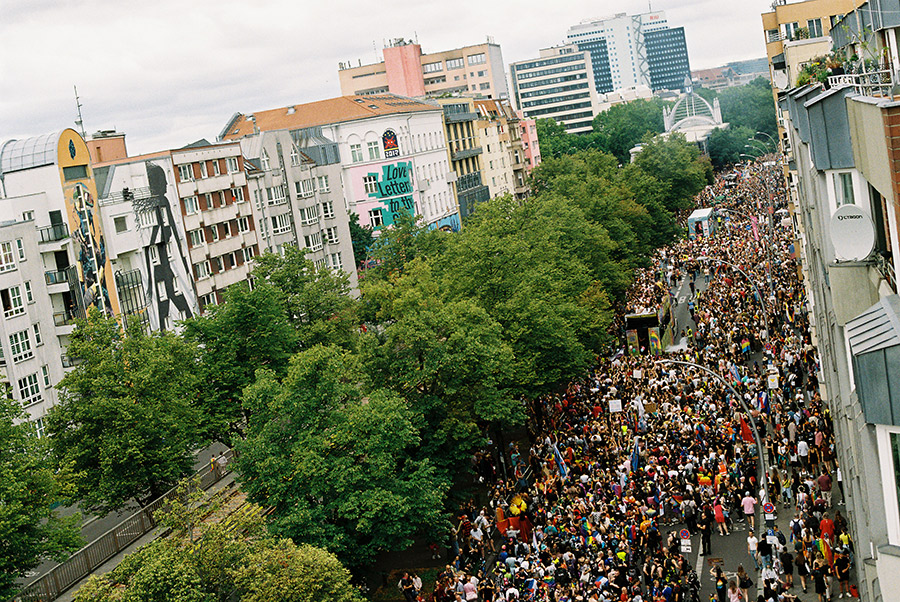
BSA:When you engage with events such as the Community Dyke March and Christopher Street Day, your work intersects with both activist and celebratory dimensions of queer visibility. How did your immersive engagement with these communities inform your visual and conceptual strategy or the outcome?
DM: I intend to document Queer history as a celebration. However, I cannot ignore that Pride is also a protest. I felt compelled to capture the ongoing struggles the community still faces and the freedoms we must continue to fight for. While in residence, there was Berlin Pride in July, and within 24 hours, there were three marches that I wanted to document. There was the Community Dyke March, the Christopher Street Day March, and the International Queer Pride for Liberation March. I think it is powerful to show those who show up in the streets, and to document their power.
Activism and celebration are not binary, and to celebrate the strength of their ability to show up in the streets and fight for rights and freedoms is important. I think it is essential to acknowledge how easy it is for us to forget the sacrifices that have given us our freedoms today. We are here today with the rights and freedoms we have because of the elders who came before us, and the activism in the streets they did. There is still so far to go, and I think it’s important to document and archive the ongoing fight for future generations to witness the brave trailblazers of today.
BSA:You’re pairing your visual works with interviews and a book, integrating oral histories with photographic documentation. What are the narratives and/or perspectives you’re most focused on to share with the public?
DM: I will have a book that will document the whole journey of my research and where it leads. This includes how many of these LGBTQIA+ spaces are on the verge of disappearing as the community shifts. I look to ask the community what it means to inherit these histories. How is the torch passed on and how can we find more intergenerational connections, threading a link to the past and finding more of a moral responsibility to them instead of just approaching them from the position as a consumer.
BSA:The inclusion of archival artifacts—such as pieces of the original mural wall outside Connection club and printed publications like Berlin Von Hinten—places in the foreground a dialogue between image, object, and place. How do these material elements shape the way people can react to your work?
DM: For the project to include archival artifacts like the Berlin Von Hinten publication and pieces of the exterior mural from Connection Club, I want to bring attention to the value and importance of these objects visually. For the Connection Club mural, it was unexpectedly demolished as I was in my residency, and I actively became a part of the project unexpectedly. The mural on the exterior of Connection Club was a large display of Gogo dancers and Drag Queens painted in 1997. The entire mural was coming down without any means of preserving it. I believe this was probably the Largest and oldest gay mural in the Schonenberg neighbourhood, and there was no relative concern about attempting to preserve it. So I decided to photograph and document the demolition and went into the dumpster of rubble to collect some of the broken pieces of the mural to exhibit as a part of the exhibition. It was an unexpected moment in the project that encapsulated the work into a physical object. We aren’t just losing the spaces for the community; we are also losing the artworks on their walls and the stories they tell. So having it in the exhibition allows the viewer to witness the continued deterioration of Queer spaces and the current climate.
BSA: Berlin’s queer history is both deeply entrenched and dynamically evolving. How do you situate your work within this broader historical continuum, and what conversations do you hope it sparks within institutional and public contexts?
DM: Berlin’s Queer history is so deep, it is why I was first drawn to this city. But I think once I arrived and started my research, I was so overwhelmed by how vast that history was. I didn’t know where to start or how to encapsulate it into a project. But I think once I familiarize myself with the context of how I am approaching Berlin, I can ask questions in my work without trying to answer them. I wanted to hopefully have people ask their own questions of how do we inherit our Queer histories, how do we memorialize not just the grief we endured, but to memorialize it.
To familiarize ourselves with how our community has come together throughout history to fight for the freedoms that can so easily be taken away—and are actively being taken away now. At a time when the digital age is isolating us further from each other, I hope this work encourages the public to find importance in our histories and actively engage with it. I wanted people to visit and support these places that are still around and respect their deep historical roots. I wanted to find the threads that link what we enjoy and consume today within the community because of what came before us. Hopefully more people will be inclined to go to places like Pussy Cat, Eisenherz bookstore, or the Schwules Museum Library Archive to find stories they are interested in finding out more about.
BSA:Did you find it difficult for the subjects you were pursuing to engage with you and to open up more with their stories and legacy? What are the challenges for an artist and researcher like you when asking people to be frank and open with you about their stories?
DM: From the beginning, I knew as an English-speaking outsider from Canada, I had to accept that I was approaching this project from that perspective. I did have some apprehensions at the beginning about approaching people to ask more about the history because I wanted to make sure I had enough knowledge of the history to ask the right questions. But I tried my best to immerse myself in the community to understand and feel what type of climate it truly is. Thankfully, the residence was located right in the heart of the historic Gay district of Schöneberg. From leather cruising bars to the Gay cafes, I visited them all, and within the context of being an outsider trying to learn more about the history of these places, I had to be patient.
As a Documentary film director, I have done many interviews in my life, so I am familiar with talking with strangers, but it was essential to gain trust with them. I do think that because I don’t speak German there was certainly a barrier to get through to get the most intimate version of the stories but there was a ‘matter of fact’ approach that most people I talked to gave. I noticed that each of the people I interviewed had a very clear understanding of ‘How things are now’. The community relies heavily on tourism, so its clientele has a transient mentality. I could really get a sense from each of them that it’s still a lot of work to keep up running a business and it’s not easy.
So for me to come in to ask questions and take up their time, I needed to be patient and work with them on their terms. Some places were more difficult than others, getting myself into some interesting situations, as some were quite closed off. In those moments, I had to respect their choices and pivot just to accept that there are countless other stories to focus on. For those who were open and invited me into their world to listen to their stories, I am eternally grateful. I hope that more Queers my age understand their responsibility to the community and become more interested in LGBTQIA+ history. It’s our obligation as the next generation to not only be consumers of the culture but to become active participants within the framework in an effort to keep these LGBTQIA+ spaces and stories alive.
Dylan is an alumnus of Class #10 of Fresh A.I.R. The project is an artist-in-residence program of the Berliner Leben Foundation. Dylan is the first recipient of the Martha Cooper Scholarship for Photography under Fresh A.I.R. They will be exhibiting their project at the Fresh A.I.R. exhibition opening on November 7th.
Fresh A.I.R. Scholarship Exhibition #10
“I AM FLUX: The Freedom of Being and the Possibilities of Becoming”
Opening Reception: Thursday, November 6, 2025, 7–10 PM Exhibition Dates: November 7, 2025 – March 29, 2026 Opening Hours: Tuesday/Wednesday: 10 AM – 6 PM Thursday to Sunday: 12 PM – 8 PM Location: Project Space of the URBAN NATION Museum, Bülowstraße 97, 10783 Berlin
Open House: Saturday, November 8, 2025, 2–8 PM, Bülowstraße 7, 10783 Berlin
For more information about Fresh A.I.R. click HERE
For more LGBTQIA+ related projects under the Fresh A.I.R. Program click the links below:
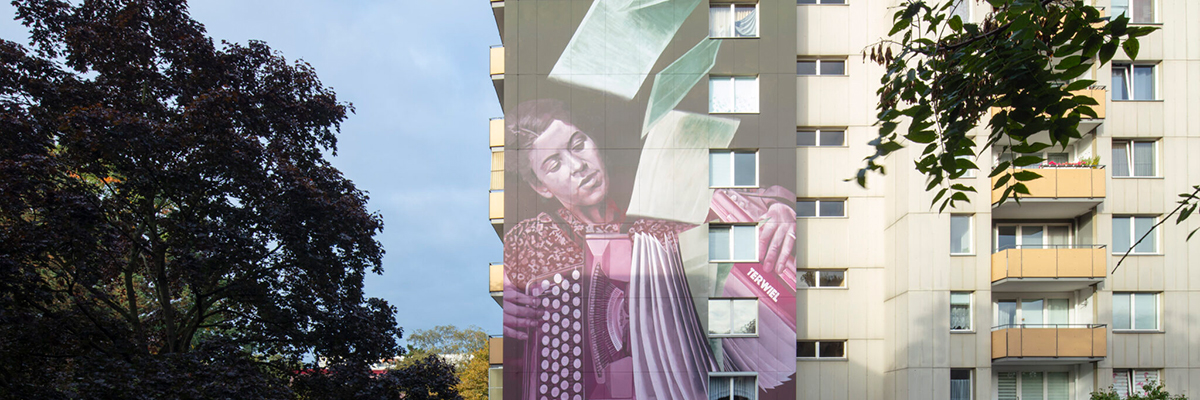
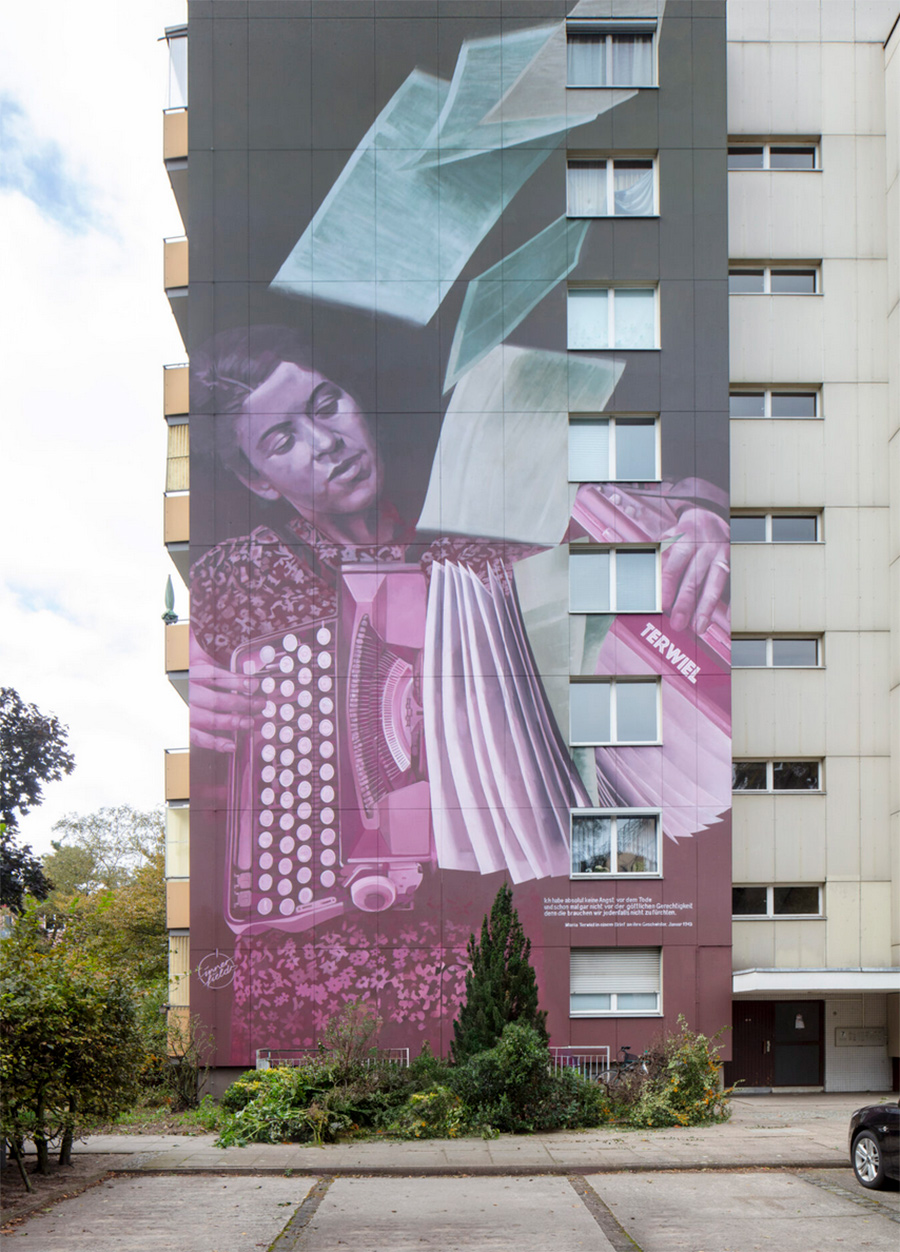
Berlin brings one of its unsung heroes to a wall this month as part of an Urban Nation mural program. On October 9, 2025, UN inaugurated “Akkord,” the newest addition to its long-running One Wall program—a series built on the premise that it is possible a single wall can carry a powerful message in a community. Created by the Berlin-based collective Innerfields, this mural rises above Schwambzeile 7 in Charlottenburg-Nord, transforming an ordinary apartment façade into a site of memory, artistry, and civic reflection. Following the One Wall charge, it’s meant to be public art with purpose: direct, accessible, and impossible to ignore.
Innerfields, who have operated at various times as a trio and a duo since forming in 1998, are well known in Berlin’s street art community for their blend of figurative realism and symbolic abstraction. Emerging from the city’s graffiti culture, they often explore the interplay between humanity, technology, and nature—our coexistence and our contradictions. Their murals are recognizable for their human subjects rendered with near-classical precision, often set against conceptual frameworks that invite reflection rather than spectacle.
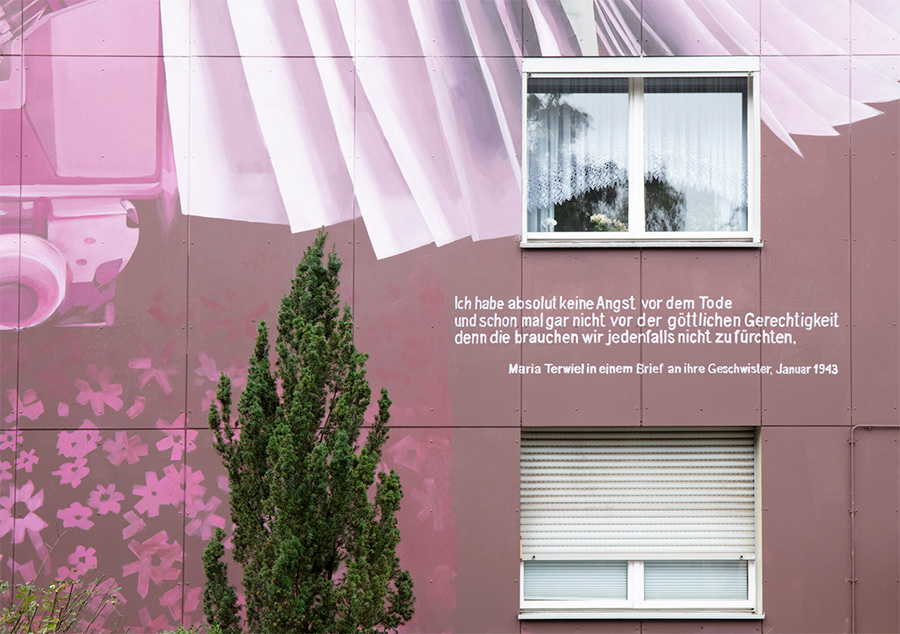
For Akkord, the artists turned their focus to Maria Terwiel, a member of the German resistance executed by the Nazis in 1943 for distributing anti-regime leaflets. The mural’s imagery—Terwiel playing an accordion whose keys morph into those of a typewriter, with the sheet music transforming into the very leaflets she once duplicated—captures the merging of art, intellect, and defiance. The work’s title plays on the dual meaning of “chord” and “accord”: harmony in music, and solidarity in human endeavor.
The concept and design was developed through a workshop with students from the Anna-Freud-Schule and Akkord intends to be as much a pedagogical project as a memorial. It engages young Berliners in reclaiming a silenced voice – and translating history into visual language. In a city that wears its past in layers of paint, Innerfields’ wall may remind us that resistance can take many forms—and that in the right hands, even an accordion can be an instrument of liberty.
GO TO URBAN NATION BERLIN TO READ MORE ABOUT “AKKORD”, INNERFIELDS, AND THE ONE WALL PROJECT
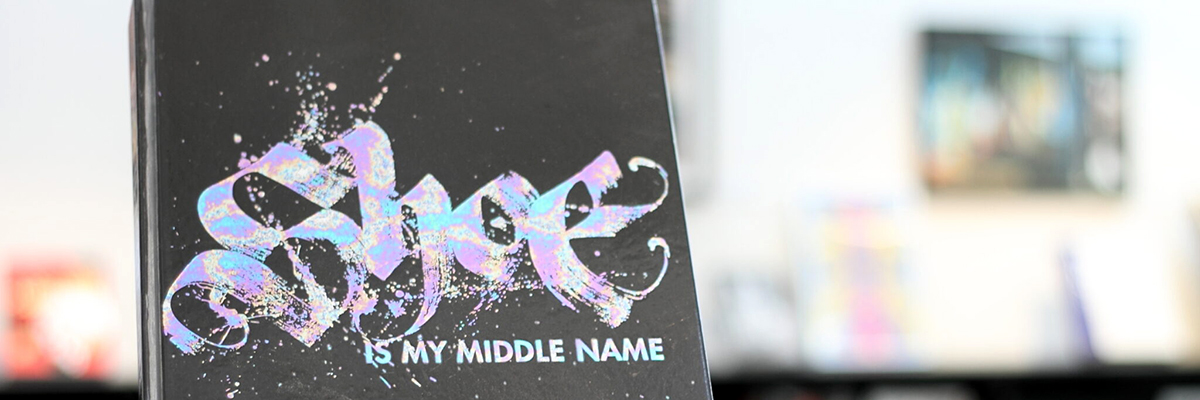
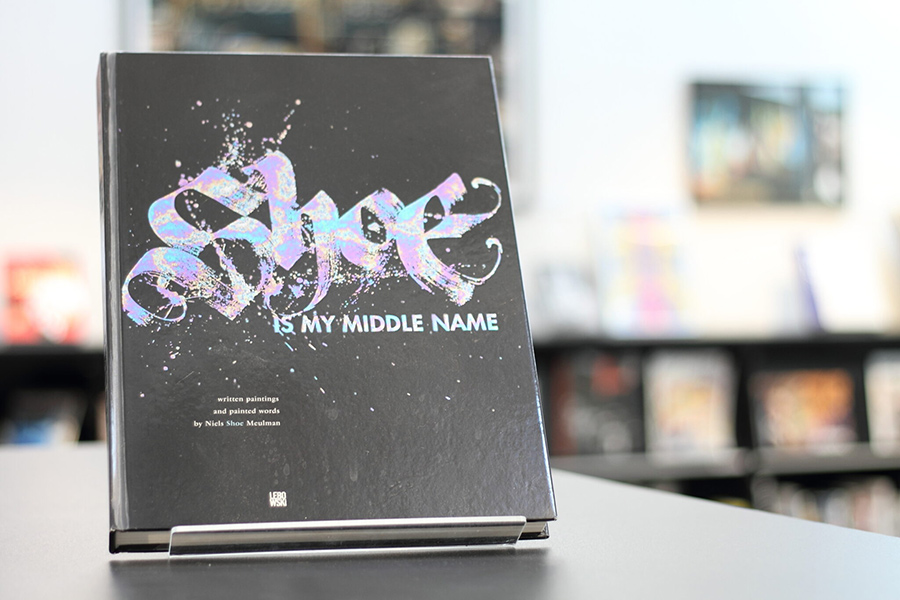
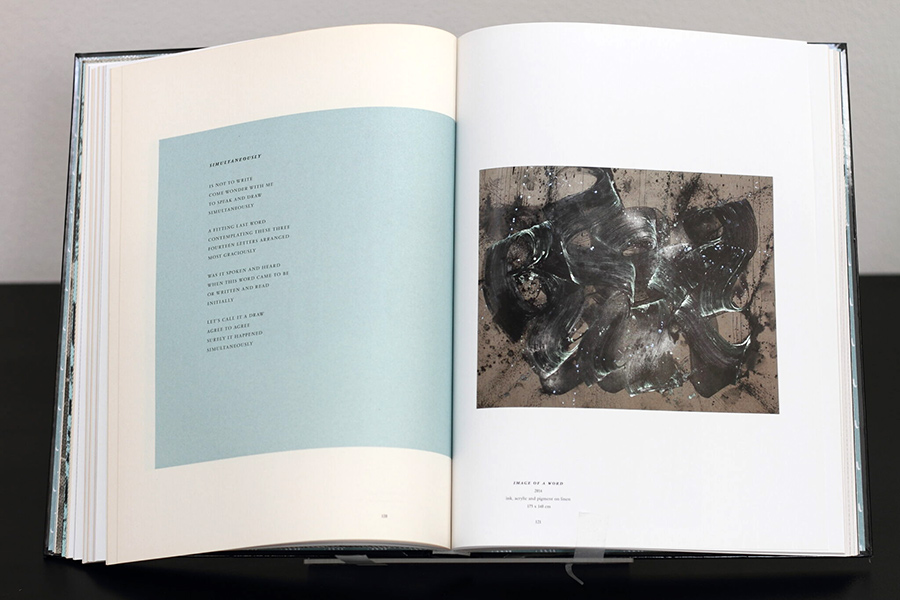
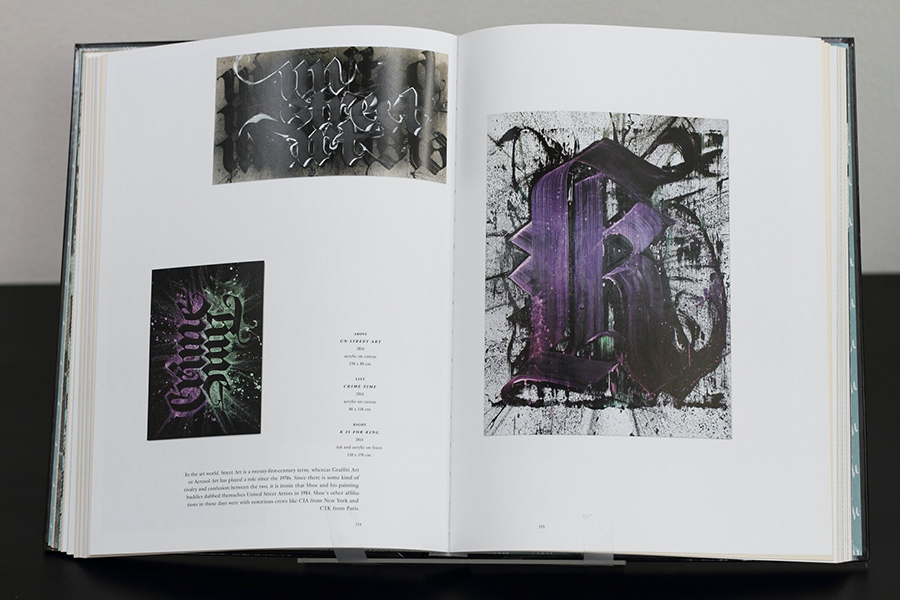
Shoe IS MY MIDDLE NAME. Niels Show Meulman 2016. (photo courtesy of MCL)
Reprinted from the original review by BSA for the Martha Cooper Library.
Graffiti writer, calligrapher, painter, typographer—Meulman’s professional identities have long orbited the written mark. “Shoe Is My Middle Name” gathers those decades-deep orbits into one gravitational field, presenting a mid-career survey whose scale and heft match the artist’s sweeping gestures. Photographs of murals, canvases, and poetry scrolls are sequenced chronologically yet feel rhythmic, echoing the repetitive muscle memory that turns letters into pictures.
The early chapters recall a precocious Amsterdam teen who imported New YorkWild-Style back to Europe after meeting Dondi White, while later spreads document how that fluency in urban letterforms morphed into what critics dubbed “calligraffiti.” Ink splashes, broom-wide strokes, and squeegee drags demonstrate Meulman’s commitment to an all-in mark: once pigment meets surface, there are, as he writes, “no half steps.” Quotes, diary fragments, and the full-page poem “A Writer’s Song” punctuate the visuals, anchoring grand abstractions in an autobiographical voice both swaggering and reflective.
Shoe IS MY MIDDLE NAME. Niels Show Meulman 2016. (photo courtesy of MCL)Shoe IS MY MIDDLE NAME. Niels Show Meulman 2016. (photo courtesy of MCL)
Title: Shoe IS MY MIDDLE NAME Published: Lebowski Publishers / Overamstel. Amsterdam, 2016. Author: Niels Shoe Meulman Language: English
BSA Special Edition LOVE LETTERS TO THE CITY at Urban Nation Museum Newly released Interview snippet with curator Michelle Houston and Steven P. Harrington
The LOVE LETTERS TO THE CITY exhibition at Berlin’s Urban Nation Museum continues to evolve, provoke, and inspire—inviting new eyes and fresh conversations nearly a year since its debut. Curated by Michelle Houston, the show features over 50 artists from Berlin and around the globe, each offering their own “letter” to the city in the form of street art, sculpture, video, photography, and installation.
In this short video, BSA’s Steven P. Harrington sits down with Houston to revisit the themes driving the exhibition—urban transformation, inequality, climate crisis, and the radical hope that public art can awaken something deeper in our cities. Together, they explore the continued resonance of works by icons like Banksy, Lady Pink, Shepard Fairey, and Vhils, alongside emerging voices and Berlin-based practitioners such as Rocco and His Brothers, Susanna Jerger, and Jazoo Yang.
With the show remaining open for at least another year, this is your reminder: don’t miss the chance to experience a rare international dialogue unfolding inside—and outside—the walls of the museum. It’s not just a show. It’s an ongoing conversation between artists and the city.
Video credits: Commissioned by Stiftung Berliner Leben. Shot by Alexander Lichtner & Ilja Braun. Post-production, additional footage, graphics, and a final version by Michelle Nimpsch for YAP Studio/YES, AND… productions GmbH & Co. KG
“Love Letters To The City” is currently on view at Urban Nation Museum Berlin. Click HERE for more details about the exhibition, schedules, directions, events, and programs.
First day of spring in the Northern Hemisphere, and what better sign of renewal than a fresh Urban Nation bloom—sprouting defiantly among the dried leaves, cigarette butts, and abandoned Berliner Pilsner bottles?
As part of an ongoing conversation with curator Michelle Houston about the latest show at Urban Nation, LOVE LETTERS TO THE CITY, we find ourselves drawn to the echoes of the Situationists, those restless wanderers who believed the city wasn’t just a place but an experience—one that tugs at your emotions, plays with your psychology, and sometimes leads you straight to an impromptu picnic on Görlitzer Park’s slightly suspect grass.
The show isn’t just a tribute to urban spaces; it’s a love note, a protest, and a collection of insights into the streets that shape us and our experience.
Video credits: Commissioned by Stiftung Berliner Leben. Shot by Alexander Lichtner & Ilja Braun. Post-production, additional footage, graphics, and a final version by Michelle Nimpsch for YAP Studio/YES, AND… productions GmbH & Co. KG
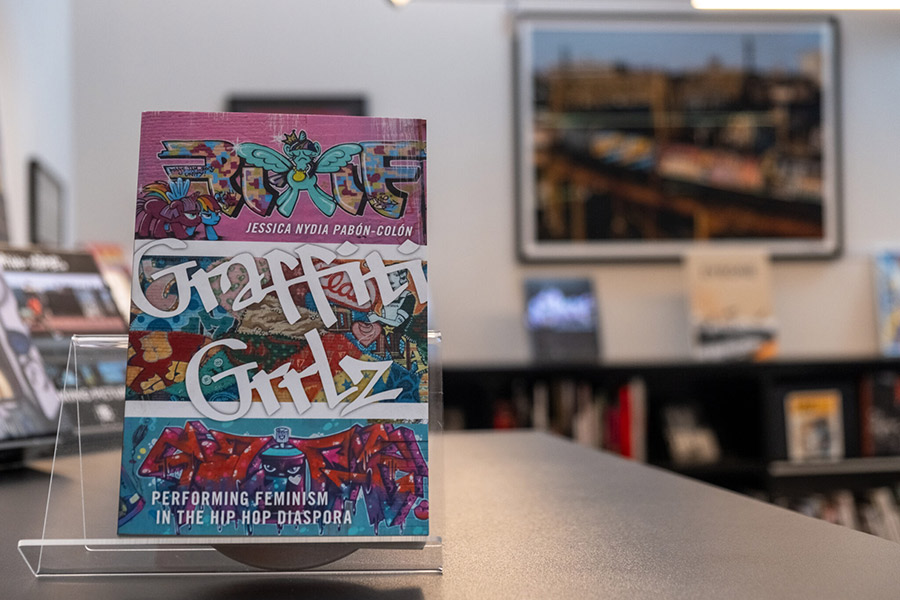
Books in the MCL: Jessica Nydia Pabón-Colón. Graffitti Grrlz: Performing Feminism in the Hip Hop Diaspora
Reprinted from the original review.
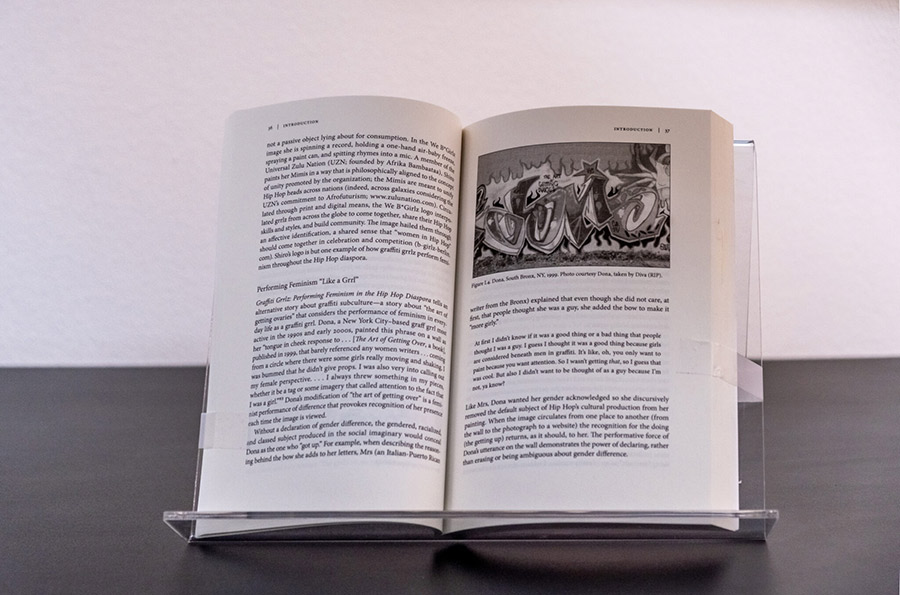
“Graffiti Grrlz: Performing Feminism in the Hip Hop Diaspora” by Jessica Nydia Pabón-Colón provides an insightful look into the world of women graffiti artists, challenging the perception that graffiti is a male-dominated subculture. This book highlights the contributions of over 100 women graffiti artists from 23 countries, showcasing how they navigate, challenge, and redefine the graffiti landscape.
From the streets of New York to the alleys of São Paulo, Pabón-Colón explores the lives and works of these women, presenting graffiti as a space for the performance of feminism. The book examines how these artists build communities, reshape the traditionally masculine spaces of hip hop, and create networks that lead to the formation of all-girl graffiti crews and painting sessions. This aspect is particularly useful in understanding how digital platforms have broadened the reach and impact of women graffiti artists, facilitating connections and collaborations worldwide.
MARTHA COOPER LIBRARY: BOOK RECOMMENDATION
? | Title: Graffitti Grrlz: Performing Feminism in the Hip Hop Diaspora ? | NYU Press. June 2018. Softcover. ? | Author: Jessica Nydia Pabón-Colón ? | Language: English
 BROOKLYN STREET ART LOVES YOU MORE EVERY DAY