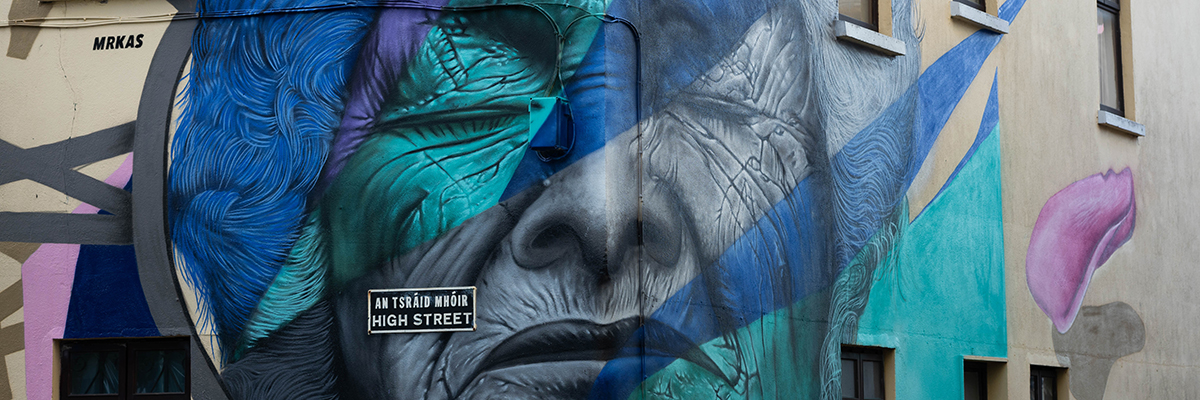
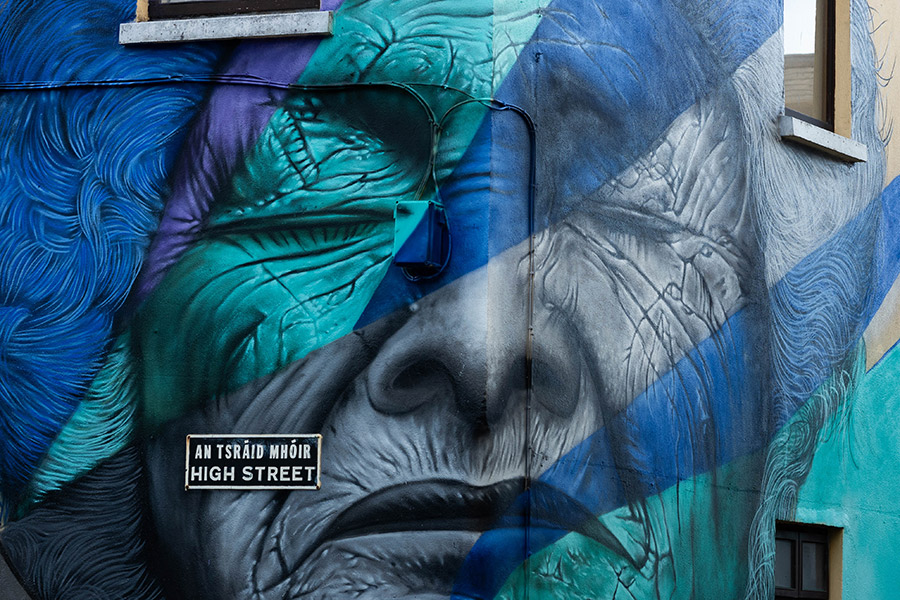
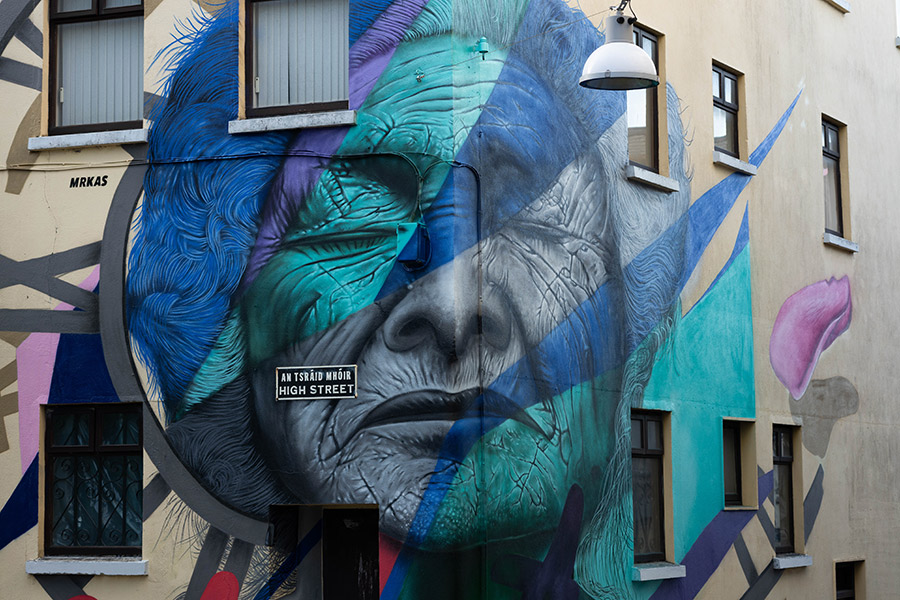
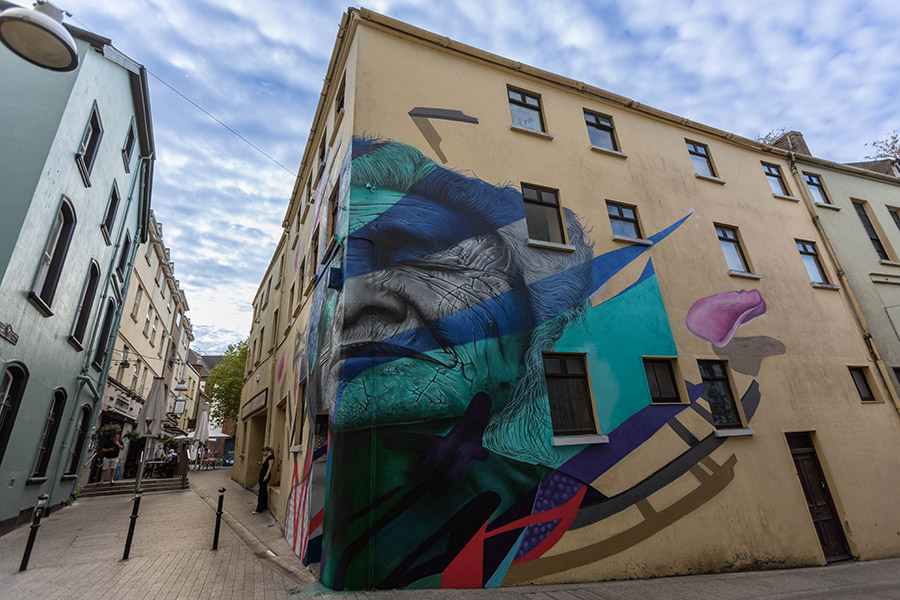
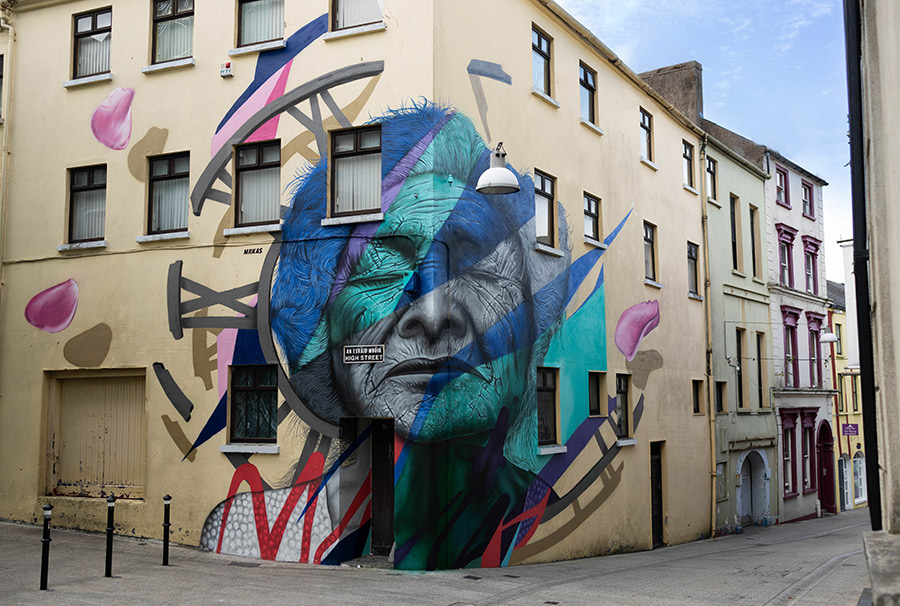
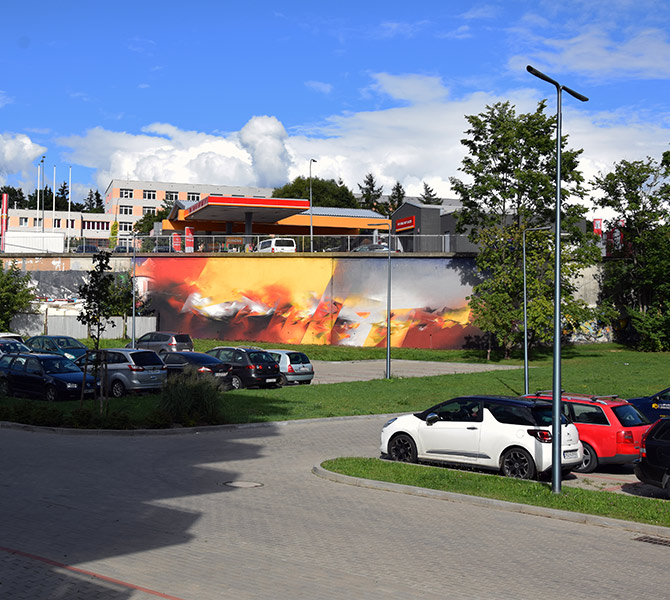
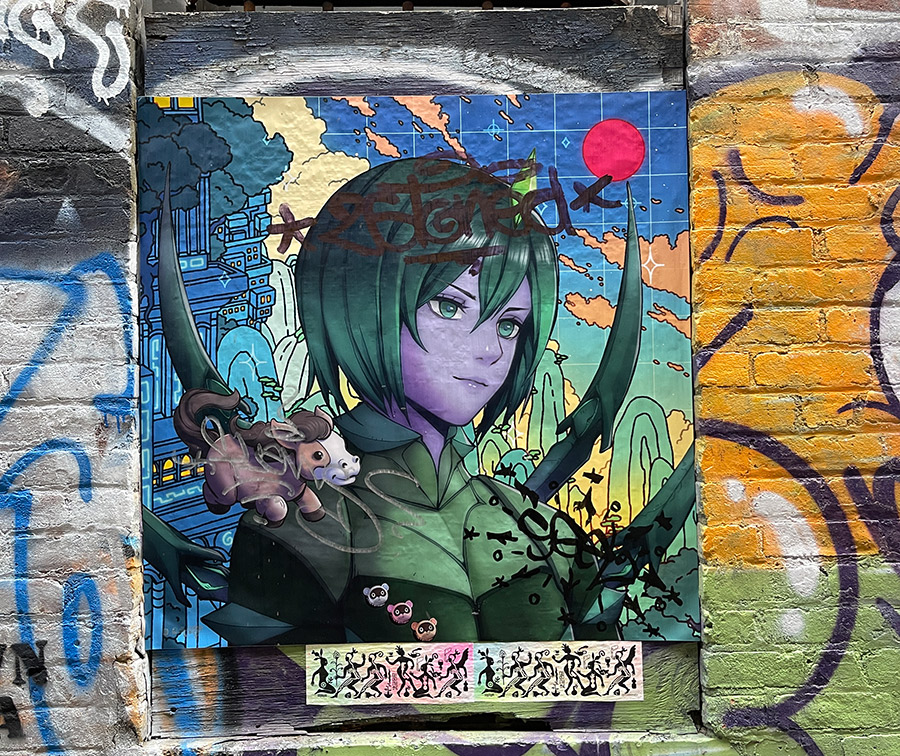
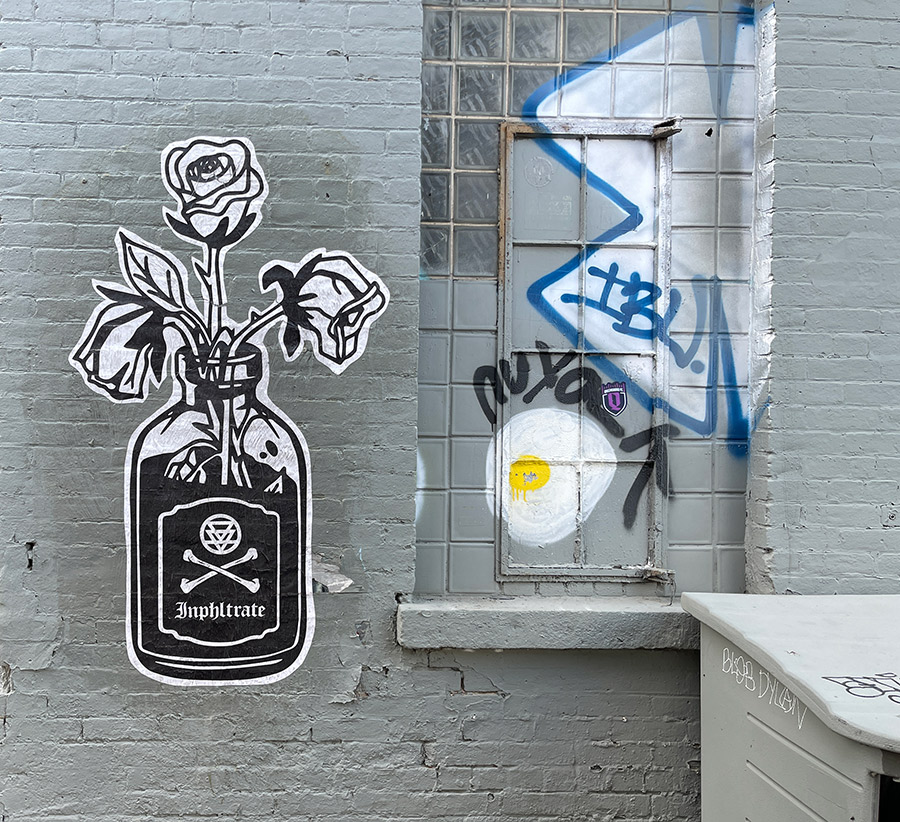
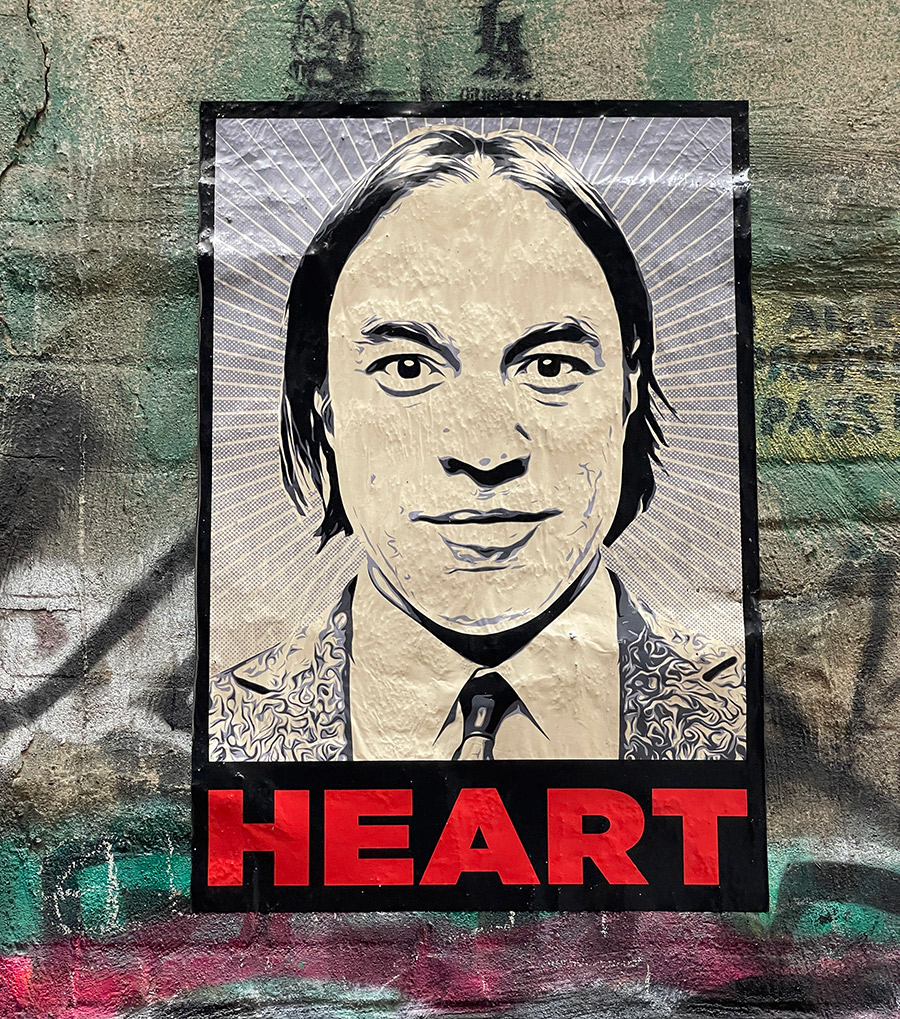
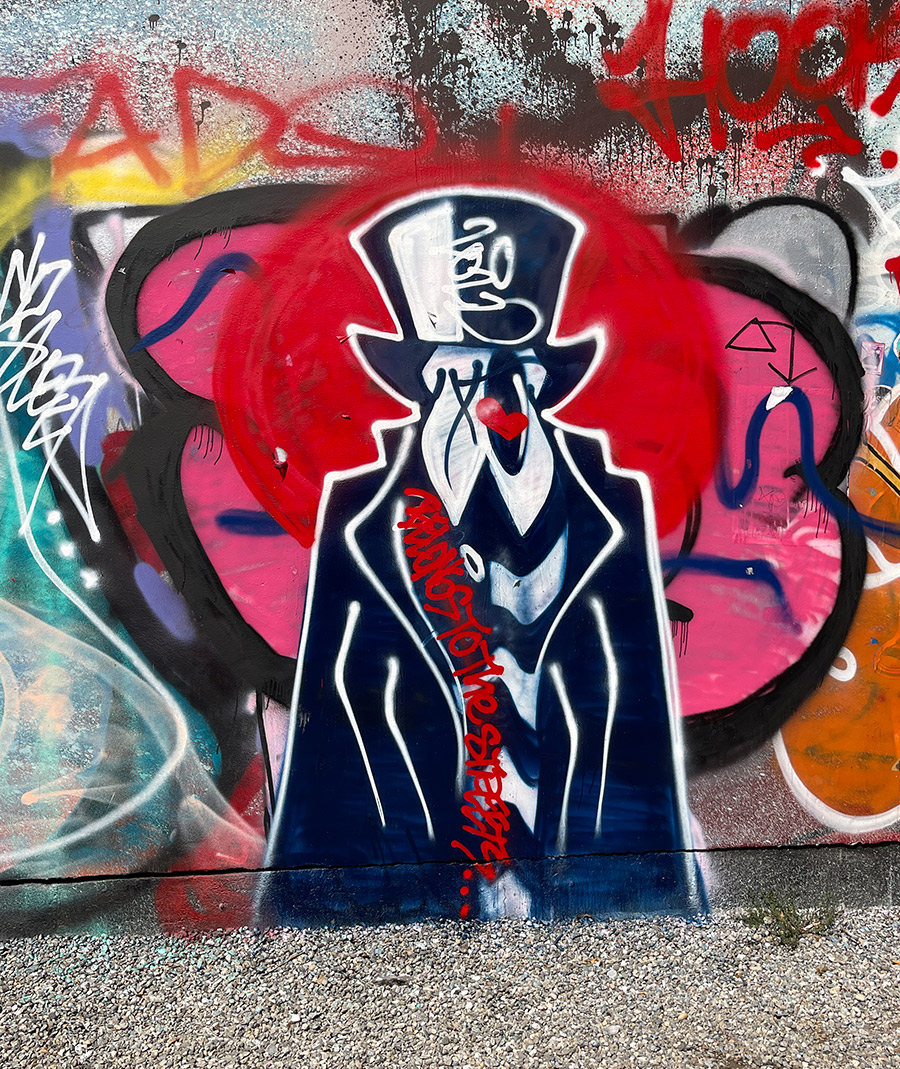
Waterford Walls, a mural festival in Waterford Ireland, may make you think of the famous crystal first, and you would be correct to make that association. The Waterford Glass House was founded around the same time as Beethoven was publishing his first works in 1783, say local historians. The festival offers a collection of quality painters from many backgrounds, formal and informal, a number of walls. With local Irish and invited international artists in league, the festival has been creating murals across the county – including in Tramore, An Rinn, Ballyduff Upper and Tallow.
If you are lucky, you’ll reach the age of his subject – and it may happen far quicker than you had assumed. Mr. Kas suggests we take each moment with serious consideration and learn how to enjoy while embracing the rather quick march of time.
“The only moment we have is now,” he says, “Shall we have this in mind to use our time in the most fulfilling way possible.”
“Time is now. Enjoy it, because we don’t know when it will be our last moment.”
Sweden’s northernmost town center is in Kiruna, with a population of 23,000 or so, is far north of Swedish Lapland. Known for mining iron ore and landing inside the Artic Circle on the eastern shore of Lake Luossa, the 100+ year downtown is going to move soon because the mining operations are moving elsewhere. So are its heritage buildings.
This summer the town created a mural project to mark this benchmark, establishing Artscape 2022. It’s a “mural project based on the people of Kiruna’s collective memory,” they say, and six murals were created after artists conducted interviews, hundreds of stories, and anecdotes. Not only do these new murals respond directly to the environment they are created within, but they also function as a historical record of the town and its people.
Our thanks to photographer Jon Högman for sharing his images with BSA readers today, giving us all a sense of Artscape 2022.
‘A song of Unity: Diversity is beautiful’ by Colombian artist Gleo is inspired by a collected recent memory from the Kiruna music festival @pamojafestivalen. Refugees being welcomed by the local community through music and culture.
Amazing transformation of a grey metal stripe into a colorful cityscape! Isakov’s stained glass style makes perfect use of the space – it’s like the artwork was part of the original architecture ? Look closely and you’ll recognize some of Kiruna’s most famous landmarks!
’An Ending, A Beginning’ by Andreas Welin from Denmark in Tuollavaara, Kiruna. A very difficult wall to paint. Half the wall has a tin facade with corrugated sections.. ? So Andreas had to switch between different kinds of paint for the different surfaces. Torrential rain didn’t help either. But the end result is an amazing mural! Kiruna’s impending move is embodied in a beautiful way.
We asked children from Högalidsskolan to show us their Kiruna. The drawings they created were passed on to Vickan and became the inspiration for this magical piece. Vickan is from Boden, a town a few hours from Kiruna, and the kids’ imagery is most definitely a shared experience!
Taking her inspiration from the local memories that were collected – Kruella created a playful mural with loads of magical details! The artist managed to catch a breathtaking aurora display during her time in Kiruna, depicted in the mural.
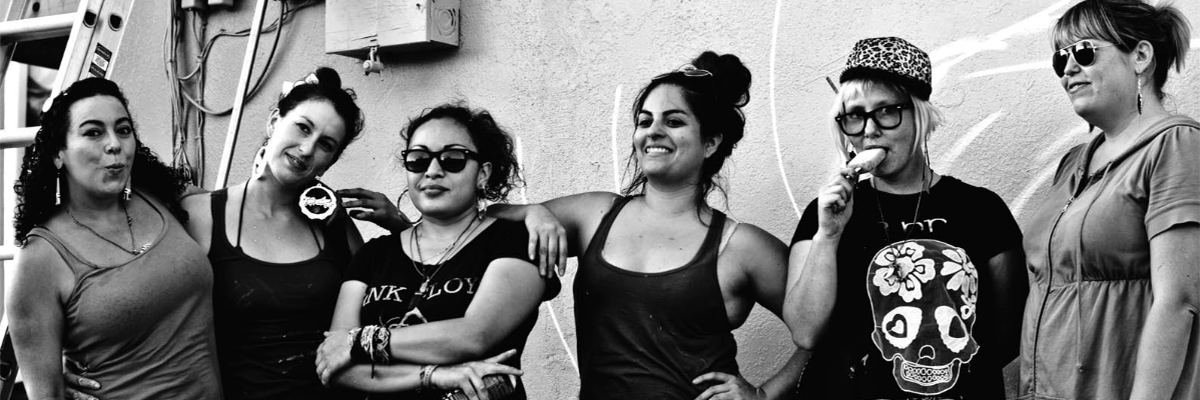
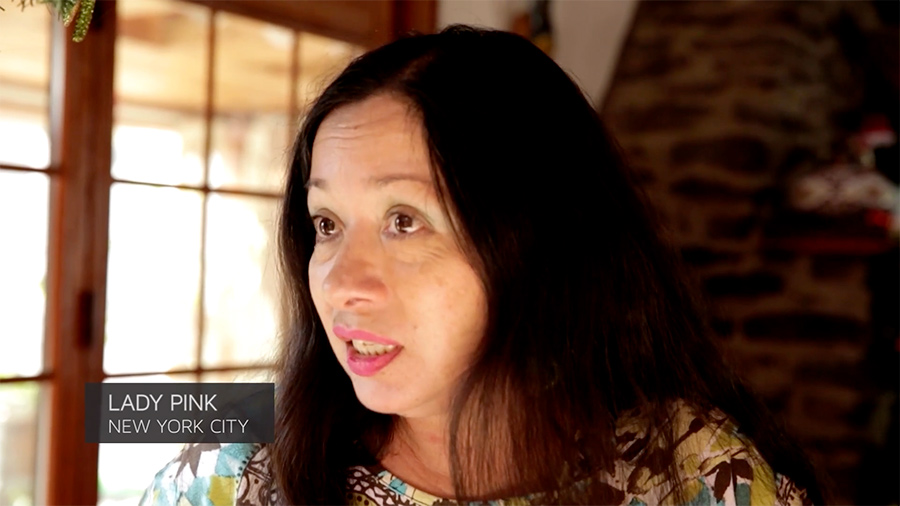
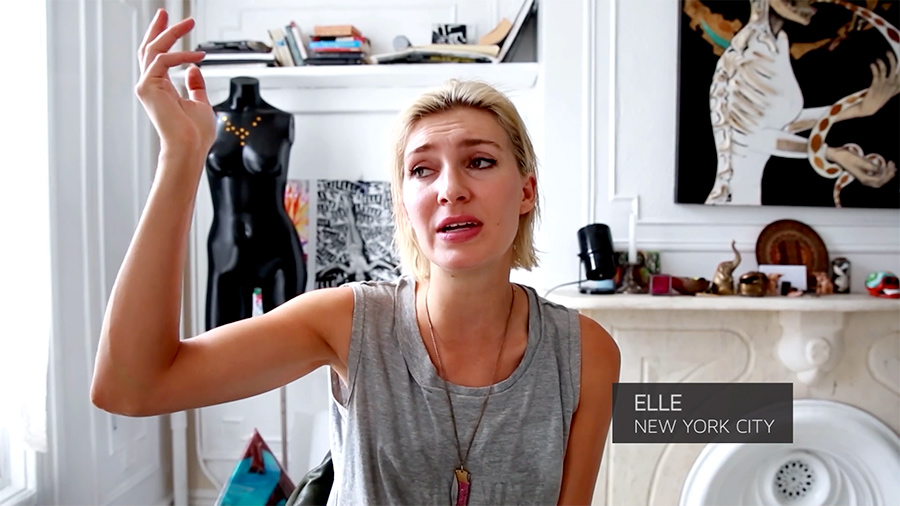
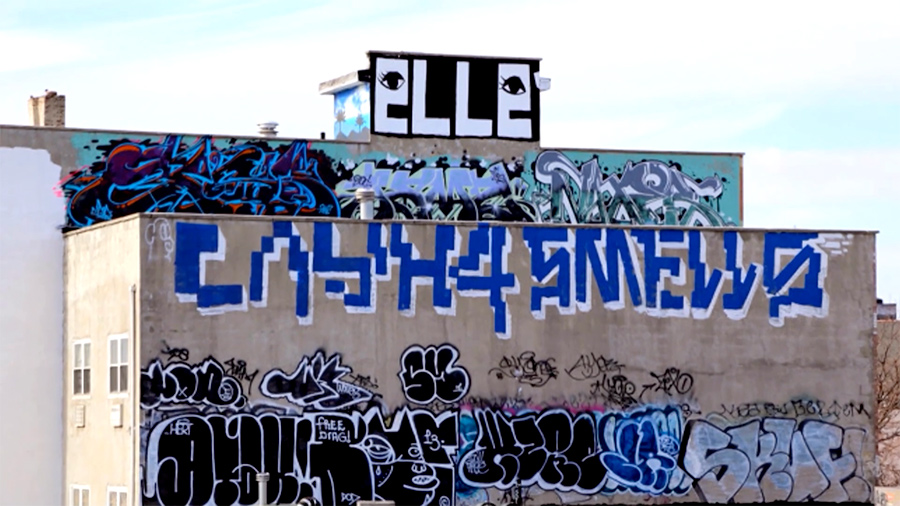
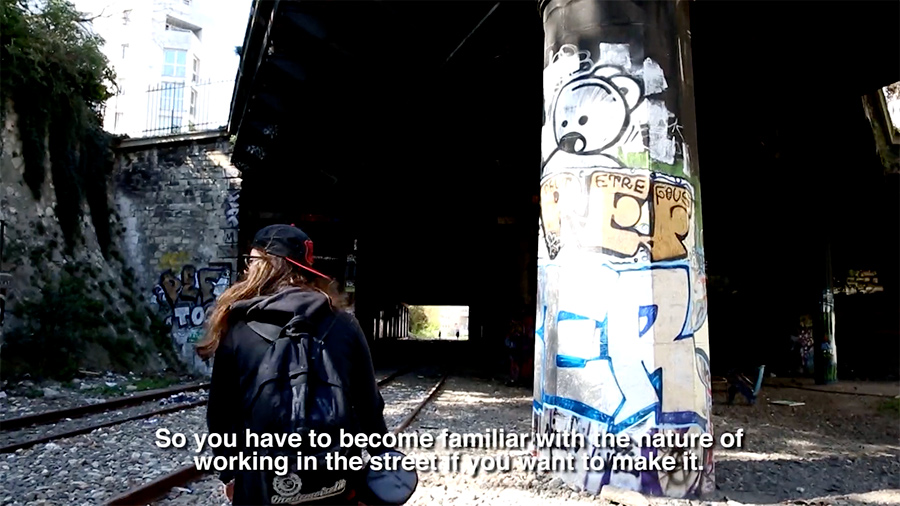
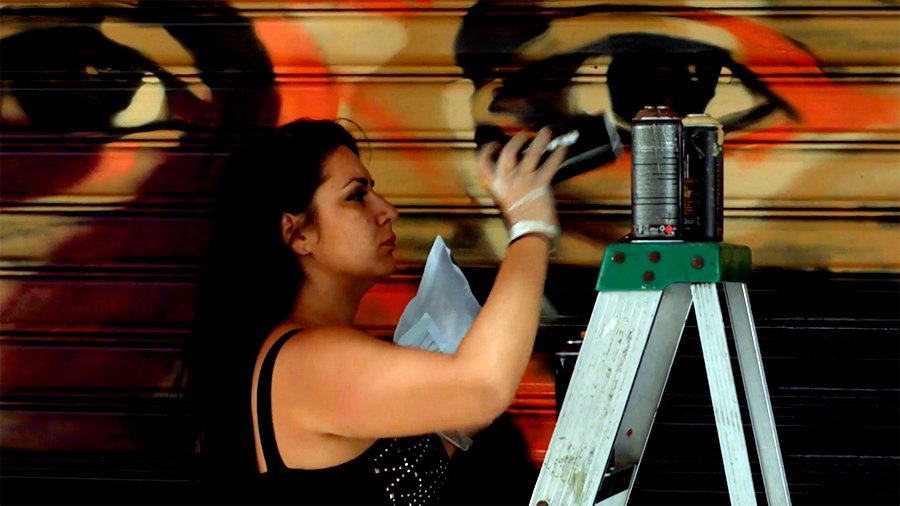
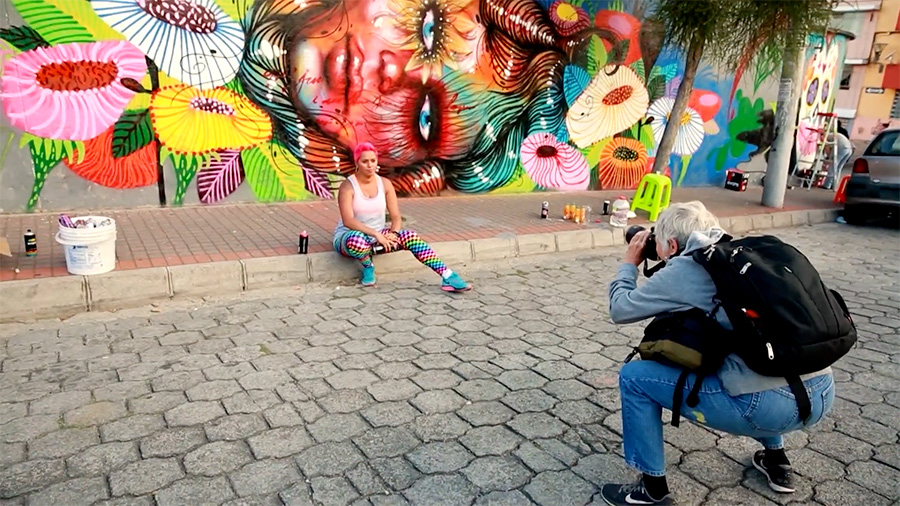
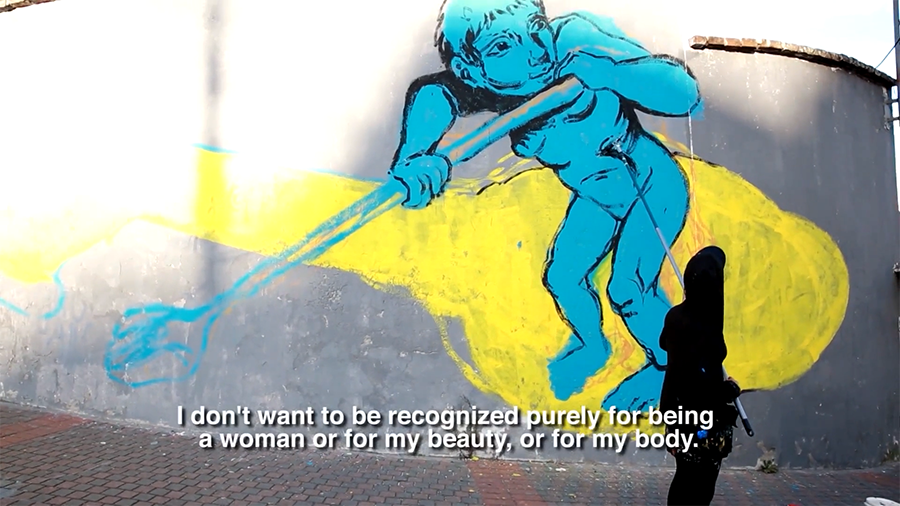
An unusual opportunity to see this documentary this week for its first theatrical running. The thrill is compounded by the chance to see some “legends” on stage as well, says director Alexandra Henry – and she is right. Focusing on the street art and graffiti scene from a female perspective hasn’t been done previously. Still, the conversation about the balance of gender representation has been burning for more than a decade in the street and in festivals and street art symposia across the world. Henry travels across the US and into the Americas to find women to speak with to ask about their experiences in this practice that sometimes only happens in the shadows.
A fresh perspective that allows people to talk, Street Heroines unveils a complex history over time – inviting you to gain a greater appreciation for the players as well as the practices of a typical artist on the street today. When it comes to practicing these skills on the street as a woman in a macho or outright misogynist culture, the title appears as an accurate descriptor. Out from under the male gaze, these women have heroically been showing us the world from a vibrant, personal perspective that has required sacrifice, vision, and at times, some guts. Join Henry this week along with documentary photographer Martha Cooper and artists Lady Pink, Swoon, and Aiko right here in Brooklyn.
We had an opportunity to ask director Alexandra Henry about her film, her project, and the women she met along the way.
Brooklyn Street Art:Women artists have been typically under represented in receiving recognition for their work. This has been through and graffiti in Streetart as well. Do you see a change now?
Alexandra Henry: When I started this project 10 years ago it was because I recognized a deficiency in the representation of women in the movement. And I also recognized my own ignorance as I hadn’t realized there were so many female artists participating in graffiti and street art. I had been paying attention and documenting the subculture scene since I was teenager growing up in the Washington, D.C. area and then when I went to college in Los Angeles. But not until my late 20s, living in NYC, did I ever consider there were women out there doing graffiti or making street art.
In making this film, I wasn’t sure how it would begin or end, but I knew it would be important to honor the pioneering women who paved the way for the current generation of artists. Showing how Lady Pink’s and Martha Cooper’s friendship and collaboration put women on the map and inspired others to find their creative voice, not just in the USA but on a global level, is something we felt was an essential throughline in the particular stories we’ve chosen to tell in this film. It’s the ‘see it be it’ factor and we as filmmakers hope it is just the beginning of shining a light on the likes of talented women, who like TooFly says in the film, will get inspired to take their art to the next level. We want to make these women household names beyond the subculture and into the mainstream.
Brooklyn Street Art:From your original idea to fundraising to protecting and traveling and meeting the artists in your film, It has been a long journey. How did the final results differ from what you initially conceived?
Alexandra Henry: As I have a background in photography, initially I wanted to make a photo essay of women in the graffiti and street art movement. At the time, however, I was starting to experiment with video and learning how to edit so I decided to ask for their permission to film them while they were working and for an on-camera interview because I felt that capturing their process was just as important as highlighting the finished piece. I believe it is very impactful to hear directly from the artist, in their own voice. So I set out to make short films of each artist who agreed to be documented.
Eventually, I saw a bigger story coming together as women attributed their interest in the medium to others who came before them. I couldn’t find any of that history documented so I decided to make a feature-length film that would not only nod to the historical participation of women in the game but also look at the subculture through the female lens to show how much ground women have gained. As we know, the future of graffiti and street art is unpredictable, so contrary to my initial approach, where I had planned to tie up the story with a nice little bow, I’ve left it open-ended as I feel this could just be the beginning of telling many, many more stories.
Brooklyn Street Art: What is the best way to support a female artist? Alexandra Henry: The best way to support a female artist is to start with the young ones who show interest in the creative arts! And give them encouragement and resources to further develop their interest, whether through books, trips to see local murals, street art festivals, art museums, studio visits, and gallery shows. Street Art is everywhere; it’s prolific, so even if you don’t live in an urban area like New York City or Mexico City, or São Paulo, you can still find examples of street art in small towns. Point it out to your young artists so they can see their surroundings from a different perspective. And to support our Street Heroines and any female artist trying to break through, most artists have studio practices and sell their work, and you can find them via their social media posts. I’d recommend following them, buying their work, and attending their events if you are able to. If you work for a brand or art institution and are reading this article, hire more female artists, designers, creative directors, curators, filmmakers, etc.!
Brooklyn Street Art: What is one primary difference that you observed between men and women in working style or approach? Alexandra Henry: When it comes down to the working style or approach, I’d say we should differentiate between graffiti and street art. Graffiti, which is an illegal act that usually happens very fast, has a more aggressive approach and is meant to provoke society or fulfill one’s ego. And regardless if you are a man or woman, those are the intentions behind it. Street Art, to be clear, is usually done with permission and the artist can take their time to finish their piece. I’d say the messaging in street art aims to be thought-provoking and ego-stroking as well. But listening to some of the artists in the film, they note, for example, that many images in street art that portray women are made by male artists and are used to sell something or to show their view of society. So when a female artist or artists paint themselves in their own image, they eliminate the male gaze, and therefore the approach is inherently different than that of their male counterparts.
Brooklyn Street Art:Have you been personally inspired by the process and the results of making this film?
Alexandra Henry: Making my first feature-length independent film has been a testing process on so many levels, but very inspiring at the same time. I didn’t anticipate it taking this long, and I also feared the subject matter might feel dated or irrelevant if the film ever did get released. However, living with all of these artists in the edit bay for the past 5 years and listening to their stories of resilience, over and over again, gave me the energy to keep moving forward. Their perseverance truly resonated with our filmmaking team and me. I have to mention it was difficult not to include every artist we shot, but I hope to make a doc series in the near future because there are so many powerful stories we have tee-ed up.
As for the timing of the release, I feel like there is no better moment than now for Street Heroines to reach a wider audience so they can get to know these women, hear their stories, experience their art, and witness the very political act of just being a woman creating in the public space having her own agency. Especially given where we are as a society in the USA right now, where women’s rights are getting the rollback. As far as results are concerned, this past year we had a great film festival run for such an independent documentary, which was very exciting. I always love it when I hear from audience members who say they never thought or considered that women were graffiti or street artists until they watched the film.
I also get many follow-up comments or emails with pictures of street art people notice in their day-to-day life! I think the film helps open people’s perspectives to the power of public art. Additionally, I would say all the women who have reached out over the years from around the world to express their appreciation for the work we are doing in documenting this angle of the street art and graffiti movement and also wanting to be part of it, is very telling of how flourishing the community of female artists is at a global level.
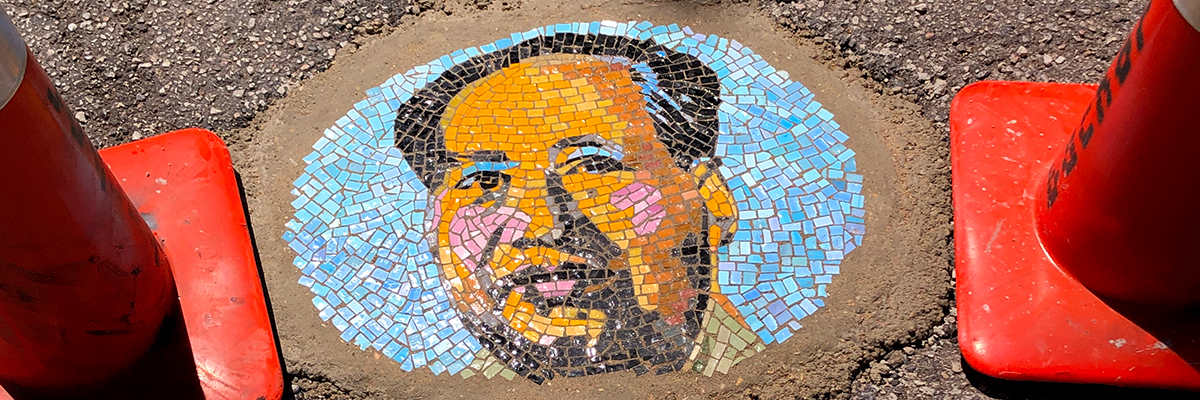
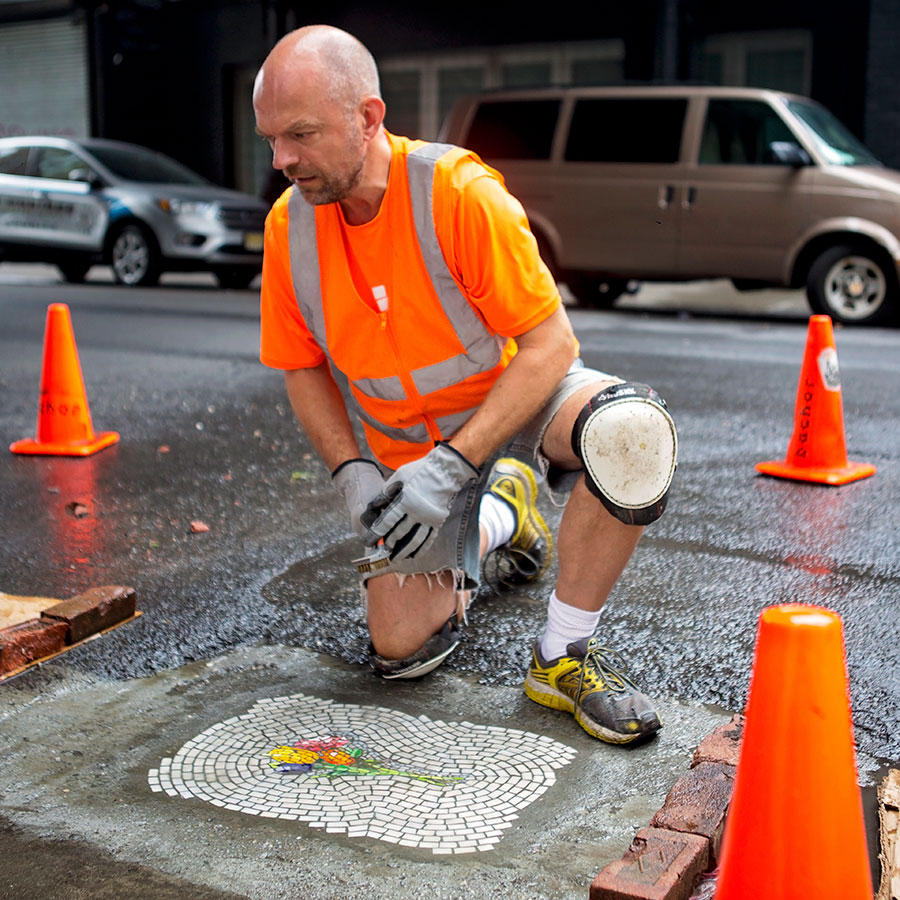
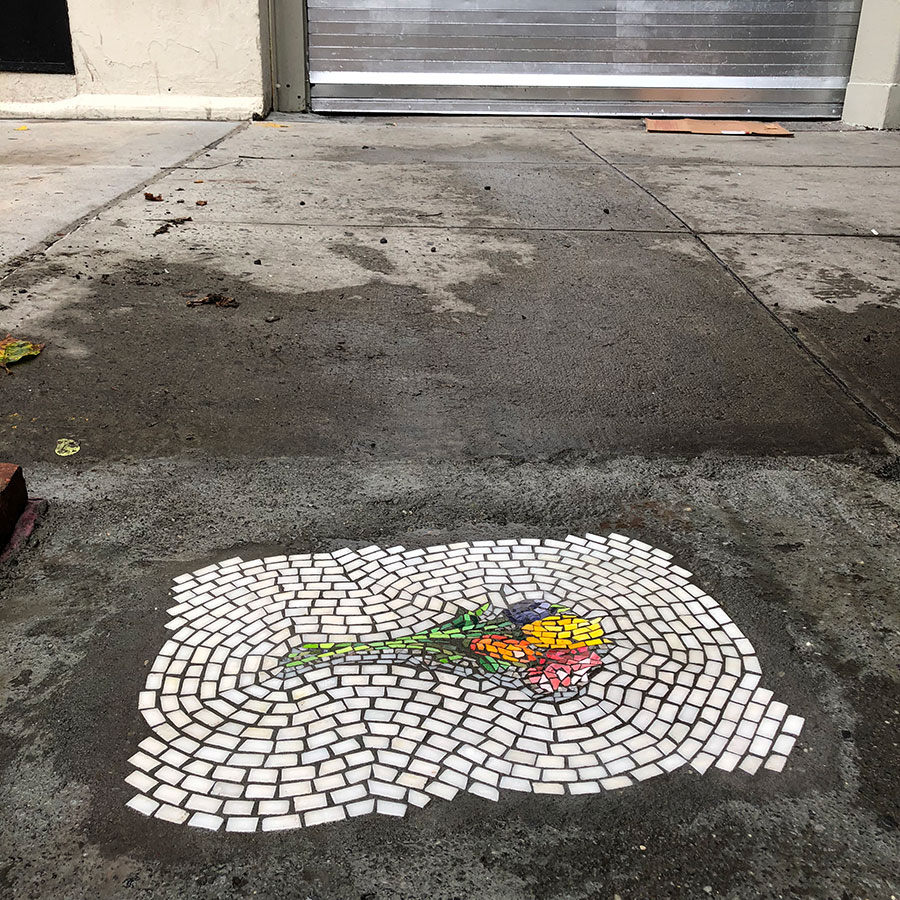
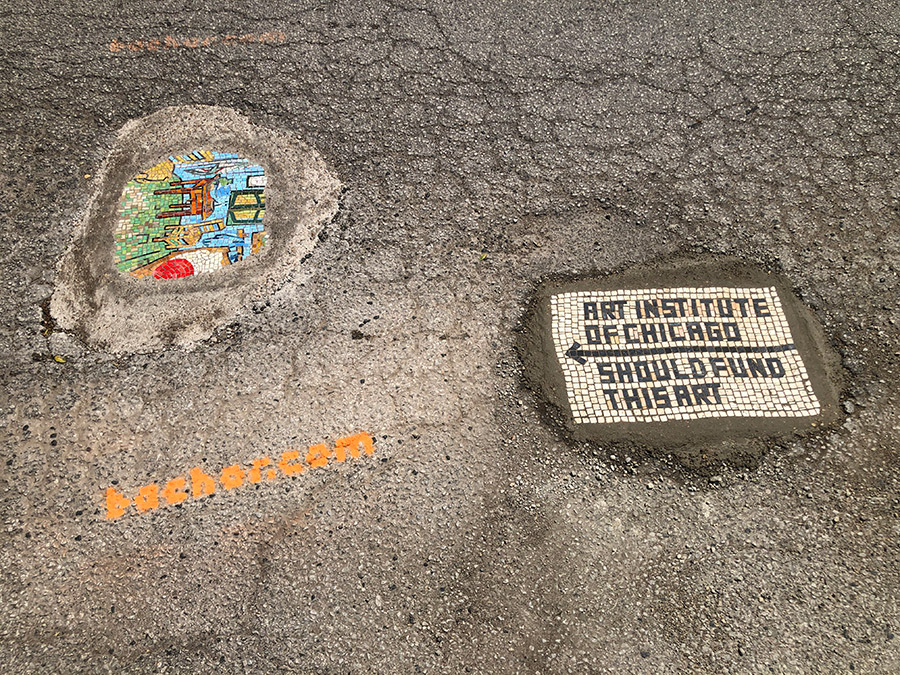
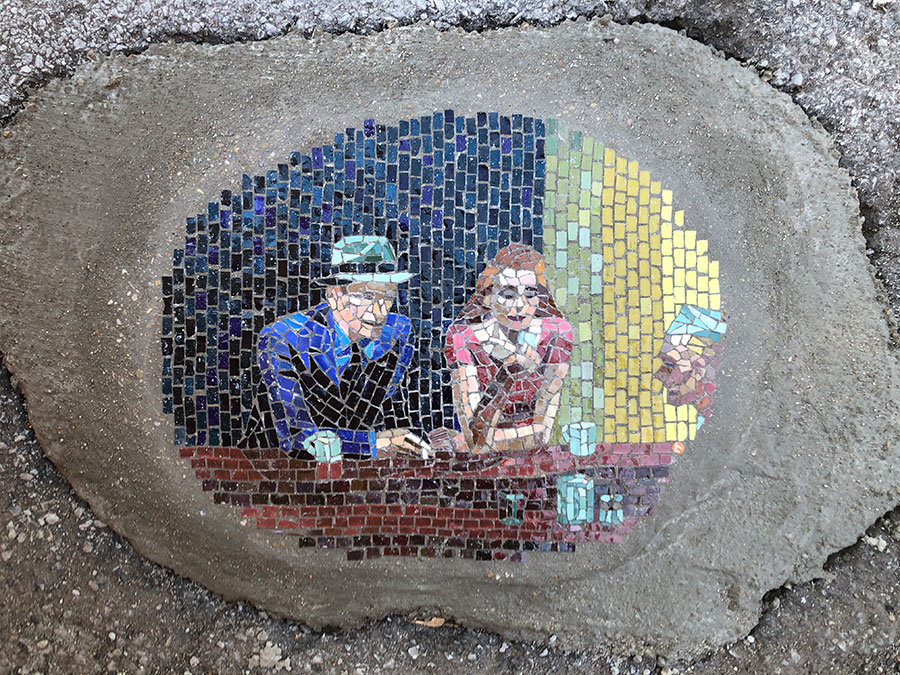
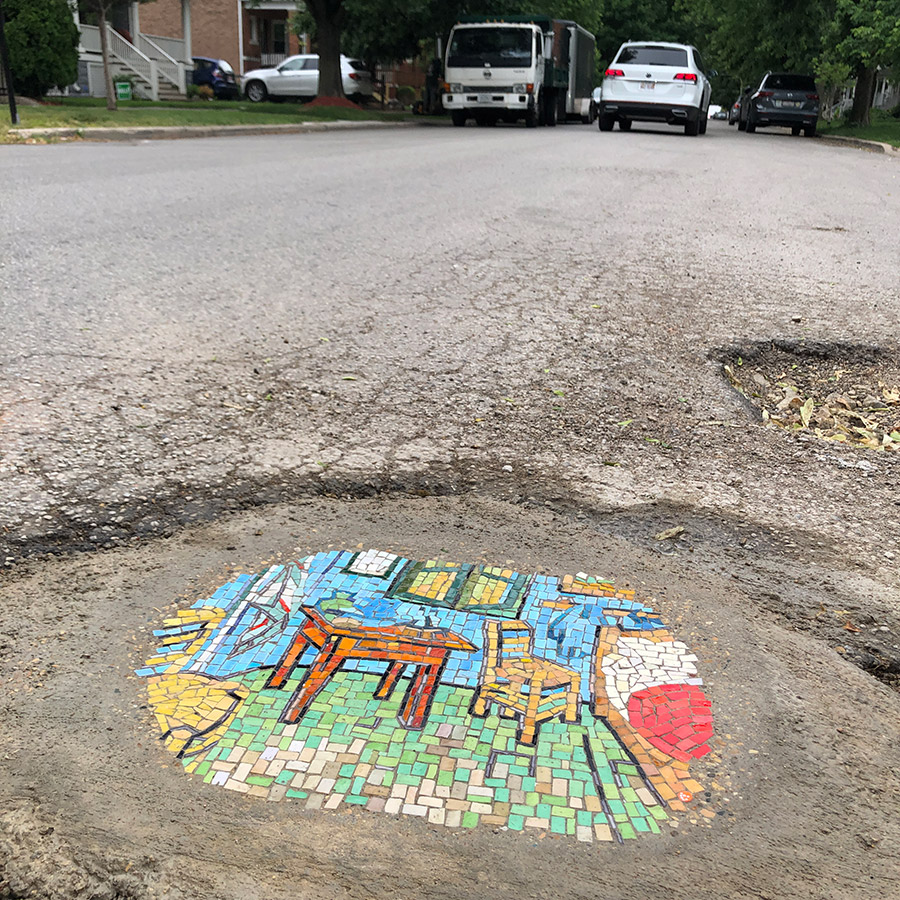
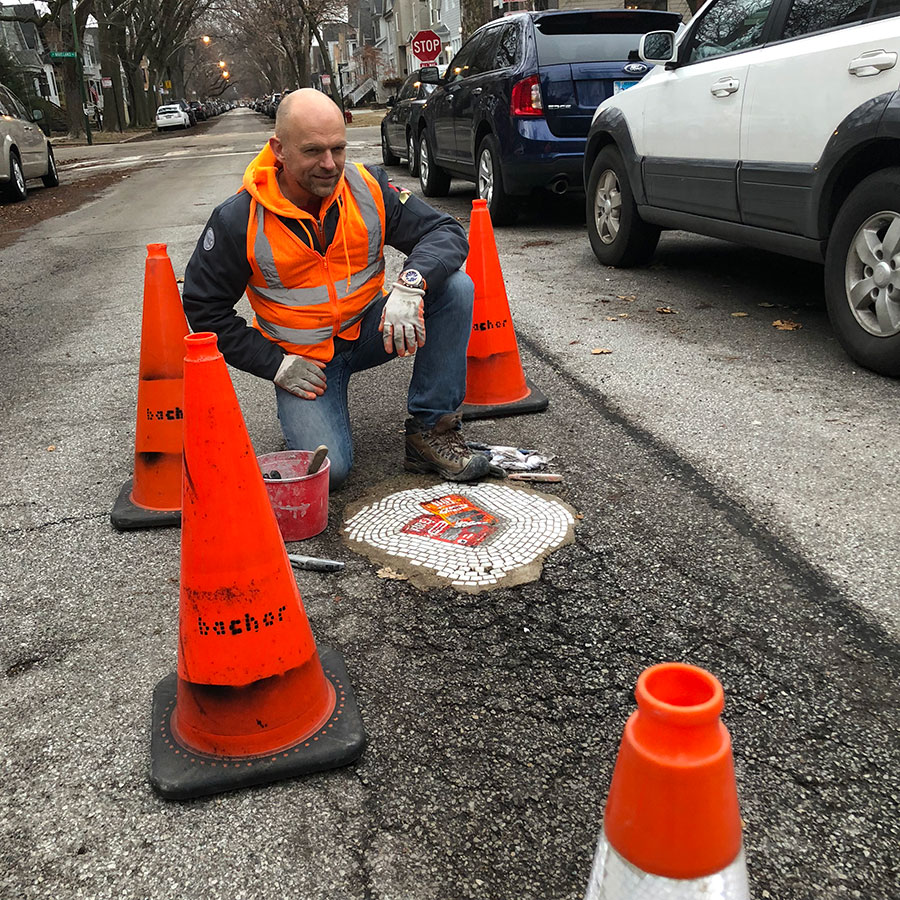
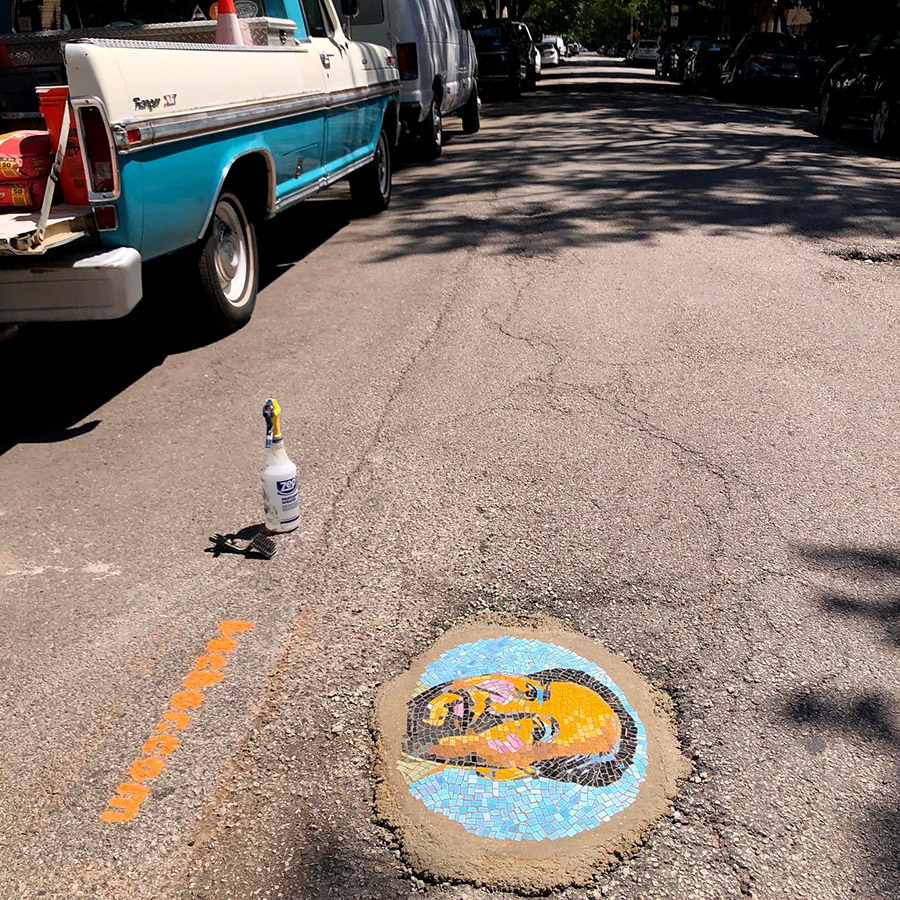
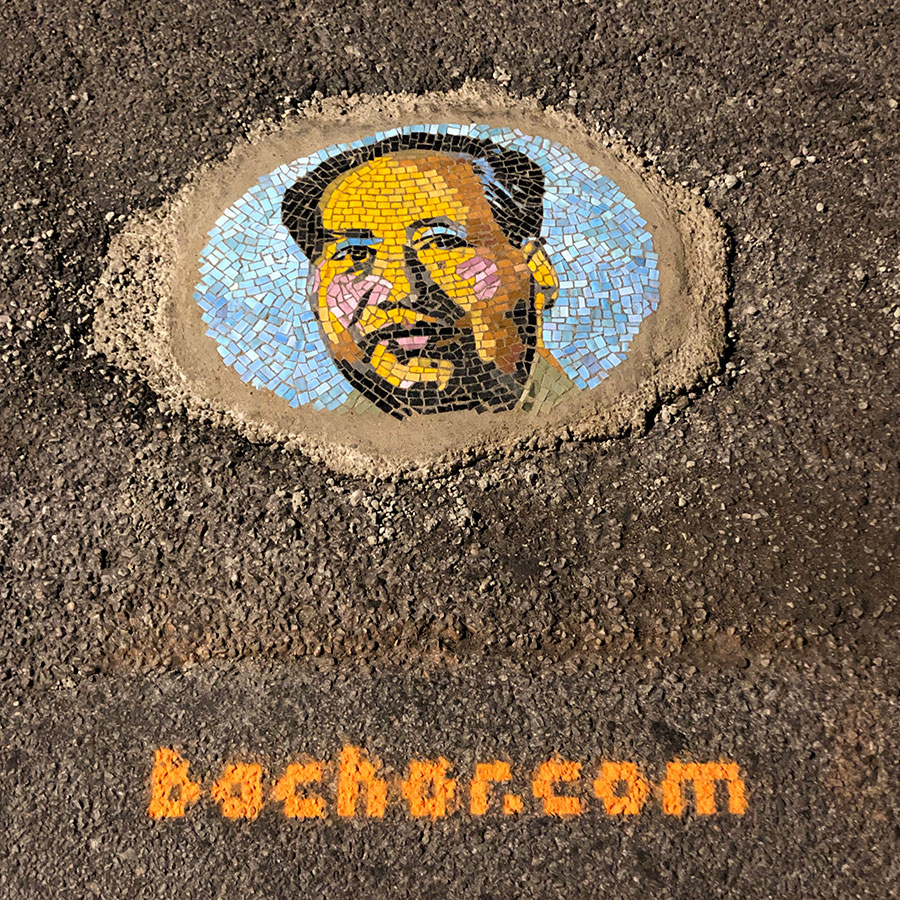
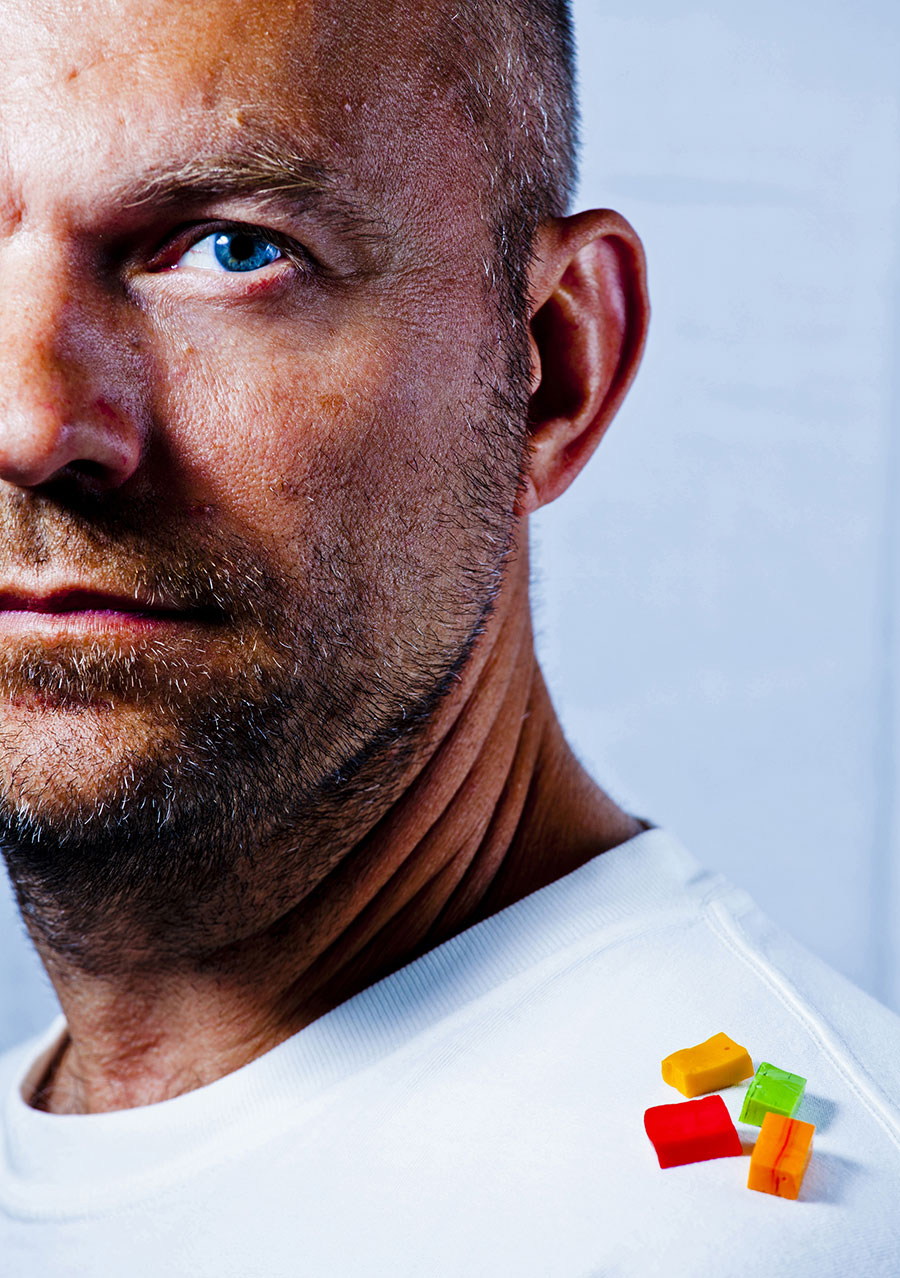
“This work is my mark,” says Chicago street artist Jim Bachor, and he points to the ancient practice of making mosaics as his inspiration. The artist began his project of laying tiles in the street as a way to advertise his fine art website online but found the practice to be addictive. These days he doesn’t just create random images of a bag of chips or a bouquet, he’s tiling details of masterworks from the Art Institute of Chicago’s permanent collection.
He says he has developed a process of working in the broad daylight that makes him nearly invisible in a busy city and uses precautions not to get hit by cars because, “with two 16-year-old boys at home, I purposely avoid situations where the risk isn’t worth it.”
BSA talked with Bachor about his practice on the street, and how to have a sense of humor about it all.
BSA:Pedestrians, cyclists, and motorists all despise potholes; you on the other hand are attracted to them like urban pigeons are attracted to sidewalk pizza. The Biden administration just signed a milestone infrastructure bill…are you concerned you’ll run out of potholes?
JB: I am not. I think potholes are an unsolvable problem. Unless cities decide to pull up all their asphalt streets and replace them with expensive concrete ones the problem won’t go away. I sympathize with city governments; unless how streets are fabricated changes, it’ll remain an unsolvable problem. Plus fixing streets keeps people employed.
BSA:Have you ever traveled in time and found yourself thriving during the Byzantine Empire? The work of the mosaic artists from the 15th century is still assiduously studied today. Your work is far more ephemerous. Do you wish your potholes creations were preserved for future generations? Are you always cognizant of the fact that most likely your work will be destroyed?
JB: I have traveled back in time but much earlier, more like the height of the Roman Empire, maybe around the 1st century AD. While it would be great for my pothole art to last for generations, this itch is scratched with the majority of my other work which isn’t pothole art. My fine art pieces have the chance of lasting a very long time – all while still looking the same as when they were first created. I purposely keep most of my pothole art relatively simple to fabricate. I can’t sell the original artwork stuck in the ground, only limited edition prints of it.
BSA:Is it your intention to send messages to people with your art on the streets or are you looking to amuse them, make them smile, and inspire them?
JB: It’s really kind of to poke fun at ourselves and the times we live in. Juxtaposing potholes (which everybody hates) with unexpected subject matter that everyone loves (like junk food or flowers). Kinda like an Easter egg hunt. Unexpected grins. Someone once said that unexpectedly running across a piece of pothole art is like seeing Jesus’s face in a tortilla. Sounds about right.
BSA:The Greeks used mosaics to build roads; while they were at it, they figured, well let’s make patterns with the little pebbles we are using…you are filling potholes with mosaics on the streets also with patterns and images…do you find the similarity amusing?
JB: I’m not so sure about the premise of this question! Greeks did some of the earliest mosaics in pebbles but I never heard of them using them in the construction of roads. I’d need to see proof of this!
BSA:Are you aiming to simply repair roads with art while you are at it, or are you using the potholes as canvas, sort of site-specific installations and road reparation is the farthest thing in your mind?
JB: It’s truthfully a case of “potholes as a canvas.” The initial idea for the campaign was to hopefully draw attention to the artwork on my website (bachor.com). The repair wasn’t part of my thought process. Trying to draw attention to the pothole problem wasn’t part of my thought process. Pothole art is kinda like an open-air gallery that’s open 24 hours a day to anyone interested.
BSA: Have you ever gotten cease-and-desist letters from the municipalities to prevent you from creating art in their potholes? Do the authorities consider you a vandal?
JB: Never. I’ve never had direct contact with anyone in any city government. I’ve never heard anything directly from authorities about what they’ve thought about my work. However, once the New York City Department of Transportation learned of a campaign I did there (“Vermin of New York”) back in 2018 through a New York Post reporter – they pulled up all of my installs within a week! It’s the only time anything like this has ever happened.
BSA:Sometimes, you take inspiration from existing artworks to create your own works. Do you prefer pop and contemporary art, or do you feel equally comfortable with classic pieces of art when designing your mosaics to install on the streets?
JB: With the exception of my recent “Master Pieces” – which featured details of masterworks from the Art Institute of Chicago’s permanent collection – I really don’t look for inspiration from other people’s work. Although I know I’m inspired by what I’ve been exposed to in life I don’t go out of my way to look for inspiration. I think about ideas that are funny or interesting and just go from there. There’s certainly a nod to modern consumerism in some of my work that you can trace back to my years in the ad biz.
BSA:We find a sense of humor in some of your mosaics. Do you find yourself thinking that you are creating mischief on the streets with your art? Is that your intention? To be mischievous?
JB: Yes! I love the absurdity of it all. Who would spend all this time making a mosaic of a bag of Cheetos and then installing it in the street? Ridiculous. Fun. Unexpected. I like the idea of someone walking down the sidewalk and catching a glimpse of something in the street that shouldn’t be there. And it gets more interesting from there… Who doesn’t like an unexpected surprise?
BSA:When you make a mosaic on the streets in a pothole you leave it there. Can’t sell it. How do you finance your work? The cost of your materials?
JB: Yep. Each install runs about $100 in materials to produce. In the case of this year’s “Master Pieces” series, it was much more as they were fabricated entirely in expensive Italian glass. They are mostly self-financed. In the past, I’ve done Kickstarter campaigns to help pay for them. These days sales of limited edition prints of the pothole art installations help recoup costs and hopefully turn a profit.
BSA: We assume that your work is always illegal (if you were to wait for permits nothing would ever get done, correct?). Do you work under the cover of the night using a helmet light? When you work during the day without a permit, do you feel in danger from speeding cars, bicycles, skaters, and crazy drivers?
JB: If I had originally asked for permission from the city to do this we wouldn’t be having this conversation. The campaign would have never happened. I still don’t know if it’s illegal or not! My guess is if it were illegal I’d know about it by now. I started out doing installs at night to be covert about it. But it just looked more suspicious not less. I settled on mid-morning or mid-afternoon to avoid rush hours. People have their own lives to lead and if you look like you should be there no one notices or cares. Yes, there is an element of danger, but I try to be careful as this would be a really stupid way to die. Especially with two 16-year-old boys at home. I purposely avoid situations where the risk isn’t worth it.
BSA:People who live in a large, congested metropolis like NYC often find themselves coming out of the subway tunnels feeling a bit disoriented and not knowing North from South, therefore walking a long block before realizing that they are headed in the wrong direction. Can you think of a practical way of helping these poor, helpless souls find their way with your installations?
JB: I have thought about this as I’ve experienced being disoriented as you say. Why not simply install a giant N in the ground with an arrow pointing north? It would go a long way to quickly getting people where they want to go.
BSA:The end of winter is pothole heaven. Do you find yourself feeling restless come April?
JB: Like a squirrel that is hoarding nuts, I try and build up a supply of pothole art pieces over the winter. Once it (hopefully) warms up in April, I can hit the ground running.
21 years since the Twin Towers came down here in New York City. We remember today in our hearts.
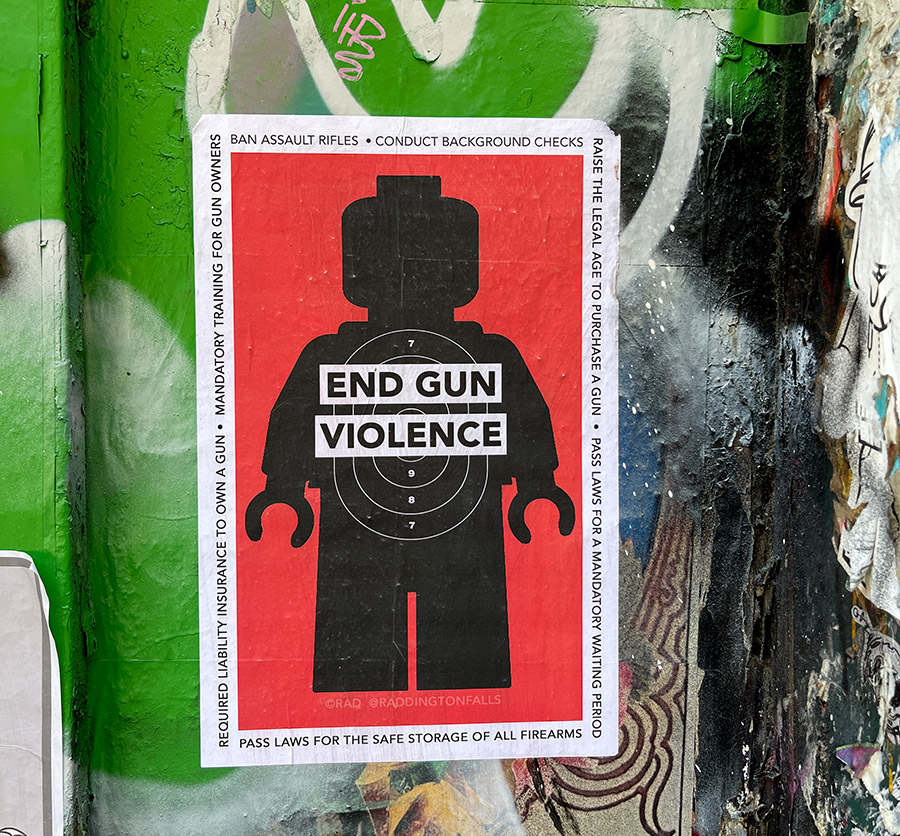
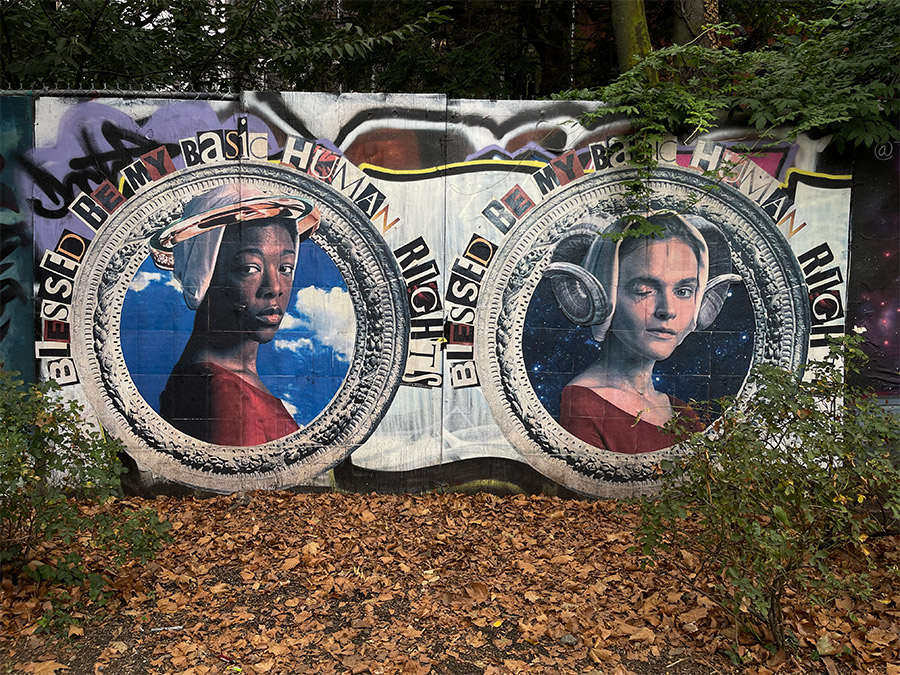
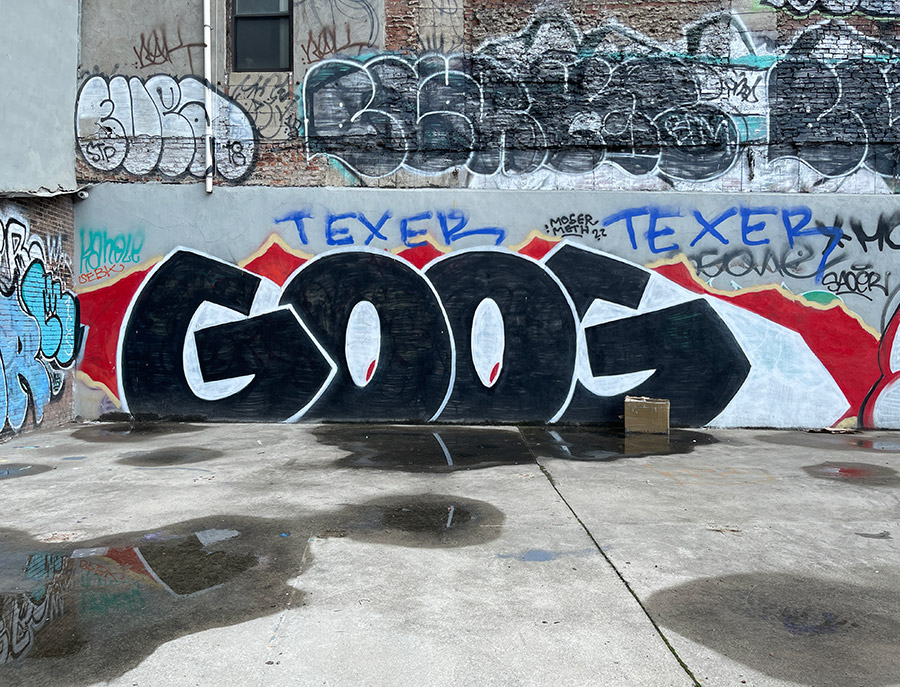
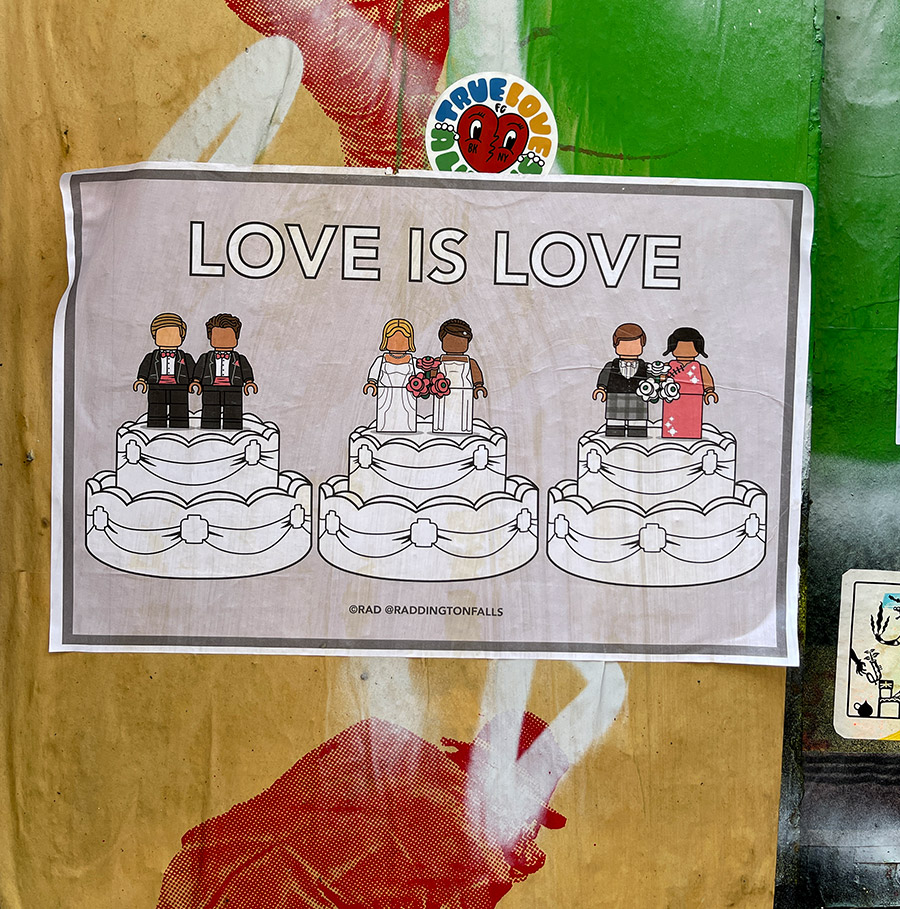
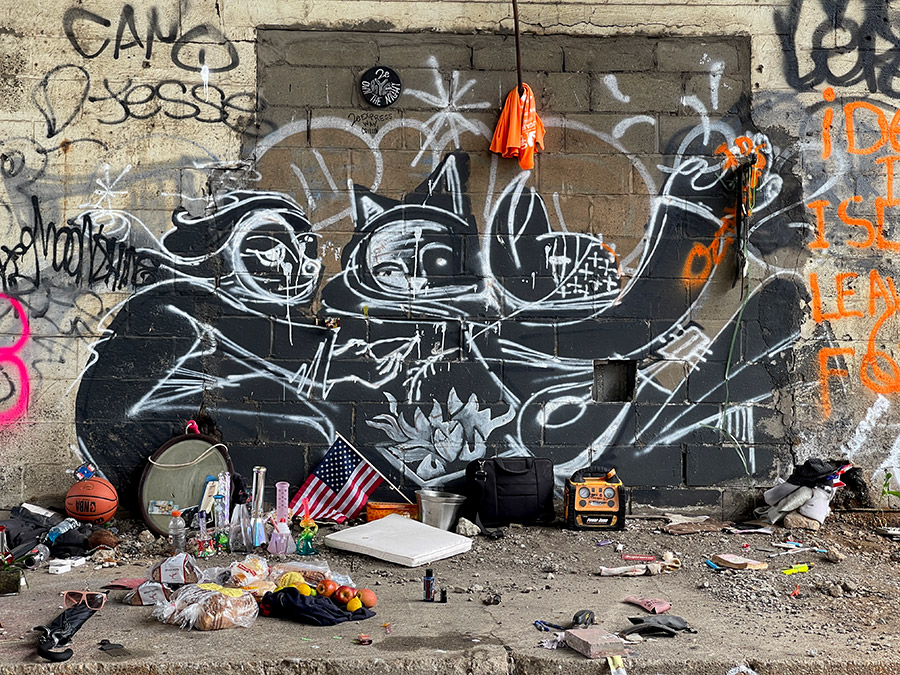
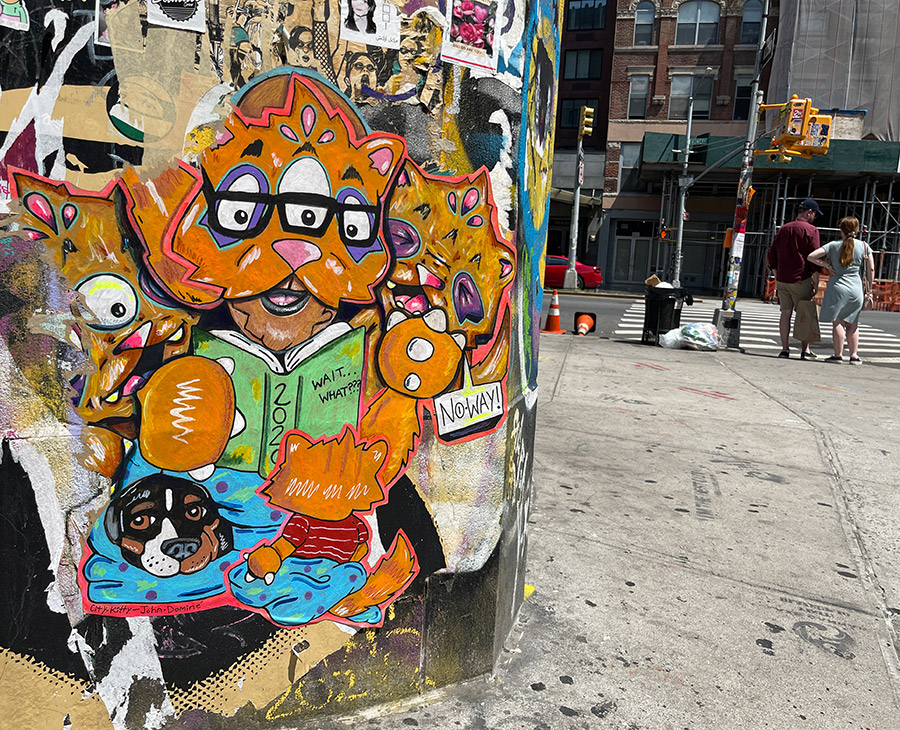
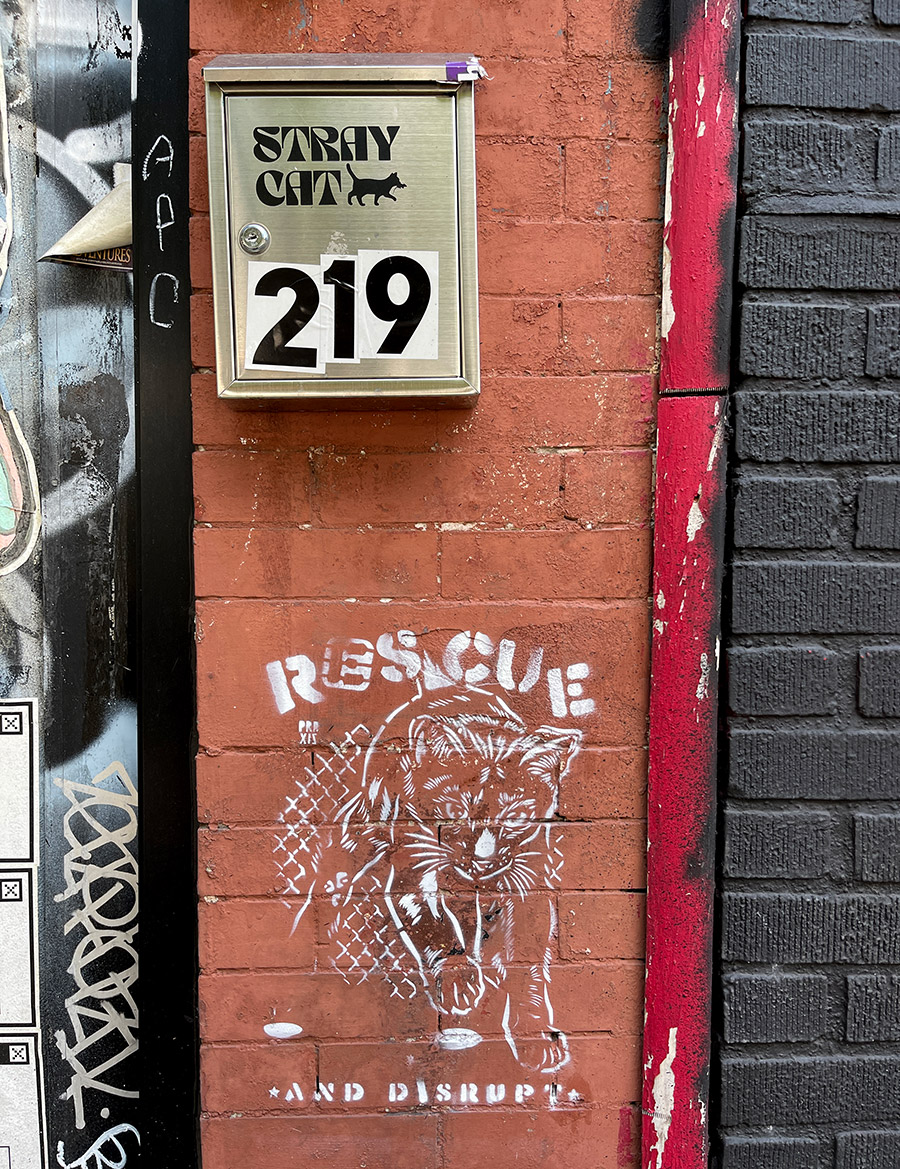
Reliably, street art plays a role in bringing up the socio-political topics that are in the public realm. This week we see artists addressing gun violence, the ongoing battle for/against legal abortion, and LGBT rights. Also, there are just a lot of fun, colorful exhortations that we may or may not understand but which tell us all that the streets of New York are alive and well.
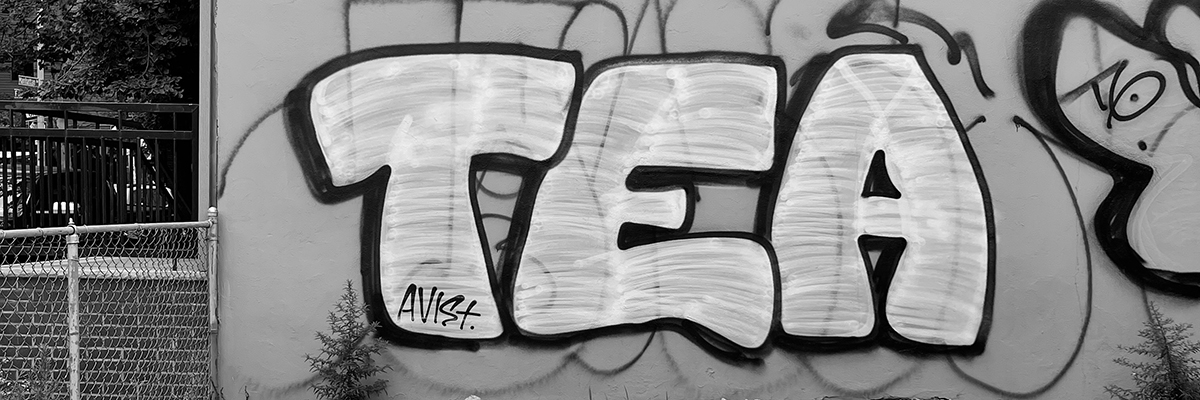
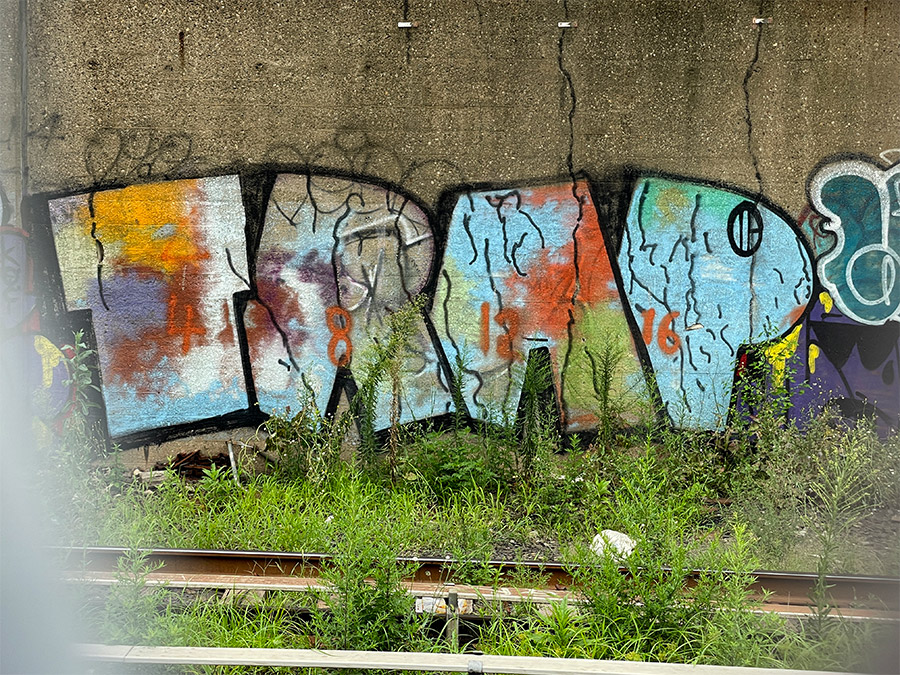
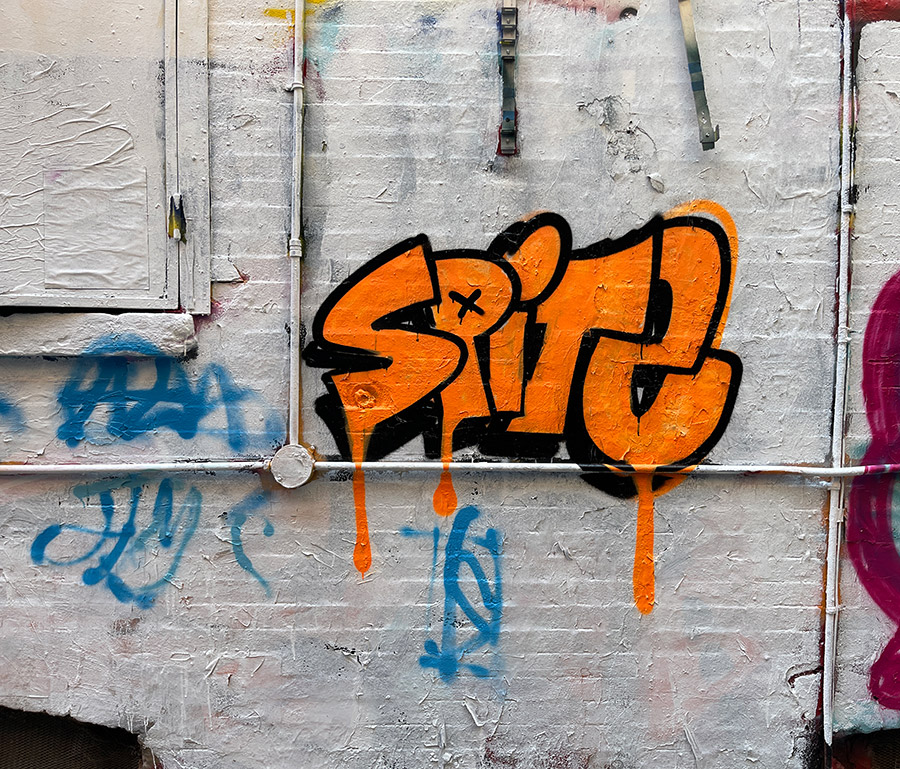
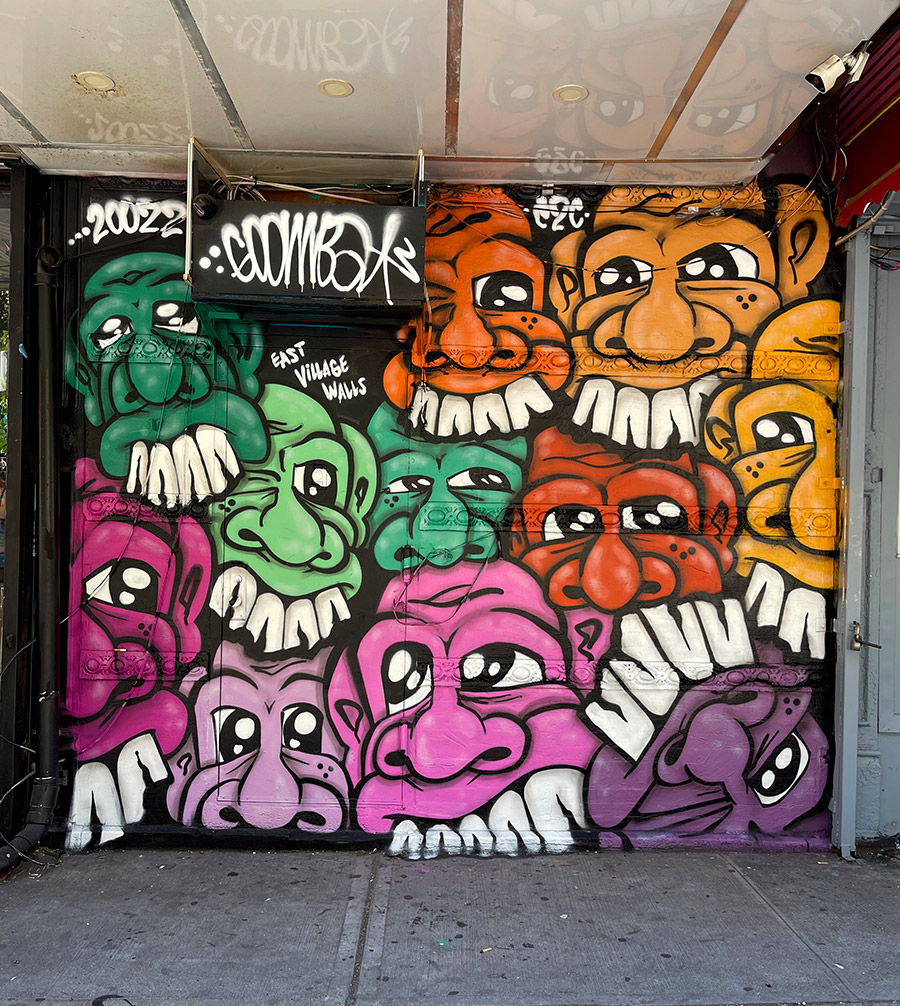
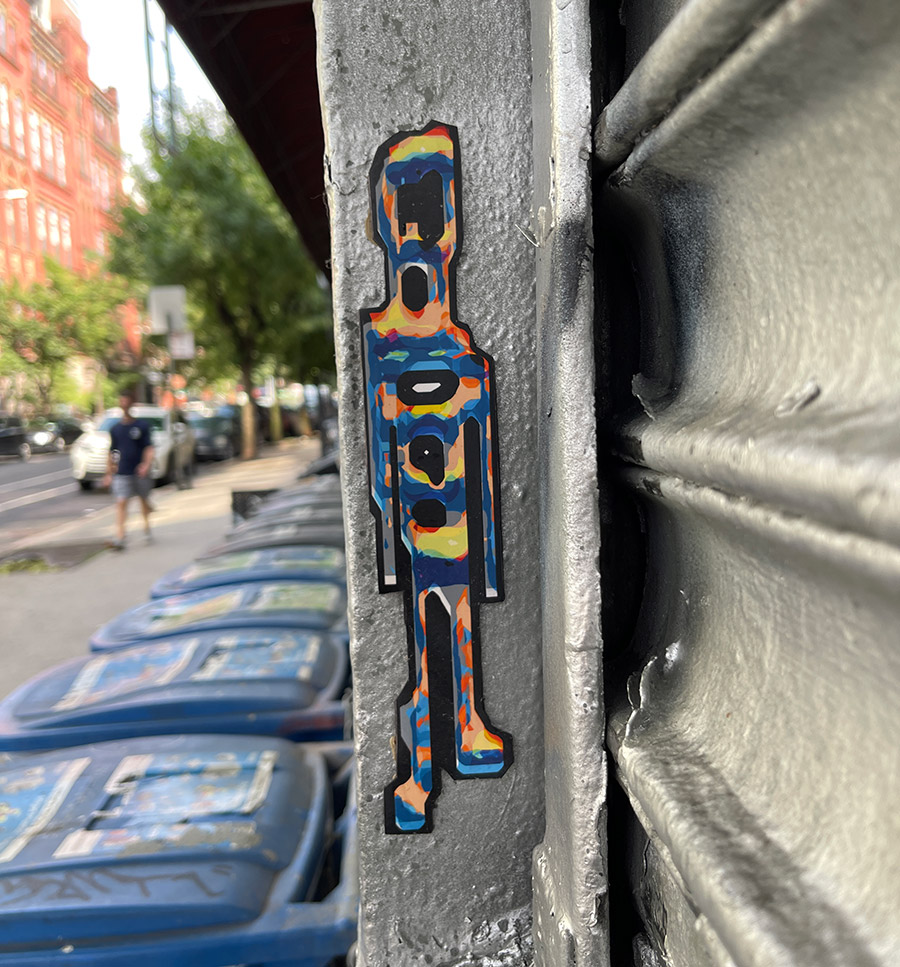
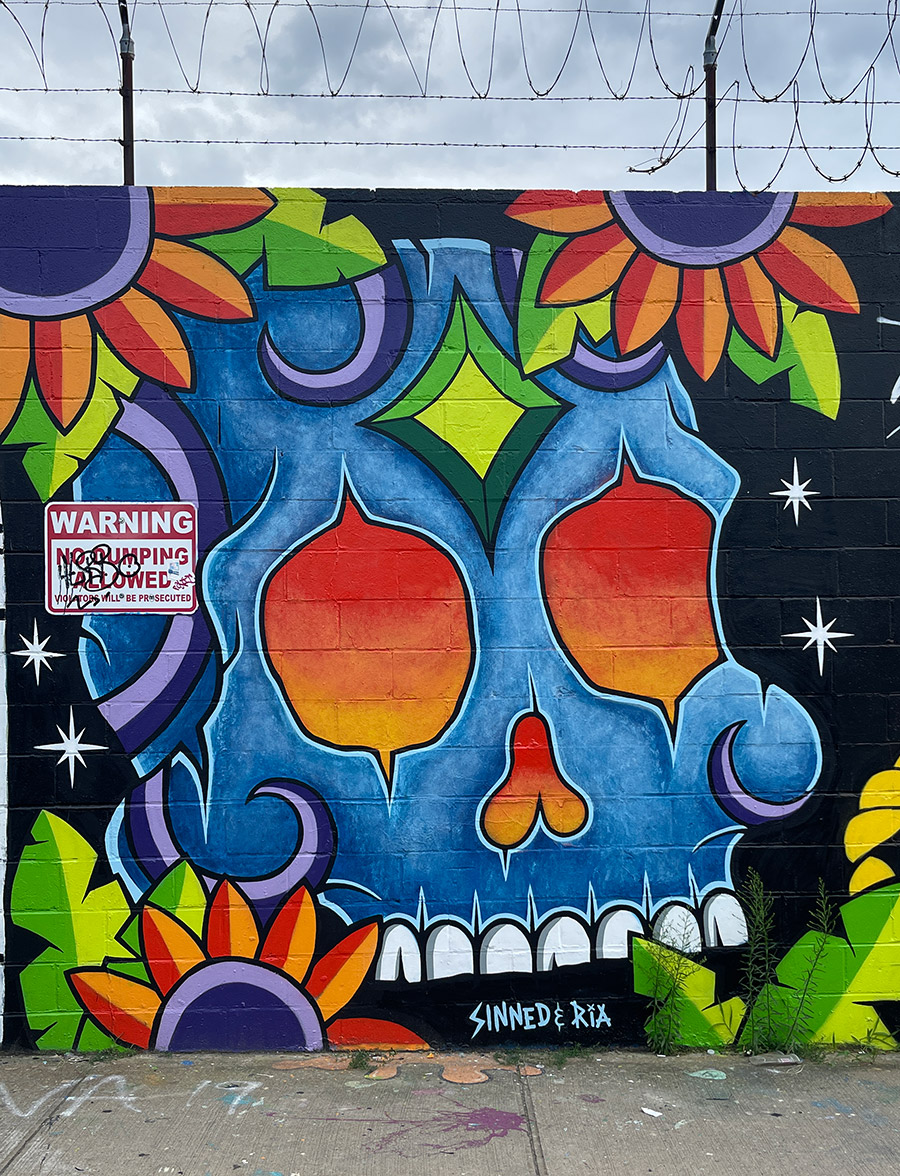
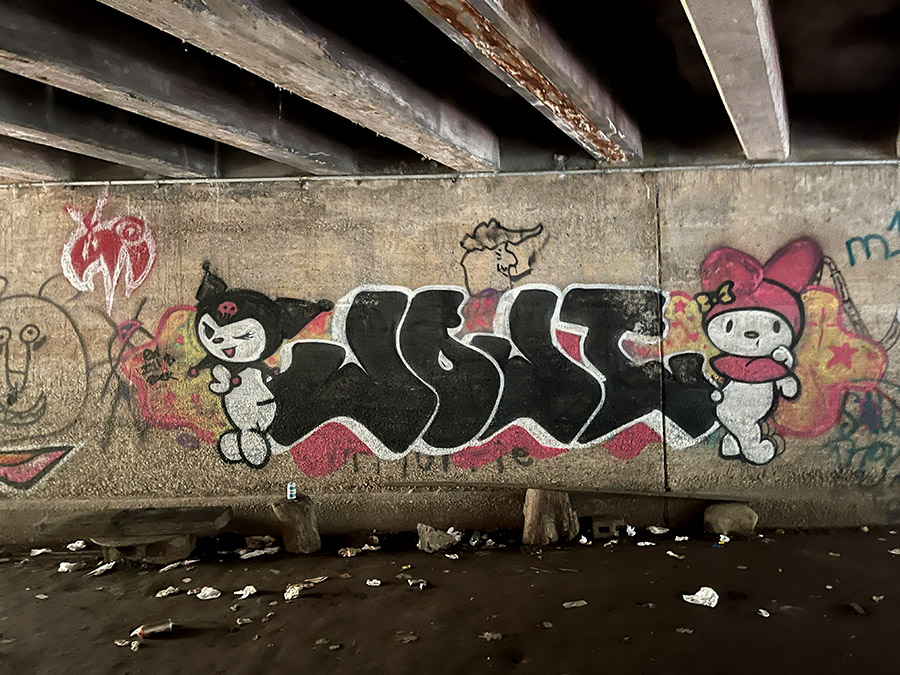
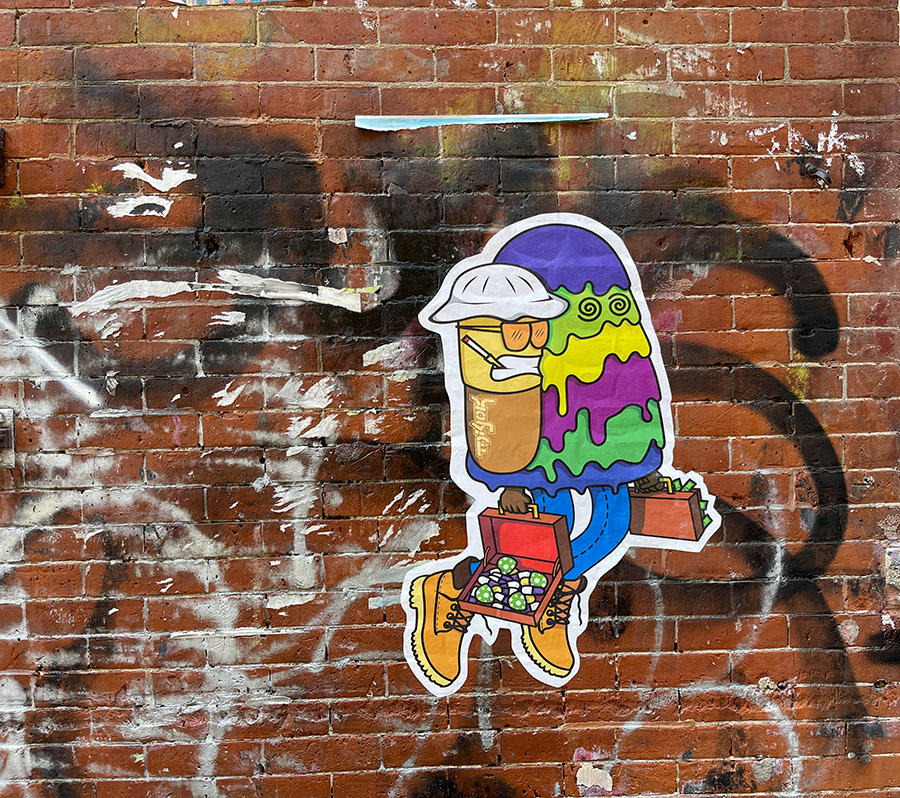
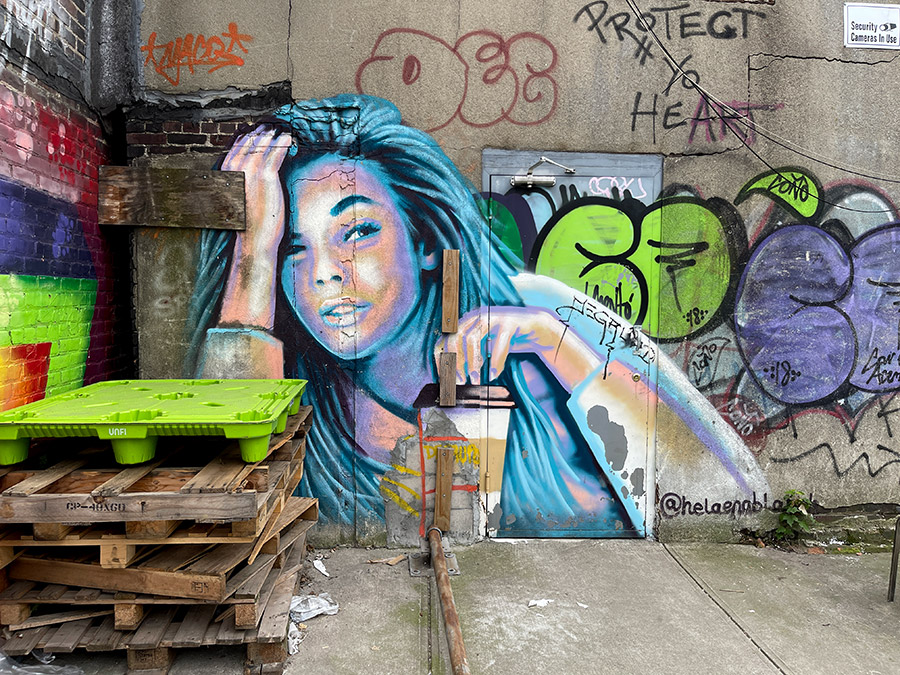
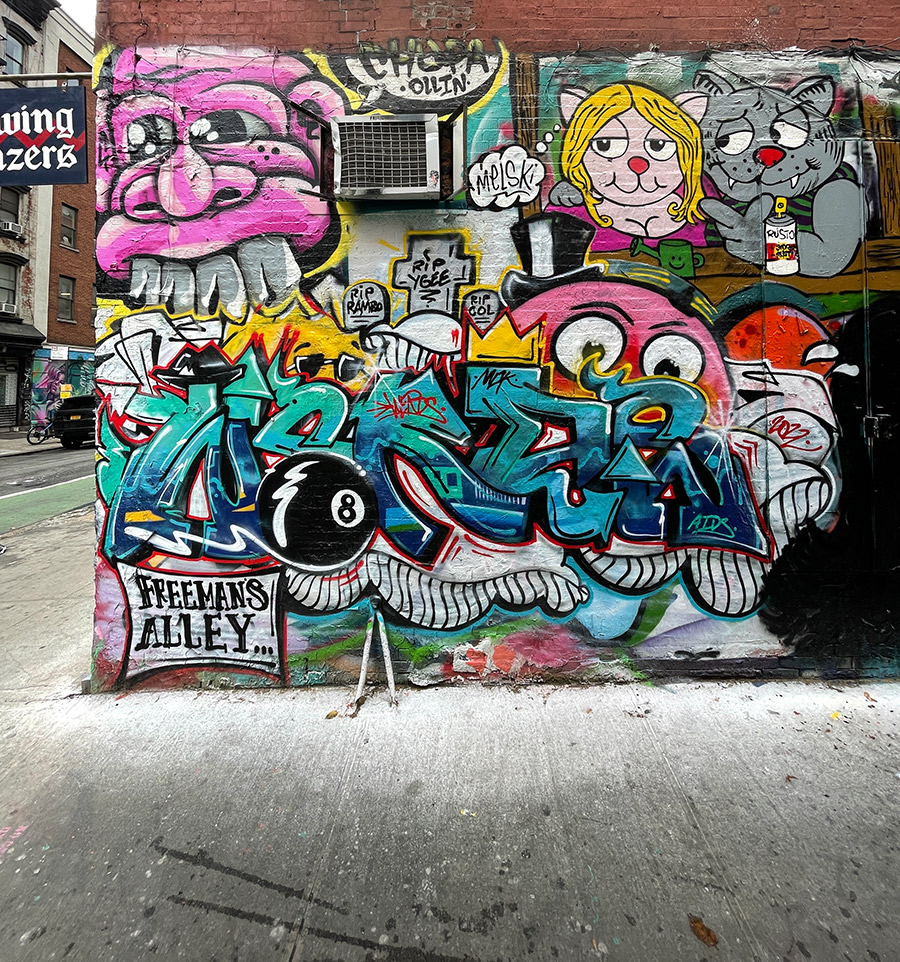
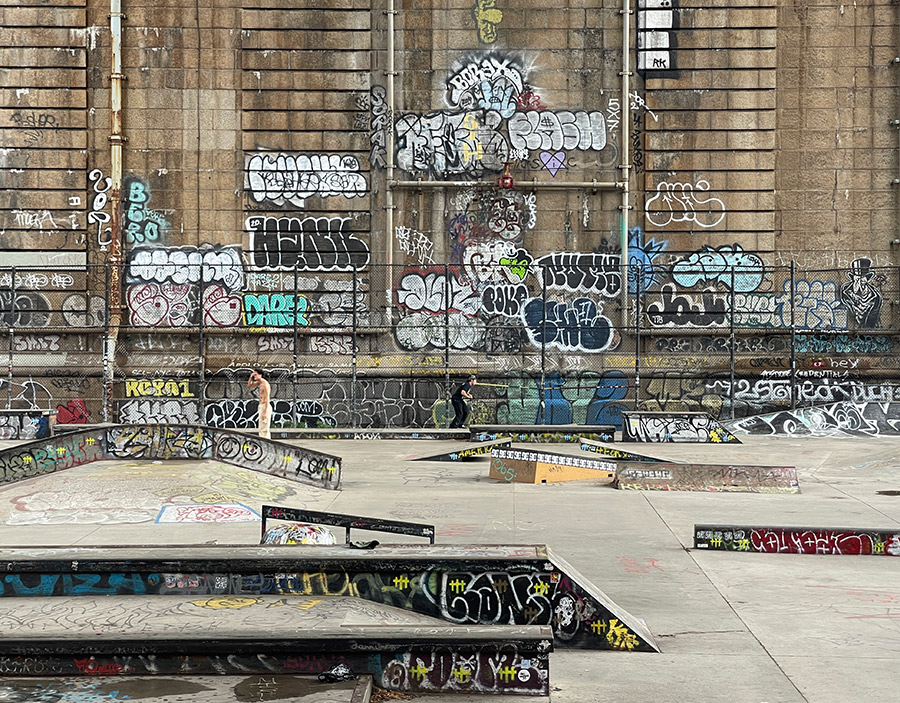
Here’s our weekly interview with the street, this week featuring: Stikman, City Kitty, Praxis, Sinned, Miyok, Trap, Spite, Tea, Goomba, John Domine, WoWi, and Helaenable.
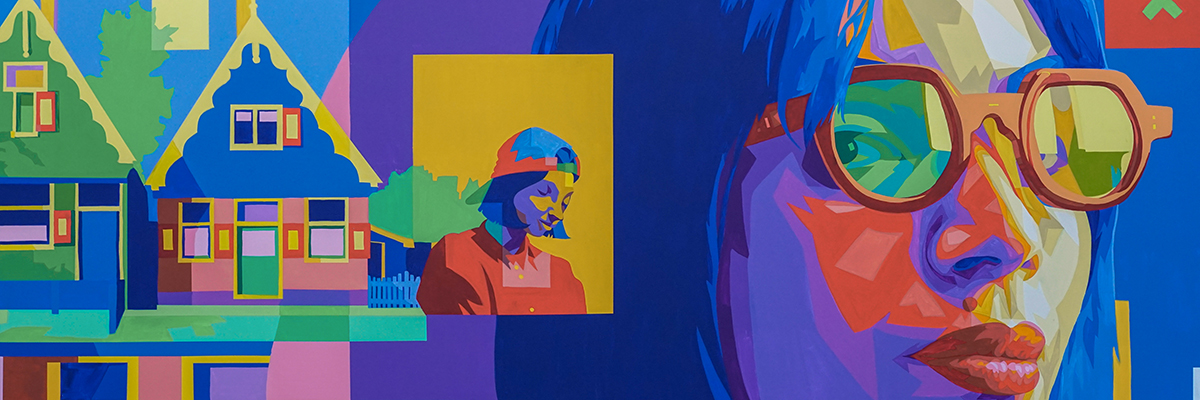
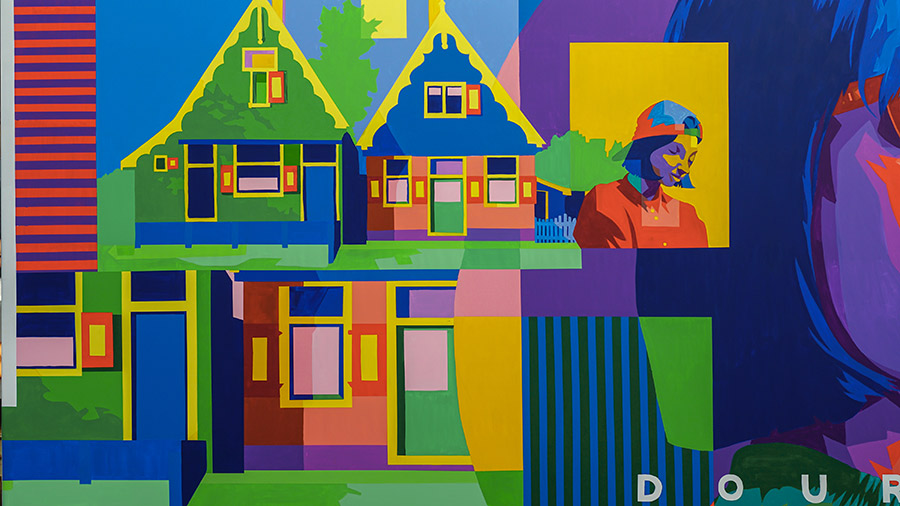
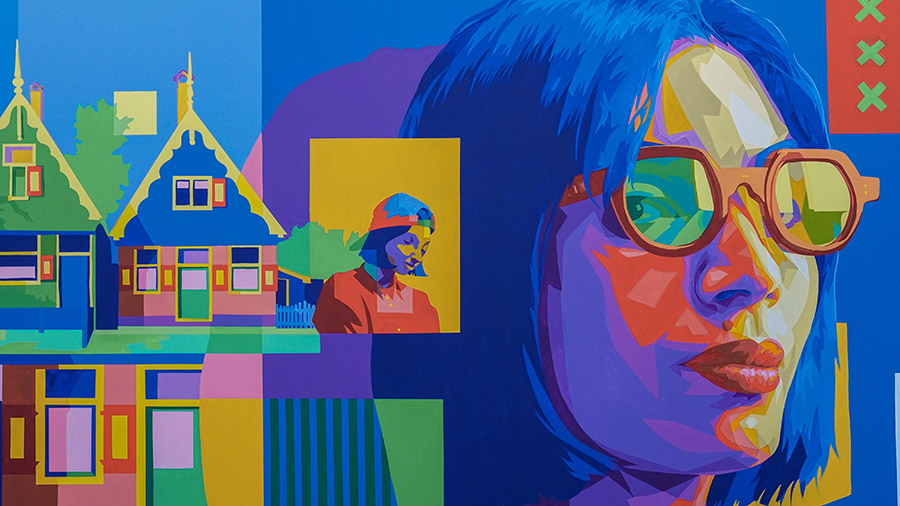
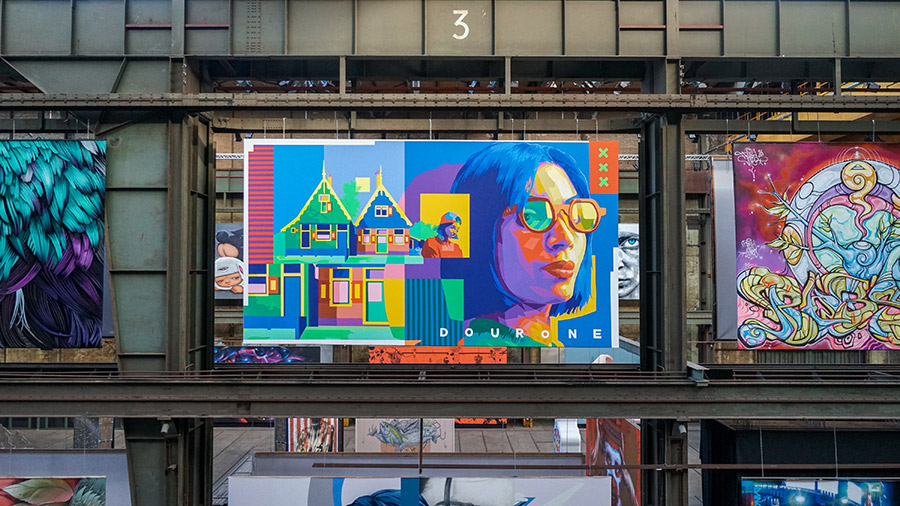
“For us, the key to a lasting relationship is based on respect and appreciating those little details that make your partner special,” say the street art duo named DourOne when talking about their new canvas called “La Pareja (the couple)”.
DourOne. “La Pareja”. Straat Museum. Amsterdam, The Netherlands. (photo courtesy of the artists)
The 6-meter by 9-meter painting is freshly hung in Amsterdam’s Straat Museum as part of an ongoing program to populate the gridded exhibition space in this massive warehouse on a former shipping dock.
Seven years after their first painting for Straat, the artist team says this one represents an evolution in their lives. “It deals with the resemblance of two people who know each other very well, coming to seem like twins in many aspects but at the same time preserving their individuality and their own personality.”
DourOne. “La Pareja”. Straat Museum. Amsterdam, The Netherlands. (photo courtesy of the artists)DourOne. “La Pareja”. Straat Museum. Amsterdam, The Netherlands. (photo courtesy of the artists)DourOne. “La Pareja”. Straat Museum. Amsterdam, The Netherlands. (photo courtesy of the artists)
Our weekly focus on the moving image and art in the streets. And other oddities.
Now screening: 1. Beyond Walls Tour 2022 – Holyoke, Colorado. Via Tost Films 2. Beyond Walls Tour 2022 – Fall River, MA 3. Spray Daily: Fisheye Storys VOL. 1
BSA Special Feature: Beyond Walls Tour 2022 – Fall River, MA and Holyoke, Colorado
A public mural campaign franchise of sorts, the Beyond Walls Tour. Nearly a cottage industry by now, mural festivals are streamlined into mural programs across towns and cities to draw interest in and perhaps spur a local financial boom while delivering cultural impact. Here today is a look at Holyoke, Colorado, and Fall River, Massachusetts as part of Beyond Walls. In the case of the 6-year campaign in Fall River, Beyond Walls appears as part of a revitalization effort that partners with public and private funds and brings in educational components and community engagement – all aligning with a goal to strengthen and build a ”Cultural Economy Plan”. Of course, none of this is possible without the artists.
Tost Films gives you a sense of the environment on the streets as artists this summer brought solid skills and vision to their work here.
Beyond Walls Tour 2022 – Holyoke, Colorado. Via Tost Films
Beyond Walls Tour 2022 – Fall River, MA. Via Tost Films
Spray Daily: Fisheye Storys VOL. 1
Returning to the roots of this democratic people’s art movement that is largely free of commercial interests, we check with some graffiti writers making their own contribution to public space.
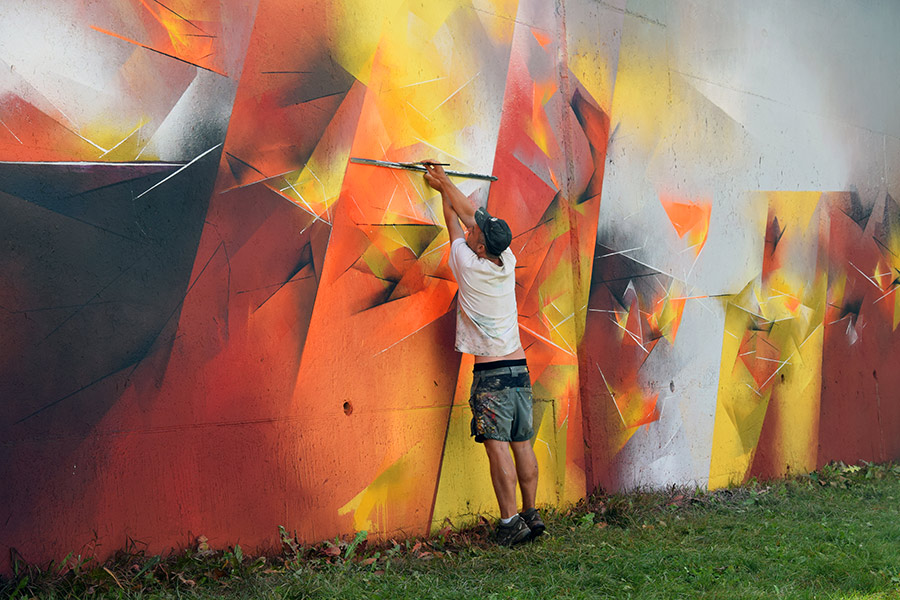
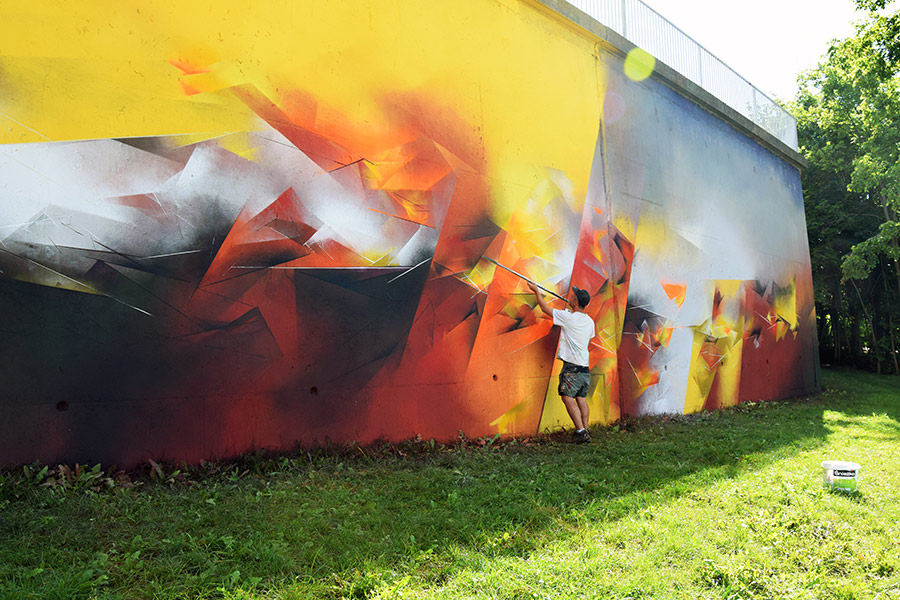
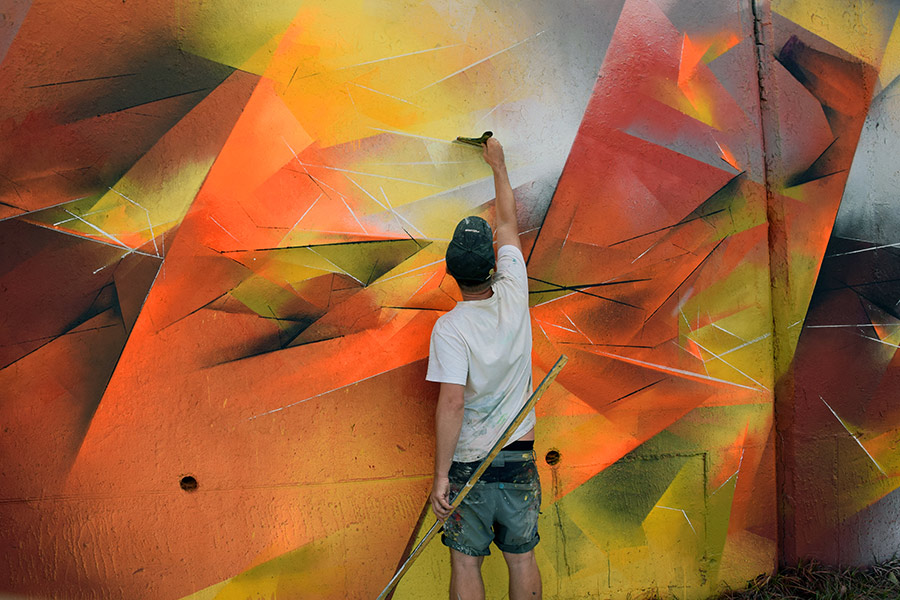
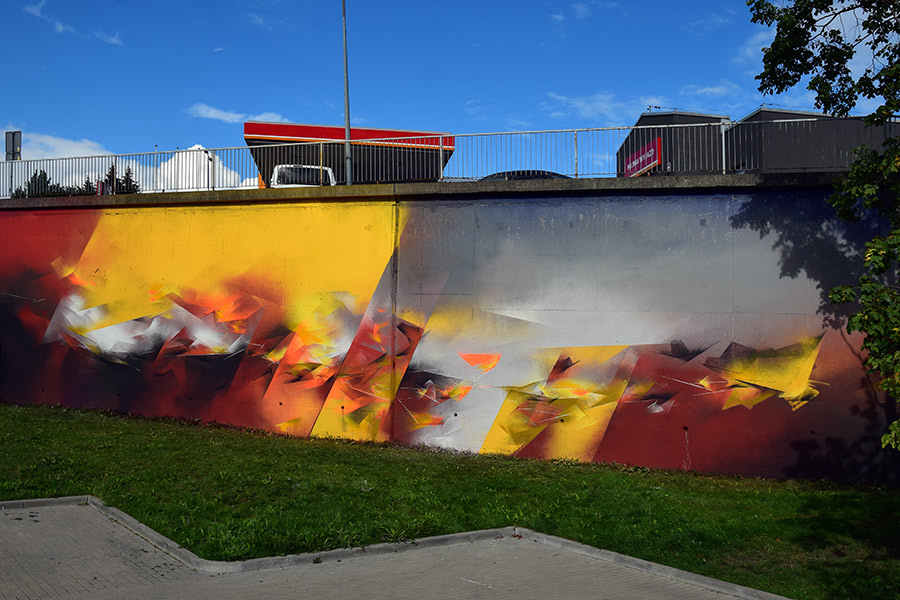
“It was always firmly hidden in a small forest,” Pener says of this wall he has been painting for the last 20 years. Like many graffiti artists who gravitate to abandoned margins of post-industrial landscapes, Pener’ discovered’ this wall and revisited it to paint, thinking it was unknown to many.
Bartek Pener Swiatecki. Light Up The Sky / 2022 / Olsztyn / Polska. (photo courtesy of the artist)
“Hardly anyone knew about her and visited her,” he says. “It was more like a private wall than a hall of fame.”
Now he has a larger audience. The property is now rehabilitated, and all that forest has been cleared. His new fiery composition rages with the summer heat, bringing to mind the fires that rage over parts of the earth this time of year. When winter’s severity keeps everyone inside again, and it will, Pener’s summer heat may appear as a dream.
The wall has opened up many possibilities for the street artist/studio artist. While he’s happy to exhibit his work here, you can tell he longs for the quiet solitude of his formerly secreted location. “Very interesting how its perception changes. It’s like a new opening,” he says. “I can’t get used to it all the time.”
Bartek Pener Swiatecki. Light Up The Sky / 2022 / Olsztyn / Polska. (photo courtesy of the artist)Bartek Pener Swiatecki. Light Up The Sky / 2022 / Olsztyn / Polska. (photo courtesy of the artist)Bartek Pener Swiatecki. Light Up The Sky / 2022 / Olsztyn / Polska. (photo courtesy of the artist)Bartek Pener Swiatecki. Light Up The Sky / 2022 / Olsztyn / Polska. (photo courtesy of the artist)
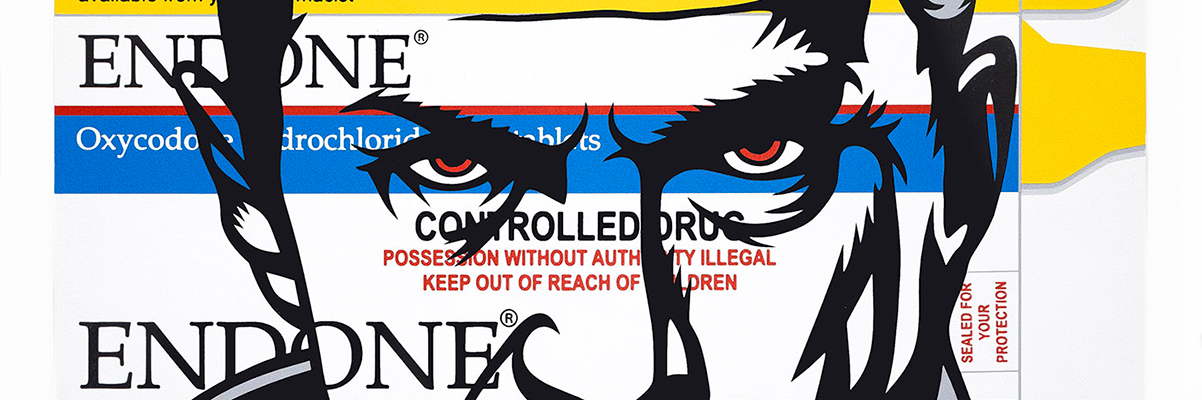
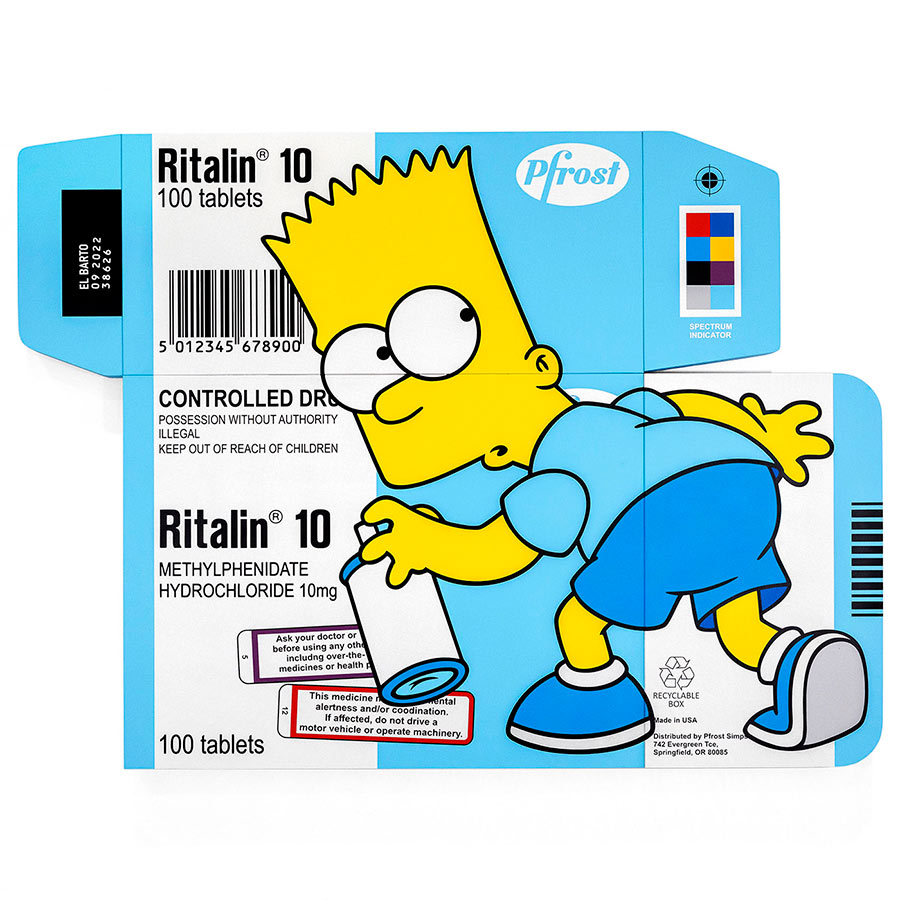
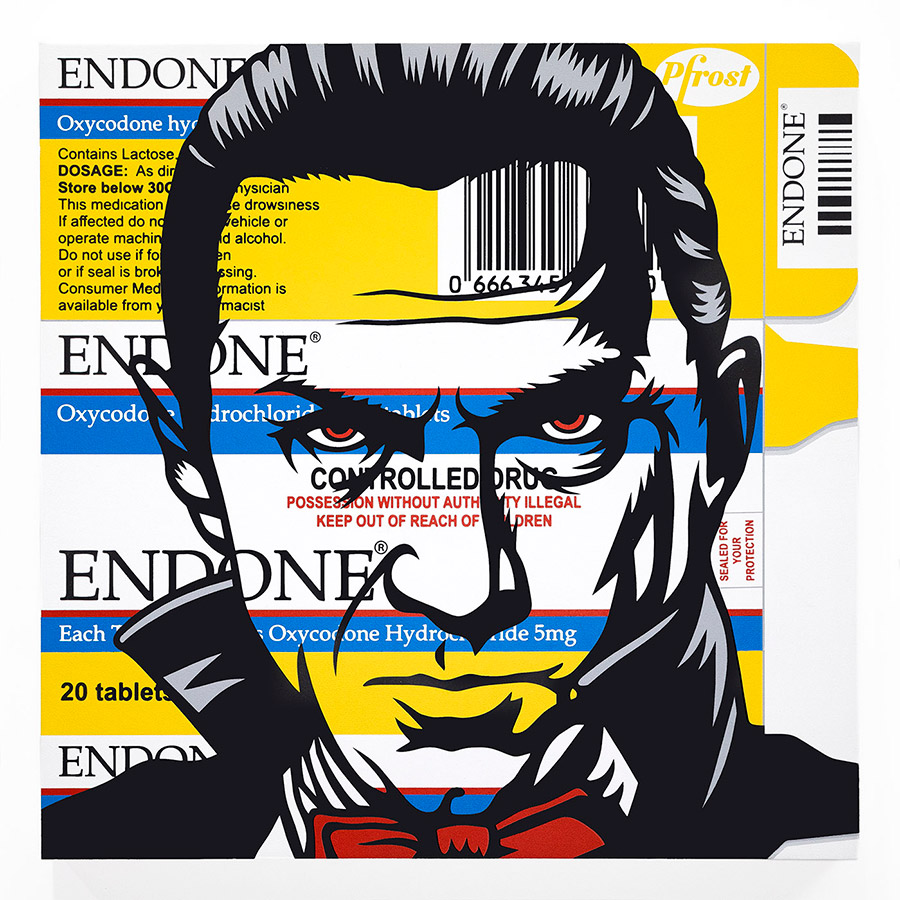
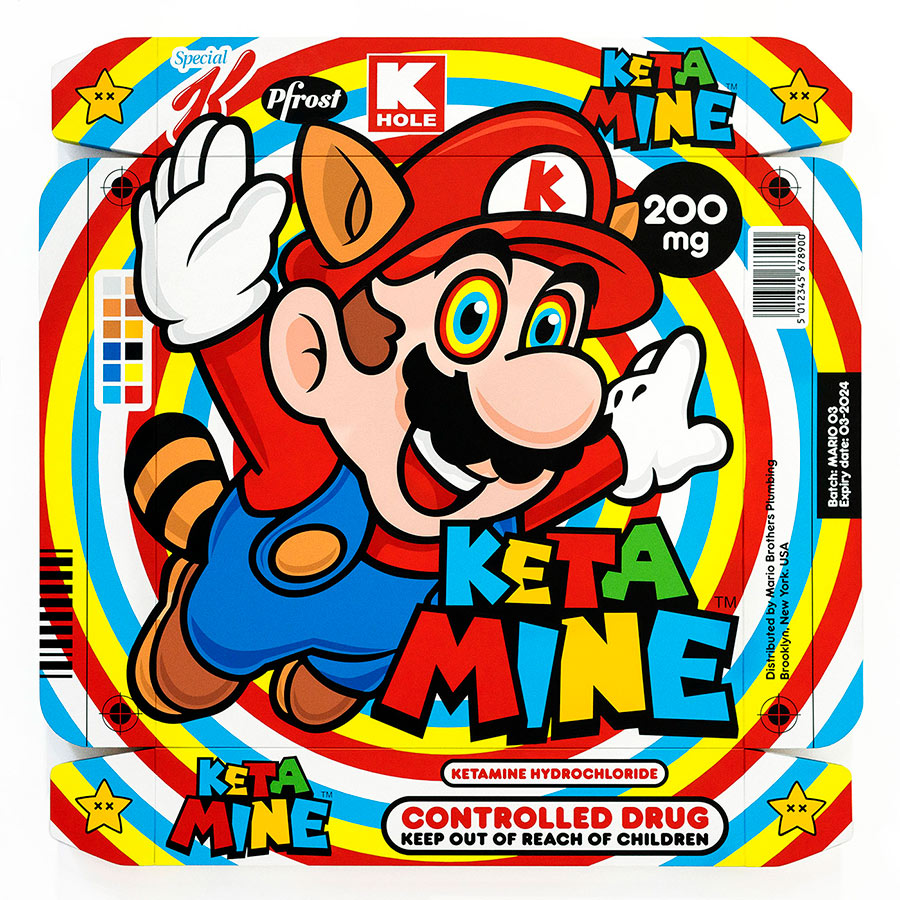
One may not know what name the Diagnostic and Statistical Manual of Mental Disorders (DSM-5) would give to Ben Frost’s obsession with pharmaceutical boxes. Indeed, there is surely a medication proscribed for something like this.
Ben Frost. Bart On Ritalin. Corey Helford Gallery. Los Angeles, CA. (photo courtesy of the gallery)
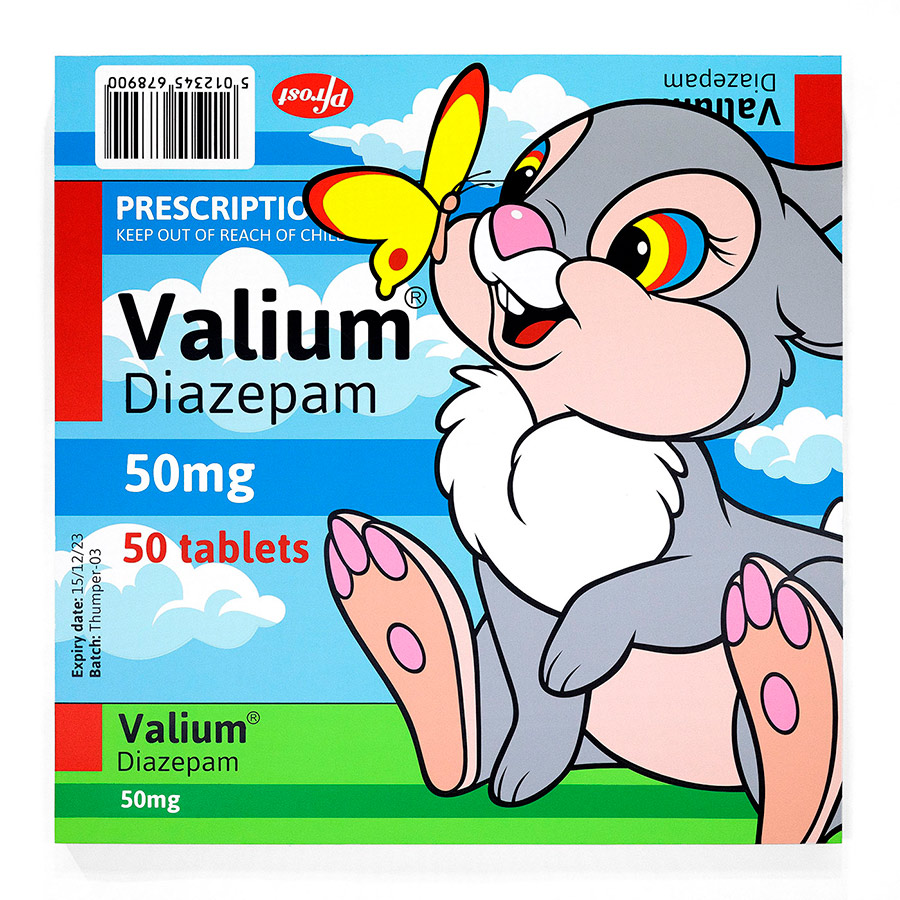
Frost’s view is a subversive and brightly provocative look of going off-brand if you will. “Super Mario flies high through a k-hole, Fred Flintstone and Grogu pass joints, and it’s revealed what kind of ‘power pills’ Pac-Man is really gobbling,” says the press release from the Melbourne-based street artist/studio artist.
Ben Frost. 50mg Thumper. Corey Helford Gallery. Los Angeles, CA. (photo courtesy of the gallery)
“Friends in High Places is both a satirical critique of consumer culture and a begrudging celebration of it,” says Frost. “Blurring the lines between the visceral and addictive experience of drug use with the seductive products of consumerism, the exhibition explores our love/hate relationship with these products and the characters who sell them to us.”
Opening at LA’s Corey Helford Gallery next week, the new exhibition closely follows another pop-inspired graphic artist, D*Face, whose skewering of commercial culture is perhaps more subconscious, tinged with sadness. That would require a slightly different diagnosis and prescription.
Ben Frost. Once Bitten. Corey Helford Gallery. Los Angeles, CA. (photo courtesy of the gallery)Ben Frost. Piggy Channel. Corey Helford Gallery. Los Angeles, CA. (photo courtesy of the gallery)Ben Frost. Mc Chungus. Corey Helford Gallery. Los Angeles, CA. (photo courtesy of the gallery)Ben Frost. Super K Mario. Corey Helford Gallery. Los Angeles, CA. (photo courtesy of the gallery)
Ben Frost. Friends in High Places, opening at Los Angeles’ Corey Helford Gallery(CHG) on Saturday, September 17th. Los Angeles, CA.
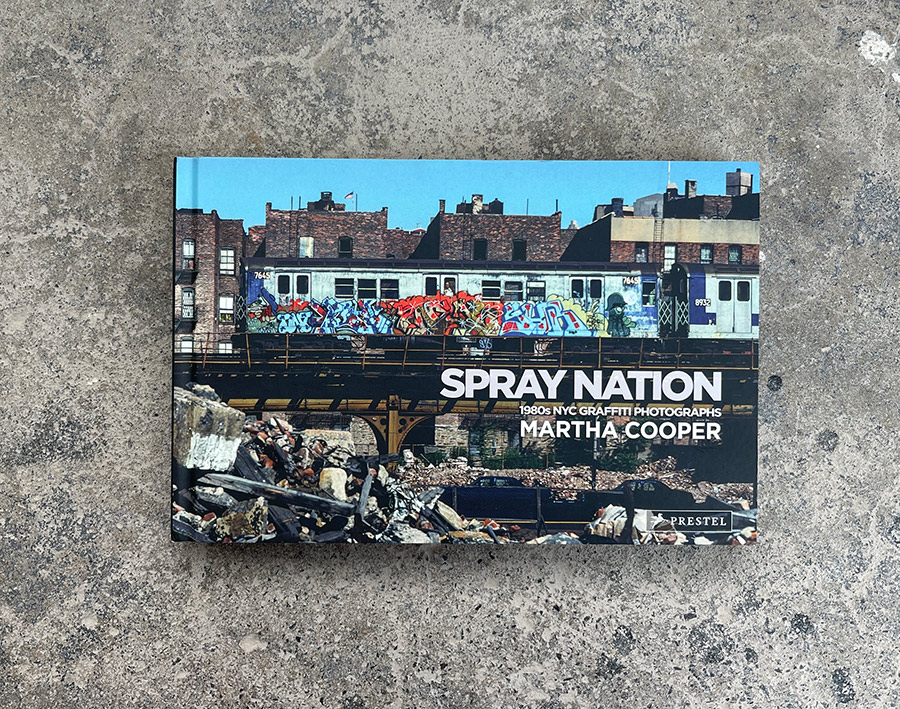
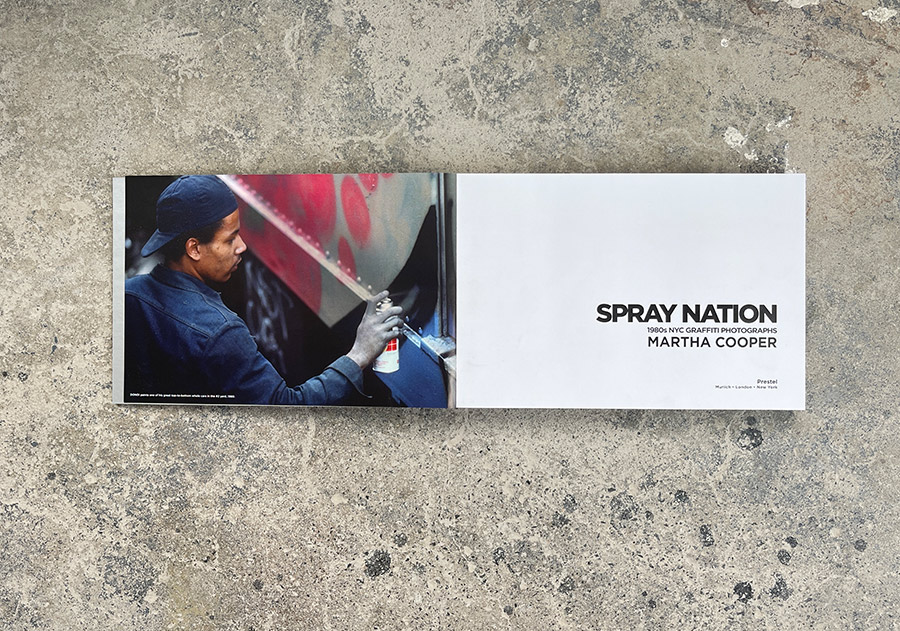
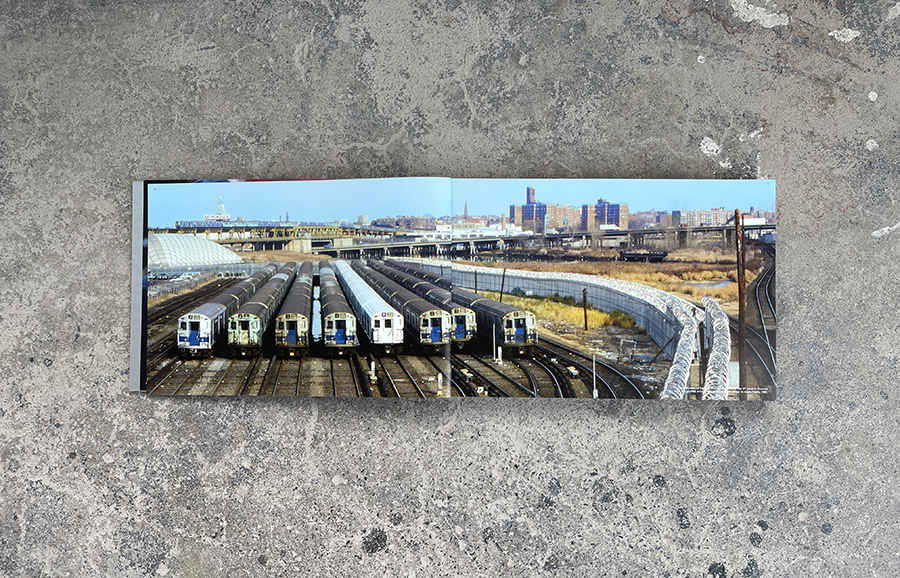
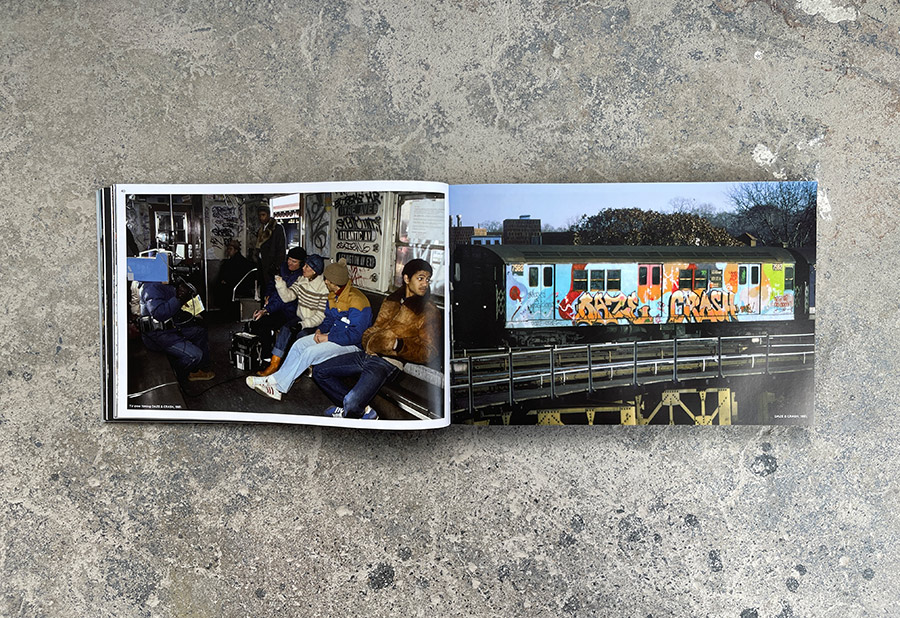
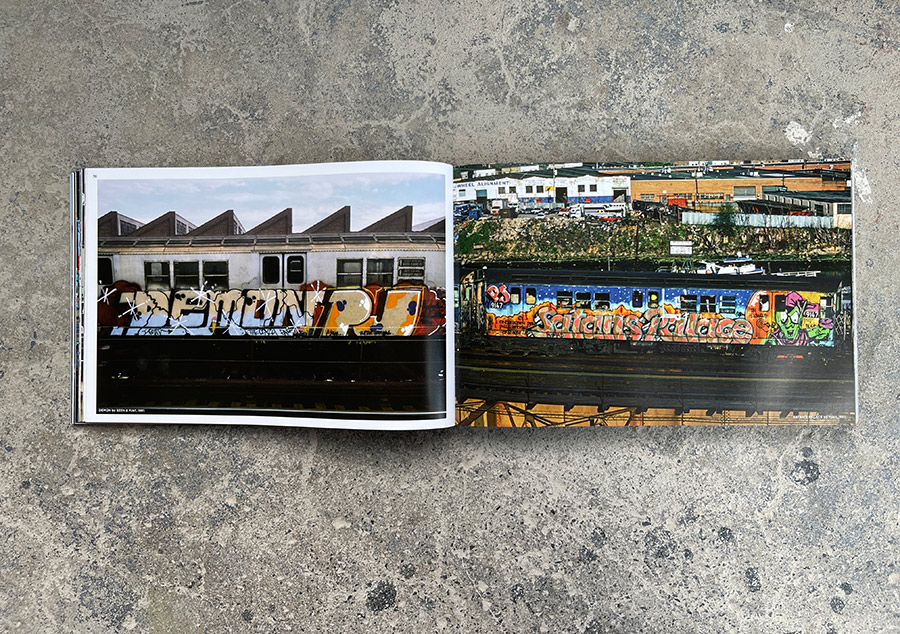
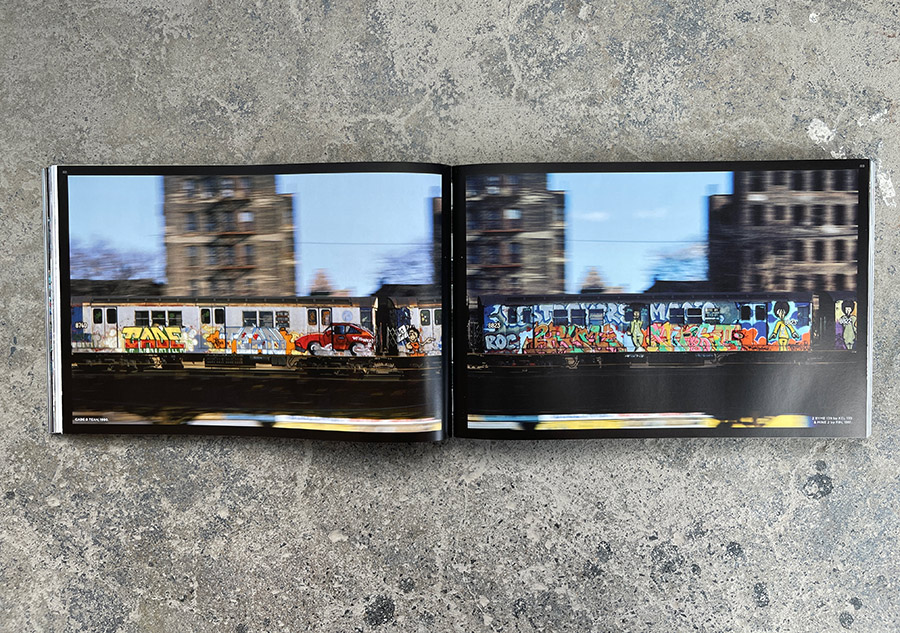
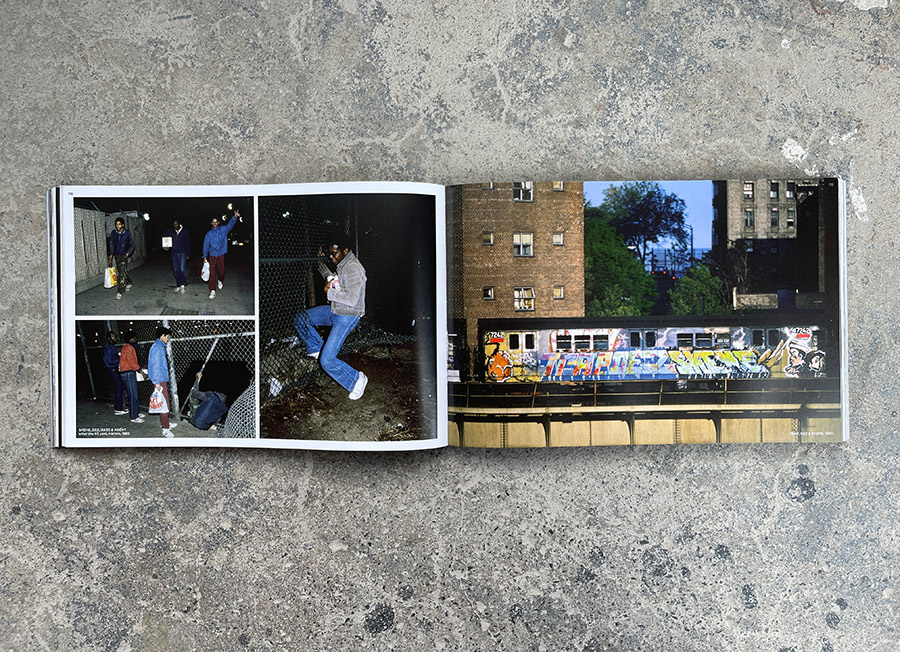
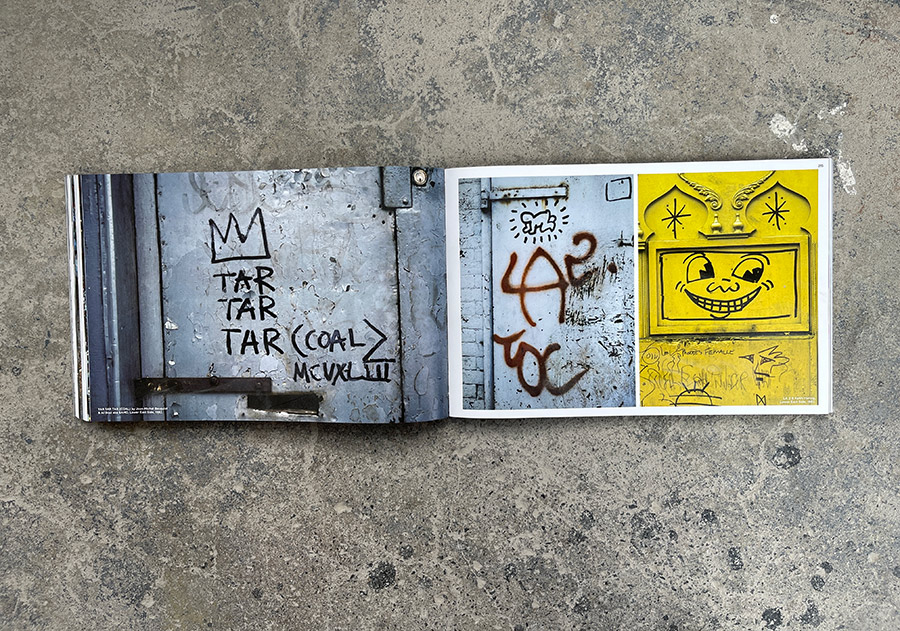
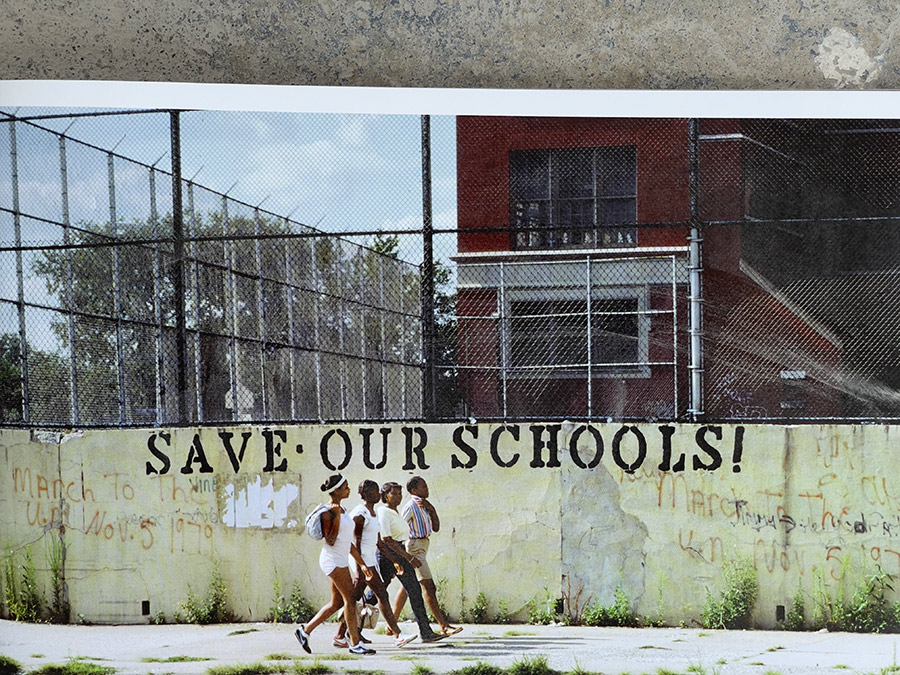
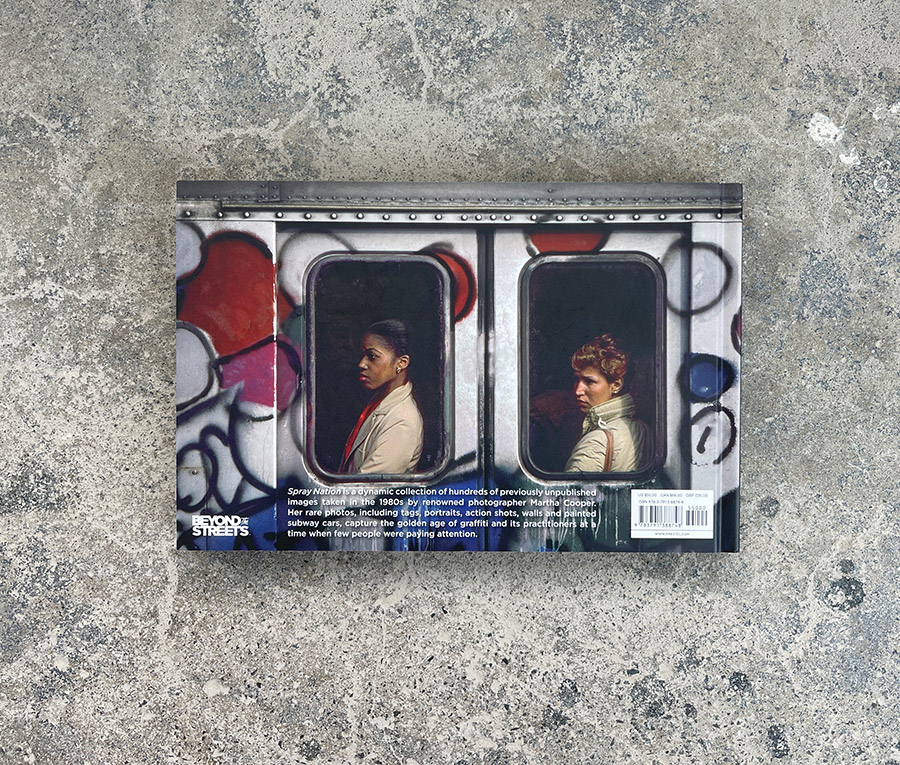
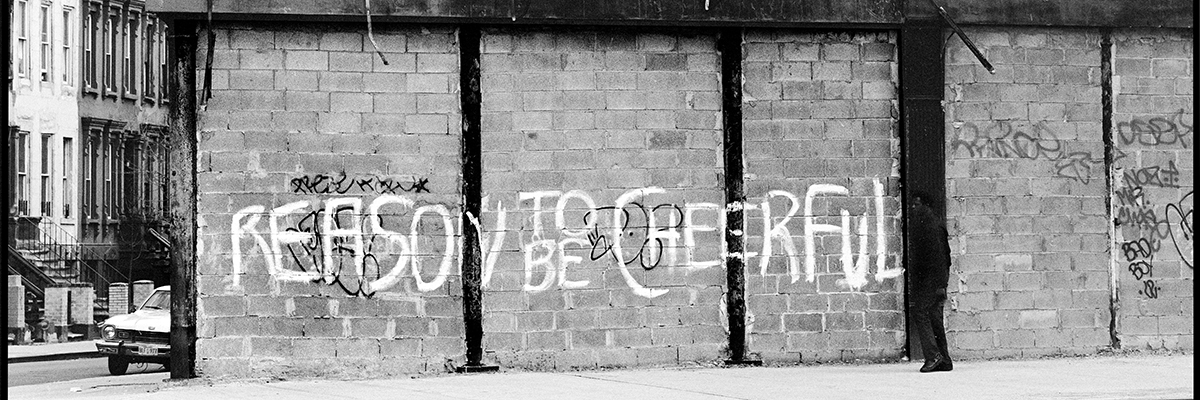
One of the exciting book releases this fall drops today in stores across the country – which is appropriate with a name like Spray Nation.
Martha Cooper. SPRAY NATION 1980s Graffiti Photographs. Edited by Roger Gastman. Prestel. Germany, 2022.
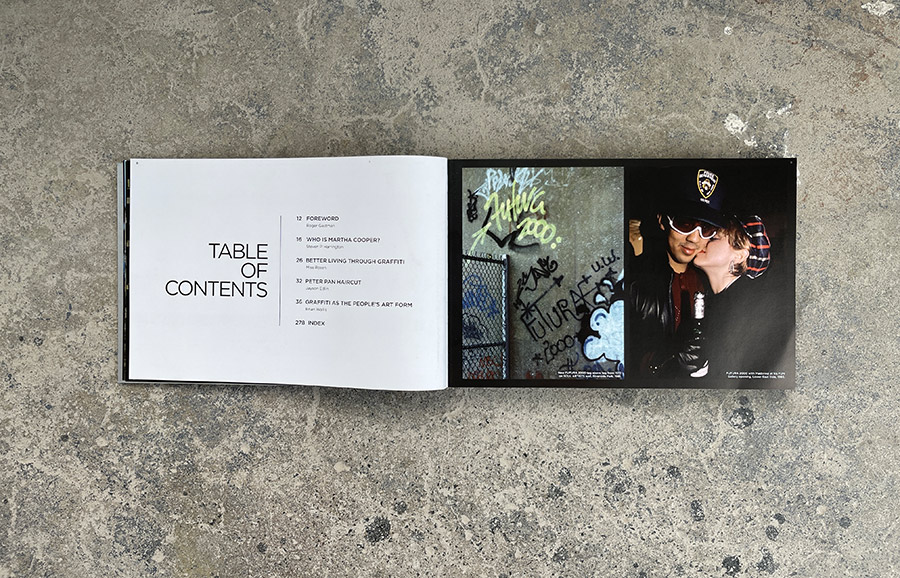
The centerpiece of the complete boxed set released this spring, this thick brick of graffiti tricks will end up on as many shelves as Subway Art; the book of Genesis that prepared everyone for the global scene of graffiti and street art that would unveil itself for decades afterward. See our review from earlier in the year, and sample some of the stunning spreads here, along with quotes by the book’s essay writers, Roger Gastman, Steven P. Harrington, Miss Rosen, Jayson Edlin, and Brian Wallis.
“Culled from thousands of her Kodachrome slides from the early 1980s, the celebrated photographer and ethnologist worked with American graffiti historian Roger Gastman over many months during the initial Covid period to select this rich collection of images of tags, walls, and pieces. Each turn of the page more profoundly deepens your understanding of the graffiti-writing culture Cooper captured with Henry Chalfant in their book Subway Art nearly forty years ago. That clarion call to a worldwide audience took years to reverberate and shake culture everywhere. With time that book became the standard root documentation for what many see as the largest global democratic people’s art movement in history.”
“To create Spray Nation, Cooper, and editor Roger Gastman pored through hundreds of thousands of 35mm Kodachrome slides, painstakingly selecting and digitizing them. The photos range from obscure tags to portraits, action shots, walls, and painted subway cars. They are accompanied by heartfelt essays celebrating Cooper’s drive, spirit, and singular vision. The images capture a gritty New York era that is gone forever.”
~ Prestel Publishing
“Martha’s photos have backed up graffiti writers’ tall tales more times than I can count. They’re like this crazy high school yearbook. As a result, Cooper is who every graffiti writer, fan, collector, and researcher wants to come and see. Most of them have not had the privilege of going to her studio and seeing the great amount of work she has amassed over the years – it’s truly awe inspiring. But every so often she pulls out yet another gem where we all scratch our heads and think, “Oh shit, what else is Martha holding?”
Roger Gastman, from the Foreward of Spray Nation
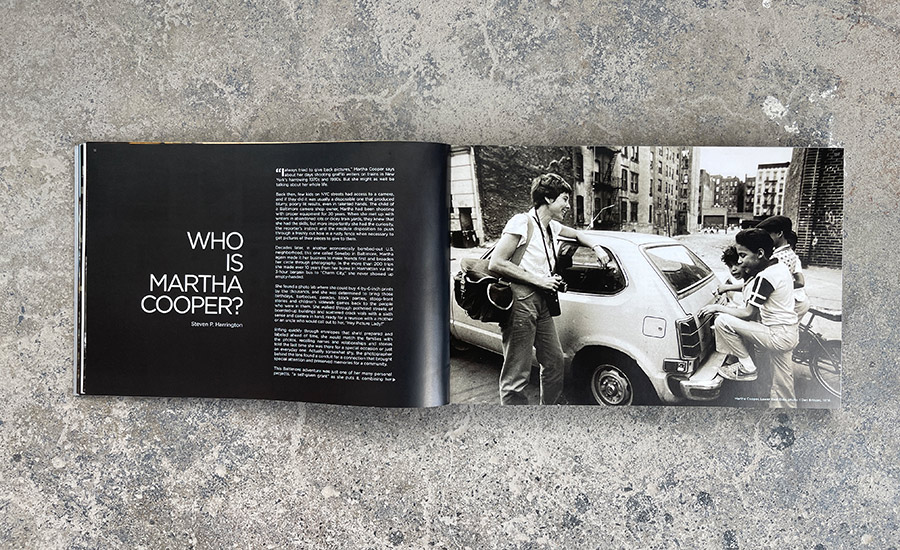
“‘If you want to publish your work, you cannot be ahead of or behind your time,’ she says as she reflects on an impeccable sense for capturing the birth of scenes like graffiti, hip-hop, and b-boying. ‘I was lucky to be at the right place and time.’”
“Martha is heralded today for capturing those trains and scenes along with Henry Chalfant in the seminal graffiti holy book Subwav Art, but few appreciate how painfully ahead of their time they were at that point.”
~ Steven P. Harrington, from Who is Martha Cooper?
“With a single snap of the shutter, Martha Cooper captured the searing rush of seeing a whole car make its debut on the line after being painted all night. You can all but hear the train thunder along the tracks and feel the ground rumble beneath your feet while a gust of wind hits your face. Is that the smell of spray paint?”
~ Miss Rosen, from Better Living Through Graffiti
“Martha took pictures of painted trains and b-boys because few bothered to at that time. Once people caught on, she considered her task completed. Martha followed the paint trail as it rose above ground. QUiK and IZ on the streets with Scharf and Hambleton. Madonna clubbing with Basquiat, Patti Astor with DONDI and FAB 5 FREDDY. Subway graffiti gradually died, street art rising from its ashes. Disinterest, drugs and AIDS decimated NYC’s cultural apex, its brightest stars perishing before their work hit the seven-figure mark – lives as ephemeral as our pieces on the train. These fleeting moments of births, peaks, and deaths live in perpetuity thanks to the foresight of Martha Cooper and a handful of others who tracked cool’s scent like underground bloodhounds.”
Jayson Edlin, from Peter Pan Haircut
“In a sense, Cooper’s photography picks up on the New Documentary approach of the early 1970s, in which independent photographers such as Larry Clark, Susan Meiselas, Jill Freedman, Mary Ellen Mark, and Danny Lyon recorded insider’s views of various closed societies of outsiders, social groups and “others” shoved aside by postwar American society in thrall to consumerism. The alienated drug users, prisoners, bikers, and prostitutes that those photographers lived among and depicted were largely invisible and had been further marginalized in America by class, race and gender prejudices. In a similar vein, Cooper sought to expose and legitimize the young subway writers as earnest and mildly rebellious artists with a purpose and a rational aesthetic agenda, rather than as the lawless urban vandals the police and the media sought to represent.”
~ Brian Wallis, from Graffiti As The People’s Art Form
Martha Cooper. SPRAY NATION 1980s Graffiti Photographs. Edited by Roger Gastman. Prestel. Germany, 2022.
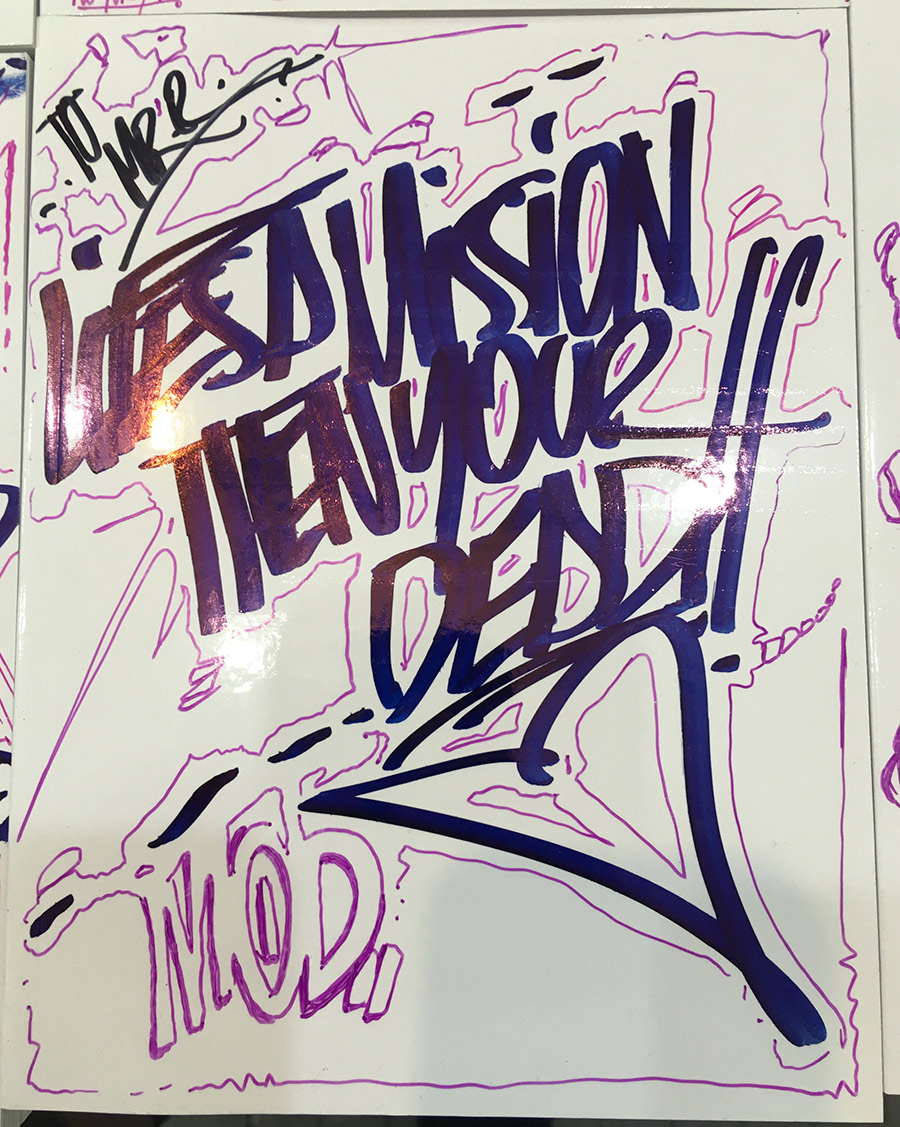
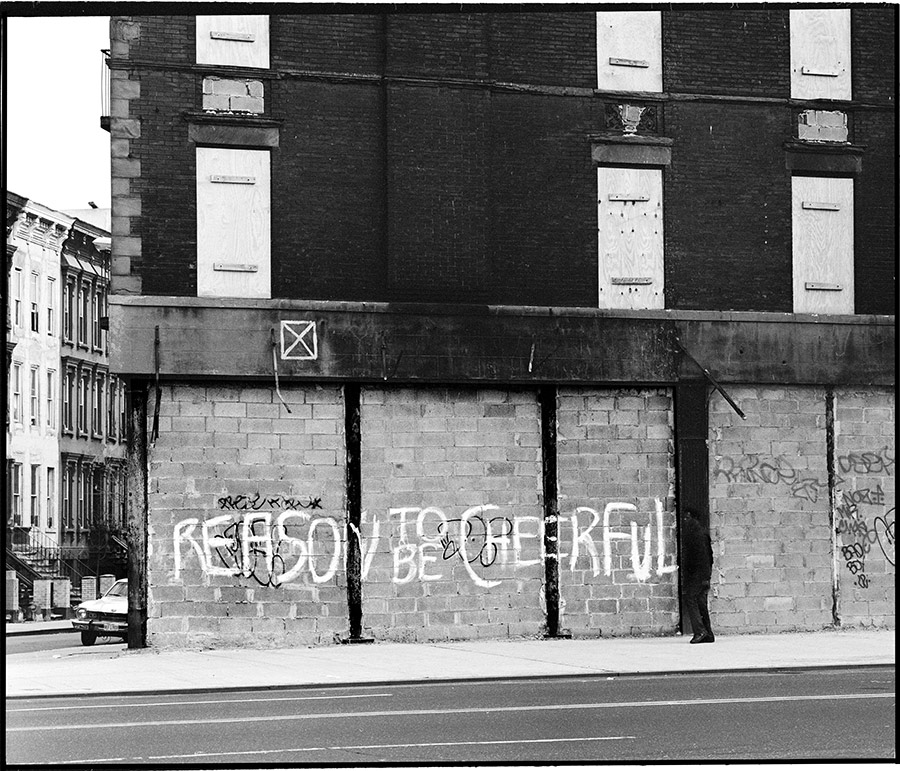
Famed graffiti writer REVS detailed many an illegal ‘mission’ in his first self-published opus – the caveat is you needed to go underground in the New York subway tunnels to read about them. That was a few decades ago but even today when certain train lines are stalled between stations, which happens less frequently than it did in the ragged wild 1970-80s when many New York graffiti writers like REVS began, passengers can look out the window and read a portion of a diary entry. Over time people searching for these works discovered that this artist turned out to be a writer in more than one sense with his self-aware observations, opinions, memories, and aspirations inscribed in a personal/public voice along darkened subterranean passageways. Prolific and determined, he is credited with eventually some 230+ entries on walls that appeared during the late 1990s and early 2000s. Each are now a series of moments frozen in time, receding into New York and graffiti history.
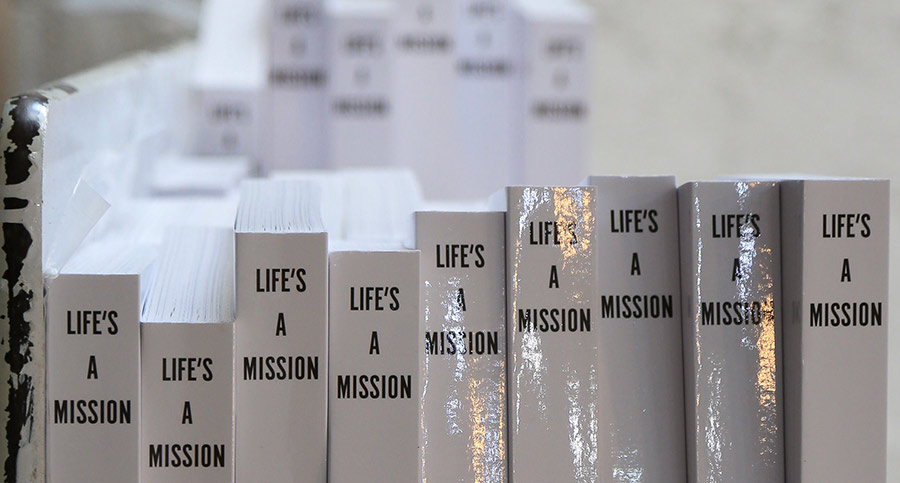
REVS, XSOUP & ARBOR. “Life’s a Mission…Then You’re Dead”
Today the writer expands his reach, compiling with XSOUP and ARBOR the stories of many graffiti writers into a bound volume that will become an instant classic in the largely anonymous and underground realm of practitioners as well as with the growing cadre of researchers, academics and historians studying graffiti/street art/urban art today. With this new passion effort by REVS and a small team, these stories are preserved and documented, ensuring a greater understanding and appreciation for the interconnected/alienated paradox of the graffiti writer’s life and practice.
‘We preserved each individual’s truths, opinions, exuberance, pride, joy, and grudges in an effort to depict the gritty complexities of this scene we inhabit.’
Author and REVS documentarian Freddy Alva below tells us about the upcoming small-run book release that has become a hot ticket for the New York graff (and street art) scene this week.
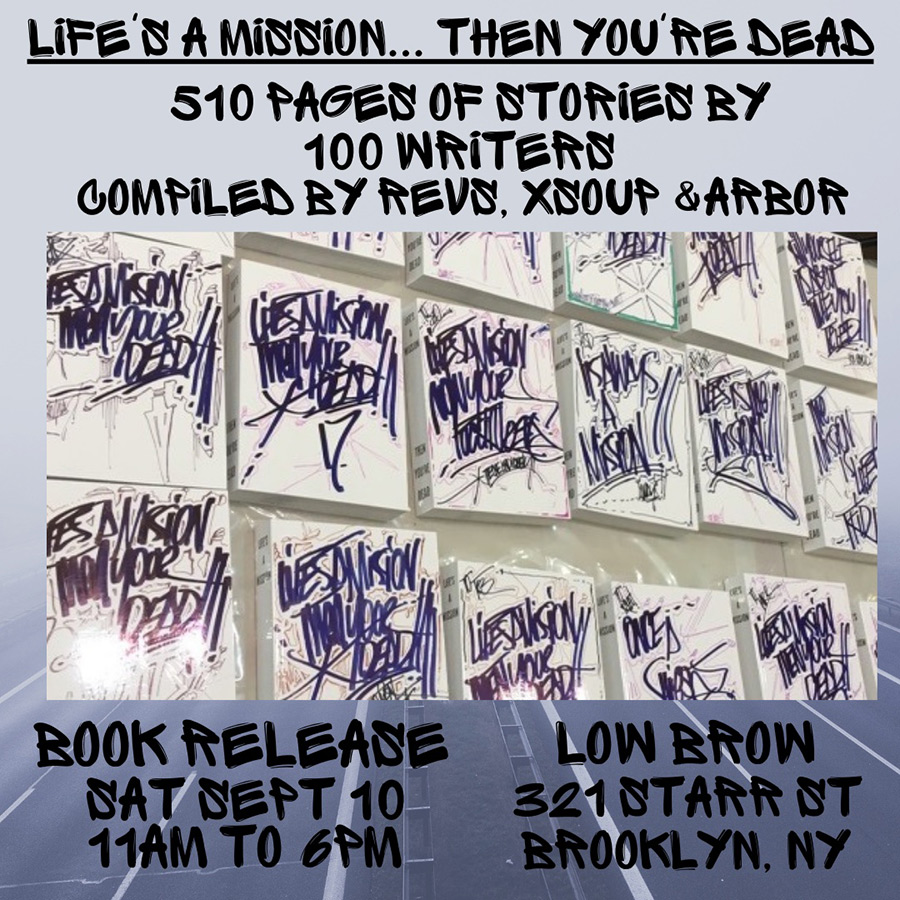
There’s a book release in Brooklyn on Saturday, September 10, celebrating ‘Life’s A Mission Then You’re Dead’; a comprehensive 510 pages book of blood, sweat & tears-soaked stories by 100 NYC Graffiti writers. REVS and XSOUP, with help from ARBOR, compiled this loving insiders’ oral history of an idiosyncratic street culture that few are privy to.
From the introduction: ‘The history of writing, style writing, or graffiti, is brief but nebulous. Generations turn over every couple of years, scattered across the city’s many neighborhoods and extending to most places on earth. The histories of these small, fluctuating groups are mostly recorded in memory and recounted through word of mouth—some to larger audiences and some reaching only a select few. Outsiders curious about writing have been responsible for much of its documentation… The voices of many writers could together offer a more intricate, nuanced view of the world of writing… We preserved each individual’s truths, opinions, exuberance, pride, joy, and grudges in an effort to depict the gritty complexities of this scene we inhabit.’
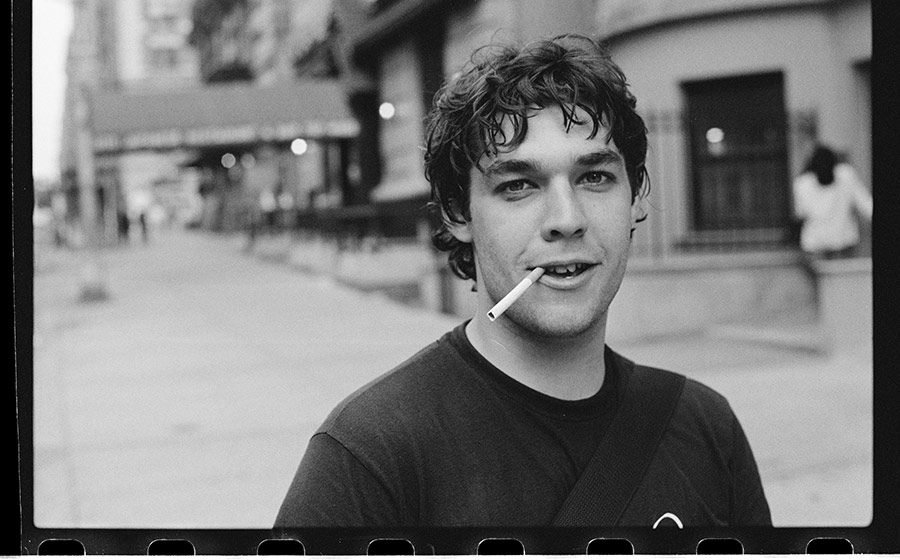
Each cover is individually drawn by REVS with images by NYC street photographer Matt Weber aka MALTA. Book design is by Eric Wrenn with editorial assistance by Polly Watson. This is a self-published endeavor with no online link to order at the moment, limit one copy per customer and cash only at the release event 11-6pm on September 10 at: Low Brow, 321 Starr St Brooklyn, NY 11237
It’s September! Or Septembeer, if you like. Followed by Octobeer, Novembeer….you get the joke.
As we slide into New York’s fall arts openings, shows, events, parties — we’re still blown away by the incredible works that are on the streets. Right?
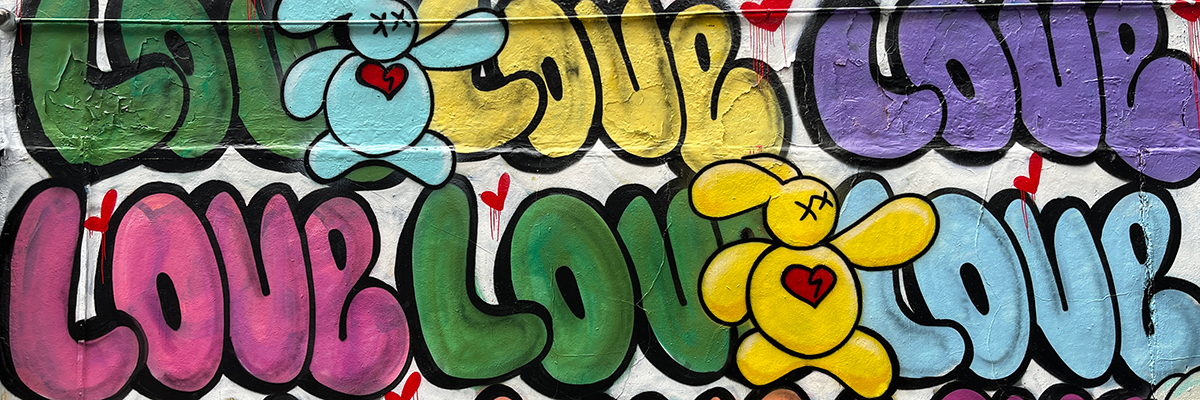
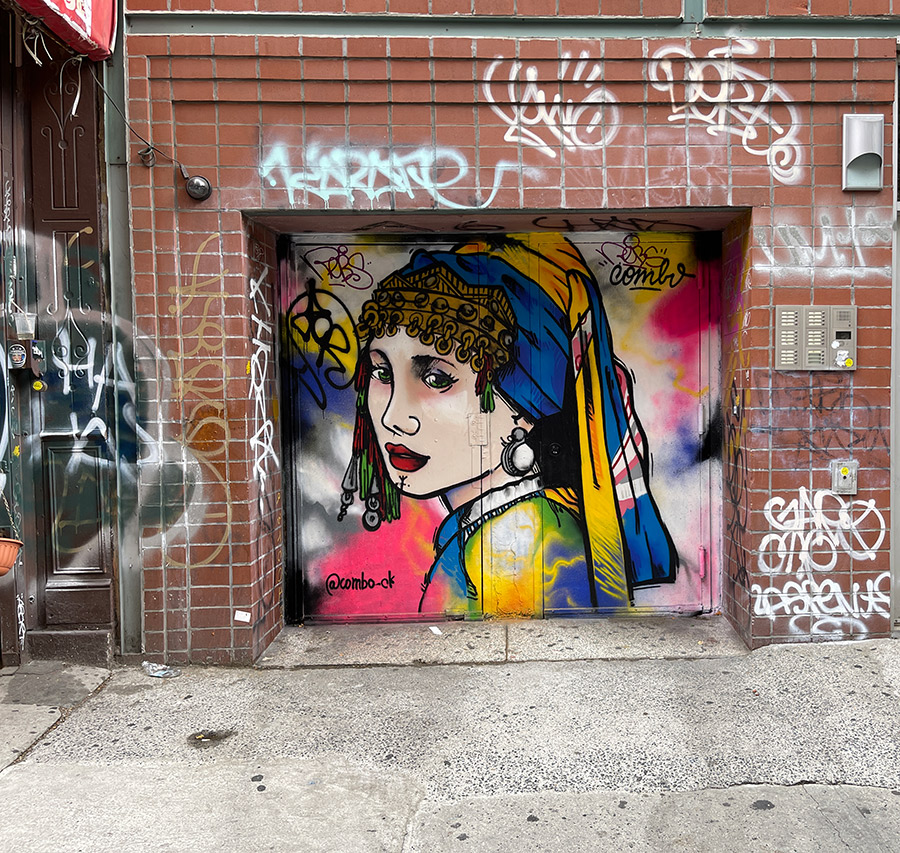
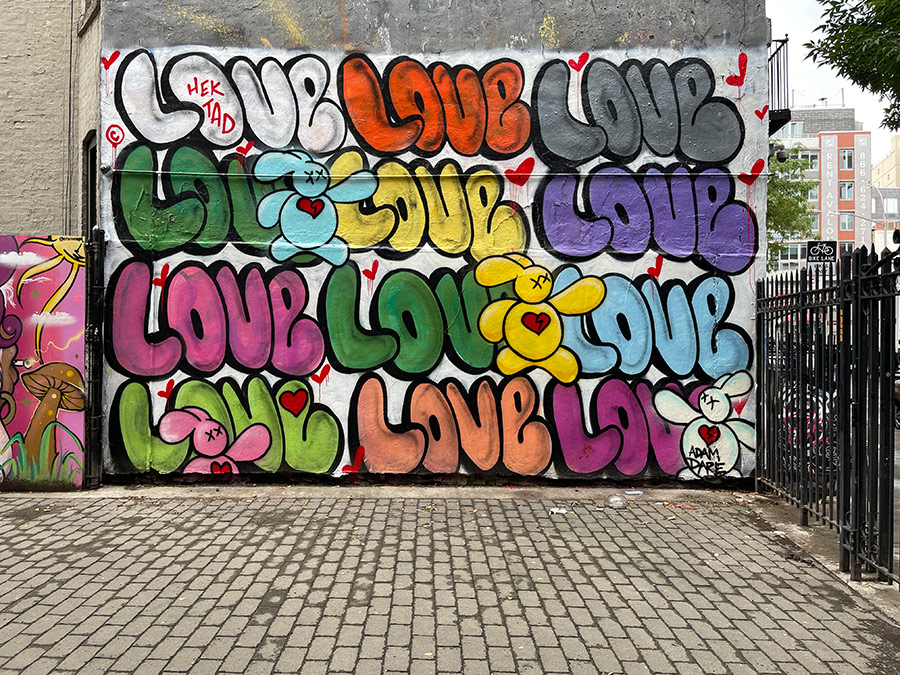
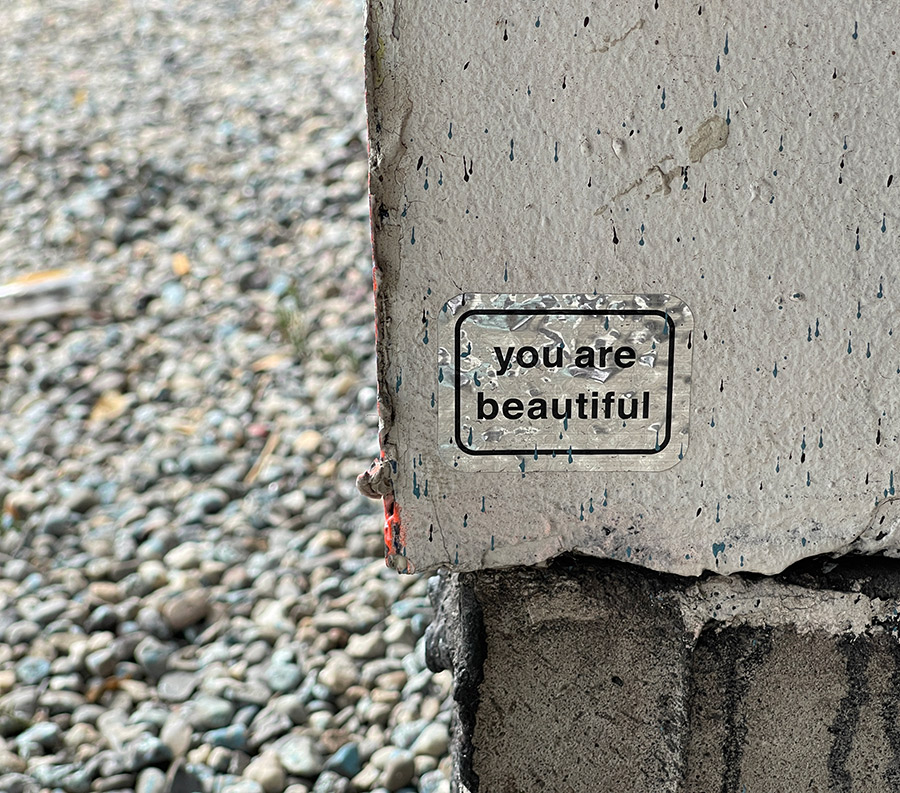
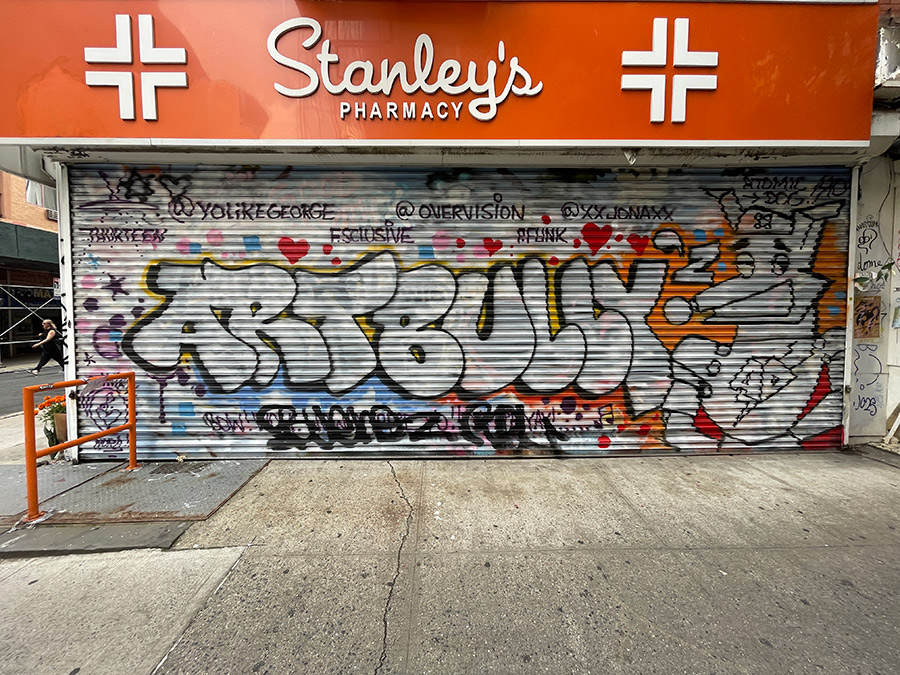
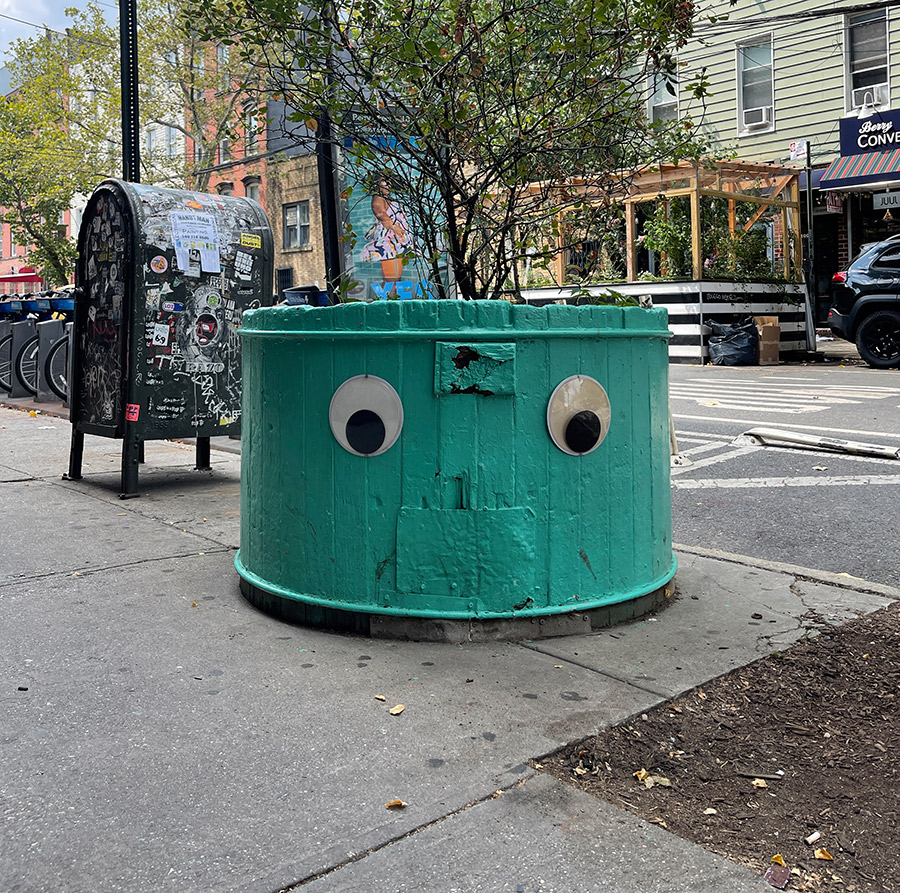
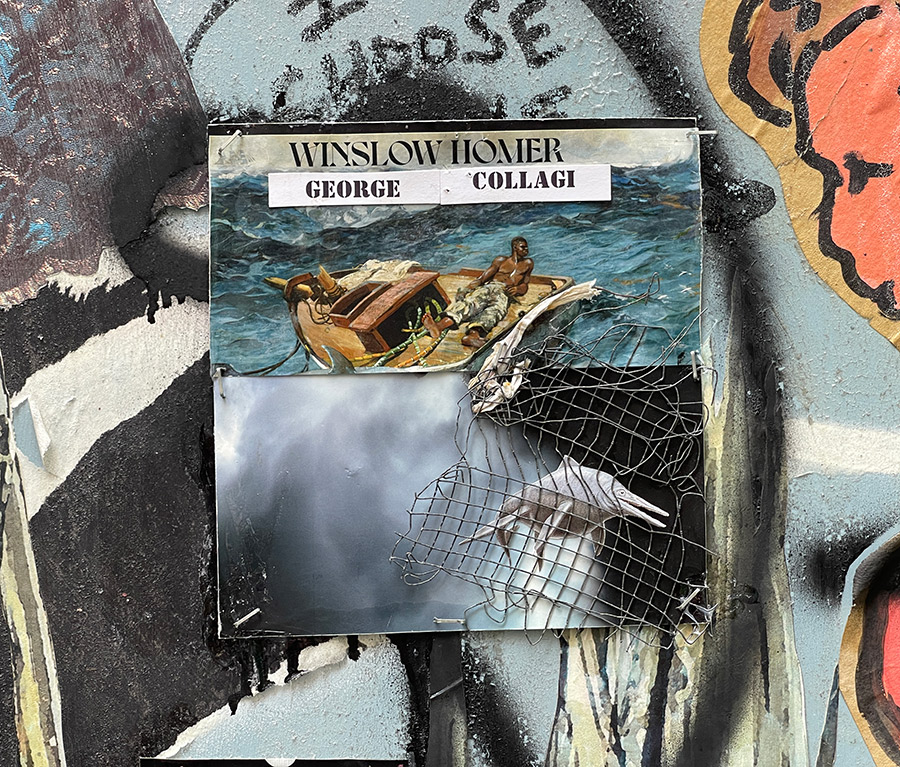
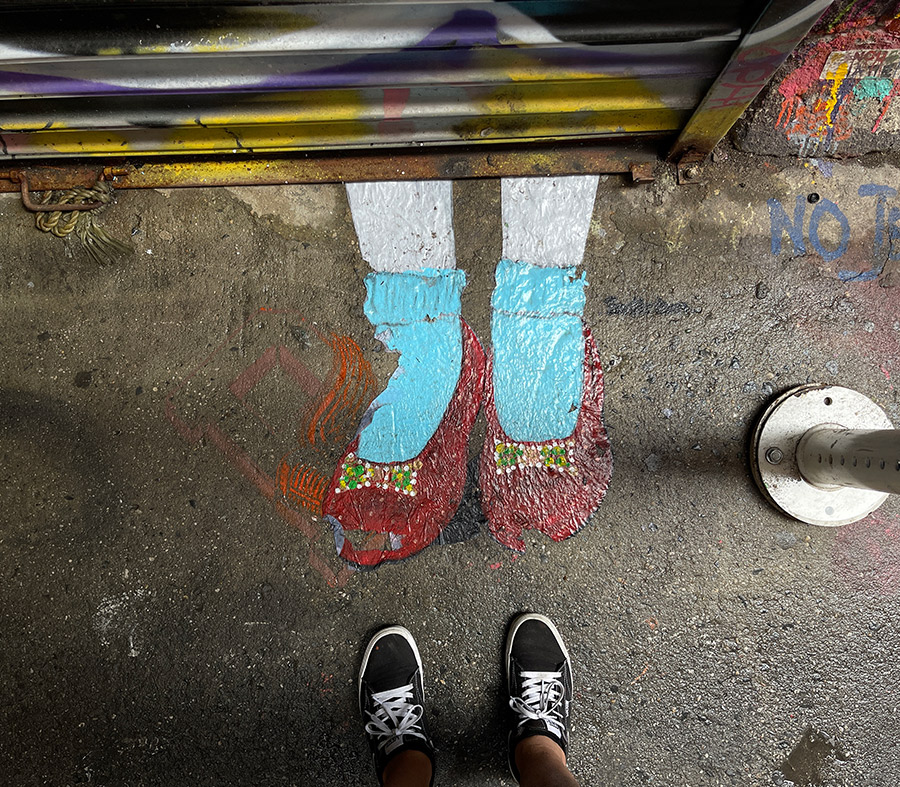
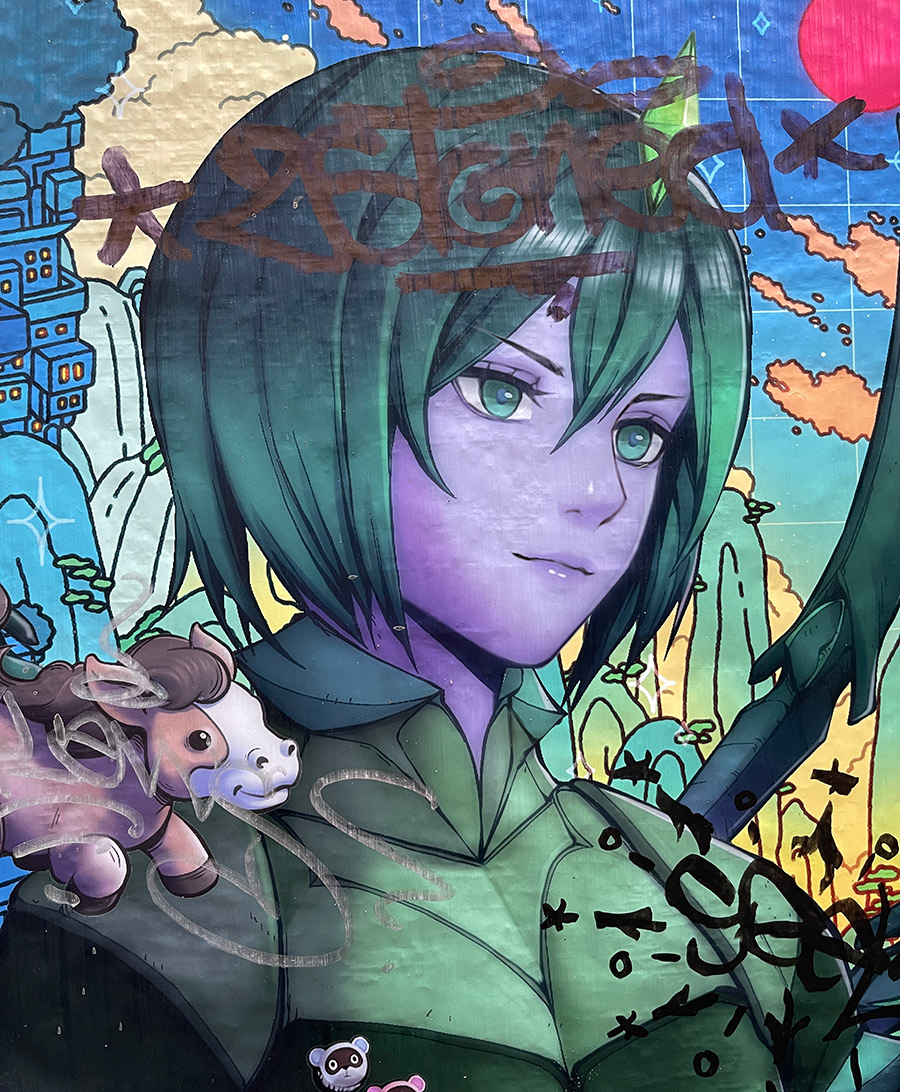
Here’s our weekly interview with the street, this week featuring: No Sleep, Adam Dare, Werds, You Are Beautiful, Melski, George Collagi, Combo CK, Hek Tad, and Yo Like George.
 BROOKLYN STREET ART LOVES YOU MORE EVERY DAY