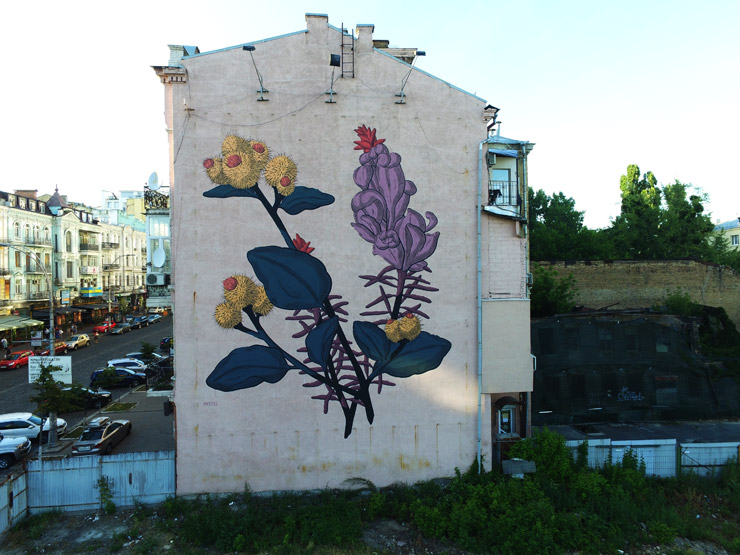
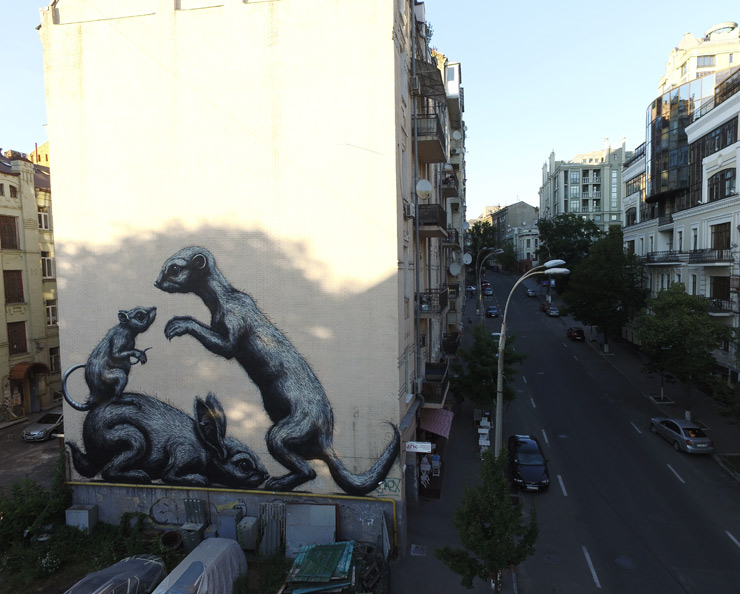
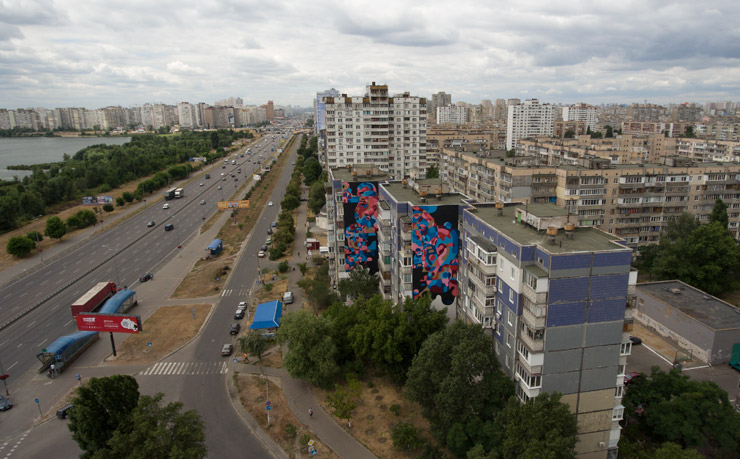
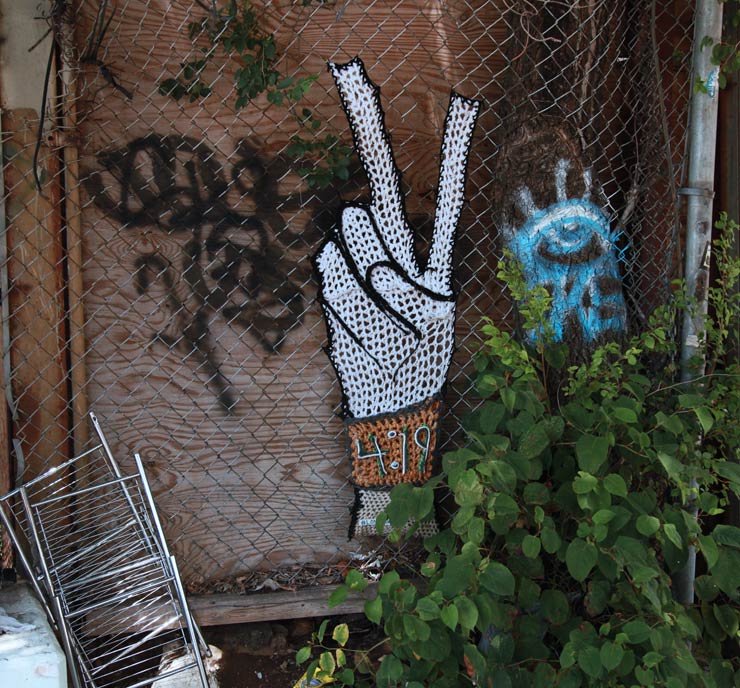
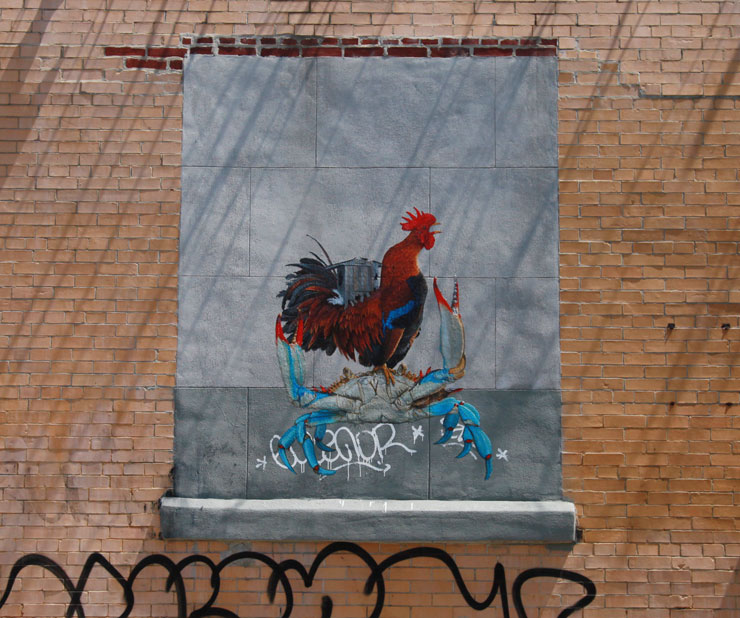
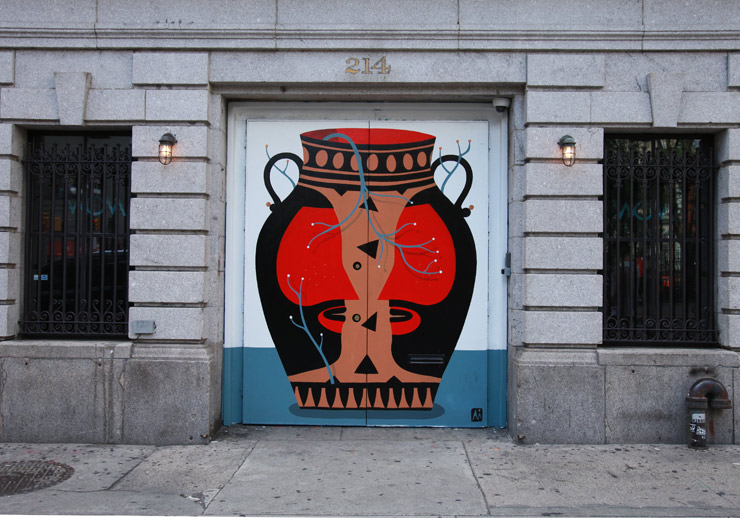
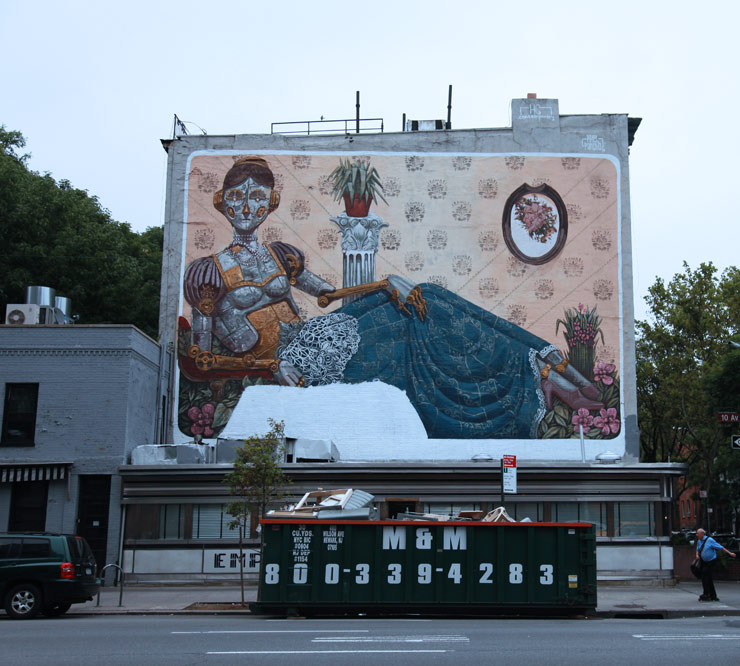
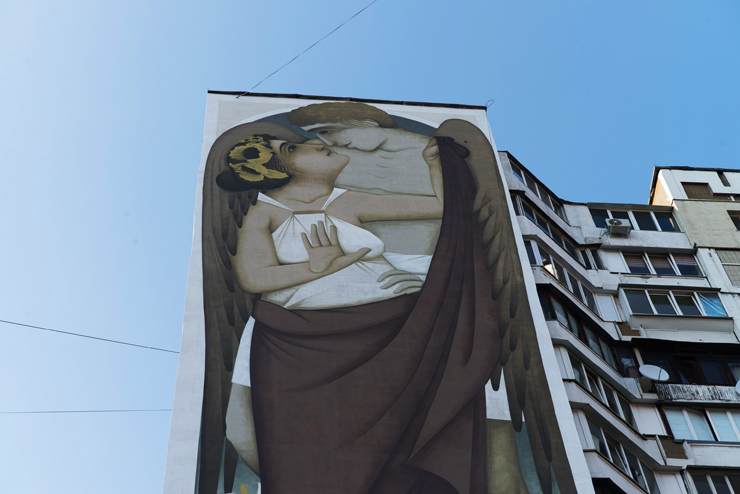
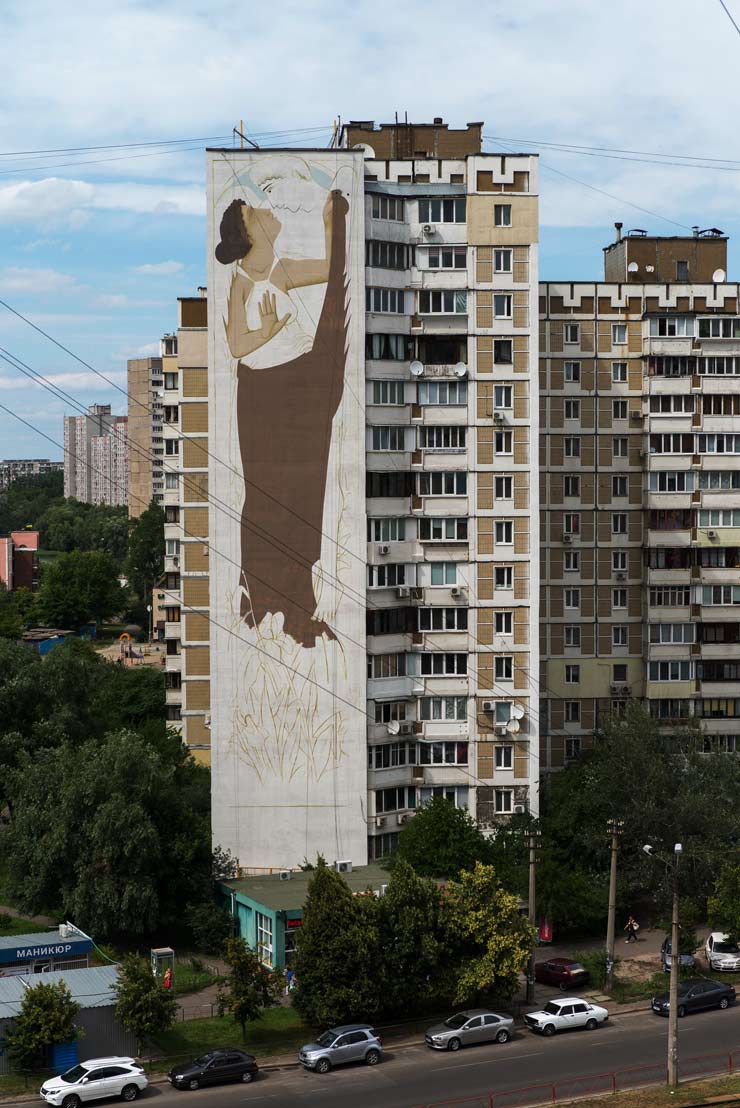
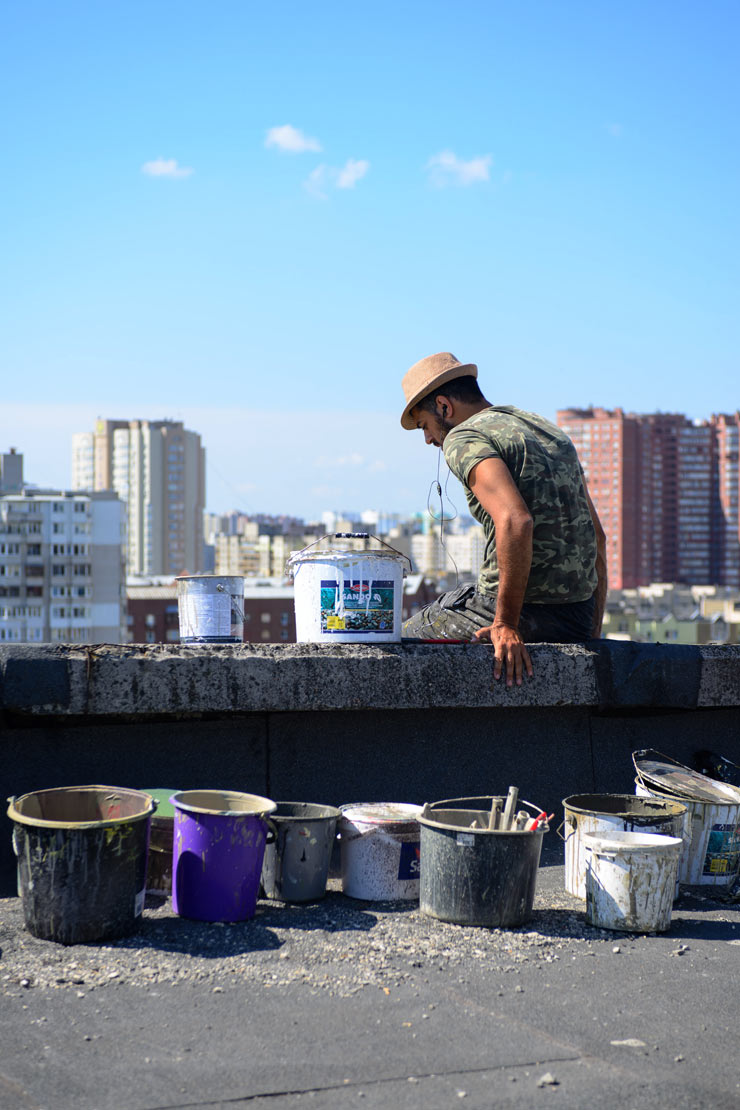
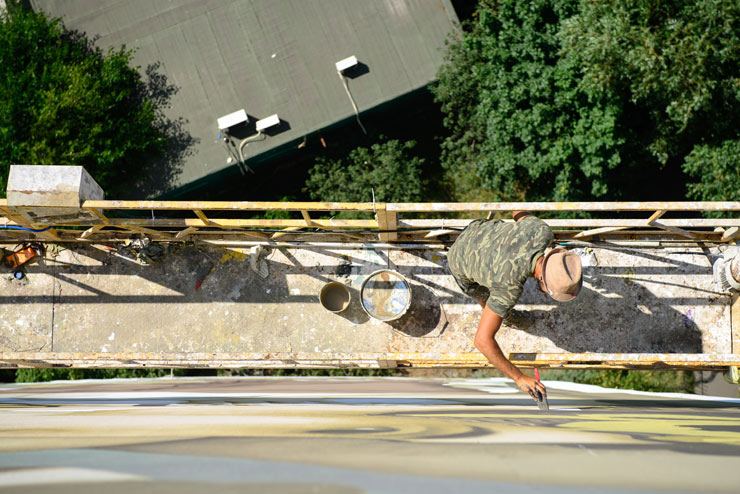
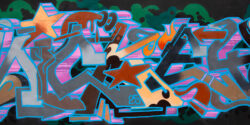
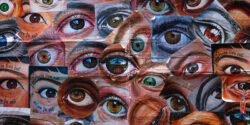
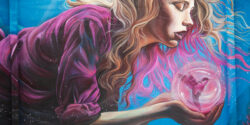
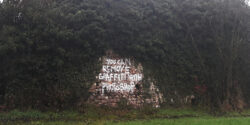
Two new pieces in Kiev from Belgian Street Artist ROA and Argentian Street Artist Pastel, both for the ArtUnitedUs project.
Pastel took some time to study history of the Makhnovist movement during the 1917 Russian Revolution, he says, as well as the libertarian revolution in the Ukraine. Naturally, botany was his chosen method of communicating such complex events.
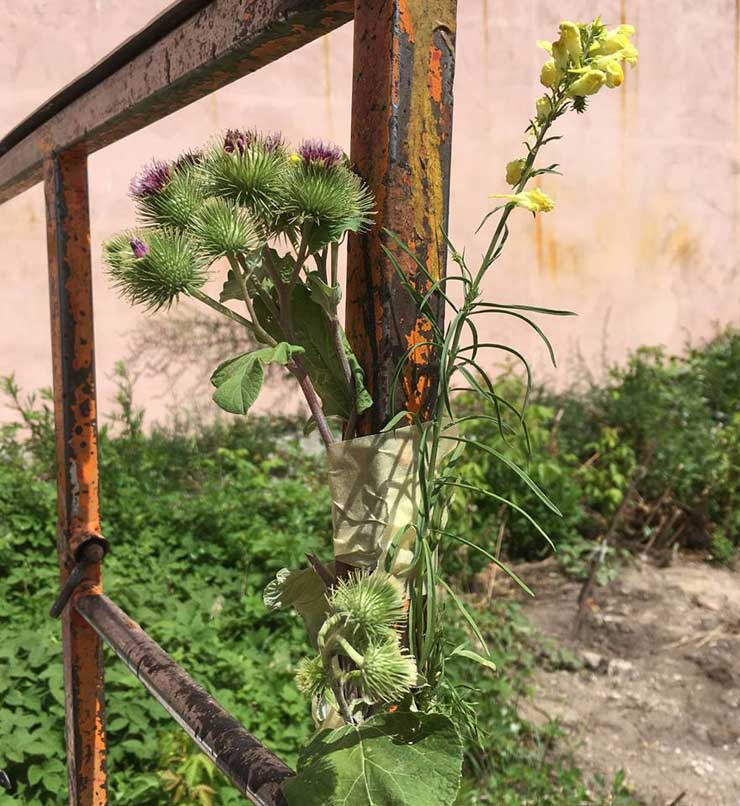
He also studied local plants for inspiration, and posted this quote on his Facebook page.
“We have all flirted with freedom and, deep inside all of us have the urge to make it a serious relationship. The Anarchist values of individual freedom, grass roots democracy, and the decentralisation of all forms of power are, if anything, more pertinent today then over. See you on the barricades.” -Tony Allen, Kiev
See here a photo he used for a sketch of his new wall during his preparation.
In his familiar monochromatic aerosol hand rendering below ROA depicts local marginalized friends from the animal world. His practice is to study his host city and find the local animals that are not commonly celebrated or thought of very often, in effect giving them a visual voice in the cityscape. His painting took five days and was slowed by a painful foot problem, but ultimately he powered through.
Rafael Schacter Takes a More Nuanced Approach to the Migration Crisis
Commerce and technology have been eroding traditional constructs of the borders and boundaries, especially in the age of the Internet, satellites, transnational banking and trade agreements that create governing bodies that openly dismiss national sovereignty, integrity, identity, aspirations. Borders and boundaries are contested, guarded, or disregarded at will; open to international capital, porous to immigration, hardened by armies.
Daily they are in the headlines: Trump’s plans to build a wall along the US-Mexican border, Syrian war refugees immigrating across European borders, Israel and Palestine’s ongoing land and settlement disputes, even maritime territorial claims of China and the Phillipines in the South China Sea that were ruled upon yesterday – all reveal clues to our historically complicated relationships and geo-political perspectives.
Art to the rescue!
A current show mounted by primarily urban artists under the direction and curatorial vision of Rafael Schacter in Saint Petersburg, Russia takes on a thin, rich slice of this story; a conceptual examination of borders and boundaries from the perspective of migration. With global forced displacement breaking all records in 2015 at 60 million people according to the UN we clearly need to re-examine these constructs and decide what purpose/ which people borders are serving.
Sorry, we’re using terms interchangeably, which Schacter will correct us on. Toward that end, we are pleased today to present Mr. Schacter, an anthropologist, researcher of street art, author, and lecturer, here on BSA to share observations and experiences from his most recent project, a fascinating show at the Street Art Museum (SAM) called Crossing Borders /Crossing Boundaries. Our thanks to the artists, only a small number of whom we are able to present here, as well as to the museum for sharing their talent and resources. A full list of the participating artists is at the end of the article.
——————————–
~ from Rafael Schacter
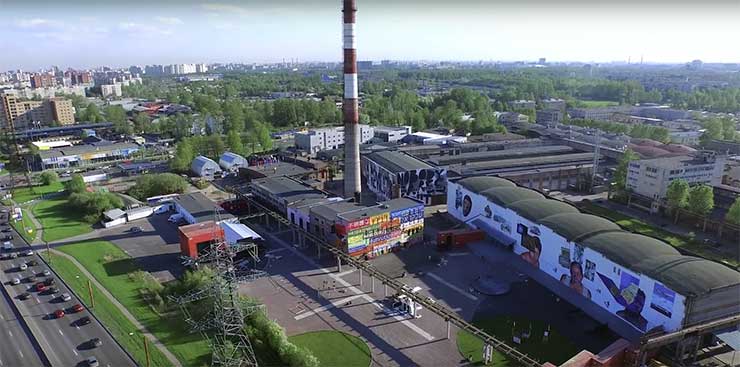
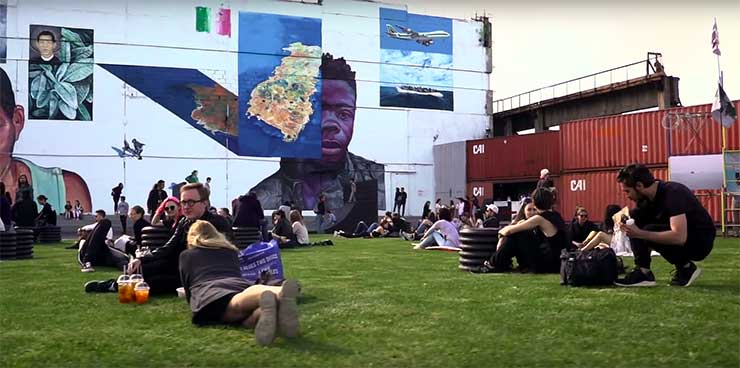
In May of this year, I spent nearly four weeks in Saint Petersburg curating a large scale exhibition at the Street Art Museum (SAM). The Museum, set in a functioning factory on the edge of the city, is a mammoth site. The first plastics factory in the Soviet Union, the site became partially abandoned in the 1990s after the collapse of communism, and has since been taken over and partly given over to this new museum. Containing huge outdoor and indoor spaces, the museum is truly a dream location to work.
For the summer exhibition this year, we decided to focus on what has been termed the Migration Crisis. Rather than tackling this head on, however, something that I feel can often be crass and exploitative, something that I feel can often be seen to be utilizing peoples’ hardships for artistic ‘gain’, I sought to provide a concept that could explore the theme from a more nuanced angle.
The title of the exhibition, Crossing Borders / Crossing Boundaries, thus attempted to explore the differences between these two terms; words which are often used interchangeably, but are in fact quite distinct.
Utilizing the work of renowned sociologist Richard Sennett, borders were hence posited as zones of high organic interactivity and development, engaged, permeable spaces such as the zones between the land and the sea in which different species thrive, intermix and exchange. In contrast however, boundaries were understood as guarded, impenetrable locations, locations, for example, like the territorial perimeters of creatures such as lions or wolves.
Focusing on these differences, on the fertility and vibrancy of the border compared to the sterility and aridity of the boundary, we then commissioned 20 artists from around the world to produce works on this theme.
Working with artists from a background of street art as well as contemporary art, with video artists and photographers, muralists and artivists, the exhibition is thus truly multi-media and multidisciplinary. I was beyond impressed with the results, all the artists bringing an amazing set of ideas to the table and delivering them in the most fantastic of ways.
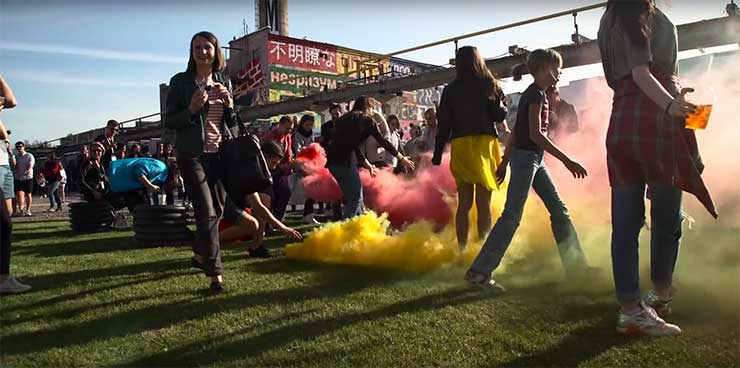
We had over 5,000 people come to our launch on May 14th, as well as a huge international conference on the topic of migration taking place in the museum on the same day. Living, working, eating and sleeping in the factory with all of the artists over the entire period of production was tough, to say the least. However the energy was unrelenting, with the artists and the whole team at SAM working without rest to deliver this incredible project.
I’m super proud of what we achieved, to both sensitively and critically explore this theme, to not just provide the traditional liberal consensus positionality but rather to challenge people’s thoughts and ideas on this topic. Who knows what effect it will have, if any. But I hope that the project can push people to think about the topic in a more nuanced rather than binary way.
Following the video are a few of the artists and their work for Crossing Borders / Crossing Boundaries
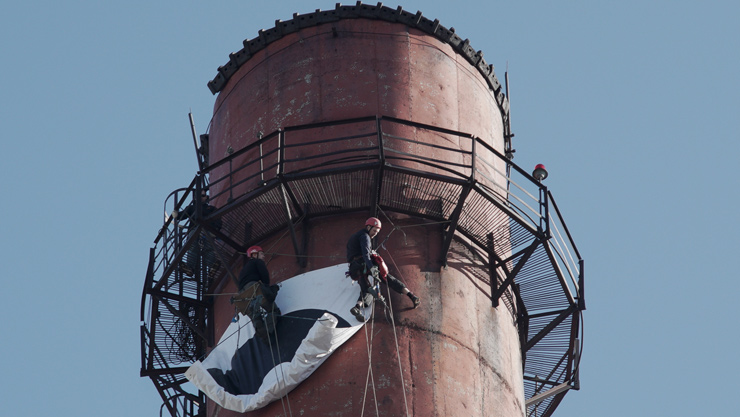
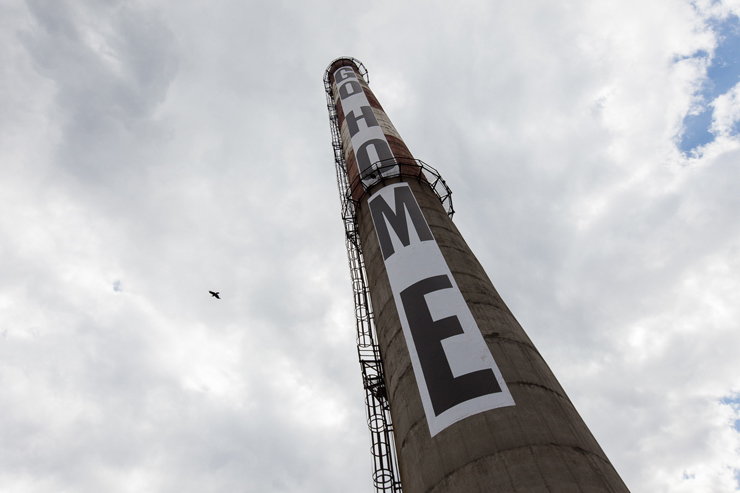
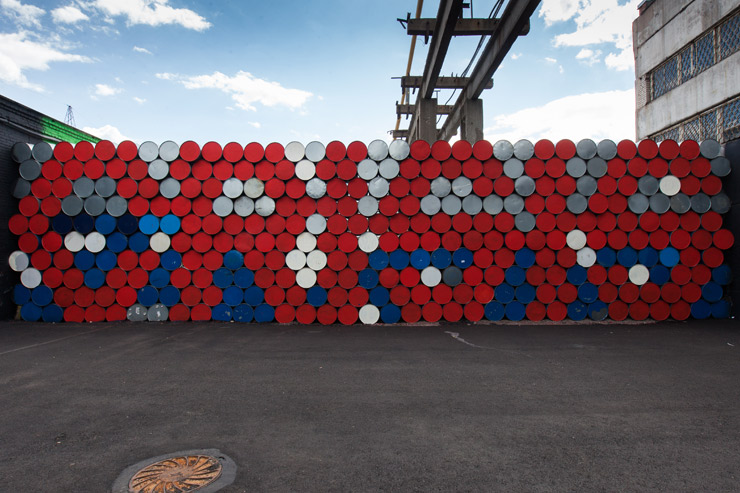
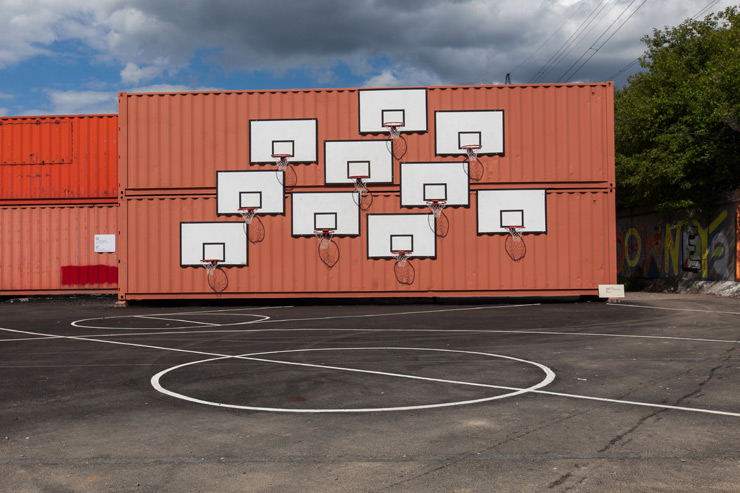
Printed banner on chimney / Acrylic paint on oil barrels / Basketball hoop and backboard on containers, acrylic paint on asphalt
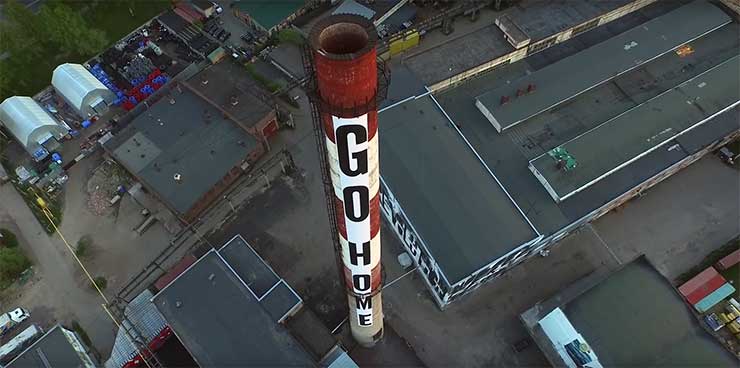
SpY’s deceptively simple yet conceptually ingenious interventions focus on the upturning of spatial and societal norms. Using irony and humour to create a dialogue with the viewer, SpY attempts to impress multiple readings onto a space, re-presenting it as a “frame of endless possibilities”.
His set of works here follow this method precisely. In particular, his giant work Go Home, at first an apparently aggressive, deeply antagonistic phrase (to put it mildly), plays with the variety of meanings that this expression can contain: the very ability to go home, for example, to return back to the place of one’s family, one’s birth, one’s life, is the very thing that most immigrants desire but simply cannot undertake (whether due to war or famine, economic or ecological pressures). To be able to go home is thus a privilege that not all of us have.
As with his famous method of renegotiating the set rules of sporting activities, provoking, as he says “disorder and chaos through context and content”, SpY’s works do not simply invert or subvert their spaces but playfully distort them. They “misuse” their environments to show the latent possibilities that lie within.
Scaffold, laminate photographic prints, flags, and spray paint and acrylic on containers / Acrylic paint on wall
Fillipo’s installation for Crossing Borders / Crossing Boundaries explores different border zones throughout the globe. From the sea border of North and South Korea to that of Mexico and California; from Morocco and Mauritania to Cambodia and Vietnam; from the invisible border between Northern Mali and the disputed territories of the Azawad; to abandoned NATO bunkers at the Belgian Dutch border, these images present us with some of the most politically fraught locations on the planet which, somehow, contain a strangely alluring beauty. Alongside this, Filippo presents a series of Whatsapp conversations documenting his personal struggle to gain entry into Russia for this exhibition: a series of Kafkaesque scenarios in which he was sent from location to location in a seeming test of his resistance. The installation as a whole can be seen to bring together Filippo’s joint obsession with political, industrial and internet aesthetics.
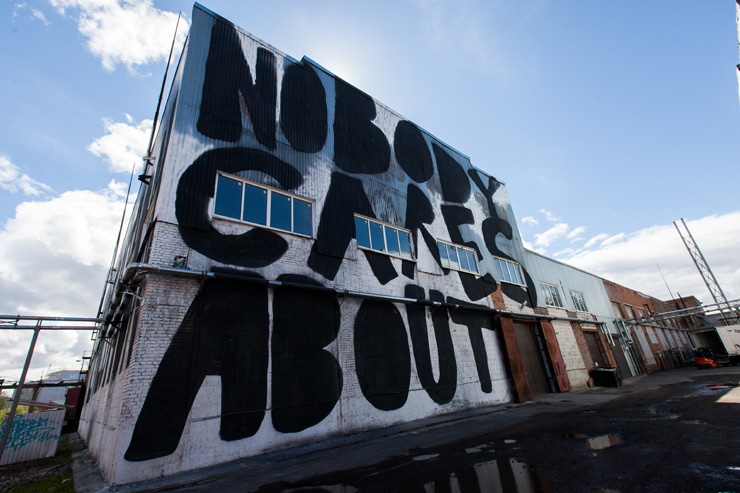
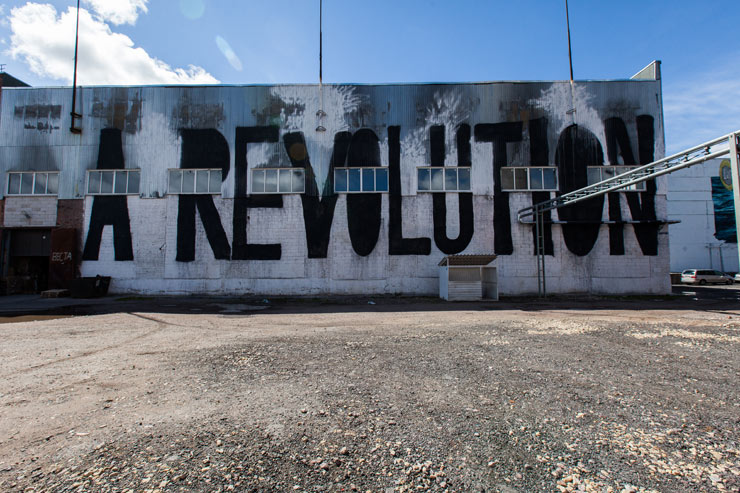
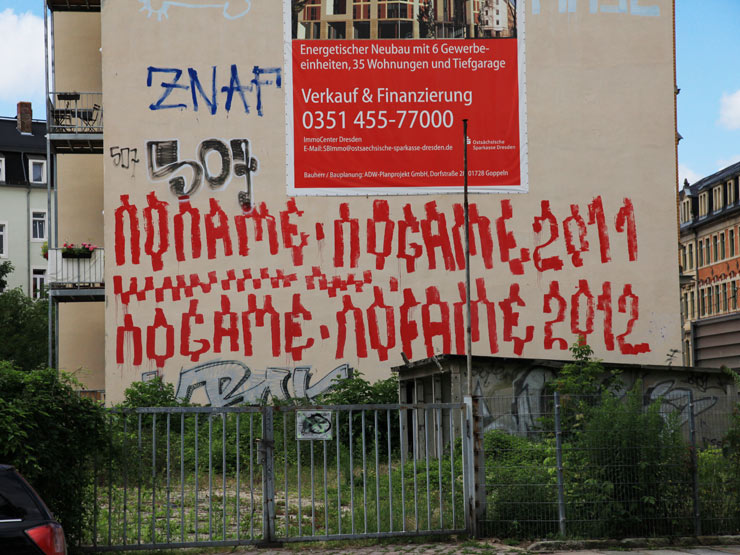
His mural, A Revolution Nobody Cares About / Nobody Cares About a Revolution speaks, quite loudly, for itself.
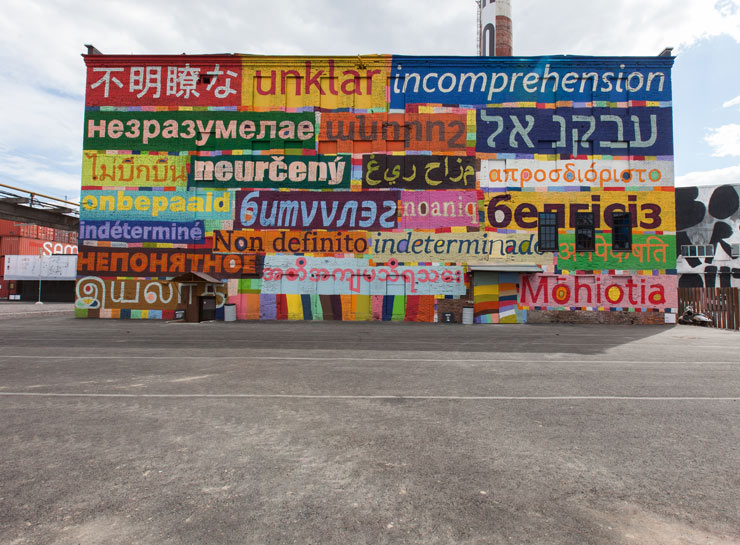
Kirill’s work for Crossing Borders / Crossing Boundaries arose through his correspondence with curator Rafael Schacter. Focusing on the barrier of language and the complexity of translation, the work is about the impossibility of understanding and the unwillingness to understand. As KIRILL says “I understood only a small percentage of what we discussed and so decided to make this the heart of the work”. It is thus the borders and boundaries of language that KIRILL takes aim. As he continues “there are two borders of misunderstanding: you see unfamiliar letters and you do not understand everything completely. Signifier and signified become equally incomprehensible. Or even it’s a familiar language, but still it is not clear”. Kirill’s work, although colourful and bright, is in fact the image of alienation. The image of the migratory and the incomprehensible.
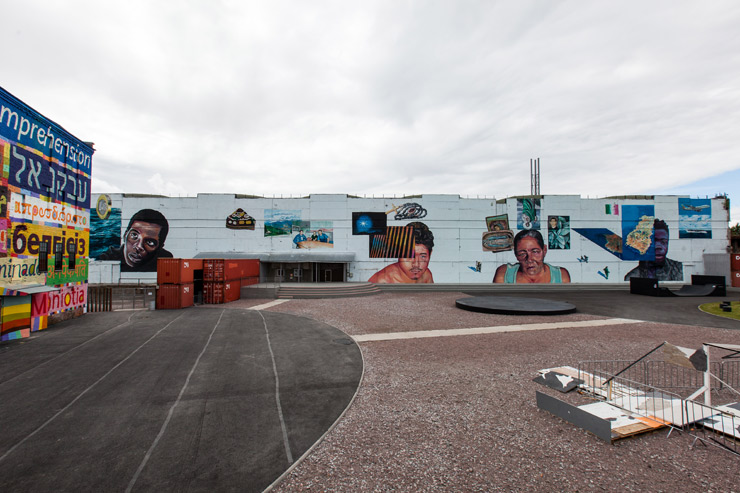
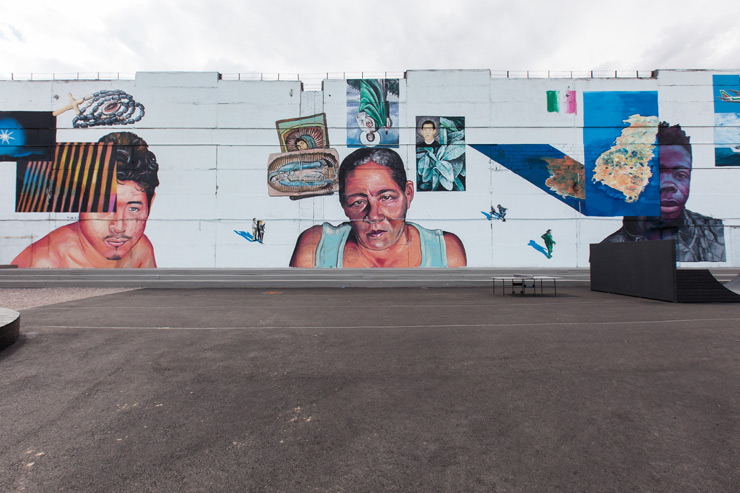
Gaia and Mata Ruda have produced a monumental work for Crossing Borders / Crossing Boundaries, a work which functions in the classical tradition of political muralism. Using imagery from the filmmaker Marc Silver and photographers Jonathan Hollingsworth and Alex Kurunis (both of whom show other work within the exhibition itself), Gaia and Ruda present us with an assemblage of figures and artefacts which together convey a dense narrative about contemporary migration. Including individuals and stories from the borders of the USA and Latin America as well as Africa and Europe, the artists also produced a group portrait of three Uzbekistani employees at the factory who work and live in the very site where the mural exists.
The story Gaia and Mata tell is one of inequality and injustice, a story of the imbalance of our contemporary global system. Yet within this it contains hope and strength, the strength of the individuals who strive to fight these inequities on a daily basis.
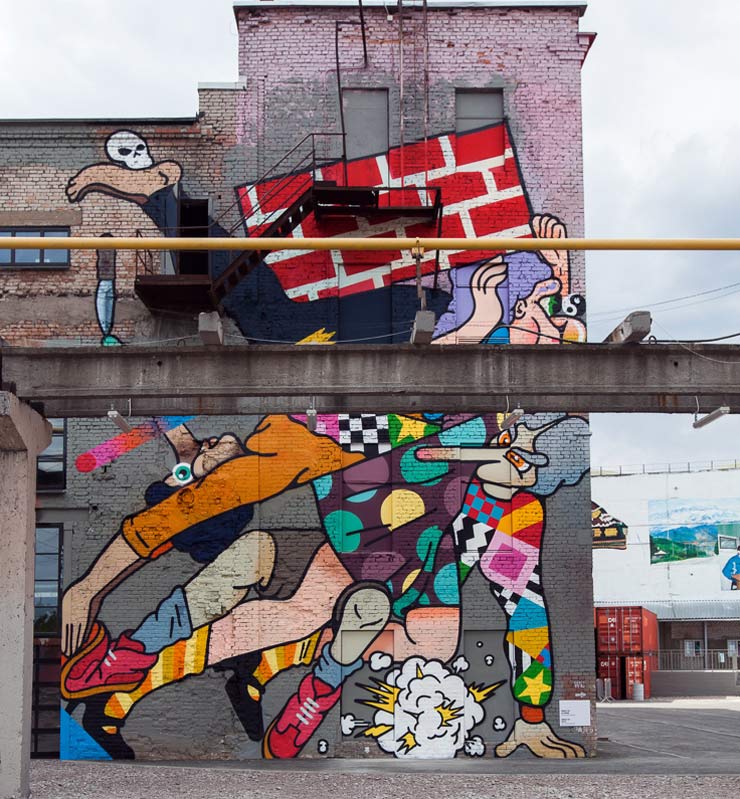
Nano4814’s half-abstract, half-figurative mural for Crossing Borders / Crossing Boundaries demonstrates the strangely discomforting yet visually arresting style which we can now instantly recognize as his own. Frequently focusing upon the apprehension he has with his own work, Nano’s characters can often be seen to be in states of tension or strain (both literally and metaphorically), an angst reinforced by their compressed captivity within their sites. Moreover, his use of brick-walls, barriers, and wooden shards, symbols that act as leitmotifs throughout his work, play with the idea of boundaries as objects that encourage intrusion and trespass: Like masks, these borders both suggest and occlude a veiled truth, hinting whilst hiding, implying yet escaping. It is thus the very limitation that enables us to venture beyond.
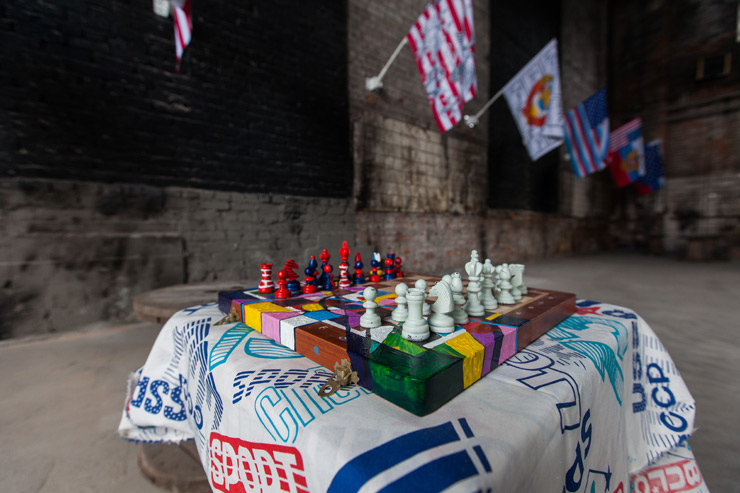
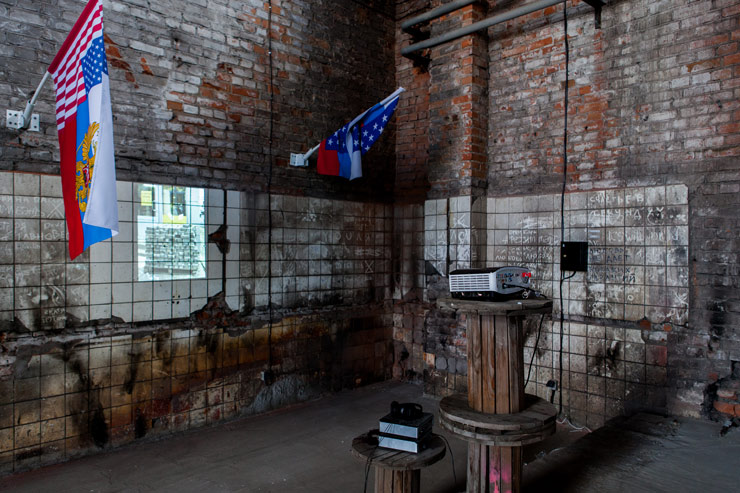
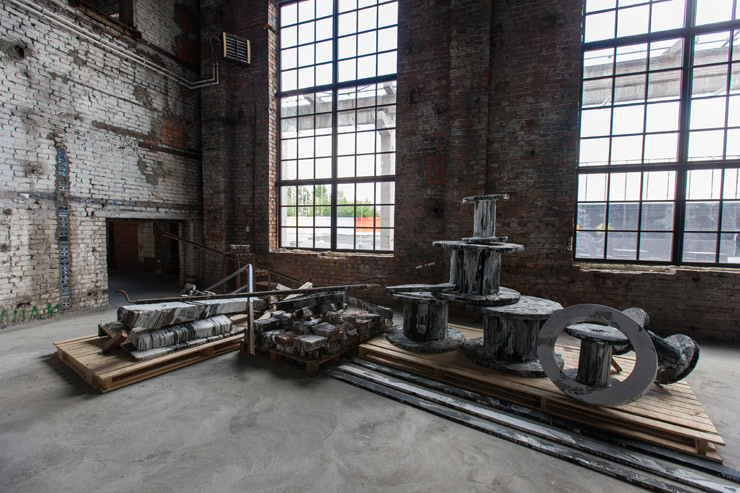
Slides, DIA projector, flags, photographs, socks, coins, drawings in collaboration with Clemens Behr, SPY, Paco, and Fillipo Minelli, computer guts, digital prints, plastic, wood, plexi-glass, mounting hardware, sound installation, radio, headphones, cables, paint, chess set, soviet fabric, and industrial spools.
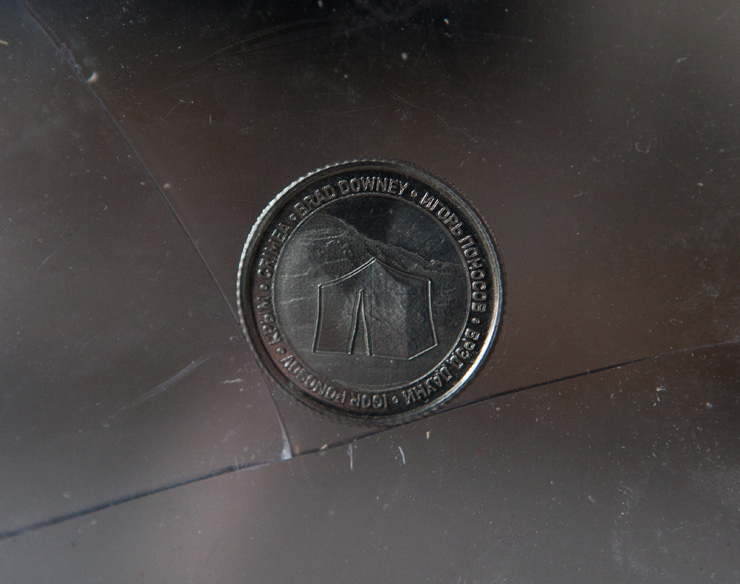
Double Yippie Hollow Super Power is a joint project between artists Brad Downey from the USA and Igor Ponosov from Russia. Taking inspiration from the parlor game “cadavre exquis” or “exquisite corpse” (a method by which a collection of words or images is collaboratively assembled), the pair have sought to combine the varying national symbols of their home nations into a new, exquisite set of iconic forms. The “unity of the opposites” that they have created – utilizing objects such as flags, coins, and anthems – plays with the sacrality of these national symbols, the almost divine status that they contain. Moreover, it alludes to the strangely intimate relationship that the two countries are entwined in. Whilst apparent opposites, common enemies, both locations create their identity through their connection with the other: the objects Downey and Ponosov have thus created contain both a critical and playful edge. They ridicule the stereotypes of both themselves and each other in the same moment.
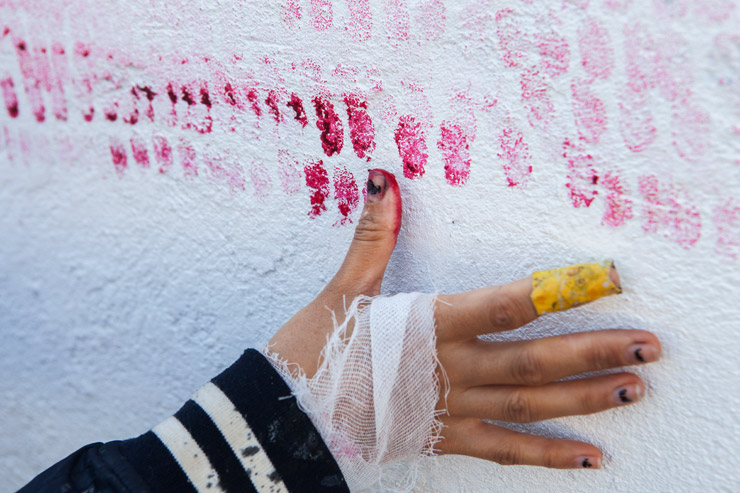
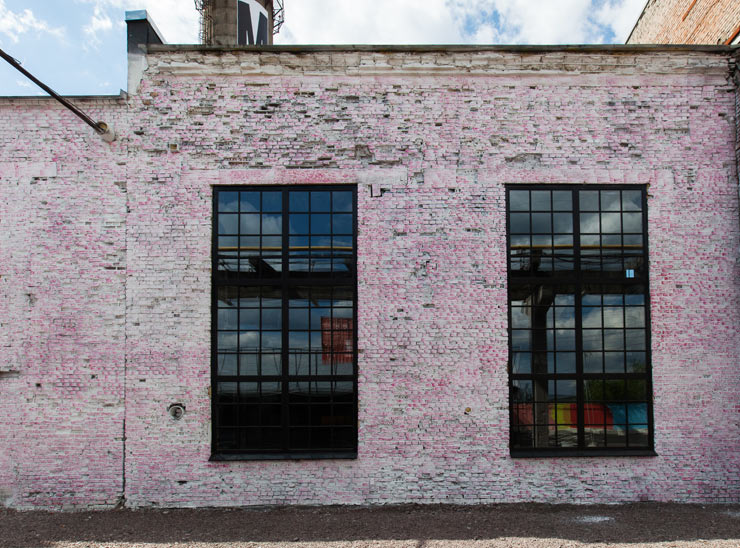
2016, Korean ink on wall / Found objects, cement, and acrylic paint on wooden palletes
Jazoo Yang’s Dots series originates from her work in her native Korea, in particular within areas of the city going through the process of redevelopment. Using traditional Korean ink, and solely using her thumbprint (a marking used as a signature on important documents), Yang’s work sought to bring focus on the increasing amount of “redevelopment refugees” in the city
For Crossing Borders / Crossing Boundaries, Yang has expanded her Dots Series to incorporate the issue of refugees and migrants in Europe and further beyond. Working mainly on her own but also with immigrant workers from the factory itself, Yang discusses their stories, their histories, their existence with these individuals as they mark the wall together. These imprints act as a record of this moment whilst remaining entirely silent.
In Yang’s Painting Block Works, this theme of memory and regeneration continues. Exploring the violent so central to the contemporary city, Yang wants to ask how much we perceive our lives and make independent decisions within these oppressive environments. She aims to bring these problems to the surface through rebuilding them with the materials we so readily abandon, in Korea using objects from deserted houses and buildings, here in Russia using the detritus and ephemera of the factory itself.
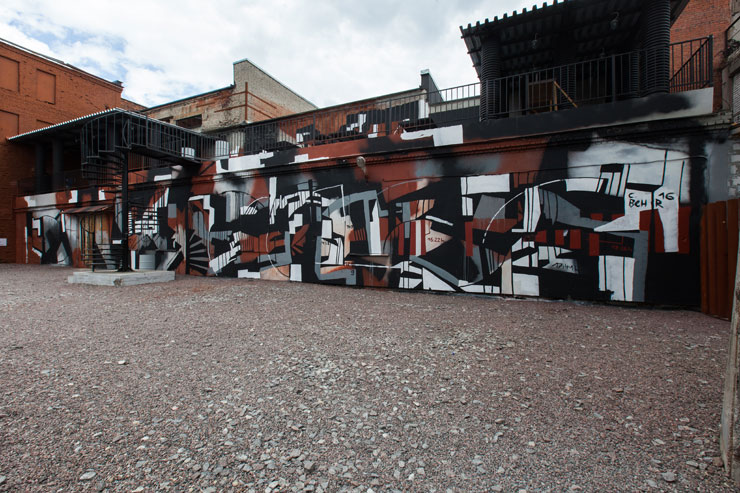
The Final Frontier (Space) / Our House (In the Middle of the Street)
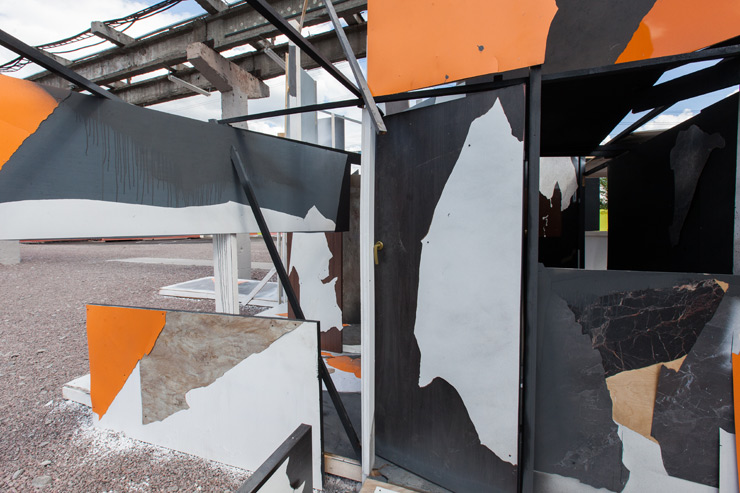
Laminate doors, wooden pallets, wooden battons, hinges, and acrylic paint / Acrylic and spray paint on wall
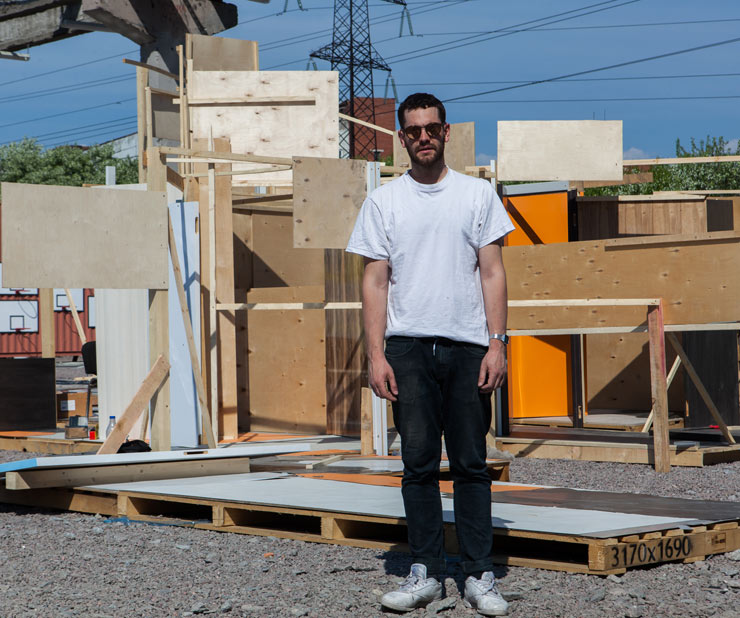
Mimicking and playing with their settings through a process of transformative deconstruction, Clemens Behr’s geometric shapes and abstract forms come to distort the viewers’ perspective, merging two and three dimensional spaces in a single plane.
His installation for Crossing Borders / Crossing Boundaries acts as what he terms a “social maze”. Utilising one of the most classic example of borders/boundaries, the common doorway, the work explores the potentially empowering or inhibiting abilities of these structures: as one door opens, another closes, enabling some and disabling others in the same moment. As a participatory sculpture, its visual possibilities become endless. However conceptually it demonstrates how every decision we take effects those around us. Like many of Behr’s installations, this work was produced with what was at hand, in this case the products and detritus of the factory site itself.
Behr’s mural tackles another question however. Playing with the shadows and design of the adjacent fence, with the actuality of space (and time) versus the potentiality of painting, he questions the boundaries of art itself: Can it go beyond reflection to truly generate the new?
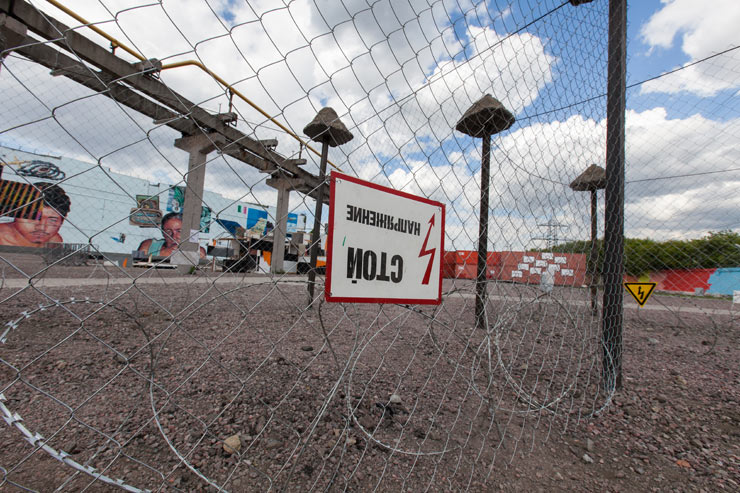
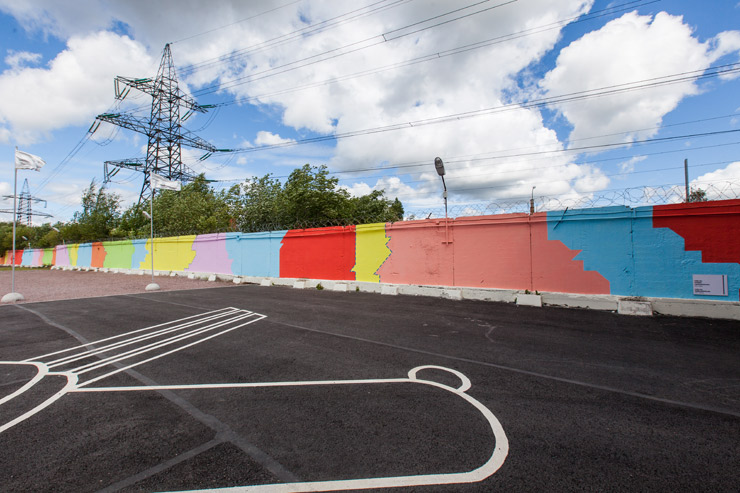
Acrylic paint on wall / Barbed wire, steel poles, metal fence, laminate warning signs
Eltono’s mural is a reaction to the absurd rationality of national boundaries. As opposed to the natural flow of borders (as can be seen in perhaps the world’s only natural country, Chile), the carving up of the planet’s boundaries happens at right angles: diagonal, horizontal, and vertical lines cutting up the planet into a perfectly linear patchwork.
As such, Eltono has created his own world map using a generative art technique; using a basic randomizer to choose a digit between 1 and 7, the numbers which emerge then come to define both the color of the country and its borders, indicating the direction that each color, and each boundary will thus take.
Unlike his mural, for his fence installation, Eltono presents us with the opposite of the rationality as seen within maps. Rather, he displays a perfectly irrational object, an upside-down fence. For Eltono, however, the inversion of the fence makes it something lighter, not an object that prevents our movement, but a compact object that can be upended “as if the wind had blown it upside down”. As he continues, “it’s not a massive obstacle anymore. A fence that can be flipped is a territory that can be freed.”
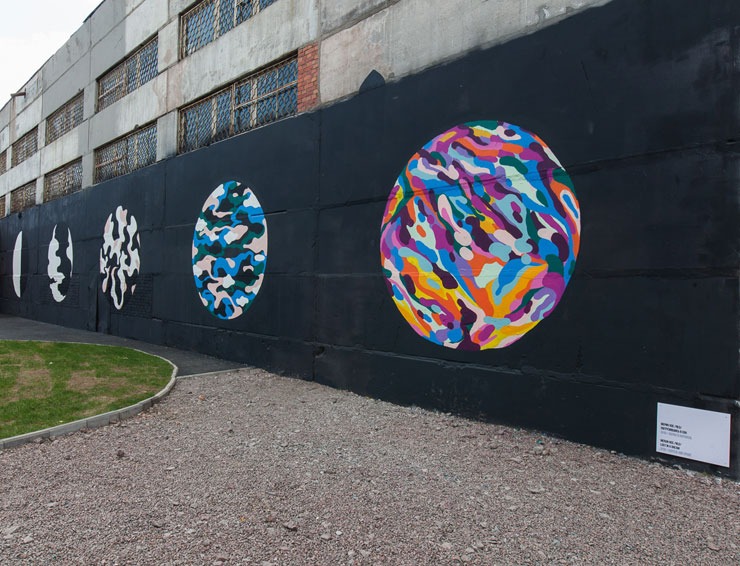
Merijn’s mural has a simple, yet vitally important message. His five globes show us the development from a basic binary of black and white to a densely colored, intricate, heterogeneous space. The final image thus shows us a planet in which, as Merijn says, “everything harmonizes. All the colors are there together and they all work and flow seamlessly with each other. Of course borders exist in many ways, but if we take it a step further and forget about the rules and just go with our feeling this is what I think can be understood as the ideal. That we should not be limited by the rationality of borders. Probably a bit of a cliché. But that’s how I see it and feel it”.
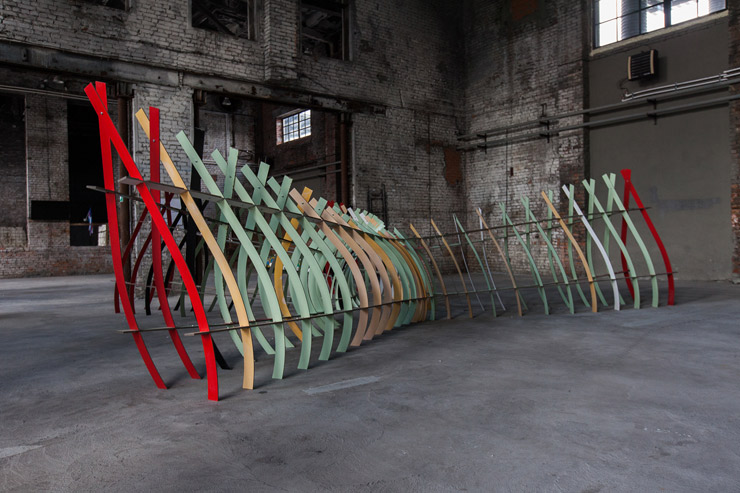
SUPERPROJECT, a two-man design operation spearheaded by visual artist Jasper Niens and industrial designer Thijs Ewalts, focus on computational design and digital fabrication, embracing art, architecture, engineering and technology. For Crossing Borders / Crossing Boundaries, they have created Four Zero, a space within a space, a location only accessible through four, tunnel-like entrances. Due to the curvature of the entrances, the visitor is not immediately sure where they will end up. As such, the work is about revealing and concealing, possibility and difficulty; once people enter the space they can either feel locked up and exposed or protected and safe within its embrace.
1001th Island: The Most Sustainable Island in Archipelago
2015/2016. Video, trash, fishing net and wood
Tita Salina’s 1001st Island is a work exploring the changing borders and boundaries of Jakarta. A city which is currently sinking between 2.9 and 6.7 inches per year, and which exists mainly below sea level, Jakarta is currently undertaking a huge land reclamation and producing a 32 kilometer sea wall to try and protect its boundaries, a project that will construct 17 new islands and take an estimated 30 years to complete. The installation presented here, a reproduction of an artificial island built by Salina and local fisherman using marine debris and litter, aims to highlight the negative impacts of the project, in particular the fact that the city refuses to fix the causes of its problems — namely, excessive groundwater extraction and inefficient waste management. Salina thus connects the reclamation and land issue with the human waste that plagues the ocean and the future of the traditional fishermen who live and work within this now perilous space.
———————————-
ARTISTS Crossing Borders / Crossing Boundaries.
Alex Kurunis, Brad Downey, Igor Posonov, Clemens Behr, El Tono, Filippo Minelli, Gaia, Mata Ruda, James Bridle, Superproject ( Jasper Niens & Thijs Ewalts, Jazoo Yang, Jonathan Hollingworth, Kirill KTO, Martha Atienza, Merijn Hos, Nano4814, Rob Pinney, SpY, Tita Salina
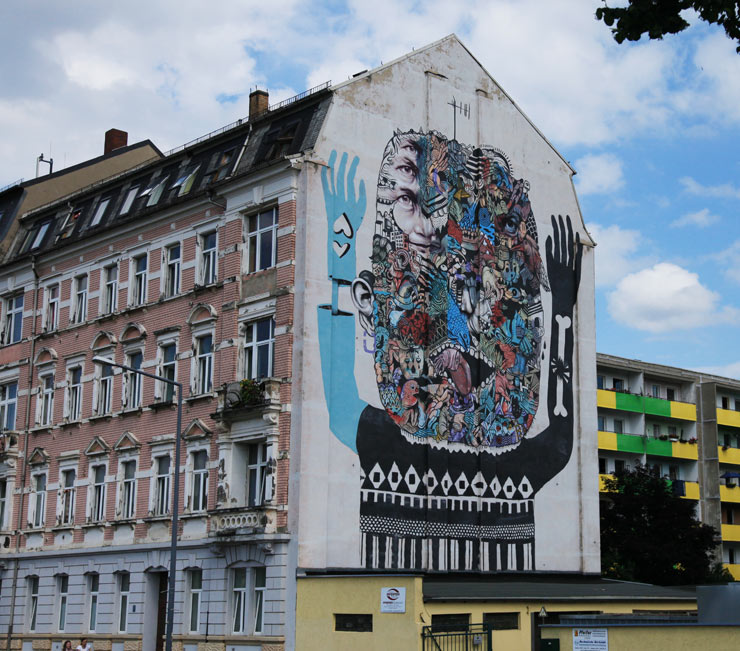
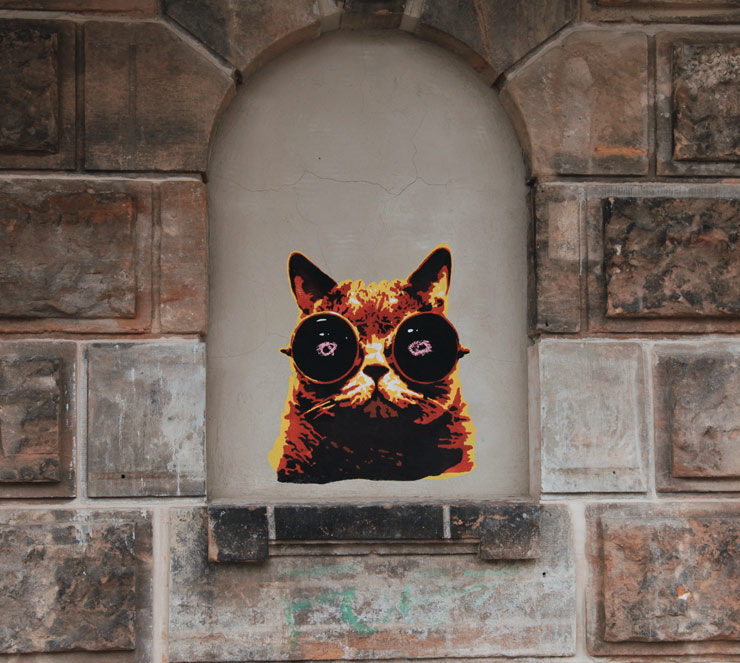
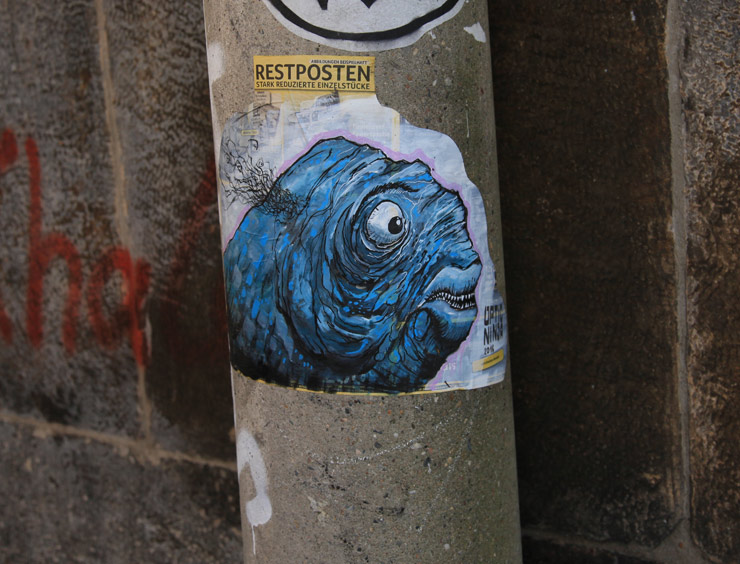
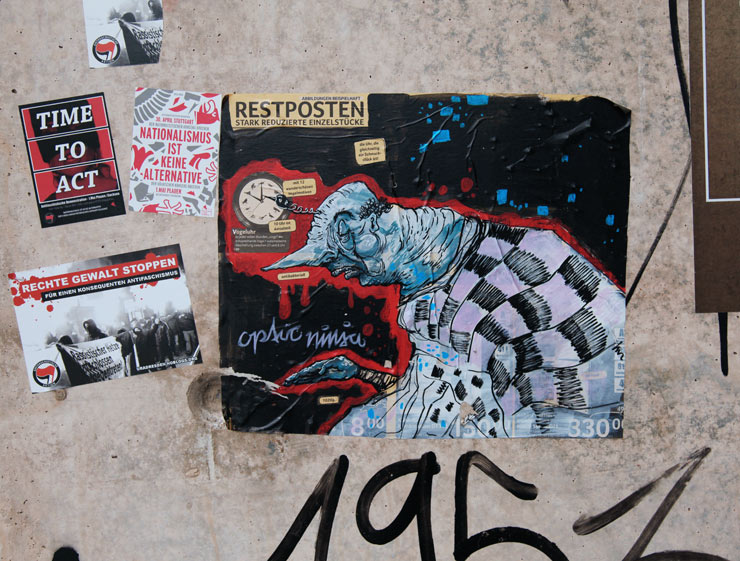
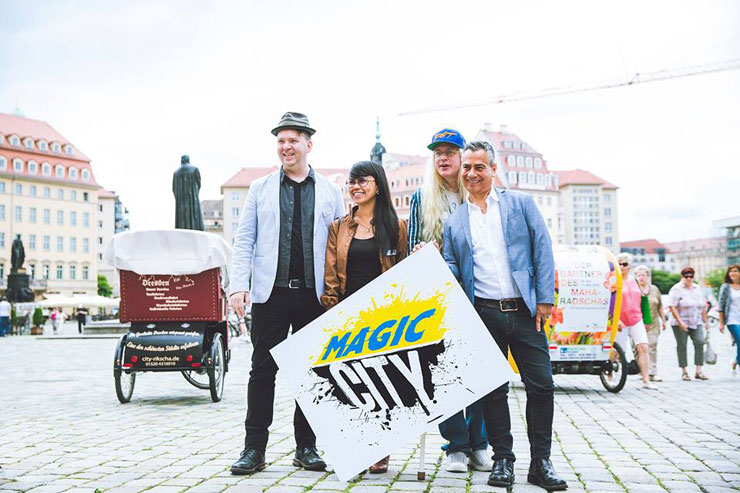
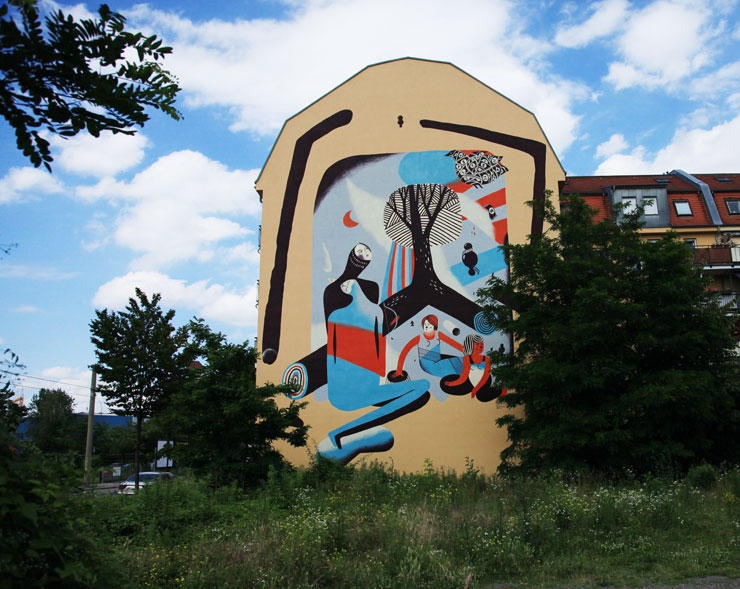
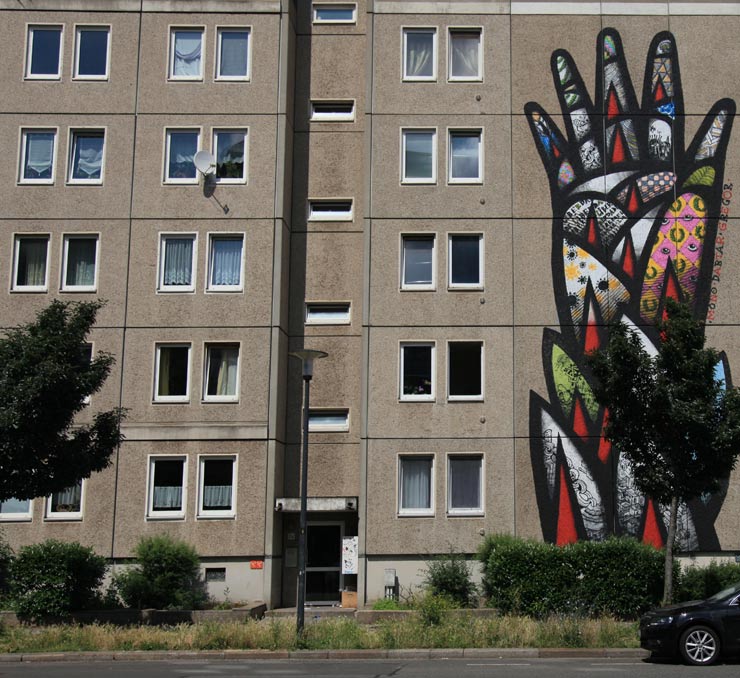
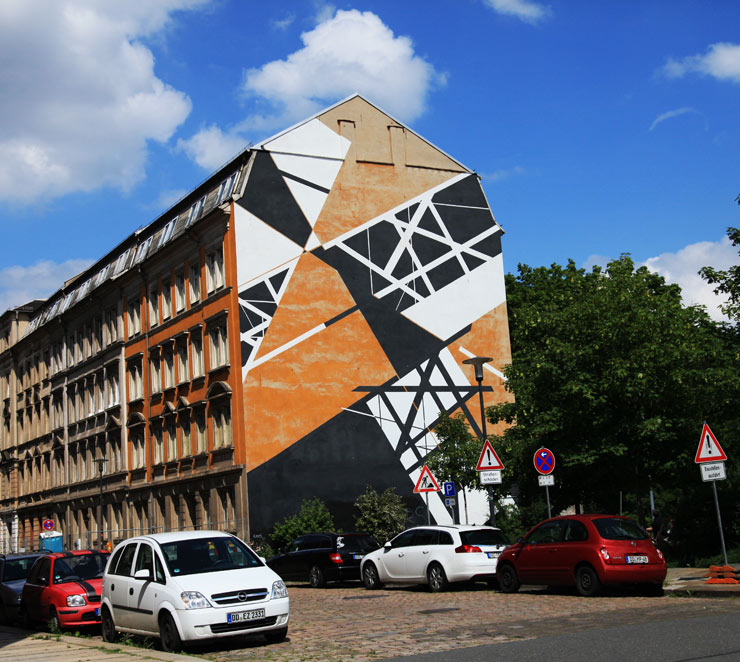
A couple of weeks ago BSA was in Dresden, Germany to help lay plans for a new Street Art show opening there this fall called “Magic City” and naturally we hit the streets with bicycles three days in a row to see the city’s graffiti, Street Art, and murals whenever time would permit. The first day we had the honor of getting a tour from Jens Besser, an artist, author, lecturer, and producer of mural festivals in the city who sped ahead of us through a labyrinth of streets to show us a number of the impressive murals he and partners have brought to the city in the last decade or so.
We did some investigating on our own later through Dresden’s more bohemian/neglected gritty neighborhoods but that first tour clued us in to some of the magic that can be found in this city that lies only two hours south of Berlin. The multitude of skills and voices on the street added additional color to the rich conversations we were invited to contribute to by sage and storied writer, critic and chief curator Carlo McCormick. Carlo generously asked us to be a part of his vision of a “Magic City”, a constructed simulacrum and somewhat surreal streetscape with 30+ artists creating new works of many disciplines and mediums inside a former plane engine factory here, and for years we have provided a platform for this form of storytelling on BSA so it’s fantastic to bring to a theater setting here.
McCormick has an intense affinity for the artists and the creative spirit that rivals how extensively he is versed in the antecedents, undercurrents, and greater intellectual and cultural implications of this world that is loosely described as Street Art or Urban art. We’re honored that Carlo tapped us to create a BSA Film Program to work within this newly designed city and to expand the definitions and perceptions of freewill art in the public sphere. Likewise we are grateful to the incredibly talented and ingenious Magic City team under the leadership of Christoph Scholz for inviting us on board for this project – all of which we’ll tell you more about soon.
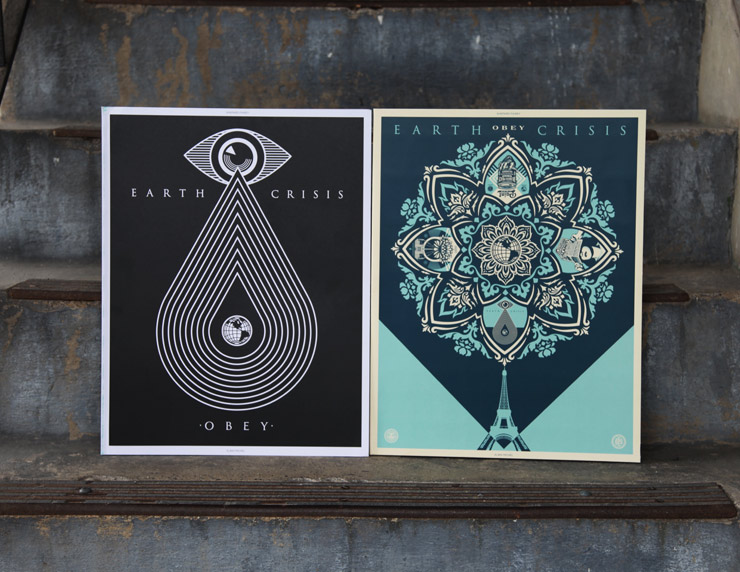
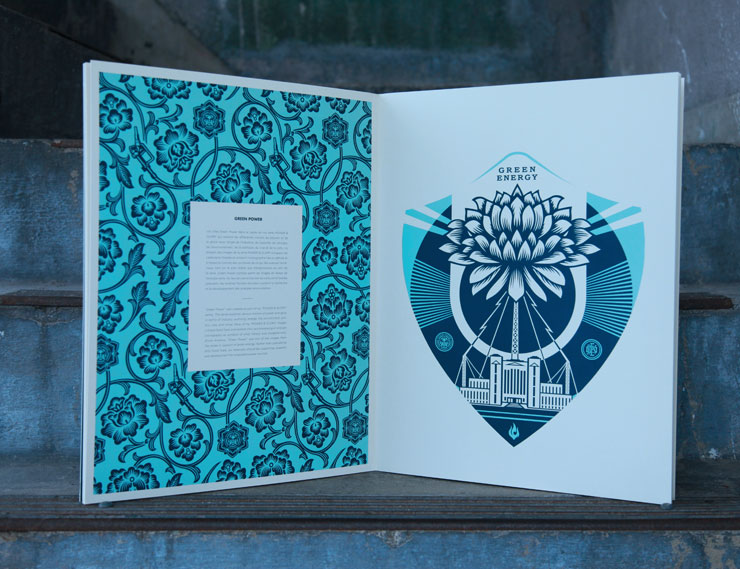
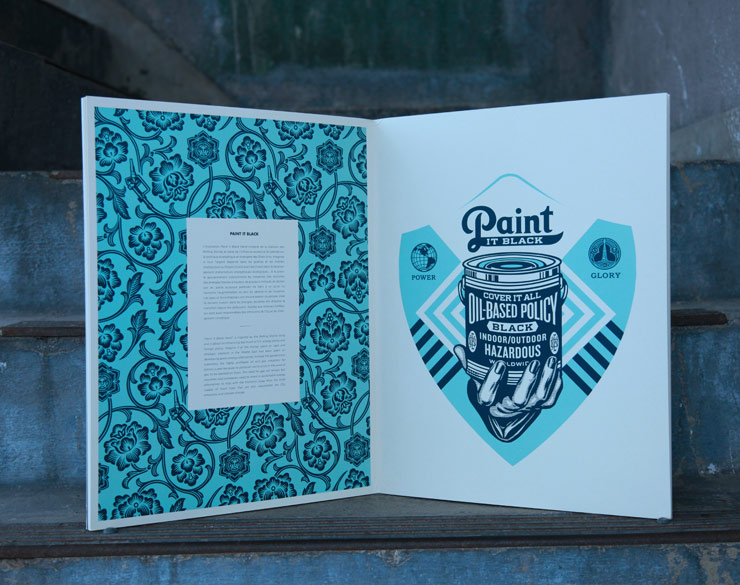
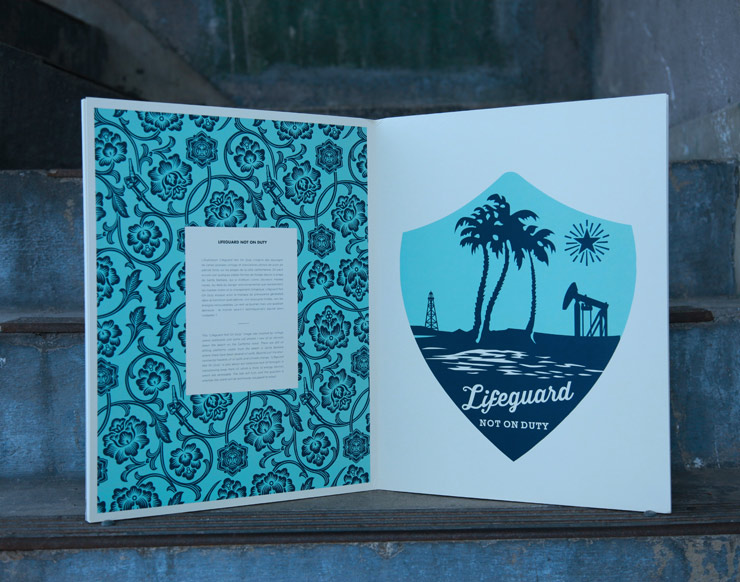
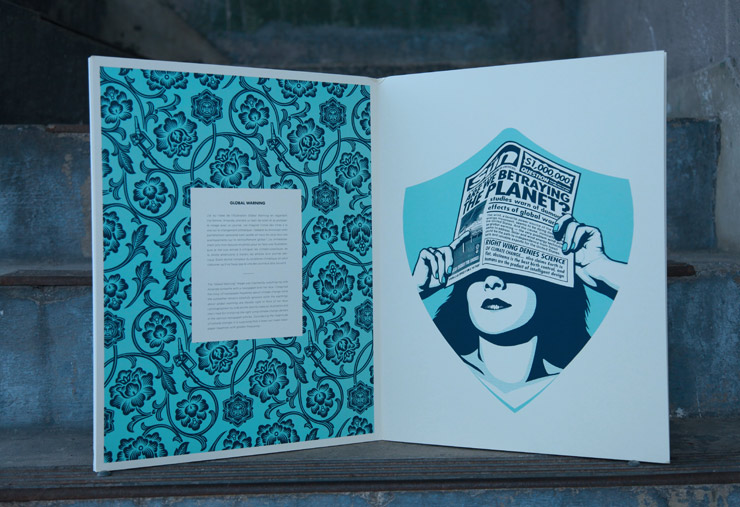
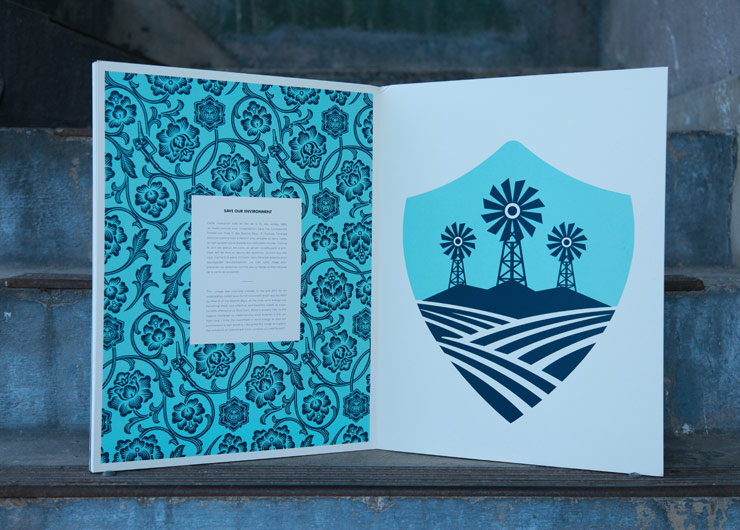
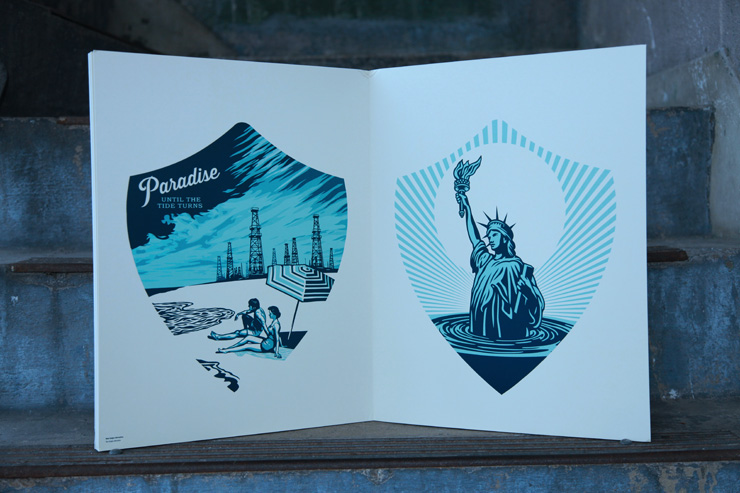
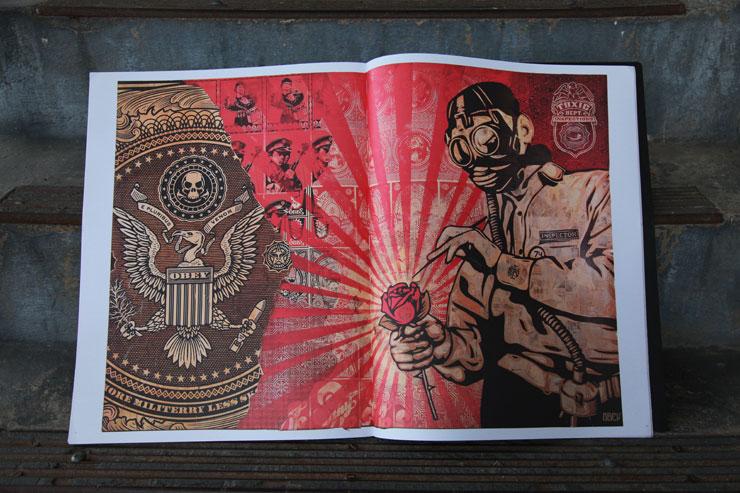
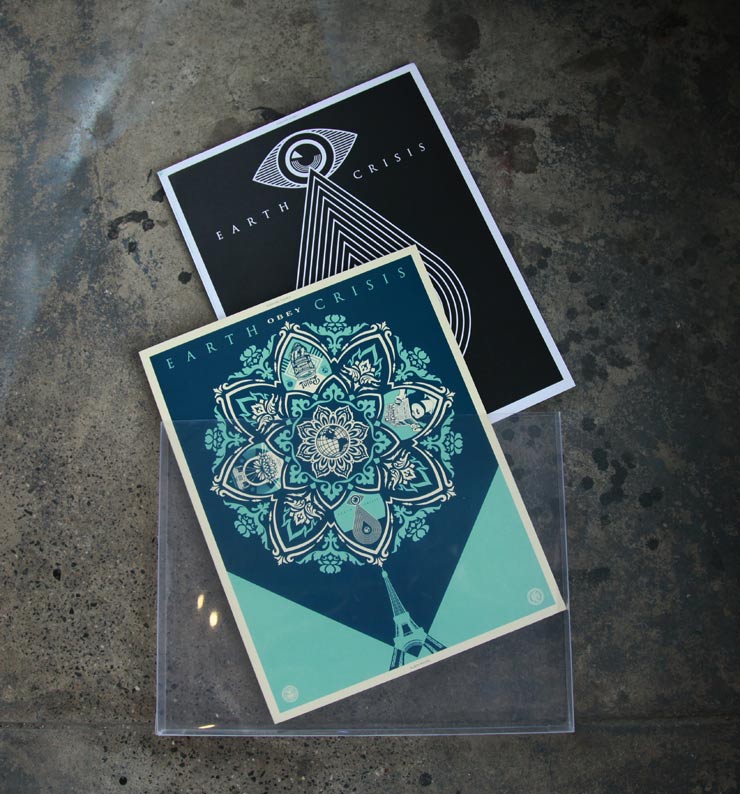
Artist and activist Shepard Fairey this week releases a 2 volume “Earth Crisis” set that commemorates a recent public environmental project and doubles as a collection of plates to jumpstart your collection which you could easily frame and hang. With it comes powerful socio-political messages common to his wheelhouse delivered with the artists often iconic sense of design.
Shepard Fairey / OBEY. Earth Crisis. Albin Michel Publishers . Galerie Itenerrance. Paris. July 2016
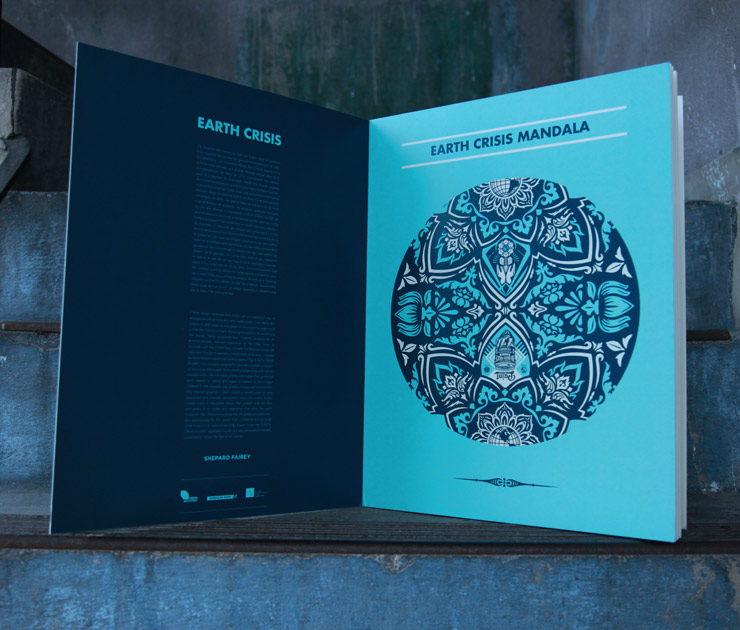
With his enormous “Earth Crisis” globe project mounted at the Eiffel Tower for COP21 last November, Fairey brought his activist history, design history, and sense of timing and location to a stunning crescendo with this project. Suspended 60 meters overhead at the base of the tower while world leaders were gathered to discuss global warming, climate change, and energy policy in the so-called First world and Developing world, the globe incorporated many of the messages that Fairey has been bringing to the streets over the last two decades to provoke discussion.
Shepard Fairey / OBEY. Earth Crisis. Albin Michel Publishers . Galerie Itenerrance. Paris. July 2016
In addition to thick cardboard plates of details from the Mandela he created for Paris, a second book of posters addressing related themes is included with his signature style incorporating mid-century slogans and advertising design, punk rock culture rage, and word-play that illuminates and hammers.
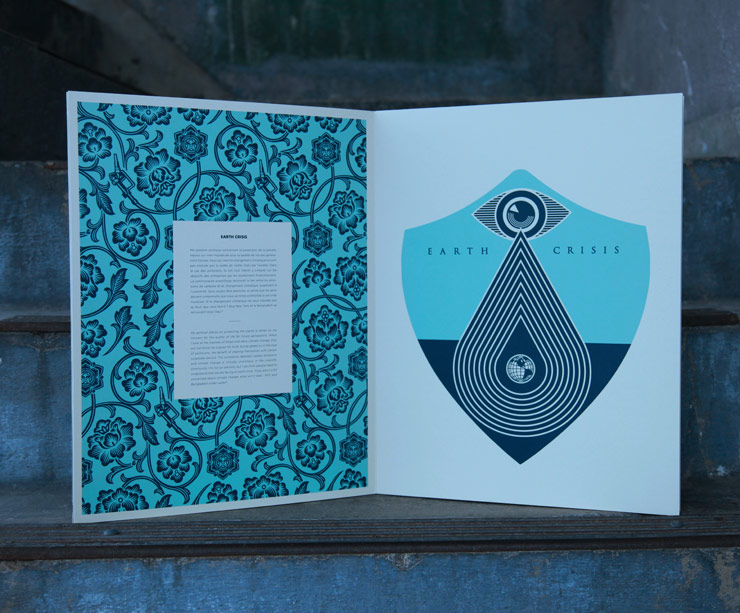
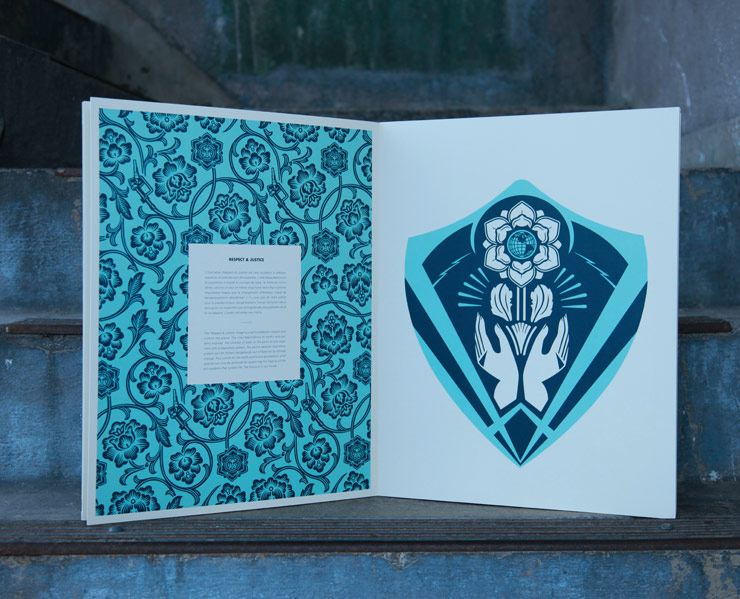
Topically the plates address themes including only some of those Mr. Fairey has continued to feature front and center in his street work and fine art and design: campaign-finance reform, the oil economy, air and water, corruption in politics, private control of public natural resources, green energy, the seduction of advertising, corporate collusion, fake patriotism and real climate change.
Shepard Fairey / OBEY. Earth Crisis. Albin Michel Publishers . Galerie Itenerrance. Paris. July 2016
Of particular poignance are some of the artists observations and motivations for making the work, including one particularly reflective statement that may point to an artists own struggle to affecting change. He speaks about reading Rachel Carson’s “Silent Spring” published in 1962 and the effect it had on many.
“The title ‘silent spring’ was intended to force readers to contemplate spring time without the sound of songbirds – a jarring picture but also a reminder that our emotional connection to our environment is mainly just aesthetic,” Fairey writes. “If we stay oblivious to ecological destruction until we notice the aesthetics change by then it will be too late.”
Shepard Fairey / OBEY. Earth Crisis. Albin Michel Publishers . Galerie Itenerrance. Paris. July 2016
Shepard Fairey / OBEY. Earth Crisis. Albin Michel Publishers . Galerie Itenerrance. Paris. July 2016
Shepard Fairey / OBEY. Earth Crisis. Albin Michel Publishers . Galerie Itenerrance. Paris. July 2016
Shepard Fairey / OBEY. Earth Crisis. Albin Michel Publishers . Galerie Itenerrance. Paris. July 2016
Shepard Fairey / OBEY. Earth Crisis. Albin Michel Publishers . Galerie Itenerrance. Paris. July 2016
Shepard Fairey / OBEY. Earth Crisis. Albin Michel Publishers . Galerie Itenerrance. Paris. July 2016
Shepard Fairey / OBEY. Earth Crisis. Albin Michel Publishers . Galerie Itenerrance. Paris. July 2016
Shepard Fairey / OBEY. Earth Crisis. Albin Michel Publishers . Galerie Itenerrance. Paris. July 2016
Shepard Fairey / OBEY. Earth Crisis. Albin Michel Publishers . Galerie Itenerrance. Paris. July 2016
Shepard Fairey / OBEY. Earth Crisis. Albin Michel Publishers . Galerie Itenerrance. Paris. July 2016
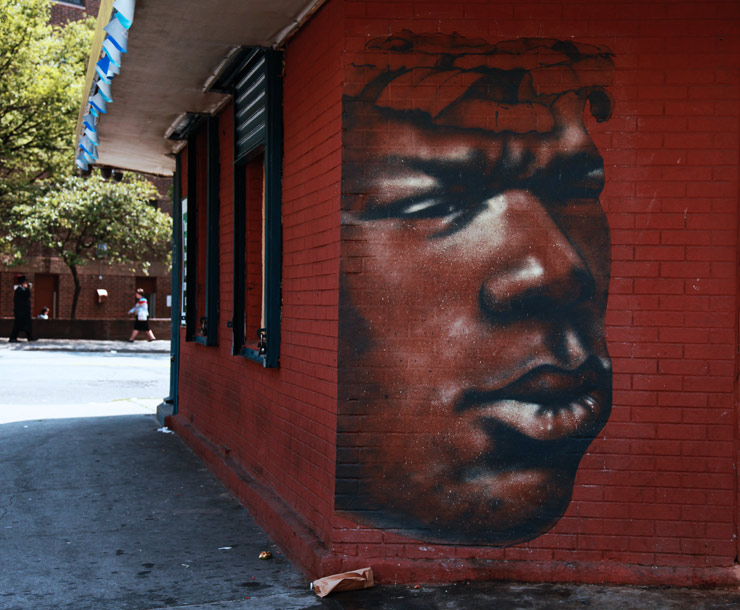
For this Sunday’s edition of BSA Images Of The Week we have decided to publish one image only. It’s a brand new piece and is a portrait of an anonymous African-American man painted by Street Artist Overunder and wheat-pasted somewhere on the streets of Brooklyn.
“It’s a portrait of an anonymous black man. So it very well could be a victim, or a future victim,” he told us in an email.
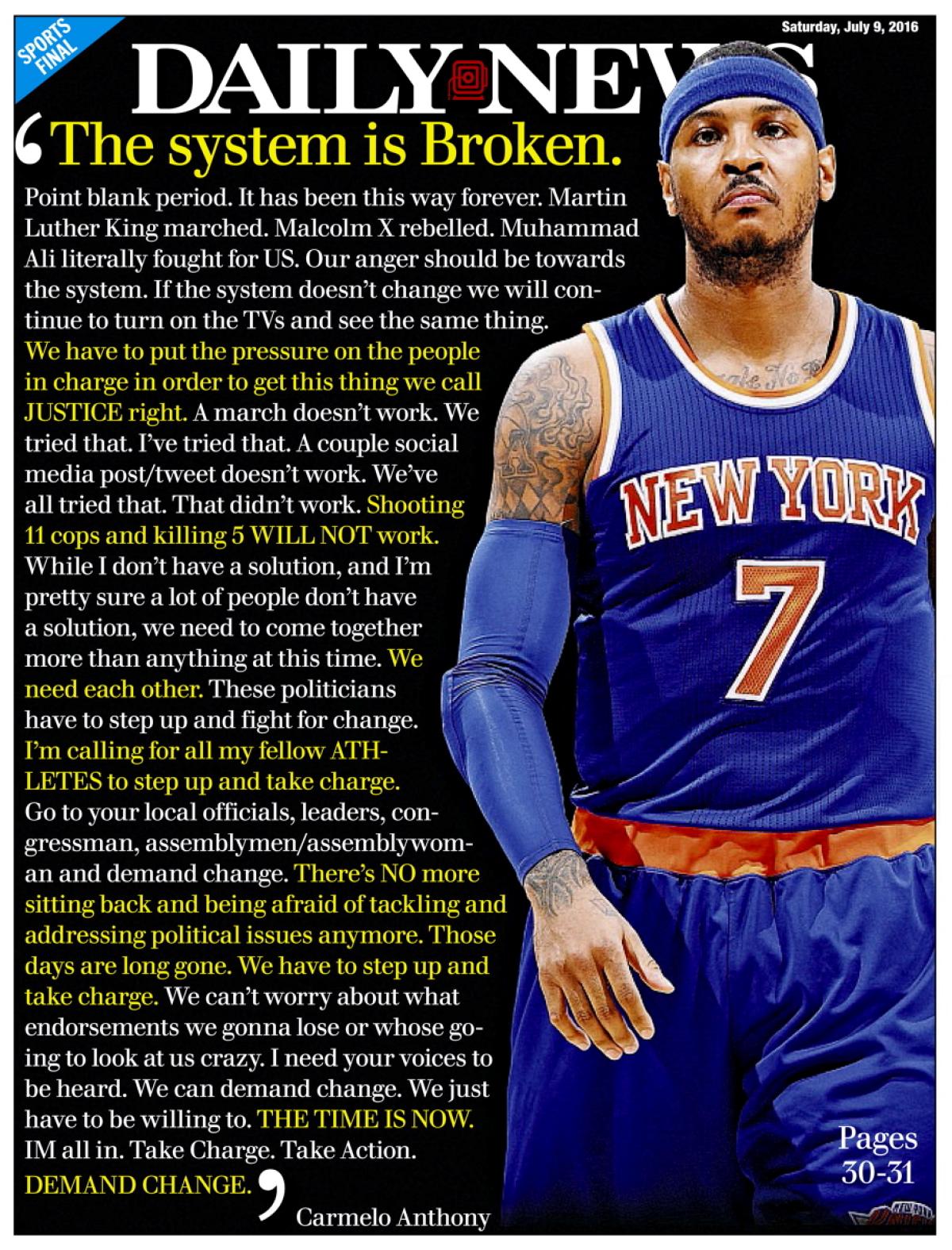
This week has been a horrific one on the streets in this country. Forgive us if we speak too much here or are out of our depth but we are on the street a lot obviously and we think the conversation among all of us needs to continue if we are going to find solutions. The new videos posted online of our citizenry being murdered, some at close range, others in ambush, tell a story of where we are as a nation right now.
After seeing the videos of Philando Castile dying of gun shots by a police officer in Falcon Heights, Minnesota and of Alton Sterling being shot at close range by a police officer while subdued and on the ground in Baton Rouge, Louisiana viewers can walk away from them feeling as if they were being witness of the shootings. Seeing police downed by sniper fire in Dallas has confirmed that violence is not the answer.
We are bigger than this, all of us.
One would have to be either racist or delusional or both to not be angered, outraged, horrified, worried and profoundly saddened by the images coming out of those videos and photographs.
But we’ve inherited the legacy of our past and no one should feign surprise that we are dealing with it nor deny its impact on us today. Americans used to send postcards bragging that they had attended a lynching of a black man or woman, and most of those acts were to punish imaginary transgressions. Picture postcards.
Suddenly the lyrics of “Strange Fruit” sang first by Billy Holiday and later by Nina Simone and others come to mind. Those disturbing, haunting words could be easily applied in today’s America. The “…Black bodies…” are not “…Swinging in the southern Breeze…” -they are being tossed around in the back of a van, or trampled upon, or choked, face down against the hard and dirty concrete of our cities’ sidewalks. They are slumped, bleeding inside their own cars. They are suffocated and piled upon while gasping for air. They are taken down while playing in the playgrounds or just walking down the street, any street. Now we are seeing them on our phones.
The pain and the grief are the same. The sense of injustice is the same. The frustration is the same. The anger is the same.
Sweep it under a rug for a while if you like, but it won’t go away.
The police officers who were murdered in Dallas while on duty and while protecting the people who had gathered peacefully to protest the killings in Baton Rouge and Falcon Heights didn’t deserve to die. Random or targeted killing of police is despicable. Their families were waiting for them to have dinner together and to do what families do at the end of the day. Instead their lives were cut short and now their families have to cope with the loss of their fathers, husbands, brothers, boyfriends, friends.
Violence against police is not going to solve any problems because it assigns collective guilt – and we know the majority of cops are good hard-working everyday people trying to do the right thing. It is also just as morally wrong as violence against citizens. We are collectively smart enough not to allow this complicated scene to be simplified by media needs to polarize us into separate camps like it is a sporting match. Some families have police and protesters sitting at the kitchen table and those families, like our greater American family, find a way to identify common ground.
Many have observed that brutality against people of color is not new – we just have cameras to record it in this modern moment and now the utter pain and injustice is available for us all to see and discuss with each other. It makes you wonder about the complicity of the news organizations over the last decades, doesn’t it? Now that we all are confronting it, let’s do the right thing and work toward a more just society.
It’s racism. It’s systemic. And we can fairly call it a broken system.
That’s why there are demonstrations system-wide;
across the country over the last few days in tens of cities like Philadelphia, Tucson, Oakland, Austin, Portsmouth, Norfolk, Portland, Nashville, New York, Chicago, St. Paul, Birmingham, West Palm Beach, Columbus, San Antonio, Los Angeles, Phoenix, – even Brixton in the UK. Our consciousness has been raised – and we realize there is work to be done.
We have to believe that the majority of people don’t want to go out on the streets and do this marching and yelling – most people would rather be at a swimming pool or in a movie theater or sitting under a tree with a cold drink. But the system is broken, has been for a long time, and the injustice, pain and fears are simply too great and people are demanding solutions.
We just collectively are realizing that we can’t be silent anymore about the evidence that blacks and other minorities are being subjected to the use of force disproportionately than any other group by many police officers around the country. According to The New York Times the data is there to support the assertion in a new study released on Friday titled “The science of Justice: Race, Arrests and Police Use Of Force”
“When force is used, a new study has found, the race of the person being stopped by officers is significant,” the Times says.
Let’s not blame anybody else, let’s not be cynics, or try to deflect. These problems belong to all of us and we have to accept responsibility for improving things in our own back yards, our front yards, our sidewalks, parks, stores, stadiums, museums, laundromats, offices, schools.
What people of color have to endure day-to-day in this country just to run an errand is everyone’s responsibility. Creating an environment where people live in a continuous low-level state of fear is immoral and it’s certainly not in alignment with Christian values, nor those of any organized religion we know of. We all are morally obliged to make certain that we all as people are treated equally and with fairness. That’s the real American way. When there is injustice, we all have to be accountable for a system that corrects the injustice.
We all deserve to go home at night to those whom we love and who are waiting for us to share dinner, to tell a story, say a prayer or be kissed goodnight.
And since it is July and it is hot in NYC and across the country; please brothers and sisters, protesters and police, let our cooler heads prevail. We can do this.
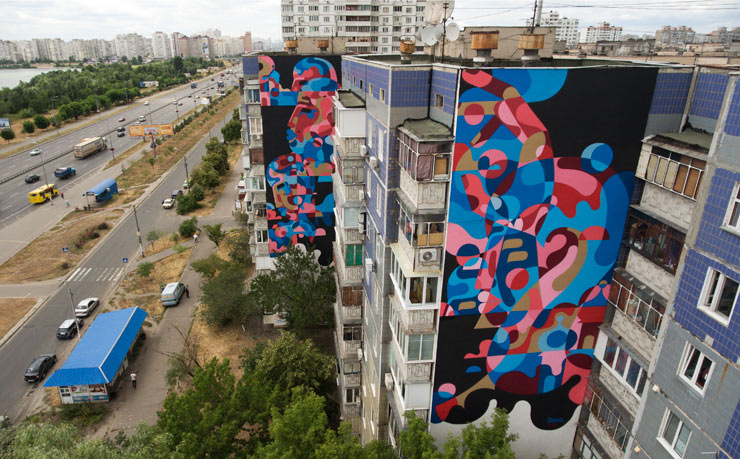
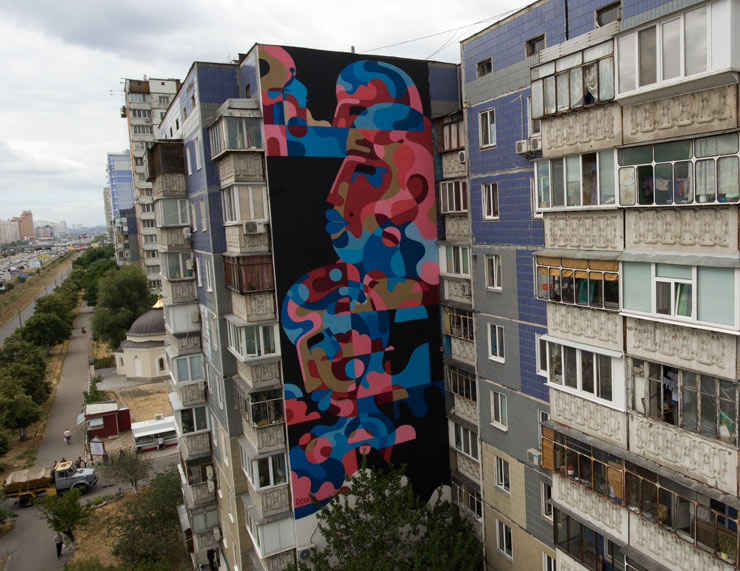
“До побачення Київ, я буду повертатися найближчим часом! (Goodbye Kiev. Thanks for the good times and the inspiration),” says Reka as he leaves the Ukrainian capital and celebrates the latest mural for Art United Us, a newly minted global campaign to promote peace through the public display of creativity. This new mural is actually split over two walls and features the abstract signature of the Melbourne born 90s graffiti writer James Reka who has become a globe-trotting muralist and who now lives in Berlin.
Conceived of as a diptych when viewed from the correct angle, you can see how Reka relies on a natural flow and rhythm that connects the two walls with one another and each in response to its individual plane and surroundings. It is difficult for an artist to strike a balance in the urban environment and formal plan, particularly one who has traveled far to discover this historic and storied cityscape.
Here Art United Us appears to have a natural predilection for appropriate placement and their aspirations for a global showing of over 200 artists in the next two years looks promising. Begun in response to the shock and pain of war, the international project is celebrating the creative spirit – something BSA has been doing here with you for 8 years – with an eye toward raising “public awareness and attention to the problems of war, aggression and violence.”
Congratulations to Reka and the co-founders/curators of Art United Us; Geo Laros,Iryna Kanishcheva, Waone Interesni Kazki, and Ilya Sagaidak. We look forward to seeing more of your heart and creativity at work!
Next up: ROA is finishing his wall, despite dealing with a bad foot and Pastel is researching local botanicals in preparation for his next wall. We know them both and they are up to the job! – and will bring AUU more murals for Kiev to be proud of.
Our weekly focus on the moving image and art in the streets. And other oddities.
Now screening :
1. Aaron Li-Hill: The Impact Of Discovery in Kiev.
2. Isaac Cordal: The Painter
3. Tilt. Part I & II. Interviewed by Steven P. Harrington of BSA at Jardin Rouge in Morocco
BSA Special Feature: Aaron Li-Hill: The Impact Of Discovery in Kiev.
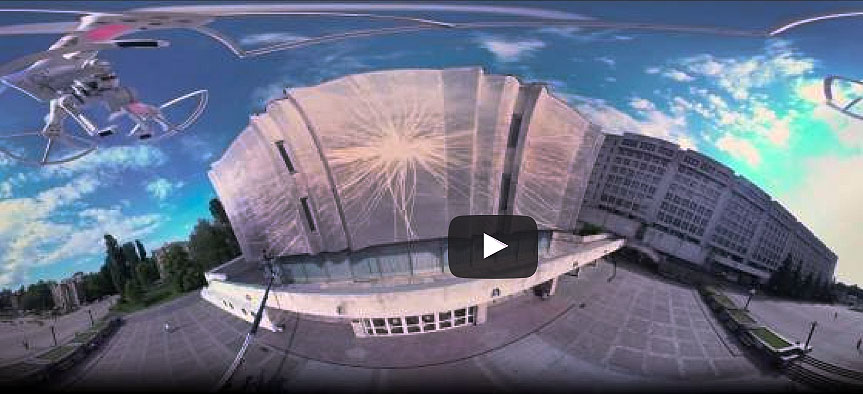
A special treat for you today with this 360 degree interactive opportunity to buzz around Aaron Li-Hill as he completes “The Impact of Discovery”, his large-scale mural which we covered last month (Li-Hill in Motion and “The Impact of Discovery” in Kiev). Have fun scrubbing around with your mouse directly on the screen to see the action from every angle.
Part of a special program of 30 artists painting in Kiev, Odessa and Chernihiv, this roundabout view allows you to see the artist and understand his environment in a way not previously available in Street Art videos, further connecting the viewer to the process.
Congratulations to FILM.UA Group, Digital Cinema Ukraine for this piece, and we look forward to the next video from this International Festival of Urban Art called Mural Social Club 2016.
Isaac Cordal: The Painter
Isaac Cordal is expanding his practice beyond the small sculptures that he places strategically throughout the cityscape. Here is a new video that gives us a hint of the direction he is going in; a staged scene in the woods with a camouflaged military man of no discernable allegiance. He silently appears to be discovering his creative side.
Tilt. Part I. Interviewed by Steven P. Harrington of BSA at Jardin Rouge in Morocco.
This spring we had the opportunity to speak with French graffiti artist Tilt at Jardin Rouge, a unique residency just outside Marrakesh begun by a dedicated fan of graffiti and street art named Jean-Louis. Now at the advent of the recently founded Montresso Foundation exhibition building, we were treated to a behind the scenes look at the inaugural show; Tilt’s two-part sculpture of a sawed-in-half car representing migration of city folk to the country and vice versa.
“You are surrounded by people you know and people who know your work and people are expecting something from you. And then you can be more free I think. And then you can try and even if it doesen’t work, even if it is a failure, you can be like, “It’s okay.” It’s part of the game.” ~ Tilt
In coordination with Urban Nation (UN), BSA co-founder Steven P. Harrington has a wide-ranging talk with the artist that touched on his residency with Jardin Rouge, his fascination with examination of duality, and his own studied moves from the street to the gallery to private collections. This week we feature two small excerpts from that interview for your enjoyment.
Tilt. Part II. Interviewed by Steven P. Harrington of BSA at Jardin Rouge in Morocco in February 2016.
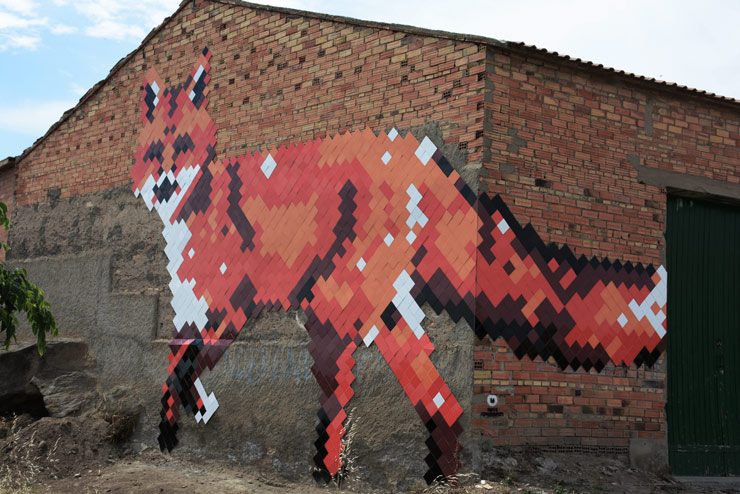
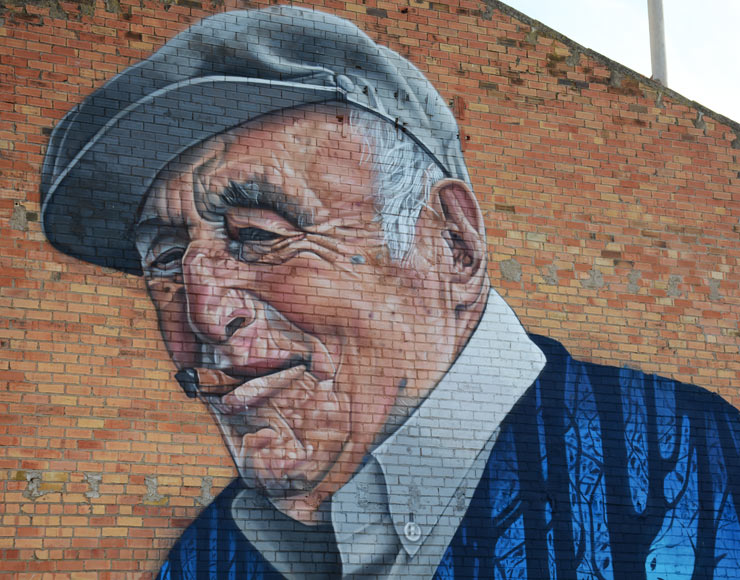
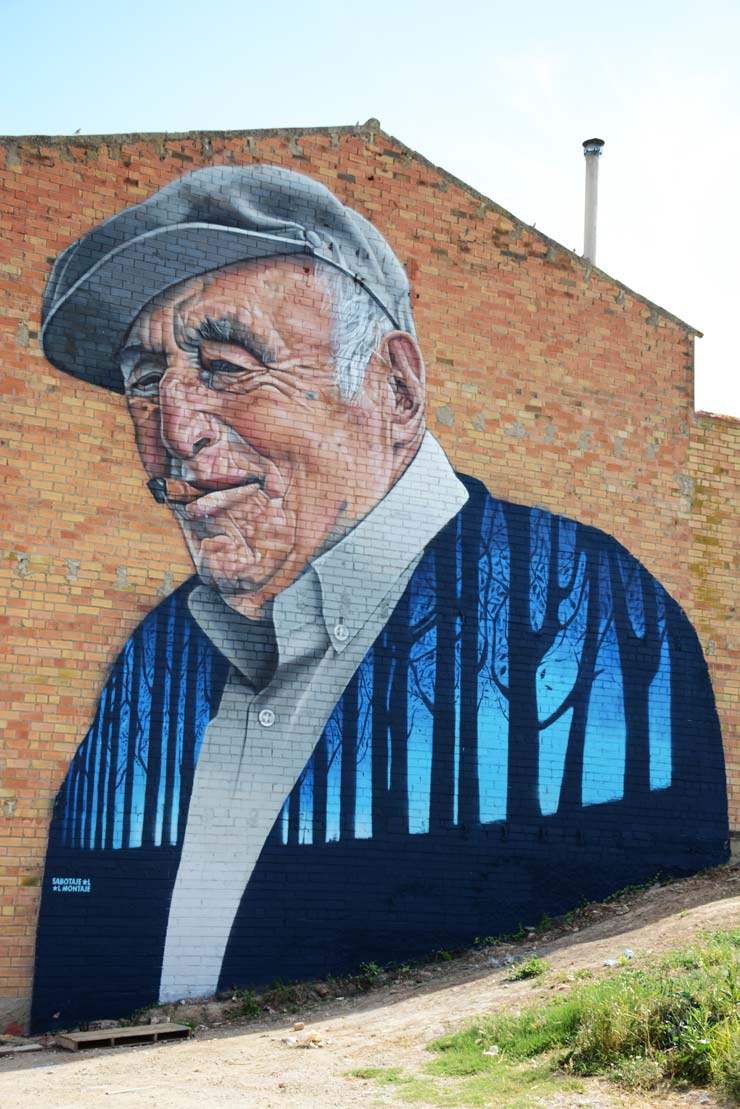
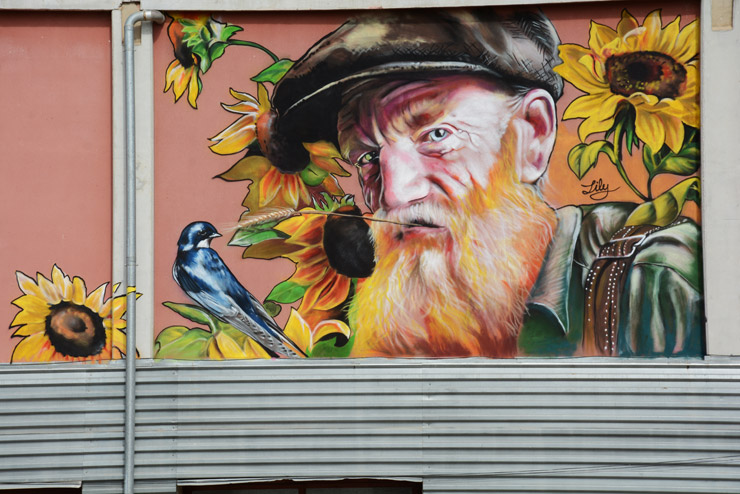
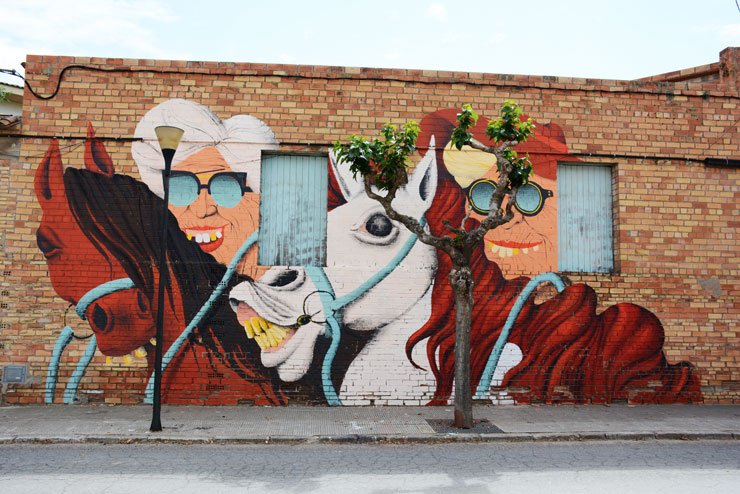
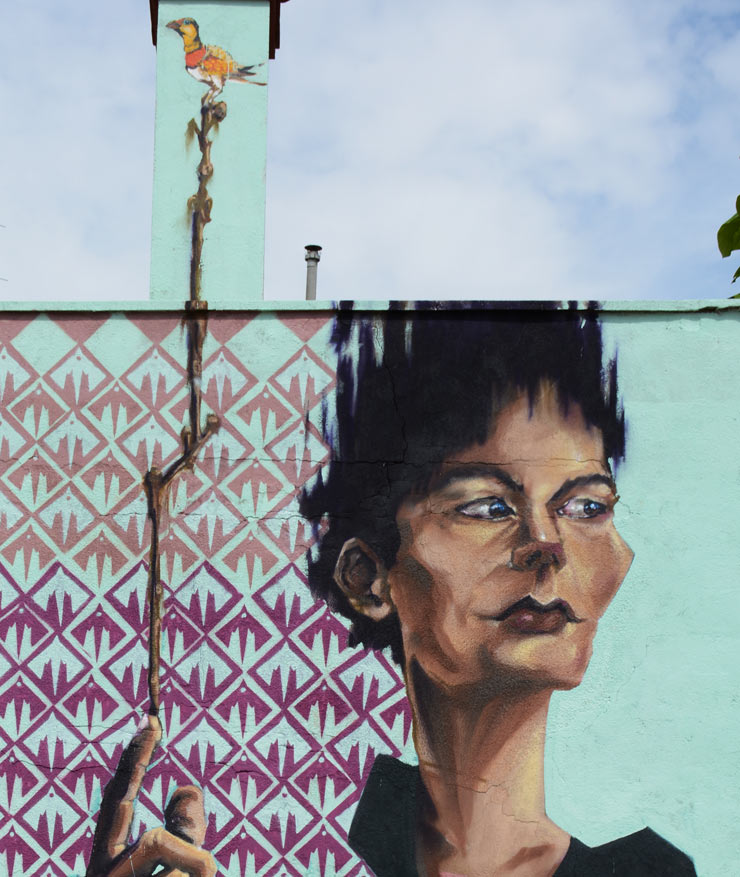
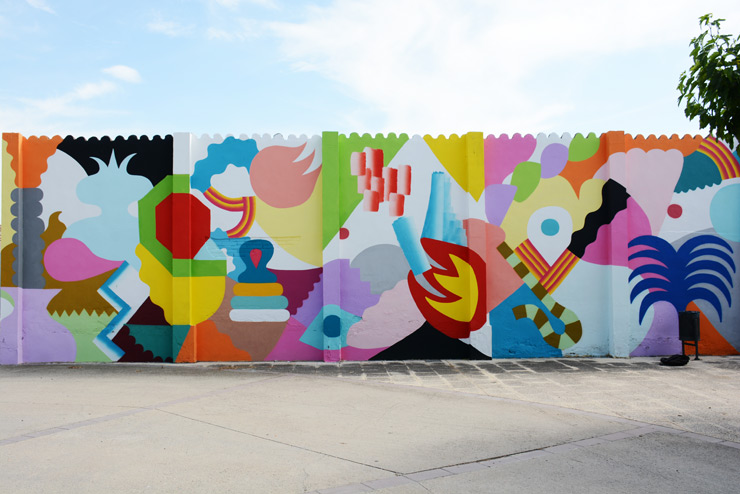
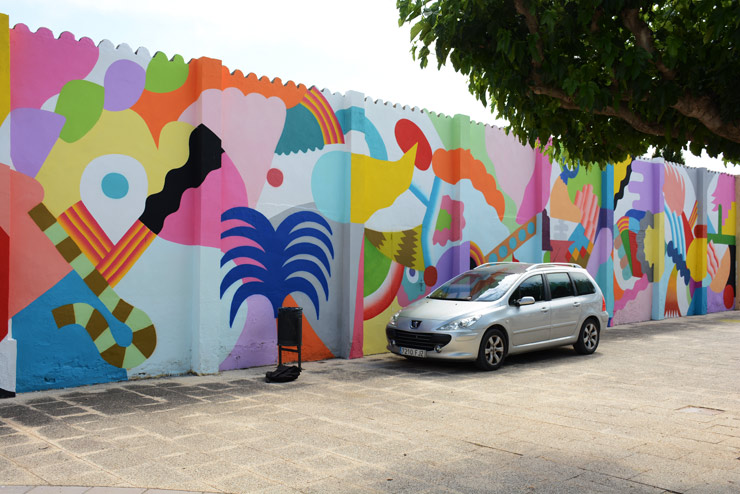
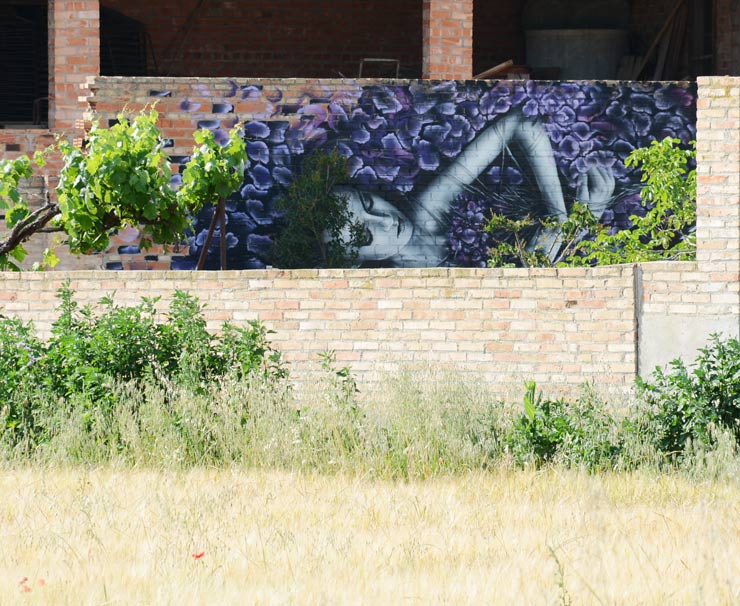
The influence of Street Art and graffiti continues to disperse through cities, towns and the countryside of many regions in the form of mural festivals. The village of Penelles in Catalonia asks residents if they would like to hand over the walls of their houses to be painted by contemporary artists and many say yes, gladly.
It is a far cry from the responses of landlords in large cities where the association in the minds of many is graffiti and vandalism. According to a posting on Facebook, the challenge for attendees of a recent mural festival here was to gather enough money to rent a bus and drive people around to see the new artworks!
GarGar, the festival held in the third week of May, also featured live music, food trucks, beer, workshops, and people milling around taking photos of the artists while they worked and discussing the new pieces. Perhaps taking as a model the same concept as the Spanish town of Fanzara, Penelles is a small sleepy town that is being revitalized with urban art.
Photographer Luis Olive Bulbena tells us that the town, which is located around 130 km northwest of Barcelona, has about 500 inhabitants and “basically the whole of the municipality revolves around agriculture.”
We thank Mr. Bulbena for sharing these new images with BSA readers.
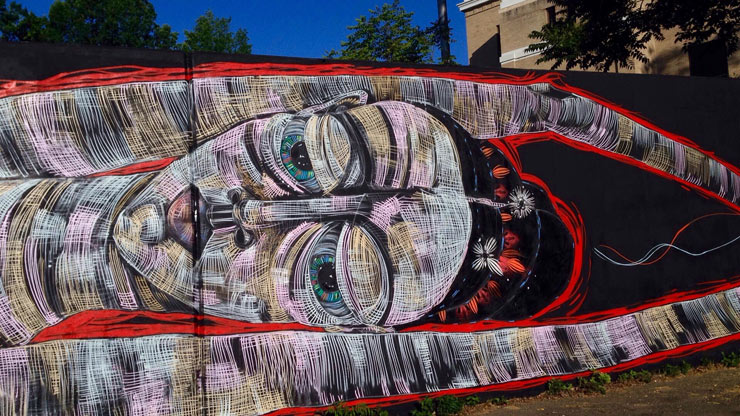
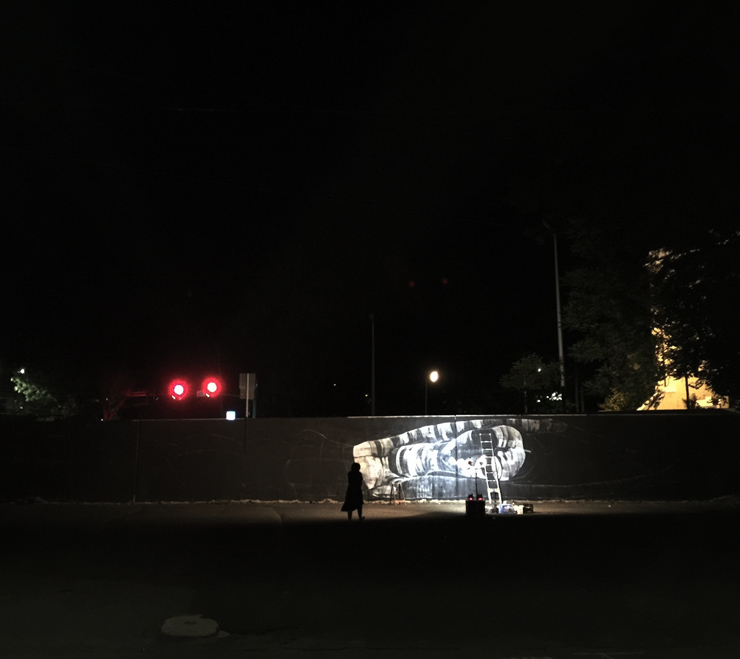
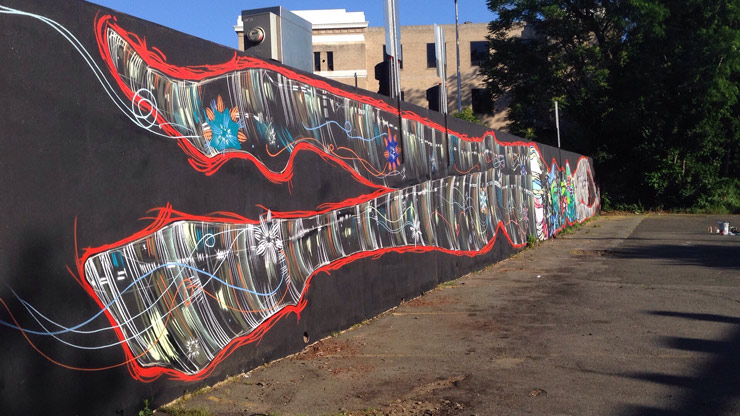
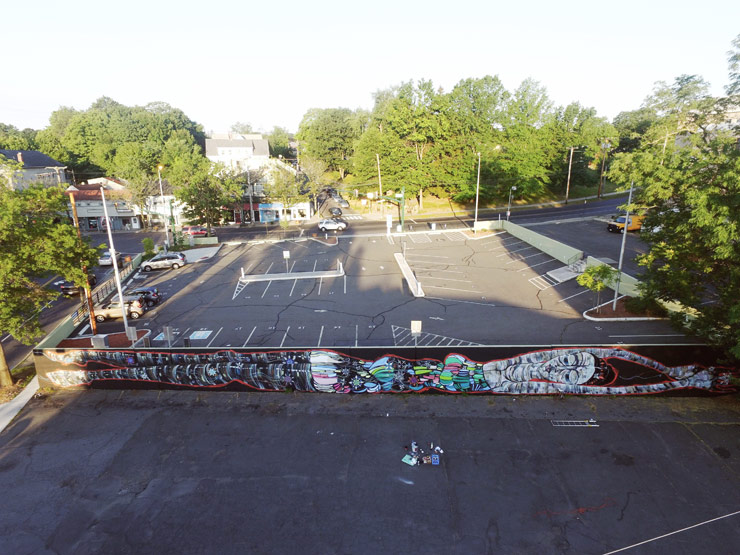
Faring Purth is taking this one lying down in Westville, New Haven Connecticut on a long wall with Marielle. The 150 x 12 foot figure featured in “As in the Light of Marielle” was just completed and feted with an evening celebration that featured light artist Raven Fox, whom Faring says provided “breathtaking illuminations” overlaying her painted figure.
Stretching luxuriously from fingertip to pointed toe along the length of a parking lot in a lushly greened neighborhood, the wall was completed as a result of of Farings’ involvement with a local community arts group, the Westville Village Renaissance Alliance.
Seeing the slumber of Marielle and her heavily lidded eyes, we are reminded of this Shakespeare Sonnet XXVII
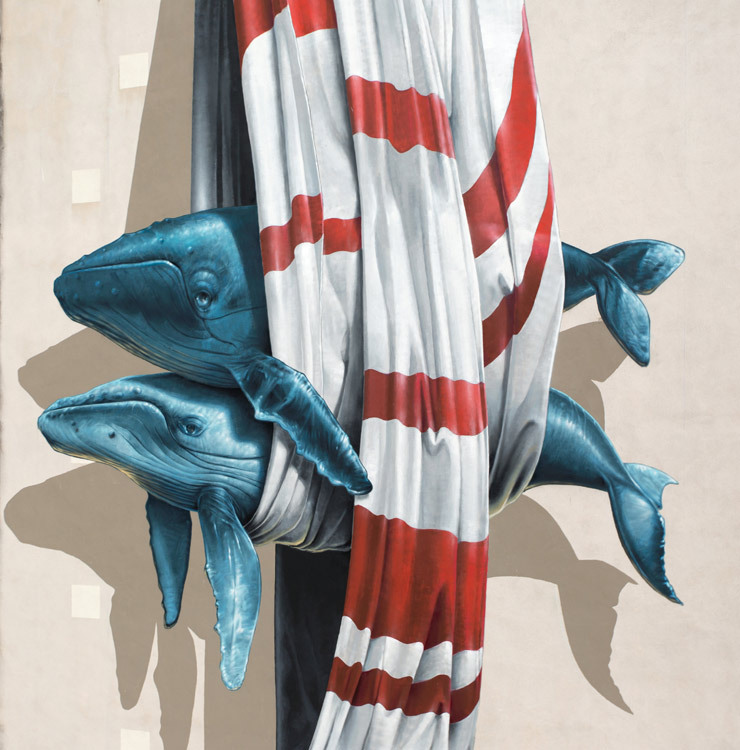
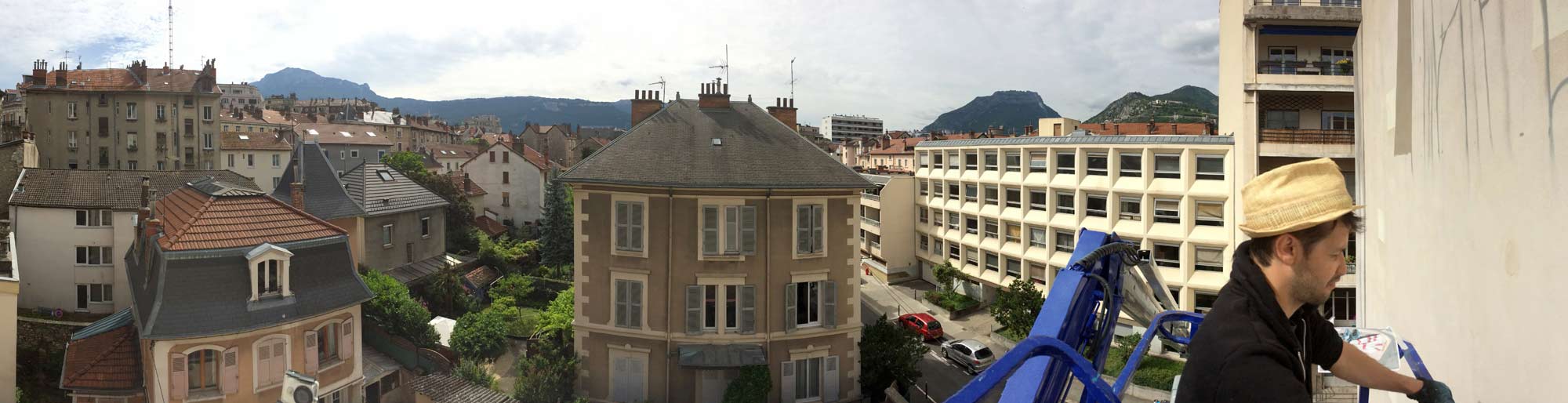
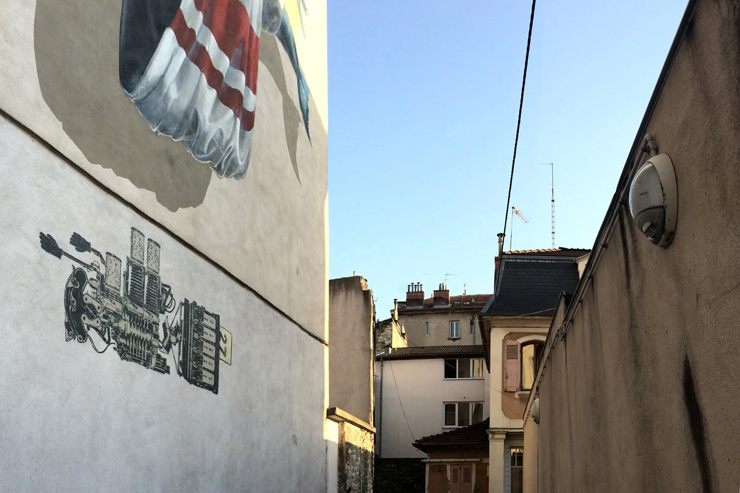
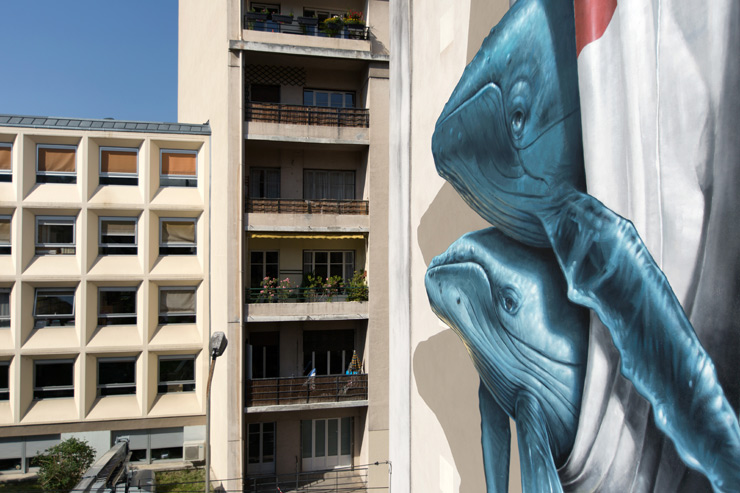
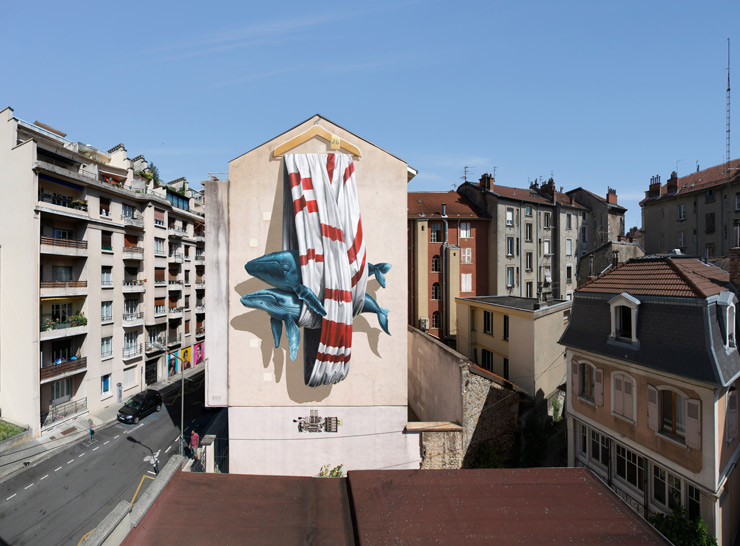
Two whales are suspended from a clothing hanger as if dangling inside “an infinite closet” say Christian and Pablo, the guys who comprise Nevercrew. The glorious intelligent sensitive and graceful beasts of the seas are reduced to mere commodity, just two more options for humans to buy, sell, trade, consume, destroy. Nevercrew are themselves dangling from a basket high atop a cherry picker here in Grenoble for a street art festival in the southeastern French town at the foot of the French Alps.
A sea life animal – a polar bear or whale, for example – is often the central character of the composition for these guys, a majestic free animal that is acted upon instead of in concert with. “This work is called ‘Ordering Machine’ and it focuses on the human attitude regarding the privatizing of natural resources,” Christian says.
“The project was developed around the position of mankind as it is related to nature, where on one side there are our needs and on the other side there are our behavior of consumption and attitude of appropriation.”
In their surreal conceptualizations and development of a visual language that is understood principally to the two Swiss nationals, the viewer may benefit from suspending the purely rational and instead allowing for an alternate universe that they have been creating over 20 years of painting together.
Here animal life is majestic and awe-inspiring, perhaps representing the potential for so much more, but at the least something to be revered. Often the protagonist is anchored or overseen by a smaller complex engine or circuit board that seems to be of steam-punkian vintage, silly in its self-importance, only hoping to be useful in the shadow of a natural miracle.
In “Ordering Machine” the clothes hanger and red-striped fabric is the low-tech constriction device, trapping these beasts like a couple of blocks of cheese. “The hanger is also the support of the entire composition,” according to Nevercrew, reminding us about balancing need with greed as well.
“The arrogant use of nature for economic purposes and for the claim of superiority,” says Pablo, “is a view held by those whose same hands could choose to raise a social awareness and to promote environmental good for everyone.”
Heading into the 4th of July we reflect upon patriotism, our declaration of independence from England, and Britain’s new declaration of independence from the EU. Are there similarities?
Now, we’re all off the park for a barbecue! Where is the frisbee? Where are those hotdog buns?
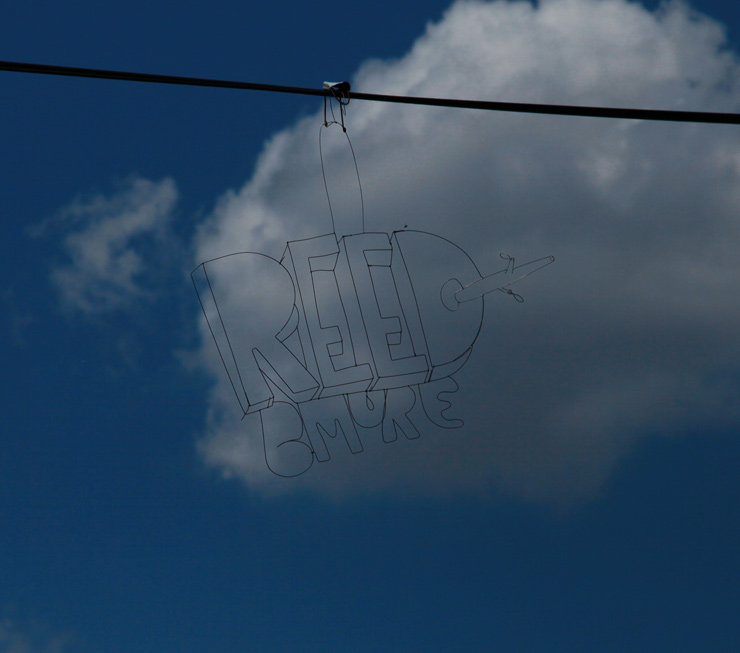
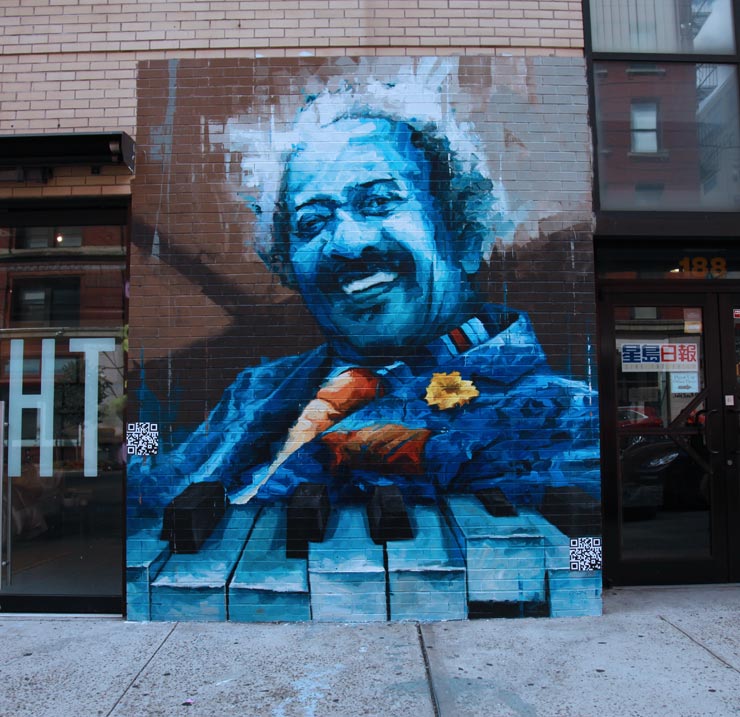
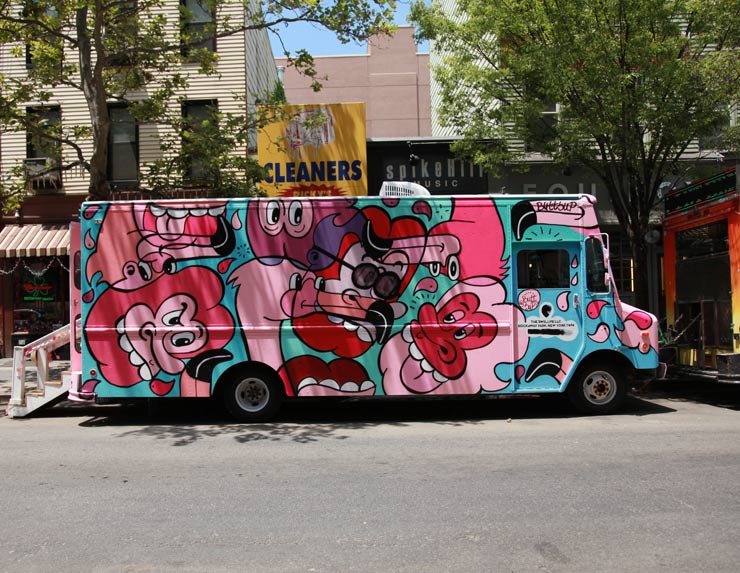
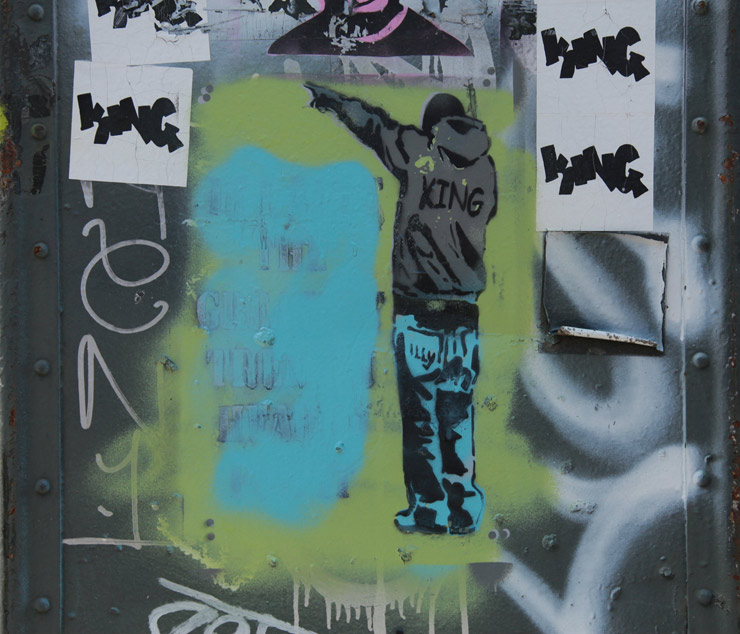
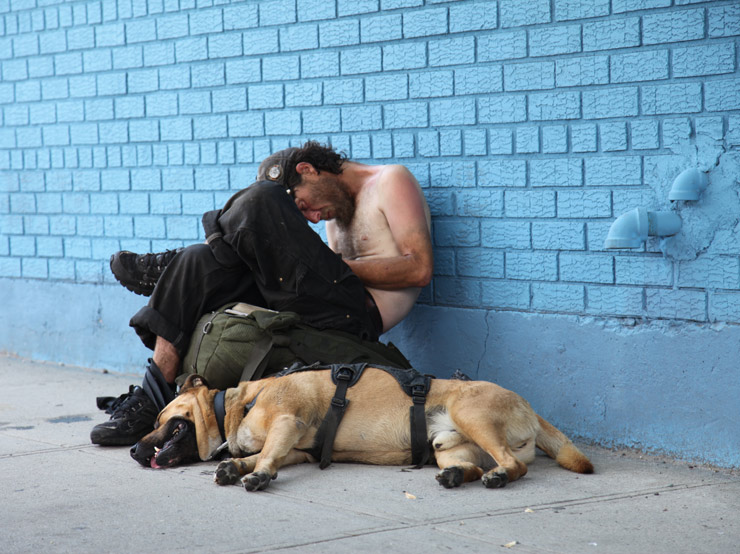
And here’s our weekly interview with the street, this week featuring Agostino Iacurci, Alaniz, Aron Belka, Buttsup, Float Art, Gilf!, King, London Kaye, Pixel Pancho, QRST, Reed B More, Sipros, and WK Interact.
Graffiti artist and an iconographer in Orthodox Christian churches, Fikos is going for the record here in Kiev. “
With 46 meters height, this is the largest mural in the history of Byzantine Painting and the highest artwork in history of Greek art since ancient years,” he says on his Instagram account. Born in Greece, he may know something about the topic.
Additionally, Fikos (full name Fikos Antonios) says that he began studying Byzantine painting at age 13 under the guidance of George Kordis and after a while he collaborated with him to paint murals in Orthodox churches.
Now, as part of the Mural Social Club Festival taking place in Ukraine through the end of July, the 29 year old Athenian says he has painted this soaring Byzantine couple at a scale that is “three times higher than the chryselephantine statue of Zeus in Olympia, one of the seven wonders of the ancient world”.
Our sincere thanks to the team at Mural Social Club. Founder Dmytro Palienko and curators Oleg Sosnov and Julia Ostrovska as well as the NGO Sky Art Foundation for sharing these images exclusively with BSA.
Street art welcomes all manner of materials and methods, typically deployed without permission and without apology. This hand-formed wire piece …Read More »
 BROOKLYN STREET ART LOVES YOU MORE EVERY DAY