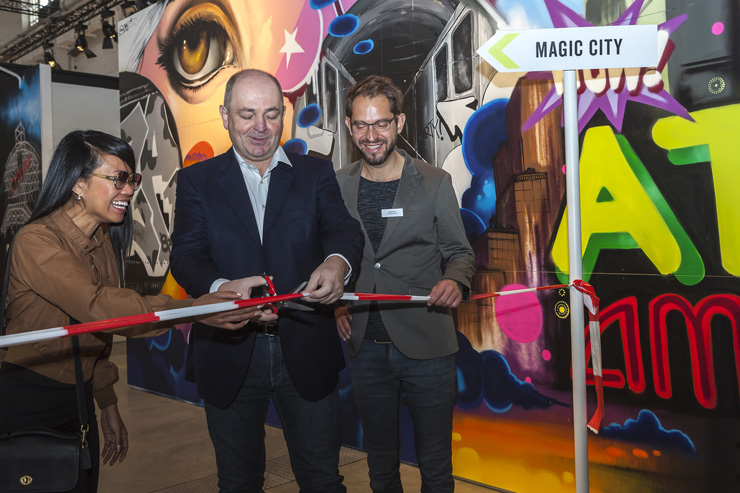
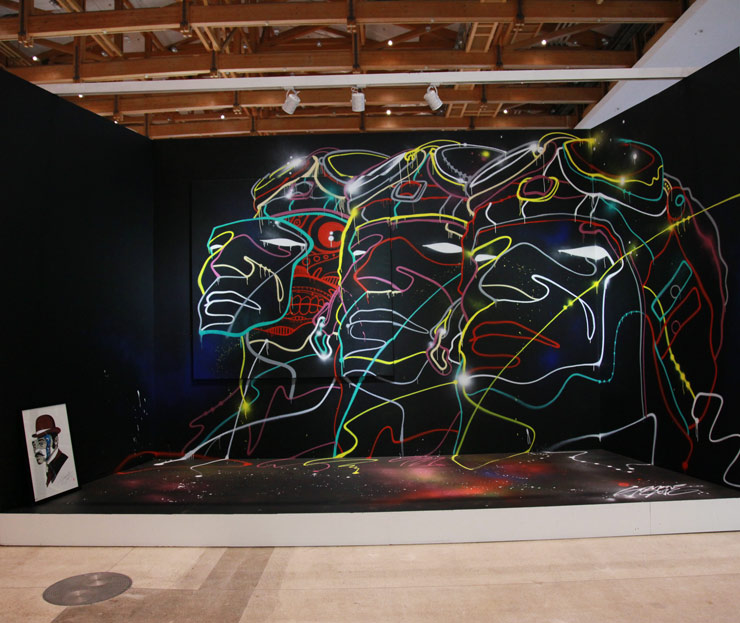
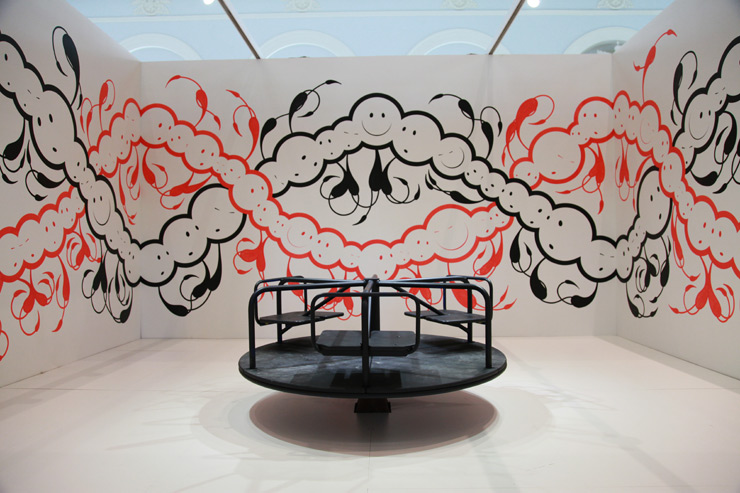
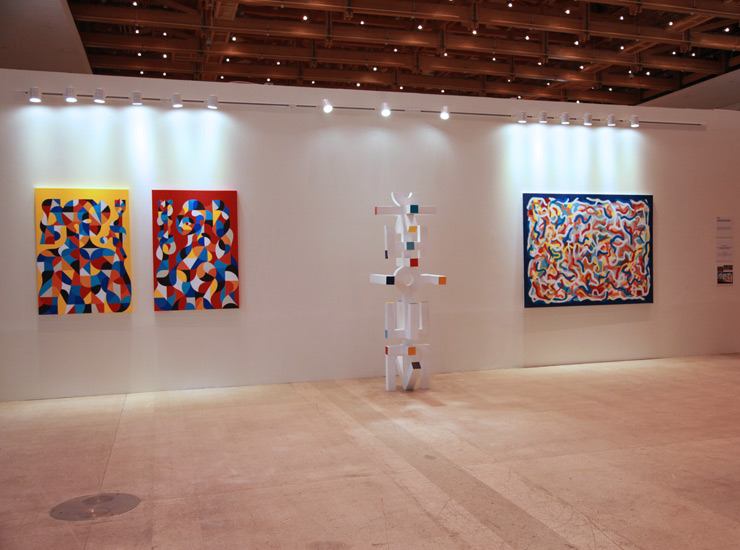
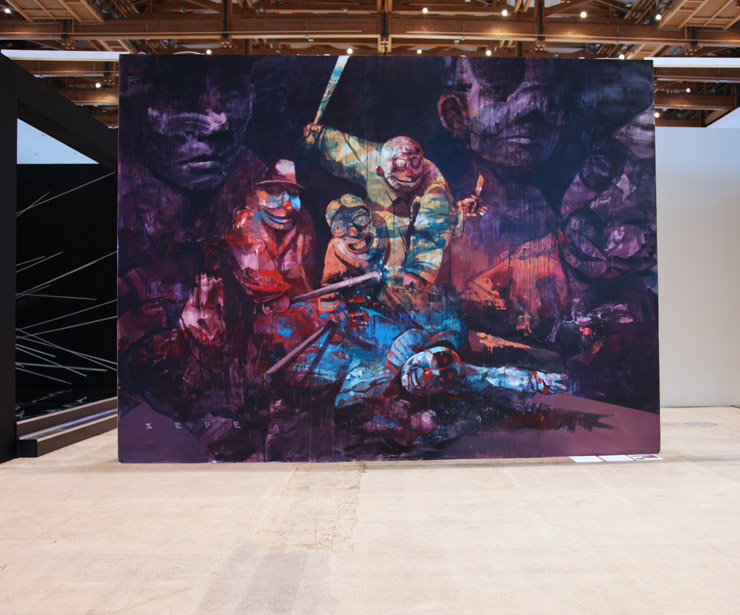
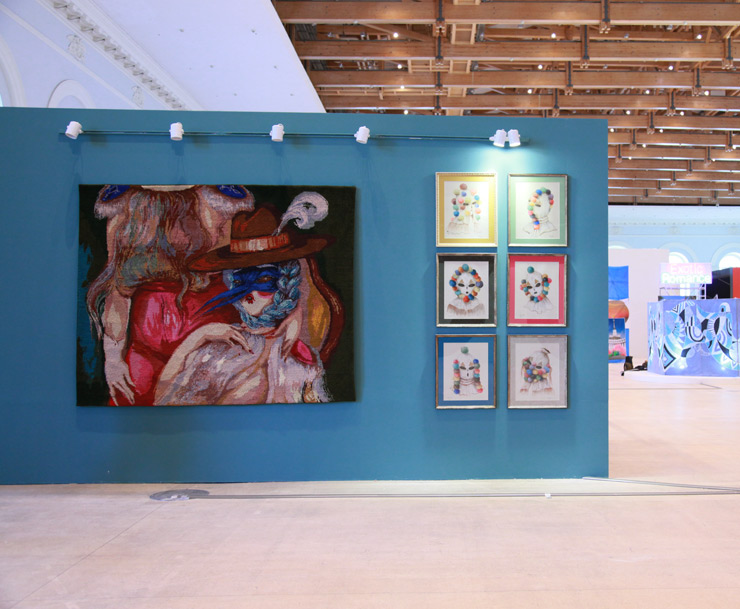
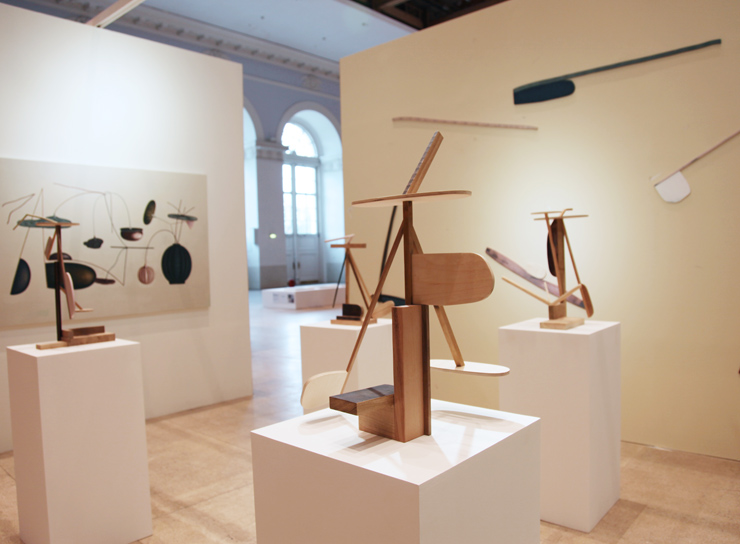
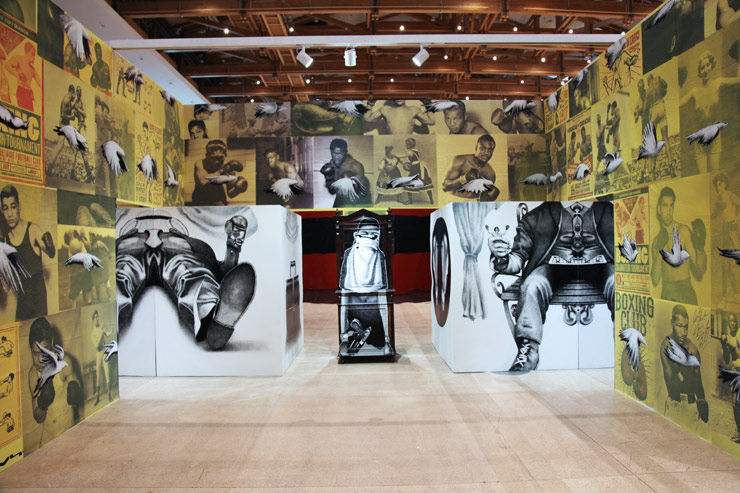
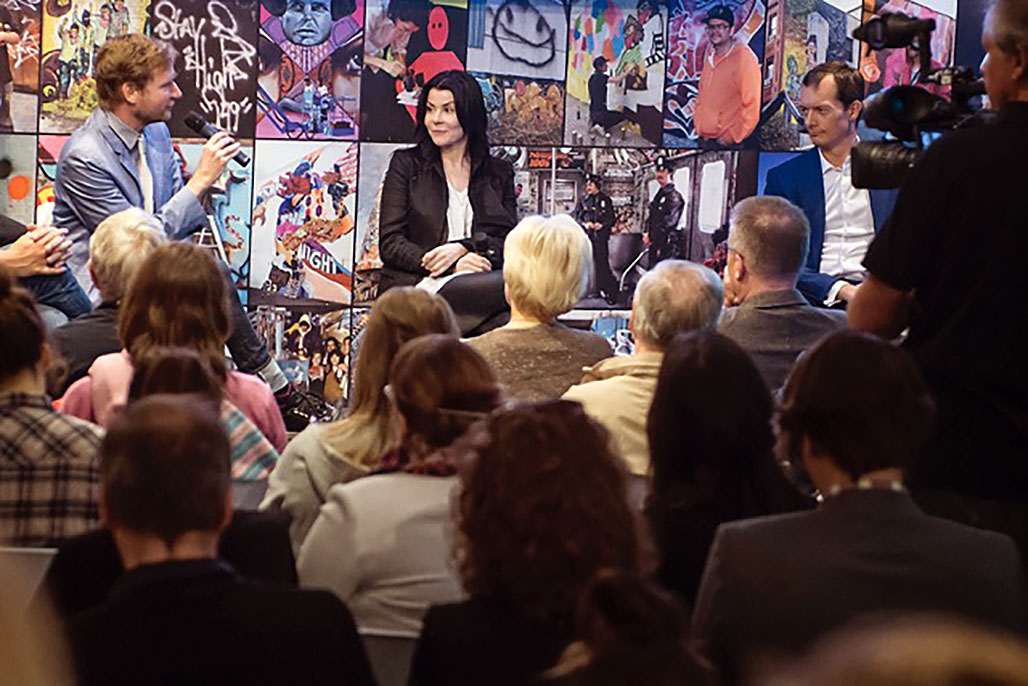
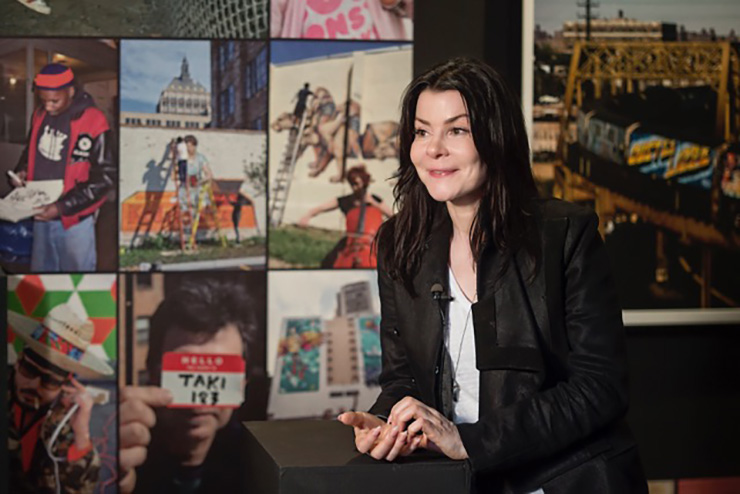
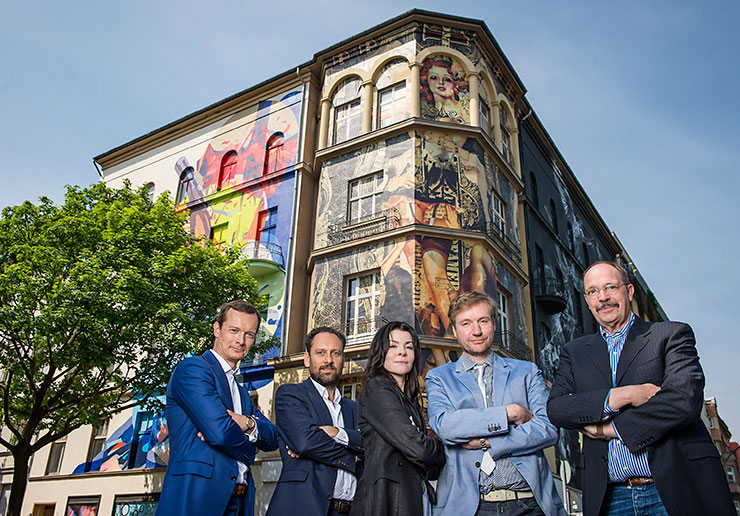
Curator Carlo McCormick quotes Novalis by way of describing this new exhibit of an eclectic blend of terrific troublemakers, pop-culture hijackers, and show-stopping crowd pleasers drawn from cities all around the Street Art/ graffiti /urban art scene today – and forty years ago. This is a welcoming walk of unexpected intersections that only McCormick and co-curator Ethel Seno could imagine – and pull together as a panoply of street wizardry that acknowledges activism, artistry, anarchy, and aesthetics with a sincere respect for all. It will be interesting to see how this show is viewed by people who follow the chaotic street scene today in the context of its evolution and how they read the street signs in this city.
McCormick, in his customary self-effacing humor, expects there to be some shit flying – as anyone who is involved in this scene expects from the hard-scrabble rebellious margins and subcultures that this art-making interventionist practice rises from. There also are a growing and coalescing mini-legion of scholars and academics who are currently grappling with the nature and characteristics of this self-directed art-making practice rooted often in discontent – now organized inside an exhibition that is ticketed and sold as a family friendly show.
In his descriptions of the public sphere, the writer, historian, author, and cultural critic McCormick often refers to graffiti and street artists messing with “contested space”. It’s an apt description whether we are talking about the public space in high-density gleaming metropolises or the bombed-out grid-less and polluted quagmires of human fallibility and urban un-planning that dot our globe; all public space its nature is contested.
Here is a place used by many artists to protest, agitate, advocate, or deliver critique – and many of the artists in this exhibition have done exactly this in their street practice, often pushing limits and defining new ones. Dig a little into many of the individual story lines at play here and you’ll see that the vibrant roots of social revolution are pushing up from the streets through the clouds of propaganda and advertising, often mocking them and revealing them in the process.
Ultimately, this Magic City experience is an elixir for contemplating the lifelong romance we have with our cities and with these artists who cavort with us within them. “Our Magic City is a place and a non-place,” McCormick says in a position statement on the exhibit. “It is not the physical city of brick and mortar but rather the urban space of internalized meanings. It is the city as subject and canvas, neither theme park nor stage set, but an exhibition showcasing some of the most original and celebrated artists working on and in the city today.”
BSA curated the film program for Magic City with a dynamic array of some of the best Street Art related films today presented together in a relaxed environment. In this video hosted by Andreas Schanzenbach you get a taste of the works that are showing that we draw from our weekly surveys on BSA Film Friday. Over the last few years we have had the honor of presenting live in-person to students and scholars and fans an ever-evolving collection of videos that speak to the spirit experimentation, discovery and culture-jamming outrageousness of urban interventions, graffiti and Street Art. The BSA Film Program at Magic City presents a survey of some of the very best that we have seen recently.
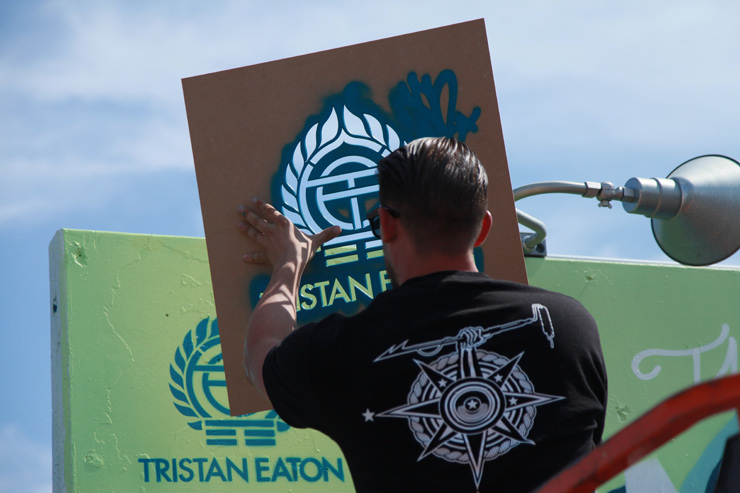
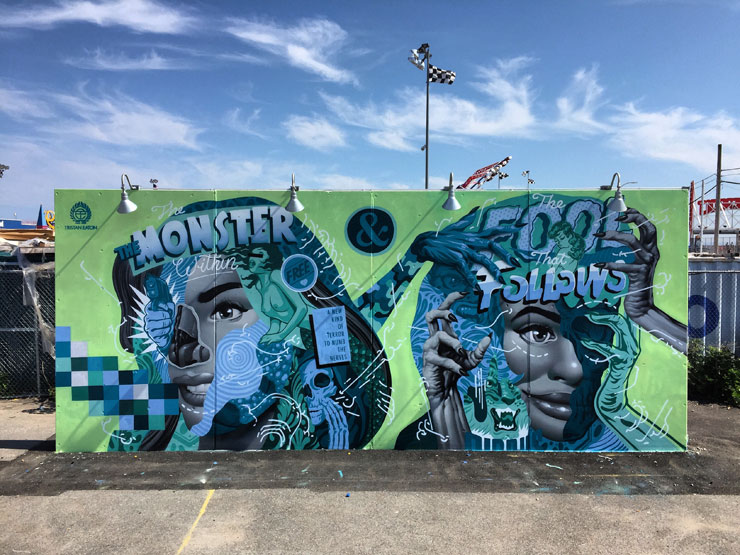
Magic City artists include: Akrylonumerik, Andy K, Asbestos, Ben Heine, Benuz, Biancoshock, Bordalo II, Brad, Downey, Dan Witz, Daze, Ernest Zacharevic, Ganzeer, Henry Chalfant, HERAKUT, Icy & Sot, Isaac Cordal, Jaime Rojo, Jens Besser, Juandres Vera, Lady Aiko, Leon Keer, Loomit, MAD C, Mark Bode, Martha Cooper, Oakoak, Odeith, Olek, Ori Carin / Benjamin Armas, Qi Xinghua, Replete, ROA, Ron English, Shepard Fairey, Skewville, SpY, Tristan Eaton, Truly, WENU Crew, Yok & Sheryo
The BSA Film Program for Magic City includes the following artists: Borondo, Brad Downey & Akay, Ella + Pitr, Faile, Farewell, Maxwell Rushton, Narcelio Grud, Plotbot Ken, Sofles, Vegan Flava, Vermibus
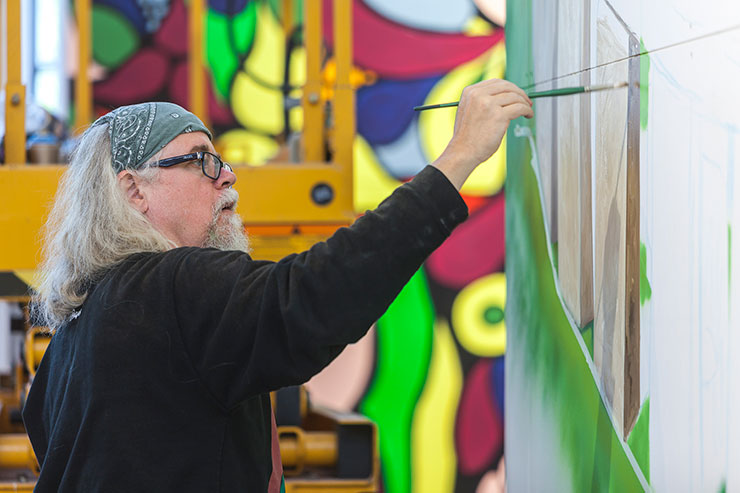
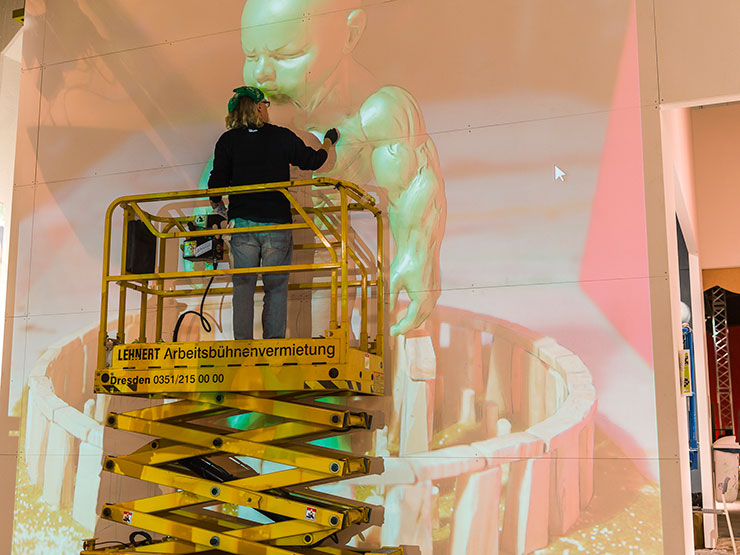
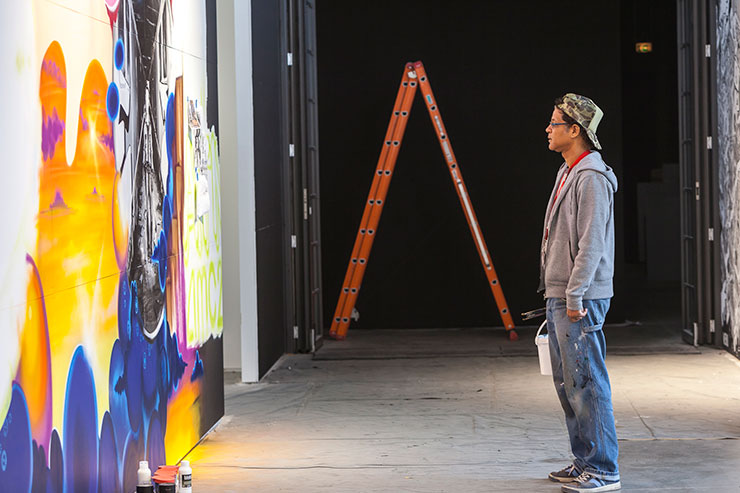
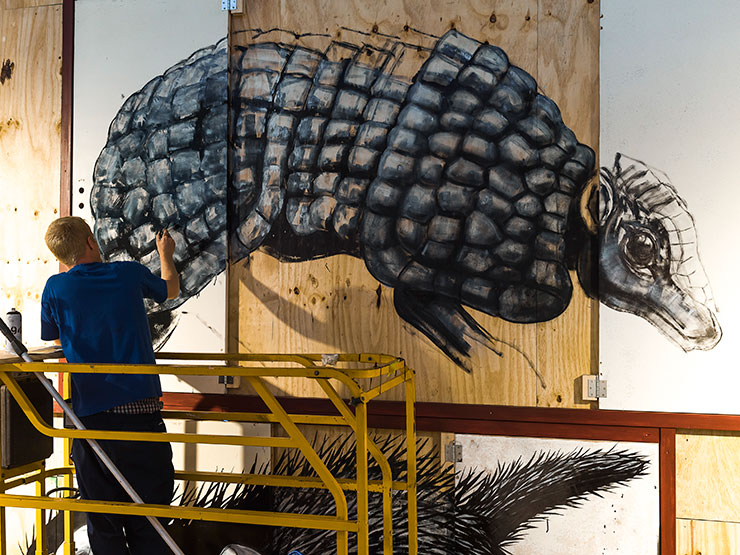
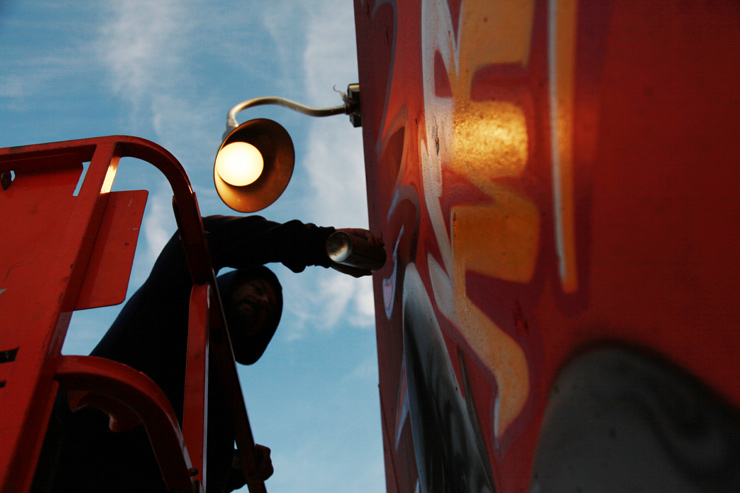
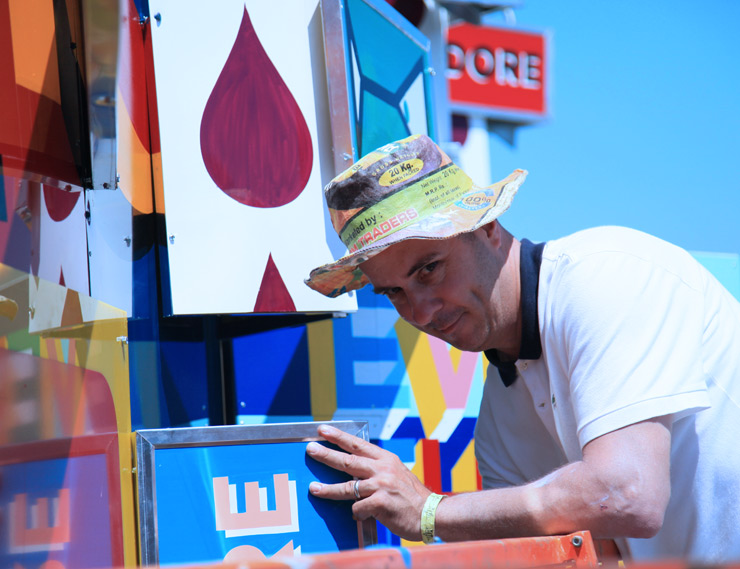
Some behind the scenes shots days before the Premiere
The Moscow Manege Hosts International and Local Street Artists for a Biennale
Moscow presents a Street Artist’s exhibition, but the streets have almost none.
When Street Art and it’s associated cousins move inside the possible outcomes are many. With exhibitions like this you are seeing urban becoming very contemporary.
The Artmossphere Biennale jump-starts the debate for many about how to best present the work of Street Artists and organizers here in Moscow chose a broad selection of curators from across a spectrum of private, commercial, academic and civically-inspired perspectives to present a solid range of artists from the graffiti and Street Art world inside a formal hall.
To be clear, unless it is illegal and on the street, it is not graffiti nor Street Art. That is the prevailing opinion about these terms among experts and scholars of various stripes and it is one we’re comfortable with. But then there are the commercial and cultural influences of the art world and the design industries, with their power to reshape and loosen terms from their moorings. Probably because these associated art movements are happening and taking shape before our eyes and not ensconced in centuries of scholarship we can expect that we will continue to witness the morphing our language and terminologies, sometimes changing things in translation.
Definitions aside, when you think of more organic Street Art scenes which are always re-generating themselves in the run-down abandoned sectors of cities like Sao Paulo, New York, Melbourne, Paris, Mexico City, London, and Berlin, it is interesting to consider that this event takes place nearly on the grounds of the Kremlin under museum like security.
An international capital that ensures cleanly buffed walls within hours of the appearance of any unapproved Street Art or graffiti, Moscow also boasts a growing contingent of art collectors who are young enough to appreciate the cultural currency of this continuously mutating hybrid of graffiti, hip hop, DIY, muralism, and art-school headiness. The night clubs and fashionable kids here are fans of events like hip-hop and graffiti jams, sometimes presented as theater and other times as “learning workshops” and the like.
Plugging into this idea of street and youth culture is not a singular fascination – there is perhaps an association with the rebellious anti-authoritarian nature of unregulated art in the streets that fuels the interest of many. With graffiti and hip-hop culture adoption as a template, newer expressions of Street Art culture are attractive as well with high profile artists with rebel reputations are as familiar in name here as in many cities. New festivals and events sometimes leverage this renegade free-spirit currency for selling tourism and brands and real estate, but here there also appears to be an acute appreciation for its fine art expression – urban contemporary art.
MOSCOW’S MANEGE AND “DEGENERATE ART”
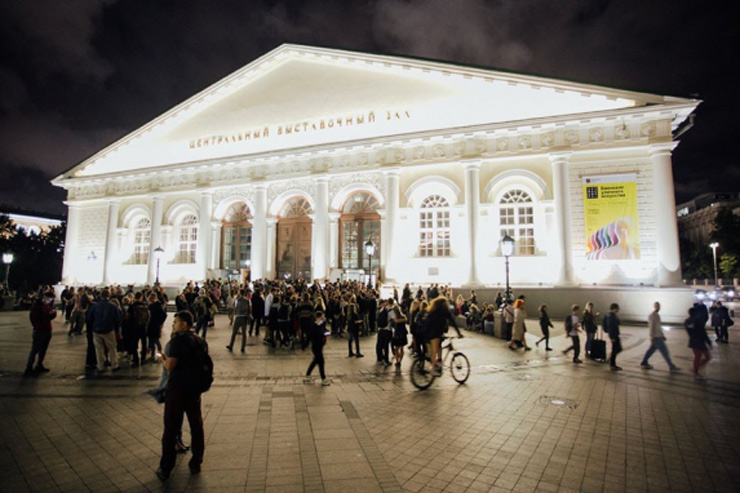
So ardent is the support for Artmossphere here that a combination of public and private endorsements and financial backing have brought it to be showcased in a place associated with high-culture and counter-culture known as the Moscow Manege (Мане́ж). The location somehow fits the rebellious spirit that launched these artists even if its appearance wouldn’t lead you to think that.
The 19th century neo-classical exhibition hall stands grandly adjacent to Red Square and was built as an indoor riding school large enough to house a battalion of 2,000 soldiers during the 1800s. It later became host to many art exhibitions in the 20th century including a famous avant-garde show in 1962 that Soviet Premier Nikita Khrushchev famously derided as displaying ‘degenerate’ art.
One of the artists whose work was criticized, painter and sculptor Ernst Neizvestny, challenged the label defiantly and won accolades afterward during his five decade career that followed, including receiving many awards and his work being collected worldwide by museums. Russian President Vladimir Putin is quoted as calling him “a recognised master and one of the best contemporary sculptors”. In January of this year at the age of 90, Neizvestny’s return to Menage featured an extensive exhibition. He passed away August 9th (The Moscow Times), only weeks before Artmossphere opened.
In some kindred spirit many of these artists at Artmossphere have done actual illegal work on the streets around the world during their respective creative evolutions, and graffiti and Street Art as a practice have both at various times been demonized, derided, dismissed and labeled by critics in terms synonymous with “degenerate”.
A CLEAN CITY
“Moscow is mostly very clean,” says Artmossphere co-founder and Creative Director Sabine Chagina, who walks with guests during a sunny afternoon in a busy downtown area just after the opening. “But we do have some good graffiti crews,” she says as we round the corner from the famous Bolshoi Theater and soon pass Givenchy and Chanel and high-end luxury fashion stores. Shortly we see a mural nearby by French artist Nelio, who painted a lateral abstracted geometric, possibly cubist, piece on the side of a building here in 2013 as part of the LGZ Festival.
If there was graffiti here in Moscow, it was not on full display very readily in this part of town. In driving tours, rides on the extensive metro train system, and in street hikes across the city a visitor may find that much of the illegal street art and graffiti common to other global capitals is illusive due to a general distaste for it and a dedicated adherence to buffing it out quickly.
For a pedestrian tourist Moscow appears in many ways as fully contemporary and architecturally rich as any international world-class metropolis. One of the cleanest places you’ll visit, the metro is almost museum-like in some instances; the historic districts spotless, public fountains, famed statues of important historical figures. All is efficiently ordered and – a welcome surprise – most public space is free of advertisements interrupting your view and your thoughts.
Come to think of it, the sense of commercial-celebrity media saturation that is present in other cities doesn’t appear to permeate the artists psyche here at the Biennale – so there’s not much of the ironic Disney-Marilyn-supermodel-Kardashian-skewering of consumerism and shallowness in this exhibition that you may find in other Urban Art events.
Also, unlike a Street Art-splattered show in London for example that may rudely mock Queen Elizabeth or art in New York streets that present Donald Trump styled as a pile of poo and Hillary Clinton as Heath Ledger’s Joker, we didn’t see over-the-top Putin satires either. So personality politics don’t seem directly addressed in this milieu. According to some residents there was an outcropping of huge festival murals by Street Artists here just a few years ago but more recently they have been painted over with patriotic or other inspiring murals, while others have been claimed for commercial interests.
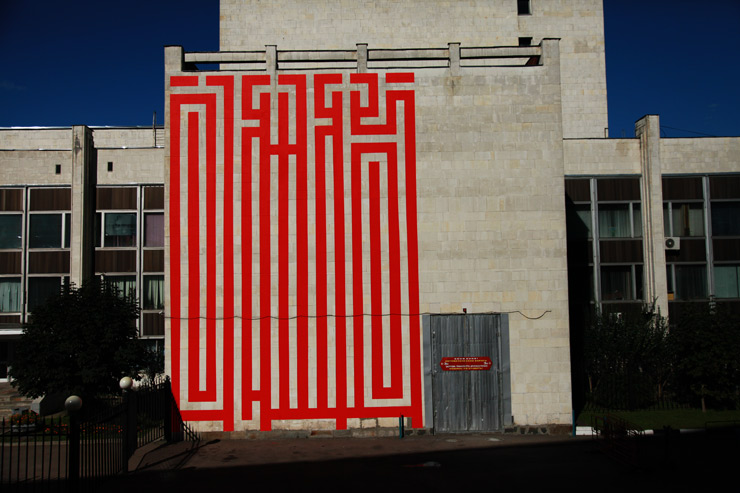
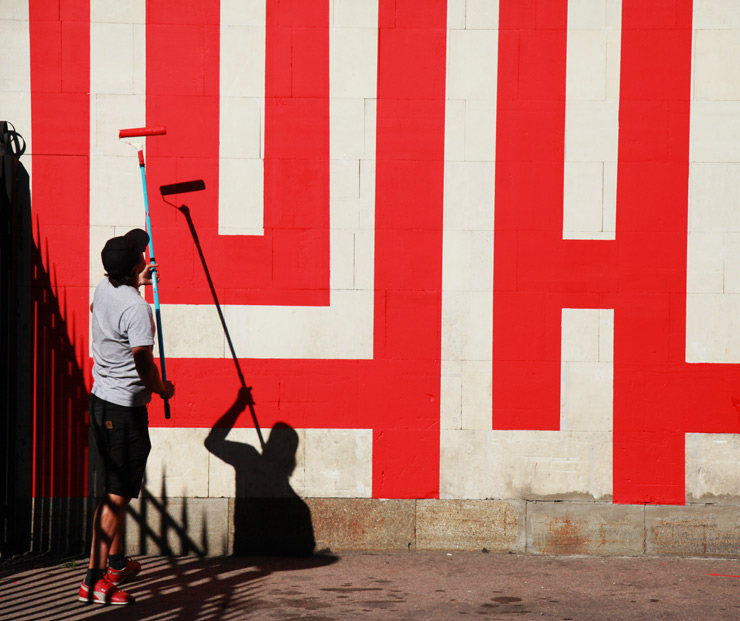
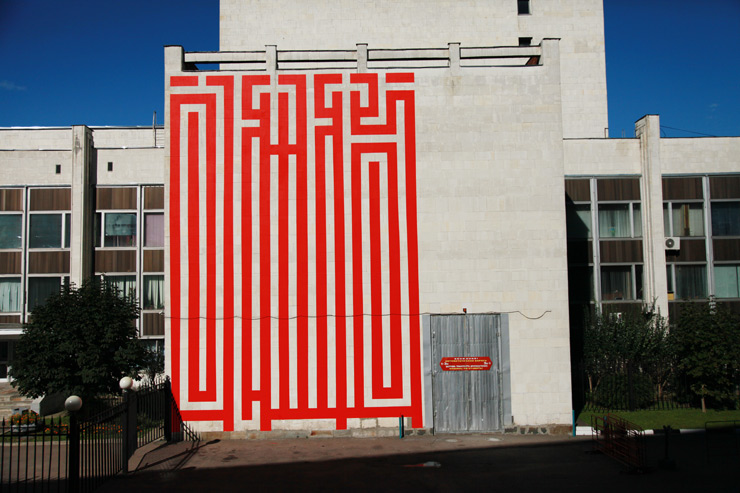
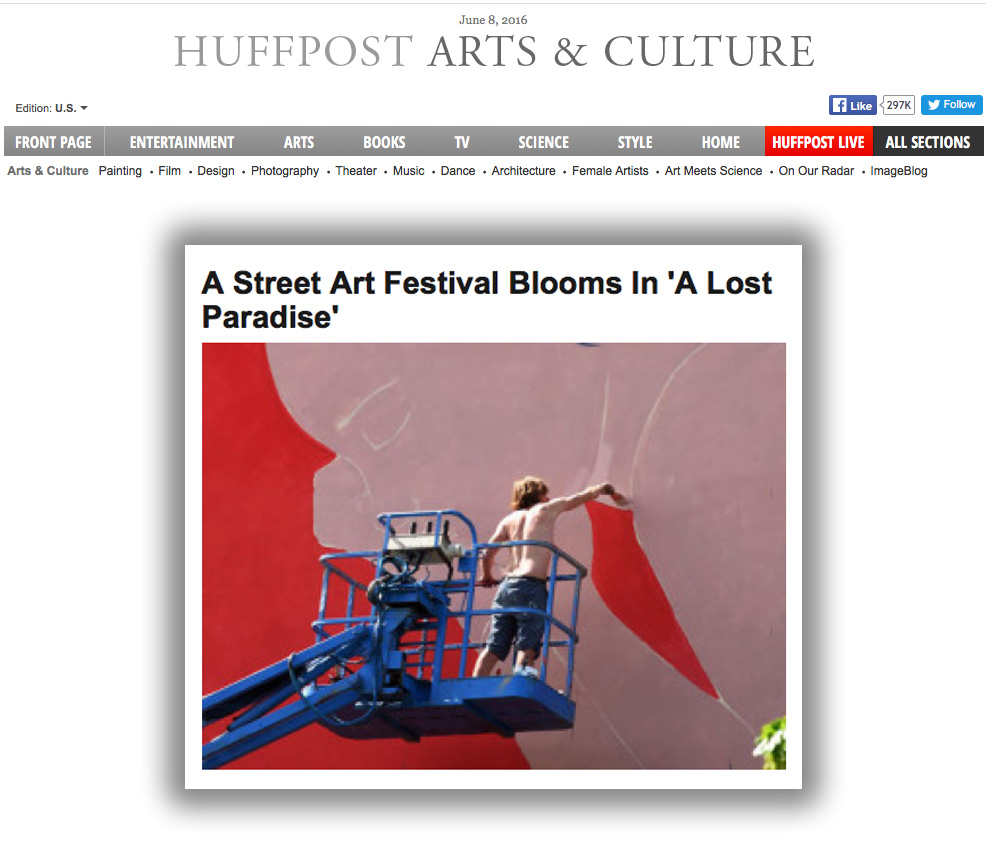
Starved for some gritty street scenes, it is all the more interesting to see the one live mural painting that we were able to catch – a 6-story red-lined op-art tag by the French graffiti writer L’Atlas. Far from Manege, placed opposite a cineplex in what appears to be a shopping mall situated far from the city’s historical and modern centers, our guide tells us half-jokingly that he is not sure that we are still in Moscow.
Here L’Atlas says that he has painted his bar-code-like and cryptic nom-de-plume with an assistant on a cherry picker for a few days and he says that no one has stopped to ask him about it, neither to comment or criticize. Actually one man early one morning returning home from a disco did engage him briefly, but it was difficult to tell what he was talking about as he may have had a few drinks.
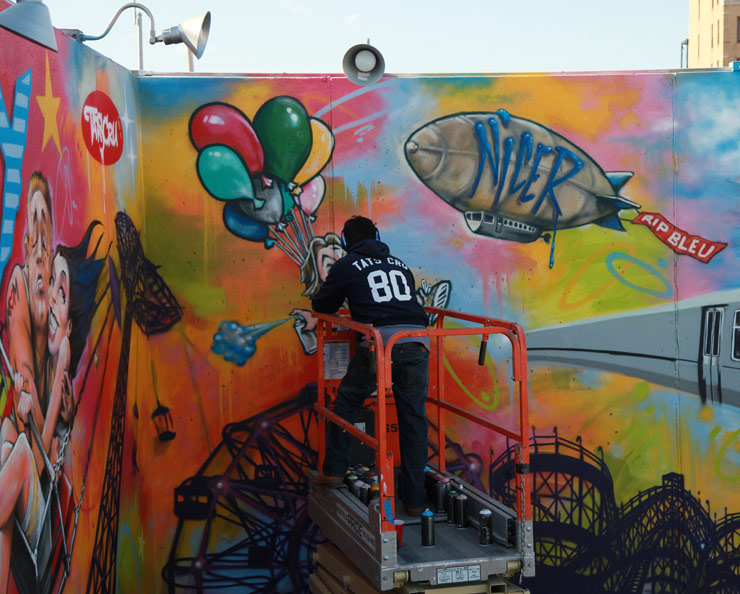
This lack of public commentary is mainly notable because in other cities the comments from passersby can be so ubiquitous that artists deliberately wear stereo headphones to prevent interruption and to be more productive. Sometimes the headphones are not actually playing music.
This Street Art Biennale nonetheless is gaining a higher profile among Urban Art collectors and its associated art dealers and the opening and later auction reaches directly to this audience. Included this year with the primary “Invisible Walls” exhibition are satellite events in association with local RuArts Gallery, Tsekh Belogo at Winzavod, and the Optika Pavilion (No. 64) at VDNKh.
The opening night event itself is wide and welcoming, a mostly youthful and populist affair with celebratory speeches and loosely organized group photos and an open bar. Added together with a press conference, a live DJ, virtual reality headsets, interactive artworks, major private business sponsors, government grants, ministers of culture, gallerists, and quirkily fashionable art fans, this is a polished presentation of a global culture that is filtered through the wide lense of the street.
Perhaps because the exhibition hall is a cavernous rectangle with exposed beams on the ceiling and many of the constructed white walls that mimic vendor booths, it has the air of an art fair. There are thankfully no salespeople pacing back and forth watching your level of interest. People tend to cluster before installations and talk, laugh, share a story, pose for a selfie.
The theme seems very appropriately topical as geopolitical, trade-related, social, digital, and actual walls appear to be falling down rapidly today while the foundations of new ones are taking shape. Catalyzed perhaps by the concept and practices of so-called “globalization” – with its easy flow of capital and restricted flow of humans, we are all examining the walls that are shaping our lives.
With 60+ international artists working simultaneously throughout this massive hall, newly built walls are the imperative for displaying art, supporting it, dividing it. These are the visible ones. With so many players and countries represented here, one can only imagine that there are a number of invisible walls present as well.
The theme has opened countless interpretations in flat and sculptural ways, often expressed in the vernacular of fine art with arguable nods to mid-20th century modernists, folk art, fantasy, representational art, abstract, conceptual, computer/digital art, and good old traditional graffiti tagging. Effectively it appears that when Street Art and graffiti artists pass the precipice into a multi-disciplinary exhibition such as this, one can reframe Urban/Street as important tributaries to contemporary art – but will they re-direct the flow or be subsumed within it?
The work often can be so far removed from street practice that you don’t recognize it as related.
Aside from putting work up in contested public space without permission and under cover, an average visitor may not see a common thread. These works run aesthetic to the conceptual, painterly to the sculptural, pure joy and pure politics. But then, that is we began to see in the streets as well when the century turned to the 21st and art students in large numbers in cities like New York and London and Berlin skipped the gatekeepers, taking their art directly to the public.
Perhaps beneath the surface or just above it, there is a certain anarchistic defiance, a critique of social, economic, political issues, a healthy skepticism toward everyone and everything that reeks of hypocritical patriarchal power structures. Perhaps we’re just projecting.
Looking over the 60+ list of names, it may be striking to some that very few are people of color, especially in view of the origins of the graffiti scene. Similarly, the percentage of women represented is quite small. We are familiar with this observation about Urban Art in general today, and this show mirrors the European and American scene primarily, with notable exceptions such as Instagrafite’s home-based Brazilian crew of 4 artists. As only one such sampling of a wide and dispersed scene, it is not perhaps fair to judge it by artists race, gender, or background, but while we speak of invisible walls it is worth keeping our eyes on as this “scene” is adopted into galleries, museums, and private collections.
Following are some of the artists on view at Artmossphere:
ASKE
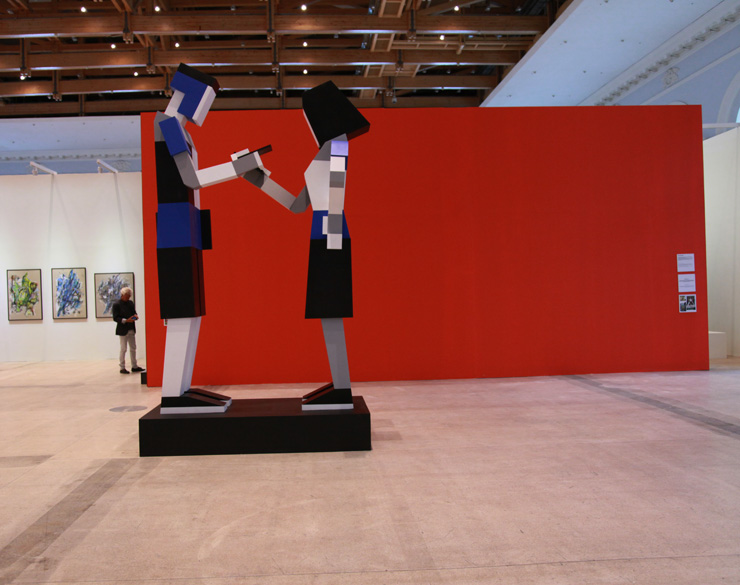
Certainly Moscow native ASKE is gently mocking our mutated modern practices of communicating with his outsized blocked abstraction of a close couple riveted to their respective electronic devices, even unaware of one another.
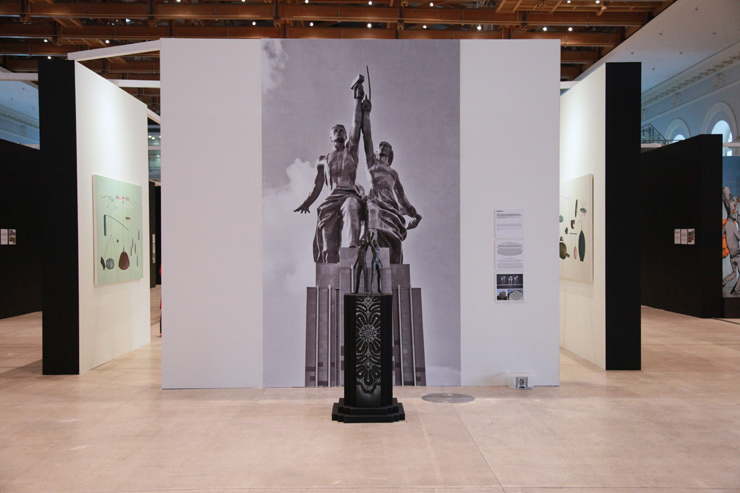
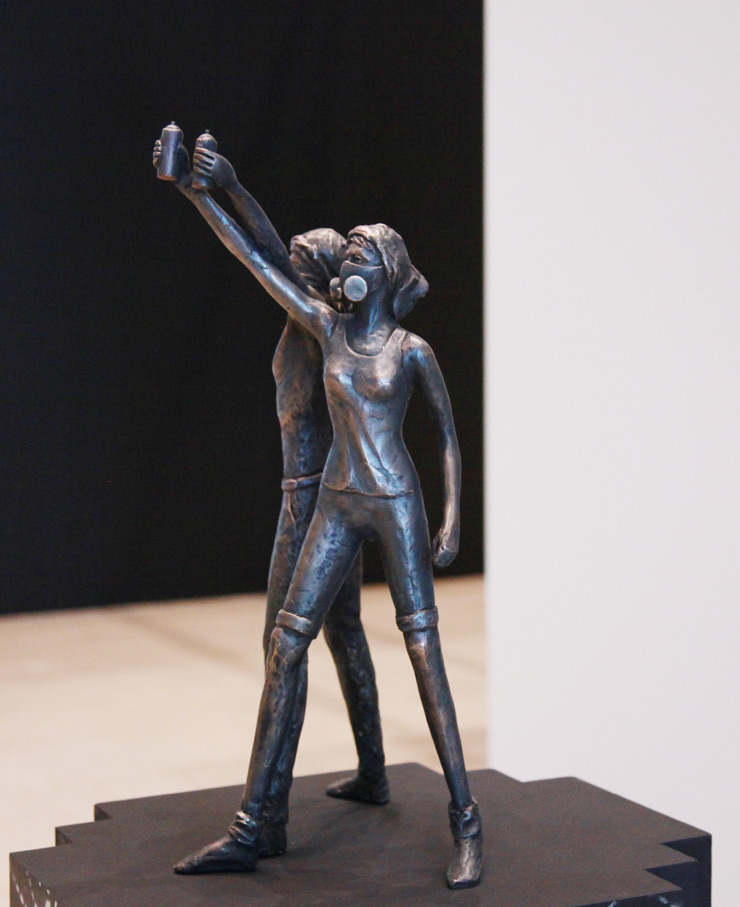
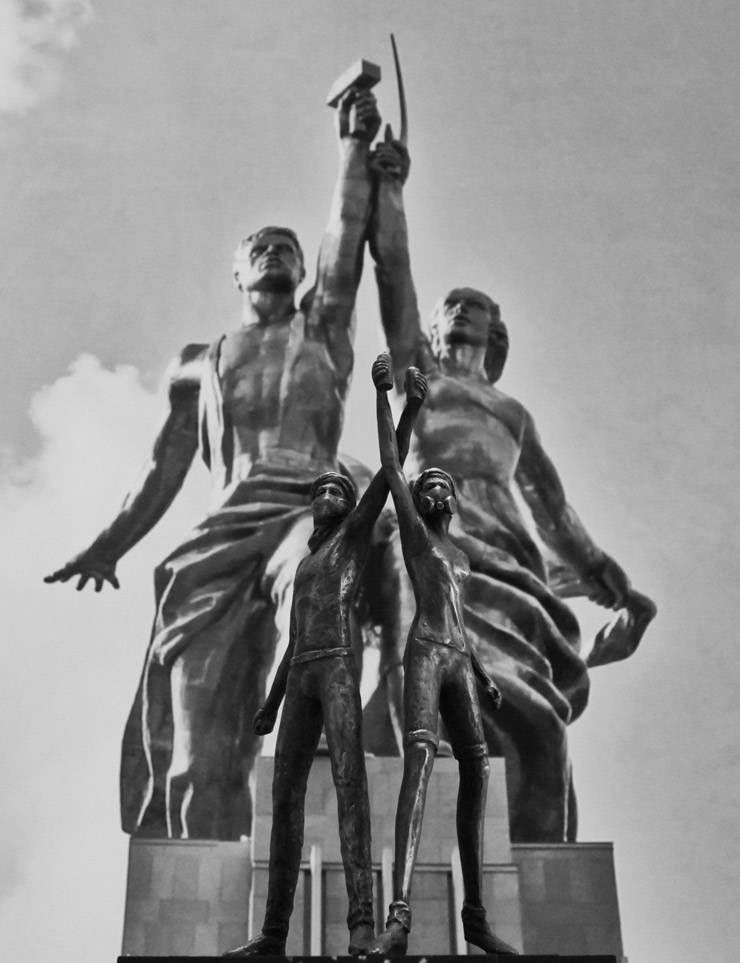
Warsaw based NeSpoon creates a sculpture of another couple. Heroically presenting her vision of what she calls the iconic “Graffiti Writer” and “Street Art Girl”, they face the future with art instruments in hand ready to make their respective marks. She says her work is emblematic of a permanent financial insecurity for a generation she calls the “PRECARIAT”.
“ ‘Precariat’ is the name of the new emerging social class,” says curator, organizer, and NeSpoon’s partner Marcin Rutkiewicz when talking about the piece during the press conference. “These are young people living without a predictable future, without good jobs, without social security. It’s a class in the making and probably these people don’t have any consciousness or global unity of interest. But they are the engines of protest for people all over the world – like Occupy Wall Street, Gezi Park in Turkey, or the Arab Spring.”
The artist developed the sculpture specifically for this exhibition and planned it over the course of a year or so. Born of a social movement in Poland by the same name, the sculpture and its sticker campaign on the street represent “a kind of protest against building walls between people who are under the same economical and social situation all over the world,” says Rutkiewicz.
LI-HILL
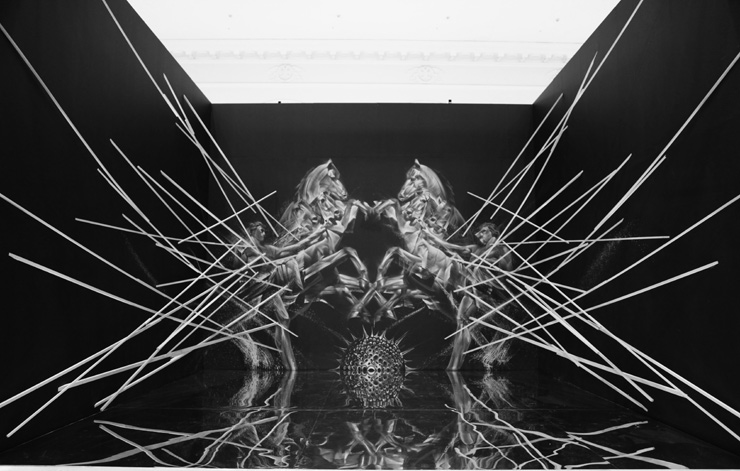
Artist Li-Hill says his piece “Guns, Germs, and Steel” directly relates to the divisions between civilizations due to a completely uneven playing field perpetuated through generations. Inspired by the 1997 trans-disciplinary non-fiction book by Jared Diamond, Li-Hill says the Russian sculptural group called “The Horse Tamers” represents mankind’s “ability to harness power of the natural world and to be able to manipulate it for its advantage.”
“The horse is one of the largest signifiers and is a catalyst for advancement in society because it has been for military use, for agriculture, for transportation,” he says. “It was the most versatile of the animals and the most powerful.” Here he painted a mirror image, balanced over a potential microbial disaster symbol, and he and the team are building a mirrored floor to “give it this kind of infinite emblem status.”
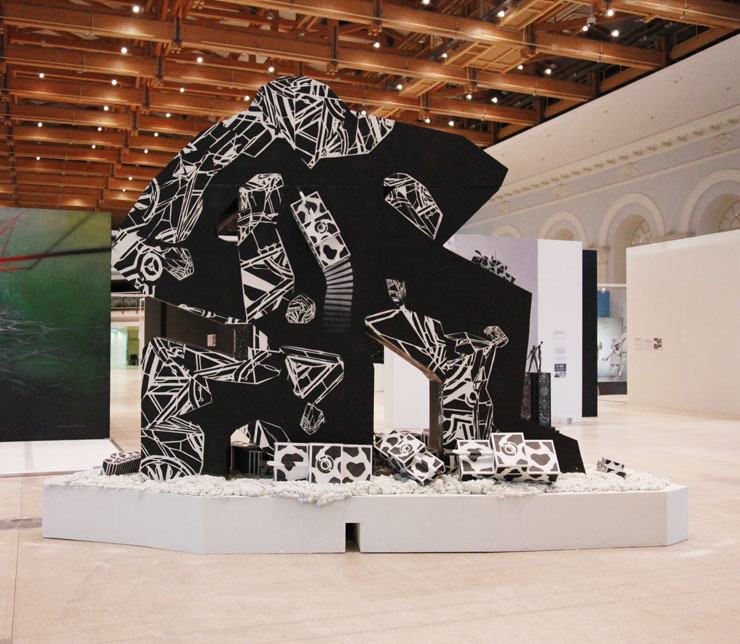
Afloat in the middle of some of these walled areas M-City from Poland is choosing to be more direct thematically in his three dimensional installation of plywood, plaster, aerosol and bucket paint, and machine blown insulation.
“It is an anti-war piece,” he says, and he speaks about the walls between nations and a losing battle of dominance that ensures everyone will be victim.”
“It’s kind of a monster who destroys arms,” he says of this temporary sculpture with a lording figure crushing tanks below.
“He is destroying the tanks but at the same time he is also a destroyer – so it’s a big circle. Nothing is positive that can come out of this. There is always someone bigger.” He says the piece is inspired by the political situations in Europe today and the world at large.
HOTTEA
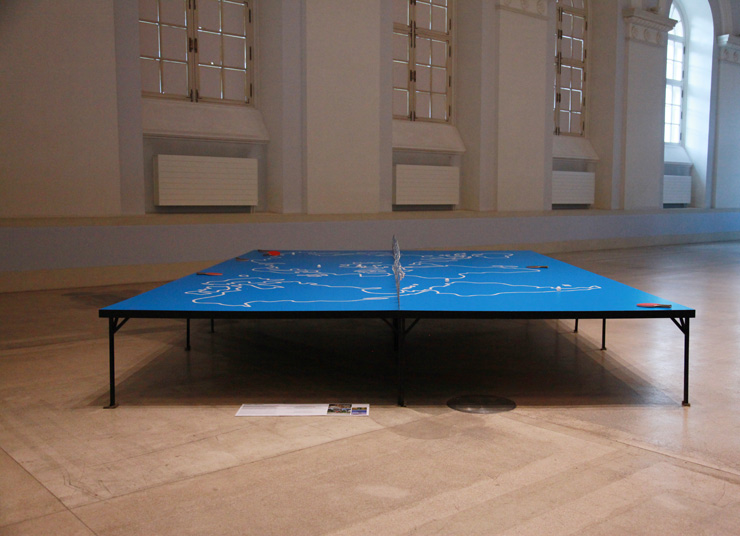
Minneapolis based HOTTEA usually does very colorful yarn installations transforming a huge public space, but for Artmossphere he is taking the conceptual route. The walk-in room based on the Whack-A-Mole game presents holes which a visitor can walk under and rise above.
Visitors/participants will experience the physical separation of space, and perhaps contemplate facing one another and interacting or ignoring one another. It is something he says he hopes will draw attention to how many walls we have allowed ourselves to distract from human interactions.
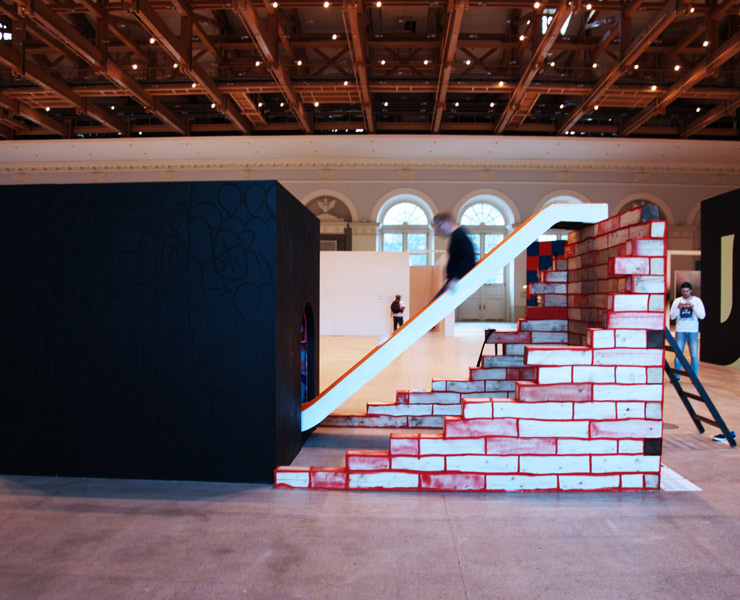
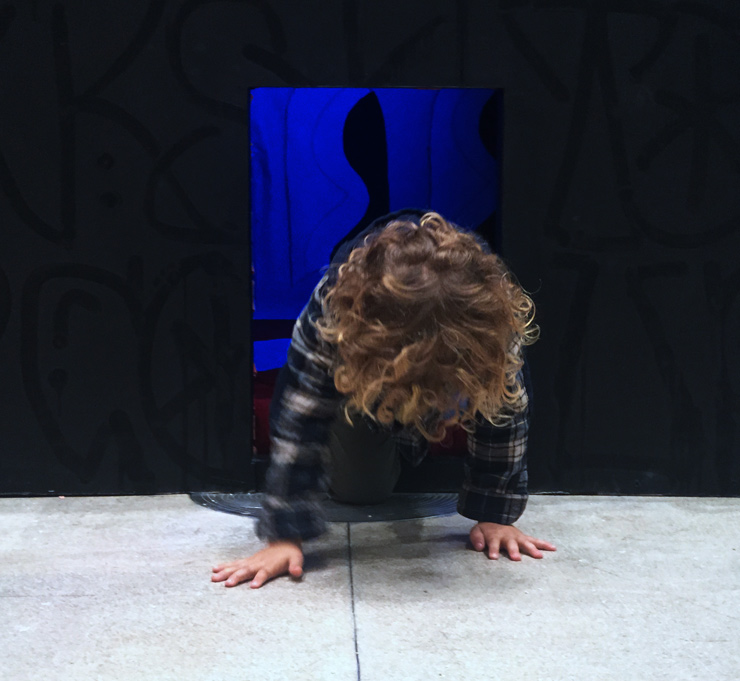
Englands’ Sick Boy calls his project The Rewards System, where guests are invited to climb a ladder over a brick wall and descend down a slide into a darkened house, setting off a series of sensors that activate a variety of multisensory lights and tantalizing patterns. After landing and being rewarded the visitor is forced to exit on hands and knees through a too-small square door.
“The concept of the show is about invisible walls so I was thinking about there being barriers in your life and I thought about the reward of endorphins one experiences for achieving a task – a small amount of endorphins. So I thought I would build a house that signifies the reward system,” he explains.
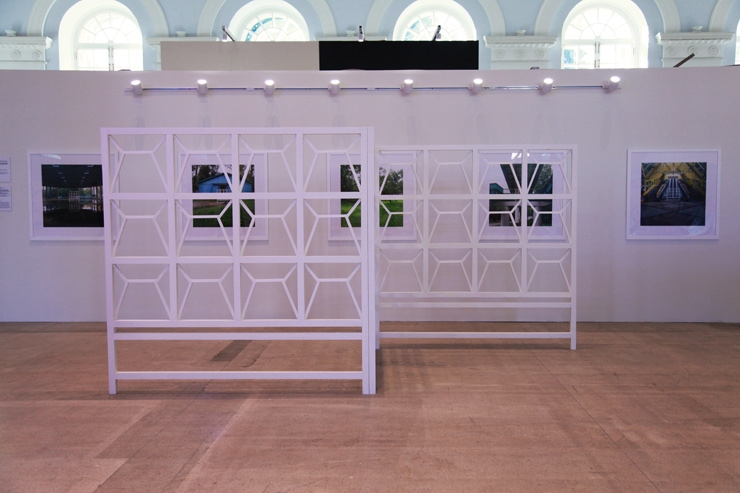
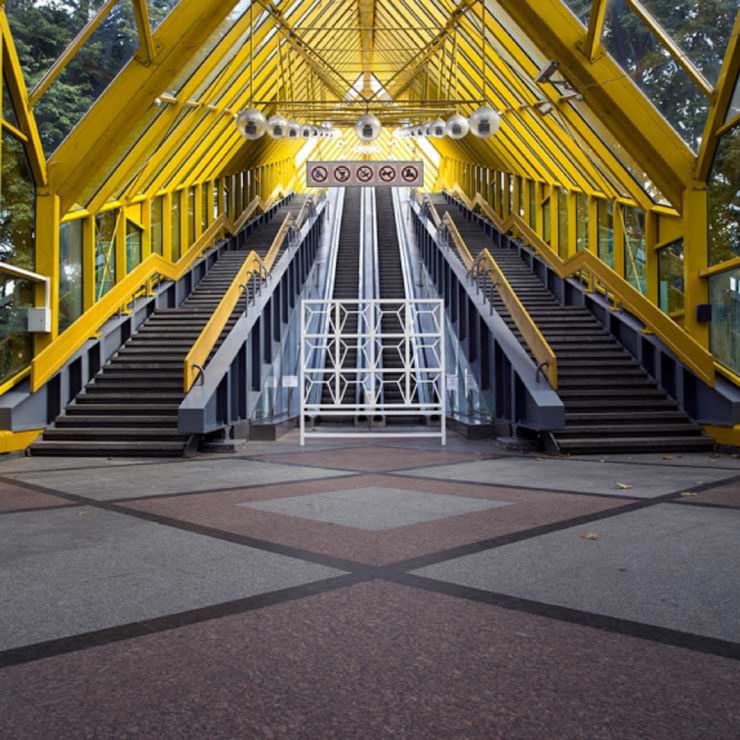
Atlanta/Seattle based Derek Bruno reached back to the Leonid Brezhnev years and into Moscow’s Gorky Park for his series of site specific installations based on Soviet Cement Fence type PO-2. The iconic fence was re-created in a nearby studio and Bruno shot photographs of his 10-15 minute “interventions” in the park itself, revisiting a field of design called “technical aesthetics.”
In a statement Bruno explains “Since the end of the Soviet Union, the iconic fence has become a persistent and ever present reminder of former delineations of space; while new forms of boundaries shape the digital and sociopolitical landscapes. “
REMI ROUGH
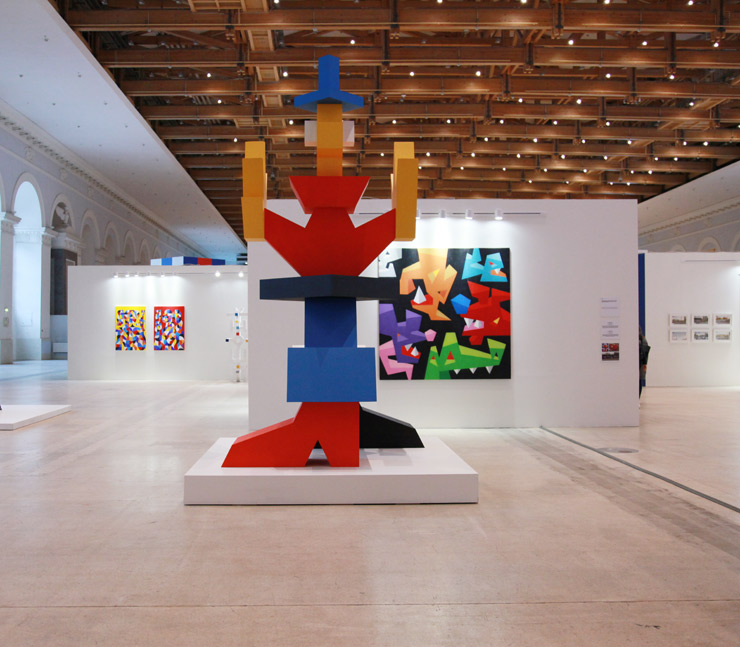
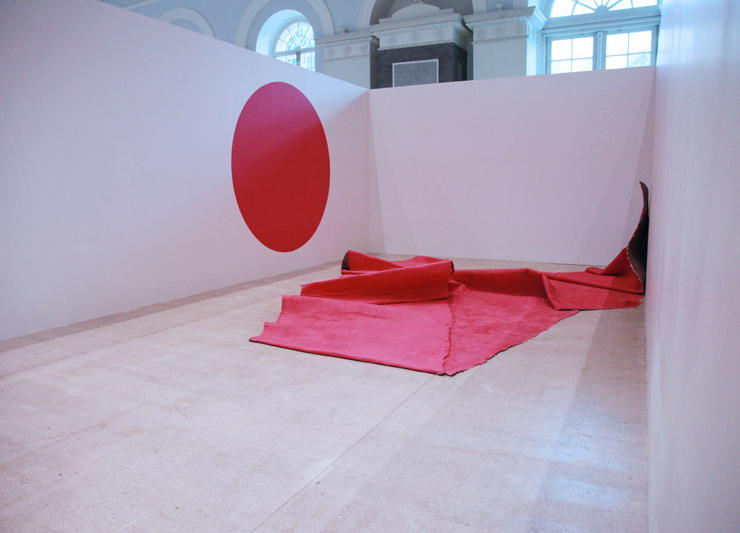
Remi Rough is known for his smartly soaring abstract geometry in painted murals and smaller scale works, and for Moscow he wanted to strip it back to the basics, approaching a white box with one undulating graphic composition.
“My idea was that Moscow’s a bit ‘over the top’,” he says, and he decided to strip back the audacity and go for simplicity, which actually takes courage.
“I said ‘you know what?’ – I want to do something with the cheapest materials you can possibly get. These two pieces literally cost 3000 rubles ($50). It’s made of felt, it’s like a lambs wool. I think they use it for flooring for construction.” Depending on the angle, the pink blotted material may translate as a swath of otherworldly terrain or a metaphorical bold vision with all the hot air let out.
“I wanted to do something peaceful and calming and use natural materials – something that’s different from what I usually do – but I use the folds in the fabric and the pink color – two things that I usually use a lot.”
ALEXEY LUKA
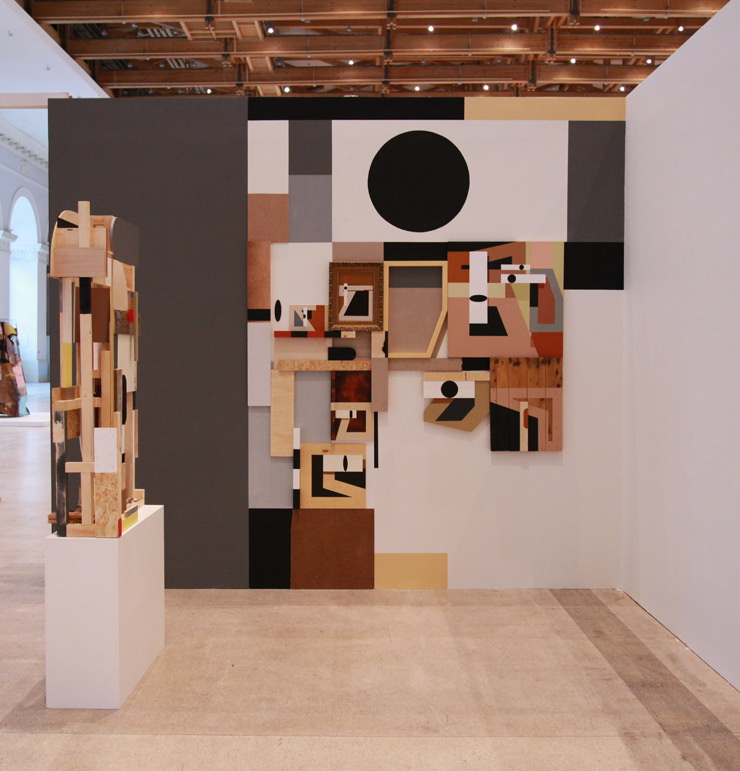
Moscow’s Alexey Luka is also challenging himself to stretch creatively by taking his wall collage installations of found wood and converting them into free-standing sculptures.
“For this biennale I tried to make something different so now I am going from the assemblages to 3-D.” The constructed media is warm and ordered, reserved but not without whimsy.
“My work is made from found wood – I use it with what I found on the street and my shapes and my graphics – so it’s kind of an experiment with three dimensions,” and he confirms that most of this wood is sourced here in Moscow.
We ask him about the number of eyes that peer out from his installation. Perhaps these eyes are those of Muscovites? “They are just like observers,” he says.
Torino’s Mimmo recreated the Moscow Olympic Village from the 1980 games in miniature presented as on a plainly brutalist platform. The sculpture is austere in detail on the hulking towers save for the tiny graffiti tags, throwies, rollers, extinguisher tags, and the like at the bases and on the roofs.
Curator Christian Omodeo tells us that Mimmo recreated the massive village based on his direct study of the site as it stands today; a housing project that has hundreds of families — and a hip-hop / graffiti scene as well.
It is striking that the scale reduces the impact of the graffiti – yet when experienced at eye-level it retains a potency. Even so, by recasting the relationship between viewer and mark-making, this graffiti actually seems “cute” because of its relative size to the viewer.
BRAD DOWNEY
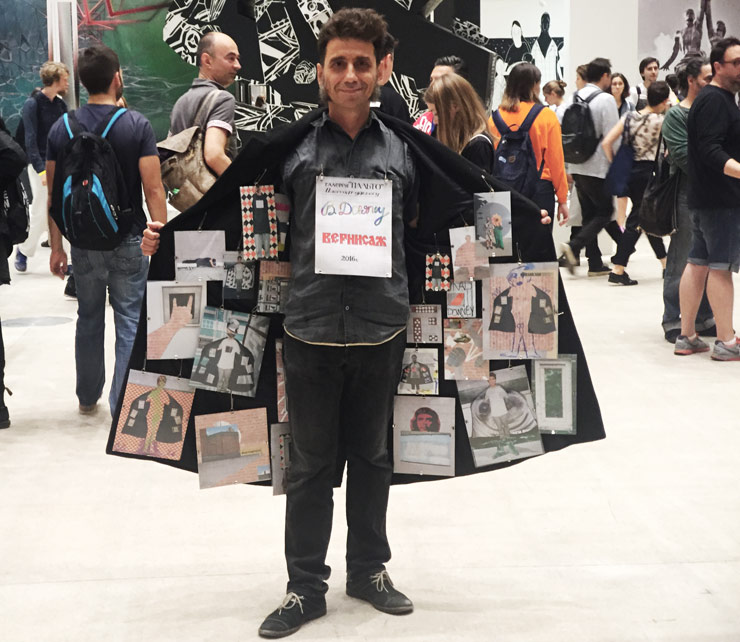
Brad Downey and Alexander Petrelli hi-jacked the opening of the Biennale by circulating within the exhibit as a gallery with artworks for sale. With Downey performing as a street-huckster pushing his own art products, Mr. Patrelli showcased new Downey photo collages and drawings inside his mobile “Overcoat Gallery”
A charming Moscow art star / gallerist / performance artist, Mr. Patrelli is also a perennial character at openings and events in the city, by one account having appeared at 460 or so events since 1992 with his flashing overcoat. The artworks also feature Patrelli, completing a self-referential meta cycle that continued to circle the guests at the exhibition.
International artists participating in the Artmossphere Biennale 2016 include: Akacorleone, Alex Senna, Brad Downey, Chu (Doma), Orilo (Doma), Claudio Ethos, Demsky, Christopher Derek Bruno, Filippo Minelli, Finok, Galo, Gola Hundun, Hot Tea, Jaz, Jessie and Katey, Johannes Mundinger, L’Atlas, LiHill, LX One, M-city, TC, Mario Mankey, Martha Cooper, Miss Van, Nespoon, Millo, Pablo Benzo, Pastel, Paulo Ito, Proembrion, Remed, Remi Rough, Rub Kandy, Run, Sepe, Sickboy, Smash 137, Sozyone Gonsales, SpY, The London Police, Trek Matthews, Wes 21.
This article is a result of a Brooklyn Street Art partnership with Urban Nation Museum For Urban Contemporary Art in Berlin and was originally published at Urban Nation Museum For Urban Contemporary Art
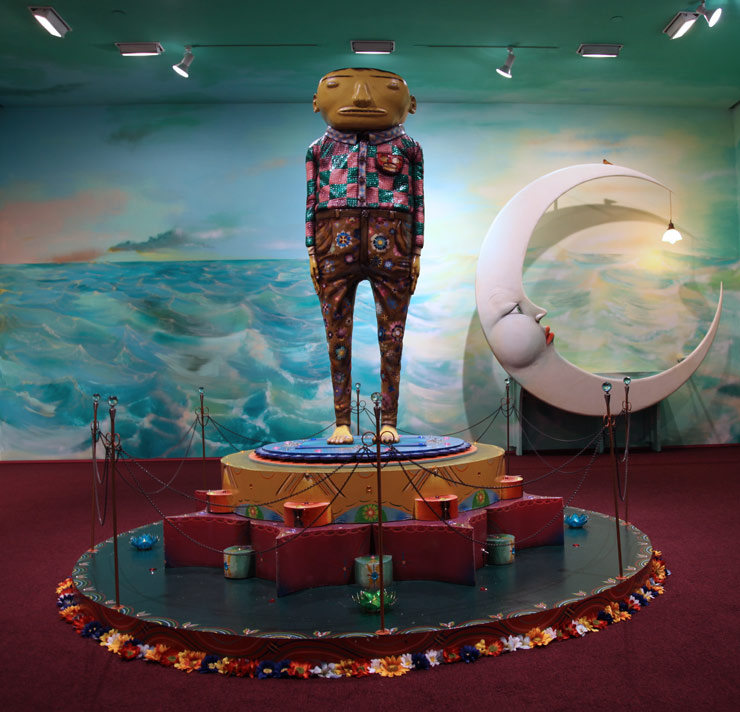
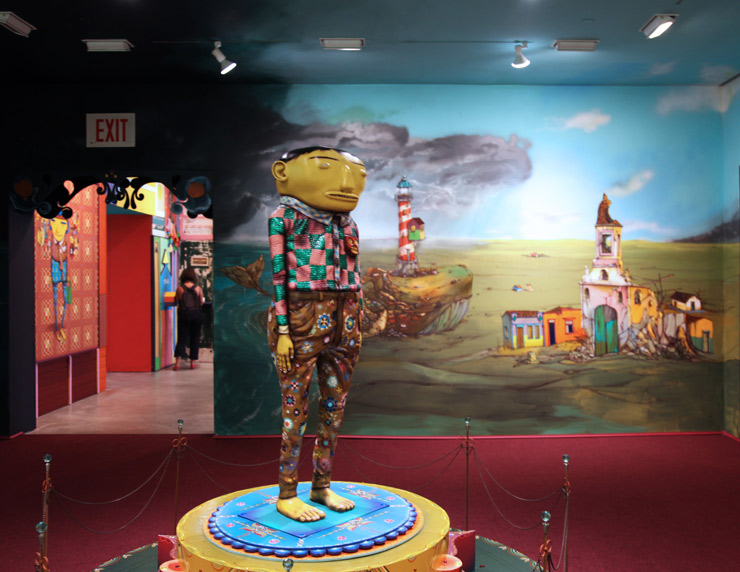
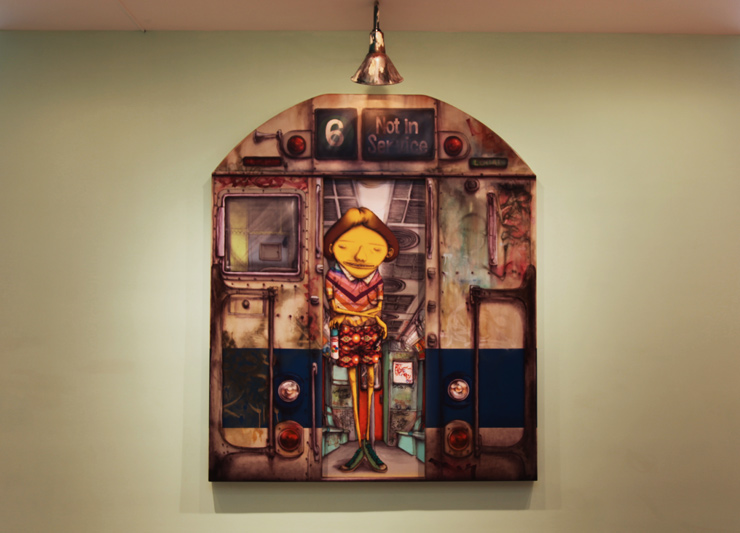
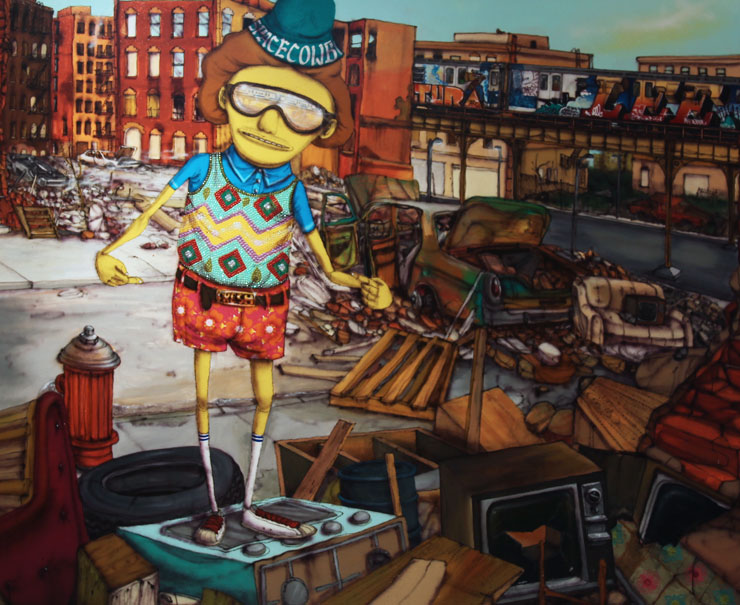
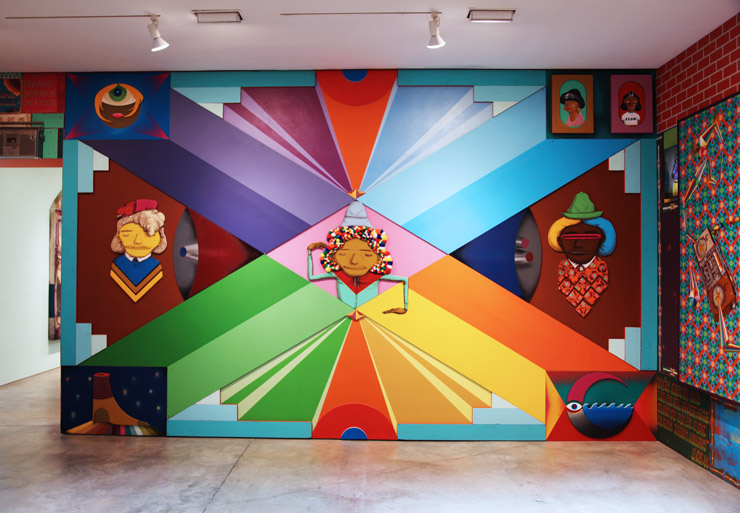
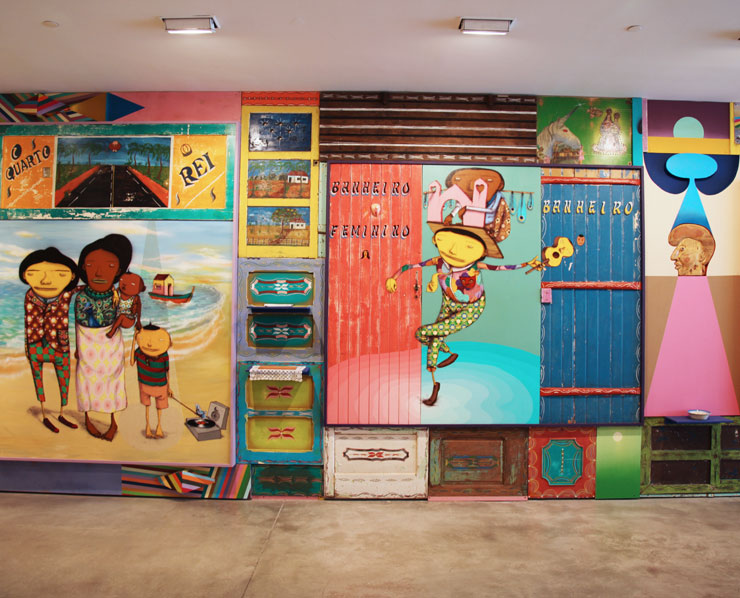
An ongoing lucid travelogue of sorts, the Brazilian twins Otavio and Gustavo have been recording their dual citizenship of this world and a surreal one for their fans for at least a couple of decades. In these site-specific rooms you find multiple characters intersecting with graffiti culture, hip-hop culture, pattern, illustration, fantasy, the sky.
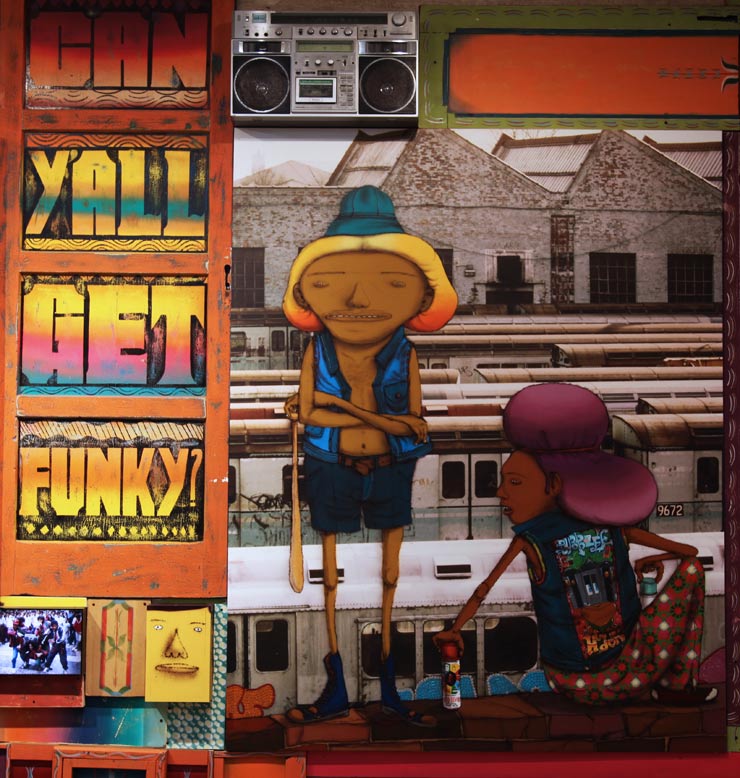
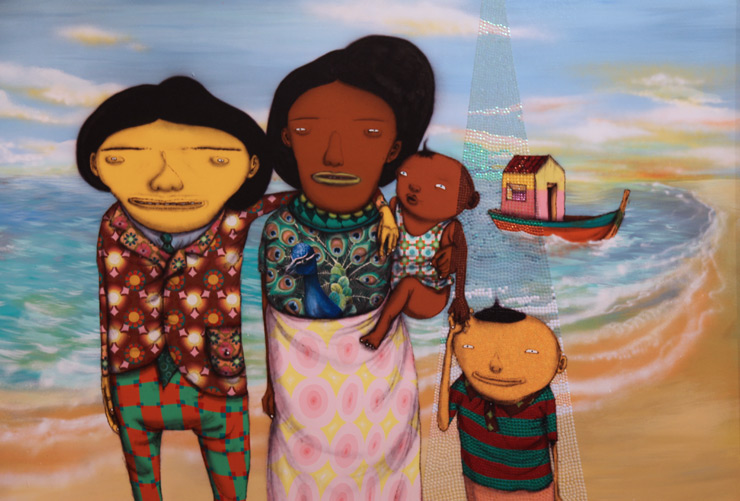
With imaginations captured as boys by the tales and adventures of 1970s and 80s streetwise graffiti kids the brothers’ Brazilian folk homages are stirred in sweetly with escapist fantasies of evading the law, creating your own community, making a famous name for yourself.
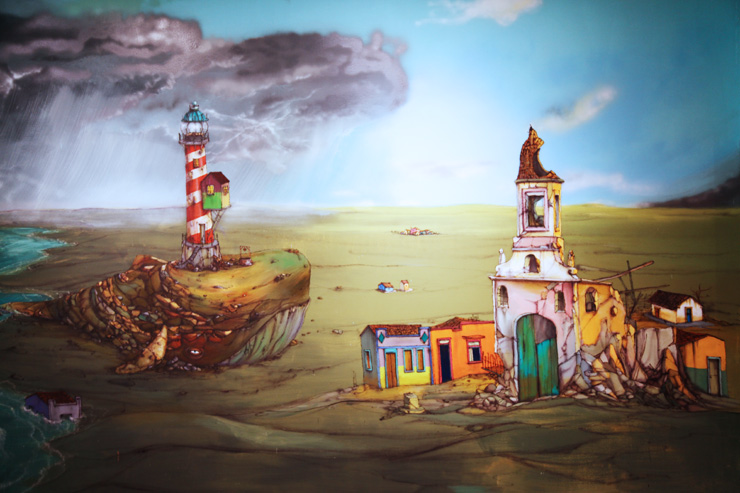
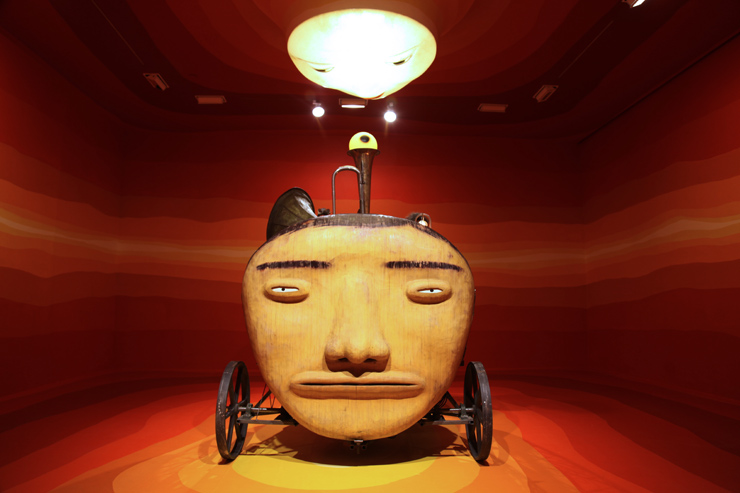
“Silence of the Music”, just opened at Lehmann Maupin gallery in New York last Thursday and attended by a thousand or fans, gives you five rooms of eye candy colored in autumn hues and sea foam washes, and periodic carnival-steampunk mechanical movement that surprises and triggers memory.
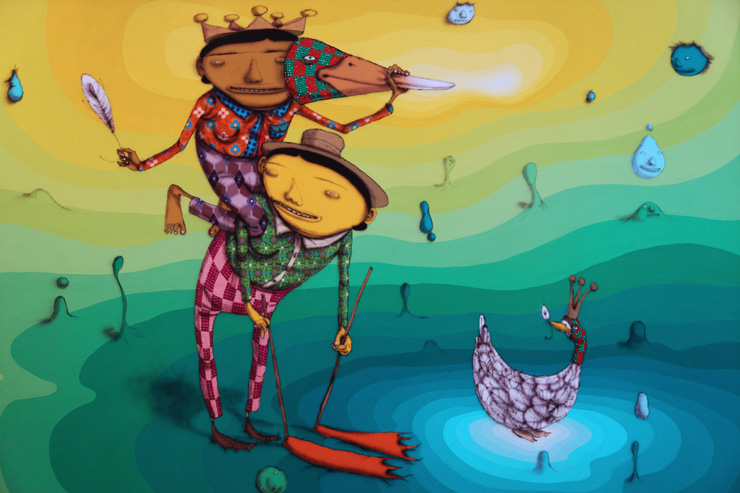
Everywhere are humorously attenuated yellow figures caught mid-mischief or mid-thought, posing with a stylish guile, completely aware of their surroundings. There are some painted collaborations with Doze Green and atop Martha Cooper photos and shout outs to Ken Swift and whole train writers like LEE and Futura. Beatboxes and bboys and spraycans are here, as are lighthouses and ocean storms and rowboats and animals and a sliver of moon for you to sit upon.
Also a sharper depiction of geometric forms.
For Os Gemeos in life and in art, there is little separation between external and internal worlds. For a few weeks this fall you can traverse both with them in New York.
This week BSA is in Moscow with you and Urban Nation for Artmossphere 2016, the 2nd Street Art Biennale, a group exposition introducing 26 Russian and 42 foreign artists who were shaped by street art in some way. Also present are international curators, museums and galleries who have significantly intersected with urban art in recent years.
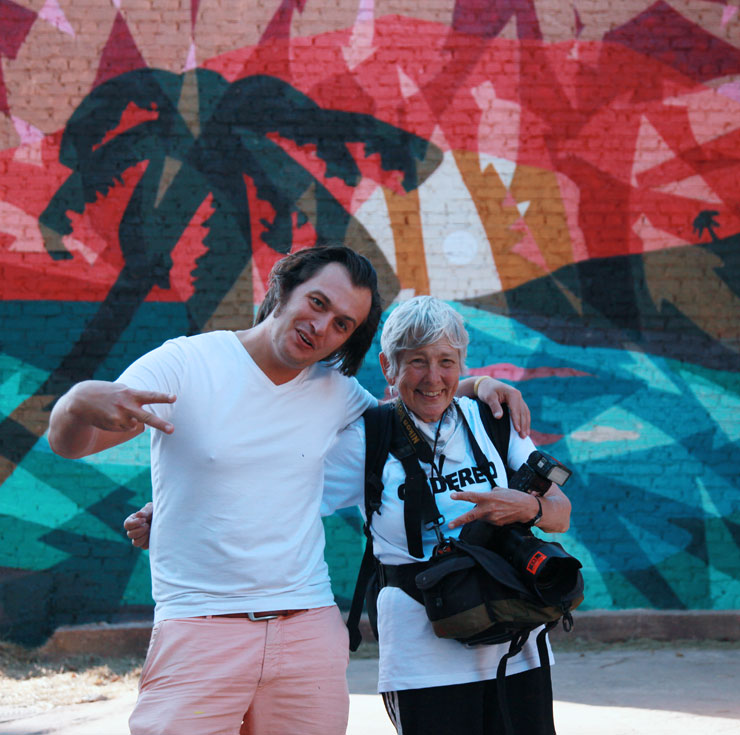
August is the month and August is the name of the driver and Russian graffiti/Street artist who is taking us through Moscow in his car with Martha Cooper to discover fresh new work by L’Atlas on a tall wall in a parking lot.
As you ride the scissor lift on hydraulic legs higher to get the right shot in the late summer sun and see the final strokes of L’Atlas’ bar coded geometry, you may find it purely abstract. It’s actually his name.
The French graffiti writer explains that his linear roller piece is an evolution from his first days spraying tags in more traditional ways.
“You know my idea is always to write my name in the same manner that I used to do in graffiti,” he explains, “It’s not so easy to see my name – like you cannot read it the first time. It’s about form, it’s about color, geometry in relation to the architecture.” Here the color is red, because we’re in Moscow, he says.
It is not unusual for passerby in other cities to stop and take photos and ask questions about the art or the artist.
Do passersby stop and ask questions about his work here? “No they have not asked me anything. Really nobody has asked me anything. I don’t know why. Normally everyone wants to know what I am doing.”
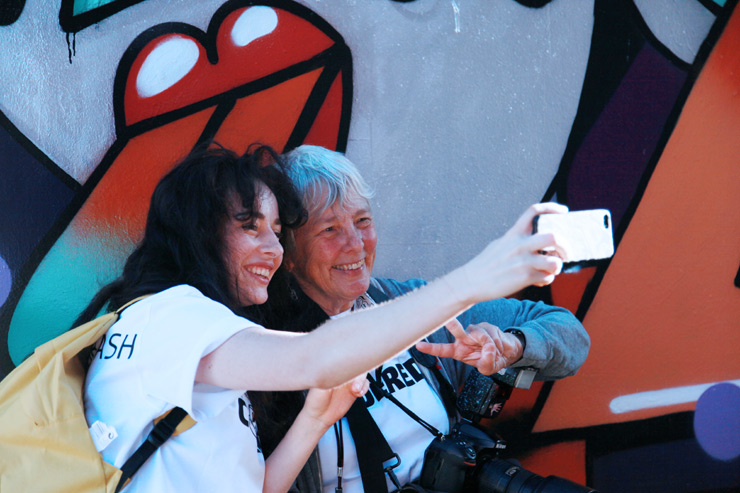
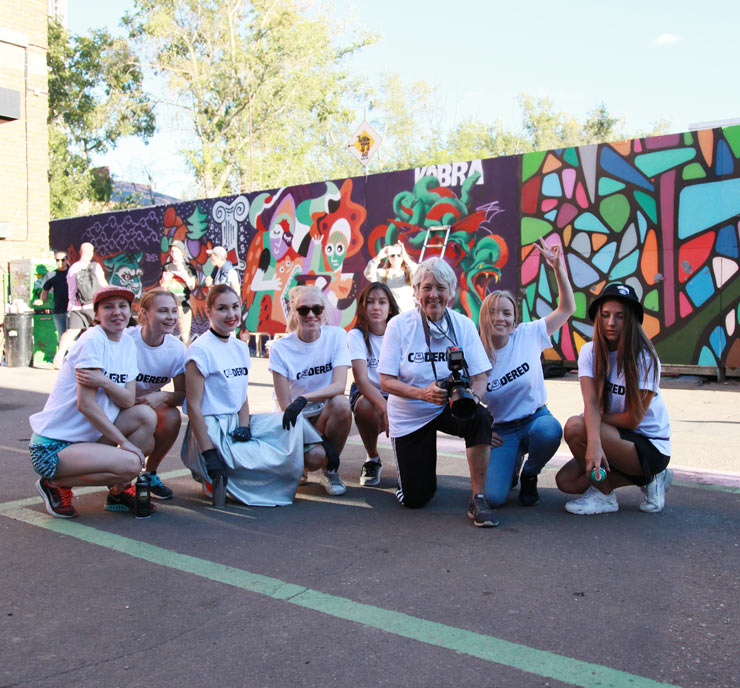
Many people were asking questions at the all-girl graffiti jam named “Code Red” at an artist compound/mini-mall/exhibition space we stopped at. Of course most of them were questions to Martha Cooper, who was stopped every few meters and asked to sign a black book or pose for a photo, which she happily and gamely did.
This was her second time here today; she had checked in earlier on the progress of the female writers, many of whom are a bit shy when approaching her. One young buck, however, nearly demands that she write exactly the name of his crew as she dedicates something in his book and asks that she pose in one picture with a t-shirt and one holding her camera.
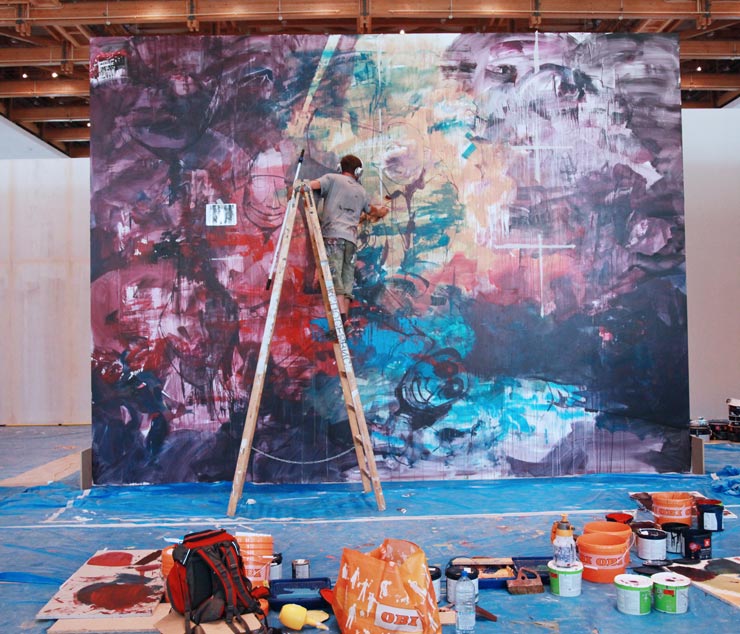
Back at the Manege – the massive neoclassical building west of Alexander Garden that once held horses from the Kremlin and is now being built inside to house the Artmossphere Biennale. We show our passports and go through the metal detector and see Sepe, a Warsaw-based artist here with Urban Nation, atop a ladder rolling out a multilayered structured chaos across a huge wall.
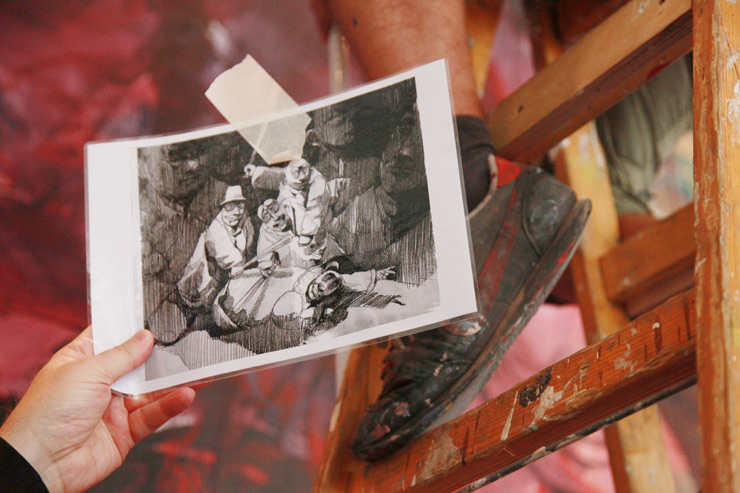
His sketch taped on the canvas indicates that there will be forms arranged across this bed of color as the composition progresses. We’re intrigued by his description that is based on this year’s theme of invisible walls and the boundaries of personal freedom.
“It is more like my interpretation,” Sepe tells us. “It is just about the people who are behind everything – who are using others as puppets to do whatever they want.”
Of course, rewards are sought by everyone, and Britains’ Sick Boy is on a ladder of his own painting the outside of what will be a rewarding interactive pleasure house. He calls the project The Rewards System and he shows you where people will climb a ladder and descend down a slide into the darkened house where they will set off a series of sensors that activate a variety of multisensory lights and tantalizing patterns – then you exit on your hands and knees through a too small square door.
“The concept of the show is about invisible walls so I was thinking about there being barriers in your life and I thought about the reward of endorphins one experiences for achieving a task – a small amount of endorphins. So I thought I would build a house that signifies the reward system,” he explains with that wry smile you’ve come to expect from an artist who calls himself “sick”.
The rest of the show production is well underway and many artists are busy painting, sculpting, papering, suspending, or otherwise plotting. Miss Van has brought a carpet to hang, and is going through a brand new set of pieces on paper that she’ll be hanging for the show.
It’s a lot of activity and people will be working late into the night to prepare for Tuesday’s opening. We even get the chance at revealing to the world our non-existent command of the can inside a newly erected metal shed. Yes, Brooklyn is in the дом !
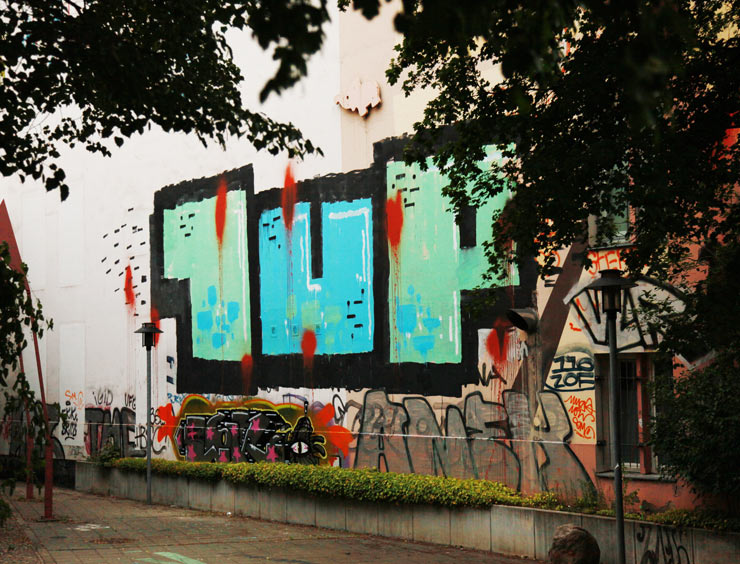
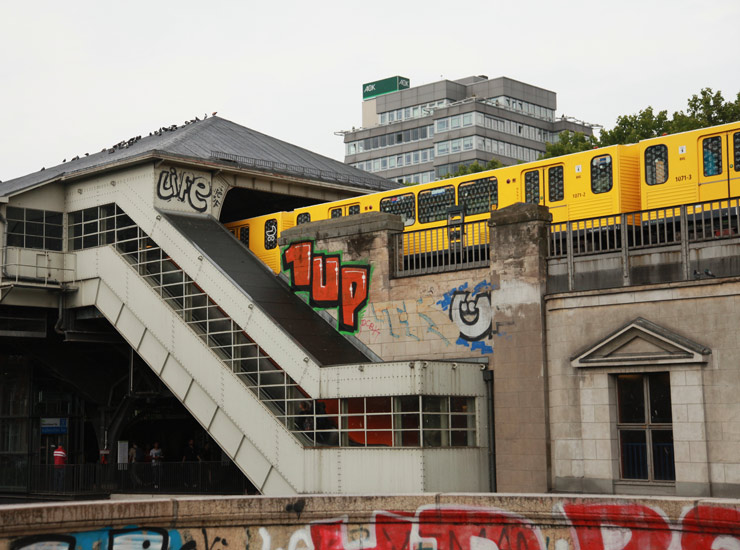
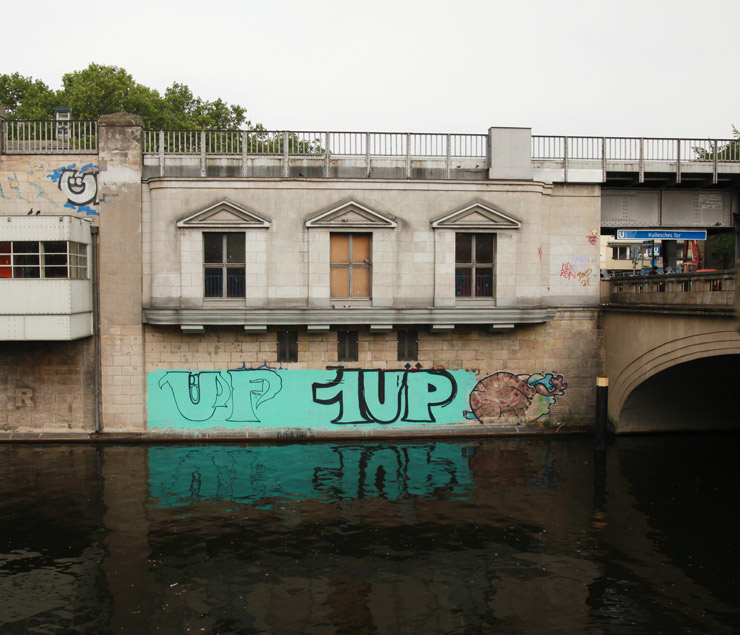
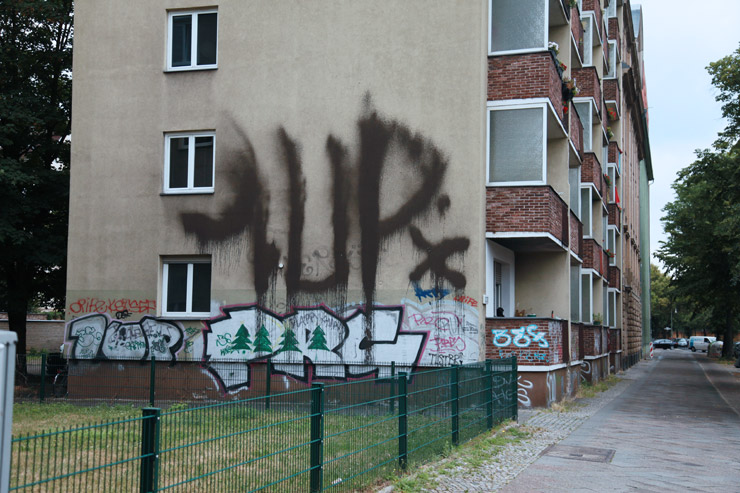
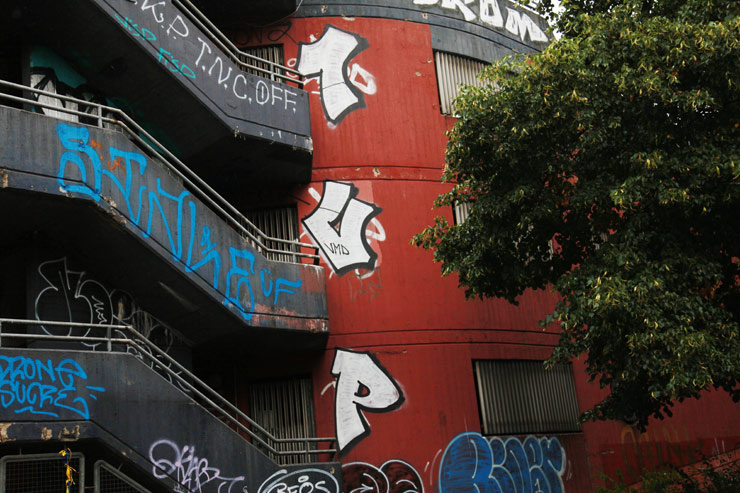
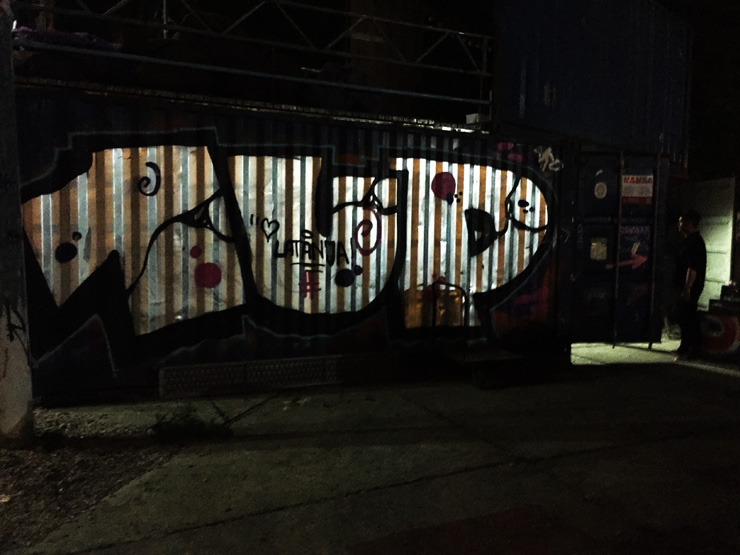
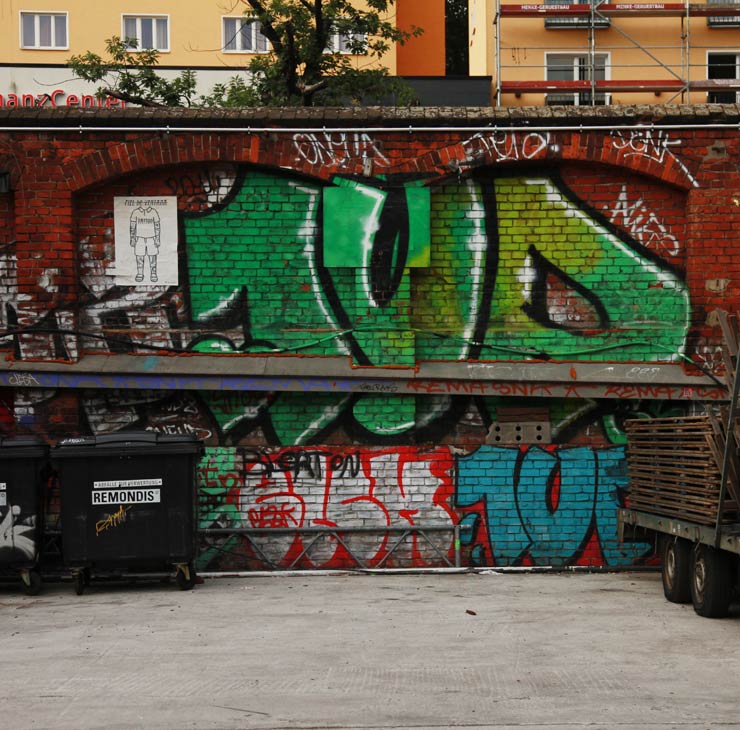
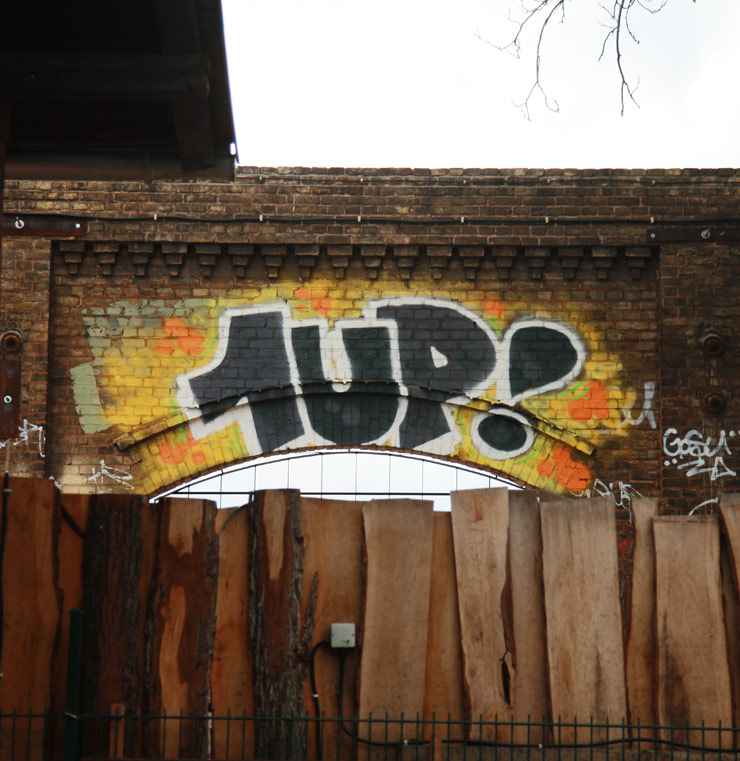
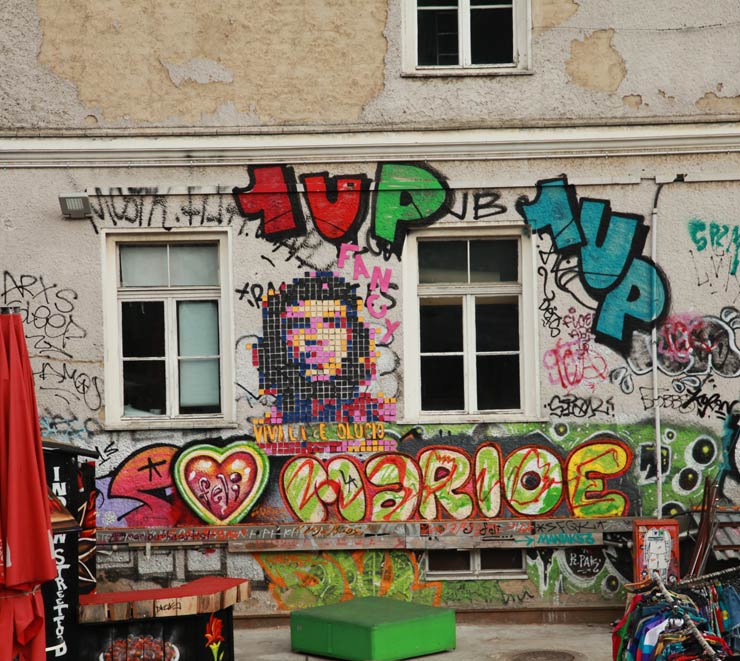
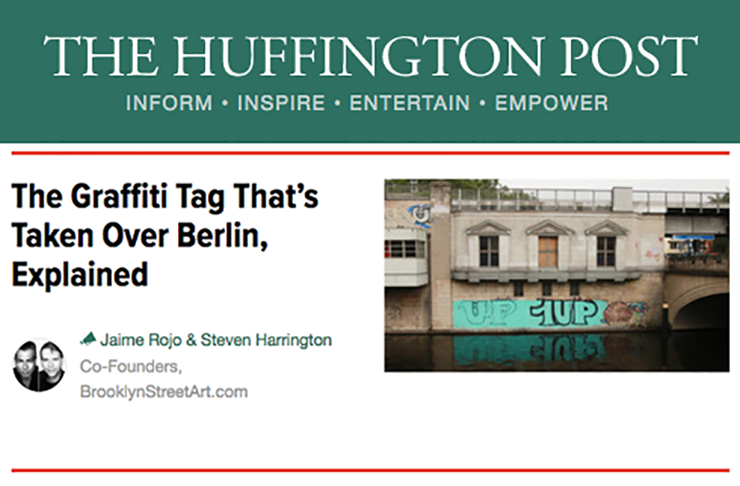
An amorphous shape-shifting consortium of Berlin-based aerosol hooligans named 1UP is one of those graffiti crews who eventually make the entry into graffiti street lore because of the scope and daring of their travails.
Primarily Berlin based, you’ll find their almost-commercial sounding name on roofs, walls, abandoned factories, and in tunnels in many cities around the globe. Without a clear idea of the exact number in their association nor precise membership these daredevils are most often described as white men in their twenties and early thirties reveling in the athleticism and sport of graffiti, in addition to style. The tag itself appears to be rather “open source” at times, with only insiders able to keep track of the distinct hand styles forming the ubiquitous name on thousands of surfaces.
We spent a few days in Berlin recently and easily collected a handful of images here to share, but it the actual number one could capture would fill a bulky tome.
“1Up Crew…? ‘All City’ doesn’t even begin to cover it, these guys smash walls like sledgehammers,” says Roland Henry, managing editor and a journalist for VNA (Very Nearly Almost), the UK-based independent magazine that has featured interviews with some of the world’s top artists, illustrators and photographers from the urban art scene over the last 10 years. Living in Berlin this spring and summer after calling London home for many years, Mr. Henry says he still hasn’t stopped seeing new 1UP’s.
In a city famously permissive, even celebratory, toward graffiti culture like Berlin, once you notice one 1UP tag on a wall you can’t stop seeing them – like the time your brother started dating that Mexican girl in high school and suddenly you realized that there were hot tamales everywhere! – In the hallways, at the laundromat, in the park, at the corner grocery.
“Spend any time in Berlin and one thing is immediately glaringly obvious: 1UP have their hometown on lockdown,” says photographer and graffiti expert Luna Park, whose forthcoming New York contemporary graffiti book (UN)Sanctioned will be released on Carpet Bombing Culture books in October.
“Take the time and dedication that your average all city bomber expends in getting their name out – now multiply that by 20. Maybe you’ll come close to grasping 1UP’s prodigious output. If there were an Olympic sport for team graffiti, surely 1UP would be gold medal contenders. Not only do they excel at all graffiti disciplines, they take what it means to push a crew to the most logical extreme.”
Park’s point about disciplines is well taken, as not one discernible specific style or medium is used by this one united power – throwies, bubble tags, wildstyle, rollers, juicy markers, sculptures, extinguisher tags.
But it is working as an organized crew covering multiple cars on trains that they are perhaps most well known for – covering cars top to bottom, end to end – in a few short minutes.
“Look up their legendary and brazen daytime whole-car missions on YouTube and you’ll begin to understand this is a crew that seriously rolls deep,” says Ms. Park. “Better yet, get your hands on their “One United Power” film and prepare to be inspired by their global exploits.”
Now in their 13th year, at this point 1UP is a brand (sort of like its older cousin 7UP) – and it probably shows up on scatter charts in PowerPoint slides in advertising and marketing conference rooms – desired psychographics and demographics analyzed, sought after, targeted.
But keep the numbers in perspective – they can’t rival the millions of illegal logos plastered across our cities in violation of numerous regulations. You think graffiti is lawless? Hell, try advertising – it’s nearly completely unregulated in cities like New York and the very few laws that exist are rarely enforced. That Coke crew, for example, they are seriously worldwide with their bombing and tagging – taking over hectares of public space and millions of atoms of mindshare.
World-traveling superstar urban art photographer Martha Cooper, who has been tracking graffiti since trains were first plastered with aerosol paint in the late 1970s and whose first namesake library will open next year with the inauguration of the Urban Nation Museum for Urban Contemporary Art in Berlin, says she’s had some time to observe 1UP, and she acknowledges their status.
“This very active crew has sprayed the world with an impressive assortment of carefully-planned, well-executed tags, throwies and pieces above and below ground,” says Cooper. “Big Up to 1Up for helping to keep the original outlaw spirit of graffiti alive.”
When you look at the corporate yellow journalism flashing across screens today, the shallow and sensational rhetoric may lead you to believe we are devolving as a race. In fact it is just the opposite in many quarters, so media literacy is more important now than ever to discern who is propagating this narrative, and to what ends?
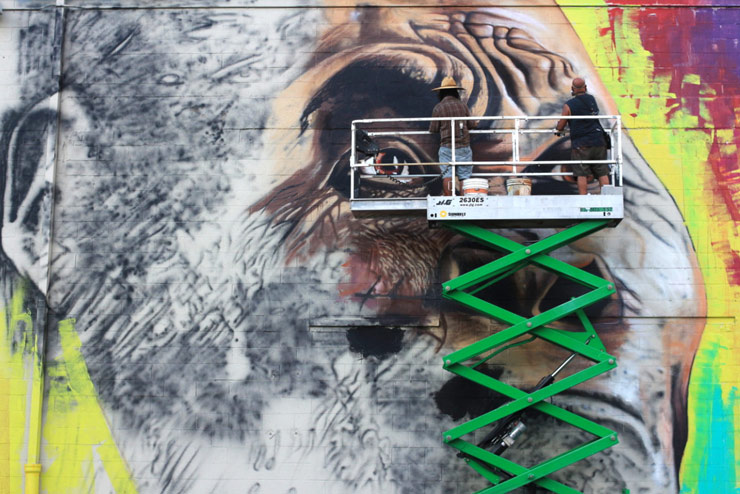
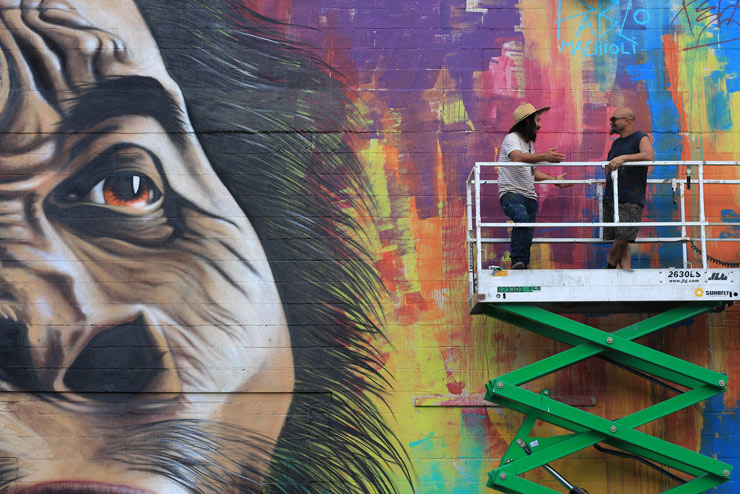
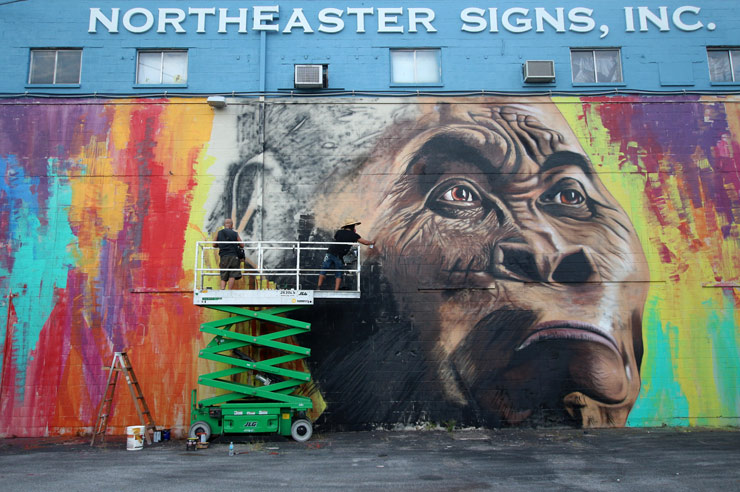
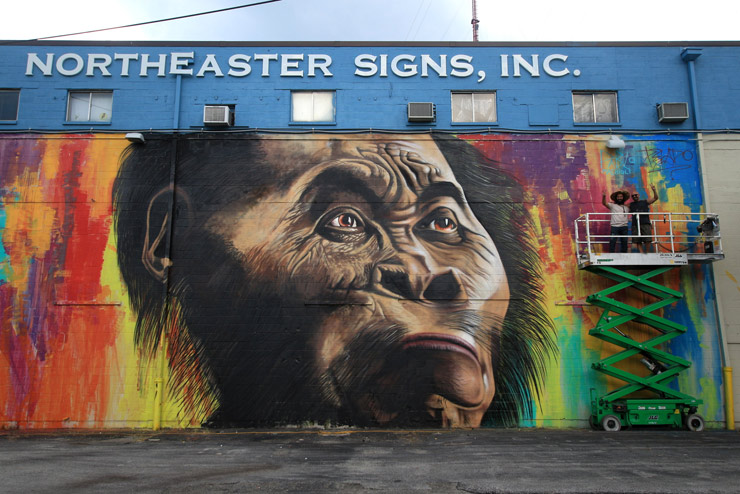
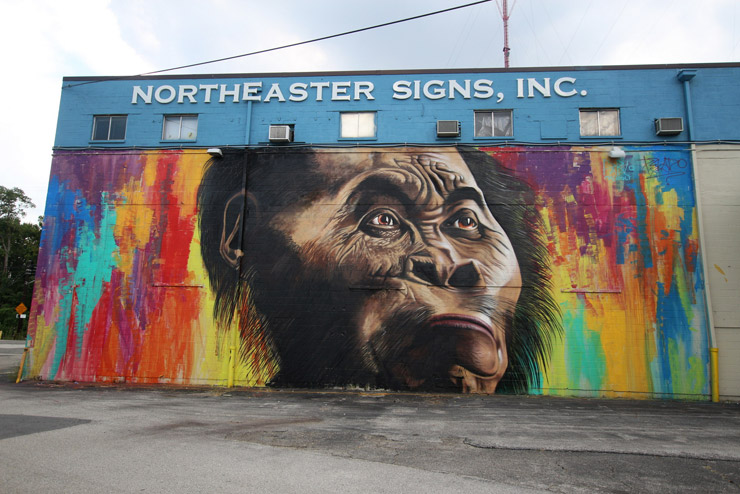
Certainly many cultural observers deduct that man and woman have not progressed since prehistory and a new Baltimore mural by Street Artists Alfredo Segatori (Argentina) and Pablo Machioli (Uruguay) is a throw-back to our less-evolved selves. “I believe that cavemen still exist today and this mural is a like a mirror to look back at our roots,” says Segatori about the singular ‘Homo Naledi’ figure whose bones were discovered by anthropologists in South Africa in 2015 “We need to decide what future we want for our kids and if we want to move forward as a human race.”
The mural is part of a larger initiative including more than 20 street artists participating in a two continent cultural exchange between Baltimore and Buenos Aires, an outside component of a gallery show entitled “Roots”. The show is curated by Baltimores’ Richard Best of Section 1 Project and Matt Fox-Tucker of Buenos Aires Street Art along with local Gallery 788.
As Street Art and murals are continuing to bring more of the social and political themes to the streets in cities like Baltimore and Buenos Aires, traditional organizers of public art programming appear to be on the wane – perhaps because taxpayer funded initiatives have evaporated in most cities and more complex privately funded programs triangulate outcomes.
Actual grassroots organizers of programs like this, while still related to a gallery show, are more likely to respect intellectual rigor and are increasingly carving out their own curatorial niche. It is an interesting crack in the dialogue in public space where the final artworks often respond to society in more challenging ways, rather than producing only pleasing imagery and messages approved by committee or commercial interests.
For Segatori, this mural is a direct response to how we are behaving as a race – particularly toward one another. “I believe that in the world today there is still a lot of violence and intolerance so the idea of our mural is to show the reality of the society that we live in,” says Segatori of the new piece.
“There are people around us who are still forced to live in poverty, suffer from racism, discrimination and persecution due to the color of their skin.” Whether locals will take this message away from the mural is anyone’s guess, but the organizers of “Roots-Raices” say they hope to open the discussion between communities about how to assist in our collective evolution.
‘Roots’ brings together artworks by more than 20 street artists from Argentina and Baltimore exploring origins, cultural identities and social and racial history. Baltimore street artists who have created new artworks for the show include Gaia, Pablo Machioli, Paul Mericle, Billy Mode, Nether, Reed, Mas Paz, Ernest Shaw, Gregg Deal, Lee Nowell-Wilson and Toven plus photographs by Martha Cooper. Argentine artists represented are Alfredo Segatori are Nazza Stencil, El Marian, Luxor, Ice, Patxi Mazzoni Alonso, Maxi Bagnasco, Primo and Juan Zeballos.
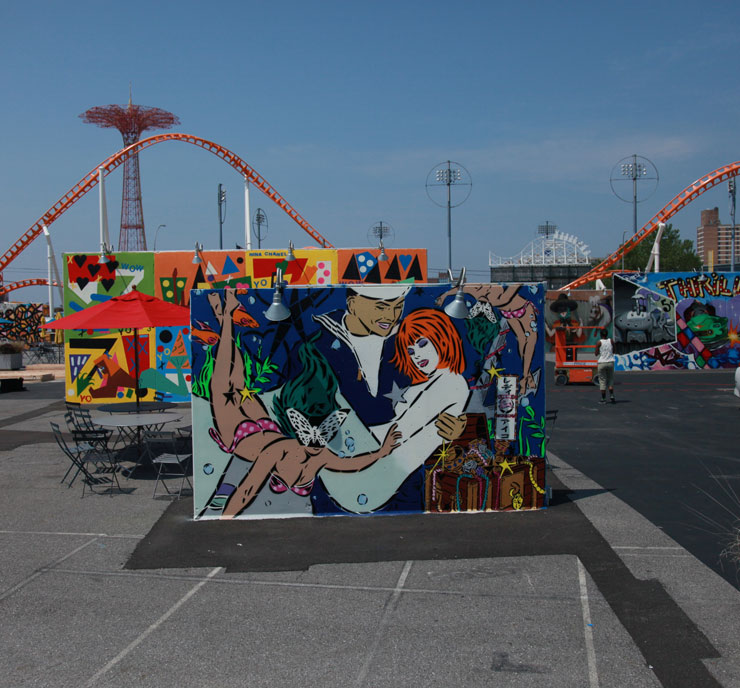
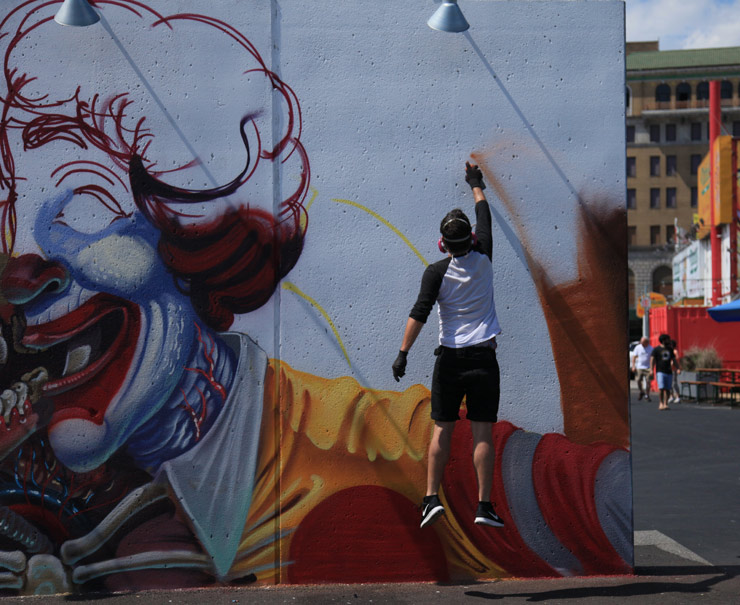
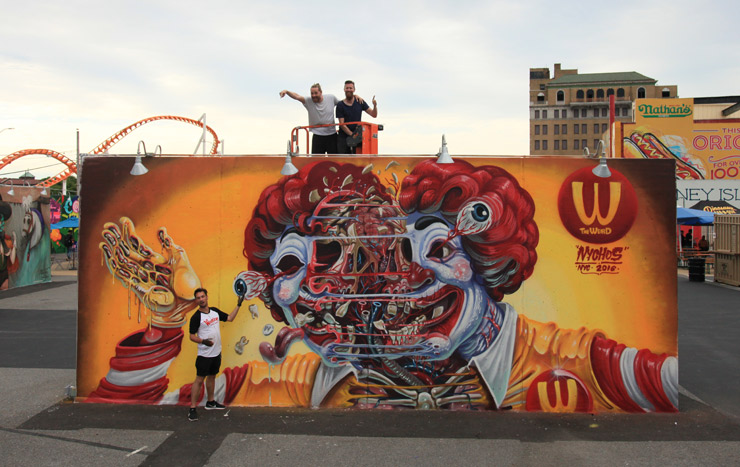
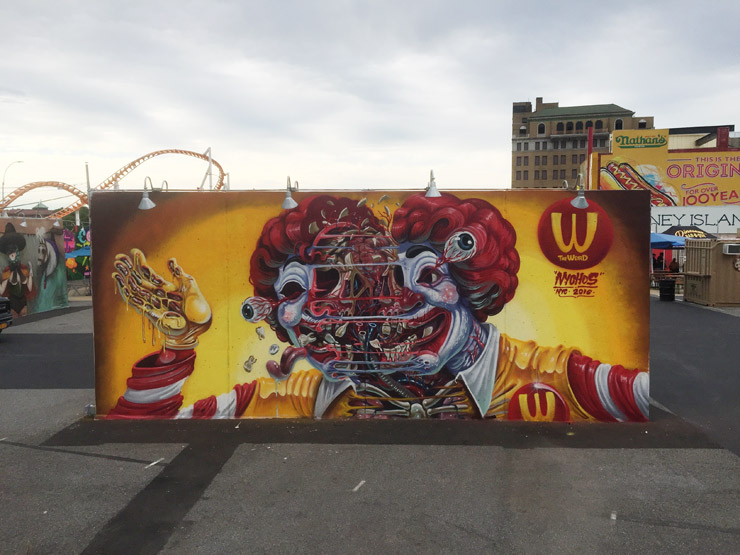
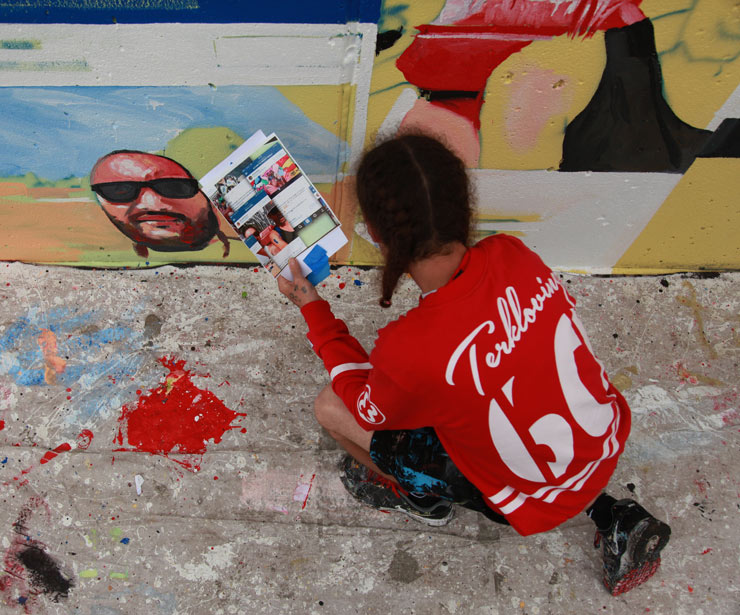
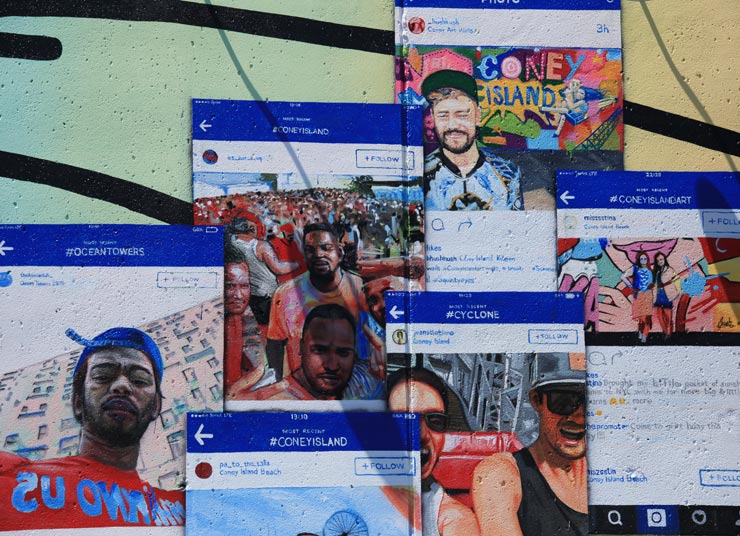
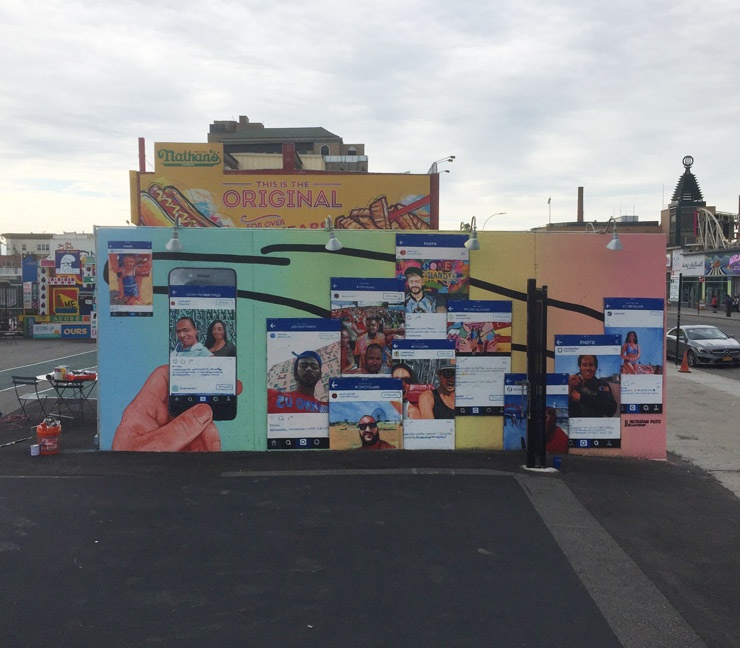
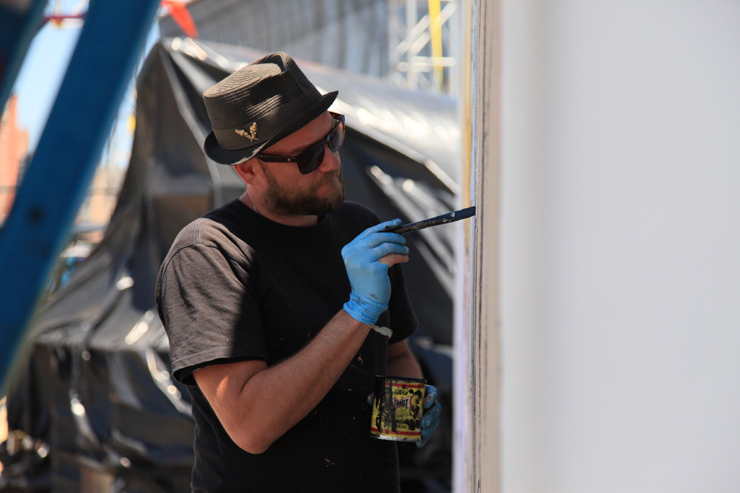
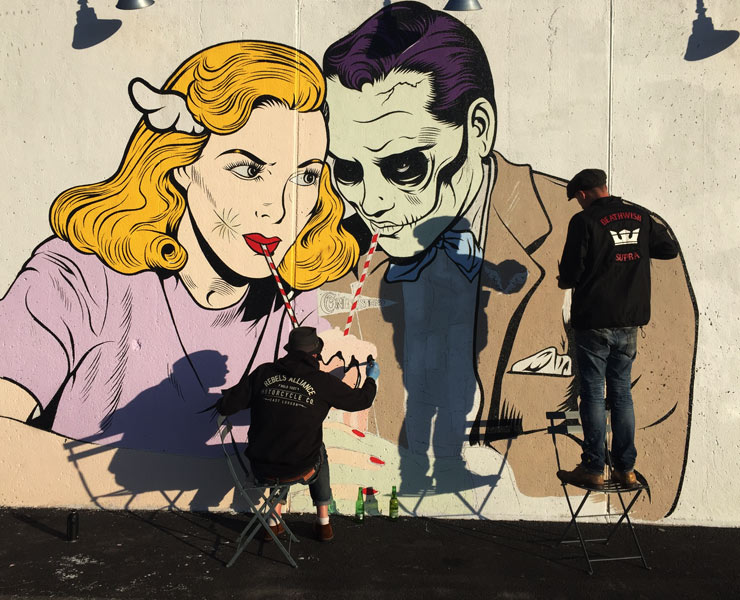
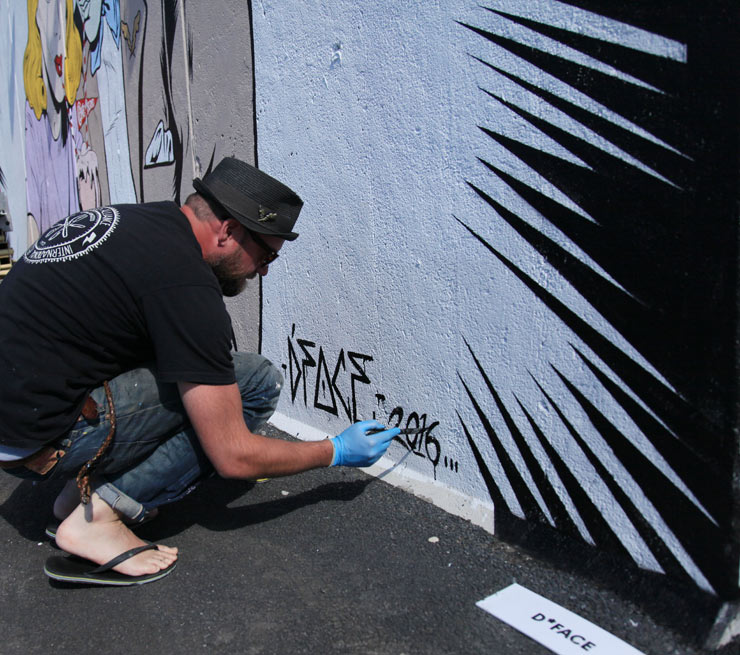
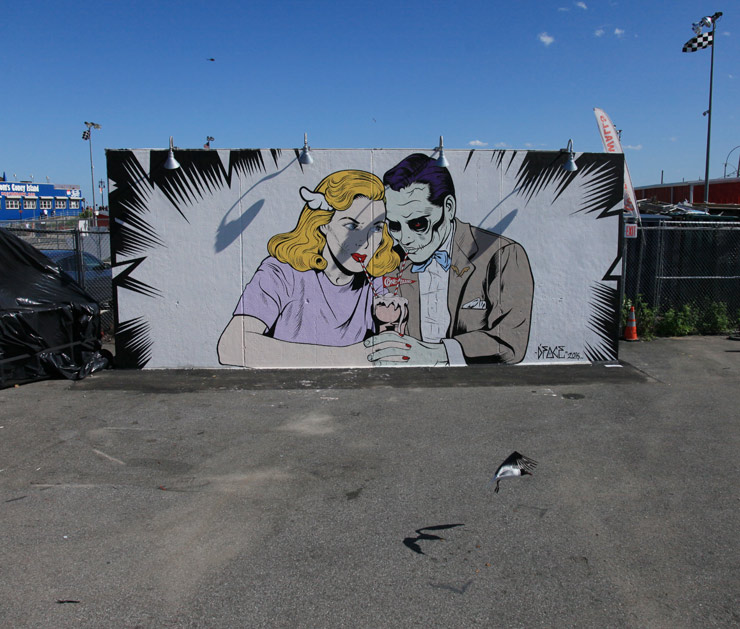
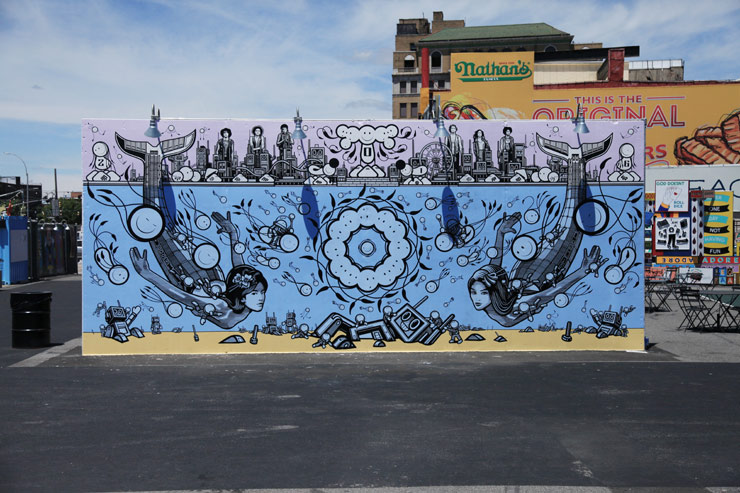
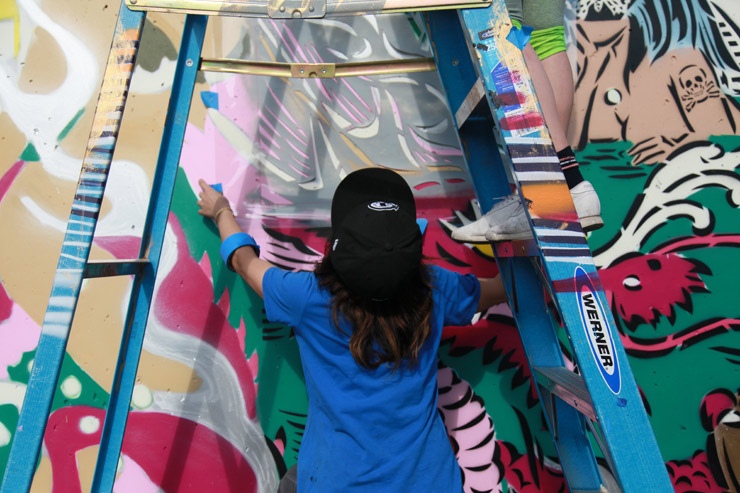
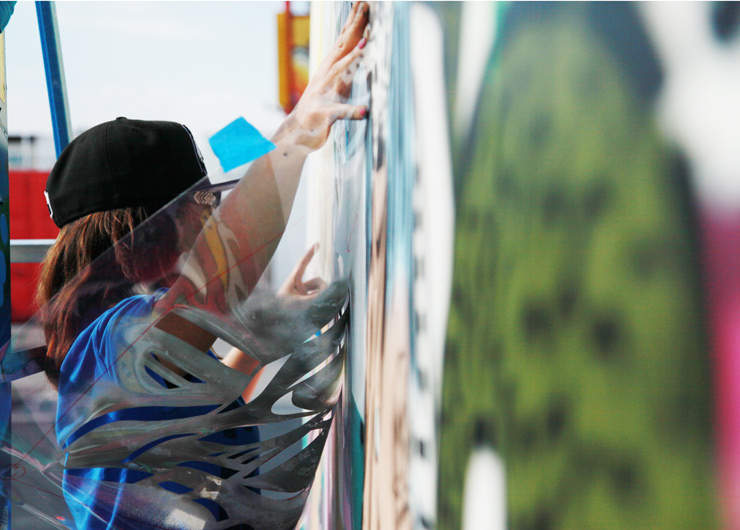
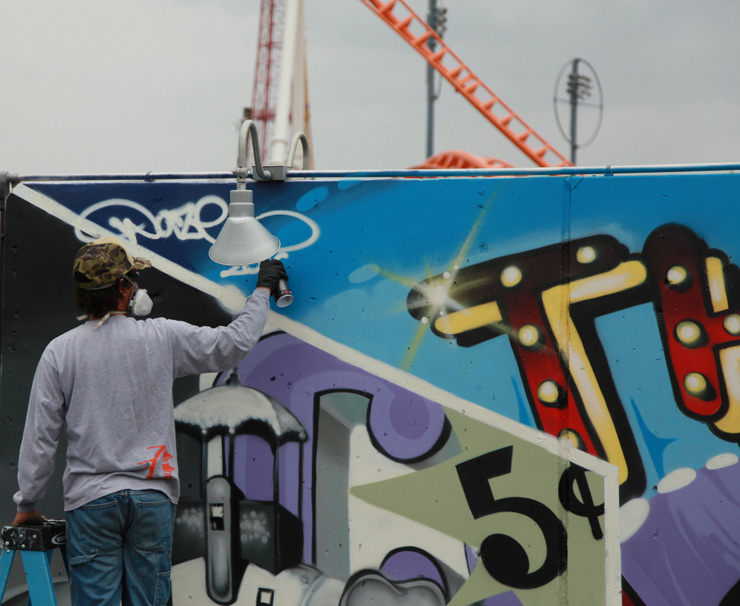
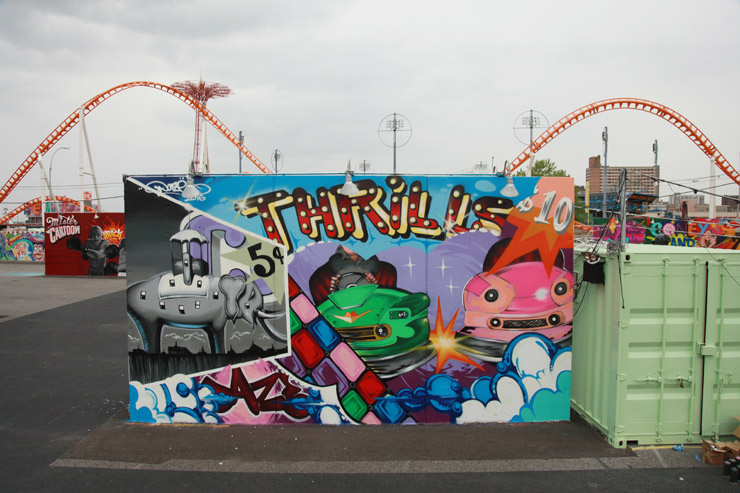
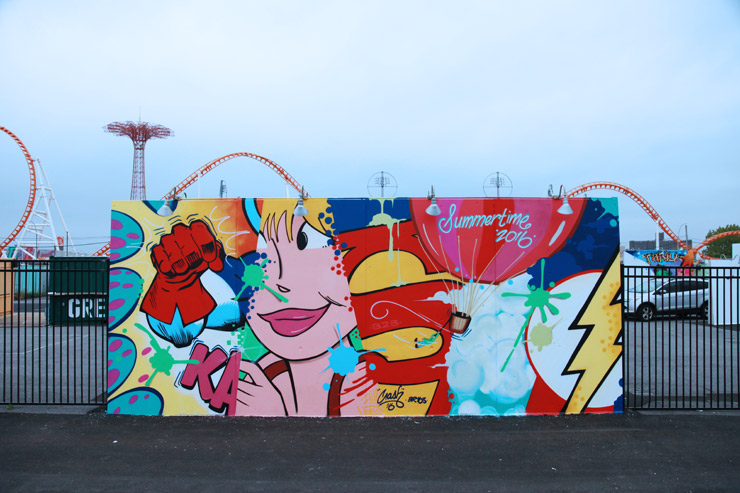
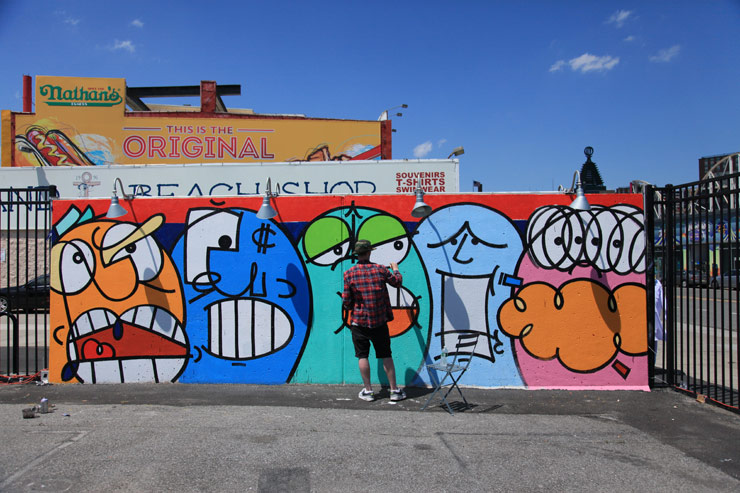
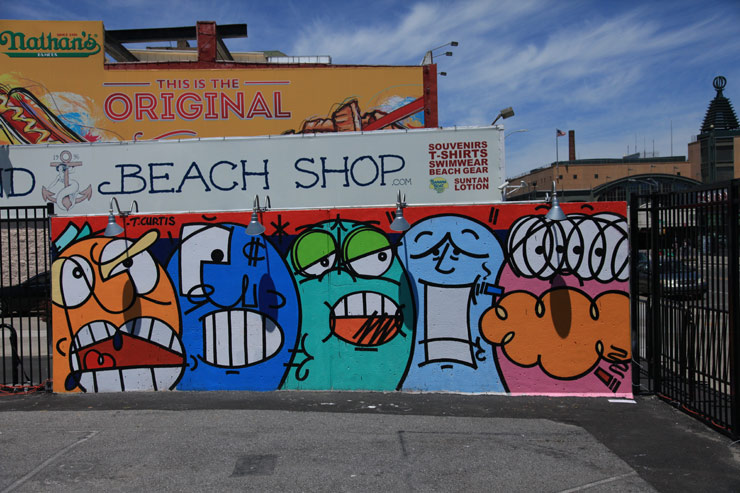
Just in time for this weekend’s Mermaid Parade, London’s D*Face is finishing up “Live Fast Die Young,” his beauty-and-the-zombie comic couple sipping an ice cream float at the soda counter. Austrian surrealist slicer Nychos has completed his dissection of a Ronald McDonald-ish character without a sketch; running, jumping, nearly flying through the air with aerosol in hand, flinging the spent cans over his shoulder blindly to skitter across the pavement. Baltimore-based freeform anthropologist Gaia is cavorting with passersby who want to take cellphone selfies in front of his painted wall that depicts exactly that; selfies taken in Coney Island.
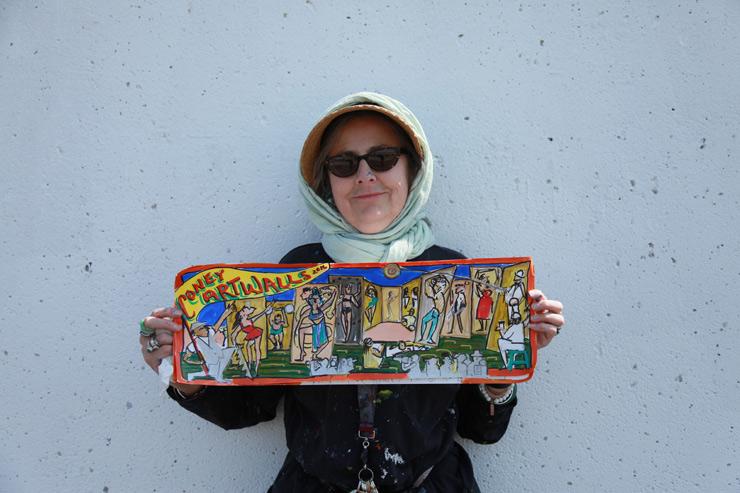
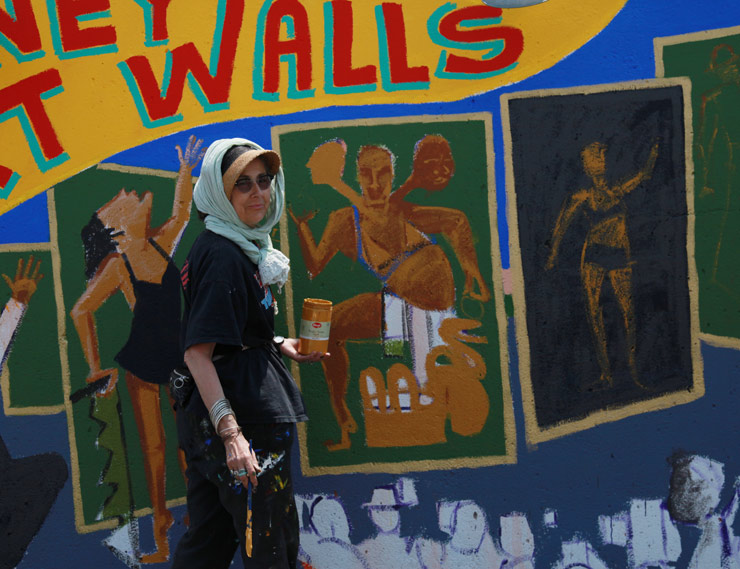
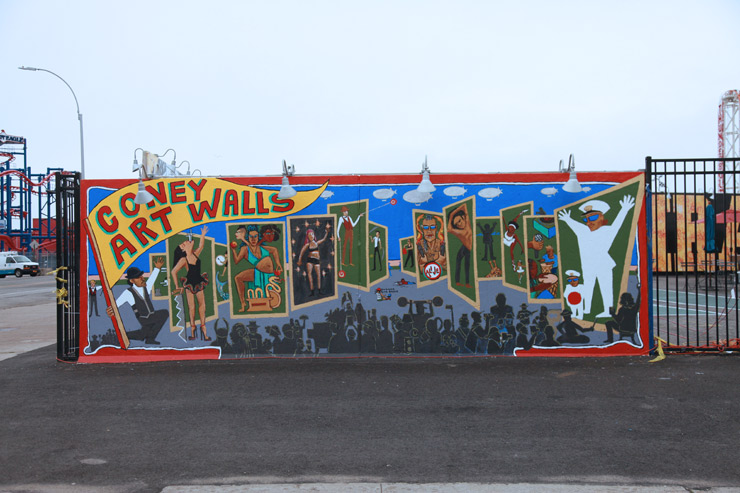
This is a modern version of the multi-mirror funhouse in mural form, and Coney Art Walls is bringing it again.
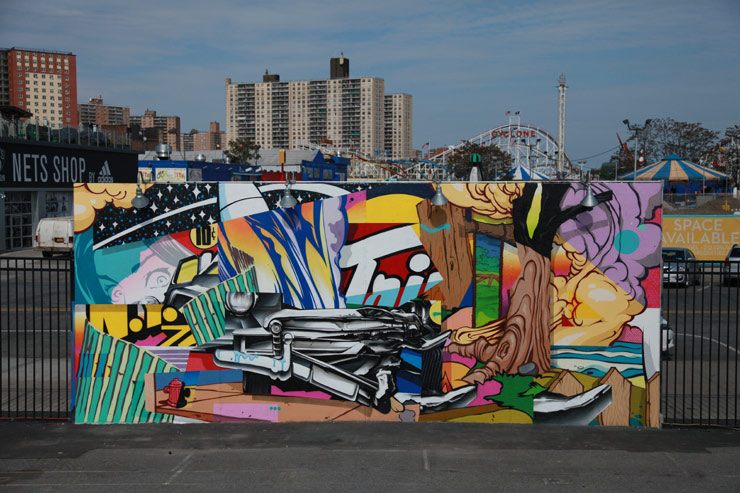
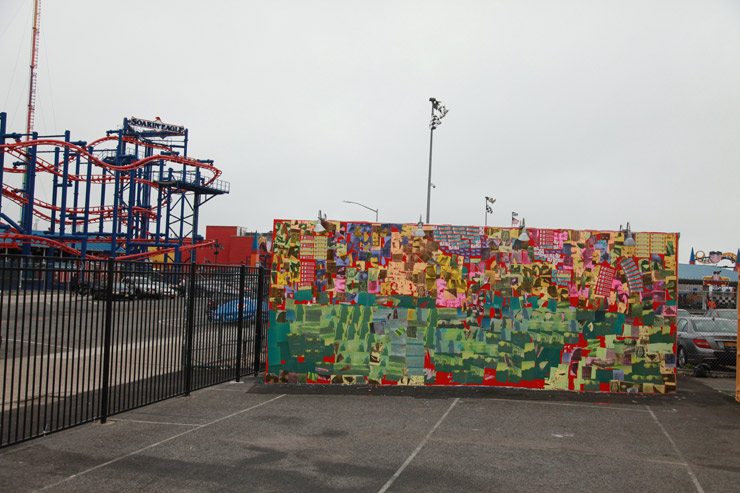
22 new murals on standing slabs of concrete join a dozen or so that were retained from last summer to present an eclectic and savory selection from the old-school and the new. When it comes to art in the streets, a salty luncheonette of city-style treats is on a large public platter these days, with names like graffiti, street art, urban art, installation art, public art, fine art, even contemporary art. For some of those hapless gatekeepers of any of these respective categories, this show in this location presents degrees of discomfort and anger as many subcultural roots are now brought into the light in tandem with one another in a public display – funded by a real estate firm. For the artists and majority of fans, however, the trend is more toward delight and gratitude.
While you are unpacking that, consider that lead curator Jeffrey Deitch has often proved very adept at plumbing the aesthetic margins of our culture while rearranging and intermingling the parties, helping the viewer to appreciate their differences. This outdoor exhibit co-curated with Joseph Sitt provides a venue for a wide audience to contemplate the range of expression that New York streets have had over the last few decades, including a few artists who are trying this manner of expression for the first time.
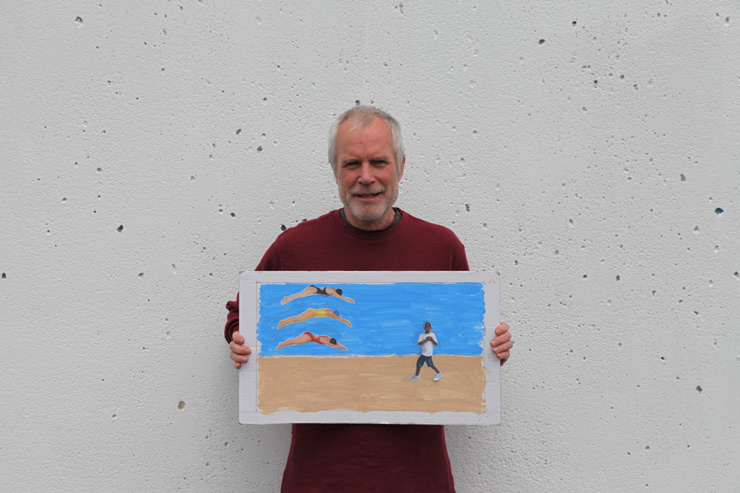
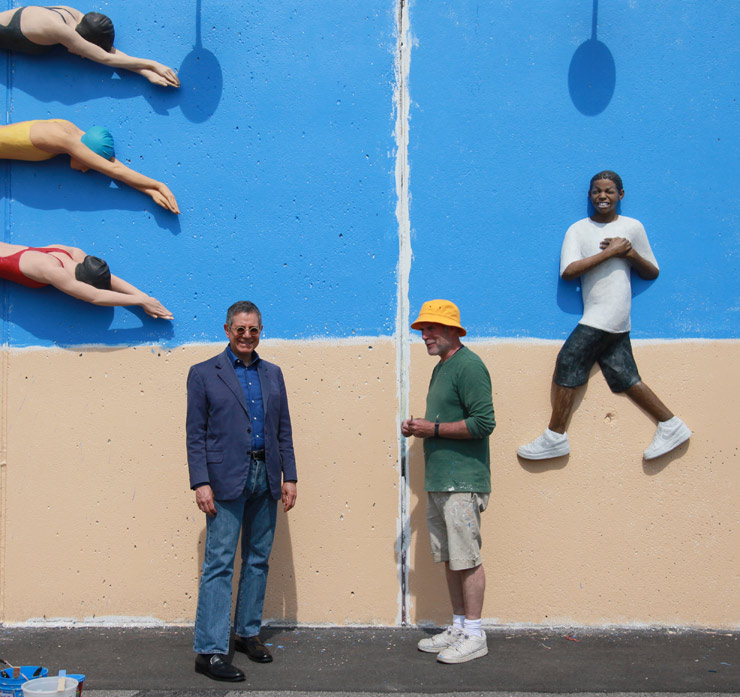
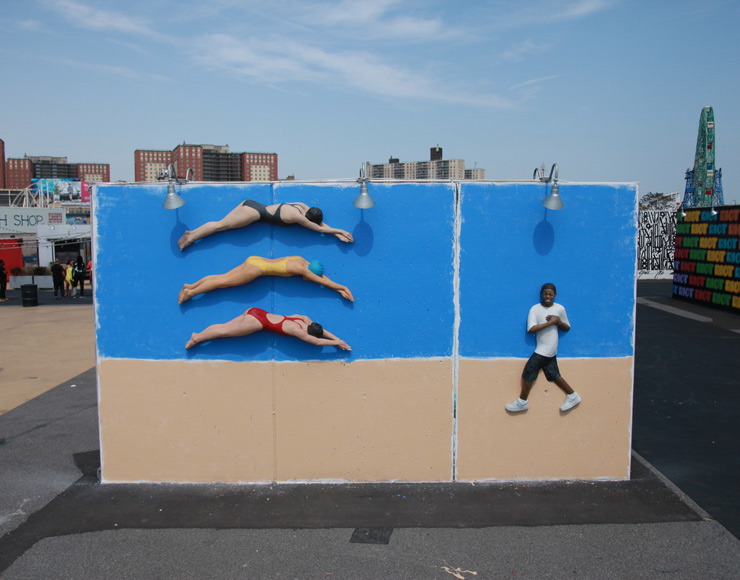
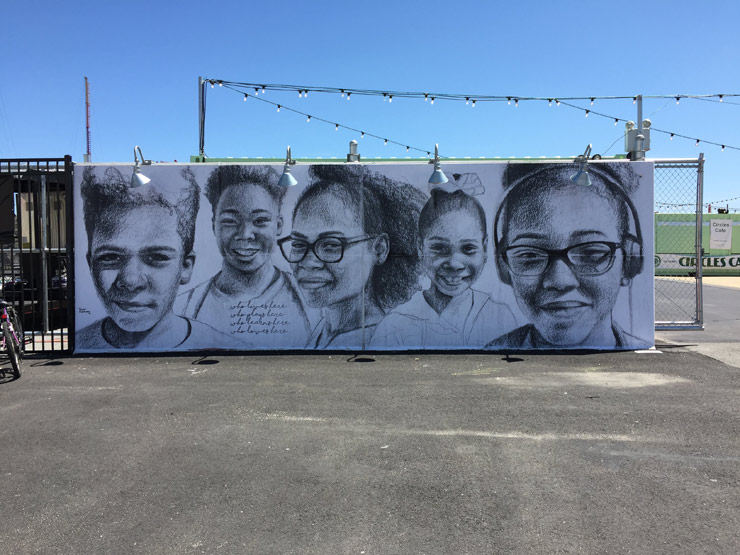
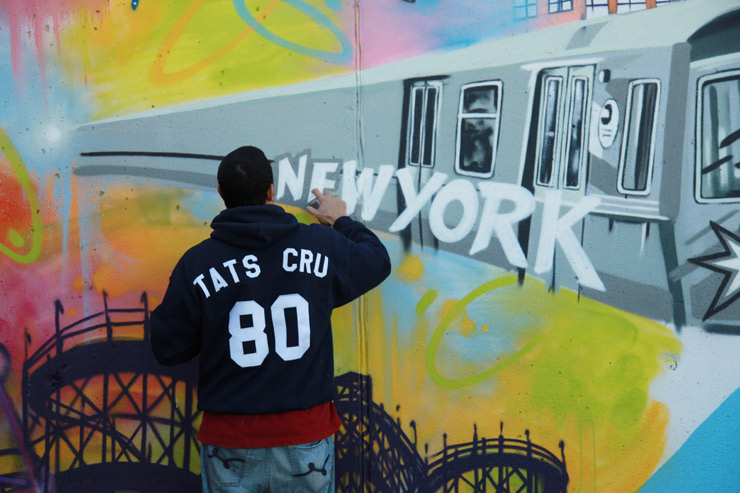
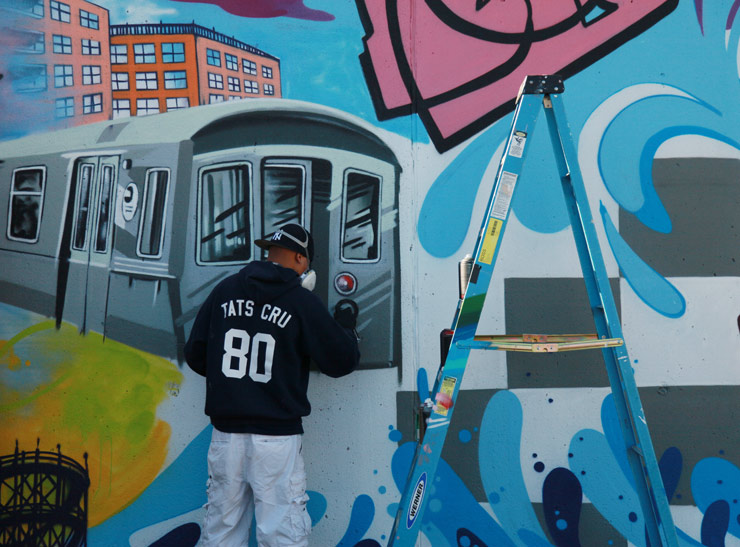
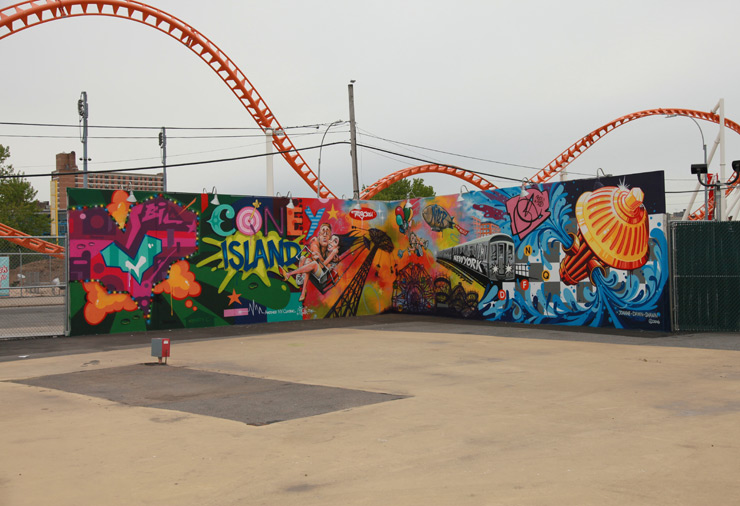
As the Thunderbolt, Steeplechase, Cyclone and Wonder Wheel spin and swerve nearby and overhead, sending screams and personal projectiles into the ocean breeze, you have this paved lot full of paintings to peruse, lemonade in one hand and the cotton-candy-sticky hand of a sunscreen-slathered child in the other. Here you’ll see a large two-walled corner smashed with Coney Island themes by Bronx graffiti masters Tats Cru (Bio, BG183, and Nicer), a selection of hand-drawn wheat pasted portraits of Coney Island youth by Tatyana Fazlalizadeh, and 4 full-form sculptures by John Ahearn creating a modernist view of divers on the beach .
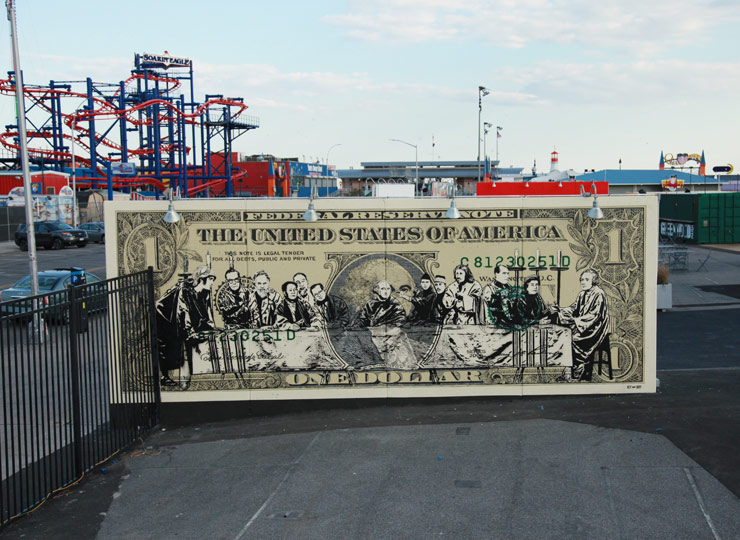
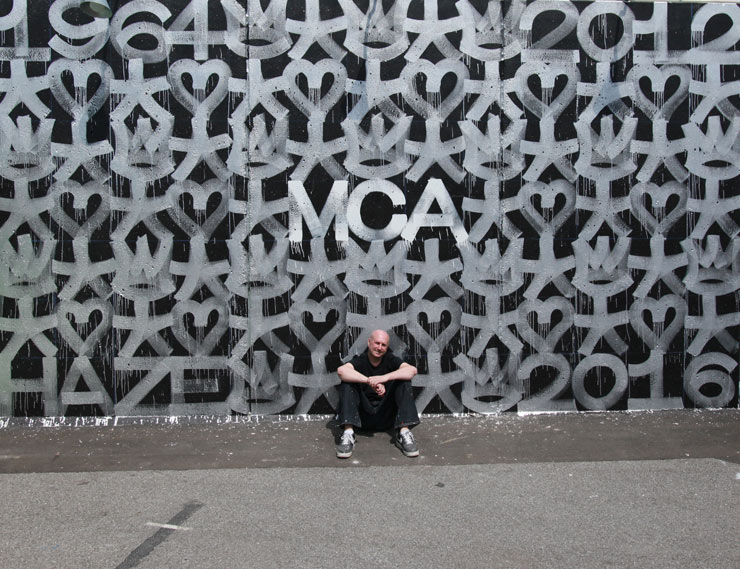
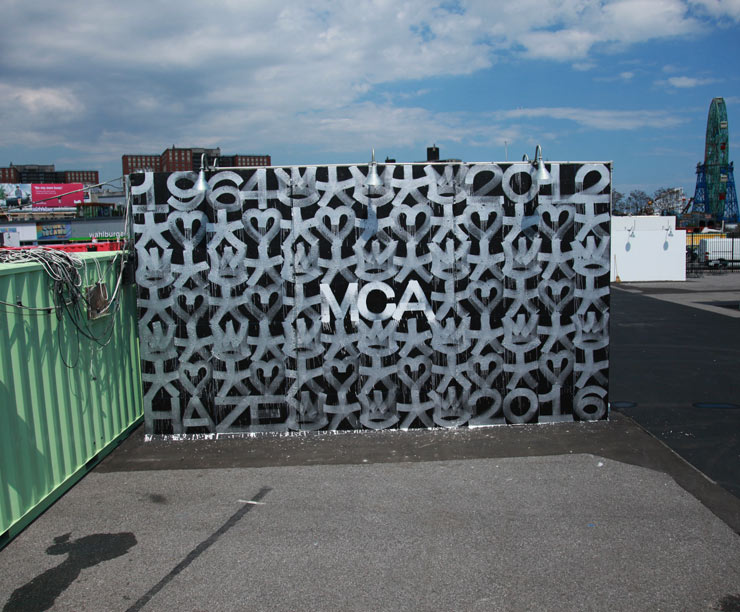
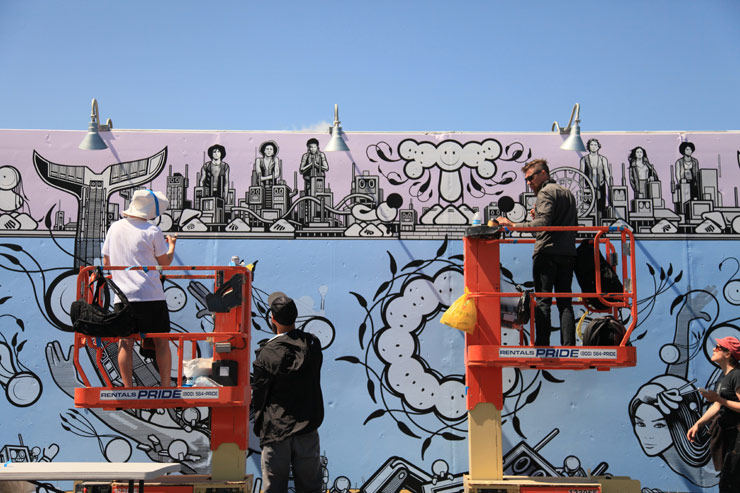
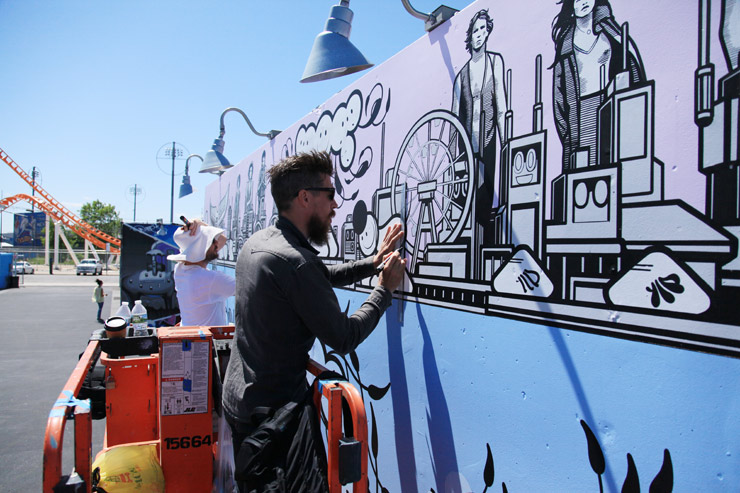
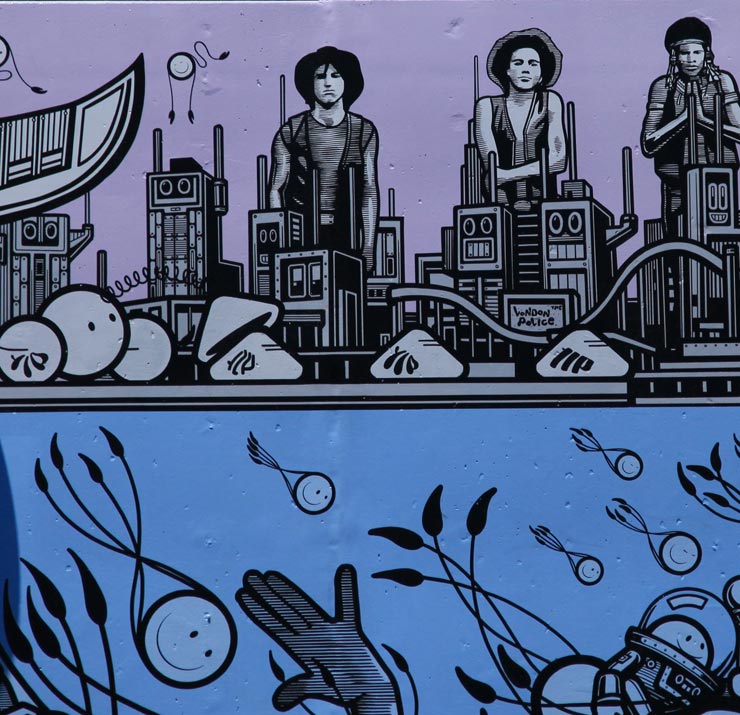
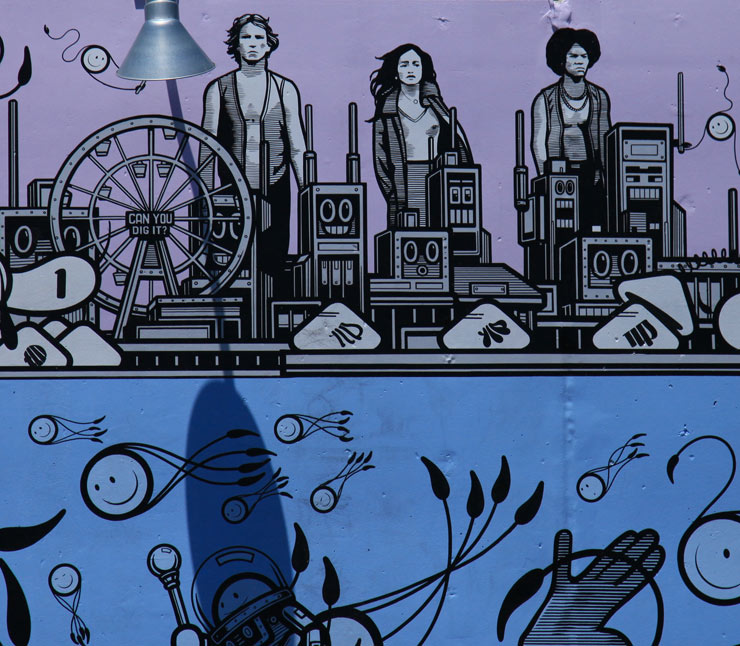
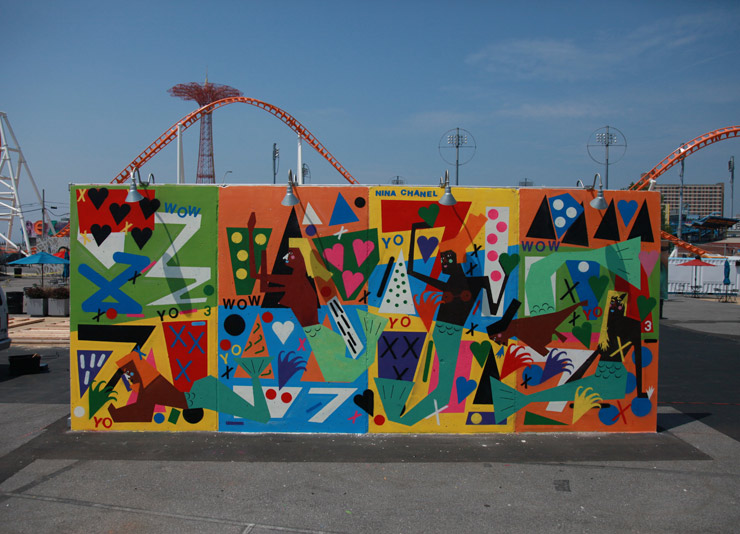
Tooling elsewhere through the loose labyrinth you come upon a monochromatic cryptically patterned tribute to Brooklyn-born Beastie Boys vocalist Adam “MCA” Yauch by Brooklyn tagger/train writer/artist Haze and a seemingly lighthearted abstractly collaged wall of mermaids by fine artist Nina Chanel Abney, whose work is currently on the cover of Juxtapoz. There is also a spectacular underwater-themed symmetrical fantasy topped by pylons bearing the likenesses of characters from “The Warriors” film by artist duo The London Police, and a stenciled “Last Supper” featuring heads of world currency playing the disciples and George Washington as Jesus sprayed across the face of a huge dollar bill by Iranian brothers Icy & Sot.
We often travel streets and neglected spaces in cities looking for signs of freewill artistic expression and often the creative spirit surprises us as it can be expressed in so many ways with emotion, agenda, and idiosyncratic point of view. It may be the plurality of voices one experiences surfing the Internet or the multi-cultural nature of living in New York with a continuous river of fresh arrivals mixing in with established and old-timers every day, but one comes to expect this variety of viewpoints and rather naturally creates accommodation for inclusion that celebrates without negating – and in many ways Coney Art Walls does that as well.
Oppositional viewpoints are present if you look: There are coded messages and obvious ones, critiques of corporate hegemony, issues of race, commentary on police relations, sexuality, religion, capitalism, community, the languages of advertising, movies, music, entertainment, local history, and examination of roles and power structures.
When tooling around this collection, you may wonder what, then, are the commonalities of this survey. Certainly there are the recurring references to Coney Island lore and aspects of performance and flimflam, oddity, fantasy, even the erotic. Naturally, there are elements of natural wonder as well, perhaps expected with the proximity to the beach and the ocean and the history of this place as a vacation getaway.
Aside from this, the connective tissue is what we frequently identify as what is distinctly New York – the plurality of voices. Arguing, making fun, praising, preening, bragging, lambasting, mocking, singing. Despite the continuous attempts by others to divide us, we’re strangely (very strangely), beautifully united.
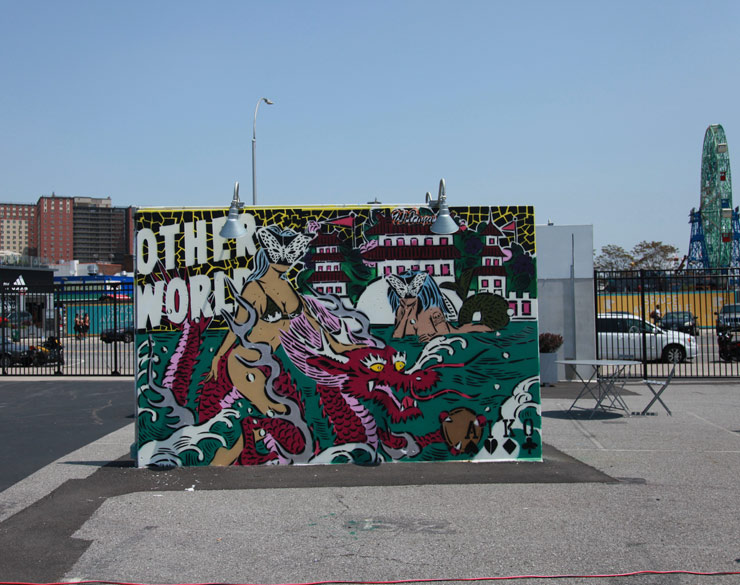
Originally from Japan, Brooklyn’s AIKO has a double sided stencil sonnet to the romance of the sea. With “Tale of the Dragon King and Mermaids in Water Castle” Aiko tells a new version of Urashima Tarō, an old Japanese legend about a fisherman who rescues a turtle and is rewarded for this with a visit to Ryūgū-jō, the palace of Ryūjin. Says Aiko, “This piece speaks to my and all women’s fantasies; chilling hard super sexy in the beautiful ocean with friendly dragon who is super powerful and a smart guy – they are about going to water castle having good time.”
Coney Art Walls
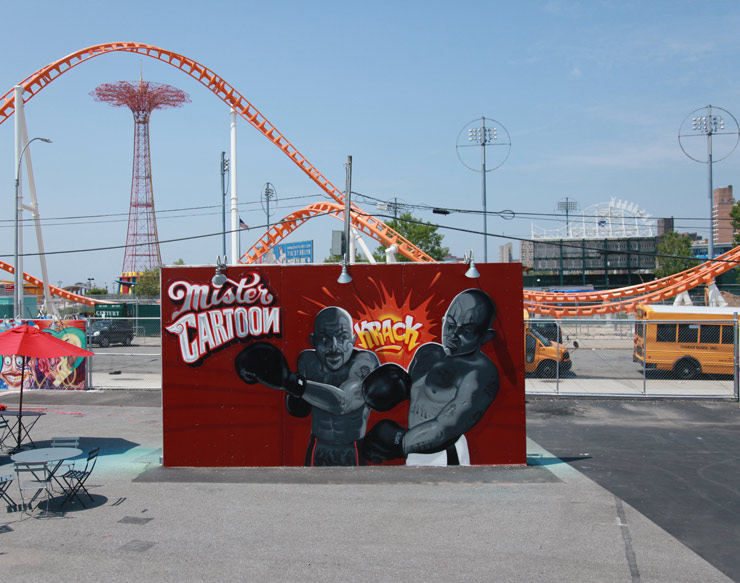
2016 New Artists: Nina Chanel Abney, John Ahearn, Timothy Curtis, D*Face, Jessica Diamond, Tristan Eaton, Gaia, Eric Haze, Icy & Sot, London Police, Nychos, Pose, Stephen Powers, Tats Cru, and Sam Vernon. Returning artists who created new works: Lady Aiko, Mister Cartoon, Crash, Daze, Tatyana Fazlalizadeh, and Marie Roberts. 2015 Murals on display: by Buff Monster, Eine, Ron English, How & Nosm, IRAK, Kashink, Lady Pink, Miss Van, RETNA, eL Seed and Sheryo & Yok. There are also three community walls.
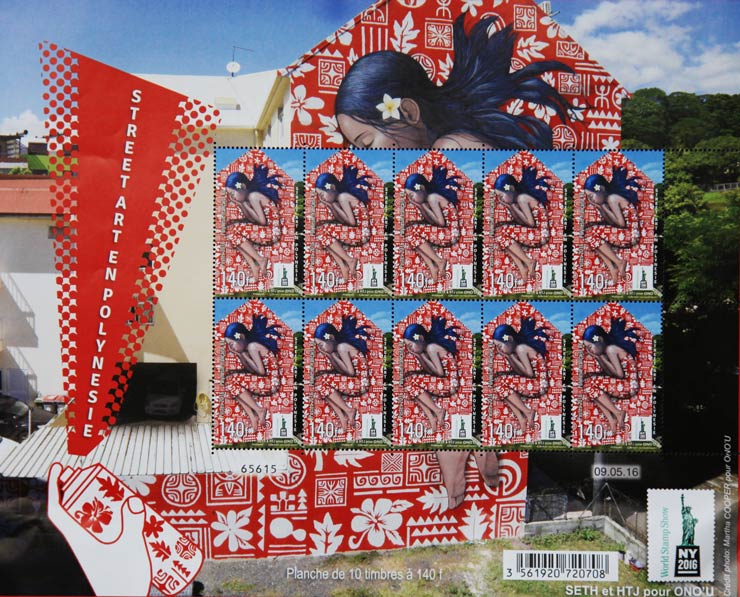
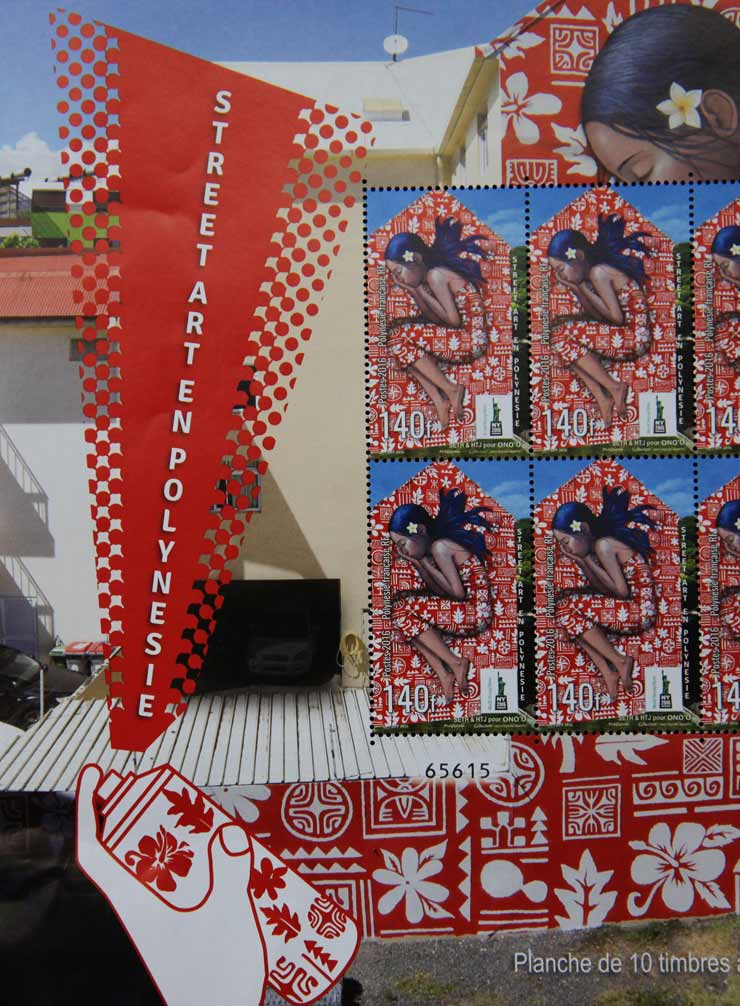
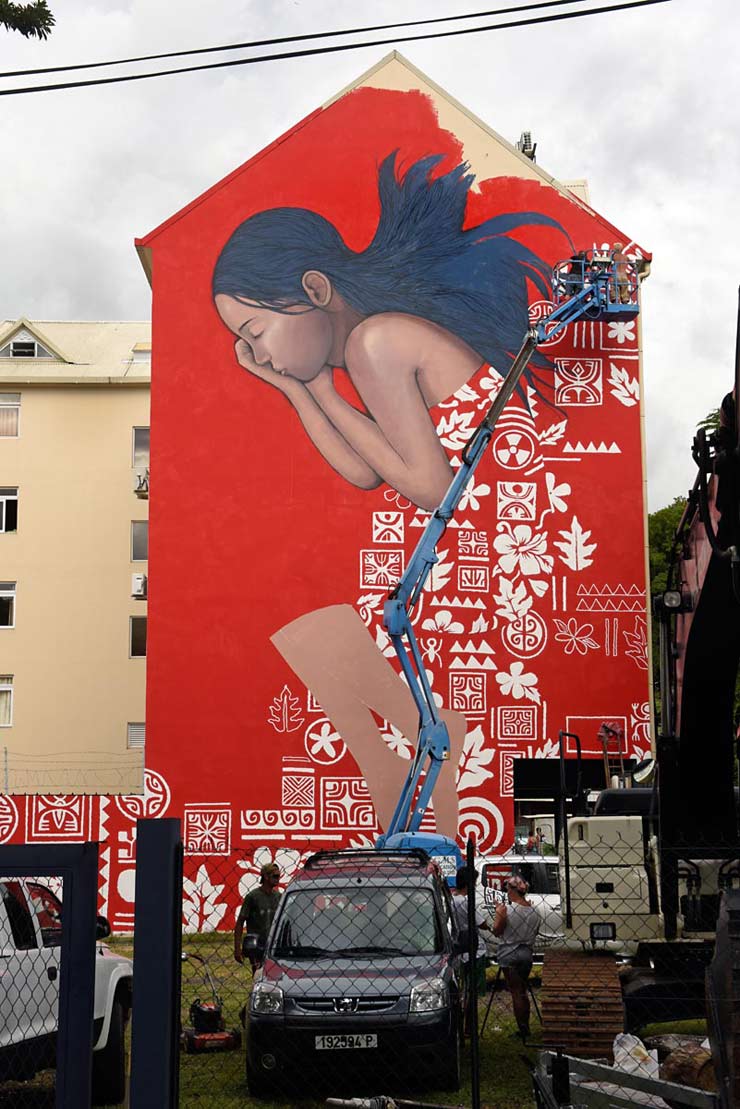
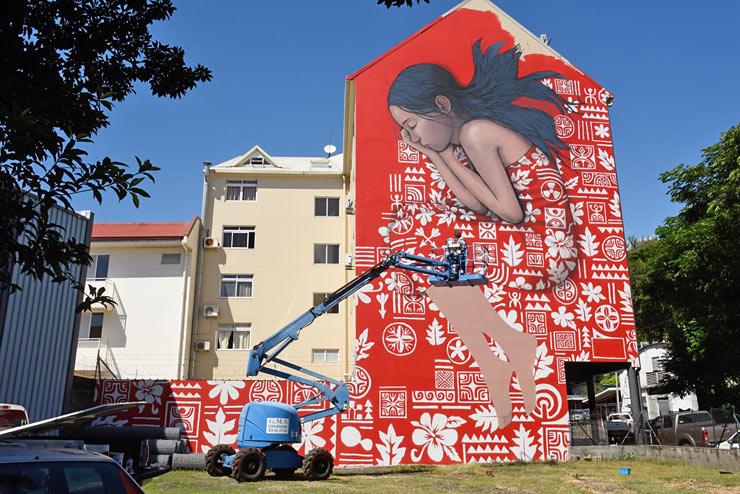
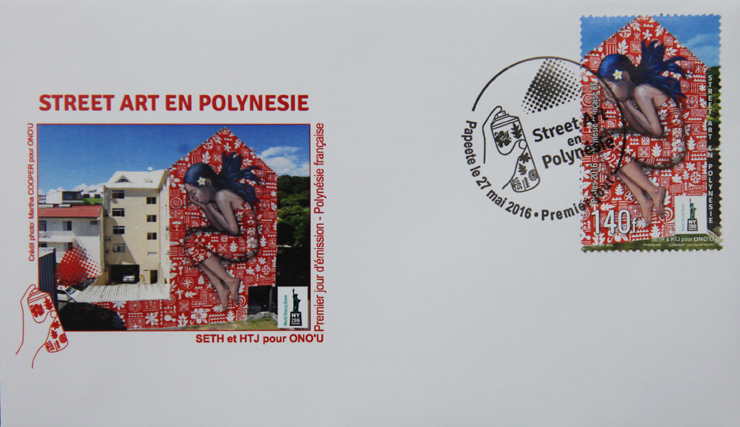
A new postal stamp in French Polynesia highlights a mural at the “ONO’U” festival in Tahiti, a first for the multi-island country as well as the French Street Artist SETH and his local Tahitian collaborator, HTJ.
Introduced in New York last week at the decennial World Stamp Show, an eight-day stamp extravaganza visited by a quarter million people, the new 140 CFP stamp depicts his mural at the 2015 “ONO’U” festival, as shot by photographer Martha Cooper.
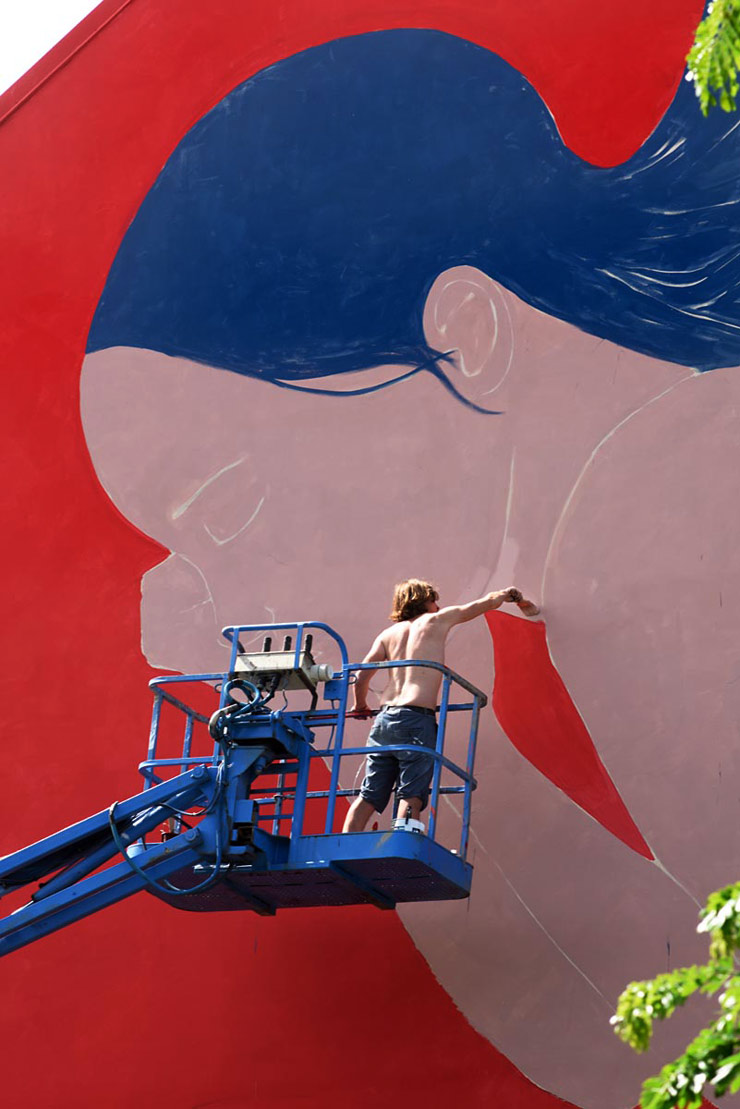
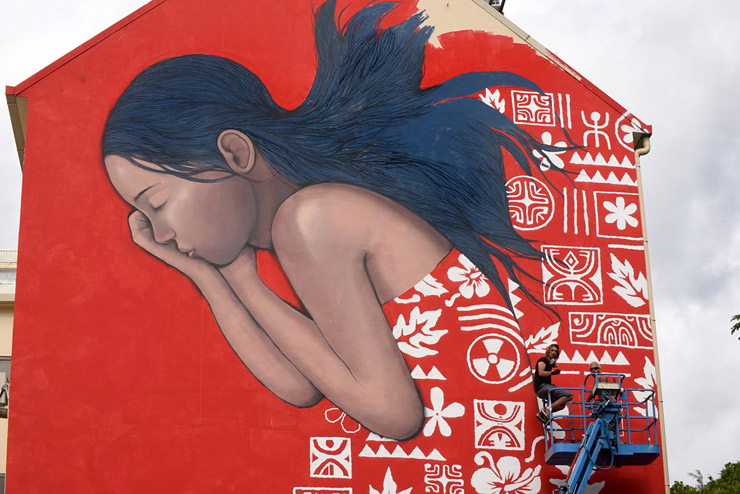
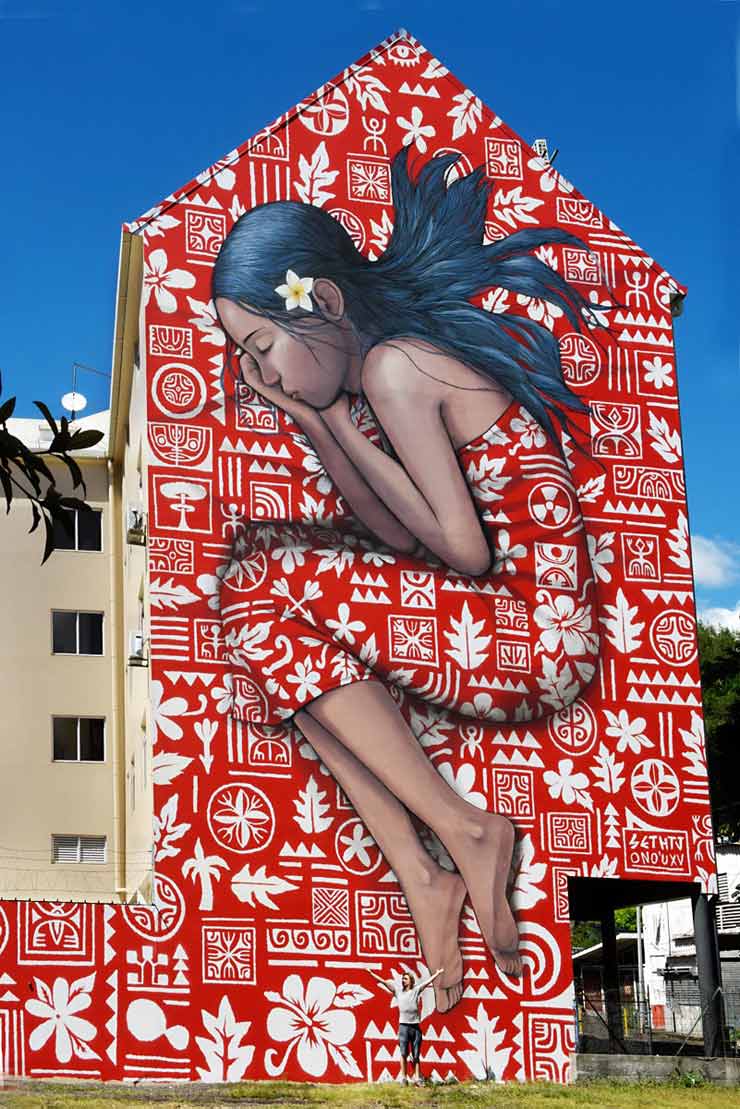
The 6-story painting depicts a sleeping French Polynesian girl wrapped in a traditional pareo dress that also morphs into the traditional bed covering called a tifaifai. “To design the patterns he collaborated with a local artist, HTJ, “ says ONO’U co-founder Sarah Roopinia,“and Seth conceptualized the girl sleeping, protected under the traditional patterns. It’s like a guardian protecting her with her culture and also she’s also representing dreaming about the future of French Polynesia.”
The white cut-out forms on the intense rouge background have propelled the design to stardom among ONO’U’s social media followers and when the postal service approached organizers to make a commemorative stamp of the 2-year old mural festival in downtown Papeete, Roopinia and her co-founder Jean Ozonder jumped at the chance. “what we liked with this production was having the opportunity to broaden the impact of street art and to have more people be aware of it,” she says. “To us the idea of a postal stamp was an original initiative and a way to bring this art into an area where you would not expect to find it.”
Looking at the patterns in the bedspread you may also see more than the folklore forms of typical plant leaves and the Tiaré flower that many wear tucked behind an ear in archetypical portraits however. You also may recognize a symbol for radiation near the girls back and the form of a an atomic mushroom cloud near her bended knees, both referencing the approximately 175 nuclear tests that France did on the island of Moruroa from roughly 1966 to 1996, tests which The Gaurdian now says ‘showered vast area(s) of Polynesia with radioactivity‘.
By inclusion of these symbols with more traditional symbols in the new piece one is reminded of the inclusion of historical disasters traditionally in folk art ranging from pottery to quilting. Since we began making art we have been storytelling about natural disasters, man-made disasters, wars, political upheavals, societal shifts, milestone events and religious practices.
As Street Art influenced murals have gained a wider audience across the world and certain works and artists are highly celebrated, there have been other issues of official stamps in recent years including works from Invader, Shepard Fairey, C215, Rero, Vhils, Ludo, and Mis Tic. The presidents of France and Singapore released a dual “Street Art” stamp a year ago and a recent Polish stamp depicts a 4 story wall by Polish painter Natalia Rak in Białystok, Poland of a young girl in traditional Polish dress who is watering a tree.
The “ONO’U” festival is now readying for its third edition and Ms. Roopinia was in New York with Mr. Ozonder to check out the current Street Art scene, the Coney Art Walls, the Governors Ball concerts and to share their new stamp with the thousands of people trekking by at the stamp exhibition. Roopinia tells us that the hugely successful festival draws top names for exhibition and competition from both the Street Art and graffiti world, but initially the mayor of Papeete, landlords, and the local businesses were rather hesitant, as were Street Artists who had not considered going to a place where there was not a large graffiti or Street Art scene to speak of.
“The challenge that we had was convincing the best street artists in the world to come to a ‘lost paradise’ to paint gigantic walls right in the center of the city. For a whole year we were working on finding walls, convincing the owners. Basically for the first six months no one was willing to give us their walls because they thought that it was all going to be horrible – so convincing the population was difficult,” she says.
“I could feel that some of the politicians were not very happy that we were going to do this in the beginning because they didn’t understand exactly that a small team could do such great things with artists,” she says, but the response of locals and businesses was overwhelmingly good, and word of the festival spread among artists, not least because most of their costs are covered and, by the way, they are painting in Tahiti after all.
“The second year the volume was really incredible,” says Jean of the interest that was piqued and the good reviews that went out among artists. “So many guys wanted to be invited to be a guest or to make a wall and we said ‘We can’t invite everybody because there is a budget.’
And quite a substantial budget it is. The partners say they have to raise over €300,000 a year and “80% of the festival is funded by private partners and sponsors,” including brand names like Nissan, Perrier, and Montana paints. The remaining 20% is funded by the city and the Ministry of Tourism.
“The festival is always about two things,” says Roopinia, “There are “the main walls” which are by larger names like Seth or Kobra that are right in the center of the city you can walk from one wall to the other, making a very beautiful art promenade or city walk. At the same time that this is happening there’s a contest that invites mostly graffiti artists – in the rules it’s only aerosol and there are no stencils – we really try to keep it strictly graffiti.”
Considering they already have a stamp and cruises are now dropping off visitors to walk through the streets and discover murals, it looks like ONO’U is putting Tahiti on the map for international street mural fans. “There is a general enthusiasm,” says Roopinia of people not just in Tahiti but across many of the 118 islands of French Polynesia. “So the festival is taking place on Tahiti and in Pepeete (the capital) where most people live but the impact is also through the TV, the Internet, and on the social media. But also in the outer islands they were flying to come in to see the walls and talk to the artists during the festival. Everybody is out walking in the streets talking with the artists, taking pictures.”
Berlin Begins Building a Haus for Street/Urban Art
Urban Nation “Museum For Urban Contemporary Art” Set to Open Mid 2017
“You can try and tame the wild but what good would it do? Isn’t the wild what makes us into warriors, kings and queens, discoverers and inventors? – The wild is all we need to know to make life worth living but we should never ever try to comprehend or change it…that is what art means to me,” says Yasha Young as she pulls back the curtains on the plans for the construction of the brand new Urban Nation Museum For Urban Contemporary Art in Berlin this afternoon.
With a wall full of photographs by the renowned Martha Cooper behind her and before a roomful of press people and artists, the manager and future director of the museum gave this sweeping overview of the philosophical approach that has breathed life into a project that is her brainchild. Along with Markus Terboven from the Gewobag foundation, Thomas Willemeit, Managing Director at architect GRAFT, Tim Renner, the Undersecretary of State for Cultural Affairs, and Hendrick Jellema from the non-profit Berliner Leben, Ms. Young laid out the plans for the dynamically designed interior of this Wilhelminian-era building at Bülowstrasse 7.
The nascent museum and the Urban Nation project has already shown serious signs indicating it’s future significance over the past three years with the famed curated “Project M” series of urban/street/graffiti artists in the main street-level windows – as well as the UN’s partnering with urban/Street Art festivals and community-driven initiatives in Europe, the US, Russia, and Asia.
In fact the lead-up to today’s announcement, a real art world first, has included three years of on the street programming and in temporary exhibition spaces that has featured 320 large scale and smaller works by 219 artists established, well known and emerging on the global street art and contemporary urban art scene.
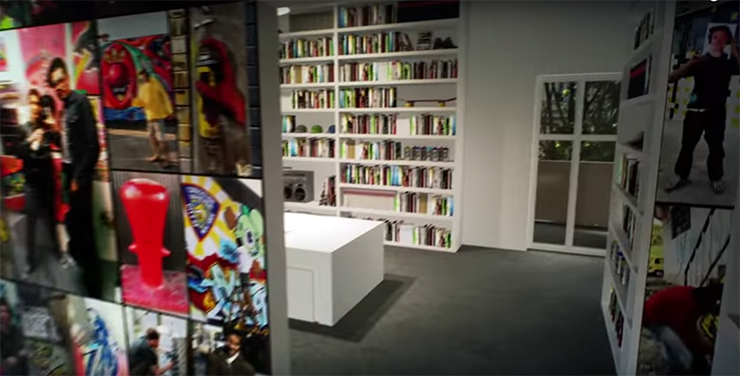
Screenshot of new Martha Cooper Library at Urban Nation from video below.
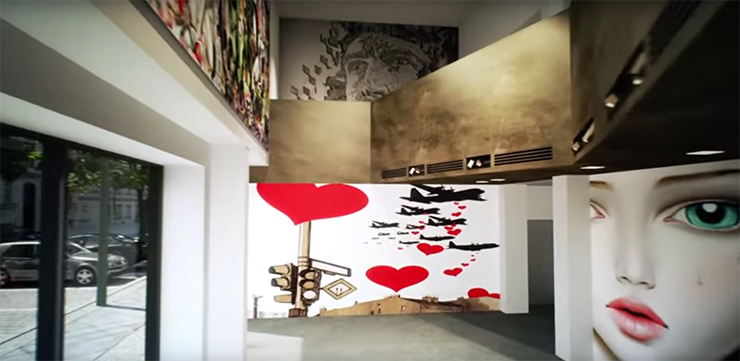
In addition to featuring a brand new library named after Martha Cooper and featuring part of her collection of books, magazines, sketchbooks, photography and ephermera, and a winding, floating catwalkway through shifting perspectives that is inspired by Escher’s stairs, and education/lecture spaces, the new museum will feature a high tech façade that will continually change with installations, artists, and themes.
Screenshot of architectural rendering for new Urban Nation Museum For Urban Contemporary Art from video below.
Architects and designers at GRAFT, which has built a reputation for experimentation and design innovation in exhibitions as well as architecture, are said to have continually looked for ways to establish a continuum between the street and the museum. In a recent conversation with Denis Leo Hegic, an architect on the project, we learned that the concrete of the street will quite literally lead into the museum main floor. Take a look at the video tour of the space here.
More to come on this story as construction begins along with curation of the inaugural exhibit!
New Video Takes You Flying Through Berlin’s new Urban Nation Museum for Urban Contemporary Art.
BSA galavanted through the streets last year and here we re-paste our recent newsletter to BSA readers. Sign up for it if you like. Here’s the original.
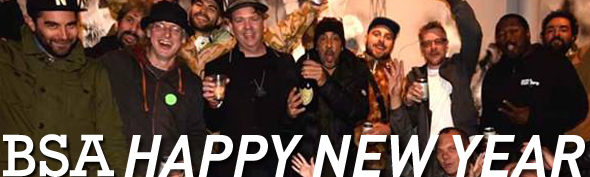
Happy New Year from BSA!
From Berlin to Norway to Rochester and Mexico, Faile to Swoon to Ron English to Dan Witz and Gilf!, BSA was in museums, galleries, artists studios, at festivals, on panel discussions, on stages, on TV, radio, in theaters, and of course in the street.
Here are some highlights of the some of the amazing things BSA did with you in 2015. We sincerely thank you for your support and send love to you and yours in the new year!
In ’15 BSA Created “Persons of Interest” with UN in Berlin
Brought 12 Brooklyn Street Artists to Berlin with “Persons of Interest” show for Urban Nation Museum (UN)/ProjectM7
BSA Presented “On the Radar” in Coney Island
With Jeffrey Dietch’s Coney Art Walls program at Coney Island Museum for Coney Art Walls, we presented 12 artist to watch who are on our radar.
BSA Presented Faile at the Brooklyn Museum
A beautiful experience to be a part of the FAILE exhibition from its earliest planning stages to its full summer run at Brooklyn Museum, the cherry on top was to host an in-depth presentation and conversation with Faile’s Patrick Miller and Patrick McNeil and BKM curator Sharon Matt Atkins in front of an enthusiastic Brooklyn audience.
Aside from The Pope landing in New York at the exact time people were traveling to the show and some microphone difficulties at the beginning of the show, it was a complete and total thrill for us. See the full video on LiveStream here.
BSA Joined Swoon to Inaugurate Her New Heliotrope Foundation
The tenacious and visionary Street Artist grounded her dreams in a formal foundation in 2015, allowing her to pursue even greater reach in her growing projects in New Orleans, Haiti, and Braddock, PA. We were honored to interview her and to help celebrate the official beginning of The Heliotrope Foundation with the help of special guest and board member Kaseem Dean aka Swizz Beatz.
Callie Curry (aka Swoon), Kasseem Dean (aka Swizz Beatz), Jaime Rojo, Steven P. Harrington inaugurate The Heliotrope Foundation
BSA Hosted Martha Cooper, Bortusk Leer, and Herman De Hoop at Nuart Plus
For presentations from each of the guests and panel discussion on the intersection of “Play” and public space at NUART 2015 in Stavanger, Norway.
Banksy Does New York Took Us to Theaters Around the World Good News: The movie got on NetFlix, iTunes, in festivals, and in theaters in cities around the globe Bad News: People think we have a museum
We Flew Over World’s Largest Mural
Flew by helicopter above the world’s largest mural by Ella and Pitr in Stavanger, Norway with two of our most admired photographers; Martha Cooper and Ian Cox. Thanks Nuart!
We presented BSA Film Friday Live at MAG Gallery
Under the direction of Jonathan Binstock at University of Rochester Museum the MAG Gallery hosted us during the Wall\Therapy festival.
This is the grassroots sort of festival that rings true to us these days and the down-to-earth volunteers and organizers of this event, along with those of our associates at Urban Nation (UN), made this a highlight of the summer.
BSA moderated 1st panel for 1st event of 1st edition of LoMan Festival
“OMG Is this Street Art?” was the name of our panel with guest panelists Ron English, Gilf!, Dan Witz, and Jonathan Levine.
BSA in Berlin Radio Interview with Vantage Point
We talked about Jay-Z, Bowie, Bushwick, the democratization of Street Art, cultural imperialism, the UN and what it is like to bust out a blog seven days a week and still keep your mind and heart open to discovery. Listen to it here on Vantage Point and Soundcloud:
▪ BSA completed its fifth year in partnership with The Huffington Post in June 2015 (225+ articles) and was translated in Spanish on El Huffington Post, in French on Le Huffington Post, in Italian on L’Huffington Post, in Korean on Huff Post Korea, in Portuguese on Brasil Post, and in Greek for Huffington Post Greece. ▪ BSA posted every single day and did 23 interviews and studio visits and published articles about street art in 103 cities ▪ BSA was reference or appeared in the media in The New York Times, The Today Show, Le Monde, Agence France Press, German Rbb Tv, Borås Tidning, El Diario, El Heraldo, ArtNet News, Juxtapoz, VNA, Hi-Fructose, and others. ▪ BSA’s Director of Photography Jaime Rojo took more than 10,000 images and we picked 143 as BSA 2015 Images of the Year.
Special thank you to photographer Martha Cooper and Nuart Festival director Martyn Reed for the banner image from this years festival.
What are you celebrating this season? We’re celebrating BSA readers and fans with a holiday assorted chocolate box of 15 of the smartest and tastiest people we know. Each day until the new year we ask a guest to take a moment to reflect on 2015 and to tell us about one photograph that best captures the year for him or her. It’s our way of sharing the sweetness of the season and saying ‘thank you’ for inspiring us throughout the year.
Jessica Goldman Srebnick is CEO of Goldman Properties, the real estate development company that began the mural art project Wynwood Walls in a neglected neighborhood of Miami under the direction of her father Tony. By bringing invited international Street Artists to paint walls of the primarily one-story Wynwood, Goldman considers mural art a crucial revitalizing force that can transforms neighborhoods. As part of the annual Art Basel craziness every December, Jessica and her team host an ever growing and changing series of events and walls – along with Street Artists, fans, and collectors.
Wynwood Walls, Wynwood, Miami
December 1, 2015
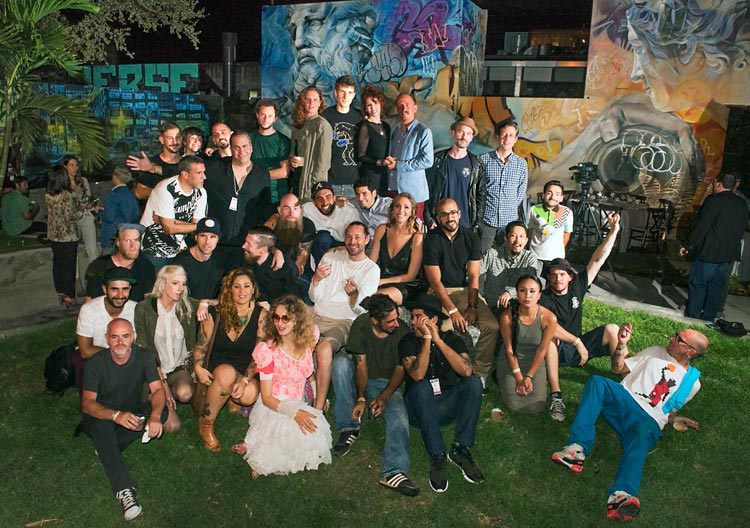
Photograph by Martha Cooper
This image to me symbolizes the evolution of the Wynwood Walls family of artists. It represents love, respect, talent and diversity. The Wynwood Walls began as an idea 6 years ago and today is recognized as one of the most important and influential destinations for street art in the world. Captured by the extraordinary Martha Cooper, the photo and the evening were epic.
What are you celebrating this season? We’re celebrating BSA readers and fans with a holiday assorted chocolate box of 15 of the smartest and tastiest people we know. Each day until the new year we ask a guest to take a moment to reflect on 2015 and to tell us about one photograph that best captures the year for him or her. It’s our way of sharing the sweetness of the season and saying ‘thank you’ for inspiring us throughout the year.
Katherine Brooks is the Senior Arts & Culture Editor at the Huffington Post flagship in New York and is insatiably curious about daily developments inside and outside the art world. This inquisitive mind helps her to countenance diverse topics that fly across her desk with regularity from Burning Man to Bansky to Guerilla Girls to the New Whitney, Kim Gordan, Peaches and of course, Cats Taking Over Famous Western Artworks. One of our favorite pieces by Brooks this year is an extensive examination of gender and the fossilized academic and institutional thinking patterns that keep women marginalized in the art world in 2015 called Let’s Talk About ‘Women Artists’ And What This Term Means.
El Barrio, East Harlem, New York
October 2015
Artist: Ever in collaboration with Martha Cooper for Monument Art 2015
Photograph by Jaime Rojo
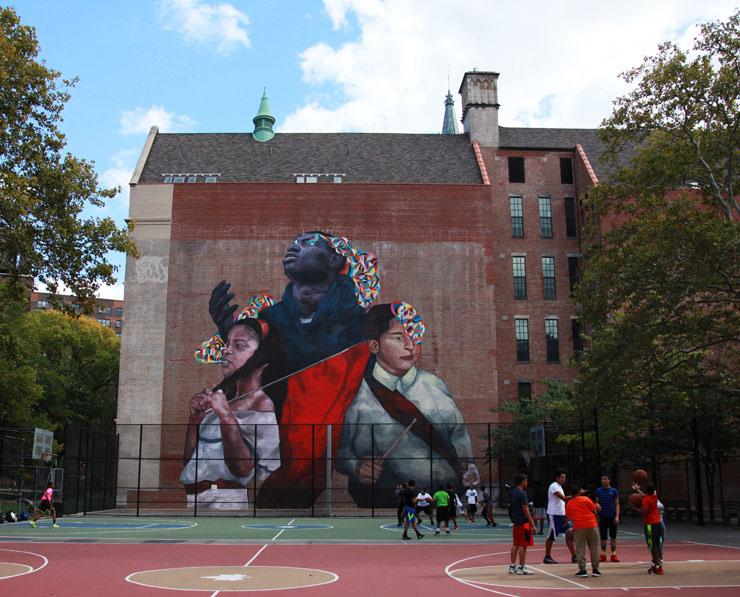
Not only did I feel captivated by the image painted on the side of this East Harlem building, I was struck by the way Jaime framed this photograph. The young man and kids in the mural peer up and over a seemingly endless landscape, while the boys playing basketball — highlighted in the foreground — appear protected by the art.
It’s always interesting to see the context within which a mural is constructed. This particular meeting of art and athletics seems to echo a greater aspect of public art: a desire to capture attention in unexpected places.
Spanish artist Gonzalo Borondo, from Valladolid, arrives at LuzMadrid Festival with Redentora, a site-specific installation that continues his steady movement …Read More »
 BROOKLYN STREET ART LOVES YOU MORE EVERY DAY