All posts tagged: Larry Warsh

Old Records, New Emergency: Shepard Fairey Goes Back to the Heroes for “Filthy Lucre”

Old Records, New Emergency: Shepard Fairey Goes Back to the Heroes for “Filthy Lucre”

Filthy Lucre Ain’t Nothing New

Shepard Fairey was 14 in South Carolina in 1984 when he first heard the Sex Pistols, nearly a decade after they erupted out of London, and they tore a hole in the polite, don’t-rock-the-boat world he had been raised in — a snarling invitation to question authority, expose the con, and make some noise about it.

Punk arrived alongside skateboarding: speed, abrasive scrapes, graphics, teenage angst fueled rebellion, and a scene that gave him permission to innovate freely. Fairey later cites Ian MacKaye — the Washington, D.C. punk musician behind Minor Threat and Fugazi — describing punk as “the free space,” not a style but room to do what you want without assimilating to somebody else’s idea of how it should look or sound.
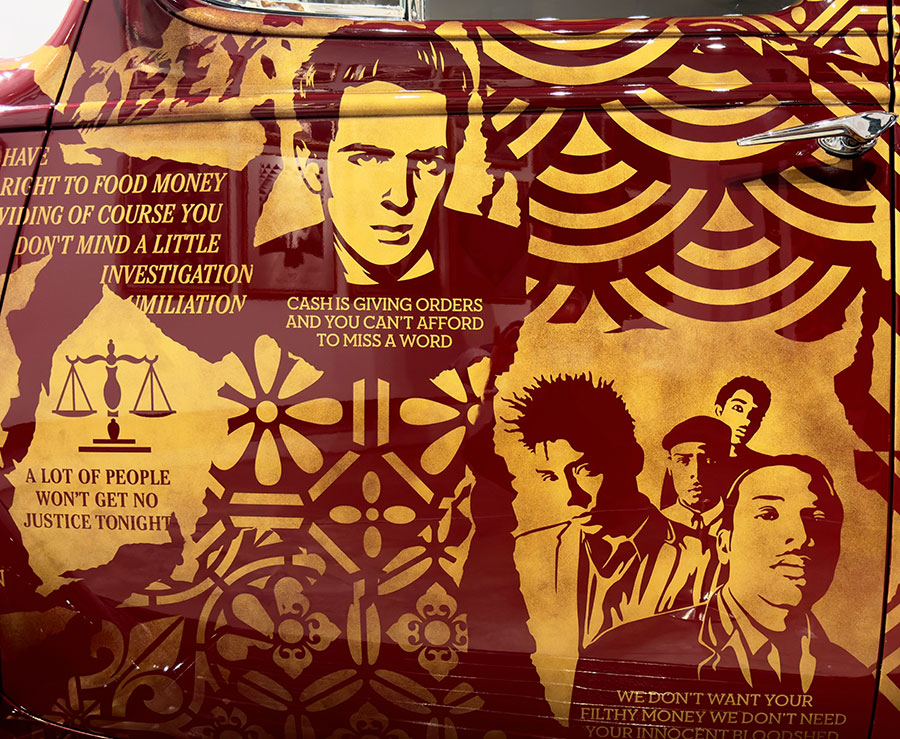
Shepard Fairey. Detail. Filthy Lucre Ain’t Nothing New. Cart Department. NYC. (photo © Jaime Rojo)

For Fairey, that freedom translated simply: “I can be who I want to be.” Hip-hop came quickly behind it: Run-DMC first, then the Beastie Boys opening a door to Boogie Down Productions, Eric B. & Rakim, Public Enemy, Slick Rick and Ice-T. He may not have been able to articulate the politics of all this at 17, he says now, but he could feel them in his gut.

More than four decades later, Fairey is back in those record bins. Not because the records have taken on a warm glow of nostalgia, but because the world outside has made their warnings remarkably, dangerously current. Racism, authoritarianism, greed, propaganda, concentrated wealth, war, evaporating access to the so-called American Dream: the old records are proving less like souvenirs and more like reference books. And one old punk instinct still holds: ridicule can get under the skin of power. “Authoritarians hate to be made fun of,” he says, almost as if sharing a trade secret.

Shepard Fairey. Detail. Filthy Lucre Ain’t Nothing New. Cart Department. NYC. (photo © Jaime Rojo)

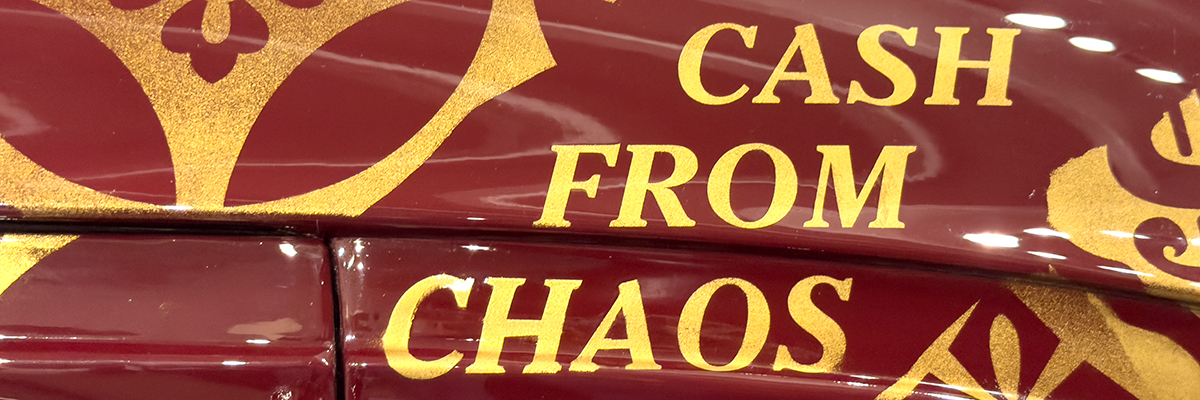
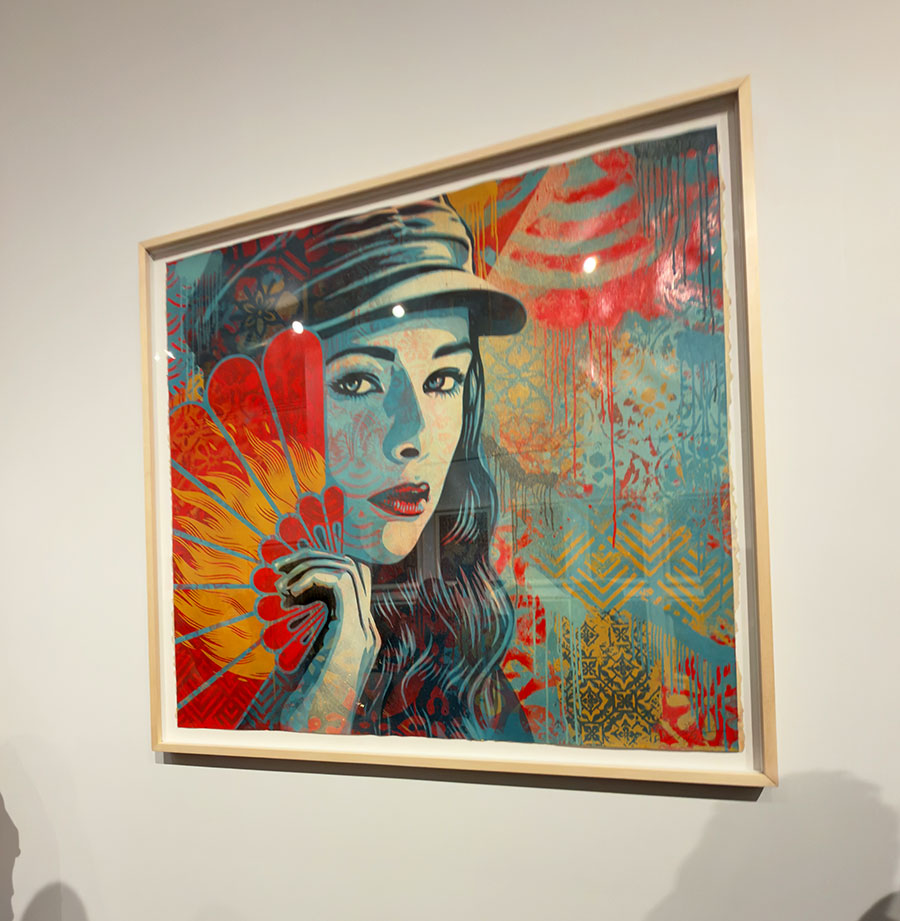
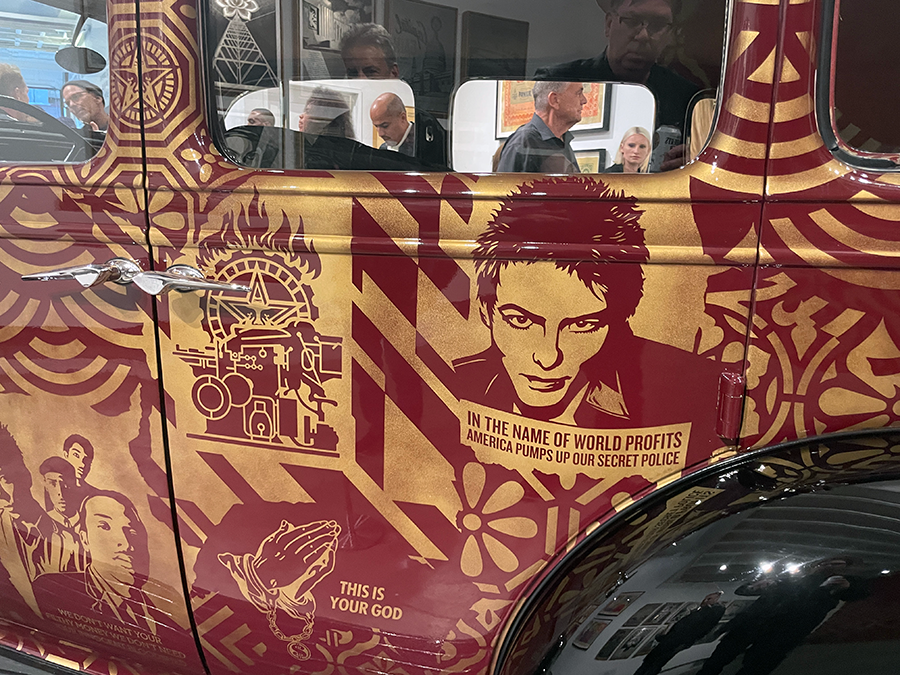
That is the engine underneath “Filthy Lucre Ain’t Nothing New,” Fairey’s compact four-day show at CART Department on Morton Street in New York. At its center sits a burgundy-and-black 1937 Packard touring sedan, newly covered in metallic-gold stencils, portraits, patterns and potent lyrics from punk and hip-hop. Around it are new prints derived from the project, portraits of musicians, mixed-media works, and older pieces that help trace the visual, musical, and political family tree Fairey has been climbing for most of his career.

The temperature here, however, is hotter than nostalgia. Fairey sounds like a committed idealist with all the old sirens ringing again — so he goes back to the bins, where the warnings were already pressed into vinyl and burned onto CDs. Whoop whoop. That’s the sound of the back catalog.

Shepard Fairey. Filthy Lucre Ain’t Nothing New. Cart Department. NYC. (photo © Jaime Rojo)

“If you have morals and you have your eyes open, how are you not a bit mad?” Fairey asked during Thursday’s conversation with cultural historian Carlo McCormick.

For all the red, black, cream, gold and immaculate screenprint craft associated with OBEY over the decades, Fairey has always had a refreshing earnest streak. Irony is useful, provocation is useful — but eventually he wants you to give a shit. In this show, he reaches back to some of the musicians who first gave form to his own agitation: Joe Strummer, Chuck D, Jello Biafra, Ian MacKaye, H.R. and Bad Brains, Ice-T, Slick Rick, Rakim, KRS-One, Biggie, and others. Heroes, yes, but also translators — people who could take something as sprawling as racism, war, greed, class, or state power and compress it into a hook, a beat, a line you could carry around in your head all day.

They could take something enormous and systemic and give it the two-and-a-half-minute treatment: noise, wit, and one line you couldn’t shake.

One side of the car is punk: suspicion of money, consumer culture, empire and authority. The other looks at hip-hop’s relationship with money, where wealth can read as proof of having forced a way through barriers built by racism and class. Fairey’s wall text makes the contrast deliberately broad: punk kids who could afford to reject conventional prosperity versus rappers for whom getting paid could itself represent an opening in the wall.
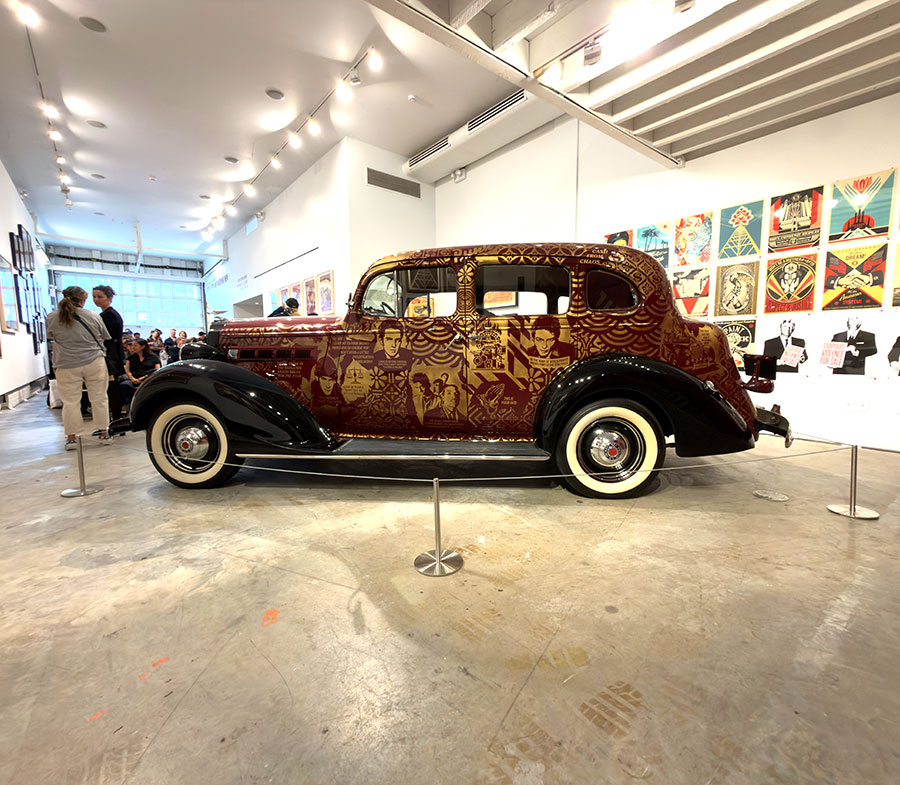
Shepard Fairey. Filthy Lucre Ain’t Nothing New. Cart Department. NYC. (photo © Jaime Rojo)

The distinction gets complicated quickly. It is a 1937 Packard covered in gold inside an art gallery. The contradiction is not hiding. In his exhibition statement, Fairey calls the project an examination of the “seduction and repulsion of money” and asks where any of us sits in the struggle between value and values.

Seen another way, the old Packard becomes an especially expensive piece of détournement.

During a conversation on the second day of the show, New York cultural historian and critic Carlo McCormick made that connection, tracing Fairey’s strategies through Jamie Reid and back toward the Situationists: seize a familiar sign, commodity or piece of visual language and turn it against its customary meaning. Fairey has been doing some version of that since Andre the Giant began popping up unexpectedly in public space. Dollar bills, flags, advertising syntax, corporate logos and propaganda poses have all been rerouted through the machinery.

Even the Packard’s bumpers get drafted: NOWHERE at the front, EMPIRE at the rear, tipping back toward Jamie Reid and the Sex Pistols. Nearby hangs Fairey and Reid’s “Bright Future” imagery — two Rolls-Royces and the instruction “Save Petrol Burn Cars” — earlier work Fairey says helped him see what he could do when collector Larry Warsh proposed the automobile commission.

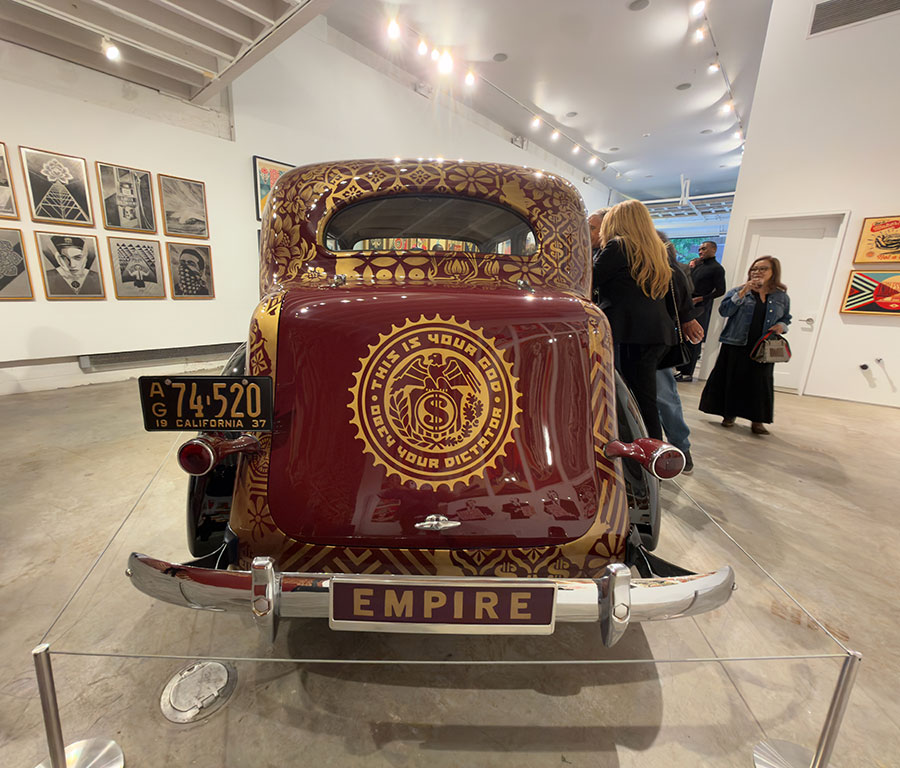
Shepard Fairey. Filthy Lucre Ain’t Nothing New. Cart Department. NYC. (photo © Jaime Rojo)

Fairey says Joe Strummer, Bob Marley, Chuck D and Jello Biafra were particularly important in teaching him how to name greed, nationalism and injustice in language people could immediately understand. In his new Packard piece, that inheritance becomes literal.

For Fairey, the Packard is also a genuine departure. He told the audience he had never painted a car before. The body was mapped in Illustrator, vinyl stencils were fitted across its curves, chrome was masked, and metallic gold was built up carefully in small bursts before the surface received a professional clear finish. The methods of street stencil work meet the anxiety of somebody staring at an antique automobile and trying very hard not to leave an ugly drip down the door.

Warsh commissioned the Packard for a collection that now numbers more than 70 art cars. Quite a garage: Keith Haring, Kenny Scharf, Barbara Kruger, Ai Weiwei, Damien Hirst, Marina Abramović, Rashid Johnson, Richard Prince, and others. It points to a broader appetite for moving street and contemporary art imagery onto objects with entirely different histories and audiences — part sculpture, part cultural artifact, part toy.
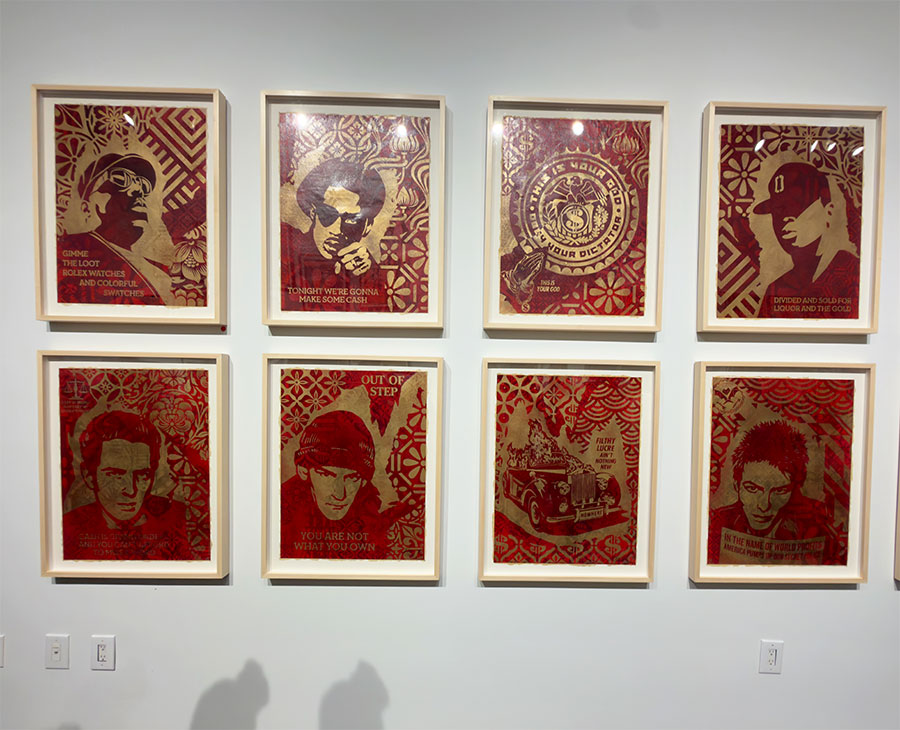
Shepard Fairey. Filthy Lucre Ain’t Nothing New. Cart Department. NYC. (photo © Jaime Rojo)

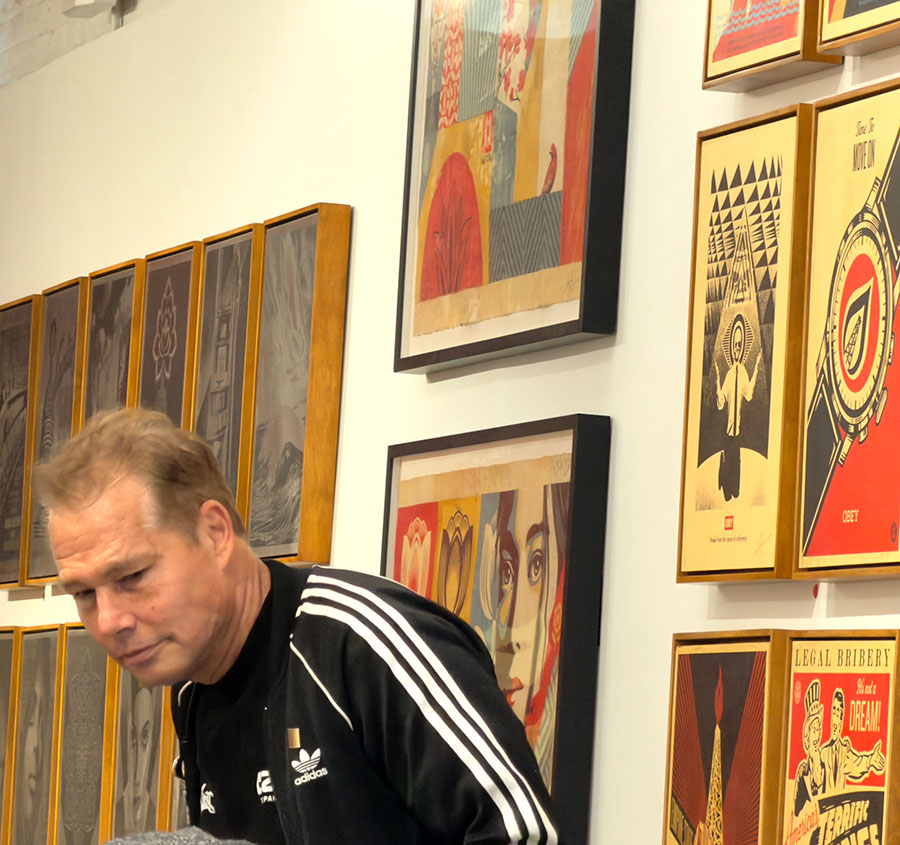
On the gallery walls, the music comes off the car and becomes portraiture. Ice-T, Ian MacKaye, Jello Biafra, Joe Strummer, Chuck D and Bad Brains stare back in Fairey’s established stencil language, alongside other works touching the same arguments about dissent, money and political agency. The Jello Biafra, Ice-T and MacKaye images are based on photographs by Glen E. Friedman, another figure whose pictures have become part of the visual memory of punk, skateboarding and hip-hop. Fairey was explicit about considering photographers collaborators rather than anonymous source material, saying he credits them and shares revenue when working from their images.

The relationship between photography, graphic translation and cultural memory is worth noticing here. Fairey isn’t merely assembling a Hall of Fame. He’s taking people who once spoke to him from album sleeves, skate videos, xeroxes and records and putting their faces back into circulation at a moment when he thinks their language may be useful again.
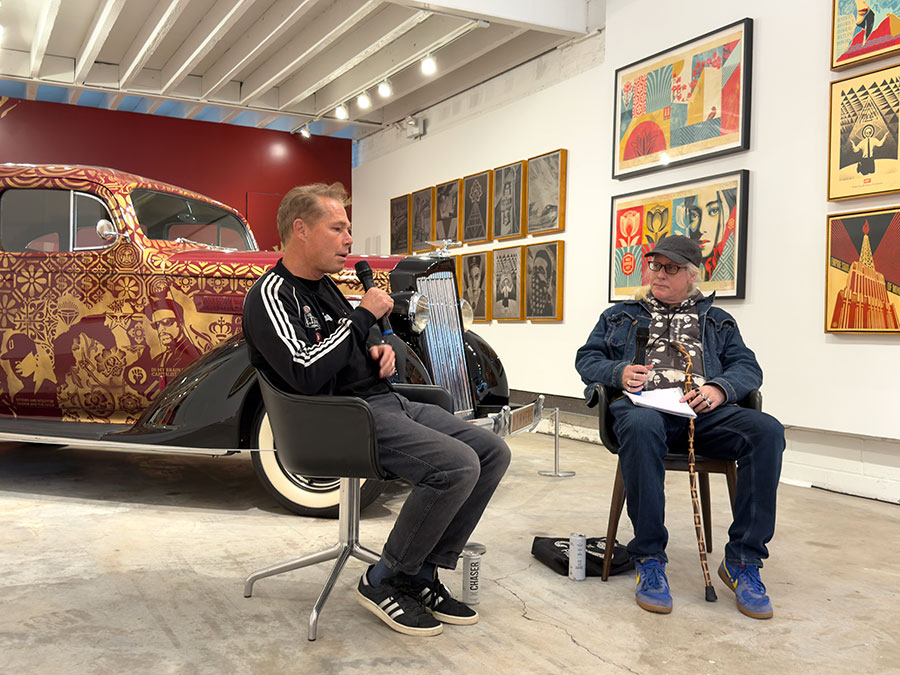
Shepard Fairey. Filthy Lucre Ain’t Nothing New. Cart Department. NYC. Shepard in a conversation with Carlo McCormick (photo © Jaime Rojo)

McCormick is exceptionally good in this territory because he doesn’t have to reconstruct early-1980s New York from a coffee-table book. He knows its overlapping downtown and uptown histories, its galleries, clubs, punk collisions, graffiti writers, cultural trespassers. He has the uncommon ability to draw those connections without embalming them. Fairey reminded the room that McCormick put him into his first New York exhibition in 1994, first at Bard and subsequently at Alleged Gallery on Ludlow Street — introducing him to a much larger circle of people who would matter to him.

Here McCormick pushed particularly well on the supposedly opposing camps of punk and hip-hop. The early New York story was considerably messier than later marketing categories and “visionary” narratives sometimes suggest. The hybrids grew organically, less a master plan than a cultural crossfire: Fab 5 Freddy, Blondie, The Clash, Grandmaster Flash, graffiti writers, downtown artists, punk clubs, DJs and nascent hip-hop audiences crossed paths, sampled one another literally and figuratively, and sometimes discovered that the kid across the room wearing completely different clothes was interested in breaking the same rules.

Carlo got to the heart of that discovery:

“Music changes your life if you let it, but it only really changes your life once. There’s only one time you can have your consciousness cracked open.”
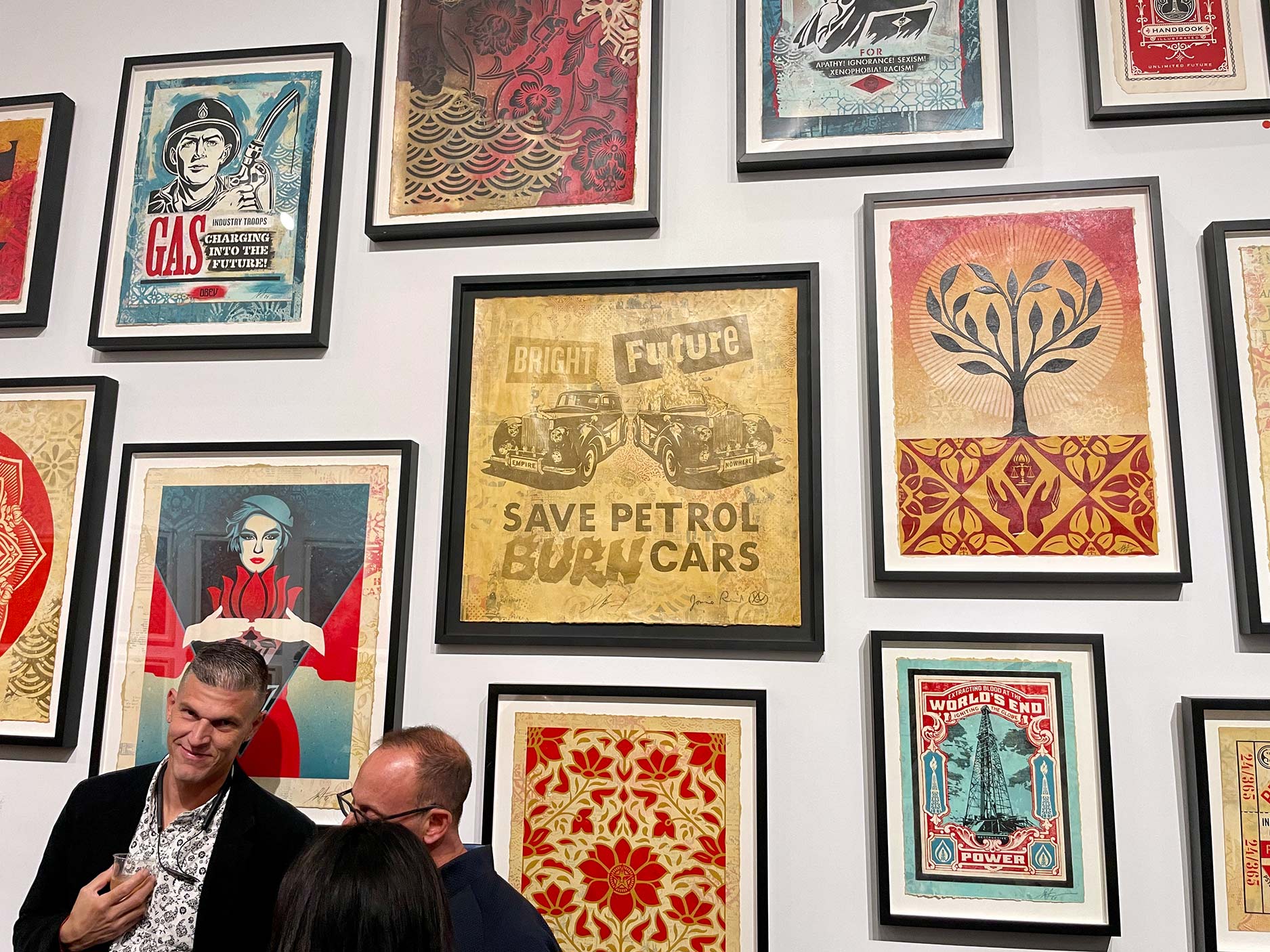
Shepard Fairey. Filthy Lucre Ain’t Nothing New. Cart Department. NYC. (photo © Steven P. Harrington)

Fairey appears to be wondering whether that kind of jolt can still get through.

He worries aloud that subcultures may no longer be permitted enough darkness and time to mutate before the machinery of social media demands a result, a post, an audience and measurable approval. The strange little ecosystems where punk, graffiti, skateboarding and hip-hop once developed could be ugly, exclusionary, violent and contradictory; they could also give young people somewhere to put energy that had no authorized destination.

Fairey’s formulation is considerably simpler: “I know personally I’ve had times when I just wanted to smash shit, but instead I made a poster.”

That proposition has followed him from illegal street work through electoral posters, corporate commissions, giant murals, record sleeves and museum walls: frustration can be turned into an image, and an image can become public speech. He has been arrested repeatedly for putting work in the street, but he told the audience that street art was also the thing that kept him from going to jail for something worse.

When the discussion turned to punk’s self-destruction and nihilism, Fairey said he had deliberately tried to channel rage somewhere constructive. For Fairey, art is what you do with the rage before the rage does something with you.

“Filthy Lucre” feels more urgent because Fairey is reaching back to the artists who first gave shape to his politics: The Clash, Dead Kennedys, Bad Brains, Public Enemy, Fugazi, BDP, Ice-T. The records will not save anyone. But they can still supply the language, the nerve, and the reminder that culture once knew how to tell power to go screw itself.

Shepard Fairey. Filthy Lucre Ain’t Nothing New. Cart Department. NYC. (photo © Jaime Rojo)

The music on the car

Fairey told McCormick that his accompanying mix contains every lyric and every portrait referenced on the Packard, divided into blocks of punk and hip-hop.

From the lyrics and figures visible on the car, the songs can be identified as:

  1. Operation Ivy — “The Crowd”
  2. Fugazi — “Merchandise”
  3. The Clash — “Know Your Rights”
  4. The Clash — “I’m So Bored with the U.S.A.”
  5. The Clash — “Armagideon Time” — The Clash’s version of the Willie Williams song
  6. Bad Brains — “Fearless Vampire Killers (F.V.K.)”
  7. Dead Kennedys — “Bleed for Me”
  8. Sex Pistols — “The Great Rock ’n’ Roll Swindle” (lead vocal: Edward Tudor-Pole)
  9. The Notorious B.I.G. — “Gimme the Loot”
  10. Slick Rick — “Children’s Story”
  11. Boogie Down Productions / KRS-One — “Love’s Gonna Get’cha (Material Love)”
  12. Public Enemy — “Can’t Truss It”
  13. Ice-T — “New Jack Hustler (Nino’s Theme)”
  14. Eric B. & Rakim — “Paid in Full”
  15. Wu-Tang Clan — “C.R.E.A.M.”

Shepard Fairey: Filthy Lucre Ain’t Nothing New was presented by CART Department at 16 Morton Street, New York, September 24–27, 2026.
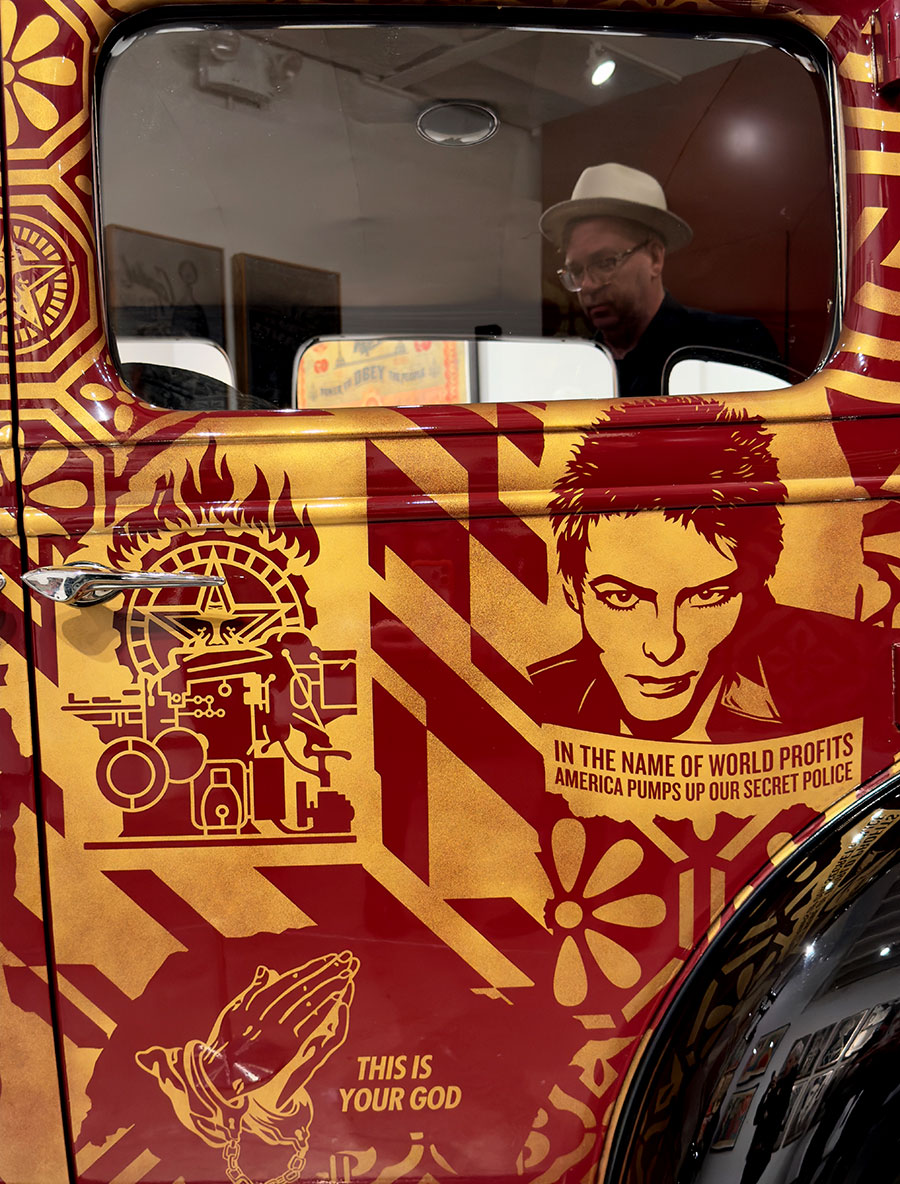
Shepard Fairey. Detail. Filthy Lucre Ain’t Nothing New. Cart Department. NYC. (photo © Jaime Rojo)
Shepard Fairey. Detail. Filthy Lucre Ain’t Nothing New. Cart Department. NYC. From left to right. Jaime Rojo, Shepard Fairey, Steven P. Harrington & Martha Cooper. (Photo taken by a kind guest at the opening)
Shepard Fairey. Detail. Filthy Lucre Ain’t Nothing New. Cart Department. NYC. (photo © Jaime Rojo)
Shepard Fairey. Filthy Lucre Ain’t Nothing New. Cart Department. NYC. (photo © Steven P. Harrington)
Shepard Fairey. Filthy Lucre Ain’t Nothing New. Cart Department. NYC. (photo © Jaime Rojo)
Shepard Fairey. Filthy Lucre Ain’t Nothing New. Cart Department. NYC. Shepard in a conversation with Carlo McCormick (photo © Steven P. Harrington)
Shepard Fairey. Filthy Lucre Ain’t Nothing New. Cart Department. NYC. Shepard in a conversation with Carlo McCormick (photo © Jaime Rojo)
Shepard Fairey. Filthy Lucre Ain’t Nothing New. Cart Department. NYC. (photo © Steven P. Harrington)
Read more
Basquiat’s Notebooks Open at The Brooklyn Museum

Basquiat’s Notebooks Open at The Brooklyn Museum

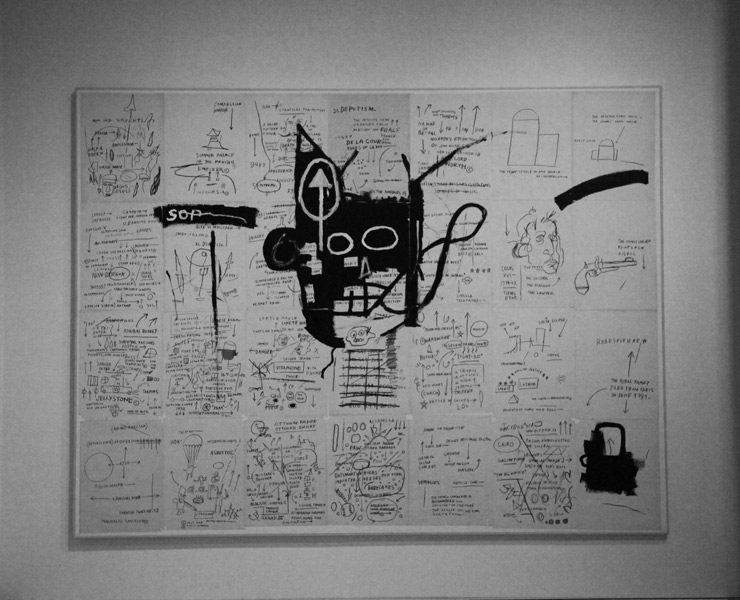
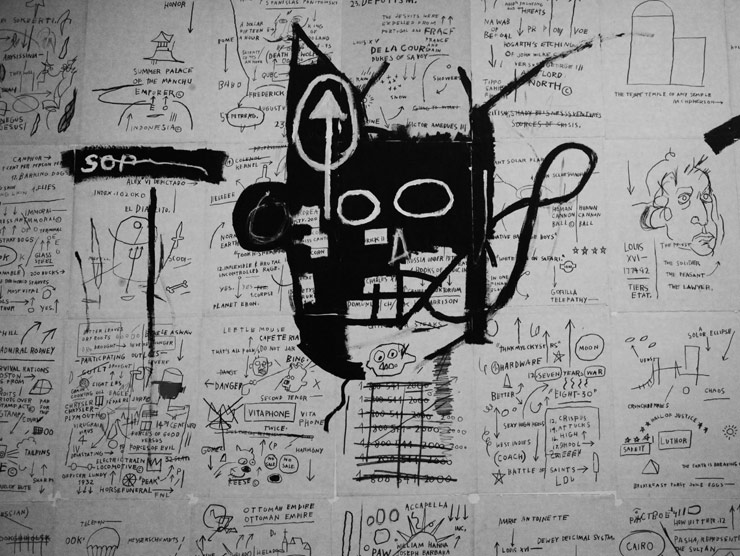
As lines continue to blur in fields of art and technology (and everything else) it is easier to see Street Art as an online/on-street diary, a forum for speech making, a laboratory for testing ideas, a publishing platform for the dispersing of truths and lies and theories and maxims and slogans and aphorisms. A timely new exhibition of personal notebooks by the artist Jean-Michel Basquiat further affirms the direct relationship between the personal and the public voice of one New York expressionist, revealing lesser-known aspects of him as artist and individual.

A teenage poet on New York streets, Basquiat used his own brand of graffiti to pursue his own brand of fame. His text was intended in part as a visual element but unlike graffiti writers who produced ever more expressive tags during that heated moment in New York graffiti history, Basquiat also sought an audience who may be hip to his cerebral wordplay of poetry that puzzled and enticed – a foxy style of William Burroughs-inspired automatic writing he adapted for his own uses.


brooklyn-street-art-basquiat-brooklyn-museum-jaime-rojo-04-15-web-2

Basquiat: The Unknown Notebooks. Brooklyn Museum. April 2015. (photo © Jaime Rojo)

In Basquiat: The Unknown Notebooks, now running at The Brooklyn Museum until August 23rd, the genius of his fragmenting logic is revealed as a direct relationship between his private journals and his prolific and personally published aerosol missives on the streets of Manhattan’s Soho and Lower East Side neighborhoods in the late 1970s and 1980s.

These notebooks were for capturing ideas and concepts, preparing them, transmuting them, revising them, pounding them into refrains. In the same way his text (and glyphic) pieces on the street were not necessarily finished products each time; imparted on the run and often in haste, these unpolished missives didn’t require such preciousness.


brooklyn-street-art-basquiat-brooklyn-museum-jaime-rojo-04-15-web-11

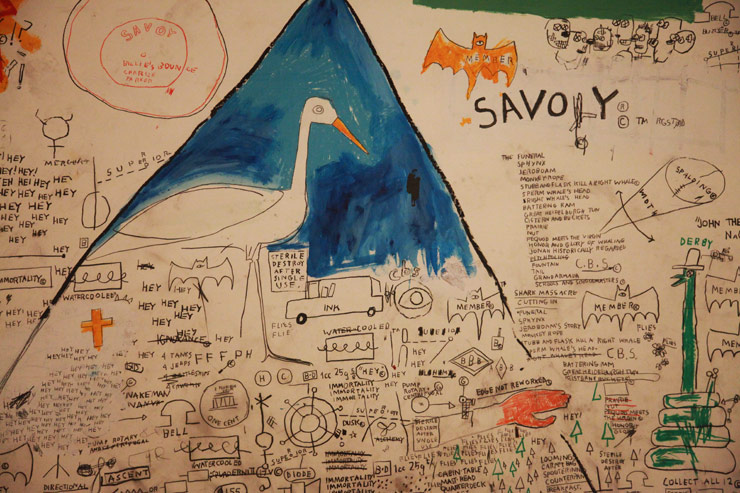
Untitled. Circa 1987. Basquiat:The Unknown Notebooks. Brooklyn Museum. April 2015. (photo © Jaime Rojo)

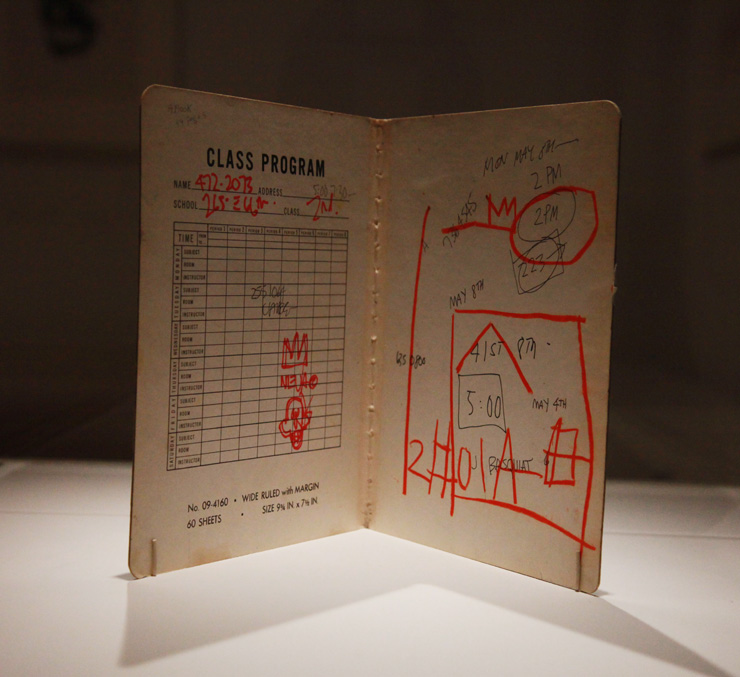
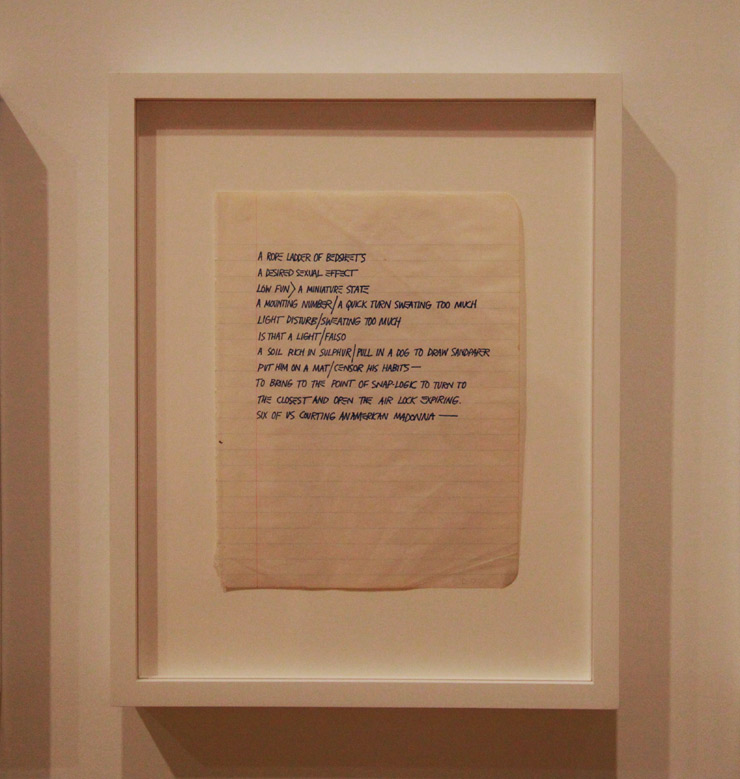
The art collector Larry Warsh lends these eight notebooks that span 1981-1987, 160 pages in all, for you to scan and contemplate. New to most audiences, they also feel familiar. While they do not provide a play-by-play account of his daily affairs, they do provide insight into his state of mind, interests, and creative process. Knowing his reputation for being very aware of his public perception, you may wonder how private these were in his mind – if he was at least partially writing for a greater audience here sometimes as well.

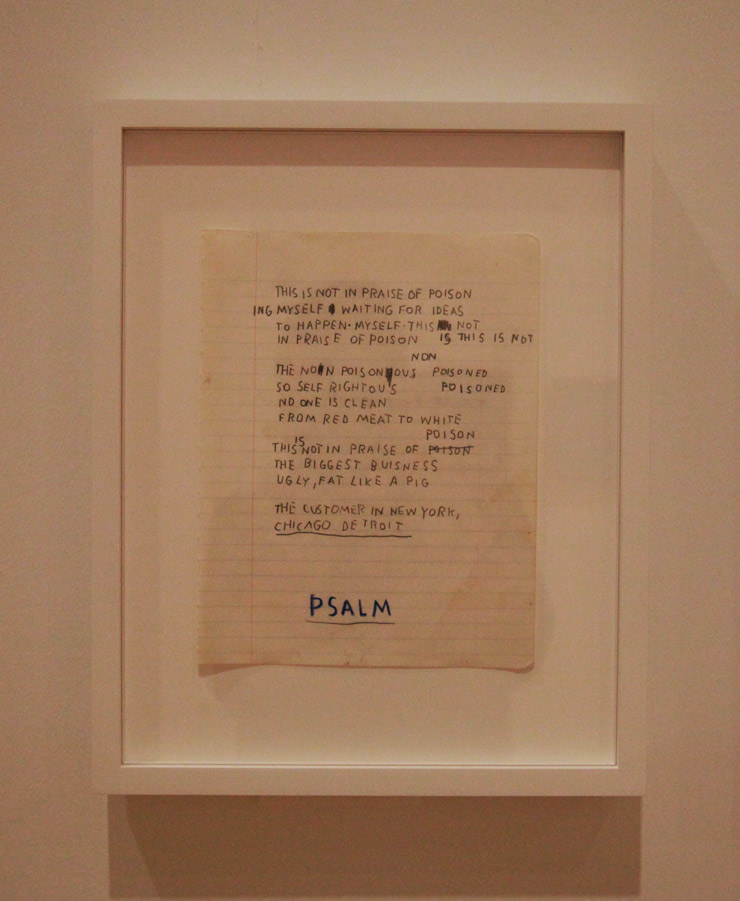
But these are definitely his voice. Even in lengthier poetry pieces, Basquiats’ reductive approach to writing produces the same clipped cadences that appeared on walls and gallery paintings, a process of addition and subtraction that he could eventually pare down to one word that would command a canvas.

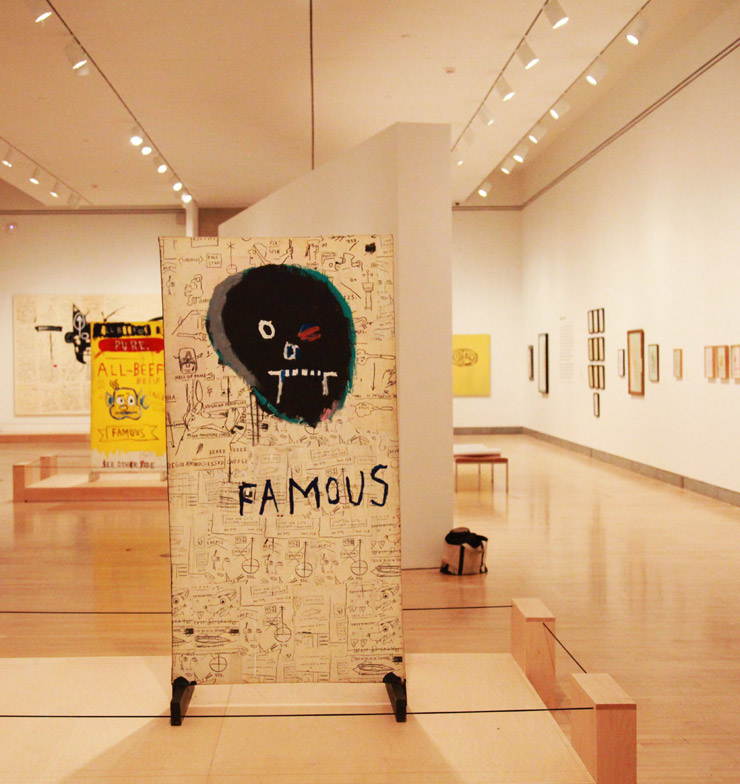
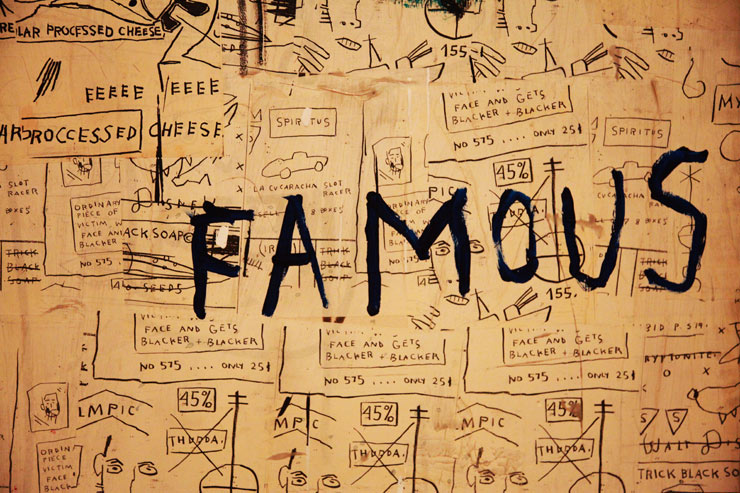
“Famous”.


brooklyn-street-art-basquiat-brooklyn-museum-jaime-rojo-04-15-web-4

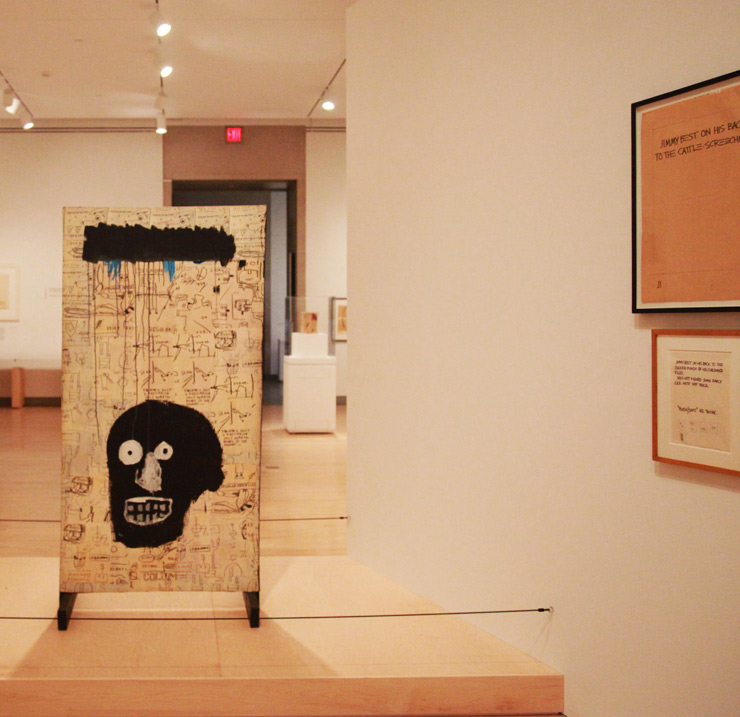
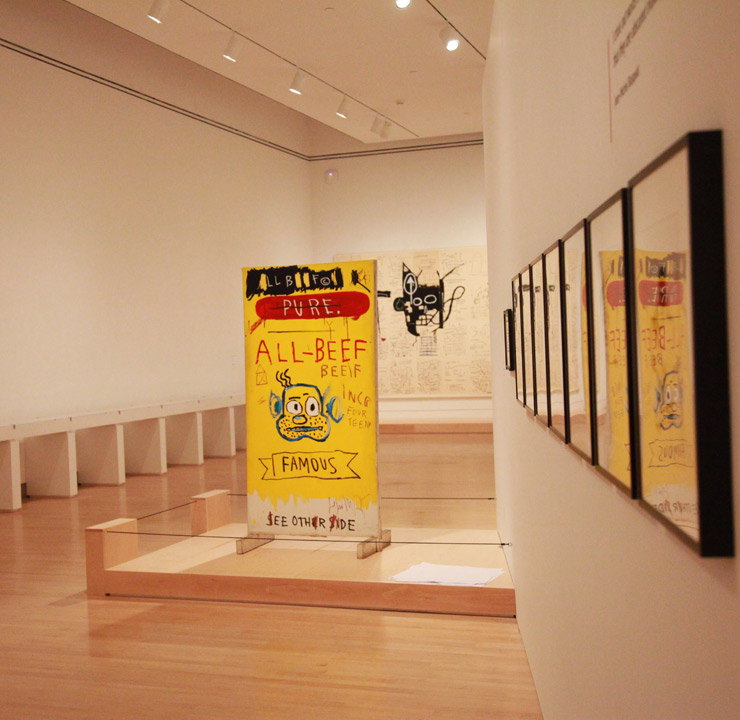
Famous. 1982. Basquiat:The Unknown Notebooks. Brooklyn Museum. April 2015. (photo © Jaime Rojo)

A two sided, free standing piece from 1982 midway through the gallery space gives a bittersweet focus to one of his aspirations, as well as to his application of photocopies of his own work in multiples on the canvas – a replication/repetition technique from commercial wildposting that was popularized on walls and lamp posts by graffiti writer/street artists like Revs and Cost in New York in the 90s.

“I think this show points out that the conceptual and poetic side of JMB’s work is central to and integrated with his more overtly visual and expressionistic paintings,” says Tricia Laughlin Bloom, who worked in collaboration with Dieter Bucchart, Guest Curator in organizing this exhibition. “He enjoyed exploring the play between text as visual sign or symbol and the layers of historical, sociological, personal meaning that words activate.  Some of the very restrained word drawings and notebook entries are intensely expressionistic, for instance, without the use of gesture or color.”


brooklyn-street-art-basquiat-brooklyn-museum-jaime-rojo-04-15-web-7

Famous. 1982. Detail. Basquiat:The Unknown Notebooks. Brooklyn Museum. April 2015. (photo © Jaime Rojo)

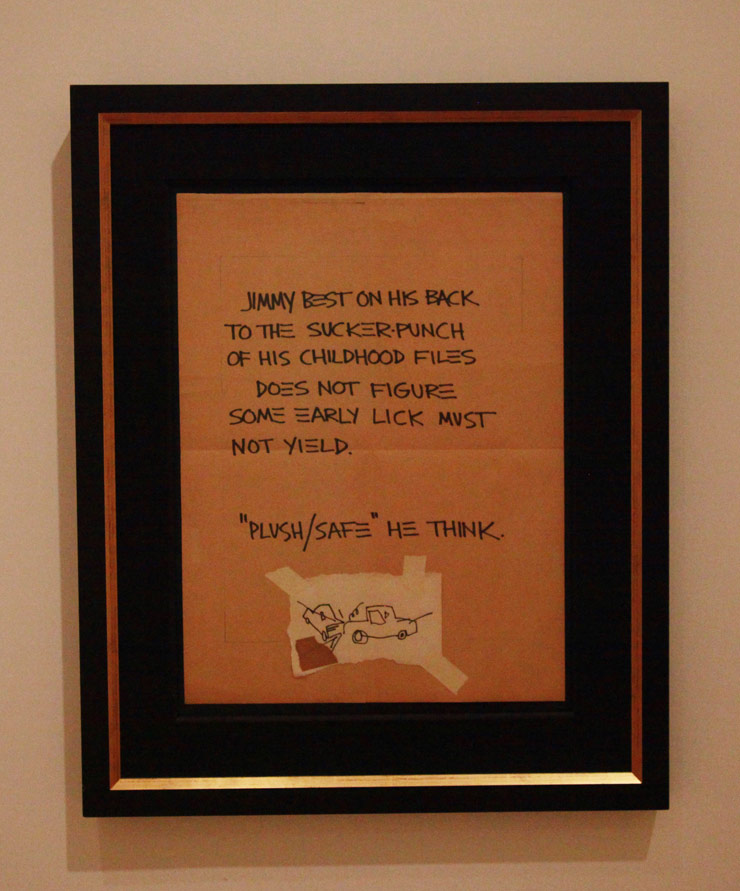
The notebooks are part of a larger offering of paintings, drawings, and moving image in this well balanced show that keeps the focus on the writer and painter of text while placing it in the greater context of all his work. Included here are drawings of his fictional character Jimmy Best, for example, who appeared in early SAMO© street writings and elsewhere as an ongoing and developing narrative that hinted at his self image.

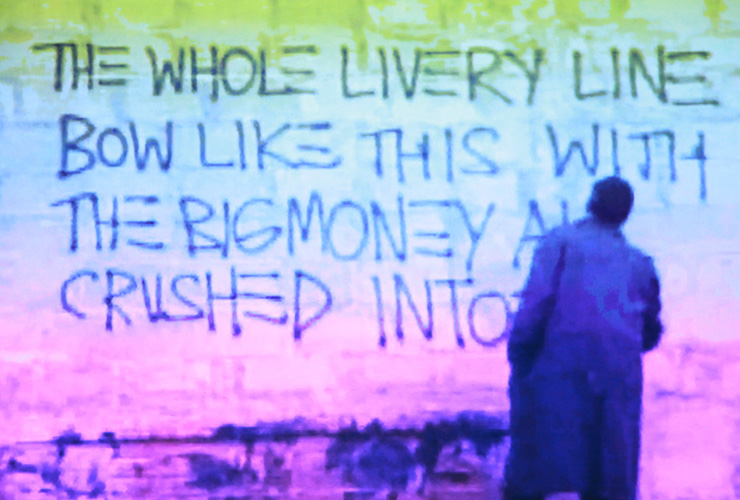
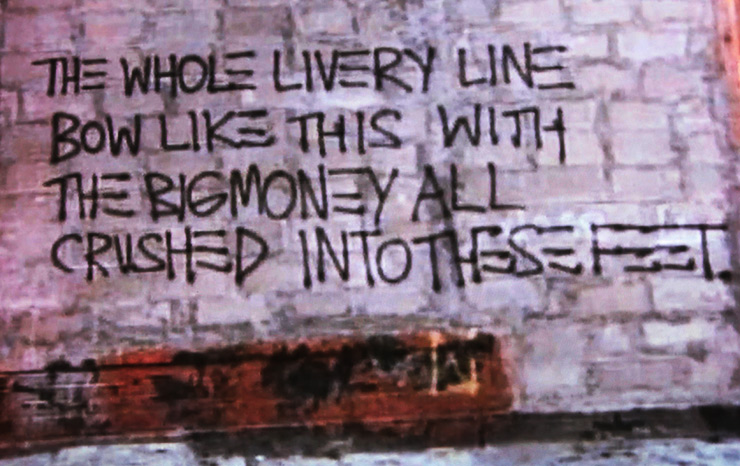
Most riveting for the new generation of writers may be the film clips shot in 1980-81 during the filming of New York Beat (released in 2000 as Downtown 81). Not true documentary footage, it nevertheless captures the artist outside mark-making in a determined, self-aware, sometimes hesitating manner across walls with letters and lines of simple black aerosol.

brooklyn-street-art-basquiat-brooklyn-museum-jaime-rojo-04-15-web-3

Famous. Verso. 1982. Basquiat:The Unknown Notebooks. Brooklyn Museum. April 2015. (photo © Jaime Rojo)

Moving into “the City” from his middle class Brooklyn home as a teenager in the late 70s, you have to wonder how or if his street practice with friend Al Diaz had been influenced by the students and workers who wrote slogans, epigrams, maxims, in black aerosol letters during the Paris uprisings of 1968. Quick passages on the street then like “Sous les paves, la plage” (under the paving stones, the beach) also played with text and sometimes cryptic meaning in ways similar to his on city walls and in these notebooks. Neatly penned, his was a deliberate meditation and experiment with words – a process that allowed you to see the deletions and additions, fully part of the finished product.

“We were presented with the rare opportunity to exhibit Basquiat’s notebooks, which offer fascinating access to his thoughts and process,” says Sharon Matt Atkins, Vice Director for Exhibitions and Collections Management, when talking about the decision to mount Notebooks.


brooklyn-street-art-basquiat-brooklyn-museum-jaime-rojo-04-15-web-18

Untitled. 1980. Basquiat: The Unknown Notebooks. Brooklyn Museum. April 2015. (photo © Jaime Rojo)

Of course its not the first time Street Artists have been featured meaningfully here. Under the guidance of Director Arnold L. Lehman the Brooklyn Museum has shown a serious and committed interest in highlighting the contributions of artists whose practice comes directly from the streets of New York and its graffiti/Street Art traditions; including the huge Basquiat show a decade ago, the Graffiti show in 2006, the more recent Keith Haring show, Swoon’s Submerged Motherlands last year, Olek’s display at the annual Artist’s Ball, and the upcoming Faile exhibit this July, which will also feature their collaboration with Bäst. For Matt Atkins, this show is in perfect alignment.

“The Brooklyn Museum has had a commitment to showing artists whose work embraces contemporary culture. Basquiat seamlessly synthesized the world around him in his art, including elements culled from the streets, music, literature, history, and more,” she says.

brooklyn-street-art-basquiat-brooklyn-museum-jaime-rojo-04-15-web-12

Untitled. 1986. Basquiat: The Unknown Notebooks. Brooklyn Museum. April 2015. (photo © Jaime Rojo)

It has been 27 years since Basquiat died at the age of 27. Somehow you can imagine that mathematical equation appearing here on one of the larger canvases; dense with symbols, sentence fragments, lists and formulas. Sifting through the tenuously connected word constellation it occurs to you that people like Basquiat and Burroughs and the Beats were forebears of the post-Gutenberg dislocation of text from its moorings – one that we all swim in – with passages and words and texts floating to us and past us from multiple screens of varying sizes throughout each day.

As this stream of messages blurs from the intensely personal to the public spheres, this show confirms how the art-making process for the street has always been rich with storytelling, even if not evident at first. A show of this moment, seeing these notebooks first hand will complete a cycle for many.

brooklyn-street-art-basquiat-brooklyn-museum-jaime-rojo-04-15-web-14

Untitled. 1986. Detail.. Basquiat: The Unknown Notebooks. Brooklyn Museum. April 2015. (photo © Jaime Rojo)

We had an opportunity to speak further with one of the curators, Tricia Laughlin Bloom, about Basquiat: The Unknown Notebooks.

Brooklyn Street Art: Often we think of the work we see on the street as part of a continuum, a conversation back and forth between the artist and the passerby. How does this exhibition illustrate the continuum that extends from private neatly penned journals to public aerosol missives?
Tricia Laughlin Bloom: Going through the exhibition you find a lot of similarity between the voice he used in his street writing and in his notebooks, that also extends to his word paintings. Fragments of SAMO text recur in larger scale works that we have included, and many of his notebook passages read like they could have been SAMO texts.

brooklyn-street-art-basquiat-brooklyn-museum-jaime-rojo-04-15-web-10

Untitled. 1986. Detail. Basquiat: The Unknown Notebooks. Brooklyn Museum. April 2015. (photo © Jaime Rojo)

Brooklyn Street Art: Can you describe the dynamic between yourself and the guest curator Dieter Buchhart and how it informed some of your joint decisions for presenting the work?
Tricia Laughlin Bloom: Dieter brought the initial checklist together as Guest Curator, and we shaped it together from there. We both felt it was important that the show be about the notebooks—that the paintings and drawings should be carefully selected to compliment the notebooks and not overwhelm, and to highlight Basquiat the poet and thinker AND visual artist. Getting the right number of works and the precise balance was a long process, and many conversations.

Brooklyn Street Art: How has preparing this exhibition changed or affected your perception of his work in the intervening ten years since the “Basquiat” exhibition at the Brooklyn Museum, if at all?
Tricia Laughlin Bloom: I was always a fan, and I loved the 2005 show, but I feel I understand him better and my admiration has deepened after the opportunity to work with the notebooks. It’s more intimate in scale and the whole experience feels more personal.

brooklyn-street-art-basquiat-brooklyn-museum-jaime-rojo-04-15-web-5

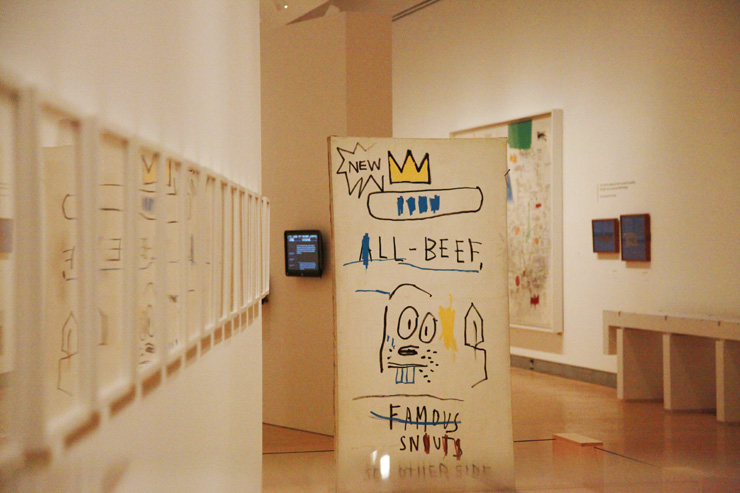
All Beef. 1983. Basquiat: The Unknown Notebooks. Brooklyn Museum. April 2015. (photo © Jaime Rojo)

brooklyn-street-art-basquiat-brooklyn-museum-jaime-rojo-04-15-web-8

All Beef. 1983. Verso. Basquiat: The Unknown Notebooks. Brooklyn Museum. April 2015. (photo © Jaime Rojo)

brooklyn-street-art-basquiat-brooklyn-museum-jaime-rojo-04-15-web-9

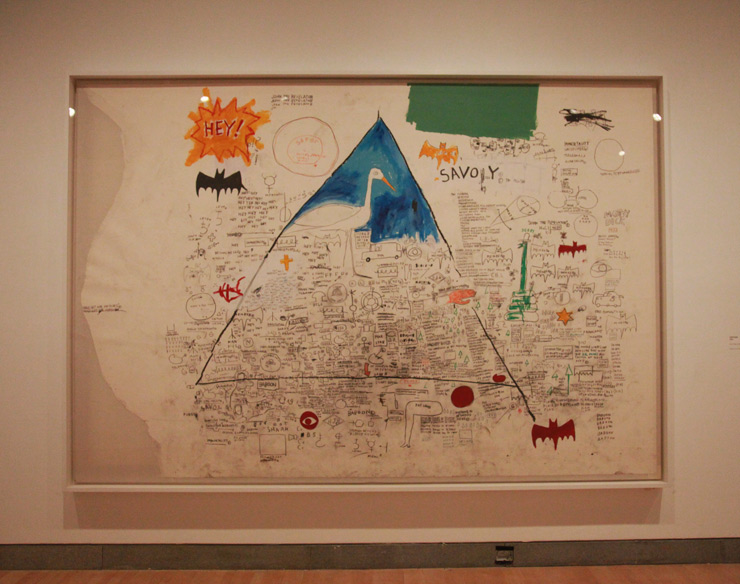
Untitled. 1982-83. Basquiat: The Unknown Notebooks. Brooklyn Museum. April 2015. (photo © Jaime Rojo)

brooklyn-street-art-basquiat-brooklyn-museum-jaime-rojo-04-15-web-15

Untitled. 1982-83. Detail. Basquiat: The Unknown Notebooks. Brooklyn Museum. April 2015. (photo © Jaime Rojo)

brooklyn-street-art-basquiat-brooklyn-museum-jaime-rojo-04-15-web-13

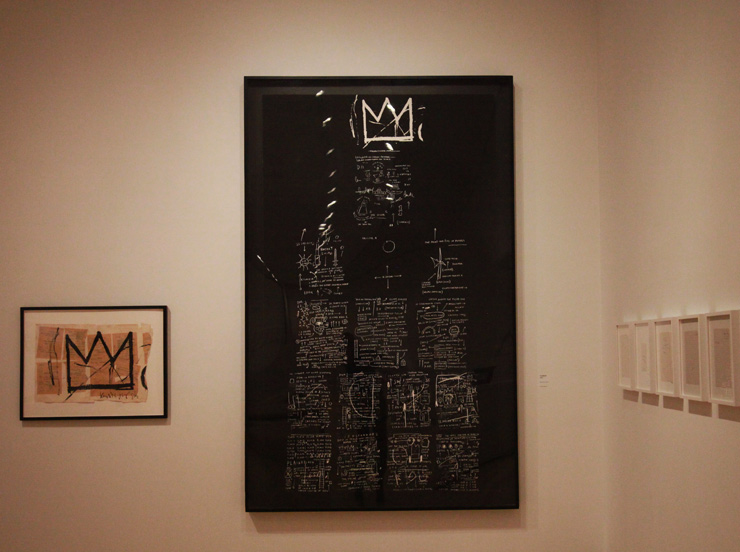
From left to right: Untitled (Crown) 1982. Tuxedo. 1982. Basquiat: The Unknown Notebooks. Brooklyn Museum. April 2015. (photo © Jaime Rojo)

brooklyn-street-art-basquiat-brooklyn-museum-jaime-rojo-04-15-web-17

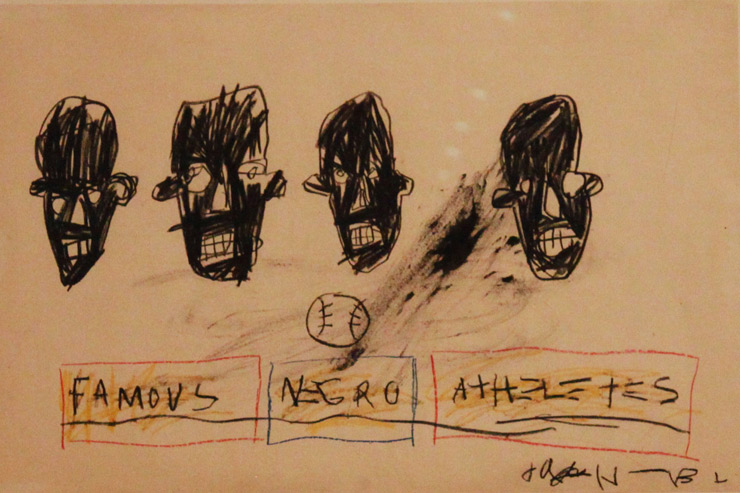
Famous Negro Atheletes. 1981. Basquiat: The Unknown Notebooks. Brooklyn Museum. April 2015. (photo © Jaime Rojo)

brooklyn-street-art-basquiat-brooklyn-museum-jaime-rojo-04-15-web-6

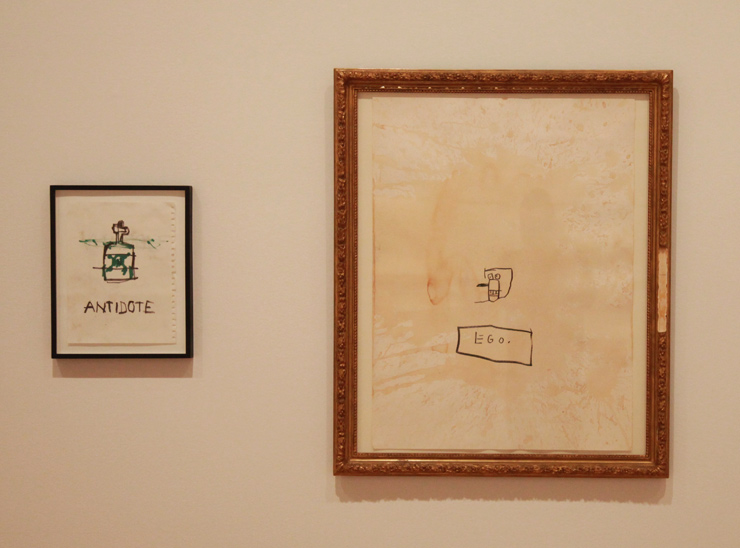
Antidote. 1981. Untitled (Ego) 1983. Basquiat: The Unknown Notebooks. Brooklyn Museum. April 2015. (photo © Jaime Rojo)

brooklyn-street-art-basquiat-brooklyn-museum-jaime-rojo-04-15-web-21

Photo taken from the video Downtown 81 Outtakes. 2001. Basquiat: The Unknown Notebooks. Brooklyn Museum. April 2015. (photo © Jaime Rojo)

brooklyn-street-art-basquiat-brooklyn-museum-jaime-rojo-04-15-web-1

Photo taken from the video Downtown 81 Outtakes. 2001. Basquiat: The Unknown Notebooks. Brooklyn Museum. April 2015. (photo © Jaime Rojo)

Basquiat: The Unknown Notebooks is organized by Dieter Buchhart, Guest Curator, with Tricia Laughlin Bloom, former Associate Curator of Exhibitions, Brooklyn Museum and current Curator of American art at the Newark Museum.

With special thanks to Tricia Laughlin Bloom, Sharon Matt Atkins, and Sally Williams.

Basquiat: The Unknown Notebooks at the Brooklyn Museum opens on April 3, 2015 to the general public. Click HERE for further details.


<<>>><><<>BSA<<>>><<<>><><BSA<<>>><><<>BSA<<>>><<<>><><BSA

Please note: All content including images and text are © BrooklynStreetArt.com, unless otherwise noted. We like sharing BSA content for non-commercial purposes as long as you credit the photographer(s) and BSA, include a link to the original article URL and do not remove the photographer’s name from the .jpg file. Otherwise, please refrain from re-posting. Thanks!

<<>>><><<>BSA<<>>><<<>><><BSA<<>>><><<>BSA<<>>><<<>><><BSA

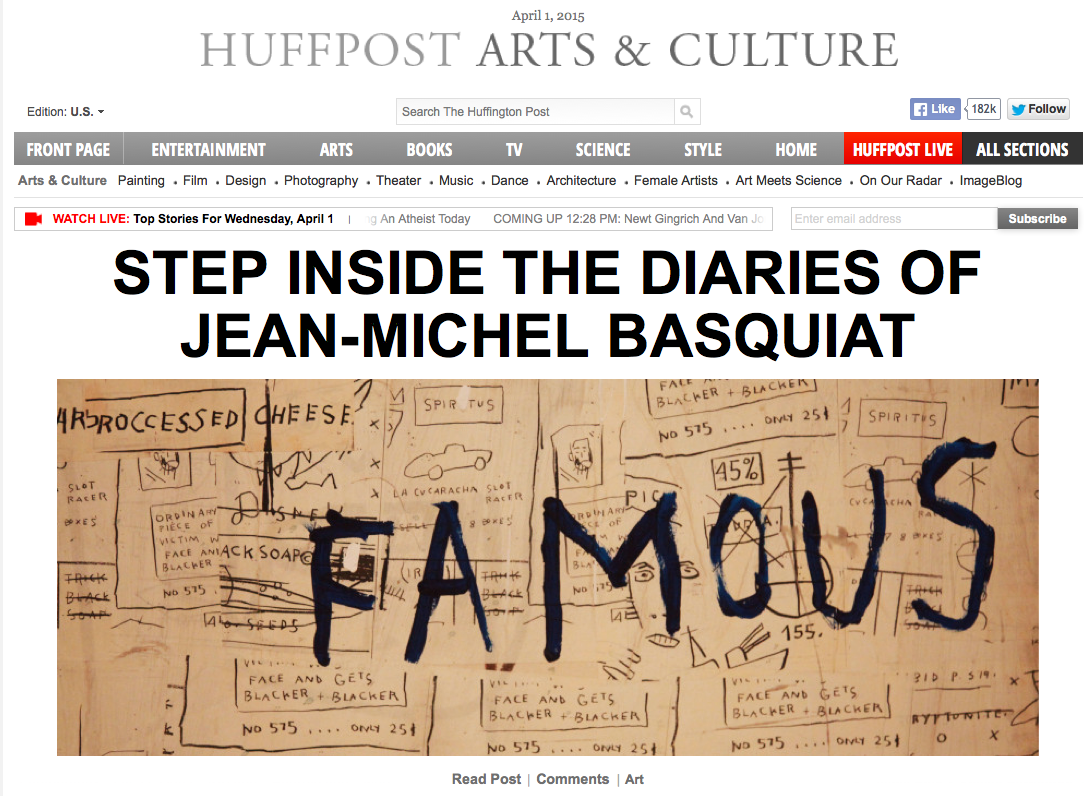
This article is also published on The Huffington Post

Brooklyn-Street-Art-Huffpost-Basquiat-April-1-2015-Screen Shot 2015-04-01 at 10.08.05 AM

Read more