“Have you taken down the names for your paper yet?” she asked me. “Stay by my side and I will dictate them to you: the Count and Countess of Caralt, the Marquess of Palmerola, the Count of Fígols, the Marquess of Alella, the …
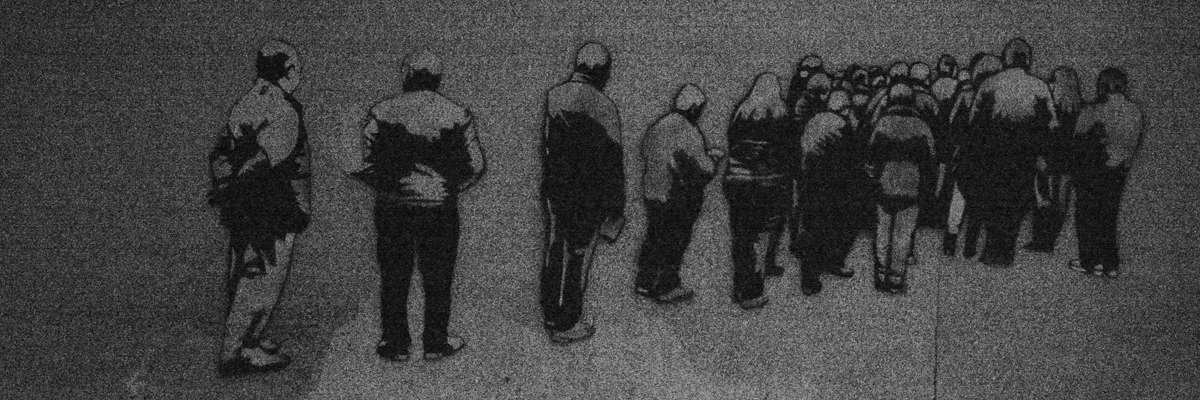
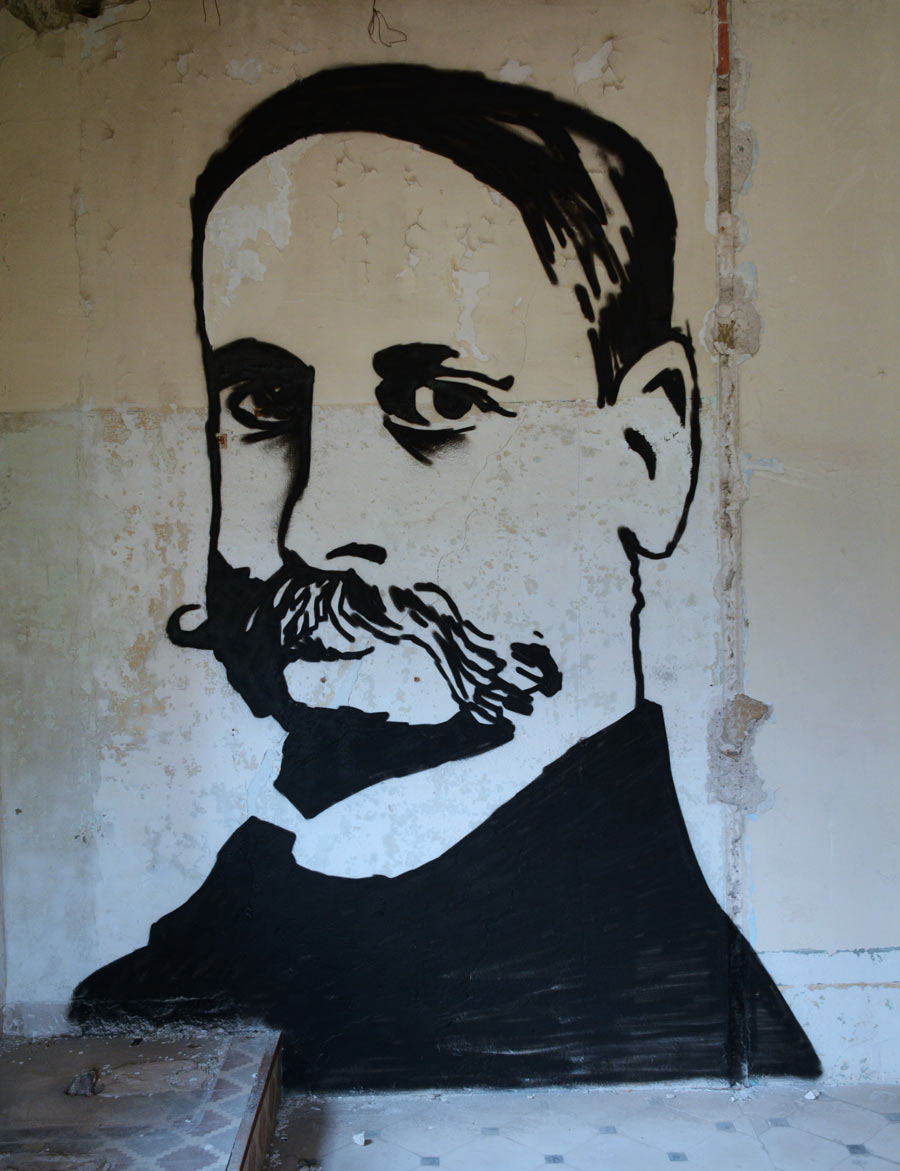
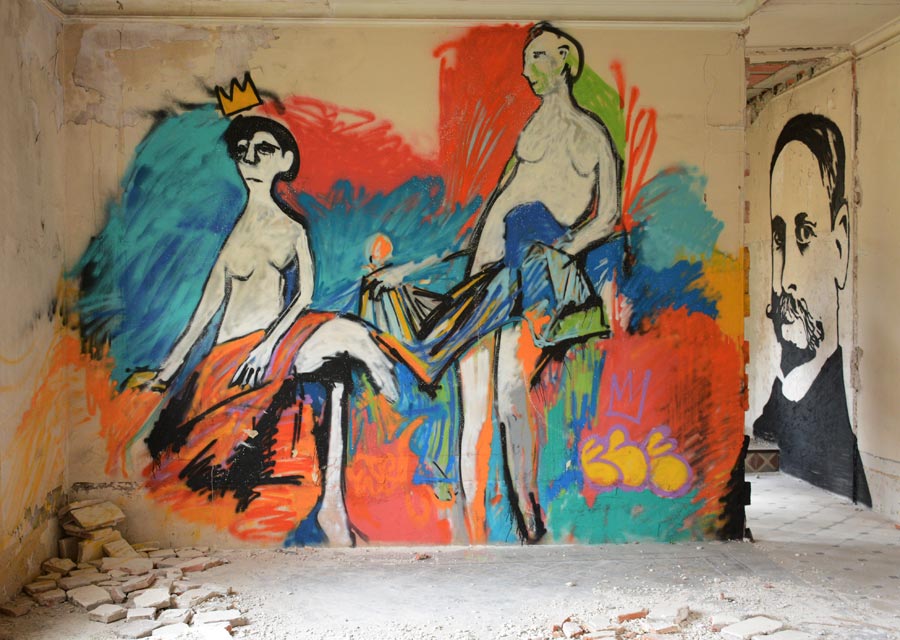
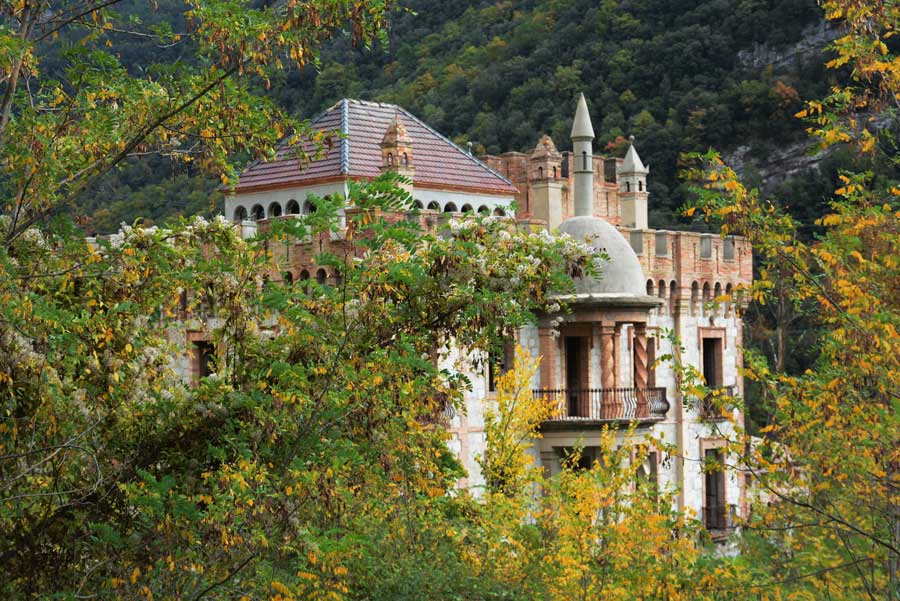
In the decade before the Spanish Civil War, Barcelona was on the verge of boiling over, and perhaps this castle in the Pyrenees mountains to the south was at its height of glory thanks to workers in its coal mines. The Count of Figols and his family enjoyed the view from the tower while the miners, some as young as 14 years old, kept toiling about 13 kilometers away – until they revolted in 1932.
“The mining company, the greater part of which was owned by Liverpool-born José Enrique de Olano y Loyzaga, First Count of Figols, prohibited union organization and paid its workforce in tokens redeemable only in the company stores.”
Revolution and the State: Anarchism in the Spanish Civil War, 1936-1939, by Danny Evans.
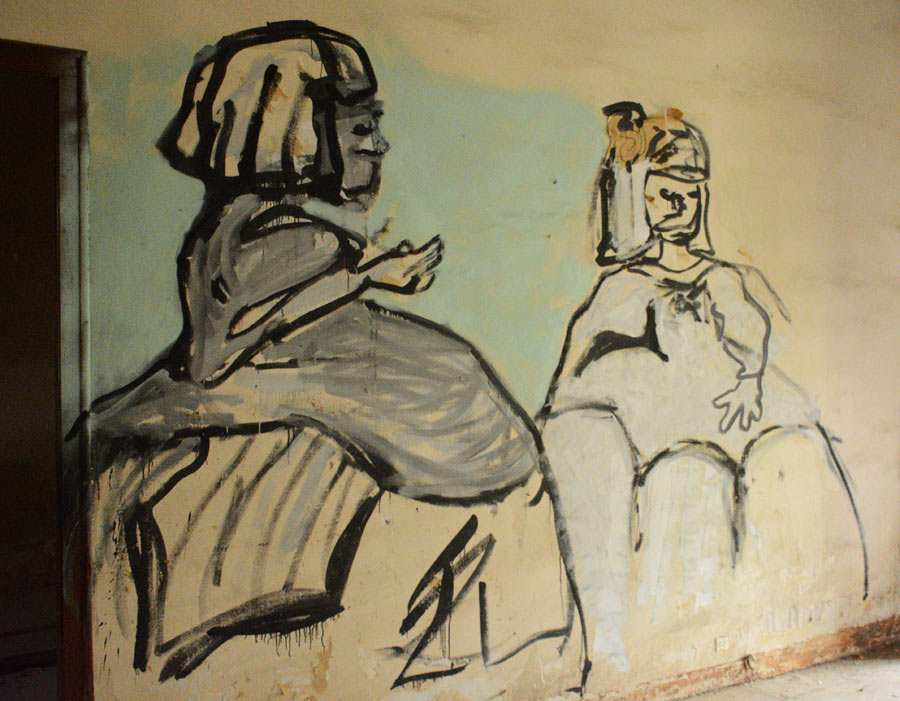
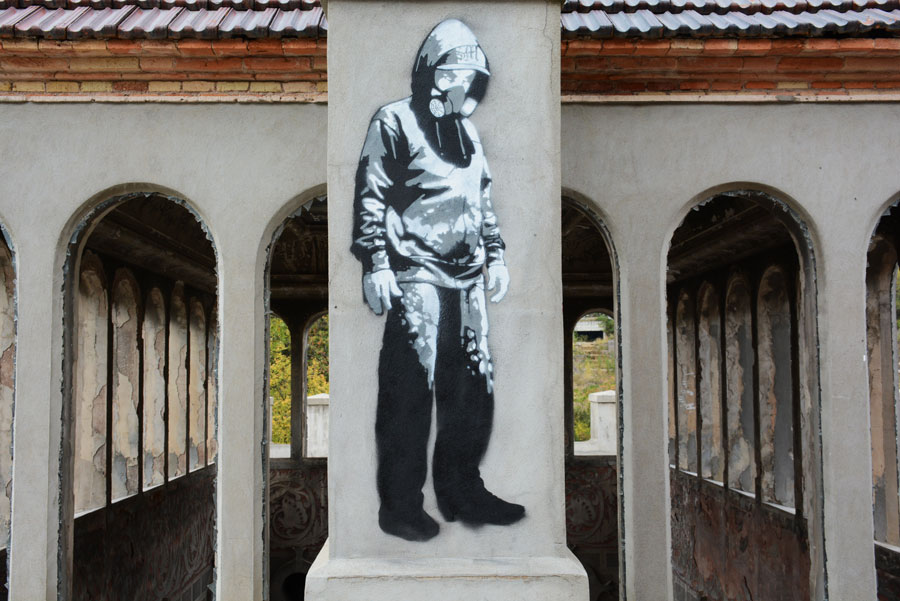
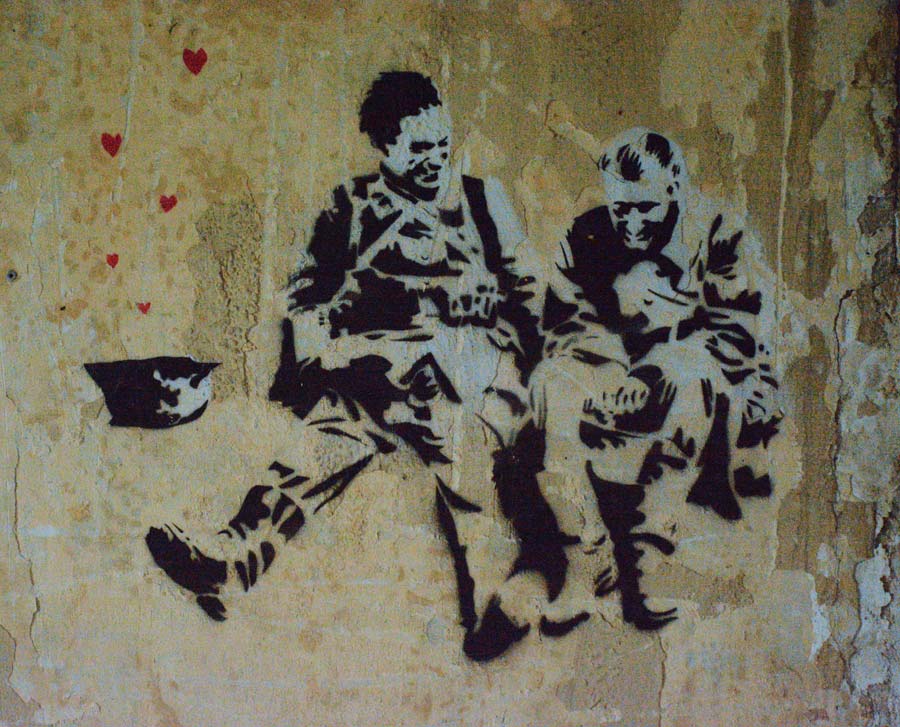
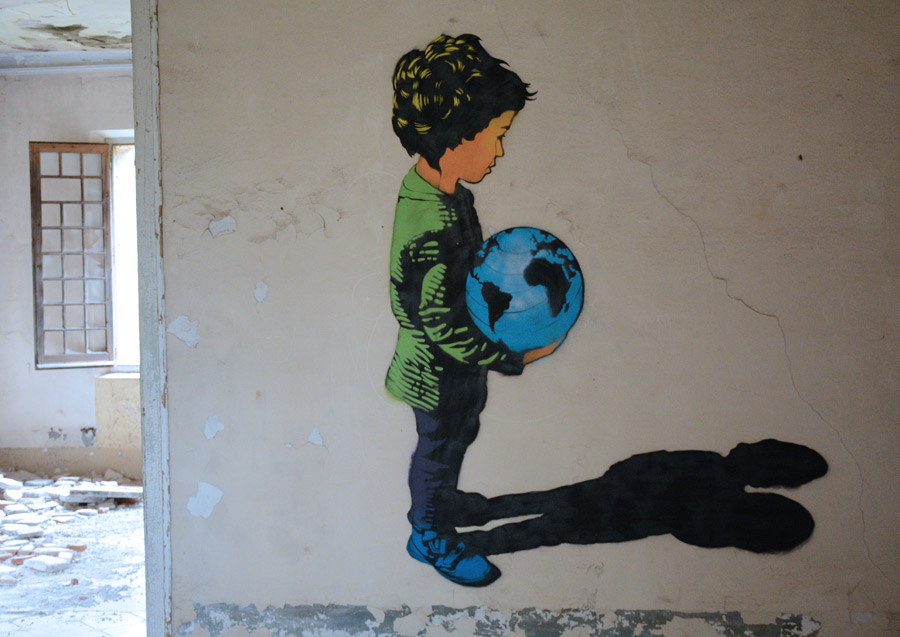
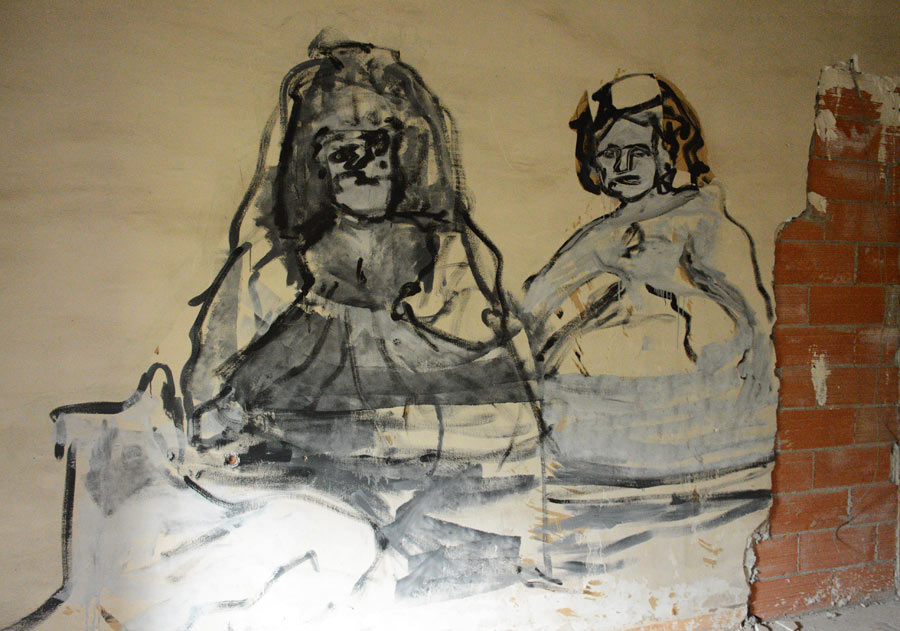
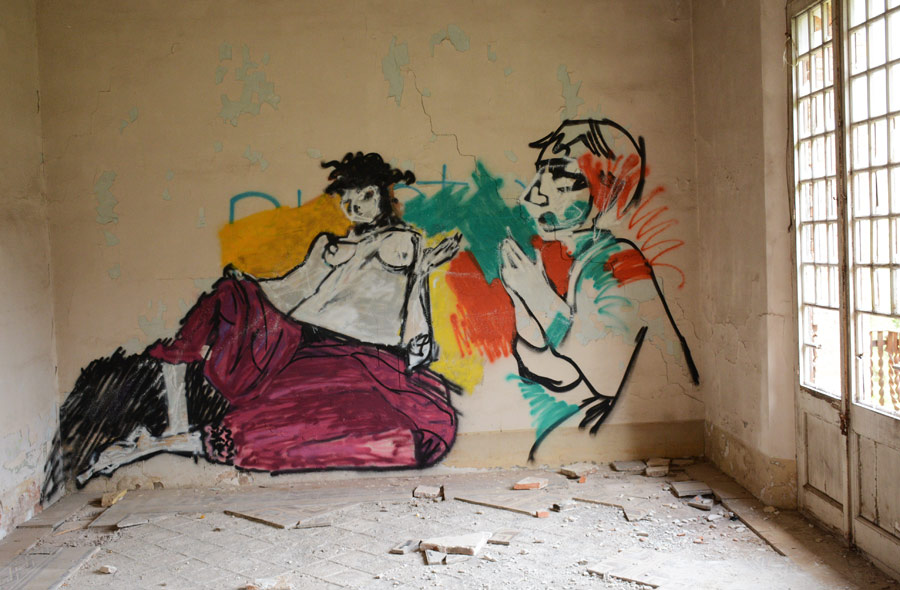
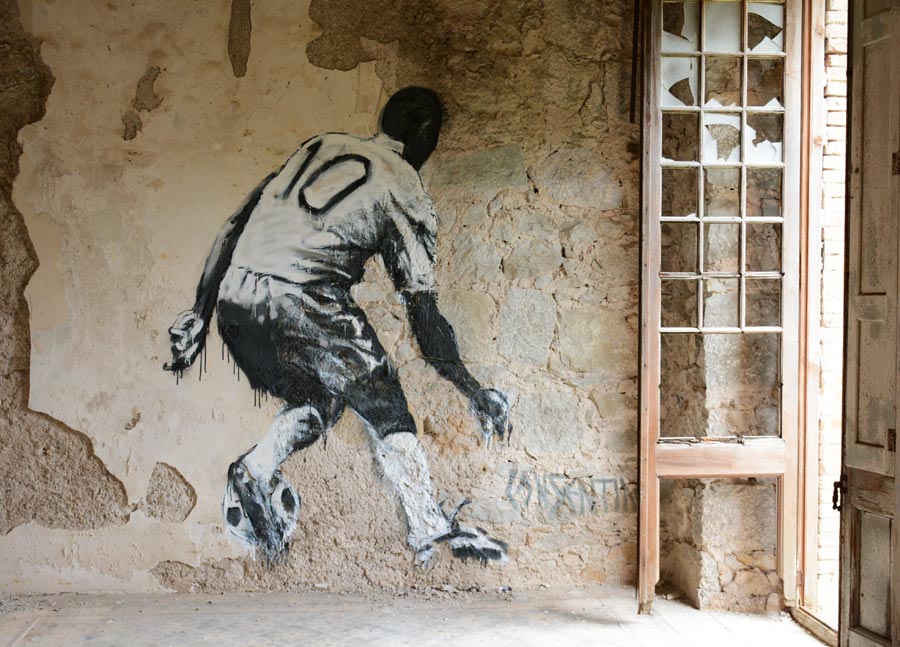
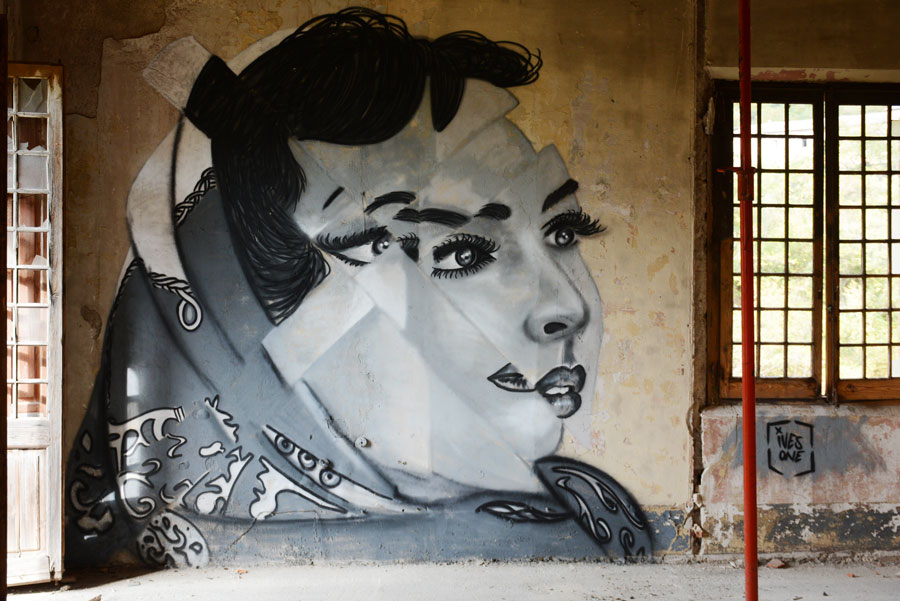
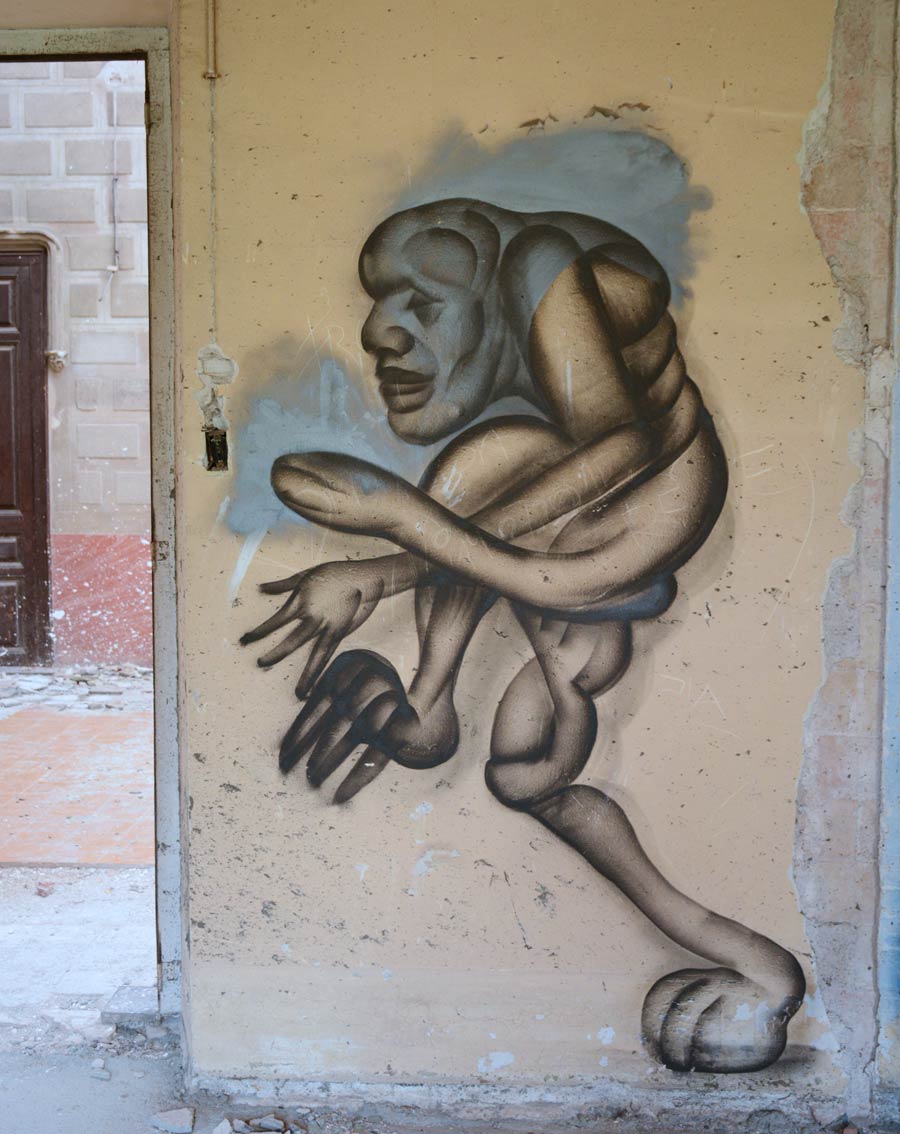
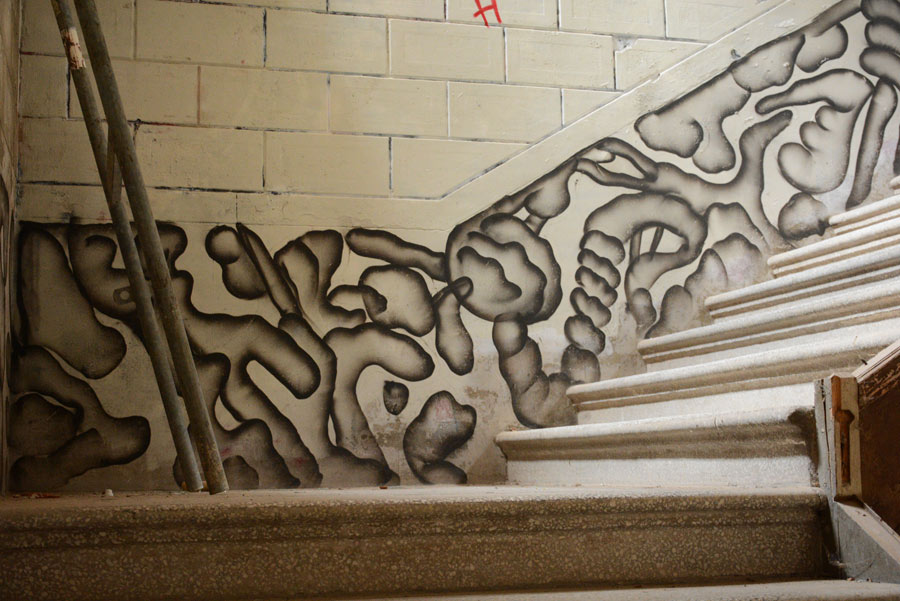
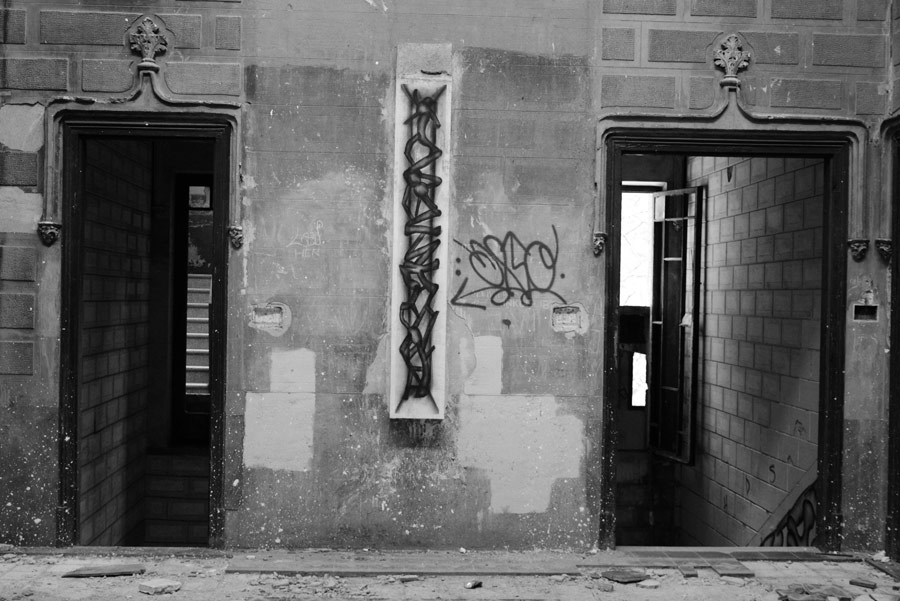
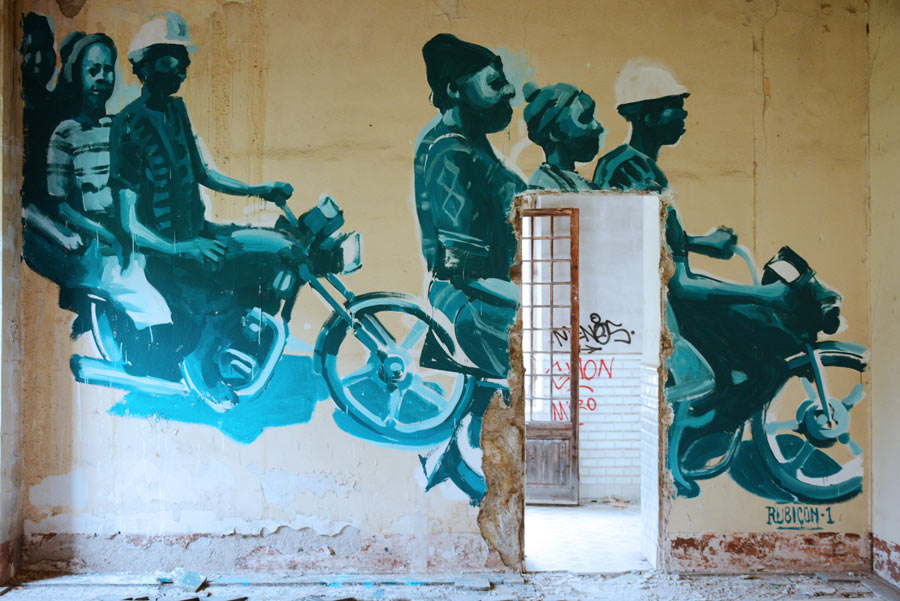
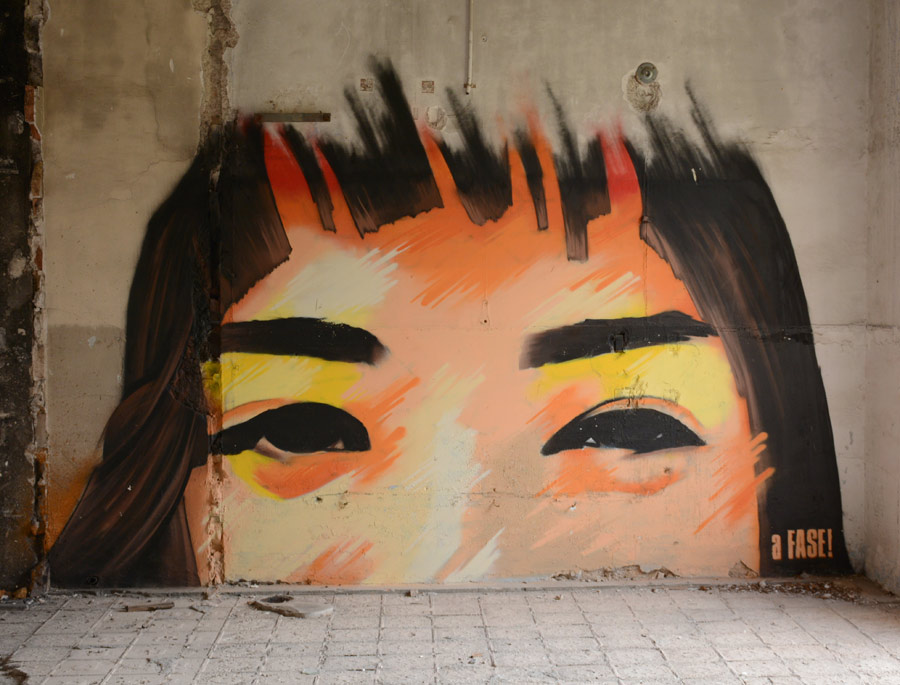
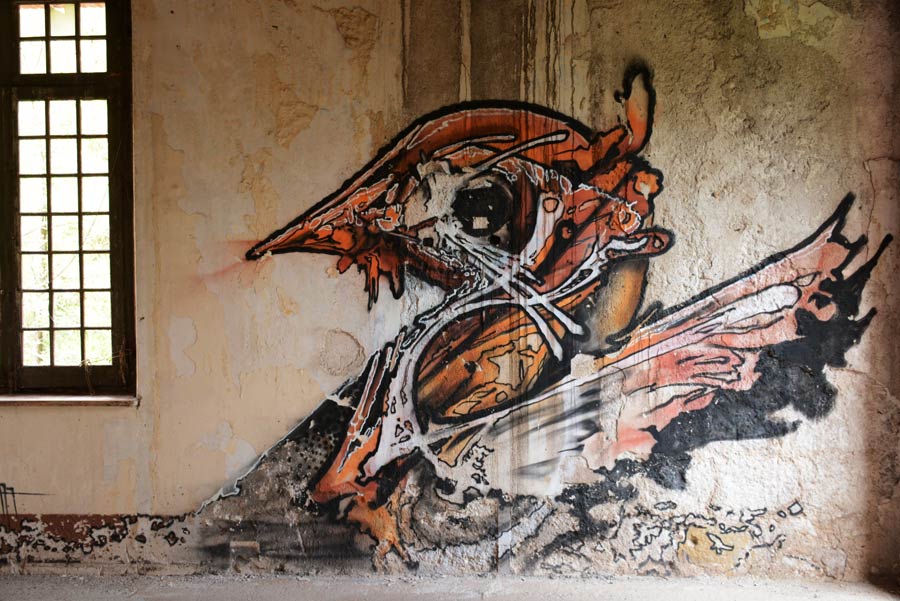
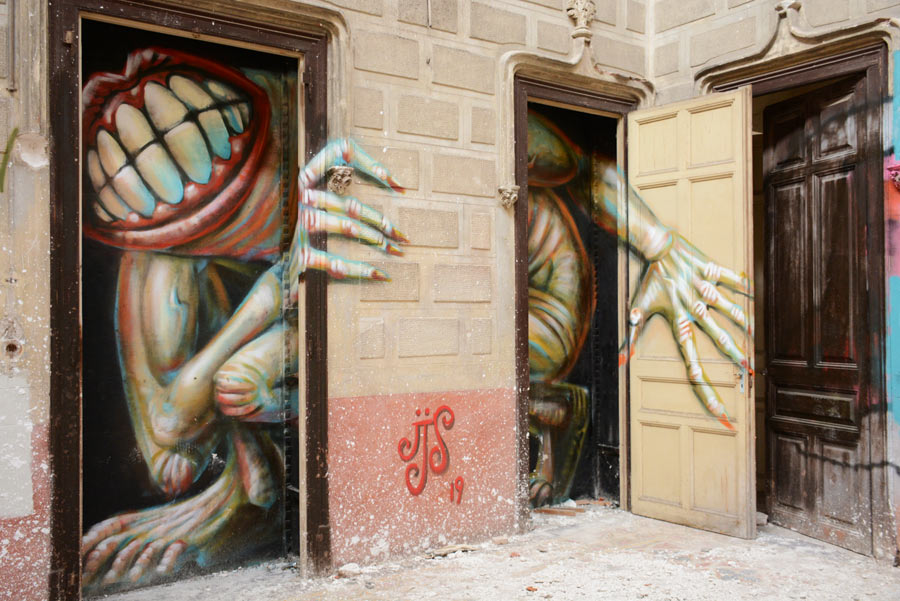
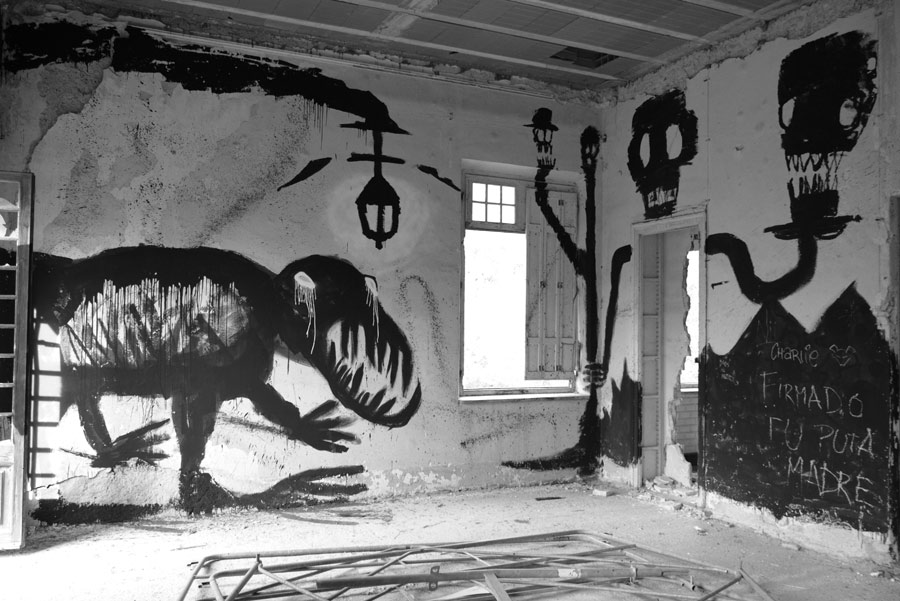
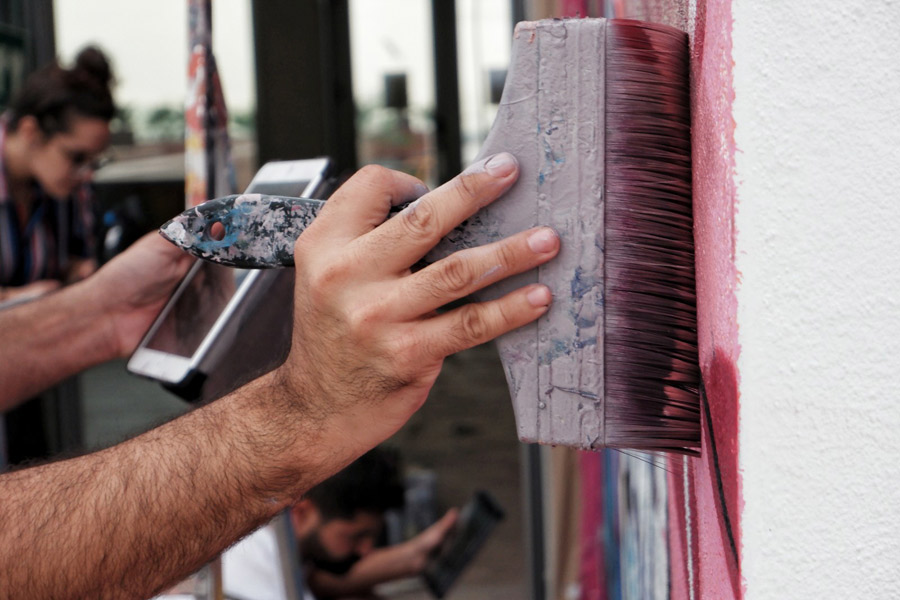
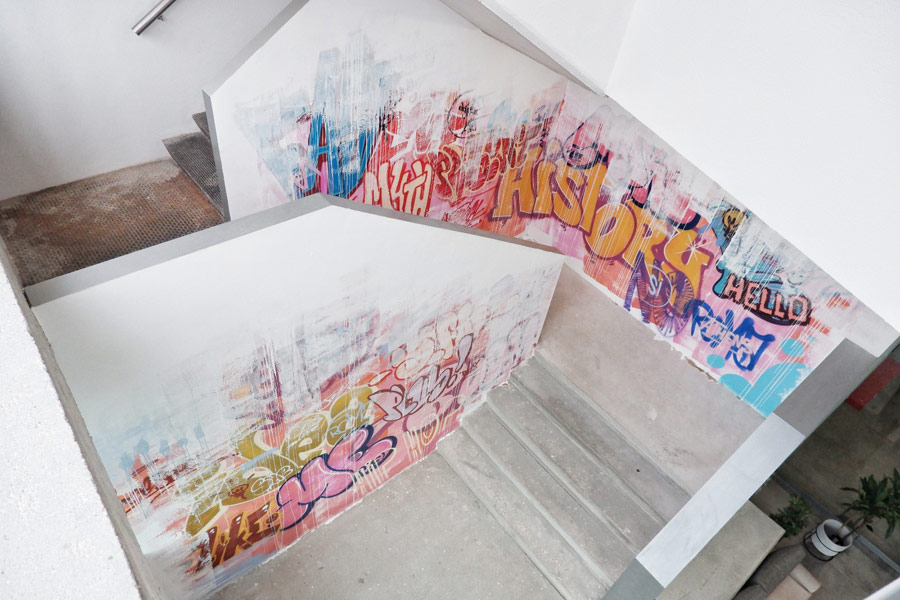
Today you can hashtag Figols (#figols) on social media and you can see the tower (Torre del Compte de Fígols) and wander through the ruins of the castle (Castillo Conde de Fígols) – and discover new graffiti pieces and paintings throughout the rooms. That’s what photographer Lluis Olive Bulbena did last week when he went to check out some fresh stuff he heard was painted here about 120 km north of Barcelona. We thank him for sharing his images with BSA readers from the castle of the Count of Figols.
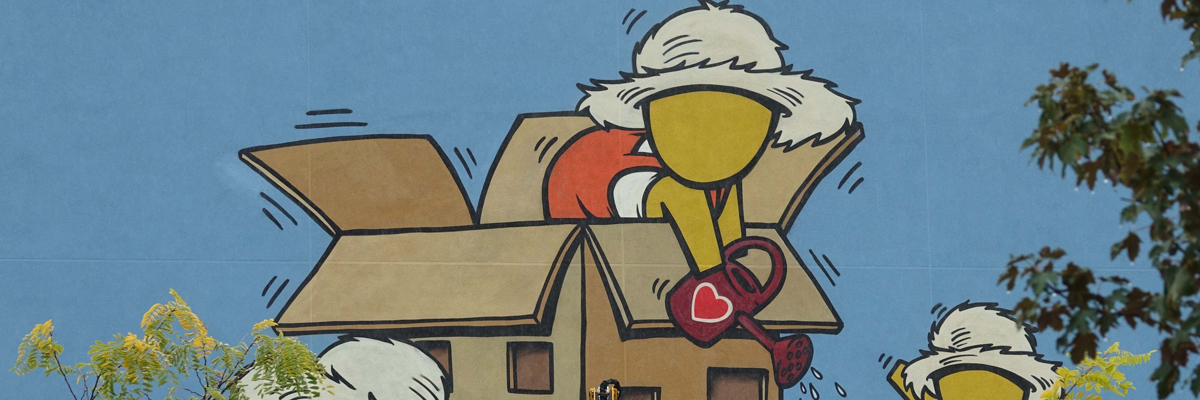
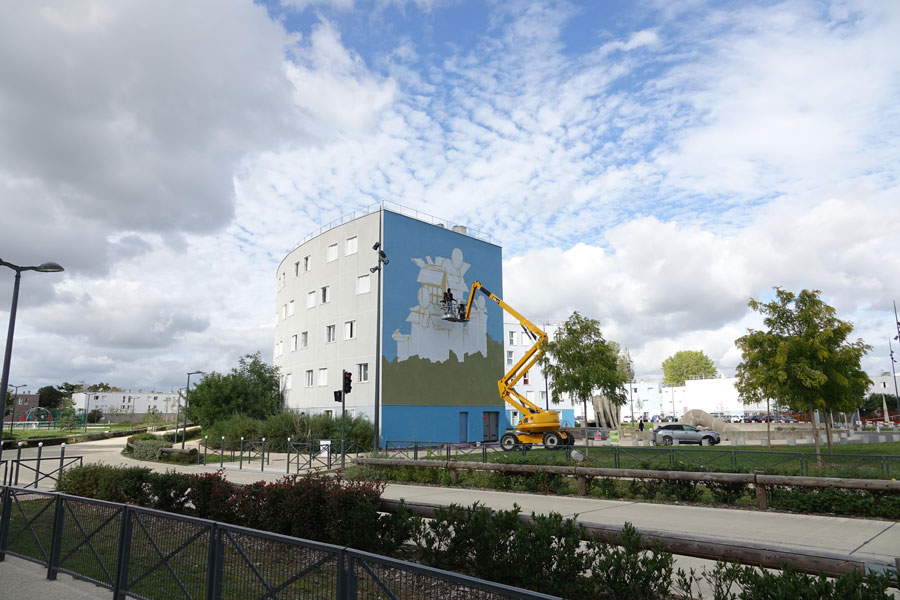
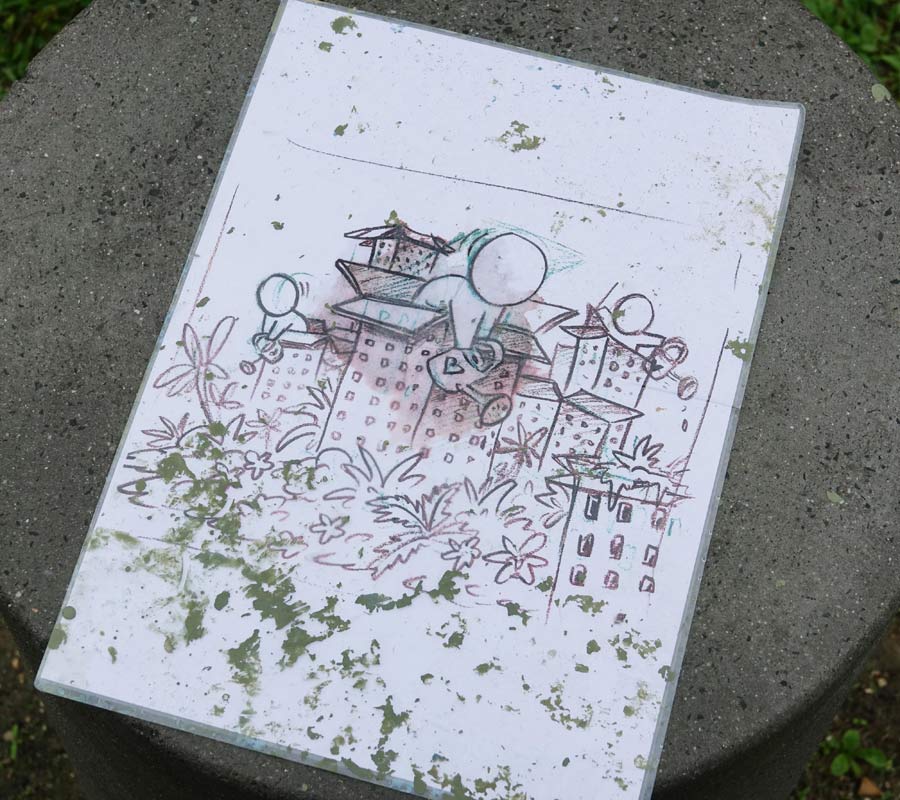
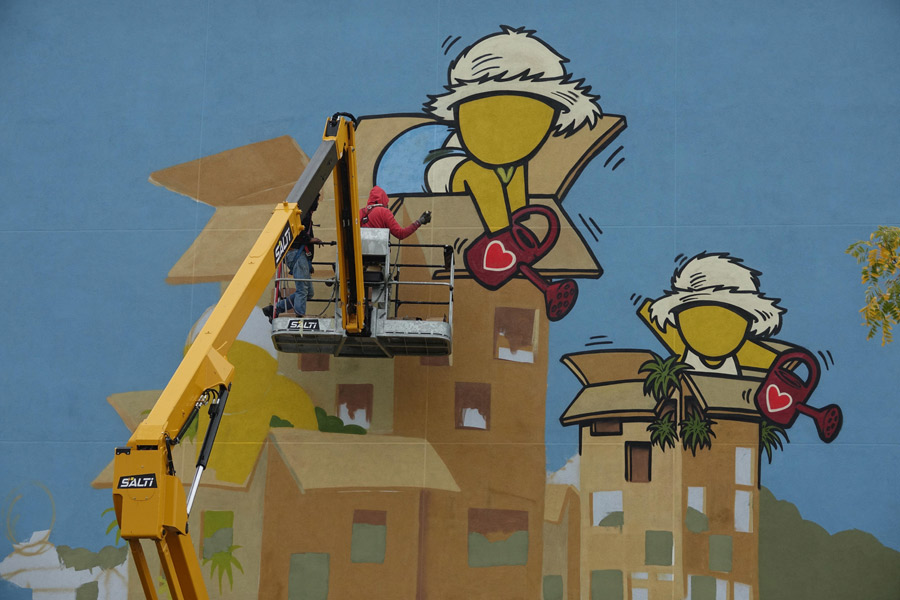
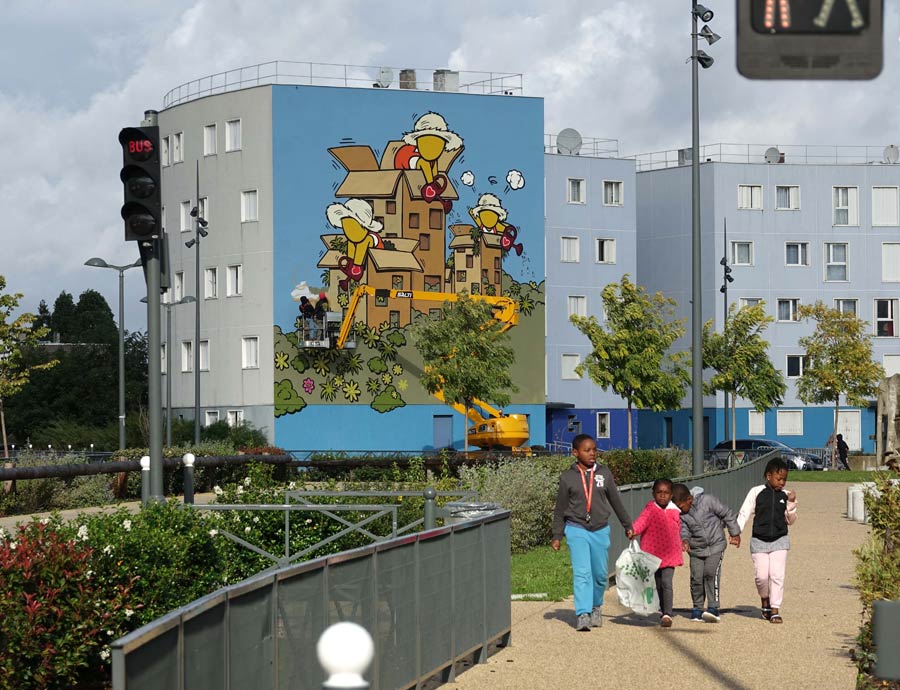
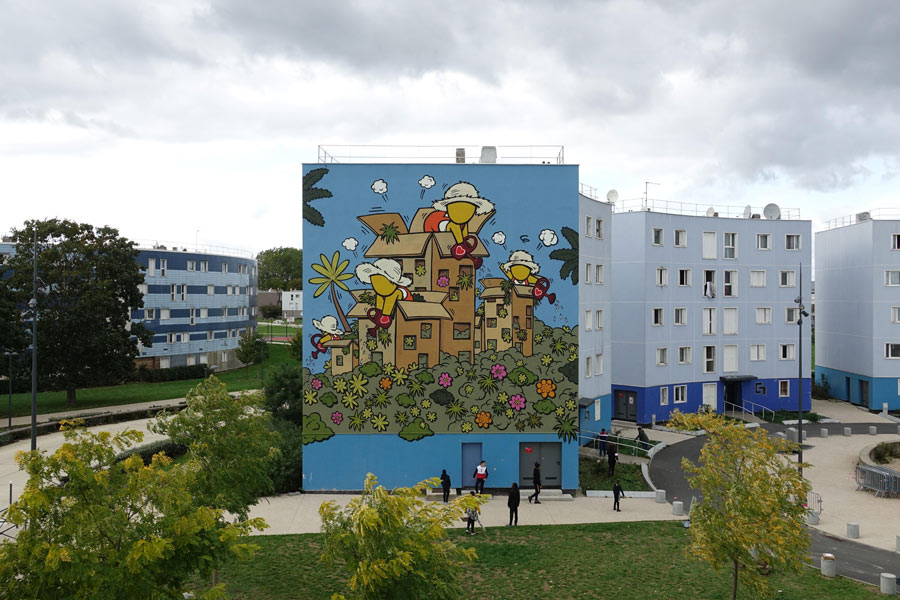
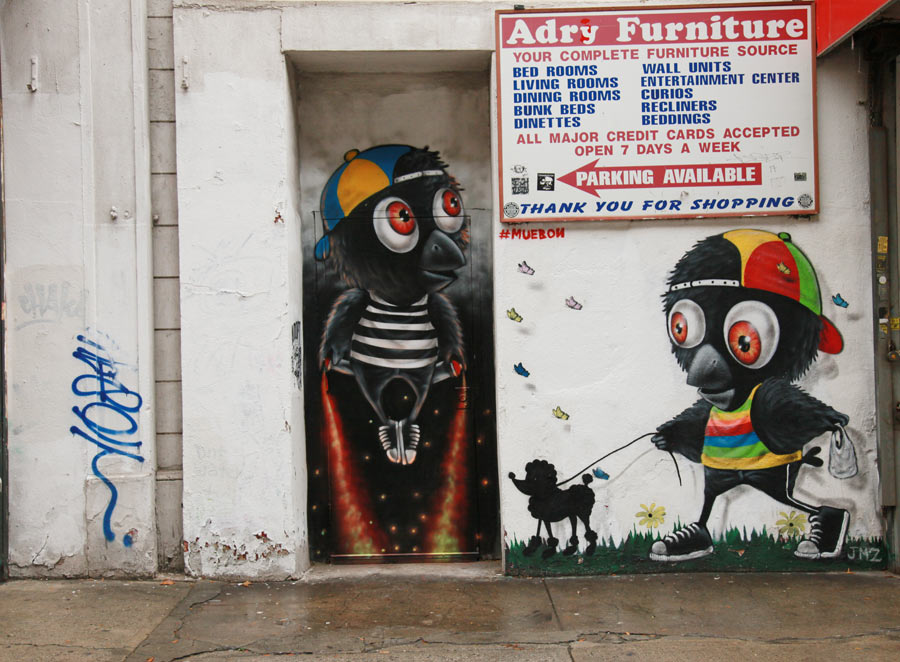
A children-friendly installation in a city that needs some love, the artist who began as a graffiti writer in 1989 here brings his famous faceless characters called the “Gouzou” to pop out of the box buildings and water the flowers of growth here.
JACE says he’s been painting this character since the early 90s and they are complex, despite their appearance. “The “Gouzou” is an anthropomorphic character, cheerful and endearing but not without a touch of malice,” says his bio, “Soft and delicate, he can be just as impertinent and teasing!”
This new community mural is in a housing estate in the district called “La Grande Borne”, or perhaps, “The Great Frontier”, but over time its reputation has become somewhat tarnished due to high unemployment, lack of economic opportunity, and probably systemic racism.
The Wiki entry says “Built as a 1960s social utopia with winding coloured buildings, it was intended to become an ideal dormitory town. With 11,000 inhabitants, it has become a by-word for poverty, drug dealing, arms trafficking, youth criminality and attacks on police, as well as arson attacks on public buildings.”
In a 2015 article in Le Parisien even the Socialist MP Malek Boutih has said about La Grande Borne, “A city where officials, including elected officials, make a pact with evil, thugs, offenders, corruption.” (translated with Google)
Maybe JACE’s Gouzou will bring a positive influence on the neighborhood?
At least that’s what the mural program “Wall Street Festival” has in mind.
“Bringing culture to working-class neighborhoods is like a duty for me,”
says organizer and founder Gautier Jourdain. “This is where the works are most
important.”
Occurring on the outer rim of Madrid, this collection of thinkers and conceptualists challenge almost every concept of the sad digression called the “mural festival” today – with the sincere focus of bringing the practice back to the community and creating work in the context of it.
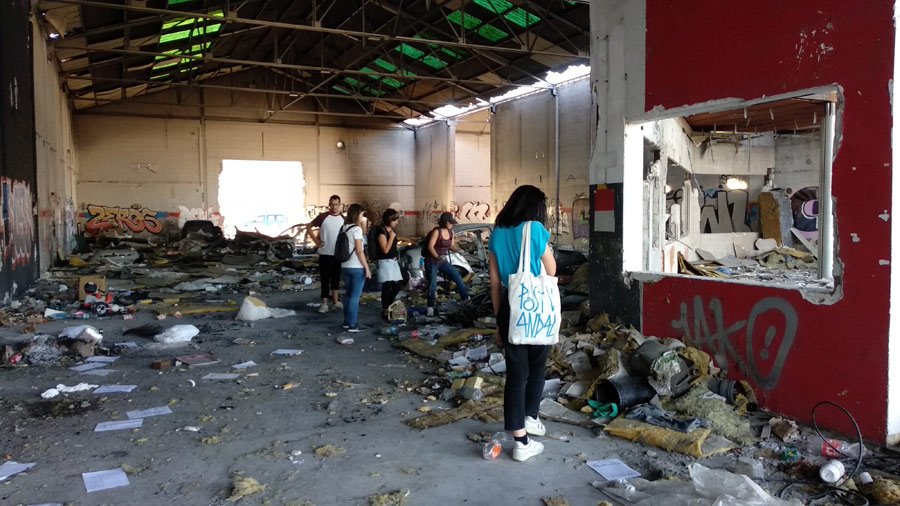
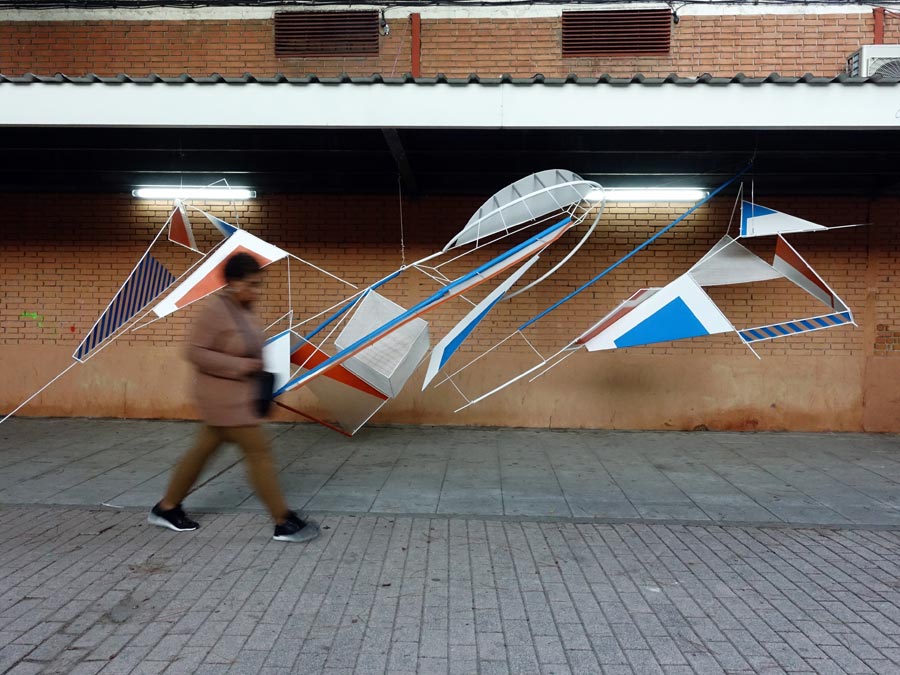
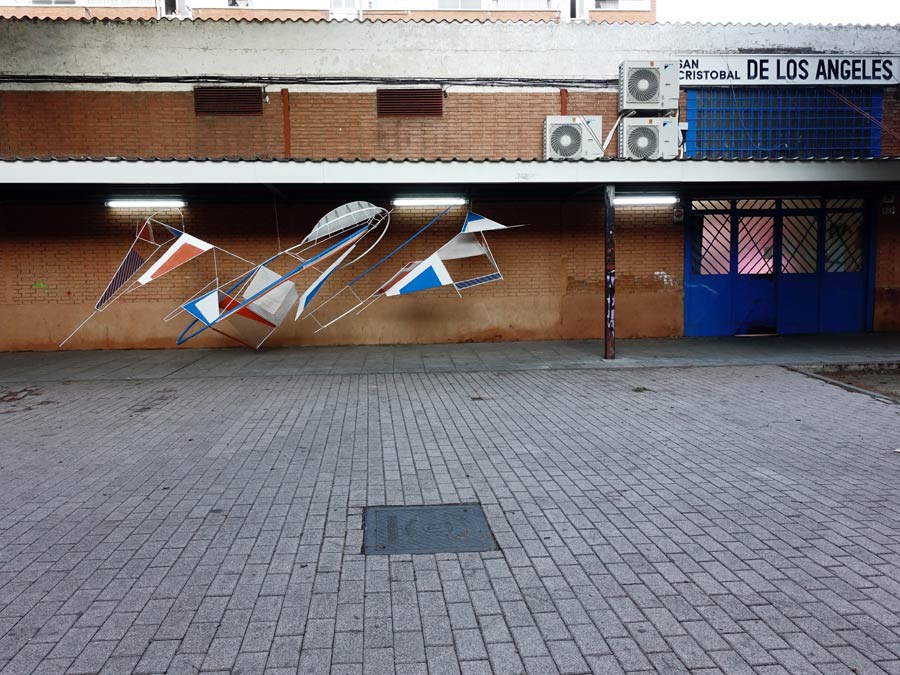
Artist Elbi Elem tells us that she and Sue975, Aida Gómez, Octavi Serra, Clemens Behr, Brad Downey and Marina Fernandez were living and working in this barrio in the southern part of Madrid for two weeks. Rather than “parachuting” in and immediately putting up a mural that has nothing to do with the city, she tells us that it was important to spend a week to get to know the barrio and the people.
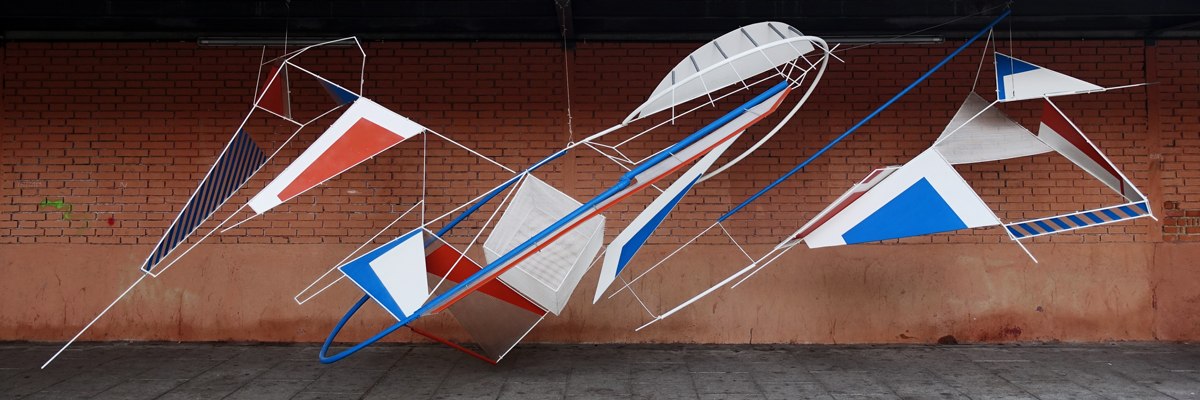
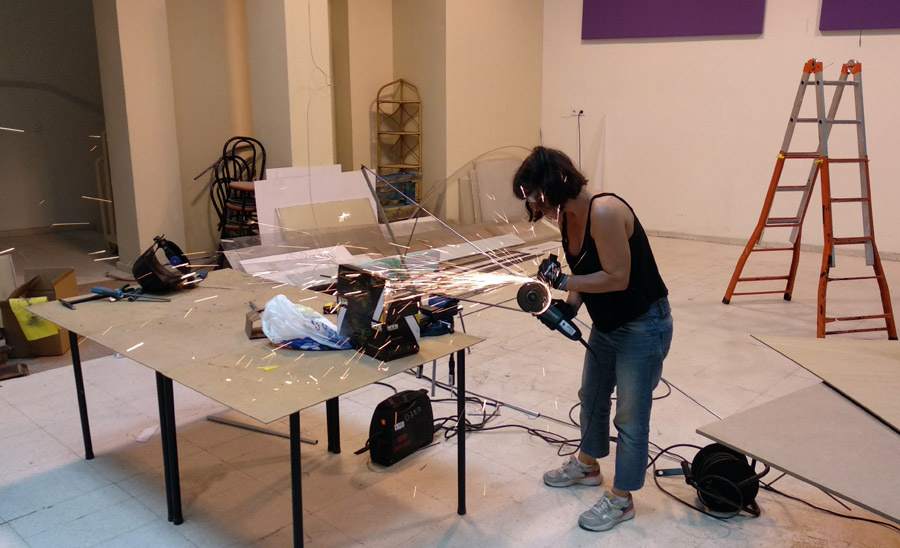
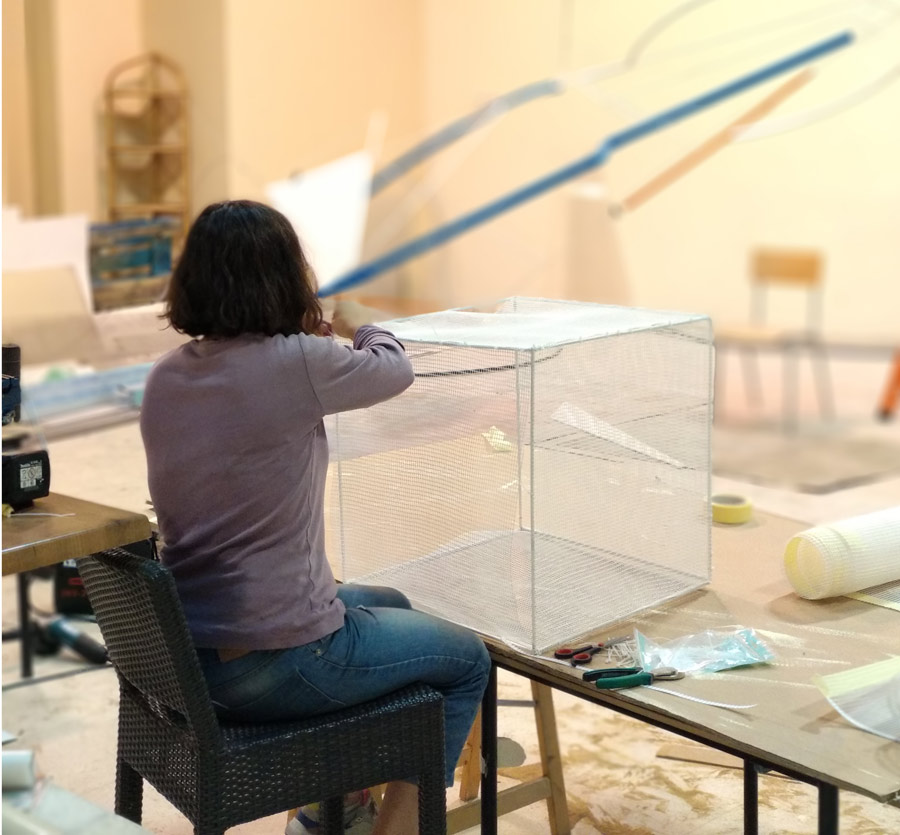
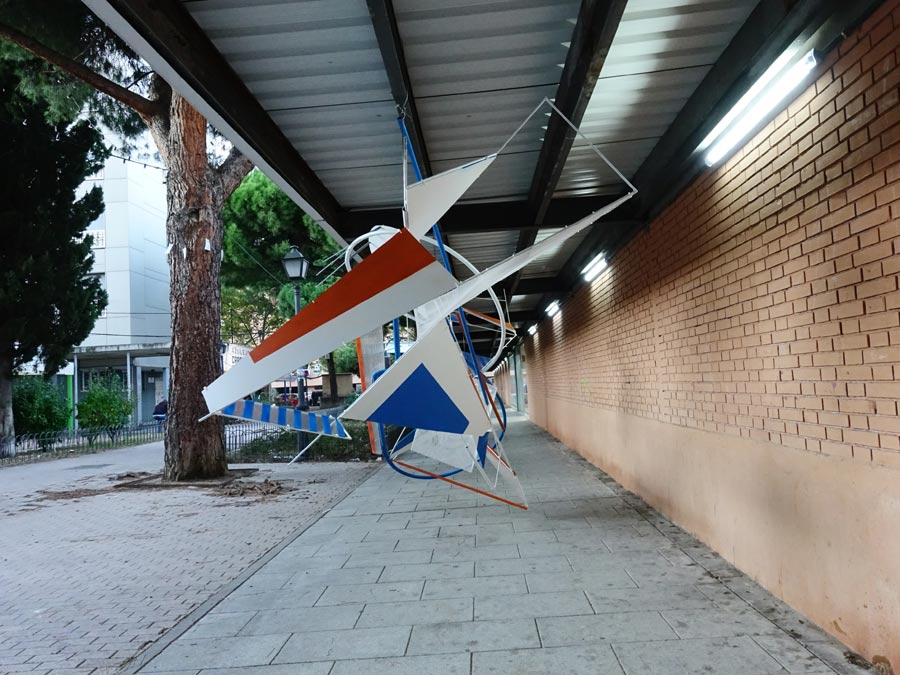
“Then we chose a location and got the materials,” she says of the recycled items with which she built this sculpture. “It is metal and mostly tubes and plastics that were found in abandoned places and waste from some factory of the industrial area that we were in – like plastics that had been used for signs or skylights.”
Officially running from October 1-20, Circular says that the entire concept is meant to reconsider the role of urban art in a city and to return its scope and proportions away from the enormous expanses we have been seeing on the sides of skyscrapers to something that is more, well, human scale. In addition to supporting themes such as sustainability and scale, organizers say they’re less interested in being a tool for gentrification or revitalizing areas for tourism, and more interested in bringing art to neighbors.
“By taking the festival to this area of southern Madrid, we contribute to the decentralization of culture in the city, to the democratization of art and to bringing it closer to all types of audiences,” they say in a description of goals.
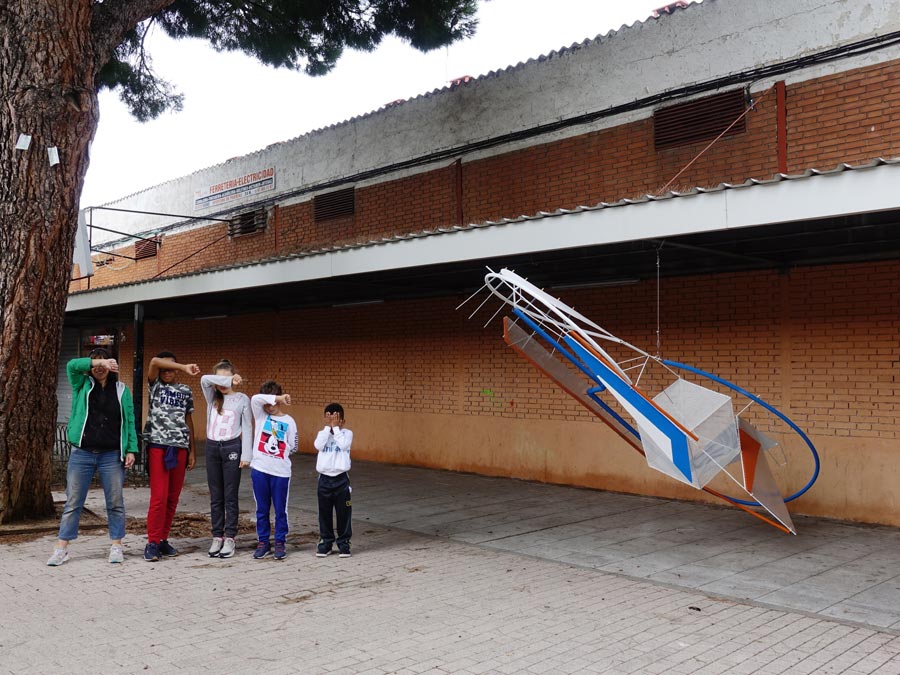
For Elem’s sculpture, which she calls a “floating art installation”, she welded the metal and tried to use colors that are natural to this human-made environment.
“At the same time the colors I used were also the same as the surroundings, being integrated with the landscape,” she says.
“I decided to work under this long-roofed area at the entrance of the main market. I liked the environment and the background and it was easy to hang the piece. I loved that place because you could see a lot of movement of people going to shop and it was interesting seeing their reactions,” she adds, “mostly of surprise.”
“Festival Circular” in San Cristobal de los Angeles, Madrid, is curated by Madrid Street Art Project.
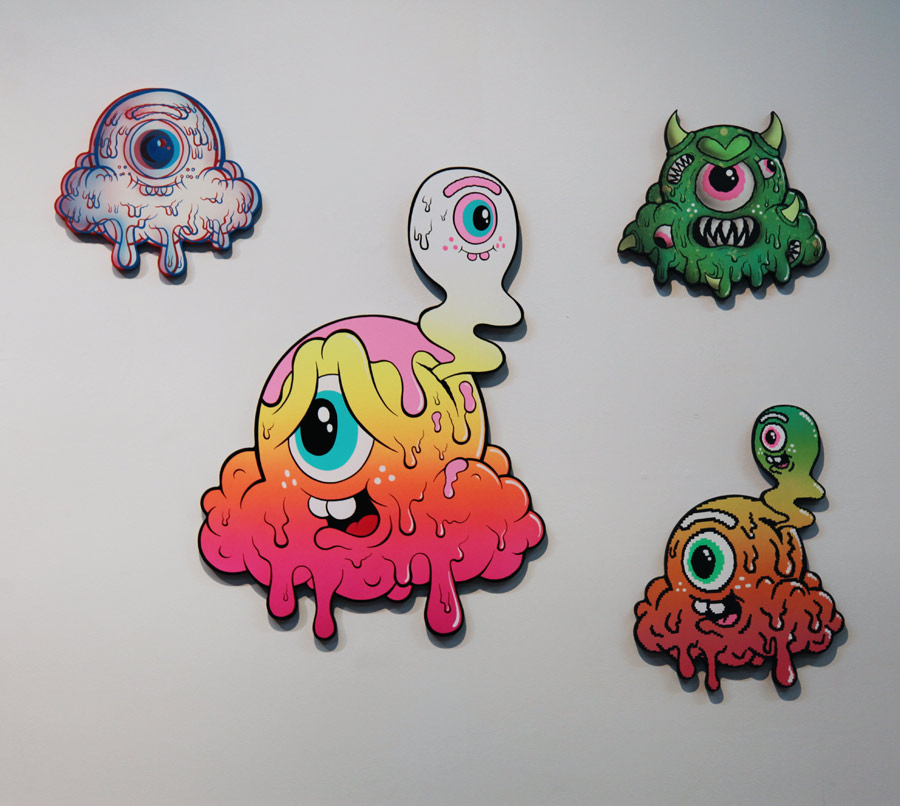
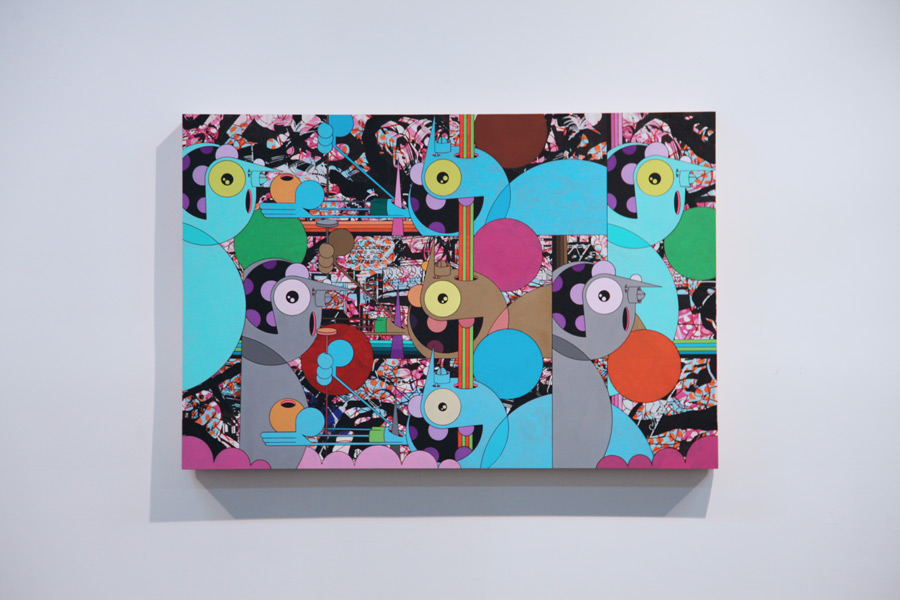
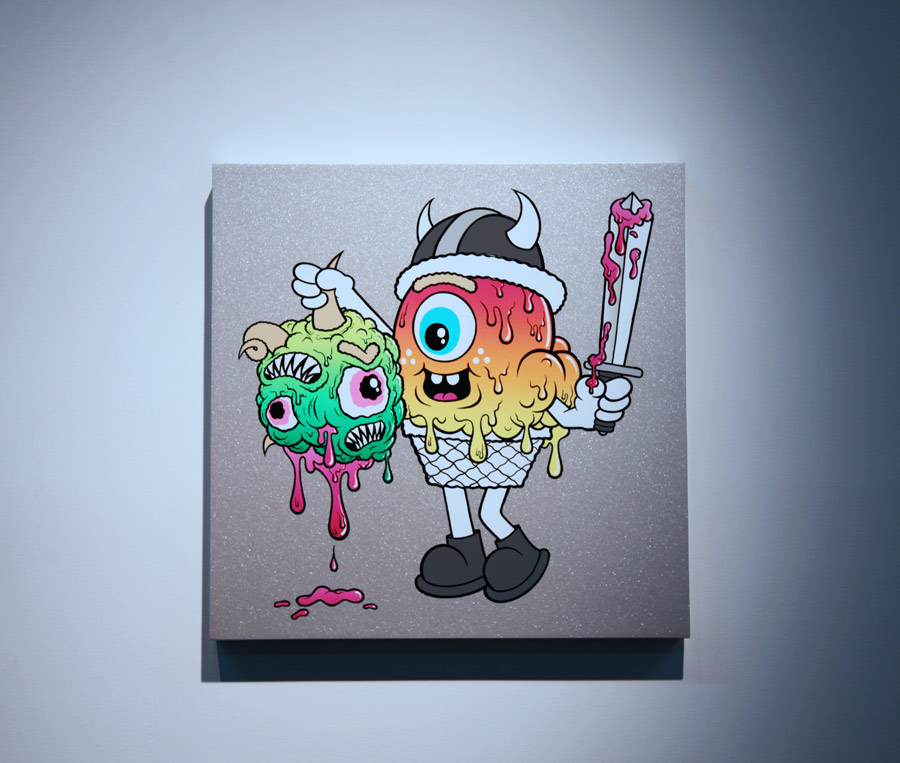
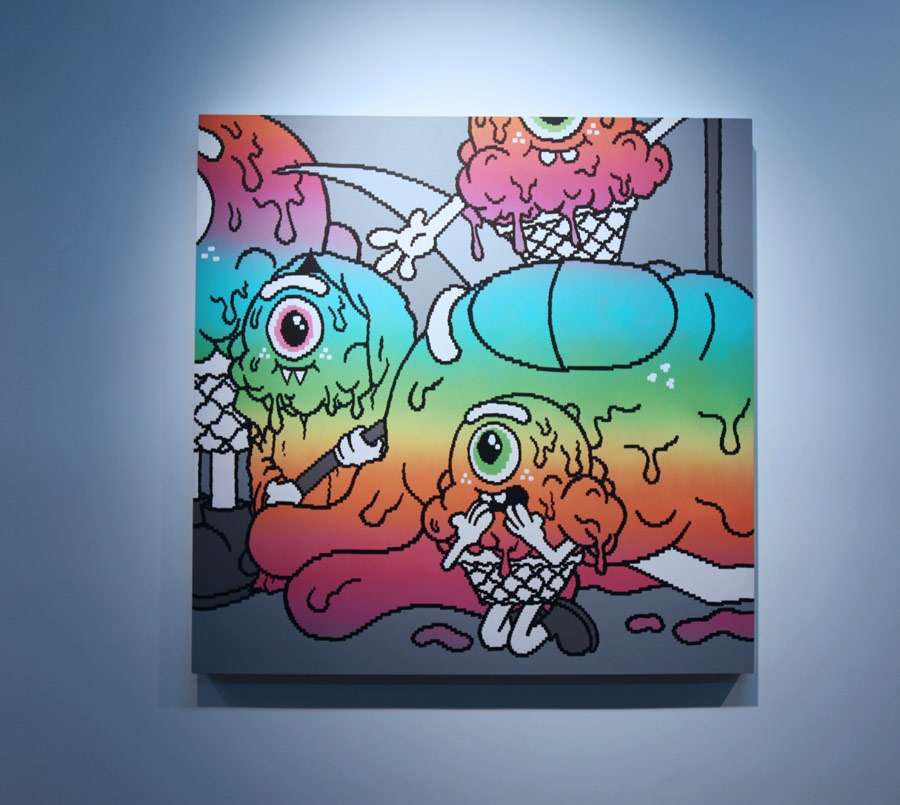
Dalek (James Marshall) and Buff Monster host
their second collaborative exhibition in as many years at GR Gallery in
Manhattan’s Lower East Side, sandwiched between the high art of the Bowery
Museum and the hungry and homeless people of the Bowery Street. A perfect
snapshot of inequality in modern New York, the neighborhood has not lost its
reputation in the last 10 years as a place for those desperate city folk with
no means – and those city folk who need to collect art for their homes.
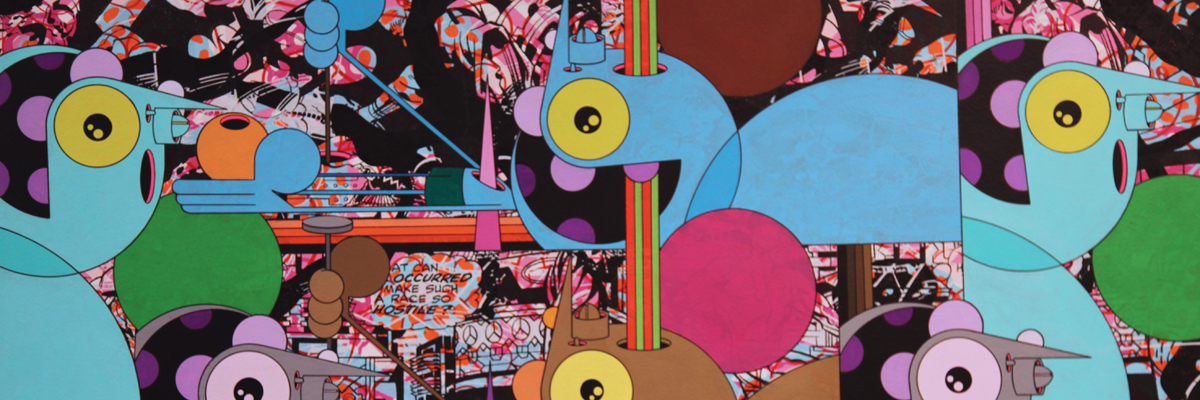
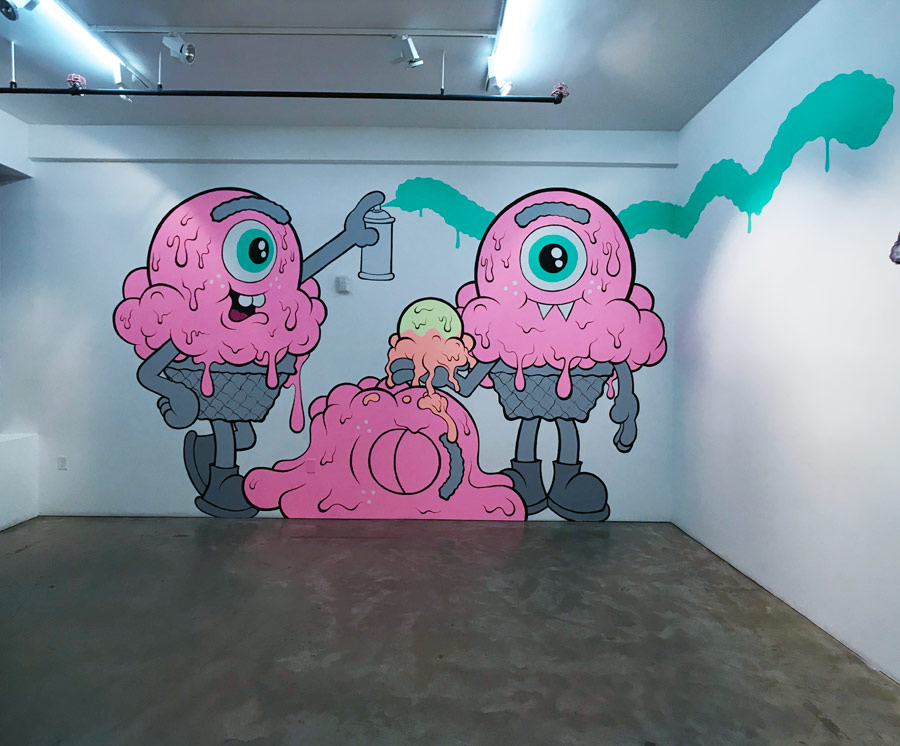
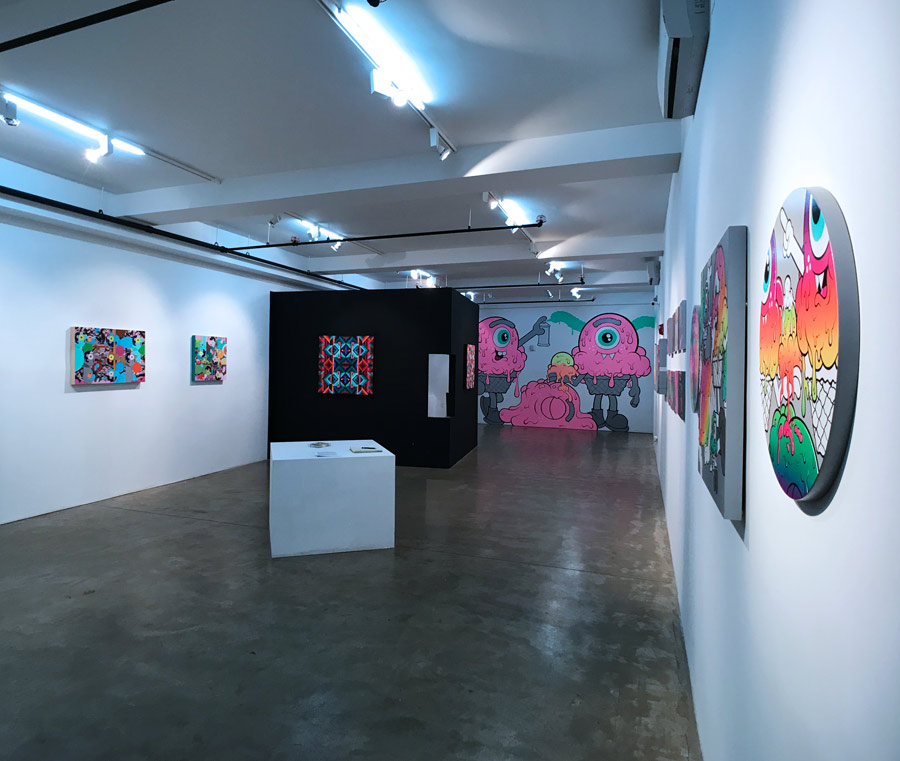
Here we find the escapist vocabulary of cartoons in both artist’s collections. Character-driven avatars of the street/mural/canvas painters themselves, the true emotions and predilections of Dalek’s “Space Monkey” and Buff Monster’s “Melty Misfits” are hidden under the sugary gloss of pop and sharply defined graphic styles.
The influences are sometimes overlapping, but each takes their tips from slightly opposing signposts on the commercially cartooned metroscape – scenes of cosmic war and ice cream and cleverly digital labyrinths cavorting in the clouds floating around the many mansions of Murakami and Harajuku.
The 30 pieces, including paintings, works on
paper, site-specific installations, are an afternoon’s respite from the roar of
traffic and construction and grey particulate matter flying in the air outside,
a serene laboratory for experimenting with new creative impulses and fantastic
narratives, brightly lit. It is a combined wit, a shared attraction to a “Surface
Fetish.”
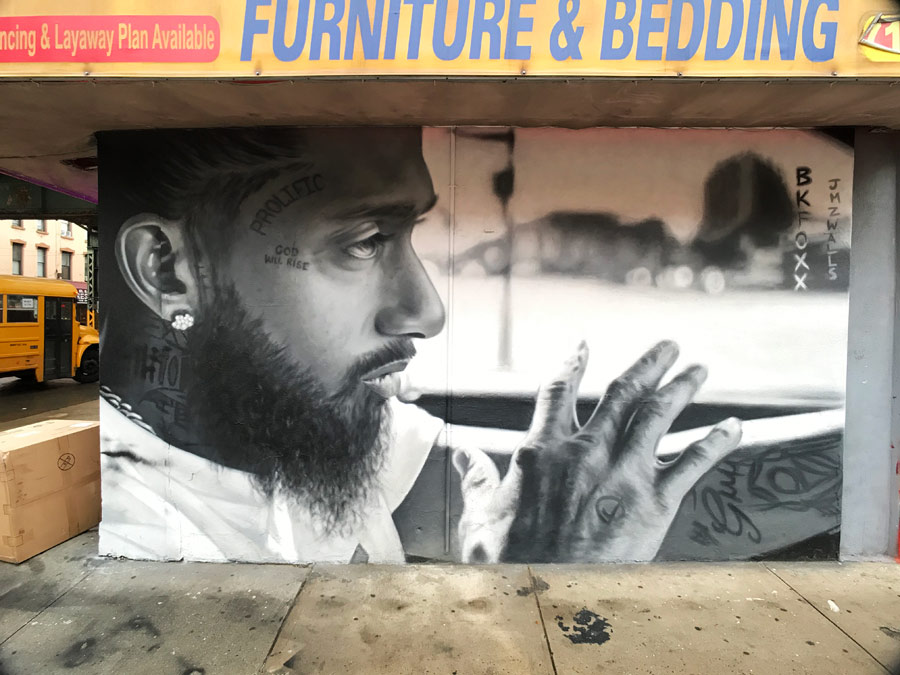
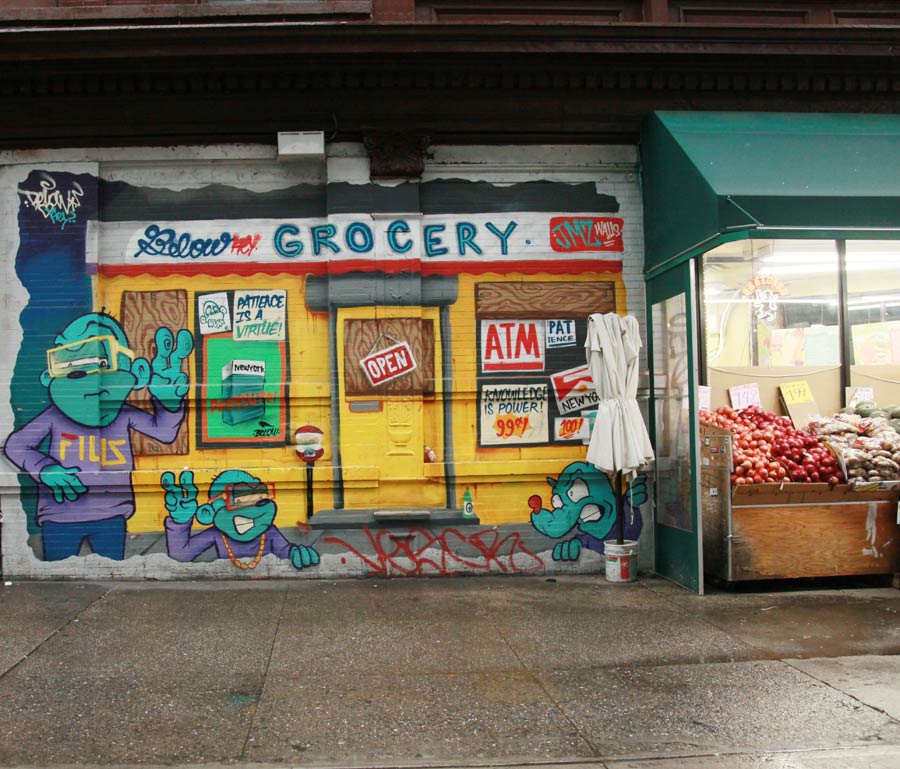
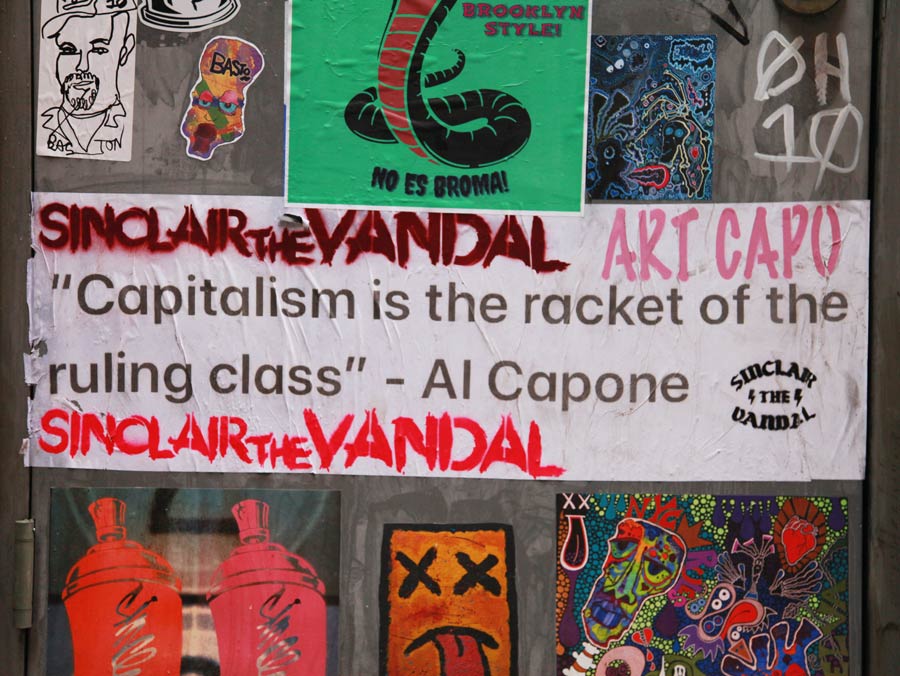
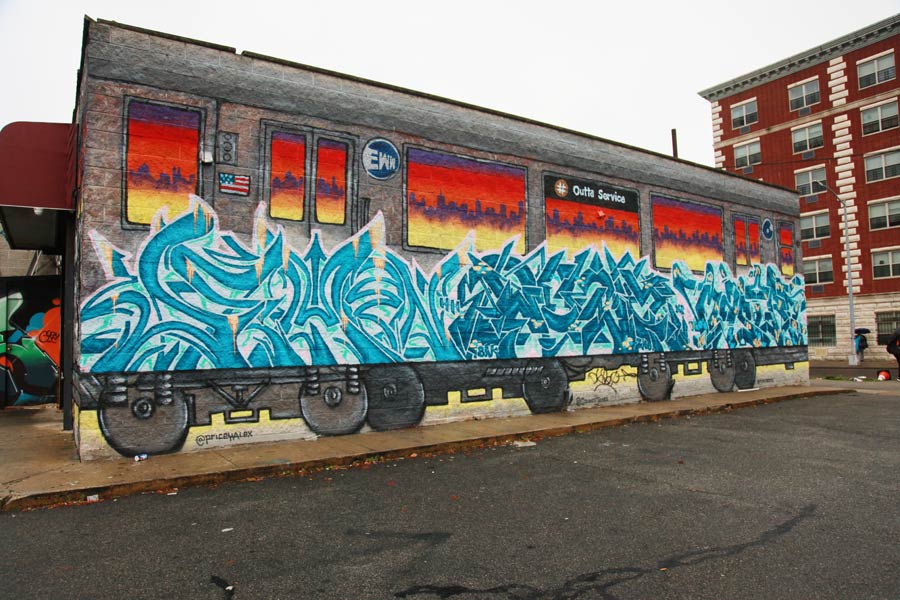
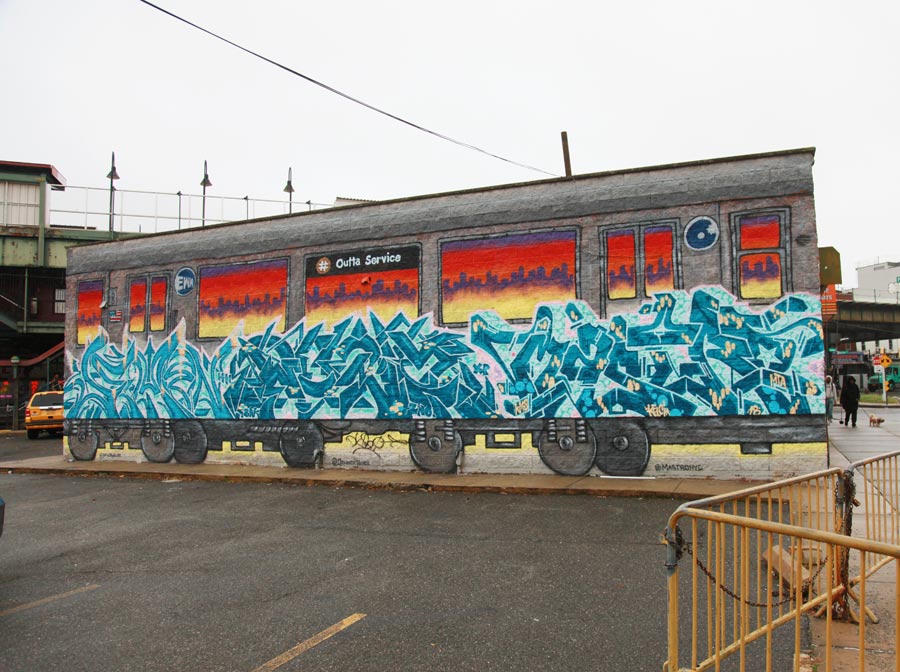
Here’s our weekly interview with the street, this time featuring Abe Lincoln Jr., Adam Fujita, Alexcia Panay, Anthony Lister, Below Key, BK Foxx, Bobby Hundreds, Downer Jones, Dragon Art, Hops Art, Maia Lorian, Mastro NYC, Muebon, Pricey Alex, Shiro, Sinclair the Vandal, VKrone, and Want.
Aerosol in pursuit of the “Masters” (Eurocentrically speaking) is a permutation of Street Art and the mural making tradition going back decades, including murals made directly by “Masters” (Latino-centrically speaking) like Rivera or, say, those of the Olmec civilization in the pre Hispanic period, for example. In the last decade Frenchman and Street Artist Julien de Casabianca has documented, printed, and wheatpasted large-scale reproductions from classical painting upon city walls as part of his “Outings Project” in multiple countries.
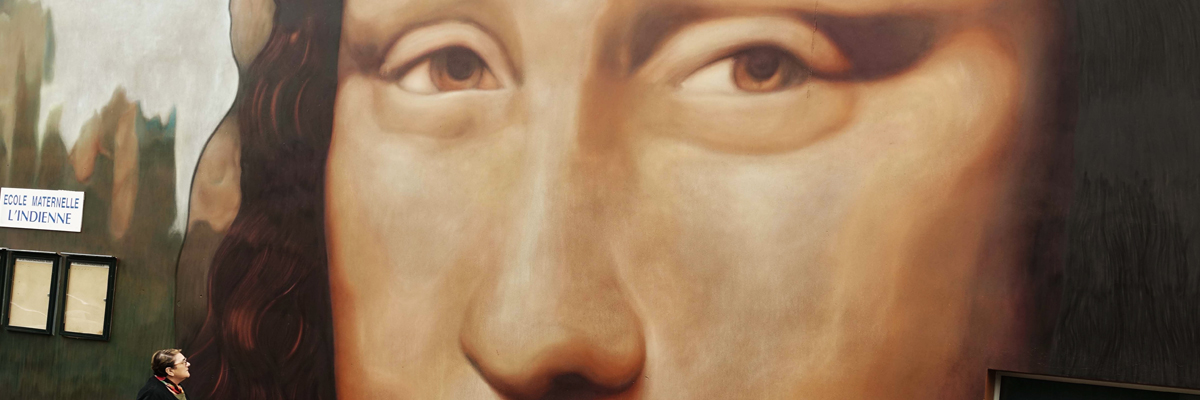
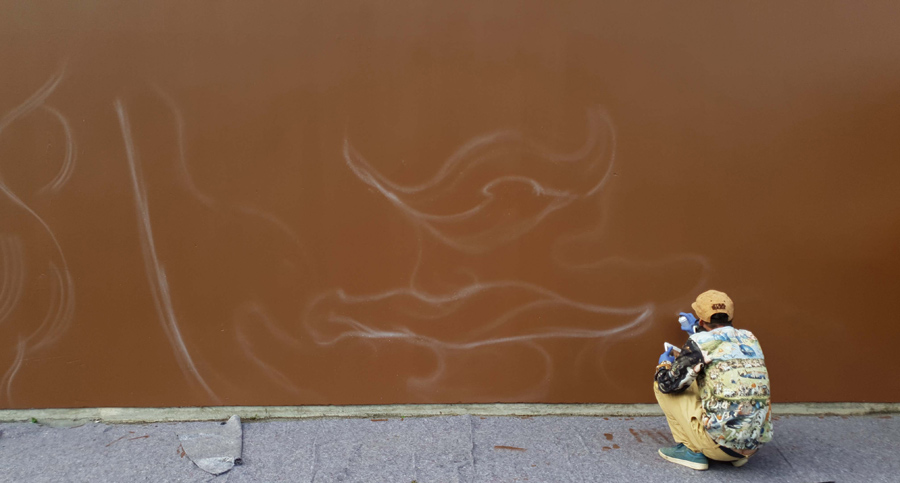
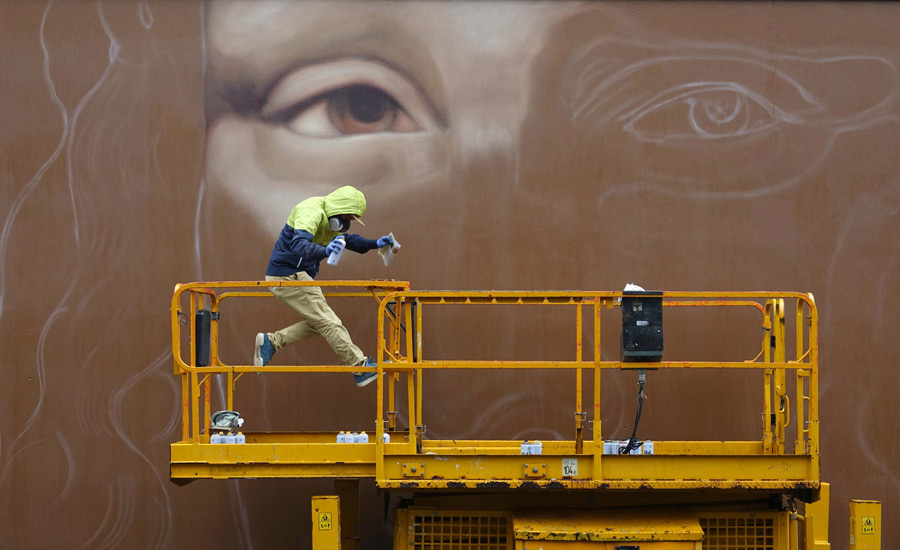
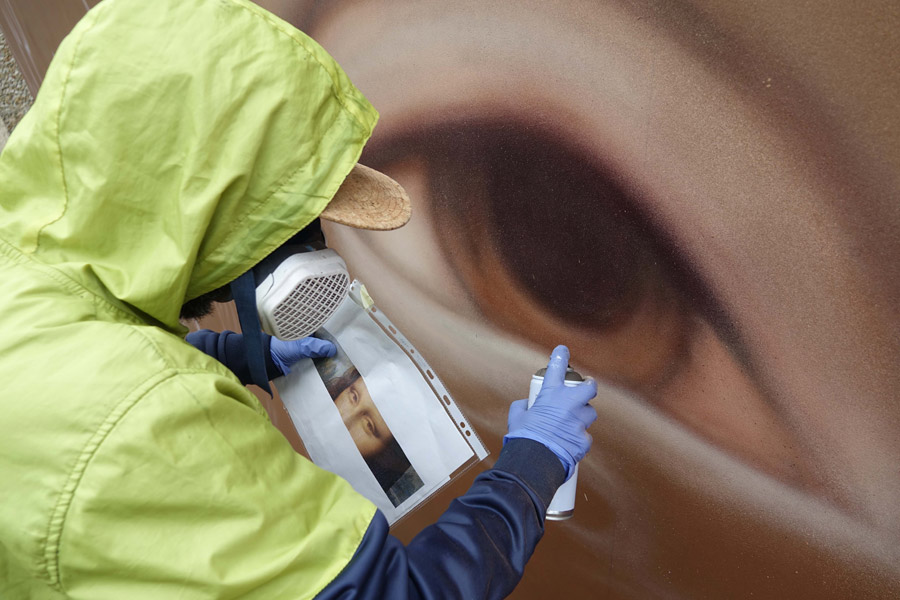
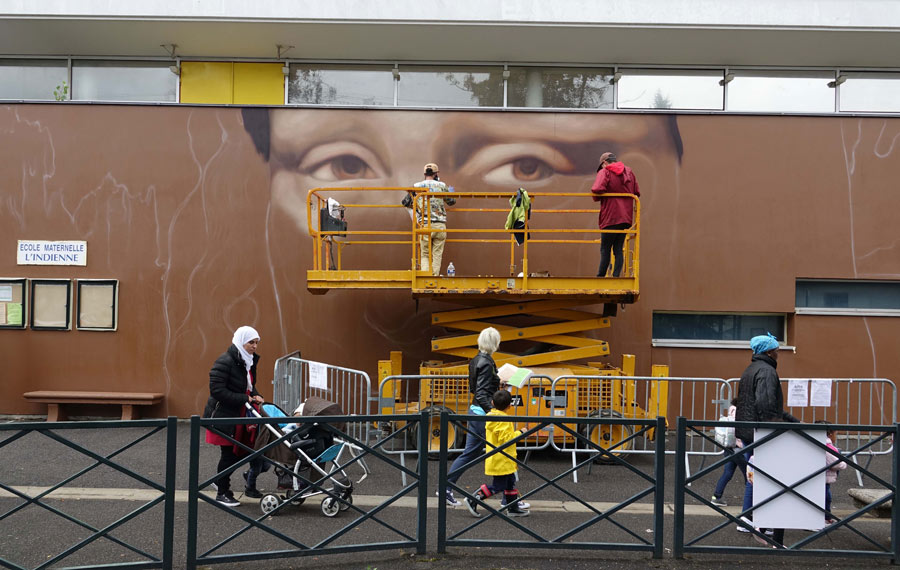
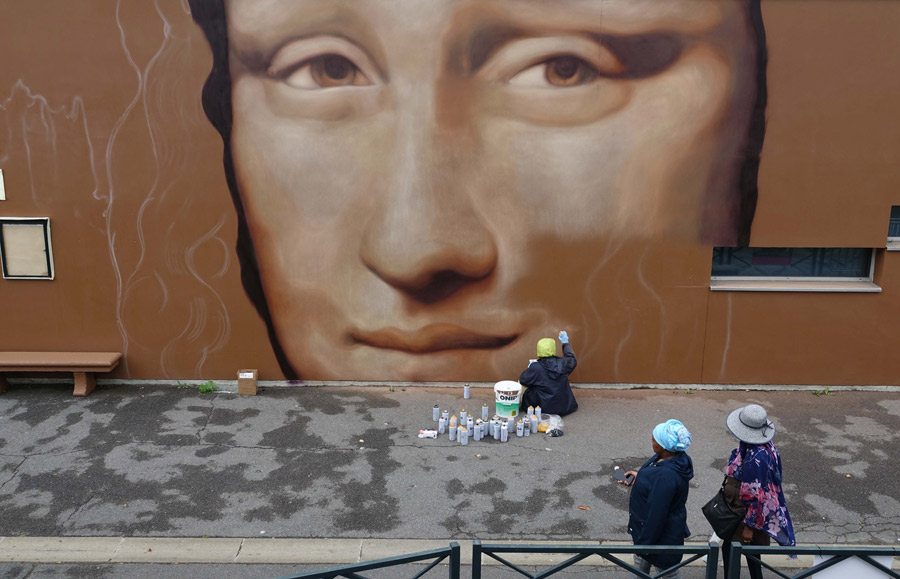
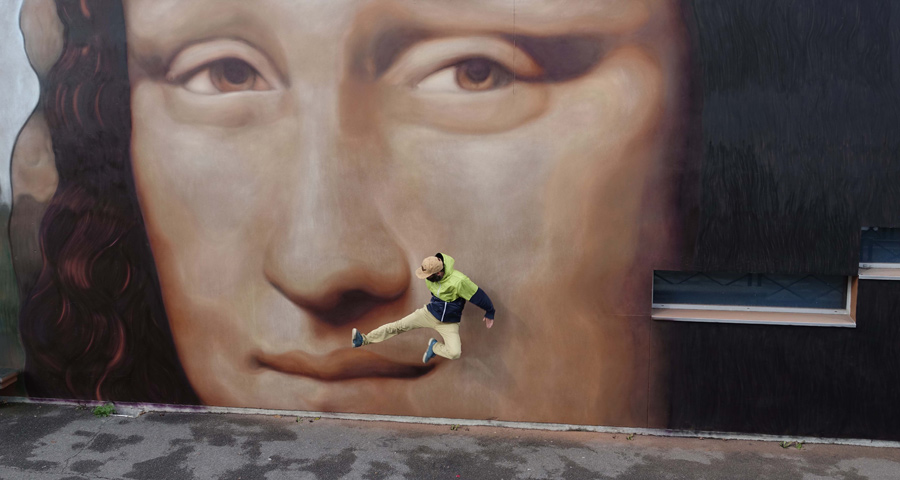
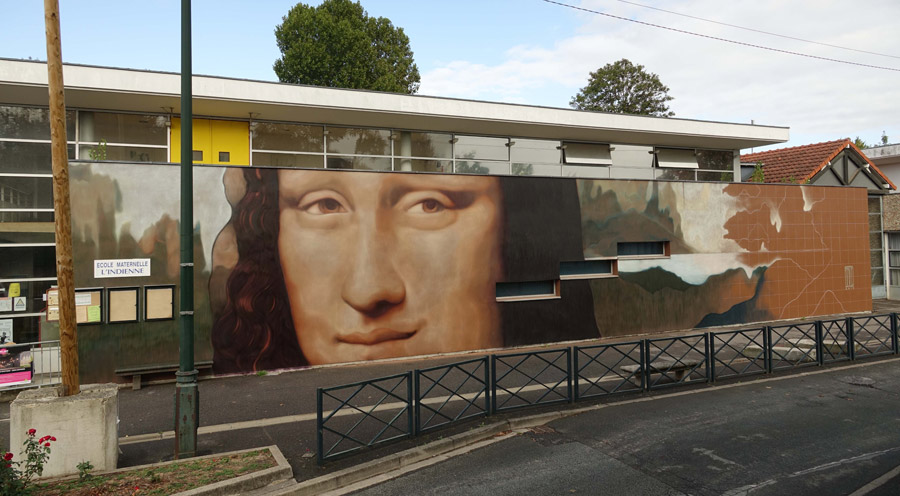
Today we see an Italian former graffiti writer who went to university to study fine arts in Milan take his aerosol spray technique to a wall in Corbeil-Essonnes, France (population 50,400). Painted as part of the ongoing “Wall Street Art Festival”, the new mural may inspire the next generation of artists here as well.
Andrea
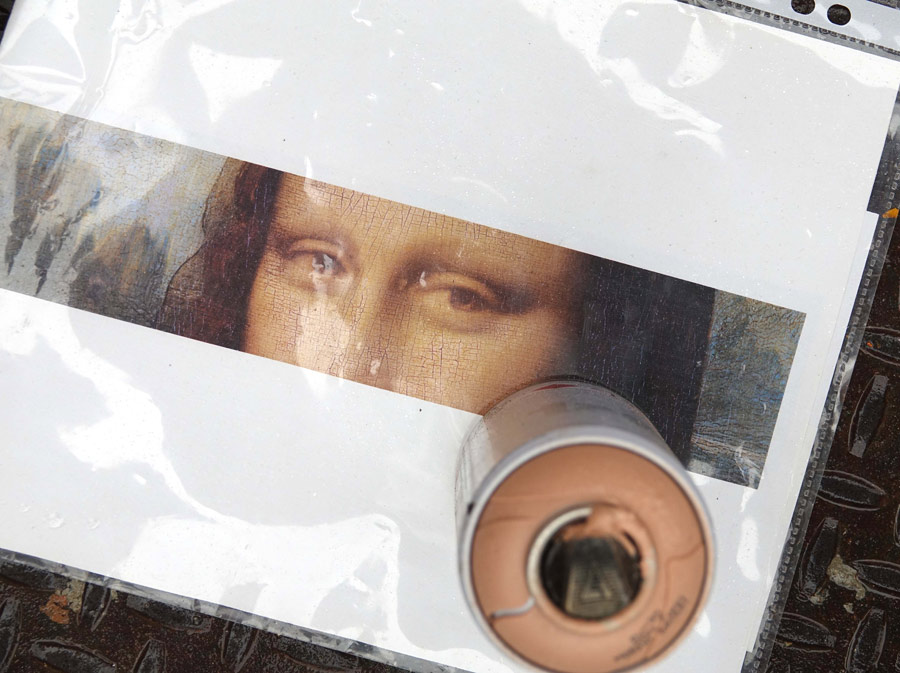
“RAVO” Mattoni sings praise to a slice of Mona Lisa on this school building as
his reinterpretation of Leonardo da Vinci’s original, which is much smaller, hanging
in the Louvre Museum about an hour’s drive north of here. The 38 year old
artist, who was born in Varese and comes from a family of artists, including
his father and grandfather, decided to leave the painting as an in-process “unfinished”
work that shows a grid pattern and da Vincis background color for educational
purposes.
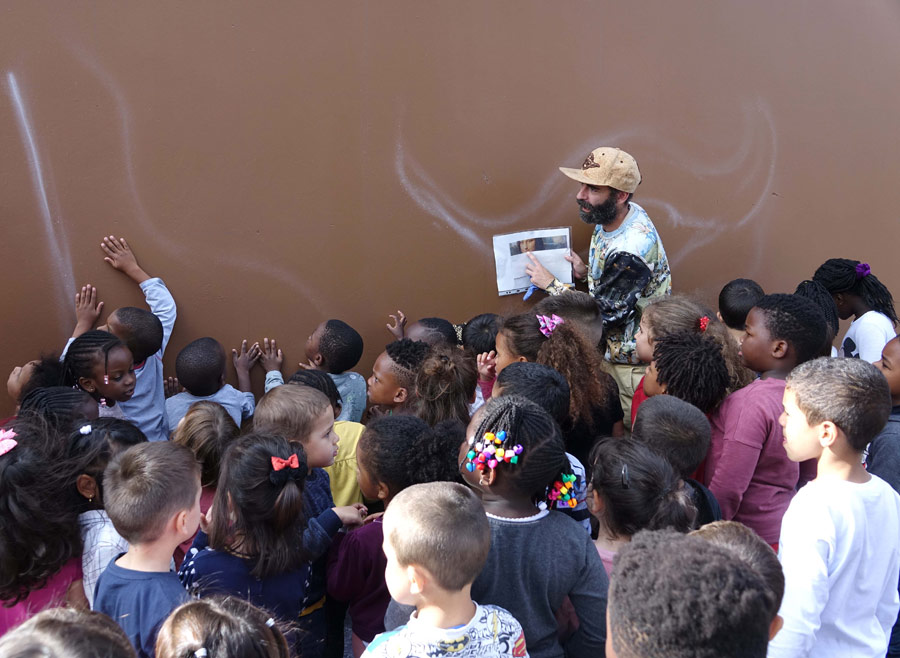
“It
is a good teaching aid for the school’s teachers,” says the walls’ artistic
director, the gallerist Gautier Jourdain, “which they now use to explain the
process to their students.”
If Gautier had any doubts about Mattoni’s qualifications with the spraycan, he was likely persuaded by the artist’s Caravaggio reproduction on the side of the Gemelli Hospital in Rome two years ago. More recently, as part of the 500th anniversary of Leonardo da Vinci’s death, the artist created 5 large paintings at the Château d’Amboise. So this is number 5.5 perhaps.
Our weekly focus on the moving image and art in the streets. And other oddities.
Now screening : 1. Paradox and CPT. OLF and Daredevilry in Berlin 2. The Tunnels. Nuart Festival 2019. A film by MZM Projects 3. Post-graffiti artist Jose Parla for ‘Isthmus’ in Instabul
BSA Special Feature: Paradox and CPT. OLF and Daredevilry in Berlin
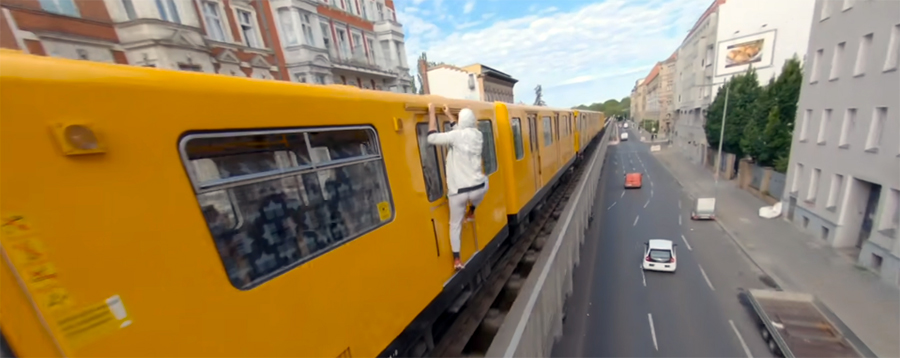
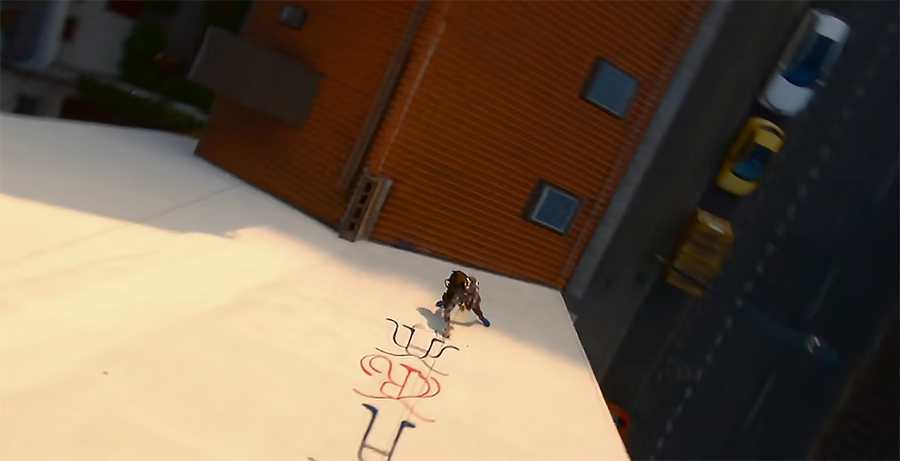
In the videos featuring daredevilry, parkour and graffiti the Lengua Drona has been adding words to our visual vocabulary that were once reserved for extreme sporting, National Geographic docs, Crocodile Dundee and James Bond.
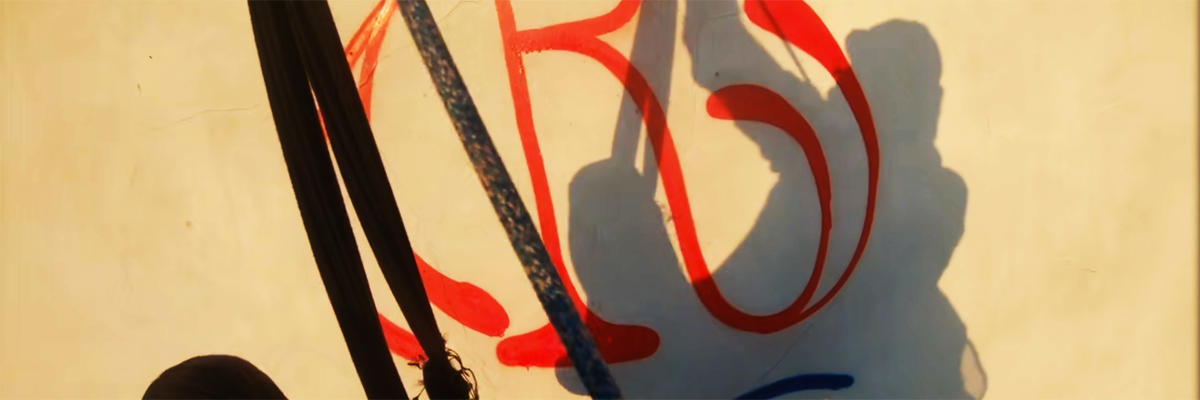
Now the pixação writer and urban climber, Paradox releases unprecedented adventure footage and editing from photographer CPT. Olf, and its sending shockwaves.
Somehow this is a new way to synthesize wall-climbing and train surfing; positioning it as a visual and audio symphony that almost makes you forget that these are graffiti vandals “fucking the system”, pushing their limits – and yours.
As you thrill to these evolving genre-combining aspects of Oleg Cricket, 1Up Crew, Berlin Kidz, and Ang Lee, it’s important to realize that these are real risks that people take that could result in serious injury, death, and rivers of grief if a miscalculation happens. So, yeah, we’re not endorsing the irresponsible risks or a mounting “arms race” of stunts, but we are endorsing the athleticism, imagination, and sheer slickness of this FPV drone mastery, which appears to have taken this stuff up another level.
Hold tight.
Currently Paradox is on exhibition at Urban Spree in Berlin, a show that we hope to see soon and pick up our own copy of “CPT.OLF 16-19”: The Photobook, published by Urban Spree Books in October 2019
The Tunnels. Nuart Festival 2019. A film by MZM Projects
A positioning in text, a re-strung manifesto for a moment from the past, now revisited in your Nuart or Nuart Aberdeen branded t-shirt. Here is the work in the tunnels of Tou Scene, unfolding before you by Ukranian directors and street scholars Kristina Borhes and Nazar Tymoshchuk. It’s a beehive of activity as participants in this years’ event in Stavanger, Norway create their installations in preparation for the big opening.
“This film is a journey,” explain the directors/authors/poets/narrators, “it is moving backward from the last 7th tunnel until the introductory Tunnel Zero in order to show the development of the movement with its modern variety of artistic practices and the parallels with the past.”
Brand New, You’re Retro, that 90s jam from Tricky, is presented here as a doorway to pass through to get to the 70s and then to return through to see the last moments of the 10s. Here is open rebellion against a system that suckers you in, gives you succor, sucks you, and regales you succulently with a promise. Sung by angry hopeful canaries in the coalmine, here are some winners and losers, as ever. Shout out to Yatharth Roy Vibhakar for a splendid soundtrack that is glitchy and timely, of this time.
Post-graffiti artist Jose Parla for ‘Isthmus’ in Instabul
Jose Parla is not a Street Artist. He’ll tell you that himself. Here he presents himself as a post-graffiti artist in Istanbul. You may also see possible labels of public artist, artist working in public space, muralist, studio artist, sculptor, contemporary artist, gestural abstractionist, pottery designer, decollagist a la Villeglé – taking posters from the street and applying to canvas. Here you follow him in the streets as he creates his “first-ever exhibition in Turkey, inspired by the word ‘ISTHMUS,” consisting of a new body of works on paper, paintings, sculptures and ceramics.”
Happy Halloween! It’s going to rain on all the Trick or Treaters in the streets in New York tonight. Nevertheless, ye olde drizzle and mist doesn’t really put a damper on the eerie festivities, including the East Village Halloween Parade, which is reliably a misshapen, humorous and frightening mess of creativity, imagination, psychiatric therapy, music, and theatrical spectacle; all of it careening through the sloppy streets for your pleasure.
This holiday used to be only for children and art-inclined weirdos, now its cosplay across the nation with children of all ages are in costume on the subway, on the bus, in line for pumpkin-spice latte.
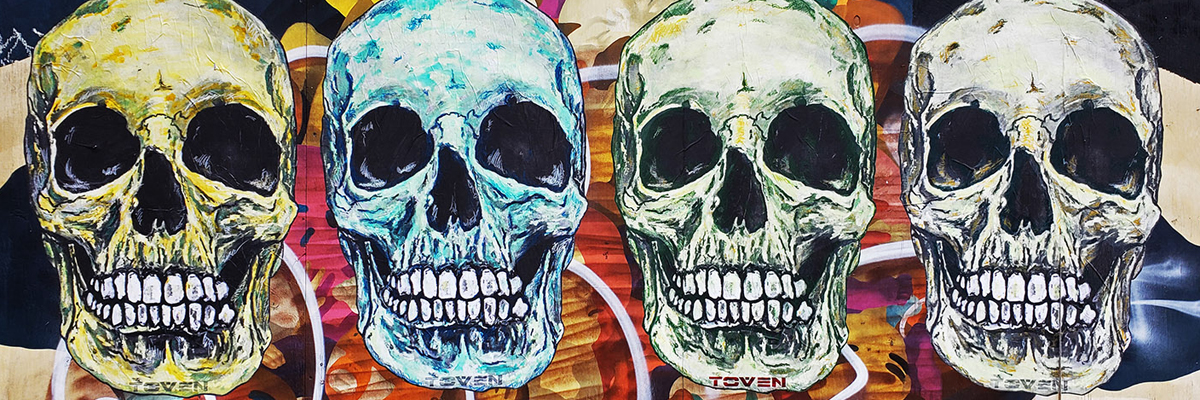
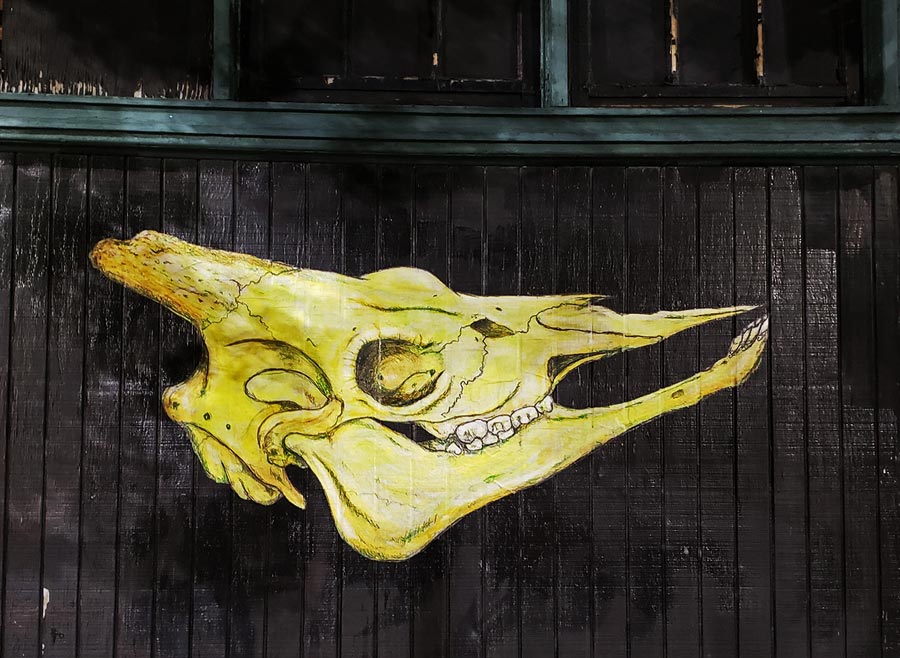
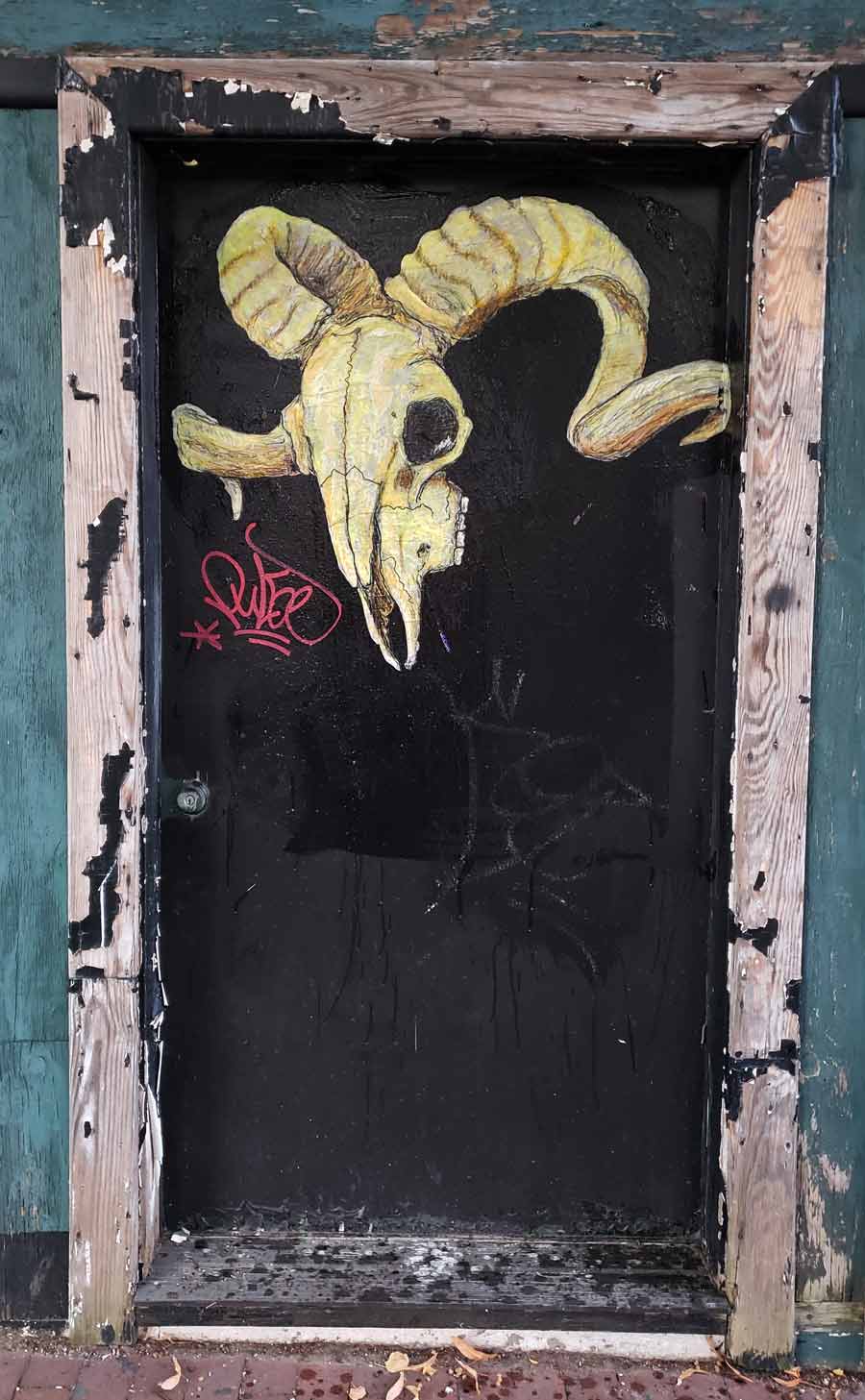
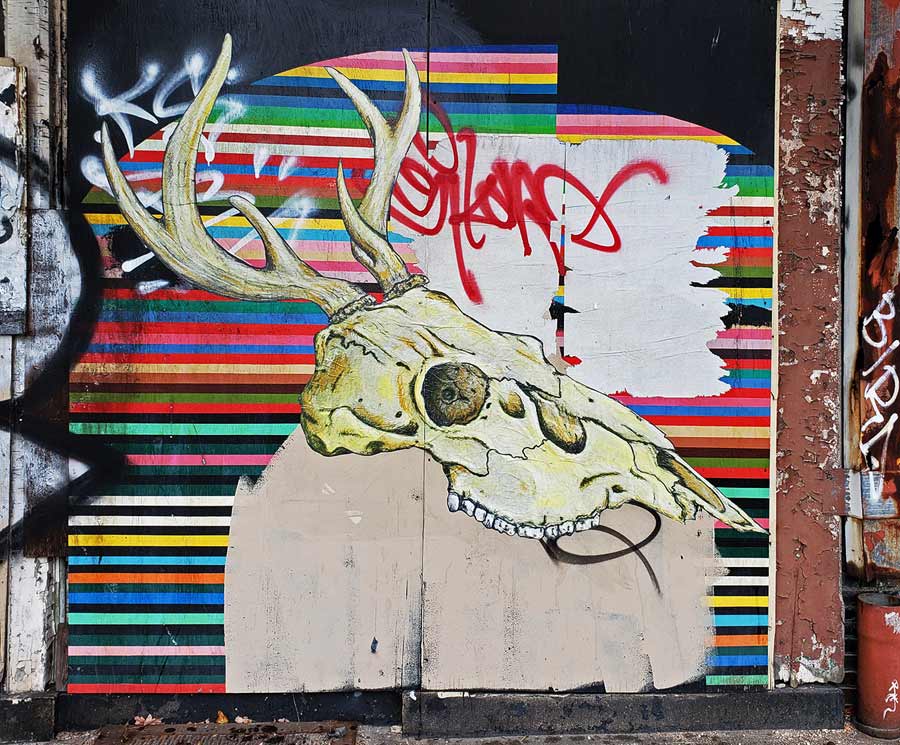
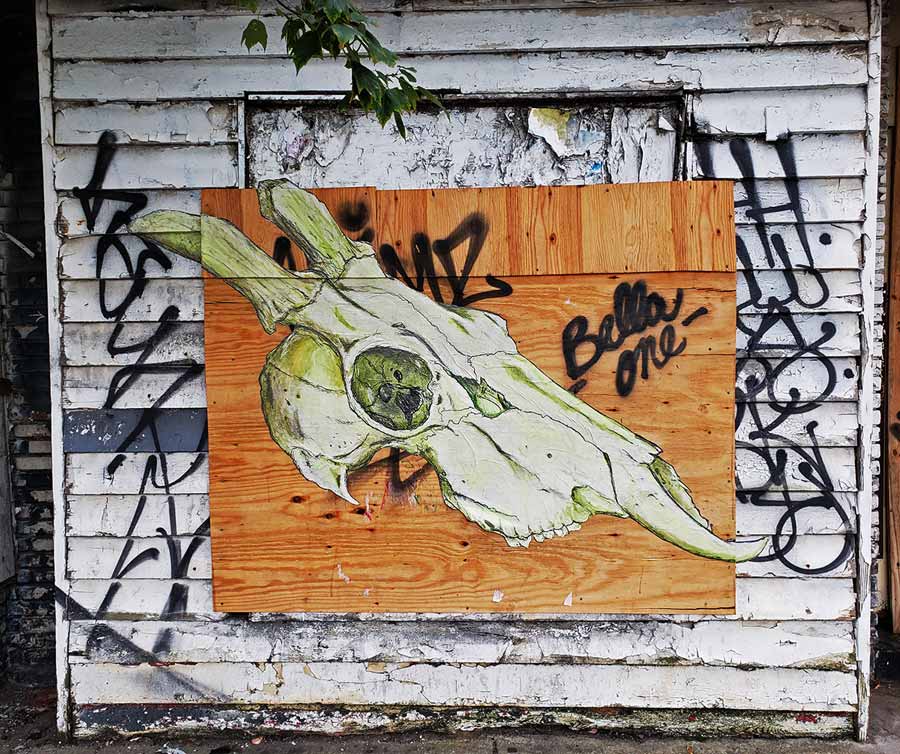
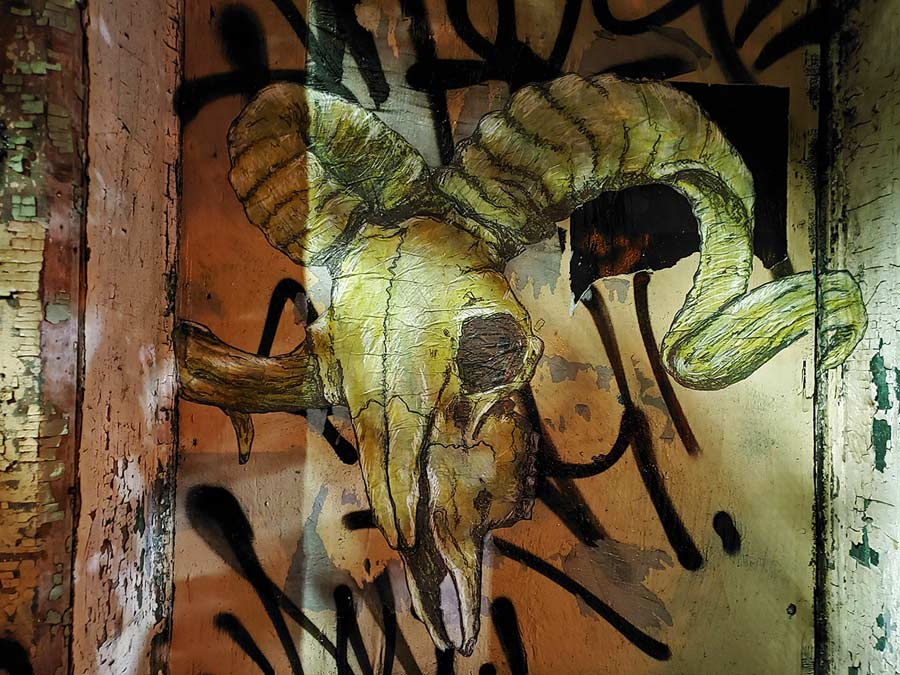
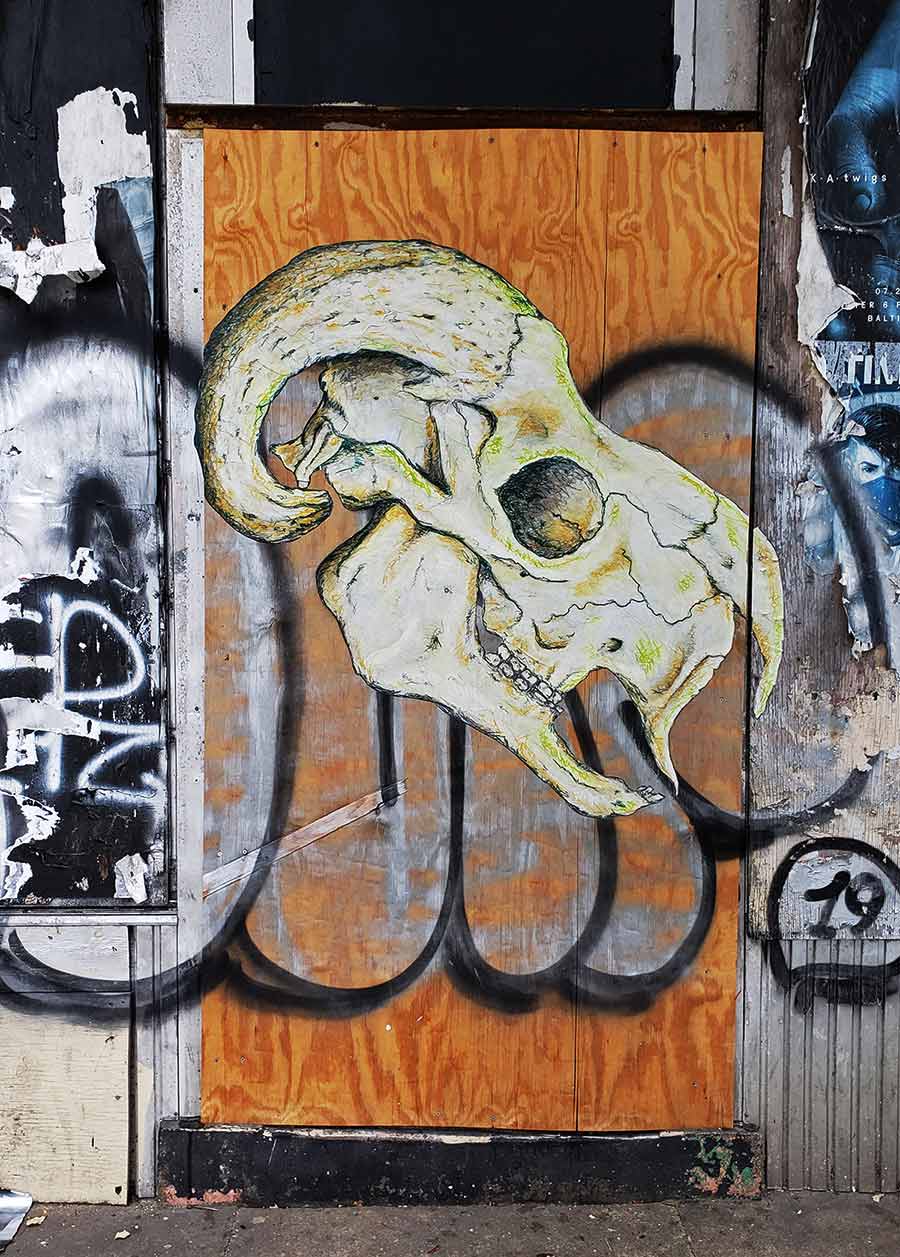
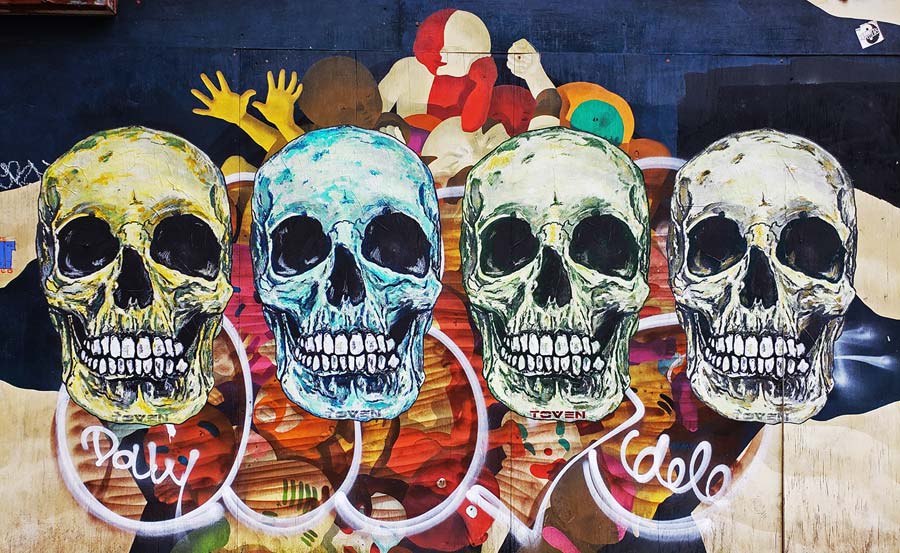
In Baltimore Street Artist TOVEN has made plenty of preparations for you: cheerful and possibly unsettling skull wheatpastes for you to see out of the corner of your mask as you run door-to-door asking for candies.
Nothing to lose your head about, but you’ll be thrilled
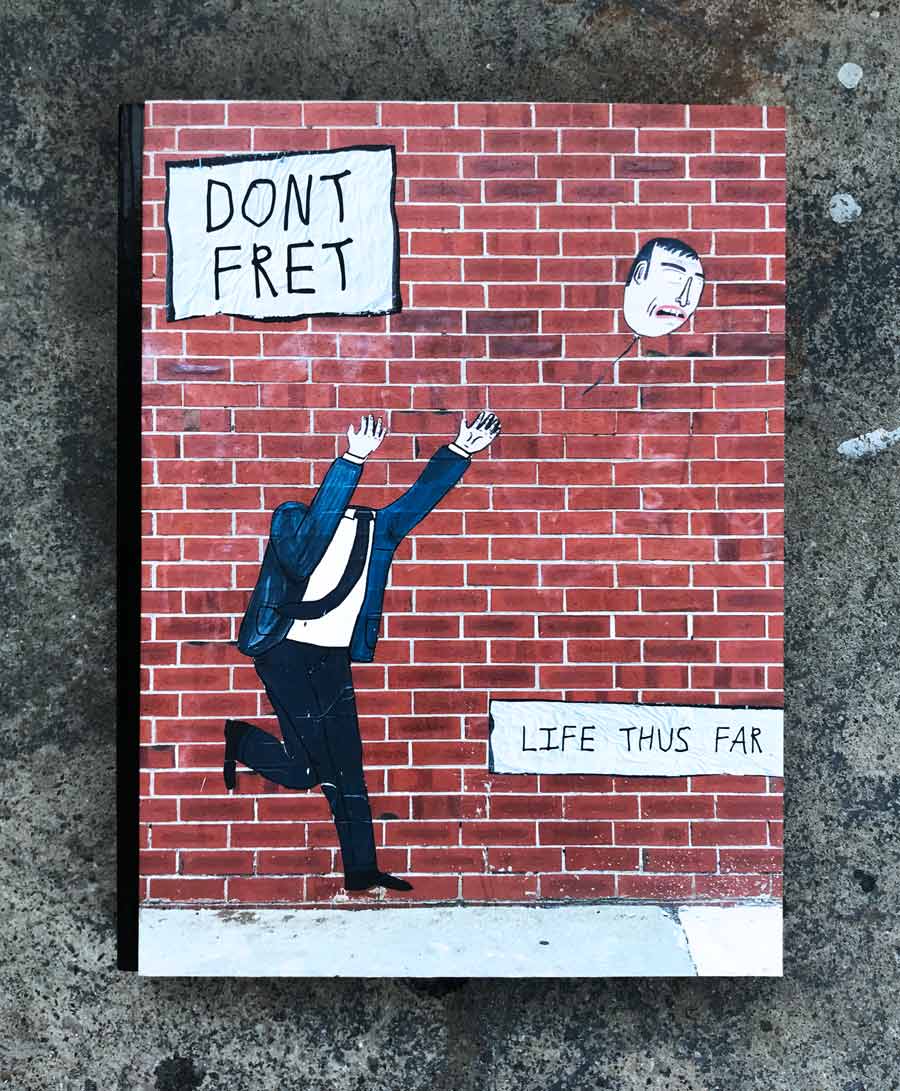
to hear about the long-anticipated release of the new monograph by the
ingenious troublemaker and largely incognito Chicago Street Artist DONT FRET.
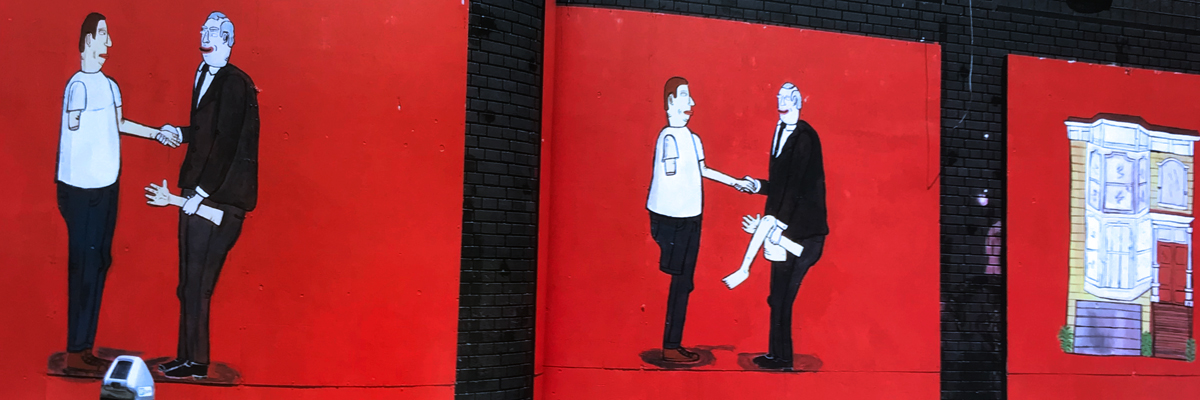
Emerging on the streets for a decade or so with painted wit and misshapen characters wheatpasted where you least expect them, he’s the sharp observer and human humorist whose work is as brilliant as your cousin Marlene, as funny as Johnny at the funeral home, as handsome as the guys behind the counter at Publican Quality Meats.
Well,
maybe not that handsome.
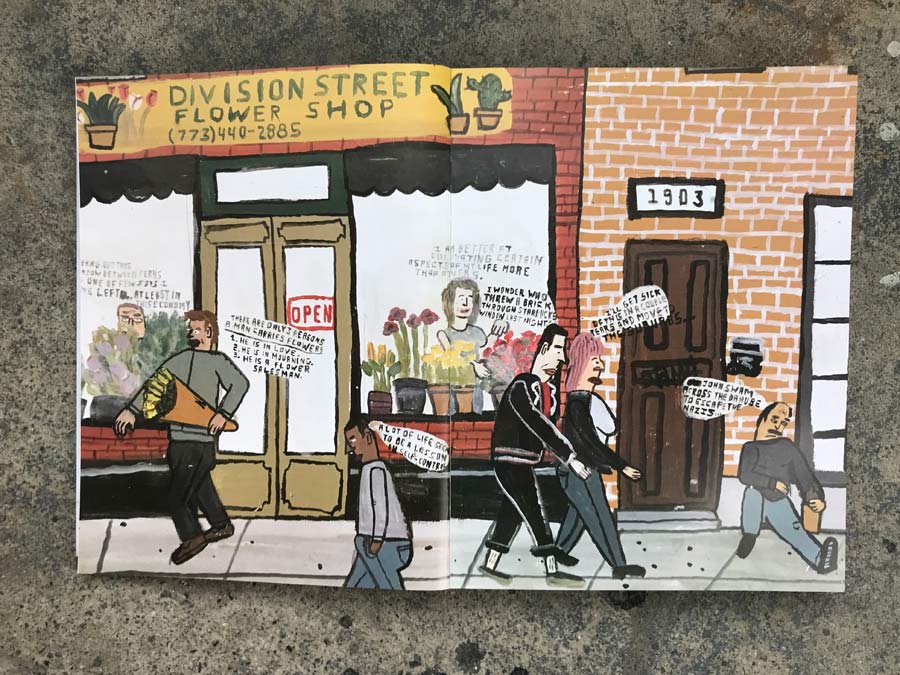
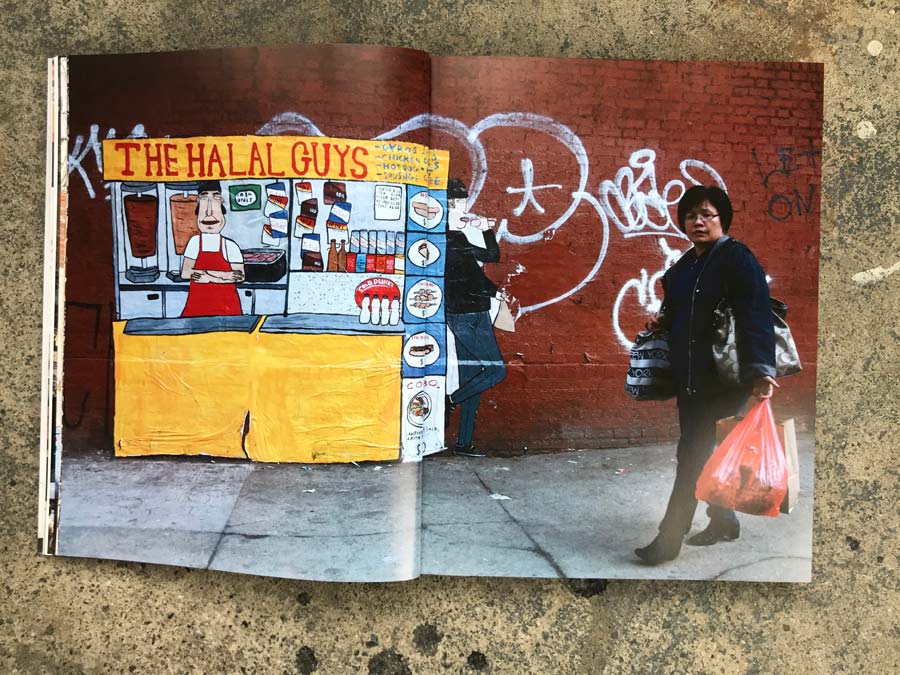
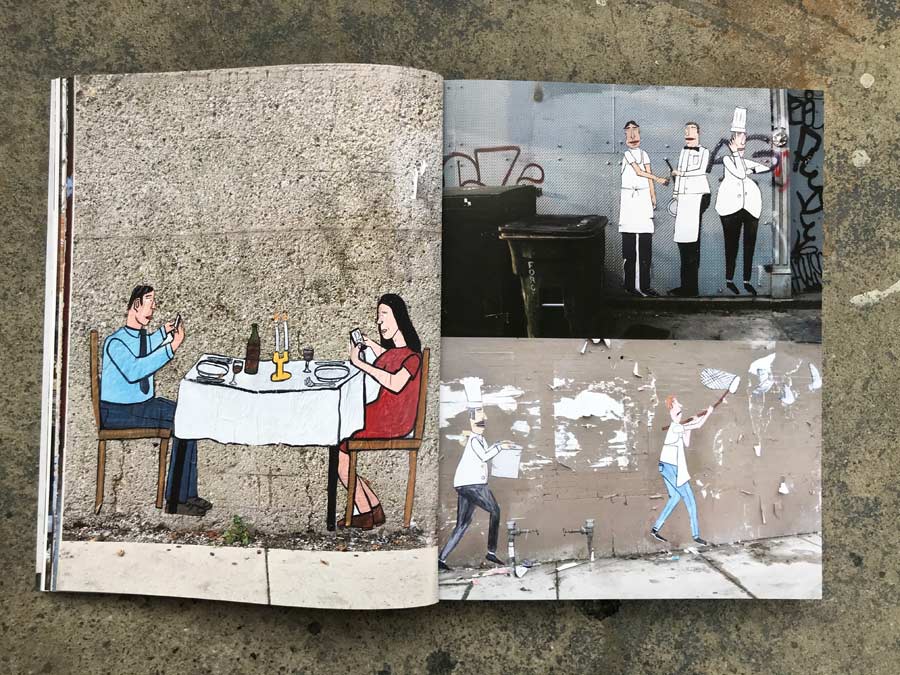
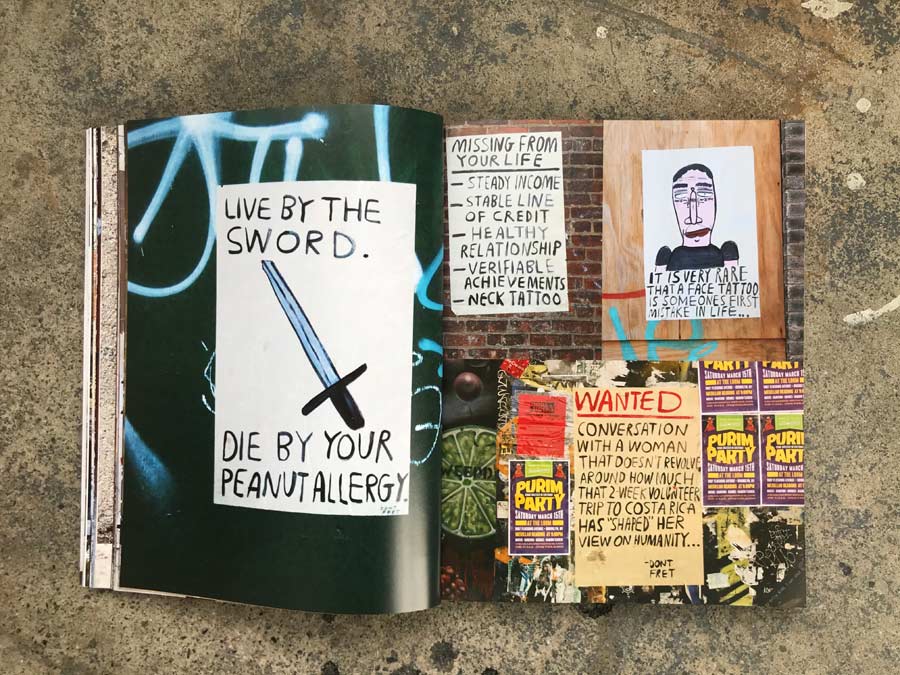
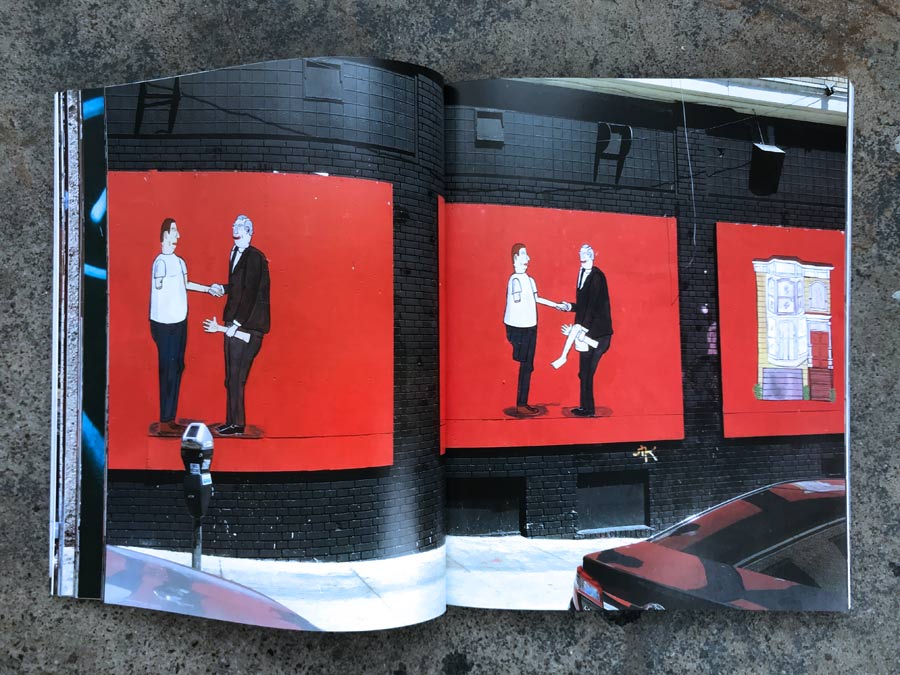
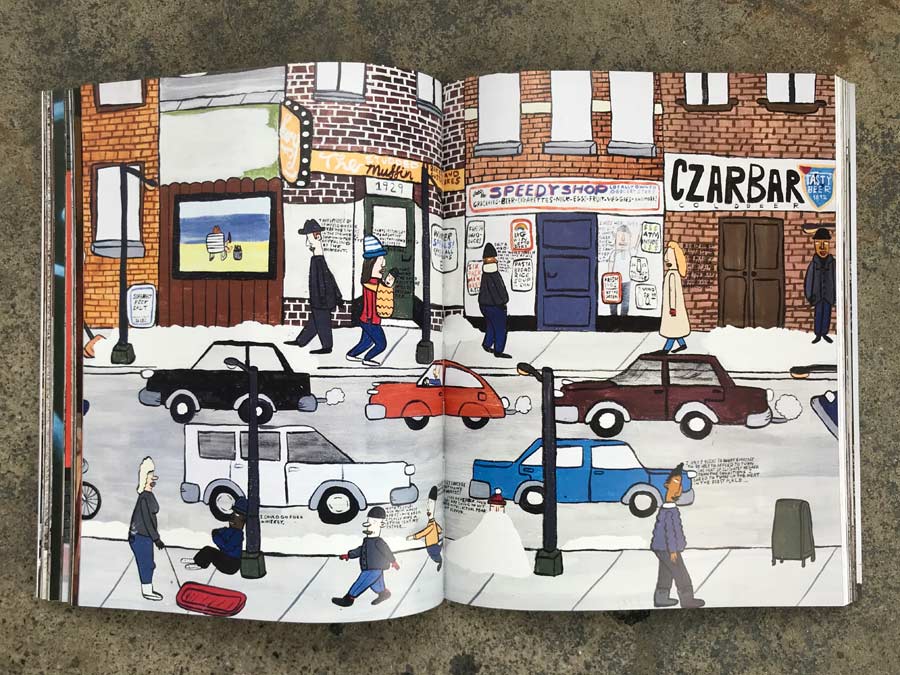
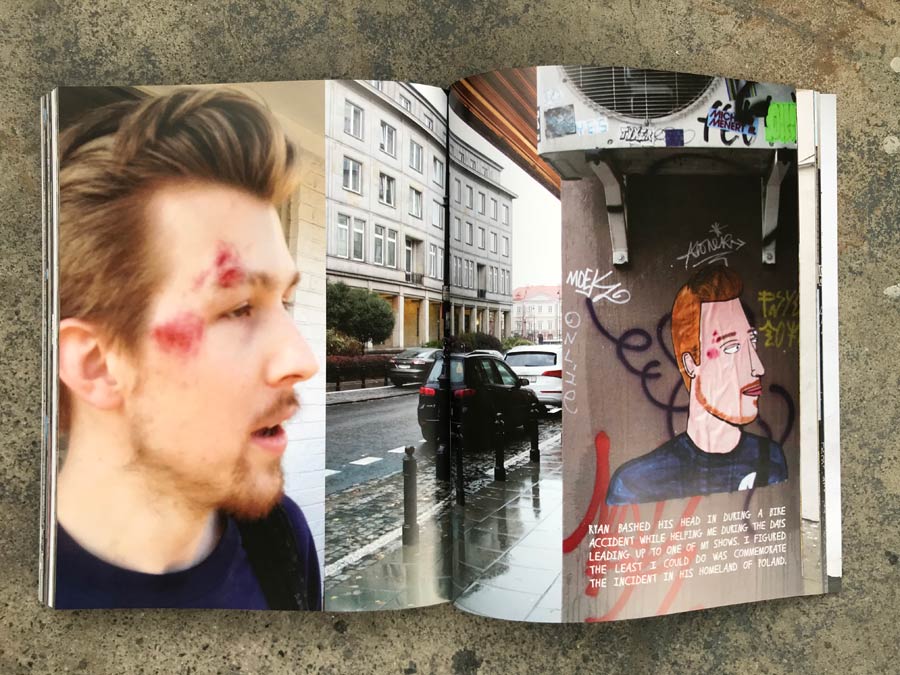
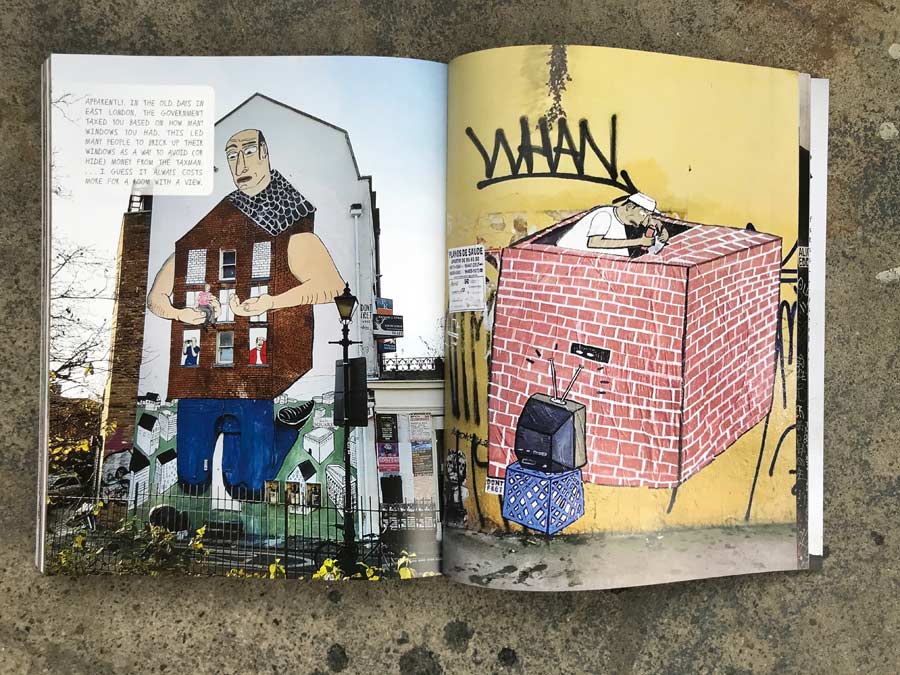
“This is place-based Street Art, a running commentary on life in this neighborhood that captures the off-the-wall imperfect nature of humans in a pock-marked and still proud American city after capital leaves it, slowly imploding, coasting on fumes, hopefully rallying, quickly stratifying into luxury lofts and the rest of us,” writes Steven P. Harrington in the foreword to this hefty chunk of comedic meat. Peering through these pages, the feeling is inescapable; Somehow you sense like you know DONT FRET’S people – probably because many of them came directly from these streets.
We wanted you to have an opportunity to take a quick look inside the massive quirky tome yourself, because it is as eclectic and disarmingly insightful as this sidewalk bard and documentarian, and to let you know the book release is in December. Also, DONT FRET’s got a special gig going for its release with a limited edition screenprint and original sketch with signature in the book.
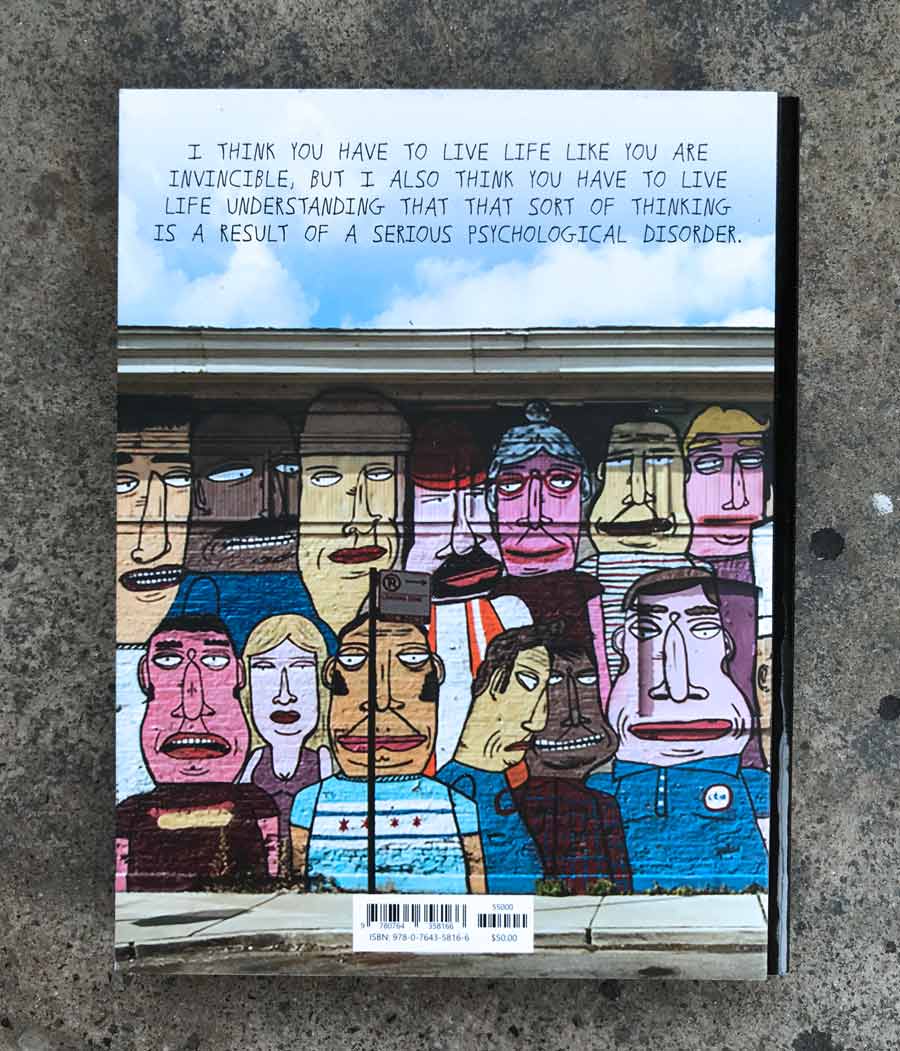
“I think you have to live life like you are invincible,” says the artist on the back cover of Life Thus Far, “but I also think you have to live life understanding that that sort of thinking is a result of a serious psychological disorder.”
We’ll talk to
you more about this in a few weeks, and with the artist, and we’ll find out
about his circuitous route to the streets of working class Chicago, how a fish
rots from the head, the significance of the original Billy Goat on lower
Wacker, and why Studs Terkel is more relevant today than ever.
DONT FRET “LIFE THUS FAR” Schiffer Publishing, Atglen, PA. 2019
Poseidon and the sea are both visible from here, so is Athena, another powerful Greek god. She ultimately prevails, if you recall. You can read HERE about their Athena intervention back in July.
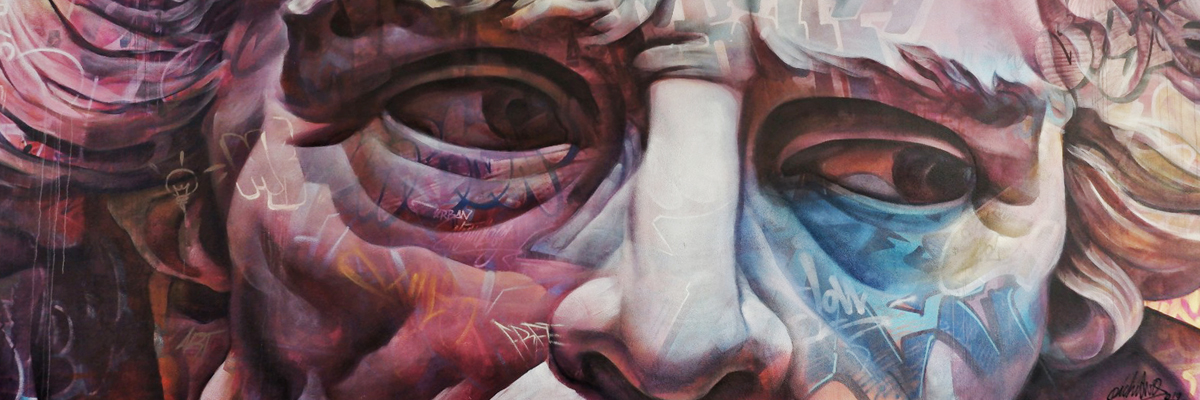
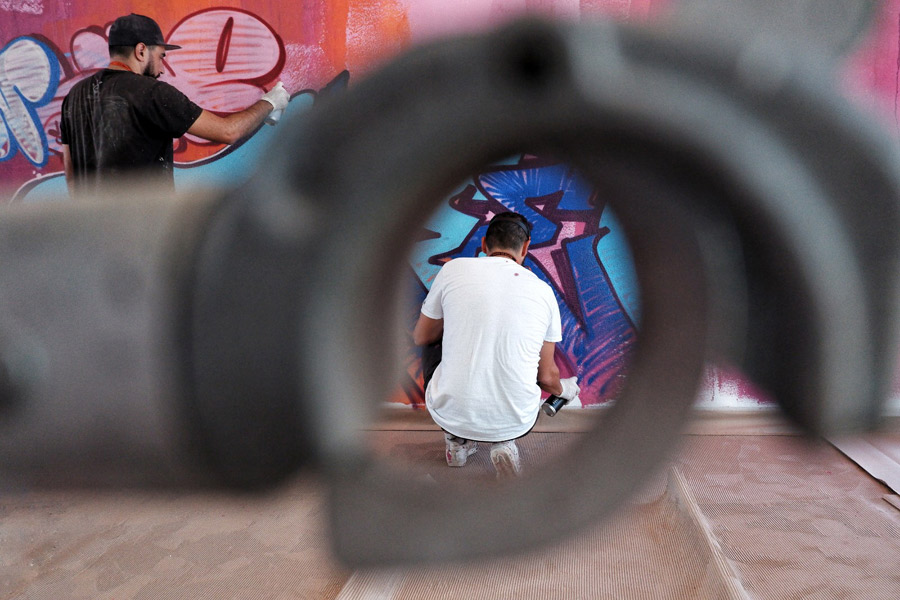
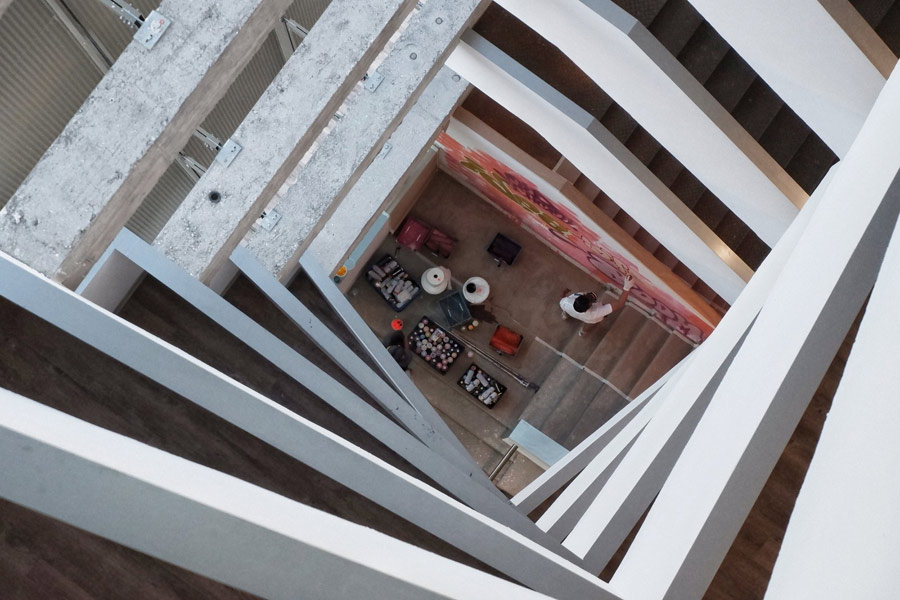
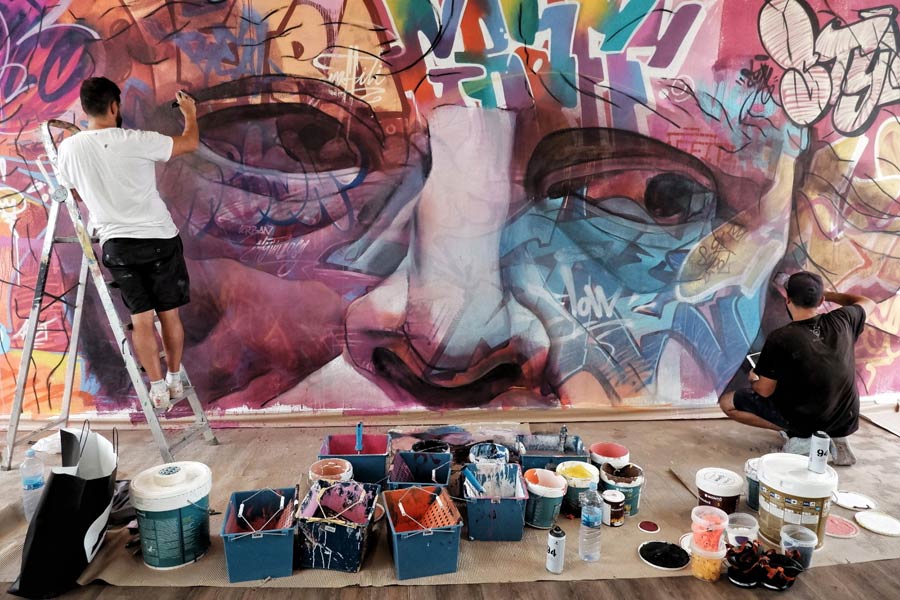
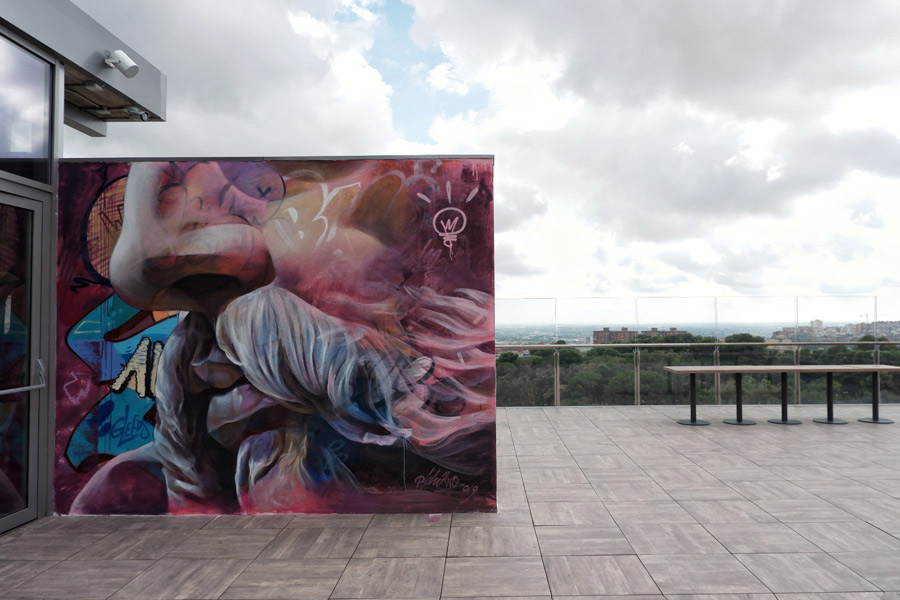
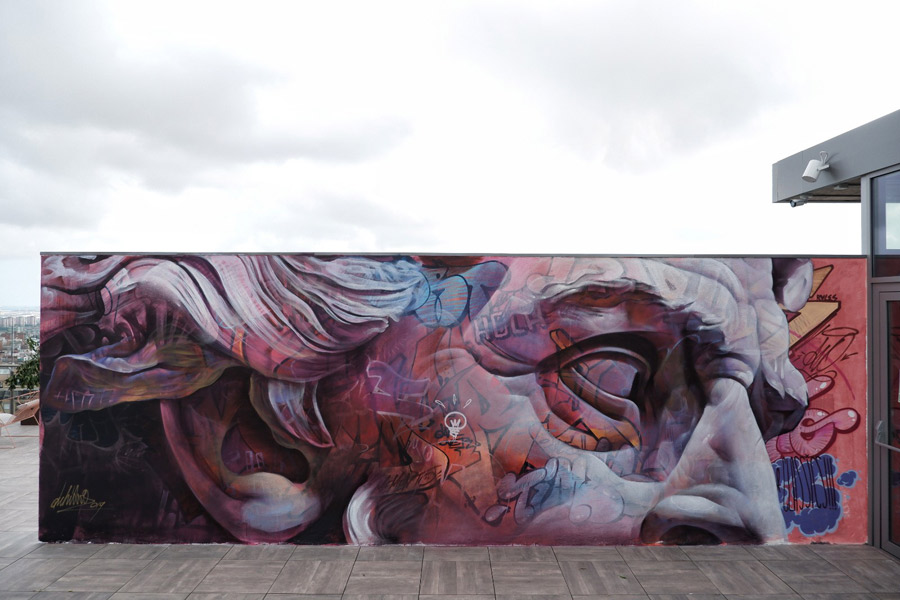
Here we see graffiti/Street Art/muralist duo PichiAvo is prevailing as well in Barcelona during recent commissions in July and September. This time their signature style is employed for a real estate developer client and the results are tight as ever.
The Spanish painters’ deconstruction of classical iconography is becoming the stuff of legends, and here they present their tableaus in sectional designs that poke inside and out- elaborate expressions of gauzy and marbled high and low imagery blended in a complimentary way.
Our special thanks to talented photographer Fer Alcala today who shares his unique view and optical talents today with BSA Readers.
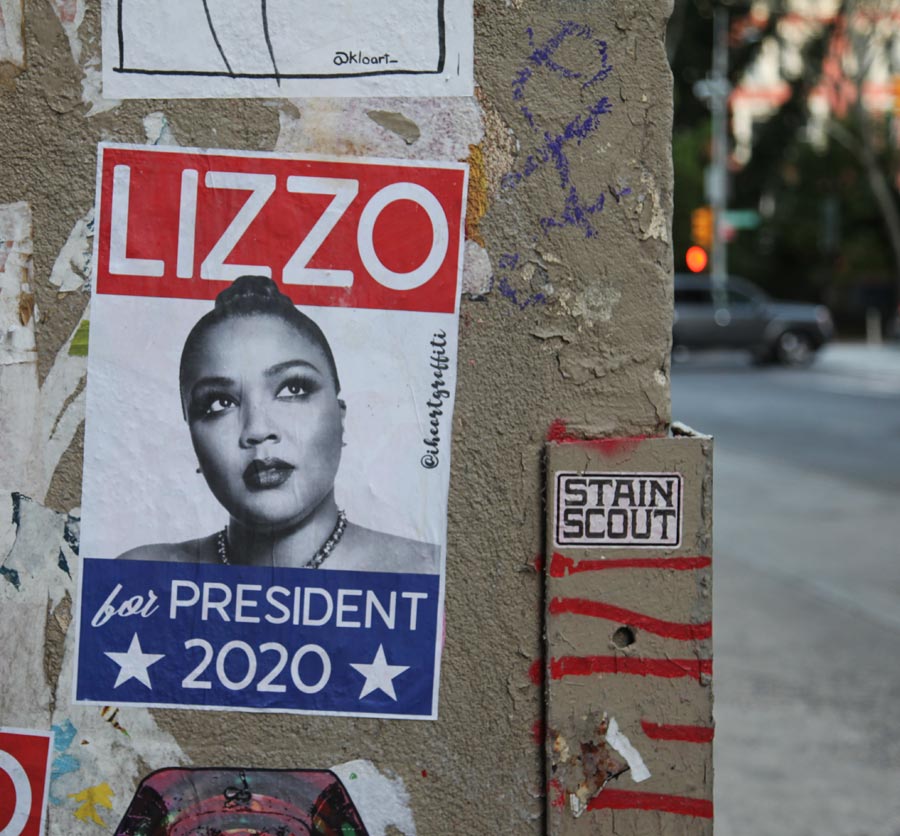
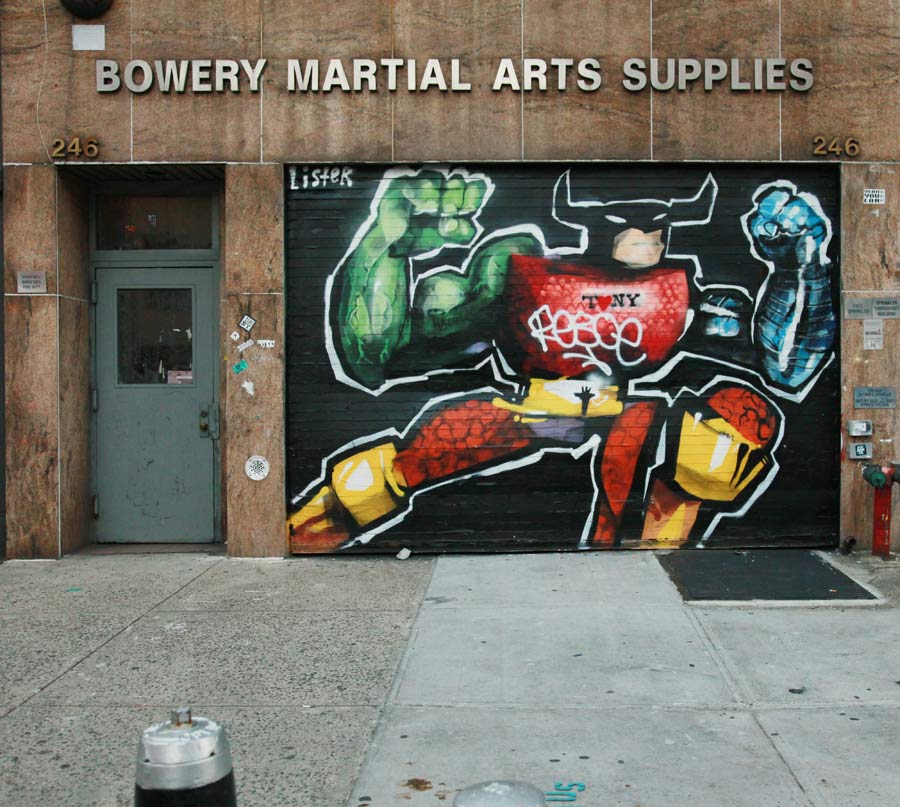
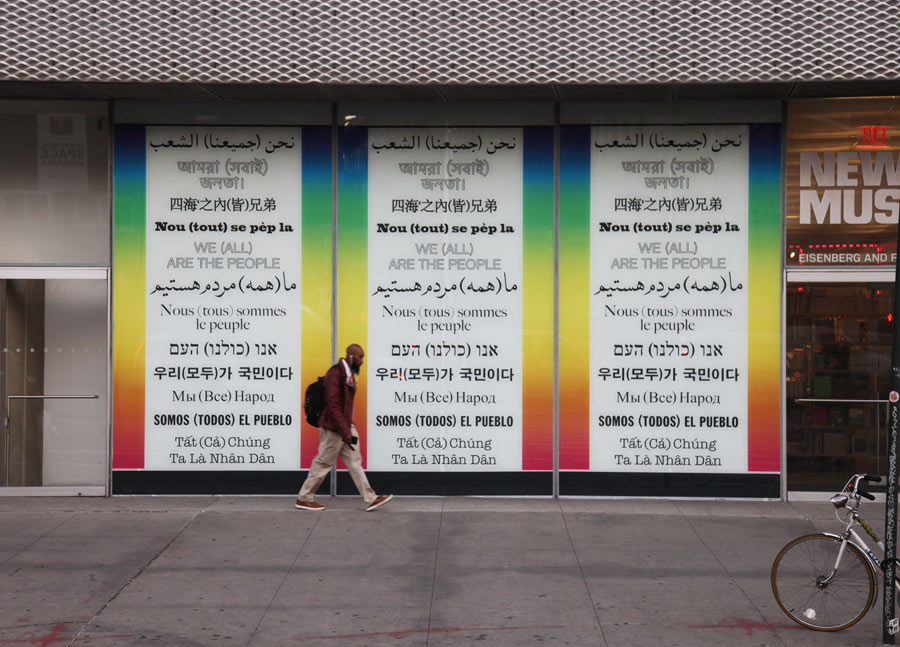
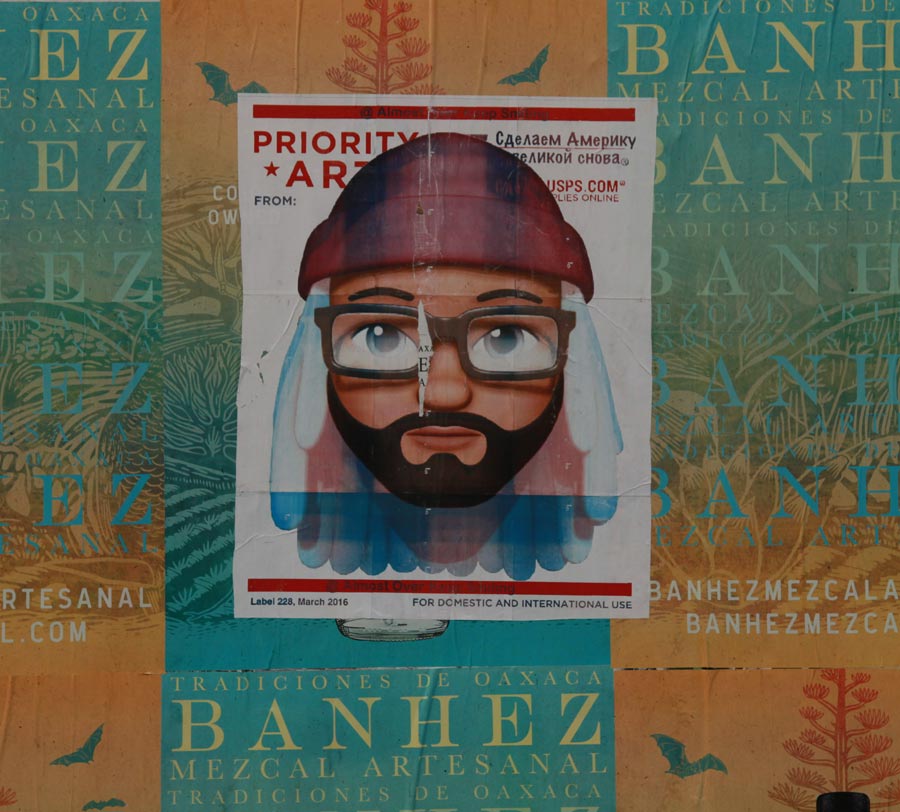
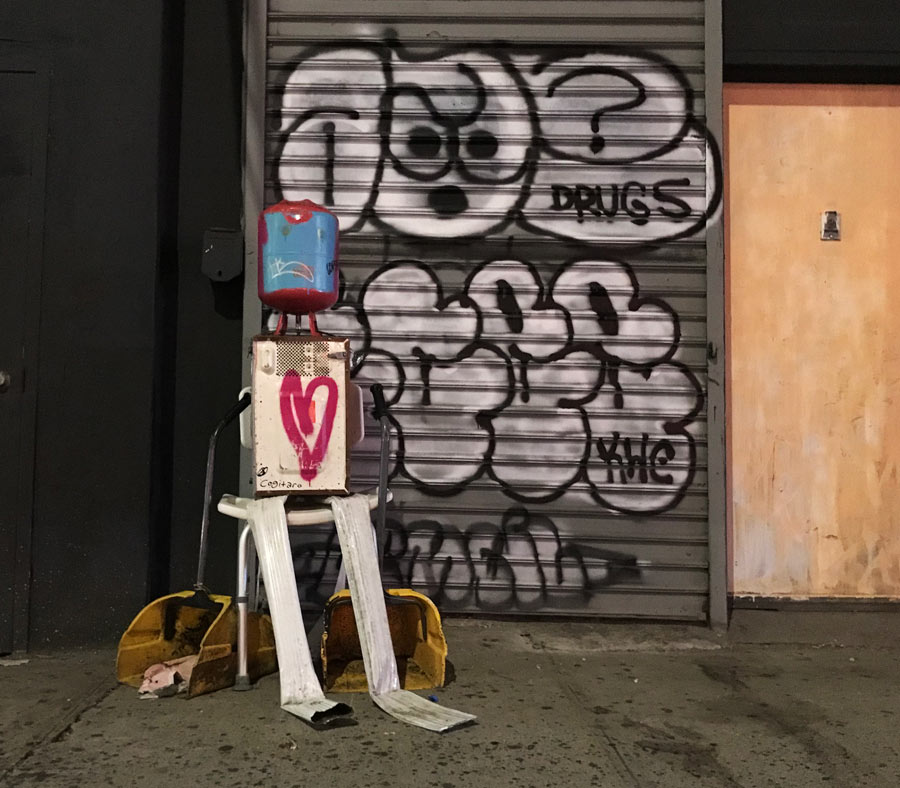
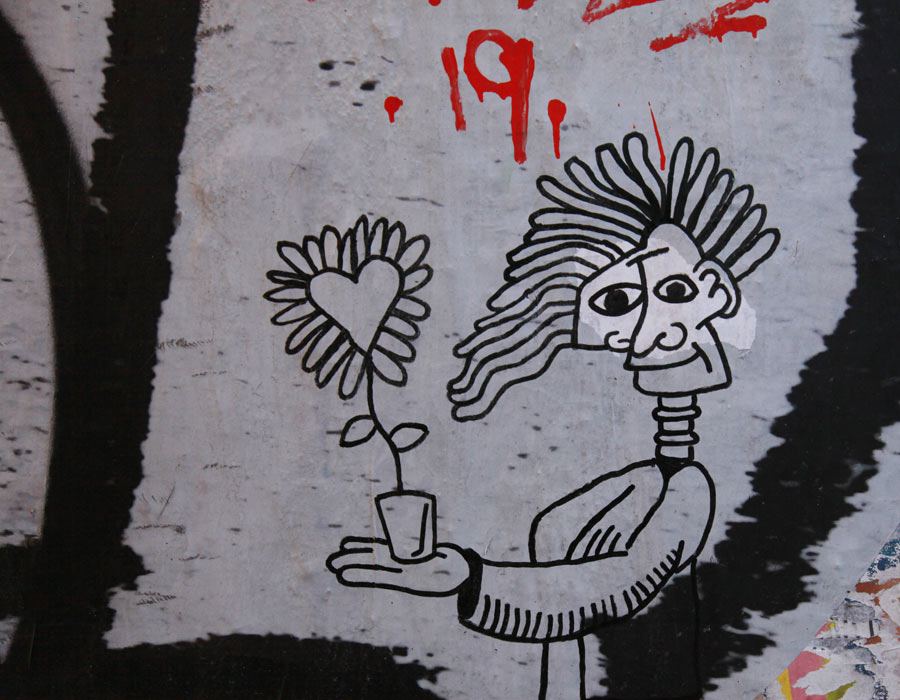
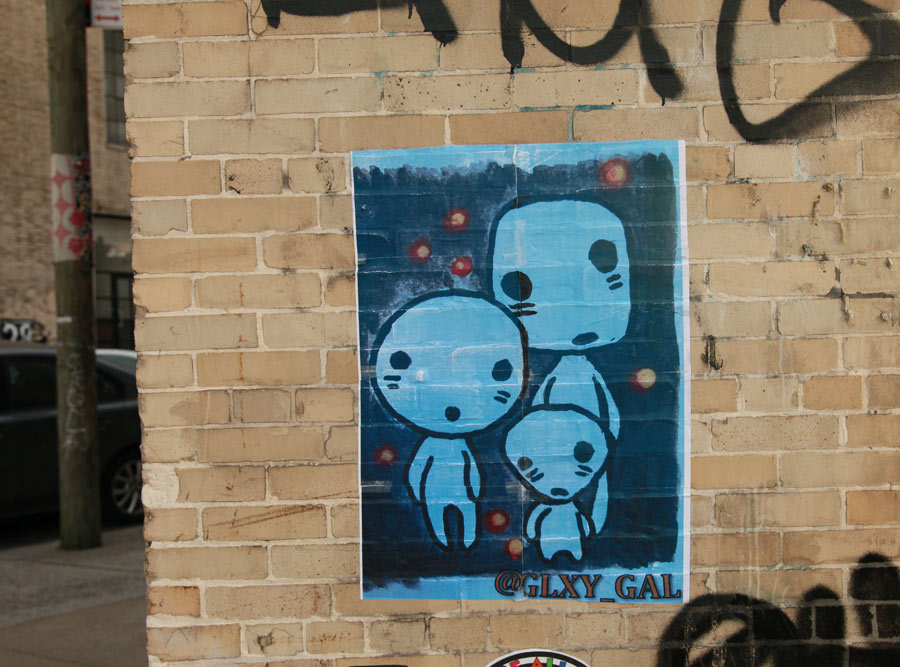
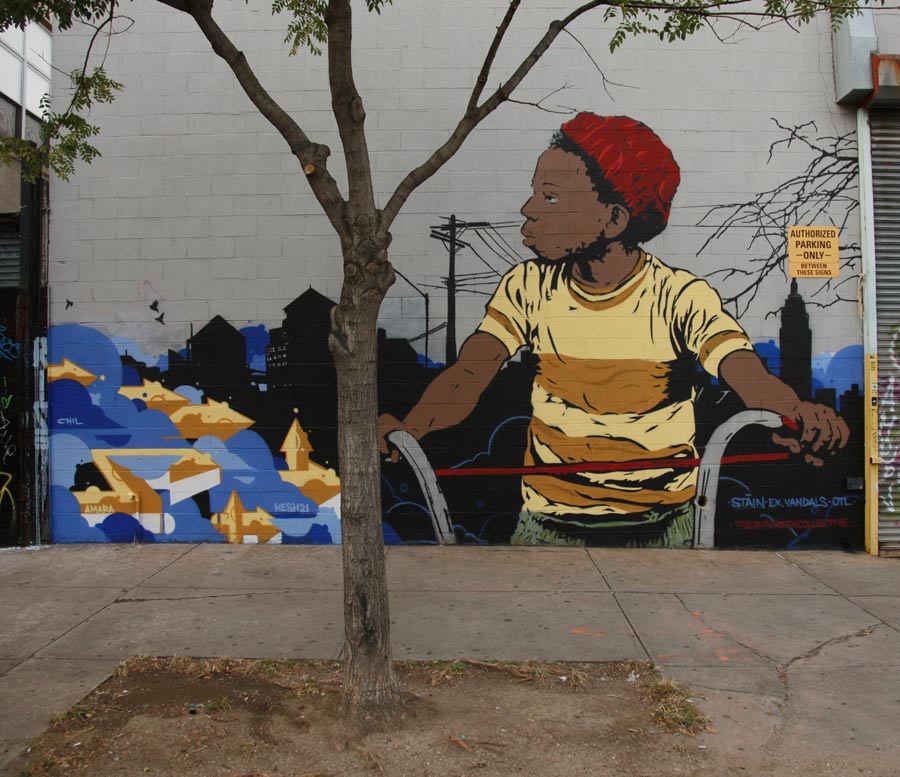
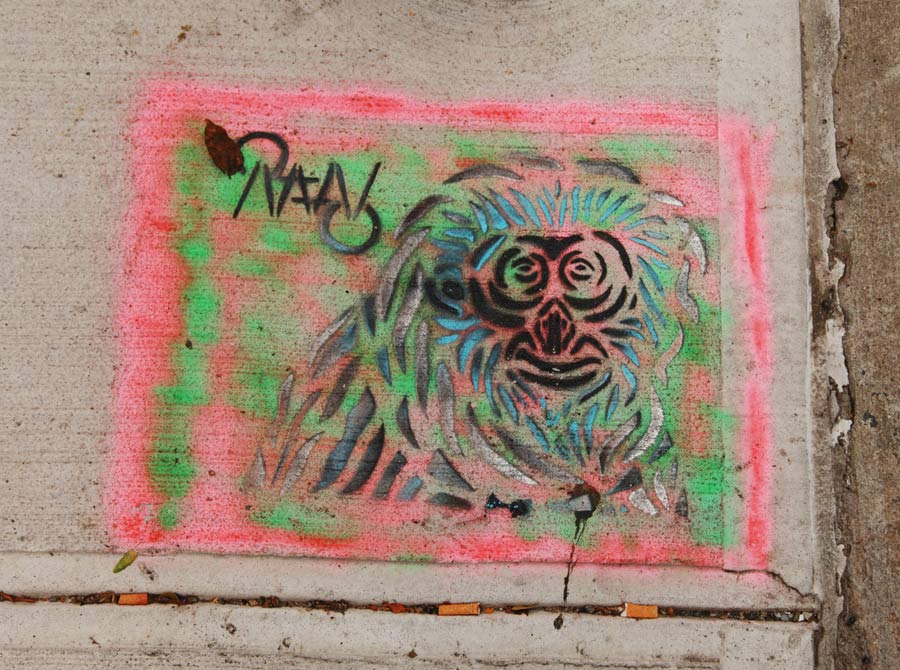
Here’s our weekly interview with the street, this time featuring Ali Six, Anthony Lister, Chris Stain, Cogitaro, Gixy Gal, Hans Haacke, I Heart Graffiti, Jimmy C, JR, Laszlo, Lizzo, Pay to Pray, Rano, and X Vandals.
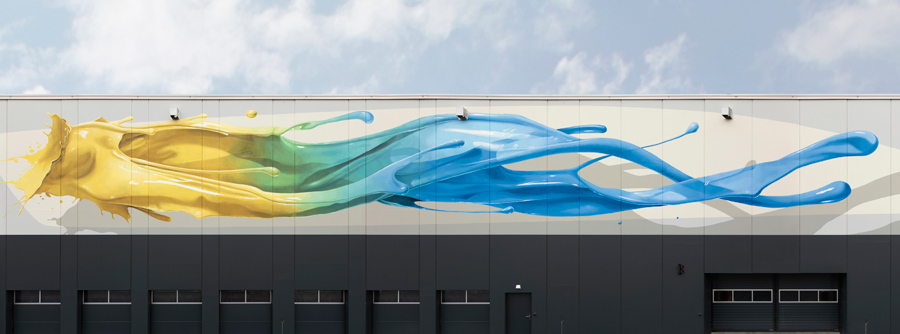
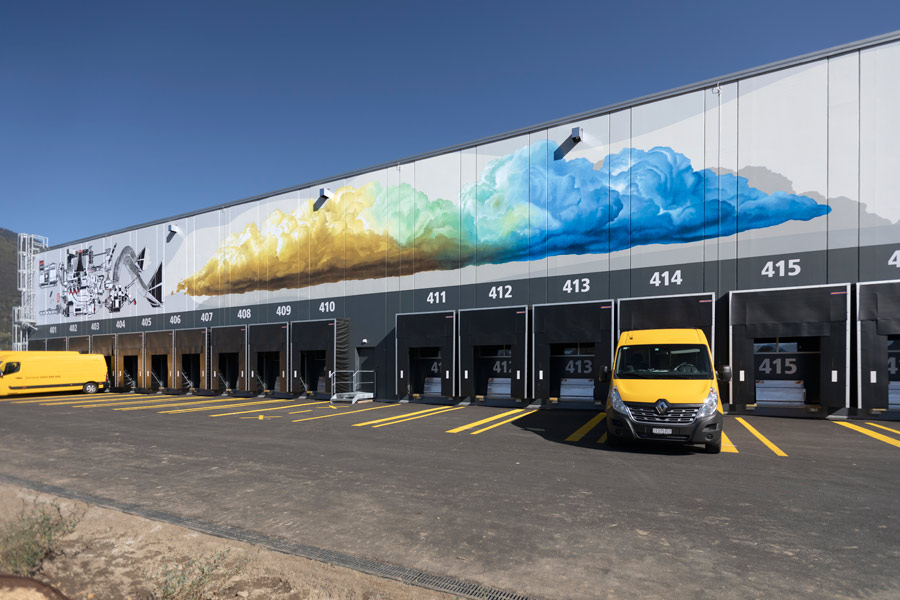
You used to hire your cousin Vinny and his creative buddy who went to art & design school to do some sign-painting for the side of your warehouse so people who were driving by on the highway would know where they could potentially get air conditioners, filters, casings, and floor fans. And you would pay them mostly in beer and weed.
Things
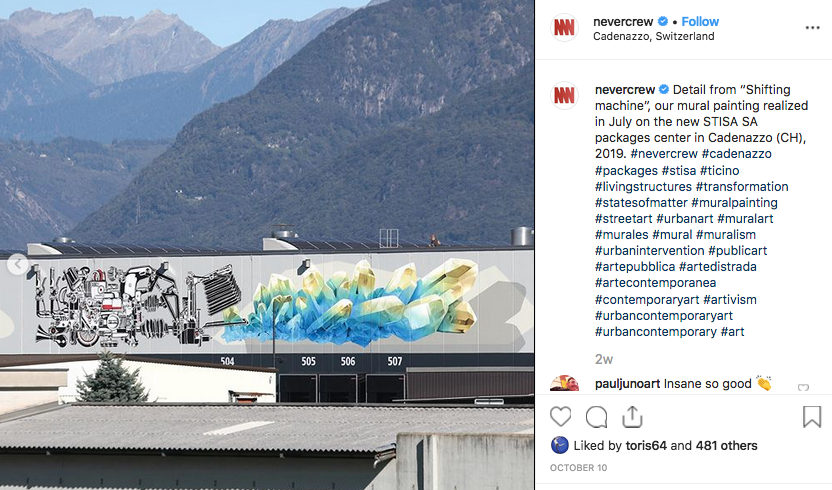
have changed. Now in Switzerland you hire guys who hashtag #urbancontemporaryart
on their Instagram posting of the mural they painted all summer on the side of
your factory. Also art exhibition curators who run an art blog will pontificate
about the new paintings’ finer points, its cultural/historical references, and they
will coo about how the composition works seamlessly in a “contextual” way with
the Swiss mountains that the warehouse is nestled within.
Welcome
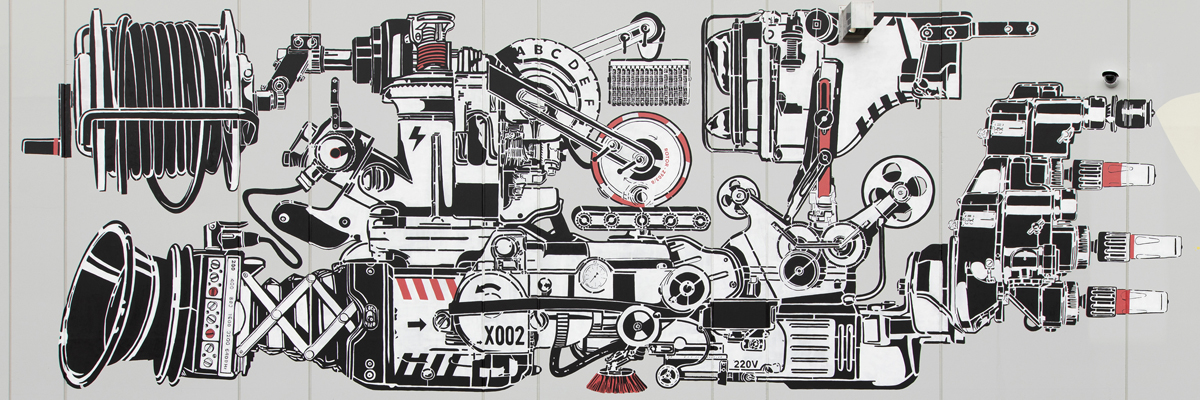
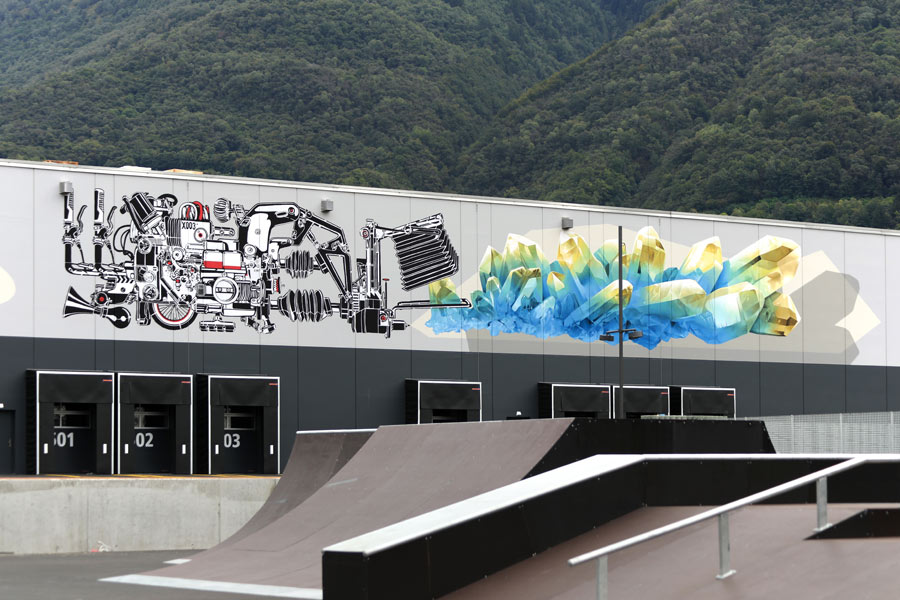
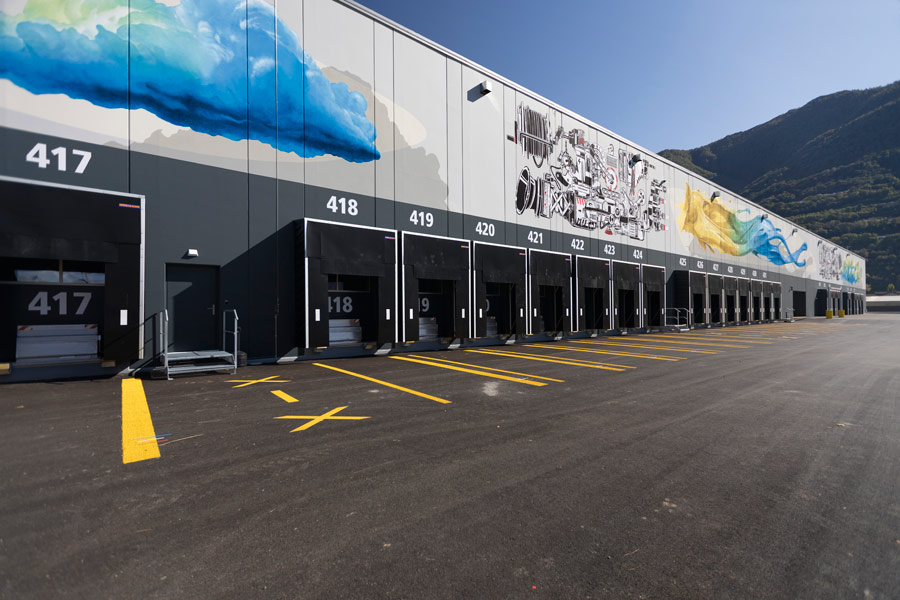
to NeverCrew’s new mural on the side of this facility that will be a burgeoning
hub for package traffic in the southern region of the country – where the artists
Christian Rebecchi and Pablo Togni are from. They say that this mixture of
industrial and natural landscape is where they took the inspiration from for
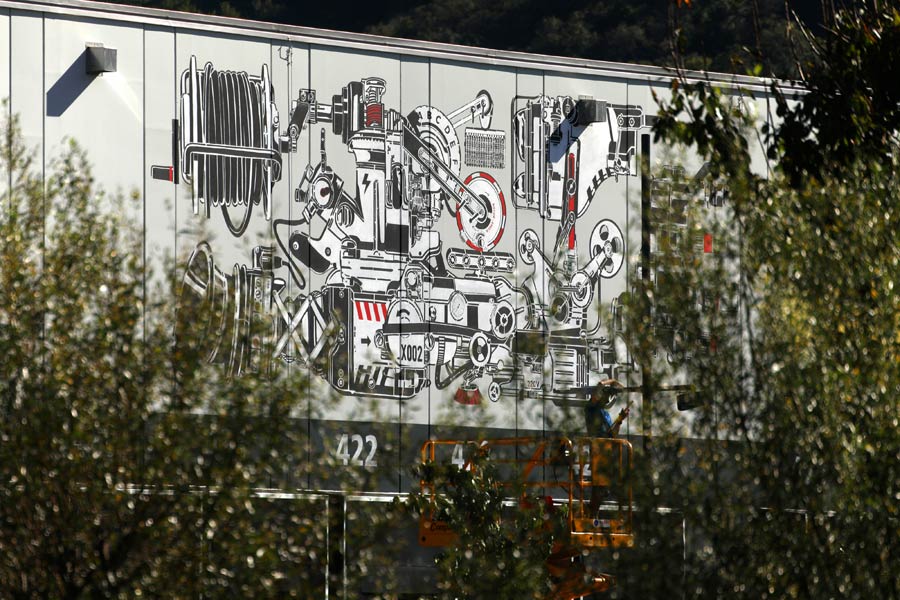
this combination of a monochromatic industrial diagram and an earth-science
illustration of minerals surrounded by a colorful hazy aura.
They
feel like the environment informed their concept as well. “During the evening
we could listen to the car traffic or the machines working on the right side of
the wall,” they tell us, “and frogs, birds, and insects on the left side of the
wall.”
As
if visiting an art gallery, you ask the artists to explain the mural, and now
you realize there’s so much more than a pretty picture here. “We were thinking
about a symbolical net, a twine of transfers and projected thoughts, and as
well we were imagining a production line that is both mechanical and human.”
You smile because you realize that your cousin Vinny never said stuff like that.
 BROOKLYN STREET ART LOVES YOU MORE EVERY DAY