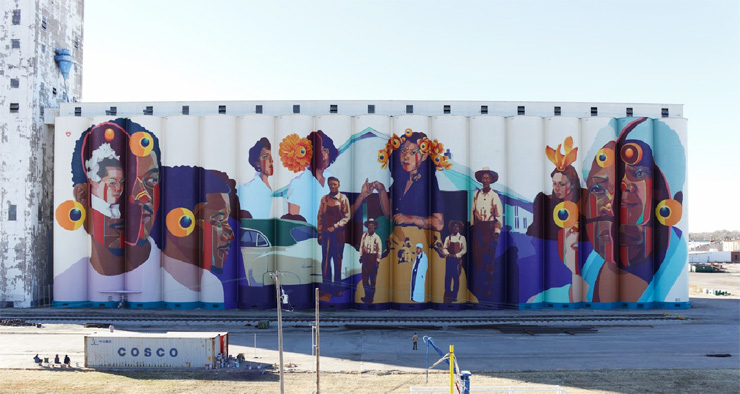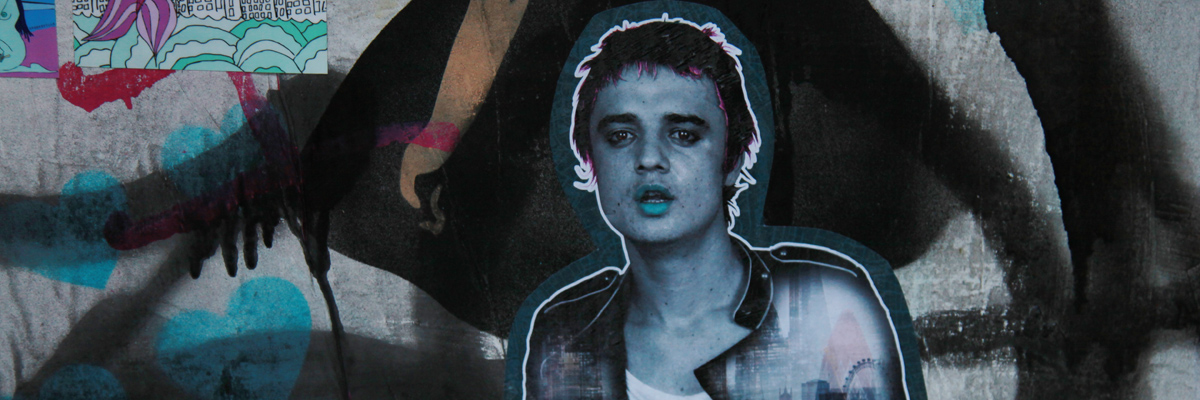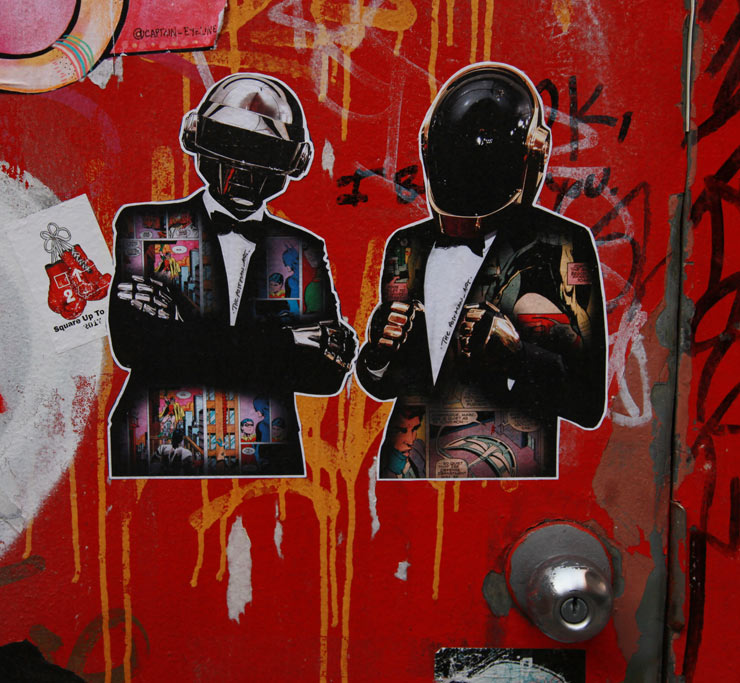
All posts tagged: Brooklyn Street Art

BSA’s 15 Most Popular Murals of 2018: A “Social” Survey

BSA’s 15 Most Popular Murals of 2018: A “Social” Survey

There’s street cred, and then there’s social media credit. These are 15 of the latter, compiled by BSA by our own rigorous methodology.

Bears lead the pack! A monkey is here as well. Skulls and Biggie Smalls make it in again. Text wisdom also wins along with representations of the natural world like Pejac’s tree and Naomi Rag’s flower. And a rep for Game of Thrones and the horrors of Hitchcock as well – you knew popular culture would represent.

These are the top murals from 2018 via tabulations of our website, Instagram, Twitter, and two Facebook pages. In a thoroughly unscientific survey that calculates “likes” and “clicks” and “re-Tweets” and “impressions”, and every year we cannot predict which one’s are going to be popular, but sometimes you can guess. We don’t publish a lot of murals of cats, but if we did, they would probably win. Just guessing.

This year we’re drawn to the two written word pieces, likely because they are erudite and witty to some extent – and because it is good to see how smart BSA readers are. Brilliant, we say!

Welcome to your favorite murals of the year:


15 – Banksy.

A tribute. A plea. A denunciation. A well used example of the artist’s platform to bring awareness of the plight of artists who dare to set themselves free with their art. Depicted here is Ms. Zehra Doğan, an editor and journalist from Turkey. She is presently serving time in jail for painting Turkish flags on a painting showing destroyed buildings and posting the painting on Social Media. Marking the time with tick

Banksy. Free Zehra Doğan. NYC. Houston/Bowery Wall. March 2018. (photo © Jaime Rojo)

14 – Sonny Sundancer.

Sonny Sundancer finishes his final mural for his #totheboneproject , a grizzly titled “Standing Tall” looking out over Greenwich Village.

“Standing Tall” was done in conjunction with The L.I.S.A Project NYC. May 2018. (photo © Jaime Rojo)

13 – Axe Colours.

Axe Colours goes GOT and the question going into 2019 in many people’s minds is: Will she or won’t she?

The Mother of Dragons on the streets of Barcelona as interpreted by Axe Colours. This photo was taken on November 2017 but shared on Instagram on February of 2018. (photo © Jaime Rojo)

12 – Owen Dippie.

New Zealand artist Owen Dippie is known for pairing pop characters in his realistic large scale work. Here’s an odd couple of film director Hitchcock and Brooklyn rapper Biggie Smalls.

Pigeons, Ravens, Cigars, Mystery and Music on the streets of Brooklyn. September 2018. (photo © Jaime Rojo)

11 – Kobra.

Brazilian artist Kobra gave himself a residency in NYC this year with the goal of painting as many murals as time and available walls would permit him. He succeeded by painting 18 walls throughout NYC – mostly the top level easy to identify icons found on t-shirts, posters and postcards for decades here. One of his portraits of Amy Winehouse proved to be hugely popular.

Kobra. Amy Winehouse. Manhattan, October 2018. (photo © Jaime Rojo)

1o – Disordered.

Anxiety rings true when the giveaways to business interests for nearly four decades under both dominant parties have gradually placed folks like these in this neighborhood constantly in fear of missing the rent, the grocery bill, the car payment, the cost of providing for their kids. Disordered is right.

#DISORDERED. Done in Welling Court, Queens for Welling Court 2018. July 2018. (photo © Jaime Rojo)

9 – Kaos.

The KAOS Factory, colloquially named because the German graffiti artist by the same name has slowly taken it over with his work during the last few years, by default converting the former steam factory into his de facto “residency”.

KAOS. The Kaos Factory. Leipzig, Germany. October 2018. (photo © Jaime Rojo)

8 – Naomi Rag.

Not specifically a Street Artist, Naomi Rag crochets her favorite things and puts them up mainly on the Upper East Side of Manhattan. This simple rose on a school yard fence steadily garnered attention throughout the year – and reminded us of this song from the 1960s.

“There is a rose in Spanish Harlem
A red rose up in Spanish Harlem
It is a special one, it’s never seen the sun
It only comes out when the moon is on the run
And all the stars are gleaming
It’s growing in the street right up through the concrete
But soft and sweet and dreaming…”

Jerry Leiber & Phil Spector

Naomi Rag. Red Rose in Spanish Harlem. March 2018. (photo © Jaime Rojo)

7 – GlossBlack.

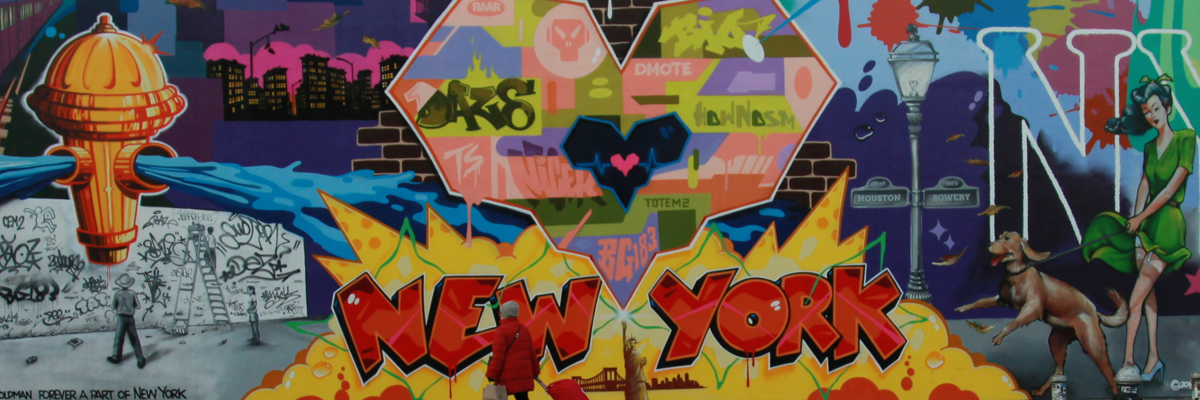
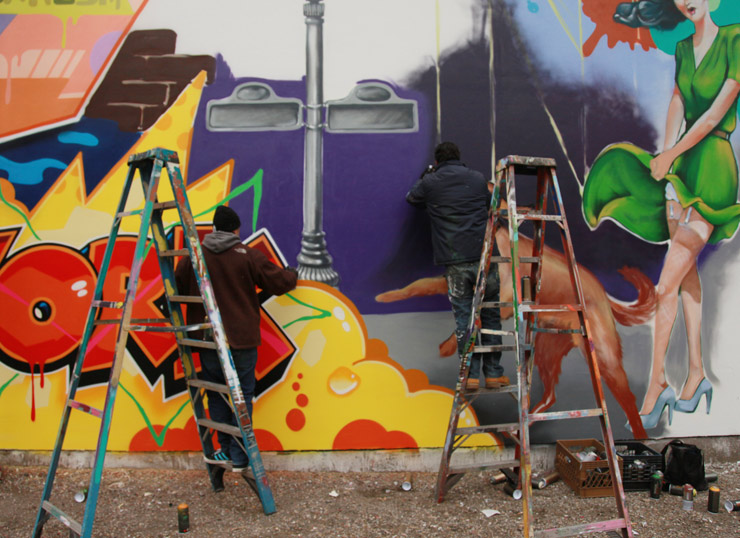
New York is a constant source of inspiration for countless artists of all disciplines who have made a home and hopefully a career in this dynamic city of endless serendipity and challenge. GlossBlack hit the mark with this tough and tumble tribute to the city.

GlossBlack in collaboration with Klughaus in Manhattan. March 2018. (photo © Jaime Rojo)

6 – Bordalo II.

Bordalo II has evolved a spectacular practice of creating street works from our refuse that shock and thrill many a passersby with his ingenuity and evocative image making – while raising our collective consciousness about our responsibility to the earth.

Bordalo II. Lisbon, Portugal. June 2018. (photo © Jaime Rojo)

4 – BKFoxx.

With a commercial eye toward the natural world and larger societal issues BKFoxx chooses subjects for their emotional impact and their ability to translates easily for an image-savvy audience whose endless hours of personal screen entertainment has produced an expectation for a big budget Hollywood and consumer culture slickness with high-production values.

BKFoxx in collaboration with JMZ Walls. Bushwick, Brooklyn. April 2018. (photo © Jaime Rojo)

3 – Terry Urban.

Inspiration to create flows from many rivers and tributaries. Many times that inspiration comes from a fellow artist as is the case here. Art is for everyone, and the street is more than ever a perfect place to see it.

Terry Urban channeling Basquiat in Manhattan. January 2018. (photo © Jaime Rojo)

3 – Egle Zvirblyte.

Egle’s feminism is abundantly clear on her work. A mixture of pop and riddles and unabashedly self assured.

Egle Zvirblyte. A project curated by BSA with the production assistance and wall access from Joe Franquinha / Crest Hardware and paint donated by Montana Cans. (photo © Jaime Rojo)

2 – Pejac.

The Spaniard Pejac came for a few weeks to New York this spring and left this piece in Bushwick. The wall is a brick façade typical of many Brooklyn neighborhoods, but this one appears to have grown a tree this week. Perhaps he chose to paint this tree because the promise of spring had inspired him, or because this neighborhood remains industrial and could benefit from some more of nature’s influence. For us it’s all about context so it is good to see that a tree grows in Brooklyn.

Pejac. The Bushwick Collective. Brooklyn, NYC. March 2018. (photo © Jaime Rojo)

1 – Adrian Wilson

Just in under the wire and straight to number 1, this cleverly turned phrase and hooded ideogram is an ironic amalgam of Banksy and Warhol that hit the nerve of readers who are becoming acutely aware of us all slipping into a surveillance society. Also, it’s funny.

We only published this mural in December but the number of hits and comments across social media indicated that it resonates strongly across a wide demographic. Photographer, videographer, former gallery owner and infrequent Street Artist Adrian Wilson clearly is not shooting for anonymity.

Top image: Adrian Wilson plays with words to reflect our pop culture trolling both Warhol and Banksy. (photo © Jaime Rojo)

Read more

BSA HOT LIST: Books For Your Gift Giving 2018

2018 has been a good year for Street Art books, and your interest in the ones we have highlighted continues to assure us that “Print” is not dead. There is no better way to document a moment in this evolving scene for posterity than with the bound volume, and sometimes there is no better way to appreciate an artists work than to sit by a lamp or window with a book on your lap.

We know that you appreciate our daily analysis and efforts to elucidate and illustrate a fluid global Street Art/ graffiti / urban art scene here in digital, but we’re thrilled to give you solid options in book form as well. If you’re looking for a good quality art book to give this year, consider one of these hits from 2018. Enjoy!


“Inti, Color, Carnaval y Resistencia”, INTI.

INTI Commands First Monograph : Color, Carnaval y Resistencia

From BSA:

“Certainties, simple explanations, last hopes, magic thoughts and fears. All of them confronted by what is evident.”

Thus describes the figure slung with bullets, holding a necklace with a cross and delicately balancing a small green apple on his index finger on a larger than life mural in Santiago, Chili. The visual language of this graffiti/Street Artist and muralist named Inti is his to wield, a cosmic folk expression that glows with celestial waves surrounding an other-worldly race of characters.

INTI. Éditions Albin Michel, 2017. Paris, France. Click HERE for more about this book.


Bordallo II: Bordallo II / 2011 –  2011

From BSA:

Such is the splendid stuff of dreams and discovery for Bordalo II, the Lisbon-based Street Artist and maker of garbage relief animal portraits in cities across the world.

These are the things that when arranged on shelves and placed in relation to a floor plan, within parameters and boundaries of our mundanity, will comprise a perfect environment of domesticity; full of memory, associative emotion, symmetry. Objects, materials melted and poured, carved and plain, screwed and snapped, polished and sprayed, emulsified, inset, extruded, coiled, soldiered, plated, woven. These dimensional collections of matter matter to us. Metal alloy. Plastic polymer. Blown glass. Rubber, copper, steel, bakelite, particle board, glue.

Disarrange. You create chaos, disruption, disunity, discontent. Arrange again and create a muskrat, a buck deer, a petulant parakeet, an undulant octopus.

Bordalo II 2011 – 2017. Editor & Publisher Bordalo II. In conjunction with ATTERO and exhibition by Bordalo II held in Lisbon. November, 2017. Lisbon, Portugal. Click HERE for more about this book.


Subvertising: The Piracy Of Outdoor Advertising

From BSA:

“The constant imposition of advertising in front of our eyes is an oppressive, dictatorial and violent act,” posits the artist, activist, and author Hogre in this new collection of works and words called Subvertising : The Piracy of Outdoor Advertising.

It sounds rather extreme when put this way, but perhaps that is the dulling power of advertising’s omnipresence in public space year after year. Each of us can certainly recall a time when there seemed like there was more open public space and fewer images and graphics and text telling us what to do, what to buy, who to hate, how to behave. Artists like Hogre are sounding the warning on our ability to recognize its power over our perceptions.

HOGRE. Subvertising: The Piracy Of Outdoor Advertising. Dog Section Press. London, 2017. Click HERE for more about this book.


“Add/Fuel -1- Monograph”, Diogo Machado AKA Add Fuel.

From BSA:

Add Fuel Reimagines Azulejo in His First Monograph

Via his own pop-culture interpretation of the interlocking curvilinear, geometric and graphic motifs, the Portuguese artist is firing new pieces daily in the kiln of his studio in Cascais. For a decade or so his interpretations of the tin-glazed ceramic tilework have been appearing on inordinate secondary city skins in the paths of pedestrians: visual illusions meant to appear as layers of urban bark peeling back from surfaces you take for granted to reveal heritage, history, artisanship.

While the interiors and exteriors of churches, palaces, schools and subway stations are covered with azulejos in Lisbon, thanks to Add Fuel (Diogo Machado) they have travelled to other cities and cultures as well. Each time he is attracted to the tile-making traditions locally, and he often incorporates his study of these new histories as well.

Add / Fuel – 1 – Monograph. Published by Diogo Machado. Portugal 2018. Click HERE for more about this book.


One Week With 1UP : Martha Cooper & Ninja K

From BSA:

A serendipitous meeting somewhere in Berlin set this project in motion, and the results unveil an adrenaline fueled ride that always pushes, often exceeds the boundaries of physical safety and social acceptance while simultaneously thrilling graffiti fans and pissing off some public officials and property owners.

A new book captures the nature of the actions and adds to our conversations about art, vandalism, branding, public/personal space and its radical visual disruption. It’s a story made all the more remarkable during an increasing level of surveillance in a city that has basically embraced the bohemian and rebellious types who have transformed large parts of its cityscape, making Berlin a de facto capital of subculture, especially among the young.

Martha Cooper & Ninja K. One Week With 1UP. (photo courtesy of the team) Click HERE for more about this book.


“Beyond The Streets” Exhibition : Gastman’s Train Pulls In to LA

From BSA:

A steel-wheeled graffiti train with Roger Gastman at the controls roars into LA’s Chinatown for a two-month stay at this station, a 40,000 square foot warehouse that houses “Beyond the Streets.” Originating at the streets and train yards of the 1960s and 70s, this express survey carries with it 100 or so artists and writers from across the last five decades as practitioners of graffiti, Street Art, and mural painting. Somehow, everyone gets represented.

Beyond The Streets. (photo © Martha Cooper) Click HERE for more about this book.


“Canvas” Anders Gjennestad.

From BSA:

Anders Gjennestad: A Door as “Canvas”

A door as canvas. A door as canvas.

It sounds the same on the street as it does in the gallery space, and for Norwegian Street Artist Anders Gjennestad the two appear nearly identical, aside from context.

Whether he is discovering the neglected urban factory door long after the spirit of industry has roared its last turbine and reaching toward his backpack for a spray can, or he is hoisting a piece out from the pile of collected iron-bound wooded slabs in his Berlin studio, functionally each of these doors is a canvas.

Every urban explorer sees the potential of walls that are long abandoned and spoiled with rot and piss and pushed open by weeds, worn away by rain. The world is a temporary place anyway. I am only here temporarily.

Anders Gjennestad. “Canvas”. Published by Galerie Friedmann – Hahn. Berlin 2018. Click HERE for more about this book.

“FKDL” Frank Duval.

From BSA:

FKDL and the Collage of a Street Artists’ Life in a Book

As you look through this new slim volume about the Street Artist/fine artist FKDL it may strike you how much autobiography is the determinant of an artist’s path as well. It’s the tale of a teenager finding himself, finding his vocation, and eventually finding his voice on the street. When you reach the end you see that it takes a number of years and a lot of experimentation, this journey.

FKDL. Galiote Prenant. Choisy-le-Roi, France. 2017. Click HERE for more about this book.


“Street To Studio”, Rafael Schacter.

From BSA:

Rafael Schacter Investigates “Street To Studio”

“These are artists who are thus not slavishly reproducing their exterior practice within an interior realm but who are, rather, taking the essence of graffiti – its visual principles, its spatial structures, its technical methods, its entrenched ethics – and reinterpreting them with the studio domain,” says author Rafael Schacter in his introductory exposition for his book Street to Studio where he offers a unique assessment derived from his 10 years of researching the foundational, conceptual, methodological, and ethical considerations that impact the original graffiti/Street Art scene as well as where it is going.

Rafael Schacter. Street To Studio. Lund Humphries Publishers. London, 2018. Click HERE for more about this book.


“Feather and Faces”, Adele Renault.

From BSA:

Adele Renault Takes Flight With a Message of “Feathers and Faces”

Street Artist/fine artist Adele Renault understands our interdependence with the birds and with each other perhaps better than many, and “Feathers and Faces” carries the message powerfully by delivering these works she has done on city streets and galleries in New York, Berlin, Amsterdam, San Francisco, Singapore, Burkina Faso, Helsinki, Moscow…

We share this city with pigeons. We look to the same environment to supply us with what we need, including food, water, shelter – depending on physical factors like as soil, air, a temperate climate, other organisms. Adele studies our feathered friends and brings them full force to the streets, and we know that here only the scrappiest survive and get to display their colors.

Feathers And Faces by Adele Renault was published in 2018 and is distributed in the United States and Canada by SCB Distributors. Click HERE for more about this book.


“Ex Animo”, Faith XLVII.

From BSA:

“Ex Animo”, Eight Years of Poetry by Faith Forty Seven

Worn workers, wild beasts, a bloom in the rubble.

Prayers of supplication and longing, racing teams of stallions and master felines of fury, the exhausted figure of a dream barely still illuminated, a wistful stage in the plundered urban landscape, or a plundered life.

This is what she does to you. As Faith IXVII leaves her stolen stanza, her massive mural in washed hues, her tributes to a moment lost in a city that would leave you to die if it had its way, she makes you make poetry.

Faith XLVII. “EX ANIMO’ THE WORK OF FAITH FORTY SEVEN/ 2010-2018. Drago Publishing. Rome, Italy, 2018. Click HERE for more about this book.


“Perception”, eL Seed.

From BSA:

El Seed Illuminates Ways to See Others with “Perception”

And el Seed is the first to tell you that in this deeply personal account of his art project across fifty buildings in Mashiyat Naser, a neighborhood of Cairo over two years ago. Born of his personal need to challenge himself and to add more to his career as a respected muralist, his original concept of working in this neighborhood of 70,000 recyclers was informed by his own assumptions, perhaps of helping a community known in the city as Zabbaleen, or “garbage people”.

Over the course of the project he and his team describe through interviews and with his own diary style how their own eyes were opened. It is an incremental revelatory experience that paralleled the quote that he stylized throughout the pattern of his piece, “Anyone who wants to see the sunlight clearly needs to wipe his eyes first,” from the writings of Saint Athanasius of Alexandria, a fourth century Coptic Bishop.

El Seed PERCEPTION Published by Point à la Ligne. Milan, Italy. 2018. Click HERE for more about this book.


“Invasion: Los Angeles”, Invader.

From BSA:

Invader: “Invasion Los Angeles” Book and “Into the White Cube” Exhibition

One thing that some Street Artists do when their work enters the white cube is drop the “street” from their official moniker, instead preferring to be known simply as an “artist”. The decision is possibly to rid themselves of any subtle class distinctions or otherwise negative connotations that a potential collector or curator may have with the “street artist” label.

Other artists formerly known as “Street Artists” feel limited by the title because it doesn’t include all of their new interests and their complete practice – or because the term itself has evolved in their mind and the mind of the public to mean something unfavorable that they do not like to be associated with.

When it comes to the internationally renowned Street Artist Invader, its not a consideration – the street is in his DNA. His cryptic tile-made street practice is so proliferate across the world and so much a part of the metropolis like in his hometown of Paris that his art is literally and psychically fused with the city.

Invasion Los Angeles 2.1 / Updated Edition 1999 – 2018. A Book By Invader. Published by Control P. Editions. France 2018. Click HERE for more about this book.

“Russian Urban Art: History and Conflicts”, Igor Ponosov.

From BSA:

Igor Ponosov Enlightens with “Russian Urban Art: History and Conflicts”

An academically sourced opinion-based essay in book form that looks to art, social, economic, and geopolitical movements during the start of the 20th century to better understand the evolution of Urban Art in post-Soviet Russia, Igor Ponosov delivers a welcome reconstruction of the timeline and movements that bring urban art to this day.

With the renewed interest in public art and muralism that has erupted over the last decade in many so-called Western cities it is good to learn how the public space in Russia has been catalyzed not-only by Hip Hop and new graffiti forms from Europe but also the history of Avant-garde art movements and Soviet Muralism in Russian Urban Art: History and Conflicts.

Igor Ponosov. Russian Urban Art: History And Conflicts. Moscow 2018. Published in collaboration with Street Art Museum, St Petersburg, Russia. Click HERE for more about this book.

Read more
“Punk and Graffiti”: Unlock & TAG 2018, Amsterdam : Javier Abarca Interview

“Punk and Graffiti”: Unlock & TAG 2018, Amsterdam : Javier Abarca Interview

Just completed this weekend in Amsterdam, a gathering of authors, readers, publishers, academics, and fans of graffiti and urban art all gathered in Amsterdam for the newest edition of the Unlock International Graffiti Publishing Fair and the TAG Conference.

Here graffiti and street art intersects with the world of publishing, specifically with books and zines and related obscure and/or scholarly publications known to relatively few. The list of publishers participating in this genre has steadily grown in the last few years to about 50 here; heavily Eurocentric at this point from countries like Netherlands, Russia, Germany, France, Australia, Japan, Czech Republic, the US and others.

Unlock Book Fair. Amsterdam 2018. (photo © Max van Boxel)

Previously hosted in Barcelona and Berlin, Unlock is coalescing around a growing interest in defining these movements from historical, artistic, and anthropological vantage points; documenting and even codifying an unruly canon of expression through discovery, sharing information, and teaching one another. Toward that end it also hosts talks, panels, and screenings – this weekend included speakers like Jens Besser, Suse Hansen, Hugo Kaagman, Carlo McCormick, and Diana Ozon,

Among the self-publishing authors represented at the fair this year are Adam Void and Chelsea Ragan, who have been operating a Graff Zine distribution / publishing house called Cut In The Fence. Mr. Void share’s with us today images of his new work, straight from the D.I.Y. / punk / cargo jumping scene that is always inter-marbled with graffiti and autonomous art making in the US, where he operates. Today we’re pleased to present a great interview with Mr. Void and Javier Abarca, the founder of Unlock, and who also is an artist, researcher, and educator.

TAG. Amsterdam 2018. (photo © Ka-Tjun Hau)


Interview with Javier Abarca by Adam Void:

Adam Void: Javier, in your 12+ years as a researcher and educator of graffiti and street art, what brought you to founding the Unlock Book Fair & the Tag Conference?
Javier Abarca: There is a whole scene of independent publishers working with graffiti and related fields an there was no meeting space for it. The idea immediately caught on, which showed there was a need for it. We also use the fair platform to advance the research on neglected but fascinating topics within the field. Last year we focused on hobo graffiti, this year we are delving into punk graffiti. We gather and display rare books on the subject, program talks and screenings about it and publish a companion book with obscure documentation.

TAG. Amsterdam 2018. (photo © Robin Vermeulen)

Adam Void:  How do you see the Unlock Book Fair differing from other zine fairs or celebrations of graffiti & street art?
Javier Abarca: Unlock is much like other book fairs, but it is focused on a particular field. It has little to do with other events related to graffiti and street art, which tend to focus on the production of commissioned artworks. Our job is independent research and documentation of furtive public art, mostly in the form of books and zines, but also screenings, talks, performances, etc.

Adam Void: This year’s showcase is focused on “Punk & Graffiti”, what are the core connected elements between these two cultures?
Javier Abarca: The core thread connecting punk and graffiti is of course the DIY ethics. Today graffiti has turned, to a great extent, into an act of consumption, but it used to be all about do-it-yourself. DIY is the defining quality of punk, of graffiti and of many other independent cultures.

Adam Void: Can you expand on this some? How do punk and traditional graffiti cultures exhibit the Do-It-Yourself ethos? What is the change you have seen in graffiti as of recent times?
Javier Abarca: Punk’s approach to creating music and graphic communication is of course quintessential DIY. And graffiti used to be that as well, kids had to find ways to hack the elements on hand –spraycans, markers, inks, the subway system– to create a fantastically visible city-wide graphic communications game starting from zero resources.

It is the specialized media –fanzines, then the internet– and the specialized market –with custom-made tools and materials of every kind– which have largely transformed graffiti from DIY to an act of consumption. People do not need to go out and seek the graffiti throughout the city to get inspired when a whole world of graphic references is just a few clicks away. And there is no more need to hack and customize tools –after learning how to do it from a mentor– when any specialized tool you can imagine is readily available and can be bought online.

TAG. Amsterdam 2018. (photo © Robin Vermeulen)

Adam Void: Most of the publications in the showcase are centered on punk & graffiti history. What do you see as the future for this element of graffiti?
Javier Abarca: Punk graffiti is mostly a thing of the past. The focus of the two “Punk Graffiti Archives” books we have published for the fair are the punk-originated tagging scenes that thrived in Amsterdam and Madrid in the late 70’s and 80’s with barely any knowledge of what was happening in NYC. These are largely ignored cultural treasures. Both cultures disappeared when the NY tradition of graffiti took over European youth through the 80’s. Punks may still write on walls, but graffiti as a culture is dominated globally by the NY tradition.

Adam Void: Unlock has exhibitors from all over Europe (19 countries), as well as Japan & the US. What are the main similarities and differences in the publications exhibited across this wide sampling?
Javier Abarca: Each publication is a unique, fascinating world. But most publishers work from a similarly independent, even DIY position, even if they are based in different continents. This means the possibilities and limitations they face tend to be similar, which can translate into their approaches and results.

Unlock Book Fair. Amsterdam 2018. (photo © Max van Boxel)

Adam Void: Are there other continents, countries, or parts of the world that you would like to get involved with the Unlock Book Fair and the TAG Conference? If so, how should they get in touch for next year?
Javier Abarca: Both the Tag Conference and the Unlock Book Fair are meetups of the international global scenes of graffiti research and graffiti publishing. They could take place anywhere. People can get in touch via email at info@unlockfair.com, or through our Facebook and Instagram accounts @unlockfair and @thetagconference. We are in conversation with people from a number of cities in Europe and America who have expressed their interest in hosting the events.

Adam Void: Will you share an anecdote from the three-year history of the Unlock Book Fair that best exemplifies the spirit of the event?
Javier Abarca: That would be the cantina. A central feature of the fair is the cantina serving complimentary, communal meals to publishers, speakers and staff. It is run by Unlock team member Akim, the Berliner legend of graffiti, street art and underground mischief, whose cooking abilities are well known in the scene. One of the main goals of the yearly Unlock Book Fair is to be a meetup of the publishing scene, and the cantina is its social heart.

Apart from this, the hilarious and fascinating readings and performances by team member Dumar NovYork –the legendary NYC bomber– are probably the moments that best portray the spirit of the Unlock Book Fair: knowledgeable, but just as fun.

Unlock Book Fair. Amsterdam 2018. Carlo McCormick was in da house. (photo © Rebecca Schaefer)

Adam Void: What have you seen at this year’s fair that brings you excitement about the current state of graffiti publishing?
Javier Abarca: The graffiti publishing scene is growing stronger and more interesting. It would be fair to say the Unlock Book Fair is playing a key role in this, in Europe in particular. A number of publishers have mentioned how this yearly meeting has become a motivation to put out more and better work, and how they leave the fair inspired by the contact with so many books and publishers. People are coming from as far as Moscow, Montreal, New York, Sydney, São Paulo or Tokyo to present their books, to talk, or simply to attend the fair and the Tag Conference.

Adam Void: What is next for you in your personal exploration in the dusty corners of graffiti culture?
Javier Abarca: Next year’s Tag Conference will again create space for the the study of barely known forms of name writing. There is a list of obscure topics we want to explore in coming installments of the Unlock Book Fair. And I am working on a new groundbreaking international project that will create more opportunities for shedding light on overlooked topics which deserve more exposure among specialized audiences. Stay tuned!

Unlock Book Fair. Amsterdam 2018. (photo © Max van Boxel)

Unlock Book Fair. Amsterdam 2018. (photo © Max van Boxel)

Unlock Book Fair. Amsterdam 2018. (photo © Max van Boxel)

Unlock Book Fair. Amsterdam 2018. (photo © Max van Boxel)

Unlock Book Fair. Amsterdam 2018. (photo © Max van Boxel)

Unlock Book Fair. Amsterdam 2018. (photo © Max van Boxel)

Unlock Book Fair. Amsterdam 2018. (photo © Max van Boxel)

Cut In The Fence. Adam Void’s Misadventures and Musings. Train Brain. Unlock Book Fair. Amsterdam 2018. (photo © Adam Void)

Cut In The Fence. Adam Void’s Misadventures and Musings. Train Brain. Unlock Book Fair. Amsterdam 2018. (photo © Adam Void)

Cut In The Fence. Adam Void’s Misadventures and Musings. Raider Pack. Unlock Book Fair. Amsterdam 2018. (photo © Adam Void)

Cut In The Fence. Adam Void’s Misadventures and Musings. Raider Pack. Unlock Book Fair. Amsterdam 2018. (photo © Adam Void)

Cut In The Fence. Fishglue & MTN NGC. Unlock Book Fair. Amsterdam 2018. (photo © Adam Void)

Cut In The Fence. Fishglue & MTN NGC. Unlock Book Fair. Amsterdam 2018. (photo © Adam Void)

Cut In The Fence. Fishglue & MTN NGC. Unlock Book Fair. Amsterdam 2018. (photo © Adam Void)


Read more
Vermibus and the Making of “Katherine”, Interview by Fer Alcala

Vermibus and the Making of “Katherine”, Interview by Fer Alcala

Making art is brutal. Or can be. Ask Vermibus.

When the Street Artist is not taking over bus shelters and reconfiguring fashion ads into grotesque critiques of beauty culture, he has also been learning about analogic photography at Nau Bostik. The Barcelona-based cultural space has phenomenal education programs for artists to develop their skills with facilities equipped with one of the best photography laboratories in Spain.

But learning how to create a photographic print there kicked Vermibus’ butt – making him nearly quit in his pursuit to get it right.

Vermibus “Brutally Human”. Nau Bostik, Barcelona. 2018. (photo © Fer Alcalá)

“One by one, the artist carefully applied liquid emulsion on sheets of 100% cotton paper of the highest quality. By contrast, the developer was applied with an expressive brush stroke, which makes each one of the pieces different and special,” says the official press release for the new print he created, called “Katherine.” It doesn’t say that he failed multiple times before he discovered that technique.

His perseverance is documented here on BSA today as photographer and cultural documenter Fer Alcala interviews Vermibus about his residency and the challenges he faced learning how to create this work.


Fer Alcala: So, you spent some weeks as a resident artist at Nau Bostik working on the Katherine print. At the same time, you were doing a workshop with some school students about adbusting, contrapublicity… Which came 1st: the creative process of the print, or having to do the workshop, where you ended up with the idea of developing Katherine at Bostik?
Vermibus: The print and the workshop were two completely different projects that took place at the same time. I was invited by Xavier Ballaz, from Difusorbcn, to give a two month workshop in Barcelona about counter-advertising from the feminism and gender theories perspective.

The challenge was to find a place where to live and work during this time in Barcelona, that’s how the art residency at Nau Bostik came across.

I was supposed to have a room and a studio there but, because of the characteristics of my materials (the solvents) we couldn’t figure out where to install it. So, I had to approach the residency in a different way.

Fortunately, Nau Bostik has an important relation with analog photography and also they have one of the biggest photo-laboratories from the country “La Perversa”. It was impossible not to feel inspired by this place.

Adapting my needs to the situation I end up develop my last print there.

Vermibus “Brutally Human”. Nau Bostik, Barcelona. 2018. (photo © Fer Alcalá)

Fer Alcala: If I’m not wrong, you’ve launched 3 prints to date, using a different technique in every one of them. Could you tell us a little bit about all this and how you have chosen each process? Is it kind of a challenge for you? Is it a matter of not repeating yourself?

Vermibus: After trying them, I think other artists can profit more from techniques like giclée and screenprinting than I.

When I’m creating, I like to have an experience and I want this one to be reflected in the final work. At the same time, I’m interested in the investigation and the developing of techniques that break boundaries and open new or forgotten paths. 

Vermibus “Brutally Human”. Nau Bostik, Barcelona. 2018. (photo © Fer Alcalá)

Fer Alcala: I had the chance of spending some time with you at the laboratory witnessing the developing of Katherine. I have to say that it was a very delicate, technical and magical process. Did you have to learn this technique from zero? What was the most stressful part of it? Did any ideas about quitting the project come to your mind?

Vermibus: I knew the very basics of analog photography and I knew what I wanted to do but I had to learn how to do it, almost from zero.

Of course, I had all the problems someone could have in a laboratory, literally every single one of them.

To be in a dark-room for long periods of time, when things are not going good can be devastating. The idea of quitting came to my mind many times.

But from my experience, when nothing is working and you are close to let it go is when magic happens. During the last week of the art-residency I found out that the main problem was the composition of the paper, so I decided to give a last push and I got a beautiful top quality paper that was decisive in the production of the print.
In the end, I could have everything ready on time with the results I wanted from the beginning.

Vermibus “Brutally Human”. Nau Bostik, Barcelona. 2018. (photo © Fer Alcalá)

Fer Alcala: Once Katherine was produced, you showed it in the exhibition context during Moniker Art Fair London. After all the hard work, were you happy with the results and the feedback you got from attendants, collectors, other artists?
Vermibus: The moment of showing your work is when all the pain has passed and you can enjoy. I really believe Brutally Human is the best collection of works I have done until now. The feedback was great, so it seems like the people enjoyed it too.

Fer Alcala: Is there any way to still get it?
Vermibus: I think Moniker Art Fair still have some prints left.

Fer Alcala: I would like to ask you a couple of things apart from the creative process of Katherine. I think that, while you were doing the workshop at the school, working on issues as beauty, the role of women in advertisement, gender… the La Manada rape media coverage was at its height. Did it influence the way you approached the work with the students?
Vermibus: Working with kids is something that I didn’t do before, so my approach towards the students, the profession and of course it was taken with massive respect.

I was preparing the lessons with a lot of care but adapting myself and the content to the needs of each moment So, what happened during that time with La Manada was the worst that could have happened to the girl, to her family and to womens rights in general but perfect to make young people understand the importance of respect and empathy.

Vermibus “Brutally Human”. Nau Bostik, Barcelona. 2018. (photo © Fer Alcalá)

Fer Alcala: You are developing your own solvent, which I think is great. Could you explain to us why you have decided to do it and give us some tips about the technical side of it?
Vermibus: Together with Elena Gayo, a renowned conservator and restorer from Spain, I’ve been developing my own solvent.

The idea had different goals: reducing toxicity, gaining molecular stability and understanding better my technique to be able develop it.

After months of work and infinite setbacks (similar to the process of the print) I found the correct proportion of “ingredients” to create my own solvent.

Visually speaking it leaves the painting slightly smoother than the old solvent and the molecular structure is much more stable because I control the ingredients. Also, I can modify the mix because I understand what each of the solvents does individually and all together.
But the most important is that we could reduce the toxicity drastically, from a commercial solvent that was carcinogenic, neurotoxic, mutagenic and reproduction-impairing to a solvent that produces no irritation through skin contact and inhalation. And that’s a big deal.

Vermibus “Brutally Human”. Nau Bostik, Barcelona. 2018. (photo © Fer Alcalá)

Fer Alcala: Is it something that you are doing for yourself or are you planning to produce it and sell it at a larger scale?
Vermibus: The solvent is absolutely adapted to my needs but who knows, maybe one day…

Fer Alcala: Tell us about your plans for 2019
Vermibus: 2018 has been a very decisive year. I spent most of my time reflecting on what I’m doing and why I’m doing it, but specially with who I’m working with and with who I’m not.

I have learned a lot this year and 2019 will be the moment when all what was learned will start to materialize. That’s all I can say for now.

Vermibus “Brutally Human”. Nau Bostik, Barcelona. 2018. (photo © Fer Alcalá)

Read more
BSA Images Of The Week: 12.09.18

BSA Images Of The Week: 12.09.18

BSA-Images-Week-Jan2015

What a week! The New York Post cover says that Friday was a “Terrible, Horrible, No Good, Very Bad Day” for Trump, but who among us is surprised about #Individual1 ? No one in Brooklyn, or his hometown Queens, or the City of New York, for that matter.

Now this national disaster opera is a 24 hour a day rolling dumpster fire that sells ads for TV and media companies – with no desire by them to make it end. Or as Leslie Moonves said famously about this institution-eroding tragedy: “It May Not Be Good for America, but It’s Damn Good for CBS”.

And on that cheerful note, Happy Holidays to you! Sincerely. Best wishes to our Jewish friends now completing Hanukkah, to our African diaspora friends readying for Kwanzaa, to our Christian friends already in the Christmas spirit, to our pagan friends getting ready for Solstice, and to our atheist friends who are thinking positive about the New Year. We collectively are incredible and full or promise, if we can seize upon it and fulfill it.

And welcome to our last BSA Images of the Week for 2018! We can’t tell you how excited we are every week to share the new images of Street Art, graffiti, murals, and art in the streets that we find – mostly because their existence confirms the ever-present creative spirit that is flowing through the air like radio waves, waiting for us all to tune in to it and let it course through our minds and hearts. Next Sunday we present our Images of the Year and during this week will begin our year-end lists of top books, murals, postings of the year.

Then, as is our tradition, BSA readers will take over the site for the last couple of weeks of December to reflect on the year and tell us their Wishes and Hopes for 2019!

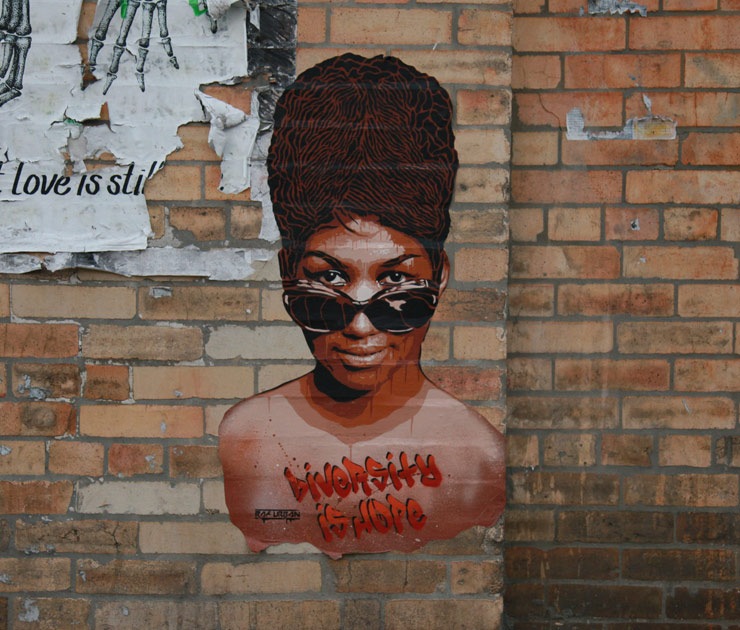
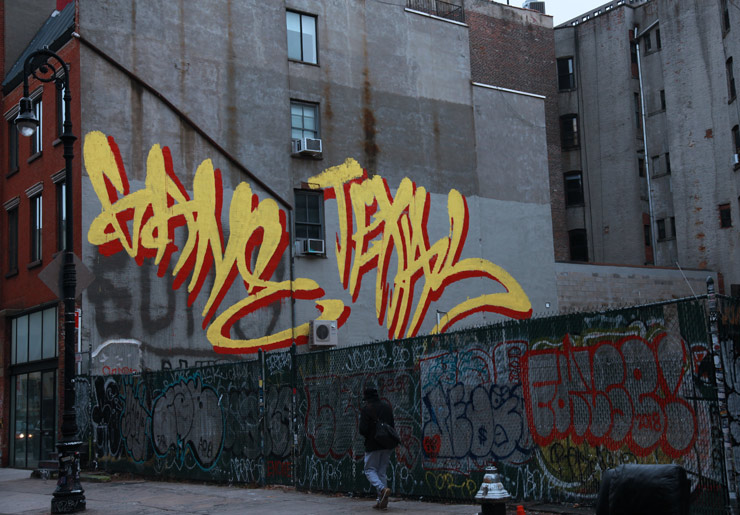
And here’s our weekly interview with the street, this week featuring $smell$907, Adrian Wilson, Blake2018, Bond TruLuv, City Kitty, Dee Dee, Ever Siempre, Gnome Surf, Jilly Ballistic, Kobra, Raf Urban, SicKid, and Vinny.

Top image: Adrian Wilson plays with words to reflect our pop culture trolling both Warhol and Banksy. (photo © Jaime Rojo)

Urban Landscape with graffiti. (photo © Jaime Rojo)

Kobra (photo © Jaime Rojo)

City Kitty trolls Kobra. (photo © Jaime Rojo)

Don’t point your gun at me Sir! Blake2018 (photo © Jaime Rojo)

Jilly Ballistic appropriates an ad in the subway. (photo © Jaime Rojo)

Bond Truluv in Leipzig, Germany. (photo © Jaime Rojo)

Bond Truluv in Leipzig, Germany. (photo © Jaime Rojo)

Bond Truluv in Leipzig, Germany. (photo © Jaime Rojo)

Please do! (photo © Jaime Rojo)

Unidentified artist (photo © Jaime Rojo)

$mell$ 907 (photo © Jaime Rojo)

LA’s SicKid (photo © Jaime Rojo)

SicKid (photo © Jaime Rojo)

Dee Dee (photo © Jaime Rojo)

Gnome Surf (photo © Jaime Rojo)

Raf Urban (photo © Jaime Rojo)

Vinny (photo © Jaime Rojo)

Ever & Friends (photo © Jaime Rojo)

Utitled. SOHO, NYC. December 2018. (photo © Jaime Rojo)

Read more
Doug Gillen Writes: Ernest Zacharevic Is Sending An “SOS”

Doug Gillen Writes: Ernest Zacharevic Is Sending An “SOS”

SOS ! The Earth is increasingly sending out this message. And increasingly artists are answering the call As we near the end of 2018 we feel indebted to Street Artist / fine artist/ activist Ernest Zacharevic for what has been one of the most impactful and important art projects to raise awareness for other inhabitants of the planet. Here in Sumatra he raises awareness and proposes exact actions to protect the Sumatran Orangutan and the environment.

Today we sincerely thank filmmaker Doug Gillen, better known as the funny, entertaining and informative founder of FifthWall TV, who illustrates with his words the aerial image of Mr. Zacharevic’s distress signal:


By Doug Gillen

I often wonder if an artist has ever actually stopped a war by writing “stop wars” on a wall. I don’t have access to any hard empirical evidence to confirm or deny this, but I’ll go out on a limb here and say, probably not. Gauging the impact of art is tricky. All too often well-meaning messages of positivity become lost in the ether of narcissism and capitalist conquests that flood our Instagram news feeds.

Ernest Zacharevic. Splash & Burn. Sumtra, Indonesia. 2018. (photo courtesy of the artist)

Every so often though something pops up, a piece, a project, a stunt and it stops you in your tracks, because you know it’s the real deal. This happened for me back at the start of the year when Ernest Zacharevic came good on his ongoing battle with the Palm Oil industry.

For two years running the Lithuanian artist has been running a festival of sort in Indonesia. For Splash and Burn he invites several artists to the country he now resides in to engage publicly with the theme of palm oil deforestation. The likes of Issac Cordal, Vhils, and Mark Jenkins have all stepped up to the plate but for me the real home run came when Zacharevic revealed he had bought 52hectares of unnatural palm oil plantation to it repopulate it with naturally occurring trees, native to the region. As he tore down the palm oil trees, he carved out a large scale “SOS” into the land in what is one of the most visually captivating and symbolic statements of the year.

It should be said that this project was not done by one person. It was only made possible thanks to groups such as the Sumatran Orangutan Society (SOS), the cosmetic company LUSH and a swath of behind-the-scenes and front line cogs that brought it together.

There are many known problems with the palm oil industry; it’s contribution to climate change, the unregulated black market, the forests are uninhabitable for wildlife, the list goes on. The industry is wreaking havoc on the region, particularly on the island of Sumatra, where Splash and Burn takes place. This was a small, but vital push back but more so, it was an artist coming good on their ethos, taking their vision to the next level to play their role in making the world a better place.


Read more
BSA Film Friday: 12.07.18

BSA Film Friday: 12.07.18

bsa-film-friday-JAN-2015

Our weekly focus on the moving image and art in the streets. And other oddities.

Now screening :
1. JonOne “Illuminier le Future” in Rabat with Montresso Art Foundation
2. ASU / Contorno Urbano / 12 + 1 Projects
3. COLOUR: Rolland Berry. Film by Aether Films
4. GDS from São Paulo crew Os Cururus in Montreal
5. Leonard Cohen, “You Want It Darker”

bsa-film-friday-special-feature

BSA Special Feature: JonOne “Illuminier le Future” in Rabat with Montresso Art Foundation

“I wanted people to feel what I feel: The joy of life,” says JonOne in this self narrated video that keeps the focus on the creative spirit and his new show “Illuminating the Future” in Rabat, Morocco’s capital, which rests along the shores of the Bouregreg River and the Atlantic Ocean. The kinetic action of his strokes and splashes are gestural bolts of energy at the top of this tower to be seen on all sides, an abstract beacon from this New York graffiti writer who metamorphosed into a Parisian fine artist.

ASU / Contorno Urbano / 12 + 1 Projects

“Leave the rationality of your brain and listen to your heart, what you feel, what vibrates,” recommends ASU the muralist painting the Contorno Urbano wall in Barcelona – as we wrote in September. Now comes the newly release video to give more context to his techniques as a calligraffitist.

COLOUR: Rolland Berry. Film by Aether Films

“America is dying because they forgot the instruction of how to live on Earth,” says the wise voice weaving across this minimalist tableau in monochrome and quietly thundering beats. Succinct, brief, hard hitting, well paced and scored – ultimately a missive of power and stark symbology from Aether Films.

GDS from São Paulo crew Os Cururus in Montreal

A uniquely spare documentation of the meditated, deliberate, and dangerous application of straight down pixação, São Paulo style, on the side of this Montreal building. How it is received in this northern part of the the Northern Hemisphere is not told, but as the drone camera rises to catch the cityscape, a mural by Kevin Ledo of Leonard Cohen in his old  neighborhood of Saint-Laurent takes the stage and you may wonder how that man of letters would see these new symbols, now two years after his passing.

“There’s a lover in the story
But the story’s still the same
There’s a lullaby for suffering
And a paradox to blame
But it’s written in the scriptures
And it’s not some idle claim
You want it darker
We kill the flame”

Read more
Bill Posters and Valtònyc: ‘The Gag Law Made Me Do It’ / ‘Lay Mordaza Me Obliga’

Bill Posters and Valtònyc: ‘The Gag Law Made Me Do It’ / ‘Lay Mordaza Me Obliga’

‘The Gag Law made me do it!,” says Street Art activist and social commentator Bill Posters as he talks about his new kiosk takeovers in Placa Espanya, Barcelona. The large black and white photographs are of two free speech advocates arrested for offending ‘Ley Mordaza’ in Spain – a curious concoction of restrictions passed as law 3 years ago that most people would tell you are clearly repressive and are frankly difficult to believe would last for long in a European country.

Including restrictions on photographing police, organizing on social media, public protesting, even leaving furniture in the street (?) (a tradition), in the first seven months of the law being passed 40,000 sanctions were imposed, according to statistics from the Ministry of Internal Affairs on the website European Center for Press and Media Freedom. Euroweekly says that the current average is 80 citations per day. Although some of those cases have been overturned and El Pais says the government has been backtracking on these laws recently.

Bill Posters. Portrait in Exile 2 – Anna Gabriel. ‘Lay Mordaza Me Obliga’ / ‘The Gag Law Made Me Do It’. Intervention in Placa Espanya. Barcelona, Spain. October 2018 (photo © Bill Posters)

Article 578, known as ‘Ley Mordaza’ (the ‘gag law’) has been condemned by Amnesty International and is symbolized in these Street Art pieces by the piece of red tape that goes across the subjects’ mouths. Mr. Posters tells us he intends it to be an interactive piece that the public can remove the tape themselves, symbolically allowing the subject to speak. This act of de-censorship is a novel idea and in fact someone recently did that and photographed it (below).

The artist tells us more details about the two subjects, who he says are, “taken hostage by the Spanish state’s legal apparatus that is increasingly designed to silence both political and cultural dissent.”

Anna Gabriel: “After the holding in 2017 of the Catalan independence referendum, called by the Generalitat de Catalunya, and declared illegal by the Constitutional Court of Spain – the former spokesperson for the Catalan pro-Independence campaign, was called to appear in front of the Spanish Supreme Court to give evidence about her participation in those events. On February 20th, 2018, she stated in an interview to Le Temps that she would not show up for her court hearing, while in a self imposed exile in Switzerland.”

Bill Posters. Portrait in Exile 1 – Valtònyc. ‘Lay Mordaza Me Obliga’ / ‘The Gag Law Made Me Do It’. Intervention in Placa Espanya. Barcelona, Spain. October 2018 (Screen grab from the video)

Valtònyc: “A vocal pro-independence rapper from Catalonia was sentenced to 3 years in prison in March 2018 for lyrics that contained (alleged) glorification of terrorism, slander, ‘lèse-majesté’ (defamation against the crown), and threats.”

Here at BSA we don’t pretend to know all of the history or innerworkings of Spain and Catalonia – or Brooklyn for that matter – but we do worry seriously when we hear about artists being silenced and jailed for speech – and you should too.

Through a third party BSA was able to send a few interview questions to the twenty-four year old Catalonian rapper Valtònyc, who is featured in one of these Street Art pieces and who Belgium recently refused to extradite. With a number of “western” societies going in a hard-right direction politically, we wanted to understand how a country like Spain could have passed these recent laws and how they are affecting artists – those weirdos who usually are the first to test the limits of free speech.

Edited for clarity and brevity, these are the answers we received back:

BSA: Democracy returned to Spain in 1977, yet 41 years later you were convicted by the Supreme Court of Spain for exercising your rights to express your opinions not only as a citizen but as an artist. How is it possible that a member state of the EU, one that bills itself as a democratic state, can rescind freedom of speech among its citizens?
Valtònyc: Being condemned for a song lyric is not the most serious thing that happens in Spain. Since the beginning of the supposed “democracy”, Spain has the only general secretary of a communist party in prison under a life sentence. Now he is also joined by the president of ERC and the ministers of Catalonia without trial and with accusations of up to 30 years for rebellion.

In Spain, multiple daily newspapers, websites and illegal political parties have also been closed. All this while Europe watches. We are not a bourgeois democracy like other countries in Europe, we are a fascist state and it is demonstrable.

The above photo of the installation shown without the red tape was sent to Valtonyc (the Catalonian rapper in exile) which shows his portrait with the red tape removed. “Someone, an unknown member of the public transgressed the boundary from observer to participant which is what the project intended!” Bill Posters


BSA: What about democracy? What’s happened to the Spanish Institutions that were created after the dictatorship to protect the rights of its citizens?
Valtònyc: In a democracy, institutions are there to serve citizens. In Spain they only serve to condemn them. There are 20,000 people affected by the ‘gag law’. When there is a wave of organization and demonstrations, they respond with repression.
It is curious that they never condemn fascists or Nazis and that the accused are always communists and anarchists. The constitutional court does not respond to violations of the constitution, such as my sentence and that of the remaining 15 rappers. Is not freedom of expression a constitutional right?
BSA: Do you think the current state of Spain is a direct consequence of corruption?
Valtònyc: Brussels recently has shown that Spain is the most corrupt country in Europe. Of 1400 corrupt politicians, only 70 have entered prison and none of them has served their sentence in full. Worst of all is corruption within justice – how judges paralyze investigations of political parties or destroy evidence of illegal financing. It’s a disaster.

BSA: Do you see other young people like yourself being aware of the social issues and the struggles facing Spain now? How are they getting involved to help create a better country?
Valtònyc: Every day people are more aware of what is happening in the Spanish state and are organized or mobilized. There are never enough, but as in France, we in Spain also have examples of organization and struggles that have ended in victory. There are the examples of Gamonal, the train of Murcia, or the miners of Asturias. It shows that the people united and on the street, not only on the Internet, can preserve all the rights they try to take away from us. History proves this as a fact and it has never changed.

(photo © Pepe Marín)

BSA: Do you think most young people in Spain view the Spain of Franco as something in the distant past and see no connection between his 35 years in power and the concerns of contemporary Spain?
Valtònyc: I believe that many people are aware of the rise of the extreme right throughout Europe; how the extreme right takes advantage of the weaknesses of the popular classes in their speeches and thus wins their sympathy. The problem is that we do not organize ourselves to stop fascism and then we are surprised that in the elections they win so many votes. Fascism advances if it is not fought and it is a pity that people do not understand that this is more than a simple slogan.

BSA: Do you think artists must take a position with their art to lead a revolution for change? What is the part that art plays during times of social unrest and injustice?
Valtònyc: I believe that art has to be a tool for social transformation; a hammer to shape reality. All art is political, many people think not, but that’s the way it is. Your art can serve the oppressor or the oppressed class, but it is impossible to stay out of politics. Now in the HipHop scene the Trap sound abounds and the political rap is not so notorious, but we still remain combative rappers in the trenches – especially in South America and in France.


Read more
“Points De Vue” Festival 2018 Spans Styles and the Basque Region in Bayonne, France.

“Points De Vue” Festival 2018 Spans Styles and the Basque Region in Bayonne, France.

“Today there are nearly 80 works – paintings and installations,” says Alban Morlot, “to discover in the inner city and its periphery.”

Mantra. Points De Vue Festival 2018. Bayonne, France. (photo © Martha Cooper)

The founder and curator of Points de Vue is speaking about his city, Bayonne in the south of France, which straddles the Basque region and boasts the language throughout this region and neighboring Spain. Here on both sides of the the Adour river running through the small city, you will find new installations from this years invited 20 or so artists from the urban art scene including folks like the Portuguese Pantonio, Italian Pixel Pancho, French Mantra, French Koralie, Venezuelan Koz Dox, German 1UP Crew, and the American graffiti and Street Art documentarian Martha Cooper.

Spawned a few years ago from Morlot and his team at Spacejunk, the community/privately funded festival has produced a range of large public works throughout the city. Similarly, the storefront Spacejunk space on rue Sainte Catherine in the Saint-Esprit district of Bayonne had hosted a cultural and artistic association that spans genres and disciplines; hosting classes, talks, performances and exhibitions of modern artists drawn from the worlds of of Street Art, LowBrow, and Pop Surrealism. After a great number of group and solo shows Spacejunk is now entering their 11 year celebrating counter-culture.

Mantra. Points De Vue Festival 2018. Bayonne, France. (photo © Martha Cooper)

Bayonne is stitched together geographically and socially with nearby Biarritz and Anglet, so the Basque area of about 130,000 has enough fans and practioners to support this five day festival. Alban tells us that the usual staff of 3 who run Spacejunk couldn’t do the festival without the generous enthusiasm and efforts of 40 volunteers, 10 interns and 1 senior technician.

An eclectic mix of artists invited to create new works in the public space reflect the alternative environments that have been showcased at Spacejunk: influences from a number of subcultural narratives including comics, punk, tattoo, skater culture, graffiti, and of course, Street Art.

Mantra. Points De Vue Festival 2018. Bayonne, France. (photo © Martha Cooper)

With very special thanks to Ms. Cooper and Ms. Kramer we have today new images to share with BSA readers from this autumns’ edition of Points de Vue. We also had an opportunity to speak with Mr. Morlot about his approach to the festival.

BSA: How did you conceive of Points de Vue?
Alban Morlot:
I have work for Spacejunk art center for almost 15 years and have run the art center of Bayonne – Basque Country – since 2007. During this time I’ve met many artists from all over the world who have work in public space previously. At that time, French public authorities were under-informed about street art mutations so it was difficult to organize outside projects with street artists – who many people automatically associated to vandalism.

I was frustrated at not being able to take advantage of their presence and their talent to develop their aesthetics in situ. It was during that time that the idea of a festival sprouted in my mind – but it was only later that the planets were aligned!

Equipped with years of experiences, I wanted to set up an event that could represent the variety of the creative styles being used in public space and to provide an educational approach in the same time. The underlying idea is to show the multiplicity of artistic points of view, to confront them, and to offer to the wider audience the opportunity to enrich themselves with others’ eyes.

Mantra. Points De Vue Festival 2018. Bayonne, France. (photo © Martha Cooper)

BSA: What’s your criteria as an organizer when inviting the artists to participate?
Alban Morlot: First, I make sure that the artistic selection is consistent with the purpose of the festival: to discover the extent of the current creations happening in public space. Then it’s the walls that guide me in my research. The context, the format, the situation… are all criteria that I integrate before launching a personalized invitation to an artist.

Most of the time, I invite artists whom I have already met because I like building relationships that go beyond the “one shot”. I know that it could be possible to pass up several editions before I can propose an invitation to such and such artist, but I prefer to wait the right moment, try to gather the best conditions and do a serious proposal so that from the artworks there emerges the pleasure of painting.

Anonymouse. Points De Vue Festival 2018. Bayonne, France. (photo © Martha Cooper)

Then I try to build a singular identity for the festival “Points of View”. The Basque Country is located between France and Spain. It is important in this context to boost cross-border artistic exchanges between the northern Basque Country (Iparralde) and the south (Hegoalde).

Last but not least, I try to encourage the presence of female artists because they remain largely underrepresented in this artistic scene.

Anonymouse. Points De Vue Festival 2018. Bayonne, France. (photo © Martha Cooper)

BSA: Bayonne is also known for its political murals. Do you encourage the artists to be political with their work as well?
Alban Morlot: Generally, I do not allow myself to intervene in the process of artistic creation. I give my opinion if necessary but for me, once the selection is complete, I trust them. I want to allow everyone to practice his or her job with good conditions and it can happen if each part knows his appropriate place.

That said, I do not hesitate to convey the history of the region that welcomes them, because here as elsewhere, there is a story, a people and a language. It is political in a sense, but in the noble meaning!

Anonymouse. Points De Vue Festival 2018. Bayonne, France. (photo © Nika Kramer)

BSA: Do you see Points de Vue purely as a beautification of the city or do you see it to make a social impact within the community?
Alban Morlot:
In no way should our action be seen as decoration. Otherwise, I would not give carte blanche to the artists. No, I undertake a cultural project that aims to promote the meeting between artists and the public, generates exchanges, curiosity, in order to support everyone to be emancipated as a citizen.

Of course, I am not unaware of the social, economic, touristic considerations nor the impact of the festival on urban renewal programs. Culture is transversal and this is its strength, but I do not want to be polluted by other considerations that could divert me from the basics of the festival. I want to give artists the opportunity to work on a wall as they would in their studios and give them the opportunity to meet each other.

Anonymouse. Points De Vue Festival 2018. Bayonne, France. (photo © Nika Kramer)

BSA: How do you see the arts in public space making a difference to society? Should that be the mission or art in public space?
Alban Morlot: Art in the private space or in the public space plays the same role. The unprecedented recognition of urban art is one of all manifestations of social upheaval that we go through in modern societies. I think there’s a break with previous artistic movements because it more closely allies with the aspirations of today’s people – with think tanks who want to reinvest public spaces, etcetera. Art has always been an indicator of the evolution of society.

Anonymouse. Points De Vue Festival 2018. Bayonne, France. (photo © Martha Cooper)

BSA: What sort of support do you get from the city’s government for the implementation of the festival?
Alban Morlot: Since the Spacejunk art center is already identified by public authorities, we also receive support from these partners for the festival; This is a form of financial and logistical support. In addition, the festival is also supported by private companies and, thanks to all of these contributors, we manage to present a festival that is both qualitative and open to all.

Lorcolors. Points De Vue Festival 2018. Bayonne, France. (photo © Martha Cooper)

BSA: What’s the reaction of the residents of Bayonne when they see the artists at work and the completed murals?
Alban Morlot:
I must say that I was surprised by the reception that the Bayonne’s inhabitants (and vistors from nearby) have reserved for the festival. I spent almost 6 years defending this project with people who were ultimately quite afraid of the reaction of the public. But the reactions of the population were immediately enthusiastic! Martha (Cooper) even told me that it was quite unusual to see so many people on the streets coming to see the artists work. It is true that I strongly emphasized that it was a chance to see the artists in creation residencies!

Additionally, different from other events, an urban art festival leaves traces on the city which gain a certain value in time, and we are pleased that so many artists have come to the Basque country.

Lorcolors. Points De Vue Festival 2018. Bayonne, France. (photo © Martha Cooper)

Lorcolors. Points De Vue Festival 2018. Bayonne, France. (photo © Martha Cooper)

Remy Uno. Points De Vue Festival 2018. Bayonne, France. (photo © Martha Cooper)

Remy Uno. Points De Vue Festival 2018. Bayonne, France. (photo © Martha Cooper)

Taroe. Points De Vue Festival 2018. Bayonne, France. (photo © Nika Kramer)

Pixel Pancho. Points De Vue Festival 2018. Bayonne, France. (photo © Martha Cooper)

Pixel Pancho. Points De Vue Festival 2018. Bayonne, France. (photo © Martha Cooper)

Pixel Pancho. Points De Vue Festival 2018. Bayonne, France. (photo © Martha Cooper)

Pantonio. Points De Vue Festival 2018. Bayonne, France. (photo © Martha Cooper)

Pantonio. Points De Vue Festival 2018. Bayonne, France. (photo © Martha Cooper)

Pantonio. Points De Vue Festival 2018. Bayonne, France. (photo © Nika Kramer)

Pantonio. Points De Vue Festival 2018. Bayonne, France. (photo © Nika Kramer)

Koralie. Points De Vue Festival 2018. Bayonne, France. (photo © Nika Kramer)


Fermin Moreno. Points De Vue Festival 2018. Bayonne, France. (photo © Martha Cooper)

Fermin Moreno. Points De Vue Festival 2018. Bayonne, France. (photo © Nika Kramer)

Fermin Moreno. Points De Vue Festival 2018. Bayonne, France. (photo © Nika Kramer)

Deuz. Points De Vue Festival 2018. Bayonne, France. (photo © Martha Cooper)

Deuz. Points De Vue Festival 2018. Bayonne, France. (photo © Martha Cooper)

Deuz. Points De Vue Festival 2018. Bayonne, France. (photo © Martha Cooper)

Deuz. Points De Vue Festival 2018. Bayonne, France. (photo © Martha Cooper)

Petite Poissone. Points De Vue Festival 2018. Bayonne, France. (photo © Martha Cooper)

Petite Poissone. Points De Vue Festival 2018. Bayonne, France. (photo © Nika Kramer)

Reskate Studio. Points De Vue Festival 2018. Bayonne, France. (photo © Martha Cooper)

Reskate Studio. Points De Vue Festival 2018. Bayonne, France. (photo © Nika Kramer)

Reskate Studio. Points De Vue Festival 2018. Bayonne, France. (photo © Nika Kramer)

Koz Dos. Points De Vue Festival 2018. Bayonne, France. (photo © Martha Cooper)

KOZ DOS
“Punto y flecha sobre el plano”

“Dreams and the subconscious have been the genesis of my work lately. I do try not to put limits on myself or to follow a pattern when I create. The elements that are in my subconscious are the sketches to draw information from. At the same time it’s also the beginning of something that exists and that might be real and logic in our minds. It is the treatment of color, composition and form that unify all the elements and symbols, creating fantastic characters that in turn shed light to a parallel universe.

A central theme in my research for quite a while now, is the confrontation of the human versus the beast and nature. I look for harmony and coexistence through the treatment of images and the plastic arts.

In this project, titled “Punto y flecha sobre el plano” I wanted to work with the construction of the elements within the piece as something tangible, like our dreams, using lines and points on the plane or the wall in this case. Most of everything in our universe is composed of circles and lines so in this piece I wanted to give importance to the geometric form but imbued with a dreamlike quality.

When we are able to verbally communicate with each other we are able to arrive to important accords. Reaching an agreement means that we can coexist with each other. We have the tools at our disposal to do so but very often we put our focus on damaging ourselves by rejecting our origins, destroying our cultures and traditions and mowing over everything as we march on.”

Koz Dos. Points De Vue Festival 2018. Bayonne, France. (photo © Nika Kramer)

Udatxo. Points De Vue Festival 2018. Bayonne, France. (photo © Nika Kramer)

Landroid. Points De Vue Festival 2018. Bayonne, France. (photo © Martha Cooper)

Landroid. Points De Vue Festival 2018. Bayonne, France. (photo © Martha Cooper)

Landroid. Points De Vue Festival 2018. Bayonne, France. (photo © Nika Kramer)

Flow . Deza. Points De Vue Festival 2018. Bayonne, France. (photo © Martha Cooper)

Untay. Points De Vue Festival 2018. Bayonne, France. (photo © Martha Cooper)

Untay. Points De Vue Festival 2018. Bayonne, France. (photo © Martha Cooper)

Points De Vue Festival 2018. Bayonne, France. Photo of Martha Cooper by Nika Kramer.

Vintage political mural in Bayonne, France written in the Basque language, translated as “The People Must Live”. (photo © Martha Cooper)

Vintage political mural in Bayonne. (photo © Martha Cooper)

Vintage political mural in Bayonne, France written in the Basque language. (photo © Martha Cooper)

Read more
Gola Hundun Activates on the Precipice of Man and Nature

Gola Hundun Activates on the Precipice of Man and Nature

“Abitare” (To Live In)


Italian Street Artist and urban interventionist Gola Hundun is often thinking about the idea of coexistence and cohabitation between humans and the rest of the natural world. He often looks for that delineation on which to create new art.

Naturally it is performed with a flourish of theatricality.

Gola Hundun. “Abitare”. Rimini, Italy. 2018. (photo © Tommaso Campana)

“I consider these places to be sort of a temple or a monument that speaks about the frontier between human space and the natural one,” he says of this abandoned industrial carcass that is returning back to the earth somewhere around Rimini, Italy.

Here he interacts with the ruins – a formerly useful construction of humans that behaved as if it was not part of nature, possibly in an open attack of nature. Now it looks as if he is introducing it back to the ecosystem it stood amongst and apart from.

Gola Hundun. “Abitare”. Rimini, Italy. 2018. (photo © Tommaso Campana)

“Today it’s clear that human behavior (especially Western humans) that sees us like the dominant species of the world who can manage all resources for our own development and not consider the rest of biosphere – these behaviors have brought the planet on the brink of an Eco-disaster,” he says.

So it is here at the scene of the crime that the forensic detective converts to holy healer, interacting with the ruins and blessing it as it convenes a unique and slow transformation.

This abandoned location is a place where spontaneous growth is happening already,” he tells us. “These places for me are a ready made work of art where I introduce my glorifying theme, trying to bring to light their intrinsic holy aura.”

Gola Hundun. “Abitare”. Rimini, Italy. 2018. (photo © Tommaso Campana)

Gola Hundun. “Abitare”. Rimini, Italy. 2018. (photo © Johanna Invrea)

Gola Hundun. “Abitare”. Rimini, Italy. 2018. (photo © Johanna Invrea)

Read more
WK Interact Makes Some Noise in Tokyo

WK Interact Makes Some Noise in Tokyo

French New Yorker and Street Artist WK Interact has just finished a new gig on a massive wall in Japan and he is about to help make some noise about it, so to speak. The Japanese band Noisemaker has a substantive following for their nu metal sound recalling the glossy punk stylings of 1990s and bands like Massive Attack, Green Day, and Rage Against the Machine and WK has created work to help them promote their new mini-album and tour kickoff next month.

WK Interact. Noisemaker. Shibuya, Japan. (photo courtesy of the artist)

The 12 meter wall in Shibuya features WK’s signature black and white urban military police-state nomenclature with an attractive female figure bossing in the foreground while holding a vintage recording device familiar to security and law enforcement. The Bands name is splashed in blood red behind her.

It took three days and a night to complete and WK tells us he had a very good time with the bands and the fans. Given that WK’s work on the street has nearly often contained elements of blurring chaotically chopped action, you smile when he tells you “the band was jumping on a trampoline in motion near the wall for their album cover.”

WK and the boys in the band celebrating the finished wall on social media.


BSA: What does the model’s pose and clothing signify to you?
WK Interact: The model is supposed to be one their fans who goes to many different concerts. She has a recording device that dates back to 1980 called a NAGRA. Many people these days carry their own listening device on their SMART phone. The idea is that she’s recording and transmitting to many other people. She is in her own world and listening and recording events is a passion for her – like buying clothes or surfing or traveling.

WK Interact. Noisemaker. Shibuya, Japan. (photo courtesy of the artist)

BSA: How is this wall significant to people in Japanese culture?
WK Interact: This specific place will be destroyed in the next two months and new construction will take over. It’s located four blocks from the Shibuya station and it is in the heart of a district with many different cool bars and shops. Many Japanese are sad to see spots like this vanish.

WK Interact. Noisemaker. Shibuya, Japan. (photo courtesy of the artist)

BSA: How would you describe the scene on the street in Shibuya?
WK Interact: The last time I visited Japan was 17 years ago and at that time I did an amazing opening at PARCO Museum. At the time JAPAN was the most advanced in terms of street wear and a prime environment for street art and graffiti. Tokyo has changed terribly as you almost see nothing in terms of expression from the street. None is visible. All the small little stores have vanished, the economy is not as good, and most of the big brands have taken over.

WK Interact likes to capture the severe men in uniform wherever he goes. Noisemaker. Shibuya, Japan. (photo courtesy of the artist)

WK Interact. Noisemaker. Shibuya, Japan. (photo courtesy of the artist)

WK Interact. Noisemaker. Shibuya, Japan. (photo courtesy of the artist)

WK Interact. Noisemaker. Shibuya, Japan. (photo courtesy of the artist)

Read more
BSA Images Of The Week: 12.02.18

BSA Images Of The Week: 12.02.18

BSA-Images-Week-Jan2015

Sliding into the chaos this week with great new stuff that hits on pop, poetry, technology. The madness of New York sometimes fuels the message on the street; other times it feels like NYC is merely channeling the forces that run through it. Embrace the chaos!

If you have a chance please check out the “Punk Lust” show at Museum of Sex, curated by Carlo McCormick and a small team. The array of zines, record covers, posters, photography, costume and McCormicks’ brilliant didactics is revelatory for its take on a distinctly New York punk scene that was simultaneously awash with discontents from LA and London and an utter revulsion at the likes of the Reagan/Thatcher Revolution.

Yeah but how was sex involved, you ask? Wayne and Jayne, you’ll be surprised. Check out Scott Lynch’s excellent photos on Bedford and Bowery of the opening.

We used to say that half of the New York art world was in Miami when Art Basel rolls around every year – and again many artists are making the trek to the art fairs and to Wynwood to see whose hitting walls this week. But we’re sensing a twisted sort of backlash in people’s opinions these days – kind of like Williamsburg in 2008 and Bushwick in 2014. But Dude, it’ll still be a party, yo!

So here is our weekly interview with the streets, this week featuring Adam Fujita, Calangoss, Edward Senf, Graphic Fury, Himbad, JerkFace, Little Pink Pill, Luis, Lunge Box, Mr. Frostee, REVS, Sac Six, Trasher, and WISE .

Top Image: Edward Senf is feeling lucky. (photo © Jaime Rojo)

Jerk Face (photo © Jaime Rojo)

Jerk Face (photo © Jaime Rojo)

Adam Fu (photo © Jaime Rojo)

Calangoss (photo © Jaime Rojo)

WISE (photo © Jaime Rojo)

The Three Eye Raven… (photo © Jaime Rojo)

Mr. Frostee (photo © Jaime Rojo)

Mr. Frostee (photo © Jaime Rojo)

So what…indeed… (photo © Jaime Rojo)

Him good. Himbad (photo © Jaime Rojo)

Trasher (photo © Jaime Rojo)

Luis (photo © Jaime Rojo)

Revs (photo © Jaime Rojo)

Little Pink Pills . Graphic Fury (photo © Jaime Rojo)

SacSix (photo © Jaime Rojo)

The firewood prevented us from getting this artists’ ID…please help… (photo © Jaime Rojo)

Great to see these Estonians in New York – we talked about them during an art/technology BSA Film Weekend in Stockholm this year. A ghostly image done with a spray robot by Spray Printer. (photo © Jaime Rojo)

Lunge Box (photo © Jaime Rojo)

Untitled. Williamsburg Bridge/East Side River. Brooklyn, NY. November 2018. (photo © Jaime Rojo)

Read more