All posts tagged: Beyond The Streets Saatchi Gallery London

More Narcissus Than Night Fever: Conor Harrington at Beyond the Streets / Saatchi London

More Narcissus Than Night Fever: Conor Harrington at Beyond the Streets / Saatchi London

Irish artist Conor Harrington emerged from the graffiti scene in Cork in the 1990s, but his paintings have since taken him into the grand theater of European art history, where military officers, aristocrats, and other figures of authority appear to be fighting for control of the canvas or wall.

Authority has always been a tricky subject for graffiti writers, who spend considerable time and energy challenging and resisting it. Street artists have often done the same, which makes Harrington’s approach particularly interesting. His work is both fascinated by power and suspicious of it, examining its appeal, its hypocrisies, and its abuses, often with a flair for the theatrical.
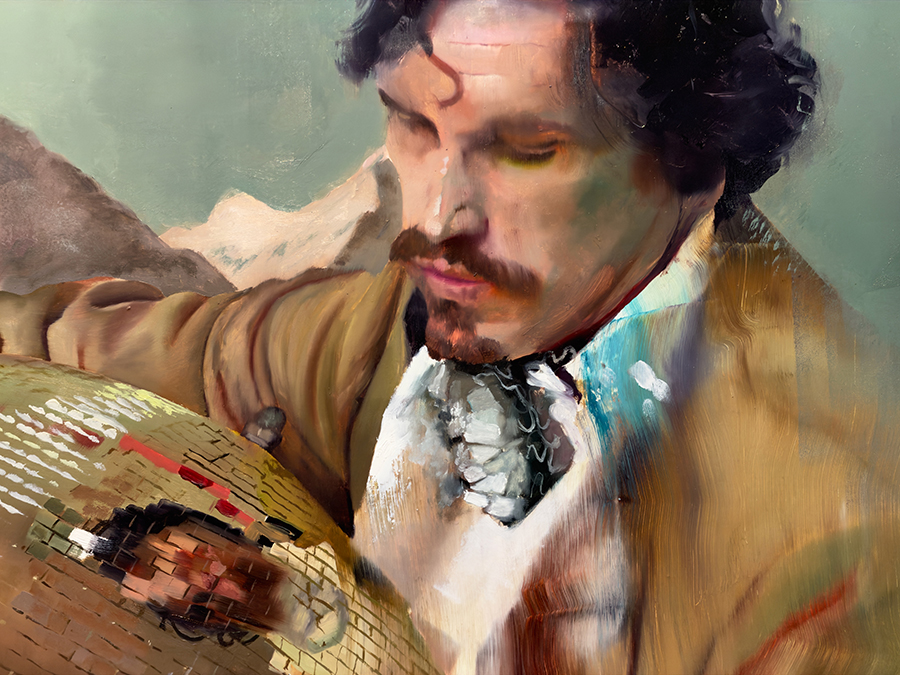
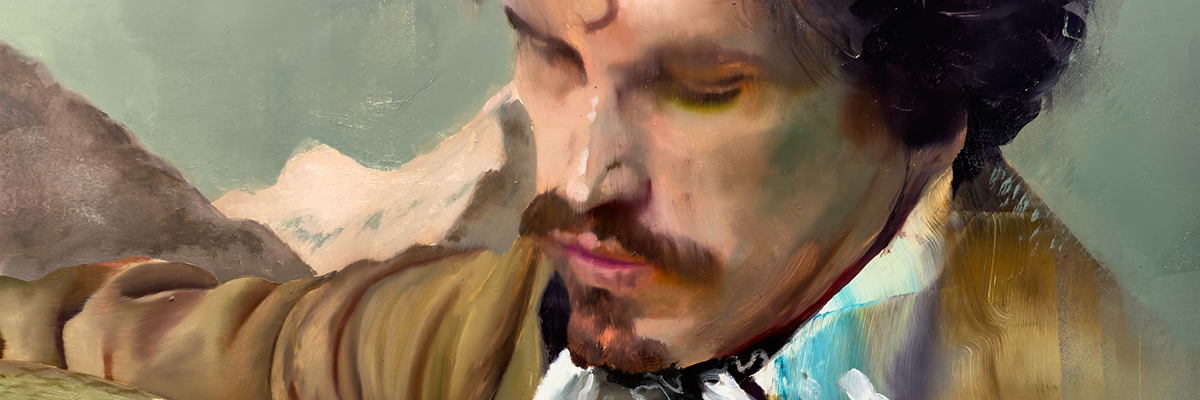
Conor Harrington. My Mirror Weighs a Ton. Detail. Beyond The Streets London. Saatchi Gallery. (photo © Jaime Rojo)

Combining the dramatic compositions of classical painting with the speed, splashes, drips, and interruptions of graffiti, Harrington stages confrontations involving masculinity, colonialism, and the fading authority of empire. His monumental murals have appeared on city walls around the world, bringing the visual language of historical painting into public spaces where it is rarely seen. There is something satisfying about watching these elaborately dressed representatives of the ruling class come apart at the seams, hubris melting into the air, their carefully constructed authority undone by the unruly hand of a former graffiti writer.

Another curious collision appears in Harrington’s new painting at Beyond the Streets in London. His work has long been populated by the decidedly masculine world of military officers, aristocrats, and men locked in struggles for dominance. Yet here, the object commanding everyone’s attention is a giant disco ball. Disco, of course, emerged in part from the Black, Latino, and gay clubs of 1970s New York, where the dance floor offered freedoms often denied outside. Its mirrored centerpiece eventually charged its way into mainstream popular culture, particularly after Saturday Night Fever brought disco into living rooms.
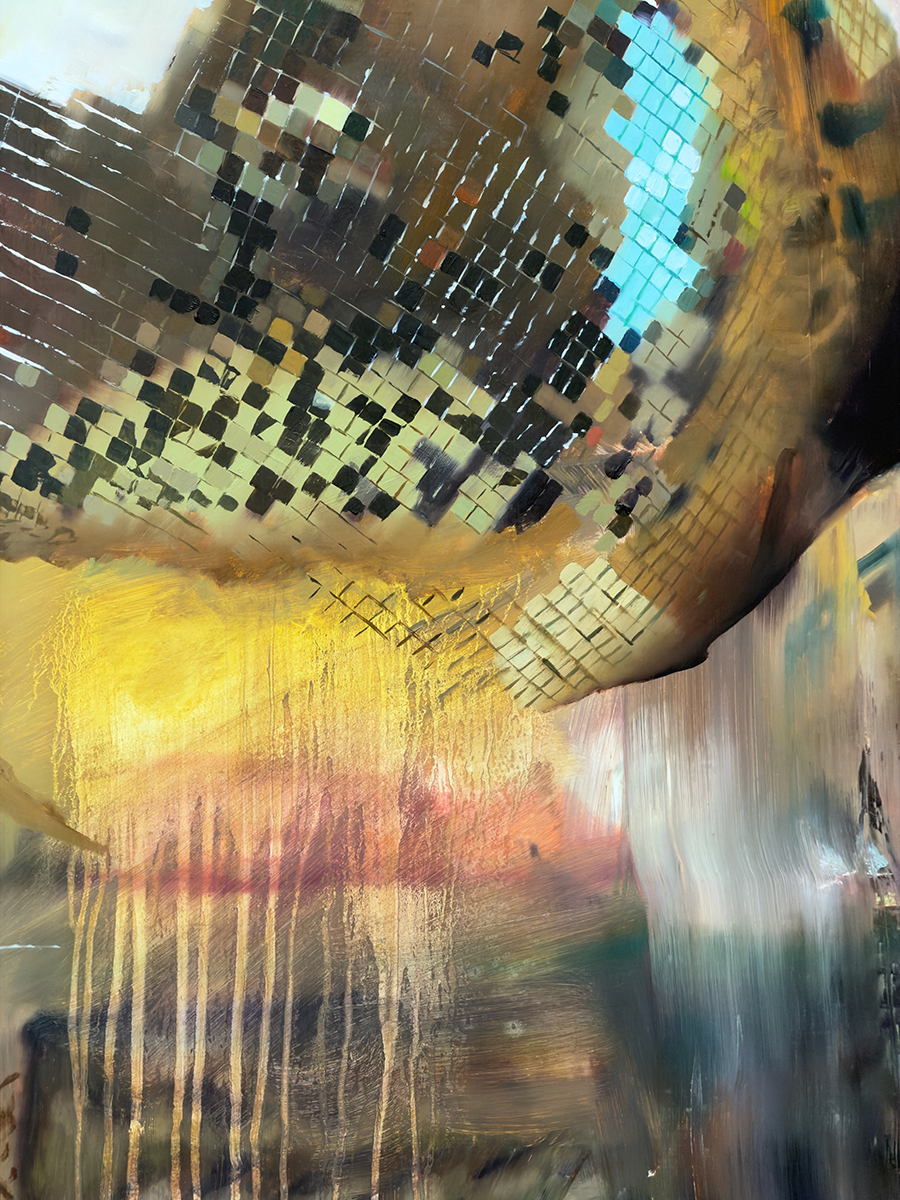
Conor Harrington. My Mirror Weighs a Ton. Detail. Beyond The Streets London. Saatchi Gallery. (photo © Jaime Rojo)

Whether Harrington intended that cultural contrast or not, it adds another dimension to the painting: a traditionally masculine figure struggling under the weight of an object associated with pleasure, liberation, and the breaking of social conventions. It’s probably more Narcissus than Night Fever, however. As Harrington points out, the man can see himself in the mirrored sphere, but his reflection has been fractured into hundreds of pieces. His own image refuses to cooperate.
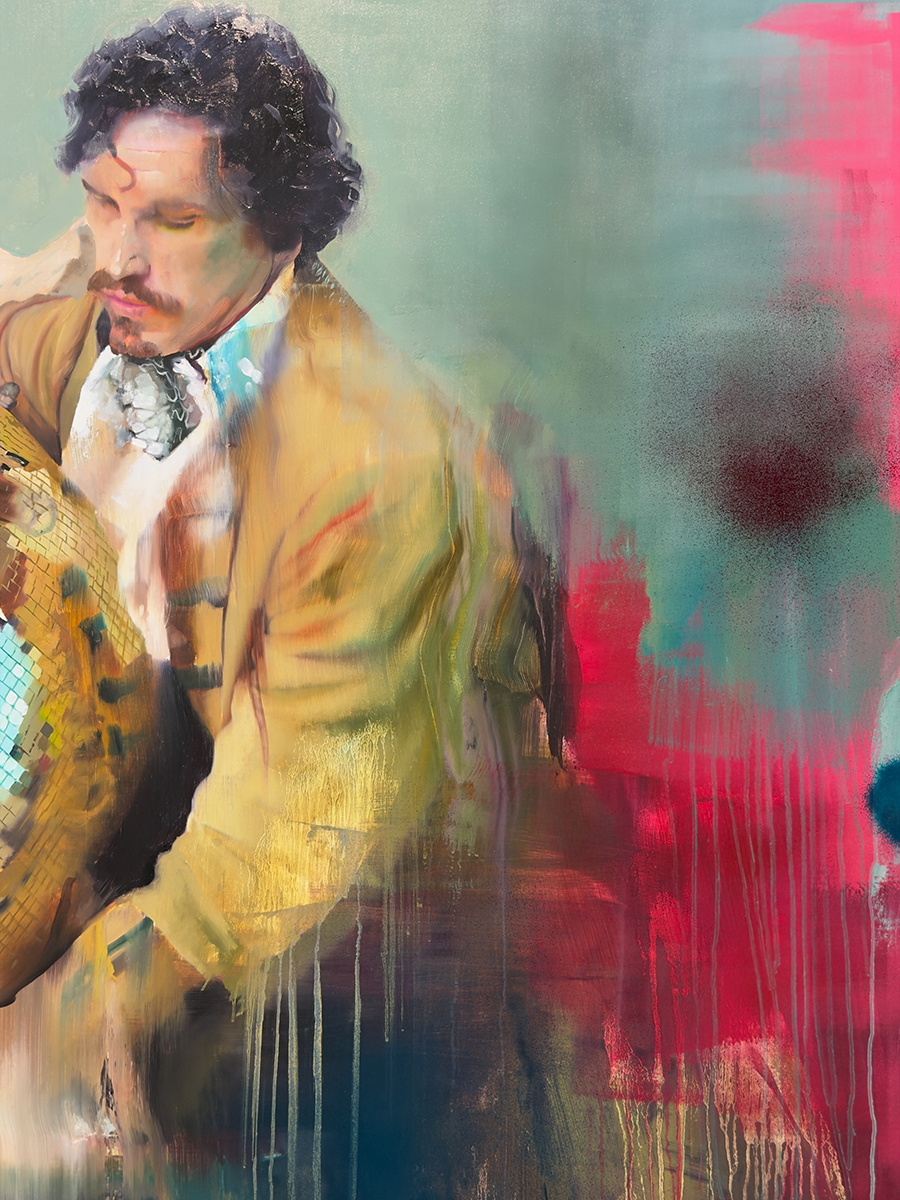
Conor Harrington. My Mirror Weighs a Ton. Detail. Beyond The Streets London. Saatchi Gallery. (photo © Jaime Rojo)

Throughout his work, Harrington returns to questions of power, masculinity, ego, nationalism, and conflict, often using the grand imagery of European history to examine both the allure of authority and the absurdities and hypocrisies of those who wield it. In our conversation here, he connects these recurring themes to his graffiti roots, particularly the struggle between control and freedom. He also explains how the experience of having his work erased by authorities continues to influence his painting technique. The municipal buff, once the graffiti writer’s adversary, has become one of the painter’s tools.

Brooklyn Street Art (BSA): What’s the significance of the disco ball?

Conor Harrington: There are a few different references here. I’ve taken a few ideas from Greek mythology. There’s Atlas and Sisyphus, two men who are condemned by the gods. Both had to hold giant boulders, and I quite like that idea of the condemned man. Also thinking of narcissists, where he’s got his reflection and is caught in the mirror, except with the benefit of the disco ball, his reflection is fractured and abstracted. I really like playing on ego and things like that.

My roots are in graffiti, and I always saw graffiti as the ultimate disruptive act. It’s essentially like a splash of color in a gray landscape, so it’s that contrast. In my painting today, 20, 30 years after I used to do graffiti, I’m still trying to play with those contrasts between historic themes of power and authority and disrupting them with something a lot more modern – that represents freedom of expression and community and all that.
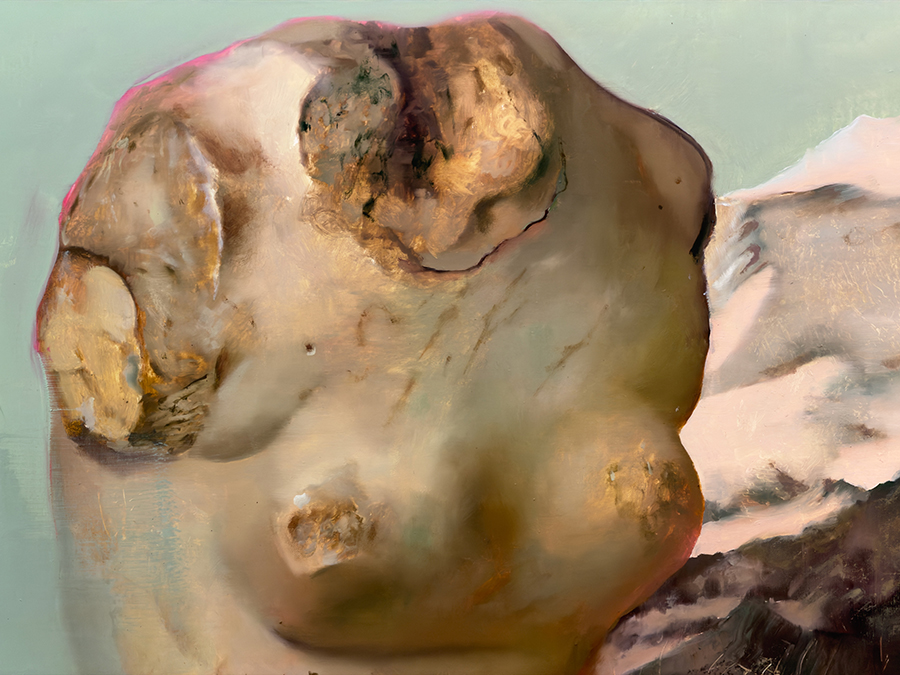
Conor Harrington. My Mirror Weighs a Ton. Detail. Beyond The Streets London. Saatchi Gallery. (photo © Jaime Rojo)

BSA: Not often is disco intertwined with anything remotely graffiti or street art, in my experience.

Conor Harrington: I guess not, but there’s still that play between control and freedom. I think that was what I was more interested in when I was younger, doing graffiti: that dialogue between me painting tags and the authorities coming to clean it off days or weeks later.

BSA: So he’s struggling with the weight of that? It looks like it might slip, because I can’t tell if there’s something viscous that he’s grasping, and maybe it’ll drop.

Conor Harrington: I think he is a little bit. I’m glad you picked that up, actually. He feels like that.

When I paint, going back to that idea of the buff, where everything gets wiped away, I try to play with that a lot in my work. I paint and then wipe it away. I painted the bottom of this, and his hand and his coat, and wiped it away. So that idea of erasure is still very important to me.
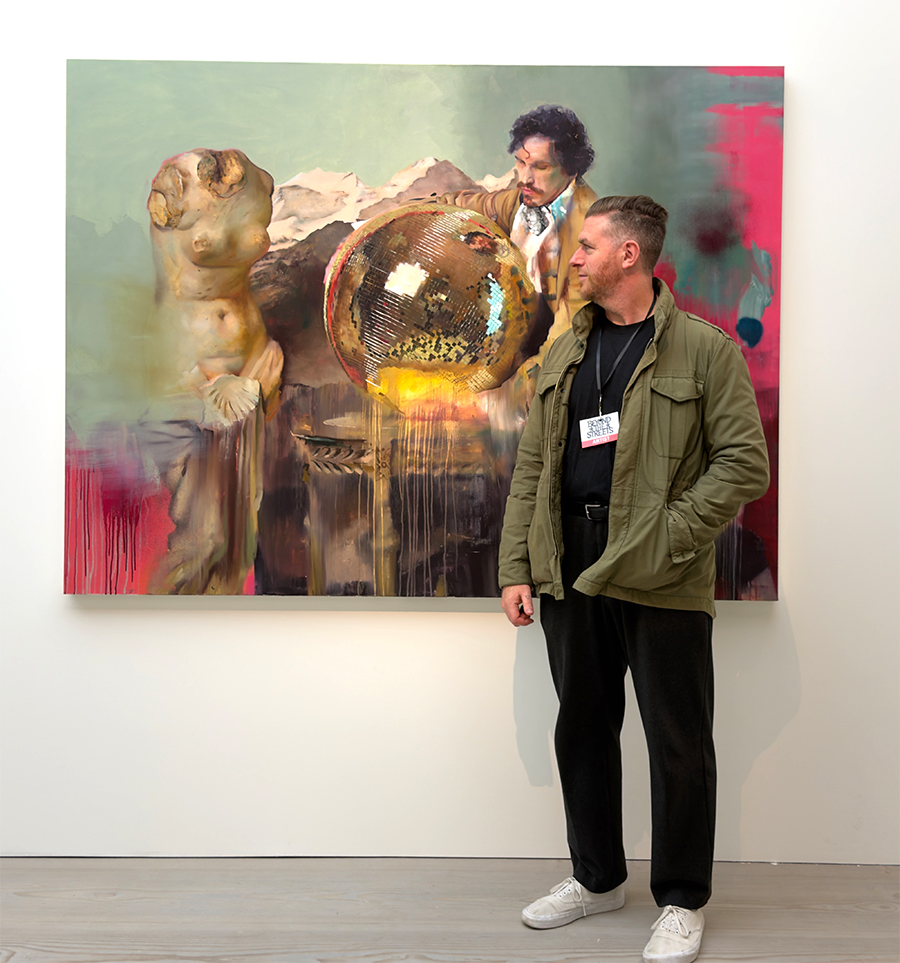
Conor Harrington. My Mirror Weighs a Ton. Beyond The Streets London. Saatchi Gallery. (photo © Jaime Rojo)

BSA: Would you say a lot of your pieces depict, embrace, or glamorize force, aggression, and violence?

Conor Harrington: I would say critique it, maybe, is the word I would use. I’ve done various different bodies of work over the years. For example, there was one series where I had two guys fighting with flags. There was a guy with a red flag, a guy with a blue flag, fighting each other and trying to trap each other in their own flags.

That was my show in 2016, which was Donald Trump’s first presidential campaign and then Brexit over here. Flags and nationalism became such a powerful theme that I hadn’t really experienced before.

BSA: Nationalism, but also polarization, the way it’s just two sides that cannot…

Conor Harrington: Right. There’s no gray area anymore.
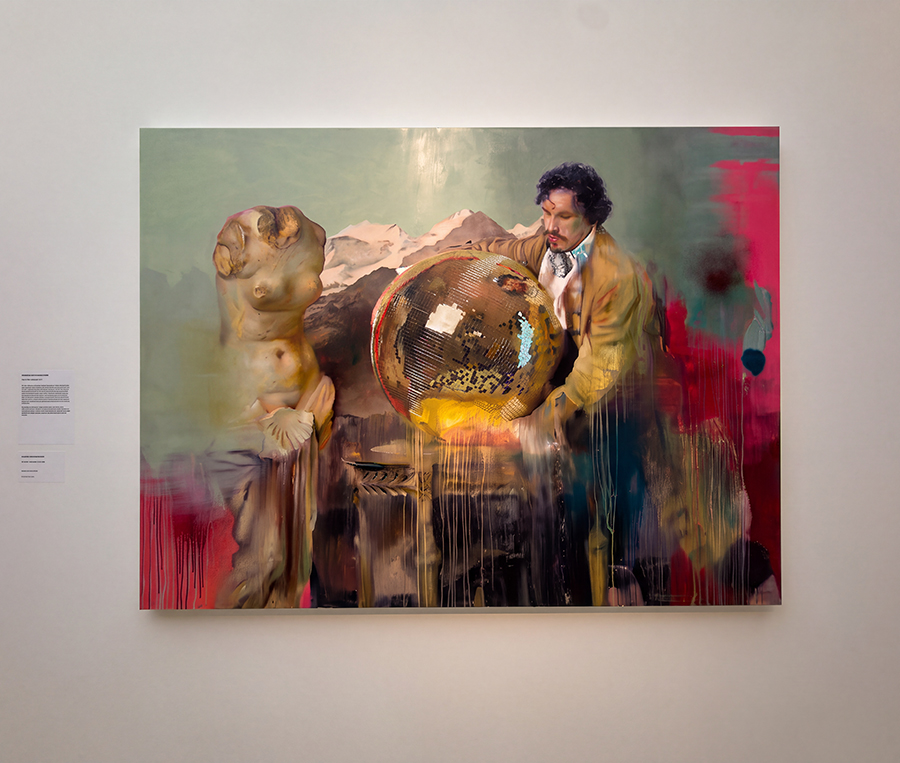
Conor Harrington. My Mirror Weighs a Ton. Beyond The Streets London. Saatchi Gallery. (photo © Jaime Rojo)

BSA is in London with Urban Nation Museum to talk with people about the street art and graffiti scene and Urban Nation’s 10-year celebration.
Read more
“Beyond the Streets” Returns to London: Graffiti, Punk, Politics, and a Few Familiar Suspects

“Beyond the Streets” Returns to London: Graffiti, Punk, Politics, and a Few Familiar Suspects

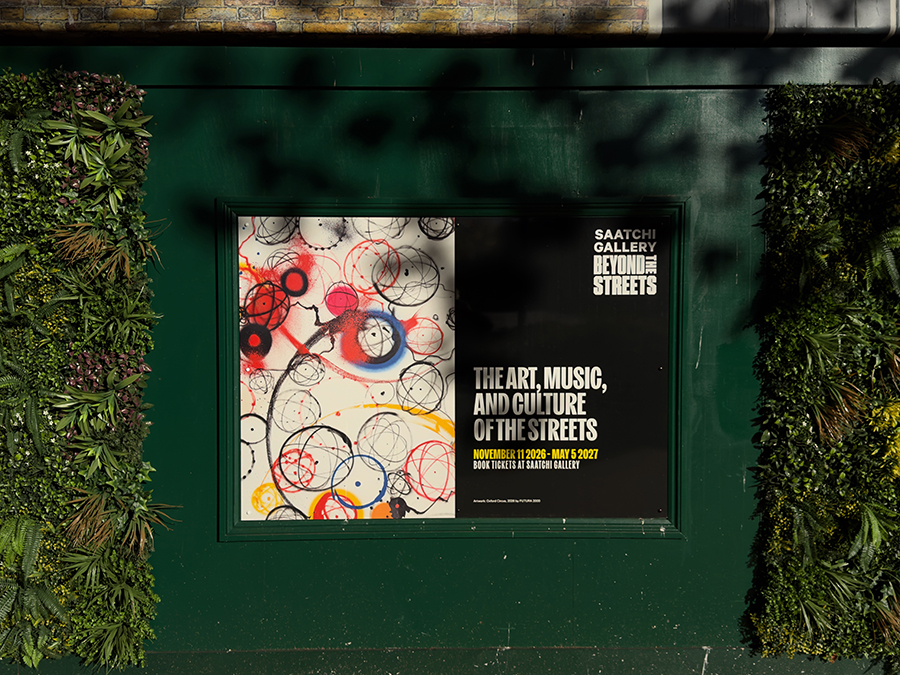
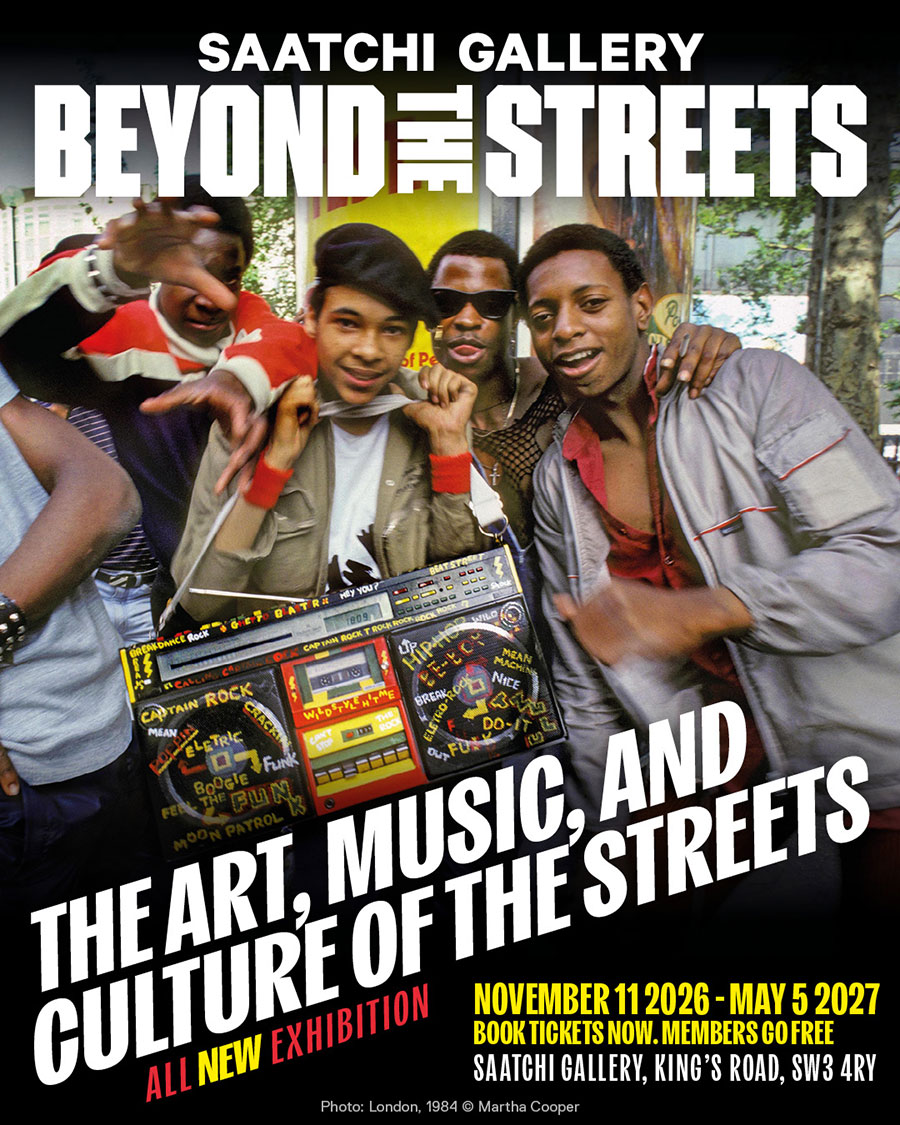
Graffiti has spent decades being chased off trains, scrubbed from walls, prosecuted in courtrooms, and occasionally welcomed into museums with a glass of champagne. This November, BEYOND THE STREETS returns to London’s Saatchi Gallery for a six-month occupation of more than ten rooms, bringing together over 100 international artists and cultural troublemakers. Curated by Roger Gastman, the exhibition promises a sprawling look at six decades of street-born creativity, from subway writing and punk graphics to feminist activism, fashion, photography, and the music that accompanied it all. The numbers can impress – organizers estimate more than 150,000 visitors to its previous London outing in 2023, and this time the lens grows wider.

The lineup has some serious mileage on the odometer, and the acknowledgment of contributors from outside the scene, or at least its outer margins, is what gives it intellectual punch. FUTURA 2000, LADY PINK, and ZEPHYR represent New York’s more traditional subway-writing history, while GOLDIE, KAWS, Kenny Scharf, Shepard Fairey, Jenny Holzer, the Guerrilla Girls, and Damien Hirst suggest just how far the definition of street culture can stretch – of course there will still be arguments by some, but relatively few.

Martha Cooper. Kids on the way to the Beat Street premiere in London. 1984. (photo © Martha Cooper)

Other highlights include a reconstructed section of a New York subway car, an examination of graffiti on London’s Underground, early hip-hop Polaroids, the archives of Hip-Hop Connection, and a tribute to Martha Cooper and Henry Chalfant’s Subway Art, the book that helped put New York graffiti into the hands of aspiring writers around the world.

Gastman also pays tribute to the hosts, giving Britain’s own history of cultural rebellion its due, from 2Tone’s unmistakable black-and-white graphics and ska soundtrack to its multiracial cultural politics. To fully realize the scene and its tenor, the exhibition includes photography by Janette Beckman and Normski; radical feminist printmaking from the See Red Women’s Workshop; Jill Posener’s documentation of feminist graffiti; and an archive of English football firms’ calling cards. Add Pussy Riot’s Nadya Tolokonnikova, Black Panther photographer Neil Kenlock, and 35 covers from The Big Issue, and the exhibition continues to examine in greater detail the conversation about who gets to occupy public space, who gets heard, and what happens when dissent becomes collectible.

We’re looking forward to seeing how BEYOND THE STREETS brings these histories together, particularly the less familiar material that challenges a tidy but shallow narrative of graffiti’s journey from subway tunnels to museum walls. Hopefully we won’t forget the irony of celebrating cultures built on trespass, dissent, and disregard for authority inside any institution that now recognizes their cultural and commercial value. A more interesting question is whether the exhibition can examine the contradictions of street culture — its independence and commercialization, its political convictions and opportunism, its outsiders and newly minted insiders — without sanding off the rough edges that made it matter to so many in the first place.

List of featured artists

A-ONE · Aida Wilde · Alexis Ross · André Saraiva · BANDO · Barry McGee · BLADE · CAINE 1 · Chantal Pinzi · Conor Harrington · C.R. Stecyk III · CRASH · Damien Hirst · David Storey · DEFER · DONDI · Drift · Duncan Weston · Bart Simpson as El Barto · ERIC HAZE · Estevan Oriol · FAFI · Fátima de Juan · Felipe Pantone · FUTURA 2000 · GG The Illustrator · GOLDIE & Metalheadz · Guerrilla Girls · Gus Coral · HELCH · Henry Chalfant · Hip-Hop Connection · Hunt Emerson · HuskMitNavn · Invader · IZ THE WIZ · Janette Beckman · Jenny Holzer · Jill Posener · John “Teflon” Sims · JR · Julio Anaya Cabanding · KAWS · KC Ortiz · Kenny Scharf · LADY PINK · LEE 163rd · Lucy Sparrow · Mark Bodē & Vaughn Bodē · Martha Cooper · MEAR ONE · MODE2 · MOSES TAPS · MR B. & KIX · Nadya Tolokonnikova · Neil Kenlock · NOC 167 · Normski · Okuda san Miguel · Ozzie Juarez · Patrick Martinez · Paul Insect · Pauline Black · PHASE 2 · PHLEGM · PREF · PRIDE · QUIK · RAMMELLZEE · RAMS · Richard Reyes · RISK · Rocco and his Brothers · Roger Perry · ROIDS · Roy Reed · SABER · See Red Women’s Workshop · Shepard Fairey · SHIRT KING PHADE · SHOK 1 · SCRIBLA · SNAKE 1 · STAY HIGH 149 · Stephen “Buddha” Leafloor · TAKI 183 · TEACH · The Big Issue · Tim Conlon · Timothy Curtis · Todd James · TOX · TRACY 168 · Trevor Jackson + Donald Christie · TRIPL FURIOUS · VHILS · WILSONBROTHERS x LWL · ZAKI DEE 163 · ZEPHYR

Including:

Freestyle ‘85 · History of Spray Paint & Infinity Room · Subway Art · Tube Graffiti History · Londonz Burning Archive · 2Tone Fashion & History · BreakBeat Lou – Ultimate Breaks & Beats · Hip Hop Polaroids, Fashion Posters & Flyers · Rubbish Stuff Puppet Shop · Pedestrian Graffiti · Chrome & Black: DIET, FATSO, TEACH, TIME, TOX, VEXZA, WISE & ZOMBY

Curated by Roger Gastman with Raoul Shah, Nichole Procopenko, Kim Stephens, Evan Pricco, Dante Parel, Aurora Fisher-Kendrick, Sky Gellatly and Don Letts

Historical Research & Curation Rob Fever, Andrew Hayes, Toby Mott, Claw Money, Pete Nice and Paradise Gray  

Artistic Direction Paul Insect 

Exhibition Design Studio Bloomer

Supported by Rifflandia

Partners Amanda Bessette, Craig Shapiro (Collaborative Fund) and ICNCLST

Read more