Dazed and confused, how much of our population is apparently anesthetized; directed through daily decisions by a delicious blend of disinformation and propaganda? Everyone will insist they are not, but look closely. Occasionally there are glimmers of civic engagement, even democratic movements that pop up – before they are gently maligned and subtly marginalized as if simply a matter of consumer “choice”.
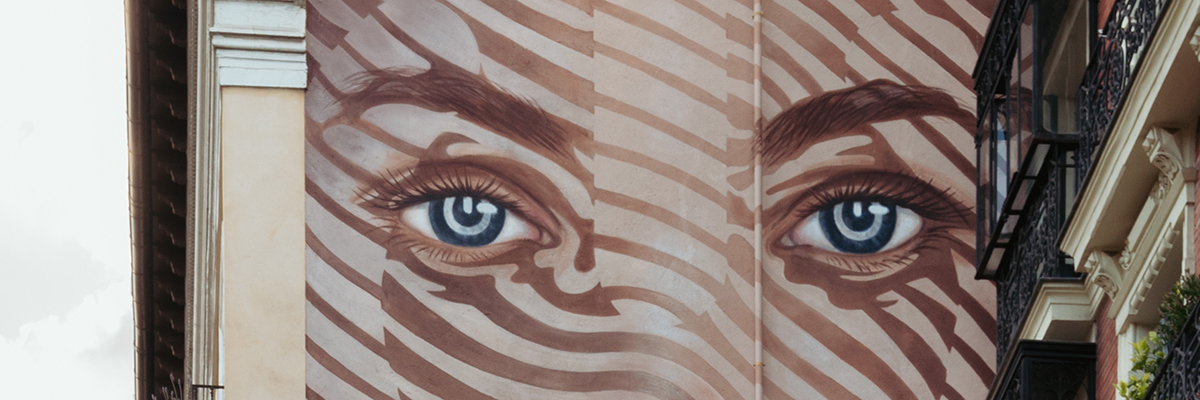
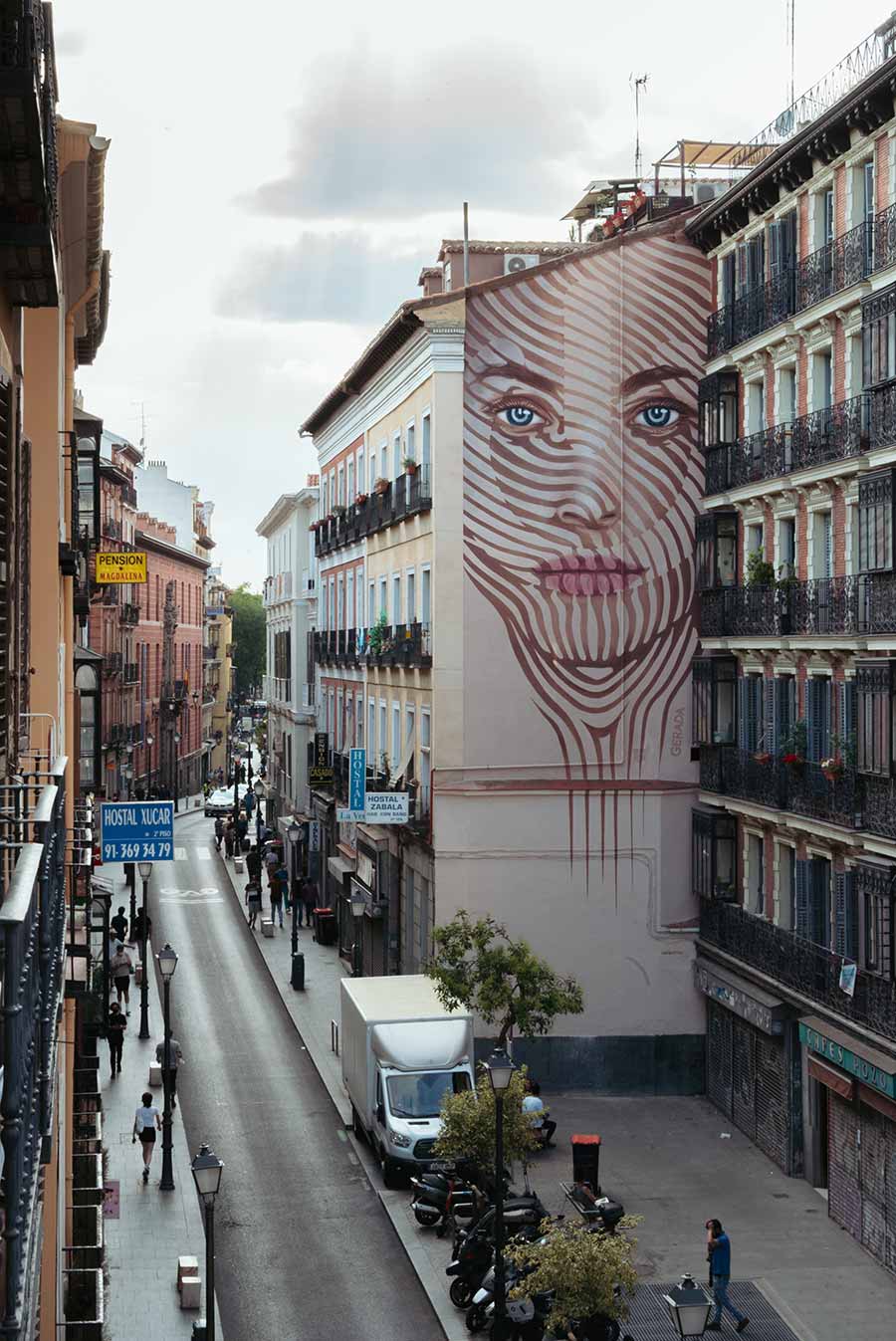
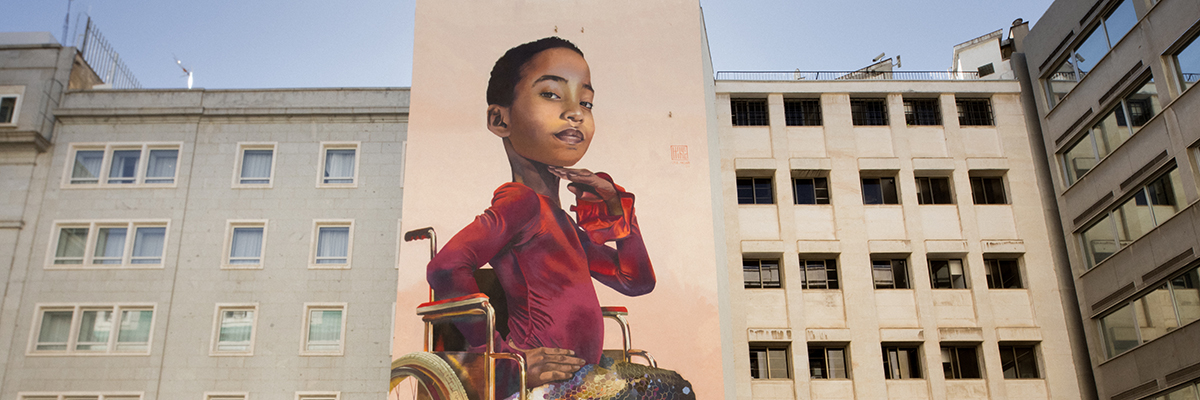
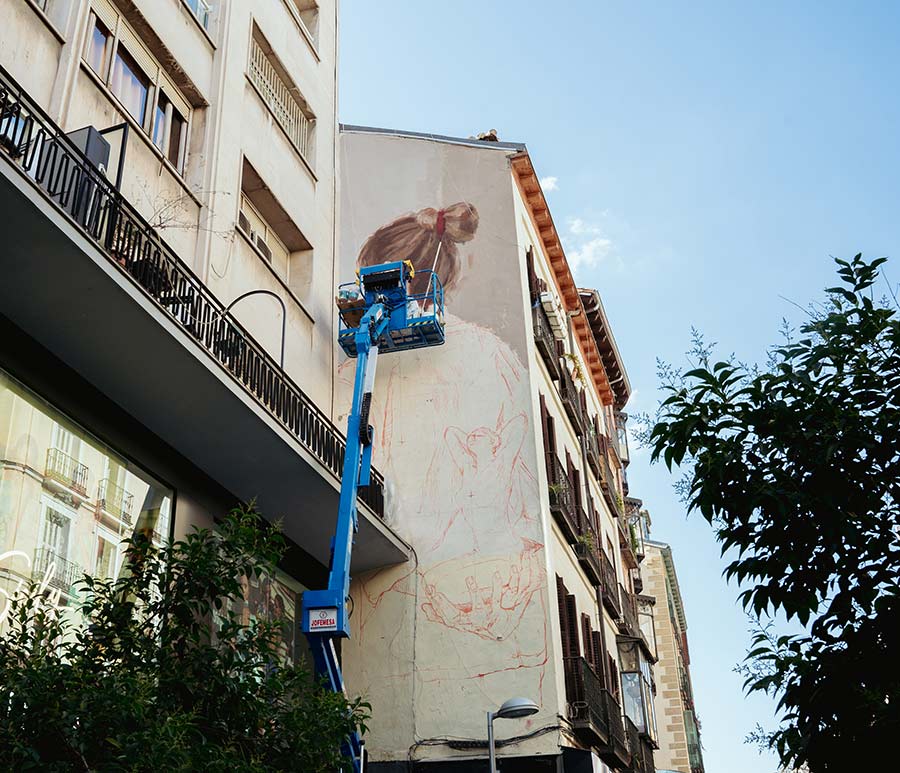
Jorge Rodriguez-Gerada. Urvanity Art 2021. Madrid, Spain. (photo courtesy of Urvanity Art Fair)
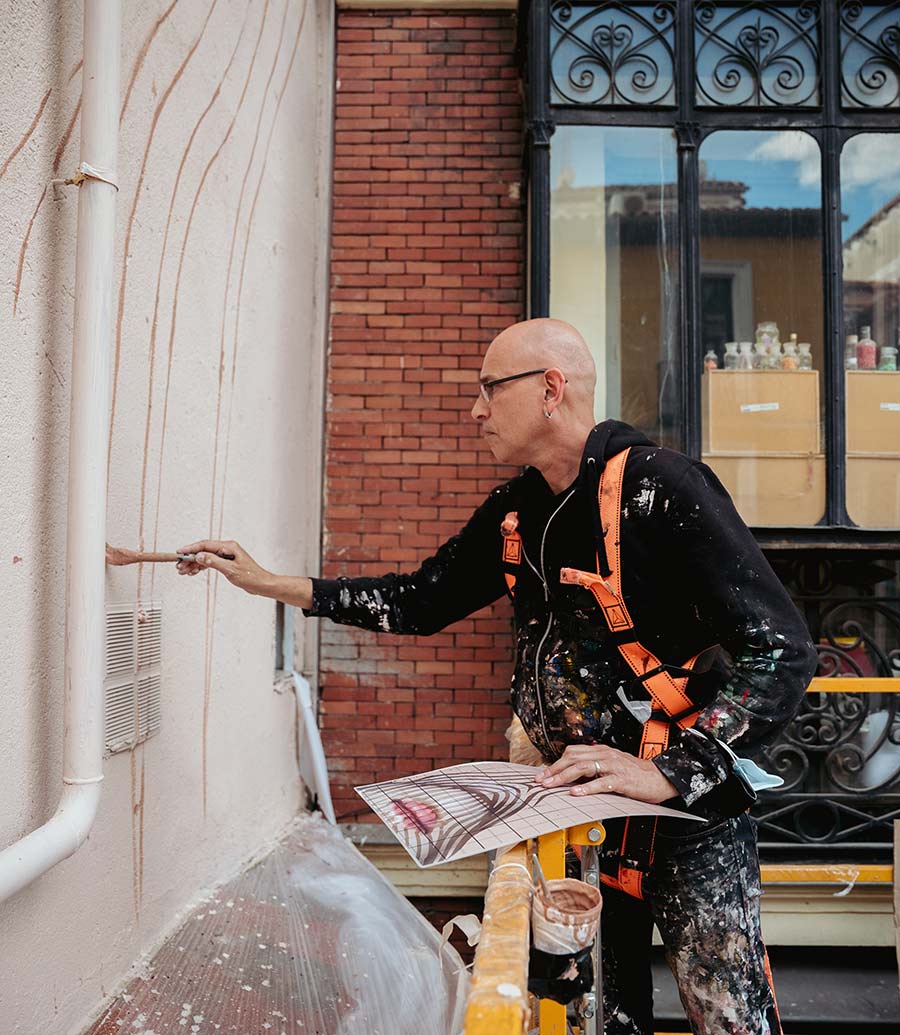
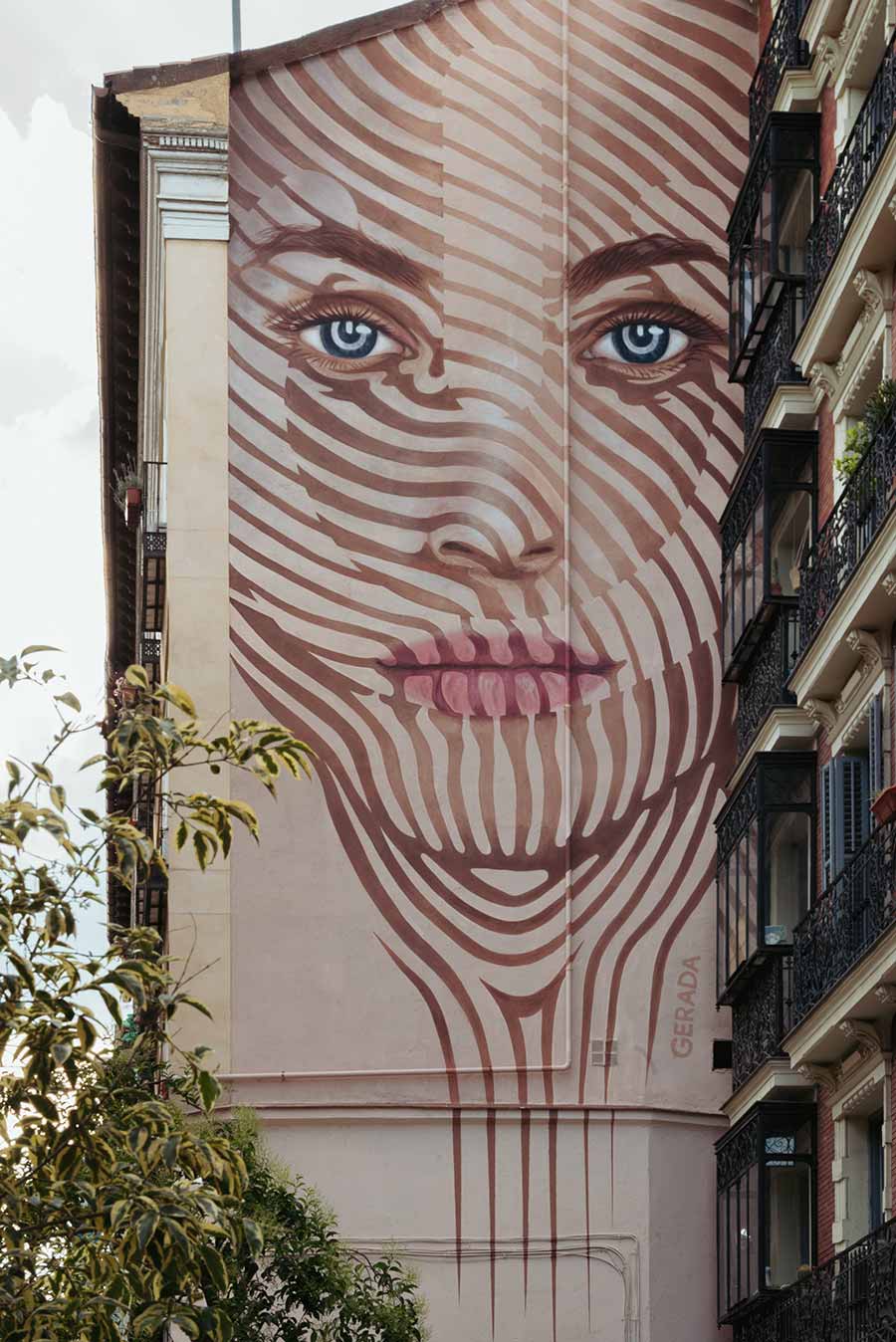
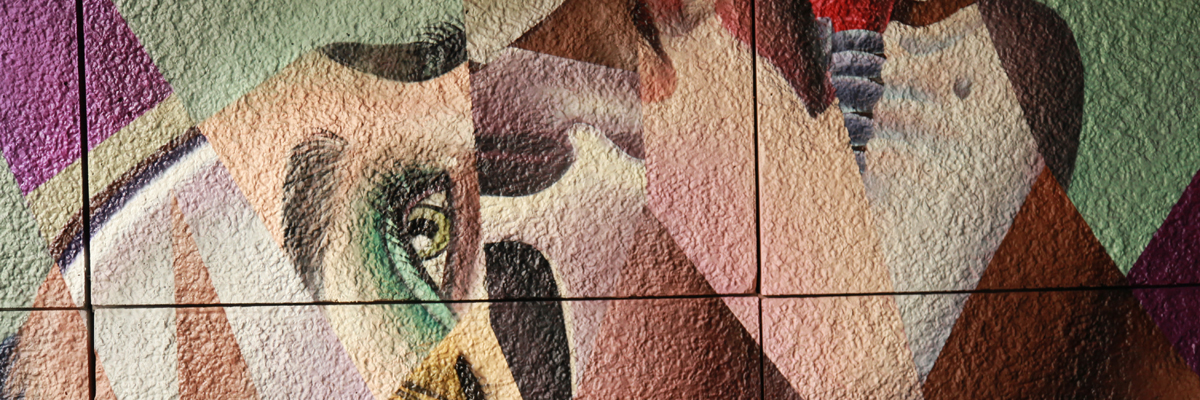
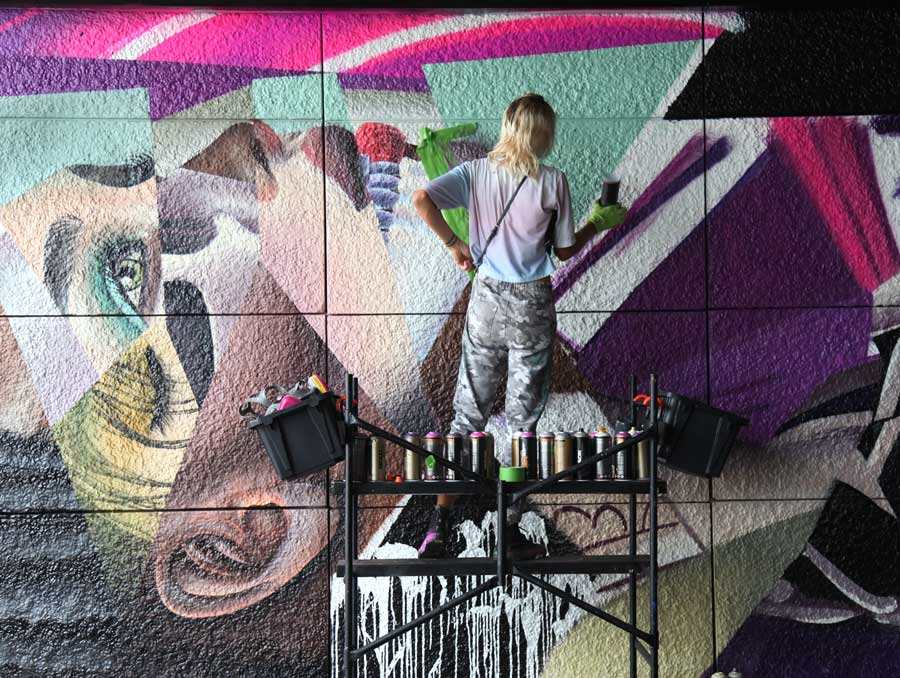
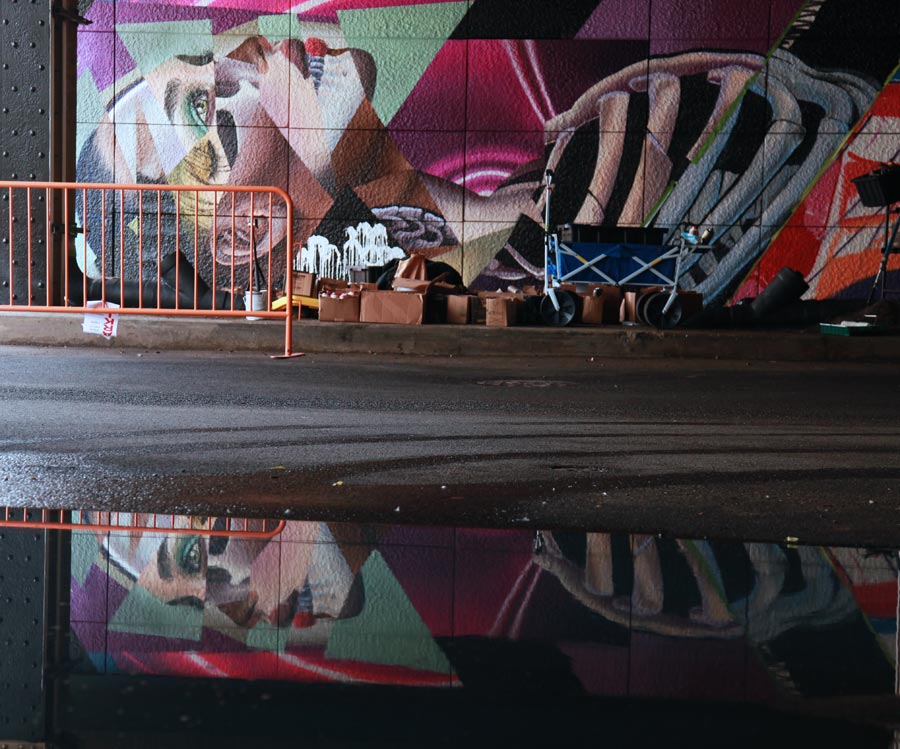
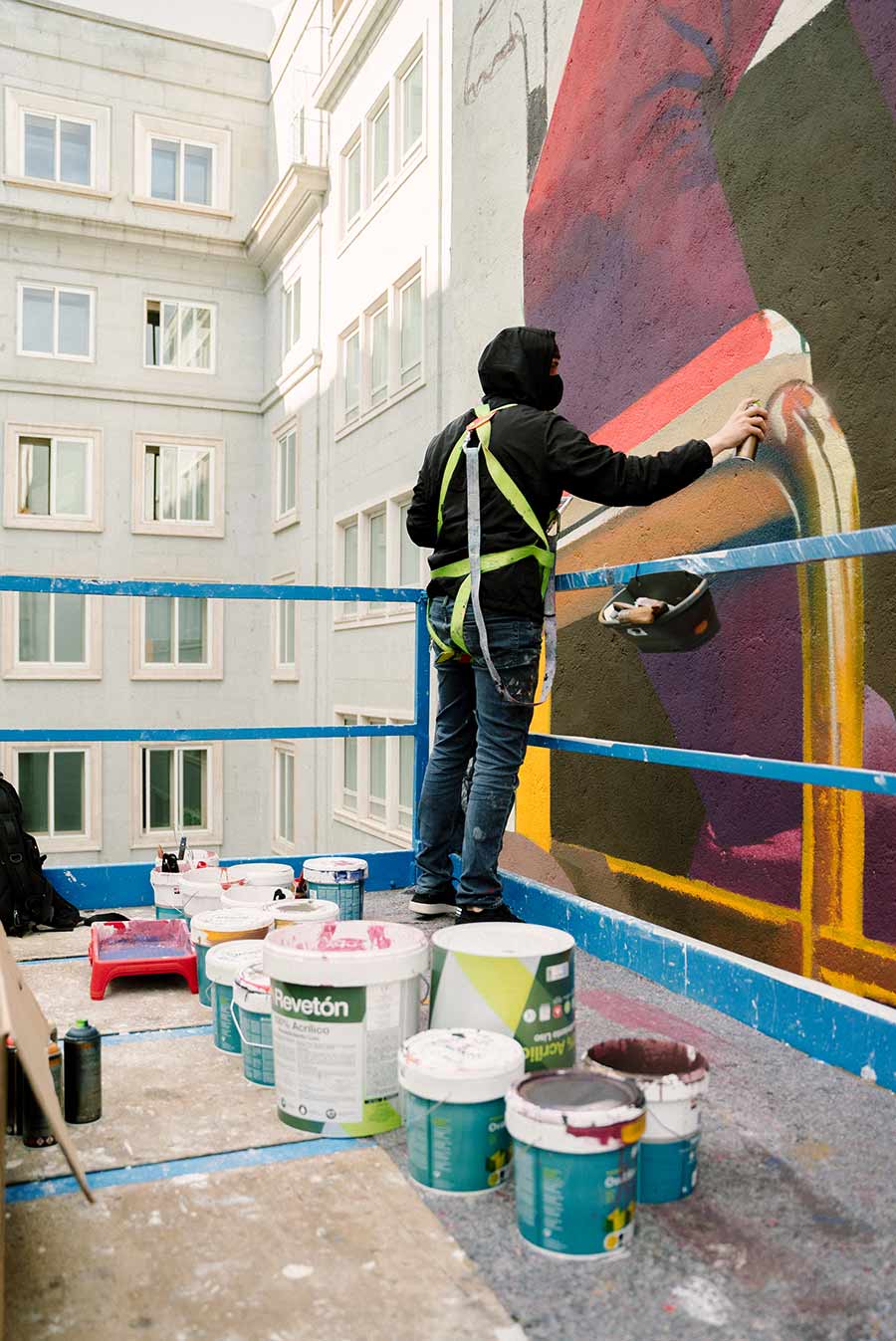
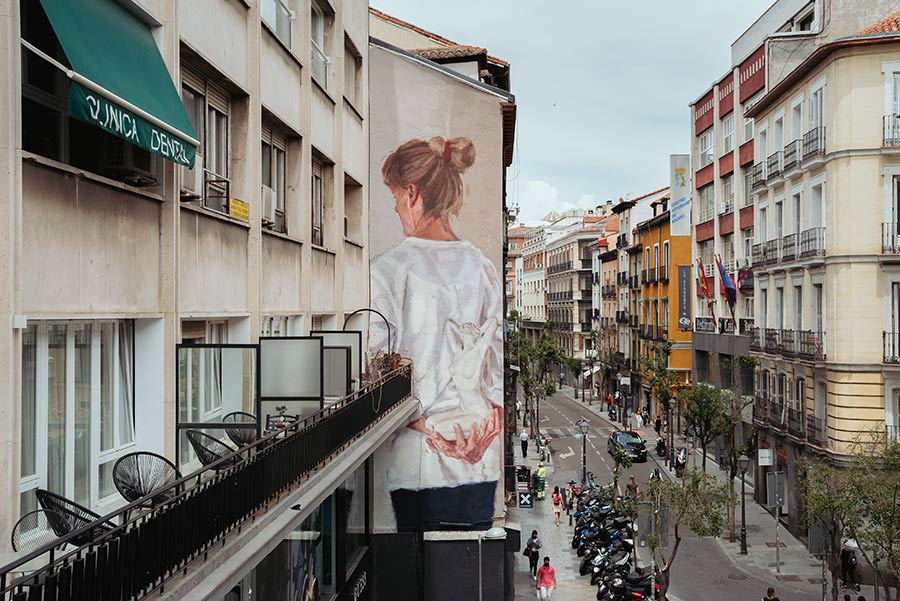
‘Byte the Candy’ is the new work in Madrid by Jorge Rodriguez-Gerada; a portrait of a woman is contoured as if a computer chip inlaid with circuitry, no more than a central processing unit.
“In 1984, Niel Postman gave a talk about how we are ‘Amusing Ourselves to Death,’” says Rodriguez-Gerada of his inspiration for this new piece he did in conjunction with the Urvanity art fair. “He criticized how the news we see on television is entertainment,” he says, “there only to maintain our attention in order to sell advertisement time instead of trying to make us think.”
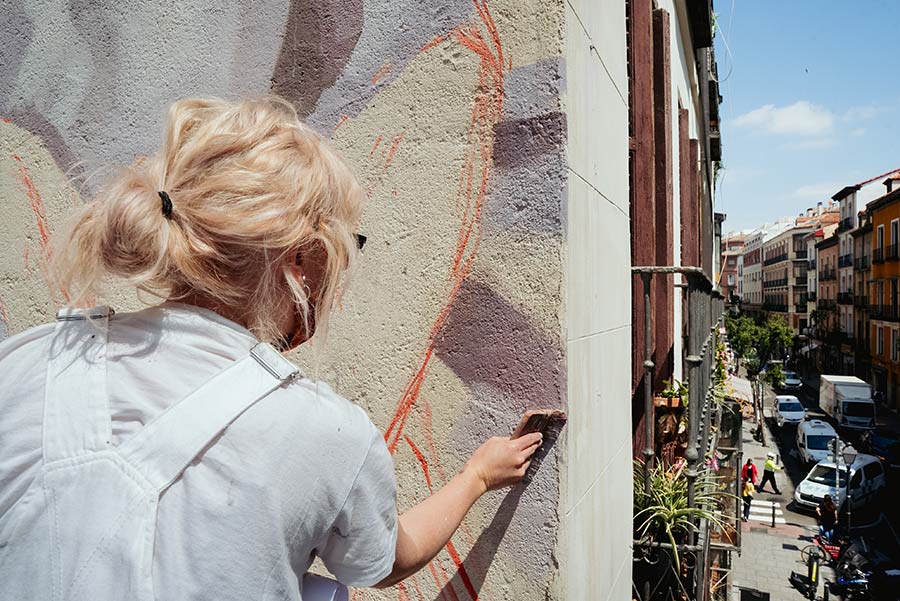
Jorge Rodriguez-Gerada. Urvanity Art 2021. Madrid, Spain. (photo courtesy of Urvanity Art Fair)
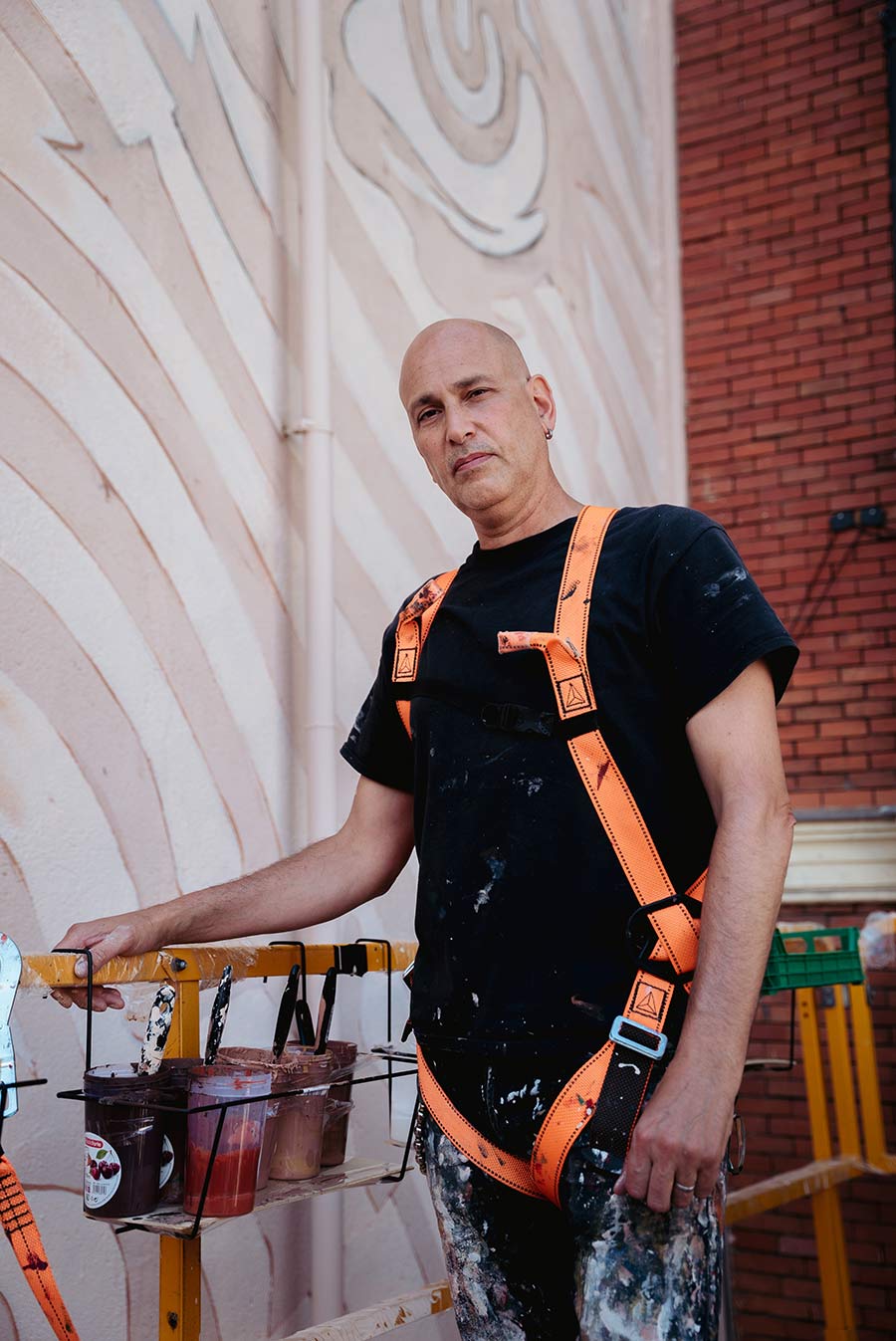
Notable also is the earthen color range the artist selected as if merging his precise realism on large-scale murals with his other field of public expression, land art. Even the uniformity of spacing and graduated shading suggests industrial farming methods… but his greater point is the melting together of ethical conscience and the judgment-free manipulation of the subconscious.
Jorge Rodriguez-Gerada. Urvanity Art 2021. Madrid, Spain. (photo courtesy of Urvanity Art Fair)
“Today, we are living something beyond what Niel Postman was warning us about – social media platforms, with a system of algorithms that have no conscience or mercy,” says Rodriguez-Gerada. “These algorithms work incessantly to keep our constant attention to see advertising and propaganda, and in that way become more efficient with the use of personal data, achieving the ability to target advertising that coincides exactly with the profile of interests of each user.”
Jorge Rodriguez-Gerada. Urvanity Art 2021. Madrid, Spain. (photo courtesy of Urvanity Art Fair)Jorge Rodriguez-Gerada. Urvanity Art 2021. Madrid, Spain. (photo courtesy of Urvanity Art Fair)
It comes as no surprise that the explosion of new graffiti in New York is evident across the river in Jersey City, where we have been hanging out the last few day for the Jersey City Mural Festival. And for those who know their history, it will also come as no surprise that we always dig the illegal unapproved organic graffiti and street art as much as that which has received official approval from our city fathers and mothers.
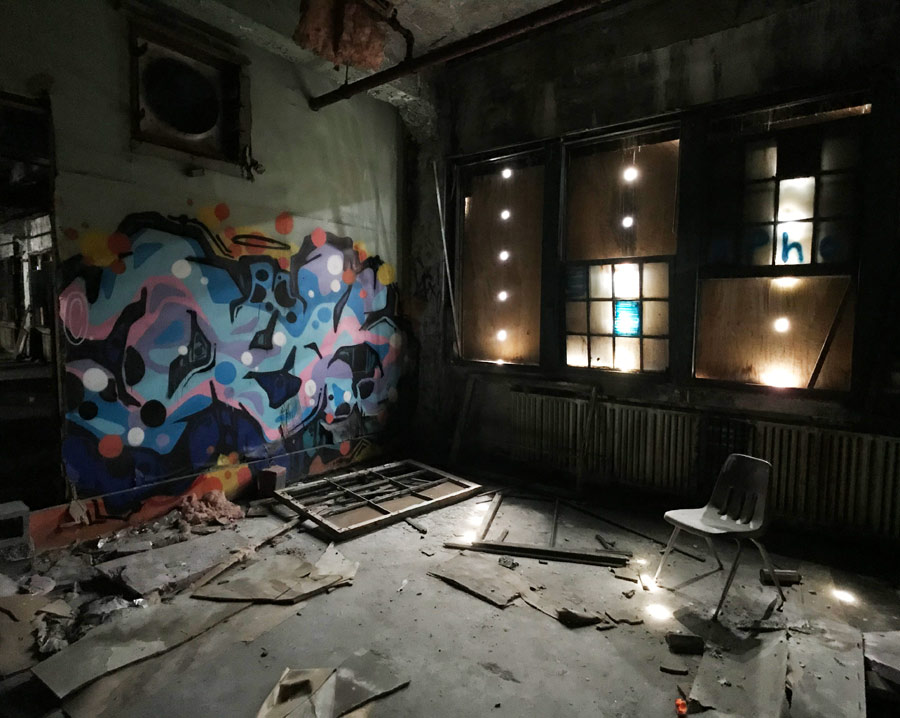
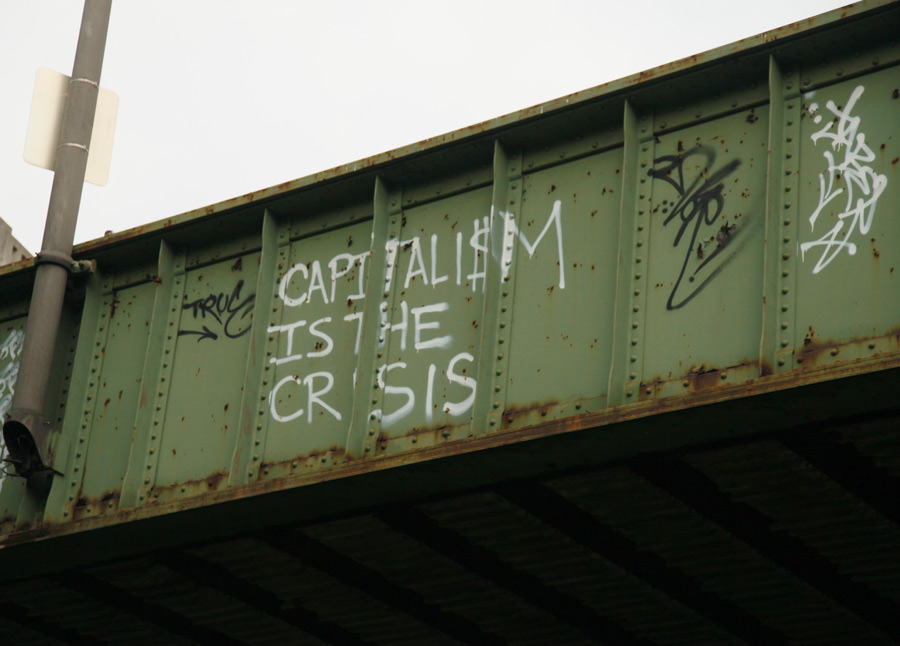
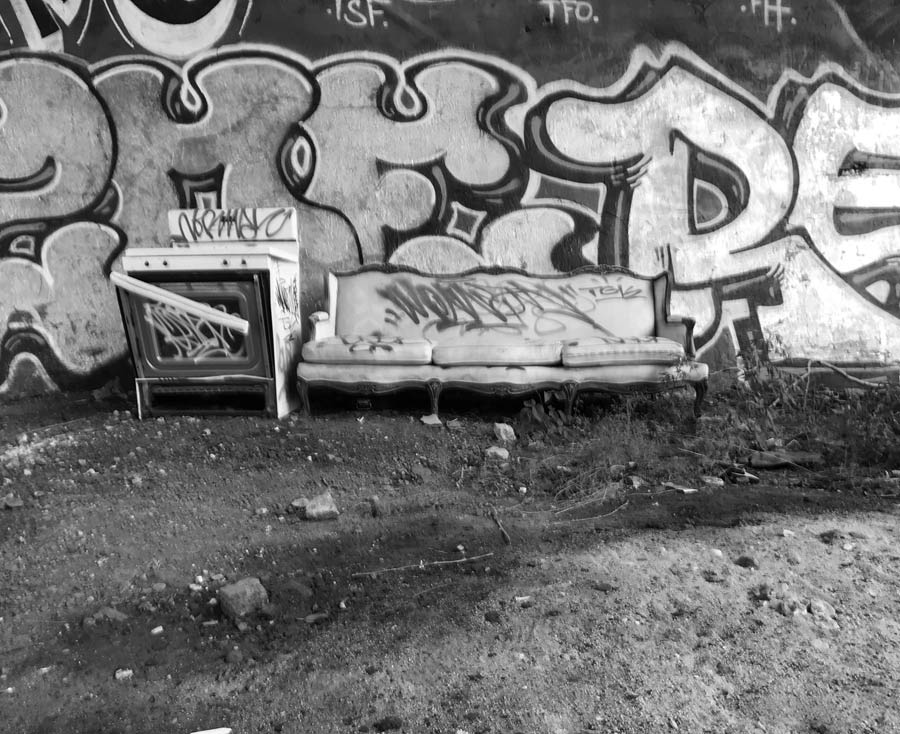
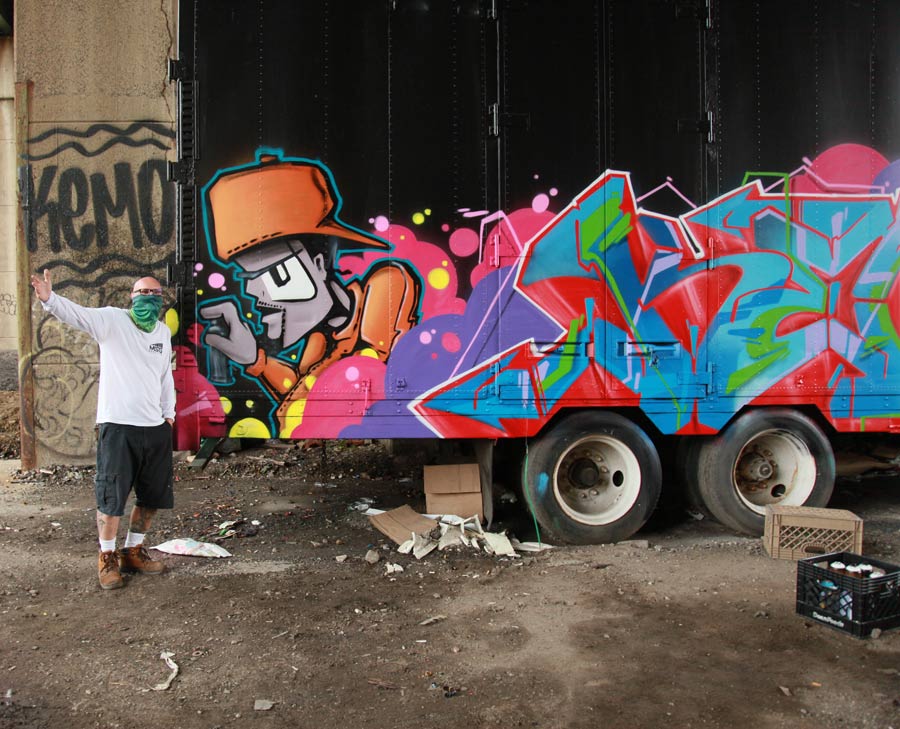
So here’s new pieces and tags from under the bridges, passageways, and inside the abandoned buildings in JC. The looseness of line and exuberance of color combinations tell us that graff kids are feeling at liberty to get up wherever necessary to get out their name. In the oceanic metaphor of ebbs and flows – this wave is flowing, bro.
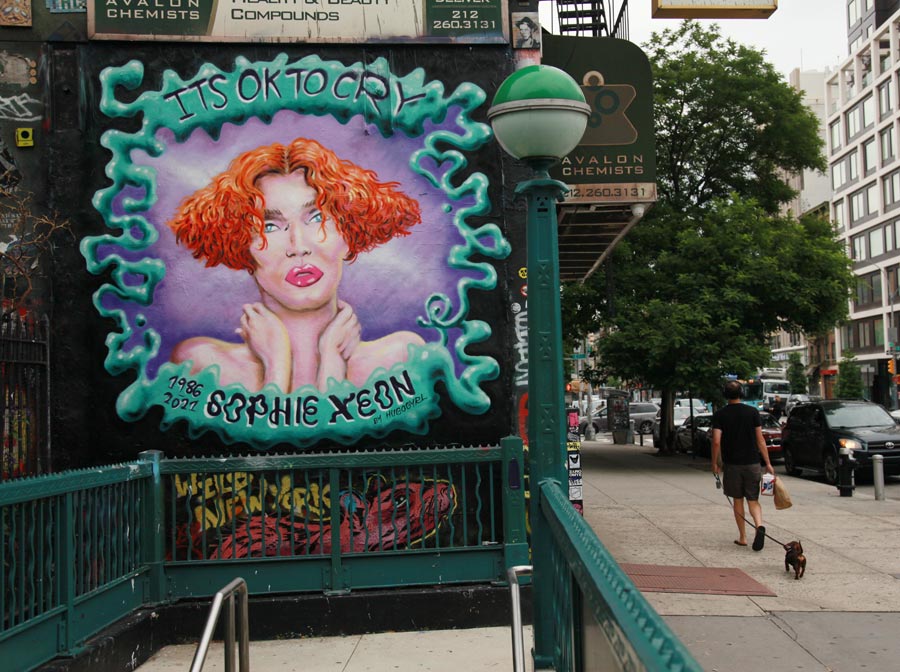
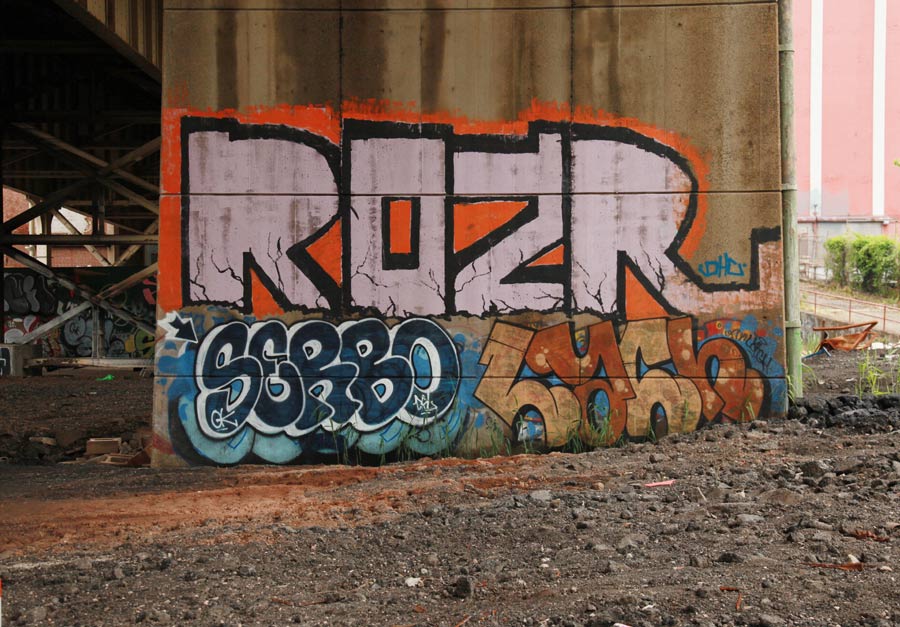
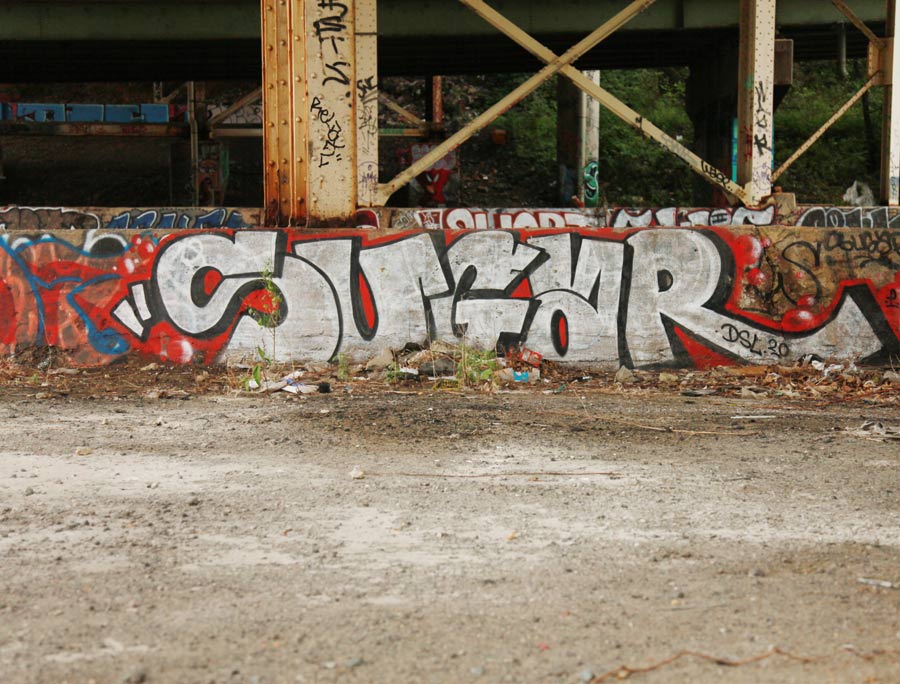
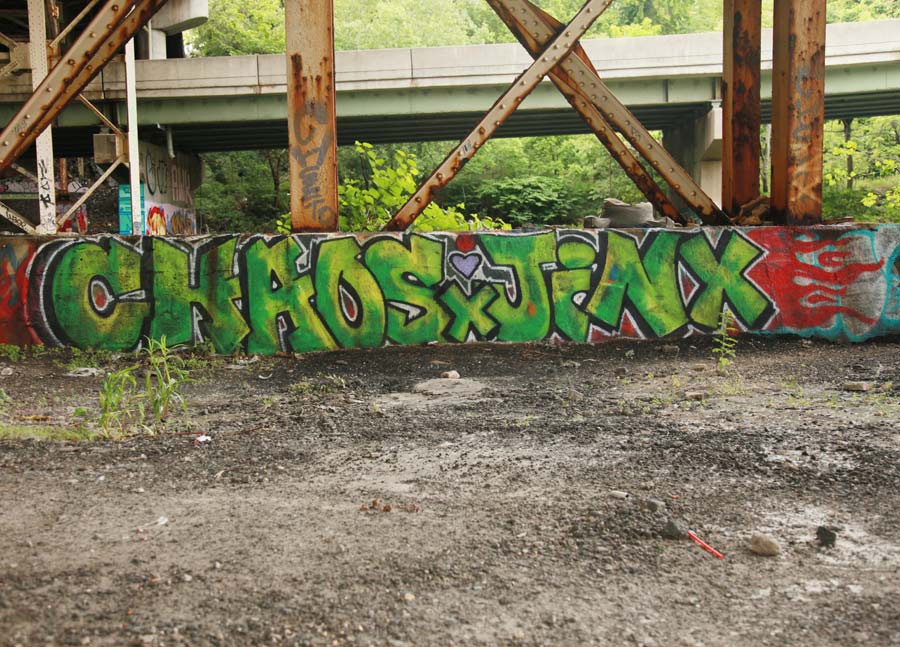
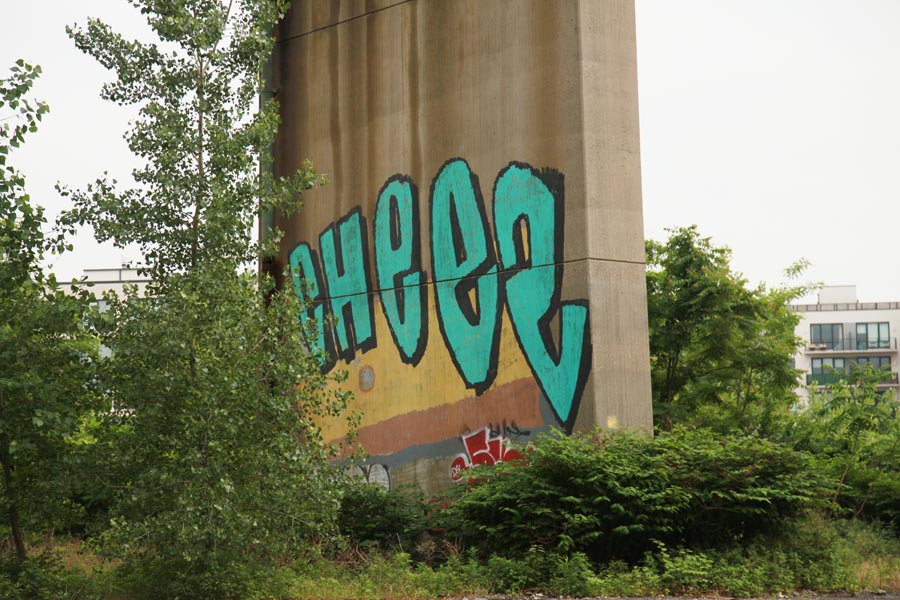
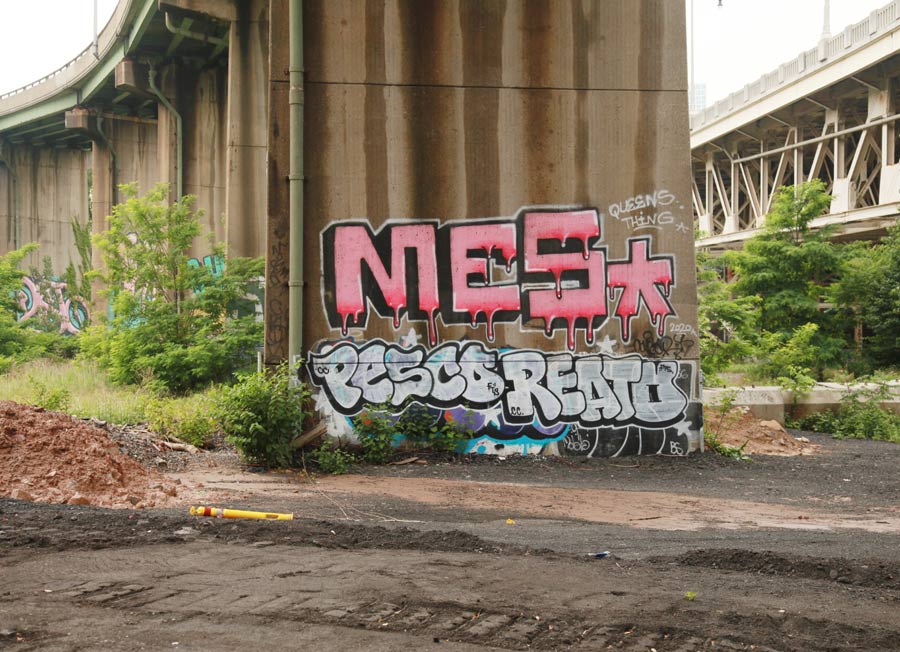
Here’s our weekly interview with the street, this week featuring Acro, Amore, Carbo, Chaos, Chees, Dzel, Gear, Hugo Girl, Jinx, Loser, Manik, MES, Nate Paints, Pesco, Reato, Rozr, Sean 9 Lugo, Serbo, Short, Sophie Xeon, Sugar, and Visit.
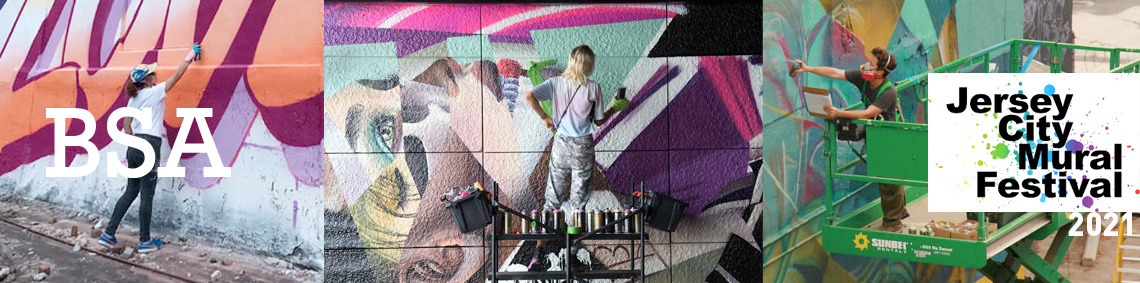
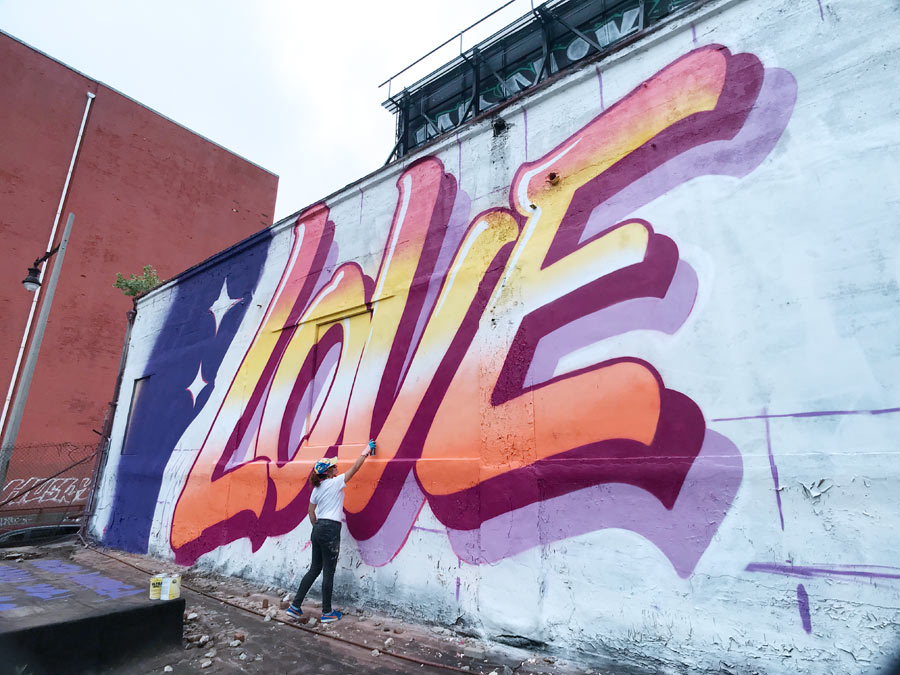
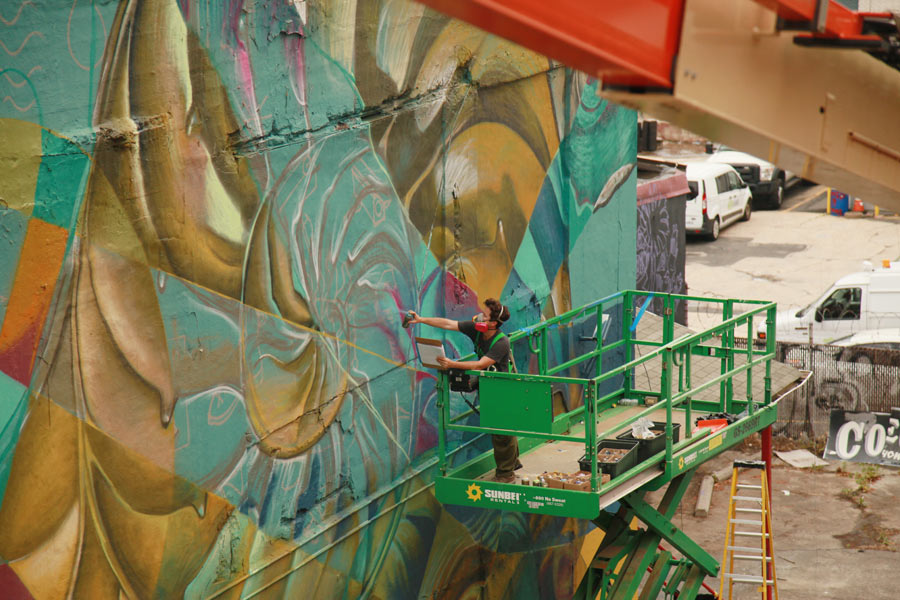
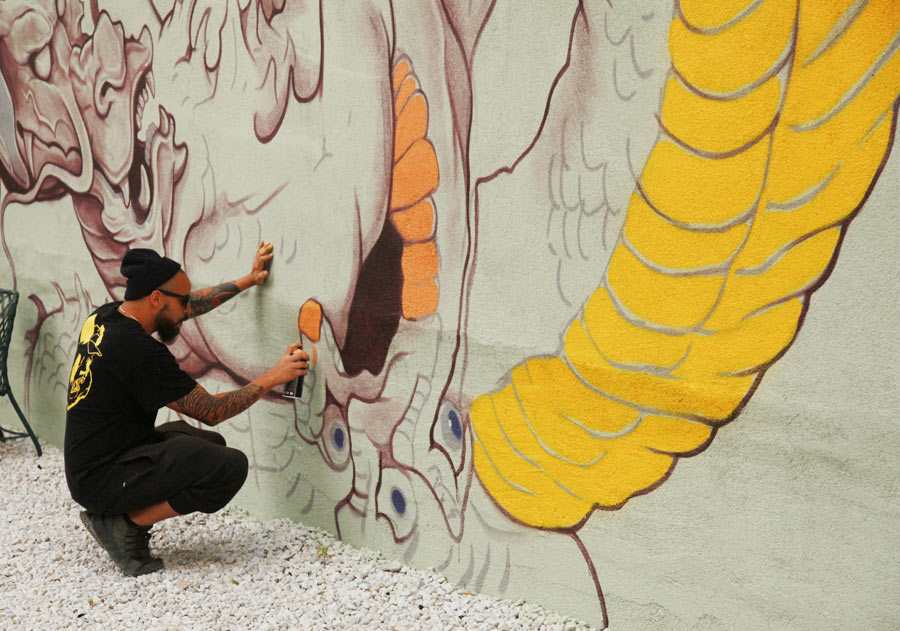
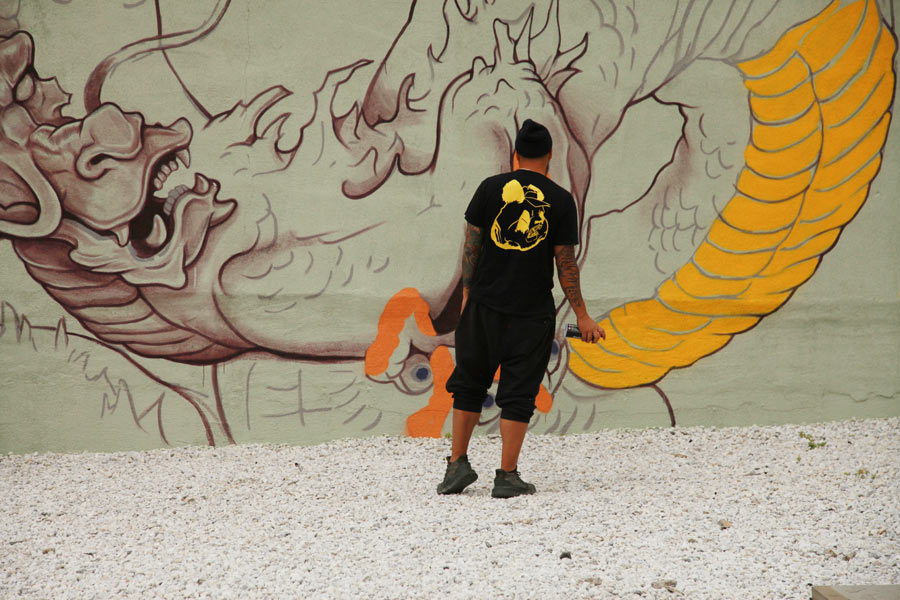
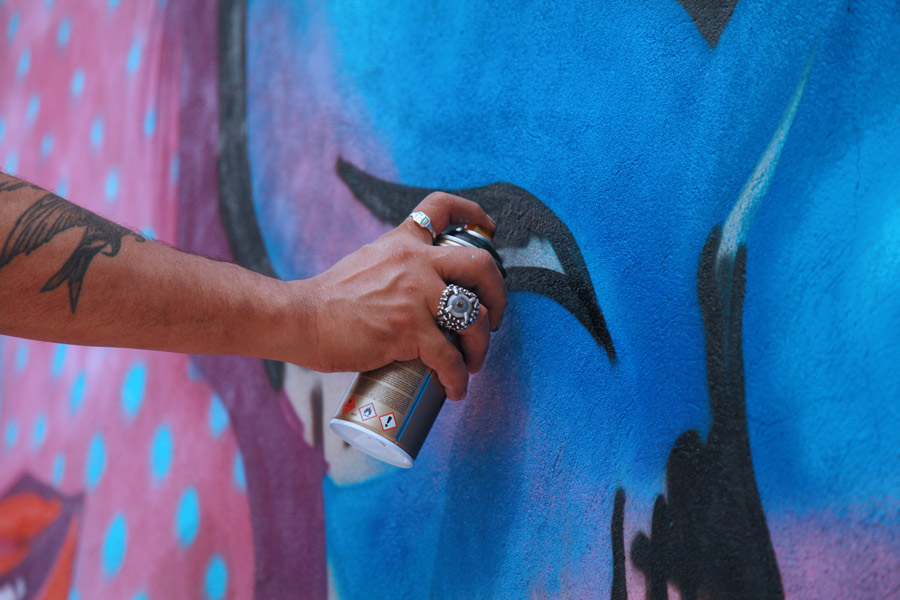
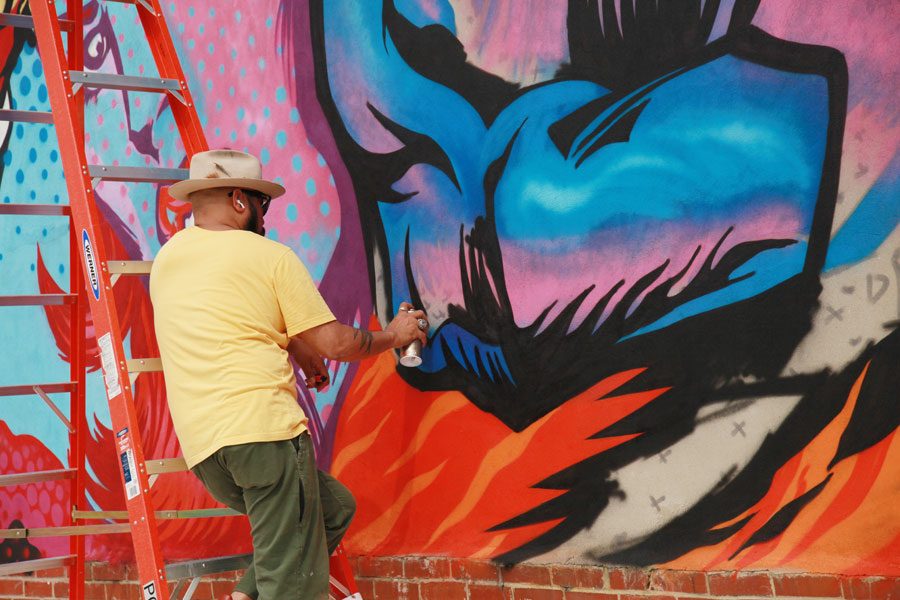
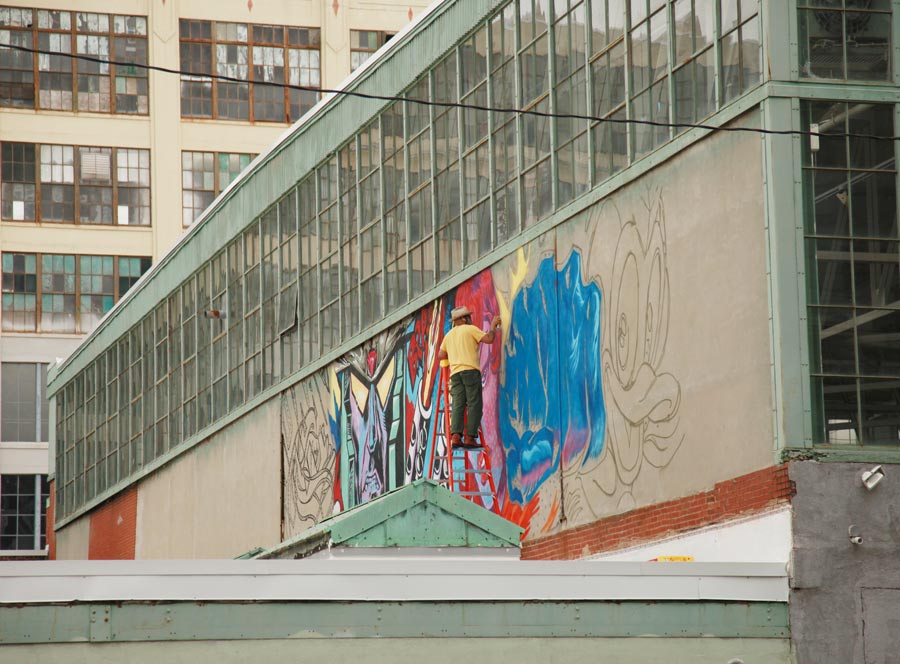
Aside from a few breaks for afternoon June monsoons and scattered flash flooding on the greasy streets of this historically industrial region, the frantic and focused paintings by artists were setting Jersey City afire with color and character yesterday. By climbing on rooftops and flying on cherry pickers with a slew of aerosol pilots, our photographer Jaime Rojo got some of the best action in this inaugural mural festival.
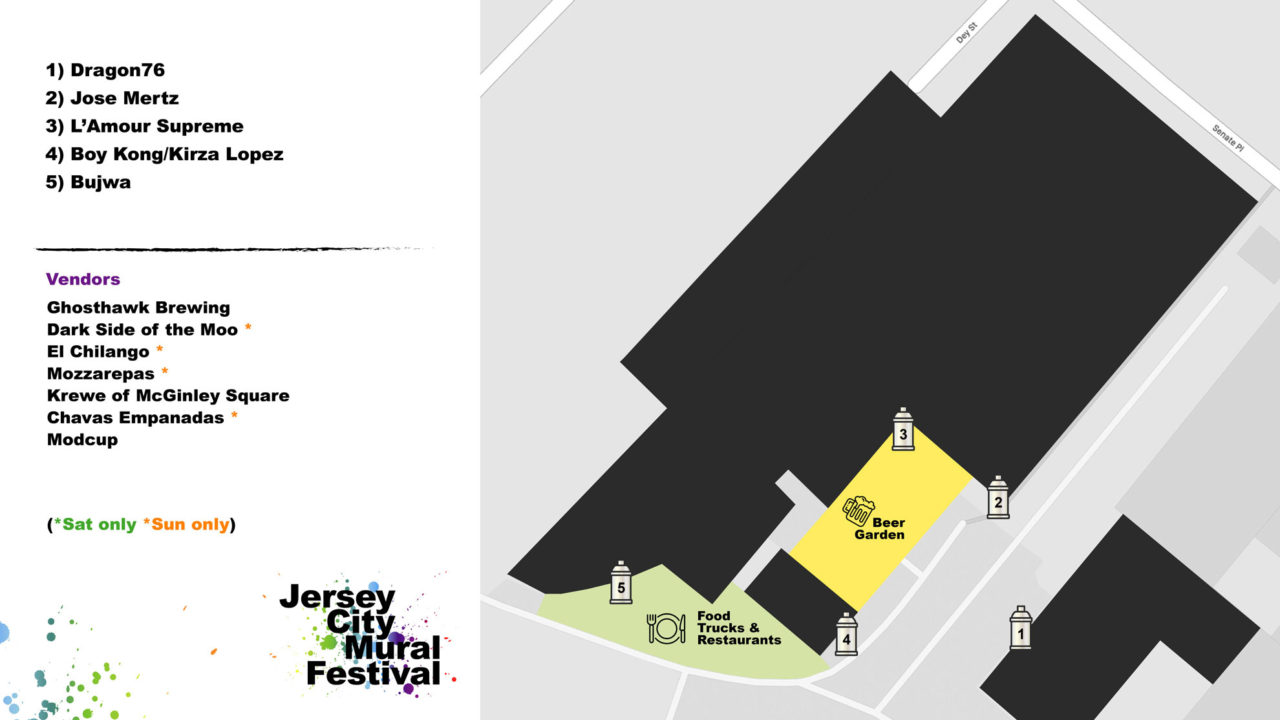
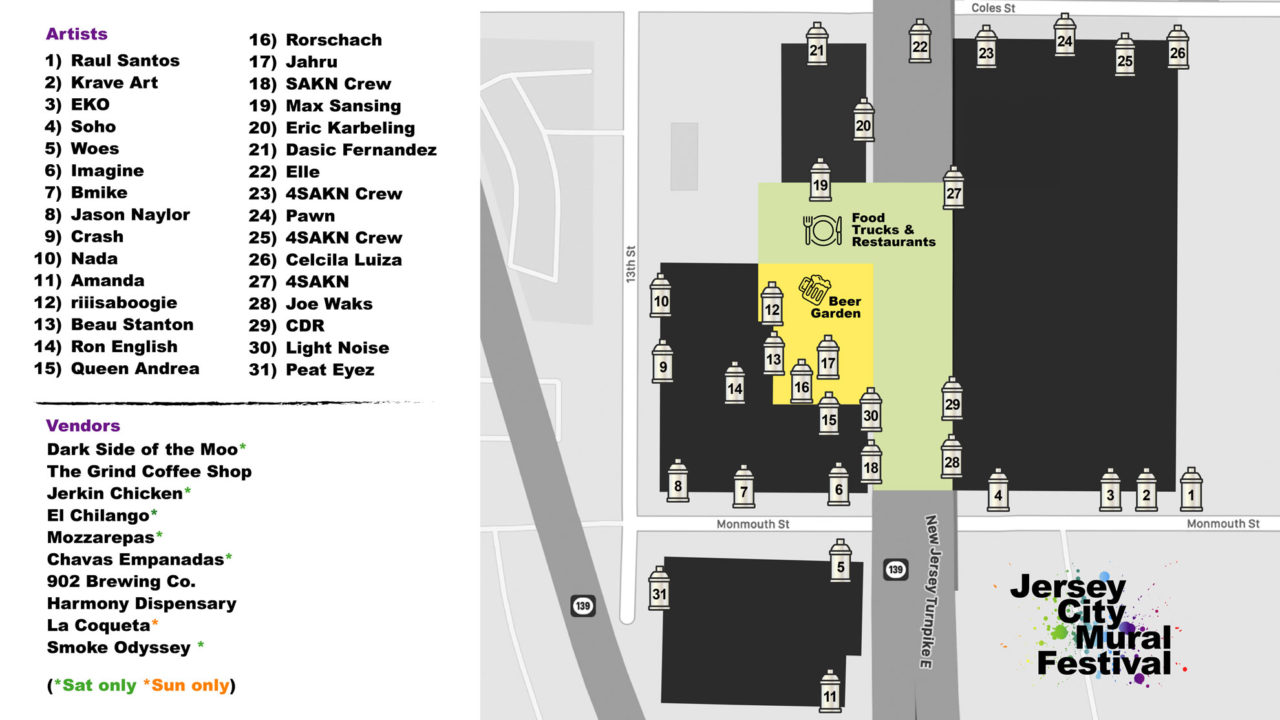
The MANA Contemporary complex is comprised of an array of buildings – and many are visible from many passing highways and byways. As the melange of cultures here continues to come out to the streets due to lower Covid numbers and higher vaccine rates, the air is thick with expectation. Having a slew of new artworks from across a spectrum of styles and aesthetic sensibility – you will find much the new additions are directly adjacent to the illegal graffiti that started it all – which is as it should be.
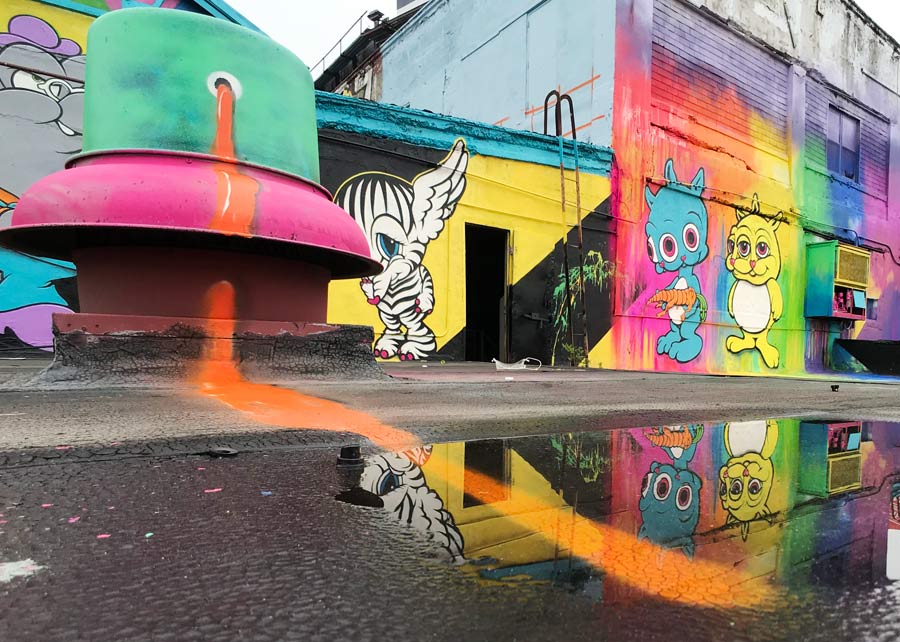
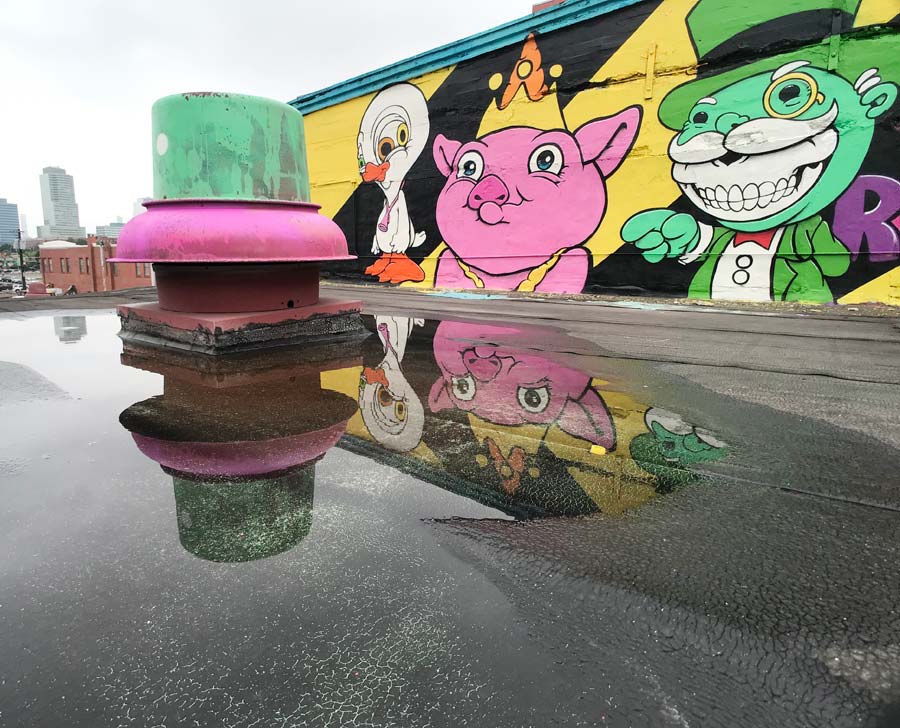
Check out some of the new works here by Beau Stanton, Dasic Fernandez, Elle, Eric Karbeling, Erinkco Studios, Jahru, Max Sansing, MSG, Queen Andrea, Raul Santos, and Ron English.
Our weekly focus on the moving image and art in the streets. And other oddities.
Now screening: 1. Homily to Country by Artist JR 2. Jersey City Artists at Work Painting for the first Mural Festival Here
BSA Special Feature: Homily to Country by Artist JR
“We must throw off the chains of corporatization to save us all,” is the last statement in this narrative about historical, cultural and natural resources being stolen. His statement could have started with that.
Maybe JR will make a project about fairly taxing the rich next.
Jersey City Artists at Work Painting for the first Mural Festival Here
Two homemade videos below of a handful of the participating artists at work in their murals this week for the inaugural edition of the Jersey City Mural Festival.
See the action with Dragon76, José Mertz, L’Amour Supreme, Boy Kong, and Kirza Lopez in action at Mana Contemporary Complex.
Elle, Queen Andrea and Beau Stanton at the Ice Factory Complex
After a lot of planning and with great fanfare Jersey City is launching its inaugural mural festival and BSA is proud to bring it to you as media partner – and we are excited to see familiar and new local talent take over walls in grand style.
After hosting an open call for local artists of all disciplines and aesthetic approach, organizers MANA Public Arts and Jonathan Levine worked with the Jersey City Mural Arts Program to put together a deep field of talents that will impress in its quality and diversity – that’s our prediction anyway.
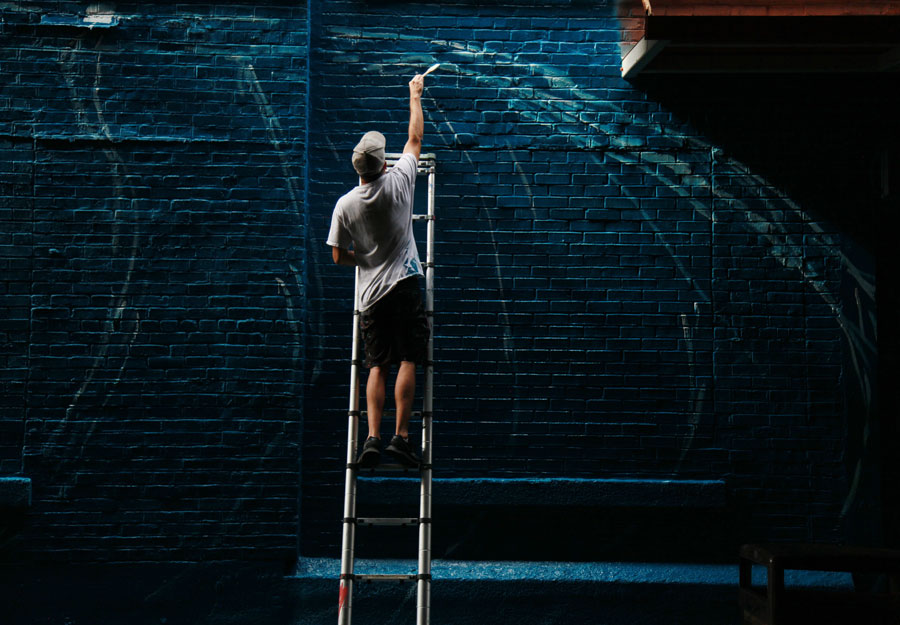
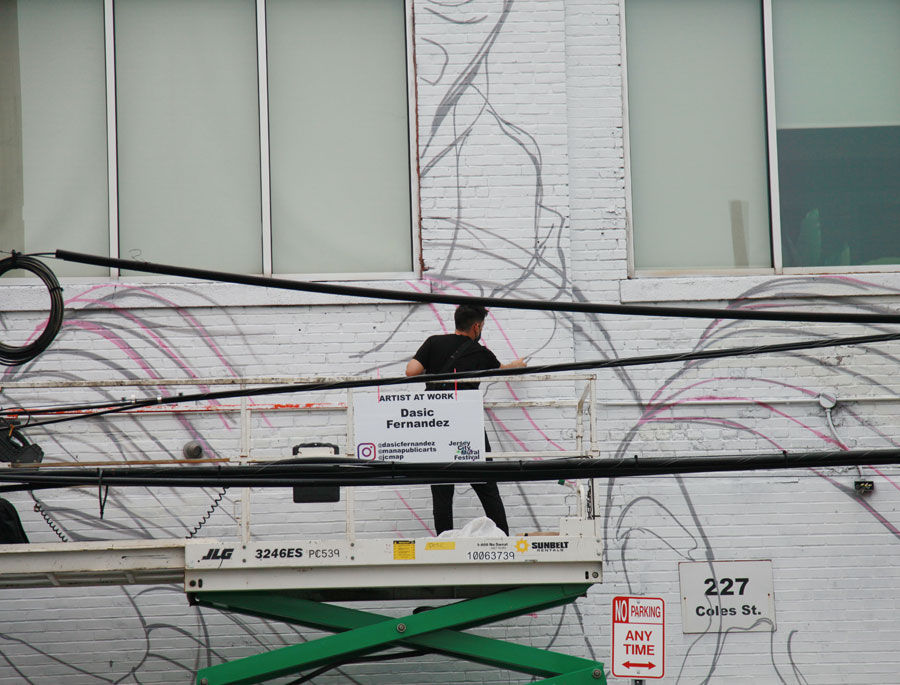
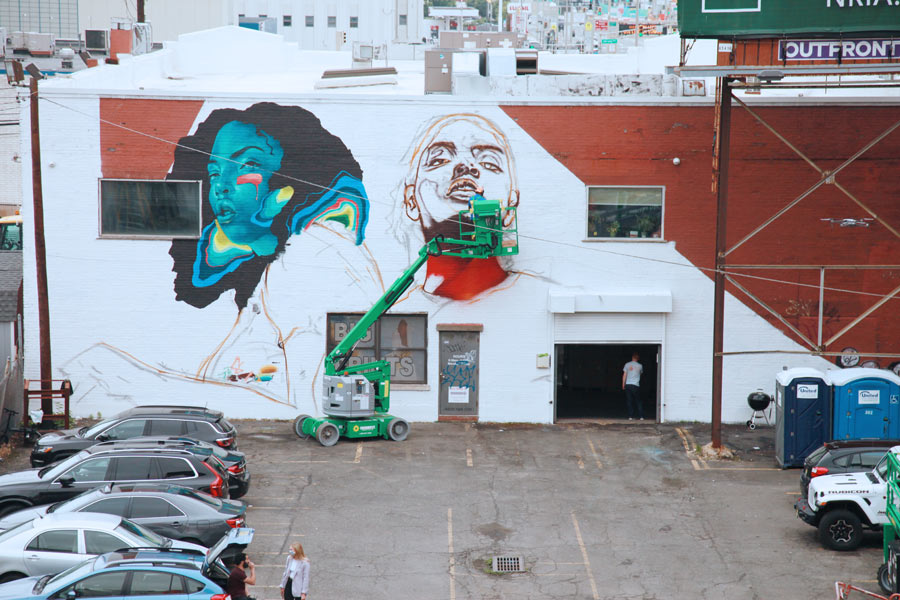
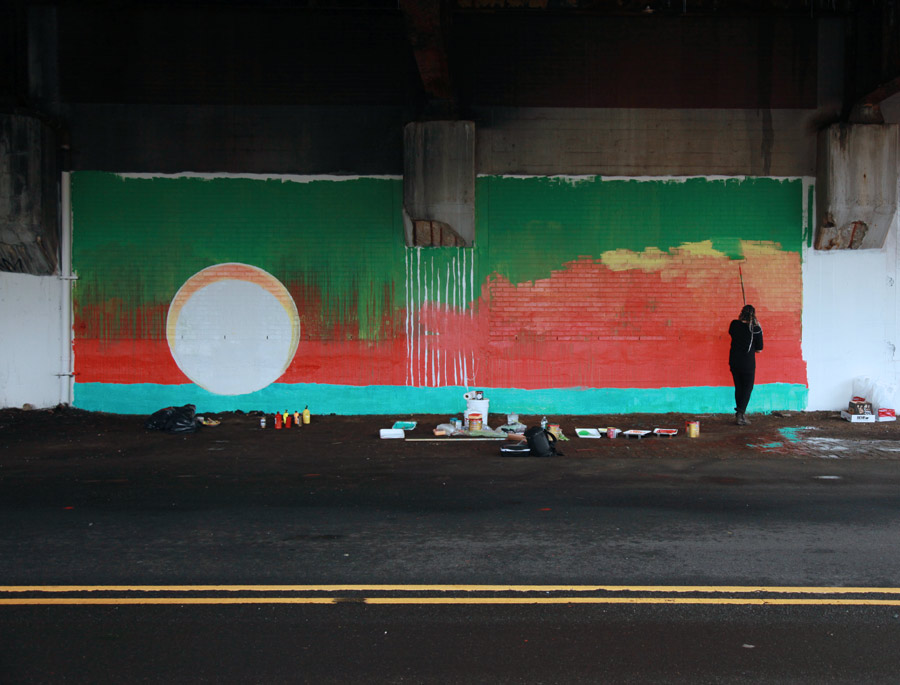
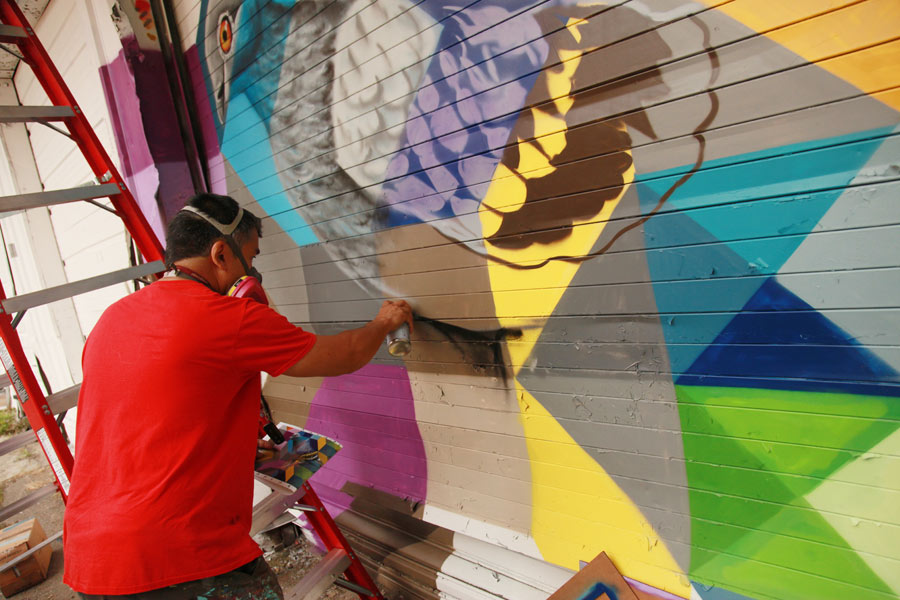
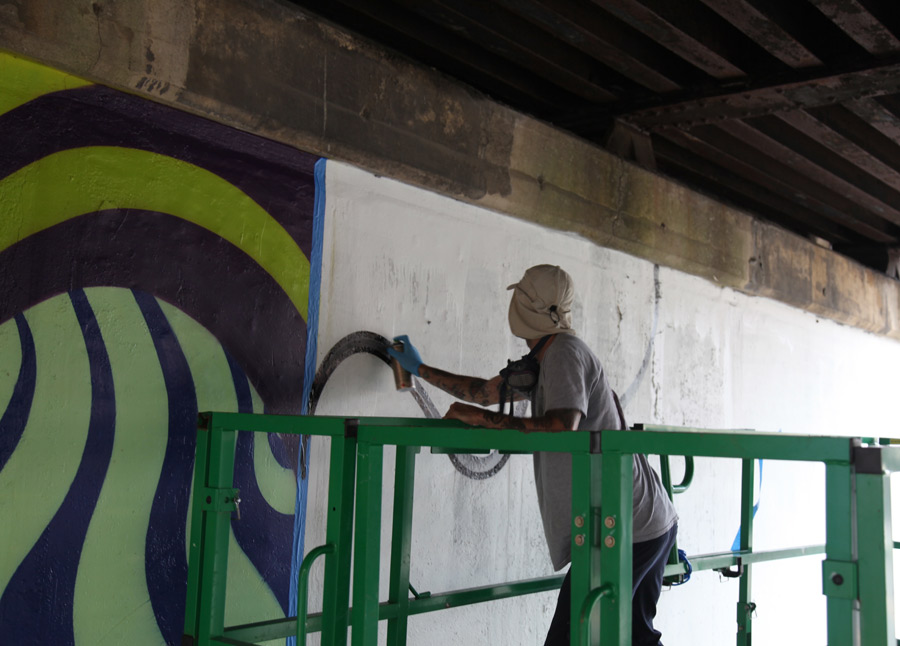
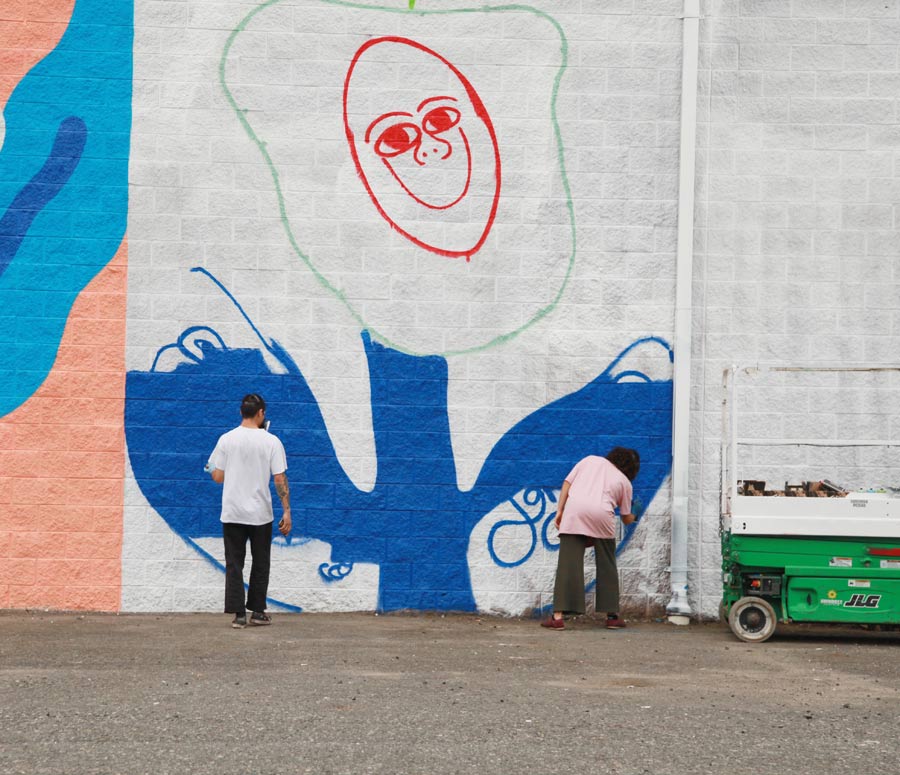
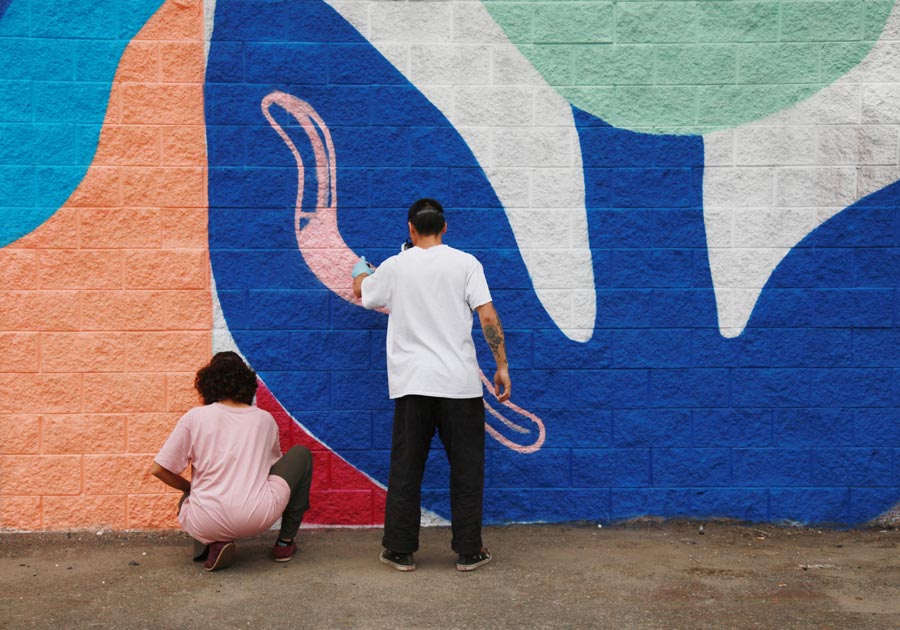
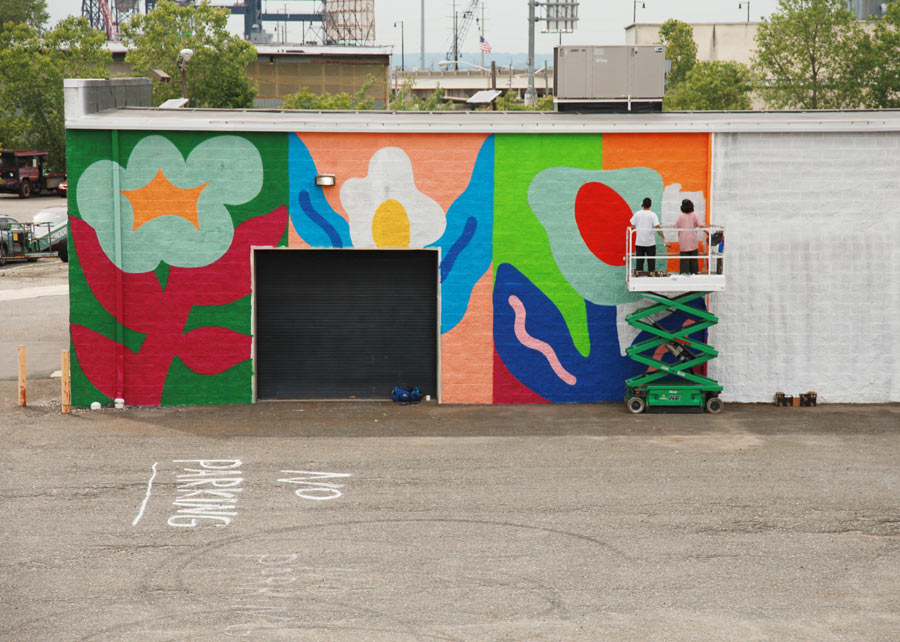
Since this weekend is the official unveiling to the public, we found a number of artists laboring on walls this week in preparation – and here are process shots as some of the pieces are already taking form.
From old skool graff writers turned fine artists like John Crash Matos, to early street art takeover artist and pop wiseguy Ron English, to the cherished and polished vernacular of Queen Andrea, to the pop-surrealist Dasic Fernandez who’s been crushing it for the last decade all over New York, this marquee is immediately full of heavy hitters you’ll recognize.
We’re also happy to see serious current talents on the roster; you’ll see they’ve invited many of the newest names and hybrid specialists you have been getting familiar with on the street. Considering the work from just the first two days we can say that straight out of the gate, this show rocks already.
The Jersey City Mural Festival is presented by Mana Public Arts and the Jersey City Mural Arts Program (JCMAP) in partnership with Mayor Steven M. Fulop, the Jersey City Municipal Council, and the Office of Cultural Affairs.
In response to the ongoing COVID-19 pandemic, and in strict adherence with the reopening guidelines set by the State of New Jersey, all aspects of the 2021 Jersey City Mural Festival will be executed with strict COVID-19 protocols and social distancing. In addition the many of the events and works will be made available online to allow for virtual participation.
Dates and Hours of Operation
Saturday, June 5 from 12-8 PM Sunday, June 6 from 12-7 PM
Madrid’s Art Week – who would believe that it could actually happen? And to prove it, we have the 5th Anniversary of Urvanity defiantly strutting from one end of the COAM headquarter to the other. Taking its original inspiration from graffiti, post-graffiti, surrealism, pop, and that broadly applied “Urban Contemporary” tag, Sergio and the Urvanity team have persevered this year again.
Case Maclaim presented by Ruby Gallery. Urvanity 2021. Madrid, Spain. (photo courtesy of Urvanity Art Fair)
Where others have failed, Urvanity has succeeded and grown and even matured – with more than 25 national galleries and others from as far away as New York, Brussels, and Bogotá. This is not about fanboys and big unsubstantiated claims, Urvanity drives for quality, and it shows.
SANER presented by Swinton Gallery. Urvanity 2021. Madrid, Spain. (photo courtesy of Urvanity Art Fair)
The talks this year revolved around high-caliber artists, gallerists, architects, and curators of projects that have made new pathways and invariably give you insight and inspiration in equal measure. BSA has been proud to sponsor this thinking-persons fair, along with the artists and creators; we even hosted their talks a couple of years ago and loved the folks we met there.
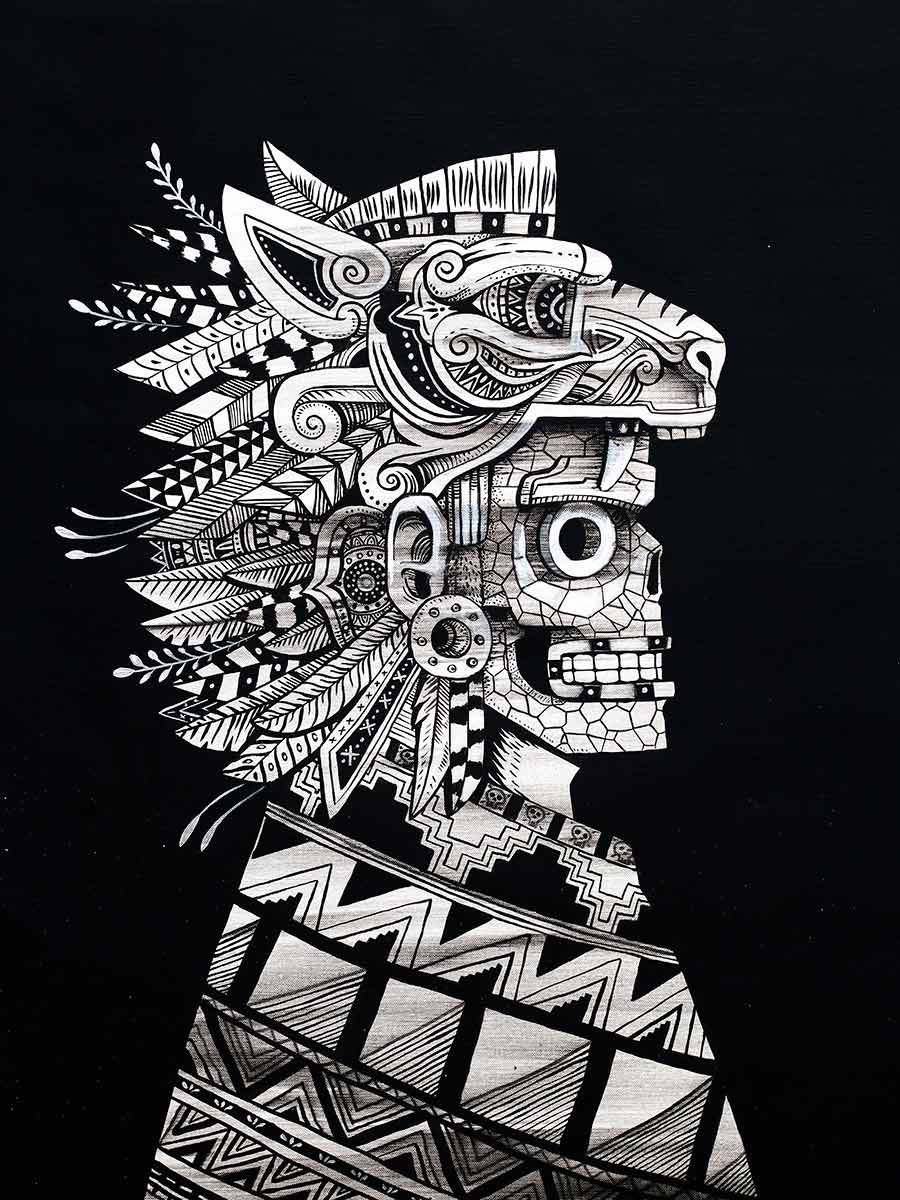
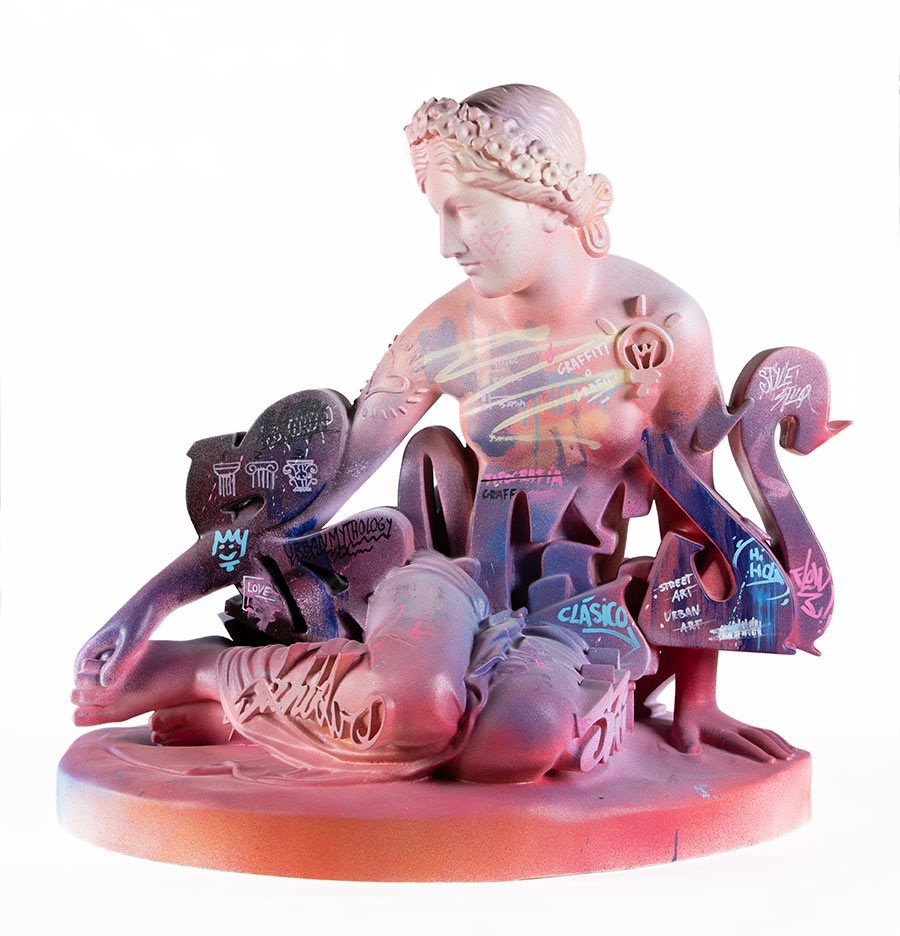
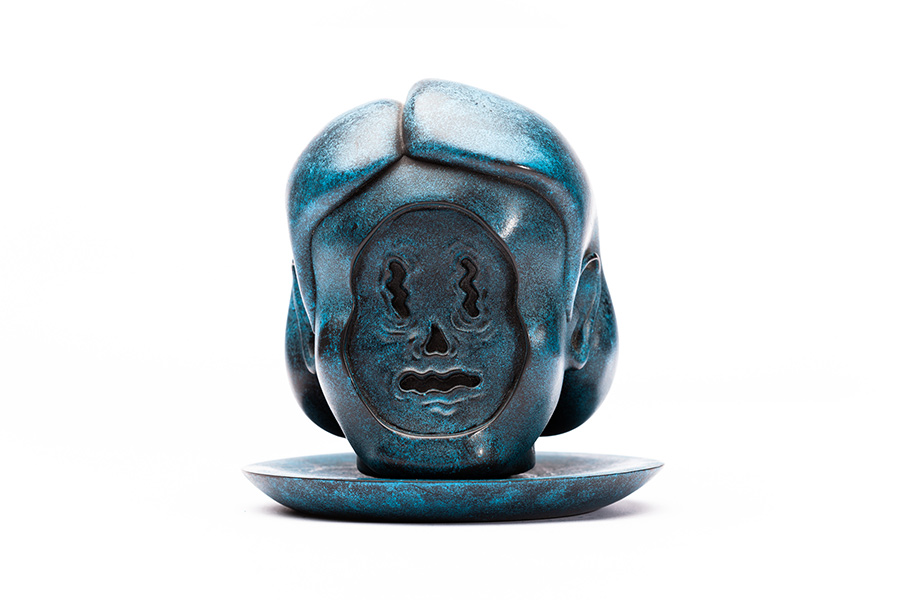
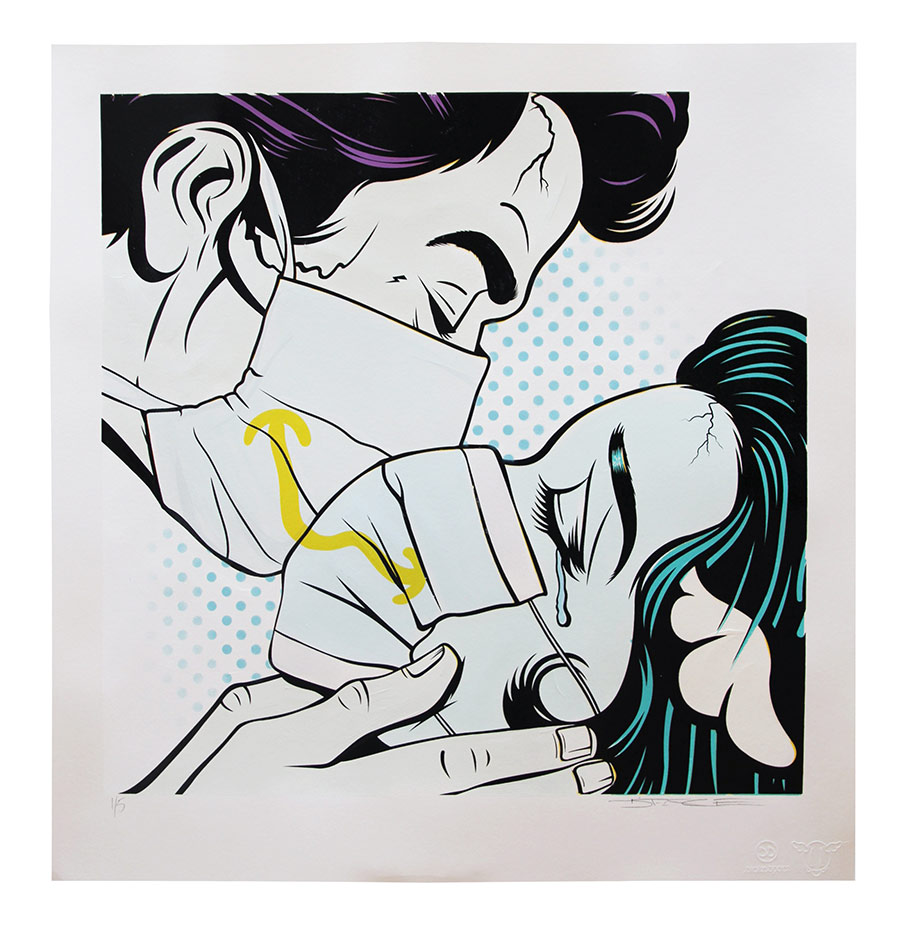
Here are a few images of fine art works evolving from the street practice of a number of artists whose names you may recognize.
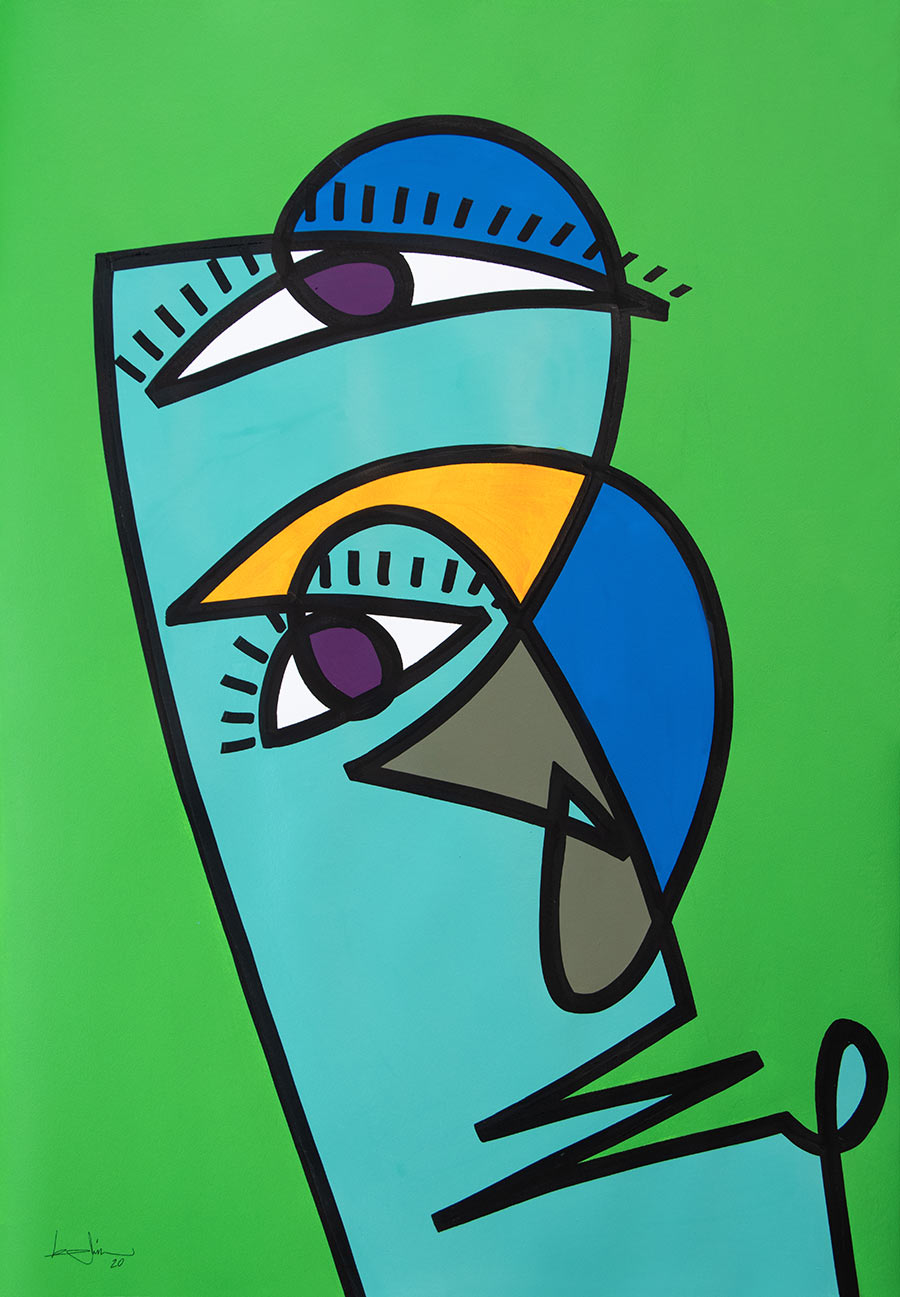
PICHIAVO presented by Stolen Space Gallery. Urvanity 2021. Madrid, Spain. (photo courtesy of Urvanity Art Fair)Laurence Vallières presented by Swinton Gallery. Urvanity 2021. Madrid, Spain. (photo courtesy of Urvanity Art Fair)Grip Face presented by Limited by Solo Gallery. Urvanity 2021. Madrid, Spain. (photo courtesy of Urvanity Art Fair)D*Face presented by Stolen Space Gallery. Urvanity 2021. Madrid, Spain. (photo courtesy of Urvanity Art Fair)Jorge Rodriguez-Gerada presented by Duran Monkey Gallery. Urvanity 2021. Madrid, Spain. (photo courtesy of Urvanity Art Fair)Belin presented by Duran Monkey Gallery. Urvanity 2021. Madrid, Spain. (photo courtesy of Urvanity Art Fair)Wasted Rita presented by Ruby Gallery. Urvanity 2021. Madrid, Spain. (photo courtesy of Urvanity Art Fair)
To see the complete list of galleries and the artists exhibited with the available works click HERE
Like graffiti writers sharing black books and styles, BSA Writer’s Bench presents today’s greatest thinkers in an OpEd column. Scholars, historians, academics, authors, artists, and cultural workers command this bench. With their opinions and ideas, we expand our collective knowledge and broaden our appreciation of this culture ever-evolving.
by Igor Ponosov
Russian Urban Art: Poetry, Philosophy, and Manifestos in the Streets
In the interest of defining specific areas of the study of Russian Urban Art, I’ll highlight here three main periods that I think are important in the development of these forms of urban art: the 1910s–20s, the 1990s, and the current era. From my perspective, each period was usually born during crisis and revolution, went dead after a few years, and then came to life slowly again. It was this circular pattern that I am trying to define in my recent book Russian Urban Art: History and Conflicts, but here I want the focus to be more specific.
I. 1910s–20s
In the 1910s, before The October Revolution, a few interesting Russian art groups and associations were founded. Most interesting of them were Bubnovyj Valet (“Jack of Diamonds”) and Osliniy Khvost (“Donkey’s Tail”), which rejected the nineteenth-century traditions of academicism and realism. In their exhibitions, artists showed their own work alongside children’s works, painted Moscow commercial advertisements, and normal street signs. Artists also tried to appropriate everyday objects into their own works.
It was imperative for many artists to make rebel art, art based on folk and naïve art, and that it was influenced by Lubok – a style of graphic print containing narratives derived from literature, religious stories, and popular tales. The Lubok usually was a decoration in Russian village homes, and it became popular during the last half of the 17th century. Before the Revolution in 1917, this kind of visual form was used by many avant-garde artists, including groups such as Bubnobyi Valet and Osliniy Khvost. The well-known artist and founder of Suprematism, Kazimir Malevich, also used Lubok for patriotic paintings in the 1910s, just before creating his painting Black Square.
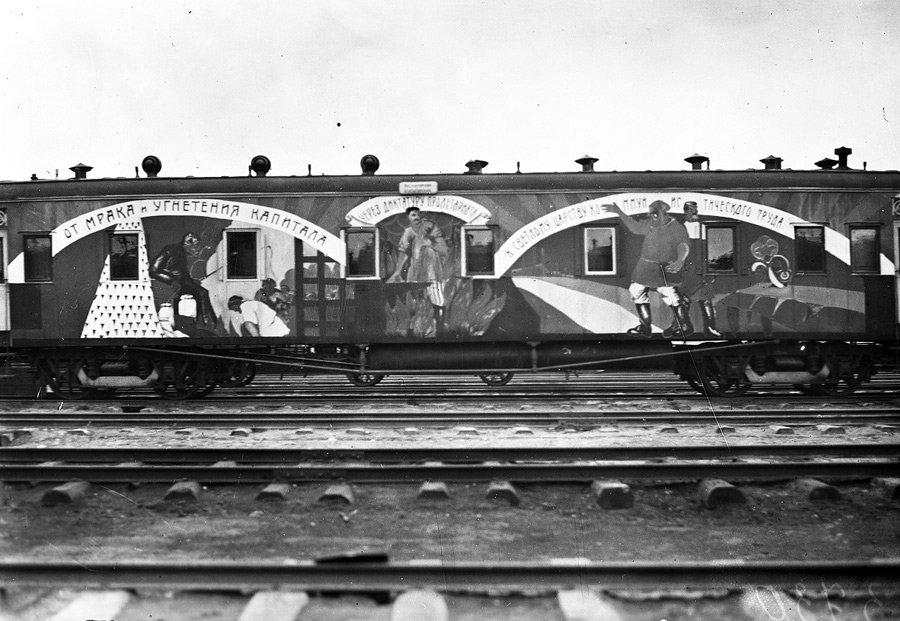
Some artists appropriated the same graphic style of Soviet propaganda after the Revolution, and not only in the streets. One of the most notable and significant examples of that were the Agit-trains; mobile “education” pavilions that traveled the country and featured Lubok-style paintings on the exterior of the train cars along with ROSTA posters, that were part of a massive multi-year propaganda campaign promoted by the Russian Telegraph Agency beginning in 1918.
A painted car of a Soviet “Agit-train”. 1920. (Source: The Russian State Documentary Film & Photo Archive.) Text on the train: “From the gloom and oppression of capital through the dictatorship of the proletariat to the bright kingdom of communist labor”.
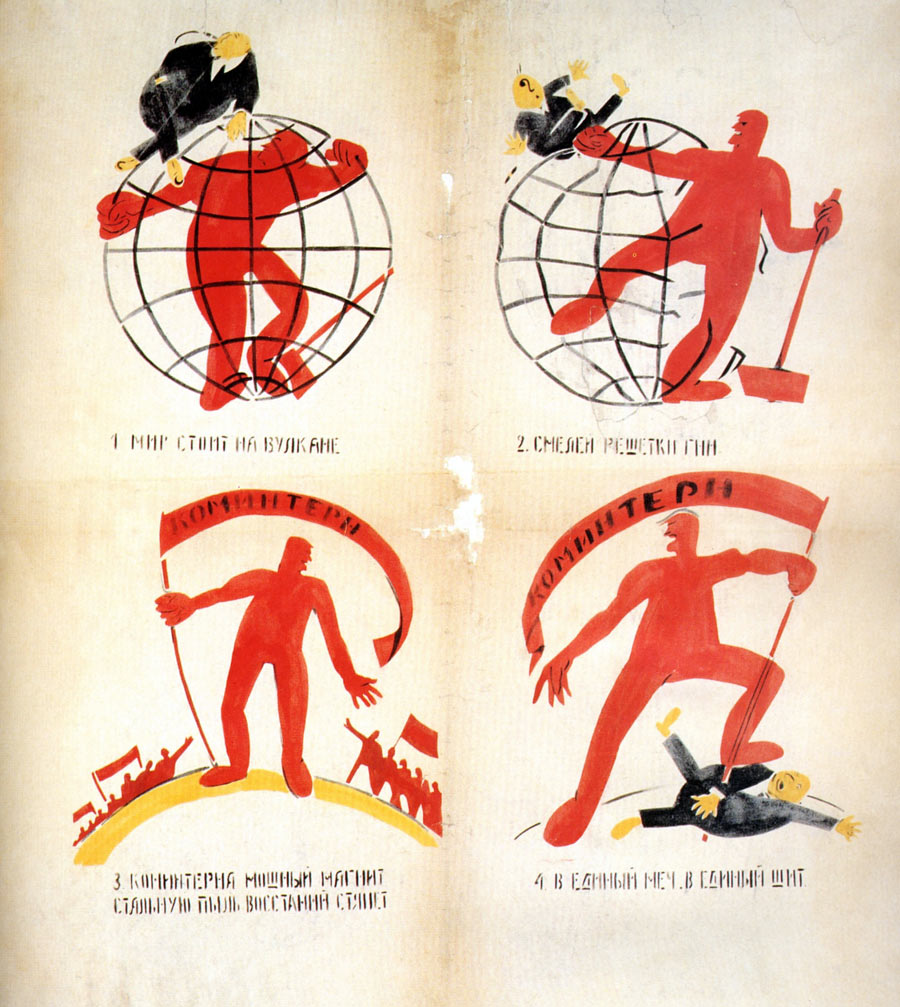
One of the most active artists contributing to that program was poet, playwright, artist, and actor Vladimir Mayakovsky, who created hundreds of images for it. During the crisis, just before and after the Revolution, some of the most interesting art practices that blossomed and went out to the streets contained influences from these manifestos, new anti-religion narratives, and experimental poetry based on folk culture and text. These art practices are not Street Art, as we currently know it, but this is one of the first important waves for the birth of this form of contemporary art. It is also here that it is possible to see two important specific aesthetic influences – the Lubok graphic style and the text-based street manifesto – both of which were used and transformed by Russian Street Artists many years later.
ROSTA Poster by Vladimir Mayakovsky. 1921. (Source: Archive.ru.) Text on the poster: “1. The world is on a volcano. 2. Dare to rot lattice. 3. The coming powerful magnet steel dust rebellion will succeed. 4. In a single sword, a single shield”.
II. 1990s
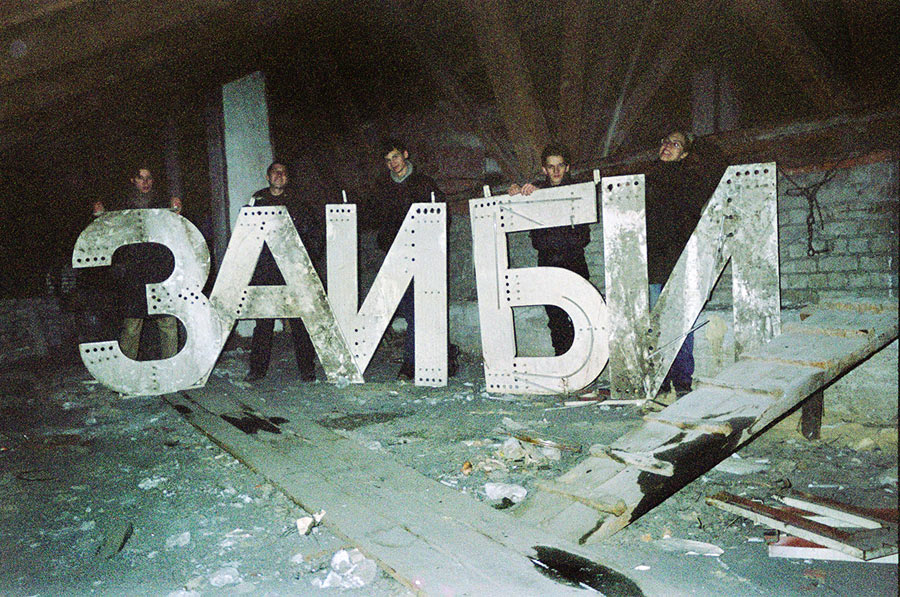
A new wave of critical and radical art movements arose in the 1990s after the USSR fell. The political shifts initiated an economic crisis, but at the same time, a freedom of speech and a new market system began developing. In many Russian cities, but especially in Moscow, new art groups were founded, represented was called an ‘Actionism’ movement. Politically and socially engaged street actions were produced by many groups such as E.T.I. and zAiBi, and artists such as Alexander Brener, Anatoly Osmolovsky, Oleg Kulik, and many others.
Action “Bukvy” (Eng. Letters) by ZAiBi group. Moscow, 1998. Appropriating old metal frames once intended for Soviet advertising inscriptions “Look on the cinema screens…”, three ZAiBi slogans were created: “A man can do anything”, “Never sleep, do not eat anything!” and “Play, don’t die.” In this photo: collected letters with ZAiBi group name in Russian. (Source: ZAiBi group archive.)
Like the avant-garde works of the 1910s, these actions were political and radical for sure, and at the same time, the artists were close to the people in a conceptual way. Their actions were based on poetry, literature, philosophy, and provocation; a possible illustration of the deep economic and cultural crisis the people were going through. The works revealed a certain ‘wild life’ of the Russian people, who after the fall of the Soviet Union began to feel broken and like they had been tricked. Bold, radical urban actions marked these first steps towards the return of an informal art activity on the streets of Russian cities.
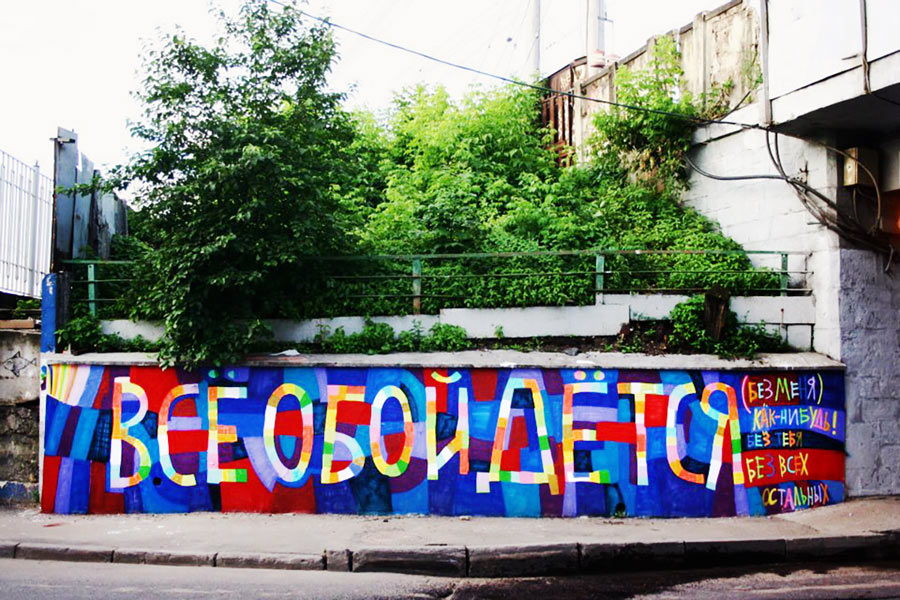
The feeling of freedom, permissiveness and the lifting of censorship on Western culture gave way to new informal urban movements. These movements began to actively penetrate youth culture and social classes even during Perestroika[1] in the 1980s but fully developed afterward. Rock culture and Hip-Hop, with its street break-dancing and graffiti, were among the movements flourishing at this time. The Graffiti subculture arrived in the USSR in the 1980s. At the same time break dancing was becoming popular, dancers became the unofficial guides of Hip Hop culture, adopting dance techniques and creating decorative scenography for their performances. Graffiti, poetry, and literature slowly began to be mixed and recombined by Russian Street Artists, who have tried to find not only a ‘style’ but an identity and a new visual language to frame this new kind of street culture. Some artists continued to produce avant-garde forms based on simple geometry. Still, others slowly began to work more with local culture – incorporating aspects of the Lubok style and using anti-capitalist messages, writing short poems, tales, and manifestos in the streets.
“No Future” and “Street Art is Dead”
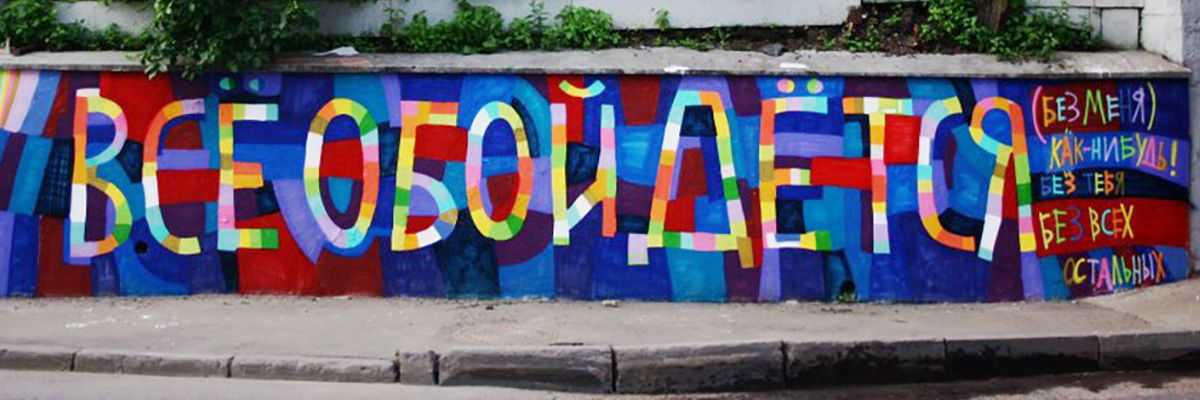
As a representation of the early 2000s, I want to mention the Rus crew, which started to adopt global graffiti based on nicknames in the Russian language at the turn of the century. Same time graffiti artist Kirill Kto started to use some Russian quotes and questions in the streets. In 2006 with other graffiti writers, Kirill founded a group called No Future Forever. Based on conspiracy theory and inspired by antiutopian ideas, the members produced many critical street messages in a trash/ugly graffiti style, advancing some naïve narratives and manifestos. Another person who is emblematic of Russian Street Art is Pasha 183. His naïve messages and simple style present him as a sensitive person, but at the same time as a radical anti-capitalist artist. He combined image and text perfectly for his street messages, exploring Moscow’s underground and projecting his Underground Light Art (U.L.A) images on walls.
In 2008 Russian Street Art began to shift away from the innovative and experimental practices of the past. I think it happened because 2007–2008 was a time of economic prosperity in Russia, and it is possible that Street Art needs a crisis or something to push against as a kind of grassroots, activist, protest art form. This kind of mood also can be traced outside of Russia; the British curator, researcher, and anthropologist Rafael Schacter describes 2008 as a period when global Street Art started to grow with ‘steroids’ to become Muralism. In his article ‘Street Art Is a Period. Period. Or the Emergence of Intermural Art’ on the Hyperallergic website, and in his 2018 Street to Studio book, he writes about Street Art as a period of experimental, pioneering art. He supposed that the term ‘Street Art’ had become radically reattributed by the market, the media, and municipal authorities[1].
In 2008, I felt the same way and watched how many Russian Street Art works were not only unrelated to their social and political context but also unrelated to the city’s dimensional experiences; its architectural forms, for instance. I organized a group show entitled Russian Street Art is Dead, and the exhibition became a final point in the tumultuous era of mid-2000s Russian Street Art. At the same time, the show initiated a broader discussion around the topic of Urban Art in general.
III. The Current Era
The rebirth of Street Art that focused on the political context and was more socially engaged and text-based started growing slowly in the 2010s as a protest mood covered the entire country. In the winter of 2011, compromised parliamentary elections provoked protests across Russia. The protest movement in Russia (2011–2013) was made up of numerous mass political protests by Russian citizens, beginning after the elections of the State Duma in December 2011 and continuing during the campaign for the President’s election.
After presidential elections were held in March 2012, in which Vladimir Putin won in the first round, protesters claimed that the elections were accompanied by violations of Federal law and large-scale fraud. These events were considered the beginning of forming a more active and socially responsible civil consciousness in Russia.
“The artists assess the local issues and use Street Art to a greater extent than previously to attract attention to these homes and to their problems in general.”
Street Art as a grass-roots practice (without any financial or institutional support) began to experience a re-birth in the 2010s – a symbol of building a new society. Several centers outside of the capital began to develop in their own unique ways – places with names like Yekaterinburg, Perm, and Nizhny Novgorod. For example, in Nizhny Novgorod, artists such as Artem Filatov, Vladimir Chernyshov, Andrey Olenev, Andrey Druzhaev, and others have worked very carefully and attentively to interact with the residents thoughtfully.
The artists assess the local issues and use Street Art to a greater extent than previously to attract attention to these homes and to their problems in general. These practices, in turn, are shaping a unique approach to working with city surfaces, a more cautious one that appreciates and endeavors not to violate the existing ecosystem of the city. One could say that today this approach is a style specific to Nizhny Novgorod Street Art and represents a ‘movement’ of socially responsible Street Art.
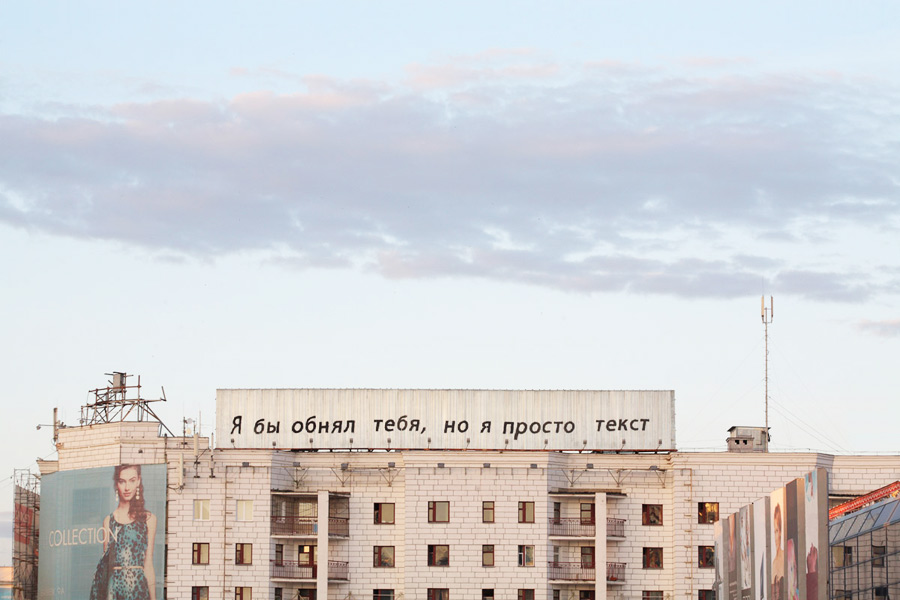
Many active Street Artists are living today in Yekaterinburg as well. An appreciable number of them are working with text-based and socially engaged forms of art – such as Tima Radya. With his concise philosophical and monumental messages, the artist reflects upon timeless, vital themes and raises the issue of the boundaries between the public and the personal, the political and the social. As a medium for his work, the artist often uses roofs and billboards – surfaces typically reserved for urban advertising. Tima substitutes familiar consumerist messages with his own to shake citizens out of their everyday rhythm. At the same time Tima Radya reflects our soviet history with massive propaganda, which is placed on the roofs of the city’s buildings. Propaganda messages such as ‘Glory of Lenin’ or ‘Peace. Labor. May’ before the 1990s were produced in a similar visual way, which Tima uses now. In his street works, he actualizes our collective memory and gives new meanings.
Also, I want to mention a few artists from Yekaterinburg who are also quite important for helping to capture a sense of Russian Street Art practices today. As many artists are, Slava Ptrk, Vova Abikh, and Ilya Mozgi are focused on using the text form in their work. They are also working to combine visual (figurative) forms with text perfectly; putting messages in the streets that react to urban space or are critiques in social contexts.
These artists also organized a grass-roots Street Art festival in Yekaterinburg called Carte Blanche, which focuses on illegal art in the streets, executed without permission or institutional or financial support. In my opinion, this kind of festival is a response to mural festivals that are prevalent elsewhere, and they represent a more natural progression for the Street Art movement, switching attention away from the legal murals that have grown large on ‘steroids.’
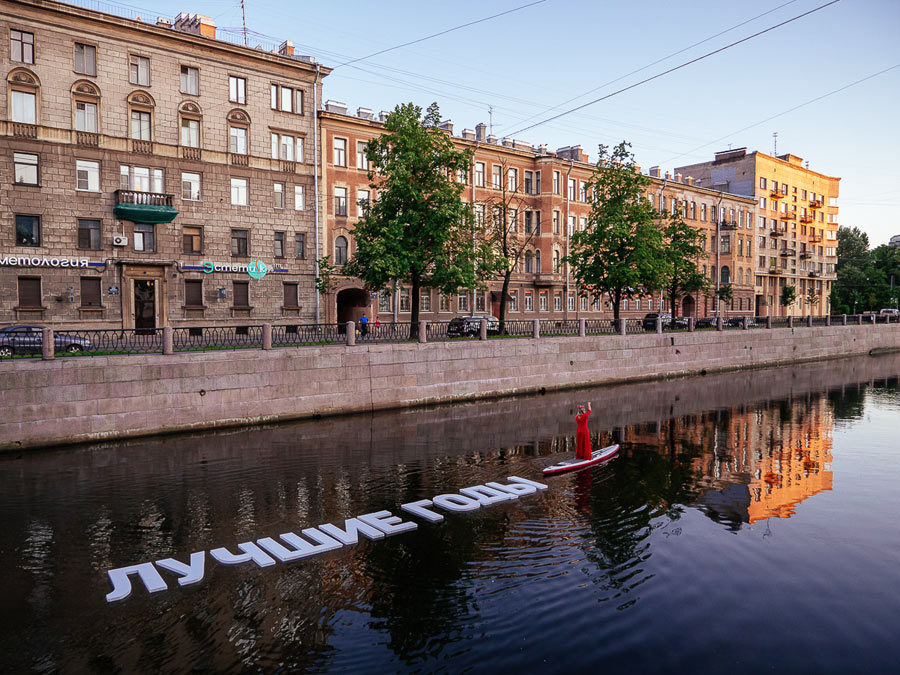
In the Russian capitals of Moscow and Saint Petersburg today you are more likely to see that Street Artists are focusing on the text form, including the artist Maxim Ima, who uses ironic messages in Saint Petersburg and Kirill Kto from Moscow. The works of Kirill are more existential and poetic, often based on reflections of various personal and social processes, sometimes identifying the relationships between them. Kirill’s street comments may be seen as motivational speech to some in the audience of passersby on the street, but not always are the messages obvious to the casual viewer.
Sometimes his message is addressed to a specific person or just to himself. Kirill Kto’s recent works indicate a new phase in his artistic development, critical concerning places (in his own reference system), his own creative journey, and the chosen model of artistic production. In his recognizable cheerful hues, his textual messages are filled with regret and even mourning for the street that has lost its counter-cultural role before our eyes and that he fears will never be the same.
“…it appears to me that Russian Urban Art needs to be radical and pushing for political changes. It needs to be an actual form of the people’s voice…”
Ponosov
Conclusion
Observing all of this, it appears to me that Russian Urban Art needs to be radical and pushing for political changes. It needs to be an actual form of the people’s voice, not institutional art, and probably presented without any support from the government or commercial entities. When I think specifically about Russian Urban Art, it is based on a few of our cultural traditions: literature, conceptual art, folk, and it is influenced by the aesthetics of Lubok and Constructivism/Suprematism. The latter one is more understandable in Europe and the US, a perfect one for export for sure.
This may be why many contemporary Russian Street Artists favor presenting their work against those historical backgrounds; their abstract contemporary geometry unattached to radical messages may seem out of context. I didn’t mention abstract street painters here because from my point of view, contemporary abstract street art is too decorative now, and it’s part of a kind of Zombie Formalism which means it is just a reproduction of nice geometrical forms.
From a historical perspective, I would say that this text-based Street art is more interesting now because it is derived from real life in Russia today. Mixing philosophy, political messages, and humor, it’s something that characterizes Russians as well. At the same time, it makes us far from the West because these kinds of art pieces can be challenging to translate
These new works are, of course, connected to conceptual art – and many Street Artists worldwide have used text for their works. Russian artists who make text-based pieces and who use only the Russian language are creating work that ignores a global audience and focuses on locals only. I think using local language is important for making more precise ideas and messages. It’s also important for Street Artists to create work for the streets where they are from – especially because the Internet is a system for adapting all pictures for a global audience. It is also a place where all identities are dissolving. It is appropriate for specific text-based Urban Art in Russia to focus more on locals; It is more natural and organic when compared to the global movement of Street Art today, which is too often is focused on a global audience.
[1] A political movement for reformation within the Communist Party of the Soviet Union during the 1980s, widely associated with the Soviet leader Mikhail Gorbachev and his policy of ‘Glasnost’ (meaning ‘Openness’).
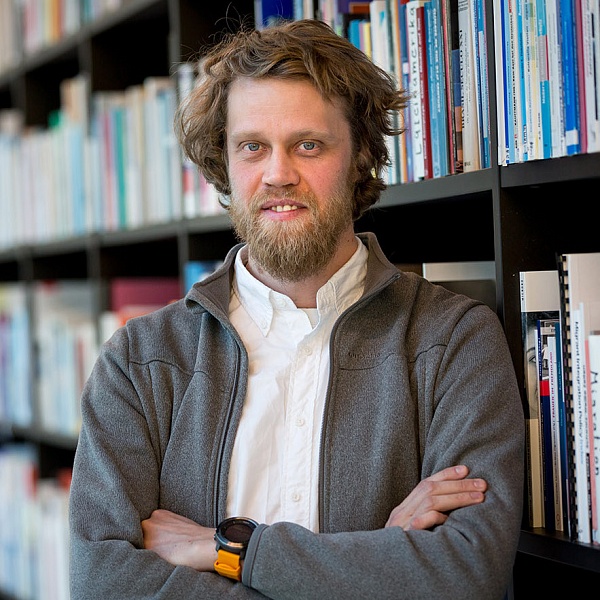
Portrait by Joerg Farys. Heinrich Böll Foundation. Berlin.
Igor Ponosov
Igor Ponosov (b. 1980) is a Russian artist, Partizaning activist, curator and researcher focused on Urban Art. Author of books: Art and the city (Russian: Искусство и город) and Russian Urban Art: History and Conflicts. Laureate of The Sergey Kuryokhin Contemporary Art Award (St Petersburg).
2005 – 2009 Ponosov published three books on street art in Russia and the ex-USSR. 2011 – 2013 Curated The Wall, a project based in the CCA Winzavod, Moscow. Founded the Partizaning.org website as a platform for exchange among activists, artists and urbanists. 2013 – 2016 Curated the Delai Sam festival, focusing on grassroots iniatives and activism in Russia, and authored Art and the city (2016), for which he received The Sergey Kuryokhin Contemporary Art Award 2016 for Best Text on Contemporary Art (St. Petersburg) 2017 Curated group shows in Berlin focused on Urban Art and activism in Eastern Europe. 2018 Published Russian Urban Art: History and Conflicts book, launched in Tartu, Besancon, Paris, Helsinki, Krakow, Berlin, Freiburg and Weil-am-Rhein. 2019 Nominated for the Kandinsky prize in Moscow.
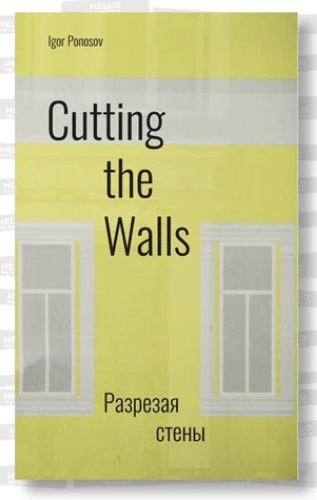
Igor’s current title isCutting the Walls, produced in parallel with his site-specific artworks at CCI Fabrika, Moscow. Featuring texts by sociologist Dmytro Zaiets and art critic Sergey Guskov.
Opinions expressed on BSA Writer’s Bench do not necessarily reflect those of the editors or BSA.
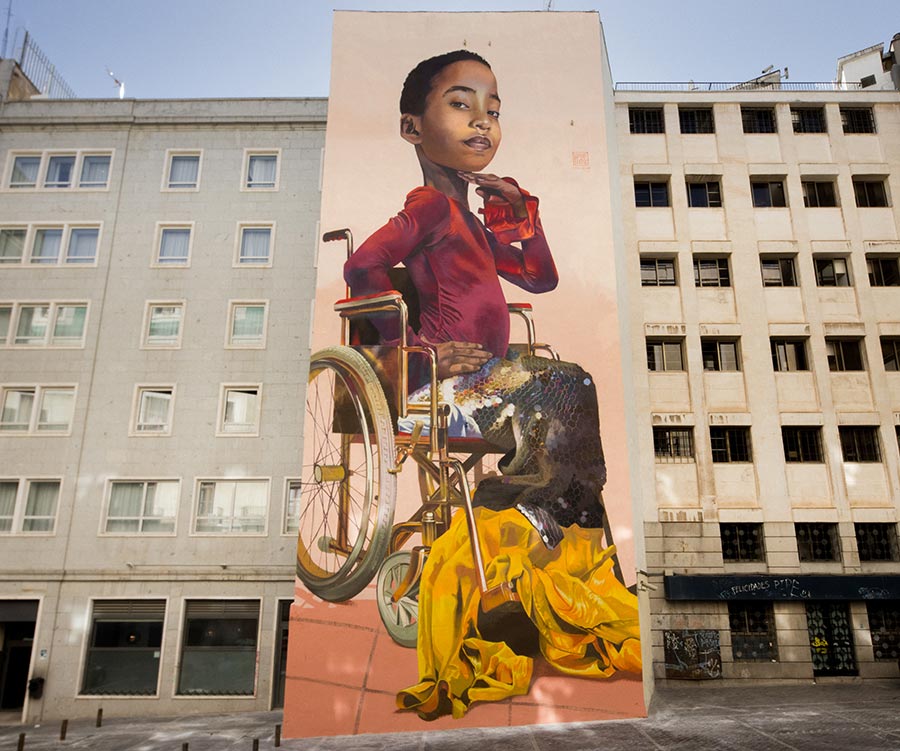
Frankfurt-based ultra-talent Case Maclaim is with the Urvanity Art Fair this week, and he has created a new mural in Madrid’s old, historical city center. His work is being shown by Brussells Ruby Gallery, along with that of street artists EverSiempre and Wasted Rita. Still, he just wanted to go big with a tribute to children’s imagination.
Case Maclaim. Urvanity 2021. Madrid, Spain. (photo courtesy of Urvanity Art Fair)
“I gave the viewer a new character of a yet unknown fairy tale,” Maclaim says of the confident kid wearing a mermaid costume. “I have high hopes that it will encourage especially the young audience to come up with their very own story.”
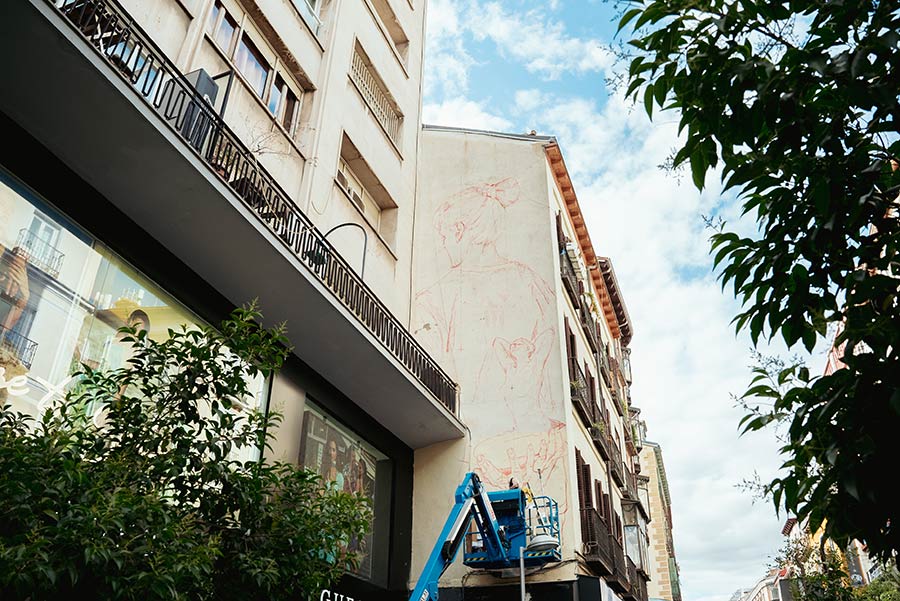
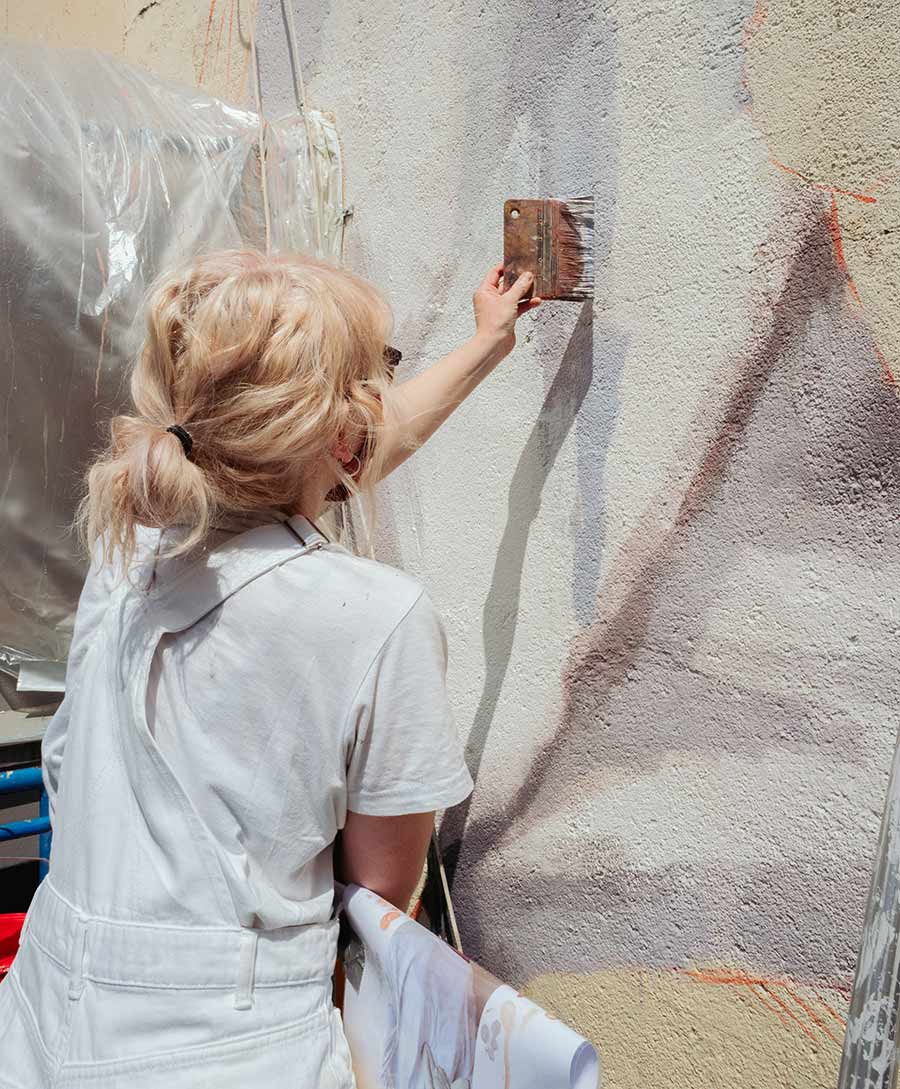
On another wall, tall and thin, on calle Fuencarral 47, artist Helen Bur painted a figure as a tribute to her mother and to the recently departed Street Artist Hyuro. She says she pays homage to these two women – ‘Humilty, strength, elegance & poetry of the subtle.”
Case Maclaim. Urvanity 2021. Madrid, Spain. (photo courtesy of Urvanity Art Fair)Case Maclaim. Urvanity 2021. Madrid, Spain. (photo courtesy of Urvanity Art Fair)Case Maclaim. Urvanity 2021. Madrid, Spain. (photo courtesy of Urvanity Art Fair)Helen Bur. Urvanity 2021. Madrid, Spain. (photo courtesy of Urvanity Art Fair)Helen Bur. Urvanity 2021. Madrid, Spain. (photo courtesy of Urvanity Art Fair)Helen Bur. Urvanity 2021. Madrid, Spain. (photo courtesy of Urvanity Art Fair)Helen Bur. Urvanity 2021. Madrid, Spain. (photo courtesy of Urvanity Art Fair)Helen Bur. Urvanity 2021. Madrid, Spain. (photo courtesy of Urvanity Art Fair)
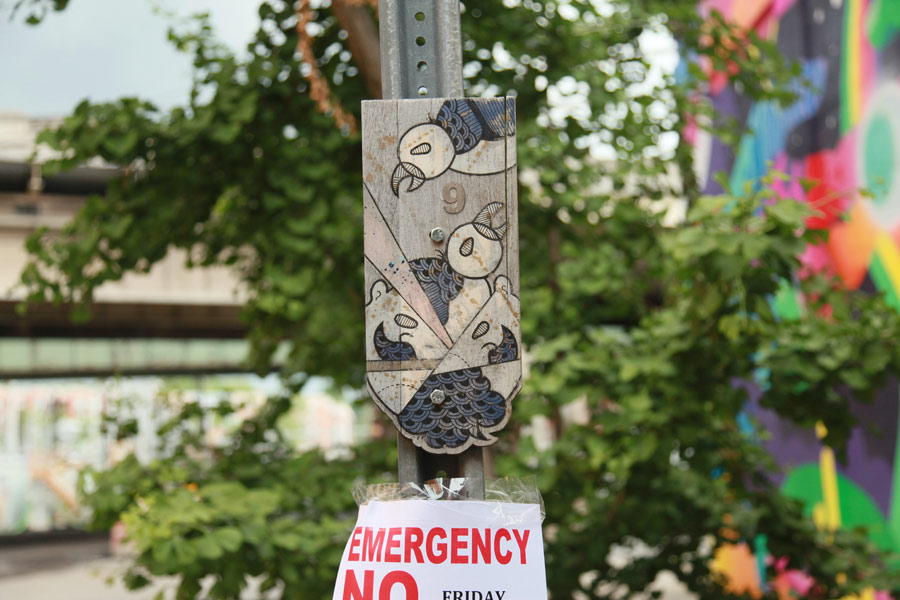
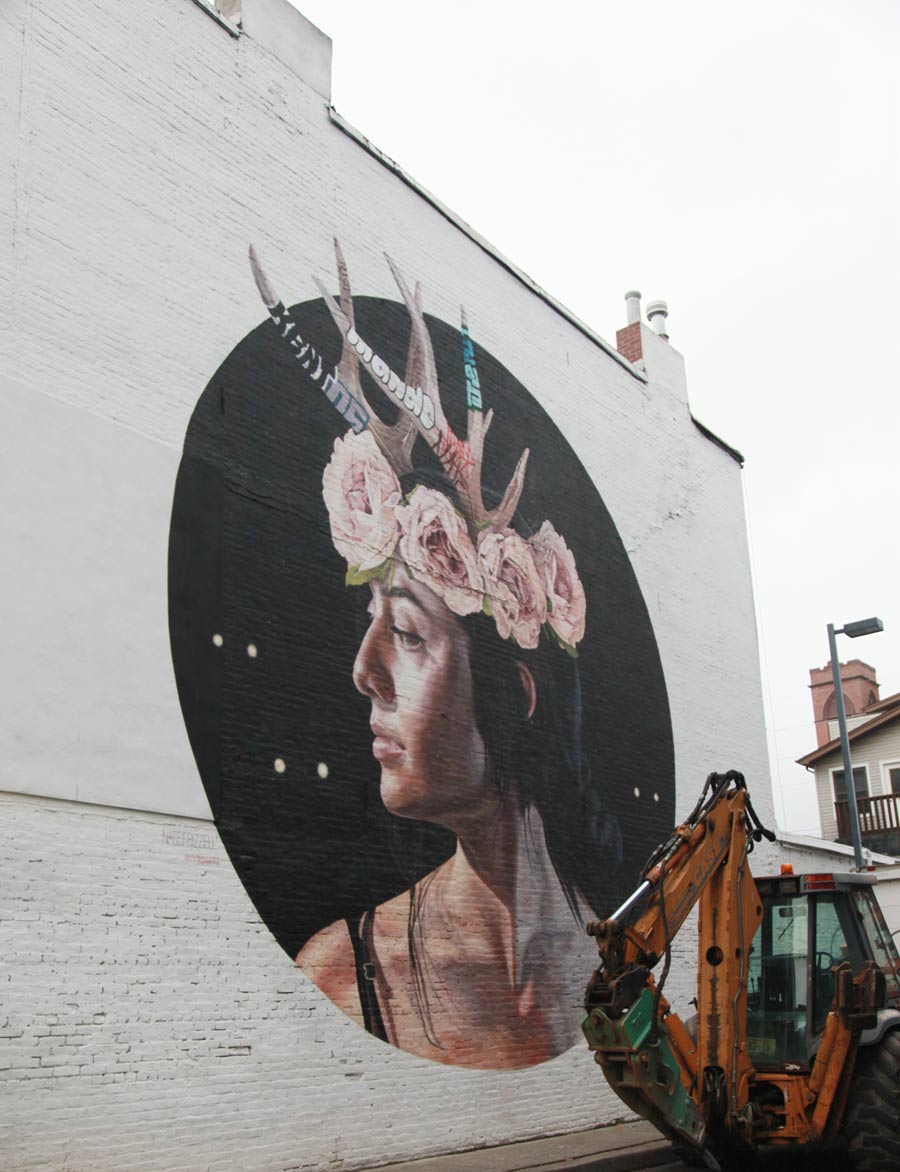
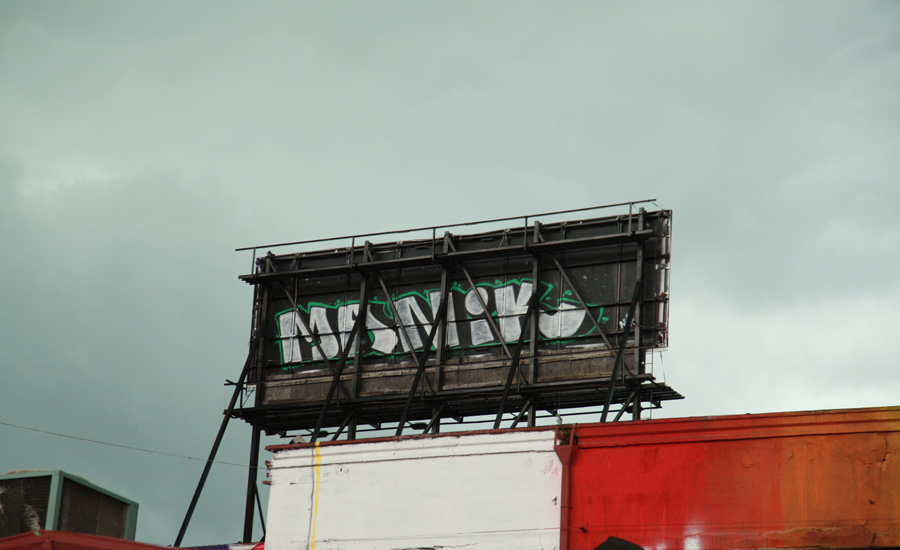
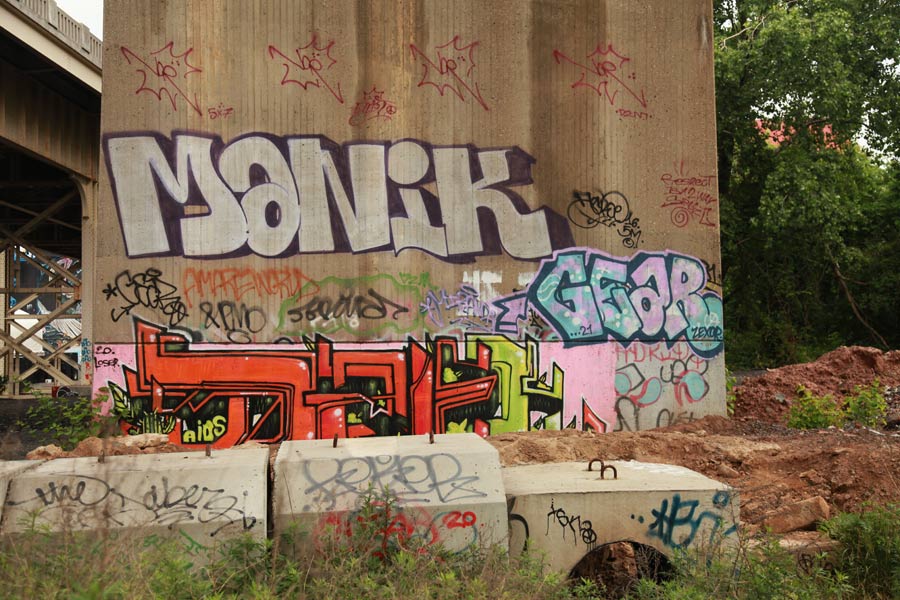
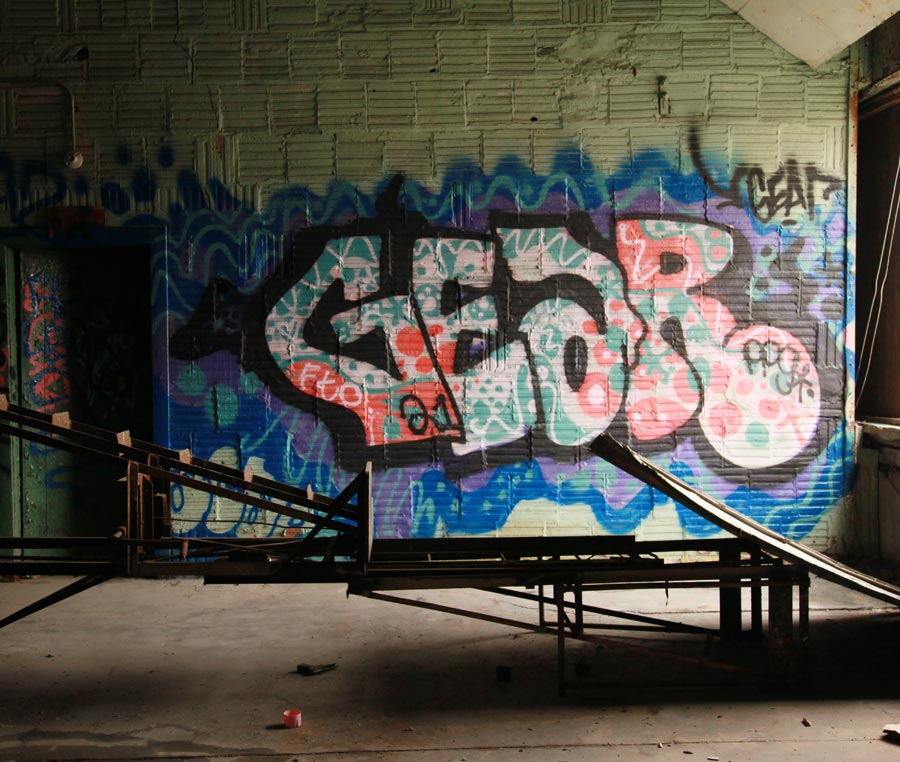
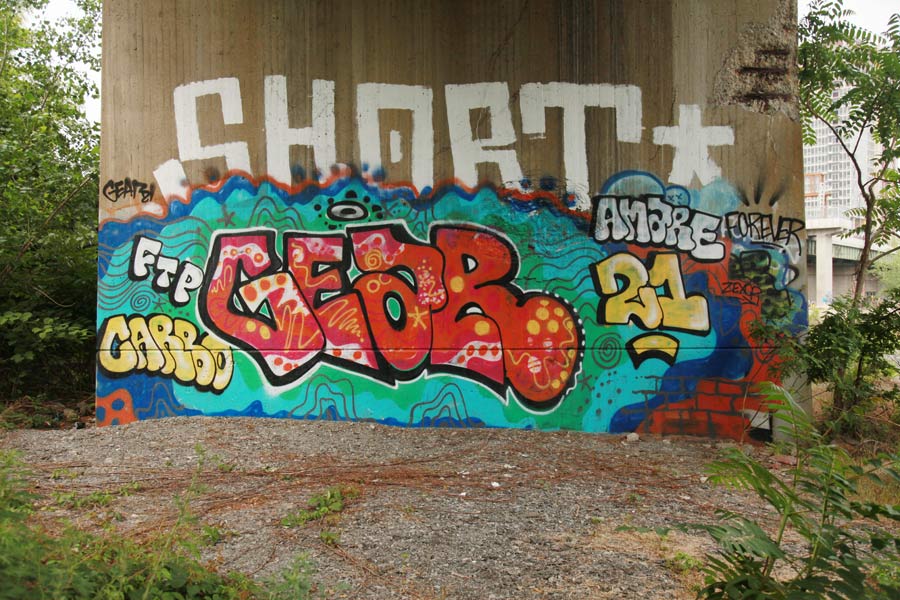
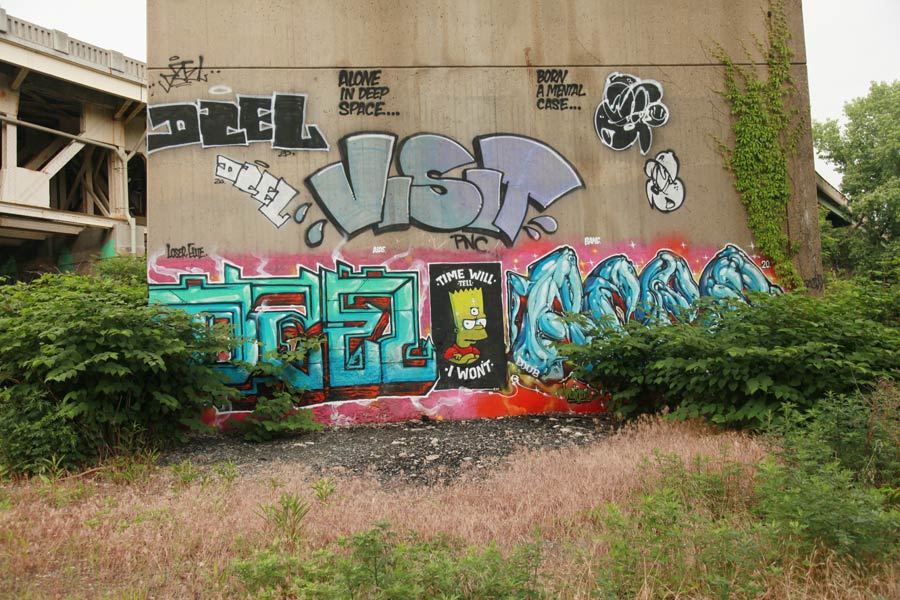
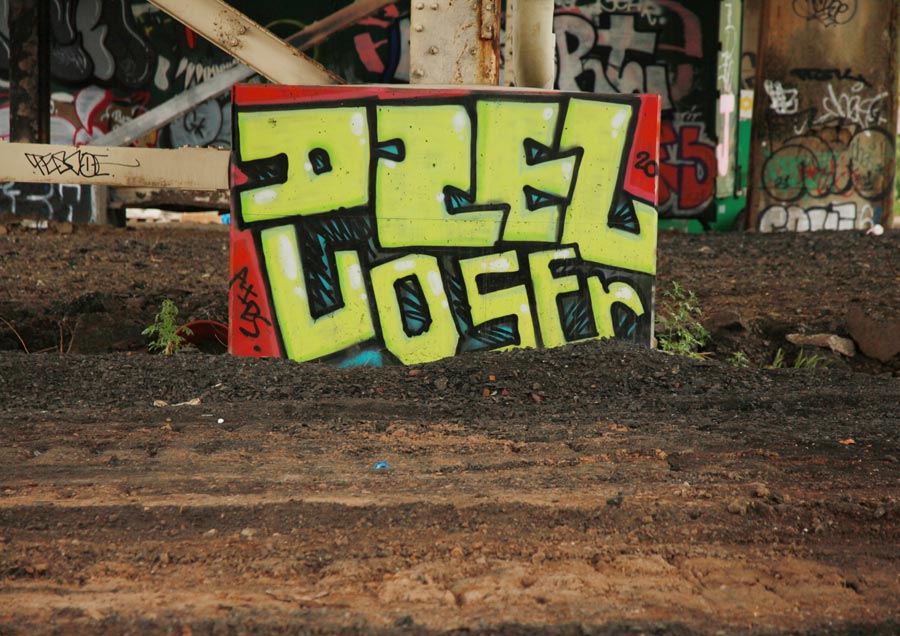
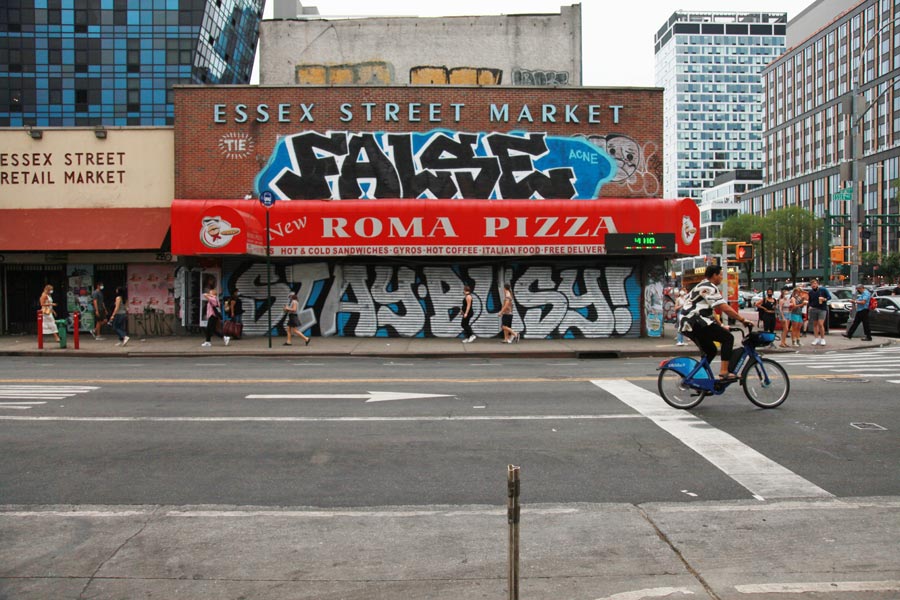
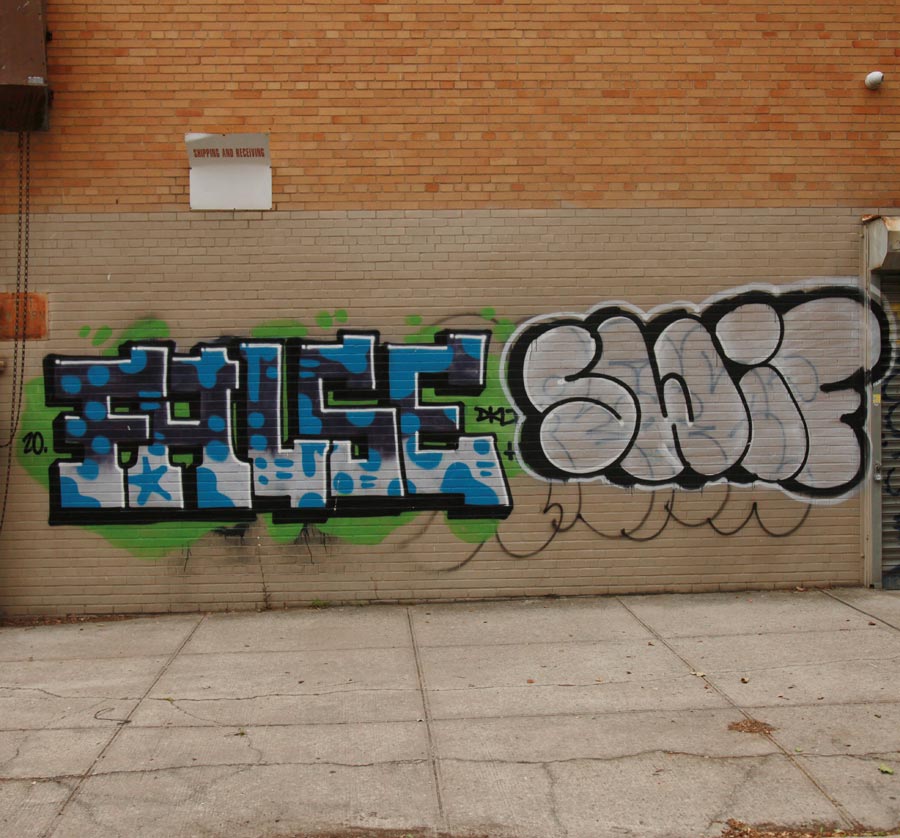
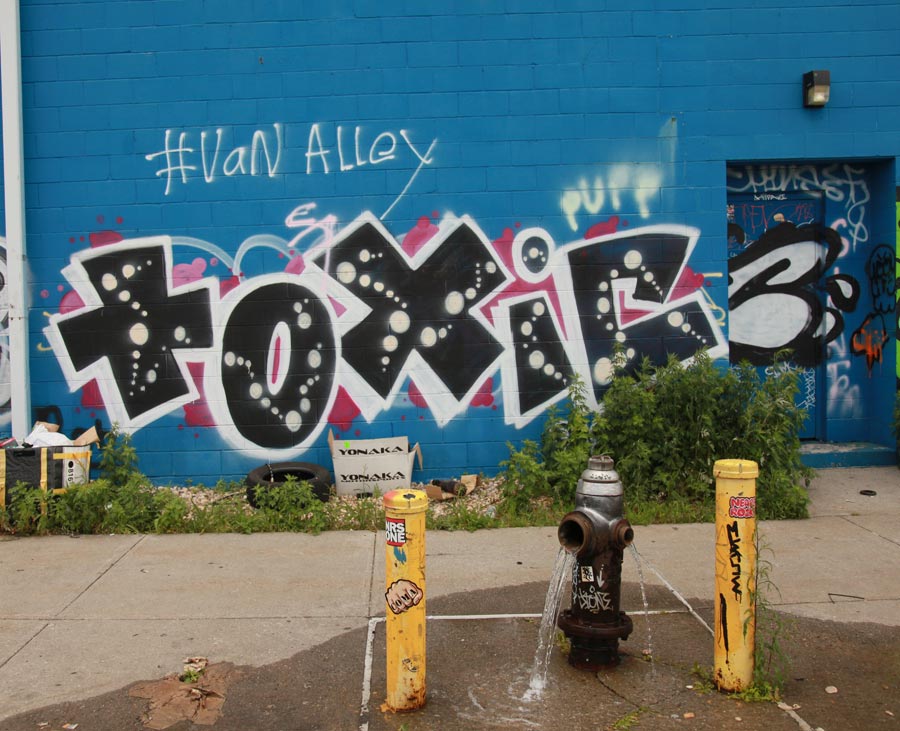
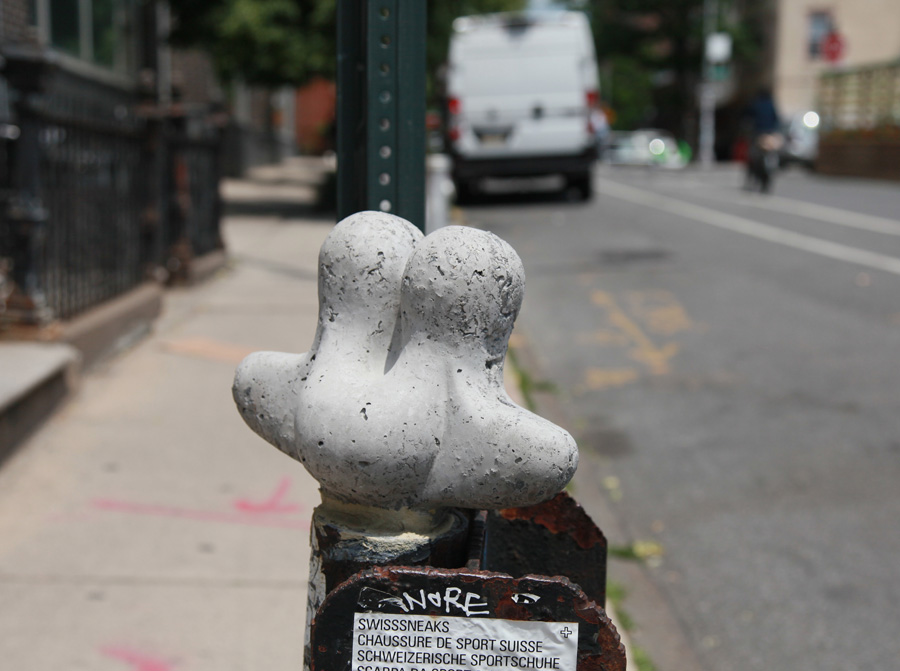
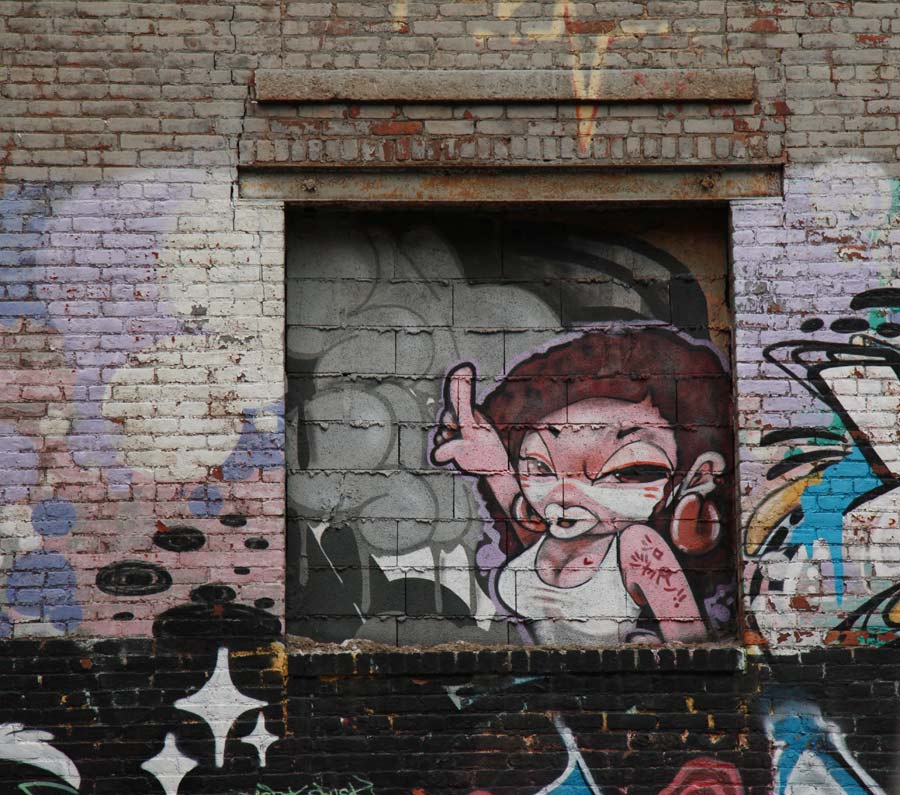
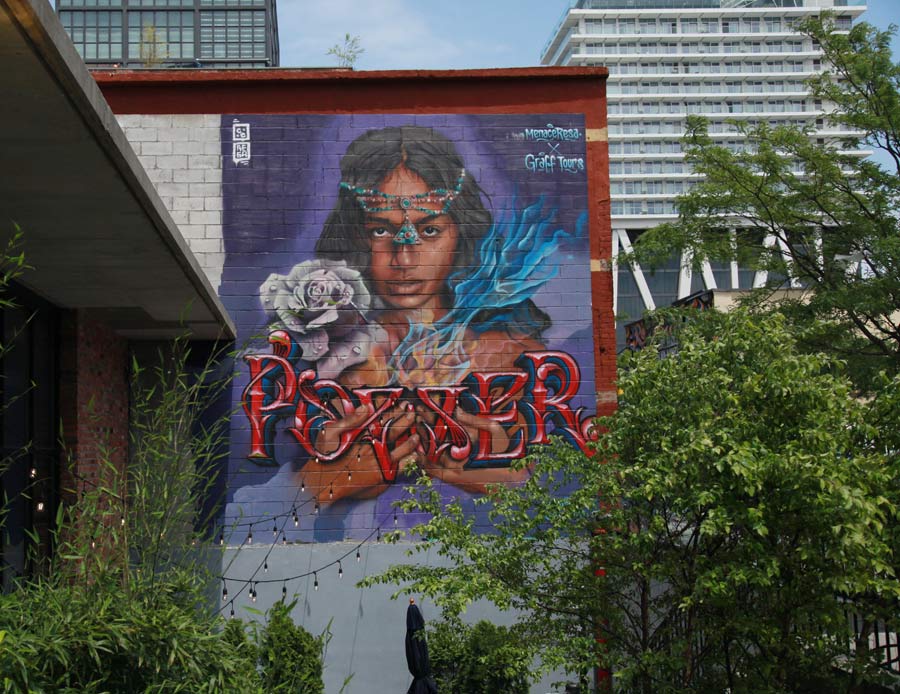
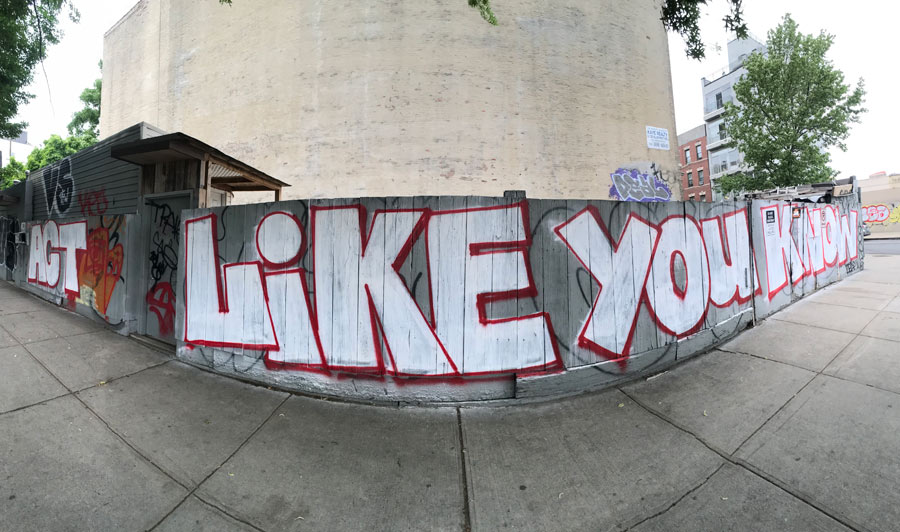
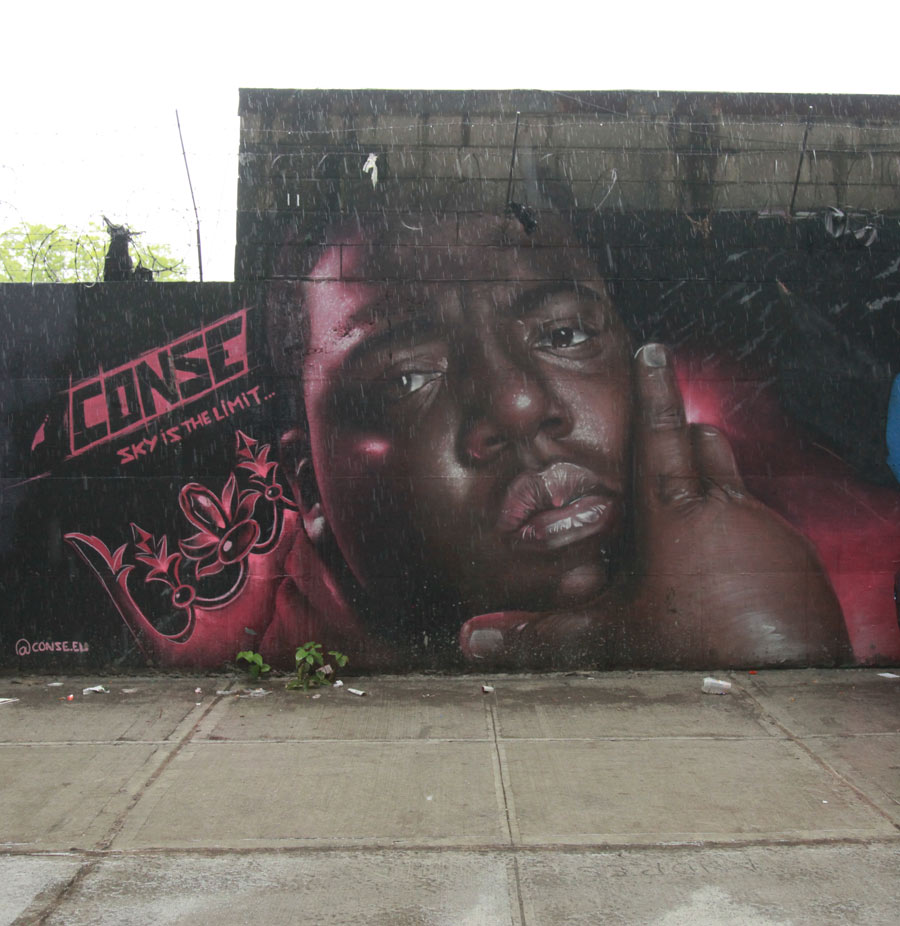
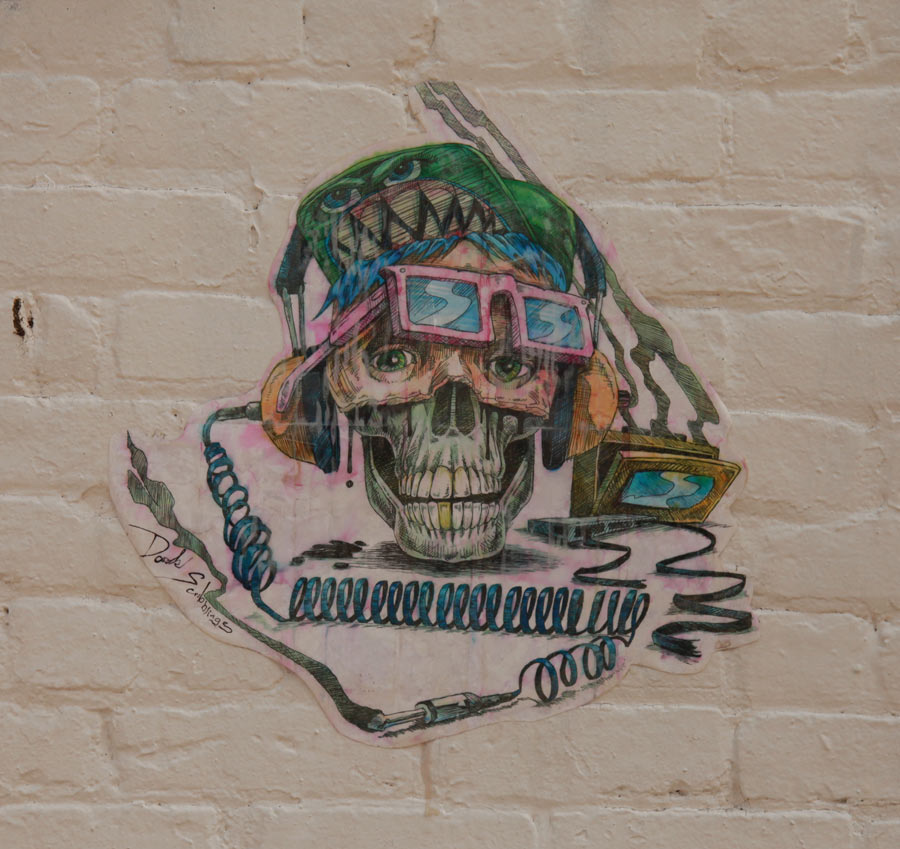
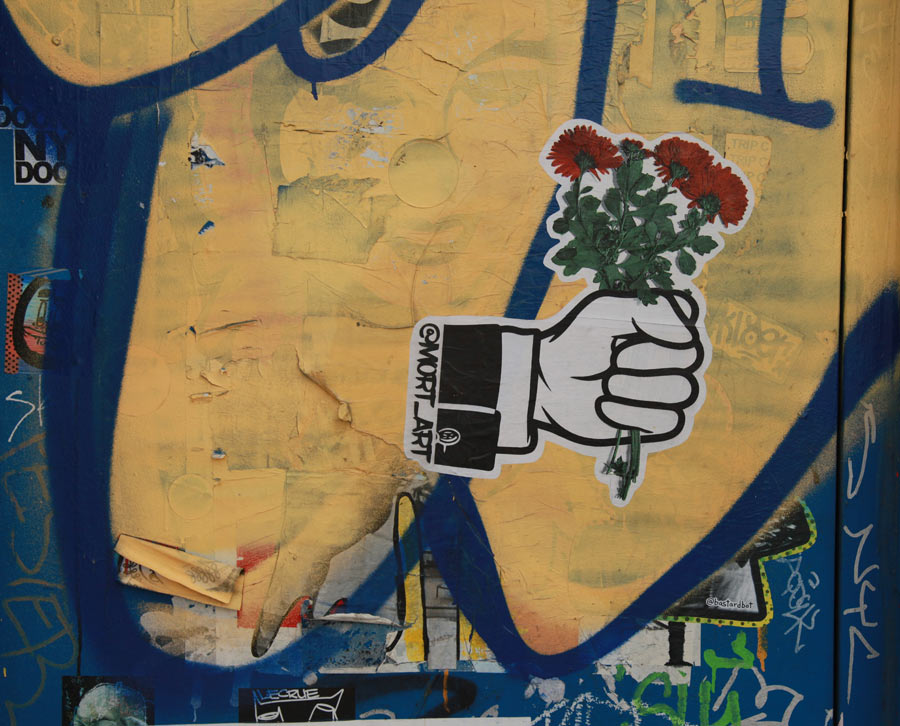
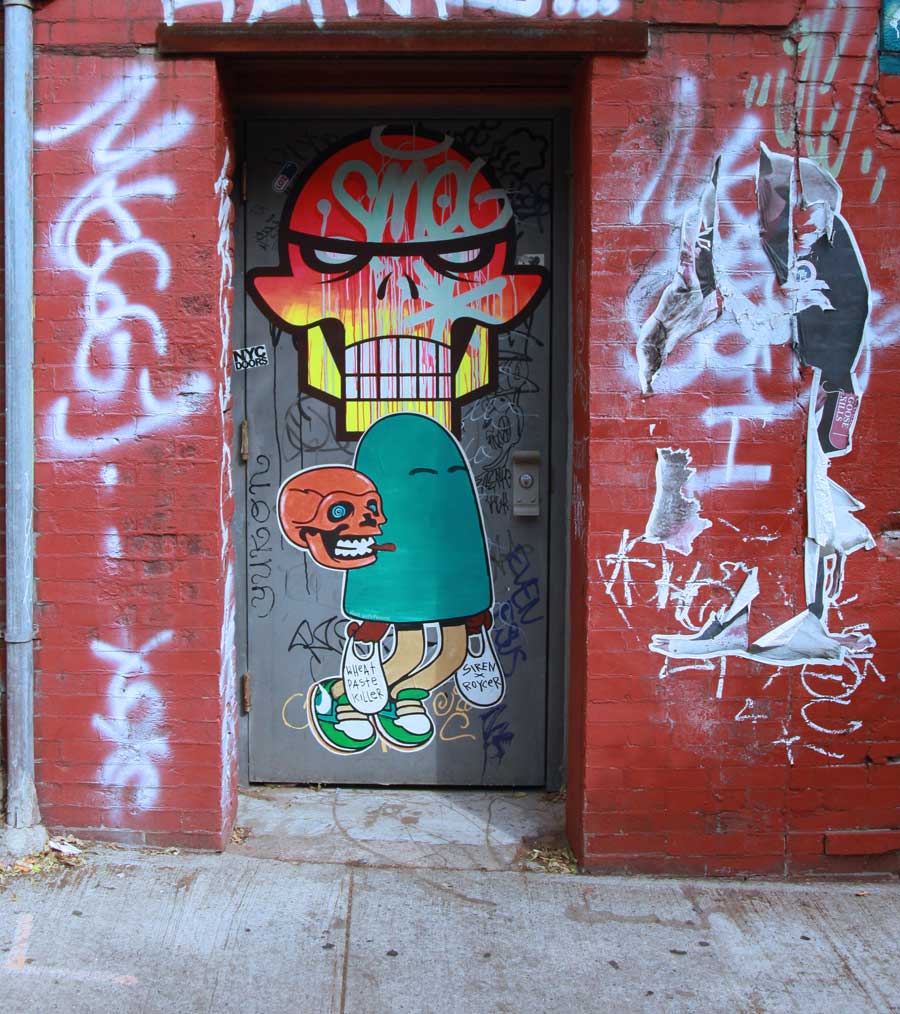
The volume of Street Art has picked up full steam with more graffiti on walls than many OG graff fans can remember were on the trains in the 80s. Competition for spots large and small is more fierce than a Saturday afternoon rush at the nail salon. The quantity of pieces and tags and stencils ebbs and flows, as does the quality and freshness. But looking at it as you walk makes you feel like New York street and cultural life is in full bloom. Large-scale and small, the works appear like mushrooms popping up in the urban forest after a late-spring rain storm.
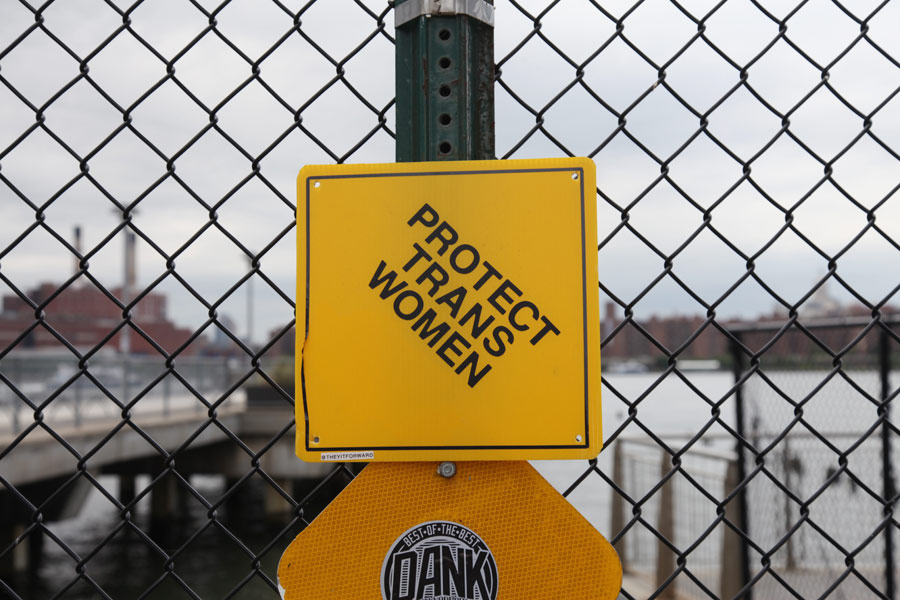
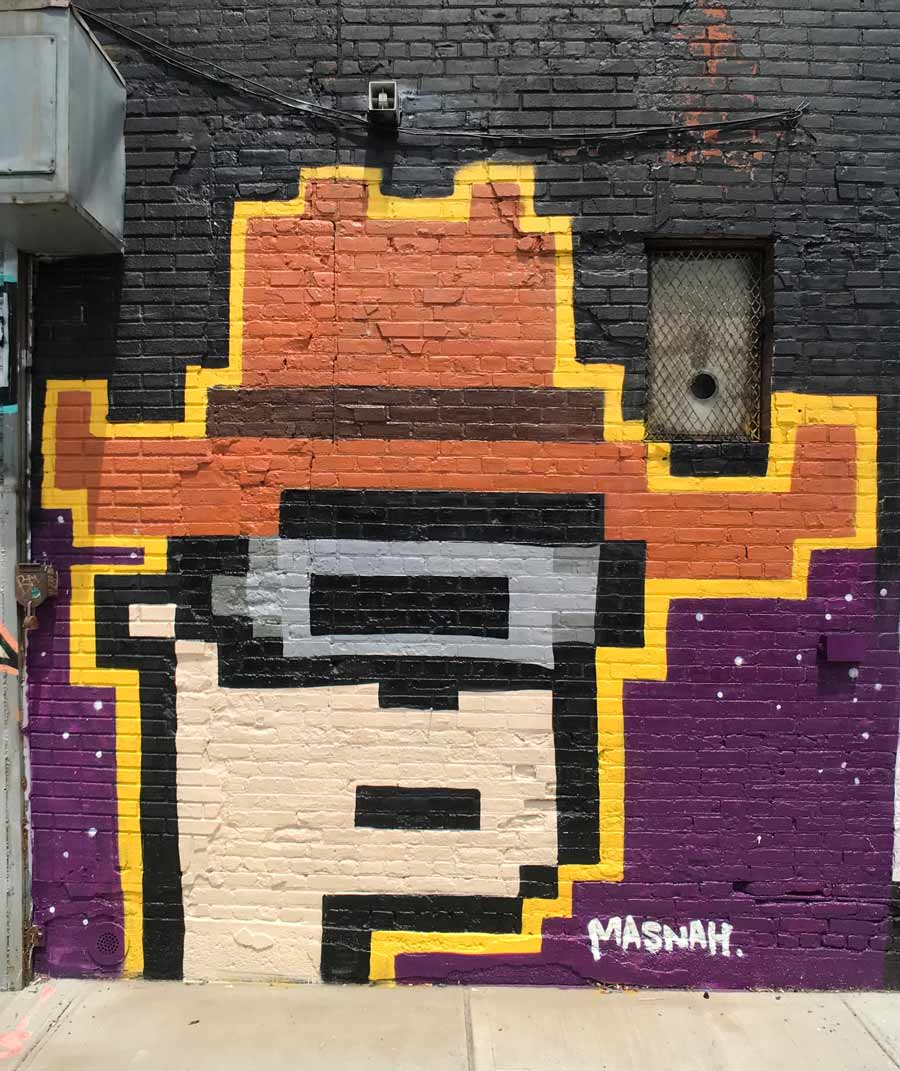
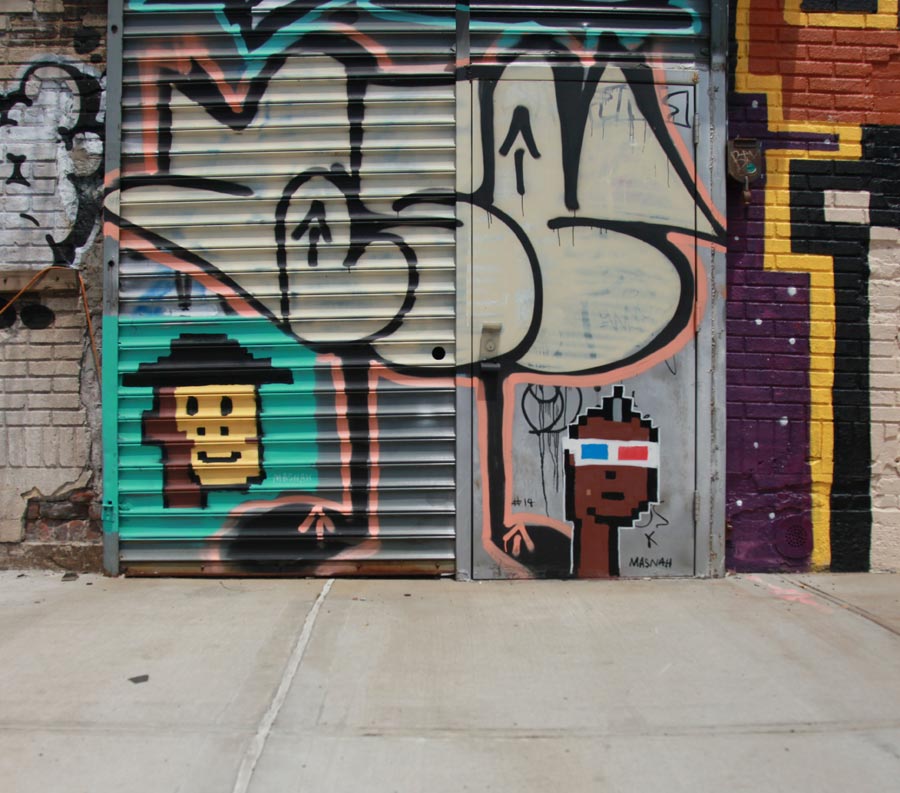
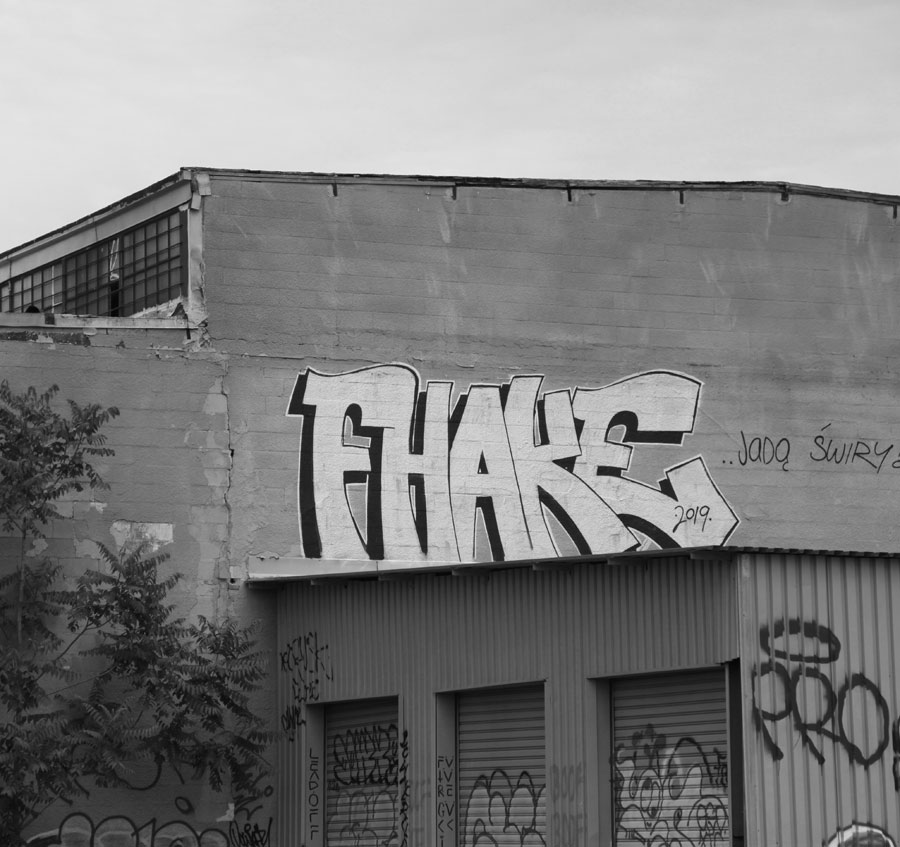
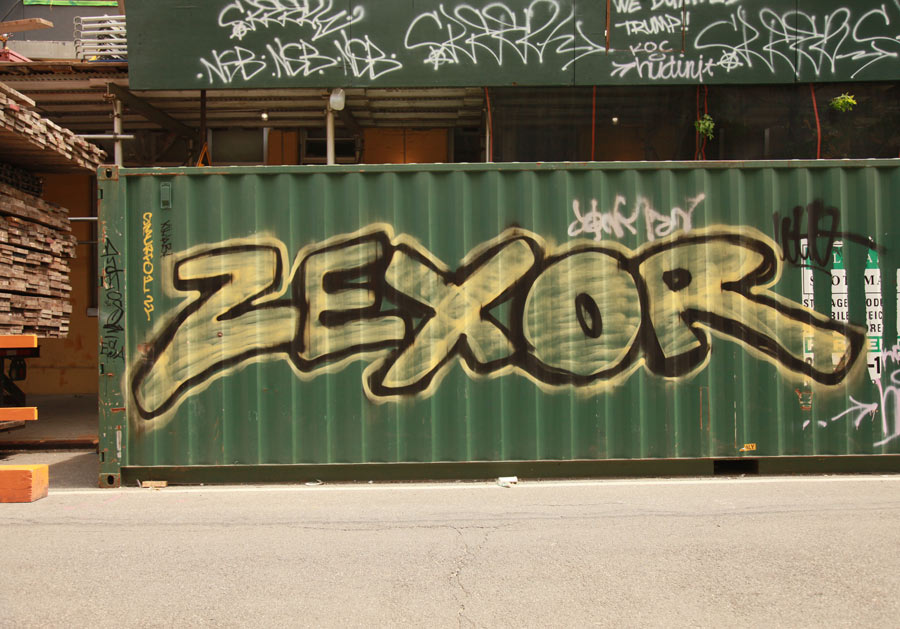
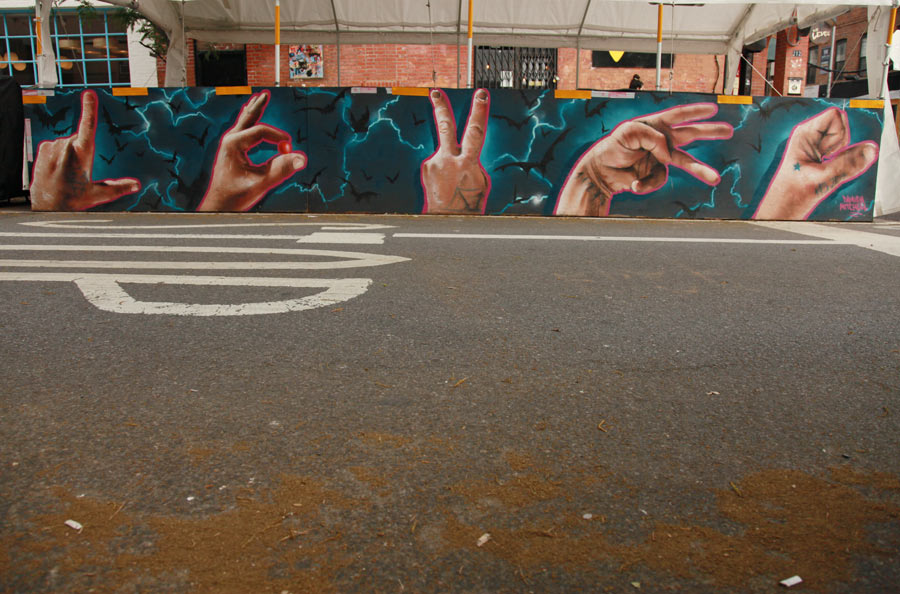
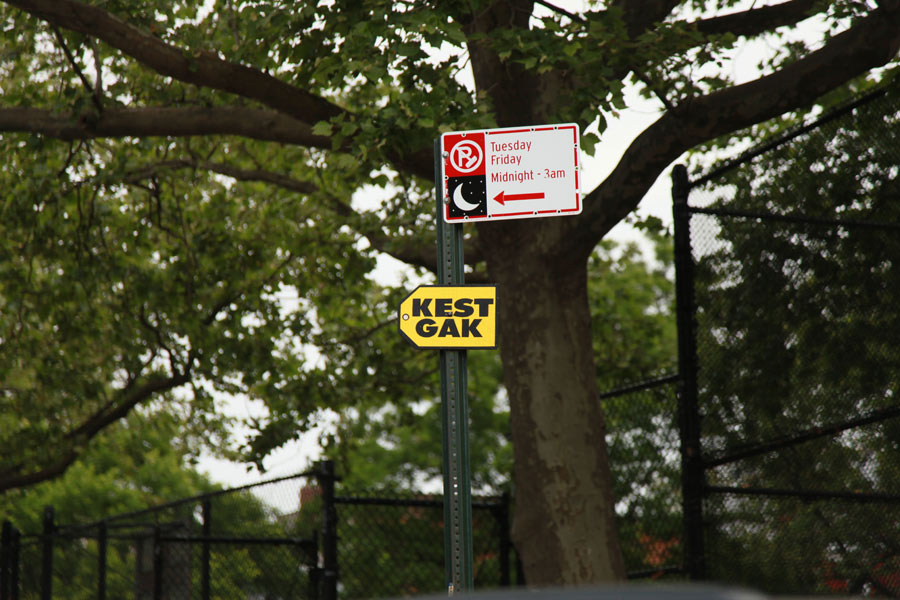
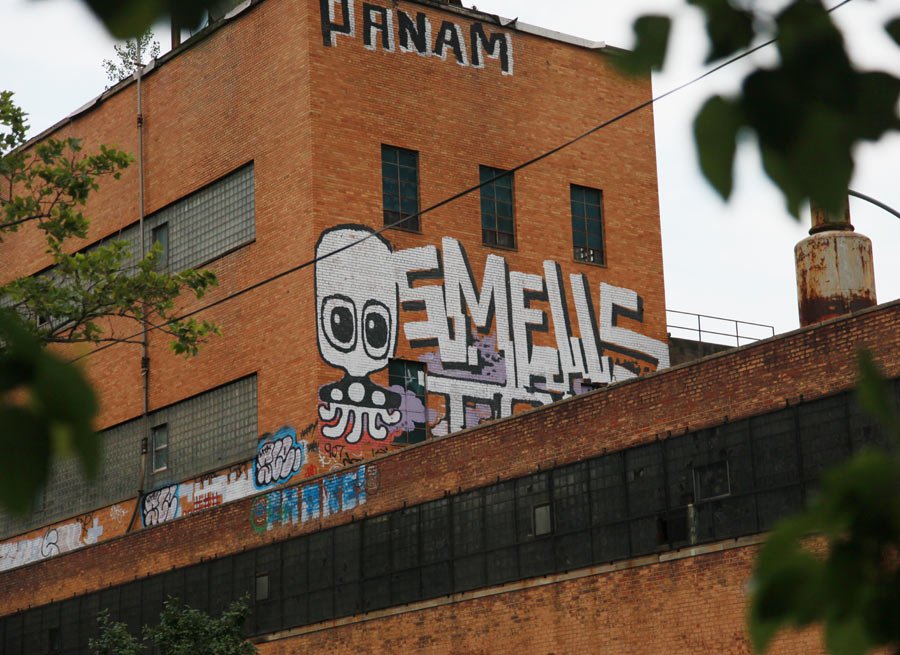
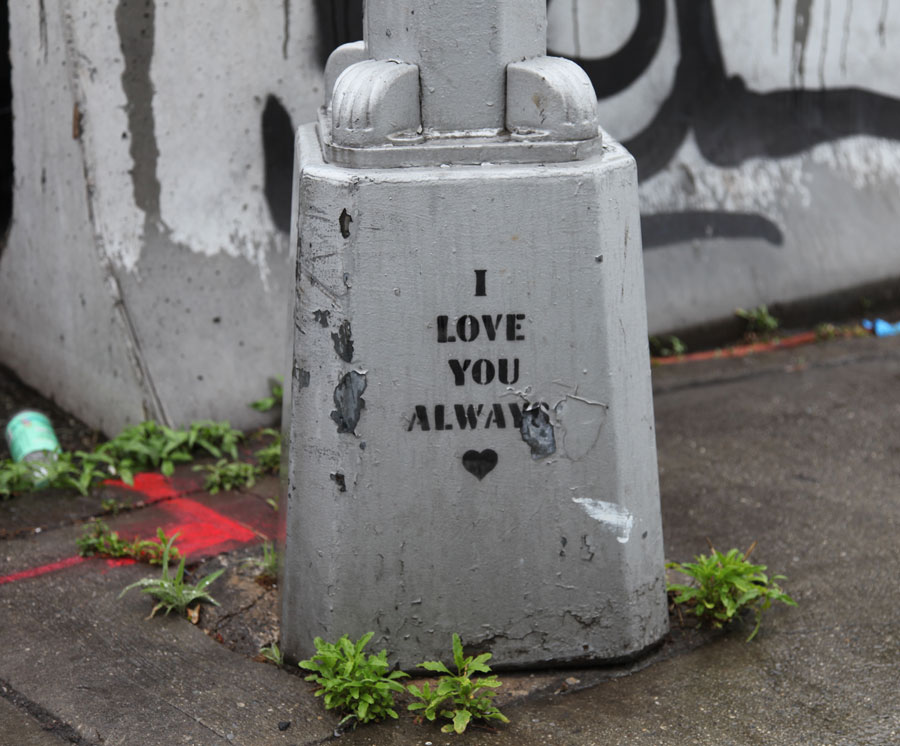
Here’s our weekly interview with the street, this week featuring Conse, D. Scribblings, Damien Mitchel, False, Fhake, Kest Gak, Lorenzo Masnah, Matt Siren, Menace Resa, Michael Zelehoski, Mint & Serf, Mort Art, Royce Bannon, Shiro, Smells, Swif, The Yit Foreward, Toxic, UFO 907, and Zexor.
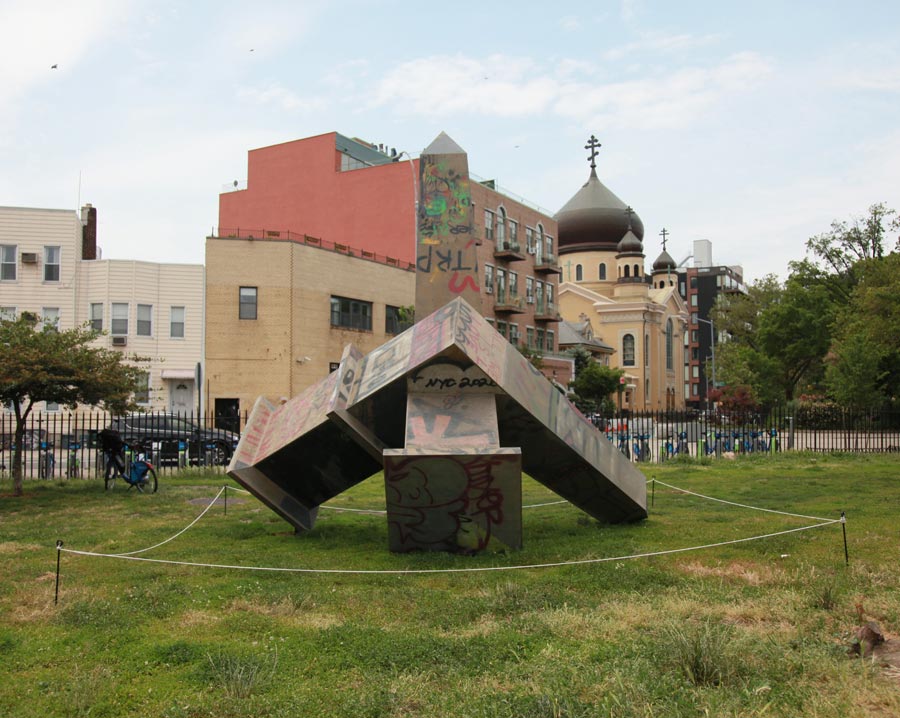
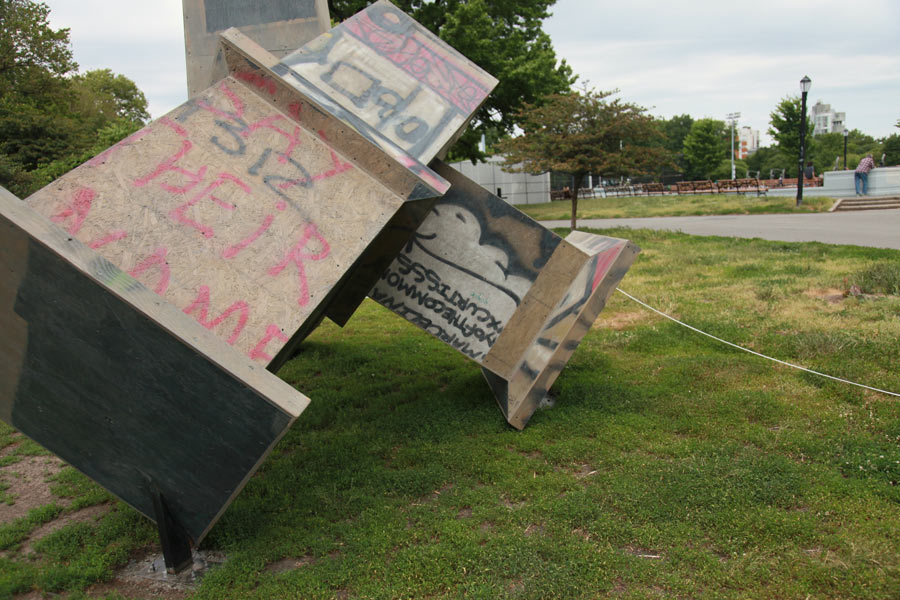
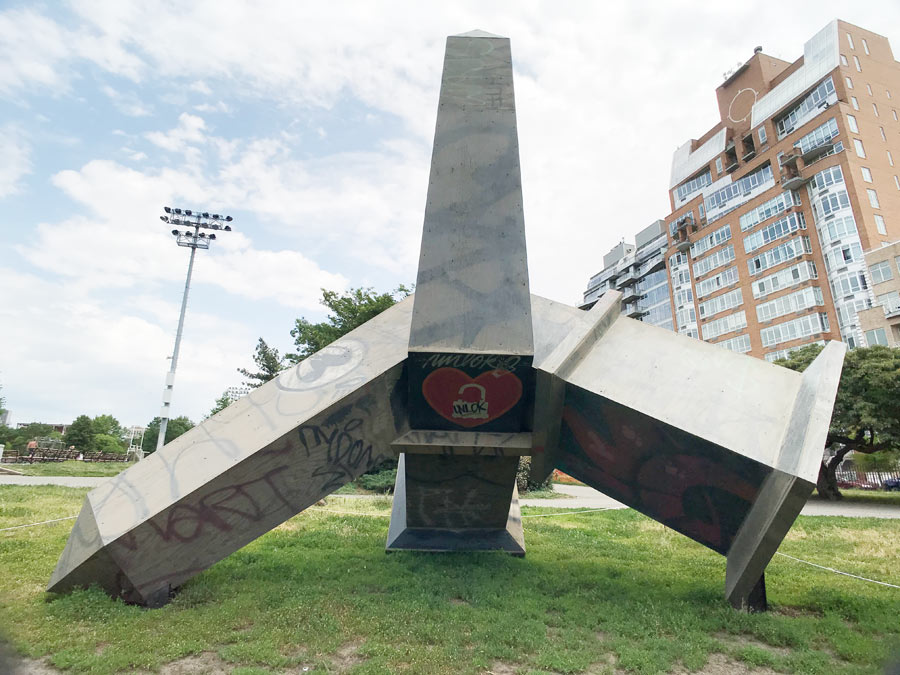
This wooden sculpture installed in McCarren Park in Williamsburg is made from recycled wood from boarded-up windows. It will remain in place until October 2021.
Paris-born Zecky has been writing graffiti since he was a teen in the late 1980s and brings his spontaneous and switchable style catalog here to the Art Azoi walls in the 20th Arrondissement.
Out in broad daylight for this freeform color blast, Zeky has a long history of bringing his early writing skills to the contemporary canvas, distinguishing himself in areas of style and a sophisticated palette selection. Pushing his limits when reaching toward his heroes of New York Wildstyle, Zeky actually supersedes those limitations and has developed his own lingua franca.
Our weekly focus on the moving image and art in the streets. And other oddities.
Now screening: 1. Good Guy Boris – Remote Sensing 2. ZEKY via Art Azoï. Video by Justine Bigot 3. DETOKS & GENOM, “Not Bigger, Not Better, But…More!” Via Montana Colors TV 4. HONET via Art Azoï. Video by Justine Bigot
BSA Special Feature: Good Guy Boris – Remote Sensing
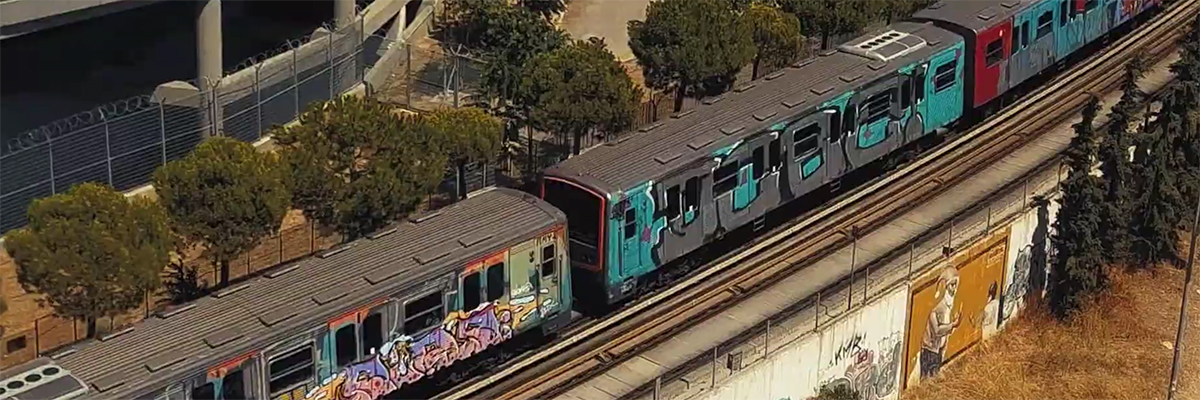
The misadventures continue on the 1 Line in Athens.
“Athens now has that feeling of being wild and unpredictable – a little exciting or dangerous in some parts.”
And the voice…. it sounds so familiar.
ZEKY via Art Azoï. Video by Justine Bigot
DETOKS & GENOM, “Not Bigger, Not Better, But…More!” Via Montana Colors TV
Silvers! Rollers! Color Pieces! Oh my! Barcelona’s Detoks and Genom are on the loose around big highway spots and metro stops. They say they are not bragging, but they get around.
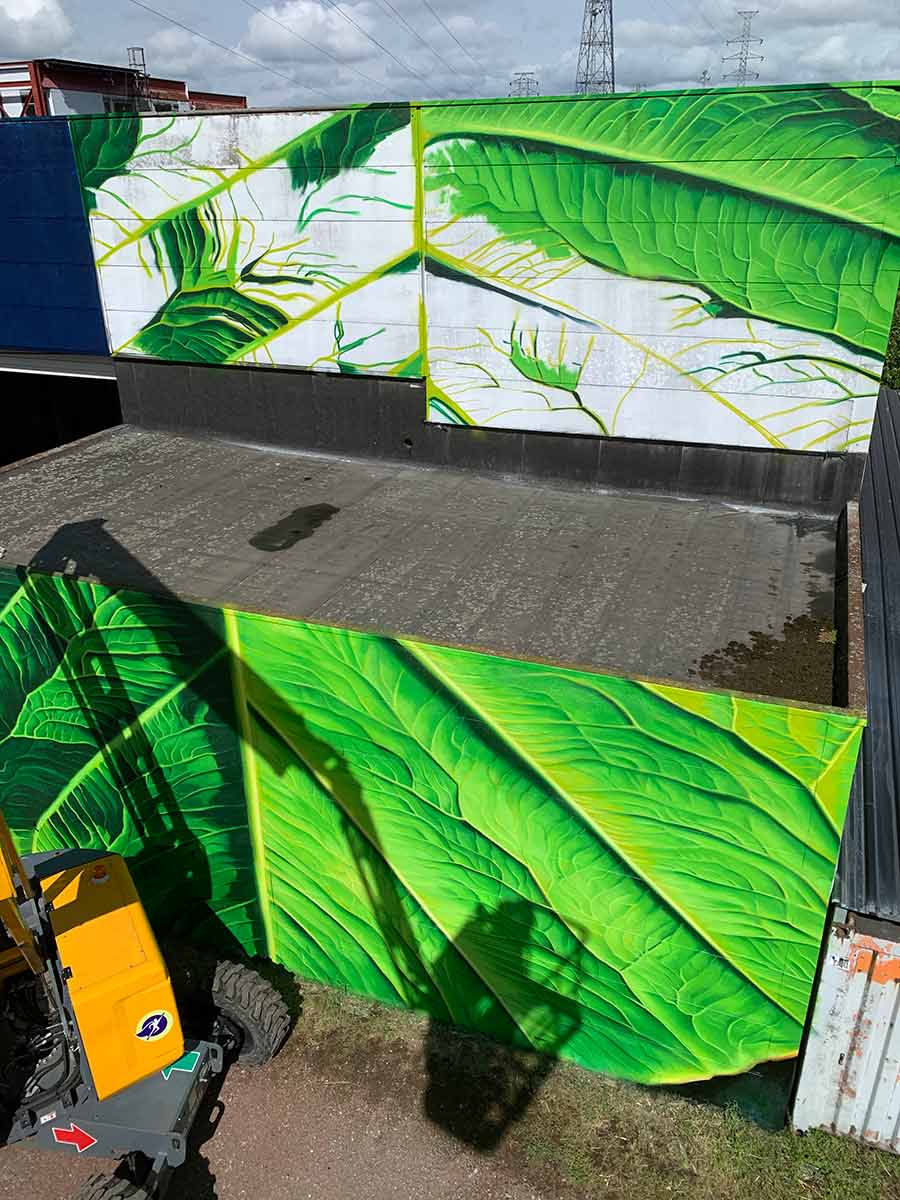
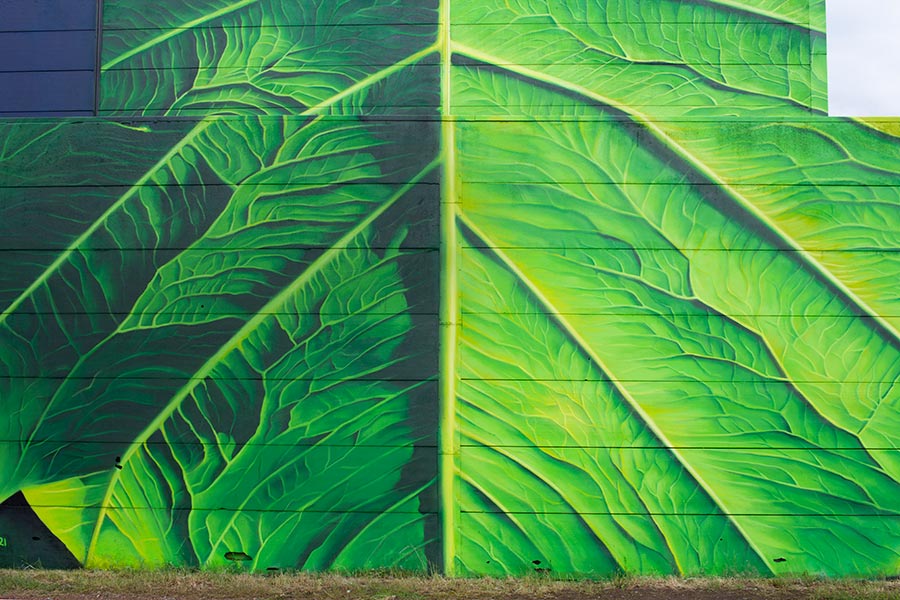
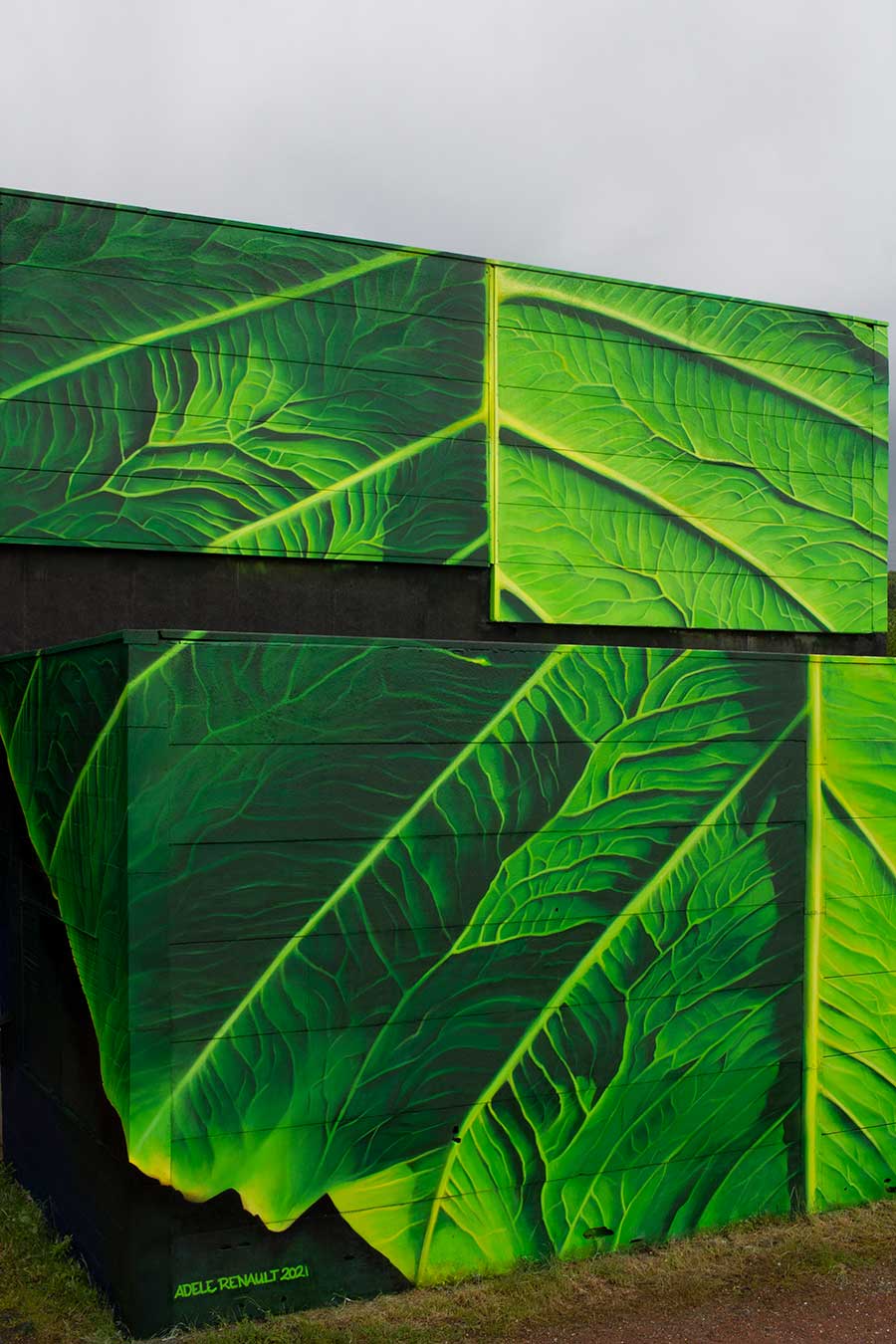
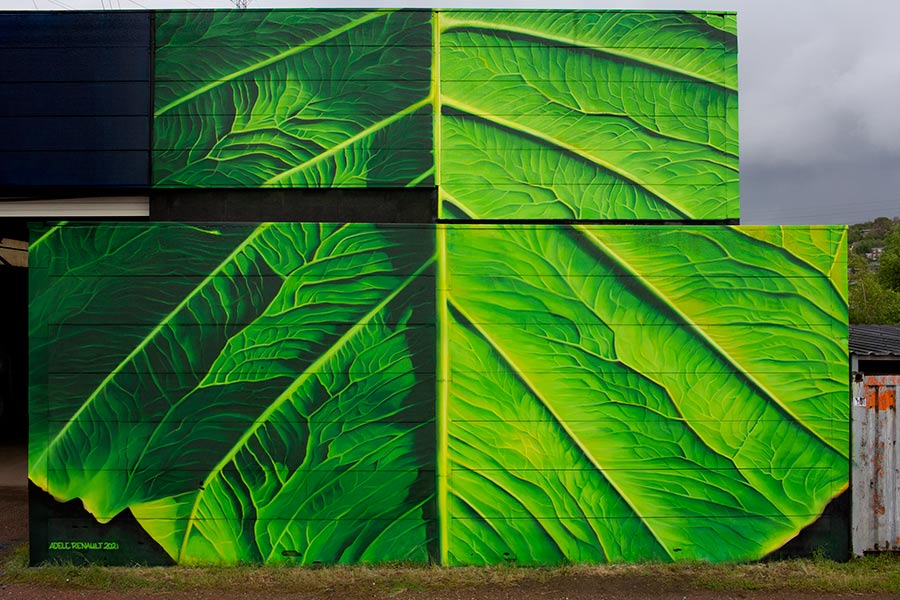
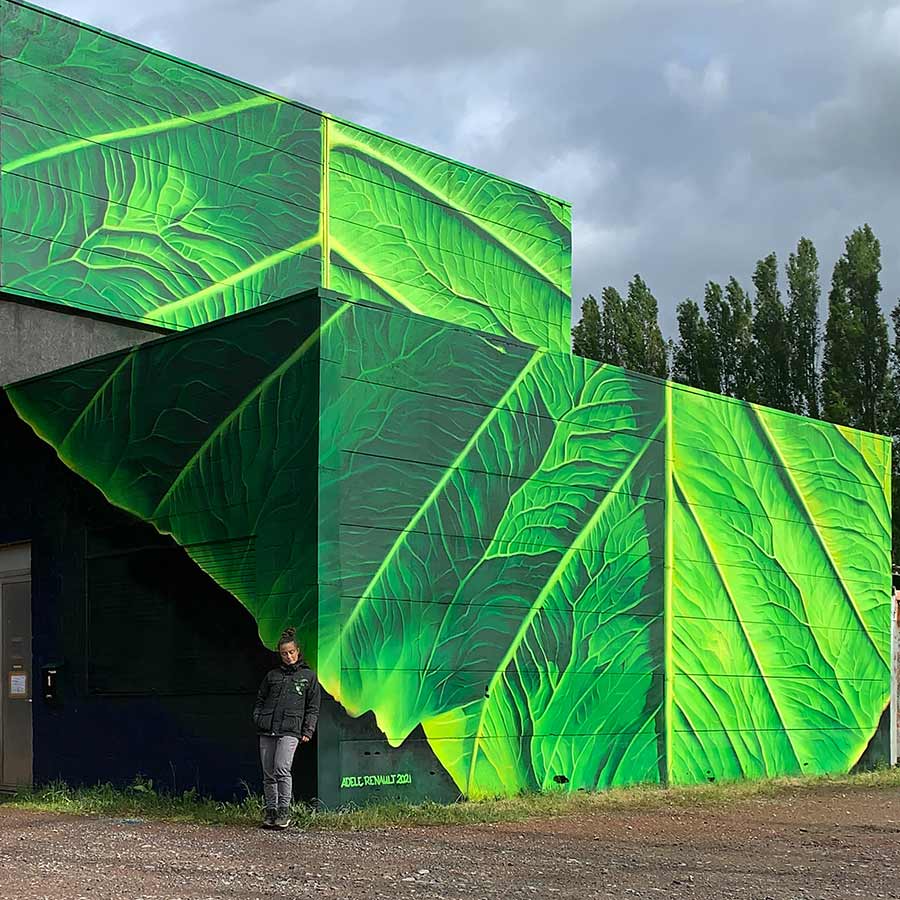
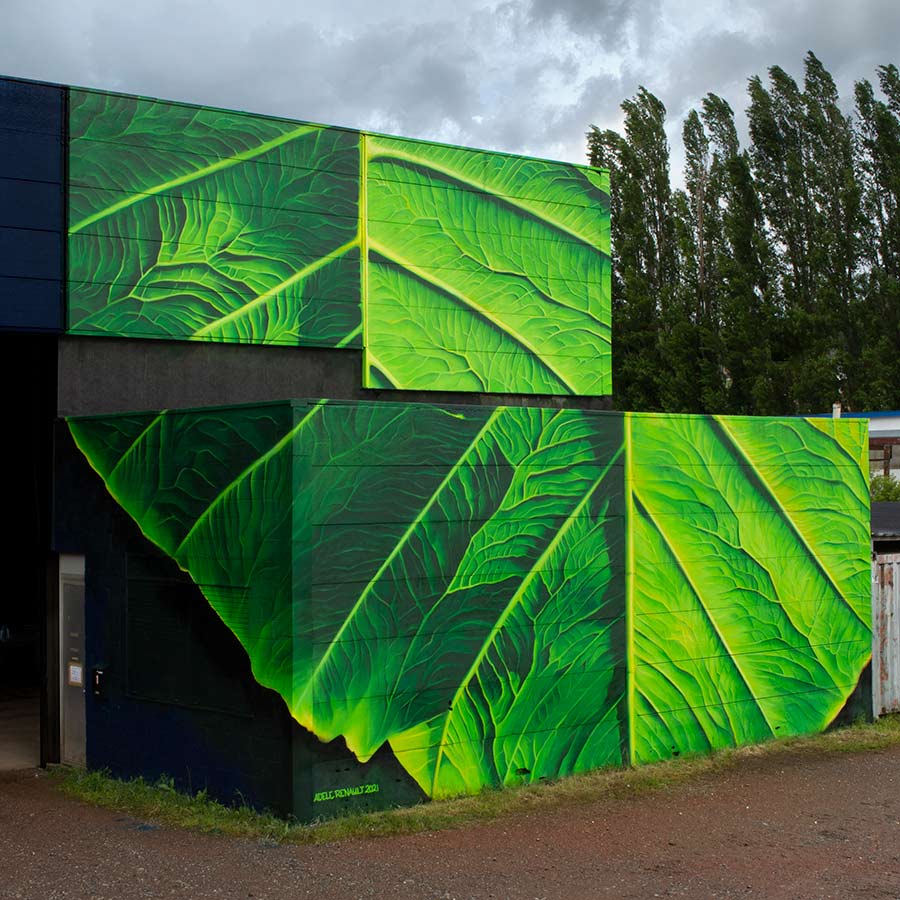
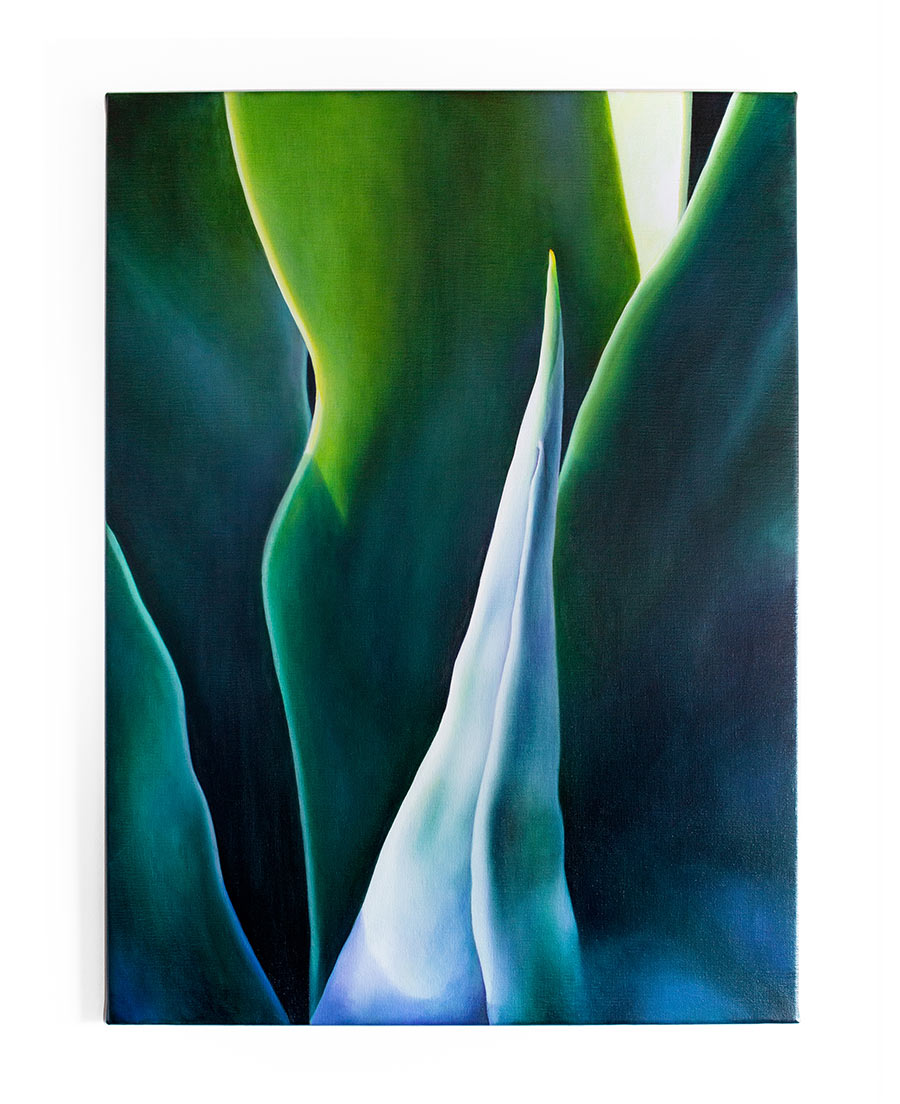
Something completely fresh today from artist Adele Renault, who tells us she is thinking about the beauty of nature more than ever. With this new mural of green leafy covering in Liège, Belgium, she is beginning a series she will call Plantasia (#plantasia) and will be developing into a new solo gallery show focusing on the plant world. It’s as old as the hills and the forests, but this new focus feels fresh to this aerosol master. We asked Adele how this new direction began to grow.
BSA: Millions of people worldwide are finally venturing out without masks, and many countries are opening up after a horrific year during the Pandemic. You are not an exception. You are painting murals again—only this time with a new direction. Now you are painting plants. Did the lockdown and the isolation make you re-think the direction of your career?
Adele Renault: I never really stopped painting, luckily murals were considered like construction, and most murals could still go ahead; we are fortunate. It’s probably the only cultural sector that hasn’t been completely devastated. Traveling was an issue, of course, and many events got canceled or perpetually postponed. What the lockdown allowed me to do (just like everyone else) was to slow down a bit, and for me, that meant more time for gardening/planting. That’s a passion that’s literally been “growing” my whole life without me even being aware of it.
As a kid, I always had to help my mum in her large vegetable garden, sometimes fun, sometimes felt more like a chore. But I was subconsciously gathering up all that information being passed down to me—the moon calendar, what to plant when, how to prepare the earth. And then, like so many, I lived in cities where gardening didn’t have a place.
Until I moved to L.A. and was fascinated by the vegetation at every street corner, everything and anything seemed to be growing. And then a revelation came when I realized I was enjoying growing things in pots, didn’t even need to have a patch or a backyard.
I occasionally went to help my friend Ron Finley in his garden, and that’s where I realized you could have a massive garden, all growing in pots if you are surrounded by concrete. And pots are actually fun; you can compose pots like a painting, put together different things that grow at different speeds or heights, play with colors and textures. So right now, I spend a lot of time growing stuff indoors in pots and veggies outside.
BSA:Why did you choose plants as your subjects? AR: I’ve always painted the mundane, whatever was around me. People, pigeons. I see beauty everywhere and in everything, and for me, it was always about showing beauty where you least expect it, but the subject could have been anything. It never had to be “special” to be painted. Now, yet again, the subject chose me rather than the other way around. I spend more time looking at plants from up close, and so I end up painting plants. But it’s not an overnight decision. The seed was planted a long time ago, quite literally.
BSA: Will you paint plant life that is native to the country or city where you will be creating? AR: Probably, but not always. I will repaint the mundane, like stinging nettles or a cabbage leaf. Of course, I will sometimes make site-specific installations, but I also paint what speaks to me or fits a building. Right now, I am starting to work on a solo show. It will be in Belgium, and I am in Europe now, but I miss Los Angeles a lot, so I will probably end up painting some California plants.
BSA:What are your feelings about the color green? You’ll be using gallons of it moving forward. AR: I wouldn’t say I like green. When I buy clothes or shoes, I would never buy something green. Or paint the walls inside my house green! But I love green in nature. I think everybody does instinctively like green nature, green plants. And in a way, when I cover a building in a green leaf, well, I m quite literally letting nature envelop and reclaim a bit of manufactured concrete. Even though it’s not eco graffiti and spray paint isn’t quite “green nature” taking over, but it can at least symbolize it and inspire people for a greener future. I am obviously not the first or last person to paint plants, and I think it’s one of the natural subject matters, just like portraiture. But I hope to bring something new with my approach.
 BROOKLYN STREET ART LOVES YOU MORE EVERY DAY