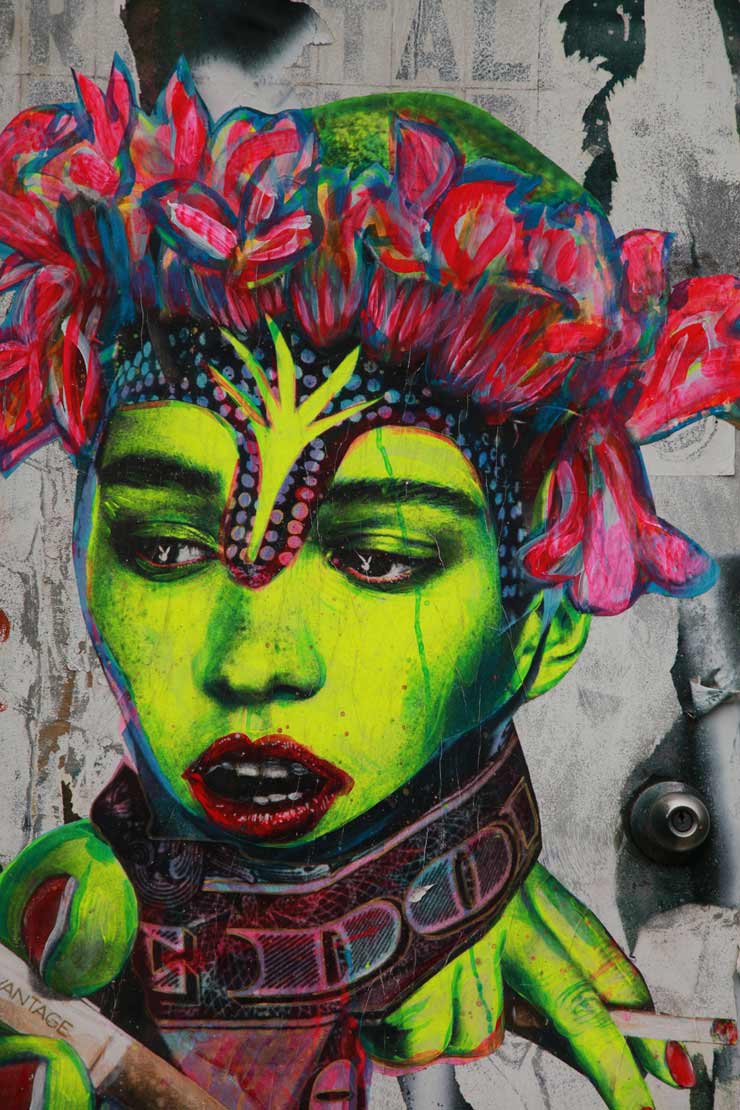
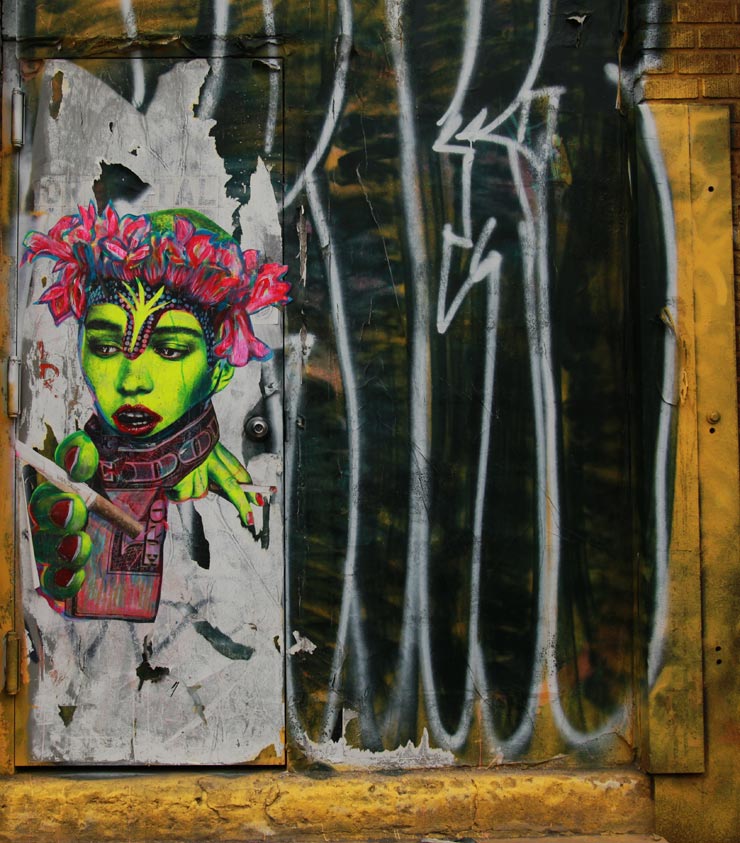
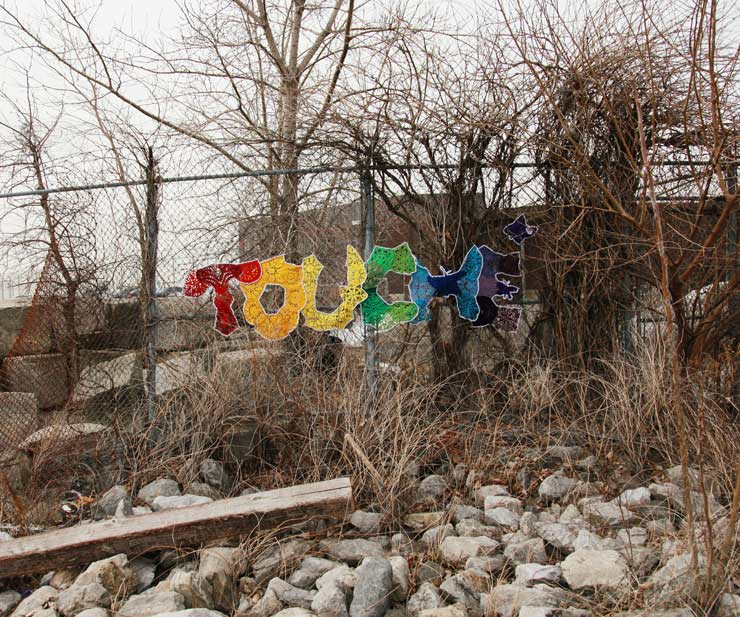
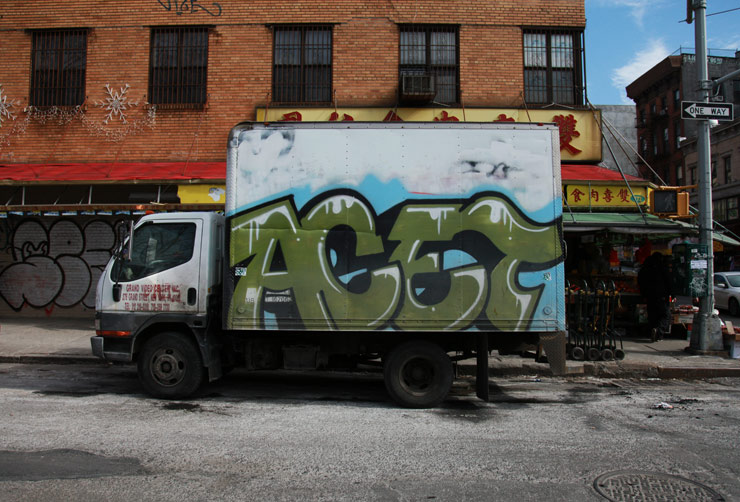
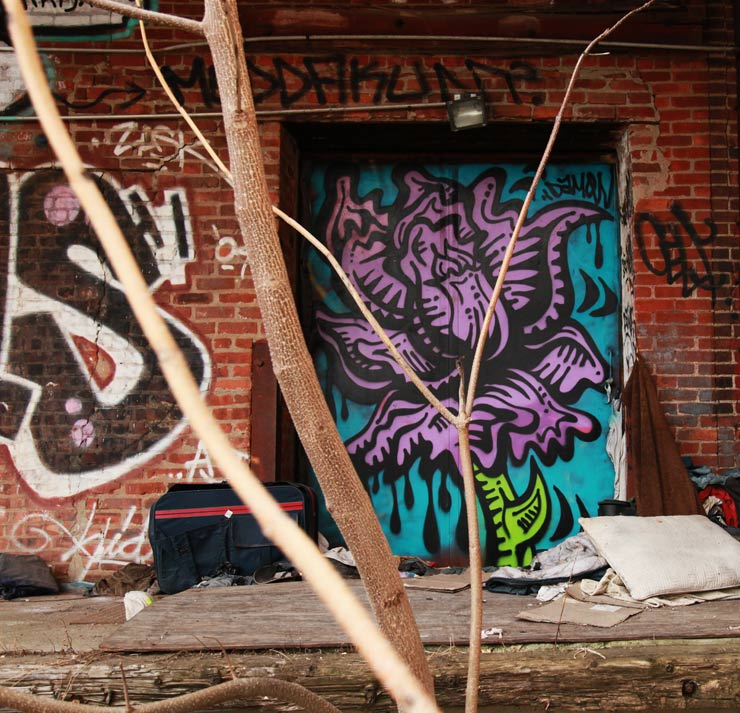
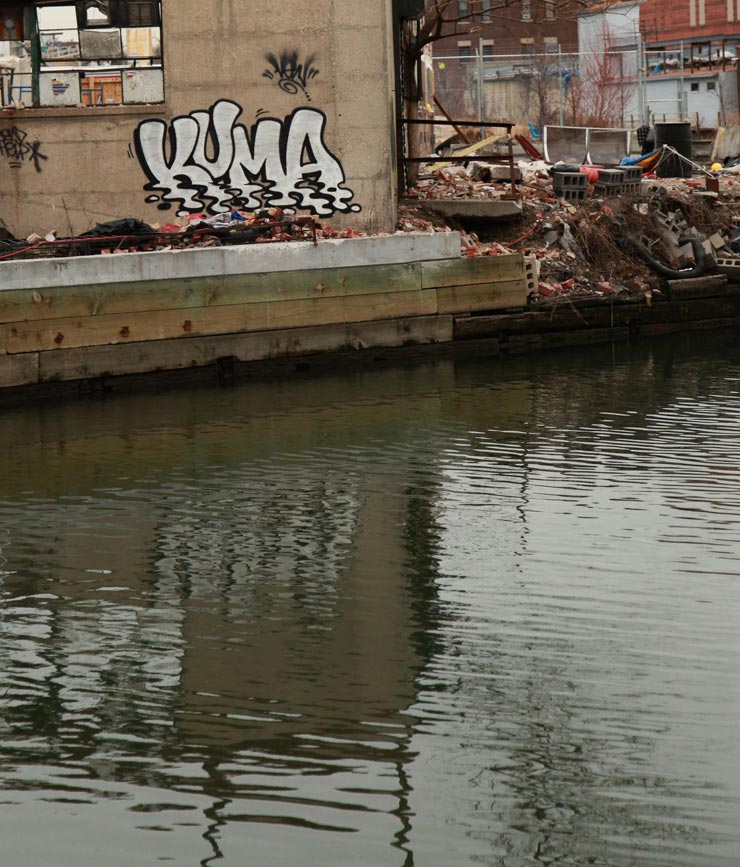
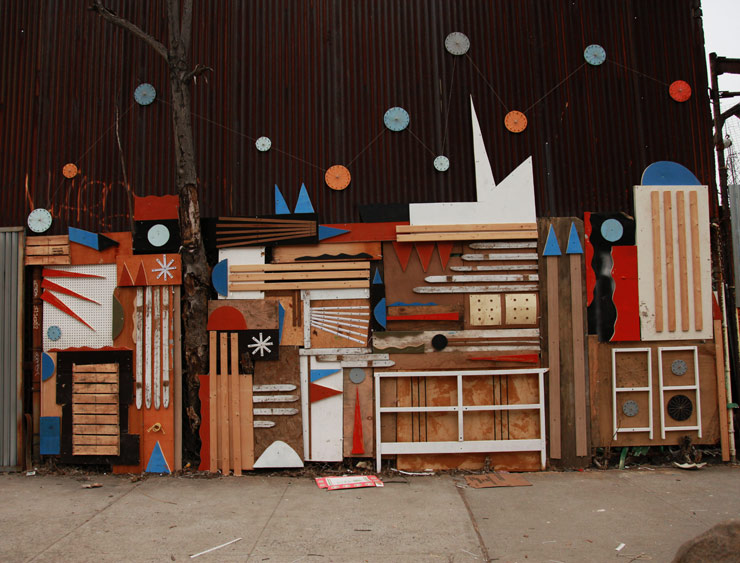
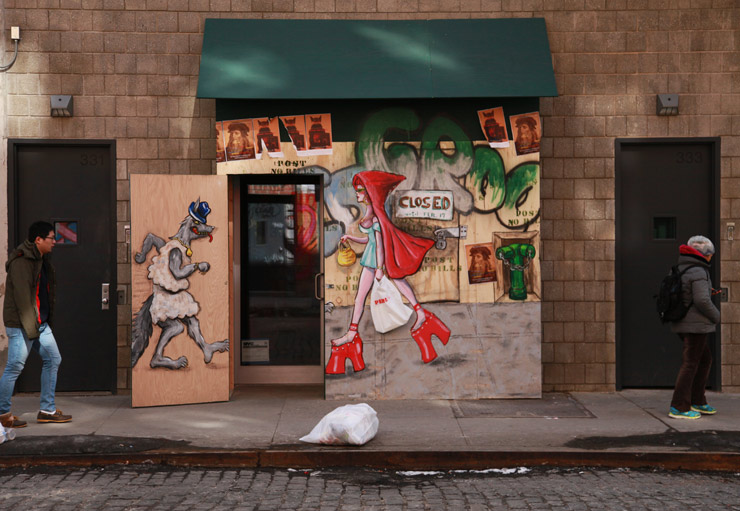
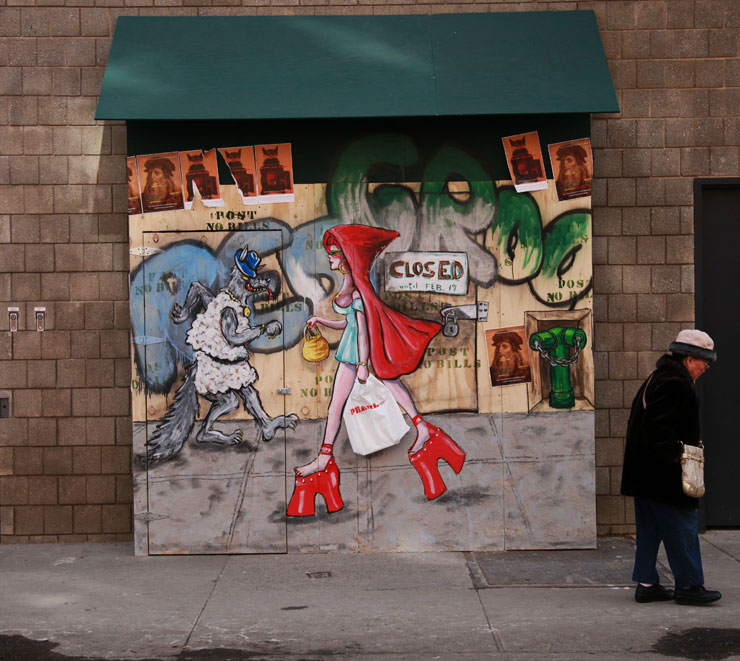
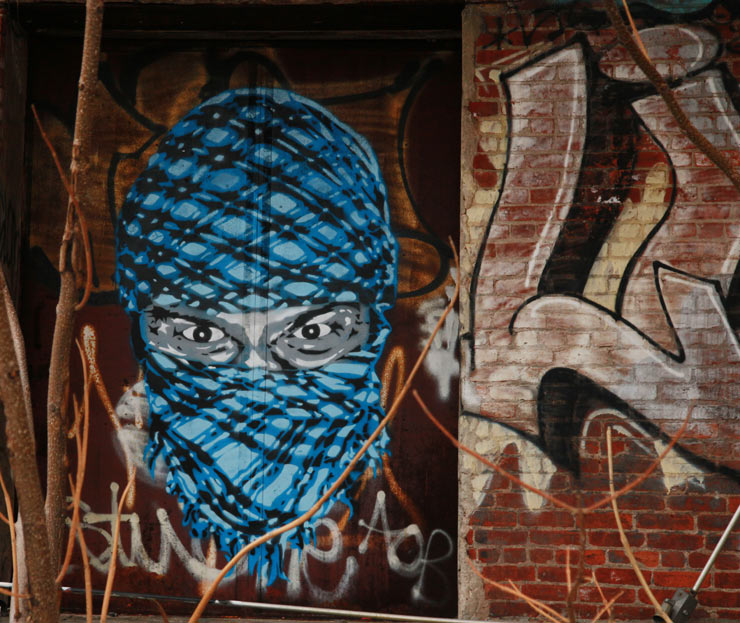
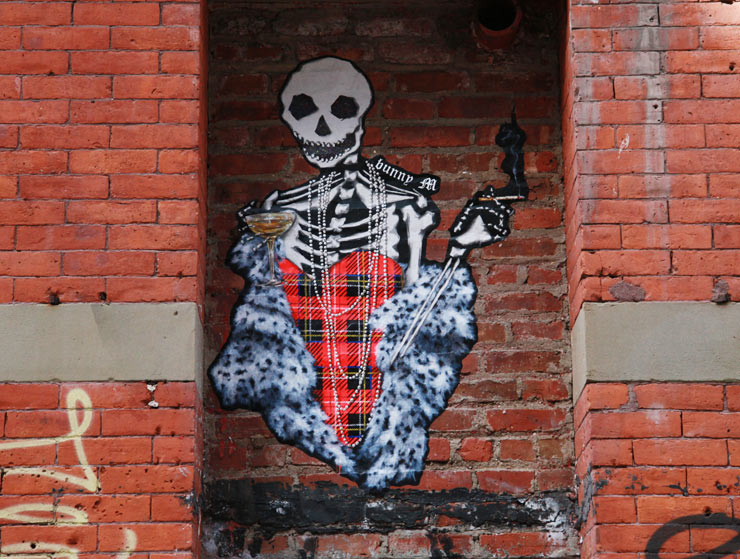
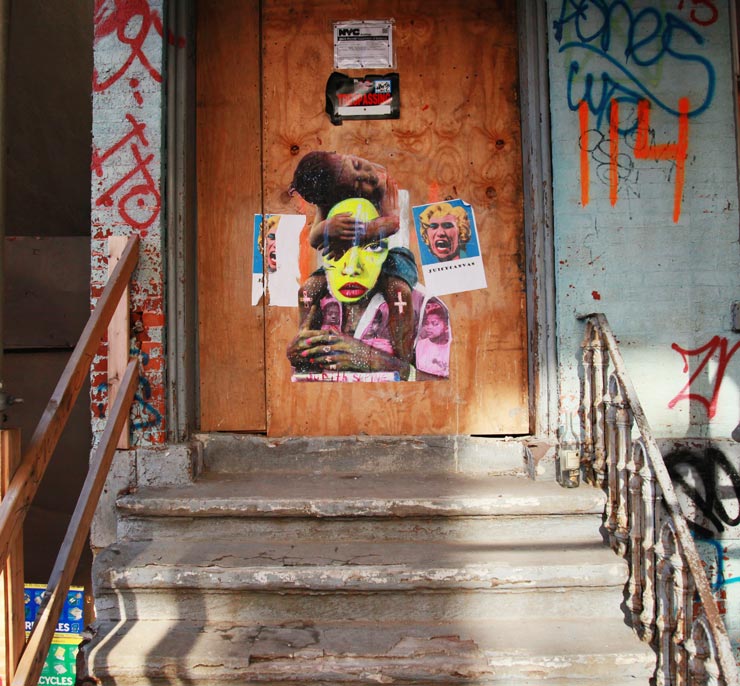
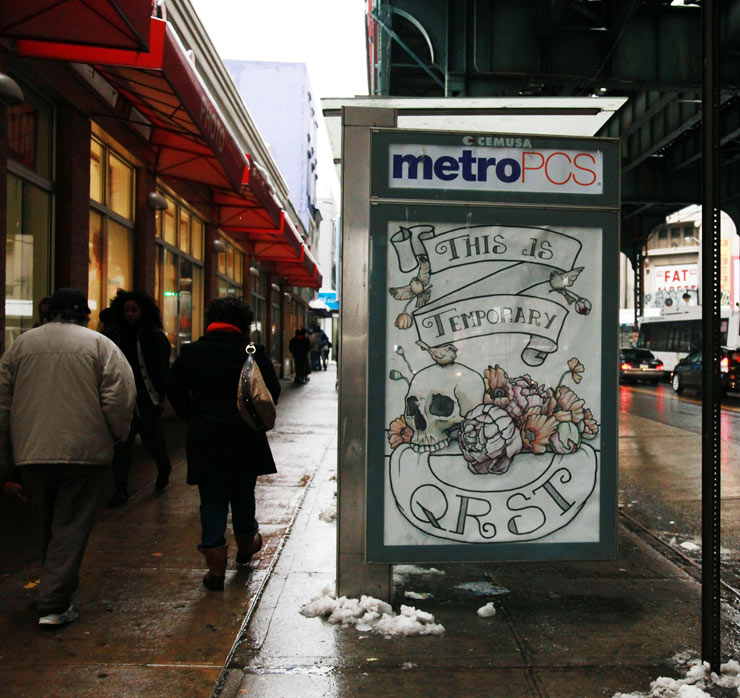
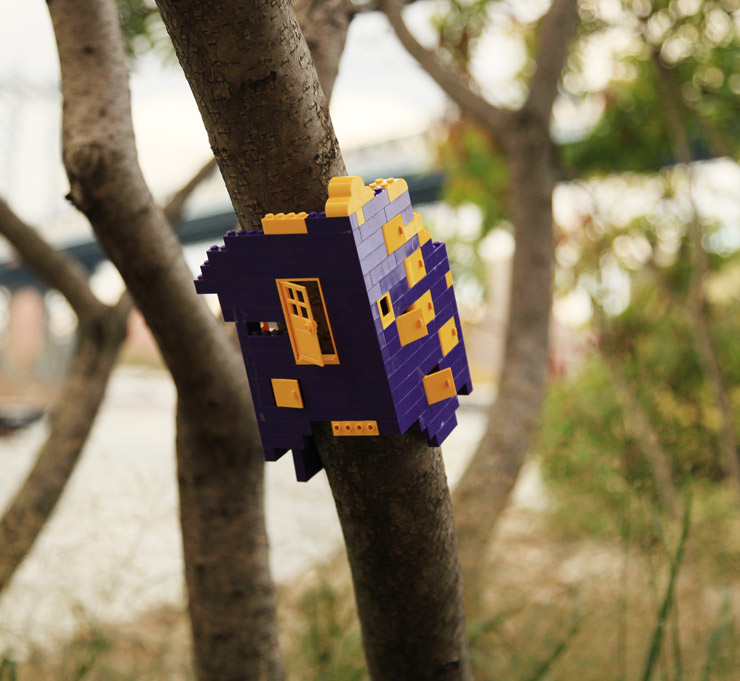
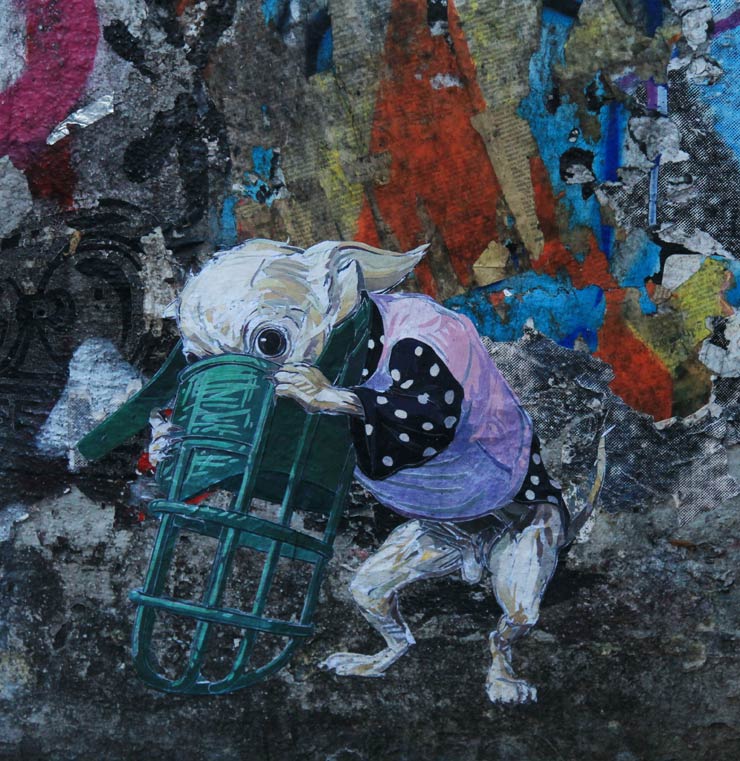
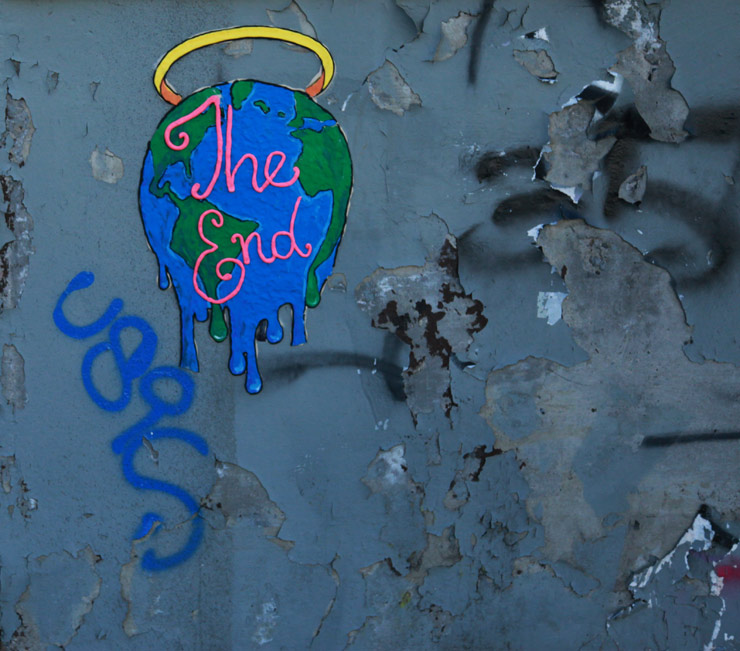
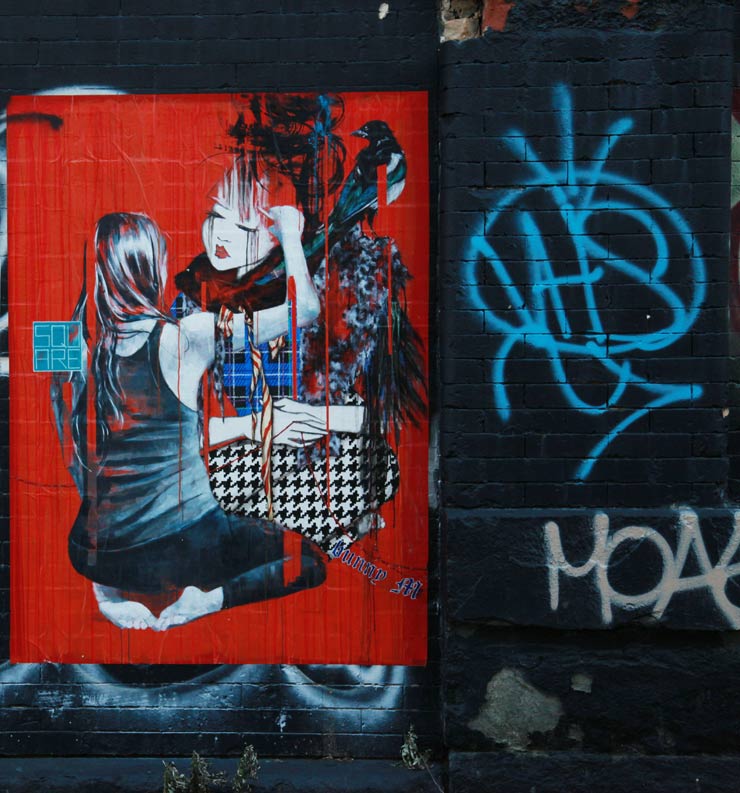
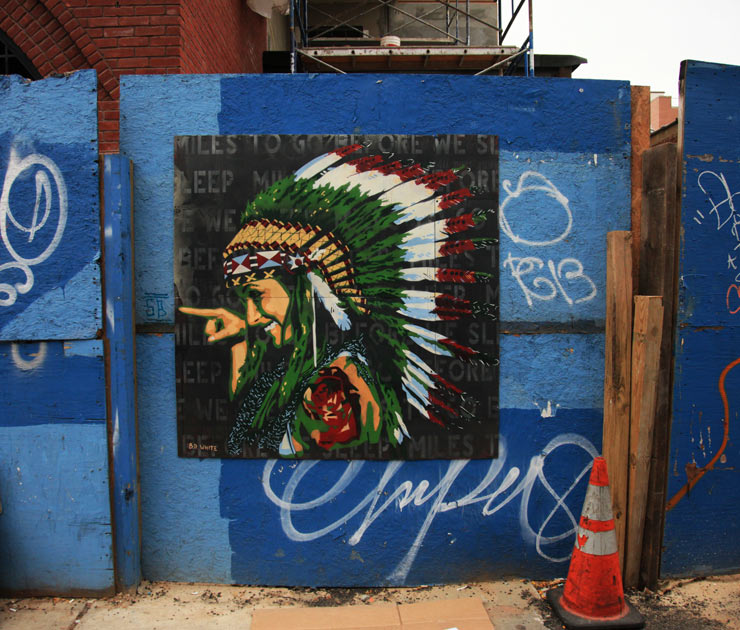
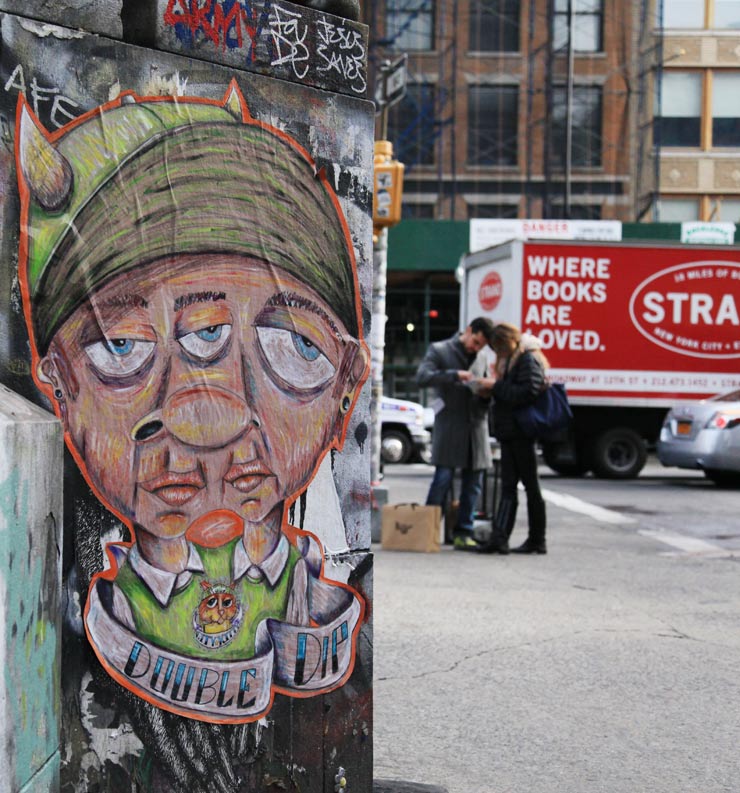
Here’s our weekly interview with the street, this week featuring Acet, Bunny M, Damon, Hek Tad, Hyland Mather, Judith Supine, Kram, Kuma, Olek, and Red Grooms.
This year represents a high-water mark for current Street Artists being represented at the New York fairs if what we have just seen over the last couple of days is any indication. For those who have been following the trajectory of the new kids we’ve been talking about for the last decade, the room is rather getting a lot more crowded. Only a handful of years ago names that produced blank stares at your forehead and a little sniff of dismissal are garnering an extra lingering moment near the canvas and snap of the cellphone pic, complimentary champagne flute in hand.
With the gusts of wind provided by a couple of recent auctions, optimism about an up-turning economy, and even the Banksy one-month residency, it is not hard to imagine that we have some “overnight” stars in the midst of this constellation, but it is really anyone’s guess.
While we are certainly aware of it, we don’t dedicate too much ink to the commercial aspect of the Street Art scene, preferring to learn the lingua franca of these artists who have developed their narrative and visual style before our eyes, to celebrate experimentation, the creative spirit, and to give a pedestrian view of the street without being pedestrian.
But just as neighborhoods like Bushwick in Brooklyn, El Raval in Barcelona, LA’s downtown Arts District, and parts of London, Berlin, and Paris have been transforming by gentrification, we would be remiss if we didn’t note the more frequent raising of commercial eyebrows all around us when the topic turns to Street Art. It’s not a fever pitch, but can it be far off? There is already a solid first tier that everyone can name – and the stratification is taking shape below it.
Buffeted by blossoming sales of works by early 2000s Street Artists and the burgeoning of lifestyle companies now appropriating this cultural wealth and transforming it into “content” that helpfully couriers all manner of merch from spirits to soda, sneakers, and electronic smoking devices, we are looking for our seat belts as there a major shift in popular acceptance and critical embracing of 21st century Street Artists up ahead.
As for the streets, the flood is going to continue. Street Art is Dead? Yes, we’ve been hearing this since 2002…
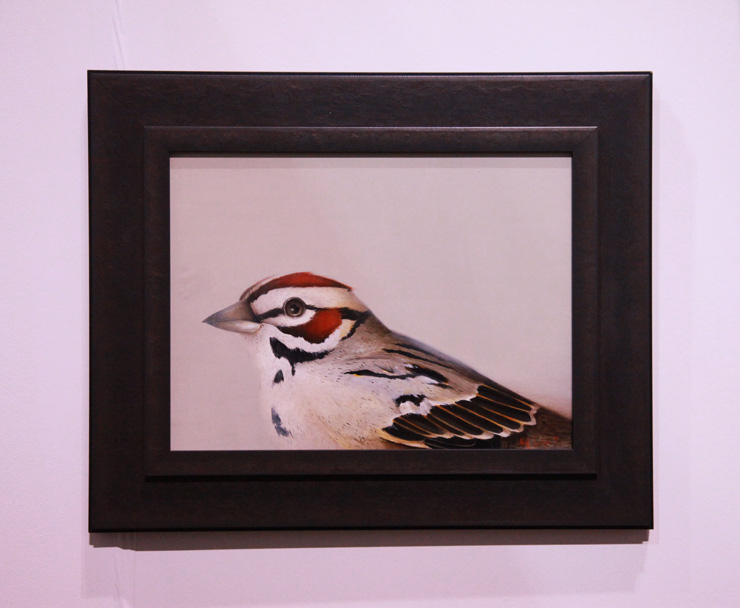
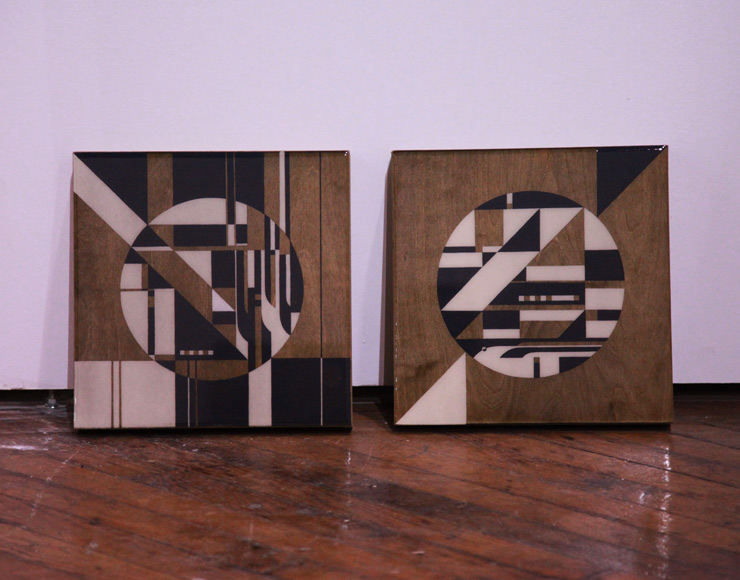
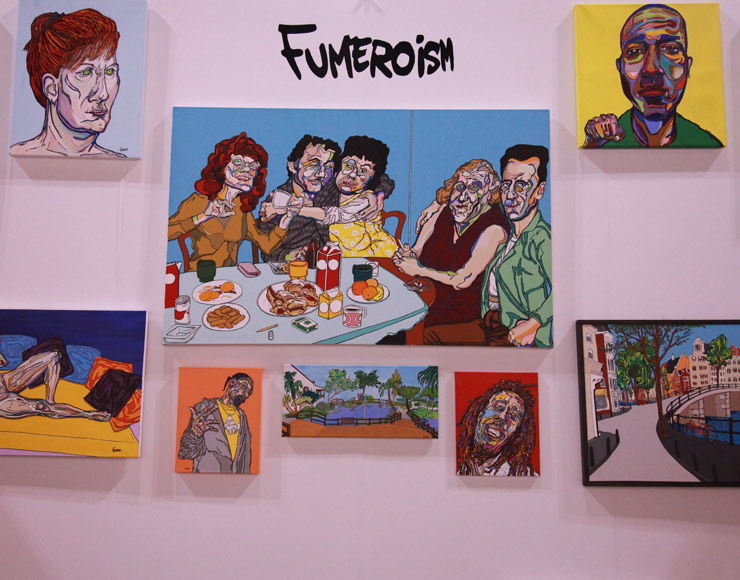
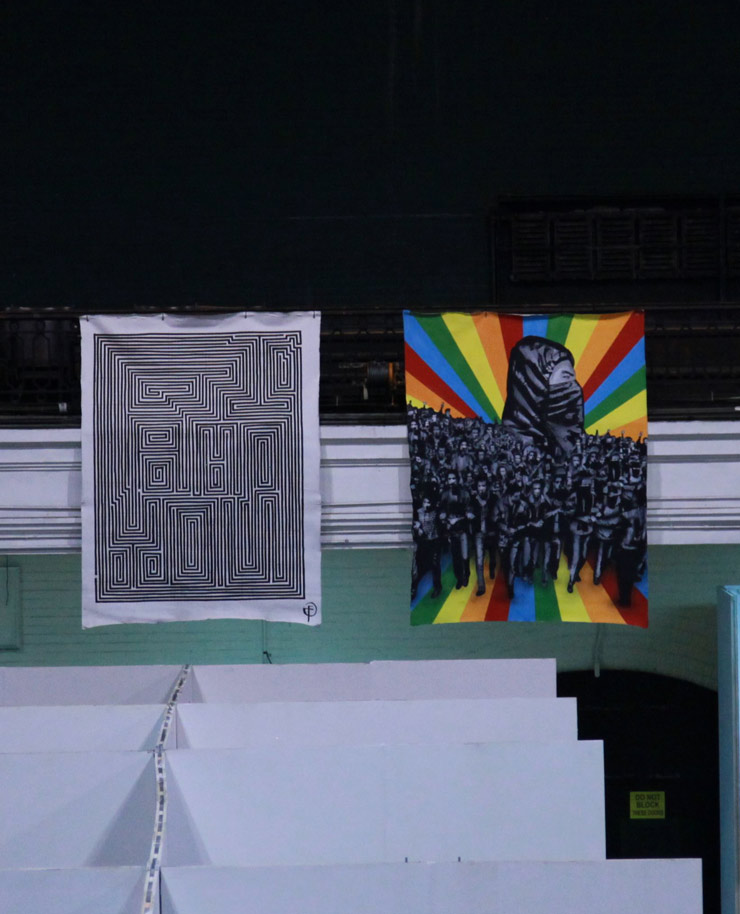
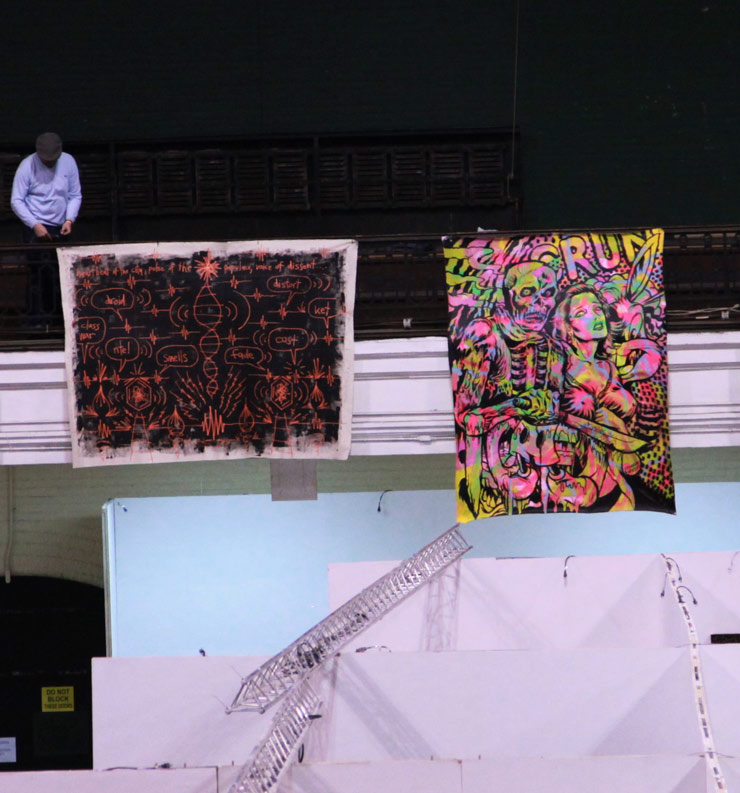
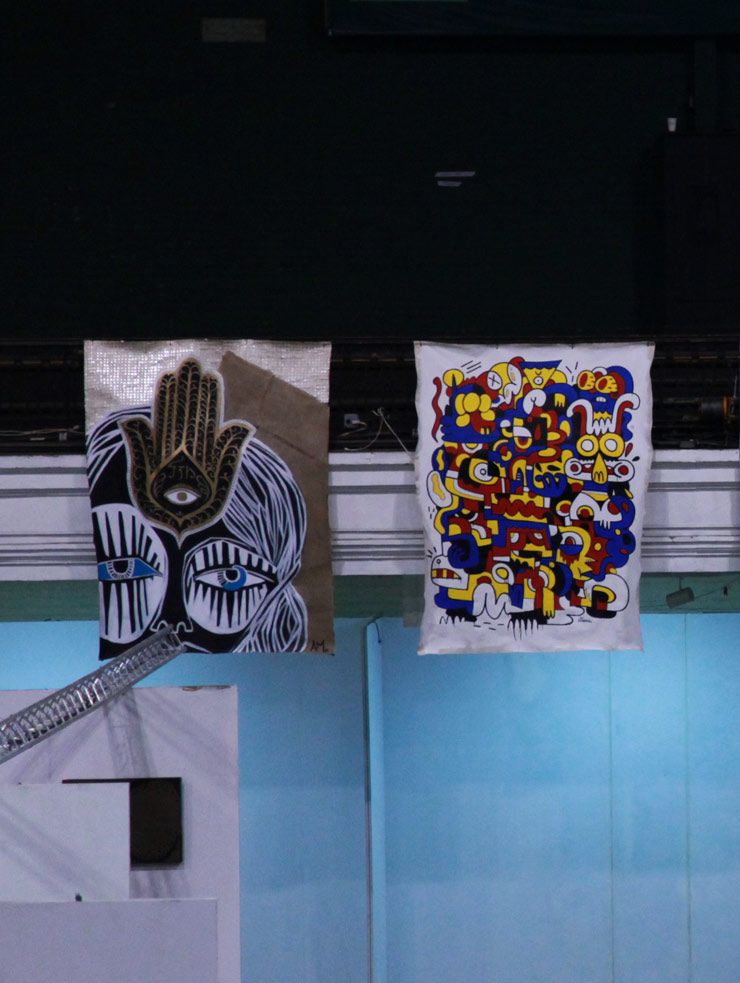
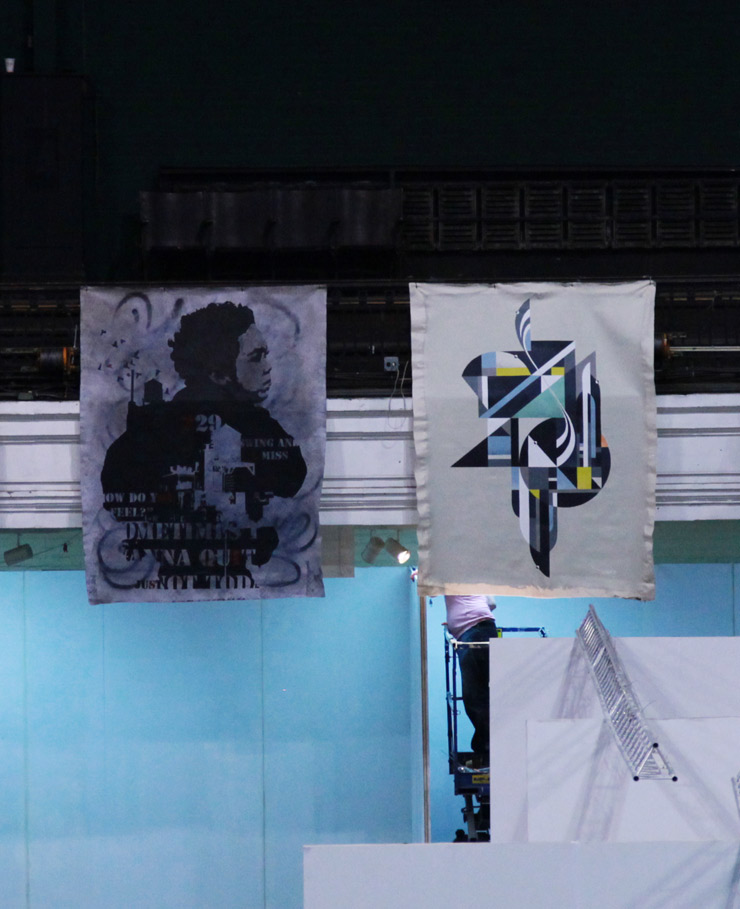
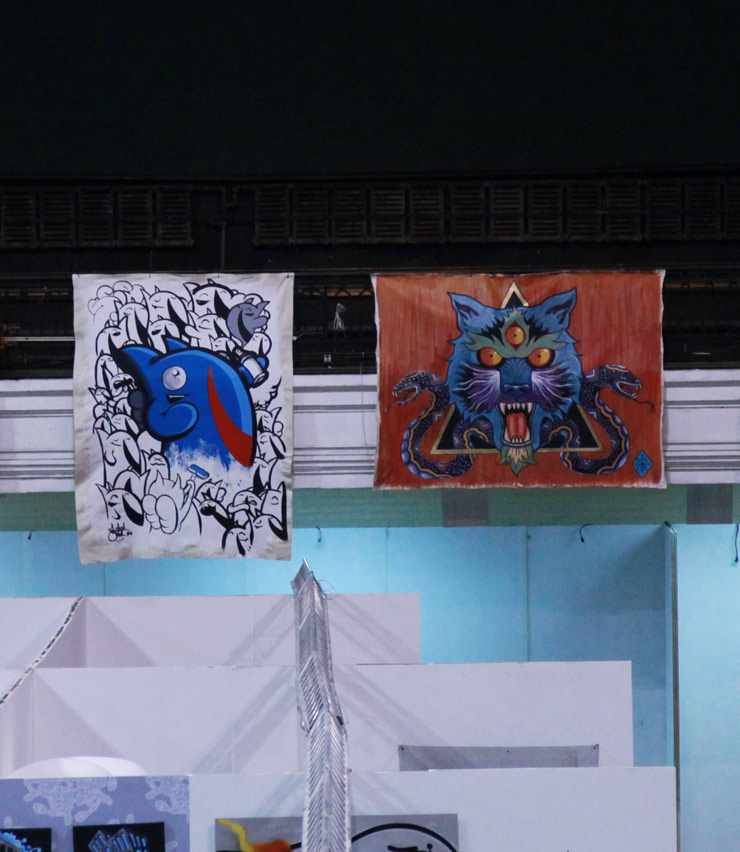
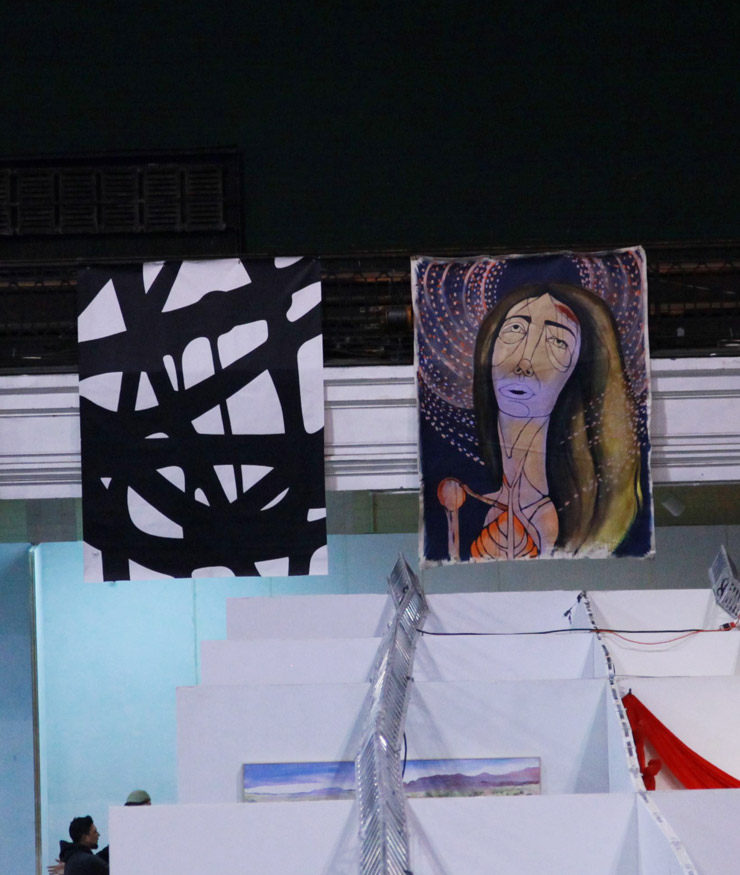
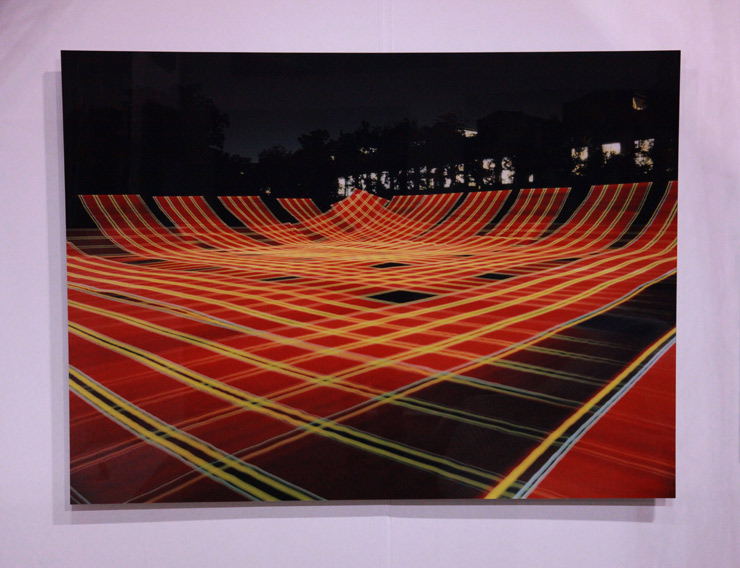
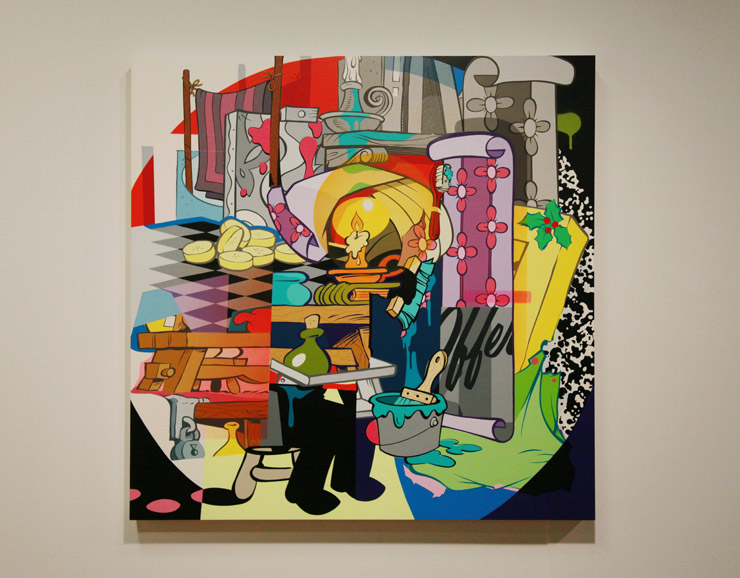
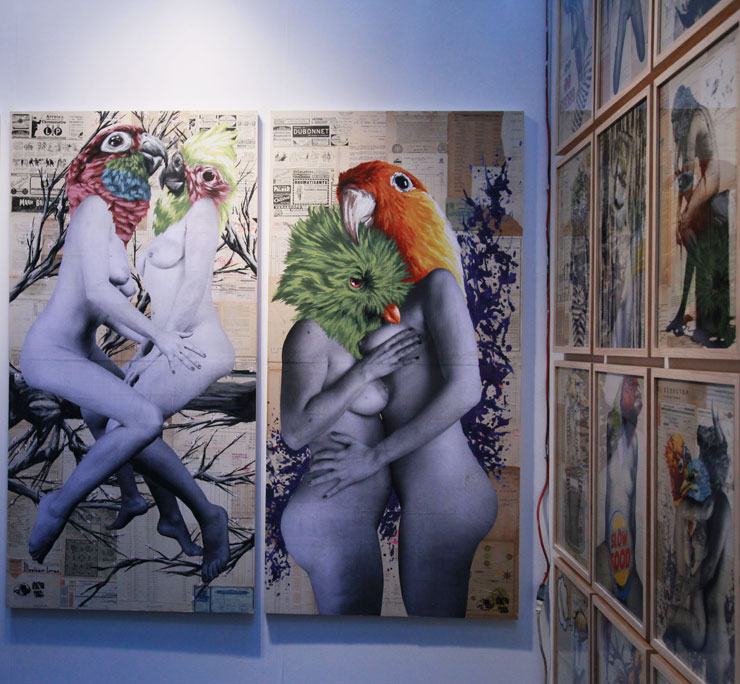
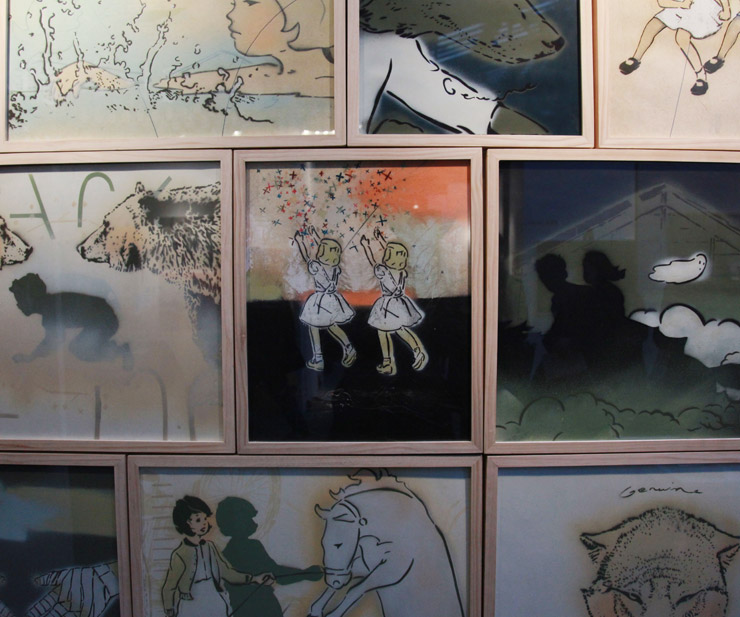
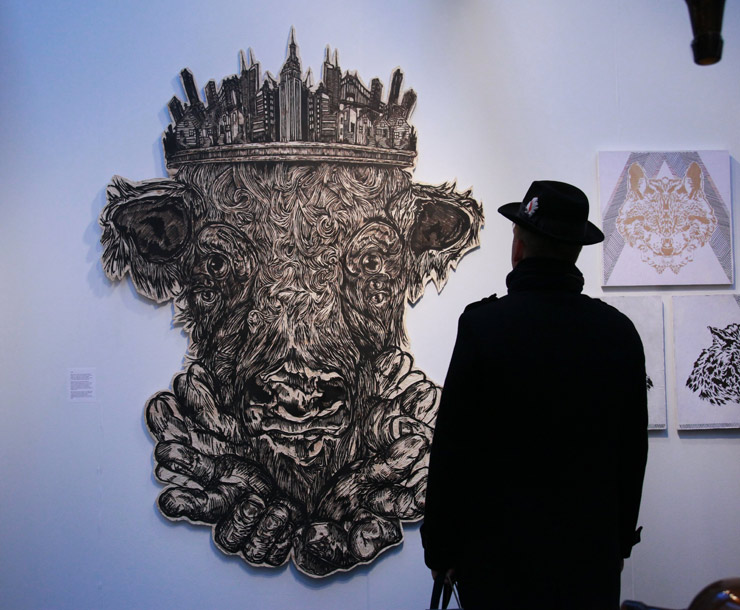
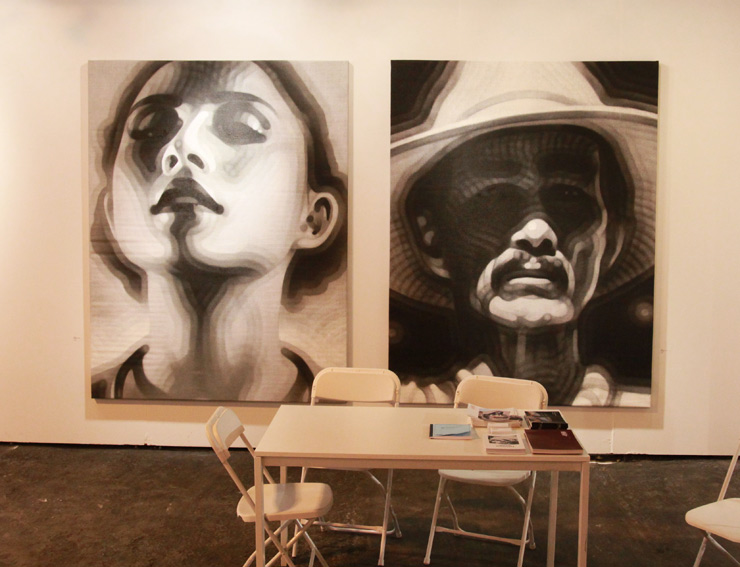
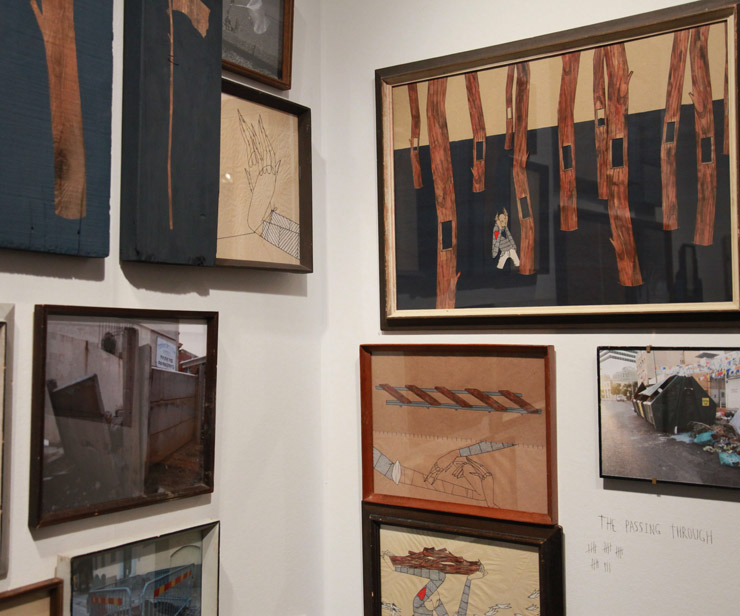
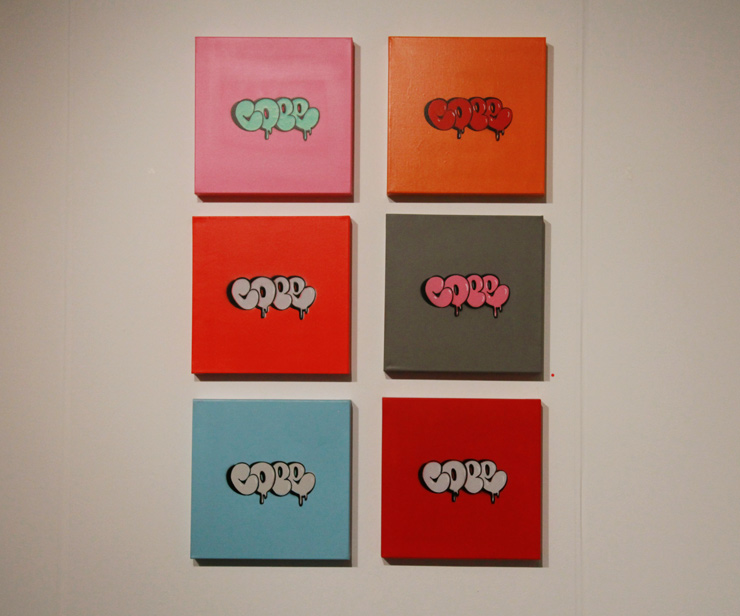
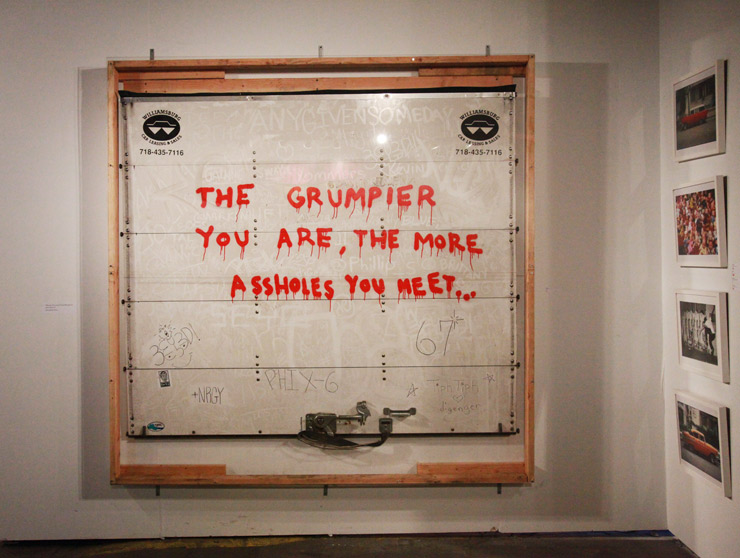
Here’s a brief non-specific and uneven survey of only some work showing this weekend by current or former Street Artists and graffiti writers – perhaps a third of what you can see in the New York fairs and satellite galleries.
Our weekly focus on the moving image and art in the streets. And other oddities.
Now screening :
1. Icy & Sot “Art Pollution”
2. Stikki Peaches and Fashionable Storm Troopers
3. Shift & Shine. How to pimp your ride in Barcelona
4. Japanther x Droid “DO IT (don’t try it)”
4b. “Subterranean Homesick Blues” Bob Dylan
5. Alice Pasquini in Tuffelo, Rome
BSA Special Feature: Icy & Sot “Art Pollution”
A short lively exposure to the brothers who have been cutting stencils and hopping roofs around the neighborhood lately, this new video follows Icy & Sot as they explore new and well run territory and put their own stamp on this moment.
Stikki Peaches and Fashionable Storm Troopers
A one minute short of Stikki Peaches wheatpasting the helmeted and fashionable storm troopers that you are now beginning to associate with the name.
Shift & Shine. How to pimp your ride in Barcelona
A D.I.Y. take on giving your bike a facelift with stuff bought at a flea market. Upgrade!
Japanther x Droid “DO IT (don’t try it)”
To promote the upcoming release by Japanther, it looks like Droid had a hand at multiple sticker slaps. Sort of recalls Dylan’s Subterranean Homesick Blues. This one features live hand drawing of all the lyrics on stickers that are then taken out into the street. See all the proper credits for this fine work on the Vimeo page.
Possibly the very first rap video, here’s Bob Dylan’s “Subterranean Homesick Blues” from 1965 with camera work by Bob Neuwirth and directed by D.A. Pennebaker. (Alan Ginsberg hangs out in the back)
Alice Pasquini in Tuffelo, Rome
Ever wonder what street life is like when you are painting your piece? It’s not quiet, if that is what you imagined. Every Tomazio, Shanequa, and Akim seems to come out of the woodwork to ask questions, discuss, and as you can see here, offer opinions. We always say that Street Art and public art and graffiti are all part of a conversation in the street, and here’s some evidence of that in Rome.
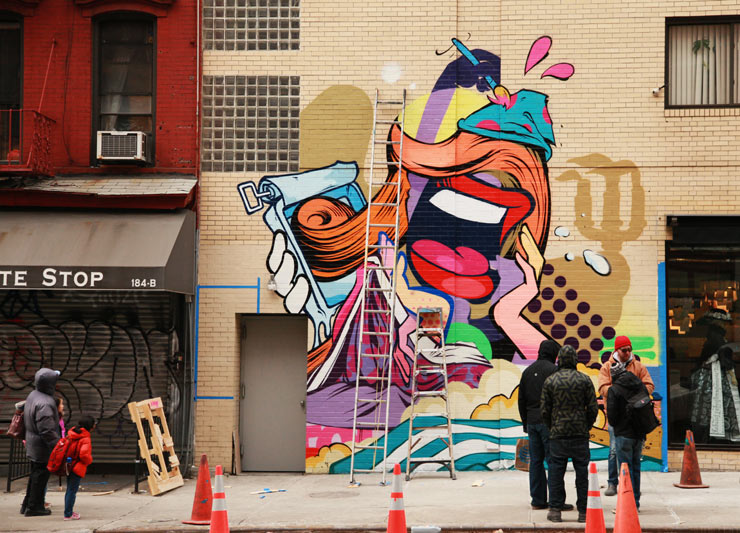
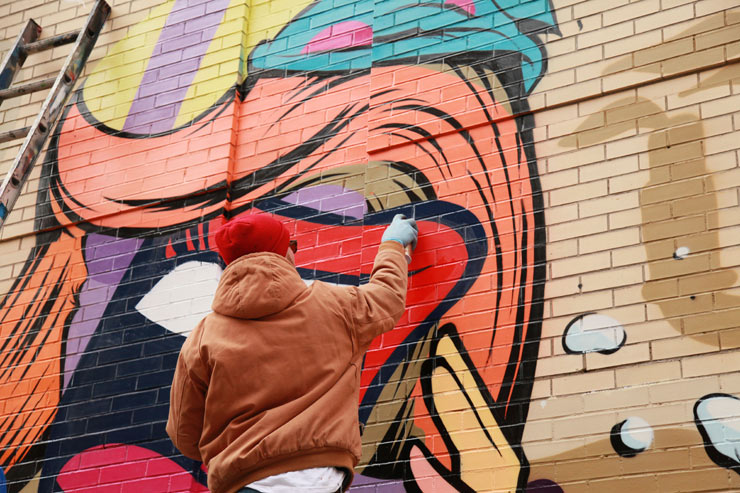
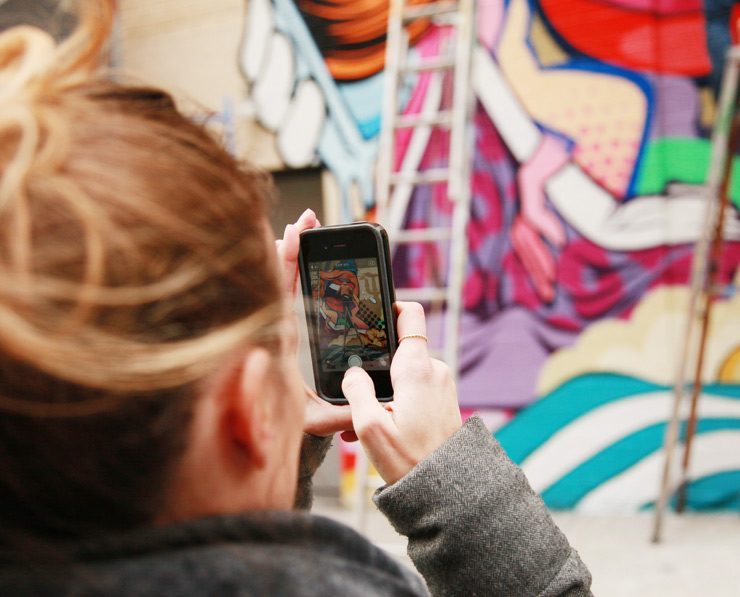
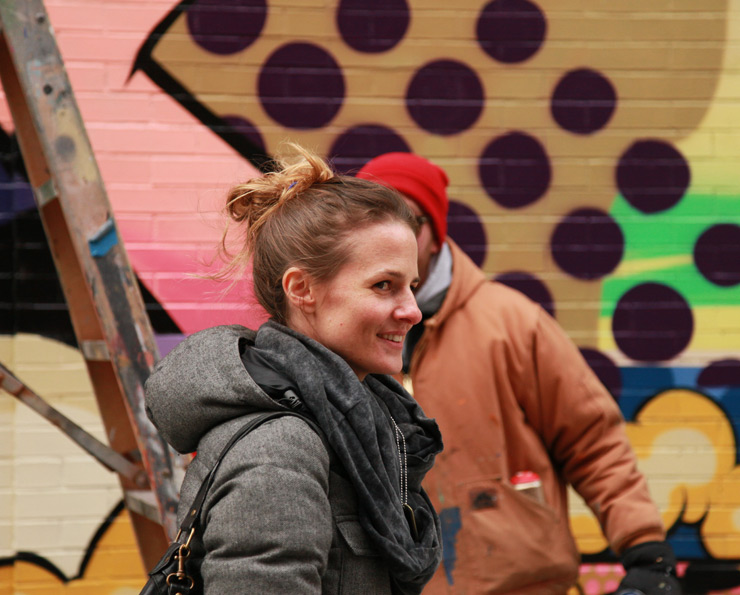
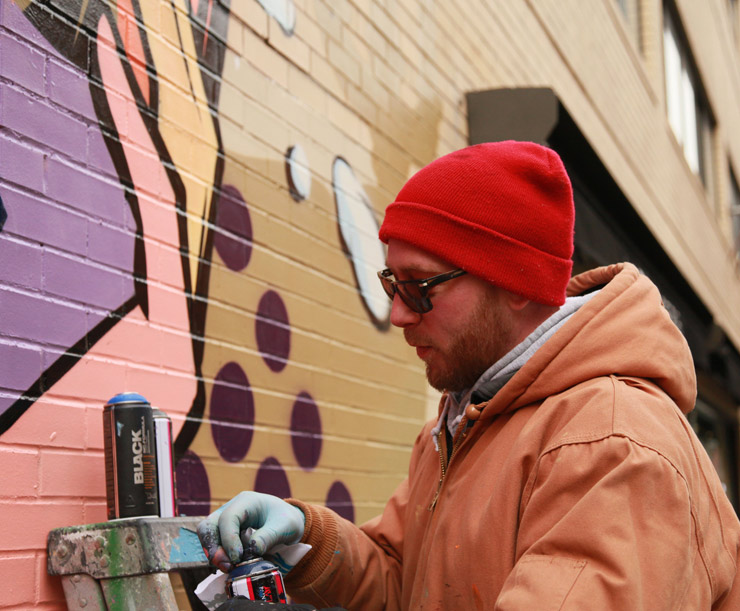
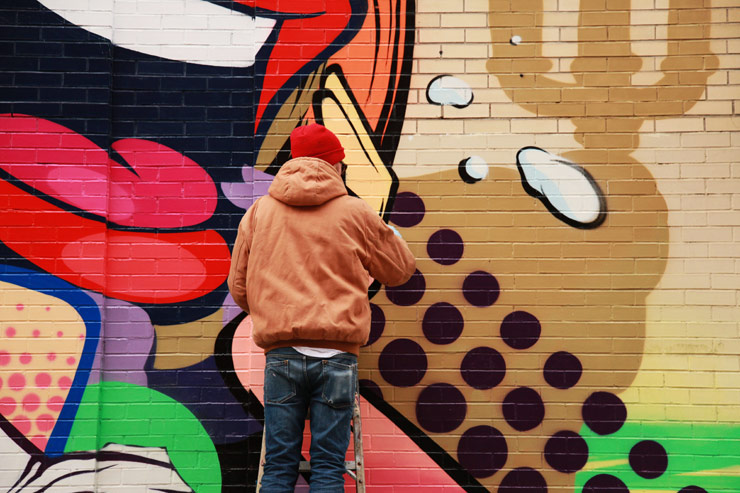
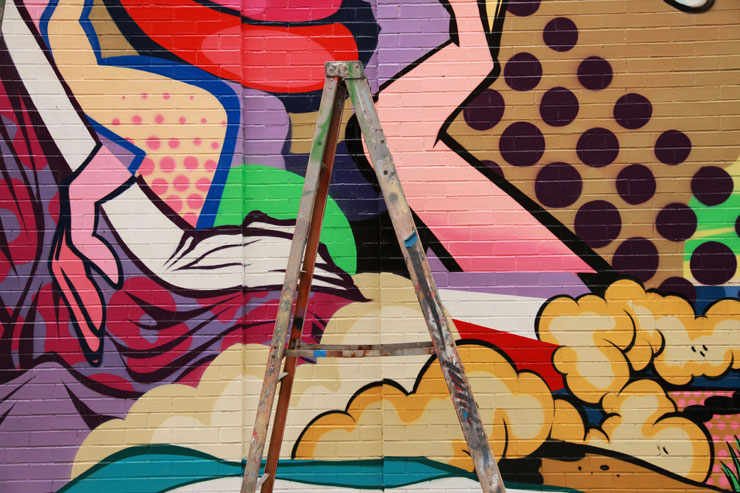
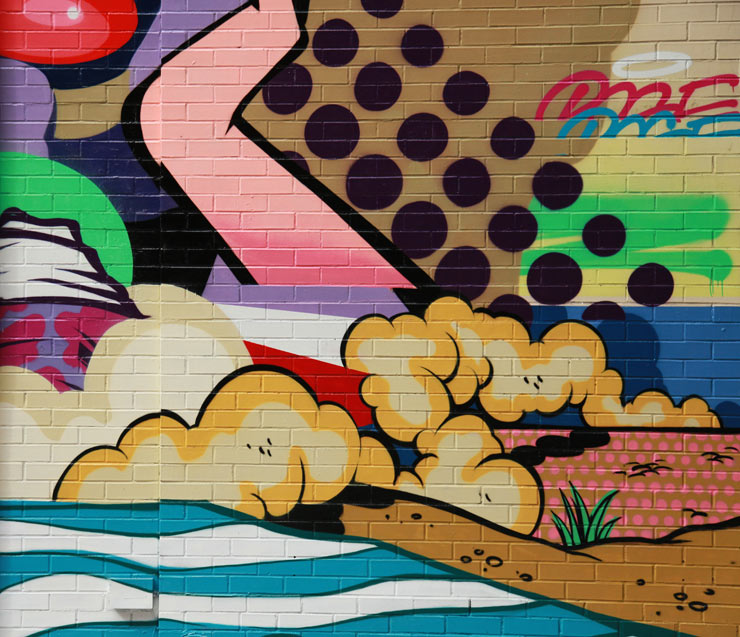
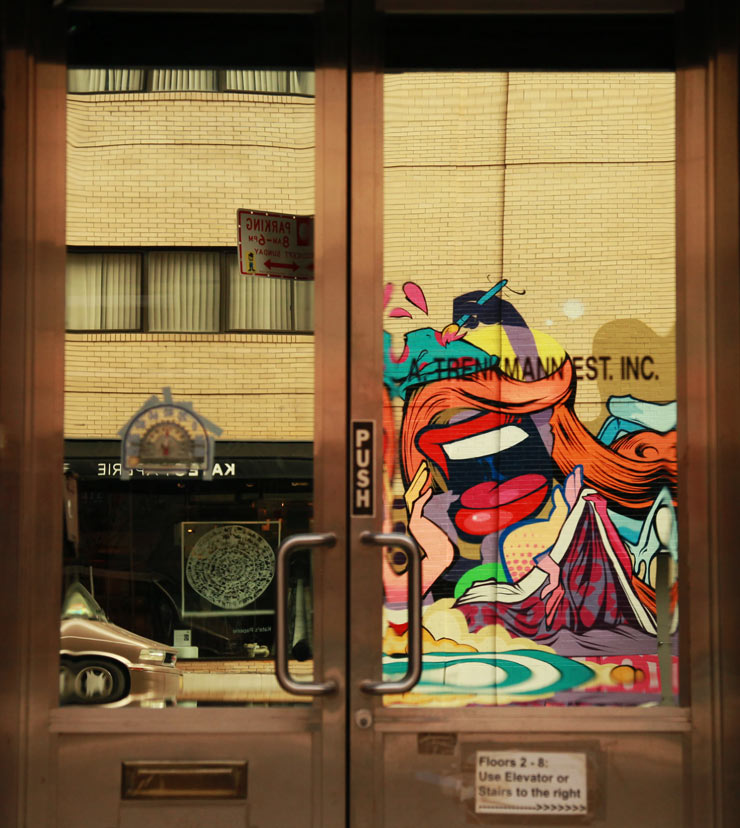
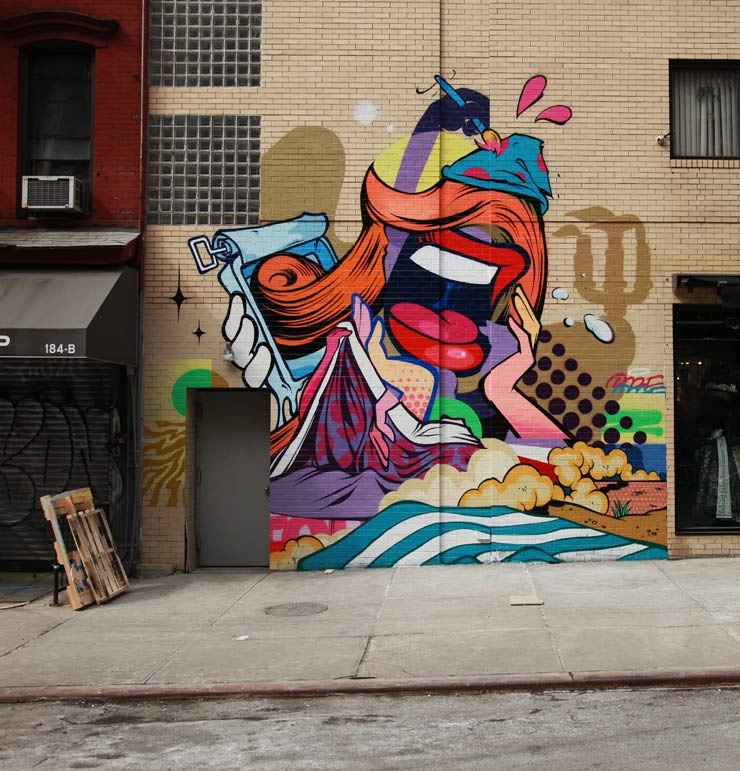
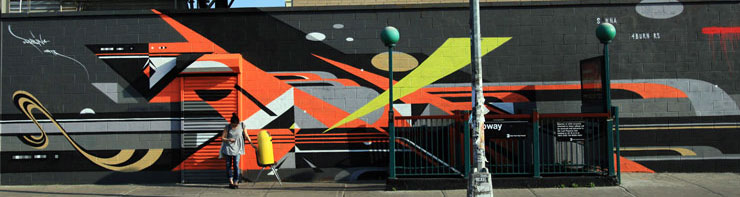
Chicago based graffiti artist POSE is back in New York City for Armory Week and he found a window of opportunity to hit up a wall this week. Last time he was in town it was for his Houston Wall with Revok in the beastly New York heat last summer, so obviously he is a pro who can endure the polarity of temperatures because it is still bitter on the streets right now. Actually maybe the cold caused this mural to go up so rapidly on Lafayette in conjunction with The L.I.S.A. Project NYC and the Jonathan LeVine Gallery.
The new colorful piece is a furtherance of his experimenting with “pounce patterns” and his own remixed deconstructing of pop and commercial elements from vintage sign-language. We have it from a good source that the work on this wall is only a teaser for what’s coming in warmer months – a Summer Blockbuster about five stories high. Don’t touch that dial.
POSE is also showing with JLV at the Volta Art Fair with a solo presentation of works at 82 Mercer Street this weekend. More information via the gallery.
Intermezzo: the midst of a roiling mass of interrelated actions, staccato storylines, rotating currents, complicating drama, and banal daily existence. At any moment your life can be this, or seventy-five variations of it.
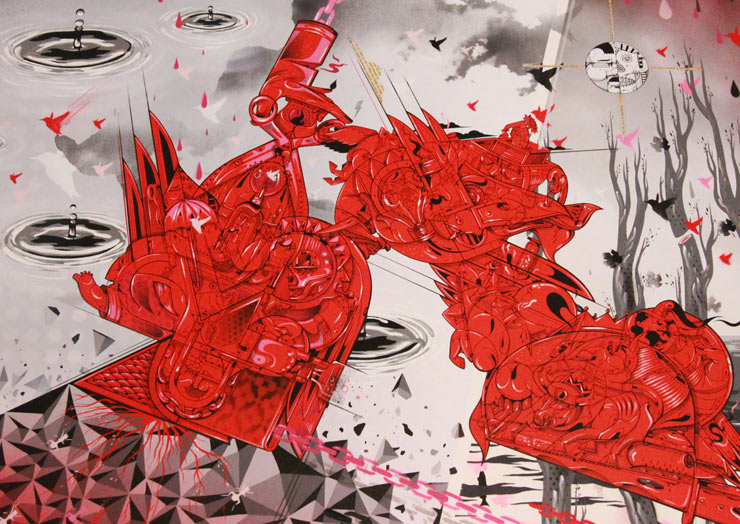
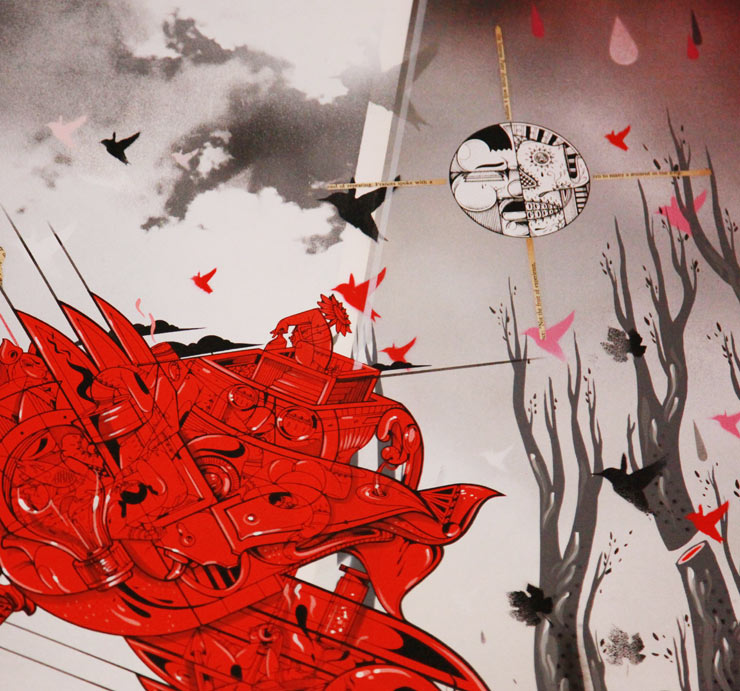
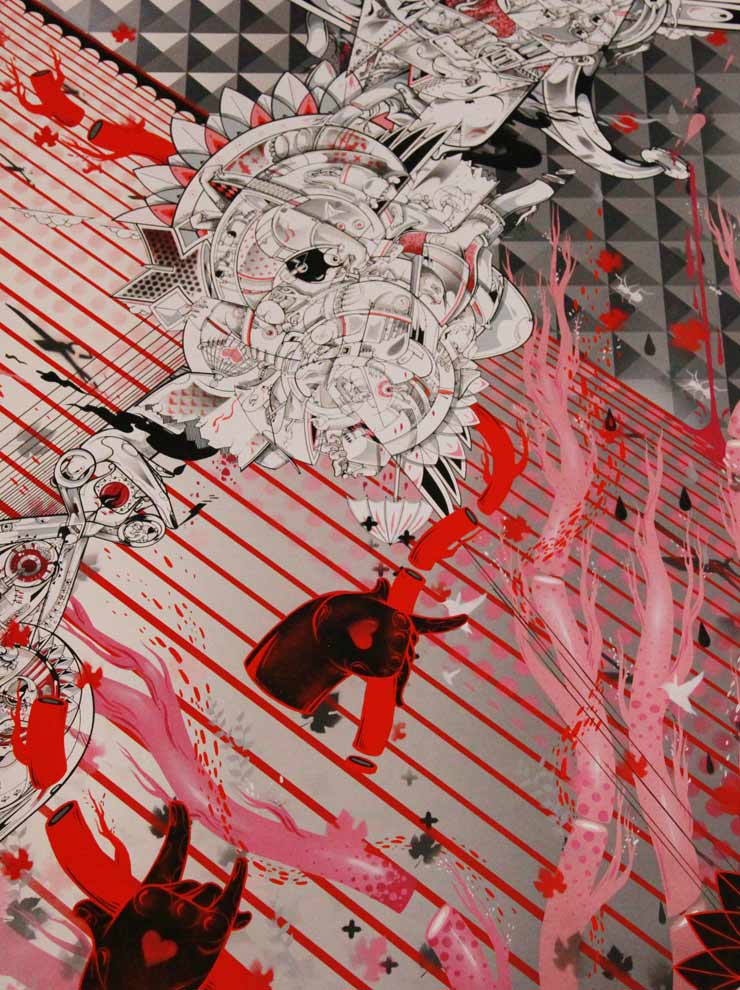
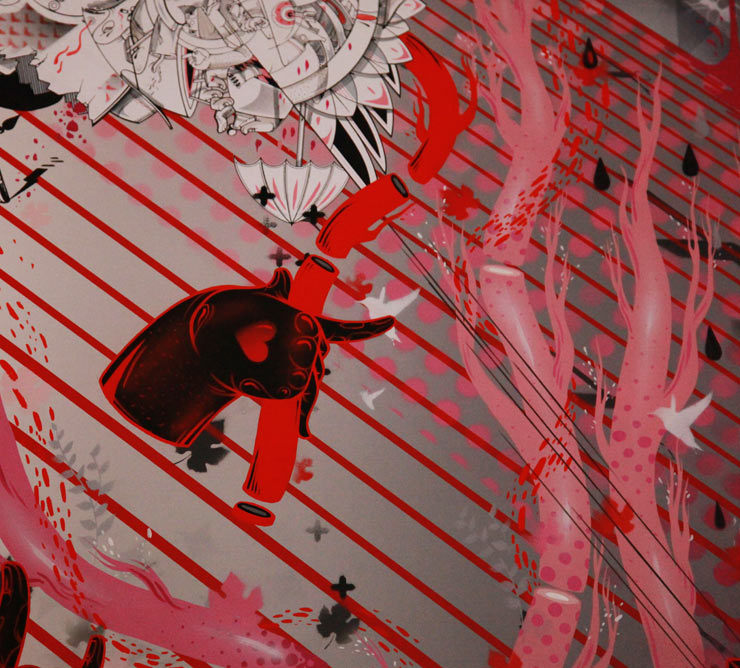
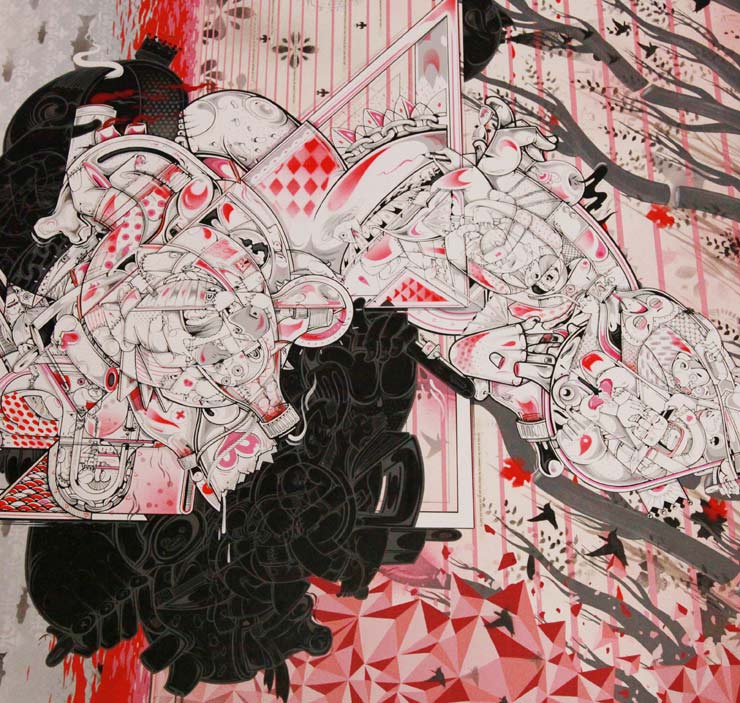
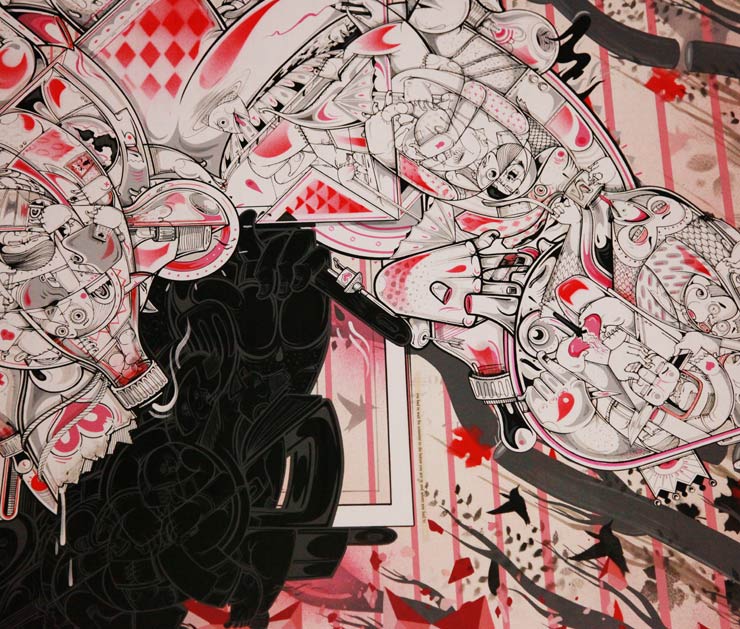
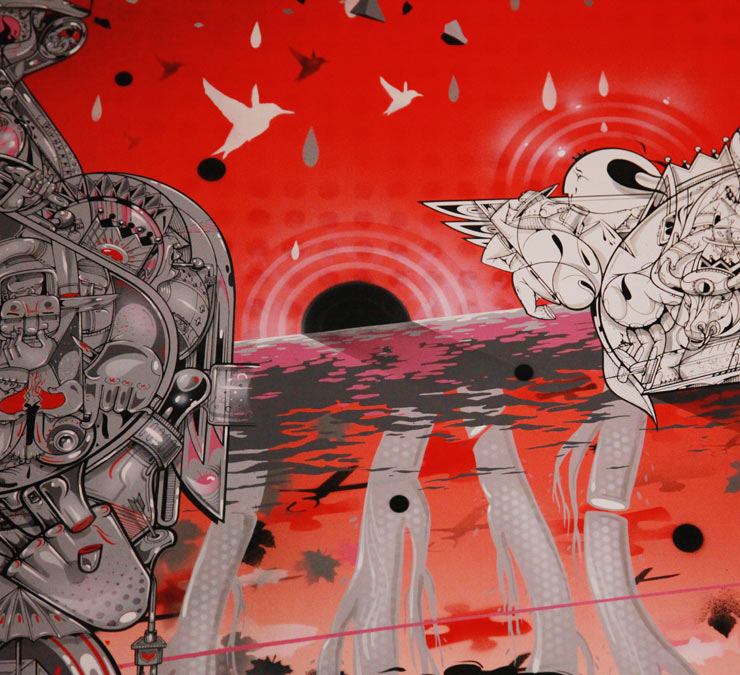
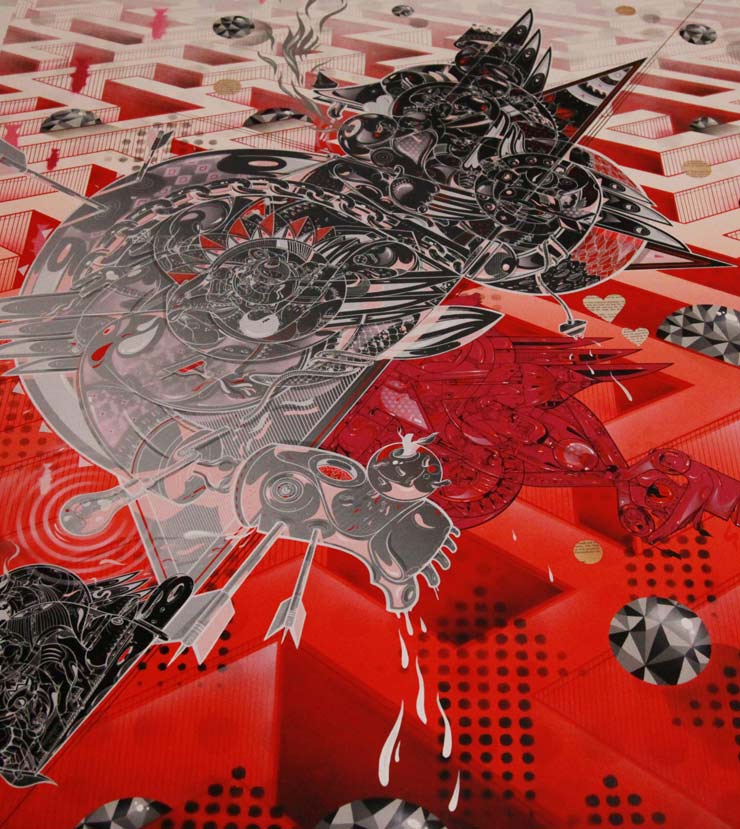
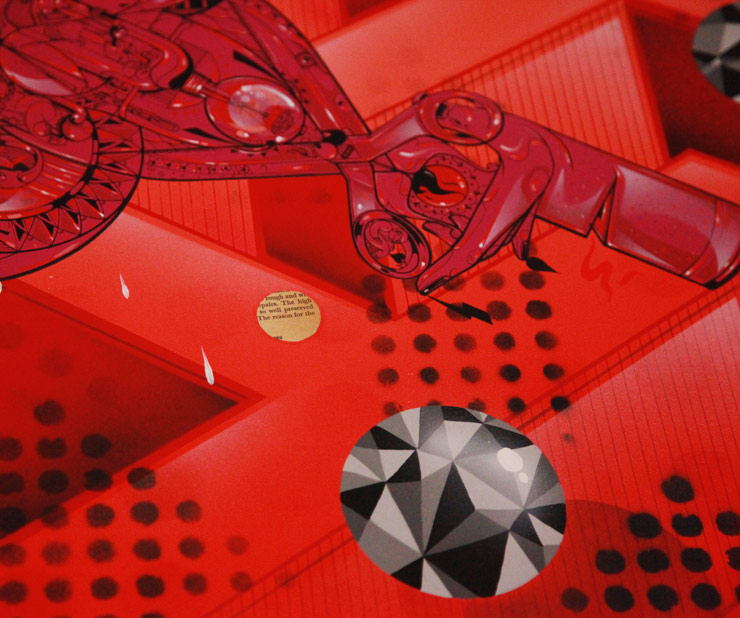
How & Nosm regulated their daily existence for nearly seven months to create what may be the most challenging campaign of layered, collaborative, organized hot chaos that they ever have produced. Under the guidance of master print maker Jo Watanabe and his team at Pace Prints in Brooklyn, the graffiti writers turned their mural marksmen skills and their precise methods of art making inside out to create multiple, fluidly sharp monoprints that are each a painting of its own.
“I went to school myself!” exclaims Raoul of the rhythmic and rigorous schedule that required he and his twin brother Davide to show up to work on multiple pieces of multiple prints simultaneously five days a week from 9:30 to 5:30.
Davide describes the method, “You have a whole sheet of 75 different works, multiplied by however many different combinations and screens you can have – you have a black outline on this small section of an artwork, then magenta here, then we decide to spray a stencil on this portion, or fill this one – and in between you have to clean all these different screens. So in the end…”
We interject, “In the end, your head almost explodes.”
“Well, at some point. Jo is very good at working systematically, because that’s how the Japanese work,” explains the rigidly methodical and razor sharp German who is never late to a meeting with us. He catches himself and laughs in baritone that reverberates, “Actually we work very well together, the Germans and the Japanese! It was awesome.”
Walking through the Pace print facility in Manhattan’s mid 20s it strikes you just how much of a step this is for the brothers to collaborate side by side and fully immersed with such a prestigious fine art print publisher that has been in business since 1968. Names like Chuck Close, Julian Schnabel, Ryan McGuinness, and Qin Feng randomly jump out at you from rack labels while you stroll past acres of contemporary art history in the grand and airy facility.
“We only took seven months to do ours,” says Raoul, “some of these prints, like one from Chuck Close I think, took two and a half years to complete,” he marvels. Only. This from one half of a mural team that knocks out mammoth 20’ x 30’ walls in their signature red, white and black palette with exacting detail in the same time that other artists take to sketch their outlines and block in the preliminary color.
As with their walls, the symbolic imagery calls to mind sequences in history, allusions to memories, sharp pangs of emotion; all layered and nested and swimming with one another without beginning or end. If it feels chaotic, it is by design, to drive away the dullness of the repetition that a typical print run and a typical life can produce.
“You have 25 to 30 screens and you gotta create something new every day,” says Raoul of the challenge to make each one unique. “But you get into a routine. It’s like everyday life. You wake up and have your routine, but you have to make it interesting to yourself every day. “
So the education of this experience has produced a riveting and color drenched array of polarities pulling and pushing across paper like few of their previous projects, and you can see that the results have enlivened their minds, sharpened their eyes. Additionally, How Nosm are proud that no computers were used in the project whatsoever.
“So that’s how we started,” says Raoul, “we painted on mylar, – it’s like a plastic,” he holds up the transparent sheet to show. “We used that to shoot the screens. We didn’t paint anything on the computer. Everything is hand painted; the layers – and they had so many machines and different ways of achieving effects, I didn’t know. “
Did Mr. Watanabe and his team learn any new tricks from the grown up graffiti kids? “I mean we are like underdogs compared to who has done prints with them before,” says Davide. “We are the first ones with a hard core graff background. But they admitted that they really actually liked the work and they learned something from us too I think.”
We ask in what way – how the guys think about their work, their process? “Basically how spontaneous you can be with a spray can,” he says as he offers to let us feel the built up aerosol portion of one print that the brothers created with a simple stencil. “All this could have meant extra screens, but we saved them time, and they liked the effect.”
When the opening reception takes place this week at Pace and other new works from the series are unveiled simultaneously at the Armory show, How and Nosm are thinking that in the middle of it all will be some sort of graduation ceremony, at least figuratively. Suddenly everything they have done up until now has been redefined, refined even. In some way, they’ve done this before and in others it is all new.
What can follow this brief chapter in their storied creative career? Leave that for tomorrow. For now, behold. “They are all so unique, they all look so different,” says Raoul as he carefully pulls out one hand-embellished print after another from their elaborate archival wrappings.
Not quite spring, the Art Fairs are arriving in New York ahead of the tulips. We strolled the impossibly long aisles and peered into the booths to find the folks who have at other times been called “Street Artists”. This weekend they’ll be fine artists, and the list is quite a bit longer than years past as the professionalization of the street continues.
Shows like the Armory, Scope, Volta, and Fountain are good testing venues to see the commercial viability for many of these artists and some have foregone representation – preferring to foot the bill on their own. Since walking the streets to see their work requires multiple layers and hats and gloves – traipsing through the fairs can be far preferable than dirty old Brooklyn streets. It’s also nice to see how some of these folks look in a tie or a blouse – or even just hit a comb. Here below we include some possible gems for you to hunt down.
A big deal has been made about the so-called virtual experience of Street Art – made possible by ever more sophisticated phones and digital platforms and technology – producing a pulsating river of visually pleasing delicacies to view across every device at a rapid speed, and then forget.
Sit on the city bus or in a laundromat next to someone reviewing their Instagram/RSS/Facebook feed and you’ll witness a hurried and jerky scrolling with the index finger of images flying by with momentary pauses for absorbing, or perhaps “liking”. The greatest number of “likes” are always for the best eye candy, the most poppy, and the most commercially viable. It’s a sort of visual image consumption gluttony that can be as satisfying as a daily bag of orange colored cheese puffs.
This is probably not what art on the street is meant for. At least, not all of it.
As we have been observing here and in front of audiences for a few years now, the 2000s and 2010s have brought a New Guard and a new style and approach to work in the street that we refer to as the work of storytellers. These artists are doing it slowly, with great purpose, and without the same goals that once characterized graffiti and street art.
While there has been the dual development of a certain digital life during the last decade, these street works are eschewing the shallowness that our electronic behaviors are embracing. Even though the digitization of society has pushed boundaries of speed and eliminated geography almost entirely, it is creating an artificial intelligence of a different kind. In other words there really is still no substitute for being there to see this work, to being present in the moment while cars drive by and chattering pedestrians march up the sidewalk.
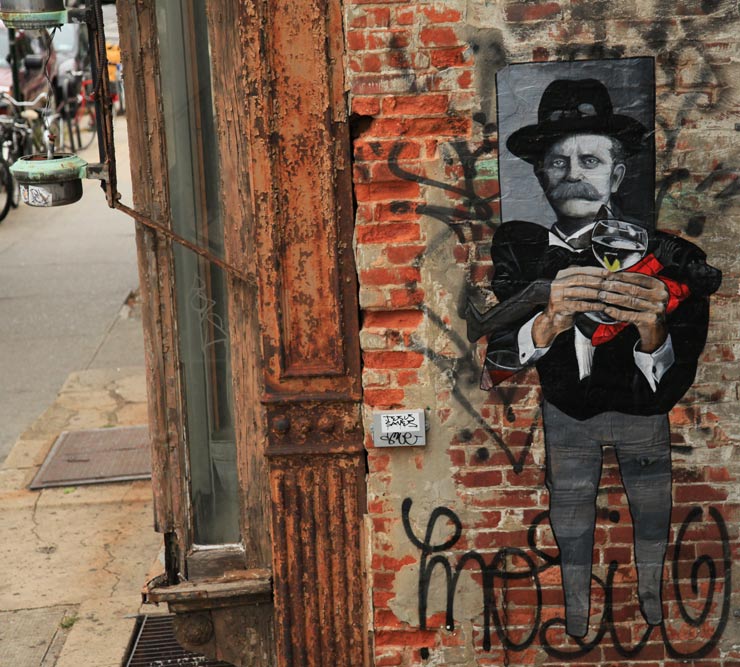
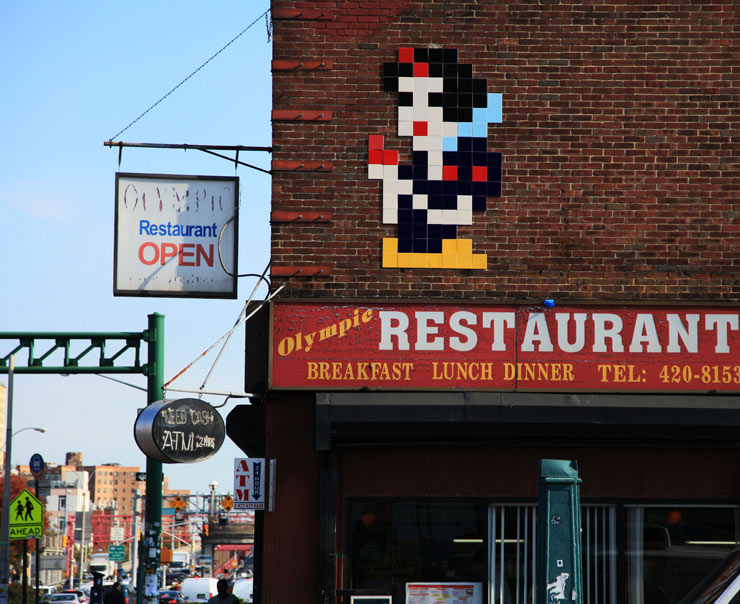
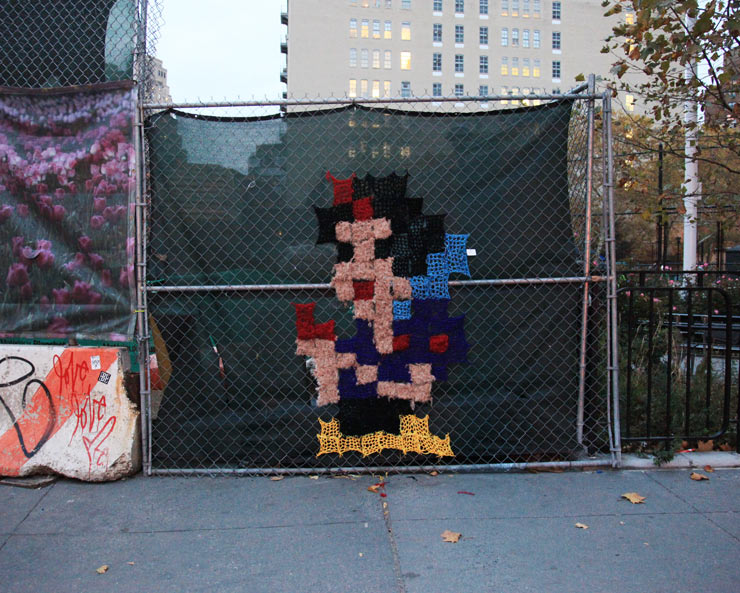
Setting aside the recent abundance of large commissioned/permissioned murals and the duplication/repetition practice of spreading identical images on wheatpasted posters and stickers that demark the 1990s and early 2000s in the Street Art continuum, today we wanted to briefly spotlight some of the one of a kind, hand crafted, hand painted, illegally placed art on the streets.
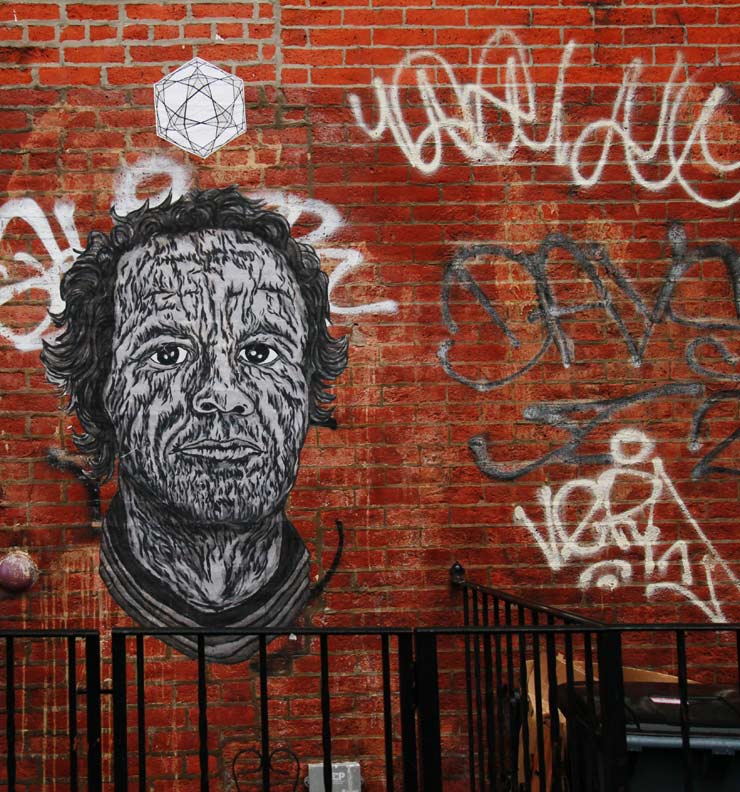
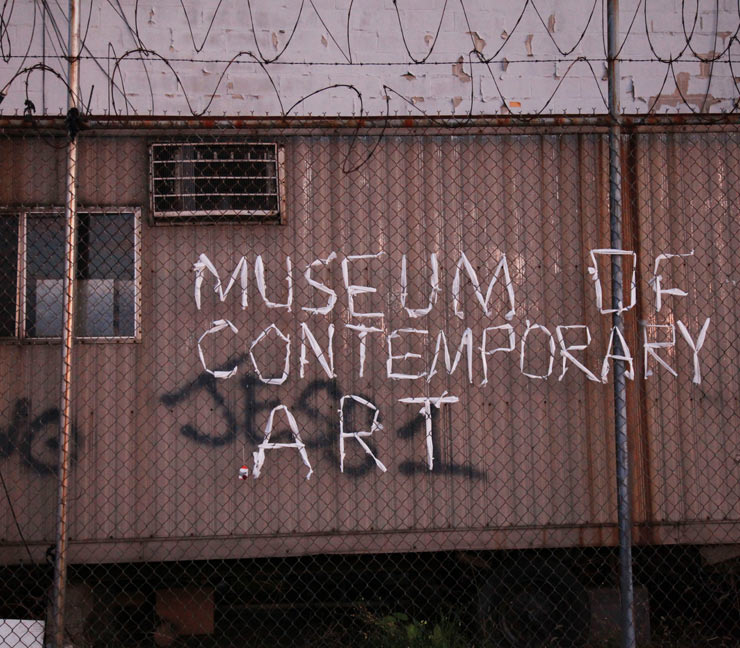
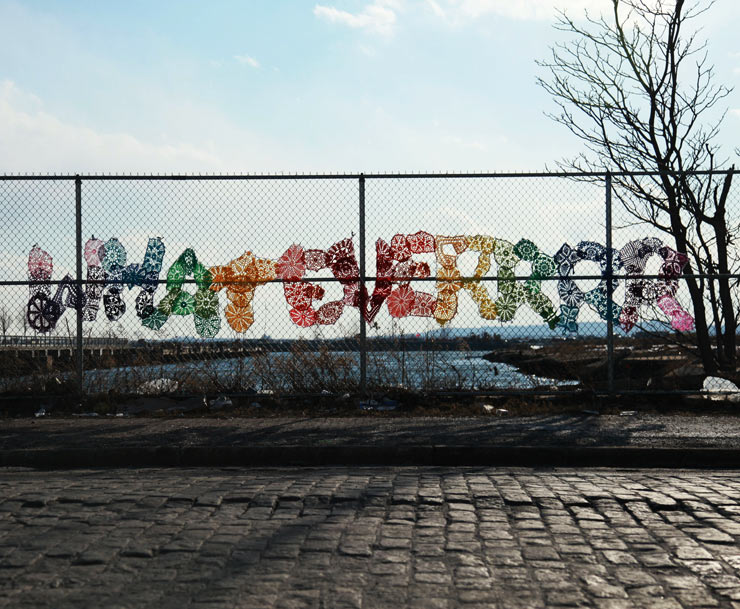
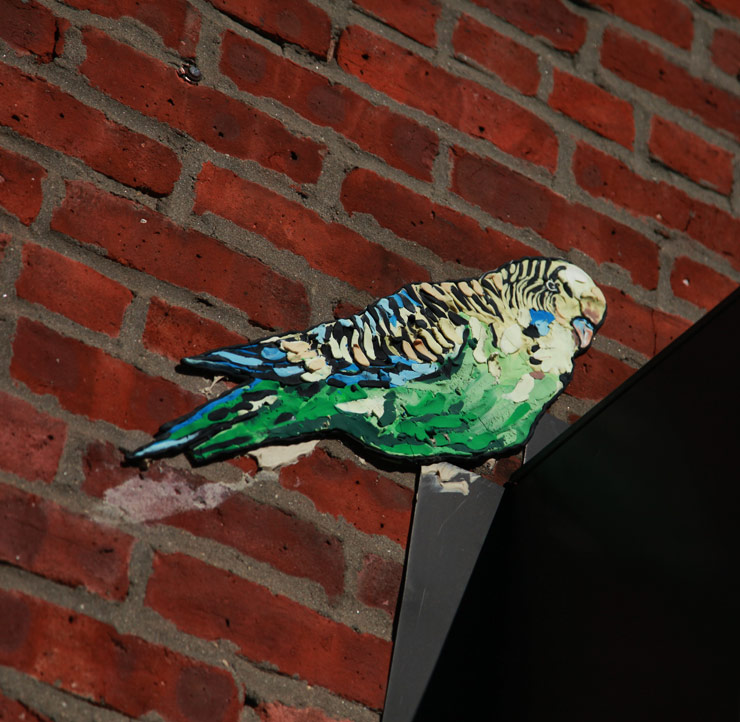
The materials, styles and placements are as varied as the artists themselves: Yarn characters attached to fences, tiles glued to walls, acrylic and oil hand painted wheat pastes on a myriad of surfaces, ink, lead and marker illustrations, carved linotype ink prints, clay sculptures, lego sculptures, intricate hand-cut paper, and hand rendered drawings have slowly appeared on bus shelters, walls, doorways, even tree branches.
They all have a few things in common: The artists didn’t ask for permission to place these labor-intensive pieces on the streets, they are usually one of a kind, and frequently they are linked to personal stories.
We’ve been educating ourselves about these stories and will be sharing some of them with you at the Brooklyn Museum in April, so maybe that’s why we have been thinking about this so much. There is a quality to these works that reflect a sense of personal urgency and a revelation about their uniqueness at the same time.
If the placement of them is hurried the making of them it is not. The themes can be as varied as the materials but in many cases the artist informs the art by his or her autobiography or aspiration. And once again BSA is seeing a steady and genuine growth in storytelling and activism as two of the many themes that we see as we walk the streets of the city.
Meanwhile the small idiosyncratic hand-made pieces are starting to show up again in New York after a relative quiet that was enforced by the cold and snow, which both have melted. Oh, wait, another storm is coming tonight. (!) If we find that ground hog he is going to get a smack.
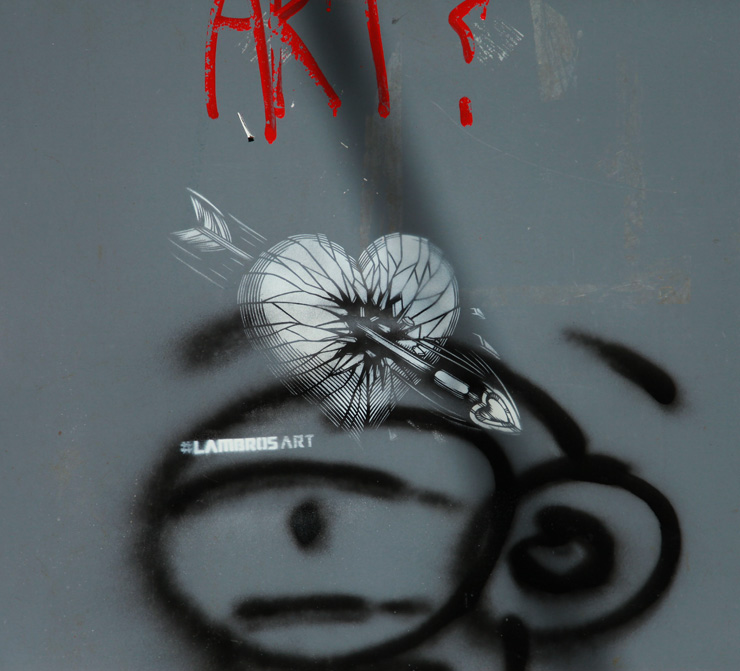
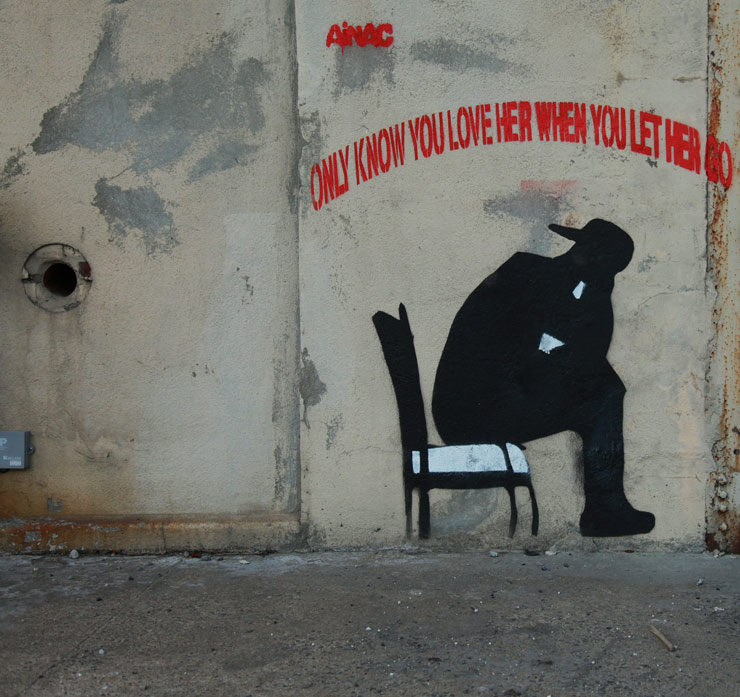
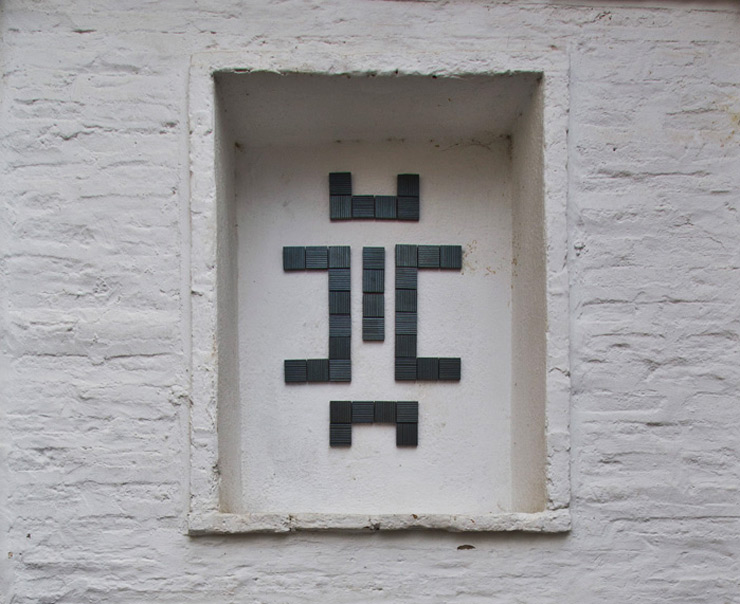
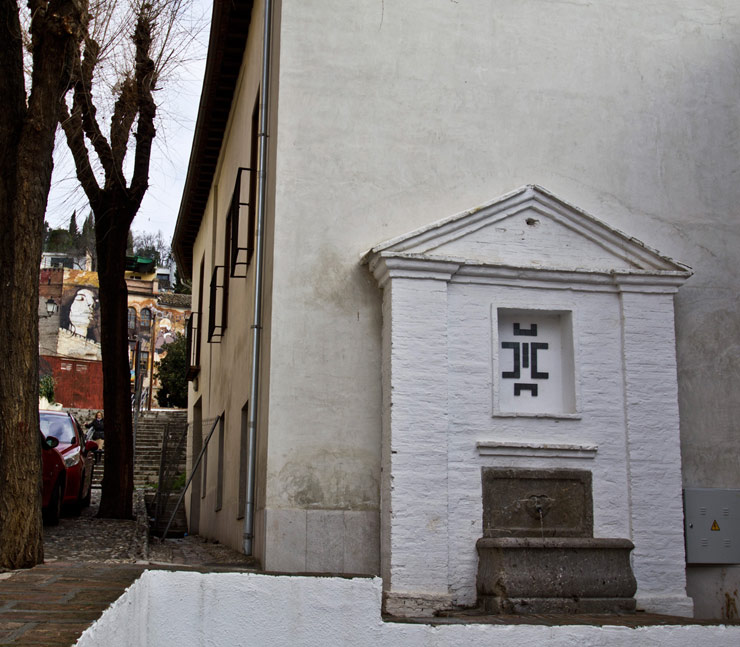
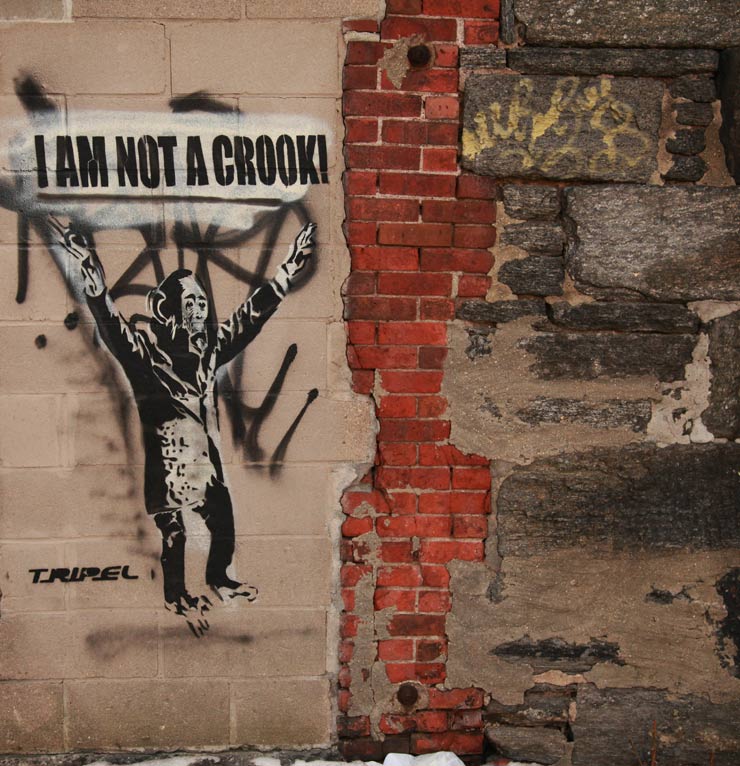
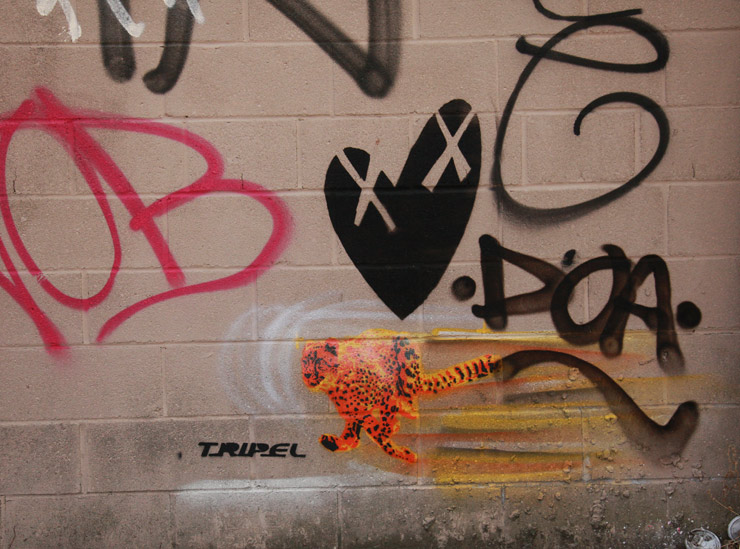
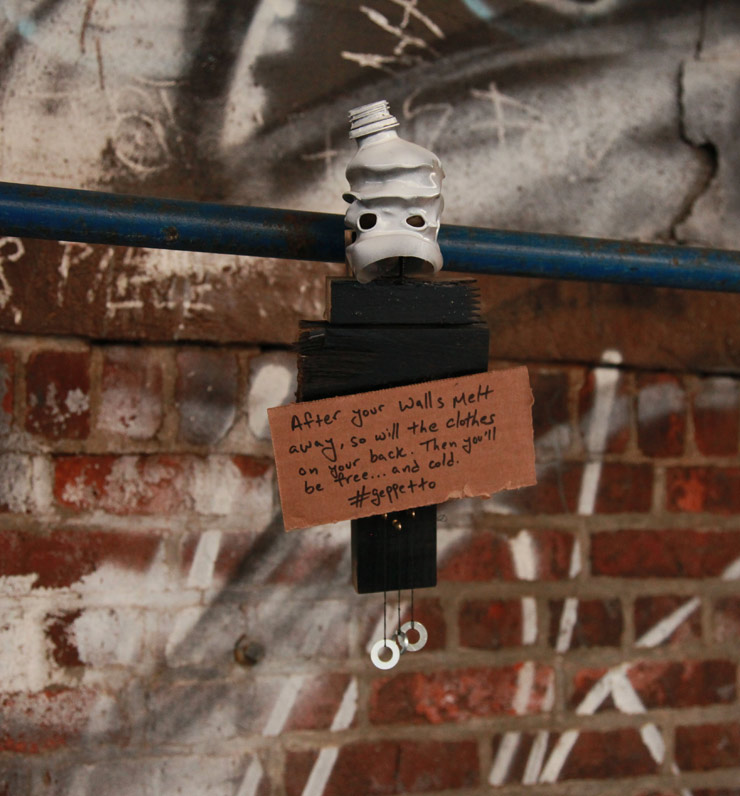
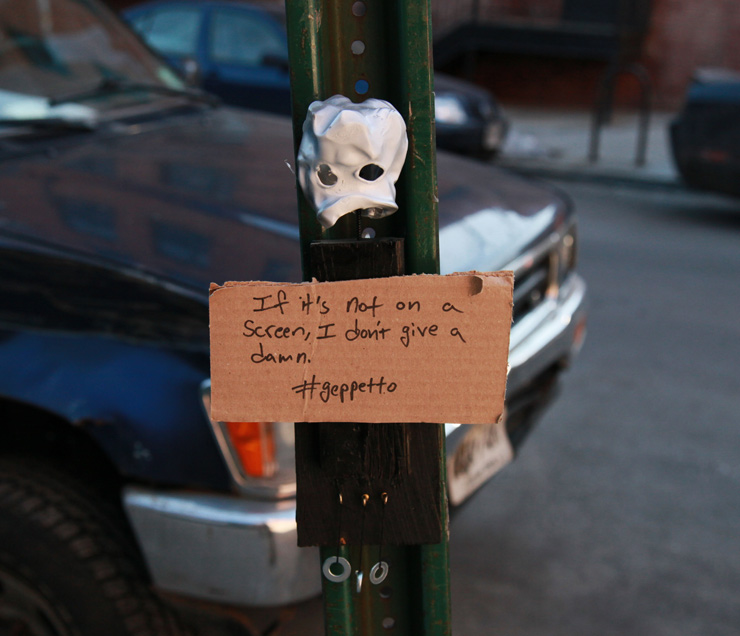
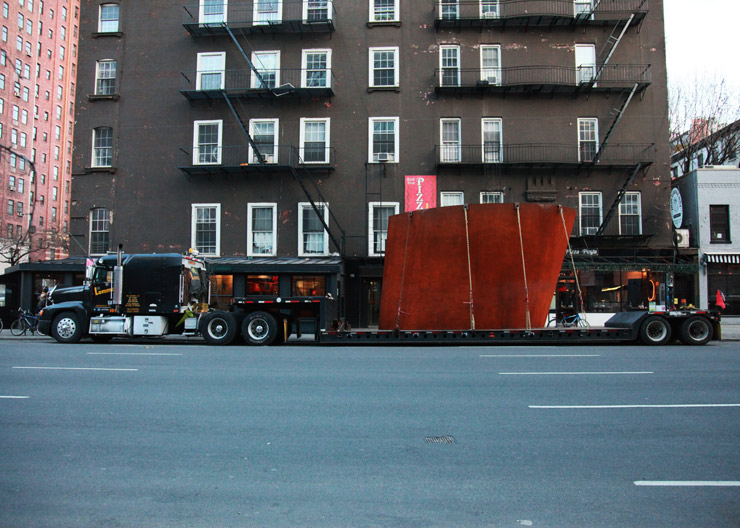
Here’s our weekly interview with the street, this week featuring Ainac, DOA, EC13, Geppetto, Lambros, Mr. Toll, Olek, Richard Serra, and Tripel.
It was such a short affair, just one of those things.
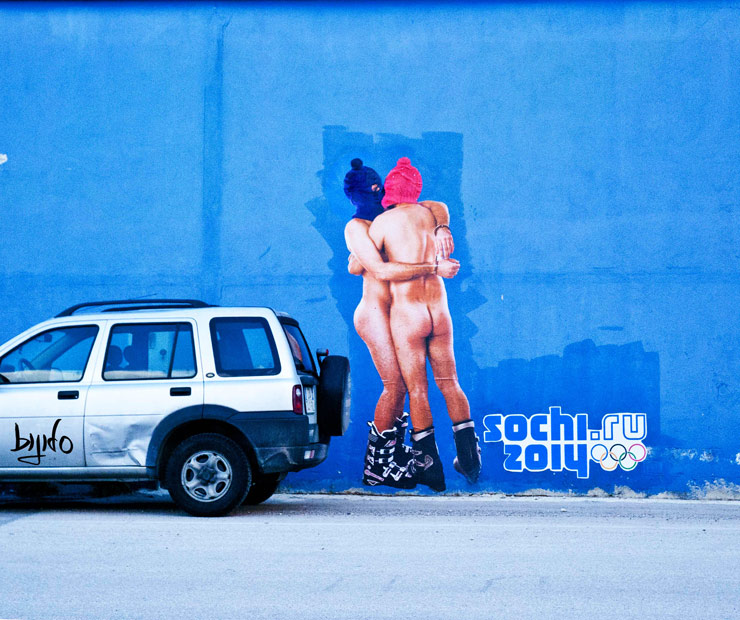
Italian Street Artist Bifido has the last word on street about the Sochi 2014 Winter Olympics with two guys in Pussy Riot ski masks and boots, and nothing else. This one is in Naples, Italy.
Our weekly focus on the moving image and art in the streets. And other oddities.
Now screening :
1. Roti “To the New Ukraine” 2. Getting “GREASY” with Narcelio Grud
3. Mr. Toll from DEGA Films 4. NDA from DEGA Films
5. “I Can See You” in Iraq
6. Experimenting with Projection Mapping
BSA Special Feature:Roti “To the New Ukraine”
From Chris Cunnigham comes this short version of a documentary that follows French Grafiti artist ‘Roti’ as he works on his most ambitious project to date, we get a glimpse of an untold side story in Ukraine’s revolutionary struggle.”
From the man who showed us how to paint with discarded fruits and vegetables, we see a sweetly crude painting with the one thing that is keeping the world running while simultaneously killing it. Narcelio takes on the sticky stuff and gets greasy.
Mr. Toll from DEGA Films
In a category all his own, Mr. Toll sculpts with his fingers the ironic and the naturally beautific (warning: may not be a word). Over the last 3 or 4 years, you could say prolific. The 3-D is a welcome variation, and surprisingly easy to overlook as a possible adornment deliberately placed there by a building owner.
N’DA from DEGA Films
Hard won street cred can sometimes be achieved one character at a time, no matter how brutishly plain or comically pequeno. What a character N’DA is! Painter, wheatpaster, illustrator, idiosyncratic outside artist – don’t underestimate and don’t overlook this one.
“I Can See You” in Iraq – A film by Sajjad Abbas
Translated as “I can see you” the giant eye placed on the top of this building is a way that was Street Artist Sajjad Abbas wanted to keep Iraqi politics on their best behavior. Even though he got permission from the government to install it, soon enough it had to come down because some people thought it had to do with the Freemasons. Here he offers an unvarnished direct recording of the installation and de-installation, less documentary than document.
Experimenting with Projection Mapping
From computational designer Lukas Z here is a fun example how much you can do with projection mapping and some pin tape these days on the street. Our forays into the projection world over the last 5 years tell us that this is one small example of the possible, but this is well realized.
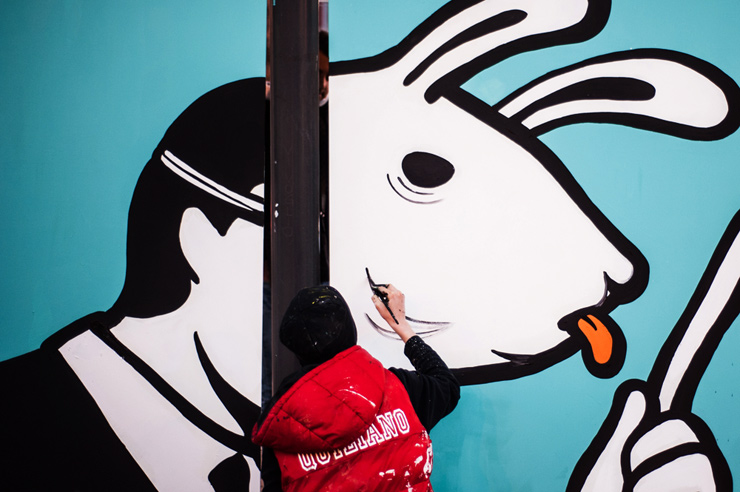
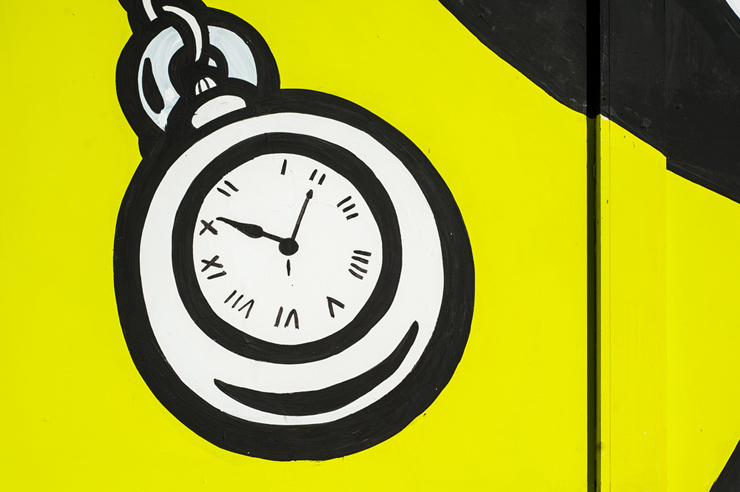
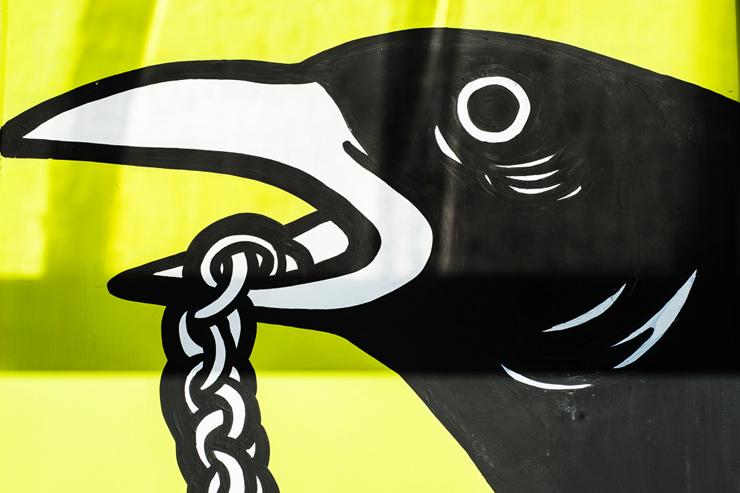
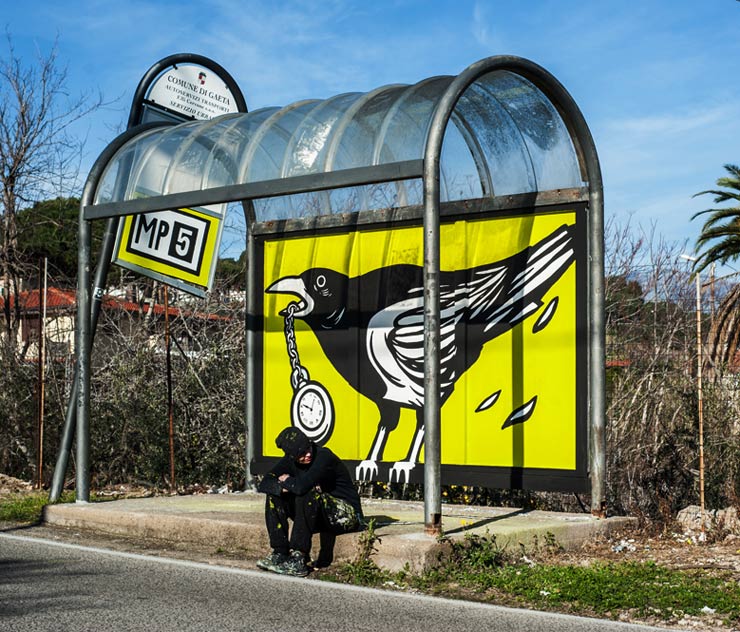
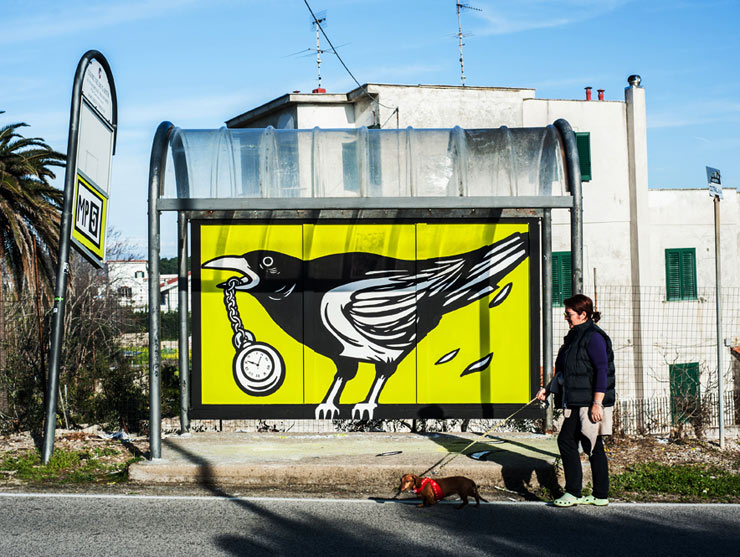
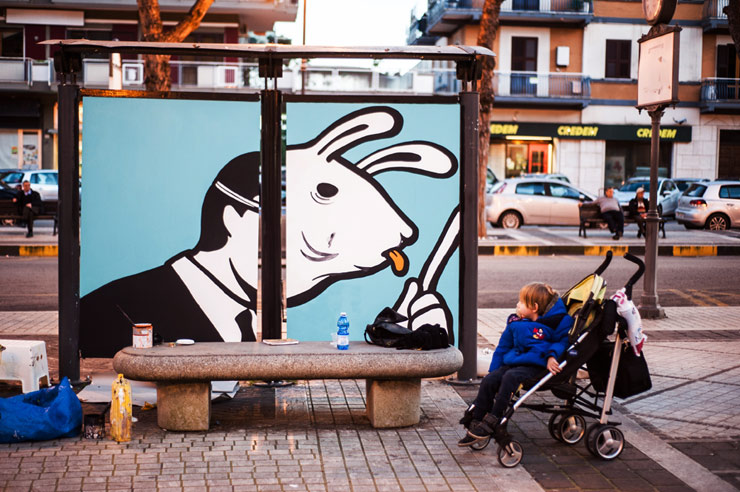
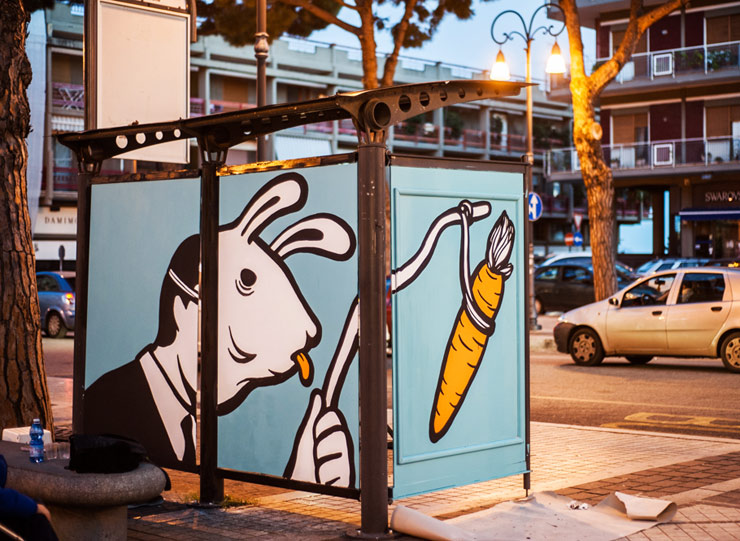
A big spoon full of sugar – that’s what keeps the sweetness in the appearance of these two public art bus stop pieces from MP5 in Italy. Once assessed, you may see the bitter critique of modern norms that are portrayed in festive sunny tones.
First is the frantic anxiety ridden magpie who is waiting nervously for the bus, so terrorized by time, so worried of missing the worm, so fearful of being pecked by an angry bird boss.
Below is the second pleasantly bright and flat scene of the mask-wearing role-playing go-getting company man. Sadly, he is so conditioned to react to reward that unless he dons his fake façade and dangles his own carrot he cannot rapidly chase those highly valued results.
And what are those results, exactly?
MP5 says the title of the the project is TEMPUS FUGIT, which is meant to reflect on the precariousness of our lives, liberty and the meaning we give to time.
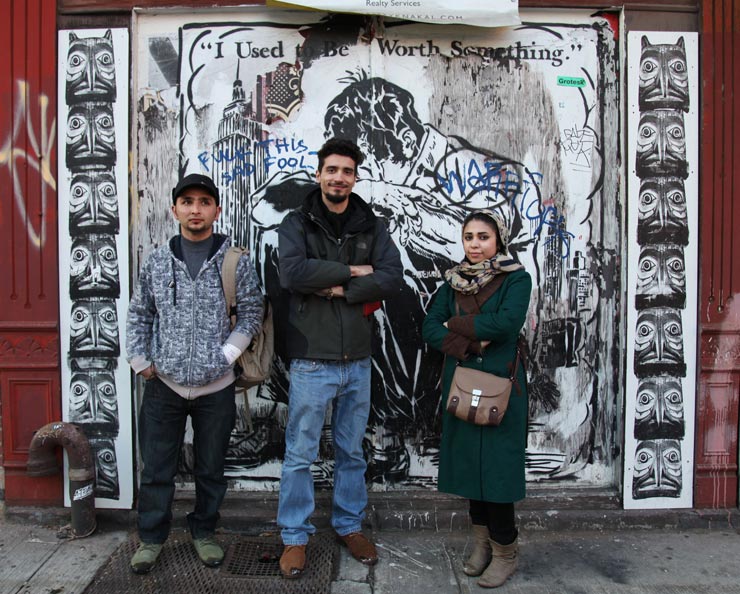
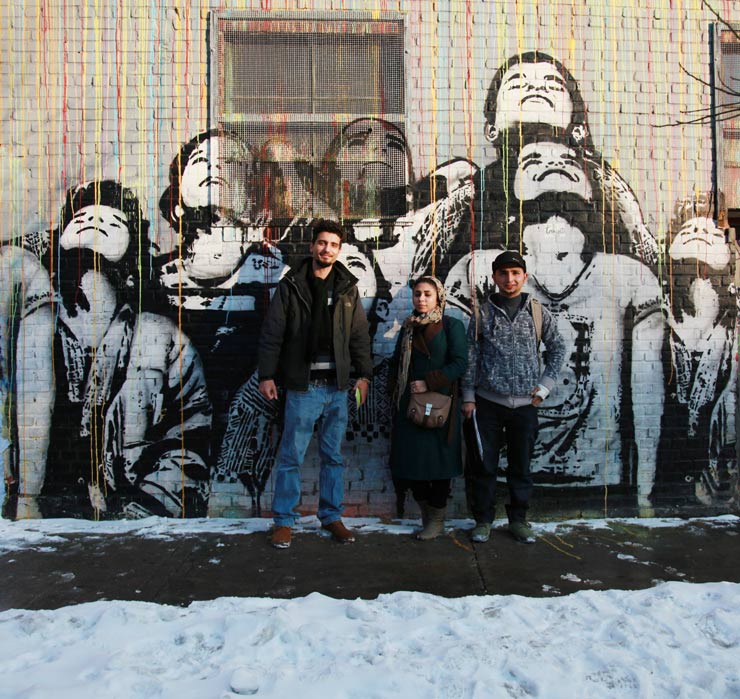
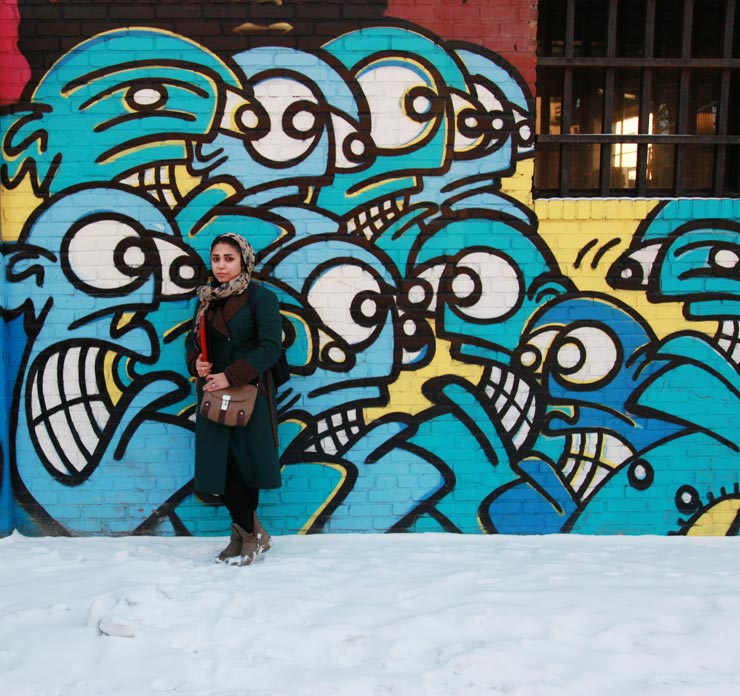
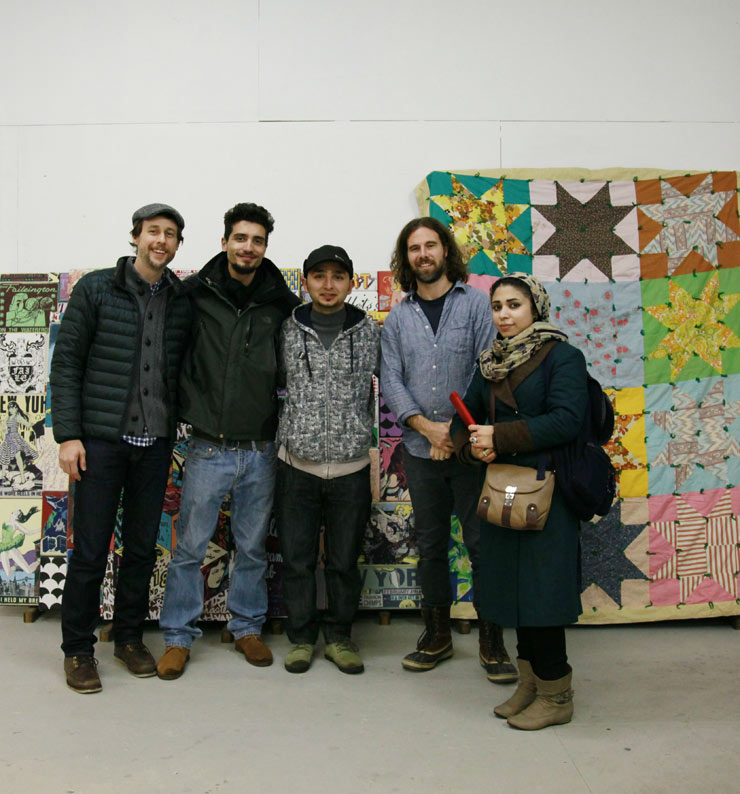
Afghanistan is not the first place you think of when someone says Street Art scene and Kabul would certainly be sort of low on your list of urban art festivals to check out, but surprisingly it has both. These are a couple of the revelations we had earlier this month when BSA welcomed three 20-something artists to tour the streets of Brooklyn – and meet one of our own homegrown Street Art duos in their studio.
Abul Qasem Foushanji, Ommolbanin Samshia Hassani, and Sayed Mohebullah Ramin Naqshbandi were all good sports despite the brutishly cold February day – in fact Sayed had a fairly light jacket on because he said it gets as cold or colder back home in Mazar-i Sharif where he is a painter and student who has tried his hand at stencil work.
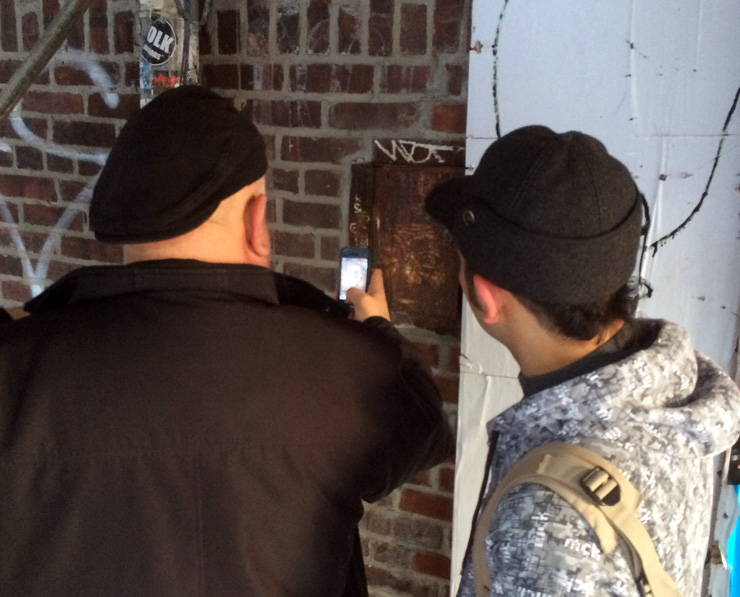
Qasem and Samshia both grew up in Iran, so it made sense that they were excited when we began the tour by checking out the large mural done by Iranian émigrés and brothers Icy & Sot, who now live in Brooklyn. While Arthur, our astutely amiable co-host from the State Department, helped keep the mini-van warm and free of parking tickets, their escort/interpreter Mr. Aziz walked up and over the snowbanks with us while we checked out works by a number of graffiti and Street Artists all around the North Brooklyn neighborhoods of Williamsburg and Greenpoint.
The Central Asian country of Afghanistan has historically eschewed modern art as being unacceptable and much art was destroyed by the Taliban in the last few decades for being un-Islamic.
With such a restrictive atmosphere it was good to learn that Qasem plays bass in a thrash metal band, does sound installations and has experimented with abstract expressionism – something that would have been unheard of in the 90s. “In the early 2000s when the Taliban left the country, there was nothing,” he says as he observes a gradual building of hope in the creative community.
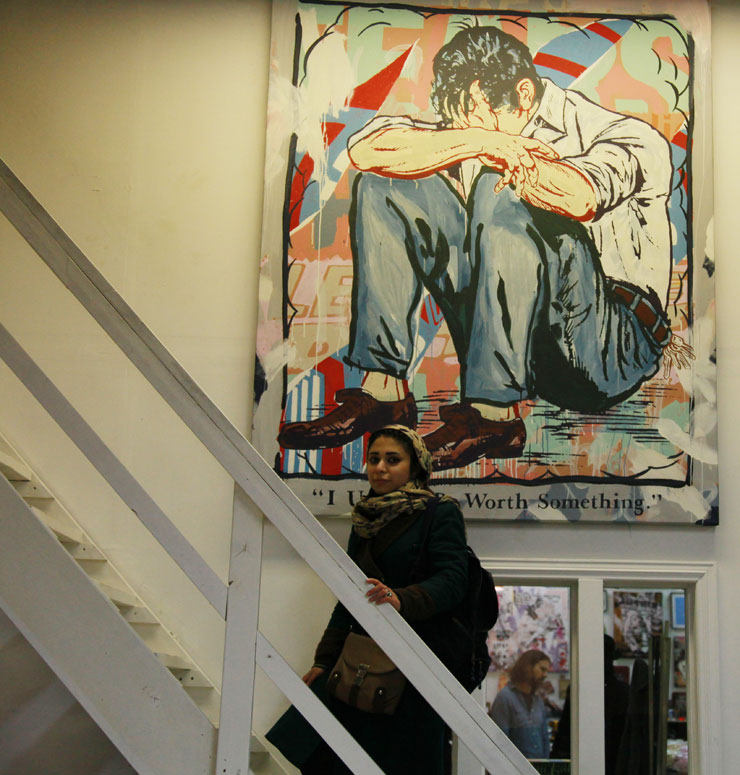
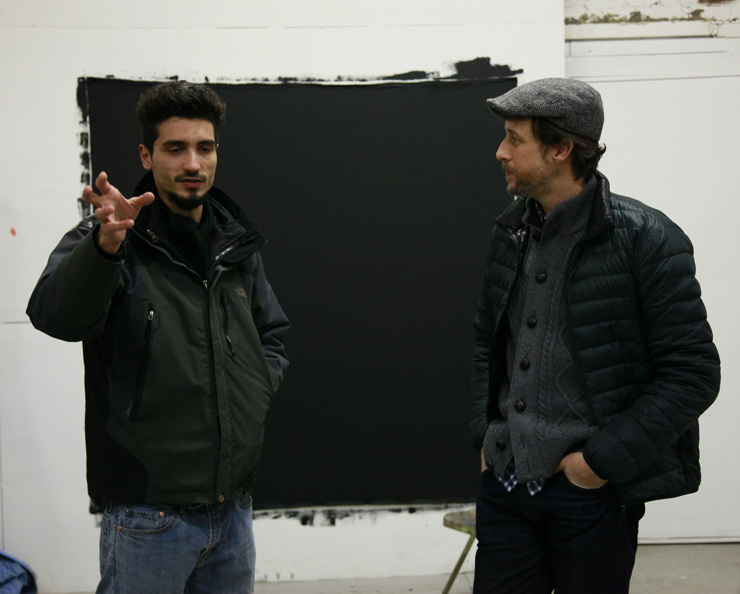
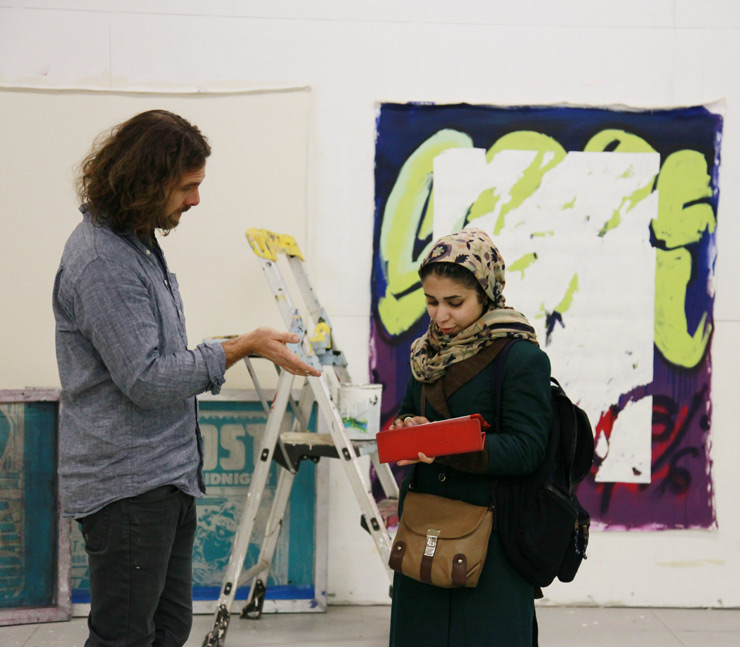
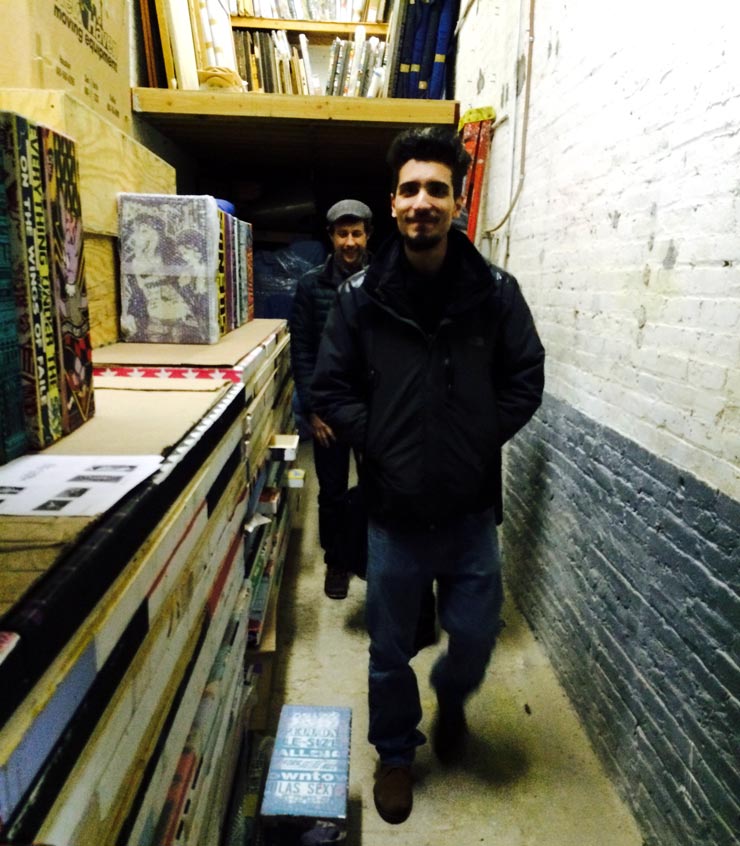
As the sun went down we were welcomed into the vast office and studio of Patrick Miller and Patrick McNeal, who together comprise the Brooklyn based Street Art collective better known as Faile. Having just walked the same streets where the Patricks began many of their experiments at the turn of the century, it was a great opportunity for the guests to see what a world-class art making studio looks like, to ask questions, and to share some stories about how the scenes on streets of Brooklyn and Kabul differ.
Speaking about their early days of illicit art posting, McNeal explains “You’d go out and you get to the wall and it’s quick,” he says with a snap of the fingers. “You’re not taking the time, necessarily, to think. And then you finish it up and get away from it and you came back to see it the next day. There was something loose in it, where now everything gets very tight and refined,” he says as he gestures to the large artworks in progress across the tables and the floor of the studio.
“Yeah, it’s changed a lot over time,” says Miller about the street art scene, especially in the area of Williamsburg that has become a high-rent playground for professionals and well-heeled college kids. “Real estate, gentrification, a lot of those things have played into it in a lot of places like here and Barcelona where you used to see a lot more things on the street, it doesn’t really exist.”
One thing we learned is that Shamsia doesn’t even usually feel that she can go on the street in Kabul to create her work because she fears berating words, insults and possibly worse from people who don’t think a woman should be doing such a thing. And would never go out after dark. “It’s for the boys to go out at night. I wish to do so also but I am a girl. It is dangerous,” she says with regret, but is determined to use her art to advocate for the rights of girls and women in whatever way that she can.
One project she calls “Graffiti Dreams” is comprised entirely in her imagination and on her computer – where she creates virtual street art scenes on buildings she has photographed as a way to at least paint walls in her mind. “That’s nothing, but for me it is everything because I can do graffiti somehow.” She took out her iPad to show McNeal some of her renderings.
After British graffiti artist Chu held a one-week graffiti workshop for nine artists in Kabul in 2010 where the concept of graffiti and street art was introduced from a Western perspective, Shamsia and other young artists took the art form to heart.
She has traveled internationally in the last few years meeting other artists and sometimes collaborating with them like Tika from Zürich, Berlin’s Klub 7, and the well known Los Angelelino Street Artist El Mac, with whom she did two collaborations now on display in Ho Chi Minh City, Vietnam and in Brisbane, Australia.
McNeal asked Samshia, “How did you get exposed to graffiti?,” and Samshia talked about the workshop with Chu and how it affected her.
“I thought if I did graffiti then I could introduce art to the people,” she says, “Because no one goes to exhibitions and galleries – only some very important people are invited to exhibits. And I thought that I could put art in the street for all people and maybe they have never seen that there is this art.”
“How do you get spray paint there?” he followed up.
“There are very bad quality spray paint there,” she replies with a smile. “These are just for color to put somewhere. It’s not really for painting. The color drops a lot, and I’m not changing the size of the caps. Sometimes I do the small details with small brushes because the spray can is not able to do very thin lines.”
“That’s cool though,” McNeal encouraged, “ because that will inform your style and the way that you work.”
As one of the first graffiti artists in Kabul, Shamsia is also unusual because most practicing artists of any discipline are men – and women face resistance to their participation in many roles, including as an artist on the street. Now an associate professor at Kabul University where she leads workshops to teach students how to use aerosol spray to create art, Ms. Hassani created a festival this December to highlight graffiti and Street Art as an art practice.
Her own work features stylized women in blue burqas, fish, and calligraphy that references poetry. As often happens, the definition of graffiti and street art are slightly different in Afghanistan than they would be in western cities like London and New York, often closer to what might be called murals or community walls.
For now she is planning a new program when she returns to Kabul University in the spring.
“Another graffiti workshop is coming too for some children who have no parents. They are often very small girls and they have no parents and I want to help them and have a workshop for them,” she explains about her desire to provide restorative healing through art in a city torn by war. “I will start to teach a new subject, making characters, because there is nothing like that right now. I would like to add characters, because everyone likes characters. I would like to teach some technical steps, some secrets of how to make them.”
The night ends with tea, cookies, and conversation in a warm living room and the artists talk about some of their projects, internet service, social media, and other ways that society is evolving and what they hope for art in Afghanistan. As he describes his work future projects Sayed says would like to create politically themed messages for the street. Qasem talks about a culture-jamming project creating a false college course advertisement that may also be humorous. Then in a flash, the visit is over, numbers and emails are exchanged and they get ready to go back out in the cold.
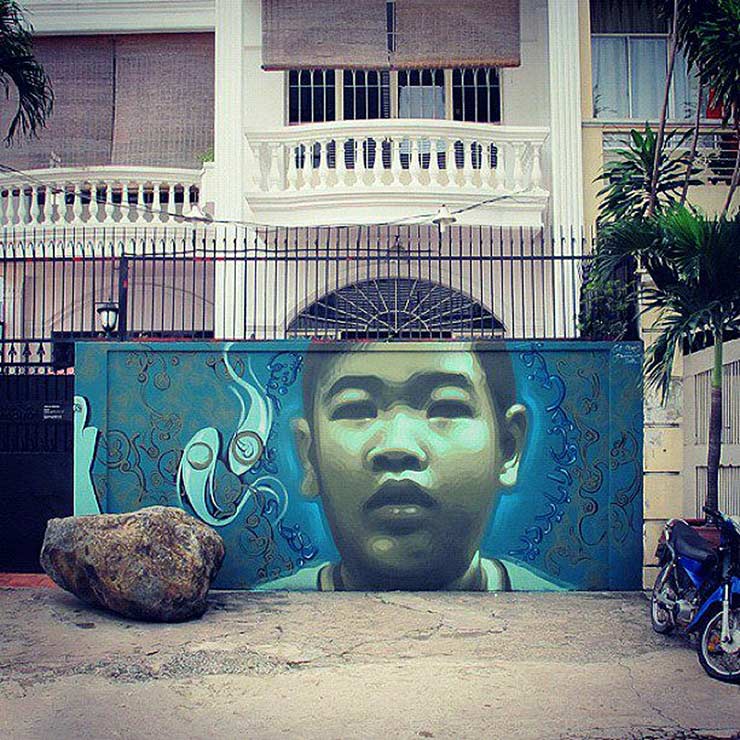
In 2012 Shamsia collaborated with Los Angeles based Street Artist El Mac on two murals in Sai Gon, Vietnam. The first mural was painted in September of 2012 in front of Sàn Art, an artist non-profit contemporary art organization in Sai Gon. The second mural, also painted in Sai Gon was unveiled in Brisbane, Australia at the Asia Pacific Triennial in December 2012.
The figure in the center is a portrait of Shamsia by El Mac from photographs that he took of her. The writing that surrounds the portrait is a poem by Ms. Hassani which she integrated with her own designs. The poem reads:
پرنده های بی وطن ،همه اسیرن مثل من ،صدای خواندن ندارن
Birds of no nation
Are all captive
Like me
With no voice for singing
 BROOKLYN STREET ART LOVES YOU MORE EVERY DAY