This is How It’s Done : Colombia Diary. Day 2 – Process

This is How It’s Done : Colombia Diary. Day 2 – Process

This week BSA is in an unusual location in Colombia by invitation to see a new initiative with Street Artists in an abandoned distillery now being brought back to life with their imaginations and penchant for transformation. Come along with us for a few days to see what we discover.


In factories and in art-making, process is crucial to success.

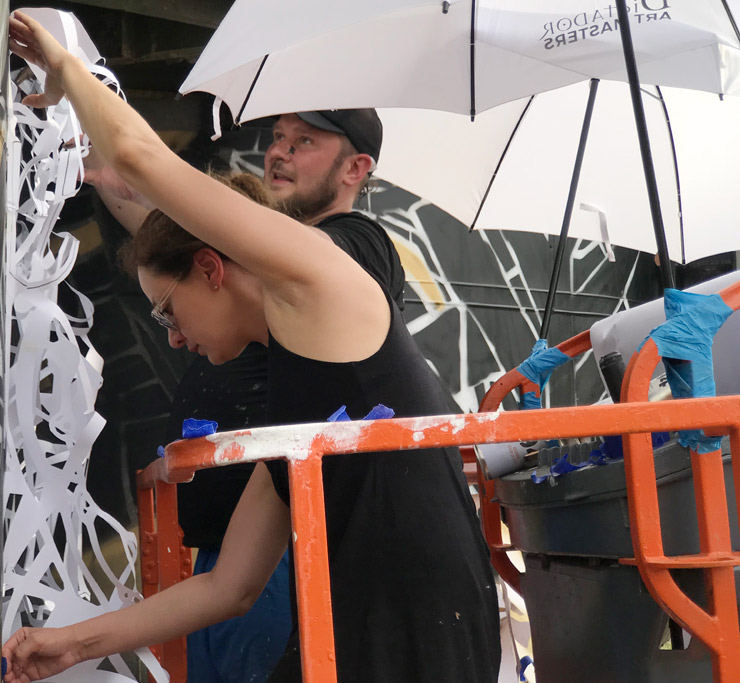
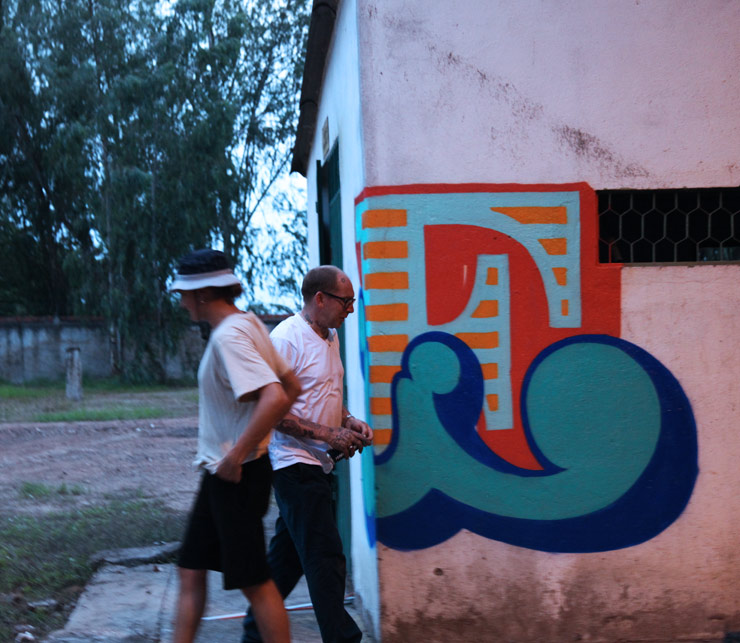
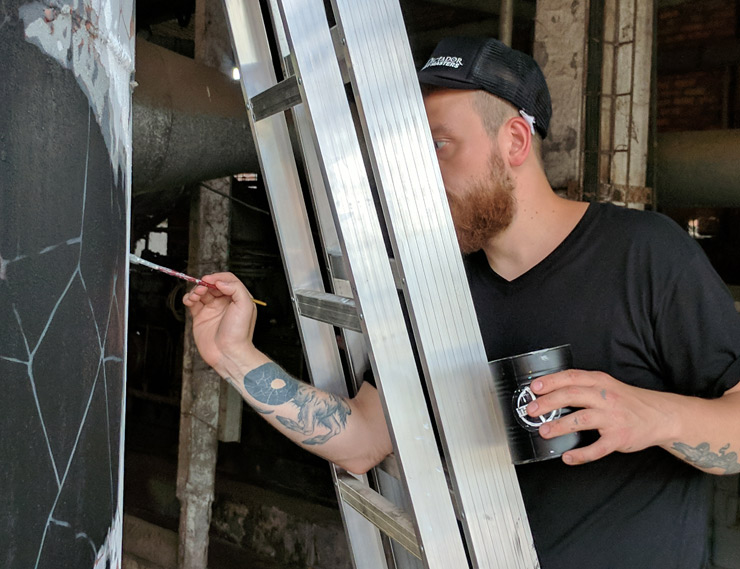
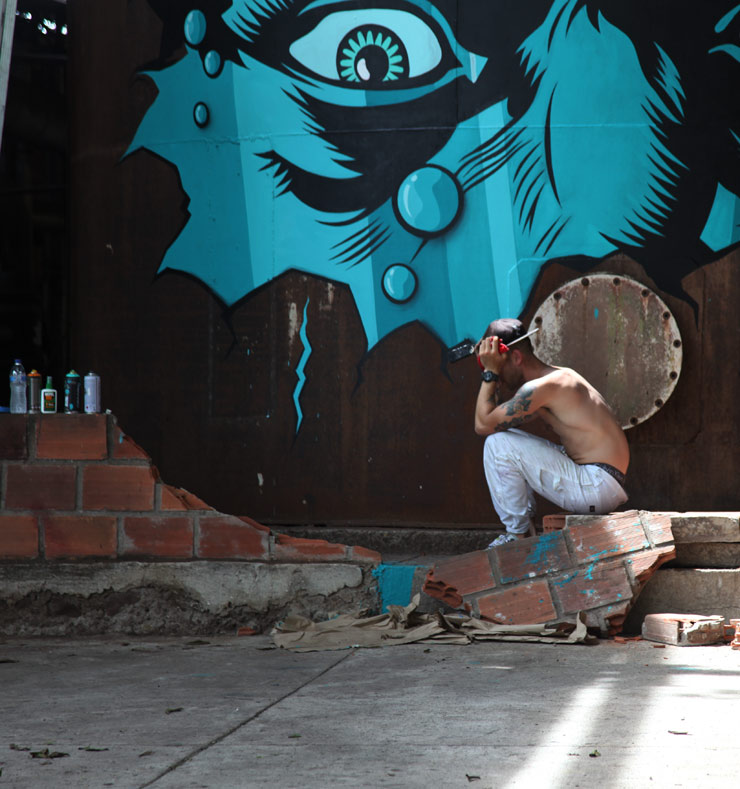
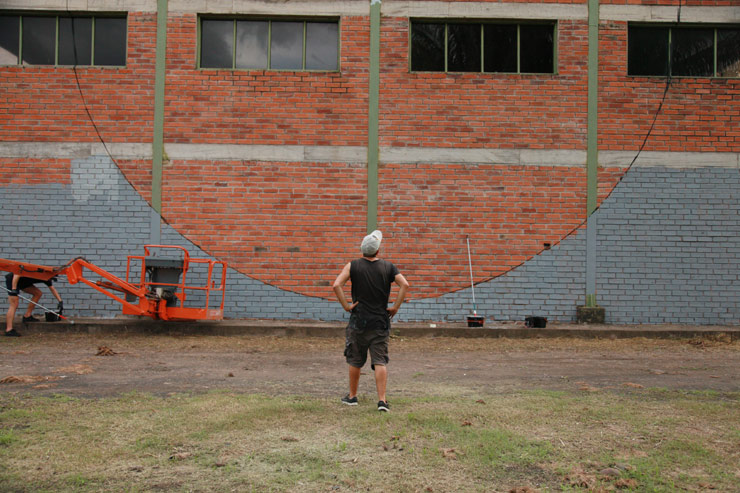
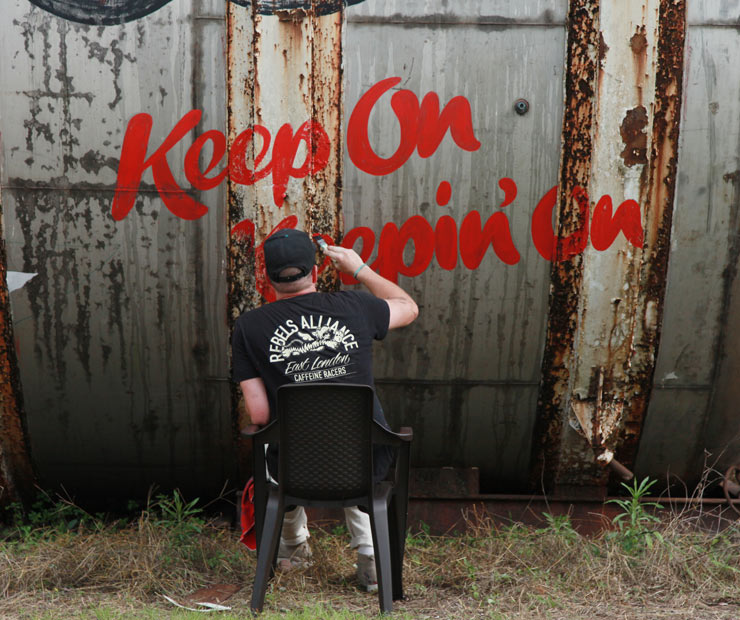
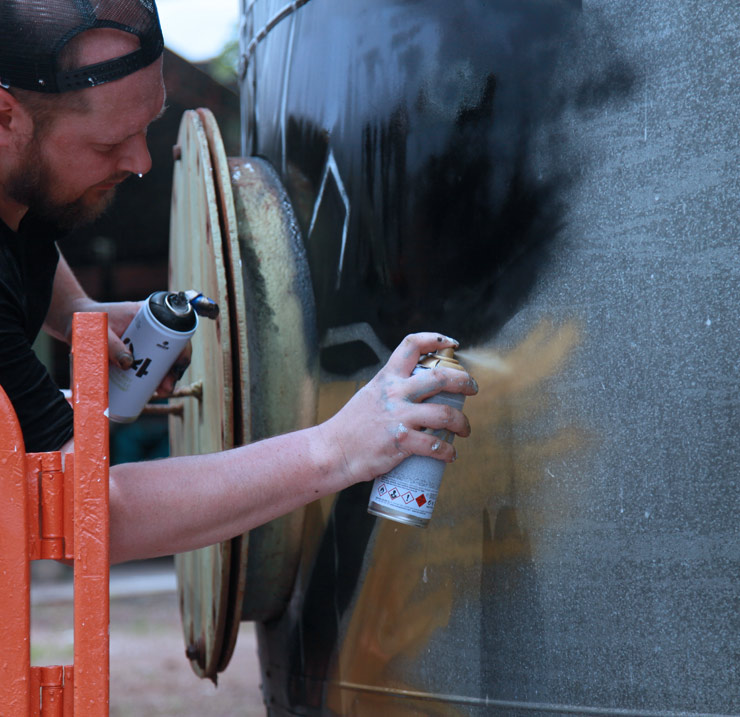
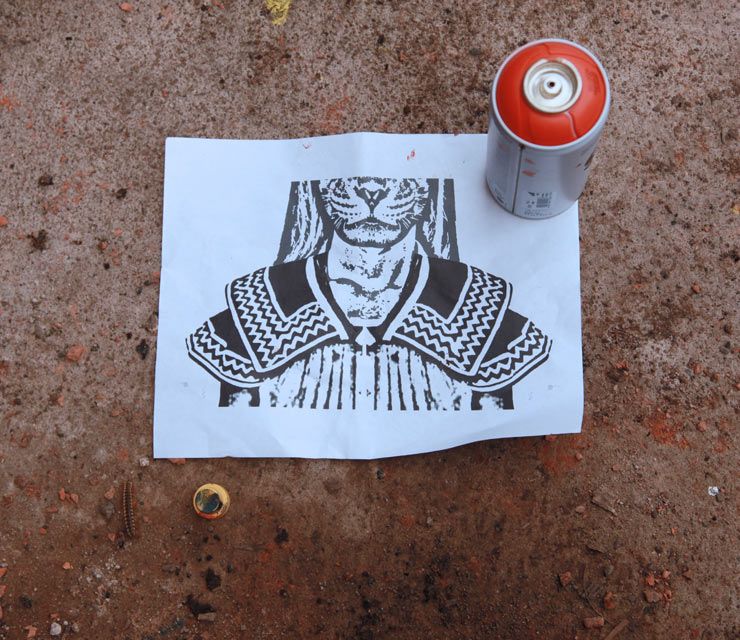
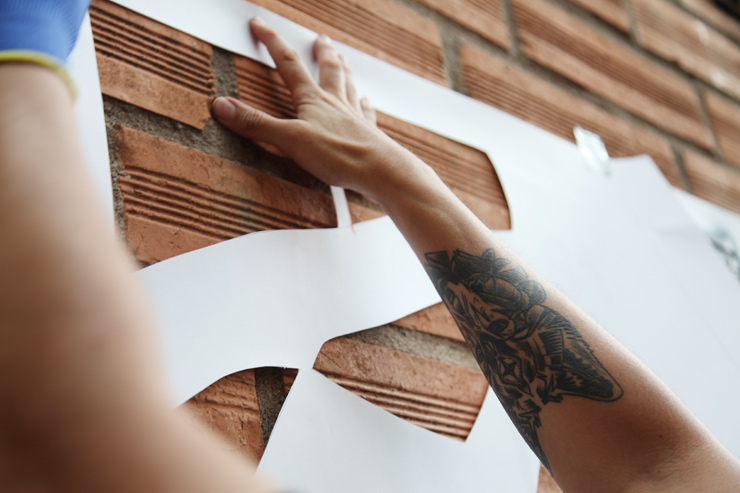
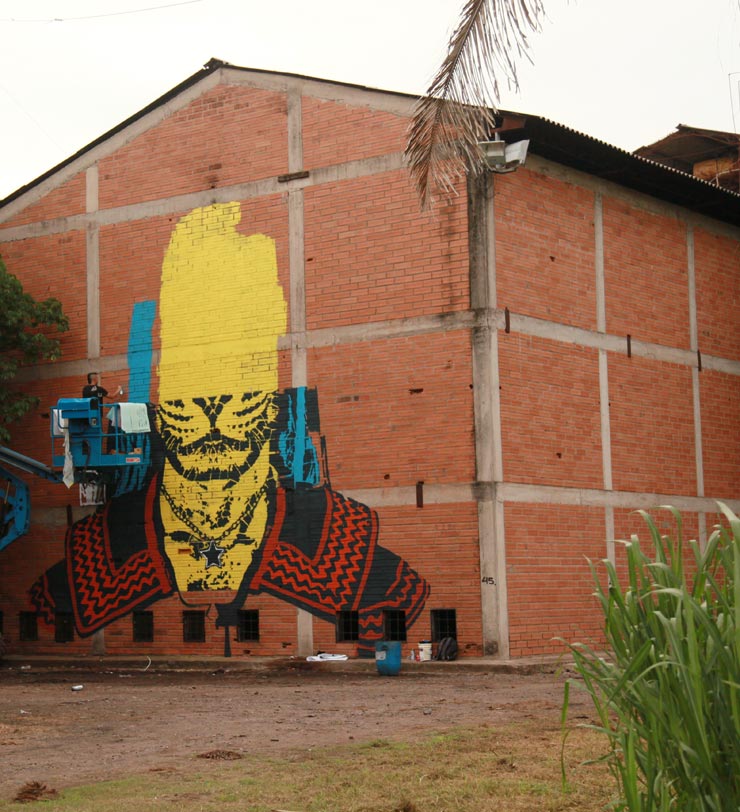
Back at this Colombian factory site for a second day of work, the artists are climbing ladders, tracing out shapes, stepping back to check perspective, and lunging forward for the first genuine phase of painting. The brand new initiative on this industrial site sparks your mind with ideas – nothing seems impossible, actually. The future is unwritten.

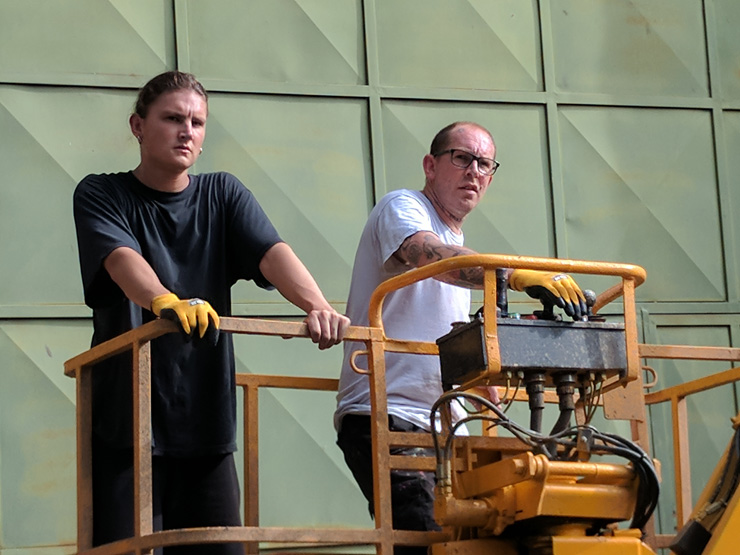
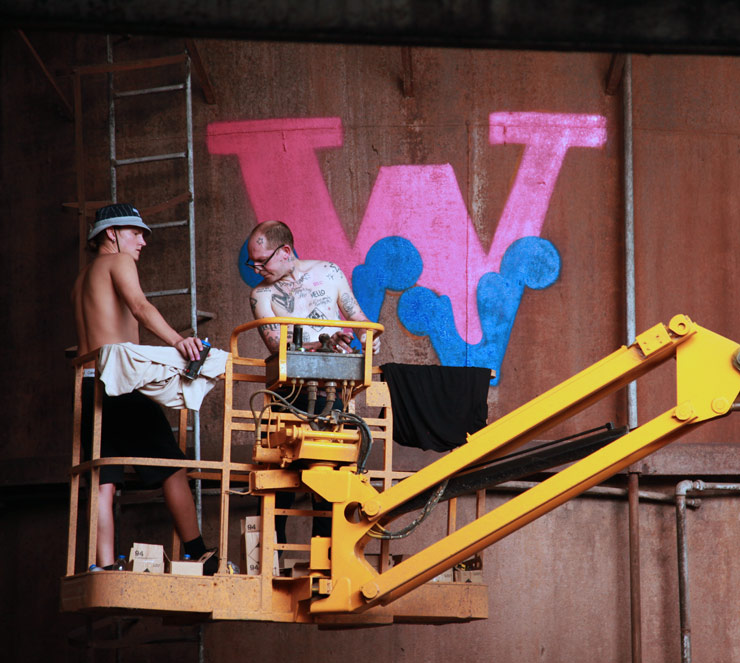
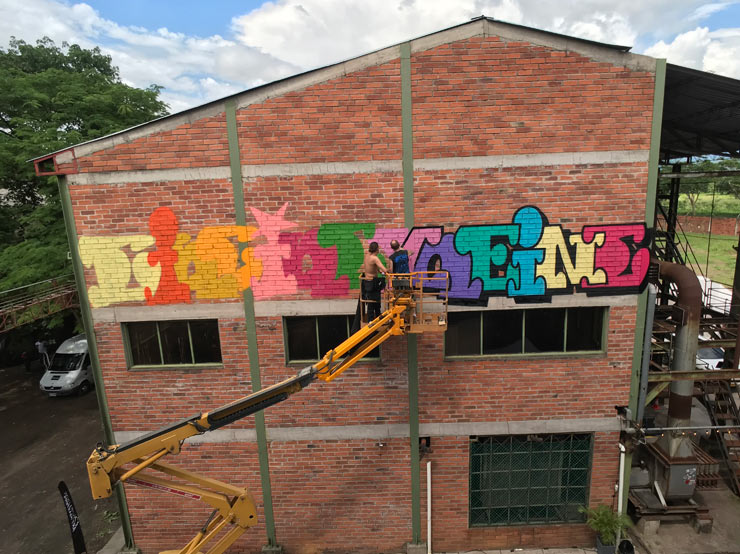
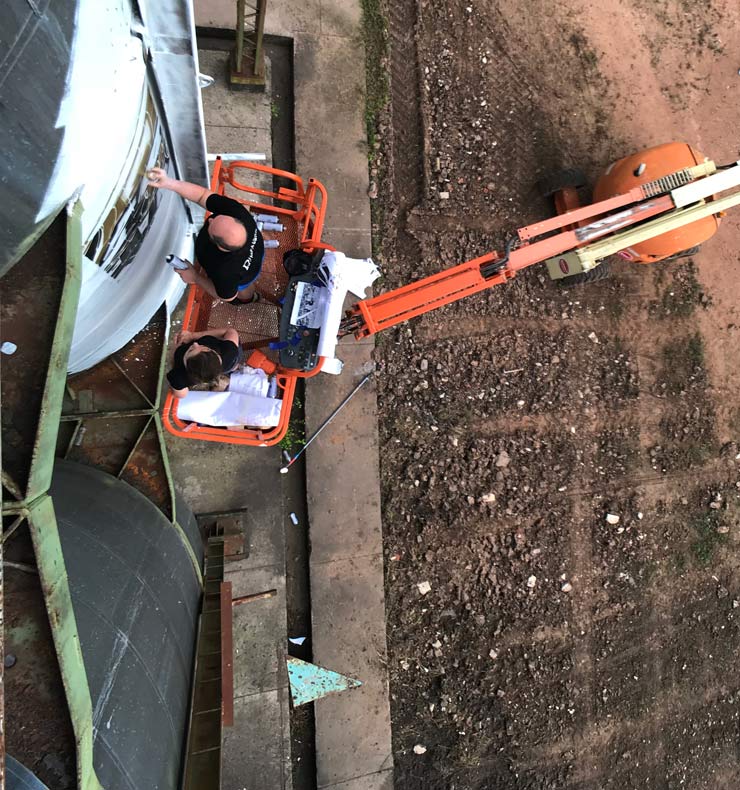
Ben Eine and Connor. Colombia. (photo © Jaime Rojo)

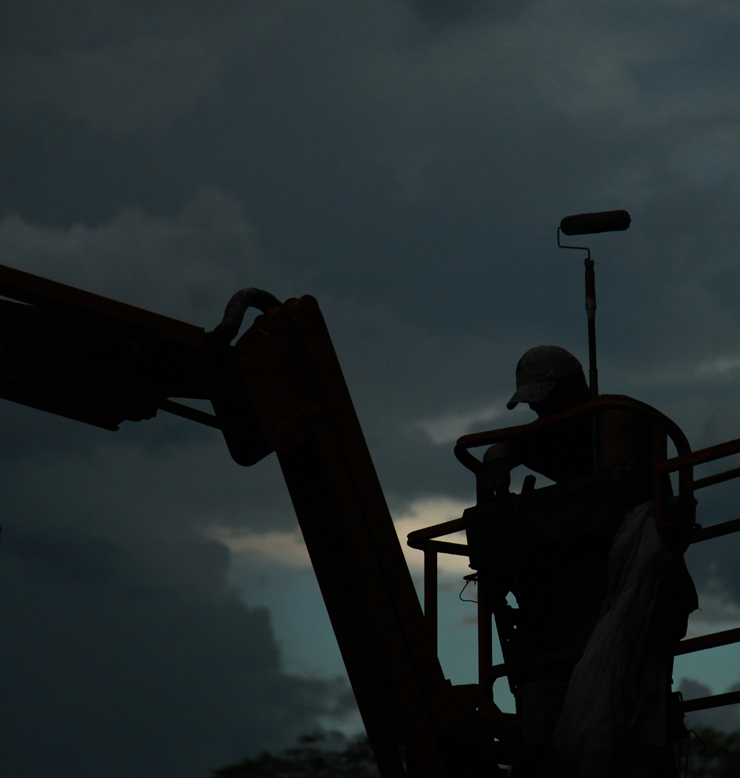
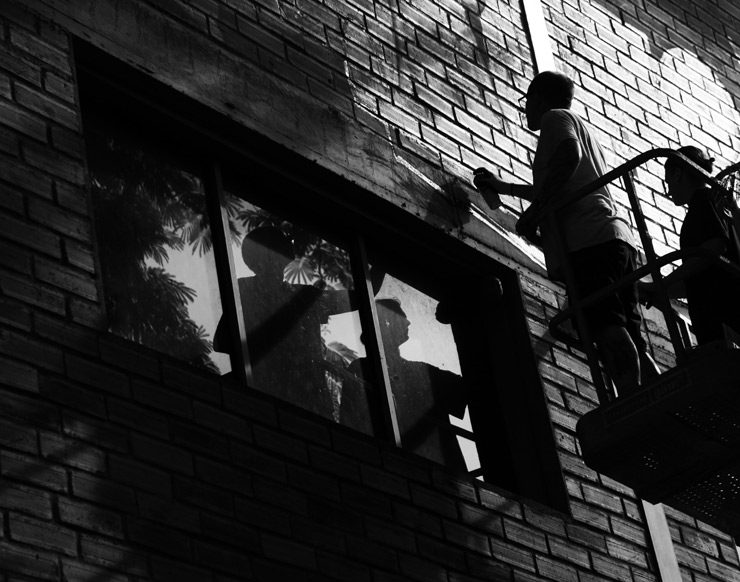
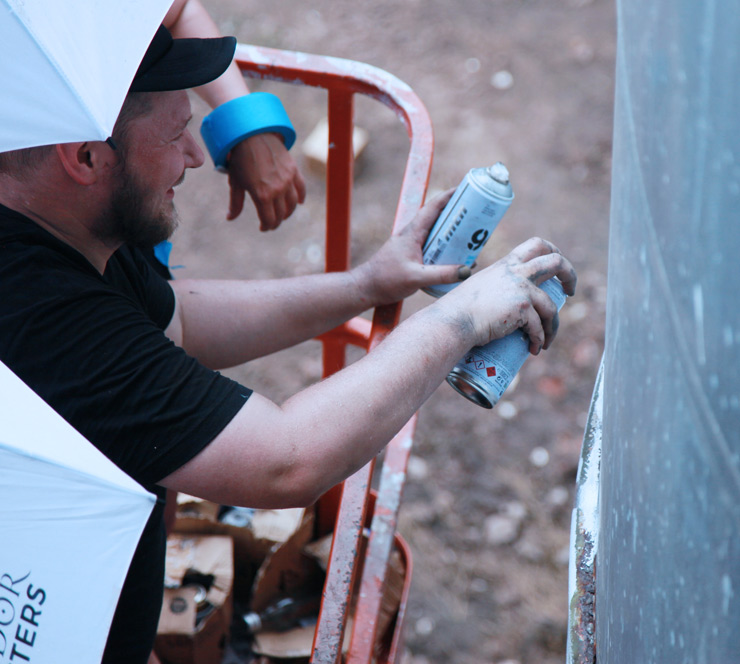
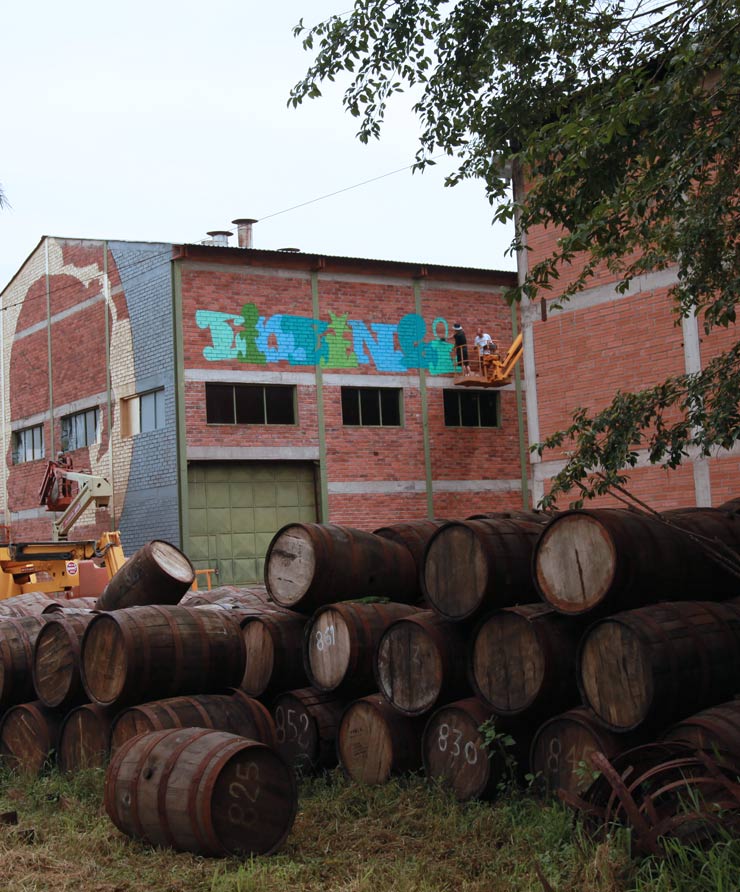
So it seems especially appropriately audacious when you see Ben Eine and his son Collin rolling by you on a massive lift that holds them aloft overhead with cans in hand. You deftly dart out of the way so you are not smushed underneath the massive rubber tires that roll toward you, carefully ducking the occasional leafy limb that is snapped off the tree they are grazing in their metal bucket as they paint, now wrapping to another side of the building.

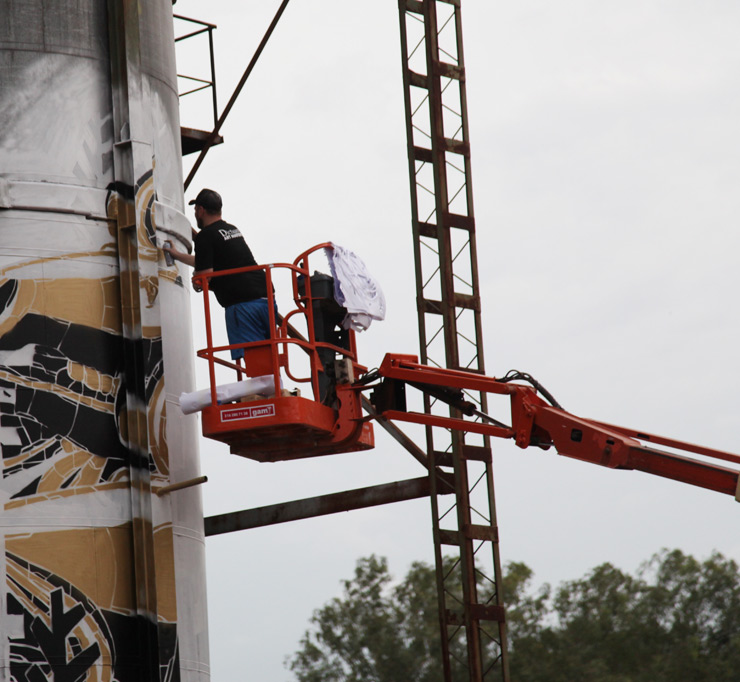
Ben Eine. Colombia. (photo © Jaime Rojo)

They are spraying out a series of Eine’s iconic lettering across the top floor of one of the compound’s brick facades, and suddenly you may have the feeling that this is the first page of a new book being written. We may not yet know what it will say, but you can appreciate the process, two guys from different generations extending their arms toward the wall, can in hand, propelling clouds of aerosol forward, writing a common missive.

Ben Eine. Colombia. (photo © Jaime Rojo)

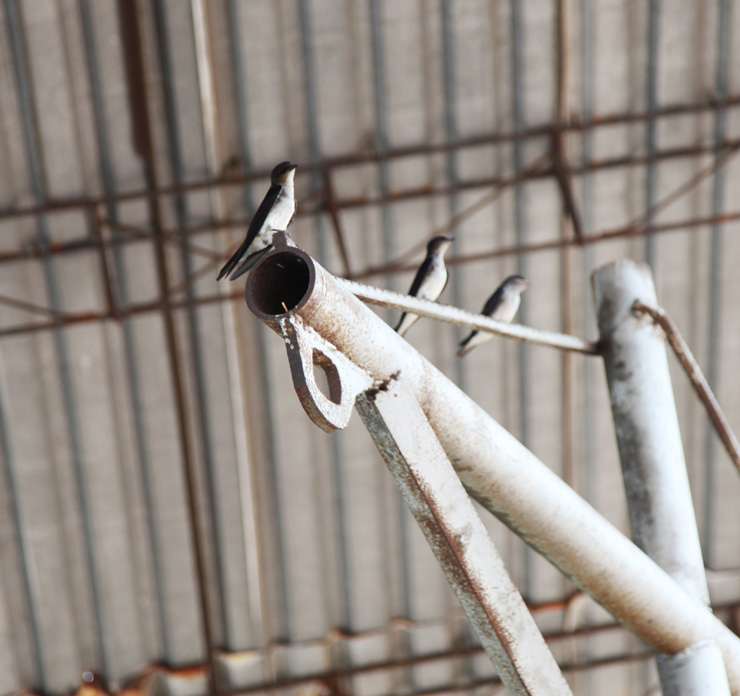
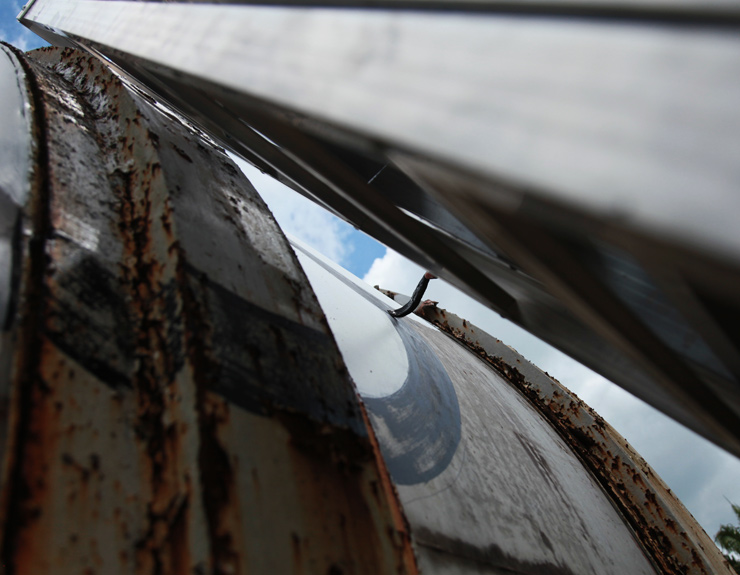
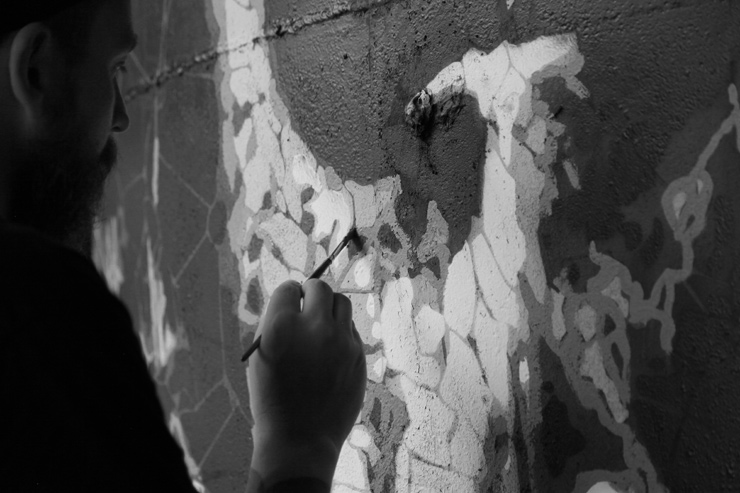
Scattered through these rusty dusty caverns and crooks there are Street Artists at work; with birds and bats and beats filling the air. A new of industry at work, one can  appreciate now how the image is built. It’s a mysterious and sometimes spell-binding unveiling, carefully considered.

With no specific aesthetic guidelines from their hosts and no review of sketches, we are privileged to see these self-driven murals disclosed in real time without prejudice on walls of the artists choosing.

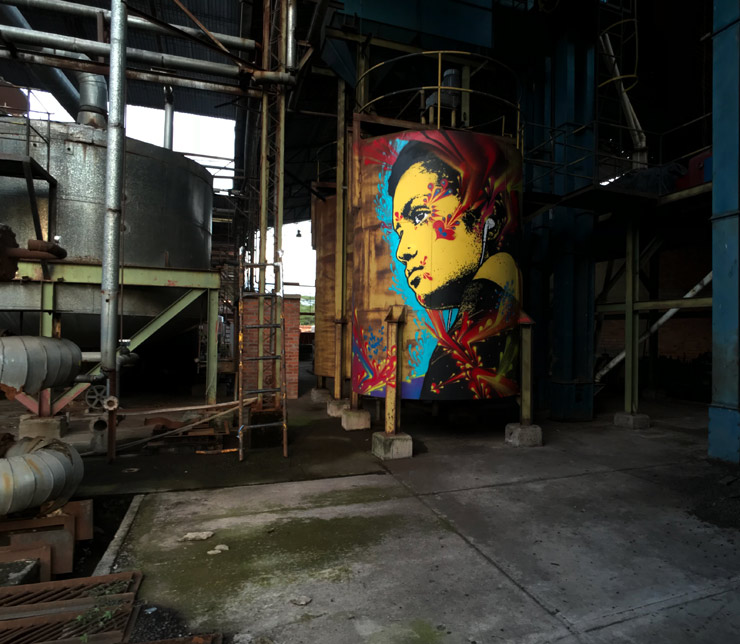
Stinkfish. Colombia. (photo © Jaime Rojo)

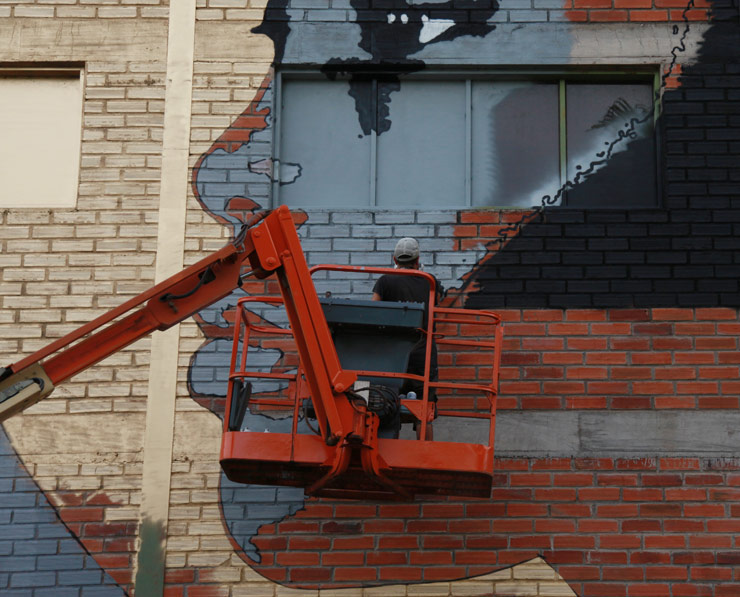
There are myriad processes at play. Placed in the hands of artists who can appreciate the opportunity to create quality works , there is attention to detail and context. Whether it is D*Face’s ironic reappropriation of symbols/text and dramatically tragic heroes – or the pop culture humor of Toxicomano’s leopard queen, or the golden disk framing Stinkfish’s neo Colombian intergalactican icon, its a studied process that makes it happen.

Stinkfish. Colombia. (photo © Jaime Rojo)

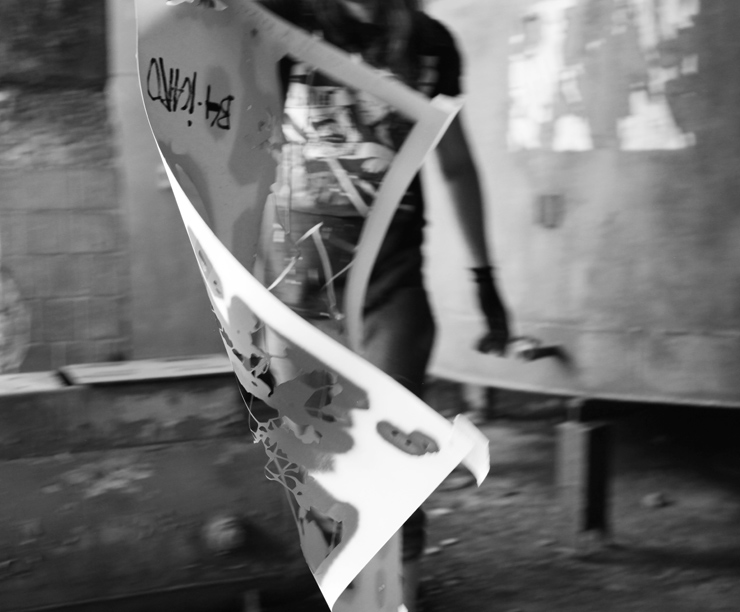
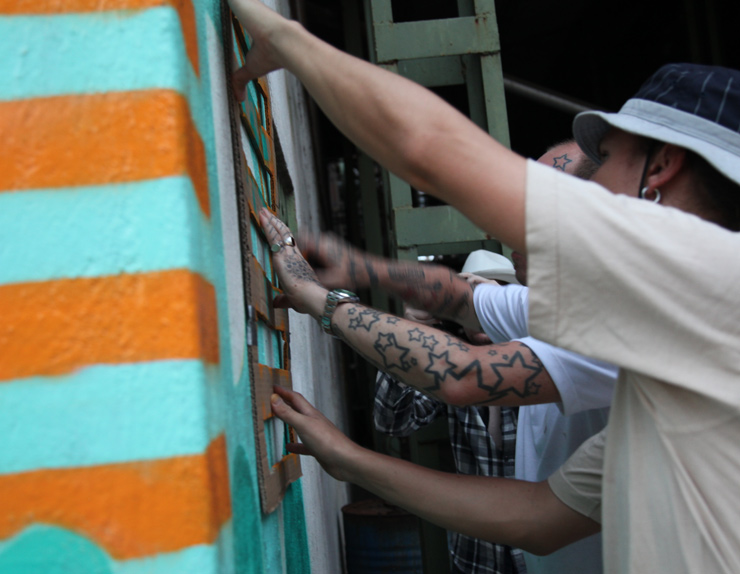
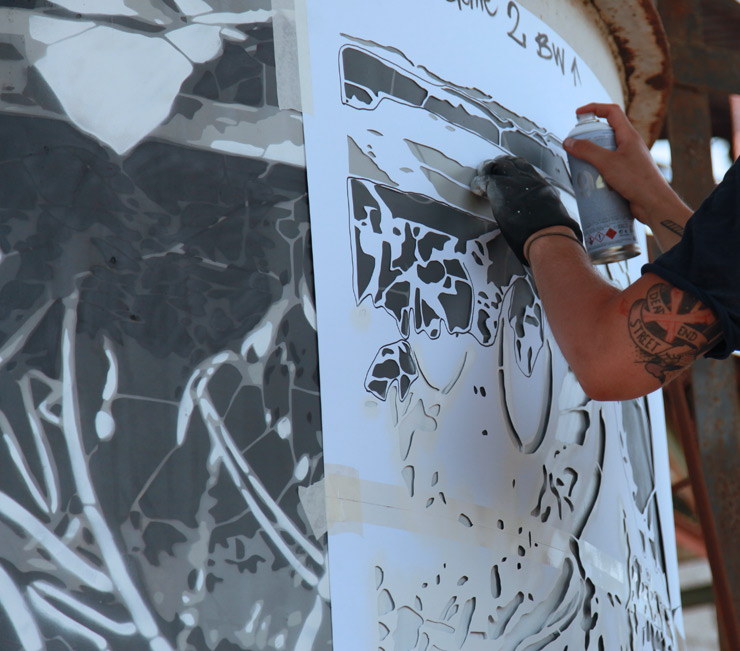
M-City drips with rivers of sweat in the merciless humidity while peeling away one more panel of his four pillar stencil opus called “Goldmine”, his paint encrusted hand dropping another wet cutout with a deft gesture – leaving it to drift in the heavy breeze 3 stories beneath him to the ground.

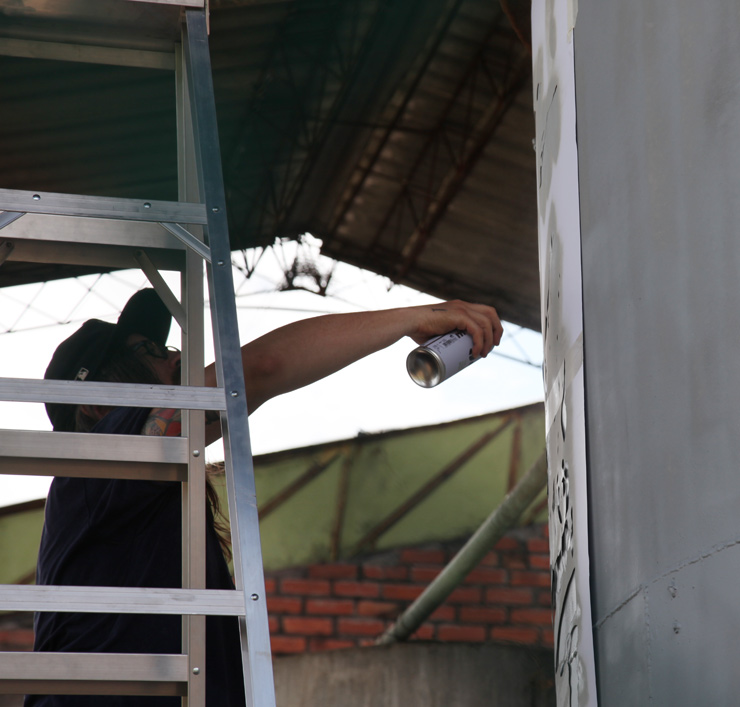
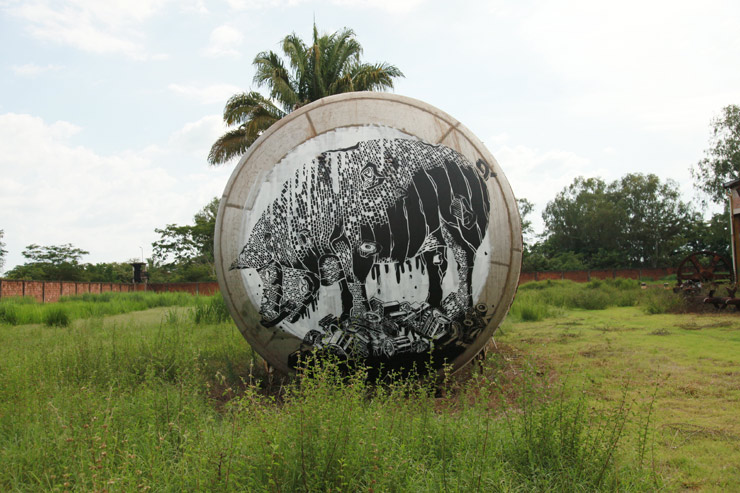
The Monstfur duo carefully balance on ladders to reach and hold stencils, spraying out each textured layer of industrially inspired grayness, careful to align the successive hand-cuts that they are gridding across a tank that previously carried toxic fluids.

Stinkfish. Colombia. (photo © Jaime Rojo)

As this projects’ character is taking shape while we are watching, you see that these artists are pouring themselves into the act properly, giving top flight performances.

It’s part of the process.

D*Face. Colombia. (photo © Jaime Rojo)

D*Face. Colombia. (photo © Jaime Rojo)

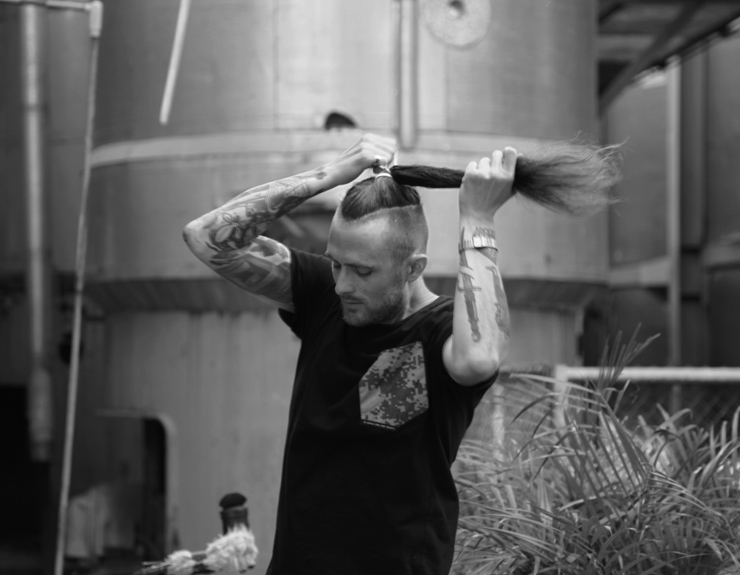
Stephen Thompson of D*Face tam. Colombia. (photo © Jaime Rojo)

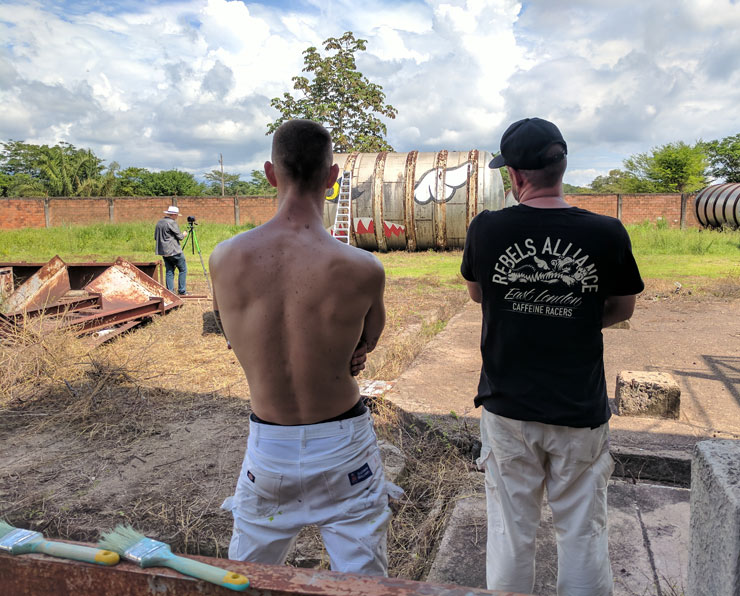
D*Face, Louis and Stephen. Colombia. (photo © Jaime Rojo)

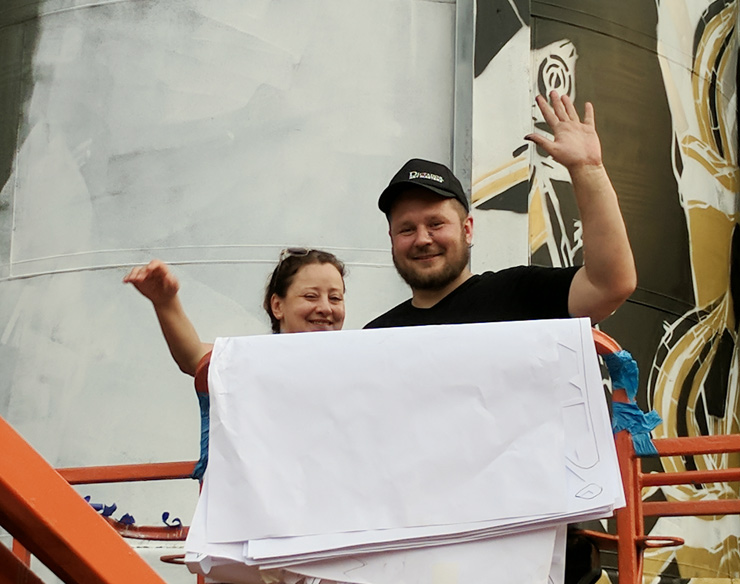
M-City with Martha. Colombia. (photo © Jaime Rojo)

M-City. Colombia. (photo © Jaime Rojo)

M-City. Colombia. (photo © Jaime Rojo)

Monstfur. Colombia. (photo © Jaime Rojo)

Monstfur. Colombia. (photo © Jaime Rojo)

Monstfur. Colombia. (photo © Jaime Rojo)

Toxicomano. Colombia. (photo © Jaime Rojo)

Toxicomano. Colombia. (photo © Jaime Rojo)

Toxicomano. Colombia. (photo © Jaime Rojo)

Stinkfish . Ben Eine. Colombia. (photo © Jaime Rojo)


This event has been made possible by Dictador Art Masters Foundation. To learn more about the foundation click here.

Read more
New Spirits in an Old Distillery : Colombia Diary. Day 1

New Spirits in an Old Distillery : Colombia Diary. Day 1

This week BSA is in an unusual location in Colombia by invitation to see a new initiative with Street Artists in an abandoned distillery now being brought back to life with their imaginations and penchant for transformation. Come along with us for a few days to see what we discover.


The fantasies of graffiti writers and Street Artists are myriad but a few rise to the top; the abandoned factory is like a fever dream for a certain passionate class of urban explorers who crawl through holes in fences and slide through broken windows just to discover what lies inside these neglected hulks of industry – and to leave their mark.

Stinkfish. Colombia. May 2018. (photo © Jaime Rojo)

“So when I began painting in Colombia and mainly in Bogotá I would take a photograph of someone in Bogotá and paint it. When I started to travel and I began to take people from one place to another so for example I took people from Colombia to Mexico. I took a lot of photographs in Mexico and took those images with me to Europe. I enjoyed bringing Mexican and Colombian people to Europe. So of course when I was in Europe I took pictures of this girl who was in the subway in Paris – and I brought her back to Colombia,” says Stinkfish.


In the imagination of many aerosol-armed archaeologists is a vision full of heavy pipes, deep coal ovens, chicken-wired windows, soaring steel silos and rusted rotund tanks, puffy clouds of steam wafting about, electrical boxes with color-coded diagrams, and an endless array of iron walkways and ladders that criss-cross at tight angles and climb higher toward the promising future of the Industrial Revolution.

Imagine what it would be like to have one of these places all to yourself and your friends and instead of fearing the security guard, he is there to protect you.

M-City. Colombia. May 2018. (photo © Jaime Rojo)

This is precisely the project we have walked into – thanks to an invitation from Polish Street Artist and professor M-City, who has convened with Dictador Art Masters Foundation to invite an intimately eclectic mix of European and South American Street Artists to create new pieces inside the hidden compound nestled in leafy palm oil plantations and more than an hour from the nearest city.

M.City. Colombia. May 2018. (photo © Jaime Rojo)

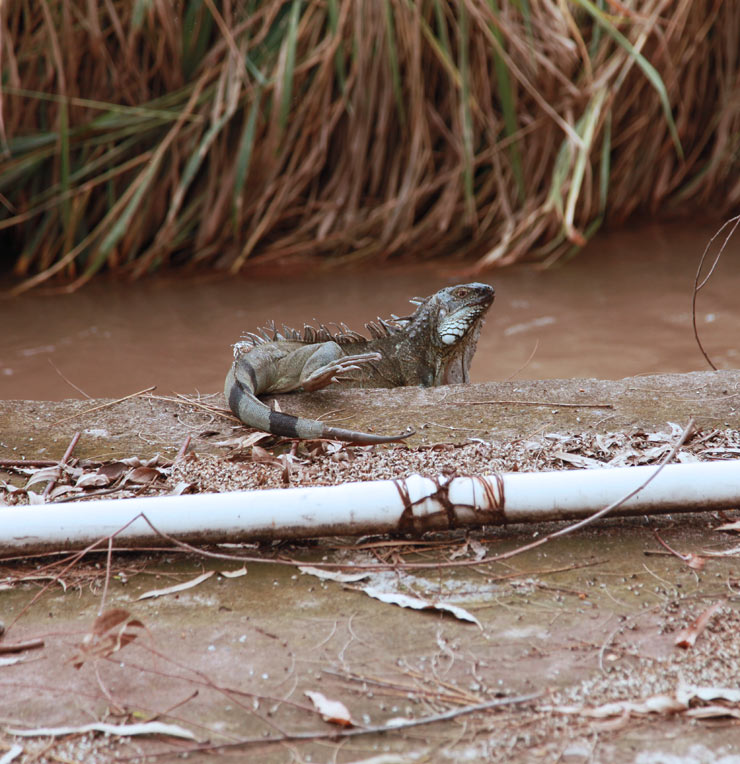
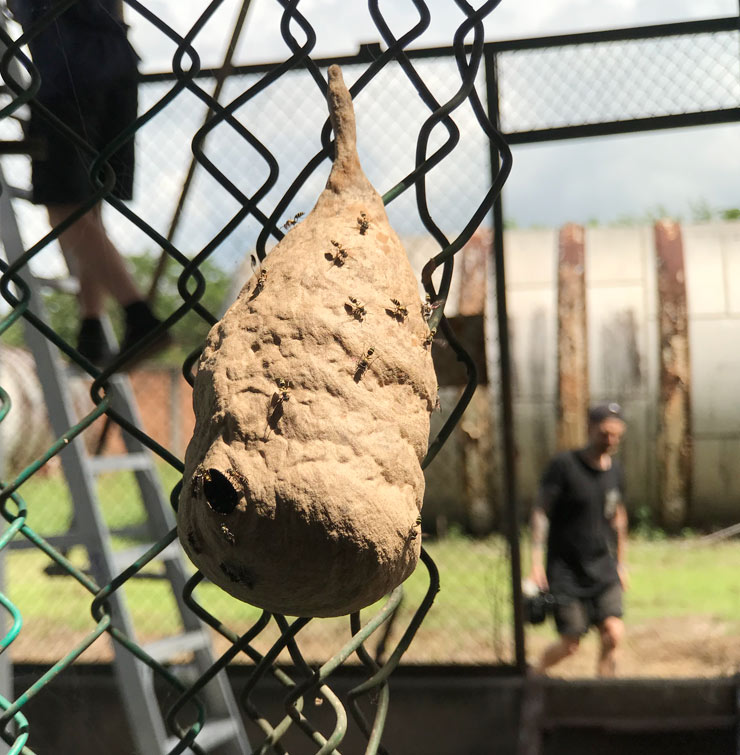
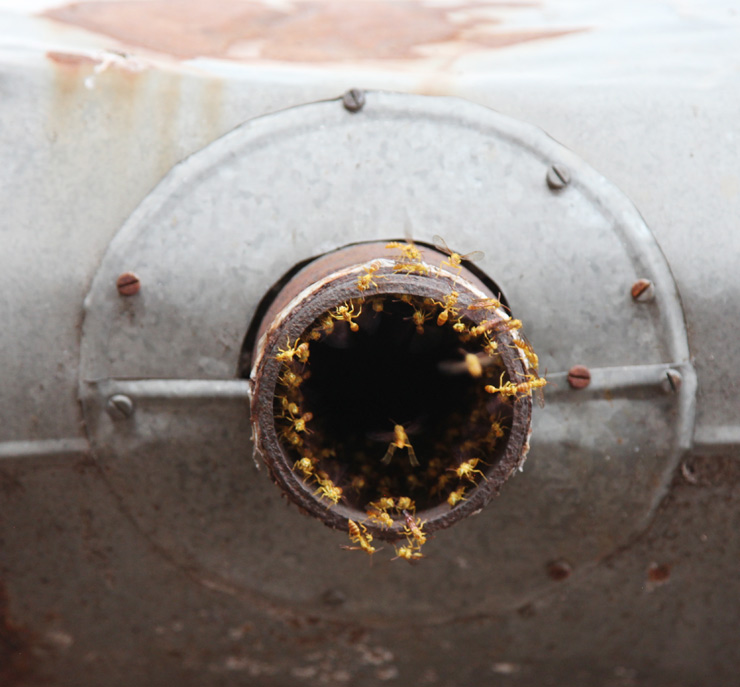
Closed for decades, the former distillery still contains all its necessary armature of equipment and its ovens and tanks and charcoal barrels – along with tall grasses, a murky stream, many centipedes, some blue spotted wood lizards, black iguanas, and the occasional leopard Gecko.

BSA is here in Colombia for the next few days with M-City, D*Face, Stinkfish, Toxicomano, Ben Eine, and Monstfur along with some other special guests. Today we’ll just show you the work of the “advance crew” of M-City and the Colombian Street Artists Stinkfish and Toxicomano who checked out the place a few months ago and tested walls with some work examples just to see if it would be as divertido as they thought it would be to explore the old factory.

It is.

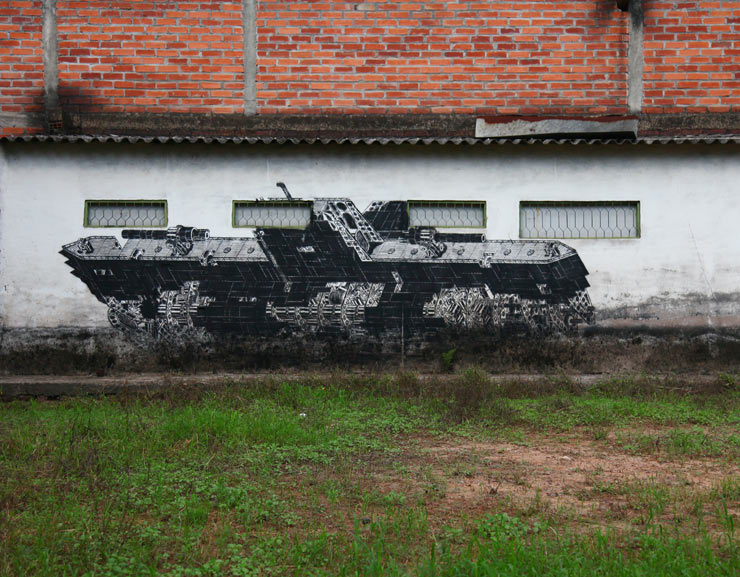
M-City. Colombia. May 2018. (photo © Jaime Rojo)

“This was just for fun it’s sort of an abandoned submarine which I also did it on a canvas,” says M-City. It is also on the wall at Urban Spree in Berlin.”

What appeals most to him about this project? “It’s exciting because it’s very far from my home in Poland and if you look around you see that there’s nothing around here. It is in the middle of nowhere. We just have the palm trees around and the distillery is in the middle. So we do not have a “public” here. The artists are completely free to do what they want and there are not many people around taking pictures – it’s even kind of secret. So it’s private and it is protected. Nobody can just drop in you know?”

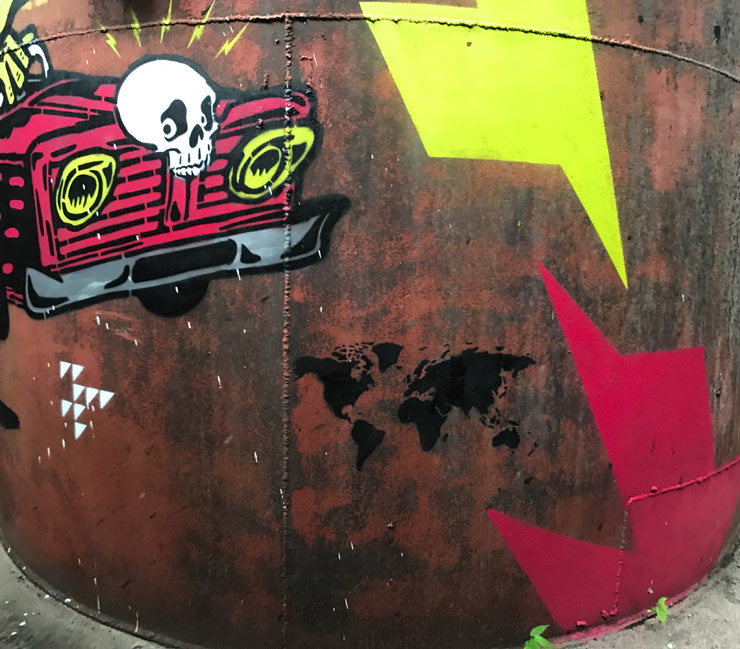
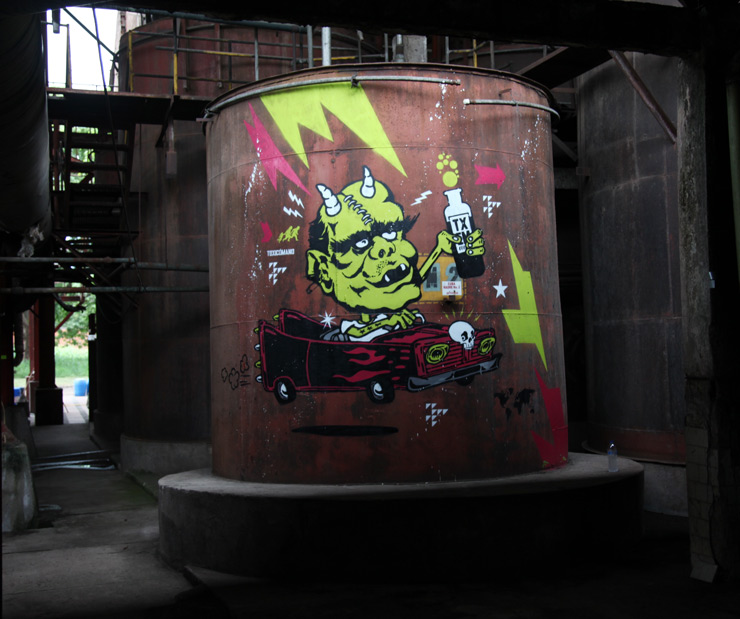
Toxicomano. Colombia. May 2018. (photo © Jaime Rojo)

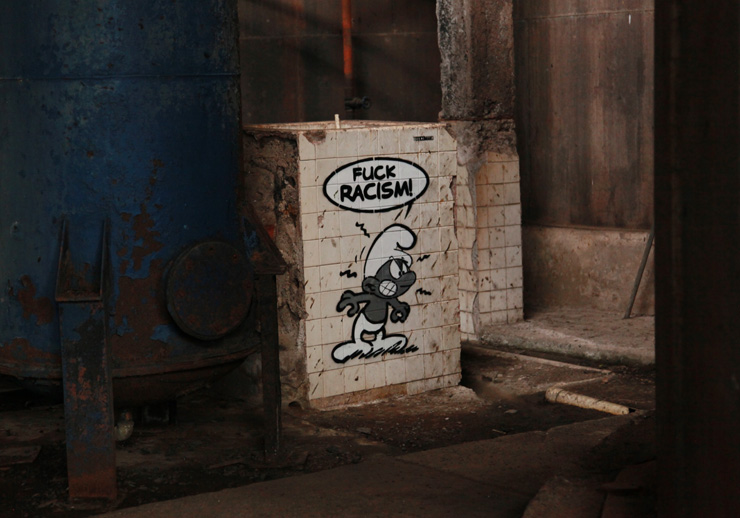
Colombian Street Artist Toxicomano took us on a tour of a number of stencil based pieces he put up in advance of this weeks events, explaining that he likes to reclaim symbols and use them for his own meanings. One Smurf we found on a concrete-splattered tiled basewall says “Fuck Racism”.

“I like to use these images because people have in their minds some common association with it and they remember something about it from when they were a child. Now they can  start to think about it differently.”

“In Colombia we have a mixture of races we have black people we have indigenous people we have roots from Spanish people and now we have American and European influences it’s a lot. We mix a lot of things like a soup like a Latin Americans Full of ingredients and we have a special flavor. Also I think a lot of people think of Smurfs as blue but they don’t know that the first Smurf comic was actually a black Smurf and in that particular story the blue Smurfs have a problem with the black Smurf.”

Toxicomano. Colombia. May 2018. (photo © Jaime Rojo)

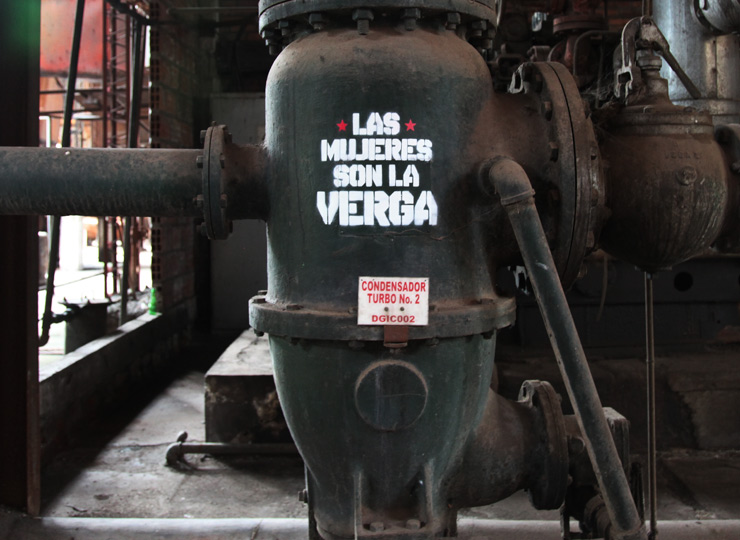
“This stencil got me in a lot of trouble on Instagram,” he says the stencil that says “Las mujeres son la verga” (roughly “Women are the dick”) – mostly because it is a slang that is interpreted differently across Latin America and Spain – including within his own native Colombia. Some thought it insulted women, others thought it empowers them. He says he really enjoyed seeing the differences of opinion  but regretted that some of the comments got into personal attacks. “I preferred to not comment and to observe,” he says.

Toxicomano. Colombia. May 2018. (photo © Jaime Rojo)

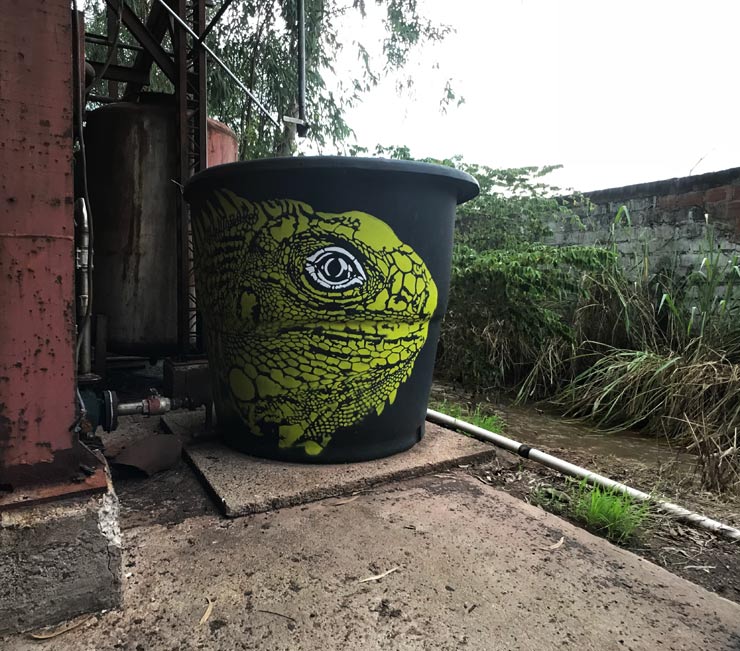
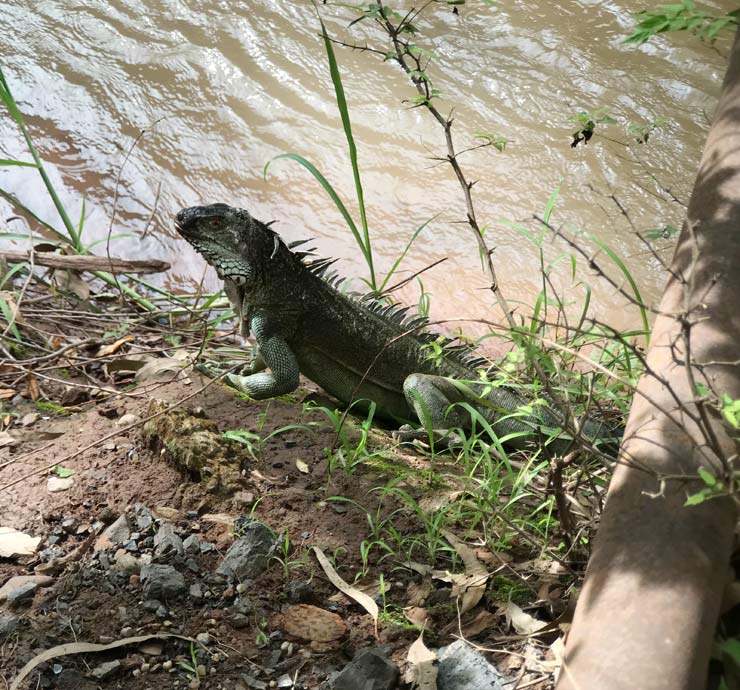
Our friends the lovely iguanas at the distillery in Codazzi, Colombia. May 2018. (photo © Jaime Rojo)

Toxicomano. Colombia. May 2018. (photo © Jaime Rojo)

Toxicomano. Colombia. May 2018. (photo © Jaime Rojo)

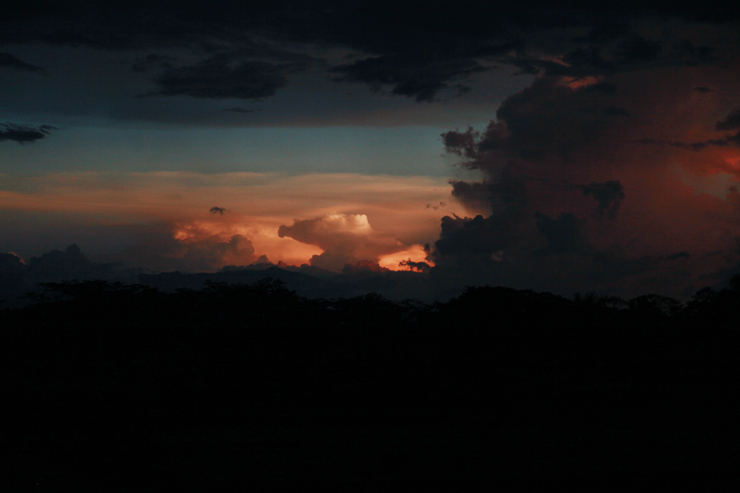
Sunset at the distillery. Colombia. May 2018. (photo © Jaime Rojo)


This event has been made possible by Dictador Art Masters Foundation. To learn more about the foundation click here.

Read more
BSA Images Of The Week: 05.13.18

BSA Images Of The Week: 05.13.18


BSA-Images-Week-Jan2015

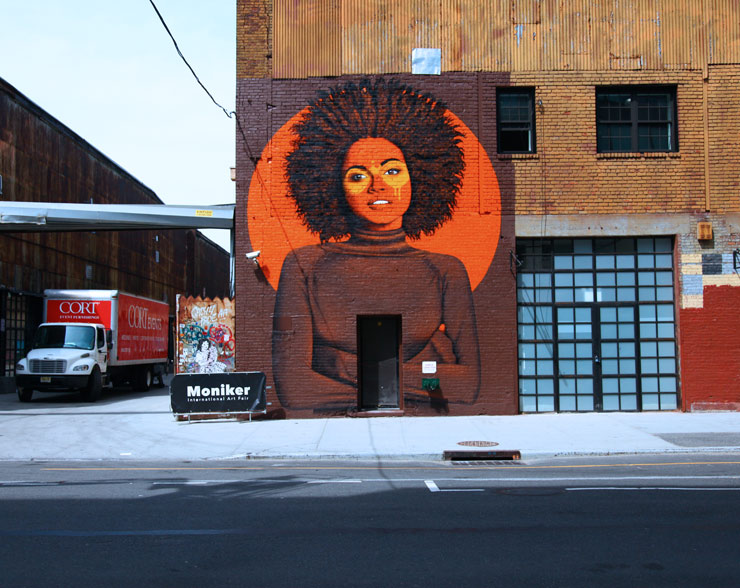
A lot of action in Brooklyn these last few weeks thanks to a number of artists swinging through town for the Moniker Art Fair in Greenpoint, as well as the annual peregrination of artists who are arriving in the city that begins in earnest after the last danger of frost has passed.

If you are in NYC you may like to swing by the Quin Hotel to see the “In Bloom”group show in the lobby that opened Thursday co-curated by DK Johnston and Lori Zimmer and the “Chimera” 3-artist show at GR gallery with 1010, Ron Agam, and Nelio. We def recommend the Rammellzee show at Red Bull Arts  – many praises to Carlo McCormick and Max Wolf and team for pulling that one off. In case you missed our interview with Carlo, here it is: Rammellzee, Racing For Thunder, and Interview with Carlo McCormick

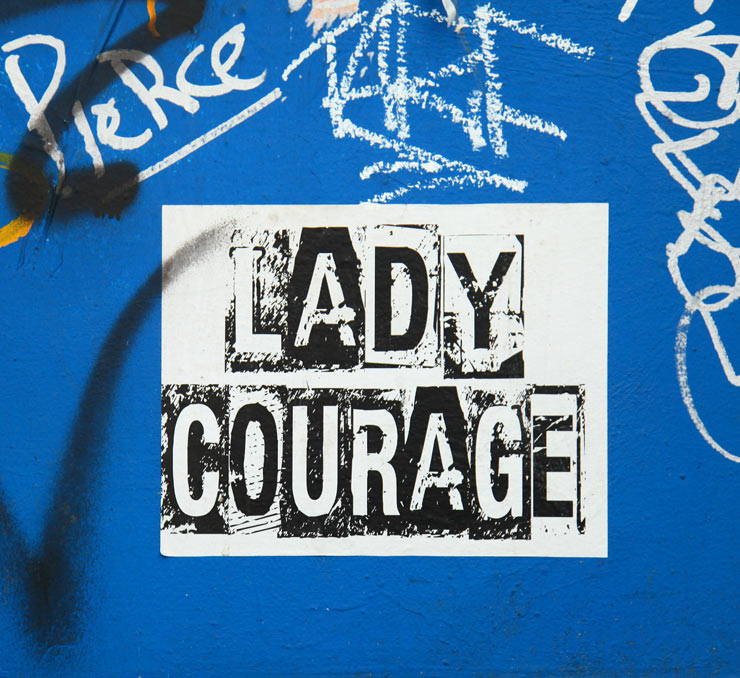
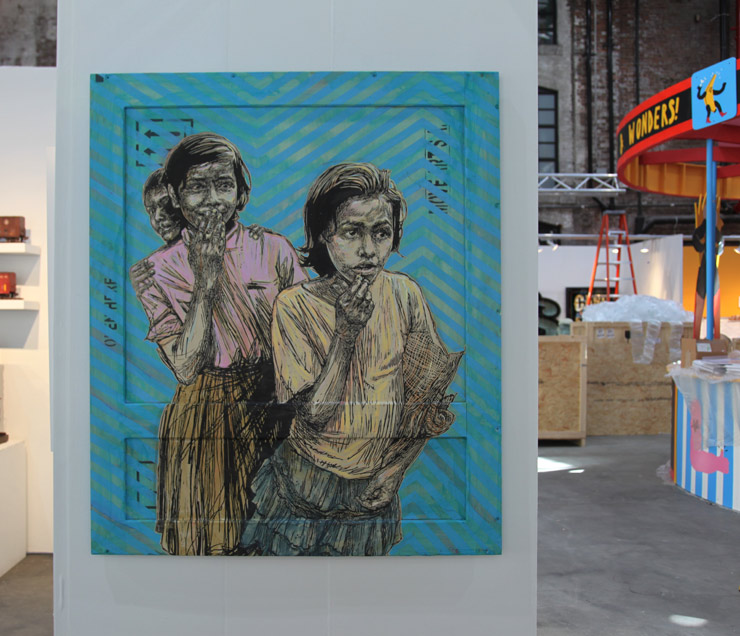
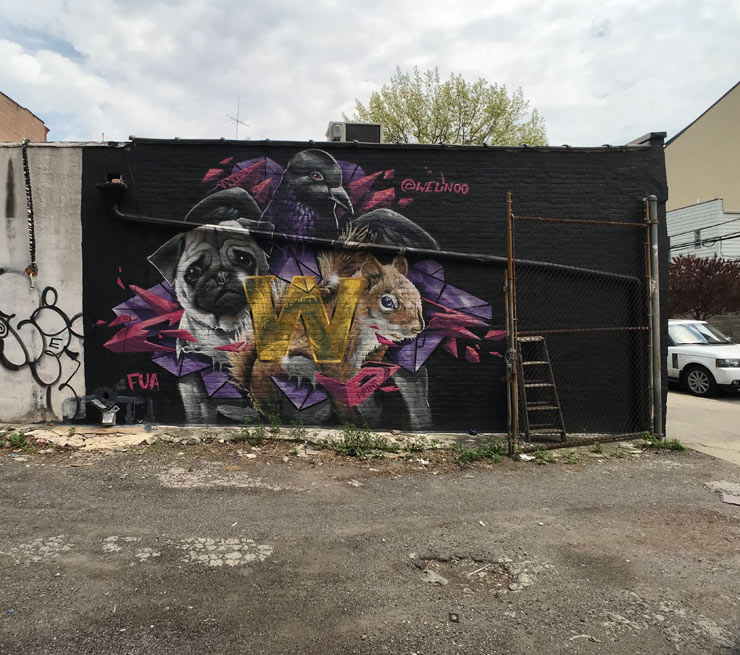
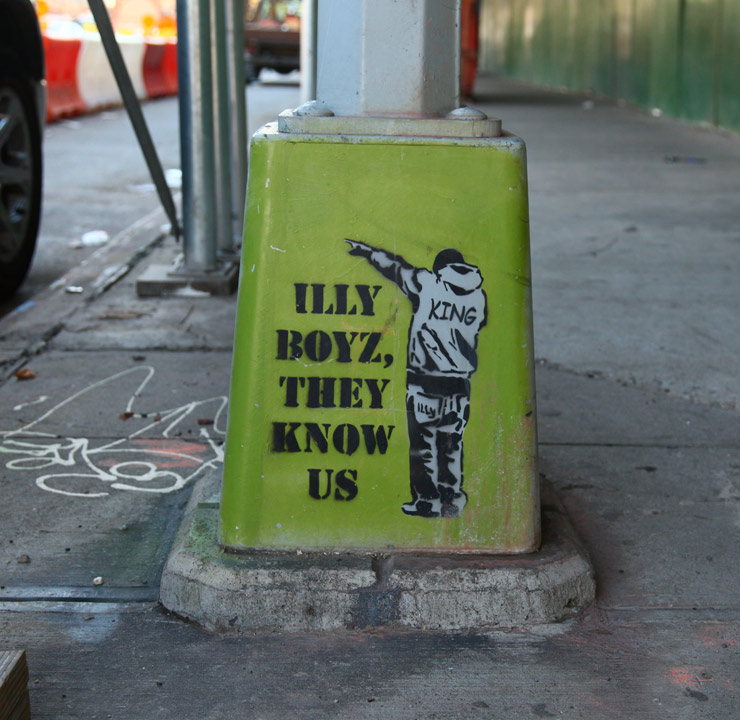
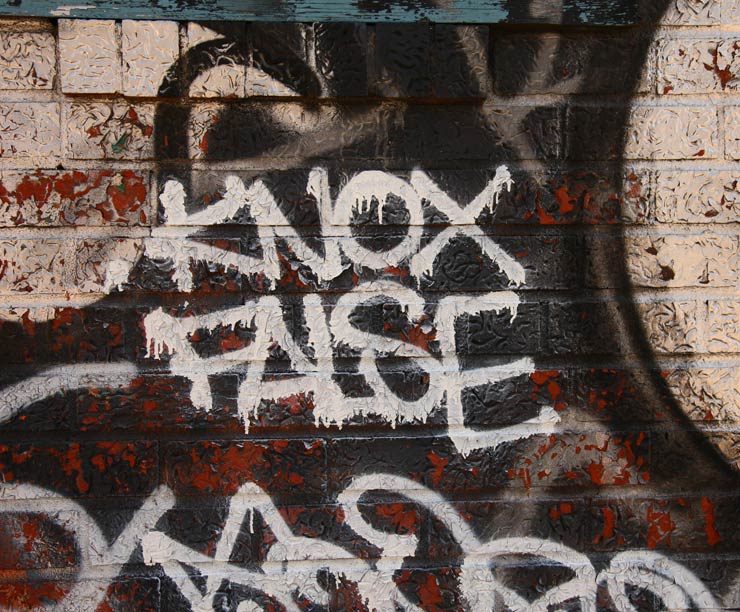
Here’s our weekly interview with the streets, this week featuring Brusk, Buff Monster, False, finDAC, King Amsterdam, Knox, Lady Courage, Low Key Steezo666, Lunge Box, Sonny Sundancer, Swoon, and Wellnoo.

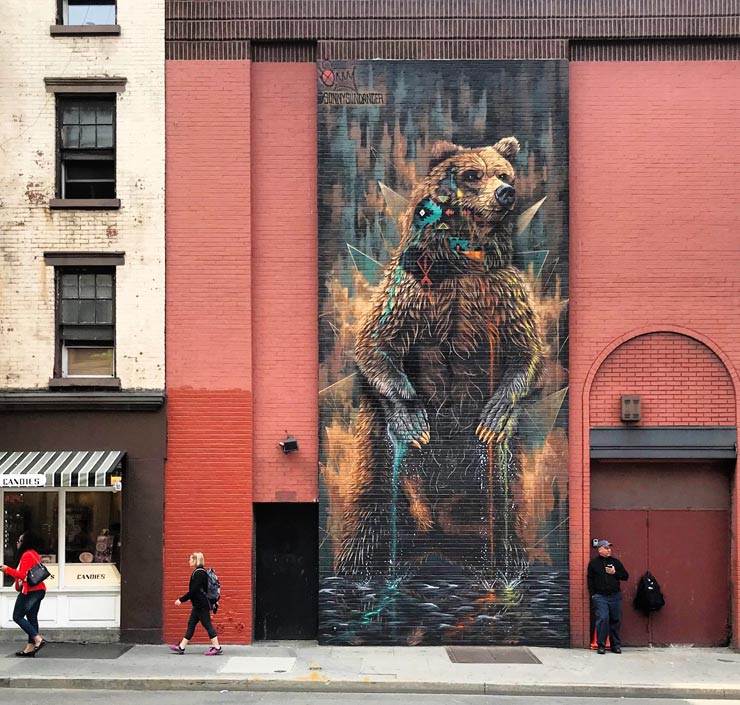
Top Image: Sunny Sundancer finishes his final mural for his #totheboneproject , a grizzly titled “Standing Tall” looking out over Greenwich Village, done in conjunction with The L.I.S.A Project NYC. (photo © Jaime Rojo)

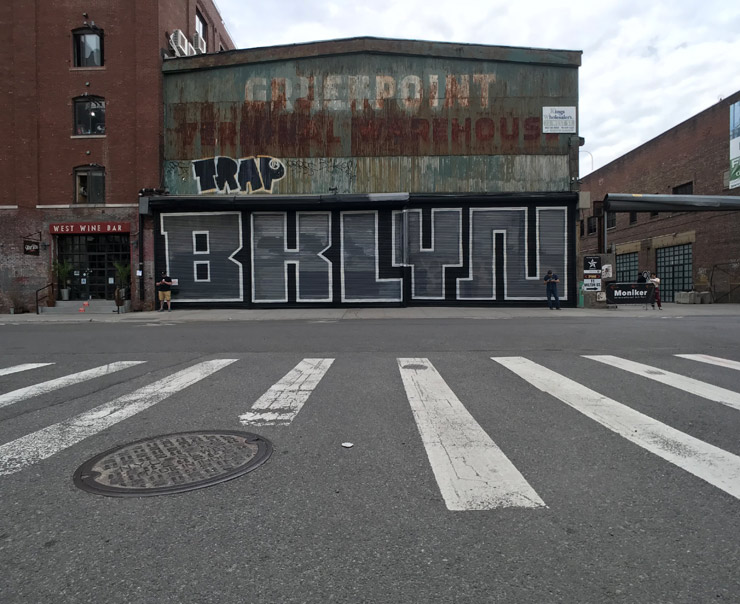
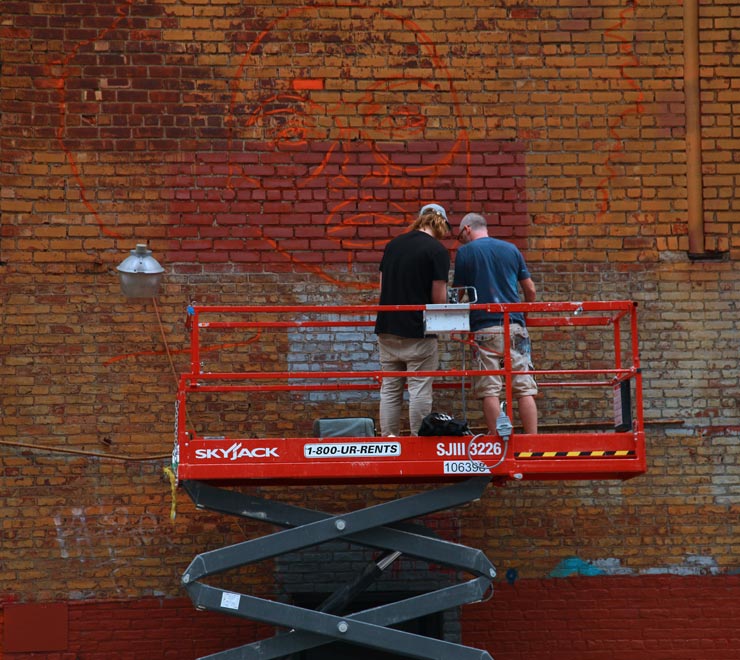
Skewville for Moniker Art Fair. Greenpoint, Brooklyn. TRAP on top. (photo © Jaime Rojo)

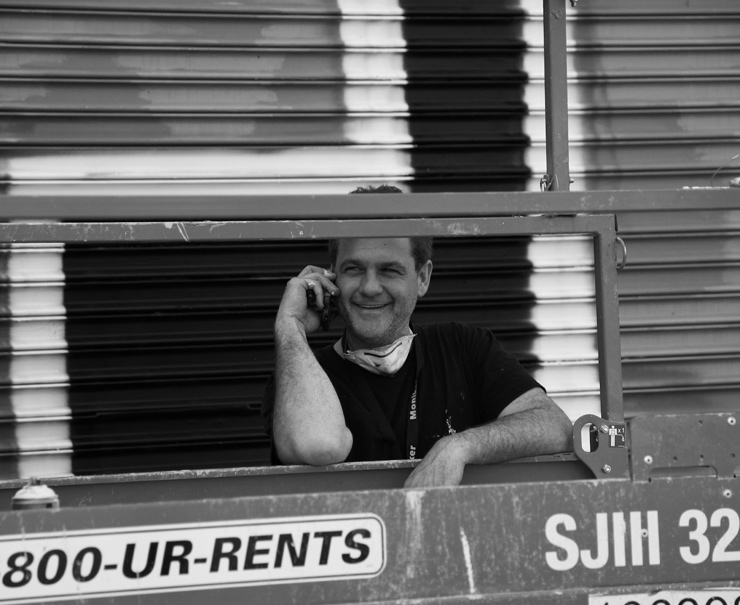
Skewville taking a break to gossip. (photo © Jaime Rojo)

FinDac for Moniker Art Fair in collaboration with The L.I.S.A. Project NYC. (photo © Jaime Rojo)

FinDac for Moniker Art Fair in collaboration with The L.I.S.A. Project NYC. (photo © Jaime Rojo)

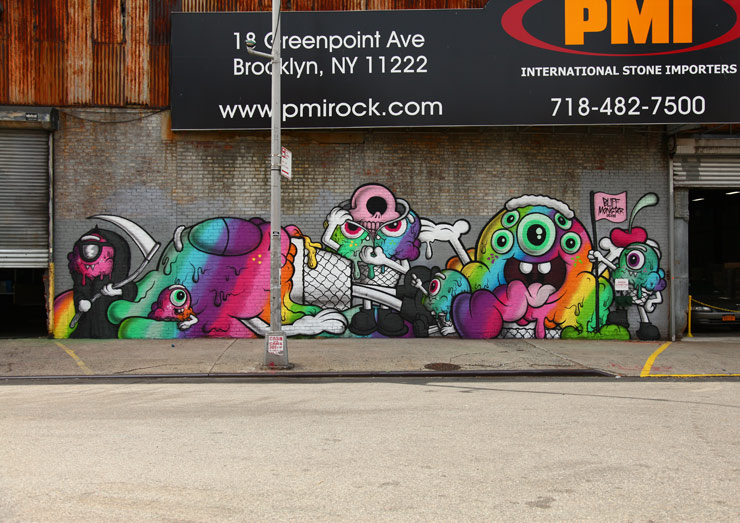
Buff Monster for Moniker Art Fair in collaboration with The L.I.S.A. Project NYC. (photo © Jaime Rojo)

Brusk for Moniker Art Fair in collaboration with The L.I.S.A. Project NYC. (photo © Jaime Rojo)

Brusk for Moniker Art Fair in collaboration with The L.I.S.A. Project NYC. (photo © Jaime Rojo)

Brusk for Moniker Art Fair in collaboration with The L.I.S.A. Project NYC. (photo © Jaime Rojo)

Unidentified artist (photo © Jaime Rojo)

Unidentified artist (photo © Jaime Rojo)

Lunge Box (photo © Jaime Rojo)

Low Key Steezo666 (photo © Jaime Rojo)

Lady Courage (photo © Jaime Rojo)

Swoon at Moniker Art Fair. Greenpoint, Brooklyn. (photo © Jaime Rojo)

Welinoo (photo © Jaime Rojo)

King Amsterdam (photo © Jaime Rojo)

Knoz . False (photo © Jaime Rojo)

Read more
TwoOne Brings Great White Egret to Lieusant (Seine et Marne)

TwoOne Brings Great White Egret to Lieusant (Seine et Marne)

Japanese Street Artist/ Fine artist TWOONE is a man/beast. At least those are his favorite subjects to depict and merge, whether he is on a wall in a neglected building, or on film illuminated from behind, on a dripping illustration on a canvas, or spanning across an ambitious mural.

The Mid-80s millennial Hiroyasu Tsuri currently lives in Berlin, where he has done at least one huge wall and a solo show at Urban Spree, and he has created his realistic fantasy animals and people in his hometown of Yokohama, Brooklyn, Hong Kong, Melbourne, Perth, Djerba, Miami, Milan, and Bangkok, among other places.

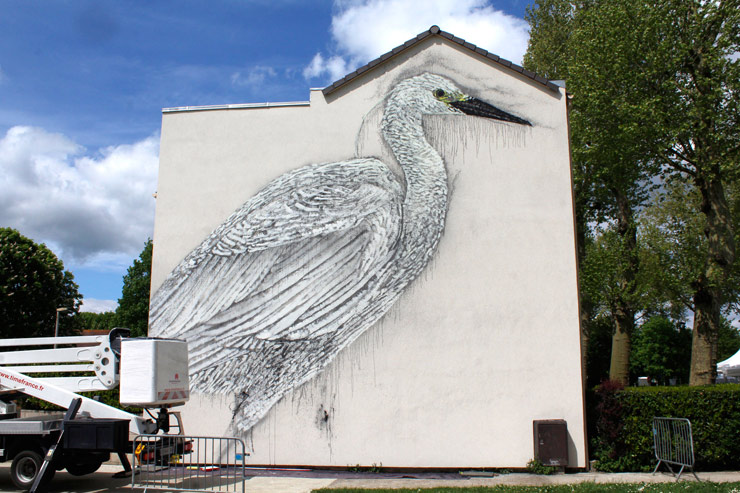
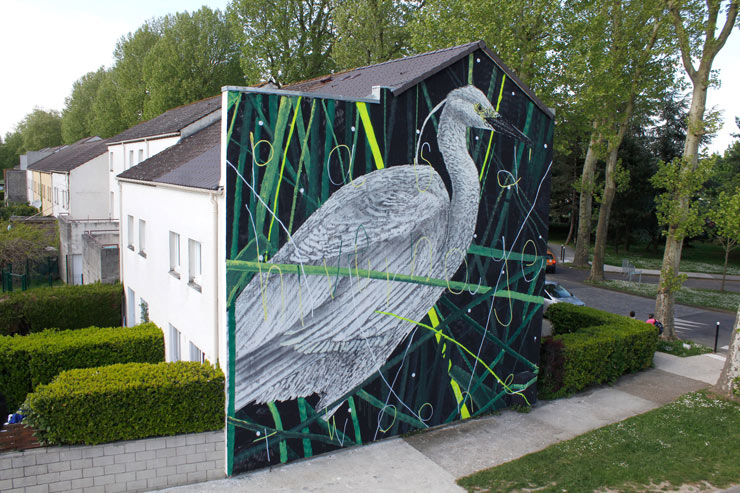
TWOONE for Wall Street Art Festival of Grand Paris Sud. Lieusaint (Seine et Marne), France. (photo courtesy of MathGoth Galerie)

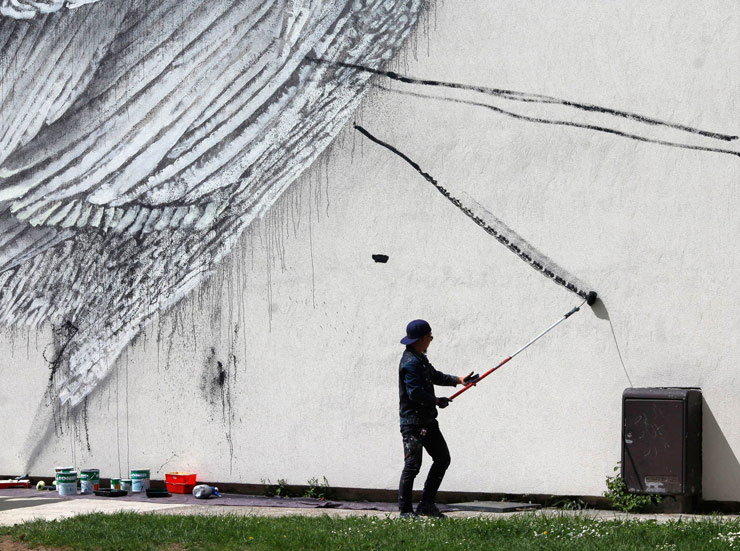
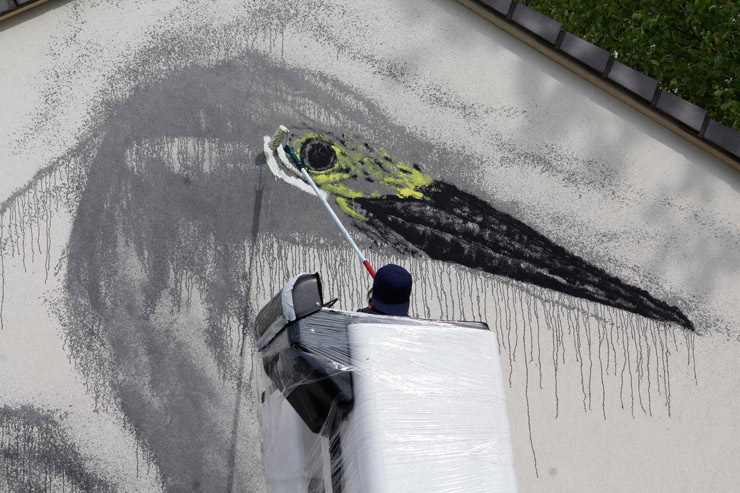
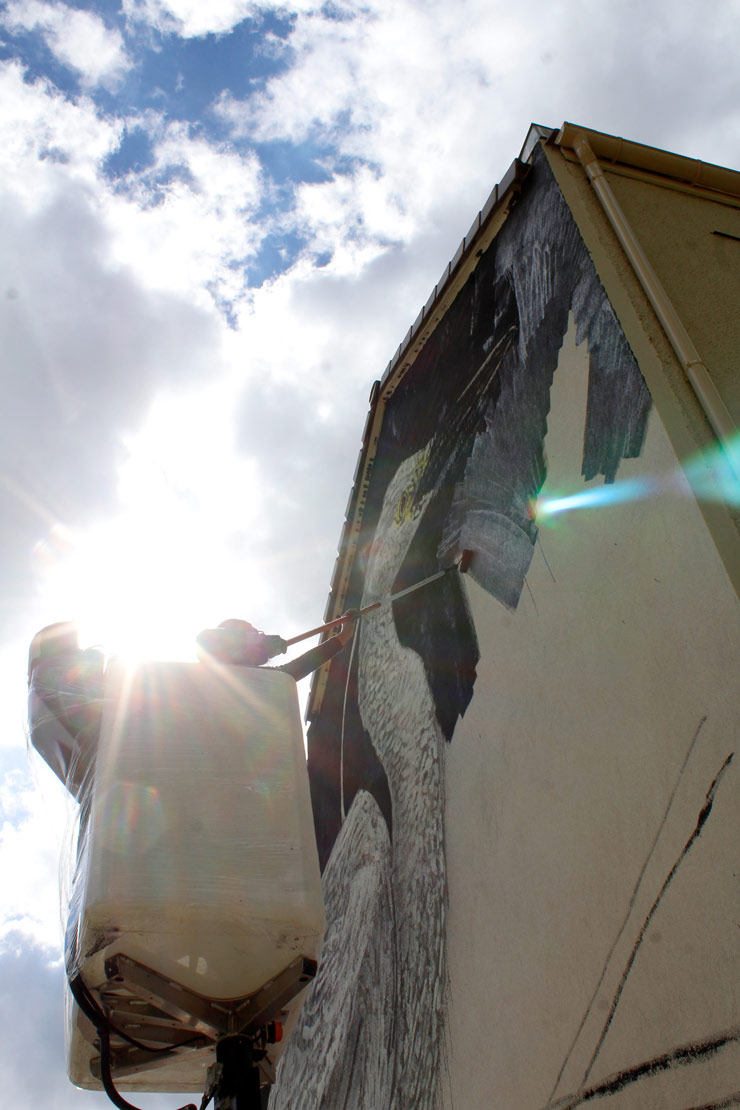
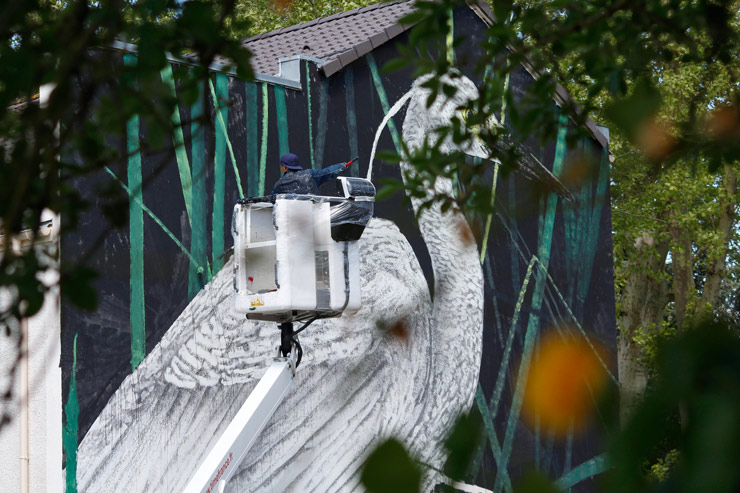
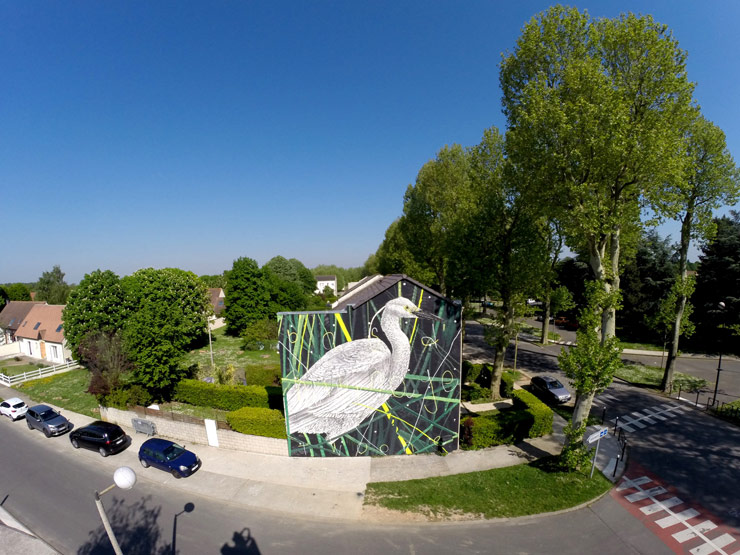
Today we find him with Gallerie Mathgoth and the new 2018 edition of the Wall Street Art Festival, which is primarily sited in Grand Paris Sud. His tropical looking scene actually frames a locally sourced bird, the stately and elegant egret, which is not uncommon here in Lieusant (Seine et Marne) – a town which boast humans also, 13,000 of them. According to Łukasz Ławicki, the population of the great white egret in France is more than 5,000. Check out TWOONE’s unique approach to tagging this big bird. Our thanks to Gautier and the gallery for sharing these installation photos with BSA readers.

TWOONE for Wall Street Art Festival of Grand Paris Sud. Lieusaint (Seine et Marne), France. (photo courtesy of MathGoth Galerie)

TWOONE for Wall Street Art Festival of Grand Paris Sud. Lieusaint (Seine et Marne), France. (photo courtesy of MathGoth Galerie)

TWOONE for Wall Street Art Festival of Grand Paris Sud. Lieusaint (Seine et Marne), France. (photo courtesy of MathGoth Galerie)

TWOONE for Wall Street Art Festival of Grand Paris Sud. Lieusaint (Seine et Marne), France. (photo courtesy of MathGoth Galerie)

TWOONE for Wall Street Art Festival of Grand Paris Sud. Lieusaint (Seine et Marne), France. (photo courtesy of MathGoth Galerie)

TWOONE for Wall Street Art Festival of Grand Paris Sud. Lieusaint (Seine et Marne), France. (photo courtesy of MathGoth Galerie)

Read more
BSA Film Friday: 05.11.18

BSA Film Friday: 05.11.18

bsa-film-friday-JAN-2015

Our weekly focus on the moving image and art in the streets. And other oddities.

Now screening :
1. RERO, Hendrik Beikirch, Kouka and David Mesguich at Montresso Foundation in Morocco
2. TWOONE: Wall Street Art Festival of Grand Paris Sud / Galerie Mathgoth
3. Low Bros #sweet15s Episode 11 / Miami

bsa-film-friday-special-feature

BSA Special Feature: RERO, Hendrik Beikirch, Kouka and David Mesguich.

Jardin Rouge just outside of Marrakech continues to expand its offerings with an exhibition space run by the Montresso Foundation that rivals many museums. You may recall our visit to the compound a little while ago “Jardin Rouge: A Unique Garden For Street Artists To Grow In”.

Here we have an inside look at Street Artists work in, on, and around the laboratory, workshops, and museum space by RERO, Hendrik Beikirch, Kouka and David Mesguich.


TWOONE: Wall Street Art Festival of Grand Paris Sud / Galerie Mathgoth

This wall is full of egret.

The Japanese artist TWOONE was in the French town of Lieusaint (Seine et Marne) with Gautier Jourdain and the festival he began last year in Southern Paris called Wall Street Art Festival. The Yokohama born Street Artist has lived in Berlin for a handful of years and takes his realistic dreams of animals and people to frescoes across cities like Hong Kong, Miami, and Bangkok.

…sort of reminds us of a wall ROA did with us in 2010, which also featured an egret.

Low Bros #sweet15s Episode 11 / Miami

Another installment from the Low Bros travelogue – this one from the neighborhood that wishes it was decadent, Wynwood in Miami. The guys are entertaining in their re-enactment of celebrity tropes as they flash you past the excitement of Basel week inland.


Read more
Udane Paints Light and Color, A Guy and His Backpack, for Contorno Urbano

Udane Paints Light and Color, A Guy and His Backpack, for Contorno Urbano

Udane Juaristi (Udatxo)

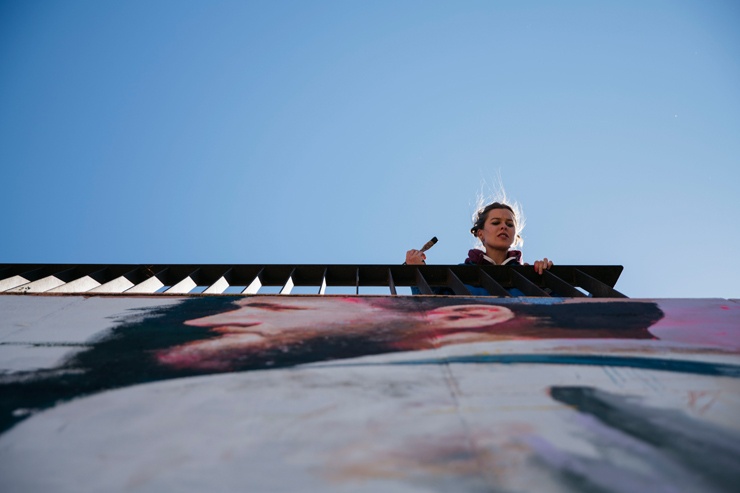
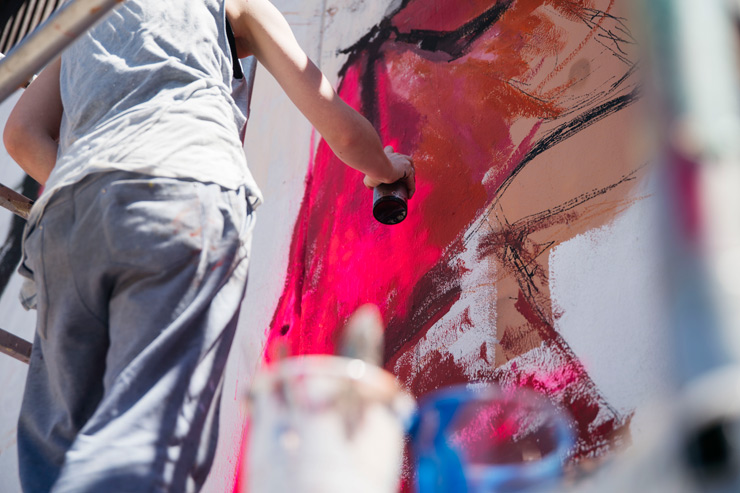
A painter. On the street. Capturing the figure with brush in hand, obligating the gaze, summoning the flesh and texture from the public space, making it personal and private.

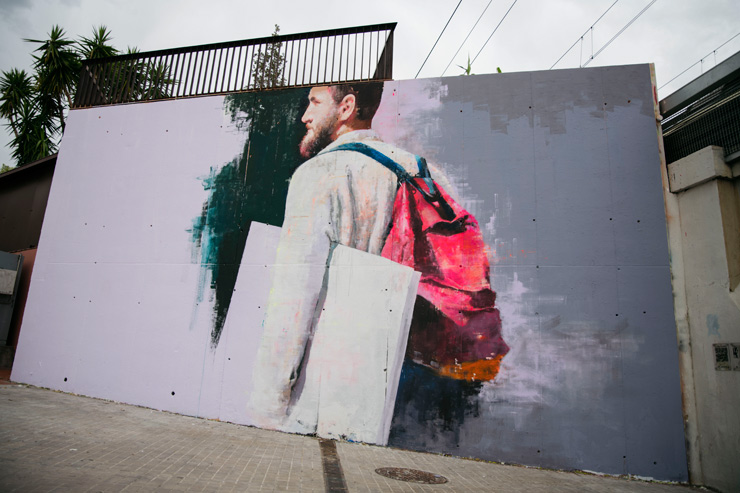
Udane. “Llum y color”. Contorno Urbano Foundation. 12 + 1 Project. l’Hospitalet de Llobregat, Barcelona. May 2018. (photo © Clara Antón)

Naturally, it is called “Llum y color” (Light and color) as these are the elusive qualities to capture by Udane in her urban practice, much like her studio practice. Beginning as an art student in Bilbao and Paris, she brings her interest in the urban flora and fauna to the large public wall – a reverse route of many a graffiti and Street Art practitioner perhaps.

Here in Barcelona for the 12 + 1 Project Udane is reflecting the movement of a character in this fleeting moment with an urban portrait in a loose stroke – an unknown guy on a sunny street, elusive and unlikely to be seen again.

Udane. “Llum y color”. Contorno Urbano Foundation. 12 + 1 Project. l’Hospitalet de Llobregat, Barcelona. May 2018. (photo © Clara Antón)

Udane. “Llum y color”. Contorno Urbano Foundation. 12 + 1 Project. l’Hospitalet de Llobregat, Barcelona. May 2018. (photo © Clara Antón)

Udane. “Llum y color”. Contorno Urbano Foundation. 12 + 1 Project. l’Hospitalet de Llobregat, Barcelona. May 2018. (photo © Clara Antón)

Udane. “Llum y color”. Contorno Urbano Foundation. 12 + 1 Project. l’Hospitalet de Llobregat, Barcelona. May 2018. (photo © Clara Antón)

Read more
Everybody, Including D*Face, Wants To Save The World

Everybody, Including D*Face, Wants To Save The World

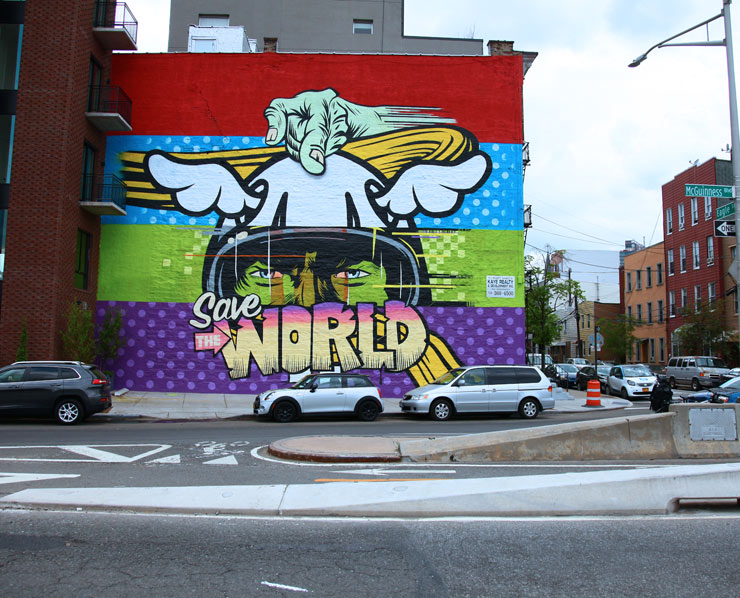
Just like the 80s song by Tear for Fears right? Oh, wait, they sang “rule the world”, not “save the world”, didn’t they? Ah, perhaps its a reference to the song by Swedish House Mafia.

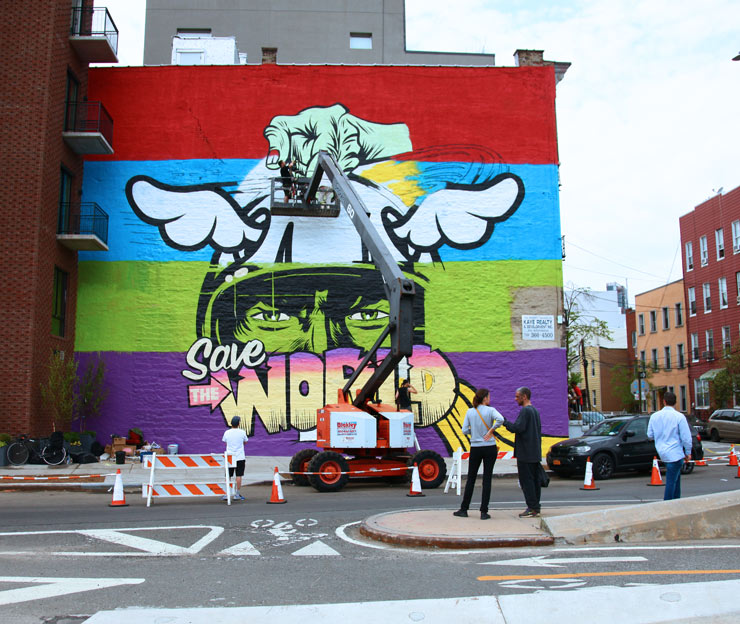
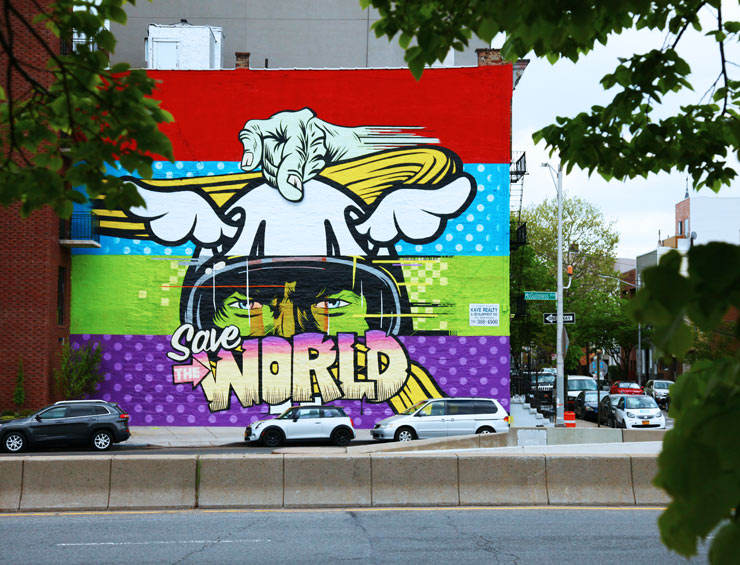
D*Face “Save The World” for Moniker Art Fair in collaboration with The L.I.S.A. Project NYC. Greenpoint, Brooklyn. May 2018. (photo © Jaime Rojo)

In any event D*Face was in Brooklyn last week to complete a large splash of interspliced pop imagery drawn from your favorite graphic novel, resplendent in hot pop hues and commanding us with a pointed finger to save the world.

D*Face “Save The World” for Moniker Art Fair in collaboration with The L.I.S.A. Project NYC. Greenpoint, Brooklyn. May 2018. (photo © Jaime Rojo)

Fresh from his current solo show ‘F̶o̶r̶n̶e̶v̶e̶r̶’ that is now running at Galerie Itinerrance in Paris, the London based artist has refined a visual vocabulary that has become instantly recognizeable to his fans, even if the sentiments may not be instantly self-evident. That’s the beauty of art on the streets, or anywhere; it’s open to your interpretation.

In fact there are many things we can do to save the world. We know how, we have the ability. Will we?

D*Face “Save The World” for Moniker Art Fair in collaboration with The L.I.S.A. Project NYC. Greenpoint, Brooklyn. May 2018. (photo © Jaime Rojo)

With Meres and Marie in the foreground, D*Face saves the world for Moniker Art Fair in collaboration with The L.I.S.A. Project NYC. Greenpoint, Brooklyn. May 2018. (photo © Jaime Rojo)

D*Face “Save The World” for Moniker Art Fair in collaboration with The L.I.S.A. Project NYC. Greenpoint, Brooklyn. May 2018. (photo © Jaime Rojo)

Read more
James Bullough Brings a Flying, Falling Form to Virginia

James Bullough Brings a Flying, Falling Form to Virginia

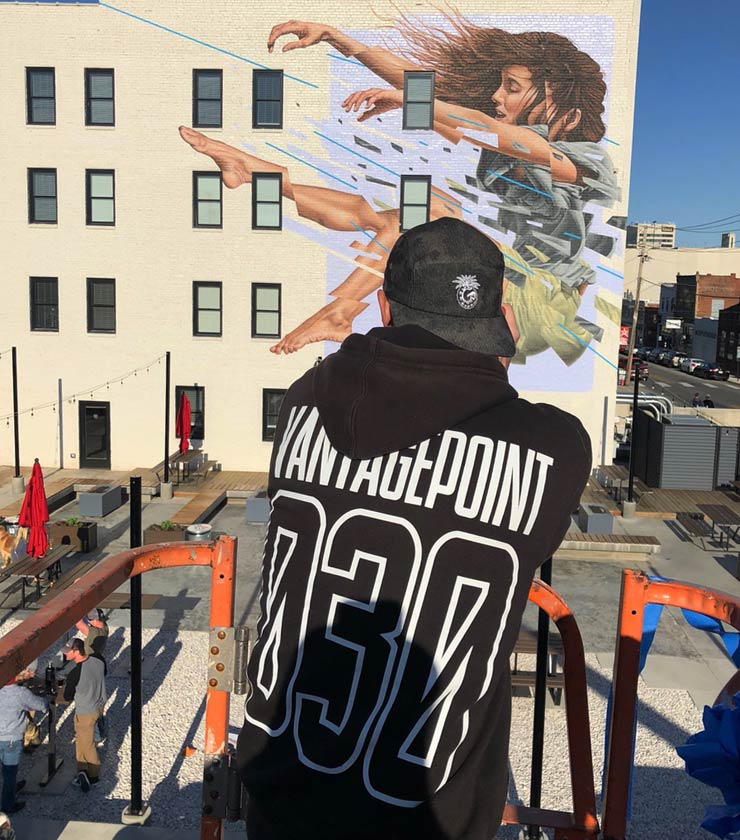
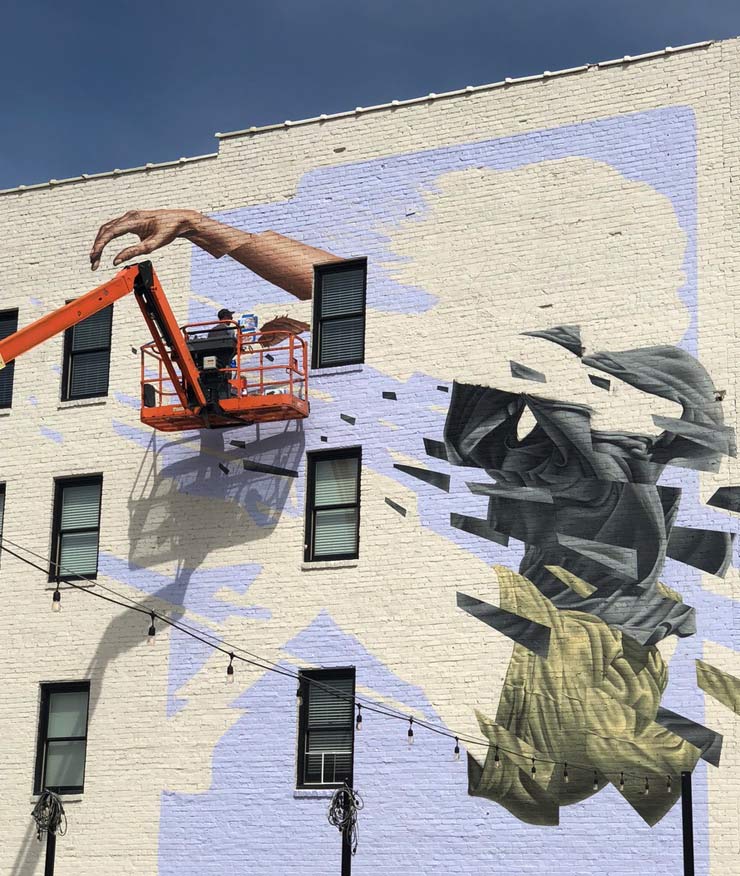
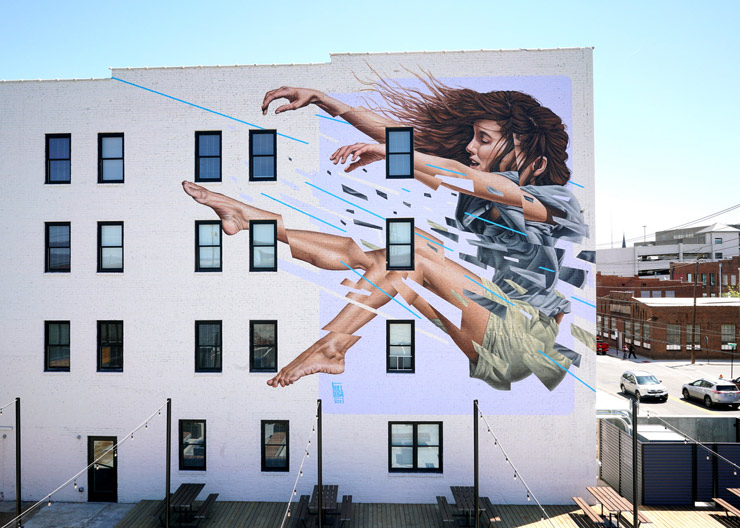
“I create my work more on the criteria of aesthetics and energy in the piece and less about meaning and backstory,” explains American muralist James Bullough of his latest laser sliced photorealist portrait in Roanoke Virginia. “In my opinion, that’s what art, especially public art is all about, to create a discussion, not to preach to the public and tell them my opinions.”

James Bullough in Roanoke, Virginia. (photo courtesy of the artist)

The image is full of movement and a foreboding feeling of things coming apart, in hurried disarray. The elegantly everyday form appears to be without her bearings, as if being swung from the center, or perhaps propelled backward and downward.

James Bullough in Roanoke, Virginia. (photo courtesy of the artist)

Perhaps the image is simply too abstract for passersby to contemplate, or perhaps it is so familiar in the US as to be a mirror of how many feel during this time where the foundations are being deliberately ripped from beneath the population, preparing them for…

“When people ask me at the wall what it is, or what it means, or who the woman is, I turn it back on them,” says James. “I ask for their thoughts and inevitably their interpretations are far more elaborate and varied than I could have imagined.”

James Bullough in Roanoke, Virginia. (photo courtesy of the artist)

Read more
“Wet Paint” : TayOne for Contorno Urbano 12 + 1 says “Acabat de pintar”

“Wet Paint” : TayOne for Contorno Urbano 12 + 1 says “Acabat de pintar”

Don’t lean against that! You’ll get paint on your shirt!

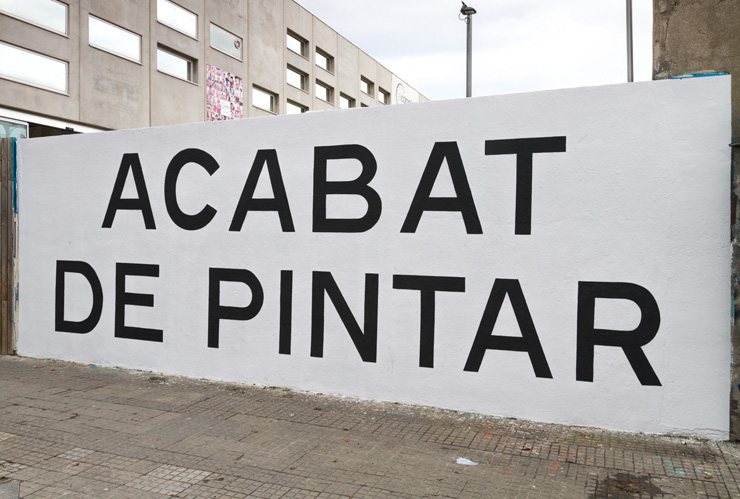
Acabat de pintar.

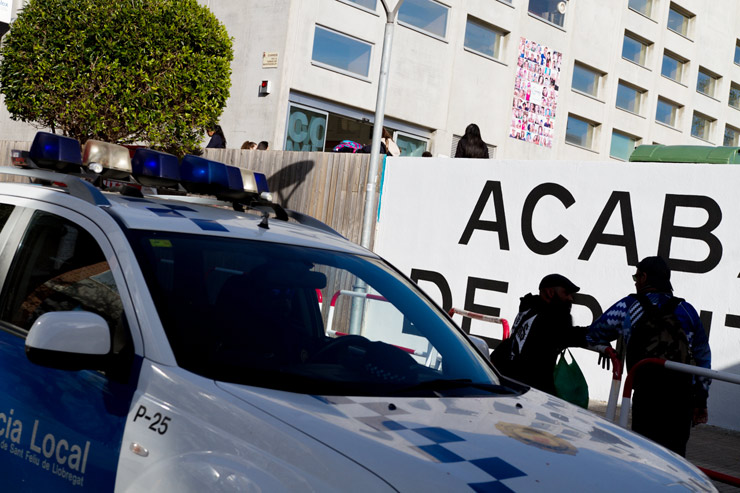
Tayone. “Wet Paint”. Contorno Urbano. Project 12 + 1. Sant Feliu, Barcelona. April 2018. (photo © Alex Miró)

In an ironic repositioning of an otherwise purposeful phrase, artist TAYONE creates a large “Wet Paint” sign on the ever changing community mural project called 12+1 in Barcelona.

Tayone. “Wet Paint”. Contorno Urbano. Project 12 + 1. Sant Feliu, Barcelona. April 2018. (photo © Alex Miró)

A fan of decontextualization in perhaps a similar manner to conceptual Street Artists +MaisMenos- or Biancoshock, TAYONE says that his ironic use of the mural space is a play on the messaging in public space and the temporary qualities of sufaces that get buffed, readied for the next intervention.

“Starting from this premise,” he says, “as well as the phenomenon of graffiti erasure that entails a very powerful but sometimes involuntary plastic change, my intervention proposes to decontextualize the newly painted phrase, elevating it to artistic intervention as a rupture and continuity of the cycle.”

Yes, it’s funny. It’s also a way to reconsider the common signage and directives that can become invisible in daily life.

Tayone. “Wet Paint”. Contorno Urbano. Project 12 + 1. Sant Feliu, Barcelona. April 2018. (photo © Alex Miró)

Tayone. “Wet Paint”. Contorno Urbano. Project 12 + 1. Sant Feliu, Barcelona. April 2018. (photo © Alex Miró)

Tayone. “Wet Paint”. Contorno Urbano. Project 12 + 1. Sant Feliu, Barcelona. April 2018. (photo © Alex Miró)

Read more
BSA Images Of The Week: 05.06.18

BSA Images Of The Week: 05.06.18

BSA-Images-Week-Jan2015

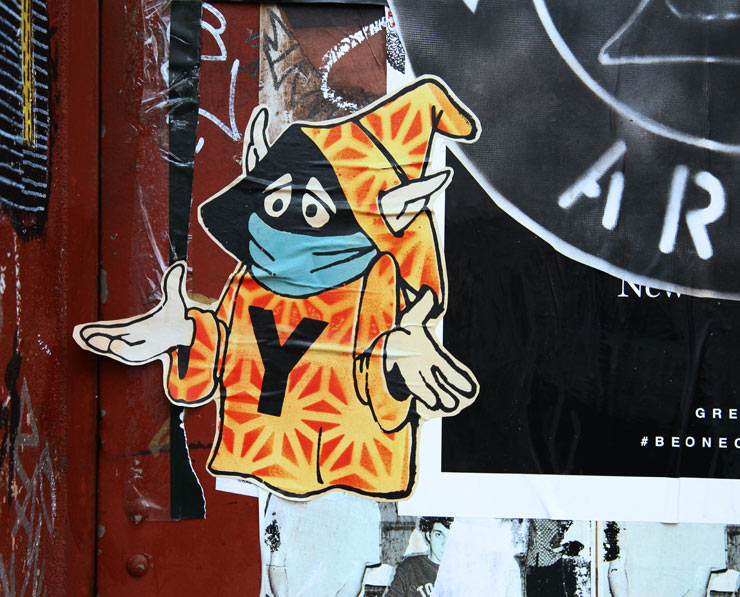
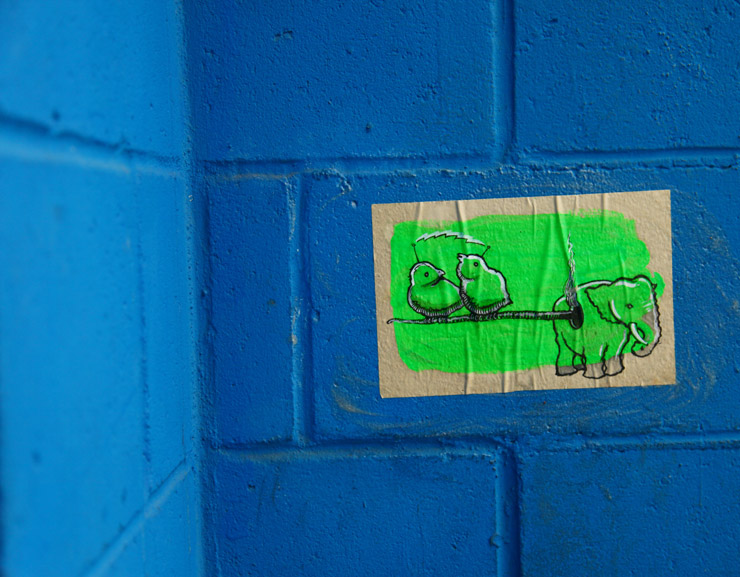
Here’s our weekly interview with the streets, this week featuring Alo, BustArt, Dmirworld, Egle Zvirblyte, Faith XLVII, Herakut, Jose Mendez, Kai, Myth, and Skewville.

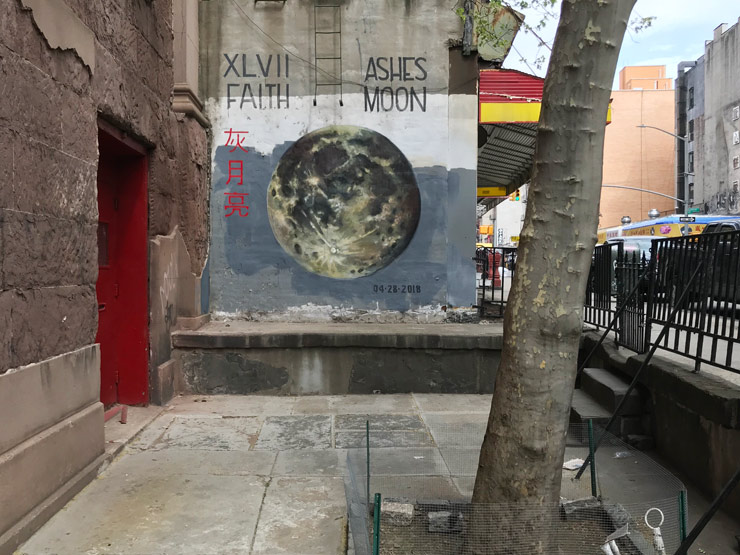
Top Image: Faith XLVII “Ashes Moon” in China Town – the first of a 12 part series. Done in conjunction with The L.I.S.A Project NYC. (photo © Jaime Rojo)

Skewville for Moniker Art Fair. Greenpoint, Brooklyn. TRAP on top. (photo © Jaime Rojo)

Skewville taking a phone call from his manager… (photo © Jaime Rojo)

Herakut for Moniker Art Fair. Greenpoint, Brooklyn. (photo © Jaime Rojo)

Egle Zvirblyte. A project curated by BSA with the production assistance and wall access from Joe Franquinha / Crest Hardware and paint donated by Montana Cans. (photo © Jaime Rojo)

Egle Zvirblyte. A project curated by BSA with the production assistance and wall access from Joe Franquinha / Crest Hardware and paint donated by Montana Cans. (photo © Jaime Rojo)

Egle Zvirblyte. A project curated by BSA with the production assistance and wall access from Joe Franquinha / Crest Hardware and paint donated by Montana Cans. (photo © Jaime Rojo)

Egle Zvirblyte. A project curated by BSA with the production assistance and wall access from Joe Franquinha / Crest Hardware and paint donated by Montana Cans. (photo © Jaime Rojo)

Egle Zvirblyte. A project curated by BSA with the production assistance and wall access from Joe Franquinha / Crest Hardware and paint donated by Montana Cans. (photo © Jaime Rojo)

Unidentifed artist (photo © Jaime Rojo)

Myth (photo © Jaime Rojo)

BustArt…Cool Bus in the background. (photo © Jaime Rojo)

Kai (photo © Jaime Rojo)

Kai. Detail. (photo © Jaime Rojo)

Kai (photo © Jaime Rojo)

Unidentified artist (photo © Jaime Rojo)

Lunge Box (photo © Jaime Rojo)

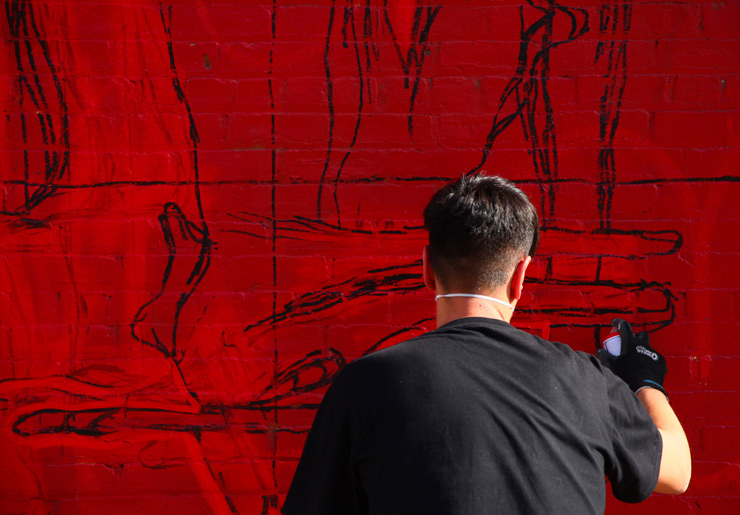
Jose Mendez for Moniker Art Fair in collaboration with The L.I.S.A Project NYC. (photo © Jaime Rojo)

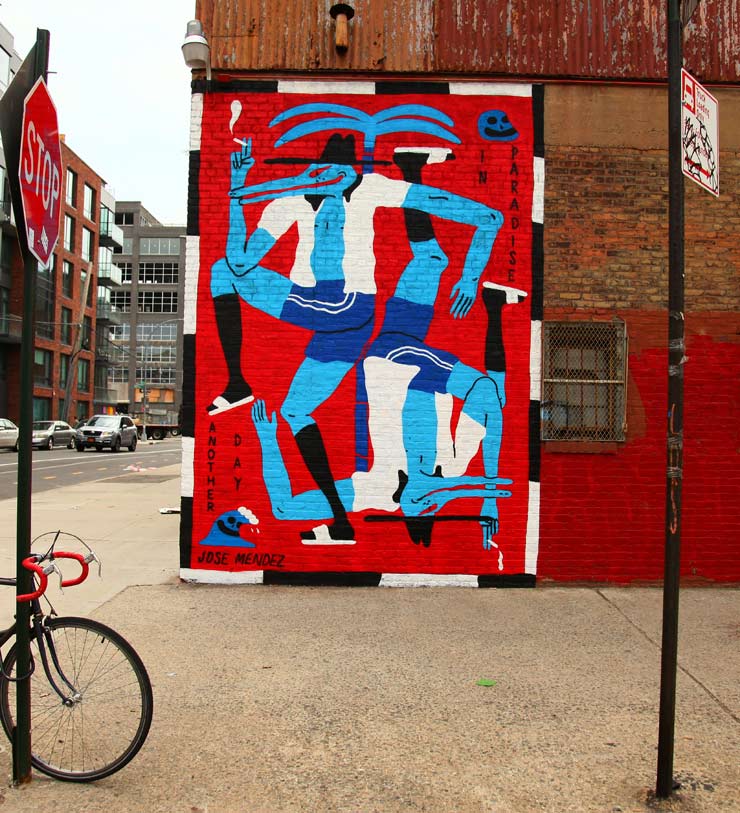
Jose Mendez for Moniker Art Fair in collaboration with The L.I.S.A Project NYC. (photo © Jaime Rojo)

ALO (photo © Jaime Rojo)

Dmirworld (photo © Jaime Rojo)


Untitled. Williamsburg, Brooklyn. May 2018. (photo © Jaime Rojo)

Read more
Rammellzee, Racing For Thunder, and Interview with Carlo McCormick

Rammellzee, Racing For Thunder, and Interview with Carlo McCormick

Intergalactic Godhead and one of New York’s lost sons, the multidimensional Rammellzee is here, at least his pyramidic urn is. The train writer, performance artist, plastic artist, language master, mathematics interpolator, hip-hop pioneer and one of the original “Wild Style” and “Style Wars” alumni brings the big guns to Red Bull Arts.
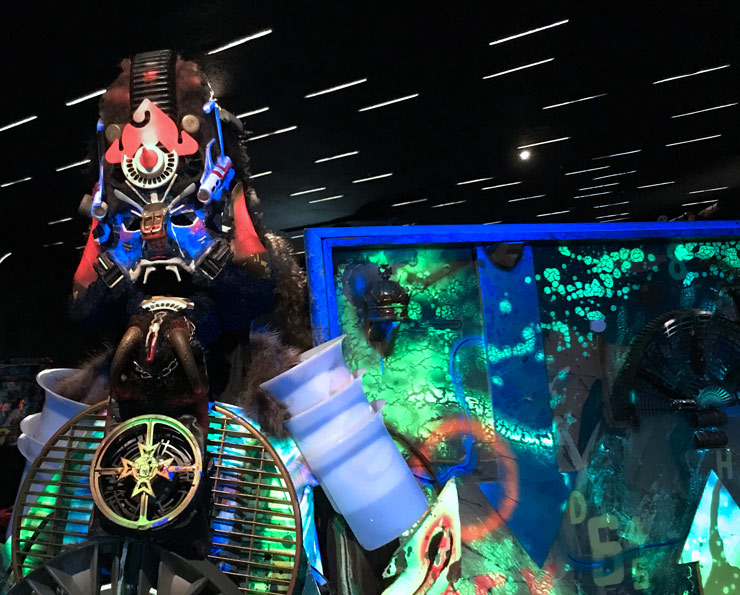
Rammellzee. Detail. (photo © Jaime Rojo)

Rewarded the instant you enter, the flying intergalactic battleships greet you at the door, leading you into the blissful blacklit abyss below, provoking a humorous inner sense of a warring gothic future. But first you can explore the brighter white-box gallery above with a small theater behind for video and various listening stations, photography, augmented with vitrines of emphemera and original texts from the audacious imagineer.

The largest survey of its kind of work by the artist, who passed away in 2010, this is a considered collection of images, writings, sculpture and costume that give you the idea that it only approximates the vast galaxy of histories and characters that the iconoklast panzerist stored in his imagination.
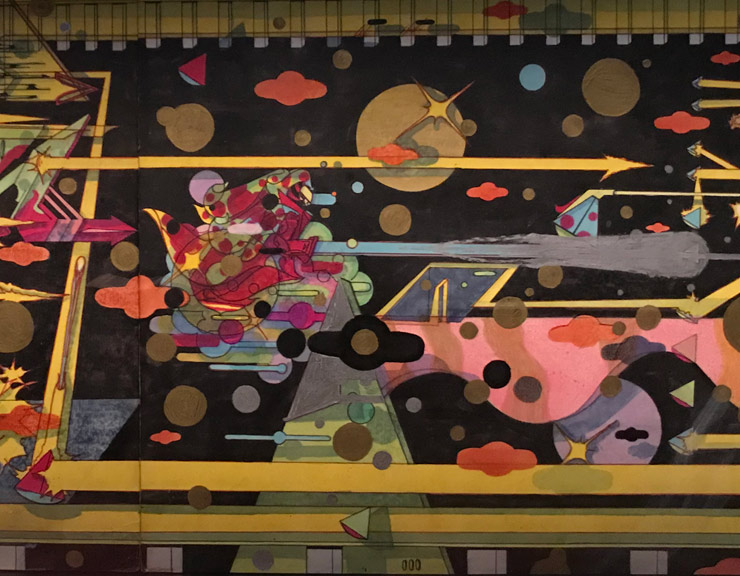
Rammellzee. “Evolution Of The World 1979” Detail. (photo © Jaime Rojo)

“These costumes remind me of George Clinton,” says experimental filmmaker and writer Tessa Hughes-Freeland maker and writer at the opening Thursday night for “Racing for Thunder”. She was one of many New York royalty from the “Downtown” and graffiti scenes of 80s-90s New York who were attending the flooded opening this week, including artists like Lee Quinones, Futura, Torrick Ablack aka Toxic, and John Fekner.

“I don’t remember him wearing all of these costumes,” says painter Jane Dickson as she looks at the mythical deities glowing and raging in the smoky haze.

“Actually I do remember him in that one at an event,” she says motioning to an intimidating fluorescent grill-faced figure in a stylize kimono. Her husband Charlie Ahearn, who directed Rammellzee in Style Wars, was interested in creating a movie solely about the artists many characters and his fully immersive commitment to the environments he built in his loft in the 80s and 90s.
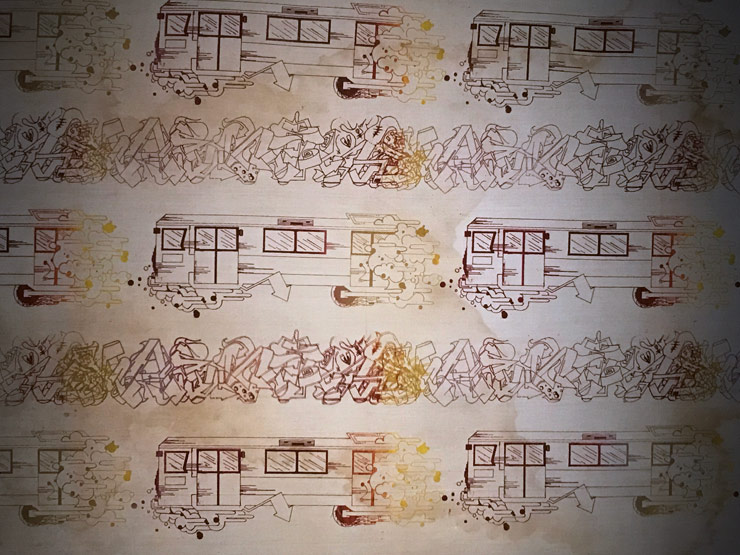
Rammellzee. “Maestro 1979“. Detail. (photo © Jaime Rojo)

The crowd coursing through the exhibit listens to recordings, watches raw video, drinks champagne, and wishes for decoder rings in the vain hope of peering into the mind of this child of the Rockaways who painted the A train and recorded music that influenced musicians as diverse as the Beastie Boys and Big Audio Dynamite, who dedicated a song to him.

The extensive collection, much of it never before seen, took more than a year to assemble and curate for Chief Curator Max Wolf and cultural critic Carlo McCormick, who created the exhibition with Associate Curators Christian Omodeo, Jeff Mao, and Candice Strongwater.
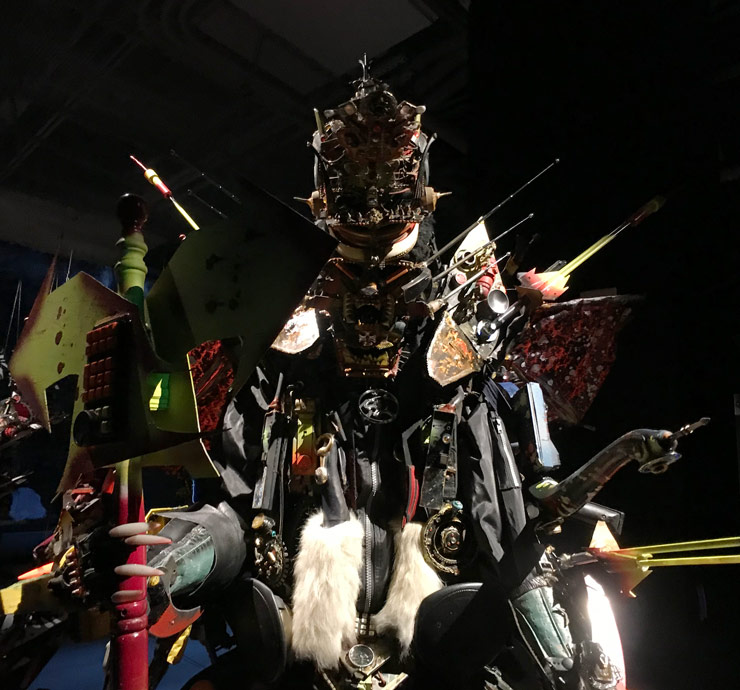
Rammellzee. Detail. (photo © Jaime Rojo)

We captured a few details from the show during installation which we show here to whet your appetite and spoke with McCormick, who also knew the artist personally and took decisions about the exhibit with a precise appreciation for Rammellzee’s place in the canon of graffiti, post-graffiti, hip-hop, mathematics, and performance.

BSA: Part of Rammellzee’s story lies in the environments that he created to share with artists and friends – and to use as a laboratory. How can an exhibition achieve some of that same unique atmosphere?
Carlo McCormick: The most tempting thing to do as a curator was to re-create “The Battle Station”, which was his home studio, and it was kind of a “life’s work” installation that way. But it just seemed that this was also Max Wolf’s project as well, who co-curated it, and it is also a focus to make these things be engaged and discreet.
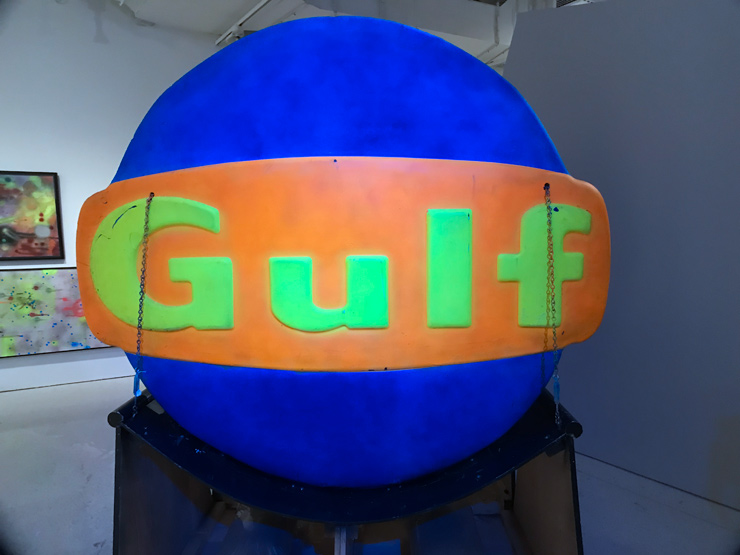
Rammellzee. Detail. (photo © Jaime Rojo)

You’ve got the whole thing: the Garbage Gods, Gassolear, and the Letter Racers. It’s kind of like his final showdown of good versus evil. But we wanted to allow it to be in a fine art space so you could register as much of “the gaze” as you could looking at any other art.

It’s still black light illuminated; Rammellzee liked to paint all of his walls black. I know he did it at Barbara Braathen and Fashion Moda. One time he did this at this one gallery – the gallery owner left him the keys to the gallery to prepare the space. She came back the next day and really what he had done was he had painted all the walls black. She’s was like, “What?”

So we didn’t do that, we tried to give it a little bit of the privilege of the white space because now he is dead and it is better to be in conversation with that whole history with Western art.
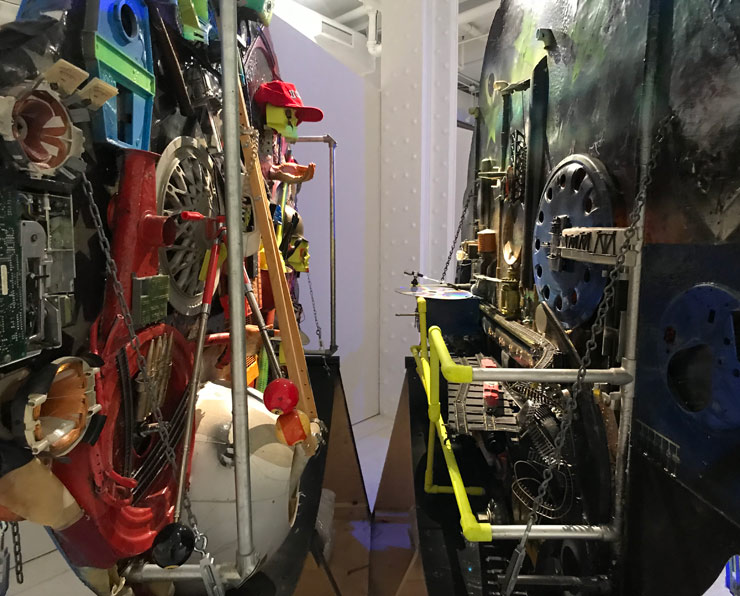
Rammellzee. Detail. (photo © Jaime Rojo)

BSA: Can you talk about going through the artwork and costumes that Rammellzzee and Carmela had stored away? What kind of thoughts and feelings were you experiencing?
Carlo McCormick: Everything looked kind of squalid when it had just been pulled out of storage and from this other storage facility that Sotheby’s had.

It was sort of underwhelming because he was sort of working with bits of garbage and rags. And the costumes are really fly fashion but it’s really made on the cheap – its like “costume” instead of “clothing” right? It was all scattered about.

And there was someone who went all of the old performance photos and basically re-assembled all of these personalities – because they were not stored in a bag separated for each character. There were just racks of costumes and boxes of masks and things like that.
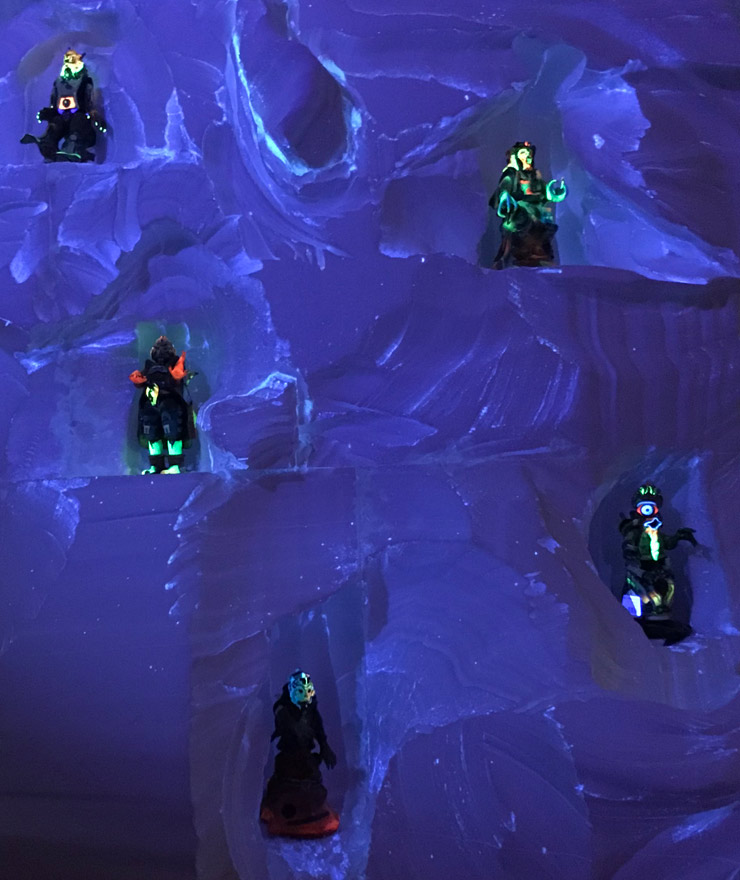
Rammellzee. Detail. (photo © Jaime Rojo)

They had to put all of these elements together – so that was really amazing. But once it is all put together it is so much more magical. That’s kind of the way he collaged everything – he had an amazing ability to put things together.

This is just the first show so it has that honor but it is a dubious one because it is just a start and now there is the hope that more scholarship and more curatorial work and more work all around can go into Rammellzee’s estate and his legacy.

Considering that this was all done in a year with a pretty small team here at Red Bull, its amazing the amount of resources they pulled. How cool it is to think, “There is no way we can go through all of the ephemera” and then to be able to say, “Hey get Christian Omodeo in here to do the archives for this.” So it has been a really cool thing to make all of this happen because they allow you to entertain pretty elaborate schemes.

Rammellzee. Treatise On The Luxturnomere. (photo © Jaime Rojo)

BSA: Was he thinking in terms of posterity and about having a great show in the future. Did he care?
Carlo McCormick: I think, like a lot of people at that time, he had a really ambivalent relationship to ‘the market’ and ‘the art world’ and the gallery system and all that stuff for a moment there. He was very ambitious and he saw how friends of his were beginning to paint and people were paying attention and he goes, “Shit I can do that”.

So I think he didn’t always like the art world. I think he kind of really hated it in some ways but he attached himself to it for 10 years with the paintings and continued a collector base through his death in 2010. I’m sure, in his mind, he never would be forgotten. He was so important.
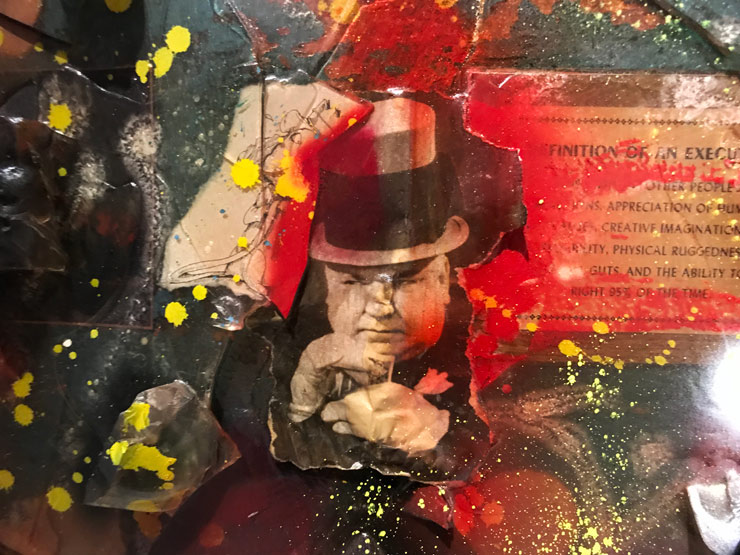
Rammellzee. Detail. (photo © Jaime Rojo)

BSA: The artist had such a unique fantasy world in his imagination with galactic battles and love of the letters and projections into the future. Would you say he was acting as a character – or maybe that he became that character?
Carlo McCormick: He was many characters. I think that one of the things that people are going to start paying more attention to outside of the obvious place in Hip-Hop and in graffiti art and what was going on in 1980s painting is the performance work. In that he is adopting so many fluid identities.

Also, as we were noting before when we were walking through it, he was crossing gender and doing a lot of things that are not typical for the work of that vernacular. He was doing a lot of it. With identity politics and performances now I think that a lot of people are going to look at that work with a different eye.

BSA: What influenced his mind? Why did he do what he did?
Carlo McCormick: That’s the basic thing you know. When you read that first treatise – and he kept on doing these manifesto type things – even from the first one at this really early age, he was an incredible autodidact, all self-taught. There was just massive amounts of information of all sorts of theory and math and science and military. I mean it’s all over.

He’s an autodidactic and a polymath. So I don’t really know where all of it came from. Sometimes you just have to think “maybe he watched a lot of Transformers on TV!” Who knows.

BSA: Many people will be learning about this multi-dimensional artist for the first time. What do you want them to know about him and his brilliance?
Carlo McCormick: I really hope the work can speak for itself. He was as conceptual as he was urban. I hate to poison the well. He is so open to so many readings. He is being grabbed now by other forces that are in the market and those are being brought to bear.

So for me one of the things here was to bring this from out of the community and from all of the artists he worked with and was friends with. One of the things was I didn’t want to be the only person speaking for Ram when there were all of these other people still around.

I would say “Come in with and open mind and expect it to be blown.”
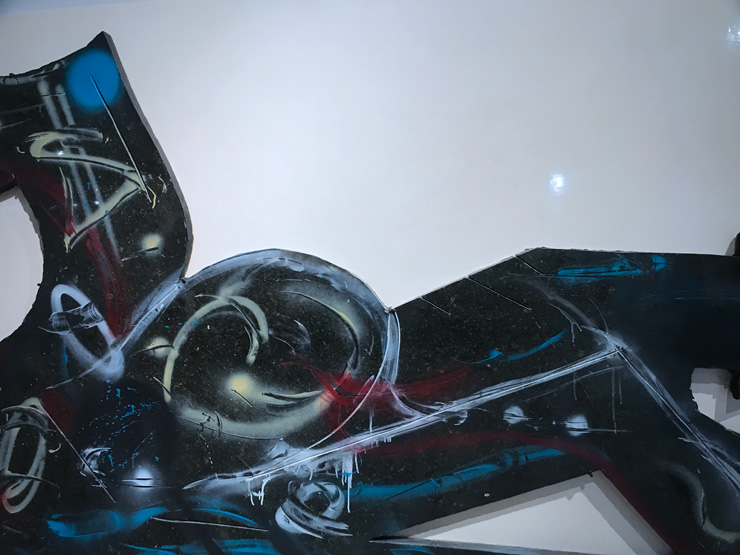
Rammellzee. Detail. (photo © Jaime Rojo)


RAMMΣLLZΣΣ: Racing for Thunder is organized by Max Wolf and Carlo McCormick, with Candice Strongwater, Jeff Mao, and Christian Omodeo.

RAMMΣLLZΣΣ: Racing for Thunder is now open to the general public. Click HERE for more details.
Read more
One Week With 1UP : Martha Cooper & Ninja K

One Week With 1UP : Martha Cooper & Ninja K

A serendipitous meeting somewhere in Berlin set this project in motion, and the results unveil an adrenaline fueled ride that always pushes, often exceeds the boundaries of physical safety and social acceptance while simultaneously thrilling graffiti fans and pissing off some public officials and property owners.

Martha Cooper & Ninja K. One Week With 1UP. (photo courtesy of the team)

A new book that is releasing shortly captures the nature of the actions and adds to our conversations about art, vandalism, branding, public/personal space and its radical visual disruption. It’s a story made all the more remarkable during an increasing level of surveillance in a city that has basically embraced the bohemian and rebellious types who have transformed large parts of its cityscape, making Berlin a de facto capital of subculture, especially among the young.

Martha Cooper & Ninja K. One Week With 1UP. (photo courtesy of the team)

Photojournalists have to follow the story wherever it goes in the hope of reporting the true nature of the culture, especially when it veers off the street and dives into subculture. After a somewhat chance encounter with the notorious 1UP crew in Berlin, veteran photojournalist and ethnographer Martha Cooper instinctively knew she had to better understand how the graffiti writing practice today has evolved since she first captured the New York train writers in 1970s and 80s.

Along with photographer Ninja K, Cooper again goes beyond most people’s comfort zone to get a story about this somewhat amorphous and incredibly anonymous graffiti crew that no one else has yet documented. With sharp eyes and pitch-perfect timing, the results of these two journalists reveal how the graffiti practice has continued to expand and beguile in the margins of the urban public sphere.

Martha Cooper & Ninja K. One Week With 1UP. (photo courtesy of the team)

Martha Cooper & Ninja K. One Week With 1UP. (photo courtesy of the team)

Martha Cooper & Ninja K. One Week With 1UP. (photo courtesy of the team)

Martha Cooper & Ninja K. One Week With 1UP. (photo courtesy of the team)


With thanks to the team for sharing their exclusive images with BSA.


Read more