BSA Film Friday: 08.03.18

BSA Film Friday: 08.03.18

bsa-film-friday-JAN-2015

Our weekly focus on the moving image and art in the streets. And other oddities.

Now screening :
1. Cheryl Dunn Walk The Streets Of NYC
2. Studio Visit With Bordalo II in Lisbon
3. Good Guy Boris “TOYS ARE BETTER PEOPLE” / Part I and II

bsa-film-friday-special-feature

BSA Special Feature: Cheryl Dunn Walk The Streets Of NYC

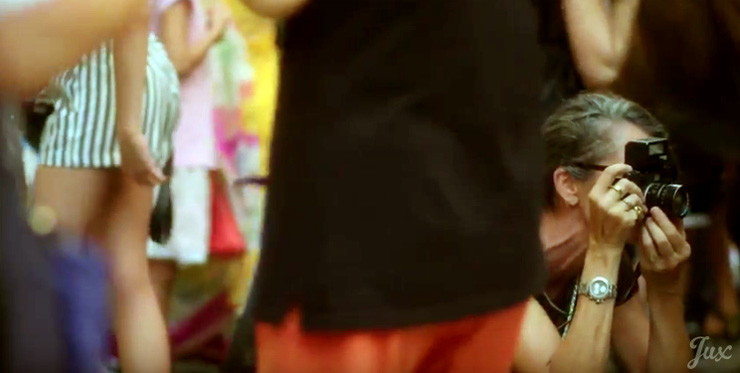
“Go there and go deep,” says street photographer and filmmaker Cheryl Dunn in this new brand sponsored content video that takes you through mainly Chinatown/Wall Street area and allows you to hear her story and perspectives briefly.

Director of a highly-praised documentary called “Everybody Street” and many others of high quality, Dunn is more than familiar with the ethos of observing life in the chaos-metropolis and hoping to capture a moment that sticks out as a clarion yell. It’s about an approach that is only yours, and only possible through your vision, and luck.

Studio Visit With Bordalo II in Lisbon

Literally garbage. But you knew that.

But did you know the level of detail and minute mechanical manipulation that goes into a piece by Street Artist/fine artist Bordallo II ? Straight from Lisbon, where he propagates grandly forward from a curiously ornate studio spot.

Good Guy Boris “TOYS ARE BETTER PEOPLE” / Part I

Bad Boy Boris is not good at math or certain mechanical/technical matters but he’s good at persistence. Which is why he’ll succeed.

The graffiti writer is an authority on sniffing out opportunity and his hand-made and witty vlog allows you to tag along as he looks for the perfect spot by the beach outside of Athens to put up his piece.

“Toys are humble people, cool people, chill people,” coos the suddenly philosophical Boris as he strides victoriously from his freshly painted pat on the back for that much maligned population. Ah, but everyone is a rookie as some point right?

“Just another obsessed vlogger risking his life for the sake of YouTube because YouTube is more important than life,” he says in one more pearl of wisdom that will surely entice viewers to follow this guy until he works out all the kinks.


Good Guy Boris TOYS ARE BETTER PEOPLE / Part II


Read more
The “Delusional” Winners…and Honorable Mentions

The “Delusional” Winners…and Honorable Mentions

It was a genuine pleasure to meet so many of the artists last night at Jonathan Levine Gallery for the opening of the Delusional Art Competition. Not surprisingly, the art works were stellar and in many cases exceptional – narrowed down from a field of 1700 or so competitors and selected by Jonathan and a jury of artists and professionals in the field (full disclosure: BSA was on the jury).

About 150 people crowded the gallery space and looked at the 40 finalists, shook hands with artists and posed with them, each making their own assessments about what works were resonating strongest for them and considering the quality of the field in general. There is a great deal to be learned from how artists are seeing things at this moment and about how we all are responding to this work.

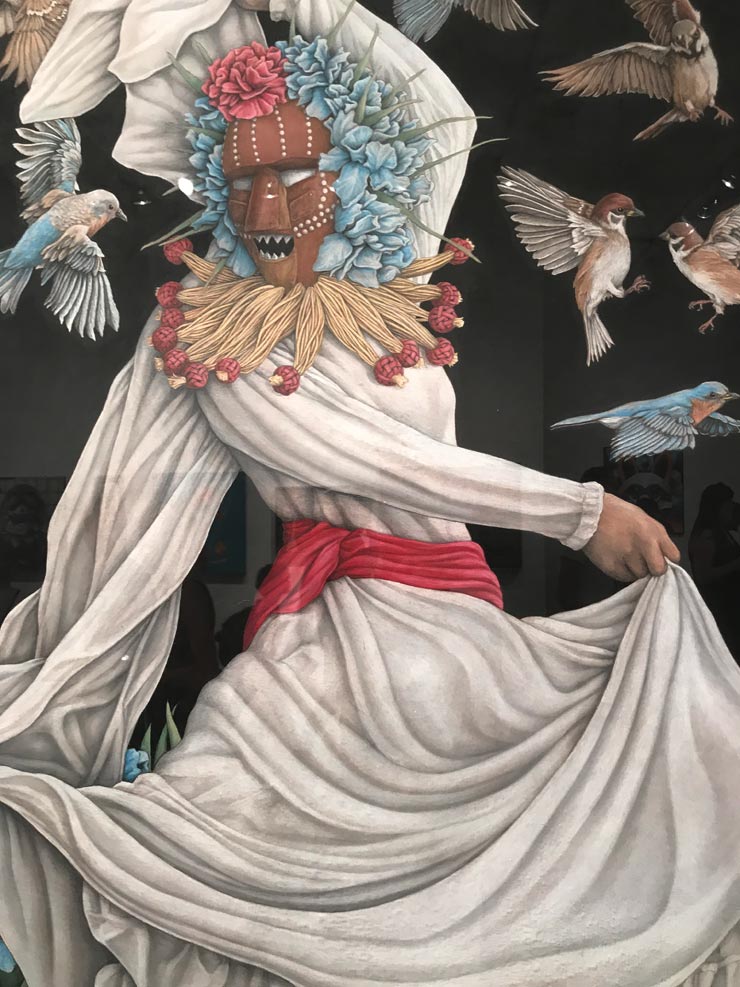
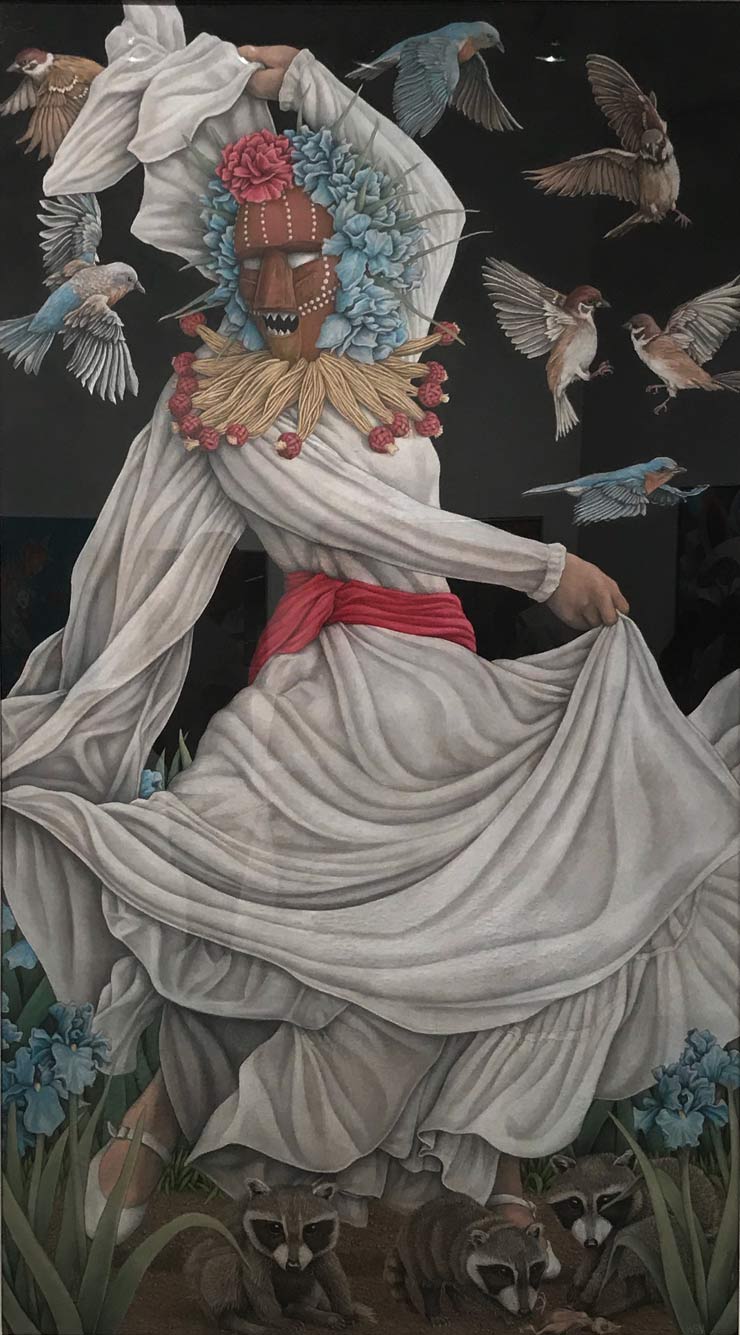
First Prize : Win Wallace

Win Wallace. Dancer #5 , 2018. Jonathan LeVine Projects. Delusional. (photo © Jaime Rojo)

JURY’S CHOICE
1st Place – Win Wallace
2nd Place – Tina Lugo
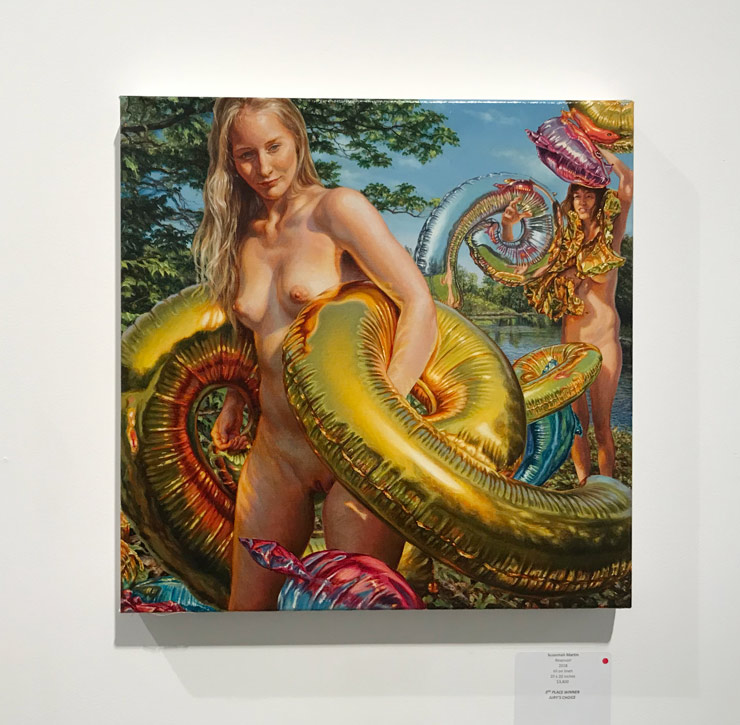
3rd Place – Susannah Martin

HONORABLE MENTIONS
Carly Slade
Rick Newton
Anthony Solano

We are excited to share with you artworks by the winners and honorable mentions from this years’ Delusional Art Competition and to share with you some reactions from the visionary at the vortex, Jonathan Levine.

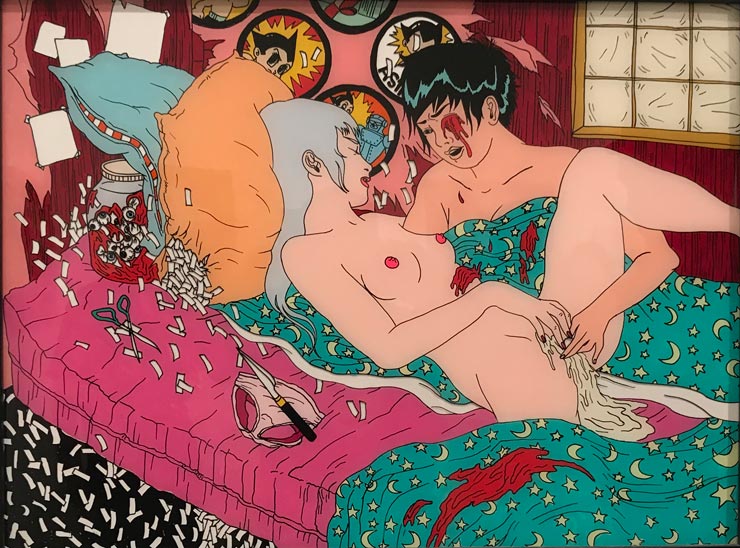
Second Prize – Tina Lugo

Tina Lugo. I See Myself with You 2016. Jonathan LeVine Projects. Delusional. (photo © Jaime Rojo)

BSA: How was the competition this year compared to last year when you had to do the jury duties all yourself?
Jonathan LeVine: The interesting thing is I was trying to make it this very democratic process and so every year the show is different. So some of the choices that other jurors made I thought, “Oh that makes sense” and with some of the others I thought, “really they chose that?”

But then it just made me realize how different everyone’s tastes are. It was an interesting thing to see. You know I did it last year and I’ve juried stuff before, but because it was my competition I felt differently. It really made me think this year about perceptions, what people like, and what kind of tastes people have.

Third Prize – Susannah Martin

Susannah Martin. Reservoir 2018. Jonathan LeVine Projects. Delusional. (photo © Jaime Rojo)

BSA: What surprised you?
Jonathan LeVine: A lot of people liked stuff I didn’t like.

BSA: Are there trends that you would like to see evaporate?
Jonathan LeVine: I always like to see people not imitating so much from other people. It’s one thing if you see it a little bit. But it is another thing if you see 50 artists doing the same thing, or see blatant rip-offs of other artists. I realize those people probably think that it is okay, or they don’t even realize that they are doing it, or it is flattery, but it is not unique.

Great art to me is unique. It doesn’t have to be fine art, but it needs to be authentic. That really speaks to me. So maybe that is sometimes more challenging to people and its not always necessarily the prettiest. As I continue to do this competition, it’s going to change my perspective I think.

HONORABLE MENTIONS


Carly Slade

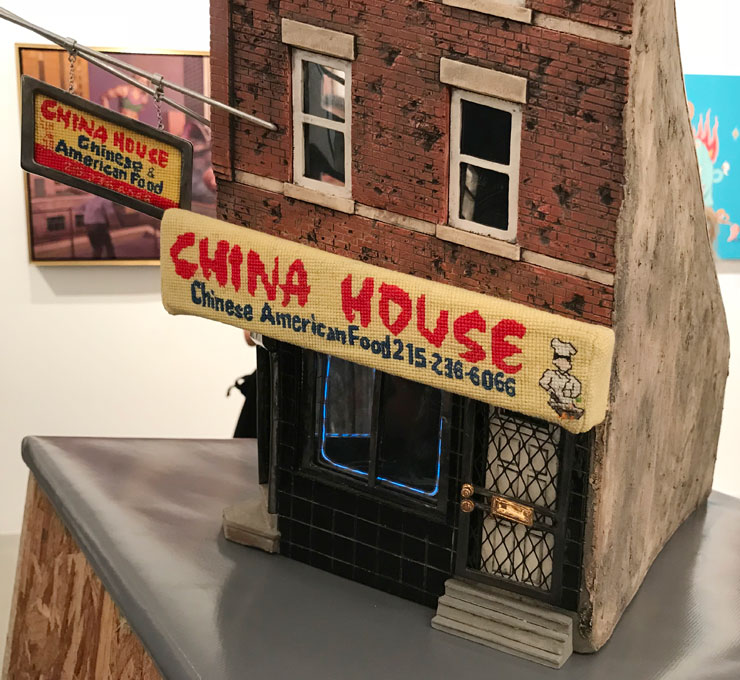
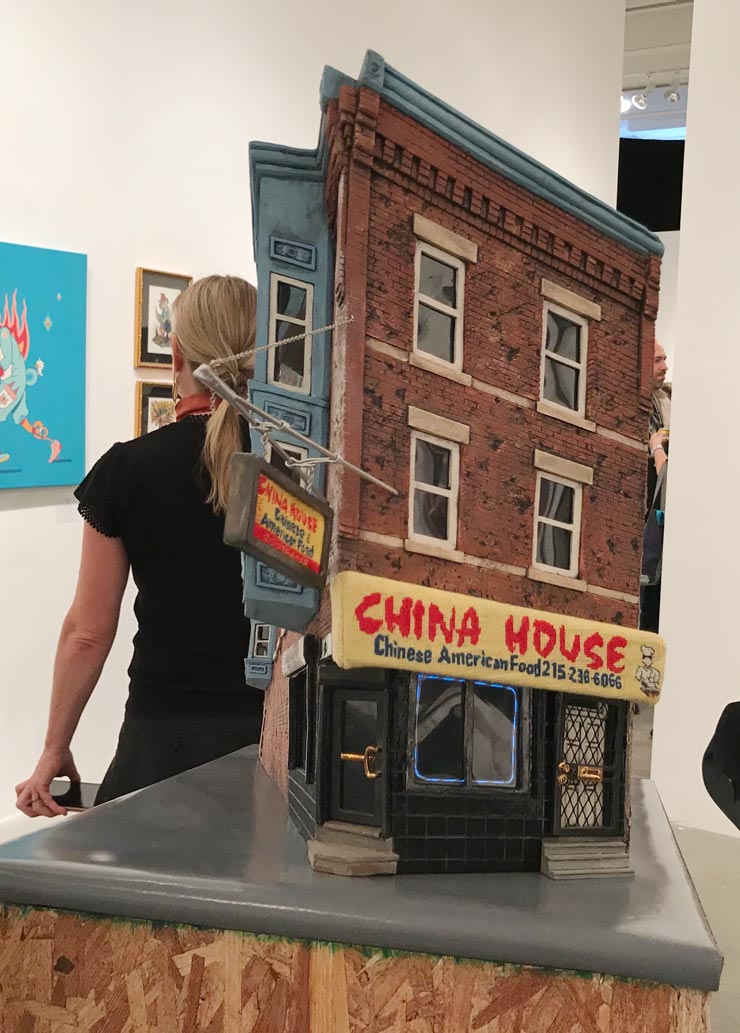
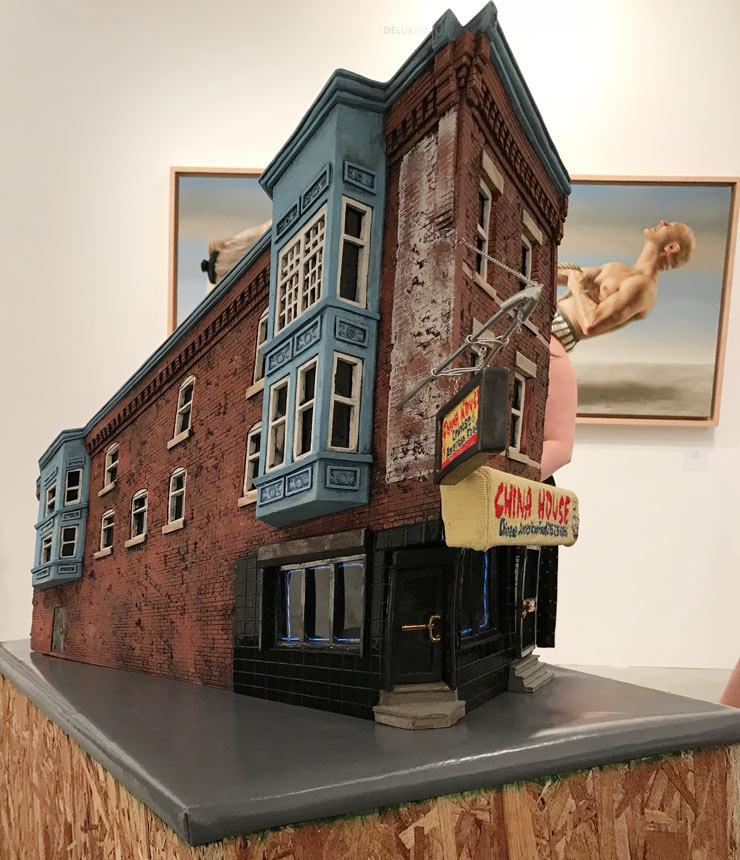
Carly Slade. 2046 W Diamond St, Philadelphia, PA 2018 Jonathan LeVine Projects. Delusional. (photo © Jaime Rojo)

Carly Slade. 2046 W Diamond St, Philadelphia, PA 2018 Jonathan LeVine Projects. Delusional. (photo © Jaime Rojo)

Carly Slade. 2046 W Diamond St, Philadelphia, PA 2018 Jonathan LeVine Projects. Delusional. (photo © Jaime Rojo)

Rick Newton

Rick Newton. Christopher Columbus Discovering the New World 2016 Jonathan LeVine Projects. Delusional. (photo © Jaime Rojo)

Rick Newton. Christopher Columbus Discovering the New World 2016 Jonathan LeVine Projects. Delusional. (photo © Jaime Rojo)

Anthony Solano

Anthony Solano. Enough 2017 Jonathan LeVine Projects. Delusional. (photo © Jaime Rojo)

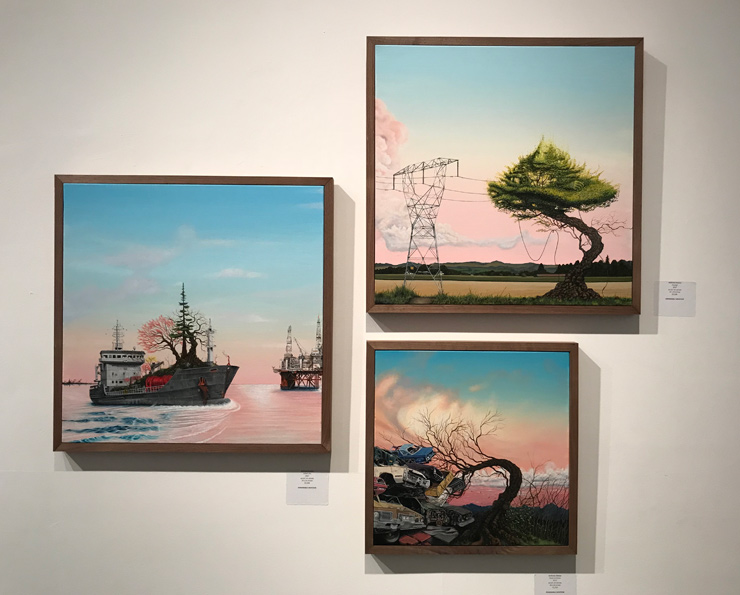
Anthony Solano. Urban Arc 2017 (far left), Room to Grow 2017 (bottom) Jonathan LeVine Projects. Delusional. (photo © Jaime Rojo)


Following are short bios for each of the winners and honorable mentions:

Win Wallace was born in South Carolina and is currently based in Austin, Texas. His recent practice focuses on conte and charcoal portraits, as well as ink drawings. Since high school, Wallace has played in bands and has made posters for bands like the Melvins, Neurosis, Sleep, Helios Creed, Alice Donut, DMBQ, Animal Collective, Scratch Acid, The Dicks and many others. He moved to Austin in the mid 1990’s to study drawing at the University of Texas. His drawings are influenced by history, art history, dreams, nature and pathos.  His works have been exhibited extensively in Texas, throughout the United States and internationally.

Tina Lugo was born and raised in The Bronx, New York.  She studied at the School of Visual Arts where she obtained her BFA and worked with fellow artist, Nicolas Touron.  She’s currently based in Portland, Oregon where she continues to make glass paintings in her Pacific Northwest studio.  Lugo lists as her biggest influence, the Ero Guru Nansensu art movement of Japan—a name comprised of fractions of the English words erotic, grotesque, and nonsense.  The movement focuses on eroticism, sexual corruption, and decadence, all themes salient in Lugo’s work.

Susannah Martin was born in 1964 in New York City.  She studied at New York University and received a SEHNAP scholarship for painting.  Among her most notable teachers there were; John Kacere, Louise Lawler, Sherrie Levine and Peter Campus.  Following her studies she was self-employed as a muralist and painter of sets for film and photography in New York, Berlin and Frankfurt am Main, where she is currently based.  In 2004, she returned to fine art and is interested in contemporizing the classical subject of the nude in landscape.  Avoiding a falsely idyllic scenario, she focuses on mans´ estrangement from nature. The figures may appear absurd, stripped of all social indicators and possessions, or ecstatic in unexpected reunification with their natural selves.  Her work creates a stage in which mans´ struggle between the two poles of his identity, the natural and the synthetic, may be contemplated.  She’s exhibited throughout Europe and the United States of America.

Carly Slade grew up in “Big sky Alberta”, Canada.  She received her MFA from San Jose State University and her BFA from the Alberta College of Art and Design.  Her work is influenced by her blue-collar roots and plagued by a concern for the precarious nature of the working class.  Using a mix of materials (most often including clay, embroidery, and building supplies), Slade creates dioramas of real places in an unreal perspective.  Slade is currently the Artist in Resident and Adjunct Assistant Professor at the Tyler School of Art in Philadelphia, PA.

Rick Newton was born in West Palm Beach Florida and received a BFA from the Massachusetts College of Art.  Stylistically inspired by scientific textbook illustrations, her presents his personal mythology concerning the future of our world.  By incorporating Cold War imagery interacting with animal life set in surreal landscapes, he supposes a world where there has been a shift in hierarchy.

Anthony Solano was born in Hayward CA, then spent the majority of his childhood in Guadalajara, Mexico.  When he returned to the Bay Area at the age of 13, art became a source of escape and comfort.  In high school he was exposed to painting for the first time, sparking what would become his life’s passion.  Anthony, a self-taught painter, now resides in Portland, Oregon and credits the local landscape for a major creative shift, from abstract painting to the surreal genre that he currently practices.  His work explores today’s environmental conflicts, communicated with vibrant hyper-realistic imagery and thought-provoking storytelling.  A sense of optimism and hope within his work allows the viewer to experience a complex, emotional response.


2nd Annual Delusional Art Competition

Group Exhibition will run from
August 1 – 25, 2018

For more information please go to Jonathan Levine Projects.


Read more
Borondo Finds Community on The Island Of Utsira in Norway

Borondo Finds Community on The Island Of Utsira in Norway

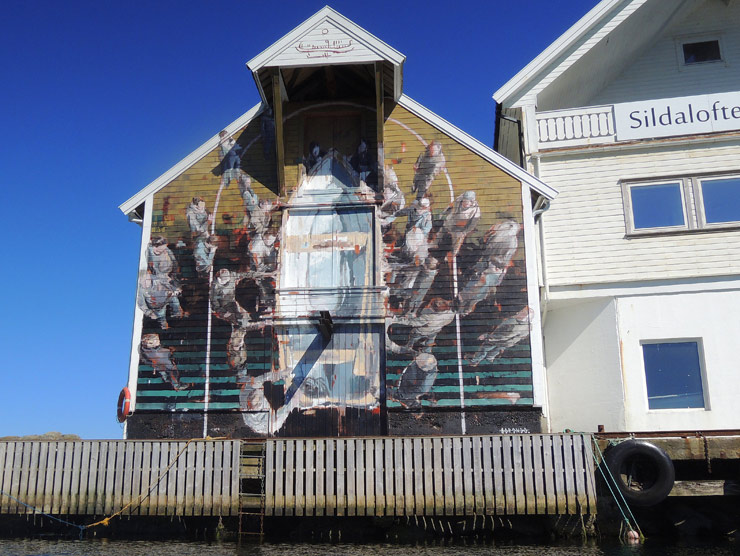
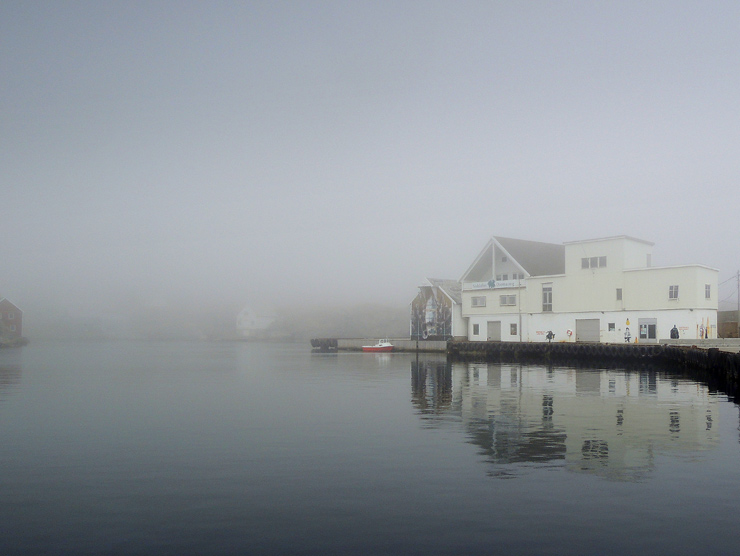
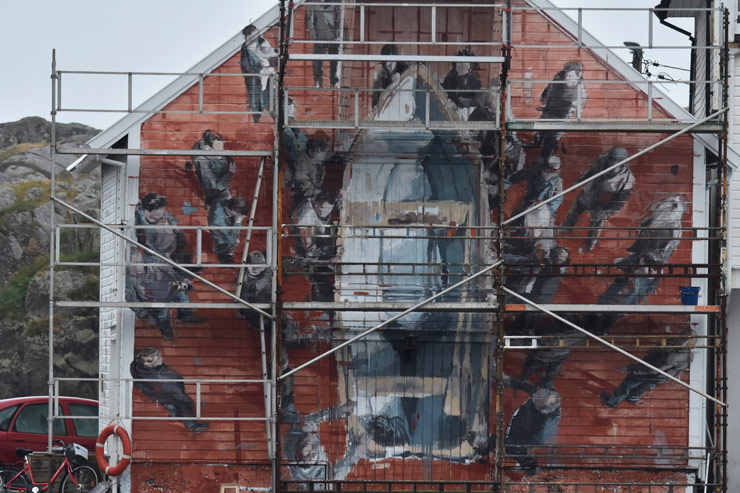
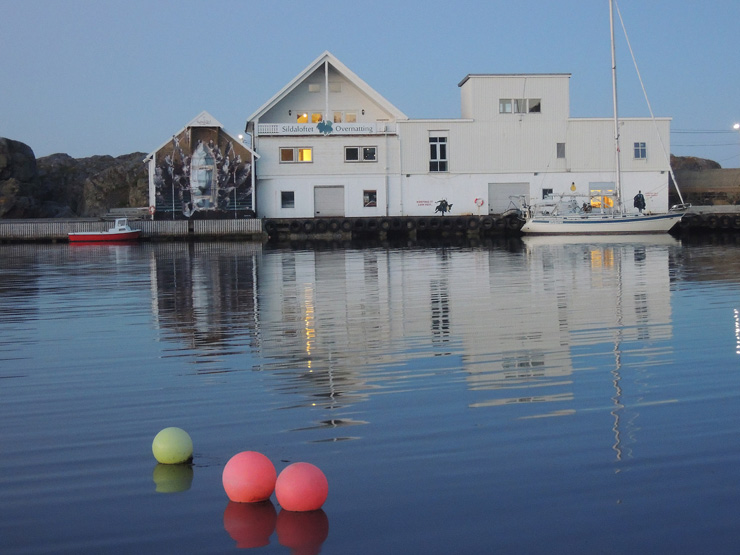
Today we revisit Utsira, the tiny island in Norway that has hosted a few Street Artists over the last couple of years, like Ella & Pitr and Icy & Sot. This year the fine artist and Street Artist Gonzalo Borondo blended into the hills and the forest and the lapping waves, making his spirit dissipate into the community and into a boat.

Borondo. Utsira. Utsira, Norway. Summer 2018. (photo courtesy of the organizers)

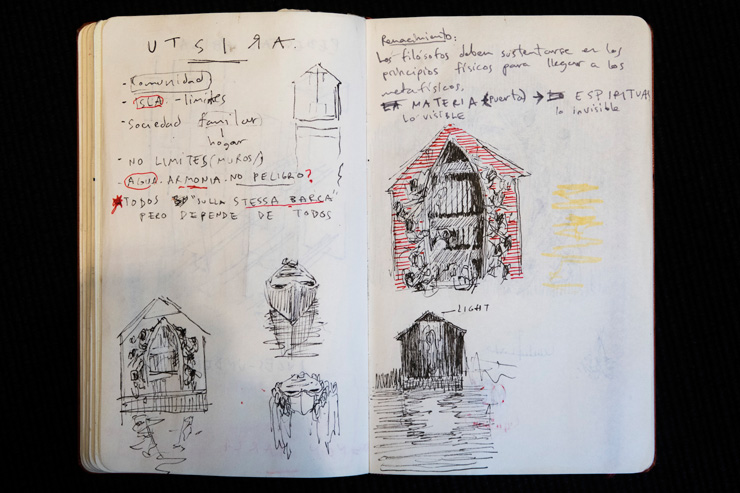
His philosophical take on the outer world here, with its strength in its small close knit numbers, its seafaring economy and traditions, its physical realities transcended by metaphysical ones… lead him to this new mural and his renewed hope in communal strength.

Borondo. Utsira. Utsira, Norway. Summer 2018. (photo courtesy of the organizers)

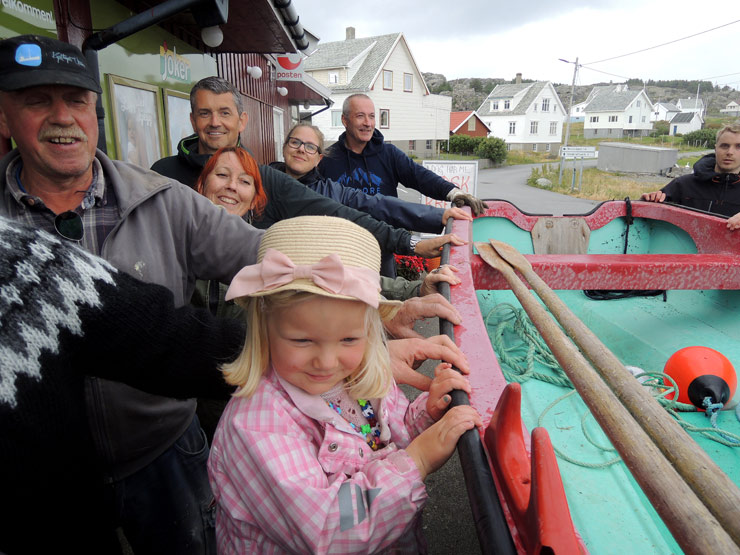
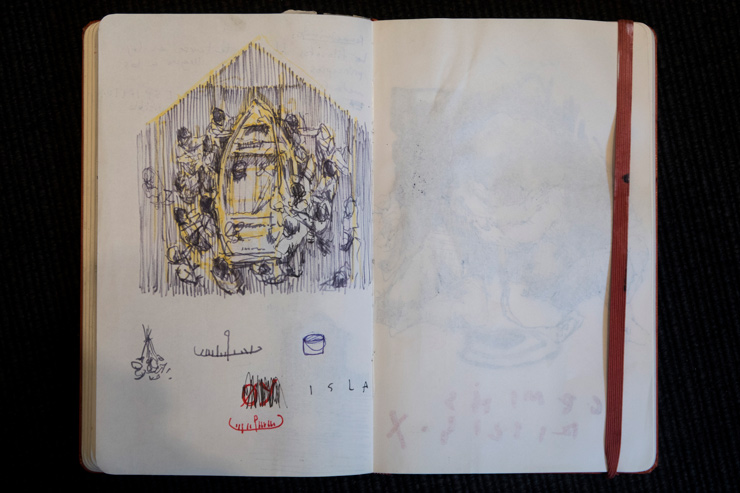
See here in these images the process of staging the scene, the models, the central organizing boat and its associations – now transformed to a door when centered as it is on this building. Of equal importance is the circle of hands that surround it, grasp it, hold it, support it, keep it on course.

“There’s a strong sense of community,” he says as he reflects on the metaphor he has chosen to represent his time here on an island of only 420 people, “There is a mutual support among citizens and a common feeling of enjoying the same unique condition.”

Borondo. Utsira. Utsira, Norway. Summer 2018. (photo © Borondo)

Borondo. Utsira. Utsira, Norway. Summer 2018. (photo courtesy of the organizers)

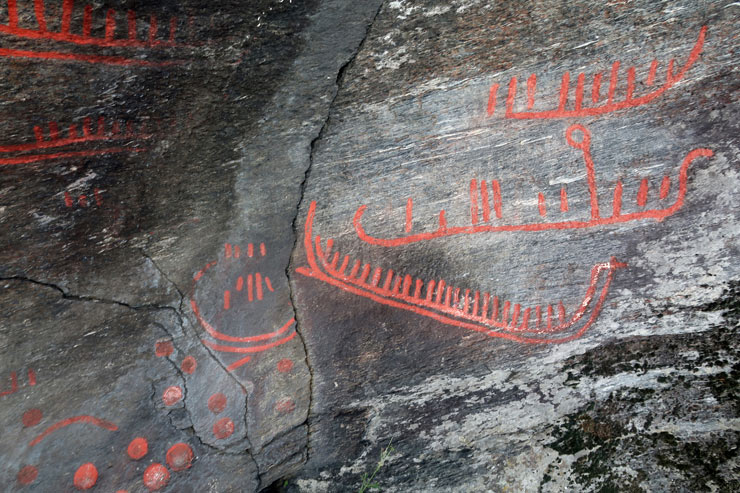
Borondo. Utsira. Viking graffiti. Utsira, Norway. Summer 2018. (photo © Borondo)

Borondo. Utsira. Utsira, Norway. Summer 2018. (photo © Borondo)

Borondo. Utsira. Utsira, Norway. Summer 2018. (photo courtesy of the organizers)

Borondo. Utsira. Utsira, Norway. Summer 2018. (photo courtesy of the organizers)

Borondo. Utsira. Utsira, Norway. Summer 2018. (photo courtesy of the organizers)


Read more
Artist 0907 Pays Tribute to Hongshen Jia in Beijing, China.

Artist 0907 Pays Tribute to Hongshen Jia in Beijing, China.

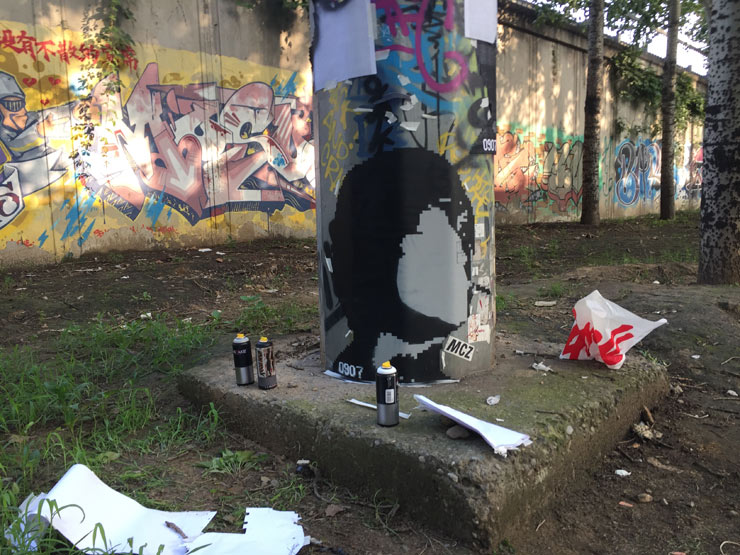
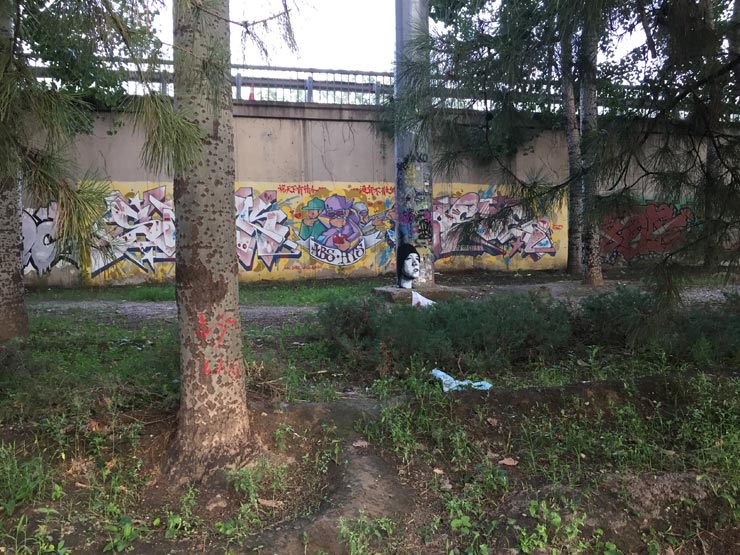
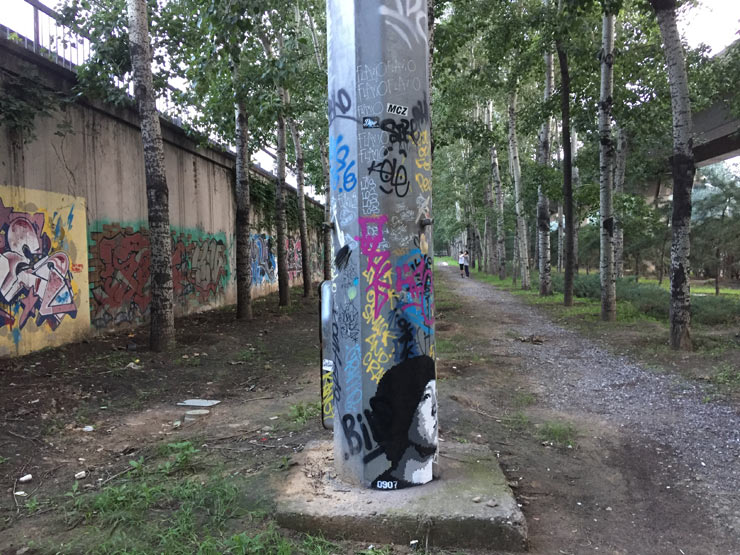
Wandering along a footpath under the elevated street in Beijing these days you are likely to find the same sort of graffiti tags, wildstyle burners and stenciled celebrities that you discover in so-called Western city graffiti/Street Art scenes.

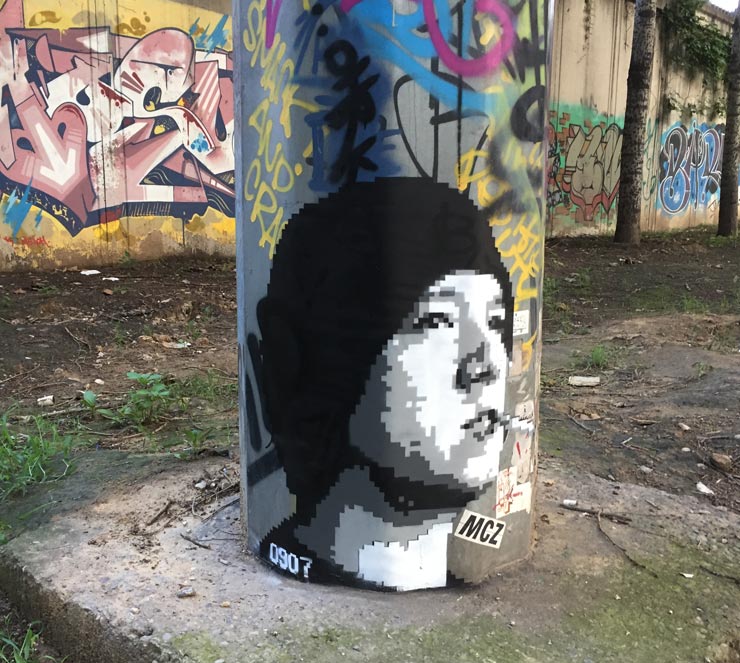
Of course the language and tags are likely in Chinese and the honored pop culture figures are more likely to be Chinese film stars, like this new digitized stencil by Street Artist 0907 of Hongshen Jia (贾宏声).

0907. Hongshen Jia. Beijing, China. (photo © 0907)

“He is my favorite Chinese film actor and he is a legendary actor in China,” the artist tells us. On the Wikipedia page about the actor it says, “His performances were praised by critics and he developed a rebellious image that made him popular among artistic youth and the “Sixth Generation” of Chinese directors.[1][2]” Struggling with addiction many times, he took his own life in 2010 and he is also slowly transforming into a kind of folk hero for some.

0907. Hongshen Jia. Beijing, China. (photo © 0907)

0907. Hongshen Jia. Beijing, China. (photo © 0907)

0907. Hongshen Jia. Beijing, China. (photo © 0907)

Read more
INO Mural Buffed in Belarus. A Natural Death or a Penalty in Minsk?

INO Mural Buffed in Belarus. A Natural Death or a Penalty in Minsk?

“I think it is interesting how a society reacts to an intense form of public art like this – a large scale mural with a message,” says Greek Street Artist INO when discussing the recent decision to buff his multi-story 2015 mural in Minsk, Belarus.

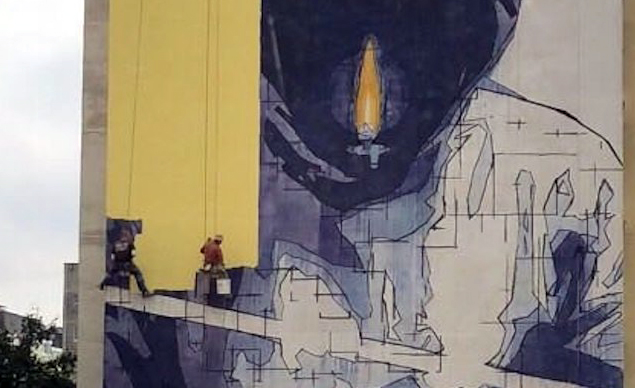
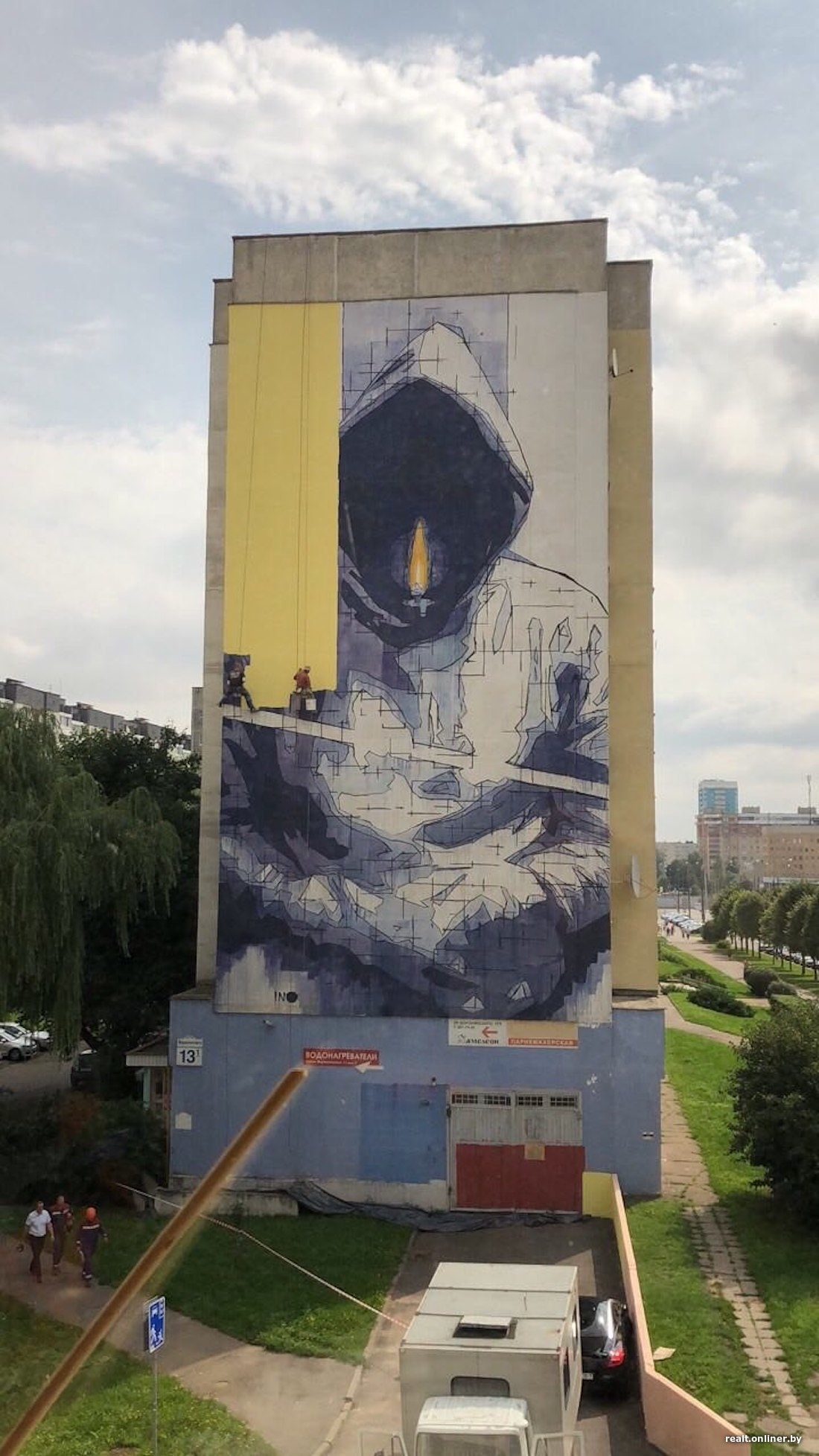
Workers beginning the yellow buff of INO’s anti-death penalty mural in Minsk. (Photo © realt.onliner.by)

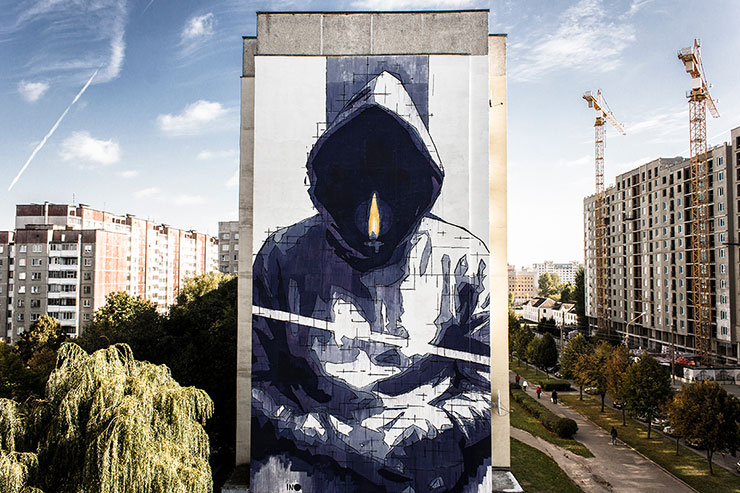
A mystery figure cloaked in a hoody with his face replaced by a burning candle flame, the image on the high-rise building on Voroniansky Street became quite recognizeable, with or without viewer’s knowledge that it was essentially a critique against the country’s death penalty. At the time he painted it with the “Urban Myths” project he said, It is dedicated to all those who were executed and after some time, it was proved that they were innocent.”

The sentiment would not have been explicit to the average viewer, but local website Onliner says that the eight-story piece was not accepted well by some the neighborhood, and that it even sparked petitions by those who found the mural objectionable, as well as those who supported it.


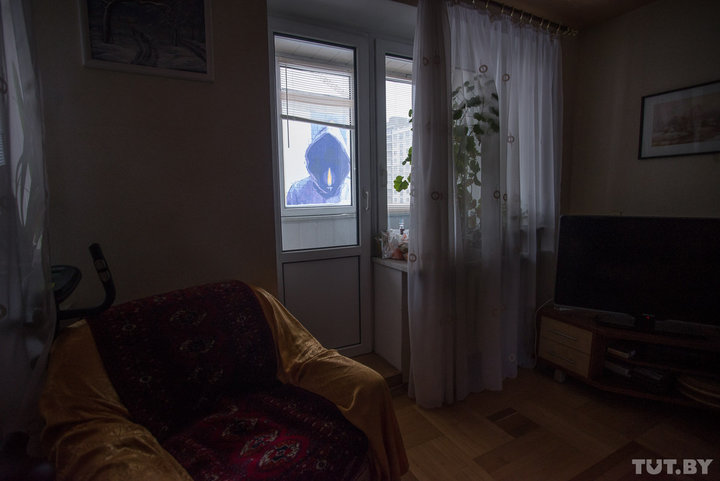
INO peaking through the curtains in Minsk. (Photo © Yevgeny Yurchak and TUT.BY)

“I know that some people have curtained their curtains with curtains – so that even accidentally their eyes don’t fall upon a ghost angel,” says a resident who lives across from it, according to our translation of the Onliner’s July 27 article about the freshly painted “Man Without a Name.”

City officials and the administration of the Oktyabrsky district have so far avoided the controversial nature of the mural, according to the artist, by focusing on a necessity to install new thermal insulation, but INO appears to doubt it.

INO’s original “Man Without a Name” made the neighbors feel gloomy in Minsk. (Photo © the artist)

Many observers of the Street Art scene might suggest that a (nearly) three year “run” by a mural piece is quite respectable and the artist should be pleased, especially when you consider the nature of the illegal and ephemeral Street Art scene where a new artwork is not guaranteed to remain for even one day.

INO says he appreciates that, if this was in fact a form of censorship, it was done by official proclamation and without contentious attitude. “They were quite conservative and were fighting this in such a diplomatic way.”

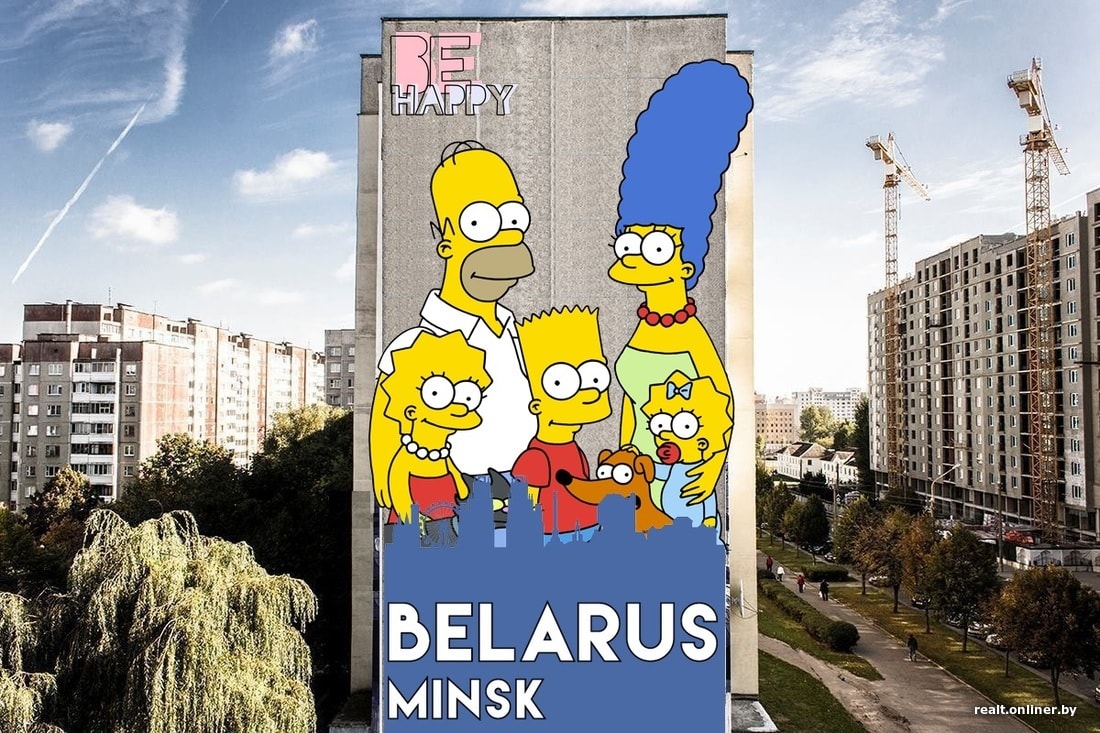
Only a day after the piece was buffed, the local paper took a rather lighthearted approach by publishing Photoshopped options to replace the mural, which they dubbed “Angel of Death”. One suggestion from readers was for a mural of The Simpsons and the exhortation to “Be Happy.”

(Photo © realt.onliner.by)

Below is a video of the original INO mural when it first appeared.

Read more
BSA Images Of The Week: 07.29.18

BSA Images Of The Week: 07.29.18

BSA-Images-Week-Jan2015

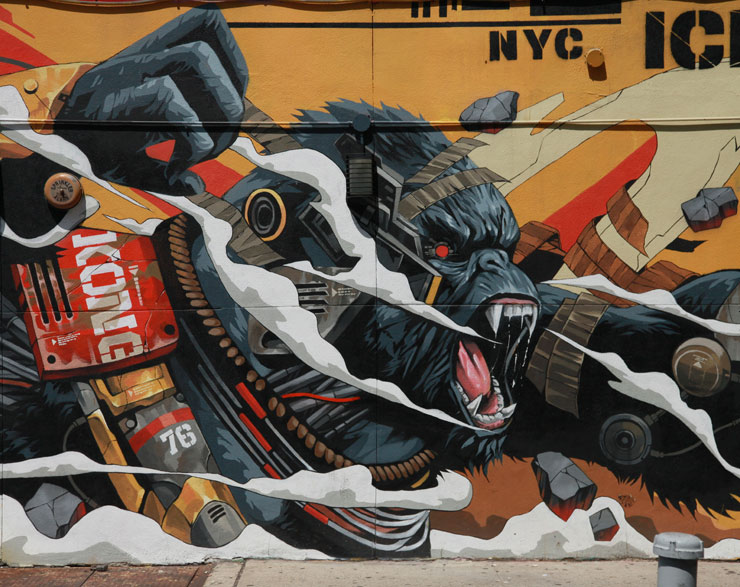
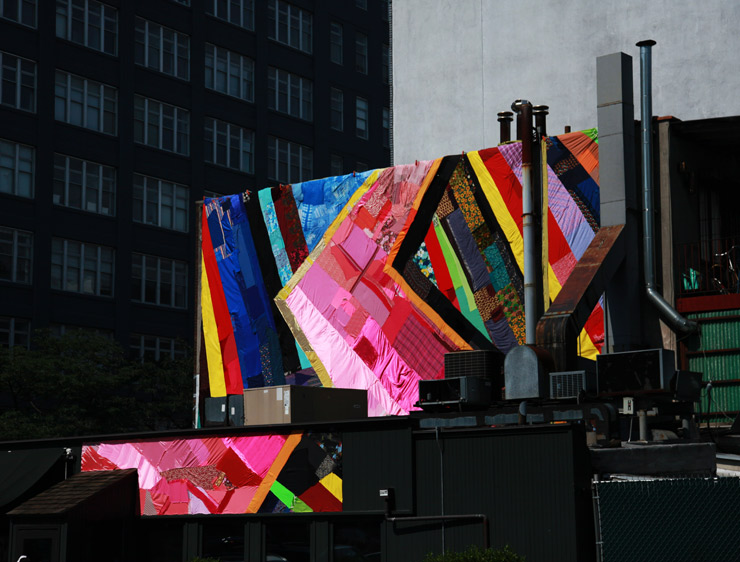
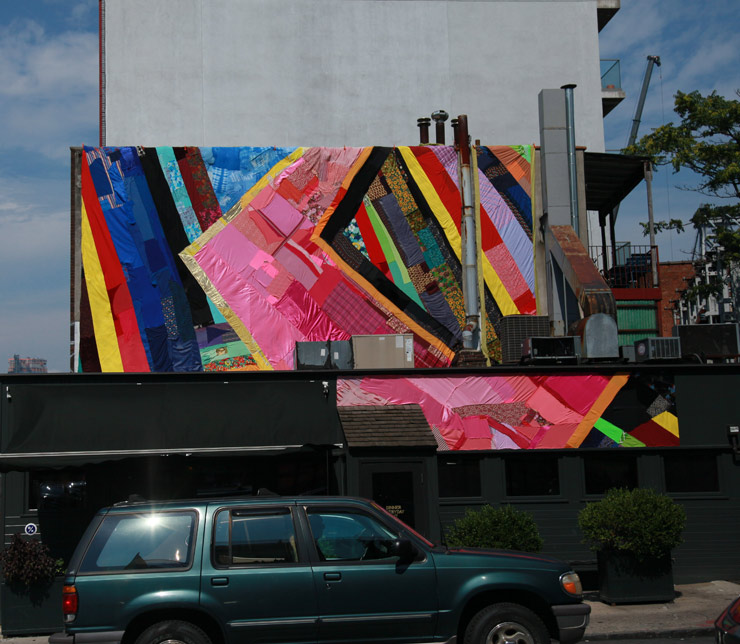
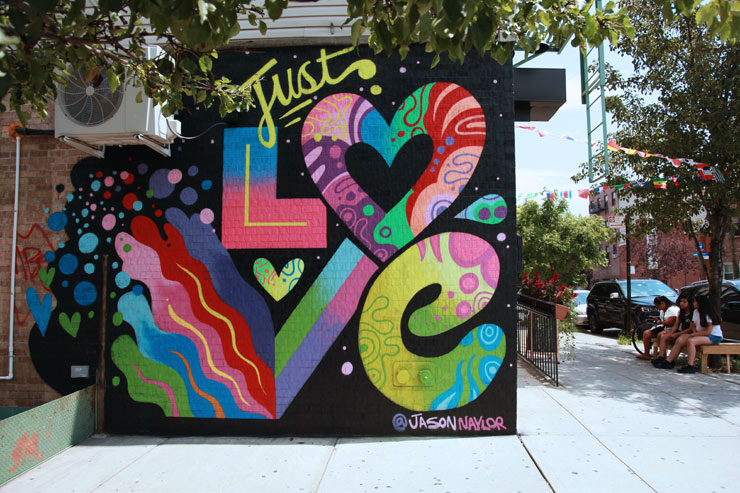
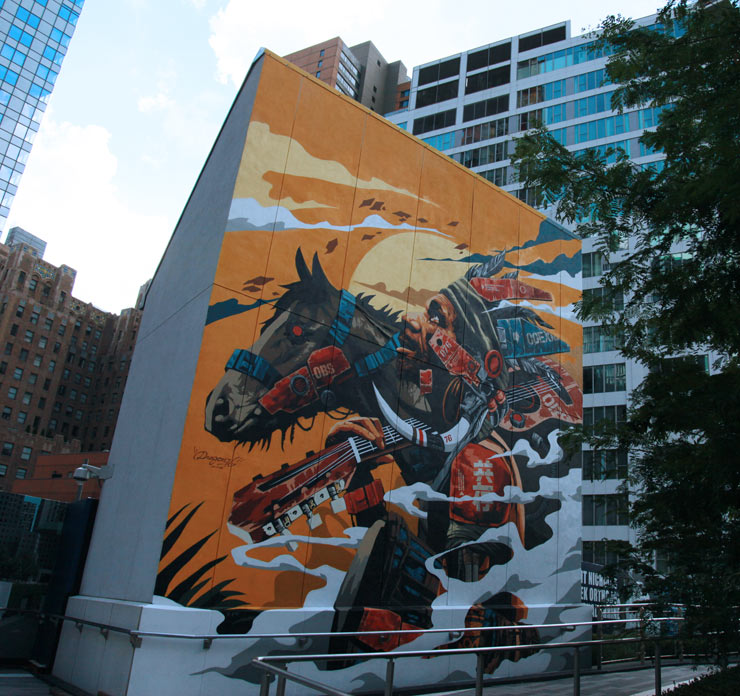
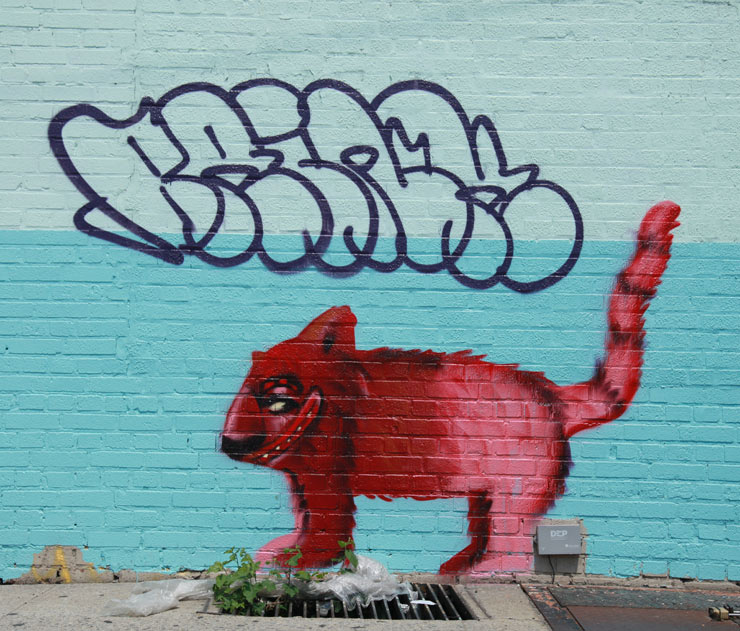
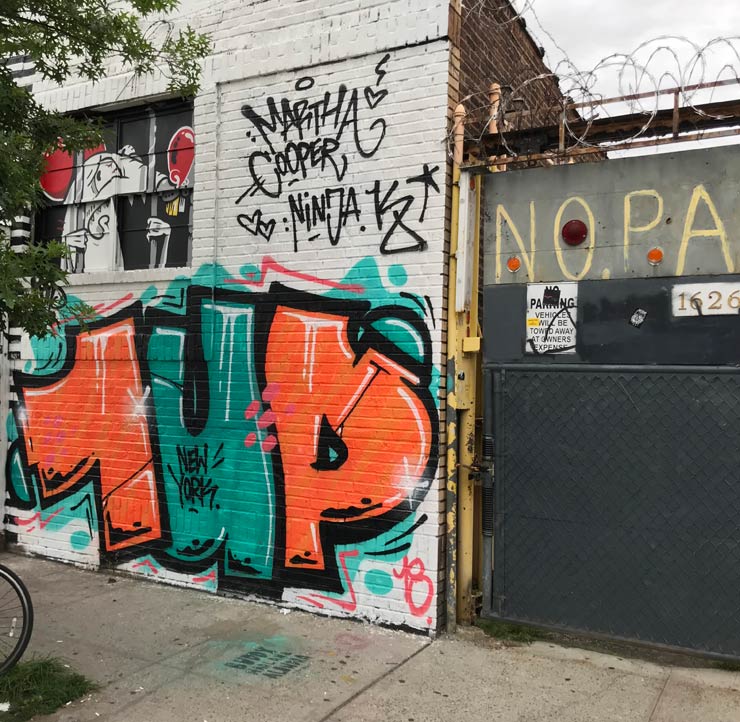
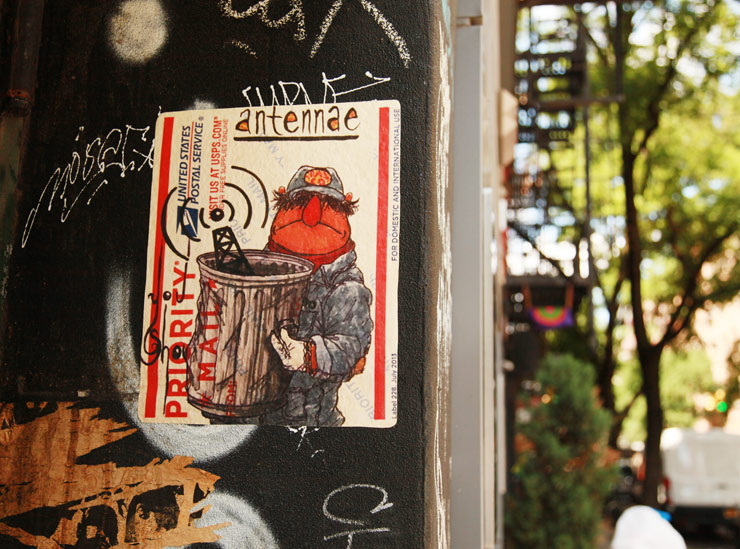
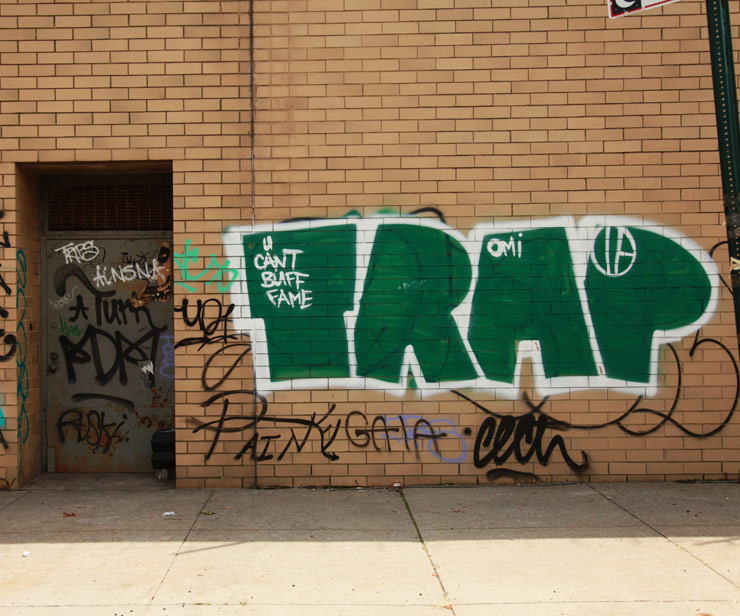
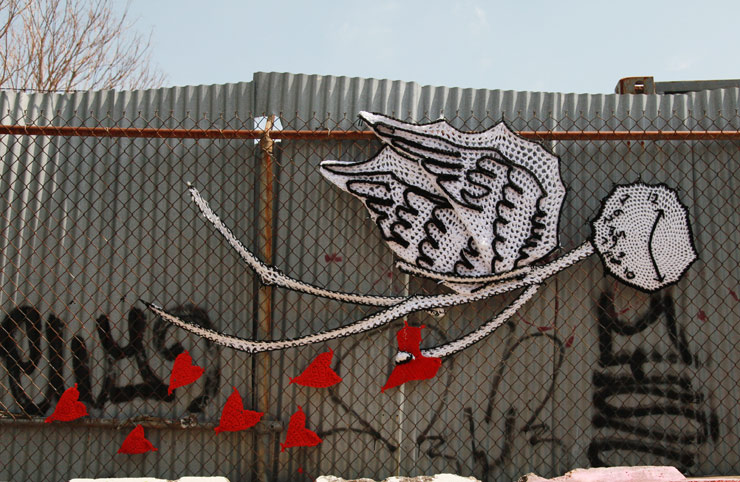
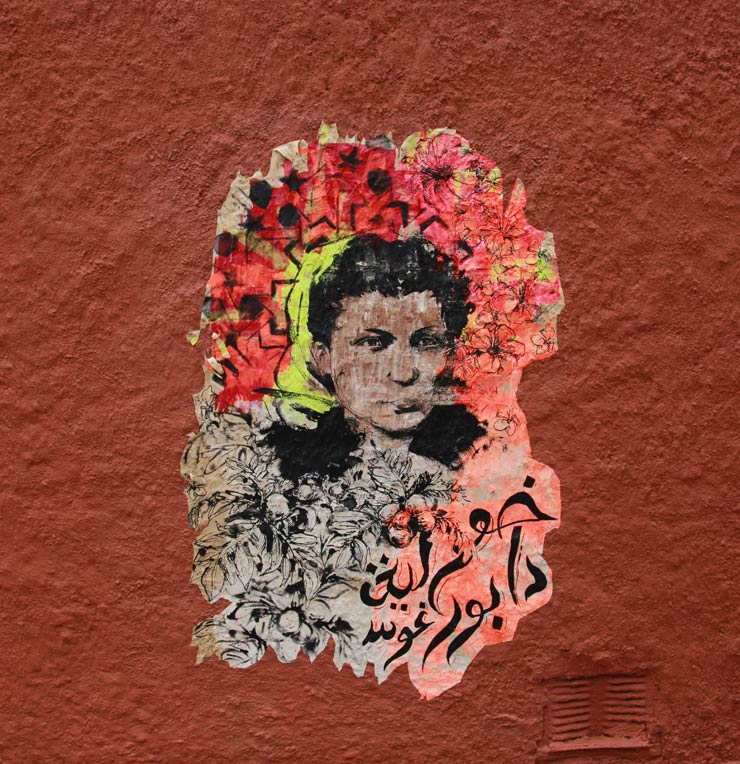
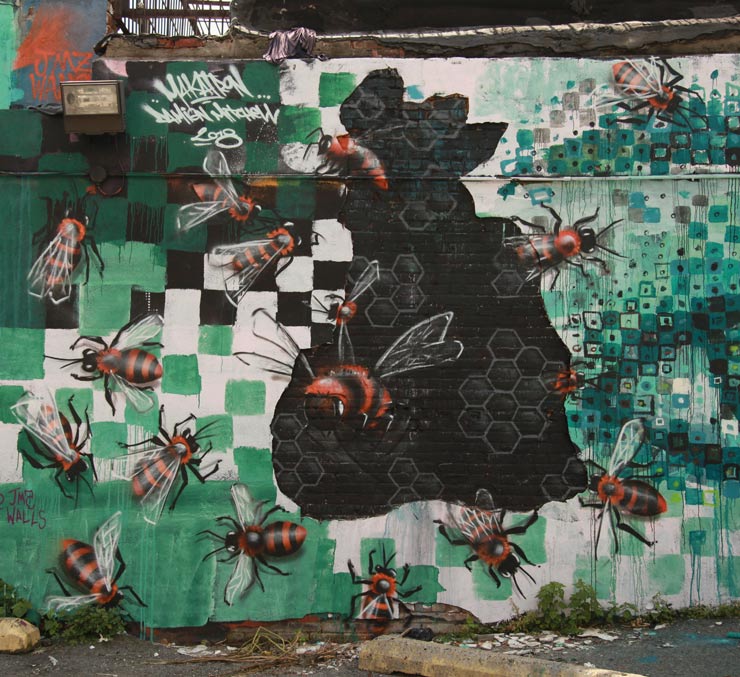
Here’s our weekly interview with the streets, this week featuring 1UP Crew, Amanda Browder, Antennae, City Kitty, Dirt Worship, Dragon76, Jason Naylor, LMNOPI, London Kaye, Makatron, Sheyro, The Yok, and Trap.

Amanda Browder (photo © Jaime Rojo)

Amanda Browder (photo © Jaime Rojo)

Jason Naylor (photo © Jaime Rojo)

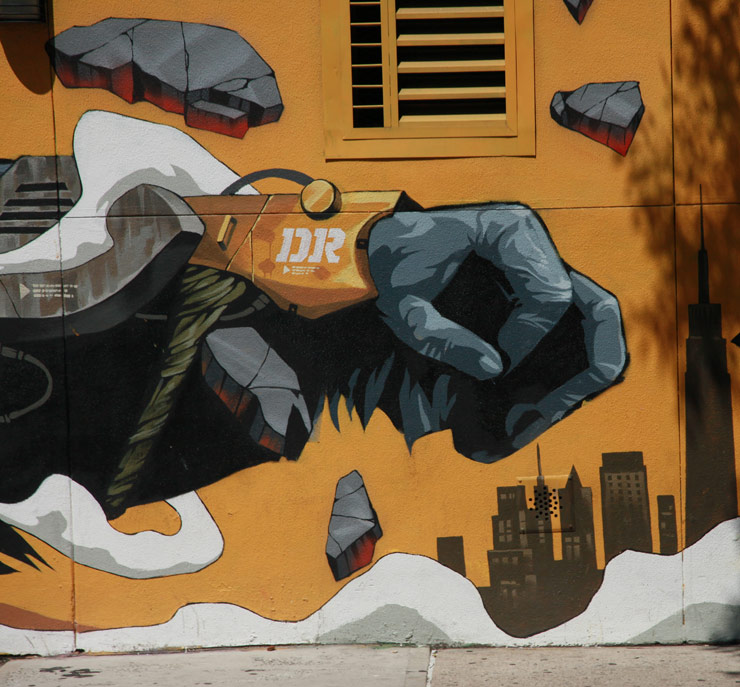
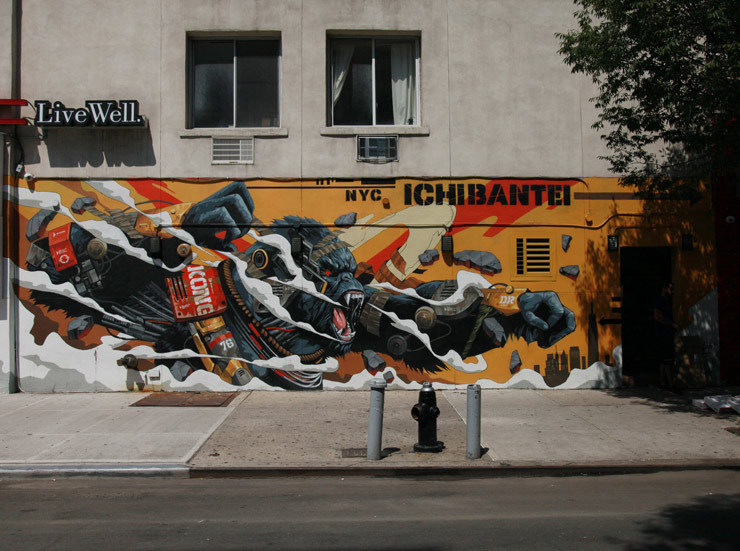
Dragon76 (photo © Jaime Rojo)

Dragon76 (photo © Jaime Rojo)

Dragon76 (photo © Jaime Rojo)

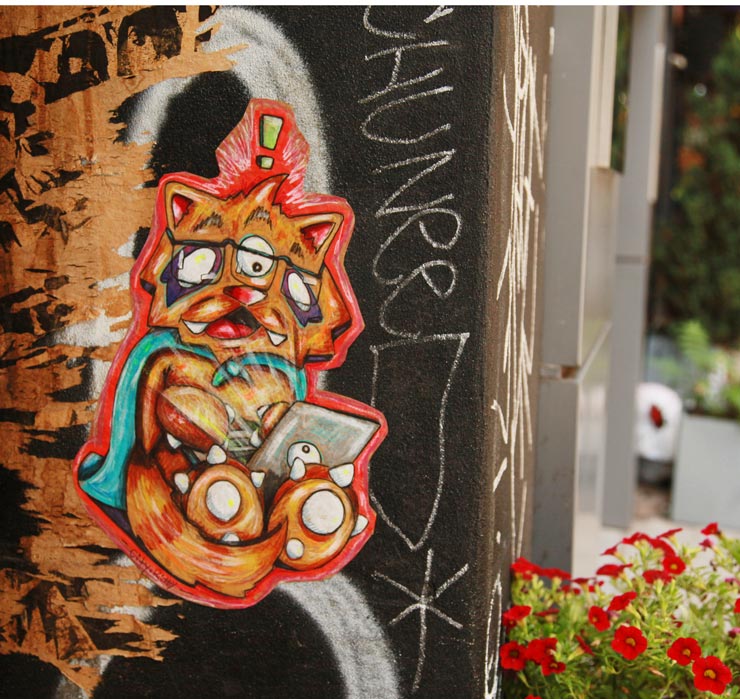
City Kitty (photo © Jaime Rojo)

Dragon76 (photo © Jaime Rojo)

Unidentified artist (photo © Jaime Rojo)

1UP Crew (photo © Jaime Rojo)

Antennae (photo © Jaime Rojo)

Trap (photo © Jaime Rojo)

London Kaye (photo © Jaime Rojo)

London Kaye (photo © Jaime Rojo)

Unidentied artist (photo © Jaime Rojo)

Makatron for JMZ Walls. (photo © Jaime Rojo)

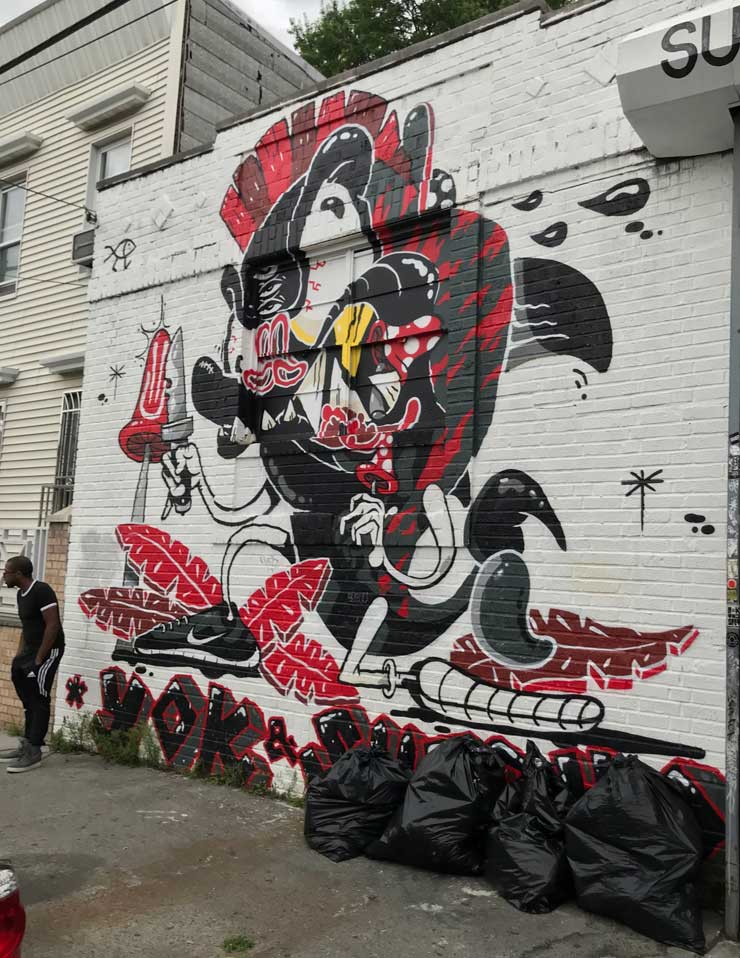
The Yok & Sheryo (photo © Jaime Rojo)

Dirt Worship (photo © Jaime Rojo)

LMNOPI (photo © Jaime Rojo)


Untitled. Brooklyn, NY. July 2018 (photo © Jaime Rojo)

Read more
Destroying Desert Water Bottles; Chip Thomas’ New Work in AJO, Arizona

Destroying Desert Water Bottles; Chip Thomas’ New Work in AJO, Arizona

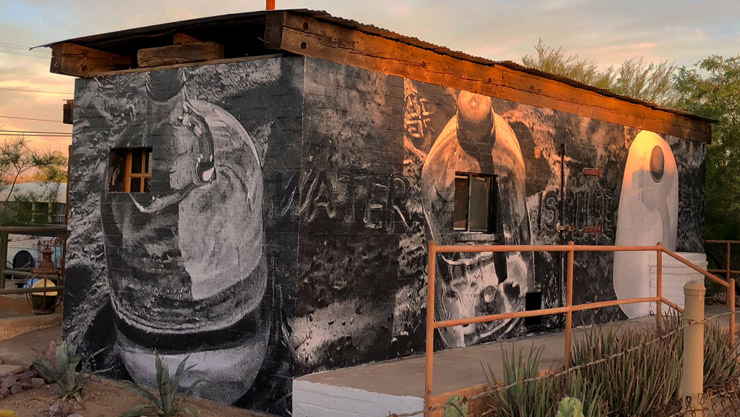
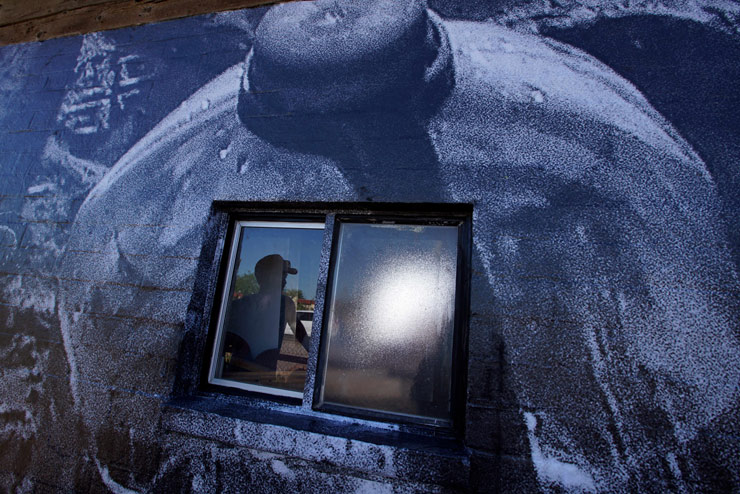
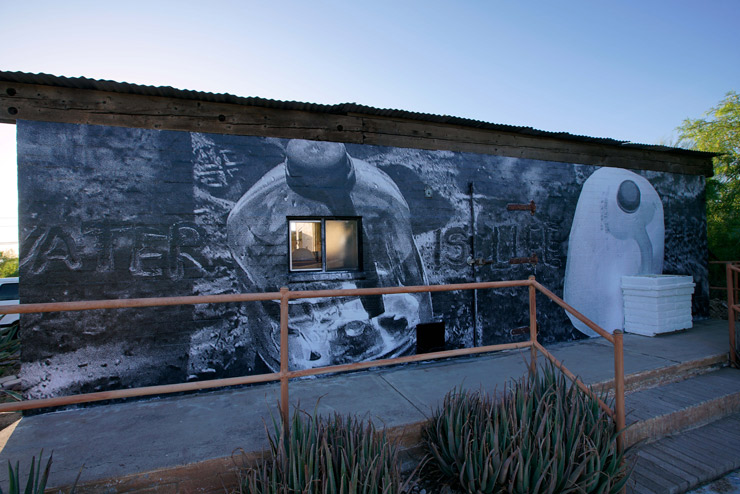
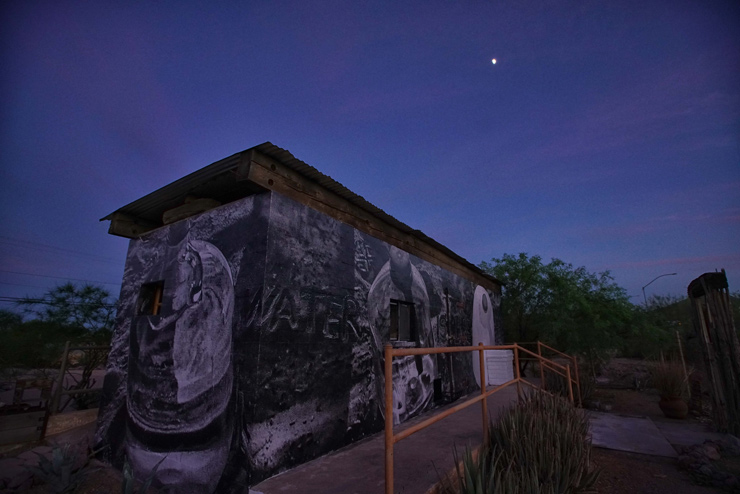
“To raise the call of our faith traditions as an act of resistance against the cruelty and violence that dominate US policy and actions,” says Street Artist and social activist Chip Thomas (aka Jetsonorama) about this new project of wheat-pasting his photographs that feature jugs of water in the Arizona desert.

Sorry. What?

Yes, jugs of water.

Chip Thomas. AJO, Arizona. July. 2018. (photo © Chip Thomas)

Yes, it has come to this, in a nation that often proudly brays sanctimoniously about its Christian traditions and of being full of good God-fearing people. Somehow we think that its perfectly acceptable to go around destroying jugs of water in the desert because people who are thirsty might drink it.

So this is what Jesus would do, right? The Lord and Savior, who in the Bible actually multiplied fish and loaves of bread to feed people – would approve of us stomping among the cacti and tumbleweeds under the punishing hot sun in the desert and dumping on the sand jugs of water that were left for poor desperate Christians (~80 percent of Mexicans are Catholic), some of whom are possibly even named Jesus?

Chip Thomas. AJO, Arizona. July. 2018. (photo © Chip Thomas)

No More Deaths is a bluntly stark name for a humanitarian group, but there’s little room for romantic or cleverly turned phrases when you are talking about a grassroots organization that is helping people to stay alive.

“This last year has been rough for humanitarian aid workers in Ajo with No More Deaths volunteers charged with misdemeanors and fined for leaving water for migrants out on the Cabeza Prieta Wildlife Refuge,” writes volunteer Maria Singleton in a letter to Chip that helped inspire this new public work. “In order to get a permit to go on the wildlife refuge they are requiring people to sign a form that says they will not leave water, socks or first aid items out.”

Chip Thomas. AJO, Arizona. July. 2018. (photo © Chip Thomas)

According to the Bible in the book of Matthew 15:32, Jesus called his disciples to him and said, “I have compassion for these people; they have already been with me three days and have nothing to eat. I do not want to send them away hungry, or they may collapse on the way,” which leads you to believe that Jesus would have condemned the actions and the people who destroy water and food supplies here if he were to, say, pass judgment on them.

The new art installation is directly across from the entrance to Cabeza Prieta which is the national wildlife refuge near the border of the US and Mexico and in a region that has the highest migrant death rate due to the brutality of the desert crossing. “Some 32 sets of human remains were found there last year, according to the Pima County office of the medical examiner, making it one of the region’s deadliest crossing routes,” says an article in The Guardian earlier this year.

Chip Thomas. AJO, Arizona. July. 2018. (photo © Chip Thomas)

The Street Artist, who has used his own photographs to wheatpaste for on walls for a decade or so, says that a member of the humanitarian/religious group called Ajo Samaritans offered to him and his small team to create his new artwork on the walls of the ironically named “ice house” in the town of Ajo.

Ajo Samaritans describe themselves and their mission on their website like this; “Samaritans are people of faith and conscience who are responding directly, practically, and passionately to the crisis at the US/ Mexico border. We are a diverse group of volunteers around Ajo that are united in our desire to relieve suffering among our brothers and sisters and to honor  human dignity. Prompted by the mounting deaths among border crossers, we came together to provide food and water, and emergency medical assistance to people crossing the Sonoran Desert.”

“We were welcomed warmly by the Ajo activist community to whom I’d like to recognize for their expression of shared humanity and for their bravery,” says Chip. “Shout out to my crew as well – Justin Clifton, Drew Ludwig, Stash Wislocki and Jerrel Singer.”

Chip Thomas. AJO, Arizona. July. 2018. (photo © Chip Thomas)


Read more
BSA Film Friday 07.27.18

BSA Film Friday 07.27.18

bsa-film-friday-JAN-2015

Our weekly focus on the moving image and art in the streets. And other oddities.

Now screening :
1. Yok & Sheryo: Mumbai “Varuna Vessel”
2. Mr. June Paints in June
3. Concreto #4 , Fortaleza, Brazil
4. Doug Gillen takes on Email Art Scams

bsa-film-friday-special-feature

BSA Special Feature: Yok & Sheryo: Mumbai “Varuna Vessel”

The Street Art duo of Sheryo and Yok plumb the depths of the urban environment in their travels, getting to know a culture and the people there – a full immersion practice that helps them conceptualize and fashion street murals, gallery shows and exhibitions that utilize the traditions, lore, language, and even the skills of local tradespeople.

This week we have a travelogue to the Sassoon docks in Mumbai where they collaborate with fisherman and women friends, fabricators and textile designers in the street, on a boat, and ultimately in an exhibition called “Varuna Vessel”. Extra points awarded here for the soundtrack, dropped on you in typical S&Y style like a needle on a record, no fade, all funk.

Mr. June Paints in June

Last month Mr. June was in Greensboro, North Carolina to paint a 45 meter diameter water tank roof. In the southern heat for 13 days painting? Give it up for Mr. June, who calls this job for a water resources facility his ode to the beauty of water.


Concreto #4 , Fortaleza, Brazil

Before the 5th Concreto Festival kicks into motion this November it’s good to look at the final video they made from the last one.

The brainchild of artist and organizer Narcélio Grud, the festival is in partnership with an urban art school that provides students with a theoretical background and support for intellectual experimentation with this kind of art in the streets that melts barriers.


Doug Gillen takes on Email Art Scams

As if it isn’t already challenging enough to be an artist – for the 99% without who are decidedly stressed for time, money, and a publicist. No matter, there are still lowlifes who will try to scam you bro/sis. Occasionally right through your inbox!

Public Security Officer Gillen introduces this underworld of squirrelly types who will try to persuade you into giving over your money to them for massaging your ego. We know that may sound appealing to some of you but in this case the only stripper involved is you, sexy.


Read more
FKDL and the Collage of a Street Artists’ Life in a Book

FKDL and the Collage of a Street Artists’ Life in a Book

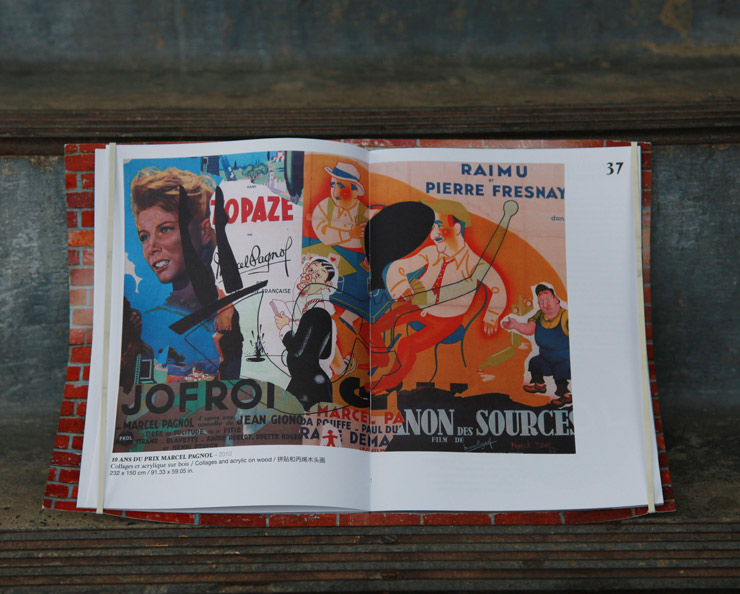
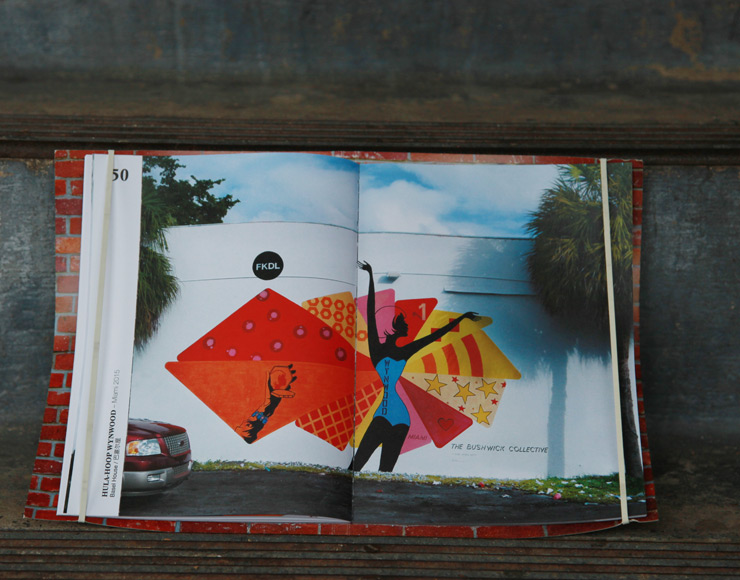
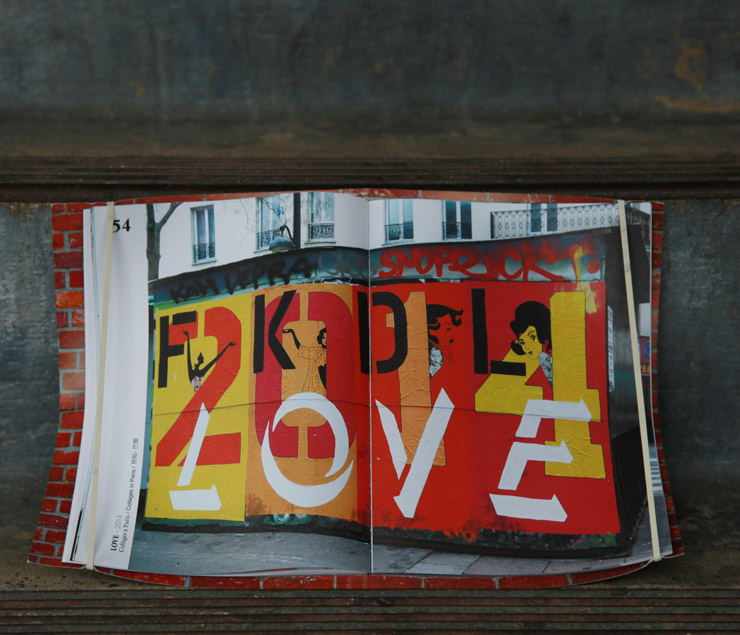
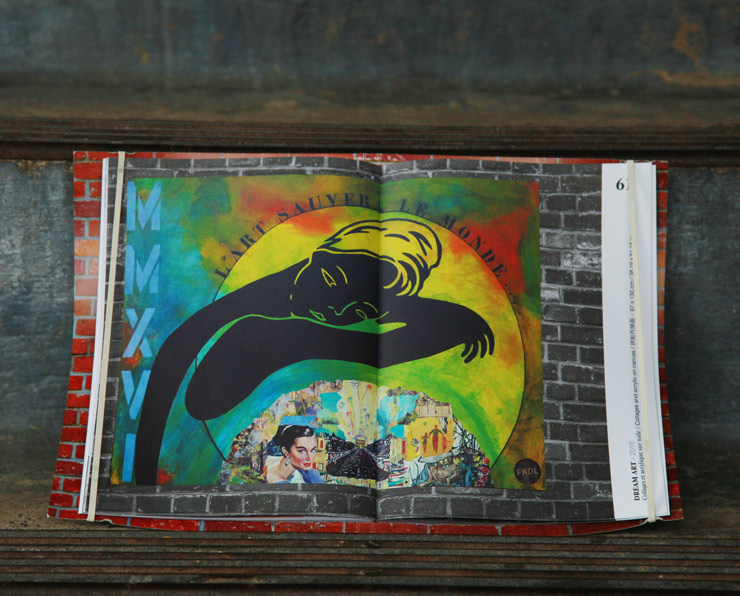
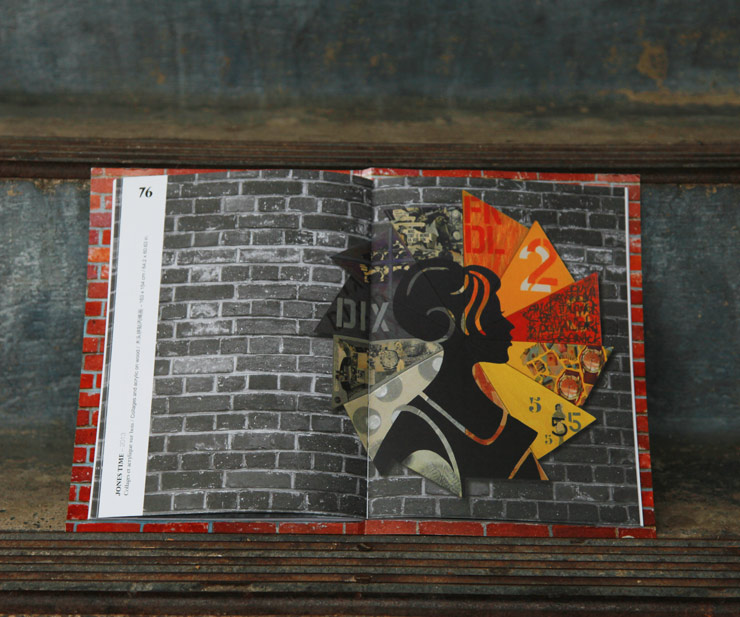
As you look through this new slim volume about the Street Artist/fine artist FKDL it may strike you how much autobiography is the determinant of an artist’s path as well. It’s the tale of a teenager finding himself, finding his vocation, and eventually finding his voice on the street. When you reach the end you see that it takes a number of years and a lot of experimentation, this journey.

FKDL. Galiote Prenant. Choisy-le-Roi, France. 2017.

FKDL now tells his own grown kids, “everything you do now will come in handy later.” Don’t worry, nothing is wasted.

It’s good advice that should put many a teen graffiti writer and Street Artist at ease because that is the path that a creative life may take before it all sticks together and begins to make sense.

Pulling imagery and text and memories and infatuations from his own formative events and through each era, FKDL uses a process of sorting into piles, sifting, putting relevant elements along side or over top of one another, constructing a cohesive view. With seemingly disparate pieces of stories he organizes a view that turns into a narrative of the imagined, the aspired to, an ideal.

FKDL. Galiote Prenant. Choisy-le-Roi, France. 2017.

The French street artist uses the walls of the public walkway as a principle staging to test his work and expose his process to the public. Until the last decade the audience was in galleries or his studio but his is a strange new liberation and the feedback he receives gives him direction for what follows. These are lessons he would not have known way back in high school studying fashion, or later learning about how to join the circus, but he still brings that training to the game today.

He speaks of his testing grounds for his Street Art – the neighborhoods of Le Marais, Les Halles, Belleville, and Monmontre in Paris. ” The Streets are where I test the durability or impact of an idea, an image, an icon. I build, I glue, and I wait. How social media, vandals, and the public works teams respond to my collages tells me whether the work is successful or not.”

FKDL. Galiote Prenant. Choisy-le-Roi, France. 2017.

This new book tells in detail the path of a creative painter, collagist, and even a maker of L’Art Scotch (tape art) over the period of a few decades. Perhaps most impressive is the very organized collection of vintage French magazines from the 40s, 50’s, 60s that he has amassed and the myriad intricately woven tales of love and glamour and disappointment and treachery that can be buried among those pages and used to construct new dramas.

For him, its mostly about love. As a fairly linear narrative, the book also shares memories and perspectives from the artist about getting his work shown in galleries, joining group shows, receiving awards, wheatpasting with friends on the street, spending hours in his studio.

FKDL. Galiote Prenant. Choisy-le-Roi, France. 2017.

“Happiness is a sustainable state of psychological balance that should last over time,” he says of his own philosophical practice of actively choosing to be positive, including in his art making.

“It is a demanding practice, to think that, in the light of what we have experienced and wish to experience, each one of us is the principal creator of his own happiness and has an impact on that of others around us.”

FKDL. Galiote Prenant. Choisy-le-Roi, France. 2017.

FKDL. Galiote Prenant. Choisy-le-Roi, France. 2017.

Read more
Rammellzee: Graffiti Writer, Artist and Deity “Racing For Thunder”

Rammellzee: Graffiti Writer, Artist and Deity “Racing For Thunder”

We knew that Rammellzee deserved an intellect and artist operating on his wavelength to give a fair examination of his work and this exhibition, and very few can rise to the occasion the way that EKG does today for BSA readers. The exhibition is phenomenal in its scholarship and presentation without question thanks to its curators. EKG is naturally equipped to decode and help others appreciate the artist thanks to his exhaustively inquisitive nature, reverence for methods of applied science, brilliant data sequencing ability, and NYC streetwise intellect.


THE RAMM:ΣLL:ZΣΣ EQUATION = AN ALGORITHMIK BIO-HACKED ANTIDOTAL INJECTION INTO THE BODY-POLITIK OF THE DISEASE-CULTURE MATRIX

An article in two parts:
(1) A look at Rammellzee’s life and work.
(2) A review of the RAMMELLZEE: RACING FOR THUNDER exhibition

 by ( ( ( ekg ) ) )
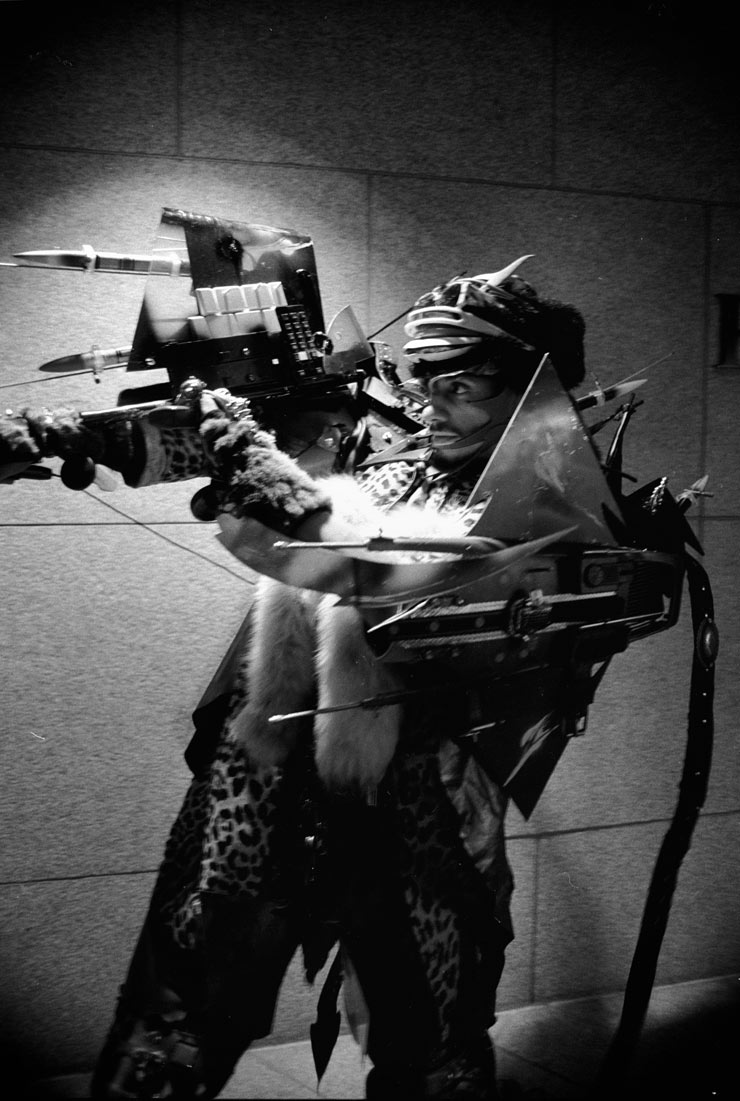

Rammellzee (photo © Brian Williams. Courtesy of Red Bull Arts)

Part 1: The Rammellzee.

By the age of nineteen, a graffiti writer from Far Rockaway, Queens, NYC, had already come to the advanced aesthetic decision to legally abandon his family-bestowed and governmentally-designated name, and knight himself with a self-defined alpha-numeric neologism: THE RAMM:ΣLL:ZΣΣ. With this subversive act of mathe-poetic mutation, the prodigal prodigy ironically utilized the very machinations of power and control to re-code himself as an aesthetic bio-hack manifestation injection challenging the status quo system. Then, for the rest of his life, he steadfastly kept his original designation an absolute secret, thereby proving the seriousness and effectiveness of the manifest destiny of his semiotic transformation into a wraith of rebellion in the Aestherial Semiotosphere.
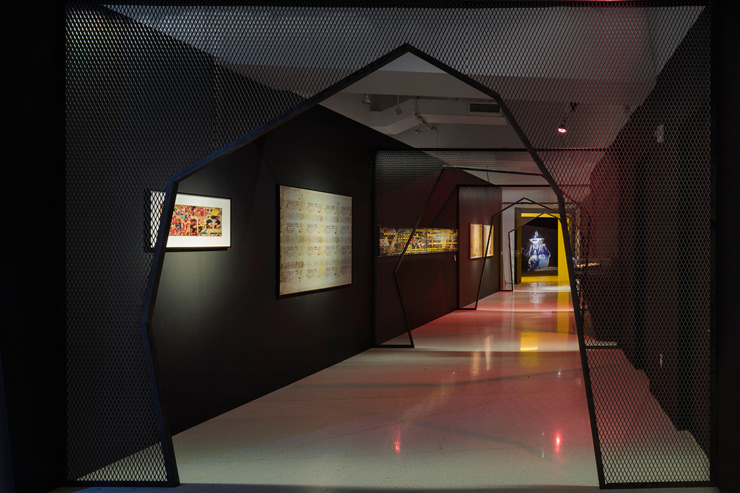
Rammellzee: Racing For Thunder. (photo © Red Bull Arts)

Rammellzee’s self-induced rebirth was the pinnacle of his aesthetic and theoretical development during his teens in the mid-to-late 1970s. Illustrating his natural visual gifts, Rammellzee’s early work was a combination of precise drafting techniques with an expressionistic use of spray paint. Revealing his intellectual depth and writing talents, he formulated a universal aesthetic philosophy called Gothic Futurism, as well as codifying the stylistic elements of Wild Style graffiti into an advanced set of militaristic semiotic forms that he dubbed Ikonoklast Panzerism. Displaying his charismatic leadership qualities, he formed the crew Tag Master Killers, consisting of the other graffiti writers A-One, Delta2, Kool Koor and Toxic, who had the talents to execute his exacting stylistic tenets. Also, due to his relentless social energy as a performer and rapper, he was quickly recognized as a significant presence in not only the graffiti and art communities, but the hip hop subculture as well.
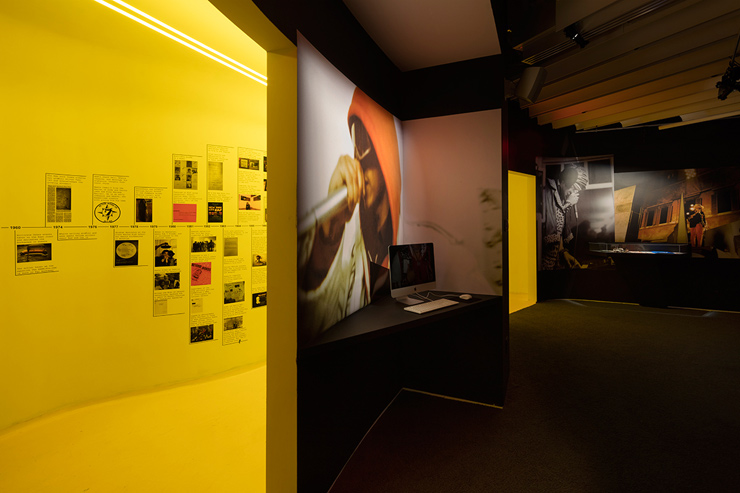
Rammellzee: Racing For Thunder. (photo © Red Bull Arts)

As he passed into his twenties during the early 1980s, Rammellzee was featured in many of the seminal graffiti, hip hop, and fine art events and projects of the times. He worked as an MC with the legendary break dancer Crazy Legs. He was included in shows at significant galleries uptown and downtown in NYC, including Fashion Moda. Basquiat recorded him with K-Rob in one of the first avant-experimental hip hop singles called Beat Bop, in which Rammellzee introduced his “Gangster Duck” nasal vocal style, which later influenced The Beastie Boys’ AdRock and B-Real of Cypress Hill. He also was featured rhyming and performing in Charlie Ahearn’s classic graffiti film Wild Style, as well as playing a cameo in Jim Jarmusch’s first film Stranger Than Paradise. Through the 1980s, as his fame grew within these NYC subcultures, his notoriety also spread around the world, providing him with many opportunities to exhibit and perform in Europe and South America as well.

Rammellzee: Racing For Thunder. (photo © Red Bull Arts)

At the turn of the 1990s, as for most graffiti artists, opportunities plateaued and dropped off, but Rammellzee continued to develop and live as an artist for the next twenty years, until he passed at age 50 in 2010. He dubbed his downtown Manhattan loft space “The Battlestation,” which was where he worked and lived in a creative petri dish of blackened illuminations. During this time period, he discovered new art forms as a writer, performer and sculptor, advancing his original aesthetic theories and styles to create some of his most unique series. He explored other textual formats for his ideas, such as a screenplay called Alpha’s Bet. He continued deeper into his obsession with three-dimensional collage combines, consisting of urban detritus, neon spray paint, and thick resins, making them darker and dirtier, best viewed under ultraviolet blacklight.
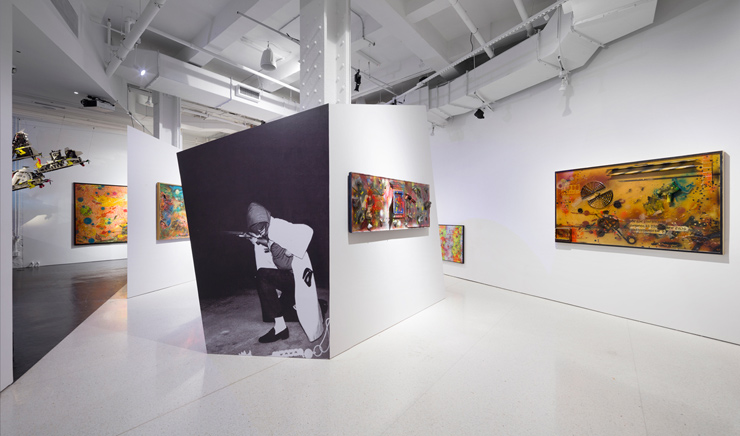
Rammellzee: Racing For Thunder. (photo © Red Bull Arts)

Sculpture became a significant form of expression, as evidenced by his Letter Racer series, which was a physical manifestation of the alphabet with skateboards as their base, designed following the aerodynamic ideals of his Ikonoklast Panzerism theories. Also, his life-size kabuki-transformer costume, which he had begun to construct in the early eighties to wear during his public appearances, schizophrenically mutated into an earthly Asgard of costumed deities dubbed The Garbage Gods, each with a fully conceived personality and narrative. He also explored a menagerie of new characters in the form of figurine-sized plastic sculptures that he called Monster Models. Beyond these Battlestation-based monastic divinations, Rammellzee also continued to explore a spacey hip hop style of music and costumed performance within art and music contexts. He released solo albums and collaborated with many new groups, such as New Flesh, Death Comet Crew, and Praxis.
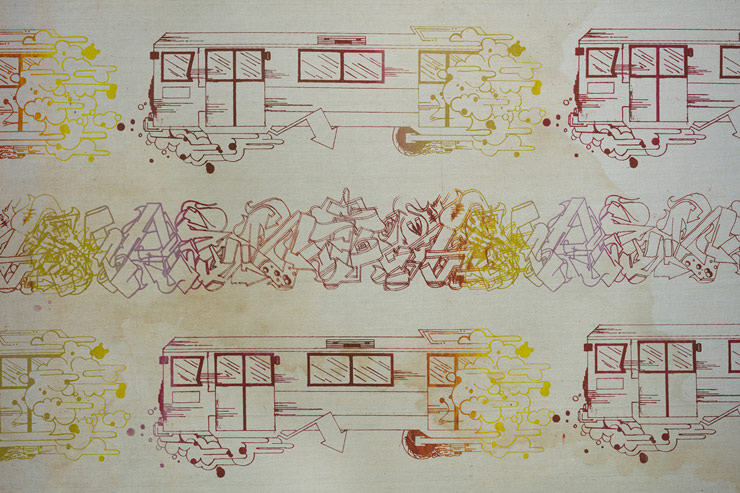
Rammellzee: Racing For Thunder. (photo © Red Bull Arts)

After being such a strong voice and powerful creative force during his lifetime, it is especially sad that he passed away at only fifty years old in 2010. Although on par with Basquiat and Haring in terms of talent and intellect, Rammellzee remained somewhat of an outsider to the fine art world in terms of society, aesthetics, and market. Maybe his work was too rooted in true graffiti styles to appeal to the older moneyed class at that time, who were more interested in expressionism and minimalism. Maybe it was too challenging as a militaristic revolutionary expression, making the agents of the matrix nervous. Maybe it was too dark and quirky like Rammellzee himself. Or, maybe, like so many other visionary autodidact Outsider Artists, his work was just too out there for those to take it all in without quickly dismissing it as merely untrained gibberish. Although too late for Rammellzee himself to appreciate, it is gratifying to see an exhibition like RAMMELLZEE: RACING FOR THUNDER fully present and ultimately confirm Rammellzee’s brilliance, relevance and importance on all levels, in all subcultures, in all mediums, across a half century of promethean artistic creation.
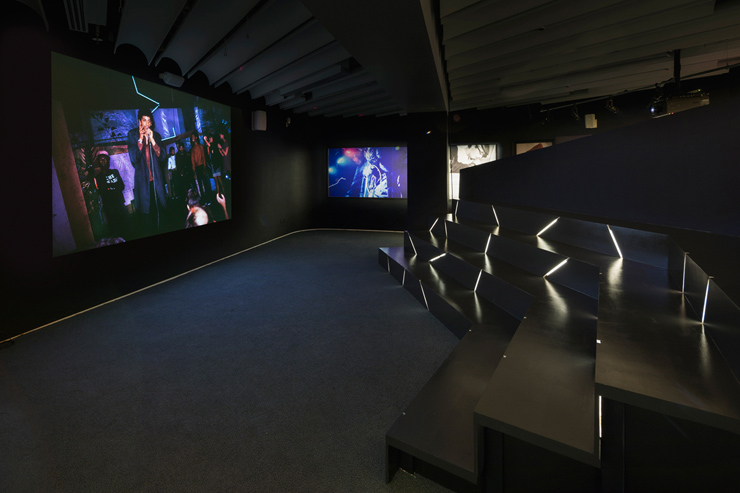
Rammellzee: Racing For Thunder. (photo © Red Bull Arts)

Part 2: The Exhibition

In recognition of the breadth and depth of this artist, the RAMMELLZEE: RACING FOR THUNDER retrospective is a deeply researched, insightfully curated, and densely designed exhibition. It is an engaging experience presenting Rammellzee’s complete oeuvre in a two-floor chronological survey, which also contextualizes his output with a massive amount of historical interviews and documentation in all media formats. This is the first exhibition of its kind for Rammellzee, and, depending on one’s age, it may be a once in a lifetime exhibition for us.
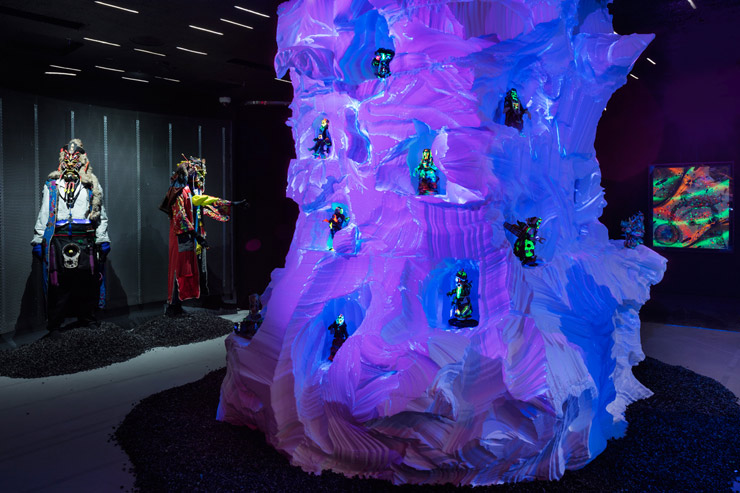
Rammellzee: Racing For Thunder. (photo © Red Bull Arts)

So, if you have the time and the inclination, definitely allot at least an afternoon, if not a few days, in revelry to absorb it all. When many of us first come in contact with Rammellzee’s art and writing, we find it to be an exhilarating, but dizzying, elliptical swirl of crypto-poetic language and visionary ideas, combining concepts from all intellectual disciplines. So, this exhibition gives one a great opportunity to immerse oneself deeply in his world in order to connect the sparkling galactic astronomy of his cosmology and grasp his expansive vision. After reading and rereading his texts; researching his vocabulary and neologisms; becoming familiar with his unique sentence configurations; watching and rewatching his lectures and interviews; viewing and dissecting his art and graphics; then, the beautiful language and pregnant details of his art and philosophy tie together into a comprehensive mytho-ontological diagram of life, science, society, and aesthetics.
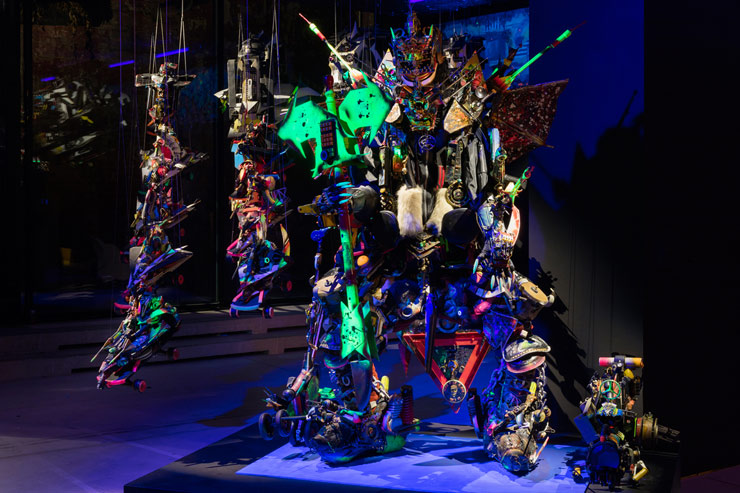
Rammellzee: Racing For Thunder. (photo © Red Bull Arts)

The lead curators Max Wolf and Carlo McCormick have a long history between them within the art world and graffiti communities. They were able to obtain significant paintings and sculptures, printed matter and photographs, videos and audio recordings from friends and collectors around the world in order to fully represent Rammellzee’s polymath output. Maybe most significantly, they also recorded new oral history interviews with friends and collaborators, such as Futura, Keo, Lee, Daze, Jim Jarmusch, Bill Laswell, Charlie Ahearn, Henry Chalfant, K-Rob, and dozens more. From these interviews, they culled short clips which are presented on nine iPads with headphones located throughout exhibition. As you listen, there are also extensive slideshows on the iPads to swipe through.
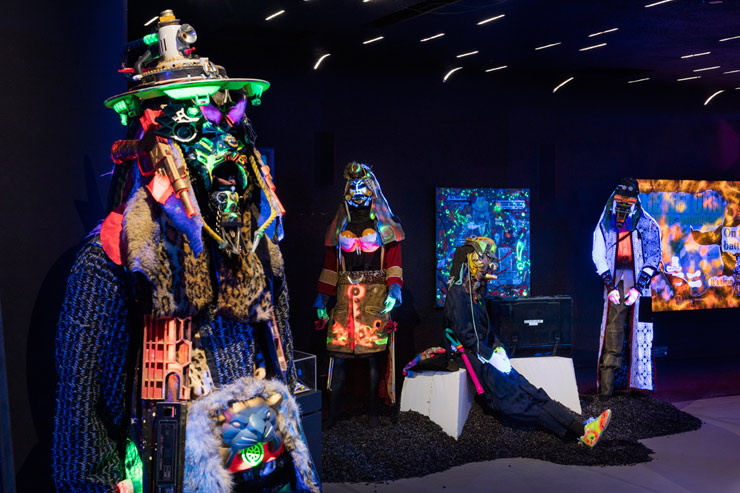
Rammellzee: Racing For Thunder. (photo © Red Bull Arts)

There is never a wasted opportunity to pack some more content into all the nooks and crannies of this exhibition. In addition to the iPads, there are also six video stations, four sound installations, a full-size film-screening theater, and one computer station. In total, there is at least a full day of interviews, performances, lectures, and other historical media to listen to or watch. There are even recordings playing in the bathrooms, and one speaker installed outside in front of the gallery under a sidewalk grate, playing a recording of Rammellzee acting as a subway conductor announcing train arrivals and departures. They also programmed a series of in-person gallery tours and presentations held in the gallery once or twice a week, by artists and historians, such as Carlo McCormick, Kool Koor, Delta2, Crazy Legs, Charlie Ahearn, Seth Tillett, Enrico Oyama Isamu, The Death Comet Crew, and more.
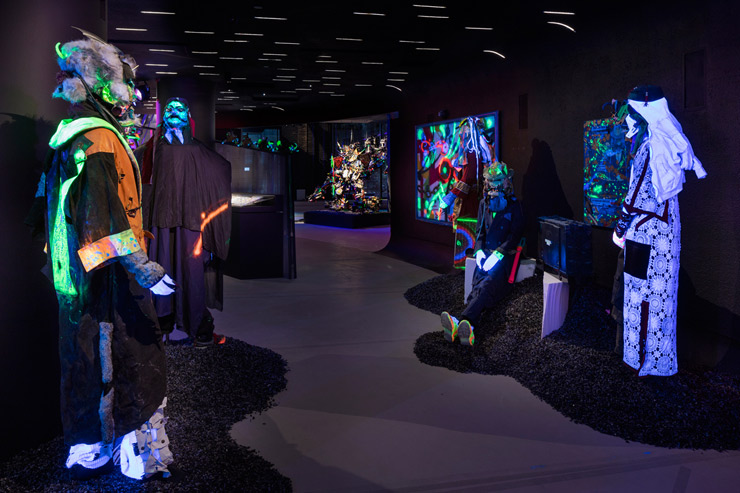
Rammellzee: Racing For Thunder. (photo © Red Bull Arts)

Then to top it off, they designed a free printed exhibition piece available at the front desk. On one side it has a poster of The Garbage Gods pantheon with descriptions; but then it is also folded up to display the other side as an accordion-style zine, consisting of a brilliant introductory essay, specific details about the exhibition, and many crucial outtakes from Rammellzee’s writing. Even if you don’t have time to walk through the exhibition, this pamphlet alone makes the trip to the gallery worthwhile for any fan or scholar because it is such a great piece of historical ephemera to bag-up as a collectible or to use as reference material.

Finally, as the grand denouement to this wonderfully extravagant exhibition, a book-length catalog will be published this fall. So, if you can’t see the exhibition or pick up the zine, this book will be the next best thing.
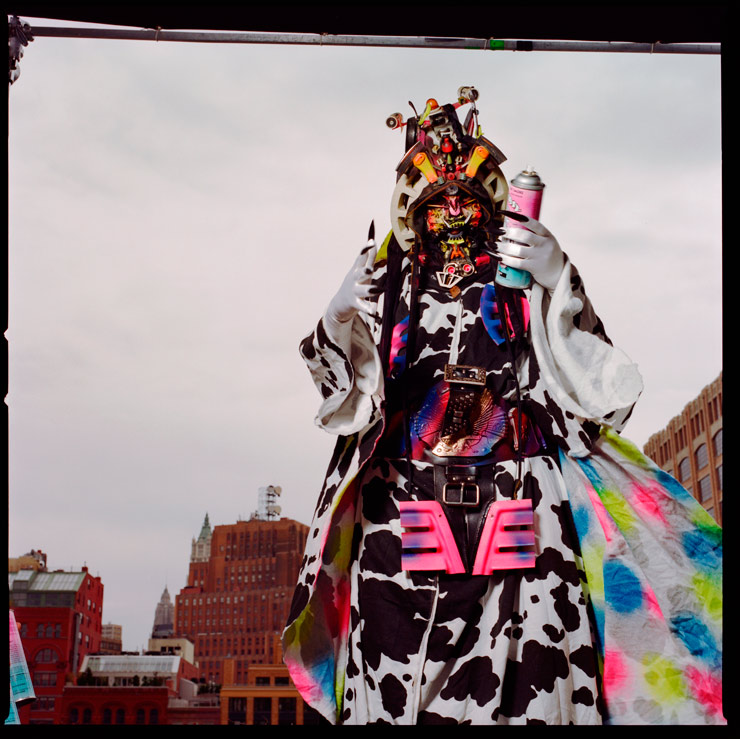
Rammellzee (photo © Keetja Allard. Courtesy of Red Bull Arts)


by ( ( ( ekg ) ) )

July 2018, NYC

Artist page: http://www.concretetodata.com/artists/ekg/

Instagram: @ekglabs


RAMMELLZEE: RACING FOR THUNDER retrospective at the Red Bull Art Space, 220 West 18th Street in Manhattan, through August 26th, Wednesdays thru Sundays, 12pm – 7pm.
 

Read more
“Banana Kelly Double Dutch” Returns in the Bronx : John Ahearn & Rigoberto Torres.

“Banana Kelly Double Dutch” Returns in the Bronx : John Ahearn & Rigoberto Torres.

They’re doing Double Dutch again up in the South Bronx. Way up.

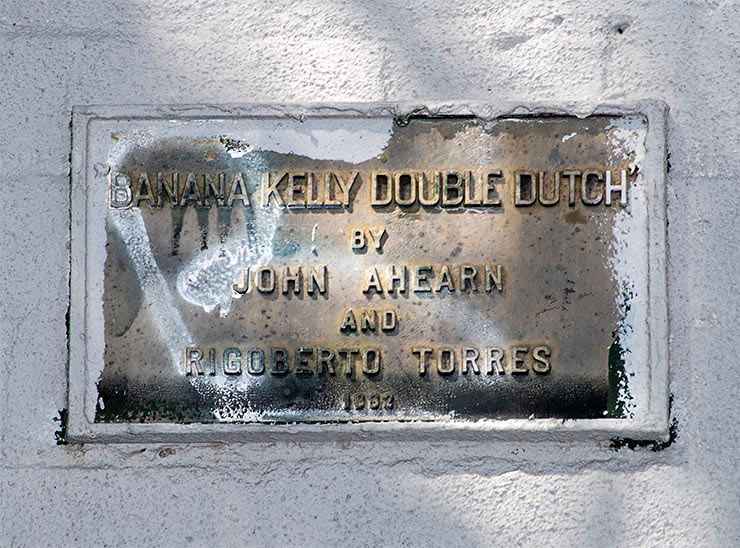
John Ahearn & Rigoberto Torres. “Banana Kelly Double Dutch” The Bronx, NYC. 2018. (photo © Martha Cooper)

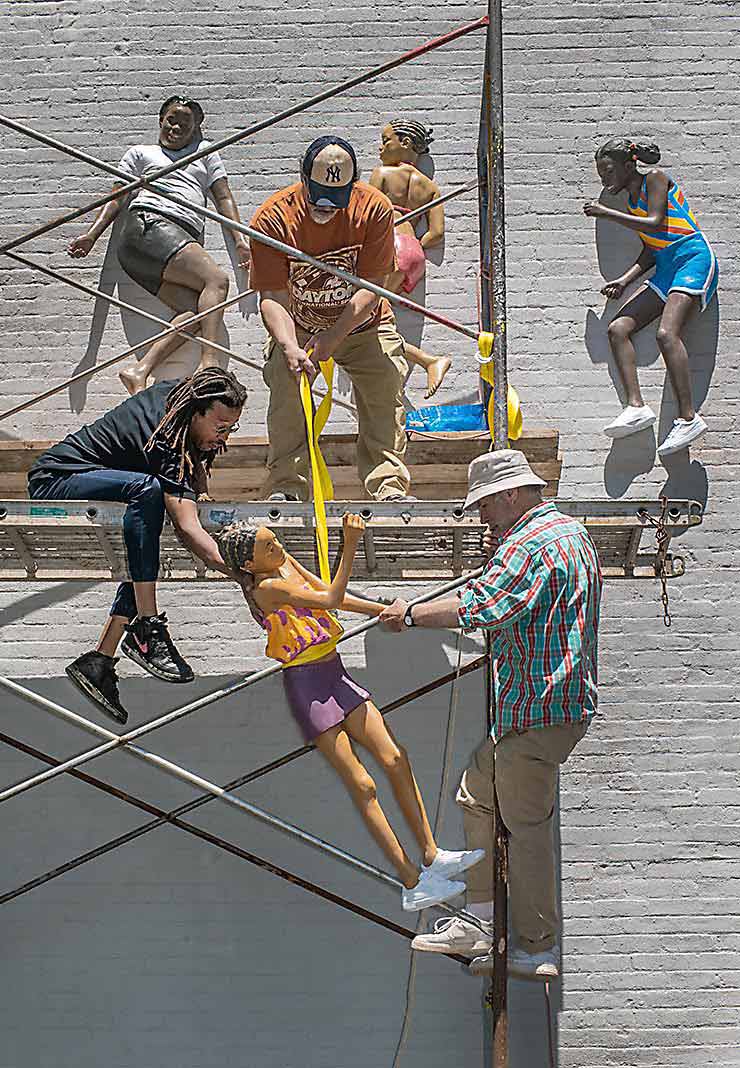
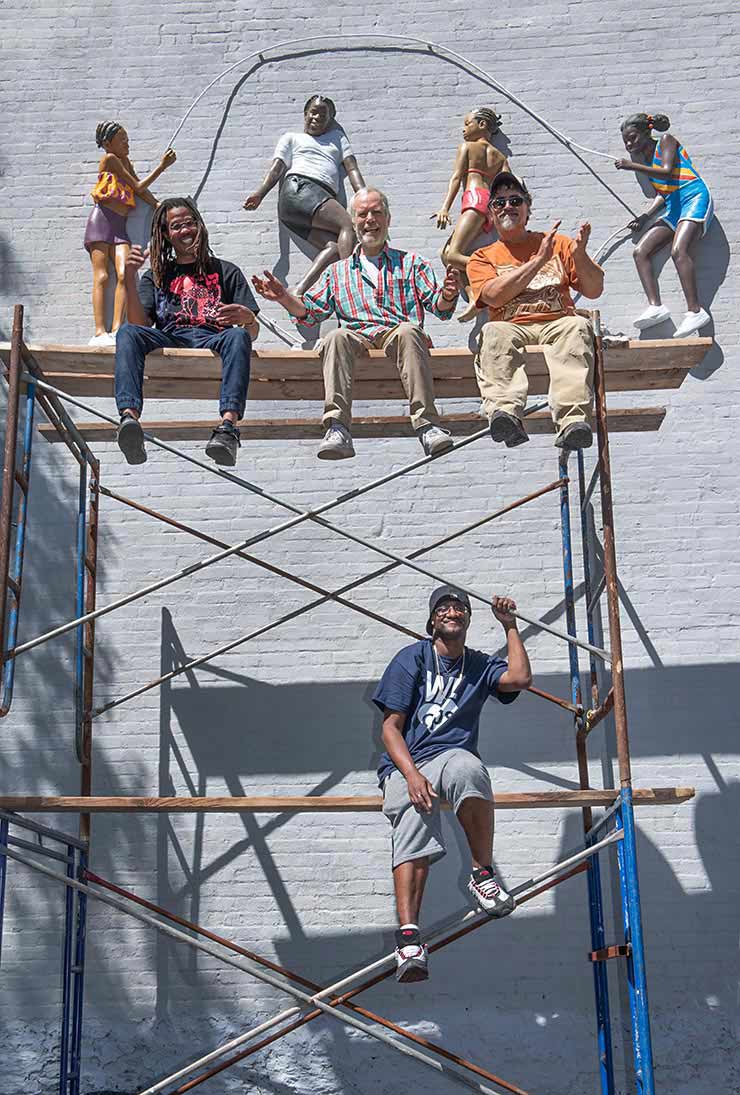
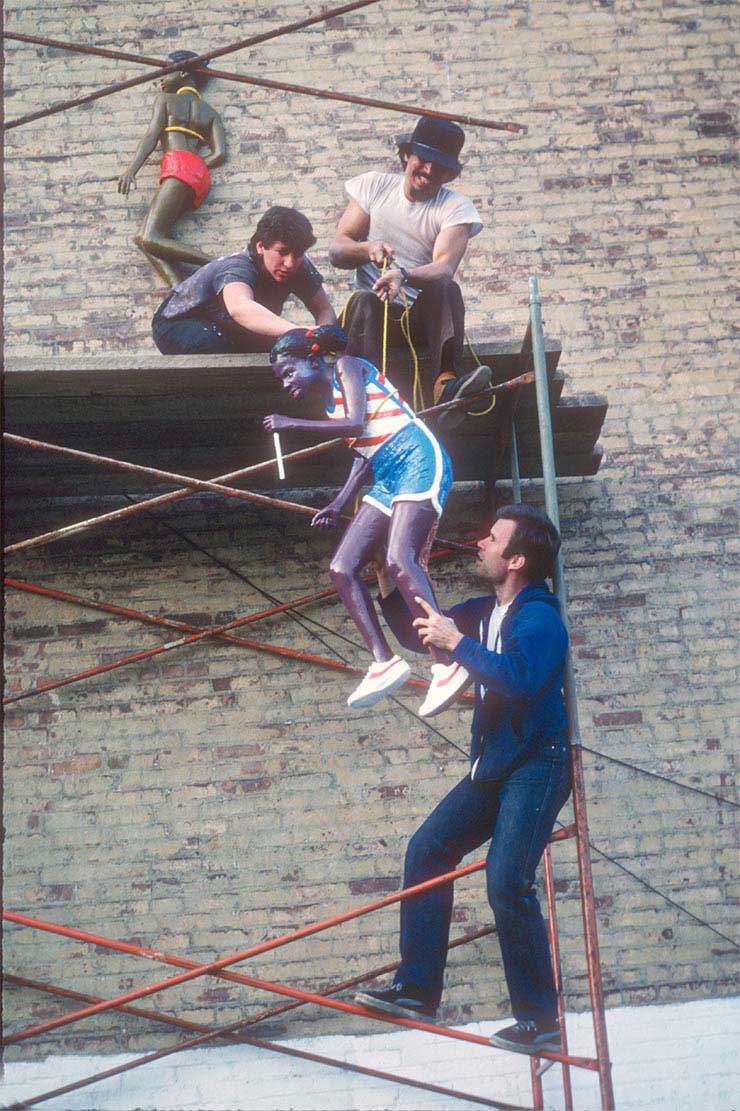
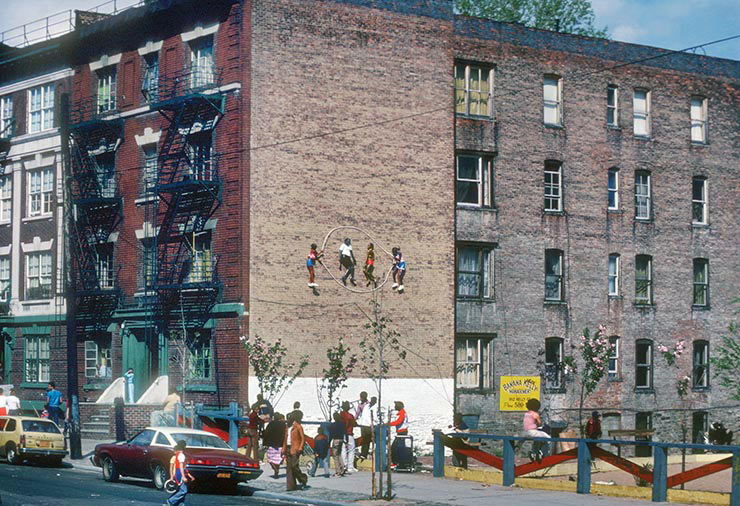
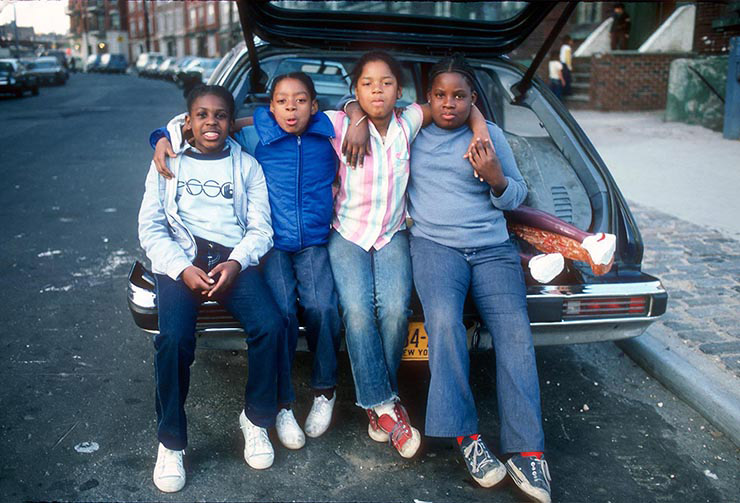
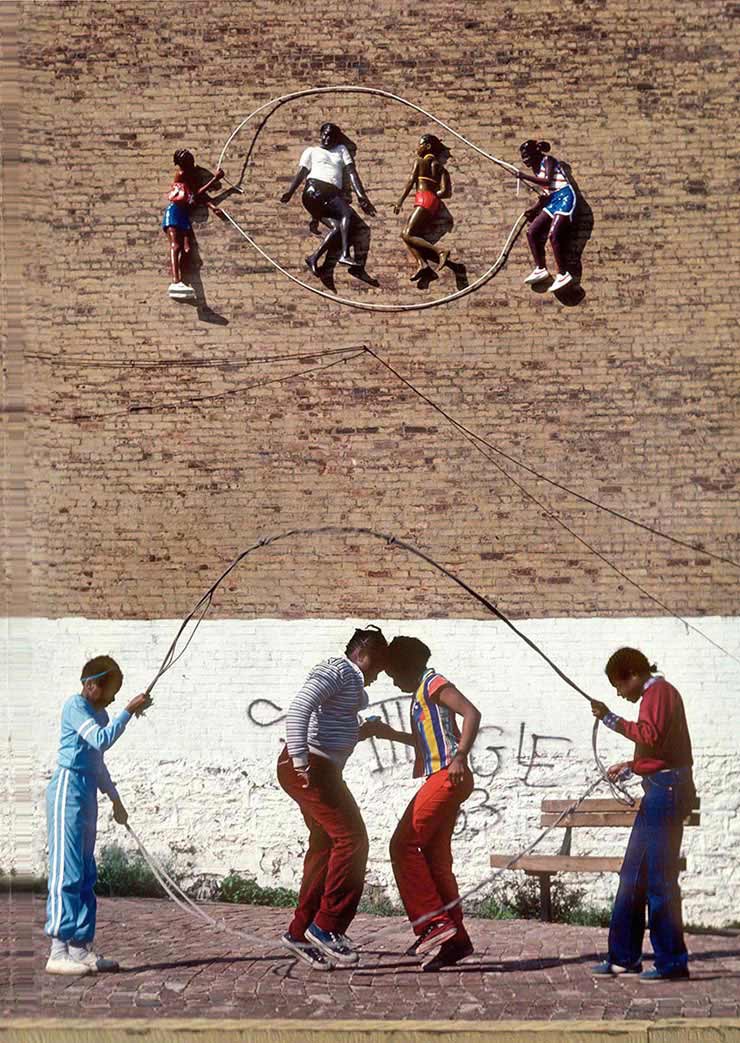
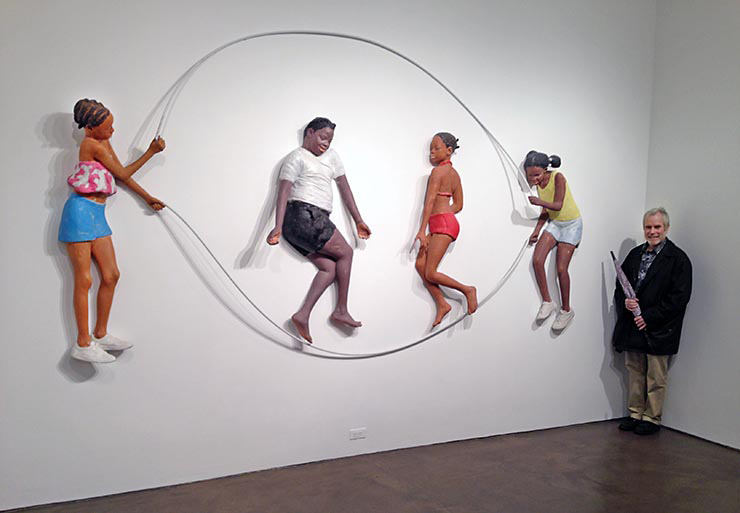
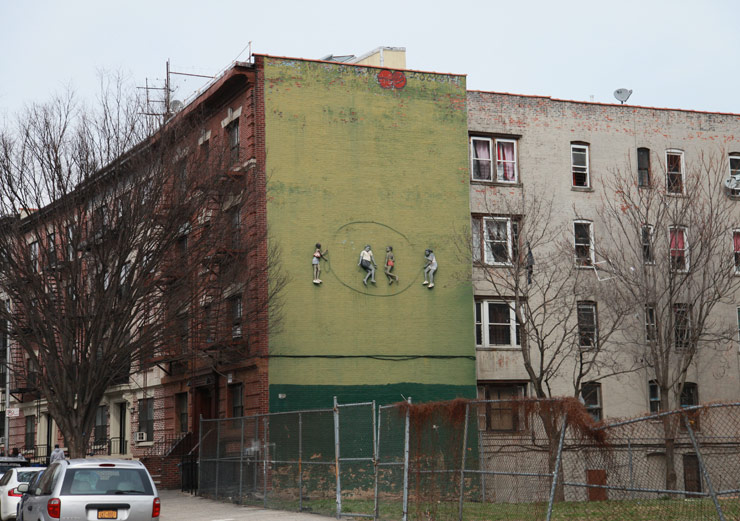
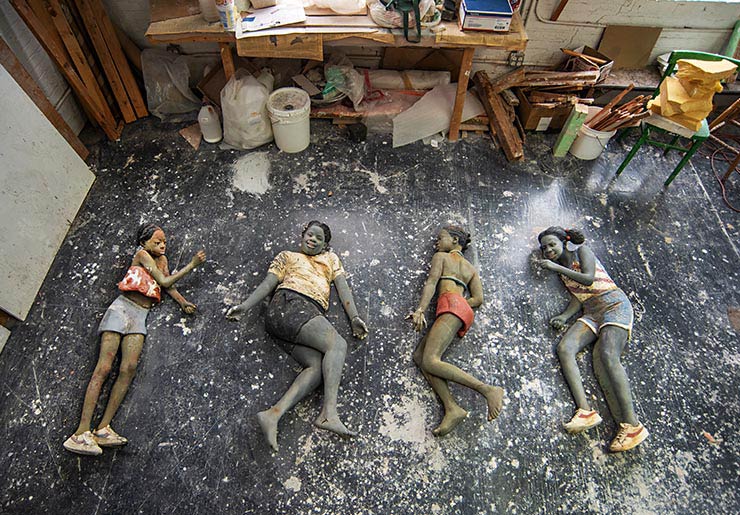
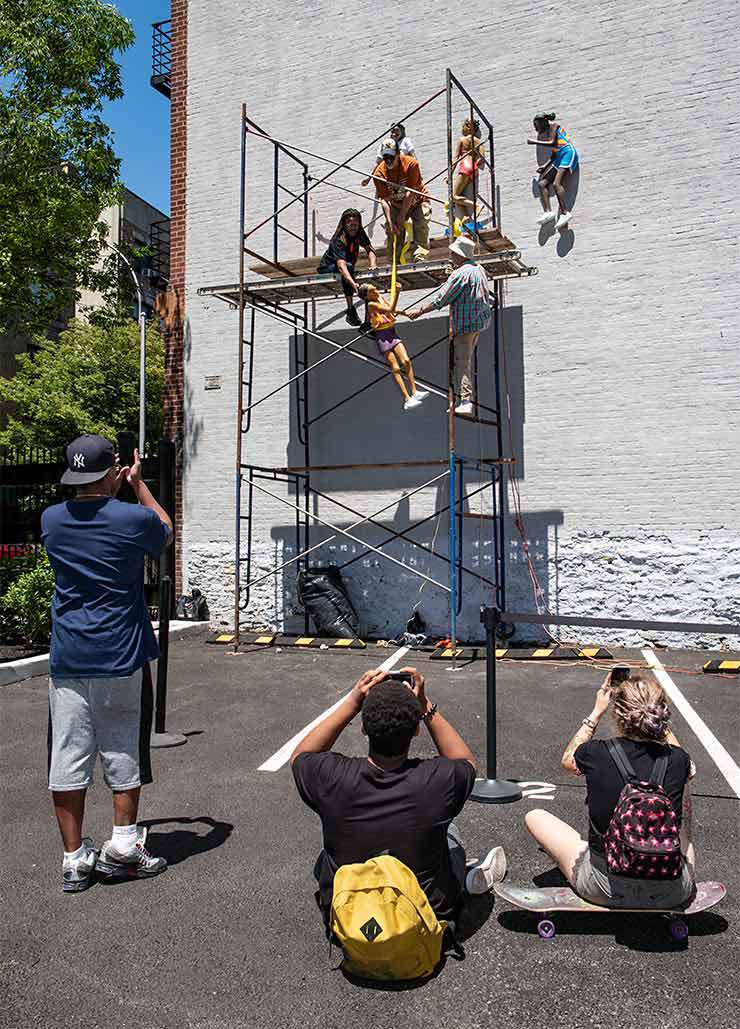
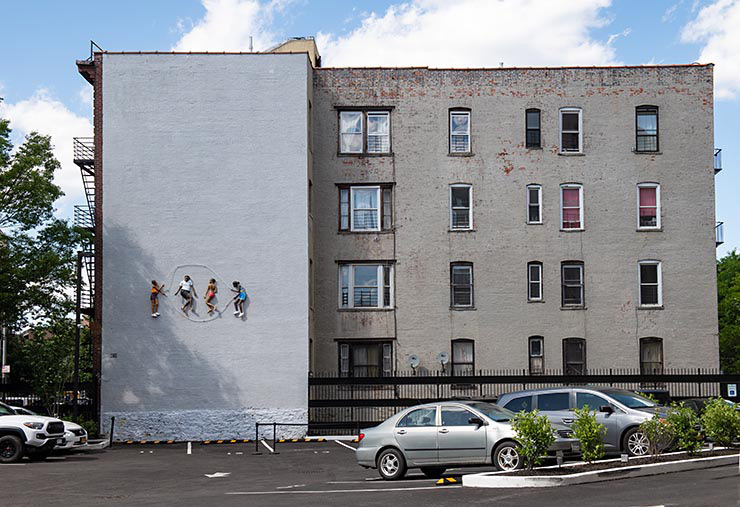
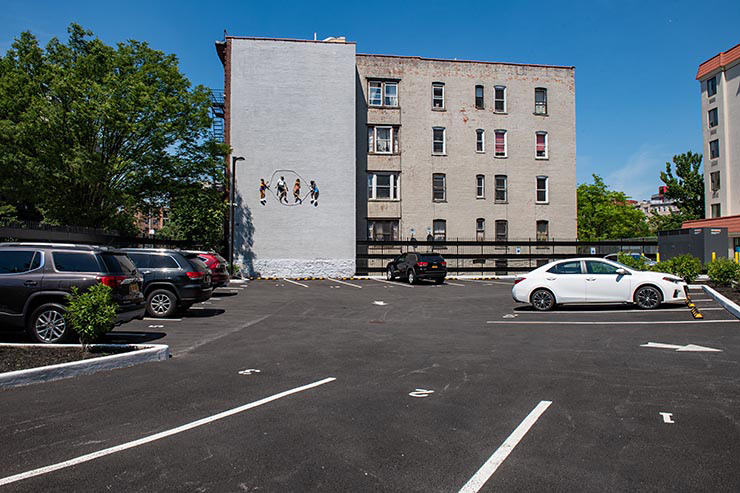
Restored to look like new, this is the third time that La Freeda, Jevette, Towana and Staice have taken their rope jumping game to this wall on Kelly Street and the spirit of their game and the culture are here as well. Based on the actual girls as models casted, the sculptors John Ahearn and Rigoberto Torres recently restored them and placed them on the same wall that they first appeared on in 1982, a moment from New York’s history.

John Ahearn & Rigoberto Torres. The original installation of “Banana Kelly Double Dutch” The Bronx, NYC. 1982. (photo © Martha Cooper)

Their art practice in the public space has a fully engaged, activist quality – insisting as it does to herald the everyday heroes in a culture that tends to reserve public space to elevate figures from the military, the church, politics, literature and Pop Culture. Even the name of this piece refers to the community group that hosted the sculpture for many years, Banana Kelly.

With a somewhat radical art practice that claims public sphere for the public for forty years, the duo have made casts of people in the neighborhood for decades, in the process forming long relationships with the sitters and their families, and their extended families.

John Ahearn & Rigoberto Torres. “Banana Kelly Double Dutch” The Bronx, NYC. 1982. (photo © Martha Cooper)

A curiosity for many on the street at first, a lot of folks first became familiar with the work as it was being performed – whether in workshops like the one Torres first saw Ahearn conducting in the storefront windows of the famous art space Fashion Moda or later at numerous block parties around the neighborhood.

Owing to his family connection to a sculpture factory, Torres had knowledge that Ahearn was missing and their yin/yang temperaments created a professional partnership balance that eventually has landed their work in places as far as Brazil, Taiwan, and Orlando, where Torres moved a number of years ago with his family.

John Ahearn & Rigoberto Torres. “Banana Kelly Double Dutch” The Bronx, NYC. 1982. (photo © Martha Cooper)

In the intervening years the Ahearn/Torres partnership has garnered attention in significant gallery and museum shows as a sociological hybrid, a captured record of life and culture that favors the unfamous, occasionally the famous. Humble as they are about their accomplishments and refreshingly reticent to be boastful, their combined projects have been collected by heavy hitters in the Street Art, hip-hop and contemporary art world.

Their sculptural portraits of the street have also been featured in exhibitions in the New Museum of Contemporary Art, the Institute of Contemporary Art, London, the Whitney Museum of American Art, New York, the Museum of Fine Arts, Boston, the Museum of Contemporary Art, Los Angeles, the Irish Museum of Modern Art, the Bronx Museum of the Arts , “Greater New York” at MoMA PS1, New York. In an interview with BSA Ahearn gives credit to his creative partner for some recent shows including “his two homages to his Uncle Raul’s Factory in the “Body” Show at the Met Breuer, and his magnificent funky “Ruth Fernandez” figure in Jeffrey Deitch’s “People” Show.

John Ahearn & Rigoberto Torres. “Banana Kelly Double Dutch” The Bronx, NYC. 1982. (photo © Martha Cooper)

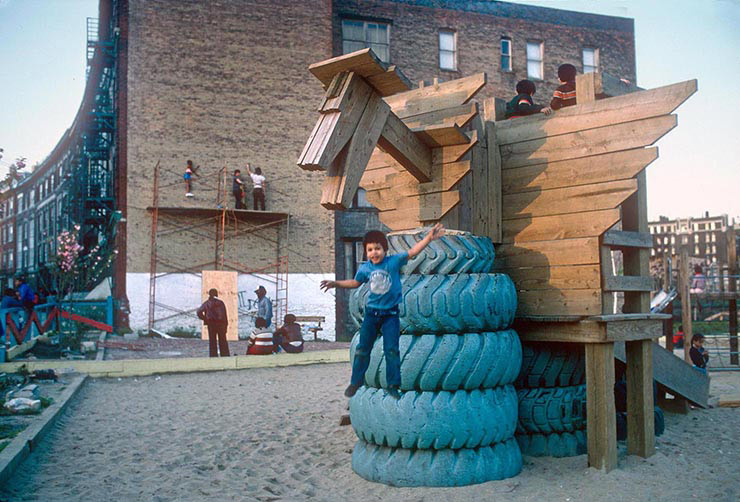
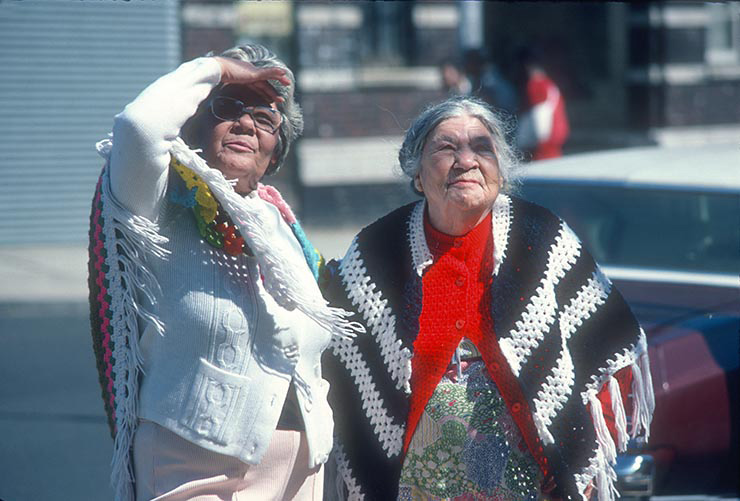
What’s remarkable about this piece is not only that it has survived the constant changing of the New York City skyline but also the fact that photographer Martha Cooper was on hand to capture the bookends of the Double Dutch installation – the first one in 1982 and this new one in 2018. An anthropologist and ethnographer by heart and training, Ms. Cooper also captured many of the surrounding people and activities in the neighborhood during both of the installations and she generously shares them here with BSA readers to give a further appreciation of the time passed and the cultural relevance of the duo’s work.

John Ahearn & Rigoberto Torres. “Banana Kelly Double Dutch” The Bronx, NYC. 1982. (photo © Martha Cooper)

BSA asked Mr. Ahearn a few questions and he provided some great insights into the production and life behind these Double Dutch girls.

BSA: Do you see girls and women playing Double Dutch much in the neighborhood this summer?
John Ahearn: Double Dutch has been a classic rope jumping style for a while, the double rope keeps things moving. It sometimes seems to be always be in fashion.

John Ahearn & Rigoberto Torres. “Banana Kelly Double Dutch” The Bronx, NYC. 1982. (photo © Martha Cooper)

BSA: Your personal relationships with people in the neighborhood have figured prominently in your subjects. How does time change your perception of the original works?
John Ahearn: All the sculptures are some kind of collaboration with the specific people and the neighborhood. Time tests the validity of the intention and the expression. Art can lose meaning and look silly, or it can increase in its purpose and gain poignancy.

John Ahearn & Rigoberto Torres. The original stars of “Banana Kelly Double Dutch” The Bronx, NYC. 1982. (photo © Martha Cooper)

BSA: Your work captures so much action! Is that a particular goal for you?
John Ahearn: When I first saw Marty’s profound image of the real four girls in front of their sculpture, taken when it was first installed in 1982, I was shocked! I had emphasized the unique quality of each separate girl but Marty captured them as one piece, engaged in a solemn ritual of play, with all heads bowed to the center. I was moved to see her vision and it took me a few decades to look at the actual sculpture with full confidence.

John Ahearn & Rigoberto Torres. The classic photo of “Banana Kelly Double Dutch” The Bronx, NYC. 1982. (photo © Martha Cooper)

BSA: Why is it important to you to make art accessible to the people on the street?
John Ahearn: I need to feel that my perception includes the point of view of others.

BSA: What inspired you to refurbish this installation and how did you find La Freeda, Jevette, Towana, and Staice?
John Ahearn: I believe the girls are La Freeda Mincey (whose mother still lives in the building and came out to watch us reinstall the girls) Javette Potts, whose mother created the original girl’s dance group) Tawana Brown, and Staice Seabrine (with whom we are more regularly in touch)

In 1981, we were considering our first neighborhood commission at Fox St. and Intervale Ave. We took a composite 180 degree photo of the area. On all sides were burned out buildings, but one wall popped out in perfect condition with a surrounding block that was completely together. That was “Banana Kelly”, a community group committed to survival and improving the area, with the Potts family at the center of things.

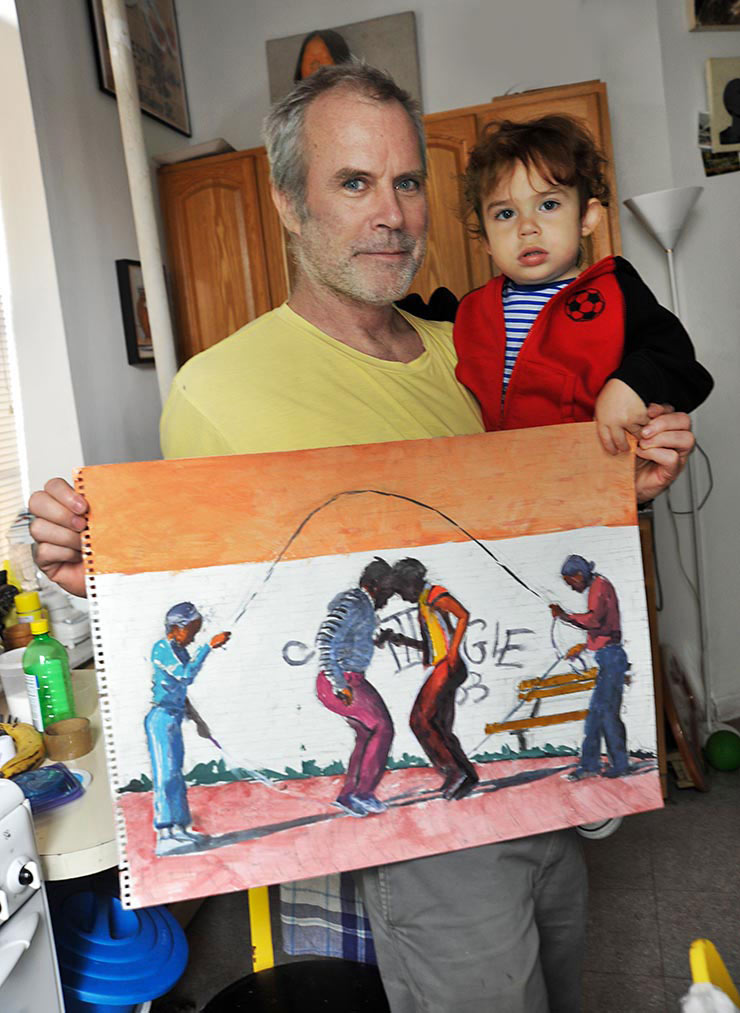
John Ahearn’s drawing of Martha’s photo. 2011. (photo © Martha Cooper)

Later there was a block party at Kelly St. that featured an “African Dance” group of girls, including Javette Potts, the granddaughter of Mr. Potts. It was at that time that we had a notion to have the four girls play Double Dutch for the image.

This is actually the second time we have repaired the sculptures. By 1986, the ravages tearing up the Bronx had reached the little park that Banana Kelly had built on the corner. All the bricks were torn up, and some kids were heaving them at the Double Dutch sculptures. Parts of the figures were breaking.

John Ahearn & Rigoberto Torres. “Banana Kelly Double Dutch” The Bronx, NYC. 1986. (photo © Martha Cooper)

At the same time, Rigoberto’s Uncle Raul’s Statuary Factory had burned down and all our molds related to the three murals had been stored there and were lost. So we removed the Double Dutch sculptures from the wall, and took them to our studio to restore them. We reinstalled them higher than before with a slightly different design.

Meanwhile, the devastated block which Banana Kelly faces (south) was transformed into a huge park. All the buildings had been torn down heading north to Longwood Avenue. The design of the 2nd version of the sculptures (see Marty’s photo) looks very nice to me now, but it had always annoyed me.

John Ahearn & Rigoberto Torres. A gallery version of “Banana Kelly Double Dutch” at Alexander & Bonin Gallery in Manhattan. NYC 2014. (photo © Martha Cooper)

The tiny “park” site at Kelly St. eventually was fenced off and abandoned, awaiting future use. Sometimes old sculptures in their neighborhood locations can be very satisfying and true. But it always seemed that the Double Dutch should be returned to their original design.

Recently the lot was sold to the new Catholic Nursing facility next door, to be rebuilt as their parking area. We wanted very much to keep the sculptures on the same wall and this seemed like the right moment.

John Ahearn & Rigoberto Torres. “Banana Kelly Double Dutch” The Bronx, NYC. 2014. (photo © Jaime Rojo)

John Ahearn & Rigoberto Torres. “Banana Kelly Double Dutch” The Bronx, NYC. 2014. (photo © Jaime Rojo)

John Ahearn & Rigoberto Torres. La Freeda, Javette, Towana and Staice back at the studio waiting to be restored. NYC 2018. (photo © Martha Cooper)

TATS CRU homage to John Ahearn & Rigoberto Torres. Detail. “Banana Kelly Double Dutch” The Bronx, NYC. 2018. (photo © Martha Cooper)

John Ahearn & Rigoberto Torres. “Banana Kelly Double Dutch” The Bronx, NYC. 2018. (photo © Martha Cooper)

John Ahearn & Rigoberto Torres. “Banana Kelly Double Dutch” The Bronx, NYC. 2018. (photo © Martha Cooper)

John Ahearn & Rigoberto Torres. “Banana Kelly Double Dutch” The Bronx, NYC. 2018. (photo © Martha Cooper)

John Ahearn & Rigoberto Torres. “Banana Kelly Double Dutch” The Bronx, NYC. 2018. (photo © Martha Cooper)

John Ahearn & Rigoberto Torres. “Banana Kelly Double Dutch” The Bronx, NYC. 2018. (photo © Martha Cooper)

John Ahearn & Rigoberto Torres. “Banana Kelly Double Dutch” The Bronx, NYC. 2018. (photo © Martha Cooper)


Frankie Smith
“Double Dutch Bus” 1981

” ‘Double Dutch’ is a tribute to all the girls in the world, especially the girls on my block. I’ve been watching them for 25 years. They use their mothers’ clotheslines to play the game – it’s an art. It’s a tribute to them – they’re really good at it.” – Frankie Smith to Dick Clark on American Bandstand.

Malcom McLaren
“Double Dutch” 1983

All over the world high school girls
Take to the ropes and turn them slow
Starts a beat and a loop
They skip and jump through the hoop
They might break and they might fall
About the gals from New York City
They just start again
Start again


Read more
“The Lady Don’t Protest Enough” in Shoreditch, by Otto Schade

“The Lady Don’t Protest Enough” in Shoreditch, by Otto Schade

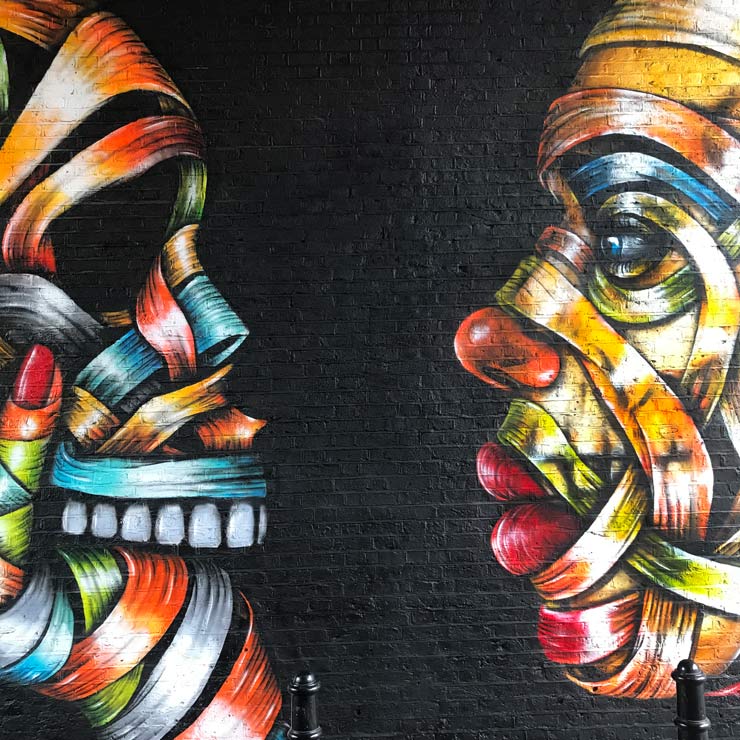
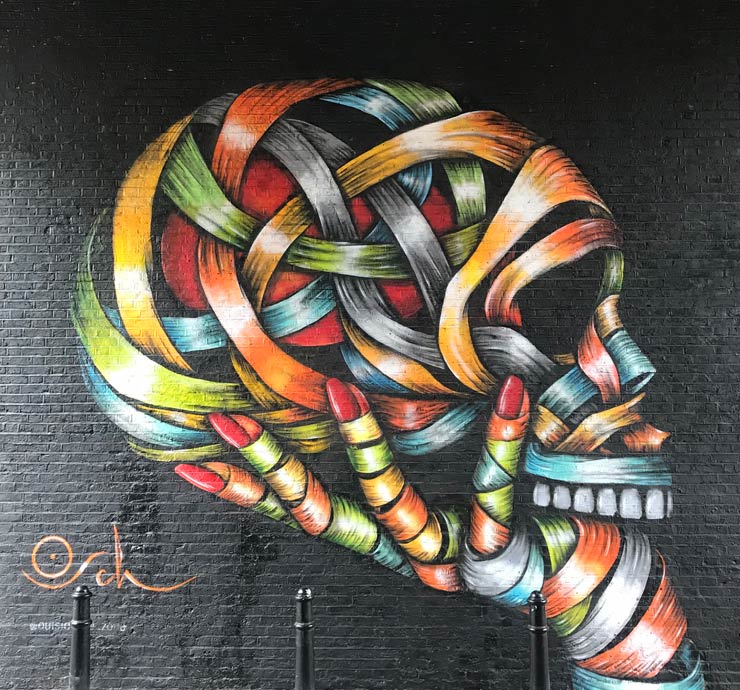
The sight of this stylized skull may not have evoked the same reminiscence by Prince Hamlet as Yorick’s did but Street Artist Otto Schade brings it to London streets once again.

Otto OSCH Schade. “The Lady Don’t Protest Enough”. London. July 2018. (photo © Otto Schade)

The context is wholly appropriate for a city that summons the spirit of Shakespeare rather year round – including this summer from Hamlet at the Globe Theatre to Ian McKellen as the tragic King Lear at the Duke of York’s Theatre, and Regents Park gives you open air performances of As You Like It.

For Mr. Schade, this freehand painting is about protest and power, particularly as it refers to women. Here on Bateman’s Row in Shoreditch he turns another Hamlet phrase to title it, “The Lady Don’t Protest Enough”. Hethinks.

Otto OSCH Schade. “The Lady Don’t Protest Enough”. London. July 2018. (photo © Otto Schade)

Otto OSCH Schade. “The Lady Don’t Protest Enough”. London. July 2018. (photo © Otto Schade)

Read more