Rafael Schacter Investigates “Street To Studio”

Rafael Schacter Investigates “Street To Studio”

“These are artists who are thus not slavishly reproducing their exterior practice within an interior realm but who are, rather, taking the essence of graffiti – its visual principles, its spatial structures, its technical methods, its entrenched ethics – and reinterpreting them with the studio domain,” says author Rafael Schacter in his introductory exposition for his book Street to Studio where he offers a unique assessment derived from his 10 years of researching the foundational, conceptual, methodological, and ethical considerations that impact the original graffiti/Street Art scene as well as where it is going.
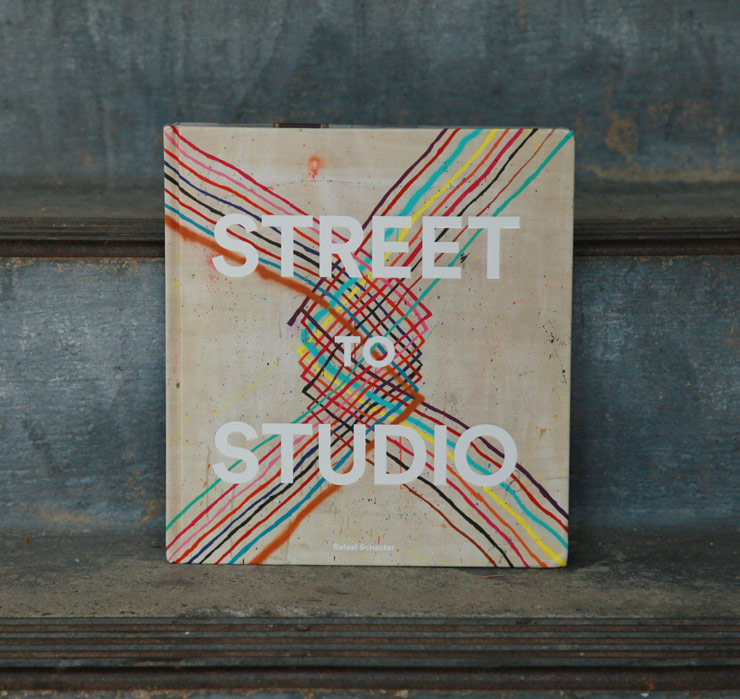
Rafael Schacter. Street To Studio. Lund Humphries Publishers. London, 2018.

The presentation is impressive in the craft and depth of field; the 40 artists whom he has chosen to profile have elements of each of these considerations to one degree or another as they move from street culture to more formalized ways of analyzing their works. Whether figurative, conceptual, performative, iterative, abstract, ephemeral, or purely digital, Schacter endeavors to find a common thread in a wide field of work and influences that have as their common denominator a regard for the practices of art in the streets.

It may be difficult for some readers to see the streets from here; perhaps it is not a measurement of relative biographies or works through storytelling as much as it is an examination of methods and practices. Often it could appear to be a name-checking of alliances with recognized contemporary artists, schools of art practice, and an anchoring to experiences as student of formalized institutional structures rather than the streets that help define the artists – criterion which ironically have been used to bar consideration of many early graffiti writers as relevant artists, with the effect of stigmatizing them.
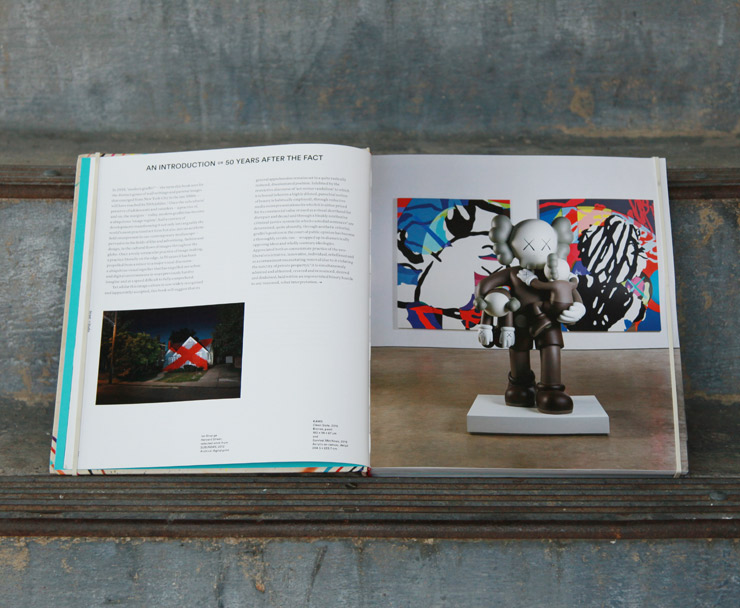
Rafael Schacter. Street To Studio. Kaws. Lund Humphries Publishers. London, 2018.

There are not stories of economic or structural adversity here – although one can argue that these may be equally formative realities that affect one’s art practice. You won’t find many references to attending Public School 141 or the local community college or working as a bike messenger.

Instead there are many finely educated artists here with backgrounds in formal art theories – an MA in Fine Art at Central Saint Martins, an MFA at Universität der Künste Berlin, or London’s Central Saint Martins, Oslo’s National Academy of Art, Paris’ Saint Denis or Madrid’s Complutense. Being a part of the Mission School of 1990s San Francisco is what helps ratify a work as Fine Art, for example, even though switching the nameplates next to certain pieces may cause you to place the work in a number of possible categories or potential origin.
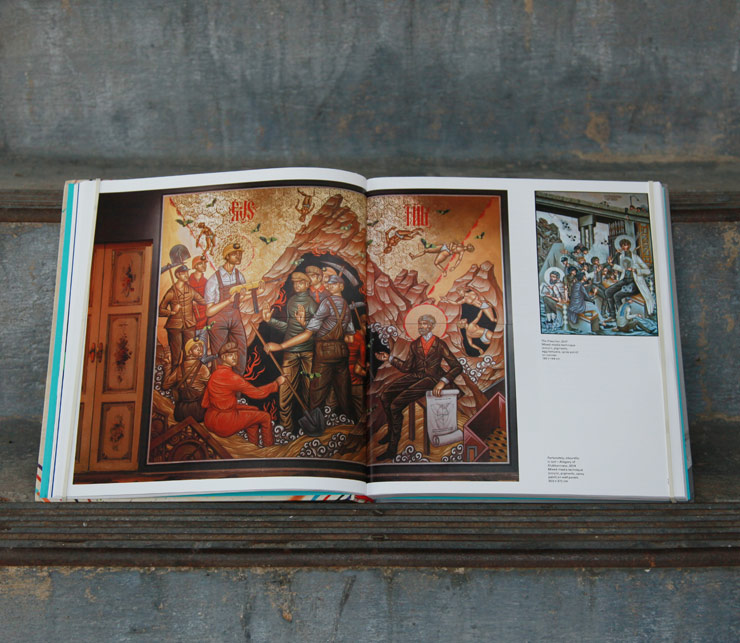
Rafael Schacter. Street To Studio. Stelios Faitakis. Lund Humphries Publishers. London, 2018.

The inclusion or exclusion of specific details in an artists journey or resume is the authors prerogative and is in service of supporting a view of the work.  As part of our daily discourse where we receive texts from artists, PR folks, and historians, we enjoy listening to how people and their art are described by themselves and others; what cultural signifiers are used, what associative “branding” is employed, and to note the differences that appear as they get closer to commercial or institutional success. Many of these artists here are nearly mid-career studio artists with connections to street practice, a substantial track record, and have taken great risks to challenge their work and their own perceptions.

Quoting McCormick again, “If we are to take graffiti and street art seriously, as not simply a method but a mandate, let us acknowledge studio practice as part of this process – but, equally importantly, understand the compatible, essential roles that action, observation and introspection play in progressive social art.”
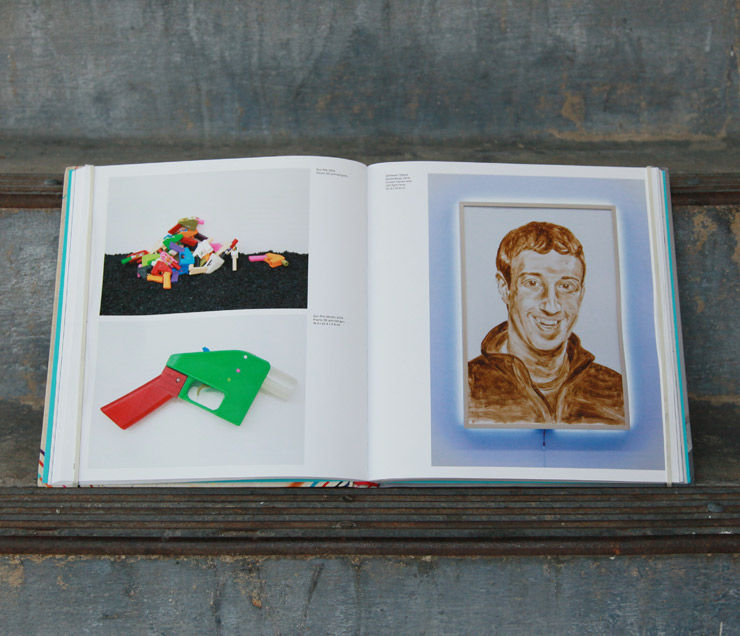
Rafael Schacter. Street To Studio. Katsu. Lund Humphries Publishers. London, 2018.

Excuse the tangent: In our own discussions here online and offline for the last decade we’ve noticed a certain “whitening” of the landscape as we get closer to certain environments like fine art or contemporary art. In the ongoing class war that is human life on Earth, the assured divine nature of the resource winners is ever buffeted by a self-created system of rewards and penalties and cleverly clouded demerits – and you can see this at art fairs and galleries some times. While many advents of style and practice may emanate from more grassroots origins, those originators have not always successfully claimed authorship of those great ideas once they have permutated into textbooks that tell the history.

Graffiti and Street Art have often been maligned, marginalized, and dismissed rather openly and subtly by many of the current class of museums, press, academics, collectors, and those aspiring to be them during much of its evolution, even if its techniques and conventions are imitated and appropriated. Now less tentatively embraced by adventurous collectors and institutions, there is still the trouble of how to present the work; currently afoot is a rebranding as Contemporary Art that imparts a crisp veneer of coolness without the association with less desirable traits.

You know which traits.
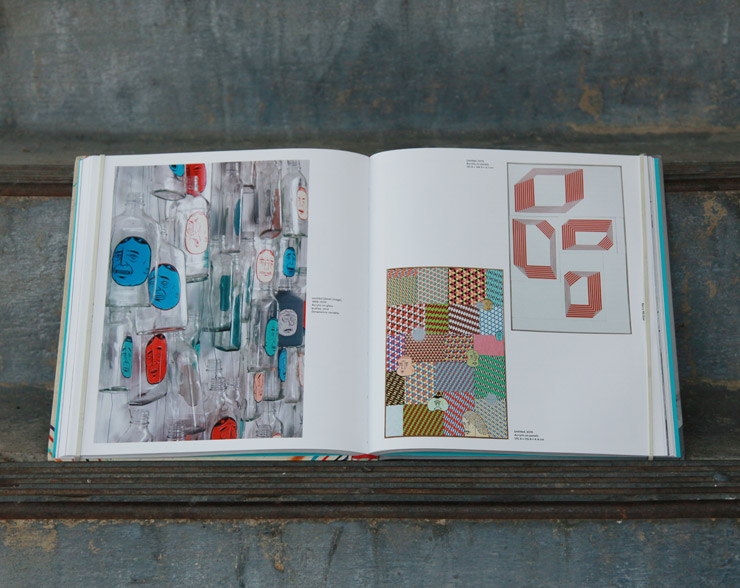
Rafael Schacter. Street To Studio. Barry McGee. Lund Humphries Publishers. London, 2018.

We have even been asked by some artists to stop calling them “graffiti writer” or “Street Artist” because they no longer want to be associated with the label, preferring “painter” or “contemporary artist” instead. Part of this is self-marketing, yes, and the aging of the terms that doesn’t quite encompass their current work. We can’t help thinking that part of it smacks of classism and classic eurocentric racism.

In the broadest manner of description, it’s generally accepted today that the hallowed halls of academia have held centuries of Eurocentric art evolution in the highest regard and dispensed with the contributions of most everyone else not willing or able to stroke the narrative of white straight male supremacy – this is understandable tribe-like behavior meant to insure a narrative about relative importance and in furtherance of these guy’s power.

Sorrily, it has often also been a disabling and narrow view that has lead many to miss and mis-characterize absolutely amazing contributions to culture and the canons, and we are all poorer as a result. The original graffiti artists cared little about these institutional views and looked instead for opportunities to be seen and heard by their peers and the public.
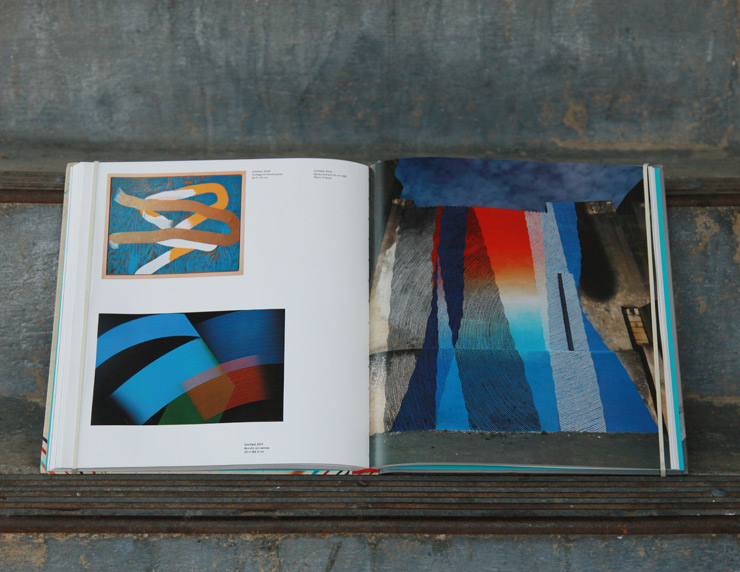
Rafael Schacter. Street To Studio. MOMO. Lund Humphries Publishers. London, 2018.

These observations are not directly related to the author or artists presented in Street to Studio but you may safely surmise that some of this work would be so far removed in traditional associations with train bombing and b-boys that many would say the relationship is thin, or tenuous – and it is sort of remarkable how refracted the field becomes.

It has been a continuous peregrination over five decades of course – this movement between the street and the fine art world and the commercial interests – with graffiti writers spraying across canvas in the seventies, collectors like Wicked Gary gathering tagged stickers on cardboard; art school kids like Dan Witz arranging garbage across the sidewalk in New York’s East Village in between classes at Cooper Union.

“The reciprocal flow between studio and street continues today, with ever more complexity and mutual sway,” writes art critic and cultural observer Carlo McCormick in his introduction to Street to Studio, and Rafael Schacter has undertaken with a scholarly eye this unthinkable task of measuring that complexity. The results are a thoughtful and considered collection of individual histories and practices, supported by his own research on the evolving academic discussions that will define the era.
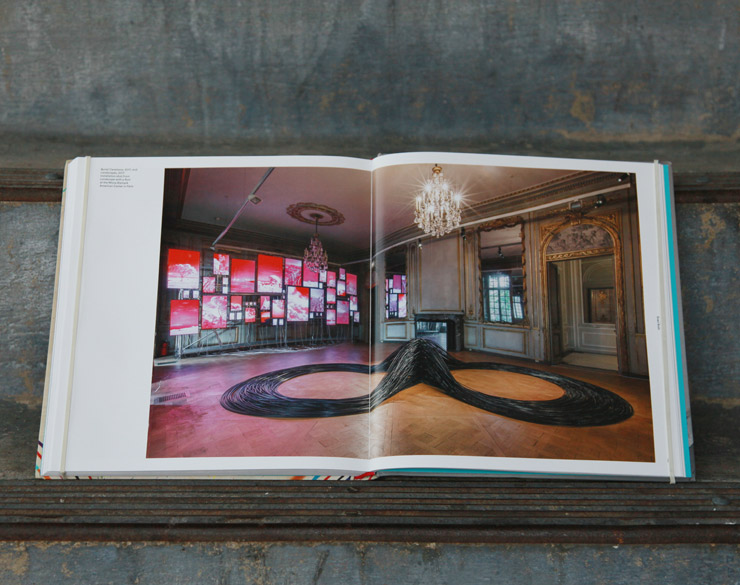
Rafael Schacter. Street To Studio. Evan Roth. Lund Humphries Publishers. London, 2018.

The graff-writing culture persisted; it evolved and nurtured and inspired a few generations and studio practices that followed. Street Artists work has spread across entire continents and into cities around the world without help from institutions, public programs, or academic approval. Now it merges with all our modern fashions in aesthetic and intellectual art-making yet it stands on its own – even as we grapple to document and describe it.

“The development of a distinct studio practice and institutional oeuvre is key to the text, even whilst this may disregard some important artists working today,” says Schacter regarding his methods of analysis for inclusion in this particular story.

“Overall, what was key was to provide a rounded selection of artists working in diverse formal and conceptual manners – artists pushing their practice with the realms of architecture and abstraction, performance and painting, digital art and new media, yet whose output provides a perfect exemplar of the dense possibilities that graffiti can provide.”

Today a generation of art students who grew up with the transgressive social politics of punk and hip-hop and wore wildstyle lettering and drips on their backpacks and clothing have their imaginations permanently sparked and have inherited an automatic expectation that their art could and should be staged on the street as well, illegally for extra points. Those practices expand and evolve and the current results are here. It appears to be a two-way street between outside and inside.

The spirit of graffiti is without doubt here. We just may not have realized how many forms it could take.
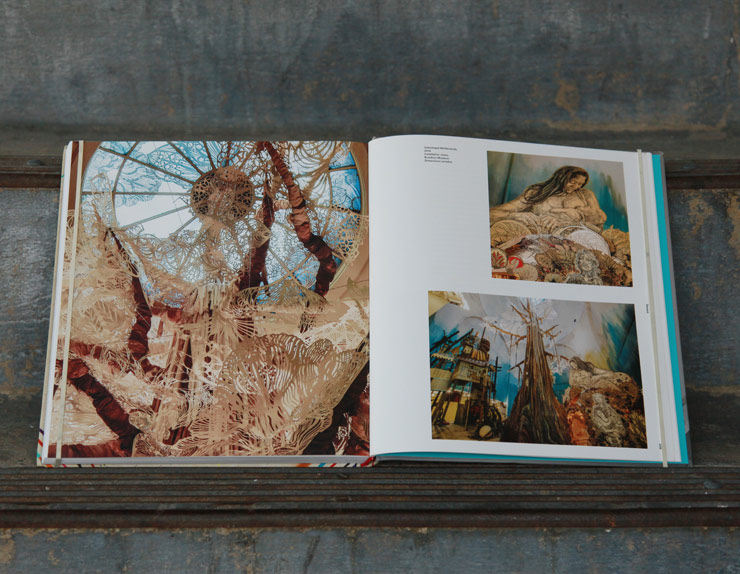
Rafael Schacter. Street To Studio. Swoon. Lund Humphries Publishers. London, 2018.

Read more
BSA Images Of The Week: 09.09.18 / Monumenta Leipzig Special

BSA Images Of The Week: 09.09.18 / Monumenta Leipzig Special

BSA-Images-Week-Jan2015

It’s great to be back in New York! Welcome to BSA Images of the Week.

Shana Tova to all our Jewish friends and the best to you in the new year! Congratulations to all our Indian friends for India’s decriminalizing homosexuality this week and showing the love and respect for everybody in our human family. Woo hoo! Shout out to Jackson Heights and half of Queens – India is in the house! In other NYC news, apparently art dealer Mary Boone can now add ‘convicted felon’ to her list of accolades.

Also in Queens this weekend you can check out all shades of gender-bender theatricality at BushWig for 23 hours of non-stop drag by over 160 performers.  You can also pose in 29 rooms of Instagram Bait here – a reality that is radically impacting museums and exhibitions.

You probably missed Sir Paul McCartney live at Grand Central Station Friday night since he only invited 300 of his closest friends to launch his new tour, but you can still see live pygmy goats in clever uniforms Saturdays this fall in Jonathan Paul’s To The Victor Belongs The Spoils show.

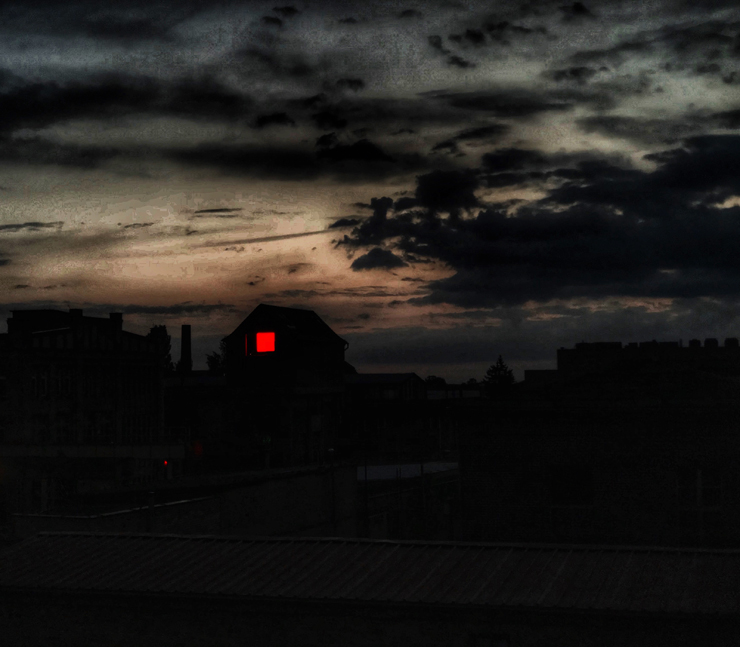
This week we have new shots from site of the Monumenta exhibition in Leipzig that we just returned from. With graffiti writers and Street Artists in your show it is a given that the rest of the walls will be hit up by visitors, peers, even the main artists. Who knows, the curators may like your contribution so well that it gets a name/date plaque of its own.

Our sincere thanks to the teams with whom we worked and played with in both Moscow and Leipzig in the last two weeks where we were curators at the Artmossphere Biennale and hosts/presenters at Monumenta. While the individuals and outcomes are quite different in both cases – the passion and ability to think big are the same. We are gratified to work, follow and lead in these very collaborative environments with such committed and creative people – and to know that our passion for Street Art / graffiti / public / urban art is met and magnified by the passion of each of you. We will probably be saying “intelligence of many” a lot now, thanks to Denis and Jan and the Monumenta team.

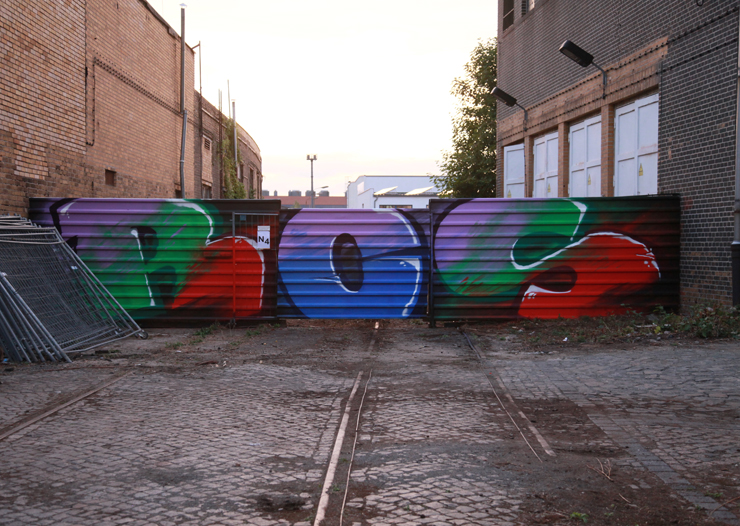
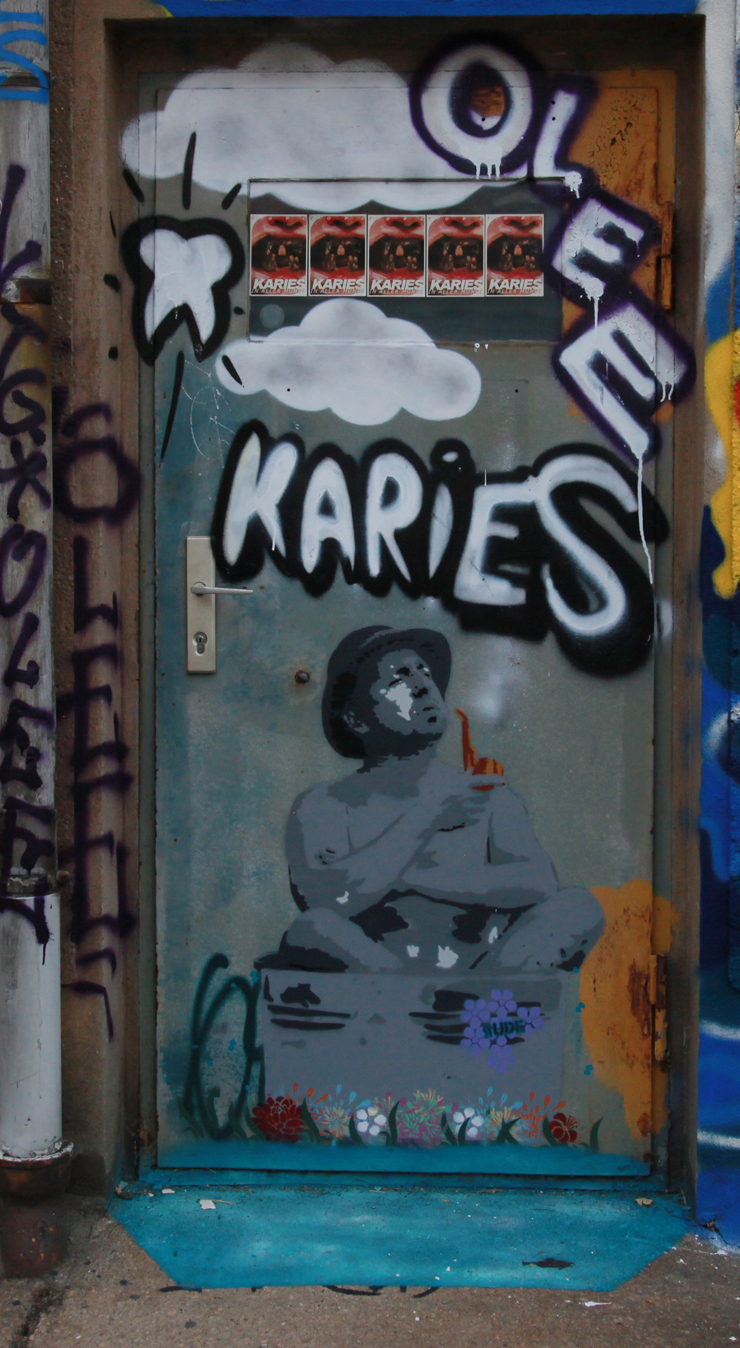
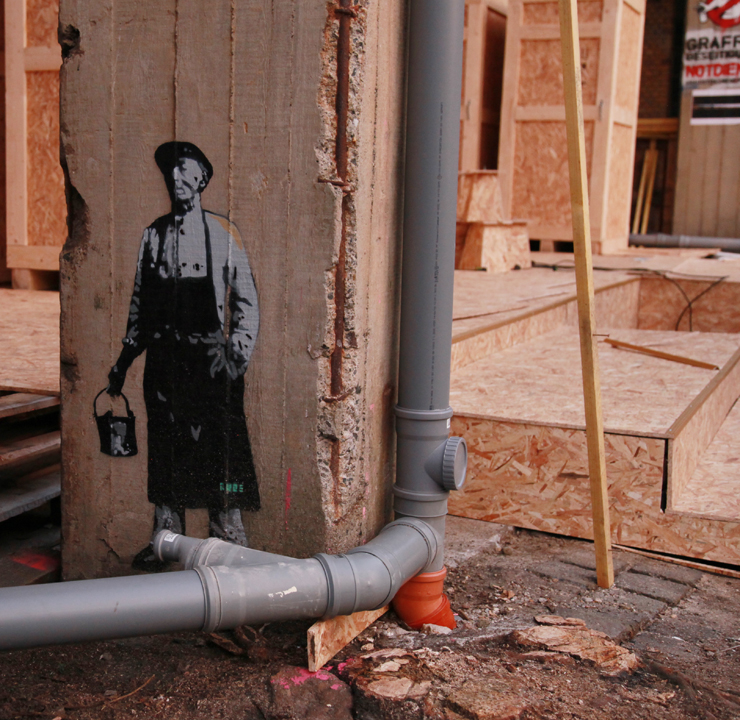
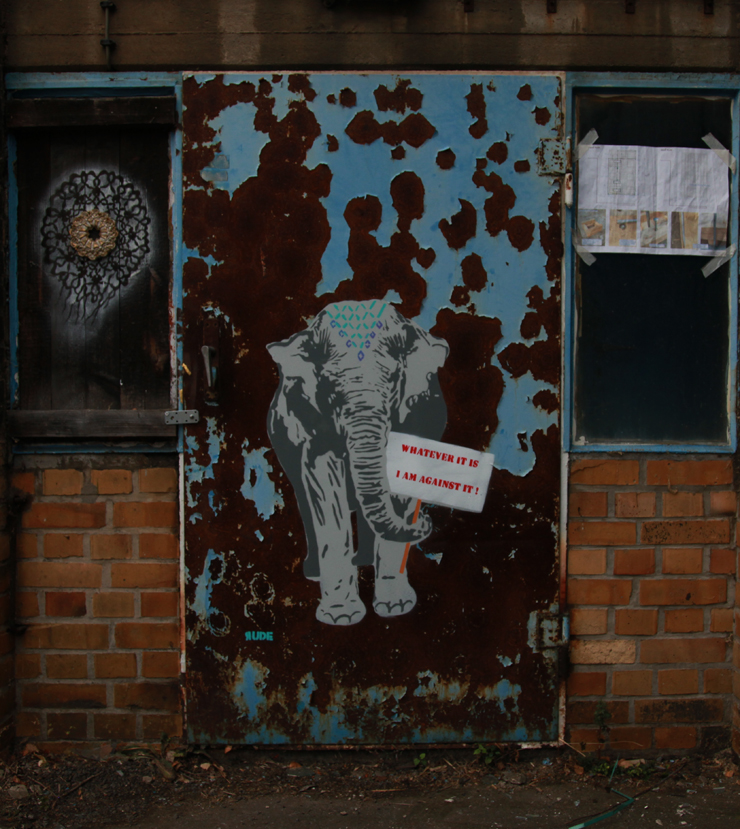
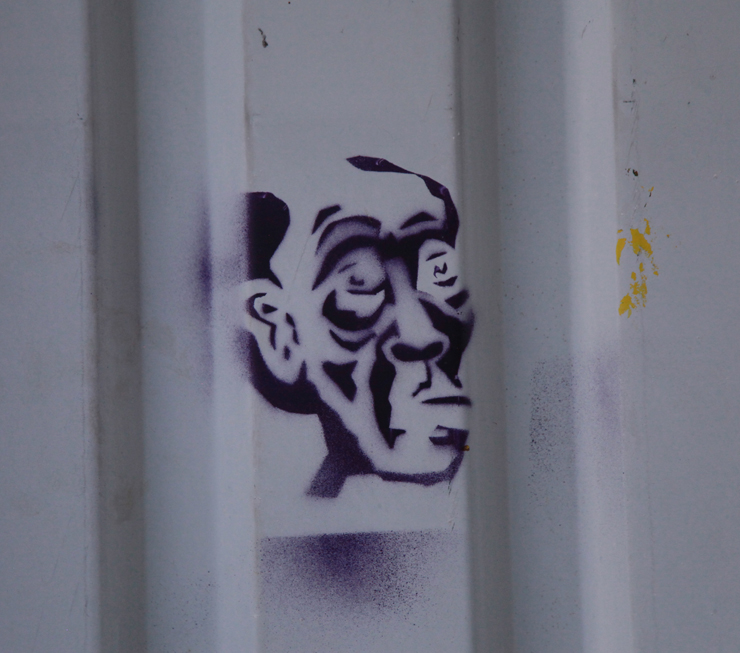
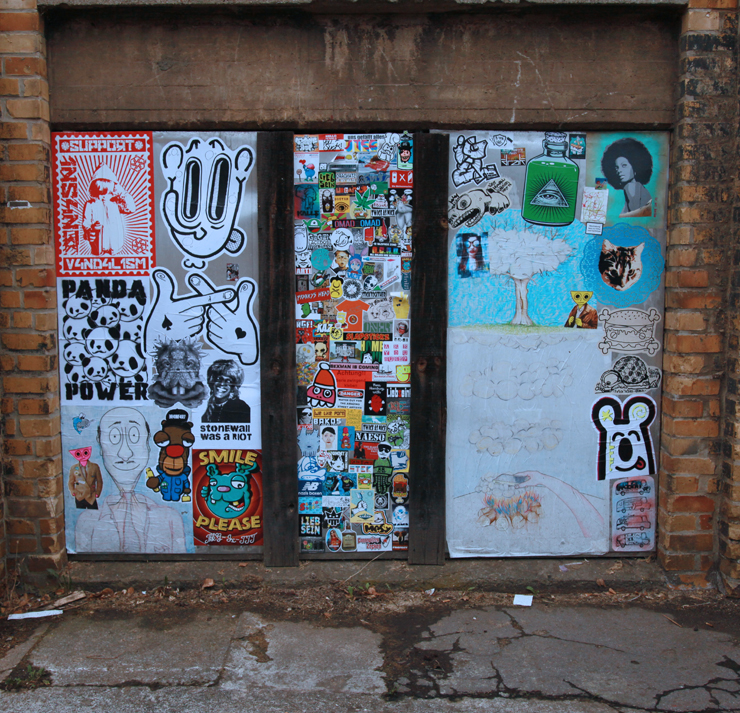
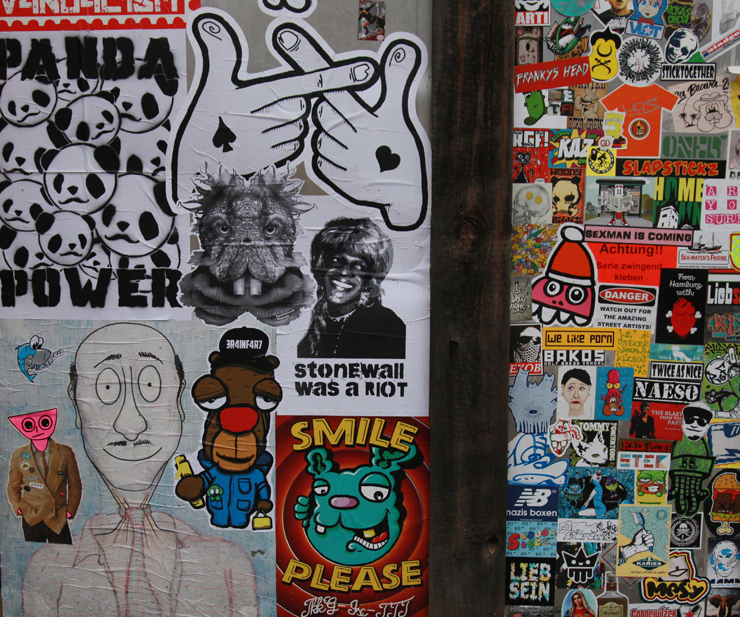
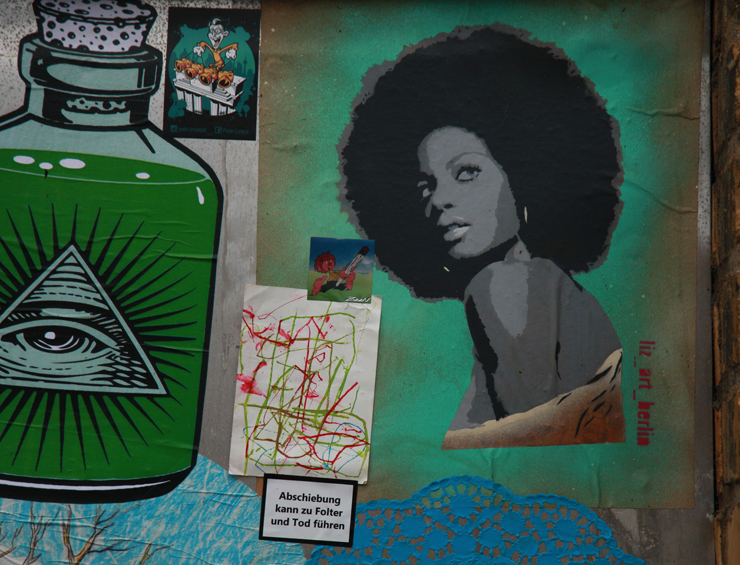
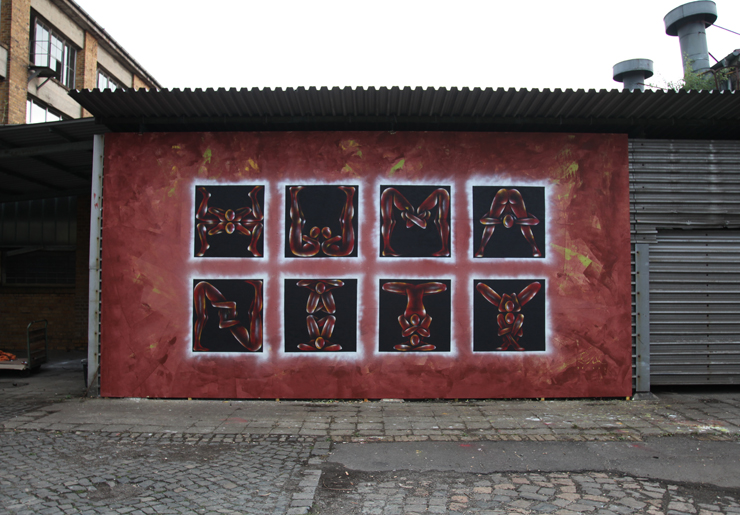
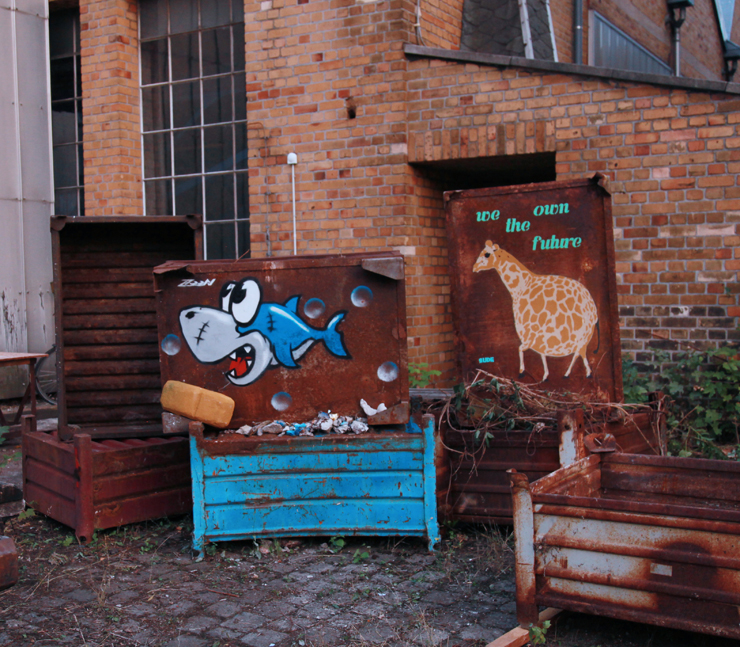
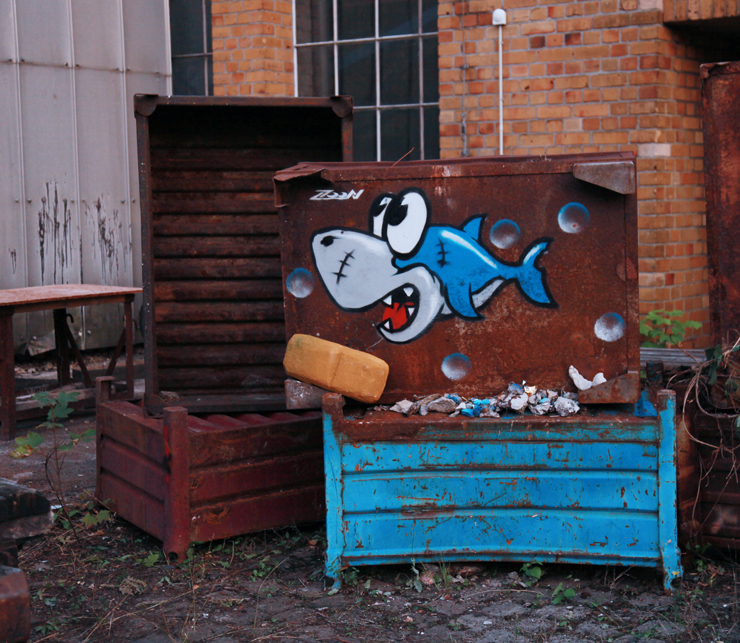
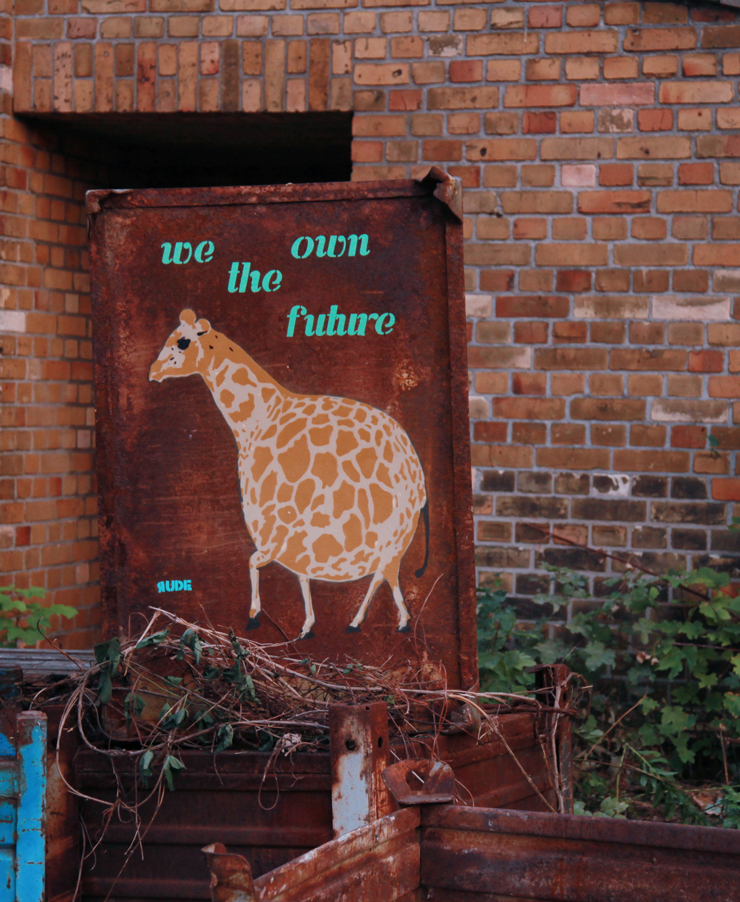
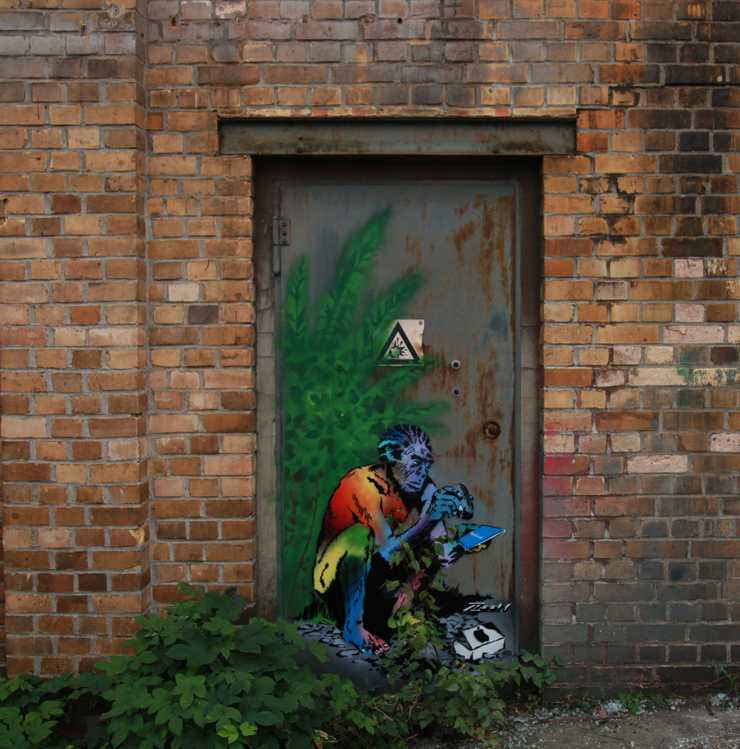
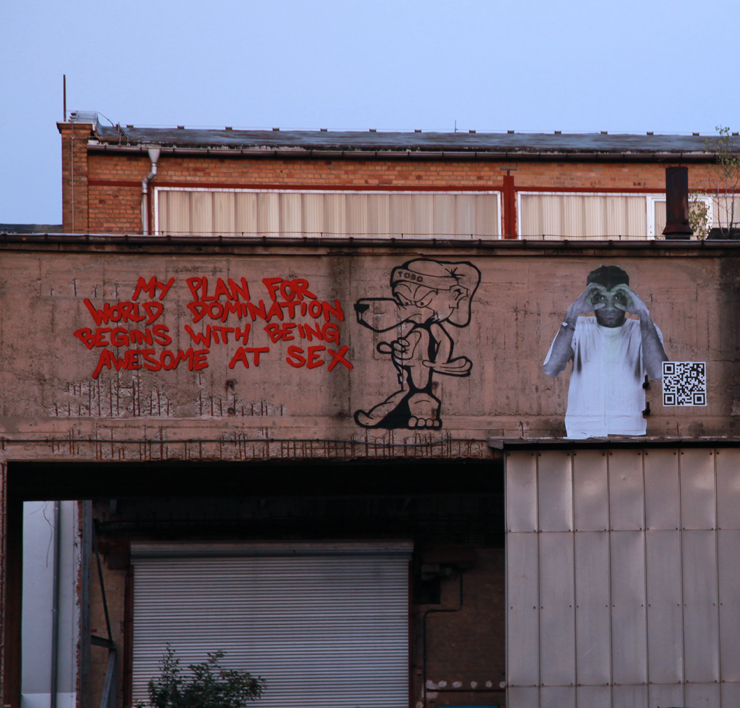
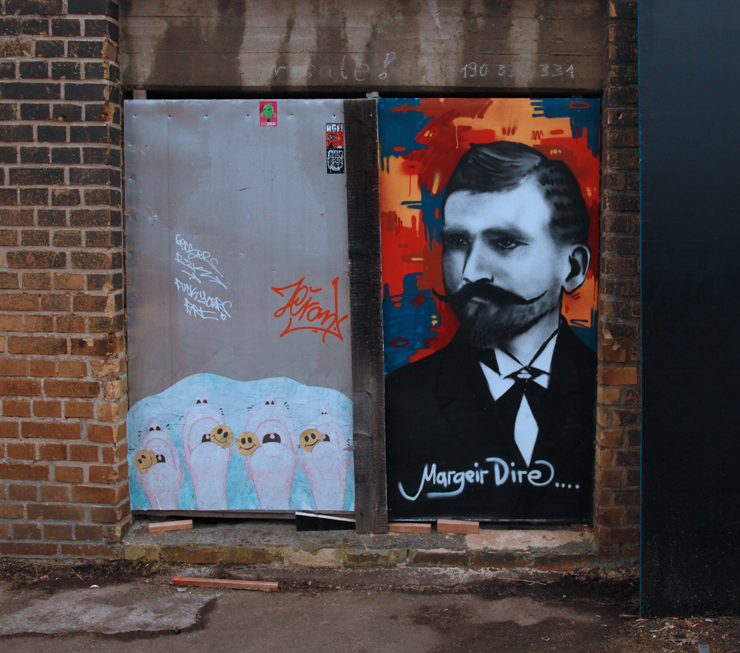
So here is our weekly interview with the streets, this week featuring Harald Geil, Karies, Liz Art Berlin, Margier Dire, Nespoon, Ostap, Otto “Osch” Schade, RCS, RUDE, SNOW, Tobo, and Zoon.

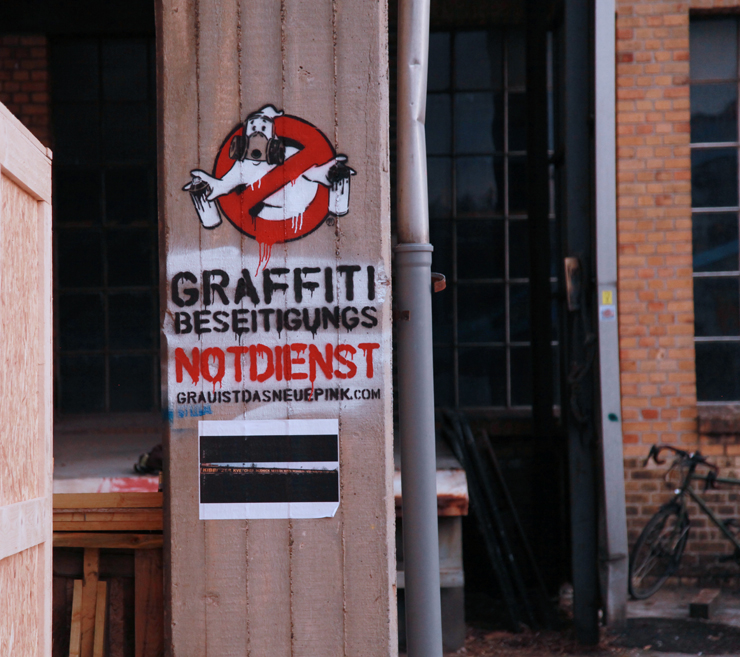
Top Image: OSTAP with the Graffiti Emergency Cleaners at Monumenta Leipzig Outdoors. Leipzig. September 2018. (photo © Jaime Rojo)

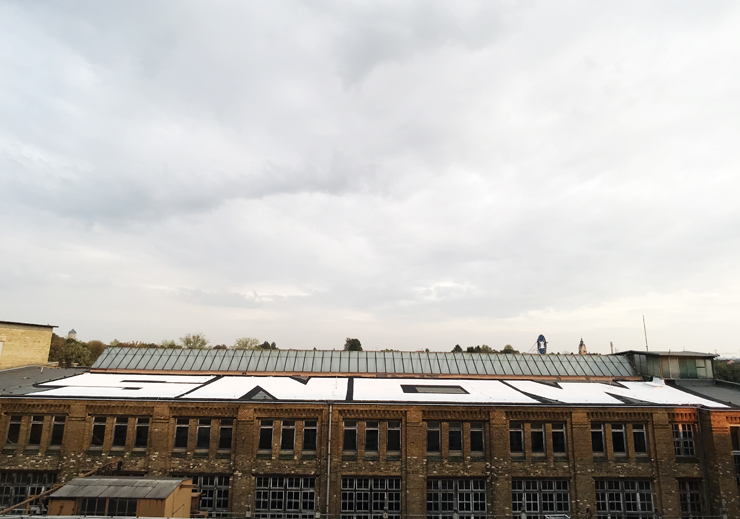
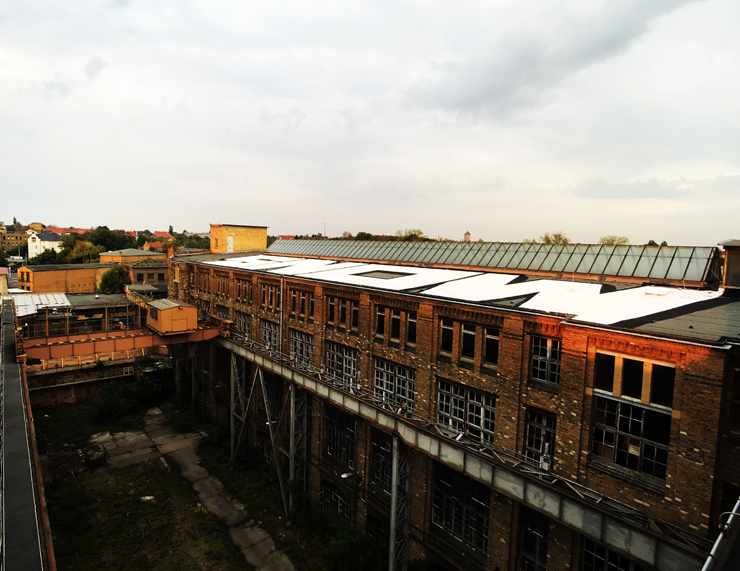
A lot of SNOW on the roof at Monumenta Leipzig Outdoors. Leipzig. September 2018. (photo © Jaime Rojo)

SNOW. Monumenta Leipzig Outdoors. Leipzig. September 2018. (photo © Jaime Rojo)

RCS. Monumenta Leipzig Outdoors. Leipzig. September 2018. (photo © Jaime Rojo)

Rude. Monumenta Leipzig Outdoors. Leipzig. September 2018. (photo © Jaime Rojo)

Rude. Monumenta Leipzig Outdoors. Leipzig. September 2018. (photo © Jaime Rojo)

Rude. Monumenta Leipzig Outdoors. Leipzig. September 2018. (photo © Jaime Rojo)

Rude. Monumenta Leipzig Outdoors. Leipzig. September 2018. (photo © Jaime Rojo)

Rude. Monumenta Leipzig Outdoors. Leipzig. September 2018. (photo © Jaime Rojo)

Rude . Nespoon. Monumenta Leipzig Outdoors. Leipzig. September 2018. (photo © Jaime Rojo)

Nespoon. Monumenta Leipzig Outdoors. Leipzig. September 2018. (photo © Jaime Rojo)

Nespoon. Monumenta Leipzig Outdoors. Leipzig. September 2018. (photo © Jaime Rojo)

Unidentified aritst. Monumenta Leipzig Outdoors. Leipzig. September 2018. (photo © Jaime Rojo)

Monumenta Leipzig Outdoors. Leipzig. September 2018. (photo © Jaime Rojo)

Monumenta Leipzig Outdoors. Leipzig. September 2018. (photo © Jaime Rojo)

Liz Art Berlin. Monumenta Leipzig Outdoors. Leipzig. September 2018. (photo © Jaime Rojo)

Otto OSCH Schade. Monumenta Leipzig Outdoors. Leipzig. September 2018. (photo © Jaime Rojo)

Zoon . Rude. Monumenta Leipzig Outdoors. Leipzig. September 2018. (photo © Jaime Rojo)

Zoon. Monumenta Leipzig Outdoors. Leipzig. September 2018. (photo © Jaime Rojo)

Rude. Monumenta Leipzig Outdoors. Leipzig. September 2018. (photo © Jaime Rojo)

Zoon. Monumenta Leipzig Outdoors. Leipzig. September 2018. (photo © Jaime Rojo)

Zoon. Monumenta Leipzig Outdoors. Leipzig. September 2018. (photo © Jaime Rojo)

OSTAP. Monumenta Leipzig Outdoors. Leipzig. September 2018. (photo © Jaime Rojo)

Margier Dire. Monumenta Leipzig Outdoors. Leipzig. September 2018. (photo © Jaime Rojo)

Unidentifed Artist. Monumenta Leipzig Outdoors. Leipzig. September 2018. (photo © Jaime Rojo)

TOBO. Monumenta Leipzig Outdoors. Leipzig. September 2018. (photo © Jaime Rojo)

TOBO . Harald Geil. Monumenta Leipzig Outdoors. Leipzig. September 2018. (photo © Jaime Rojo)

Untiteld . Monumenta Leipzig. September 2018. (photo © Jaime Rojo)

Read more
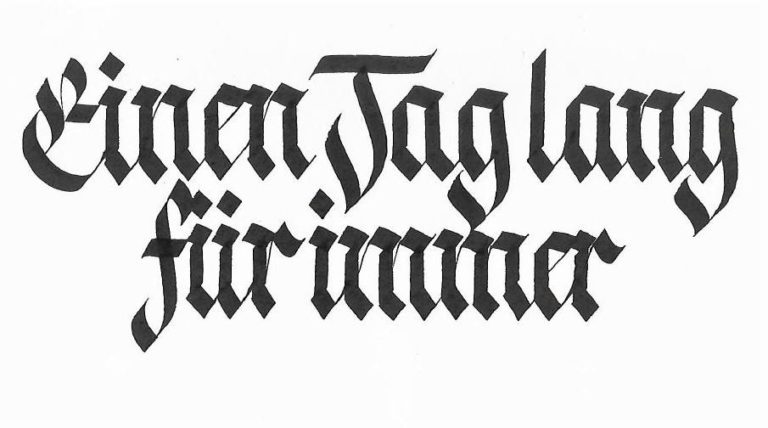
Calligraffiti Runs Through It : “Einen Tag lang Fur Immer” in Berlin

Calligraffiti Runs Through It : “Einen Tag lang Fur Immer” in Berlin

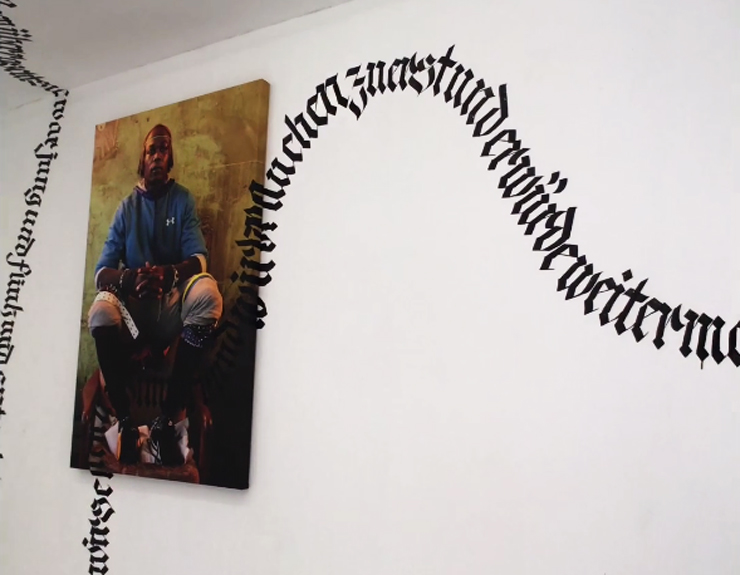
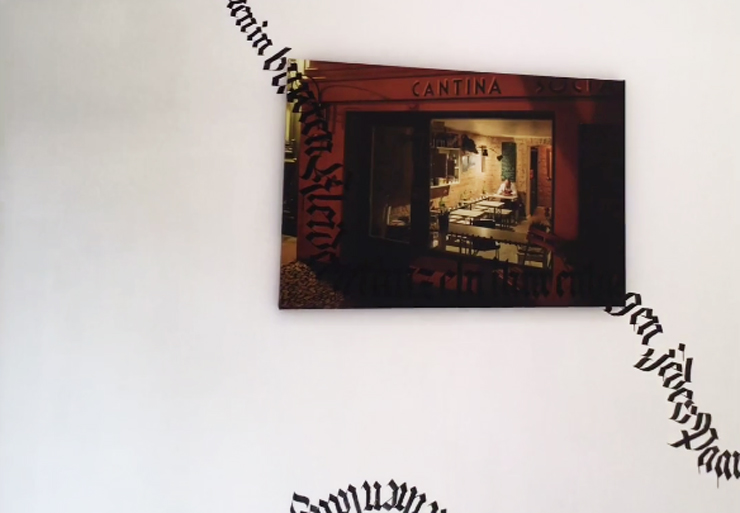
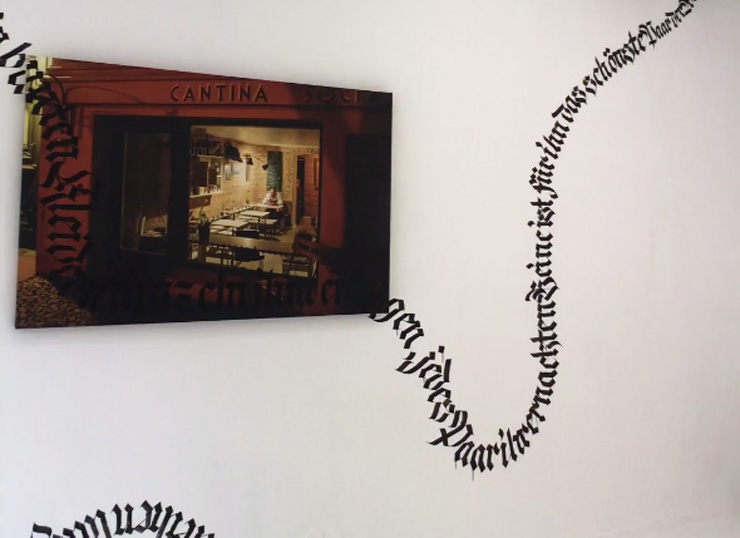
A tiny gallery pop-up show at Zwitxhermaschine Gallery in Berlin quickly illustrates quite literally the narrative that is often on the street between different pieces and players.

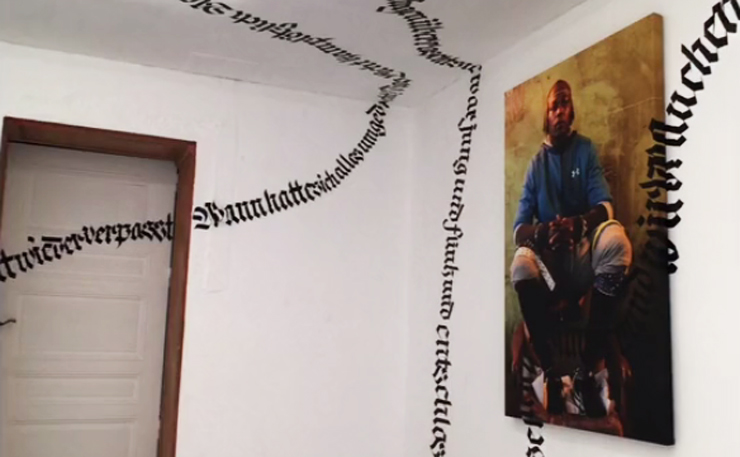
In this case the photographs by Manfred Weber, the only two on display in this storefront space, were entirely unconnected until author Nora Linneman joined them in her mind and her imagination.

The calligraffitist Parisurteil literally tagged the story across the two pieces, a painted tattoo of text that wends across the walls, ceiling and floor of the space in such a way that you may become dizzy standing in the all-white box as you follow the narrative thread around the space.

The photographer, the writer and the urban calligrapher all come together to create “Einen Tag lang für immer” (roughly translated as “For one day forever”) – an uncommon story told by many.


“In very few circumstances do you get this kind of mix of people together,” says Michelle Houston, who co-curated the show with Denis Leo Hegic. “We were looking to make a collaborative piece and we think that bringing different disciplines together is quite unusual.”

If you are in Berlin this weekend and would like to hear Nora Linnemann’s enchanting story read by the author at 4 pm Sunday September 9th.

Einen Tag land für immer is organized by Denis Leo Hegic and Michelle Houston at the Zwitschermaschibe Galerie in Berlin. The exhibition closes on September 12th, 2018.


BERLIN ART SOCIETY @ Zwitschermaschine

Eröffnung: Do 16.08.2018, 19 Uhr
Ausstellung: 17.08. – 12.09.


Read more
BSA Film Friday: 09.07.18

BSA Film Friday: 09.07.18

bsa-film-friday-JAN-2015

Our weekly focus on the moving image and art in the streets. And other oddities.

Now screening :
1. INDECLINE Billboard “Clown” Takeover
2. FACTORY OF KAOZ
3. Vegan Flava: A million years lost in a moment. Trollhättan, Sweden
4. “ARTinfect IV – The PFAFF Project” in Kaiserslautern, Germany

bsa-film-friday-special-feature

BSA Special Feature: INDECLINE Billboard “Clown” Takeover

In Los Angeles the activist Street Art posse named INDECLINE overtook a billboard recently to grab attention of those whom they are afraid are being slowly lulled by the circus of distraction and Tweets that make America Hate Again.

FACTORY OF KAOZ

We had the opportunity to experience some Liepzig Kaoz this week inside a factory that lays abandoned, yet full of opportunity for graffiti and Street Artists who explore its many rooms and stairs and broken windows. For Kaoz it is nearly a portfolio of his works, as well as a stage for fashion shoots, a set for photo projects. Join him as he shows you around the place, and watch your step.

Vegan Flava: A Million Years Lost in a Moment. Trollhättan, Sweden.

The briefest video here from a familiar Stockholm face as we see this piece from Vegan Flava in Trollhättan that he says is meant to address the norms of what to eat and consume in our culture; norms that are quickly destroying in a relative moment the Earth that took a million years to get to this point. He tells us that he believes we need to shift our thoughts and practices to value nature and animals.

“Ecocide is the crime of all time. It is destabilizing the world as people will have to flee from environmental disasters or conflicts concerning natural resources. The dominant culture is lethal to every aspect of this planet. Giving rights to nature and animals similar to human rights would enable to juridically protect ecosystems from collapse, freshwater from pollution, forests from destruction and animals from extinction.”


“ARTinfect IV – The PFAFF Project”

A roll-call video of participants from the Pfaff Project featuring fantasy, gothic, illustration-based, graffiti and Street Art inside an ex-urban spot now converted for a rolling display of fresh works in Kaiserslautern, a city in southwest Germany located in the Bundesland of Rhineland-Palentinate.

Here you can catch shots of artists like Zeso, Bustart, Serge, Pollo7, Meret, Snare79, DRÜ Egg, Chromeo, and ENDO.


Read more
“PasteUp Festival” Brings 130 Voices to Berlin Walls

“PasteUp Festival” Brings 130 Voices to Berlin Walls

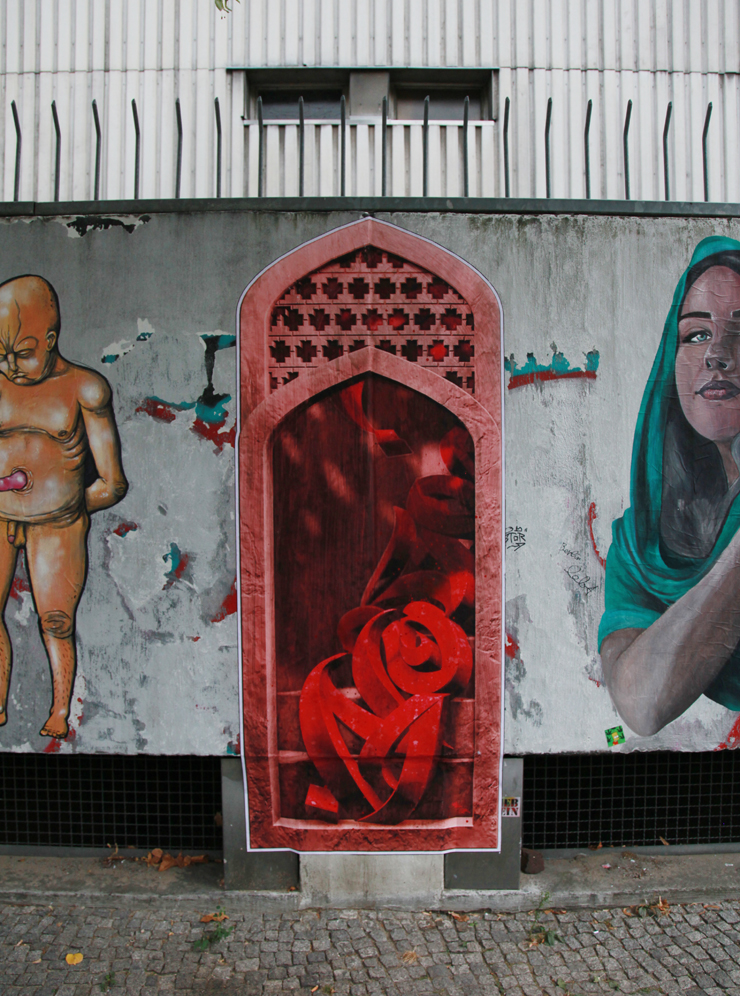
We start here with a fresh paste-up directly from Iran. It depicts the entrance to a mosque bathed in a jewel reddish haze. The lower half of the door contains a cryptic message in the three-dimensional wildstyle graffiti that captured the imagination of New Yorkers, Europeans, and Middle Easterners over time. Descending the stairs and coming out to the street it reads, “Nothing”.

From an anonymous Iranian artist. The letters in Arabic read: ………. Paste Up Festival Berlin / September 2018. (photo © Jaime Rojo)

“If they would paste this in Iran,” says the Berlin Paste-Up Festival organizer Moritz Tonn from the artists collective Wandelism. “It would probably be considered blasphemy and the government would most likely go after the artist”. Here in the so-called “western” world the ability to criticize all institutions, including religious ones, is still officially preserved and honored – so it is interesting that a theocracy could judge this as possibly flammable piece and it has to stay anonymous here inside very permissive Berlin.

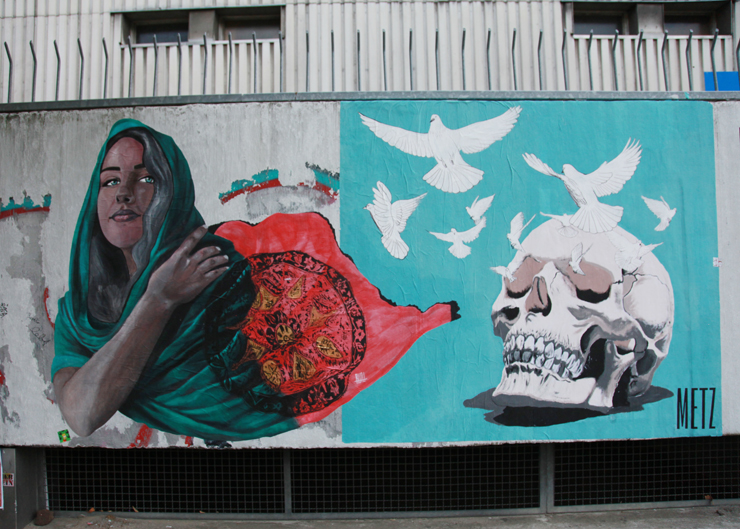
RUN . METZ. Paste Up Festival Berlin / September 2018. (photo © Jaime Rojo)

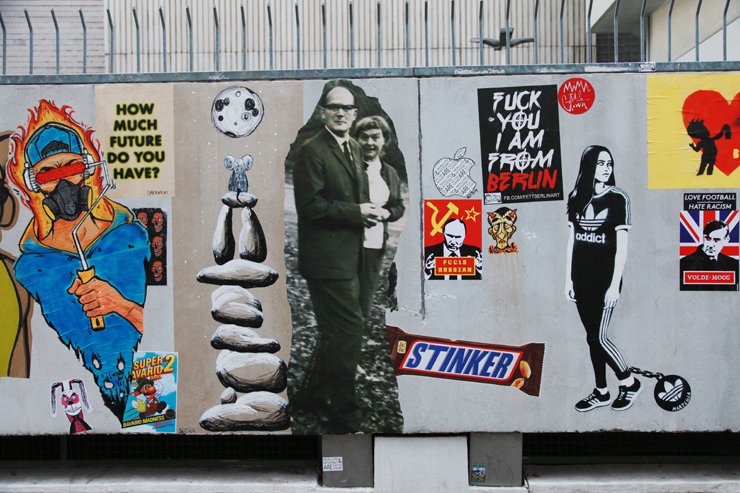
And that is only one of the reasons why exhibits like this are so crucially important to the dialogue on the street and to our collective awareness. Political, social, comic, pop, photographic, illustrative, painted, drawn, copied, figurative, immature, sarcastic,international, local, cryptic, explicit, inventive, verging on profound- these are the vox populi from many cities around the world stuck alongside one another. The mix is unusual, even odd. But the sound of the voices can be quite clarion.

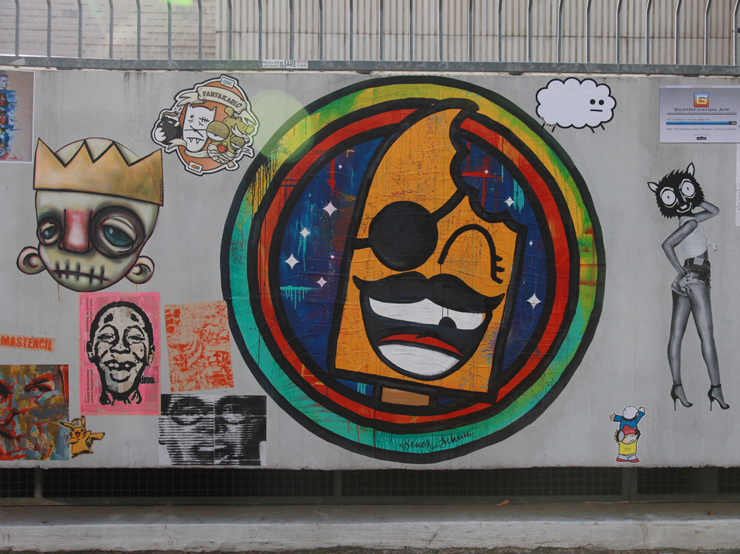
Senor Schnu (center) . Stenandol (figure with crown on left). Paste Up Festival Berlin / September 2018. (photo © Jaime Rojo)

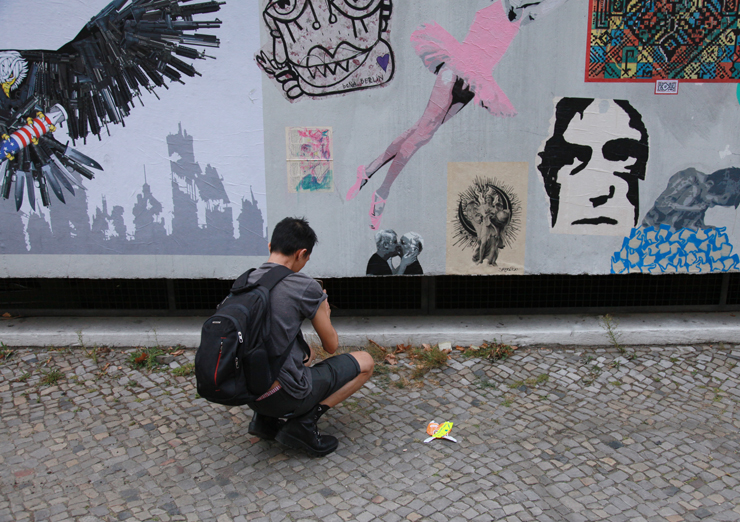
“We got submissions from 130 artists, one to five paste-ups each,” says Moritz. “We have run out of room so we asked some of the the artists if we could put their art in the streets elsewhere around the neighborhood.”

Truthfully, there is a lot of space here that hasn’t been slapped with stickers or slathered with wheatpaste, and you can imagine that with time there will be a lot of organic growth in the massive piece that will bring the walls to full maturity/immaturity.

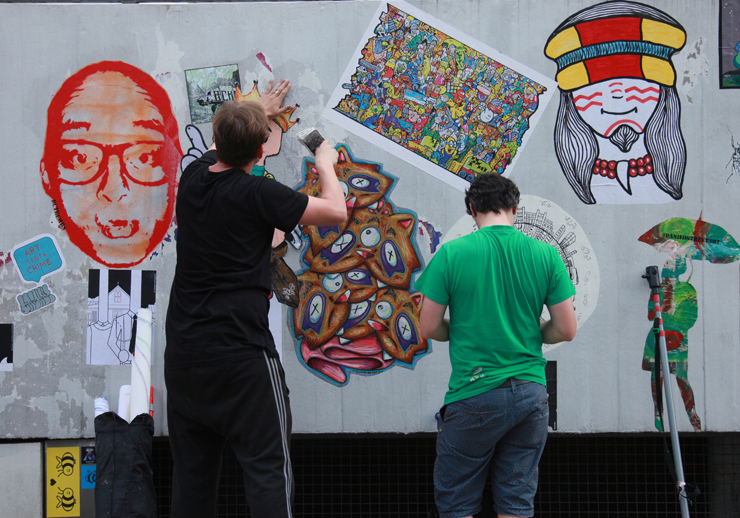
Members of the festival helping with the pasting up of the works. Paste Up Festival Berlin / September 2018. (photo © Jaime Rojo)

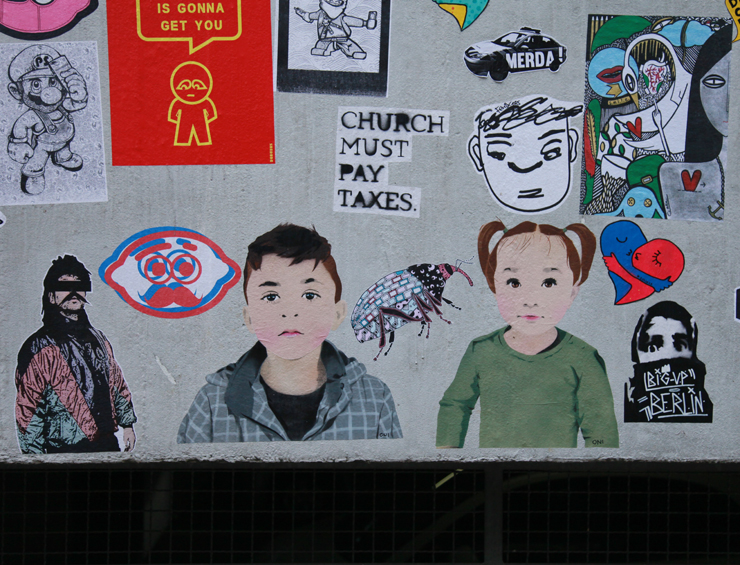
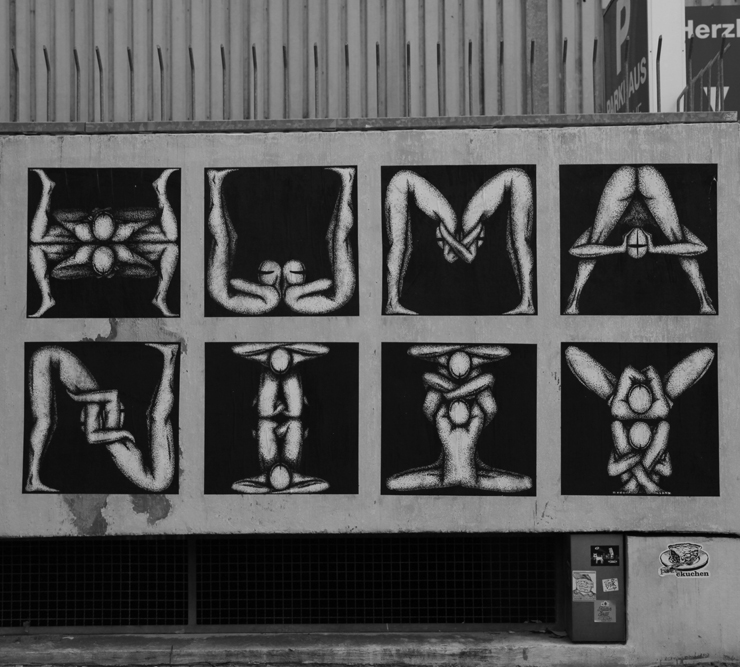
If one really is interested on experiencing the full scope of what’s happening with art in the streets one really must pay special attention to the artists whose practice is small. At the moment it may be that stickers and paste-ups are getting lost amidst the hurricane of mural festivals – But big murals don’t paint the whole picture.

The small stickers, the stencils, the wheat pasted posters attached to walls in back alleys, on post lamps and street furniture are a fundamental component of this truly democratic art movement. So we’re satisfied to see a large spot like this one solely dedicated to paste-ups in all their glorious incarnations.

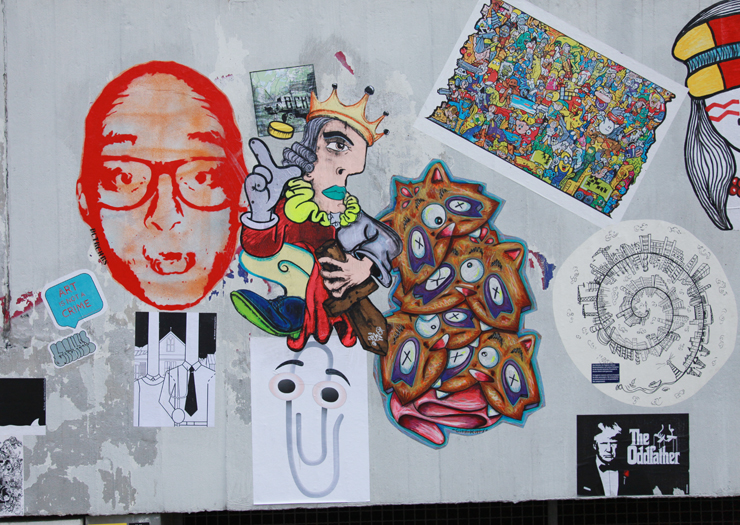
City Kitty . Gasky Graffiti . DCTRCHBS . Subdude. Paste Up Festival Berlin / September 2018. (photo © Jaime Rojo)

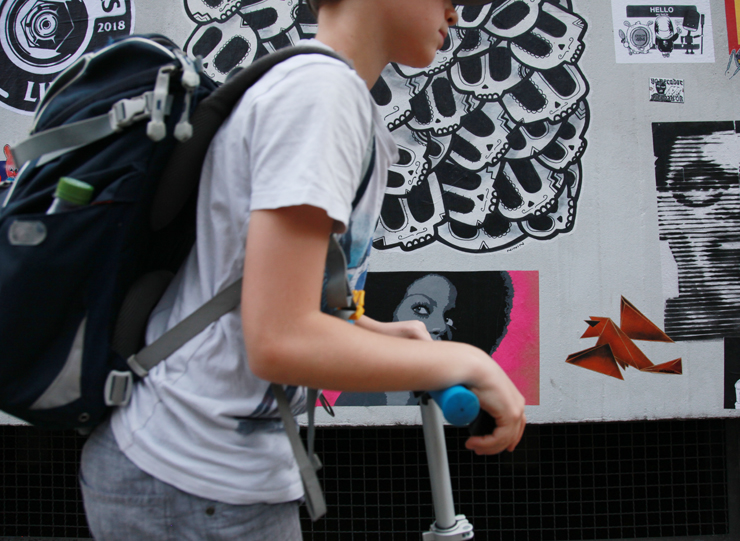
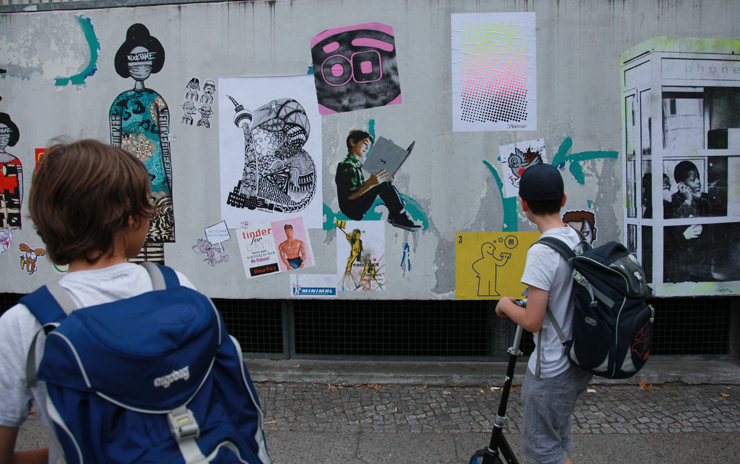
Young boys pausing on their scooters to take a look at the art works. Paste Up Festival Berlin / September 2018. (photo © Jaime Rojo)

Anna Dimitrou. Paste Up Festival Berlin / September 2018. (photo © Jaime Rojo)

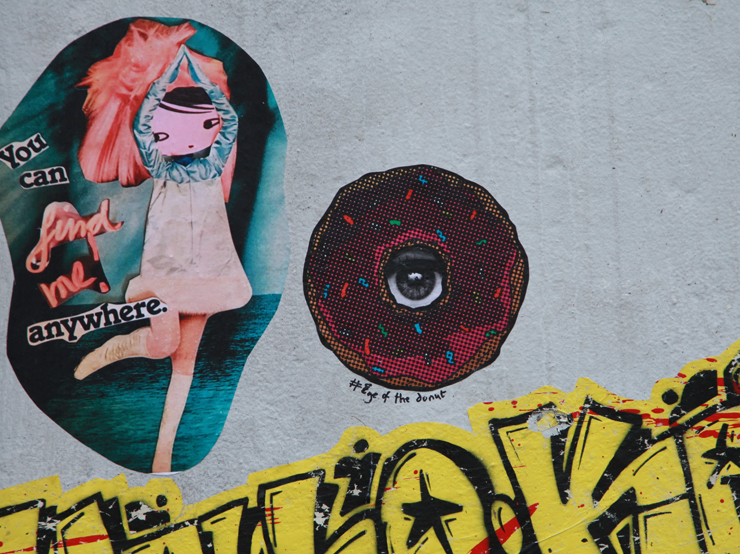
Eye Of The Donut signing his piece. Paste Up Festival Berlin / September 2018. (photo © Jaime Rojo)

Eye Of The Donut . Phobe NY. Paste Up Festival Berlin / September 2018. (photo © Jaime Rojo)

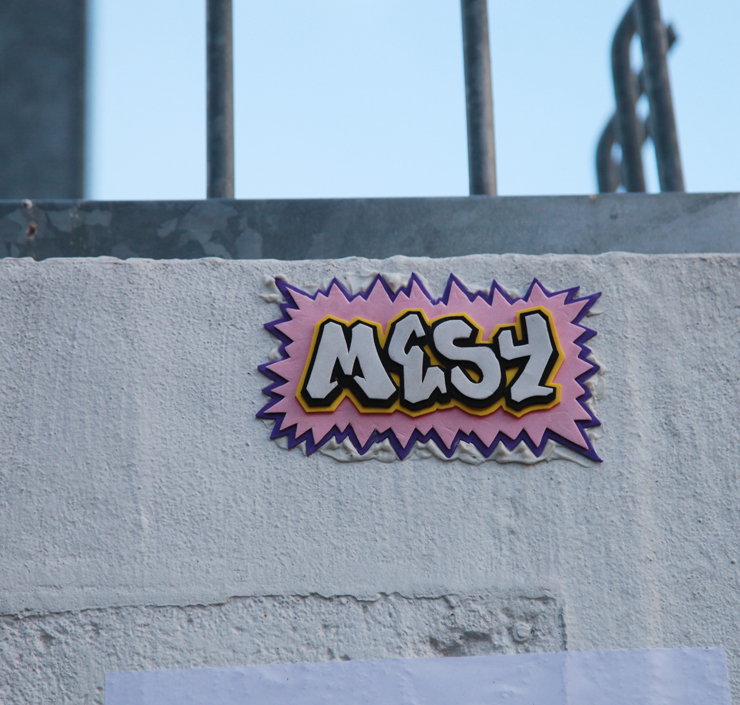
Mesy. Paste Up Festival Berlin / September 2018. (photo © Jaime Rojo)

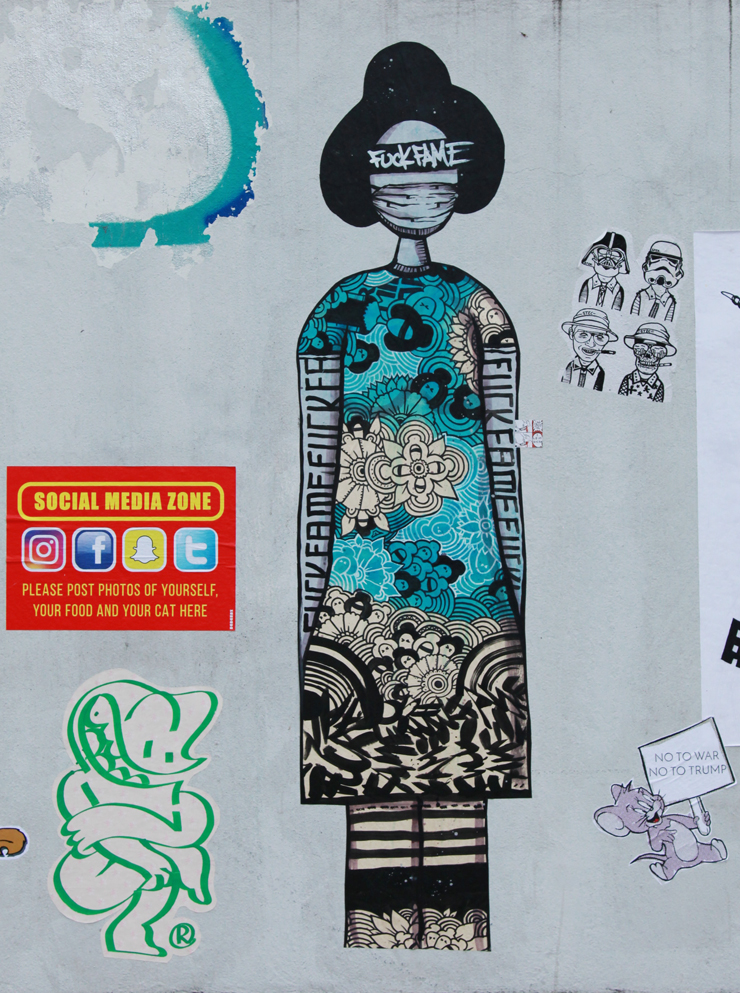
Ron Miller. Stec. Paste Up Festival Berlin / September 2018. (photo © Jaime Rojo)


Snik . Beatsen . Not Pinky . Mary Cula . Subdude. Paste Up Festival Berlin / September 2018. (photo © Jaime Rojo)

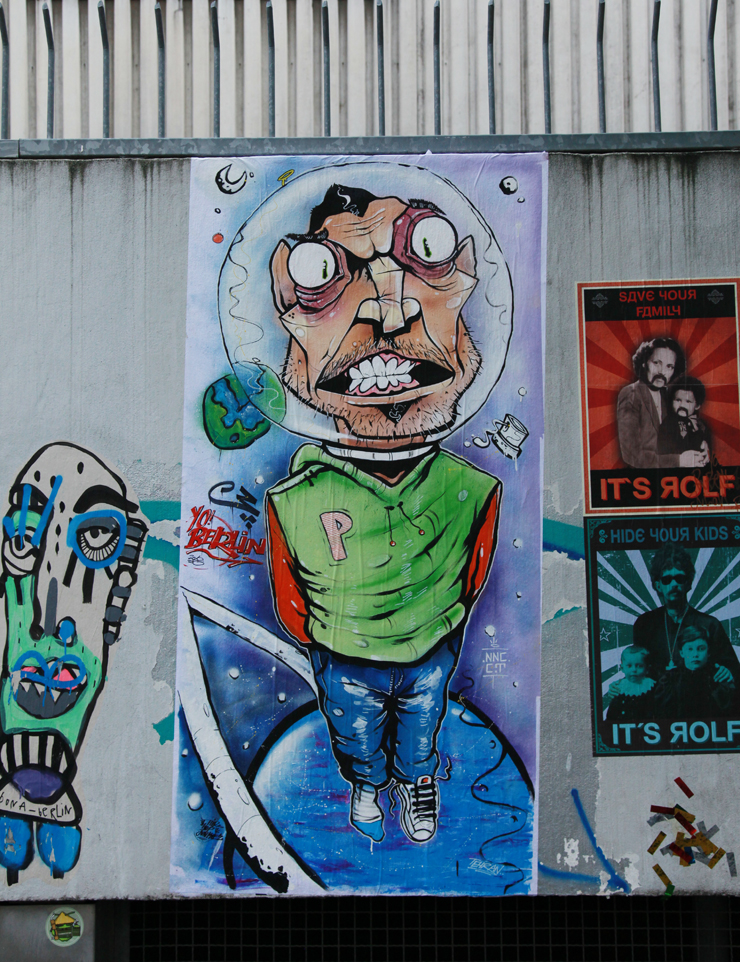
NNC CT Theran . Bona Berlin . It’s Rolf.  Paste Up Festival Berlin / September 2018. (photo © Jaime Rojo)

Not Pinky. Paste Up Festival Berlin / September 2018. (photo © Jaime Rojo)

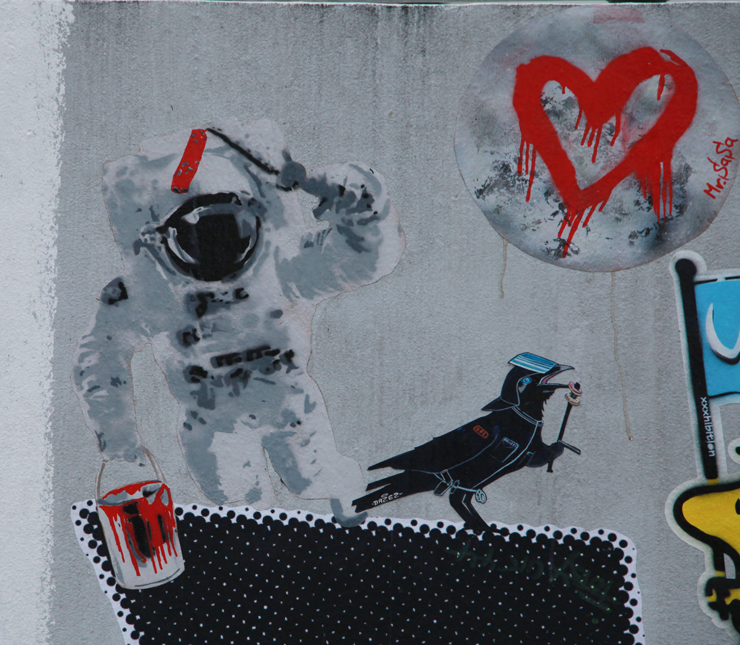
Mr. Sasa . Dazez. Paste Up Festival Berlin / September 2018. (photo © Jaime Rojo)

ONI . SKA. Paste Up Festival Berlin / September 2018. (photo © Jaime Rojo)

Paste Up Festival Berlin / September 2018. (photo © Jaime Rojo)

Otto OSCH Schade. Paste Up Festival Berlin / September 2018. (photo © Jaime Rojo)

Paste Up Festival Berlin / September 2018. (photo © Jaime Rojo)

Read more
“Play With Art” is a Slam Dunk @ Monumenta Leipzig 2018

“Play With Art” is a Slam Dunk @ Monumenta Leipzig 2018

“I don’t know shit about art,” says the provocative Denis Leo Hegic as he tours you through the Monumenta show in the vast former metalwork-manufacturing factory of Pittlerwerkes here in Leipzig. Partially speaking for his enfant terrible alter ego and for the shock effect of a tour guide telling you this, the exhibition co-curator is also demonstrating a facetious ideal. It’s meant to be a liberating statement that allows those who know little about formal art history or modern art practice to forego the pretentious gatekeepers and their classism and to feel free to interact with the art and form opinions about it nonetheless.

This is one aspect of many that we have always appreciated and valued about graffiti, Street Art – all manner of art in the streets; there is a truly democratic access to persons on the street who come from all walks of life. Through the act of putting work truly out in public to be ignored, accepted, revered, or reviled by anyone who passes, one recognizes that the experience of the art will be received and processed via the filters of each individual regardless of their life path.

One may argue as well that the public art practice possibly merits greater respect for those implied true democratic ideals of accessibility than the art which is selectively chosen after its maker has conformed and legitimized itself to the gatekeeper – one who successfully run the gauntlets of the class system, its taste makers, its money makers, and its assumed academic rigor. Notably for the convenience store clerk or factory worker, they don’t need to cough up 3 hours of their weekly wages for the privilege.

Play With Art. Monumenta Leipzig 2018. Leipzig, Germany. 09-2018. (photo © Jaime Rojo)

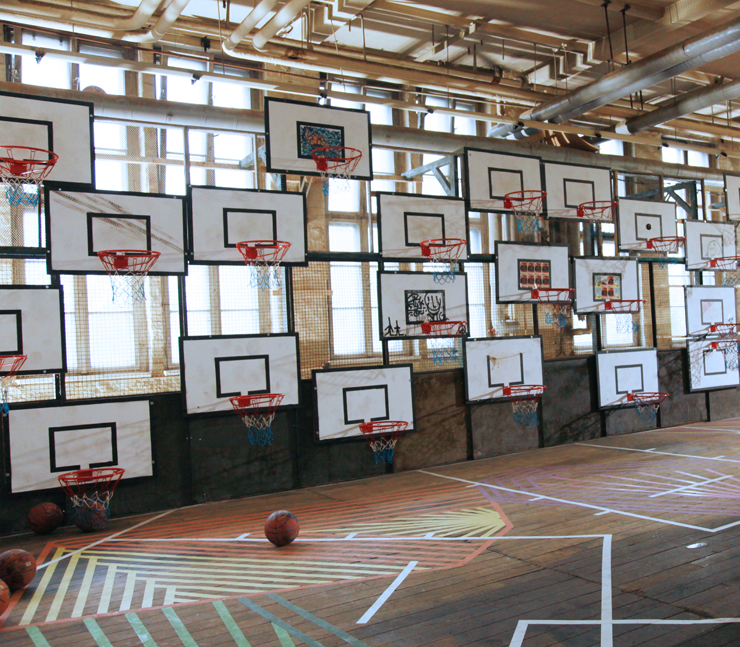
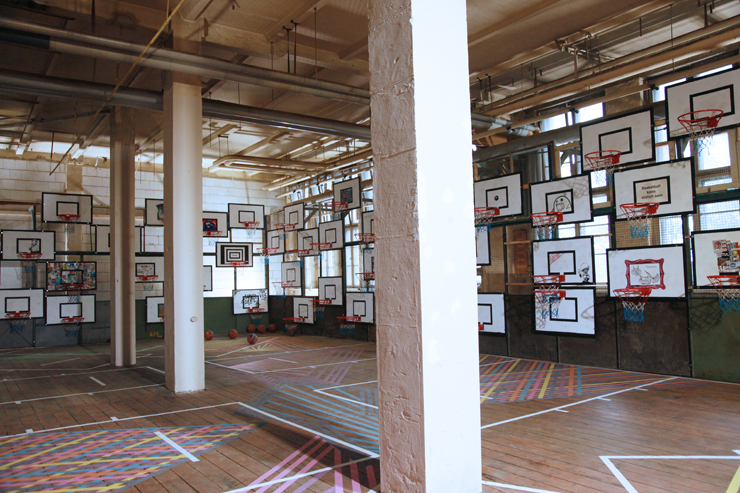
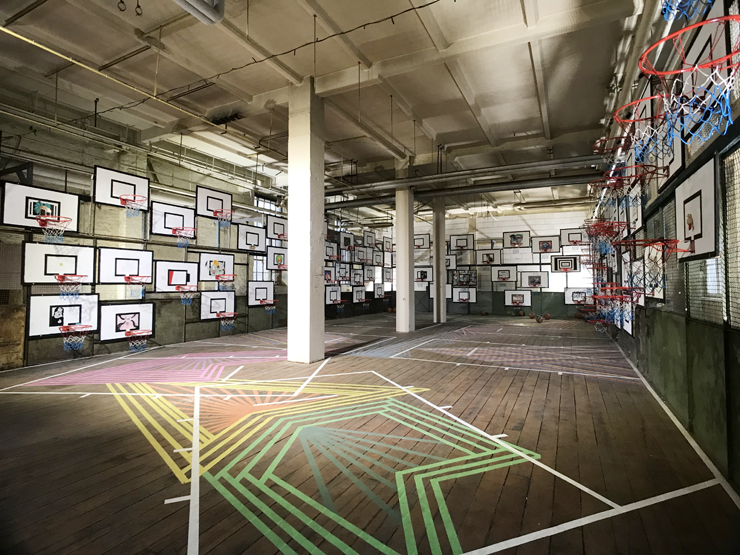
Monumenta marries this philosophy of access with the “intelligence of many” at a few power junctures throughout this peeling and vast factory, but none are more interactive and auditorially bombastic as the basketball courts. A large area caged on three sides, a comical mulitiplication that looks like the repetitive output from digitally malfunctioning software – plopping hoops and backboards in doubles and triples up, down, and across the cage – some nearly overlapping one another. They call the installation “Play With Art”.

Play With Art. Monumenta Leipzig 2018. Leipzig, Germany. 09-2018. (photo © Jaime Rojo)

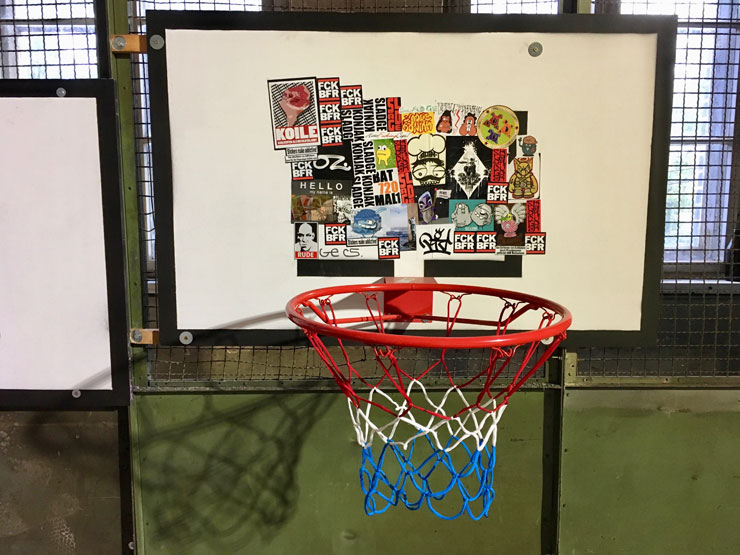
On some backboards there are pieces of flat art of unspecified origin, each now transformed into a target for ballers of all backgrounds to bounce off to get in the bucket. The wooden floors may recall a school gymnasium for many, especially when they hear the pounding, thumping, semi-rhythmic dribbling. As players pick up balls and begin to ‘play’ with the art installation and the artworks they are shooting for, it is a loud and entertaining full-court press for chaos that reverberates across the walls and across the hand-taped patterns that reflect and refract the traditional diagrammatic guidelines of the game across the floor by artist Guillermo S. Quintana.

Play With Art. Monumenta Leipzig 2018. Leipzig, Germany. 09-2018. (photo © Jaime Rojo)

“It is actually about playing with art, not making it so precious,” says Hegic as he yells above the raucous discord. How you interpret the works is up to you, but in this case the viewer is encouraged to think less seriously about the structures that typically deliver the hallowed artworks, and even possibly express athletic aggression toward them. The chaos may not be an end in itself, but these courts may be a means to a less class-based description about art’s merits.

Also you can practice your layup – which is good for basketball players and graffiti writers alike.
Read more
Senor Schnu Tackles Police Brutality at Monumenta, Leipzig 2018

Senor Schnu Tackles Police Brutality at Monumenta, Leipzig 2018

Same as it ever was,” David Byrne from the Talking Heads might say.

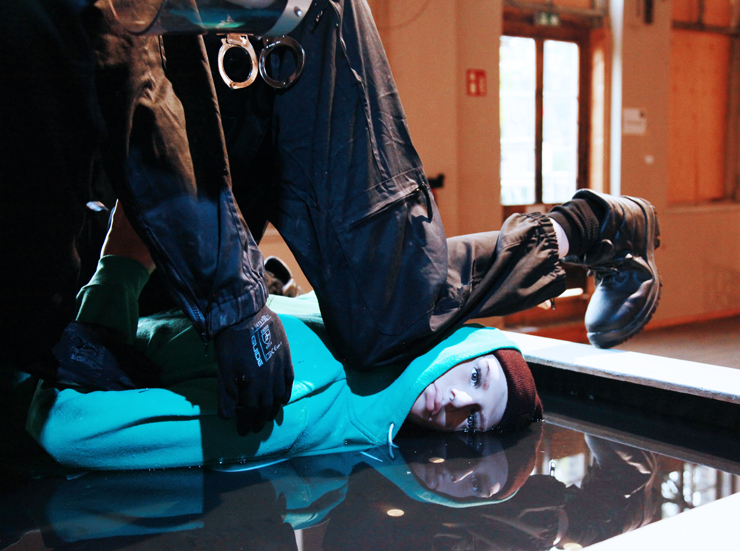
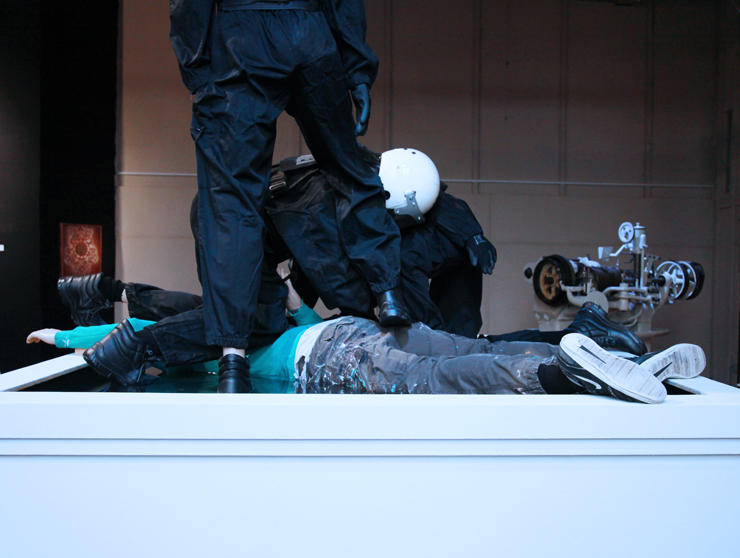
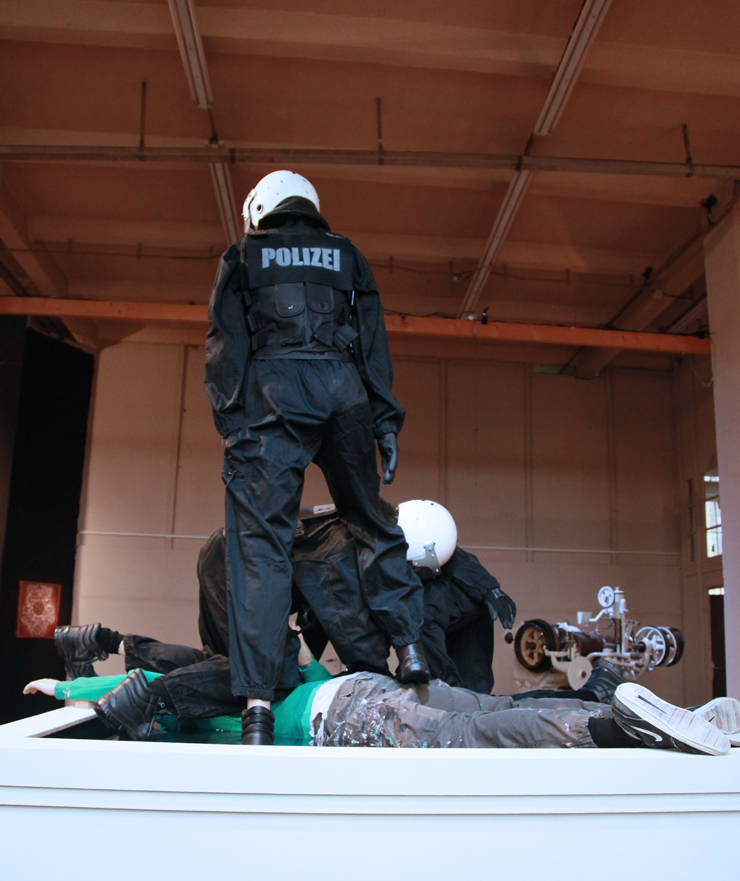
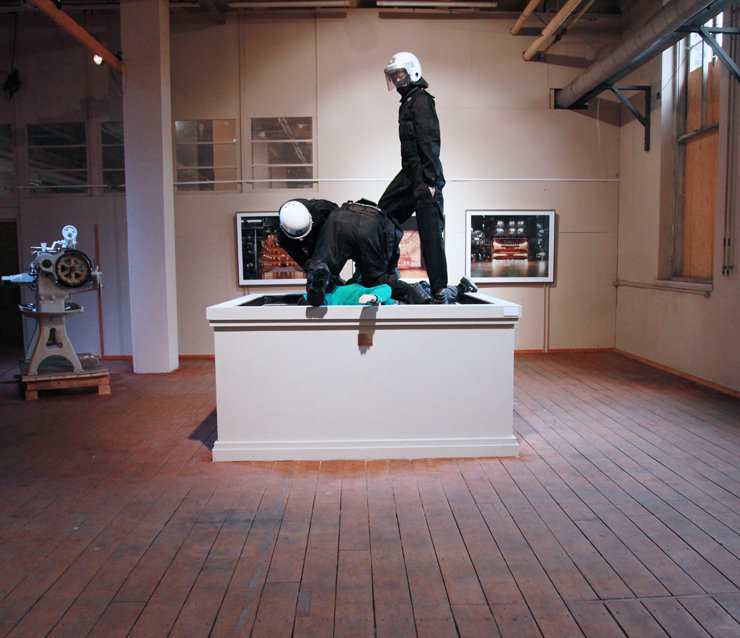
The topic of police brutality keeps coming up every year, every decade, every week sometimes. Señor Schnu, the Street Artist/fine artist who created this new sculpture at the Monumenta exhibition in Leipzig, Germany tells us that the feedback he gets from visitors is that he must be talking about something they just saw in the news. “The truth is, this sculpture is always current.”

Senor Schnu. Monumenta Leipzig 2018. Leipzig, Germany. 09-2018. (photo © Jaime Rojo)

The uniformed Polizei here are actually made of mannequins but look particularly life-like probably because Schnu broke the figure in multiple locations to reposition the limbs in more natural angles. Hearing that he “broke” the figure sends chills, as you can imagine being one of the people thrown to the ground by these armed people, your limbs pressed upon and even broken.

As Baby Boomers in the US commemorate 50 years since the 1968 Summer of Love, certain news reports are recalling the unbridled brutality of the Chicago police that summer against people protesting the Vietnam War. The youth were eventually vindicated by the 60,000 dead American kids and the millions of Vietnamese killed in what was revealed to be deceitful US leadership of generals and politicians . What many of those idealistic youth of the late 60s didn’t realize then was that when they reached their 70s the stories of new brutality against protestors and everyday people of color would still be in the news. Almost daily.

Senor Schnu. Monumenta Leipzig 2018. Leipzig, Germany. 09-2018. (photo © Jaime Rojo)

Around Europe and the world you find the same right now in the news; Romania, Bucharest, Papua New Guinea, Nigeria, The Balkans, Turkey, Catalan..

It’s an ongoing debate as societies define what the role of police is in admittedly a sometimes unthankable unpredictable position; just how much power and weaponry they should have, how they are accountable, and to whom.

In the US a vocal activist and superstar athlete and football quarterback Colin Kaepernick has withstood criticism for protesting police brutality in particular and systemic racism in general in the US by kneeling at games during the national anthem. That story has taken a unusual twist this week with global sports brand NIKE announcing they have chosen him as a spokesman.

To be clear, the topic is not police. It is brutality. And art. And certainly it’s a contemporary theme here in Germany as well, but like artist Señor Schnu says, it isn’t new.

Senor Schnu. Monumenta Leipzig 2018. Leipzig, Germany. 09-2018. (photo © Jaime Rojo)

Senor Schnu. Monumenta Leipzig 2018. Leipzig, Germany. 09-2018. (photo © Jaime Rojo)


Read more
“Monumenta Talks” Guests Raise the Intelligence of Many

“Monumenta Talks” Guests Raise the Intelligence of Many

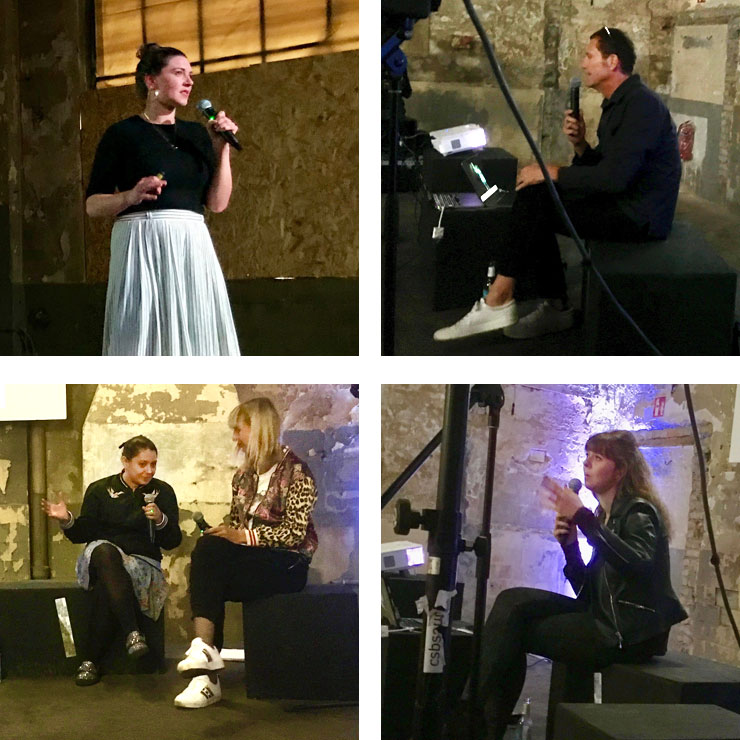
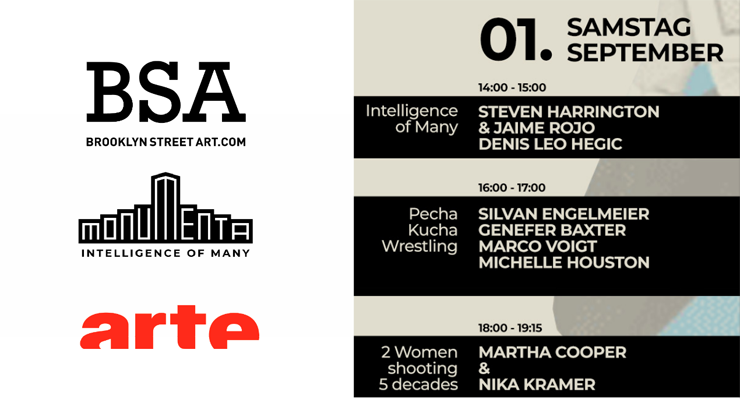
With every flashpoint on the cultural landscape it is important to give it voice and understand/consider its perspective. BSA hosted an important yet wide collection of perspectives addressing issues as varied as art, architecture, green energy, automatic traffic, art collecting, graffiti, Street Art, public art, kinetic sculpture, new cultural think tanks, new approaches to curation, and laboratories that facilitate greater interaction between art and people with the aid of new technologies. While some of the talks captured passersby whose interest was piqued enough for them to grab a seat, others were anticipated by many and filled the room before they began.
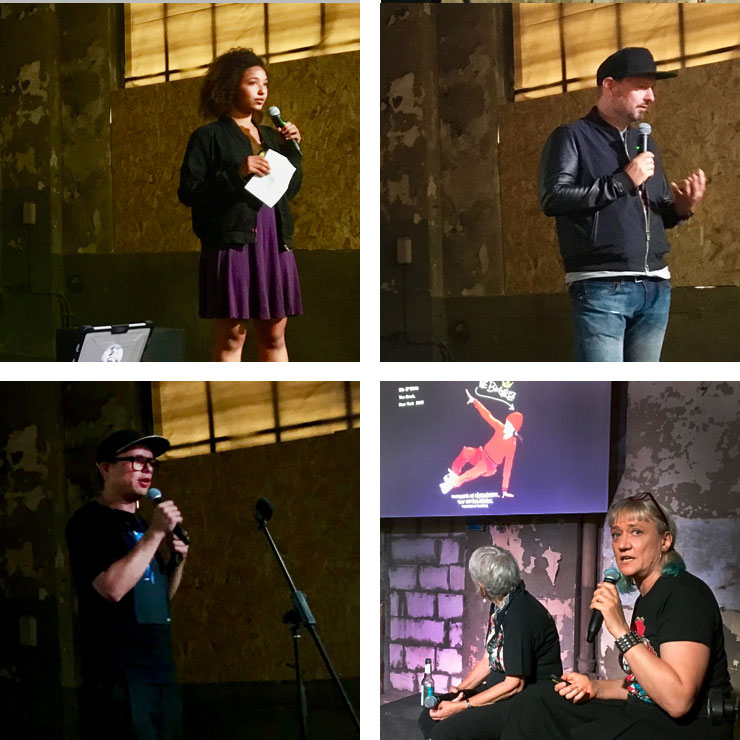
Left to right, top to bottom: Genefer Baxter, Marco Voight, Denis Leo Hegic, Martha Cooper, Nika Kramer

We were also pleased to host a few revered folks to give us all a perspective on the long game and how it is run – the heralded graffiti/Street Art photographer Martha Cooper and the famed member of the artist group Mülheimer Freiheit and the Junge Wilde (German for “wild youth”) movement, artist Hans Peter Adamski, who was joined onstage by Michel Victor Adamski, a lecturer, organizer of salons, and co-founder of the agency La Maison Victor Schilly & Friends. Each of them shared insights about their respective paths and held the audience in rapt attention. Cooper shared her stage with colleague and co-conspirator Nika Kramer, who showed images of her work in the B-Girl and B-Boy scene as well as her images working for the Urban Nation Museum of Urban Contemporary Art in Berlin.

With an exhibition theme of “Intelligence of Many” we continued to reiterate that our collective knowledge and intelligence is being raised now thanks to the digital transformation that societies and systems are undergoing – and a general flattening of traditional hierarchies. The presentations lead us in different directions for sure, but so did the conversations in the audience and with the speakers that were generated.

Other speakers included Isabel Bernheimer, the respected German gallerist (and Art Factory think tank founder) whose family has been dealing and collecting art for five generations – and her business angel Birgit Strobel, who volleyed questions to one another about how the modern gallery has to be responsive to social, political, and technological changes and the shifting priorities of the new generation of collectors that distinguish them from other buyers.

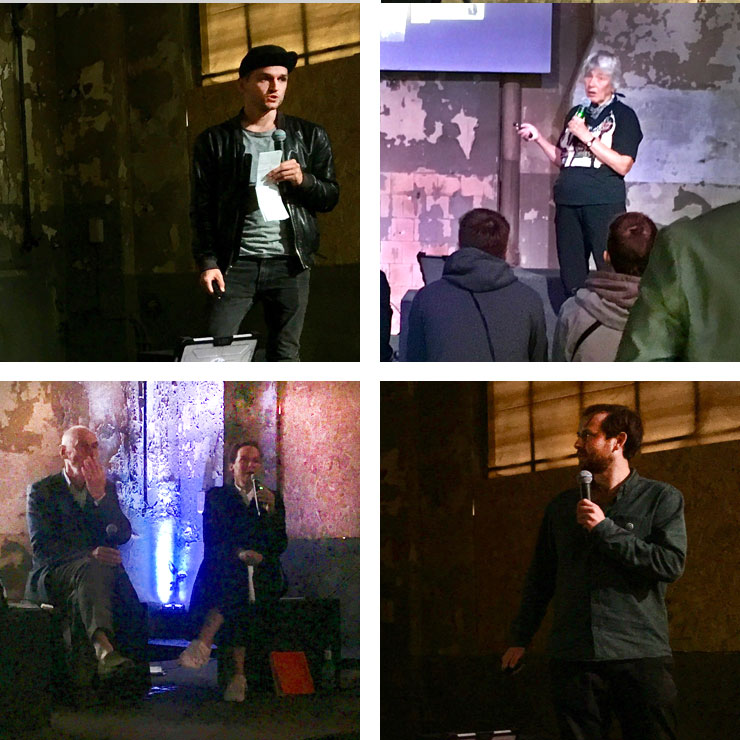
Left to right, top to bottom: Jeremy from Snøhetta, Martha Cooper, Hans Peter Adamski, Michele Victor Adamski, Silvan Engelmeir

Sasha Krolikova spoke about Eastern Block Street Artists, the formulas of traditional religious iconography, how they were used by the Mexican muralists, Leninist propaganda, and are being subverted now to talk about the emerging Precariot via neo-muralism – Precariat being a social class and generation across many countries of the so-called “developed world” who have been artfully engineered out of a social net. Christiane Arnscheidt spoke about the coming revolution of automatic traffic and her current involvement with the only entirely green fleet of car sharing in the world at CleverShuttle, an app-based service spreading from five German cities to 19 at the end of ’19. Speaking of green technology, journalist and CEO of Green Window talked about “future science” and environmental sustainability.

The new generation of curators spoke as well – Genefer Baxter spoke about co-founding IMRSV Arts and there work to make art exhibitions that people can interact with physically with the help of emerging responsive technologies, virtual, augmented, and mixed. Cultural Manager and curator Elisabetta Pejer spoke about founding laNori Art Management and the artists whom she is representing in the Urban Art scene. A foundational member of the team that built the new UN Museum for Urban Contemporary Art in Berlin, Pejer has curated the IMAGO exhibition currently running at the Munich Museum of Urban Contemporary Art that includes 31 international artists involved in the Street Art scene reinterpreting the portrait. A significant show that references the historical, geographical and a number of artistic movements in its interpretation of the traditional practice of portraiture. Michelle Houston talked about curation of shows like the successful “Wandelism” project in Berlin this year and how Street Art/Urban Art carries subtleties that compare and contrast with her perspective as a former Christie’s agent and while employed at the Victoria and Albert Museum.

Left to right, top to bottom: Michele Houston, Joachim Sauter, Isabel Berneheimer, Birgit Strobel, and Elisabetta Pajer.

Real Estate developer Silvan Engelmeier spoke about his perspective on community involvement in the development decisions that go into projects that affect their neighborhoods, and Jeremy of Oslo/New York based Snøhetta architects gave insight into that firms team culture and progressive projects in private and public space. Kinetic sculptor Joachim Sauter blew people’s minds with his eerily fluid and complexly dancing large scale sculptures in public spaces, including on in the Singapore airport that endeavors to “slow” the behaviors of people who are there to catch their flight.

Finally we also heard from both of the co-curators of the Monumenta exhibit itself, the art historian Jan Fieldler who talked about “Space and Emotion” and the manipulating of the environment in art exhibitions while Denis Leo Hegic spoke to the need to democratize access to art, to eliminate obstacles and gate keepers, to access the intelligence of many when conceptualizing and creating exhibitions – a credo put to work at this show.

It was a total honor to steer this boat and to meet the Leipzig audiences, to hear the perspectives of the presenters, and to consider the state of Street Art, Urban Art, and public art somewhere and everywhere in the mix. Our sincere thanks to the tireless team of really thoughtful and hardworking people who have made Monumenta the culturally impactful show that it is.

Read more
BSA Images Of The Week 09.02.18 – Artmossphere Biennale 2018

BSA Images Of The Week 09.02.18 – Artmossphere Biennale 2018

BSA-Images-Week-Jan2015

It’s been a packed couple of weeks between traveling to Moscow for the Artmossphere Biennale 2018 and immediately hopping to Leipzig, Germany for the magnificent Monumenta opening. Our heads are full of stories and conversations and images in two distinctly different scenes that somehow are still completely connected. Can’t tell if its euphoria or relief or jetlag but this Sunday is a dizzying day of taking account and being really thankful to be involved with an astounding amount of talent and camaraderie in the Graffiti/Street Art/Urban Art community that is connecting people around the world.

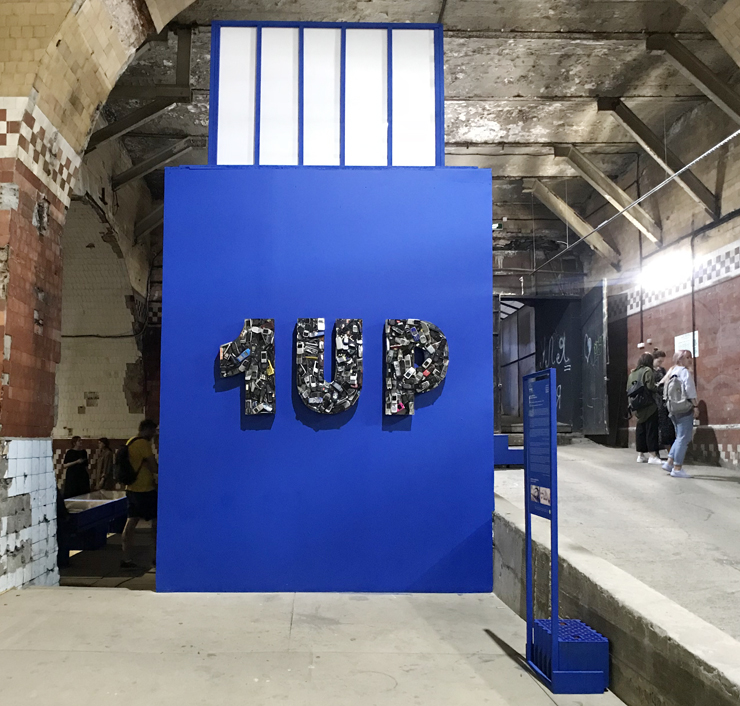
Here are our images of the week this time around; some selections from the Thursday night Artmossphere Biennale 2018 in Moscow, featuring 108, 1UP, Adele Renault, Bill Posters, BLOT, Canemorto, CT, the DOMA Collective, Egs, Faith XLVII, Faust, Finsta, Hyland Mather, LOT, Lucy McLauchlan, Lyall Sprong, Martha Cooper, Pablo Harymbat, and Pink Power.

Canemorto. Artmossphere Biennale 2018. Moscow. August 2018. (photo © Jaime Rojo)

Faust. Artmossphere Biennale 2018. Moscow. August 2018. (photo © Jaime Rojo)

Faith XLVII . Lyall Sprong. Artmossphere Biennale 2018. Moscow. August 2018. (photo © Jaime Rojo)

Finsta. Artmossphere Biennale 2018. Moscow. August 2018. (photo © Jaime Rojo)

Finsta. Artmossphere Biennale 2018. Moscow. August 2018. (photo © Jaime Rojo)

Martha Cooper . Adele Renault. Artmossphere Biennale 2018. Moscow. August 2018. (photo © Jaime Rojo)

Martha Cooper . Adele Renault. Artmossphere Biennale 2018. Moscow. August 2018. (photo © Jaime Rojo)

1UP Crew. Artmossphere Biennale 2018. Moscow. August 2018. (photo © Jaime Rojo)

1UP Crew. Artmossphere Biennale 2018. Moscow. August 2018. (photo © Jaime Rojo)

Pablo Harymbat. Artmossphere Biennale 2018. Moscow. August 2018. (photo © Jaime Rojo)

Hyland Mather. Artmossphere Biennale 2018. Moscow. August 2018. (photo © Jaime Rojo)

108. Artmossphere Biennale 2018. Moscow. August 2018. (photo © Jaime Rojo)

CT . 108. Artmossphere Biennale 2018. Moscow. August 2018. (photo © Jaime Rojo)

DOMA Collective. Artmossphere Biennale 2018. Moscow. August 2018. (photo © Jaime Rojo)

Lucy McLauchlan. Artmossphere Biennale 2018. Moscow. August 2018. (photo © Jaime Rojo)

EGS. Artmossphere Biennale 2018. Moscow. August 2018. (photo © Jaime Rojo)

BLOT. Artmossphere Biennale 2018. Moscow. August 2018. (photo © Jaime Rojo)

Pink Power. Artmossphere Biennale 2018. Moscow. August 2018. (photo © Jaime Rojo)

Bill Posters. Artmossphere Biennale 2018. Moscow. August 2018. (photo © Jaime Rojo)

Sabina Chagina. Artmossphere Biennale 2018. Moscow. August 2018. (photo © Jaime Rojo)

Read more
MONUMENTA Opens: The Intelligence Of Many / Leipzig

MONUMENTA Opens: The Intelligence Of Many / Leipzig

MONUMENTA: The Intelligence Of Many.

Below is an excerpt from our press release on this weekend’s MONUMENTA TALKS which BSA is hosting for the opening of the Monumenta exhibition in these massive halls of a tool-making factory that has laid quiet for 20 years:

Utopia is not dead! The idea of it anyway.

It may simply be obscured by the clutter of this dystopian era. We’ve all been imagining what Utopia looks like since your parents were kids. Visions of moon landings, living in geodesic domes, flying on skateboards, printing your own food, hacking time and space, making love to robots – we’ve all thought of our versions of Utopia.”

Vikor Frešo. Angry Boy in what we are now calling “The Church”. Monumenta 2018. Leipzig, Germany. (photo © Jaime Rojo)

“Is Utopia now dead? Do we know how to banish Dystopia?

MONUMENTA TALKS entertains and asks you if we can optimize our cities and systems. Does art play an important part? Who gets to decide?

With our guests and the audience we want to revive utopias. Seeking ‘monumental’ and ‘iconic’ ideas for a city/society of the future. We’ll examine the Intelligence-of-Many instead of the Limitation-of-the-Individual for pushing us all forward.”

For information on all events, directions and schedule click on the link below:

https://www.facebook.com/events/408659719538221/

Read more
BSA Film Friday 08.31.18

BSA Film Friday 08.31.18

bsa-film-friday-JAN-2015

Our weekly focus on the moving image and art in the streets. And other oddities.

Now screening :
1. Martha Cooper and Adele Renault at Artmossphere Biennale 2018
2. Canemorto at Artmossphere Biennale 2018
3. Pablo Harymbat at Artmossphere Biennale 2018
4. Hyland Mather at Artmossphere Biennale 2018

bsa-film-friday-special-feature

BSA Special Feature: 4 BSA Homemade Videos From This Week in Moscow for Artmossphere

There is a certain glory to all of this; 50 or so artists from around the world who started in Street Art and graffiti now making art that cannot be easily classified as such. After a handful of international curators sifted through 350 applications this represents a moment, possibly one flashpoint in the movement between the street and the contemporary art scene and academia and the public.

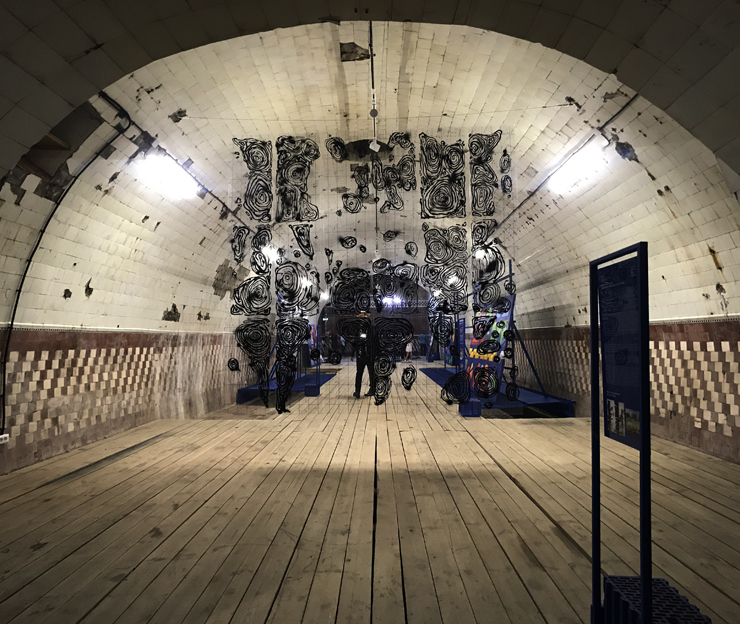
For a capital city in Russia to be a facilitator of this conversation is unique because the modern stories we tell each other about this public art practice have rarely centered here. But Moscow has its own towering splendor and is taking a leadership role in helping us tell the history and possibly helping to form the future of this scene. Thursday night the legion of guests trolling the arched halls of the wine cellar could not have been more engaged, more full of question, more willing to consider that the minds and craft of these artists, at least in some cases, are apt reflections of our society, provide insight and critique.

Enjoy these small videos made by photographer Jaime Rojo on his phone this week as we surveyed some of the artists preparing their work for Artmossphere 2018.

Process at Artmossphere Biennale 2018: Martha Cooper and Adele Renault

Process at Artmossphere Biennale 2018: Canemorto

Process at Artmossphere Biennale 2018: Pablo Harymbat


Process at Artmossphere Biennale 2018: Hyland Mather


MONUMENTA / LEIPZIG

Next Stop – LEIPZIG for an audacious new festival that celebrates the flattening of the hierchies and the Intelligence of Many.


Read more
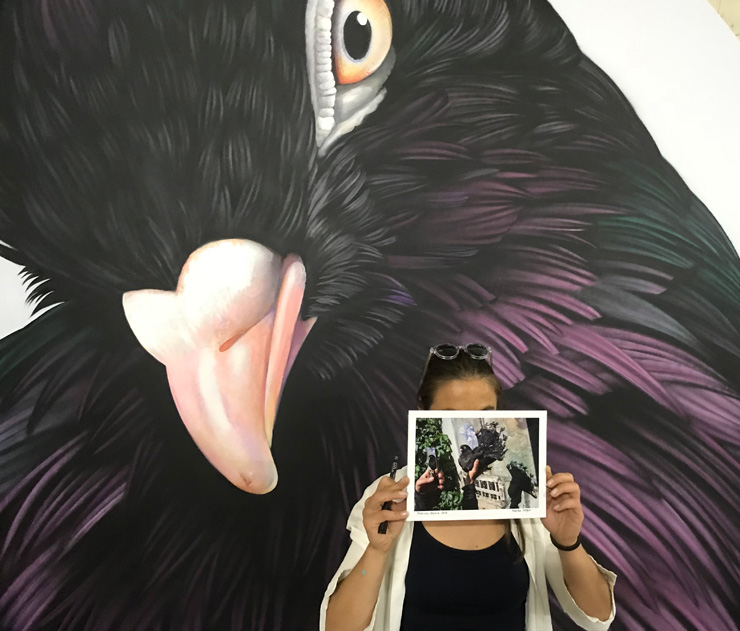
Martha Cooper And Adele Renault: Pigeon Fanciers In Moscow

Martha Cooper And Adele Renault: Pigeon Fanciers In Moscow

BSA is in Moscow as curators of 50+ international artists in the Artmossphere Biennale 2018 for its 3rd edition called Street Art Wave. Till the end of the month we’ll working with a stellar cross section of people involved with Urban Art/Street Art/Graffiti at curious and fascinating intersections. We’re meeting with Street Artists, academics, collectors, gallerists, museum curators, organizers, and thoughtful pontificators of all sorts in studio, on the street, behind the scenes, and on display. Come with us!


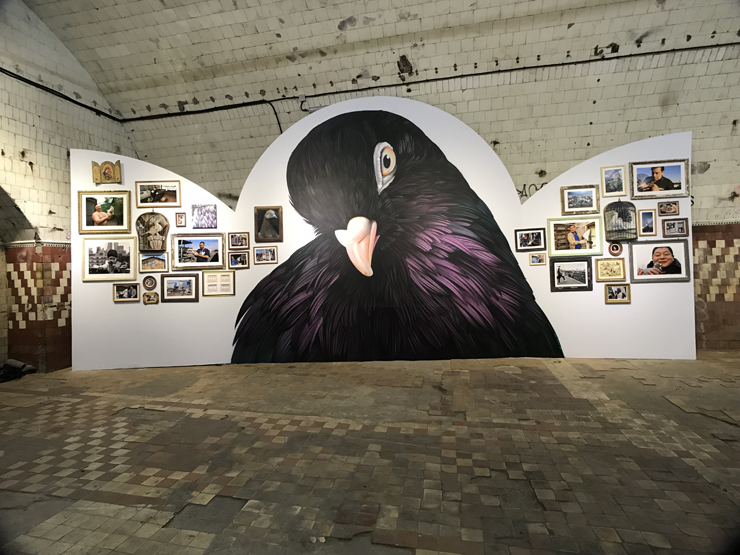
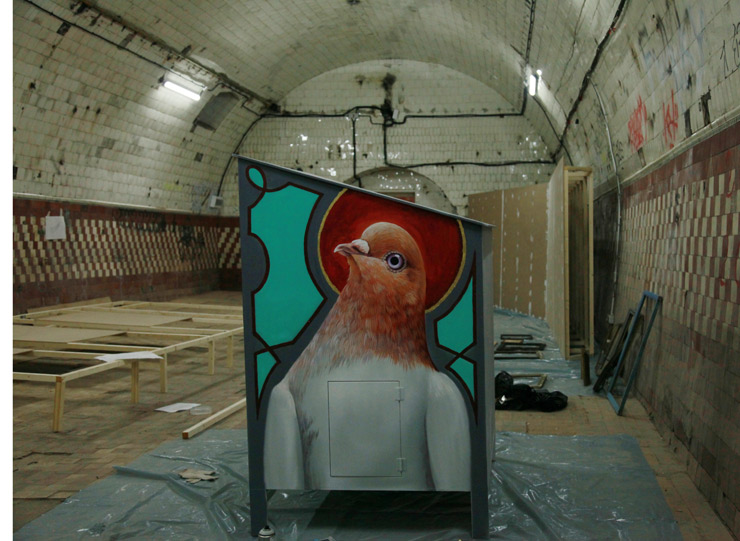
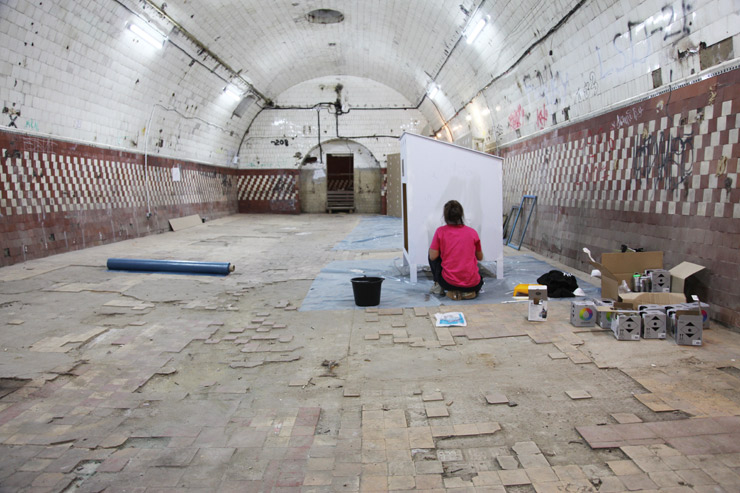
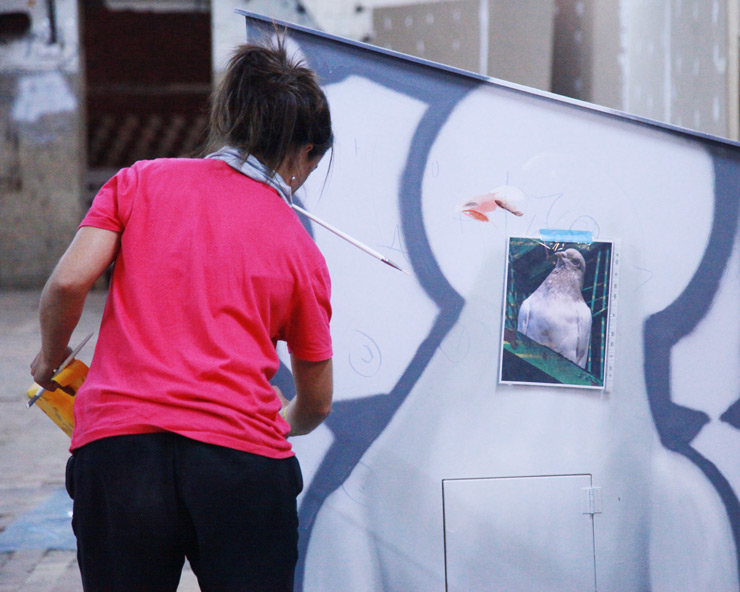
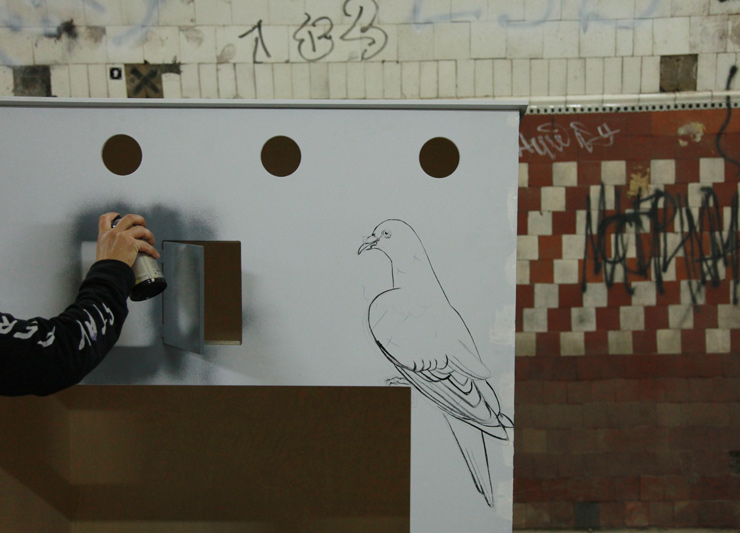
As curators we were asked to write a text about Martha Cooper and Adele Renault and their collaborative project for the Artmossphere Biennale 2018 in Moscow. We think it is equally appropriate for the work in process photos here and the interviews BSA had with both:

“A perfectly paired duo of artist and photographer who each engage with Street Art from two distinctly different perspectives, this collaborative project puts the focus on a shared interest.

Adele Renault grew up in the Belgian Ardennes and at a very early age began traveling the world; sometimes solo, quickly developing an adept eye at studying places and people. A classically trained painter with a realistic style, she focuses her camera and her brushes on smaller details that may sometimes be overlooked but which add texture and rich interest to the mundane or unrecognized. With her beautifully realized portraits she is able to capture the depths of her subjects by the expression in their eyes, the details of lines on their face, and the candid innocent smile that flashes quickly.

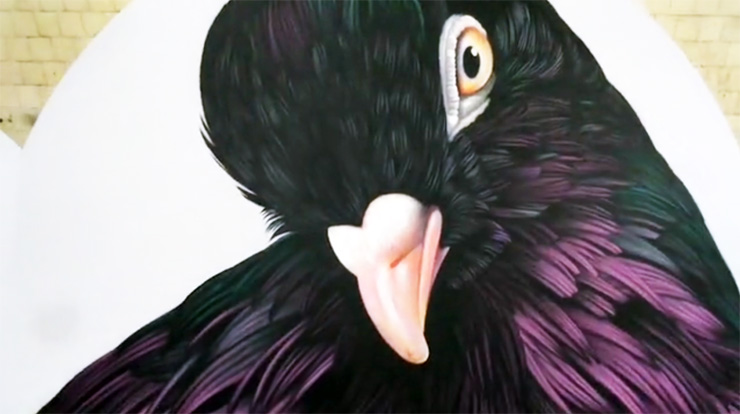
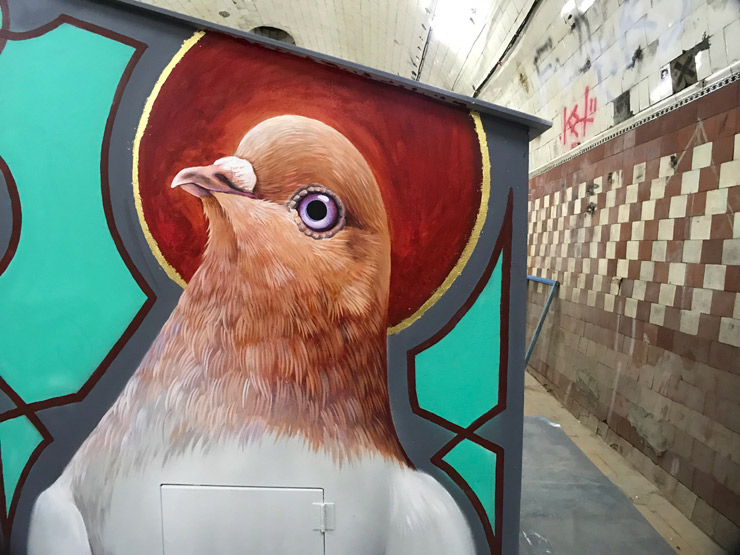
However her love is with pigeons. Her pigeon paintings and murals give the oft-derided birds their rightful place in our cities where they are often considered pests that are equal to rats.

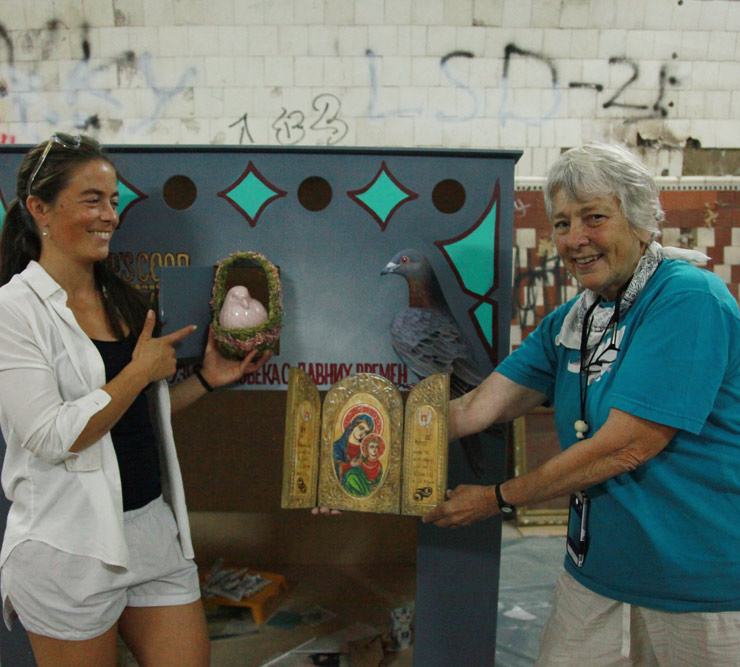
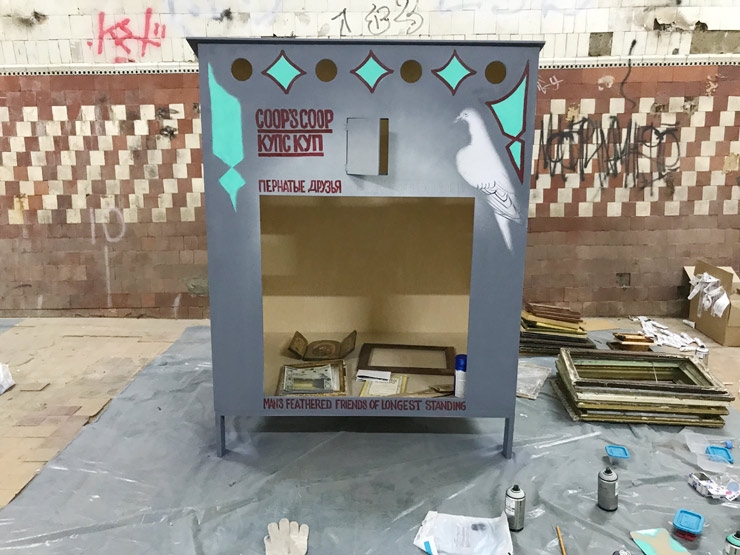
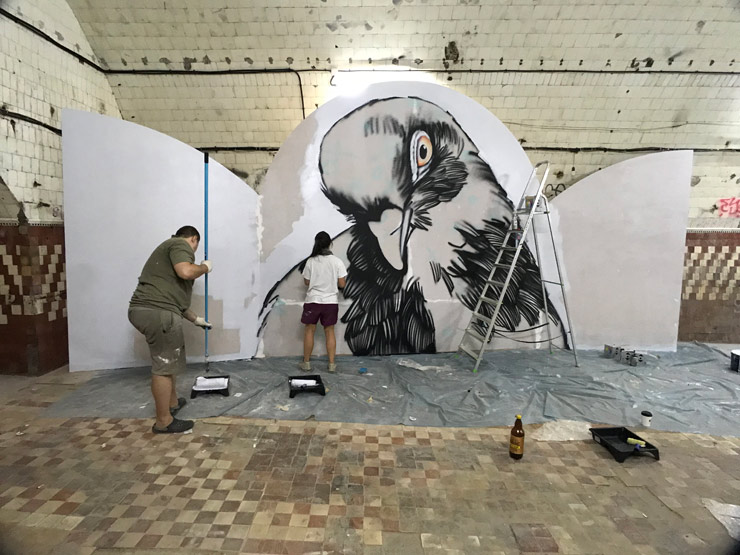
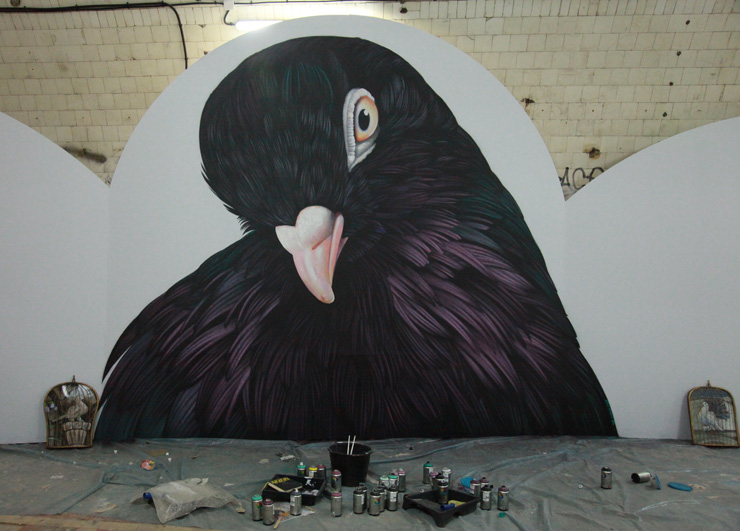
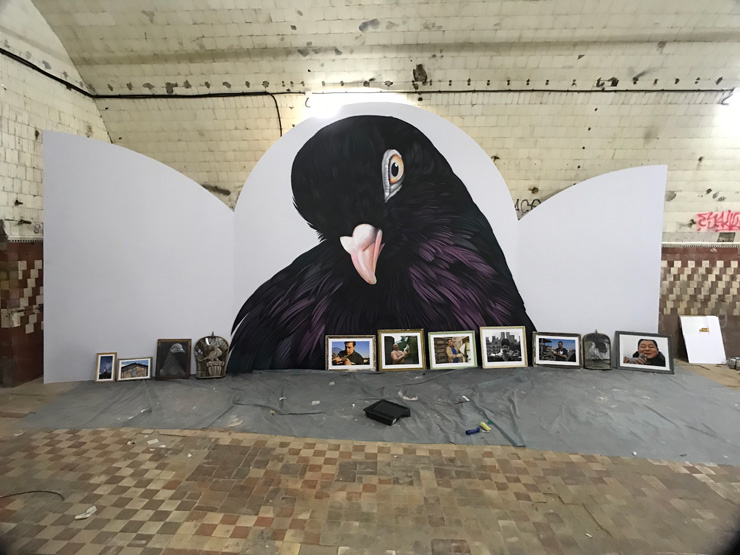
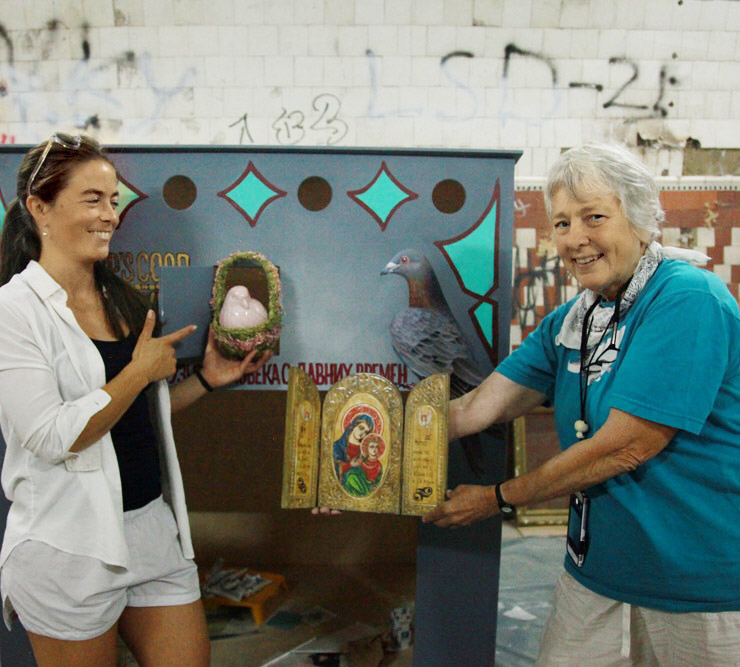
Martha Cooper / Adele Renault work in progress at Vinzavod for Artmossphere Biennale 2018. Moscow. August 2018. (photo © Jaime Rojo)

Teaming up with famed photographer Martha Cooper is a pure coup d’état. Ms. Cooper’s fame within the graffiti and Street Art community is legendary but her photographic interests are many. A documentarian and ethnographer, she grew up in Baltimore, Maryland, a US city that is famous for its once-thriving community of pigeon fanciers – and their elaborate coops. For Ms. Cooper the intersection of pigeons and their fanciers presents a fascinating and educational opportunity to capture with her lens the relationship between humans and their aviary friends in their habitats…the coops.

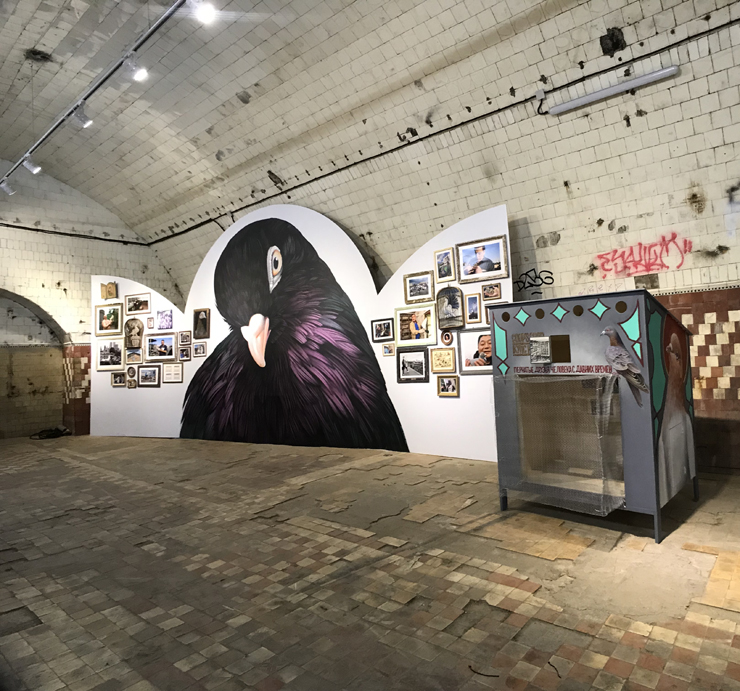
Ms. Cooper has been photographing pigeon coops in Baltimore and in New York where she currently lives – and in many other cities that she visits every year. For Artmossphere both Ms. Renault and Ms. Cooper have found a shared passion that drives them both even harder to create. Designing a site-specific environment and using locally found materials; both artists have trained their attention to the Russian tradition of painting pigeon coops. They hope that their installation respectfully represents the local culture and history while combining Adele’s paintings of pigeons and Martha’s photographs of the pigeon’s coops.”

Martha Cooper / Adele Renault work in progress at Vinzavod for Artmossphere Biennale 2018. Moscow. August 2018. (photo © Jaime Rojo)

Pigeons were the original Internet, email, messenger. As carriers they were the quickest and most efficient way for people across cultures to communicate. Cooper and Renault have created the ultimate exhibit that ties together the themes of OFFLINE in a very local and global way. With Martha’s photographs of pigeons from over forty years and Adele’s uncanny ability to faithfully create the plumage and character of the bird over the last decade on city walls everywhere, the original message carriers are more than getting their due in Moscow.

BSA: Yesterday at the round table discussion someone made the connection between this show being “Offline” and pigeons carrying messages. Can you talk about that a bit?
Martha: That was a brilliant connection because neither of us had thought about it. Yes there were lots of pigeons that used to carry messages, specially during wartime. The messages were secret and written in code stuffed in little capsules and attached to the pigeon’s legs. The pigeons were able to fly across enemy lines. So here we have the Internet and the name of this exhibition is “Offline” so what can be more offline than a pigeon carrying a message.

Martha Cooper / Adele Renault work in progress at Vinzavod for Artmossphere Biennale 2018. Moscow. August 2018. (photo © Jaime Rojo)

BSA: About this project in Moscow. What was the most surprising element?
Adele: When I travel I try not to have expectations but for this project the most surprising thing was the location. The space is so beautiful and it’s inspiring being here. And the people of course. Sabina, I knew she was going to be nice because Martha has been telling me great things about her but she and her team are wonderful. It is very nice to work with nice people. The most important thing is the people.

BSA: Where were the photos being shown here taken?
Martha: Africa, Asia, North America and Europe.

BSA: Adele, what’s your fascination with pigeons? Was it from childhood?
Adele: No, I grew up on a farm but we had more chickens than pigeons. The first time I saw a lot of pigeons was in Venice in the Piazza San Marco. My parents had a hard time pulling me away from them. I just wanted to stay with the pigeons. The fascination is mostly that they are everywhere, in every city and they look the same everywhere and I never run out of subjects. They are like a metaphor for people. In 2007 or 2008 I painted the first oil close-up painting of a pigeon and my first mural of a pigeon was in 2010.

Martha Cooper / Adele Renault work in progress at Vinzavod for Artmossphere Biennale 2018. Moscow. August 2018. (photo © Jaime Rojo)

BSA: You found an Icon at the flea market in Moscow.
Martha: We did! And it has a pigeon painted on it.

BSA: So was the found icon the inspiration to make the display wall in the shape of an icon?
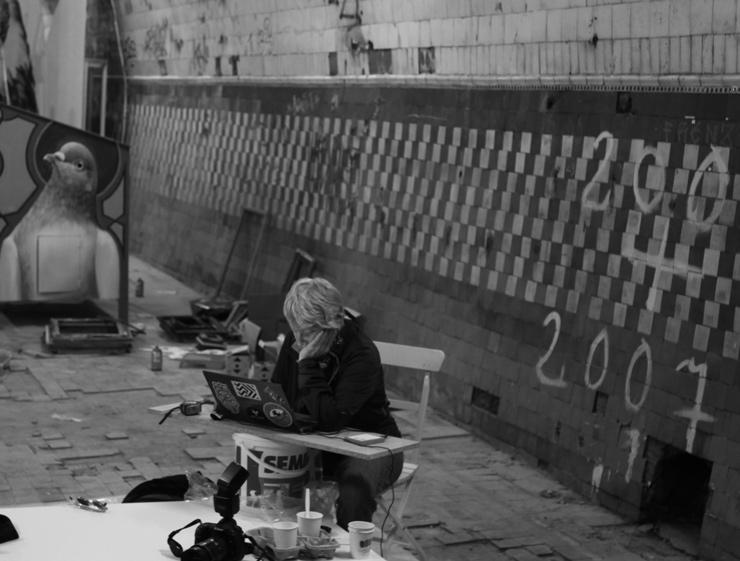
Adele: No it was the other way around. I knew that in Russia there are a lot of religious triptychs with Madonna and other religious imagery in gold leaf and inside the churches. When we came in and saw the exhibition space with all of these arches we thought that we wanted to have an arch and actually paint the arch directly on the wall but because the building is a landmark we were not permitted to paint directly on it.

So we asked if the temporary wall could be a triptych instead of a simple long panel. So then at the flea market we found the triptych with the Madonna and two pigeons painted on it. So everything about this installation makes so much sense and the process has been entirely organic. We also wanted to have real pigeons inside the coop but we found that that wasn’t permitted. So we then thought about having a porcelain pigeon or something like that inside the coop. Today a Russian girl who I gave a book to a couple of days ago came back to visit and told me that she had a present for me; a souvenir from Russia and she proceeds to pull out this porcelain pigeon!

So we are going to hang it in the coop.

Martha Cooper / Adele Renault work in progress at Vinzavod for Artmossphere Biennale 2018. Moscow. August 2018. (photo © Jaime Rojo)

BSA: What was the genesis of this collaboration with Martha?
Adele: Every time we see each other we talk about our attraction to pigeons and she tells me that she has been taking photos of pigeons for a long time. We were together in Los Angeles for “Beyond The Streets” and she mentioned to me the Moscow Biennale and how in Moscow artists paint the pigeon’s coops on the outside. So she encouraged me to send an application for us to participate in this year’s biennale in collaboration and I did.

Martha Cooper / Adele Renault work in progress at Vinzavod for Artmossphere Biennale 2018. Moscow. August 2018. (photo © Jaime Rojo)

BSA: Can you tell us about the small pigeon on the front of the pigeon coop?
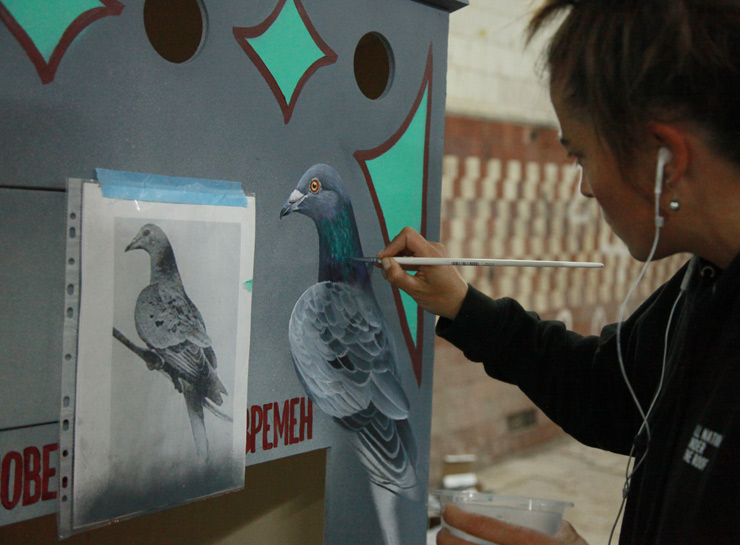
Adele: The small one on the front is the last passenger pigeon who died in 1914. The original passenger pigeons are extinct. And this pigeon’s name was ironically Martha – and it resides in taxidermy in the Smithsonian Museum in Washington DC. So we named this coop “Coop’s Coop” because Martha’s friends call her Coop. So it really is Martha Cooper’s coop. But passenger pigeons were used in the two big wars to bring messages in code and they were rewarded with medals for their service.

Martha Cooper / Adele Renault work in progress at Vinzavod for Artmossphere Biennale 2018. Moscow. August 2018. (photo © Jaime Rojo)

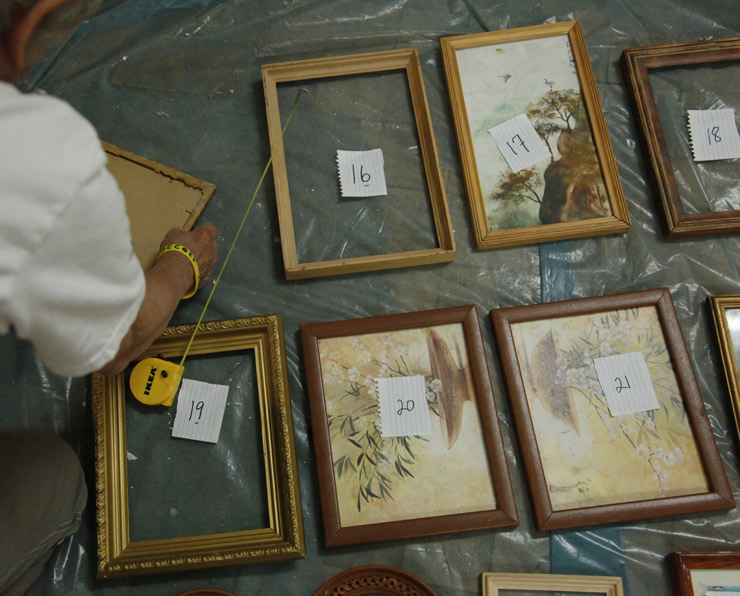
BSA: So what about the old, paint peeling off frames you are using to display the photos?
Martha: When we first thought about putting photos up we wanted rough looking frames and I had this idea, based on my previous visits to Moscow and the flea market that we would be able to find them at the flea market and we found tons of frames actually. We got them cheaply and it was a lot of fun going around collecting them.

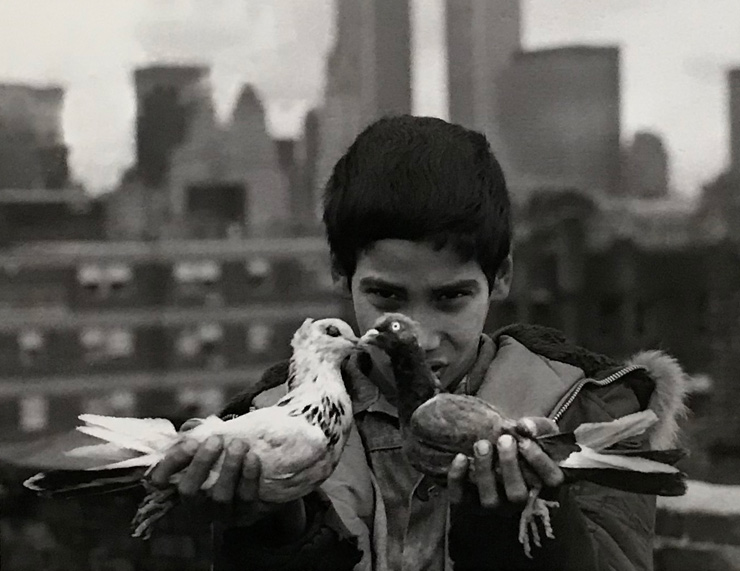
BSA: Martha our eyes gravitated to the B & W photo of the boy holding two pigeons. What’s his name and who is he?
Martha: His name is Edwin but his writer’s name is HE3 and he introduced me to Dondi. I was working on a project on the Lower East Side and I was interested in his pigeons and he asked me why didn’t I take pictures of graffiti and proceeded to show me his notebook with his drawings in it.

He said “I can introduce you to a King”. And the King was Dondi. So I said “OK let’s go”. We drove to East New York in my car and directed me to Dondi’s house.

We knock on his door and Dondi was there. He recognized my name because when he opened his black book on the first page he had a clipping from The New York Post with a photo of a very simple throw up and I was amazed that anybody would identify it and it said CIA, Crazy Inside Artists. That was his crew and I didn’t know anything about crews. When he saw me he knew I wasn’t a cop but instead he saw me as someone that could help him get fame. Boom!

BSA: So the B & W photo above is 40 years old?
Martha: Yes

BSA: Can you talk about the large painting of the pigeon in the center of the triptych?
Martha: This is a painting of a pigeon that we actually met in Moscow in a pigeon coop. One of the pigeon fanciers showed this magnificent pigeon and Adele took a photo of it with her phone so this is the portrait of the pigeon and I took a photo of Adele taking a photo of the pigeon and that photo is included in this exhibition.

Martha Cooper / Adele Renault work in progress at Vinzavod for Artmossphere Biennale 2018. Moscow. August 2018. (photo © Jaime Rojo)

Martha Cooper / Adele Renault work in progress at Vinzavod for Artmossphere Biennale 2018. Moscow. August 2018. (photo © Jaime Rojo)

Martha Cooper / Adele Renault work in progress at Vinzavod for Artmossphere Biennale 2018. Moscow. August 2018. (photo © Jaime Rojo)

Martha Cooper / Adele Renault work in progress at Vinzavod for Artmossphere Biennale 2018. Moscow. August 2018. (photo © Jaime Rojo)

Martha Cooper / Adele Renault work in progress at Vinzavod for Artmossphere Biennale 2018. Moscow. August 2018. (photo © Jaime Rojo)

Martha Cooper / Adele Renault work in progress at Vinzavod for Artmossphere Biennale 2018. Moscow. August 2018. (photo © Jaime Rojo)

Martha Cooper / Adele Renault work in progress at Vinzavod for Artmossphere Biennale 2018. Moscow. August 2018. (photo © Jaime Rojo)

Martha Cooper / Adele Renault work in progress at Vinzavod for Artmossphere Biennale 2018. Moscow. August 2018. (photo © Jaime Rojo)

Martha Cooper / Adele Renault work in progress at Vinzavod for Artmossphere Biennale 2018. Moscow. August 2018. (photo © Jaime Rojo)


Click on the link below for more details about the opening of this exhibition:
OFFLINE: The 3rd Artmossphere Biennale Of Street Wave opens this Thursday August 30th at Vinzavod in Moscow.

Read more