It is a tenous connection that an adult may have with the fantasies of their own childhood and concepts developed through playtime and free-wheeling imagination.
When we are older we may realize that we have all but abandoned that part of ourselves. There is a s system of discouragement arrayed against our confidence as a kid, one that severs our relationship with the creativity that once burst freely from our little minds and hearts and hands.
It really is primarily about your State of Mind, says LA-based painter Augustine Kofie about his battle with art and quarantine during this last year.
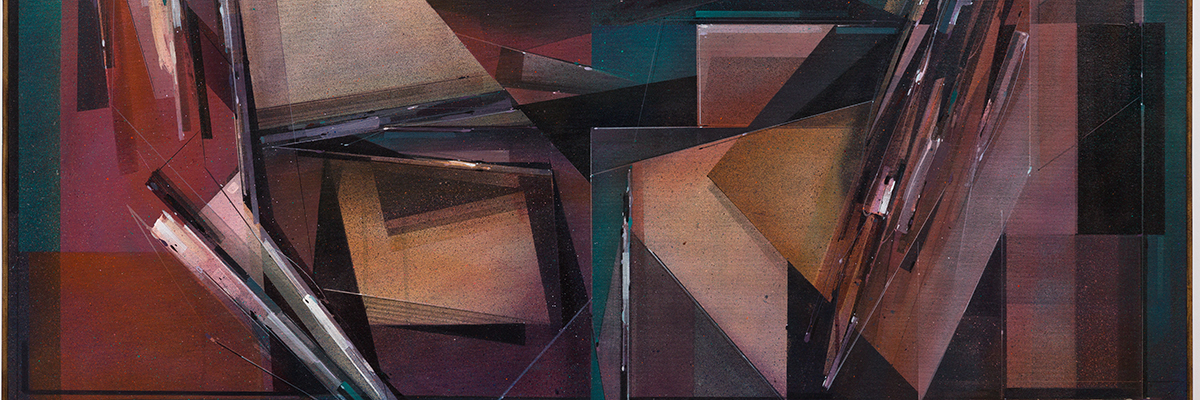
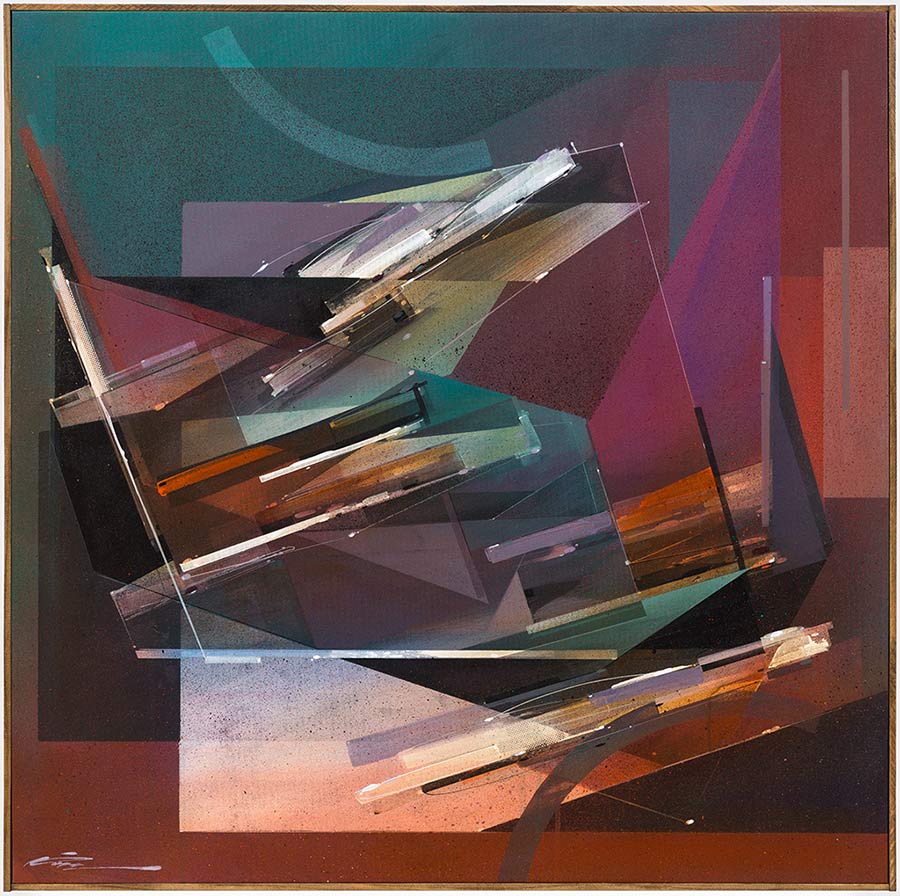
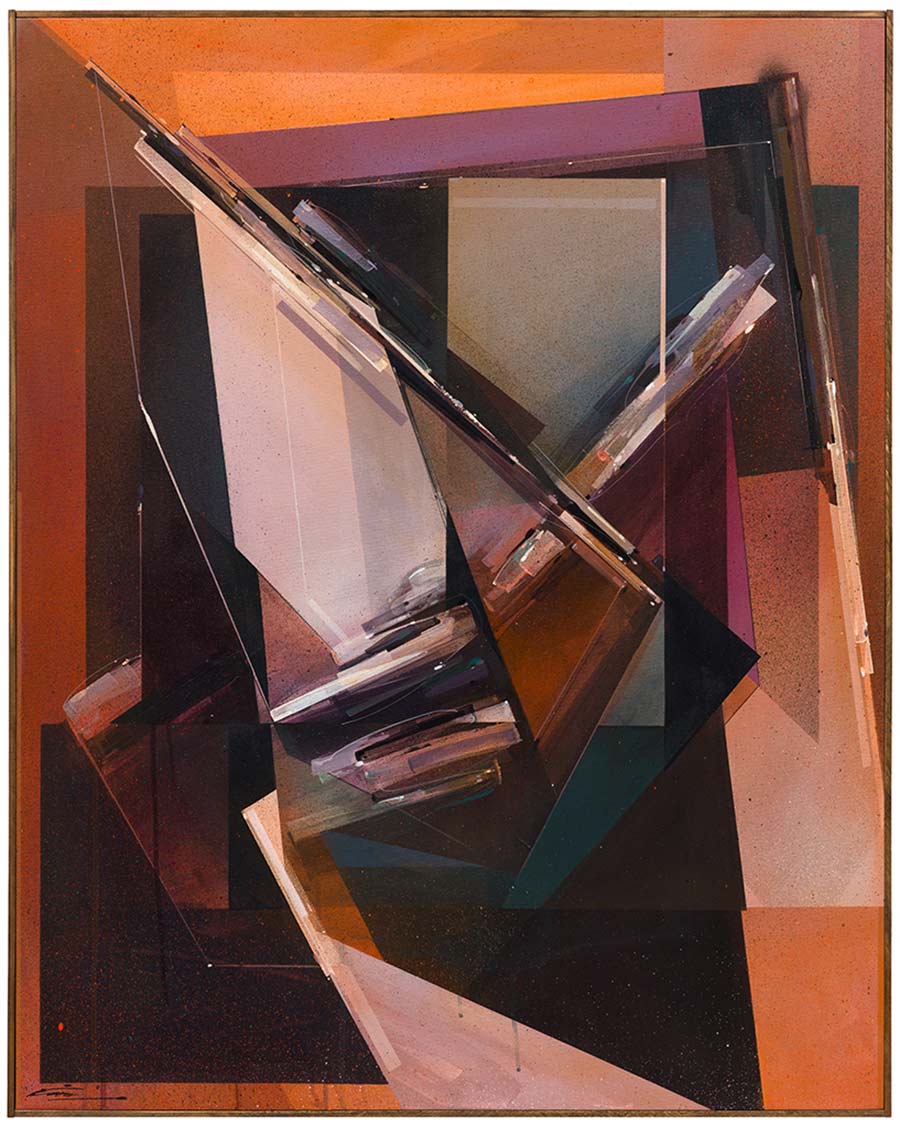
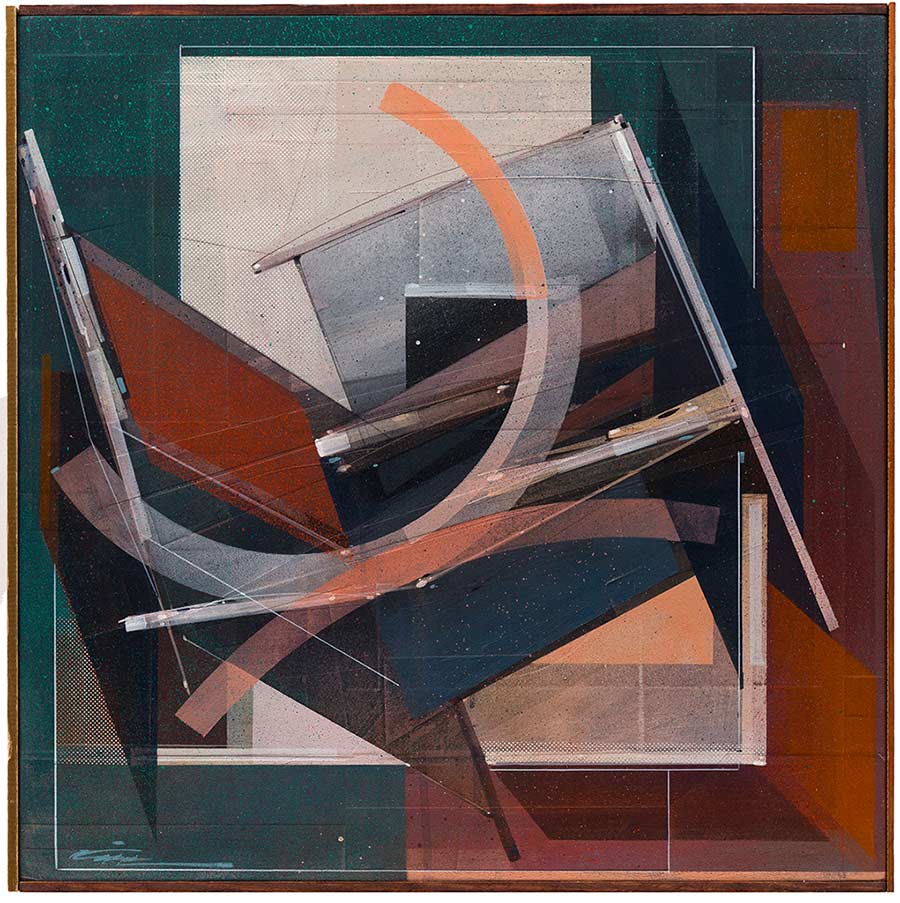
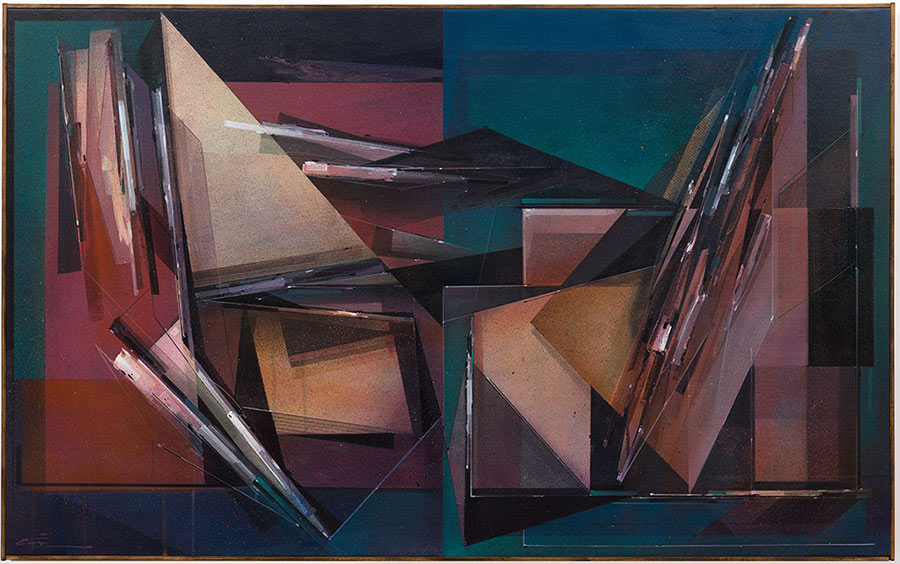
Augustine Kofie. “Disbelief System”. Hashimoto Contemporary. (photo courtesy of the gallery)
“The pandemic was a stop, an interruption, a loss of control,” he says – and points to the incomplete cycle symbols that appear throughout his new collection of paintings. Normal life, in its circular wending, was interrupted time and again, along with all our typical expectations.
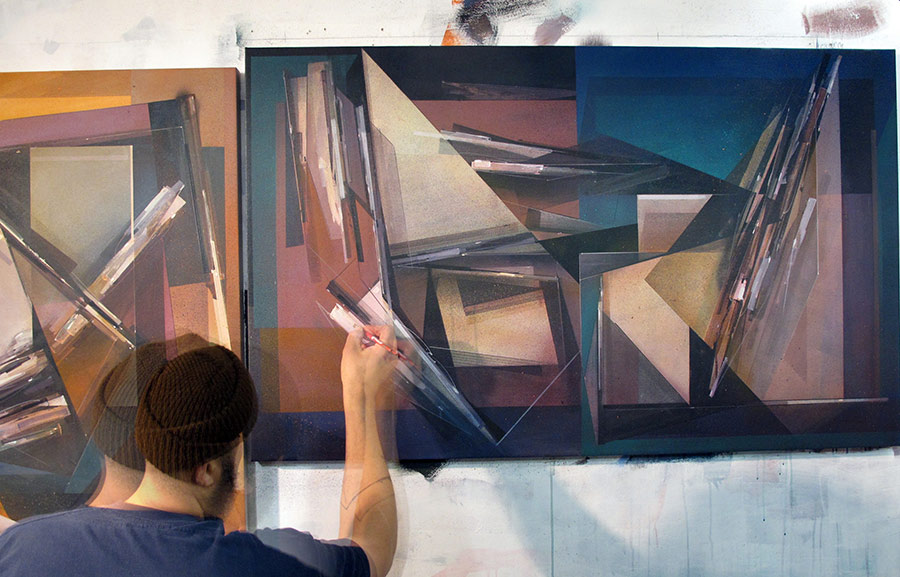
His warm abstractions on canvas and upon large walls have always been human – with deep roots in graffiti and hand rendering – ‘overspray, tape blocking, detailed handwork, deconstruction, and draftsmanship drawn from architecture,’ says the PR statement from Hashimoto Gallery in New York where this new exhibition will open.
“My feelings are in the brushstrokes,” he says, “the movements, the process of repeatedly adding and taking away, the layers of time it took to complete these paintings.”
Augustine Kofie. “Enlighten Moment”. Hashimoto Contemporary. (photo courtesy of the gallery)Augustine Kofie. “Pyle Driver”. Hashimoto Contemporary. (photo courtesy of the gallery)Augustine Kofie process shot while painting “Weight”. Hashimoto Contemporary. (photo courtesy of the gallery)Augustine Kofie. “Weight”. Hashimoto Contemporary. (photo courtesy of the gallery)
The gallery will be open by appointment only. In order to ensure the health and safety of visitors and staff, please note that masks are legally required for entry. The exhibition will be on view from Saturday, April 17th to Saturday, May 8th.
For further information about the exhibition, to view the whole collection of works and for prices click HERE
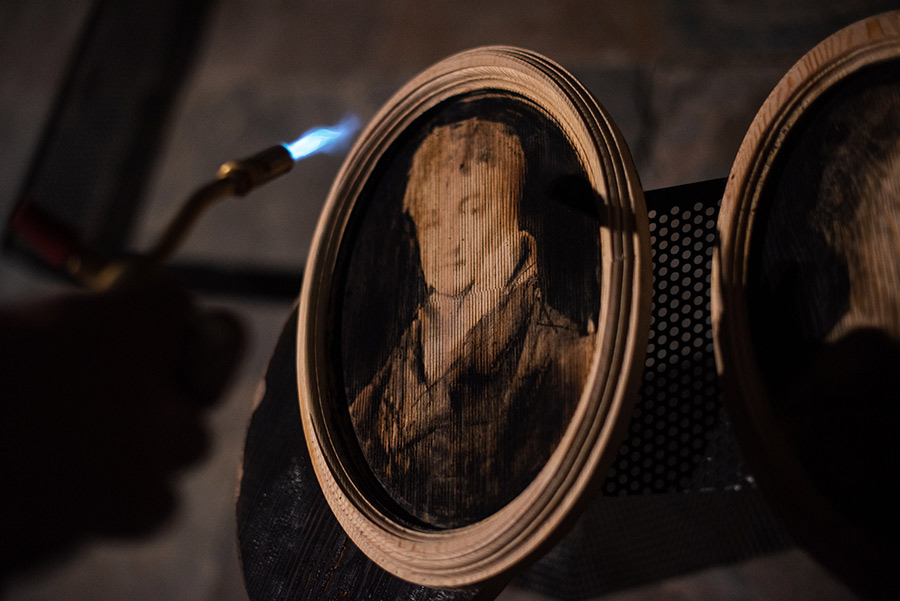
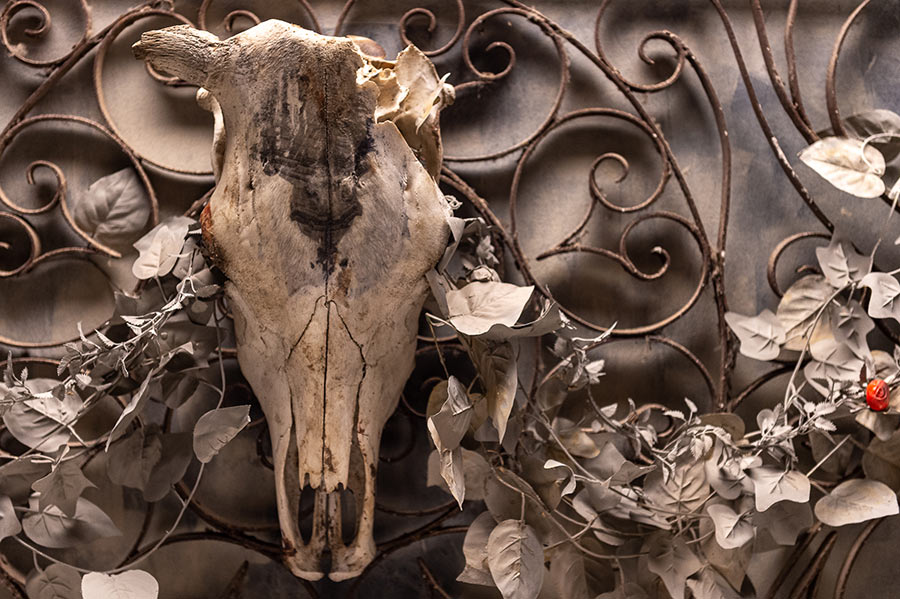
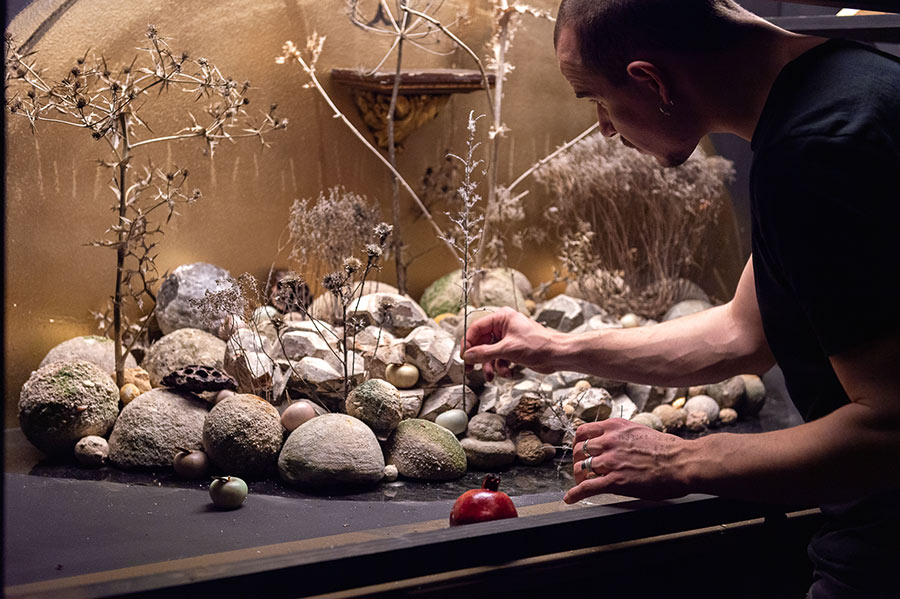
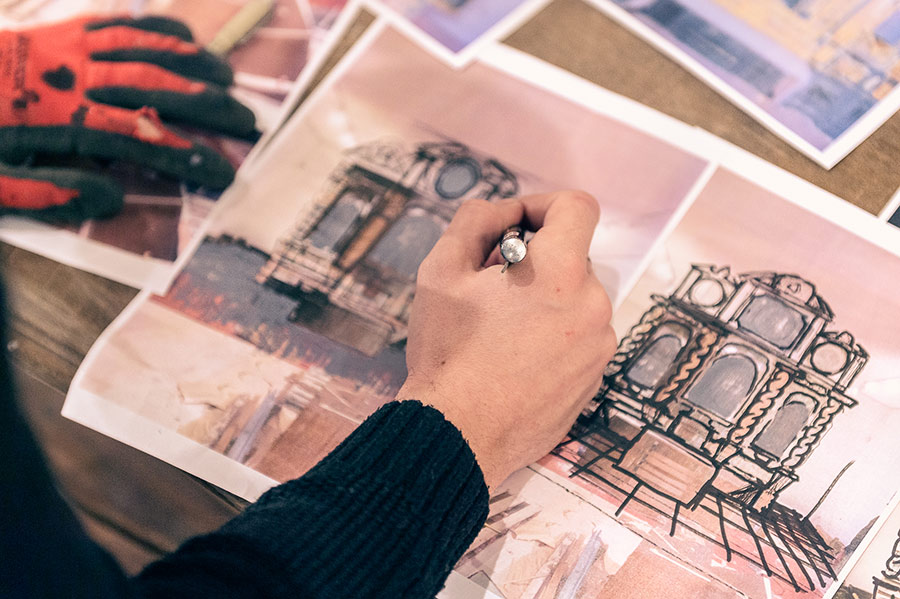
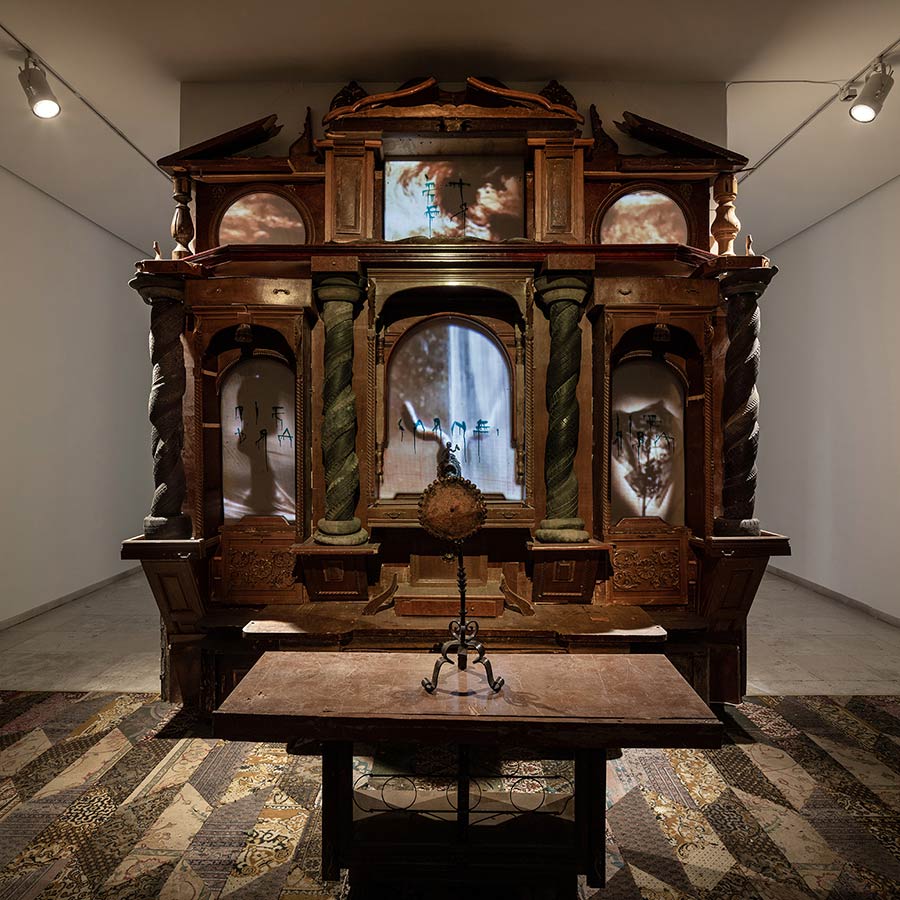
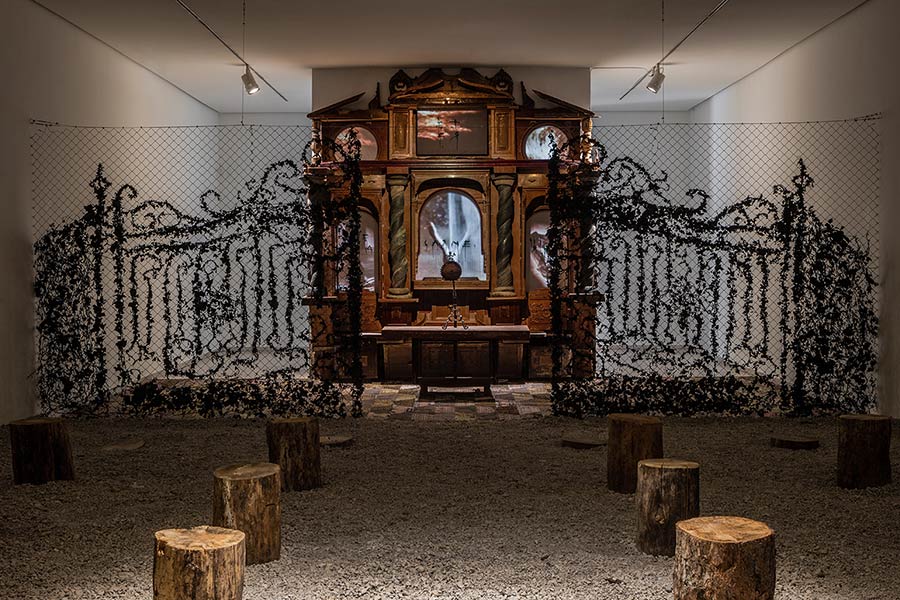
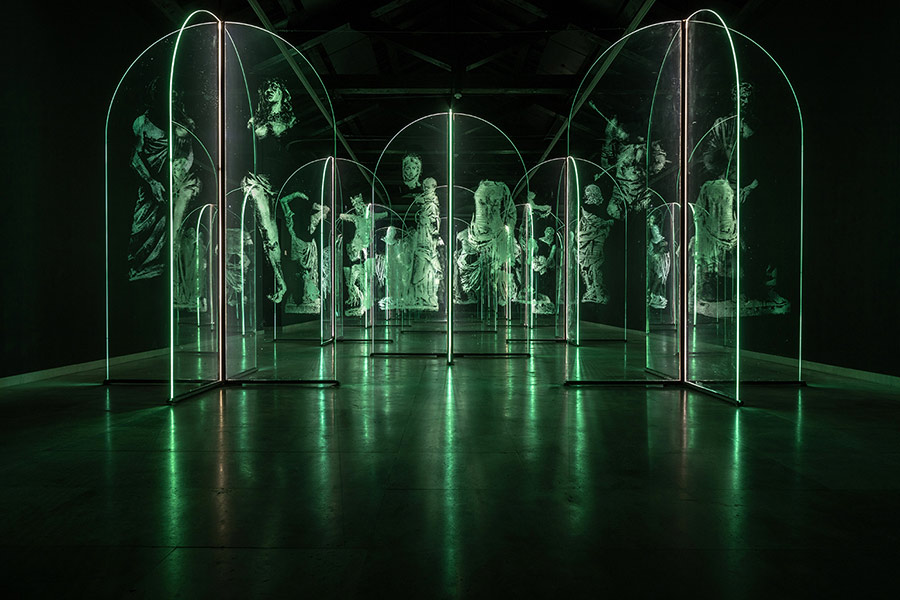
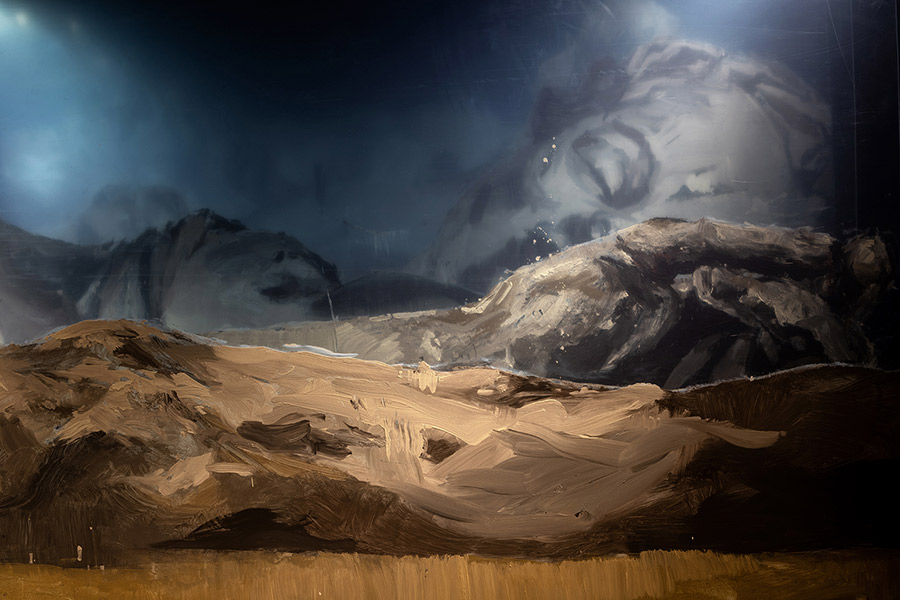
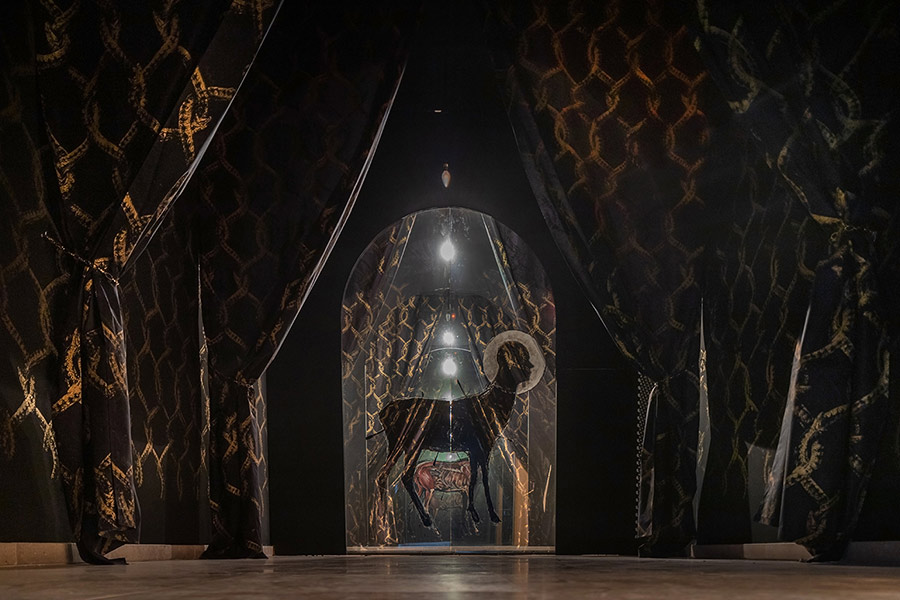
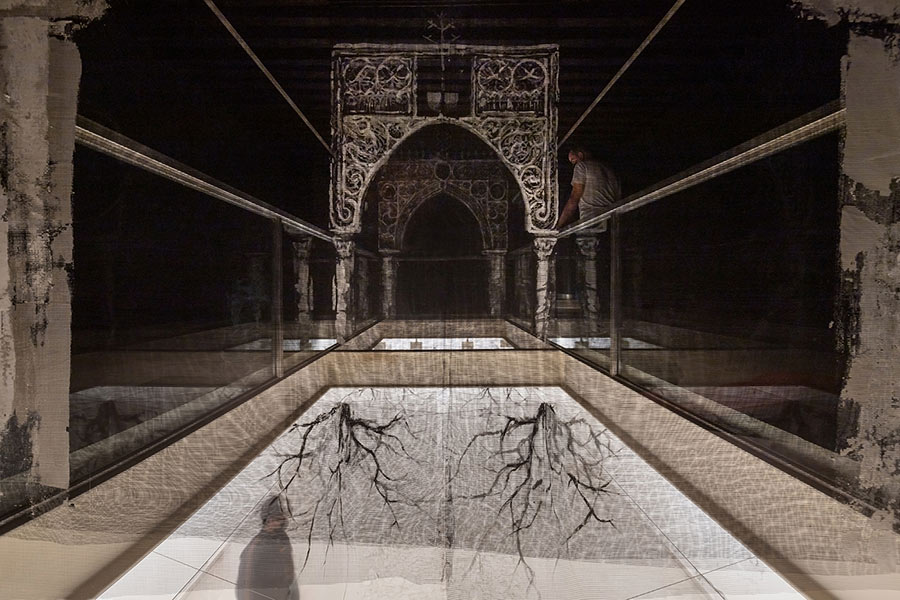
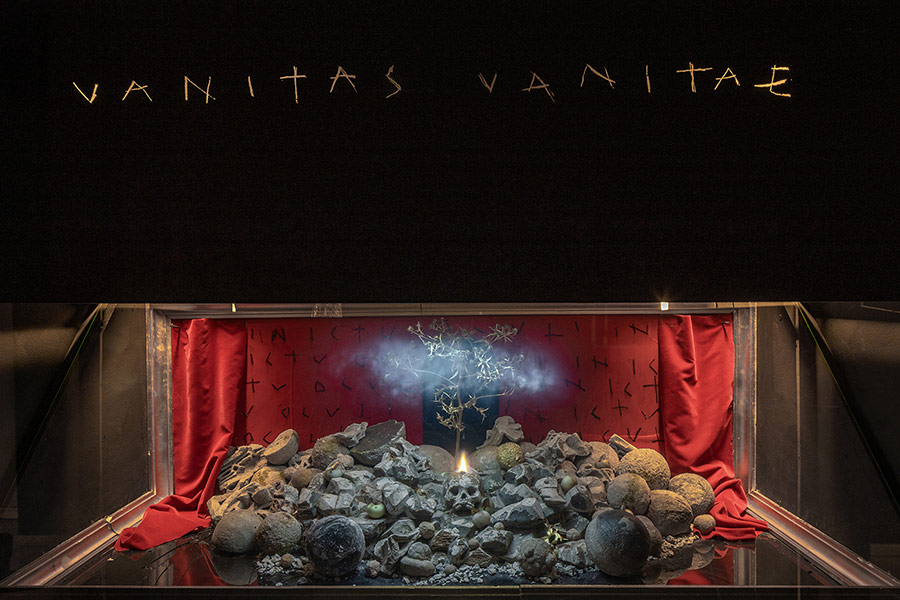
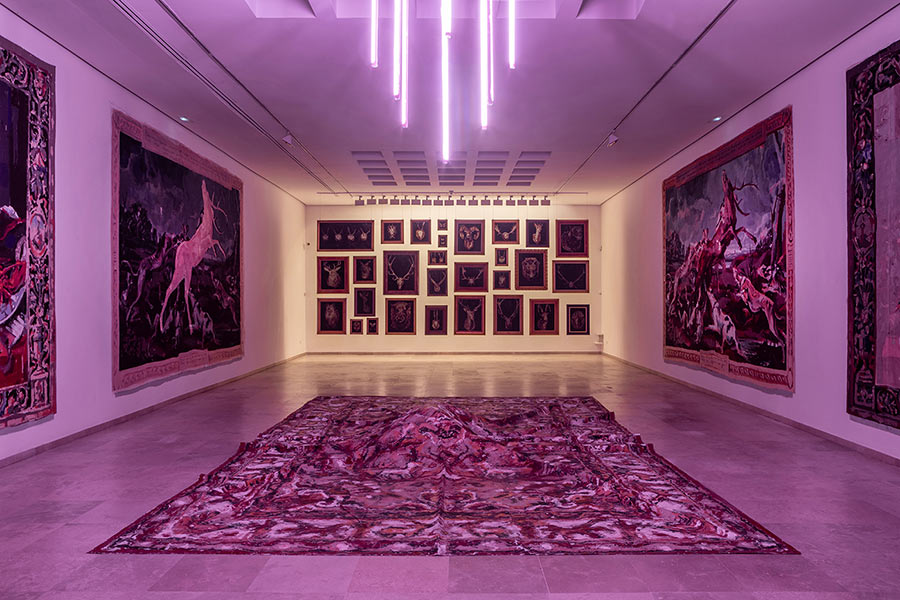
A site-specific immersive exhibition by the artist at Museum of Contemporary Art Esteban Vicente From April 8 to September 26, 2021
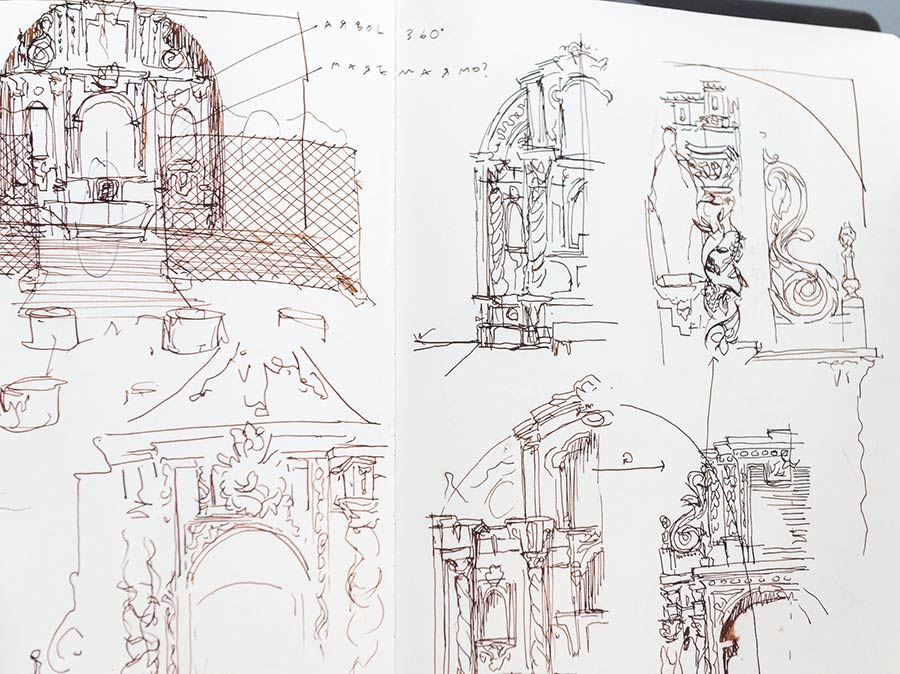
Style and genre, and era have never been particularly magnetic topics for Borondo; his heart is too poetic for such limitation. Instead, he continues to bring an ambiance, a sense of place – after he has studied it.
The former graffiti writer may have been political after leaving his childhood town of Segovia, Spain. Still, his senses and sensibilities were fed by this World Heritage Site’s atmosphere and its historical arches, turrets, towers, churches, cathedrals, monasteries, and convents – and possibly the enormous Roman aqueduct.
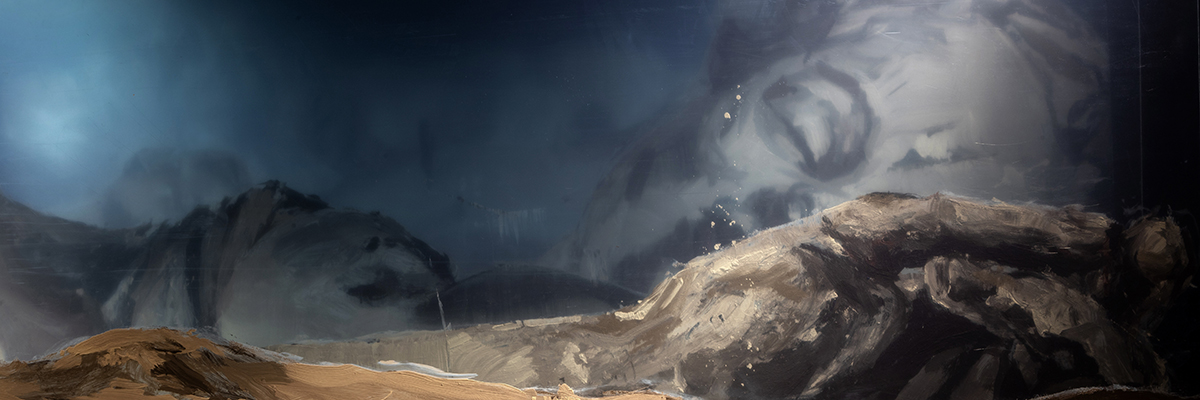
Now returning here to mount his own exhibition in Esteban Vicente Museum of Contemporary Art, his aesthetics and reverence for holy places are also tempered with his age, this age – a fusion now tempered by maturity, but only just so. Creating most of his work on-site, the searching is the story, and the journey is as important as the destination.
Consulting, convening, channeling his formal studies, his street practice, wanderlust, and an ever-present rebellious streak, Borondo still knows how to alchemize the environment. And this place has hosted many; a former city palace of King Enrique IV of Castile, a home of nobles, then a hospice, a school of arts, and a museum. In what time are we living right now? Borondo will not trouble us with such matters.
Gonzalo Borondo. “Hereditas”. Museum of Contemporary Art Esteban Vicente. Segovia, Spain. From April 8 to September 26, 2021. Curated by José María Parreño
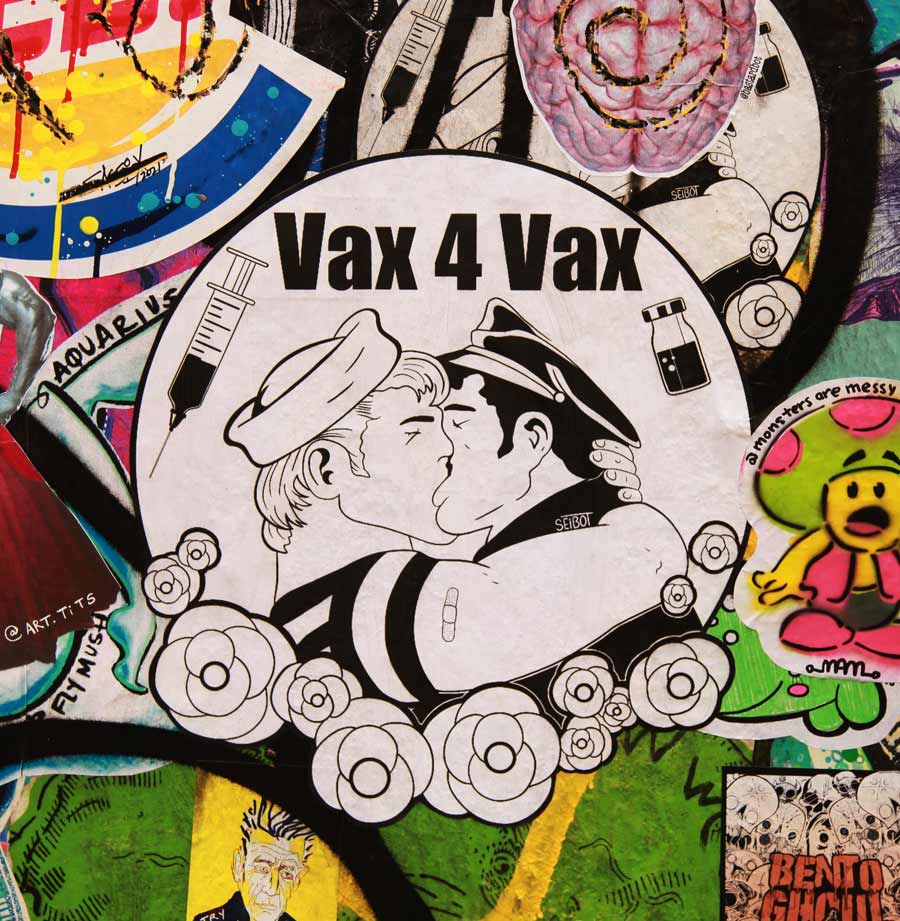
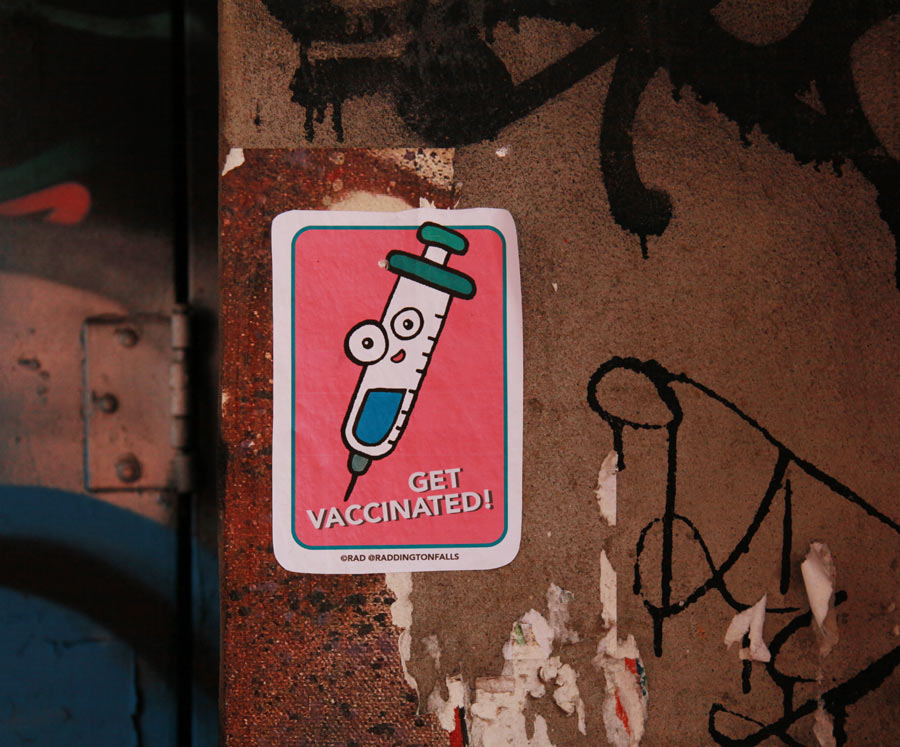
This week we received a note from a friend in the graff/street art community urging us to encourage street and graffiti artists to create artwork on the streets that beseeches GenZ to get the Covid-19 vaccine.
They needn’t worry.
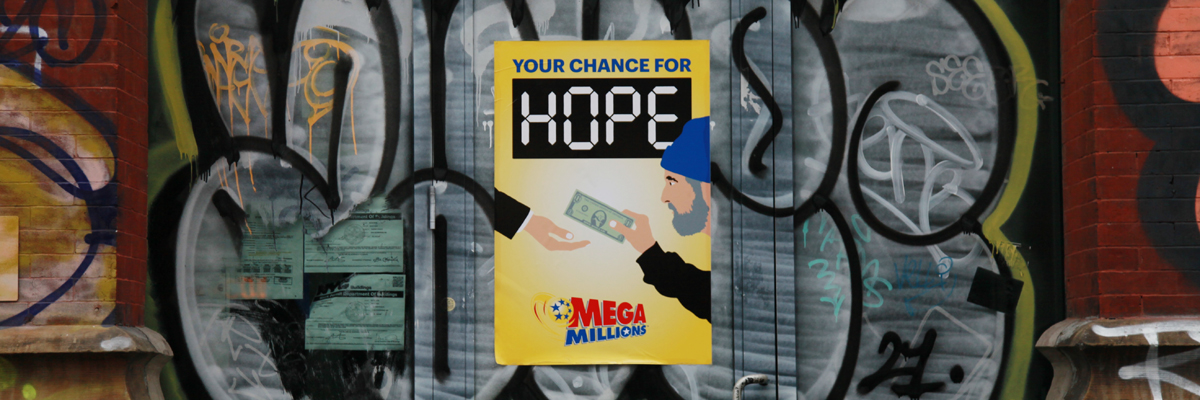
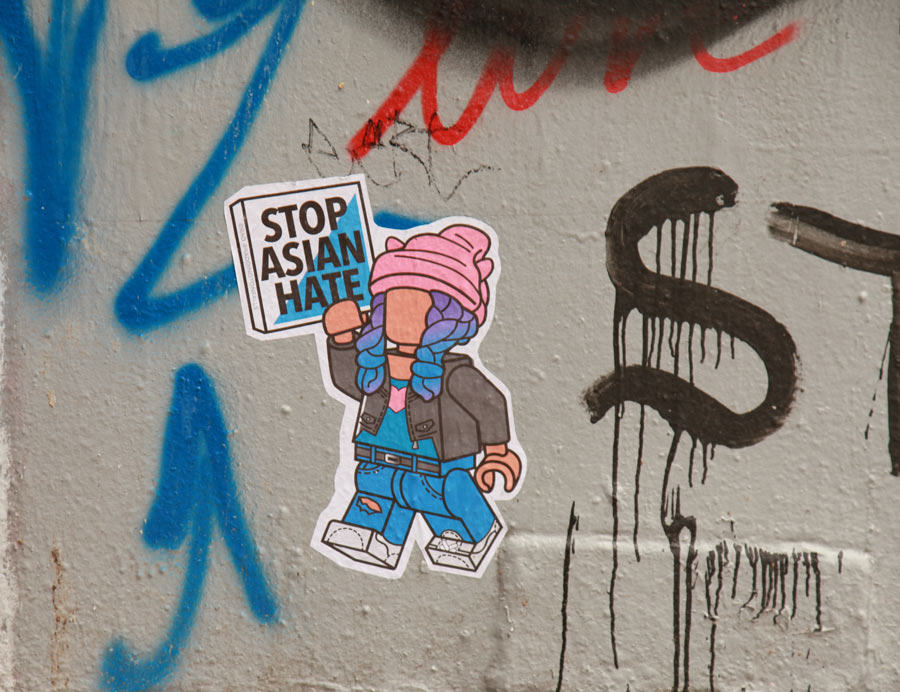
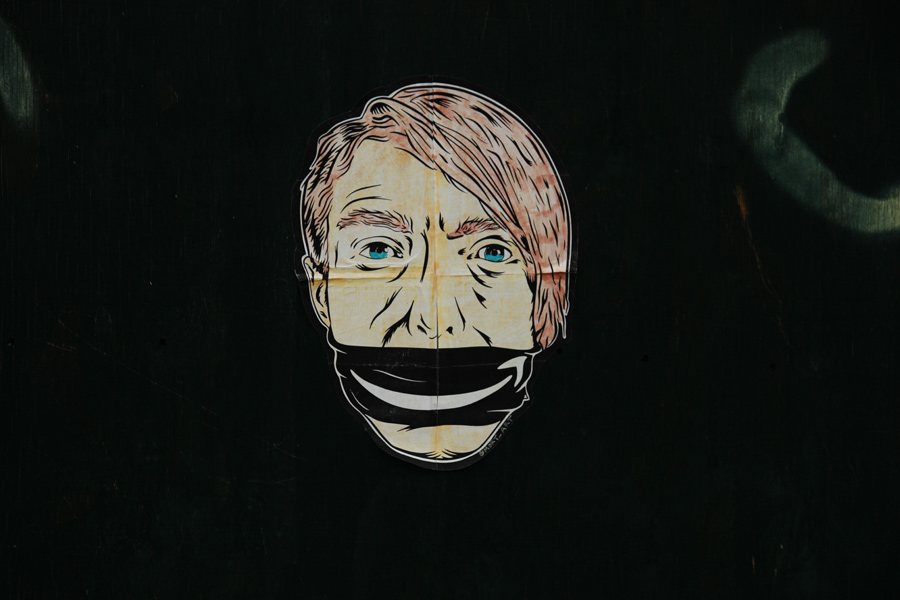
Graffiti and street artists have continued to respond to the COVID mask and vaccine issues as much as they did with the rejection of Trump and everything that came with him. During the last few years, they also have strongly responded to the BLM movement, to the topic of police brutality, to structural inequality in our economy, to last fall’s election, to indigenous people’s rights, to Asian hate, LGBTQ rights, to drug use, to anxiety, to depression, to love, to hope, to our effect on the Earth’s environment, and many social/political issues. Not always high-minded, Street artists also like pop culture icons, cute animals, and emulating successful artists who came before them and whom they admire.
It’s all part of the gig.
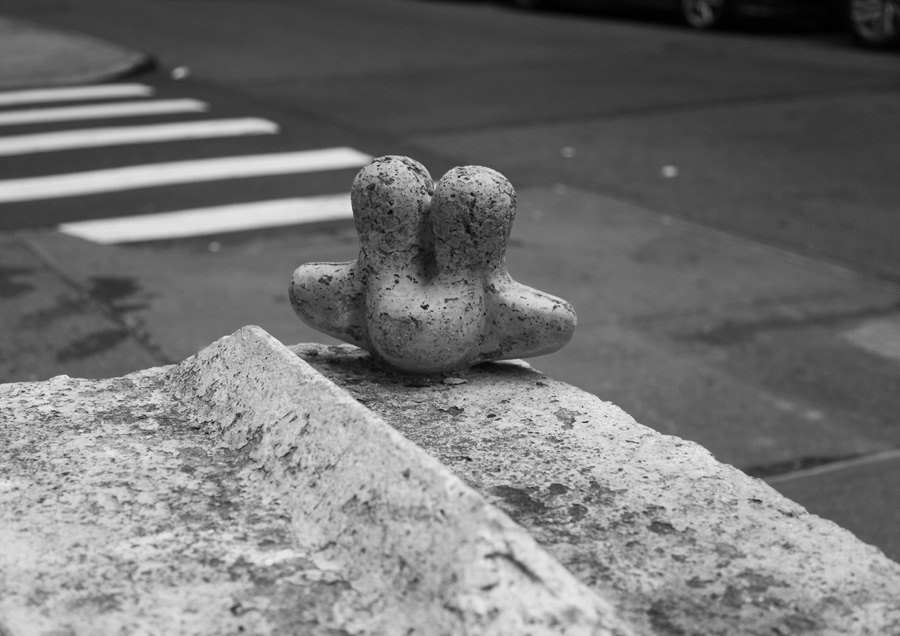
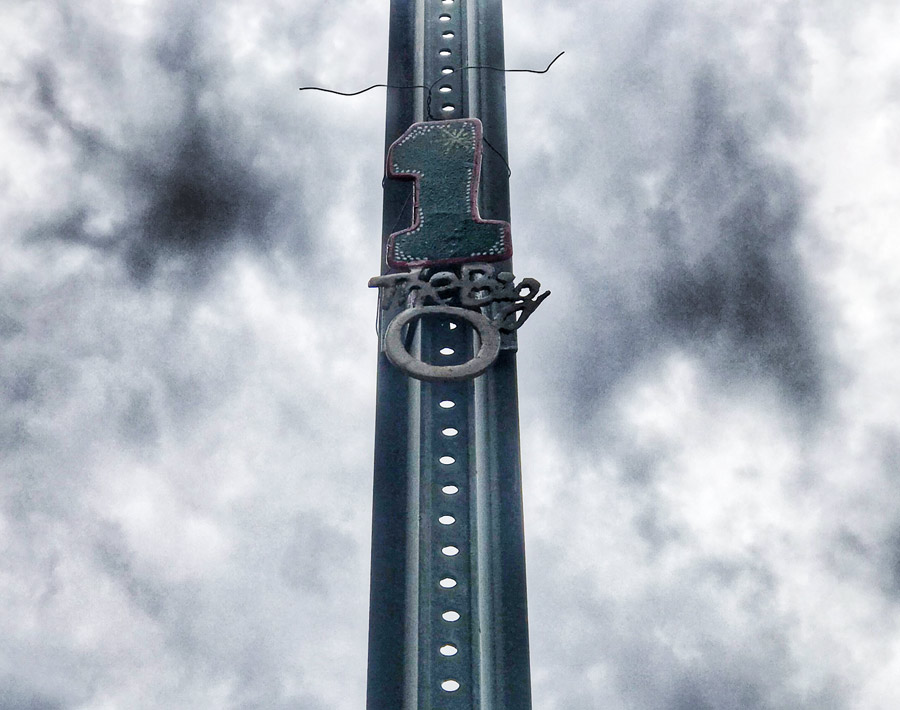
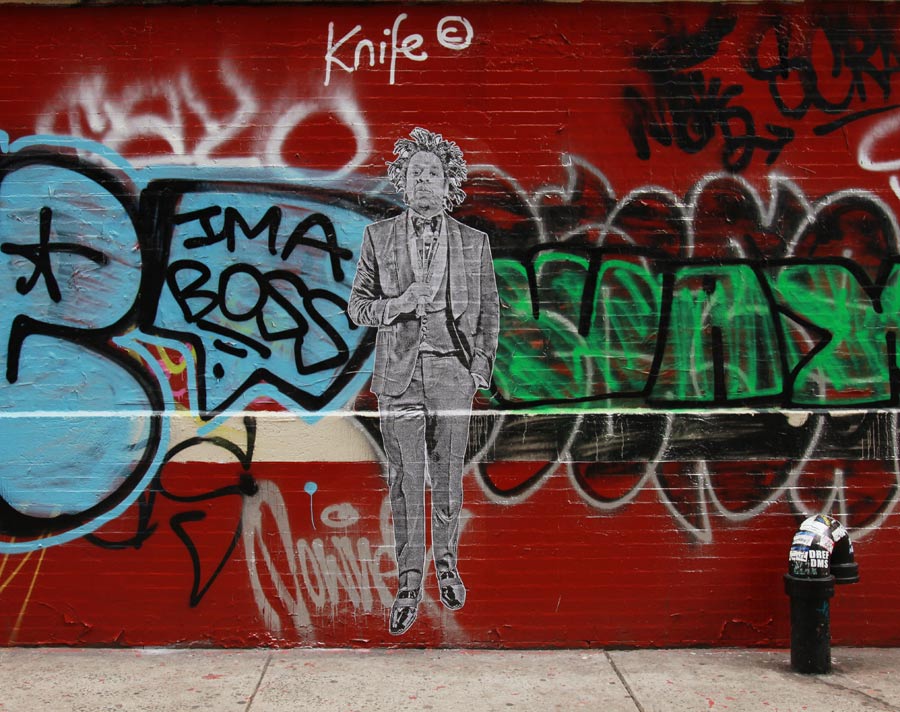
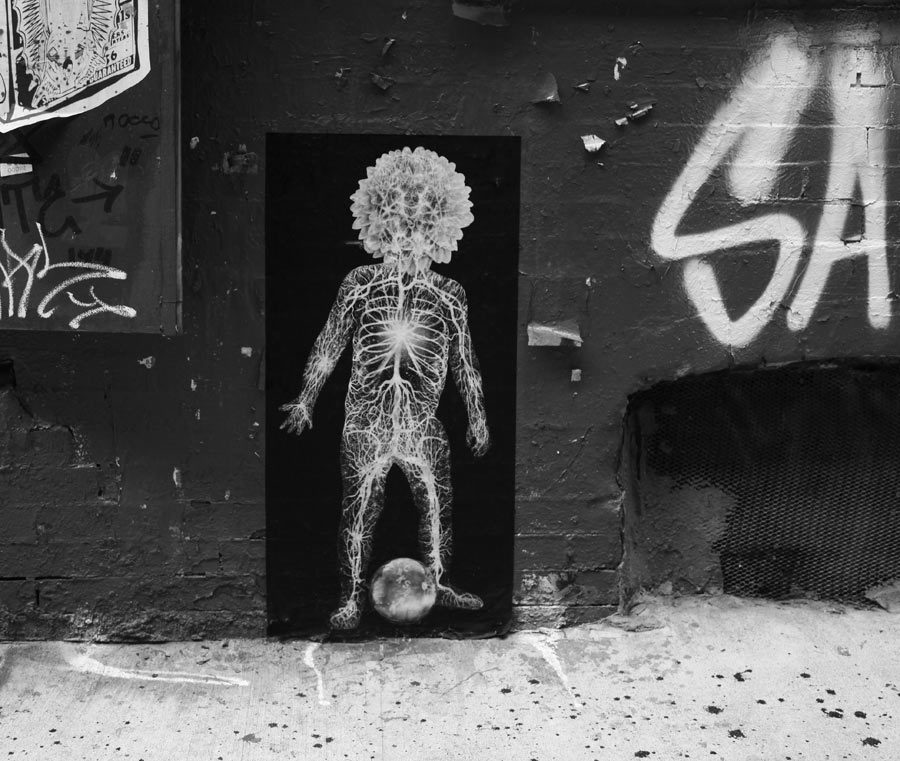
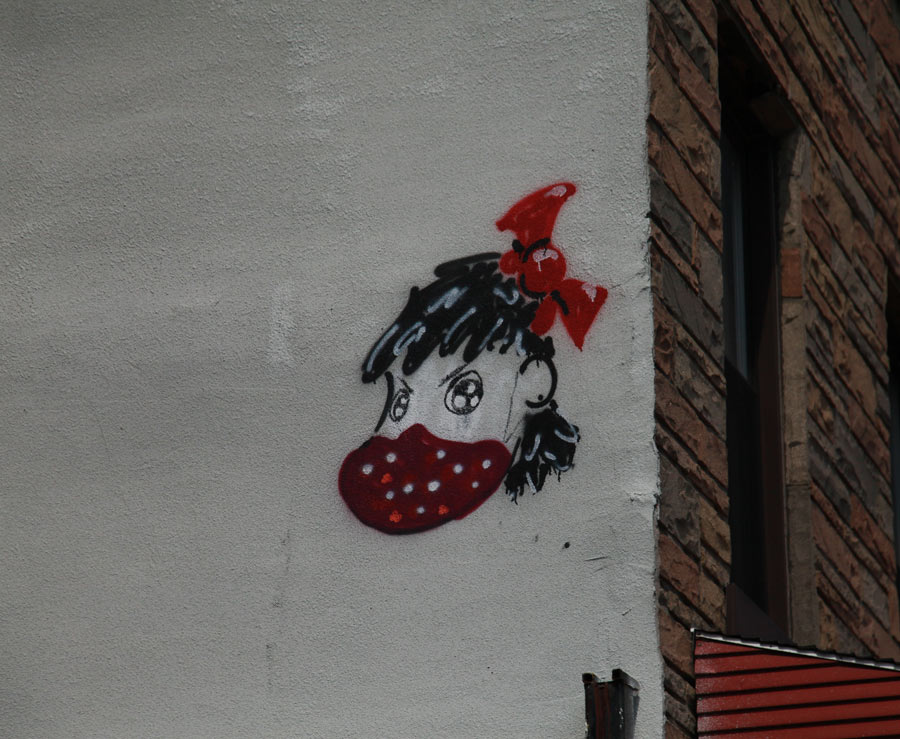
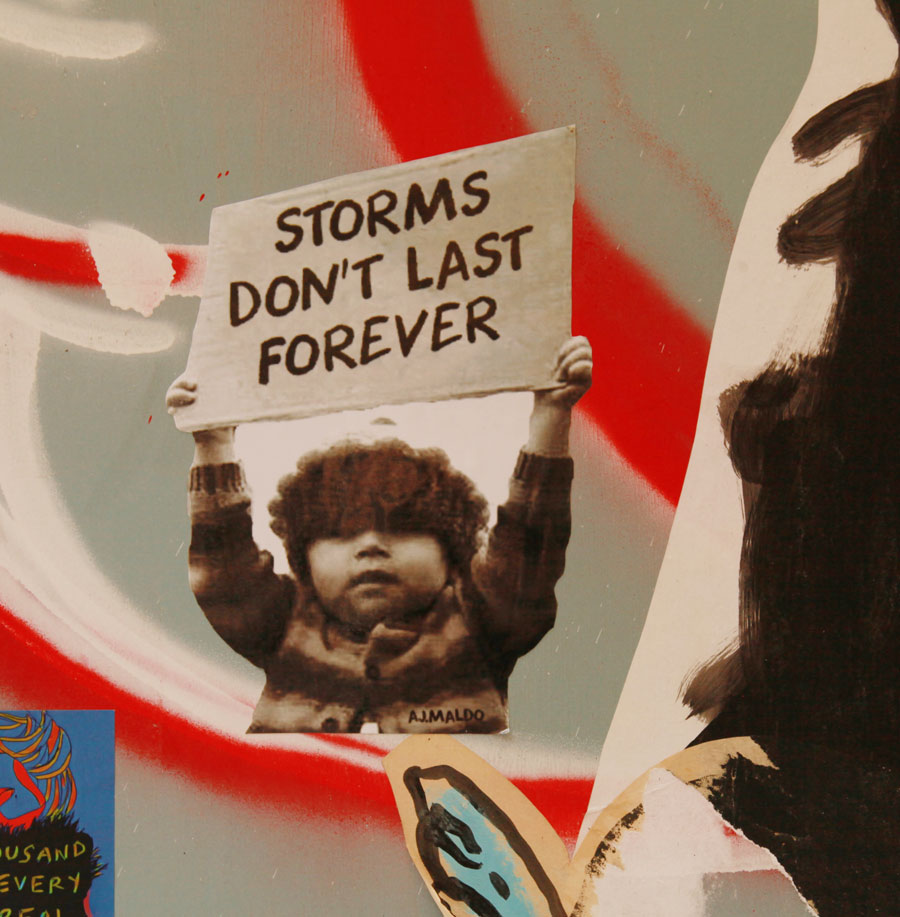
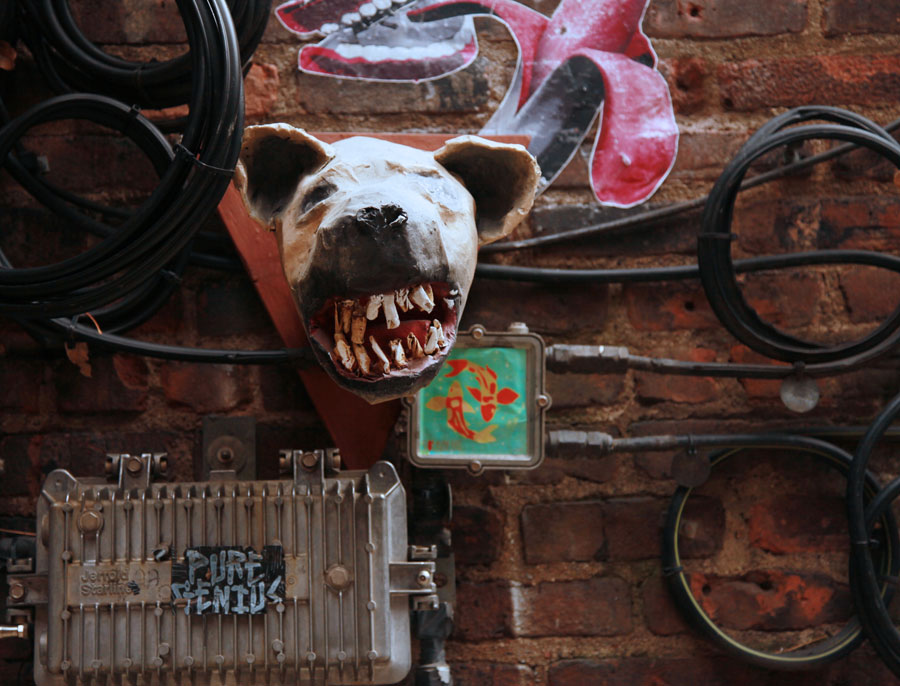
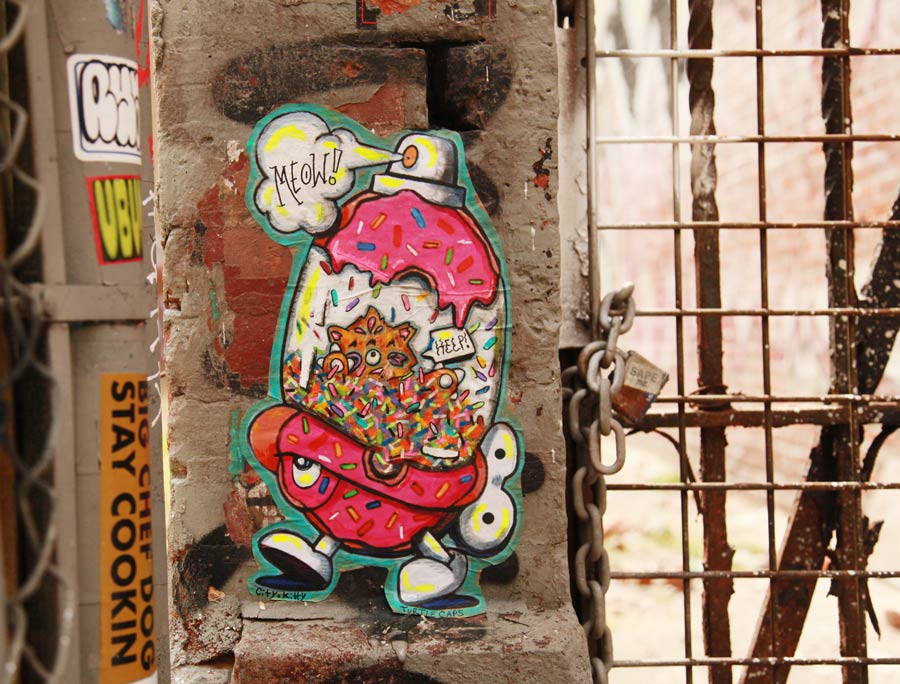
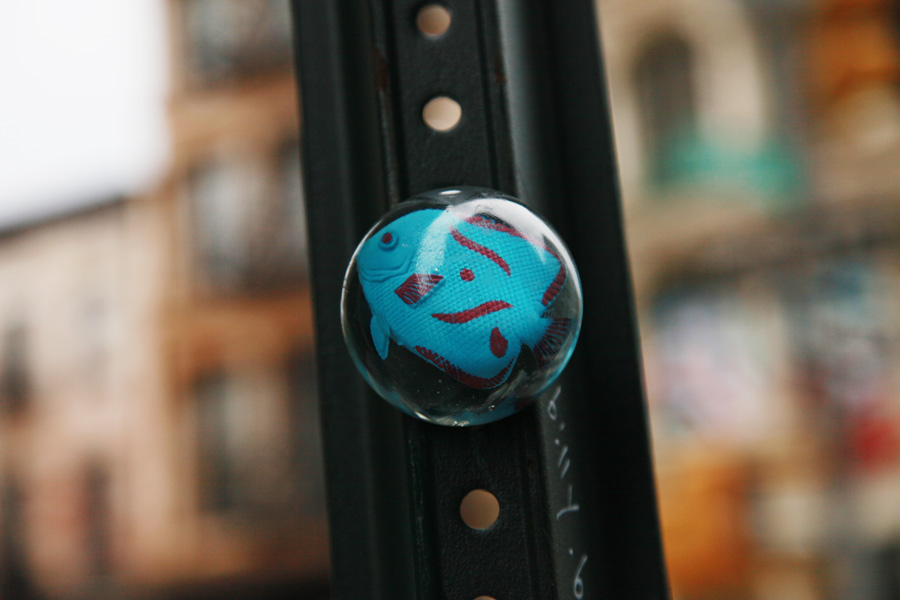
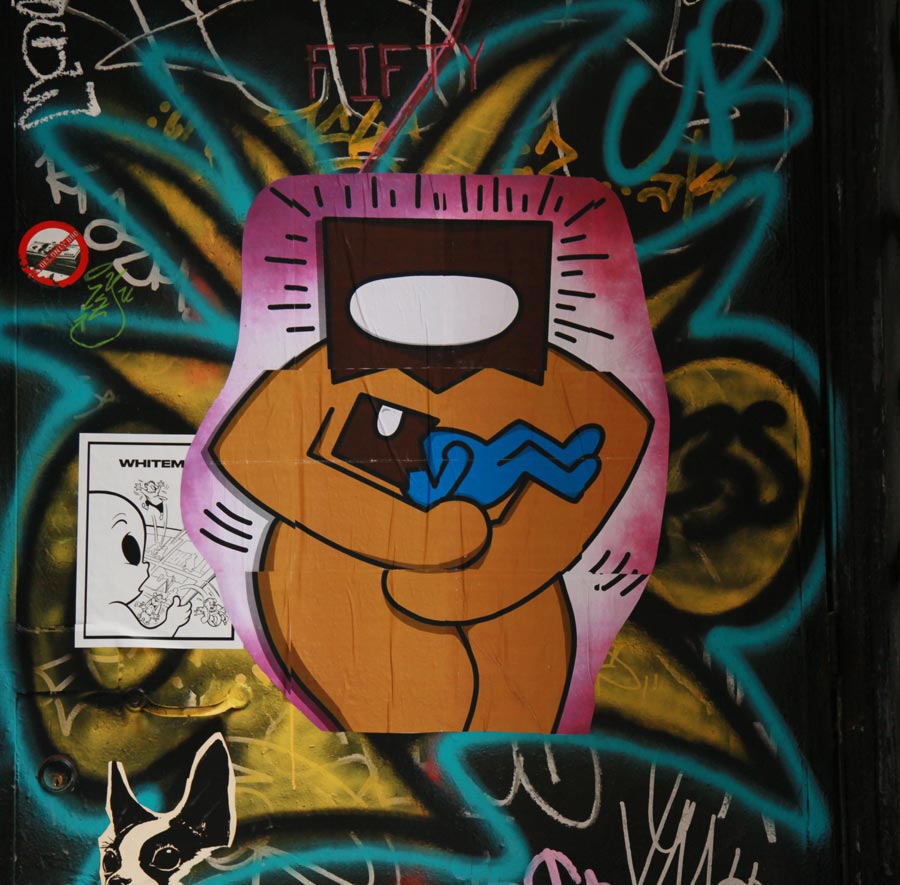
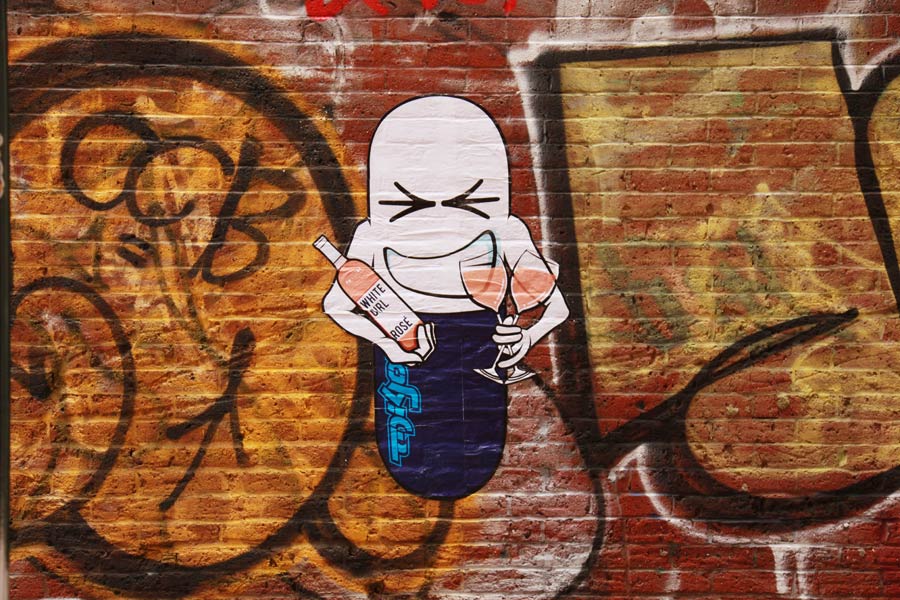
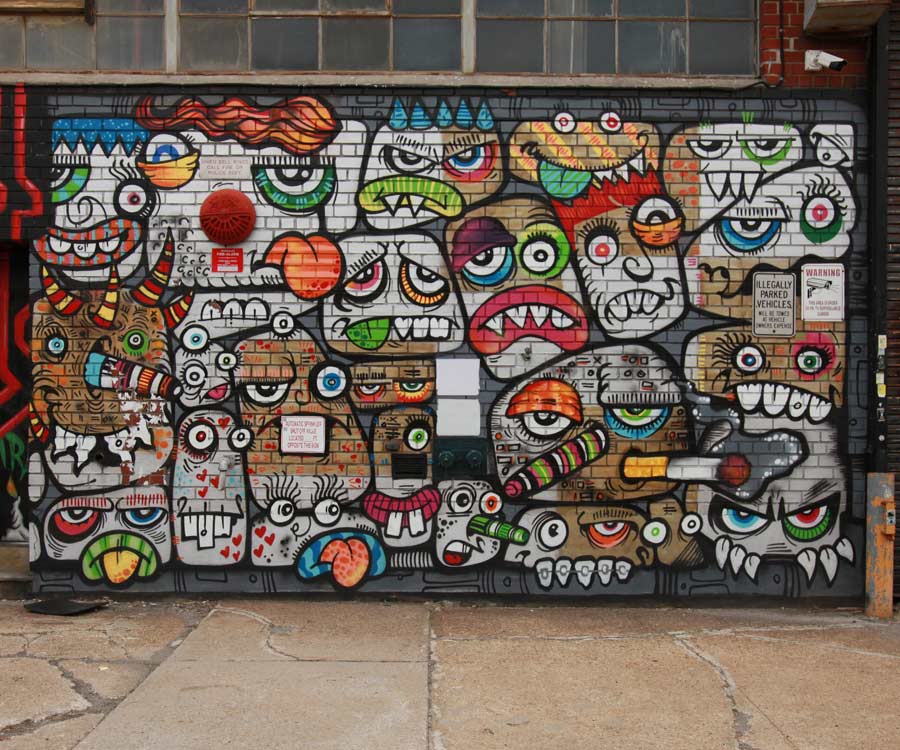
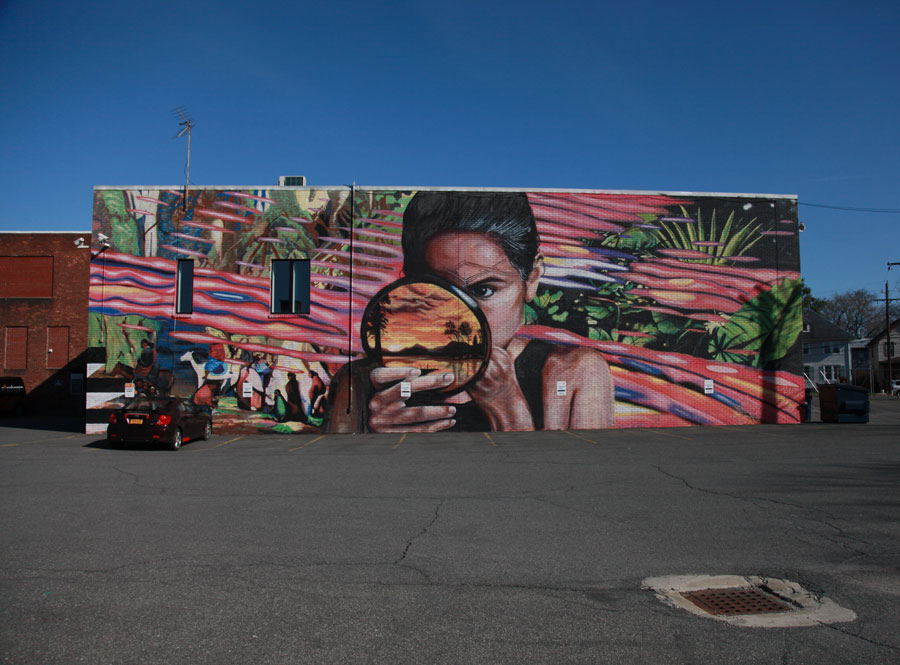
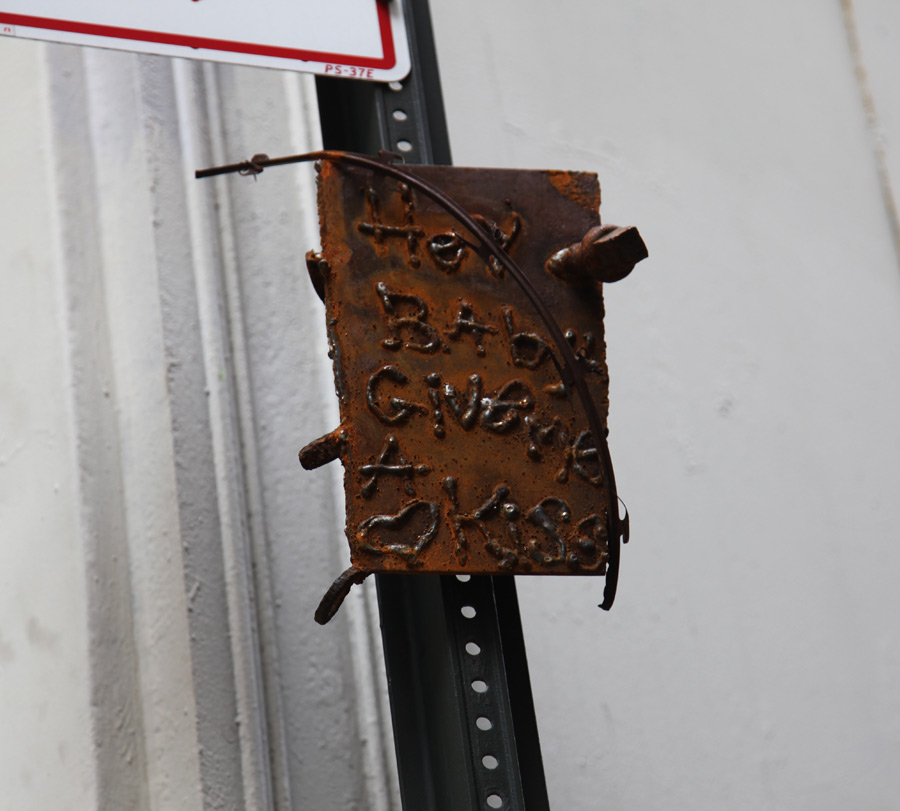
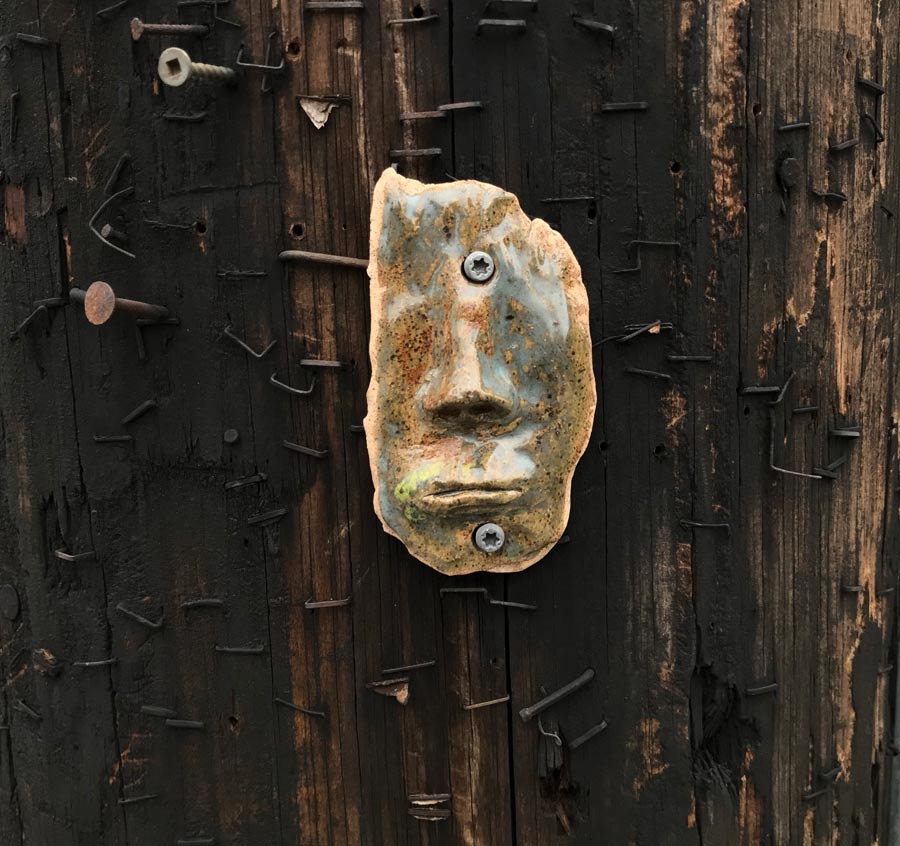
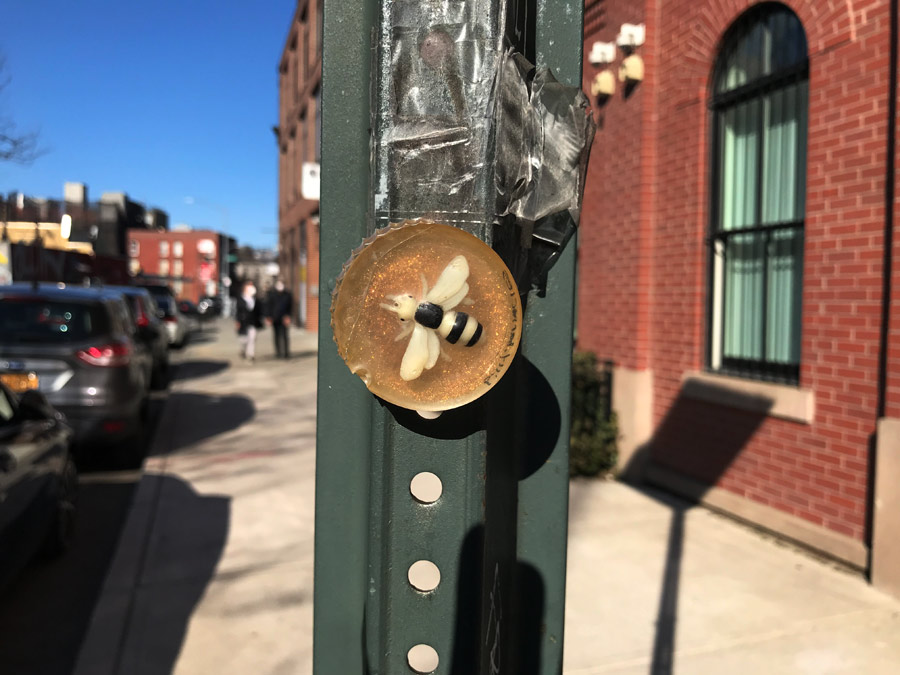
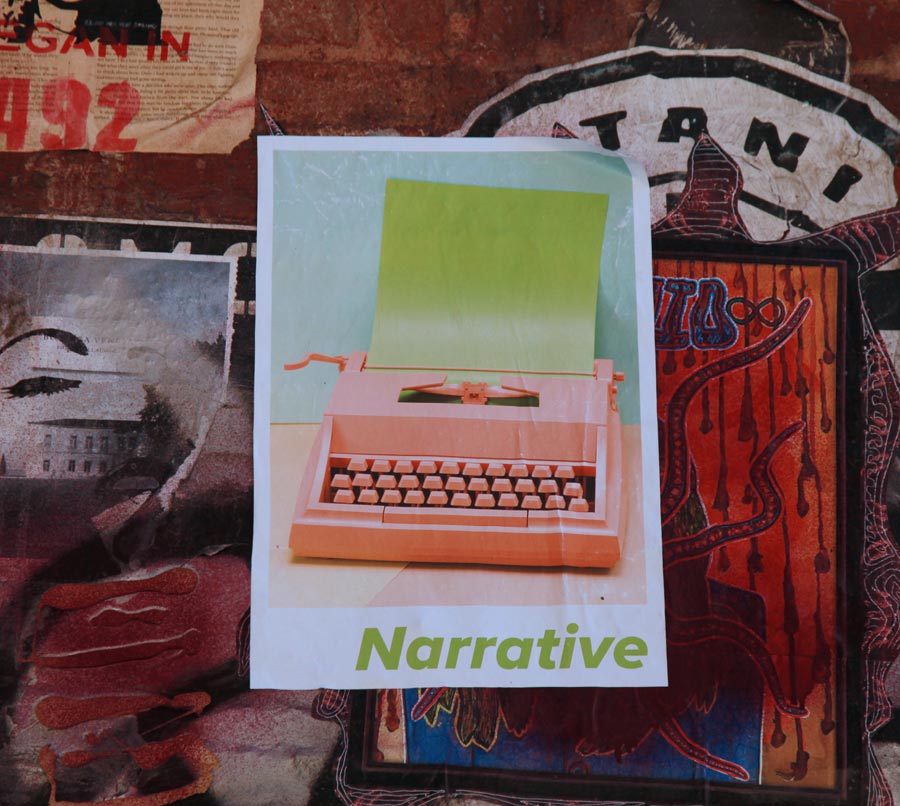
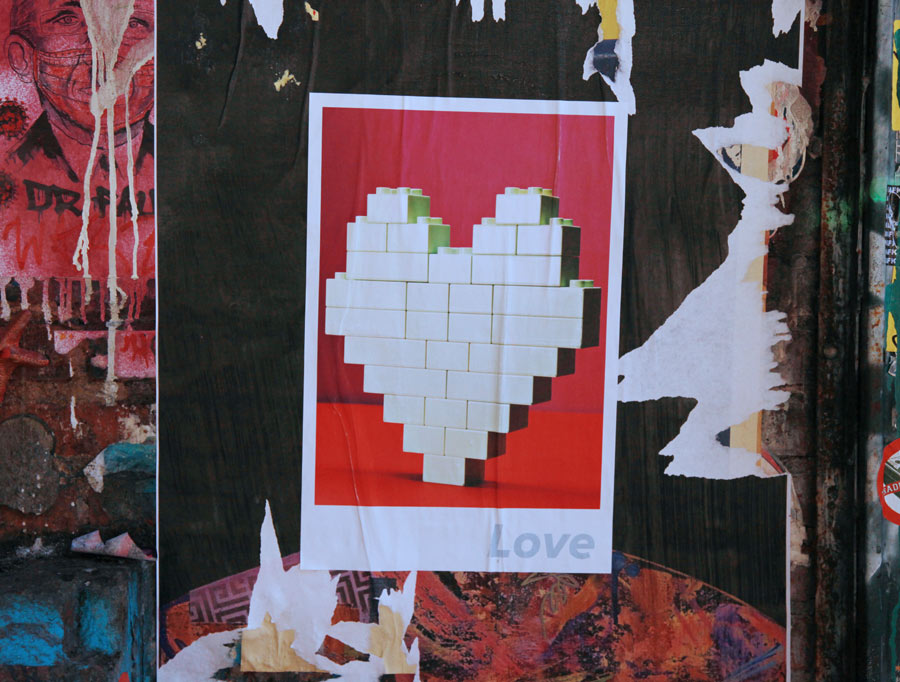
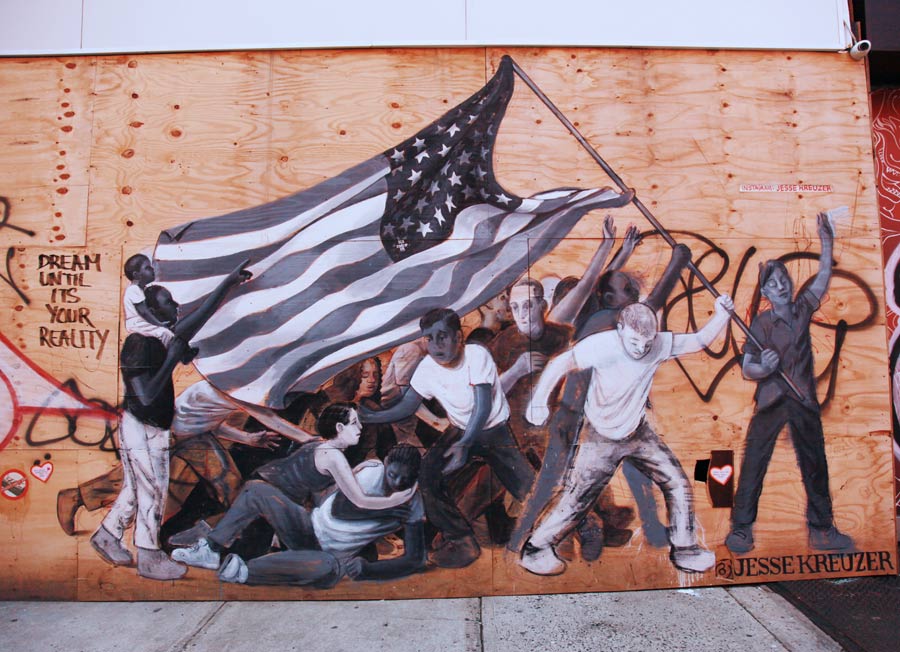
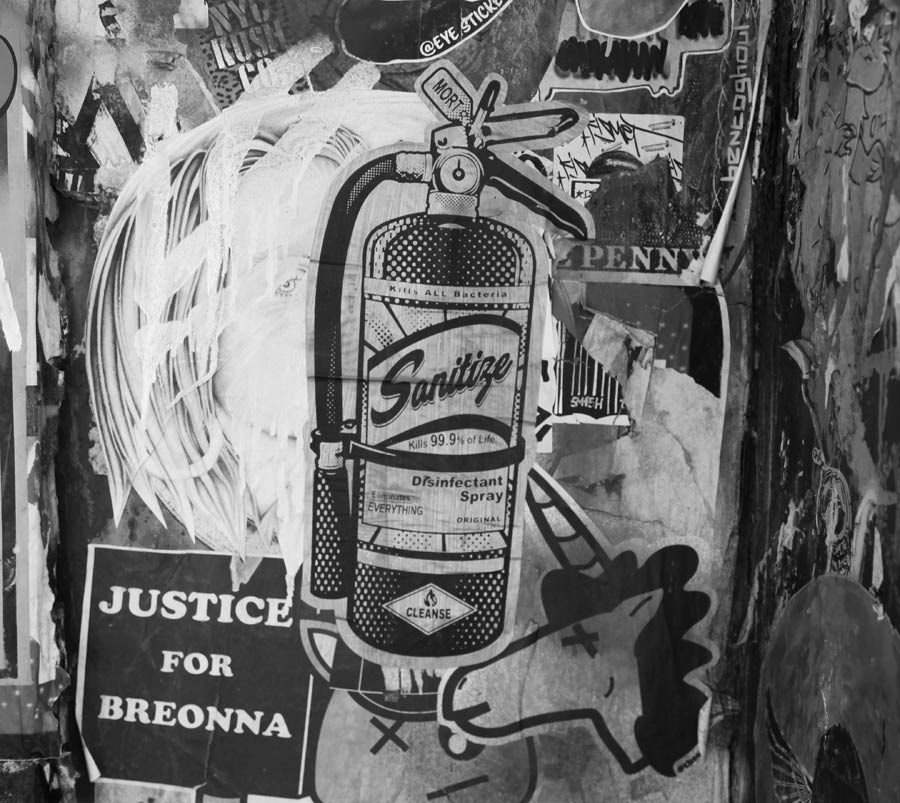
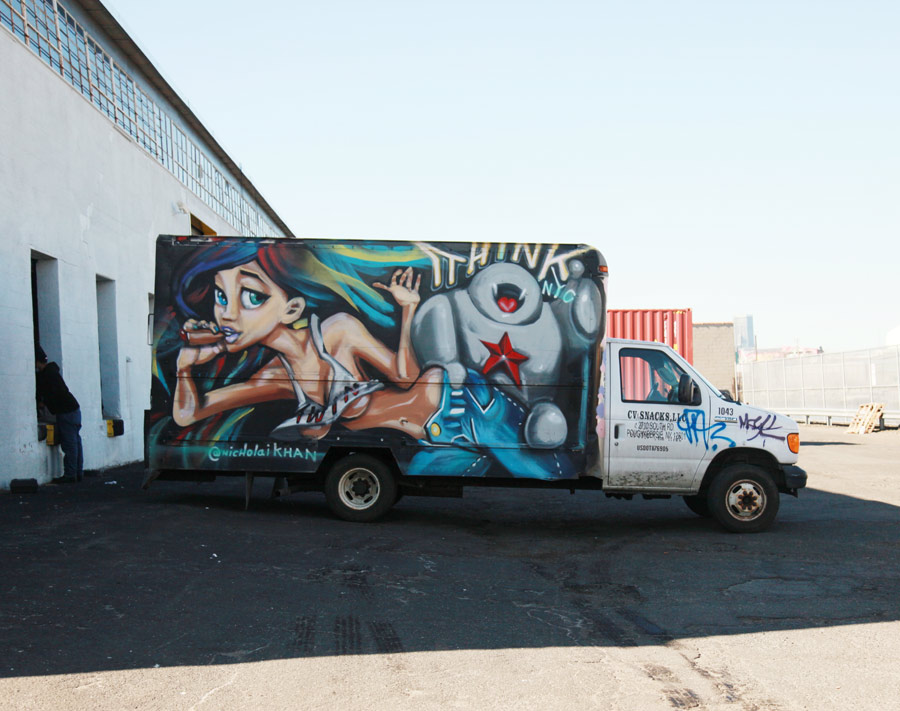
When we hit the streets in the pursuit of arts, we never know what we’ll find and where we’ll find it. This week we were surprised by a certain uptick in the number of sculptures on the streets. The artists used different materials, from ceramic to resin, metal, cement, and techniques associated with papier-mâché. The sculptures were mostly affixed to traffic signposts but sometimes were placed on street construction barriers. We are always happy to see sculptures on the streets as they bring back the days when sanctioned murals were definitely not the norm, and illegal street art ruled the streets in myriad small formats.
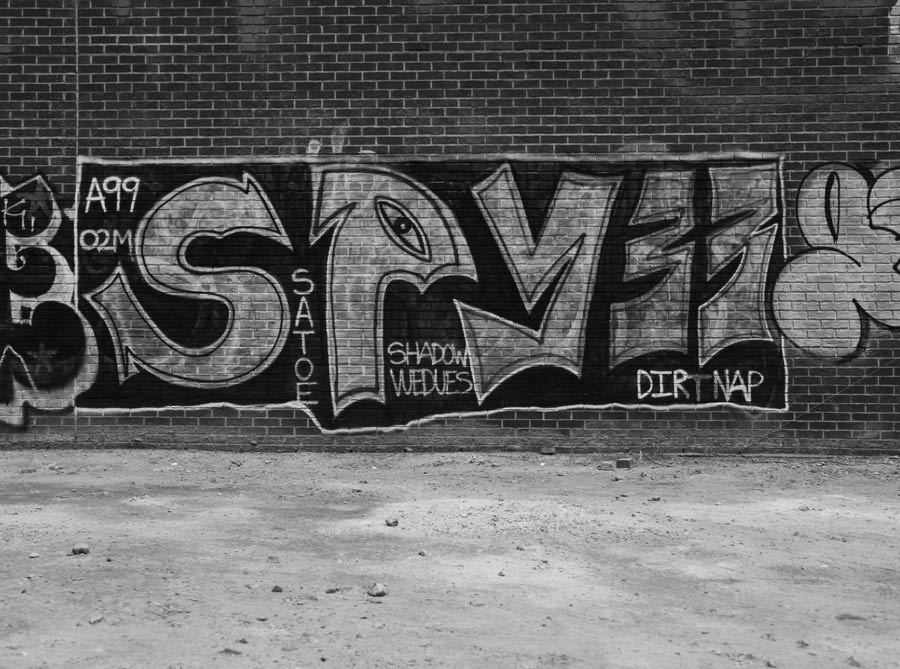
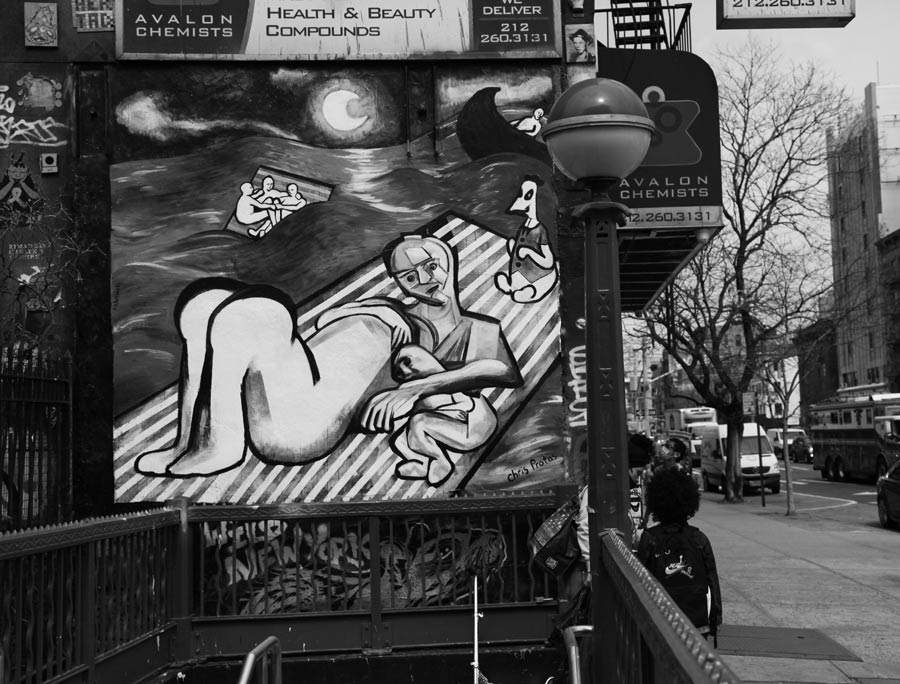
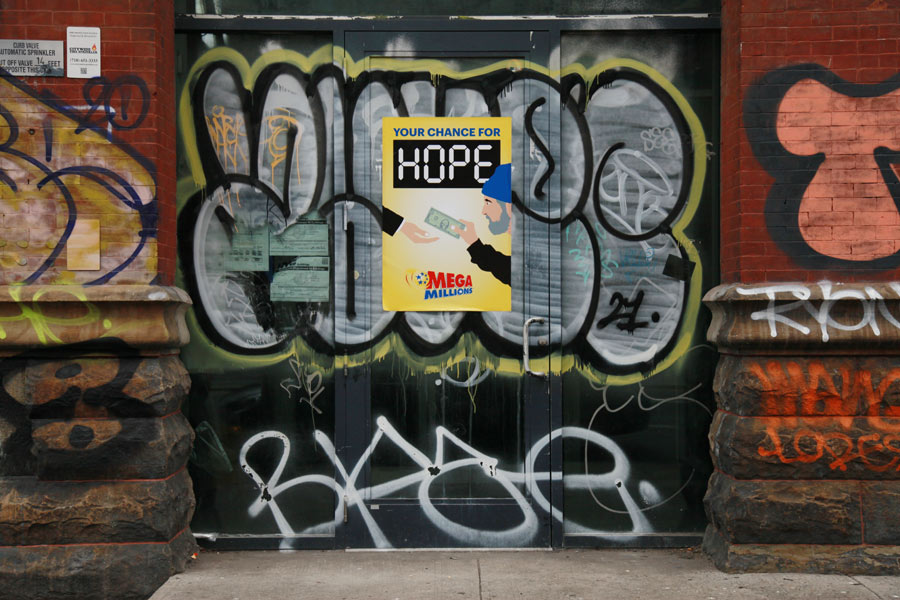
So here’s our weekly interview with the street, this time featuring: A Cool 55, AJ Maldo, Billy Barnacles, Chris Protas, City Kitty, CRKSHNK, JJ Veronis, Mataruda, Miyok Madness, Mint & Serf, Mort Art, Mr. Triple Double, Patrick Picou Harrington, Phetus, Raddington Falls, Sibot, Spy33, Turtle Caps, Winston Tseng.
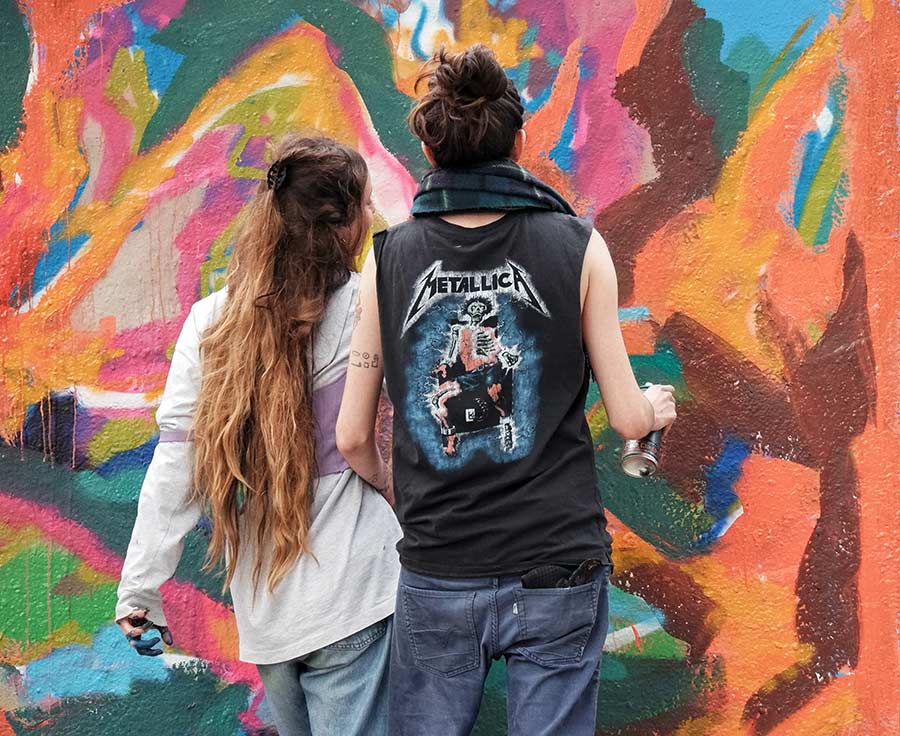
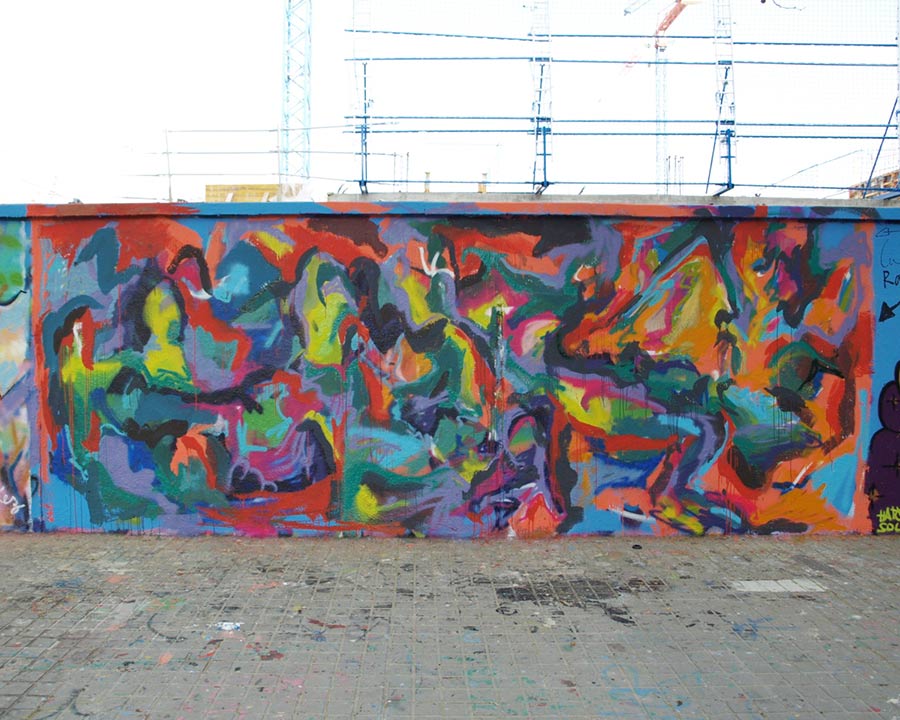
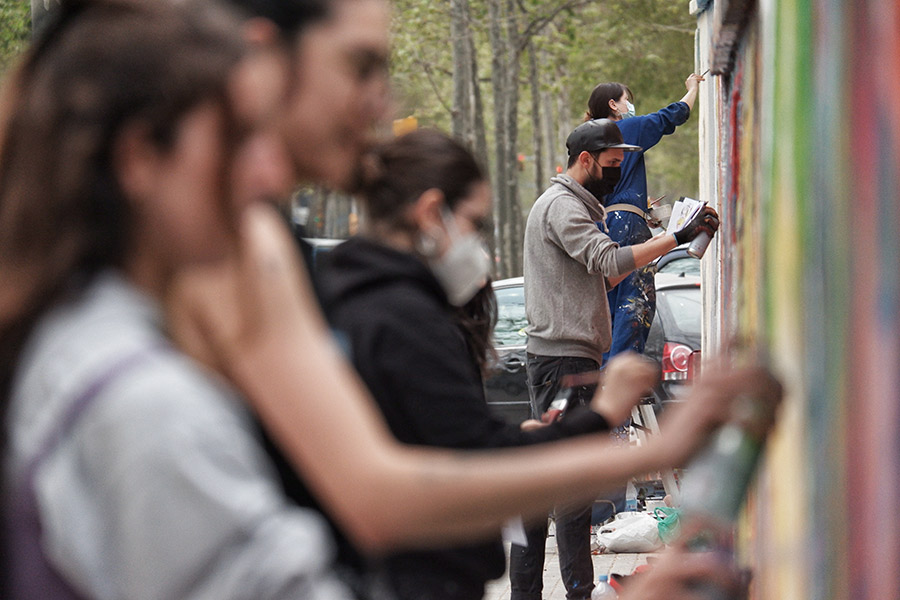
The springtime wall jams have begun! And random Saturdays or Sundays are usually perfect days to schedule an event in many cities – since most people have time off during that time, depending on their work schedule. If an artist is lucky enough to have a job these days…
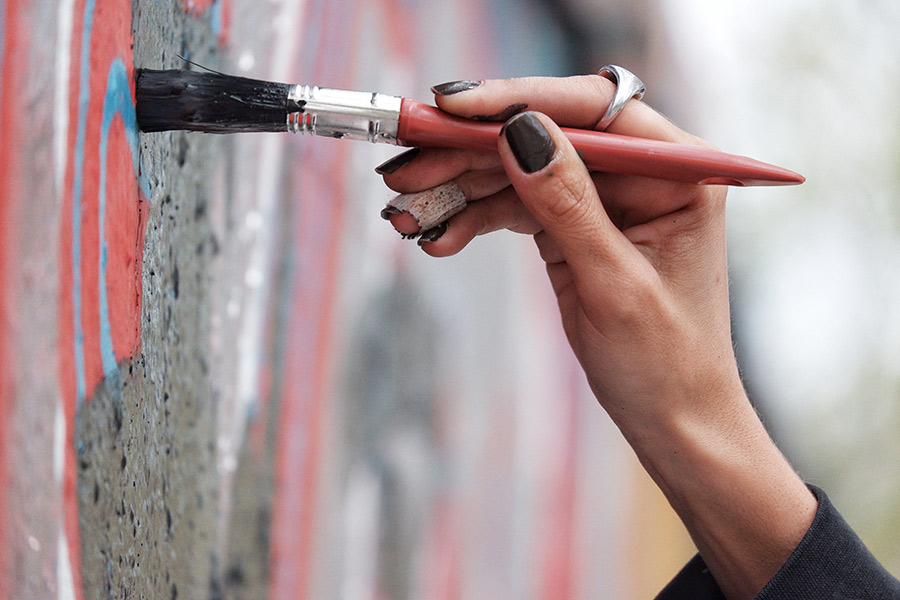
An informally organized event like this provides an opportunity to explore and create alongside peers, converse and discuss ideas and techniques, and hang out with visitors who stop by saying hello.
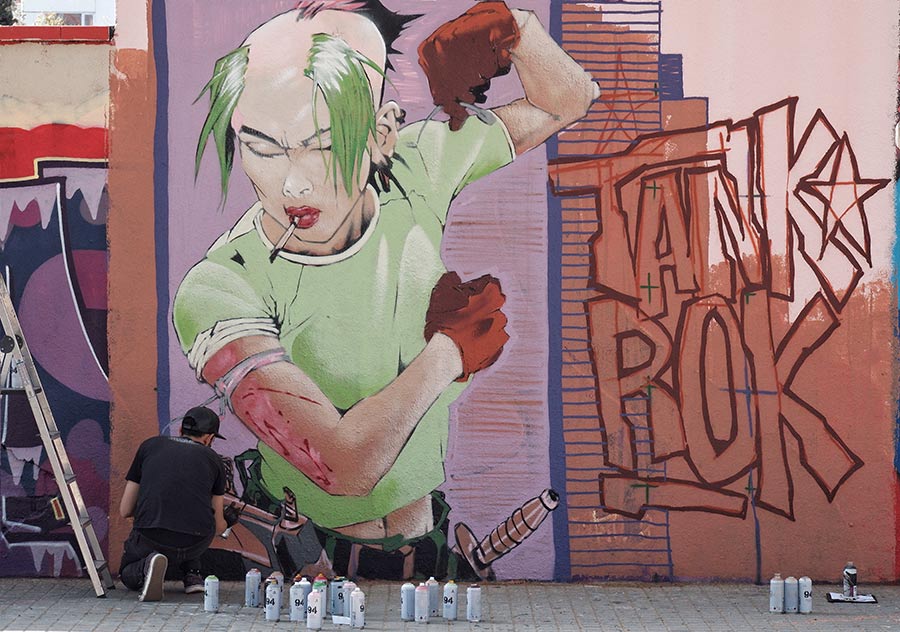
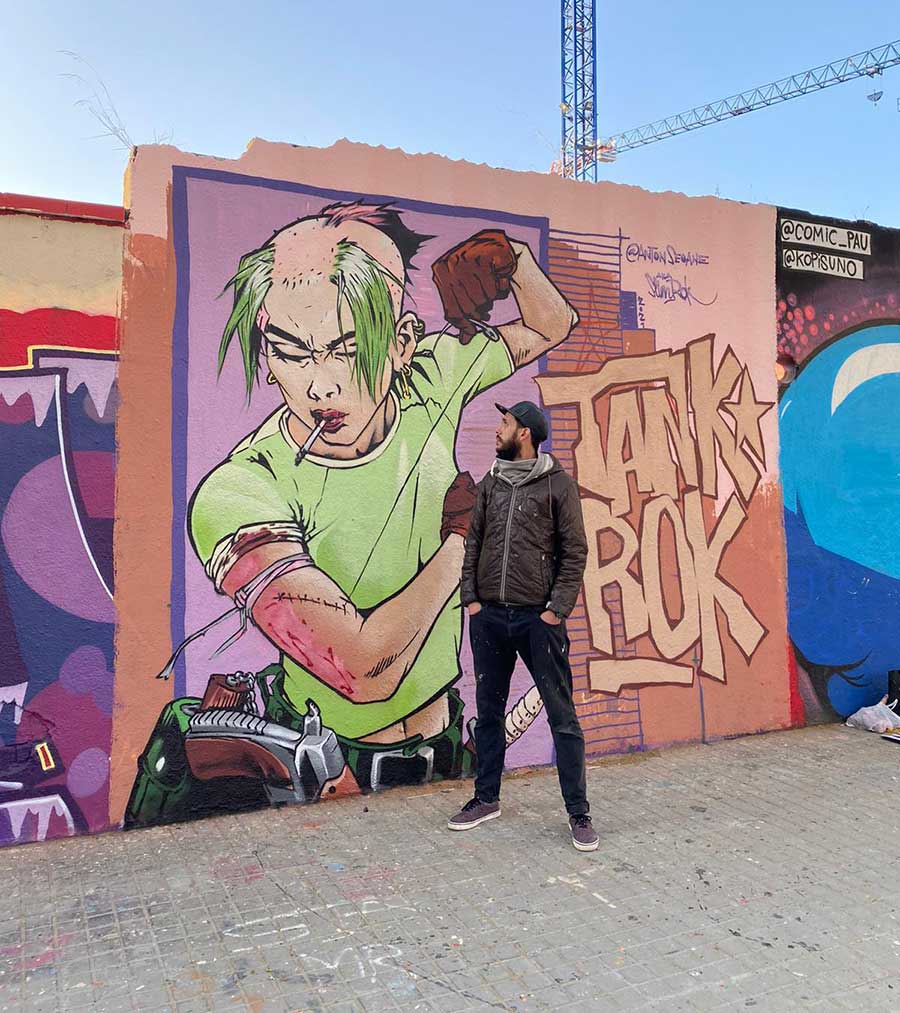
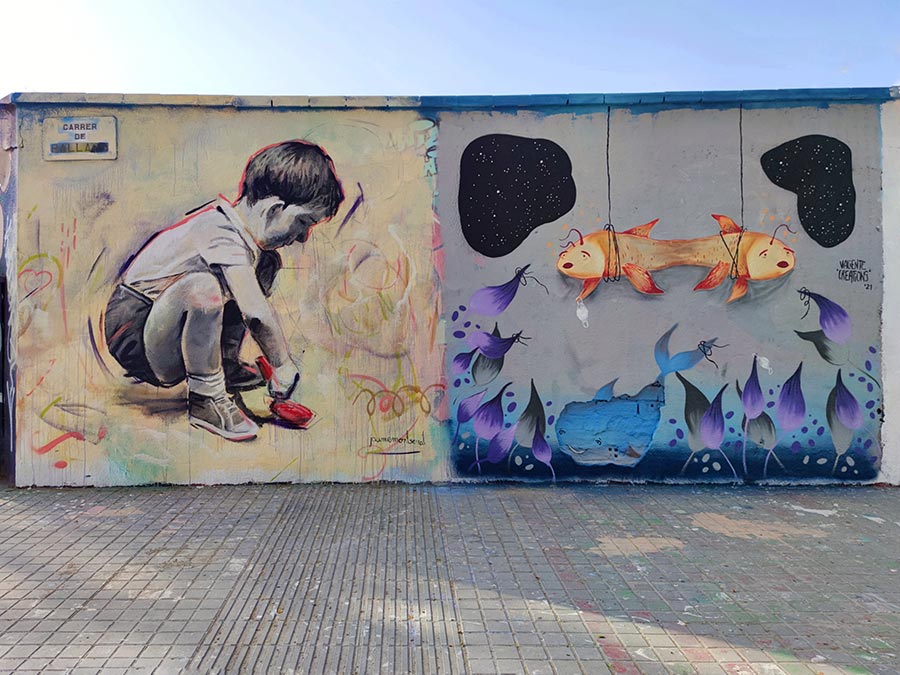
“We thought it was a good idea that we could notify each time any of us was going to paint,” says Spanish artist Jaume Montserrat, “in case someone else wanted to accompany them and have a good time doing what we like so much.”
He says he and his buddies have a WhatsApp group to keep each other apprised of their street art and mural projects. For this particular Sunday a couple of weeks ago, it was as simple as reaching out via text to fellow artist Núria Farré, he tells us.
“I wrote to her asking if she would like to do it on one of Wallspot’s legal walls, and when we found a date that suited us, we decided to invite some friends.”
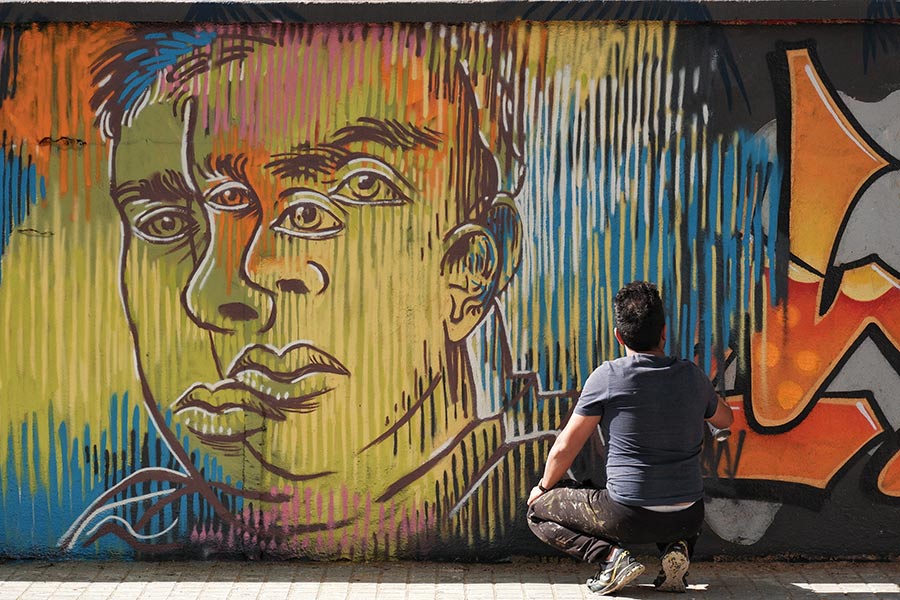
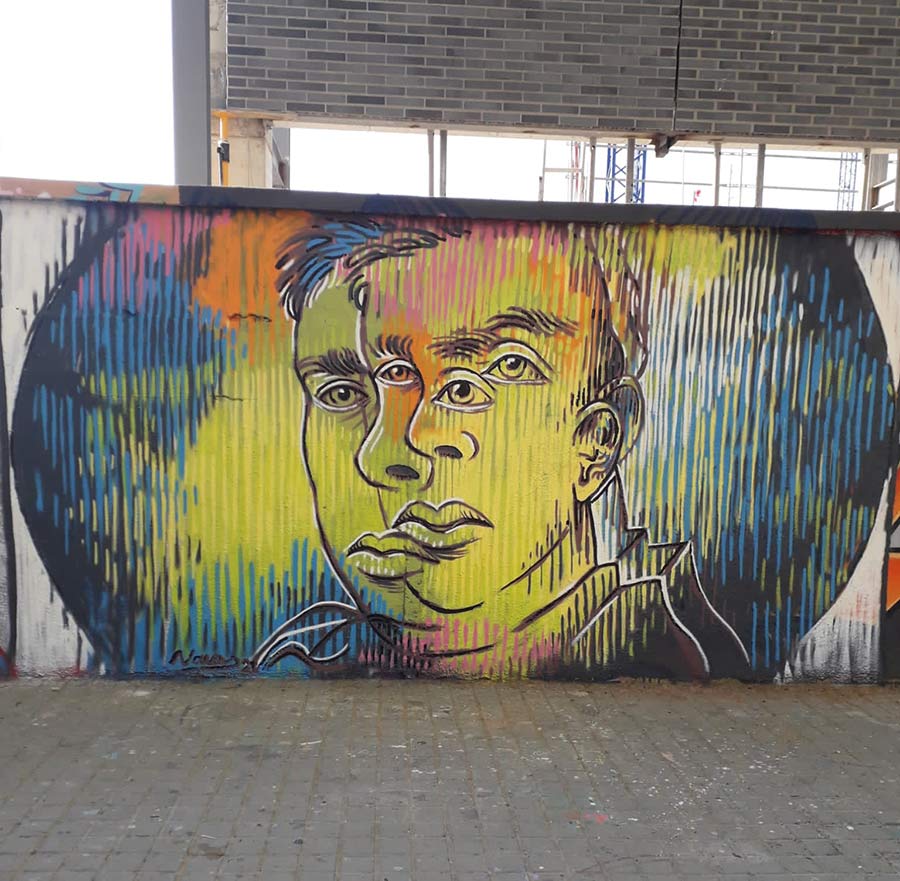
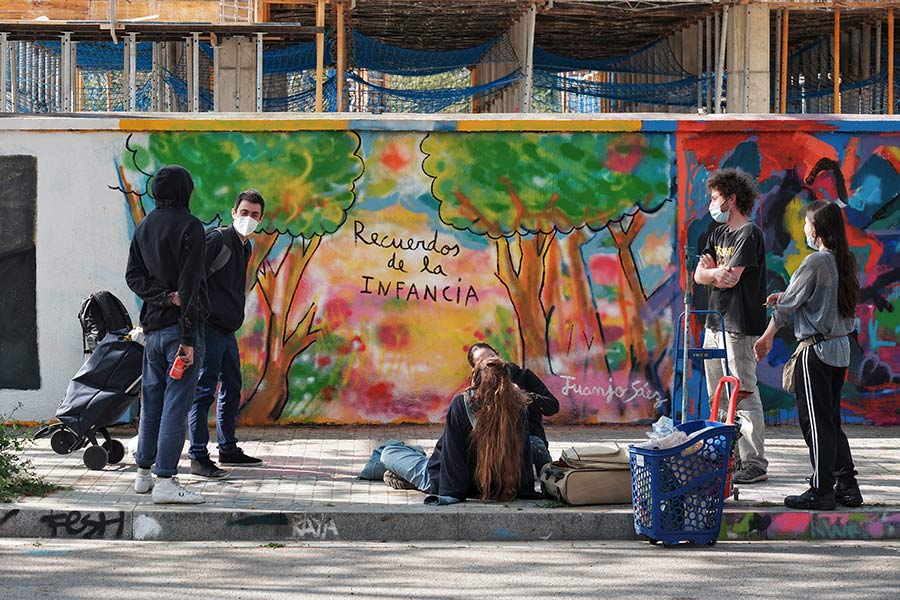
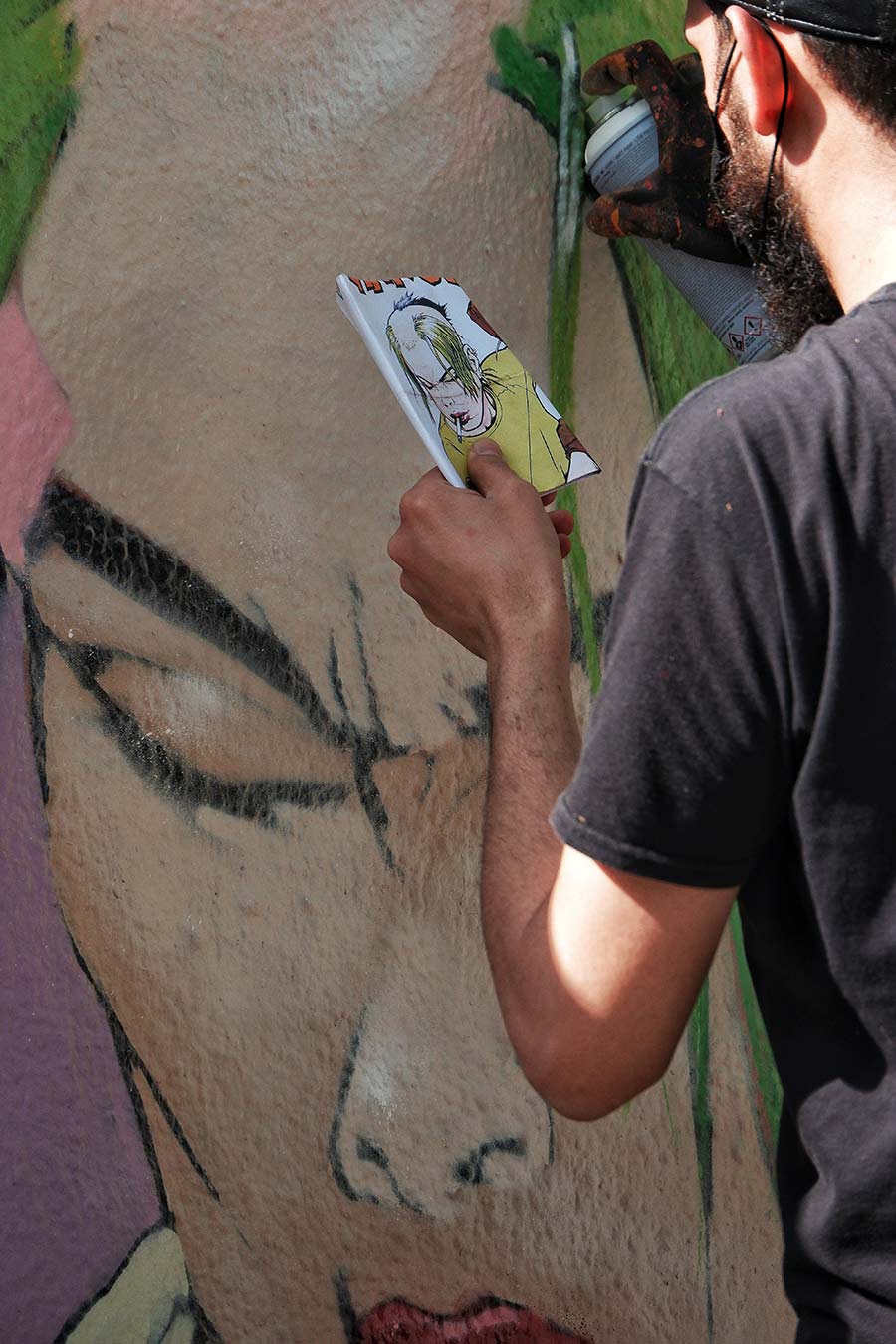
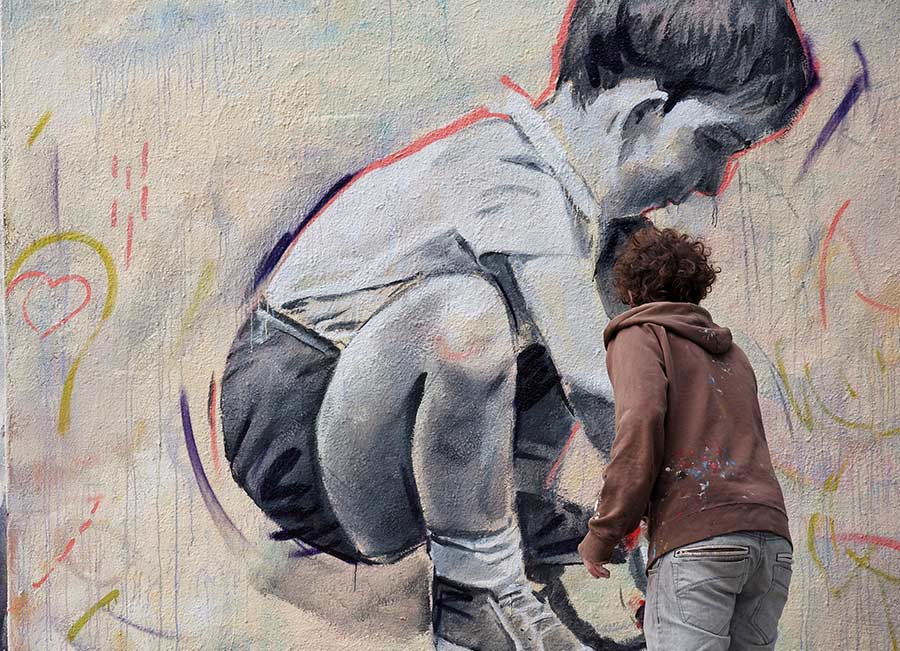
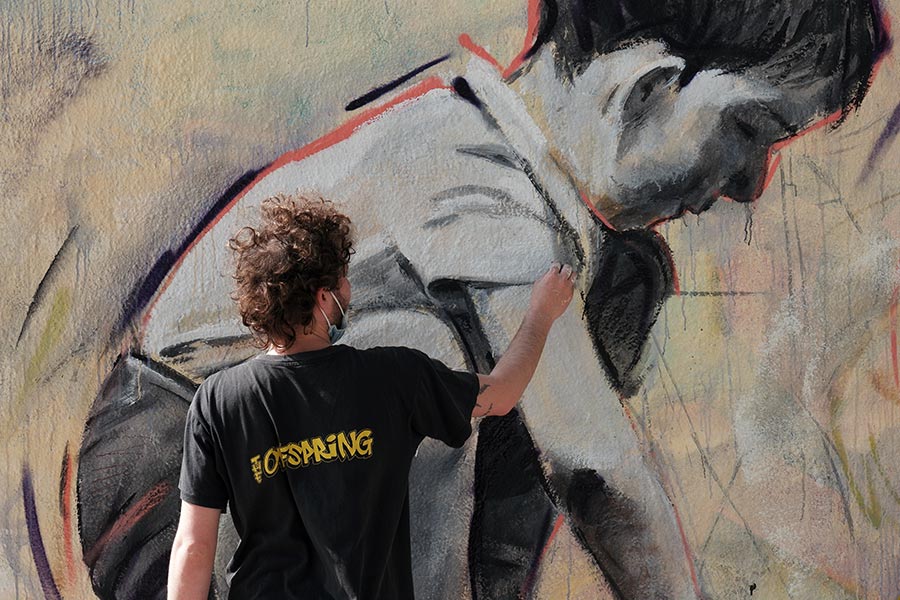
BSA contributor and photographer Fer Acala was there in Barcelona to capture the action and the art, and we’re pleased to share his shots of the artists at work and the days’ activities.
Our weekly focus on the moving image and art in the streets. And other oddities.
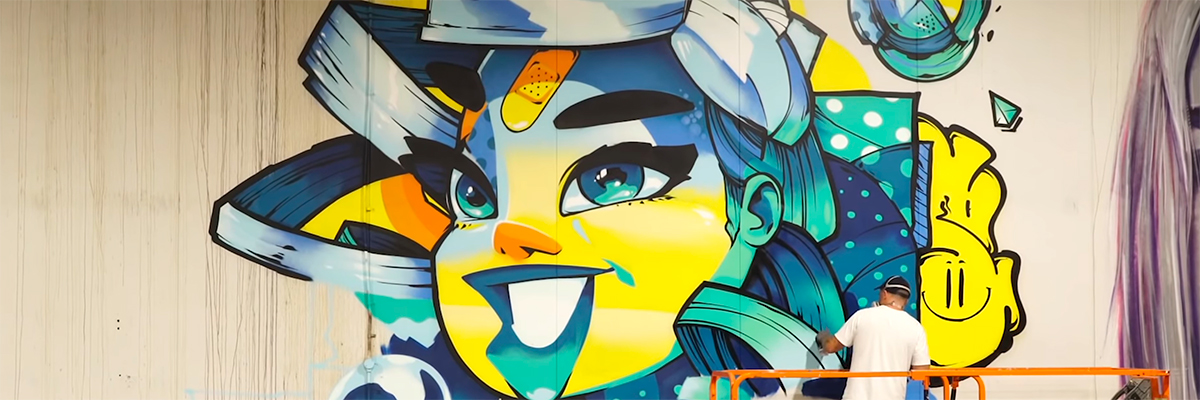
Now screening: 1. Sofles / Kawaii. The artist paints a piece for his daughter Violet. 2. ACBR and ZONE take Rick and Morty Underground 3. Honet x Art Azoi in Paris
BSA Special Feature: Sofles / Kawaii. The artist paints a piece for his daughter Violet.
Remember when Nirvana did that concert without electric guitars? You can call this one “Sofles Unplugged.” He has no soundtrack revving up your adrenaline or accentuating his skills. He’s just pure skillz.
Sofles / Kawaii. The artist paints a piece for his daughter Violet.
ACBR and ZONE take Rick and Morty Underground.
Ahhh, here we go! Vandals, surreptitious underground graffiti pieces, knives, mad scientists, syncopated dance numbers, and a ripping soundtrack. Back to what we all expected from our graff videos.
Honet x Art Azoi in Paris
A creation by HONET on the wall of the Pavillon Carré de Baudouin (Paris 20th district).
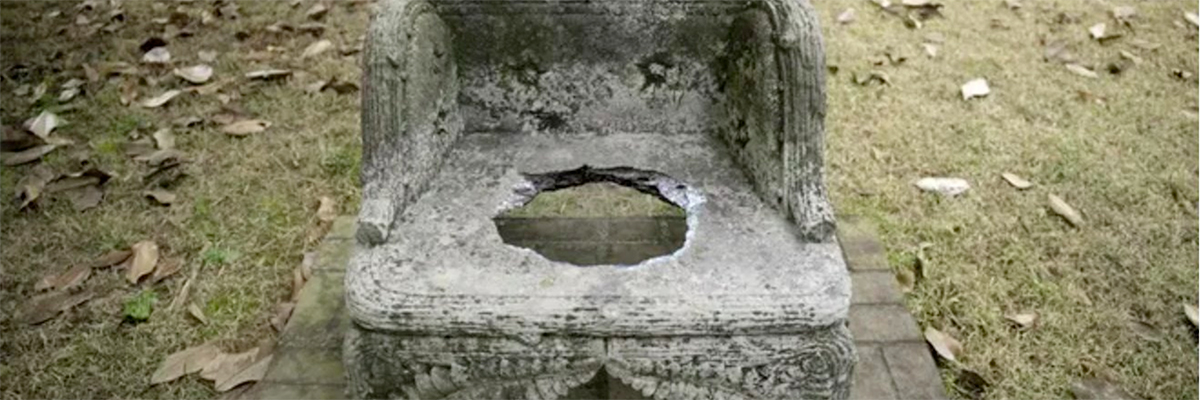
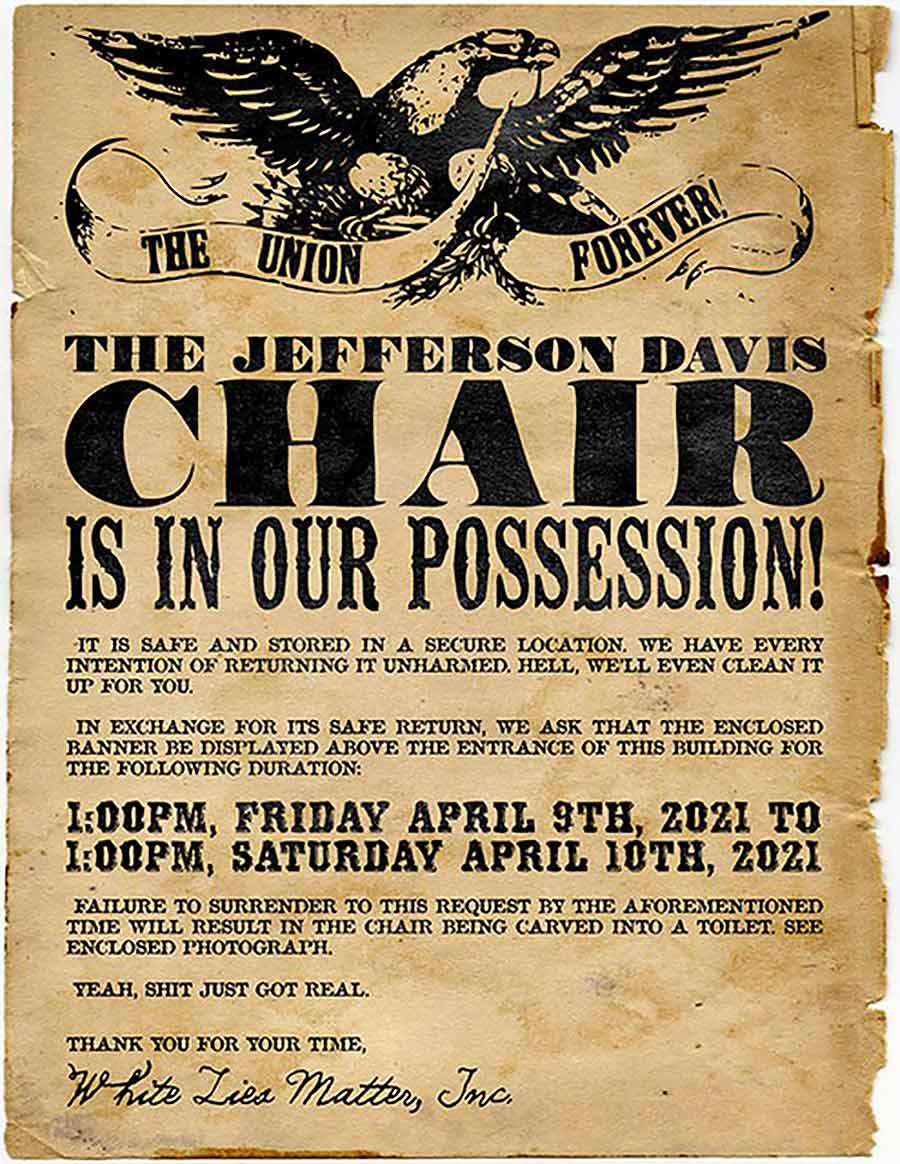
The same week we published Carlo McCormick’s extensive essay entitled “Why Monuments?,” in which he posits that we need to find a valid way to deal with statuary that celebrates enslavers, among other things, the county District Attorney Michael Jackson is looking to arrest members of “White Lies Matter” in Selma, Alabama for kidnapping a monumental chair.
Ransom note. (image courtesy of White Lies Matter)
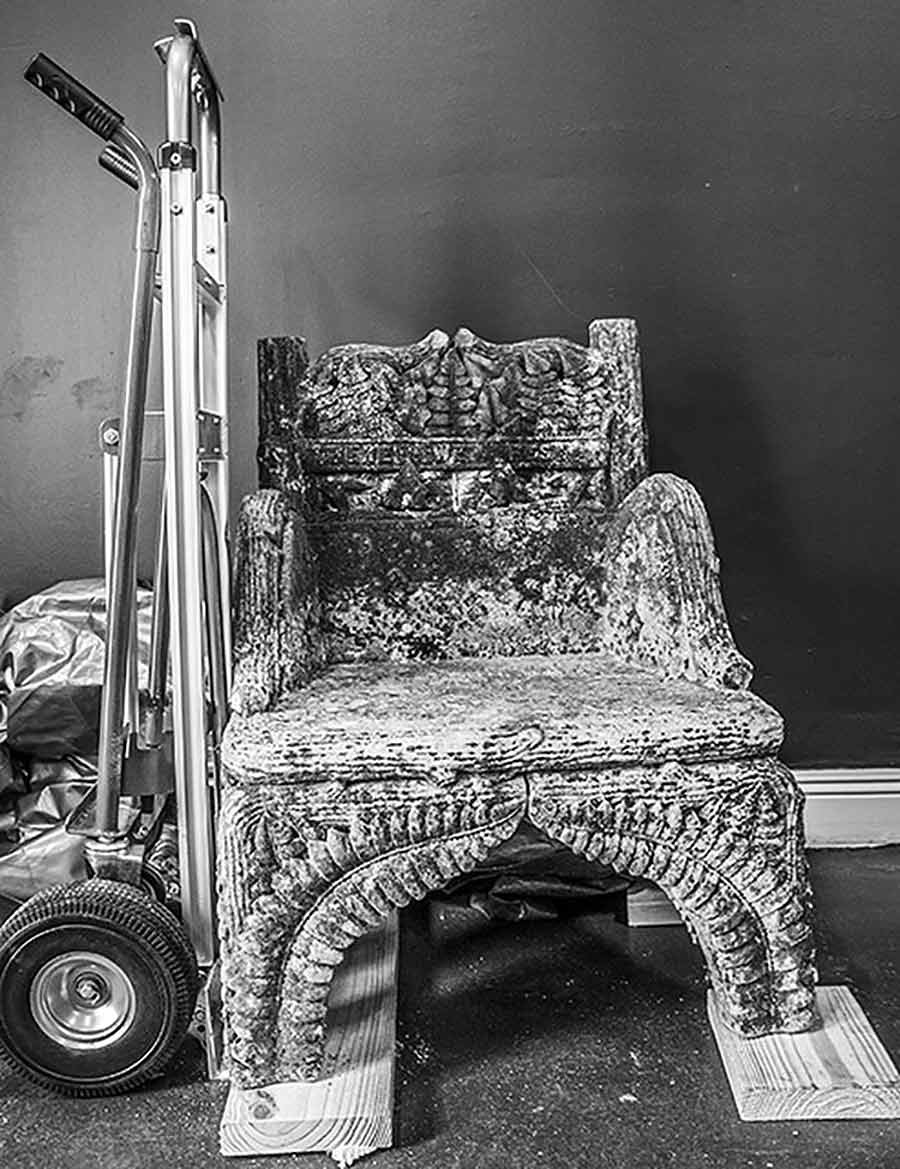
This Friday, the anonymous artivists said they were set to return their ransomed confederate chair monument, “The Jefferson Davis Memorial Chair.” It was first reported missing from Live Oak Cemetery in Selma last month – an ornately carved stone chair dedicated in 1893 to the Confederate president’s memory and estimated to be worth $500,000.
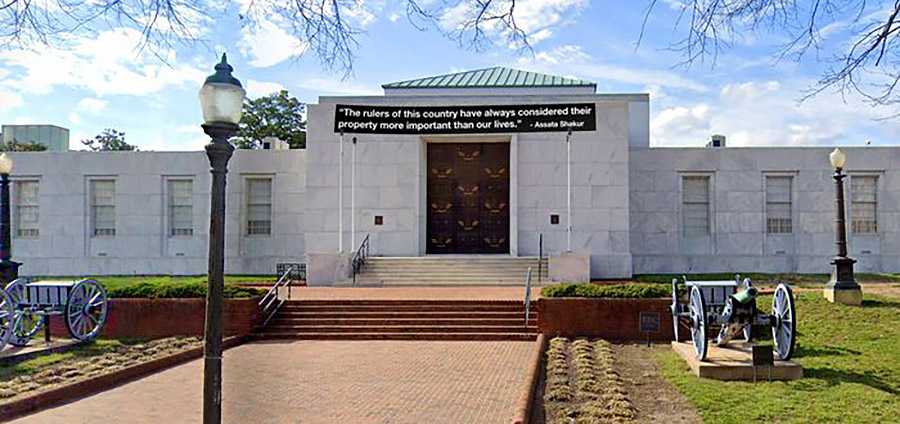
They had demanded, via email, that a banner with a quote by Assata Shakur be hung from April 9th to April 10th at the headquarters of the United Daughters of the Confederacy in Richmond, Virginia, on Friday, the 156th anniversary of Confederate Gen. Robert E. Lee’s surrender at the end of the Civil War.
“The rulers of this country have always considered their property more important than our lives,” said the banner.
A rendering of how the chair will be as toilet should the demands not be met. (image courtesy of White Lies Matter)
A member of the Black Liberation Army, Shakur was convicted of the murder of a New Jersey state trooper in 1977. In light of the currently running court case of police brutality in the killing of George Floyd, the use of Shakur’s quote is deliberate.
According to ransom documents, the chair would be returned unharmed if the banner was hung – but a new communication Wednesday evening showed images of the chair possibly being used as a toilet by a historically costumed and mustachioed actor.
A photoshopped image of the banner that the group is demanding to be put on display in front of the UDC headquarters in Richmond, Virginia for 24 hours. The banner reads: “The rulers of this country have always considered their property more important than our lives,” which is a quote by Assata Shakur. (image courtesy of White Lies Matter)
“As the UDC has given us every indication that they had no intention of hanging the banner, even going as far as declaring our demands, ‘fake news, White Lies Matter has decided to move forward prematurely with the alteration of the chair. It will be returned to the UDC immediately.”
According to news reported in The Washington Post, the White Lies Matter group wrote, “We took their toy, and we don’t feel guilty about it. They never play with it anyway. They just want it there to remind us what they’ve done, what they are still willing to do.
The original chair being carted into an unknown storage awaiting its fate. (image courtesy of White Lies Matter)
“But the south won’t rise again. Not as the Confederacy. Because that coalition left out a large portion of its population. All that’s left of that nightmare is an obscenely heavy chair that’s a throne for a ghost whose greatest accomplishment was treason.”
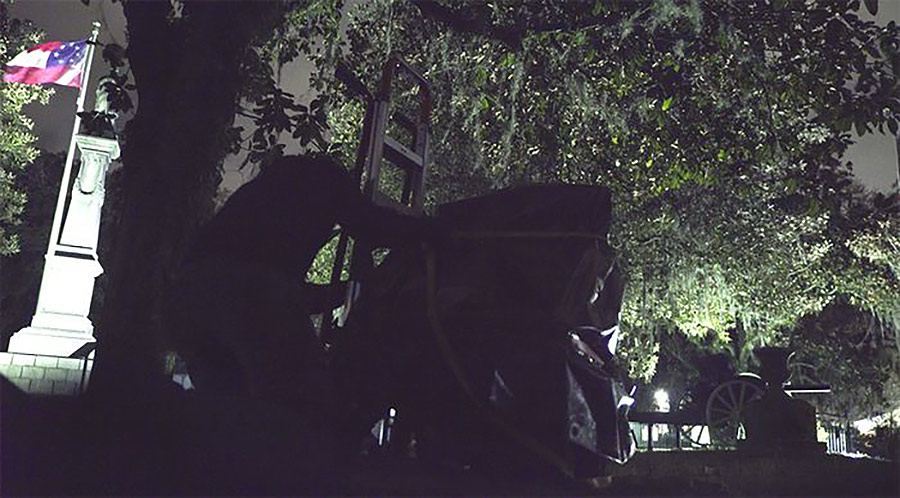
This image shows the chair being stolen from the Live Oaks Cemetery in Selma, Alabama on March 19. (image courtesy of White Lies Matter)
UPDATE: The Washington Post is reporting that the New Orleans police have made an arrest on the theft of the chair. Two individuals are being held in connection to the theft while they search for a third suspect. The chair was recovered without damage to it and it will be returned to its original place.
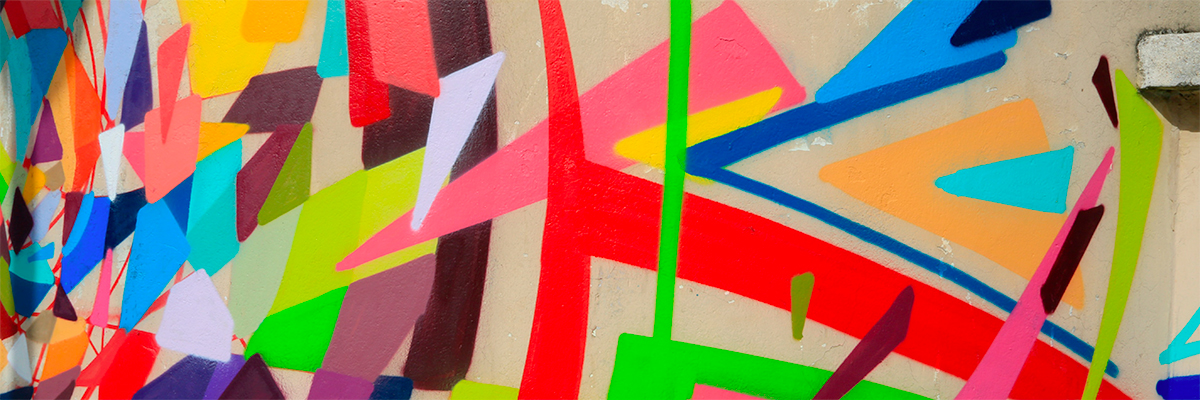
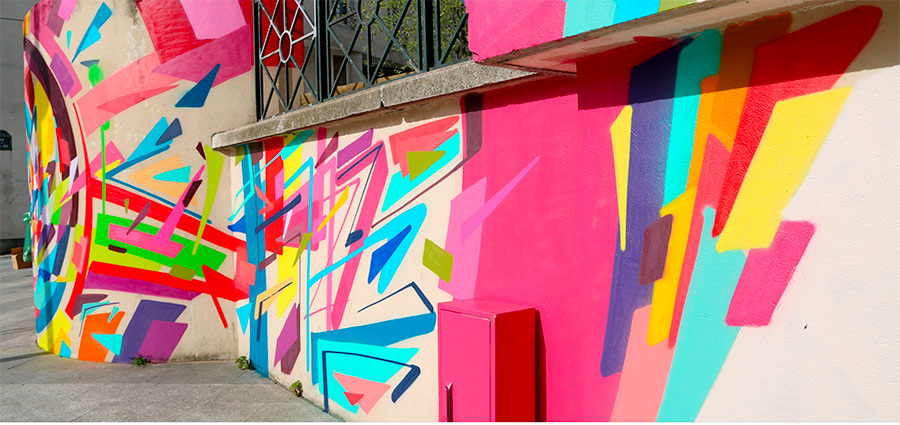
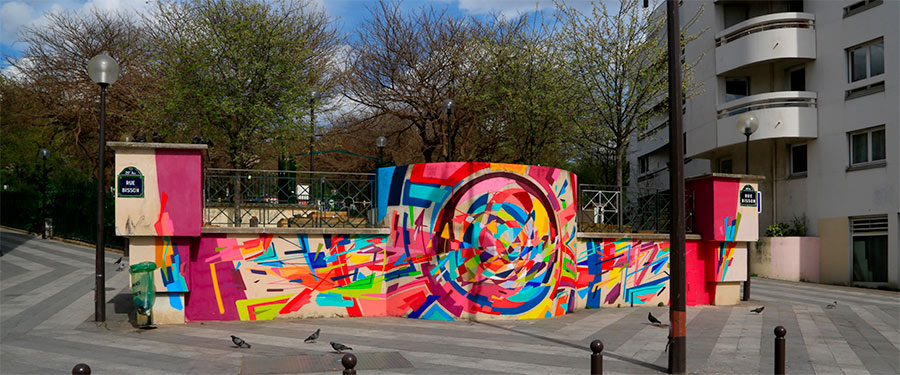
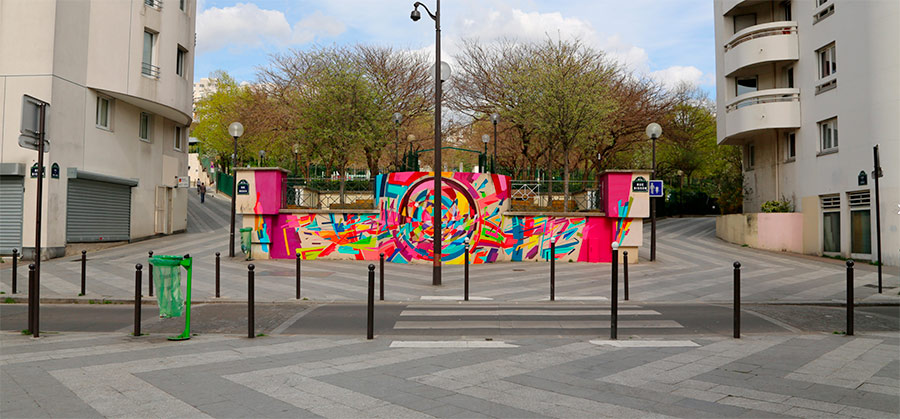
Barcelona-based KENOR has traveled around the world and worked with brands creating his own take on kinetic graffiti, whether on walls, on canvas, or as sculpture. Blowing air into his pieces of colorful geometric confetti, the painter catches the chaos of the city and paints it.
It’s a mismatched style that recalls the Memphis movement of the 80s, complete with a poppy palette and occasional patterning. Here with Art Azoi on a lower wall of Parc de Bellville in Paris, you can see how his emphasis on movement drives his creative choices at Place Alphonse Allais.
KENOR in collaboration with Art Azoï. Paris. (photo courtesy of Art Azoï)KENOR in collaboration with Art Azoï. Paris. (photo courtesy of Art Azoï)KENOR in collaboration with Art Azoï. Paris. (photo courtesy of Art Azoï)KENOR in collaboration with Art Azoï. Paris. (photo courtesy of Art Azoï)
Like graffiti writers sharing black books and styles, BSA Writer’s Bench presents today’s greatest thinkers in an OpEd column. Scholars, historians, academics, authors, artists, and cultural workers command this bench. With their opinions and ideas, we expand our collective knowledge and broaden our appreciation of this culture ever-evolving.
by Carlo McCormick
Why Monuments?
Perhaps, caught up in the energy of street art and graffiti, we do not pay quite so much attention as we should to it being something we might otherwise call public art. Consider that public art as a form goes back through centuries of municipal planning and myriad private and public interests that are concerned with how community identity may be constructed and represented. It is shortsighted not to acknowledge how much of public art has long been about monuments.
Perhaps this perspective is a bit of a stretch for many. Certainly, the motives and purpose of those expressions that we see on a street or a subway are impossibly far from how monuments function as public art, not to mention the significant differences between them in terms of scale, materials, and permanence. But if street art is a distant unruly and mongrel descendent of the public monument, they are nonetheless related.
However absurd comparisons may be, my concerns and involvement with art as it exists on the streets remains inseparable from my somewhat perverse fascination with monuments, each somehow bound together as opposite ends of the broader conversation called public art- which is, after all, the visual manifestation of both what we want to say and what we want to be remembered.
Most bad ideas are meant to die, but some haunt you year after year like a bad case of recurring herpes.
Monumental Book Project Spurs the Worst
Oddly, they both occurred to me simultaneously when I organized a show many years ago in Milan’s mid-Eighties. It included several graffiti artists mixed in with their contemporary art peers who were active then in the East Village Downtown Scene. This was actually not so common at that time when there was not so much curatorial or critical comingling between what had emerged on the trains and that which had been born through more formal studio practice.
The graffiti movement was still nascent and pretty much invisible to art world eyes at that time. One way I thought of to put New York graffiti in context for an audience then was to contrast it with something we all had – the world over; really ugly monuments to people whom we largely don’t know or care about. This presented a great idea – to create a book compiling examples of the very worst monuments internationally.
I had no idea what would happen.
For months after I began the project, people I didn’t even know were contacting me to report the really crappy statue in their little town square. And this was before the Internet; can you imagine what it is like to get bad photographs of awful public art in the mail? It was a kind of aesthetic pornography. Needless to say, I never did that book.
Most bad ideas are meant to die, but some haunt you year after year like a bad case of recurring herpes. This unlikely and unfortunate confluence between two impossibly incompatible forms of public art festered in the back of my mind for decades as a latent aberration.
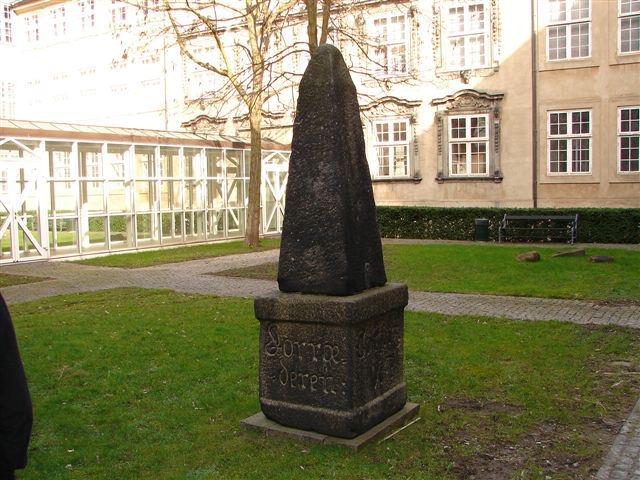
Corfitz “To His Eternal Shame, Disgrace and Infamy” 1664, Copenhagen
It erupted again many years later when, in visiting a photography show of portraits of graffiti and street artists in Copenhagen I stumbled across a modest, ancient monument in the garden of a local museum there. It was, in the whole lineage of sculptural atrocities I had witnessed in monumental art, the most ugly monument imaginable. Originally erected in 1664 on the former grounds of a once powerful man named Corfitz (he had married the daughter of the king), after they had demolished the grand estate that had stood there.
The monument remembers an infamous and still reviled traitor with the following words:
“To his eternal shame, disgrace and infamy.”
Here was a history, redolent with hate, regret, and disgust, I could relate to. Here was a public artwork of monumental shame I could salute. It reminded me of the curse tablets, tabella dexionis or katadesmos, of the Greco-Roman period in which the gods were called upon for all sorts of unspeakable retributions against specified individuals.
Spiteful markers of public malevolence, like an enraged sect of lawn sculptures, they might be a worthy form to return today. Certainly, they would better than the insipid feel-good positivity slogans that are so common these days.
A curse tablet (Latin: tabella defixionis, defixio; Greek: κατάδεσμος, romanized: katadesmos) is a reference to the practice of creating a small tablet with a curse written on it from the Greco-Roman world. The tablets were used to ask the gods, place spirits, or the deceased to perform an action on a person or object, or otherwise compel the subject of the curse. (Wiki)
But we are not there yet. In fact, the longer I think about all this, the more certain I am that I will never quite get there, wherever that may be. Sometime later, Nuart, the street art festival and conference out of Stavanger, Norway, which habitually indulges my worst follies, did allow me to lecture on the idea of monumental shame.
Cold War, Soviet Era, and Fallen Soldiers
Still, it was not until Artmossphere, a street art biennial in Moscow asked me in 2018 to curate their forthcoming edition, did I consider that I might finally get to say what I needed to. Most importantly, I would do so by working with artists I cared about, who were well versed in public art – if perhaps somewhat allergic to the history of monuments.
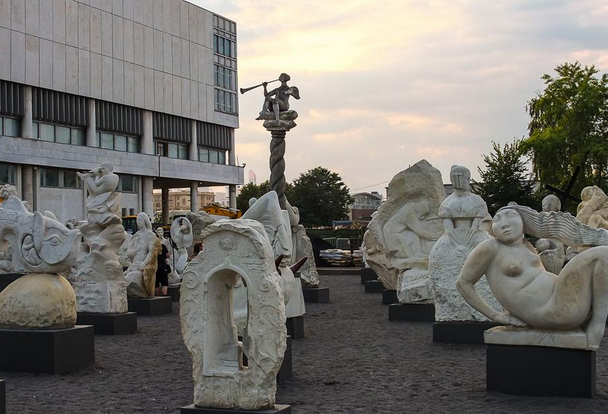
The idea, to assemble a show of newly made monuments by artists who typically work in the ephemeral and express themselves in terms that are more personal and idiomatic than civic and official, was in large part inspired by a particular feature of the largest public space in Moscow, Gorky Park. Here, in an area colloquially called The Park of Fallen Heroes, were all the monuments produced in the Soviet Era – 700 of them, all strewn about, laid to rest like forlorn memento mori to a failed empire.
MUZEON Park of Arts in Moscow (formerly The Park of Fallen Heroes) (copyright source: Rusmania.com)
MUZEON Park of Arts in Moscow (formerly The Park of Fallen Heroes) (copyright source: Rusmania.com)
MOSCOW, RUSSIA – CIRCA AUGUST 2016: MUZEON park of arts (formerly calledPark of the Fallen Heroes)
To date this recontextualizing of our ignominious legacies into delineated margins, statuary ghettos so to speak, seems the best solution for the world over to consider how and where to park their problematic past. There is another similar site in Budapest called Memento Park, which plays a great backdrop for James Bond dodging bullets in Golden Eye, and has an apt mandate.
“This park is about dictatorship. And at the same time, because it can be talked about, described, built, this park is about democracy. After all, only democracy is able to give us the opportunity to freely think about dictatorship.”
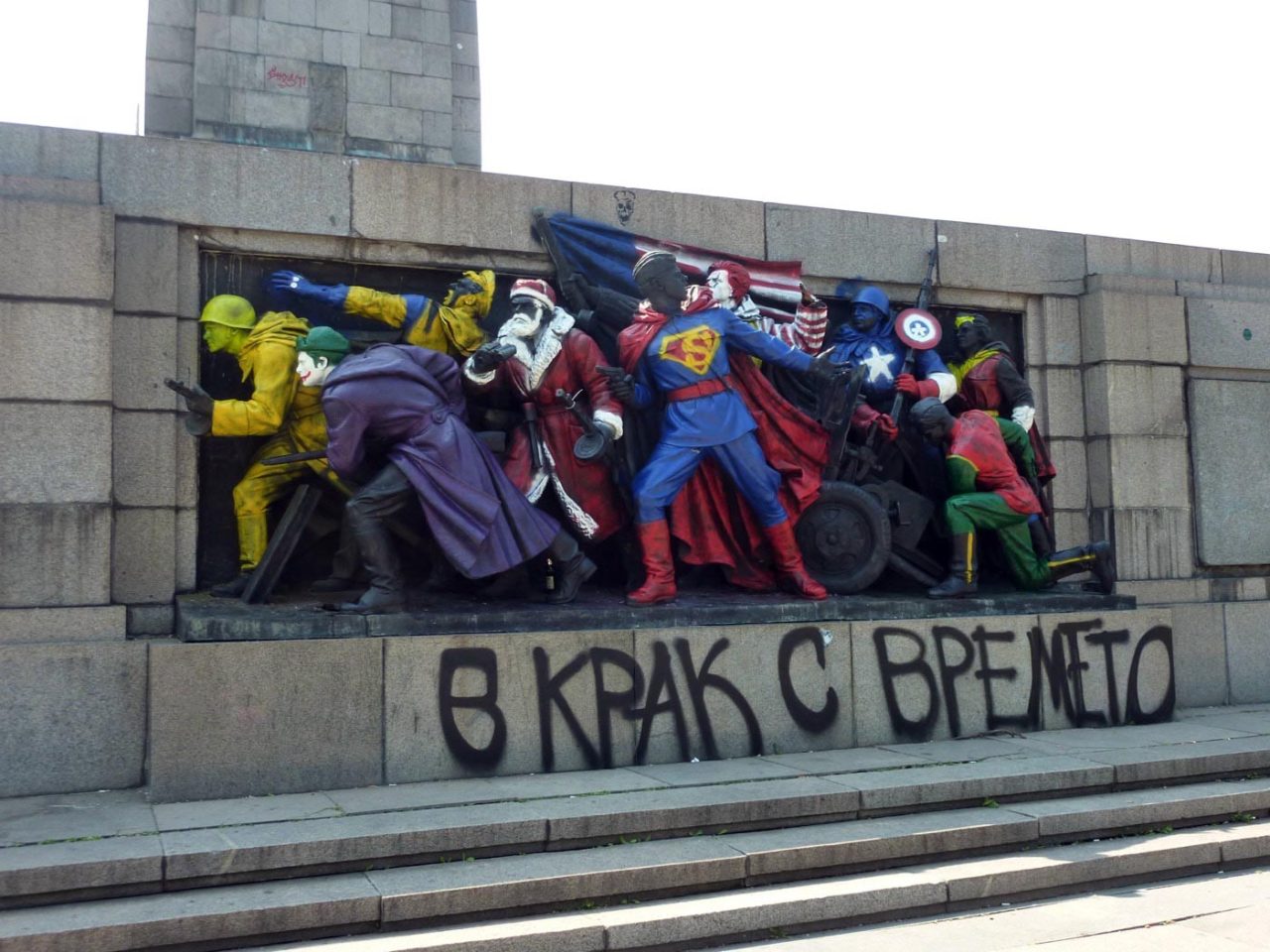
Monument to the Soviet Army – A pop-inspired repainting in Sofia, Bulgaria, 2011 (Creative Commons)
I’m perhaps a bit more skeptical than that when it comes to the virtues of what we call democracy. Still, in all this, there is to be a spirit of disentangling ourselves from history just enough to allow real artists a chance to imagine what they think needs to be celebrated and how we might memorialize the ideals of the present.
Somehow nasty cold war nostalgias seem more entertaining when wrapped up in a bit of 007 intrigue, the atrocities of tyranny abstracted by an erotic fetish of the other. So perhaps a Bond movie might be the best way to go there, but Moscow has this extra incentive in an apparent law that allows almost any type of unsolicited public art so long as it is done as a memorial, as if the act of remembrance forgives all aesthetic sins.
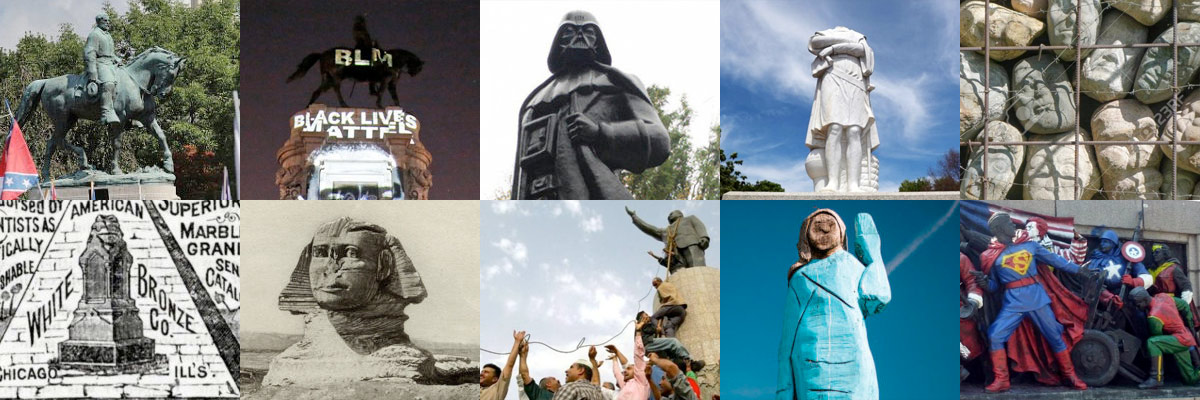
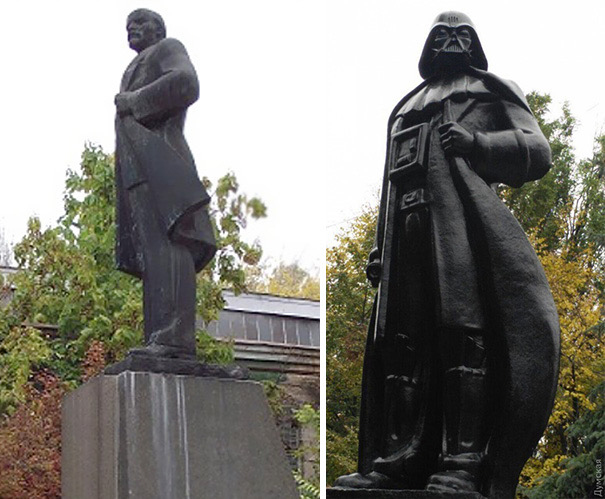
The Lenin statue before its Darth Vaderesque “de-communization” (left) and after (right) Photo: qz.com
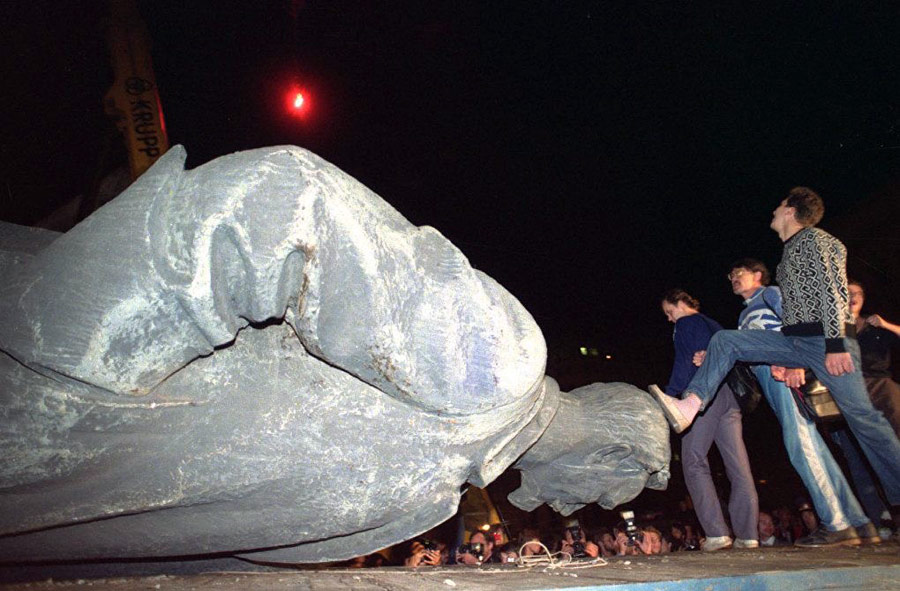
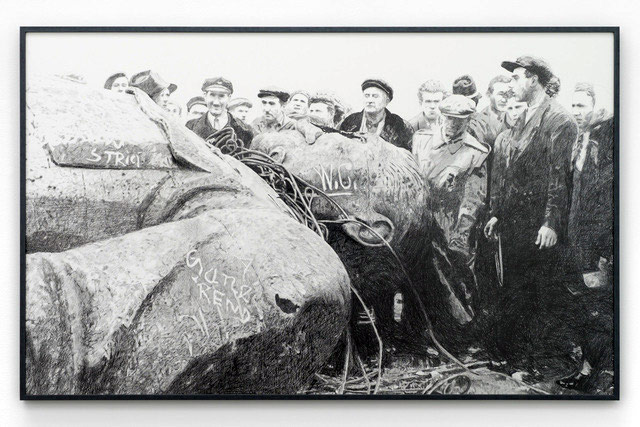
The infamous statue of Feliks Dzerzhinsky is brought down in Moscow in August 1991 (photo Alexander Zemlianichenko (AP)
There is such a cultural power to that, like being able to eat as much as you want so long as every bite tastes like Proust’s Madeleine, a trigger for the force of sudden recollections. This law should be adopted everywhere, and street artists must consider this as a legitimate defense going forward. Even weary old flaneurs like me could use it. “Was I urinating in public officer? No, I was making a monument to the time in everyone’s life when they just have to pee.”
Covid of course dashed those plans for Moscow, as the pandemic did for so many others, and at this point there is no telling if a monuments-based Artmossphere will find life in the new history we now enter. But who would have even thought in such a short time between conception and non-fruition that such a whack idea could now be so central to our social, cultural and public art discourse?
..it will not bode well for the fate of our contemporary monuments if we do not find a better way to address the afterlife of those monuments that are no longer so appropriate.
“The Lost Cause” Narrative from the US Civil War
I have been thinking a lot about a new kind of monument for a long time, but today I feel fortunate that artists, scholars and activists are thinking in even more radical yet practical ways than I could have ever conceived. The Southern Poverty Law Center reports that in 2020 a total of 160 Confederate monuments were removed from public display, and this gesture of mass censure was felt globally as many countries came to reassess the sculptural legacy of their colonialist exploits. In the United States, even with this widespread eradication, there are some 2,100 symbols of the confederacy still awaiting their date with woke history, and some 704 of them are monuments.
A timeline of Confederate monuments. Click to enlarge.
In America we do love to smash shit up almost as much as we like shooting things, so perhaps all these tokens of “The Lost Cause” narrative, minted in the south but largely manufactured in the North, are doomed to this wave of violent iconoclasm, but it will not bode well for the fate of our contemporary monuments if we do not find a better way to address the afterlife of those monuments that are no longer so appropriate.
The statue of Confederate General Robert E. Lee stands behind a crowd of hundreds of “alt-right” during the “Unite the Right” rally August 12, 2017 in Charlottesville, Va. Chip Somodevilla/Getty Images
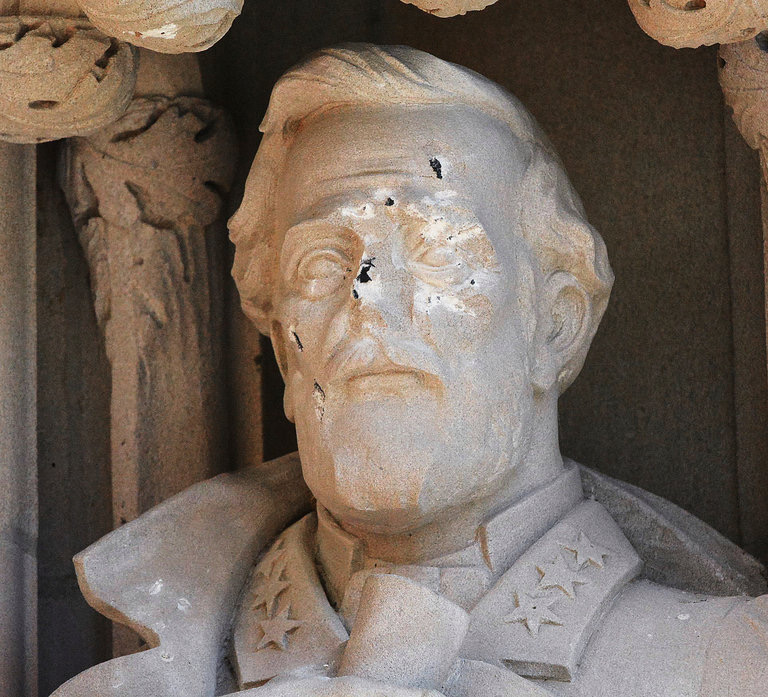
Robert E. Lee statue (defaced) Duke University, Durham, NC 2017
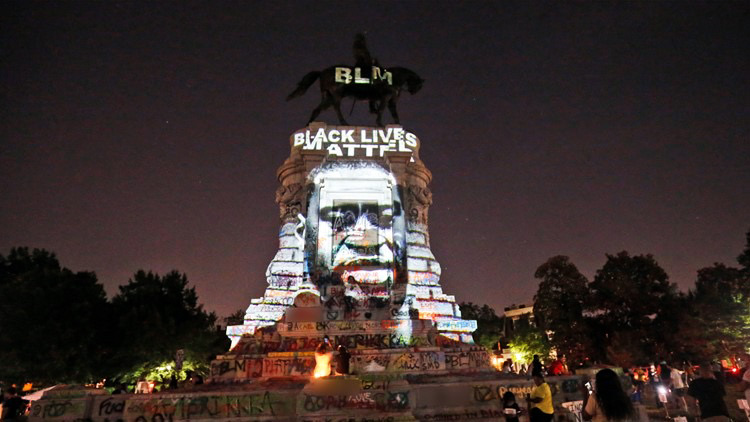
An image of George Floyd is projected on the base of the statue of Confederate General Robert E. Lee on Monument Avenue, Monday, June 8, 2020, in Richmond, Va. The statue was a focal point of protests over the death of George Floyd. (Photo by Steve Helber / AP)
Perhaps we can combine their destiny with the rising efforts to repatriate all the treasures we’ve looted over the years, pass them on to the peoples who have suffered the most at their cruel hands to enslave, rape, and debase. Better that than leave it to the clueless hordes of college kids who somehow skipped history class on their way to knowing better deciding what to do with Lincoln (who never thought the black man near equal to the whites but just believed they needed to be free) as a way of purging their own entitlements.
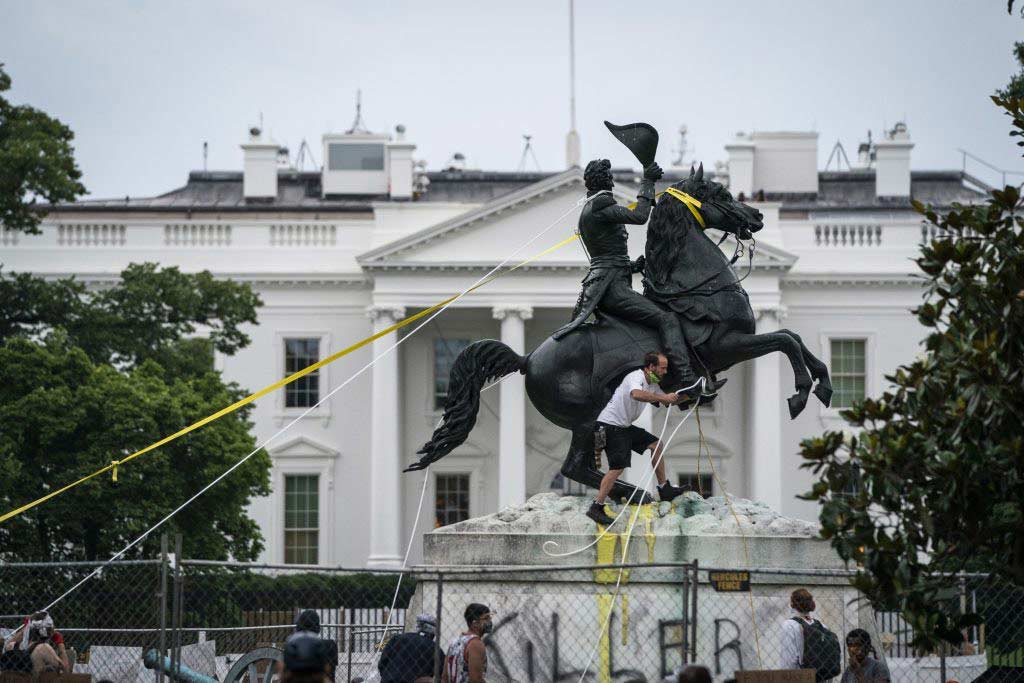
Protesters try to pull down a statue of Andrew Jackson in Lafayette Square near the White House on Monday, June 22, 2020. (Photo by Drew Angerer / Getty Images)
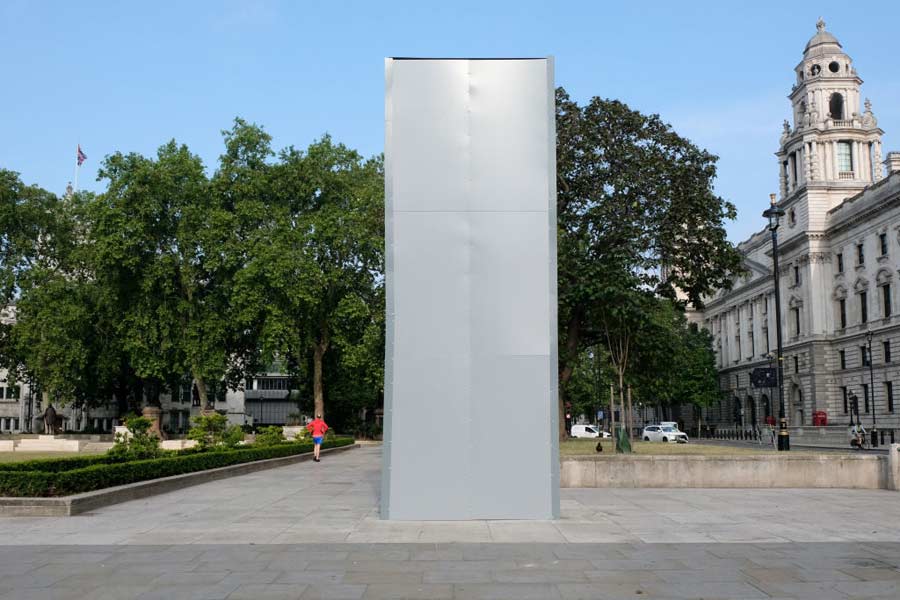
A statue of Winston Churchill is protected before protests in London. (Photo by Matthew Chattle/Barcroft Media via Getty Images)
Might we also consider a way to ritualize our destruction of the past – to transform it into some communal sacrifice designed to maximize the symbolic and cathartic act of abnegation? Now that we are all too civilized to enjoy the spectacle of public executions, maybe we can channel our collective bloodlust into the ceremonial slaughter of our forefathers in effigy.
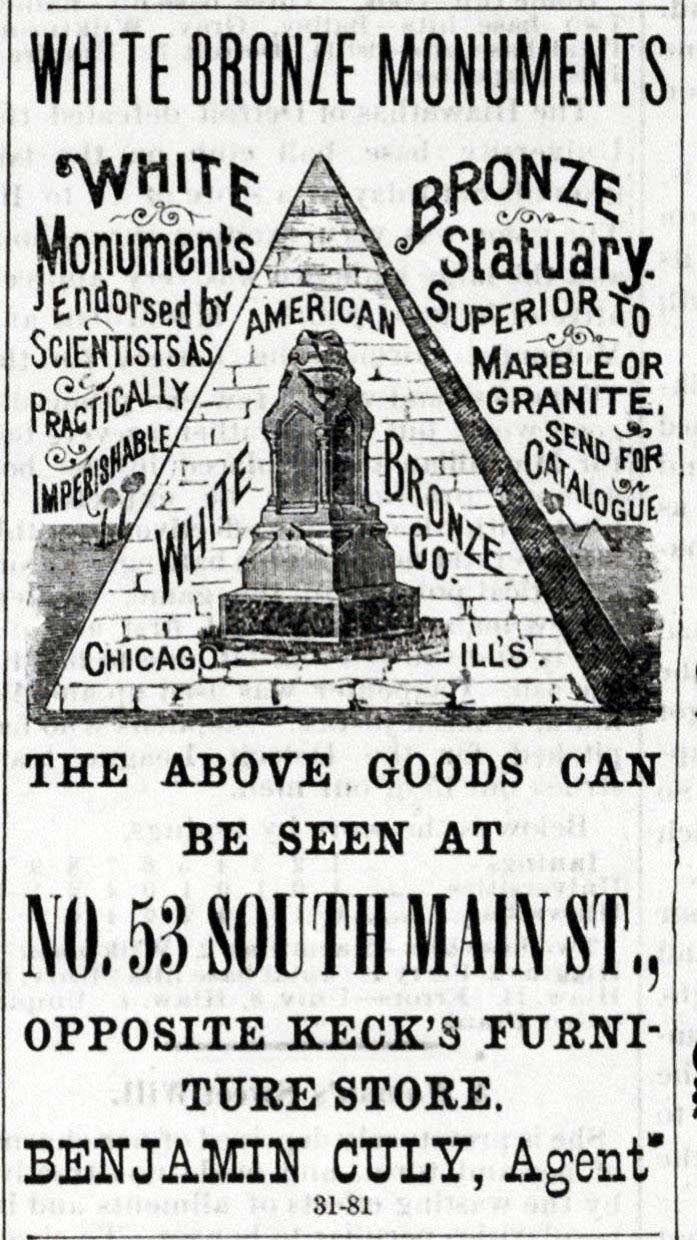
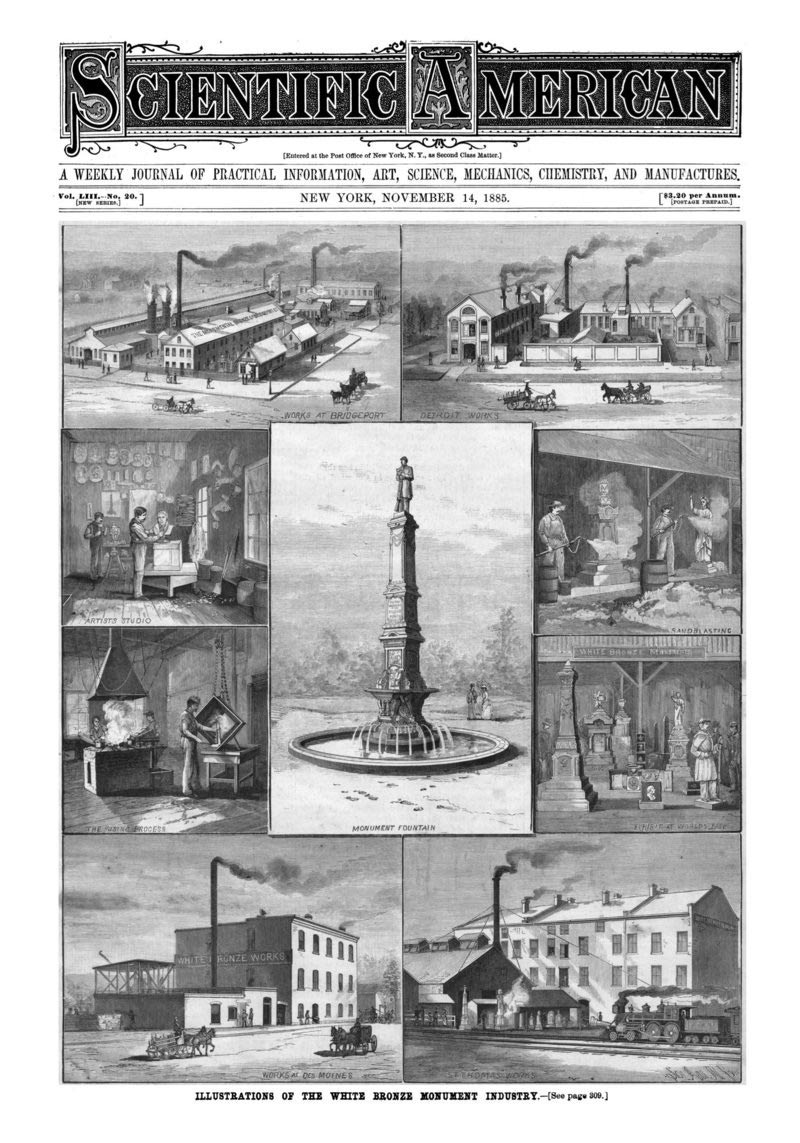
White Bronze Monuments advertisement in Ann Arbor Courier 1887
Scientific American 1885
National Fine Art Foundry ad 1892
Any monument that speaks to the ideology of oppression or the wealth accrued through exploitation needs to be extricated from the heart of our public spaces. But to treat them as effigies to be defaced, toppled or thrown in the nearest body of water seems to re-enact cycles of abuse going back to the lynchings that accompanied their consecration. It would be nice to think we can be smarter than a mob when it comes to cultural artifacts, no matter how despicable they may be.
Destruction, Preservation, and Old/New Historical Narratives
Voltaire probably got it right when he said, “History never repeats itself. Man always does.” We’ve been defacing the visages of the powerful and unceremoniously toppling monuments for a very long time now. Defacement is a ritualized power trip, found in many African cultures where masks functioned as highly coded visages of empowerment.
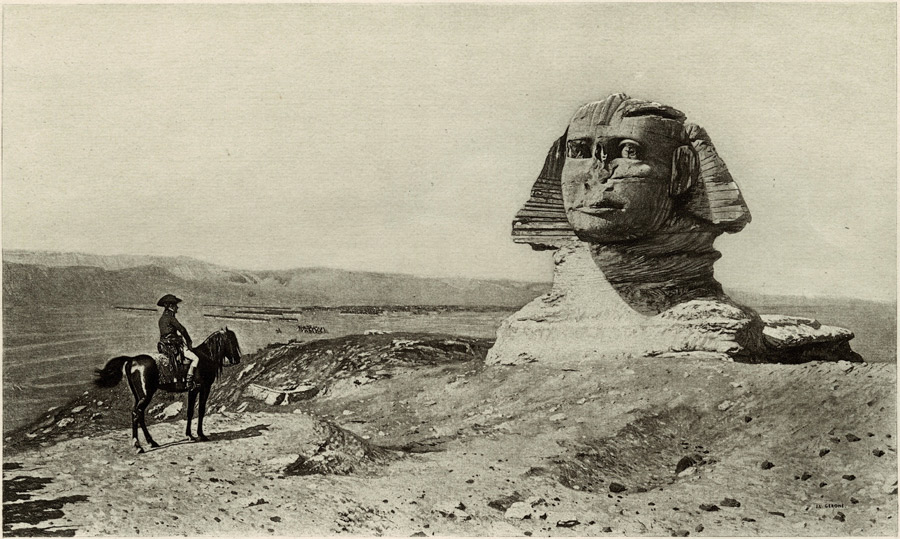
That power trip lurked in the systematic castration of countless Greek and Roman statues, and was epitomized by General Napoleon ordering his troops to shoot the noses off the sphinxes when they marched through Egypt. If monuments must fall, as most eventually do, let’s offer them the ultimate indignity of just lying there unattended in their neglect, a new kind of picturesque in the spirit of all those 18th Century paintings of ancient ruins – updated to meet the visual standards of our post-industrial ruin-porn photography.
Vintage engraving of Napoleon Bonaparte before the Sphinx, after the painting by J L Gerome.
Repurposing our monuments, especially in this time of ecological awareness and knowledge of growing scarcities certainly makes some sense. Though certainly a far greater artistic loss than, say, any works by the preeminent Confederate monument sculptor Moses Jacob Ezekial, you have to appreciate how rather than simply dispense of Michelangelo’s Statue of Pope Julius II (aptly known as the Warrior Pope and much admired by Machiavelli) the good citizens melted it down and turned it into a cannon. It was almost as poetic as the second life given a statue of James II in 1689 when it was similarly melted and turned into church bells.
If we begin all this with the premise that most monuments are rendered ugly, vulgar, and pointless over time, can we recognize what importance they may have much further down the line of history?
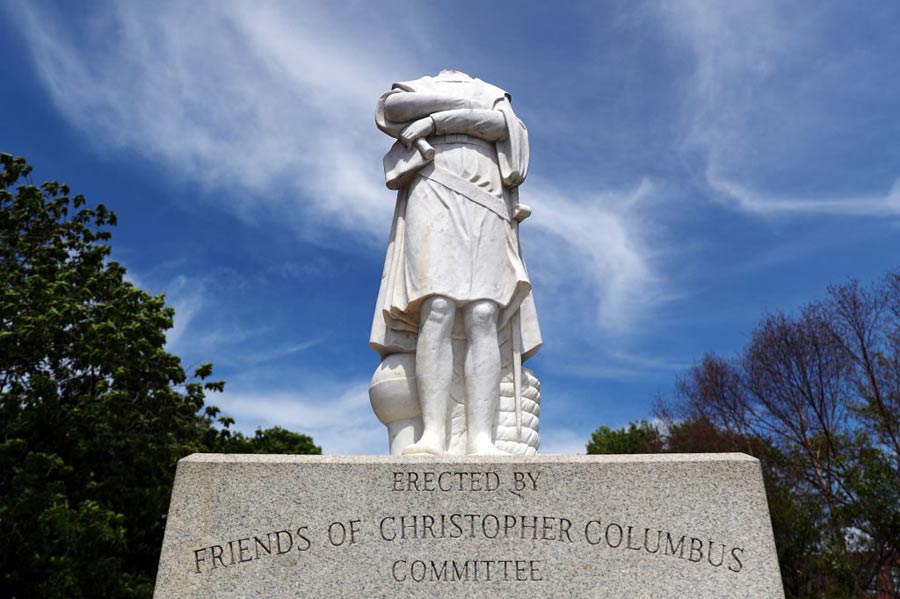
A statue depicting Christopher Columbus is seen with its head removed at Christopher Columbus Waterfront Park on June 10, 2020 in Boston, Massachusetts. (Photo by Tim Bradbury/Getty Images)
Don’t you agree that these things are better when planned? What we are experiencing now in cities across the Western World is only the tip of the iceberg when it comes to imagining a revisionist history. It is nothing yet compared to the wholesale destruction of didactic artifacts that ensues with the collapse of an empire. Julius Caesar once ruled over much of the world, but you don’t find statues of him on view in all corners of his former domain. Let’s guess that whatever survived the turn of history to end up in a museum is probably worth something, historically if not artistically. It’s hard to hold a grudge for that long. Value eventually accrues to all that is discarded.
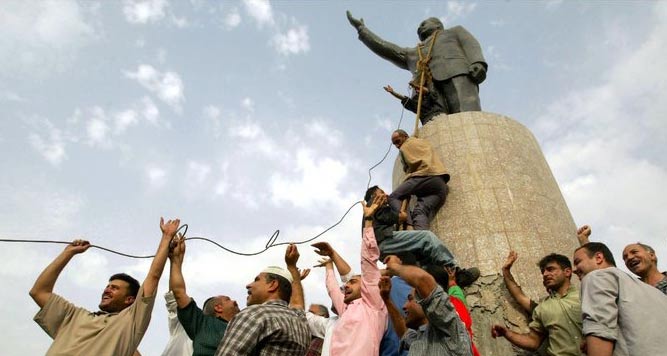
Toppling a statue of Saddam Hussein On April 9, 2003 In Baghdad, Iraq. (Photo by Gilles BASSIGNAC/Gamma-Rapho via Getty Images)
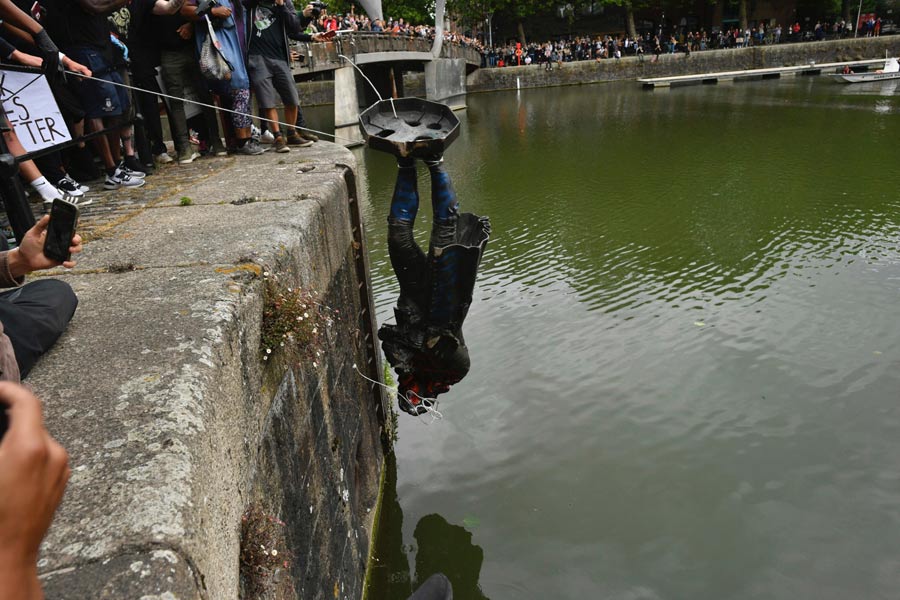
Protesters throw a statue of slave trader Edward Colston into the Bristol harbor during a Black Lives Matter protest rally in Bristol, England. 2020. (Photo by Ben Birchall/AP)
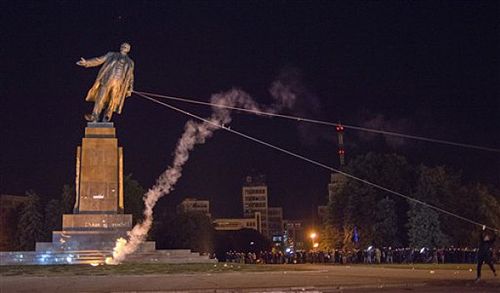
In recent memory certainly nothing compares to the massive purging of Soviet statuary that followed the fall of communism in 1989. In the Ukraine alone five and a half thousand statues of Lenin were pulled down in the main period of Leninfall in 2013 and 2014. You can’t blame any populace for wanting to take revenge on the surrogate likenesses of those who have made their very lives so miserable, but for all our righteous rage let us always keep a place in our heart for the example of Alexandre Lenoir who did so much to save historic monuments during the French Revolution.
A statue of Lenin is pulled down in Kharkiv, Eastern Ukraine. (Wikipedia)
As curator of the Museum of French Monuments, a once-grand museum founded only two years after the Louvre opened, Lenoir facilitated a way that paved the route for those immense treasures eventually to return to great cathedrals like Saint-Denis and Notre Dame – as well as to museums ranging from the Metropolitan in New York and the Victoria and Albert in London. Many of the greatest works from the Medieval era were preserved; establishing the very notion of heritage that is central to our cultural understanding of preservation. If we begin all this with the premise that most monuments are rendered ugly, vulgar, and pointless over time, can we recognize what importance they may have much further down the line of history?
Tamed down from whatever irascible grace they once possessed, their works began to fit an increasingly narrow aesthetic bandwidth of unsophisticated acquisition boards more concerned with not offending anyone than provoking a meaningful public discourse.
Blanding and the Effect of Corporate Perverting of Public Art
I cannot presume my cul de sac of concerns regarding the history of monuments would have much, if any, relevance to contemporary artists working in public space or to activists set on dismantling their coercive strategies, but I can hope we all find a way to keep considering these issues in some measure.
For one I would like all my friends who are killing it right now with an ongoing prolific schedule of massive public and private commissions to look at what happened to some of the great modernist sculptors when corporate art replaced the public monuments in the post-war period. It is not hard to see the deleterious effects on the work of artists like Isamu Noguchi, Henry Moore, Alexander Calder, and Claes Oldenburg when they started churning out their art in increasingly formulaic fashion. Tamed down from whatever irascible grace they once possessed, their works began to fit an increasingly narrow aesthetic bandwidth of unsophisticated acquisition boards more concerned with not offending anyone than provoking a meaningful public discourse.
Far be it from me to judge how any artist makes their money, or even how much money they want to make, but we would all do ourselves a service if we keep in mind the fundamental difference between street art that serves the spirit of the people versus corporate monumentality that serves the interests of a narrow-minded few.
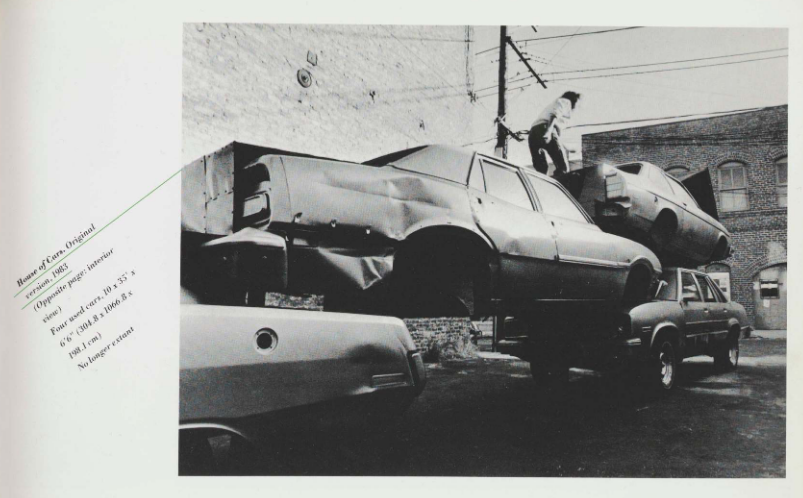
Vito Acconci, “House of Cars” (MOMA catalogue)
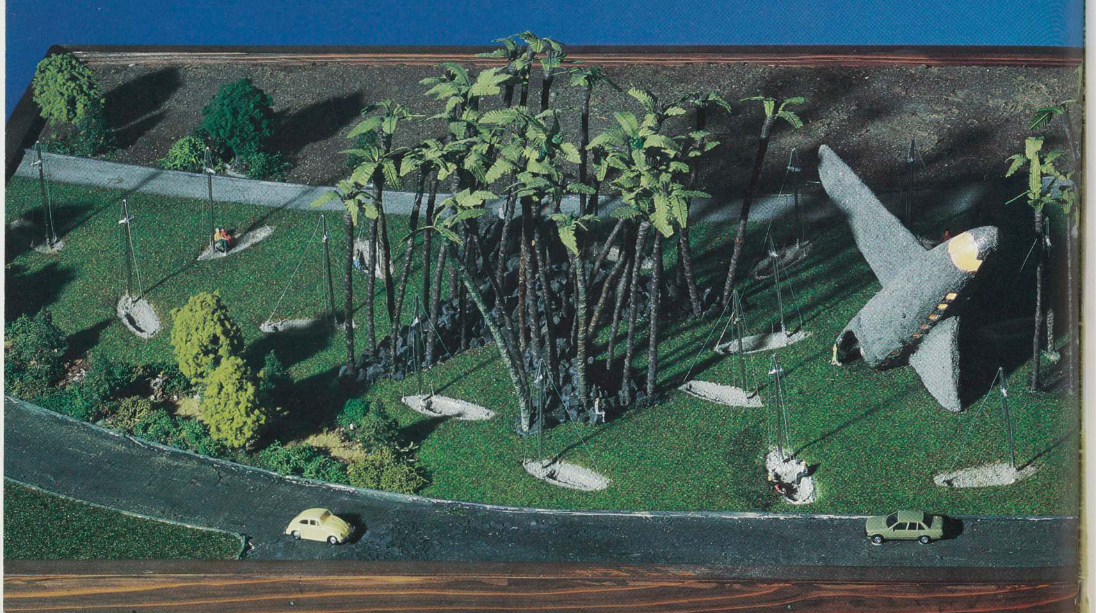
Vito Acconci, “Proposal for Spanish Landing” (MOMA catalogue)
These are all only questions, or problems as they may be, and it is never the job of any critic to tell artists what to do, only to simply applaud what is done well. I cannot help but think here of Vito Acconci, who after being a poet turned performance artist, existed for a number of years as a public art sculptor before finally ending his career in his last clownish dance with disquieting subversion by impersonating an architect.
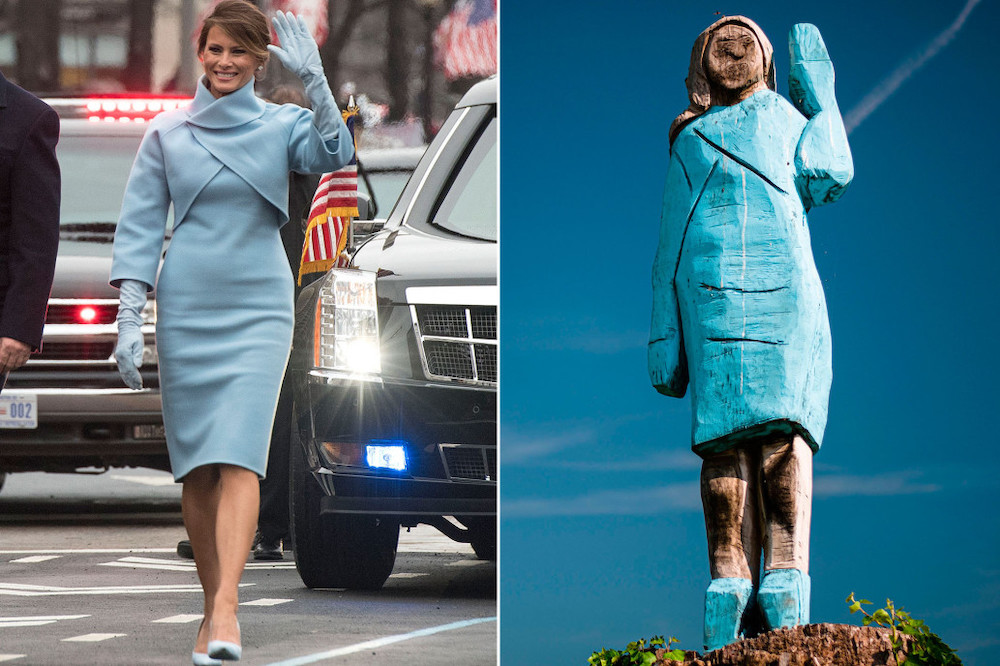
His public art was hardly much of a market success and it often flirted with outright disaster, as when he unwittingly buried a plane in the ground outside an airport where a major plane crash had occurred. However his radical efforts ranged from burying a house upside down in the ground so that you made your way climbing to the top floors by subterranean descent to a spectacle of two cars fucking through the windows of the World Financial Center. That work suggested a less predictable and complacent position for public art. Perhaps it is one that is exhibited by few today and one that fewer are working toward – aside from, say, Brad Downey with his monument to Melania Trump in Slovenia.
Brad Downey with Aleš “Maxi” Župevc created a statue of First Lady Melania Trump in Slovenia, 2019.
To re-imagine the monument today maybe we might best do so not by an act of collective amnesia but by embracing their role in memoriam; that is to remember the function of memory. There’s no telling where this will lead us, perhaps to no more than a post-modern pastiche that will be just as problematic to the future as our inherited pasts are to us. But we may garner more from contending with the language of history than eradicating it in a campaign of erasure.
Repurposing, Mockery, Monumental Abuse and Vulgarity
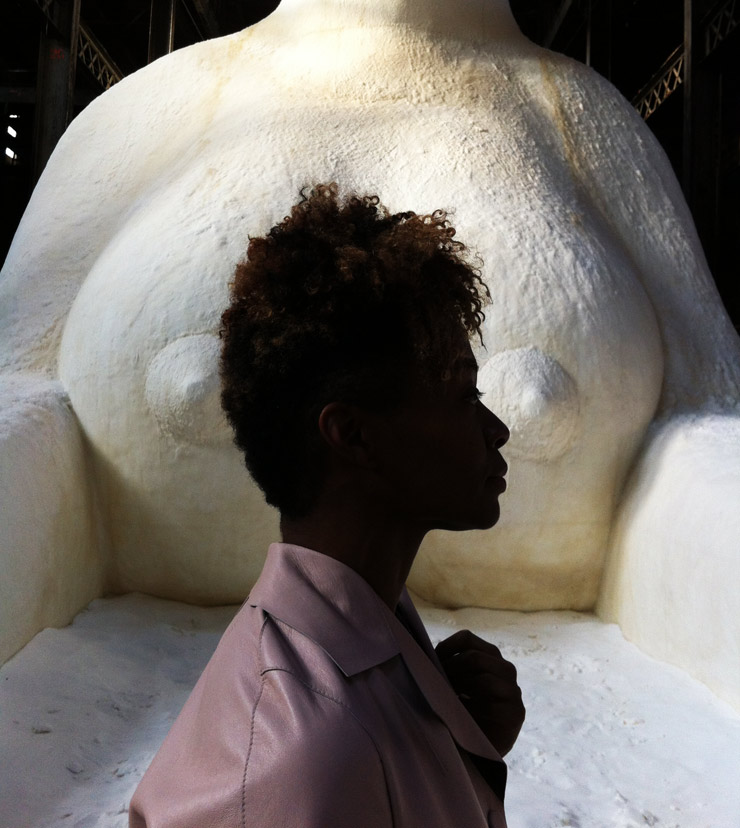
Kara Walker (Photo by Jaime Rojo)
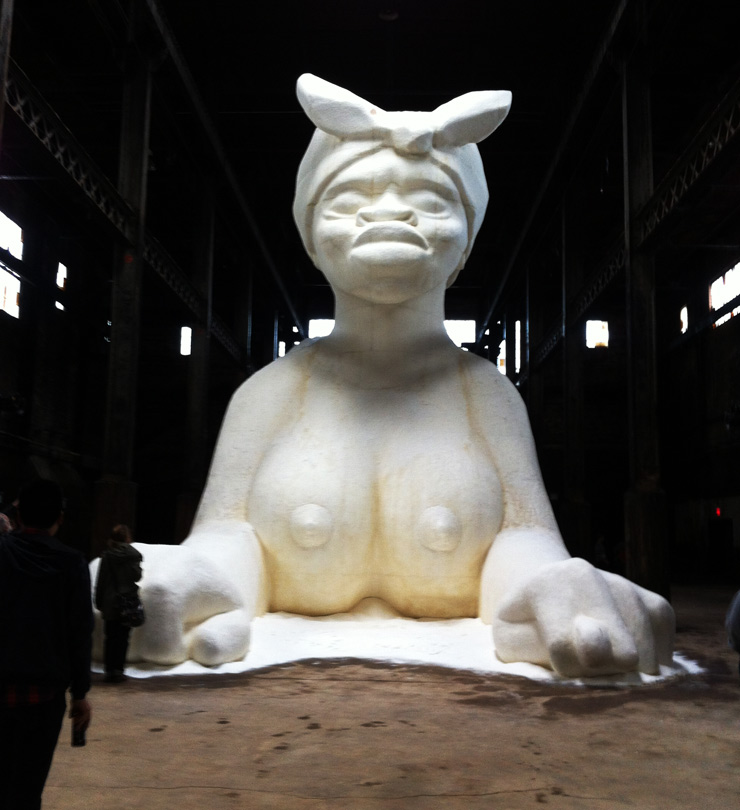
Kara Walker “A Subtlety: or the Marvelous Sugar Baby“ “an Homage to the unpaid and overworked Artisans who have refined our Sweet tastes from the cane fields to the Kitchens of the New World on the Occasion of the demolition of the Domino Sugar Refining Plant” with Creative Time, 2014
Some of the best monuments of recent years have done just that: either by repurposing the language of monumentality to fit contemporary concerns, such as the Guerilla Girls “Code of Ethics” erected on the High Line in 2019, Jeffrey Gibson’s “Before you Enter My House It Becomes Our House” in Socrates Sculpture Park 2020, Kara Walker’s “A Subtlety” a sphinx made out of sugar shown at the old Domino Sugar factory in 2014, her “Fons Americanus” at the Tate in 2019, Ai Wei Wei’s “Fountain of Light” remake of Tatlin’s Tower out of glass crystals now at the Louvre Abu Dhabi, Kehinde Wiley’s “Rumor’s of War” that debuted in Times Square in 2019, and Zhao Zhao’s “The Broken Officer” of 2011.
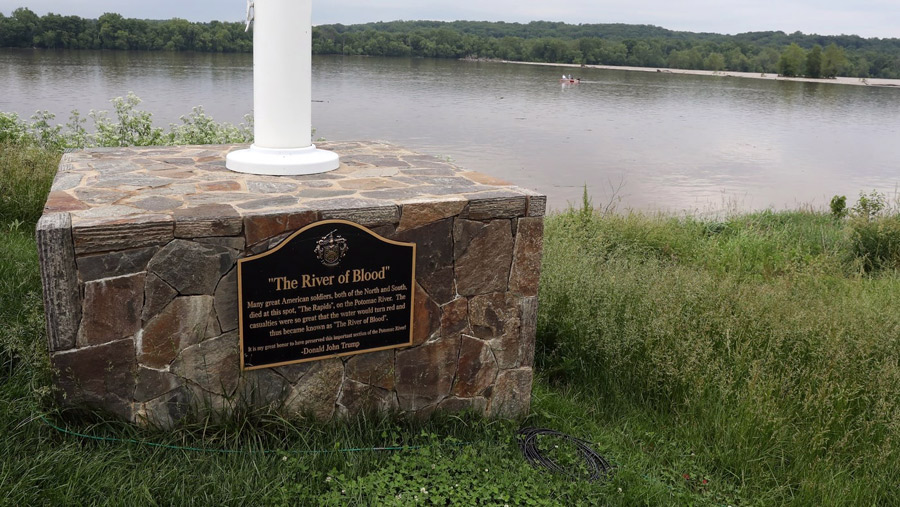
Many great American soldiers, both of the North and South, died at this spot, “The Rapids” on the Potomac River. The casualties were so great that the water would turn red and thus became known as the River of Blood. It is my great honor to have preserved this important section of the Potomac River Donald John Trump
There are effective ways of making mockery of monuments’ historical certainty in ways that range from the “River of Blood” plaque at one of Donald Trump’s golf clubs in Virginia that falsely claims to be the site of a fictitious Civil War battle and Joseph Reginella’s “Ed Koch Wolf Foundation” monument to the many tourists who go missing in New York City every year that he put up in Battery Park in 2019.
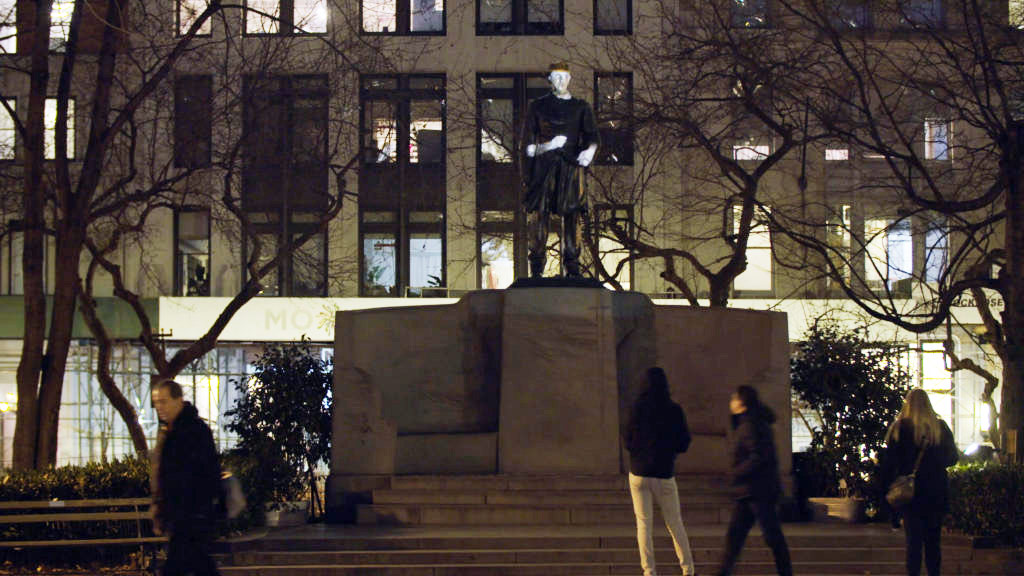
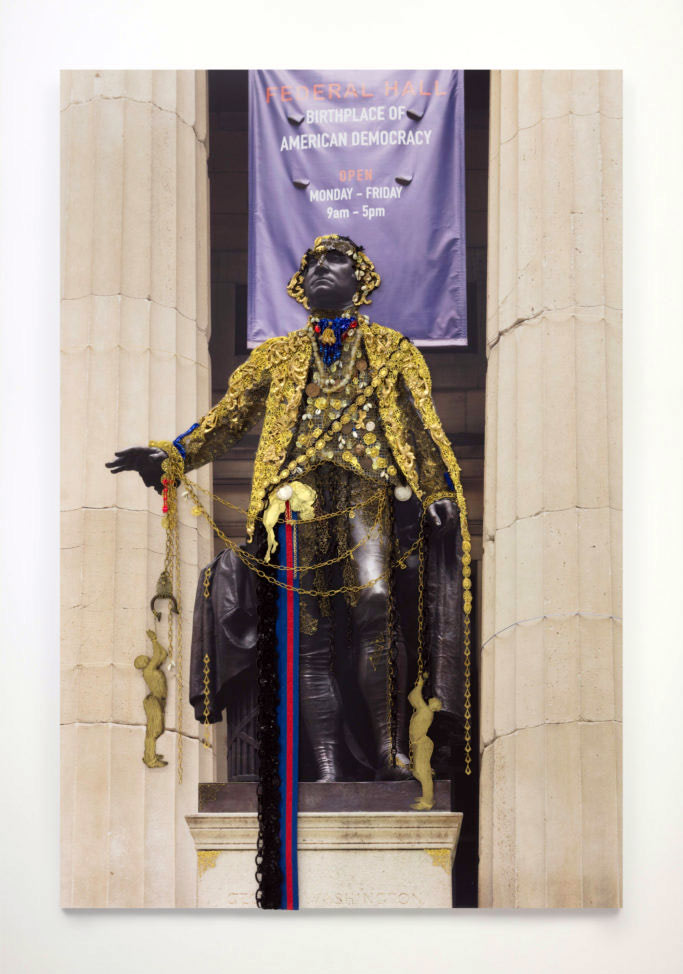
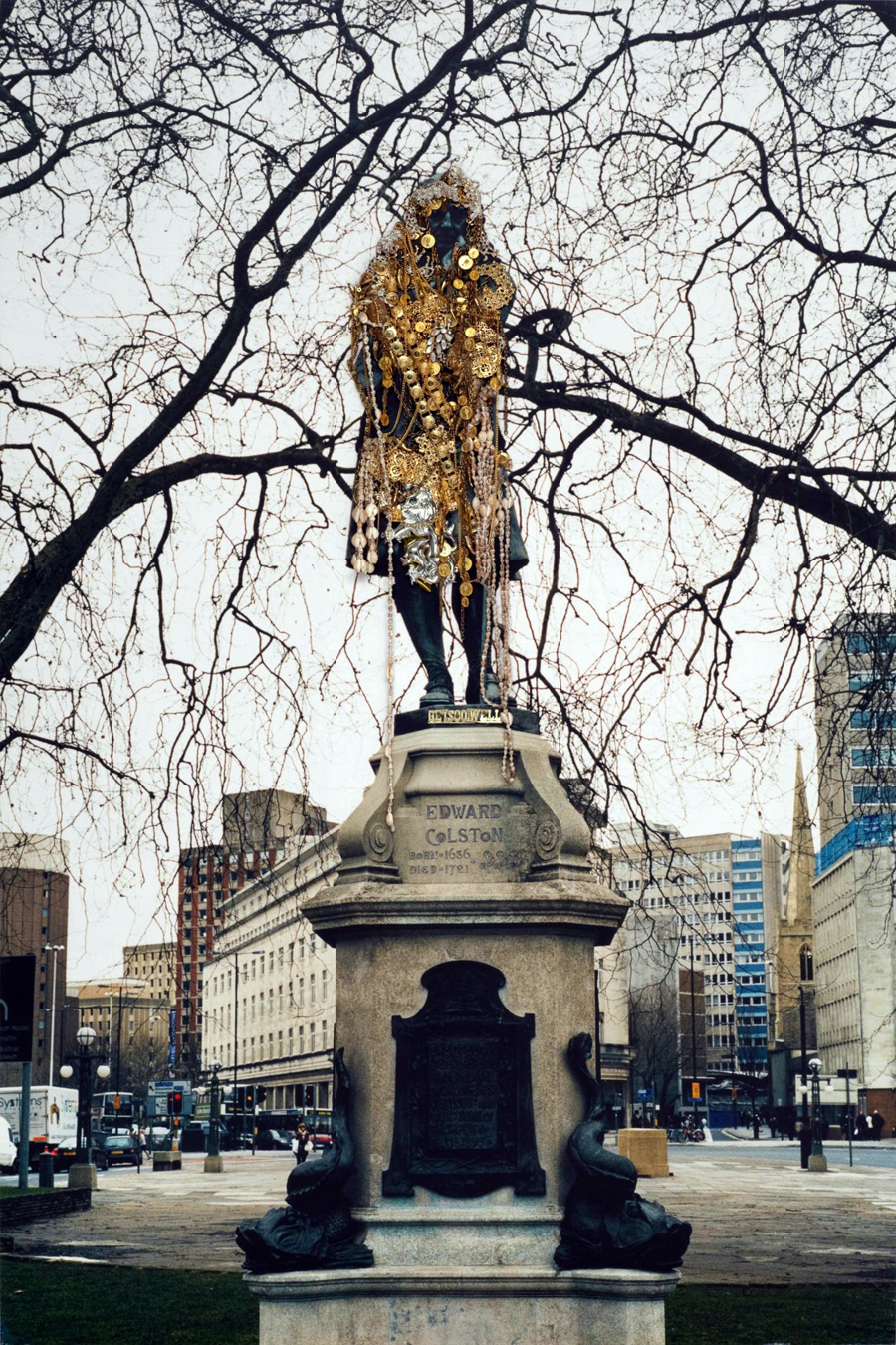
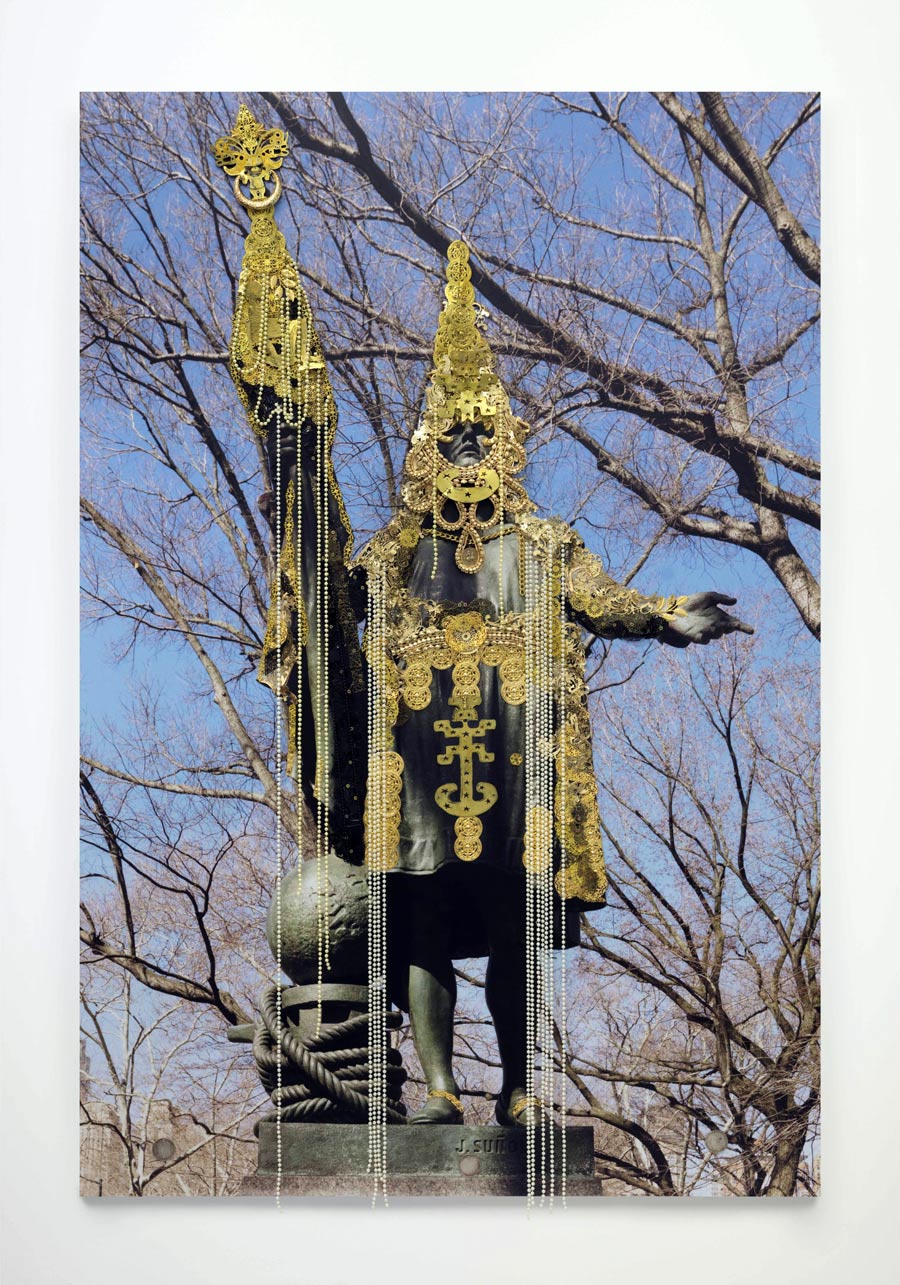
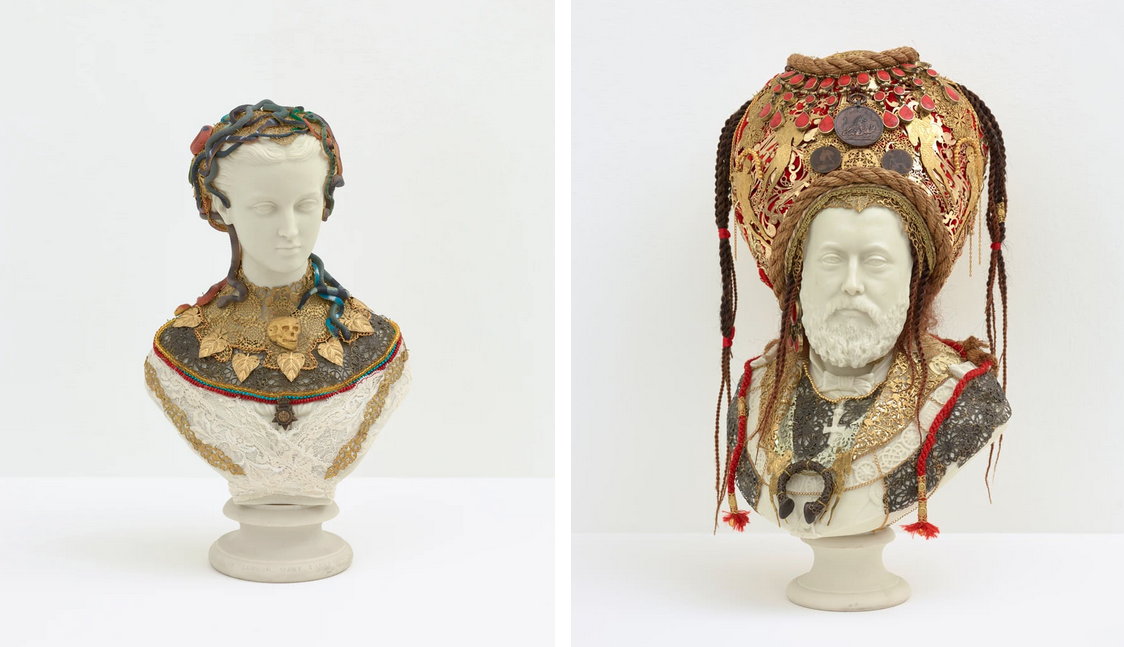
Other aesthetic and political interventions are created on pre-existing monuments such as Krzysztof Wodiczko “Monument for the Living” that did in Madison Square Park in New York in 2020, and the “Restoration” series by the Guyanese descent British sculptor Hew Locke first shown at St. Thomas the Martyr Church, Bristol.
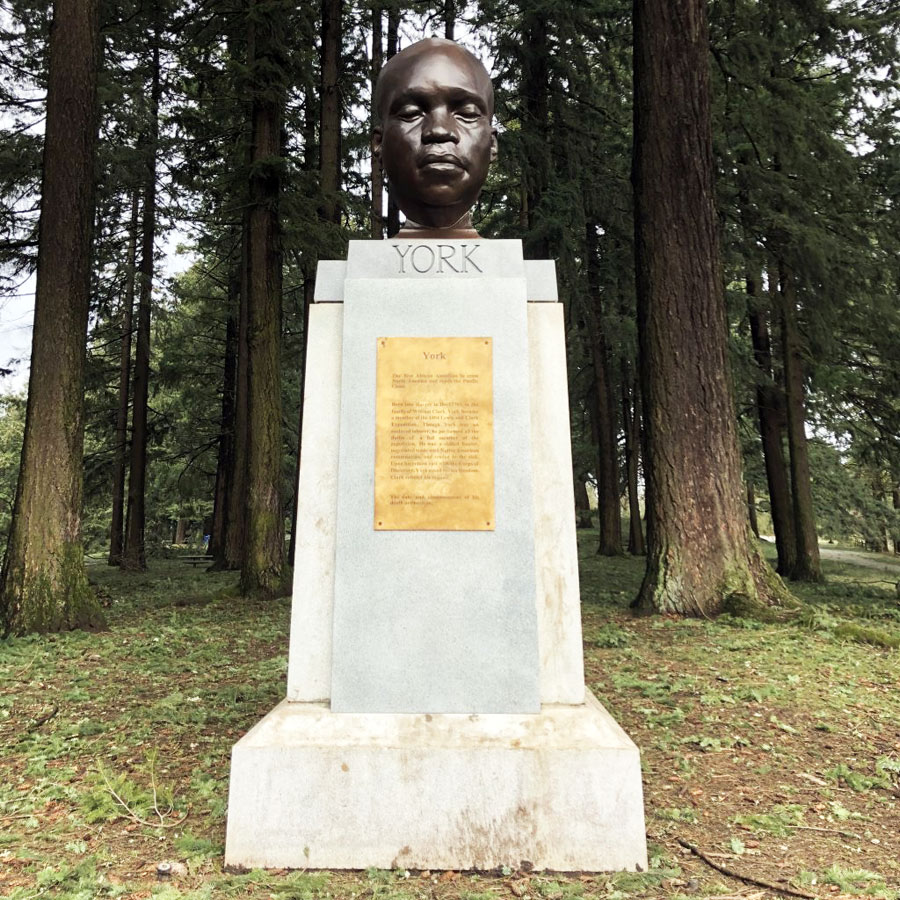
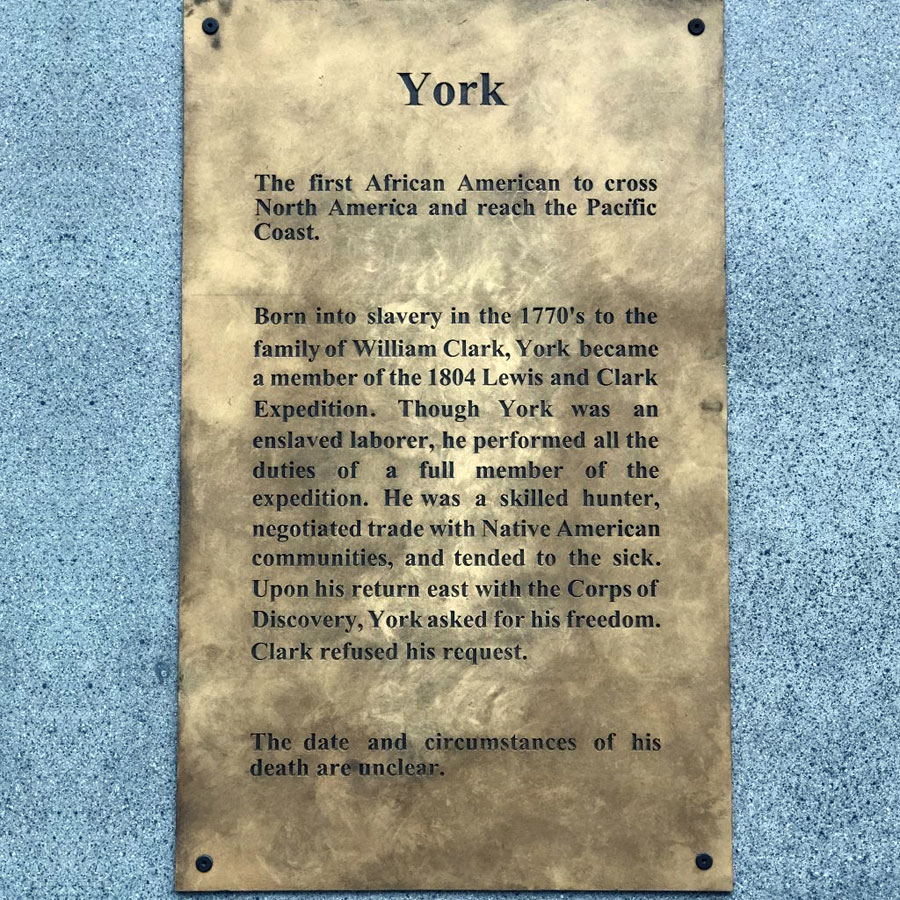
Lastly, we might also consider those artists who have made monumental the abuse and disabuse of monuments, such as the artist who put up a bust of York, the enslaved lone African-American member of the Lewis and Clark expedition, on the vacant plinth of a toppled monument in Portland, Oregon, or the ongoing “Proposals for Monuments” series by Sam Durant, artworks that themselves function as an archive for the expanding history of toppled monuments.
Hew Locke, Washington, Federal Hall, 2018
Hew Locke,”Colston (Restoration series)” 2008 (Photo by Indra Khanna)
Hew Locke, Columbus, Central Park, 2018 Chromogenic print with mixed media
Hew Locke, Souvenir 10 (Princess Alexandra), 2019 mixed media on antique Parian ware / Souvenir 8 (Edward VII in Masonic Regalia), 2019
However the myriad approaches to this problem of our monumental shame may vary, what is plainly clear is that no matter how we try to dismiss monuments as ugly and vulgar, or wipe them away as simply wrong, their unwanted and unwarranted presence will be with us for quite some time.
(photo by Tessa Hughes-Freeland)
Carlo McCormick
Carlo McCormick is an art and culture critic and curator based in New York City as well as the author of numerous books, monographs, and catalogs on contemporary art and artists. His curatorial exhibitions include The Downtown Show: The New York Art Scene, 1974–1984 at New York University (New York) and The Andy Warhol Museum (Pittsburgh, Pennsylvania), Magic City : The Art of the Street (Dresden and Munich, Germany and Stockholm, Sweden), Elements of Style at Seoul Art Center (Seoul, Korea), and RAMMΣLLZΣΣ: Racing for Thunder (New York).
The era of fractured attention spans, heightened emotions, and ravaged hierarchical systems for ordering institutions, beliefs, and the truth is ripe for examination and dissection – even if it takes a looking glass to see it.
The anonymous art-activist thinkers at INDECLINE have spawned many interventions in the last decade in public space – intricate and smartly storied at times, obvious and deliberately provocative at others.
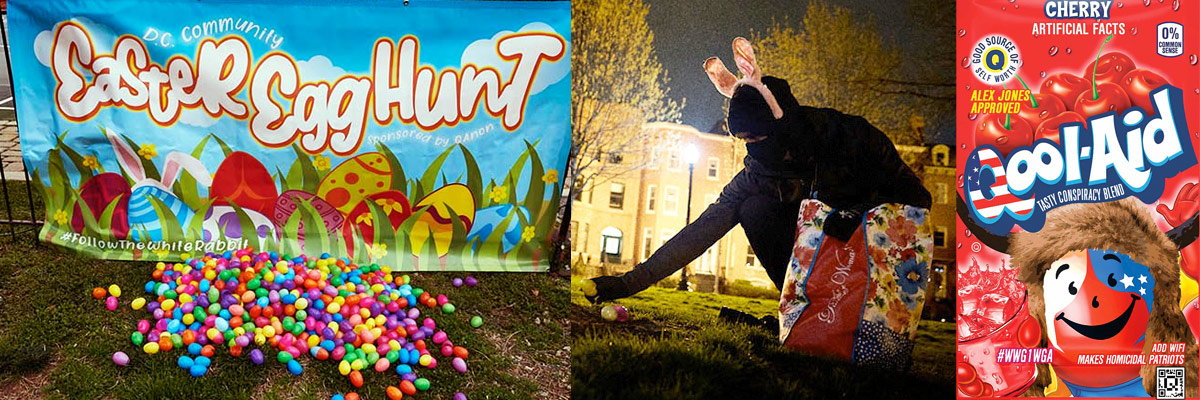
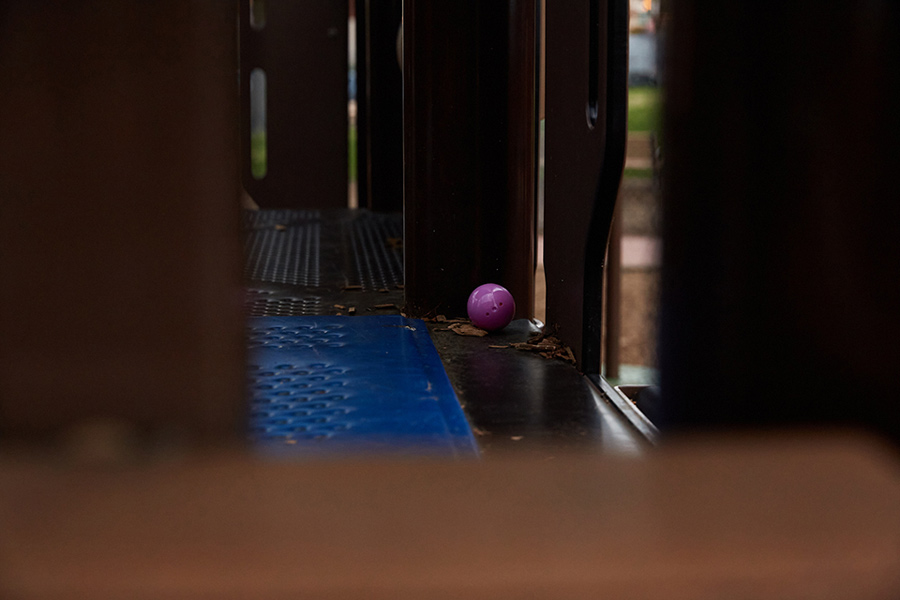
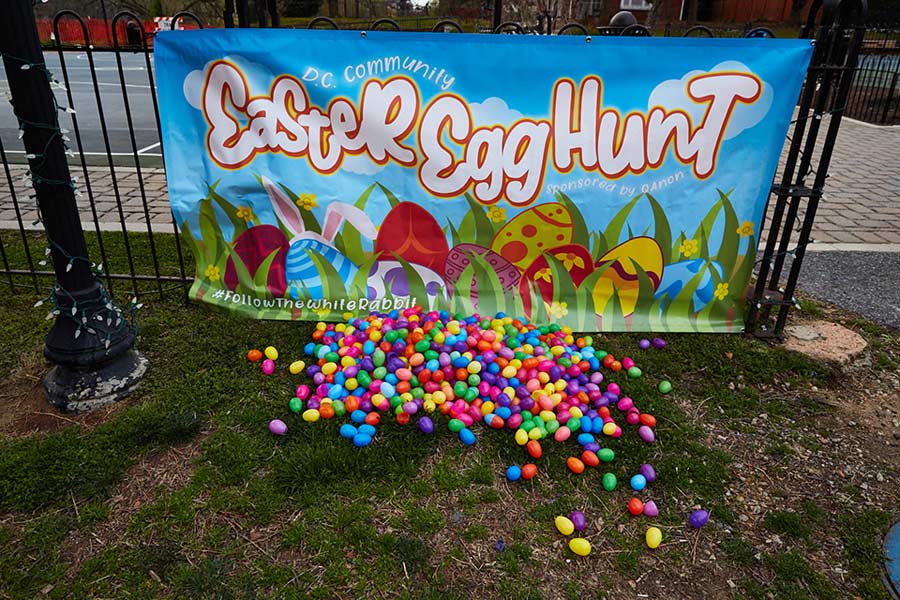
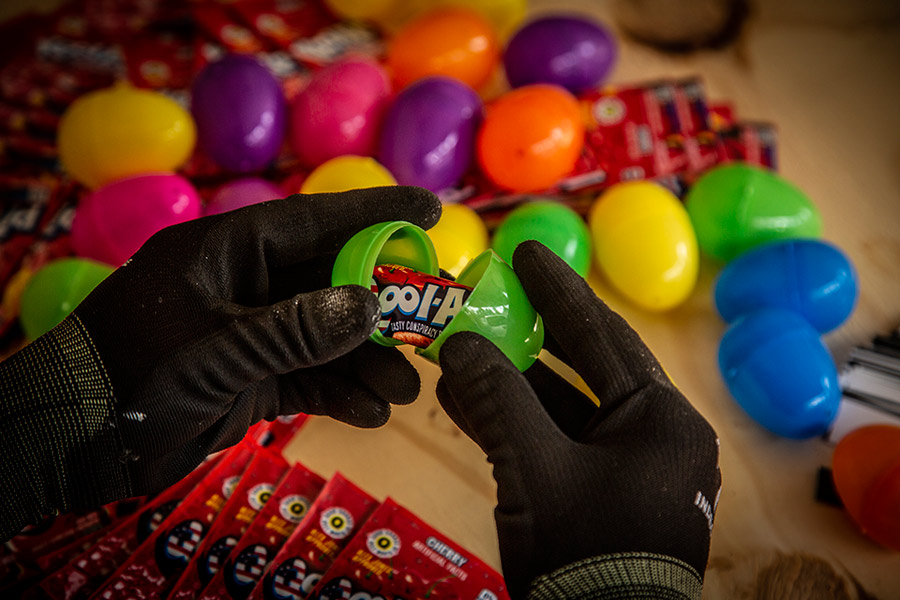
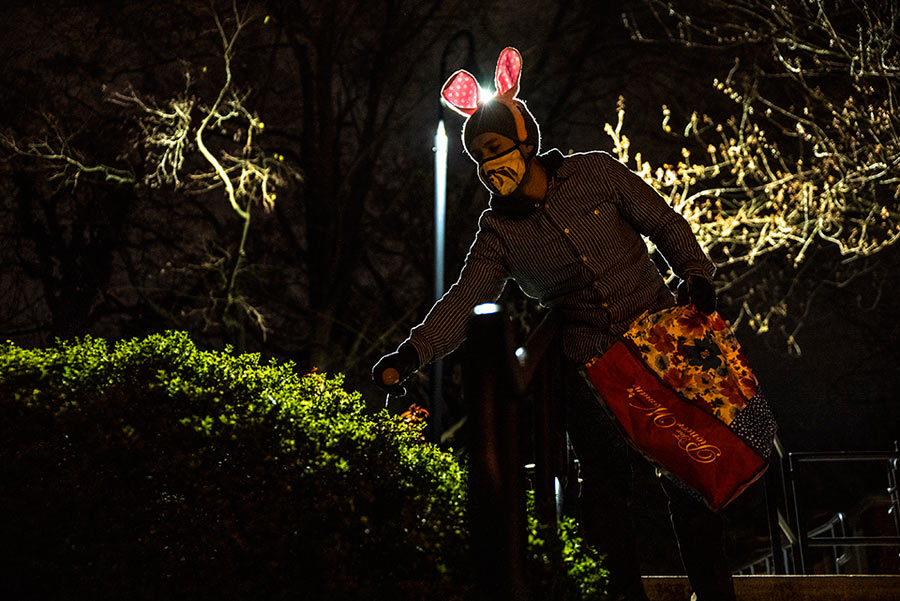
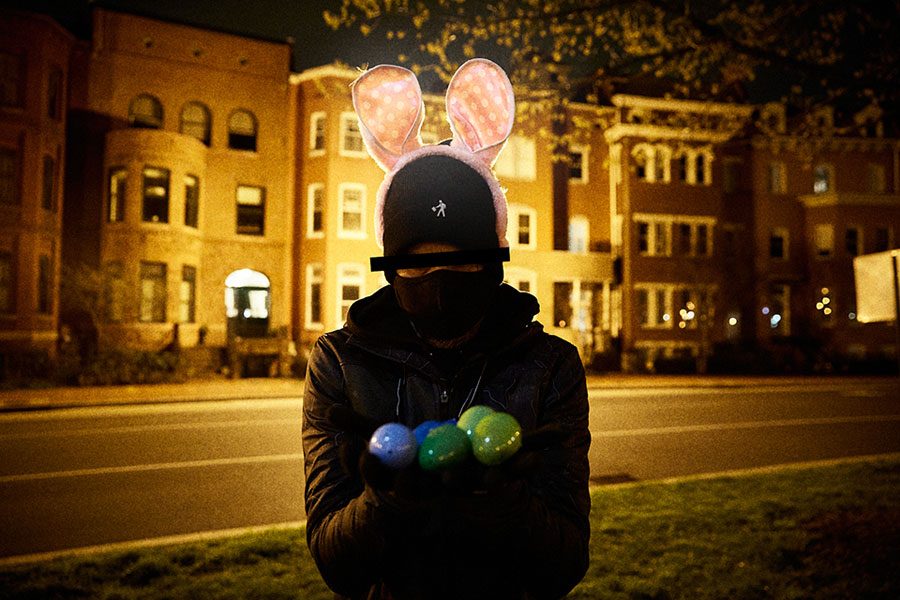
For Easter, we appreciate how they cleverly hopped between the pagan practices adapted to Christianity – namely the signs of spring and fertility – and the surrealist White Rabbit of Louis Carroll and the magical beliefs of so-called Q-Anon.
For children and adults of many generations, it has been an un-rewarding exercise to parse the bloody crucifixion of Christ who rises from the dead – combined with the story of a human-sized rabbit who breaks into your home at night to leave a colorful woven basket of decorated eggs, jelly beans, and bunnies made of chocolate. This all makes as much sense as the Q-Anon theories alleging that a secret cabal of Satan-worshipping, cannibalisticpedophiles who operate a global child sex-trafficking ring was plotting against former U.S. President Donald Trump while he was in office.
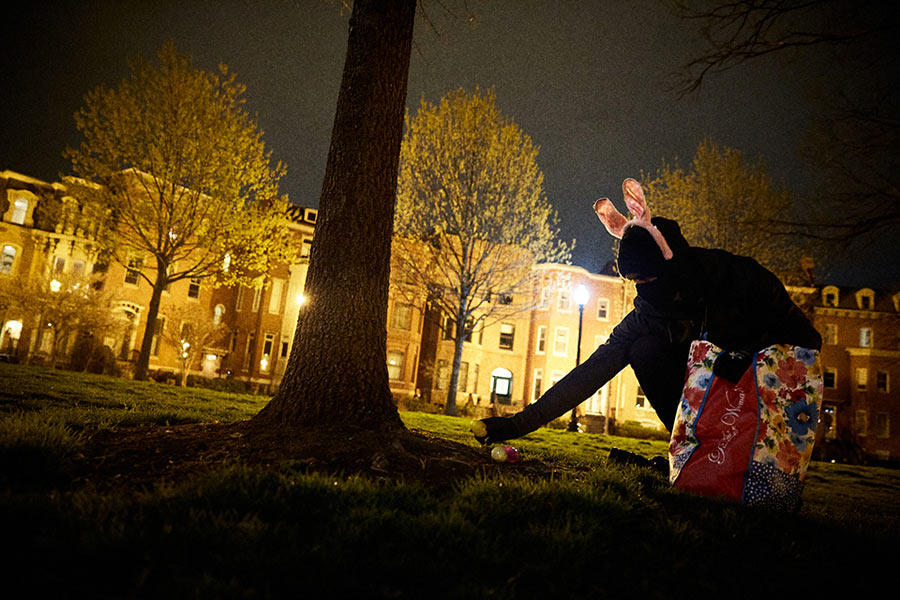
So while Washington DC is supposedly ringed in high-security apparatus since the capital riots, INDECLINE decided to hop through several parks – Garfield Park, Stanton Park, Lovejoy Park, Meridian Hill Park, Rose Park, Logan Circle, Kalorama Park, and Farragut Square – spreading their cheerful and colorful egg-hunt for presumably confused kids and parents to discover yesterday morning while Christians the world over proclaimed “He Is Risen.”
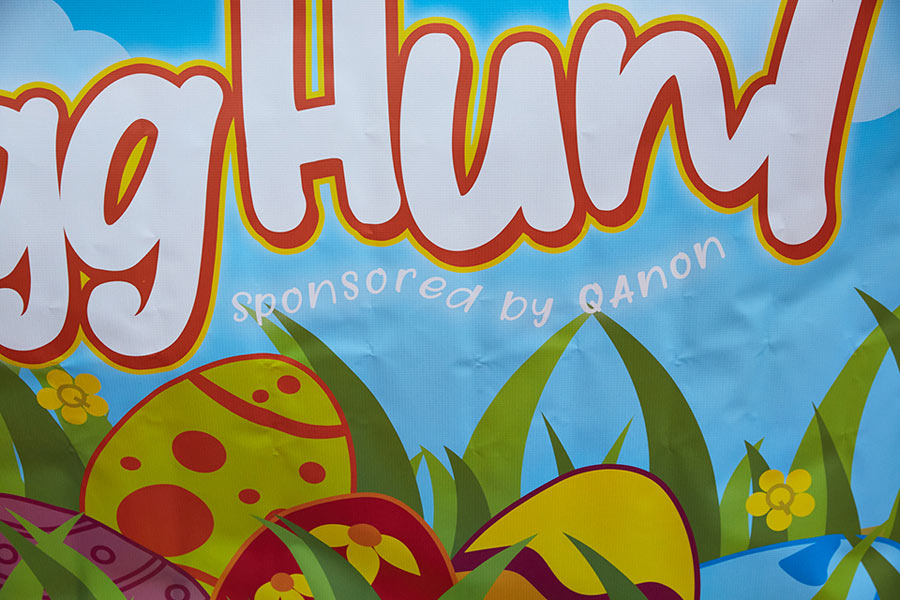
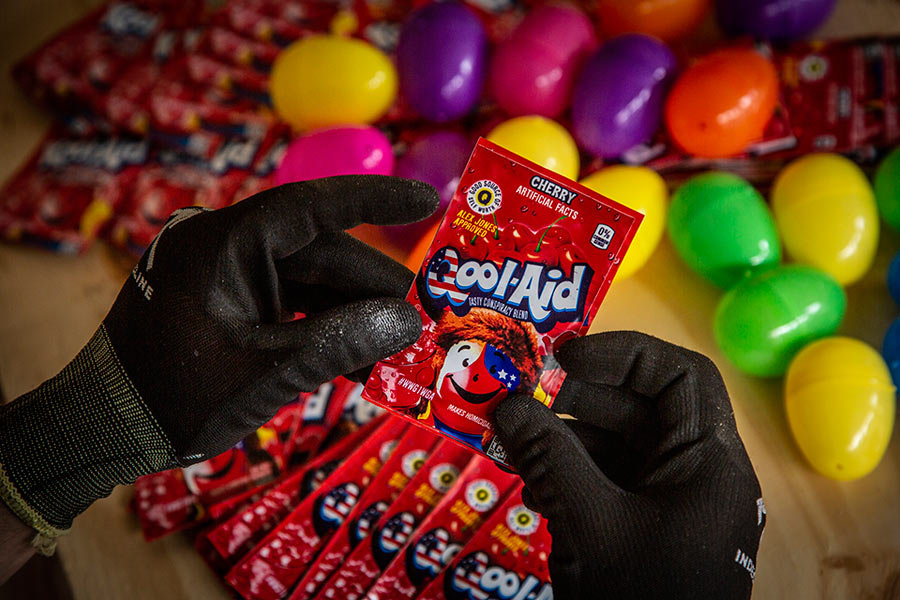
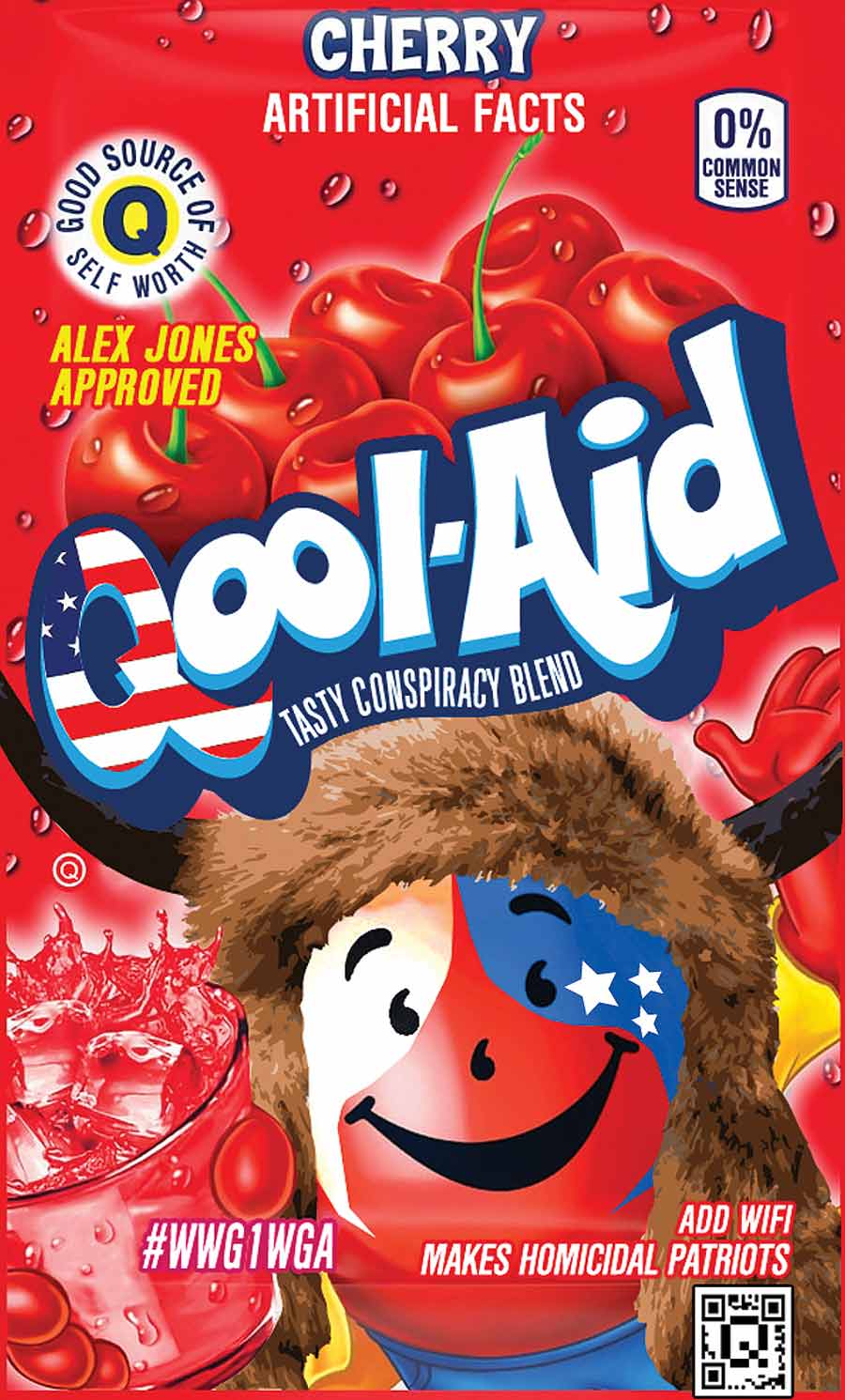
They also hung customized banners that mimicked the kind that may accompany a typical “Egg Hunt” on soft green lawns across parks nationally, subvertising an event sponsored by Q-Anon – filling eggs with packets of cleverly designed Qool-Aid.
An INDECLINE spokesperson says they chose Qanon as the focal point of this series of interactive, engaging public art installations precisely because of the wayward thinking that is necessary to support its evolving theories – and the many dangers of manipulation that are now at play.
“As far as conspiracies go,” they say in a statement, “QAnon has blazed a remarkable and confounding trail into the era of information, organizing itself as an interactive game where adherents are encouraged to become participants, crowdsourcing the narrative through a patchwork of YouTube tutorials and Facebook rants. Supposedly, Q, and insider, is leaving a trail of breadcrumbs for them to follow (originally across Reddit, then into the Chans), and as they collect enough, they are supposed to ‘bake’ them into a full-fledged narrative.”
As the military has gamified the hell of war for a generation of young men, today GenZ is gamifying the stock and currency markets and blockchain gallerists are gamifying art with NFTs, so why not gamify the disinformation industry that distracts us from the Rich v. Everybody battle that is firmly afoot in the 21st century? INDECLINE admits that “the gamified nature of the QAnon conspiracy is really the appeal.” What could possibly go wrong?
Happy Easter to all the Christians! Happy end of Passover to the Jews! – and welcome to a new spring of spiking daffodiles and spiking Covid cases in New York City even while the age for vaccinations drops to 16 this week. The graffiti and Street Art is blossoming under bridges and in empty lots, as are the much needed $1400 checks and PPP loans are blossoming as well. They are meant to keep us all barely above water, which is where many New Yorkers are financially.
Maybe the trillions that Biden and Yellen and the banksters are suddenly printing will lift us, or maybe instead they’ll just trigger hyperinflation so your savings will be worth ever less? Perhaps we could require corporations and the rich to pay their fair share of taxes – or any at all? Secular heresy to suggest such a thing!
Ahhhh, but the streets! They are still alive and well, and budding with small hand-made one-off pieces, multiples, and murals. Not quite a renaissance, but we are seeing a sincere march forward by all many of artistry in the shadows and in the broad daylight, even as Rome appears to languish.
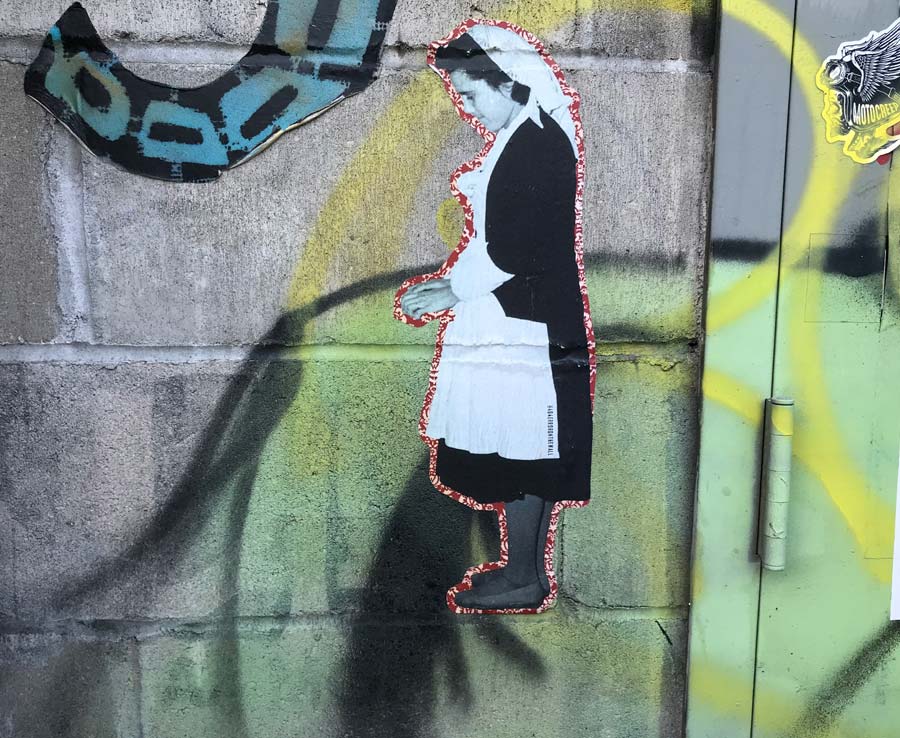
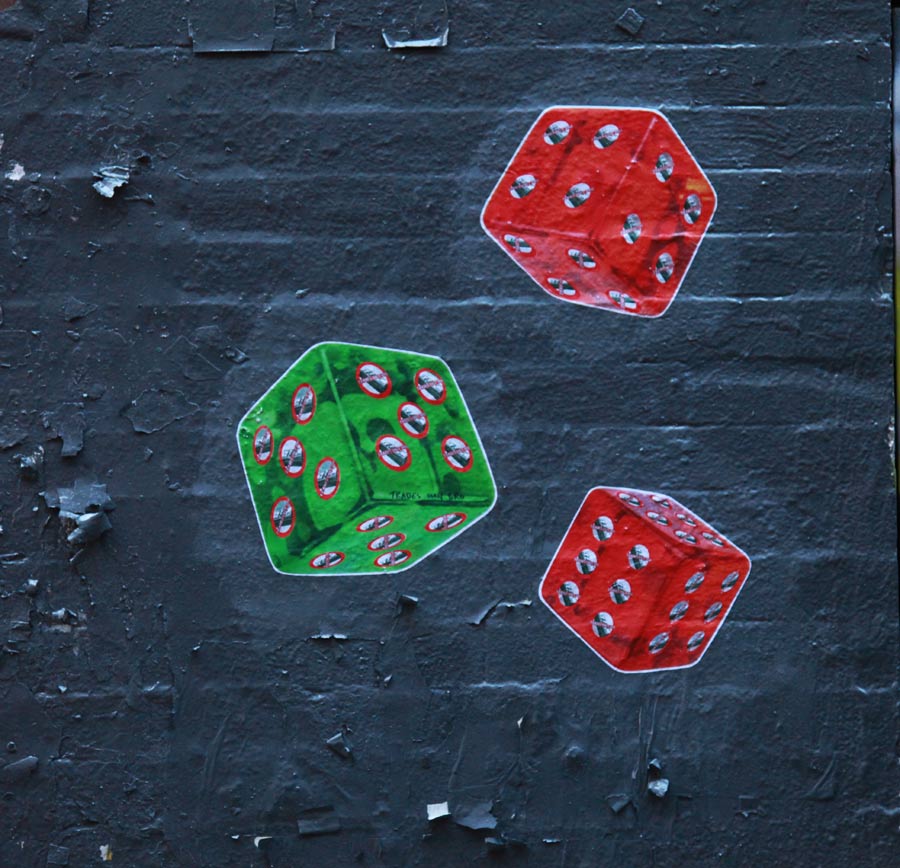
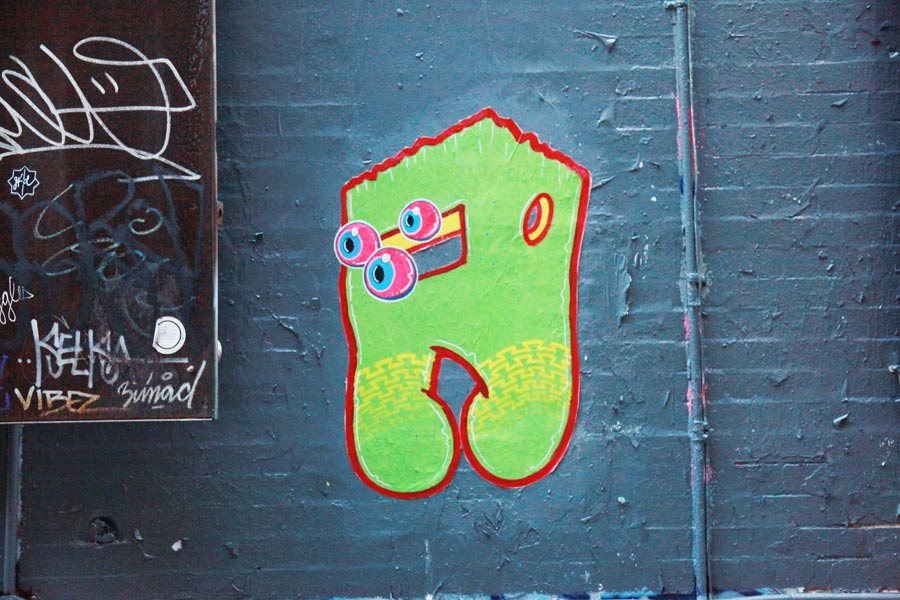
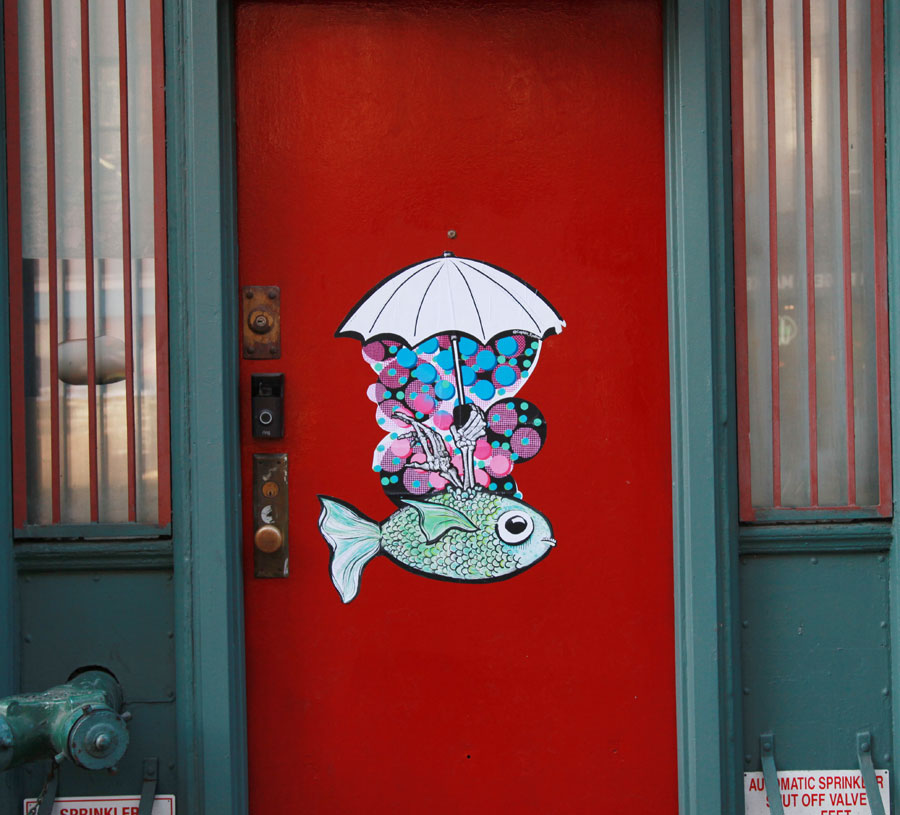
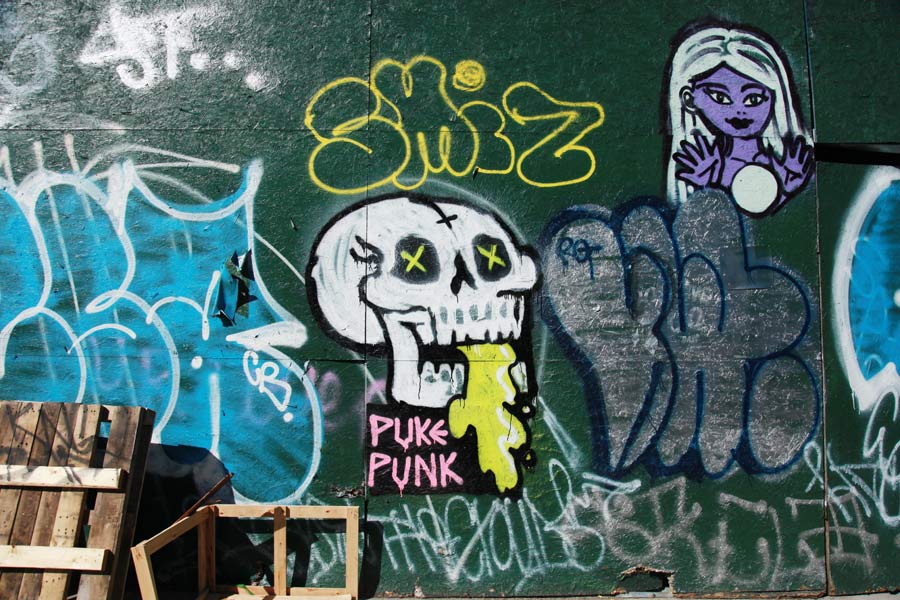
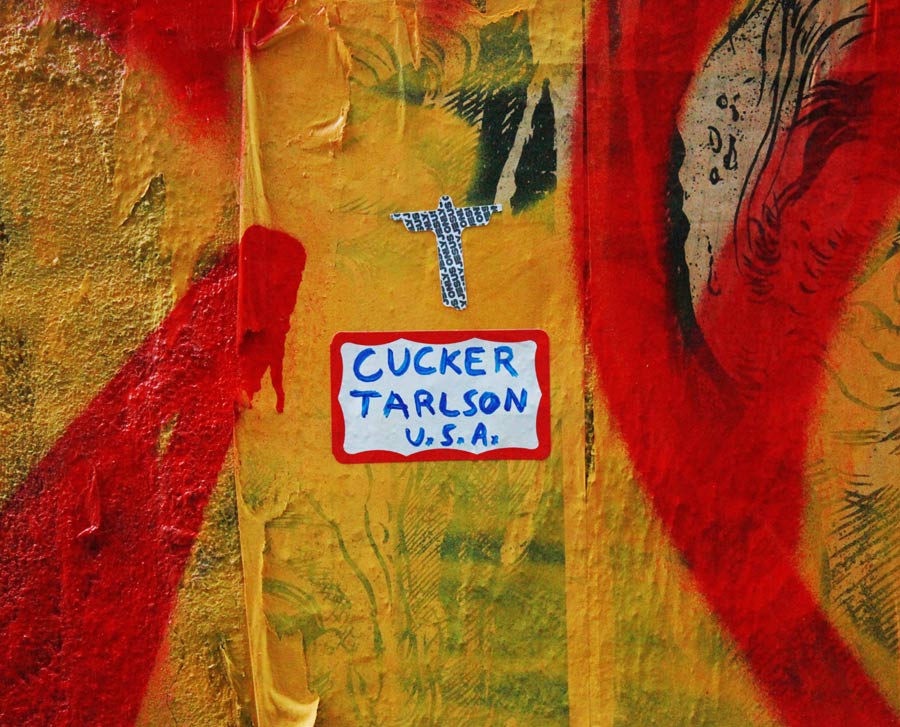
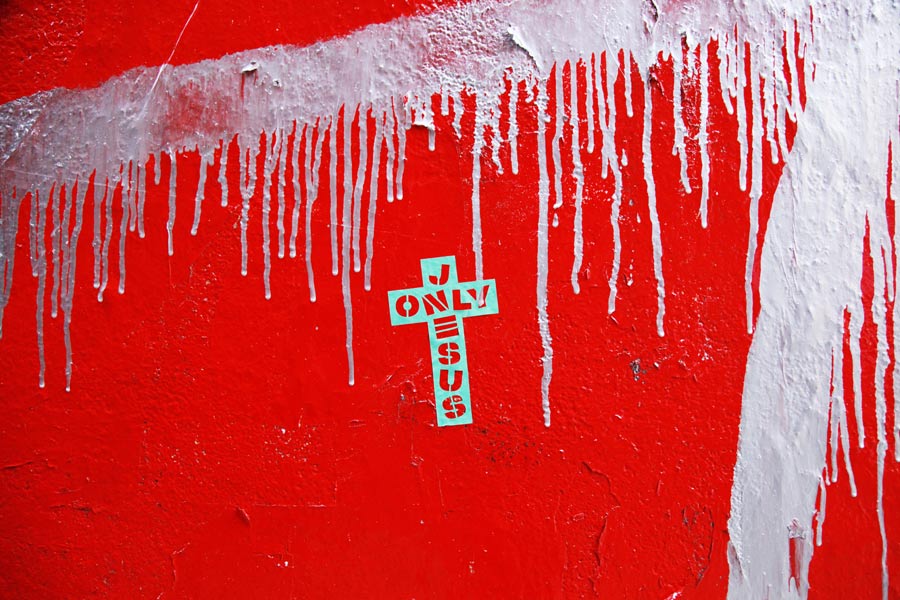
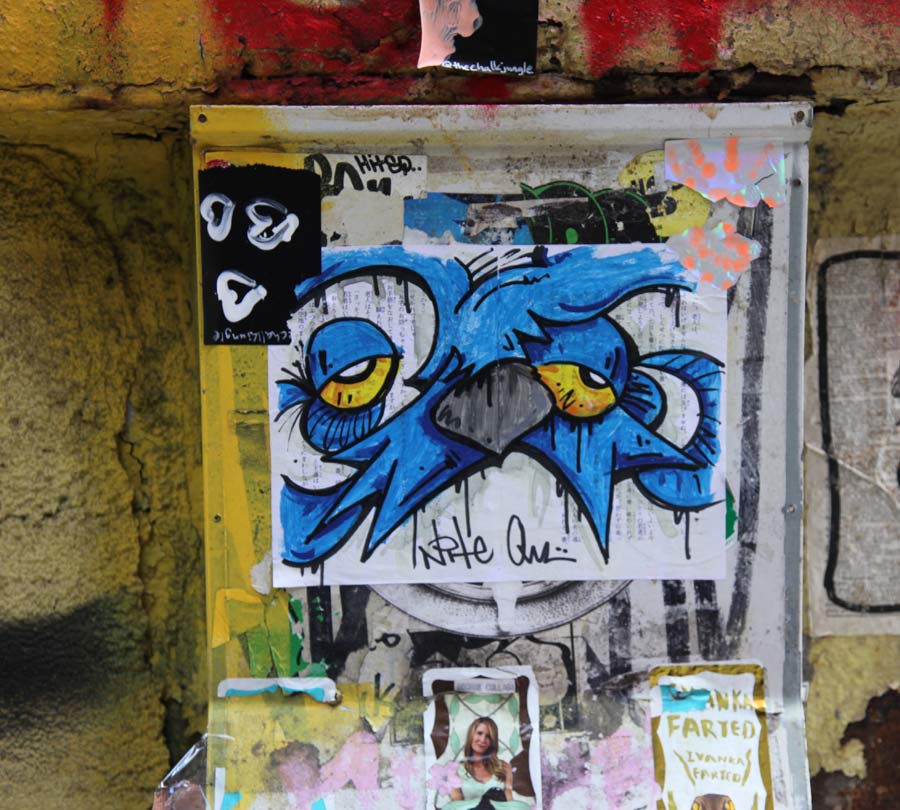
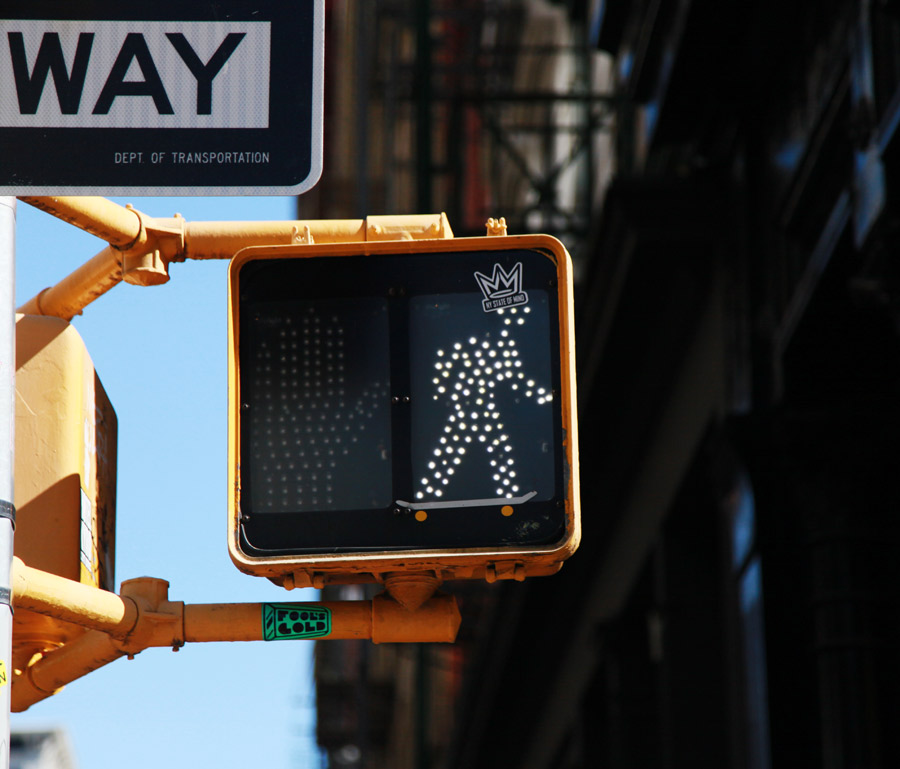
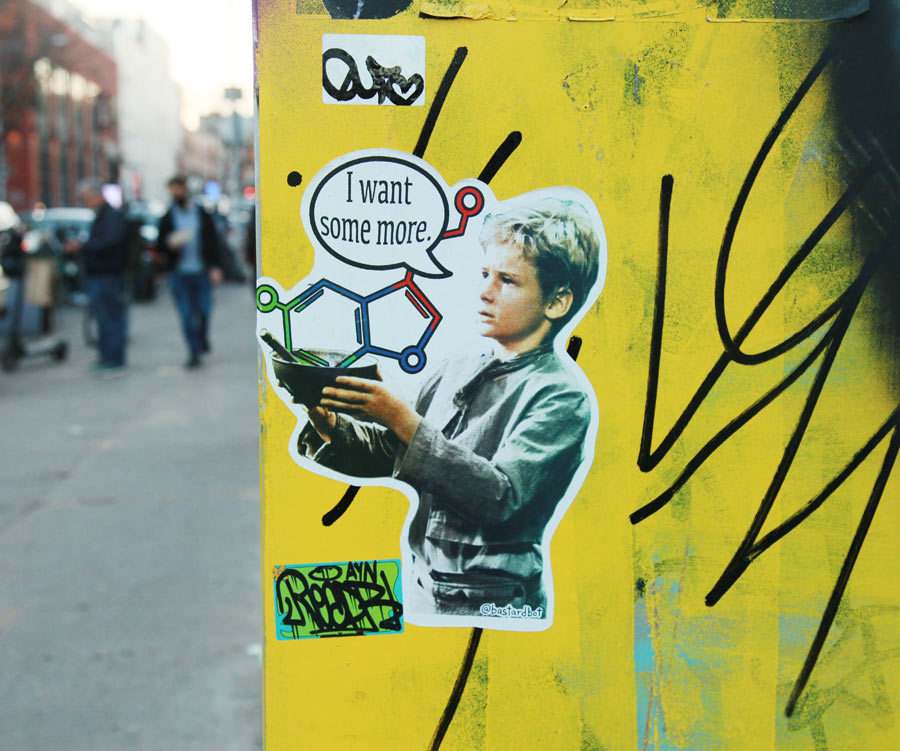
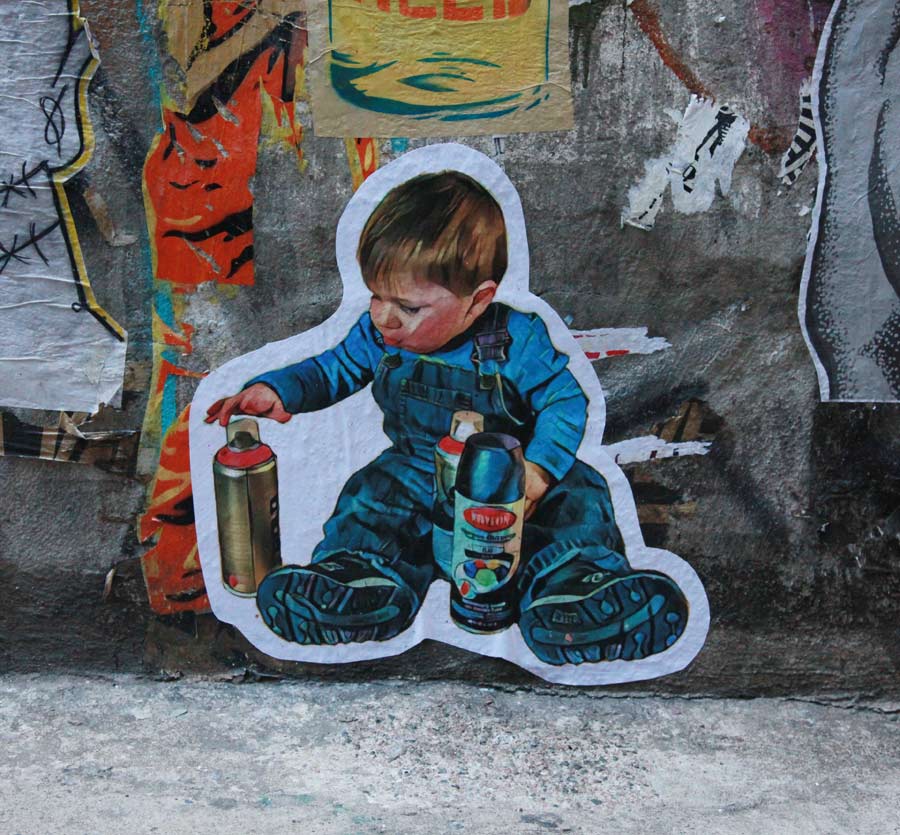
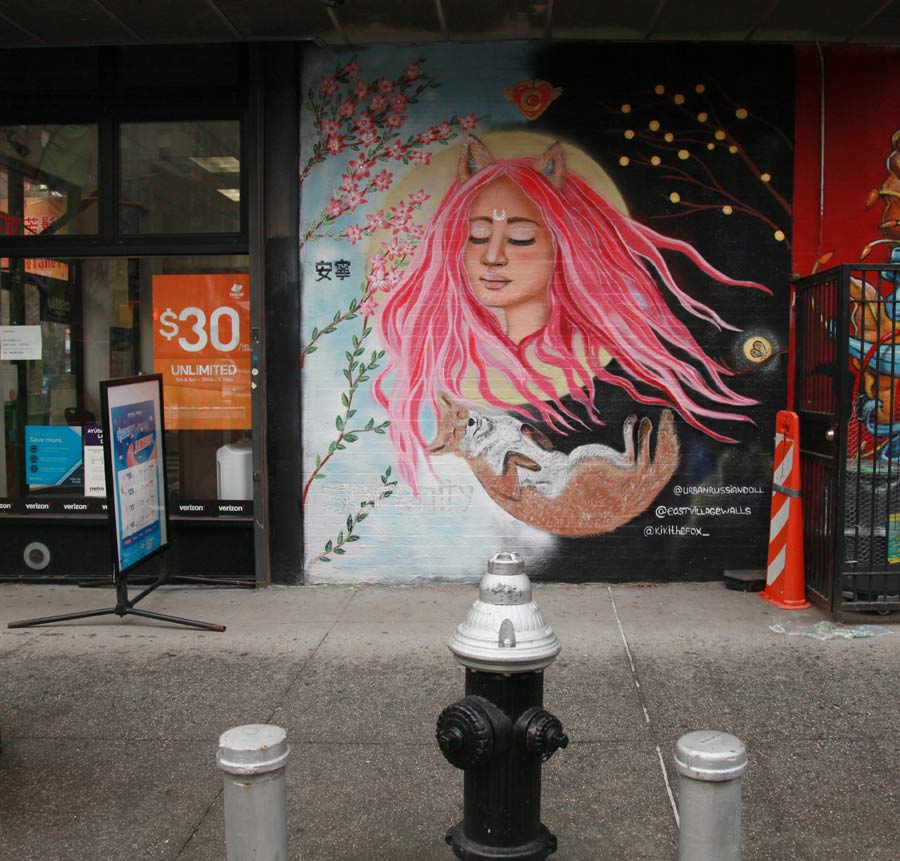
So here’s our weekly interview with the street, this time featuring: Bastard Bot, Billy Barnacles, Captain Eyeliner, Cucker Tarlson, Jesse Kreuzer, Kiki the Fox, Lunge Box, Mort Art, Nicholai Kahn, Nite Owl, NY State of Mind, Praxis VGZ, Puke Punk, SacSix, Trades Only Bro, and Urban Russian Doll NYC.
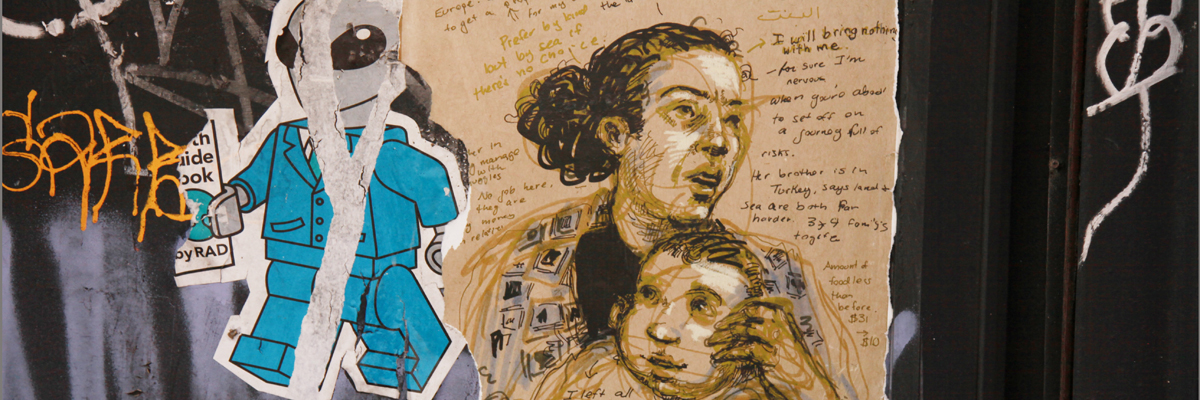
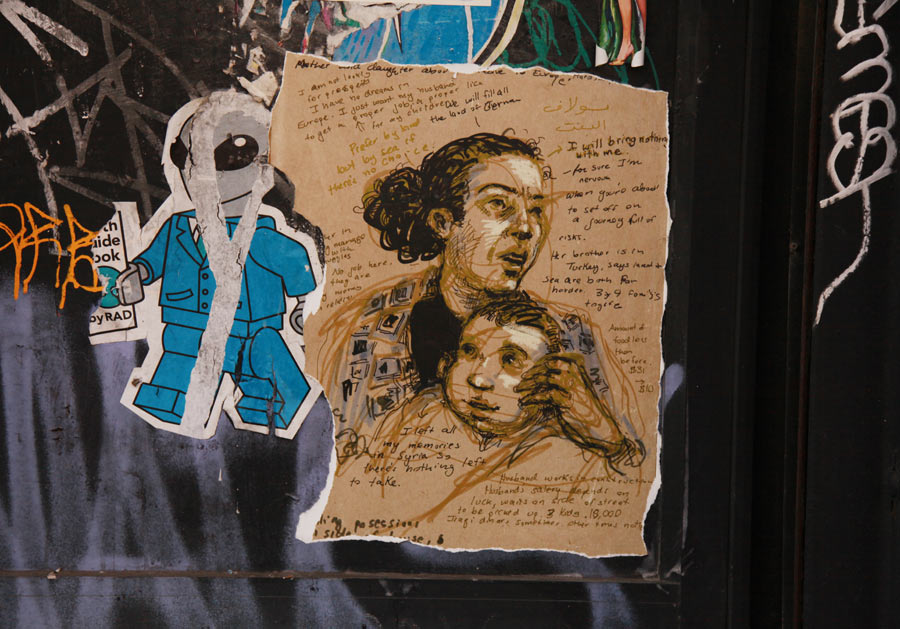
“I left all my memories in Syria, so there’s nothing left to take”.
“Husband works in construction. Husband salary depends on luck, waits on side of the street to get picked”.
“Prefer by land, but by sea if there’s no choice”.
“I have no dreams in Europe. I just want my husband to get a proper job, a proper life for my children”.
“I will bring nothing with me”.
“For sure, I’m nervous”.
And so these are their stories, their troubles, their worries. People who are compelled to migrate from their lands in search of a better life and brighter conditions have little choice or no choices at all. They are among the most vulnerable of humans walking on earth. Their plight gets made even worse by the cruelty and greed of their fellow humans, by the indifference of governments, which many times use them as political pawns and by nature. Harsh conditions at sea or at inhospitable land crossings may fatally end their journey.
A Molly Crabapple piece on the street – surrounded by quotes with a piece by Raddington Falls to the left. (photo @ Jaime Rojo)
The irony of this drawing of an immigrant mother with her son carefully placed next to an “alien” cartoon is not lost on us. By labeling the immigrants who come to this country as “aliens” the authorities deem to strip them of their dignity, their character and make them into something strange, different, void of consideration and worth. By being called “aliens” these humans are being lumped together into a cultureless subgroup with no defining characteristics on their own. The label allows the immigration department to treat them all as law-breakers, offenders of the norm.
The current “crisis” at the southern border comes as a surprise every year during this time of the year. Due to better climate conditions on the southern border immigrants from Central American countries take on a journey fraught with danger first through Mexico where they fell prey to criminal gangs, violent cartel groups, and human trafficking networks. If they are lucky to make it all the way to the border with the USA, their problems are often amplified by hypocritical, posturing, and cynical politicians hoping to get a sound bite on Fox News so they can use it in the next fundraising letter.
Yes, human migration is a crisis. It is a global crisis with roots in wars, ethnic cleansing, natural disasters, and, corrupt and authoritarian governments all over the world who steal from the treasury and pretend to care and lead but have little to no intention to seriously invest in infrastructure, education, real security and health programs to keep their citizens from leaving their homes, their families, and their roots.
The collusion of law enforcement with drug cartels and criminal gangs creates all war conditions for anybody to live and prosper. Children and young adults are forced to hide and quit their education as the simple routine of walking to school and back home becomes an act of hide and seek, run and stop just to evade getting caught in a cross fire or just simply getting caught and never seen again.
President Biden succinctly and without hesitation put the matter to rest when the somnolent and apathetic members of the White House press pretended to ask hard questions at his first press conference. “They don’t come here because I’m a nice guy,” he told them, and suggested that rather than pouring billions of dollars in erecting measures to combat immigration at home the funds should go directly to the suffering people of Central America to improve their living conditions so they remain at home rather than embark on a dangerous journey that most certainly will turn into hell.
But this solution might not be good enough for those who are looking for culture wars to score points and for the press who need identity politics to keep the ratings up.
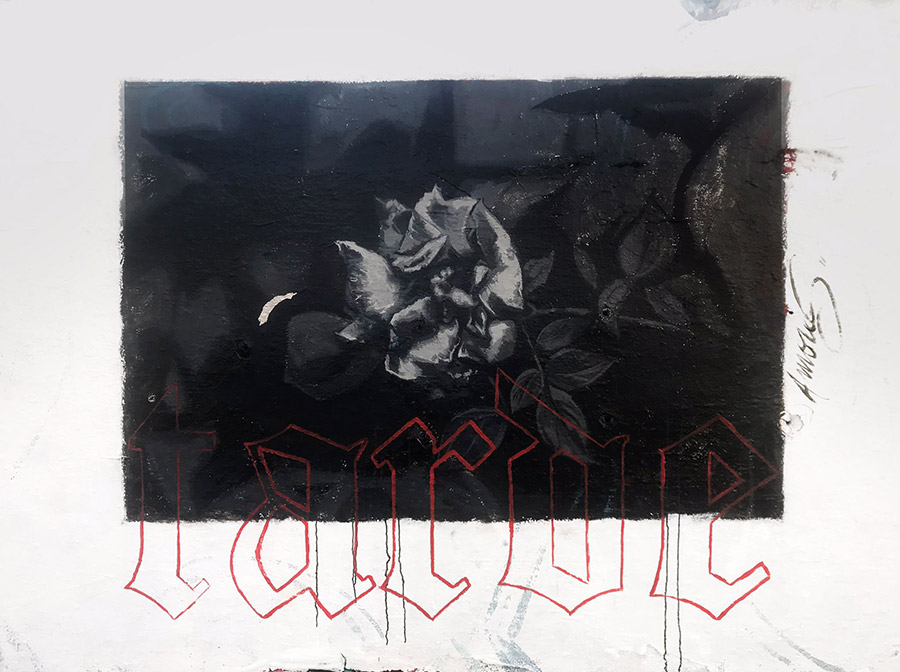
This one caught our eye for the merging of classic graffiti nerve, blunt style execution, sentimental velvety roses, inspirational verses, …Read More »
 BROOKLYN STREET ART LOVES YOU MORE EVERY DAY