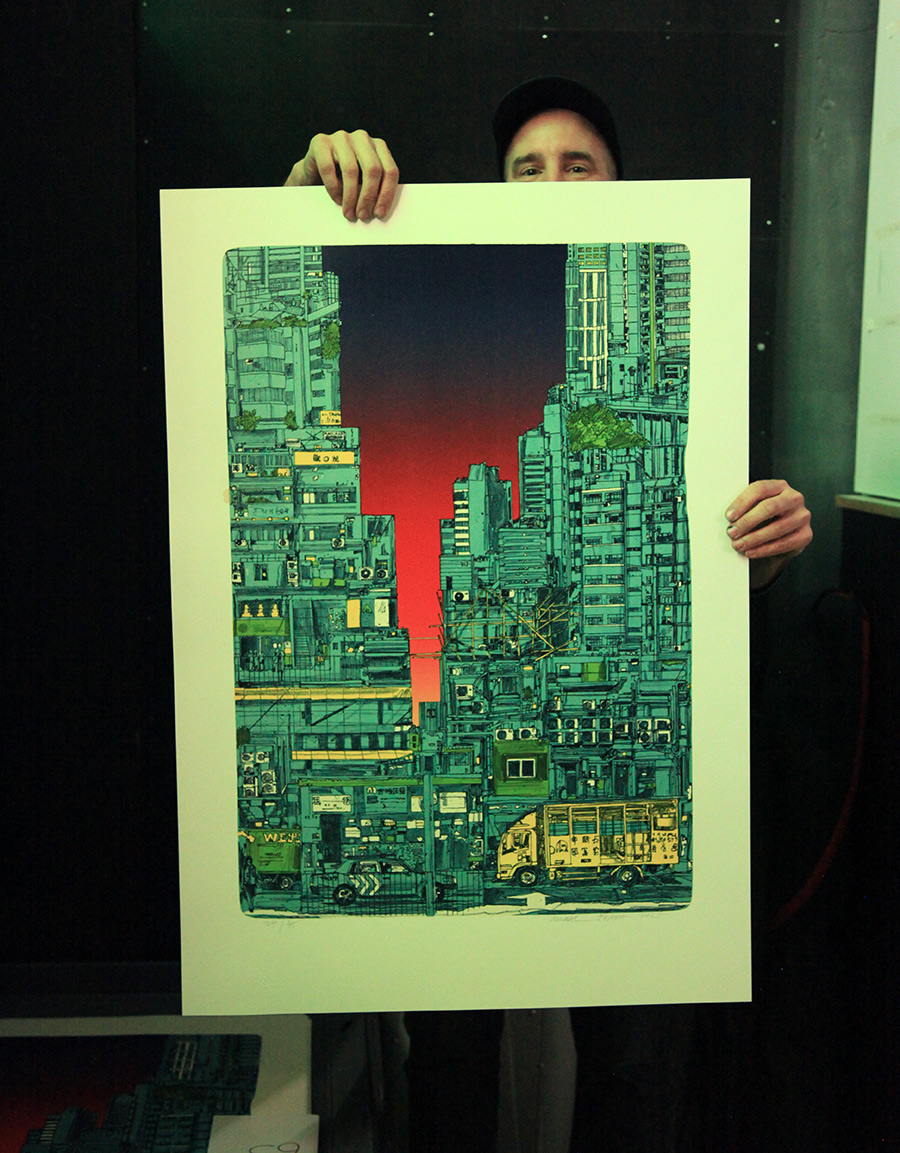
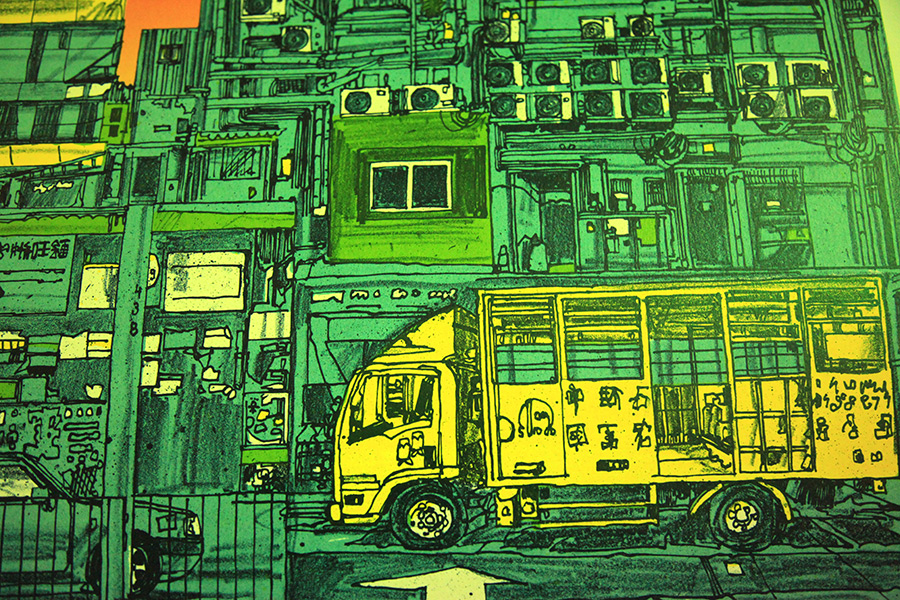
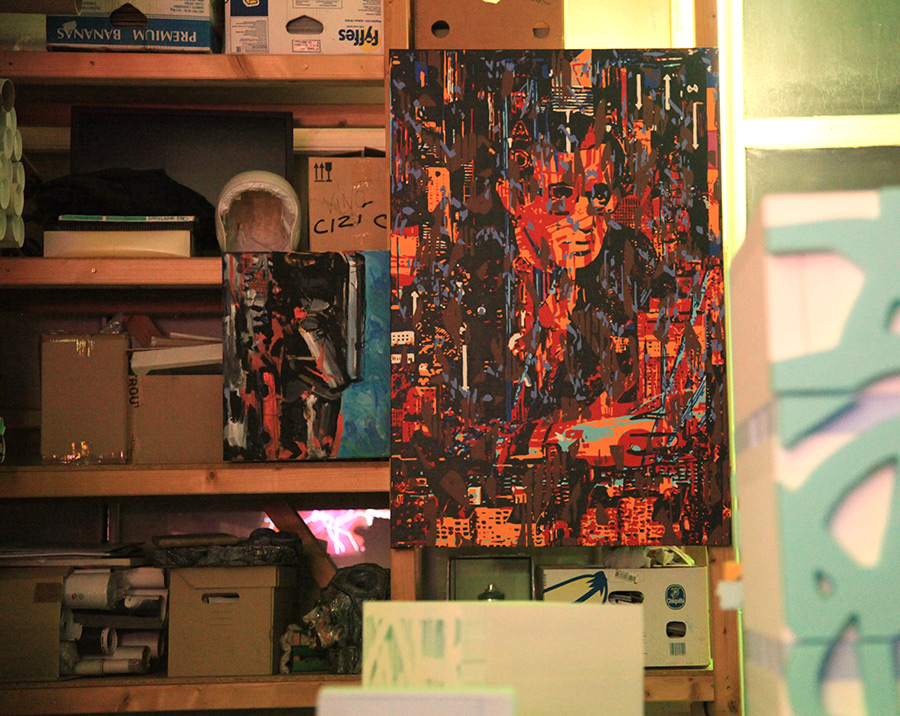
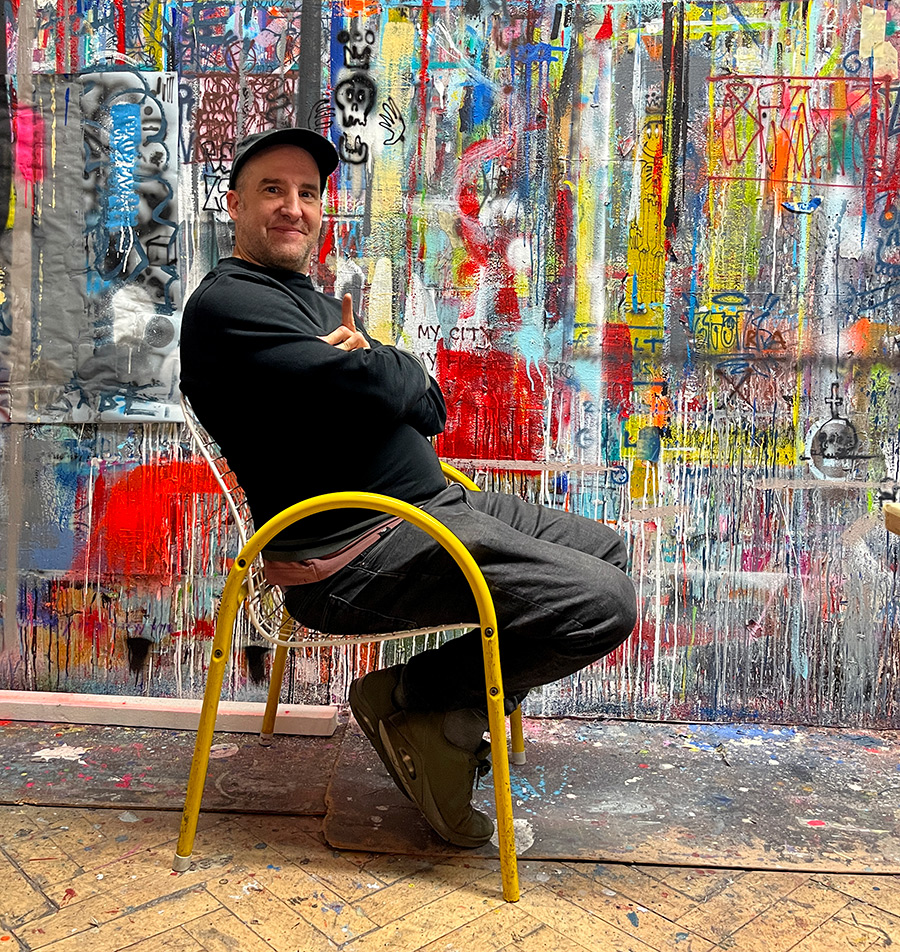
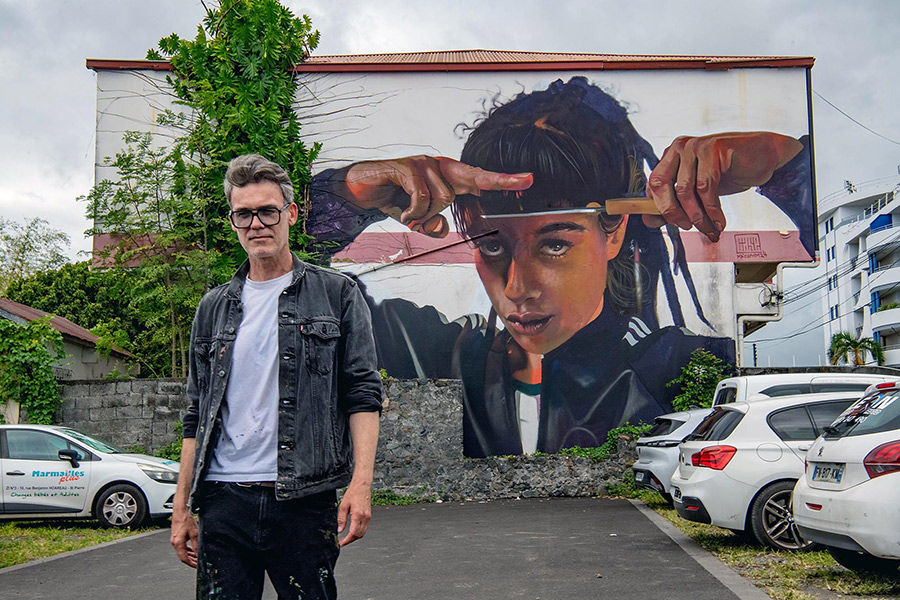
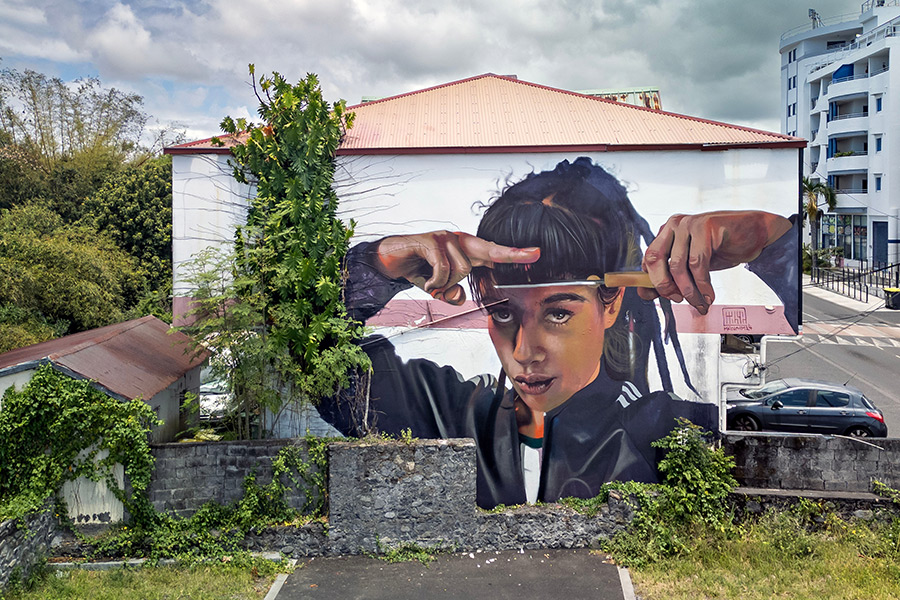
Michal Škapa (b. 1978, Prague), known in graffiti circles as Tron, is one of the defining figures of the Czech graffiti movement. He emerged in the first wave of Prague writers in the early–mid 1990s, active in influential crews such as DSK, CAP, NUTS, and TOYZ. His reputation grew not only through his presence on Prague’s walls and train lines but also through some of his under-the-radar painting exploits — always a symbolic moment for graffiti writers testing their ambition.
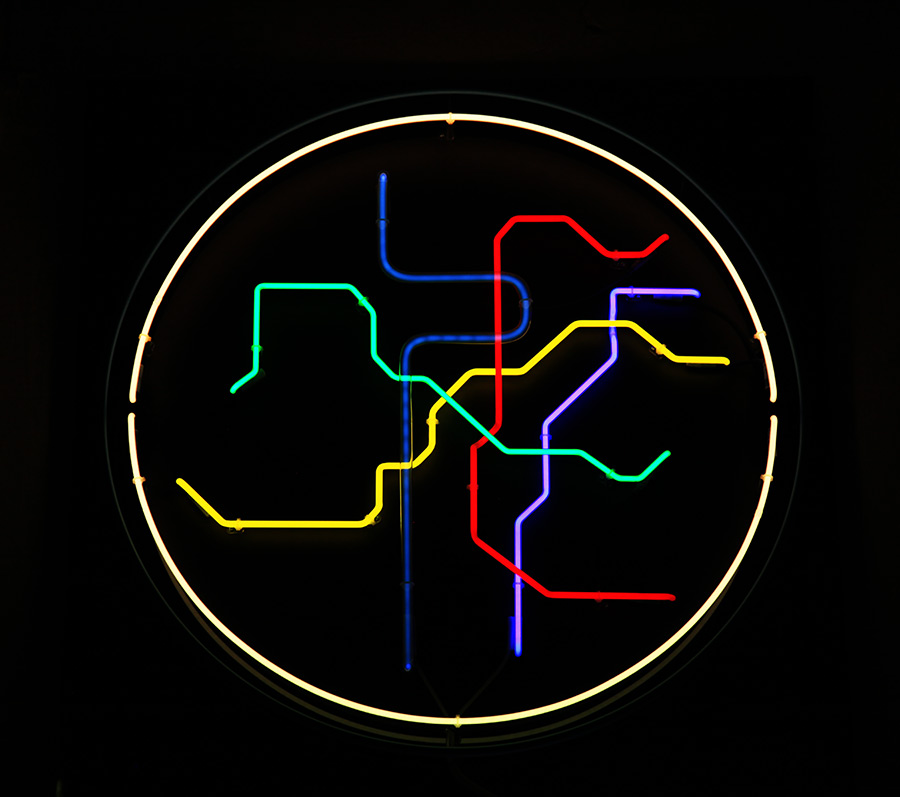
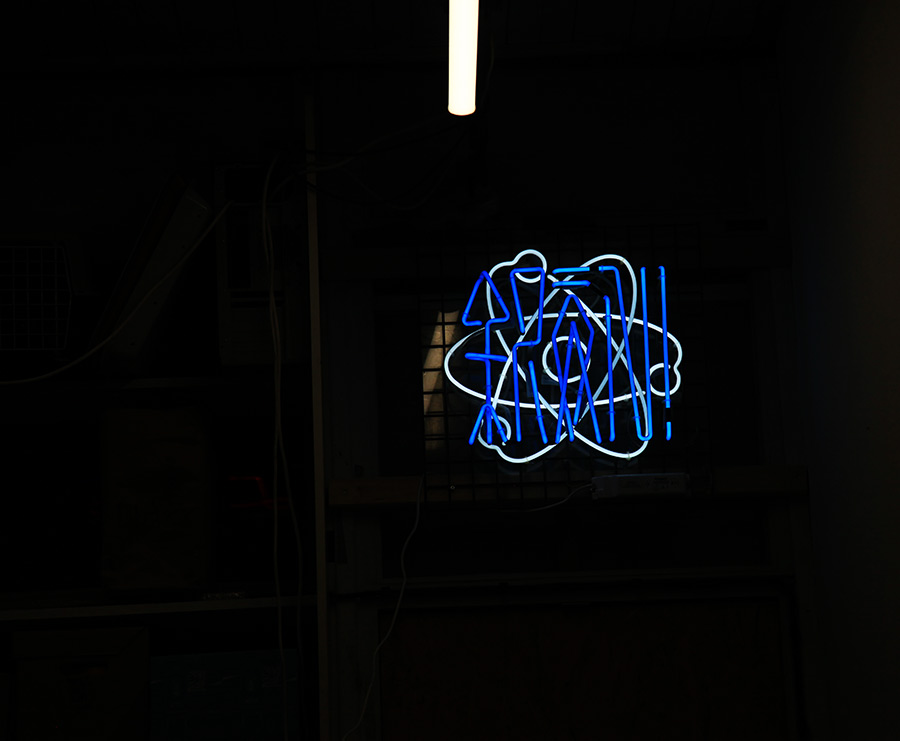
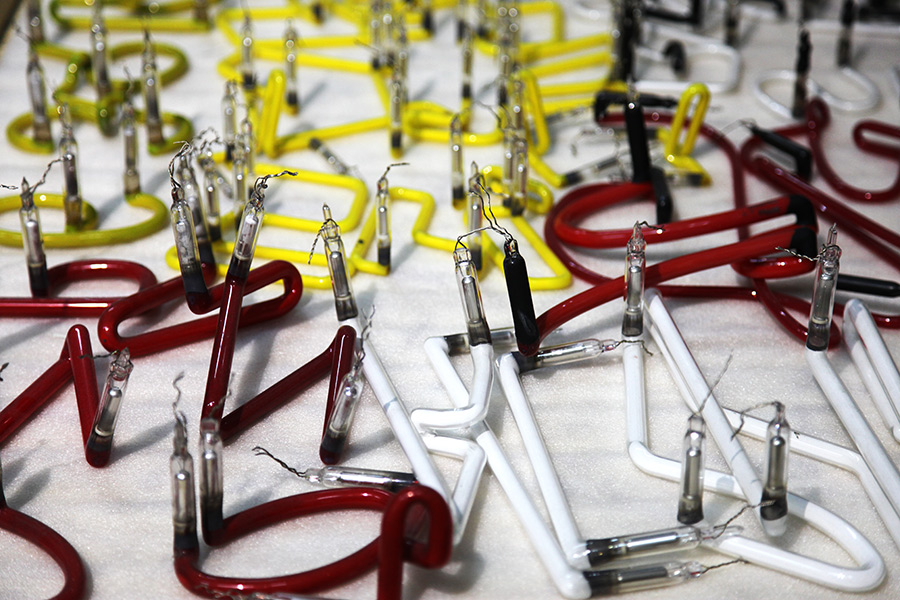
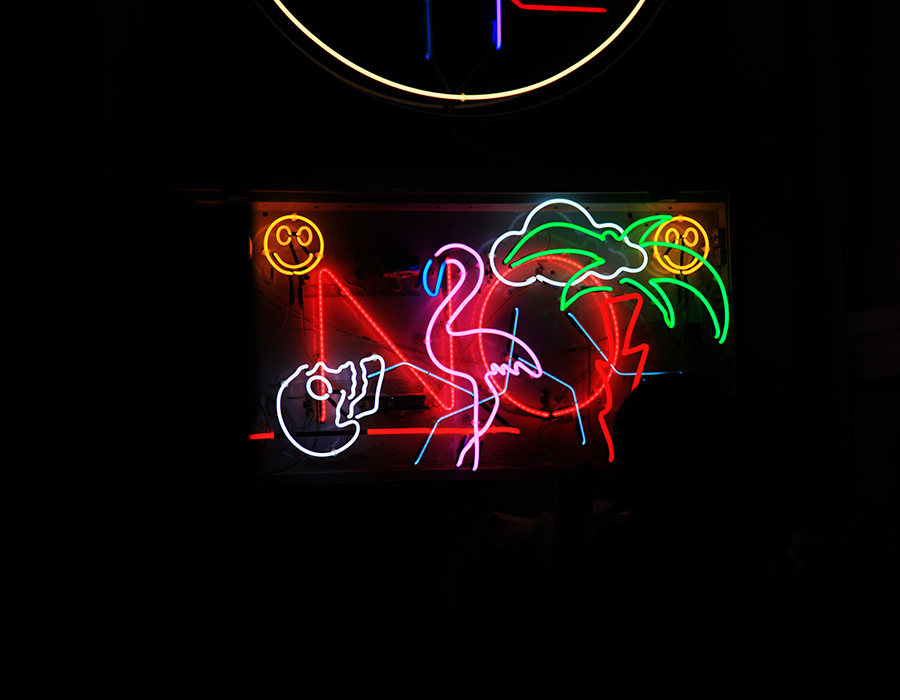
Over nearly three decades, he has expanded from traditional graffiti into murals, airbrush figurative work, acrylic “manuscript” abstractions, neon and light installations, and site-specific projects, while maintaining a clear connection to the tempo, structure, and discipline of lettering. His long associations with Trafačka/Trafo Gallery and MeetFactory placed him within two of Prague’s most important hubs for post-1990s urban and contemporary art, and his work with The Chemistry Gallery and the Urban Pictus festival may have brought him greater international reach.
Within the Czech Republic, Škapa is recognized as an artist who successfully bridged illegal writing, large-scale public works, and the gallery world. He co-founded the Analog!Bros serigraphy workshop, creates commercial visual works and has exhibited across significant Czech venues. On the mural tip, he is associated with massive works such as Kosmos — a 350-meter mural along the runway wall at Václav Havel Airport — and Vesmír medúz (The Universe of Jellyfish) in Prague’s Karlín district for Urban Pictus, both large semi-abstract compositions that merge cosmic imagery with undersea forms. His illuminated works for the Signal Festival and other public commissions may further assert his role in redefining how Czech graffiti vocabulary evolves into a contemporary visual language.
Škapa’s trajectory parallels that of many European artists who began as train writers in the 1990s and gradually expanded into broader artistic practices, yet his work feels distinctly rooted in Prague’s cultural landscape. Writers of his generation absorbed global influences through books, films, and early media circulation, but their reinterpretation of those sources unfolded within a city experiencing dramatic social and urban transformation.
In contrast to artists who favor punchline-driven street interventions or pop-derived collage, Škapa’s work leans toward atmosphere — cosmic, psychological, occasionally sci-fi — a sensibility shared by several Czech artists who transitioned from the underground into muralism, abstraction, and installation. The local ecosystem of DIY spaces, collectives, and multi-disciplinary hubs like Trafačka and MeetFactory helped shape this approach, and Škapa stands out as one of the artists who synthesizes and creates accordingly.
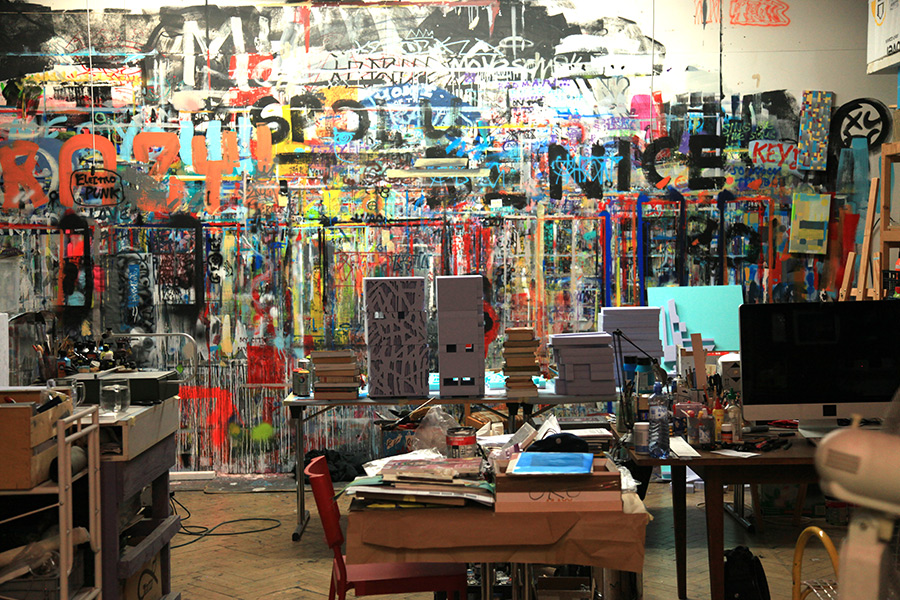
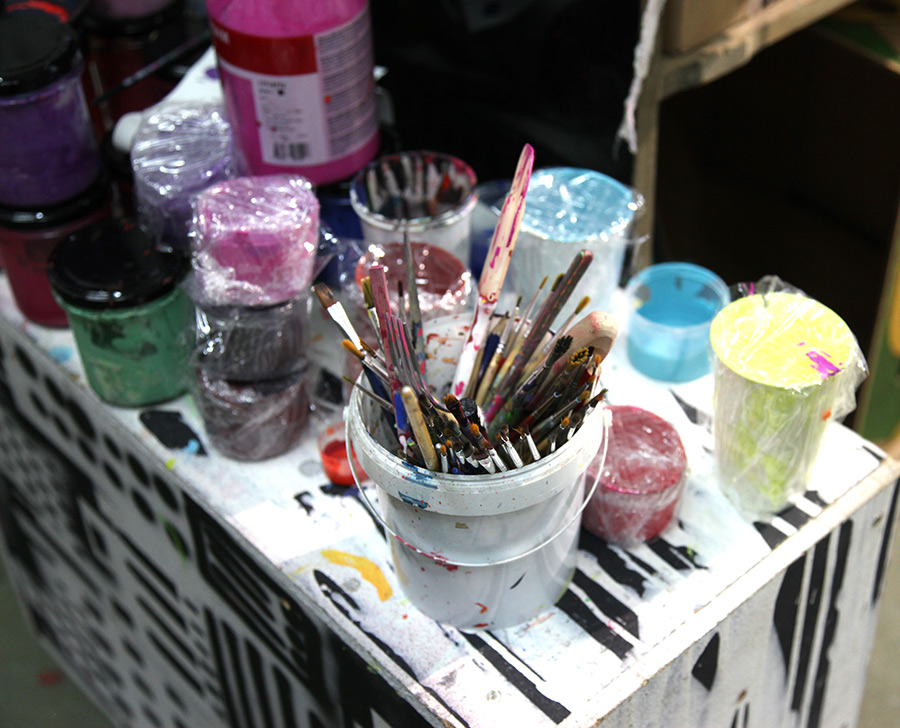
We had the opportunity to tour the artist’s studio, see many of his works in progress, to read the layering of the walls, and to learn from his wide-ranging experience and storytelling what themes drive him. Among them were these three: the construction of a personal alphabet, cross-media experimentation, and the transformation of graffiti experience into contemporary practice.
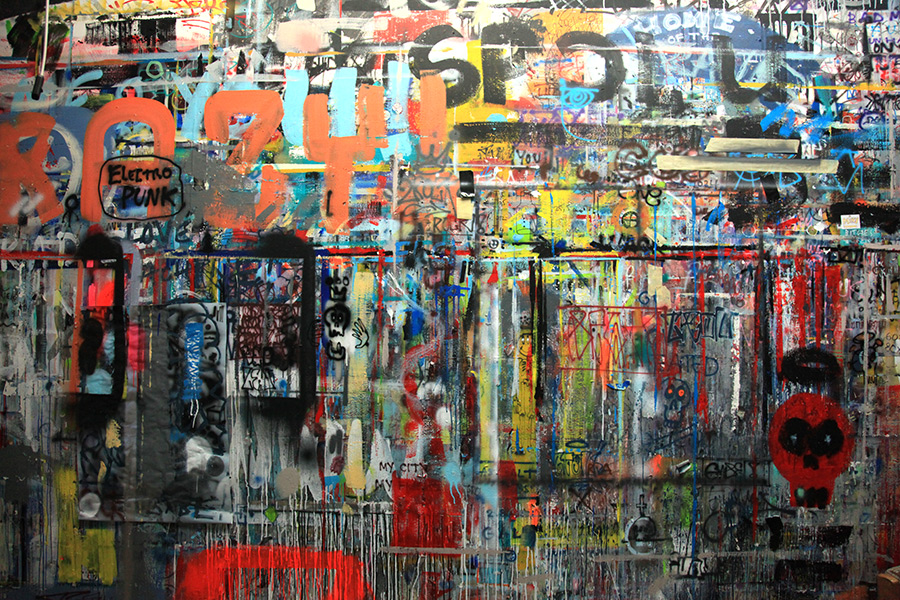
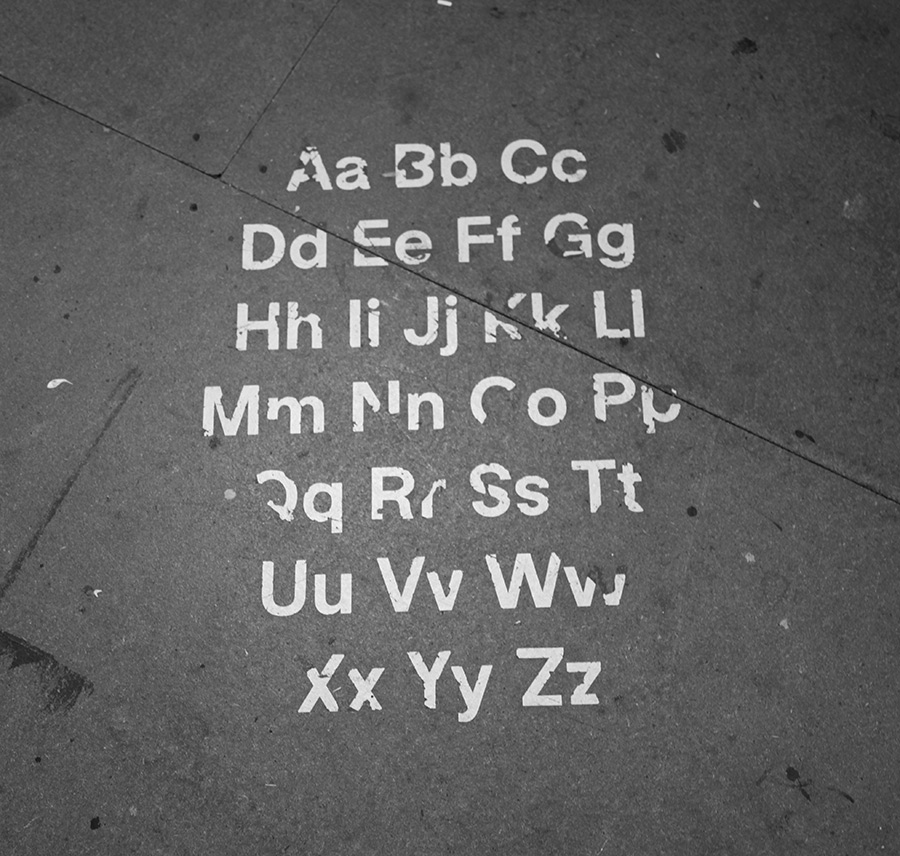
Škapa’s studio makes clear how central his self-created alphabet is to his practice — a system that merges graffiti logic with global typographic traditions. He describes it as “based on the Latin alphabet but mixed with inspirations from Brazil, heavy-metal logos, ruins, all kinds of writing systems,” his is a layered script that allows him to embed messages and structure his compositions. Some of his works contain readable words; others dissolve into semi-abstract fragments that behave like scaffolding or urban grids. Skapa is in love with the urban cityscape and its language pushes up like a raised grid into many of his works.
As he put it, “I work with my own alphabet… I put some messages in the canvas. You can find the letters if you look.” His alphabet becomes both a personal code and a generative architecture, a way to “build” cities, atmospheres, and imagined systems that tie back to his years on the street.
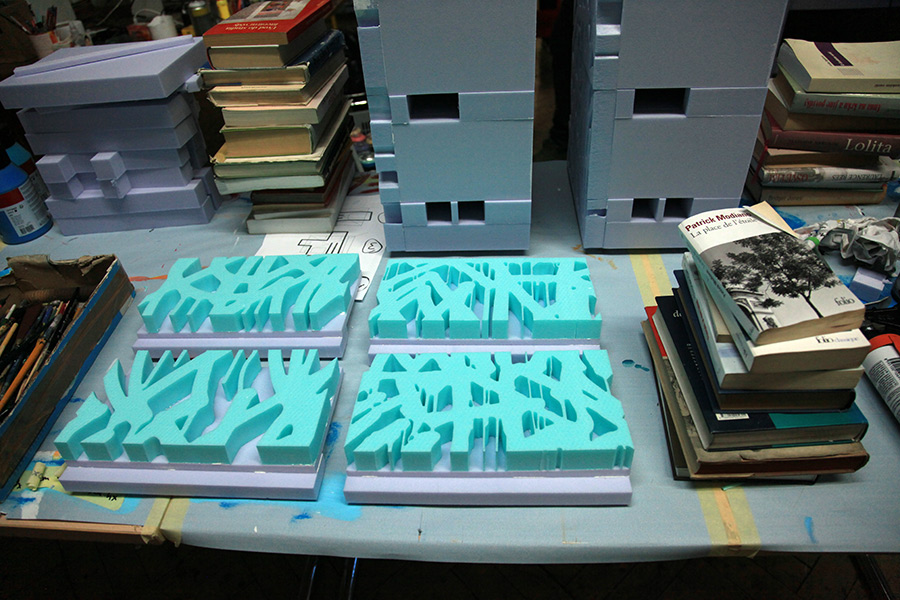
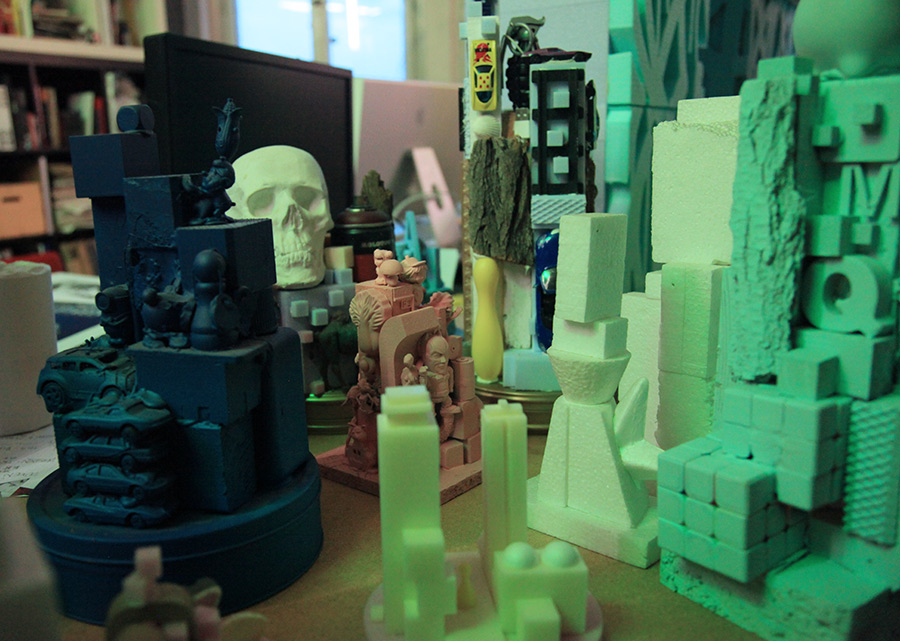
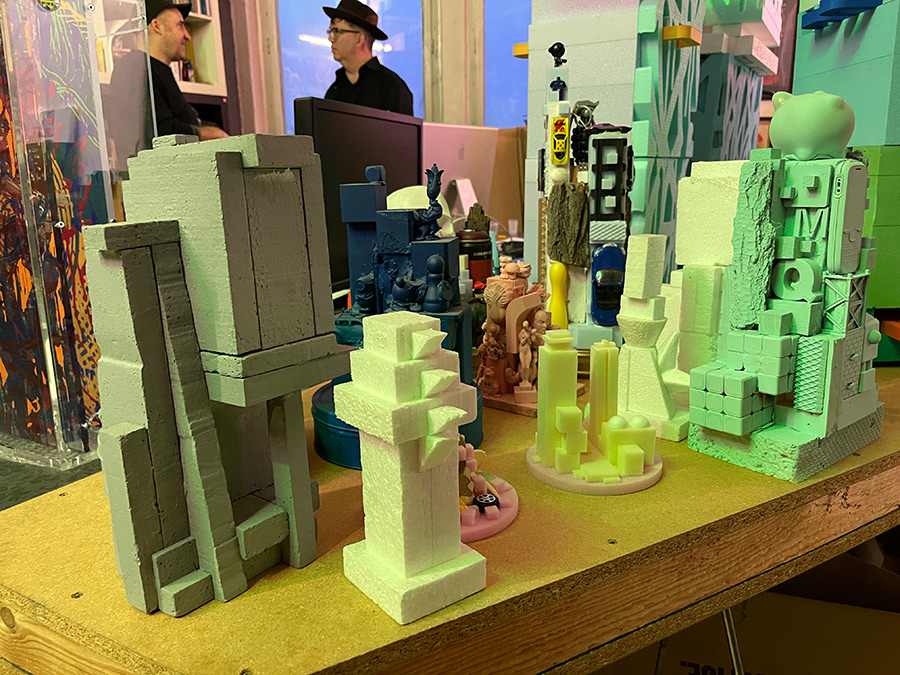
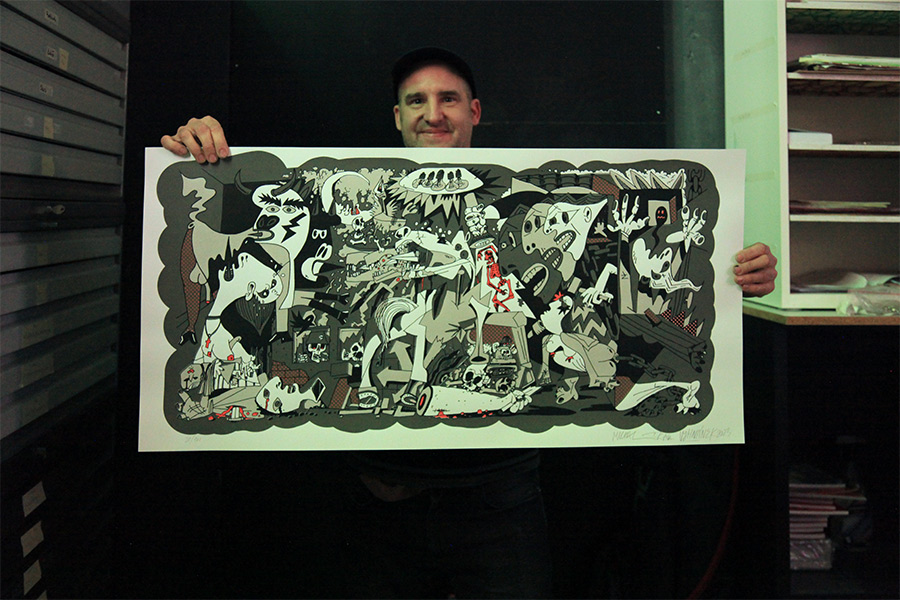
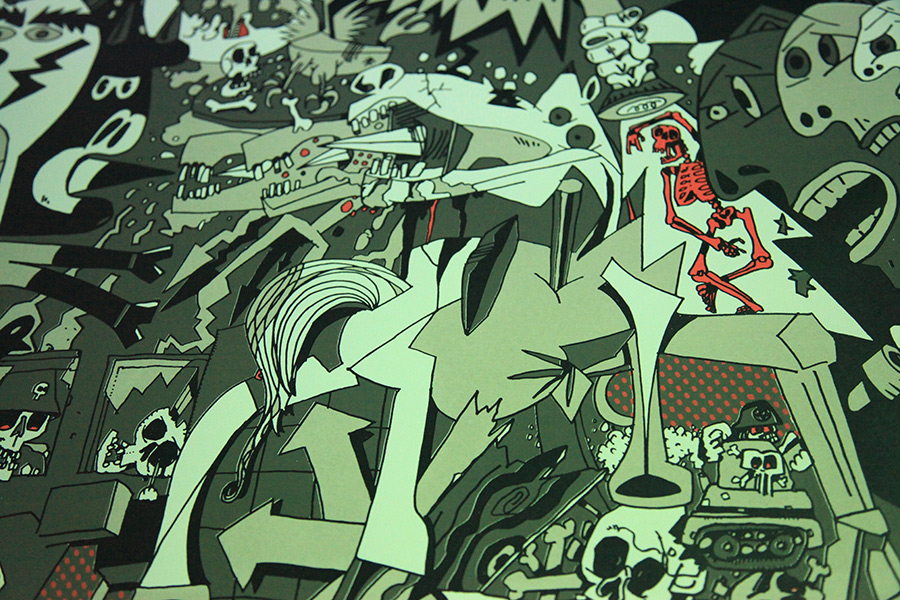
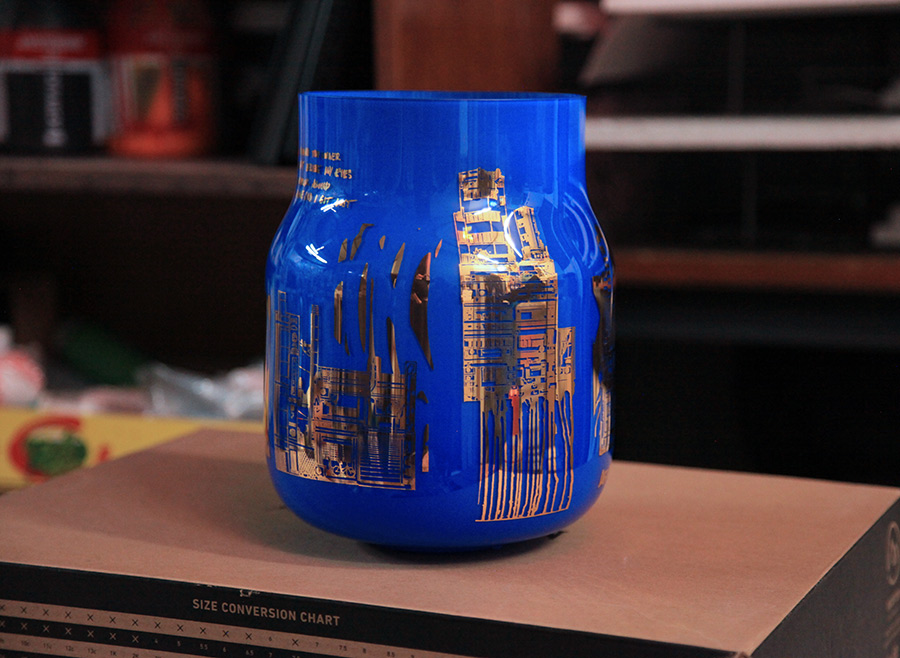
With great appetite for discovery, Škapa moves fluidly between media — neon, lithography, silk-screen, drawing, comics, hand-painted canvases, sculptural models — driven not by stylistic restlessness but by a desire to test how each material can host or distort his visual language. His collaborations with Czech glass studios illustrate this curiosity. He showed us vases produced through layered techniques involving silk-screened transfers, hand-drawn enamel lines, and kiln-fused materials.
“I love to experiment,” he said. “I’m still searching. I change styles a little, but it’s all connected.”
His neon-cube sculptures, glass models, and smoked-glass vessels borrow from Czech glassmaking’s legacy while extending it into a hybrid territory shaped by graffiti structure, sci-fi atmosphere, and architectural imagination.
It Emerges from Graffiti as Origin, Ethos, and Continuum
Škapa’s early years as a writer in post-revolution Prague remain a defining foundation for the artist. He recounts discovering graffiti in a city that felt grey and decaying, then experiencing the shock of Berlin’s scene and, later, painting trains in New York just before 9/11.
“It was like shining diamonds in the grey,” he said of graffiti’s arrival in 1990s Prague.
The energy of those years — improvisation, risk, collaboration, and an irreverent sense of possibility — continues to shape his work. He is clear that he is not “bringing graffiti into the gallery,” but rather transforming its mindset:
“You cannot take it from the streets and just exhibit it. You have to transform it.” His temporary, large-scale installations — painted walls later repainted white, layered panels reassembled into new environments — reflect graffiti’s ephemerality while channeling its instinct for immersion, confrontation, and city-scale rhythm.
Škapa’s studio practice reveals an artist who continues to translate three decades of experience into a visual language that is still expanding. His alphabet operates as both structure and code — a personal script rooted in graffiti’s devotion to the written mark. His cross-media experiments, moving from neon to lithography to Czech glass, reflect a sustained curiosity about how ideas behave when they migrate across materials and traditions. And his grounding in early graffiti culture remains an ethical engine, shaping how he thinks about improvisation, community, and the life cycle of artworks.
Taken together, these themes show how Škapa has built a practice inseparable from Prague’s cultural landscape while remaining fully engaged in a broader conversation about how street-born creativity transforms within contemporary art.
Not that you don’t have free will and could quit your phone any time. Of course, you could.
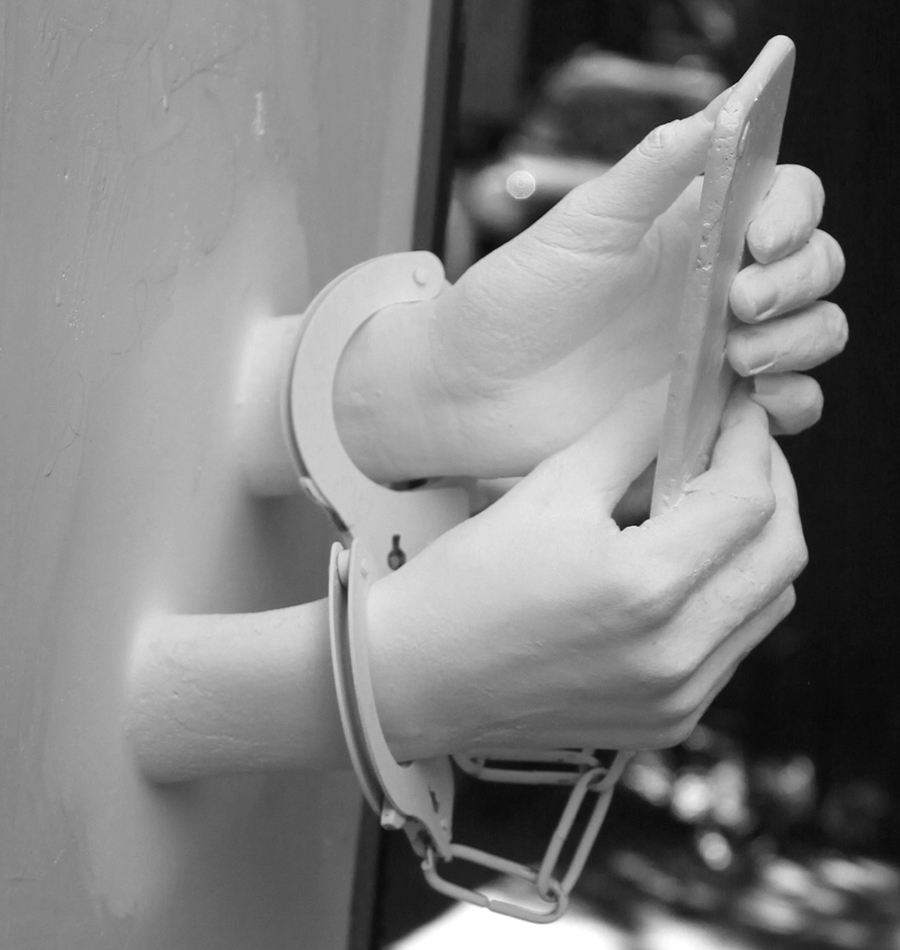
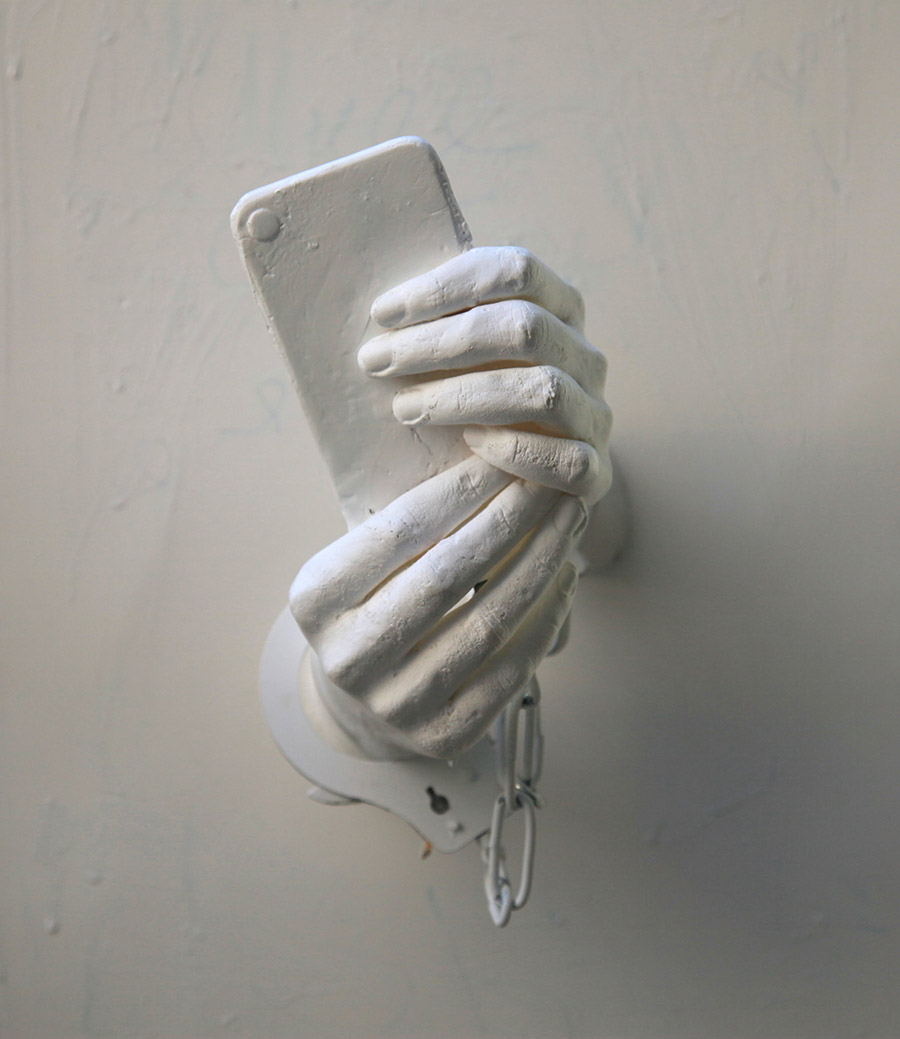
Street artist Leon Reid works conceptually often, and in this case, as a sculptor alongside you on the street in Bed-Stuy, Brooklyn. The message is self-explanatory, and yet, you would have to look up from your phone scrolling to see it, so many will miss it.
Brooklyn Street Art:The sculpture depicts a pair of handcuffed hands holding a mobile phone. The hands are restricted, yet the work’s title is “Of a Free Will”. Can you please elaborate? Leon Reid: Many times when I observe people holding their smartphones I ask “Is that person holding their phone because they want to or they need to?” It’s impossible to answer completely but still I wonder. 15 years ago, many folks used smartphones because they were curious about the potential of a new tool. Of course, advertising guided most people to buy smartphones, but then social media slapped advertising in everyone’s face 24/7/365. This exposure weakened the argument that we’re all using our phones because we want to. The infrastructure of our society is now designed around smartphones; you can’t enter certain buildings without it; in some cases you can’t travel, eat or see a doctor without it. I believe that we as a society decided to freely carry out the Free Will of technology corporations; we cuffed our own hands to it.
BSA:You’ve been installing your work in public for a long time. Have you noticed any differences in the difficulties inherent in installing works on the streets from the early days of your practice to today’s environment? LR: Yes, when I started writing graffiti in 1995, in most instances, we did not have to worry about surveillance cameras recording us; there simply were fewer cameras in existence.
Though I am not active as a graffiti artist as I once was, those doing it now must be prepared to be filmed -in fact many film themselves. The further you go back in graffiti history the more artists had to operate like ninjas. Stealth was a quality that was honored among writers. However, the exposure of graffiti and street-art through documentation has brought a broad acceptance of the art from -one that I never expected to see- so that many times artists can do their work in public with permission.
BSA: You mentioned that your work was defaced/vandalized within days of being put on the street. Why did you choose to restore it? LR: So this piece has gotten a lot of attention in the neighborhood because I believe most people are at a point where they can understand its message. Within a week, someone added two additional messages to the work; one was a statement about Immigration enforcement, the other about the Israel/Gaza War. I have my opinions on both of these topics however the markings made three unrelated messages on one artwork and they distracted from the original message. I removed the additional messages, but was conflicted in doing so. I’ve long known that once an artist puts their work on public display, they cannot control how the public interacts with it. If the messages persist, I have to let it be.
BSA:How has the rapid evolution of technology, such as the sophistication of smartphones, the apps, and Social Media, changed the way in which art is experienced now? Are there any pros or cons in your opinion? LR: So, in my ideal world, everyone would have the possibility to see great works of art -be it on the streets or in a museum- in person. This for a variety of reasons cannot happen. Most of us will only see great works of art through media. However sometimes, a great photographer can capture a great work of art in a moment; perhaps a child is able to touch a graffiti wall because they cannot do so in a museum, a photographer is there to snap the moment and the picture becomes a symbol of what that artwork can mean to people. If this photograph inspires people to see the work in person that is a pro. The con is if so many people turn up not to look at the work, but to photograph themselves beside it. If such a thing happens too much it can alter both the community where the work lives and the meaning of the work itself.
“Of a Free Will” is part of a larger street-art exhibition organized by Novo Collective titled “Playground of the Invisible”
When graffiti and street art lace up hiking boots and head into rural or fully natural settings, some feel conflicted about the potential harm to plants, soil, and water. Naturalists argue that human hands should leave no trace—certainly not one out of harmony with the site. In the built environment, on the other hand—cities, towns, suburbs, strip malls, fast-food restaurants, roller rinks, bowling alleys, factories, condos, lawyers’ offices, hospitals, laundromats—the conversation around street artists and graffiti writers tends to focus on property and real-estate value, less on our impact on the Earth.
Sea162 (Alonso Murillo) is a Spanish graffiti/mural artist from the Madrid region, long associated with Collado Villalba north of the city. He began writing graffiti in the 1990s, later moving from classic graffiti into large-scale murals; his current approach merges graffiti know-how with site-responsive painting in natural or semi-natural settings.
He is known for a kind of “nature street art”: fauna and flora rendered on quarry faces, walls, and outdoor structures, frequently using earth-based pigments he gathered and developed from sites across Spain (including the Canary Islands). His compositions often integrate the rock’s relief to create volume, capitalizing on the site’s natural features.
Sea162’s approach has led him down paths street-art fans don’t typically associate with the culture, yet his evolution feels organic—especially as he has developed a practice with natural pigments. He has competed in Spain’s Liga Nacional de Graffiti in multiple editions (2021–2024). This year the Museo Nacional de Ciencias Naturales (MNCN-CSIC, Madrid) presented his 90×7 m mural “Evolución,” made with natural pigments and accompanied by a museum display about its materials and process.
He has participated in Spanish and European street-art initiatives, including painting a wolf at an outdoor rock-art event in France and multiple municipal or regional projects in Spain. His 2023 mural “El Tritón Miguelón” on the circular La Palla irrigation pond in Garcibuey (Salamanca) was selected “Best Mural of the World – April 2023” by Street Art Cities.
We asked Sea162 about his practice and this new installation:
Brooklyn Street Art:Can you tell us about the setting, the placement of the art? Is it a natural swimming “pool” somewhere in a forest? SEA162: It’s an old stone quarry in the village where I live northwest of Madrid. It is inside the mountains.
BSA: The objects depicted on the mural appear to be seashells. What can you tell us about the different species of shells you painted on the rocks? SEA162: It does look like seashells, but these are organic forms that connect with the forms of the rock in a free manner of expression.
BSA:You mentioned you used natural pigments collected from different places in Spain. What can you tell us about your process of collecting and making the pigments? Do you use plants, flowers, soil, and rocks? SEA162: I usually use rocks and pigments made from minerals.
BSA:Can you describe your process of planning and selection when you paint in a natural environment? SEA162: At the beginning, I try to find a way to connect with the place and the environment. After I select the location, I begin to work on the idea and its design
BSA:By using natural pigments, is it your intention for the artwork to be washed by rain and other natural elements? SEA162: I find it essential to take care, to protect the environment and the work for the future, by natural, yet resistant materials.
Interview with Doug Gillen | Video Feature from Fifth Wall TV
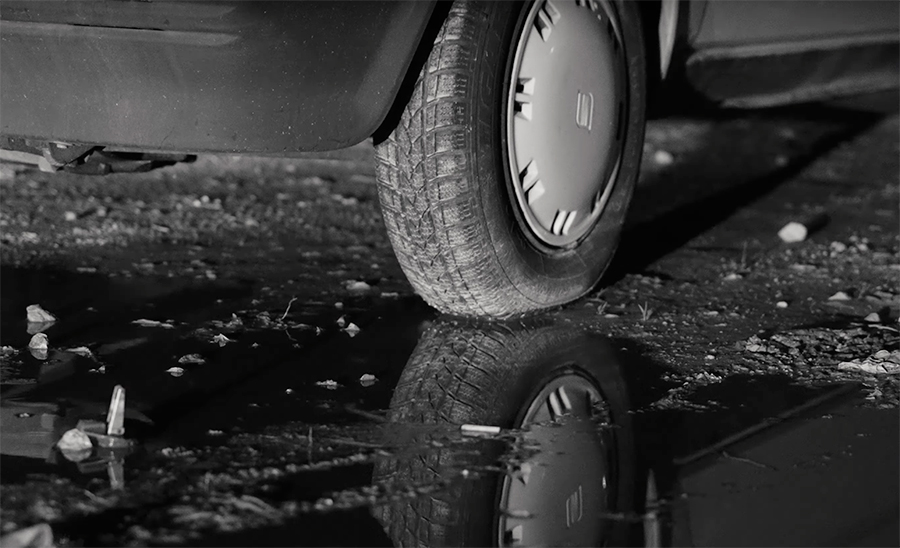
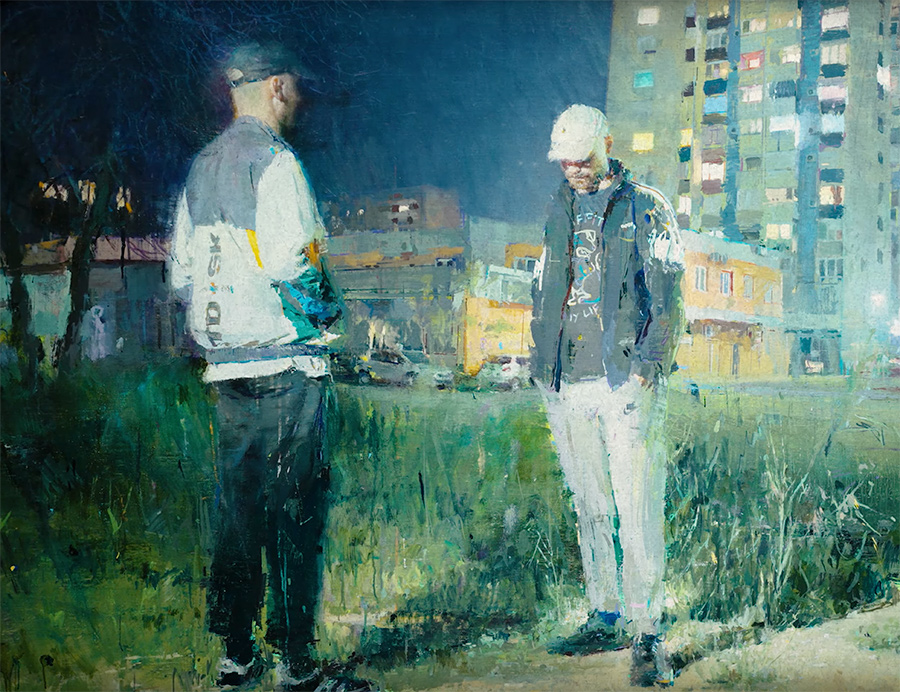
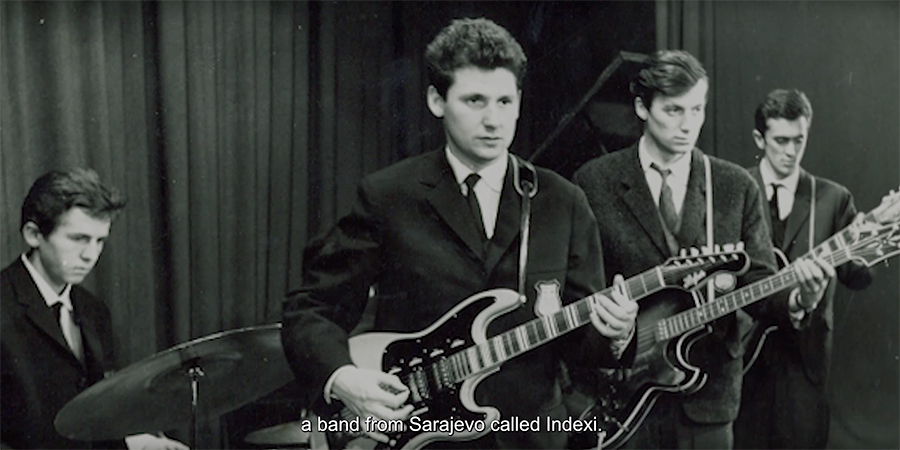
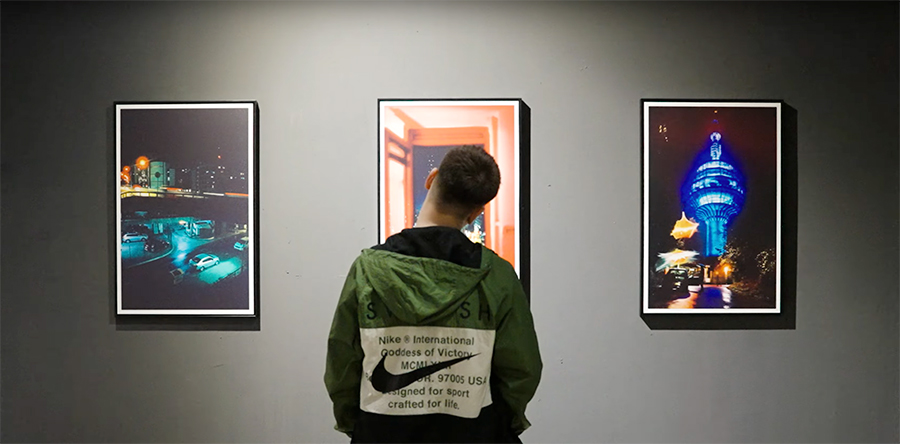
Ghosts of concrete modernism and whispered nostalgia drift through “The Morning Will Change Everything,” the first solo museum exhibition by Spanish artist Sebas Velasco, now on view at the History Museum of Bosnia and Herzegovina in Sarajevo. In this new video interview, filmmaker and art observer Doug Gillen sits down with Velasco to unpack the layers of emotional and political weight carried in these oil-painted nocturnes—each a meditation on memory, architecture, and the complex afterglow of Yugoslavia’s post-socialist present.
Sebas Velasco. The Morning Will Change Everything. (image still from the video by Doug Gillen for Fifth Wall TV)
The conversation reflects Velasco’s realism, influenced by photography – reinterpreted by hand and heart. “It’s a love story with the region, for sure,” he tells Gillen, reflecting on years of travel and a growing personal bond with Sarajevo and its surrounding cities. His works hum, layering light, concrete, shadow, and silence to capture what it feels like. “Maybe the nostalgia I paint is for something I’ve never really known,” he says.
Sebas Velasco. The Morning Will Change Everything. (image still from the video by Doug Gillen for Fifth Wall TV)
Set inside the former Museum of the Revolution—a hulking modernist edifice now asserting its cultural relevance—the exhibition includes Velasco’s paintings alongside films, photographs, and collaborations that stretch across borders and disciplines. It’s an act of giving back to a city that continues to inspire. “We wanted this to be more than paintings on a wall,” he explains. “To feel like home—for other artists too.”
Watch the full interview below to hear from Velasco in his own words, and to feel the atmosphere of a show that makes the past present—and personal.
Sebas Velasco. The Morning Will Change Everything. (image still from the video by Doug Gillen for Fifth Wall TV)Sebas Velasco. The Morning Will Change Everything. (image still from the video by Doug Gillen for Fifth Wall TV)
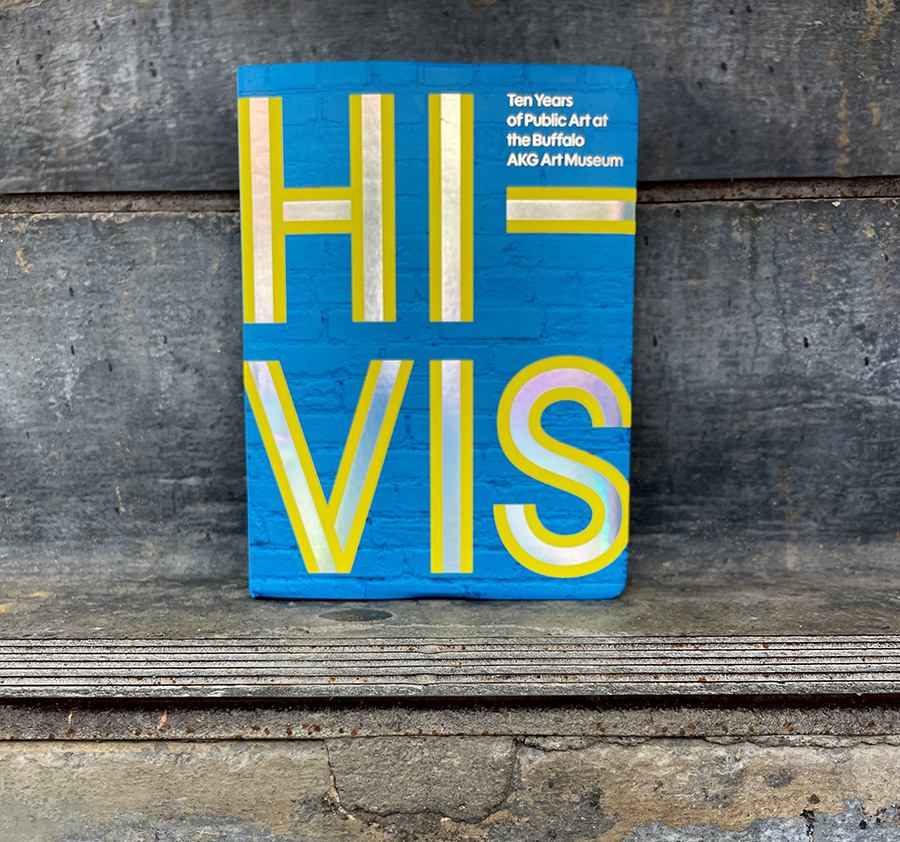
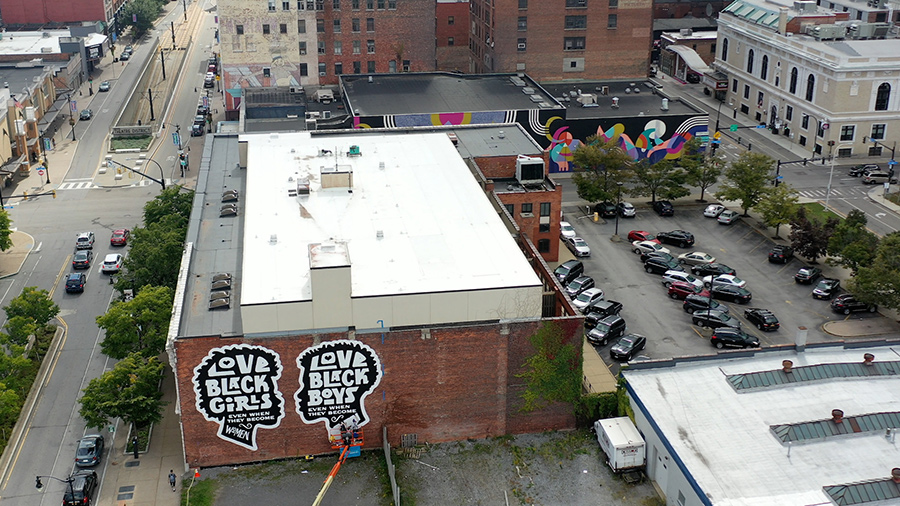
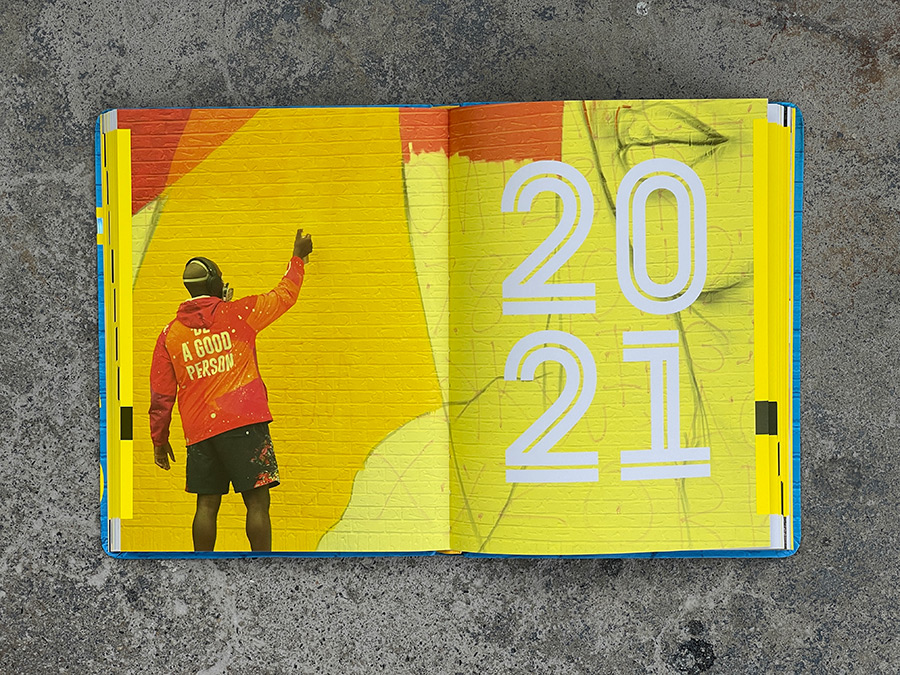
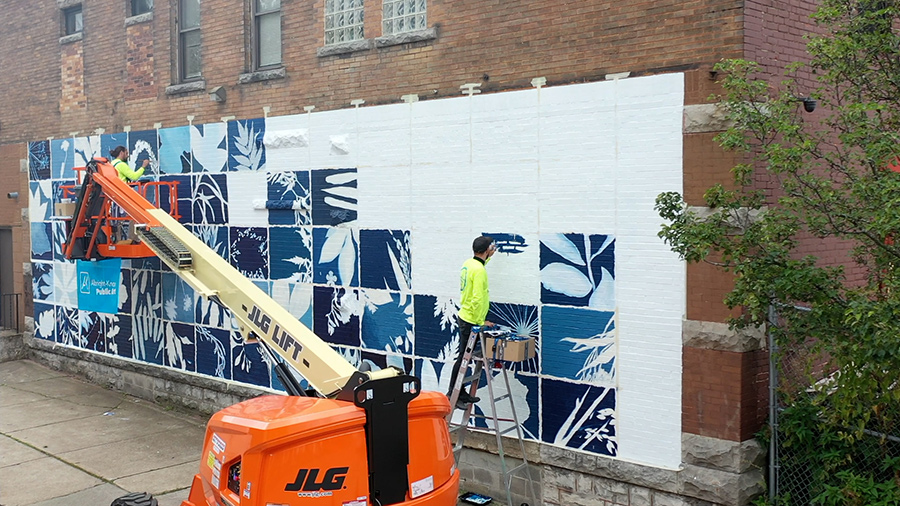
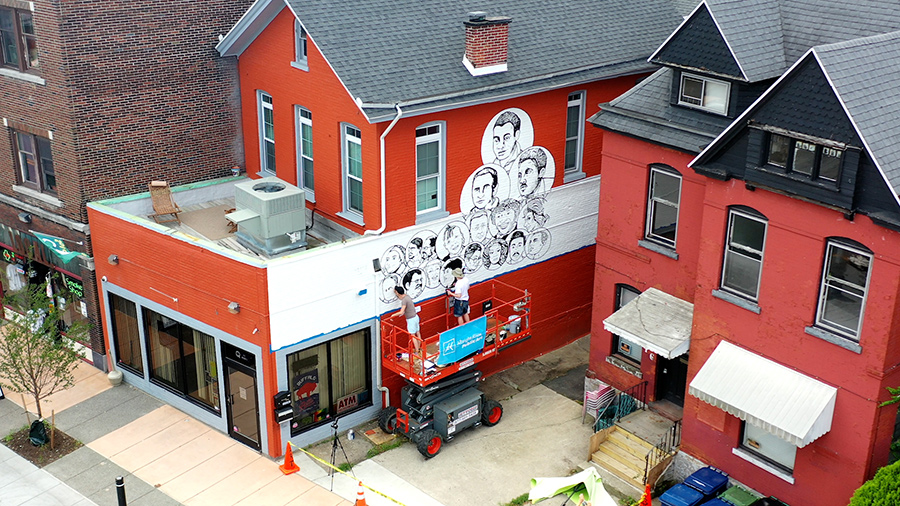
In the ever-evolving public and street art equation where boundaries between genres blur and definitions remain in flux, a notable regional museum has taken a decisive step toward institutionalizing a decade-long experiment in civic art-making. With the opening of Hi-Vis at the Buffalo AKG Art Museum, the first ten years of its public art initiative are given a platform inside the museum walls—not just in the form of an expansive exhibition but also through a new book and documentary that trace the evolution of their unique and sustained commitment to public art.
HI-VIS: Ten Years of Public Art at the Buffalo AKG Art Museum. GILES / D Giles LTD, UK.
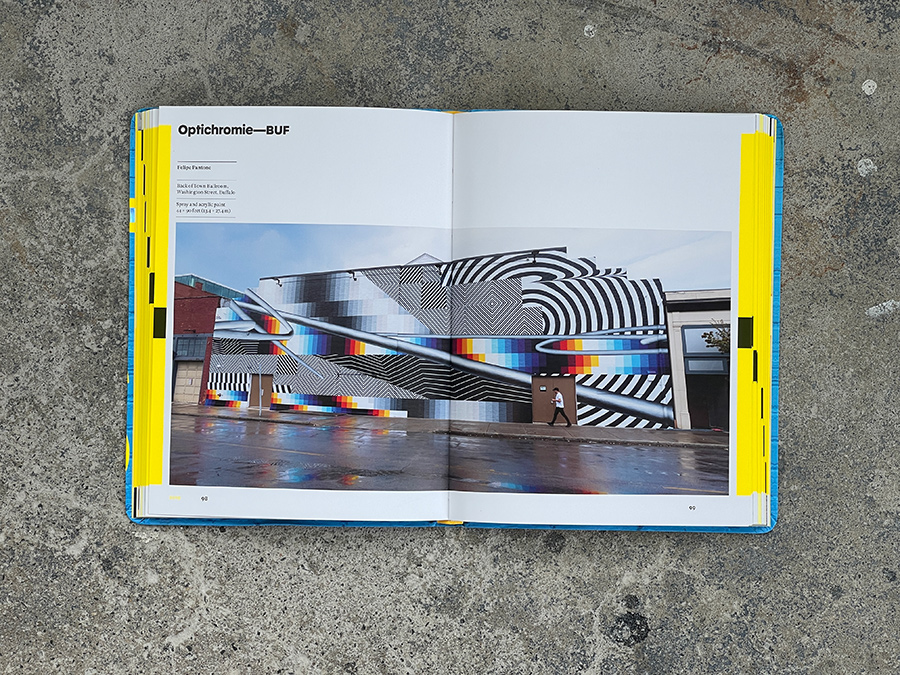
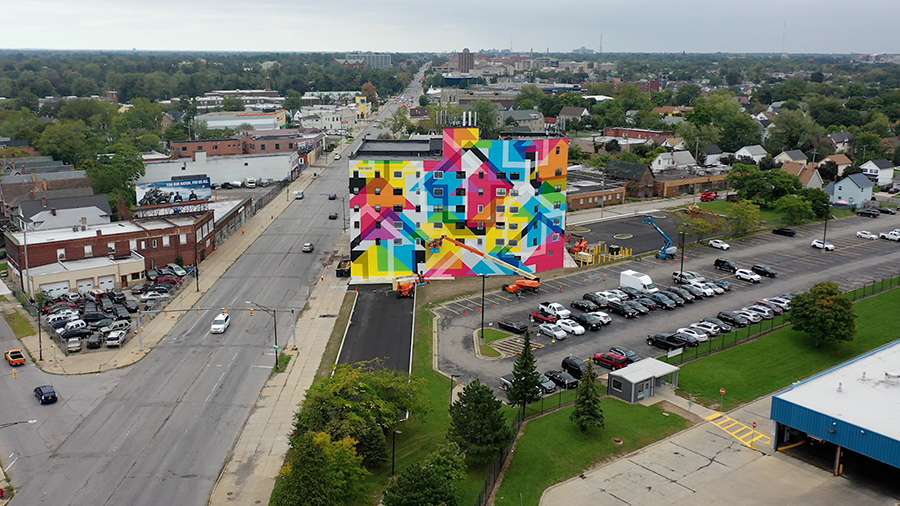
Running through June 9, 2025, Hi-Vis celebrates over 80 artists who have participated in creating more than 60 public works across Buffalo and it’s surrounding county. Names familiar to fans of street art and contemporary muralism appear alongside local heroes of various styles and disciplines, forming a compelling mix that includes FUTURA 2000, Shantell Martin, Felipe Pantone, Maya Hayuk, Louise Jones, Jun Kaneko, Julia Bottoms, Monet Kifner, Pat Perry, Edreys Wajed, and many others. These artists—some creating their largest or first-ever public works—are altering and shaping Buffalo’s new visual identity by emphasizing community collaboration and civic visibility.
HI-VIS: Ten Years of Public Art at the Buffalo AKG Art Museum. GILES / D Giles LTD, UK. Artist. Felipe Pantone.
The exhibition, presented on the third floor of the new Jeffrey E. Gundlach Building, is co-curated by Aaron Ott (Curator of Public Art), Eric Jones (Public Art Projects Manager), and Zack Boehler (Assistant Curator, Special Projects). It invites audiences to consider muralism and street aesthetics as entry points into the broader range of practices these artists engage in—highlighting the connections between creative expression, community engagement, and the on-the-ground perspective of those who live here. As the accompanying book Hi-Vis: Ten Years of Public Art at the Buffalo AKG Art Museum makes clear, this program is not about surface decoration or branding neighborhoods; it is about forging durable, meaningful relationships between artists, institutions, and the communities they work with.
Directed by Jeff Mace, the companion video documentary Hi-Vis: Ten Years of Public Art (below) further contextualizes this effort with interviews, installation footage, and insights from those who brought these projects to life—many clad, as the name suggests, in high-visibility orange or yellow vests, straddling cranes and scaffolding as they worked.
HI-VIS: Ten Years of Public Art at the Buffalo AKG Art Museum. GILES / D Giles LTD, UK. Artist. Futura 2000.
Spearheaded by museum director Dr. Janne Sirén and supported by both the City of Buffalo and the surrounding Erie County, the Public Art Initiative stands as a first dedicated department of its kind at an American museum. It’s proponents say that in doing so, it marks a new model—one that recognizes public art not as an outreach program but as core practice. Certainly museums like the STRAAT in Amsterdam, UN in Berlin, MUJAM in Mexico City, and the Museum of Graffiti in Miami have active and engaged programs with art and community in the public sphere. Similarly, as this retrospective shows, public art at Buffalo AKG is neither an afterthought nor a trend but a sustained cultural investment.
In a global street art landscape marked by public and private interests, sanctioned and unsanctioned practices, grassroots efforts, and institutional frameworks, where mural festivals, community art, graffiti heritage, and critique frequently converge and collide, Hi-Vis offers a chance to reflect on how a museum can meaningfully participate in the public realm while allowing artists to remain true to their diverse methods and voices.
HI-VIS: Ten Years of Public Art at the Buffalo AKG Art Museum. GILES / D Giles LTD, UK.
BSA spoke with curator Aaron Ott about the Buffalo AKG Art Museum’s Public Art Initiative, exploring how the museum balances global and local artist engagement, fosters long-term public collaborations, and rethinks the role of museums beyond their walls. Ott reflects on lessons from other mural and street art models, the importance of sustainability, and the potential for institutional partnerships in shaping the future of public art.
BSA: Reflecting on a decade of the Public Art Initiative, how do you balance the inclusion of local voices with internationally recognized artists? What does that balance bring to the communities you serve?
Aaron Ott: As a global arts institution, the Buffalo AKG Art Museum is uniquely positioned to collaborate with and commission talent from all over the world. Our foundational sponsor for the Public Art Initiative at the AKG was the Erie County Legislature, joined shortly thereafter by the City of Buffalo. Erie County is over 1,200 square miles with dozens of municipalities and nearly one million citizens. These factors, our global reach, our rich geographic opportunities, and our diverse audiences, along with our position as a collecting and exhibiting institution of modern and contemporary art offers us a unique scope and latitude when considering international, national, and regional talent. Over the last ten years of production, roughly 20% of our projects have been with international artists. The remaining projects have been evenly split between national and local talent.
The result is a program that answers a variety of questions that is as diverse as our audiences. We are fundamentally collaborative, working entirely on property and in landscapes that the museum does not own. As a result, we support our artists alongside the concerns and desires of our various publics.
HI-VIS: Ten Years of Public Art at the Buffalo AKG Art Museum. GILES / D Giles LTD, UK. Artist. Tavar Zawcki. (photo courtesy of AKG Museum).
BSA:In shaping this program, how much influence did the global rise of street art festivals and mural programs in the last two decades—like WALL\THERAPY in Rochester, Nuart in Norway, or Urban Nation in Berlin—have on your thinking? Did you engage with any of those models directly?
Aaron Ott: In addition to the models you name above, we looked at numerous others dedicated to street art (MURAL in Montreal, Wynwood Walls in Miami, the Philadelphia Mural Arts Program) and continue to share ideas with public art producers around the United States and abroad. At the beginning of our initiative, I was particularly interested in models led by Art Centers, specifically the Hyde Park Art Center in Chicago and the Kohler Art Center in Wisconsin, since I was most familiar with their programs and formats. The Art Center model, at the risk of oversimplification, is one that is centered on audience, dialogue, and openness. At times, museums can feel more “closed” to people and we really want to act in a way that honors our long legacy in contemporary art here at the AKG while presenting ourselves as available to collaborate.
As we grow in scope, we continue to evolve our thinking of what kind of work is available for us to produce collaboratively and cooperatively with our publics. We also look at other institutions and organizations (like the North Carolina Museum of Art, the Nasher in Dallas, Madison Square Park in NY) to consider how elements of their models, while fundamentally different, might lead us to similar successes and outcomes.
HI-VIS: Ten Years of Public Art at the Buffalo AKG Art Museum. GILES / D Giles LTD, UK. Artist. Kobra. (photo courtesy of AKG Museum).
BSA: As one of the few curators of public art embedded within a major museum, what responsibilities do you see attached to that role? Should more institutions formalize this position?
Aaron Ott: I’m not sure I could overstate how important I find being attached to and imbedded into a museum. Buffalo is a relatively small city (population 250,000) but one with a broad impact regionally (Erie County population just under 1M). While I would certainly argue for large American cities and their corresponding institutions to embrace models similar to ours, I strongly believe that pretty much every mid-to-small size American city should consider our model.
My personal opinion is that if you take cities of less than one million, starting with, say Jacksonville, FL, or Austin, TX, all the way to cities just over 200,000, Little Rock, AR, or Sioux Falls, SD, for example, you’ve got over 100 American cities with various collecting institutions with a breadth of local and national knowledge and expertise on the arts.
What sets museums apart from other models is our inherent connectivity to history, collection, and stewardship. As cities themselves grow, shrink, and evolve, it is often the civically oriented arts intuitions that serve as a central and foundational element of identity.
Our own organization was founded in 1862. While most of our peer intuitions have not been around that long, what sets museums apart from many organizations is their year-after-year, ongoing commitment to creative culture. But while plenty of museums participate in public art sporadically, nearly none of them are currently developed with long-term annual commitments to such a program.
Usually, museums activate their commitment primarily on their own walls in their own spaces, but with a little bit of support and ingenuity, they could easily participate in the public as we do. It is both simple to say and hard to do, but sustainability is the key for an institution that wants to participate in the public realm.
HI-VIS: Ten Years of Public Art at the Buffalo AKG Art Museum. GILES / D Giles LTD, UK. Artists. Edreys Wajerd and James “Yames’ Moffitt. (photo courtesy of AKG Museum).
BSA:What role does community input play when a mural is planned? Are there specific guidelines or processes that ensure artists engage meaningfully with the neighborhoods their work enters?
Aaron Ott: The Buffalo AKG Public Art Initiative produces projects through a variety of public/private partnerships that allow for and foster cooperation to achieve the highest quality of work for the broadest possible audiences throughout Western New York. We seek to address the critical questions projects by considering core questions of funding, site, artist, community, capacity, and collaboration. Each of these elemental matters must coalesce in order for success to be secured.
Community conversation is essential at the earliest stages, as detailed exchanges will clarify instances where different constituents in the community have diverse interests or specific pressures dictating their particular viewpoint. By parsing and articulating these diverse perspectives, we establish baseline principles to identify find consensus through a multi-dimensional look at public art practices and community interests. Our policies and actions are specifically developed with discourse in mind.
HI-VIS: Ten Years of Public Art at the Buffalo AKG Art Museum. GILES / D Giles LTD, UK. Artist. Muhammad Zaman. (photo courtesy of AKG Museum)
BSA:The book and exhibition feature artists with roots in graffiti, street art, muralism, conceptual public art, and activist-based practices. How do you view these differing traditions and practices intersecting under the umbrella of public art at AKG?
Aaron Ott: Our museum has always been dedicated to, as we say, the art of our time. As an institution, we are committed to exploring and supporting the work that contemporary artists are engaged with. Perhaps no mode of presentation captures audiences as broadly and deeply as displays of public works of art, which positions our initiative as aligned with one of the most consequential methods of production today.
BSA:Have there been discussions or potential partnerships with other museums—like STRAAT in Amsterdam, MUCA in Munich, UN in Berlin, or LA MOCA—that also have maintained public art programs? What might a collaborative model across institutions look like?
Aaron Ott: Collaboration is all we have ever done. Because that acts as a center of gravity for our initiative, I have great confidence that we’ll be expanding what that means for our partnerships. Institutional, organizational, civic, or independent, we are consistently testing and exploring what collaborations will yield equitable and mutually beneficial outcomes. We’ll never be short on good artists with good ideas. It’s just a matter of finding the right partners at the right time.
HI-VIS: Ten Years of Public Art at the Buffalo AKG Art Museum. GILES / D Giles LTD, UK. Artist. Josef Kristofoletti.HI-VIS: Ten Years of Public Art at the Buffalo AKG Art Museum. GILES / D Giles LTD, UK.HI-VIS: Ten Years of Public Art at the Buffalo AKG Art Museum. GILES / D Giles LTD, UK. Artist. Hillary Waters Fayle. (photo courtesy of AKG Museum).HI-VIS: Ten Years of Public Art at the Buffalo AKG Art Museum. GILES / D Giles LTD, UK. Artists. Mickey Harmon and Ari Moore. (photo courtesy of AKG Museum)HI-VIS: Ten Years of Public Art at the Buffalo AKG Art Museum. GILES / D Giles LTD, UK. Artist. Robert Montgomery. (photo courtesy of AKG Museum)
BUFFALO AKG ART MUSEUM.
Hi-Vis
Friday, February 21, 2025–Monday, June 9, 2025
For directions, schedules and opening hours click HERE
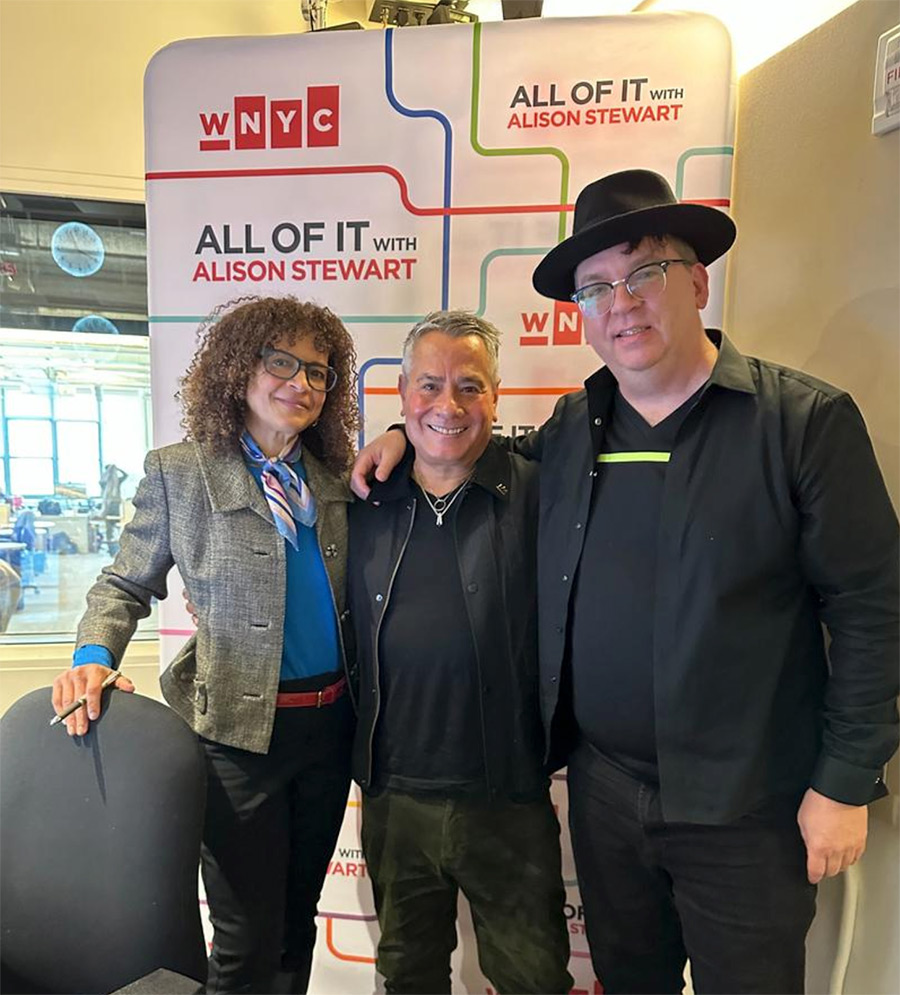
In honor of the radio station WNYC’s 100th birthday, Alison Stewart’s “All Of It” program is celebrating 100 pieces of art in New York City. Each month, Alison speaks with an expert in the art world about their 10 favorites. This month, Alison talked to Jaime Rojo and Steven P. Harrington, co-founders of Brooklyn Street Art, about 10 pieces of art in the streets that they think all New Yorkers would like to know about.
Since it was a radio show, it was impossible to show, only to tell. BSA fans have written to ask us for pictures of the pieces discussed, so here they are!
The list is unscientific and offers a wide selection of art styles and disciplines in New York’s public sphere. Please don’t take it as an indicator of importance or value; rather, take it as a casual survey of things you may see around town.
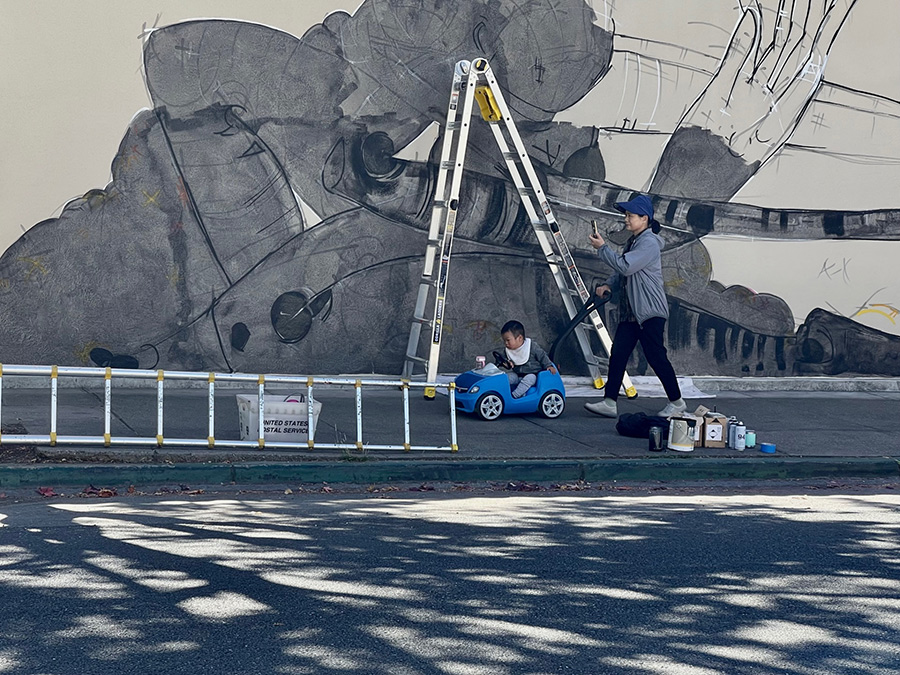
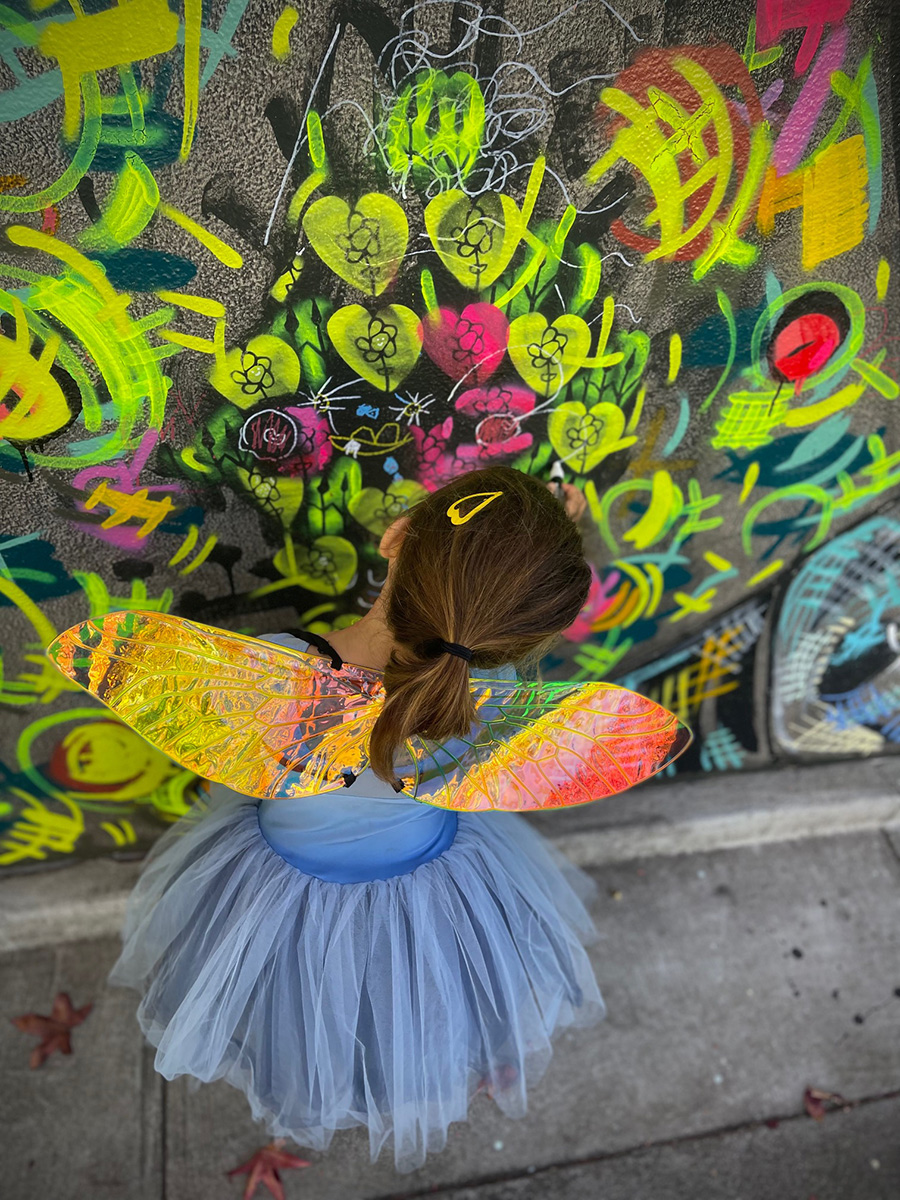
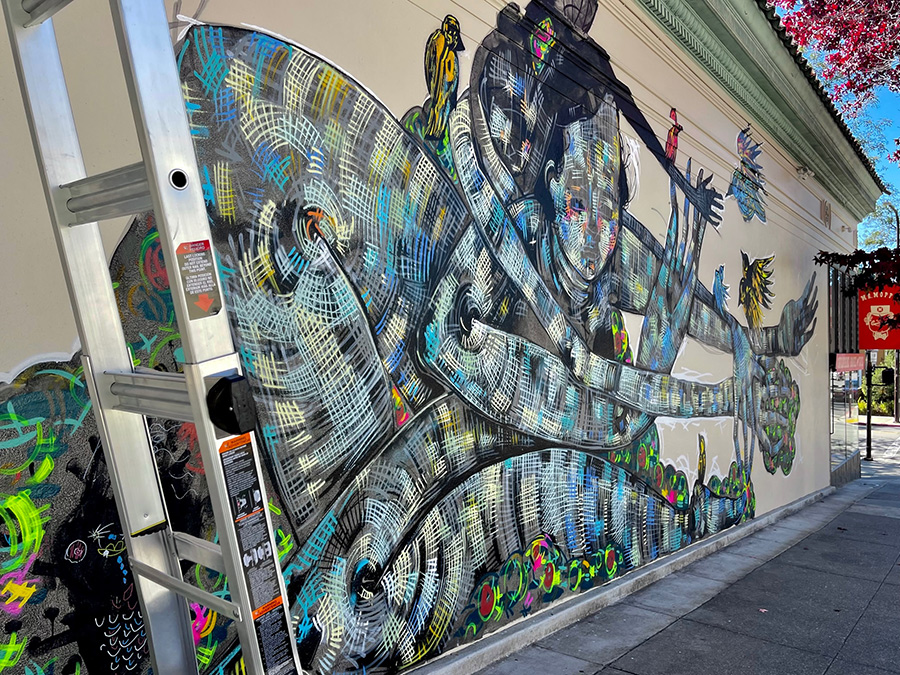
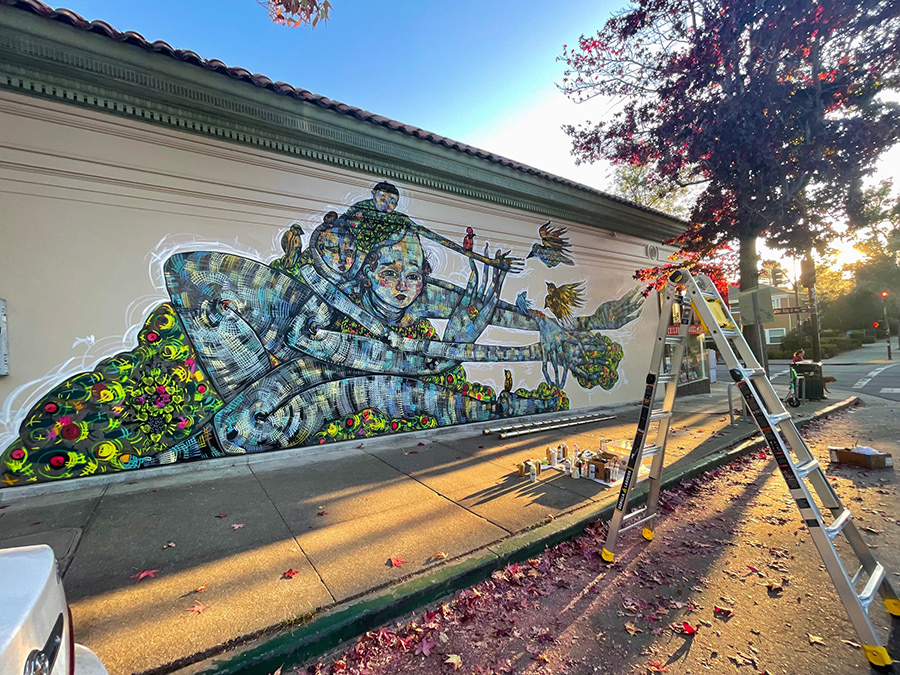
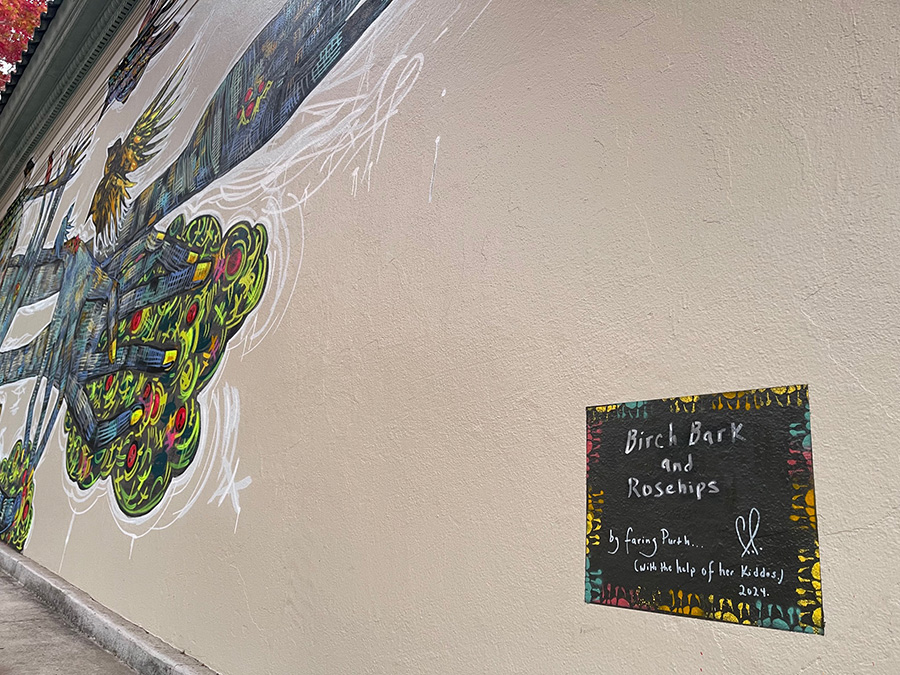
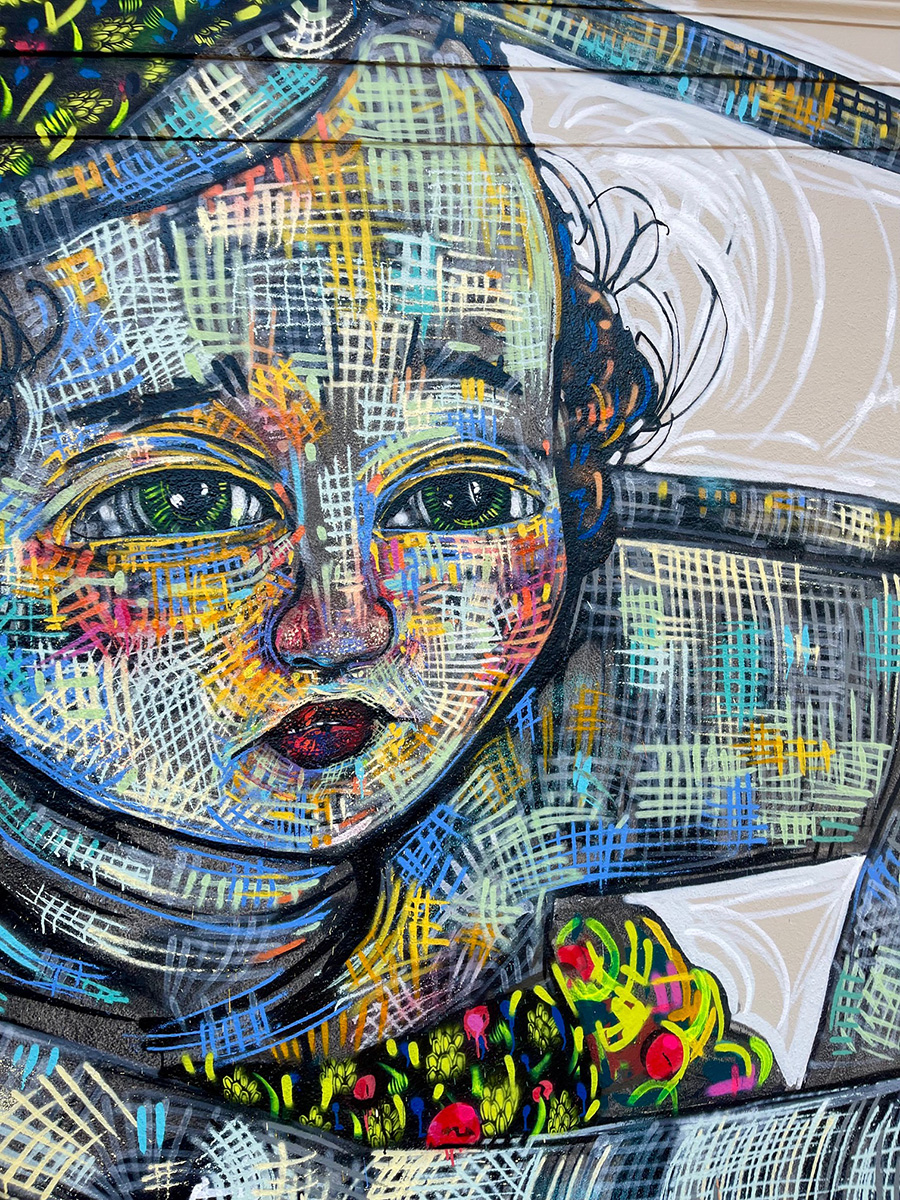
In her latest mural, Faring Purth delivers a powerful reflection on connection, continuity, and the complexity of evolving relationships—a true “Family Affair.” Created in her new home of Berkeley, California, this latest work is a pearl in her artistic journey, reflecting the changing dynamics of her life, which now includes two young children. More than just another mural, it is a living canvas where her personal experiences and creative practice intersect.
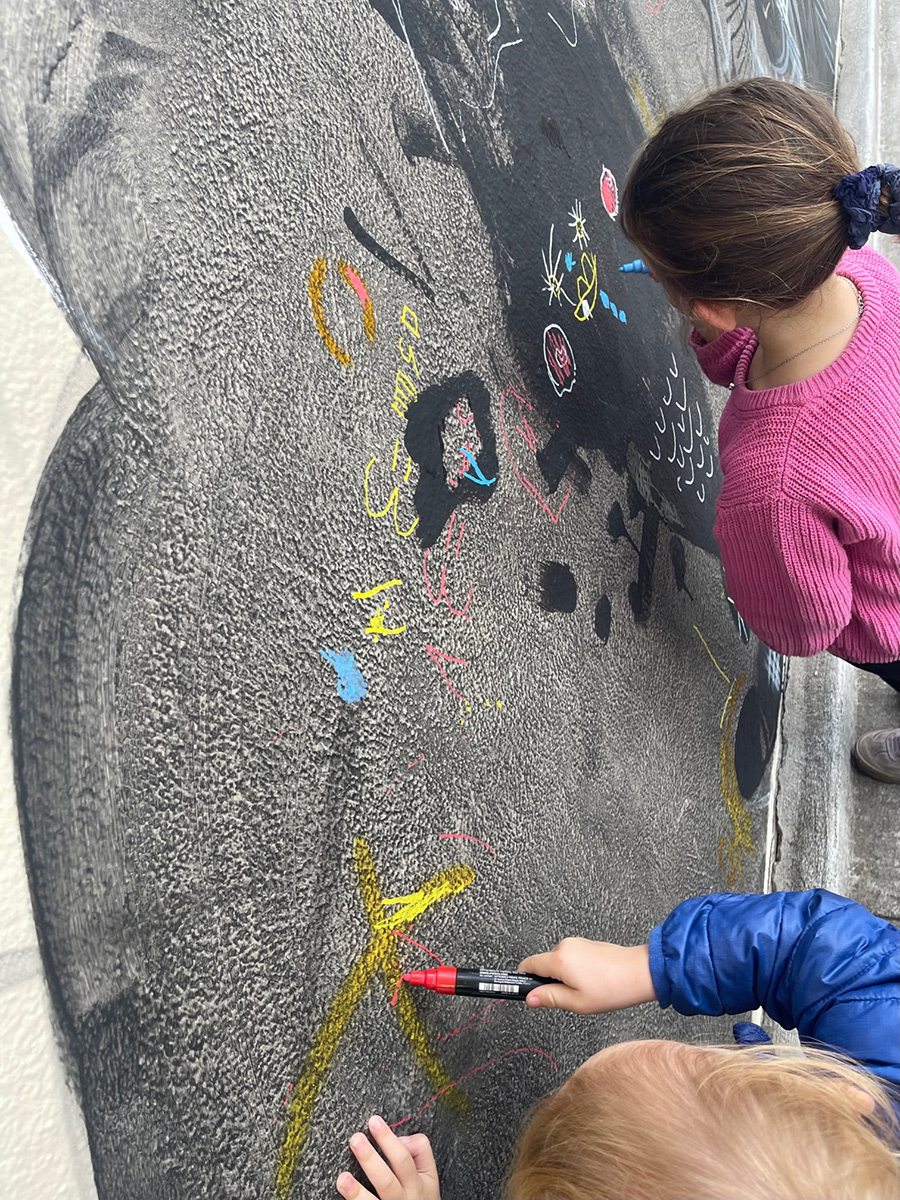
The idea of a “Family Affair” goes beyond the imagery to capture the very essence of Purth’s current process. The presence of her children has transformed her approach to painting, shifting from the solitary, all-night sessions of her earlier career to a more fluid, adaptive rhythm. Their involvement, whether by simply being there or adding their own playful touches, informs the work in surprising ways, adding layers of spontaneity and discovery.
With themes of protection, generational trauma, and natural elements like birch bark and rosehips, the mural becomes a metaphor for the unseen bonds of family. In this exchange, Faring Purth discusses her creative process, the influence of motherhood, and the ways in which her children contribute to her evolving artistic expression.
BSA: In the past, when sending dispatches from towns near and afar you’ve brought up your mother in passing, a sweet reference, something sweet and brief. This time you are a mother, and your kids are in situ while you paint, and they also paint. How does it feel to have them with you while doing your craft?
Faring Purth: Well, I’ll be honest and say the formal, strenuous, and hyper-focused work is nearly never accomplished with my son and daughter present. The role of Mothering tiny ones is an all-consuming task, as is painting large-scale murals. Neither want you to divert your gaze. But I’ll also say, that becoming a mother has facilitated a level of adaptation and fluidity I never dreamt possible. It really is like getting your Doctorate degree in organized chaos.
The pressure, for me, lead to surrender and invaluable growth… being able to do all I can when I can, allowing my hours of work to adjust to a thousand variables, including sleepless nights, tiny sniffling noses, and the simple act of being barefooted in the grass with them. All of these countless adjustments impact the work enormously. I miss my all-nighters in the studio but they’ll be back, I’m sure. For now, I love the spontaneous bursts of progress I make with the kids, the “beginner’s mind” they undoubtedly inspire, the many ways of involving them, and the support that allows me the ability to still be alone and painting when I need to be.
BSA: “Birch Bark and Rosehips”: What comes to mind?
Faring Purth: While creating the piece, many experiences unfolded in my own life concerning things like facing generational traumas, coming to terms with past abuse, and protecting myself and the kids in some very literal and some abstract ways.
BSA:This mural seems to be a family portrait. A young mother and her children?
Faring Purth: The reflections are almost never literal. Although I am often surprised at how unintentionally reflective they are. I’d like to believe many artists share that playful relationship with the work.
BSA:Children are often a constant presence in your work. Why?
Faring Purth: Another very honest statement is the work is often a surprise, even to me. I won’t deny that I am inspired by many things but much of it remains like kneading through a mystery, over and over. I will say the oddity and poetry of my own life began early on. I remember the depths of my perceptions at a young age and witness it now in my children. It has my attention often… and reverence.
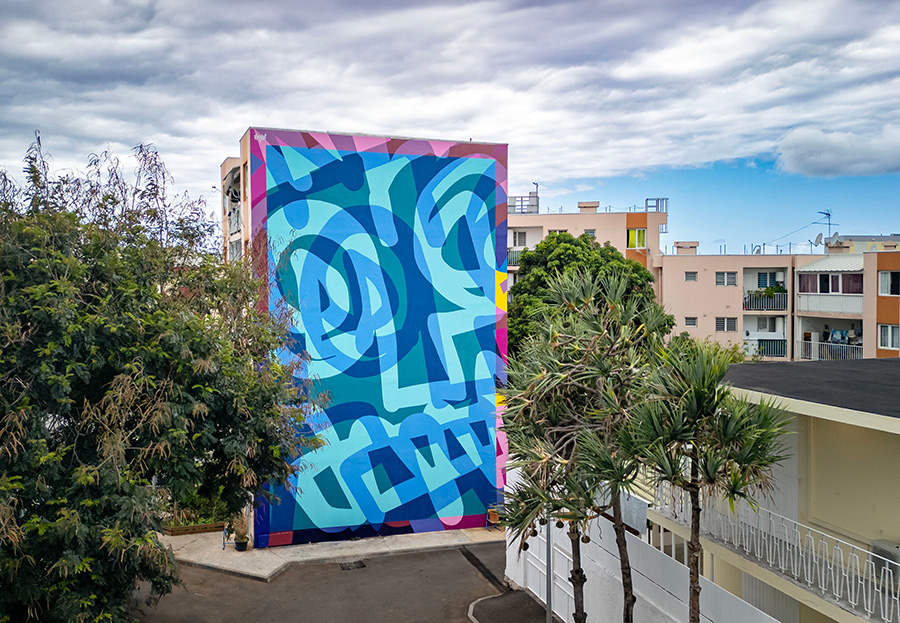
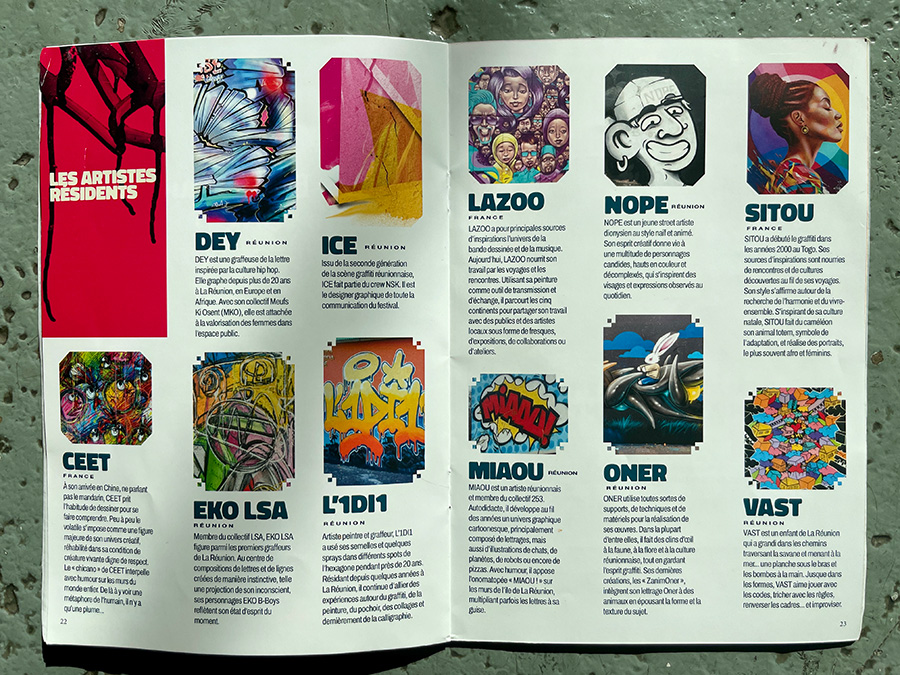
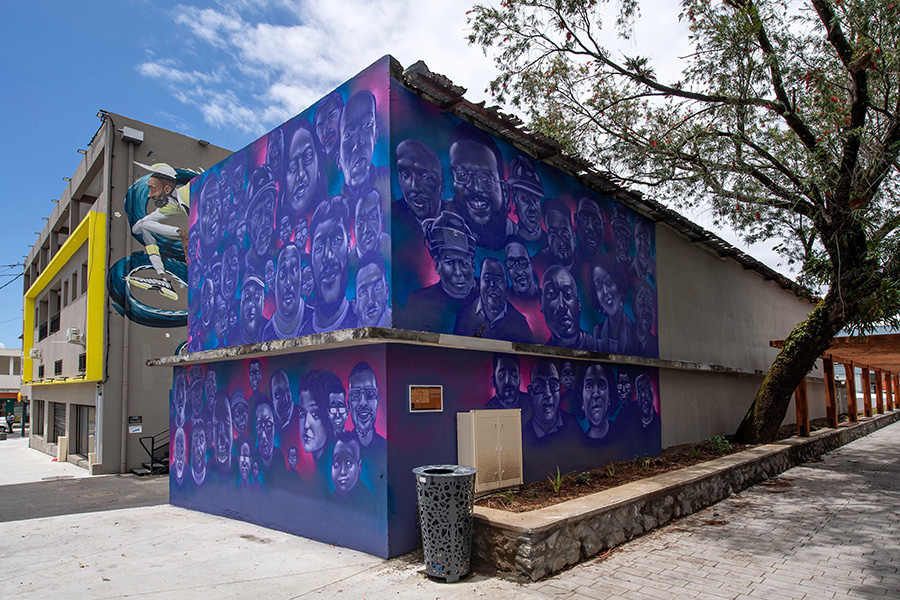
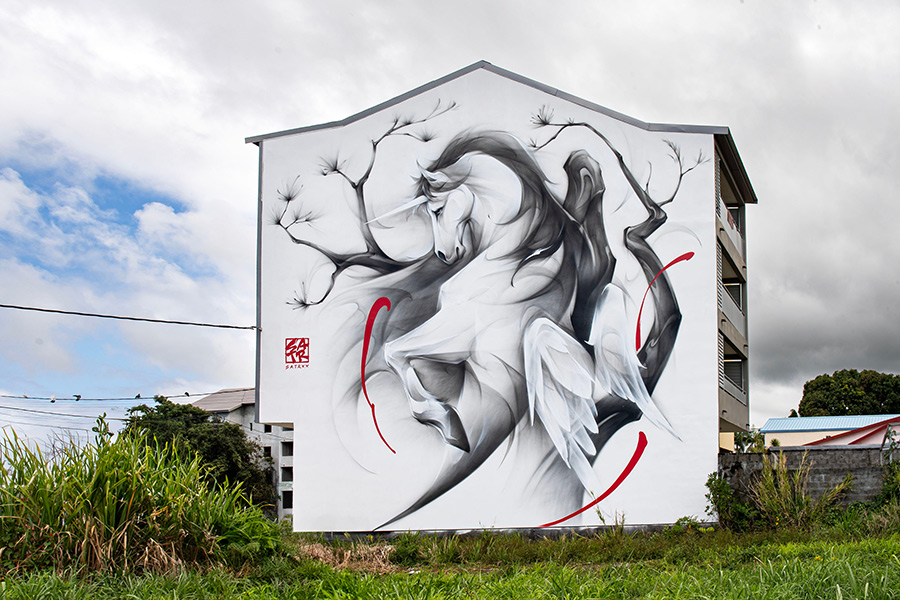
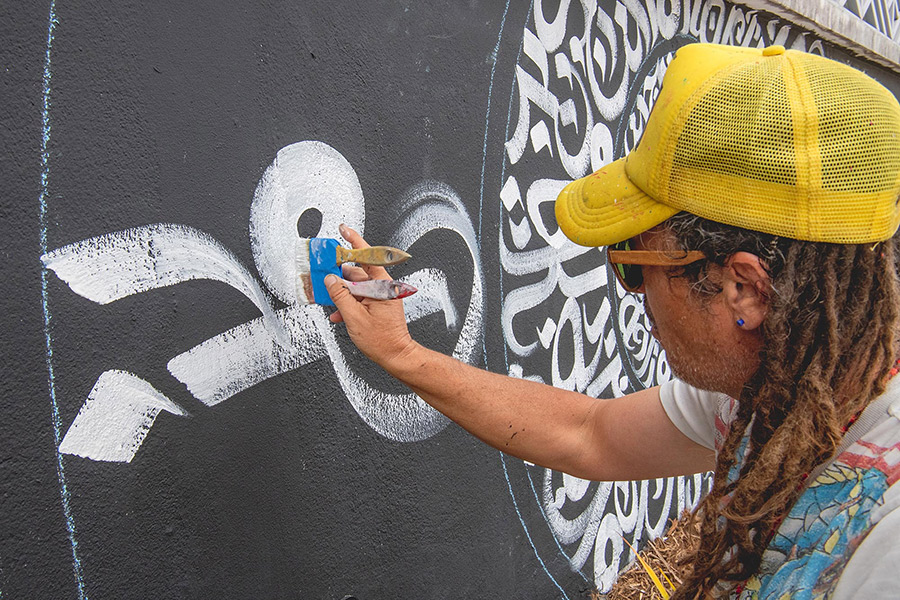
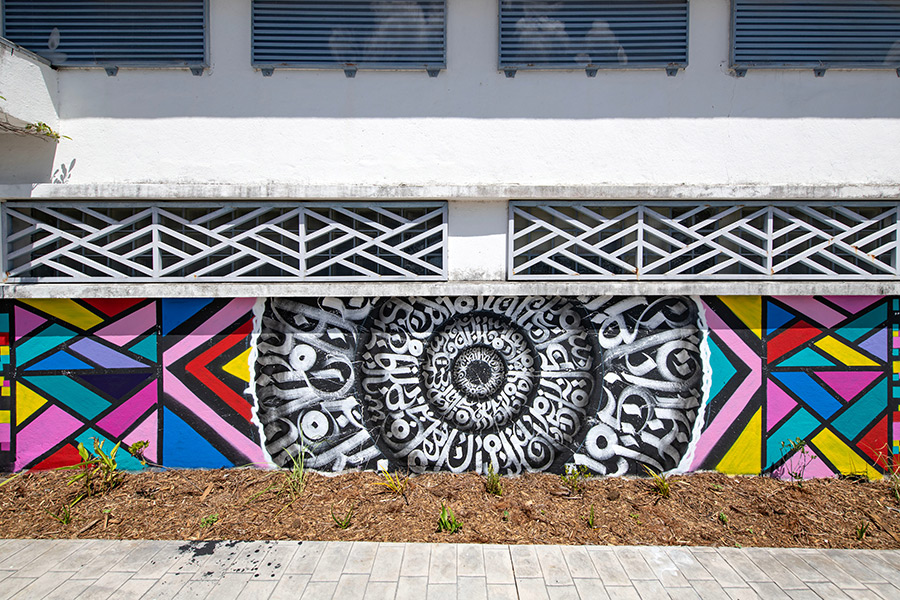
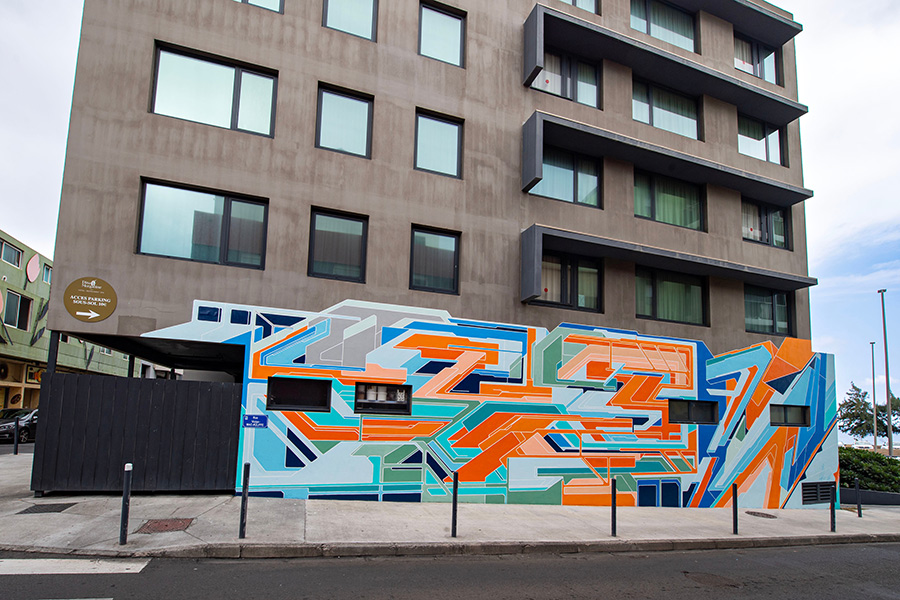
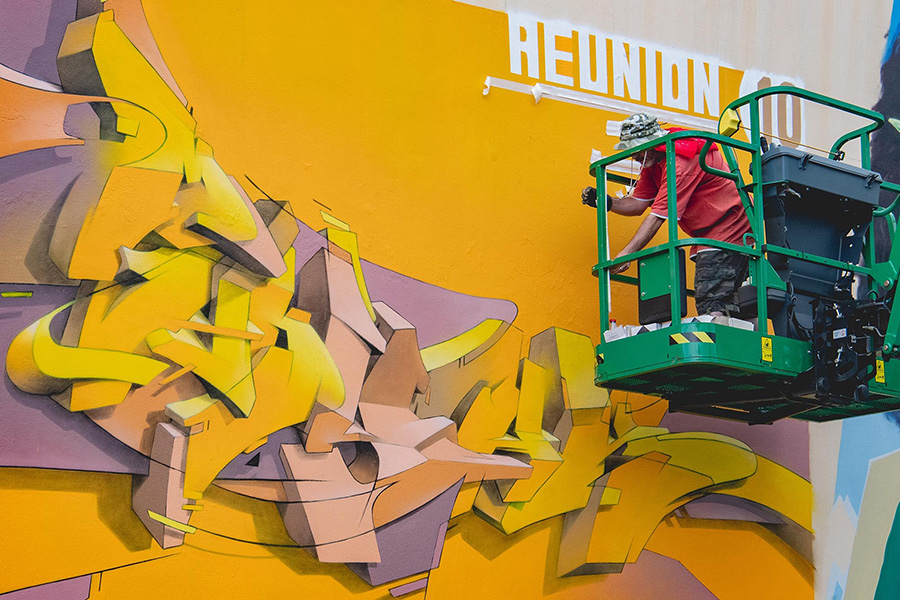
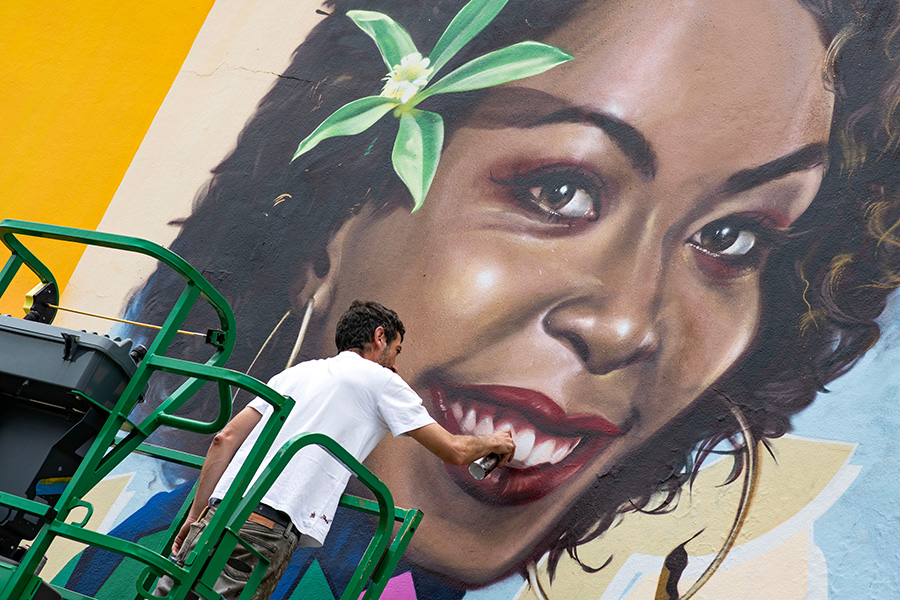
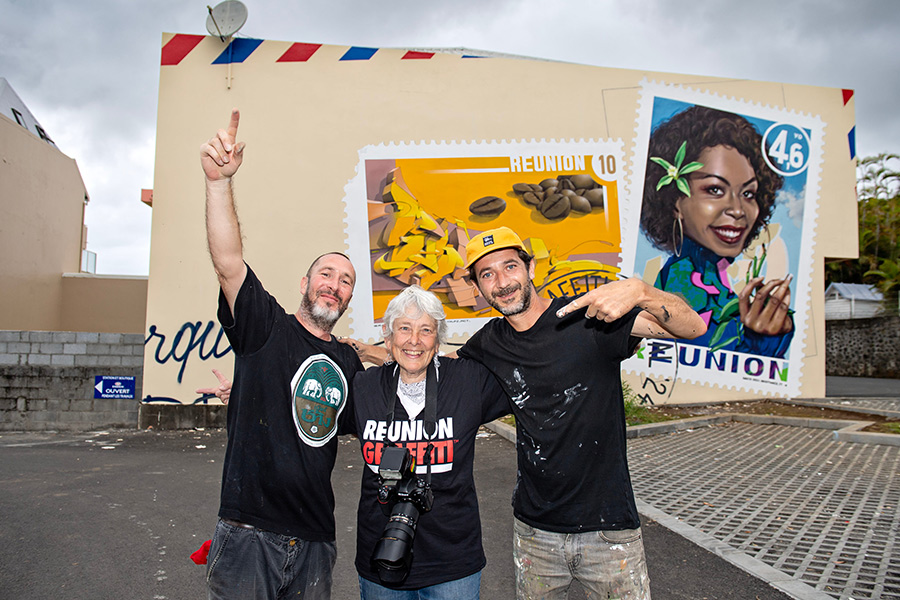
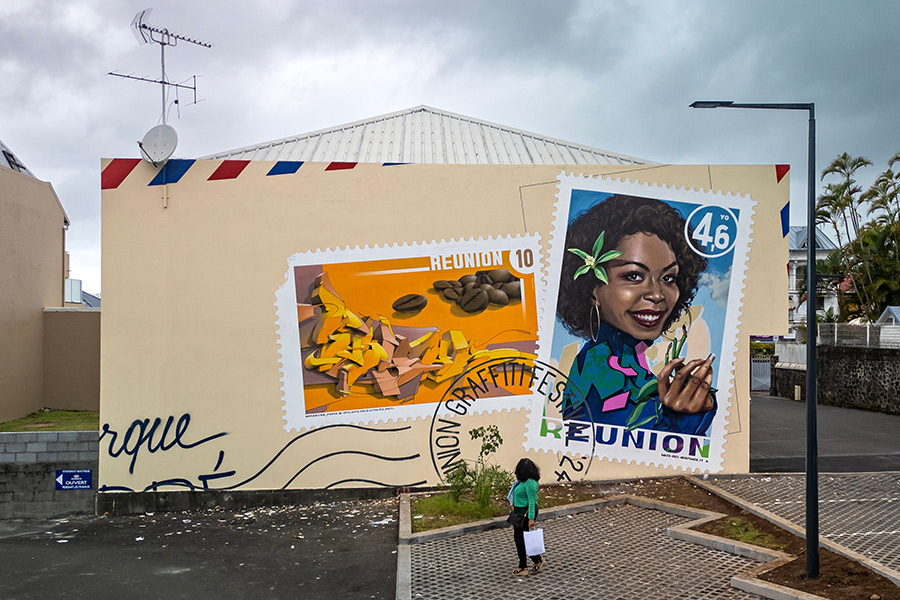
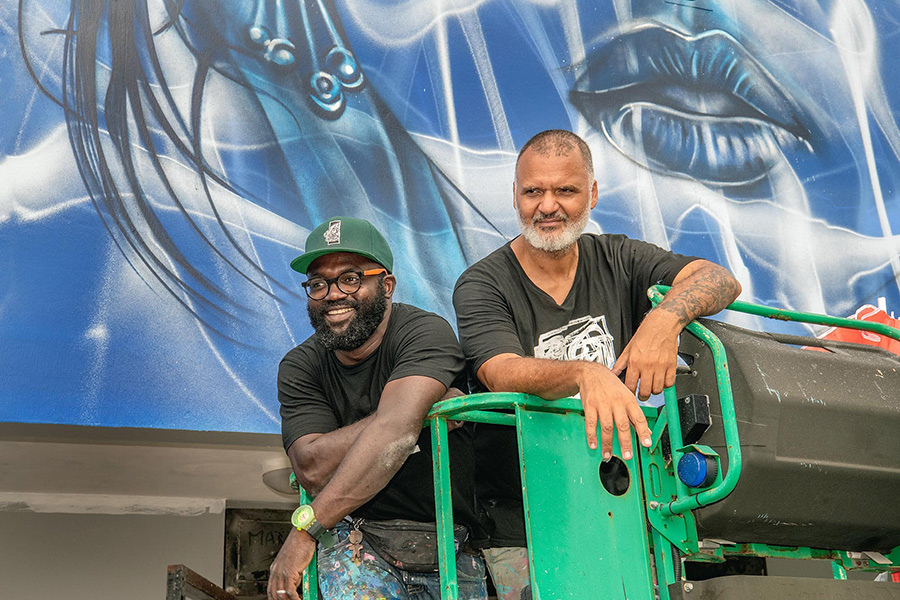
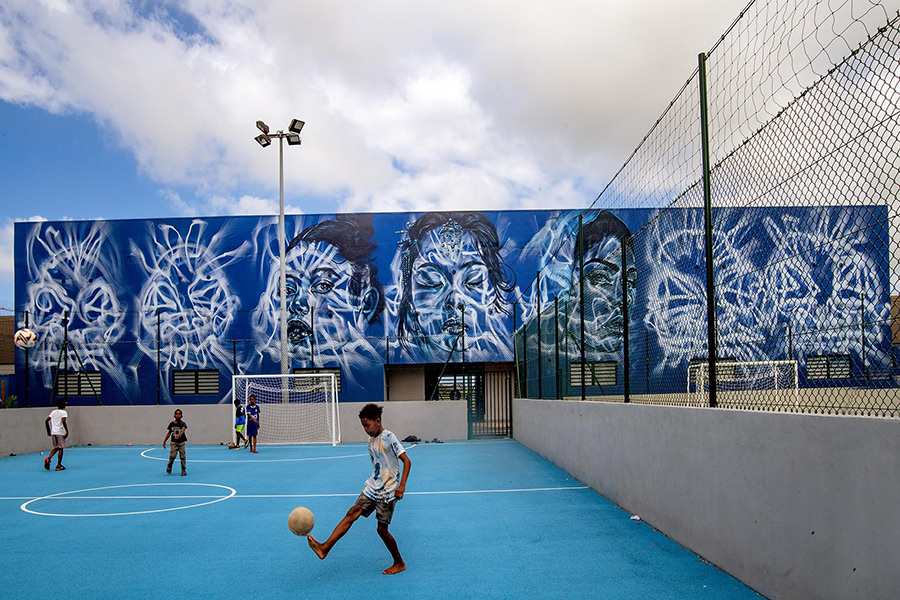
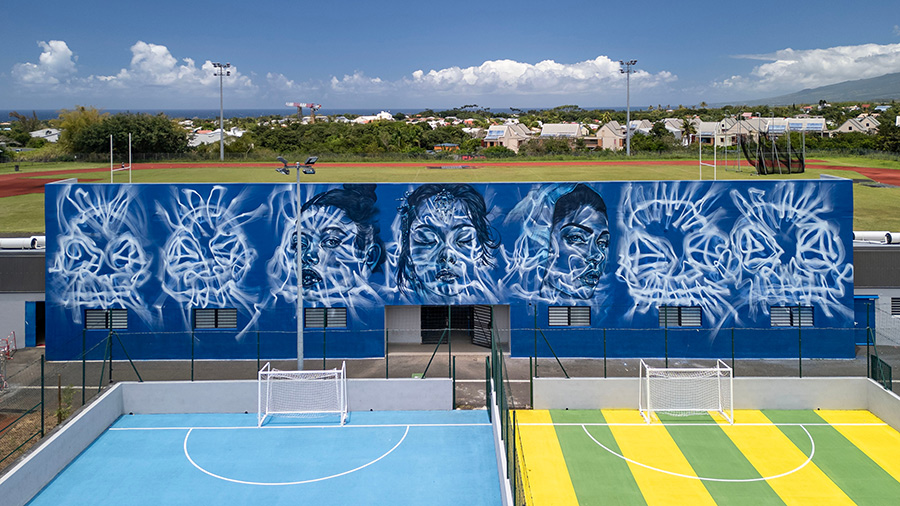
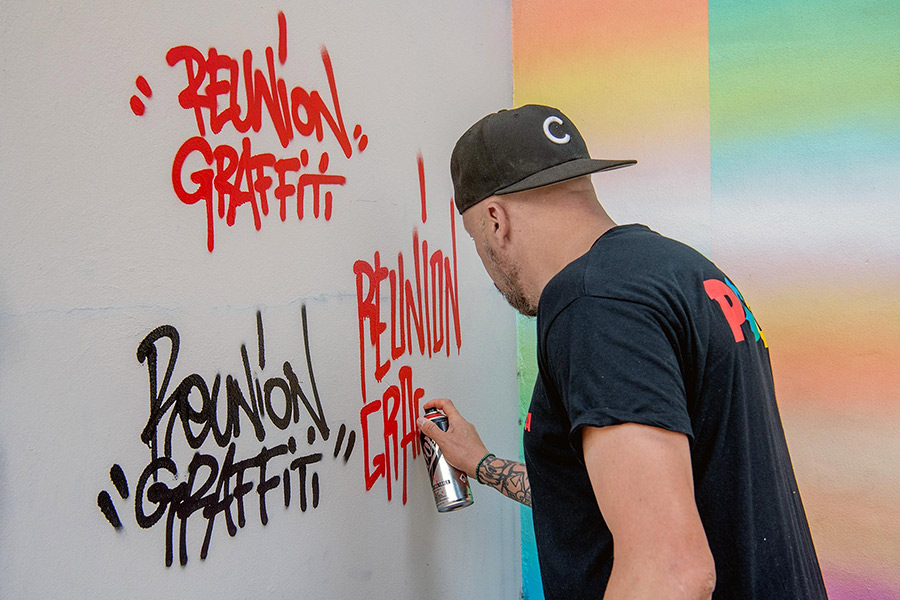
A place you may not have heard of, Réunion Island has quickly become a remarkable hotspot for urban art, largely due to the Réunion Graffiti Festival. This annual gathering showcases a rich range of talent from graffiti and street art communities worldwide, offering something refreshingly unique for this type of festival.
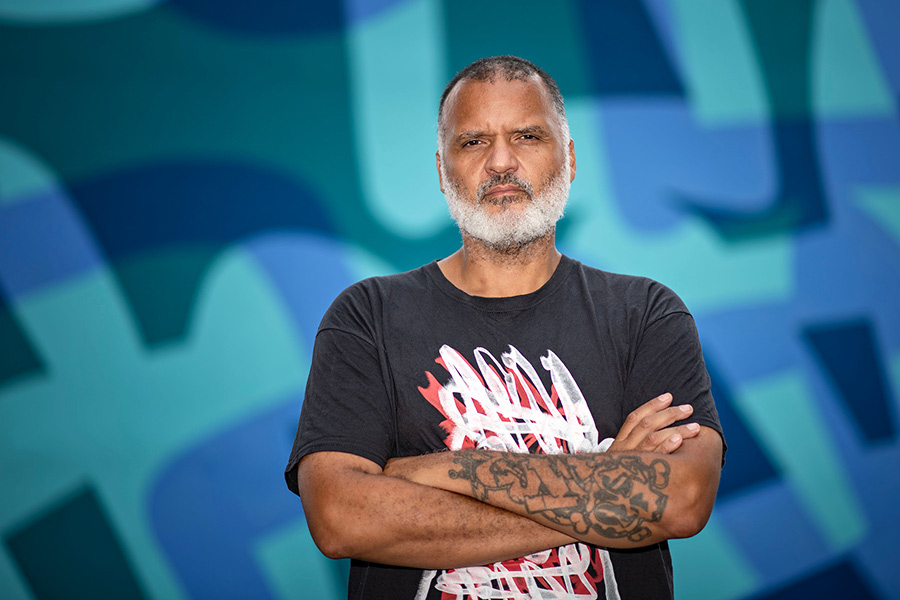
Eko, the festival’s founder, extends an open invitation: “Come to Réunion, see the artists, see the walls, and the beautiful city.”
Born in 1976 on Réunion Island, Eko began his graffiti journey in 1989, inspired by hip-hop culture and gaining recognition under the tag “Saphir.” As one of the pioneers of graffiti on the island, he collaborated with local crews like SRD (Syndicat du Rap Dionysien) and later joined LSA (Le Syndicat des Artistes). Eko’s creative reach extends beyond graffiti to music and performance, and his time in mainland France deepened his appreciation for Réunion’s vibrant culture, which he was eager to elevate upon his return.
With respect for his homeland and a vision of global recognition, Eko founded the Réunion Graffiti Festival in 2019. Each year, the festival expands, now including an impressive lineup of international and local artists, community-focused programs, and interactive events for diverse audiences.
A French overseas department in the Indian Ocean, Réunion is located approximately 679 km east of Madagascar and 175 km southwest of Mauritius. Known for its stunning volcanic landscapes, including the active Piton de la Fournaise, Réunion is home to about 885,700 residents. The island’s unique blend of French, African, and Indian influences is evident in its culture, cuisine, and language, with Réunion Creole widely spoken alongside French. Since 1946, it has been governed as a French region, making it one of the European Union’s outermost regions and a part of the eurozone. This blend of European governance and Creole heritage gives Réunion its distinct identity, celebrated through its music, arts, and now, street art.
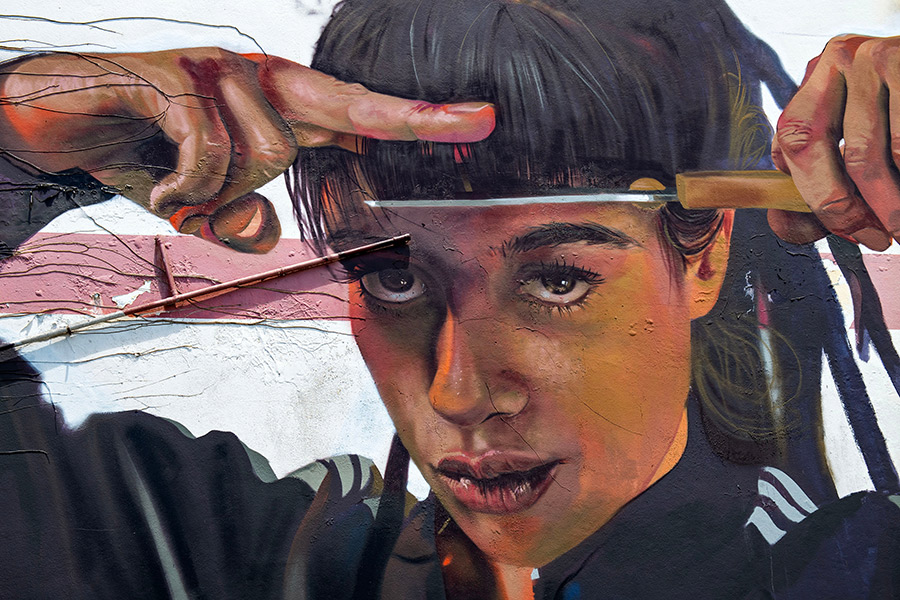
Since its inception, the festival has showcased global talent across graffiti and street art practices, hosting more than 100 artists, including renowned figures from countries such as Germany, Argentina, Spain, the U.S., India, Italy, Japan, Senegal, Switzerland, and Togo. This mix brings a dynamic blend of styles, reinforcing the island’s position as a hub for global urban art.
A key feature is Graff Park in Saint-Denis, a dedicated space for free expression where artists—from beginners to veterans—can experiment and showcase their work. Supported by both public and private funds, the festival emphasizes inclusivity, offering community workshops, recreational activities, and sessions that help budding artists learn techniques and connect with mentors.
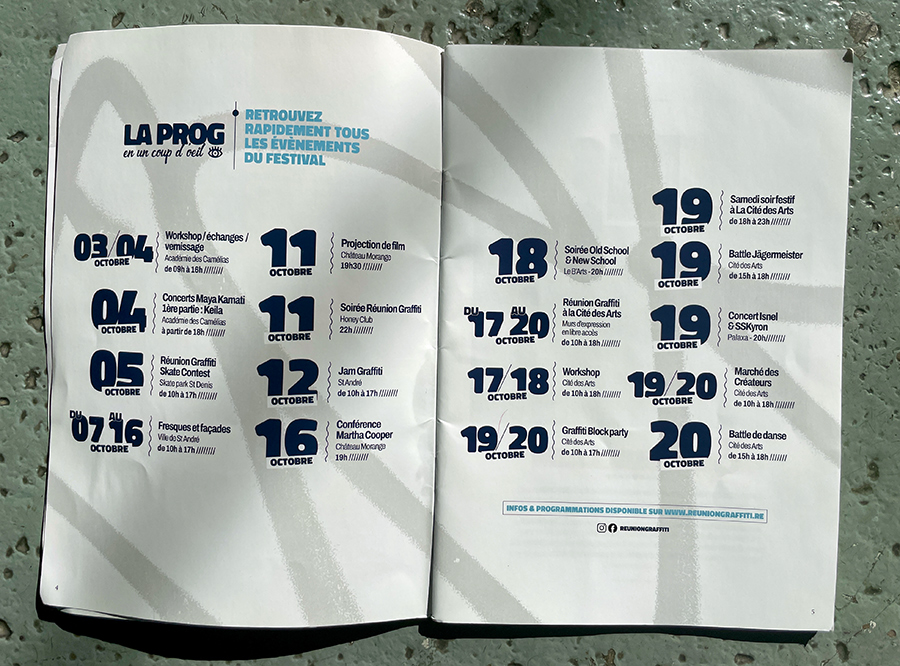
Beyond murals, the festival highlights Réunion’s cultural vibrancy with exhibitions, live music, and dance battles. These programs blend local talent with international flair, complemented by Acts, an outreach initiative that provides regular updates and information on Réunion’s street art scene. This effort helps keep art enthusiasts connected to the evolving urban landscape on the island.
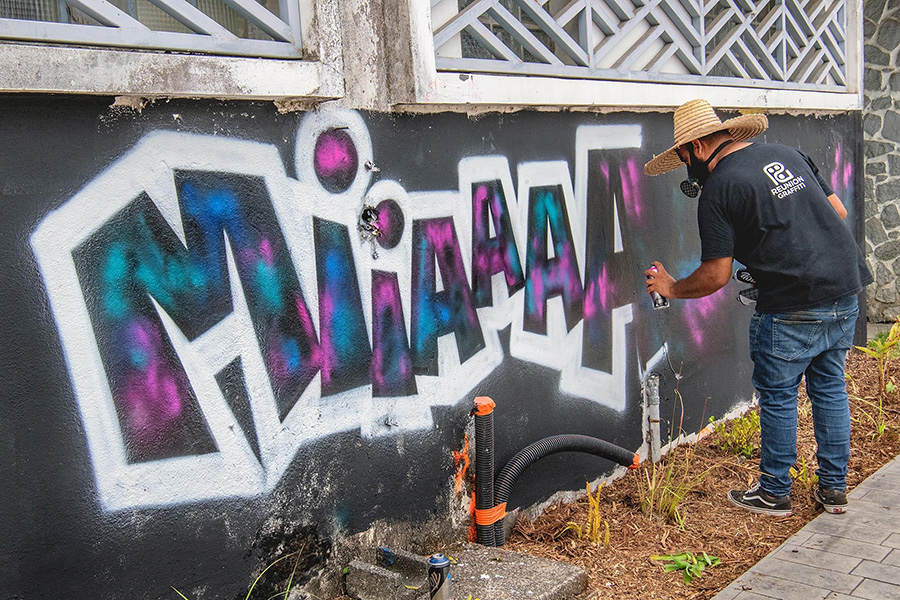
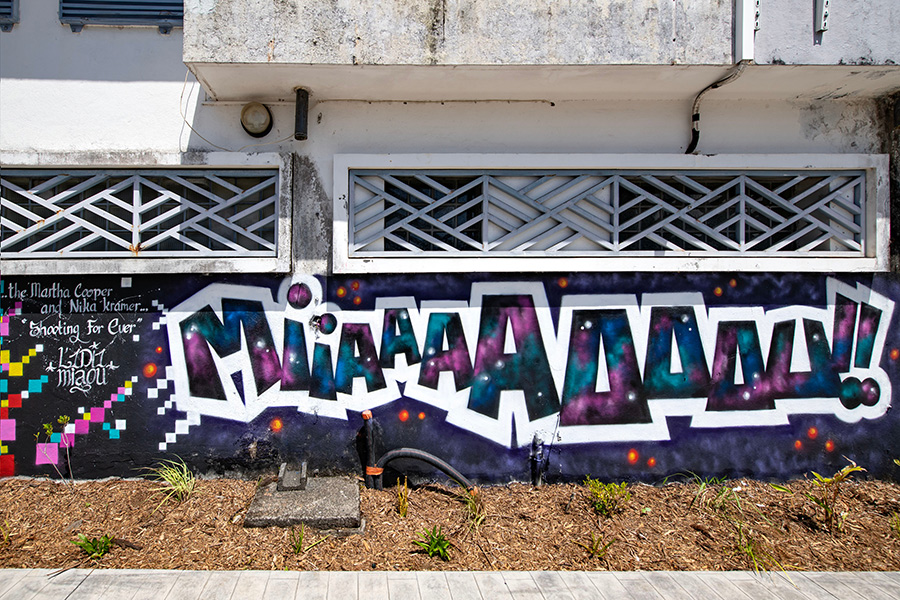
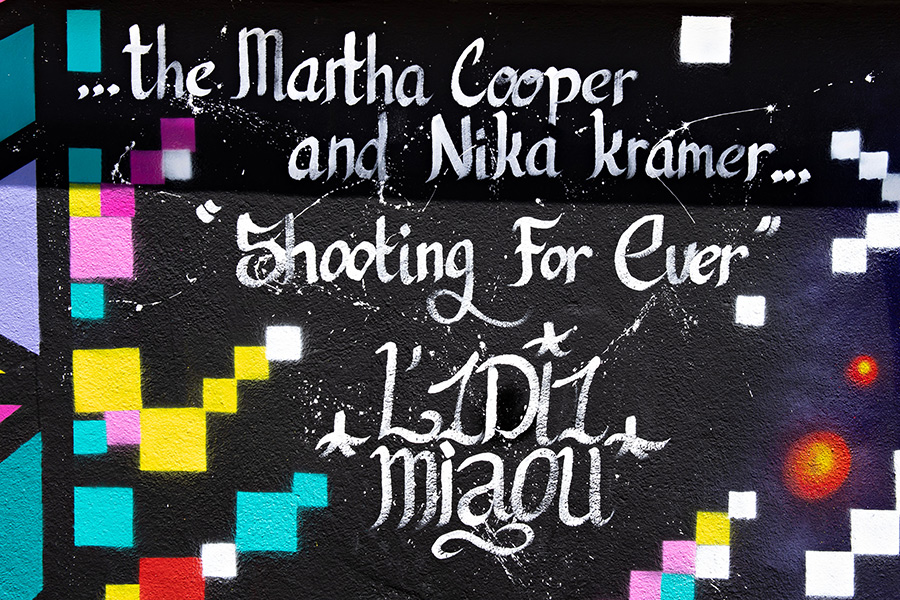
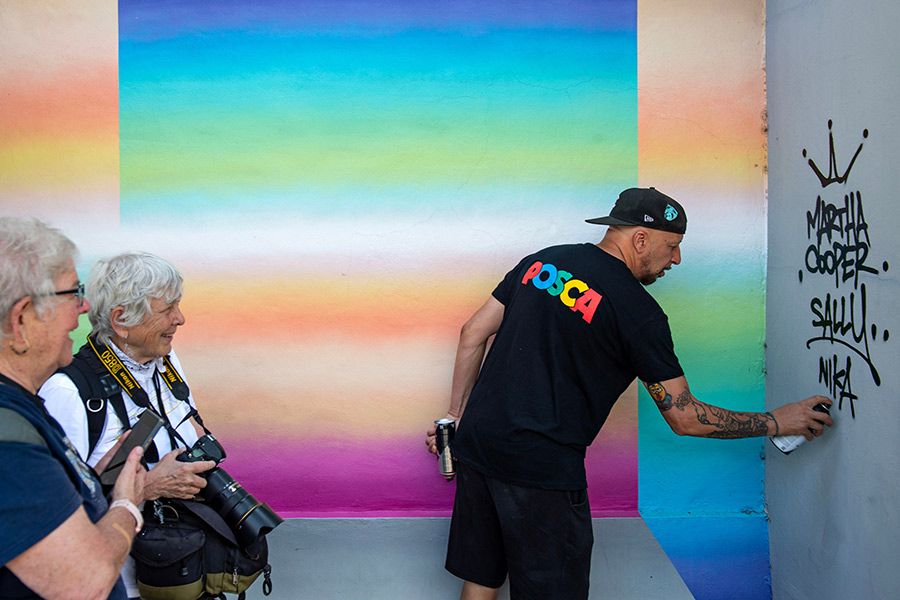
This year, renowned photographers Martha Cooper and Nika Kramer were honored guests, hosting a symposium to discuss their work documenting the hip-hop scene over many decades. New images of Réunion’s street art were captured, and Ms. Kramer conducted interviews with participants, further enriching the festival’s archive and legacy.
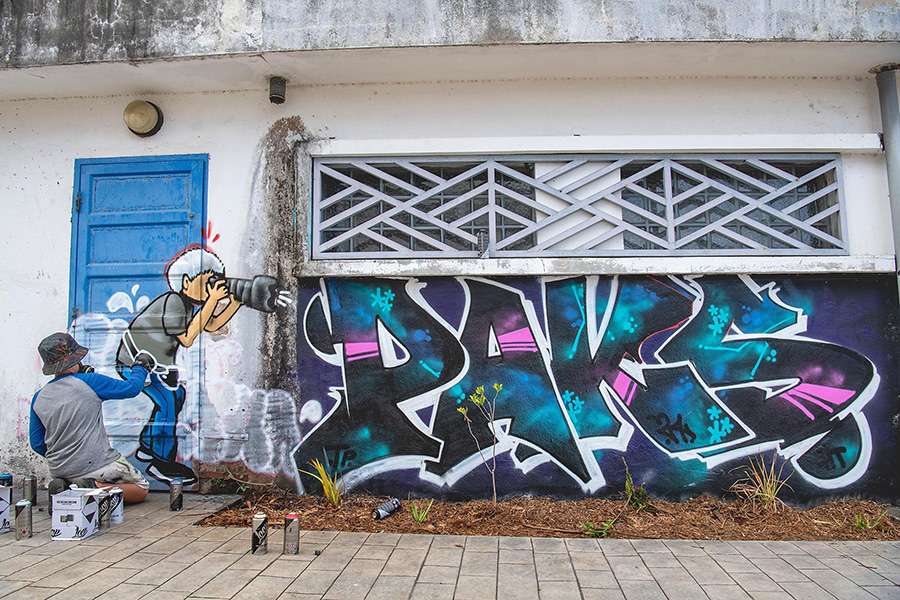
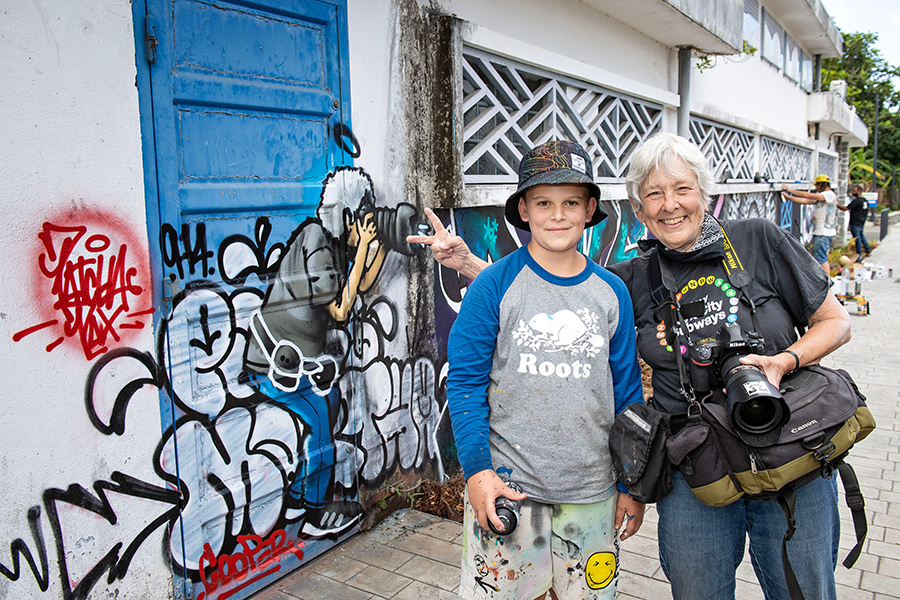
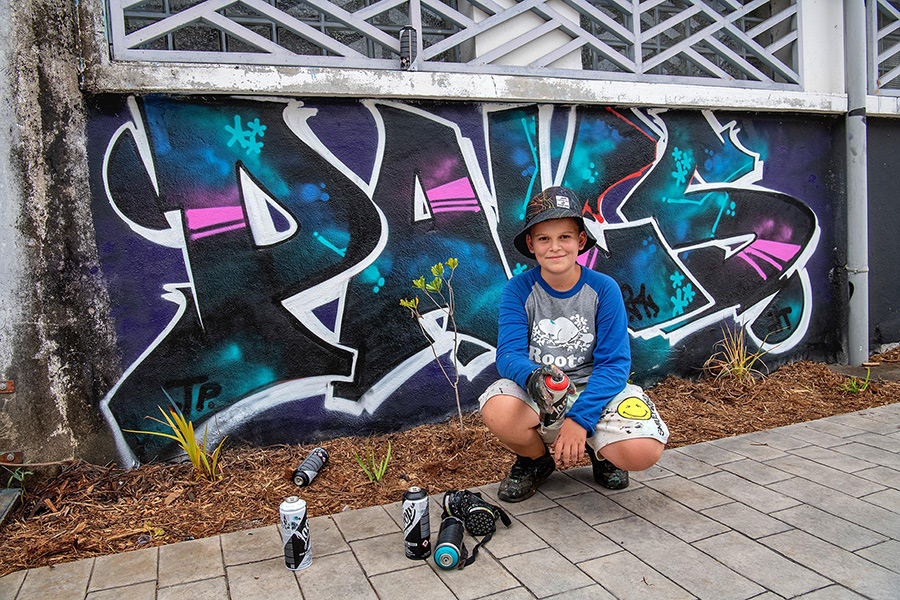
From conversation with Nika Kramer, we learn that a young enthusiastic fan of the work of photographer Martha Cooper was not only attending, but participating in the painting of walls this year at the festival. One of the youngest graffiti writers interviewed for BSA, Patcha Pax shares personally his experience here for BSA readers. Afterward is a full interview with the writer by Nika Kramer.
“I knew Martha Cooper before I met her. I had seen a report about her and the 1UP on YouTube, and my mom gave me Subway Art for Christmas 2022. So when I saw that Martha Cooper was coming to the Graffiti Reunion this year, I jumped for joy! My mom signed us up for the conference right away.
I know what Martha Cooper has done so well that during the conference, I answered the questions that Olivier Cachin asked before she did.
I also was very familiar with the 1UP video that was shown.
Meeting her was incredible because I felt as if I was living through her moments with the vandal graffiti artists, especially the 1UP crew. In my mind, I was running with her and them to secretly paint on the subways. It was like touching the real world of graffiti with my fingertips.
I saw that there was still room on the wall.
I saw MC taking a picture of Miaou, so I decided to take a photo of her and reproduce the drawing on the wall. A photograph captures a moment for a lifetime… it was my way of capturing this moment forever. It is painted forever on the wall. And so every time I see this graffiti, I will think back to that moment when MC was there, that she was taking pictures of all of us. And also of the moment when Sally and you were taking a picture of her in front of my Graffiti of her. It brings back a lot of good memories forever.
For MC’s drawing, I think I wanted to please her by drawing her. It was a gift so that she would be happy” ~ PP
NK: When did you see graffiti for the first time? PP: I first saw graffiti when I was 7 years old. I loved it straight away. I had to give a presentation in class and I chose the theme of Graffiti. So I asked Eko LSA by message on Instagram if he would be willing to come during my presentation. He accepted. It was the first time I met him.
NK: How did you get into graffiti PP: I really got into graffiti when I went to see a graffiti festival for the first time, Le Réunion Graffiti in 2021. I saw all these artists painting on huge walls. I asked Eko if I could have one. He replied “train a lot and one day I promise you that you will have your wall”. The next day, I asked my mom to sign me up for drawing classes. Then I practiced whenever I could on paper and my garden wall.
NK: Why did you start writing PAKS? PP: For my tag, I wanted a name that meant something positive. I searched for the word “Peace” in all languages. I found “Patcha” in Romani (India I think), “Pax” in Latin, and “PAKS” in Polish. So my name is Patcha Pax but I write it PAKS most often.
NK: What do you love about the graffiti scene in Réunion? PP: In Réunion, I like the fact that there are many different styles of graffiti. I mainly like the lettering, like that of Arêm and Lego. But I also like certain drawings like those of Macak, Bayko, and Ador.
My mother immediately accepted my passion for graffiti because she always says that she prefers to see me express myself on walls outside rather than sitting for hours in front of a television screen. So she left me a huge wall in the garden to paint whatever I wanted.
My grandparents were not interested in graffiti at all, but now, when they travel, they look for graffiti walls in cities and send me photos. On Sundays, instead of watching television shows about cars, my grandpa watches videos about graffiti with me.
PP: So ! I think I answered all your questions. My vacation is almost over. I go back to school on Monday.
I was very sad at the end of the Réunion Graffiti Festival because it was an incredible week. In 2 weeks I will be at the Run Colorz festival in St Louis so it will be awesome! I will send you photos if you want. I hope your vacation ended well in Réunion and you liked our island.
NK: When did you see graffiti for the first time? M: I discovered graffiti when I was in primary school, a little before the 2000s.The teacher gave us a lesson on prevention against damage, particularly graffiti. It had the opposite effect on me (ha, ha), On my way to school from home I started to spot all the graffiti, (a lot of “kope” tags at the time). But at that time, in Réunion, it was still mysterious. I didn’t understand much about it.
NK:How did YOU get into graffiti? M: In 2005, a friend tagged it in my school notebook. I was impressed by his hand style, which was brutal, precise, and aesthetic. I immediately felt in love with this universe: since that day, graffiti has taken an important place in my life. I quickly started drawing, meeting people on the scene, testing the equipment, finding spots, and understanding the history behind this movement.
It was a brilliant passion for the teenager that I was: diving into a mysterious universe, where you had to make yourself known while remaining anonymous, where you had to come close to the forbidden just for the sake of painting,… Something to break the monotony of my days!
NK:Why did you start writing Miaou? M: Miaou was my nickname as a child, so it was quite natural that I decided to use it on the wall. In the end, it’s cool because it’s also a fun and memorable name, which allowed me to stand out to people who aren’t necessarily from the graffiti scene.
NK: What do you love about the graffiti scene in Réunion? M: The graffiti scene in Réunion is cool because you can paint in flip flops (ha ha)… More seriously, the scene is constantly active and has nothing to envy from other countries. I find that there is a very good level on the island, regardless if you are getting up illegally or legally, in graffiti or street art. The fact that there are many players around challenges us to improve and to stay in the game. But this competition is healthy, we all know each other.
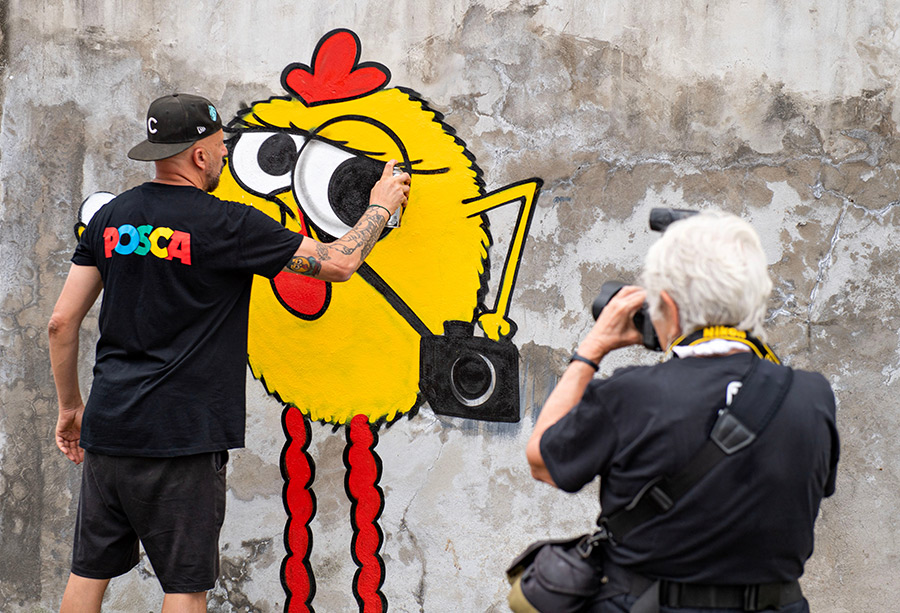
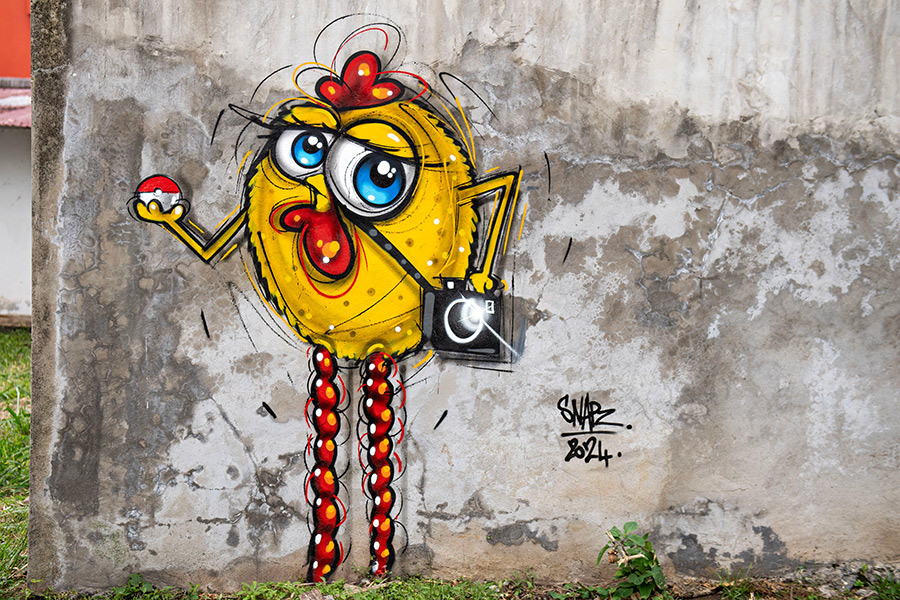
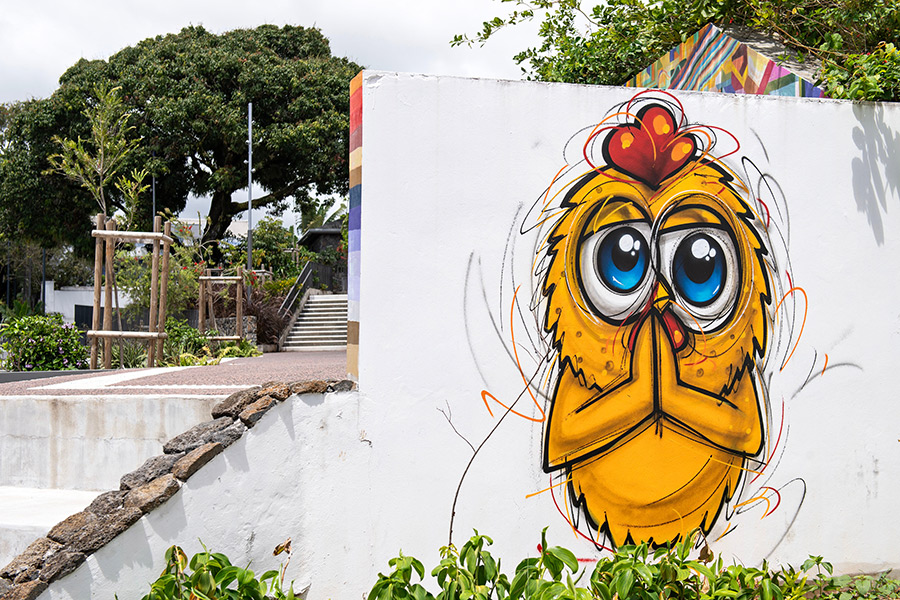
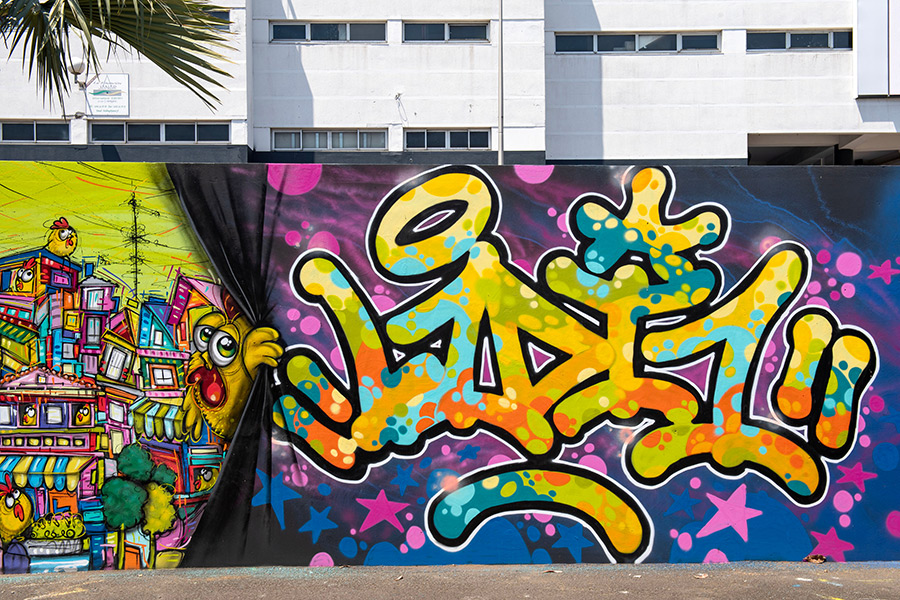
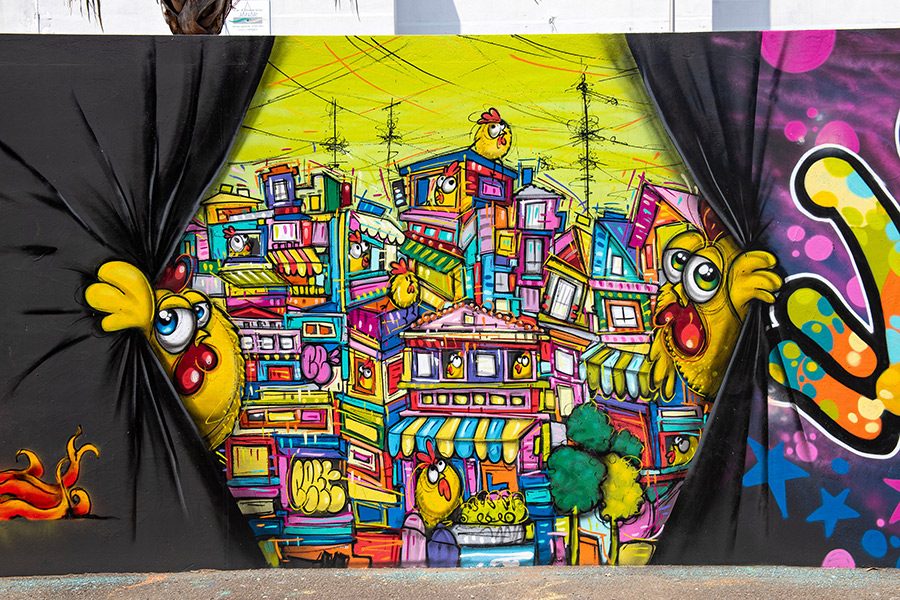
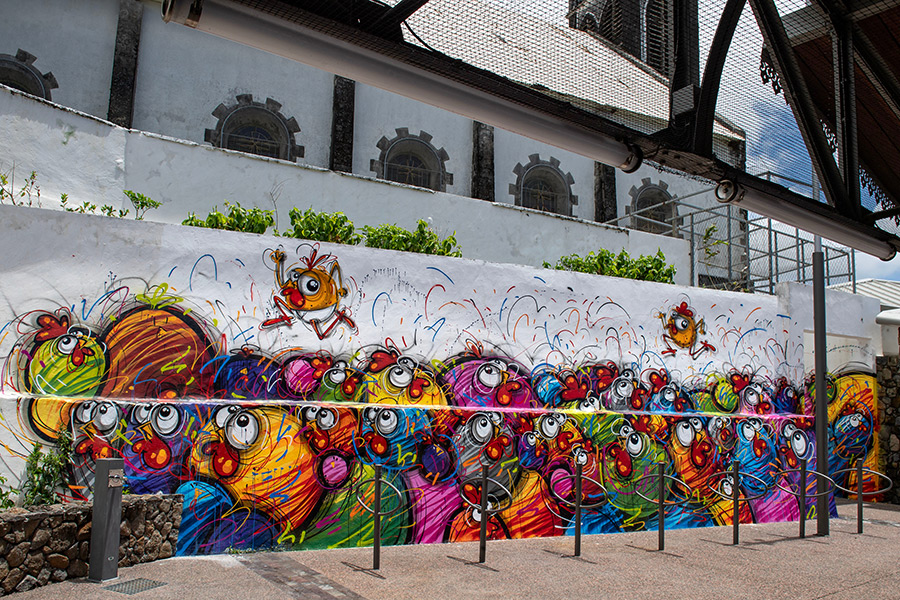
From an interview with Nika Kramer, Ceet talks about his life in China and how his chicken character developed.
“So the first time I saw graffiti was in about 1983-84. I began painting in 1988, but my participation with the culture before that was break dancing.” Nika Kramer:How did you get into the chickens?
CEET: My chicken story started 22 years ago in China. I was in Shenzhen. I couldn’t speak Mandarin, and the Chinese couldn’t speak English, so we had a big problem communicating. So I started to draw everything: what I was doing, everything I wanted to eat, everything I wanted to do. I started to draw everywhere. And I communicated like this for the first time.
And then, step by step, I learned Mandarin. And I live in Hong Kong. Why? Because a company brought me to China to do graffiti work. I came one time, two times, three times, and I stayed longer each time. One day I got the apartment and I stayed there and I lived there. It’s very simple. I like to live there because it is amazing. Many people respect me. I learned a lot about how to paint graffiti using brushes, oil, and sculptures, and I started to have very nice connections with the many people there. This is how I matured my art practice and now and I put my chickens everywhere.
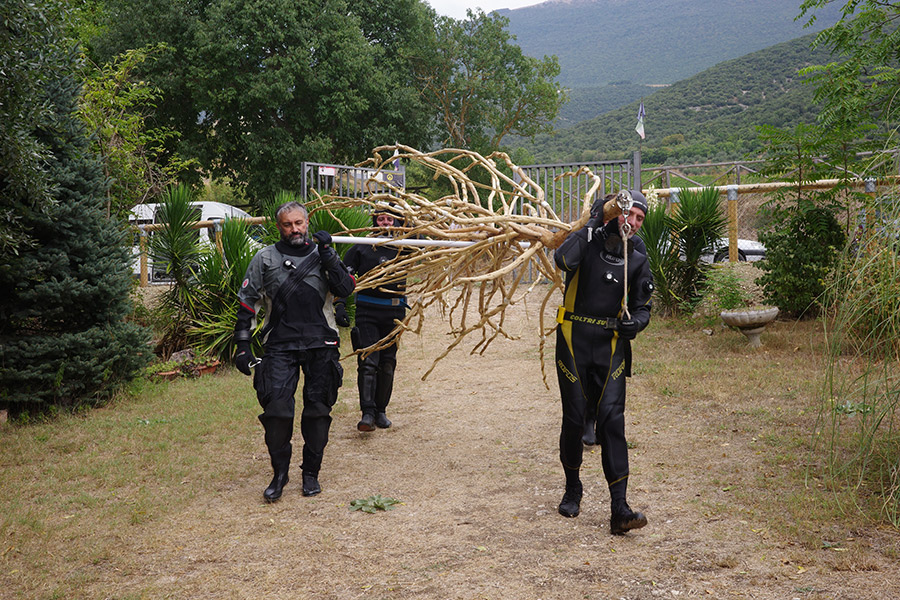
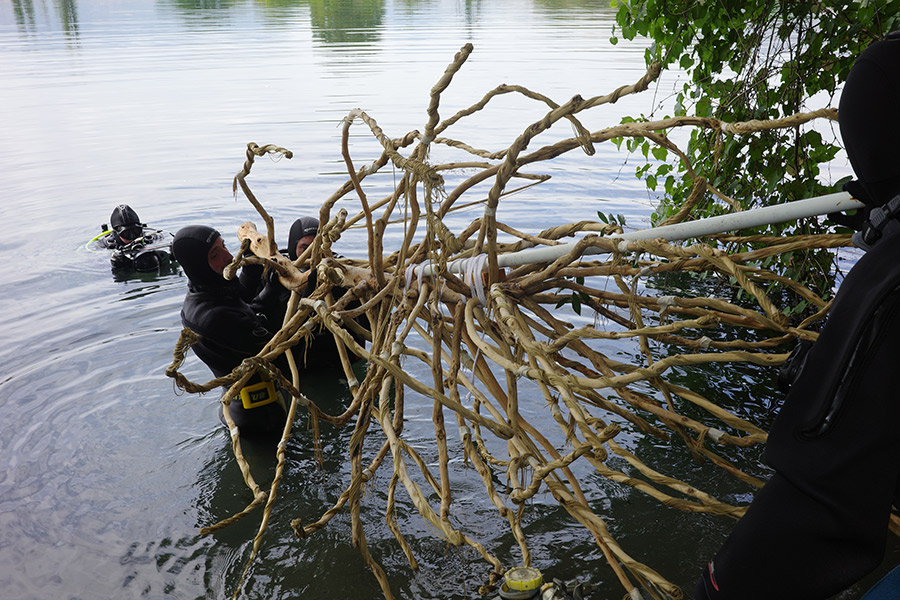
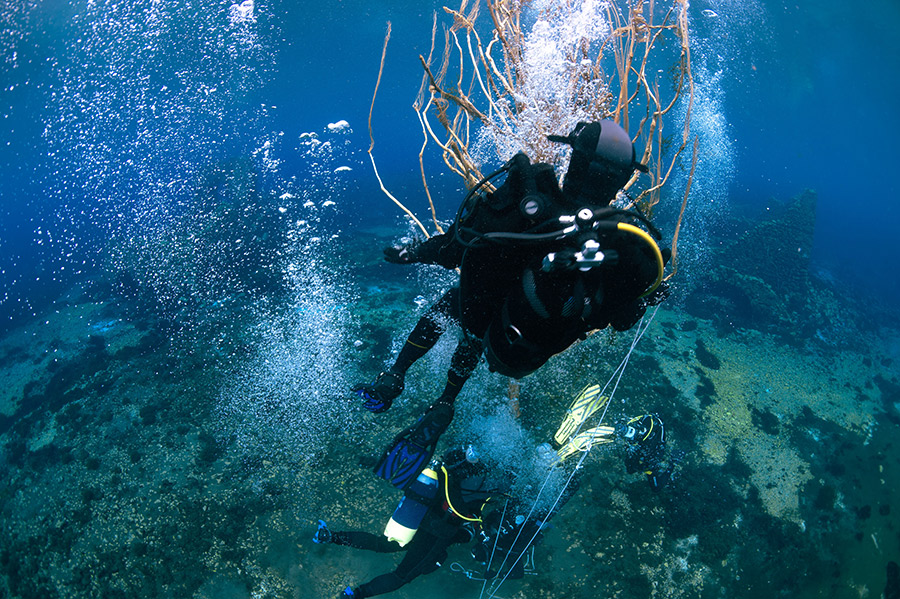
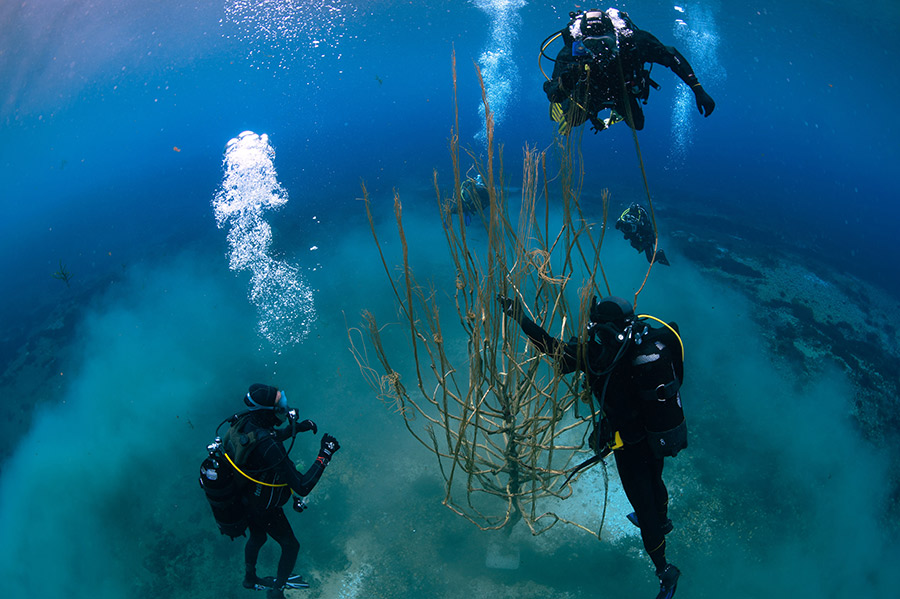
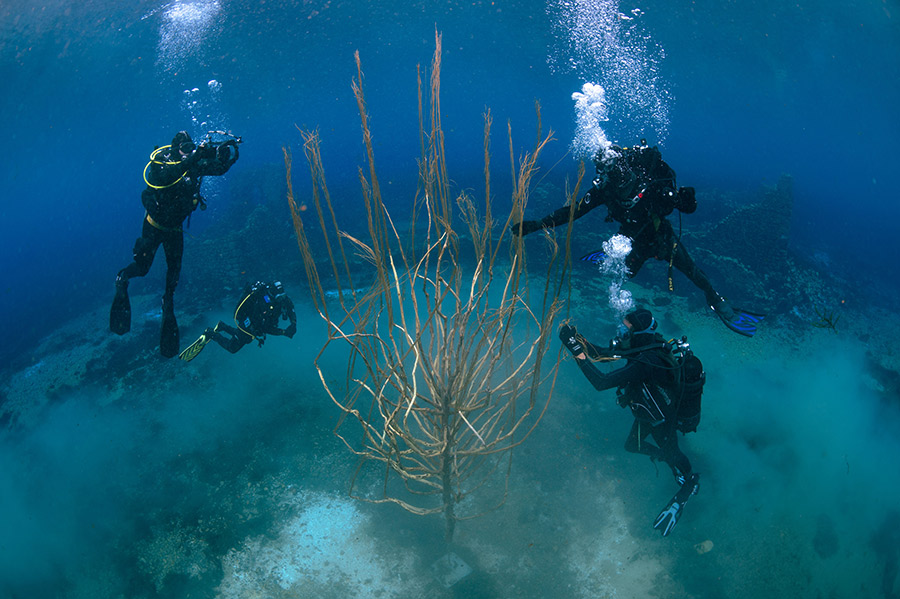
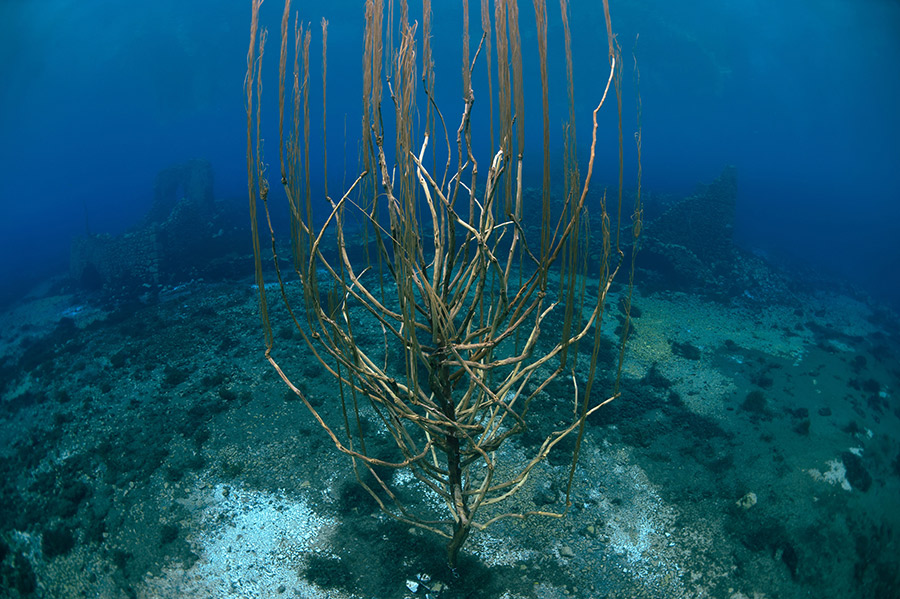
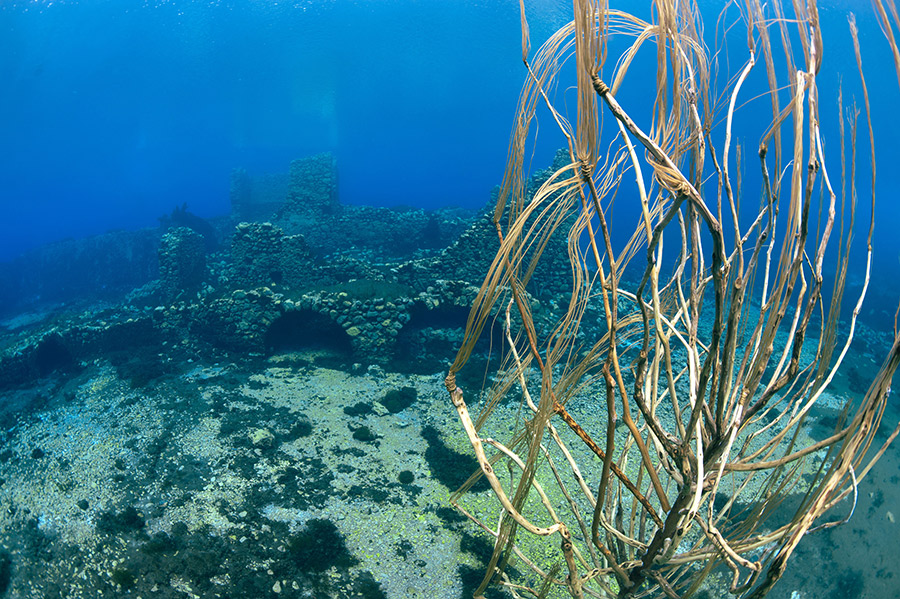
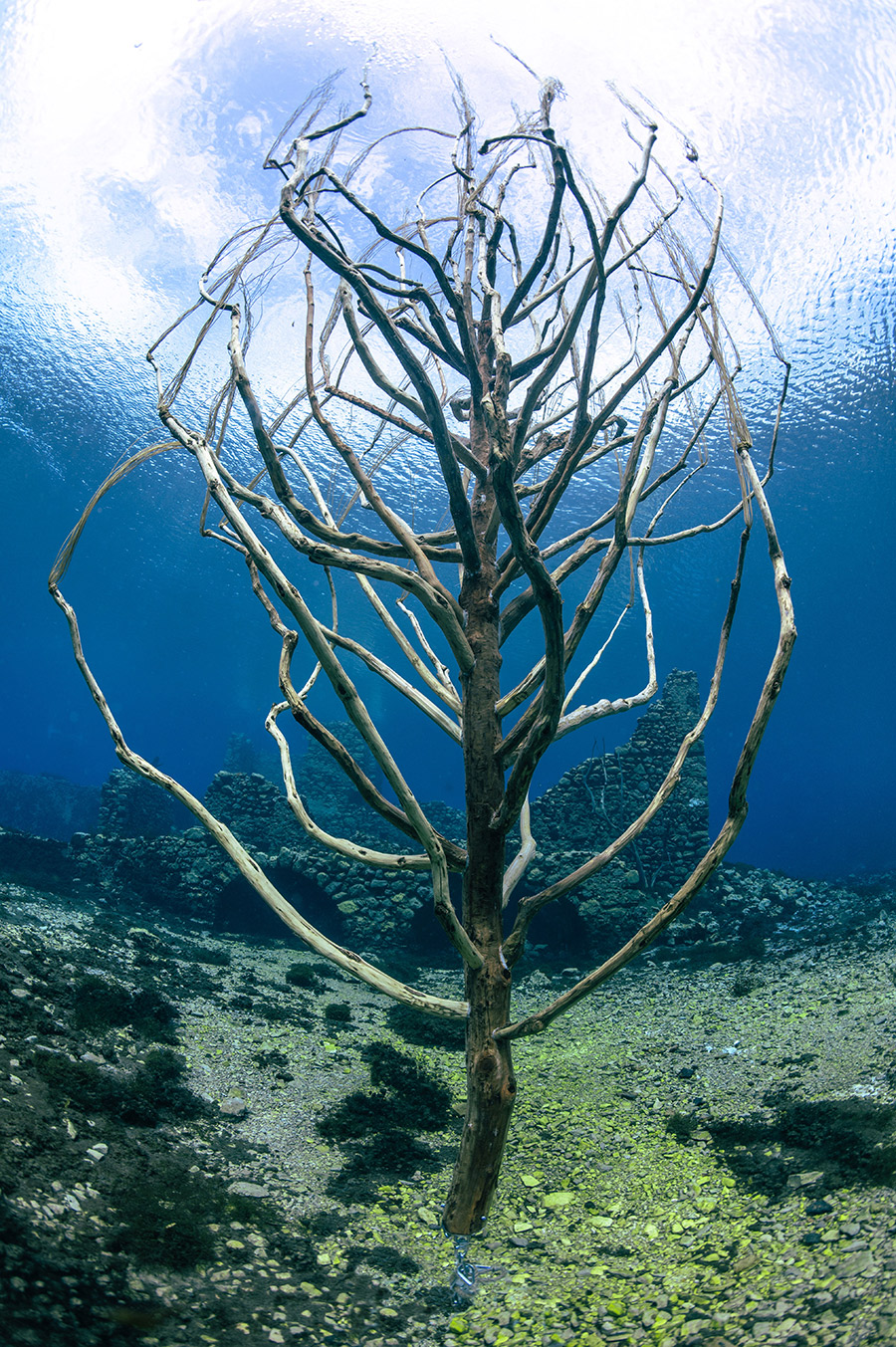
It’s not a Christmas tree that land artist /underwater nature artist Gola Hundun puts up in these photos and video. It looks strikingly alien in this crystal clear new home, but he is jubilant nonetheless. Beneath the tranquil surface of Capodacqua Lake in Capestrano, Italy, his remarkable fusion of art and nature unfolds.
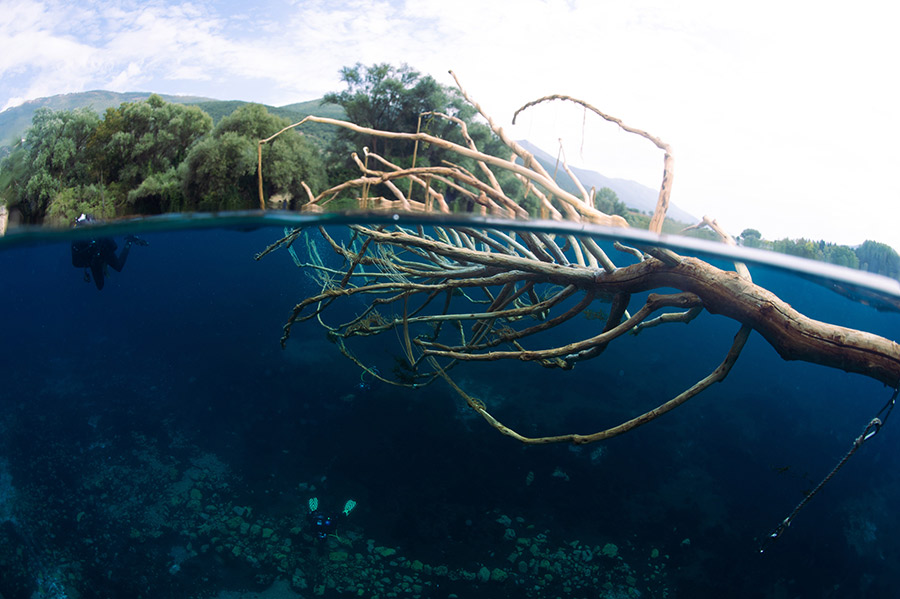
“Stele del Grano,” looks like a visionary underwater installation by an innovative land artist, transforming the submerged ruins of a mill into a canvas for an ethereal narrative. This project, a harmonious blend of history and imagination, offers a unique lens through which to view the ever-evolving relationship between human activity and the natural world.
“Stele del Grano” is more than an art installation, says Gola; it visually explores the Tirino Valley’s terramorphic history. The artist chose grain as the central motif, a symbol deeply rooted in the valley’s transformation from a wooded haven to a granary of the Papal States. The project weaves a tale of nature’s resilience and human impact, from the Bronze Age settlements to the modern-day artificial reservoir, echoing the mythic stories of lost civilizations like Atlantis.
The Artistic Process and Installation
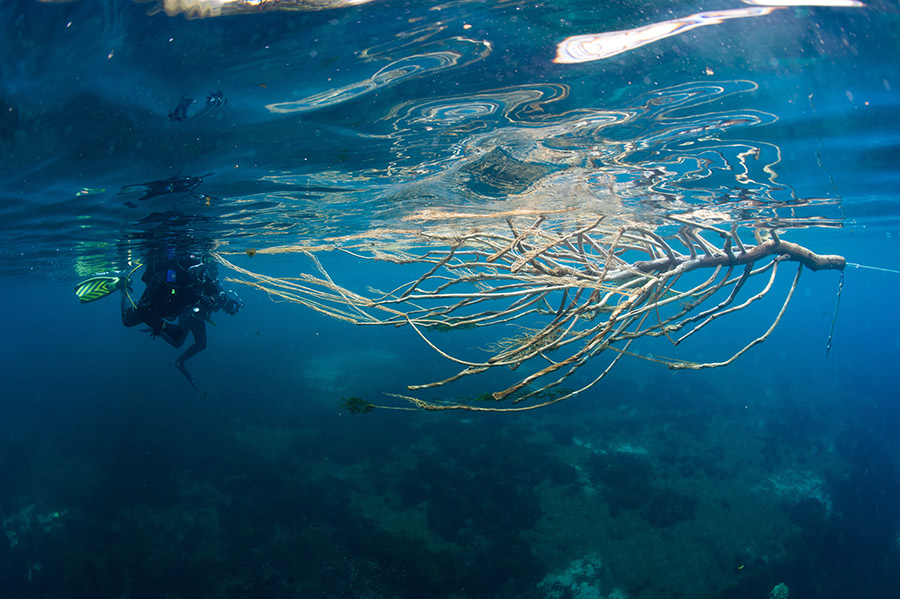
The physical manifestation of the “Stele del Grano” is crafted from branches and ropes to create a structure that mimics an ear of wheat that has morphed into an anemone-like water plant. It’s a deliberate juxtaposition, an alien yet mimetic presence amid the mill ruins and submerged trees. The installation required the synchronized efforts of numerous divers and assistants, who meticulously worked underwater to anchor this symbolic representation of change and continuity.
A part of the artist’s larger “Habitat” project, an ongoing exploration since 2018, the installation “Habitat” delves into structures built for human needs, now reclaimed by nature. This project contemplates spaces that, though altered, continue to serve as homes for diverse life forms. “Stele del Grano,” in its underwater realm, becomes a visual dialogue about the Anthropocene era, raising questions about the human footprint and nature’s adaptability.
The artist’s intention with “Stele del Grano” goes beyond mere visual impact. It’s an invitation to reflect on the dynamic and sometimes tumultuous relationship between human actions and nature’s responses. Through this underwater installation, the artist hopes to inspire viewers to contemplate the coexistence of human and natural worlds, imagining a future where balance and respect define our interactions with the environment.
While “Stele del Grano” may seem a world away from the vibrant immediacy of street art, its core resonates with similar themes of expression, freedom, and environmental commentary. Just as street art captures the pulse of urban landscapes, this underwater installation encapsulates the essence of a natural yet human-influenced environment. It’s bold: an act of free will and art-making that speaks to the enduring power of artistic expression – and its ability to ignite conversation and evoke some sense of wonder.
BSA: We always say that “nature will take over” again. We’ve actually seen this happen during our lifetime when man-made catastrophes occur, such as the Chernobyl explosion in Ukraine and most recently, during the lockdowns due to the COVID-19 pandemic. In both cases, human presence outdoors ceased, and wildlife took over. Plants and animals reclaimed what was once theirs. Tell us more about your interest in this subject. How did you become so immersed in abandoned man-made structures and their inextricable relationship with nature, and what makes you feel so connected with the past, with history?
GH: Let’s say that for me, more than a connection to history, these places propose a future vision that fascinates me, a near future in which man no longer exists but survives through his vestiges and constructs scattered over the territory that has in the meantime assumed a new hybrid form that mixed the rational line with the forms of generative chaos of non-human nature. I consider these abandoned ruins reclaimed by nature as true Temples of Rebirth.
These places in my view are always shrouded in a great romantic fascination and have a disturbing effect on my psyche, on the one hand they tease a hoped-for revenge of the rest of nature on the anthropocene on the other they stage the smashing of our species generating a short-circuit in my anti-speciesist but human brain. My interest in this kind of place was born in me at the end of the last decade. In 2018 I began the first experiments by making ephemeral gold-colored interventions inside the investigated ruins as Ready-Mades and already perfect. Still, through the gold (symbol of sacred nature), I allowed myself to emphasize the inherent creative process. Following several actions, the research took the name of Abitare first and later Habitat.
Habitat Project is conceived as an ethological and metaphysical research about buildings originally built for human needs, neglected and eventually recolonized by new living beings (plants, animals, fungus, lichens) that may convert space and shape but not the concept of space to inhabit.
Neglected buildings all over the world need to be converted or rather demolished.
Most of the time, these operations take time and money. As a result, Nature gradually reclaims what it used to own so that its space becomes populated by different living beings.
Habitatgoals are the investigation and study of this phenomenon, seen as a natural artistic process, aiming to show up a new life vision into the anthropic space by the end of the Anthropocene Era.
Its research starts from a visual analysis, develops through artistic intervention, and keeps on with the spontaneous birth of new flora and fauna through time.
BSA: What lessons have you learned from closely observing this relationship?
GH: Nature is everything. Even on those ruins, nature is a struggle, cooperation, it is dualism it is multiple vision, it has no borders, it has no private property, it is generated by multiple physical and consciousness levels one within the other. And if even before Scala Naturae was written much of humanity was already convinced that it was on a higher plane of existence and separate from the rest of living forms, natural reality admits of no objection the human being is part of nature so it can be said absurdly that the concrete walls it builds, are nature, although I myself would tend to say otherwise. .. one can say that plastic is also a part of nature, because it comes from petroleum i.e. microorganisms putrefied billions of years ago, and that is perhaps why other microorganisms today have adapted to eat it. Obviously these statements are provocations of a simplistic flavor the balance of nature in the form we know it is something very fragile. The very definition of nature is something controversial, quoting Norberto Bobbio: “Unfortunately, Nature is one of the most ambiguous terms one is given to come across in the history of philosophy.”
What I want to say is that what I have realized with this research is that the point is not to try to define what is natural and what is artifact but to understand as a species that we have to start immediately to act feeling ourselves as part of nature and stop consuming virgin soil to abandon it cemented made sterile, mono functional, mono cultivated, stop acting as if we were on an inanimate planet, alone, where the rest of the form is a mere material at our disposal. Time, rhythm, perhaps these are elements that really make us diverge from the natural order, our internal time is no longer similar to that of nature but that of the productive logic of Industry and the machine, to that of capitalism.Acting taking into consideration that everything is connected, as was done in ancestral cultures around the world, our main problem is Capitalism.
BSA: For this last project, you went underwater. What surprised you from the experience?
GH: What fascinated me most was the opportunity to learn about and study the upheavals suffered by the area where the lake now stands throughout history.
The contraposition between anthropic action and the action of the other nature have determined a history of incisive transformative movements, resulting in metamorphic peaks of great amplitude that have distorted the form and substance of Capodacqua on several occasions. For this reason, the structure made of branches and ropes that establishes an underwater dialogue with the mill ruins stems from the idea of an ear of wheat that has become something else, a sort of anemone/water plant, precisely to speak of the changing identity of that place. An alien element to the underwater landscape but at the same time mimetic in that it dialogues with other trees trapped under the water, dating back to the period before the dam.
Grain is chosen as the narrative element and guiding thread of the metamorphosis of the area. In fact, while in ancient times the place examined was a wooded valley in which a spring gushed from the underground basin of the Gran Sasso and from there flowed into the Tirino river across the valley, during the Bronze Age the area was already populated by small rural communities and at the source of the river a village arose that contributed to the foundation of Capestrano in Roman times.
Thus began the agricultural colonisation of the area; as we know, gramineae are among the first plants domesticated by mankind and even then they were the main crops. In the Middle Ages, the area was converted into a granary for the Papal States, thus becoming a sort of wheat monoculture; the mills dating from around 1100 AD, now sunk to the bottom of the lake, bear witness to this historical phase, but at that time they exploited the course of the river to grind the wheat from the surrounding fields.
In 1965, a dam was built to interrupt the natural course of the stream with the main purpose of generating an artificial reservoir to irrigate the wheat fields. On that occasion, the mills were submerged in the water, thus generating a unique natural/anthropic hybrid landscape that leaves one fantasizing about the myth of Atlantis, of course to have the opportunity to dive in such place mesmerised me compleatly.
After centuries of human exploitation, nature regained possession of the area, which became an important resting place for the routes of migratory avifauna and a habitat for various types of lake and underwater plants, as well as for the many amphitopes.
BSA: In the video we see beautiful flora on the bed of the lake, but surprisingly few fish. We were also surprised by how clear the water was. Do you think that policies put in place saved the lake?
GH: The clarity of the water is guaranteed by the fact that the lake rises near the surfacing of an underground river (Tirino) that flows for kilometers underground from its source located inside Mount Gran Sasso one of the highest elevations in Italy. This spring water gushes very cold and flowing underground maintains a constant year-round temperature of 8 degrees and is filtered by the underground rocks, characteristics that make the lake water so magnificently transparent. In fact, Lake Capodacqua is a popular destination for divers from all over the world also because it contains those suggestive mills. As I mentioned earlier, the lake was generated by Humans although certainly not for zoo-philanthropy but for utilitarian purposes, actually between the 1980s and 1990s a new human incidence will lead to the extinction of the endemic crayfish that colonised the lake caused by overfishing and the dust pouring in from the Gran Sasso tunnel. Another human incidence will be the introduction of brown trouts first and three pikes later, which will cause the decimation of the trouts and harass the avian fauna. Finally, Capestrano municipality will decide to kill the pikes by local fishermen, the last one was killed in 2007. Today, the lake has become an area of Naturalistic Interest and part of the Gran Sasso e Monti della Laga National Park, and wild species are returning hopefully to repopulate the lake.
Gola Hundun’s. Stele del Grano (Wheat Stele) project at Capodacqua Lake in Capestrano, Italy is part of HABITAT the artist’s ongoing series about human-made structures, architecture, and their relationship with nature and space. Click HERE, HERE, HERE, HERE, HERE, AND HERE to learn more about HABITAT.
Art Meets Agrarian Activism: Pøbel’s Monumental Mural Marks Stavanger’s Skyline
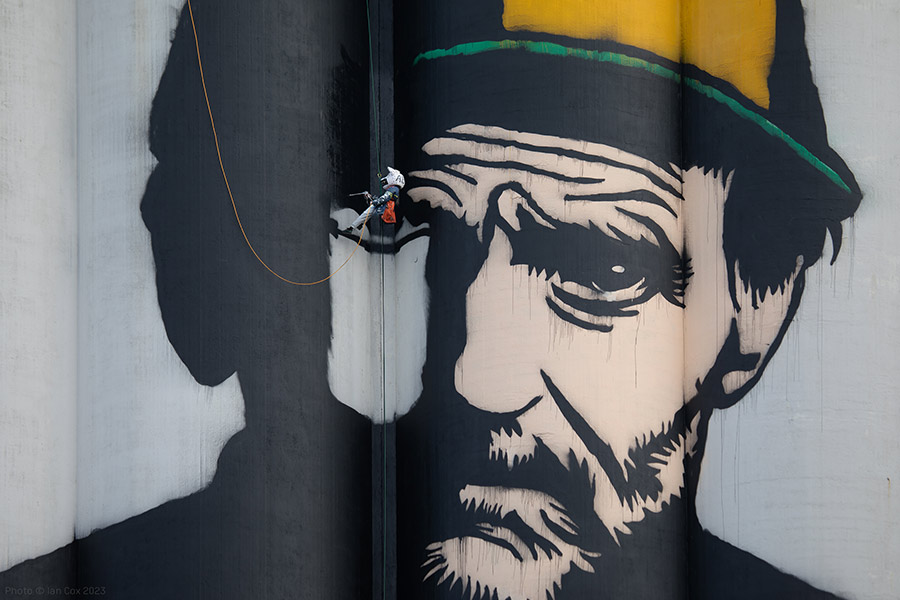
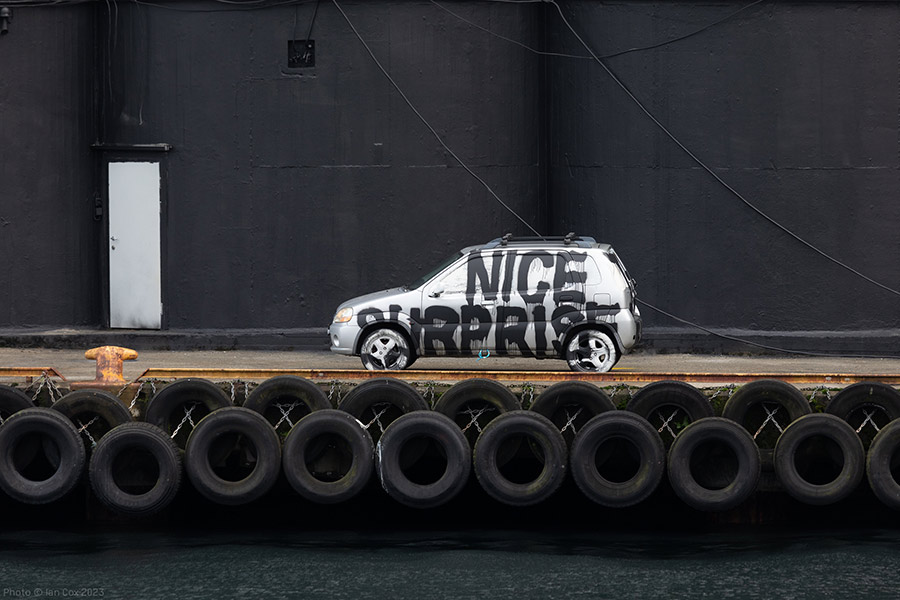
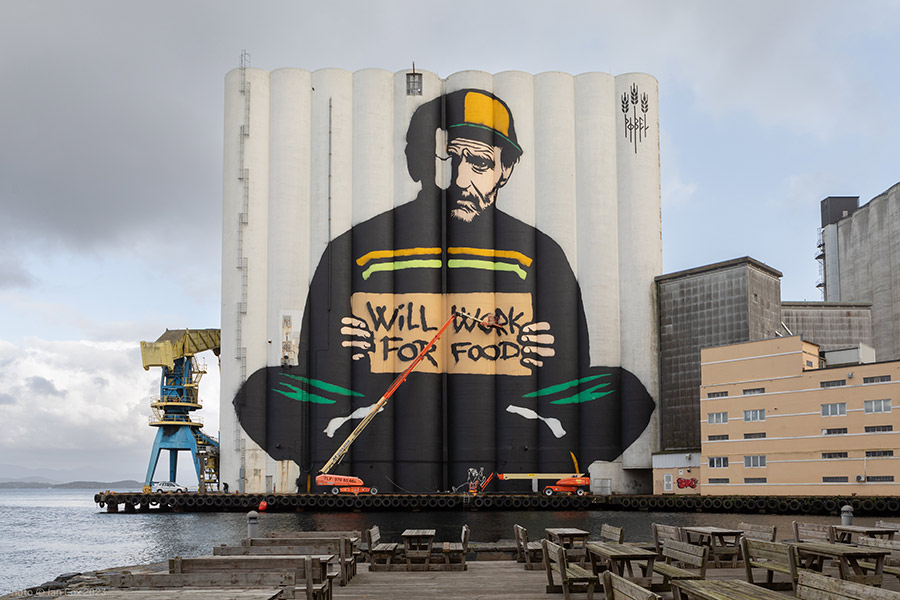
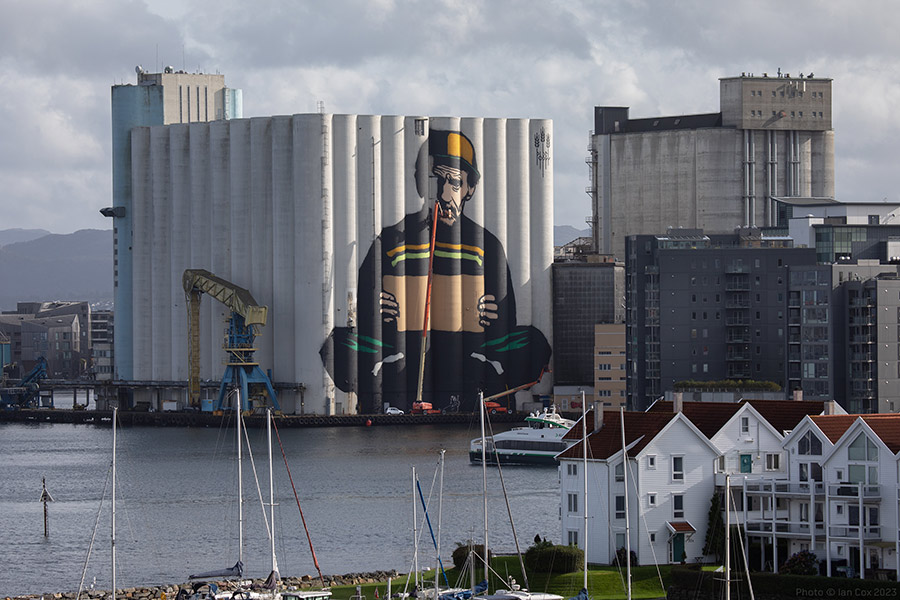
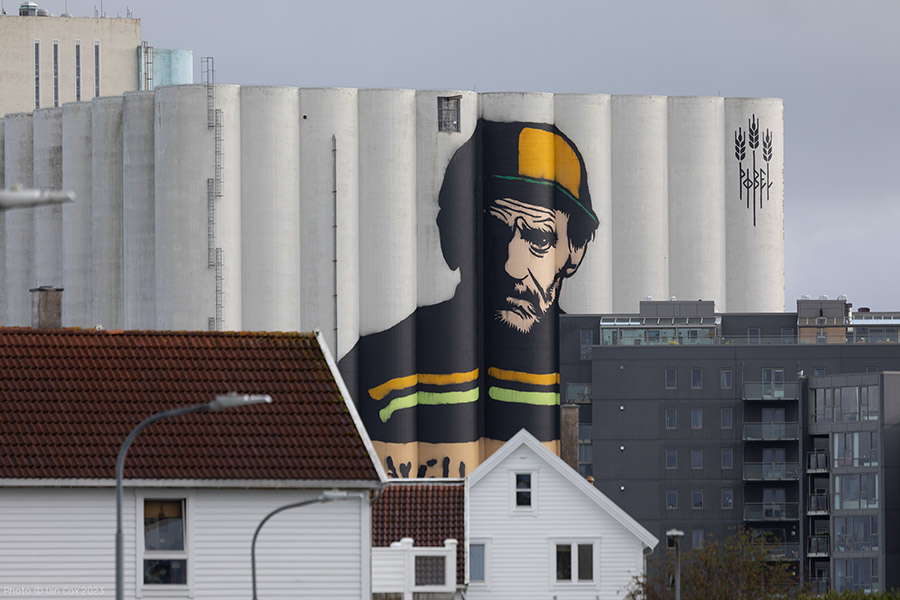
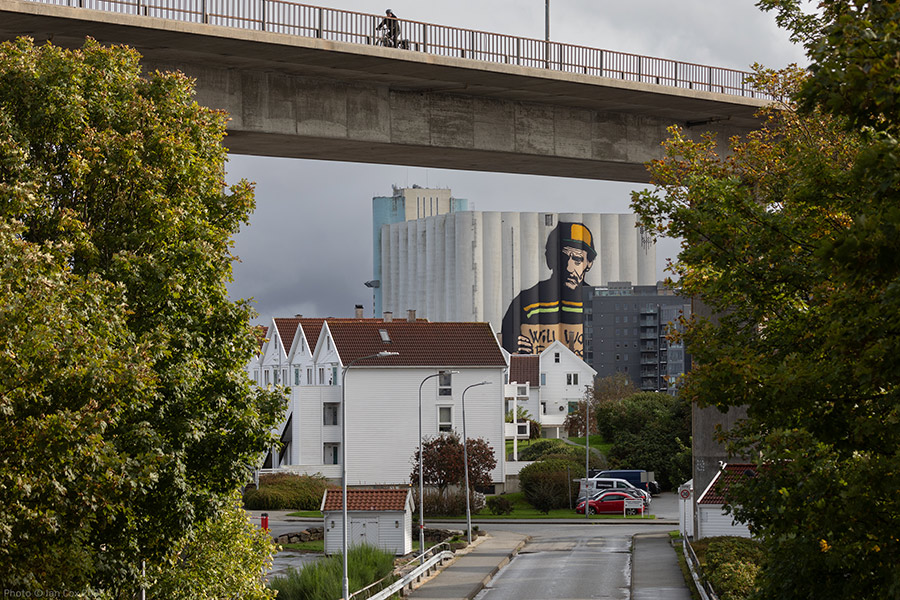
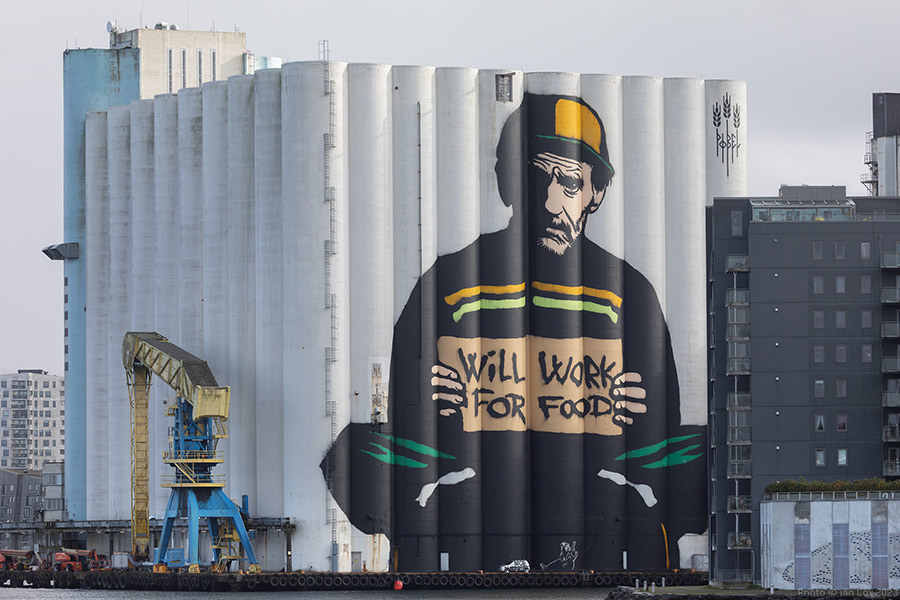
Internationally acclaimed Norwegian street artist Pøbel, has masterfully utilized one of Stavanger’s grandest canvases to highlight, with a touch of irony, the often-underappreciated contributions of the agricultural sector. Marking a fitting climax to Stavanger’s inaugural “Nice Surprise” street art festival, his mural seamlessly intertwines activism with the contemporary aesthetics of street art and graffiti. By repurposing public space, Pøbel adeptly sidesteps the cacophony of commercial advertising, championing a poignant message that elevates discourse to an appropriately human level, reminding us all not to overlook those who nourish society.
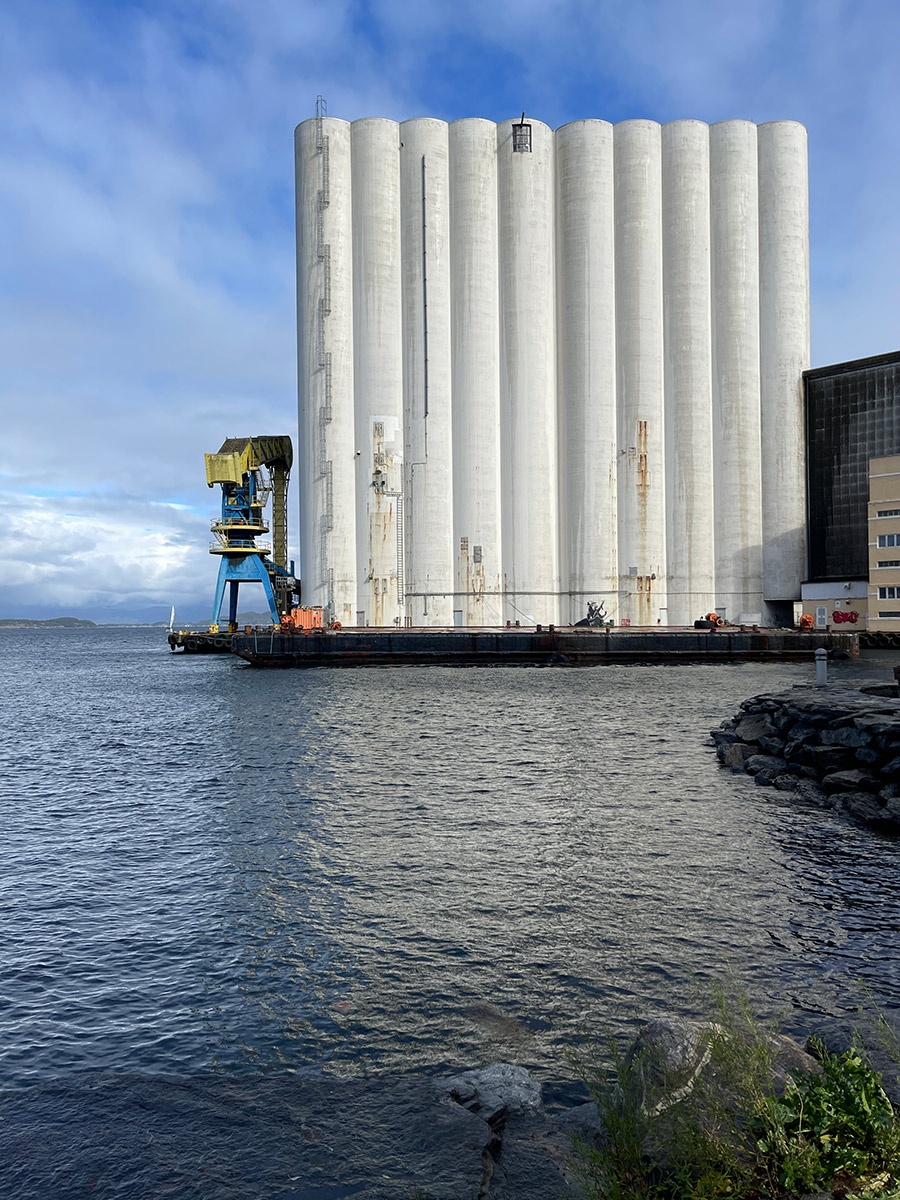
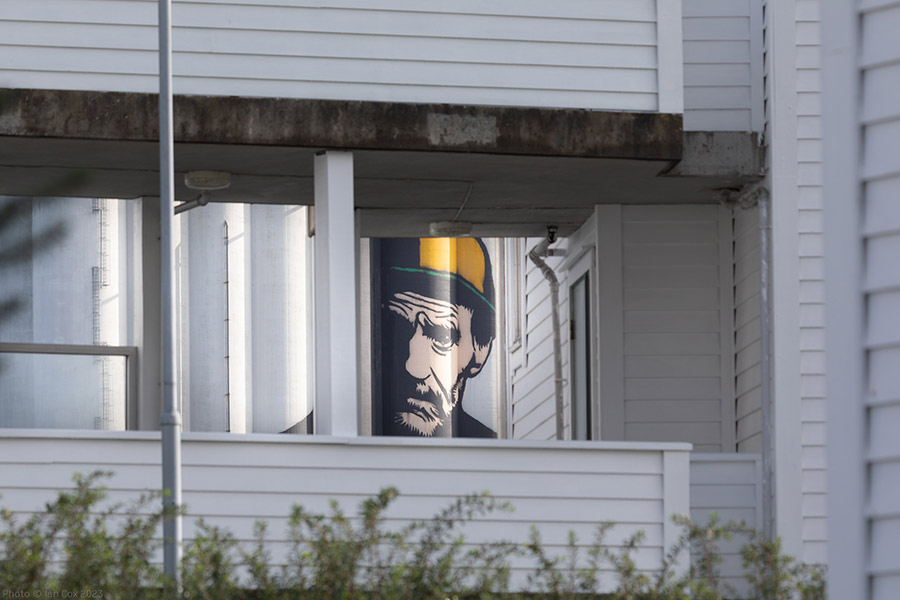
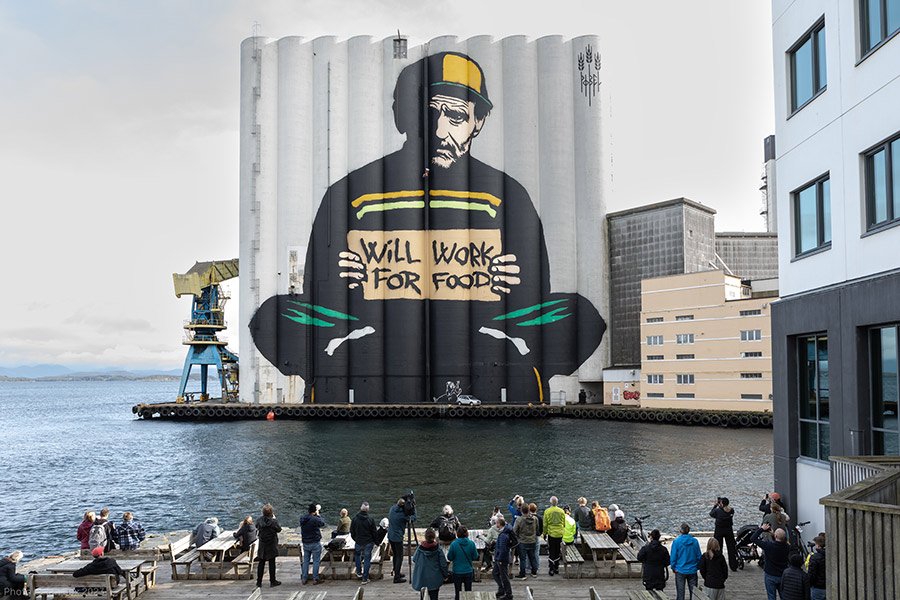
As the sun sets on the first “Nice Surprise” street art festival and the city heads into autumn, this stands as a powerful unveiling of a thought-provoking mural on an emblematic location: northern Europe’s largest silo facility, once the heart of Norway’s grain storage contingency, standing tall since 1962. This 3,600 M2 masterpiece, depicting a 60-meter-tall farmer adorned in the unmistakable green overalls of the Felleskjøpet Agri brand, poignantly holds a sign reading “Will work for food.” The choice of imagery and location is no accident. As Pøbel, the artist behind this bold and simple visual statement, reflects, “But who will provide for the providers? And do we take it for granted that the providers will and can continue to provide for us?”
The silo’s storied history mirrors the very essence of the mural. Constructed to act as a national contingency warehouse for grains, the facility, which could handle up to 125,000 tons of grains each week during the harvest season, shifted to commercial storage after 1995. However, as global uncertainties rise, with wars, viruses, and economic tides disrupting food supply chains and escalating food prices, the debate over reverting it to its original role resonates deeply. The structure now stands at a crossroads, with discussions around its potential demolition for residential development. Pøbel’s mural underscores this uncertainty, symbolizing the broader societal challenges. As he remarks, “The building, its location history, and provider role… can act as a metaphor for many things we are facing in our society.”
Due to global interests, Norwegian farmers have recently grappled with potential threats to their livelihoods, especially as trade agreements expose them to cheaper imports and challenge the established subsidies system. Concurrently, debates on land use and ownership regulations have stoked concerns over the future of family farms amidst a backdrop of global agricultural consolidation. As climate change reshapes Norway’s agricultural landscape, farmers seek solutions to ensure sustainability and self-sufficiency.
Pøbel appears to hope the mural is an evocative emblem of these struggles. Tor Jacob Solberg, a member of the Norwegian farming community, echoes this sentiment on Pøbel’s Facebook page, praising the artist as a hero for capturing the issues at hand. “You are an incredibly significant artist and social critic. You should know that farmers talk about you as a hero because you show the essence of many important battles food production stands in. We are forever grateful to you!” While the mural’s vastness is impressive, the underlying narrative of resilience, uncertainty, and societal reflection provides a grounding for consideration of our most basic needs and in whose hands they are.
BSA spoke with Pøbel about his new project for Nice Surprise.
BSA: Back in August you told us that you were not open to making any changes to the sketch you presented for approval. Did they express any concerns about your sketch/proposal? Did they want changes made?
Pøbel: I was not directly involved in the dialogue with the building owners, but from what I understand, there was quite a bit of a discussion about whether to give me permission or not based on my sketch. I assume there were concerns that it might have been a bit too political. Finally, we got word that the permission was granted, which was a bit unexpected. For me it was important that I was able to create what I wanted to create, and that I did not have to compromise in any way based on the wishes of anyone else.
BSA: The process of moving from sketching to painting the silo couldn’t be more different. Can you tell us how it went in practice once you were in the lifts? What challenges have you experienced?
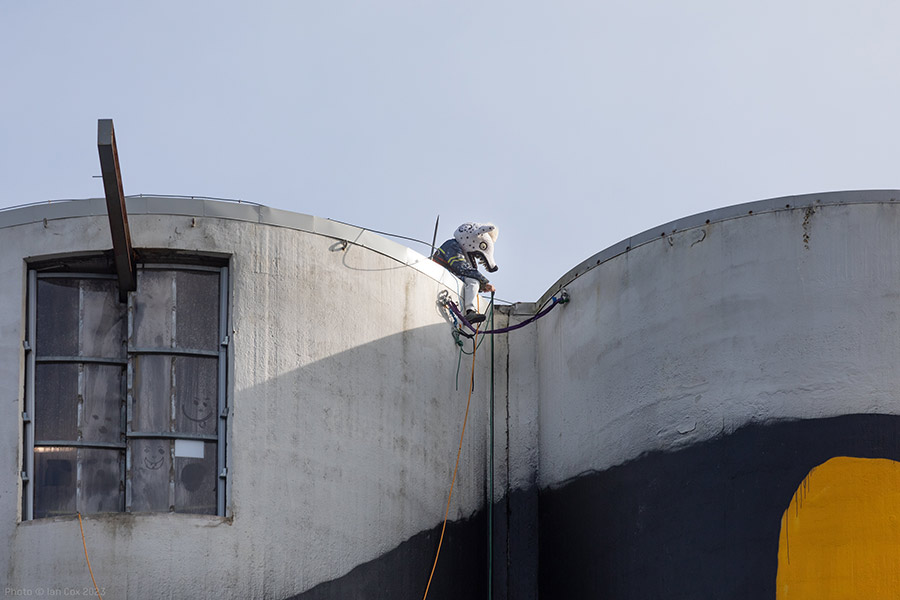
Pøbel: I guess it was only after the approval it dawned on me that I had to figure out a way to actually do it! The wall is approximately 200 feet tall, and most regular professional lifts on the marked usually have a reach of “only” 140 feet. Building a permanent scaffold would be too time-consuming and expensive since the wall is also 200 feet wide. I planned to paint it by abseiling from the top of the roof, but then, luckily at the last moment, I found a lift that could reach 192 feet.
Another challenge with the wall is that it consists of 10 silos that are cylinder shaped. This means there are basically “curves” on the wall, with a depth of up to 8 feet. The curves make it difficult to paint just a straight line, for example, because depending on your perspective (if it’s from the bottom or the top), the straight line will look bent. Equally, will the painting changes when viewing from the side.
BSA: Do you remember a particular, distinctive moment that happened to you while painting the silo? – Either a personal experience or an experience with the public watching you paint?
P: It was quite an interesting experience to be almost 200 feet above ground in the big lift that was standing on the lighter (barge). It was the first time in Norway that a lift this big had been on a lighter, so no expert advice existed, but as expected, the waves made it swing many feet from side to side. The biggest challenge was other boats and ferries passing by creating big waves that would swing way too much.
BSA: Being above it all on top of the silo and the lift must have given you a new perspective of the city, its topography, and the immensity of the ocean.
P: It was a very nice view from the top of the lift. Once I was up there, I was usually quite focused on the painting, but the first night of painting the ocean was unusually still and quiet, and at one point in the night aurora lights appeared in the cloudless sky. It is not so often there are aurora lights this far south in Norway. I took that as a good sign for the work to be done.
BSA: Did any farmers come to visit the site to see you while painting?
P: There were spectators from time to time, but all from a distance since the place I worked from was inside a fenced area. Many of farmers have gave praise to the painting afterwards, especially the leader of the largest farmer’s association, who wrote that the painting meant a lot to the farmers. That was unexpected, and I am glad the art could be meaningful that way to them and to the public as a whole.
Some facts and background of the building: Mural height: 60 meters (197 ft) Mural width: 60 meters (197 ft) Mural size: 3600 m2 (38 800 ft2) Paint used: app. 800 litres (210 gallons)
The silos were built in 1962 and during the fall season it can receive up to 125 000 tons of grains each week. It was built to be a national contingency warehouse for grains and was used for that up until 1995. After this it has been used for commercial storage of grains. The current owners want to demolish and move it and convert the area into a residential area. However, with the recent war in Ukraine, energy crisis and increased food costs, debates to make it a national contingency warehouse for grains once again is an ongoing debate.
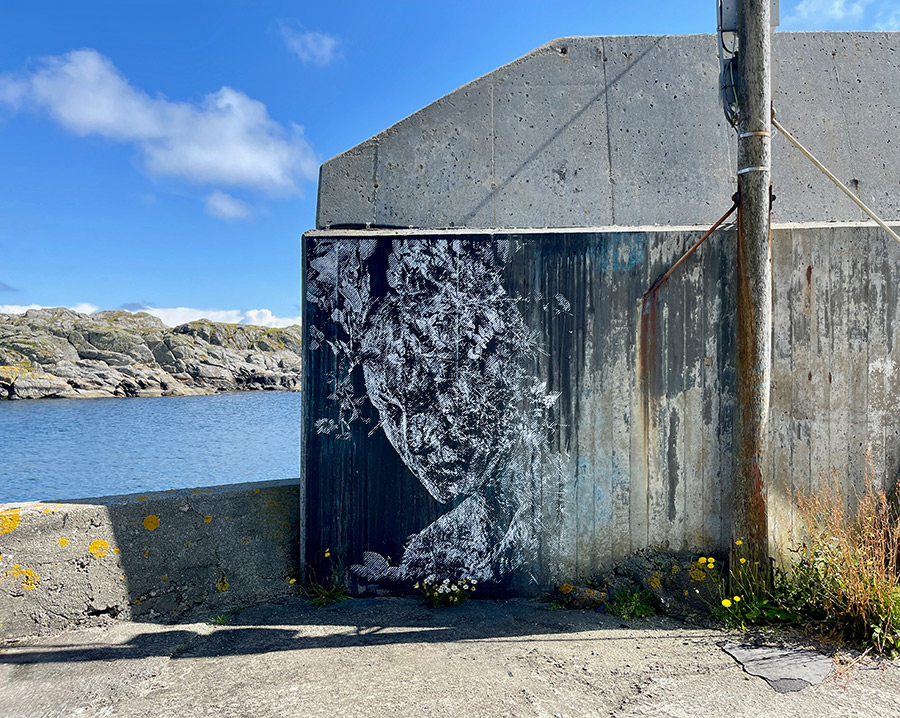
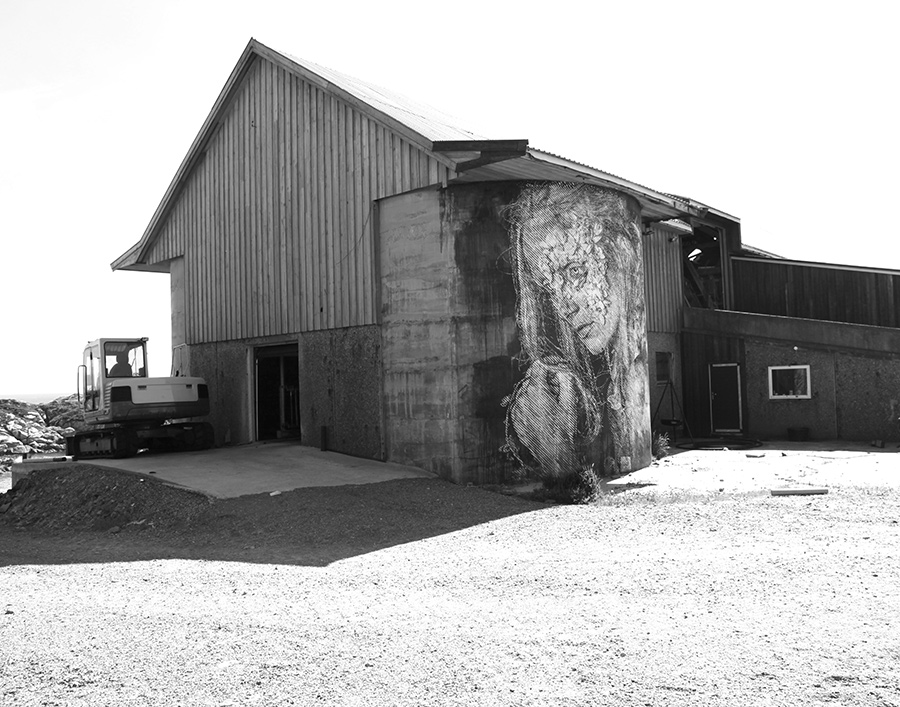
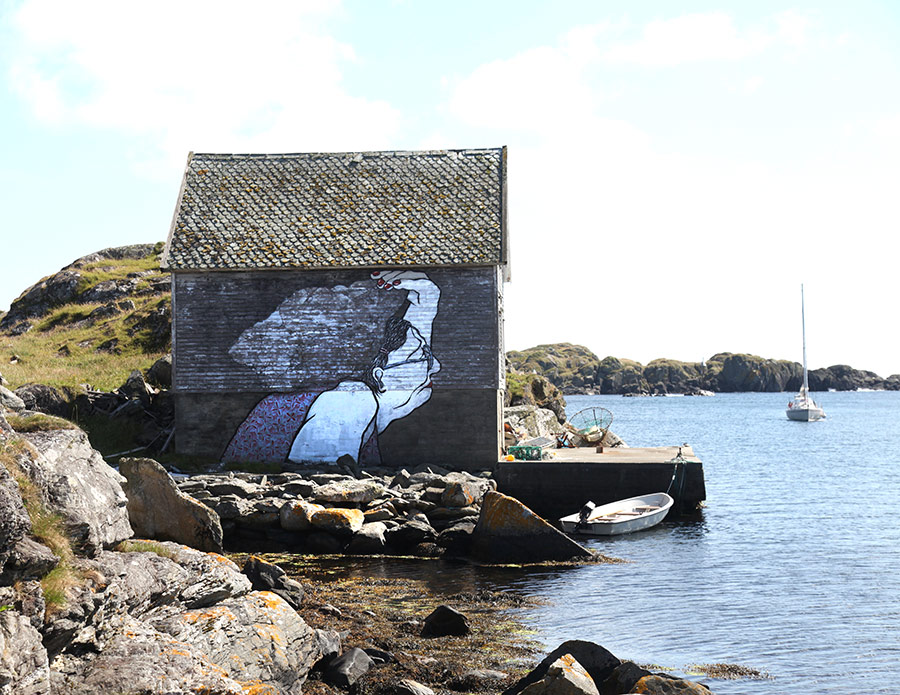
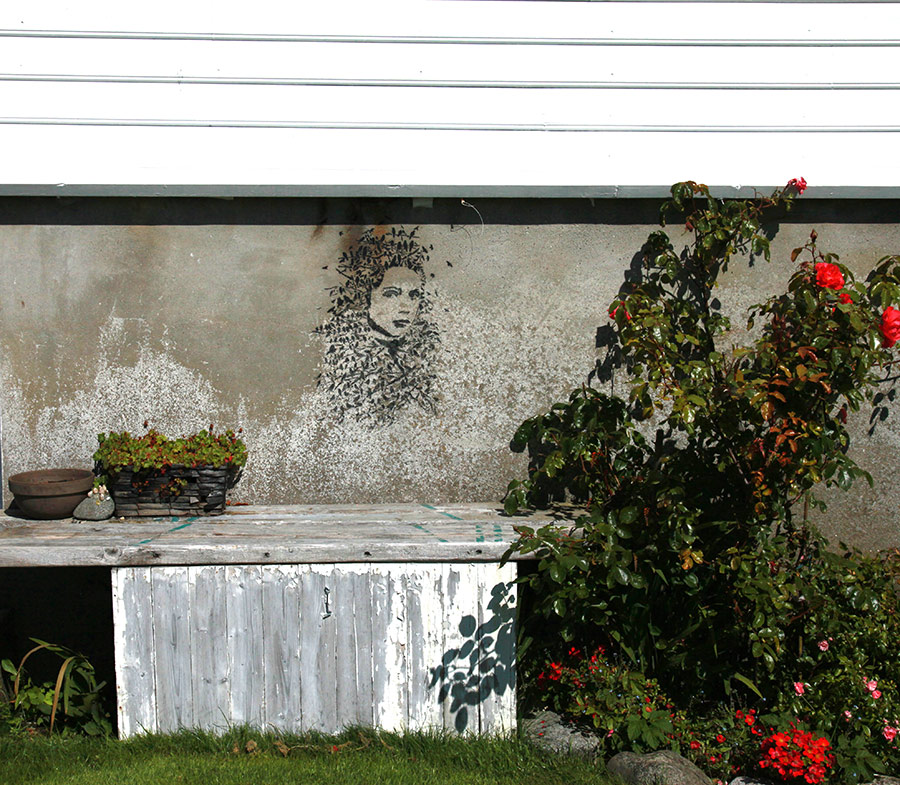
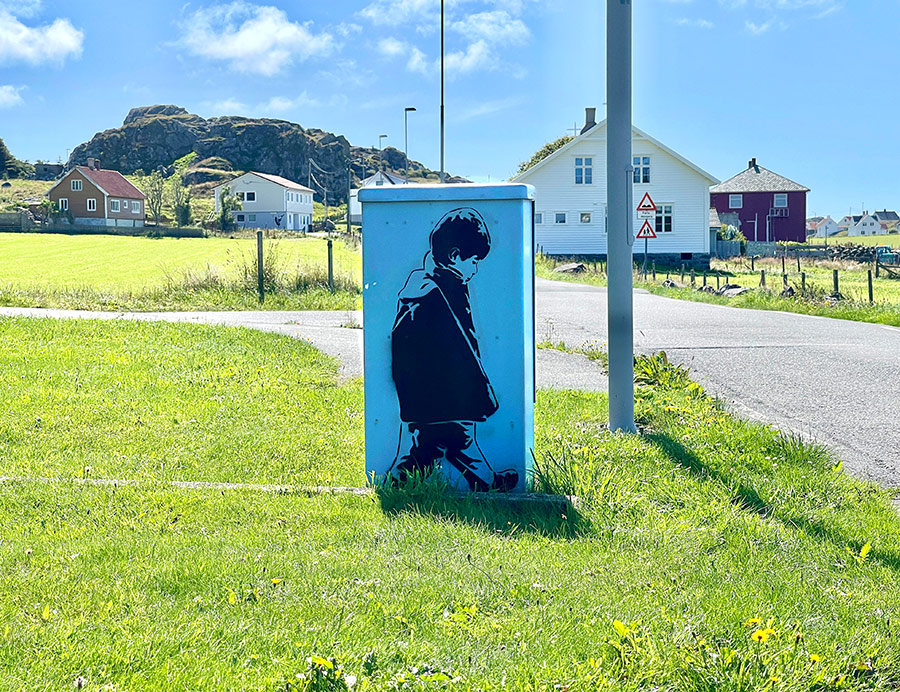
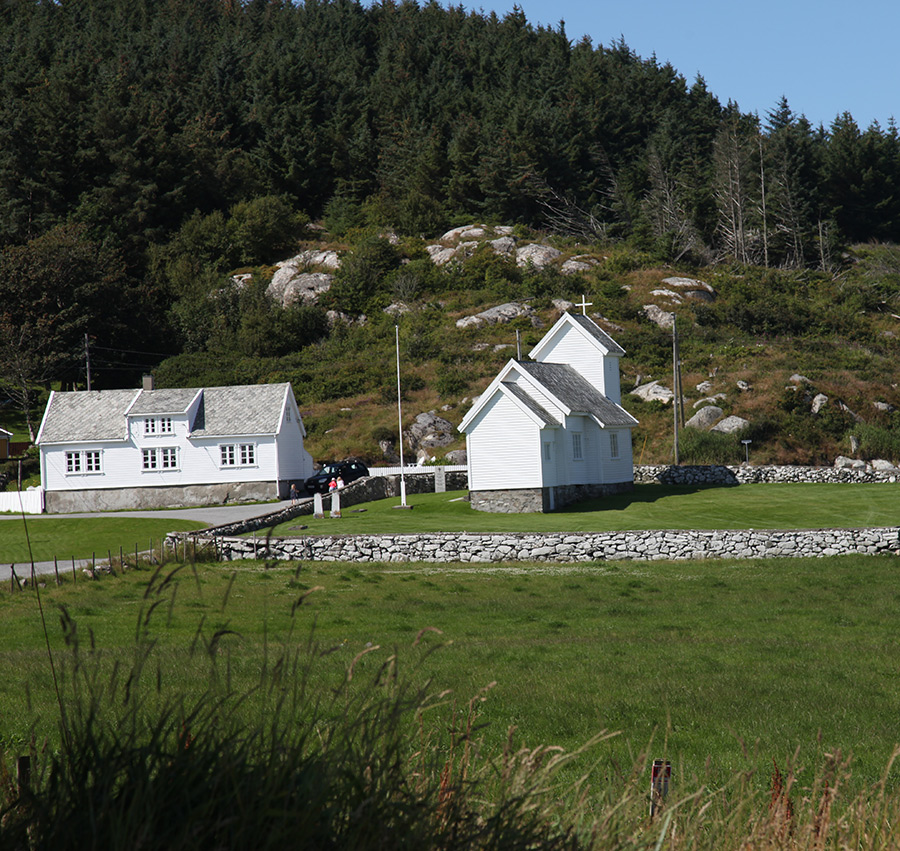
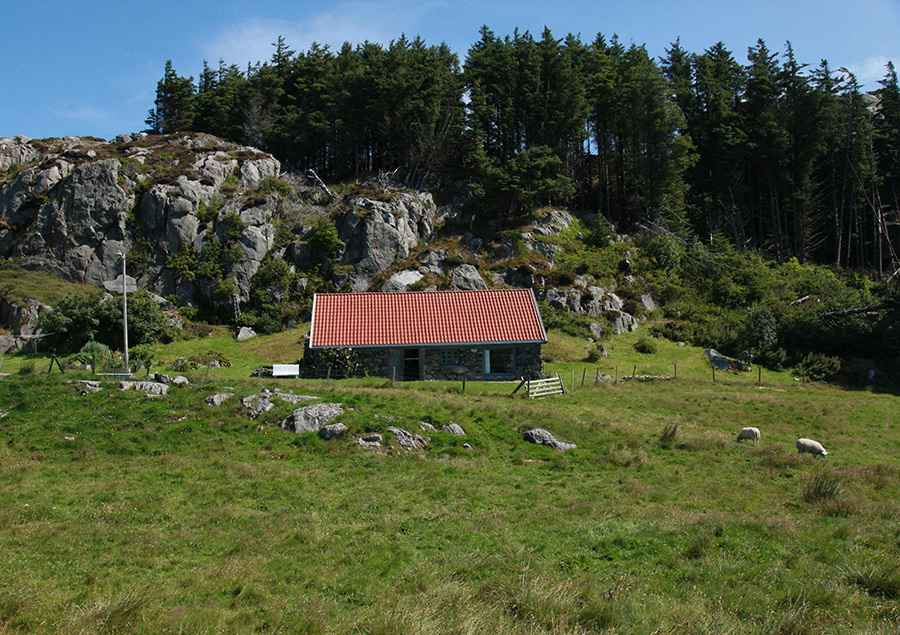
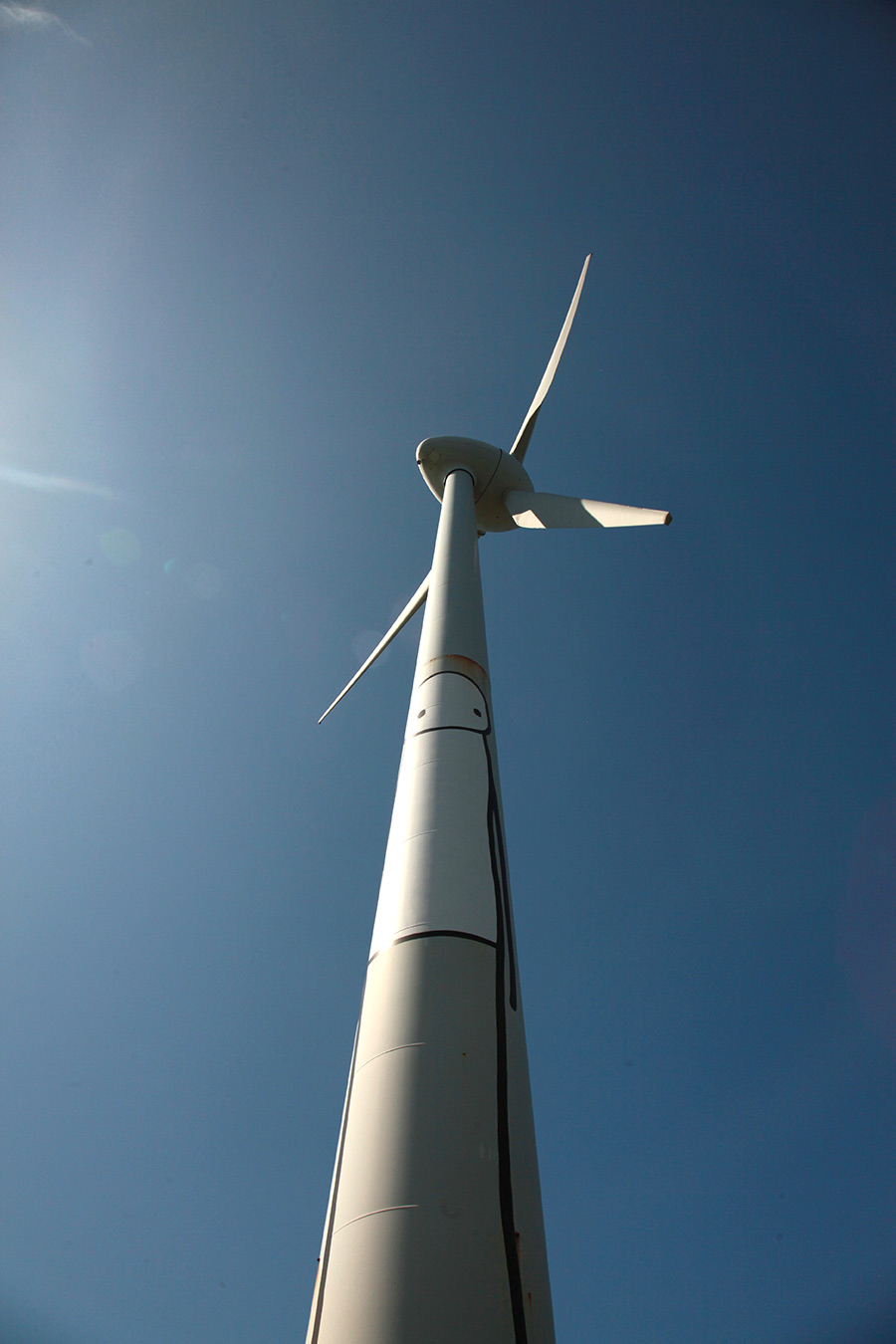
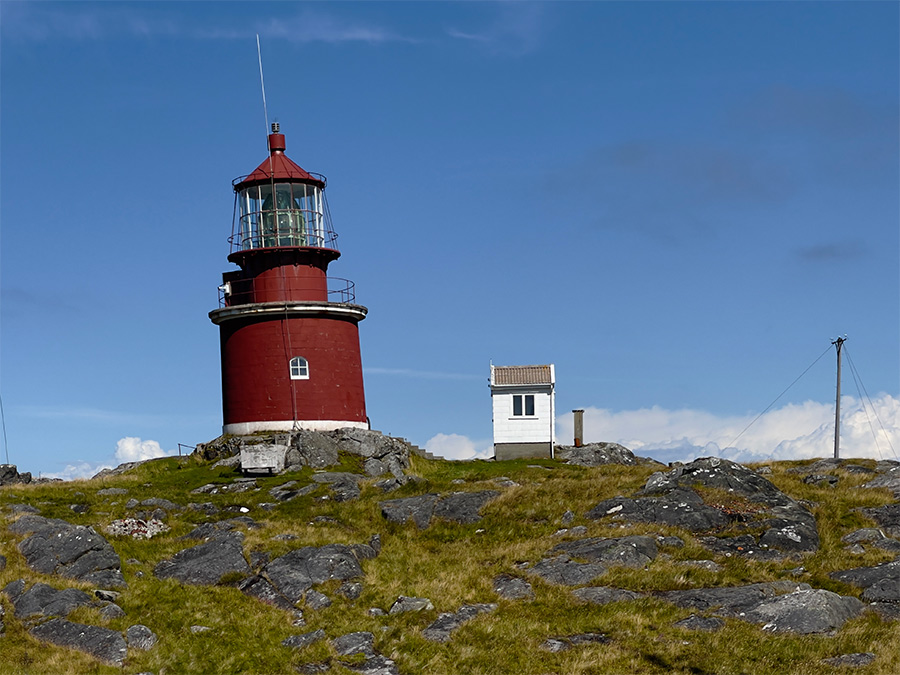
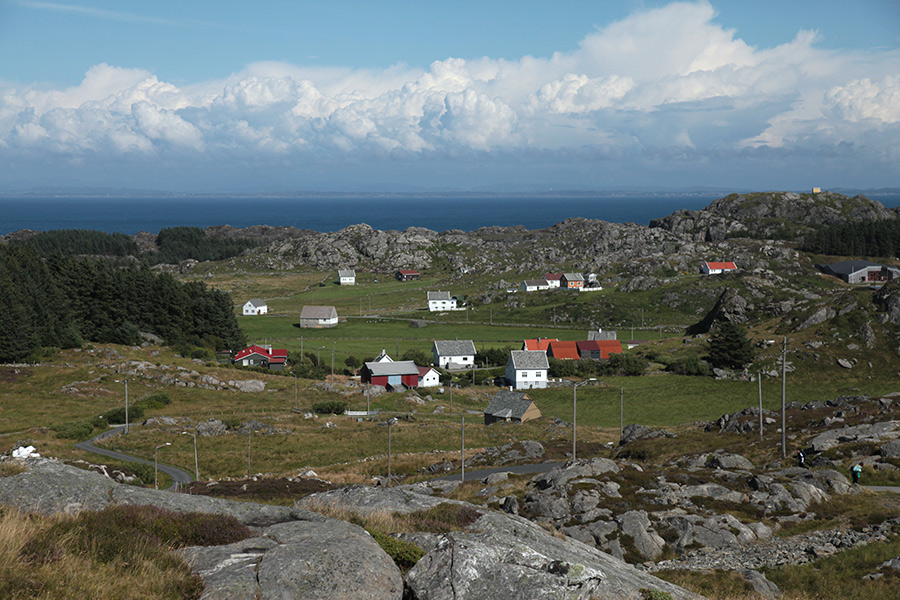
Situated in the North Sea, 18 kilometers west of Haugesund, Utsira epitomizes Norway’s maritime heritage in Rogaland County. As the county’s smallest municipality, this 6.15-square-kilometer island with around 200 residents is deeply rooted in Norge traditions. Its historic dual-tower lighthouse has guided North Sea vessels since 1844.
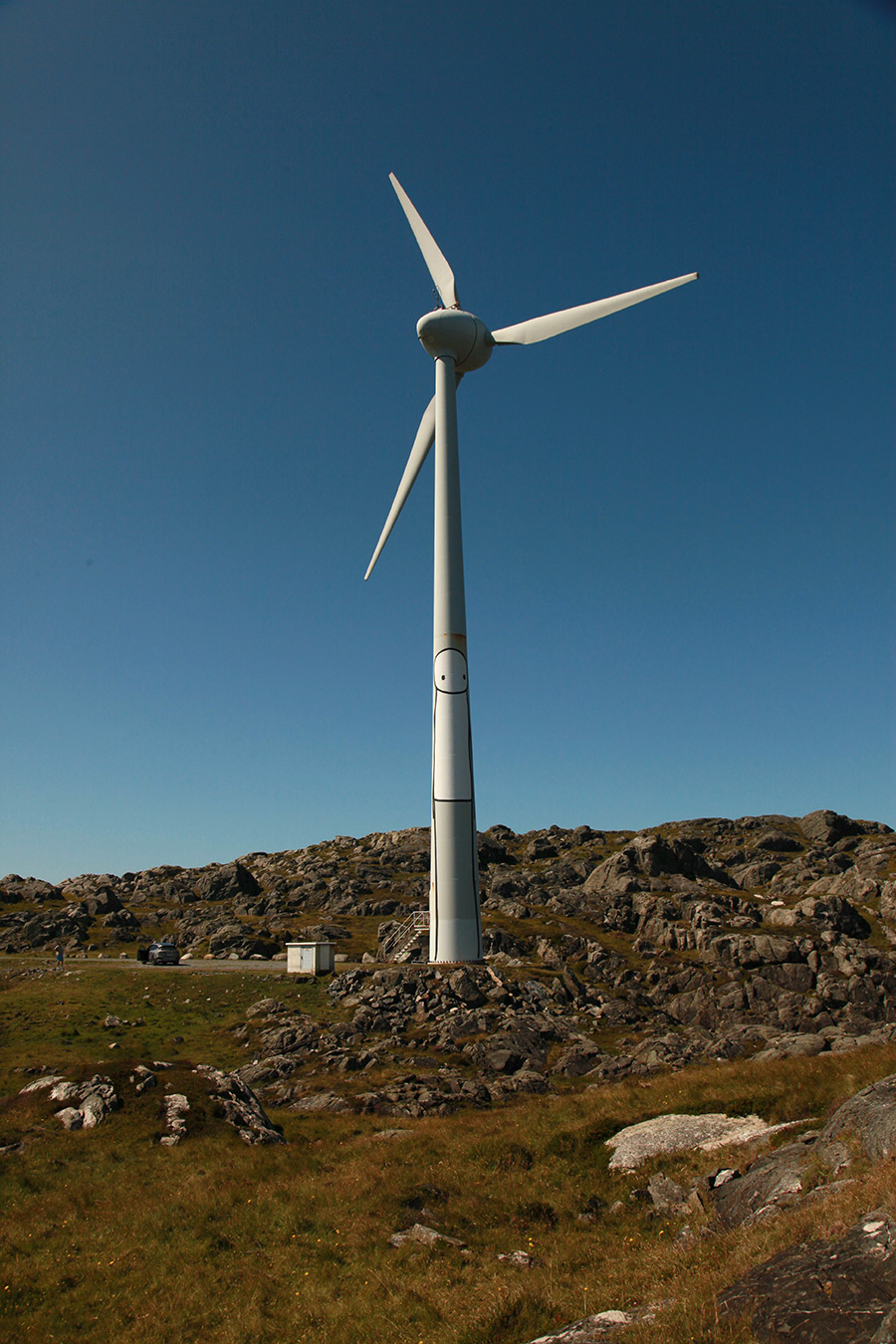
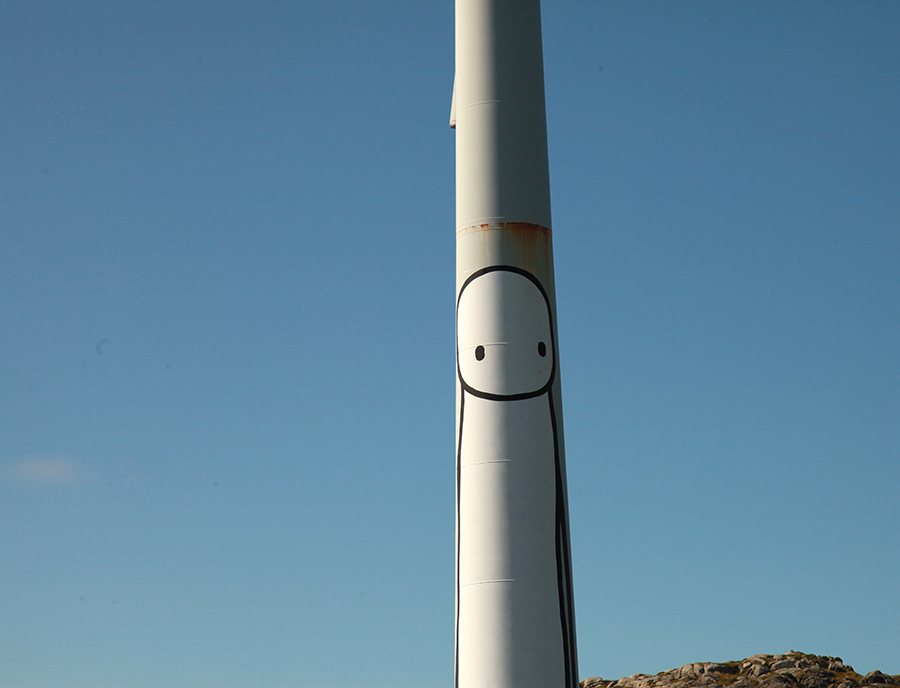
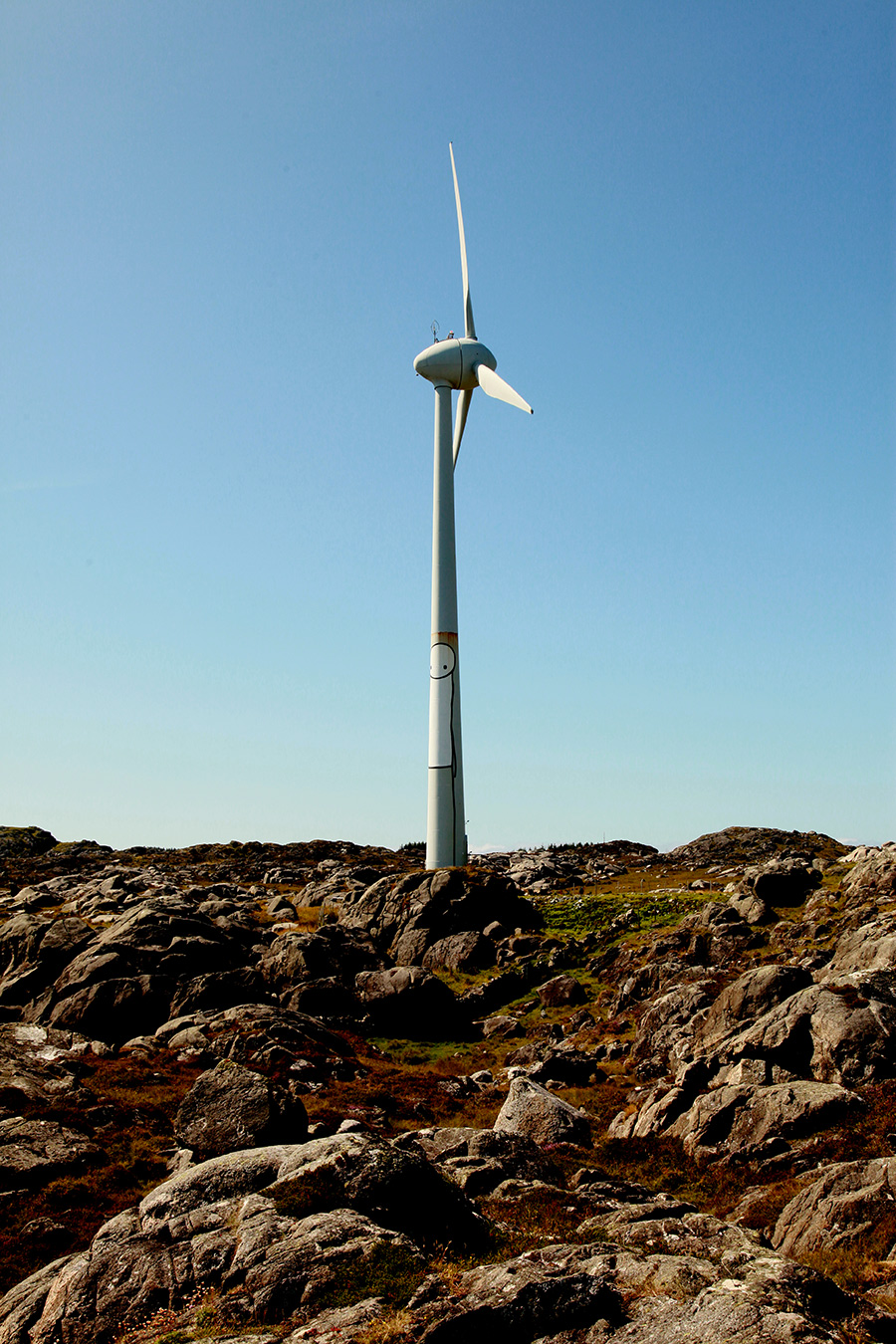
Utsira not only boasts natural beauty and wildlife, including migratory birds and local livestock, but also showcases innovative sustainable energy projects, like their wind and hydrogen initiative from the early 2000s. Its archaeological treasures, from stone rings to burial mounds, echo the island’s deep heritage. Embracing both the old and new, Utsira has attracted international street artists here since 2014, enhancing its cultural tapestry. To experience this unique blend, take a ferry from Haugesund.
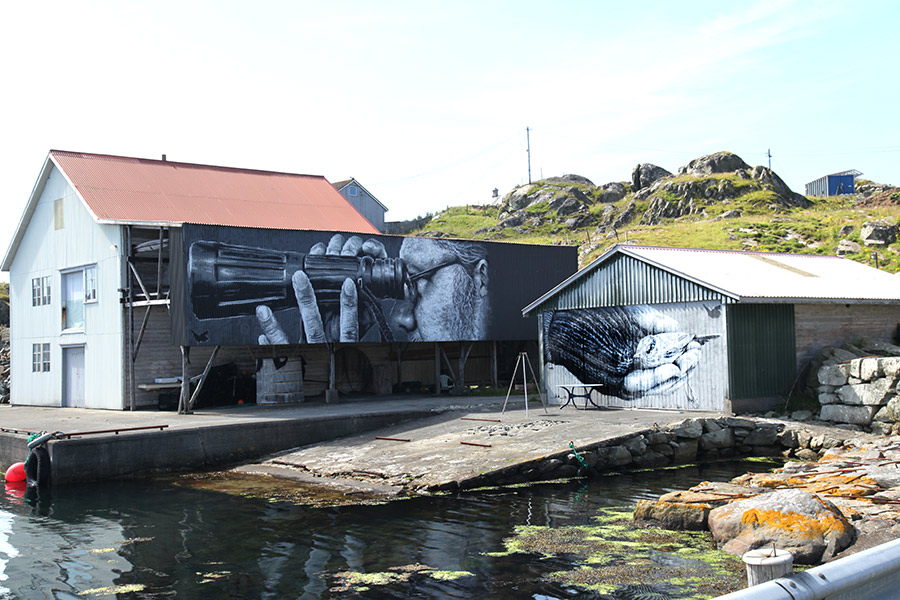
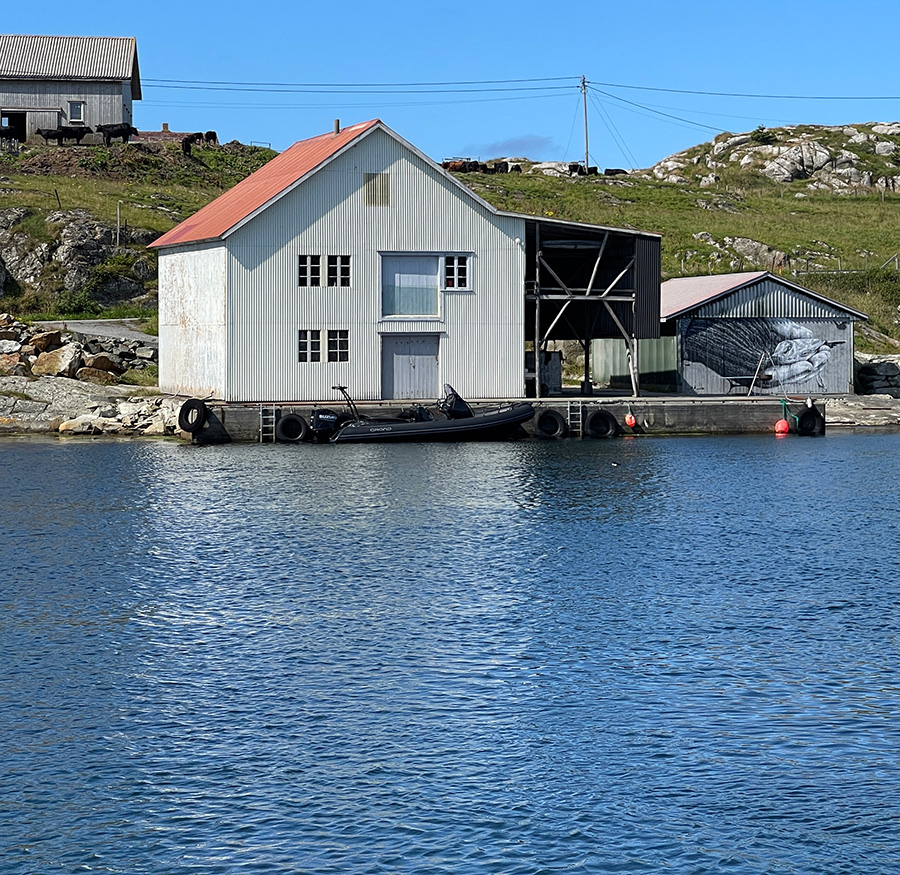
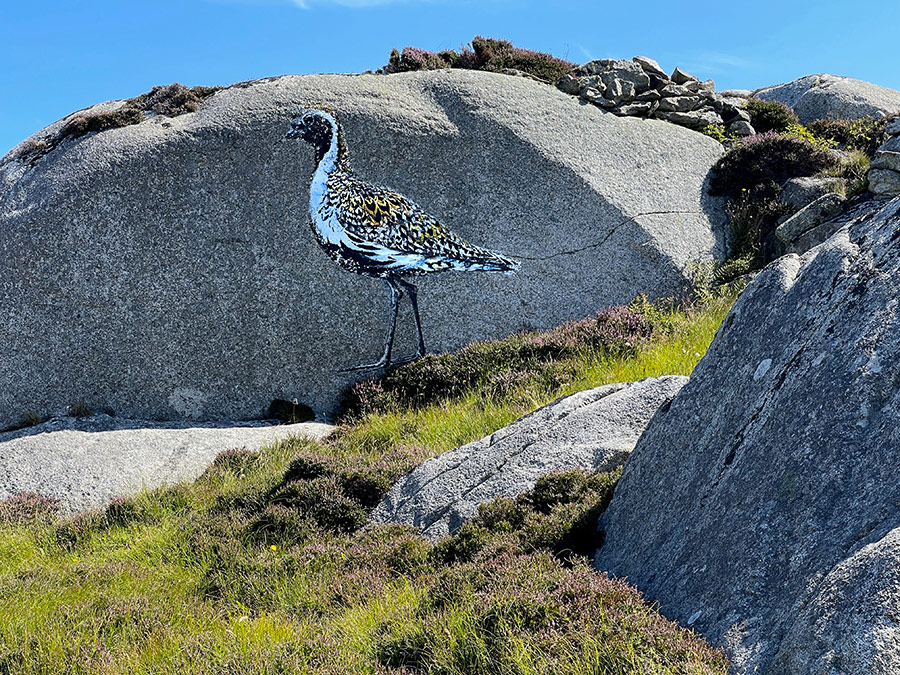
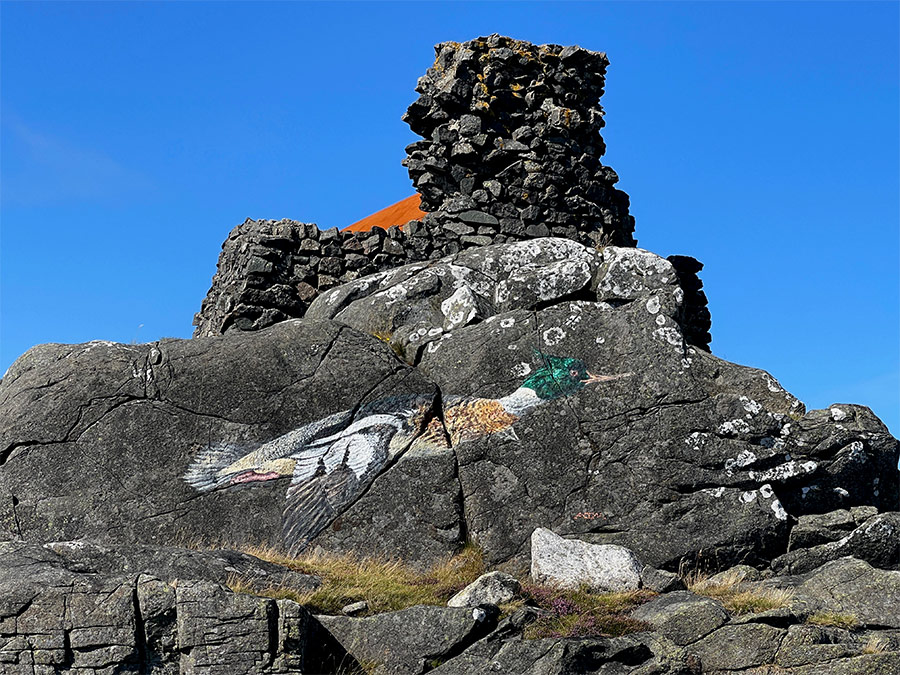
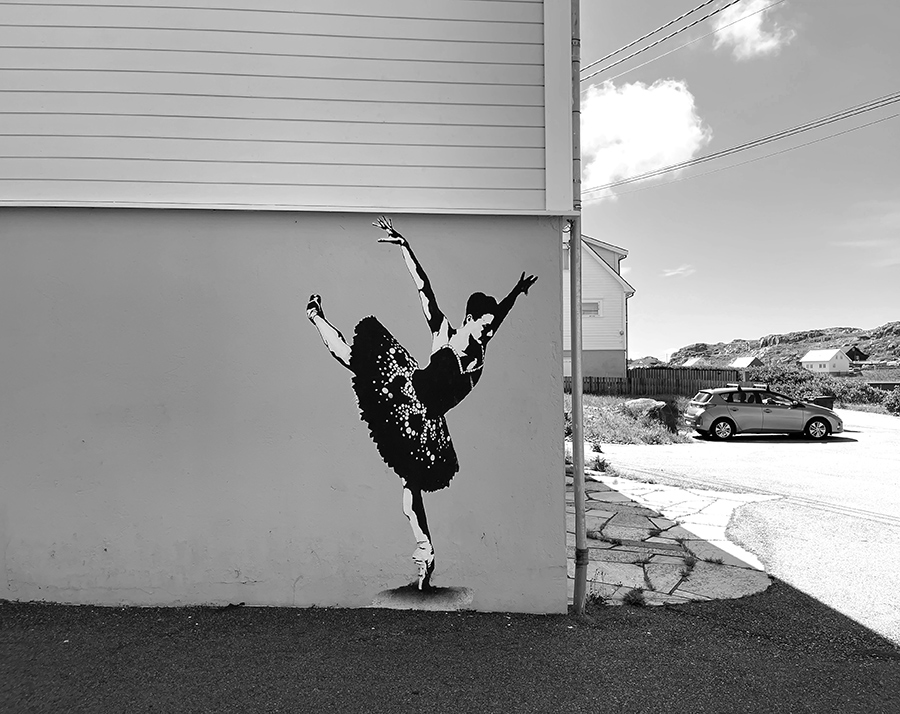
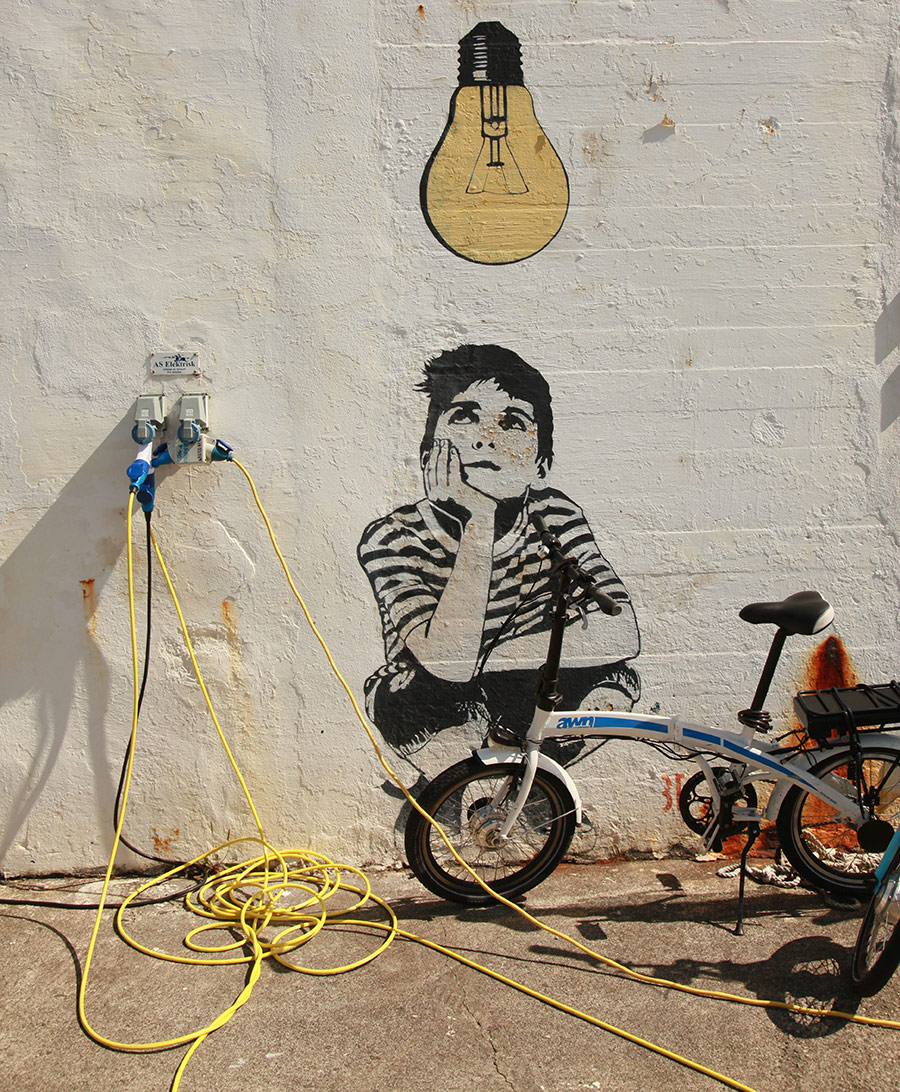
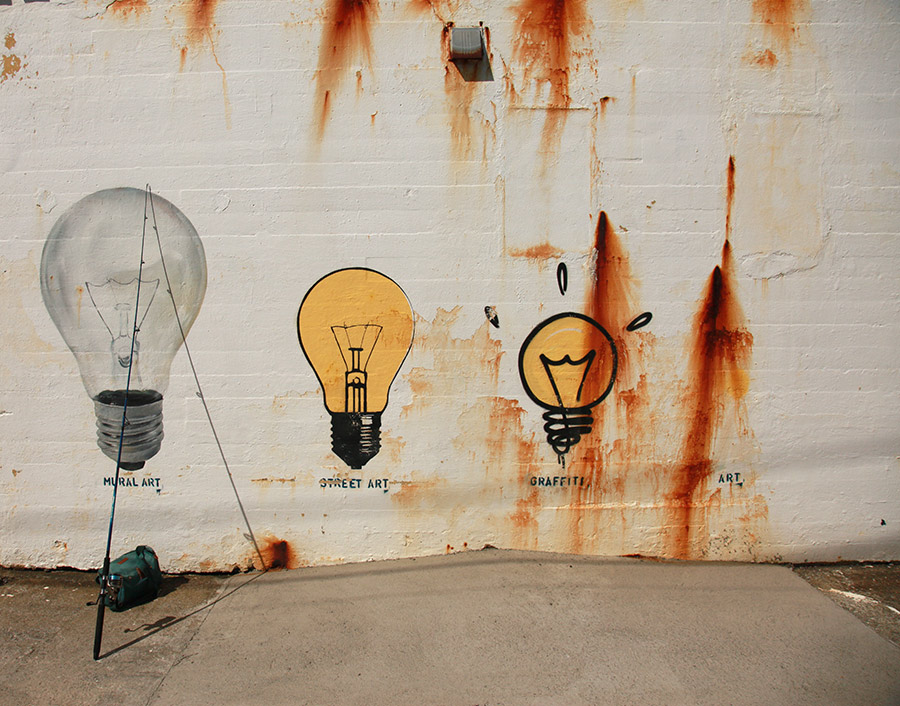
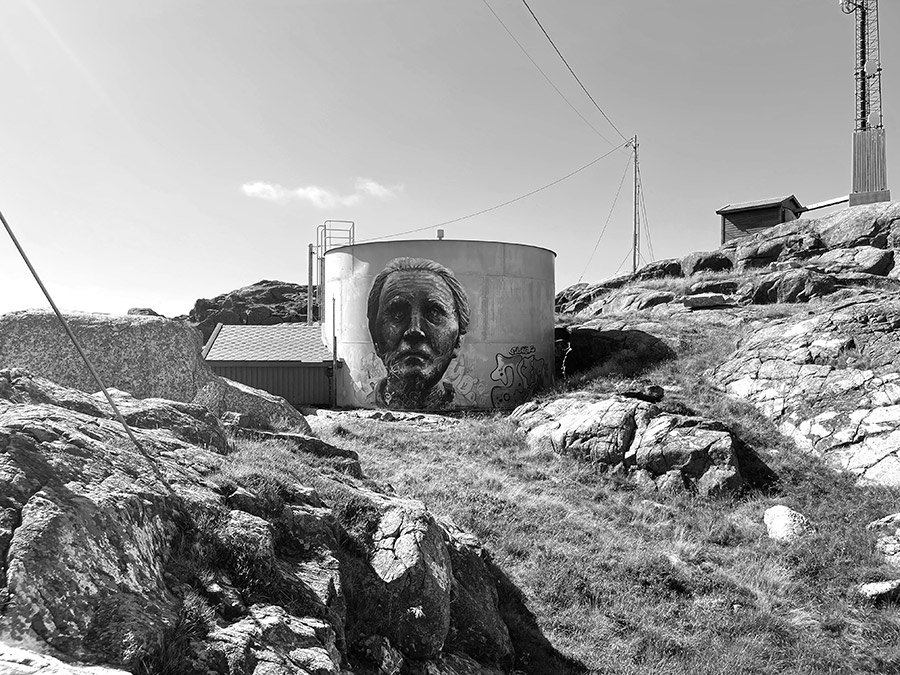
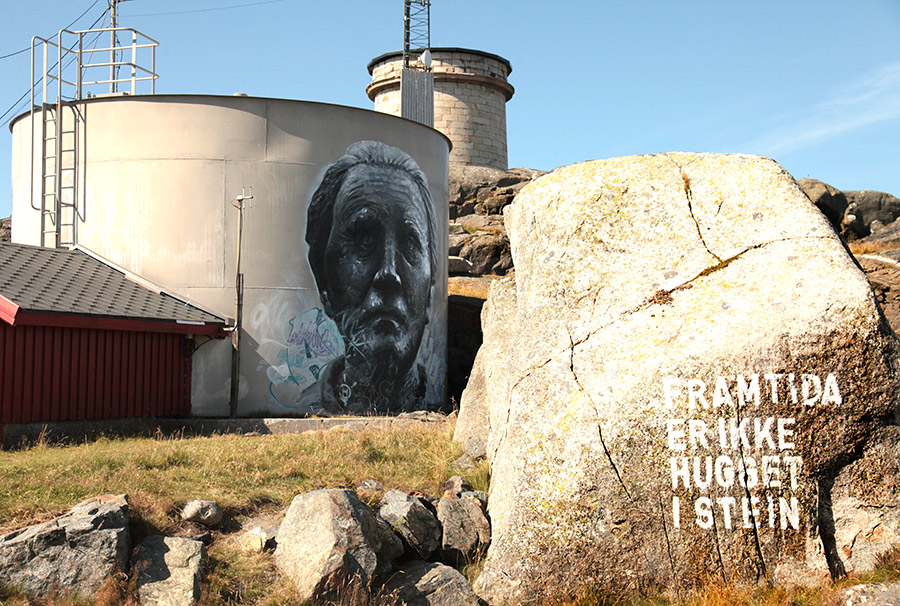
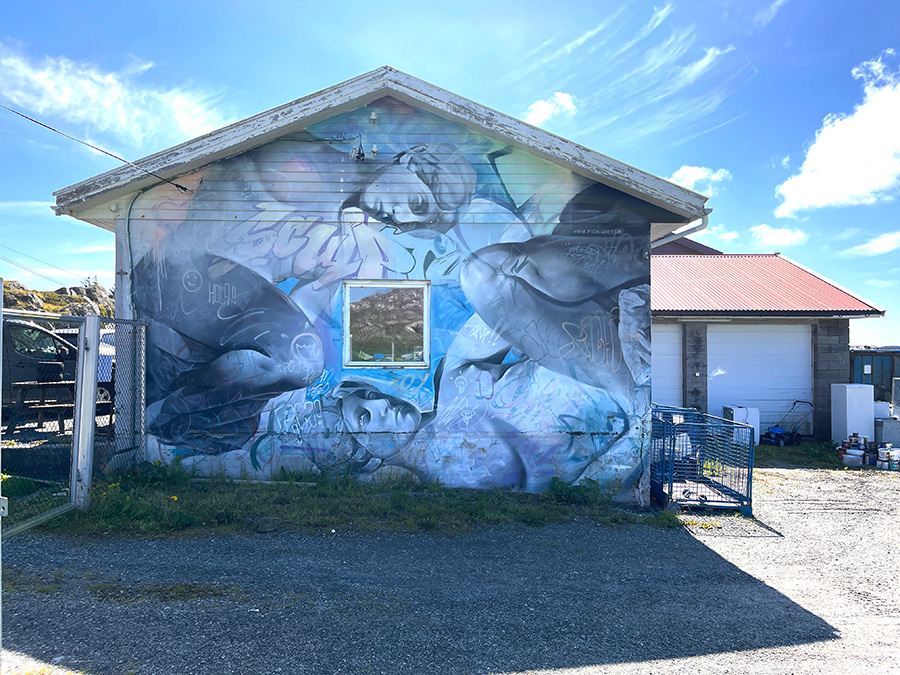
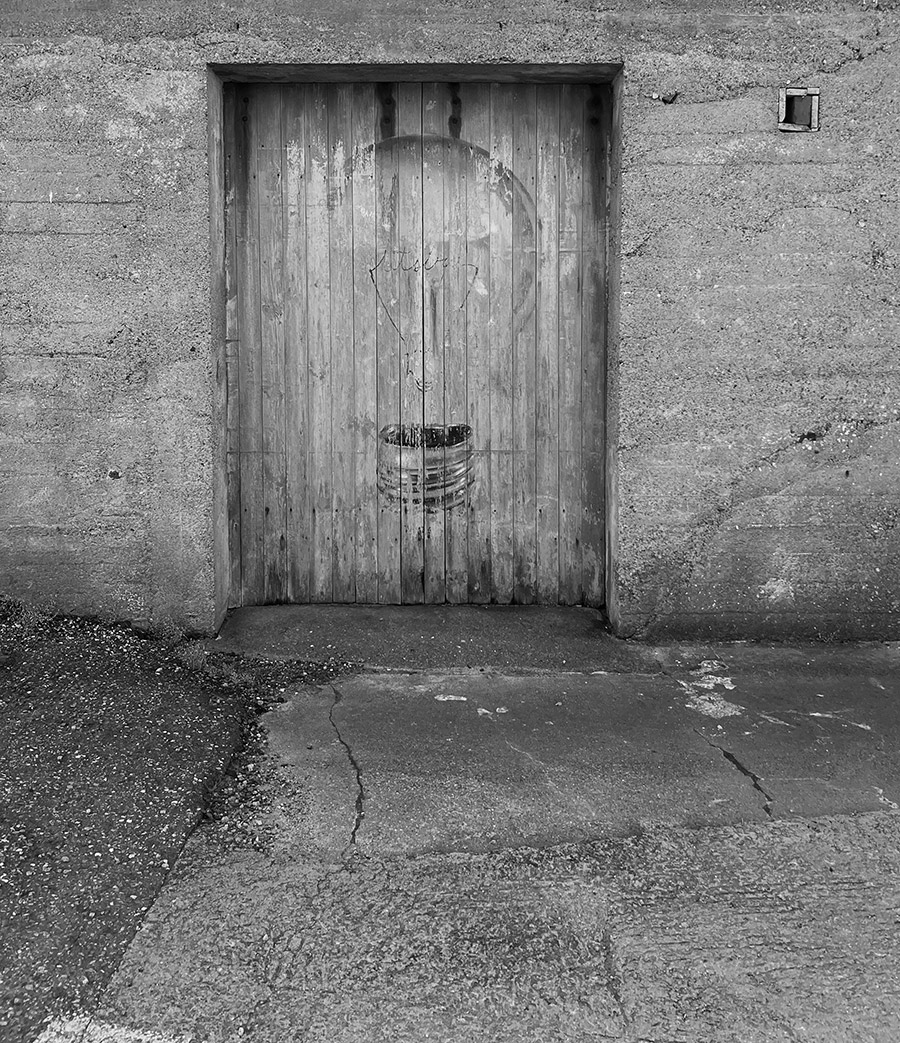
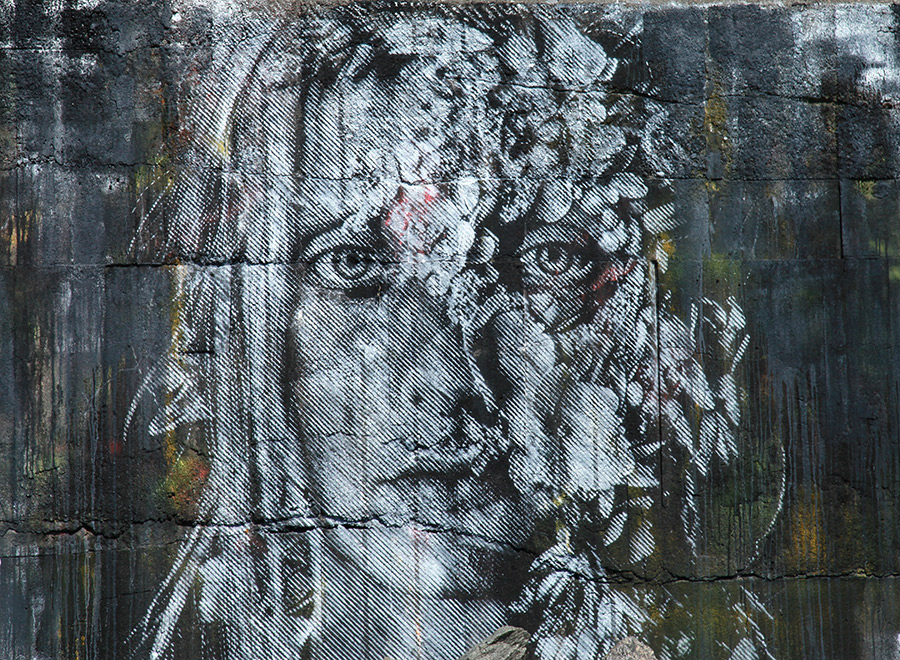
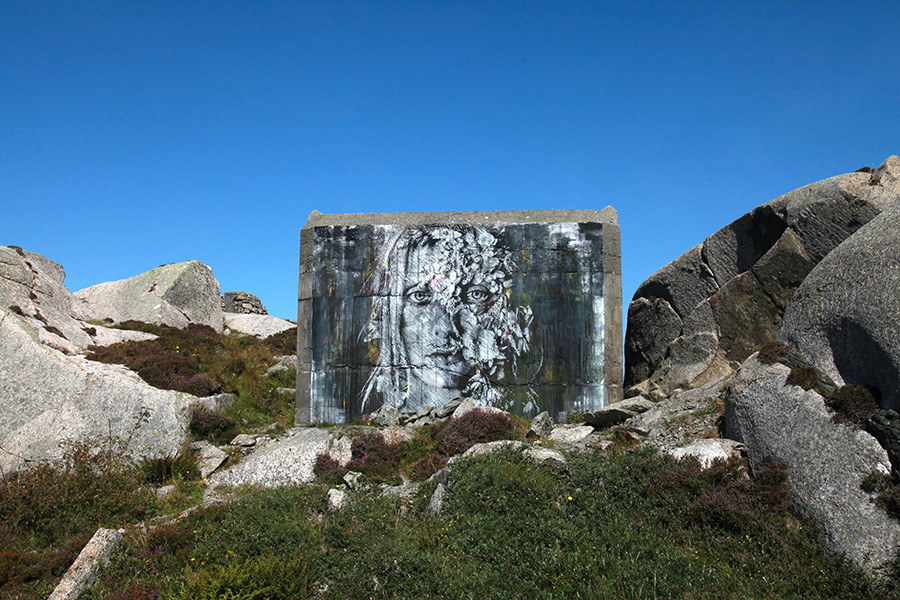
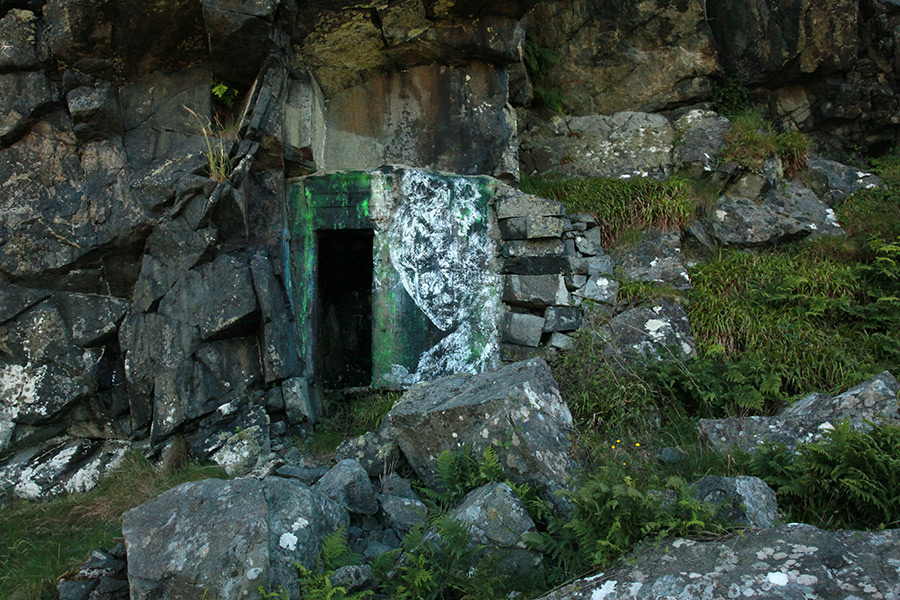
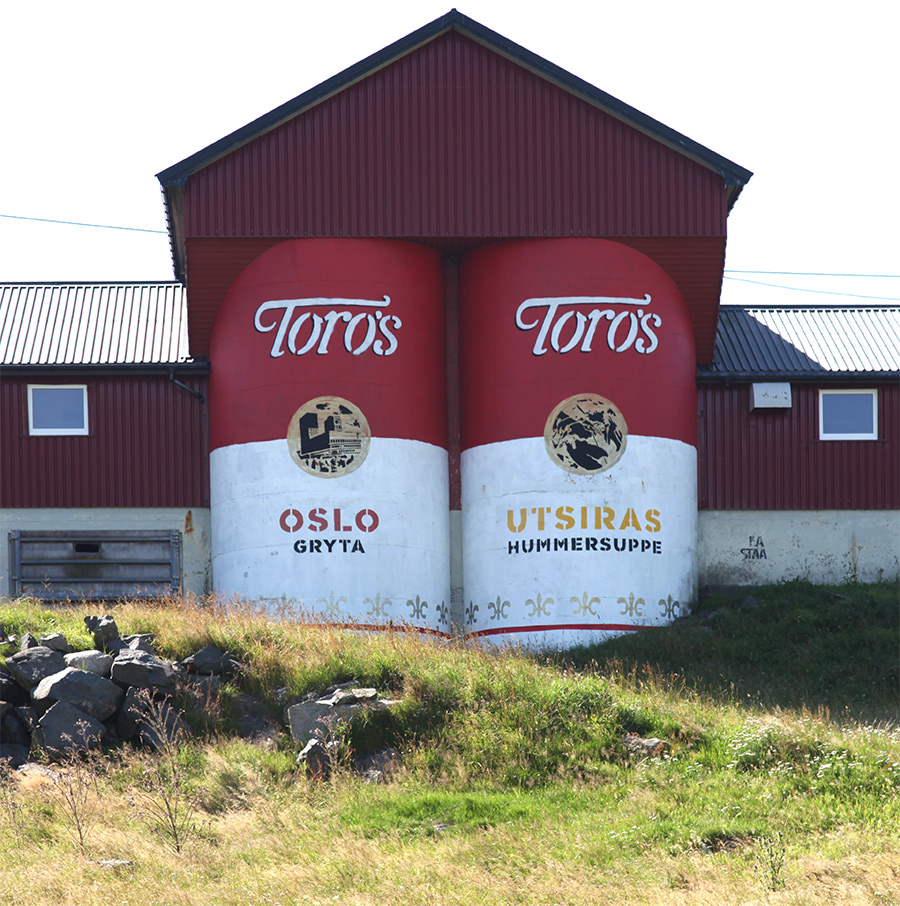
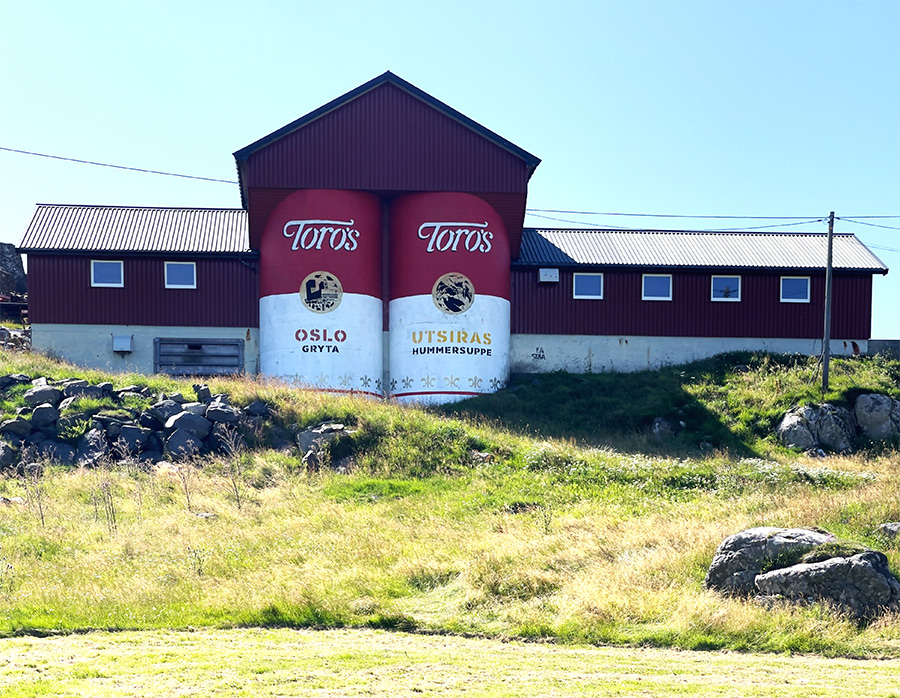
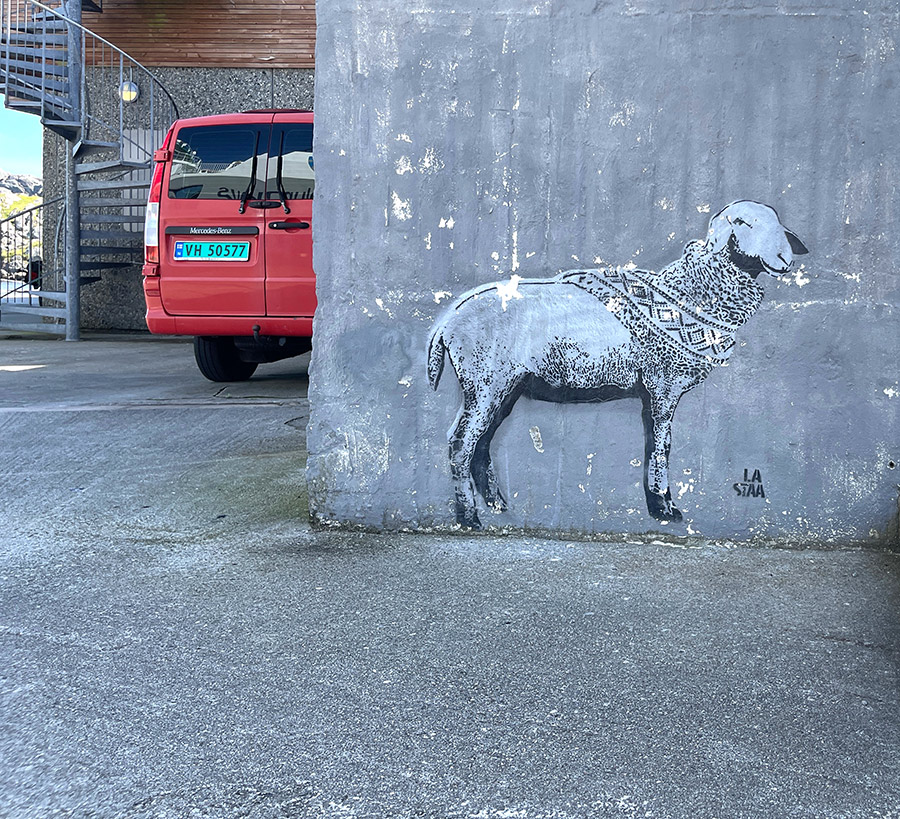
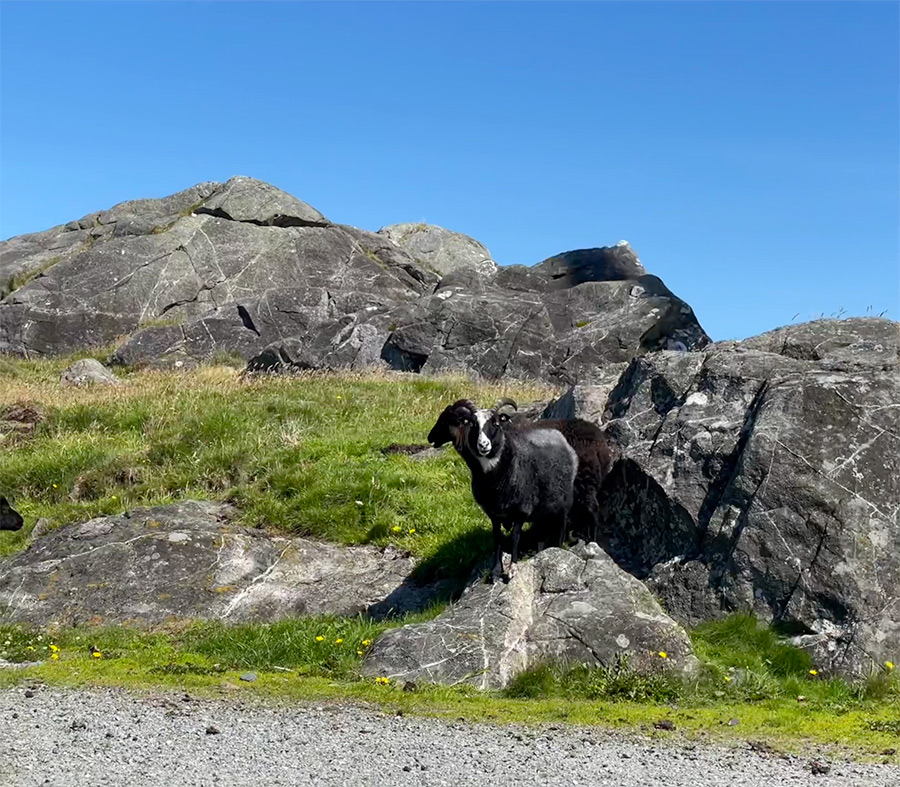
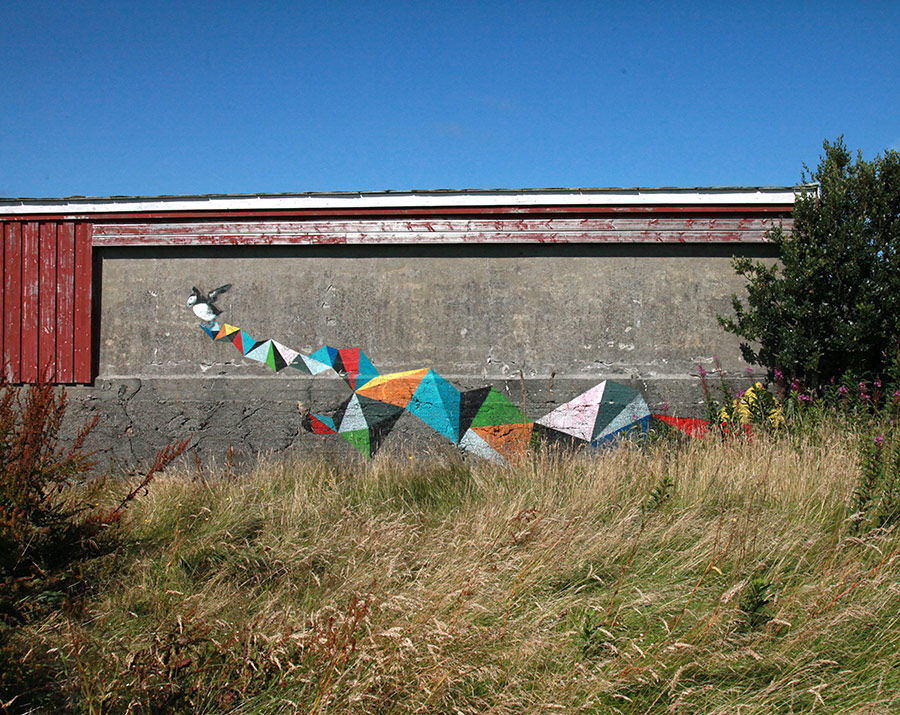
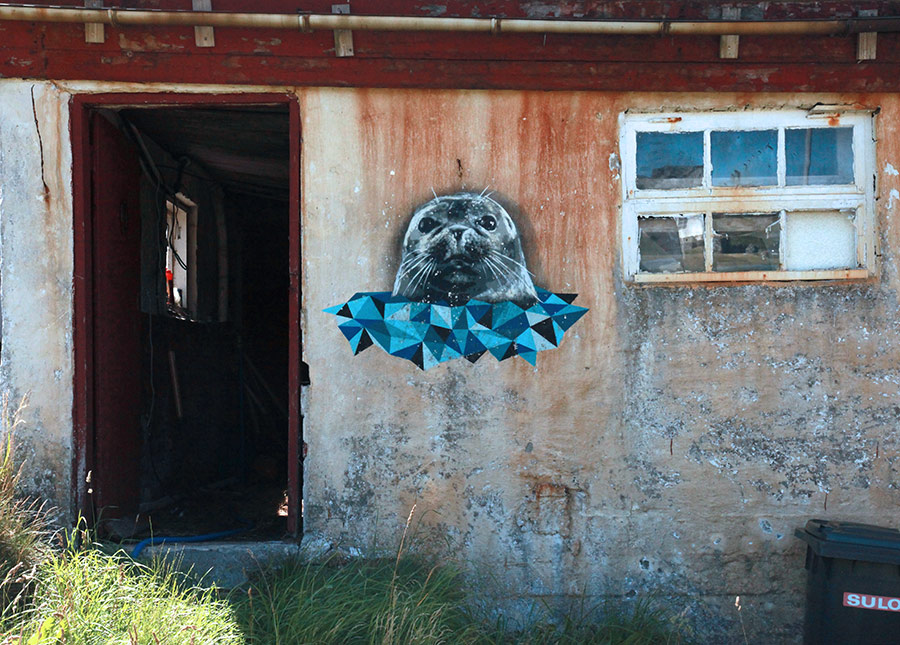
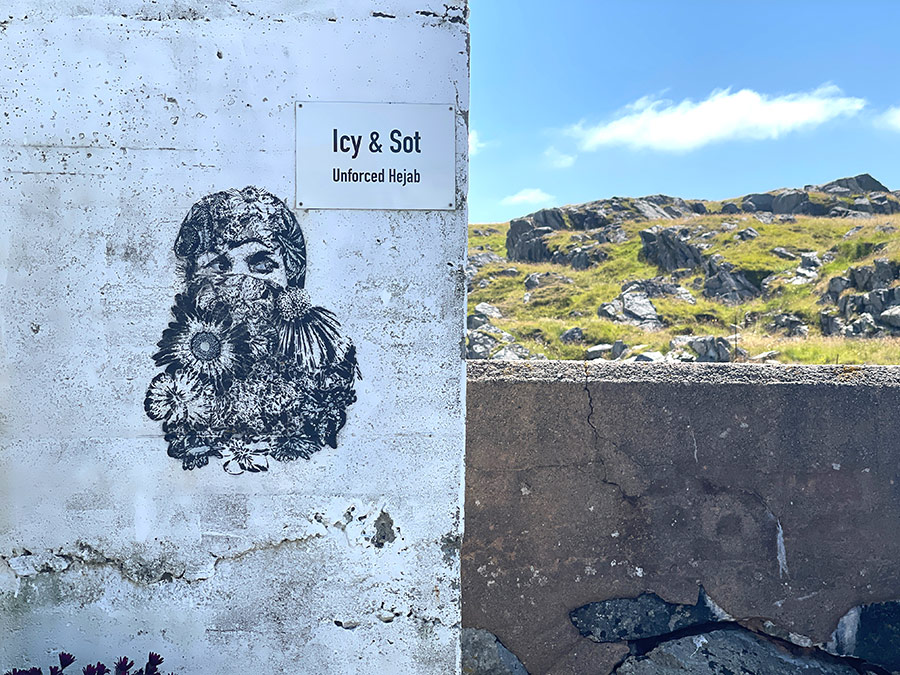
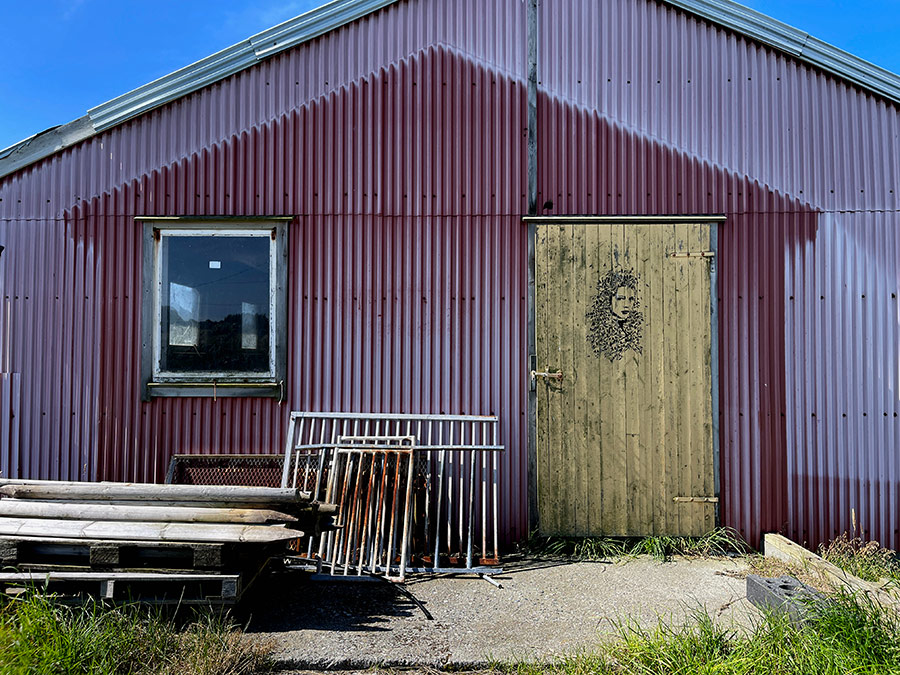
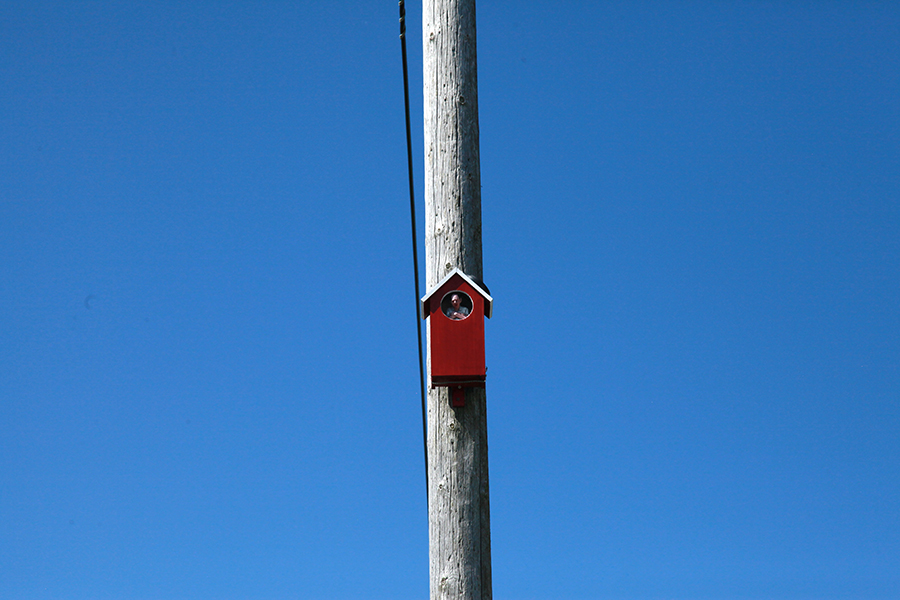
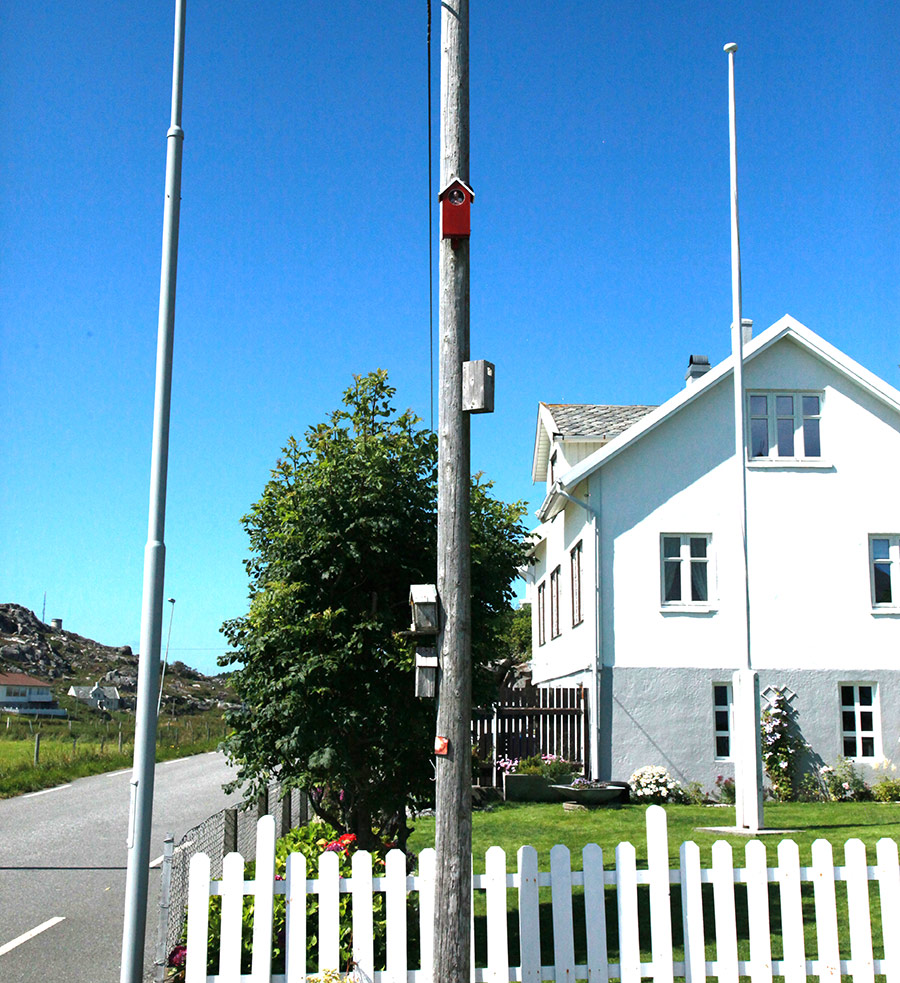
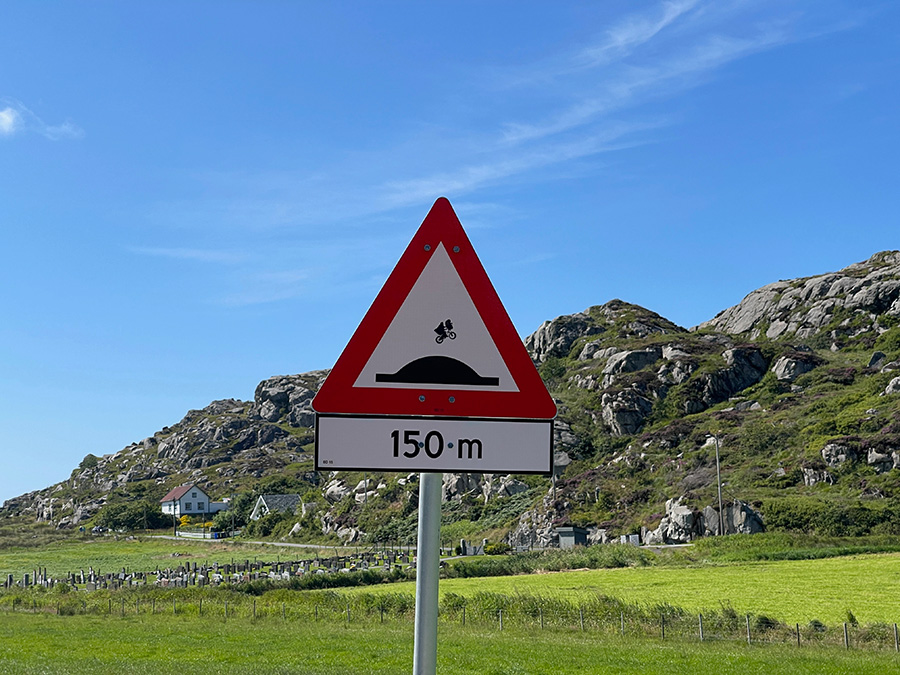
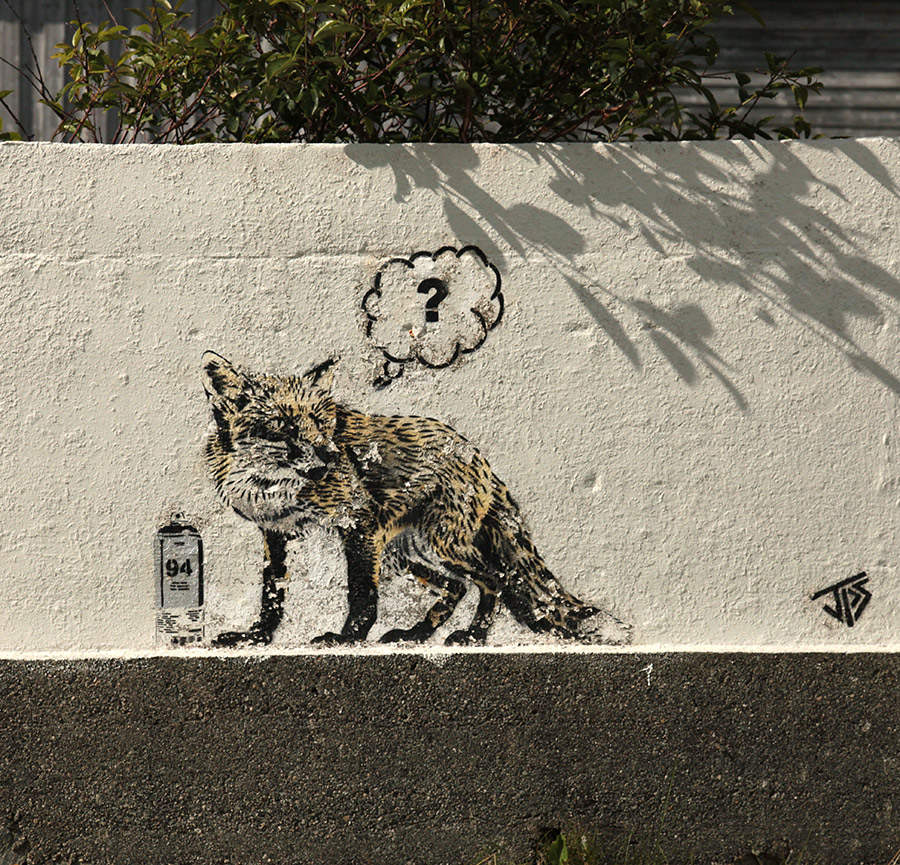
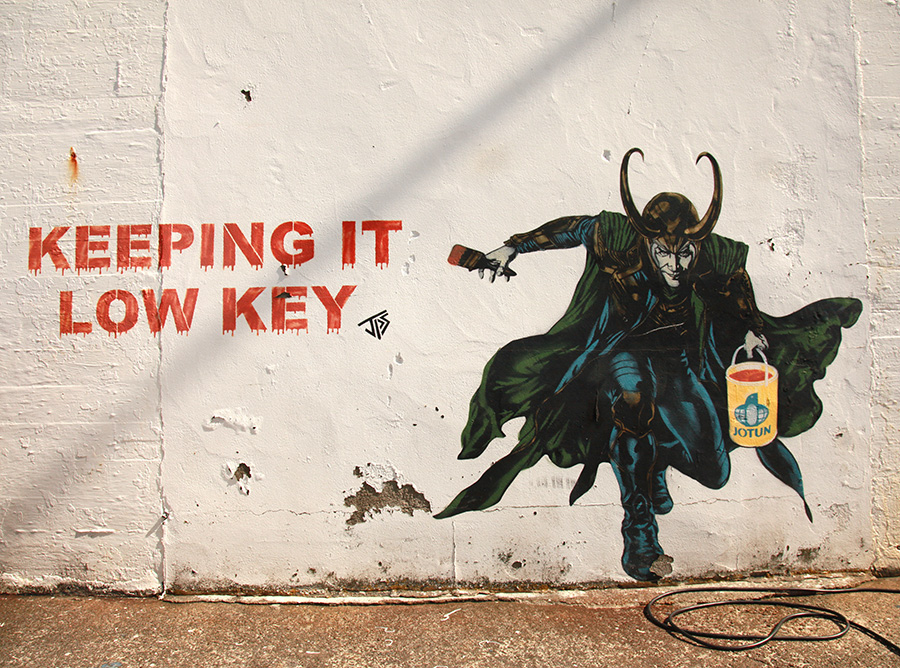
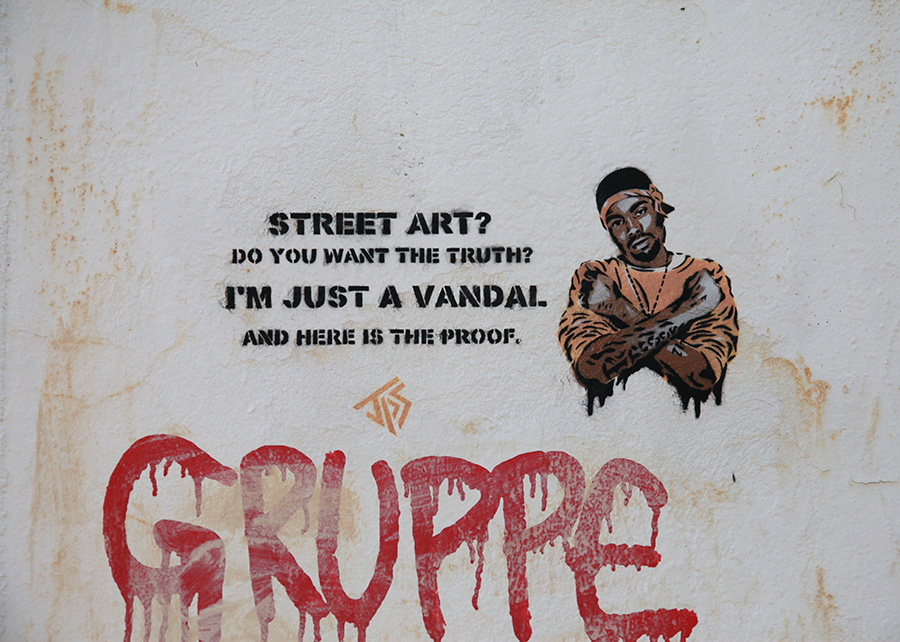
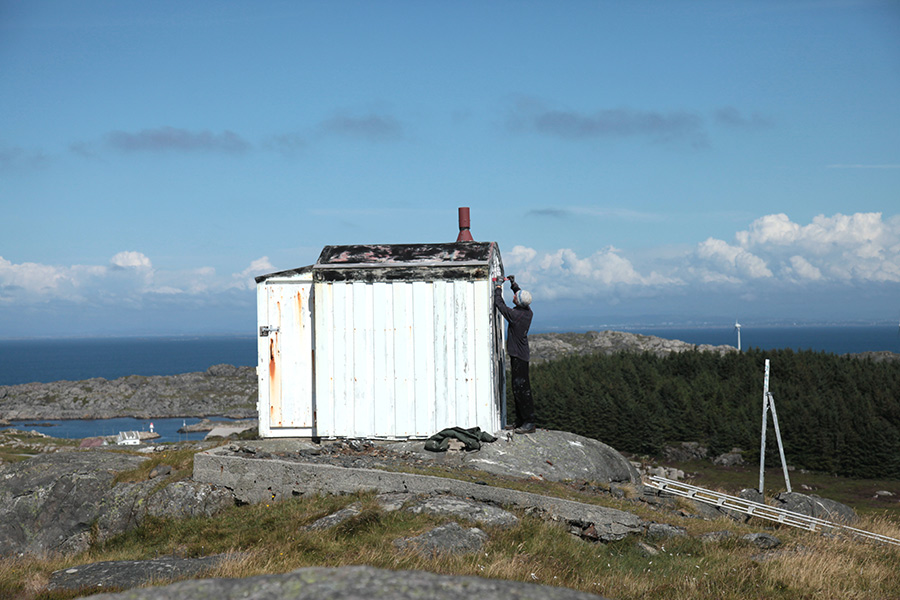
Icy & Sot, Issac Cordal, Pichiavo and Borondo have all created artworks here, so have SNIK, Hama Woods, and JPS, and several others during the last decade. The names are only as important as their proximity to a fan, as it turns out. As you cycle along the narrow winding roads or trek up the rocky hills, you might overlook it at first, but there’s likely a piece of street art nearby – just beyond where those two rams are butting heads.
Visiting the Utsira island for the first time in August of that year, public art curators and organizers Tor Ståle Moen and Borghild Marie were very curious about how the islanders would react to their idea. Would they welcome or resist the idea of bringing street artists to paint old barn doors or enormous seaside boulders in this pristine and remote home to 211 people?
“The island was 100% “clean” from any tags, graffiti, and street art,” says Tor. “They didn’t even have the names of their streets at that time.”
The magnetic charm of the island’s pristine beauty, deep-rooted history, and innovative spirit drew the duo back, time and again, to see more of the terrain and classic Norwegian architecture, and close-knit community. Over the span of a decade, people here warmly welcomed a handpicked ensemble of street artists, each personally cherished or inspiring to the pair. First-timers on the island are now treated to a subtly integrated treasure hunt of site-specific artworks tucked away and openly displayed in equal measure. The island’s lively art program has quietly become a shining example of how tight-knit communities can joyfully embrace the language of street art, all while celebrating and safeguarding their rich cultural heritage.
“The white-painted picturesque old-fashioned Norwegian wood houses were perfectly blended with the green and grey colored landscape,” Tor says of the environment where he and Borghild first inquired about their idea. “The answers came quickly as many people were interested in observing one of the artists while they were painting—and they positively commented on their art.”
“The oldest person living on the island, Tobias, was 87. He approached us and said, ‘There are too many grey walls in this world. Would you like to come over to my house and paint my wall in front?’ Of course, we reacted positively, and the artist ‘3 Fountains’ painted two kissing kids in front of his house. Tobias both smiled and had tears in his eyes when he saw the piece for the first time,” says Tor.
“‘Now, doesn’t the wall look much better?’” Tobias told Tor. “I used to work as a sailor back in the day, and I have seen street art in New York, Rio De Janeiro, and other cities back in the 70’s and 80’s. Finally, I can now see street art on my island. Thank you very much.”
We spoke with Tor Ståle Moen and Borghild Marie as they prepared to celebrate ten years of curating street art on the island of Utsira and asked them about their experiences there.
BSA: What were the origins of bringing street art to Utsira? How was the idea formed and presented? TSM & BM: Several of Tor’s street art friends wanted to come to Stavanger to paint, but Stavanger already had a festival curated by NuArt. Borghild Marie knew Utsira, with its unique environment and engaged population with Tove Grimsby as a passionate doer. So she wrote Tove, and asked if this tiny Island without street names wanted some street art. The answer was loud and clear: ‘Yes, please!’
BSA: Does the project rely on public funding? Is there funding coming from private donors? TSM & BM: The project has been supported by both public and private funding, but primarily with public funding, the Utsira municipality and the region of Rogaland as major donors. But private donors have helped with labor, material, food, housing, and support with travel costs, etcetera. The whole island has contributed, and we have as well.
BSA: Who is the project manager or director? Is she/he/they based in Utsira? TSM & BM: It’s more of a committee work, and by now, all involved are locals. We contribute as advisors when needed.
BSA: Can you speak about the residents and their involvement in the process? Did they have strong opinions in favor or against bringing street art to their island? TSM & BM: The islanders have greeted the art and artists, with great warmth. They have baked cakes, cooked dinners, taken the artists fishing, and invited them to their homes. Many of the artists have engaged in teaching art techniques at the school, and Icy and Sot conducted a beach cleanup together with the islanders.
BSA: Can you describe the collaboration between Martyn Reed, who ran the Nuart Festival based in Stavanger, and this Utsira project? How has the project evolved over time? TSM & BM: Nuart was invited to promote the events mutually to strengthen the whole region’s identity as a street art location, but their contribution is very limited.
BSA: What’s the process of extending an invitation to an artist to participate? It is such a remote location – how does the artist live there, and who do they interact with? TSM & BM: They have been housed in various ways, but most have stayed in the “artist in residence” space at the lighthouse.
BSA: Can you speak more about how residents have welcomed the artists and offered assistance or volunteered to help? TSM & BM: As answered above, the response has been overwhelmingly engaged and heartfelt. Many have contributed with gear (ladders, etc.), food, friendship, nature experiences, babysitting, etc. They express gratitude because the art enhances the everyday life on the Island, bringing new impulses and people to the Island.
BSA: The project is now in its 10th anniversary and recently, the British duo Snik painted on the island. What are the plans for the future? TSM & BM: We don’t know, but we have our eyes on big names who suit the Island well.
BSA: On a personal level, what does the project mean for you two, and how involved are you presently in bringing more artists to Utsira? TSM & BM: We have a deeply felt love and passion for Utsira and will support the project with our network and advice. But it is equally important to us that the islanders own the event. It’s their environment, and the art should live and breathe their voice and pace.
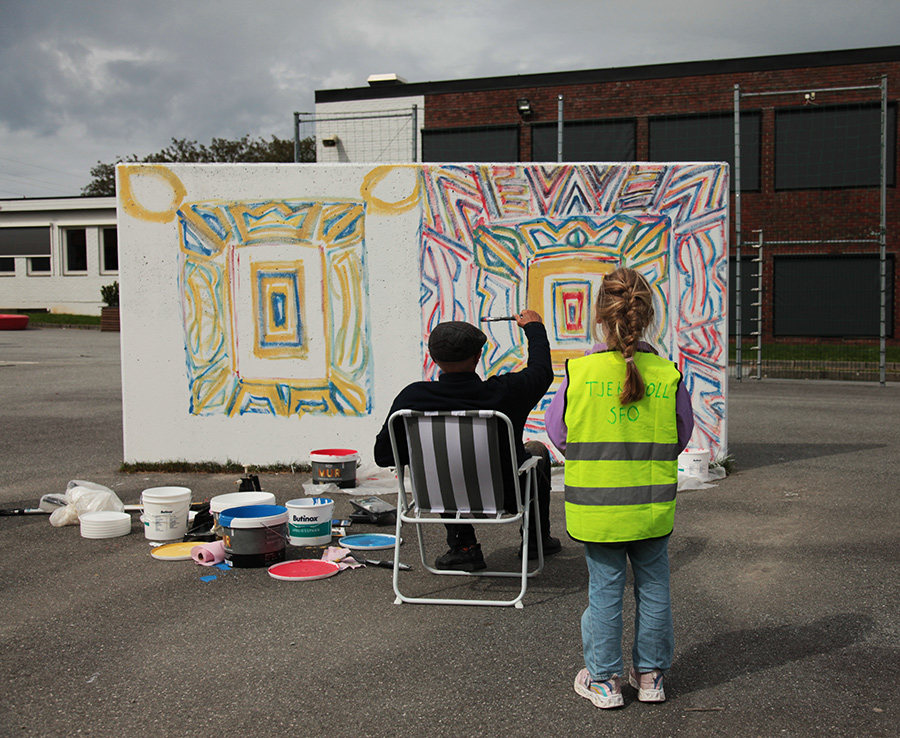
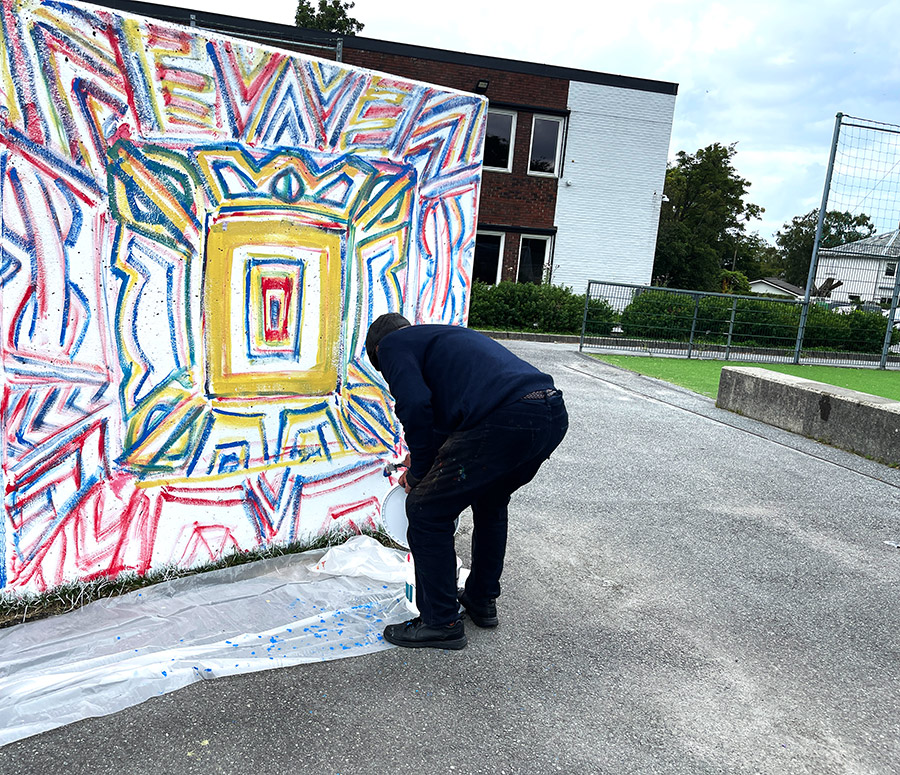
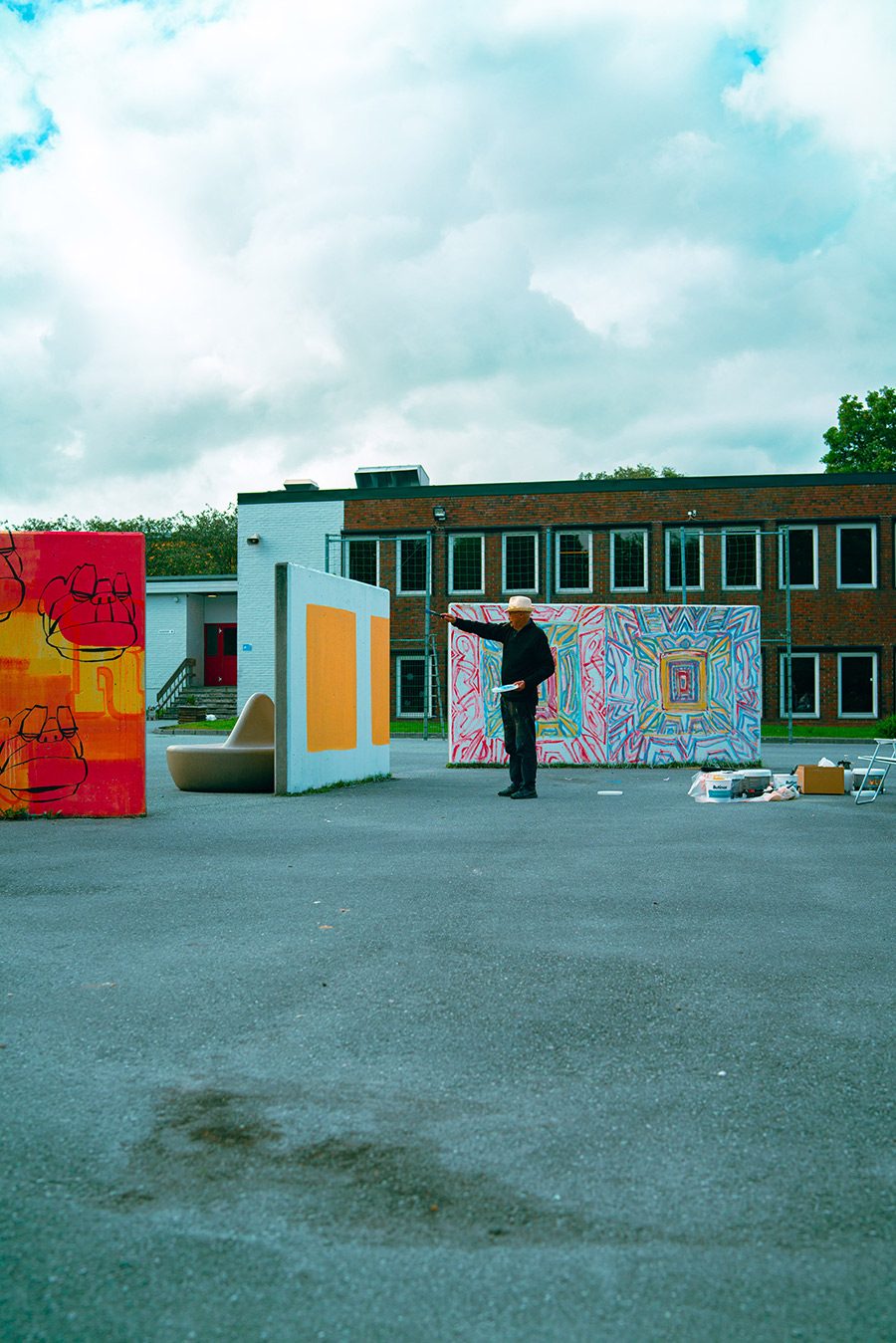
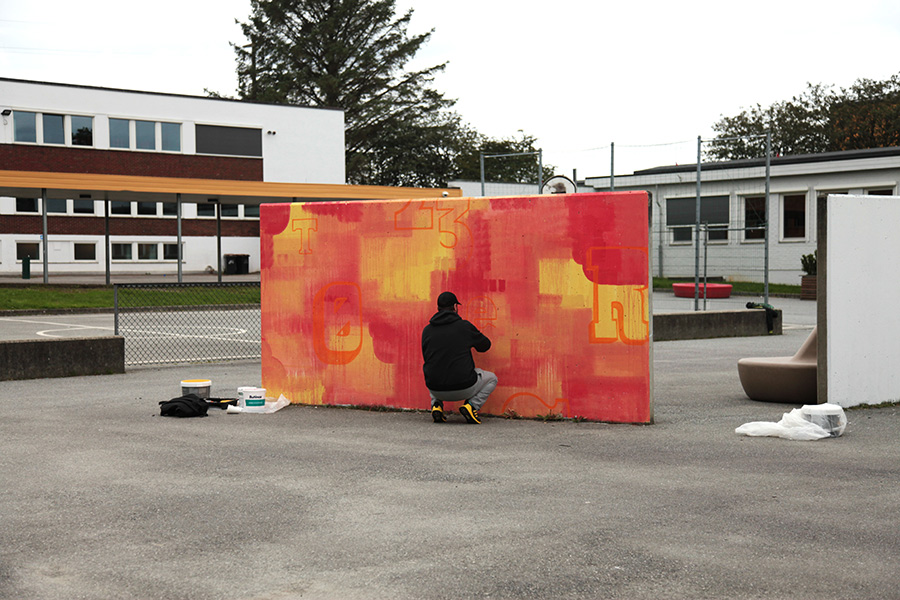
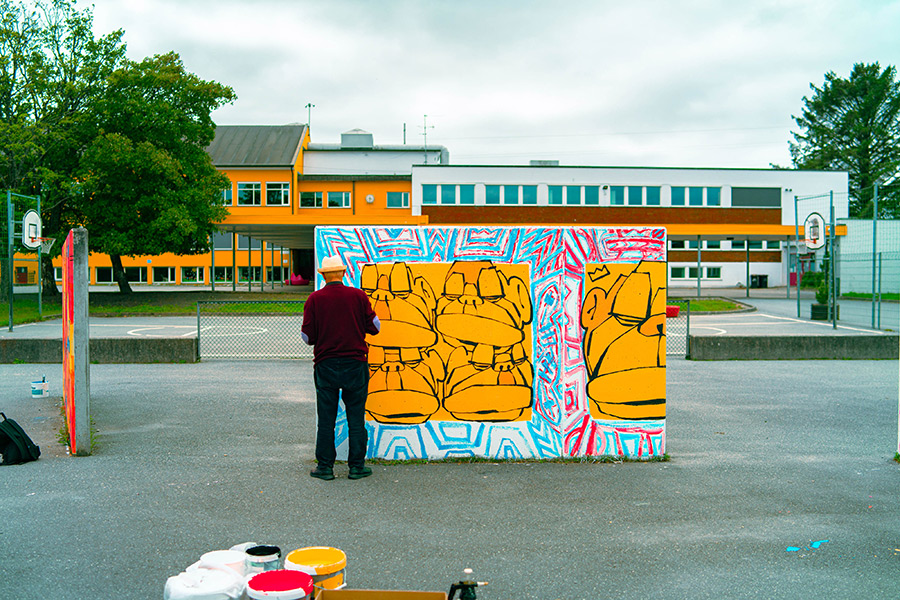
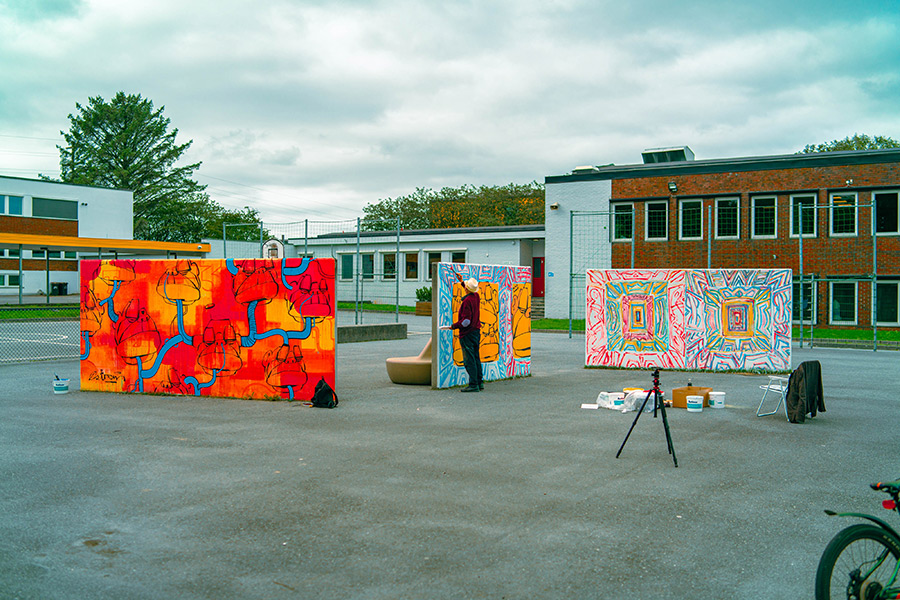
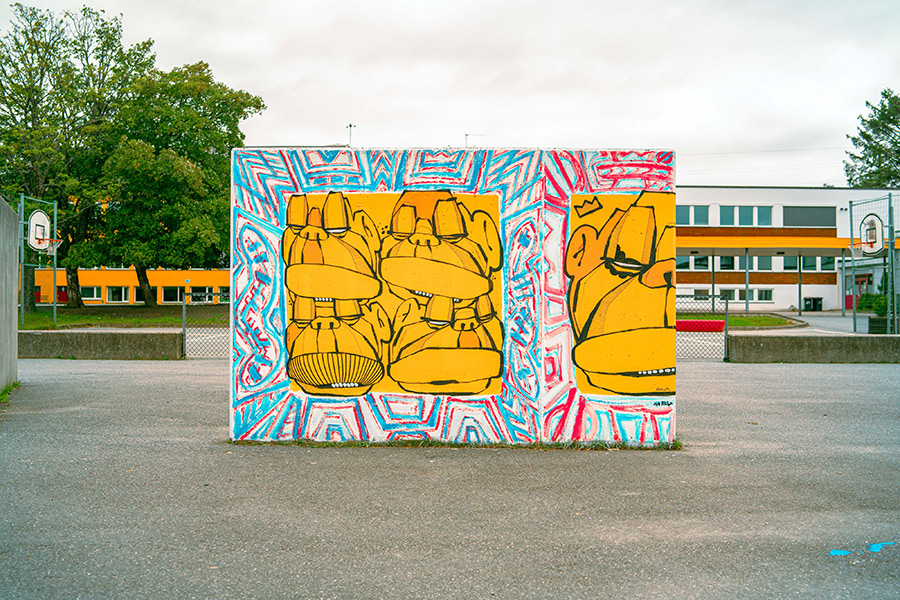
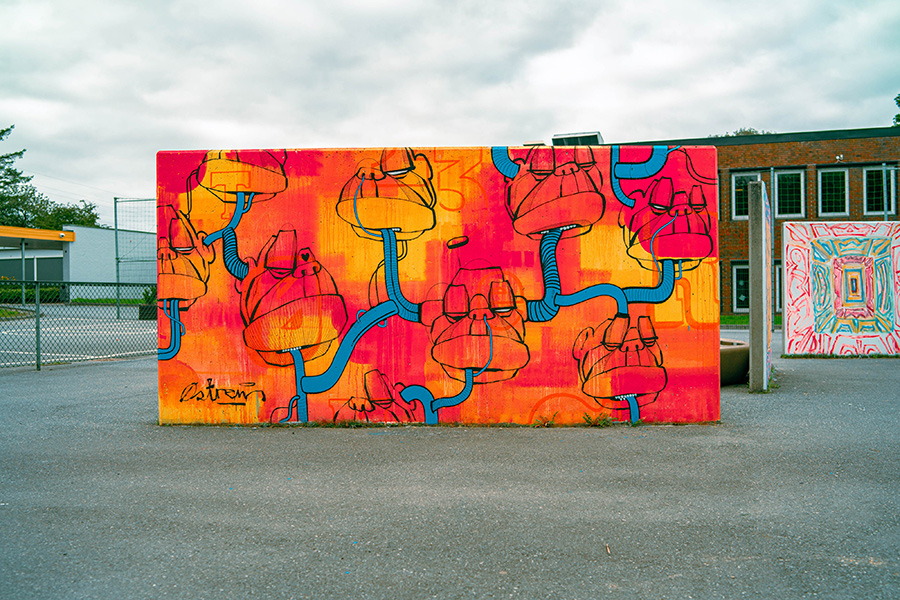
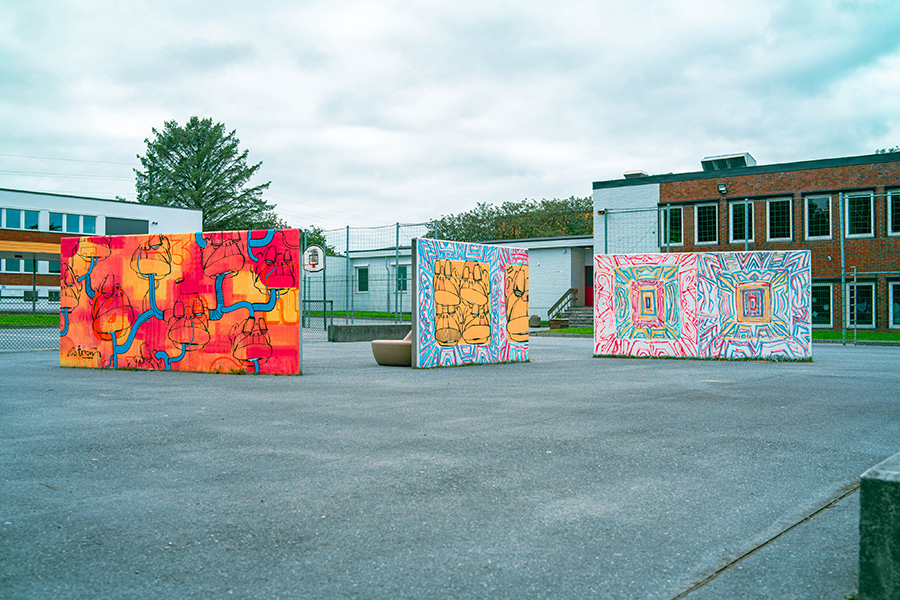
A masterful curatorial vision lies in this collaborative endeavor that unites two generations of Stavanger artists in creating a dynamic canvas in public space – while the newest generation of onlookers engages in the joyful spectacle of football nearby and around them. The convergence of these two artists, separated by a half-century, in creating something novel is a rare, unique offering at the Nice Surprise Festival.
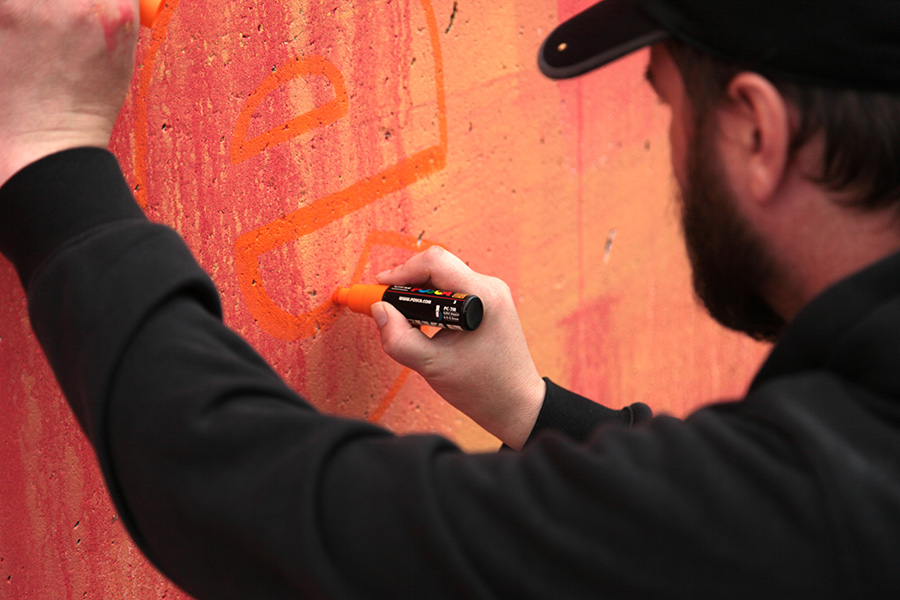
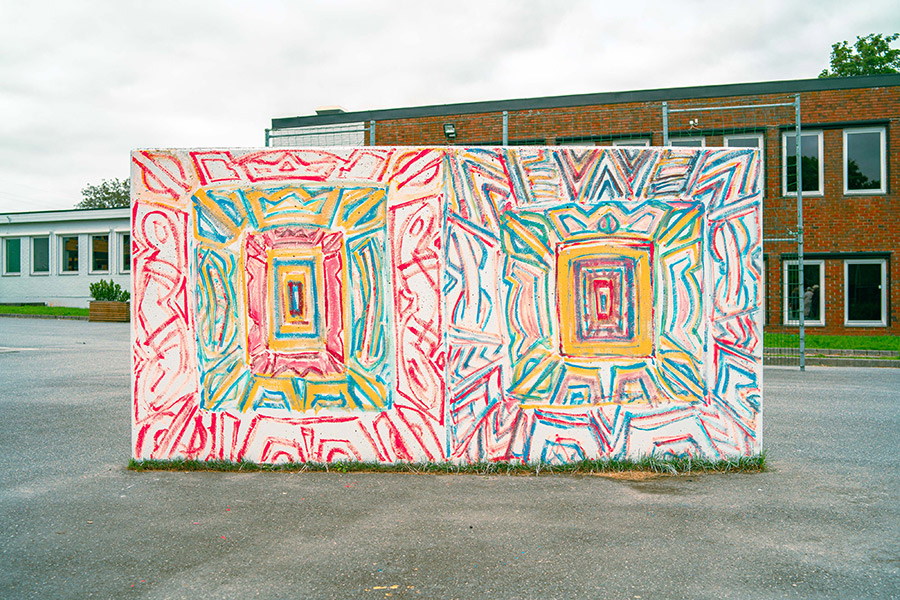
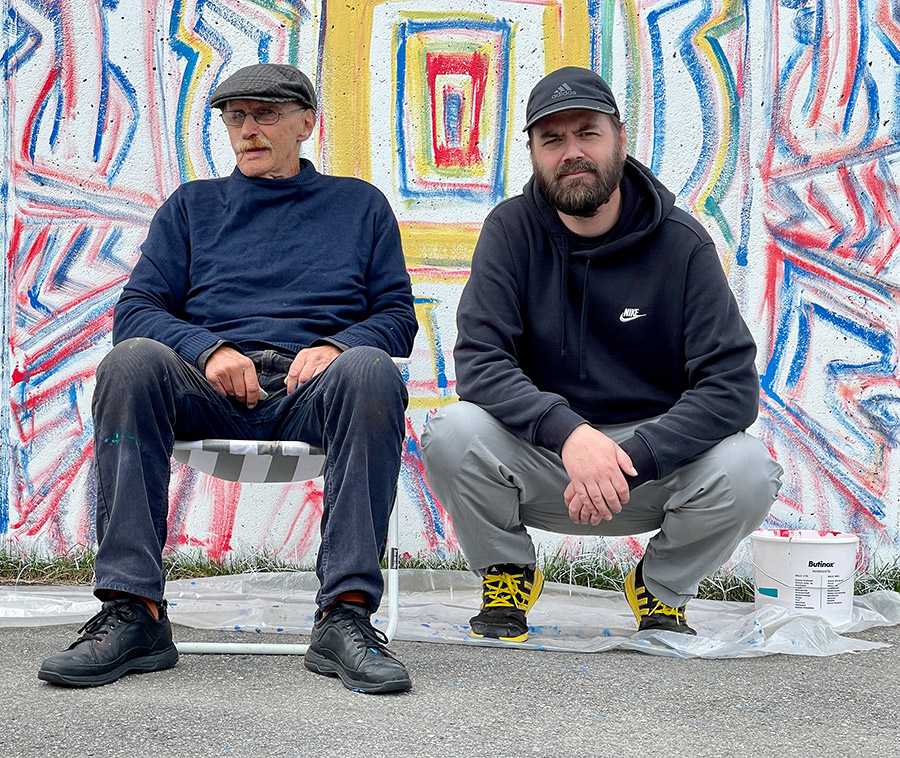
An internationally celebrated octogenarian whose art graces the walls of countless homes countrywide in Norway harmoniously joins forces with a contemporary graffiti virtuoso renowned for adorning the city’s walls and represented by prestigious galleries in Oslo and Stavanger. Amidst their shared geographic and societal influences, one may instinctively seek a common thread, a thread that unravels the aesthetic DNA of a city.
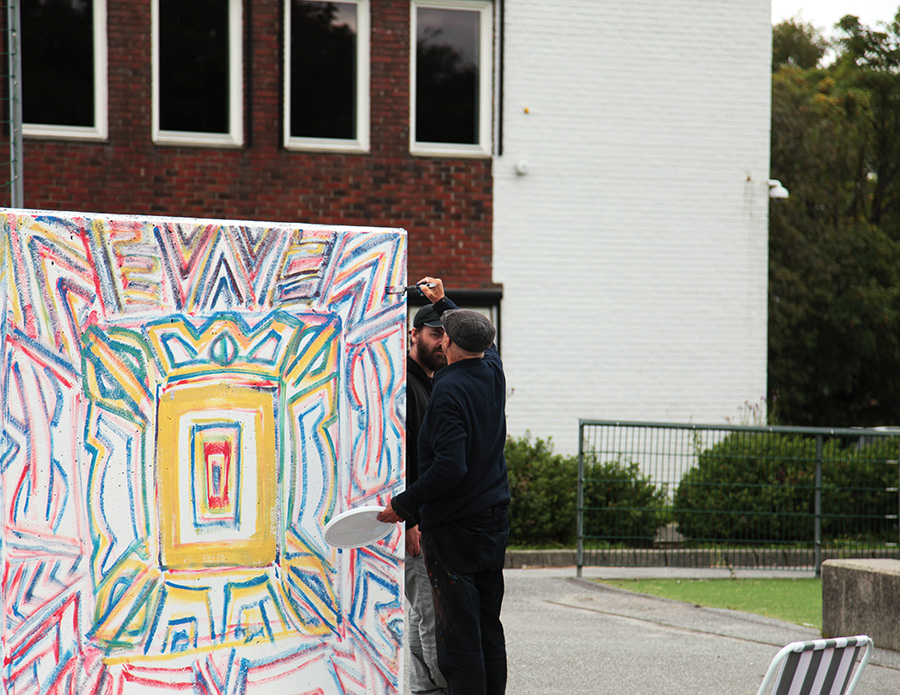
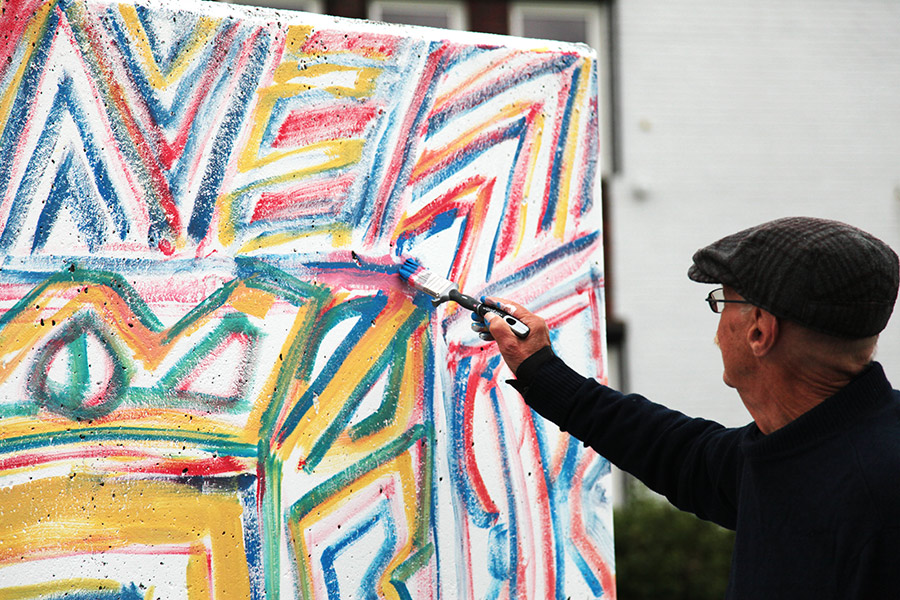
In this second installment of our coverage of this remarkable collaboration for the Nice Surprise Festival, we see the completed work resonating with the distinct voices of each artist echoing. “I’m used to larger formats,” Mr. Pahr-Iversen says as he brings his distinctive strokes to these white walls in kinderland. “And when they asked me to participate, I considered that an honor.”
“Well, I was a little bit nervous,” says Atle regarding his trepidation to ask the famed painter to work on the street with him. “But he was positive right away,”
BSA:Do you know anything about graffiti? Mr. Pahr-Iversen: No, I don’t. Never. I come from the other side. BSA: You come from the perspective of the formal Academy of Arts? Mr. Pahr-Iversen:Yes, sure. BSA:But you were supportive of the project from the onset? Mr. Pahr-Iversen: Let’s say I like the man, and I like the idea. This has a humanistic element to it. There is an impetus to make things beautiful or to make things right. There is something here that combines elements of religion, art history, and normal human behavior at its best. I’ve painted on concrete before – I went to the Royal Academy in Copenhagen, and of course, I have lived in Paris…
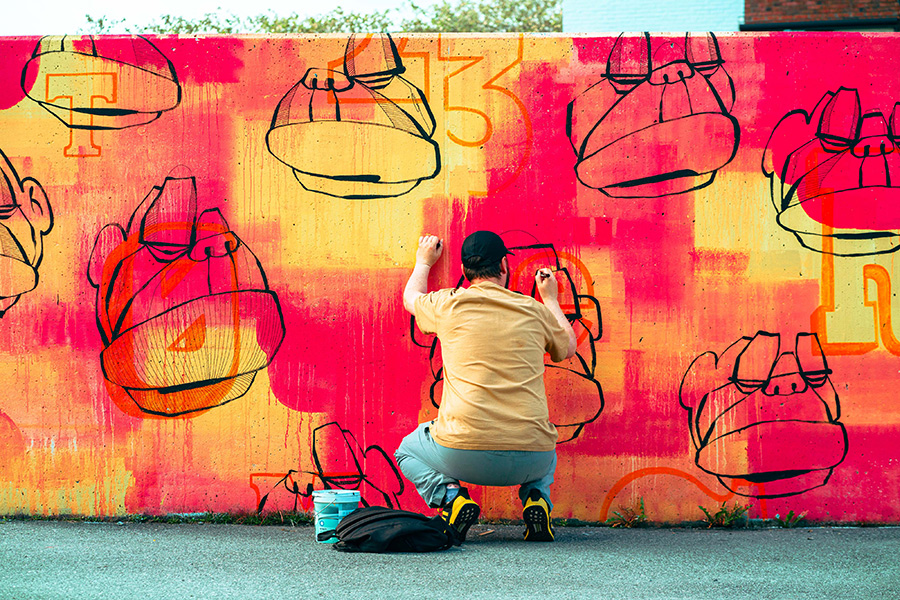
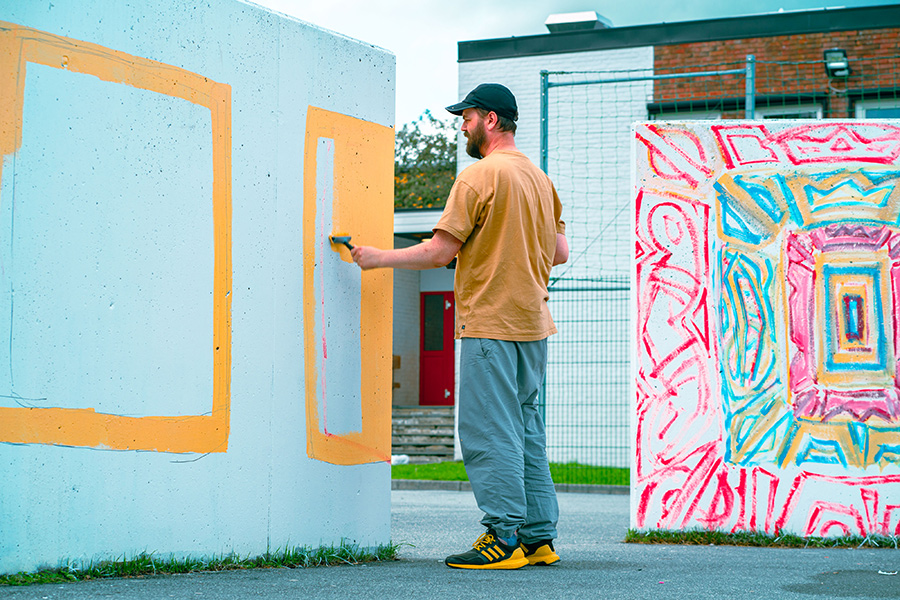
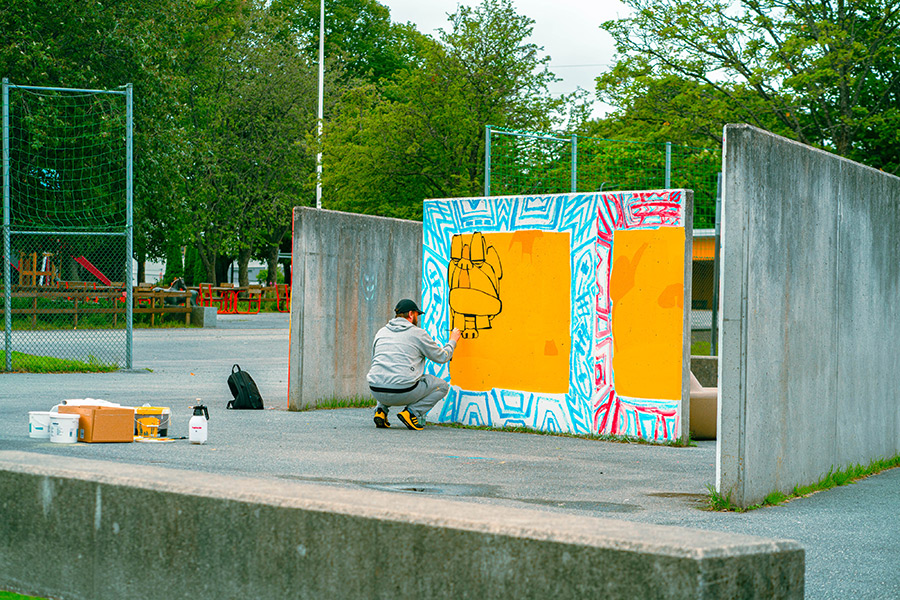
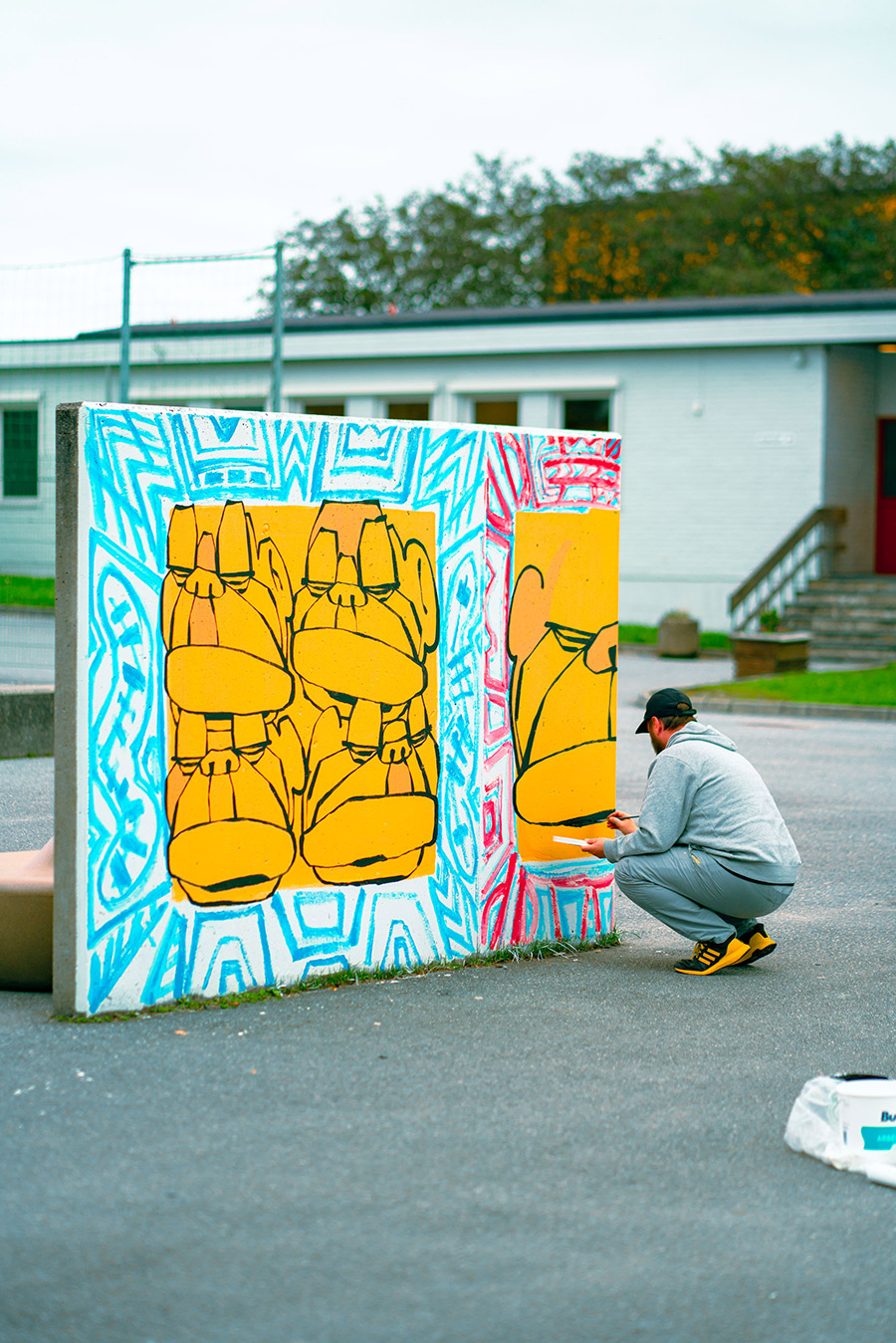
The two work separately while they are together, the air punctuated excitedly with the screams and yells of primary school children who try not to kick the ball into them. But the noise does not appear to bother either of the studio artists, despite being more accustomed to the quiet solitude of a studio.
An unusual meeting of styles, these three panels may remind some of the enormous graffiti jams that are launched in cities throughout the world every year. Since Østrem ran his own graffiti supply store here for several years and sponsored many events related to it, he is arguably one of the most knowledgeable about graffiti culture and history in the city.
The father of a young son himself, Østrem says that this schoolyard environment is not entirely unusual for him.
BSA:How do you like painting here while students are playing all around you? Atle: It’s nice. They’re very honest critics. One boy talked to me about the painting for 10 minutes, likening it to Minecraft. Another one was saying, “I see some animals here.” And so we get a lot of comments.
A consummate professional with years of finely tuned patience, Pahr-Iversen says this is a genuinely new experience. Still, his training and world traveling and exhibiting have prepared him for almost anything. For the moment, he concentrates on his own brand of abstract expressionism, perhaps in love with the first years when we are all exposed to color, shape, geometric shapes, patterns, and creative play.
“I also like the triptych and the image of an icon because it creates a focal point for the viewer,” he says. “For me, it is also a meditation.”
 BROOKLYN STREET ART LOVES YOU MORE EVERY DAY