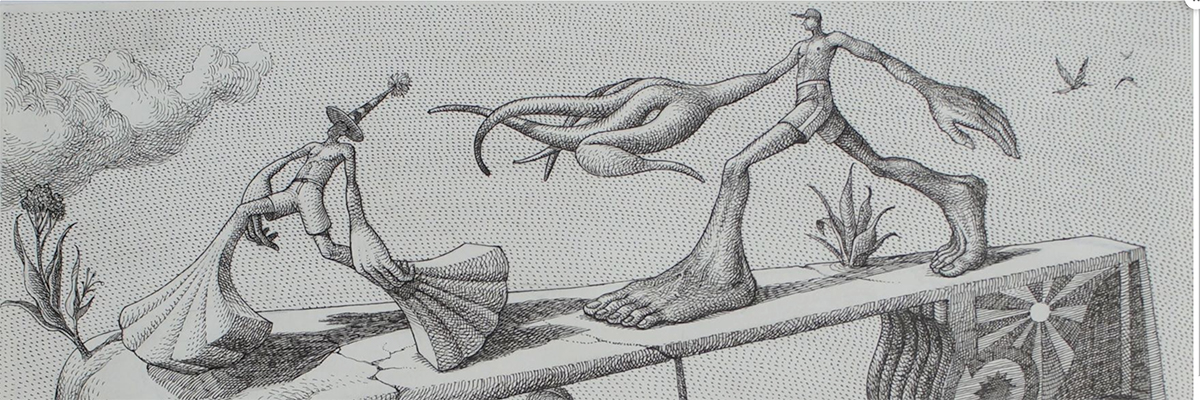
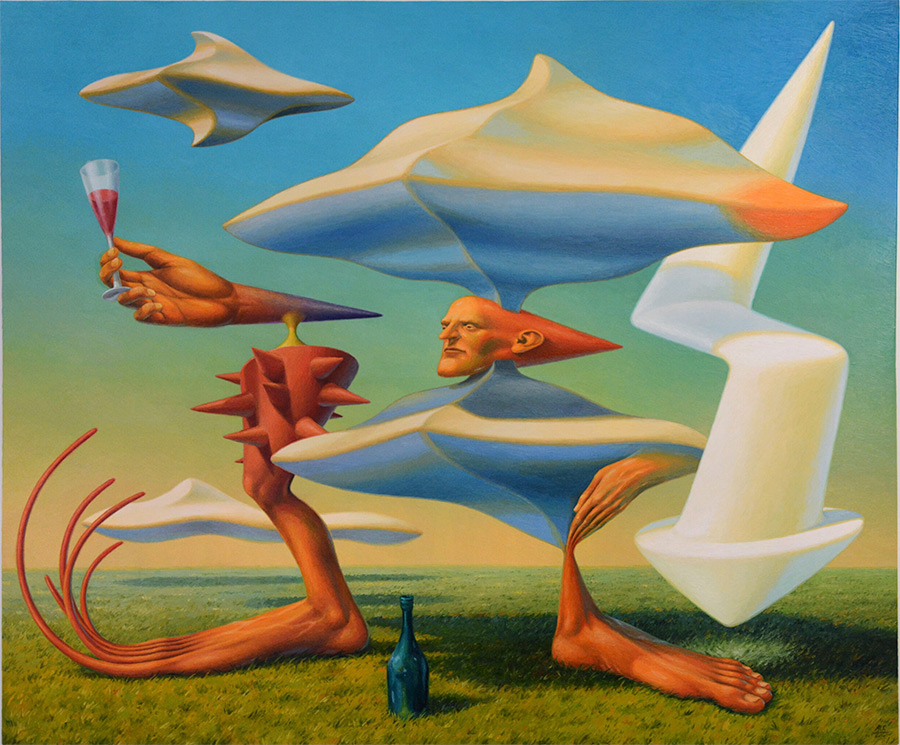
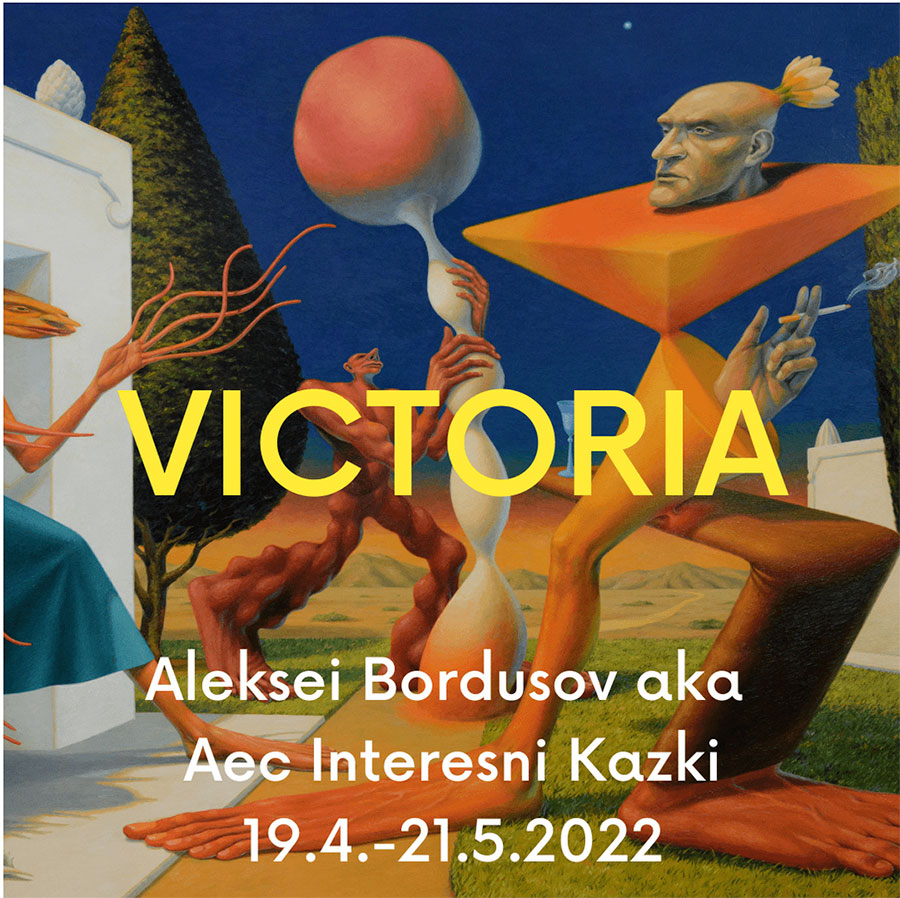
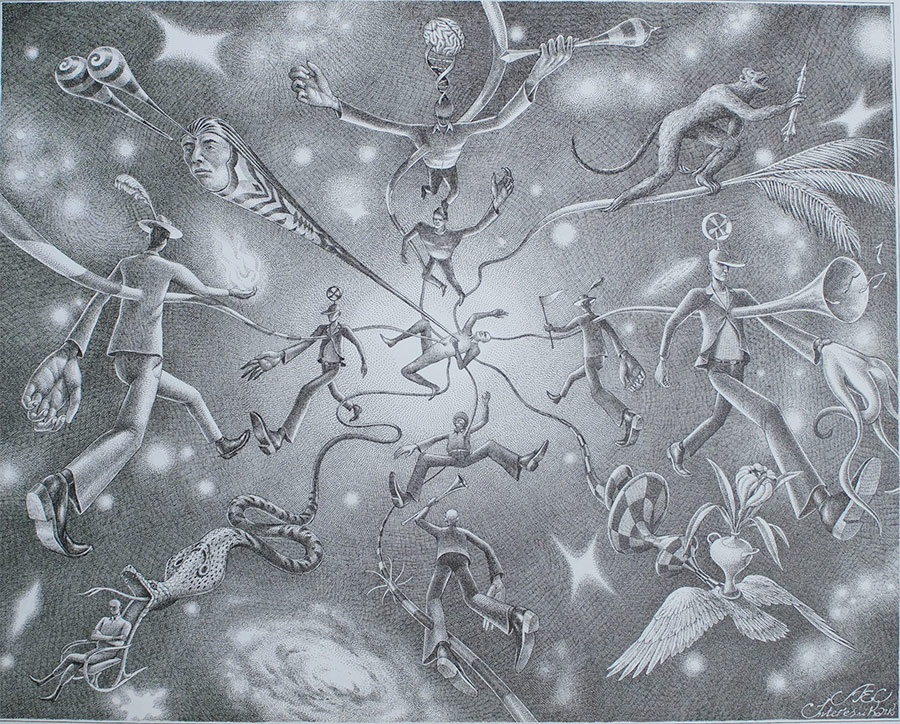
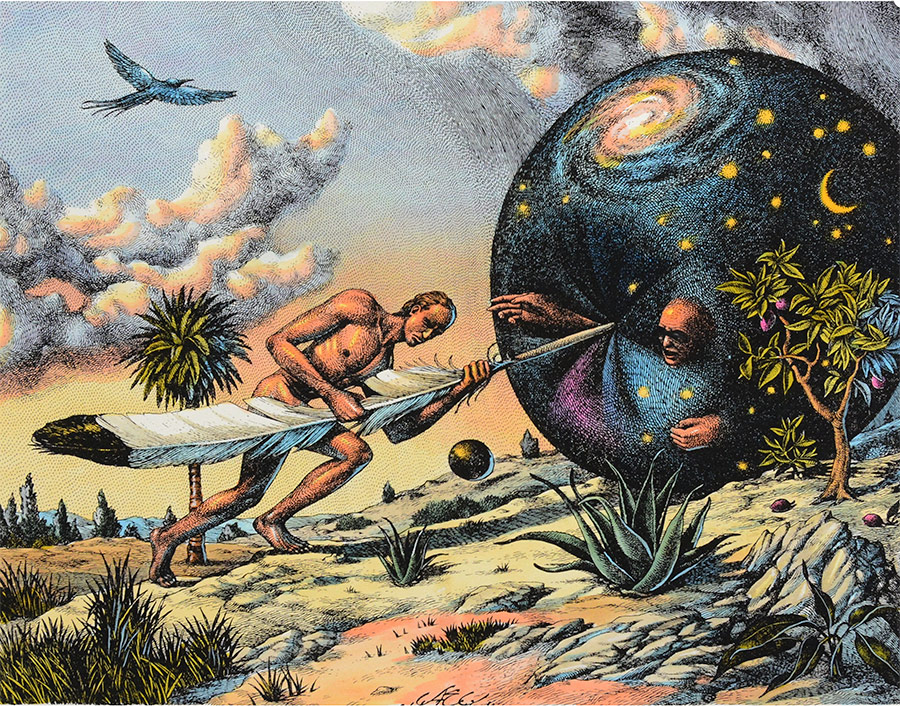
“This show is dedicated to my home country, Ukraine, says Aleksei Bordusov, aka AEC Interesni Kazki’ from his place of exile in Spain. He’s been preparing for his show “Victoria,” which opens tomorrow in Vienna, Austria, at the AG18 Gallery.
“Ukraine was brutally attacked by Russia on February 24th,” says the artists who studied in Kyiv at the Academy of Fine Arts. “The war is going on. No end in sight. And every day we learn of new atrocities and crimes that Putin’s troops are committing against my people,” he says. “The title of the exhibition ‘Victoria’ represents what I believe in and wish for Ukraine.”
Aleksei Bordusov AKA AEC Interesni Kazki. “Victoria”. AG18 Gallery. Vienna, Austria. (photo courtesy of the gallery)
A muralist and fine artist who is known by many people for his works on the streets worldwide for the last decade – he prefers now not to think of himself as a “street artist,” says his press release. Indeed, his developed skills and aesthetic milieu are not often represented in the global street art scene. There simply isn’t a lot of old-school surrealism that makes it to the street unless it is flashy and with a commercial slickness. His work is of such quality and content that it’s now more often been compared with the surreal canon of Bosch, Goya, Dali, Riviera, and Moebius – here in Vienna, others mention Rudolf Hausner.
Whatever your passion, psychological or carnal, something is stirred in these canvasses – triggering the myths of your religious training perhaps, or the musical storytellers of 1970s post-psychedelia, or perhaps by looking at war told about and mediated on social media postings in your pocket. His figures are “heavily stepping forward, powerful, making their way through a mad world.” Maybe these mis-figures and their pungent palettes appear more familiar and make more sense today.
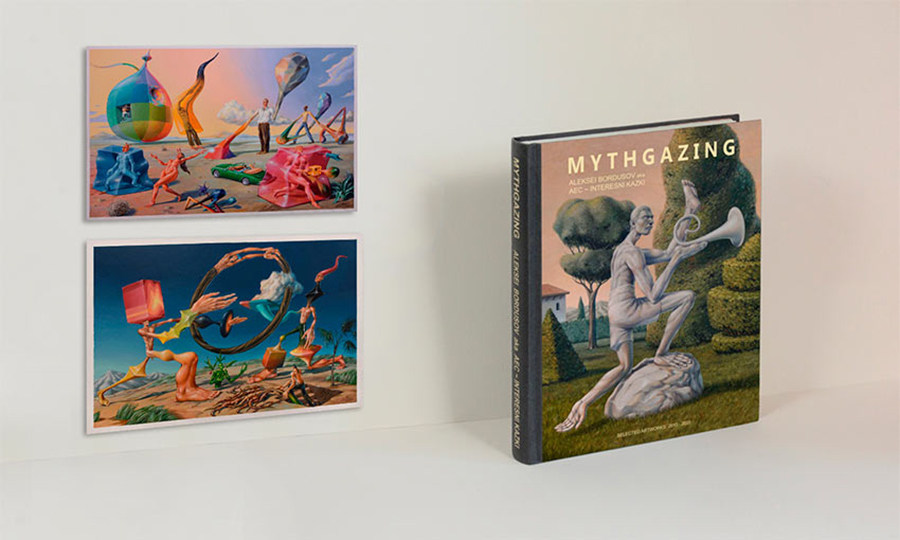
The new show opens tomorrow, and AEC says he will also be signing copies of his new book “Mythgazing.” Still, his feelings of utter displacement are only compounded by the normalcy of an art opening at a beautiful gallery. He’s named the new show “Victoria” because “it represents what I believe in and wish for Ukraine: Victory of the creation over destruction, good over evil, truth over lies. The Ukrainian people are defending themselves and fighting against pure evil.”
Aleksei Bordusov AKA AEC Interesni Kazki. “Victoria”. AG18 Gallery. Vienna, Austria. (photo courtesy of the gallery)Aleksei Bordusov AKA AEC Interesni Kazki. “Victoria”. AG18 Gallery. Vienna, Austria. (photo courtesy of the gallery)Aleksei Bordusov AKA AEC Interesni Kazki. “Mythgazing”. A limited number of copies will be available for purchase at the opening. If you wish to order the book online click HERE.
Happy Easter! Sameach Pesach! Ramadan Mubarak! It’s a rare year when all three of these holidays are happening at the same time. It’s a religious trifecta that you can see playing out on the streets of New York. What a rich tapestry we wrap ourselves with in this beautiful city.
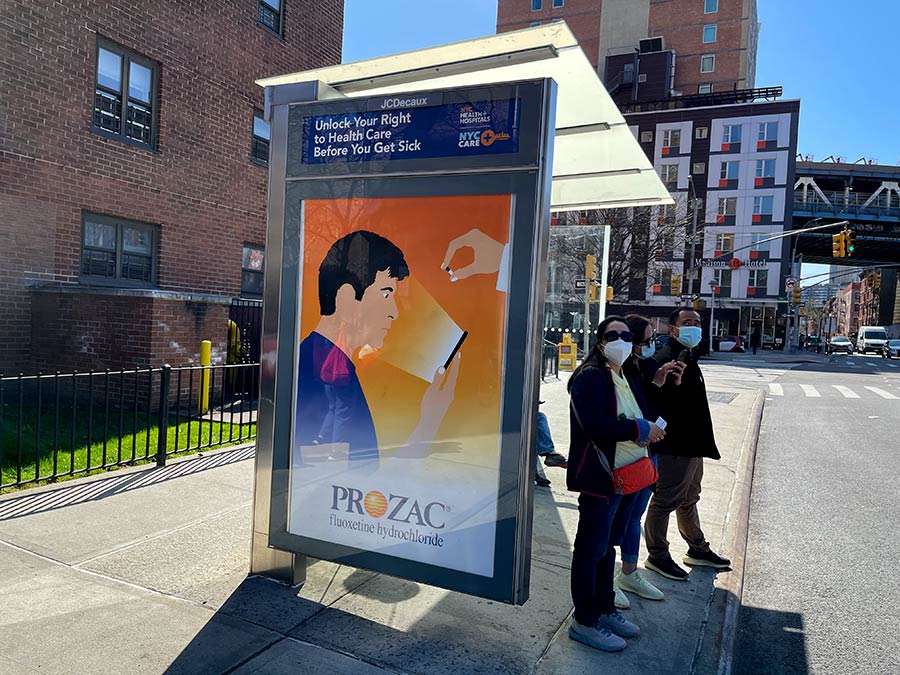
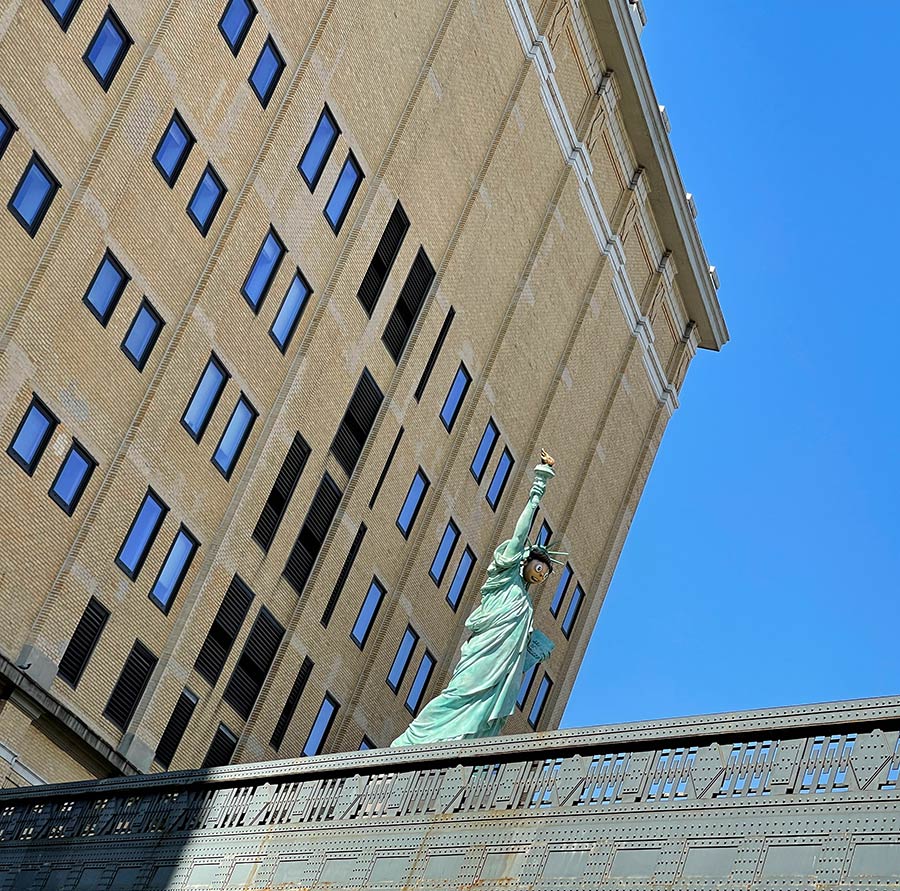
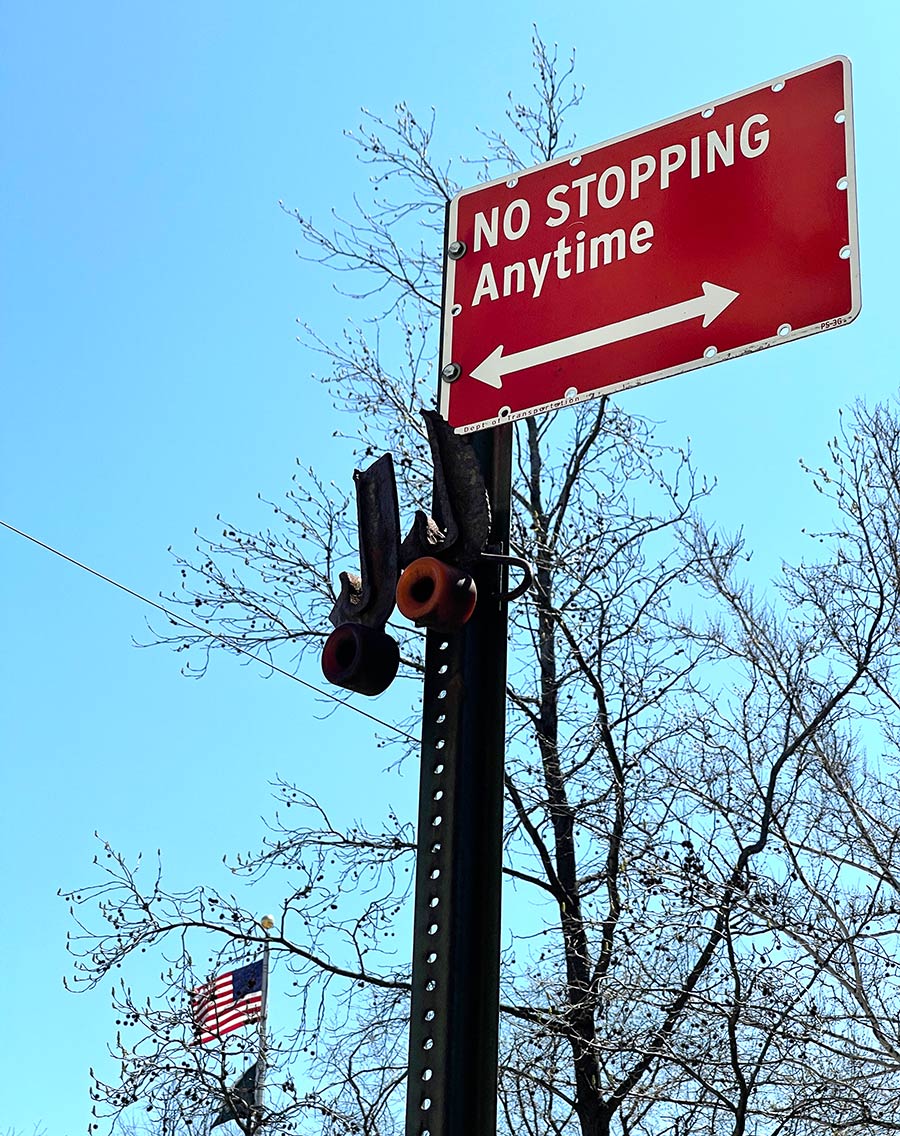
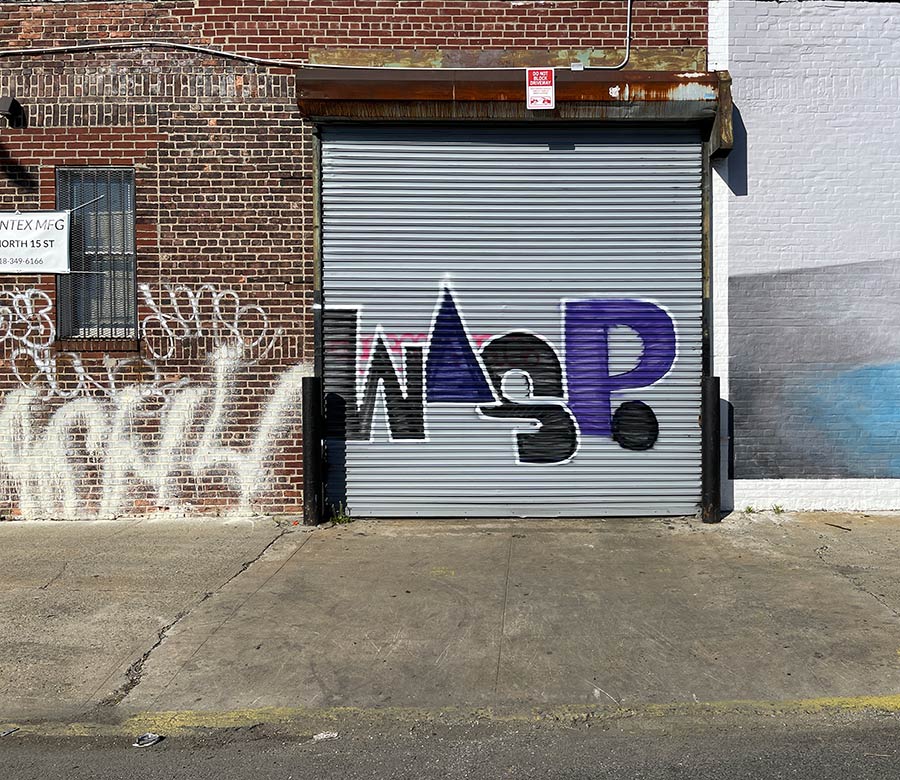
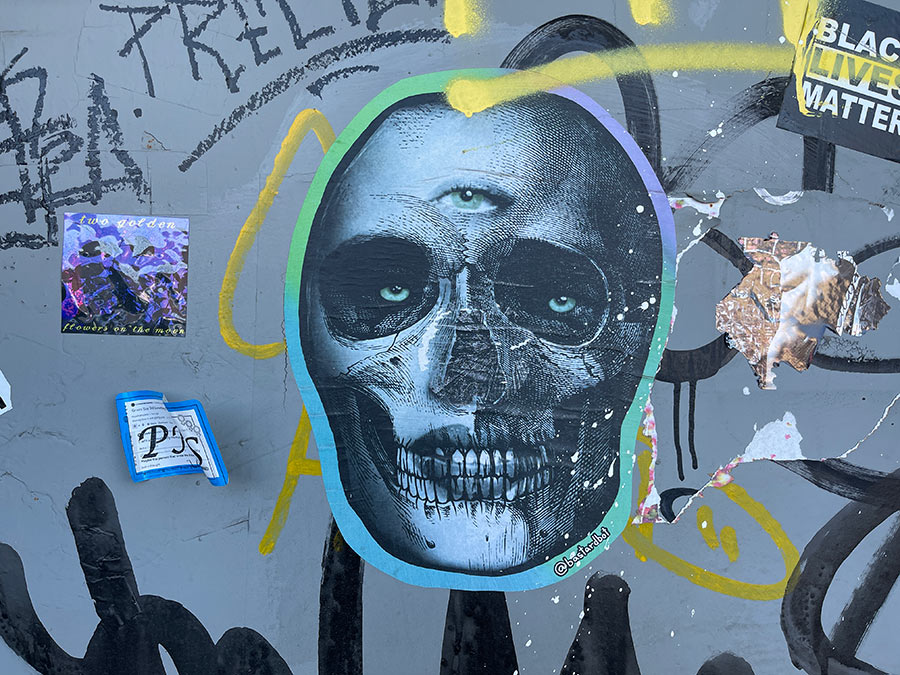
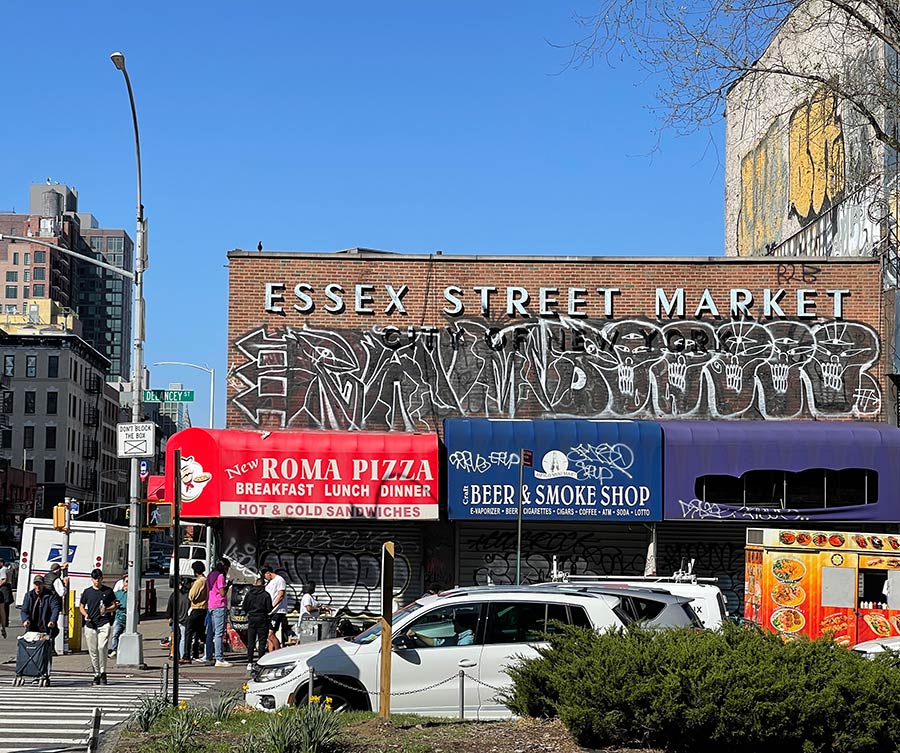
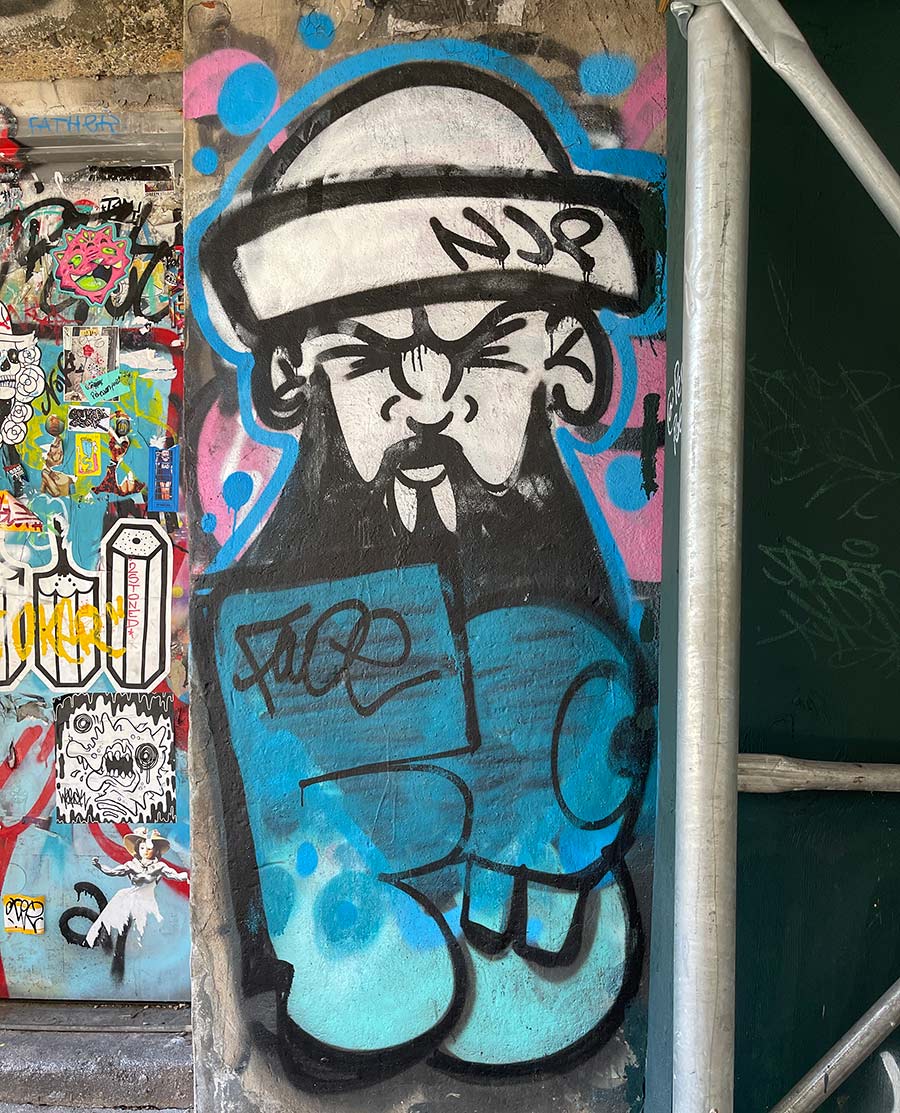
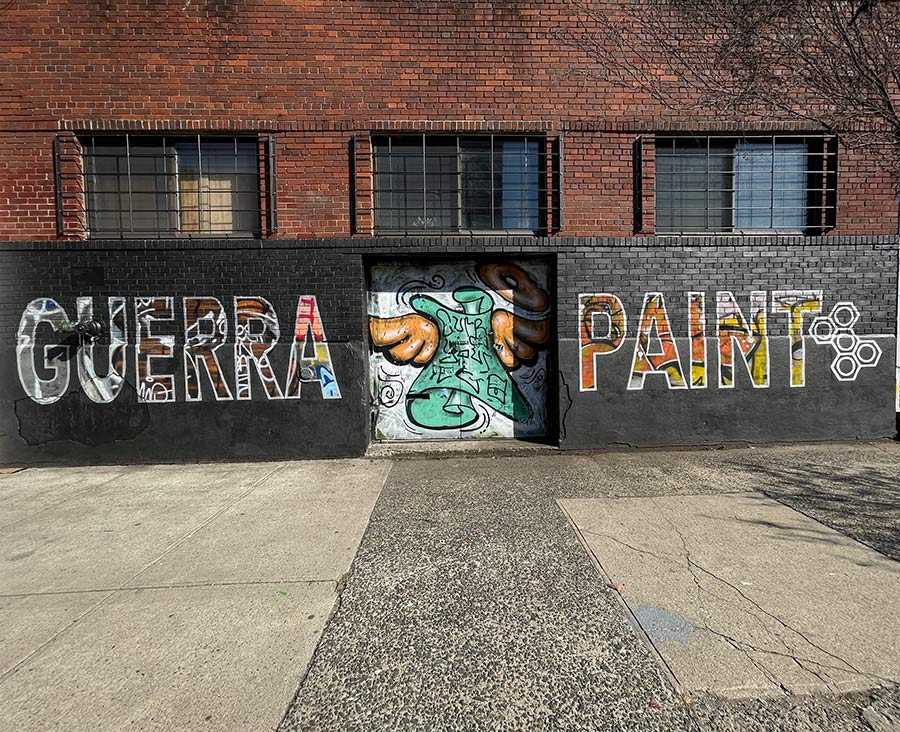
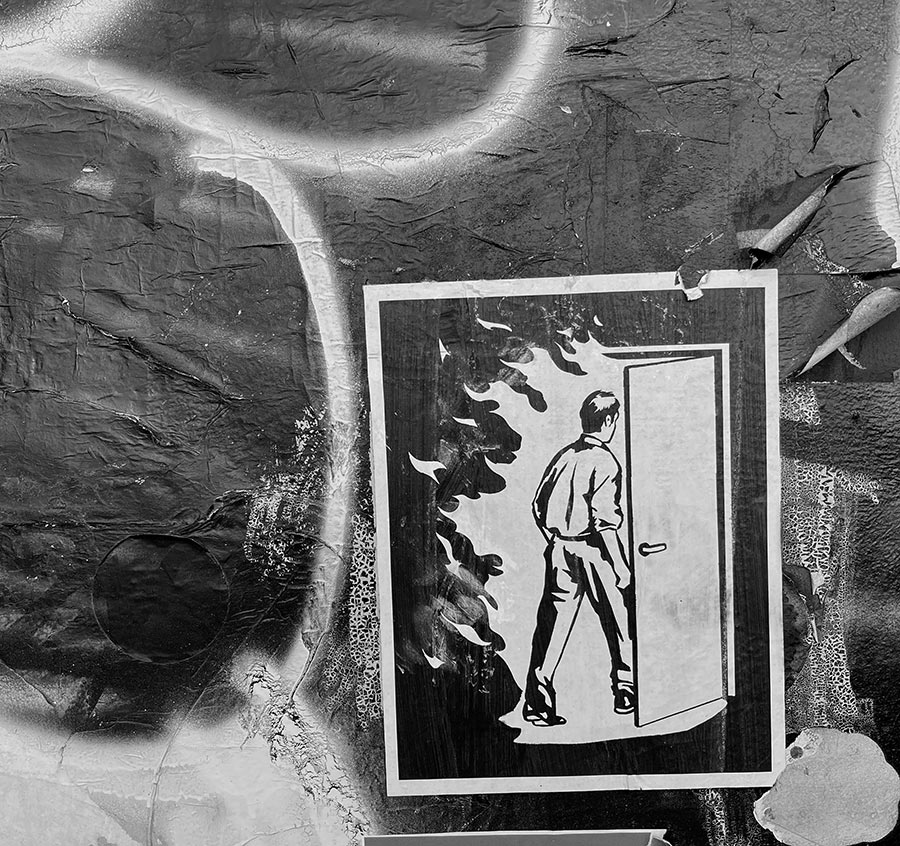
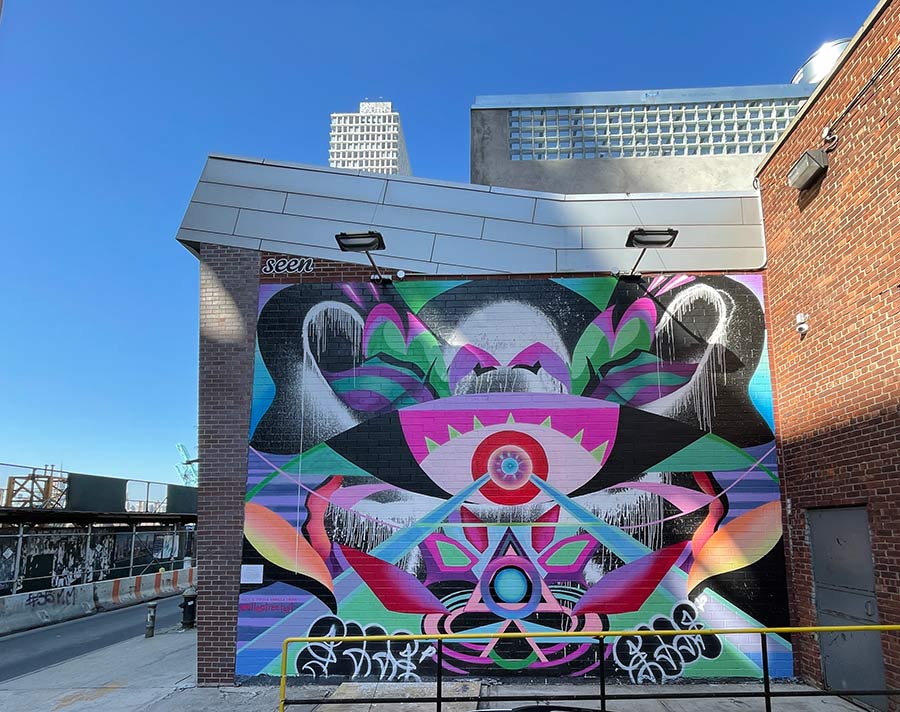
Here’s our weekly interview with the street, this week featuring: Rambo, Winston Tseng, JJ Veronis, Bastard Bot, Sam Durant, Paoli Pivi, Curb Your Ego, Guerra Paint, and WASP.
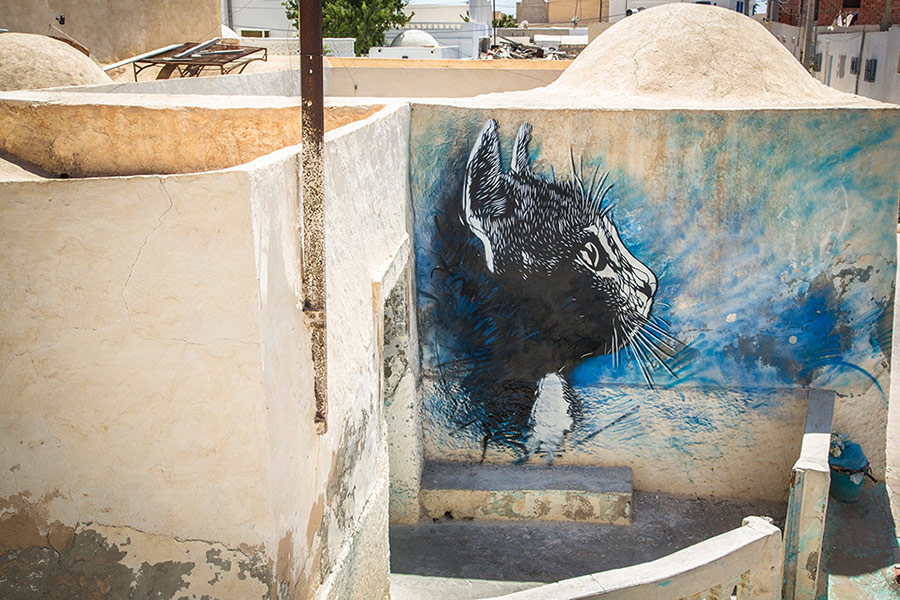
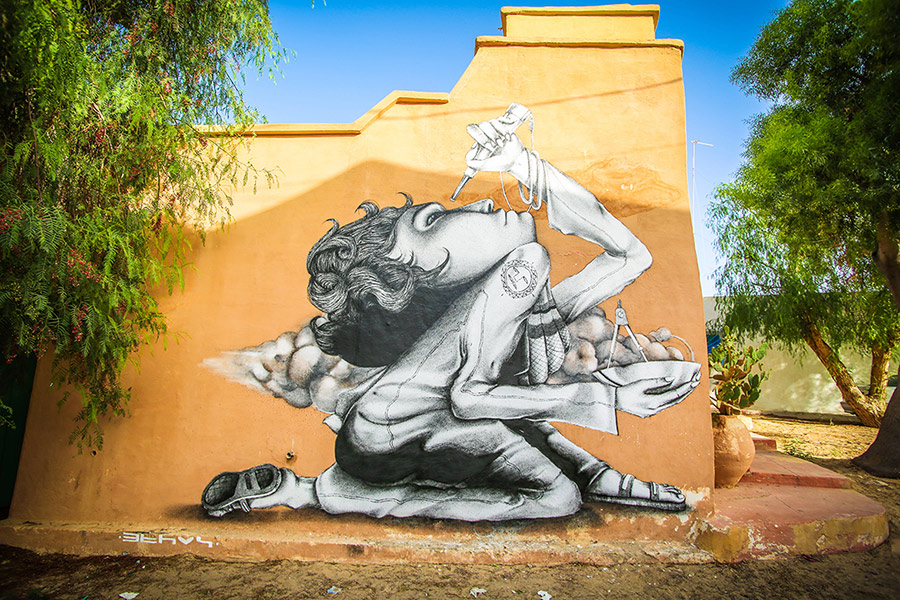
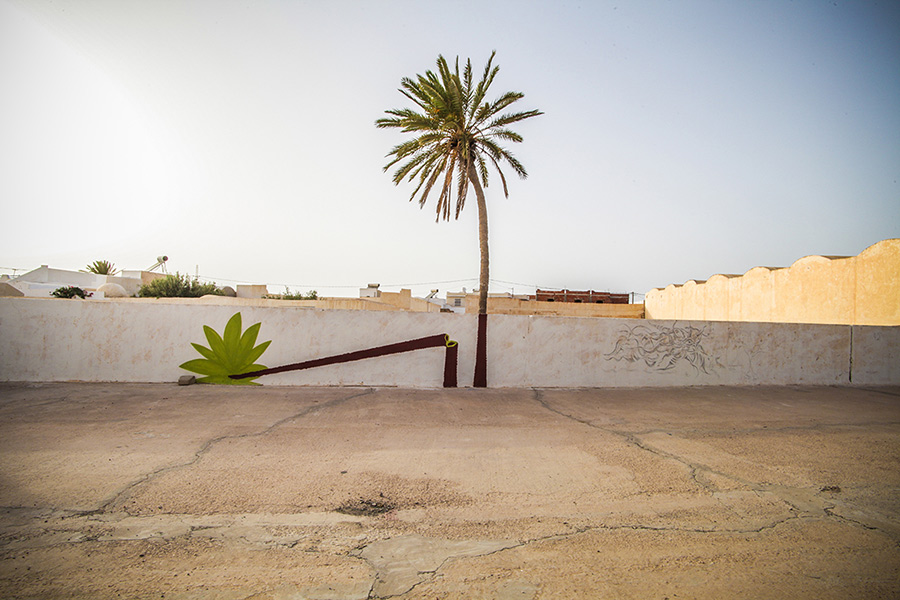
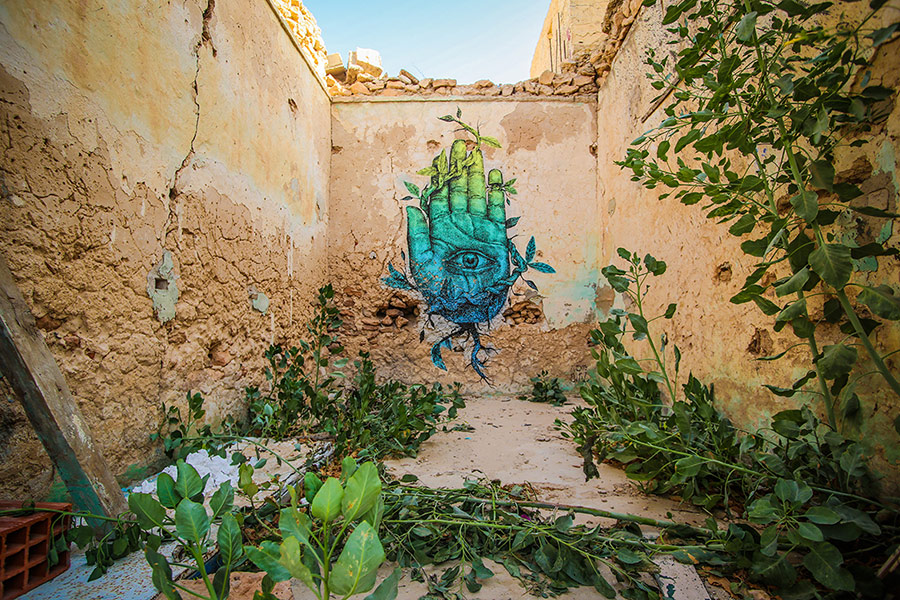
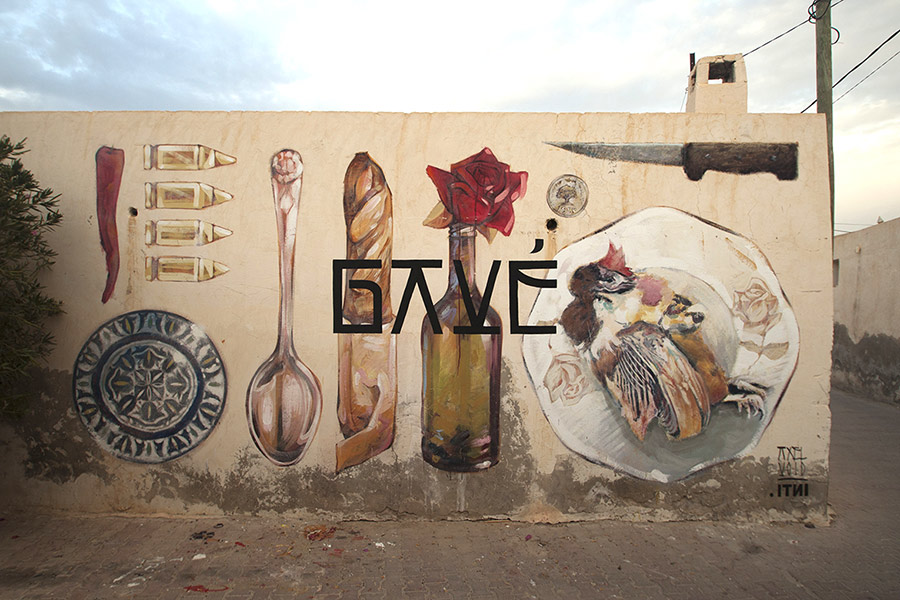
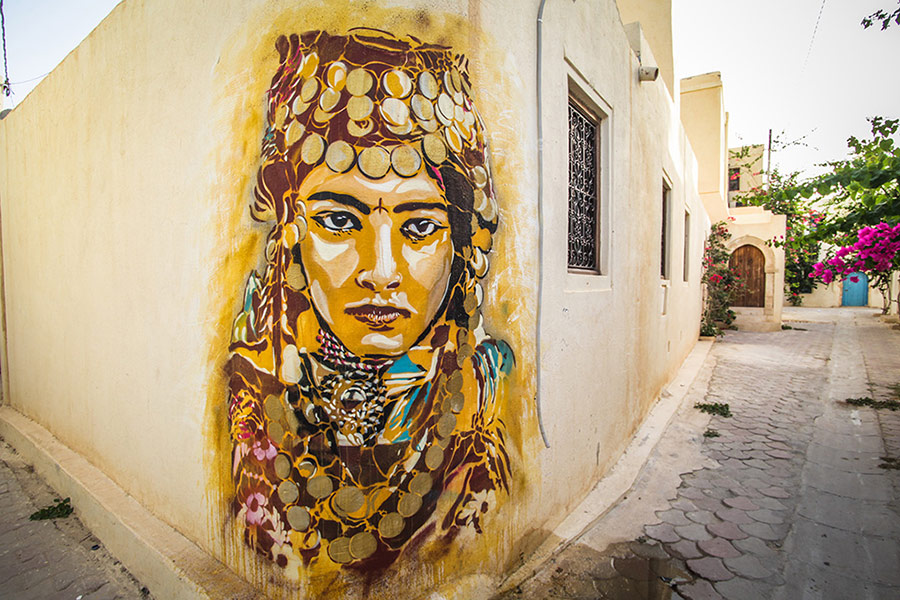
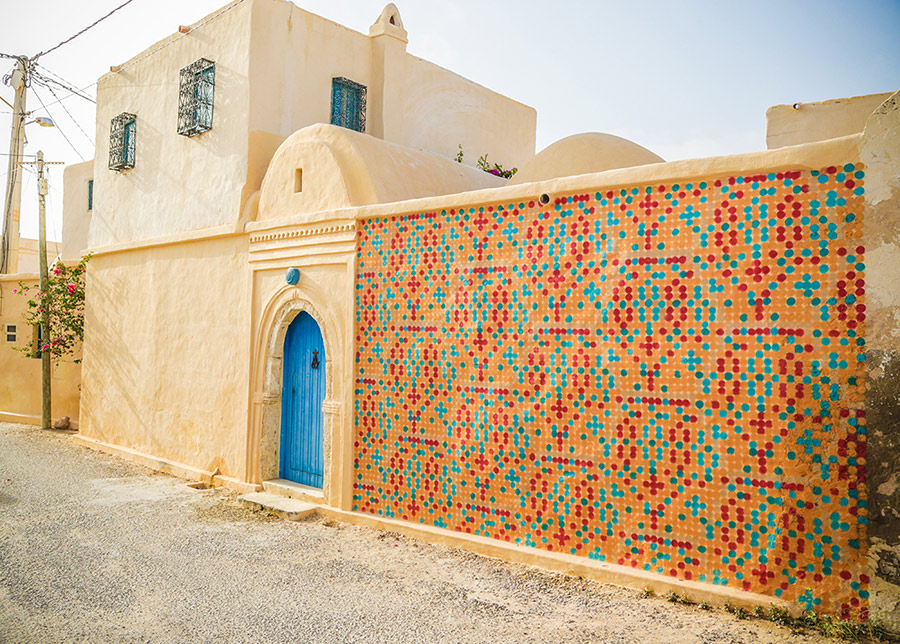
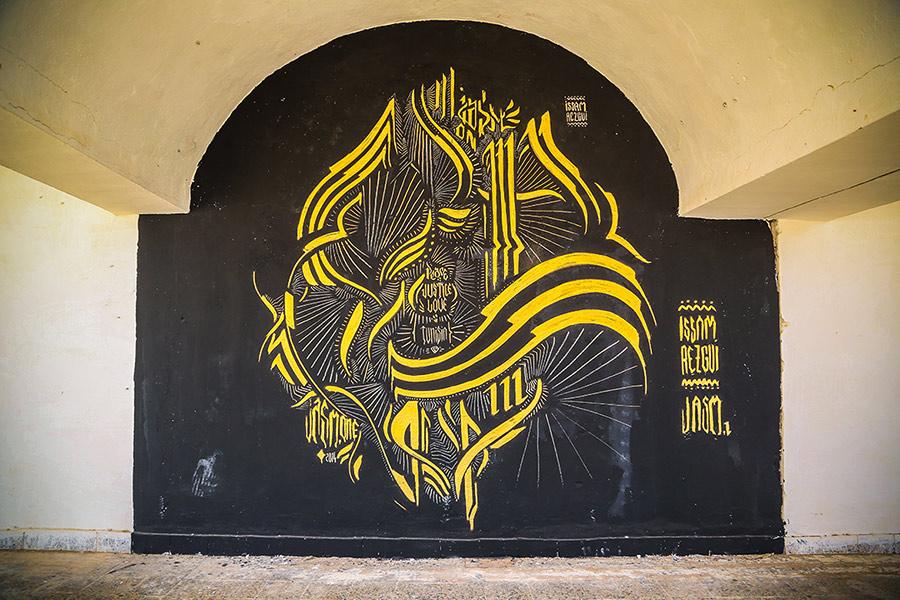
Recently we brought you coverage of Shepard Fairey’s newest work for the Djerbahood project on the island of Hara Sghira Er Riadh in Tunisia. A gradually-building project curated over the last decade or more by the Tunisian-French owner of Paris’ Galerie Itinerrance, Medhi Ben Cheikh, there must be nearly 200 artists from 30+ nations represented here now.
As each year passes we become more aware that the collection represents an era, a vast survey of a time when street art was graduating to murals worldwide. Some of these artists have risen in prominence in the street art/contemporary art world, while others have declined, or have shifted their attention to something else entirely. In that respect, Djerbahood is an archive for all to investigate and analyze.
Seth / Pum Pum. Djerbahood. A Project of Itinerrance Gallery. Hara Sghira Er Riadh, Tunisia (photo courtesy of Itinerrance Gallery)
Sensitive to local cultural values in terms of content, the various expressions of creativity may not follow one aesthetic – but they invariably are complemented by the predominant white stucco walls that define this pristine haven for street art murals. While some have aged quite beautifully, others have shown the passage of time and the elements, gently weathering the overall aesthetic.
The project is documented in a beautifully edited and printed book, which we reviewed here. To reacquaint you, below are a few selections from the project:
To reaquaint you, below are a few selections from the project:
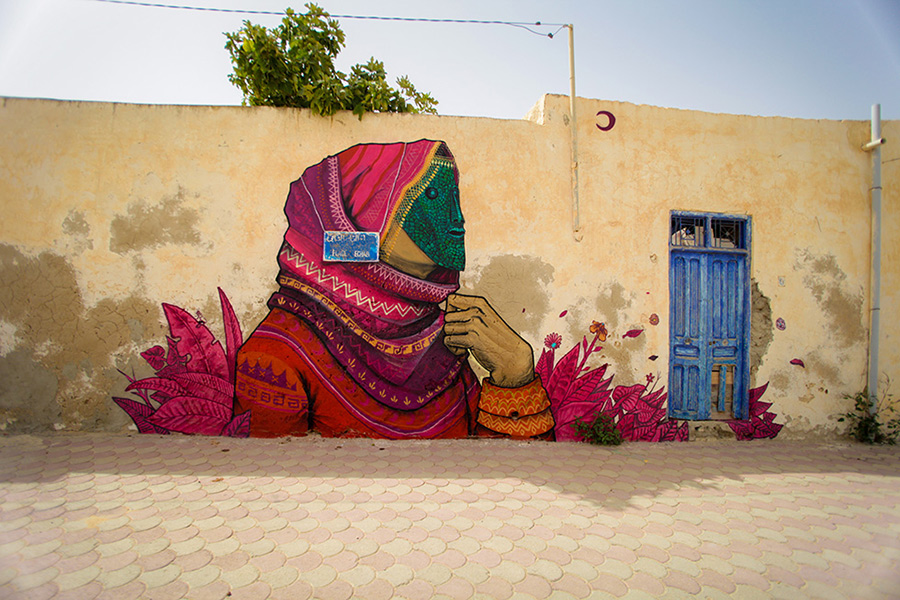
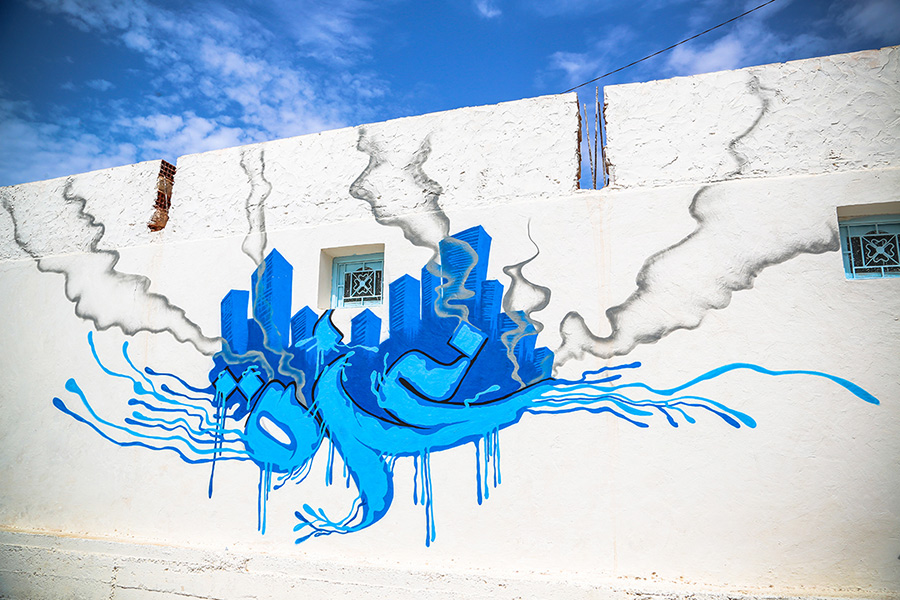
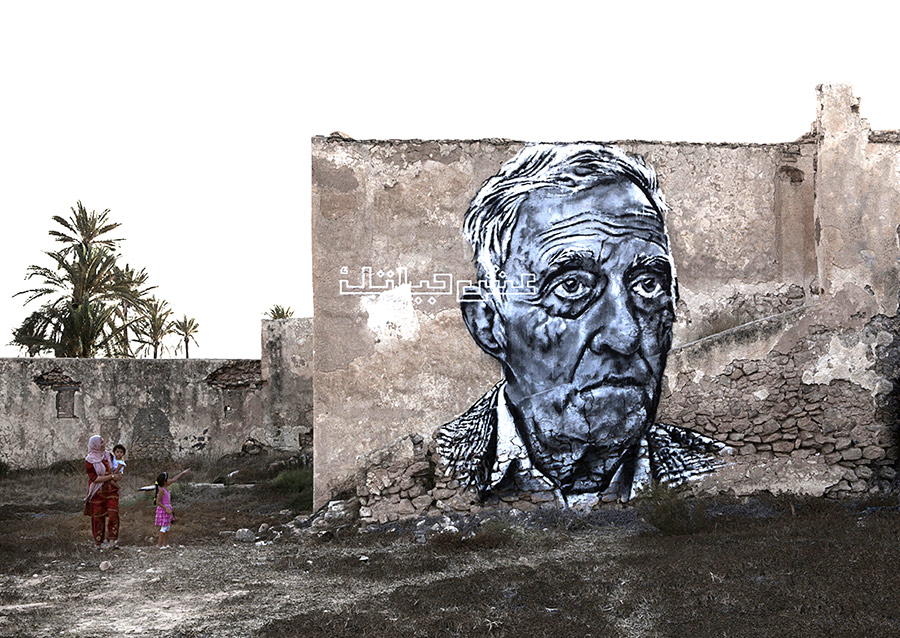
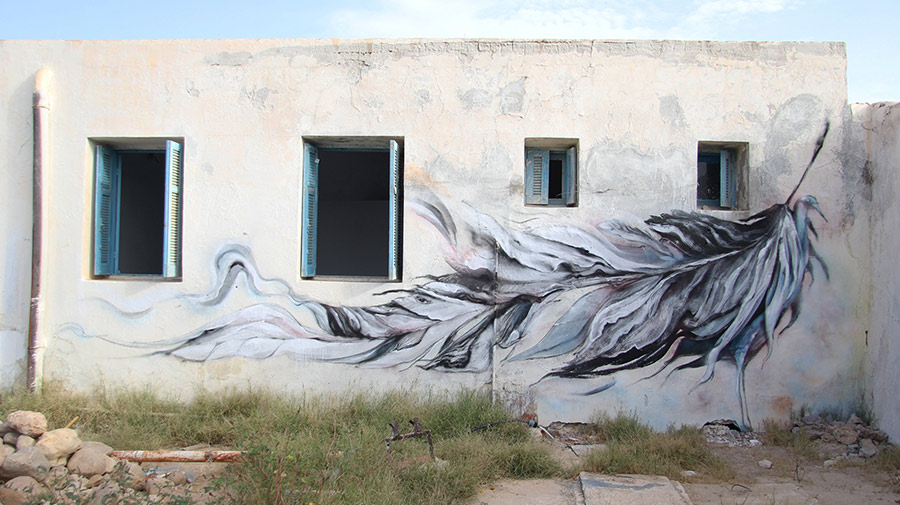
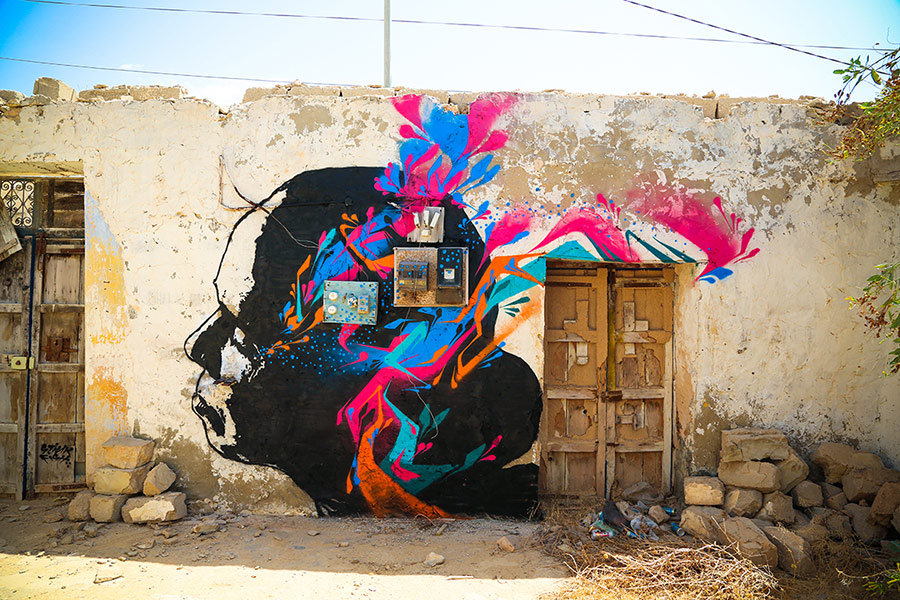
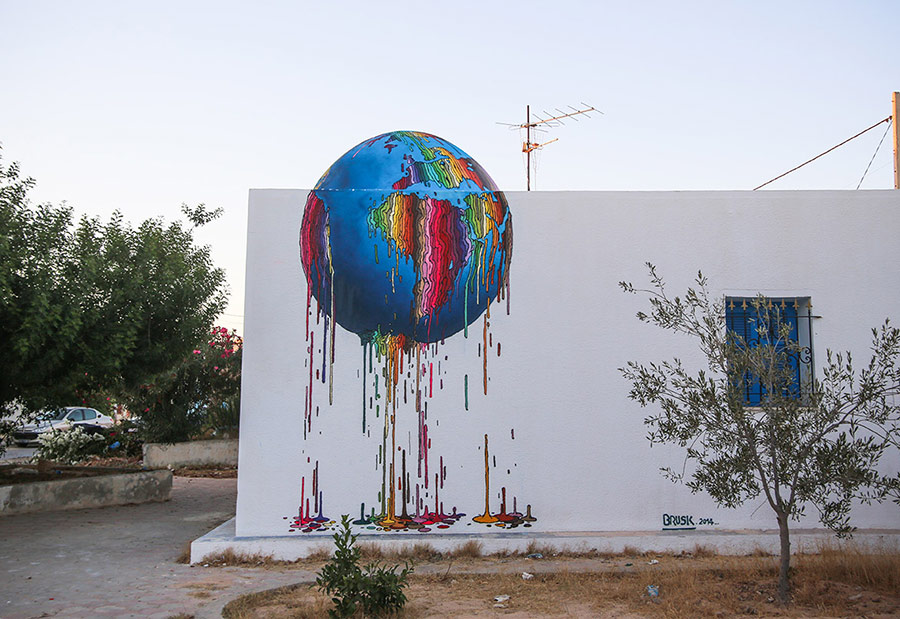
C215. Djerbahood. A Project of Itinerrance Gallery. Hara Sghira Er Riadh, Tunisia (photo courtesy of Itinerrance Gallery)Ethos. Djerbahood. A Project of Itinerrance Gallery. Hara Sghira Er Riadh, Tunisia (photo courtesy of Itinerrance Gallery)M-City. Djerbahood. A Project of Itinerrance Gallery. Hara Sghira Er Riadh, Tunisia (photo courtesy of Itinerrance Gallery)Alexis Diaz. Djerbahood. A Project of Itinerrance Gallery. Hara Sghira Er Riadh, Tunisia (photo courtesy of Itinerrance Gallery)Inti / Axel Void. Djerbahood. A Project of Itinerrance Gallery. Hara Sghira Er Riadh, Tunisia (photo courtesy of Itinerrance Gallery)Btoy. Djerbahood. A Project of Itinerrance Gallery. Hara Sghira Er Riadh, Tunisia (photo courtesy of Itinerrance Gallery)KAN. Djerbahood. A Project of Itinerrance Gallery. Hara Sghira Er Riadh, Tunisia (photo courtesy of Itinerrance Gallery)Jasm1. Djerbahood. A Project of Itinerrance Gallery. Hara Sghira Er Riadh, Tunisia (photo courtesy of Itinerrance Gallery)Saner. Djerbahood. A Project of Itinerrance Gallery. Hara Sghira Er Riadh, Tunisia (photo courtesy of Itinerrance Gallery)Sebas Velasco. Djerbahood. A Project of Itinerrance Gallery. Hara Sghira Er Riadh, Tunisia (photo courtesy of Itinerrance Gallery)Mazen. Djerbahood. A Project of Itinerrance Gallery. Hara Sghira Er Riadh, Tunisia (photo courtesy of Itinerrance Gallery)ECB. Djerbahood. A Project of Itinerrance Gallery. Hara Sghira Er Riadh, Tunisia (photo courtesy of Itinerrance Gallery)Laguna. Djerbahood. A Project of Itinerrance Gallery. Hara Sghira Er Riadh, Tunisia (photo courtesy of Itinerrance Gallery)Stinkfish. Djerbahood. A Project of Itinerrance Gallery. Hara Sghira Er Riadh, Tunisia (photo courtesy of Itinerrance Gallery)Brusk. Djerbahood. A Project of Itinerrance Gallery. Hara Sghira Er Riadh, Tunisia (photo courtesy of Itinerrance Gallery)
Our weekly focus on the moving image and art in the streets. And other oddities.
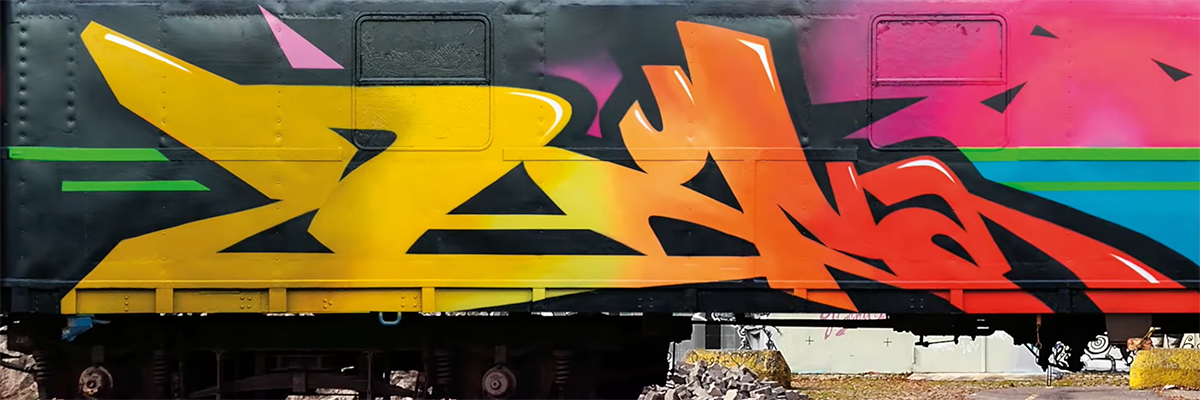
Now screening: 1. Dyva & Haeck painting on the Molotow train. 2. THIS IS INDECLINE: A Showreel 3. Edoardo Tresoldi: Opera
BSA Special Feature: Dyva & Haeck painting on the Molotow train.
On this episode of Graff TV the featured graffiti writers are Dyva and Haeck who paint the Molotow train.
Graffiti TV 100: Dyva & Haeck painting on the Molotow train.
THIS IS INDECLINE: A Showreel
Now see kids, this is what they call a showreel. That’s when they put together their greatest hits and play a screaming apocalyptic metal soundtrack over top of it all.
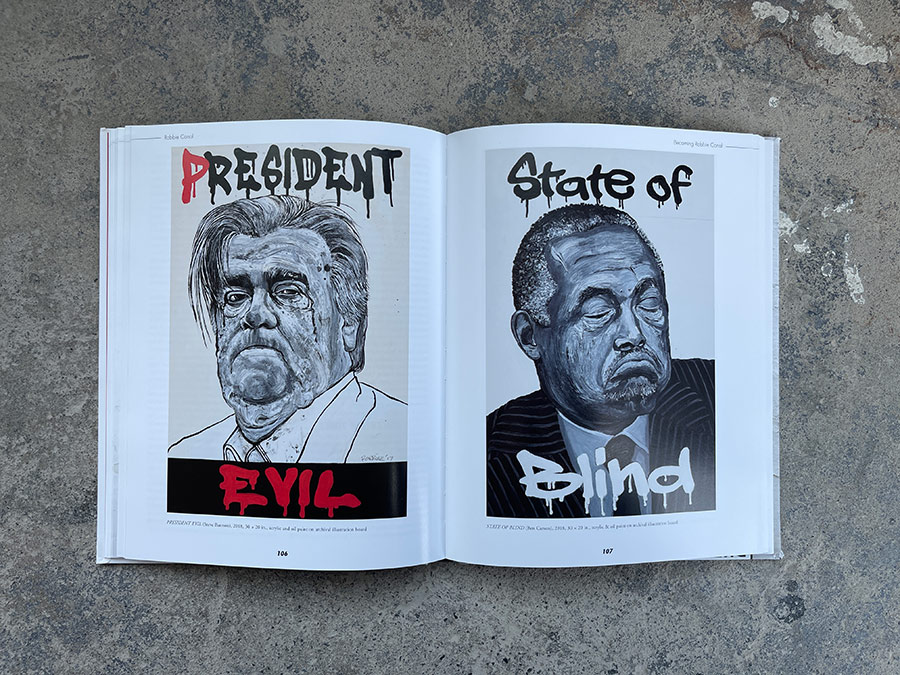
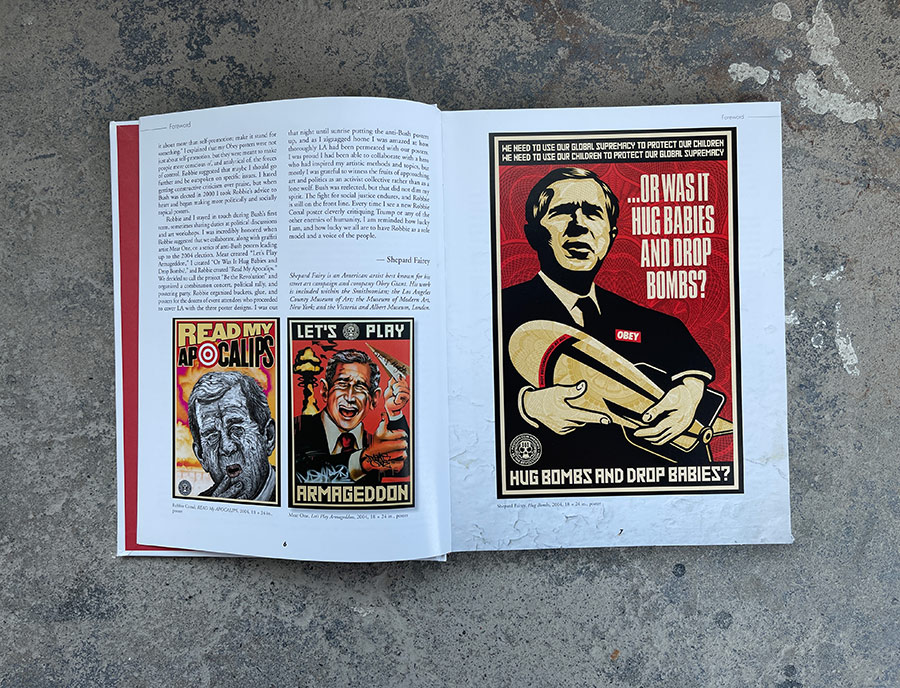
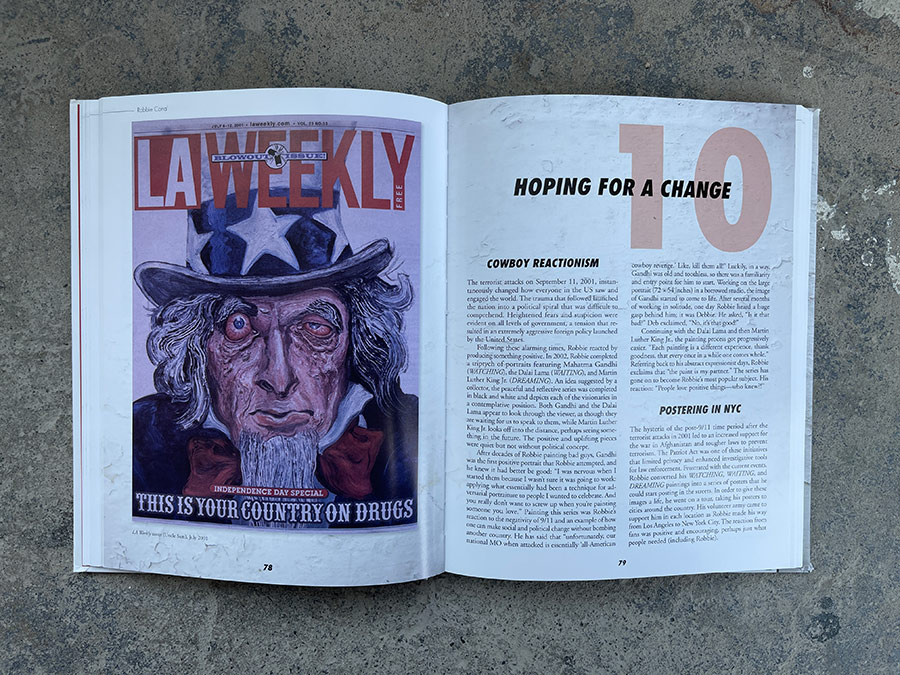
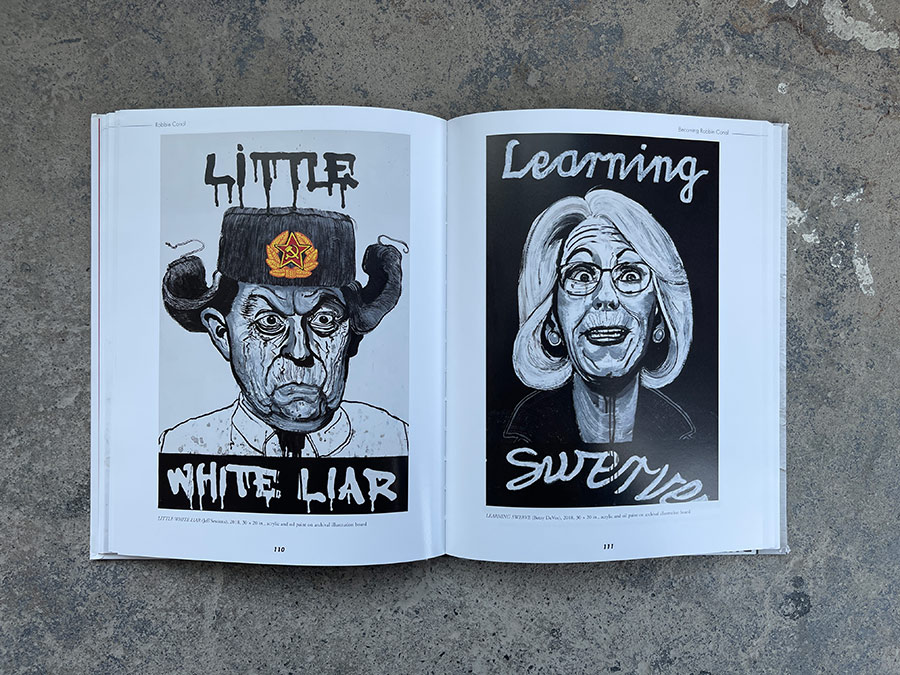
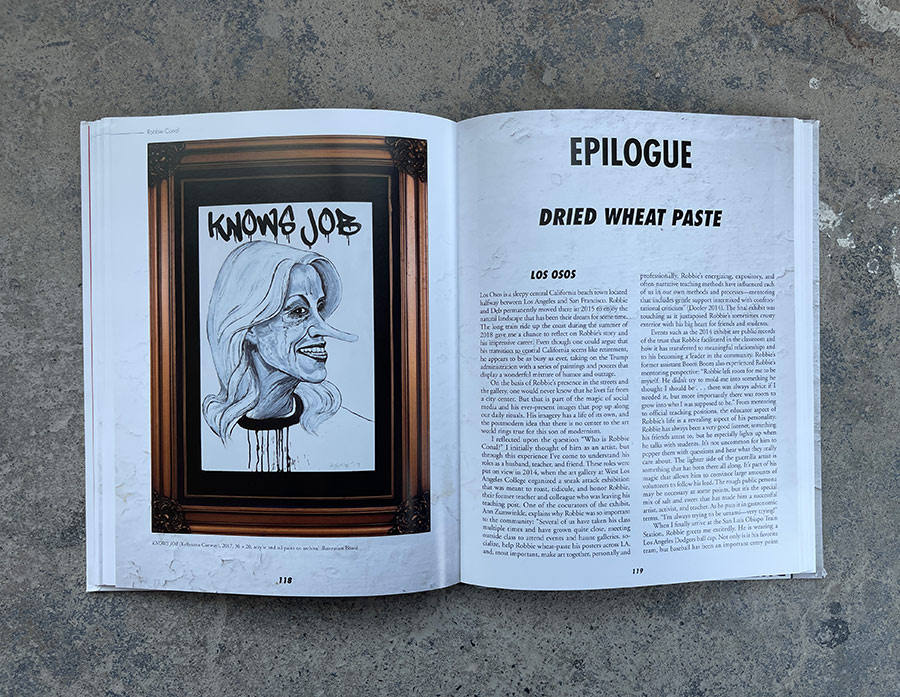
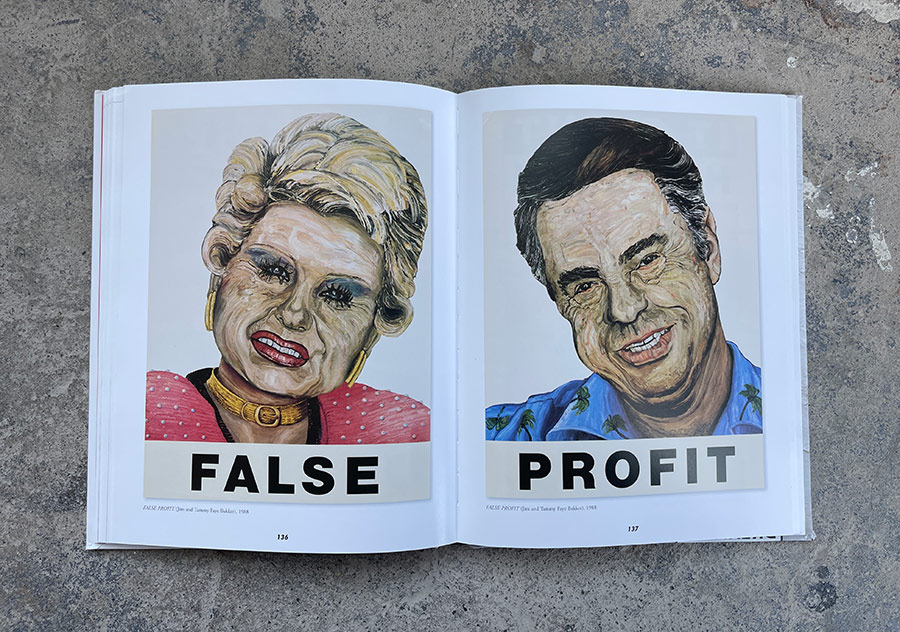
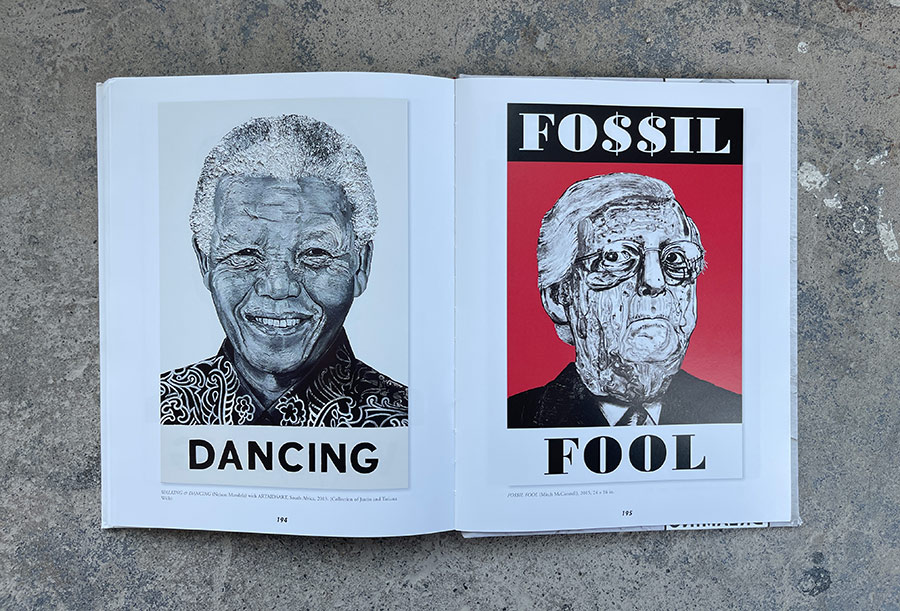
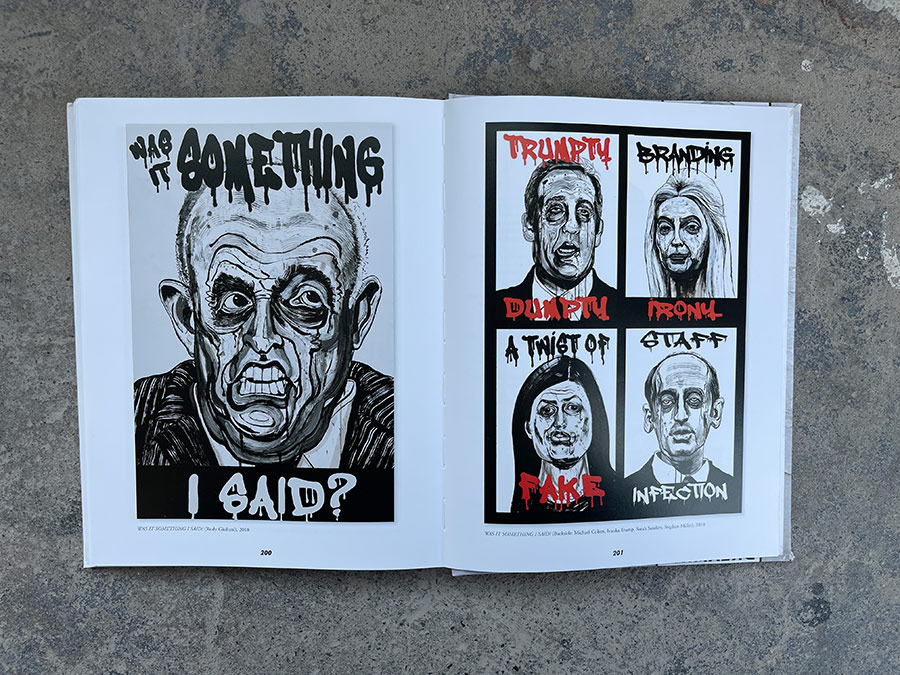
The political caricature is a treasured form of public discourse that still holds as much power as it did when we relied on the printing press. Able to express sentiment and opinion without uttering a syllable, the artist can sway the direction of conversation with skill, insight, and humor. Artist Robbie Conal has built a career from visually roasting the most sebaceous of our various leaders in the last few decades, often bringing his posters to the street and installing them in advertisers’ wildposting manner.
With the briefest of texts, slogans, or twisted nicknames, he reveals the underbelly as a face, dropping expectations into the sewer. If it were as simple as a political party, one might try to dismiss his work as only partisan. But Conal’s work functions more as an ex-ray, and frequently the resulting scan finds cancer.
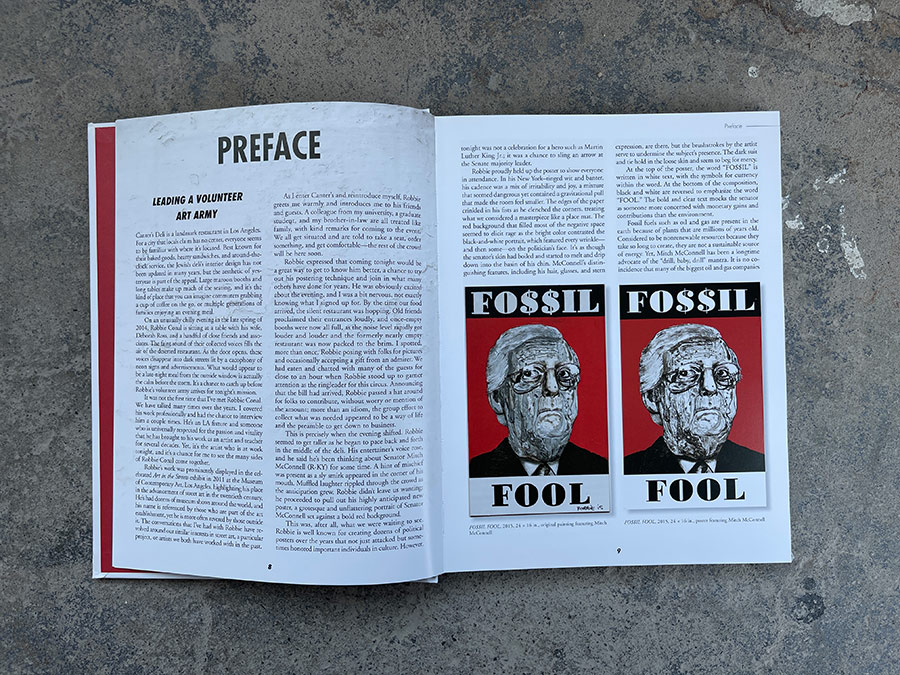
In this newer book by author G. James Daichendt, EdD, who has written previously about Kenny Scharf and Shepard Fairey and in The Urban Canvas: Street Art Around the World (Weldon Owen, 2017), Conal is thoroughly recorded, examined, and explained. A street artist, among many other things, Daichendt calls Conal an “LA fixture and someone who is universally respected for the passion and vitality that he has brought to his work as an artist and teacher for several decades.”
Chapters of Conal’s interests and opinions are thoughtfully compiled and laid out, the artist seemingly never out of a fresh supply of political figures to skewer. As an object lesson, his practice is what draws him near and dear to the part of the street art community who uses the streets to communicate, advocate, and rebuke the hypocrisies in culture and politics
“I vividly remember the first time I saw Robbie Conal’s art because it felt like the exact thing I was meant to see but didn’t realize it until I experienced it,” says Shepard Fairey in his foreword. In his description, one can see that this artist has influenced Fairey, among others, but particularly.
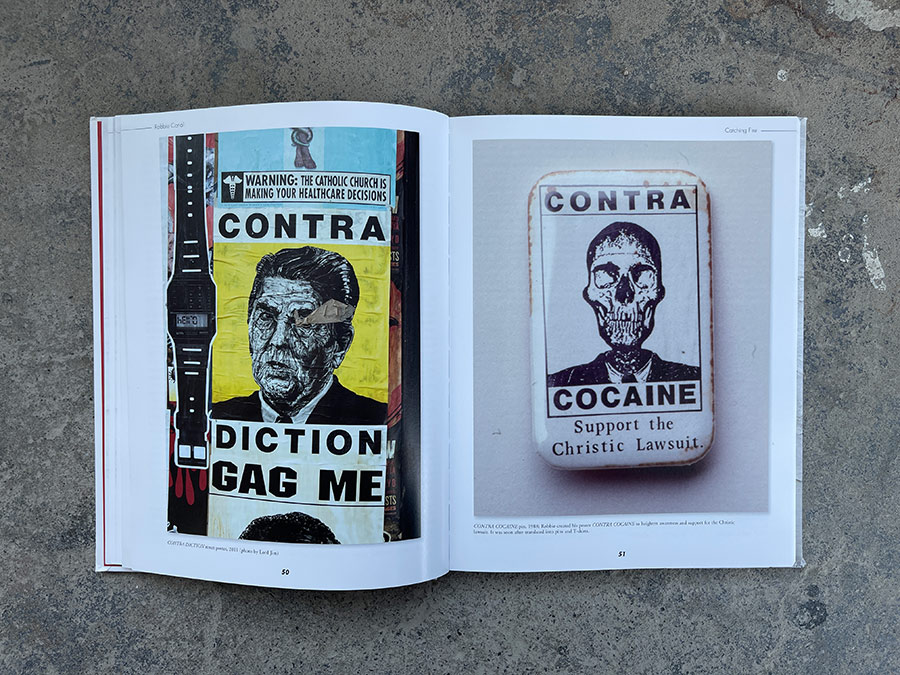
“From that moment of discovering Robbie’s work forward, I had a clearer vision of what art could be… A poster on a corner utility box caught my eye … it was an image of Ronald Reagan on a bright yellow background with bold type that said CONTRA above and DICTION below. Then, a block later, I spotted another one. Now I was on the lookout, and the Contra-Diction posters seemed to be on every corner,” Fairey says. “This Contra-Diction poster spoke to me as a communiqué from a truthful voice of the people.”
High praise indeed.
ROBBIE CONAL / STREETWISE. 35 YEARS OF POLITICALLY CHARGED GUERRILLA ART. By G. James Daichendt. With a foreword by Shepard Fairey. Published by Schiffer Publishing LTD. Atglen, PA
David Breslin and Adrienne Edwards curate “Quiet as It’s Kept”
Write poetry.
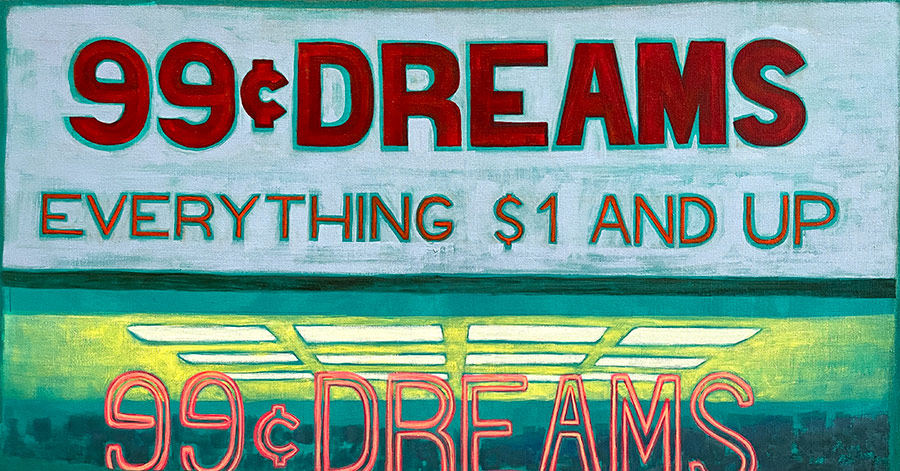
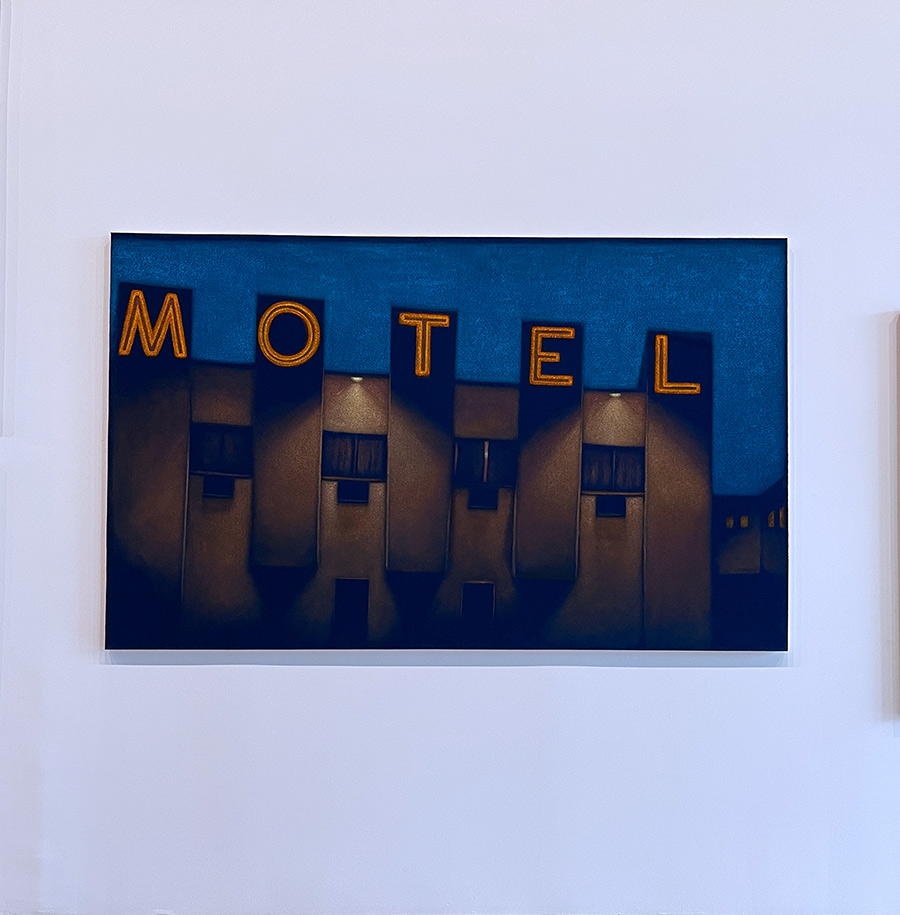
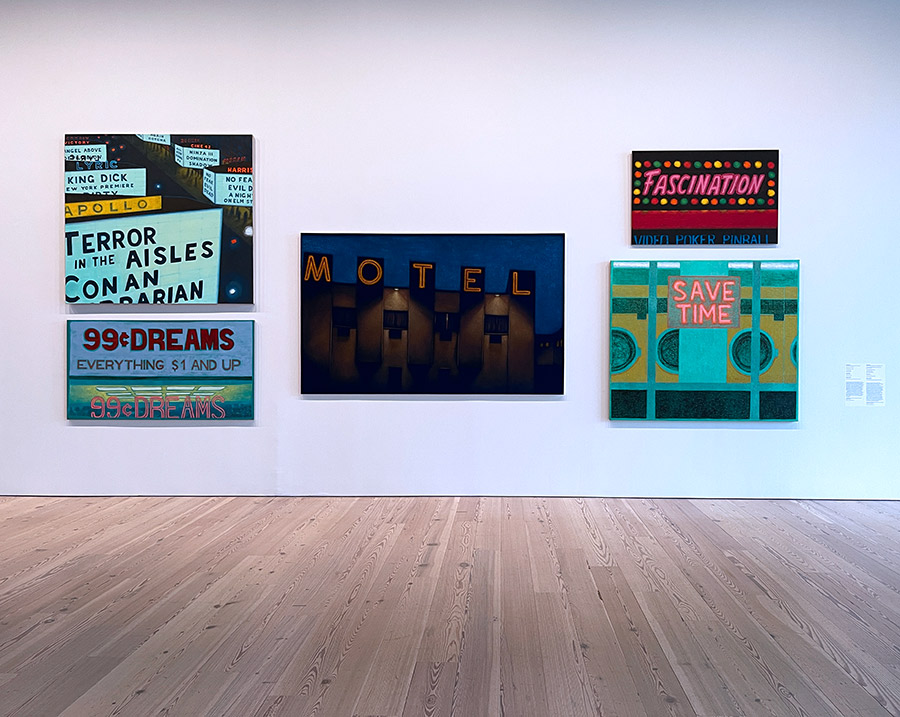
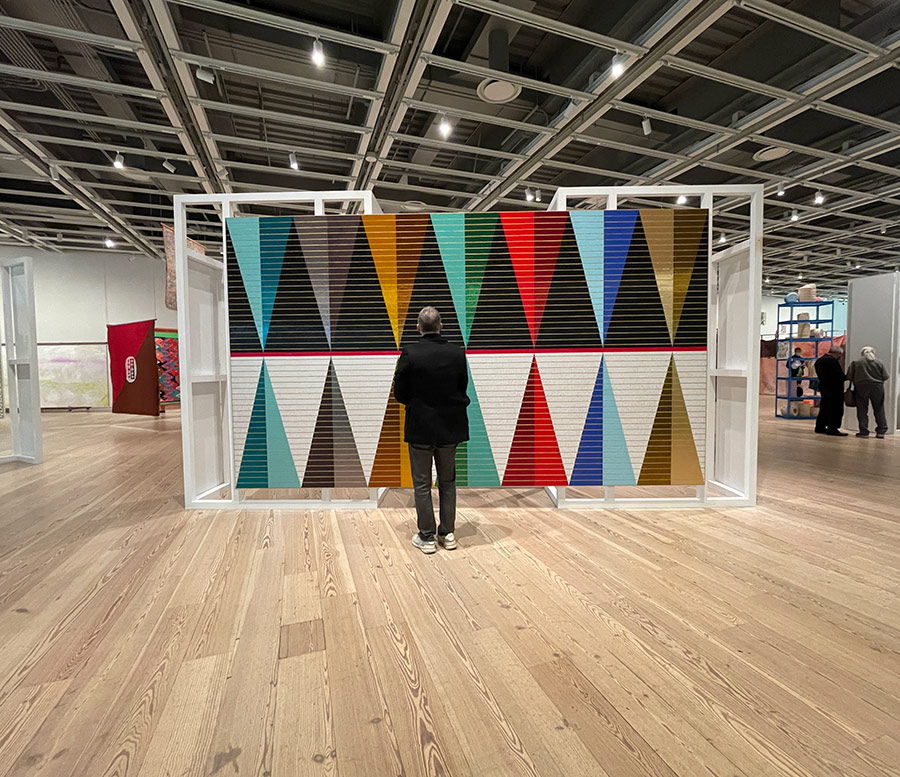
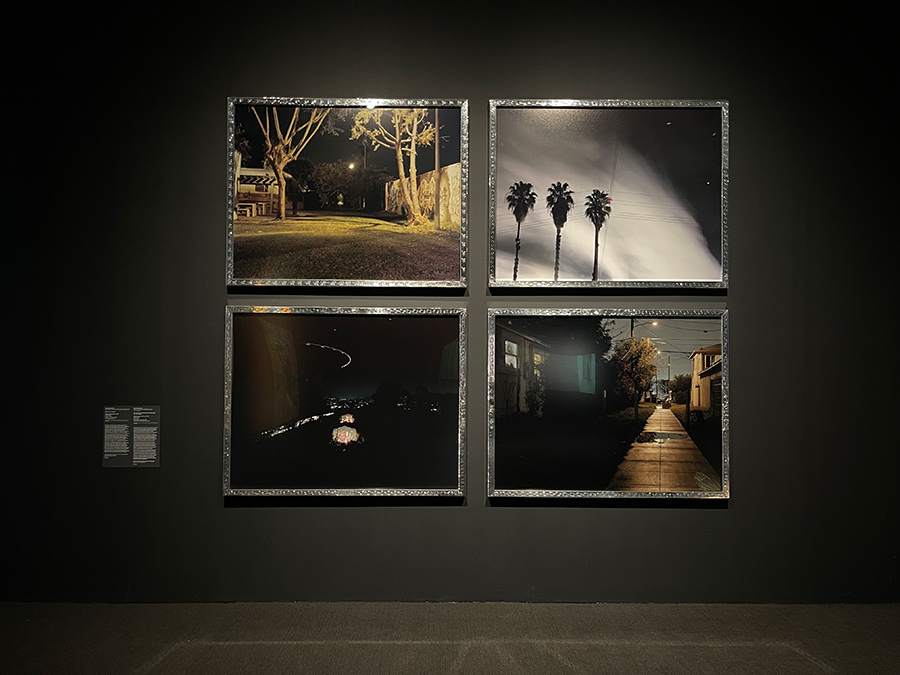
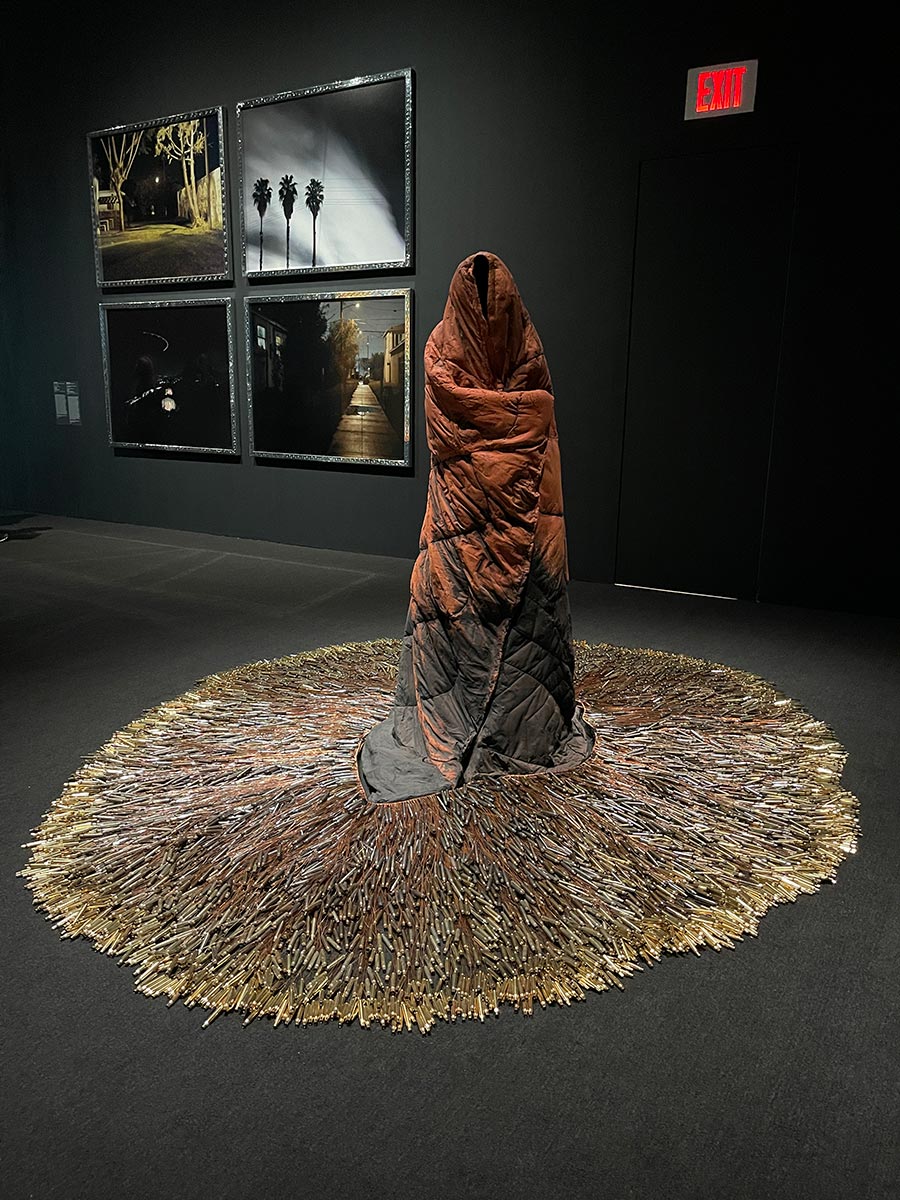
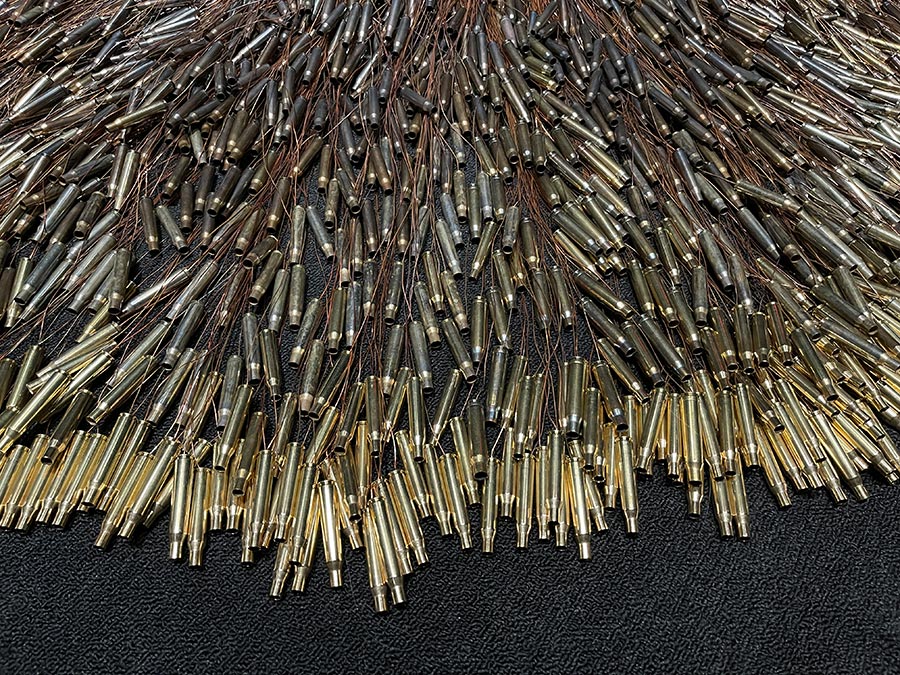
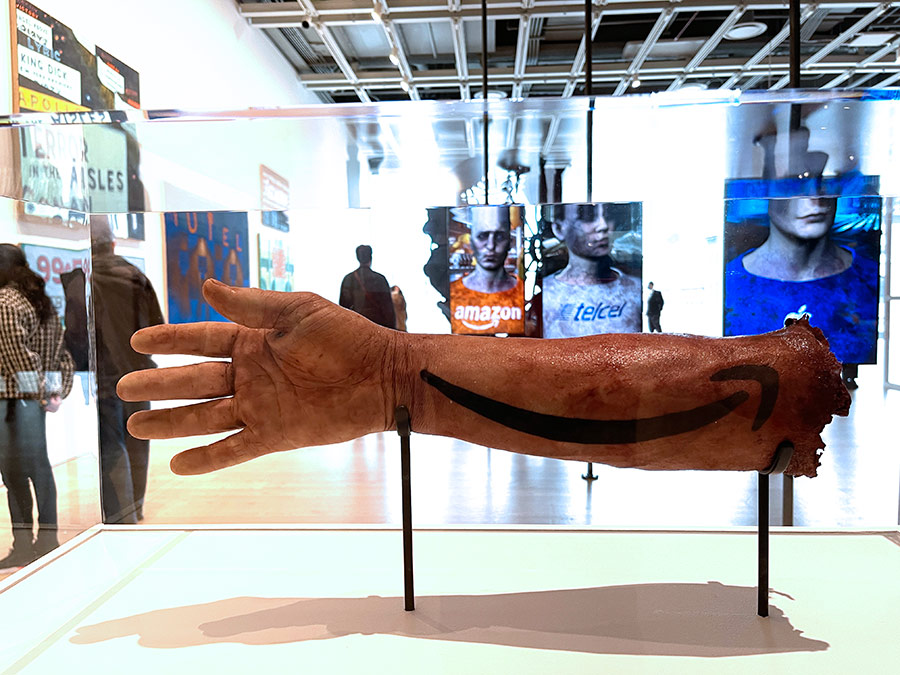
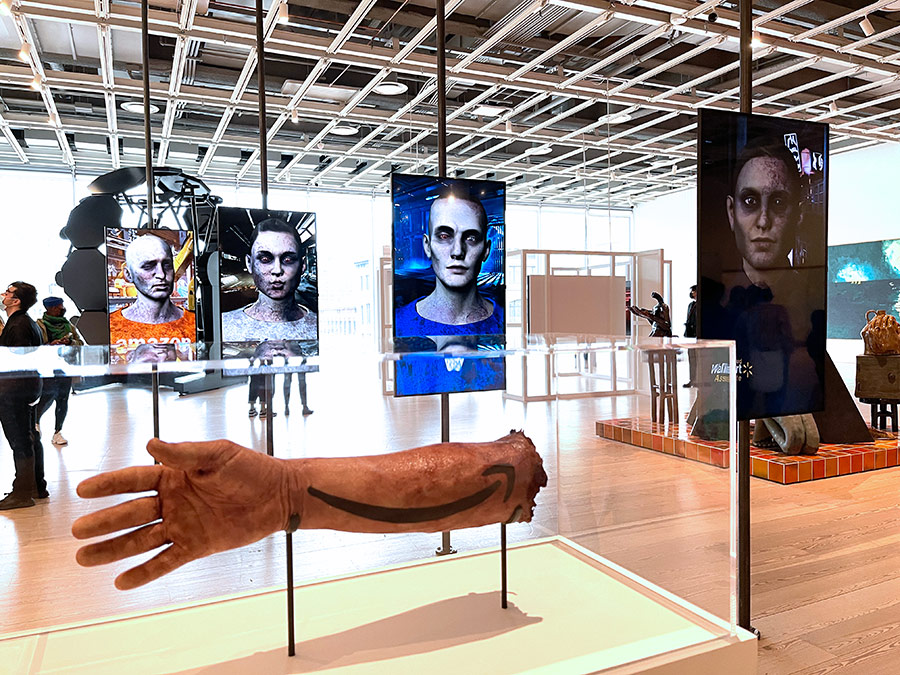
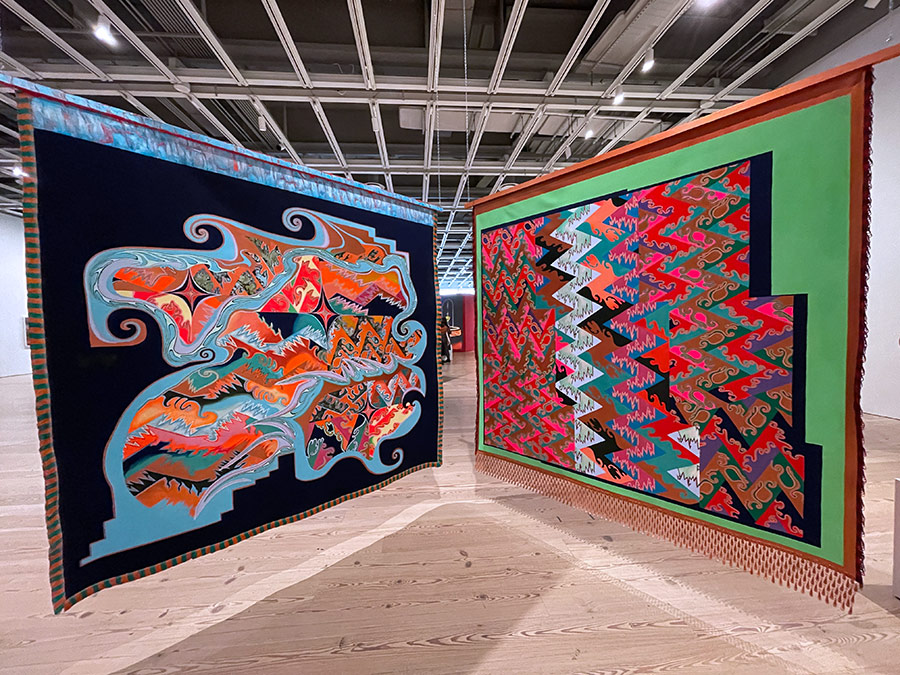
That is our best-recommended strategy to experience the Whitney Biennial. The stanza, the spaces, the rhythms, the waves. They all coalesce in the black space and the white space. And one need not keep this quiet.
The country has been in an ongoing grinding recession since 2008, heading toward depression. Institutions steadily attacked; the wealth steadily stolen. You can see the US here, in these installations, videos, paintings, sculptures, and photography.
Even when you don’t look, you see stressed-out workers balancing on a highwire, the frayed net below. The emptiness of consumerism, the backwash from decades of wars, the contemplation of chaos. Here is history and here is the future, quiet as it’s kept.
The Whitney Biennial is now 90 – an institution, possibly. Discussed, reviled, admired; this one often is stunning. Collaborative curators David Breslin and Adrienne Edwards have chosen quality in these 63 artists, have endeavored to know their collection of artists and can shake the viewer. Brooding, raw, slick, contemporary displacement is displayed. Frayed. Portrayed.
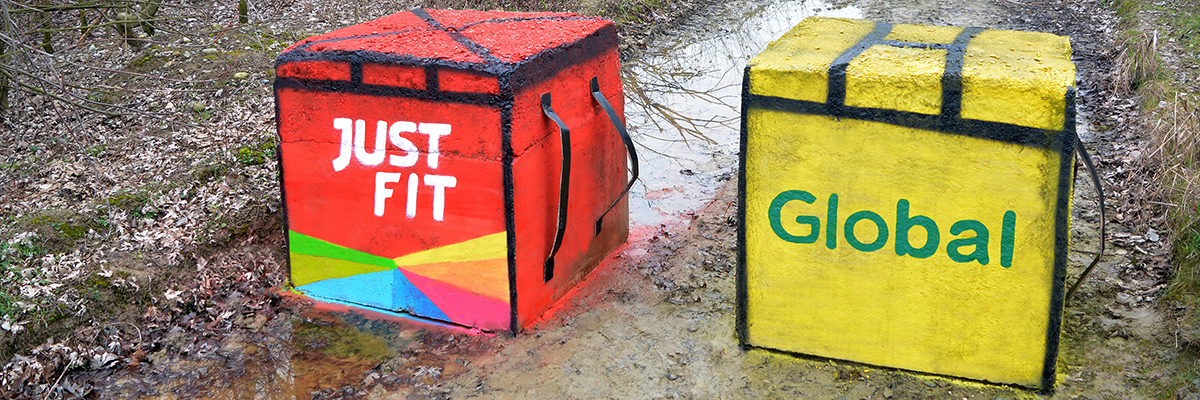
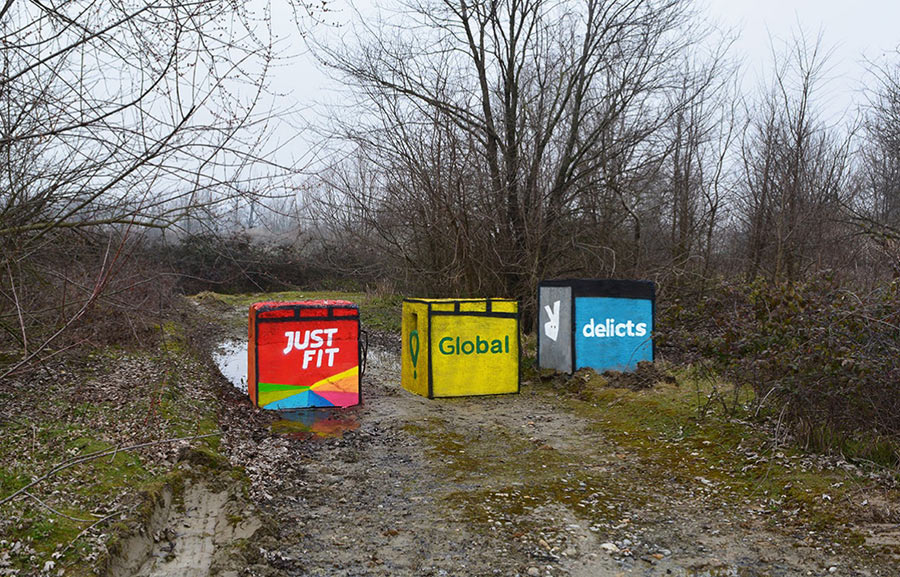
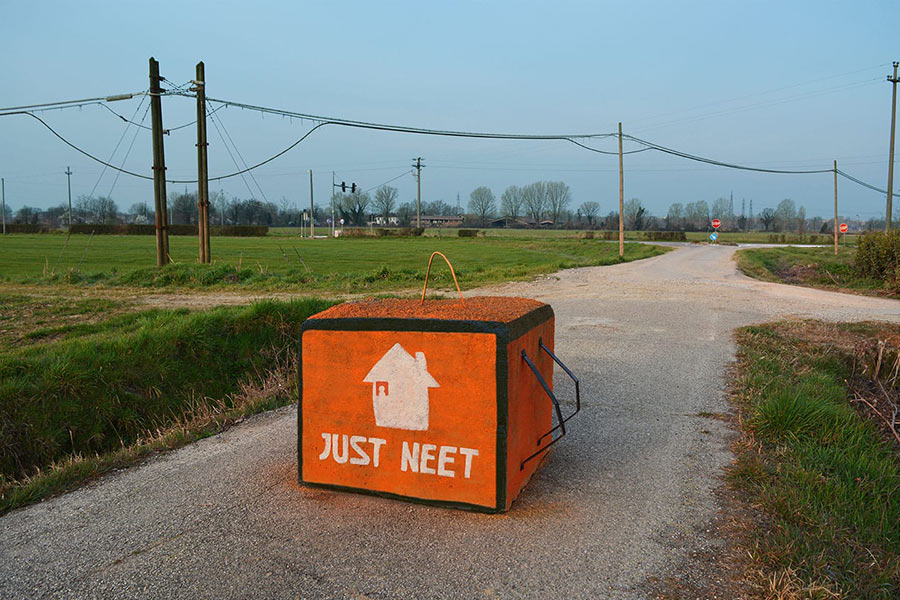
“In a democratic society, a person’s job is a basic tool for civil and economic progress,” says Italian street artist Biancoshock. “What progress can there be if the world’s jobs do not produce emancipation, growth, and gratification?”
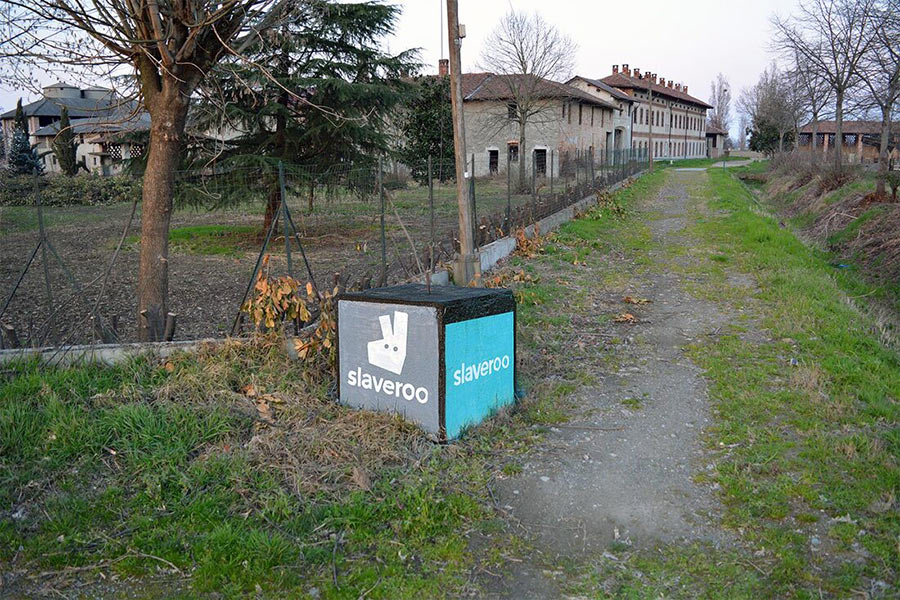
His repurposing of heavy blocks of concrete as delivery boxes here is called “Heavy Meal.” He says his point is to highlight the unrecognized burdens that delivery people of today are carrying thanks to sophisticated software. He describes situations of ever-higher pressure, lower wages, and an overall feeling of precariousness.
Increasingly across Europe and the developed world, he says, “food-delivery riders are dictated to by algorithms that extend the control and distribution functions – to become inaccessible, authoritarian and categorical.”
“The algorithm imposes a path, rhythms, distances to be bridged (those between the rider and the consumer) and other unbridgeable ones (those between the rider and the management of the company that produces the algorithm and the goods to be delivered).”
These huge traffic blockers make idea canvasses for the installation artist, who adopts the logos of well-known European food-delivery brands and slightly alters them for artistic effect. To see the growing number of protests against these companies by employees, you see that more sophisticated technology is lowering the standard of living for many of us.
“The need to survive in this system transforms young people, students, and the unemployed into ‘new generation slaves,’” says the artist.
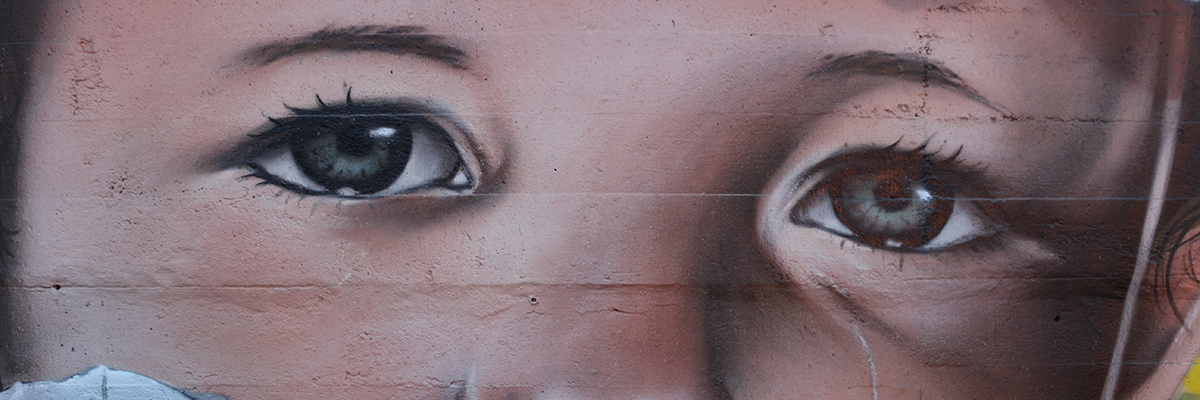
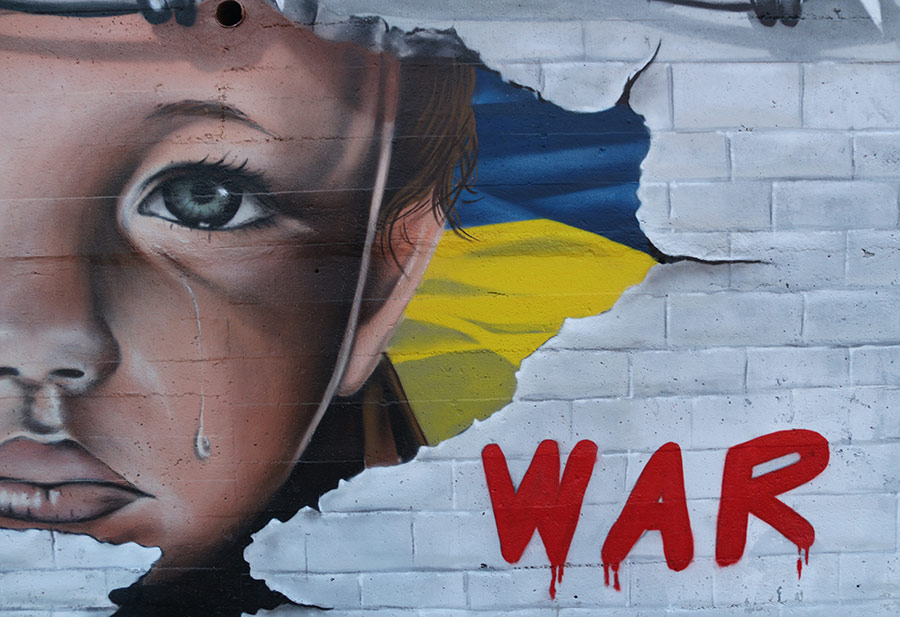
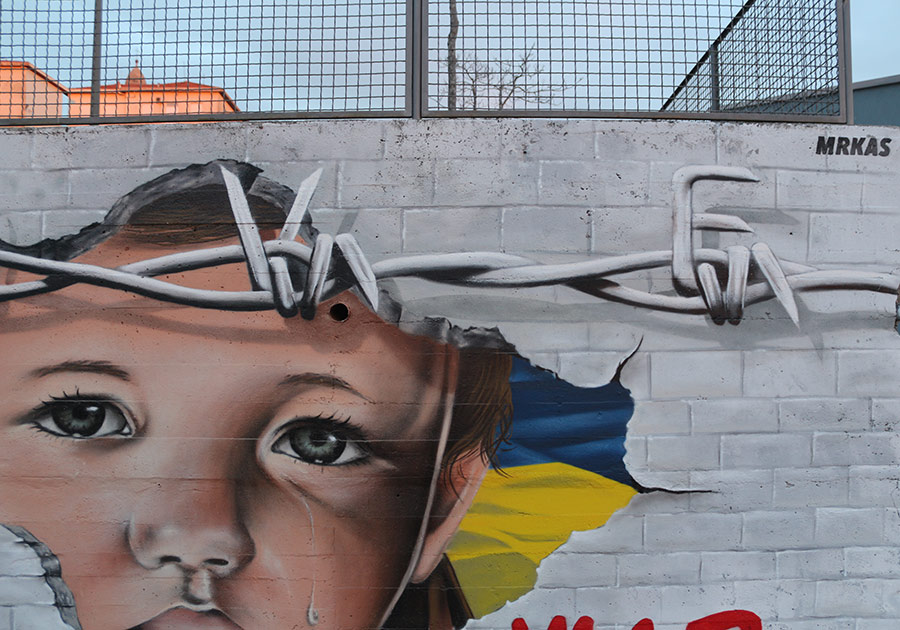
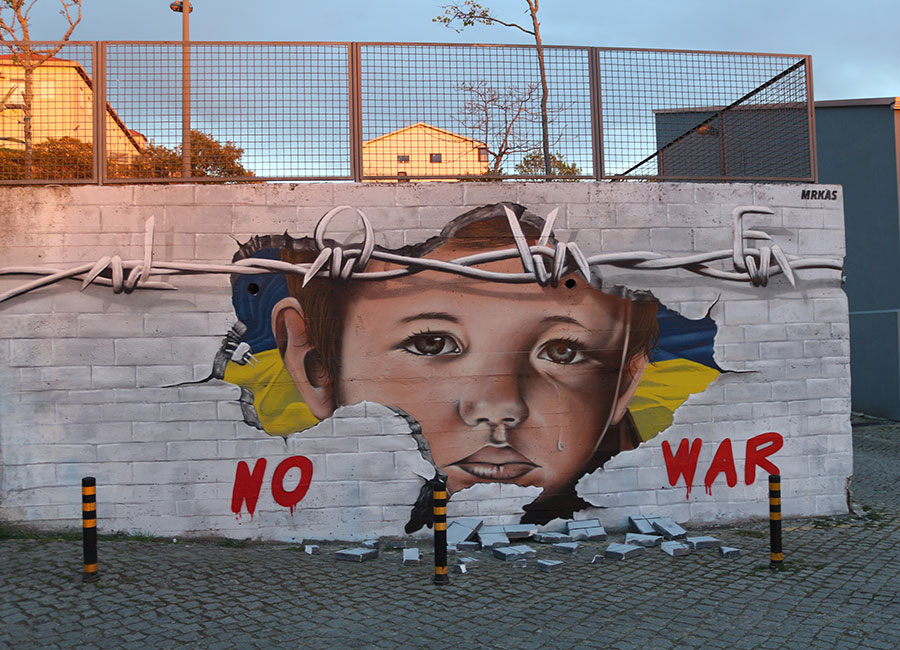
Many street artists around the world are creating new artworks on the street in solidarity with the Ukrainians. MrKas sent us his emotional appeal from Portugal where he painted this new one modeled after a boy who was caught amidst the attacks. He also had the pleasure of meeting his mom Elza Uskas since she and her son escaped the bombs in their home city. Ms. Uskas gave him permission to share her words here;
“We fled from home, in grief, in fear, from those who remained. Borders are open. We travel through beautiful cities, and meet kind people… but my heart is broken, I want to hug my family and friends. I want them to sleep peacefully instead of hiding in the basements from the missile attacks. Our life will never be the same again. And our children will never forget the sound of the siren roar that they will dream of at night …”
“It has taken 232 years and 115 prior appointments for a Black woman to be selected to serve on the Supreme Court of the United States,” Jackson said in a speech outside the White House.
“But, we’ve made it. We’ve made it, all of us,” Jackson said.
We’ll be looking for her face to pop up on the street soon!
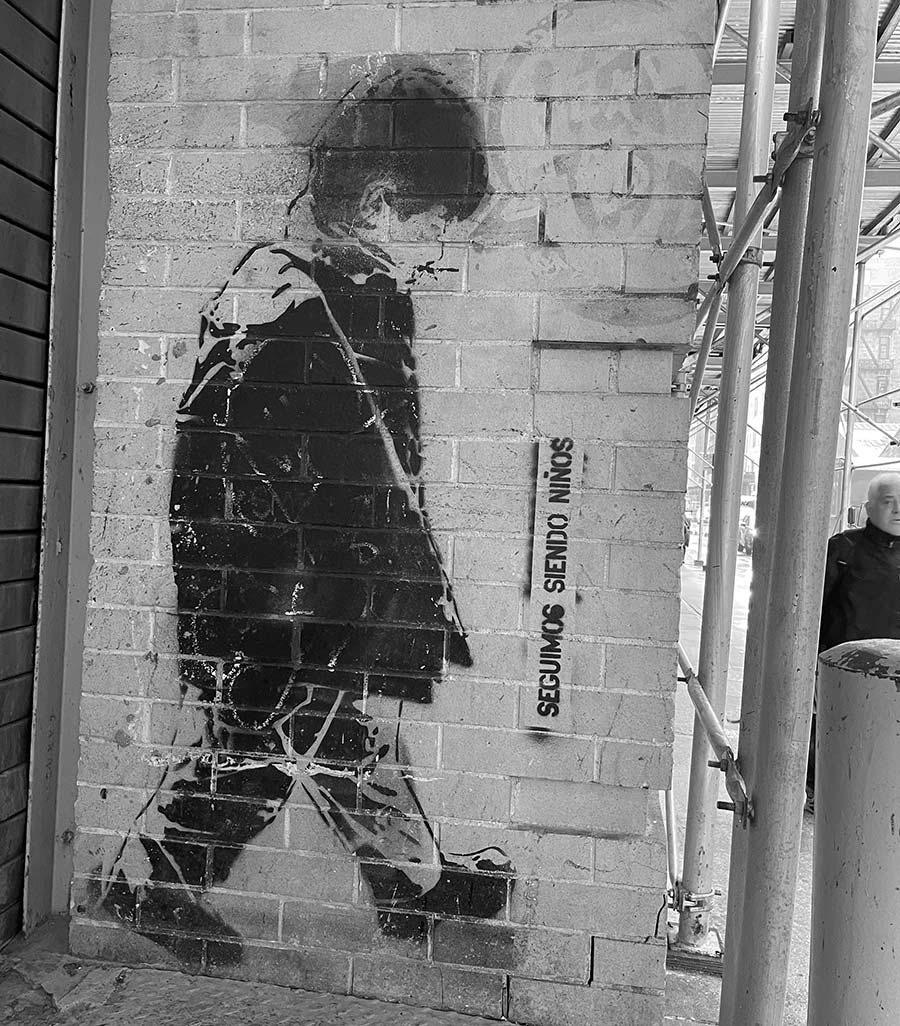
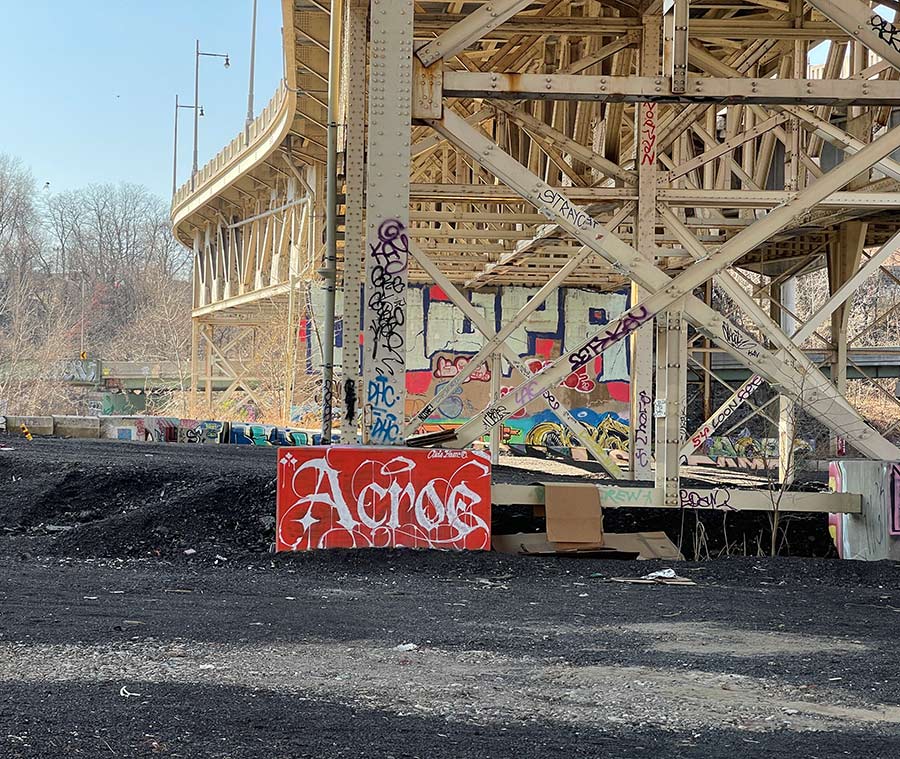
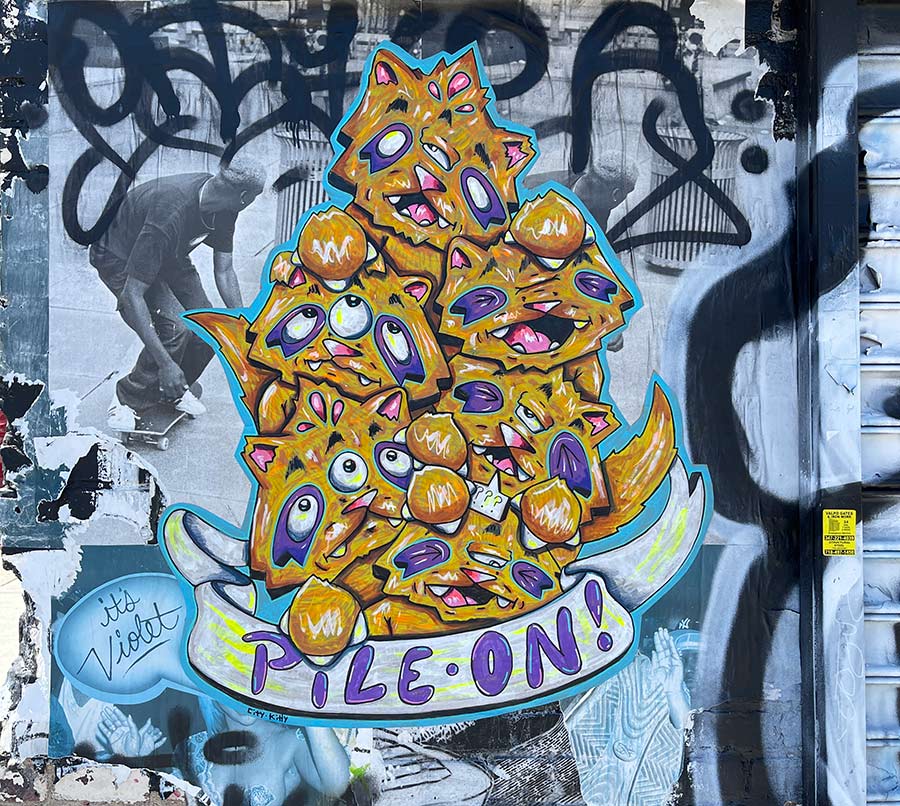
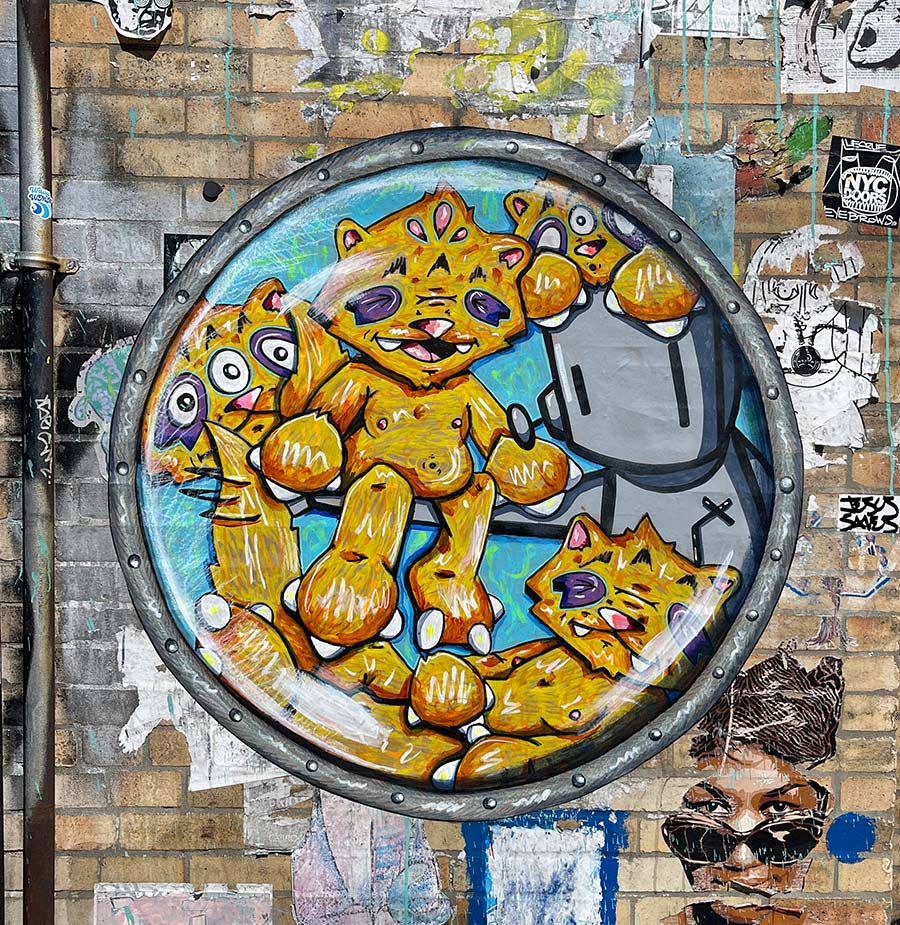
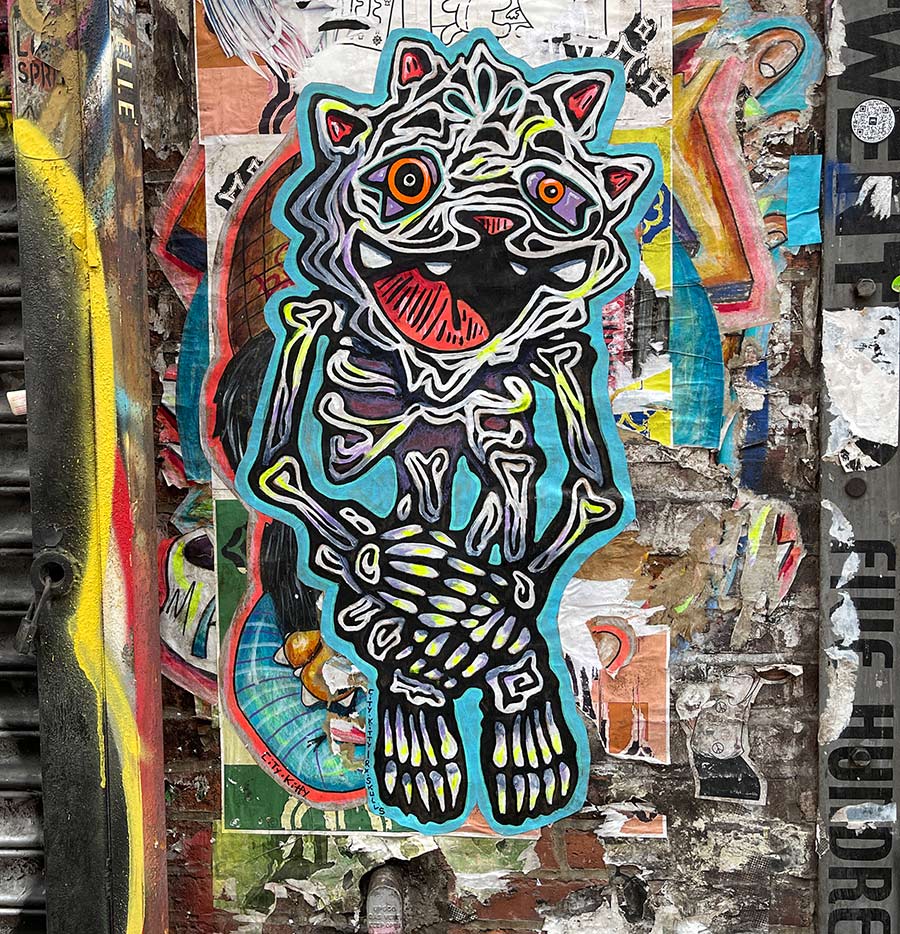
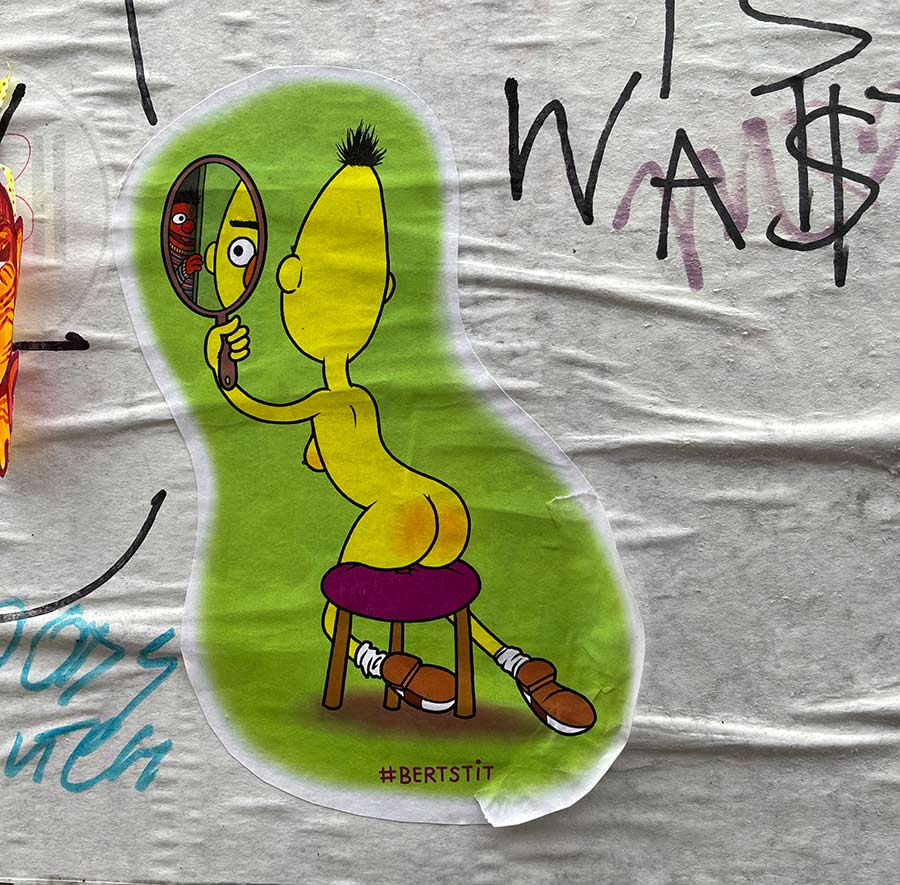
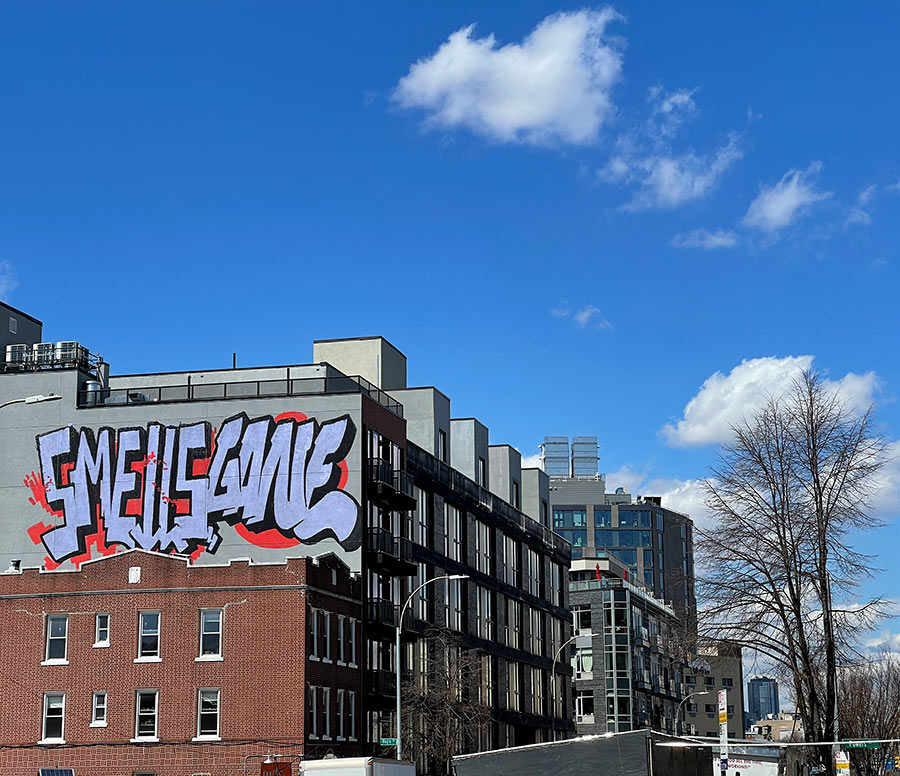
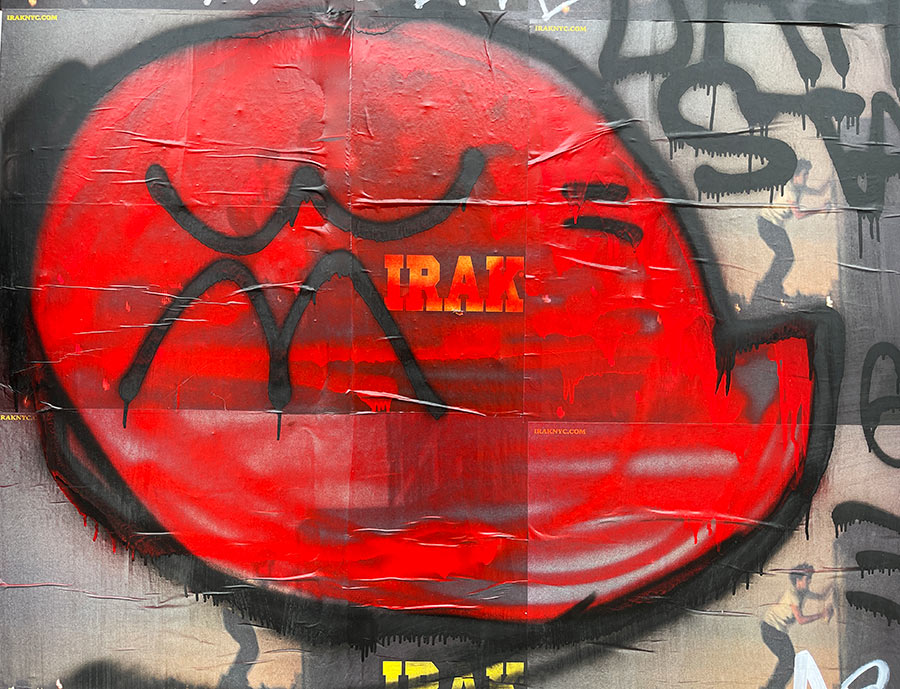
Here’s our weekly interview with the street, this week featuring: City Kitty, Chris RWK, Adam Fujita, Icy and Sot, Clint Mario, Gane, Irak, RX Skulls, Smells, Bublegum, Acroe, Bertstit, and Eric John Eigner, Lawrence Weiner.
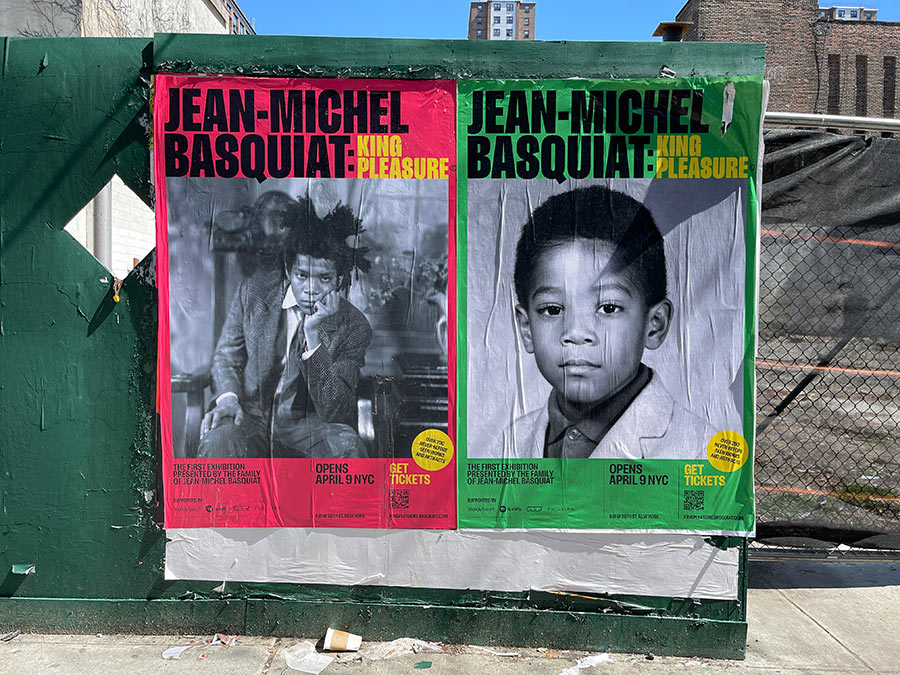
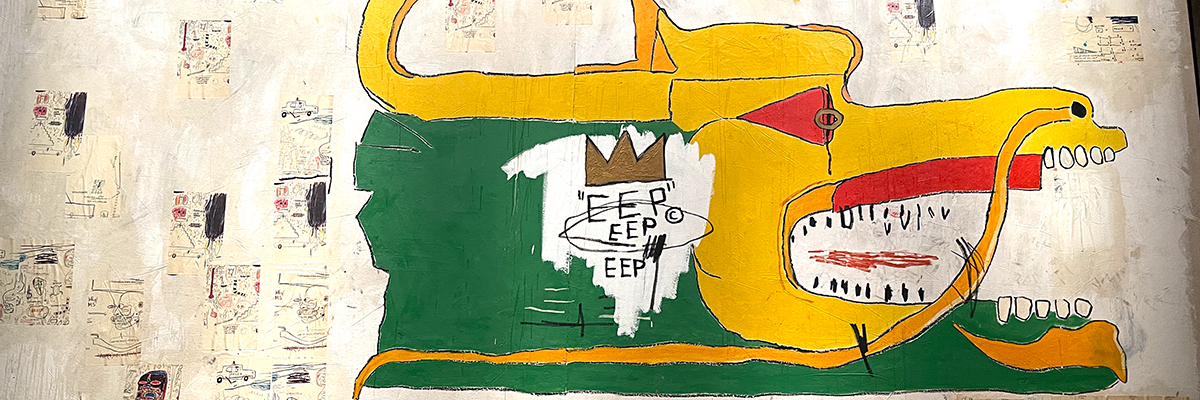
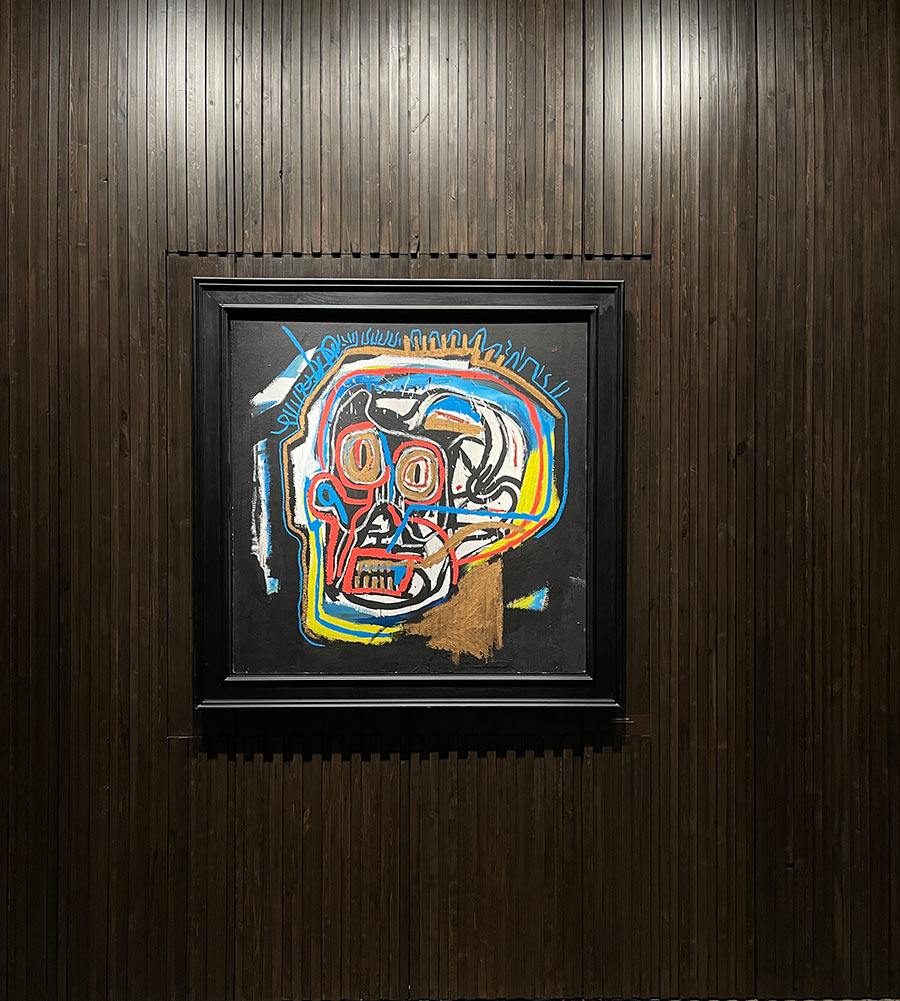
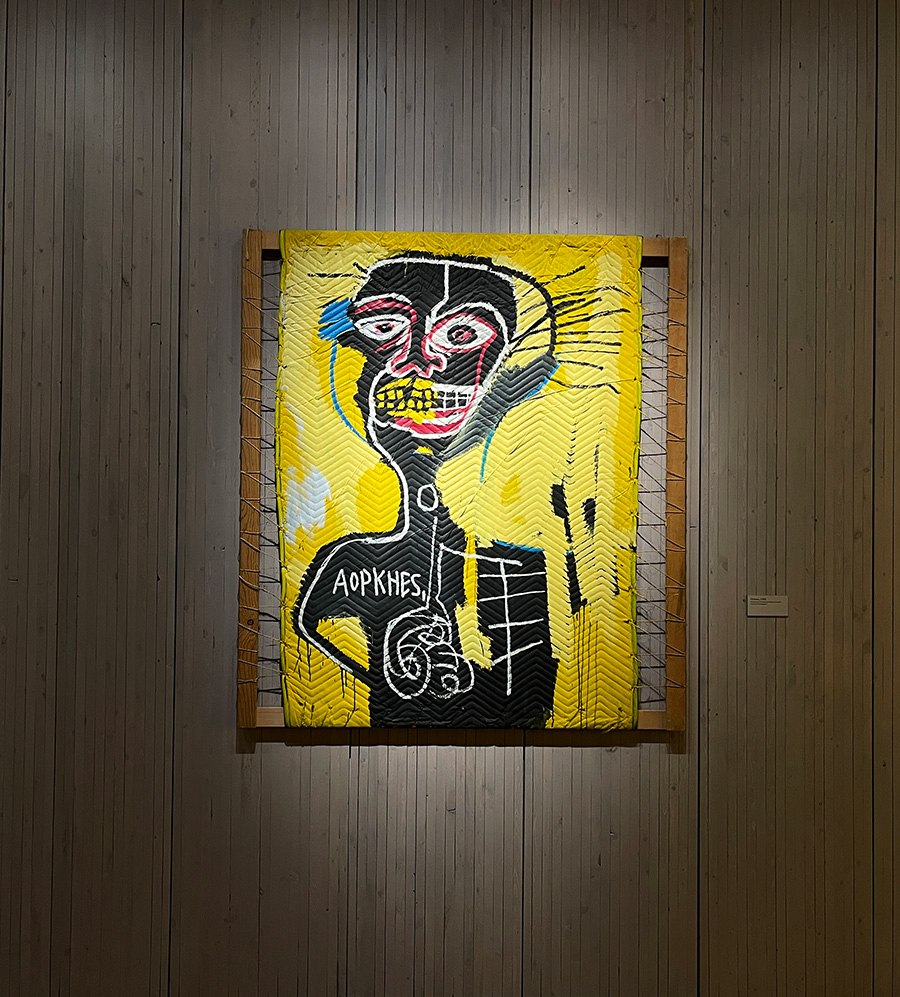
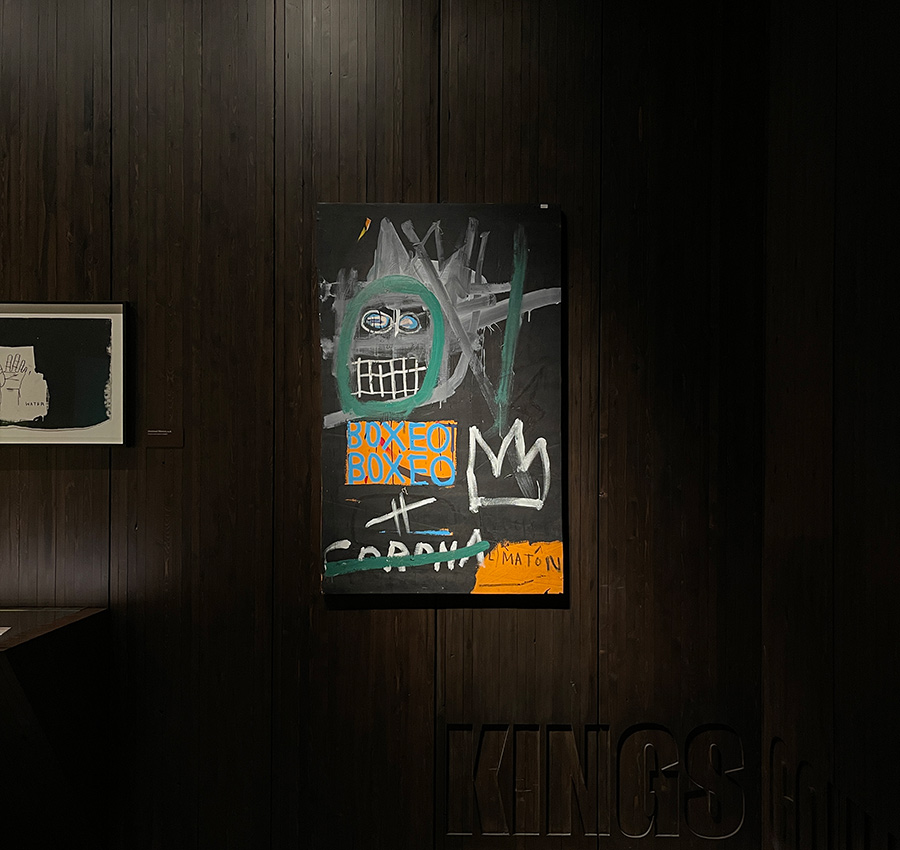
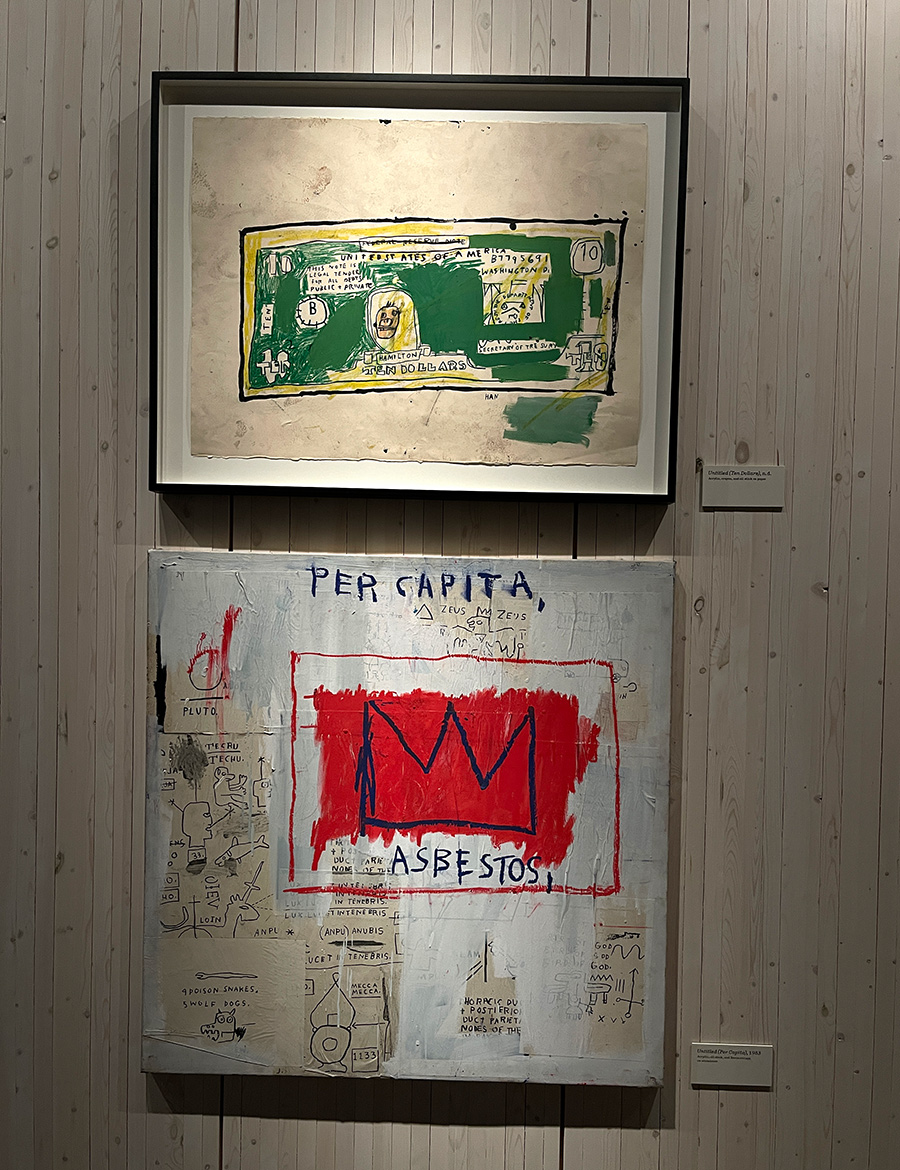
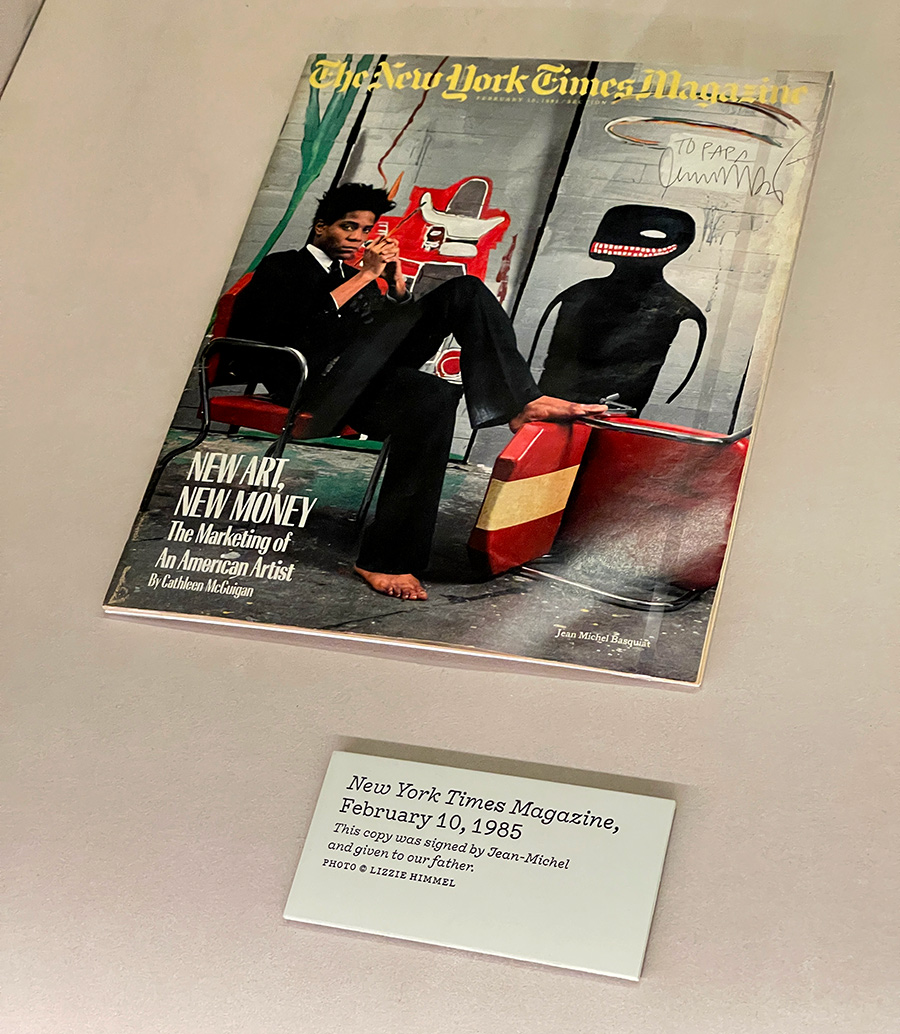
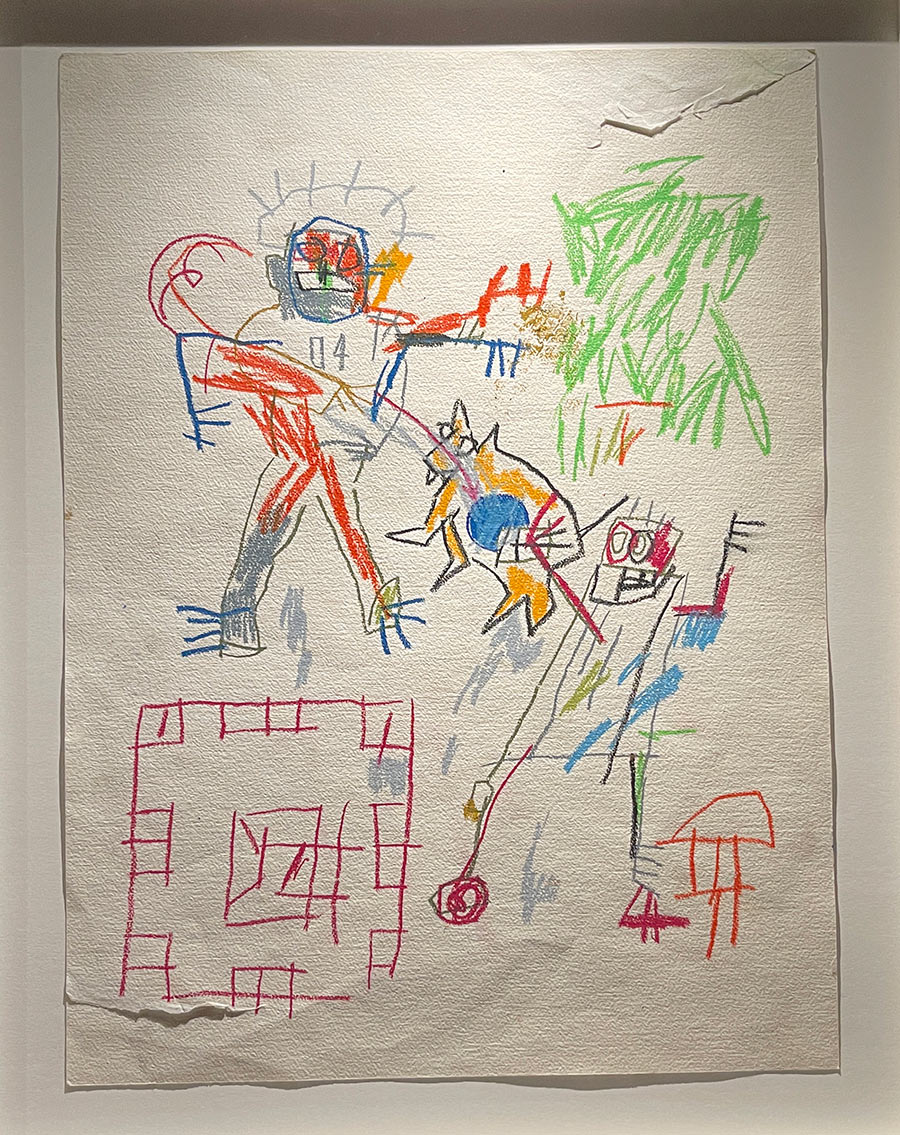
Scholarship about the work of Jean-Michel Basquiat since his death in 1988 has been extensive. With dozens of books written, world-class museums have organized exhibitions about his work, including the Brooklyn Museum, the Barbican in London, the Fondation Louis Vuitton in Paris, the MFA in Boston, and the MCA in Denver. Substantial catalogs were also offered with most of the shows, analyzing his work from different curatorial viewpoints. At least a couple of documentaries from 2010 and 2017 have presented audiences with stories of his meteoric career from his early days to superstardom, fame, and record-breaking prices for his work.
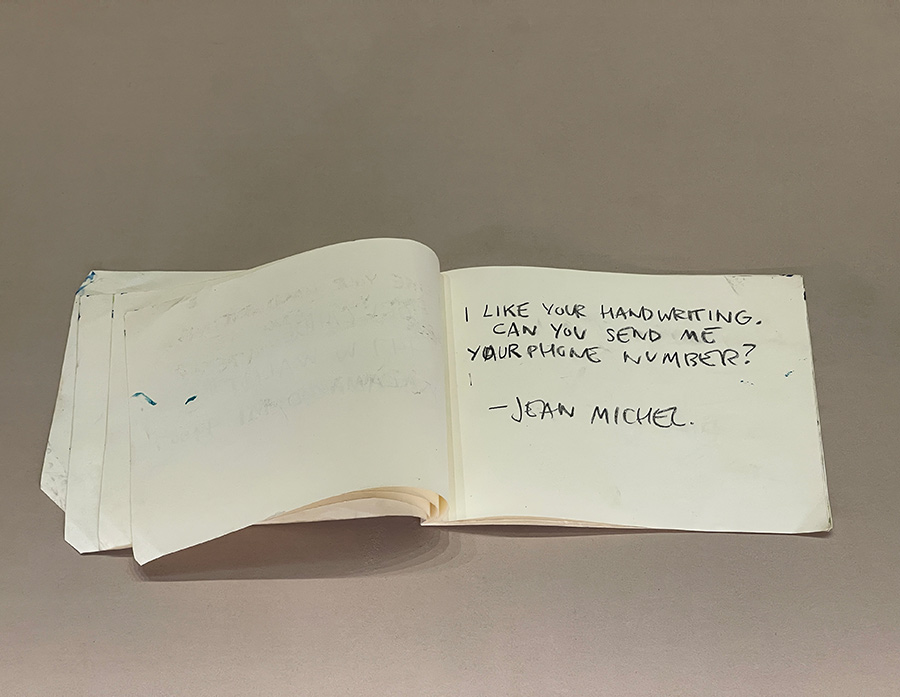
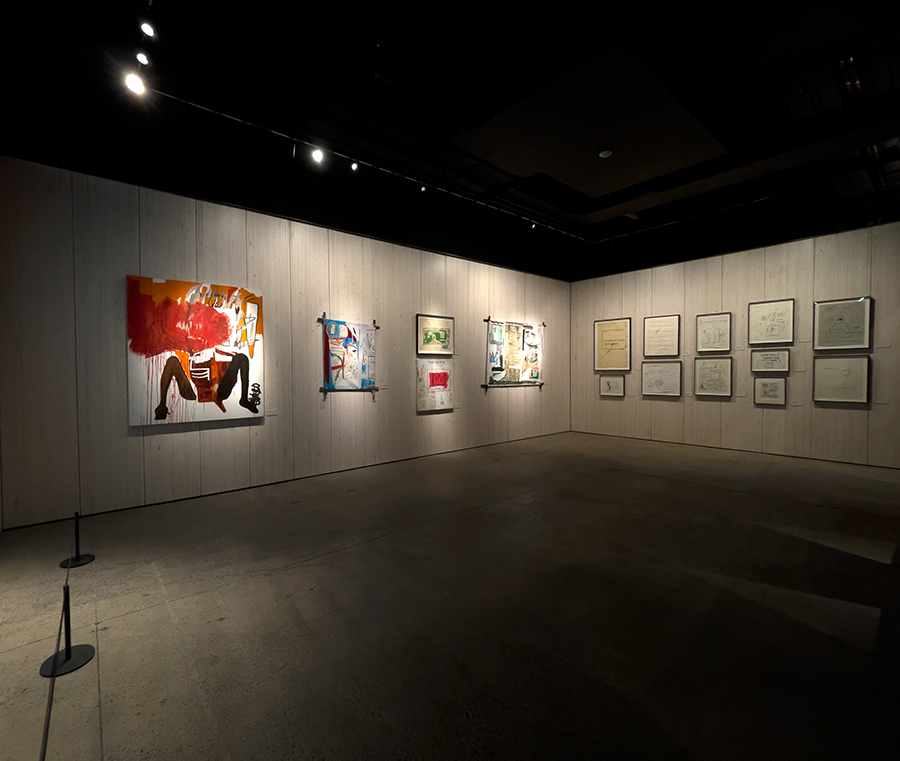
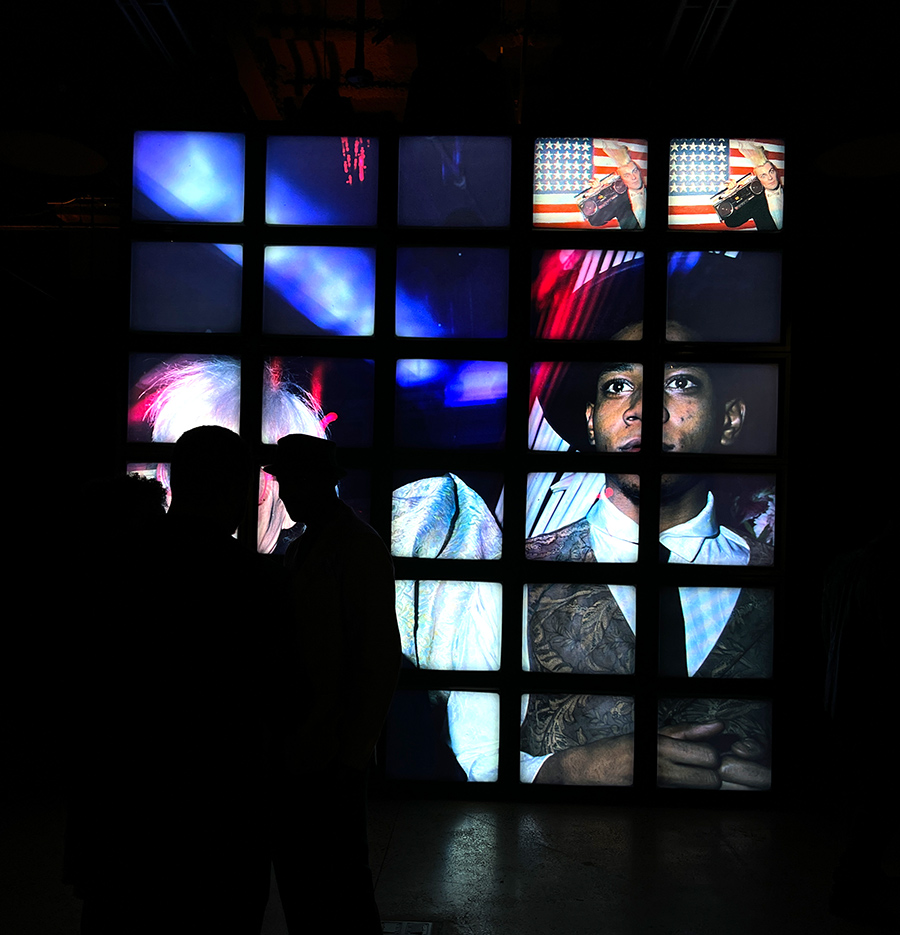
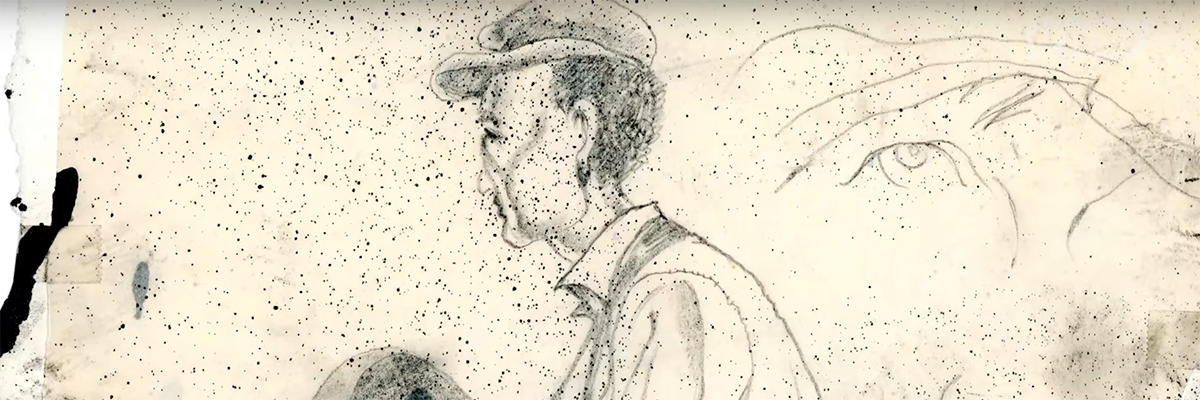
Jean-Michel Basquiat: King Pleasure offers a new perspective on the artist, his life, and his work...This New York City exhibition endeavors to complete the story in a decidedly familial way. Curated by his two sisters, Lisane Basquiat and Jeanine Heriveaux, with help from his stepmother, Nora Fitzpatrick, the artist is repositioned as a son, brother, uncle, and friend. An emotional exhibition that feels intimate even though more than 200 artworks are on display, King Pleasure posits that there may be more to Jean-Michel than you previously knew.
A shining jewel unveiled at the apex of the New York spring art season, the new show reaffirms the strength of the artists’ personal syntax and his distinctive ability to encode and innovate on streets and canvasses the DNA of American culture and history for his time and ours. The sisters and stepmother firmly assert Jean-Michel’s legacy, and simultaneously they gift fans and admirers one more musical, visual, poetic composition from a departed friend.
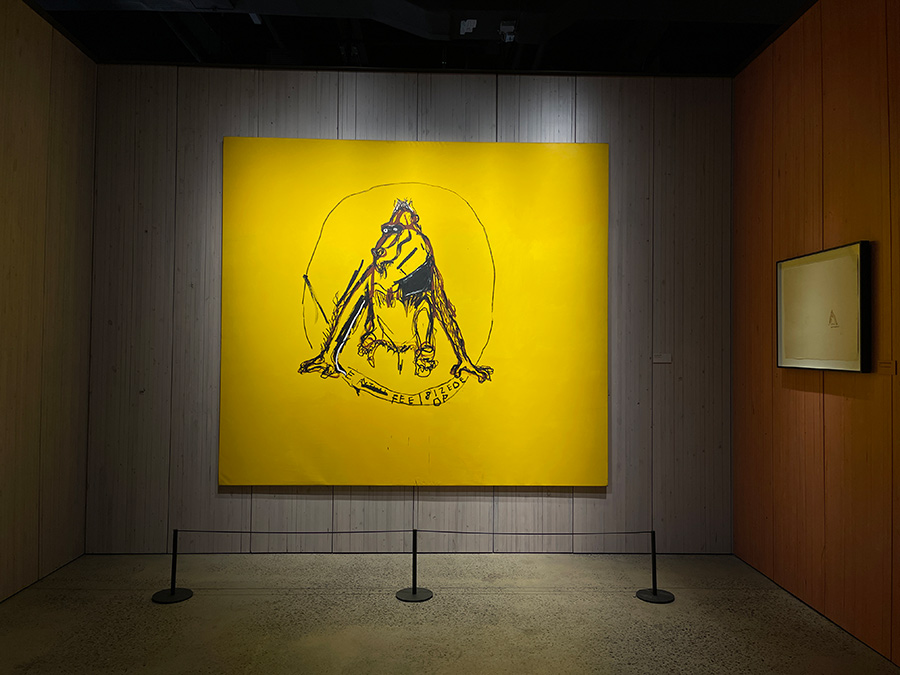
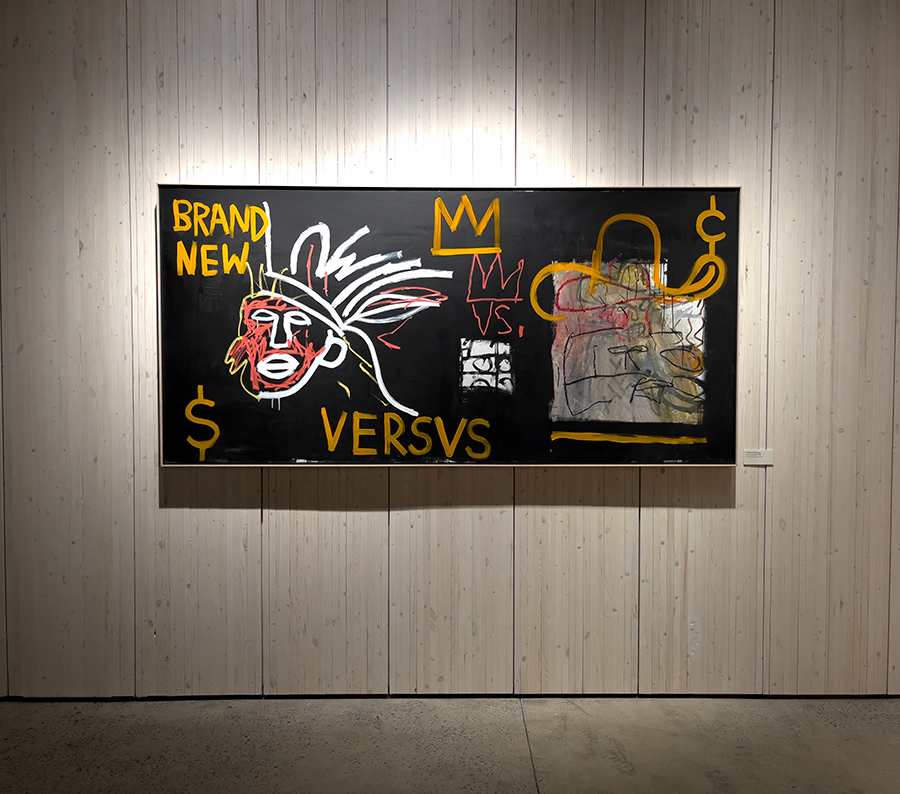
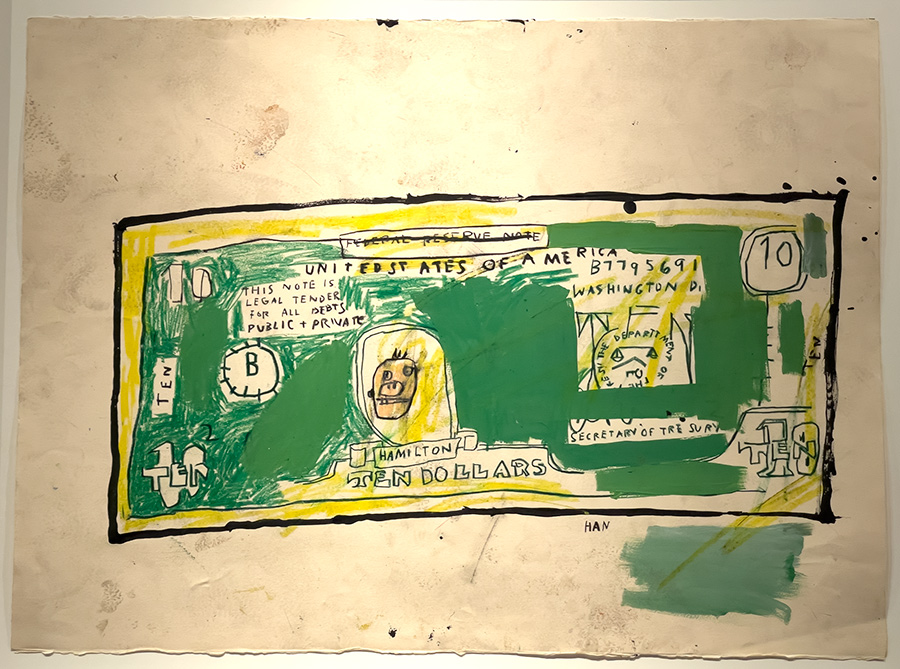
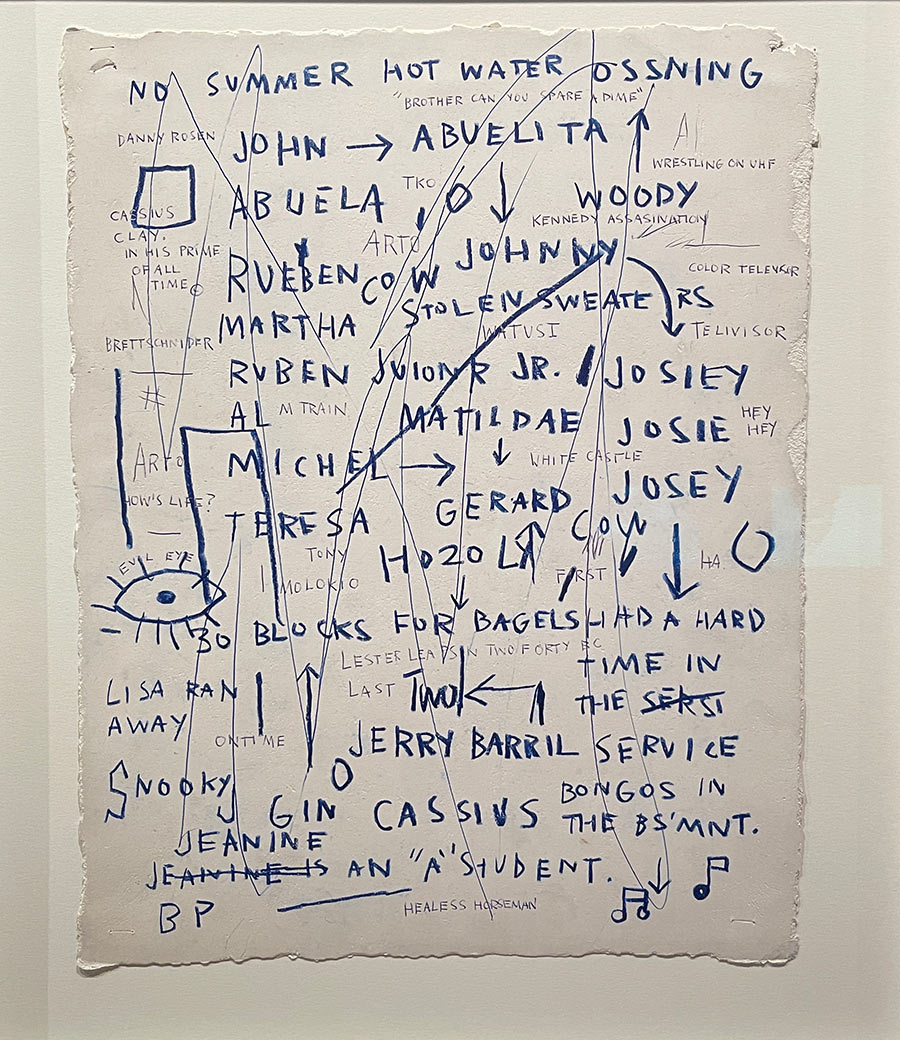
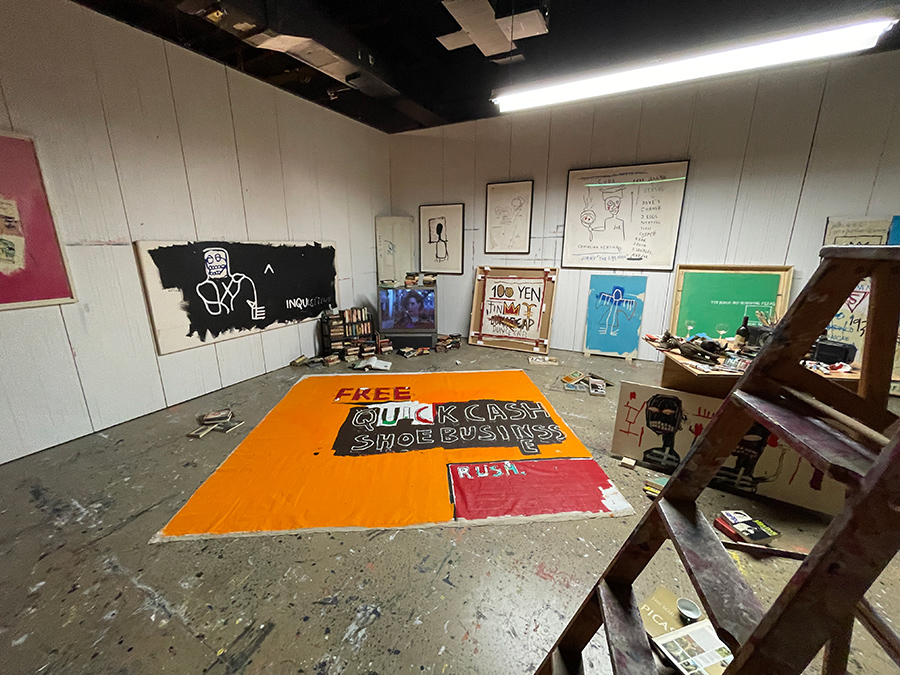
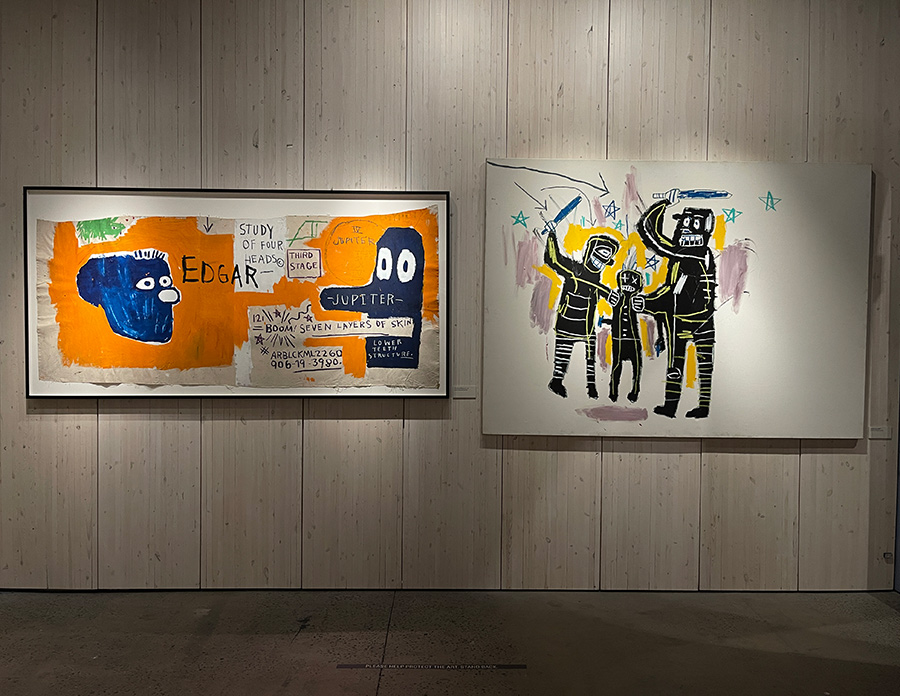
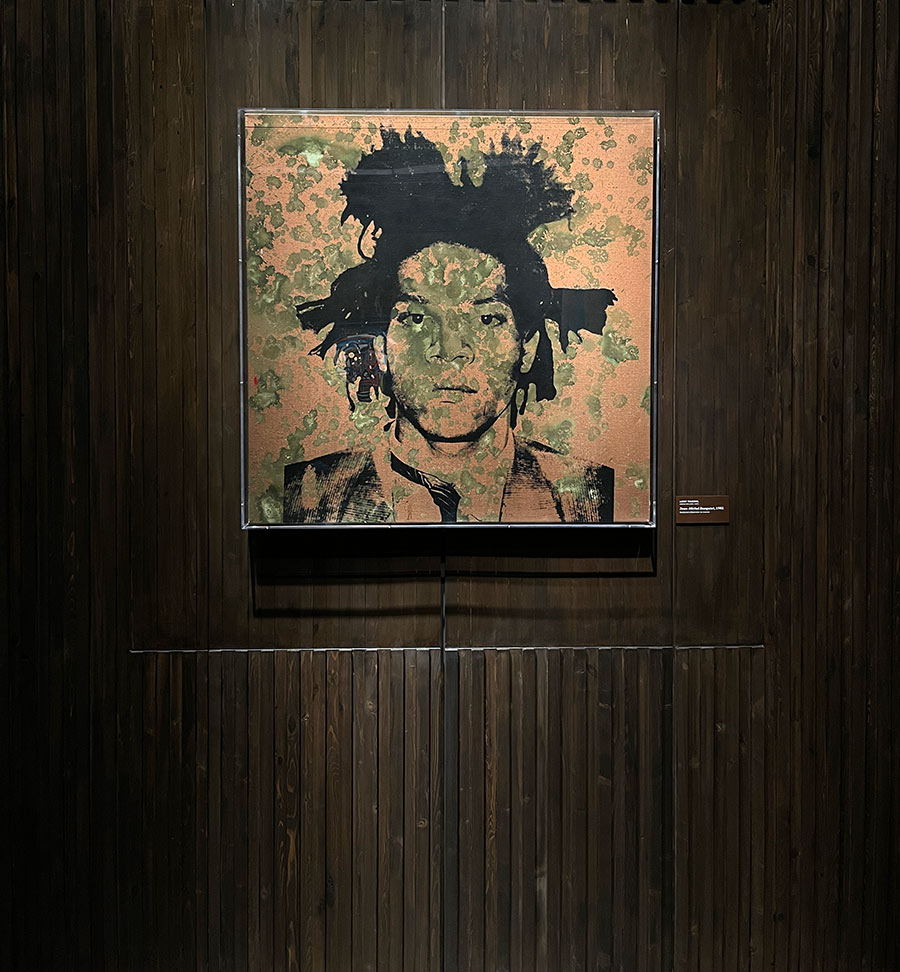
Because of the nature of late 20th-century art-collecting, so many of Basquiat’s works are now only in private hands, unavailable to see. Here is an eclectic collection of fully realized works and sketches in his trademark style. The show feels well-rounded and accessible – akin to a visit to a friend’s home studio to see their latest works in progress and their developing ideas.
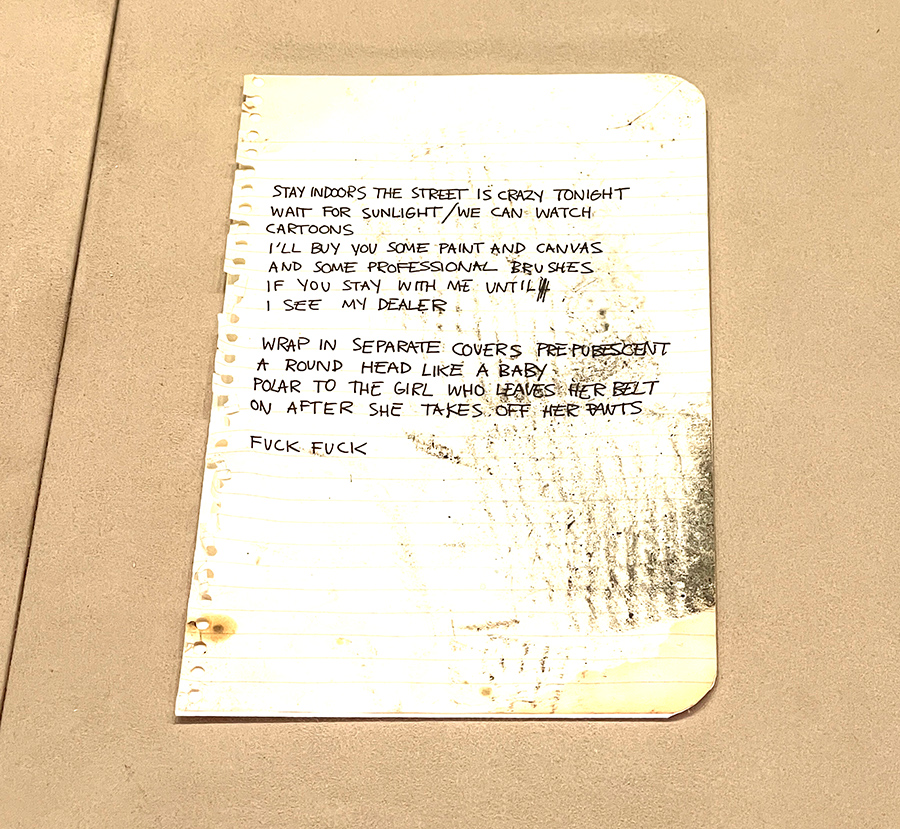
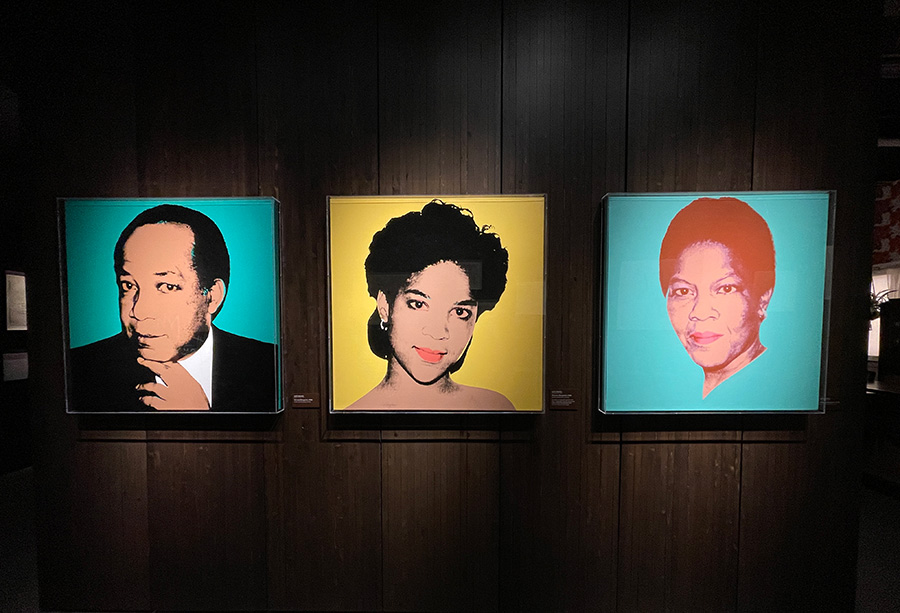
Ghanaian-British architect and exhibition designer Sir David Adjaye creates an unpretentious, open, and inviting series of spaces to consider the multi-sensory internal adventures of a young artist enthralled with possibilities that life may offer. The winding exhibition greets you in waves of illustrations, texts, canvasses, works on paper, paintings, family stories, sketchbooks, journals, artifacts, musical interludes, concise video interviews, projections, ephemera, arched porticos, subtly detailed environments in warmly authentic textures. Without clutter or fussy filigree, it also does not retreat to the clinical white box; instead, the varied collection achieves a cohesion that is authentic.
Basquiat was discovering and defining himself in an acutely racist US society that was in the process of merging and separating and reconfiguring, often painfully so. The contradictions of traversing street culture, middle-class economics, Haitian, Puerto Rican, African, and European roots were not new to him in our city – but he could not necessarily resolve them. Seeing his writings and paintings one may say that some of his clarity came from creating, an internal process of synthesis that he recorded externally in paint and pencil. Perhaps as a response to the thousand cuts that systemic racism inflicts and white people’s resistance to facing it, the show speaks to a still-ill society designed not to be safe or honest to black and brown men. Whether the racism he grapples with is historical or contemporary, can one doubt that Basquiat was deeply hurt by it? Textural references in what critic Carlo McCormick calls his “scattered poetics” illustrate the shock of sudden racism and class that rapidly veers to the next topic, possibly the nature of his daily existence.
Personal testimony by his sisters reminiscing on a video speaks to the stinging pain of racist words used against the family when all the siblings were children and how they witnessed his recoiling reaction. Even as you reflect upon his familiar names of musical and sports heroes popping up – Charlie Parker, Nat “King” Cole, Billy Eckstein, Grace Jones, and various Heavyweight Champs, it occurs to you that this young man was modeling himself after his heroes, as young people do. If there were few poets, intellectuals, or masters of industry referenced, perhaps that is the result of a system that primarily prized black men who were athletic or entertaining.
Writing of the Narrative
With King Pleasure, the family of the artist takes hold of the narrative and makes it personal, inviting you to see by recreating his family living spaces and his art studio. Each is filled with actual personal objects, family photographs, furniture, vinyl record albums, books, and ephemera. There is a natural tendency for us to view a person, a persona, and a creative life through our lenses of references – and much of the Basquiat hype that developed during his halcyon rise in the 1980s was formed by media and the cult of celebrity. From today forward those narratives will be broadened and more fully realized – at once providing context, answering questions and altering, even contesting, previously held perceptions. Without doubt, these will help us better appreciate the artworks and his practice.
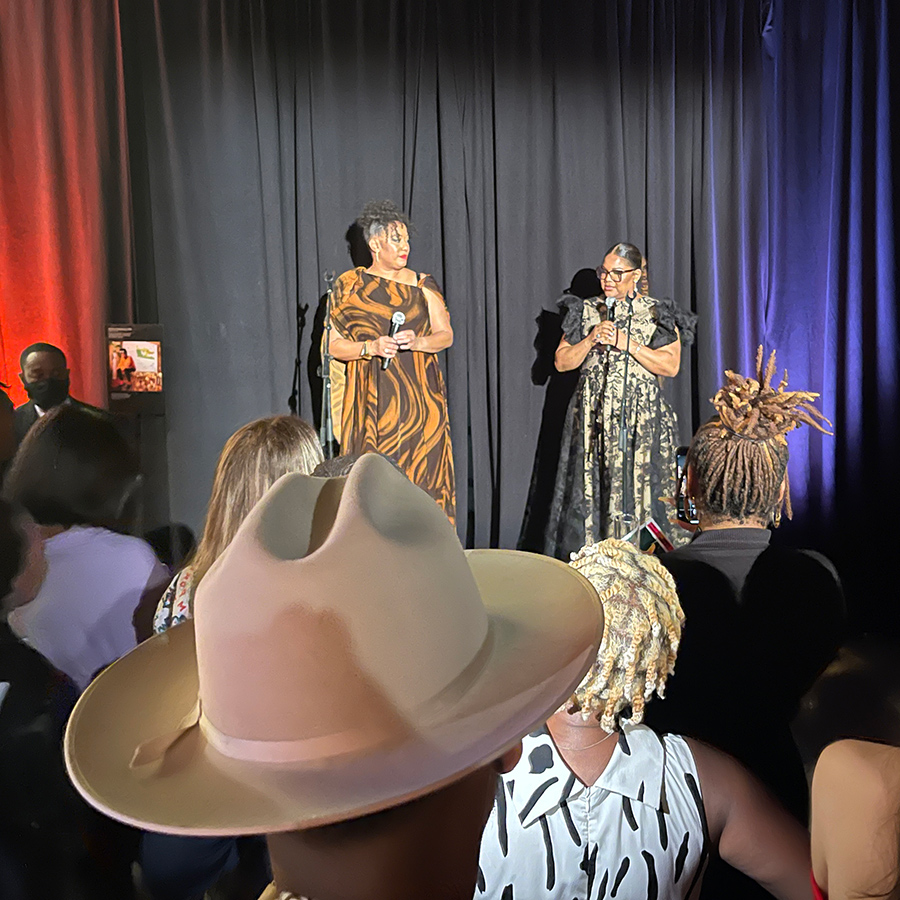
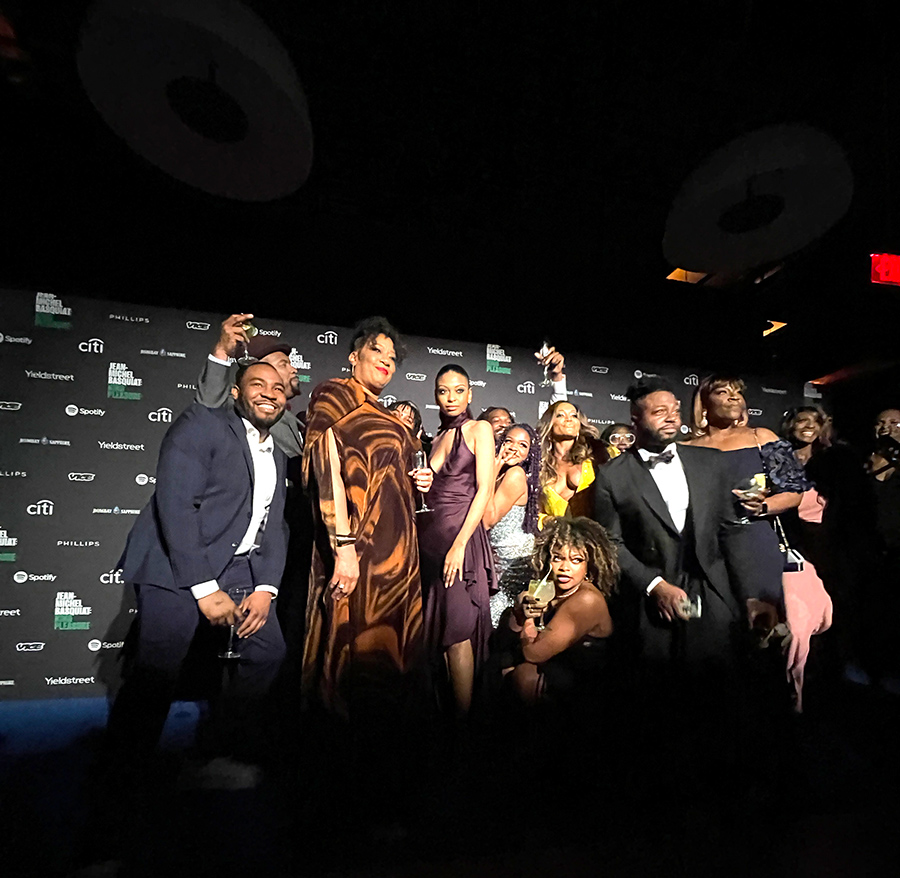
At the opening Lisane Basquiat shared that their stepmother Nora Fitzpatrick told the sisters a couple of years ago that all these works had “been sitting in a vault for 30 something years”, and that was long enough. “They needed to be seen and shared with the world,” said Ms. Basquiat. This is possibly the most exciting aspect of the show – never seen before works, numbering about 200, anchor the collection, indicative of his prodigious output during his decade or so as a fine artist.
Works on canvas are sometimes stretched on found wood frames, others are wood canvasses. One may indeed be the last one he worked on. Seeing the collection is like discovering old friends you didn’t know about. Or maybe it is like receiving a letter from an old friend, a breath of fresh air that brightens the heart – and reinforces the beauty of the person and their significance in your life. Taken as one, this is bold, assured, and determined presentation of his work that never overshadows it by a family that respects Jean-Michel. Reassuringly, this newly unveiled collection affirms that his work is just as relevant to today’s culture as it was during his brief career and time on earth, having the courage to speak his piece.
With our social and economic progress so incremental and uneven, ever unjust, one can imagine that Basquiat might have been exhausted today in his 60s. As a cultural omnivore who took inspiration from everything around him, he may also have been buoyed by today’s beauty, encouraged by people’s determination to progress, and inspired by the still-bubbling sense of humor of his sisters, nieces, and nephews. Many of them attended the celebratory opening of the exhibition Thursday night at the Starrett-Lehigh. Their energy and tenderness toward one another and their grandmother were easily seen, with pleasure.
Jean-Michel Basquiat: King Pleasure, presented by the family of Jean-Michel Basquiat is currently open to the general public. Click HERE for tickets, schedule, and directions.
Our weekly focus on the moving image and art in the streets. And other oddities.
Now screening: 1. Chris Pape: The Freedom Tunnel via VICE 2. SOFLES: The Humble Rollerdoor 3. Stargazing Mojave/Joshua Tree National Park 4. Angel and Z Podcast Interview NECKFACE 5. Tripl Stays True to the Name
BSA Special Feature: Chris Pape: The Freedom Tunnel
All time Top 10 stories in NYC graffiti lore will invariably name-check the “Freedom Tunnel,” so called in the 1980s because of its most famous writer, Chris “Freedom” Pape. You may not know where it is located, but you know that it is cavernous, that the sun is filtered into it from grates above like jolts of raw power, and that it is also home to many New Yorkers who are off the grid. That’s just one of the many ironies of calling this “Freedom Tunnel.”
One of the revelations of this intimate interview is that Freedom is rational in his rather laissez-faire approach to people and painting, preferring his own counsel and leaving others to theirs without judgment. These could be the gifts of later life on display – certainly rarely heard sentiments from your average vandal. He says he chose the tunnels as a strategy to avoid the withering criticism that he heard other writers had of train pieces while reviewing passing cars. An illustration painter, his time-intensive works based on more classical fine art works and techniques were unusual on the graffiti scene, perhaps presaging the coming Street Art movement.
SOFLES: The Humble Rollerdoor
With his customary ease and can-control panache, SOFLES is aided here by sophisticated variations in pacing, focus, gaze of the camera. Drop in a few visual glitches and slights of hand – all against a non-background audio that sounds like pouring rain, and he takes us somewhere else again, again.
Stargazing Mojave/Joshua Tree National Park
Is life magic? Are there holes in your dreams into which birds can drop into? Is the earth in movement at all times, always dancing? Yes, it is.
Angel and Z Podcast Interview NECKFACE
It doesn’t get better than this. Interview with a writing/fine art legend in a fleabag hotel. Who knows what kind of wisdom he’s about to lay on you.
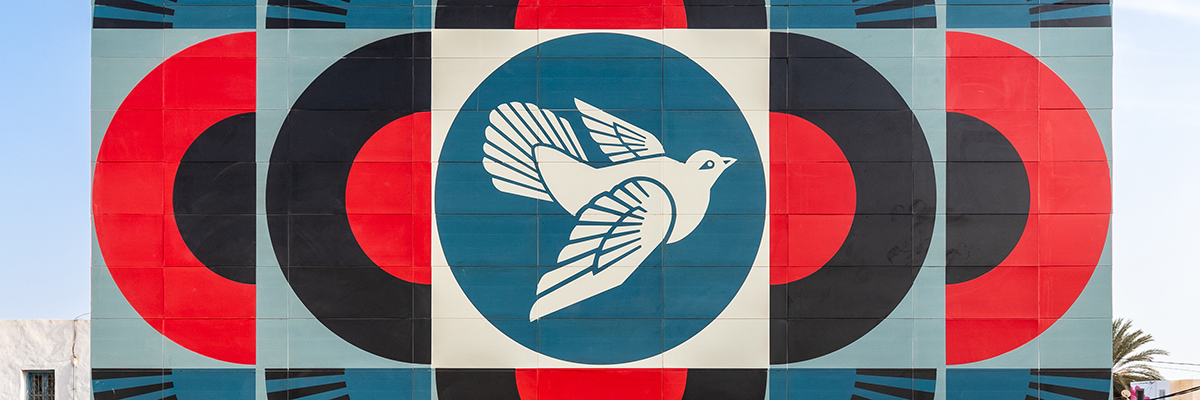
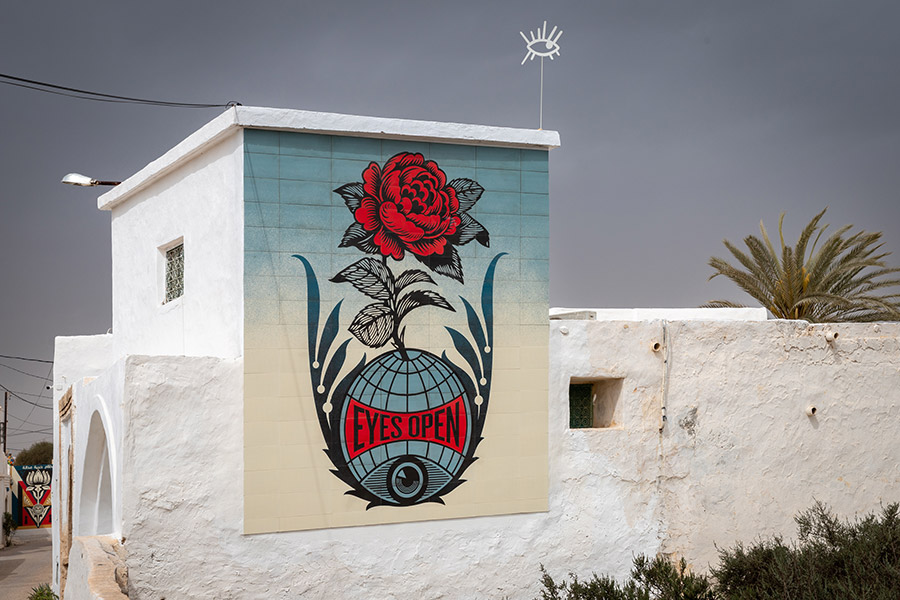
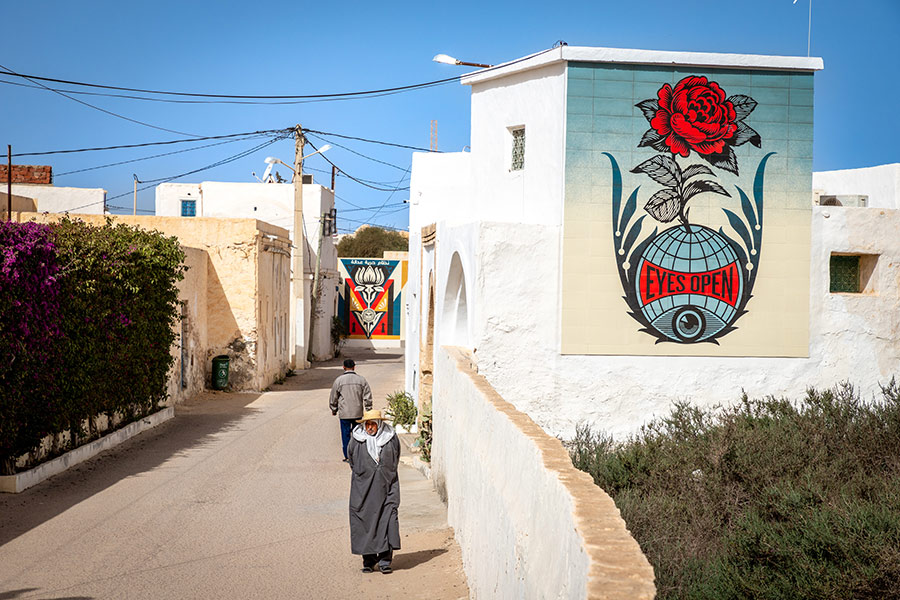
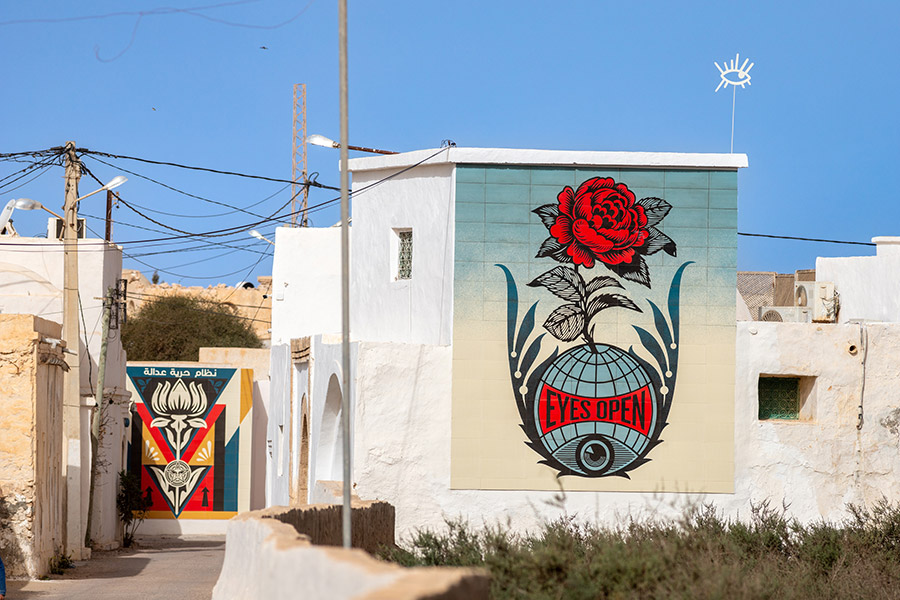
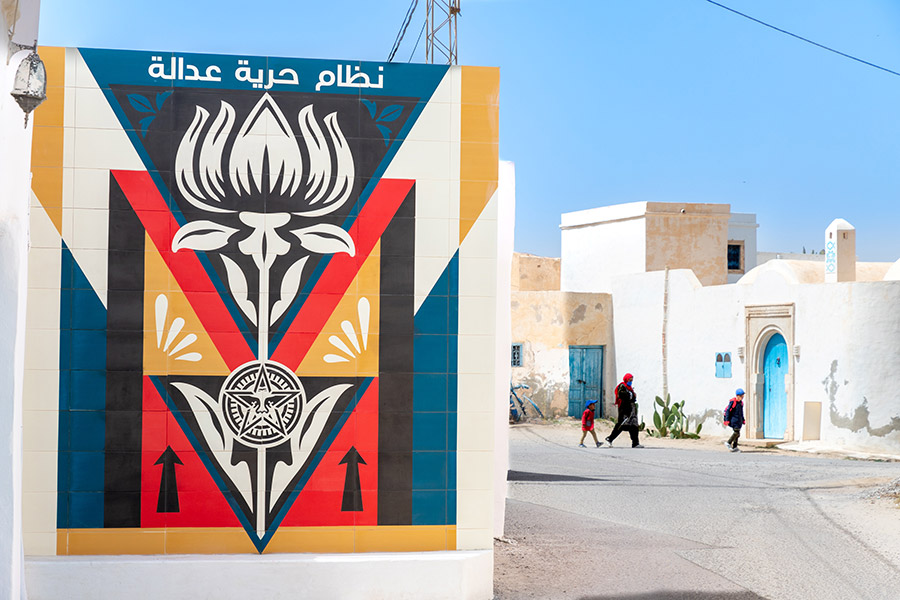
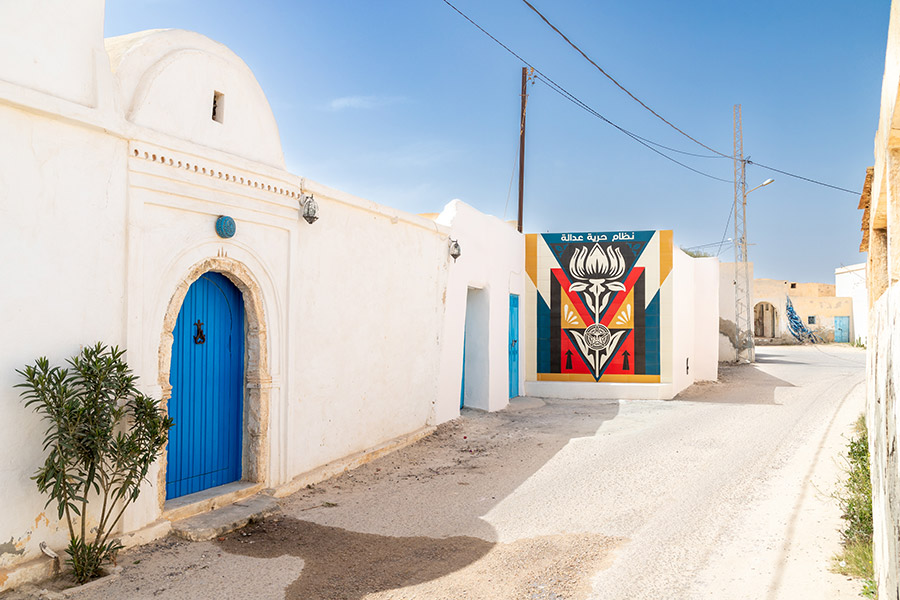
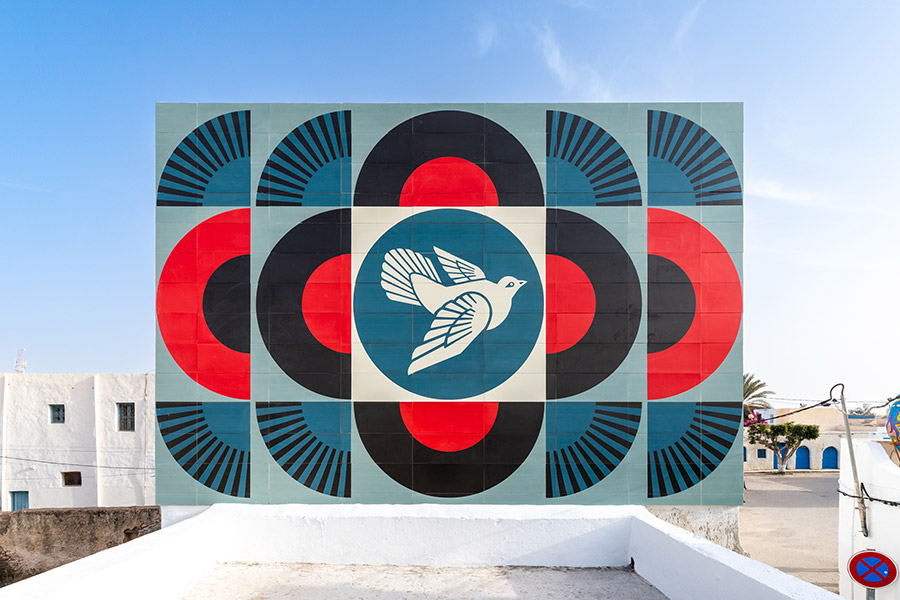
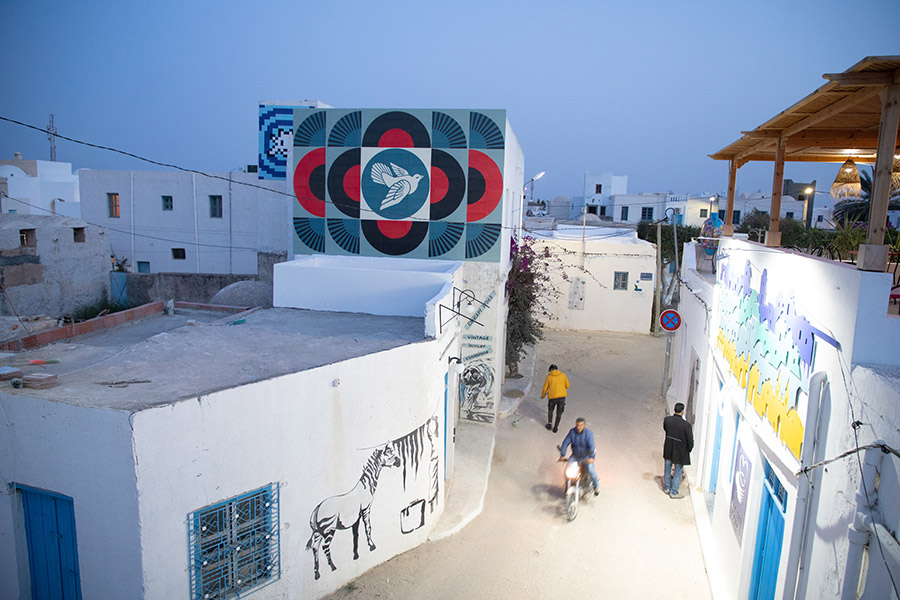
We have brought you many images and artists from here since The Djerbahood Project began a decade or so ago – with the French Galerie Itinerrance organizers inviting street artists of various styles and influences to this Mediterranean island to transform the public environment, and of course to stoke interest in their artwork. Erriadh is literally an open air gallery, with over a hundred works filling this two-thousand year old village. Today we bring you new installations of works by Shepard Fairey, whose graphic geometries and pop colorways contrast sharply with the sun-drenched walls and small streets.
 BROOKLYN STREET ART LOVES YOU MORE EVERY DAY