All posts tagged: Street Art Book Review

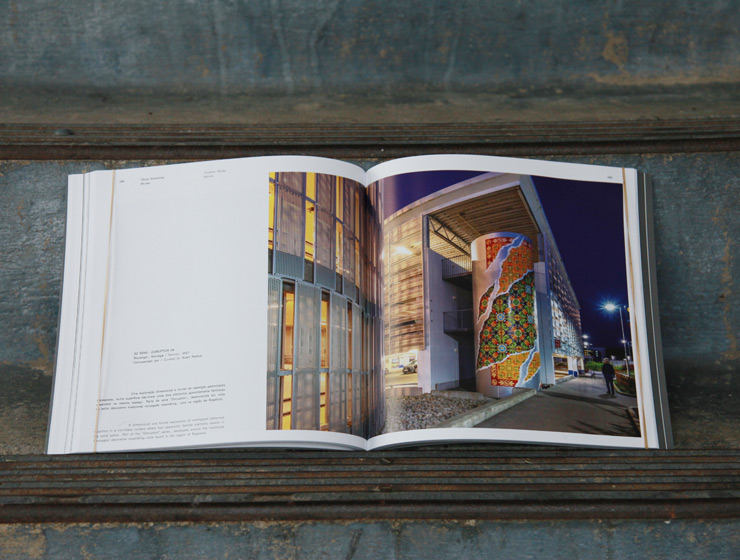
El Seed Illuminates Ways to See Others with “Perception”

El Seed Illuminates Ways to See Others with “Perception”

The perception you may have of Tunisian calligraffitist el Seed’s new limited edition hefty white-box tome is that it will contain austerely designed blue chip contemporary works, a book meant to be stacked for aesthetic impact on the toniest of coffee tables. But often perceptions won’t give the full picture.
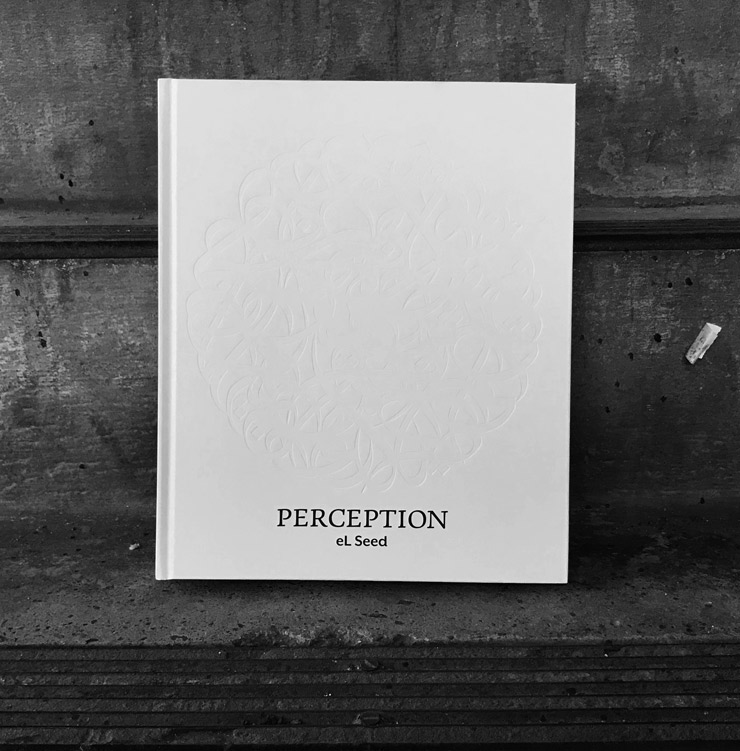
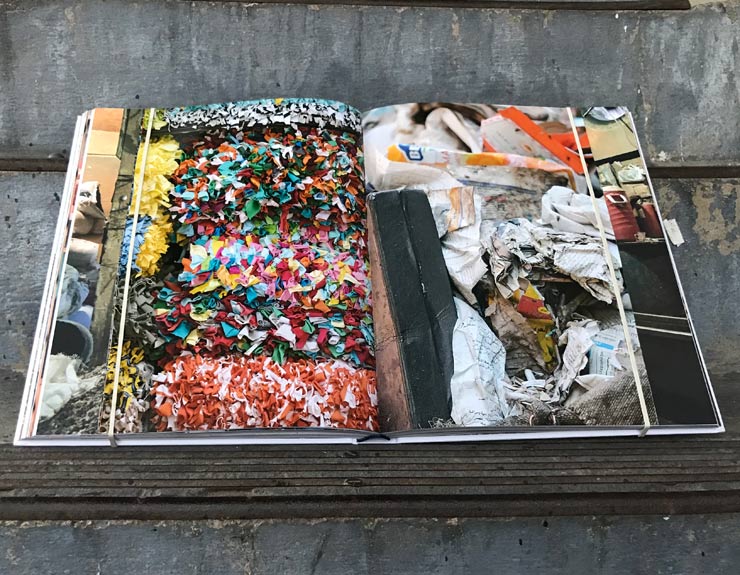
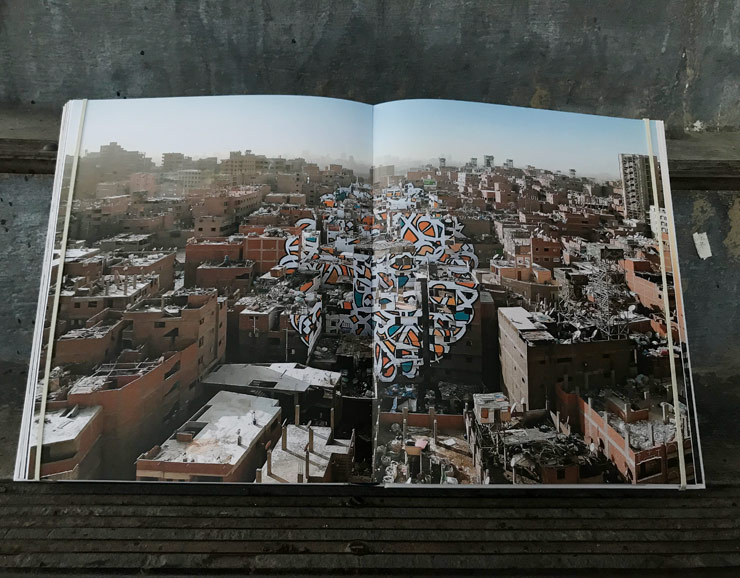
And el Seed is the first to tell you that in this deeply personal account of his art project across fifty buildings in Mashiyat Naser, a neighborhood of Cairo over two years ago. Born of his personal need to challenge himself and to add more to his career as a respected muralist, his original concept of working in this neighborhood of 70,000 recyclers was informed by his own assumptions, perhaps of helping a community known in the city as Zabbaleen, or “garbage people”.

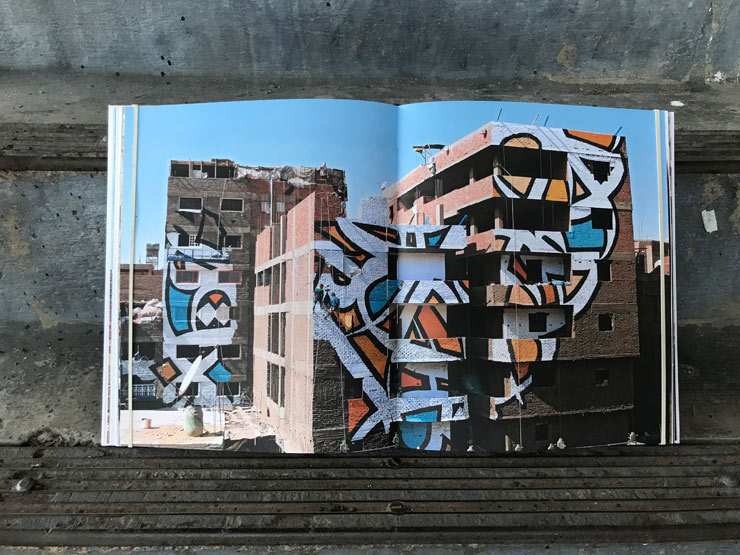
Over the course of the project he and his team describe through interviews and with his own diary style how their own eyes were opened. It is an incremental revelatory experience that paralleled the quote that he stylized throughout the pattern of his piece, “Anyone who wants to see the sunlight clearly needs to wipe his eyes first,” from the writings of Saint Athanasius of Alexandria, a fourth century Coptic Bishop.
Scaling the power networks seems as natural to el Seed as scaling a massive wall, and he demonstrates his acumen for winning the approval and involvement with his project from the Othodox Church religious leader Father Samaan, whose permission is used to open doors in the community for painting. With the project the artist also garners the attention of  MoMA in New York, specifically Glenn D. Lowry, who introduced him at Art Dubai after the project was completed and who writes the introduction to this book.

But here the artist tells you that nothing prepared him for his own personal transformation plunging himself into the neighborhood. With time he says he realized that he had an incorrect perception of the people who recycle the city’s garbage and that he received the larger gift from them.
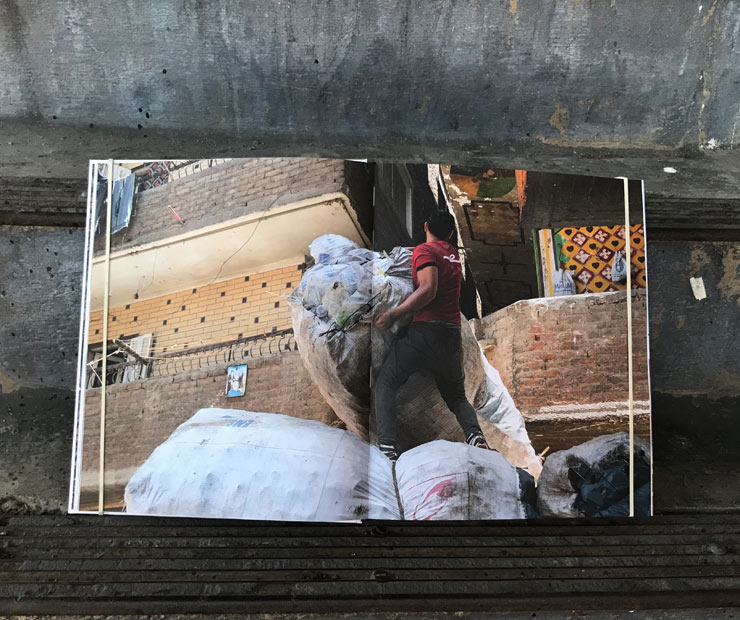
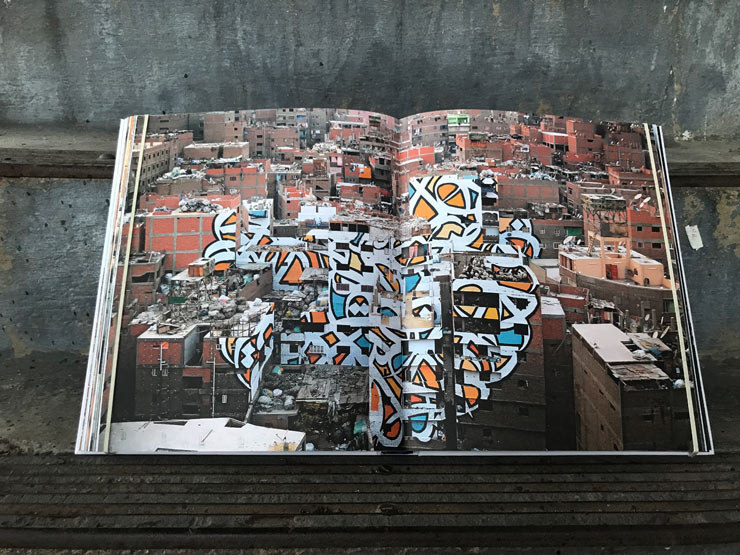
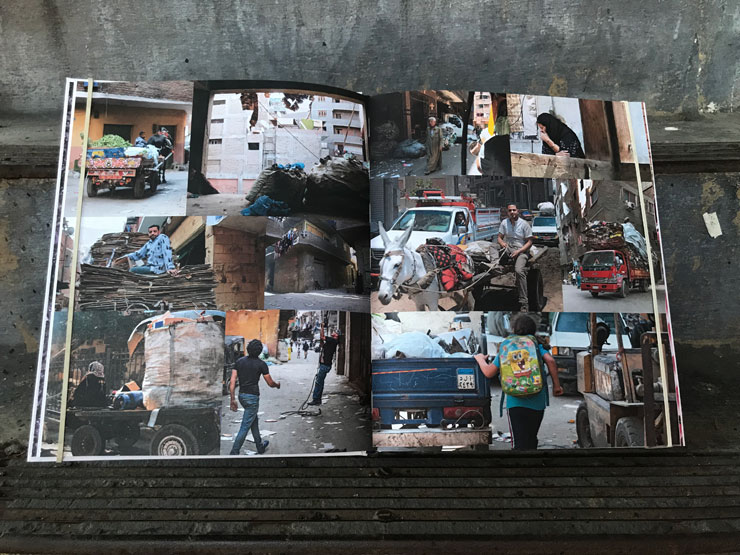
Through photography and interviews el Seed illustrates his own learning process as well as his own teams meeting the social, political and physical demands of such a public artwork. By following the story the reader gains appreciation for the process and the nature of life there in a part of the city that even his first taxi driver was hesitant to drive into. Despite the impressive massive public artwork that can be seen in its entirety from one specific vantage point, it almost feels to the artist that the art was secondary to the project.

“The project helped establish a dialogue, create a connection. Looking back, we understood that this was born out of recognition,” he writes. “We approached a rejected community and involved it in a piece of artwork. They were part of the creative process by their presence, their looks, their smiles and their proffered hands. There’s no doubt that’s how we got through it, despite the steep streets, unsteady houses, unexpected electricity cables and heaps of garbage.”
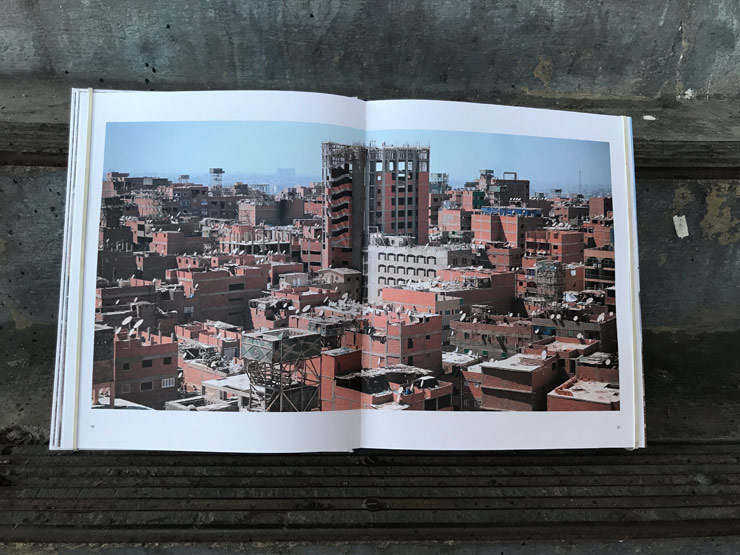
The neighborhood has garnered international attention in recent years, drawing a string of international ‘news’ crews who produce shallow, sensationalist and ultimately degrading pieces, a series of bad experiences that have left locals feeling far more suspicious of outsiders – especially those with probing questions and camera equipment.

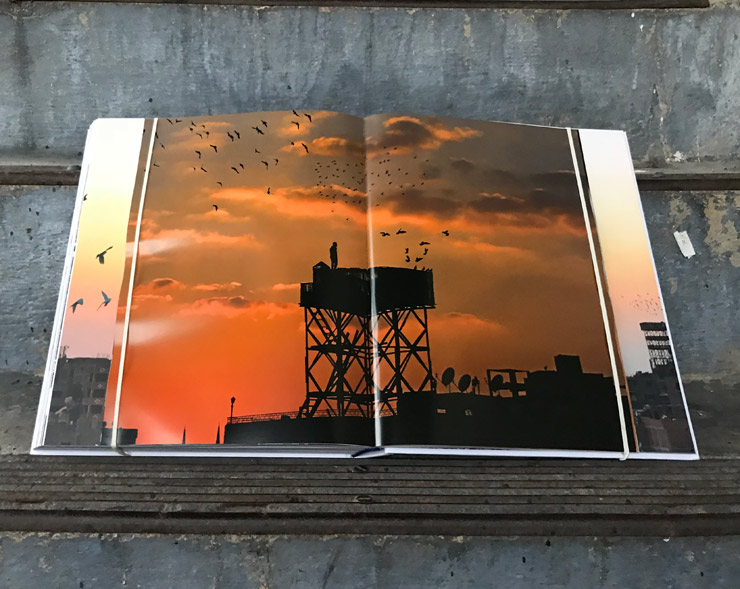
Mahdi is a photographer/videographer who has worked with el Seed in the past and who followed the team throughout the weeks of installations capturing not only the community, the architecture,  and the painters but also the various livestock that are raised on roofs or in backyards in this dense part of the city – contributing to an often overwhelming acrid smell. As the documenter of the Perception project Mahdi says that he gradually realized that he had misjudged the folks who lived there.
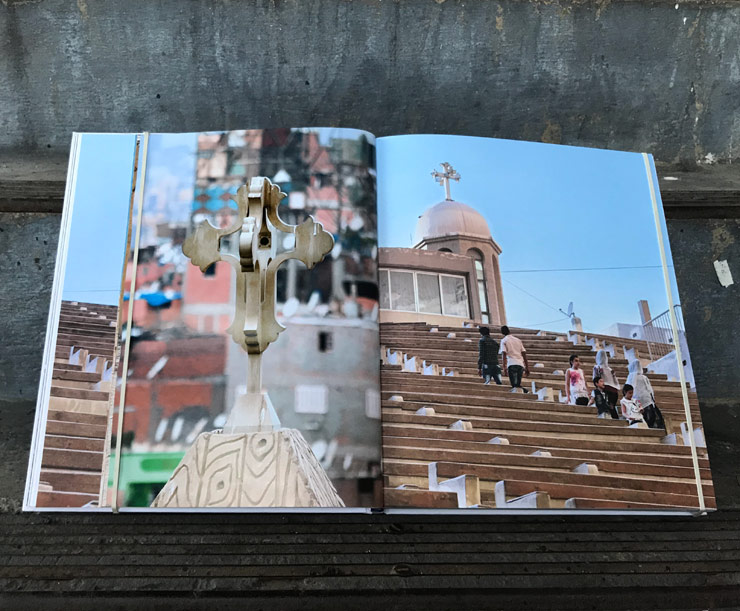
“I was not so convinced that these people really like their life or that they were not bothered with any details of their job until the day I interviewed Abu Atef,” he says. “That man and his wife were proudly announcing in front of my camera that it is their job to collect the trash from the big city and that without them Cairo would be full of trash and dirt. They were so proud and happy with their life; I’ve never seen people as happy as them. The life in that neighborhood is hard, the work is so hard, but their smiles are stronger.”

One of the team painters says that although the work of using less-than-optimum hand cranked lifts to paint poorly constructed brick walls day after day in intense heat caused him to discover “some muscles that I had no idea existed in my body,” the bonds he made were stronger than any other job he’d had.
“The connection that we had with the community was insane. I worked with people for years in offices and for different companies but I didn’t stay in touch with anyone. I worked for three weeks with these people and the team, and we are still in touch.”

“After a few days the light they had inside of them started to come out. I stopped judging them and I started to see who they really are. I’ve never seen people who work like that in my life. They never stop, they work almost every single day and they only have one week off during the whole year. And they are smiling all day long. I still remember the family of Uncle Bakheet while they were sorting the trash, laughing and joking with us. This project made me “wipe my eyes”.
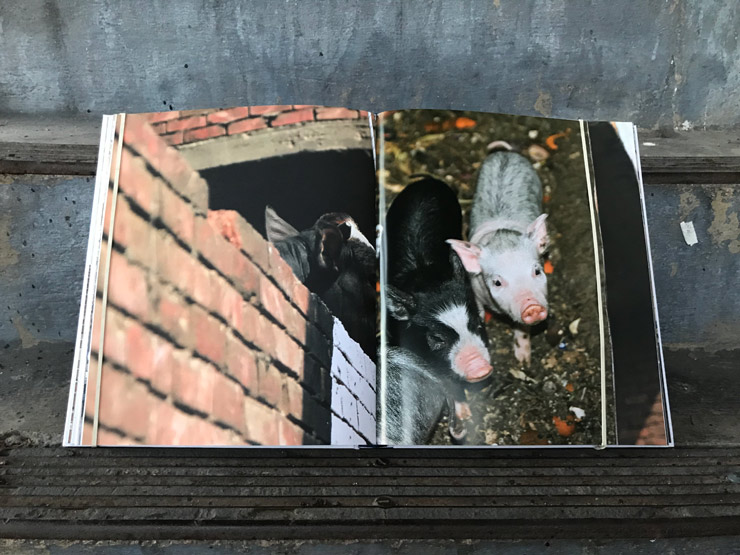
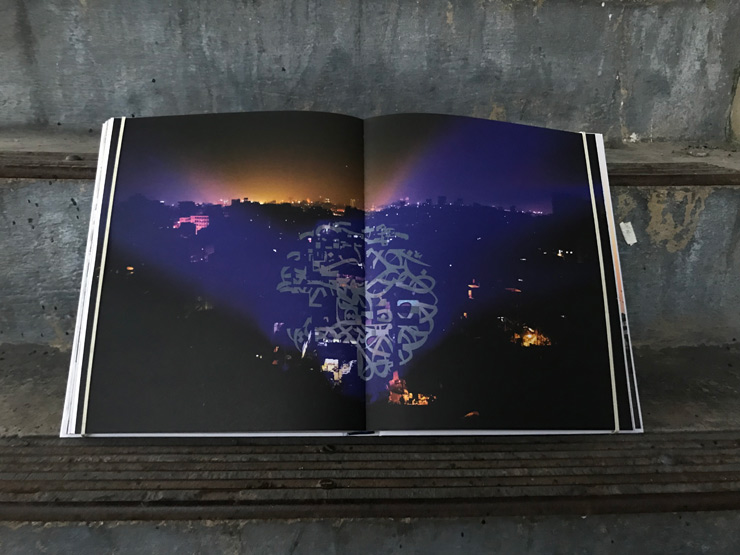
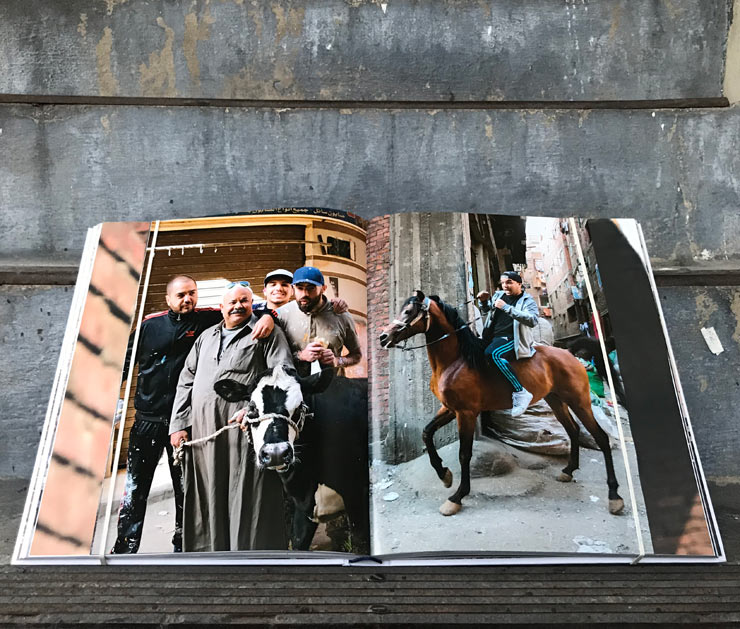
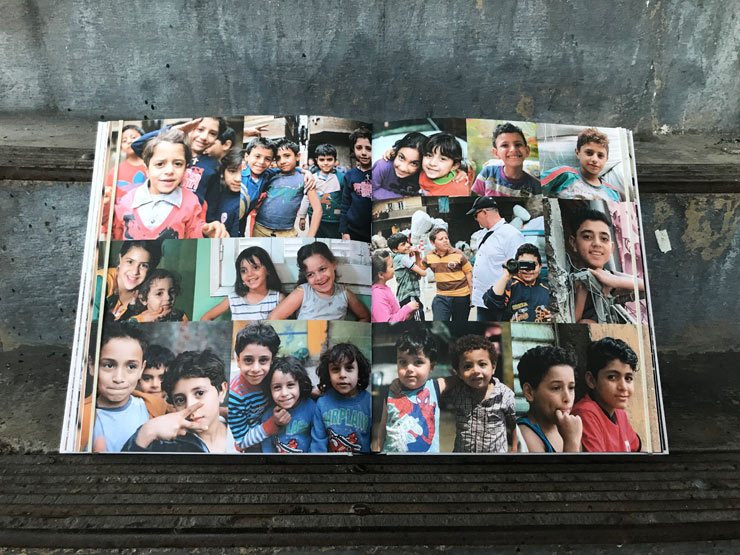
The photographs are genuine, generous, and not sentimental. The prose a bit sweetened, the emotions expressed not always flattering, the descriptions even-handed, the vulnerability a gift. In the end, the artist says that he and the team were amazingly proud of the massive anthromorphic mural and the group effort that made it happen. They and the neighbors were also thrilled with the effect of the large black lights that turned the fluorescent underpaint of the white areas into a miraculous view – a secret for the audience until the moment the switch was thrown. What resonates is the deep emotional connection that appears to have affected so many of the participants; lives that were indeed transformed by art.

“In the touching and colorful tranquility of their existence, the exceptional and unique community of the Zaraeeb offered us a valuable philosophy of life, of inevitability, equanimity, humor, human values, hard work, generosity and determination,” says el Seed.
El Seed PERCEPTION Published by Point à la Ligne. Milan, Italy. 2018.

Read more
“Ex Animo”,  Eight Years of Poetry by Faith Forty Seven

“Ex Animo”, Eight Years of Poetry by Faith Forty Seven

Worn workers, wild beasts, a bloom in the rubble.

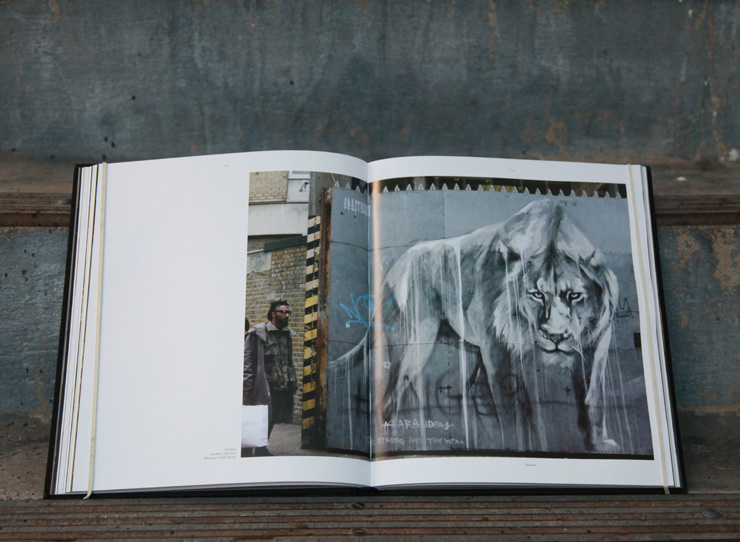
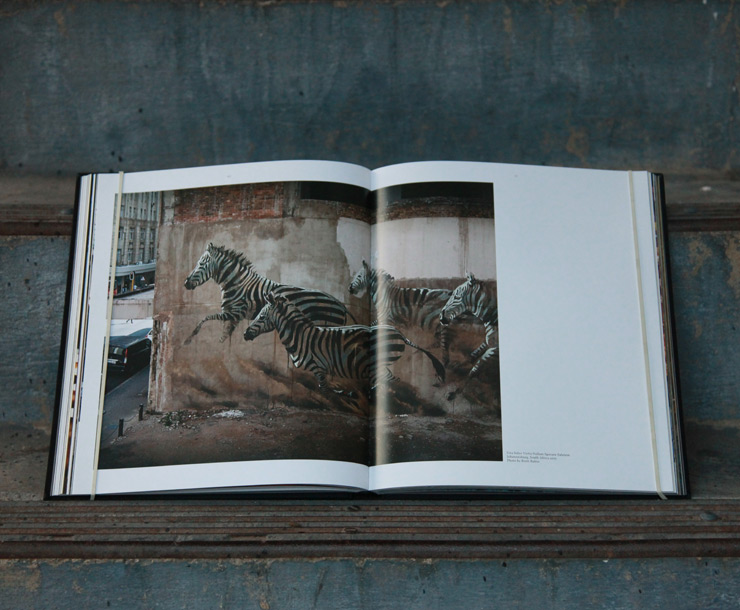
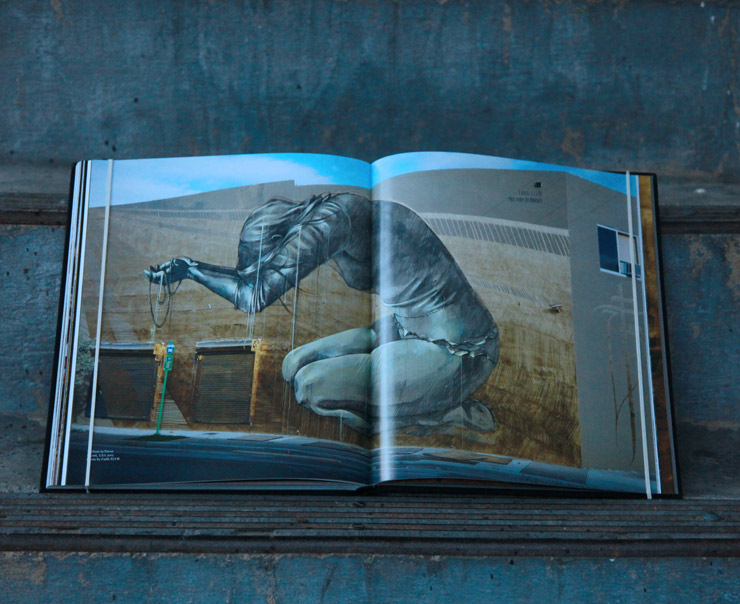
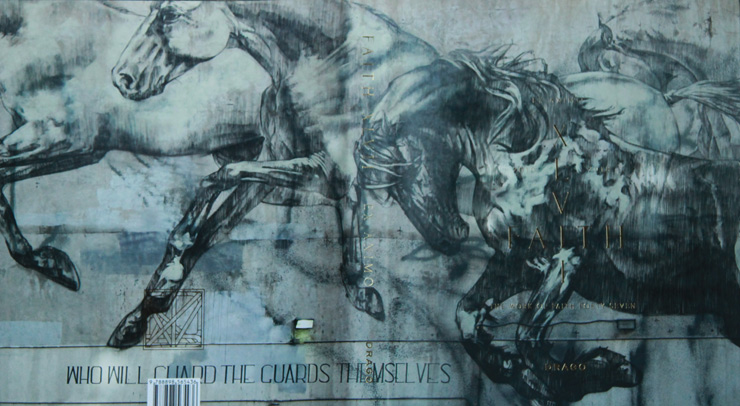
Prayers of supplication and longing, racing teams of stallions and master felines of fury, the exhausted figure of a dream barely still illuminated, a wistful stage in the plundered urban landscape, or a plundered life.

This is what she does to you. As Faith IXVII leaves her stolen stanza, her massive mural in washed hues, her tributes to a moment lost in a city that would leave you to die if it had its way, she makes you make poetry.

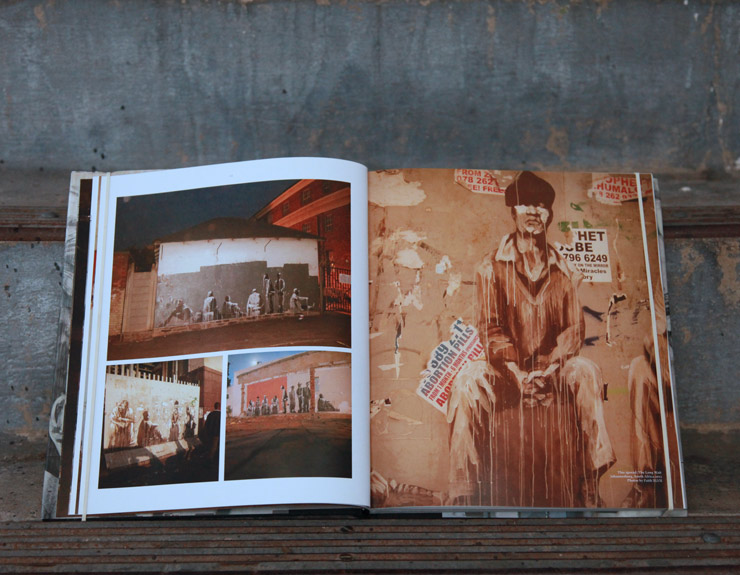
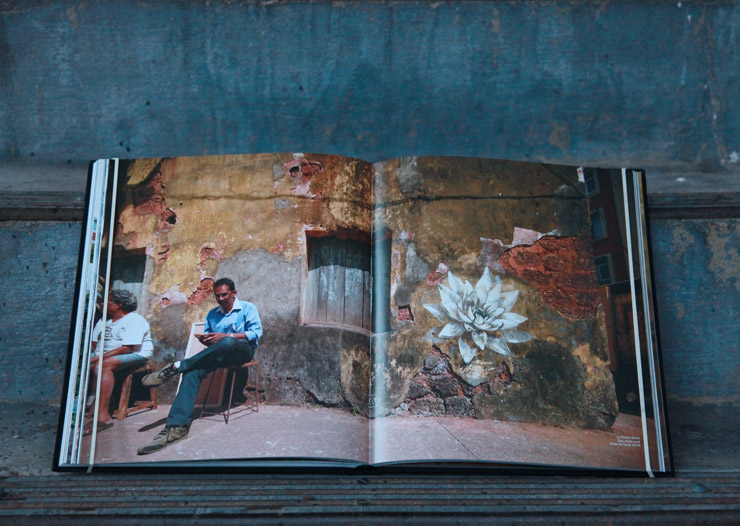
“Artists are driven to leave a mark, something that will tell their story, or the story of their time,” writes Jacqueline Flint when speaking of the South African artists installation work. Whether stories she has found, constructed, or caught in the ether as they drift by, Faith has left many tales for you to unpack in cities from Wuhan, China to Chinatown in New York City to Goa, India and Portland, Washington.

In EX ANIMO you can see where she’s been waving to you from, even as you passed by, or beneath.

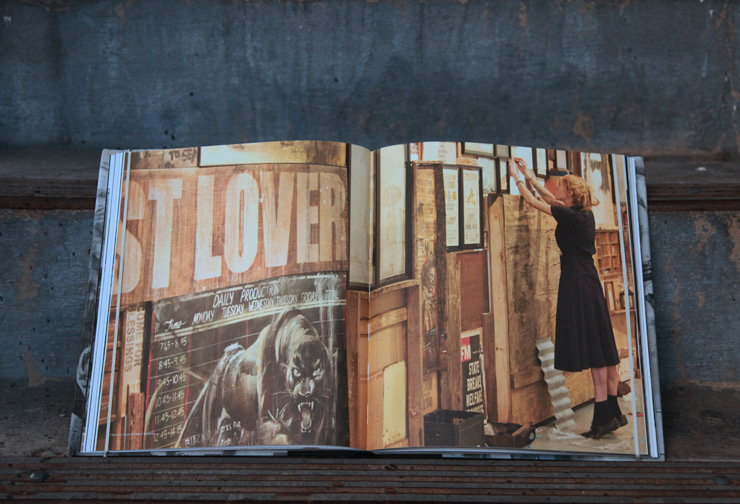
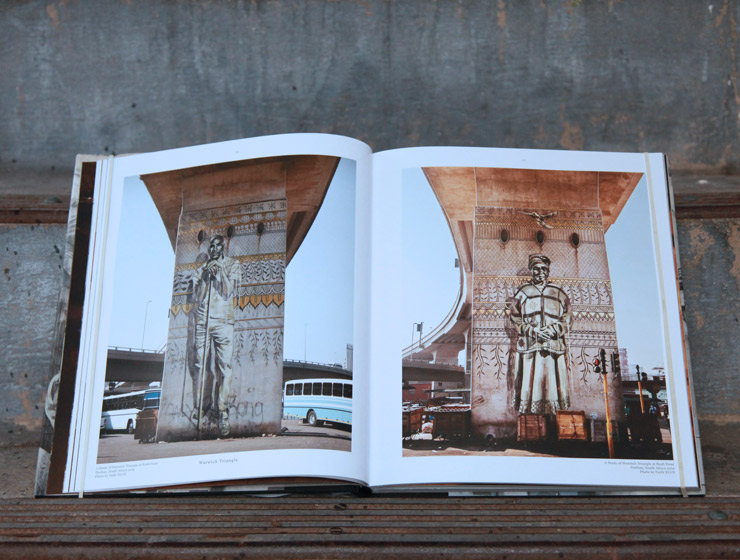
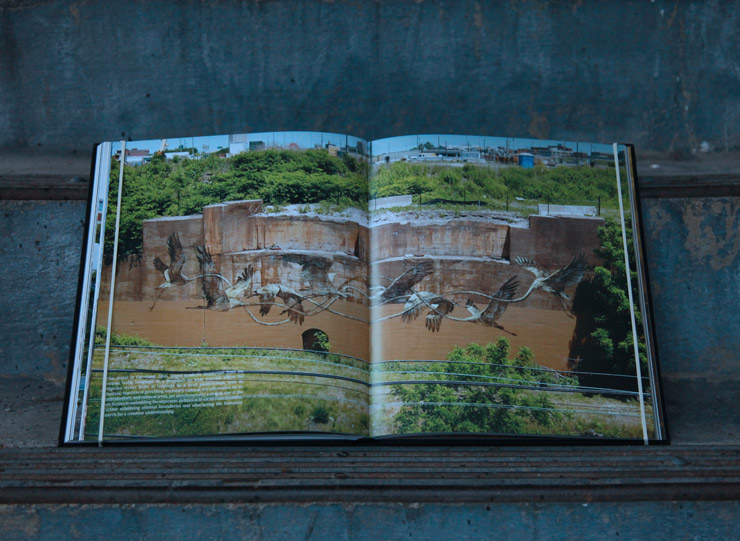
Published by Drago and edited by Roger Gastman, the handsome volume captures the opus works and gallery installations and hidden gems on temporary construction walls and pillars holding the highway, all part of the modern vocabulary of Street Artists who weave themselves into the fabric of the megapolis. But there is much more if you care to see it.

“Anyone can make art in the streets but a rare few create socially impactful content, and there is no denying that Faith’s work has transformed perspectives among her global audience,” writes Kristin Farr in her essay, and it is true that the width of a mind and heart can be pushed a little further with these hard won truths.

“A language of empathy borne in a scream of rage, hurled like a Molotov cocktail but given the wings of metaphor and the grace of allegory,” writes Carlo McCormick in the introduction,”Faith’s work on the streets commands all the monumentality of public art yet whispers its deepest secrets in the hushed tones of prisoners and stowaways, travelers whose journeys demark the limits and possibilities of no where else to go.”

Whether it is the rhythm of the lunar cycle or the steady, now racing, beating of blood through hearts and lungs, its a meditative measure of Faith that appears on our streets pointing to our folly and our burning fire within. Often it is a poem that rises inside.

Faith XLVII. “EX ANIMO’ THE WORK OF FAITH FORTY SEVEN/ 2010-2018. Drago Publishing. Rome, Italy, 2018


Read more
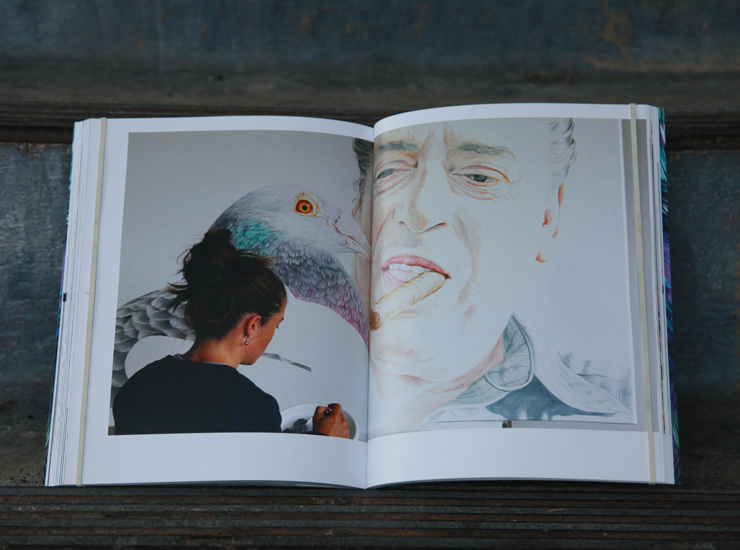
Adele Renault Takes Flight With a Message of “Feathers and Faces”

Adele Renault Takes Flight With a Message of “Feathers and Faces”

For many the shock of Silent Spring was not that the chemical industry had run roughshod over the rules and poisoned our water, air, and soil.

For a large number of readers it was the fact that Rachel Carsen’s “fable for tomorrow” included a vision of the future that we didn’t want to imagine; our lives without birds, without their songs, their beauty, their plumage, their companionship, their resilience in the brutal city and in the great outdoors.

Yes, DDT was eventually banned in some countries – after its use was linked to damage to wildlife, birds, bees, agricultural and domestic animals – and to humans. 56 years after JFK included Silent Spring in his summer reading, his nephew won a lawsuit, the first of thousands expected, against Monsanto and RoundUp this summer – so obviously we’re slow learners.

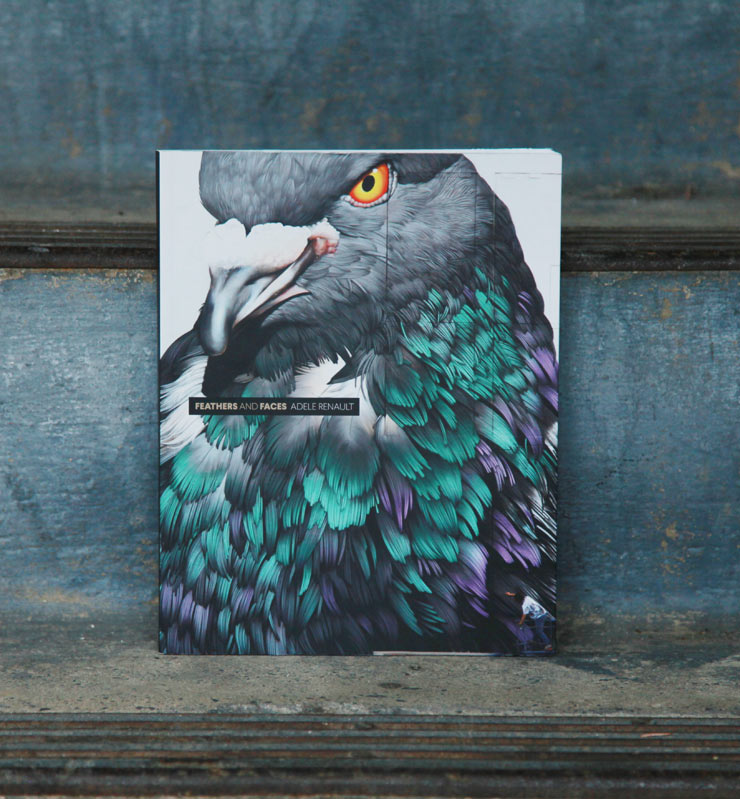
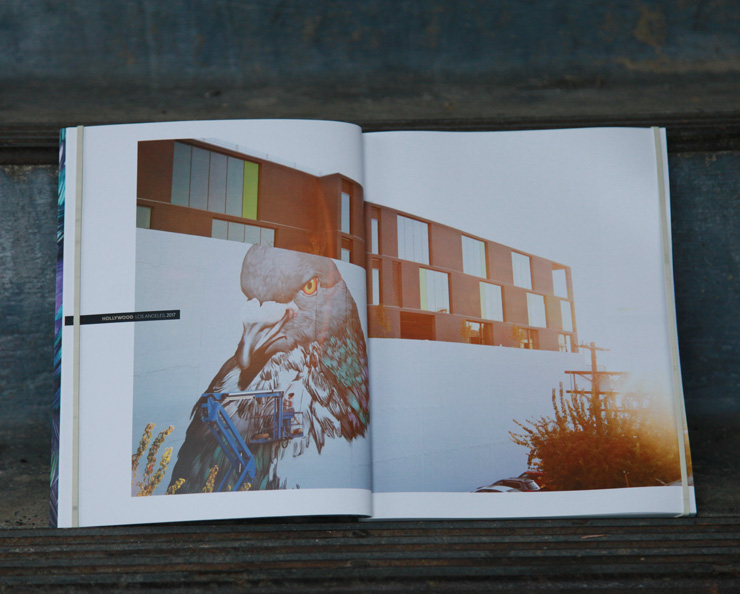
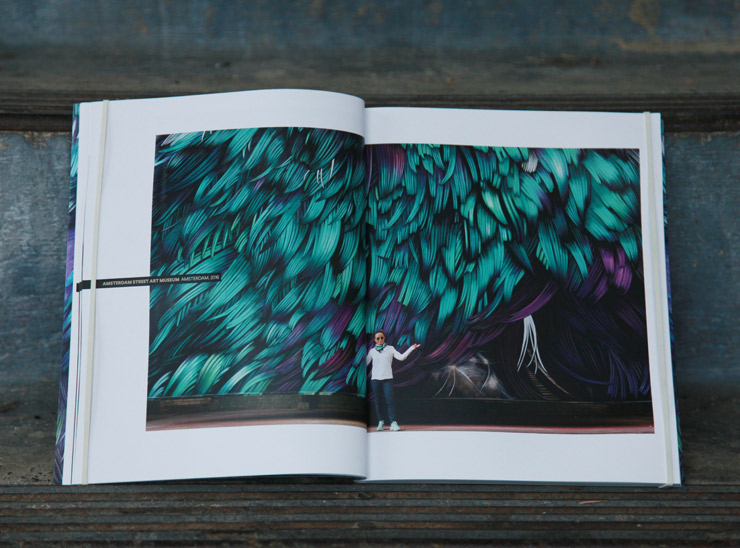
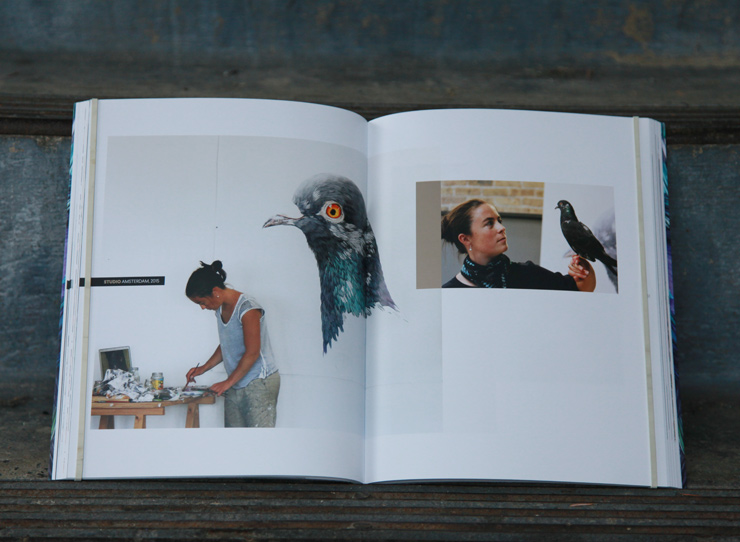
Street Artist/fine artist Adele Renault understands our interdependence with the birds and with each other perhaps better than many, and “Feathers and Faces” carries the message powerfully by delivering these works she has done on city streets and galleries in New York, Berlin, Amsterdam, San Francisco, Singapore, Burkina Faso, Helsinki, Moscow…

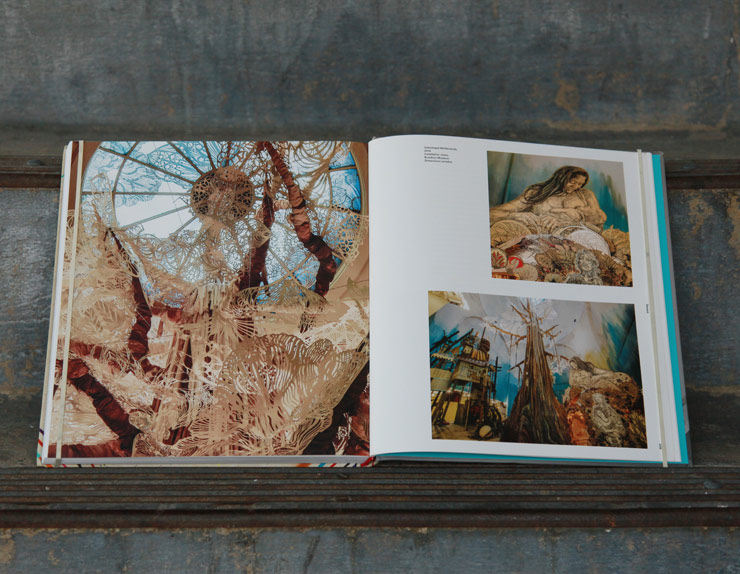
We saw her in Moscow just two weeks ago where she collaborated with photographer Martha Cooper on an installation for Artmossphere Biennale 2018, which BSA co-curated. In addition to her stunning wall painting of a pigeon and Martha’s photographs of her pigeon photos during the last 40 years, the two of them created a coop, named “Coop’s Coop”, and featured Adele’s painting of “Martha”, the last carrier pigeon – that died September 1914 and whose remains are now on display at the Smithsonian.
Clearly, there are more than six degrees of interconnectivity in this story and literally billions of stories across the world of our interdependence with birds.

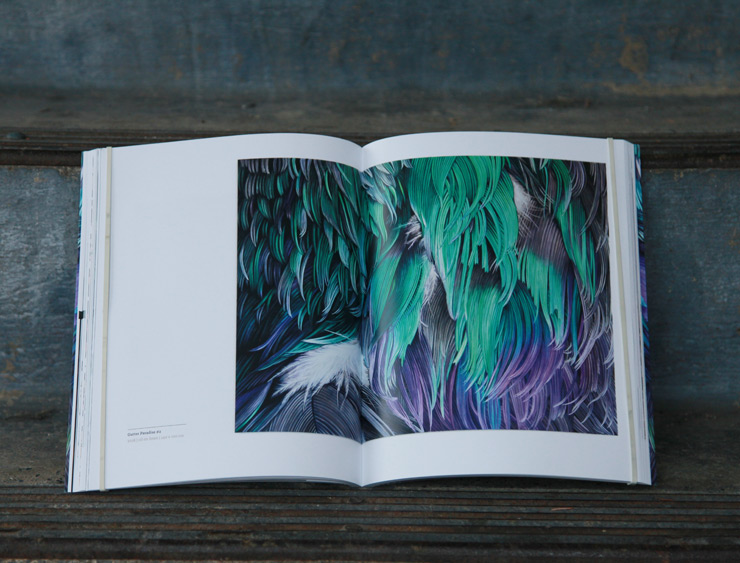
We share this city with pigeons. We look to the same environment to supply us with what we need, including food, water, shelter – depending on physical factors like as soil, air, a temperate climate, other organisms. Adele studies our feathered friends and brings them full force to the streets, and we know that here only the scrappiest survive and get to display their colors.

Adam Eeuwens takes his worldview and interpretations of the ornithologists and merges them with a stark assessment of the significance pigeons have to us in his intro to Feathers and Faces.

“As a spirit animal in symbology, the pigeon represents the values such as home, and it’s attributes of love, peace, grace, care, security, foundation, fertility, and family, bringing an inherent sense of belonging. The pigeon is safest in a flock, with the strength and support found in the community and in communication.

The pigeon is determined, nothing will chase it away from food. And of course, the pigeons are messengers, of tidings that one must be open and receptive to, as it is the nature of this beast to hold blessings. Being aware of seeing a pigeon, whether awake or in a dream, teaches one to be resilient, to find the comfort of home within, to be cooperative, compassionate, resourceful, loving, and forgiving. It asks you to embrace change.”
Art on the streets is a state of continuous change and murals are redefining our cities, drawing our attention to issues somehow overlooked in our movies and media. Right now, today, the animal kingdom is being decimated and humans are being turned into refugees in an unprecedented number.

Our ecological interdependence is woven into our historical, cultural, sociological, political, physical, mystical, emotional existence. It is fitting that the resilient Adele Renault finds the details of perseverance and beauty in the lines of our faces and the sheen of their feathers and the determination in the eyes of us all.  It is our nature.

Adele Renault. Feathers And Faces. Foreword by Carlo McCormick.


Feathers And Faces by Adele Renault was published in 2018 and is distributed in the United States and Canada by SCB Distributors.


Click on the link below for information on Ms. Renault’s one day exhibition tomorrow Sunday September 16, 2018 in Jersey City, NJ:

In Situ Creative and The Ring Side Lounge present: Adele Renault: “Tyson’s Corner” (Jersey City, NJ)


Read more
Rafael Schacter Investigates “Street To Studio”

Rafael Schacter Investigates “Street To Studio”

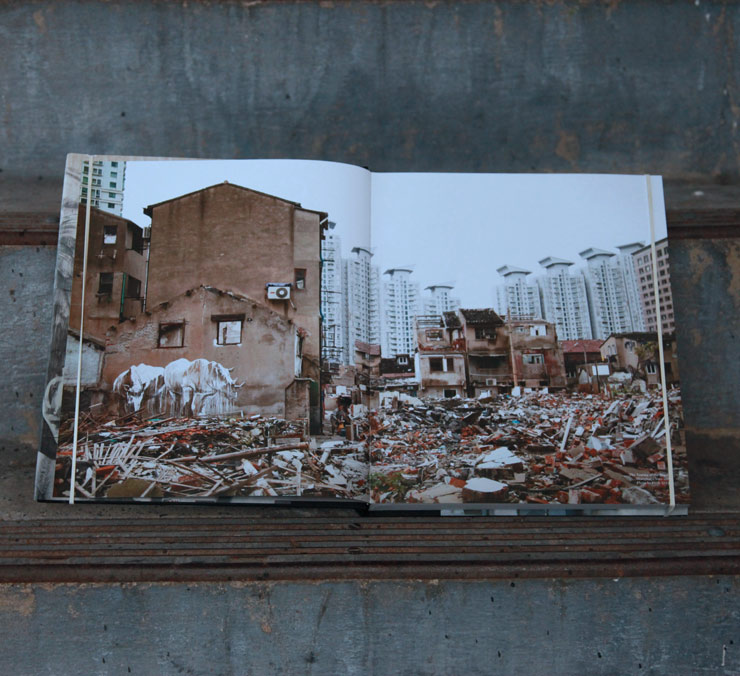
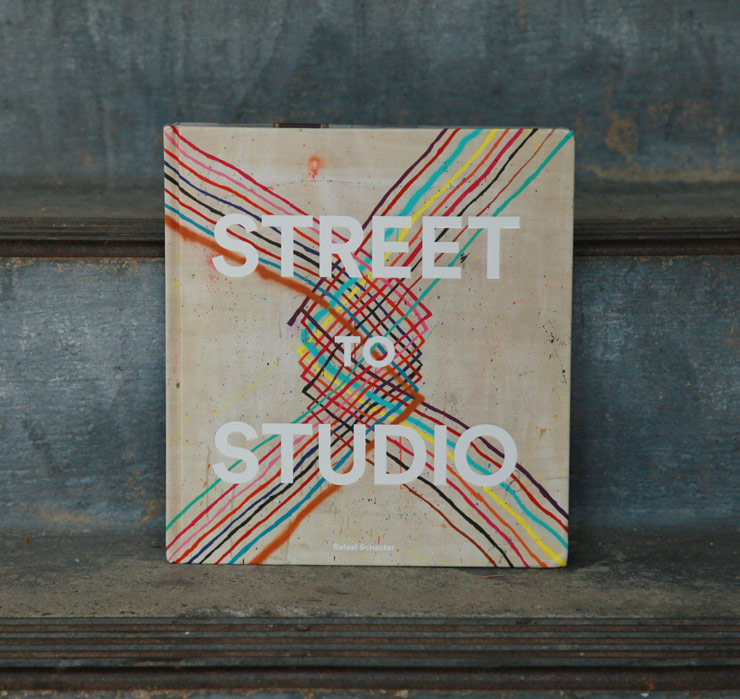
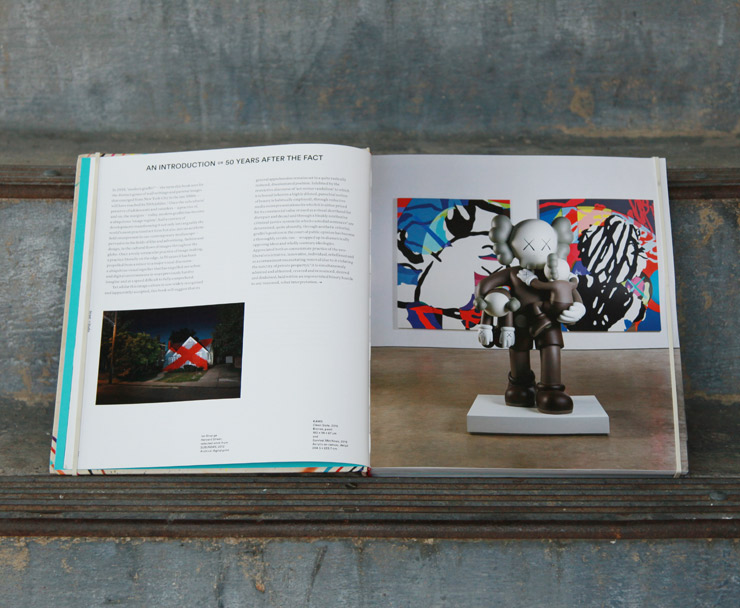
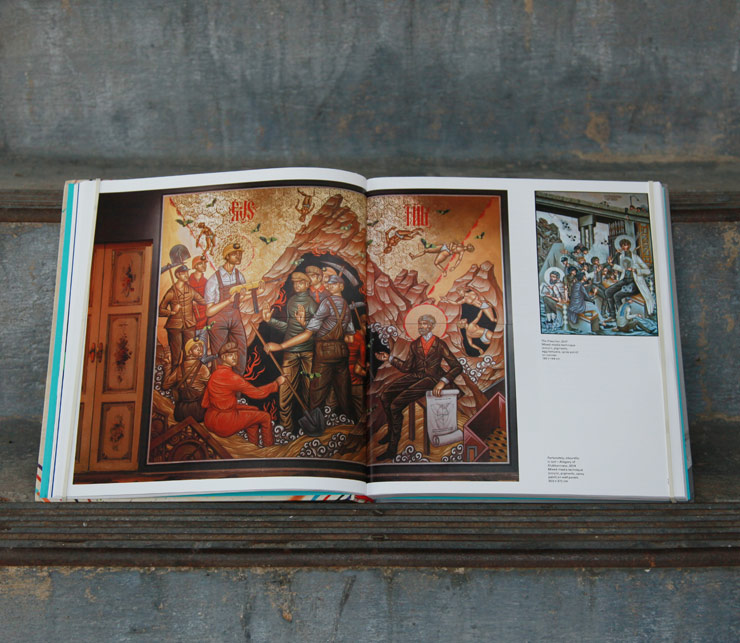
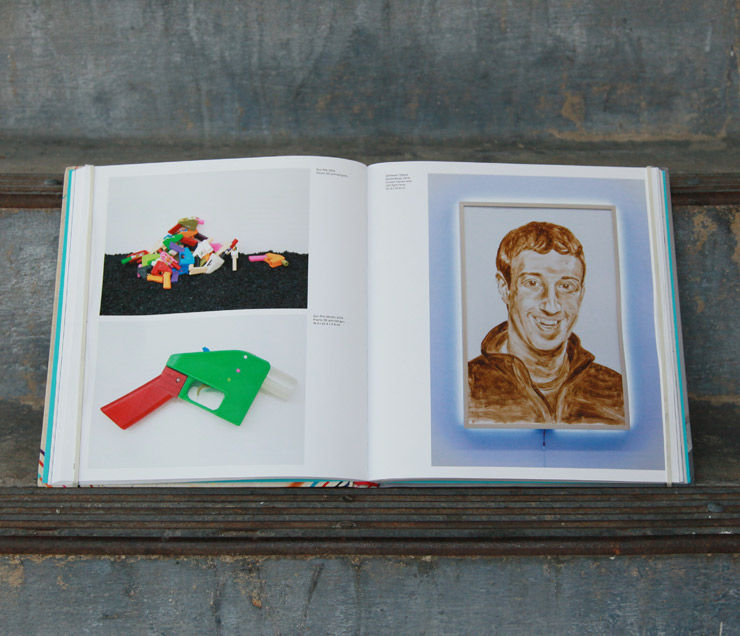
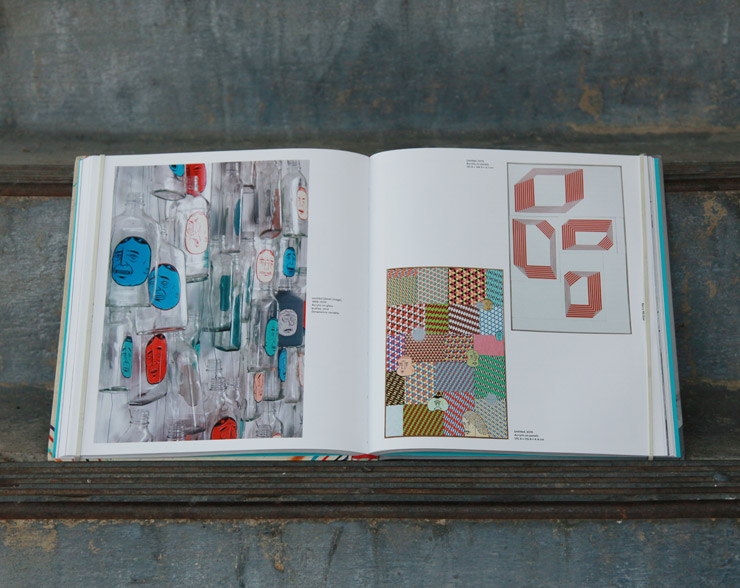
“These are artists who are thus not slavishly reproducing their exterior practice within an interior realm but who are, rather, taking the essence of graffiti – its visual principles, its spatial structures, its technical methods, its entrenched ethics – and reinterpreting them with the studio domain,” says author Rafael Schacter in his introductory exposition for his book Street to Studio where he offers a unique assessment derived from his 10 years of researching the foundational, conceptual, methodological, and ethical considerations that impact the original graffiti/Street Art scene as well as where it is going.

Rafael Schacter. Street To Studio. Lund Humphries Publishers. London, 2018.

The presentation is impressive in the craft and depth of field; the 40 artists whom he has chosen to profile have elements of each of these considerations to one degree or another as they move from street culture to more formalized ways of analyzing their works. Whether figurative, conceptual, performative, iterative, abstract, ephemeral, or purely digital, Schacter endeavors to find a common thread in a wide field of work and influences that have as their common denominator a regard for the practices of art in the streets.

It may be difficult for some readers to see the streets from here; perhaps it is not a measurement of relative biographies or works through storytelling as much as it is an examination of methods and practices. Often it could appear to be a name-checking of alliances with recognized contemporary artists, schools of art practice, and an anchoring to experiences as student of formalized institutional structures rather than the streets that help define the artists – criterion which ironically have been used to bar consideration of many early graffiti writers as relevant artists, with the effect of stigmatizing them.

Rafael Schacter. Street To Studio. Kaws. Lund Humphries Publishers. London, 2018.

There are not stories of economic or structural adversity here – although one can argue that these may be equally formative realities that affect one’s art practice. You won’t find many references to attending Public School 141 or the local community college or working as a bike messenger.

Instead there are many finely educated artists here with backgrounds in formal art theories – an MA in Fine Art at Central Saint Martins, an MFA at Universität der Künste Berlin, or London’s Central Saint Martins, Oslo’s National Academy of Art, Paris’ Saint Denis or Madrid’s Complutense. Being a part of the Mission School of 1990s San Francisco is what helps ratify a work as Fine Art, for example, even though switching the nameplates next to certain pieces may cause you to place the work in a number of possible categories or potential origin.

Rafael Schacter. Street To Studio. Stelios Faitakis. Lund Humphries Publishers. London, 2018.

The inclusion or exclusion of specific details in an artists journey or resume is the authors prerogative and is in service of supporting a view of the work.  As part of our daily discourse where we receive texts from artists, PR folks, and historians, we enjoy listening to how people and their art are described by themselves and others; what cultural signifiers are used, what associative “branding” is employed, and to note the differences that appear as they get closer to commercial or institutional success. Many of these artists here are nearly mid-career studio artists with connections to street practice, a substantial track record, and have taken great risks to challenge their work and their own perceptions.

Quoting McCormick again, “If we are to take graffiti and street art seriously, as not simply a method but a mandate, let us acknowledge studio practice as part of this process – but, equally importantly, understand the compatible, essential roles that action, observation and introspection play in progressive social art.”

Rafael Schacter. Street To Studio. Katsu. Lund Humphries Publishers. London, 2018.

Excuse the tangent: In our own discussions here online and offline for the last decade we’ve noticed a certain “whitening” of the landscape as we get closer to certain environments like fine art or contemporary art. In the ongoing class war that is human life on Earth, the assured divine nature of the resource winners is ever buffeted by a self-created system of rewards and penalties and cleverly clouded demerits – and you can see this at art fairs and galleries some times. While many advents of style and practice may emanate from more grassroots origins, those originators have not always successfully claimed authorship of those great ideas once they have permutated into textbooks that tell the history.

Graffiti and Street Art have often been maligned, marginalized, and dismissed rather openly and subtly by many of the current class of museums, press, academics, collectors, and those aspiring to be them during much of its evolution, even if its techniques and conventions are imitated and appropriated. Now less tentatively embraced by adventurous collectors and institutions, there is still the trouble of how to present the work; currently afoot is a rebranding as Contemporary Art that imparts a crisp veneer of coolness without the association with less desirable traits.
You know which traits.

Rafael Schacter. Street To Studio. Barry McGee. Lund Humphries Publishers. London, 2018.

We have even been asked by some artists to stop calling them “graffiti writer” or “Street Artist” because they no longer want to be associated with the label, preferring “painter” or “contemporary artist” instead. Part of this is self-marketing, yes, and the aging of the terms that doesn’t quite encompass their current work. We can’t help thinking that part of it smacks of classism and classic eurocentric racism.
In the broadest manner of description, it’s generally accepted today that the hallowed halls of academia have held centuries of Eurocentric art evolution in the highest regard and dispensed with the contributions of most everyone else not willing or able to stroke the narrative of white straight male supremacy – this is understandable tribe-like behavior meant to insure a narrative about relative importance and in furtherance of these guy’s power.

Sorrily, it has often also been a disabling and narrow view that has lead many to miss and mis-characterize absolutely amazing contributions to culture and the canons, and we are all poorer as a result. The original graffiti artists cared little about these institutional views and looked instead for opportunities to be seen and heard by their peers and the public.

Rafael Schacter. Street To Studio. MOMO. Lund Humphries Publishers. London, 2018.

These observations are not directly related to the author or artists presented in Street to Studio but you may safely surmise that some of this work would be so far removed in traditional associations with train bombing and b-boys that many would say the relationship is thin, or tenuous – and it is sort of remarkable how refracted the field becomes.

It has been a continuous peregrination over five decades of course – this movement between the street and the fine art world and the commercial interests – with graffiti writers spraying across canvas in the seventies, collectors like Wicked Gary gathering tagged stickers on cardboard; art school kids like Dan Witz arranging garbage across the sidewalk in New York’s East Village in between classes at Cooper Union.

“The reciprocal flow between studio and street continues today, with ever more complexity and mutual sway,” writes art critic and cultural observer Carlo McCormick in his introduction to Street to Studio, and Rafael Schacter has undertaken with a scholarly eye this unthinkable task of measuring that complexity. The results are a thoughtful and considered collection of individual histories and practices, supported by his own research on the evolving academic discussions that will define the era.

Rafael Schacter. Street To Studio. Evan Roth. Lund Humphries Publishers. London, 2018.

The graff-writing culture persisted; it evolved and nurtured and inspired a few generations and studio practices that followed. Street Artists work has spread across entire continents and into cities around the world without help from institutions, public programs, or academic approval. Now it merges with all our modern fashions in aesthetic and intellectual art-making yet it stands on its own – even as we grapple to document and describe it.

“The development of a distinct studio practice and institutional oeuvre is key to the text, even whilst this may disregard some important artists working today,” says Schacter regarding his methods of analysis for inclusion in this particular story.

“Overall, what was key was to provide a rounded selection of artists working in diverse formal and conceptual manners – artists pushing their practice with the realms of architecture and abstraction, performance and painting, digital art and new media, yet whose output provides a perfect exemplar of the dense possibilities that graffiti can provide.”

Today a generation of art students who grew up with the transgressive social politics of punk and hip-hop and wore wildstyle lettering and drips on their backpacks and clothing have their imaginations permanently sparked and have inherited an automatic expectation that their art could and should be staged on the street as well, illegally for extra points. Those practices expand and evolve and the current results are here. It appears to be a two-way street between outside and inside.

The spirit of graffiti is without doubt here. We just may not have realized how many forms it could take.

Rafael Schacter. Street To Studio. Swoon. Lund Humphries Publishers. London, 2018.

Read more
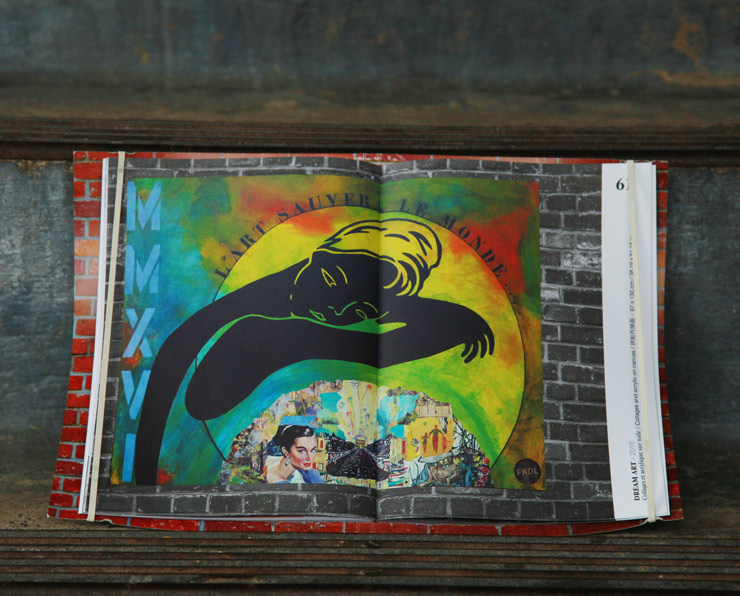
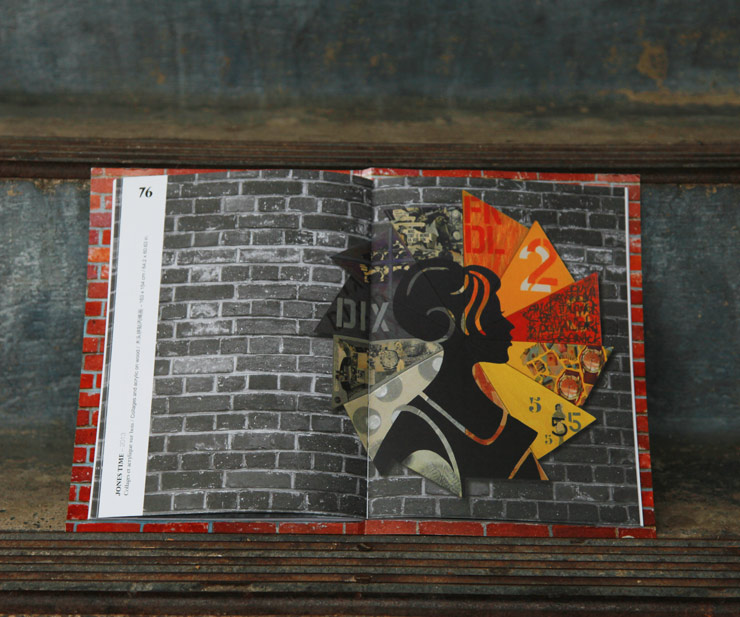
FKDL and the Collage of a Street Artists’ Life in a Book

FKDL and the Collage of a Street Artists’ Life in a Book

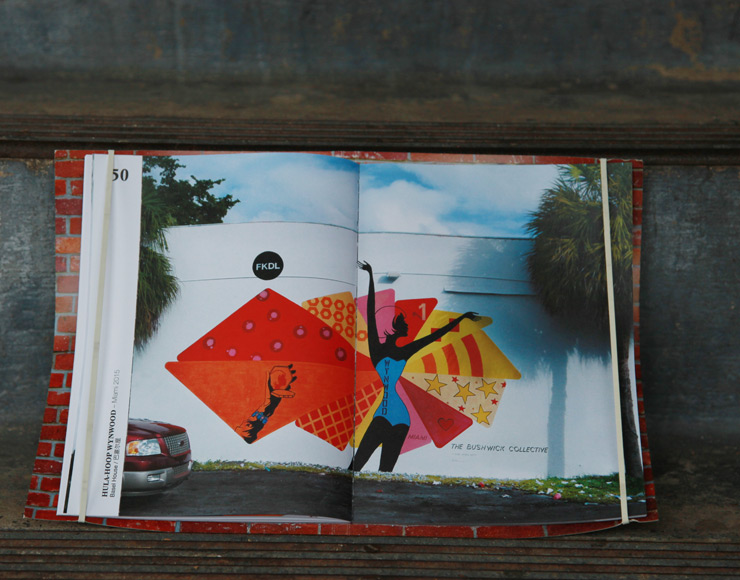
As you look through this new slim volume about the Street Artist/fine artist FKDL it may strike you how much autobiography is the determinant of an artist’s path as well. It’s the tale of a teenager finding himself, finding his vocation, and eventually finding his voice on the street. When you reach the end you see that it takes a number of years and a lot of experimentation, this journey.

FKDL. Galiote Prenant. Choisy-le-Roi, France. 2017.

FKDL now tells his own grown kids, “everything you do now will come in handy later.” Don’t worry, nothing is wasted.

It’s good advice that should put many a teen graffiti writer and Street Artist at ease because that is the path that a creative life may take before it all sticks together and begins to make sense.

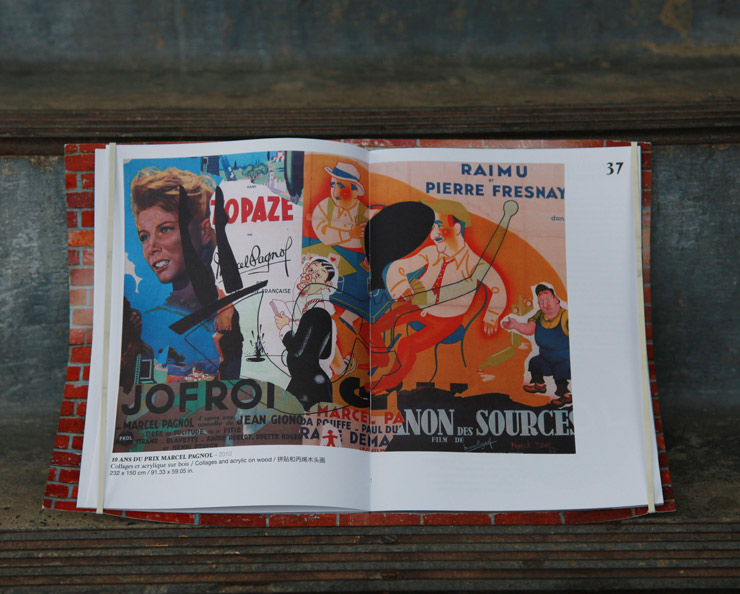
Pulling imagery and text and memories and infatuations from his own formative events and through each era, FKDL uses a process of sorting into piles, sifting, putting relevant elements along side or over top of one another, constructing a cohesive view. With seemingly disparate pieces of stories he organizes a view that turns into a narrative of the imagined, the aspired to, an ideal.

FKDL. Galiote Prenant. Choisy-le-Roi, France. 2017.

The French street artist uses the walls of the public walkway as a principle staging to test his work and expose his process to the public. Until the last decade the audience was in galleries or his studio but his is a strange new liberation and the feedback he receives gives him direction for what follows. These are lessons he would not have known way back in high school studying fashion, or later learning about how to join the circus, but he still brings that training to the game today.

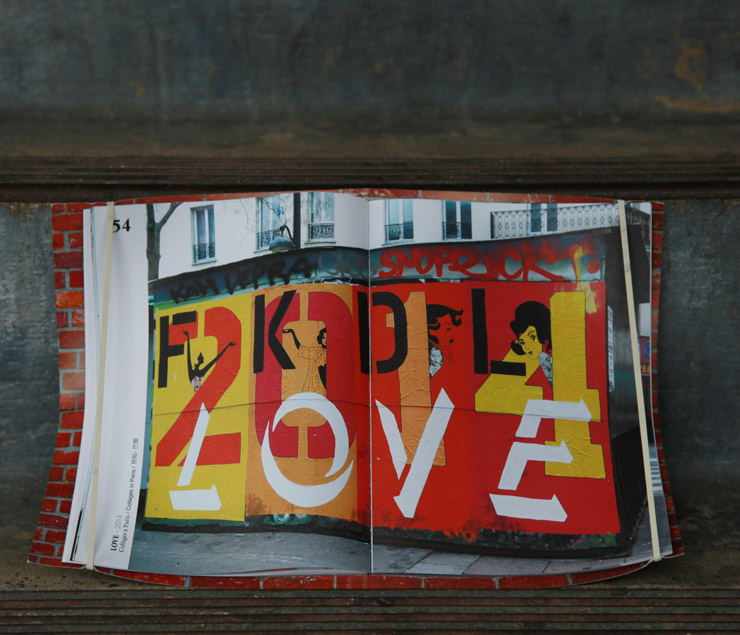
He speaks of his testing grounds for his Street Art – the neighborhoods of Le Marais, Les Halles, Belleville, and Monmontre in Paris. ” The Streets are where I test the durability or impact of an idea, an image, an icon. I build, I glue, and I wait. How social media, vandals, and the public works teams respond to my collages tells me whether the work is successful or not.”

FKDL. Galiote Prenant. Choisy-le-Roi, France. 2017.

This new book tells in detail the path of a creative painter, collagist, and even a maker of L’Art Scotch (tape art) over the period of a few decades. Perhaps most impressive is the very organized collection of vintage French magazines from the 40s, 50’s, 60s that he has amassed and the myriad intricately woven tales of love and glamour and disappointment and treachery that can be buried among those pages and used to construct new dramas.

For him, its mostly about love. As a fairly linear narrative, the book also shares memories and perspectives from the artist about getting his work shown in galleries, joining group shows, receiving awards, wheatpasting with friends on the street, spending hours in his studio.

FKDL. Galiote Prenant. Choisy-le-Roi, France. 2017.

“Happiness is a sustainable state of psychological balance that should last over time,” he says of his own philosophical practice of actively choosing to be positive, including in his art making.

“It is a demanding practice, to think that, in the light of what we have experienced and wish to experience, each one of us is the principal creator of his own happiness and has an impact on that of others around us.”

FKDL. Galiote Prenant. Choisy-le-Roi, France. 2017.

FKDL. Galiote Prenant. Choisy-le-Roi, France. 2017.

Read more
Anders Gjennestad: A Door as “Canvas”

Anders Gjennestad: A Door as “Canvas”

A door as canvas. A door as canvas.

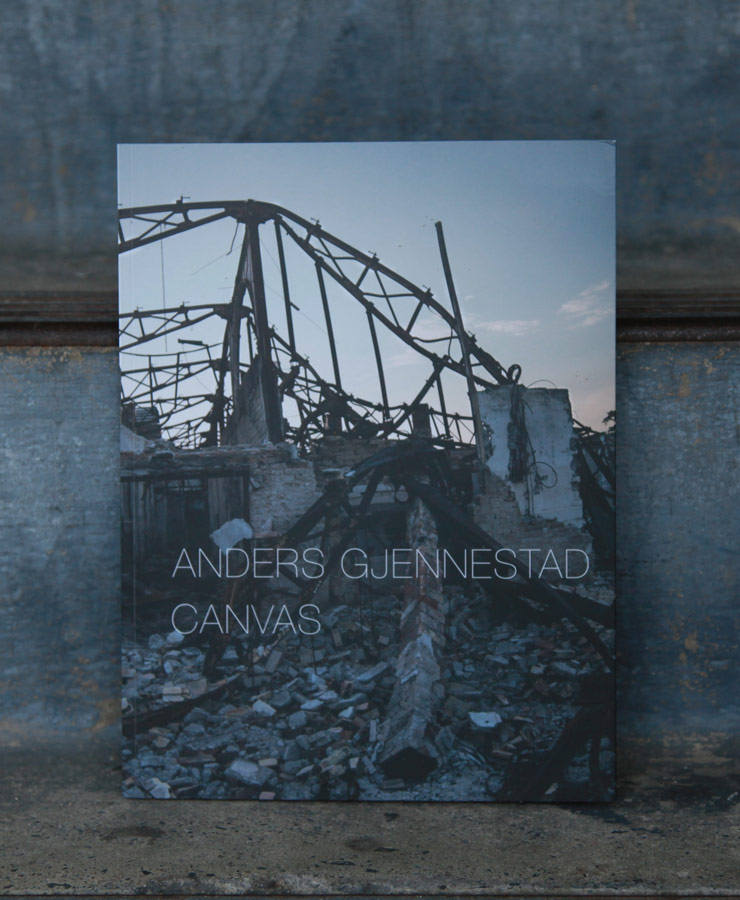
It sounds the same on the street as it does in the gallery space, and for Norwegian Street Artist Anders Gjennestad the two appear nearly identical, aside from context.

Anders Gjennestad. “Canvas”. Published by Galerie Friedmann – Hahn. Berlin 2018

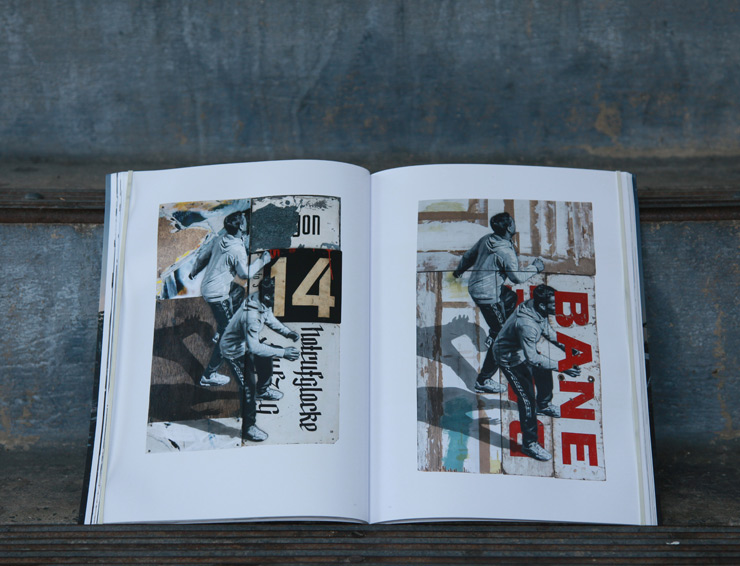
Whether he is discovering the neglected urban factory door long after the spirit of industry has roared its last turbine and reaching toward his backpack for a spraycan, or he is hoisting a piece out from the pile of collected iron-bound wooded slabs in his Berlin studio, functionally each of these doors is a canvas.

Every urban explorer sees the potential of walls that are long abandoned and spoiled with rot and piss and pushed open by weeds, worn away by rain. The world is a temporary place anyway. I am only here temporarily.

Anders Gjennestad. “Canvas”. Published by Galerie Friedmann – Hahn. Berlin 2018

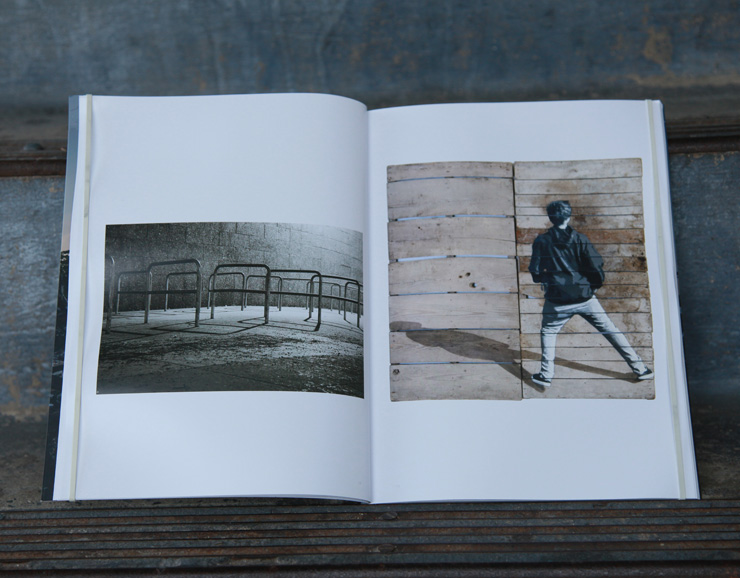
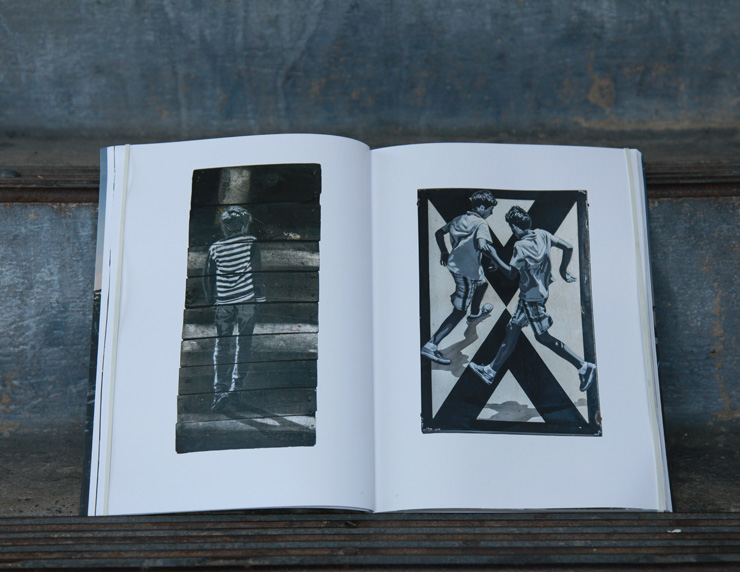
This cavorting, twisting, athletic dance with long shadows by men in hooded sweatshirts is a flicker across the canvas that you catch from the corner of your eye as your life dances by. His stenciled figures are expressive, interactive, fully alive, kinetic in spirit – singular and plural.

The symmetry and rythmic action is sport and performance and energetic expression across this patinaed, warped wood; this oxidized and oddly puckered and heavy iron and brick.

Anders Gjennestad. “Canvas”. Published by Galerie Friedmann – Hahn. Berlin 2018

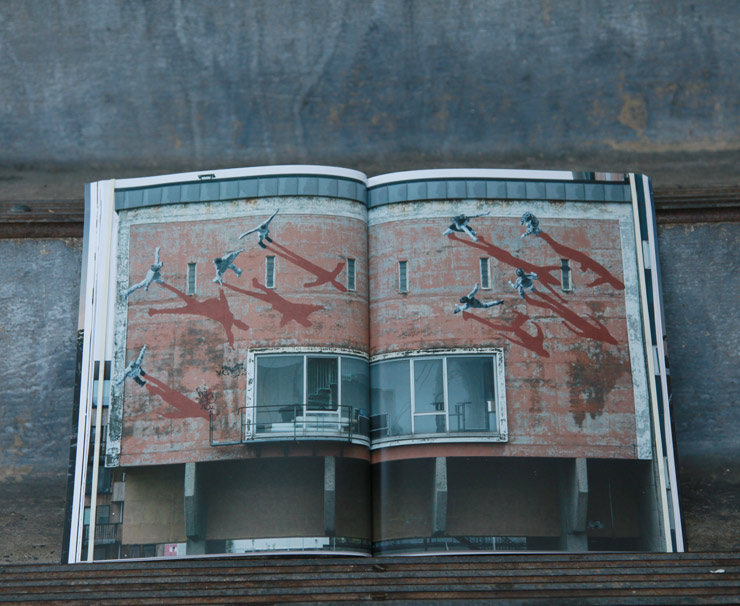
Step many paces back from the aged factory wall and your perspective has been altered and the burr bushes and Bishop’s weed and crumbled concrete rubble you are standing in are strangely moved, even moving. Staring at his figures as they run diagonally up and across the entire expanse of a massive wall you realize he has tilted them along an axis in such a way and at such a scale that your own feet may be on a plane that is perpendicular to their ground, and you may fall.

You too have begun to dance to Anders’ optics, a figure in his urban choreography, and you too can take flight before gravity pulls you downward, as it will.

Anders Gjennestad. “Canvas”. Published by Galerie Friedmann – Hahn. Berlin 2018

Anders Gjennestad. “Canvas”. Published by Galerie Friedmann – Hahn. Berlin 2018

Anders Gjennestad. “Canvas”. Published by Galerie Friedmann – Hahn. Berlin 2018

Read more
Add Fuel Reimagines Azulejo in His First Monograph

Add Fuel Reimagines Azulejo in His First Monograph

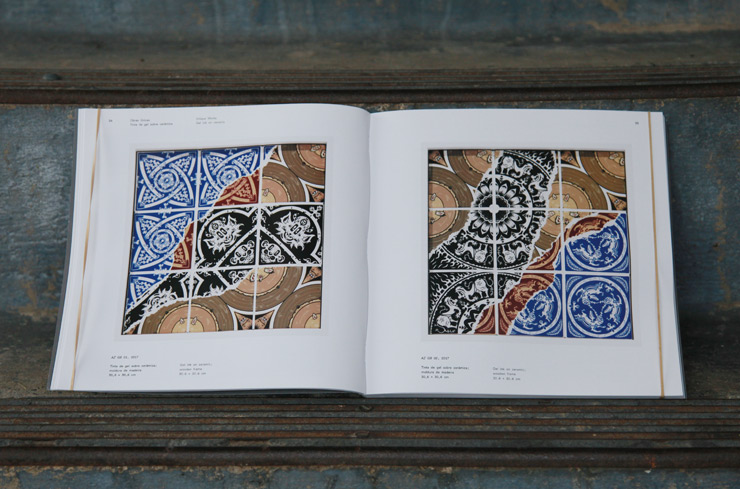
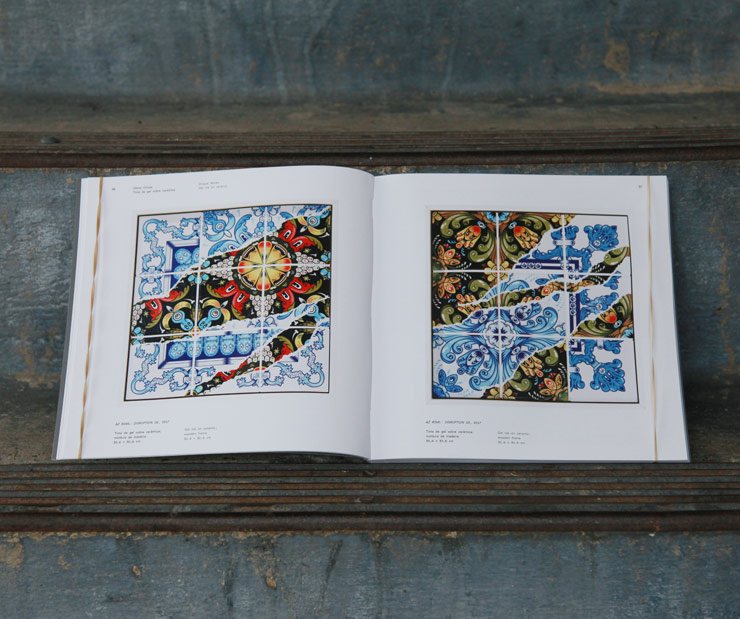
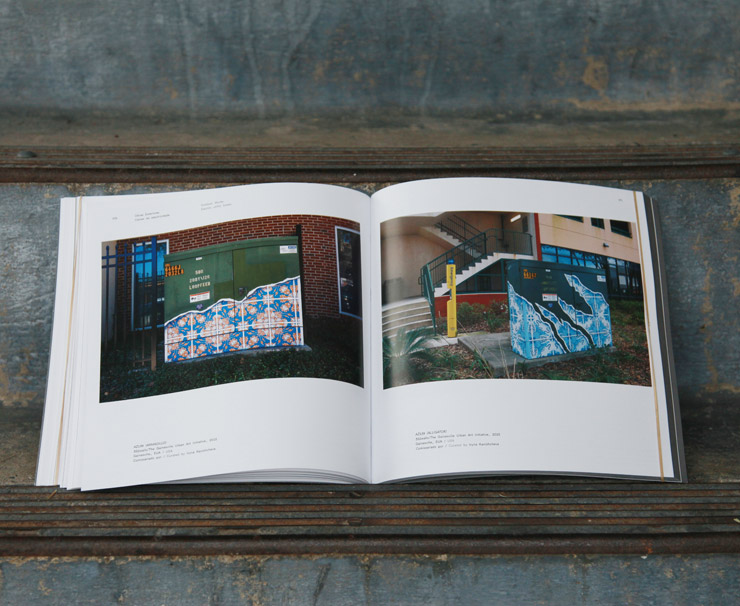
Street Artist Add Fuel is exporting azulejo to the rest of the world. Slightly differently than they did in previous centuries.

Add / Fuel – 1 – Monograph. Published by Diogo Machado. Portugal 2018.

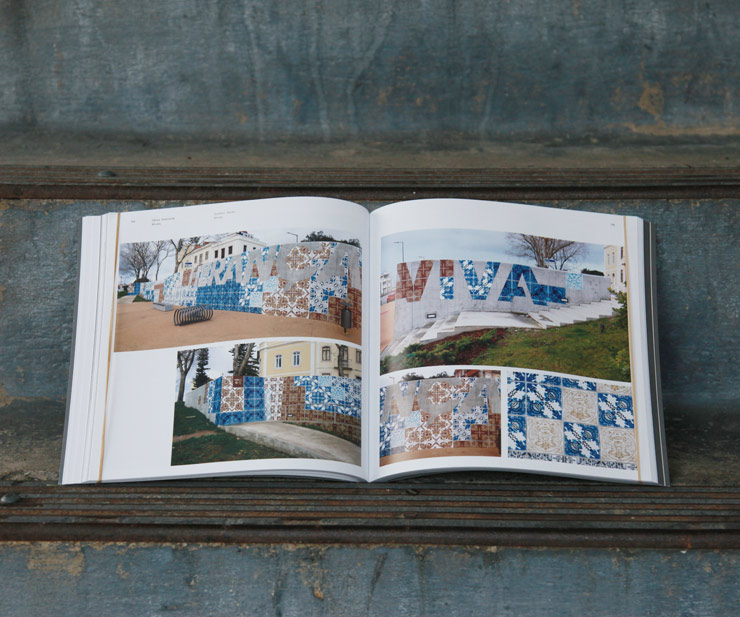
Via his own pop-culture interpretation of the interlocking curvilinear, geometric and graphic motifs, the Portuguese artist is firing new pieces daily in the kiln of his studio in Cascais. For a decade or so his interpretations of the tin-glazed ceramic tilework have been appearing on inordinate secondary city skins in the paths of pedestrians: visual illusions meant to appear as layers of urban bark peeling back from surfaces you take for granted to reveal heritage, history, artisanship.

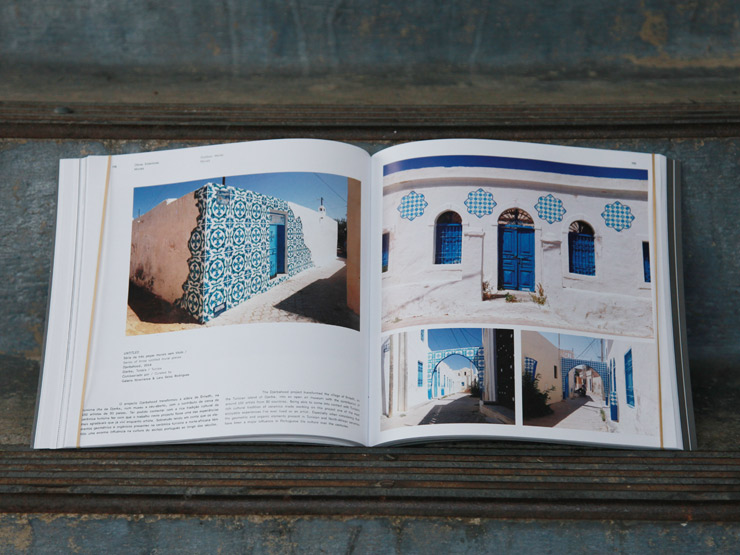
While the interiors and exteriors of churches, palaces, schools and subway stations are covered with azulejos in Lisbon, thanks to Add Fuel (Diogo Machado) they have travelled to other cities and cultures as well. Each time he is attracted to the tilemaking traditions locally, and he often incorporates his study of these new histories as well.

Add / Fuel – 1 – Monograph. Published by Diogo Machado. Portugal 2018.

What makes his work contemporary is the reworking of elements to include zombies, snakes, Gameboys, and selfie sticks in his patterns. A graphic designer and illustrator, he imagines his complex tile ornamentation as a patterned fill for masking or knocking out type. Entire walls become quilted blocks and remnants stitched together. Taking inspiration from Jacques Villeglé and his torn poster collages (or even Faile’s more recent reworking of the method for ripped away pop revelation) Add Fuel uses the device of showing the past, the foundation for the culture, helping us to imagine a life before ours.

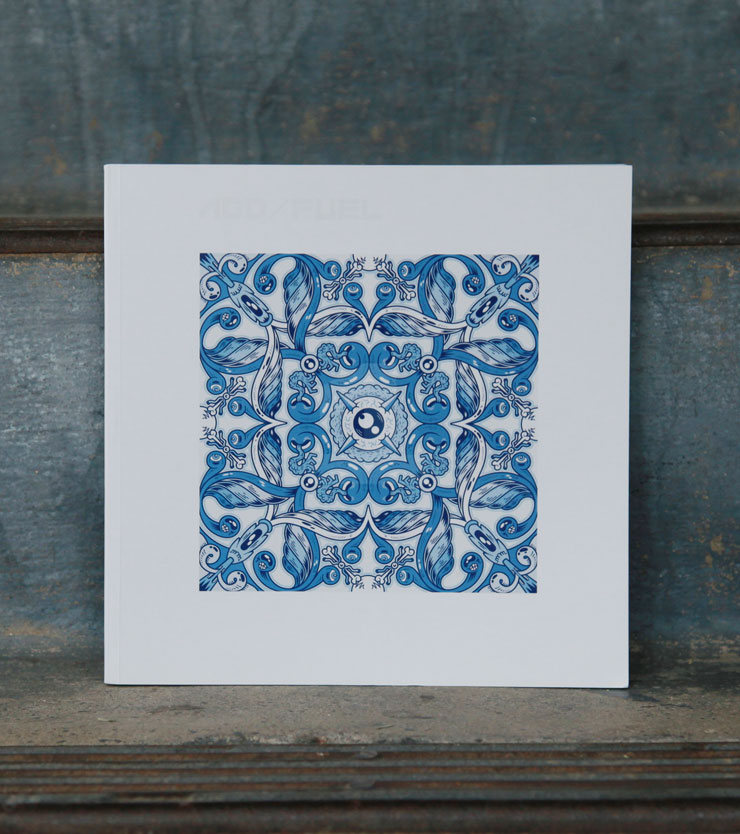
Add Fuels first monograph is tile-shaped and precisely rendered, a survey of the patterned and pixilated, pleasant and pernicious imagined motifs he has placed upon tiles, screenprints, embroidery and façades. Using historical, artists and artisanal work as inspiration, with his archive of ideas and executions he has created himself as one for others.

Add / Fuel – 1 – Monograph. Published by Diogo Machado. Portugal 2018.

Add / Fuel – 1 – Monograph. Published by Diogo Machado. Portugal 2018.

Add / Fuel – 1 – Monograph. Published by Diogo Machado. Portugal 2018.

Add / Fuel – 1 – Monograph. Published by Diogo Machado. Portugal 2018.

Add / Fuel – 1 – Monograph. Published by Diogo Machado. Portugal 2018.

Read more
Subvertising: The Piracy Of Outdoor Advertising

Subvertising: The Piracy Of Outdoor Advertising

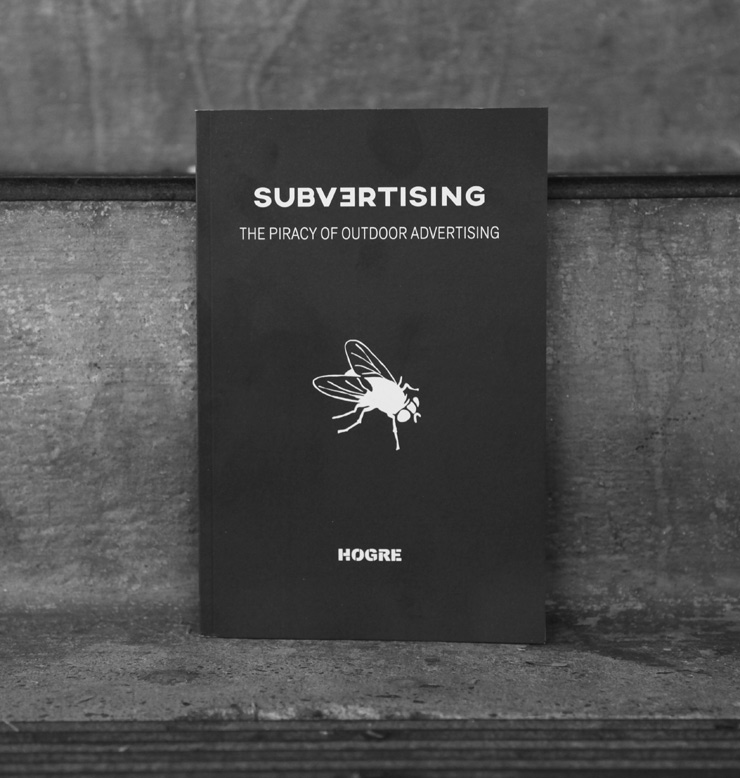
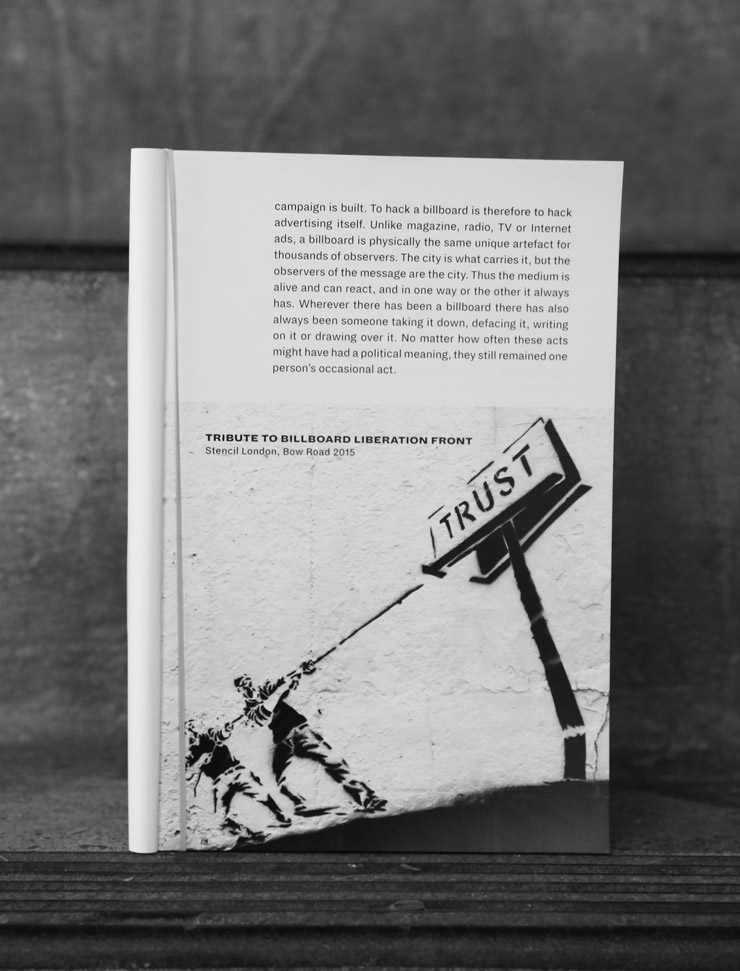
“The constant imposition of advertising in front of our eyes is an oppressive, dictatorial and violent act,” posits the artist, activist, and author Hogre in this new collection of works and words called Subvertising : The Piracy of Outdoor Advertising.

HOGRE. Subvertising: The Piracy Of Outdoor Advertising. Dog Section Press. London, 2017.

It sounds rather extreme when put this way, but perhaps that is the dulling power of advertising’s omnipresence in public space year after year. Each of us can certainly recall a time when there seemed like there was more open public space and fewer images and graphics and text telling us what to do, what to buy, who to hate, how to behave. Artists like Hogre are sounding the warning on our ability to recognize its power over our perceptions.

HOGRE. Subvertising: The Piracy Of Outdoor Advertising. Dog Section Press. London, 2017.

Street Artists have been siting Guy Debord and the Situationists as the most influential originators of this practice of upending the commercial messages in public space, and many artists and collectives in recent years have begun in earnest campaigns of short-circuiting the machine.

Since the Situationist’s time in the 1950-60s, an ever-growing number of subvertising artists, thinkers and disaffected marketing majors have banded together to turn messages on their head – folks like The Billboard Liberation Front, Ron English, and Jenny Holzer come to mind. Now Hogre finds his practice with many peers, anonymous and known.

HOGRE. Subvertising: The Piracy Of Outdoor Advertising. Dog Section Press. London, 2017.

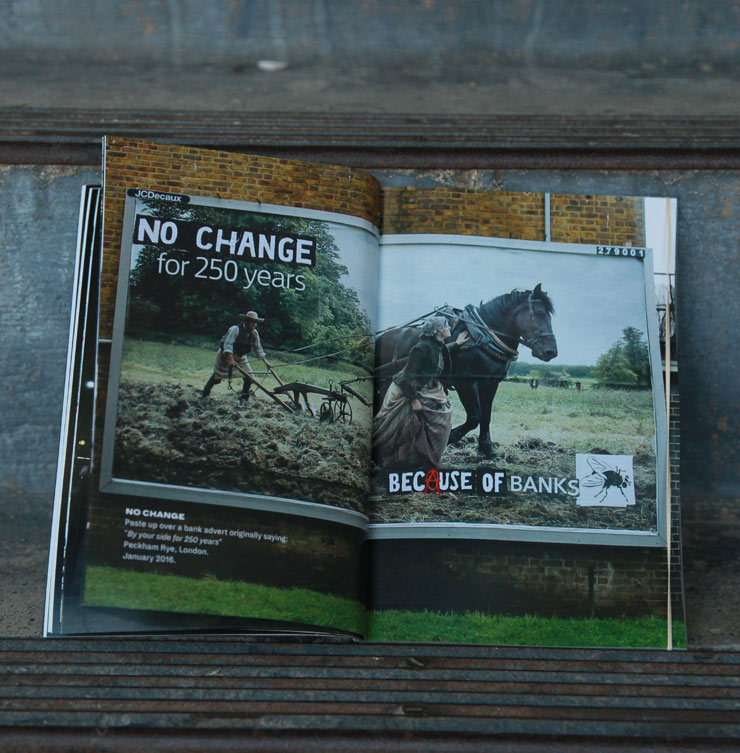
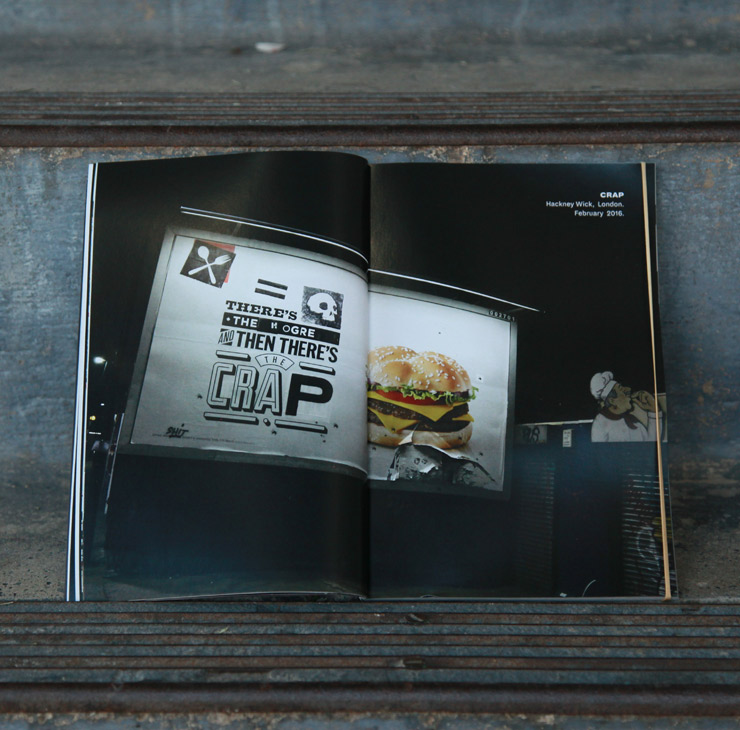
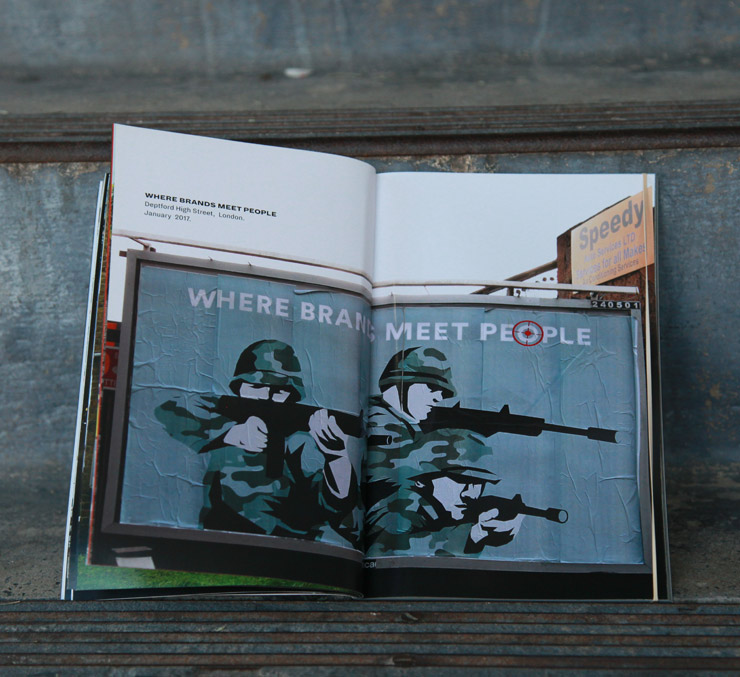
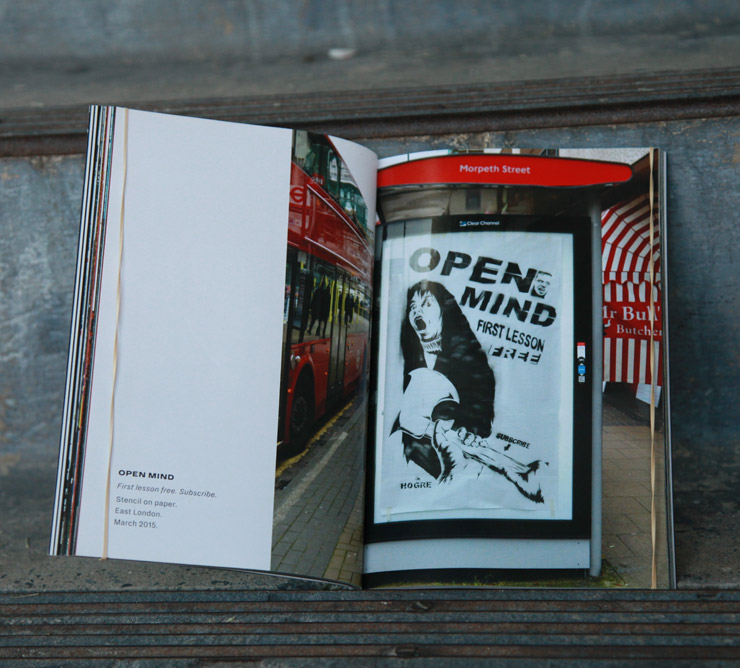
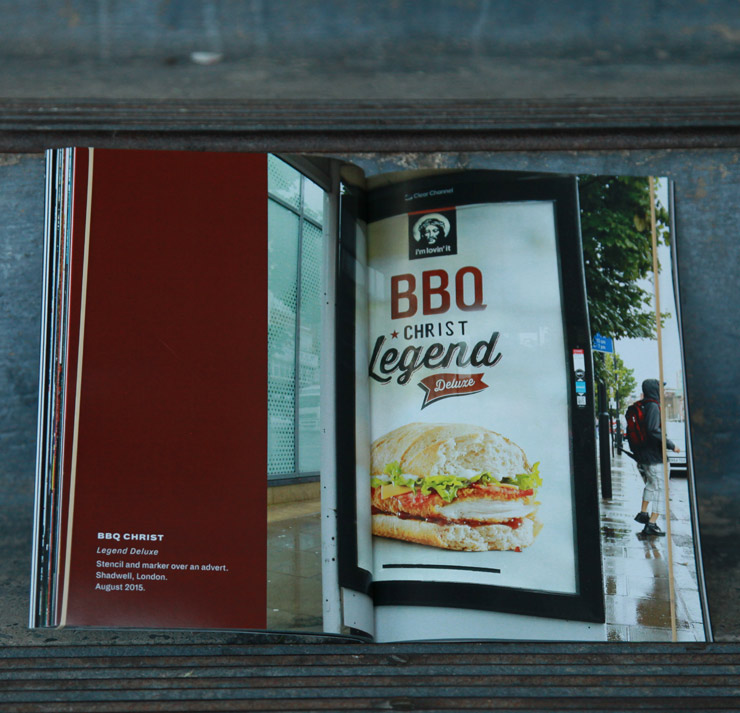
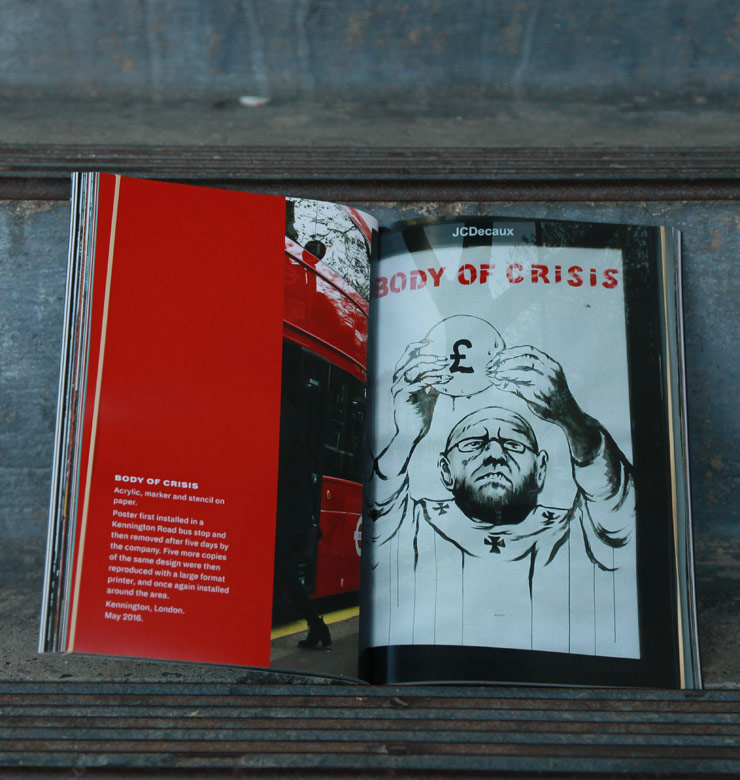
This collection of recent interventions of commercial billboards across London by Hogre and associates is documented in two page full color spreads accompanied by explanatory texts about the intention and inspiration. To the average citizen the messages range from blatant to quizzical to cryptic to so subtle that they may never be detected by the majority of passersby – but the thrill of the takeover never diminishes.

HOGRE. Subvertising: The Piracy Of Outdoor Advertising. Dog Section Press. London, 2017.

And the impact of the work should not be discounted – As creative and strategic as any advertising campaign or propaganda or disinformation, these acts of artful messaging can actively embarrass a public initiative, illuminate an environmental hazard, examine fundamental political structures, or question negative social attitudes toward sectors of society like immigrants or others in the margins.

The point made by Hogre and others is that as long as one recognizes that billboards and posters are a platform for delivering speech, that platform should be available to everyone regardless of their status, station, or bank balance. Styled as a system-fighting rebel, Hogre and his co-artivists are ultimately an optimistic voice in the public sphere – if for no other reason than to draw our attention to exactly how many commercial messages we are dining on daily.

HOGRE. Subvertising: The Piracy Of Outdoor Advertising. Dog Section Press. London, 2017.

HOGRE. Subvertising: The Piracy Of Outdoor Advertising. Dog Section Press. London, 2017.

HOGRE. Subvertising: The Piracy Of Outdoor Advertising. Dog Section Press. London, 2017.

HOGRE. Subvertising: The Piracy Of Outdoor Advertising. Dog Section Press. London, 2017.

HOGRE. Subvertising: The Piracy Of Outdoor Advertising. Dog Section Press. London, 2017.

HOGRE. SUBVERTISING. THE PIRACY OF OUTDOOR ADVERTISING Published by Dog Section Press. London.

Read more
Converting Gold From Our Waste: “Bordalo II / 2011 – 2017”

Converting Gold From Our Waste: “Bordalo II / 2011 – 2017”

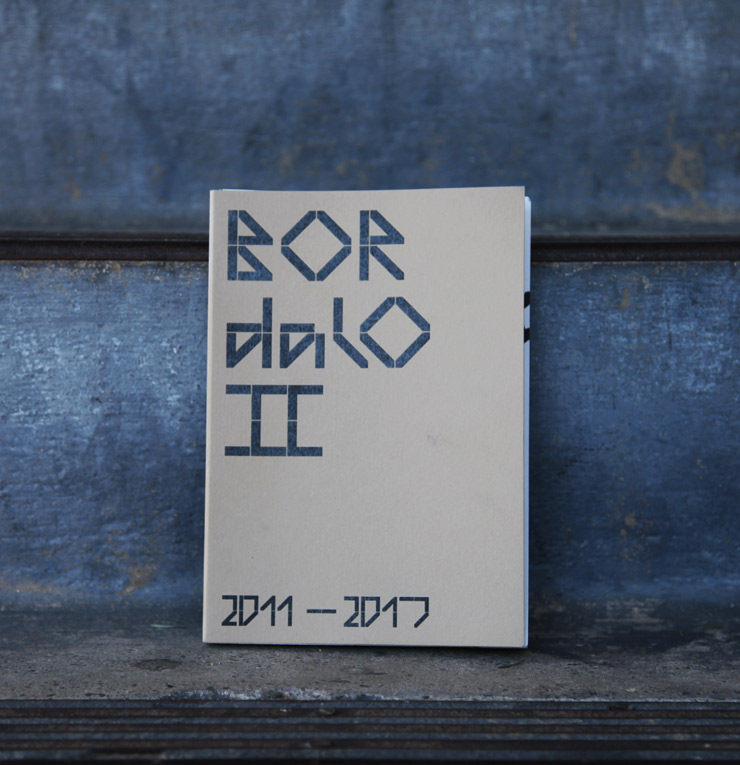
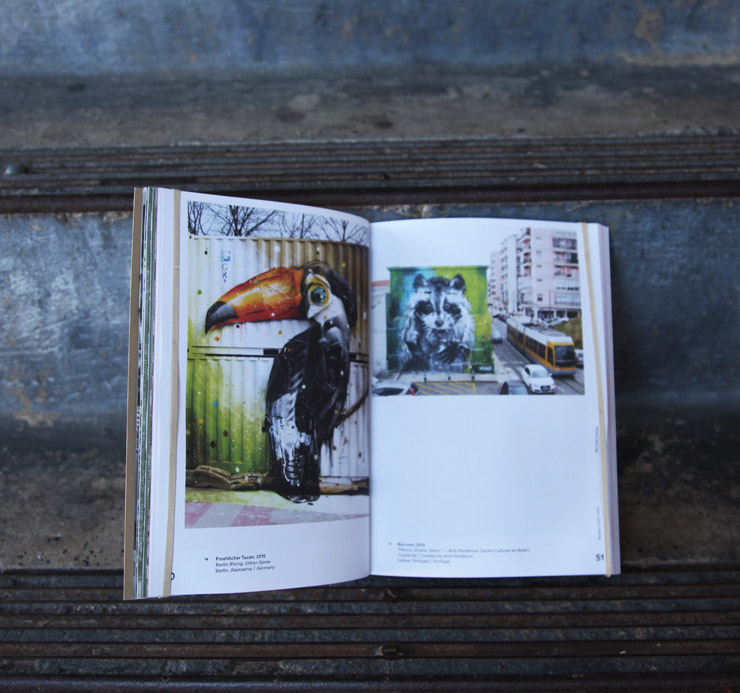
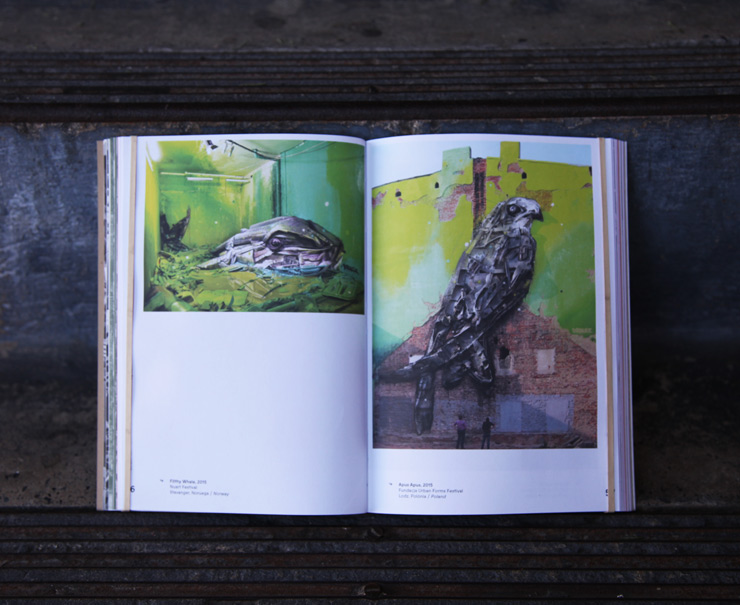
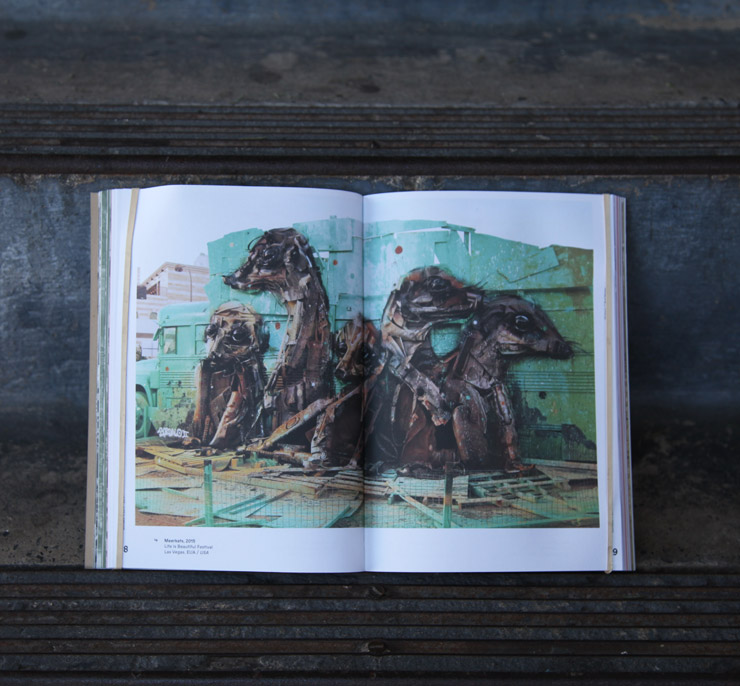
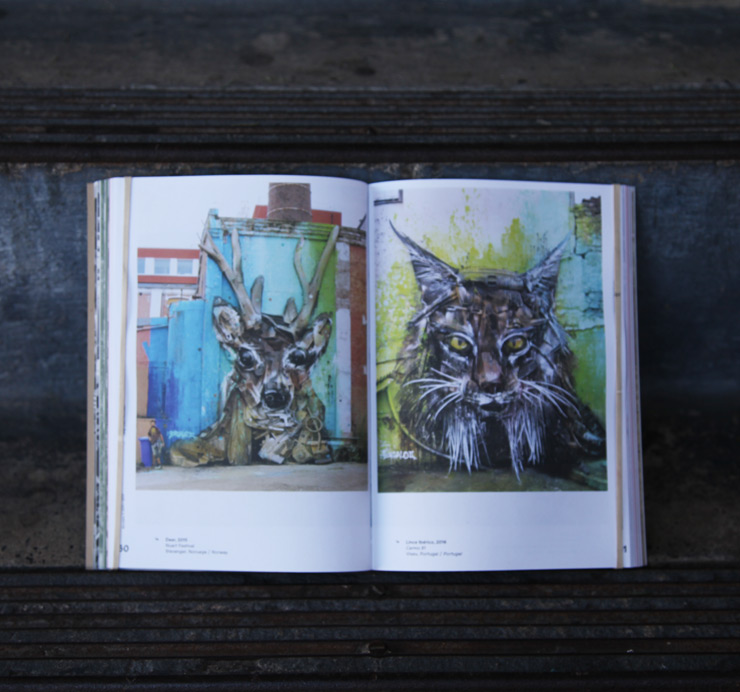
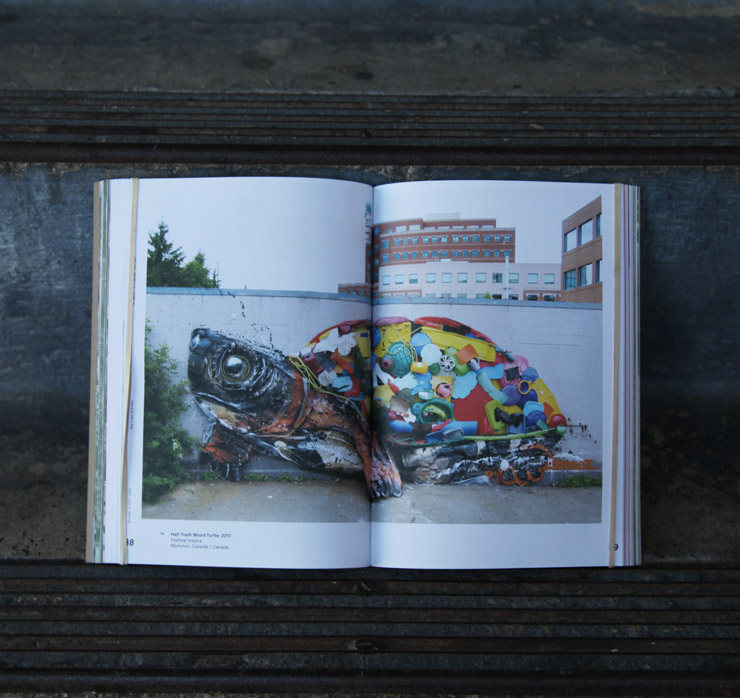
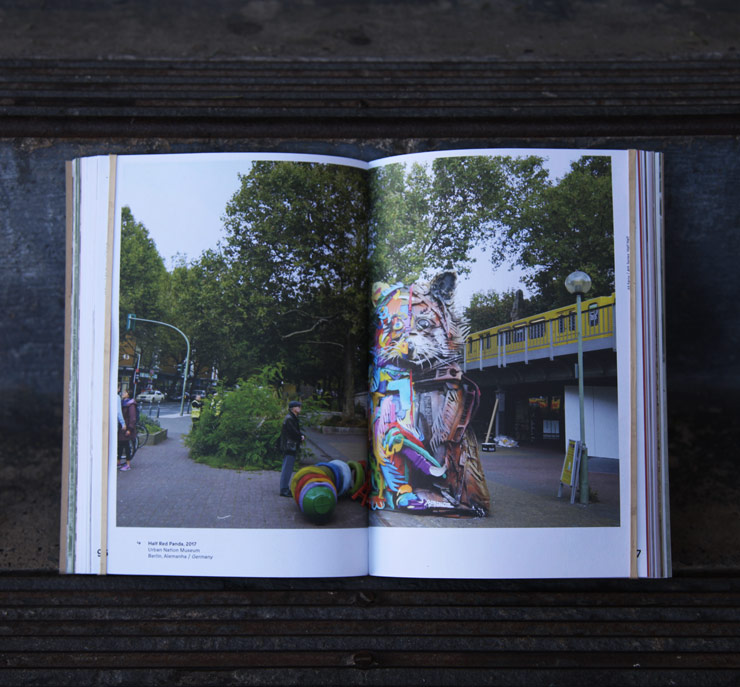
Bordalo II 2011 – 2017. Editor & Publisher Bordalo II. In conjunction with ATTERO and exhibition by Bordalo II held in Lisbon. November, 2017. Lisbon, Portugal.

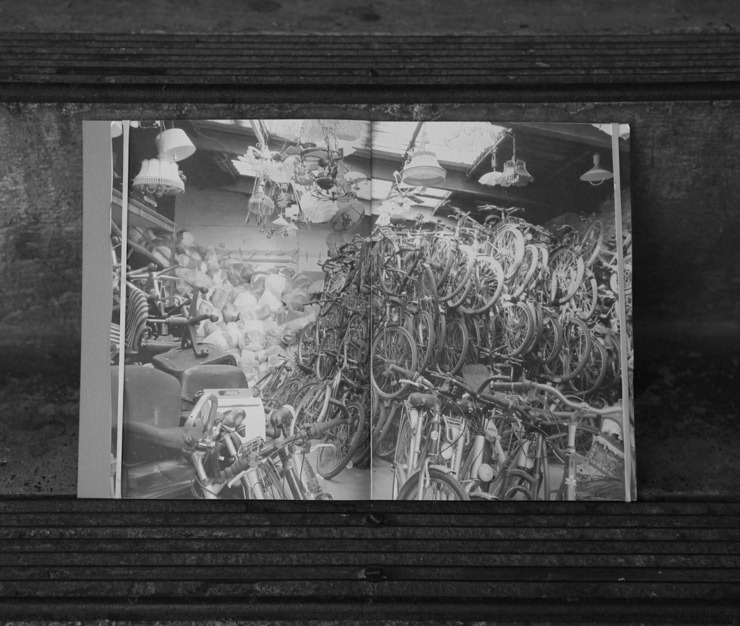
Are those Ai Weiwei bicycles clustered and suspended in the air overhead? Rather they are stored here like a 3 layer spoke, wheel, and frame cake, pressed to the side of this bricked wall tin-roof warehouse along with rolling office chairs waving their legs in the air like little lady bugs stuck on their backs.

Everything here has been pressed into position by the small mountains of white garbage bags filled with something soft, like dollops of whipped cream. The entire confection is sprinkled across the top with lanterns and light fixtures plucked from decades of the last half-century.

Bordalo II 2011 – 2017. Editor & Publisher Bordalo II. In conjunction with ATTERO and exhibition by Bordalo II held in Lisbon. November, 2017. Lisbon, Portugal.

Such is the splendid stuff of dreams and discovery for Bordalo II, the Lisbon-based Street Artist and maker of garbage relief animal portraits in cities across the world.

These are the things that when arranged on shelves and in placed relation to a floor plan, within parameters and boundaries of our mundanity, will comprise a perfect environment of domesticity; full of memory, associative emotion, symmetry. Objects, materials melted and poured, carved and plain, screwed and snapped, polished and sprayed, emulsified, inset, extruded, coiled, soldiered, plated, woven. These dimensional collections of matter matter to us. Metal alloy. Plastic polymer. Blown glass. Rubber, copper, steel, bakelite, particle board, glue.

Disarrange. You create chaos, disruption, disunity, discontent. Arrange again and create a muskrat, a buck deer, a petulant parakeet, an undulant octopus.

Bordalo II 2011 – 2017. Editor & Publisher Bordalo II. In conjunction with ATTERO and exhibition by Bordalo II held in Lisbon. November, 2017. Lisbon, Portugal.

Bordalo II, so-named after his watercolor master grandfather Real Bordalo who passed last year at 91, has in six or seven short years made a name for himself with your garbage, refusing to allow it to go to the junkyard or to float in the ocean just yet.

“After surveying the variety of offerings that included industrial, commercial, and consumer detritus, he speedily chose what appear to me to be a random bunch of junk,” writes five-decade photographer of urban art and artists, Martha Cooper about how he captured her interest.

“It was a genuine pleasure to watch an animal evolve before everyone’s eyes. As I watched him create the sculptural mural I was amazed to see how he utilized the shapes, textures, and aesthetic qualities of the found items to recreate the octopus in such a true-to-life manner.”

Bordalo II 2011 – 2017. Editor & Publisher Bordalo II. In conjunction with ATTERO and exhibition by Bordalo II held in Lisbon. November, 2017. Lisbon, Portugal.

Hers and others’ observations and essays are collected in “Bordalo II, 2011-2017” released in concert with his massive solo show “Attero” this November in Lisbon. A graffiti writer as a youth with his crew R315 Dream Team, the artist credits the three years at the Fine Arts Faculty in his city for allowing him to discover sculpture and to experiment with different materials, seducing him away from strictly painting. With it he is creating critique of our love of “things” and the excesses of consumerism, especially those excesses that are endangering wildlife.

“Bordalo is a master of our refuse,” says writer and critic Carlo McCormick, “what we throw way in our endless glut of consumption, the ideas, sensibilities and dreams we discard in the name of progress and all that accumulates unwanted, ignored, and even reviled by society’s voracious appetite for something disposable.” McCormick looks carefully at the implications of such an art practice and praises Bordalo II for the sharp tongue he brings to a sometimes superficial conversation occurring in the Street Art scene.

Bordalo II 2011 – 2017. Editor & Publisher Bordalo II. In conjunction with ATTERO and exhibition by Bordalo II held in Lisbon. November, 2017. Lisbon, Portugal.

No hero is he, nor does he pretend to be. Rather Bordalo II uses his work to remind us of our integral part of a cycle that includes everyone and everything. João Pedro Matos Fernandes, the Portuguese Minister of Environment adds his voice to those in this unassuming but powerful tome after laying out the treacherous story of our trash.

Speaking of Bordalo’s work, Mr. Fernandes writes,” It calls to our attention the choices we make in our everyday life, and to the consequences of our actions. And he does so in a scathing fashion, which I thoroughly enjoy, by using trash to represent some of the more emblematic species which our behavior puts at risk.”

It’s a brief snapshot of the artist in motion, with surely more evolutions to come. Ever the delicious quipster with the poetic tongue, McCormick lauds the street trash wizard.

“And in this world where we choke the planet with out incessant rubbish, let us celebrate those alchemical artists like Bordalo II who have that rare gift of being able to turn shit into gold.”

Bordalo II 2011 – 2017. Editor & Publisher Bordalo II. In conjunction with ATTERO and exhibition by Bordalo II held in Lisbon. November, 2017. Lisbon, Portugal.

Bordalo II 2011 – 2017. Editor & Publisher Bordalo II. In conjunction with ATTERO and exhibition by Bordalo II held in Lisbon. November, 2017. Lisbon, Portugal.

Bordalo II 2011 – 2017. Editor & Publisher Bordalo II. In conjunction with ATTERO and exhibition by Bordalo II held in Lisbon. November, 2017. Lisbon, Portugal.

Read more
INTI Commands First Monograph : Color, Carnaval y Resistencia

INTI Commands First Monograph : Color, Carnaval y Resistencia

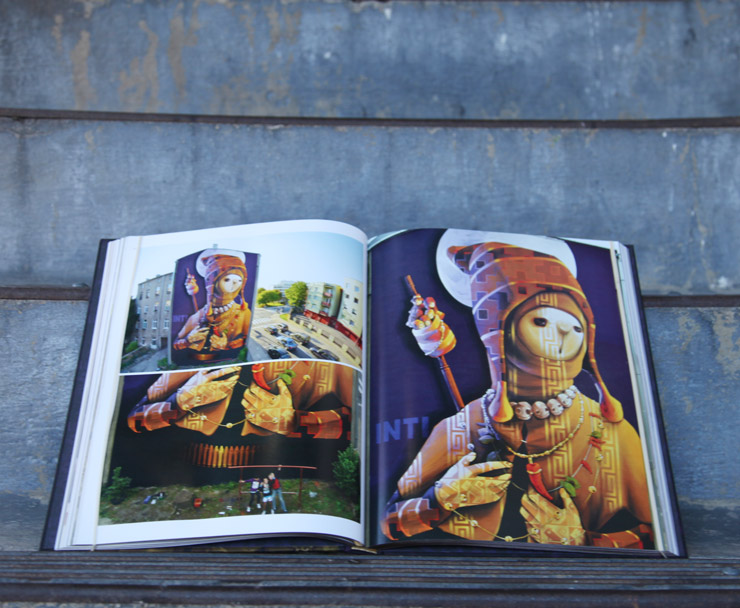
“Certainties, simple explanations, last hopes, magic thoughts and fears. All of them confronted by what is evident.”

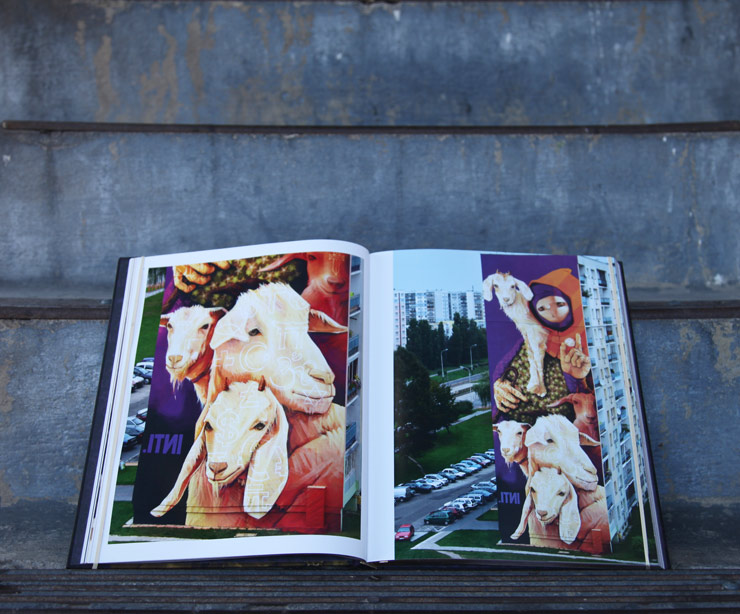
Thus describes the figure slung with bullets, holding a necklace with a cross and delicately balancing a small green apple on his index finger on a larger than life mural in Santiago, Chili. The visual language of this graffiti/Street Artist and muralist name Inti is his to wield, a cosmic folk that glows with celestial waves surrounding an other-worldly race of characters.

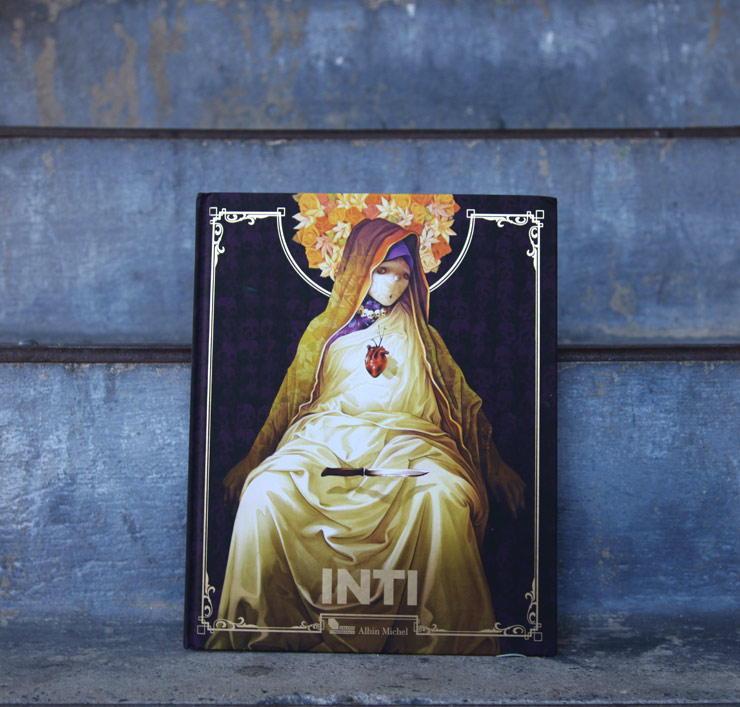
INTI. Éditions Albin Michel, 2017. Paris, France.

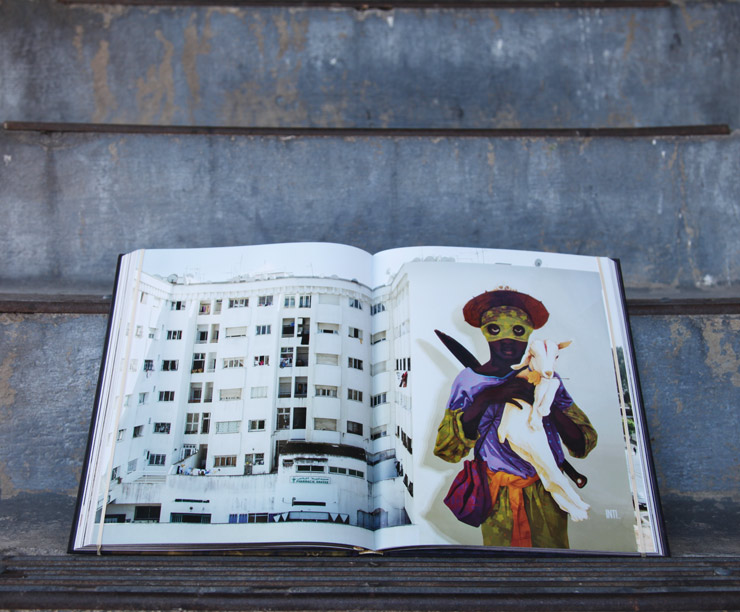
The messages these massive murals carry may be layered, their determination and commitment is not to be doubted. His new grandly gilded monograph certainly earns your attention, and keeps it with quality materials, photography, and accessible crisp writing by Pablo Aravena that dares to be esoteric when describing the artists work.

Born from a post dictatorship community muralism that blossomed in the 80s and 90s as the country forged a new identity, the explosive graffiti scene that first captured the imagination and street practice of the teenage Inti was eventually channeled into a fine art education and formal study of the tenets and techniques of the painters. Paired with a fascination with religious dogma, the traditions of carnival and the symbols of power, hope, ornament and sustenance, Inti is forging a language known to him and his characters in a way that still can foster an empathetic response from the viewer of his massive murals in places as farflung as Honolulu, Boras, Beirut, Belgium.

INTI. Éditions Albin Michel, 2017. Paris, France.

The Valparaíso-born artist whose name translates in Incan to ‘Sun’ is a master of light as well, shining it in gentle cadences across singular figures who could be multi-natural, sans-national, or inter-stellar.

Gathered in folds of robes, adorned in floating baubles and brightly glowing with reflecting patterns and gentle animals in arms, they may be evocative of carnival figures, fortune tellers, and of religious seers from around the world and throughout history, as is his universal searching for meaning, ultimately sharing some truths too no doubt.

INTI. Éditions Albin Michel, 2017. Paris, France.

INTI. Éditions Albin Michel, 2017. Paris, France.

INTI. Éditions Albin Michel, 2017. Paris, France.

INTI. Éditions Albin Michel, 2017. Paris, France.


INTI: Color, Carnaval y Resistencia by Inti Castro (Author),‎ Pablo Aravena (Author)

Trilingual French/Spanish/English.

Read more
“Street Art In Sicilia” Tours You Through 31 Cities and 200 Artists

“Street Art In Sicilia” Tours You Through 31 Cities and 200 Artists

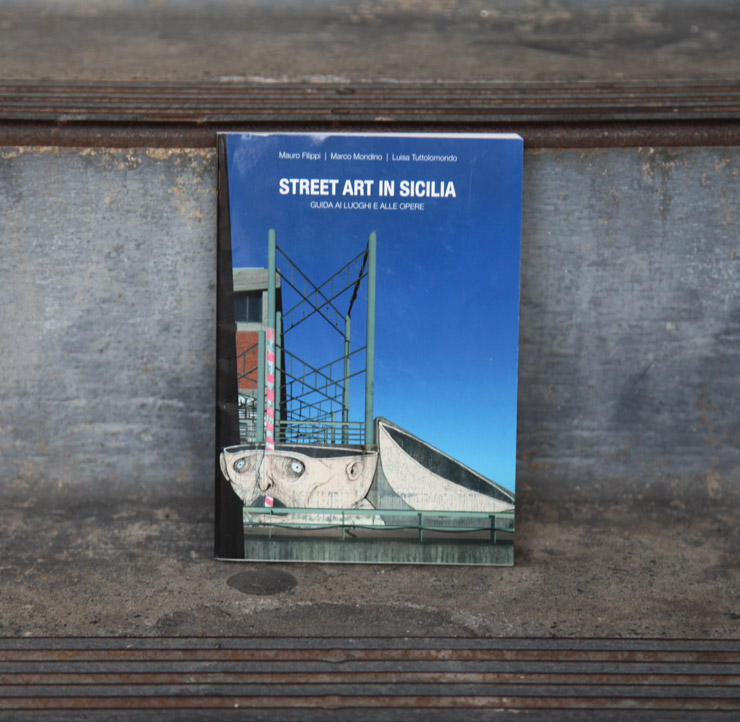
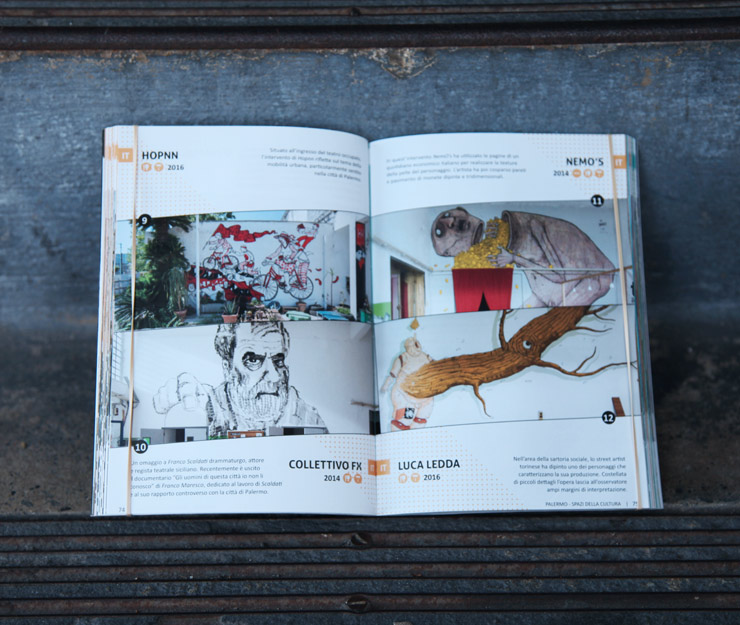
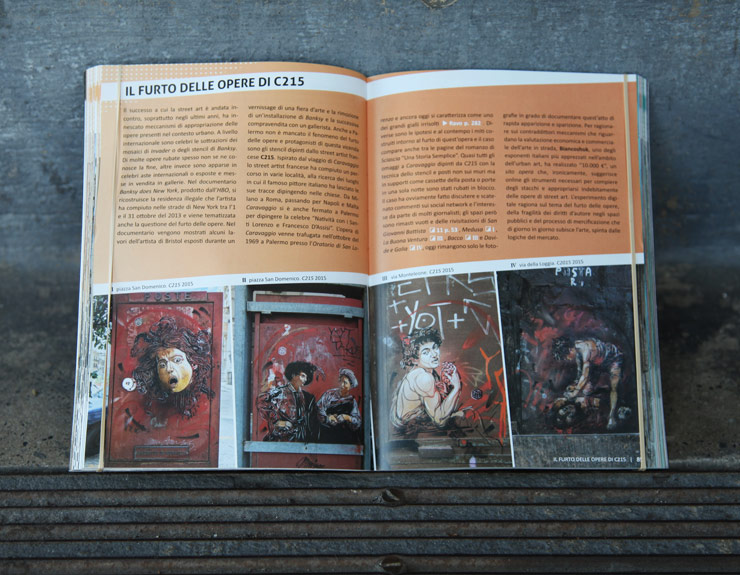
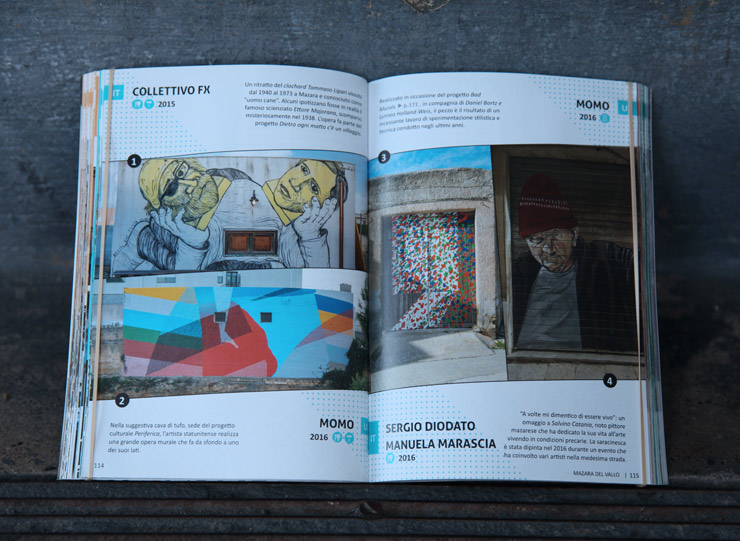
A good size to put in your backpack as you hike through neglected neighborhoods, industrial sites, and historical highpoints in cities like Catania, Messina, and Palermo, this new guide to legal murals and illegal Street Art in Sicily is one of a kind.

Street Art In Sicilia. Mauro Filippi, Marco Mondino, Luisa Tuttolomondo. Palermo. IT. April 2017

A serious undertaking that documents 31 urban centers that vary widely in distinctive personality, more than two hundred artists are captured and carefully, succinctly described for a wide audience of tourists, Street Art fans, students, even academics. With three authors who collectively have studied architecture, semiotics, sociology and photography, you get a mapping that reveals not only physical location but a describes a cultural one as well.

Sicily’s scene is said to have come to life in the 1990s, as did much of today’s Street Art scene did globally, and the irony of having a guide book is that by nature this art is here today, gone tomorrow, sometimes literally. Its this acclaimed ephemerality that means hard-bound guides like this may become less useable after a relatively short time but by including legally permissioned/commissioned murals along with actual Street Art the longevity of this one is extended.

Street Art In Sicilia. Mauro Filippi, Marco Mondino, Luisa Tuttolomondo. Palermo. IT. April 2017

Additionally neighborhoods with the organic graffiti/Street Art scene often continue to have new pieces for discovery even after individual pieces fade or are destroyed. Depending on the speed of gentrification in any given municipality – there may be no art left by the time you get there because development tends to blot out organically grown rebel art scenes. Regardless Street Art in Sicilia is a valuable record of the 2010s, with great care taken to make the work it captures alive and relevant to it surroundings, and you.

Street Art In Sicilia. Mauro Filippi, Marco Mondino, Luisa Tuttolomondo. Palermo. IT. April 2017

Street Art In Sicilia. Mauro Filippi, Marco Mondino, Luisa Tuttolomondo. Palermo. IT. April 2017

Street Art In Sicilia. Mauro Filippi, Marco Mondino, Luisa Tuttolomondo. Palermo. IT. April 2017

Street Art In Sicilia. Mauro Filippi, Marco Mondino, Luisa Tuttolomondo. Palermo. IT. April 2017

Street Art in Sicilia – Guida ai luoghi e alle opere
Mauro Filippi, Marco Mondino, Luisa Tuttolomondo
Dario Flaccovio Editore, 2017

Street art in Sicily – Guide to places and works
Authors: Mauro Filippi, Marco Mondino, Luisa Tuttolomondo
April 2017, 256 pages

Read more
Jerkface: “Saturday Mornings” Deconstructed, Reconstructed, Repeated

Jerkface: “Saturday Mornings” Deconstructed, Reconstructed, Repeated

“We all draw from memory,” says Futura 2000 in the introduction, “and default to past experiences, finding associations to the various cast of characters. In some cases the faces have been changed to protect the innocent.”

Jerface “Saturday Morning”. Published by Over The Influence. December 2016

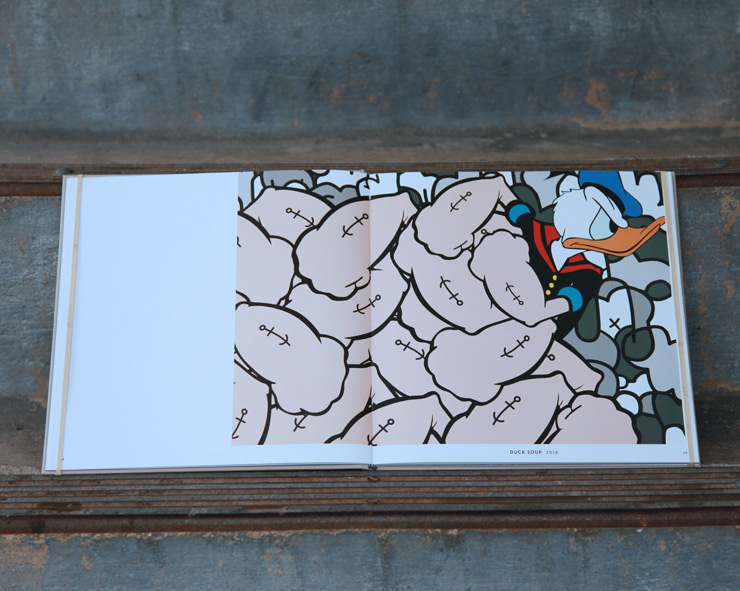
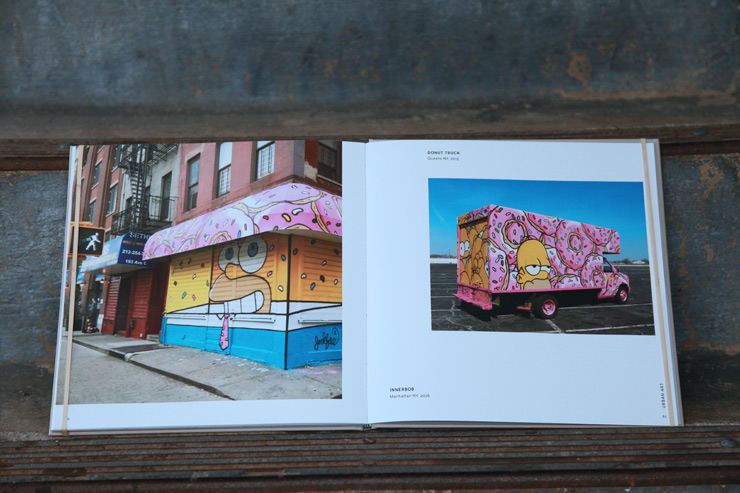
A direct link to his childhood and the televised cartoons of Saturday morning, where the majority of cartoons were relegated to appear in the 1970s and 1980s, Street Artist Jerkface recreates and multiplies his associations of happy times full of adventure, mysteries easily solved, crimes categorically punished.

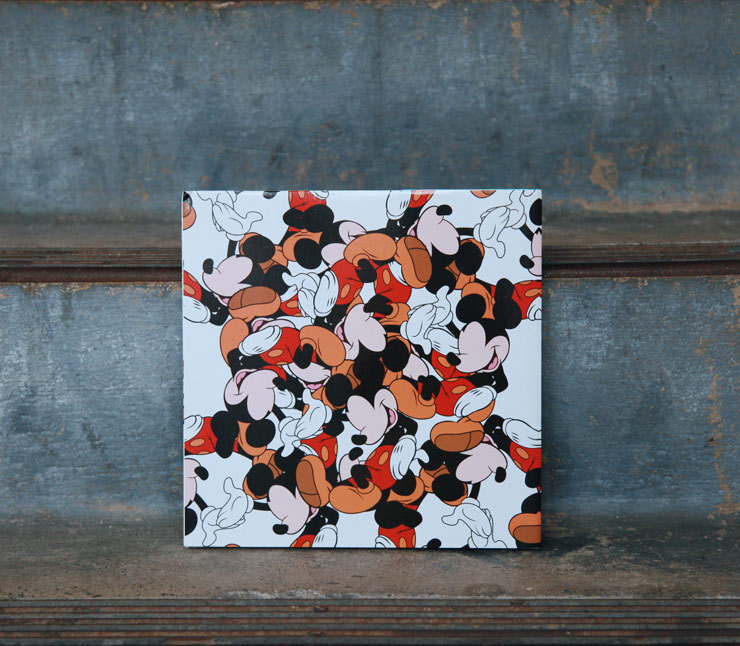
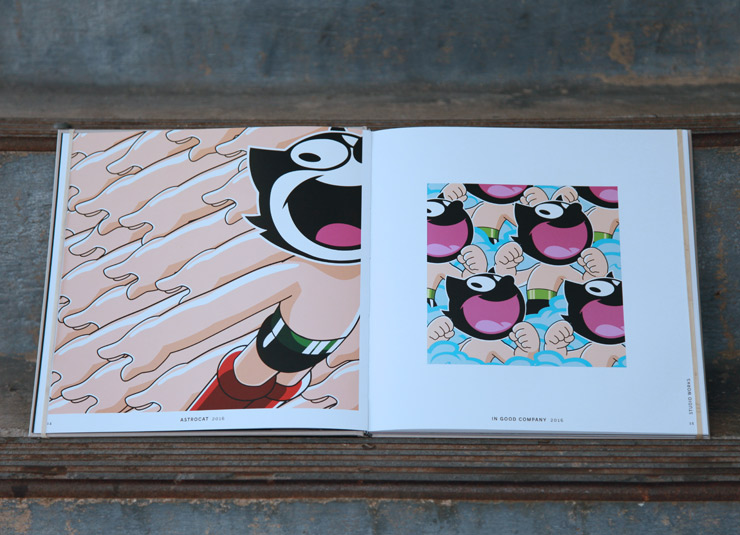
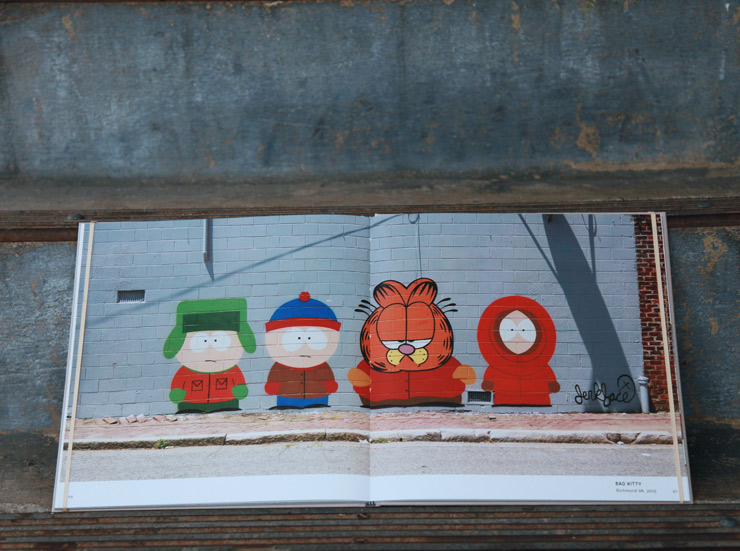
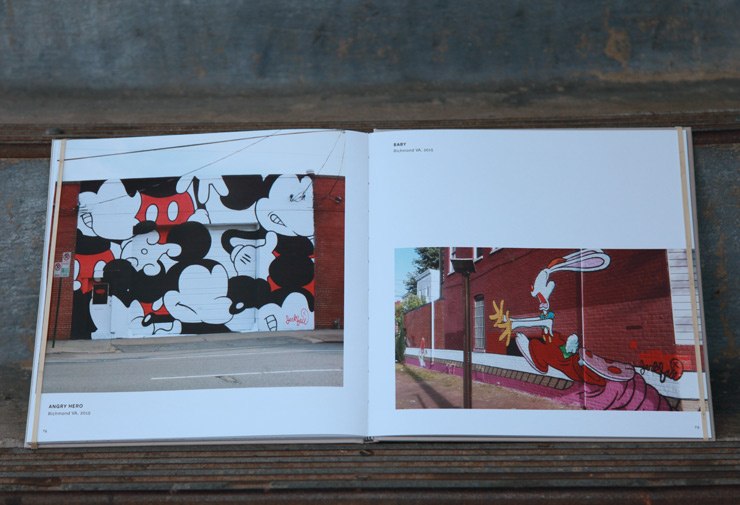
His new book “Saturday Morning” collects the recognizable works of other artists and removes the emotional expressions found in facial features, recombining their other characteristics and playing with their associated resonance.

Jerface “Saturday Morning”. Published by Over The Influence. December 2016

Here are their features, elements from their environment, replicated, recombined, repeated as a pattern – sometimes creating new scenes and storylines. These elements have already been sold, have become familiarized as part of a visual vocabulary in the young minds of millions – a shorthand for action and adventure, comedy and the sunniest denial, simplified and bluntly persuasive interpretations of fundamental good, evil, power, and identity.

Jerface “Saturday Morning”. Published by Over The Influence. December 2016

Somewhere in here is the identity of Jerkface as he remixes the historical, psychological, emotional reverberations of characters made familiar by others, now materials for him to painstakingly paint under layers in studio en route to technical perfection, in aerosol on walls outside for big poppy impact on the passerby.

By dissecting the whole, one wonders what is the source of an images power. By focusing on composition, the initial intentions are edited, certain elements magnified and drawn attention to, others unseen. Here is a chorus of Aladdins, a moshpit of Mickeys, a crowd of Charlie Browns. Once you get used to these rhythmic deconstructions/reconstructions, your Saturday mornings will be forever changed.

Jerface “Saturday Morning”. Published by Over The Influence. December 2016

Jerface “Saturday Morning”. Published by Over The Influence. December 2016

Jerface “Saturday Morning”. Published by Over The Influence. December 2016

Read more