All posts tagged: MCL Library

Books In The MCL: Robbie Conal: Streetwise: 35 Years of Politically Charged Guerrilla Art

Books In The MCL: Robbie Conal: Streetwise: 35 Years of Politically Charged Guerrilla Art

G. James Daichendt. Robbie Conal: Streetwise: 35 Years of Politically Charged Guerrilla Art. Schiffer, 2020.

Reprinted from the original review.

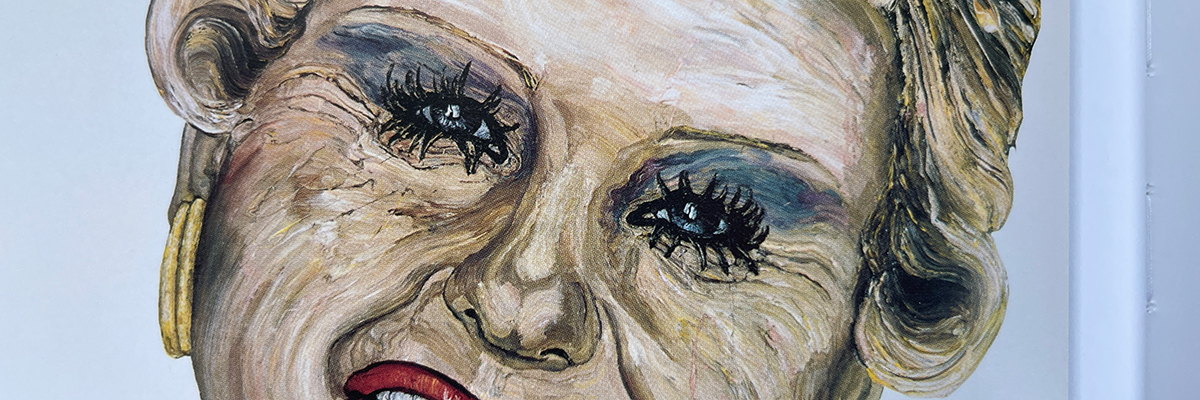
Few forms of public discourse have endured as effectively as political caricature. Political cartoonists can express sentiment and opinion without uttering a syllable, using humor, observational skills, deep knowledge of the subject matter, and skillful craft. The political cartoon, when done well, lands its punch with a blunt efficiency that can influence the direction of a debate. For more than four decades, Robbie Conal has built a reputation by searing some of the most mendacious figures in politics, finance, media, and the celebrity-industrial complex, wheat-pasting his visually scathing posters on the street in the manner of advertisers’ wild-posting campaigns.

With succinct texts, crisp slogans, and curt nicknames, Conal pulls back the veil of public image-making and exposes what he regards as the less flattering truths beneath. He strips away the carefully maintained façade and drops it onto the street for public inspection. His depictions cannot easily be dismissed as those of a partisan sycophant; his subjects have ranged across a spectrum of personalities from various points on the political and cultural landscape. Posted in multiples like political advertisements, his portraits force the accidental viewer on the street to grapple with the grotesque, look below the surface of a public persona, and confront contradictions, hypocrisies, ambitions, and self-interest that often remain hidden from view. Like an X-ray, the work attempts to reveal what lies beneath the polished exterior rather than what is presented for public consumption.

What has consistently distinguished Conal’s practice is his understanding of the street as a communications platform. Long before social media became a primary arena for political commentary, Conal was placing dissent directly into public space. His posters appeared on walls, utility boxes, vacant storefronts, and neighborhood corners, meeting viewers where they already were. Equal parts caricature, editorial commentary, and public intervention, the works use the city itself as a distribution network.

In this book, author G. James Daichendt, EdD, who has previously written about Kenny Scharf and Shepard Fairey and authored The Urban Canvas: Street Art Around the World, examines, documents, and contextualizes Conal’s oeuvre. A street artist himself, among many other pursuits, Daichendt describes Conal as “an LA fixture and someone who is universally respected for the passion and vitality that he has brought to his work as an artist and teacher for several decades.”

Text: Steven P. Harrington & Jaime Rojo     Photos: Diana Paun

Title: Robbie Conal: Streetwise: 35 Years of Politically Charged Guerrilla Art.
Published: Schiffer Publishing, 2020
Author: G. James Daichendt.
Language: English

Click URBAN NATION BERLIN to continue reading

Read more
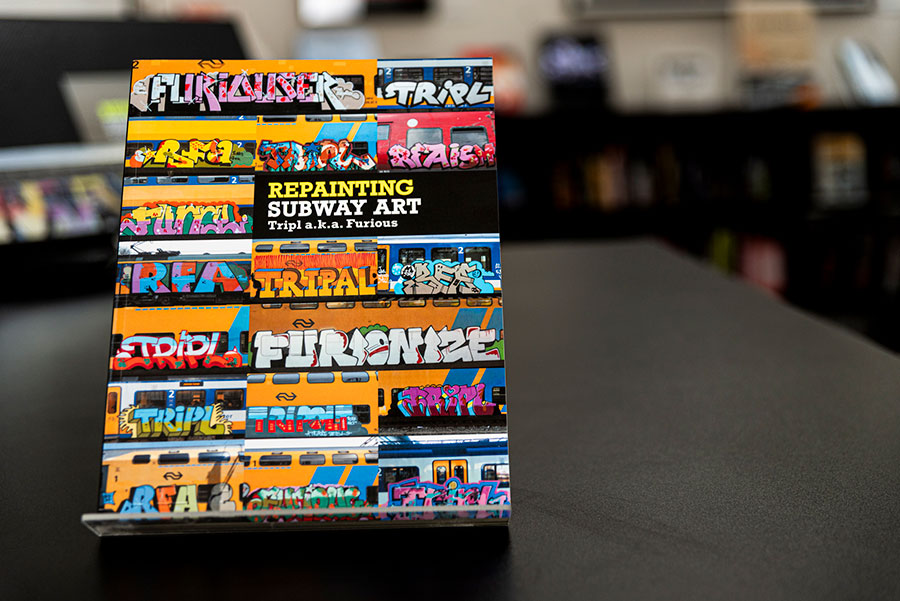
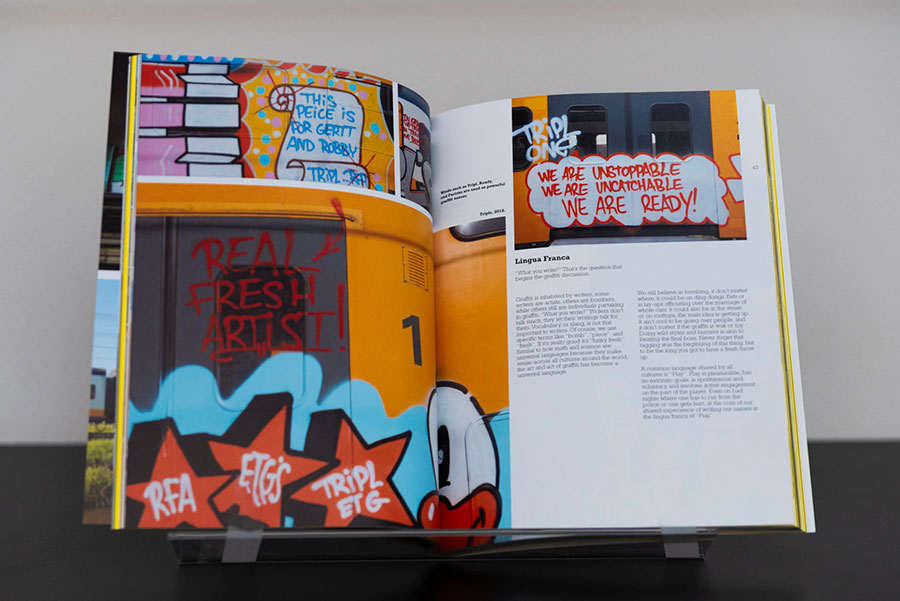
Books in the MCL: Repainting Subway Art. TRIPL a.k.a. FURIOUS

Books in the MCL: Repainting Subway Art. TRIPL a.k.a. FURIOUS

TRIPL a.k.a. Furious. Repainting Subway Art. Ruyzdael Publishing. The Netherlands, 2024.

Reprinted from the original review.

Before opening this book, try to imagine what it would take for one artist to recreate a publication so deeply embedded in graffiti culture that it has been called its Bible. Talent and painting skills are only the beginning. Add discipline, logistics, nerve, physical stamina, photography, styling, train knowledge, and an almost unreasonable willingness to keep going. That is essentially what Dutch graffiti writer TRIPL, a.k.a. FURIOUS, set out to do with Repainting Subway Art: recreate all 239 works pictured in Martha Cooper and Henry Chalfant’s Subway Art, then reconstruct the photographs, situations, and ultimately the book itself. What began as a joke among friends developed into a project that consumed roughly a decade.

Published in 1984, Cooper and Chalfant’s Subway Art became one of graffiti’s defining documents. Its influence traveled far beyond New York, introducing generations of young writers to painted subway trains, letter construction, names, characters, techniques, and an entire culture that many readers had never encountered firsthand. Copies were carried in backpacks, studied until the bindings failed, photocopied, shared, and — according to persistent graffiti lore — sometimes liberated from bookstores and libraries. Dutch author and researcher Daniël de Jongh titled his 2024 Nuart Journal review of TRIPL’s project “A Reincarnation of the Bible of Graffiti in Slow Motion,” which gets close to the peculiar devotion at work here.

Recreating, however, is not simply copying. TRIPL did not select a few famous pieces and repaint them in his own style. He took on the entire proposition, primarily using Dutch and other European trains while adapting the original compositions to different rolling stock. The original writers’ works became the structure for new versions, with TRIPL working through their proportions, gestures, colors, characters, jokes, and letterforms while introducing his own names and substitutions. Each completed page became another piece in an enormous puzzle.

The painting was only part of it. TRIPL also reconstructed the photographic world surrounding the trains: angles, poses, close-ups, portraits, action shots, clothing, passengers, backgrounds, and other details that gave Cooper and Chalfant’s original images their character. He styled and staged scenes, stepped into different roles, found props, and recreated circumstances that had occurred four decades earlier on another continent. One of the most difficult was DONDI’s whole car, for which Cooper had photographed both the painting process and the completed train in motion. TRIPL had to reproduce not only the piece but the circumstances of the photographs themselves.

Text: Steven P. Harrington & Jaime Rojo     Photos: Diana Paun

Title: Repainting Subway Art. TRIPL a.k.a. FURIOUS
Published: Ruyzdael Publishing. The Netherlands, 2024.
Author: TRIPL a.k.a. FURIOUS, Dr. Edward Birzin, Mikel van den Boogaard
Language: English

Click URBAN NATION BERLIN to continue reading
Read more
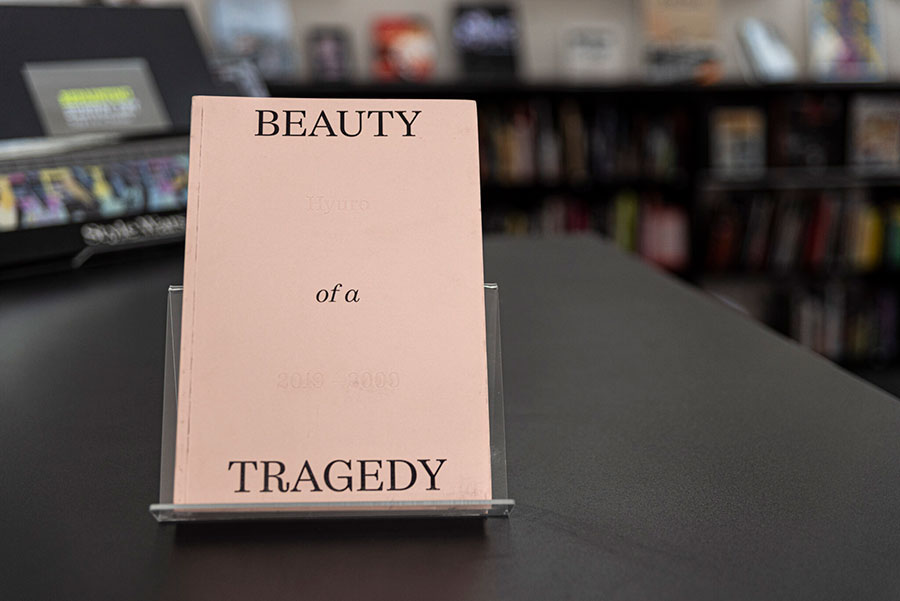
BOOKS IN THE MCL: Hyuro: Beauty of a Tragedy

BOOKS IN THE MCL: Hyuro: Beauty of a Tragedy

Hyuro: Beauty of a Tragedy. Impressum, Valencia, 2022.

Reprinted from the original review.

Beauty of a Tragedy gathers the work of the late Argentine muralist Hyuro (Tamara Djurovic), who died in 2020 at only forty-six, leaving behind one of the most thoughtful and quietly disruptive bodies of work to emerge from the street-art movement in the 2010s. Designed by Ângela Almeida and Maria Gómez-Senent, the book compiles murals, paintings, drawings, sketches, and Hyuro’s own texts. It also includes reflections from figures such as photographer Martha Cooper, street art festival curator Monica Campana, publisher/editor/curator Evan Pricco, and street artist Escif. Rather than presenting a conventional “street art monograph,” the publication reads more like a reflective archive of a mind at work—an artist trying to understand how individuals move through systems of power, vulnerability, and care.

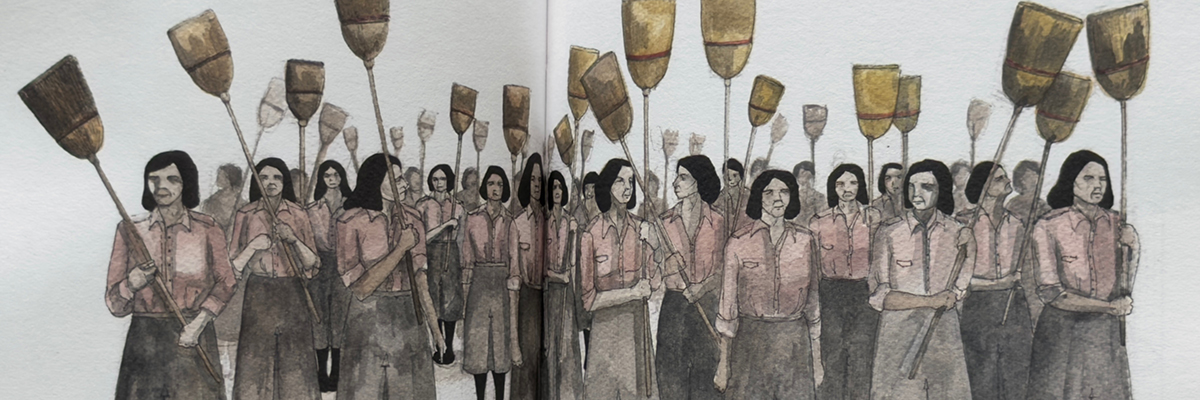
Across its pages, Hyuro’s central concerns appear with clarity: the social conditions imposed on women, the quiet violence embedded in political systems, and the fragile dignity of ordinary lives. With descriptive texts and personal observations, the writing makes these motivations explicit. A mural in Fortaleza, Brazil examines the criminalization of abortion and the way the female body becomes “usurped territory” by the state; another, in Monteleone di Puglia, recalls a wartime uprising led by women protesting food restrictions under fascism. Elsewhere she turns to children affected by war, neighborhood life shaped by urban development pressures, or the internal contradictions that shape our identities. These are not decorative murals but acts of witness—images that look closely at, plainly reflect through metaphor and allusion—injustice without theatrical exaggeration.

You knew it then, but it becomes especially clear in the book just how dramatically Hyuro’s work diverged from the prevailing mood of the global street-art boom of the 2010s. While festivals multiplied and the movement embraced spectacle, branding, and easily digestible imagery, Hyuro worked in a different register. Her figures are often partially obscured, cropped, or faceless; gestures are restrained; color is quiet. Instead of offering instant visual gratification, her murals ask viewers to slow down and reflect. In her observations, Martha Cooper notes the deceptive simplicity of her approach—images drawn from everyday life but infused with the artist’s personal observations. Monica Campana, reflecting on Hyuro’s practice, sees a commitment to making the street feel more like a home, a space where vulnerability and resistance can coexist.

Text Steven P. Harrington & Jaime Rojo     Photos Diana Paun

Title: Hyuro: Beauty of a Tragedy
Published: Impressum. Valencia, 2022
Author: A collection of authors
Language: English

Click URBAN NATION BERLIN to continue reading
Read more
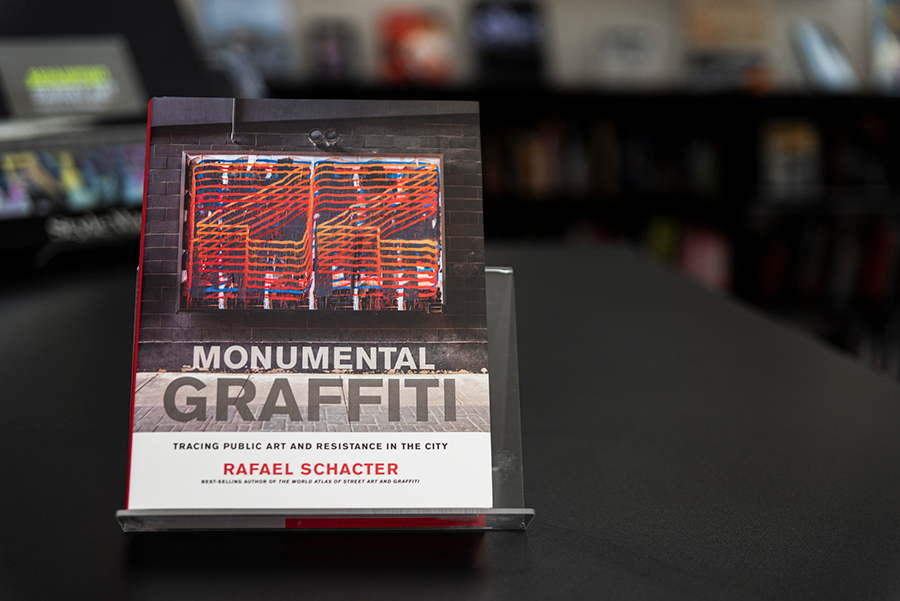
Books In The MCL: Rafael Schacter: Monumental Graffiti. Tracing Public Art And Resistance In The City.

Books In The MCL: Rafael Schacter: Monumental Graffiti. Tracing Public Art And Resistance In The City.

Rafael Schacter: Monumental Graffiti. Tracing Public Art and Resistance in the City.

Reprinted from the original review.

In Monumental Graffiti: Tracing Public Art and Resistance in the City, Rafael Schacter proposes a reconsideration of monumentality through the lens of graffiti and street-based practices. Rather than approaching monuments as fixed, permanent structures, Schacter frames them as acts—gestures that remind, advise, or warn. Drawing on his research as an art historian and curator of urban art, the book examines how graffiti and monuments can illuminate one another, offering a way to understand public memory that is grounded in community, embodiment, and the acceptance of transience.

Using images and examples from streets around the world, Schacter explores how graffiti can function monumentally without relying on scale, legality, or durability. He argues that monuments do not need to be grand or permanent to carry social meaning, and that graffiti, through its visibility and public presence, can demand attention in ways comparable to traditional monuments. In this framing, monumentality becomes conceptual rather than material, rooted in action and participation rather than physical endurance.

A central focus of the book is the role of memorial practices within graffiti culture. Schacter examines how community-created walls, tributes, and tags operate as grassroots monuments that commemorate loss, mark affiliation, and address social concerns. He distinguishes between spraycan memorials—often visible, collective, and broadly respected—and memorial tags, which he describes as more intimate and cryptic gestures, legible primarily within the subculture. Both forms, he suggests, function as living monuments shaped by shared understanding and repeated acts of writing.

Text Steven P. Harrington & Jaime Rojo     Photos Diana Paun

Title: Monumental Graffiti. Tracing Public Art and Resistance in the City
Published: MIT Press, 2024
Author: Rafael Schacter
Language: English

Click URBAN NATION BERLIN to continue reading

Read more
Books In The MCL: Mehdi Ben Cheikh. Djerbahood: Open Air Museum of Street Art

Books In The MCL: Mehdi Ben Cheikh. Djerbahood: Open Air Museum of Street Art

Djerbahood: Open Air Museum of Street Art. Mehdi Ben Cheikh. 2015

Reprinted from the original review.

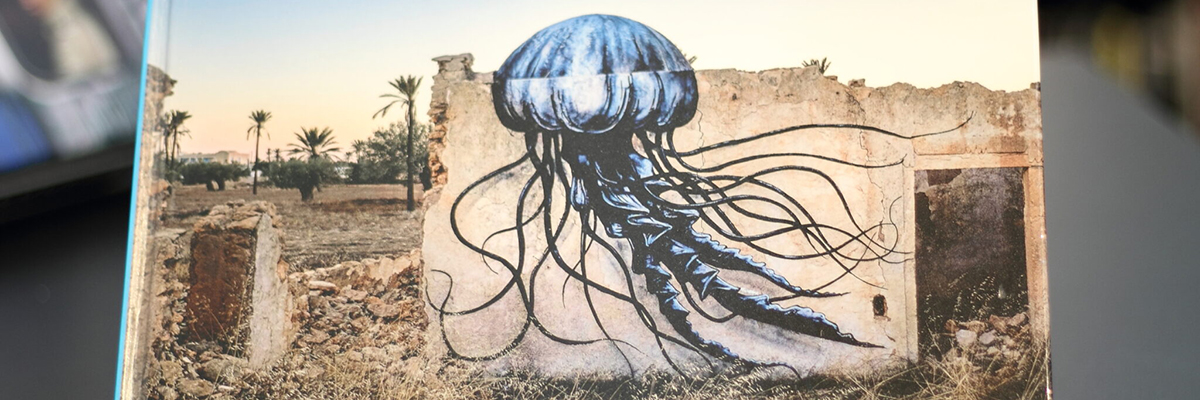
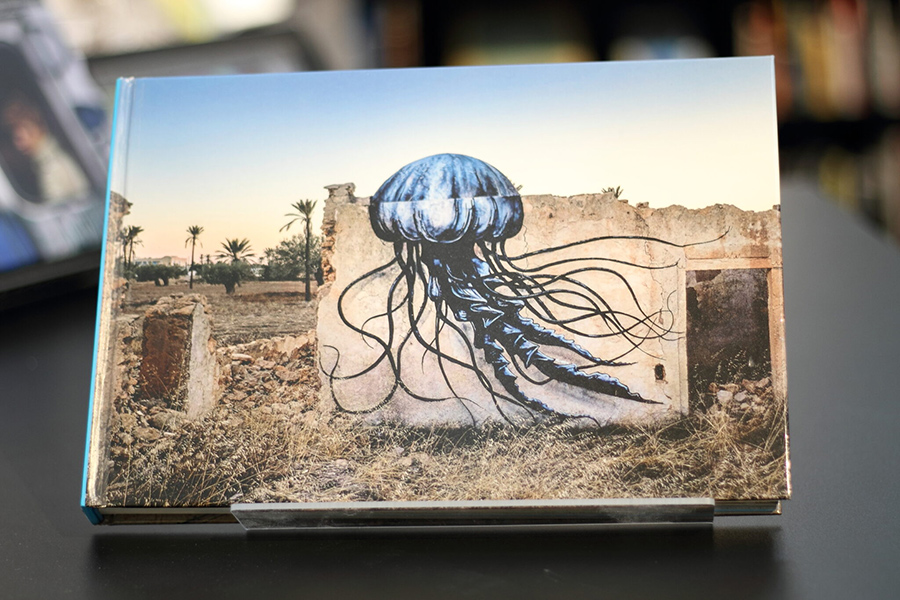
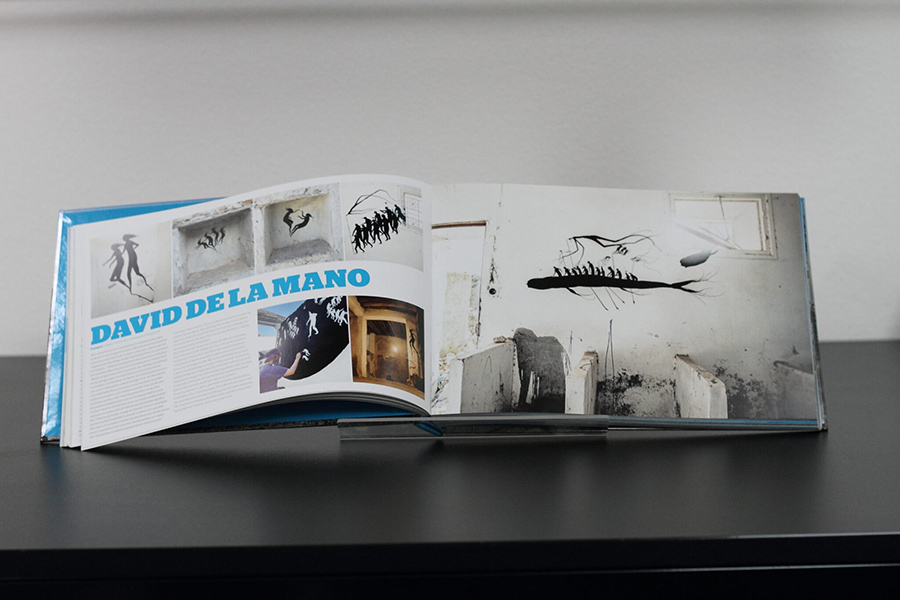
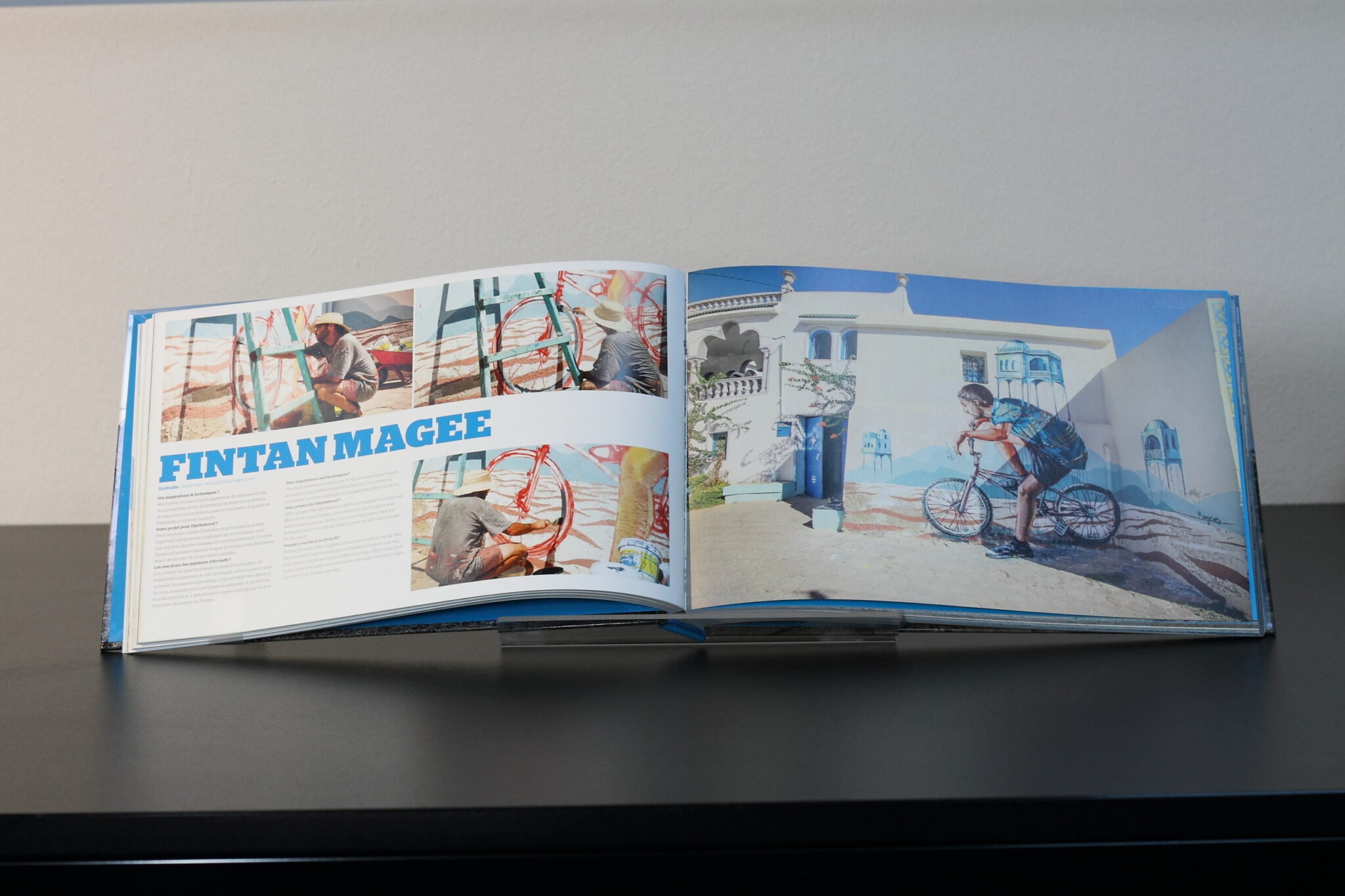
If Tour Paris 13 was the demolition swan song of an era, Djerbahood may feel like an expansive sunrise on the other side of the world. Conceived by gallerist and curator Mehdi Ben Cheikh and realized in the whitewashed village of Erriadh on the island of Djerba, Tunisia, this project gathered more than one hundred artists from thirty countries to create what Ben Cheikh calls a “museum à ciel ouvert”—an open-air museum under the North African sun. The resulting book, published by Albin Michel, offers a monumental visual record of this transformation: 500 photographs across 272 pages, documenting walls, artists, and villagers in a rare moment of collective creation.

In these images, the desert light hits walls like paper. Works by eL Seed, ROA, Pantonio, Phlegm, Jaz, Fintan Magee, Curiot, Inti, and Sebas Velasco coexist with local architecture—white domes, low arches, latticed shadows—turning the town into a living gallery. As Brooklyn Street Art observed in its review, Djerbahood “absorbs your mind and imagination, giving you a sense of the place and the people who live there.” It’s true: the book’s pacing—half atlas, half photo-essay—lets readers wander through alleys as if following the scent of plaster and sea air.

Text Steven P. Harrington & Jaime Rojo     Fotos Eveline Wilson

Title: Djerbahood: Open Air Museum of Street Art
Published: Published by Albin Michael / Galerie Itinerrance, Paris, 2015
Author: Mehdi Ben Cheikh
Language: English

Click URBAN NATION BERLIN to continue reading
Read more
Books In The MCL: Vladimir Manzhos. WAONE: Worlds of Phantasmagoria, Vol. 1

Books In The MCL: Vladimir Manzhos. WAONE: Worlds of Phantasmagoria, Vol. 1

WAONE: Worlds of Phantasmagoria, Vol. 1. Vladimir Manzhos. 2020

Reprinted from the original review.

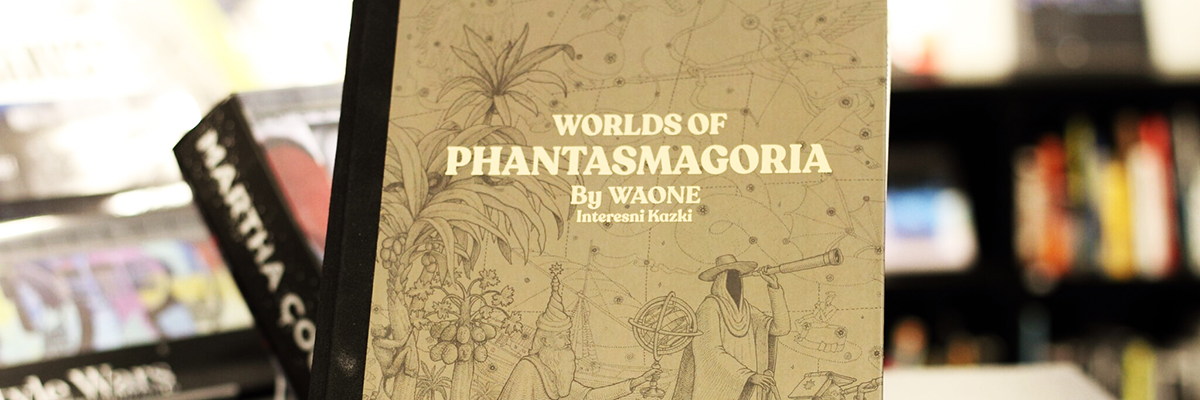
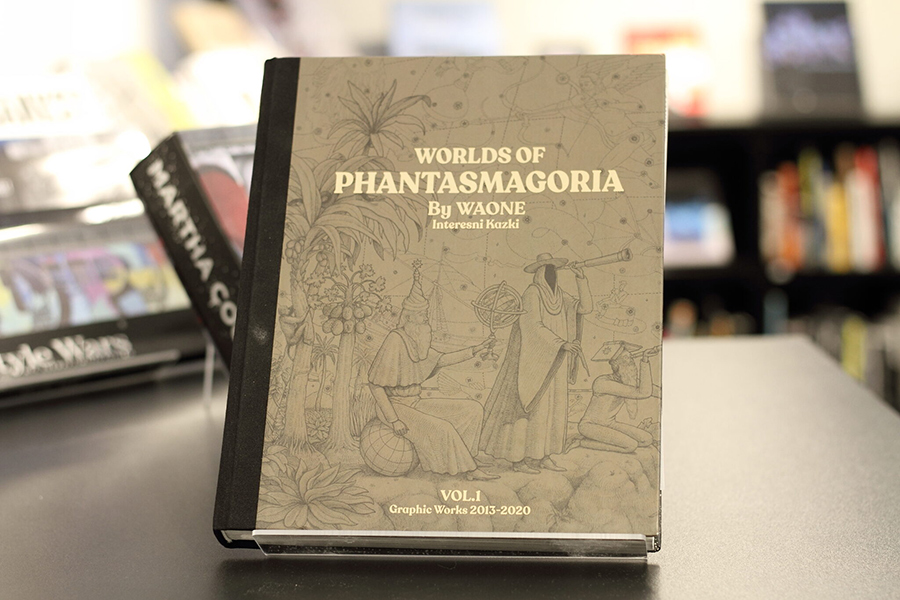
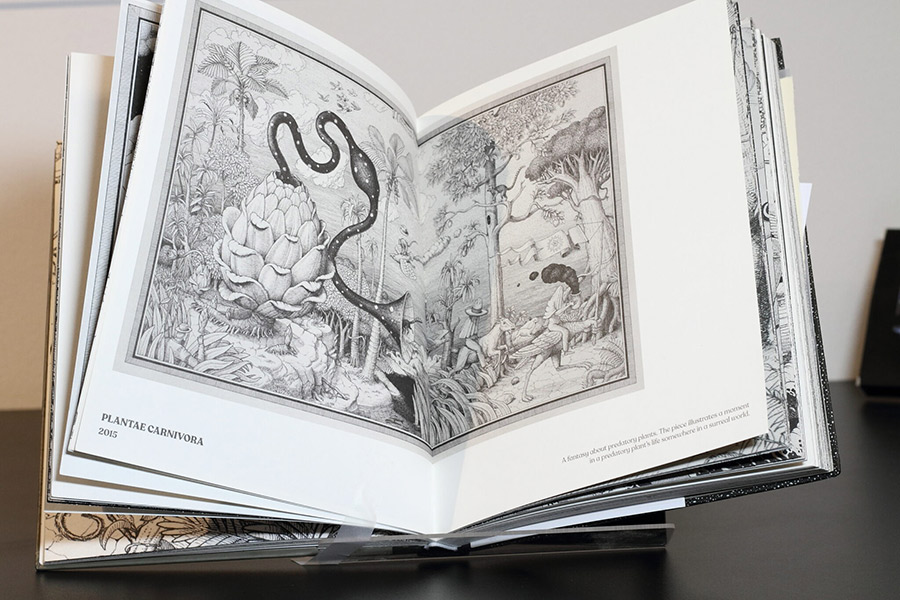
Worlds of Phantasmagoria, Vol. 1 is a comprehensive exploration of the monochromatic works of Ukrainian artist Vladimir Manzhos, known as WAONE. Spanning the years 2013 to 2020, this 208-page hardcover book provides a chronological view of his artistic evolution. It highlights his transition from large-scale, colorful murals in public spaces to intricate black-and-white compositions created in the studio.

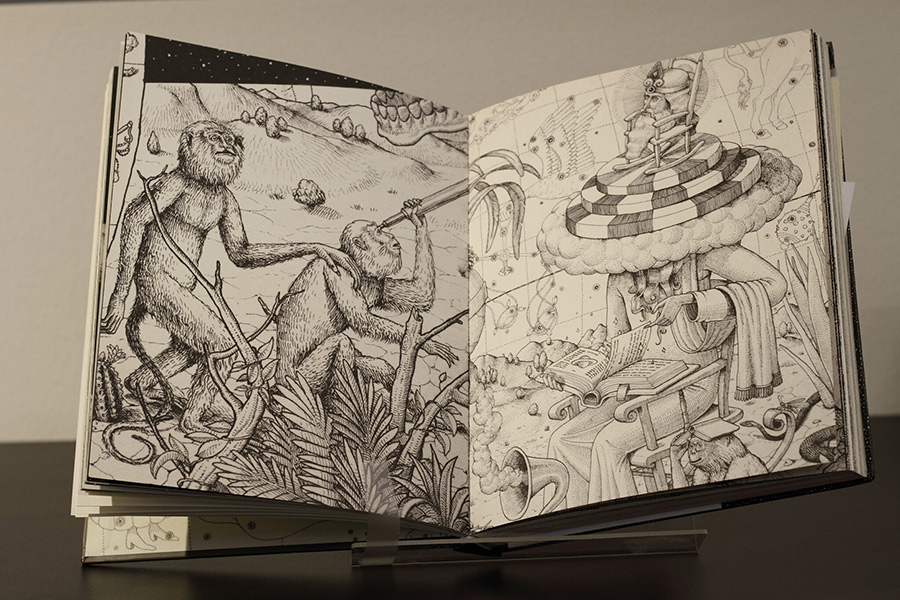
The book features a range of works, including murals, ink drawings, etchings, and lithographs, each accompanied by detailed narratives from the artist. These descriptions provide insight into WAONE’s creative process and the philosophical themes that underpin his work. Drawing inspiration from mythology, folklore, science, and personal introspection, his pieces weave together surreal imagery with symbolic depth.

With the aesthetics of a musty and mythical library, the illustrations open the preconceptions of psychology, offering myriad views through recombining familiar elements into unusual associations. In the process, you travel with Waone as he dedicates himself to this uncolorful view, which is nonetheless rich, if not tinged with a bit of antiseptic horror.

Text Steven P. Harrington & Jaime Rojo     Fotos Eveline Wilson

Title: WAONE: Worlds of Phantasmagoria, Vol. 1
Published: WAWE 2020
Author: Vladimir Manzhos (WAONE)
Language: English

Click URBAN NATION BERLIN to continue reading
Read more
Martha Cooper Library / MCL PRESENTS #4: Political Graffiti

Martha Cooper Library / MCL PRESENTS #4: Political Graffiti

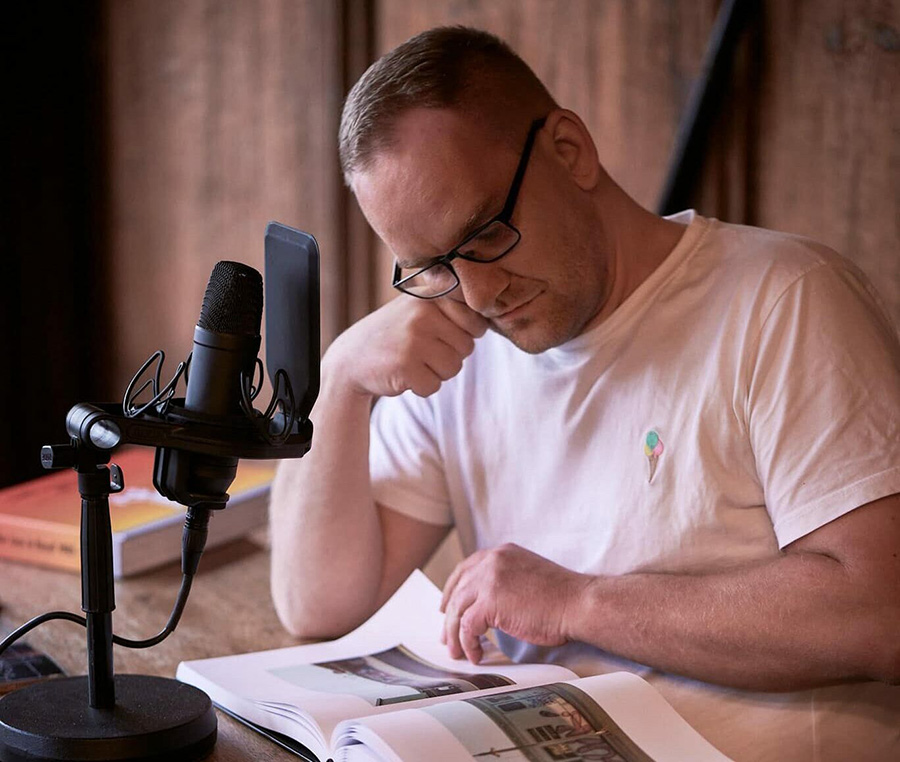
For the 4th installment of the Martha Cooper Library at Urban Nation Berlin’s series MCL Presents, the theme for discussion will be Graffiti and politics. Many people have argued that all art is political, and, graffiti wouldn’t be an exception. From the American writer Toni Morrison who famously declared “All good art is political! There is none that isn’t. And the ones that try hard not to be political are political by saying, ‘We love the Status quo.’ To the American performing artist Lin-Manuel Miranda who wrote in an article for The Atlantic “All art is political. In tense, fractious times—like our current moment—all art is political. But even during those times when politics and the future of our country itself are not the source of constant worry and anxiety, art is still political.” The MCL Librarian Mrs. Eveline Wilson will lead the talk with hosts René Kästner, Sven Niemann, and a mystery surprise host.

Talk with René Kästner, Sven Niemann, and a special guest from a street art crew

February 29, 2024, 6.00 to 7.30 pm
URBAN NATION Museum | Bülowstr. 7, 10783 Berlin

Vandalism or message? Sprayers reach for the can when they want to convey a political message to a broad audience in highly visible and public places. The volume “Political Graffiti” was recently published in the Guernica Society’s “Art and Politics” series. René Kästner and Sven Niemann discuss graffiti as a tool of political agency with an artist from an internationally renowned street art crew.

For more details and information about the guests and related exhibitions at the museum click HERE

René Kästner (photo courtesy of Martha Cooper Library. Urban Nation Berlin)
Sven Niemann (photo courtesy of Martha Cooper Library. Urban Nation Berlin)
Read more