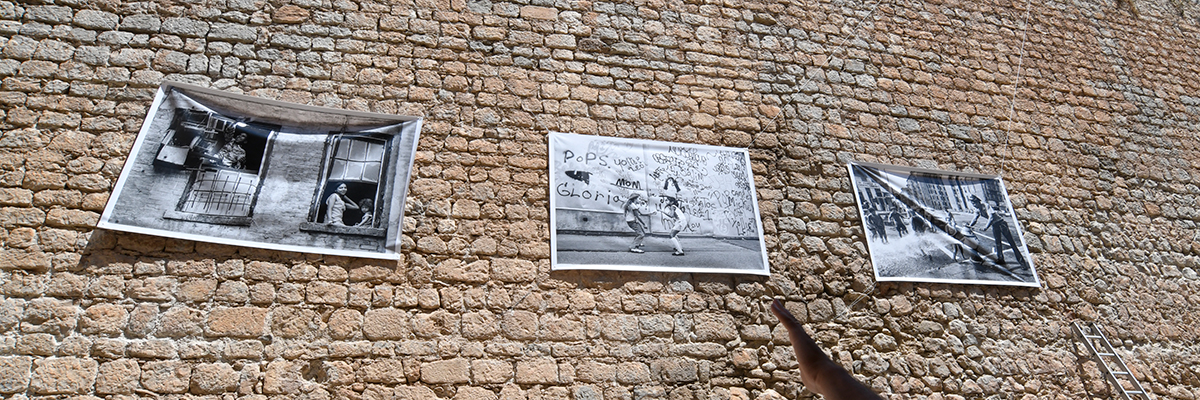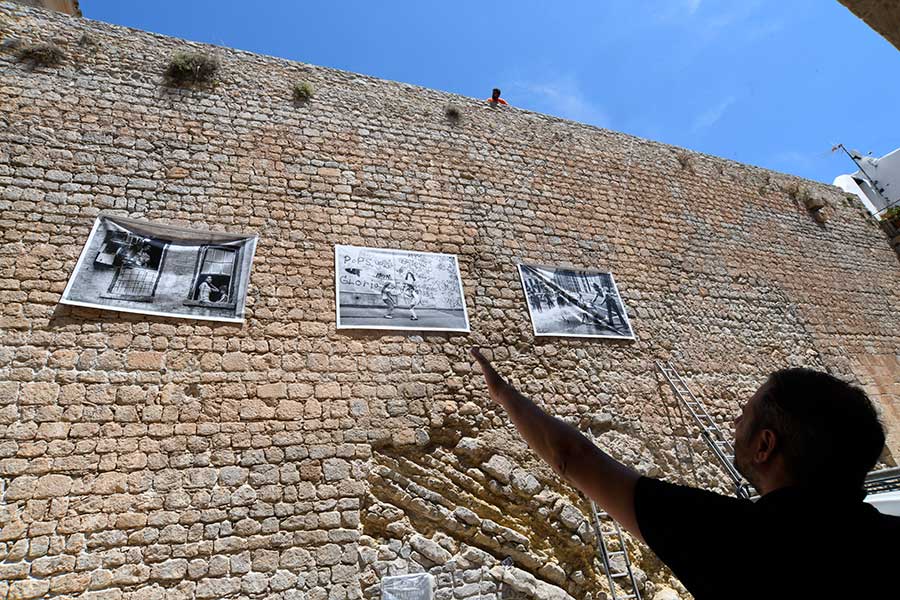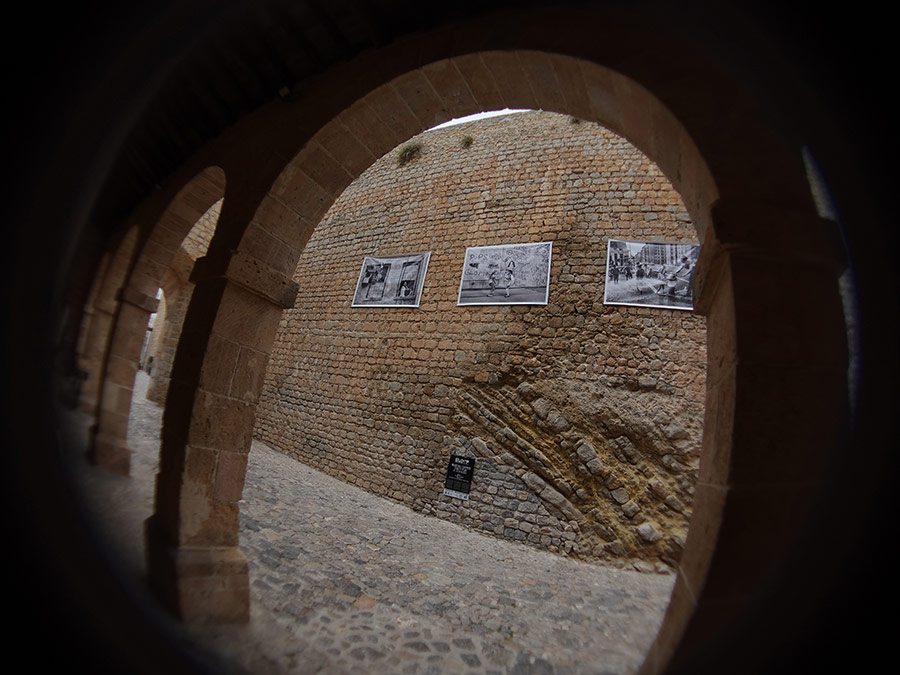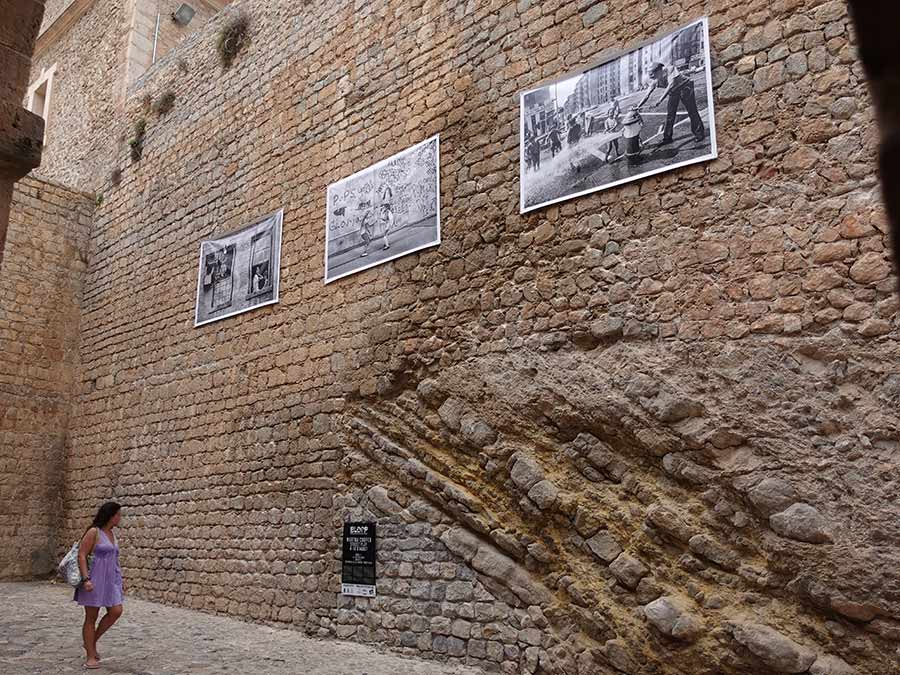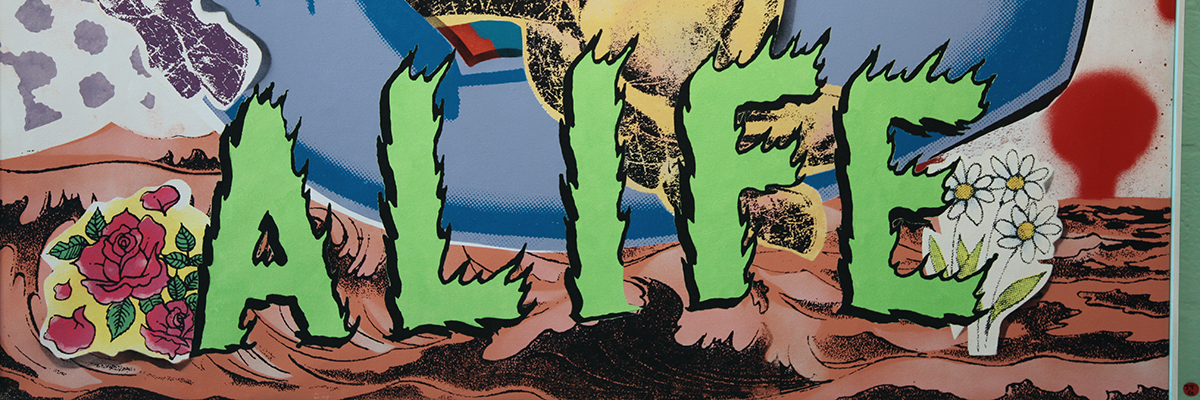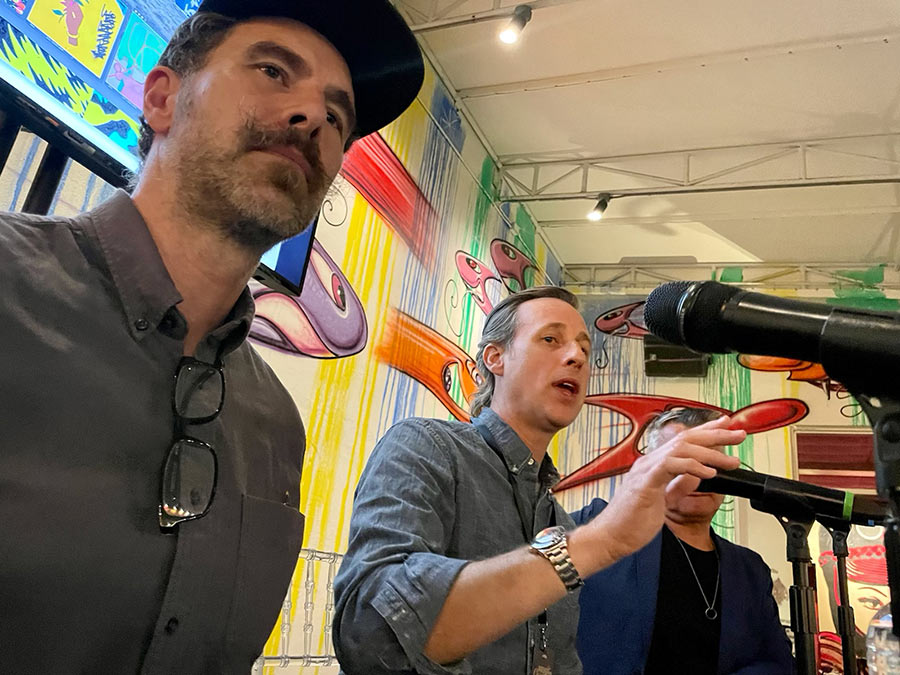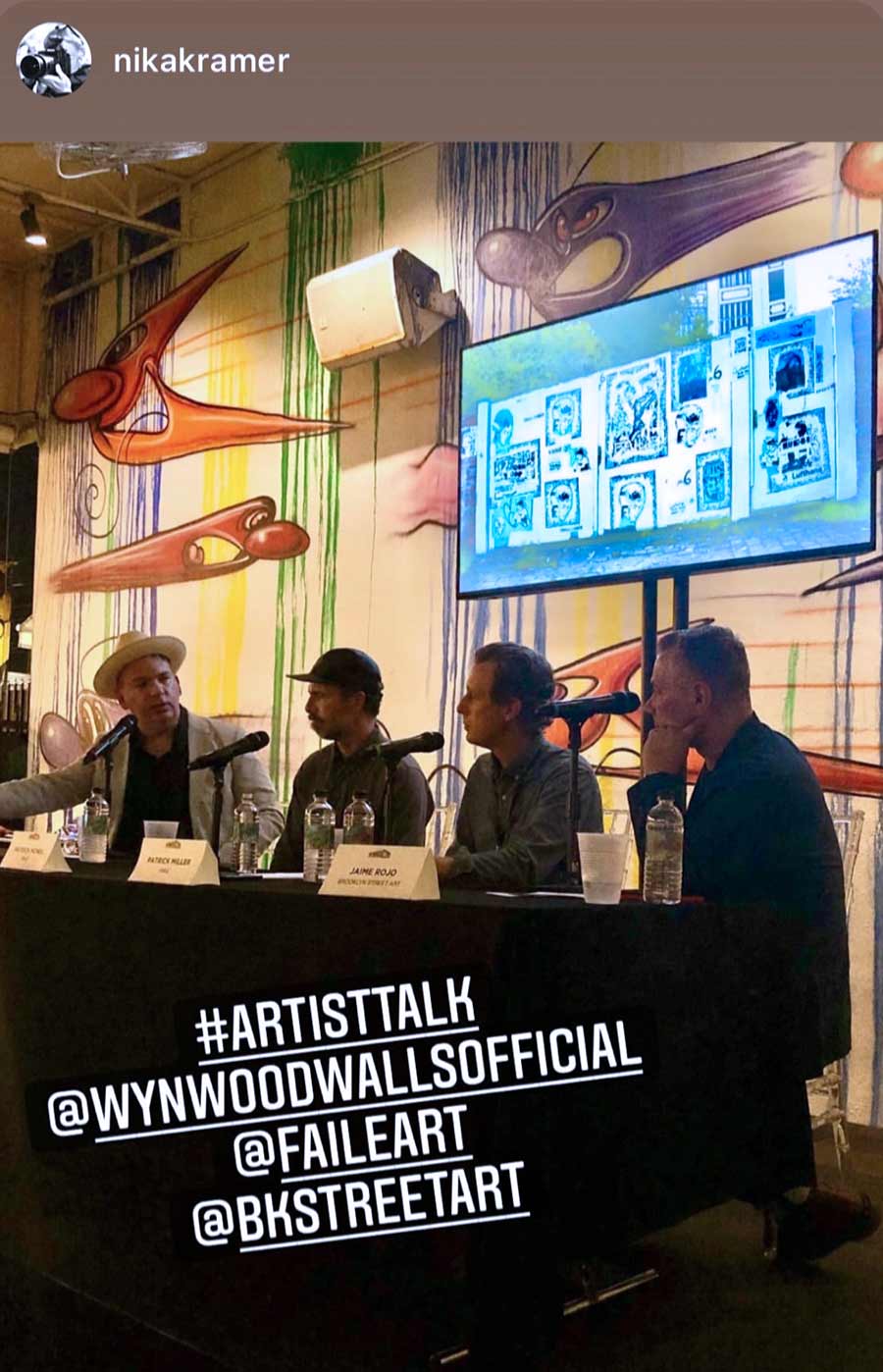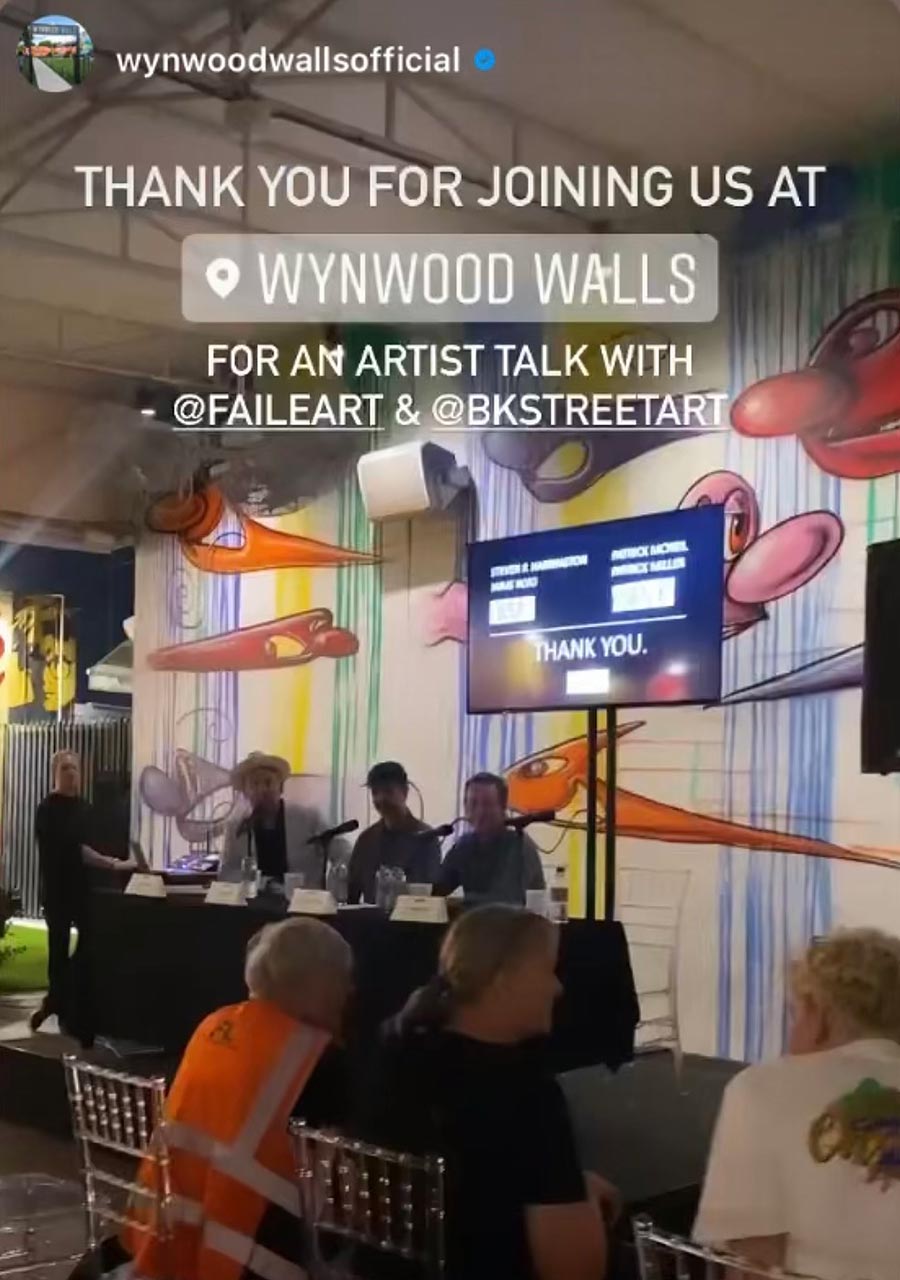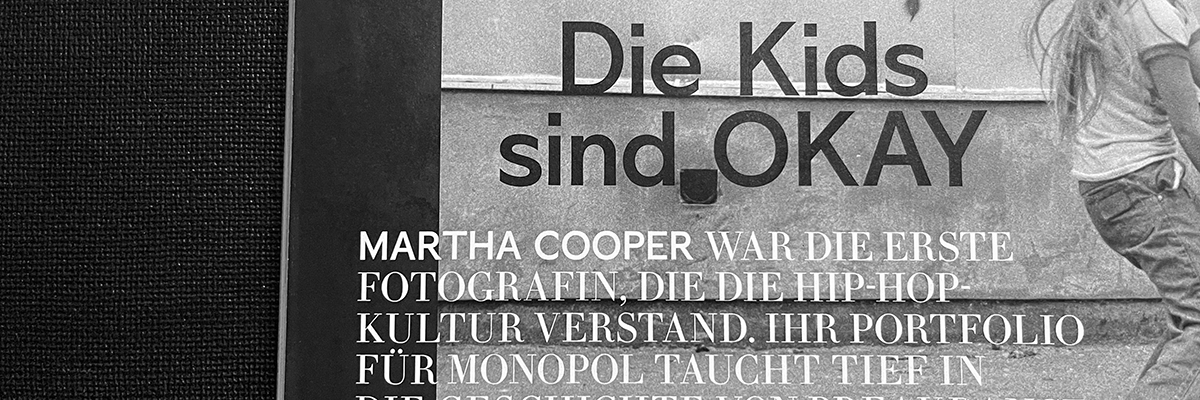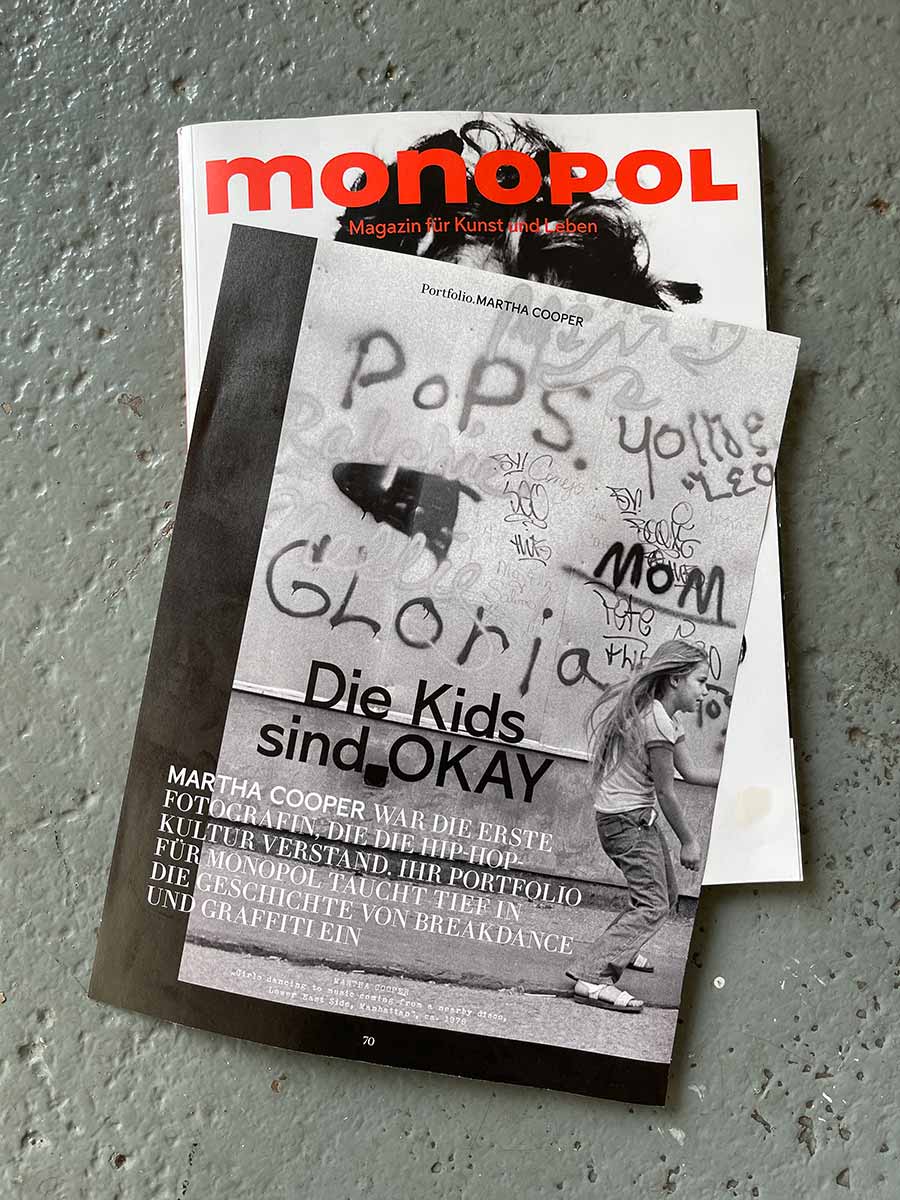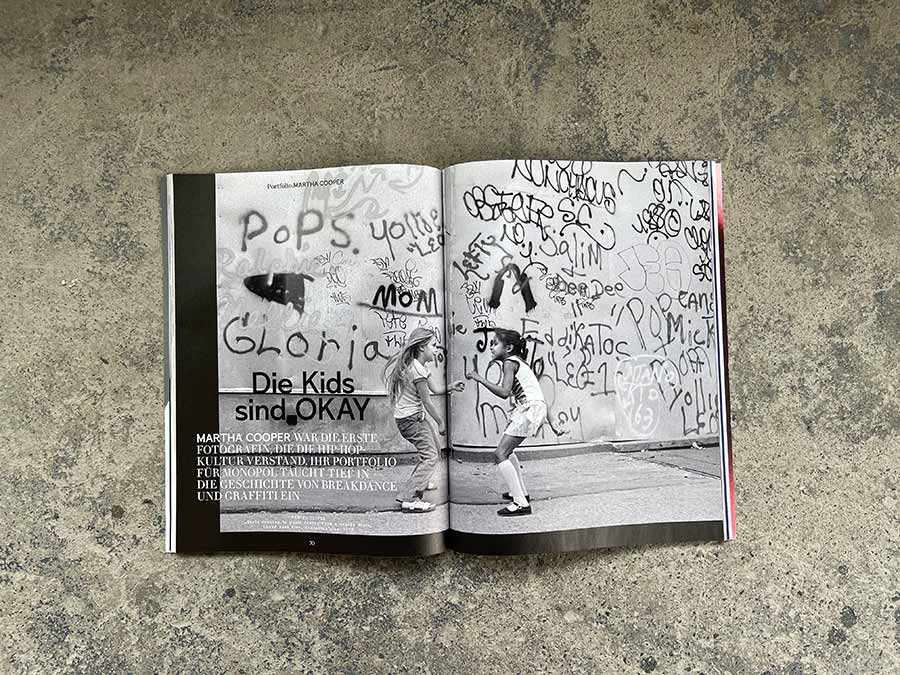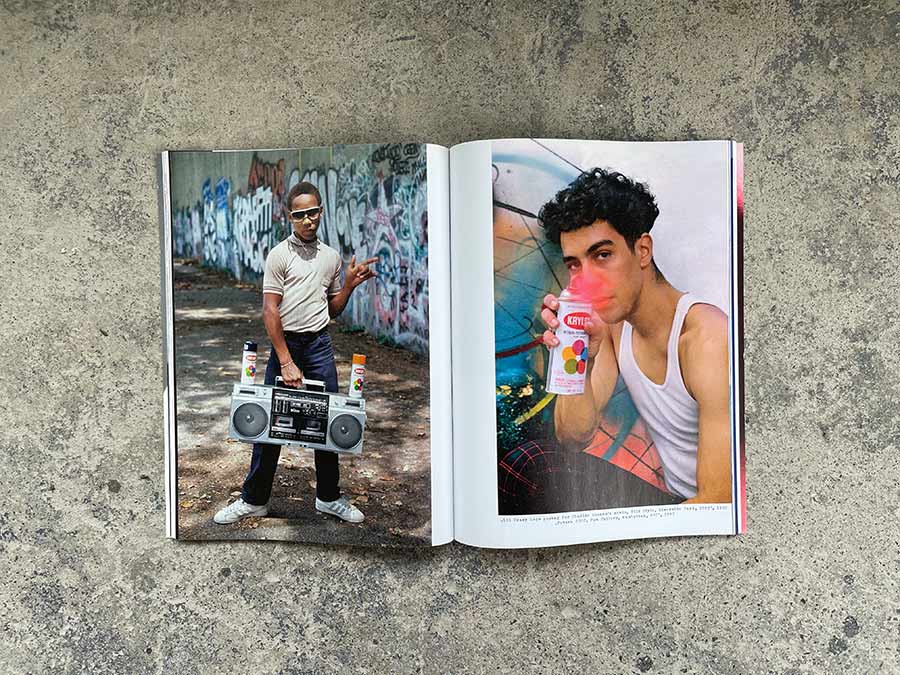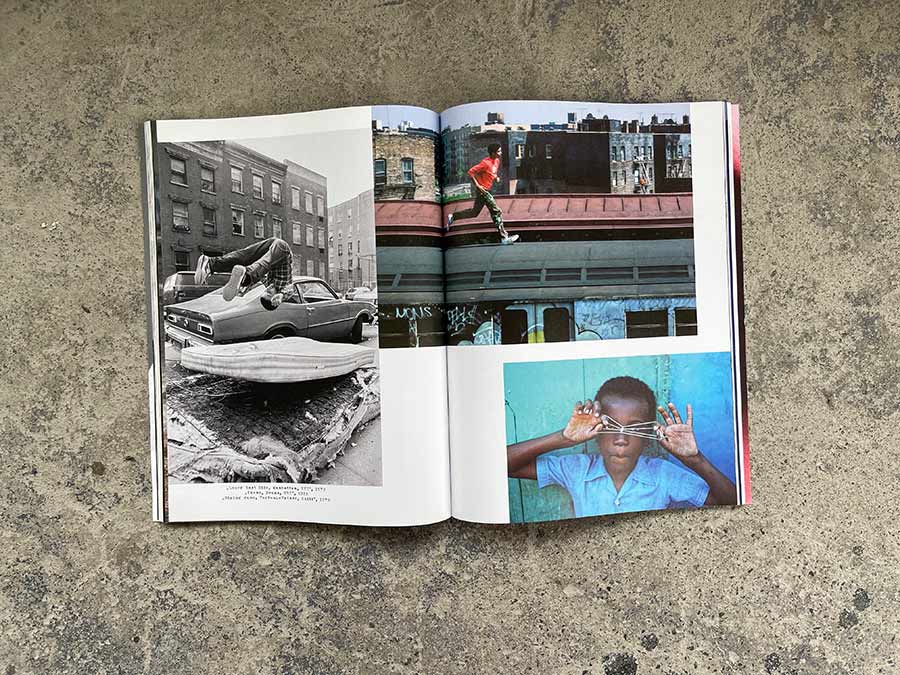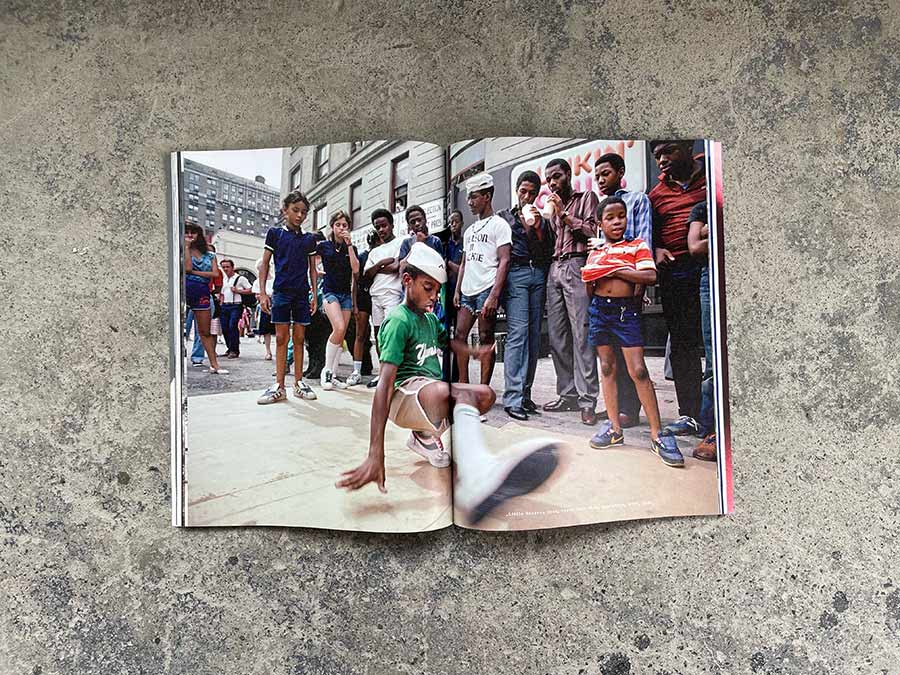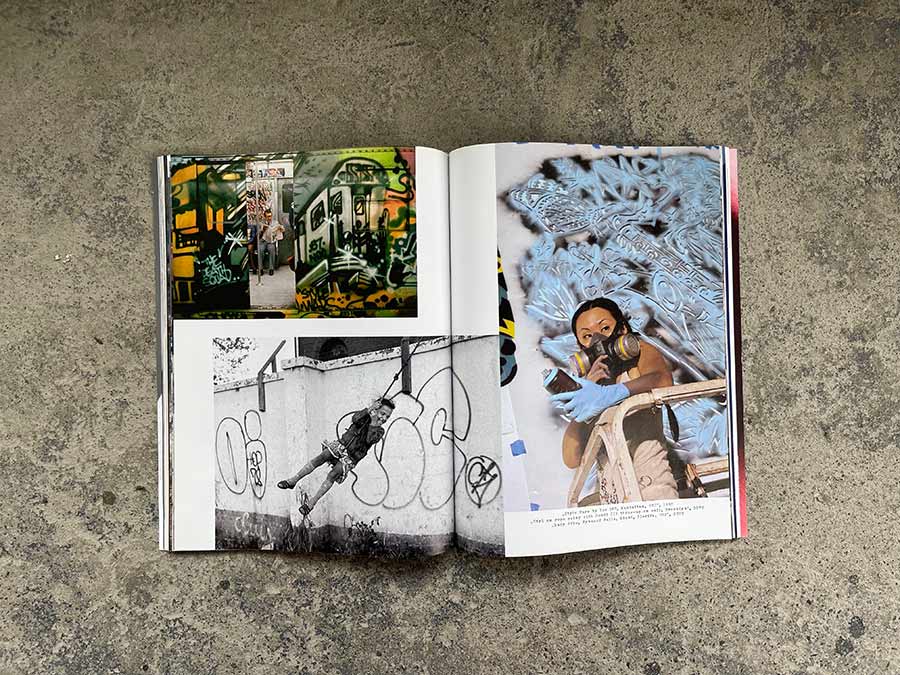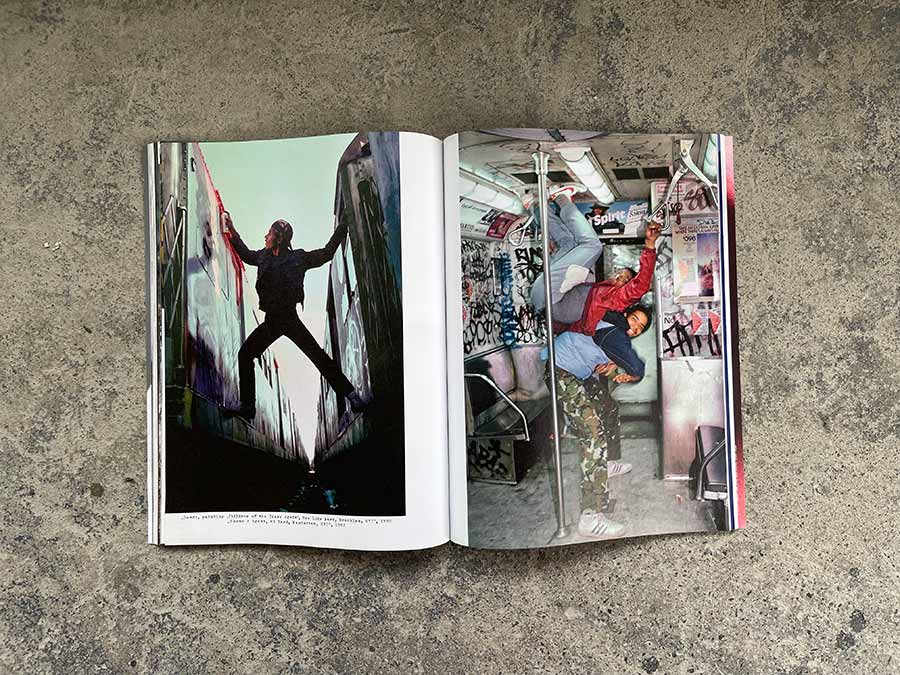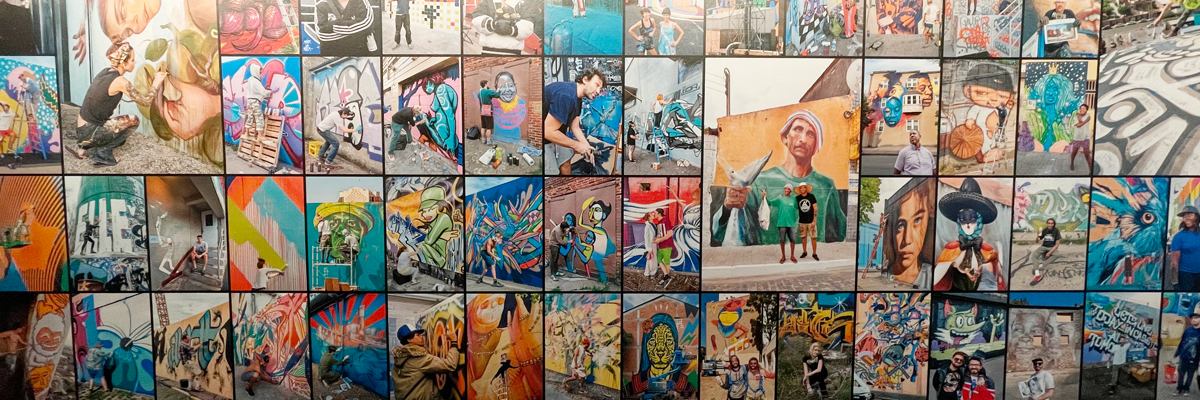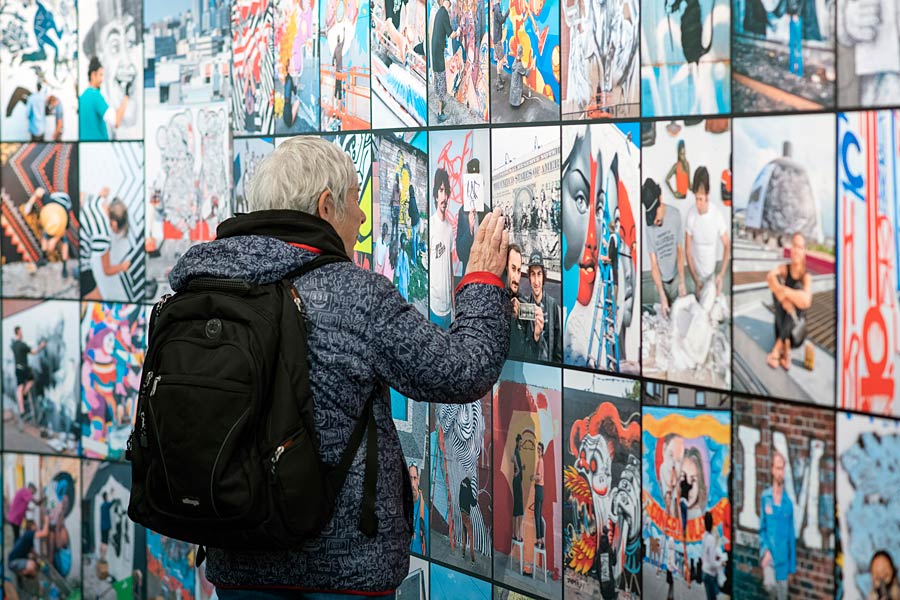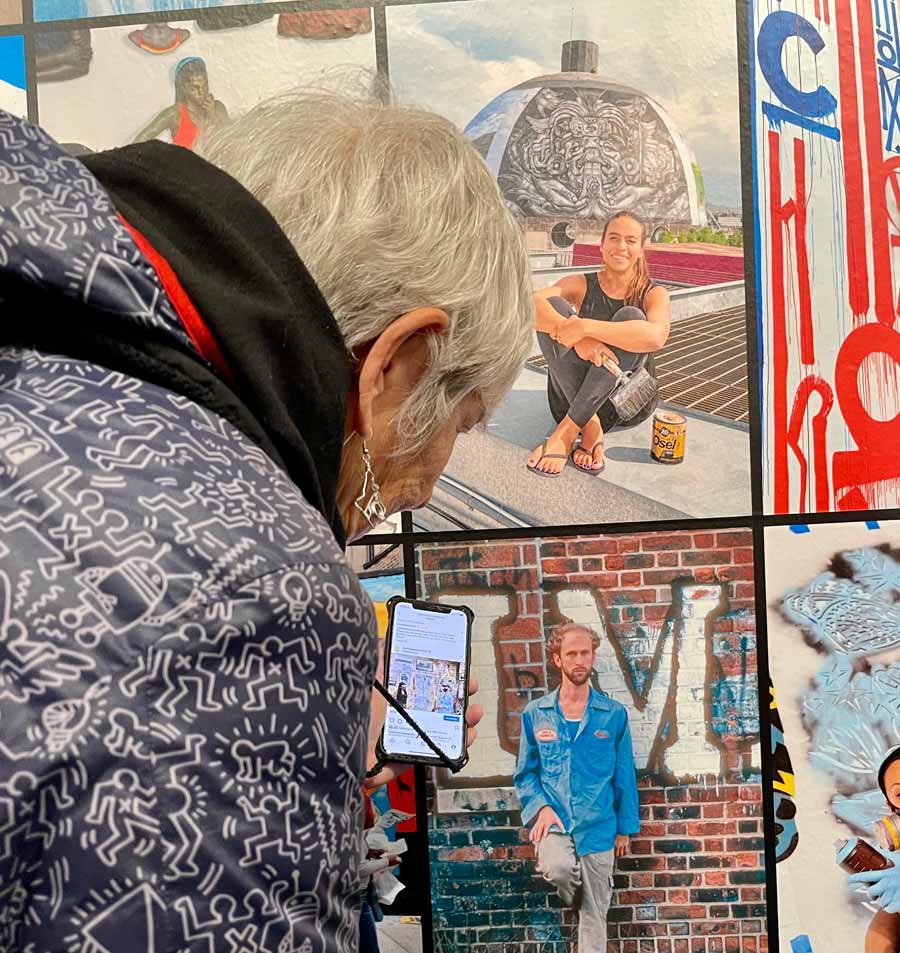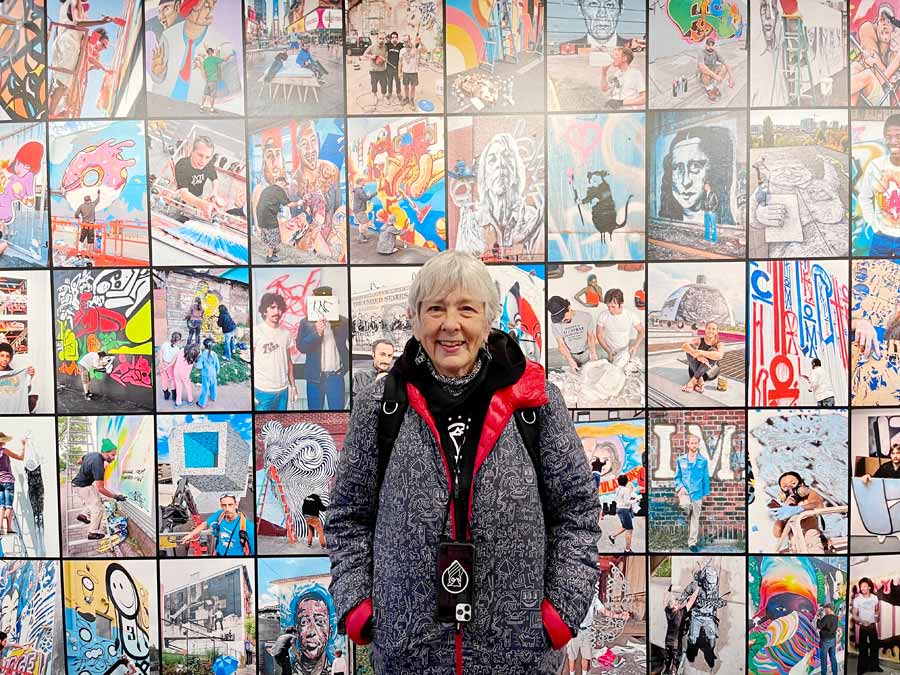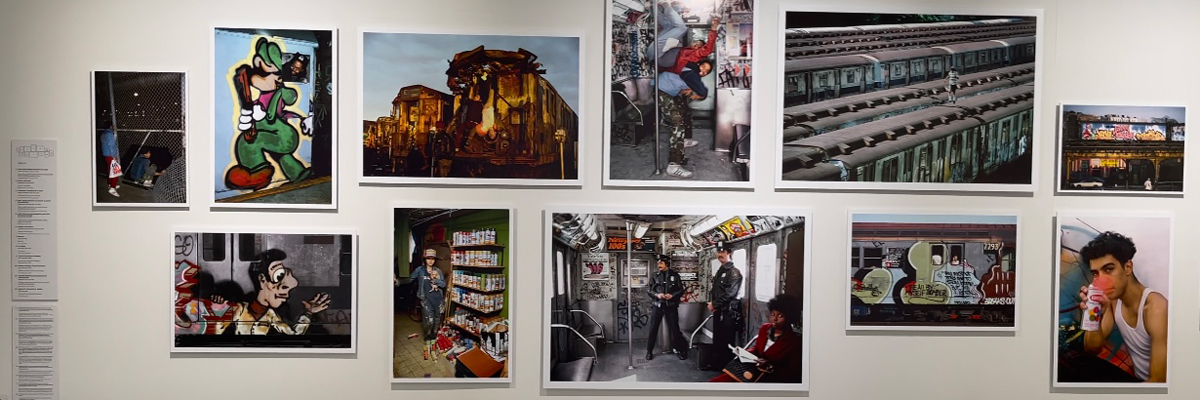
We’re pleased today to show you the new article about our exhibition and book “Martha Cooper: Taking Pictures” at Urban Nation – this one from the German Monopol magazine.
“Her voice on the phone is friendly and warm. But Martha Cooper, this is clear, does not want to be bored. Naturally not,” begins journalist Silke Hohmann in her article for Monopol.
Martha Cooper: Taking Pictures. Urban Nation Museum Berlin. Monopol Magazine
“Otherwise she would not have climbed on a motorcycle in 1965 to ride from Thailand to England at the age of 22. Otherwise, she would not have moved to Tokyo as a young woman to explore and photograph a legendary and discrete tattoo scene and one of its masters at work. Otherwise, she would not become the first female photographer at the New York Post in the 1970s where she photographed life in the urban wasteland. Cooper’s photographs of Breakdancers from the 1980s are the first published pictures of a then still unknown dance form, essential for the emergence of Hip Hop culture.”
Martha Cooper: Taking Pictures. Urban Nation Museum Berlin. Monopol MagazineMartha Cooper: Taking Pictures. Urban Nation Museum Berlin. Monopol MagazineMartha Cooper: Taking Pictures. Urban Nation Museum Berlin. Monopol MagazineMartha Cooper: Taking Pictures. Urban Nation Museum Berlin. Monopol MagazineMartha Cooper: Taking Pictures. Urban Nation Museum Berlin. Monopol MagazineMartha Cooper: Taking Pictures. Urban Nation Museum Berlin. Monopol Magazine
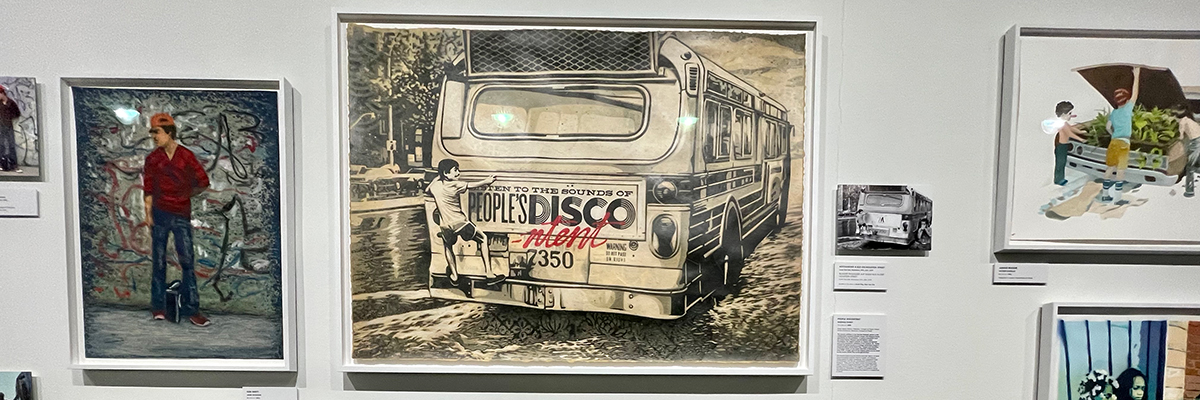
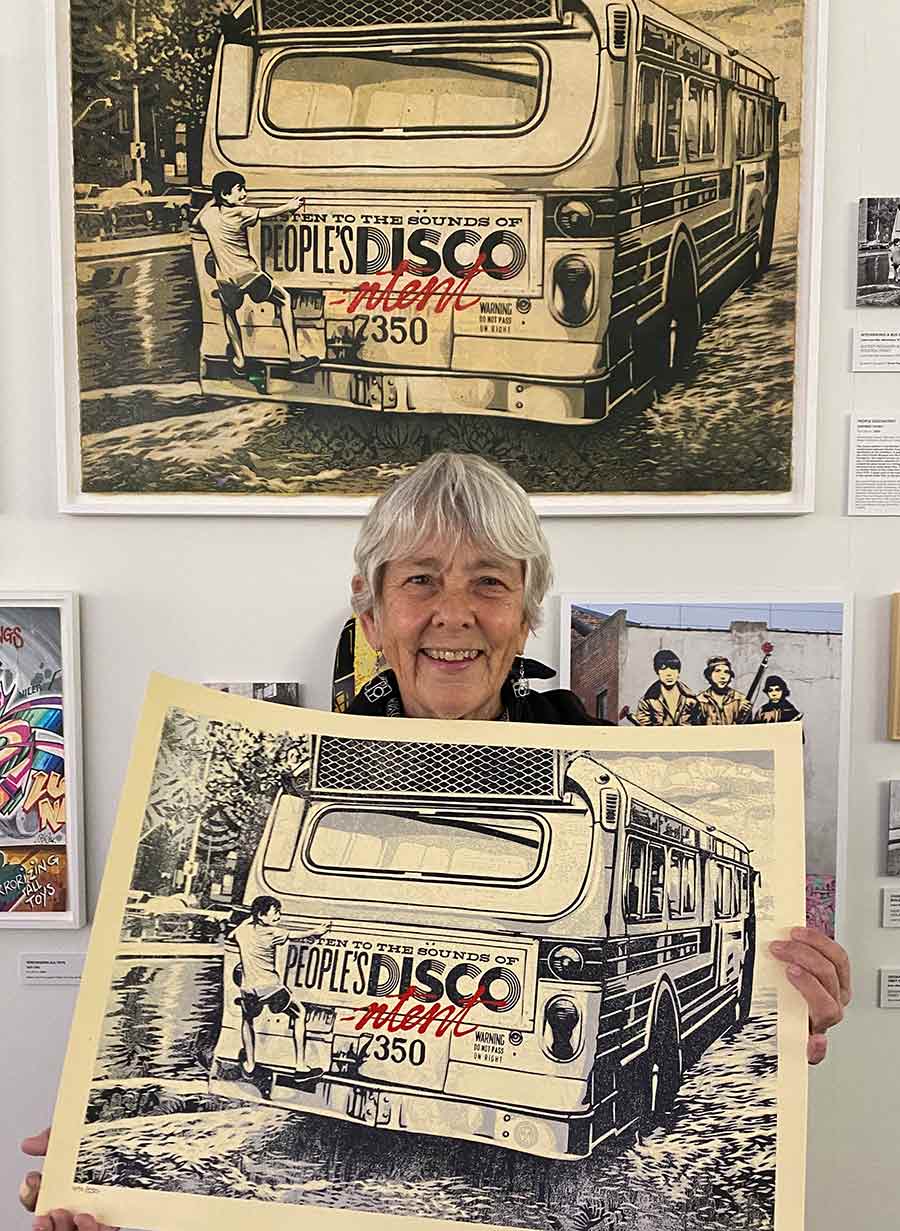
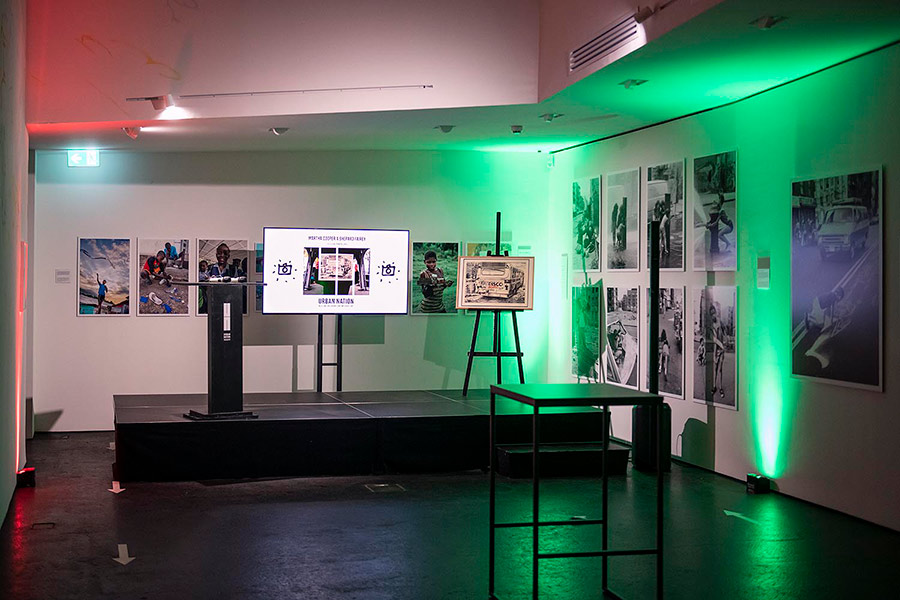
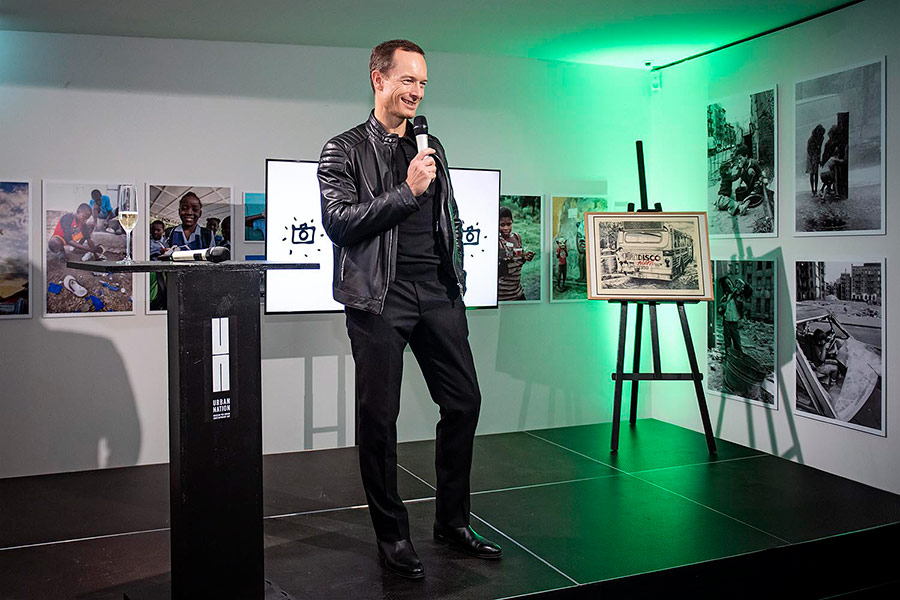
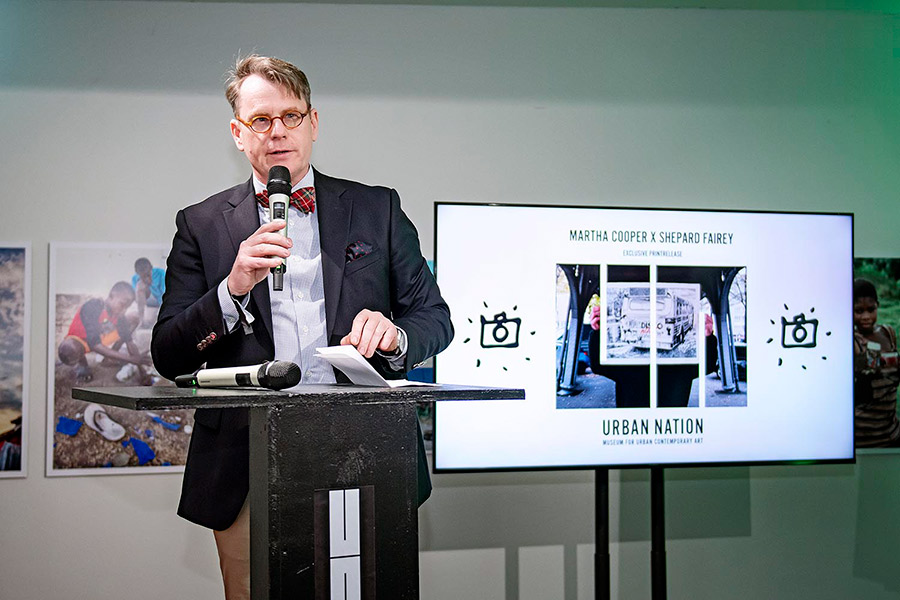
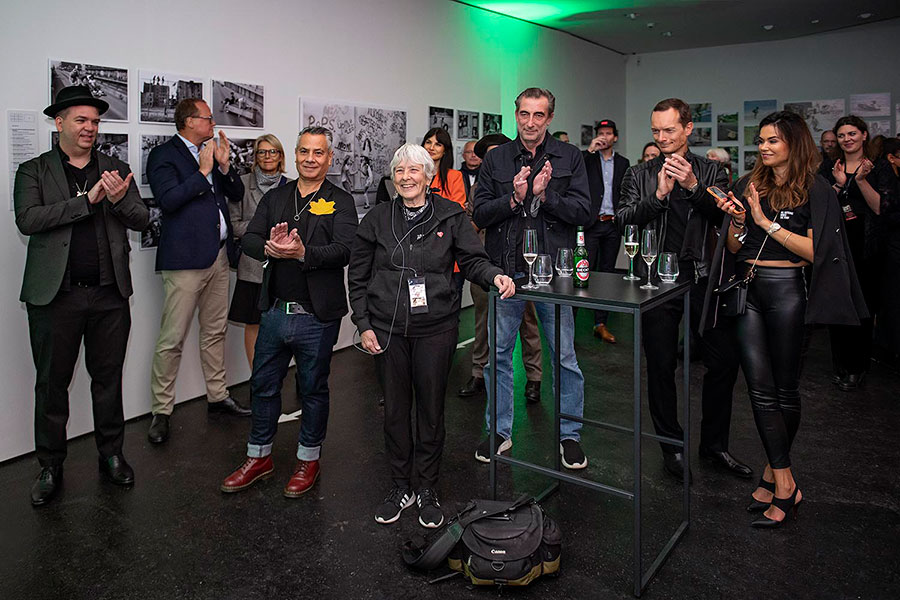
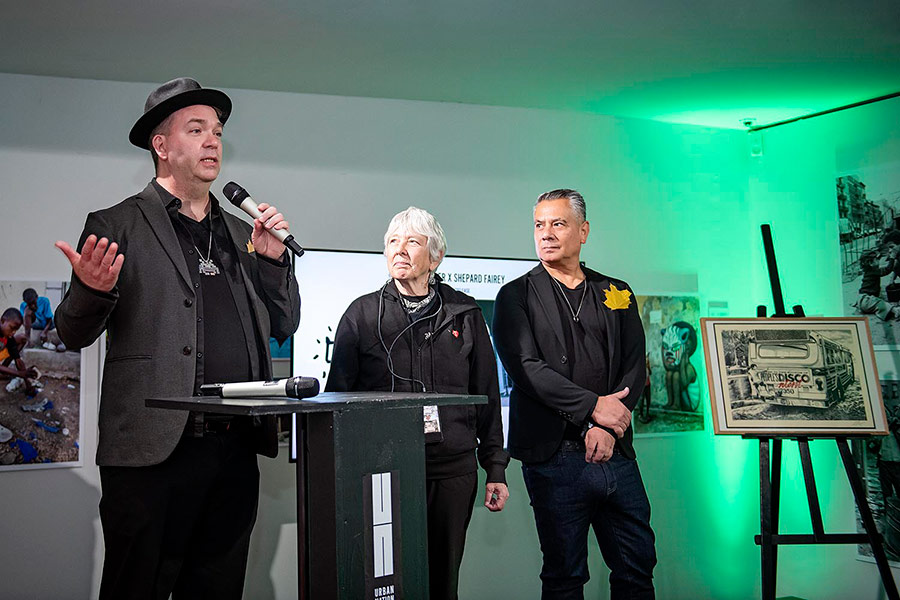
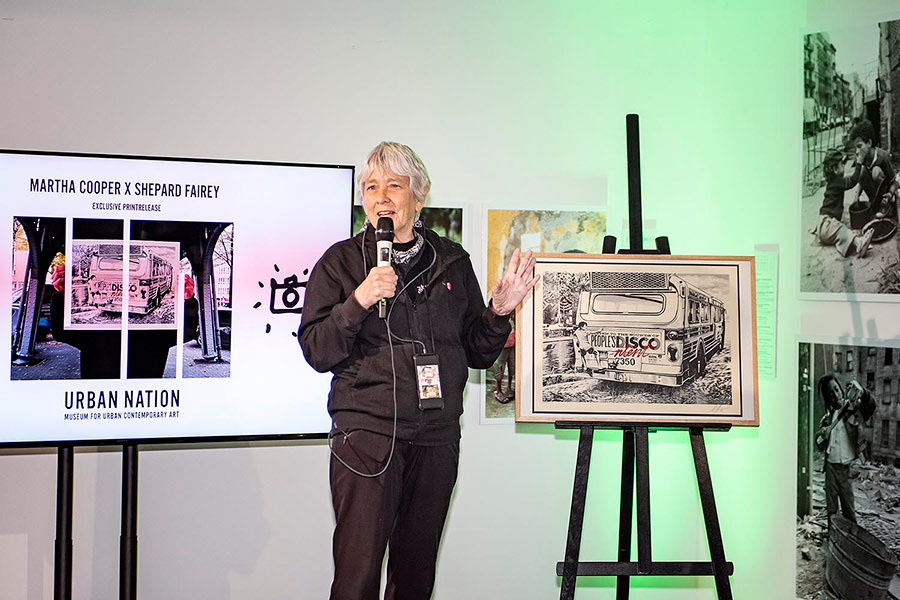
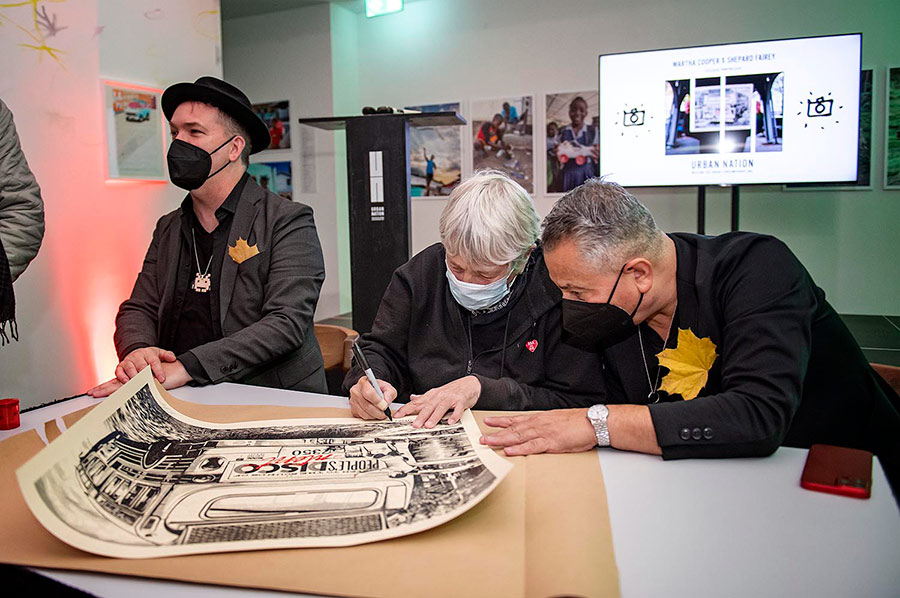
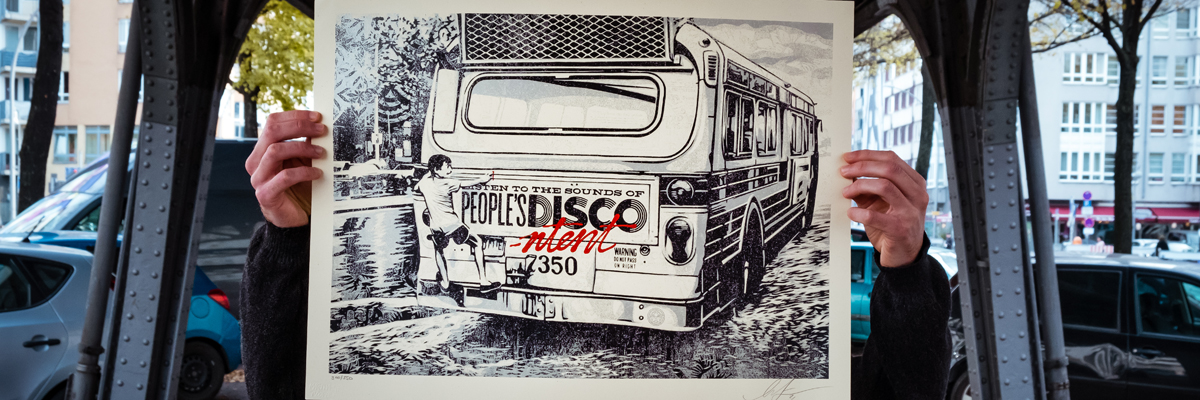
Today at 10:00 AM PDT Shepard Fairey will release his newest print and collaboration with Martha Cooper, “People’s Discontent”. Shepard’s long friendship with Martha has brought several collaborations throughout the years with Shepard remixing some of Martha’s most iconic photos from her Street Play series from the mid-’70s. The print already saw its European release in Berlin last Friday, October 30th at the Urban Nation Museum in Berlin with us and Martha in attendance.
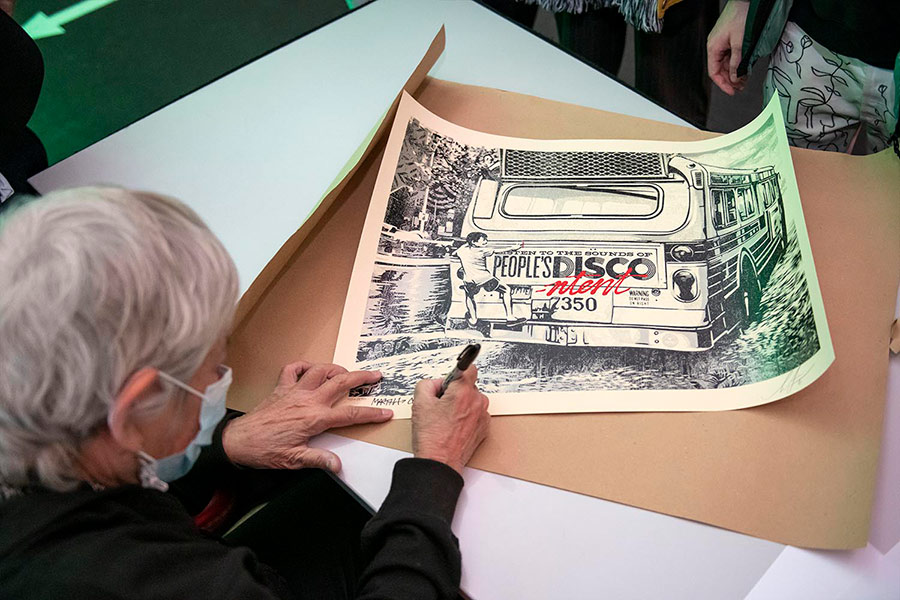
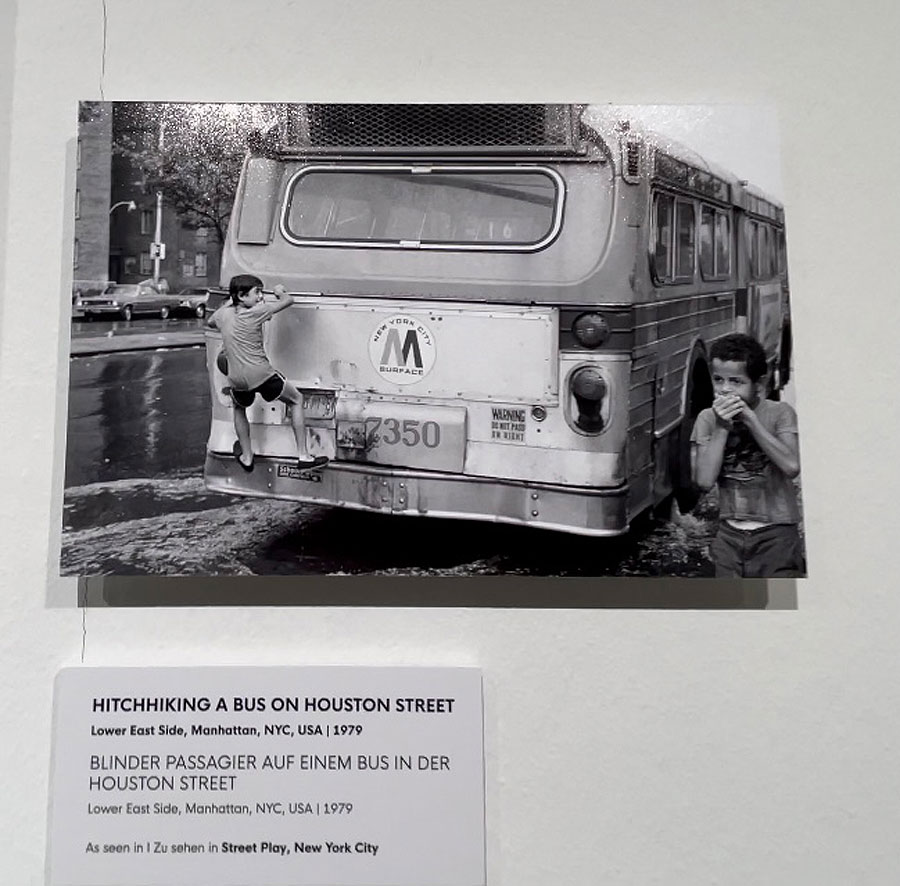
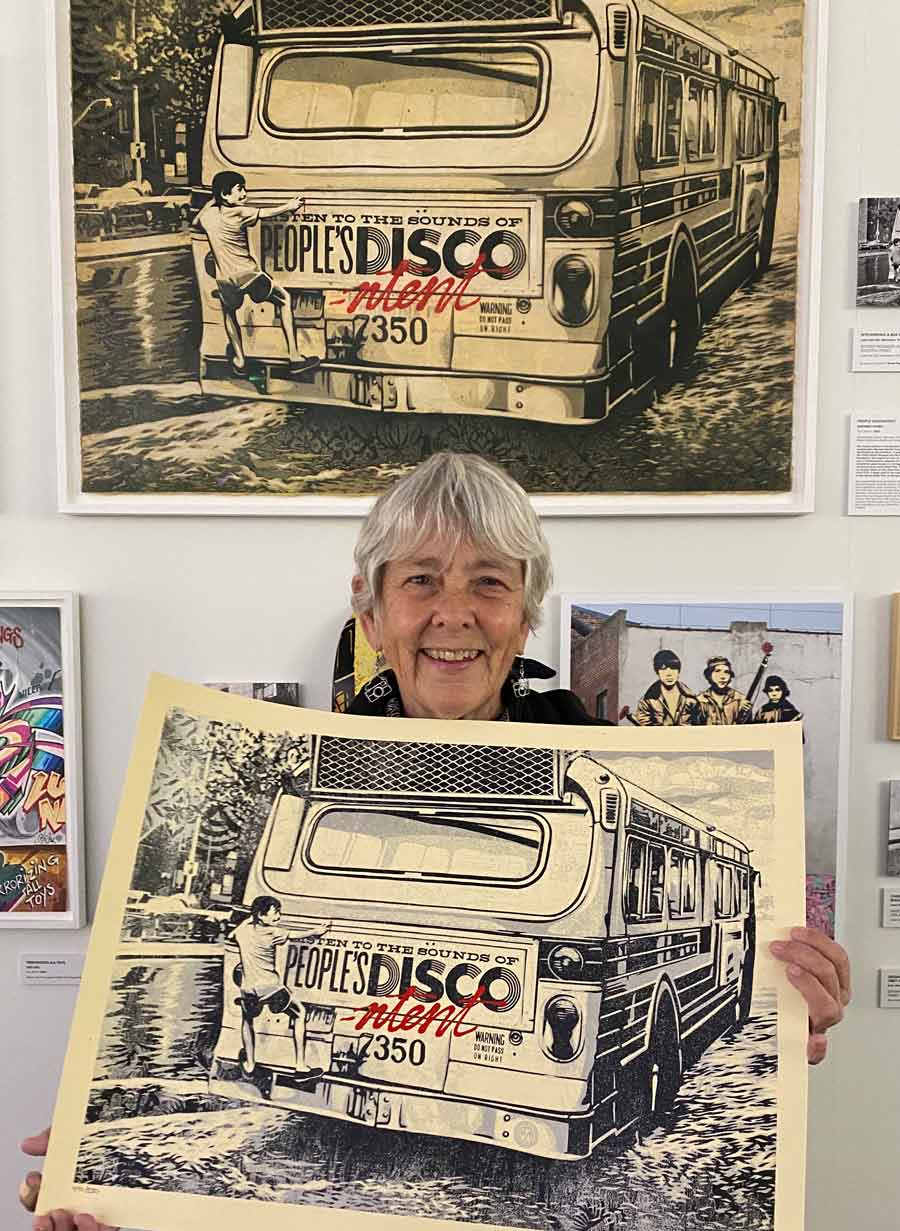
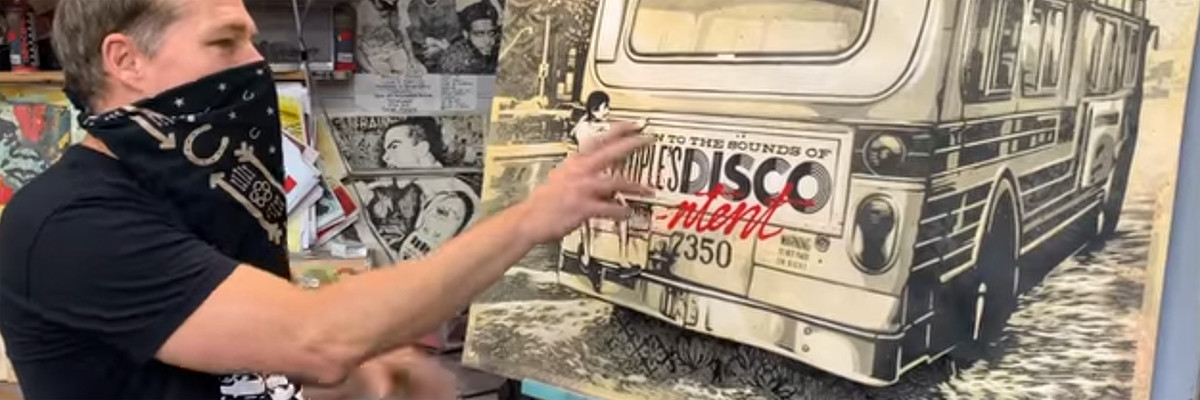
“I teamed up with my good friend and documentary photographer, Martha Cooper, on a new print release called “People’s Discontent.” Martha Cooper has been photographing creative kids in action on city streets since the mid-1970s. I remixed one of Martha’s iconic photos from her book, Street Play, titled “Hitchhiking a Bus on Houston Street” that she shot in 1978 in the Lower East Side of New York City. There was no advertisement on the back of the bus in her original photo, and since disco was the rage in the late ’70s, I thought it made sense for me to add a disco radio station with the slogan, “Listen To The Sounds of People’s Disco.” I added the “DISCO-ntent” and the spraypaint can in the kid’s hand as if he sprayed that on there. It’s a nod to that era but also to what’s going on now with the unrest around social justice issues.”
“This limited edition print was first released through Urban Nation Museum in Berlin as part of their current show “Martha Cooper: Taking Pictures” curated by Jaime Rojo and Steven P. Harrington of Brooklyn Street Art and will soon be up on my website this Thursday at 10 AM PT. Check it out!” – Shepard Fairey
When we asked Shepard Fairey if he would be up for a new remix of a Martha Cooper photo for our exhibition celebrating her career, he quickly said yes. Not only did he create a new original piece of art based on one of her classic “Street Play” images to hang in the gallery of our “Marth Remix” section, but he and his excellent team have also produced a new print – 250 of which sold out in 20 minutes on the Urban Nation website last night.
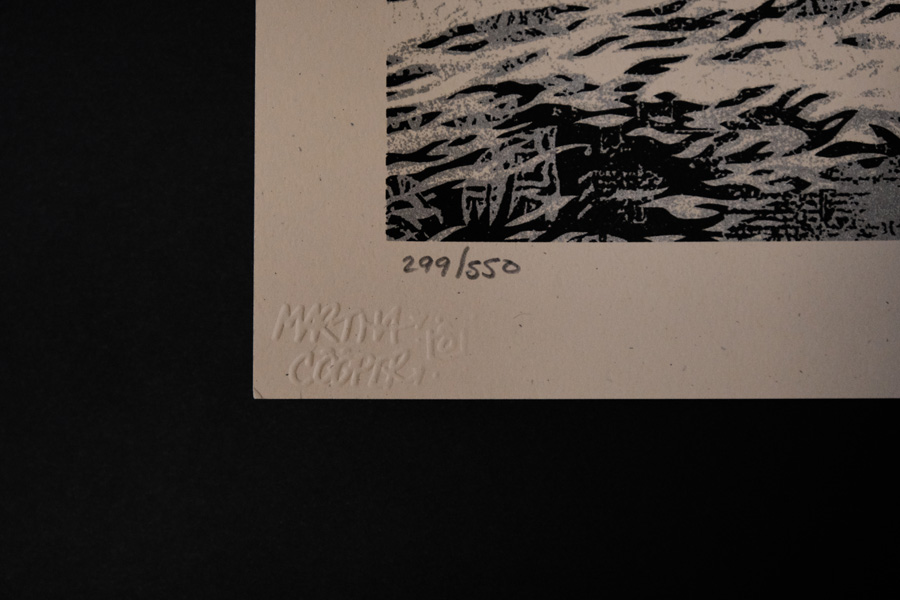
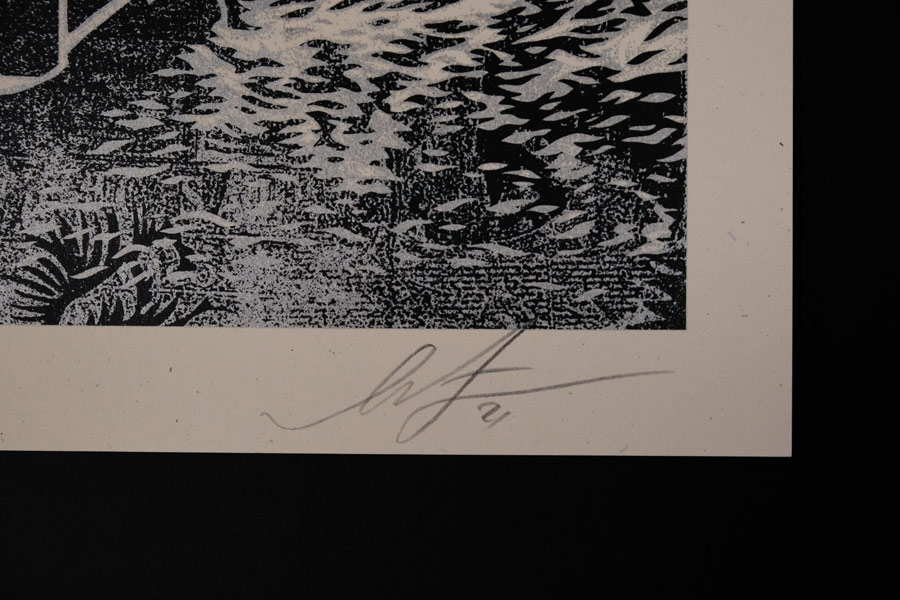
Shepard Fairey. ”People’s Discontent” 2020. 75,00€ Screenprint on thick cream Speckletone paper. Limited Edition of 550. 24 x 18 inches (61 x 46 cm) Embossed with Martha Cooper’s tag and Hand-signed & numbered by Shepard Fairey
The good news is Shepard will be selling another block of them on November 4th, so watch his announcements on social media!
But we still had a long line of lucky buyers snaking through the museum last night waiting for their opportunity for Martha to counter-sign their print, which had already been signed by Shepard. Because Shepard himself couldn’t attend he sent a warm video message to guests at a ceremony we had celebrating the print.
Martha Cooper’s original photo as shown in the exhibition next to the original art by Shepard Fairey.
What a complete HONOR it is for us to introduce this unique collabo between Martha Cooper and Shepard Fairey to celebrate our curation of her very FIRST career-wide retrospective, now showing at Urban Nation museum until May of 2022.
Very special thanks to our beautiful partners at YAP Berlin for making this event happen.
Our weekly focus on the moving image and art in the streets. And other oddities.
Now screening: 1. Shepard Fairey Talks About New Collaboration with Martha Cooper During Studio Visit via New Deal 2. “Landless Stranded” by Pejac
BSA Special Feature: Shepard Fairey Talks About New Collaboration with Martha Cooper During Studio Visit via New Deal
BSA is proud to debut a new collaborative print with Shepard Fairey and Shepard Fairey – a true honor really. Released by Urban Nation today it is a print made from a brand new original artwork commissioned for the Urban Nation Museum and our exhibition “Martha Cooper: Taking Pictures”.
During his development of the canvas last year Shepard was interviewed in Studio Number 2 by New Deal. See this video and you can learn a little about the new print going on sale today.
Shepard Fairey Studio Visit via New Deal
“Landless Stranded” by Pejac
As long as we’re in Berlin, we’ll be checking out PEJACs new show here this week and of course, we’ll be heading out to Holy Cross Church to see this powerful new public statement, “Landless Stranded.”
“As most people are familiar with distressing scenes involving refugees only through television images, it’s a bewildering sight to behold in an urban setting, high above street level. It’s as though reality has been dismantled in one location and anomalously constituted anew somewhere else,” says Pejac.
50+ years of taking photos of artists at work means you have thousands of images of graffiti writers straddling trains, street artists leaning off ladders, muralists hovering 20 stories above the street in cherry pickers. One of 11 sections comprising “Martha Cooper: Taking Pictures”, our Artists at Work area has 400 printed images from around the world, floor to ceiling, and across a half dozen decades.
Not only can people find their graff and street art heroes on these walls as seen through Martha’s eyes, we have also created a database searchable iPad of 1300 more images of Artists of Work that have never been seen before. Just enter a country name, or artist’s name, or even a Street Art festival name, and you’ll get a whole lot of eye candy, artists, and tools of the trade.
Since the beginning of the week, we’ve been reporting from Berlin on the Martha Cooper entire career retrospective “Martha Cooper: Taking Pictures” exhibition curated by Steven P. Harrington and Jaime Rojo of BrooklynStreetArt.com.
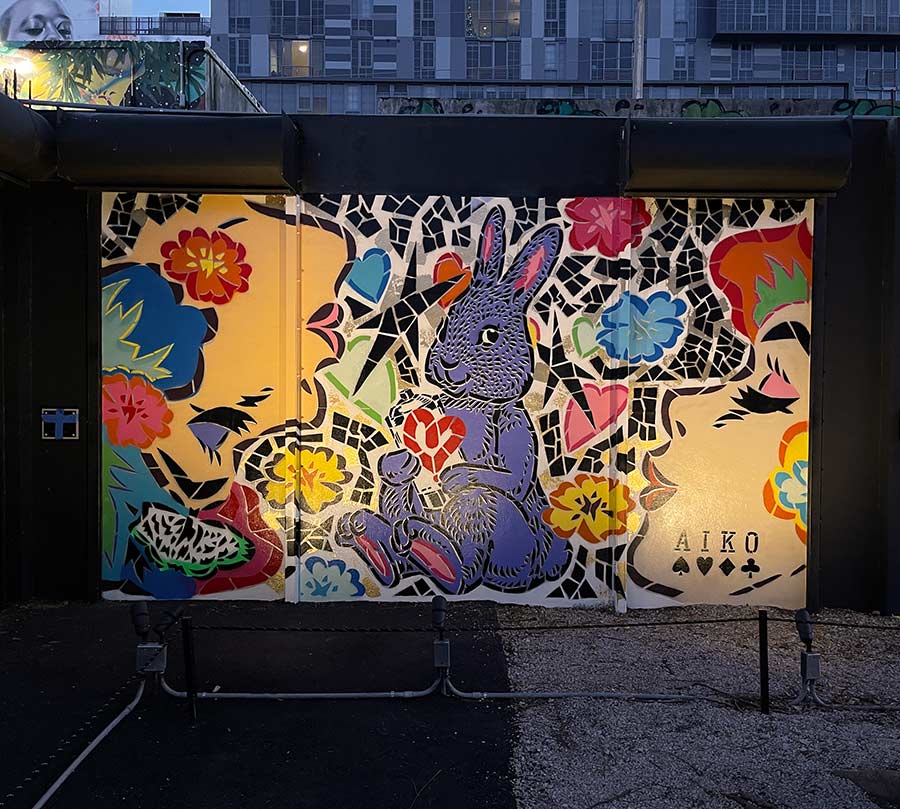
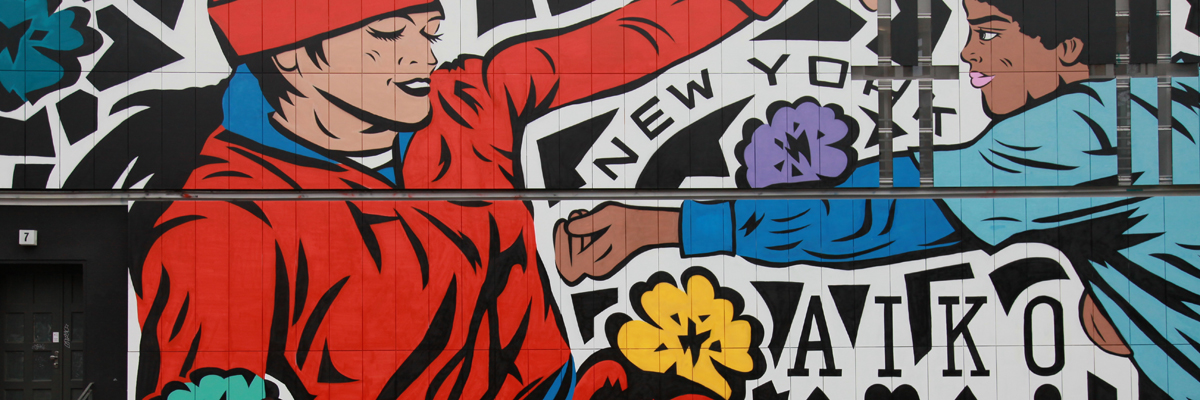
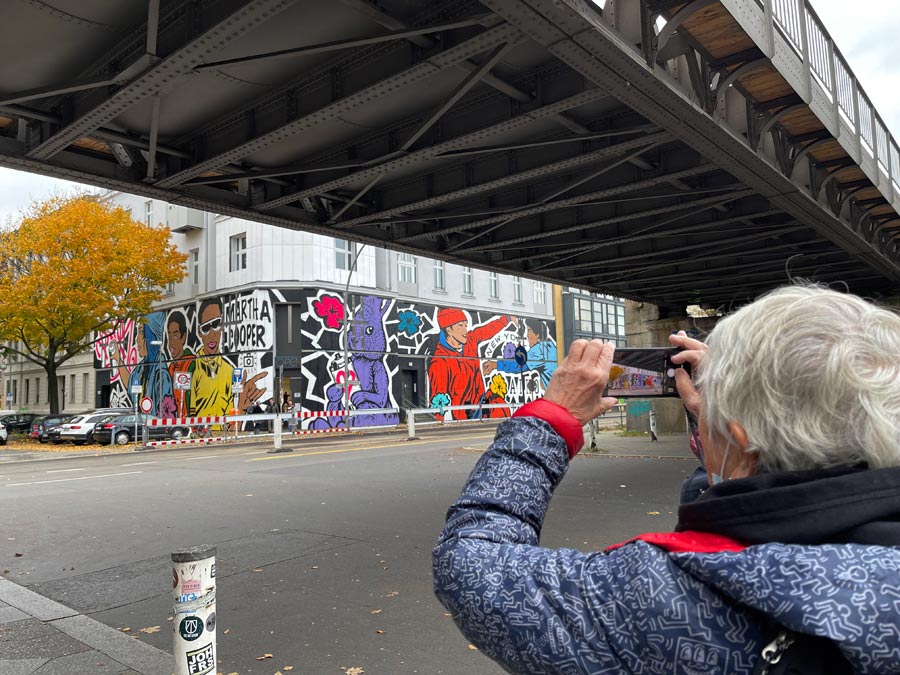
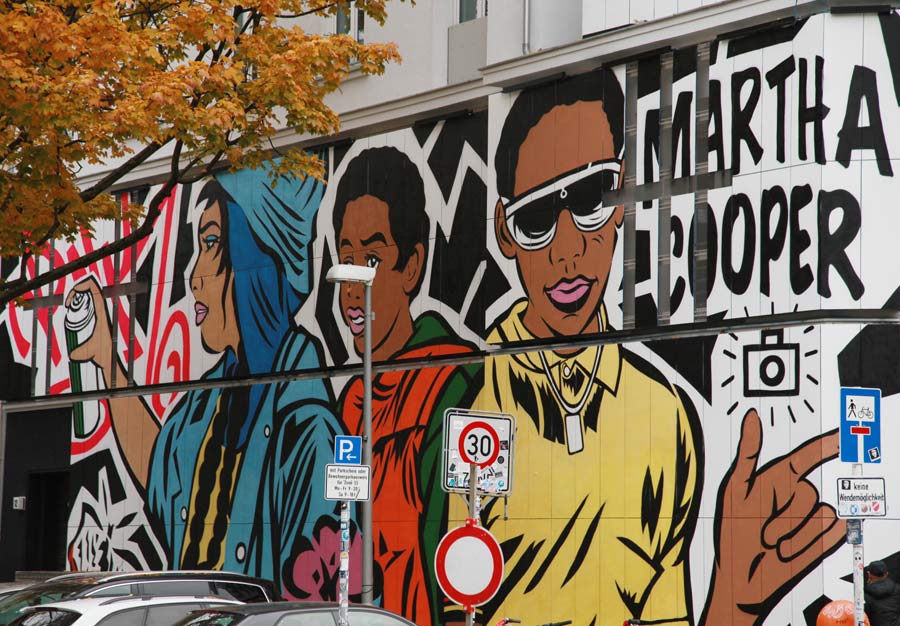
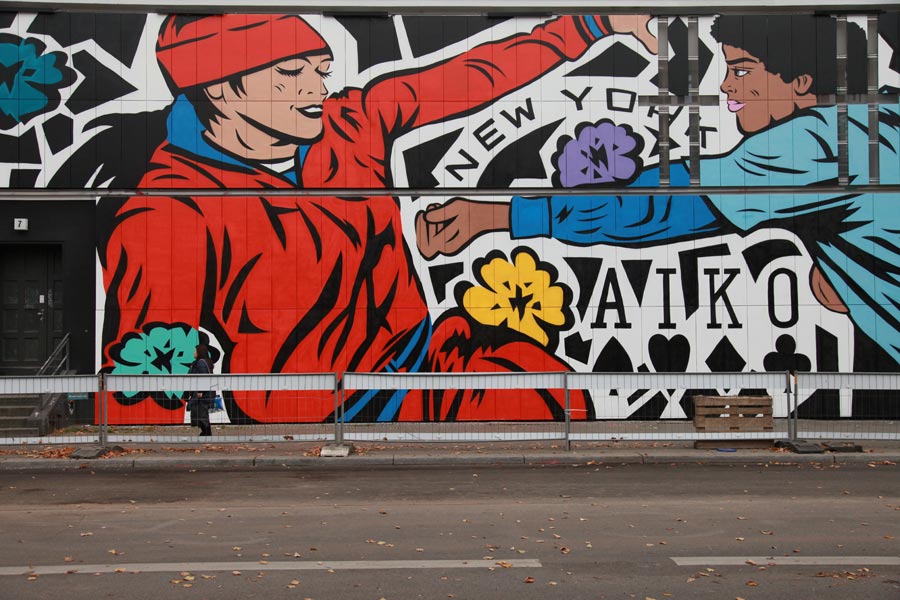
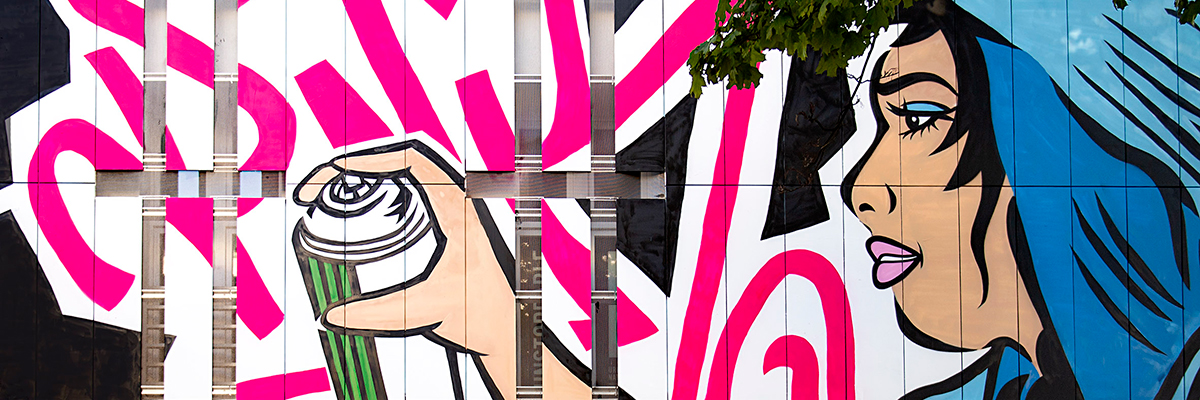
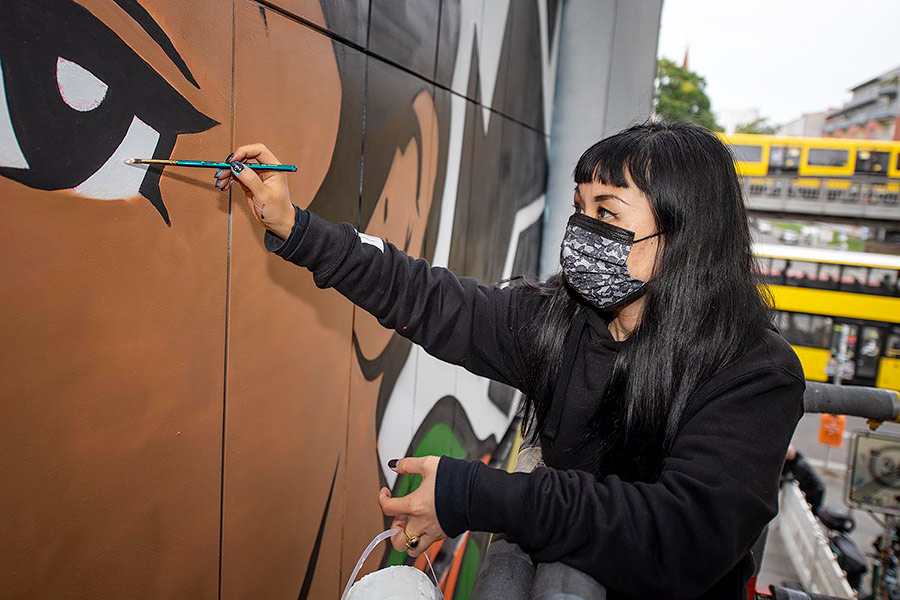
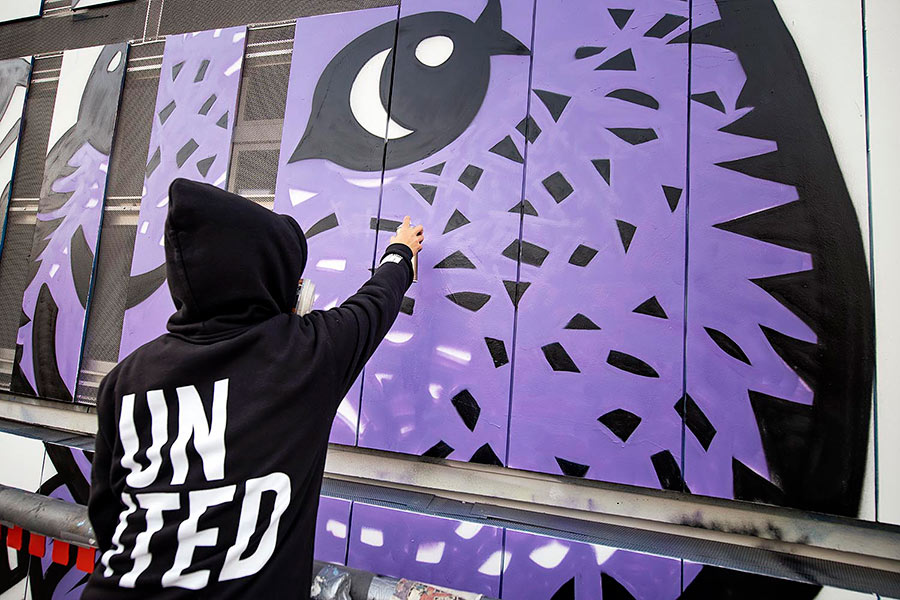
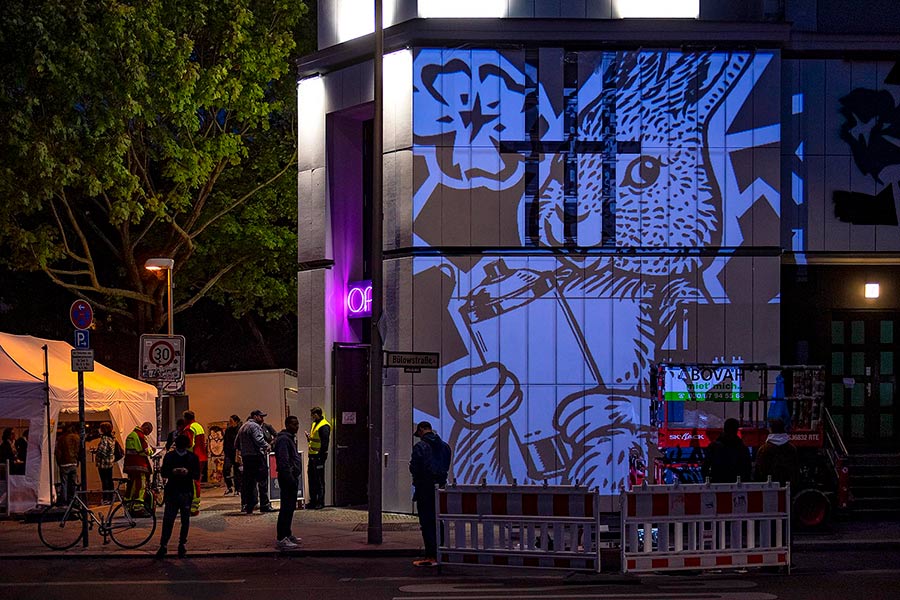
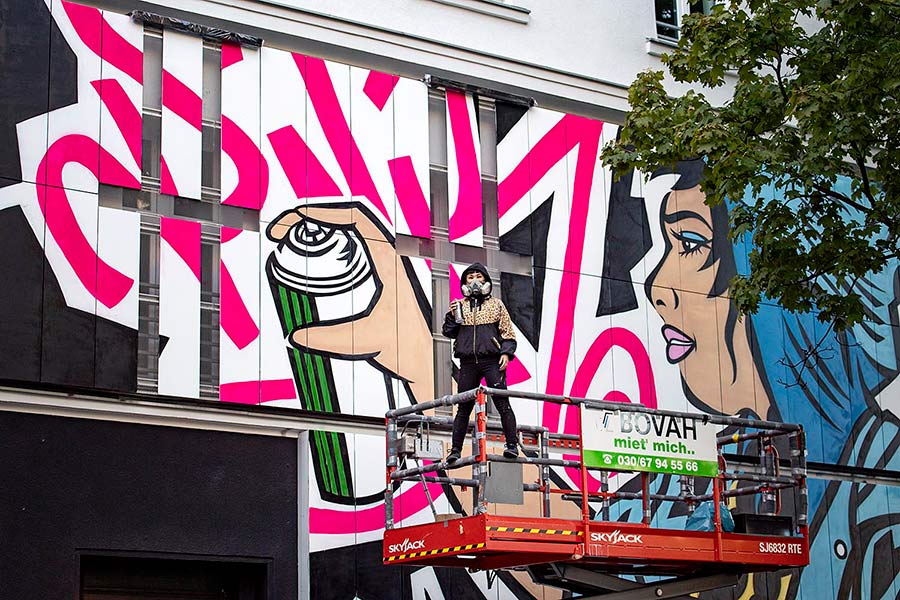
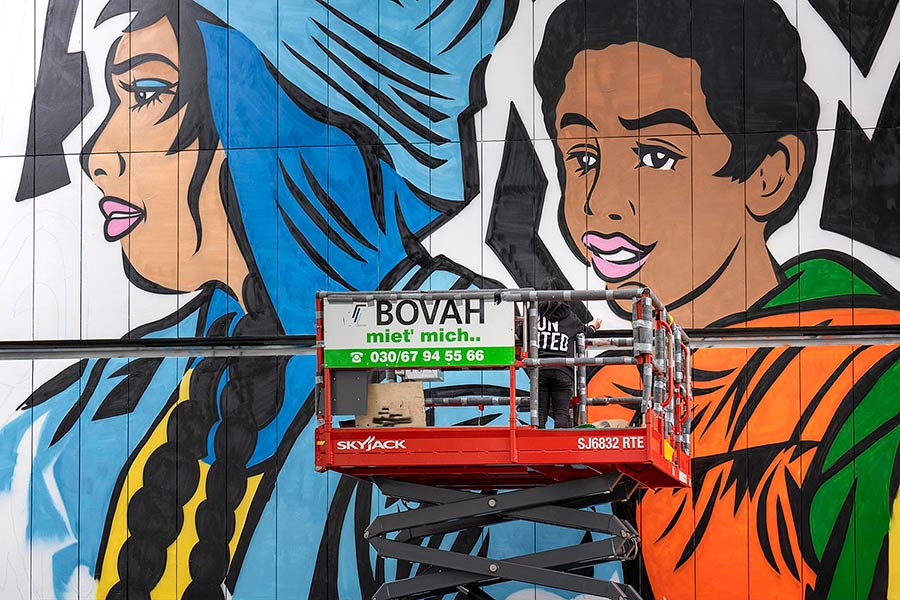
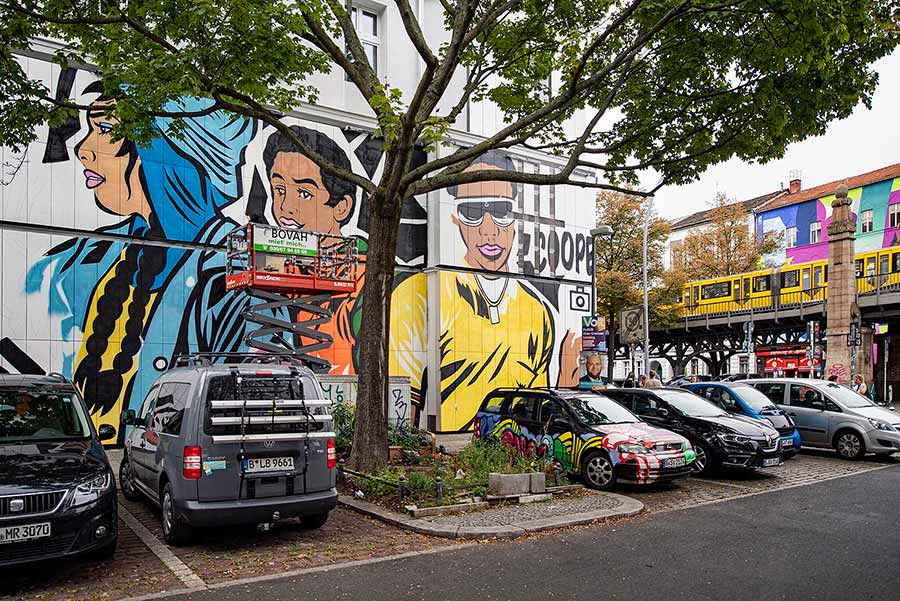
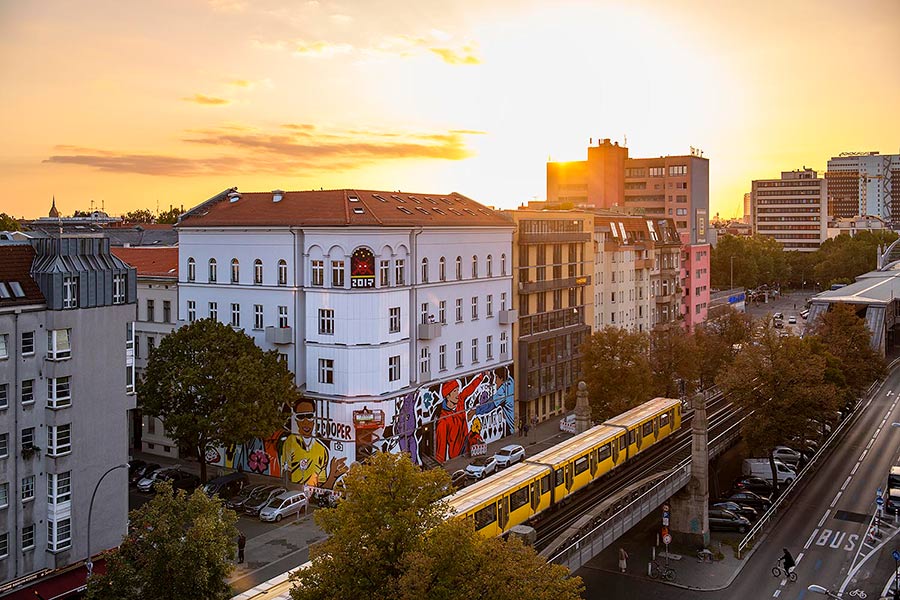
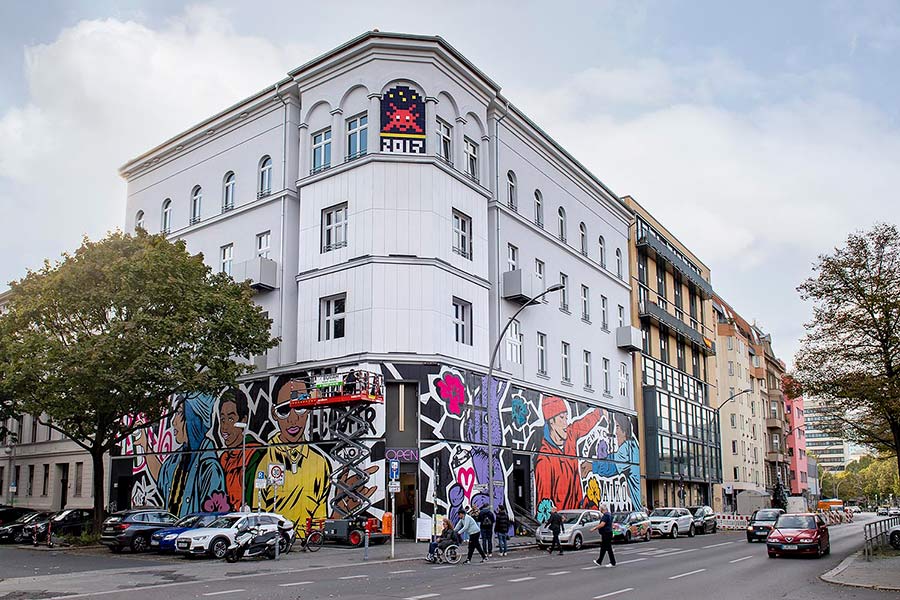
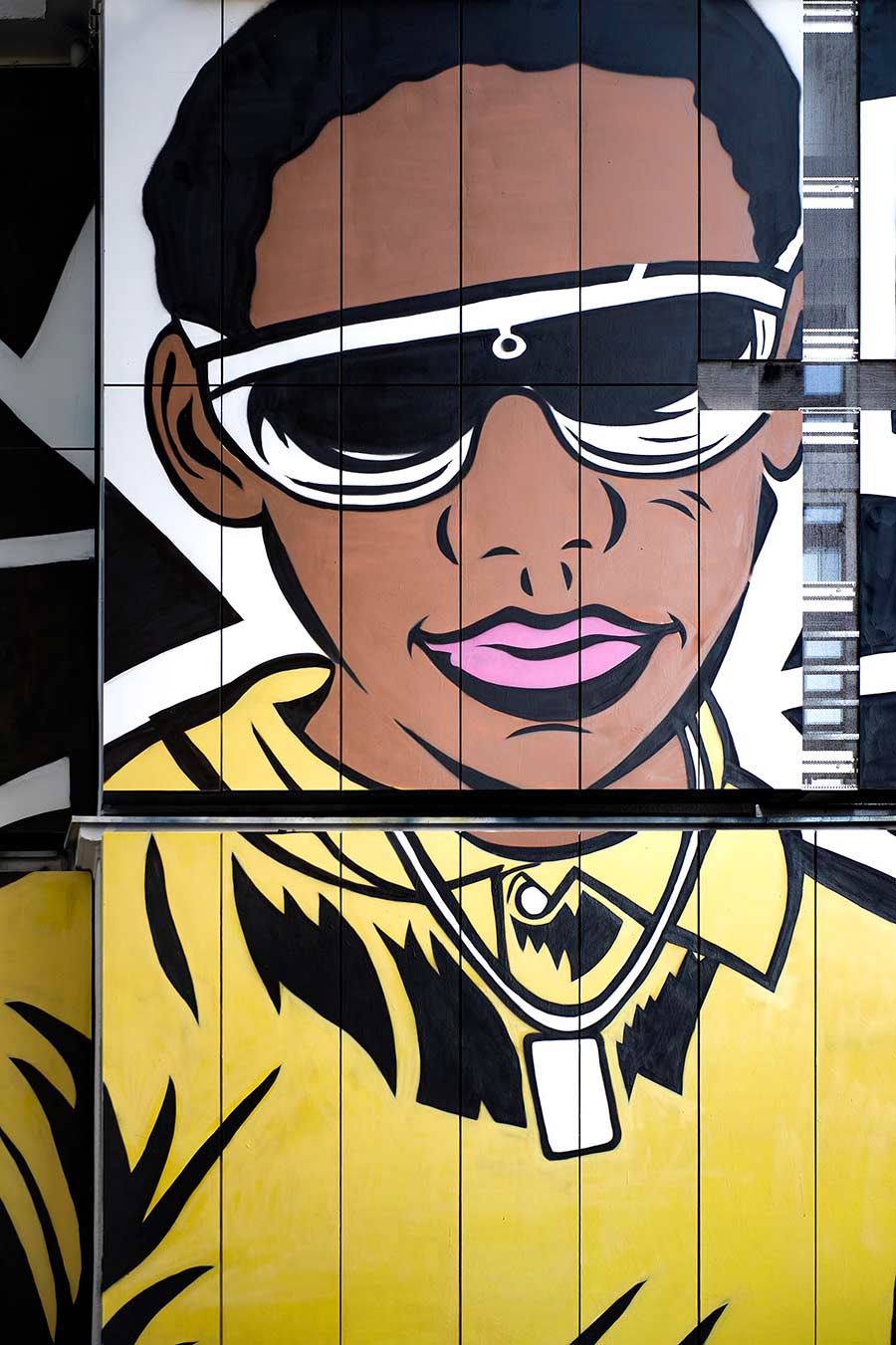
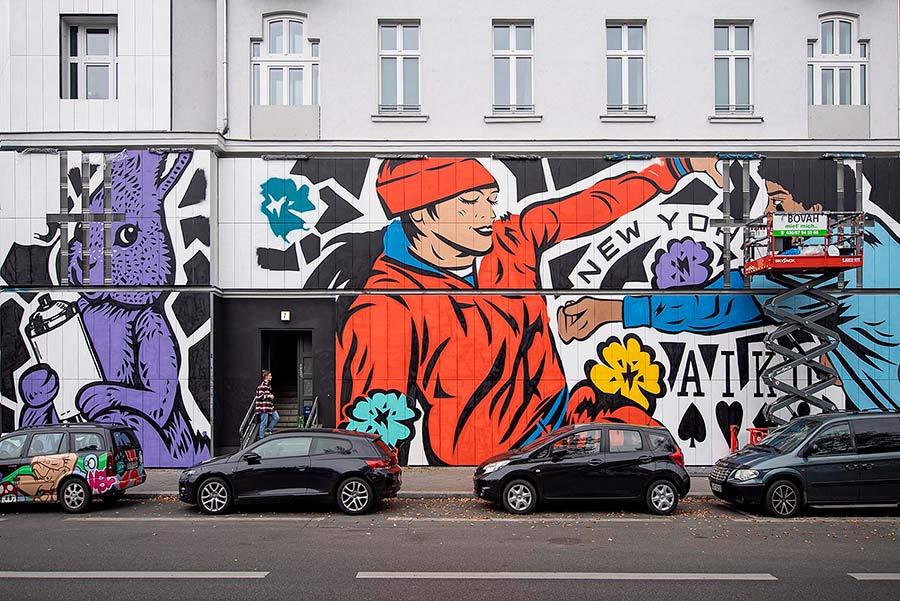
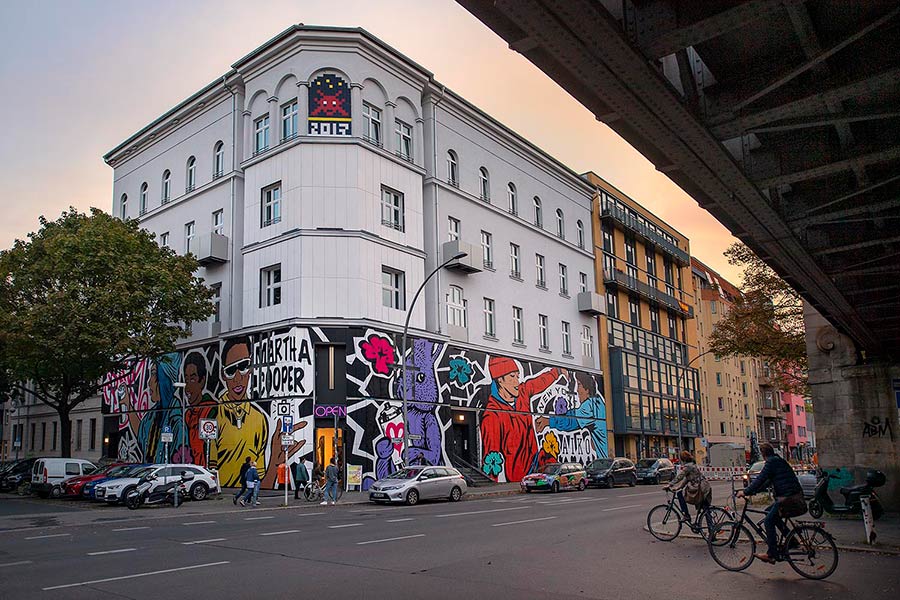
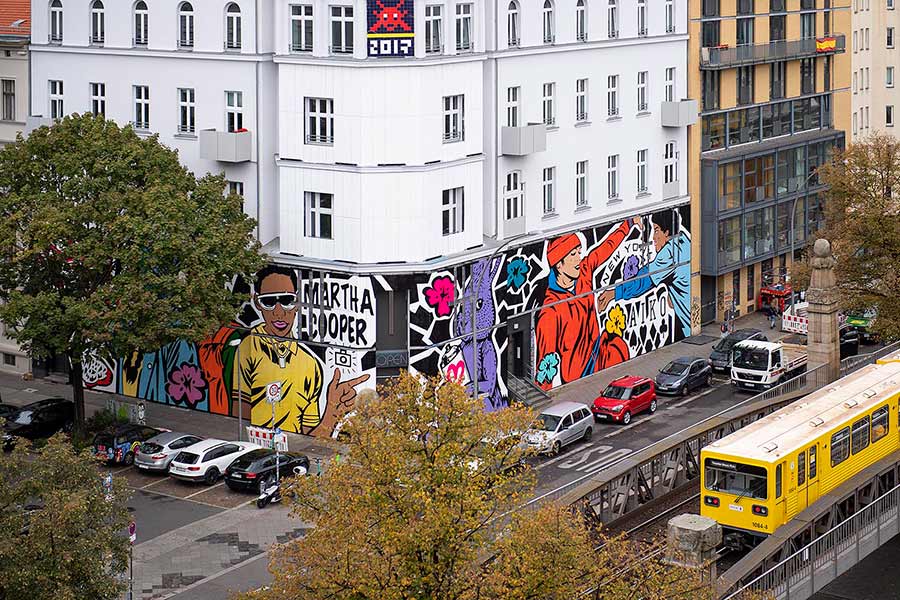
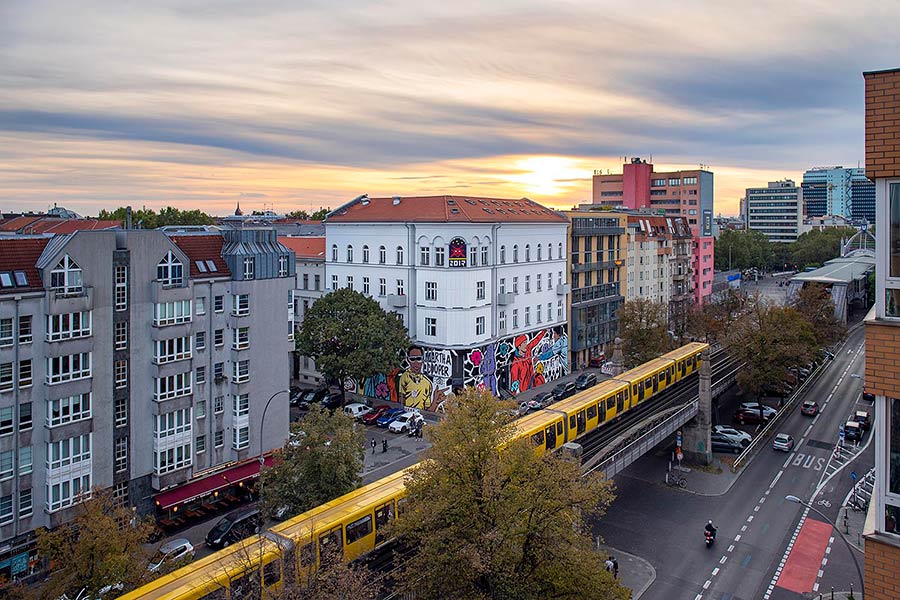
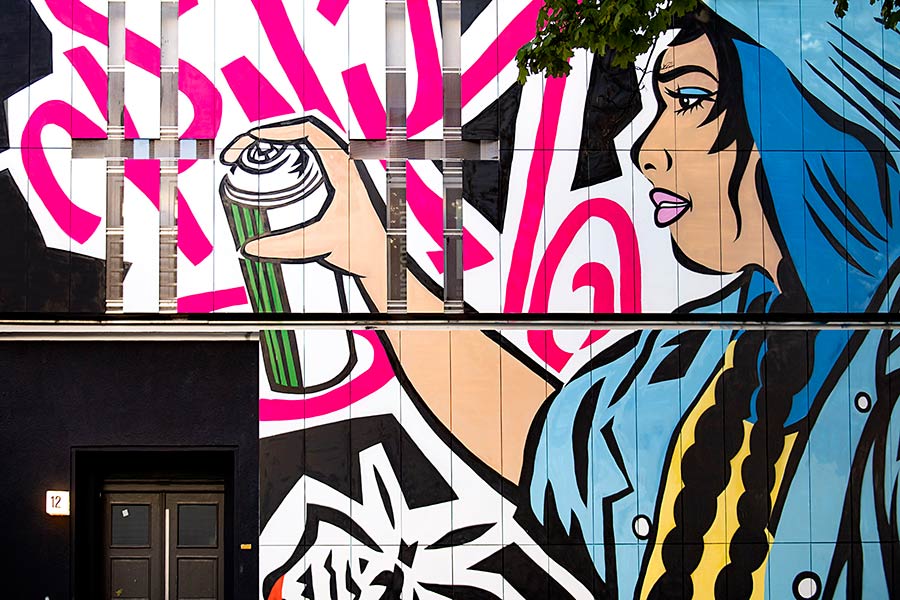
To celebrate the one-year anniversary of the opening and some 40,000 visitors despite a few closings due to covid, a new facade honoring the photographer had just been painted on the Urban Nation museum here in the Schöneberg neighborhood of Berlin. Lady Aiko, the Japanese street artist living in New York City was asked to paint the facade of the museum with selected portraits from Martha’s best-known documentation of breakers who formed the Hip Hop scene – along with Aiko’s own iconic bunny character.
Martha is in Berlin with us to see the exhibition for the first time to actually see Martha Cooper: Taking Pictures in person since travel restrictions held us all back from being here in person up to now. Here she is looking at the mural for the first time as well. And, of course, taking pictures of it.
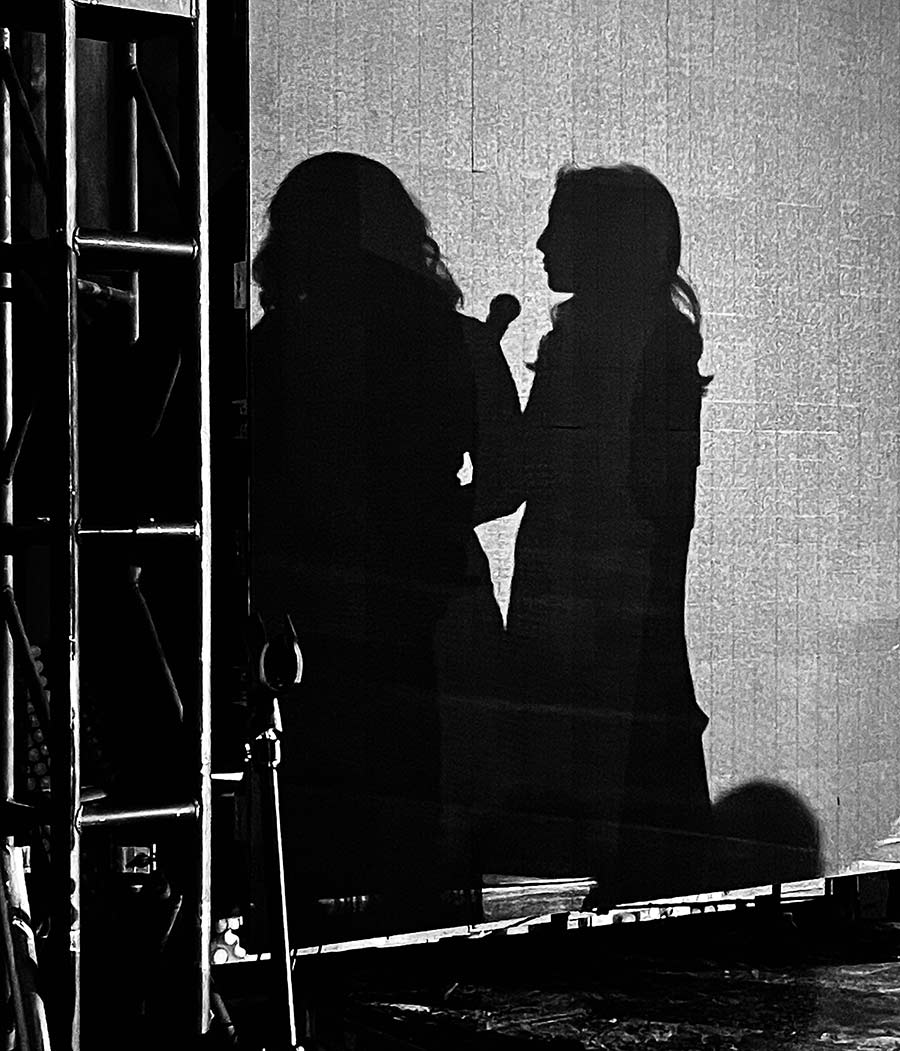
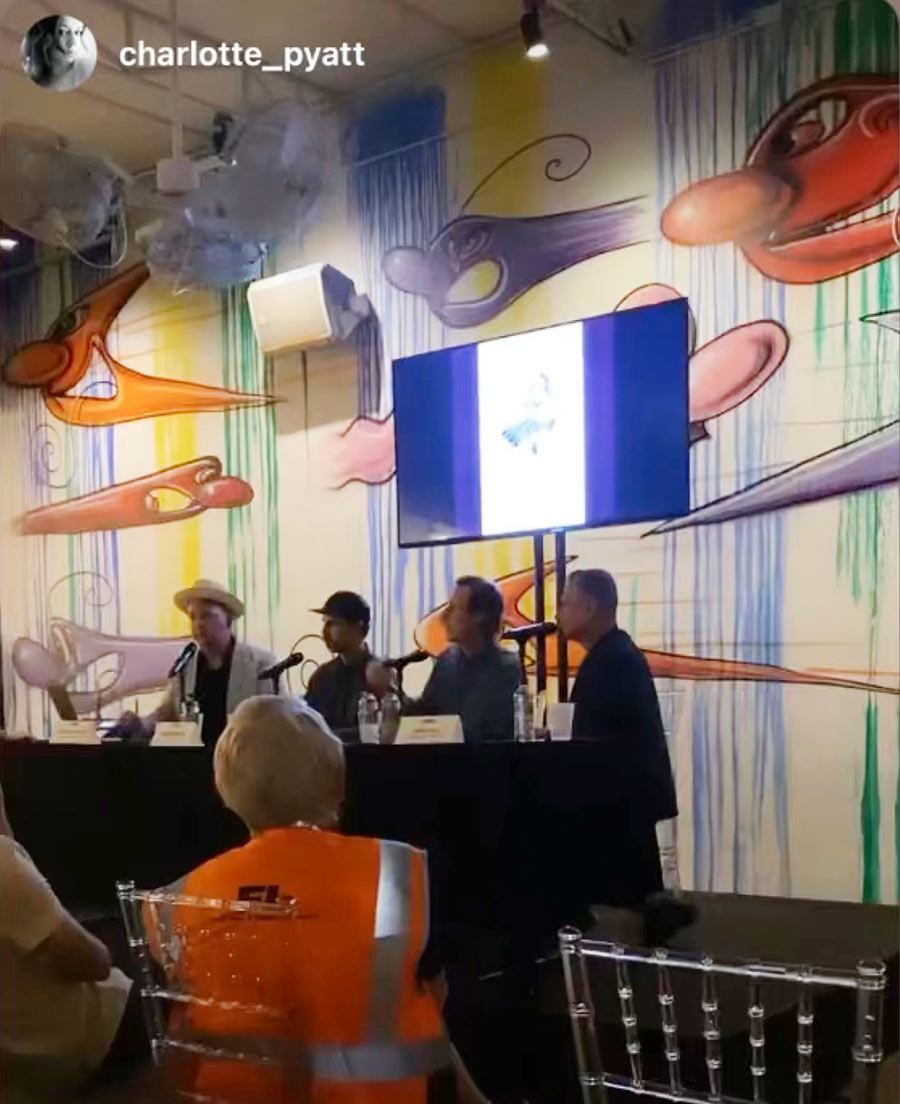
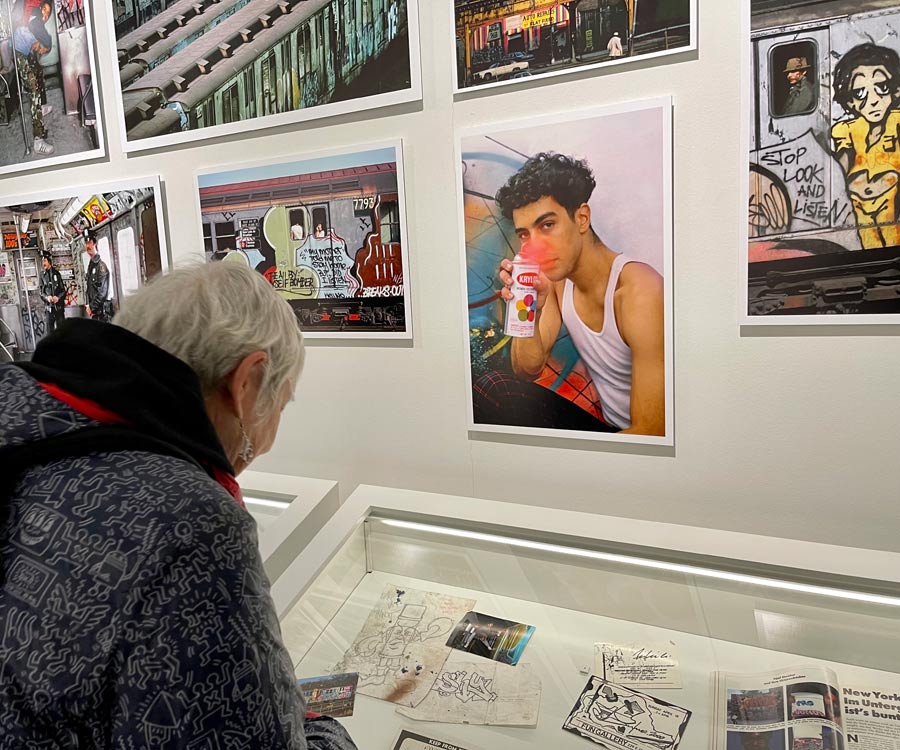
After Covid kept us all away from this exhibition, BSA and Martha finally got a chance to see her retrospective in person, rather than through virtual 3-D tours or videos and photos. Here she is at a vitrine this morning for our first official tour together in person.
We have some special events taking place this month to celebrate one complete year of the career-spanning exhibition “Martha Cooper: TAKING PICTURES”, which we created with the team at Urban Nation Museum in Berlin.
Today graffiti/street artist AIKO talks about her striking new graphic mural for the façade of the museum that highlights and interprets a suite of recognizable elements from Martha’s iconic photographs – a perfect answer to the Martha Remix section of the exhibition inside featuring 70 or so artists “remixing” her photos in their individual styles.
Later this month we are announcing a collaborative print release worldwide featuring another remix and a countrywide screening in theaters across Germany of “Martha: A Picture Story” with us and Martha interviewed by Nika Kramer at the Berlin opening. At a separate ceremony we also will co-host with Martha and Urban Nation the official opening of the Martha Cooper Library (MCL), a full library facility and research center to be permanently housed in the museum building.
To start off the excitement, here is Lady AIKO herself speaking about her new mural welcoming visitors to see “Martha Cooper: TAKING PICTURES”, now open until May 2022.
Q: Tell us about this mural project for UN. AIKO: Firstly, this mural is a gift for Martha Cooper in celebration of her big retrospective show at Urban Nation. Martha and I have been friends since 2006. We’ve been partners in crime, so to speak, for the last fifteen years. We have worked on many different projects together all over the world from the United States to Japan to Africa. Martha has taken over 16,000 pictures of AIKO and has archived many of her art projects.
I am honored to be part of this opportunity and working with Urban Nation to allow me to create this epic mural for Martha. The museum facade is almost like fresh skin wrapped around her massive historic exhibition with big love from everyone who was part of this production.
Martha and I have been collaborating on this one; it’s called the “Martha Cooper Remix” whereby I interpret and illustrate her images, create paintings on paper and on outdoor & indoor walls. For UN, I easily imagined us creating a big remix piece on the wall.
To begin this mural mission, I asked Martha what she would like to see on the wall; especially since I wanted to paint based on the classic pictures she photographed in NYC. She suggested several of her favorite pictures such as the one with Lady Pink when she was in the yard with the boys, Little Crazy Legs with spray cans, and the boom box one (which is the most iconic picture and the cover photo of the Hip Hop Files). Also, I included break-dancers Emiko and Frosty Freeze which are popular ones as well.
Based on her selections, I spent time at my studio to illustrate a large-scale portrait in my style and imagined it as the giant invitation banner for her show – as if it were a classic hand-painted movie ad in old Times Square. Since her show runs until next spring, till 2022, I’d love to invite everyone and spread the vibe even to the people who see the mural from the U-Bahn train above.
Q:Can you tell us about you and little background? AIKO: I’ve been based in NYC since 1997. NYC has been my playground and a huge inspiration. I met many amazing local and international artists, Faile, Bast, Banksy, Ben Eine, Obey, and Space Invader at that time. We were young artists, not famous yet, but we connected with one after another pretty much spontaneously – as if it were destiny. I started working in street art with everyone daily during the early 2000s and I was part of numerous gallery shows, jams, festivals, and museum installations. Being part of the history of street art and the graffiti (urban art) movement is how I got involved as AIKO as well.
… Meeting Martha Cooper was also another magical happening for me. Martha and I met in 2006 when I just started leaving my boys’ crew, working solo and stenciling bunnies on the streets. We became good and hard-core girlfriends and started traveling together. She introduced me to subway art legends and all other kinds of fascinating people and stuff in the world. I feel I’m one of the people who is continuing the history for the next generation.
Q:What do you think about working in Berlin? AIKO: Berlin is such a memorable place in my personal art life history. I spent lots of time without the Internet and enjoyed every day as a young artist. I made lots of friends and lots of stencils on the street. Of course, I was with Martha and spray-painted my bunny too. I’m so grateful that Urban Nation welcomed me back to town and let me create such a huge piece on the facade of the museum. Thank you so much for everyone’s support.
“MARTHA COOPER: TAKING PICTURES” Curated by Steven P. Harrington and Jaime Rojo is currently open to the general public. Click HERE for schedules and details.
The Ljubljana Street Art Festival 2021 took place as a cultural festival this year in the capital of Slovenia with painting, lectures, panels, special events, and guests like street artists Escif, public installation artist Epos 257, cultural instigator/commentator Good Guy Boris, and global graffiti/street art documentarian and photographer since the 1970s, Martha Cooper.
A unique event during this year’s festival included graffiti and street artists of various hand styles and influences crushing walls in monochrome. “The Left Over Graffiti Jam will give a chance to empty the leftover spray cans and hand the walls over to new generations to add to the layers of paint and subculture,” said the program’s description.
Based on the format of a graffiti jam, artists were invited to a series of walls to create while friends and fans set up impromptu picnics, parties, and took photos. The primary link between them all was their limited paint palette of whites, greys, and black paint that was allegedly “left over”. A historic place for many, this time the Hall of Fame was largely given over to new artists, aspiring writers, the new kids on the block. Whether it is still appropriately called a subculture or just “culture”, there is no doubt that the scene thrives on fresh blood and fresh paint.
The result brought more direct comparisons between styles and mastery – enabled by forcing artists to basically use the same materials for public expression. As an audience, you get a true sense of the writer’s personal style and poles of gravitational pull.
Luckily for us, Ms. Cooper shares her exclusive photos of the event here with BSA readers, while we speak with Sandi Abram, a co-founder of the festival with Anja Zver and Miha Erjavec.
A scholar and historian, Mr. Abram also gives us some context of graffiti here in the Balkans and helps us to position the significance of this festival.
BSA: Is there a history of the practice of graffiti and street art in Slovenia and specifically in Ljubljana? Or is it relatively new?
Sandi Abram: In Ljubljana, graffiti have a long history, beginning with World War II. During World War II, the territory of present-day Slovenia was occupied by German, Italian and Hungarian troops. The occupation of Ljubljana dates back to April 1941. The city was divided between Germany and Italy with barbed wire, roadblocks, military bunkers, machine gun nests and minefields.
In response to these events, the Liberation Front was formed. From 1942 to 1945, graffiti was used by individuals, various organizations and authorities as means of expression and as a reflection of socio-political events.
Soon after the occupation of Ljubljana, the so-called resistance graffiti by activists of the Liberation Front appeared on the walls. The first mass graffiti appeared in the shape of the letter V, short for “victory”, as a message to the occupiers that they would be defeated. Other symbols included the acronym for the Liberation Front (“OF”) or the stylized Triglav mountain (Slovenia’s highest mountain). The activists used numerous techniques to leave their mark on the occupied city, such as paste-ups, sgraffito, acid on shop windows, stencils, etc. I refer to these forms of expression as street art before street art; the techniques and strategies were a creative way to confront hegemony, a weapon of the weak, if I use the expression of anthropologist James C. Scott.
From this period, we also know of the so-called collaborator’s graffiti in the form of posters of Mussolini and the Italian king, leaflets also appeared on the streets occasionally. A particularly famous symbol of collaboration was the black hand with which the secret military units confronted the Liberation Army activists.
After the liberation of Ljubljana, post-war graffiti glorified leaders (e.g. Tito, Kardelj, Stalin) and the army (e.g., “Long live the Liberation Army!”). The symbols of communism (sickle and hammer) and praise for the Soviet Union (USSR) as representatives of the revolution and military allies were very common.
Graffiti as a predominantly leftist medium reappeared in socialist Ljubljana in the early 1980s as part of the punk movement, alternative subcultures, and sub political groups. This was also the time of coexistence between political graffiti and more sophisticated subcultural graffiti. On the one hand, punks sprayed “Johnny Rotten Square” to reappropriate space. On the other hand, fine arts students used graffiti as an alternative medium to paint canvases and the interior walls of underground cultural venues.
Finally, after a group of activists and independent artists occupied the former barracks of the Yugoslav People’s Army, today known as Metelkova, in the early 1990s, the first public and legal wall slowly emerged as a field of experimentation for new generations of budding writers. Today, the Metelkova City Autonomous Cultural Zone represents a cultural, artistic, social and intellectual hub where one also finds the Hall of Fame.
In the early 1990s, local artists incorporating the medium of graffiti started to emerge, an example being Strip Core. In more recent history, graffiti crews have left an important mark in the local public space, including ZEK Crew, Egotrip, 1107 Klan, Animals, and writers such as Vixen, Whem, Lo Milo, Rone84, and Planet Rick. Contemporary street artists who emerged from this scene include names like Danilo Milovanović, The Miha Artnak, Nataša Berk, Veli & Amos, Evgen Čopi Gorišek, Sad1.
BSA: We have talked previously about how your festival focuses on content, not on bringing in a dozen big-name artists just for the sake of having big names on your line-up. Why is this important to you?
Sandi Abram: Through LJSAF, we bring together international and local artists and scholars. The Programme Committee, which included me, Anja Zver, and Miha Erjavec, designed the festival events to encourage visitors to read the streets and participate in various activities.
For instance, the mission of the alternative tours and the street art conference is to interpret heterogeneous urban spaces, to explain the actors in the public space, the artistic and creative inspirations, the social struggles, to recognize and decipher ideologies of intolerance. So it is not only about producing the “text” (a mural as a thing-in-itself) but also sensitizing the public about the “context” of street art, i.e. the micro-location in the urban space. It is hard to understand a city if you do not “read” the screams on the walls – already the philosopher and sociologist Henri Lefebvre said that graffiti best illustrates the contradictions of contemporary society. They point out what is tolerated, what disappears.
Content co-creation is another important dimension of LJSAF. The festival events not only showcase young, emerging generations of street artists and scholars, they also provide a space, a productive crossroads for them to meet and collaborate. And for us, that is exactly the purpose of the festival’s art residencies, exhibitions, and graffiti jams. In short, street art is not only about big names, but a broad stream of unknown and underground creative minds joining forces.
“The festival events not only showcase young, emerging generations of street artists and scholars, they also provide a space, a productive crossroads for them to meet and collaborate.”
Our thanks to writer Igor López at El Pais for his article about Martha Cooper and our exhibition running right now in Berlin until Spring 2022. Appearing in the Spanish newspaper’s magazine called ICON, Lopez describes the New York social matrix of the 1970s with pithy acuity; one where the city seemed at war on many fronts while various important cultural scenes were germinating alongside graffiti writing and musicians like Afrika Bambaataa, Grandmaster Flash or DJ Kool Herc who were laying the foundations of hip hop as the dominant global culture.
“One of the first measures of Mayor Ed Koch, who had taken office in 1978 to save the city from bankruptcy and chaos, was to put concertina wire around the subway garages to prevent “vandals” from accessing the city at night,” he writes.
Martha Cooper: Taking Pictures. Urban Nation Museum Berlin. El Pais ICON Magazine Madrid
Enter the documentarians who capture the quickly shifting winds of change, like Martha Cooper, and forty years later we have solid evidence of multi-cultures in motion.
“I thought I was capturing a phenomenon unique to the city and that it would disappear in a few years,” recalls Cooper of her now seminal body of photography that captured the birth of many movements. Dryly modest, Cooper doesn’t brag much. “I am surprised and grateful that my photos continue to be of interest.”
Check out this article in print and online, and please feel welcome to Urban Nation on our behalf this fall, winter, and spring!
Martha Cooper: Taking Pictures. Urban Nation Museum Berlin. El Pais ICON Magazine MadridMartha Cooper: Taking Pictures. Urban Nation Museum Berlin. El Pais ICON Magazine MadridMartha Cooper: Taking Pictures. Urban Nation Museum Berlin. El Pais ICON Magazine Madrid
The exhibition, Martha Cooper: Taking Pictures at Urban Nation Museum for Urban and Contemporary Art in Berlin is currently open to the general public. To learn more about the exhibition’s details and schedules click HERE
We’ve had the privilege to travel to many cities and cultures over the last decade and a half, from Russian to Chinese to North African to Tahitian and Norwegian, to witness the affecting power of street art on cities, communities, and everyday people. Regardless of the street author’s intent, however earnest or carefully considered, we’re often surprised by the variety of interpretations that can arise from a singular work of art or intervention.
This new mural by the Spanish conceptual artist and social philosopher Escif for this year’s Ljubljana Street Art Festival (LJSAF), begun in Slovenia’s capital in 2019, is just far enough removed from the obvious to have triggered myriad interpretations. In the race for capturing imagination, adoration, and vilification, his seemingly simple, if unconventional, mural has scored a stunning trifecta.
Our reporter on the ground, the renowned photographer and ethnologist Martha Cooper, one of the few who have stayed active on the graffiti and street art scene continuously for the last five decades, tells us that she keeps thinking that we are witnessing a more pronounced movement toward work like this on the global stage. Describing how the unique curation by festival director Sandi Abram and the program directors Anja Zver and Miha Erjavec strikes a balance, Cooper says they chose what may appear as a quirky selection of artists to participate, “with an emphasis more on conceptual, political work than on aesthetics.”
“I’m wondering if this is a general street art trend or maybe just more prevalent in Eastern Europe,” she says. A veteran of the last decade’s evolution of street art festivals that may now appear as baldly commercial or trite “revitalization” efforts by moribund city councils, Ms. Cooper is fascinated by unusual festivals such as Ljubljana’s. It may be due to Abram’s pursuit of a Ph.D. in anthropology, but Cooper observes that her Slovenian experience was of a program “thoughtfully curated with some interesting and innovative twists.” Since this year’s festival theme centered on the preservation and documentation of street art, Cooper was an honored guest and speaker as well.
With a borrowed bear from a local school child’s wall painting, Escif created a re-contextualization of the original furry friend. Enlarging it to fill the wall of a two-story building and attaching a stolen slogan from a nearby graffitied wall, Escif declared that “ograja mora past” (the fence must fall). The reactions haven’t stopped since. Depending on the opiner, the deceptively simple mural is addressing the contentious issue of immigration with Croatia, the historical memories Slovenians have of Hitler, or the increasingly impeded flow of wildlife along historical natural routes through Europe.
When Sandi took Martha to shoot the original bear painting, Mojca, a teacher in Vodmat Kindergarten, shared a sense of optimism she had by witnessing the resounding waves of impact that rippled outward from the original project. “The goal of the project was for the children to develop the heterogeneous language of art. If by painting this bear we have impacted society and the environment, then we have accomplished more than we could have ever imagined.”
The thoughtful and resolute Escif, as ever, developed and delivered a manifesto on his piece, “The Fences Must Fall”, where he states that “Painting a big wall in a big city is a firm and decisive position” for an artist.
“I set out to find the truth that children paint on the walls of kindergartens. I cruised around the city streets, looking for the truth that crazy people spray paint on the walls. As I matched the truths of crazy people and children, of the walls of the former with the walls of the latter, the idea for the mural was born. An angry bear roaring ‘the fences must fall’.”
He continues, “As a foreigner, ignorant of the local reality, I couldn’t quite grasp what this mural was all about. Fortunately, it seems that the locals came to wise insights. Some seemed annoyed by the content. Others seemed happy and read it in a variety of ways. They spoke of the bears in Slovenia that the government wants to control. Of the cruelty of the border fence with Croatia, where refugees are harmed trying to cross it. Of the wild animals that can’t cross that fence either, locked in with no way to migrate. Of the fences that the government puts up to protect the National Assembly from protests. Of the problem of the privatisation of natural resources. And of many other fences that should be coming down everywhere.”
The simplicity of the design and placement are undoubtedly what makes it most magnetic; If you don’t understand the slogan, you want to. If you do understand it, you may crave the opportunity to respond.
“I found Escif’s wall much more interesting after I understood the story behind it,” says Cooper.
We spoke to directors Abram and Zver about the goals of this year’s festival and why they chose Escif to paint one of the larger, higher-profile walls of the Ljubljana 2021. We discussed how it became a somewhat emblematic piece that was at once surprisingly provocative and also caused dialogue in the streets. “To paraphrase what Escif said about his mural in Ljubljana: painting a mural is a political act, a responsibility, and a commitment,” they say.
“This is also true for the entire production of LJSAF – it is a commitment that requires the recognition that the festival is not a stable and fixed entity, but a heterogeneous and fluid mosaic of events, people, and creativity, operating at a micro and macro level. This is similar to Michel Foucault’s definition of heterotopias – a multiplicity of fragmentary spaces in a single place that allows for spontaneity. LJSAF is also about the experience as the essence of festivals – being part of the festival crowd means mingling with other creative bodies and forging new vectors of collaboration.”
Escif appears pleased with the effect as well, perhaps occupying the ideal role of an artist working in public space today in a meaningful way.
“The etymological root of the word ‘politics’ is anything that directs, conditions, or modifies life in cities,” he says. “So painting a big wall in a big city is a big political act, as it directs, conditions, and modifies the urban landscape. Consequently, it also directs, conditions and modifies the lives of the citizens.”
In many cases, we’d have to agree that well-placed graffiti can have a similar effect.
Our exhibition got a lot of great press and we like to highlight some of the articles once in a while just to remind you that the museum is now open after a long Covid-19 closure.
The Financial Times Sunday magazine did us the biggest favor by printing a multi-page spread about Martha Cooper and our retrospective of her work at at the URBAN NATION Museum – the first major and expansive photo and documentary exhibition of her career.
As the UN Website says “‘Martha Cooper: Taking Pictures’ sets new standards in the museum program. The curators Steven P. Harrington and Jaime Rojo (Brooklyn Street Art) , in close cooperation with Martha Cooper, have created a multimedia exhibition in which artistic works and documentary material are juxtaposed.
Martha Cooper: Taking Pictures. Urban Nation Museum Berlin. Financial Times Weekend Magazine LondonMartha Cooper: Taking Pictures. Urban Nation Museum Berlin. Financial Times Weekend Magazine LondonMartha Cooper: Taking Pictures. Urban Nation Museum Berlin. Financial Times Weekend Magazine LondonMartha Cooper: Taking Pictures. Urban Nation Museum Berlin. Financial Times Weekend Magazine London
The exhibition, Martha Cooper: Taking Pictures at Urban Nation Museum for Urban and Contemporary Art in Berlin is currently open to the general public. To learn more about the exhibition’s details and schedules click HERE