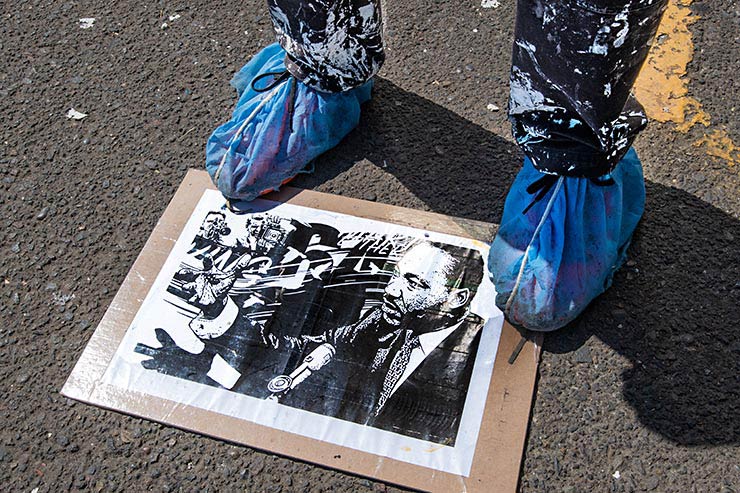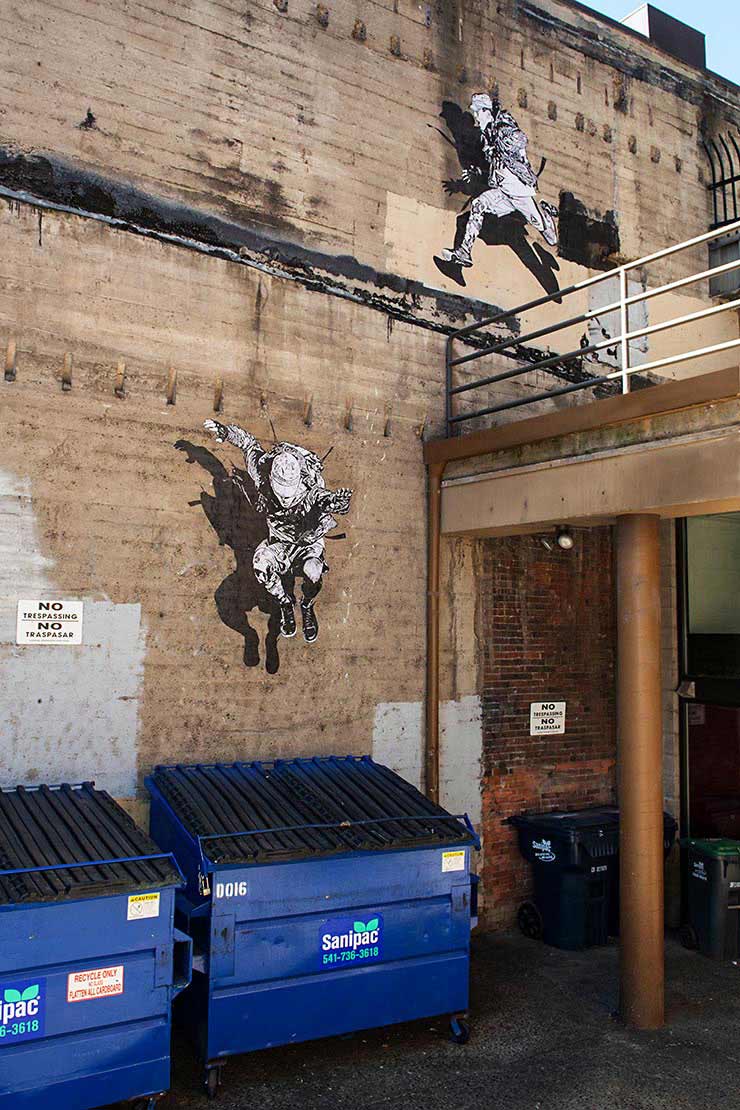
All posts tagged: Martha Cooper

Martha Cooper And Adele Renault: Pigeon Fanciers In Moscow

Martha Cooper And Adele Renault: Pigeon Fanciers In Moscow

BSA is in Moscow as curators of 50+ international artists in the Artmossphere Biennale 2018 for its 3rd edition called Street Art Wave. Till the end of the month we’ll working with a stellar cross section of people involved with Urban Art/Street Art/Graffiti at curious and fascinating intersections. We’re meeting with Street Artists, academics, collectors, gallerists, museum curators, organizers, and thoughtful pontificators of all sorts in studio, on the street, behind the scenes, and on display. Come with us!


As curators we were asked to write a text about Martha Cooper and Adele Renault and their collaborative project for the Artmossphere Biennale 2018 in Moscow. We think it is equally appropriate for the work in process photos here and the interviews BSA had with both:

“A perfectly paired duo of artist and photographer who each engage with Street Art from two distinctly different perspectives, this collaborative project puts the focus on a shared interest.

Adele Renault grew up in the Belgian Ardennes and at a very early age began traveling the world; sometimes solo, quickly developing an adept eye at studying places and people. A classically trained painter with a realistic style, she focuses her camera and her brushes on smaller details that may sometimes be overlooked but which add texture and rich interest to the mundane or unrecognized. With her beautifully realized portraits she is able to capture the depths of her subjects by the expression in their eyes, the details of lines on their face, and the candid innocent smile that flashes quickly.

However her love is with pigeons. Her pigeon paintings and murals give the oft-derided birds their rightful place in our cities where they are often considered pests that are equal to rats.
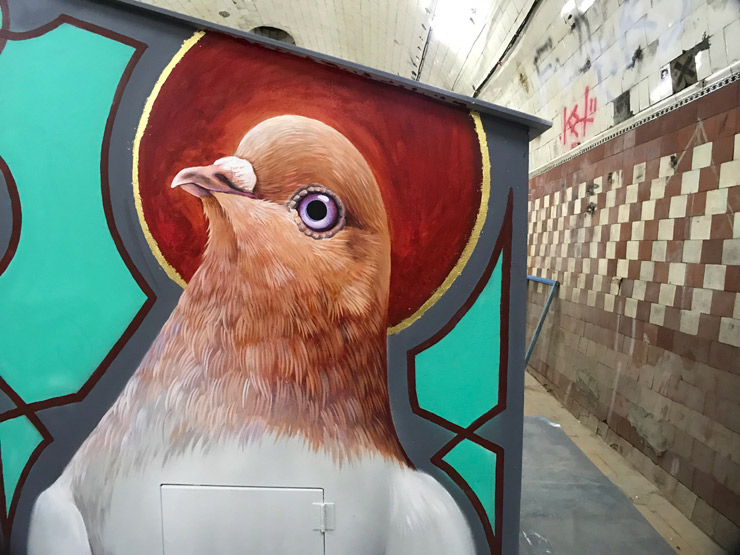
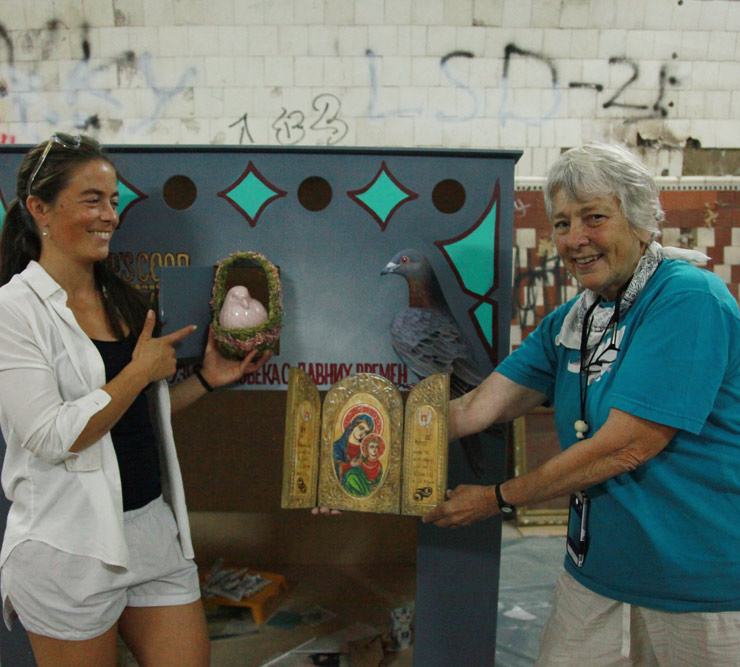
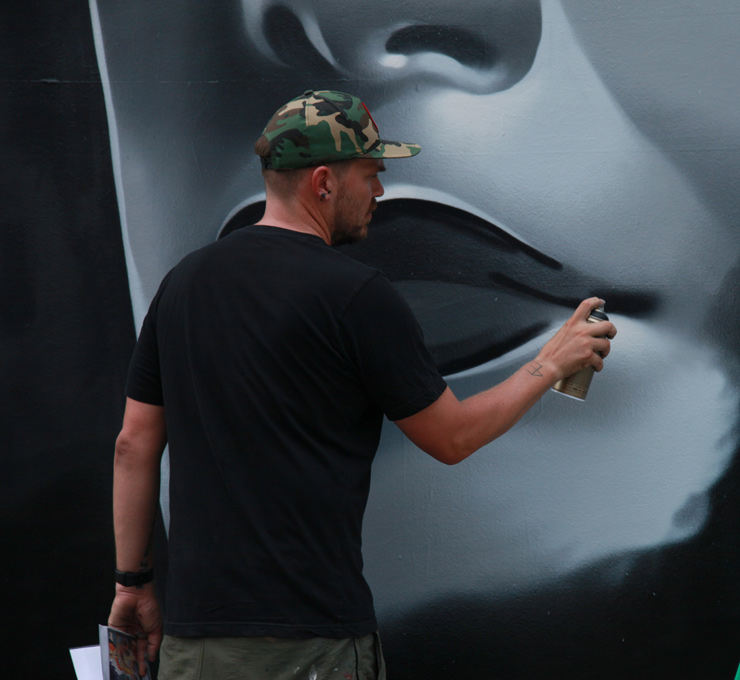
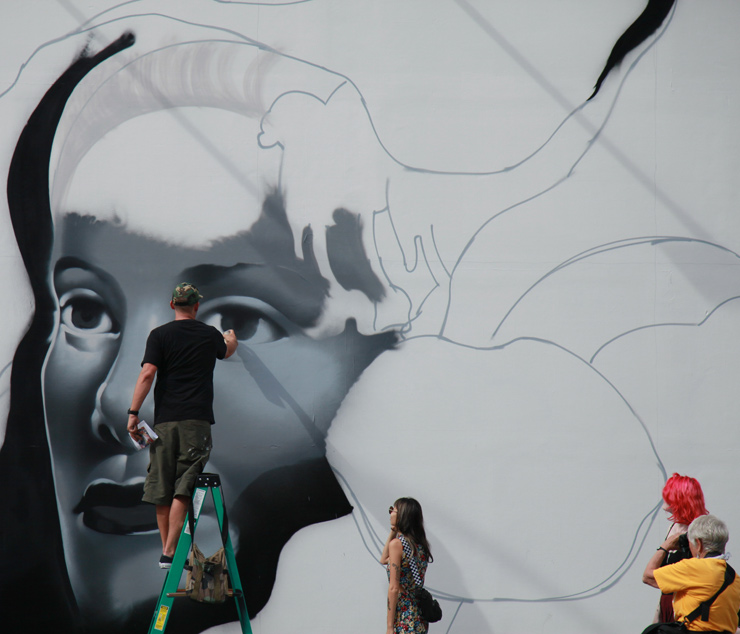
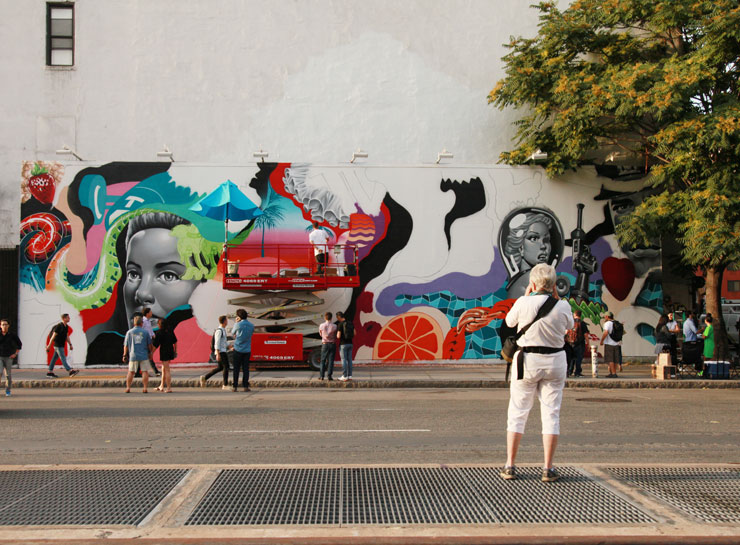
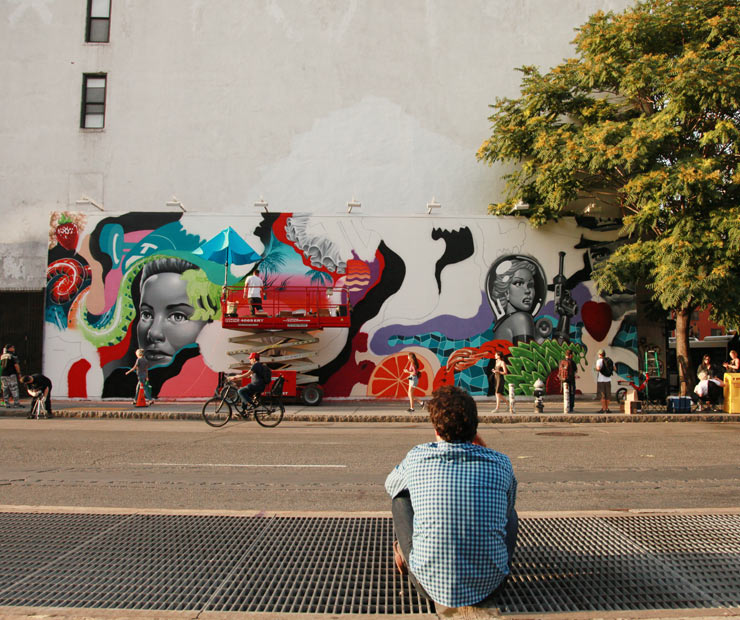
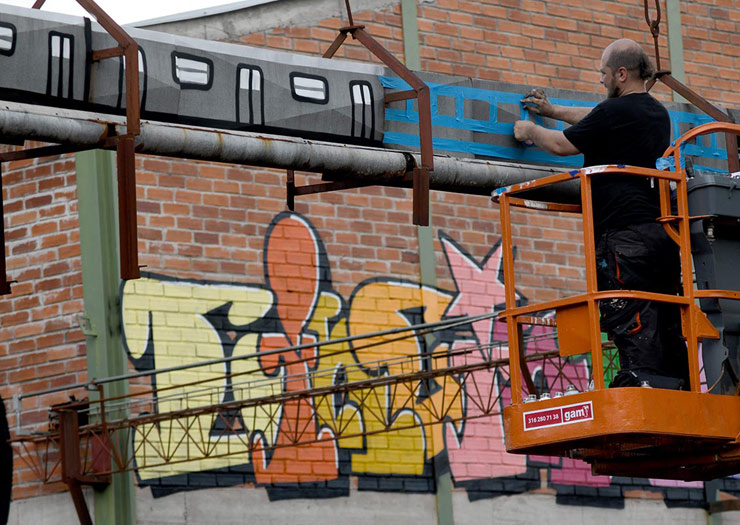
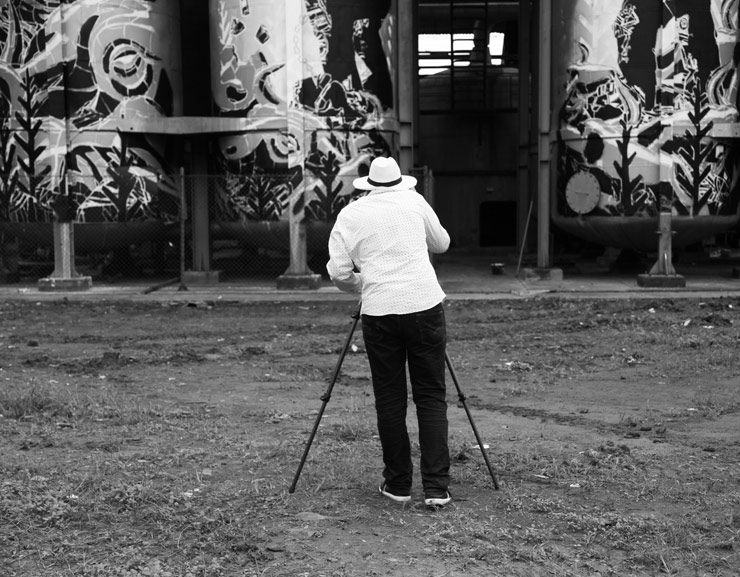
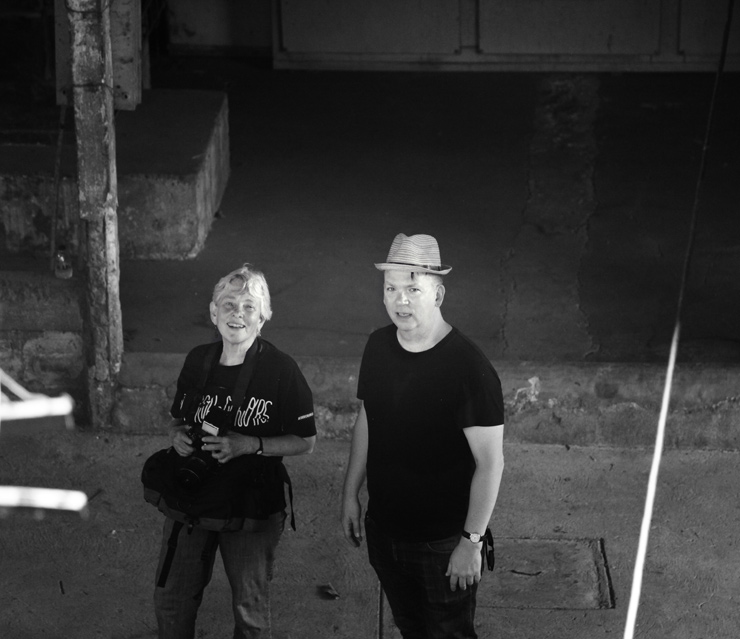
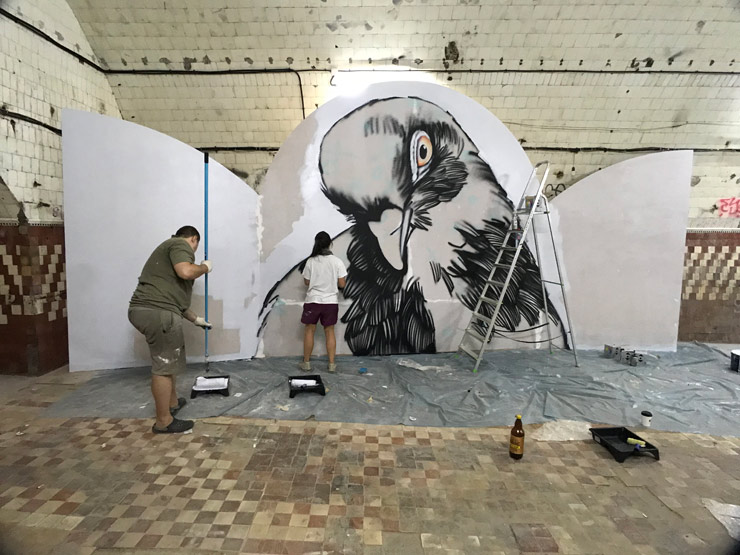
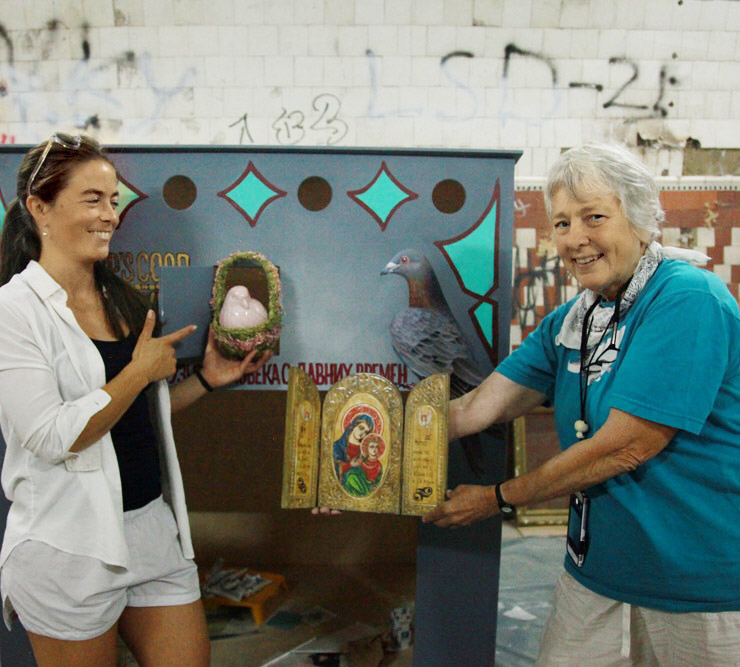
Martha Cooper / Adele Renault work in progress at Vinzavod for Artmossphere Biennale 2018. Moscow. August 2018. (photo © Jaime Rojo)

Teaming up with famed photographer Martha Cooper is a pure coup d’état. Ms. Cooper’s fame within the graffiti and Street Art community is legendary but her photographic interests are many. A documentarian and ethnographer, she grew up in Baltimore, Maryland, a US city that is famous for its once-thriving community of pigeon fanciers – and their elaborate coops. For Ms. Cooper the intersection of pigeons and their fanciers presents a fascinating and educational opportunity to capture with her lens the relationship between humans and their aviary friends in their habitats…the coops.

Ms. Cooper has been photographing pigeon coops in Baltimore and in New York where she currently lives – and in many other cities that she visits every year. For Artmossphere both Ms. Renault and Ms. Cooper have found a shared passion that drives them both even harder to create. Designing a site-specific environment and using locally found materials; both artists have trained their attention to the Russian tradition of painting pigeon coops. They hope that their installation respectfully represents the local culture and history while combining Adele’s paintings of pigeons and Martha’s photographs of the pigeon’s coops.”
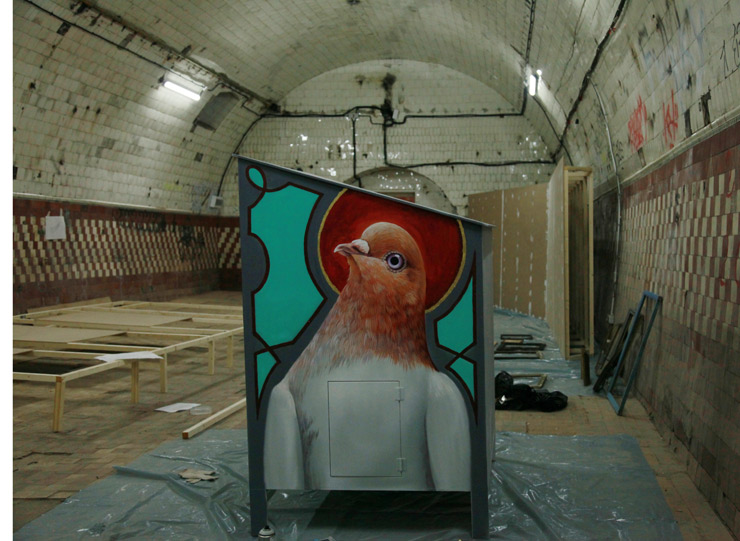
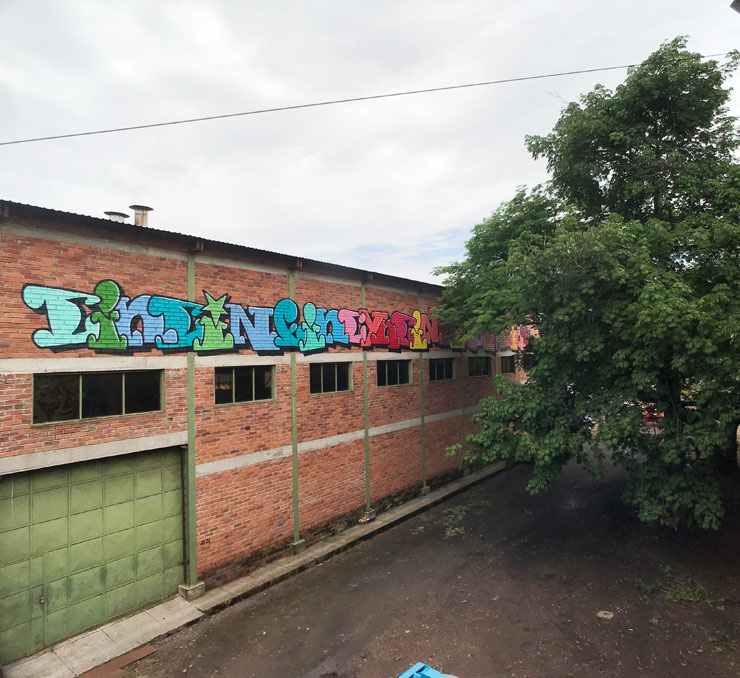
Martha Cooper / Adele Renault work in progress at Vinzavod for Artmossphere Biennale 2018. Moscow. August 2018. (photo © Jaime Rojo)

Pigeons were the original Internet, email, messenger. As carriers they were the quickest and most efficient way for people across cultures to communicate. Cooper and Renault have created the ultimate exhibit that ties together the themes of OFFLINE in a very local and global way. With Martha’s photographs of pigeons from over forty years and Adele’s uncanny ability to faithfully create the plumage and character of the bird over the last decade on city walls everywhere, the original message carriers are more than getting their due in Moscow.

BSA: Yesterday at the round table discussion someone made the connection between this show being “Offline” and pigeons carrying messages. Can you talk about that a bit?
Martha: That was a brilliant connection because neither of us had thought about it. Yes there were lots of pigeons that used to carry messages, specially during wartime. The messages were secret and written in code stuffed in little capsules and attached to the pigeon’s legs. The pigeons were able to fly across enemy lines. So here we have the Internet and the name of this exhibition is “Offline” so what can be more offline than a pigeon carrying a message.

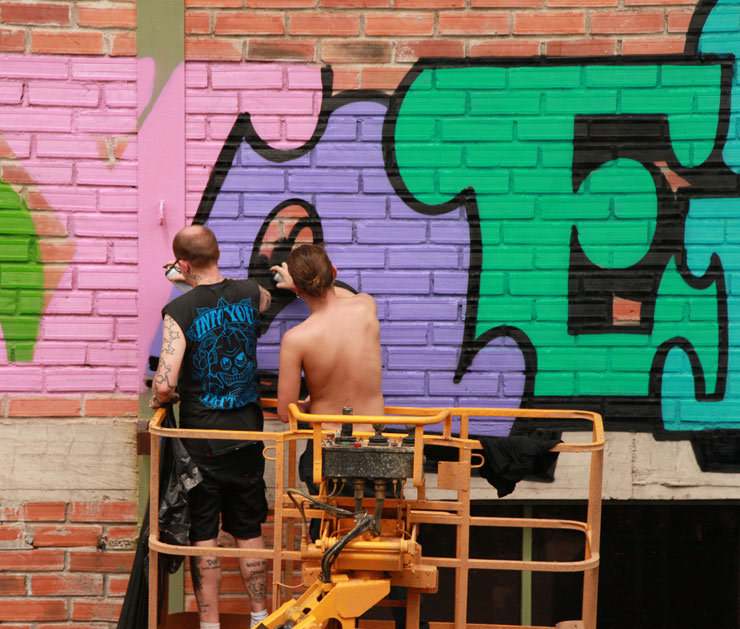
Martha Cooper / Adele Renault work in progress at Vinzavod for Artmossphere Biennale 2018. Moscow. August 2018. (photo © Jaime Rojo)

BSA: About this project in Moscow. What was the most surprising element?
Adele: When I travel I try not to have expectations but for this project the most surprising thing was the location. The space is so beautiful and it’s inspiring being here. And the people of course. Sabina, I knew she was going to be nice because Martha has been telling me great things about her but she and her team are wonderful. It is very nice to work with nice people. The most important thing is the people.

BSA: Where were the photos being shown here taken?
Martha: Africa, Asia, North America and Europe.

BSA: Adele, what’s your fascination with pigeons? Was it from childhood?
Adele: No, I grew up on a farm but we had more chickens than pigeons. The first time I saw a lot of pigeons was in Venice in the Piazza San Marco. My parents had a hard time pulling me away from them. I just wanted to stay with the pigeons. The fascination is mostly that they are everywhere, in every city and they look the same everywhere and I never run out of subjects. They are like a metaphor for people. In 2007 or 2008 I painted the first oil close-up painting of a pigeon and my first mural of a pigeon was in 2010.
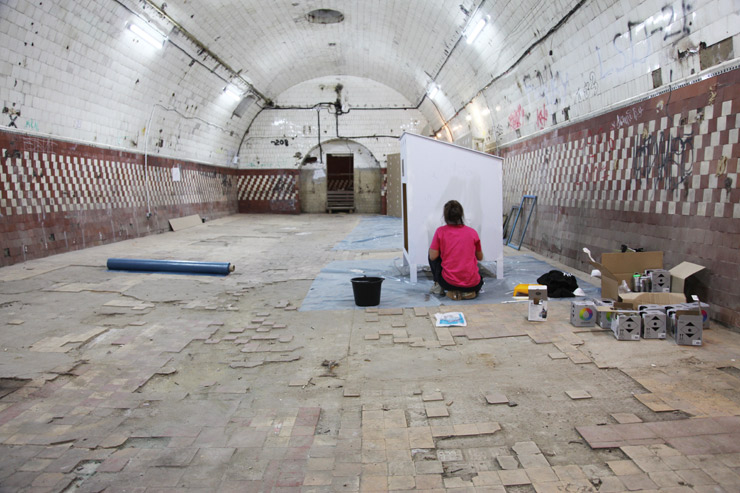
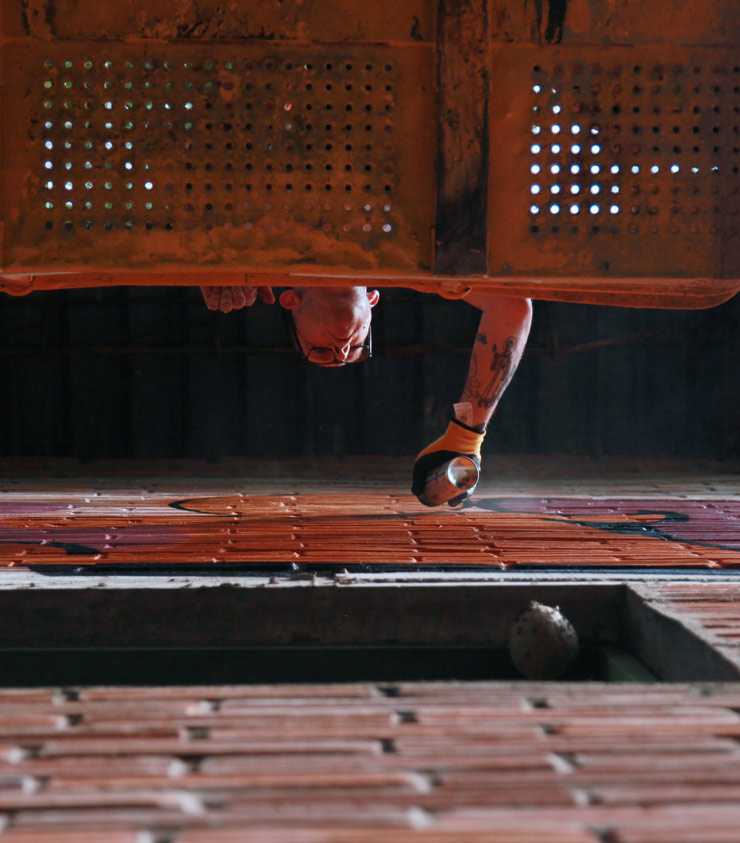
Martha Cooper / Adele Renault work in progress at Vinzavod for Artmossphere Biennale 2018. Moscow. August 2018. (photo © Jaime Rojo)

BSA: You found an Icon at the flea market in Moscow.
Martha: We did! And it has a pigeon painted on it.

BSA: So was the found icon the inspiration to make the display wall in the shape of an icon?
Adele: No it was the other way around. I knew that in Russia there are a lot of religious triptychs with Madonna and other religious imagery in gold leaf and inside the churches. When we came in and saw the exhibition space with all of these arches we thought that we wanted to have an arch and actually paint the arch directly on the wall but because the building is a landmark we were not permitted to paint directly on it.

So we asked if the temporary wall could be a triptych instead of a simple long panel. So then at the flea market we found the triptych with the Madonna and two pigeons painted on it. So everything about this installation makes so much sense and the process has been entirely organic. We also wanted to have real pigeons inside the coop but we found that that wasn’t permitted. So we then thought about having a porcelain pigeon or something like that inside the coop. Today a Russian girl who I gave a book to a couple of days ago came back to visit and told me that she had a present for me; a souvenir from Russia and she proceeds to pull out this porcelain pigeon!

So we are going to hang it in the coop.
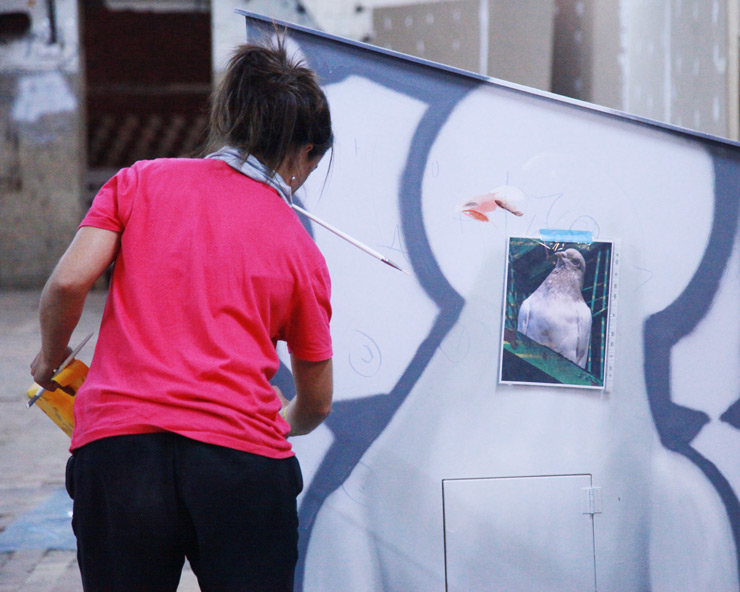
Martha Cooper / Adele Renault work in progress at Vinzavod for Artmossphere Biennale 2018. Moscow. August 2018. (photo © Jaime Rojo)

BSA: What was the genesis of this collaboration with Martha?
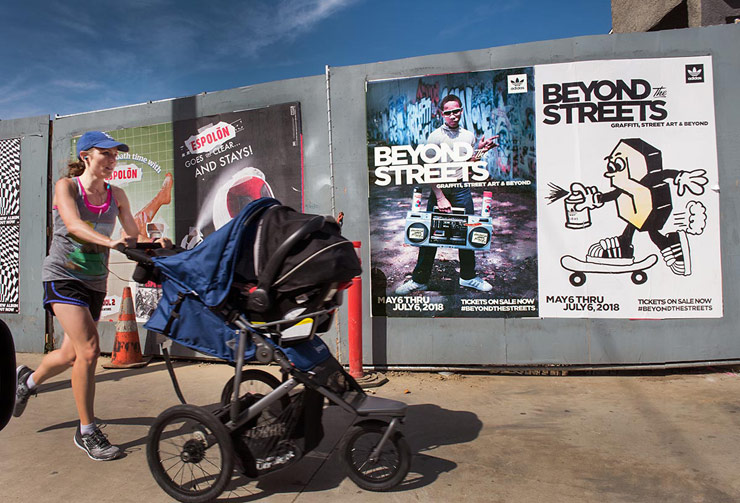
Adele: Every time we see each other we talk about our attraction to pigeons and she tells me that she has been taking photos of pigeons for a long time. We were together in Los Angeles for “Beyond The Streets” and she mentioned to me the Moscow Biennale and how in Moscow artists paint the pigeon’s coops on the outside. So she encouraged me to send an application for us to participate in this year’s biennale in collaboration and I did.
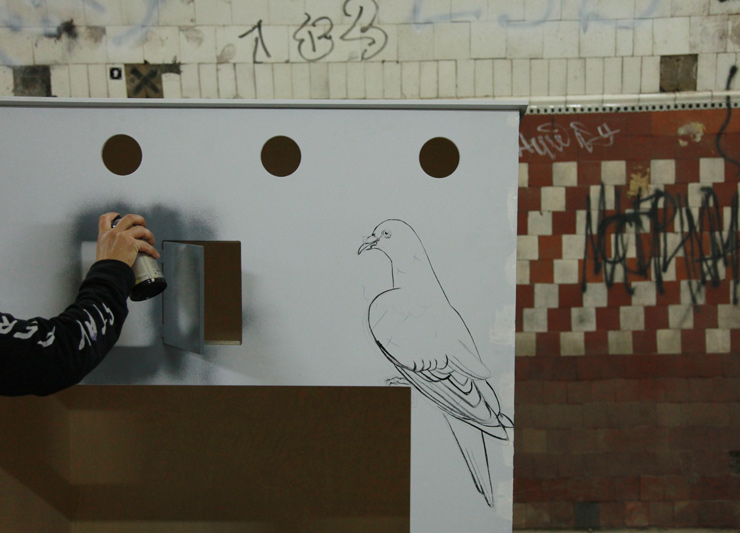
Martha Cooper / Adele Renault work in progress at Vinzavod for Artmossphere Biennale 2018. Moscow. August 2018. (photo © Jaime Rojo)

BSA: Can you tell us about the small pigeon on the front of the pigeon coop?
Adele: The small one on the front is the last passenger pigeon who died in 1914. The original passenger pigeons are extinct. And this pigeon’s name was ironically Martha – and it resides in taxidermy in the Smithsonian Museum in Washington DC. So we named this coop “Coop’s Coop” because Martha’s friends call her Coop. So it really is Martha Cooper’s coop. But passenger pigeons were used in the two big wars to bring messages in code and they were rewarded with medals for their service.
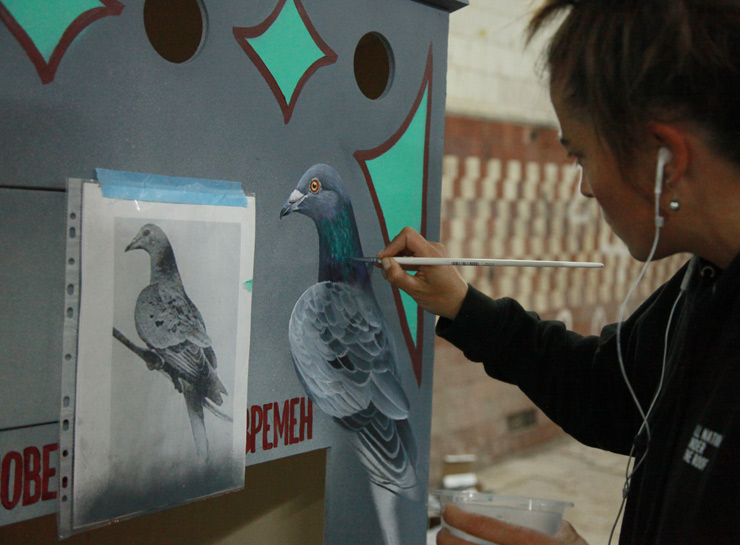
Martha Cooper / Adele Renault work in progress at Vinzavod for Artmossphere Biennale 2018. Moscow. August 2018. (photo © Jaime Rojo)

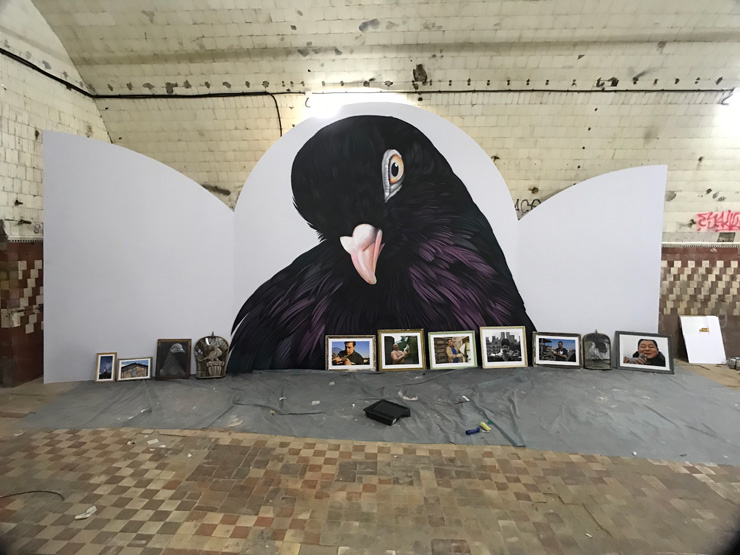
BSA: So what about the old, paint peeling off frames you are using to display the photos?
Martha: When we first thought about putting photos up we wanted rough looking frames and I had this idea, based on my previous visits to Moscow and the flea market that we would be able to find them at the flea market and we found tons of frames actually. We got them cheaply and it was a lot of fun going around collecting them.

BSA: Martha our eyes gravitated to the B & W photo of the boy holding two pigeons. What’s his name and who is he?
Martha: His name is Edwin but his writer’s name is HE3 and he introduced me to Dondi. I was working on a project on the Lower East Side and I was interested in his pigeons and he asked me why didn’t I take pictures of graffiti and proceeded to show me his notebook with his drawings in it.

He said “I can introduce you to a King”. And the King was Dondi. So I said “OK let’s go”. We drove to East New York in my car and directed me to Dondi’s house.

We knock on his door and Dondi was there. He recognized my name because when he opened his black book on the first page he had a clipping from The New York Post with a photo of a very simple throw up and I was amazed that anybody would identify it and it said CIA, Crazy Inside Artists. That was his crew and I didn’t know anything about crews. When he saw me he knew I wasn’t a cop but instead he saw me as someone that could help him get fame. Boom!
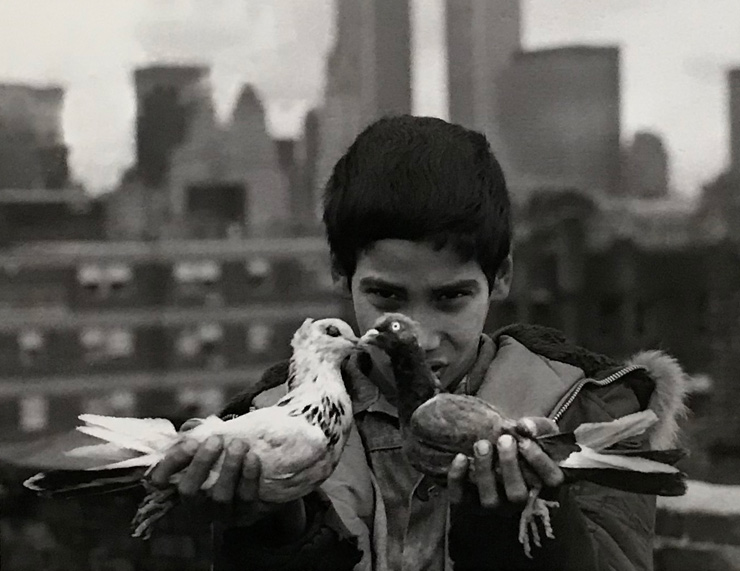
BSA: So the B & W photo above is 40 years old?
Martha: Yes

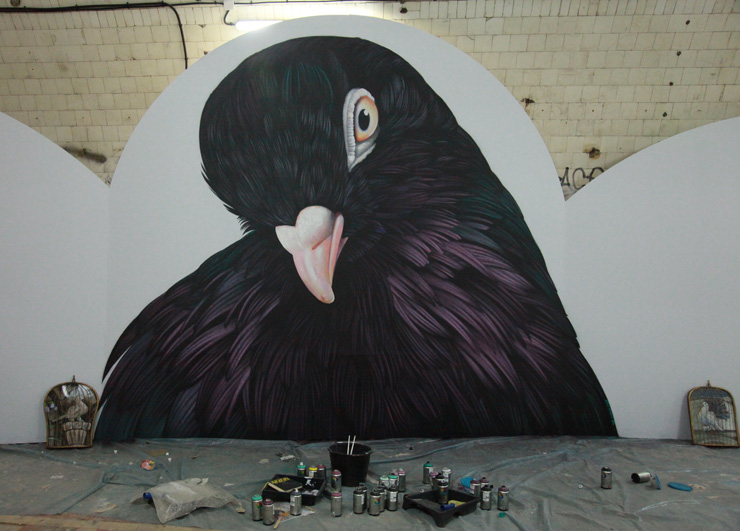
BSA: Can you talk about the large painting of the pigeon in the center of the triptych?
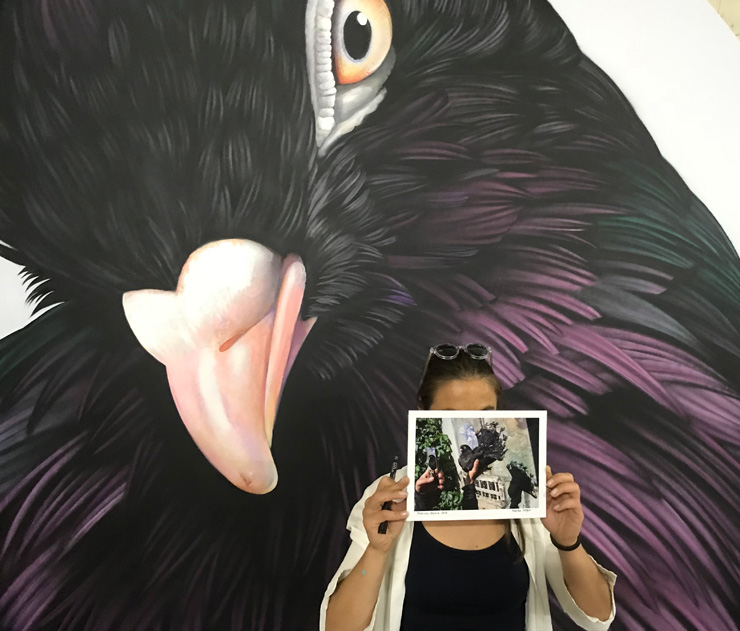
Martha: This is a painting of a pigeon that we actually met in Moscow in a pigeon coop. One of the pigeon fanciers showed this magnificent pigeon and Adele took a photo of it with her phone so this is the portrait of the pigeon and I took a photo of Adele taking a photo of the pigeon and that photo is included in this exhibition.
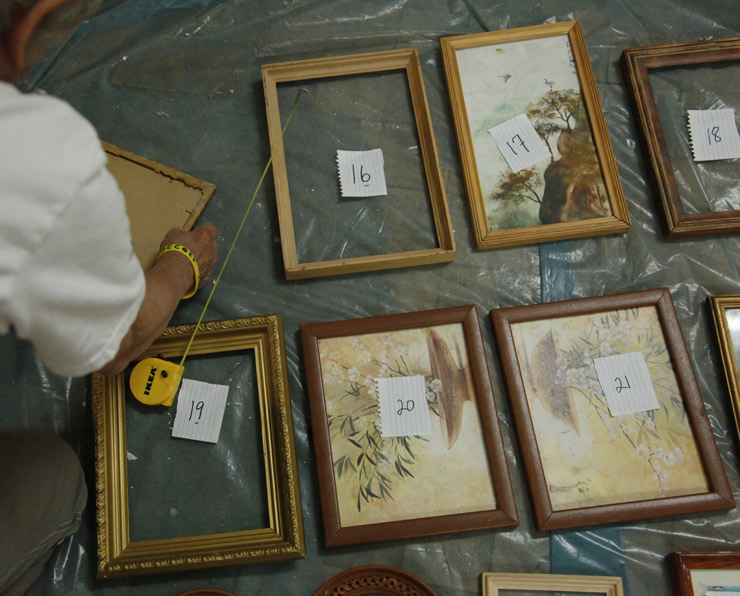
Martha Cooper / Adele Renault work in progress at Vinzavod for Artmossphere Biennale 2018. Moscow. August 2018. (photo © Jaime Rojo)
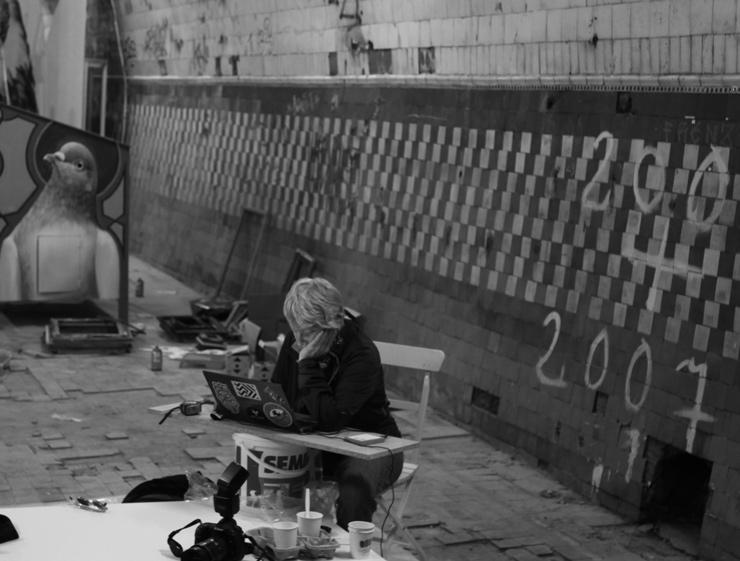
Martha Cooper / Adele Renault work in progress at Vinzavod for Artmossphere Biennale 2018. Moscow. August 2018. (photo © Jaime Rojo)
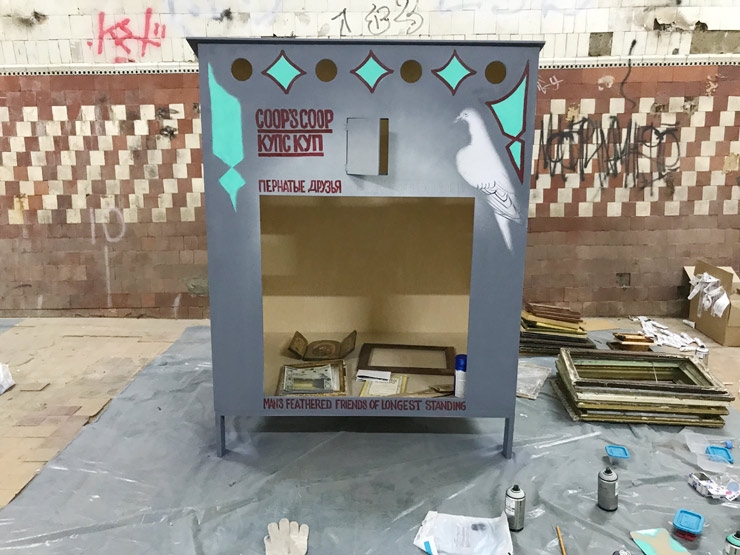
Martha Cooper / Adele Renault work in progress at Vinzavod for Artmossphere Biennale 2018. Moscow. August 2018. (photo © Jaime Rojo)

Martha Cooper / Adele Renault work in progress at Vinzavod for Artmossphere Biennale 2018. Moscow. August 2018. (photo © Jaime Rojo)
Martha Cooper / Adele Renault work in progress at Vinzavod for Artmossphere Biennale 2018. Moscow. August 2018. (photo © Jaime Rojo)
Martha Cooper / Adele Renault work in progress at Vinzavod for Artmossphere Biennale 2018. Moscow. August 2018. (photo © Jaime Rojo)
Martha Cooper / Adele Renault work in progress at Vinzavod for Artmossphere Biennale 2018. Moscow. August 2018. (photo © Jaime Rojo)
Martha Cooper / Adele Renault work in progress at Vinzavod for Artmossphere Biennale 2018. Moscow. August 2018. (photo © Jaime Rojo)
Martha Cooper / Adele Renault work in progress at Vinzavod for Artmossphere Biennale 2018. Moscow. August 2018. (photo © Jaime Rojo)


Click on the link below for more details about the opening of this exhibition:
OFFLINE: The 3rd Artmossphere Biennale Of Street Wave opens this Thursday August 30th at Vinzavod in Moscow.
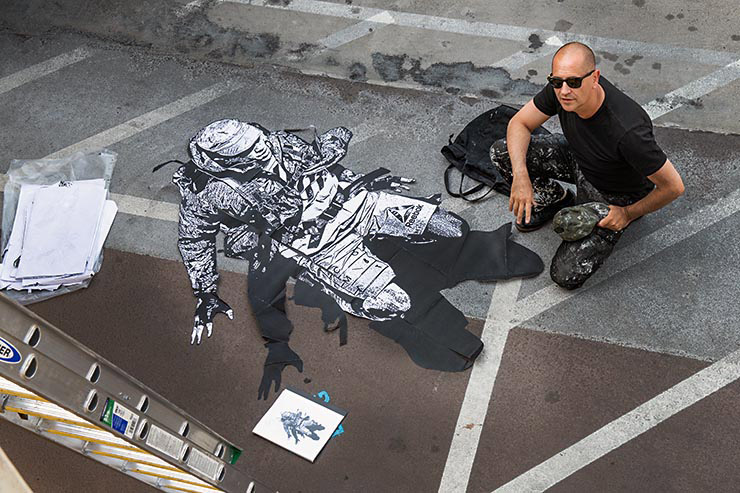
Read more
Scenes from Eugene: Murals of the 20x21EUG Festival in Oregon

Scenes from Eugene: Murals of the 20x21EUG Festival in Oregon

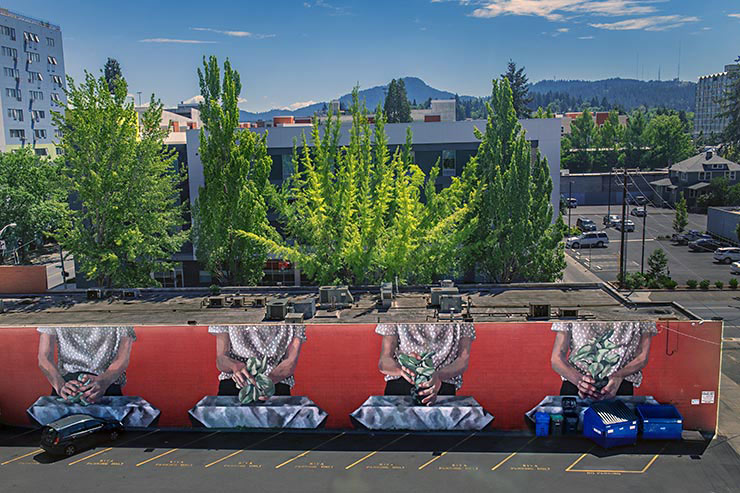
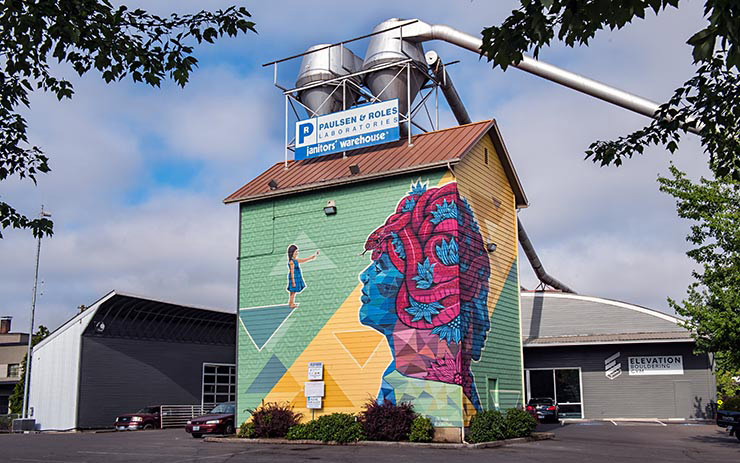
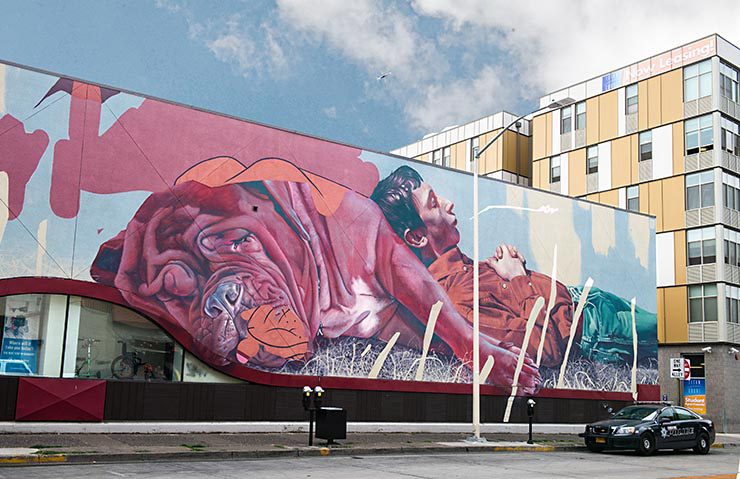
The city of Eugene in Oregon is preparing for the 2021 IAAF World Athletics Championships and like many cities these days it is transforming itself with murals.

With a goal of 20 new murals by ’21 (20x21EUG), the city began in 2016 to invite a slew of international Street Artists, some locally known ones, and a famous graffiti/Street Art photographer to participate in their ongoing visual festival.

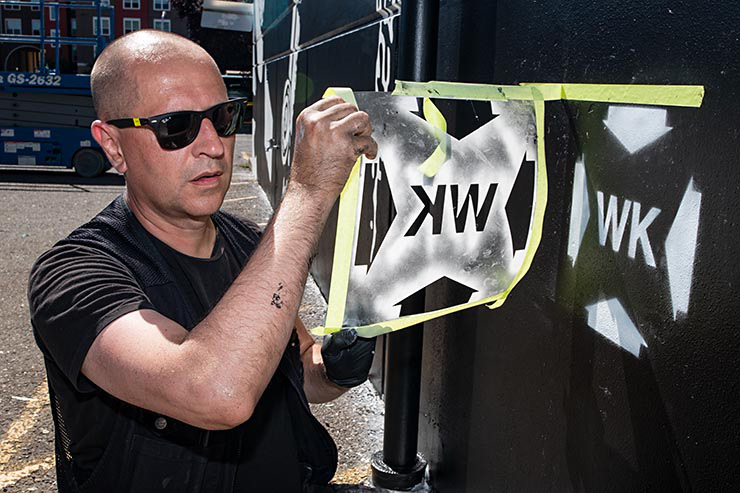
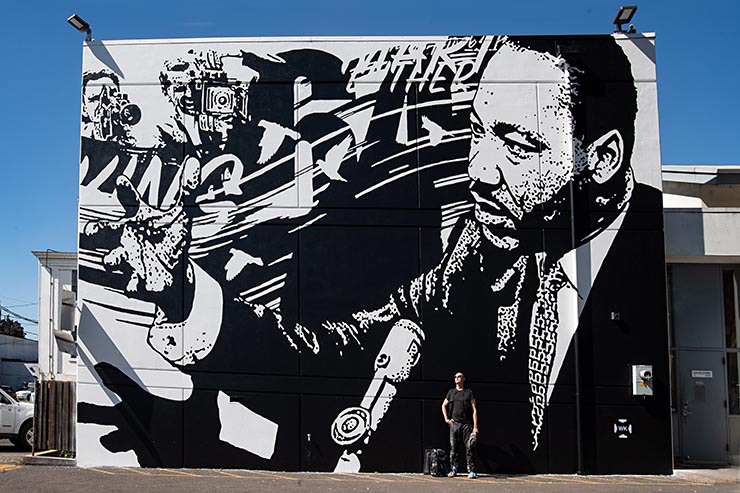
WK Interact. 20x21EUG Mural Project / 2018 Edition. Eugene, Oregon. (photo © Martha Cooper)

A lively city that is bustling with the newly blooming marijuana industry and finding an endless array of ways to celebrate it, Eugene has been so welcoming that many artists will report that feeling quite at home painting in this permissively bohemian and chill atmosphere.

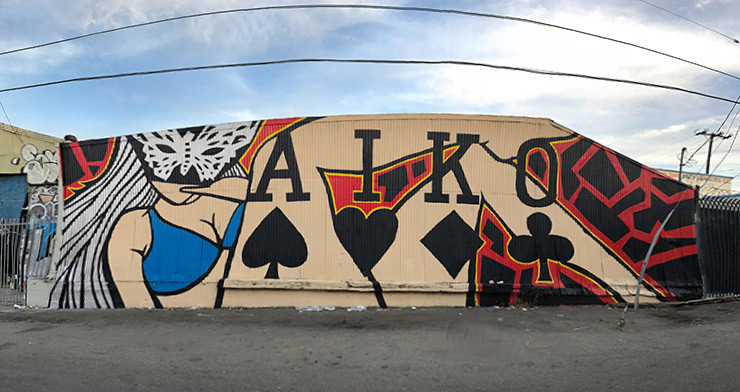
With a goal of global diversity a selection artists have included a variety of Street Art names from around the world including Blek le Rat, AIKO, Dan Witz, HUSH, Martha Cooper, WK Interact, Hyuro, Jaz, Alexis Diaz, Telmo Miel, Hua Tunan, Beau Stanton, Matt Small and local talents like Bayne Gardner and Ila Rose. With some luck organizers say they hope this year to also include artists H11235 from Nepal and Shamsia Hassani from Afghanistan.

Today you can see a lot of the painting action thanks to 2018 “20x21EUG” participant and famed photographer Martha Cooper, who had an opportunity to meet the artists this year and catch up on some of the work from previous years. We’re proud to be able to show these new images with BSA readers and we thank Ms. Cooper for sharing them.

WK Interact. 20x21EUG Mural Project / 2018 Edition. Eugene, Oregon. (photo © Martha Cooper)


We spoke with two important pillars of 20x21EUG, Debbie Williamson-Smith, Director of Communications and Paul Godin, Director of Artist Relations, to get a little background on the festival and to see what makes it unique.

BSA: Can you speak about the genesis of 20x21EUG? Why did you decide to start an Urban Art Festival?
Debbie Williamson-Smith: The concept of a large-scale public art project such came from Isaac Marquez, Cultural Services Director for the City of Eugene, and is rooted in Eugene’s rich history of public art, dating back to the Oregon International Sculpture Symposium in 1974.  Mr. Marquez gathered a committee of arts organizations and community members passionate about the project and street art to bring the concept to fruition.

WK Interact. 20x21EUG Mural Project / 2018 Edition. Eugene, Oregon. (photo © Martha Cooper)

Paul Godin: We wanted to invite the very best street artists from around the country and around the globe, to create a living outdoor art gallery in Eugene for the world to see when they came. We have curated a mix of street art legends, rising stars and local heroes, all with very different artistic styles and strong voices. Street art is a global movement, of increasingly high profile, and it was a shared passion that united our committee members.

If you want to take it way back, the origin may well have been a trip to the east end of London ten years ago, on a failed quest in search of a Banksy that led instead to the discovery of the wonders of Brick Lane.

WK Interact. 20x21EUG Mural Project / 2018 Edition. Eugene, Oregon. (photo © Martha Cooper)

BSA: How is a project of such quality as this funded?
Debbie Williamson-Smith: Funding for the project comes from the City of Eugene Cultural Services transient room tax revenue, sponsorship with City of Eugene Parking Services and contributions from wall owners and local businesses through donations of goods and services. We have had over 50 businesses support this project since it started and volunteers have donated hundreds of hours of time. It takes a village to make a mural and a full list of partners can be found on our website.

WK Interact. 20x21EUG Mural Project / 2018 Edition. Eugene, Oregon. (photo © Martha Cooper)

BSA: Is it difficult to get landlords’ permission to paint on their properties in Eugene?
Paul Godin: Heck no. We have found many landlords very open to the idea of putting street art murals on their walls. Civic pride in our project, and the high quality of the work here has made it very easy to sell more wall owners on involvement.  Now they are coming to us. Our biggest problem in Eugene with walls is that we do not have as many big blank walls as larger cities do. Our kingdom for a blank 12 story wall!

Eugenians are generally thrilled by the transformation that 20x21EUG has wrought. Just last week, a city police officer brought a woman to her favorite piece, a group of elderly women were seen admiring Matt Small’s piece and chatting.

WK Interact. 20x21EUG Mural Project / 2018 Edition. Eugene, Oregon. (photo © Martha Cooper)

Debbie Williamson-Smith: It is so electric that we have coined the phrase “mural magic”. This project has ignited the civic pride in our community and has already inspired another mural project, Urban Canvas. This initiative of the City of Eugene’s Cultural Services department matches local walls with local artists and three murals have been added to the cultural landscape since it launched in 2018. People are making mural watching a regular activity, taking children to watch artists in action and bringing visitors to see the murals.

WK Interact. 20x21EUG Mural Project / 2018 Edition. Eugene, Oregon. (photo © Martha Cooper)

BSA: What are you personal observations regarding the experience as a whole? What would you do different for next year?
Paul Godin: One thing that became clear about our festival this year is that we have created a family, uniting our committee, our volunteers, our artists in a unique and inspiring way. We have bonded through our shared experience, the long nights, the controlled chaos days, the communal dinners, and the stains of primer on all of our clothes.

AIKO. 20x21EUG Mural Project / 2018 Edition. Eugene, Oregon. (photo © Martha Cooper)

Debbie Williamson-Smith: This has been one of the most rewarding experiences of my life. As an arts advocate, I am so inspired by the changes art is making in my community and this is one of the reasons why public art and street art are so important. It gives immediate access to art for the public. We are also in a time of political upheaval and for some people, including myself, this has been a difficult time for our country. To welcome people to my part of the world is my form of resistance. We can unite each other through art and as anyone who has studied art history knows, the arts have gotten us through some dark times.

AIKO. 20x21EUG Mural Project / 2018 Edition. Eugene, Oregon. (photo © Martha Cooper)

If I could do anything differently, it would be to make certain all the artists travel here at the same time. When we had Dan Witz here last summer, he talked about what he called artist equity, meaning that festivals for him provide an opportunity to work with artists that he has not worked together before and that always influences his decision to attend. One of my highlights from last summer was watching him and Blek le Rat work on separate installations on the same building.

I was almost as giddy as Dan was. Almost.

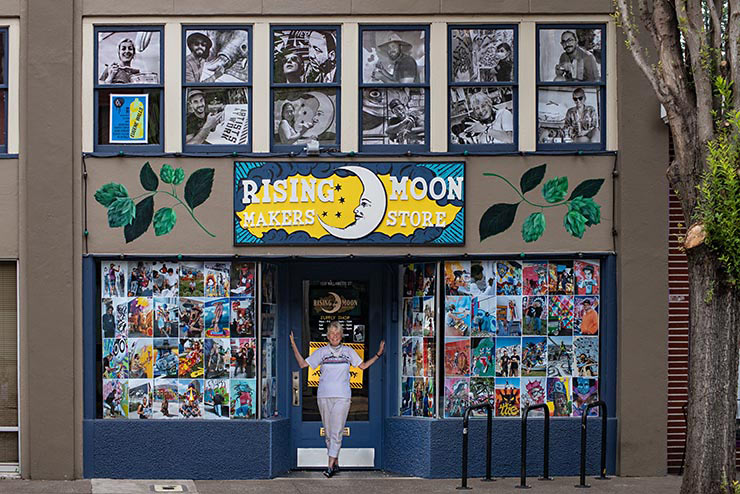
Martha Cooper standing with windows full of her images at the Rising Moon makers store. 20x21EUG Mural Project / 2018 Edition. Eugene, Oregon.

Bayne Gardner. 20x21EUG Mural Project / 2018 Edition. Eugene, Oregon. (photo © Martha Cooper)

Bayne Gardner. 20x21EUG Mural Project / 2018 Edition. Eugene, Oregon. (photo © Martha Cooper)

Bayne Gardner. 20x21EUG Mural Project / 2018 Edition. Eugene, Oregon. (photo © Martha Cooper)

Matt Small. 20x21EUG Mural Project / 2018 Edition. Eugene, Oregon. (photo © Martha Cooper)

Alexis Diaz. 20x21EUG Mural Project / 2018 Edition. Eugene, Oregon. (photo © Martha Cooper)

Alexis Diaz. WIP. 20x21EUG Mural Project / 2018 Edition. Eugene, Oregon. (photo © Martha Cooper)

Blek Le Rat. 20x21EUG Mural Project / 2017 Edition. Eugene, Oregon. (photo © Martha Cooper)

Blek Le Rat. 20x21EUG Mural Project / 2017 Edition. Eugene, Oregon. (photo © Martha Cooper)

Blek Le Rat. 20x21EUG Mural Project / 2017 Edition. Eugene, Oregon. (photo © Martha Cooper)

Dan Witz. 20x21EUG Mural Project / 2017 Edition. Eugene, Oregon. (photo © Martha Cooper)

Dan Witz. 20x21EUG Mural Project / 2017 Edition. Eugene, Oregon. (photo © Martha Cooper)

Hyuro. 20x21EUG Mural Project / 2017 Edition. Eugene, Oregon. (photo © Martha Cooper)

Ila Rose. 20x21EUG Mural Project / 2017 Edition. Eugene, Oregon. (photo © Martha Cooper)

Telmo & Miel. 20x21EUG Mural Project / 2017 Edition. Eugene, Oregon. (photo © Martha Cooper)

Telmo & Miel. 20x21EUG Mural Project / 2017 Edition. Eugene, Oregon. (photo © Martha Cooper)

Stefan Ways was in Eugene assisting Aiko with her mural this year. He wasn’t in the official line-up of artists but didn’t stop him from getting up. (photo © Martha Cooper)

And of course there are tracks and trains in Eugene, Oregon ready to painted…(photo © Martha Cooper)

There are bargains everywhere in Eugene, Oregon… (photo © Martha Cooper)

As well as consciously aware and decent residents. Eugene, Oregon. (photo © Martha Cooper)


For more information about 20x21EUG in Eugene, Oregon, please CLICK HERE.


Read more
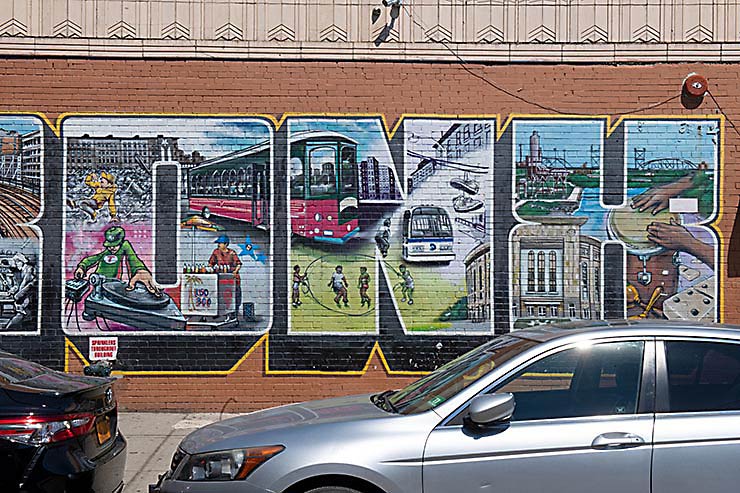
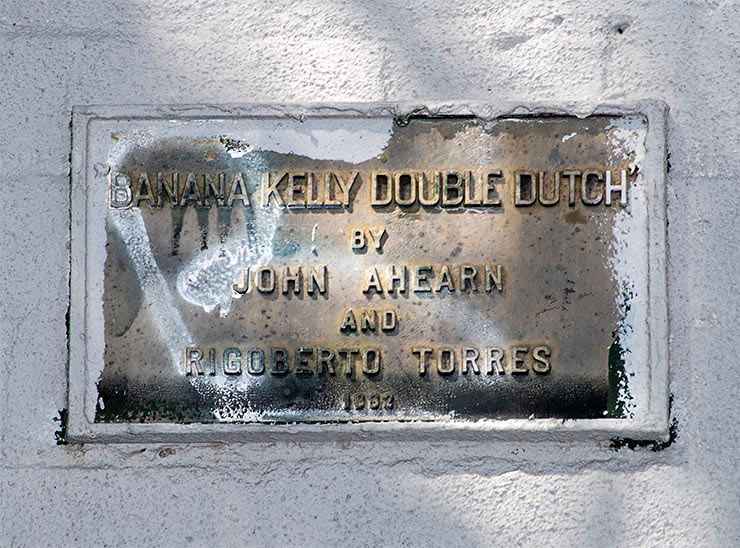
“Banana Kelly Double Dutch” Returns in the Bronx : John Ahearn & Rigoberto Torres.

“Banana Kelly Double Dutch” Returns in the Bronx : John Ahearn & Rigoberto Torres.

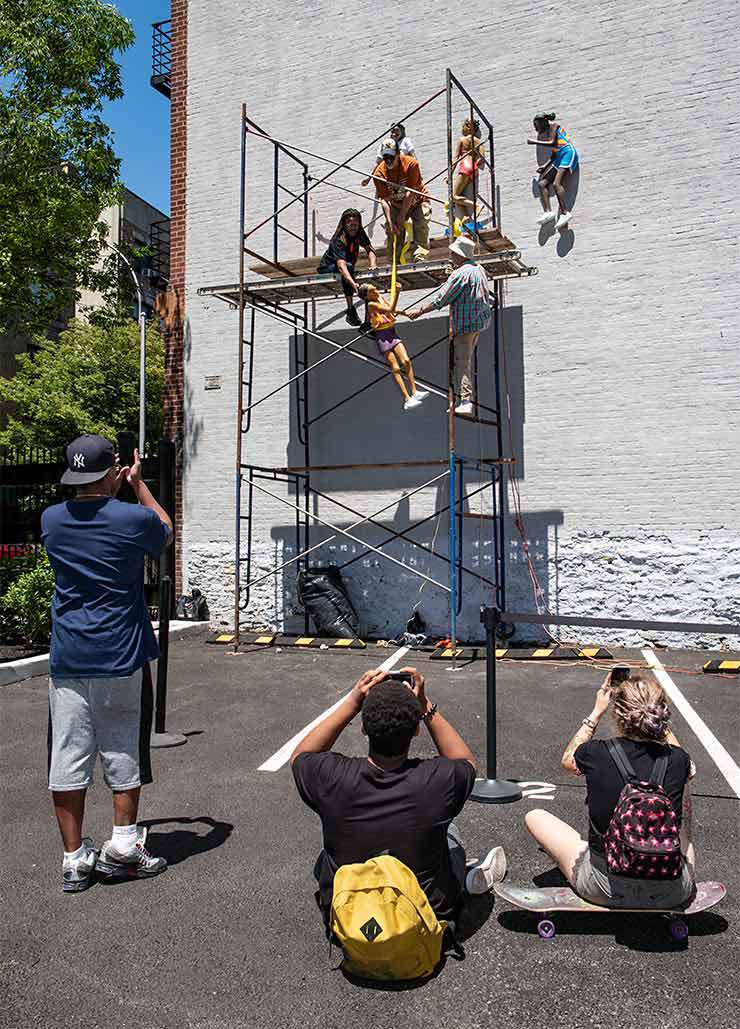
They’re doing Double Dutch again up in the South Bronx. Way up.

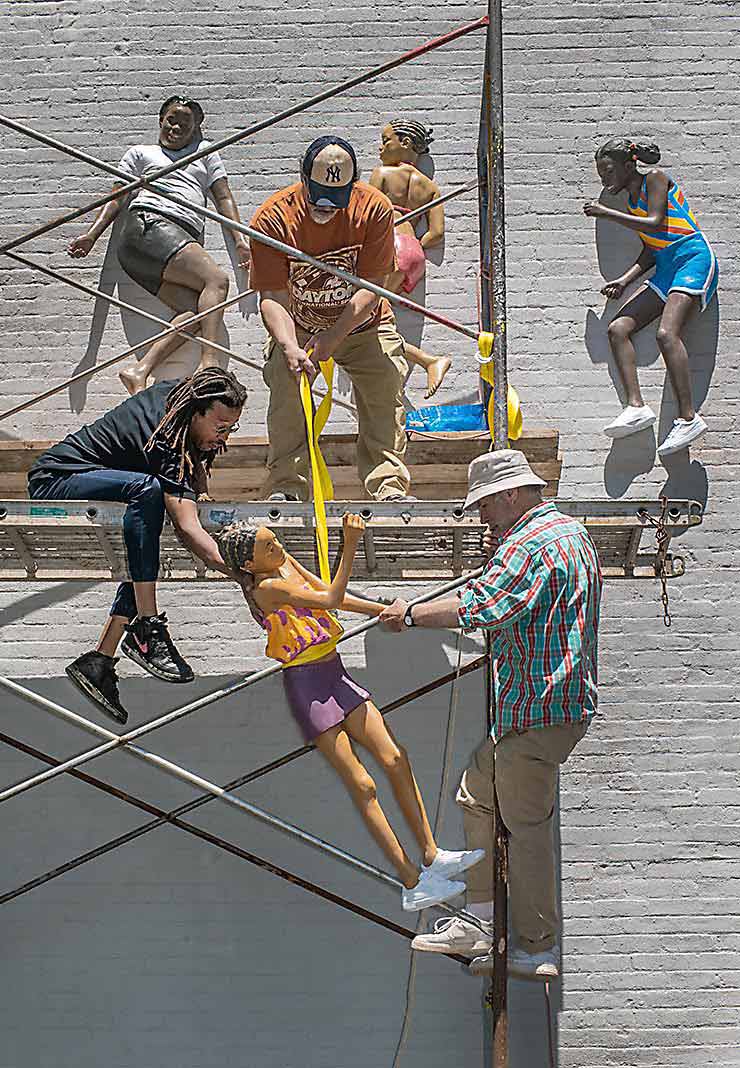
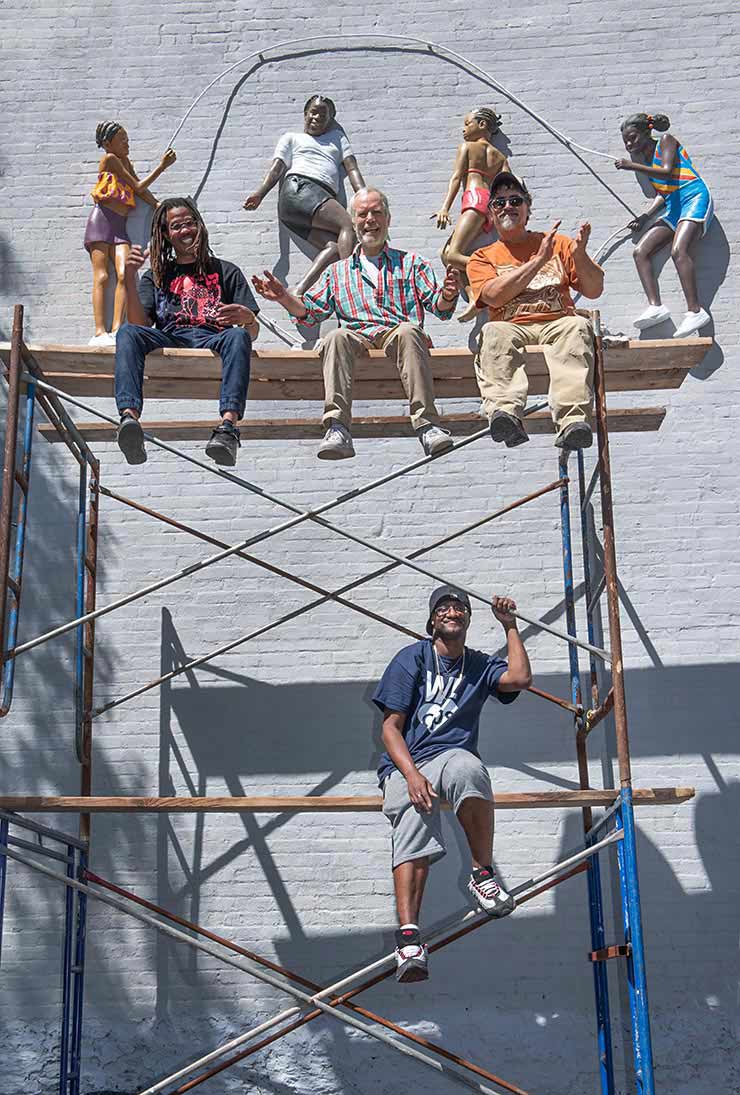
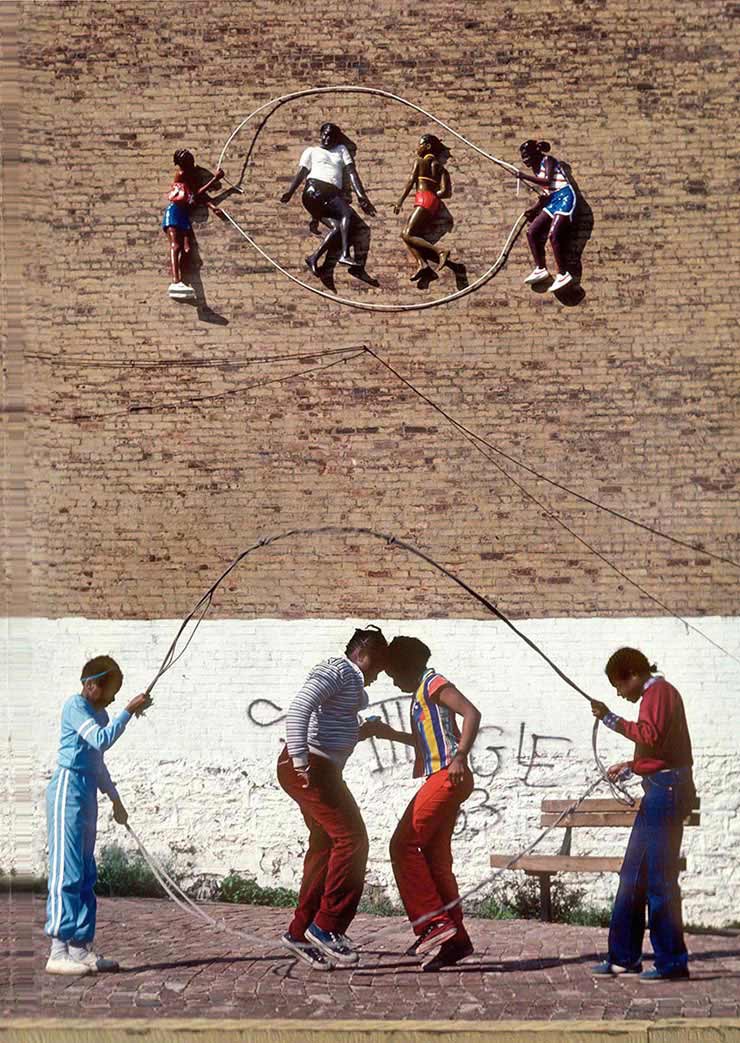
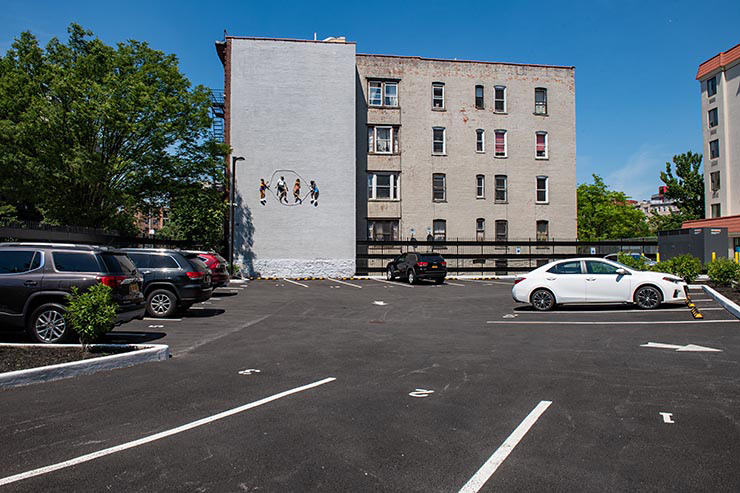
John Ahearn & Rigoberto Torres. “Banana Kelly Double Dutch” The Bronx, NYC. 2018. (photo © Martha Cooper)

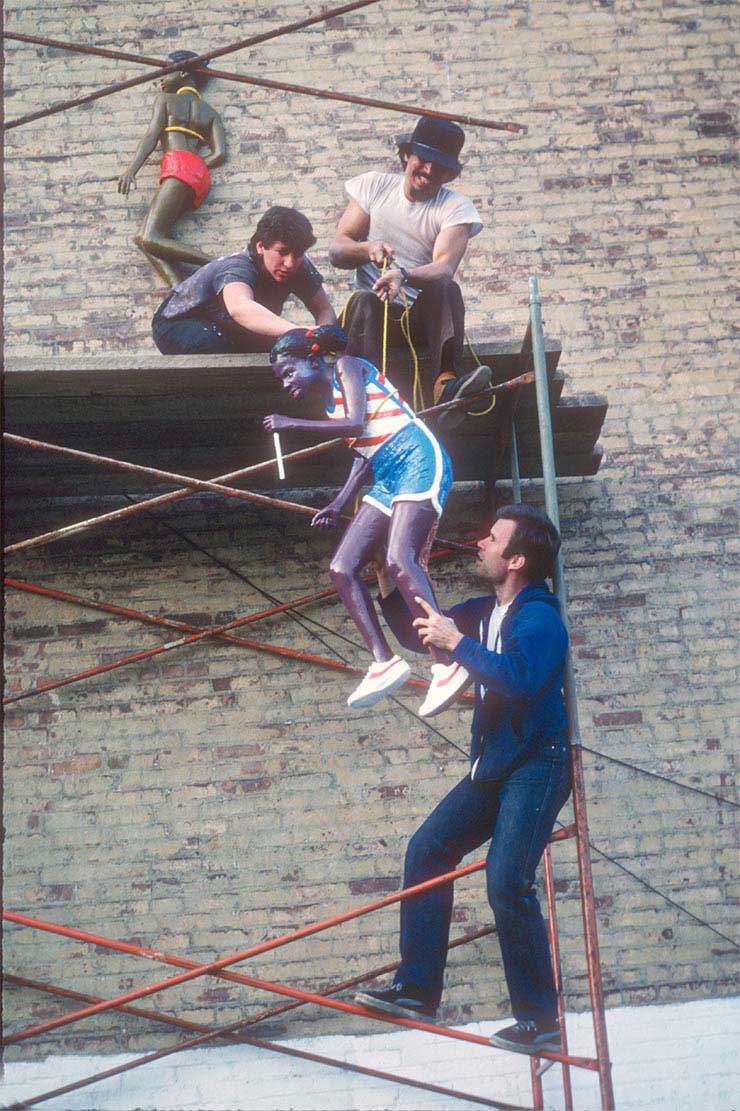
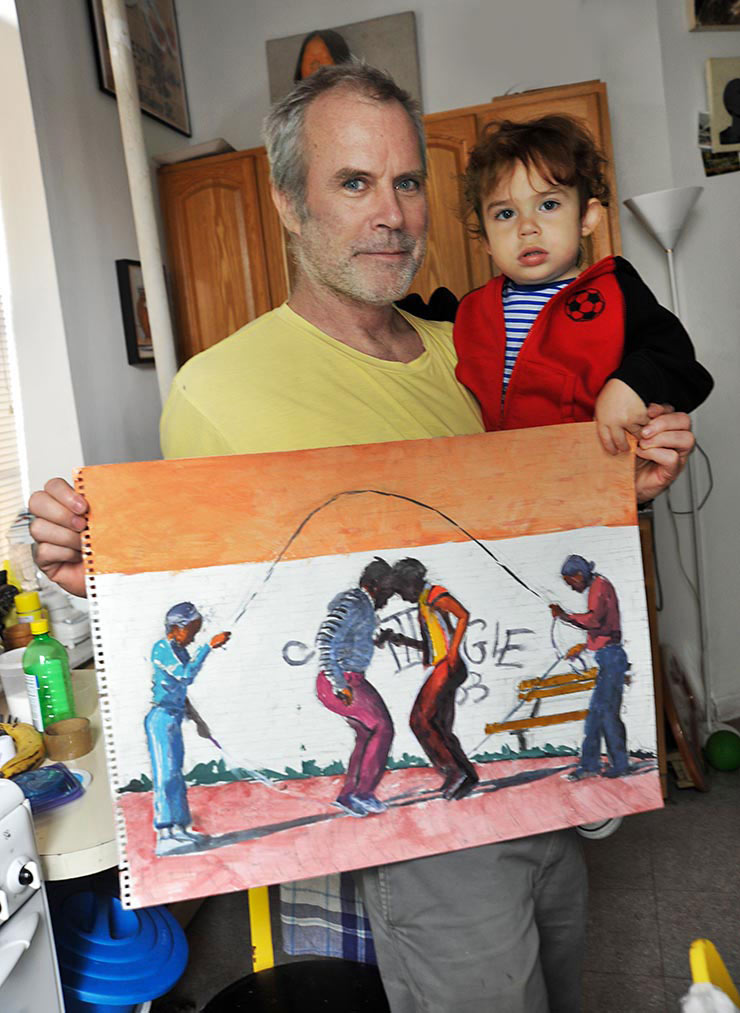
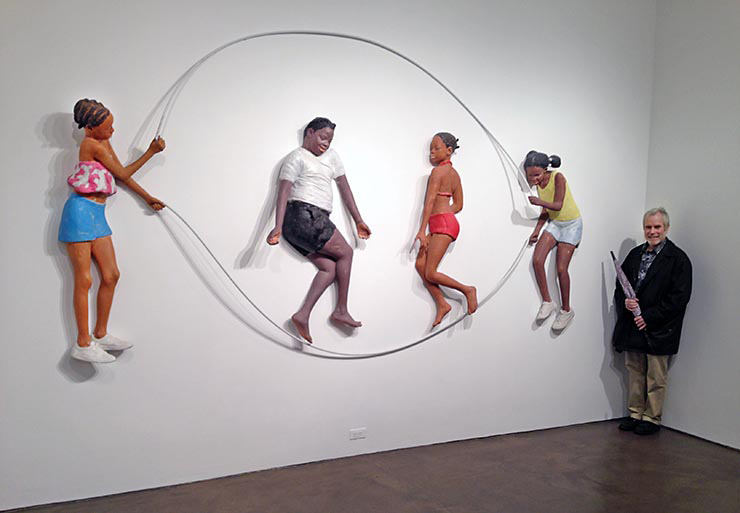
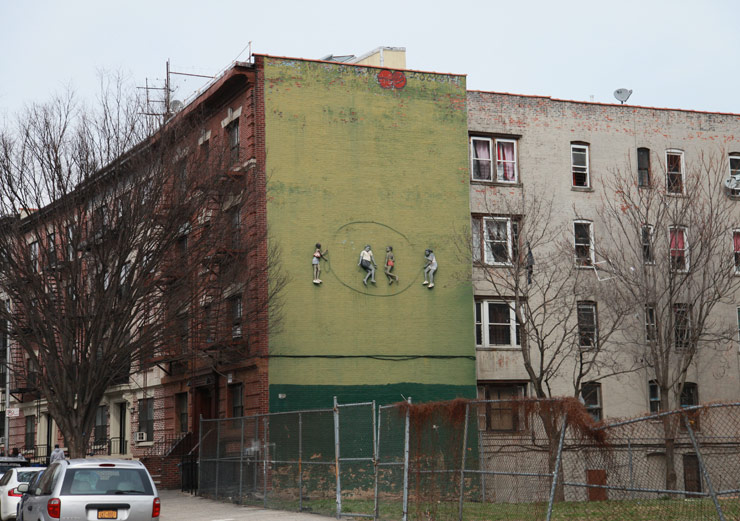
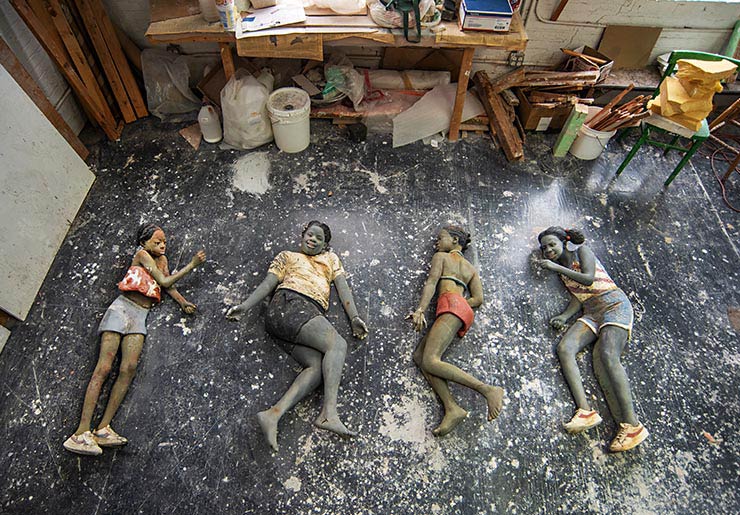
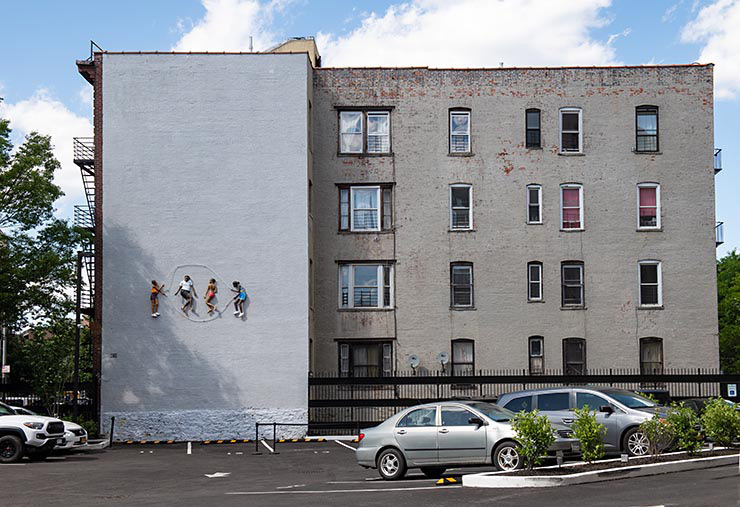
Restored to look like new, this is the third time that La Freeda, Jevette, Towana and Staice have taken their rope jumping game to this wall on Kelly Street and the spirit of their game and the culture are here as well. Based on the actual girls as models casted, the sculptors John Ahearn and Rigoberto Torres recently restored them and placed them on the same wall that they first appeared on in 1982, a moment from New York’s history.

John Ahearn & Rigoberto Torres. The original installation of “Banana Kelly Double Dutch” The Bronx, NYC. 1982. (photo © Martha Cooper)

Their art practice in the public space has a fully engaged, activist quality – insisting as it does to herald the everyday heroes in a culture that tends to reserve public space to elevate figures from the military, the church, politics, literature and Pop Culture. Even the name of this piece refers to the community group that hosted the sculpture for many years, Banana Kelly.

With a somewhat radical art practice that claims public sphere for the public for forty years, the duo have made casts of people in the neighborhood for decades, in the process forming long relationships with the sitters and their families, and their extended families.

John Ahearn & Rigoberto Torres. “Banana Kelly Double Dutch” The Bronx, NYC. 1982. (photo © Martha Cooper)

A curiosity for many on the street at first, a lot of folks first became familiar with the work as it was being performed – whether in workshops like the one Torres first saw Ahearn conducting in the storefront windows of the famous art space Fashion Moda or later at numerous block parties around the neighborhood.

Owing to his family connection to a sculpture factory, Torres had knowledge that Ahearn was missing and their yin/yang temperaments created a professional partnership balance that eventually has landed their work in places as far as Brazil, Taiwan, and Orlando, where Torres moved a number of years ago with his family.

John Ahearn & Rigoberto Torres. “Banana Kelly Double Dutch” The Bronx, NYC. 1982. (photo © Martha Cooper)

In the intervening years the Ahearn/Torres partnership has garnered attention in significant gallery and museum shows as a sociological hybrid, a captured record of life and culture that favors the unfamous, occasionally the famous. Humble as they are about their accomplishments and refreshingly reticent to be boastful, their combined projects have been collected by heavy hitters in the Street Art, hip-hop and contemporary art world.

Their sculptural portraits of the street have also been featured in exhibitions in the New Museum of Contemporary Art, the Institute of Contemporary Art, London, the Whitney Museum of American Art, New York, the Museum of Fine Arts, Boston, the Museum of Contemporary Art, Los Angeles, the Irish Museum of Modern Art, the Bronx Museum of the Arts , “Greater New York” at MoMA PS1, New York. In an interview with BSA Ahearn gives credit to his creative partner for some recent shows including “his two homages to his Uncle Raul’s Factory in the “Body” Show at the Met Breuer, and his magnificent funky “Ruth Fernandez” figure in Jeffrey Deitch’s “People” Show.

John Ahearn & Rigoberto Torres. “Banana Kelly Double Dutch” The Bronx, NYC. 1982. (photo © Martha Cooper)

What’s remarkable about this piece is not only that it has survived the constant changing of the New York City skyline but also the fact that photographer Martha Cooper was on hand to capture the bookends of the Double Dutch installation – the first one in 1982 and this new one in 2018. An anthropologist and ethnographer by heart and training, Ms. Cooper also captured many of the surrounding people and activities in the neighborhood during both of the installations and she generously shares them here with BSA readers to give a further appreciation of the time passed and the cultural relevance of the duo’s work.

John Ahearn & Rigoberto Torres. “Banana Kelly Double Dutch” The Bronx, NYC. 1982. (photo © Martha Cooper)

BSA asked Mr. Ahearn a few questions and he provided some great insights into the production and life behind these Double Dutch girls.

BSA: Do you see girls and women playing Double Dutch much in the neighborhood this summer?
John Ahearn: Double Dutch has been a classic rope jumping style for a while, the double rope keeps things moving. It sometimes seems to be always be in fashion.

John Ahearn & Rigoberto Torres. “Banana Kelly Double Dutch” The Bronx, NYC. 1982. (photo © Martha Cooper)

BSA: Your personal relationships with people in the neighborhood have figured prominently in your subjects. How does time change your perception of the original works?
John Ahearn: All the sculptures are some kind of collaboration with the specific people and the neighborhood. Time tests the validity of the intention and the expression. Art can lose meaning and look silly, or it can increase in its purpose and gain poignancy.

John Ahearn & Rigoberto Torres. The original stars of “Banana Kelly Double Dutch” The Bronx, NYC. 1982. (photo © Martha Cooper)

BSA: Your work captures so much action! Is that a particular goal for you?
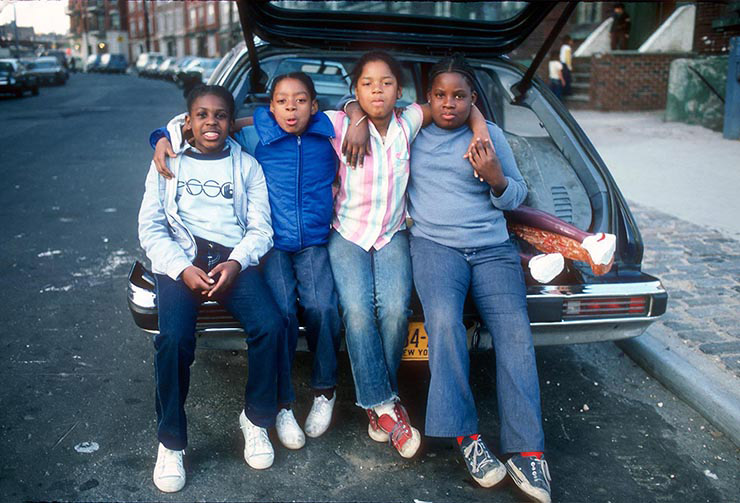
John Ahearn: When I first saw Marty’s profound image of the real four girls in front of their sculpture, taken when it was first installed in 1982, I was shocked! I had emphasized the unique quality of each separate girl but Marty captured them as one piece, engaged in a solemn ritual of play, with all heads bowed to the center. I was moved to see her vision and it took me a few decades to look at the actual sculpture with full confidence.

John Ahearn & Rigoberto Torres. The classic photo of “Banana Kelly Double Dutch” The Bronx, NYC. 1982. (photo © Martha Cooper)

BSA: Why is it important to you to make art accessible to the people on the street?
John Ahearn: I need to feel that my perception includes the point of view of others.

BSA: What inspired you to refurbish this installation and how did you find La Freeda, Jevette, Towana, and Staice?
John Ahearn: I believe the girls are La Freeda Mincey (whose mother still lives in the building and came out to watch us reinstall the girls) Javette Potts, whose mother created the original girl’s dance group) Tawana Brown, and Staice Seabrine (with whom we are more regularly in touch)

In 1981, we were considering our first neighborhood commission at Fox St. and Intervale Ave. We took a composite 180 degree photo of the area. On all sides were burned out buildings, but one wall popped out in perfect condition with a surrounding block that was completely together. That was “Banana Kelly”, a community group committed to survival and improving the area, with the Potts family at the center of things.

John Ahearn’s drawing of Martha’s photo. 2011. (photo © Martha Cooper)

Later there was a block party at Kelly St. that featured an “African Dance” group of girls, including Javette Potts, the granddaughter of Mr. Potts. It was at that time that we had a notion to have the four girls play Double Dutch for the image.

This is actually the second time we have repaired the sculptures. By 1986, the ravages tearing up the Bronx had reached the little park that Banana Kelly had built on the corner. All the bricks were torn up, and some kids were heaving them at the Double Dutch sculptures. Parts of the figures were breaking.

John Ahearn & Rigoberto Torres. “Banana Kelly Double Dutch” The Bronx, NYC. 1986. (photo © Martha Cooper)

At the same time, Rigoberto’s Uncle Raul’s Statuary Factory had burned down and all our molds related to the three murals had been stored there and were lost. So we removed the Double Dutch sculptures from the wall, and took them to our studio to restore them. We reinstalled them higher than before with a slightly different design.

Meanwhile, the devastated block which Banana Kelly faces (south) was transformed into a huge park. All the buildings had been torn down heading north to Longwood Avenue. The design of the 2nd version of the sculptures (see Marty’s photo) looks very nice to me now, but it had always annoyed me.

John Ahearn & Rigoberto Torres. A gallery version of “Banana Kelly Double Dutch” at Alexander & Bonin Gallery in Manhattan. NYC 2014. (photo © Martha Cooper)

The tiny “park” site at Kelly St. eventually was fenced off and abandoned, awaiting future use. Sometimes old sculptures in their neighborhood locations can be very satisfying and true. But it always seemed that the Double Dutch should be returned to their original design.

Recently the lot was sold to the new Catholic Nursing facility next door, to be rebuilt as their parking area. We wanted very much to keep the sculptures on the same wall and this seemed like the right moment.

John Ahearn & Rigoberto Torres. “Banana Kelly Double Dutch” The Bronx, NYC. 2014. (photo © Jaime Rojo)

John Ahearn & Rigoberto Torres. “Banana Kelly Double Dutch” The Bronx, NYC. 2014. (photo © Jaime Rojo)

John Ahearn & Rigoberto Torres. La Freeda, Javette, Towana and Staice back at the studio waiting to be restored. NYC 2018. (photo © Martha Cooper)

TATS CRU homage to John Ahearn & Rigoberto Torres. Detail. “Banana Kelly Double Dutch” The Bronx, NYC. 2018. (photo © Martha Cooper)

John Ahearn & Rigoberto Torres. “Banana Kelly Double Dutch” The Bronx, NYC. 2018. (photo © Martha Cooper)

John Ahearn & Rigoberto Torres. “Banana Kelly Double Dutch” The Bronx, NYC. 2018. (photo © Martha Cooper)

John Ahearn & Rigoberto Torres. “Banana Kelly Double Dutch” The Bronx, NYC. 2018. (photo © Martha Cooper)

John Ahearn & Rigoberto Torres. “Banana Kelly Double Dutch” The Bronx, NYC. 2018. (photo © Martha Cooper)

John Ahearn & Rigoberto Torres. “Banana Kelly Double Dutch” The Bronx, NYC. 2018. (photo © Martha Cooper)

John Ahearn & Rigoberto Torres. “Banana Kelly Double Dutch” The Bronx, NYC. 2018. (photo © Martha Cooper)


Frankie Smith
“Double Dutch Bus” 1981

” ‘Double Dutch’ is a tribute to all the girls in the world, especially the girls on my block. I’ve been watching them for 25 years. They use their mothers’ clotheslines to play the game – it’s an art. It’s a tribute to them – they’re really good at it.” – Frankie Smith to Dick Clark on American Bandstand.

Malcom McLaren
“Double Dutch” 1983

All over the world high school girls
Take to the ropes and turn them slow
Starts a beat and a loop
They skip and jump through the hoop
They might break and they might fall
About the gals from New York City
They just start again
Start again


Read more
One Night in NYC with 1UP, Martha Cooper, Ninja K : Book Release and Movie Screening

One Night in NYC with 1UP, Martha Cooper, Ninja K : Book Release and Movie Screening

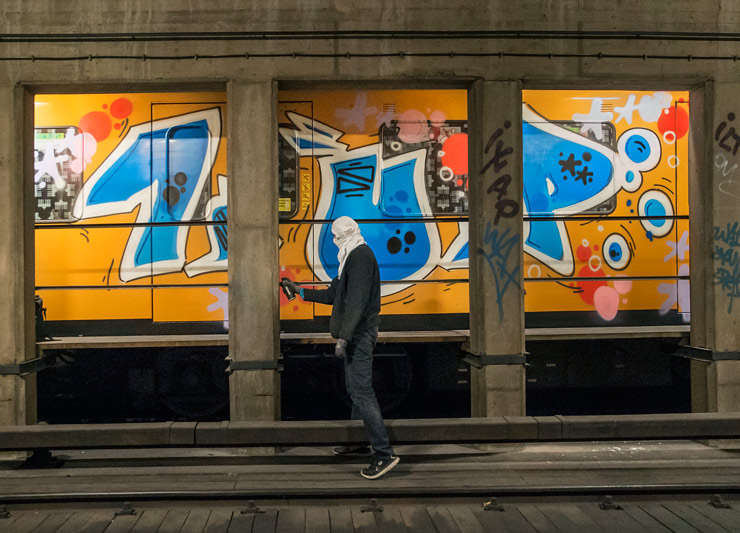
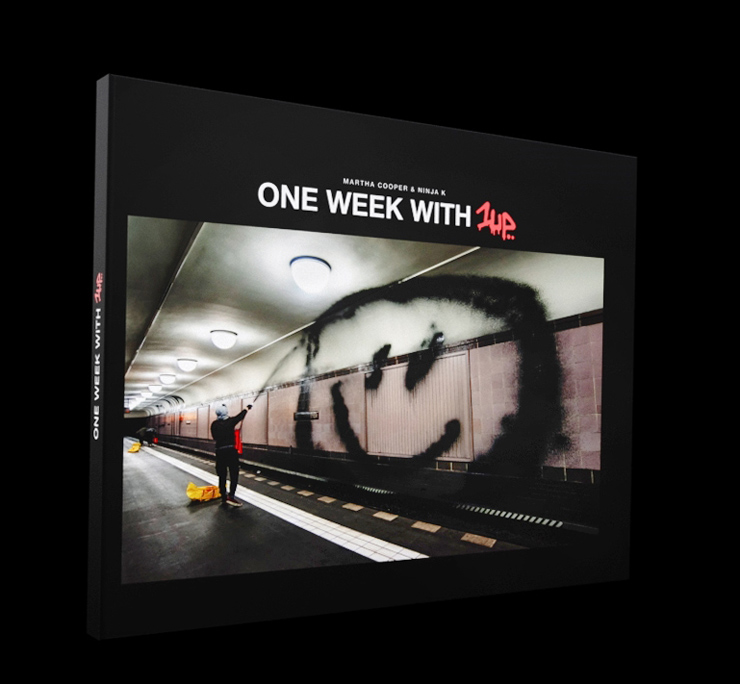
Berlin’s notorious 1UP Crew hits Ridgewood Saturday night along with graffiti/Street Art patron saint Martha Cooper to celebrate the first city in their US tour for their new book with co-shooter Ninja K.

Martha Cooper & Ninja K. One Week With 1UP. (photo courtesy of the team)

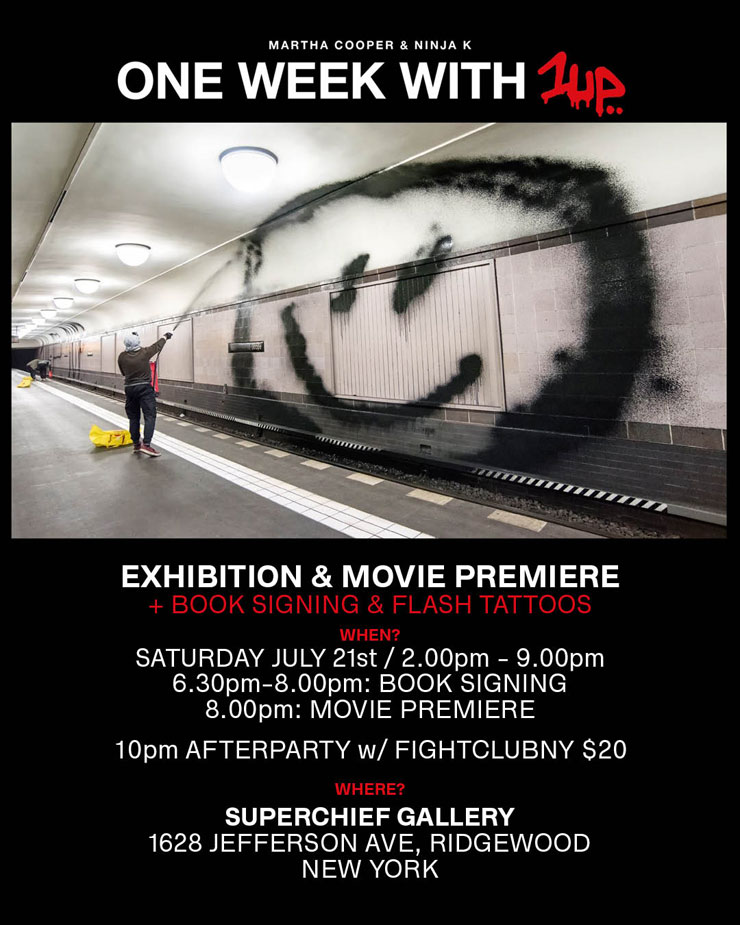
A hot summer night pop-up is available only one night at Superchief and we’ll be there with you to eyeball the new book, get it signed, and screen the new 1UP movie. Bring your juice box kiddies!

We reported HERE on the launch of this book in Berlin at Urban Spree back in May. New York peeps have an opportunity to see a Pop-Up exhibition and book signing at Superchief Gallery in Ridgewood, NY this Saturday, July 21st. Click HERE for all the details…

Martha Cooper & Ninja K. One Week With 1UP. (photo courtesy of the team)

Martha Cooper & Ninja K. One Week With 1UP. (photo courtesy of the team)

Martha Cooper & Ninja K. One Week With 1UP. (photo courtesy of the team)

Martha Cooper & Ninja K. One Week With 1UP. (photo courtesy of the team)

Martha Cooper & Ninja K. One Week With 1UP. (photo courtesy of the team)


Martha Cooper & Ninja K: One Week With 1UP opens this Saturday at Superchief Gallery in Ridgewood, NYC. Click HERE for all the details.

Read more
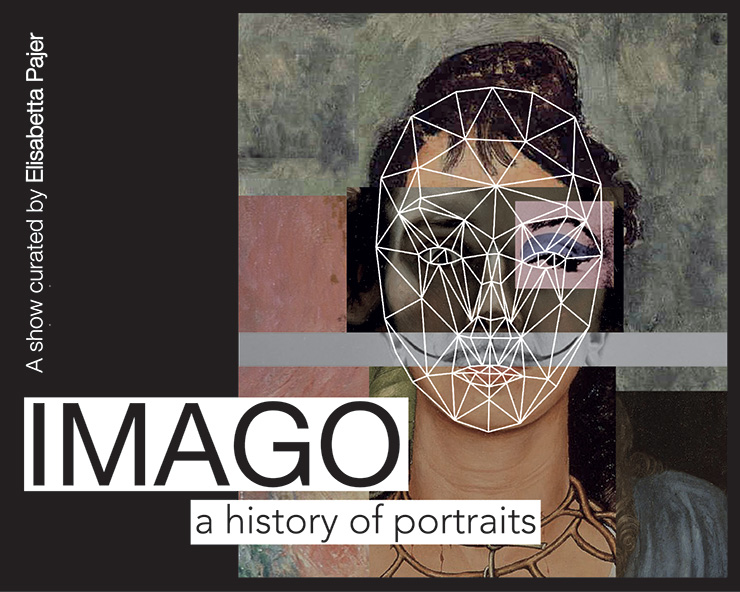
Street Artists At Munich Museum Present the Portrait, “IMAGO” Curated by Elisabetta Pajer

Street Artists At Munich Museum Present the Portrait, “IMAGO” Curated by Elisabetta Pajer

From cave carvings in Angoulême in western France 27,000 years ago to your daily, perhaps hourly selfie on a cell phone today, our desire to depict the figure is as much a reflection of the artist and their times as it’s sitter.

A new show at MUCA Munich (Museum of Urban Contemporary Art) opening today invites 30 primarily Street Artists to choose a significant reference portrait of any historical time, country of origin, or artistic movement and interpret their inspirations into a portrait.

Whether drawing influences from Vermeer, Courbet, or Lucien Freud, each artist ultimately represents their own life experiences in their choice of subject and the technique of portrayal. Perhaps that is why curator Elisabetta Pajer has asked each of the artists to give us a statement with their work to help put it into context. Pajer tells us that she looks at the collection of works and the statements create a ‘harmonic mosaic’ of these figurative and written testimonies.

“These artists have sought out inspiration from many mediums that portraiture finds itself interpreted within,” says Pajer. “Taking their themes and inspiration from classical paintings, sculpture, film, theater, photographer, interactions, culture, religion, and science. Exhibiting a great understanding of the complexity of self-reflection with art as the catalyst.”

We’re pleased to be able to present some of the artists and their own words here.


Andreas Englund

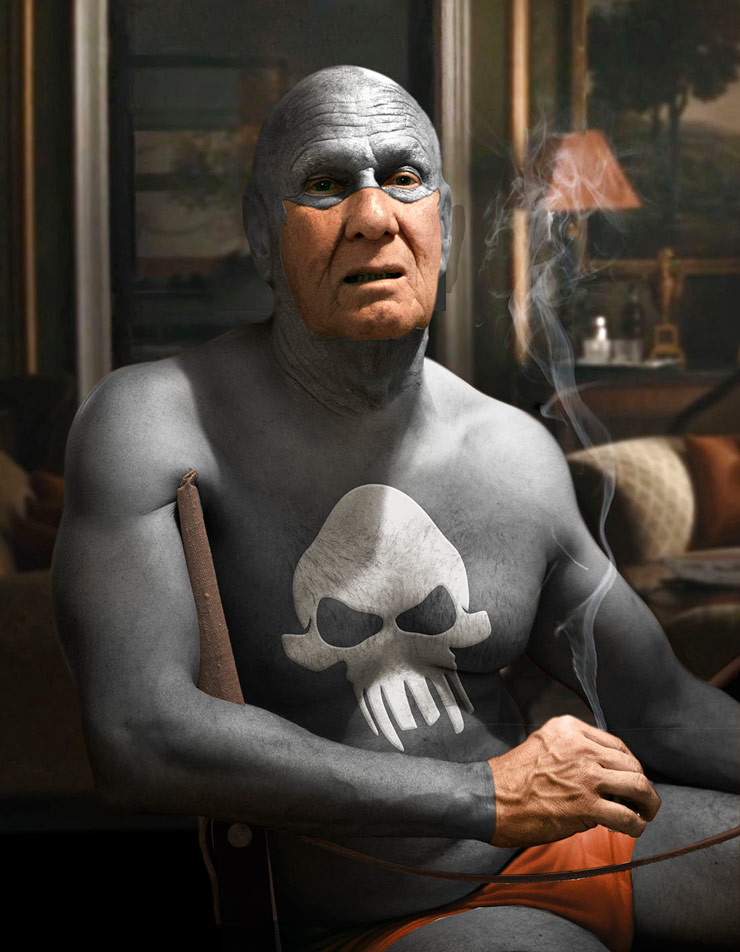
Andreas Englund. Tripping. IMAGO. MUCA Munich. (photo courtesy of the artist)

TRIPPING
Media: Oil on canvas
Size: 116 x 90 cm
 
-Statement
“I chose to tribute my artwork to the ‘‘Portrait of a smoking man’’ by Anders Zorn 1860-1920 – Swedens most internationally acclaimed artist. Born in my home region and very inspirational when it comes to his sketchy technique. By doing my own version of this masterpiece with my superhero, I have learned more about ‘‘the great Zorn’’ and his technique.”

Martha Cooper

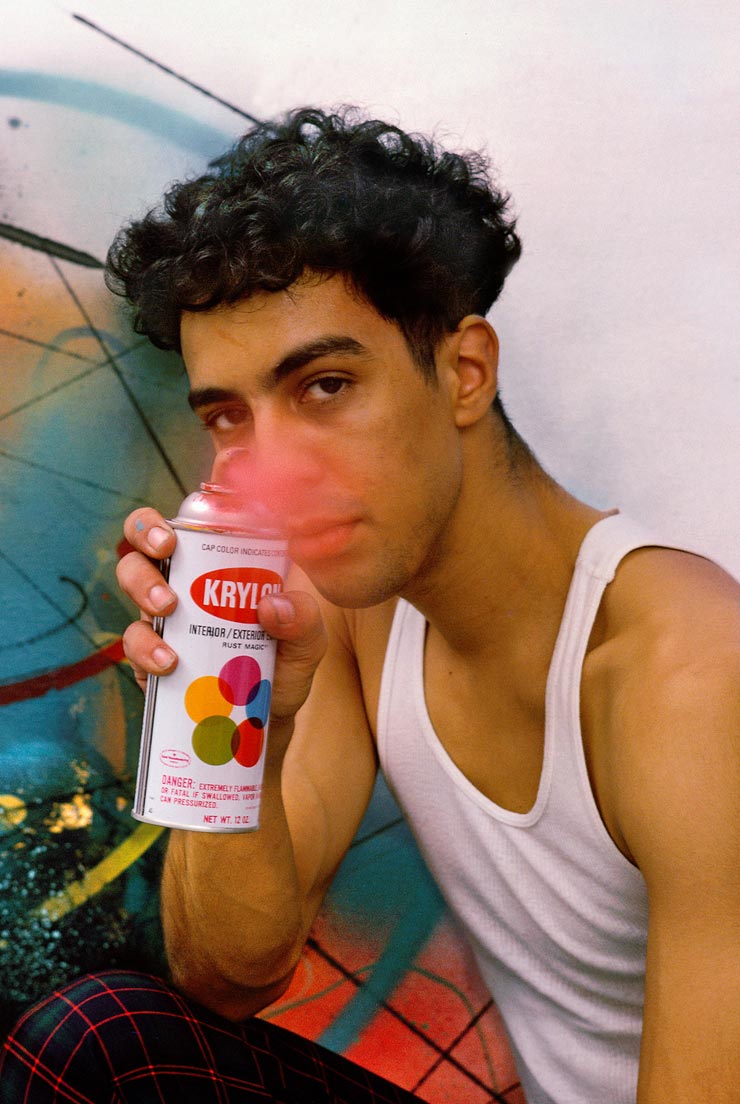
Martha Cooper. Futura 1983. IMAGO. MUCA Munich. (photo courtesy of the artist)

FUTURA 1983
Media: Archival pigment print
Size: 50,8 x 76,20 cm

 
-Statement
“This is a 1983 photo of Futura, a legendary New York City graffiti writer, with a classic can of Krylon spray paint. Thirty-five years later, Futura is still spray painting and I am still taking photos of graffiti writers.”

Icy + Sot

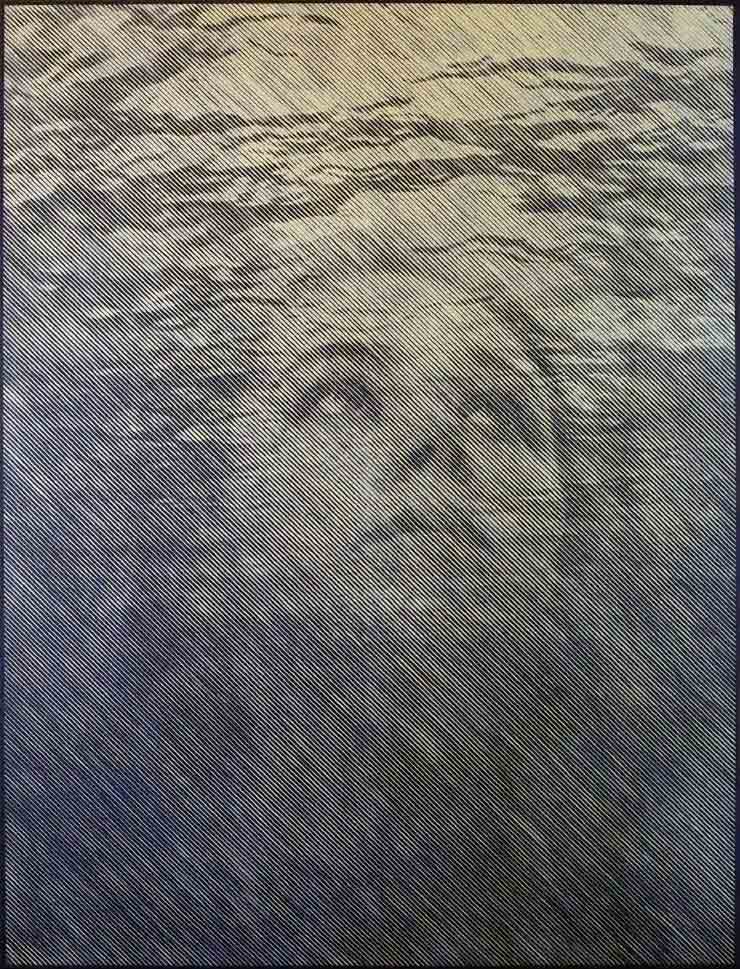
Icy & Sot. Under The Water Light. IMAGO. MUCA Munich. (photo courtesy of the artists)

UNDER THE WATER LIGHT
Media: Stencil spray paint on canvas
Size: 91,5 x 123 cm
 
-Statement
“This portrait is part a series we created reflecting on the relationship between human and nature. Nature plays a big role in human lifespan, but nowadays people have distanced from nature. With this work, we want to show humans closer to nature and pay a tribute to it.”

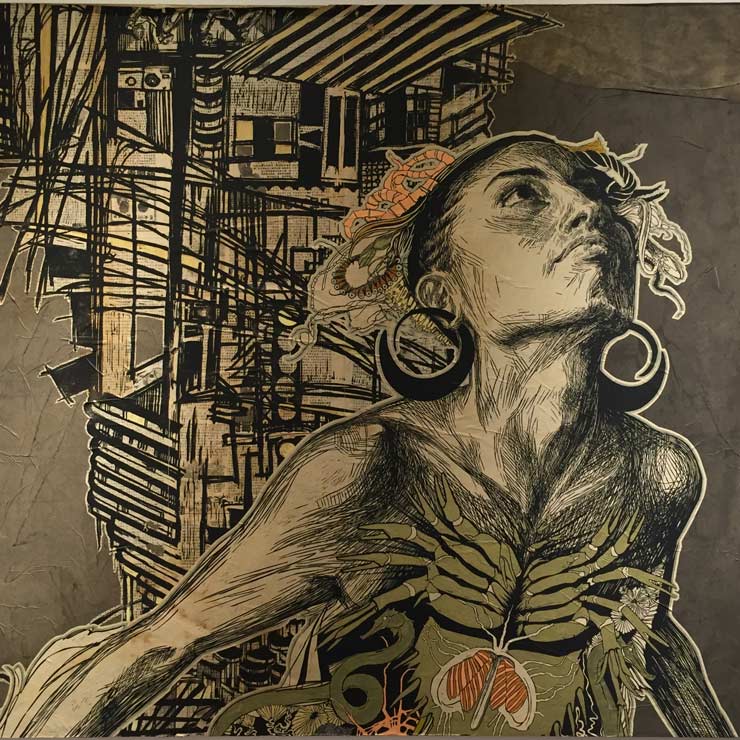
Swoon

Swoon. Thalassa. IMAGO. MUCA Munich. (photo courtesy of the artist)

THALASSA
Media: Screenprint on paper with coffee stain and hand painting with collage mounted on board
Size: 123 × 138 cm
 
-Statement
“The name Thalassa is Greek word for ‘‘ocean’’, a primordial incarnation of the sea that is not often personified. Thalassa is said to have given birth to all tribes of fish in the sea. She is the pull of the sea that comes from inside the salt water in our blood. ‘Thalassa was originally created for New Orleans. It was the months after the Deepwater Horizon exploded in the Gulf in 2010, and this body of water that I’d loved since I was a child was in peril. As I drew Thalassa surging up from the water I felt her rising like a wake up call, one reminds us of our inseparability from the sea. When I stand in front of the ocean, the word that always appears first in my mind is “mother”. For me there is no mistaking the sense that the sea is our first mother.’ ”

Borondo

Gonzalo Borondo & Diego Lopez Bueno. Selfie Elvis II. IMAGO. MUCA Munich. (photo © Blind Eye Factory)

GONZALO BORONDO & DIEGO LOPEZ BUENO
SELFIE ELVIS II
Media: Acrylic and plaster on wood – Plasma TV 50’’- Video on loop – 16:9 Digital – Color
Size: 7 panels each – 120 x 70 x 1 cm + 1 TV
 
-Statement
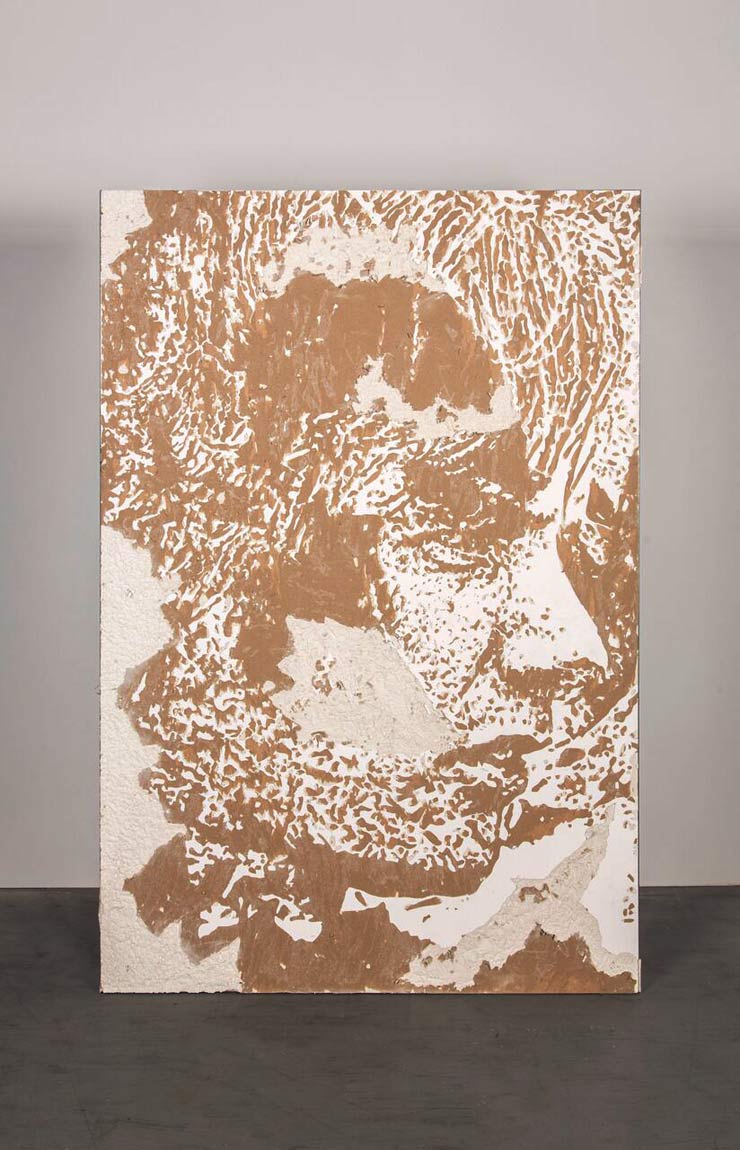
“Inspired by several passport photos found within the Marseilles “Marché aux Puches” (FR), Borondo and Lopez Bueno have designed an installation project with the title “Selfie Elvis II”. Imagination is the basis of the multimedia work with self-portraits of a man recalling the contemporary “selfie”. There are dozens of frames describing human aspects and obsessions. They have been digitally elaborated and assembled in a video by López Bueno. Borondo portrayed Elvis with acrylic on wood and applying gypsum, then scratched with sharp instruments. Faces appeared by subtraction, the absence tells about an ancestral and intangible dimension, wondering about its existence. Is Elvis looking at himself or us in that picture? And what about our images, do they look like us or they are just our dreams? Elvis is not there, Elvis is still there.”

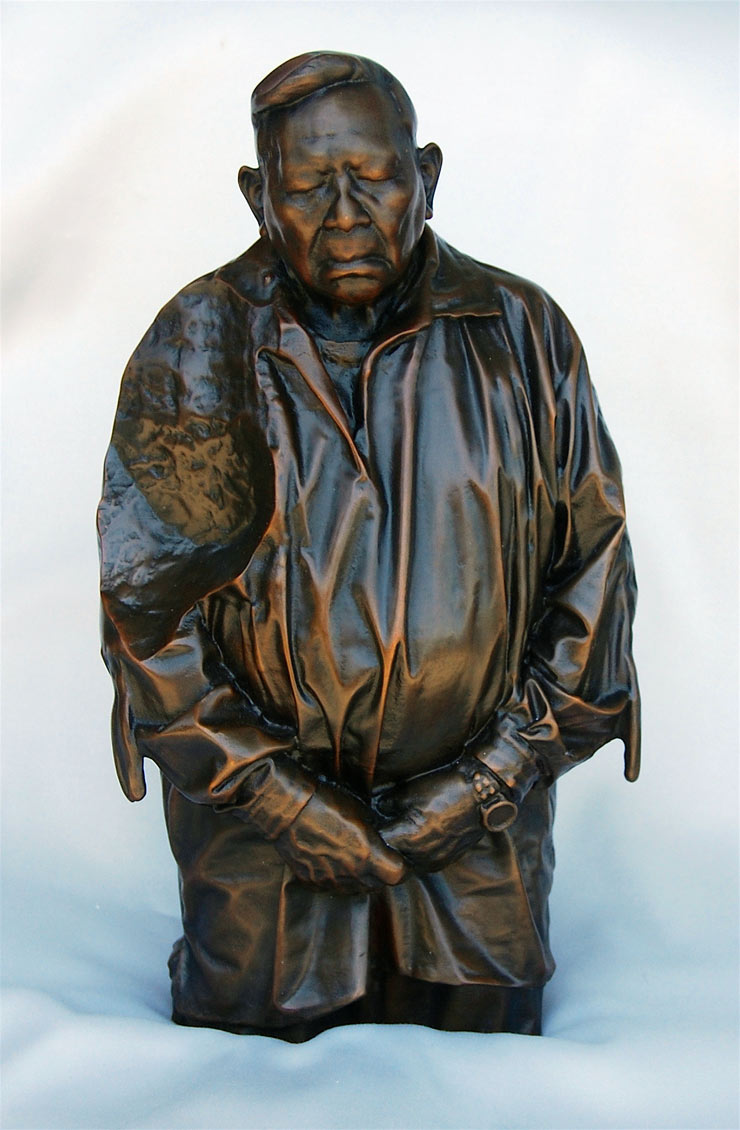
Addison Karl

Addison Karl. Kamassa. IMAGO. MUCA Munich. (photo courtesy of the artist)

KAMASSA
Media: Bronze, edition 1 of 10
Size: 30,48 x 20,32 x 15,24 cm
 
 
-Statement
“Portraiture in context to sculpture and form – referencing the masterpieces from both European Classical and Neoclassical time periods. From a culture l mirror of taking inspiration from Gods and Goddess of the ancient world, my sculpture’s subject is focused on a contemporary Chickasaw Elder. Using portraiture as a means of Cultural Preservation but equally re-appropriating classic sensibilities of art history to a Native Cultural narrative. “


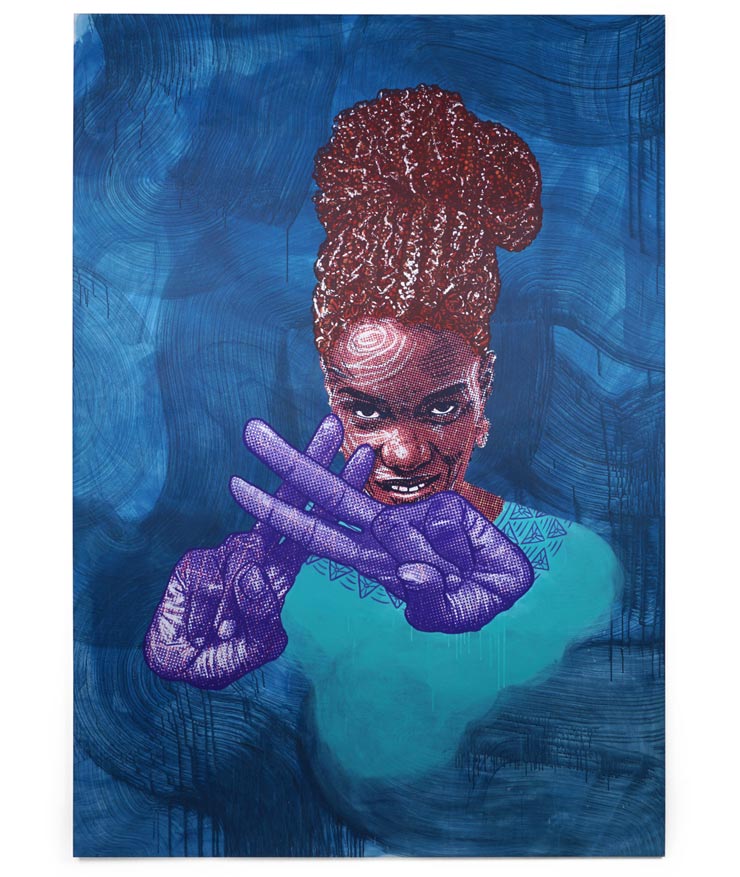
Various & Gould

Various & Gould. Trigger (Rokhaya Diallo). IMAGO. MUCA Munich. (photo courtesy of the artists)

TRIGGER (ROKHAYA DIALLO)
Media: Acrylic on canvas
Size: 200 x 140 cm
-Statement
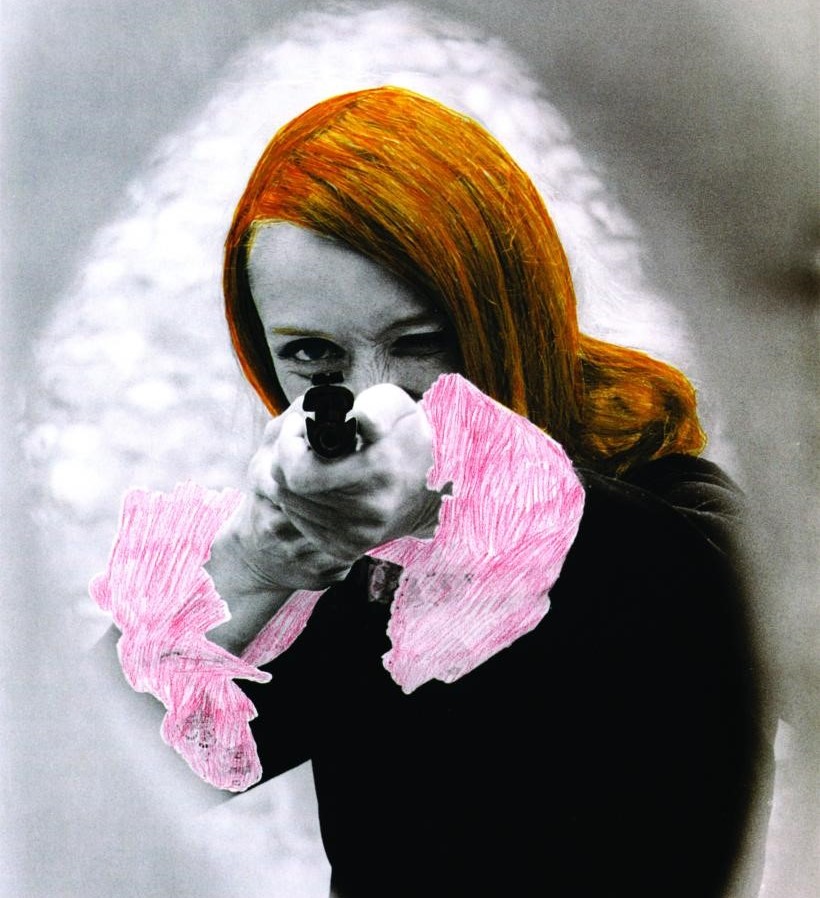
“Our portrait of Rokhaya Diallo refers to an iconic work by Nikide Saint Phalle: The artistically revised film still “Daddy” shows the artist pointing a gun directly at the viewer. Even almost 50 years later, her eye and the muzzle of her rifle leave no doubt that she is serious about it. Anyone who sees the work feels immediately like coming into the firing line.
In our painting, the French journalist and film maker Rokhaya Diallo takes the place and – freely recreated – also the pose of Niki de Saint Phalle. Thus, an early feministic, vigorous artist of the twentieth century is followed by a modern, committed internet feminist with no less strong verve than her predecessor. Both women are even the same age at the time of the illustration. Only instead of the rifle, Rokhaya Diallo relies on her very own “weapon”, the hashtag. At first glance, it may seem more harmless than a rifle, but in times of #BlackLivesMatter and #MeToo it can be an even more powerful tool.”


Fintan Magee

Fintan Magee The Removalist. IMAGO. MUCA Munich. (photo courtesy of the artist)

THE REMOVALIST
Media: Canvas and acrylic on wall installation
 
-Statement
“The portrait has been ripped off the canvas and dragged across the ground and projected onto the wall. The artist has destroyed the canvas and made the portrait ephemeral, rendering it worthless and unsellable. The work comments on the commodification of artwork and the uneasy and paradoxical relationship between artist and the financier of his artworks. With street art becoming increasingly commoditized and contributing to gentrification this work doesn’t aim to make any grand statements on how art should or shouldn’t be produced, only highlight the illusionary, absurdist and contradictory image the art industry presents of itself.”

VHILS

VHILS. Matta. IMAGO. MUCA Munich. (photo courtesy of the artist)

MATTA
Media: Bas-relief carving on plasterboard mounted on metal structure
Size: 181 x 120,5 x 34 cm
 
-Statement

“Resorting to a bas-relief carving technique, applied here to a free-standing structure of plasterboard, this piece is a homage to the work of Gordon Matta-Clark, which became a major influence on me after I first saw it at an exhibition in Portugal, in 2002. Matta-Clark was one of the first artists to look at the urban space as a space of creation and reflection on the human condition in the contemporary times we live in. Those are the considerations I try to translate in my own work too, reflecting about the human condition in the contemporary times we live in.”


Andrea Wan

Andrea Wan. Being Of Light. IMAGO. MUCA Munich. (photo courtesy of the artist)

BEING OF LIGHT
Media: Ink on paper
Size: 50 x 70 cm
 
-Statement

“Fascinated by the lively and dynamic landscape in the paintings of native Canadian Artist Emily Carr, I chose one of her most renown works, Indian Church (1929) as the subject of reinterpretation. Seemingly more accurate than a realistic approach, Carr’s abstraction of nature elements not only communicated to me that nature is vast and subliminal but also ever-changing in form and expression. The white church which stands calmly in the midst of the mystical environment inspired me to personify the subject as a being who is in tune with all that’s around her.”


DALeast

DALeast. FIII. IMAGO. MUCA Munich. (photo courtesy of the artist)

FIII
Media: Acrylic on canvas
Size: 100 x 80 cm
 
-Statement
“A still moment of Fiii standing in the windy land, which is existing inside the transitory gathering of the particles of the magical net.”

IMAGO: A History of Portraits opens today at MUCA Museum of Urban And Contemporary Art. Munich. Curated by Elisabetta Pajer the show runs until November 2018.

IMAGO is a show dedicated to the history of portrait: over 30 artists from five different continents are invited to pay homage and interpret a portrait in their medium of their choice. IMAGO aims to lead visitors through different artistic eras, helping discover the international history and evolution of the portrait.

Artists include:

Jef Aerosol
ASKEW ONE
Borondo
Vesod Brero
Martha Cooper
DALeast
Paola Delfin
Anna Piera Di Silvestre
Andreas Englund
Evoca 1
Ricky Lee Gordon
Hubertus Hamm
Handiedan
Icy&Sot
Addison Karl
Know Hope
Klone Yourself
Fintan Magee
Mario Mankey
Marco Mazzoni
Antony Micallef
Miss Van
Nychos
Sepe
David Shillinglaw
Søren Solkær
Sten Lex
SWOON
TelmoMiel
TWOONE

Read more
Tristan Eaton and Summer “Intermission” on the Bowery/Houston Wall

Tristan Eaton and Summer “Intermission” on the Bowery/Houston Wall

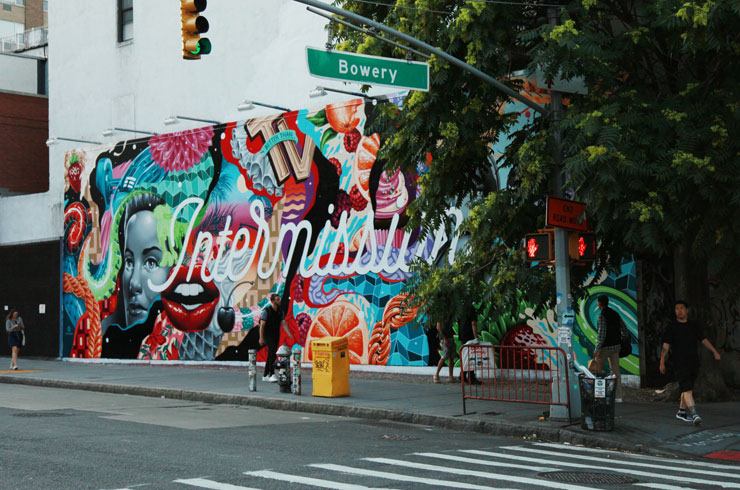
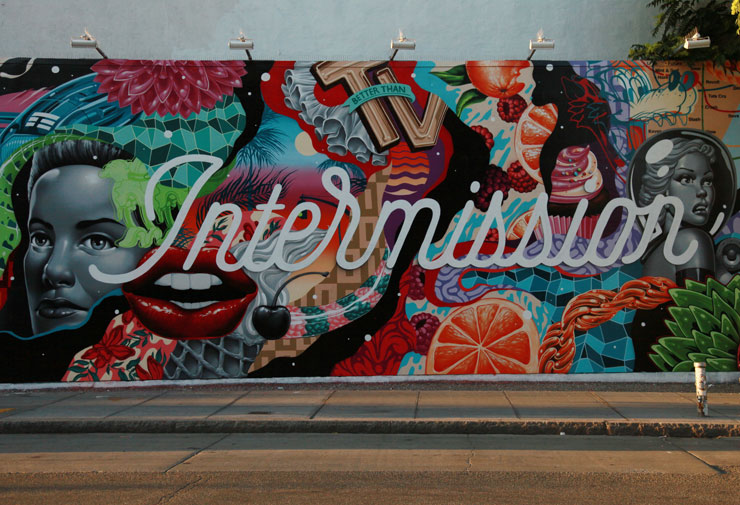
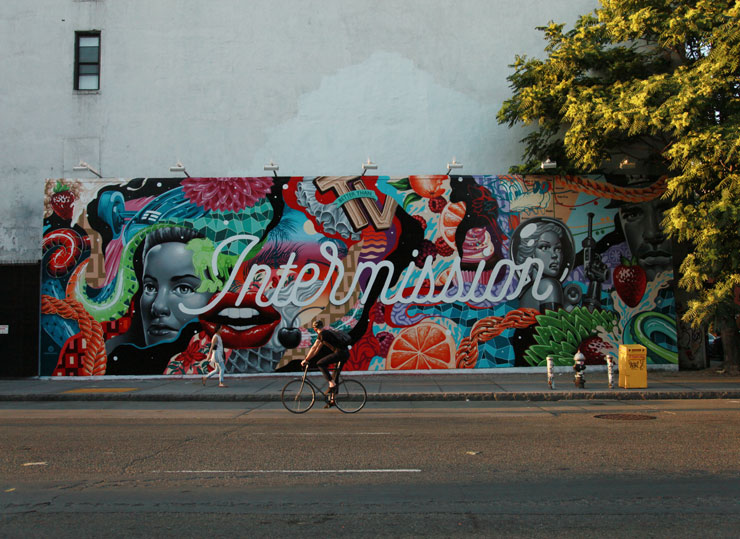
And now its time for a mid-year intermission to pause and reflect upon the events that have happened in the first act. We’ve had plenty of treachery, intrigue, jailbirds and back alley suspense. Clearly it is time for a serendipitous summer romance, with Tristan Eaton as director.

Tristan Eaton. Houston/Bowery Wall. Manhattan, NYC. June 2018. (photo © Jaime Rojo)

An historic reenactment of sorts, this scene is usually full of its own drama; the painting of the Houston Wall in Manhattan appears once again on this drive-by screen, crammed with special effects as multi-talent Tristan Eaton explodes for days with the coursing traffic roaring and halting and honking and rumbling behind him.

The action unfolds and cameras are ablaze as documentors are there to capture it, including the stalwart Martha Cooper, the in-flight Zane Meyer, and our own private-eye Jaime Rojo.

Tristan Eaton. Houston/Bowery Wall. Manhattan, NYC. June 2018. (photo © Jaime Rojo)

Tristan’s cunning recombinative practice of recalling images from pop, television, cinema, and advertising languages, selecting many of their most emotionally charged aspects in exquisite fullness is all leveled here with a tropical lushness almost never found in this forbidding city, safely encased behind a protective gloss.

It’s the nostalgic stuff of marquees and beige canvas directors chairs, patterned jacquard wall tapestry, crimson velvet curtains, butter soaked popcorn, sticky floors and a certain smokey Saturday matinee reefer madness. This all once reigned in cinematic and tawdry Manhattan; mixing showgirls and space scientists and dames with sex-workers and 25 cent peepholes. Of course, the glam and the grind are all still here in Gotham – they’ve just become uberized and swiped right.

Tristan Eaton. Houston/Bowery Wall. Manhattan, NYC. June 2018. (photo © Jaime Rojo)

Eaton’s influences from Sunset Boulevard and Detroit’s motor city grit translate well here in the thick of our own version of mid-summers’ insouciance. It’s all hustle, hormones, and a finely pulsating particulate matter that sticks to you; a humid cloud of complex desires clinging to your skin, now flickering in warm succulence as you ride by on your wheels.

Tristan Eaton. Houston/Bowery Wall. Manhattan, NYC. June 2018. (photo © Jaime Rojo)

Our guy on the street rolled past the one-man show many times over the past couple of weeks to check on progress and mingle with the ever-more-gilded gentry that frequent the sidewalks/runways here. Cuffed tonal highwaters, PVC wedges and fugly white dad sneakers aside, New Yorkers still walk the walk and have a certain respect for their Street Art, if only to pose before it for the 1,000th selfie.

The affable showman Eaton is not shy for the endlessly inquisitive fan, either – ready to layer on additional color and texture. For this particular intermission, our summer romance will continue long into autumn’s golden glow.

Tristan Eaton. Houston/Bowery Wall. Manhattan, NYC. June 2018. (photo © Jaime Rojo)

Tristan Eaton. Houston/Bowery Wall. Manhattan, NYC. June 2018. (photo © Jaime Rojo)

Tristan Eaton. Houston/Bowery Wall. Manhattan, NYC. June 2018. (photo © Jaime Rojo)

Tristan Eaton. Houston/Bowery Wall. Manhattan, NYC. June 2018. (photo © Jaime Rojo)

Tristan Eaton. Houston/Bowery Wall. Manhattan, NYC. June 2018. (photo © Jaime Rojo)

Tristan Eaton. Houston/Bowery Wall. Manhattan, NYC. June 2018. (photo © Jaime Rojo)

Tristan Eaton photo bombs Jessica Goldman, Sheryo and Martha Cooper. Houston/Bowery Wall. Manhattan, NYC. June 2018. (photo © Jaime Rojo)

Tristan Eaton. Houston/Bowery Wall. Manhattan, NYC. June 2018. (photo © Jaime Rojo)

Tristan Eaton. Houston/Bowery Wall. Manhattan, NYC. June 2018. (photo © Jaime Rojo)

Tristan Eaton. Houston/Bowery Wall. Manhattan, NYC. June 2018. (photo © Jaime Rojo)

Tristan Eaton. Houston/Bowery Wall. Manhattan, NYC. June 2018. (photo © Jaime Rojo)


Read more
“Beyond The Streets” Exhibition : Gastman’s Train Pulls In to LA

“Beyond The Streets” Exhibition : Gastman’s Train Pulls In to LA

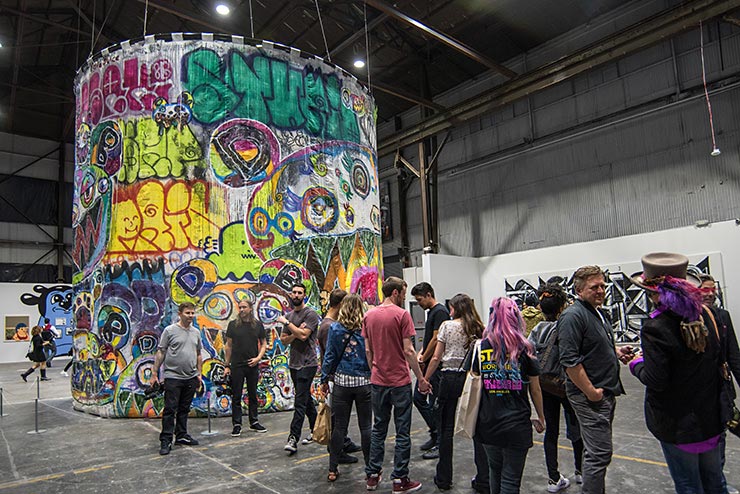
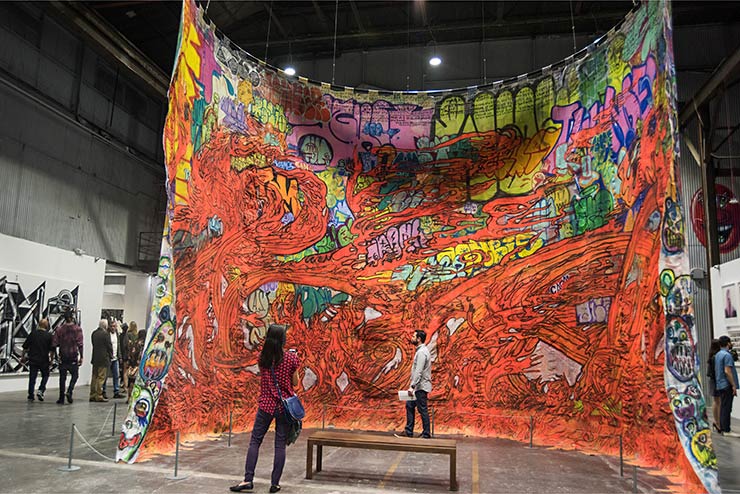
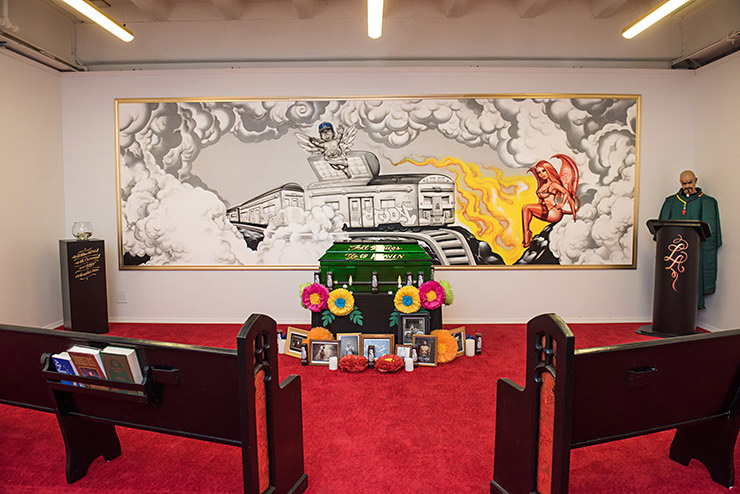
A steel-wheeled graffiti train with Roger Gastman at the controls roars into LA’s Chinatown for a two-month stay at this station, a 40,000 square foot warehouse that houses “Beyond the Streets.” Originating at the streets and train yards of the 1960s and 70s, this express survey carries with it 100 or so artists and writers from across the last five decades as practitioners of graffiti, Street Art, and mural painting. Somehow, everyone gets represented.

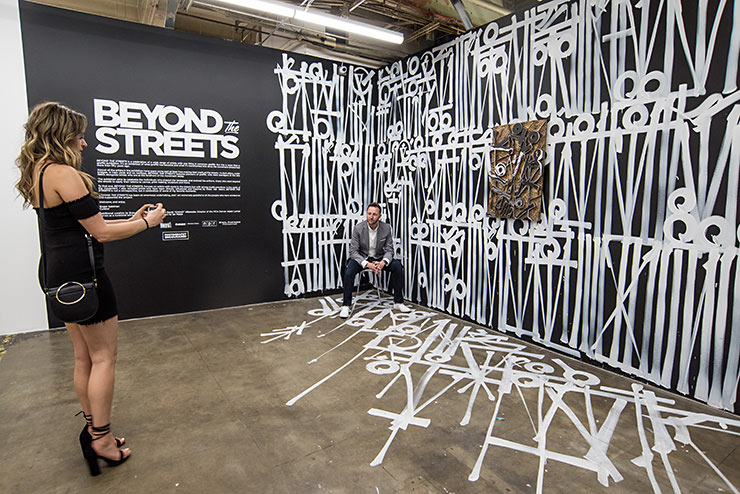
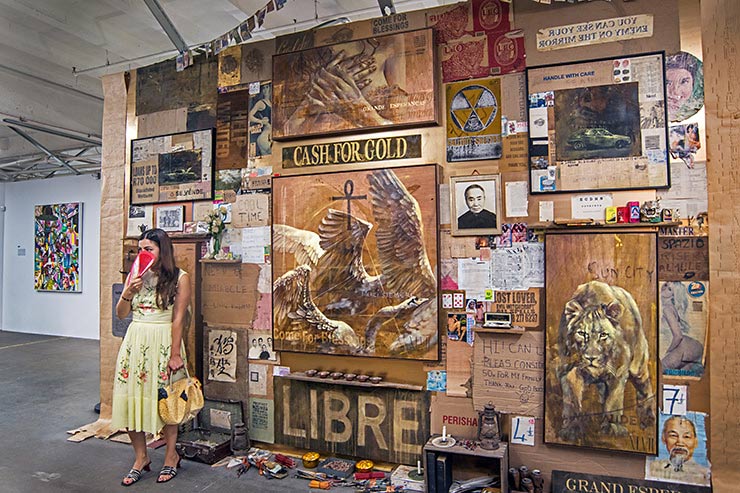
Beyond The Streets. (photo © Martha Cooper)

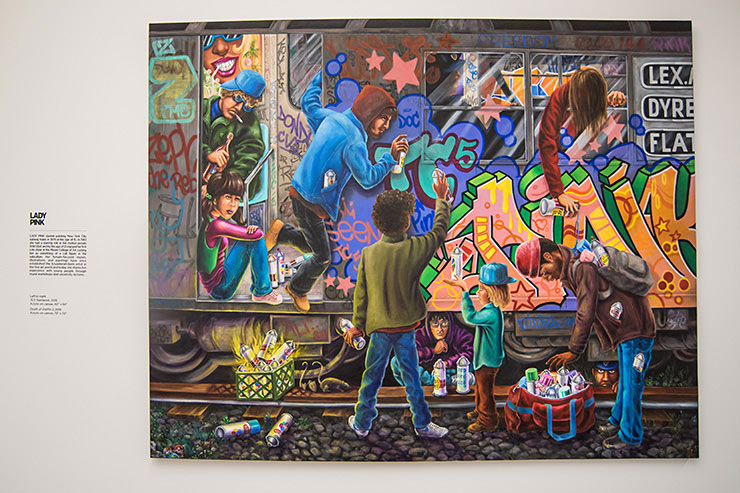
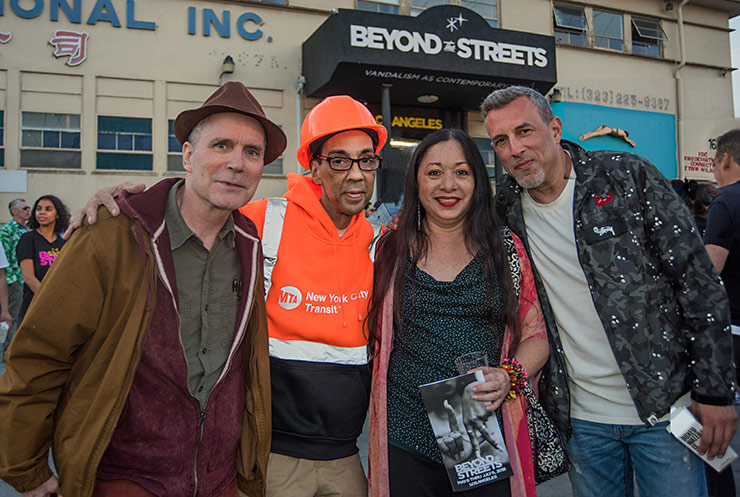
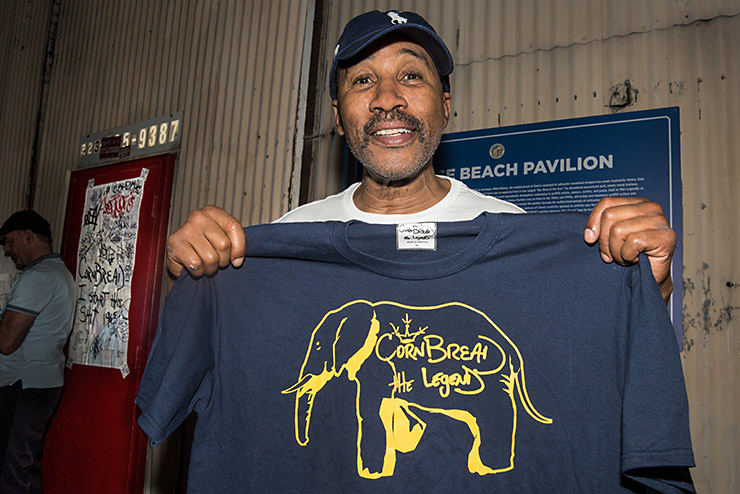
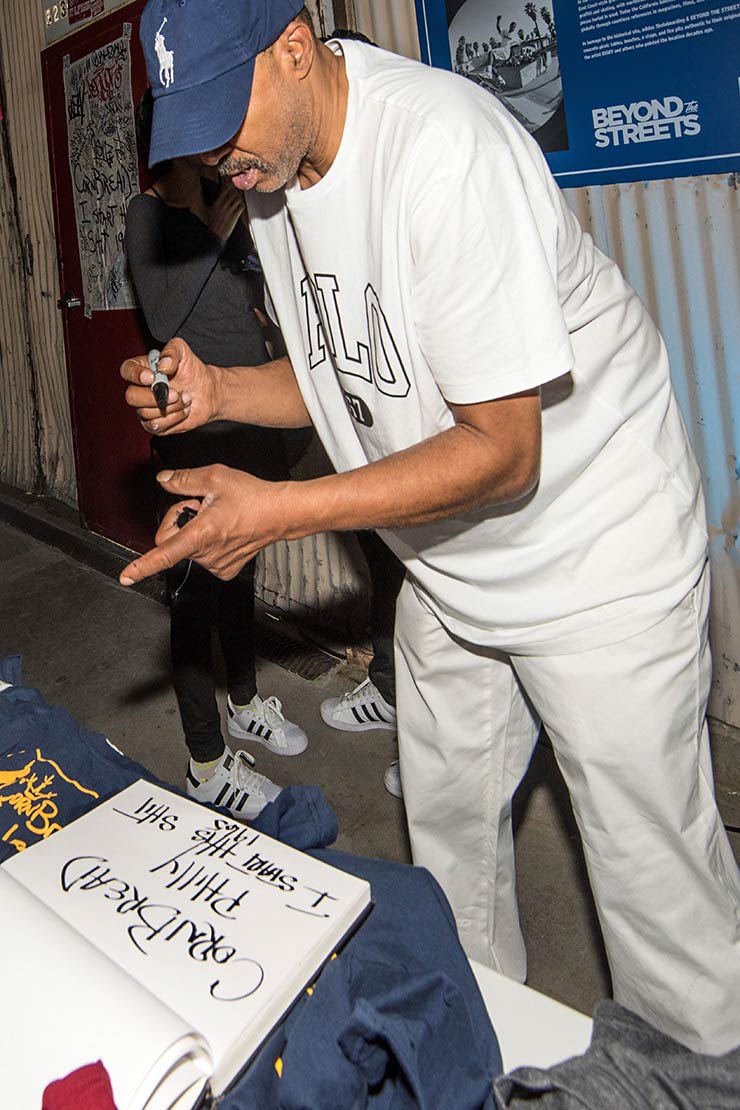
Opening night featured many of the names associated with its earliest beginnings of the New York /Philadelphia graffiti scene like Cornbread, Taki183, Futura, Lady Pink, filmmaker Charlie Ahearn, among many others, including photographer Martha Cooper, who in addition to being an artist in the show, shares these photos with BSA readers. She also extensively shares her photos for the accompanying show catalog,  providing documentation from the scene that exist nowhere else.

Retna. Beyond The Streets. (photo © Martha Cooper)

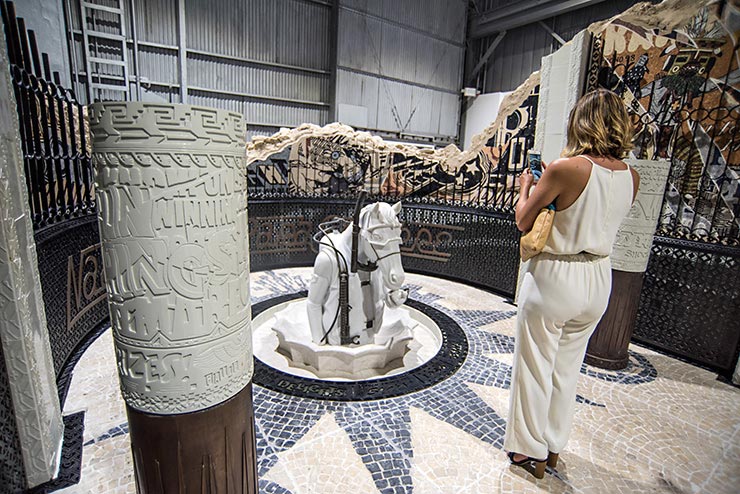
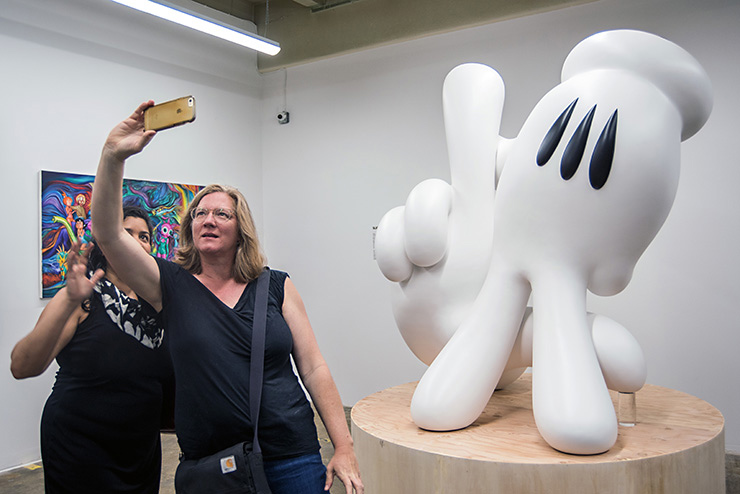
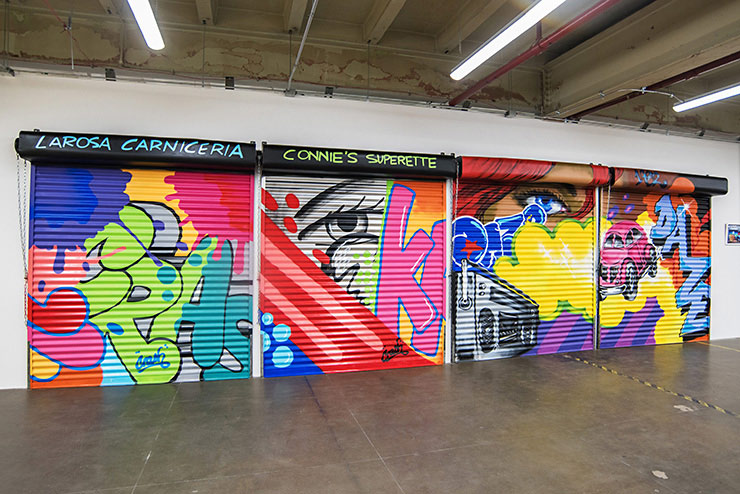
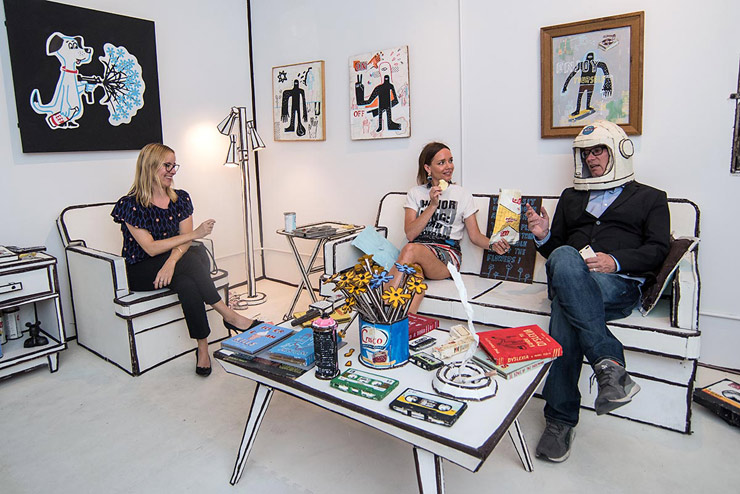
A diverse and almost overwhelming series of displays present the works in a way that can only hint at the thousands of artists who built this story, necessarily viewed through a wide lens: sculpture, photography, installations, and multi-media all join the canvasses and ephemera and Gastman’s collection of vintage paint cans. Smartly planned for the selfie generation, large pieces are presented almost as backdrop ready to be Instagrammed; a direction coming from the “Photos Encouraged” sign that is next to the wall covered with Retna’s original alphabet near the entrance.

Beyond The Streets. (photo © Martha Cooper)

Somewhat of a rejoinder to Art in the Streets, the eponymous graffiti and Street Art exhibition in 2011 at LA MoCA, Beyond the Streets takes a focused look at the multitudinous peoples’ art movement from the perspective of one of that first shows’ original curators, Roger Gastman. When arranging the two month exhibition that closes July 6th, Gastman says that his focus was to celebrate those with street cred, in terms of individual practice, and to combine that requirement with a respectable semblance of a studio practice.

Ultimately he looked for artists who have used their particular approach to expand the definition of art in the streets in some way. That definition by now has become quite wide and it’s also a tall order for any curator to find the common themes here and present them in a cohesive manner.

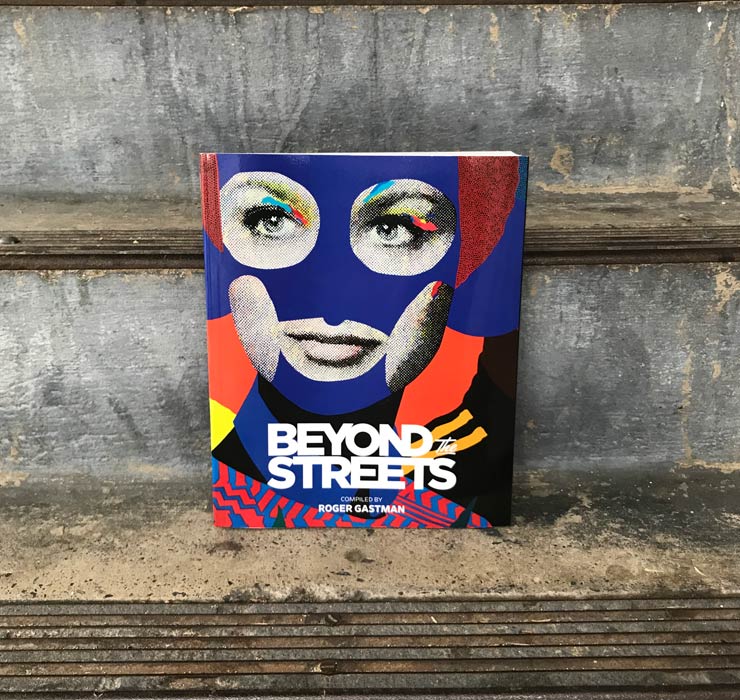
Beyond The Streets, compiled by Roger Gastman.

Both the accompanying catalog and exhibition take a welcome stance toward educating the audience in many ways, helping the viewer to decode this freewheeling graffiti and mark-making history with basic vocabulary terms, historical events, pop culture inflexion points and examination of tools of the trade all adding context. Catalog essays and interviews are incisive and enlightening, including wit, sarcasm and even the occasional admonishment – notably in the essay by author, filmmaker, and curator Sacha Jenkins, who has been documenting the graffiti scene for a least a couple of decades.

Studying the move of some artists from street practice to commercial gallery that began in earnest with early NYC train writers transitioning to canvasses in the early 1980s, Jenkins upbraids a disgruntled faction among old-school graffiti writers who he characterizes as perhaps intransigent in their stylistic evolution and unwilling to adapt with the game. Later in his essay he lambasts the overtly pleasant and narcissistic cultural newcomers who he sees as milk-toasting the scene with their adoration of pretty murals and shallow sentiments, obtusely ushering in gentrification and “leading up to hearing about how my mother’s building is going to get bulldozed for a hip residential building that has a hot tub in every apartment.” He also may be the only writer here so openly addressing race and class distinctions present during the evolution of the scene and now.

Beyond The Streets. (photo © Martha Cooper)

The selection of artists and writers in the book and exhibition, many of them friends and colleagues with whom Gastman has worked with in the past, offers a rewarding and accessible panoply of styles and views. With some study the visitor understands connections in a widely dispersed multi-player subculture that coalesced and continuously changed its shape and character. But even if they don’t, they still get an amazing amount of eye candy.

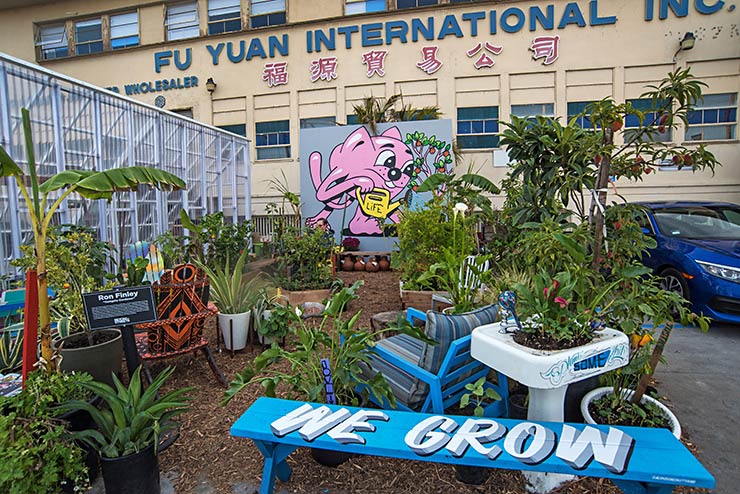
The catalog offers extensive sections like those devoted to The History of Spraypaint and Graffiti in Galleries, and offers petite exegesis on influencing factors and benchmarks that shaped the art form’s route like Mobile DJs, The ’77 NYC Blackout, the European graffiti scene and graffiti’s role in gang culture, hip-hop and hardcore music. The compilation aids and supports the fullness of a story that frankly requires many voices to tell it. Gastman even gives forum and exhibition space to activist and defiant guerilla gardener Ron Finley and the holistic urban horticultural oases that he creates in South Central LA, calling it his form of graffiti in empty lots of the city.

Martha Cooper with Taki 183. Beyond The Streets. (photo courtesy of Martha Cooper)

With insightful interviews of artists in the exhibition from talented writers like Caleb Neelon, Caroline Ryder, John Lewis, Alec Banks, Evan Pricco, John Albert, Shelly Leopold, and Gastman himself, there are enough colorful anecdotes and decisive signposts en route to help tell the stories of the artists and their individual approaches to the street.

“The artists do not share a singular style, since they are primarily united by a common element of their personal biographies – the fact that they once made their art in the streets,” says self-described novice to the Street Art / graffiti world, Adam Lerner, the Director and Chief Animator at the Museum of Contemporary Art Denver. “There are, however some threads that run through the works.”

Beyond the Streets will help visitors find some of those threads for themselves and undoubtedly they will forge their own interpretation of art in the streets.

Faile. Beyond The Streets. (photo © Martha Cooper)

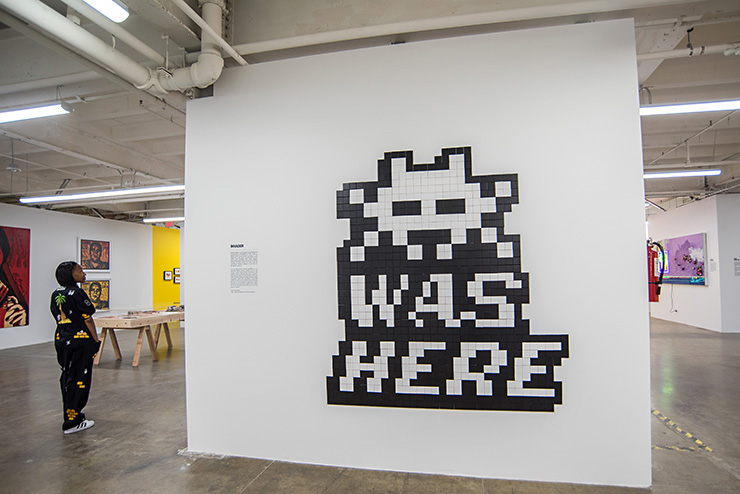
Invader. Beyond The Streets. (photo © Martha Cooper)

Slick. Beyond The Streets. (photo © Martha Cooper)

Takashi Murakami with Madsaki, Snipel, Tenga One and Onesker. Beyond The Streets. (photo © Martha Cooper)

Lady Pink. Beyond The Streets. (photo © Martha Cooper)

Charlie Ahearn . Futura . Lady Pink. Crash. Beyond The Streets. (photo © Martha Cooper)

Mr. Cartoon. Beyond The Streets. (photo © Martha Cooper)

Futura. Beyond The Streets. (photo © Martha Cooper)

Futura takes a photo of Haze’s art work. Beyond The Streets. (photo © Martha Cooper)

Niels Shoe Meulman. Beyond The Streets. (photo © Martha Cooper)

Ron Finley’s Gansta Gardener installation. Beyond The Streets. (photo © Martha Cooper)

Corn Bread. Beyond The Streets. (photo © Martha Cooper)

Corn Bread. Beyond The Streets. (photo © Martha Cooper)


Crash . Daze. Beyond The Streets. (photo © Martha Cooper)

Katsu. Beyond The Streets. (photo © Martha Cooper)

Bill Barminski. Beyond The Streets. (photo © Martha Cooper)

Faith XLVII. Beyond The Streets. (photo © Martha Cooper)

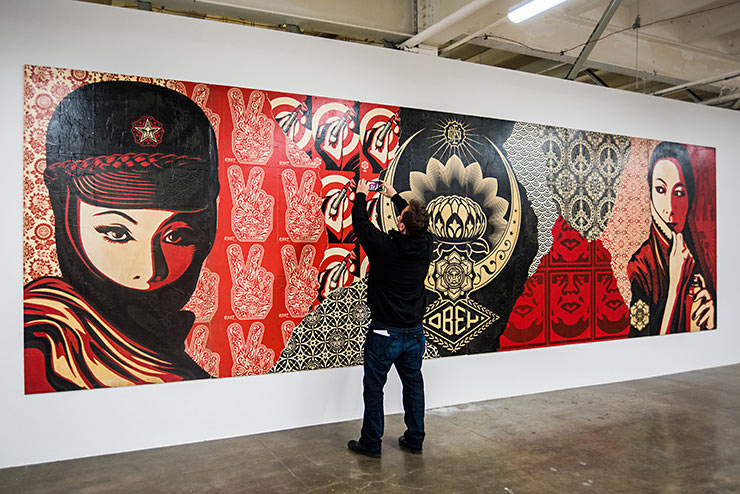
Shepard Fairey. Beyond The Streets. (photo © Martha Cooper)

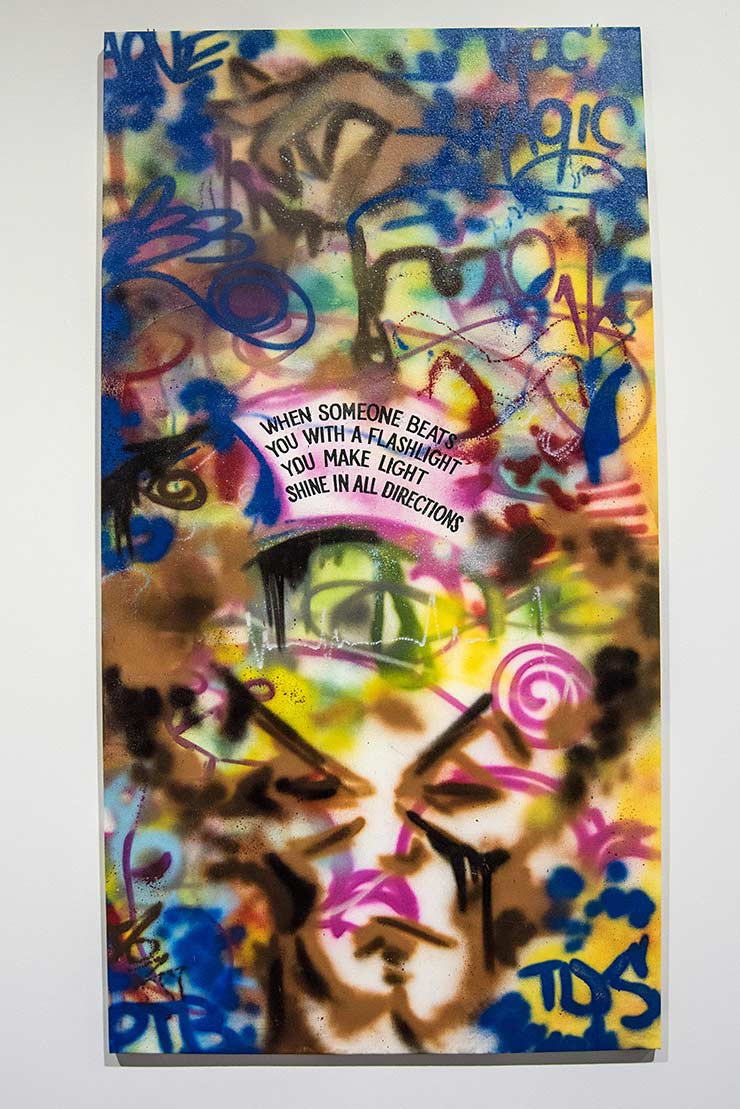
Jenny Holzer, Flashlight (In Collaboration With A-One). Beyond The Streets. (photo © Martha Cooper)

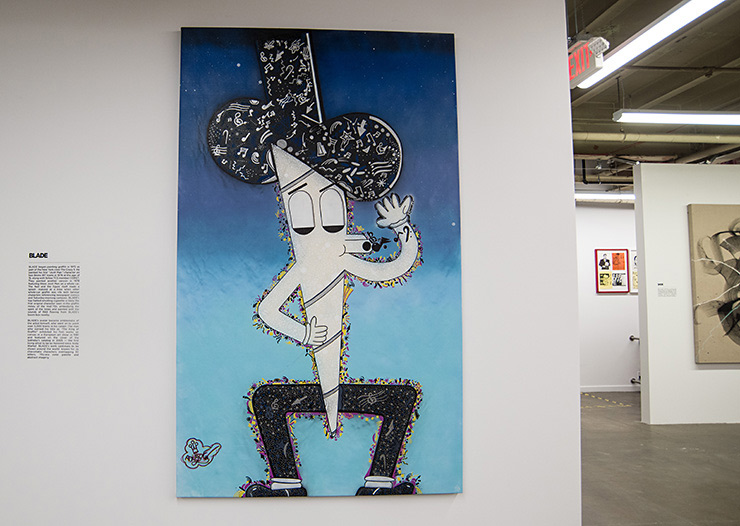
Blade. Beyond The Streets. (photo © Martha Cooper)

Aiko. Beyond The Streets. (photo © Martha Cooper)

Al Diaz. Beyond The Streets. (photo © Martha Cooper)

Barry Magee. Beyond The Streets. (photo and video below © Martha Cooper)


Beyond The Streets. (photo © Martha Cooper)


For more information please visit https://www.beyondthestreets.com/

Read more
Trans-graffiti and the Trans-National “Mextonia” Festival

Trans-graffiti and the Trans-National “Mextonia” Festival

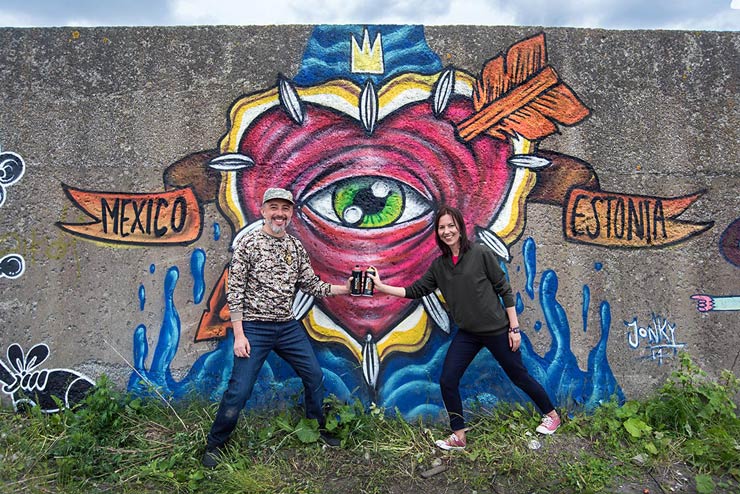
Mexico and Estonia; an unlikely couple. But sometimes love is like that. In a time when orthodoxy globally is seemingly self-combusting and obviously falling short in meeting the needs of people, it is perhaps no surprise that the unique hybrids of shared strengths are those that arise and can lead.

Consider “Mextonia”.

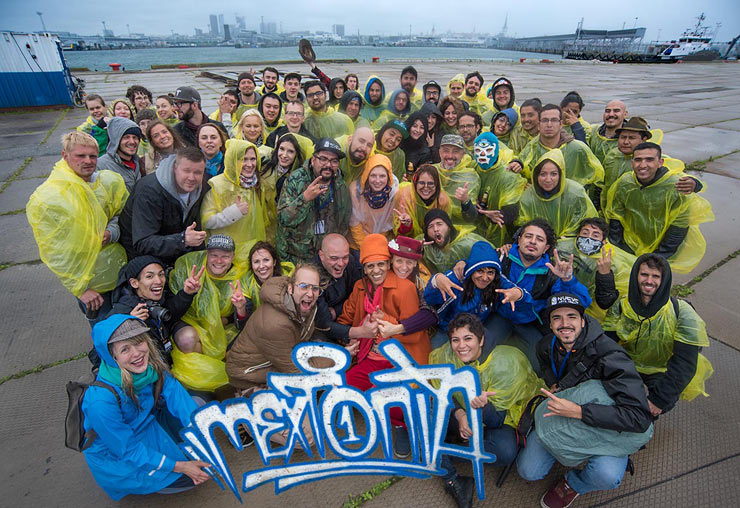
Édgar Sánchez and Sigre Tompel. Mextonia Co-Founders. Mextonia Part 1. Tallinn, Estonia. June 2017. (photo © Martha Cooper)

A cultural love child combining the traditions of these two nations has resulted in a surprising amount of cross-cultural exchange and mural making in the last year or two. Today we have just some of the artworks made during a two-part event held in each country, the first in Tallinn, Estonia in June 2017 and the second in Querétaro, Mexico during March 2018.

The unlikely pairing by two sociological searchers who love graffiti, Street Art, and the mural traditions of the past as much as the modern mural phenomena now speaks a common language of aesthetics in multiple spheres.

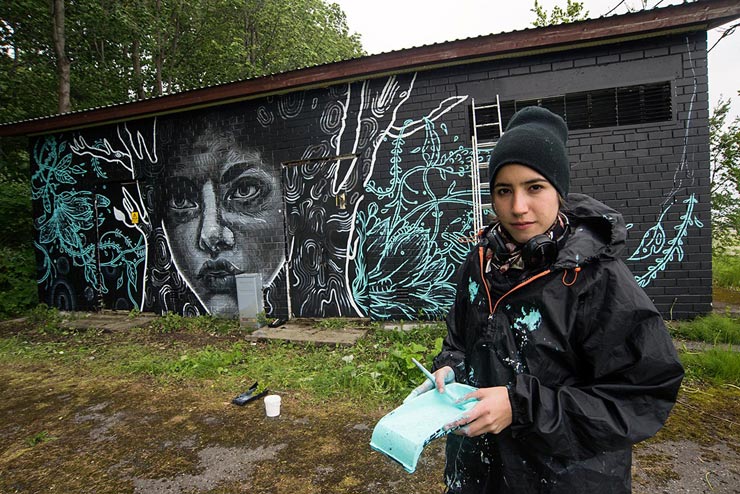
Renata Mtz. Mextonia Part 1. Tallinn, Estonia. June 2017. (photo © Martha Cooper)

Together Édgar Sánchez and Sigre Tompel have mounted two large cross-culture jams, attracting numerous artists and trans-national interpreters (nearly 100), presenting and renewing interests in history, indigenous people, traditions, and the environment challenges of today.

By highlighting the similarities and distinct differences in traditional and modern culture, these two are the magnetic field around whom a multi-faceted public art practice is developing that showcases urban and mural artists.

You haven’t seen a hybrid like this before.

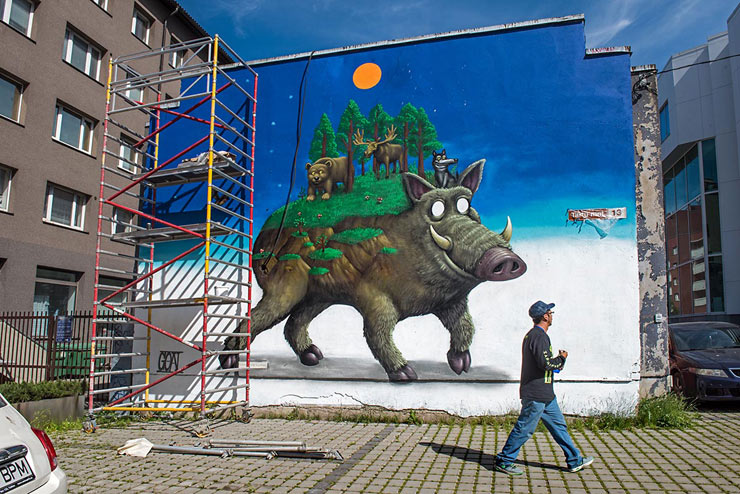
Goal. Mextonia Part 1. Tallinn, Estonia. June 2017. (photo © Martha Cooper)

Together the two say that the effort is “a reminder of what makes us feel proud of being Mexicans, Estonians, and even better, what unites us beyond our nationalities: our cultural freedom. Our responsibility of making this place, this world, a better place than how we found it.”

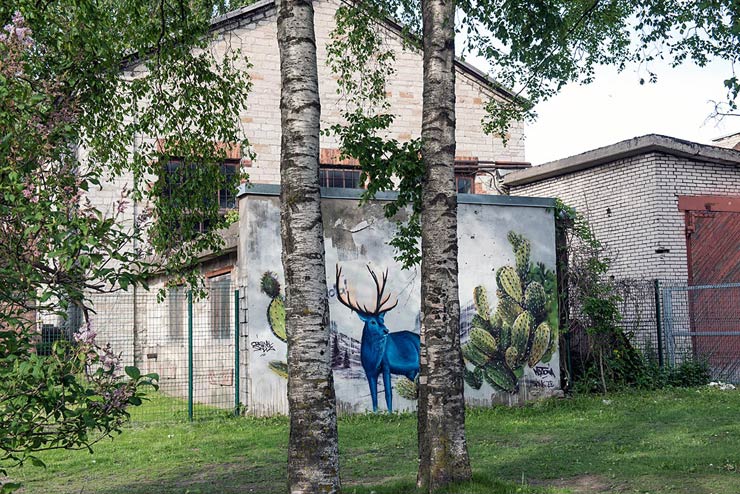
The enterprise is frequently steeped in metaphor and symbolism and a search for meanings in the overlapping of traditions. One that is often sited is the Blue Deer/Fern Blossom intersection.

In México, according to ancient Huichol tribe tradition, people go to hunt Blue Deer to search for wisdom and inner vision. Searching is also involved in the Estonian ancient tradition of searching for the Fern Blossom that is said to appear only during the summer equinox of June, which they call Jaaniöö. Both traditional cultural stories represent prosperity, protection and fertility, they say.

Sänk. Mextonia Part 1. Tallinn, Estonia. June 2017. (photo © Martha Cooper)

“Mextonia is a gift to remind the world about the Spirit; a collective soul in the shape of a Blue Deer, in finally finding a Fern Blossom,” say Sánchez and Tompel.

For Mr. Sánchez, the Mexican co-creator and author of the Mextonia Manifesto, there is a belief that there are larger forces at work in the Universe and that Mextonia is a platform and vehicle for the new generation.

When reading his observations you will see that the platform is hoping to lead Millennial artists to reconnect with a sense of culture and identity, two things that are sadly slipping away due to the dopamine-laced fire hose of mass media stimuli, social and otherwise, that we are collectively exposed to.

Brushleee. Mextonia Part 1. Tallinn, Estonia. June 2017. (photo © Martha Cooper)

For Tompel, the Estonian co-director of this bi-national transcultural journey, “Mextonia was born from a personal ‘vision quest’ to better understand the native wisdom of Mesoamerican natives.”

She says the enthusiasm and knowledge of Sánchez guided her to better appreciate ancient traditions like those of the Mexican Huichol tribe, and that this new appreciation enlivened her interest in her own homeland of Estonia, which she began to study in earnest. Together, the two of them have poured the molten iron of their combined roots and cast a foundation that many artists are now adding their interpretation to.

Markus Richard Tallvee. Mextonia Part 1. Tallinn, Estonia. June 2017. (photo © Martha Cooper)

Whether it is costume or symbols or rites or ceremony, you can see a deep desire to be inclusive in the styles and expressions. The spring festival, for example, extended its message with the collaboration with the PangeaSeed Sea Walls effort, headed by Tré Packard and his team in pursuit of “combining art and activism on this level and caliber to champion for the oceans,” and often sited aspiration.

Tania Quezada. Mextonia Part 1. Tallinn, Estonia. June 2017. (photo © Martha Cooper)

“Art and public activism can educate and inspire the global community to help save our water resources,” says Packard. “Regardless of its location, large metropolitan city or small coastal town, all drains lead to the ocean and the ocean provides every breath we take. The Earth cannot exist without healthy oceans and water resources.”

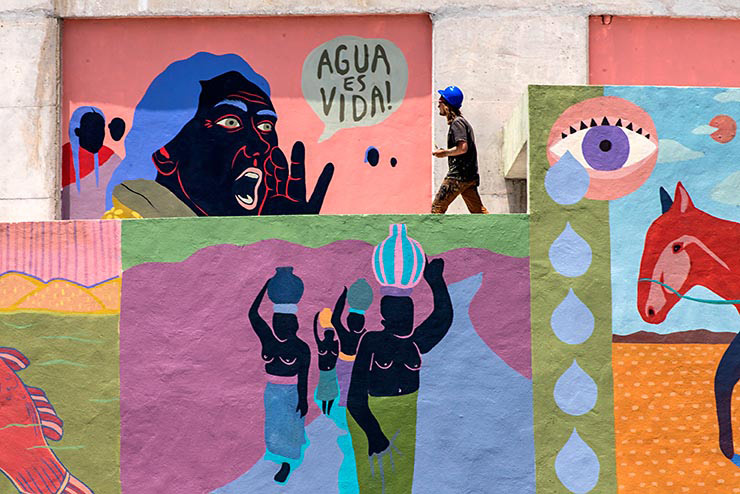
With this in mind the city of Querétaro was chosen for the multiple aqua-related public artworks as a way to draw attention to the city’s own reliance on water that is transported from a hundred kilometers outside the city. This chapter of “Mextonia” was also known as “Water is One”.

Ricardo Moste. Mextonia Part 1. Tallinn, Estonia. June 2017. (photo © Martha Cooper)

The experience and study has even helped coin new terms, like transgraffiti and transgraffiti muralism.

“Muralism and Street Art have proven to transform cultural symbols and catalyze culture,” says Sánchez. “Now, Transgraffitti is a trans-personal kind of muralism, which distances itself from both; names and pop culture, by taking deep cultural symbols and re-expressing them in a transcendental and contemporary way.”

Reyben. Mextonia Part 1. Tallinn, Estonia. June 2017. (photo © Martha Cooper)

In this respect, it is a unique view of Street Artist and graffiti writers in contemporary practice from an evolutionary perspective. In the Water is One Manifesto 2.0 that was released this spring the organizers write:

“In today’s world we see millions of young people expressing on walls, influencing the streets and society. They write their names to identify with their space: we call them graffiti writers. As they grow and explore, some look beyond the writing of a personal name and embark into trans-personal-creation.

They research social challenges, paint visual metaphors and transcend borders. They discover the power of their painting over streets and culture. They become a kind of contemporary shaman, producing street incantations.

This is the transpersonal-graffiti, and we call it Transgraffiti muralism.”

Mr. Cinzah. Mextonia Part 1. Tallinn, Estonia. June 2017. (photo © Martha Cooper)

Sermob. Mextonia Part 1. Tallinn, Estonia. June 2017. (photo © Martha Cooper)

Jonky. Mextonia Part 1. Tallinn, Estonia. June 2017. (photo © Martha Cooper)

Mextonia Part 1. Tallinn, Estonia. June 2017. (photo © Martha Cooper)

Mextonia Part 1. Tallinn, Estonia. June 2017. (photo © Martha Cooper)

As BSA correspondent from Tallinn and Querétaro, veteran photojournalist and ethnographer Martha Cooper attended the installations, exhibitions, celebrations, and ceremonies in both countries and she collected a wealth of important information to share.

In her own words Cooper says, “Street art is a worldwide art movement and Mextonia has shown how creative two different cultures can be when combined. Excellent idea – brilliantly realized.”

As mentioned Part 2 in Querétaro, Mexico was a collaboration with Pangea Seed and it was a concerted effort to highlight water resources,  and “The Water Is One” theme was reflected in the murals.

“We forget that the water cycle and the life cycle are one.”
~Jacques Yves Cousteau

Jason Botkin. Water is One/Mextonia Part 2. Querétaro, Mexico. March-April 2018. (photo © Martha Cooper)

While these 40 or so photos are resplendent in conveying the spirit and dedication shown daily by participants, they are ultimately a very small sample of the hundreds Cooper took.

Similarly a blog platform like this cannot comprehensively cover the events or the perspectives in their entirety, but we hope that you can gain a greater appreciation for the depth of feeling, scholarship, and talent that is represented here in Martha’s photographs and our descriptions.

Jason Botkin. Water is One/Mextonia Part 2. Querétaro, Mexico. March-April 2018. (photo © Martha Cooper)

We conclude our text here with an interview that Ms. Cooper conducted for BSA with Sigre Tompel to better understand the breadth of the festival and also to get more detail about a sacred spiritual ceremony that Cooper attended with native peoples and the artists during her Mexican visit this spring.

Martha Cooper: Can we call “Water Is One” in Querétaro Part 2 of Mextonia? Are you planning Part 3?
Sigre Tompel: Yes, it is a sequence of Mextonia, part 2 (Mextonia in Estonia was the element of Fire, Water Is One was the element of Water. Yes, we are planning part 3 and 4 (Earth and Air).

Jason Botkin. Water is One/Mextonia Part 2. Querétaro, Mexico. March-April 2018. (photo © Martha Cooper)
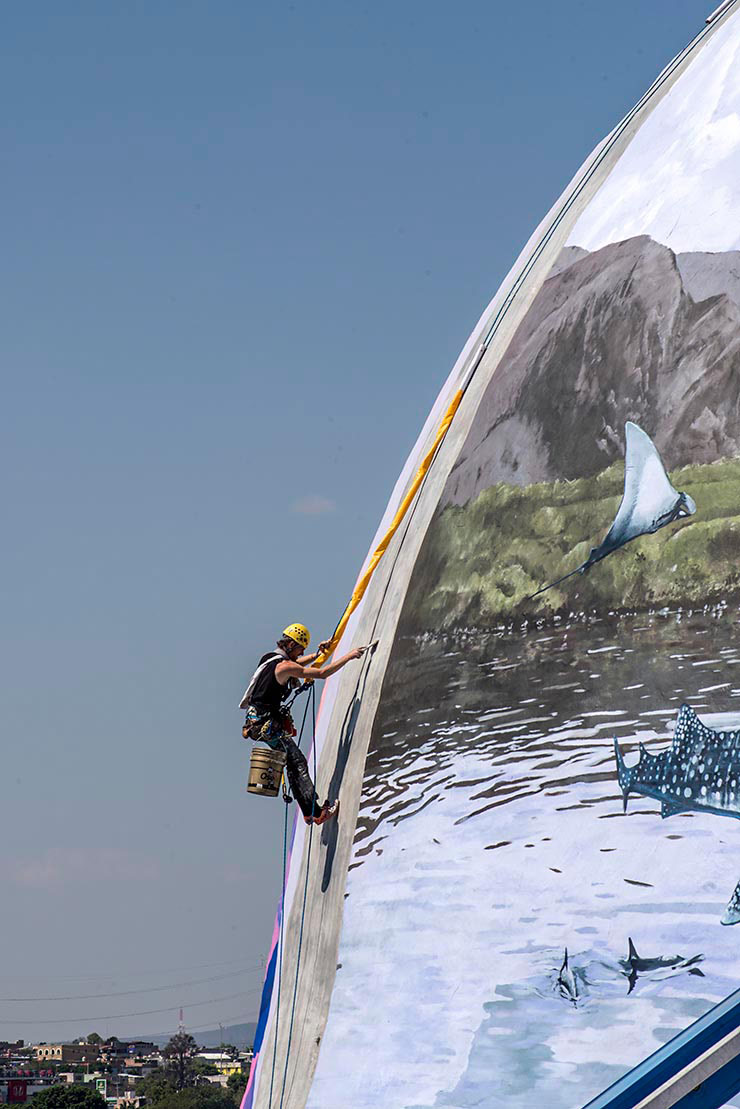
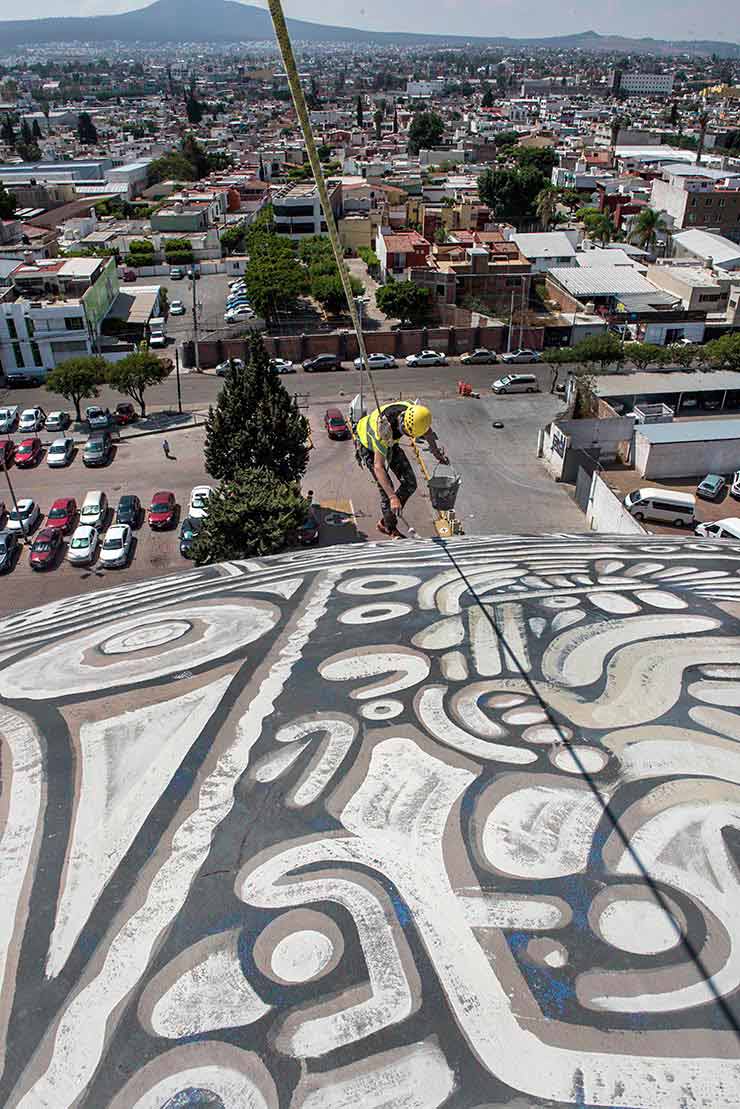
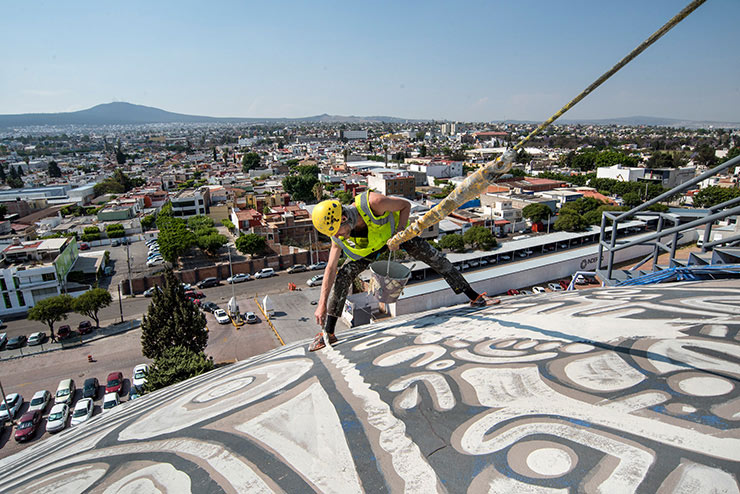
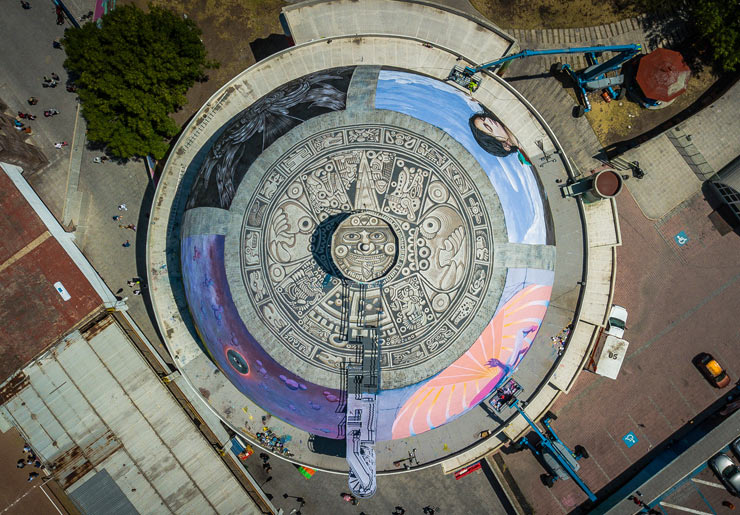
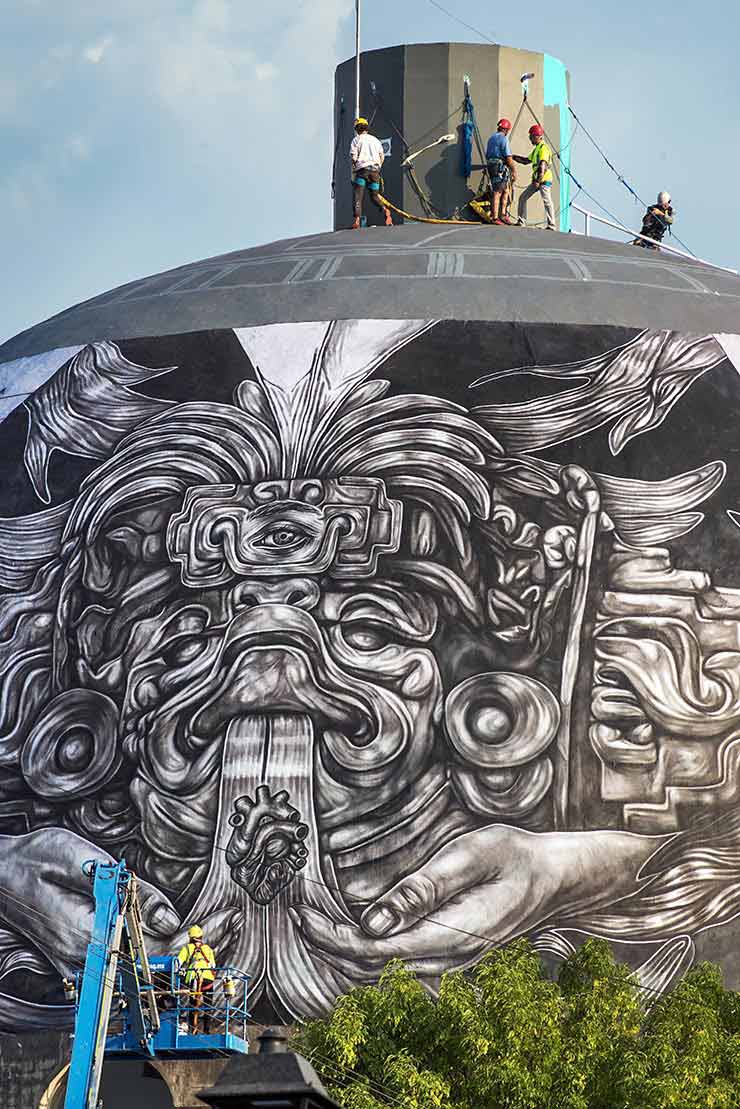
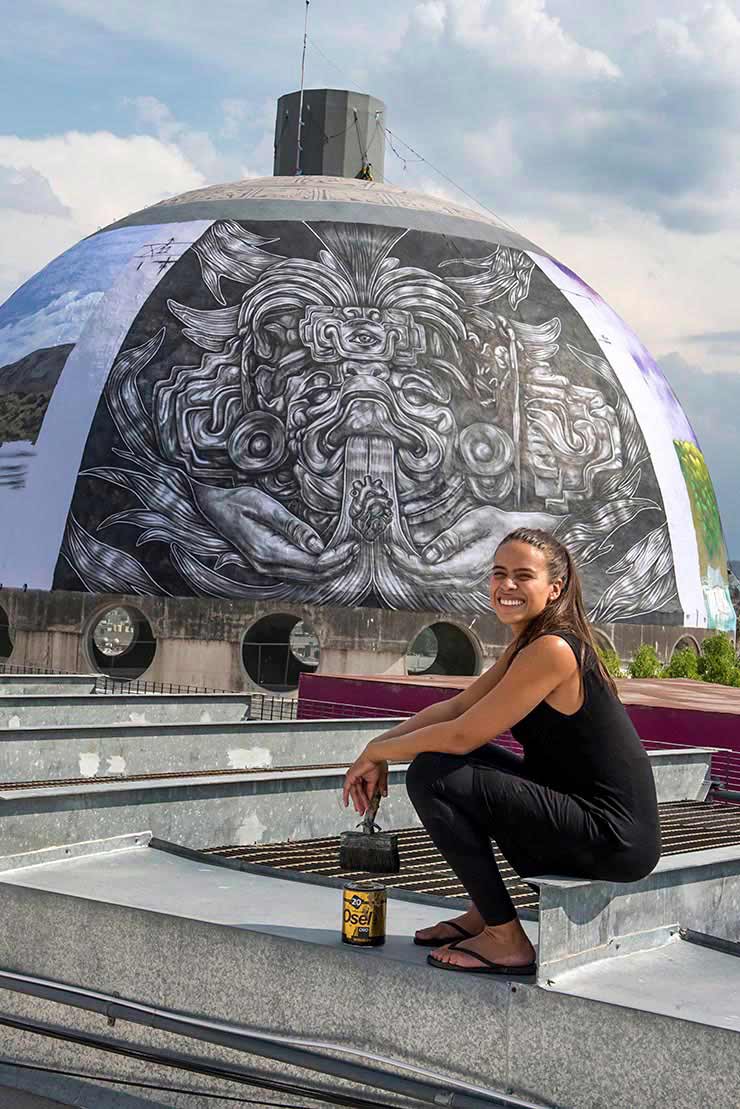
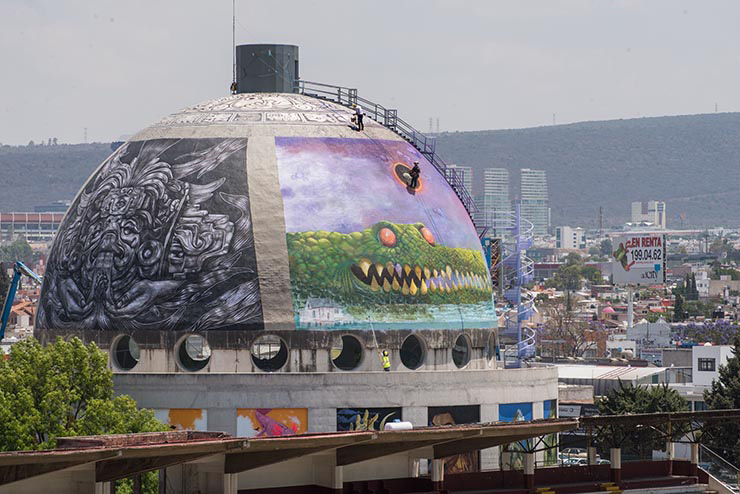
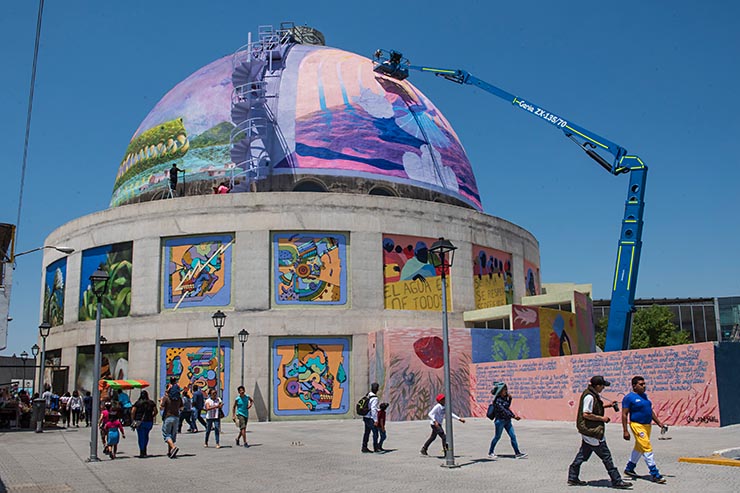
Montreal-based artist Jason Botkin met and exceeded human and creative limits at one point by successfully and arduously rappelling down, up, and around this great dome to recreate an astounding version of the Aztec calendar which can only be appreciated by flying overhead. Ms. Cooper tells us that all artists working on the cupola or dome were required to have a periodic medical check to ensure their good health during the installation of the frescoes.

Jason Botkin. Water is One/Mextonia Part 2. Querétaro, Mexico. March-April 2018. (photo © Nueve Art Urbano Team)

Martha Cooper: How many artists participated in both the Estonian and Mexican festivals?
Sigre Tompel: In Estonia we had 60 artists and in Mexico 33 – together with graffiti writers and neighboring walls of the Dome. These 5 artists were actually in both festivals – Aaron Glasson (New Zealand), Sänk (Estonia), Sermob (Mexico), Renata (Mexico), Goal (Mexico). Our whole core crew is a total of 15 people.

Jason Botkin. Water is One/Mextonia Part 2. Querétaro, Mexico. March-April 2018. (photo © Martha Cooper)

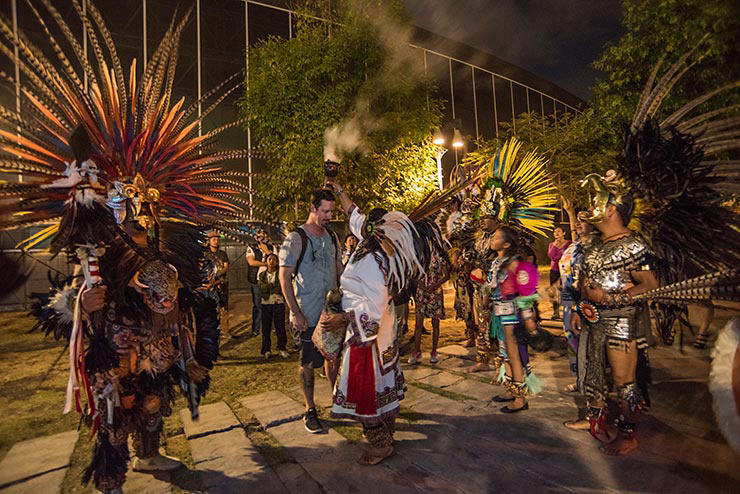
Martha Cooper: What was the name for the type of group that performed the ceremony at the walls? What was burning in the pot that produced the smoke? Copal?
Sigre Tompel: They are called Concheros, they use Copal , smudging for blessing. The message was smudging the artists to thank them for their work and to bless their way back home, so they can arrive healthy and happy. The name of this particular group of Concheros is “In Xochitl In Cuicatl”, Flor y Canto (Flower and Singing) and they are lead by Conchero General Manuel Rodriguez. The name is in Nahuatl, the ancient language of the Mexica.

Water is One/Mextonia Part 2. Querétaro, Mexico. March-April 2018. (photo © Martha Cooper)

Paola Delfín. Water is One/Mextonia Part 2. Querétaro, Mexico. March-April 2018. (photo © Martha Cooper)

Martha Cooper: Does the ceremony have a name? Can you say a few words about what kind of blessing it was or what message they were sending the artists?
Sigre Tompel: The Concheros hold the tradition of the old Mexican belief system. After being conquered by the Spanish, they decided to hold balance and harmony between the two belief symbols, so they started honoring Christian symbols, while honoring also Mexican symbols, usually in secret. Concheros need to be reconsidered as a Cultural Heritage of the World, they are not “syncretic” by ignorance, but to keep the sacred balance of cultural hybridization.

The Concheros were very happy because the artists expressed the metaphors of their dances into the murals, and because this represents a kind of Mexican renaissance that returns to an earlier time, reinterpreting the ancient classic pre-religious Mexican belief systems.

Paola Delfín. Water is One/Mextonia Part 2. Querétaro, Mexico. March-April 2018. (photo © Martha Cooper)

Ryper . Goal. Water is One/Mextonia Part 2. Querétaro, Mexico. March-April 2018. (photo © Martha Cooper)

Ryper . Goal. Water is One/Mextonia Part 2. Querétaro, Mexico. March-April 2018. (photo © Martha Cooper)

Mantra. Water is One/Mextonia Part 2. Querétaro, Mexico. March-April 2018. (photo © Martha Cooper)

Mantra. Water is One/Mextonia Part 2. Querétaro, Mexico. March-April 2018. (photo © Martha Cooper)

Mantra. Water is One/Mextonia Part 2. Querétaro, Mexico. March-April 2018. (photo © Martha Cooper)

Curiot. Water is One/Mextonia Part 2. Querétaro, Mexico. March-April 2018. (photo © Martha Cooper)

Sänk. Water is One/Mextonia Part 2. Querétaro, Mexico. March-April 2018. (photo © Martha Cooper)

Sänk. Water is One/Mextonia Part 2. Querétaro, Mexico. March-April 2018. (photo © Martha Cooper)

Sänk. Water is One/Mextonia Part 2. Querétaro, Mexico. March-April 2018. (photo © Martha Cooper)

Demencia. Water is One/Mextonia Part 2. Querétaro, Mexico. March-April 2018. (photo © Martha Cooper)

Nosego. Water is One/Mextonia Part 2. Querétaro, Mexico. March-April 2018. (photo © Martha Cooper)

Smithe. Water is One/Mextonia Part 2. Querétaro, Mexico. March-April 2018. (photo © Martha Cooper)


Pogo. Water is One/Mextonia Part 2. Querétaro, Mexico. March-April 2018. (photo © Martha Cooper)

Aaron Glasson. Water is One/Mextonia Part 2. Querétaro, Mexico. March-April 2018. (photo © Martha Cooper)

Jason Botkin. Water is One/Mextonia Part 2. Querétaro, Mexico. March-April 2018. (photo © Nueve Art Urbano Team)

Renata. Water is One/Mextonia Part 2. Querétaro, Mexico. March-April 2018. (photo © Martha Cooper)

Sermob. Water is One/Mextonia Part 2. Querétaro, Mexico. March-April 2018. (photo © Martha Cooper)

Water is One/Mextonia Part 2. Querétaro, Mexico. March-April 2018. (photo © Martha Cooper)

Water is One/Mextonia Part 2. Querétaro, Mexico. March-April 2018. (photo © Martha Cooper)

Water is One/Mextonia Part 2. Querétaro, Mexico. March-April 2018. (photo © Martha Cooper)

Juez. Water is One/Mextonia Part 2. Querétaro, Mexico. March-April 2018. (photo © Martha Cooper)

Valiñas. Water is One/Mextonia Part 2. Querétaro, Mexico. March-April 2018. (photo © Martha Cooper)

Atole Parra . Solé. Water is One/Mextonia Part 2. Querétaro, Mexico. March-April 2018. (photo © Martha Cooper)

Graffiti Wall. Water is One/Mextonia Part 2. Querétaro, Mexico. March-April 2018. (photo © Martha Cooper)

Water is One/Mextonia Part 2. Querétaro, Mexico. March-April 2018. (photo © Martha Cooper)


Artists participating include:

Aaron Glasson (New Zealand)
Curiot Tlapazotl (Mexico)
Dementia (Mexico)
Goal (Mexico)
Jason Botkin (Canada)
Mantra (France)
Nosego (United States)
Paola Delfín (Mexico)
Pogo (Mexico)
Renata (Mexico)
Ryper (Mexico)
Sermob (Mexico)
Smithe (Mexico)
Sänk (Estonia)


For more information on Mextonia please visit Mextonia.com

For more information on PangeaSeed please visit PangeaSeed Foundation

Read this article in Spanish / Leer este articulo in Espanol aqui:

TRANS-GRAFFITI Y EL FESTIVAL TRANSNACIONAL “MEXTONIA

Publicado el 26 de Mayo, 2018

México y Estonia; una pareja improbable. Pero a veces el amor es así. En una época en la que la ortodoxia global es autocomplaciente y obviamente no satisface las necesidades de las personas, quizás no sorprenda que sean los híbridos únicos de fortalezas compartidas los que pueden liderar en el mundo.

Consideremos “Mextonia”.

El retoño que combina las tradiciones… MAS


Our sincere thanks to Martha Cooper for her leadership on this effort as well as her talents documenting the action.

Read more
Colombia Diary: The Completed Works, The Gold Rush, and the Jaguar in You

Colombia Diary: The Completed Works, The Gold Rush, and the Jaguar in You

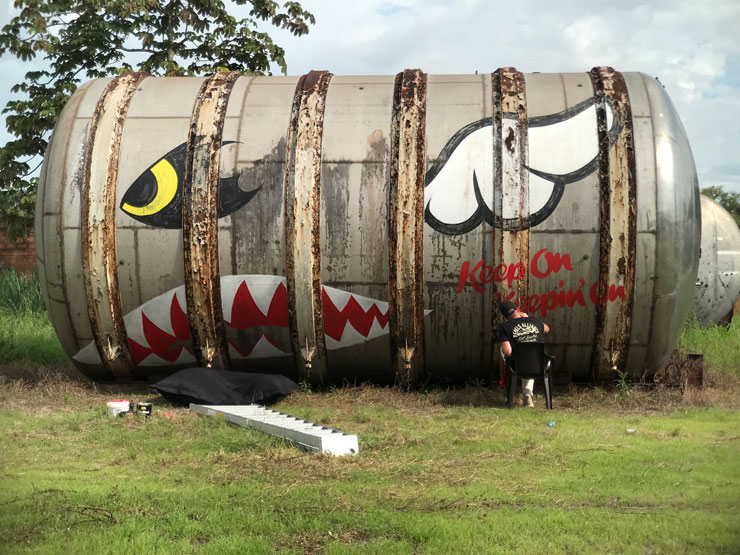
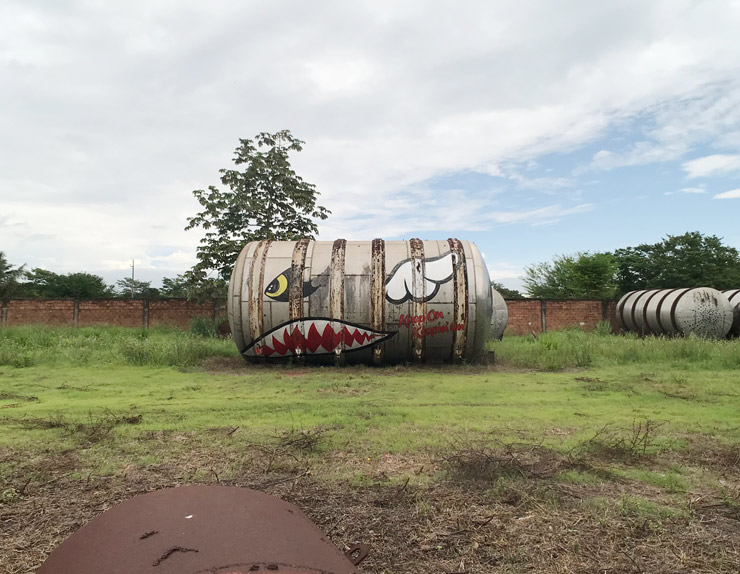
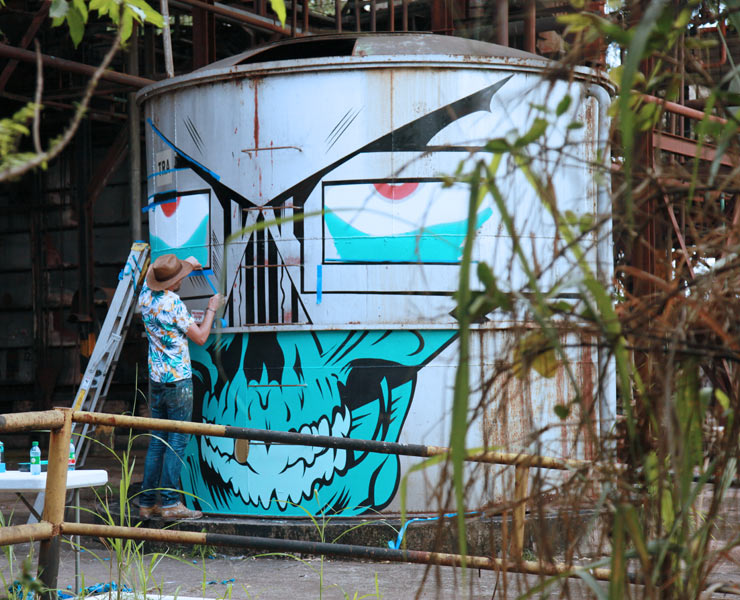
Today a wrap up of BSA at an unusual location in Colombia to see a new initiative with Street Artists in an abandoned distillery brought back to life with their imaginations and penchant for transformation.


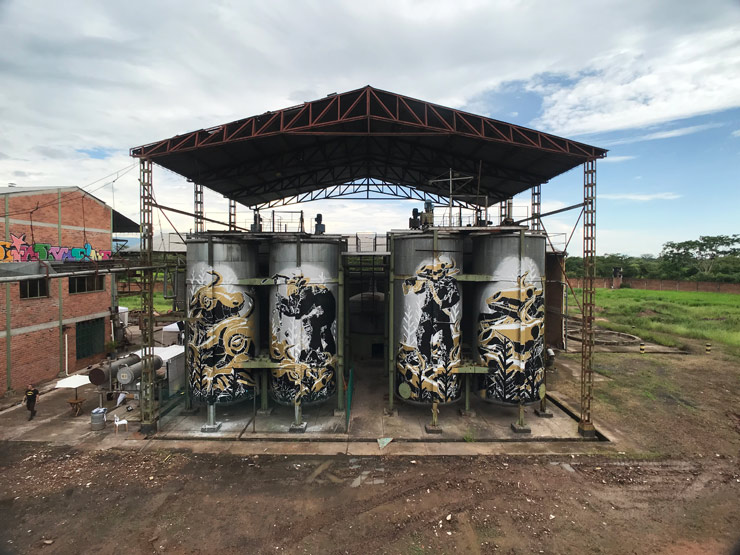
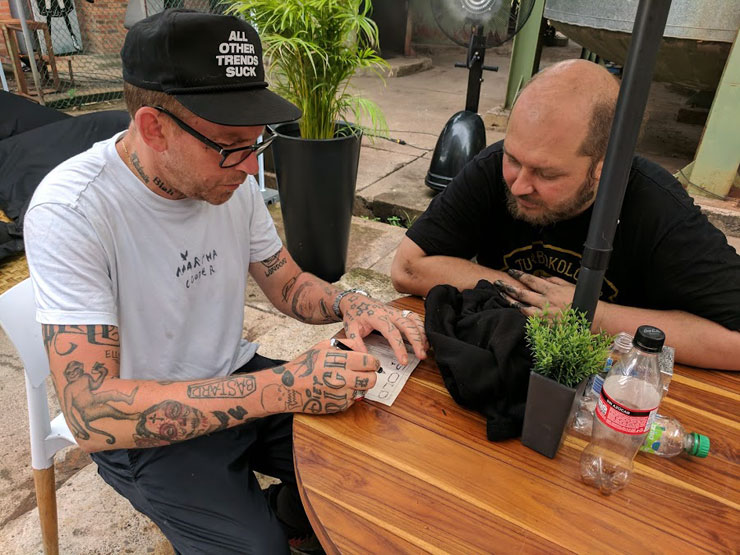
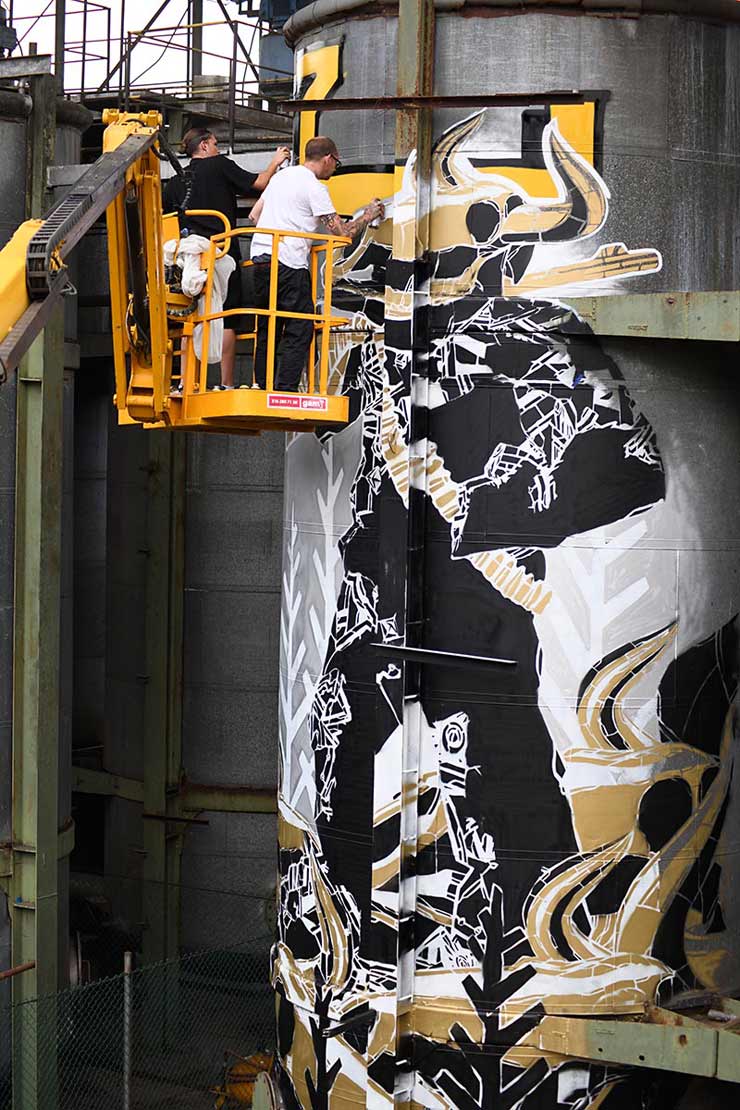
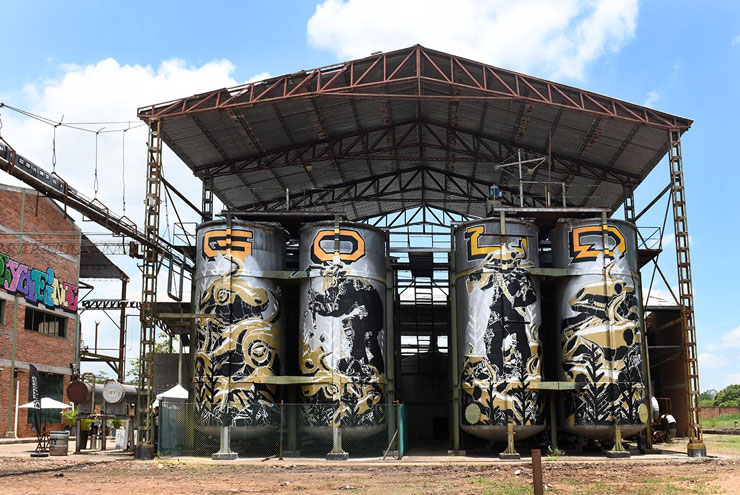
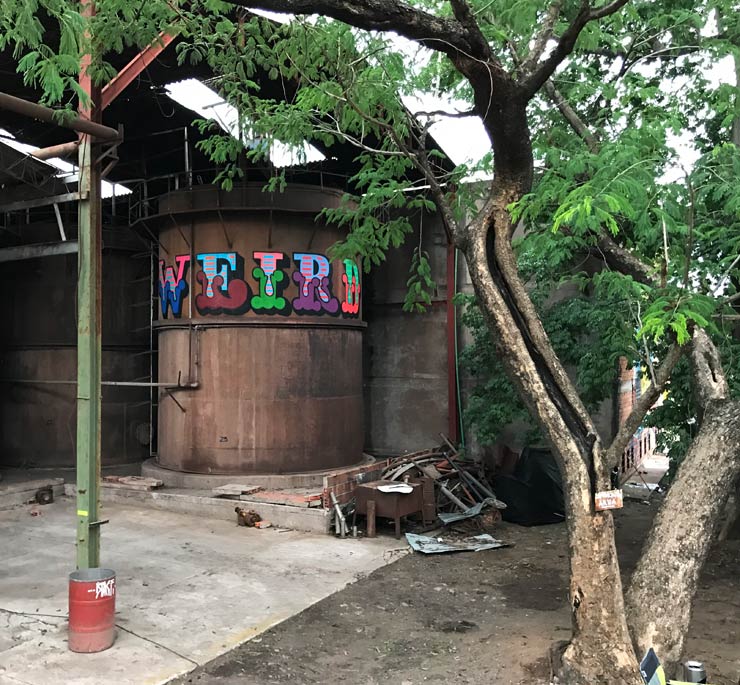
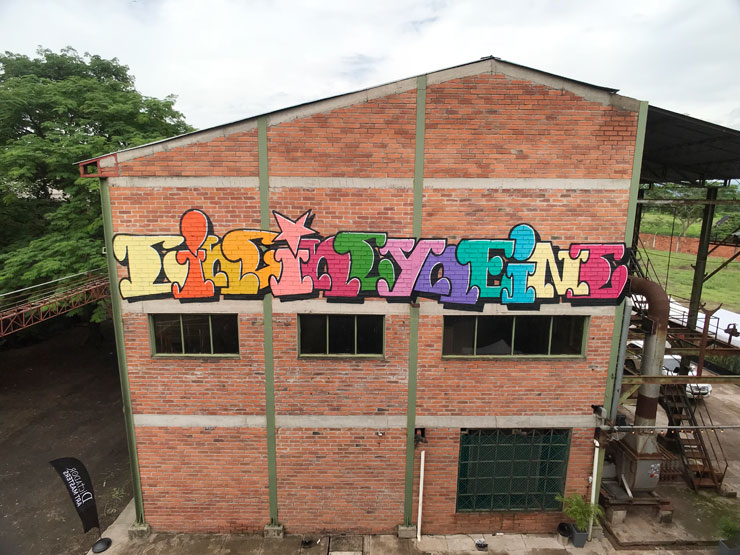
“Uh, yellow, black, with some white… because it’s high up,” Ben Eine says as he sketches out the four letters, G-O-L-D on a small piece of paper. He’s codifying an idea to paint the letters across the four huge storage tanks where M-City has painted a metaphorical gold-mining scene upon over the last few days. The massive piece is timely and timeless; referencing to the current informal gold rush happening here in Colombia, once again altering the physical and political landscape.


M-City at the old distillery in Colombia. May 2018. (photo © Jaime Rojo)

A rotating mist fan is slowly stirring the thick tropical air while we sit at the round wooden table in this industrial compound watching Ben with a pen as he shows M-City his idea for topping off the piece – in his own charming manner.

“Yellow, black outline, little shadow. Your shit goes like this, blah blah blah. And then white outline. Or maybe like super light blue outline so it bounces off the silver. Yeah-yeah,” says the English graffiti writer with some final certainty on his vision.

Ben Eine sketching the idea with M-City. May 2018. (photo © Steven P. Harrington)

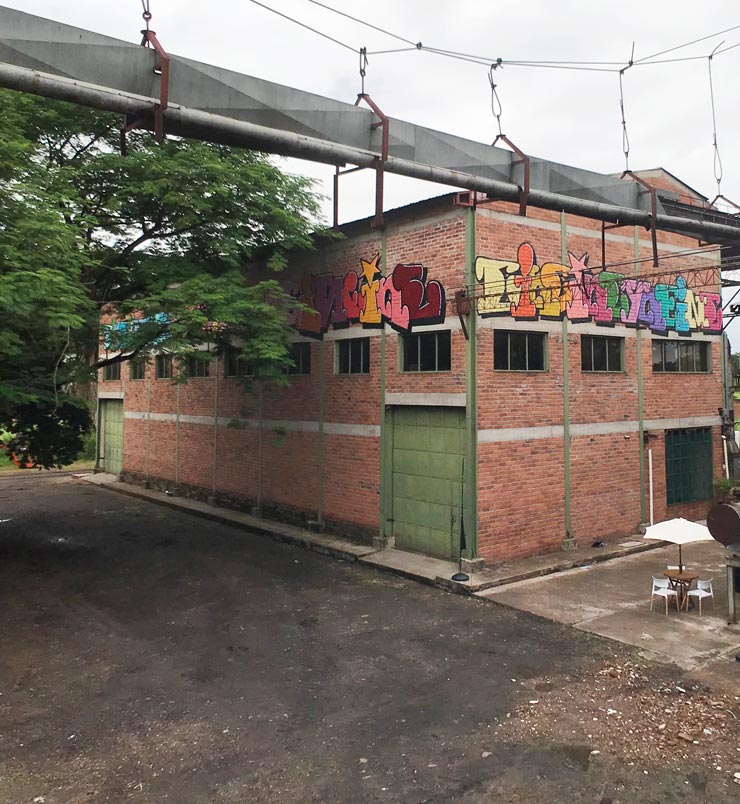
Ben Eine added GOLD to M-City ‘s piece at the old distillery in Colombia. May 2018. (photo © Martha Cooper)

“Okay, perfect,” says the agreeable M-City, who quickly begins sourcing paint in a nearby pile of cardboard boxes. As a Street Artist who is curating this first phase of painting at this old Colombian distillery for Dictador Art Masters Foundation, he is helping others to hit their goals as much as he is directing his own creative work. Finally the collaboration is finished and it beams across the drying muddy field in the sun.

Ben Eine added GOLD to M-City ‘s piece at the old distillery in Colombia. May 2018. (photo © Martha Cooper)

It’s this kind of collaborative camaraderie that often characterizes the Street Art scene across the world and one that sets this project apart from many “festivals”. For one thing, this project is private and small and away from the roaring crowd that can often accompany street works, and developing your idea as an artist can be done with minimal interruption.

The smaller artist roster also means that many of these creators have an opportunity to get to know one another better, to seek feedback, to formulate, to share perspectives. The old distillery setting itself is a highly unusual gallery environment that perpetuates the feeling of an extended studio.

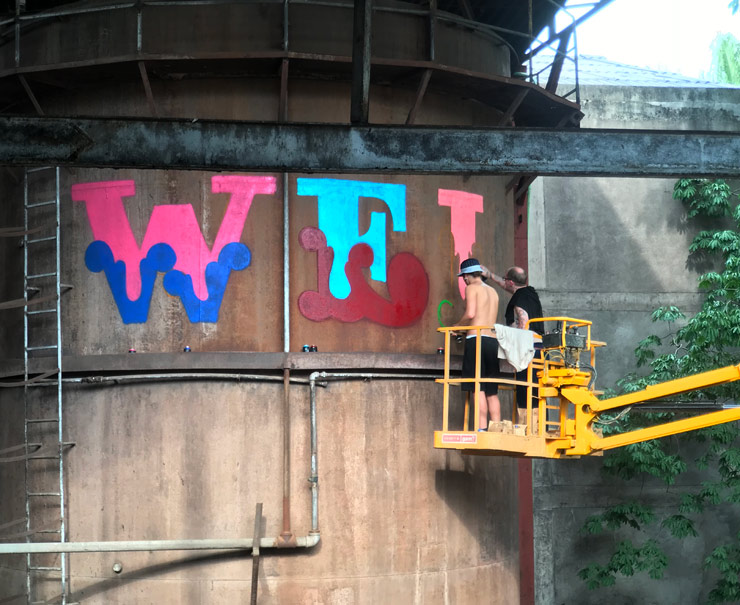
Ben Eine at the old distillery in Colombia. May 2018. (photo © Jaime Rojo)

Ben Eine at the old distillery in Colombia. May 2018. (photo © Jaime Rojo)

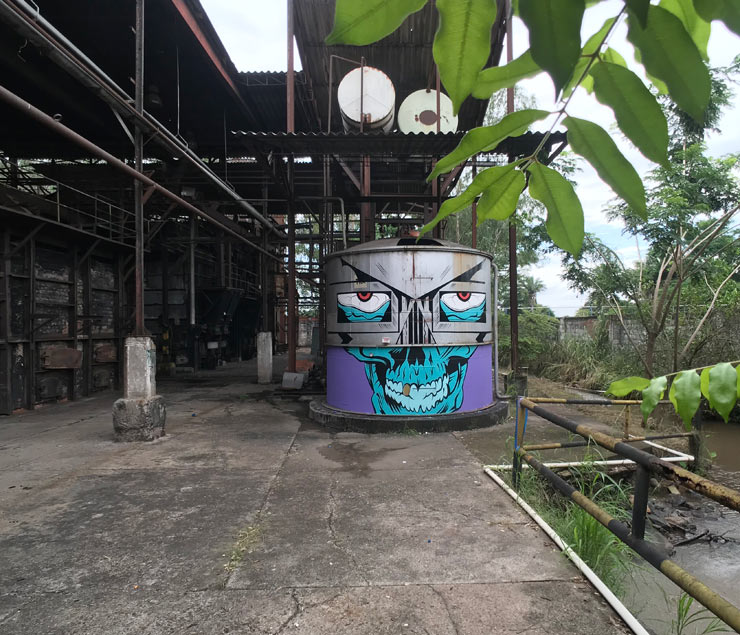
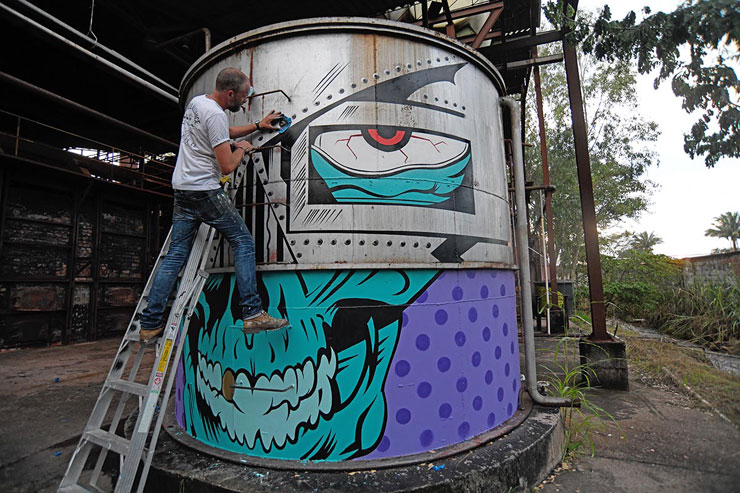
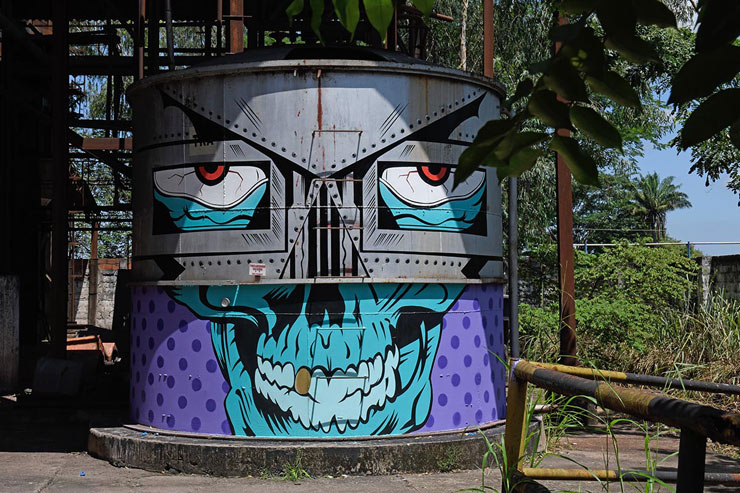
“We are completely amazed by all the stuff here on every level. All the objects, the whole factory,” says Jan, one half of the Polish duo Monstfur as he surveys a rounded tank that they are spraying layers of grey, black, and white to form a  stenciled cranium that also matches the one tattooed on his arm.

“Feeling the textures, seeing the patterns. Everything is so full of inspiration for us,” he beams. Placed in this laboratory of ideas, the guys seem right at home with their layers of decay and their Frankenstonian mythmaking – including their collective name that combines the English and Polish word for monster.

M-City at the old distillery in Colombia. May 2018. (photo © Jaime Rojo)

As you climb rusty ladders and duck under cobwebs or the occasional silently swooping bat, you see the possibilities for childlike ideation, opportunities to launch imaginary tales and adventures, directing energy and stirring alchemy.

Toxicomano takes the journey even further.

“Have you heard of Yage?” he asks, eager to share stories of a hallucinogenic plant that people who live in wooded, mountainous regions have used for years to transcend this reality. “It’s a strong beverage in the Amazonian,” he says. “When you drink it you are stoned.”

M-City at the old distillery in Colombia. May 2018. (photo © Jaime Rojo)

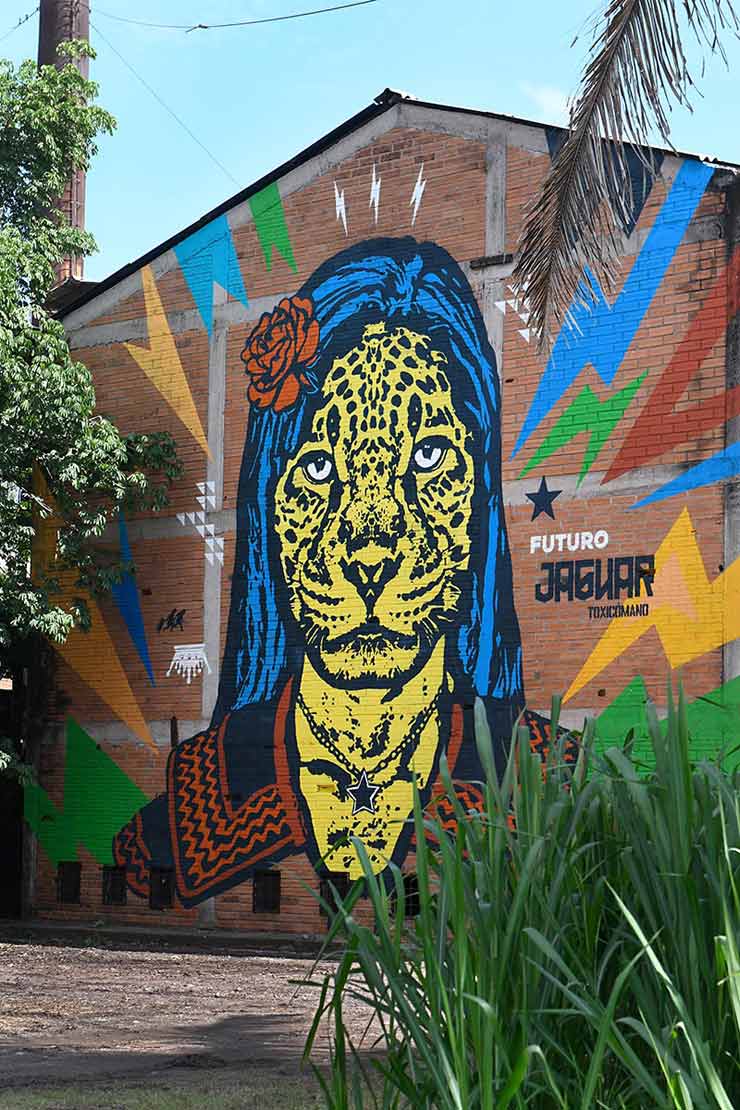
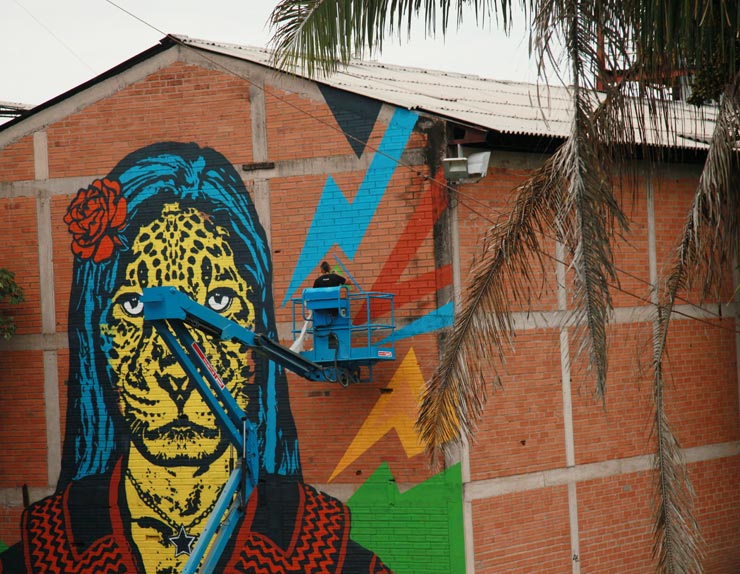
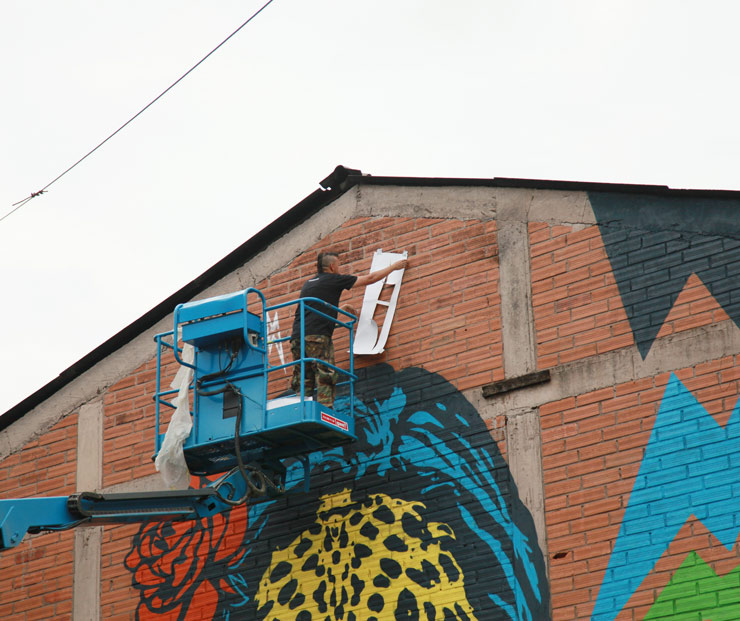
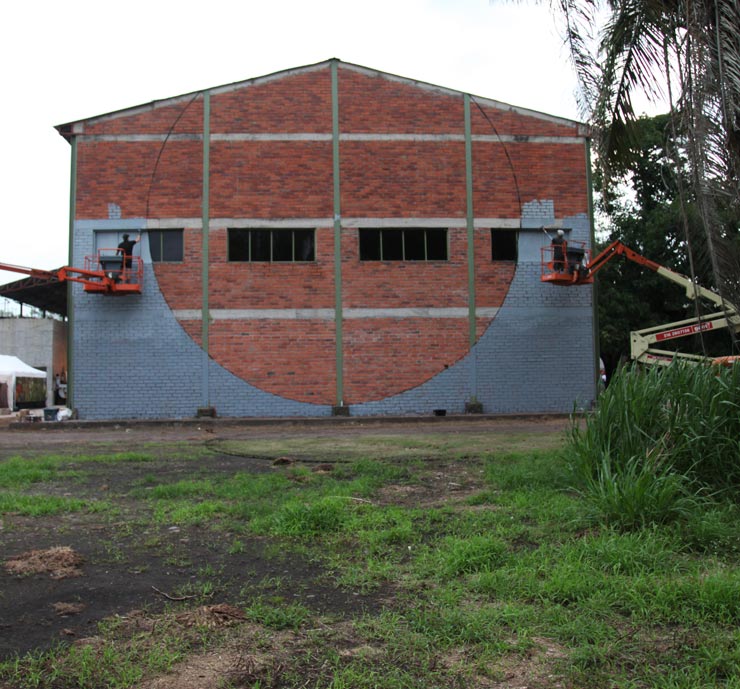
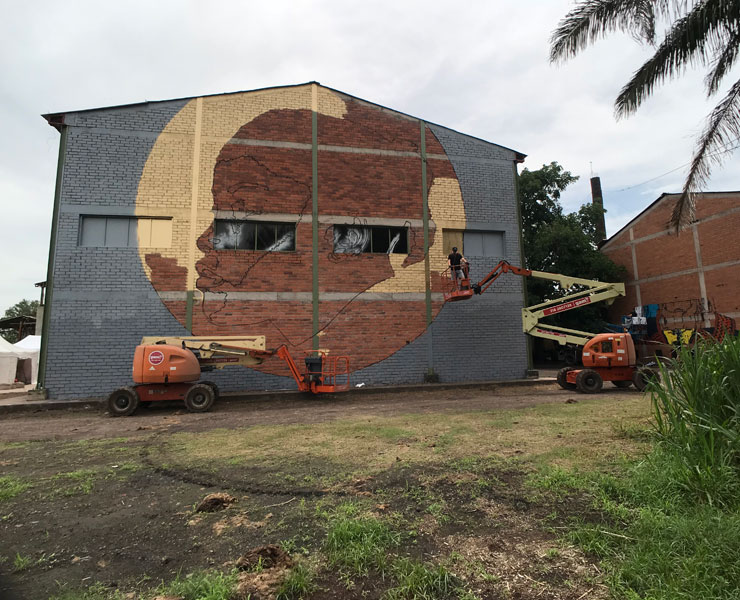
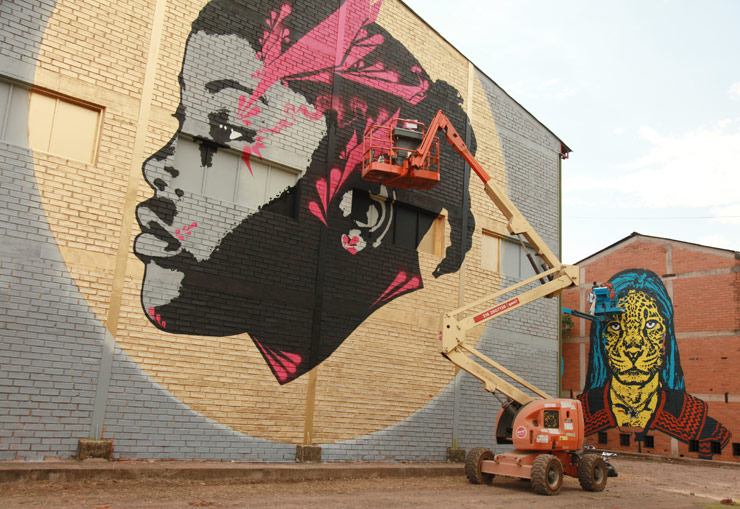
Fair enough, but how does that relate to the 4-story high yellow and black jaguar with nice hair that is staring at you like a feline Mona Lisa? You’ve seen him going up and down the cherry-picker carefully laying out and spraying the stencils here for days and this intense model has unveiled, then commanded, this brick wall.

“All persons have a jaguar that is inside,” he explains with a sincere stare into your eyes. You reflexively make a quick internal inventory of yourself to see if it is possible to confirm the veracity of that statement. Well, maaaaaayyyyyybeeeeeee, now that you mention it.

M-City at the old distillery in Colombia. May 2018. (photo © Jaime Rojo)

“When you drink this yage you can begin to think differently about your place in the world, your people, your environment,” he says. “The jaguar is the tiger of South America. From Mexico to Argentina we have the same jaguar. I think they are really pretty. I think in this area it is possible to find jaguars as well,” he says, which seems to indicate an excellent opportunity to scan the adjacent field of tall grass.

What does this Colombian Street Artist’s jaguar want to do? “I think my jaguar wants to communicate to the others and tell people that everyone has a jaguar inside.”

M-City at the old distillery in Colombia. May 2018. (photo © Jaime Rojo)

M-City adds a NYC touch on a conduit at the old distillery in Colombia. May 2018. (photo © Martha Cooper)

A great note to end this hot and sticky week in the farmlands and mountains of Northern Colombia. Mixed with the sun and the mud it has also seemed like a possibly mystical place that once housed the precise and time-honored industry of distilling. Now enlivened with the new works of English, Polish, and Colombian graffiti writers and Street Artists, it becomes an installation in an unusual location full of possibility – and we are curious to see where the next phase of this adventure leads.

Artists include: D*Face, Ben Eine, M-City, Monstfur, Toxicomano, Stinkfish, and Erre.

Ben Eine at the old distillery in Colombia. May 2018. (photo © Jaime Rojo)

Ben Eine at the old distillery in Colombia. May 2018. (photo © Jaime Rojo)

Ben Eine at the old distillery in Colombia. May 2018. (photo © Jaime Rojo)

Ben Eine at the old distillery in Colombia. May 2018. (photo © Jaime Rojo)

Ben Eine at the old distillery in Colombia. May 2018. (photo © Jaime Rojo)

Ben Eine at the old distillery in Colombia. May 2018. (photo © Jaime Rojo)

Ben Eine at the old distillery in Colombia. May 2018. (photo © Jaime Rojo)

D*Face at the old distillery in Colombia. May 2018. (photo © Jaime Rojo)

D*Face at the old distillery in Colombia. May 2018. (photo © Jaime Rojo)

D*Face at the old distillery in Colombia. May 2018. (photo © Jaime Rojo)

D*Face at the old distillery in Colombia. May 2018. (photo © Jaime Rojo)

D*Face at the old distillery in Colombia. May 2018. (photo © Jaime Rojo)

D*Face at the old distillery in Colombia. May 2018. (photo © Jaime Rojo)

D*Face at the old distillery in Colombia. May 2018. (photo © Jaime Rojo)

D*Face at the old distillery in Colombia. May 2018. (photo © Jaime Rojo)

D*Face at the old distillery in Colombia. May 2018. (photo © Jaime Rojo)

D*Face at the old distillery in Colombia. May 2018. (photo © Martha Cooper)

D*Face at the old distillery in Colombia. May 2018. (photo © Martha Cooper)

Toxicomano at the old distillery Colombia. May 2018. (photo © Jaime Rojo)

Toxicomano at the old distillery Colombia. May 2018. (photo © Jaime Rojo)

Toxicomano at the old distillery Colombia. May 2018. (photo © Jaime Rojo)

Toxicomano at the old distillery Colombia. May 2018. (photo © Martha Cooper)

Stinkfish at the old distillery in Colombia. May 2018. (photo © Jaime Rojo)

Stinkfish at the old distillery in Colombia. May 2018. (photo © Jaime Rojo)

Stinkfish and Toxicomano at the old distillery in Colombia. May 2018. (photo © Jaime Rojo)

Stinkfish at the old distillery in Colombia. May 2018. (photo © Jaime Rojo)

Erre at the old distillery in Colombia. May 2018. (photo © Jaime Rojo)

Erre at the old distillery in Colombia. May 2018. (photo © Jaime Rojo)

Erre at the old distillery in Colombia. May 2018. (photo © Jaime Rojo)

Erre at the old distillery in Colombia. May 2018. (photo © Jaime Rojo)

Monstfur at the old distillery in Colombia. May 2018. (photo © Jaime Rojo)

Monstfur at the old distillery in Colombia. May 2018. (photo © Jaime Rojo)

Monstfur at the old distillery in Colombia. May 2018. (photo © Jaime Rojo)

Monstfur at the old distillery in Colombia. May 2018. (photo © Jaime Rojo)

Monstfur at the old distillery in Colombia. May 2018. (photo © Jaime Rojo)

Monstfur at the old distillery in Colombia. May 2018. (photo © Jaime Rojo)

Filmmaker Collin Day at the old distillery in Colombia. May 2018. (photo © Jaime Rojo)

Martha Cooper and Steven P. Harrington at the old distillery in Colombia. May 2018. (photo © Jaime Rojo)


This event has been made possible by Dictador Art Masters Foundation. To learn more about the foundation click here.


Thank you to Martha Cooper for sharing her exclusive images with BSA readers.

Read more
BSA Curates at 3rd Artmossphere in Moscow 2018: Open Call For Artists

BSA Curates at 3rd Artmossphere in Moscow 2018: Open Call For Artists

BSA founders Steven P. Harrington and Jaime Rojo are part of the Curatorial Team for the 2018 Artmossphere Biennale and today BSA is pleased to announce the “Open Call” for artists to apply.

The Street Wave Art Biennale, Artmossphere. Open Call for artists.

Paulo Ito at work on his installation for the 2nd Edition of Artmossphere. Moscow 2016. (photo © Jaime Rojo)

Artmossphere is the only Russian biennale that focuses primarily on Street Art and its corollary practices, with the first two launching in 2014 and 2016. You may remember the full coverage BSA had in 2016 at the Moscow Manege;

60 Artists at a Moscow Street Art Biennale: “Artmossphere 2016”

Among the artists participating on previous editions of Artmossphere have been people like The London Police, Brad Downey, Claudio Ethos, Agostino Iocurci Miss Van, L’Atlas, Sickboy, Jaz, Nespoon, Martha Cooper, Remi Rough, Alexey Luka, Remed, Li Hill, Jessie and Katey, Moneyless, El Tono, and many others – but clearly you can see that the quality and diversity in practices and backgrounds is well represented here.

L’Atlas at work on his installation for the 2nd Edition of Artmossphere. Moscow 2016. (photo © Jaime Rojo)

For the 2018 edition of the biennale we will be curating the program along with some of our respected peers internationally in this field and collectively we are asking artists to consider what it means to be “Offline”. So much of graffiti and Street Art’s roots extend back to a practice of making work for a largely local audience that is limited to geography.

Today much work in public space is conceived of, at least in part, for its ability to traverse to audiences on social media, blogs, video, and all manner of digital platforms. As we constantly are flooded with online Street Art, is it possible to be ‘Offline”?

Sepe at work on his painting for the 2nd Edition of Artmossphere. Moscow 2016. (photo © Jaime Rojo)

The 2018 main exhibition will take place in the Excise Storehouse of Winzavod Centre for Contemporary Art in Moscow from August 30th to October 17th. Additional special exhibitions will be held in the Red and White Halls, as well as in the art cluster outdoor territory.

The open call is open to Russian and international artists and applications with projects exploring this year’s theme will be reviewed by an international jury consisting of Steven P. Harrington and Jaime Rojo, co-founders of BrooklynStreetArt.com and curators at Urban Nation Museum of Urban Contemporary Art (UN), Peter Ernst Coolen, curator of the Amsterdam Street Art Museum, Cedar Lewisohn, curator of the Street Art project in Tate Modern, Ethel Seno, researcher of street art and curator, Anna Dimitrova, curator of Adda Gallery, Paris and MTN Gallery, Barcelona, and Nikolay Palazhchenko, the founder of the Winzavod Centre for Contemporary Art in Moscow.
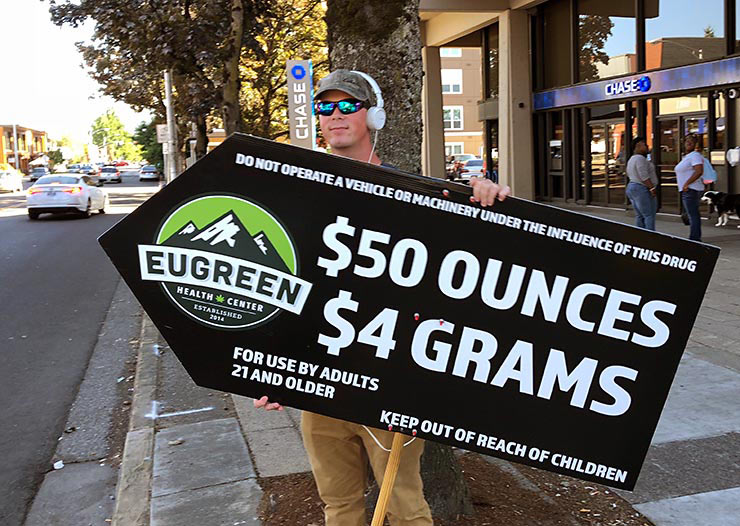
To take part in the biennale, Artmossphere artists should submit their portfolio and their project application for the biennale before June 18th, 2018. All the projects should be made exclusively for the biennale. Click here for all details.
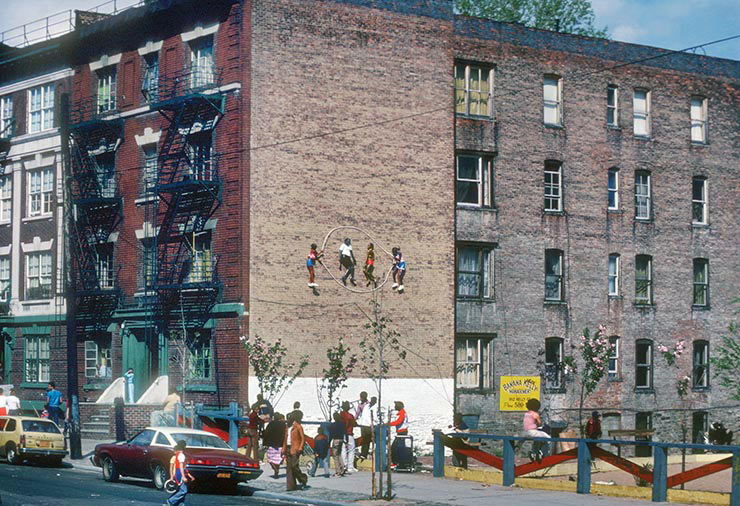
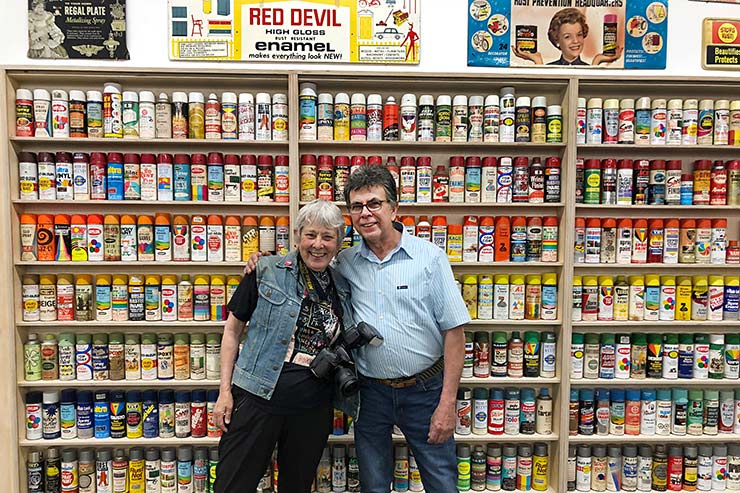
Wes21 at work on his installation for the 2nd Edition of Artmossphere. Moscow 2016. (photo © Jaime Rojo)

Katie and Jesse at work on their installation for the 2nd Edition of Artmossphere. Moscow 2016. (photo © Jaime Rojo)

Pink Power at work on her installation for the 2nd Edition of Artmossphere. Moscow 2016. (photo © Jaime Rojo)

M-City at work on his installation for the 2nd Edition of Artmossphere. Moscow 2016. (photo © Jaime Rojo)

Krzysztof “Proembrion” Syruc at work on his painting for the 2nd edition of Artmossphere. Moscow 2016. (photo © Jaime Rojo)


#ARTMOSSPHERE #BKSTREETART

Read more
One Week With 1UP : Martha Cooper & Ninja K

One Week With 1UP : Martha Cooper & Ninja K

A serendipitous meeting somewhere in Berlin set this project in motion, and the results unveil an adrenaline fueled ride that always pushes, often exceeds the boundaries of physical safety and social acceptance while simultaneously thrilling graffiti fans and pissing off some public officials and property owners.

Martha Cooper & Ninja K. One Week With 1UP. (photo courtesy of the team)

A new book that is releasing shortly captures the nature of the actions and adds to our conversations about art, vandalism, branding, public/personal space and its radical visual disruption. It’s a story made all the more remarkable during an increasing level of surveillance in a city that has basically embraced the bohemian and rebellious types who have transformed large parts of its cityscape, making Berlin a de facto capital of subculture, especially among the young.

Martha Cooper & Ninja K. One Week With 1UP. (photo courtesy of the team)

Photojournalists have to follow the story wherever it goes in the hope of reporting the true nature of the culture, especially when it veers off the street and dives into subculture. After a somewhat chance encounter with the notorious 1UP crew in Berlin, veteran photojournalist and ethnographer Martha Cooper instinctively knew she had to better understand how the graffiti writing practice today has evolved since she first captured the New York train writers in 1970s and 80s.

Along with photographer Ninja K, Cooper again goes beyond most people’s comfort zone to get a story about this somewhat amorphous and incredibly anonymous graffiti crew that no one else has yet documented. With sharp eyes and pitch-perfect timing, the results of these two journalists reveal how the graffiti practice has continued to expand and beguile in the margins of the urban public sphere.

Martha Cooper & Ninja K. One Week With 1UP. (photo courtesy of the team)

Martha Cooper & Ninja K. One Week With 1UP. (photo courtesy of the team)

Martha Cooper & Ninja K. One Week With 1UP. (photo courtesy of the team)

Martha Cooper & Ninja K. One Week With 1UP. (photo courtesy of the team)


With thanks to the team for sharing their exclusive images with BSA.


Read more
ESCIF, BLU, SAM3, More Join “SenseMurs” as Activists Protecting “La Punta”

ESCIF, BLU, SAM3, More Join “SenseMurs” as Activists Protecting “La Punta”

AYÚDANOS A DEFENDER LA HUERTA Y PARAR LA ZAL – Help Us to Defend the Garden and Stop the ZAL.


Street Artists in Valencia, Spain are using their work to reclaim land for a people’s agenda.

BLU. Detail. SenseMurs. La Punta, Valencia, Spain, March 2018. (photo © Martha Cooper)

Street Artist Escif organized with other artists to fight the commercial development of seaside land in Valencia last month. With the help of other socially responsible artists including Aryz, BLU, Borondo, Escif, Anaïs Florin, Hyuro, Luzinterruptus, Daniel Muñoz “SAN”, Sam3 and Elías Taño, Escif and local organizers are publicly pushing a message that shows the local council what it means when citizens are engaged.

According to the organizers La Punta is a hamlet of orchards and gardens located in the south of the city of Valencia where more than 15 years ago the “Logistics Activities Zone” (ZAL) project of the Port of Valencia decided to chase hundreds of people out of this land to give to developers as a new port initiative.

BLU. Detail. SenseMurs. La Punta, Valencia, Spain, March 2018. (photo © Martha Cooper)

Well, that failed spectacularly, probably because funding fell through due to the global financial crisis, and 15 years later development has not happened. The land has begun to evolve and return to its more natural state and a local farm economy has sprouted up. Meanwhile city planners are hoping they can conjure up another way to use these public lands for private profit.

But grassroots organizers say they want the public/private predatory folks to step back and let citizens decide what to do with this area. Thanks to this new “SenseMurs” public art initiative that is drawing a lot of critical eyes to the matter, more citizens may actually get a seat at the table. Well organized and great communicators, on March 10 and 11 the artists and activists gave tours of the murals of SenseMurs, called a press conference, threw a concert, and opened the doors to other citizens for their participation in the process.

BLU. Detail. SenseMurs. La Punta, Valencia, Spain, March 2018. (photo © Martha Cooper)

“Within this context, neighbors and associations are trying to bring attention to this reality in order to negotiate with the Administration and start a public participation process,” says the art collective Luzinterruptus in an email, “where it will be decided how these lands will be used and to mend the injustices committed against the neighbors so another chance is given to the deported families to return and work the lands of l’Horta de la Punta.”

Enjoy these shots of the installations from Martha Cooper and two from Juanmi Ponce, starting off with the one and only BLU.

BLU. SenseMurs. La Punta, Valencia, Spain, March 2018. (photo © Martha Cooper)

Escif. SenseMurs. La Punta, Valencia, Spain, March 2018. (photo © Martha Cooper)

Escif. SenseMurs. La Punta, Valencia, Spain, March 2018. (photo © Martha Cooper)

Because there are lettuces!

From Escif’s Instagram:

A: ¿ Porqué HAY LECHUGAS ?
B: Pues porqué alguien plantó semillas en esta tierra fértil, les puso agua y dejó que el sol hiciese su trabajo. Imágino que es un ciclo natural. La tierra es generosa y muy prospera. A poco que la cuides, te regala lechugas como estas.
A: No me refiero a eso. Mi pregunta es porque escribes la frase HAY LECHUGAS.
B: Ah! …pues porque hay lechugas!

Hyuro. SenseMurs. La Punta, Valencia, Spain, March 2018. (photo © Martha Cooper)

Borondo. SenseMurs. La Punta, Valencia, Spain, March 2018. (photo © Martha Cooper)

Borondo. SenseMurs. La Punta, Valencia, Spain, March 2018. (photo © Martha Cooper)

Aryz. SenseMurs. La Punta, Valencia, Spain, March 2018. (photo © Martha Cooper)

Aryz. SenseMurs. La Punta, Valencia, Spain, March 2018. (photo © Martha Cooper)

Sam3. SenseMurs. La Punta, Valencia, Spain, March 2018. (photo © Martha Cooper)

SAN. SenseMurs. La Punta, Valencia, Spain, March 2018. (photo © Martha Cooper)

SAN. SenseMurs. La Punta, Valencia, Spain, March 2018. (photo © Martha Cooper)

Luzinterruptus. SenseMurs. La Punta, Valencia, Spain, March 2018. (photo © Juanmi Ponce)

Luzinterruptus. SenseMurs. La Punta, Valencia, Spain, March 2018. (photo © Juanmi Ponce)

Elías Taño. SenseMurs. La Punta, Valencia, Spain, March 2018. (photo © Martha Cooper)


SenseMurs participating artists: Blu, Luzinterruptus, Aryz, Hyuro, SAN, LIQEN, Anaisflorin, Eliastano, Sam3, Escif


To learn more about the project please go to RECUPEREM LA PUNTA / Valencia, Spain
Recuperem La Punta, aturem la ZAL and La Punta.


Read more