Worried that voting rights are being stolen from black and brown people in a systematic way across the country? Let Mitch McConnell put your fears to rest.
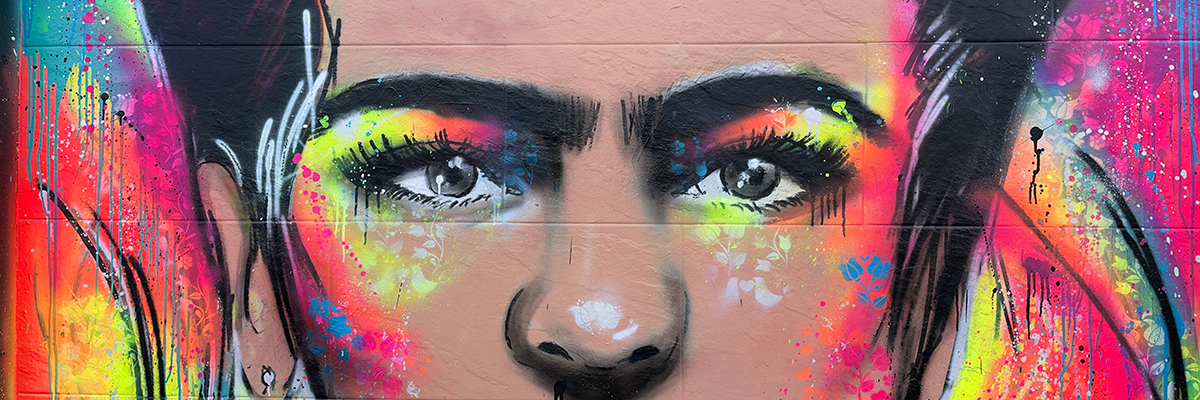
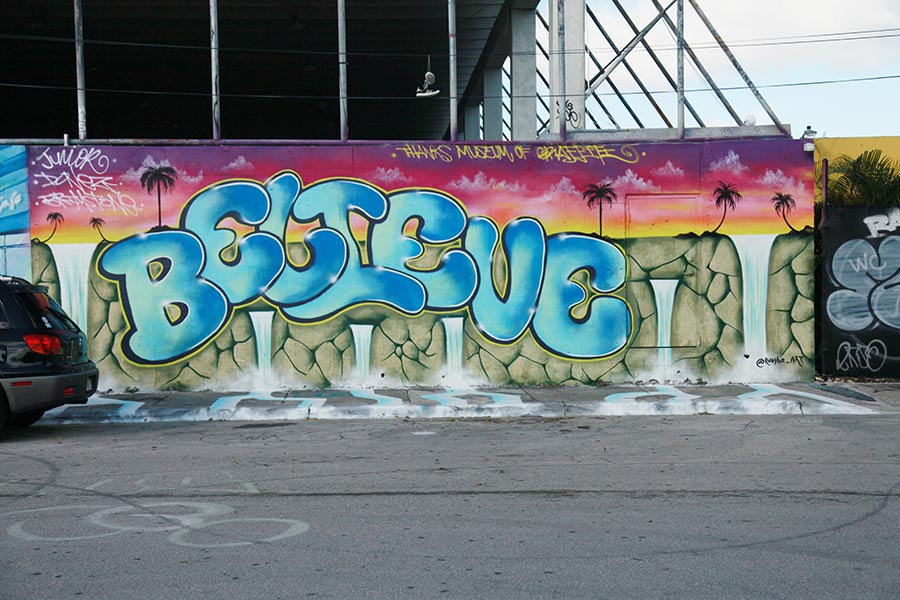
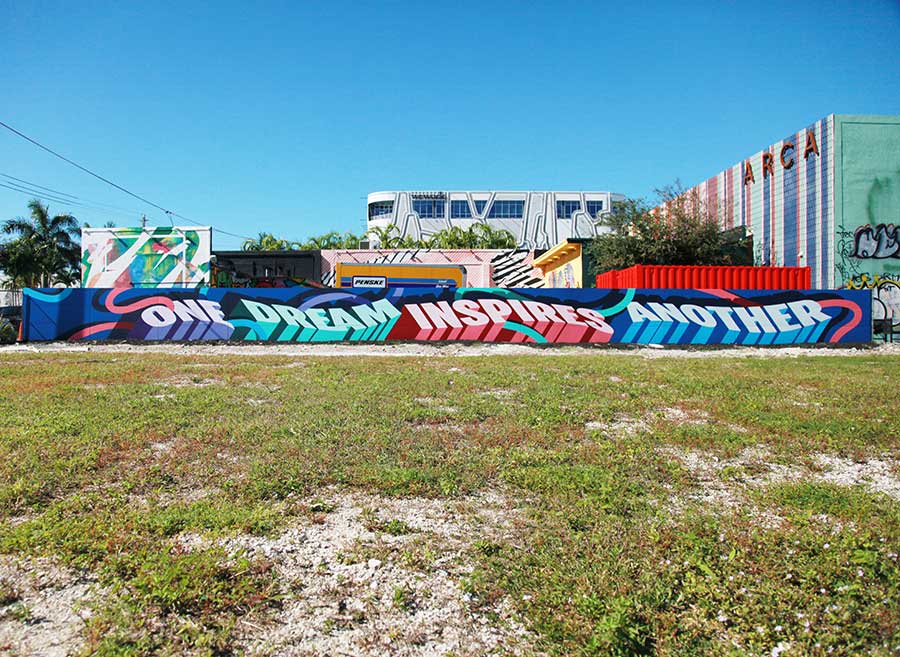
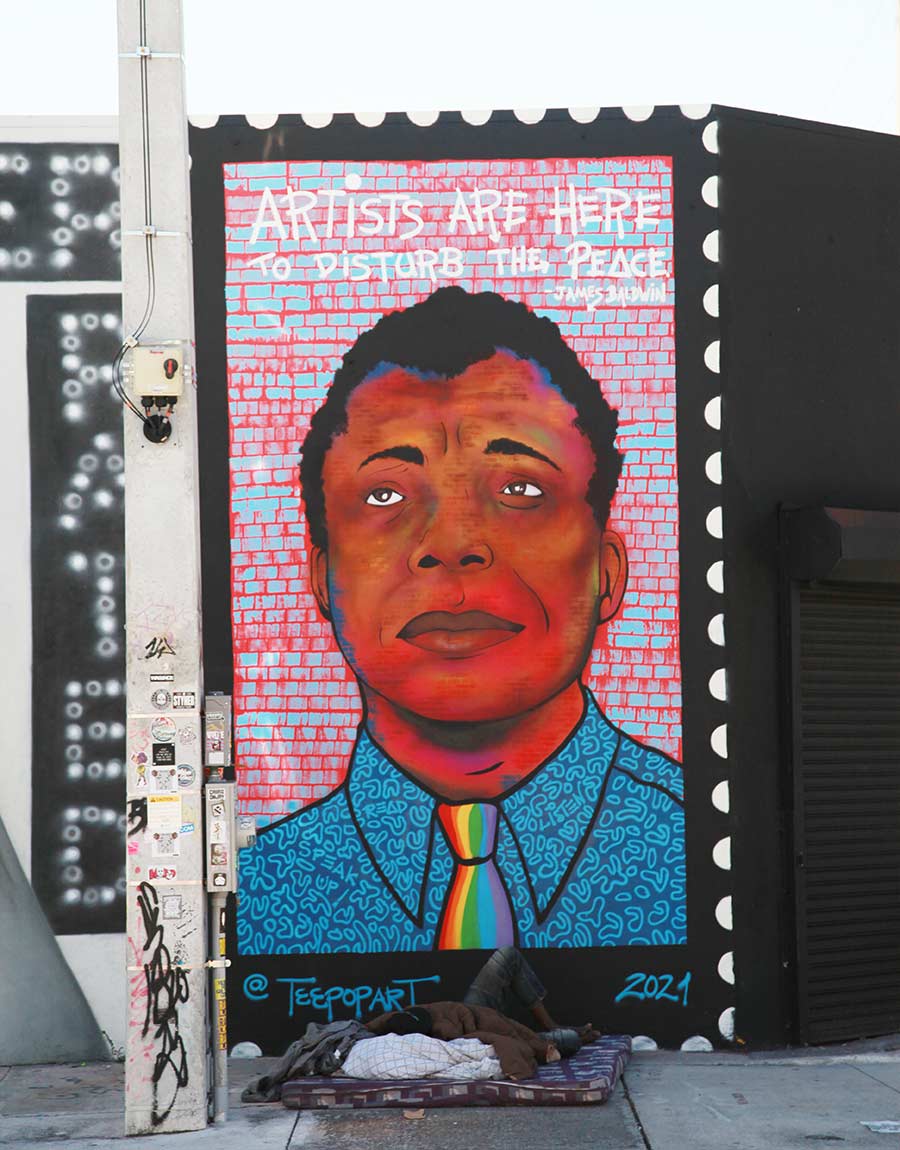
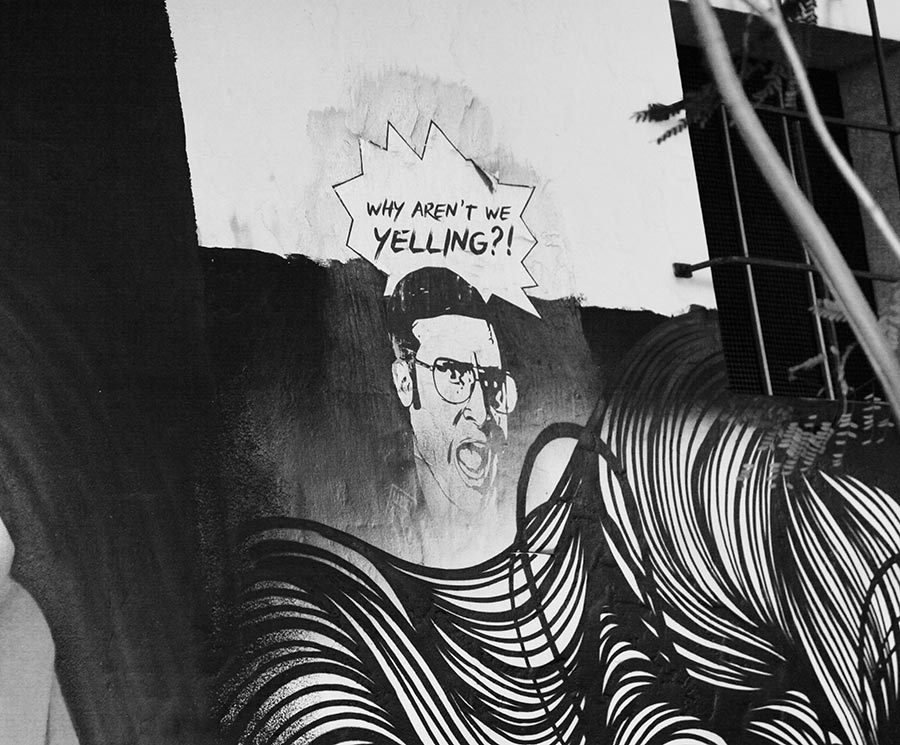
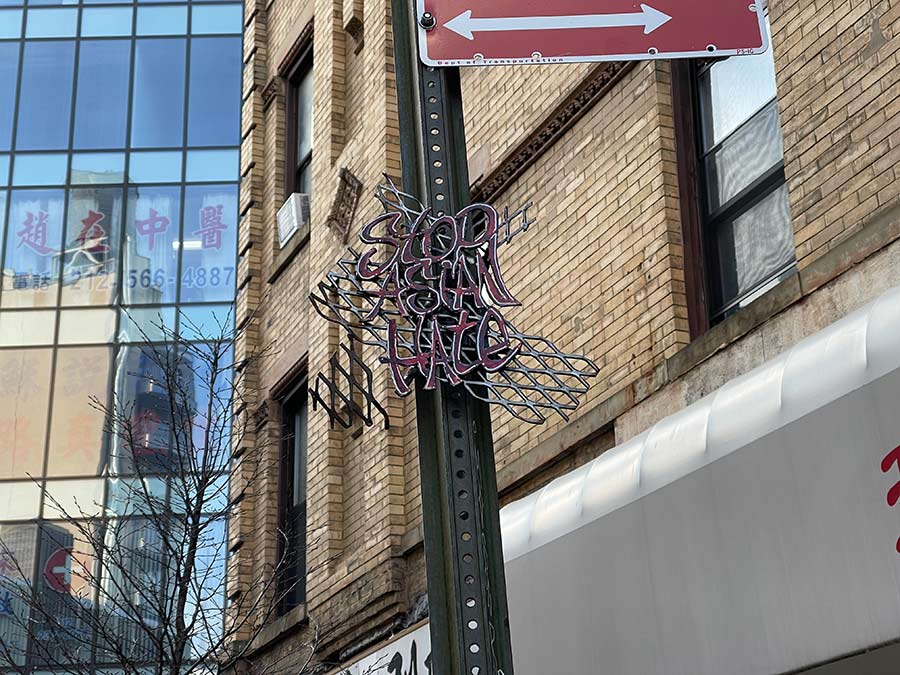
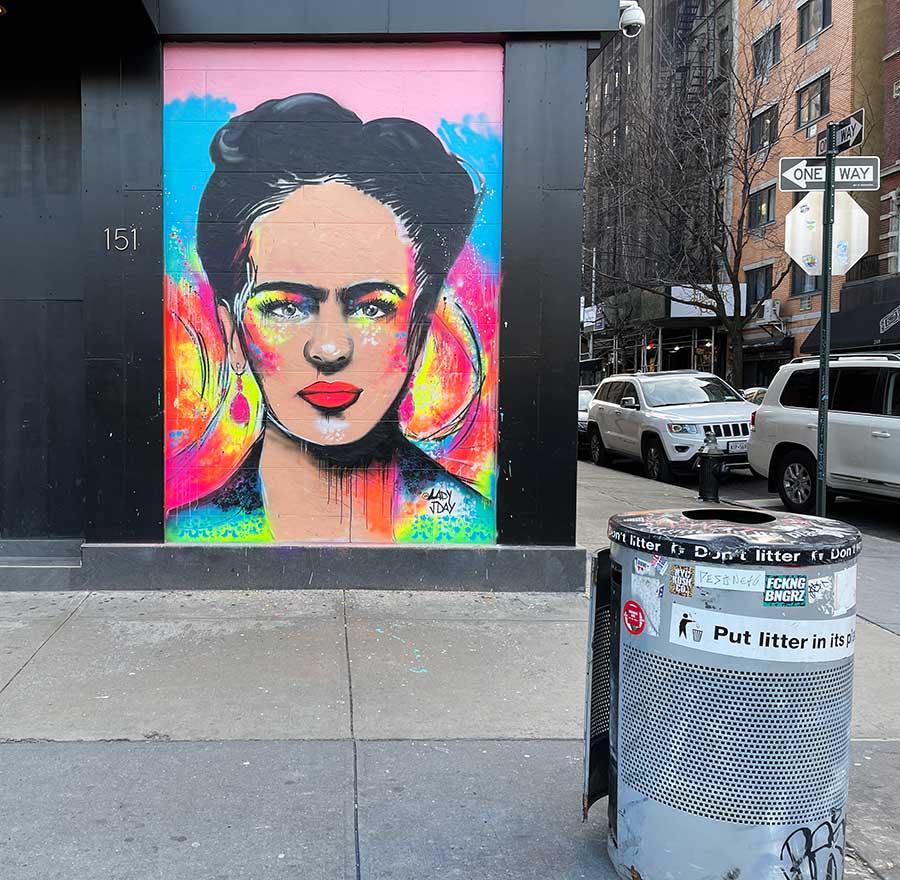
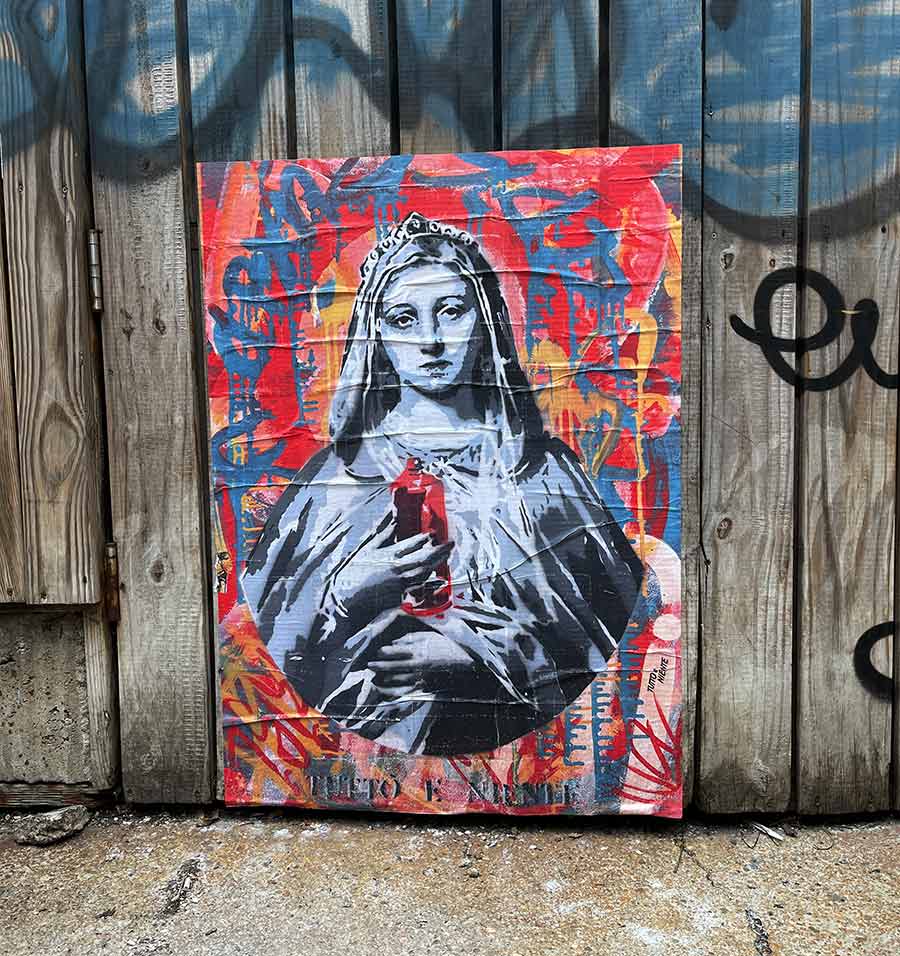
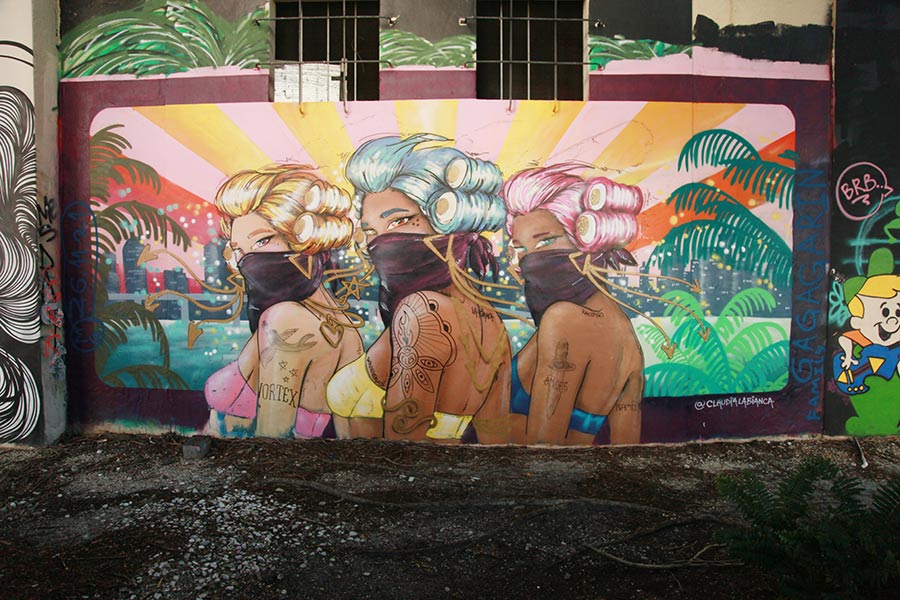
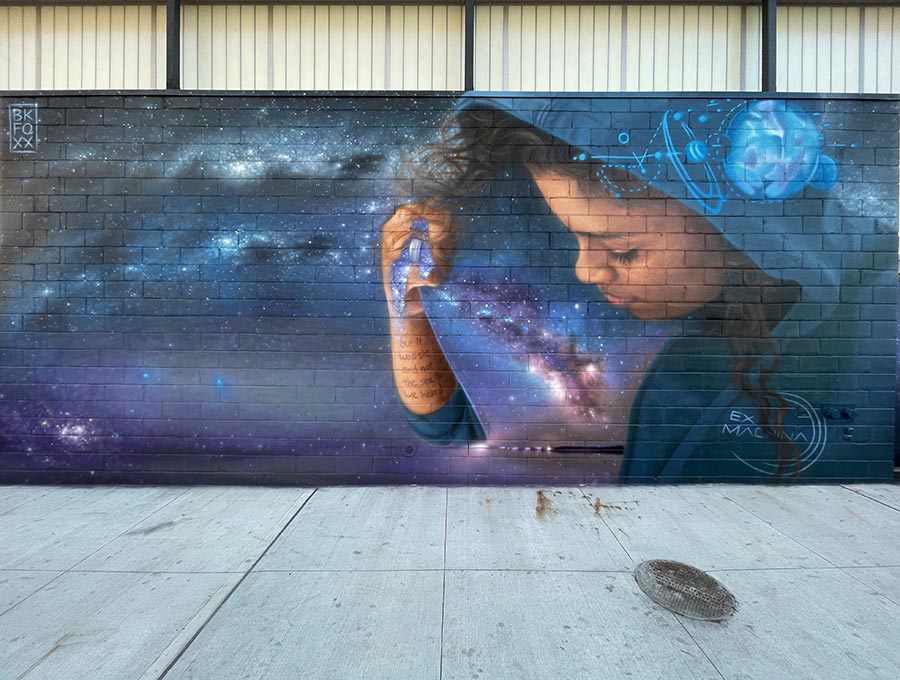
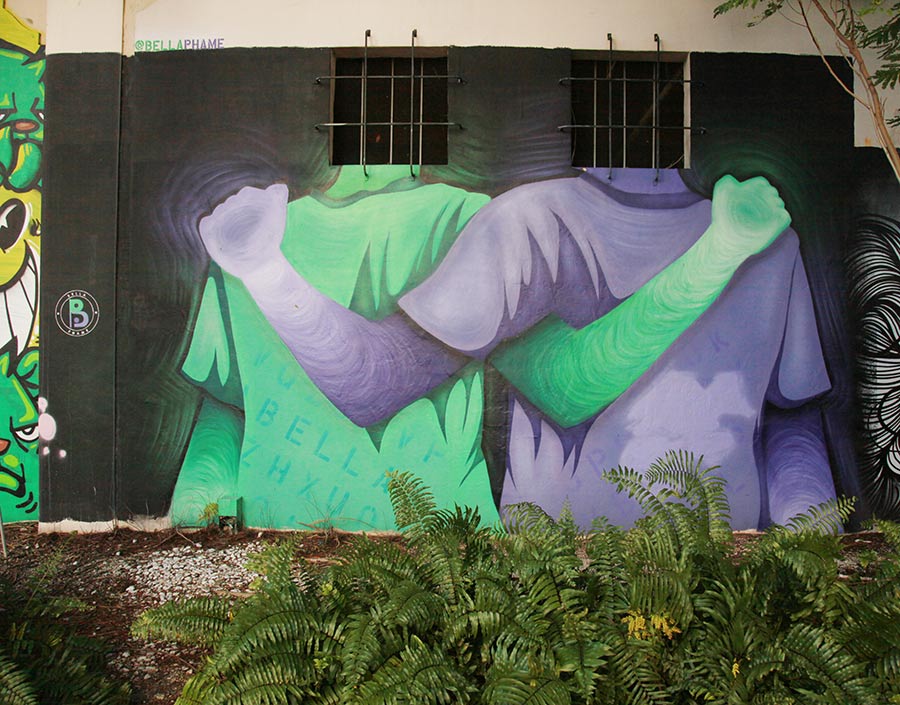
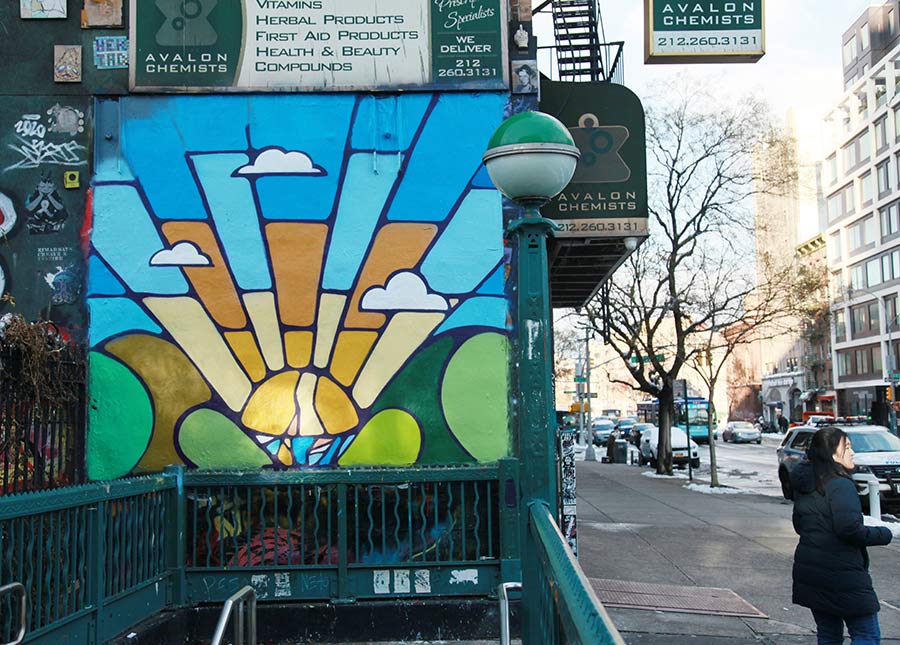
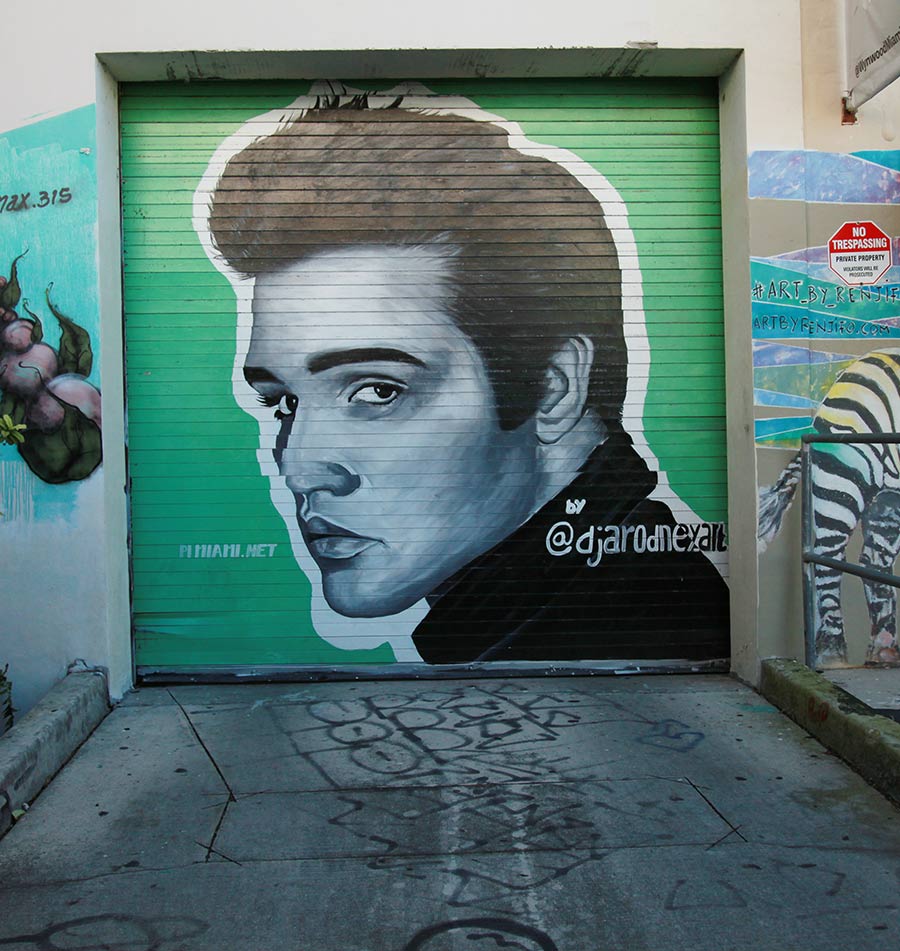
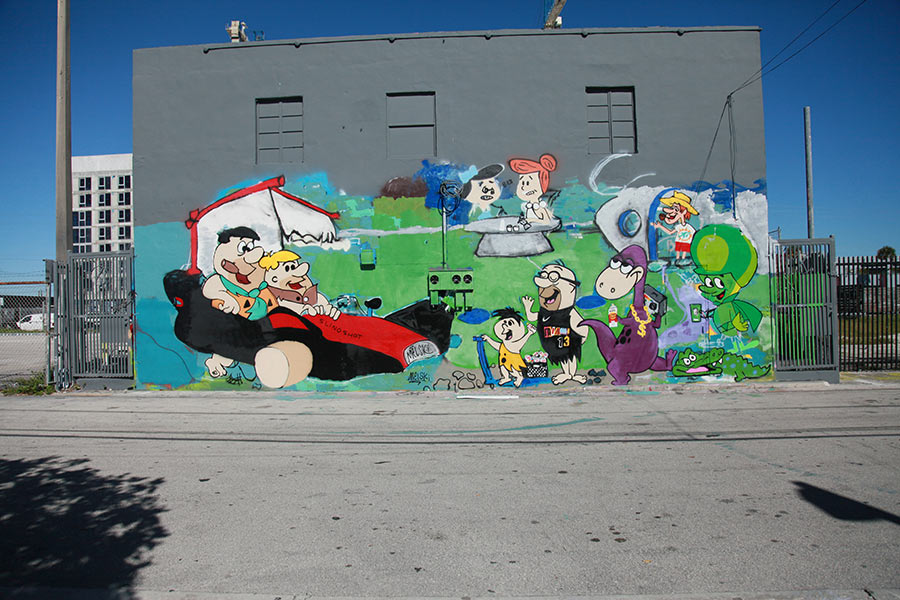
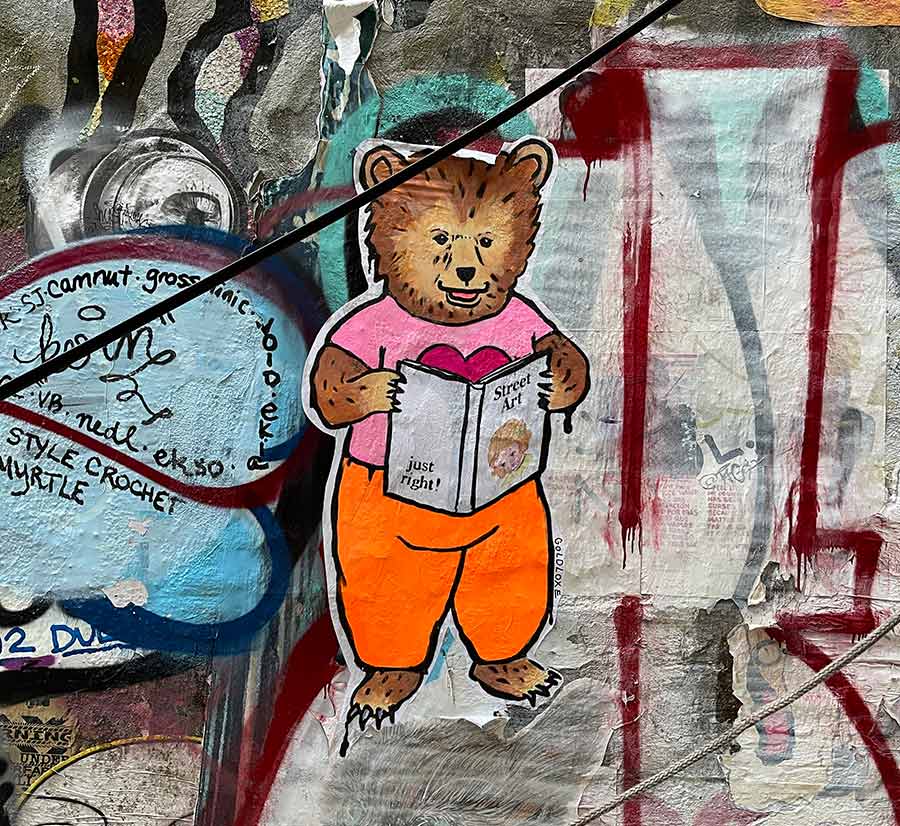
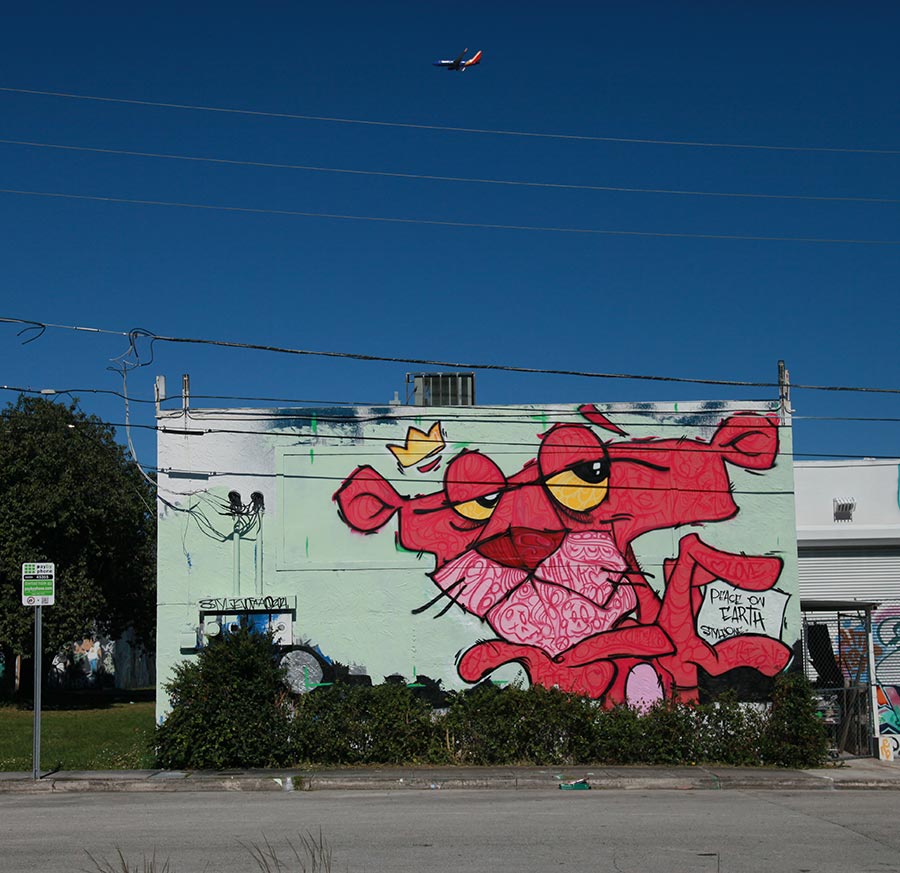
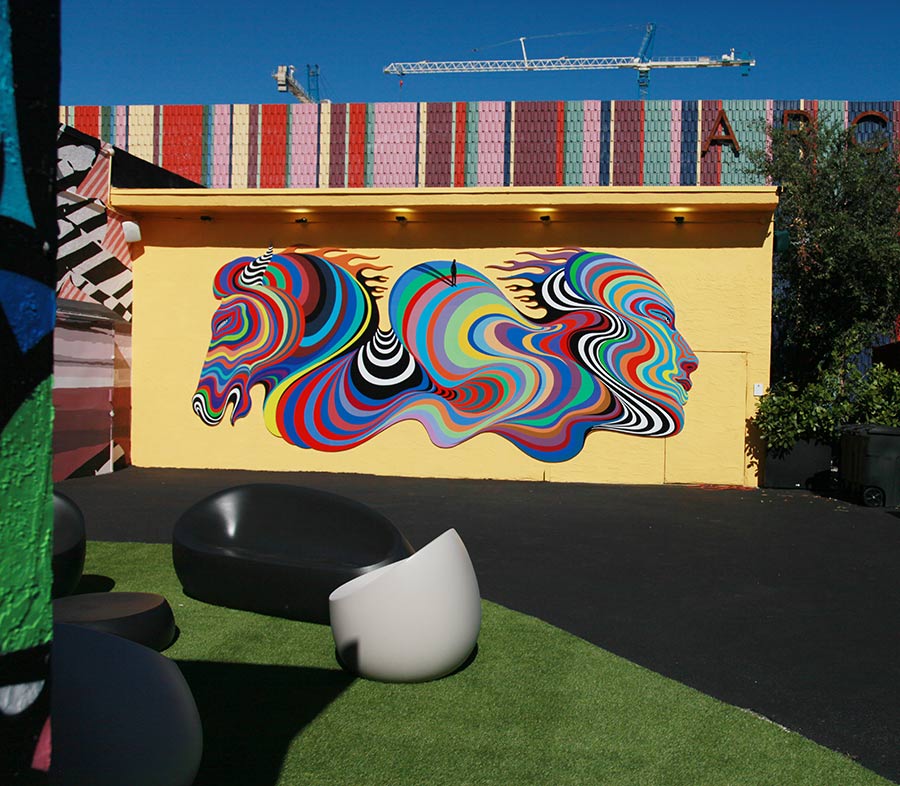
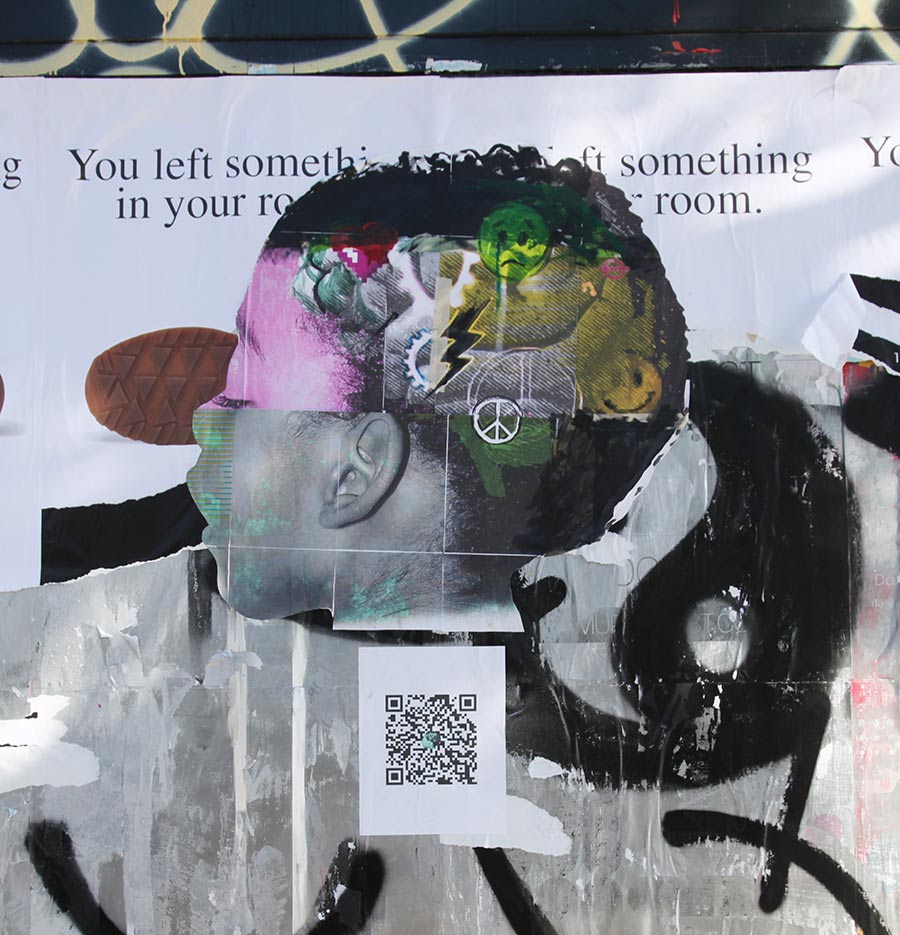
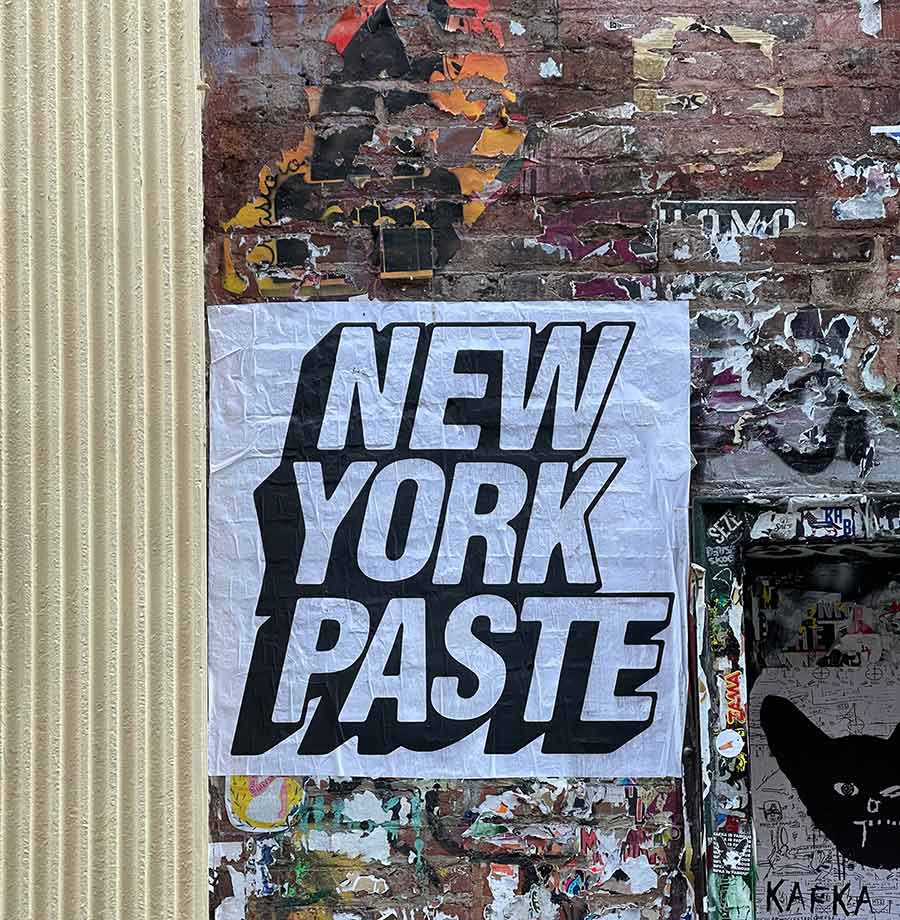
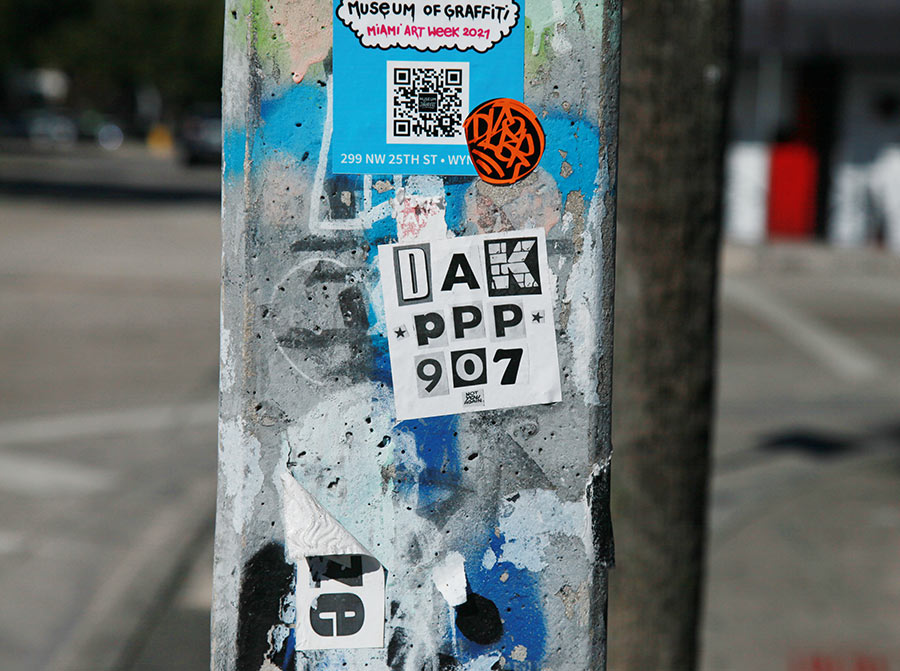
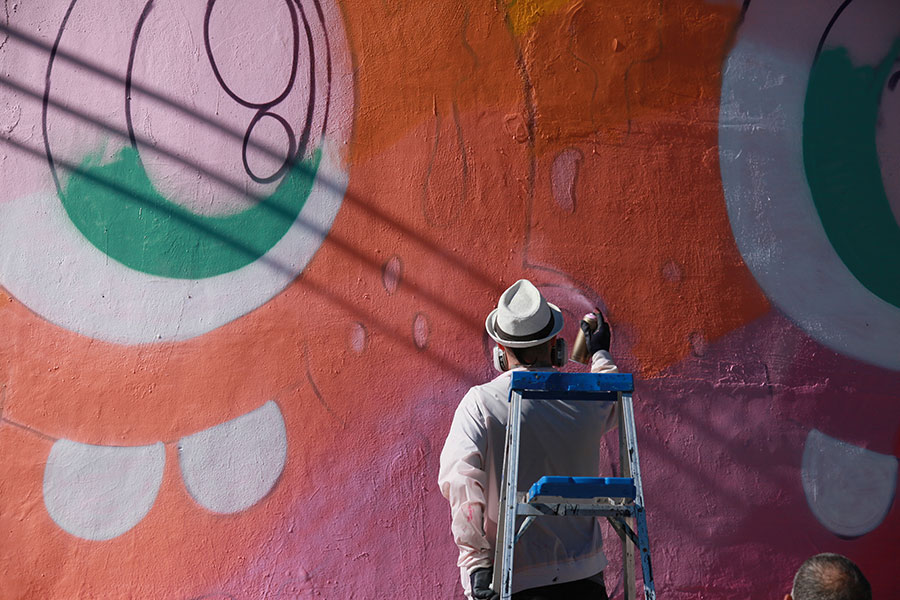
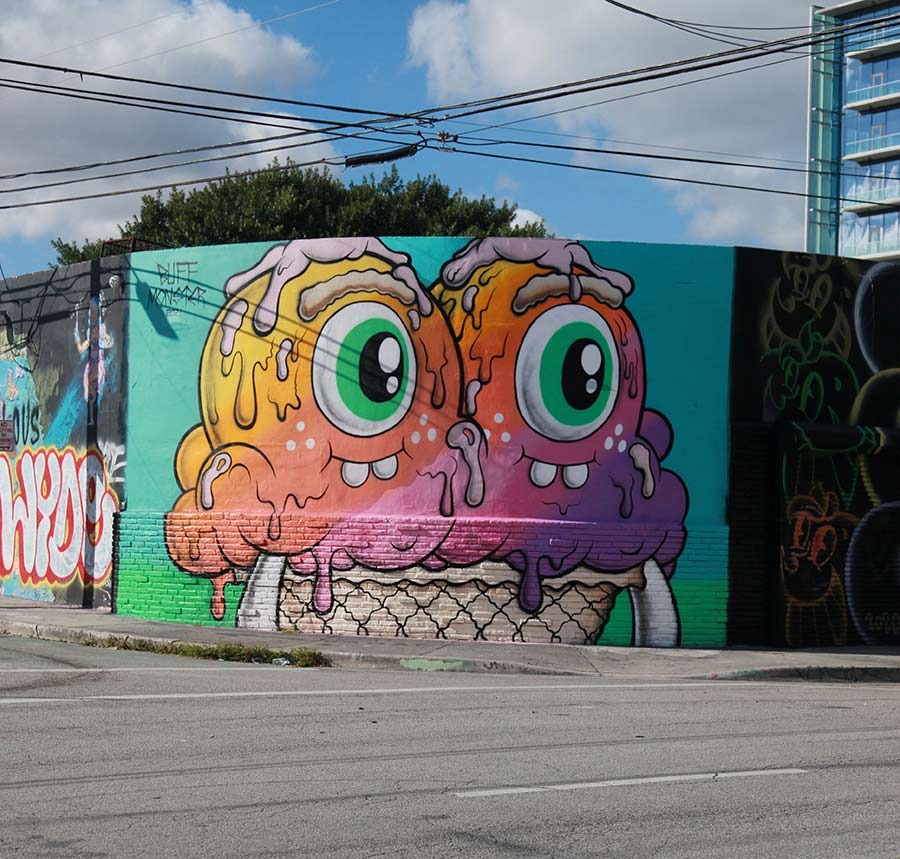
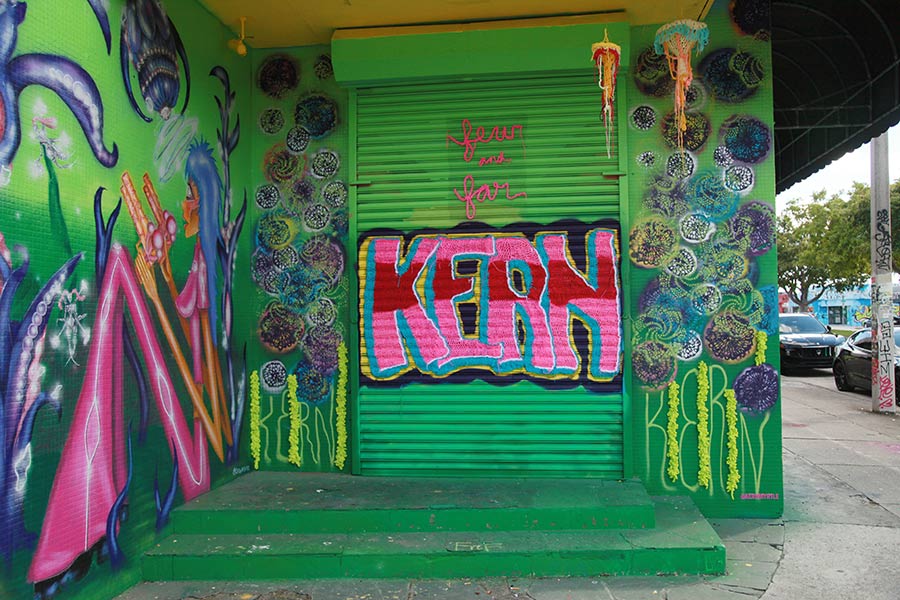
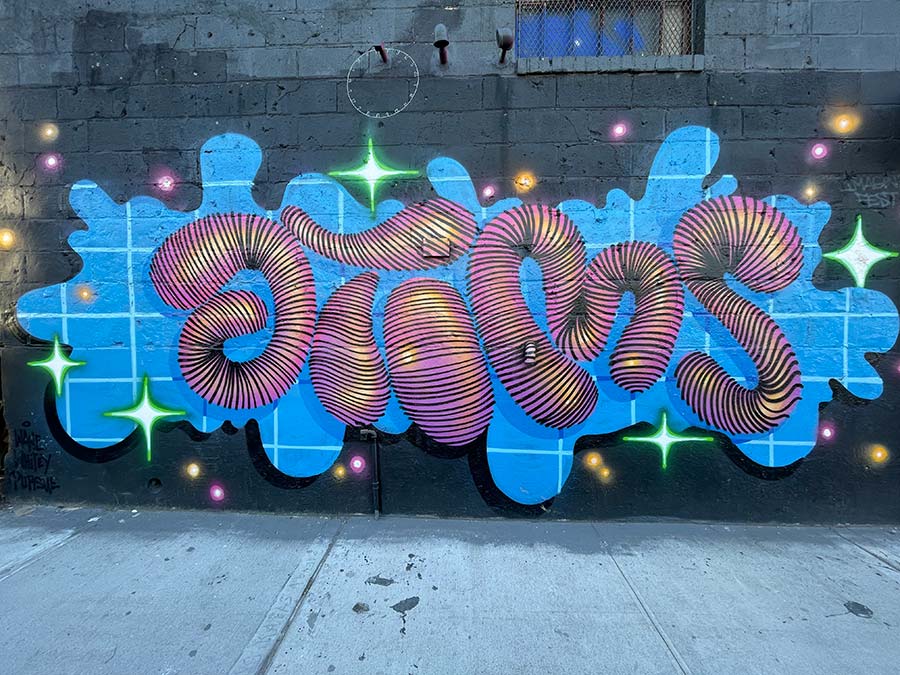
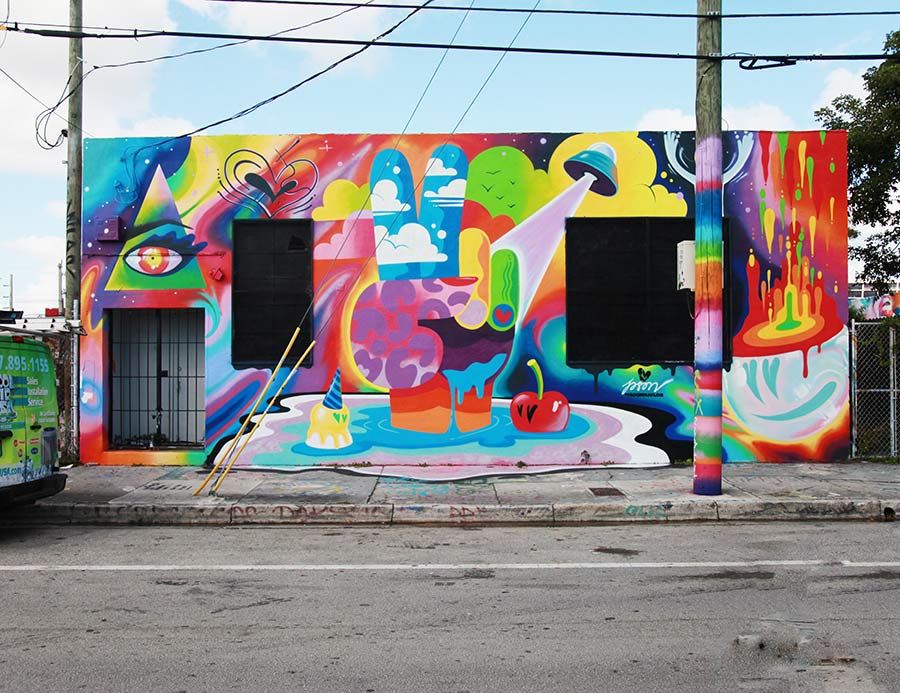
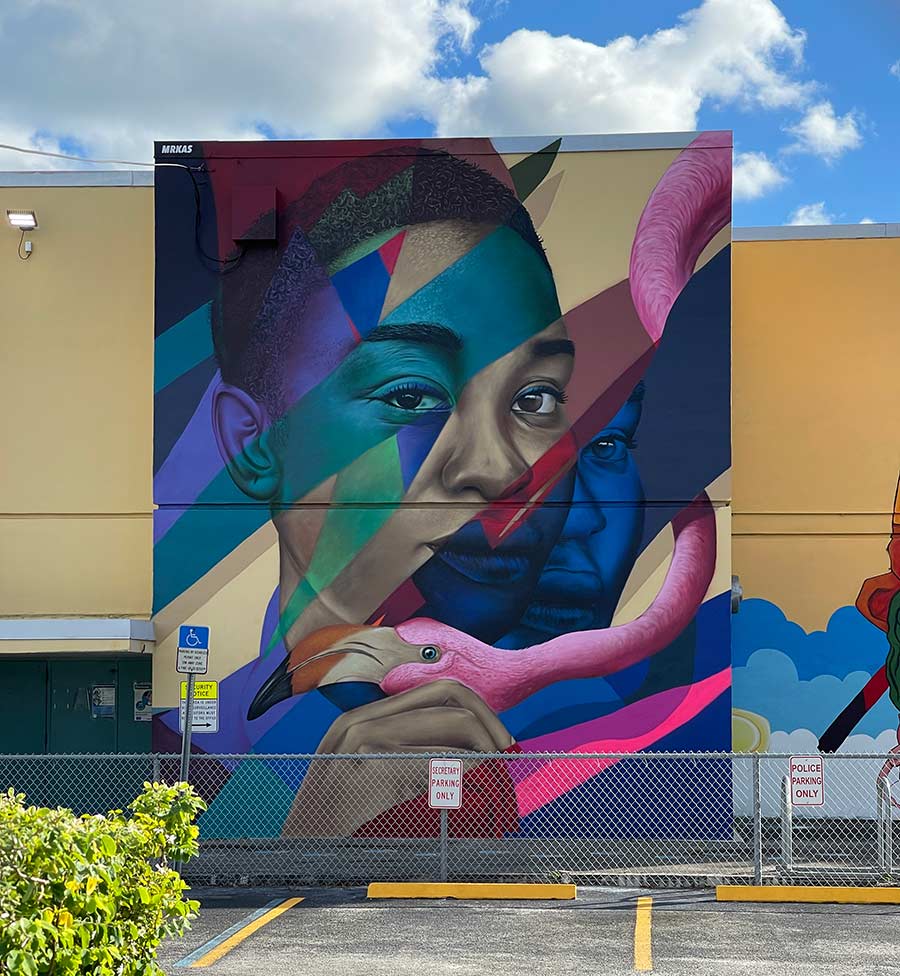
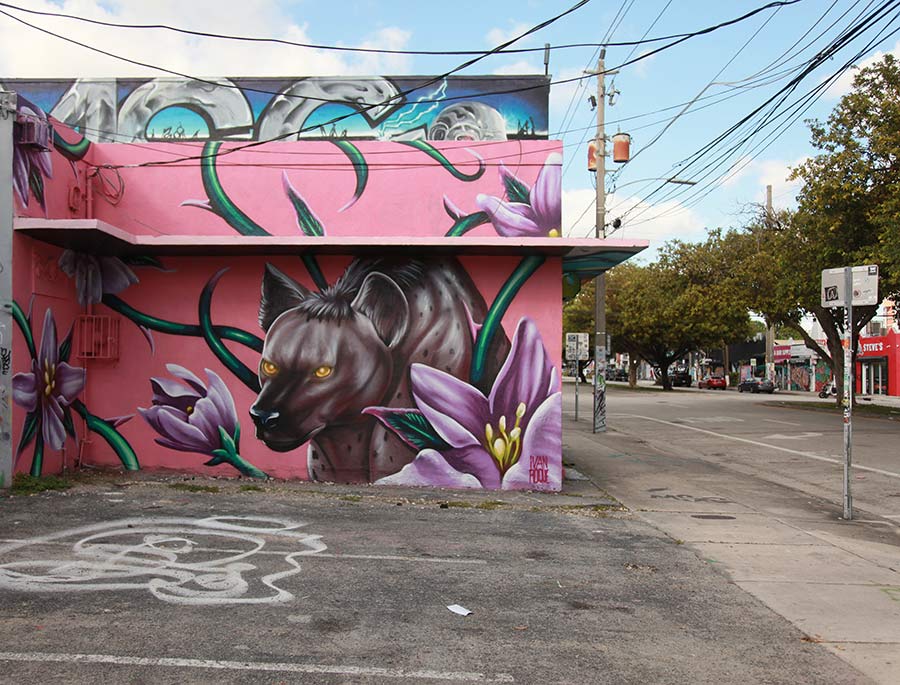
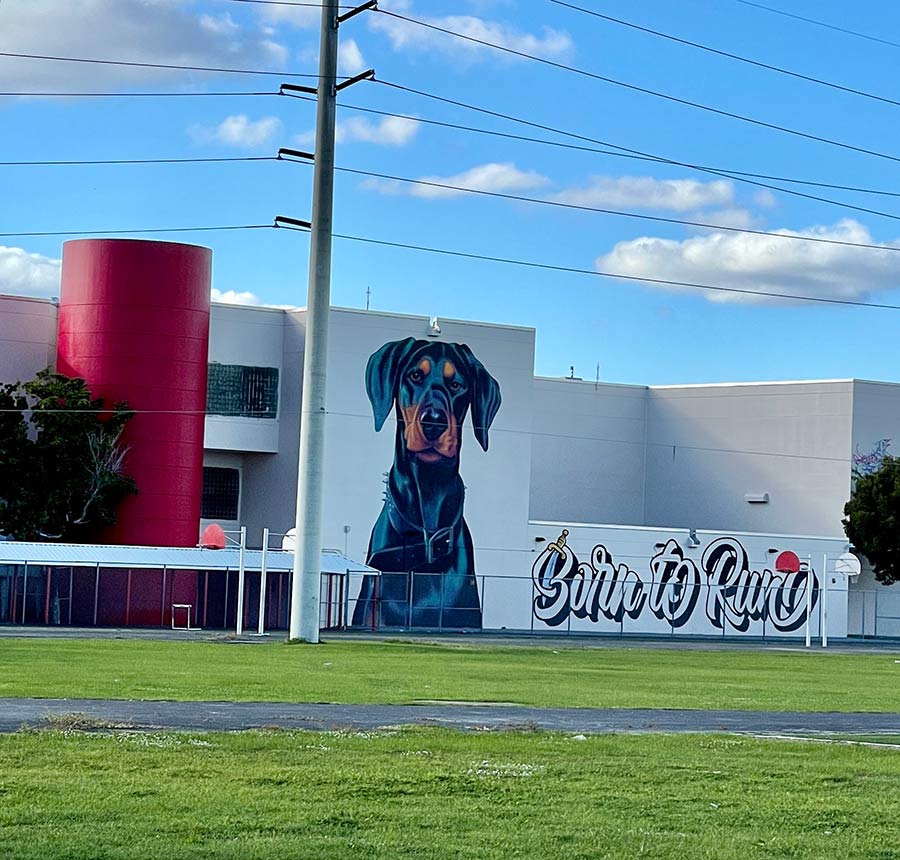
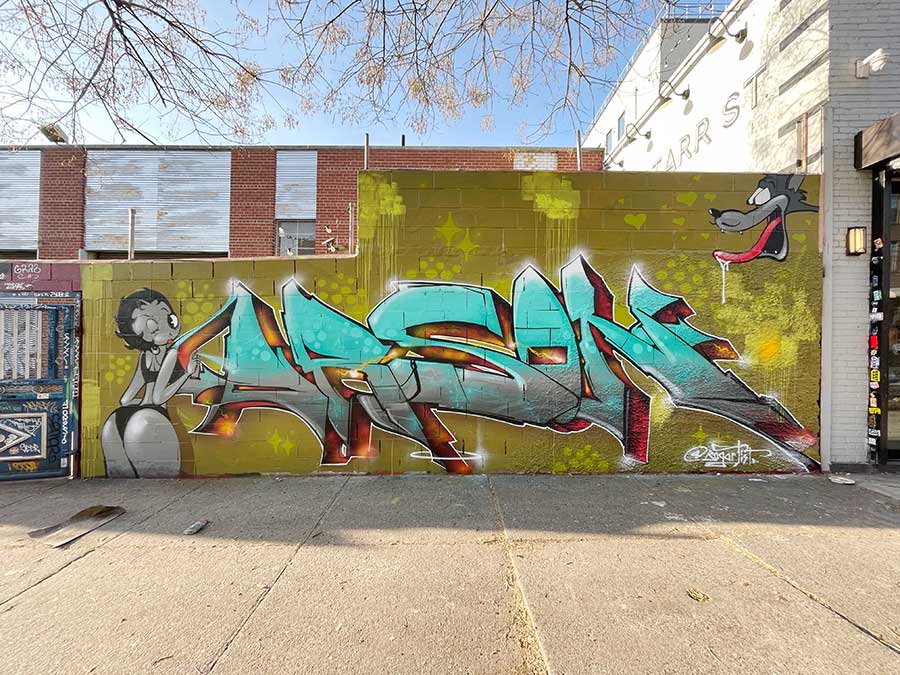
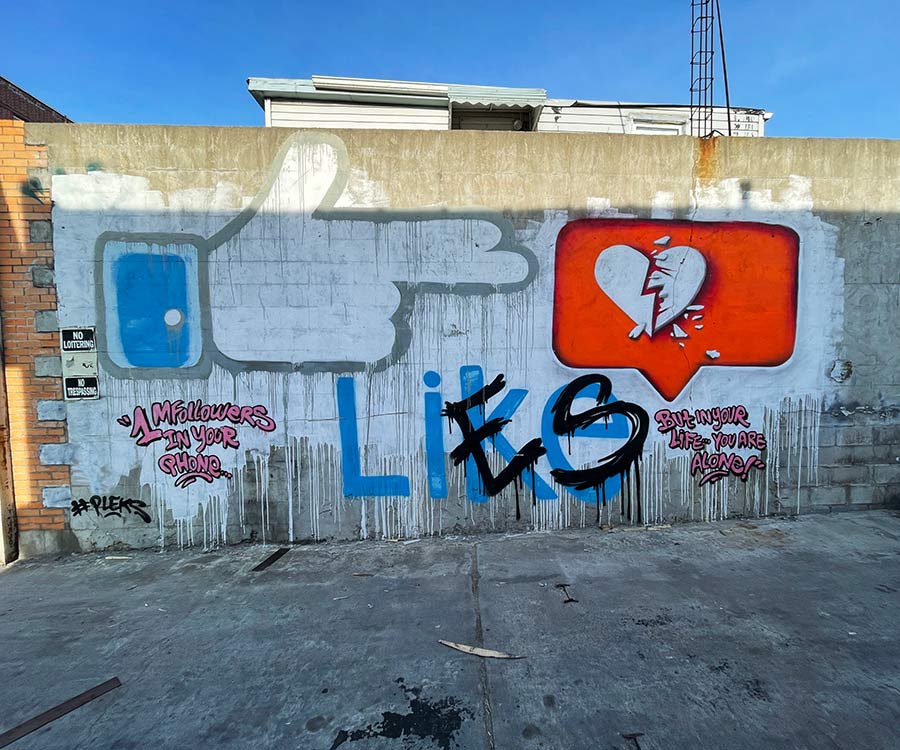
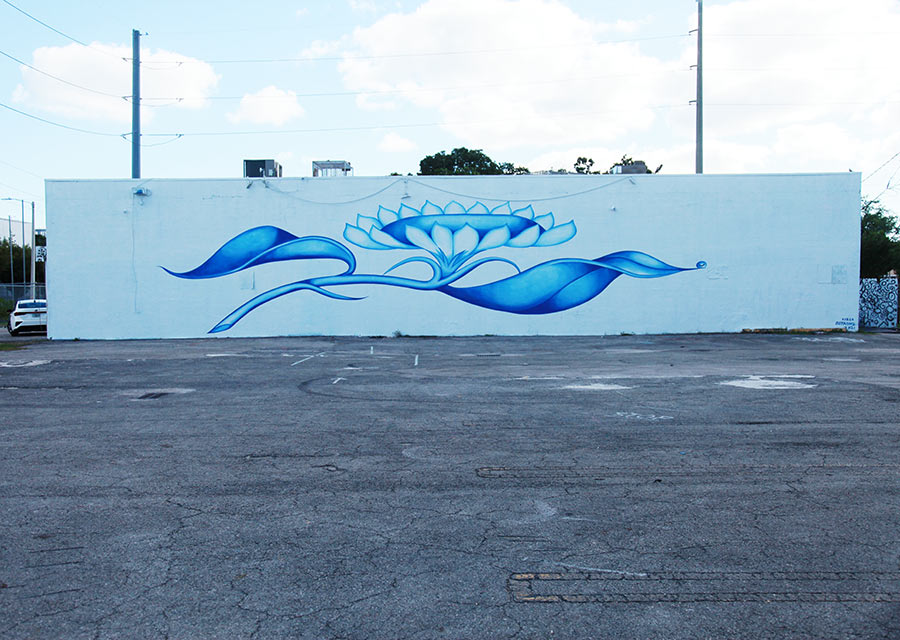
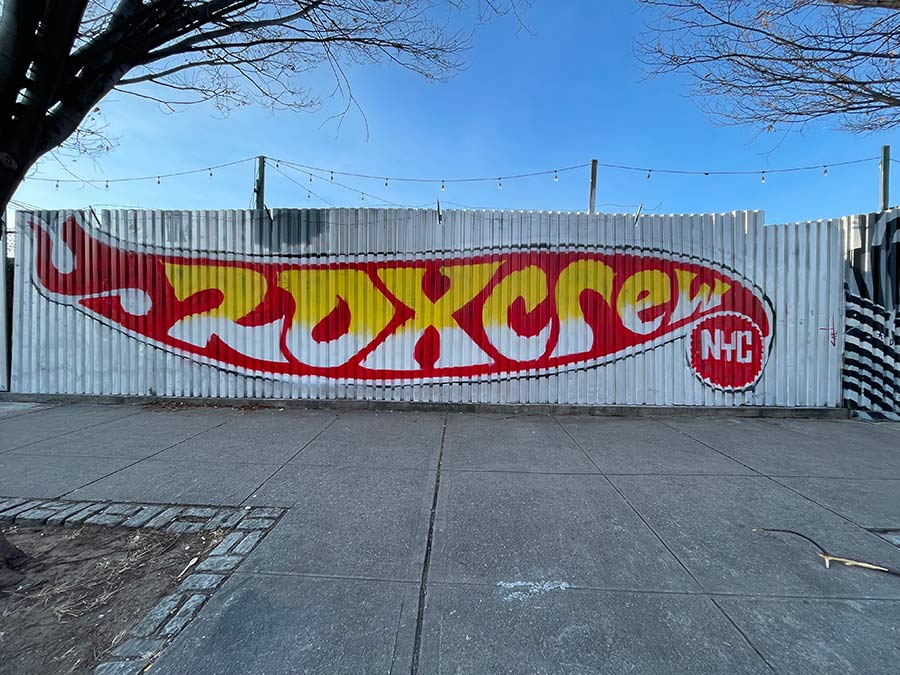
So here’s our weekly interview with the street in NYC and Miami, featuring Beautiful Mind, Bella Phame, BK Foxx, Claudia La Bianca, DAK PPP 907, Dek2DX, djaRodney, Gina Kiel, Gold Loxe, JJ Veronis, Lady JDay, Melski, Rumba Art, StyleOne, Tee Pop Art, and Tutto & Niente.
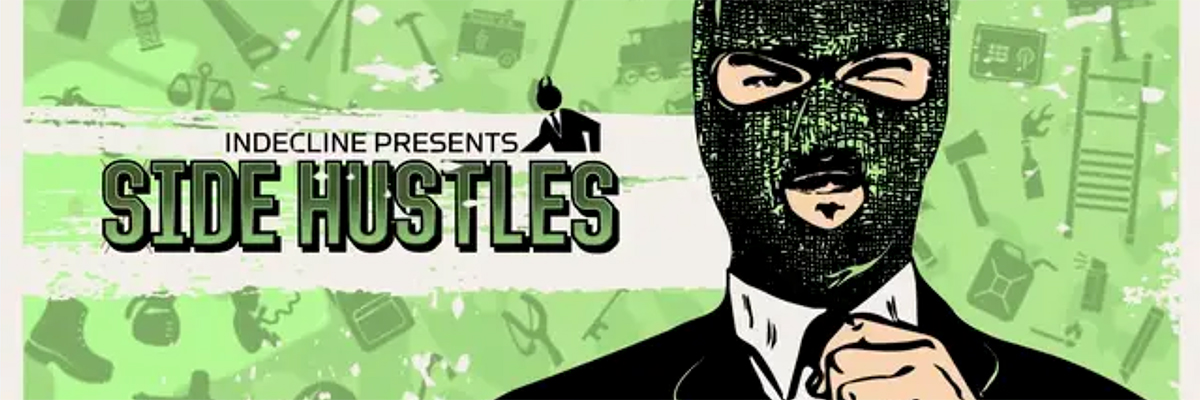
(VIDEO BELOW) To highlight their accomplishments and escapades during 2021 Indecline debuts a full feature movie titled “Side Hustles” today.
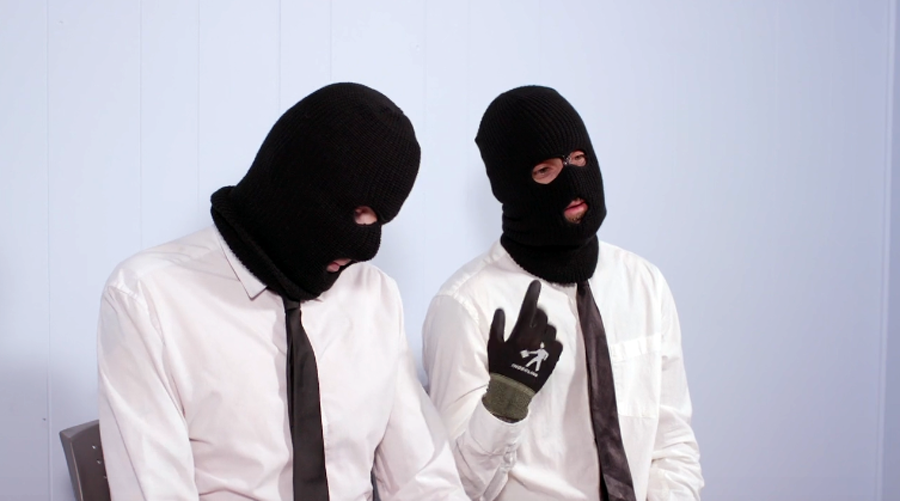
Ultimately, it’s a show reel of greatest hits by the activist subverters of public space called InDecline – loosely strung together by an ongoing skit of a formal job interview that seeks to further illuminate the message, but sometimes tires. Anonymous by necessity, this mid-length docu-portfolio gives little indication of the origination of the mainly young, mainly white, and mainly male masked American protagonists of the street art/performance art scene, but you have an idea that it is their politics and disgust that bind them as one.
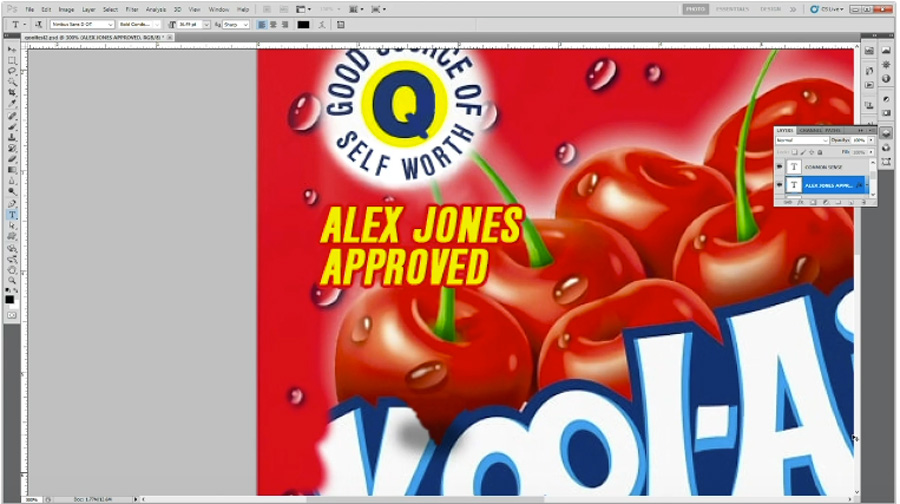
The various installations range in skill, sophistication, and maturity – but something invariably impresses about each campaign. Clever Photoshop and elbow grease, and you’ve got yourself a subversive art installation that mocks both Easter and Q-Anon. A harrowing cable scaling of a massive statue of Christ to hang a pro-abortion banner looks far more dangerous and physically demanding.
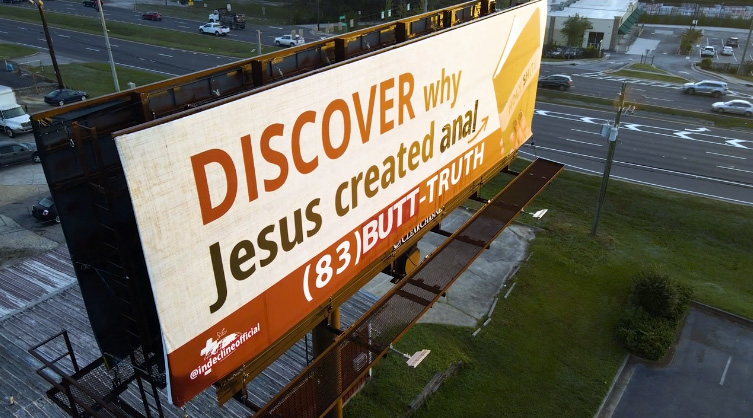
Subverting a billboard to encourage masturbation is perhaps a bit of comic relief from the far heavier topics they target: Busting anti-abortion billboards to offer abortion services contact information, shining a light on police violence, and offering a no-holds barred criticism of a culture that births weekly mass shootings in cities nationwide.
Their methods may be driven by the economics of printing and installing their brand of détournement but the effect can be stunning and direct. A billboard showing off a gunmakers line of ammo says proudly “Born Here. Built Here” across a silhouette of the US map. It infers a national pride, a dedication to the 2nd Amendment, a nod to blue collar labor, and a healthy wallop of xenophobic distrust. InDecline simply replaces one word so the slogan says “Born Here. Killed Here” to refocus attention to the bodies piling up from coast to coast.
Whether its riding freights to spread the ashes of a friend or an earnestly rageful powerchord punk and/or bluegrass country soundtrack or the corporate cluelessness of local news footage, if you stay for the full ride you see the themes that drive the work – and feel a hopeful promise, and a sense of dread.
Canaries in the coal mine for a decade or so in public space, InDecline’s multiple acts of art show how the trendlines all merge. By the time you are finished with the list of societal/political/socio-economic ills that InDecline is addressing through their guerilla art installations, you realize that the country they are responding to is already in the midst of a civil war and the forward path is scabrous.
Previous interventions BSA reported on appear HERE, HERE, HERE, AND HERE.
Our weekly focus on the moving image and art in the streets. And other oddities.
Now screening: 1. Dave Kim & Eric Burke in Alameda 2. INDECLINE: “SIDE HUSTLES” Trailer 3. The Greek Bar Jacket
BSA Special Feature: Dave Kim & Eric Burke in Alameda
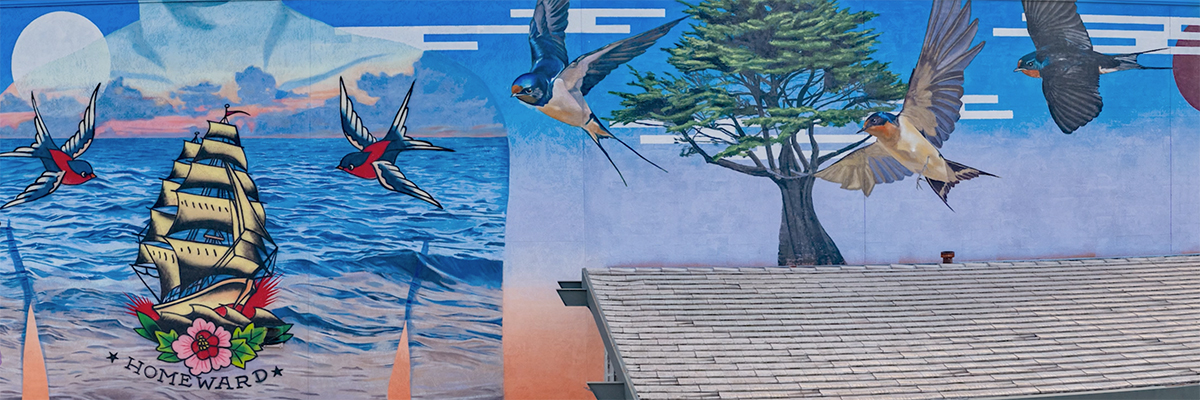
Muralists Dave Kim and Eric Burke create an iconic piece for Alameda’s West End on a prominent wall on Webster St.
INDECLINE: “SIDE HUSTLES” Trailer
Stay tuned for tomorrow’s release of the full movie here on BSA
The Greek Bar Jacket
Here’s an hour and eight minute film from the House of Dior. It tells us about the making and the evolution of a collection. There’s no surprise to discover that many fabled collections have been inspired by ancient cultures and their peoples. This particular collection is a tribute to Greece and the designers’ challenge is not to appropriate directly from the culture or make it look like a museum. This film is an excellent complement to the current exhibition at the Brooklyn Museum: “Christian Dior: Designer of Dreams” currently on view until February 20th.
It may be a challenge to identify the through-line when it comes to curation of artworks at an auction house exhibition. Selections are predicated on the availability of artworks at the moment and the exigencies of the market. And 30 additional variables.
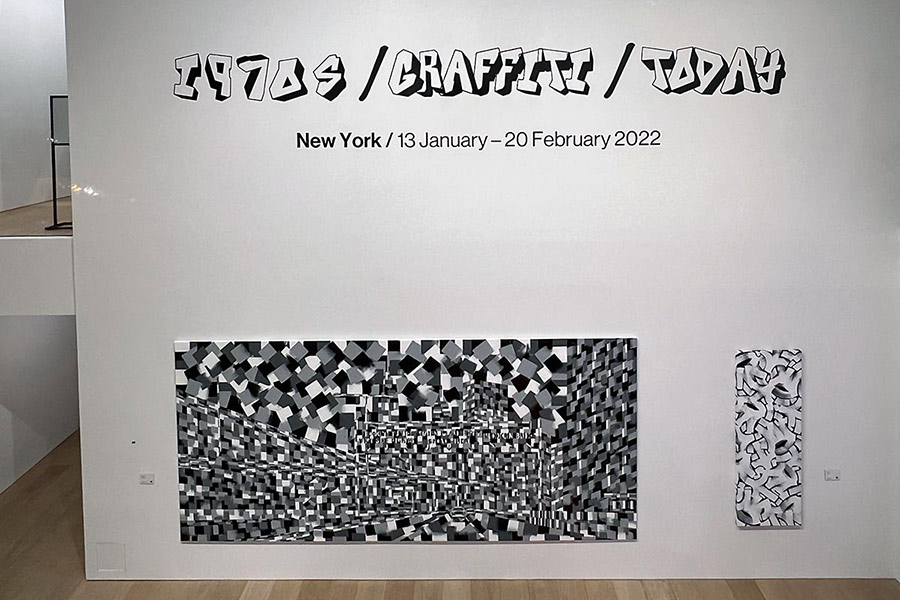
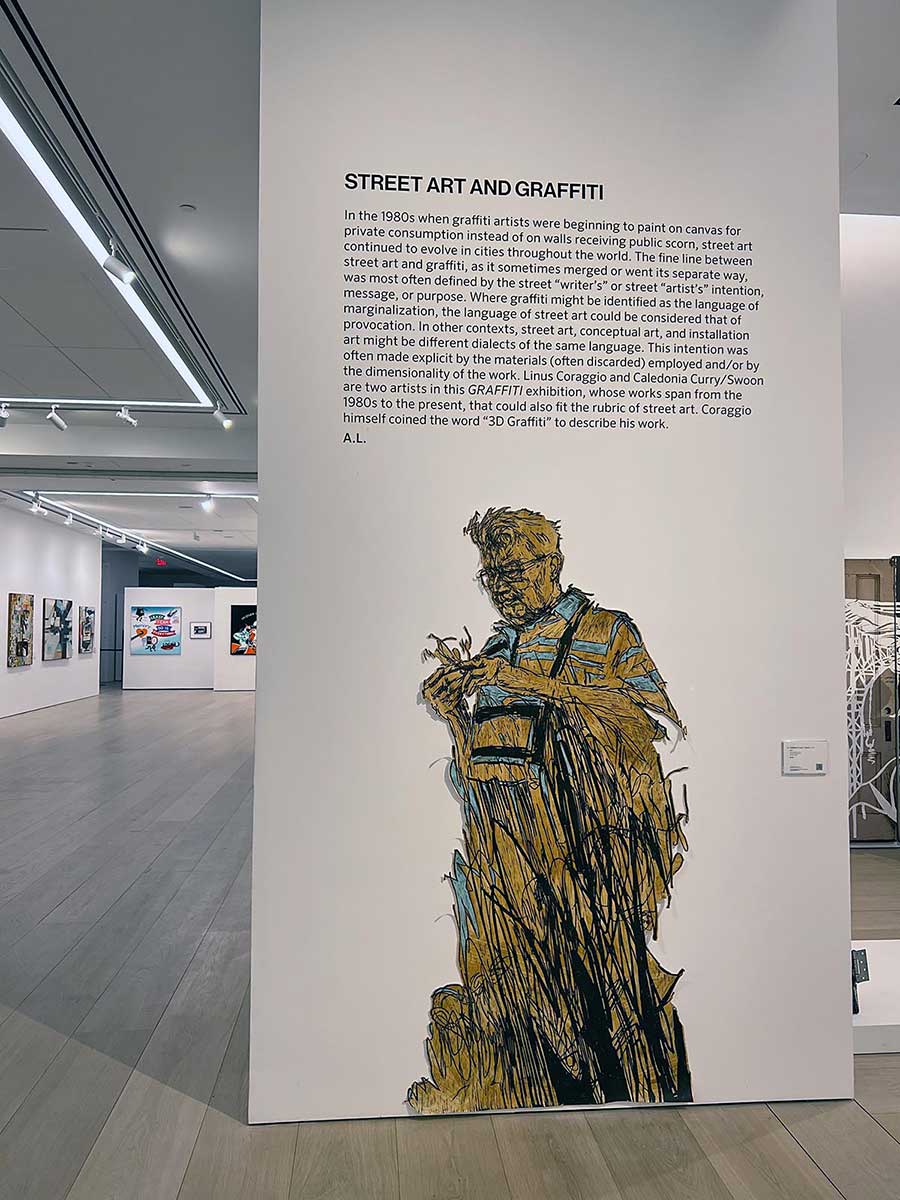
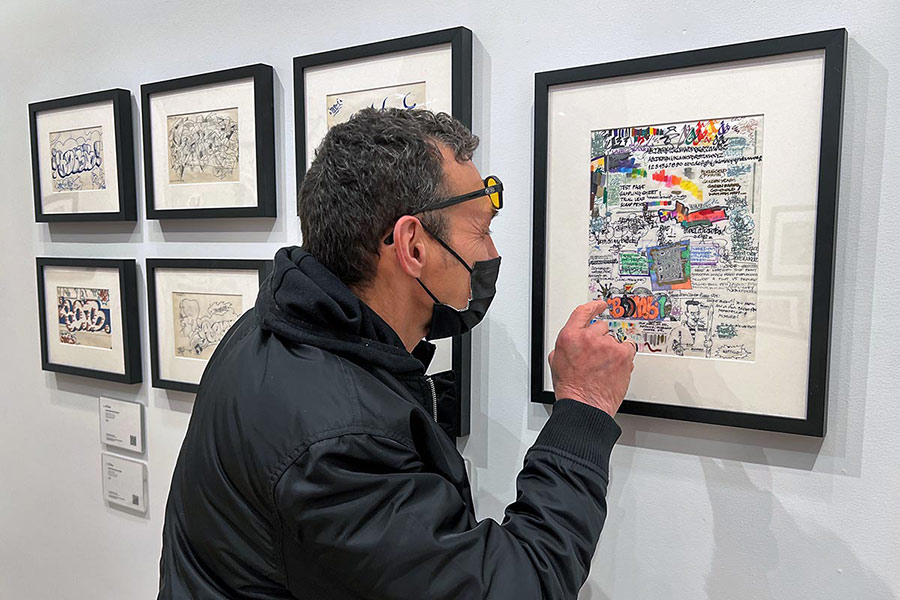
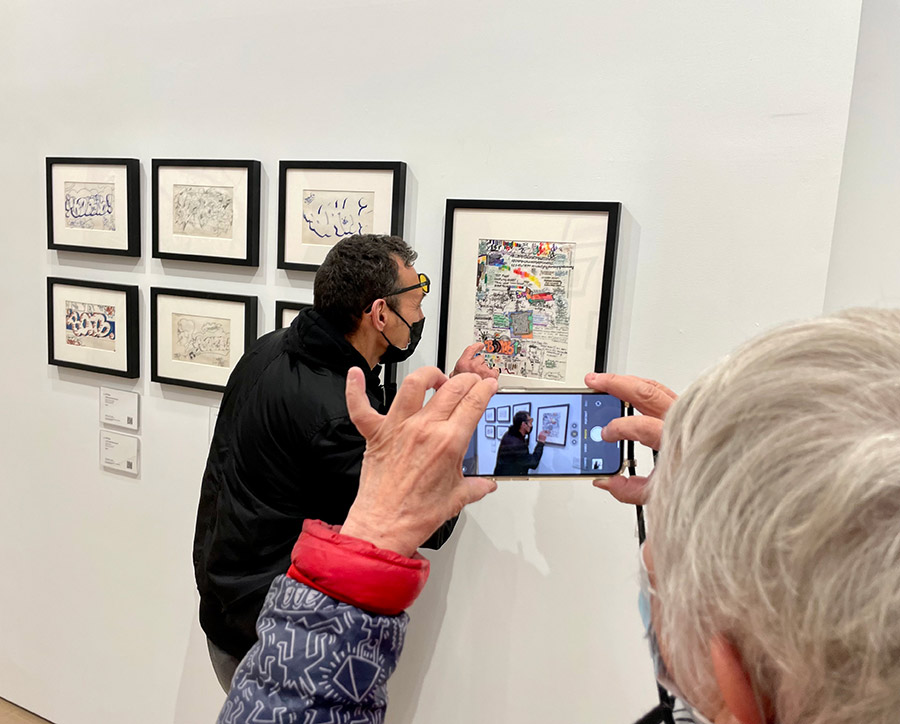
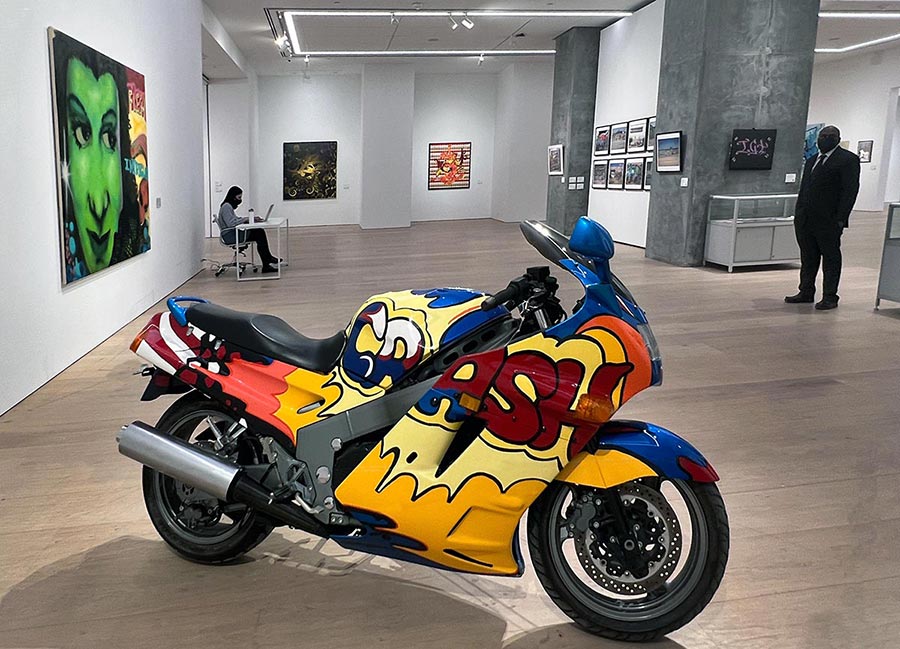
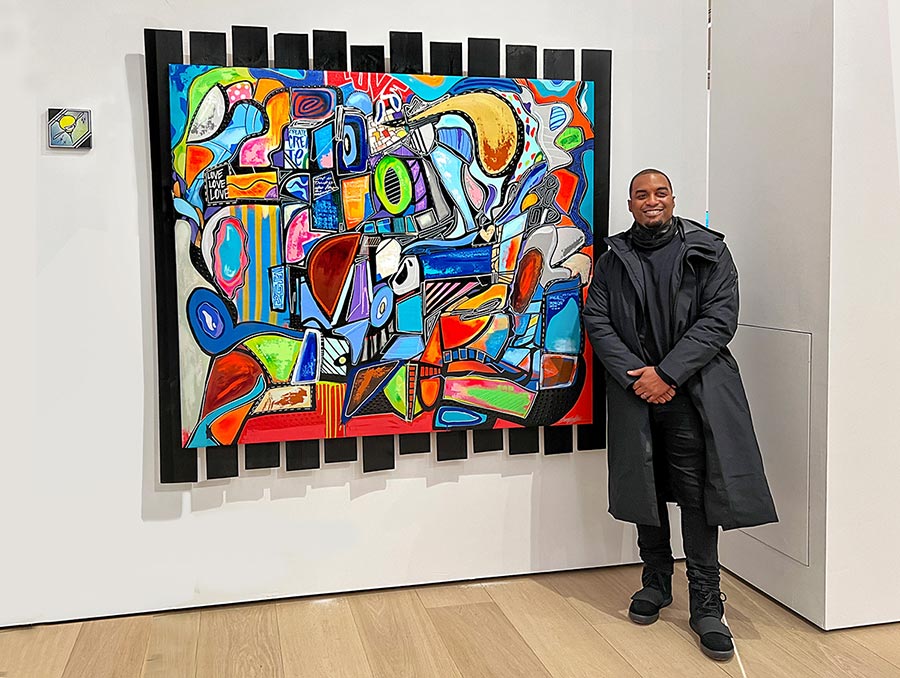
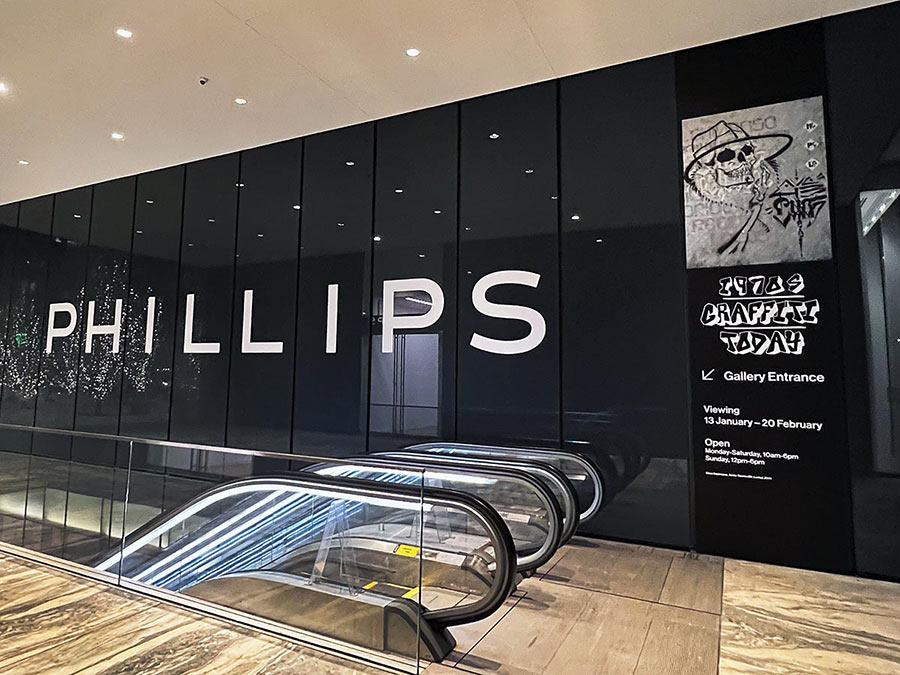
You will however see a warm confirmation of greater themes in the new exhibition at Phillips auction house that opened last week entitled 1970s / Graffiti / Today, and you’ll leave enriched by the experience. With the works of 30 or so artists on display for approximately a month, it is not intended to be a comprehensive survey, yet it manages to spread a wide net over a number of scenes, practices, and personalities working on US streets during the previous five decades.
There is a vastness to this scene, its people, its practices, its histories, its quality variations. As evidenced by a show like this, there is now a general acceptance of the street-born form of visual expression called graffiti, its various hybrids expressed broadly as street art, and the onward march of certain forms of both toward acceptance as contemporary art. As suggested by the title, you’ll probably see a good representation of each here, and one or two will strike you as quite impressive.
Curator Arnold Lehman is a recognized champion of that march forward, most notably for when he shepherded the “Graffiti” exhibition as Director of the Brooklyn Museum in 2006. That show, one of the first museum shows dedicated to the movement, featured 20 large-scale canvasses by graffiti artists that were donated by the estate of famous mid-century New York gallerist Sidney Janis, who had shown a number of them in the early 1980s.
A native New Yorker, Lehman grew up with graffiti on the trains and easily recognized the contributions it was making to his city and the culture. When he had an opportunity to introduce the works as an exhibition, he says he faced much opposition, despite the fact that it came from the collection of a gallery owner who was celebrated for introducing most of the emerging leaders of abstract expressionism, the Fauves, the Futurists – and later the proponents of Pop.
“He began showing graffiti in his gallery in 1981 or 1982,” Lehman says of Janis when speaking of the canvasses he organized in the Graffiti show at the Brooklyn Museum. “A number of my colleagues were quick to write and say, ‘Have you lost your mind?’ “
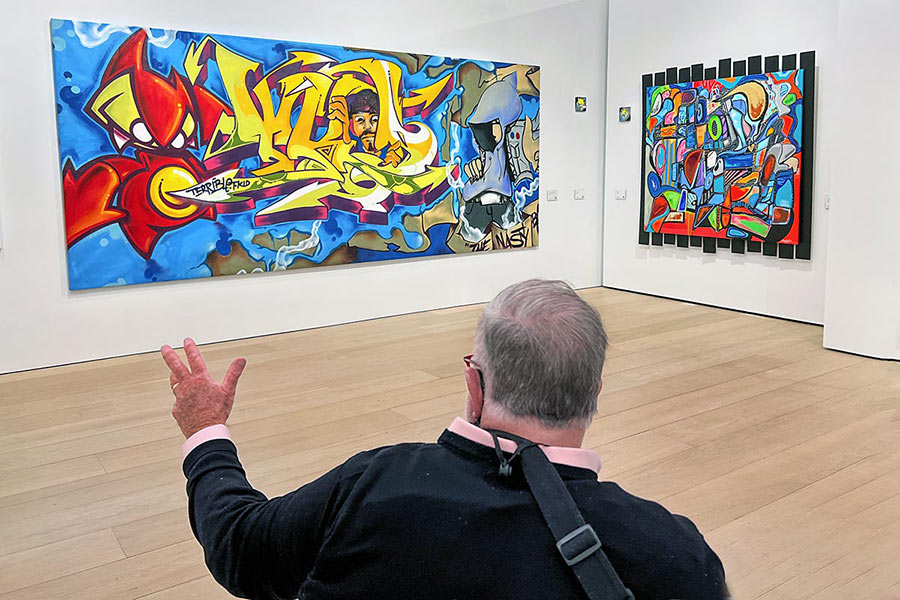
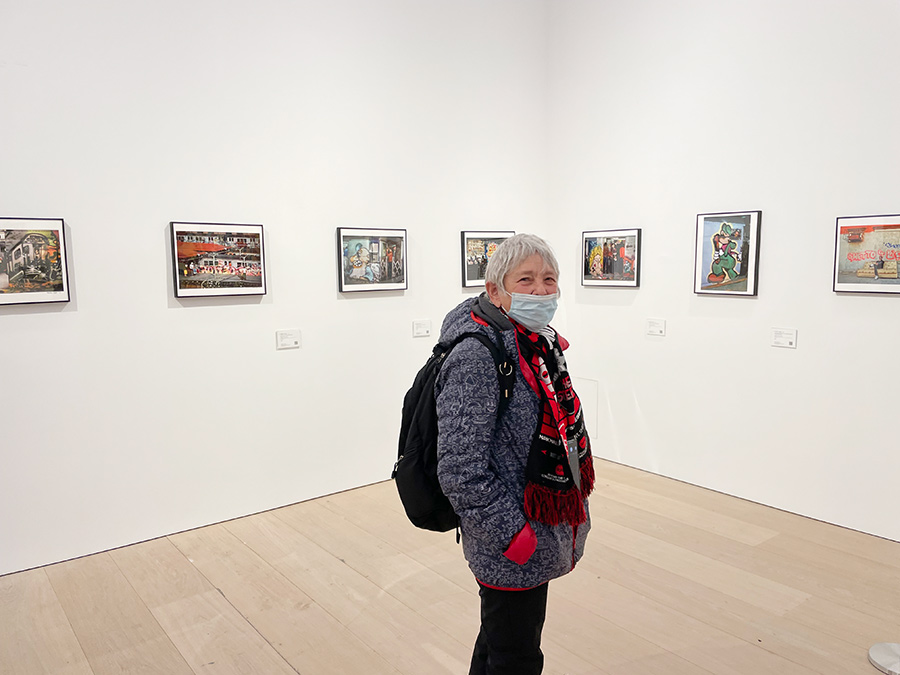
Five of those same canvasses provide an anchor in the timeline here, supported with early photos and light ephemeral documentation of the burgeoning graffiti scene on subway trains and elsewhere in New York. This city and its streets and culture figure prominently into this collection of about 150 pieces, with Mr. Lehman estimating for us during a recent tour that the mostly US-focused show is divided into two-thirds New York and one-third Los Angeles.
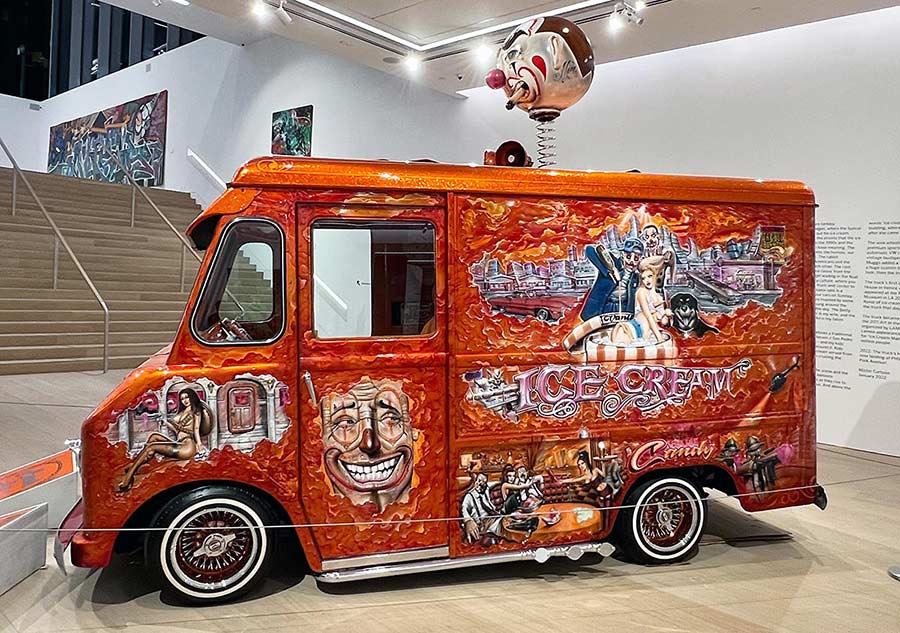
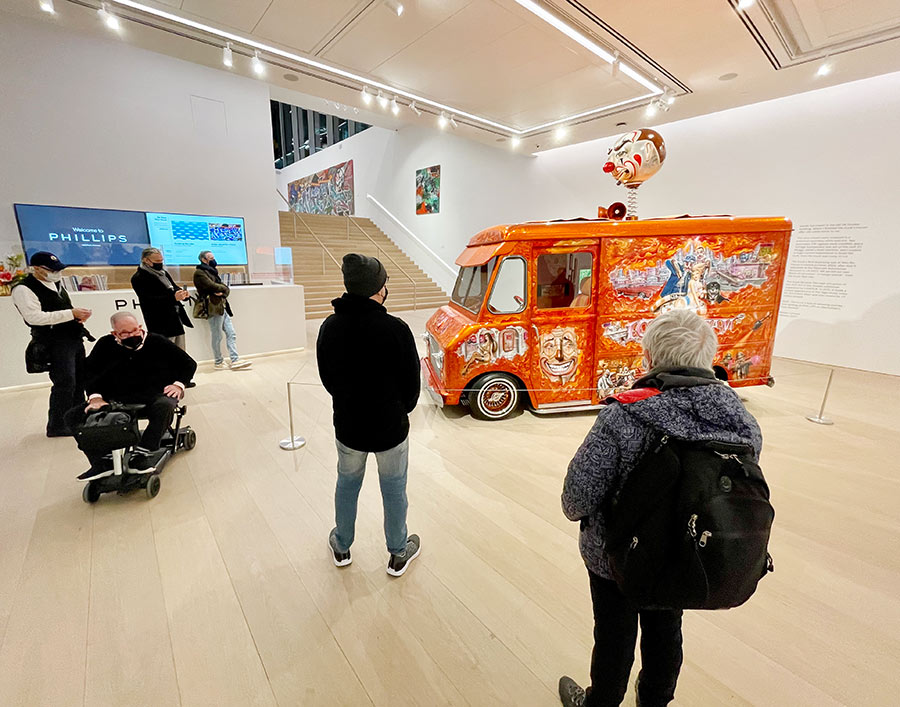
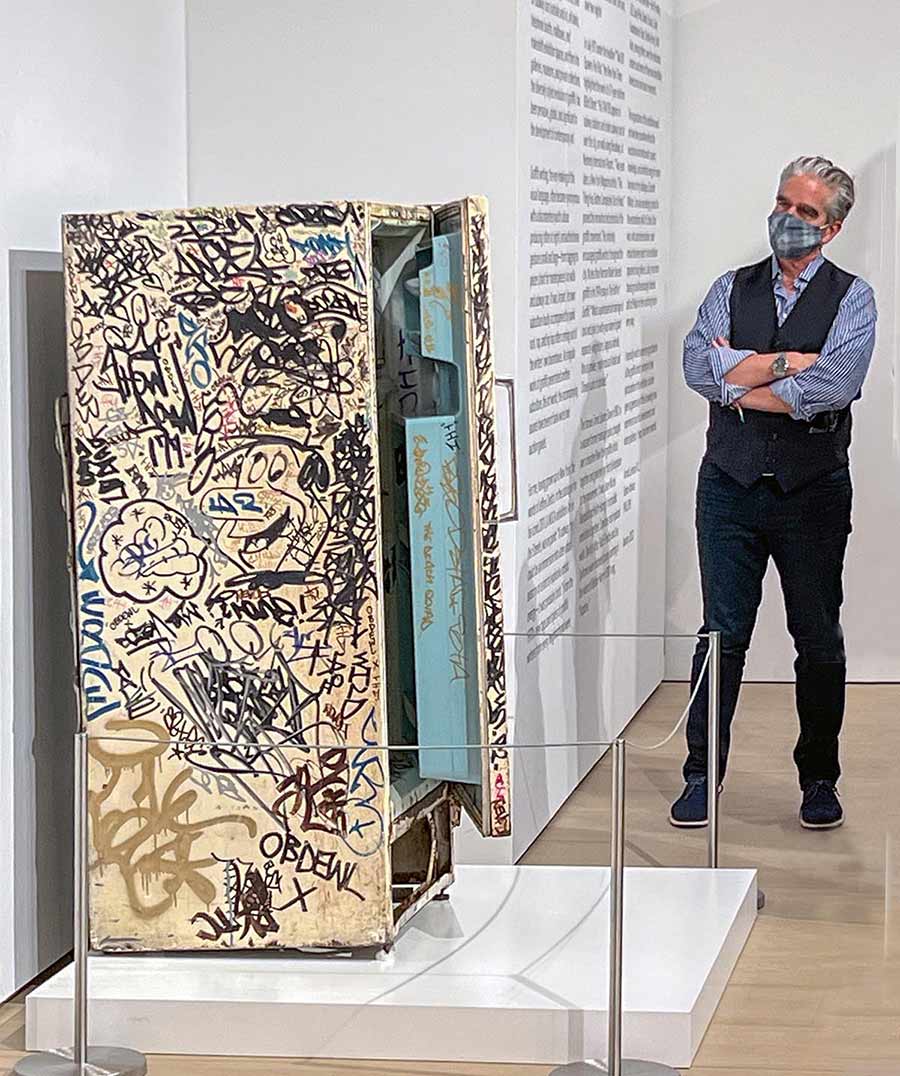
“The artists we are showing really deserve a presentation like this,” he says as we walk through an exhibition of individual expressions that are as varied as the kind of people who’ll typically ride a subway car; drawings from sketchbooks (Al Diaz), stenciled canvas (Chaz Bjorquez), photographs (Martha Cooper, Gusmano Cesariti, Steve Grody, Cheryl Dunn), elaborate “wood paintings” on welded steel sculpture (Faile), canvasses by early generation graffiti pioneers (Fab 5 Freddy, NOC, Daze, Lady Pink, Toxic, Haze), repurposed metal subway signs (Julius “T. Kid” Cavero), a slickly painted motorcycle (Crash), mixed media collage (Augustine Kofie) a refurbished ice cream truck (Mr. Cartoon), a repurposed bus stop poster (KAWS), an acrylic painting on scrap metal (Margaret Kilgallen), a mounted neon sculpture (Risk), paper cutouts pasted on found wooden doors (Swoon) and a heavily tagged Fun Gallery refrigerator hit up in the early 1980s by people like Basquiat, Haring, and Futura.
The newly completed Phillips gallery is ironically and literally underground. Its thousands of square feet lie just below the Park Avenue street level, lending a hidden secretive quality to it. Nevertheless, the massive venue sports triple-height ceilings and a vast marble spaciousness that allows for mounting and lighting a variety of gallery sizes, shapes, and volumes. It’s also free.
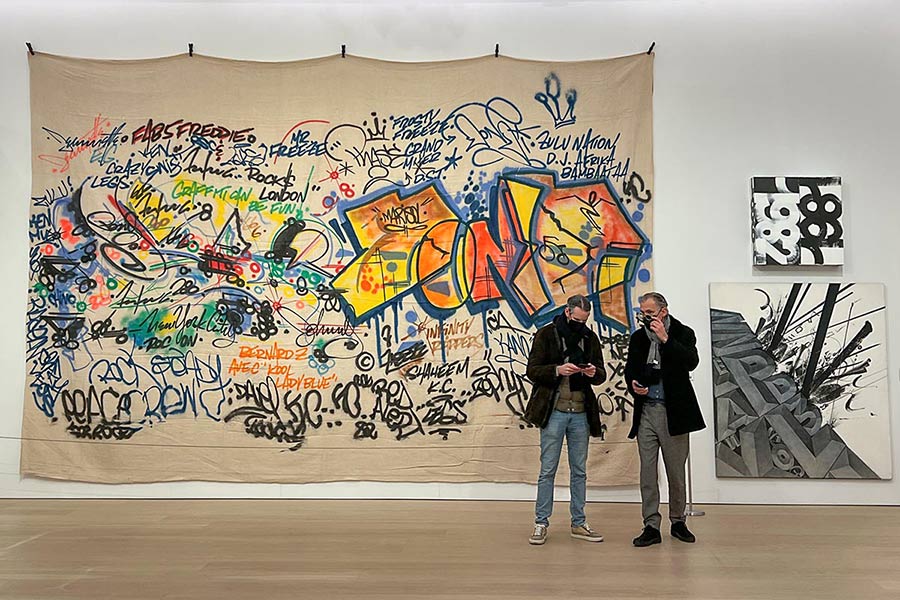
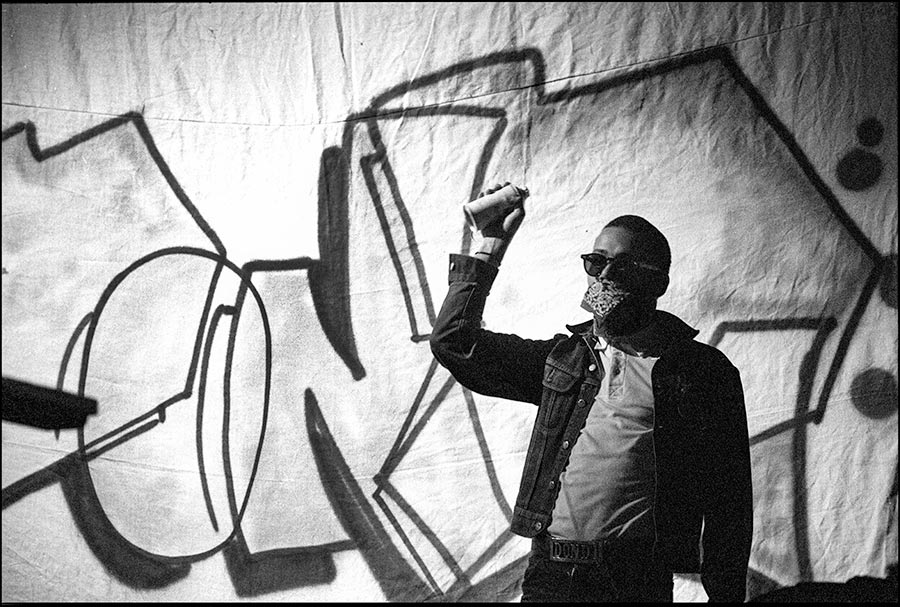
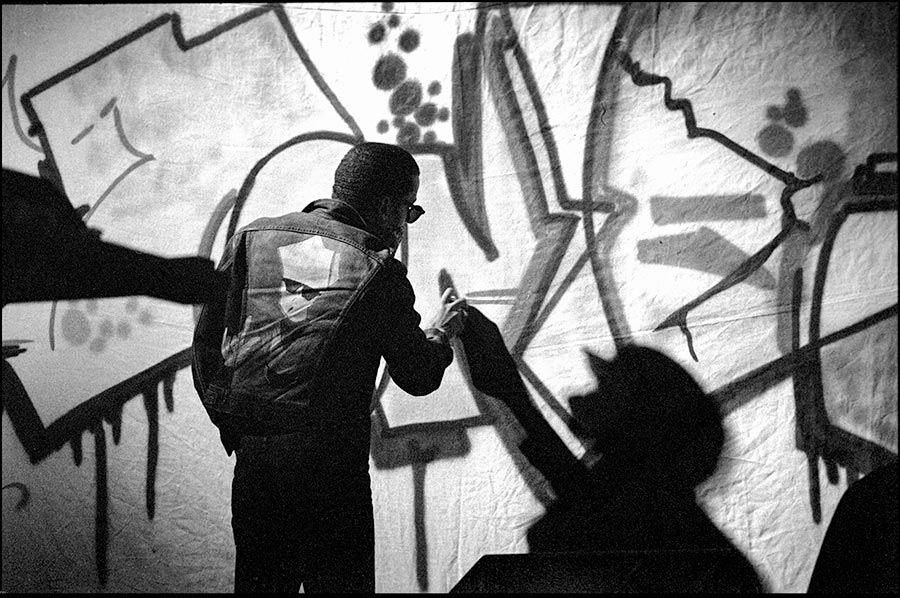
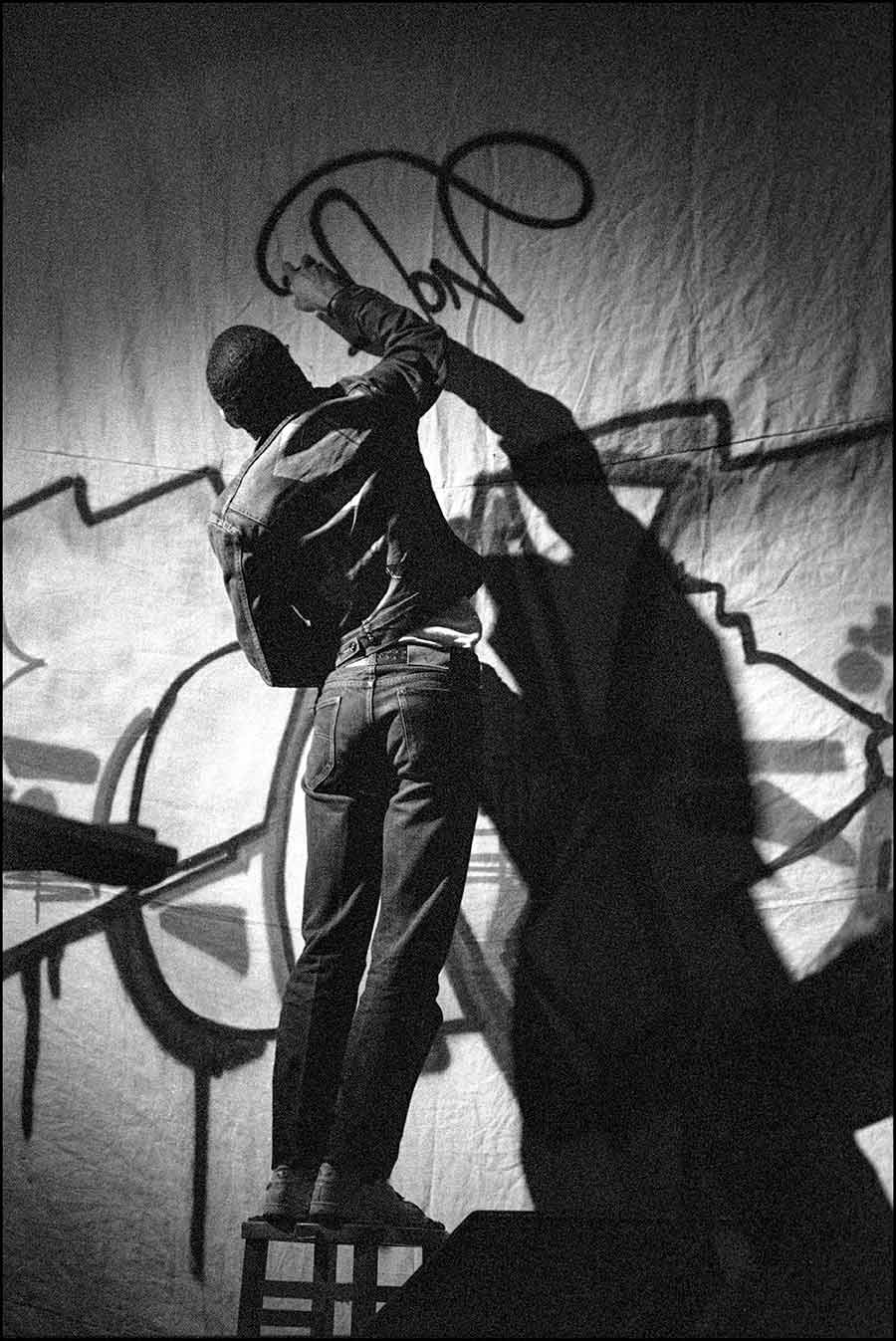
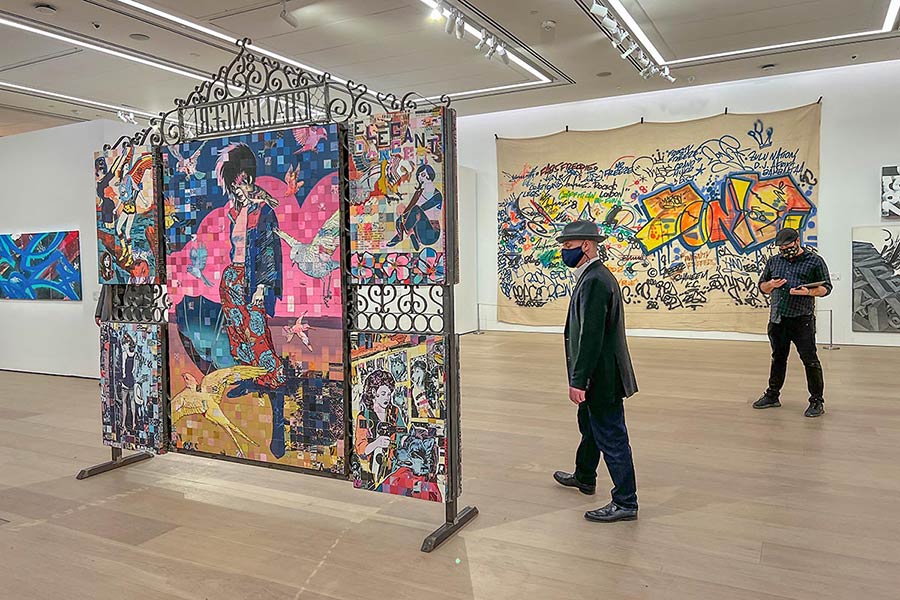
One piece caught our eye and the eye of our companion, the photographer Martha Cooper, whose photos of 1970s-80s graffiti on subway trains places her squarely at the center of the scene. It’s the large fabric canvas/backdrop that commands one of the walls in the gallery – not only for its dynamism of placed elements and handstyle-vibrance but because of the history of the piece and the cross-section of writers and performers who intersect on it. Attributed to Futura 2000, it also contains work by Dondi and a tag by Phase2, at least. It also pays tribute to the musician and performer Afrika Bambaataa, the Rock Steady Crew, a number of possibly British graffiti writers and crews.
When posted on social media by people like Futura and Ms. Cooper this week, discussion of this piece lit up like a fire – with people surmising different venues where it may have been displayed, arguing about the propriety of selling such an item, conjecturing about who owns it, and spotting it in the background of photographs by Janette Beckman and David Corio.
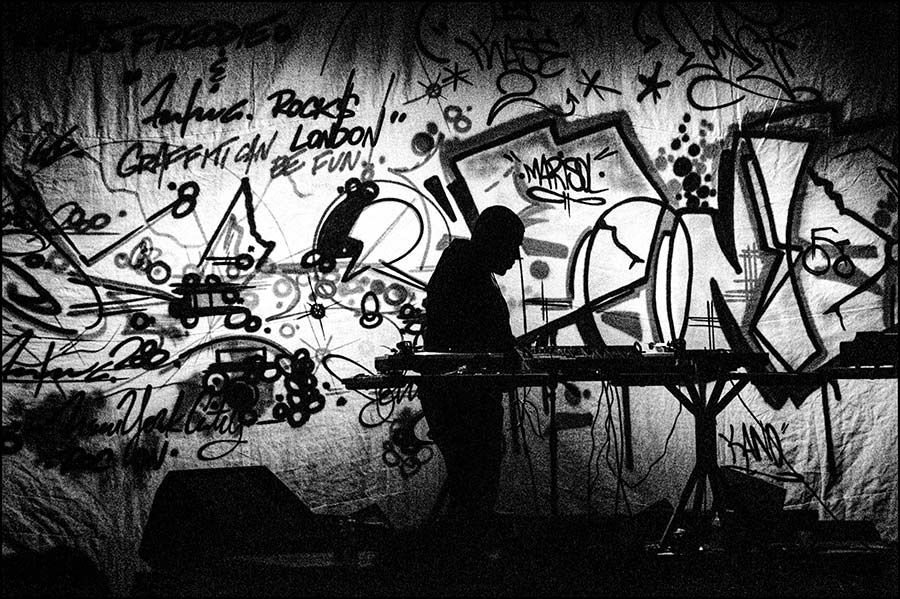
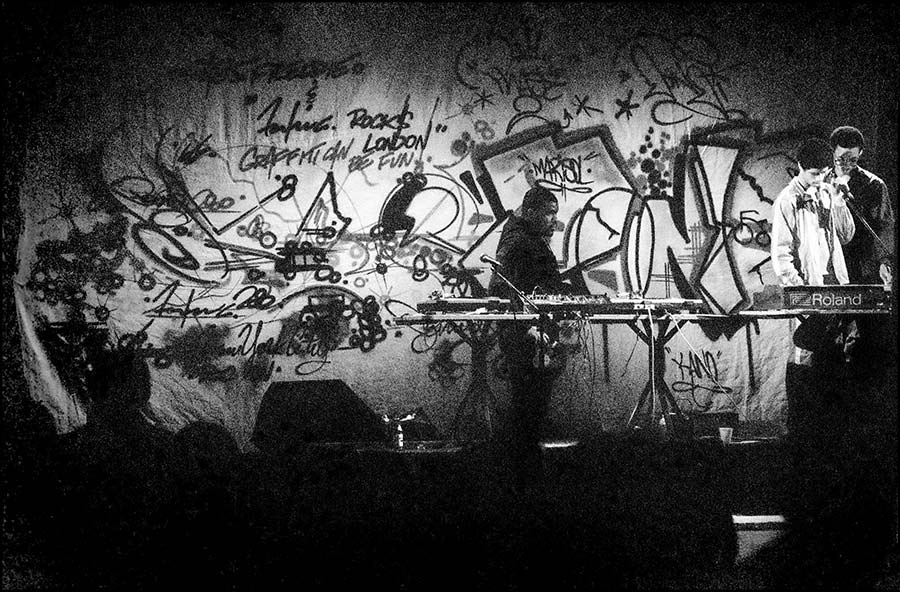
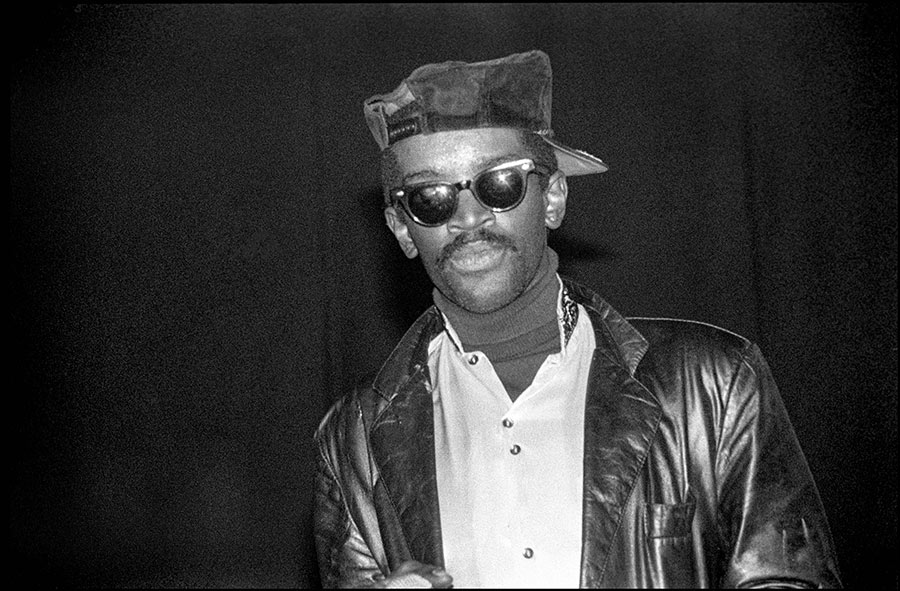
Mr. Corio allows us to show his images here of that event, which he identified as being part of the London stop of the NY City Rap tour, November 23rd, 1982. Assessing photos and the relic itself, one surmises that it was not signed by all the persons named necessarily since its function was a marquee naming of participants of the tour as well as a vehicle of visuals.
Corio later posted images from the event on his Instagram with his current recounting, but we like this older one from his website, as it is lyrical.
“Welcome to the future. This was one of the first hip-hop shows in London and it was at my favourite place to shoot gigs. Bam had brought with him vibrant visions of the New York street in the form of graffiti legends Fab Five Freddy and Futura 2000. While he played, they spray-painted the backdrop. Londoners had never experienced any gig like this before – with break-dancers from Bambaataa’s Zulu Nation and a team of skippers doing the double-dutch. ‘Planet Rock’ and ‘Looking For The Perfect Beat’, two singles of 1982, along with Grandmaster Flash’s ‘The Message’, gave notice of a new musical force breaking out of New York – hip-hop and electro – and it was all rising straight off the record decks. It was amazing to witness this revolution in person.”
As you stand before the piece, you may better appreciate the human scale of some events that have stepped into a golden storied past. Without these antecedents, many would not have known the art, music, and dance world as it evolved – nor appreciate the components that Hip Hop grew and evolved from. Looking at this unnamed banner, you remember again that once in a while a piece of art transcends itself, and becomes a historical document.
1970s / Graffiti / Today is an opportunity for fans and historians to see some of these works before they disappear into private collections. That alone is worth the trip.
1970s / Graffiti / Today at Phillips Auction House in Manhattan, NY is open to the public until February 20, 2022.
Our sincere thanks to photographer Martha Cooper for contributing her photos to this article. Her Instagram is @marthacoopergram
Thank you as well to the photographer David Corio for allowing us to use his historical photos here. To learn more about him and his work please go to www.davidcorio.com and his Instagram is @david.corio
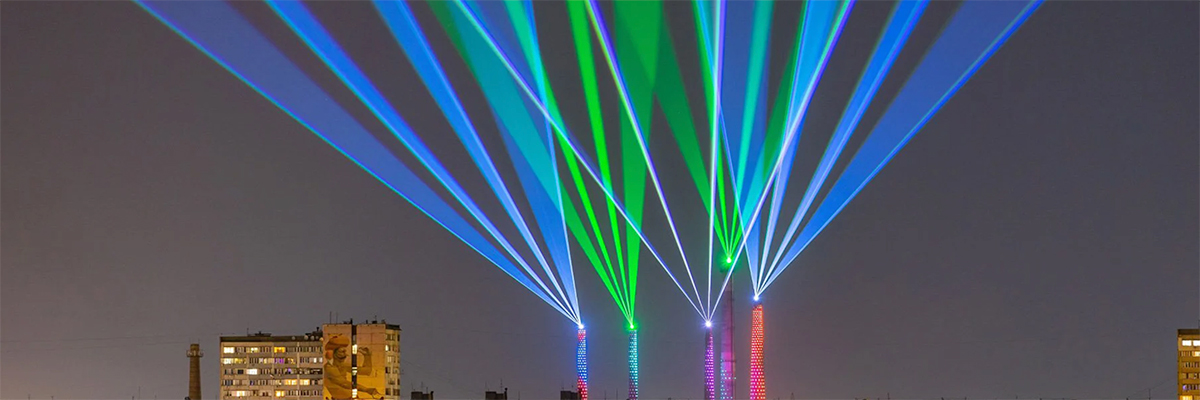
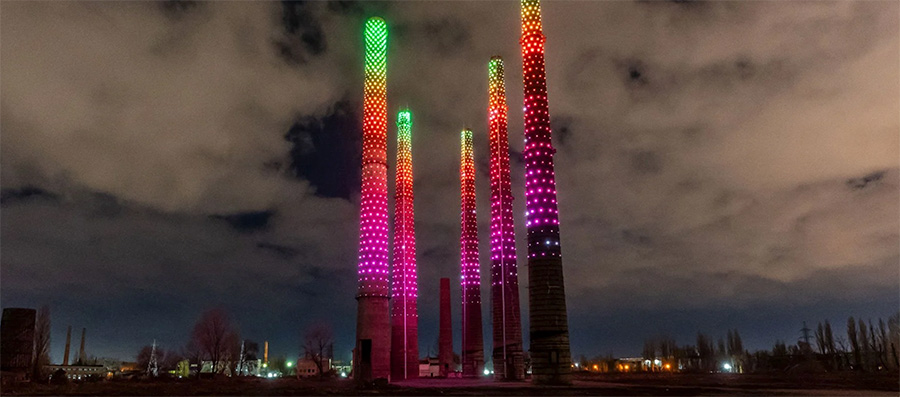
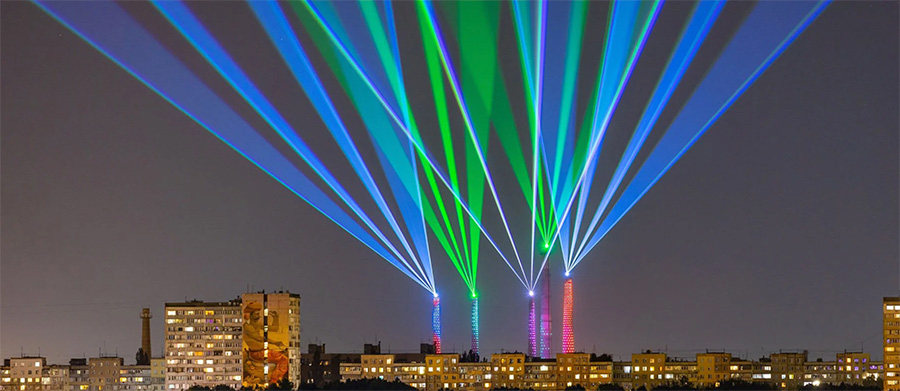
What to do with 13 decommissioned factory pipes in Dnipro, Ukraine?
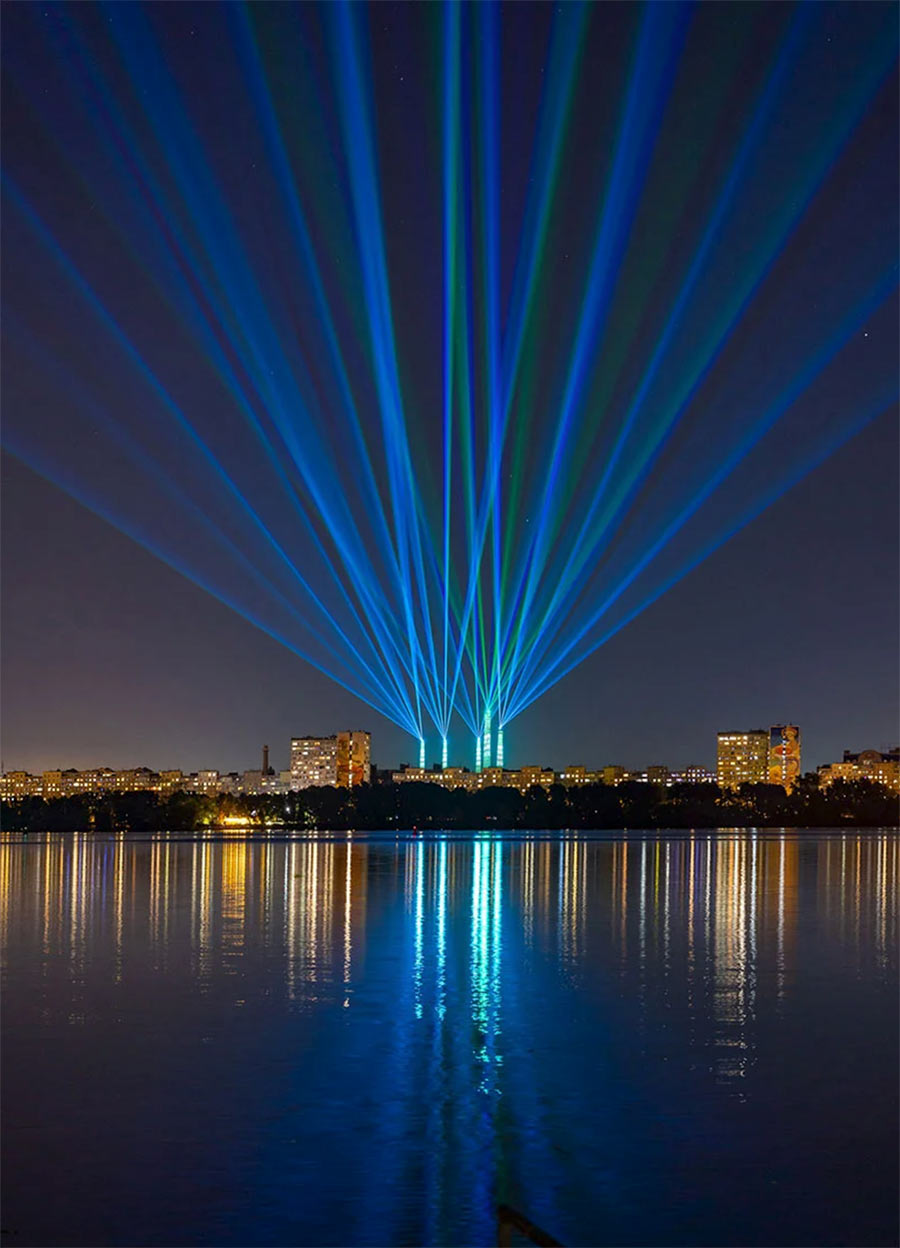
Why not convert them into a glorious bouquet of flowers…laser flowers that is. The city of one million is located in southeastern Ukraine and hopes to increase tourism to the city. Lighting designers at a private company called Expolight experimented with 5 of the 13 chimneys – “employing an amalgam of lasers, pixel lights, and wireless synchronization,” say the organizers.
Dnipro Light Flowers by Expolight. Dnipro, Ukraine. (photo courtesy of Expolight)
Named the “Dnipro Svitlovi Kvity” (Дніпро Світлові квіти), the new installation is visible at night far from the train yards where it originates, including along Slobozhanskyi Ave in this industrial city that runs alongside the Dnieper River.
Designers at Expolight created the light-art installation by “employing an amalgam of lasers, pixel lights, and wireless synchronization,” to make the stalks and blossoms dance in the middle of the nighttime cityscape.
Dnipro Light Flowers by Expolight. Dnipro, Ukraine. (photo courtesy of Expolight)
The project was originally published on Designboom and it’s part of their DIY Submissions series.
“Winner of the 2021 lighting design awards, the artists say they hope to illuminate all thirteen chimneys, creating a “real technological garden that covers a distance of 7km, visible from the right side of the Dnipro riverbank.”- Desingboom.
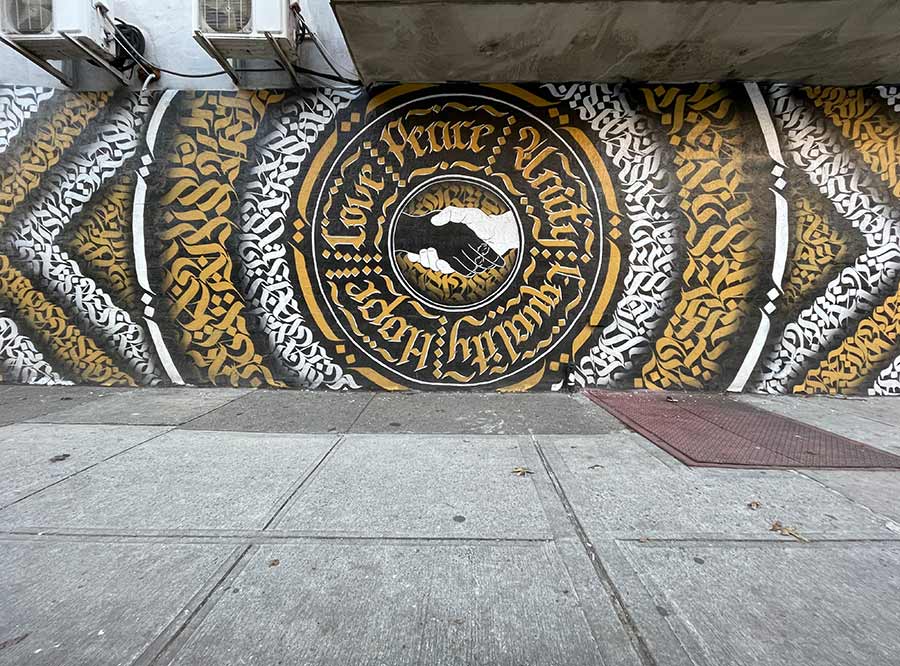
Martin Luther King Jr’s message throughout his life included the themes of Love, Peace, Unity, Hope, and Equality. That’s why we think that the work of graffiti writer, illustrator, and calligraphist Andres Medina on a wall in Brooklyn perfectly illustrates what we commemorate today.
Mr. King’s vision for a better world and specifically for the lives of the millions of African-Americans who were denied their basic human rights is as important today as it was when he was still alive; preaching, marching, shouting, counseling, and keeping tabs on the rulers.
We will continue to keep Dr. King’s messages clear and relevant to the new generations. We believe that it’s equally important to emphasize a singular theme that might have more relevance in today’s political atmosphere.
For us, the alarming erosion of voting rights, particularly in the “red” southern states is an issue of severe importance. In 1965, President Lyndon B. Johnson signed into law the Voting Rights Act of 1965 with Martin Luther King Jr. by his side. This law allowed African-Americans to overcome the legal barriers that state and local governments had implemented preventing African-Americans from exercising their right to vote as given to them in the 15th Amendment of the United States Constitution ratified in 1870.
But in 2013 the U.S. Supreme Court chipped away the Voting Rights Act by ruling that the law imposed constraints on states and that the federal voting procedures were outdated. This ruling allowed certain states to enact laws imposing restrictions and limiting the access to vote by demanding ID requirements, closing voting polling stations, eliminating early voting, and voting by mail. After Trump’s election, his defeat, and his denial of the legitimacy of President Biden’s win, Republican leaders at both the federal, state, and local levels have been furiously working on the further erosion of the Voting Rights Act to the point that the razor edge Democratic majority in Congress has been unable to pass voting legislation that would, among other things, ensure that African-Americans and other minorities retain and preserve their right to vote without interference from local legislatures and politics.
Each of us has a responsibility to make certain that voting rights for all citizens remain an inalienable right, one that can not be taken away by capricious, partisan autocrats nostalgic for the old days of white supremacy.
Because it is not just one day, it is 365 days. We celebrate Martin Luther King Jr. today for his leadership and his bravery, tenacity, vision, and ability to convey and light the way. The values that he and the Civil Rights movement championed are what we still have to pursue and fight for every day in large ways and small because those who are arrayed against equality never seem to stop.
Today we feature a mural that speaks to some of the greater themes, the connected values that Americans know are the right ones and which we’ll keep talking about and retaining at the ‘top of mind’. LOVE. PEACE. UNITY. EQUALITY. HOPE. While MLK Jr. could be poetic and soaring in his speeches and his rhetoric, these simple words speak directly to our greater goals for the greater good.
Admittedly today in 2022, the insidious deceptive movements against equality are disheartening, but MLK Jr. told us not to give in to the hot sting of hatred. “I have decided to stick with love. Hate is too great of a burden to bear,” he said.
At the moment in New York most of us are staying off the street because it is bitterly cold outside. We just had a wind chill of -1 degrees fahrenheit (-18 celcius). Not a lot of graffiti and street art goes up during this weather.
But that doesn’t stop us from going out to shoot it.
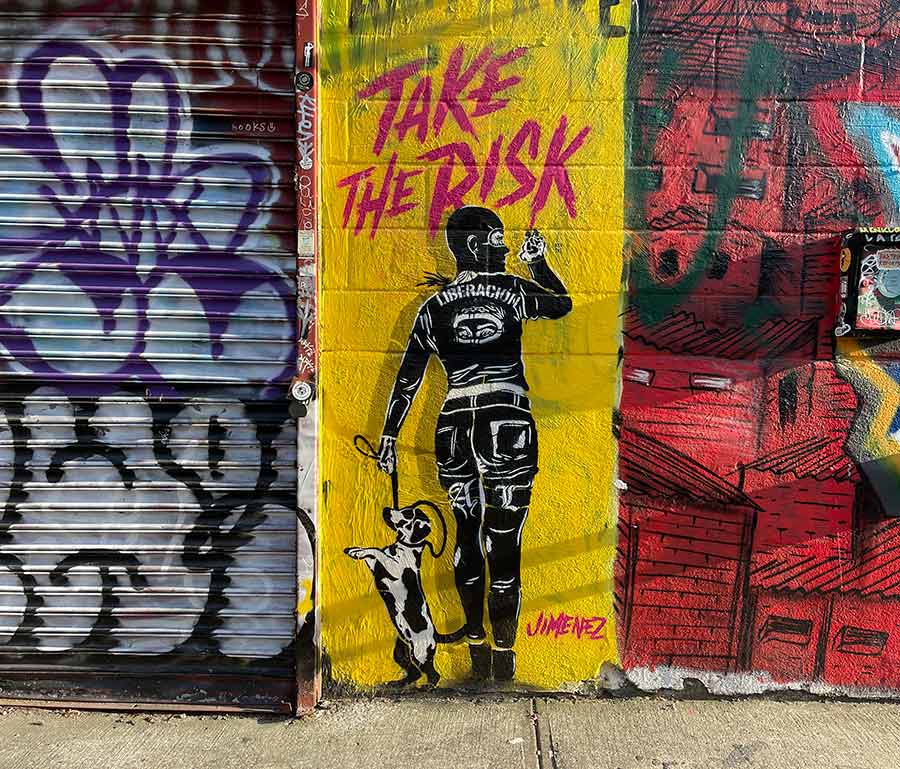
So here’s our weekly interview with the street (in New York and Miami), this week featuring 2OX Crew, Arson, ATOMS, Boy Kong, Buff Monster, Ivan Roque, Jason Naylor, Jimenez, Kern Myrtle, MrKas, Patrick Kane McGregor, and Pleks.
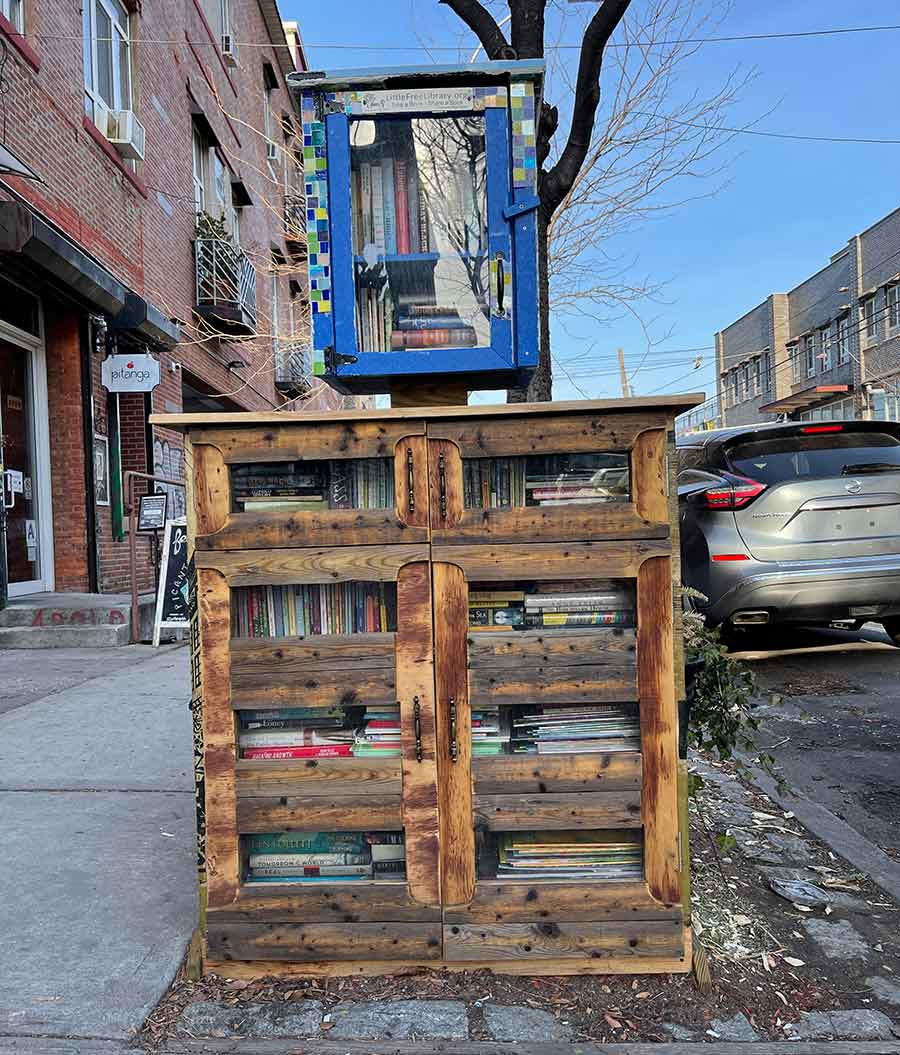
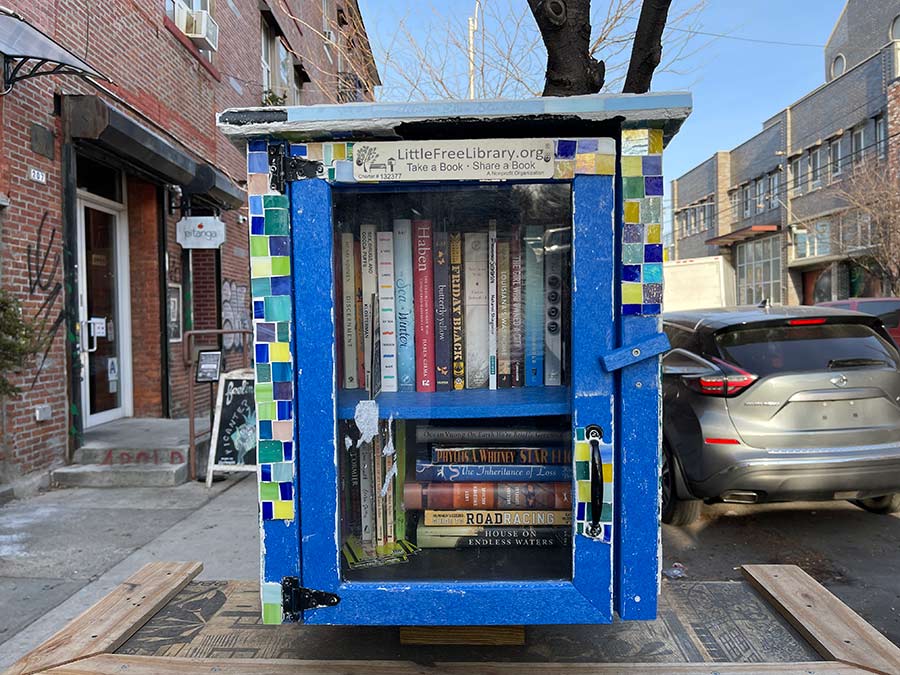
There is such a thing called street knowledge – knowledge that equips you to navigate safely and successfully. The power of knowledge is something that we thought about this week in NYC when we ran into the most appealing public library we’ve seen in years. The organization Little Free Library is a nonprofit organization with more than 100,000 little libraries like this in public space worldwide. Primarily provided and maintained by volunteers, these literary kiosks hold miles of treasure, free for the taking. Truthfully, seeing books so publicly lauded and traded may give you hope for the future.
With the advent of smartphones and Social Media the public might be reading fewer books – and sometimes it feels like there is a “dumbing down” of your average lad because of the procurers of digital “content” play to the lowest common denominator. Not to mention that many young people feel like the stuff they see on their phones is plainly mean-spirited, demoralizing even. According to the American Psychological Association “teens today spend more time on Digital Media, less time reading”.
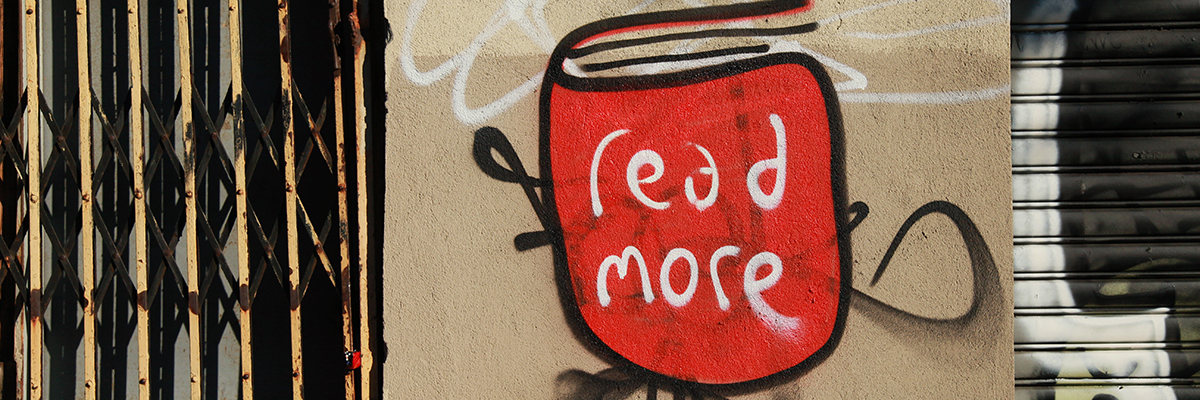
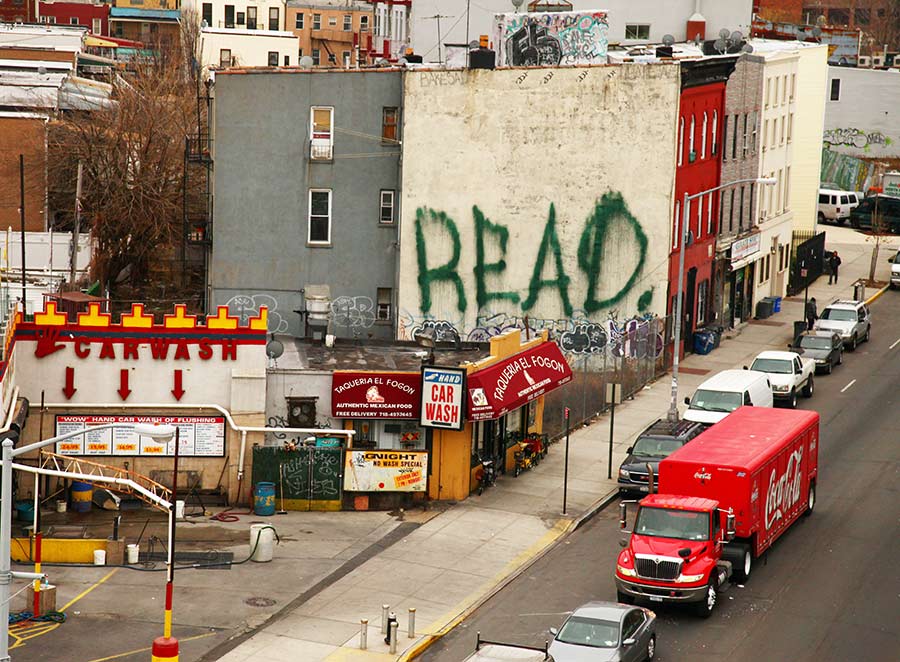
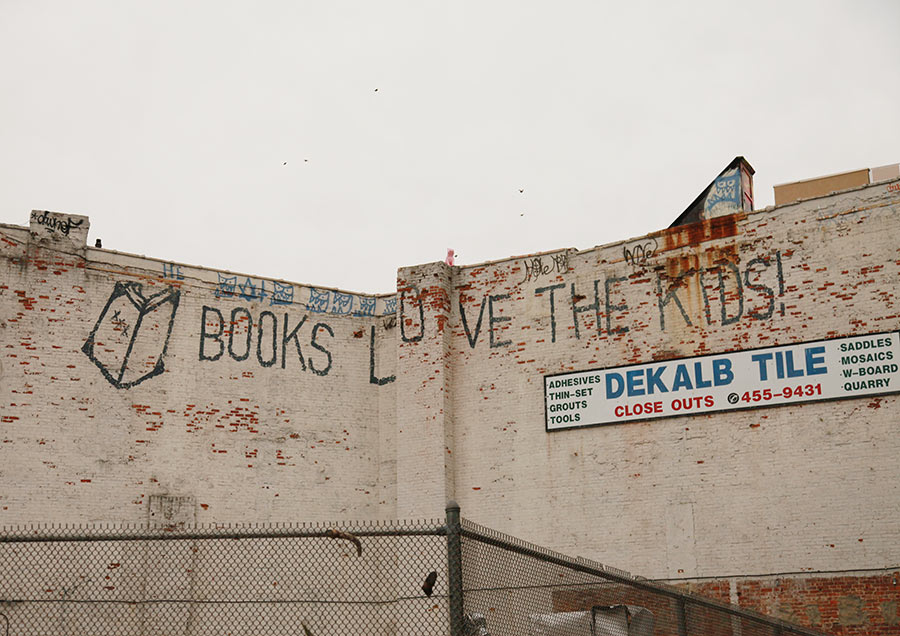
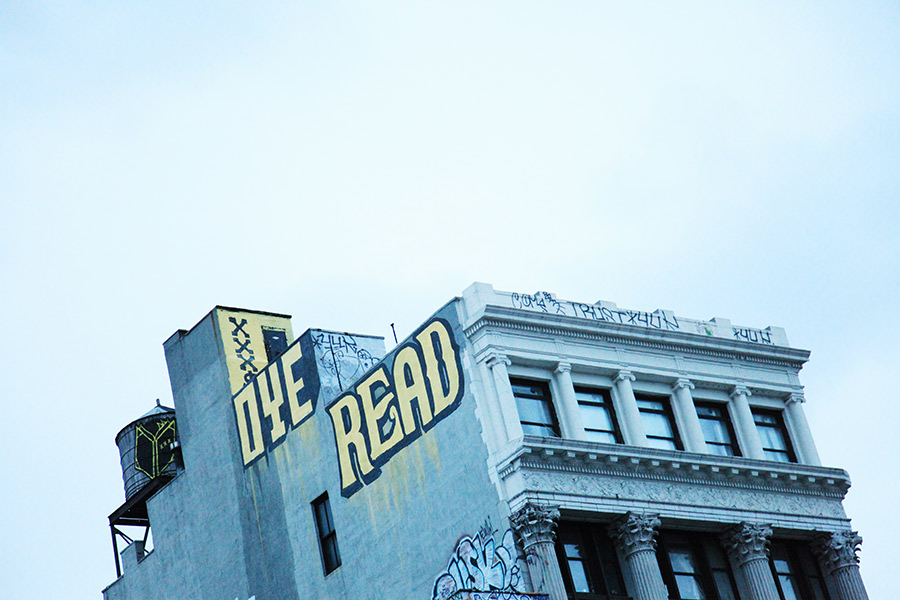
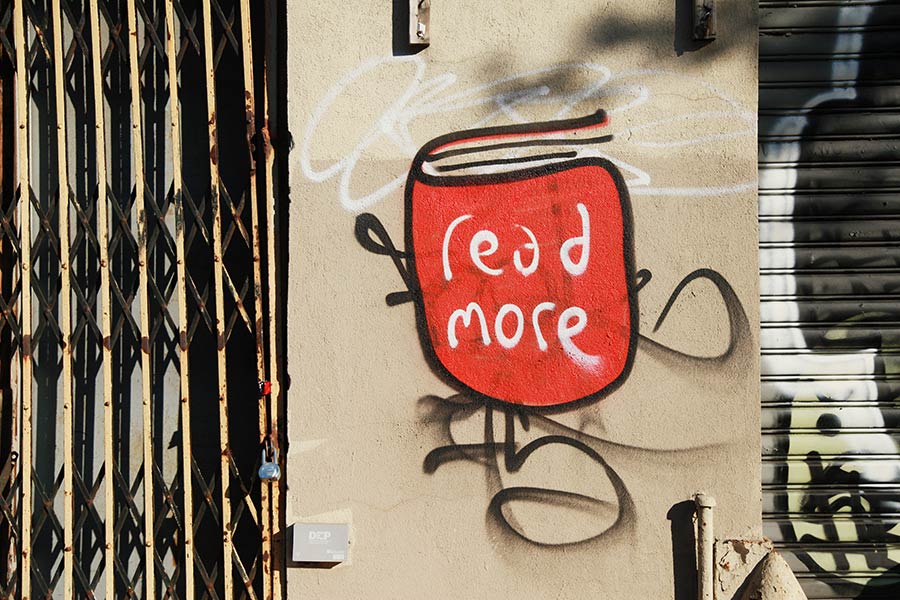
Longtime aerosol vandal and literacy activist READER aka READ MORE aka BOOKS aka BOOKMAN (and more!) has been encouraging citizens, particularly our youth, for many years to crack a book and self-educate because he knows that knowledge is power. So now you know.
Our weekly focus on the moving image and art in the streets. And other oddities.
Now screening: 1. Humask & Shadow _ Light off/Light on. Tuco Wallach Pacifico 2. Bastardilla: La lingue dei carciofi 3. Saber: Escaping Los Angeles. From Chop ’em Down Films
BSA Special Feature: Humask and Shadow
For artist Tuco Wallach the street art story has nearly always been a family affair that mixes easily with his Humask campaign. His psychological treatise on man’s relationship with himself and society and masks may be internal, but the actual street practice is often externalized to include friends and family to create, place, document the new works that go into the public places. Here, as a chill holiday recording of a moment, we see the intimate and precise care that goes into his process – a process that is open and welcoming, and participatory. He says the video is about wood cabins, family, shadows, lights, friends, and Humask.
Humask & Shadow _ Light off/Light on. Tuco Wallach Pacifico
Bastardilla: La lingue dei carciofi
In the depths of New York winter, we like to escape to that sticky and warm time in summer when the air and the bees buzzed in unison, the thick richness of the days and nights, lingering in reverie. At the time we called it Bastardilla in Love With Bees and the Taste of Summer in Stornara, Italy. We dare you not to fall in love or at least be enchanted.
Saber: Escaping Los Angeles. From Chop ’em Down Films
“You can tell a lot about a city just by reading its walls.” Okay, Saber, you have our attention. And it’s shot by Chop ’em Down films? We’re there. Here the graffiti writer and fine artists narrate the police state of the LA during one of its more dismal periods caught on camera – and the record of a constant state of uprising.
Now a grand don of graffiti looking back, he sees the fall of LA hasn’t halted, only intensified, but his heart is still in it. He has become performative, crystalizing the movements of his work and his history into a gestural full-body modern performance; rebellious and distraught and yet full of passion – his own evolution from the street to the studio to the street again.
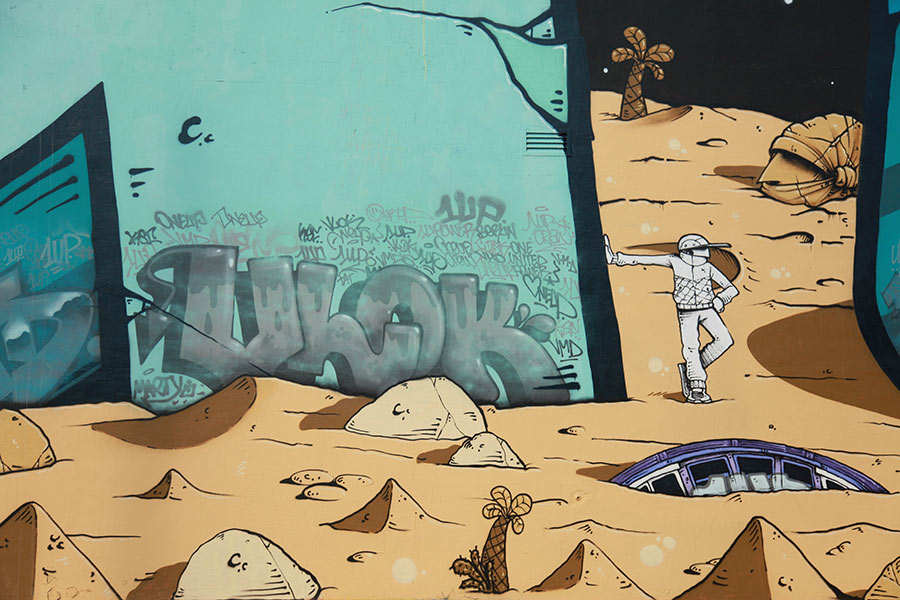
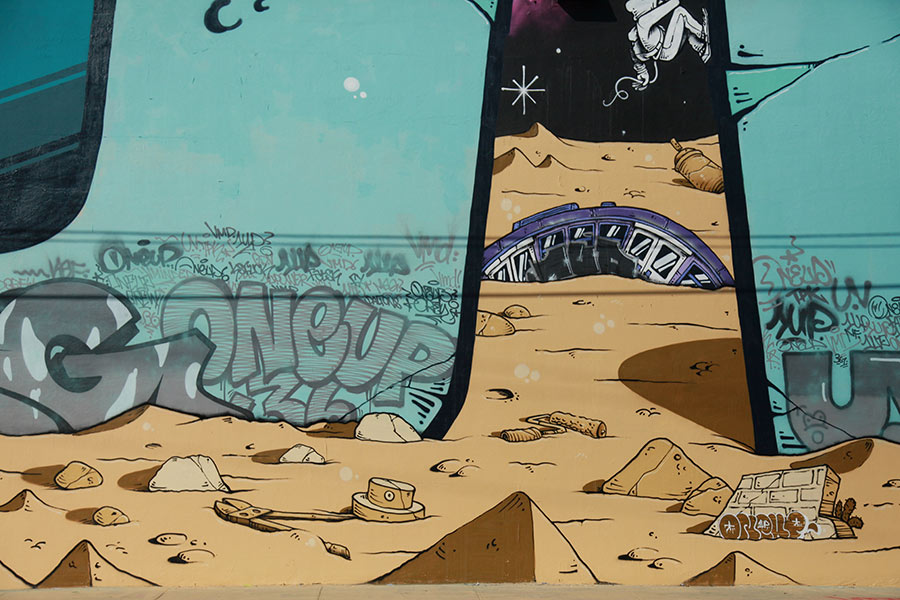
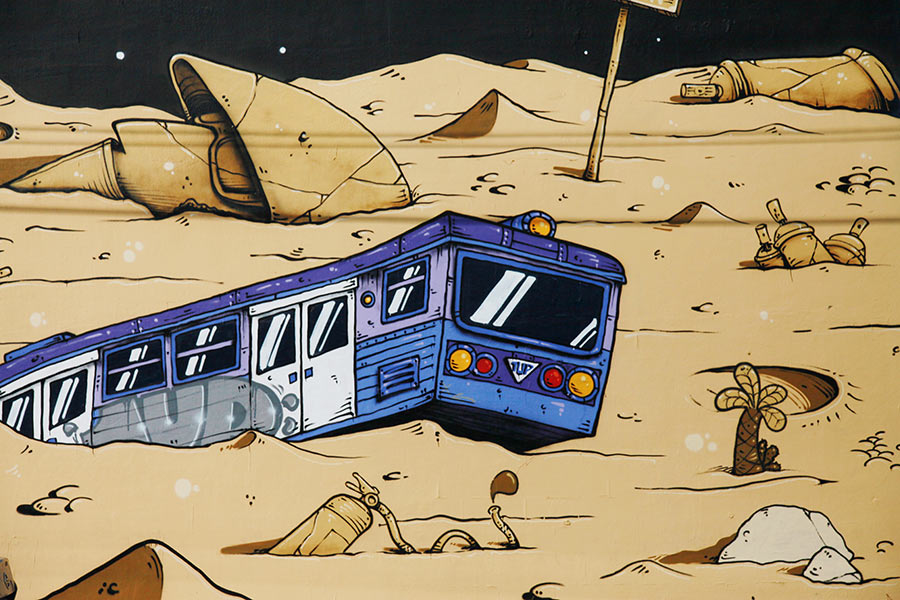
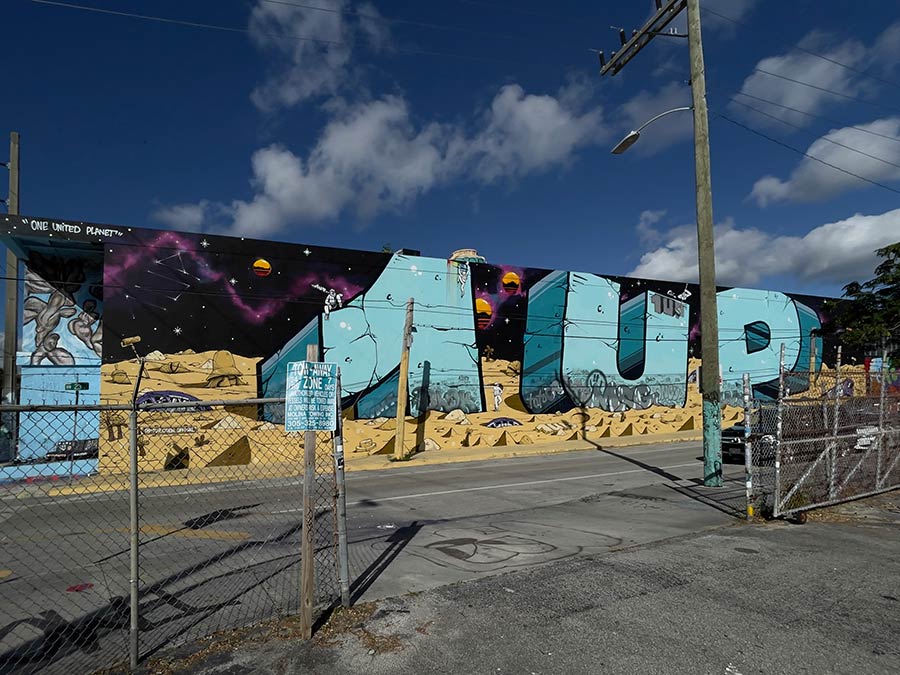
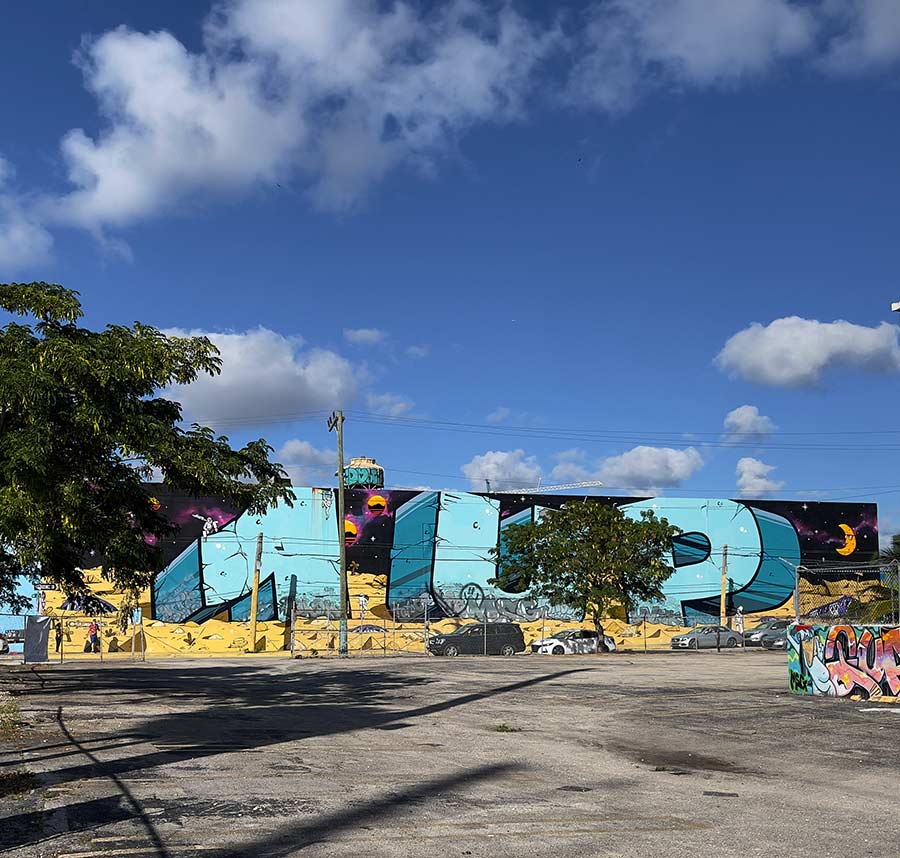
It was sunny that particular day in Wynwood, Miami in November of last year. The air was fresh and the humidity mercifully low. The sun rays weren’t piercing one’s shoulders. It was what winter in Miami is supposed to feel like. Dreamy.
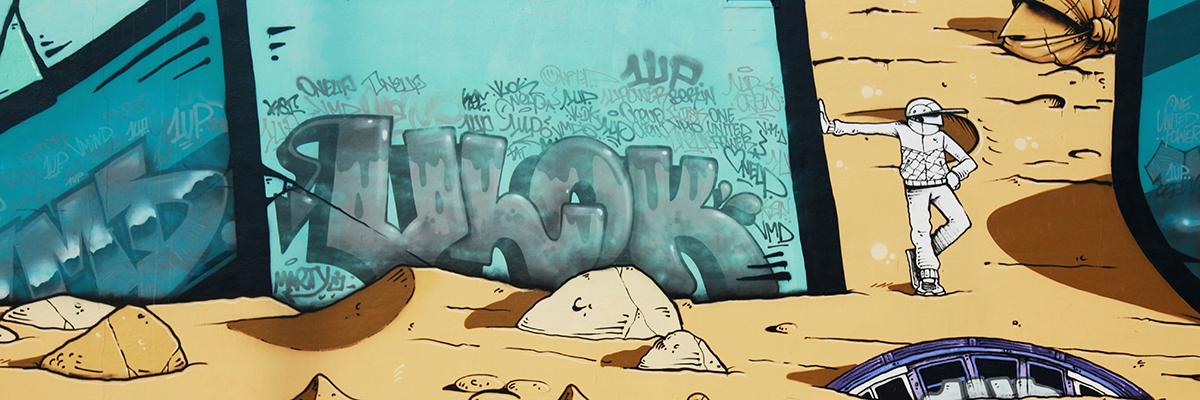
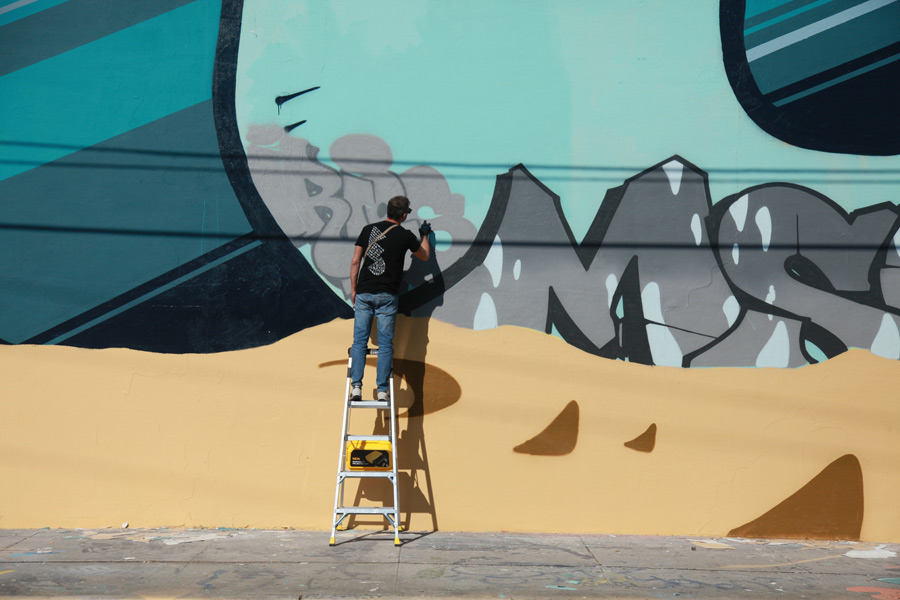
That’s how we were feeling; dreamy – when we turned the corner and saw them. A motley crew of five or six men taking on a gargantuan wall in the less noisy part of Wynwood. The congenial 1UP Crew is the Berlin-based masters of the mixed message – here to vandalize, but politely. In this case of course the wall is completely legal, but associates of this notorious crew have been credited/blamed for leaving their marks on walls, trains, water tanks, elevators – anything that strikes their fancy in multiple cities across many continents.
The wall was still in progress that day with many more aerosol cans to go. We chatted, took photos, and reported on the encounter HERE. By the time we had to return to NYC, the wall wasn’t completed yet – so we returned to the winter paradise weeks later.
We were glad we pulled ourselves away from the ocean to see this in all its glory. Judging from the description below from one of the 1UP Crew members we think that this wall has it all.
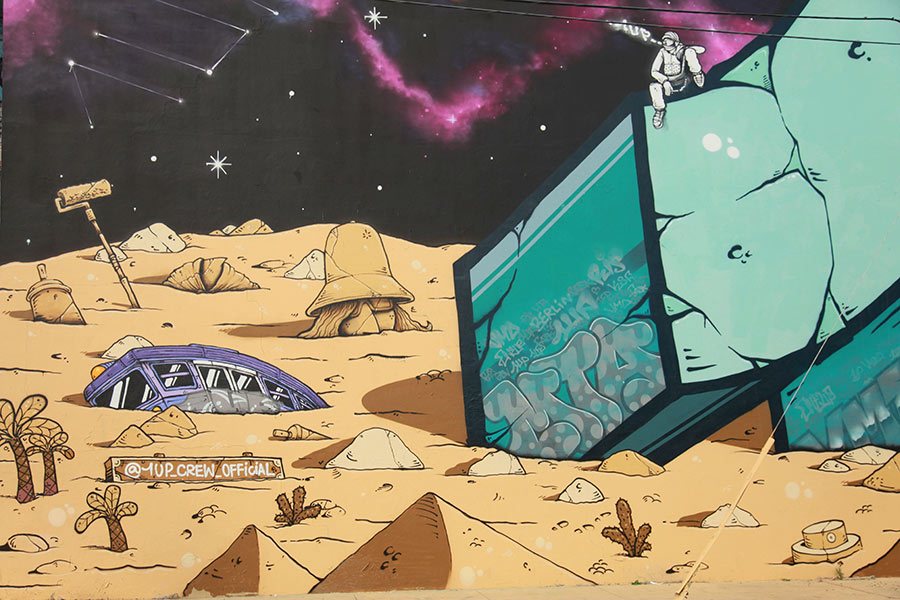
“So it is kind of a movie planet, we don’t know which planet it is,” says one of the 1UP guys, “But it is a planet of the future – and there are all these Metro’s coming up out of the sand along with pyramids and street signs and figures… It’s growing now. I think that we have three more days to paint.”
Up to 13 artists joined in to complete it including members of 1UP Crew and members of the MSG Crew as well as Vlok, Giz, and Fuzi UV TPK crew from Paris.
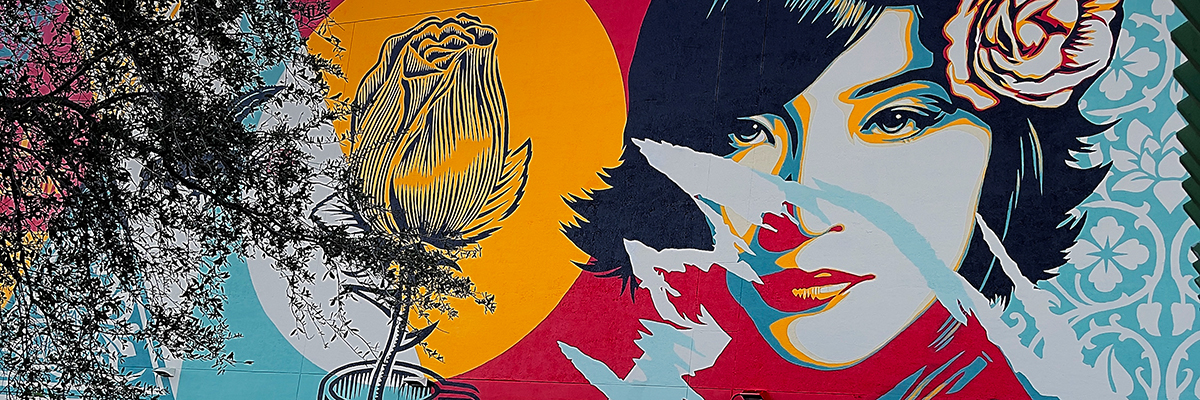
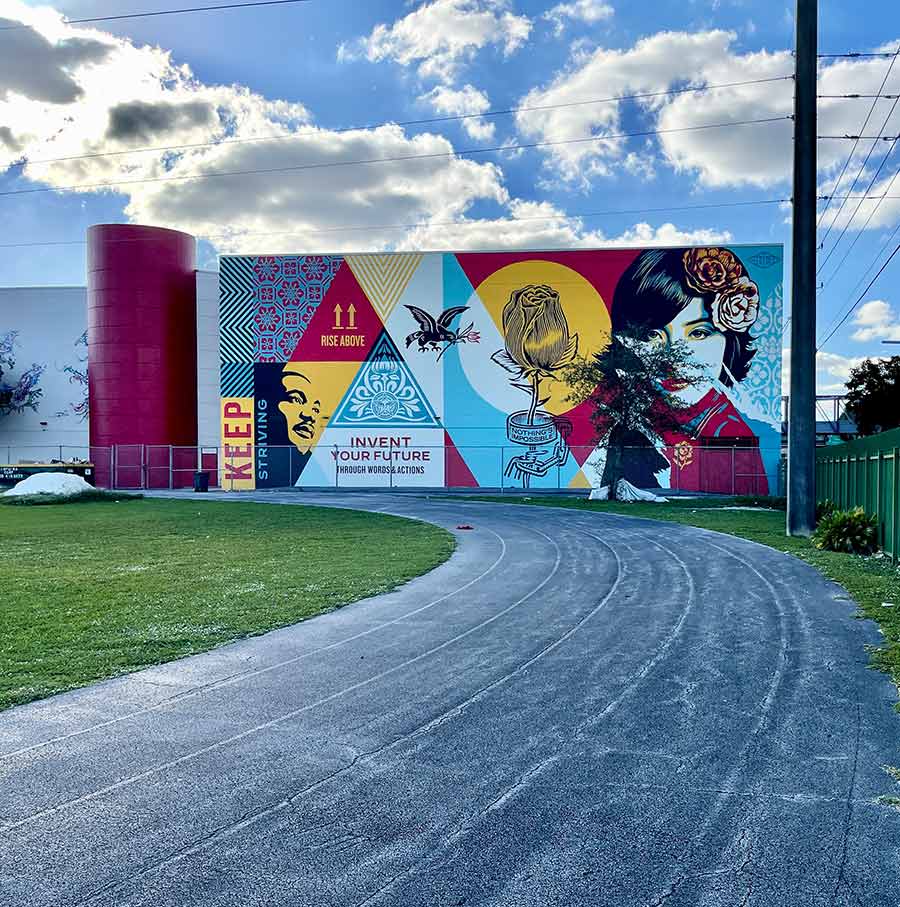
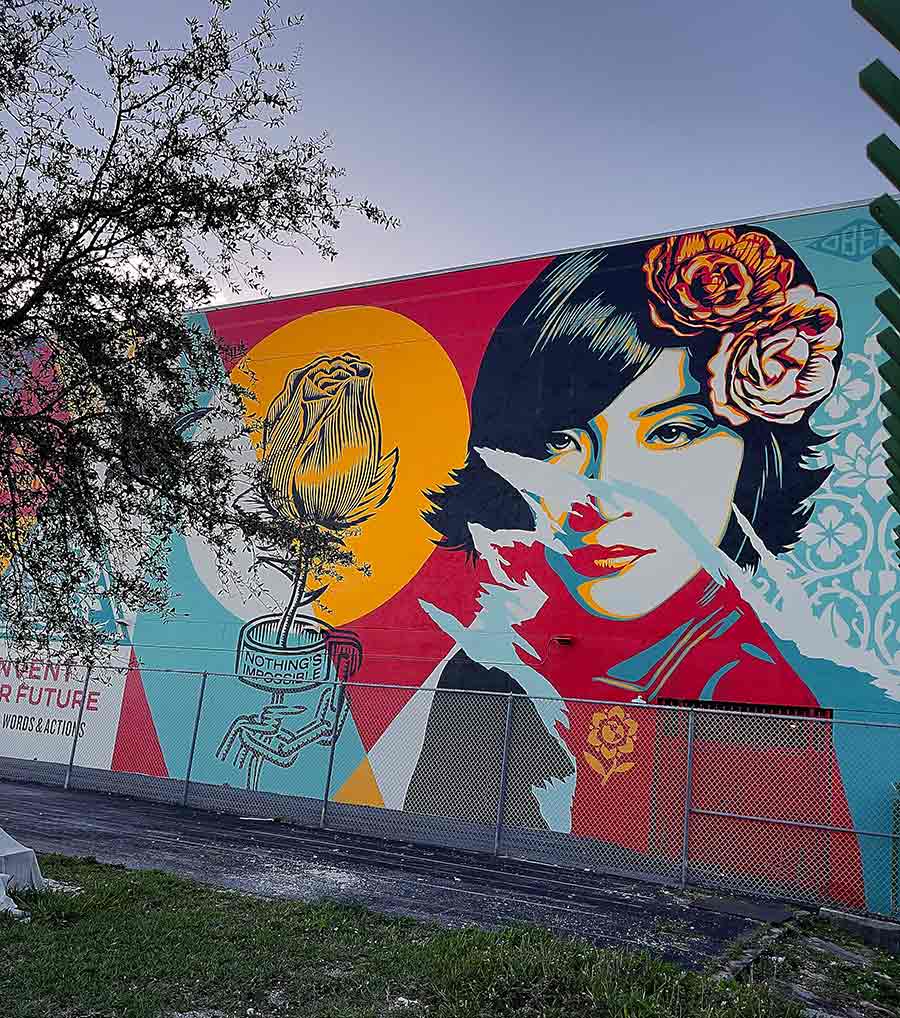
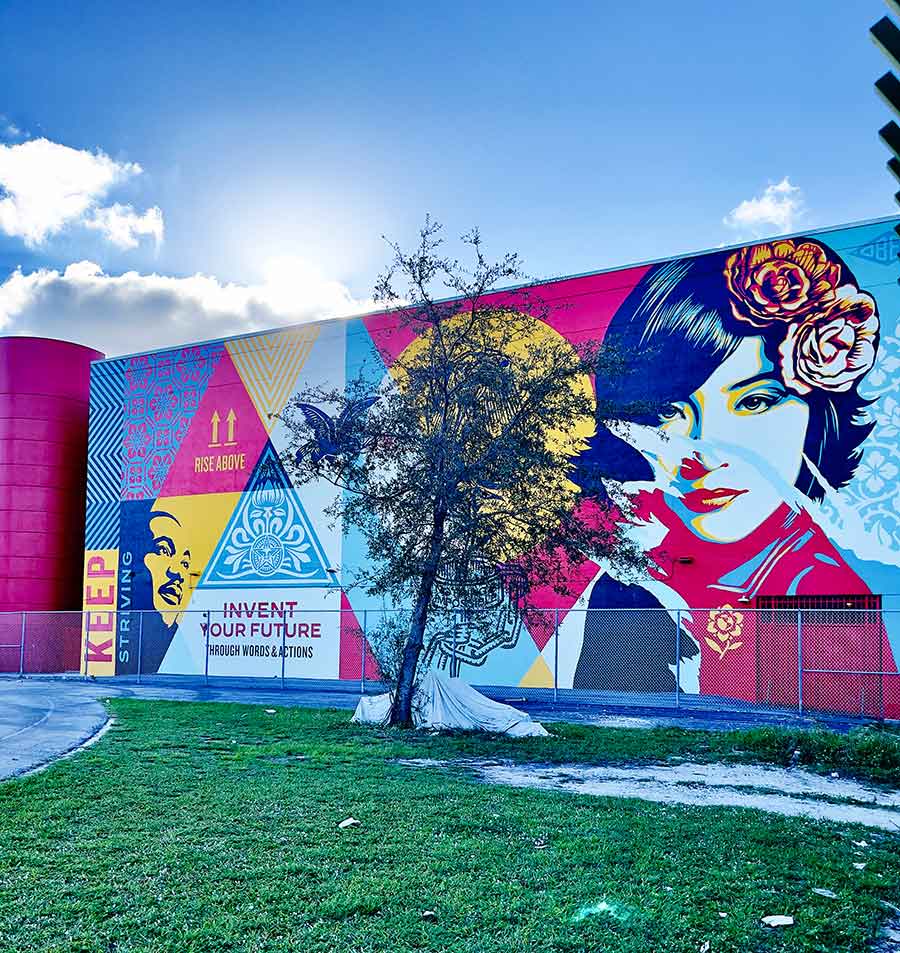
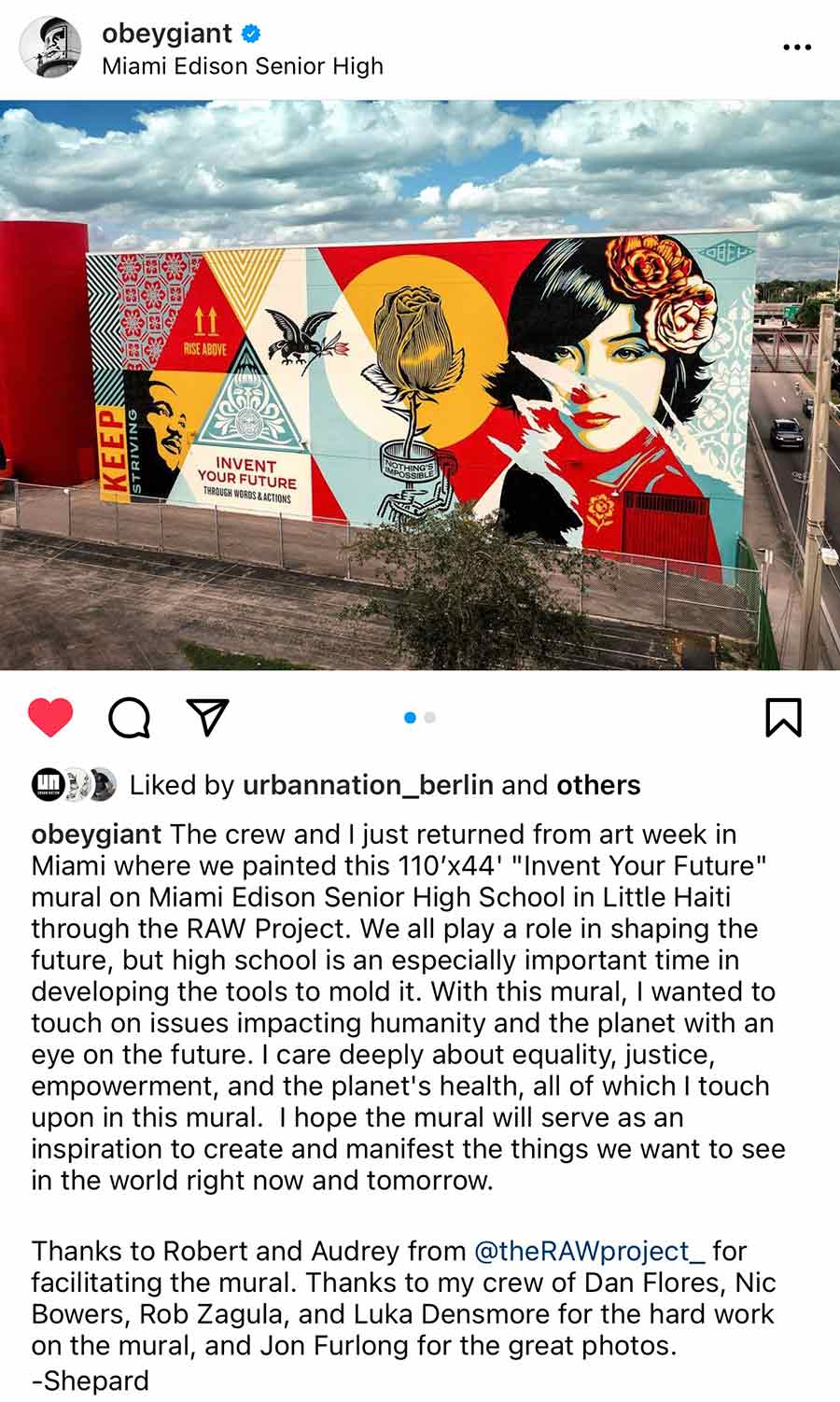
Leave it to Shepard Fairey to tell you that he’s not too cool for school. The anti-establishment critic of corruption and hypocrisy throughout our history and our political system still knows that we have to have tools if we want to make a positive change.
It’s a shame that the dropout rate for many schools is high, and that many schools don’t have the resources needed to effectively encourage and train students for the future. But the LA-based street artist knows that by holding up role models and celebrating positive contributions to culture, his murals can have a positive impact on the next gen.
Here next to the track behind Miami Edison Senior High School in the neighborhood of Little Haiti, Fairey says “We all play a role in shaping the future, but high school is an especially important time in developing the tools to mold it.” He’s describing the new mural incorporating his graphic signature motifs, powerful personalities, and palette – including a fresh aqua that calls to mind the tropical connections between this neighborhood and the island from whence it gets its name.
Thanks to a program that has worked with the schools in the neighborhood for nearly a decade called The RAW Project, founded by Robert de los Rios and his partner Audrey Sykes, this mural joins many others by local and international street artists near here. Recent names on the roster inside and outside local halls of higher learning include Eric Skotnes, Jazz Guetta, Kai, Kevin Ledo, Sandra Chevalier, Hyland Mather, The Lost Object, Telmo Miel, Marina Capdavila, Mr. June, Niels ‘Shoe’ Meulman, Patrick Kane McGregor, and Wayne Horse.
As ever, Shepard had his sharpest hands on the can with him as his brilliant crew in Miami, including Dan Flores, Nic Bowers, Rob Zagula, and Luka Densmore.
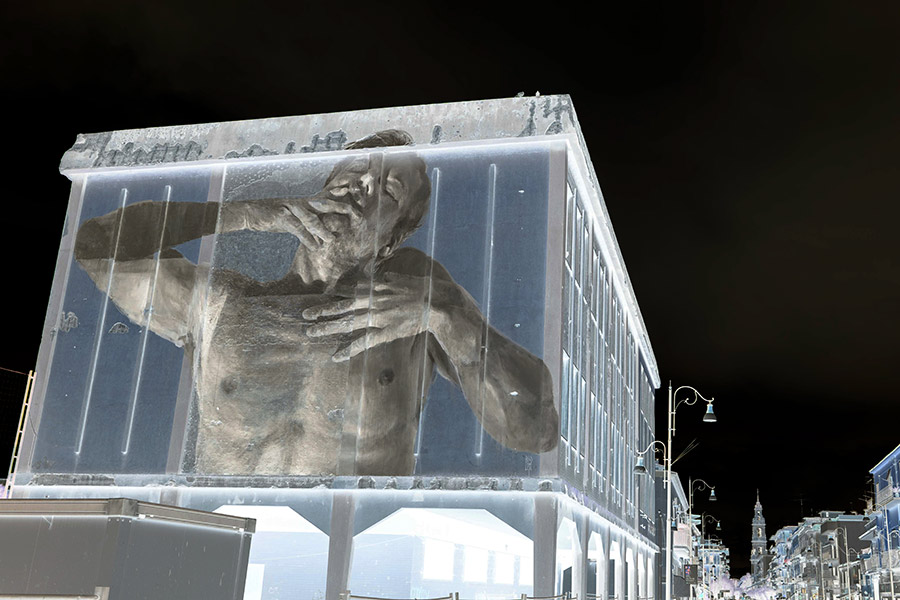
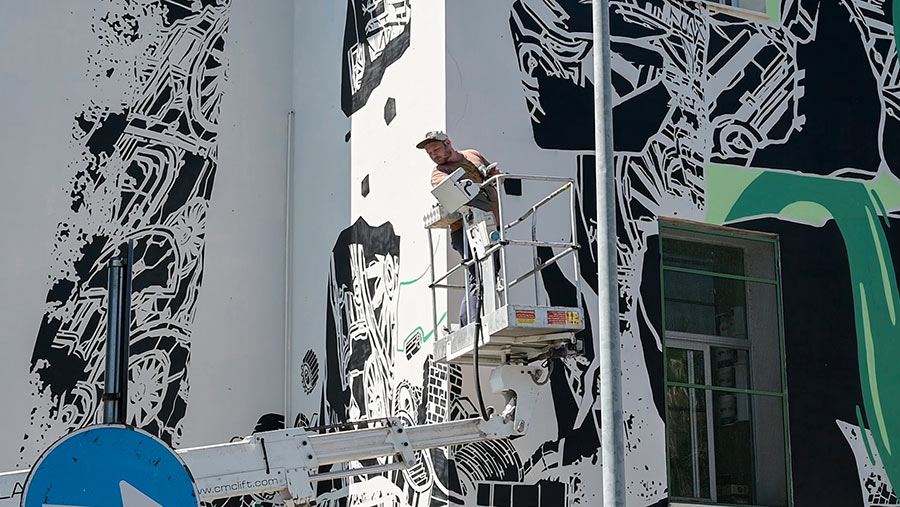
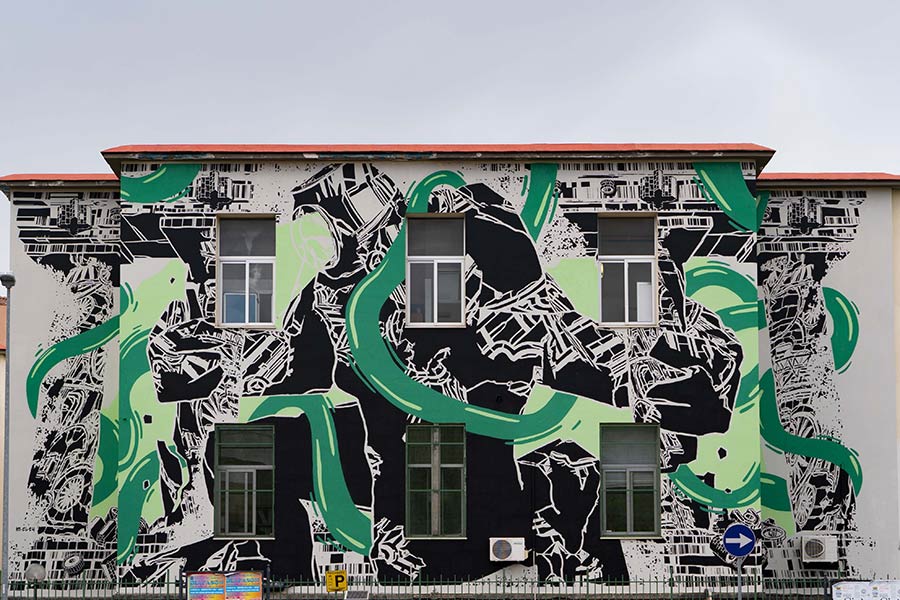
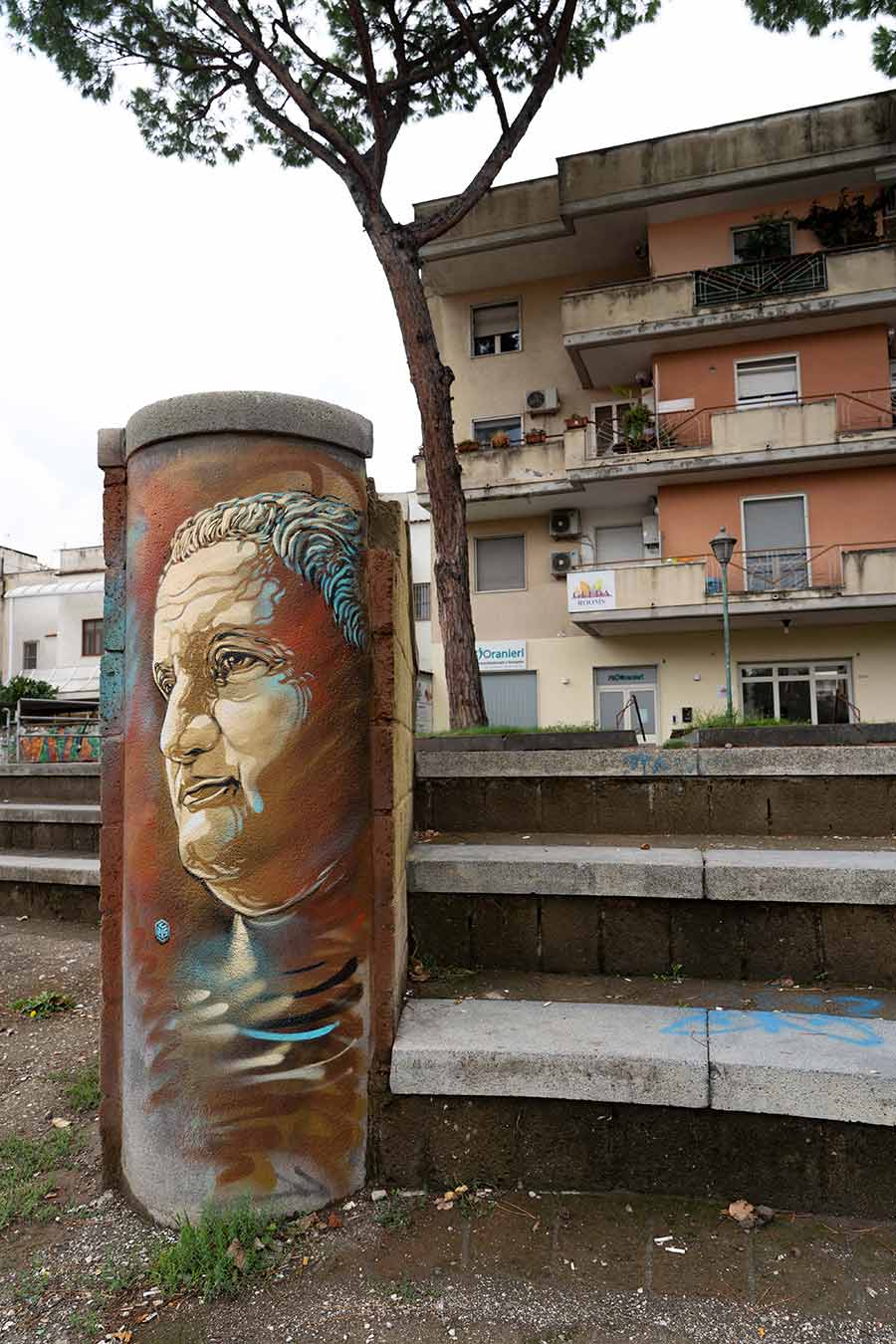
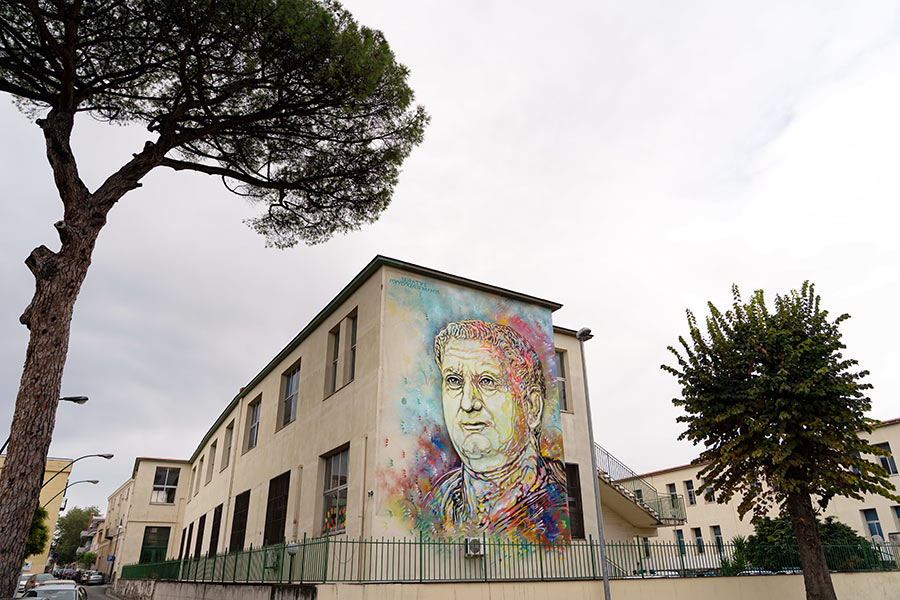
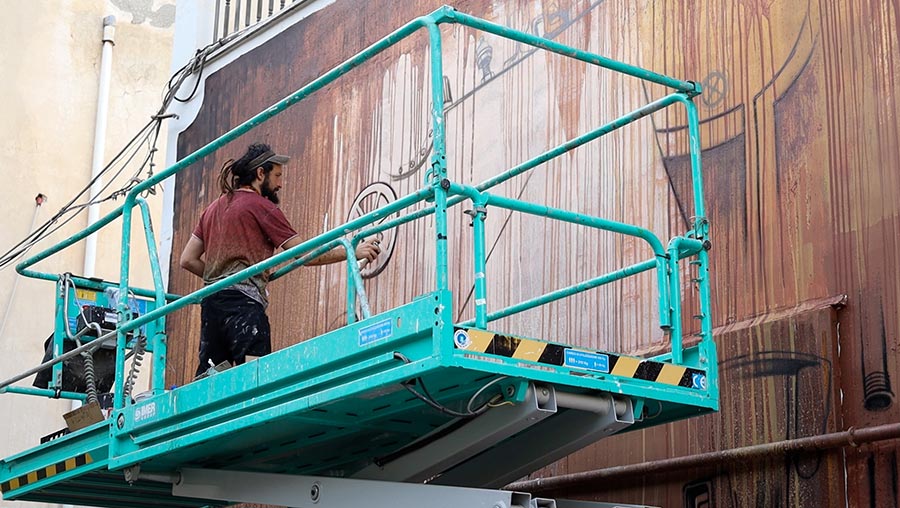
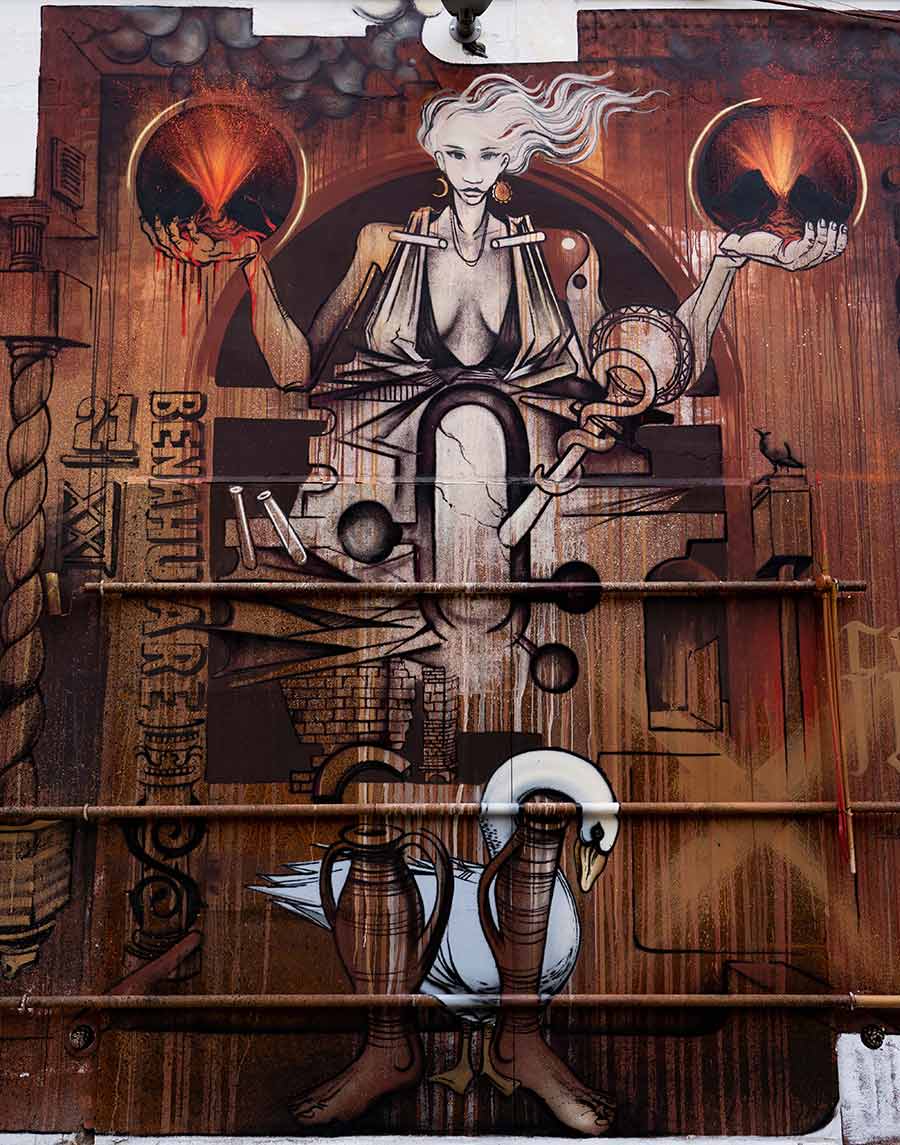
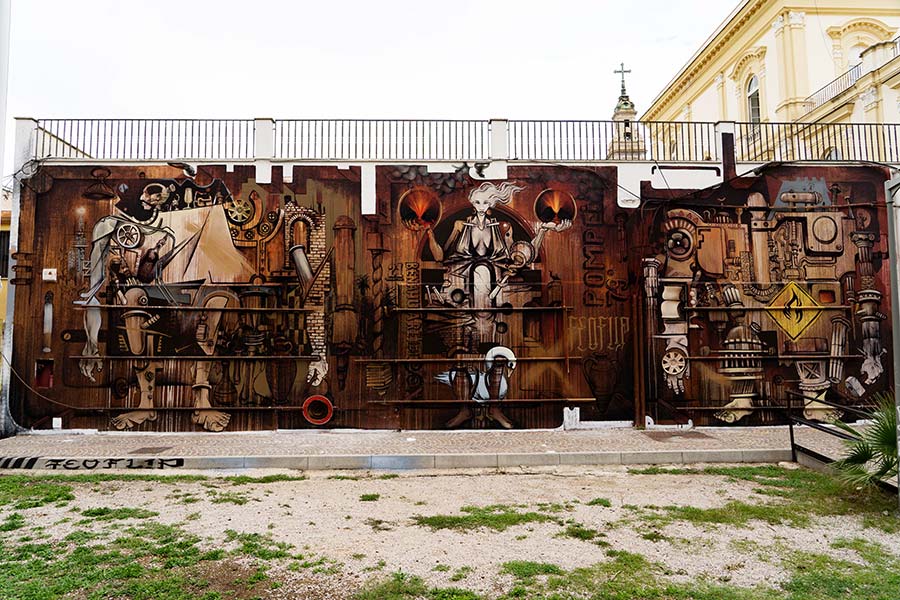
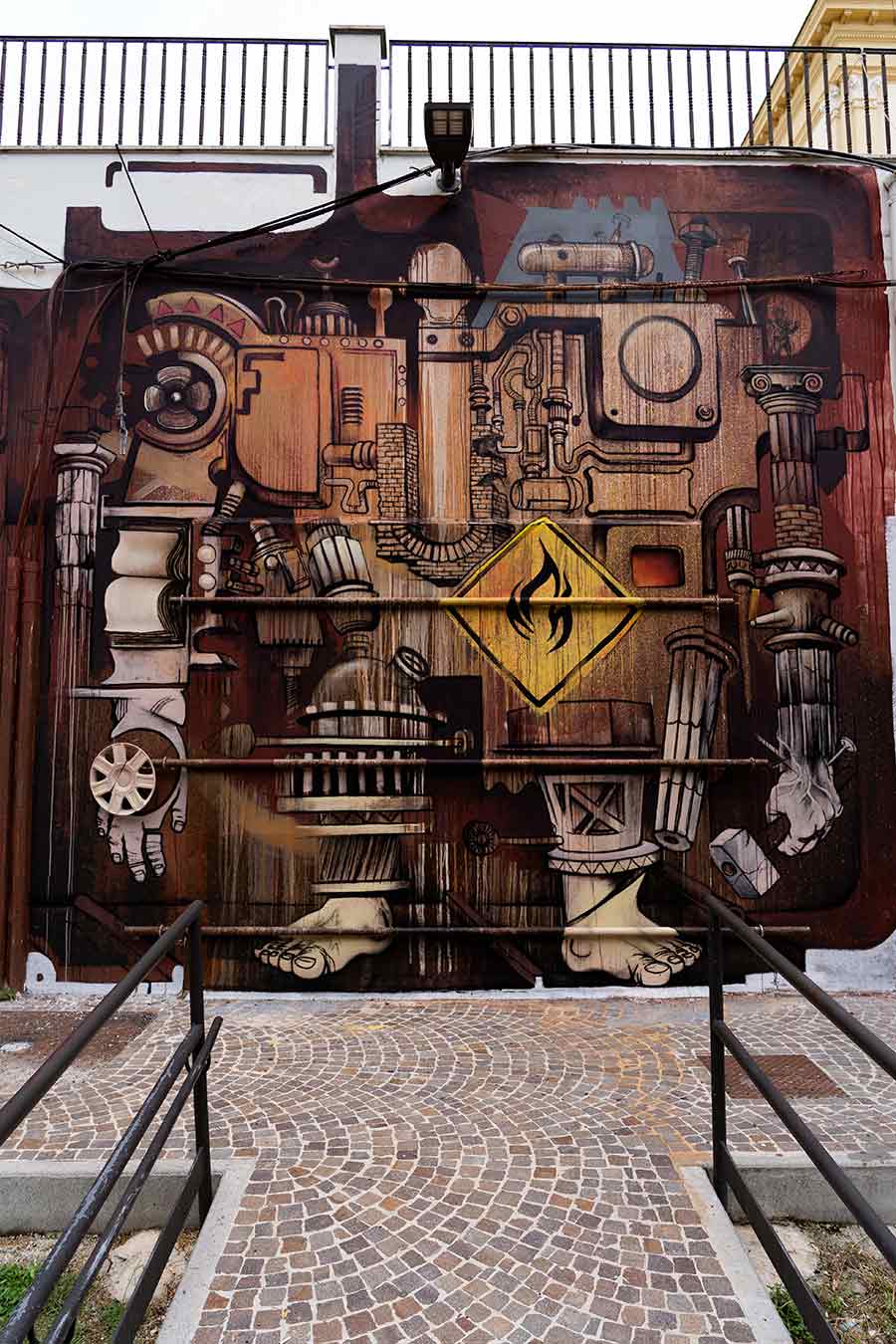
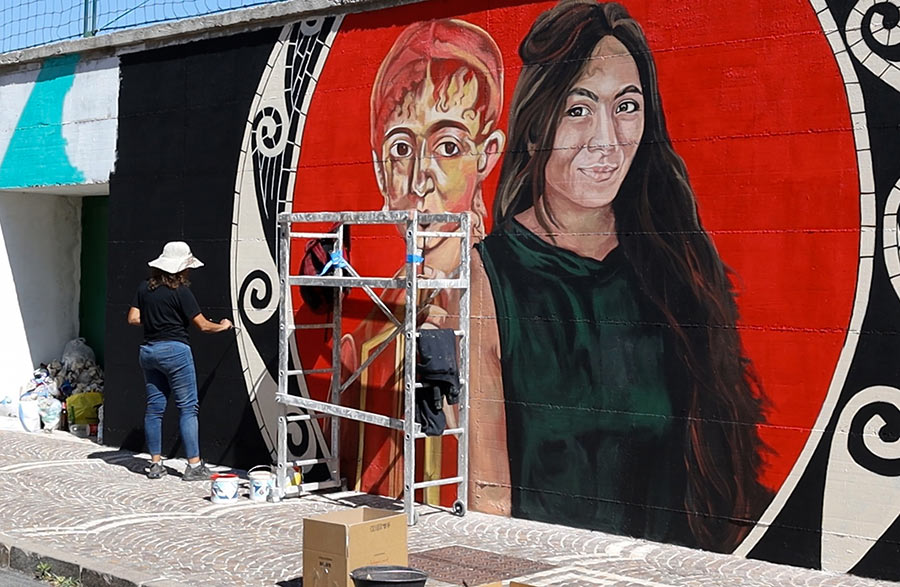
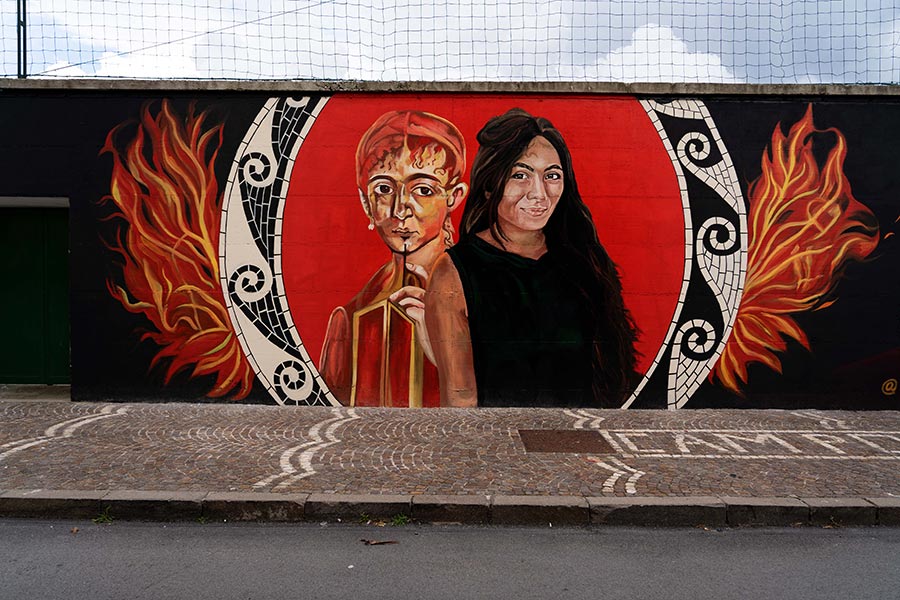
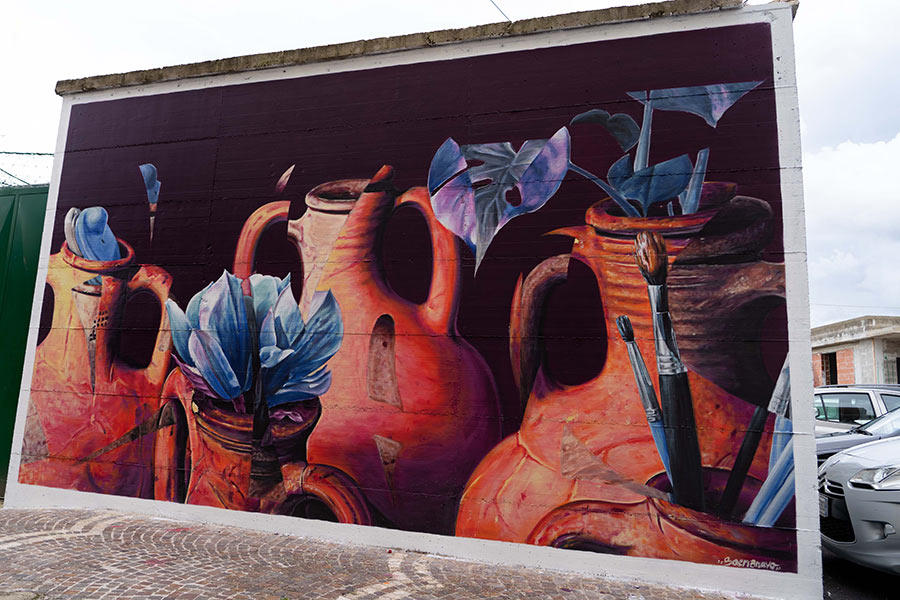
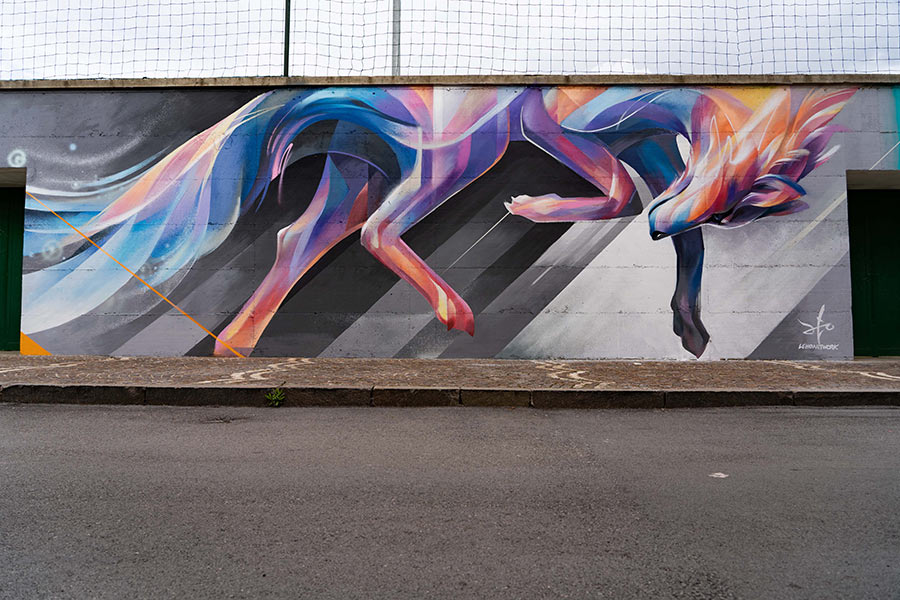
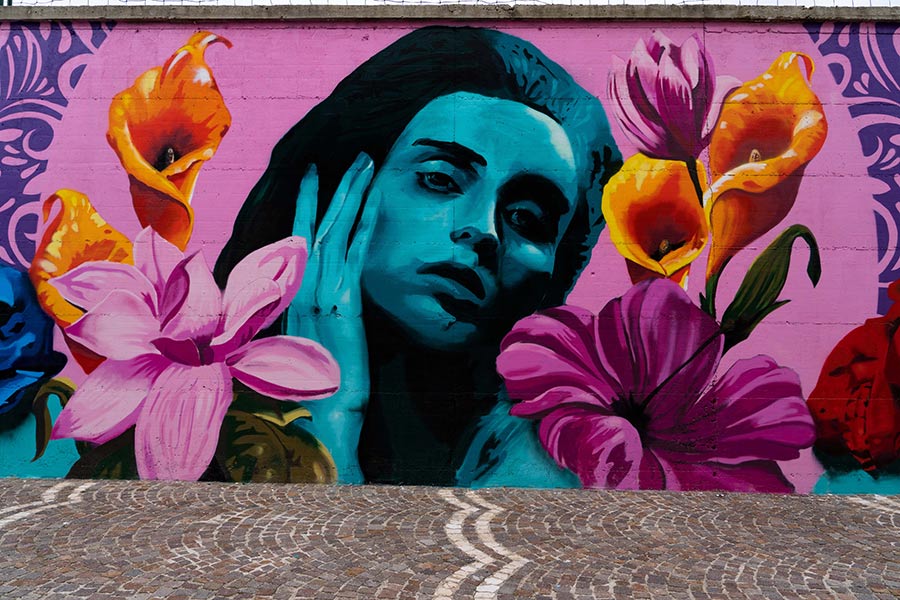
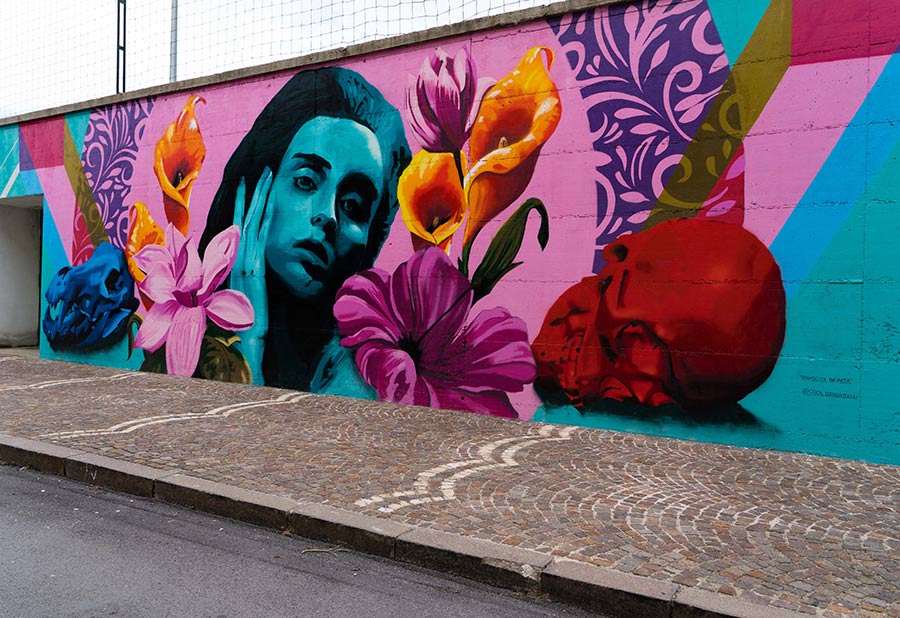
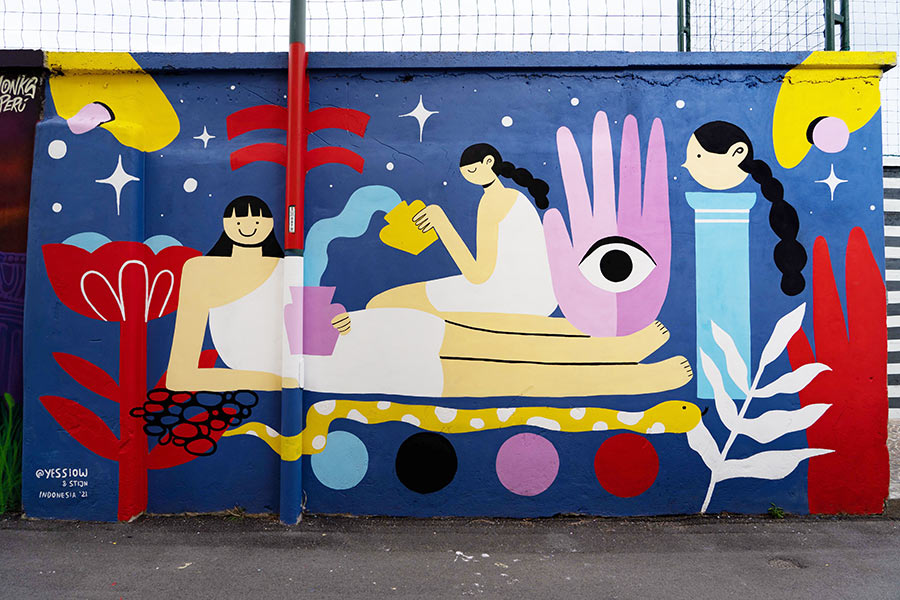
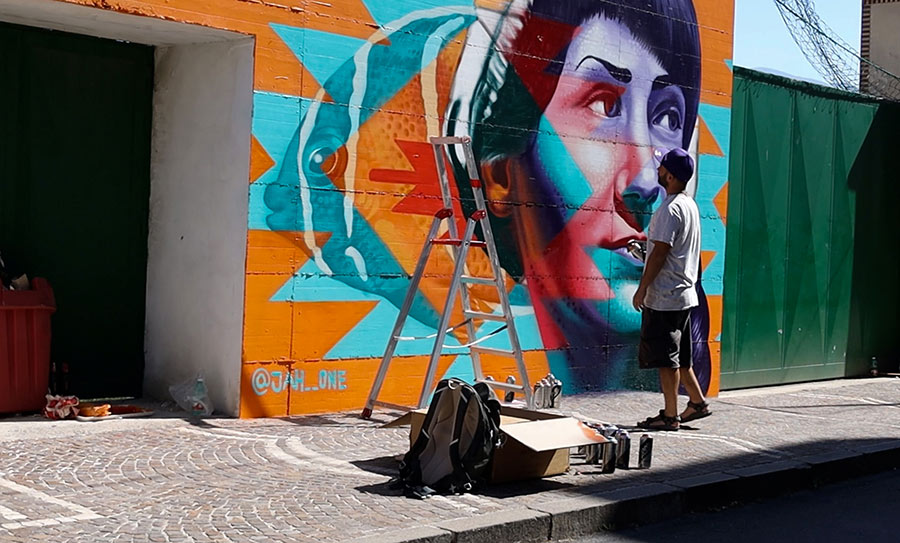
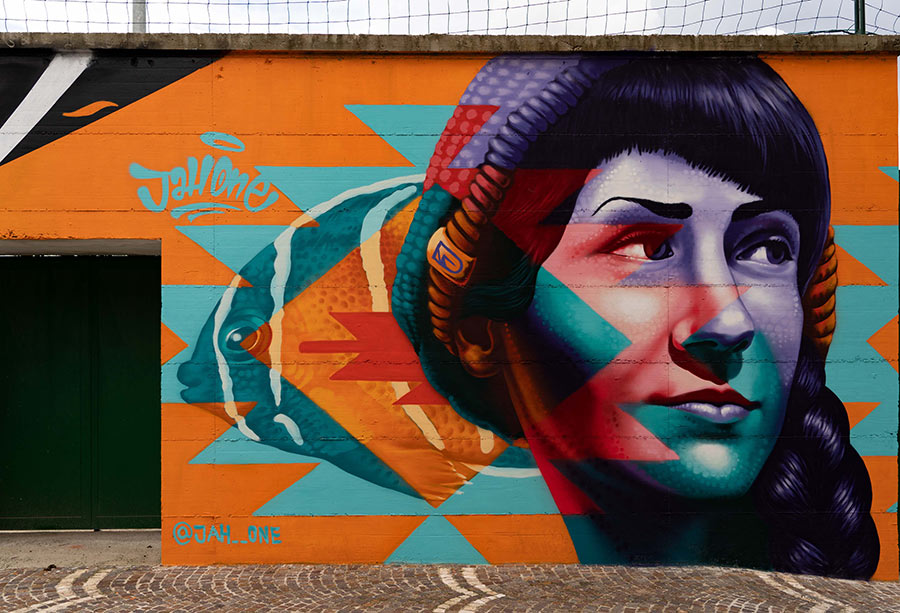
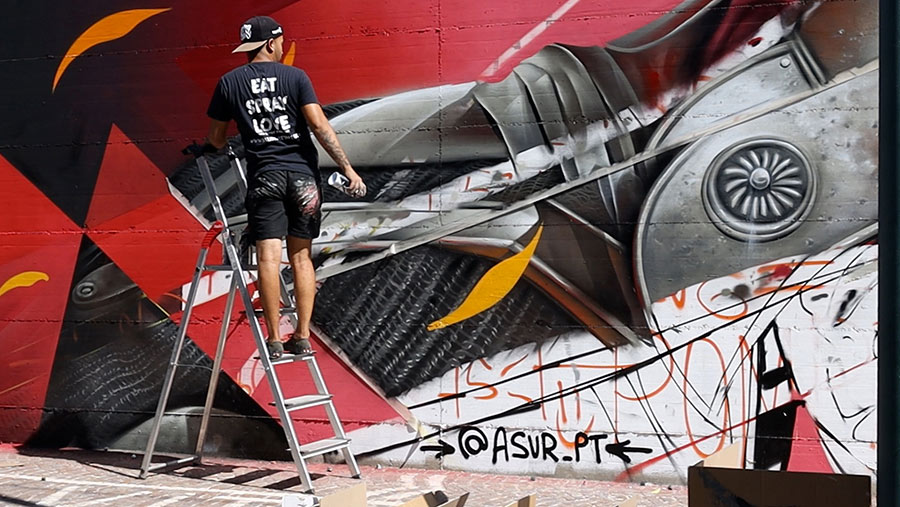
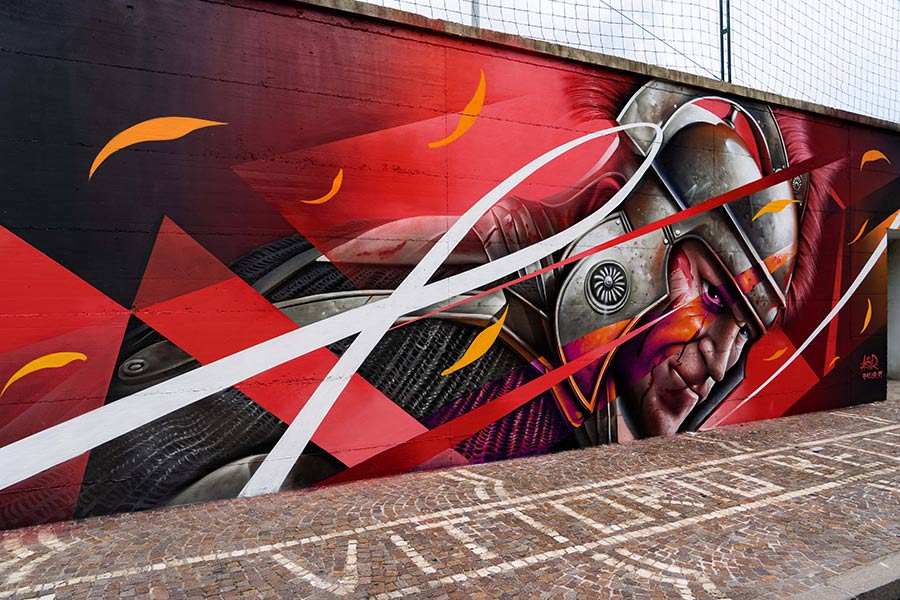
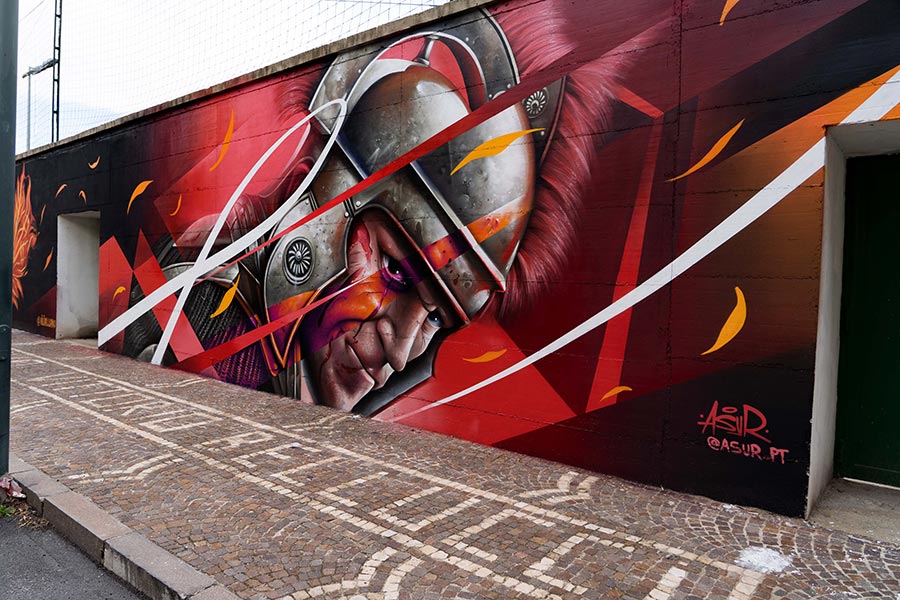
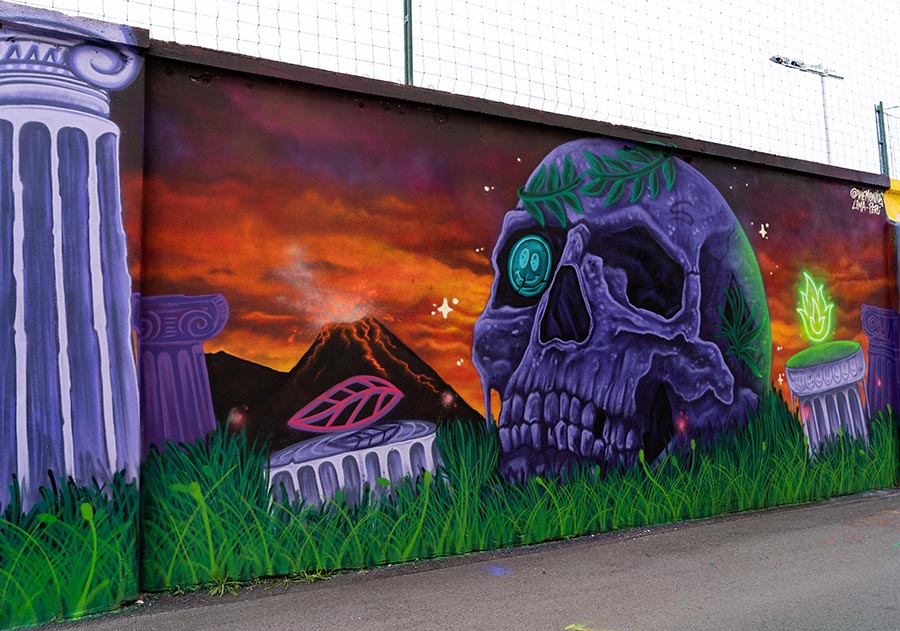
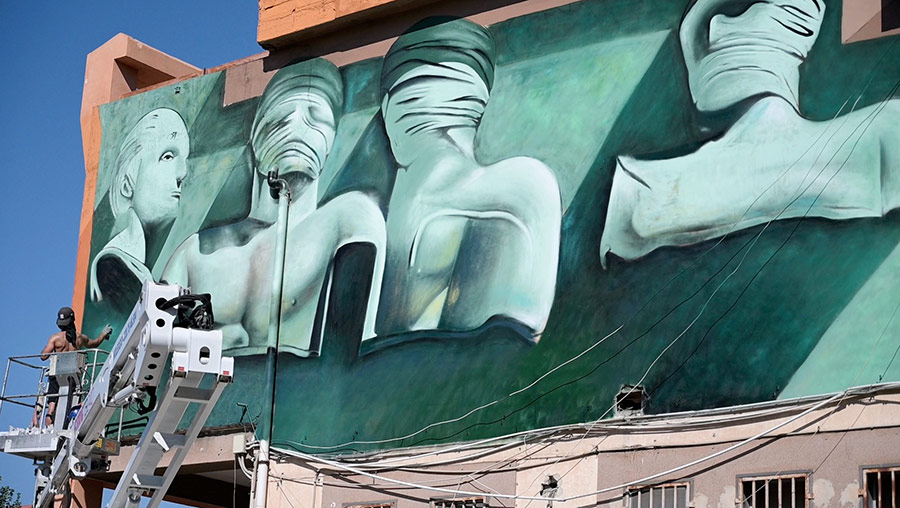
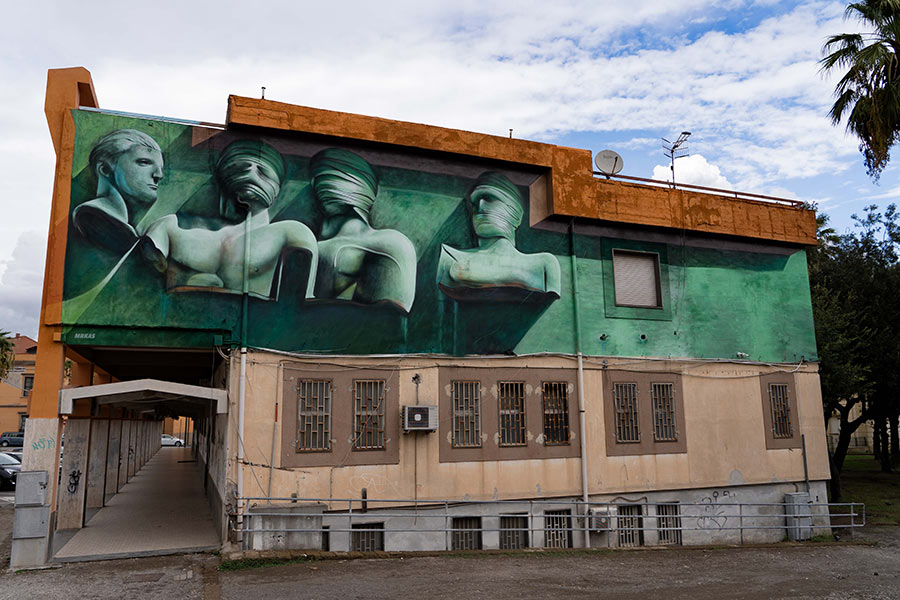
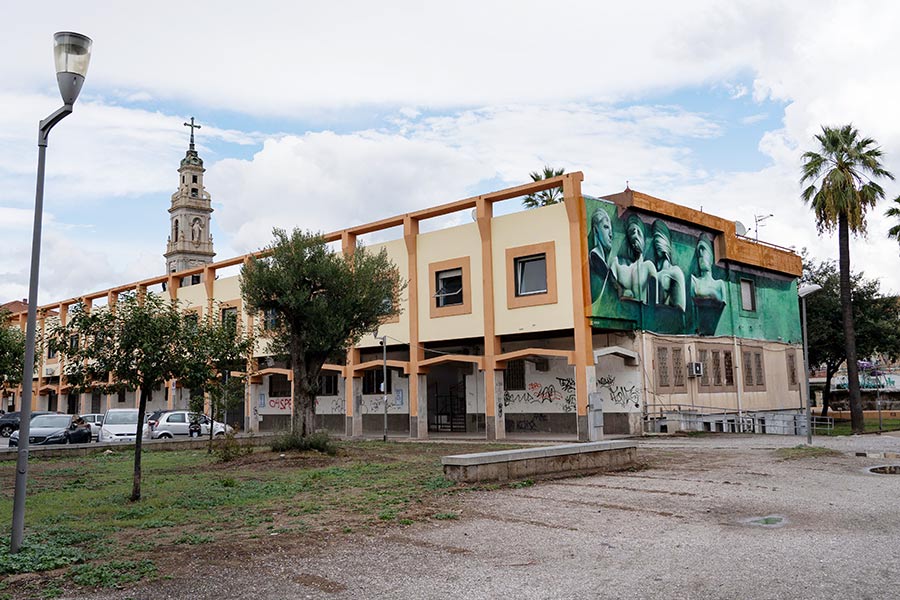
The Pompei Street Art Festival features a familiar selection of events, tours, panels, workshops, performances, murals, and eye candy that you have come to expect from these public/private events meant to spark interest in a city, its downtown, its economy.
Emmeu. Pompei Street Art Festival. First Edition/2021. Pompei, Italy. (photo courtesy of Pompei Street Art Festival)
But the difference here is that the city of Pompei provides a link to ancient graffiti, the citizens of ancient Pompei used chalk and sharp tools to write on walls to express and communicate with each other and of course, it offers a link to the Romans and to the richest archaeological site perhaps in the world. It would be difficult to overemphasize its importance after the discoveries of Pompeii and Herculaneum, not only because of the scholarship that followed it but its influence over the 18th century in both France and England; the neo-classical style, of contemporary renditions of the imagination of the classical world. Buried under ash in 79CE, the history of the excavated city influences the environment, the architecture, the mosaics, water towers, schools, temples, taverns.
Bosoletti. Pompei Street Art Festival. First Edition/2021. Pompei, Italy. (photo courtesy of Pompei Street Art Festival)
So without narration, we first gaze over the murals produced during this festival. One may reflect on that influence of centuries past on every artist participating here, and wonder how this is informing their choices, their techniques, their sense of place in history. We look forward to bringing you the second edition of this fresh new festival in 2022.
M-City. Pompei Street Art Festival. First Edition/2021. Pompei, Italy. (photo courtesy of Pompei Street Art Festival)M-City. Pompei Street Art Festival. First Edition/2021. Pompei, Italy. (photo courtesy of Pompei Street Art Festival)C215. Pompei Street Art Festival. First Edition/2021. Pompei, Italy. (photo courtesy of Pompei Street Art Festival)C215. Pompei Street Art Festival. First Edition/2021. Pompei, Italy. (photo courtesy of Pompei Street Art Festival)Feoflip. Pompei Street Art Festival. First Edition/2021. Pompei, Italy. (photo courtesy of Pompei Street Art Festival)Feoflip. Pompei Street Art Festival. First Edition/2021. Pompei, Italy. (photo courtesy of Pompei Street Art Festival)Feoflip. Pompei Street Art Festival. First Edition/2021. Pompei, Italy. (photo courtesy of Pompei Street Art Festival)Feoflip. Pompei Street Art Festival. First Edition/2021. Pompei, Italy. (photo courtesy of Pompei Street Art Festival)Kilia Llano. Pompei Street Art Festival. First Edition/2021. Pompei, Italy. (photo courtesy of Pompei Street Art Festival)Kilia Llano. Pompei Street Art Festival. First Edition/2021. Pompei, Italy. (photo courtesy of Pompei Street Art Festival)Soen Bravo. Pompei Street Art Festival. First Edition/2021. Pompei, Italy. (photo courtesy of Pompei Street Art Festival)Leho. Pompei Street Art Festival. First Edition/2021. Pompei, Italy. (photo courtesy of Pompei Street Art Festival)Cool Disco Rich. Pompei Street Art Festival. First Edition/2021. Pompei, Italy. (photo courtesy of Pompei Street Art Festival)Cool Disco Rich. Pompei Street Art Festival. First Edition/2021. Pompei, Italy. (photo courtesy of Pompei Street Art Festival)Yessiow. Pompei Street Art Festival. First Edition/2021. Pompei, Italy. (photo courtesy of Pompei Street Art Festival)JahOne. Pompei Street Art Festival. First Edition/2021. Pompei, Italy. (photo courtesy of Pompei Street Art Festival)JahOne. Pompei Street Art Festival. First Edition/2021. Pompei, Italy. (photo courtesy of Pompei Street Art Festival)Asur. Pompei Street Art Festival. First Edition/2021. Pompei, Italy. (photo courtesy of Pompei Street Art Festival)Asur. Pompei Street Art Festival. First Edition/2021. Pompei, Italy. (photo courtesy of Pompei Street Art Festival)Asur. Pompei Street Art Festival. First Edition/2021. Pompei, Italy. (photo courtesy of Pompei Street Art Festival)Monks. Pompei Street Art Festival. First Edition/2021. Pompei, Italy. (photo courtesy of Pompei Street Art Festival)Mr. Kas. Pompei Street Art Festival. First Edition/2021. Pompei, Italy. (photo courtesy of Pompei Street Art Festival)Mr. Kas. Pompei Street Art Festival. First Edition/2021. Pompei, Italy. (photo courtesy of Pompei Street Art Festival)Mr. Kas. Pompei Street Art Festival. First Edition/2021. Pompei, Italy. (photo courtesy of Pompei Street Art Festival)Colectivo Cian. Pompei Street Art Festival. First Edition/2021. Pompei, Italy. (photo courtesy of Pompei Street Art Festival)Colectivo Cian. Pompei Street Art Festival. First Edition/2021. Pompei, Italy. (photo courtesy of Pompei Street Art Festival)Colectivo Cian. Pompei Street Art Festival. First Edition/2021. Pompei, Italy. (photo courtesy of Pompei Street Art Festival)
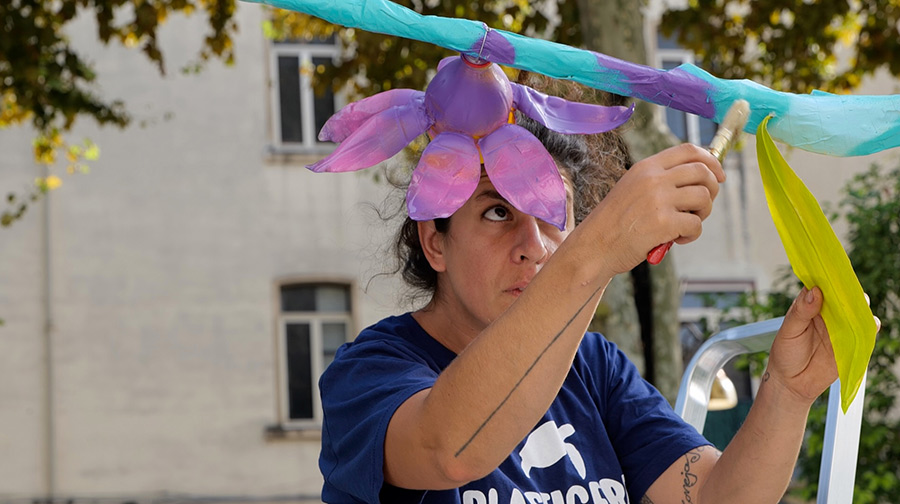
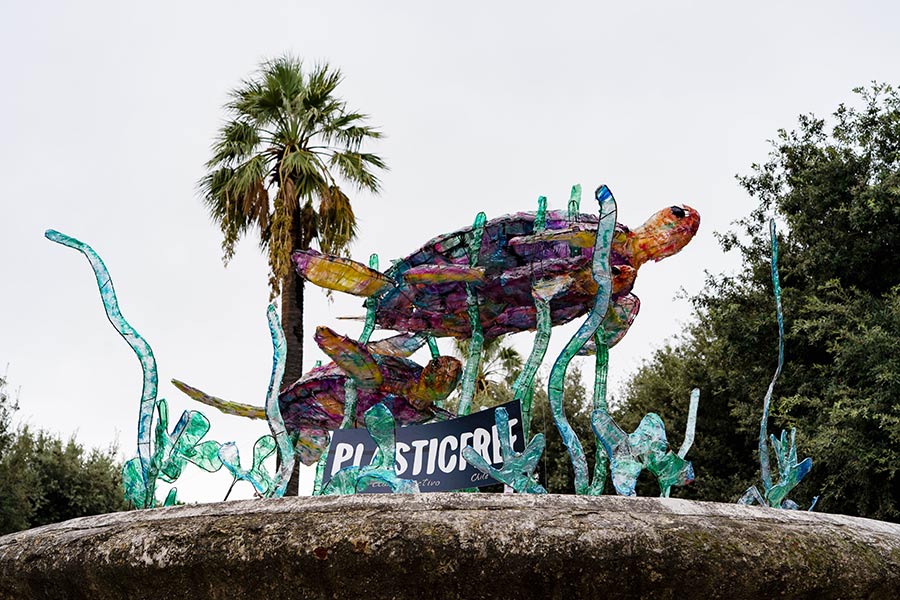
After three weeks of collecting plastic from nearby beaches, the fountain sculpture is completed with the hopes of bringing attention to the environment. The collection of plastic was done in conjunction with Plasticfreeit. The Cian team is composed of Carlos, Max, Rata, and Marcel.
Colectivo Cian. Pompei Street Art Festival. First Edition/2021. Pompei, Italy. (photo courtesy of Pompei Street Art Festival)
 BROOKLYN STREET ART LOVES YOU MORE EVERY DAY