All posts tagged: Jaime Rojo

Bezt Etam Talks About “Beautiful Mistakes”

Bezt Etam Talks About “Beautiful Mistakes”

A certain unease follows Street Artist Bezt in his creative practice.

“I get bored very fast so I try not to repeat myself.” Not an Achilles heel exactly, this need to experiment and learn, as many artists who are stylistically or thematically in a rut could benefit from that affliction.

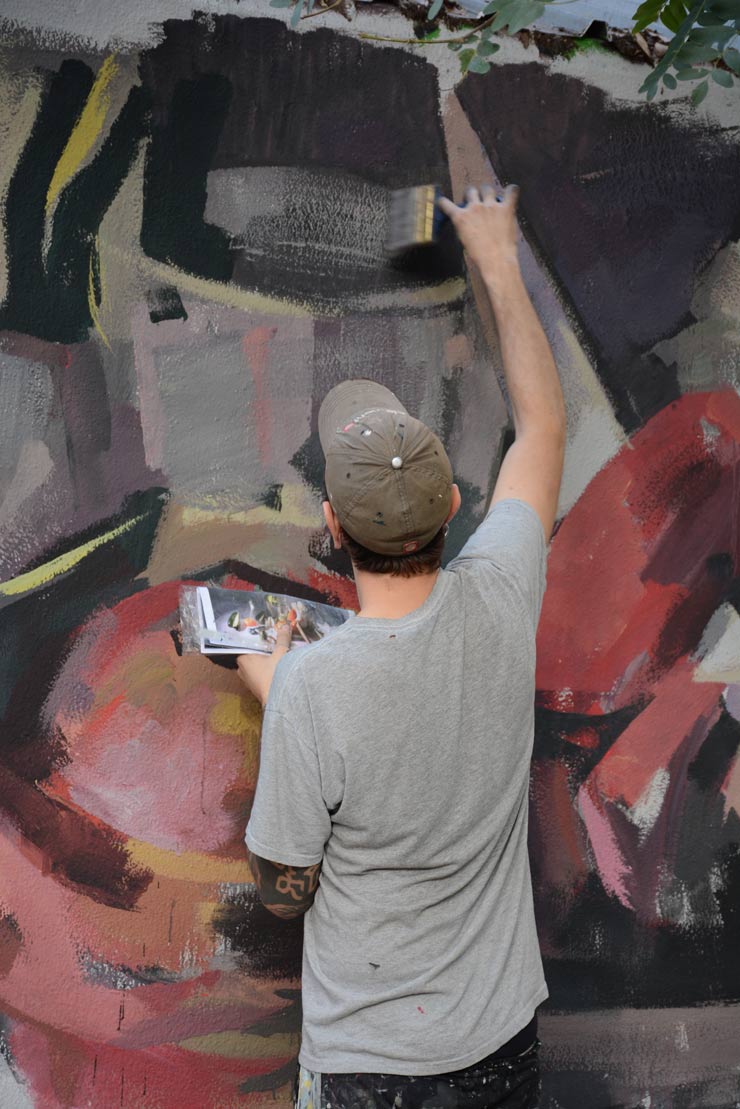
In New York recently for a brief show entitled “Beautiful Mistakes” at Spoke Art in cooperation with Thinkspace in Manhattan’s Lower East Side , the Polish neo-realist appears to thrive on trying new things – including this solo career he’s embarked on after seven or so years painting in tandem with Sainer as one half of the very popular Etam Cru.

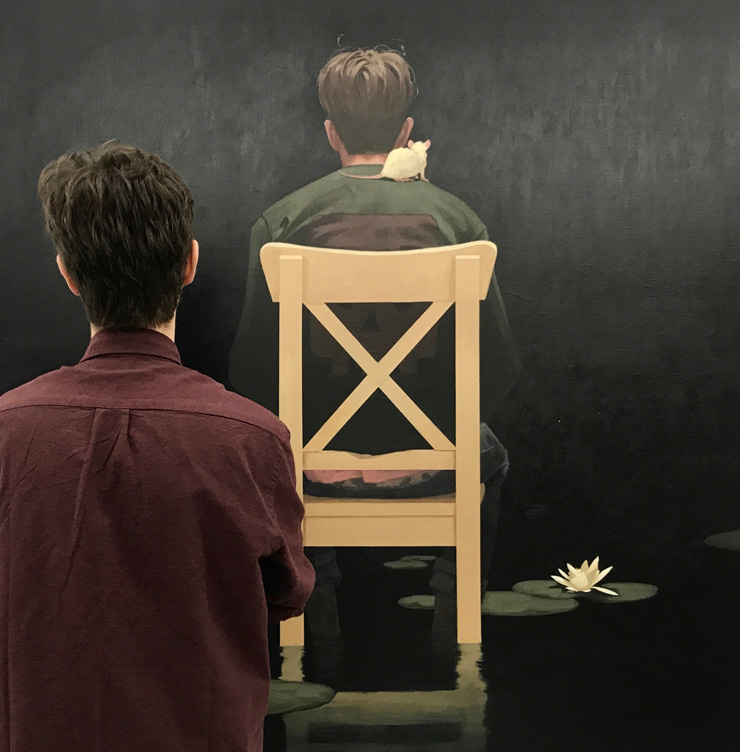
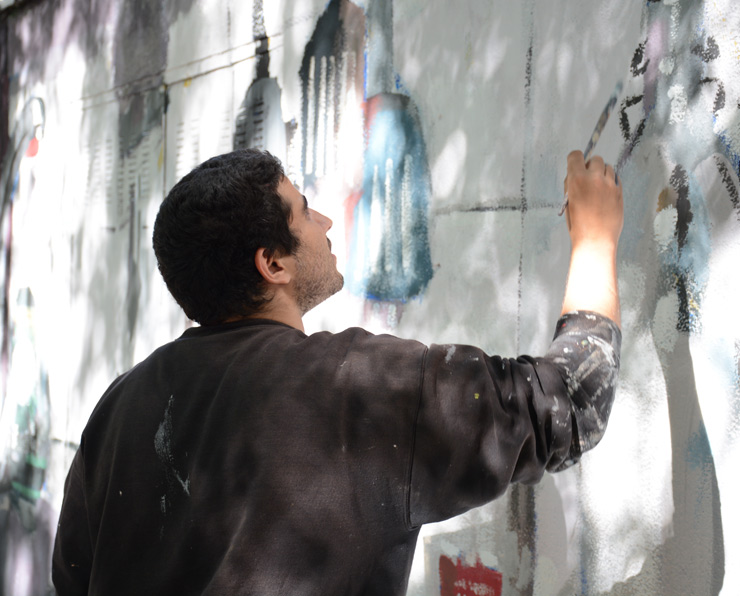
Bezt Etam. “Beautiful Mistakes”. The artist is pictured here looking at his self portrait. (photo © Jaime Rojo)

“Our styles were really separate but when we started we began to blend in – it was kind of natural. We didn’t talk about it,” he says of the friend he met when they were both art students at University of Łódź.

“There was a point with Sainer when we met we kind of knew – like best friends who kind of understand each other on some level. And the goal was always to do a good piece. It is never about me or about him. It was always to do the best thing on the wall,” he says as he describes a collaborative style that was born out of both artists desire to find a common style and to learn from each other.

Bezt Etam. “Beautiful Mistakes”. Detail. (photo © Jaime Rojo)

“To do that we had to kind of resign from our own kind of “super styles” and mix them together, if that makes sense. It was a slow process but we got to the point where everyone thought that only one person was painting. But still after so many years we can both see the differences.”

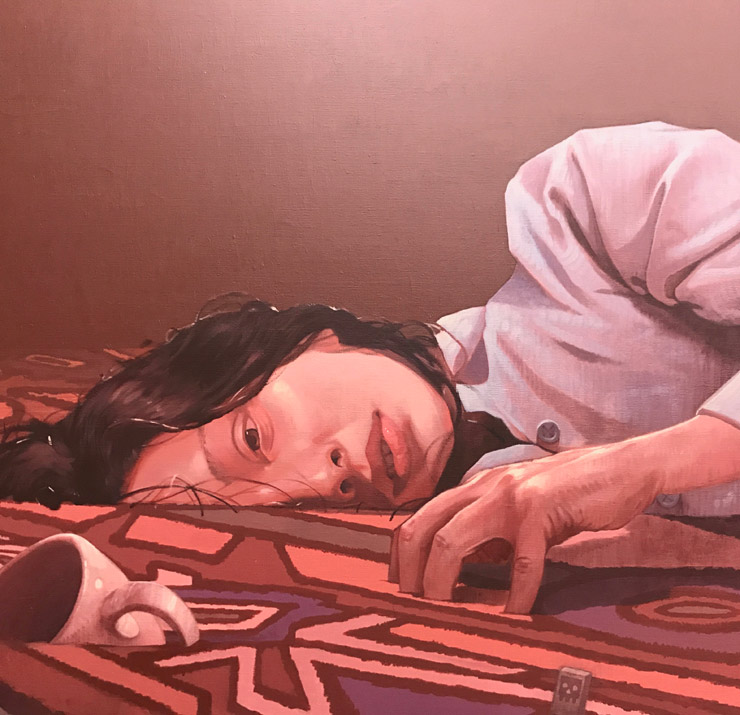
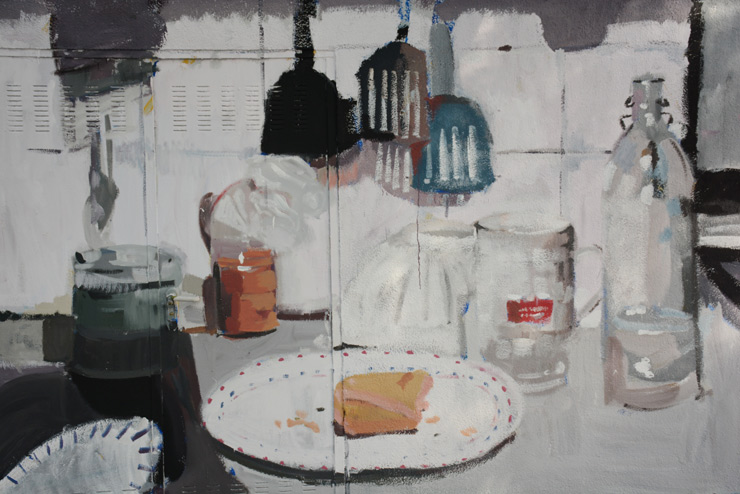
His new canvasses stand still, portraits primarily, with often singular figures caught in a moment contemplating in an eerie series of twilights and meditations. A master of light, he talks about his ongoing challenge to understand it and to reveal structure with it.

Bezt Etam. “Beautiful Mistakes”. Detail. (photo © Jaime Rojo)

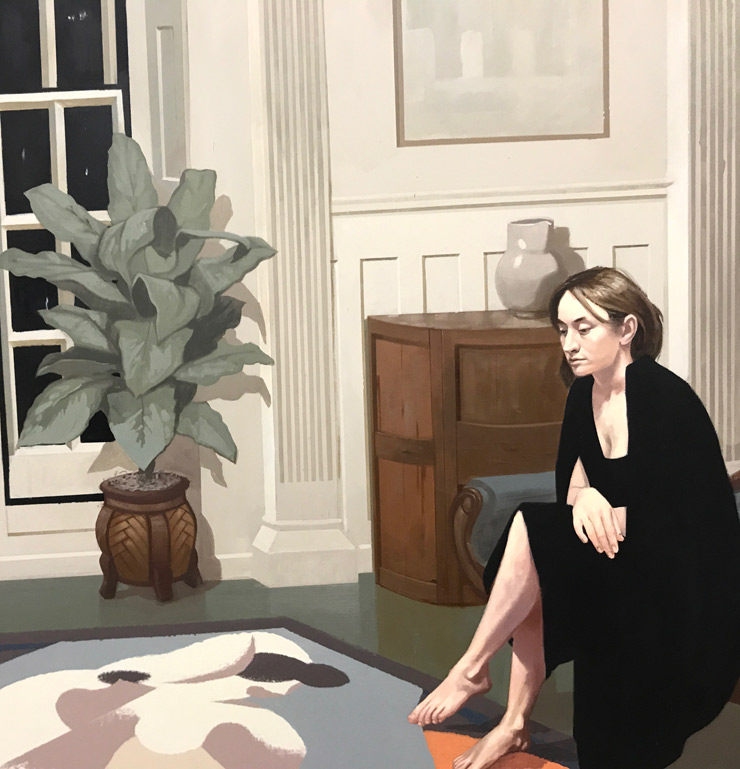
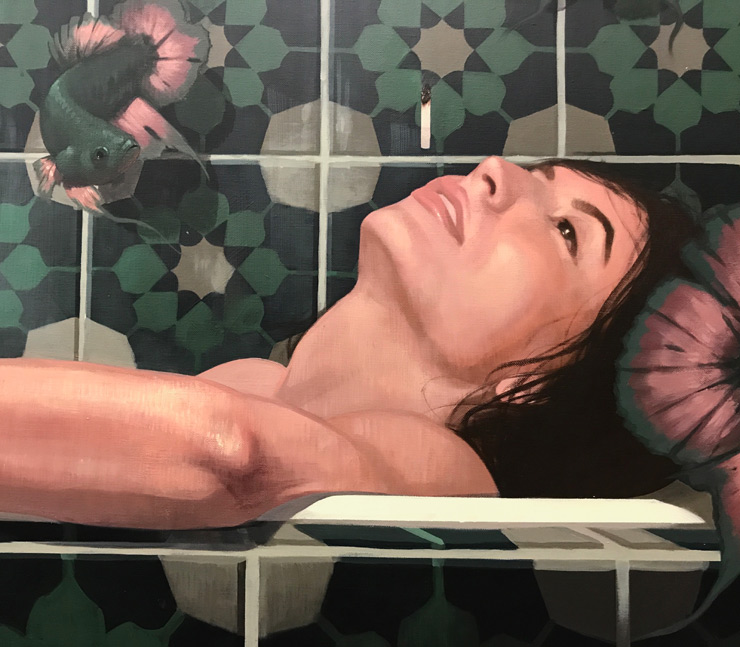
“You use the lights of the first figure as a shadow,” he says of a woman who faces you against a backdrop of ornate patterning, evocative of wall paper from a large old house. “I like to feel the structure of the face and so I like to see the shadow and the lighting on the face, how the face is built.”

He points to a darker figure in front of a brightly heraldic architectural background. “The colors on his shirt and his jacket are the shadows from the background. It’s kind of a trick that I like to do with the painting because the person pops out and blends in at the same time. It’s hard to explain and it is easier to show when I am in the process.

Bezt Etam. “Beautiful Mistakes”. Detail. (photo © Jaime Rojo)

Bezt explains that really he just wanted to paint the background but realizes that many of his fans will also appreciate a figure – which he gets bored with.

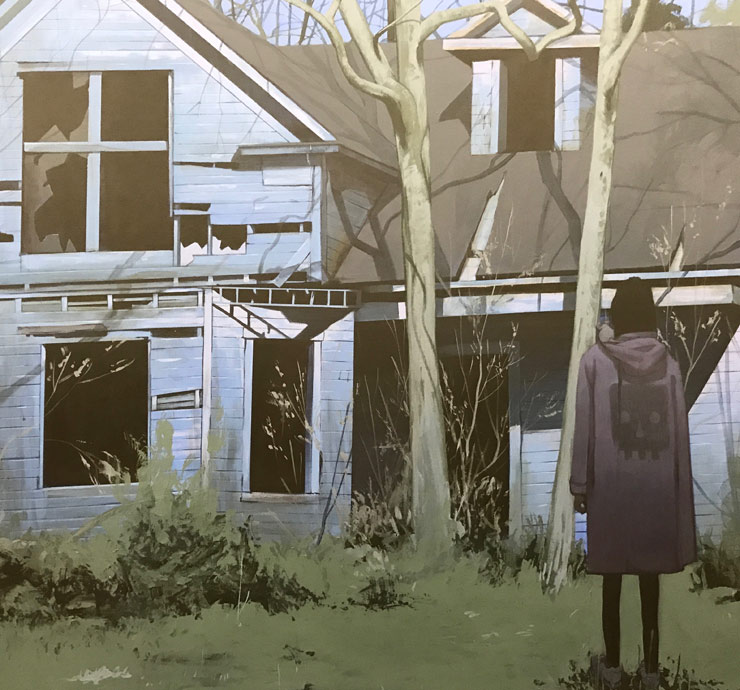
Sometimes a portrait is actually the means to an end, rather than the focal point, just so he has the opportunity to paint something new. “For example the painting with the woman and the daughter piece, that one with the house. I wanted to paint the trees! I had a night photo of the trees and I said ‘Okay, I need an idea so I can paint the trees.’

Bezt Etam. “Beautiful Mistakes”. Detail. (photo © Jaime Rojo)

“I did another piece for a big show in Germany that has a big fallen tree. Basically I saw the tree when we were driving and I was with Natalia, my girlfriend, and we just jumped out and I took the photos. And again, I needed to find a concept for a painting where I could include that image of the tree. Sometimes you just want to learn something – to try something new.”

Bezt Etam. “Beautiful Mistakes”. Detail. (photo © Jaime Rojo)

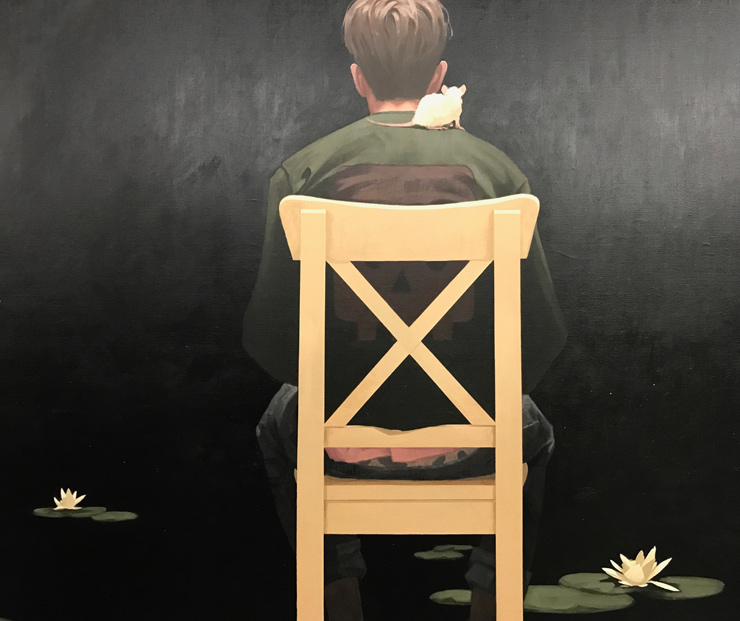
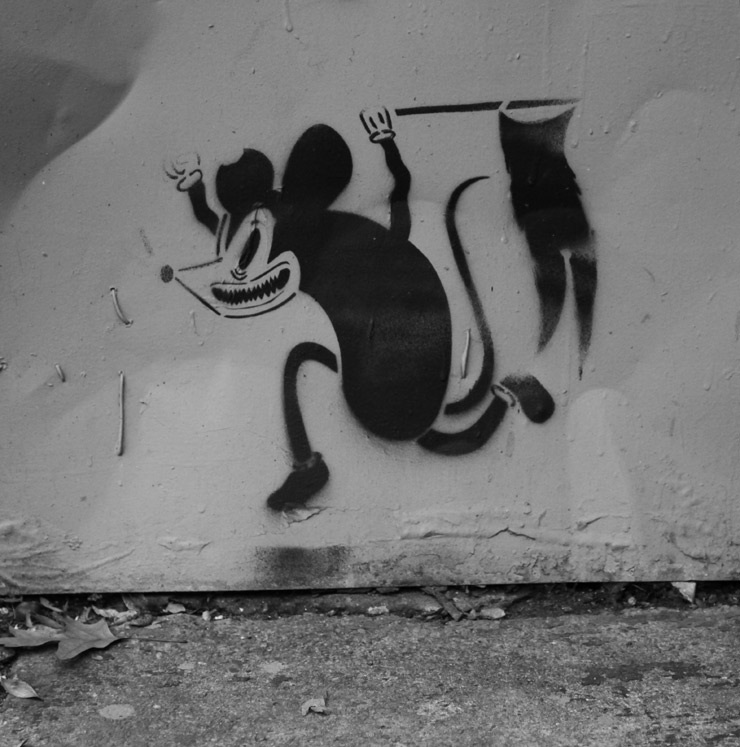
He pauses for a moment in front of a painting and you realize that the shape of his head is mirrored in it, and actually the painting is a self portrait. And then you see the small white rat –a moniker that has been occurring in Etam Cru and Bezt pieces over this last half-decade or so.

“It’s like a spirit animal. I don’t like to paint rats. I think that I can’t really paint a good mouse and I’m always trying to do my best. It’s never perfect. There is always something wrong with it. But I add it as a sort of friend or a spirit animal. If the person is alone he always has some company.”

“Years ago when I was painting girls I was always adding a bird, so like the rat is a boy thing. But I have started to mix things and I add the rat to wherever the character is. It’s an animal that is quite small so it doesn’t take much space to add to the piece and it kind of adds some warmth.”

Bezt Etam. “Beautiful Mistakes”. Detail. (photo © Jaime Rojo)


Read more
Arnau Gallery In Barcelona. A Wall with a mission

Arnau Gallery In Barcelona. A Wall with a mission

The celebrated but now ruinous Arnau Theater in Barcelona sits patiently awaiting to be revived. Once an effervescent center of spectacle and entertainment the theater opened its doors in 1894 and through various mutations including a place to go to the “talkies” and a variety program hosted by the then famous actress Sara Montiel closed its doors in 2004. The theater is now the property of the municipality and with that it has a very good chance to see the light of day again.

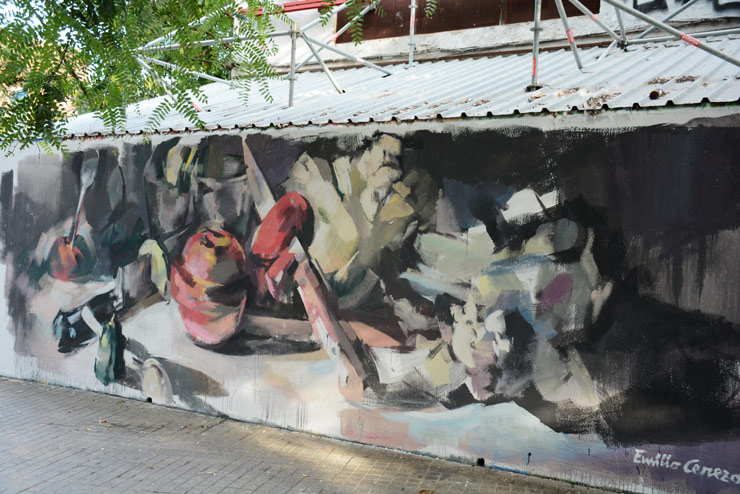
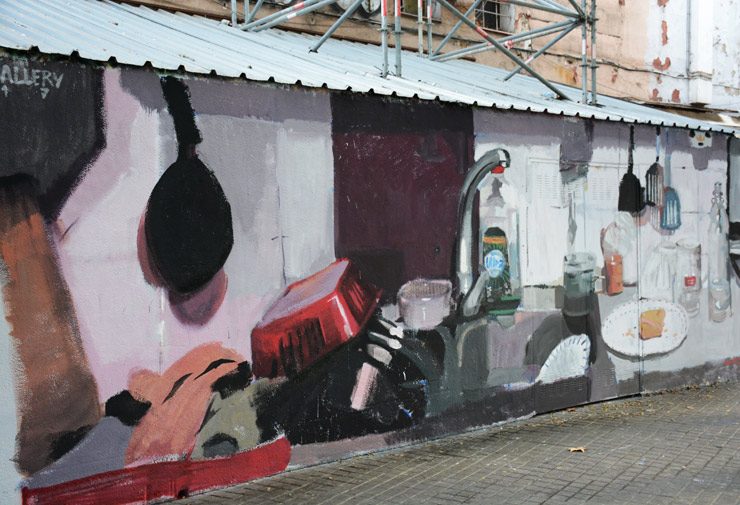
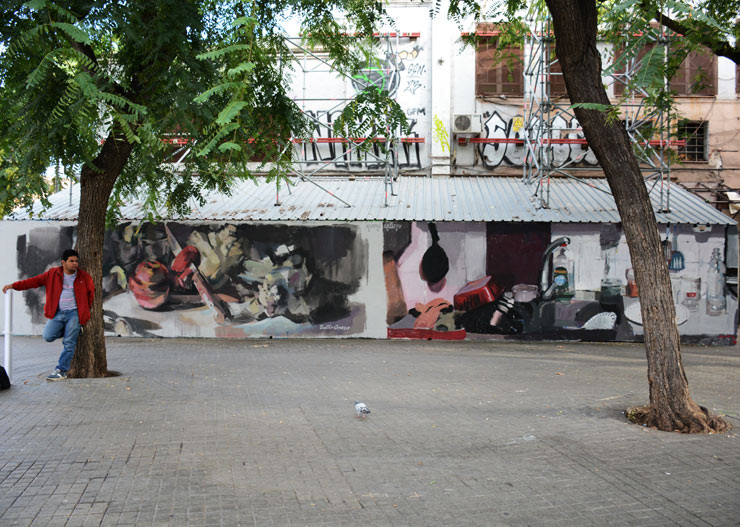
Mohamed Lghacham AKA Moha and Emilio Cerezo collaboration at Arnau Gallery in Barcelona. October 2017. (photo © Lluís Olivé Bulbena)

As it’s often the case the revitalization of our city centers or downtown falls on the hands of the artists and the creative sort. Once an artist has set his or her eyes on a crumbling piece of real state or on a neglected part of town it’s almost unavoidable for these artists to ignore what they see. That’s precisely what Arnau Gallery is. Not a gallery in the traditional white walls cube but and open door wall, Arnau Gallery is a canvas, an opportunity for artists to paint commissioned work under the guidance of Street Art Barcelona and Difusor.

The wall sits at street level close to the pedestrians and is part of the edifice that bears the theater’s name. The curators have a rotating schedule of local, national and international artists who are invited to experiment, paint and create on the wall. The project has as its main supporter Platform to Save The Arnau Theater the organization leading the fight to keep Arnau Theater alive with the hopes that in the not so distant future the theater will re-open its doors.

In October the Moroccan born Spanish artist Mohamed Lghacham AKA Moha, joined Barcelona native artist Emilio Cerezo to collaborate on this wall. Below are the results of their efforts.

Mohamed Lghacham AKA Moha and Emilio Cerezo collaboration at Arnau Gallery in Barcelona. October 2017. (photo © Lluís Olivé Bulbena)

Mohamed Lghacham AKA Moha and Emilio Cerezo collaboration at Arnau Gallery in Barcelona. October 2017. (photo © Lluís Olivé Bulbena)

Mohamed Lghacham AKA Moha and Emilio Cerezo collaboration at Arnau Gallery in Barcelona. October 2017. (photo © Lluís Olivé Bulbena)

Mohamed Lghacham AKA Moha and Emilio Cerezo collaboration at Arnau Gallery in Barcelona. October 2017. (photo © Lluís Olivé Bulbena)

Mohamed Lghacham AKA Moha and Emilio Cerezo collaboration at Arnau Gallery in Barcelona. October 2017. (photo © Lluís Olivé Bulbena)

Mohamed Lghacham AKA Moha and Emilio Cerezo collaboration at Arnau Gallery in Barcelona. October 2017. (photo © Lluís Olivé Bulbena)

Mohamed Lghacham AKA Moha and Emilio Cerezo collaboration at Arnau Gallery in Barcelona. October 2017. (photo © Lluís Olivé Bulbena)

Mohamed Lghacham AKA Moha and Emilio Cerezo collaboration at Arnau Gallery in Barcelona. October 2017. (photo © Lluís Olivé Bulbena)

Mohamed Lghacham AKA Moha and Emilio Cerezo collaboration at Arnau Gallery in Barcelona. October 2017. (photo © Lluís Olivé Bulbena)


Read more
Murals Across Finland: UPEA ’17 Sweeps More Cities

Murals Across Finland: UPEA ’17 Sweeps More Cities

From the country with the highest standard of living comes a country-wide mural festival called UPEA for 2017! Only in their second year, they are going big here at home.

Messy Desk. UPEA Festival 2017. Finland. (photo © Markus Hänninen)

Okay, the murals are not in every city of this Scandinavian country, but if lead curator and visionary (and former graffiti writer) Jorgos Fanaris realizes his vision, there will be even more than the 40 or so murals the festival has already put up over the last two years in cities like Helsinki, Riihimäki, Kemi, Kotka, Espoo, Turku, and Hyvinkää.

Yes, some of the current international circuit of mural stars are here. So are a stunning selection of Finnish talents and less recognizeable names, making this a conscientious formulation that respects the culture and highlights the global movement simultaneously.
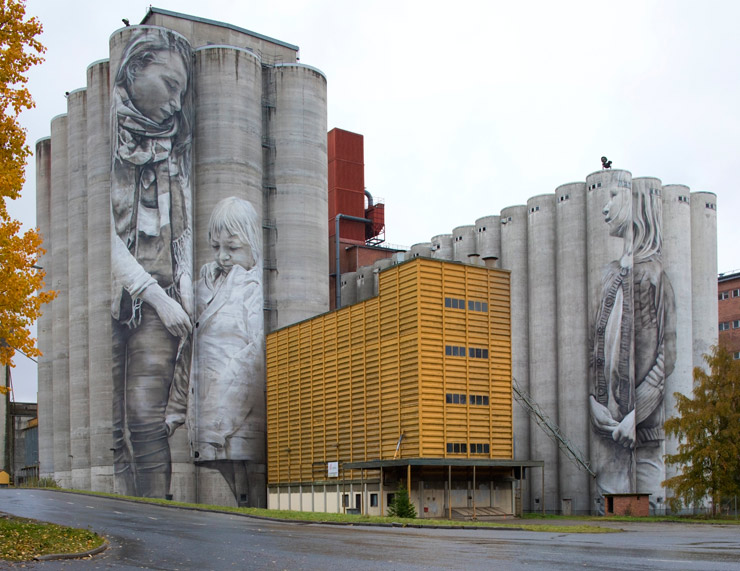
 

Guido Van Helten. UPEA Festival 2017. Finland. (photo © Erho Aalto)

Like many of today’s mural festivals and far from their illegal Street Art/graffitti roots, many of UPEA 17 are mega-murals; multi-story and sophisticated images borrowing from many strains of art history and popular culture – even conceptual art – as much as anything else.

These and other signs of curatorial/organization maturity are not typically hallmarks of two year old festivals, and we could provide a list of rookie mistakes that have plagued others we’ve covered over the last decade. This is probably because UPEA 17 is the result of many years of on-the-ground organizing experience and street culture knowledge – and multiple false starts and obstacles that blocked organizers in the years leading up to last years inaugural outdoor exhibition. People on the ground will tell you that logistics and costs and bureaucracy and local politics are always factors to pull off a festival well. In our experience, so is time.


Teemu Mäenpää. UPEA Festival 2017. Finland. (photo © Tomi Salakari)

We were lucky to have an extensive interview with Jorgos Fanaris about this years successes, the challenges along the way, and his roots in the scene.

Brooklyn Street Art: How is UPEA 2017 different from the first edition?
Jorgos Fanaris: Compared to UPEA16, UPEA17 was of course much bigger. More artists and more projects, but also bigger projects. The first edition was more of testing the concept and feeling around what we could do. The second edition was really about making an impact, letting everyone know about UPEA as an event that creates notable art in public spaces, that we are serious and we are here to stay.

Millo. UPEA Festival 2017. Finalnd. (Photo © John Blåfield)

Brooklyn Street Art: You had an incredibly wide variety of artists painting: From large scale realist portraiture, to surrealism to cartoons, landscape etc…is there a specific style that resonates better with the public?
Jorgos Fanaris: The amount of talented artists that have already participated in UPEA in the first two years, is humbling to say the least. We are very privileged and honored to have had them.

If I evaluate the response the artworks have received from the public, I think raising a specific style in a position that it somehow communicates more with the audience wouldn’t be right. For example if we think realistic portraiture and classic style of Guido van Helten, its easy for anyone to understand that this is technically really difficult to execute in this scale. This year in Hämeenlinna we did the 56m high silos, which of course by the sheer size is something that makes people go “Whooaaaa, how can he do that? We must go and see”.
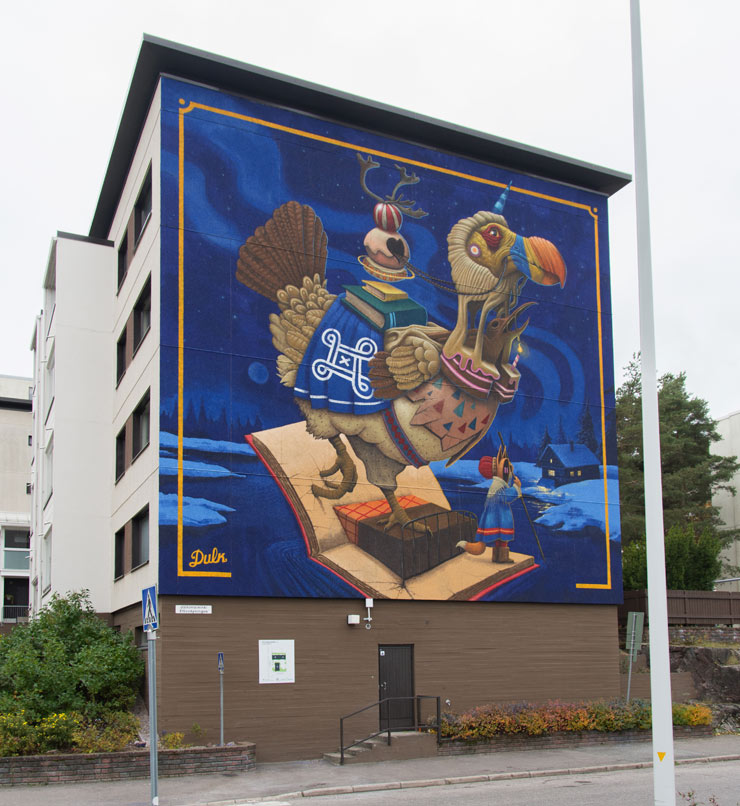
 

Dulk. UPEA Festival 2017. Finland. (photo © Tomi Salakari)

The project gathered and still gathers spectators in huge numbers. During the project there were traffic jams in the area on Sundays. On the other hand in Lahti, the artist named Messy Desks did the crazy cartoon style piece that has million things happening. It created a huge buzz and received a lot of response from people. She was getting gifts from people from the area and was taken out for formal dinners after for appreciation and show of gratitude. Kids are ecstatic about it, knocking on the “doors” and “windows” trying to get someone to open.

At the same time, the second wall we did in Lahti with Roberto Ciredz, a surrealistic piece with total harmony, which by no accident is totally different from Messy Desks wall, was voted as people’s favorite of the two in local newspaper. There are so many things that contribute the overall feedback. I think every style and approach has its place and purpose.

Brooklyn Street Art: Murals become part of a neighborhood, part of the storytelling and lifetime benchmark associations and memories people have – as well as part of the fabric and character of a city. How has the festival been received by the people whose daily lives will be impacted with the presence of the murals?
Jorgos Fanaris: The artworks created a lot of excitement and grassroots movement in their own areas and communities. In Kontula Helsinki, the triple walls by Fintan Magee, Apolo Torres and Pat Perry encouraged the residents to do a “night of arts” event for the unveiling of the artworks. They had food, live music, fire performance and other artistic activities. Over 1500 people attended and possibly the event will continue next year.
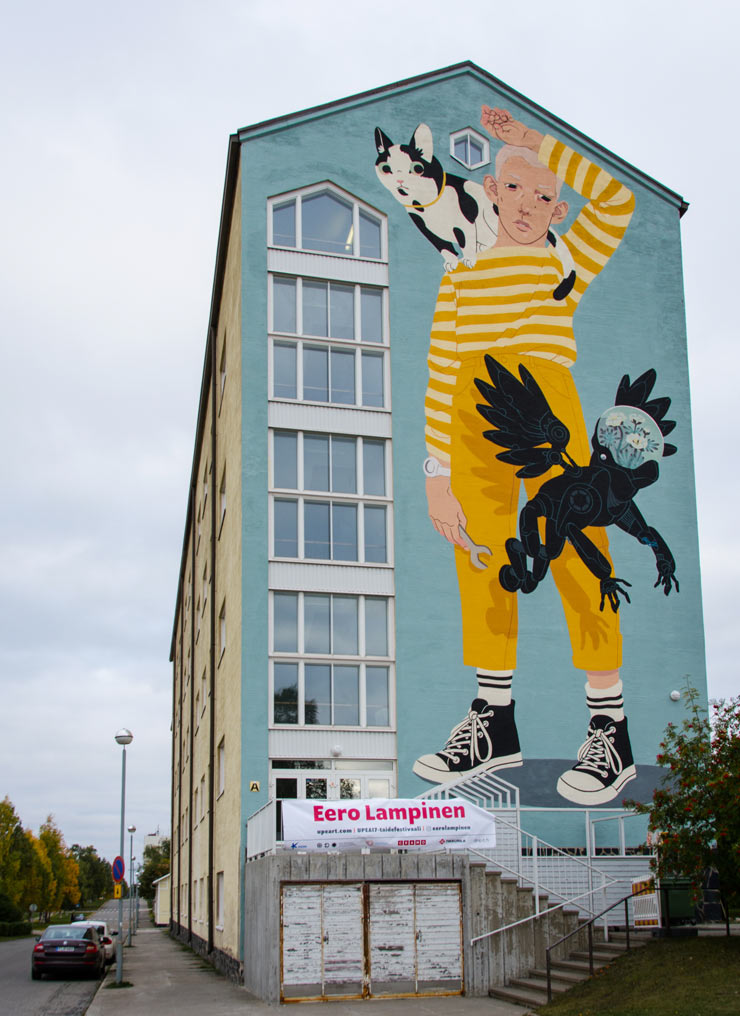
 

Eero Lampinen. UPEA Festival 2017. Finalnd. (photo © Henrik Dagnevall)

In Espoo Matinkylä, where Artez did a great piece, the residents organized an celebration event with huge number of activities, dozens of performances and speakers, about thousand people attending the event. In Kotka, where Smug did the amazing wall right in the city centre, the city made an official unveiling for the wall by closing the street and having a horn orchestra perform. Hundreds of people attended even though it was on a Friday during the work hours.

These are just few examples. We saw a lot of these type of things grow from the artworks we did this year.. We see that street art gets reactions from people who might not be too involved with art in general, like going to the galleries for example. The artworks are a refreshing injection into the community and it’s super exiting for us to see things starting grow from them.

Onur. UPEA Festival 2017. Finalnd. (photo © John Blåfield-Valmis)

Brooklyn Street Art: Do you get support from community and city officials for the festival?
Jorgos Fanaris: Yes, we are working with the officials in every city we are in. The support has been great, possibly due to the fact that we have been able to create an event this size with fairly limited organization and funding.

Still the way we execute different projects really varies. Regardless of how much the city is involved, the permits, which are always a big thing in Finland, are handled by their own unit inside the city. In some cases the city assists us in the permit process and it can be very helpful. But also in many cases we handle the whole process completely. From searching locations and handling all the permits and other things all the way to executing the artwork. The range is very wide on different projects. Still, the city is involved and even if we are doing permits and related responsibilities ourselves, it helps that they are officially supporting the project in the background. Everyone has a common goal to make the project happen and in a positive spirit they work towards that goal together.

Onur. UPEA Festival 2017. Finalnd. (photo © John Blåfield-Valmis)

Brooklyn Street Art: What drives you to make this festival happen? What is the motivation? The incentive?
Jorgos Fanaris: Upeart is a collective of people from various backgrounds; from graffiti, city development to event organizing and more. I think the motivation varies depending on who you ask. But in general, it’s about interest in the possibilities art has in public spaces. The vision to push for ambitious ideas, pushing limits further and willingness to take chances.

I personally, have a graffiti background from late 80’s to beginning of the new millennium. When I painted myself, I was mainly, especially in the later years, interested in graffiti as a tool in getting reactions from ordinary people by using public space or things that move in that space. At some point, I moved away from actively painting and started working in music projects, doing shows and stuff like that.

During those years, Finland gradually started to dismantle the very strict zero tolerance on graffiti and street art they had imposed in the country for years. Many youth and grassroot organizations worked years relentlessly on it and it started finally to show some results around 2008. At some point, I thought the time would be right to start something like this. Do it seriously and professionally. We actually tried to start an ambitious project like UPEA for few years, but it was difficult. We had of course no money at all and with that also no guarantees about anything.
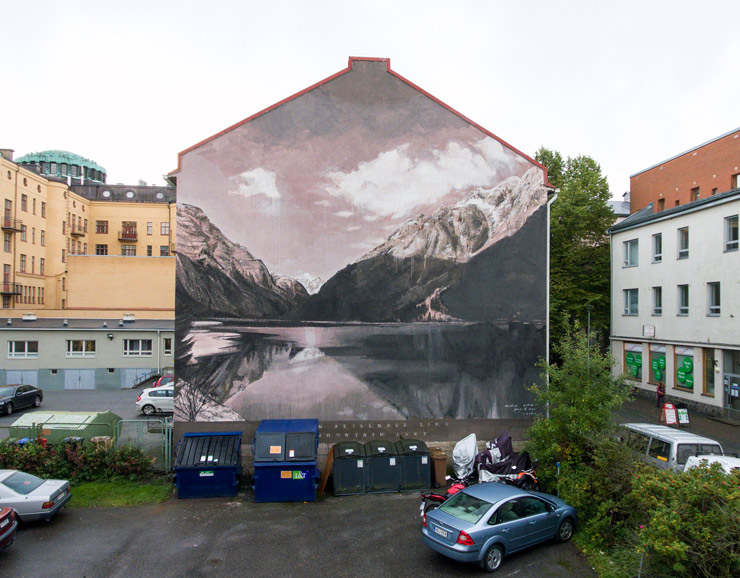
 

Ricky Lee-Gordon. UPEA Festival 2017. Finland. (photo © Rikupekka Lappalainen)

Then we tried to get a group of people together with the same goal to work on the project. With 3-4 people each contributing a little, combined, it creates an effort big enough to start an interesting thing – on paper at least. It proved to be very difficult. We had actually two tries that failed to make any progress.

We came together with a couple of people, agreed about the goal and how we should work towards it. But when it came down to doing real work for it – nothing much occurred. To me it was really strange. I feel that we wasted a lot of time and energy of course, and it was really frustrating. But eventually, probably after three years or something from the original idea, Upeart started to come together and this time with people who have the drive and are actually willing to work for it. So finally, the organization and the event UPEA was born on the third try.

Brooklyn Street Art: This is a very young festival, only two editions. Did you look at other festivals as an inspiration for UPEA?
Jorgos Fanaris: Yes, of course. You look around other festivals and different things that people do everywhere for ideas. I personally think that there are a lot of new and exciting things happening in several places around the globe. That’s why keeping your eyes open and trying to learn from everything is important. You see things and think, wow that’s so cool, could we do something like that? You add your own ideas in to it and it changes to something else.
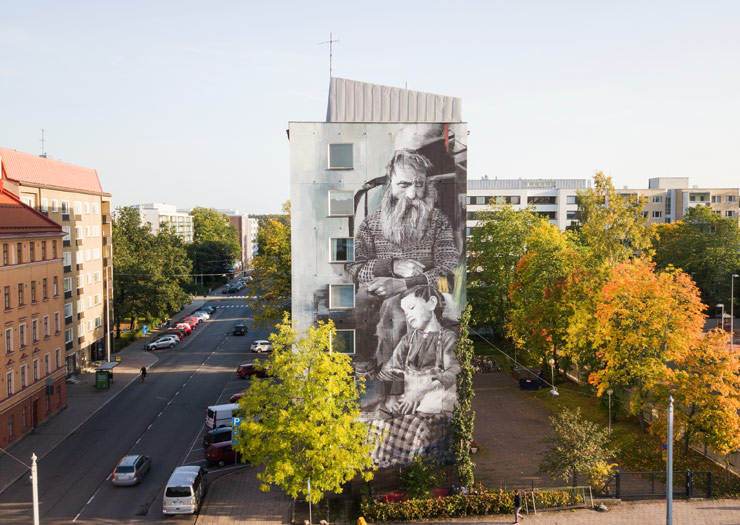
Wasp Elder. UPEA Festival  2017. Finland. (photo © Matti Nurmi)

It’s a notable fact that UPEA is so young, like a little baby. We are not there yet and have huge task ahead of us on refining the concept. Already this year we wanted to do several other things besides murals, but we just didn’t have the resources to execute. But its ok, things always need time. The organization needs to grow, the concept needs to be refined and we need to build up our personal networks and several other things. In this process of maturing and finding the way for you, it helps if you see what else is going on around the world.

Brooklyn Street Art: What distinguishes UPEA from other European Street Art Festivals?
Jorgos Fanaris: I guess one obvious thing compared to many others, is that UPEA is a multicity event held all over the country. Finland is a small country, only 5 million people and the biggest city the capitol Helsinki, has only 1 million. When we thought about the concept, we really had to think about what will happen when we do a large number of big artworks and how it progresses when we do this year after year. We thought we would need serious space to execute on the level that we want year after year.
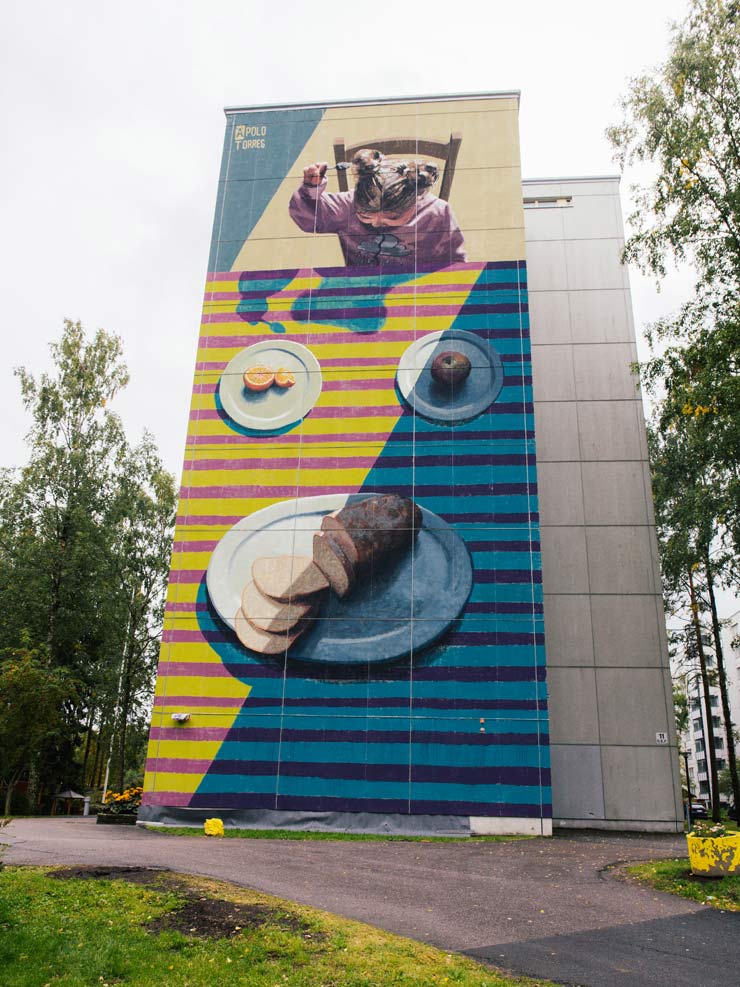
Apolo Torres. UPEA Festival 2017. Finalnd. (photo © Anna Vlasoff)

One thing of course also is that we have seriously big projects, especially on the second edition this year.

Considering we had the 56m high silos, triple side by side 8 story buildings, a complete house on all four sides and several single big 6-8 story buildings and so on, the sizes of the projects were huge. However now that we are looking forward at upcoming years, I think UPEA will become more and more original and mature to something very unique. Also one thing is, that several artists have told me, UPEA is one of the best organized events they have participated in. True or not (I think they are nice and say that in every event), I think this a proper note to end an interview!

Telmo & Miel. UPEA Festival 2017. Finland. (photo © Antti Ryynänen)

Telmo & Miel. UPEA Festival 2017. Finland. (photo © Antti Ryynänen)
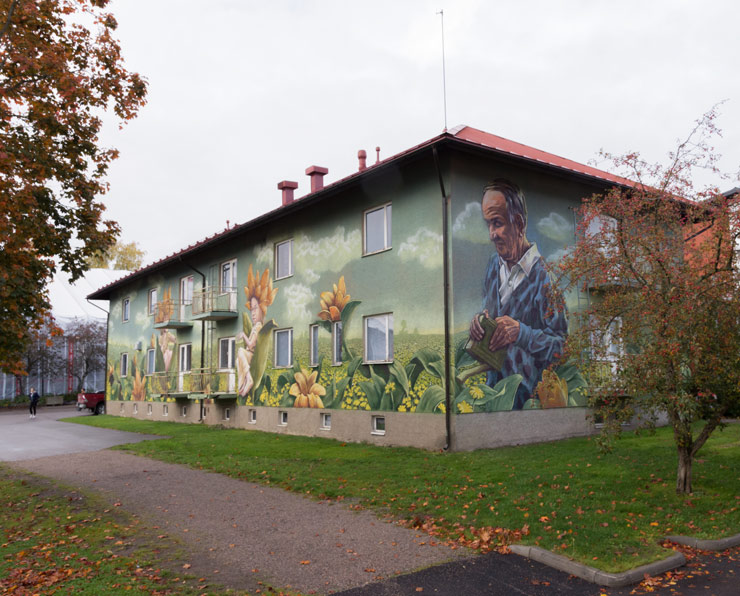
Rustam Qbic. UPEA Festival 2017. Finland. (photo © Tomi Salakari)
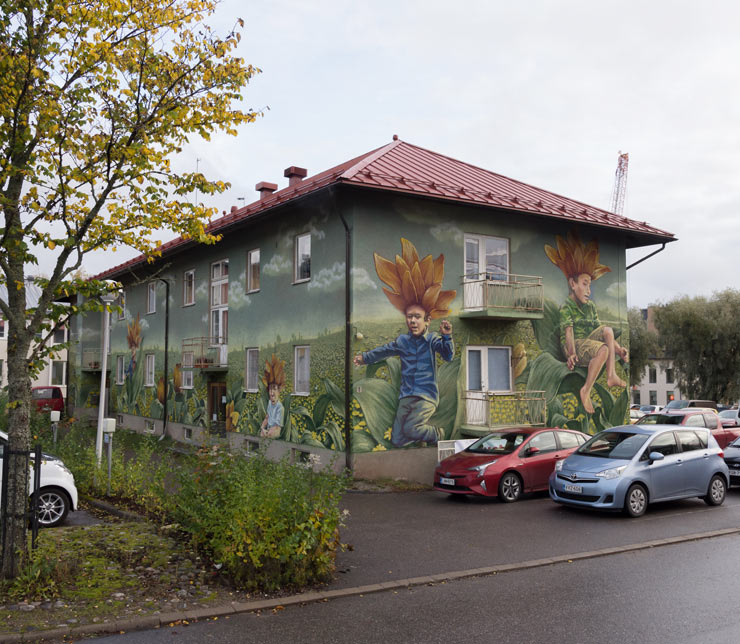
Rustam Qbic. UPEA Festival 2017. Finland. (photo © Tomi Salakari)
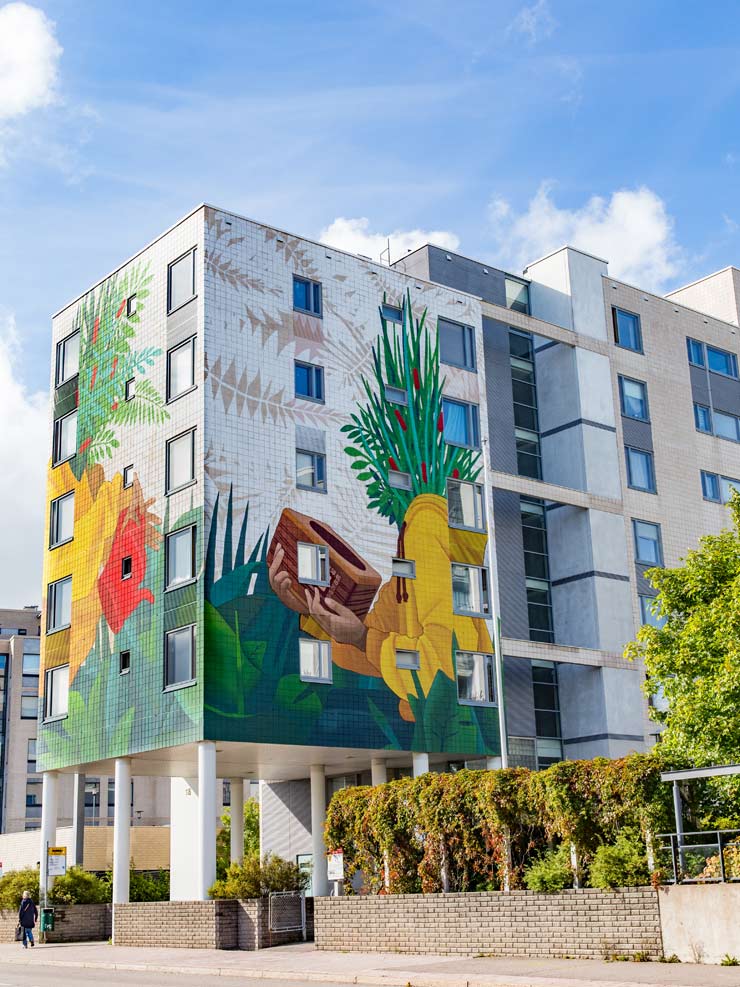
Artez. UPEA Festival 2017. Finland. (photo © Tomi Kaukolehto)
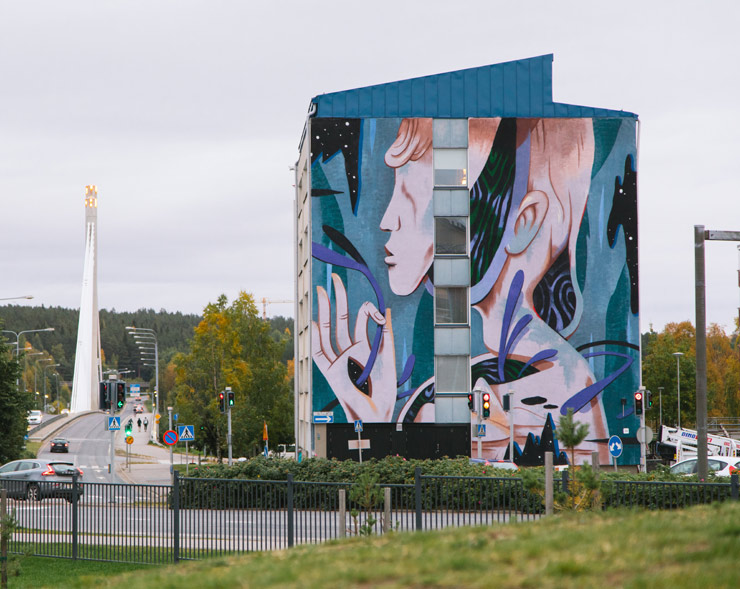
Andrea Wan. UPEA Festival 2017. Finland. (photo © Jorma Simonen)
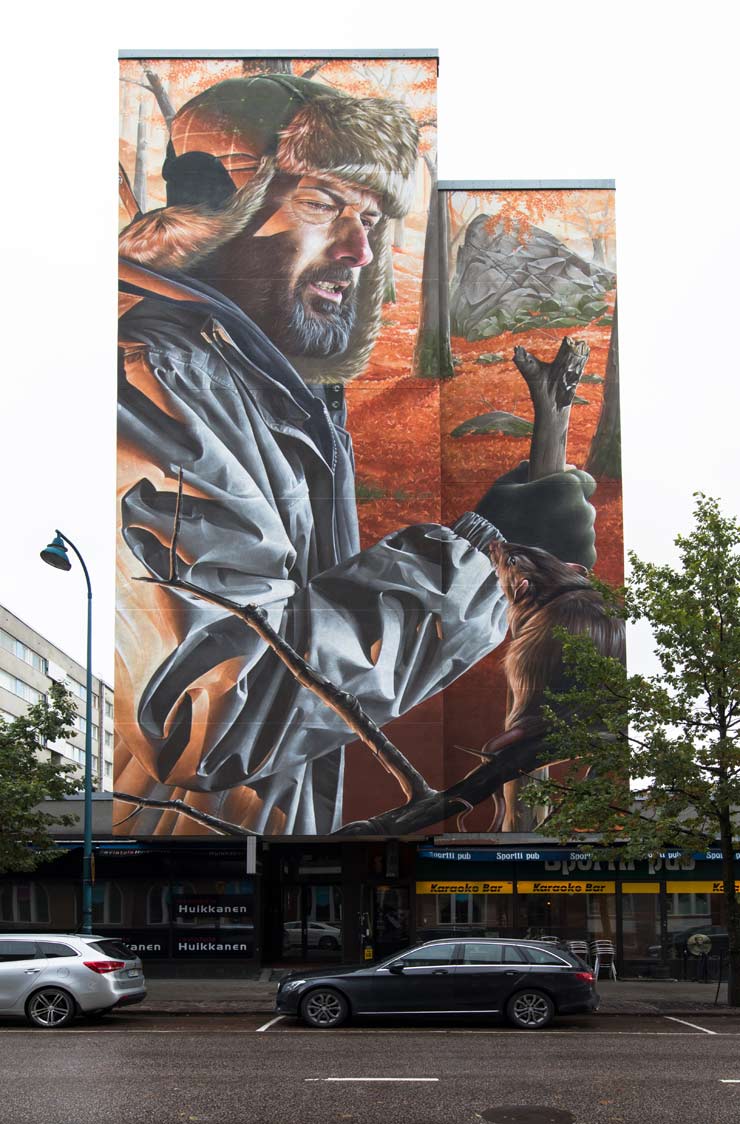
Smug. UPEA Festival 2017. Finland. (photo © Tommi Mattila)
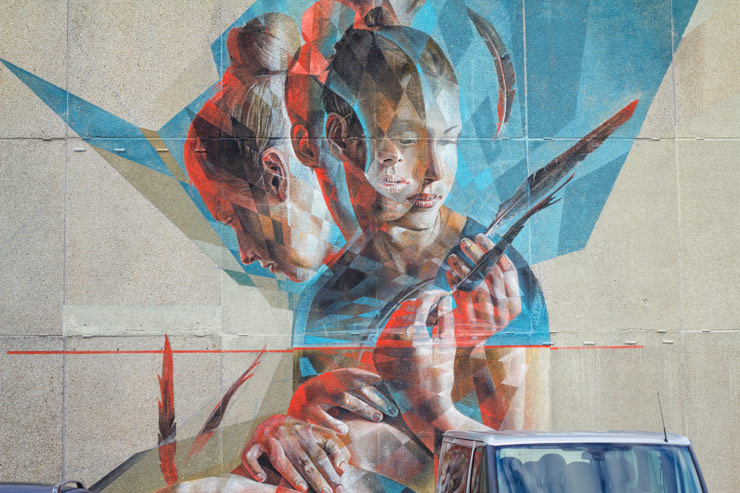
Vesod. UPEA Festival 2017. Finland. (photo © Anssi Huovinen)
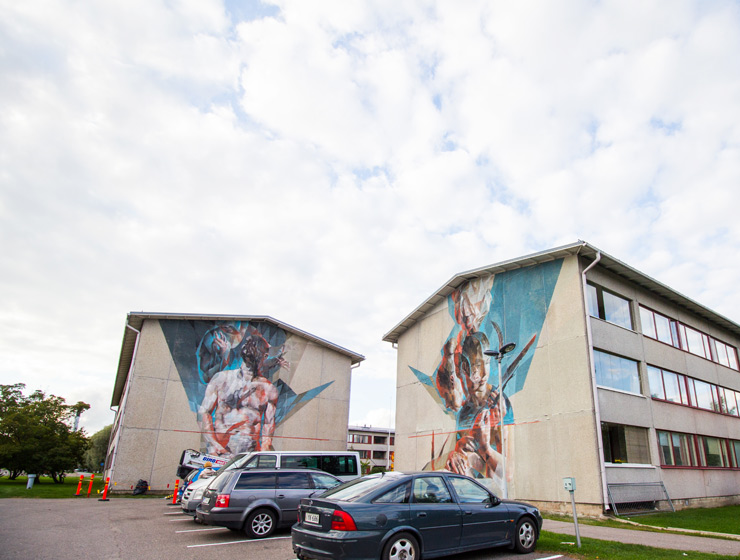
Vesod. UPEA Festival 2017. Finland. (photo © Anssi Huovinen)

Roberto Ciredz. UPEA Festival 2017. Finland. (photo © Markus Hänninen)
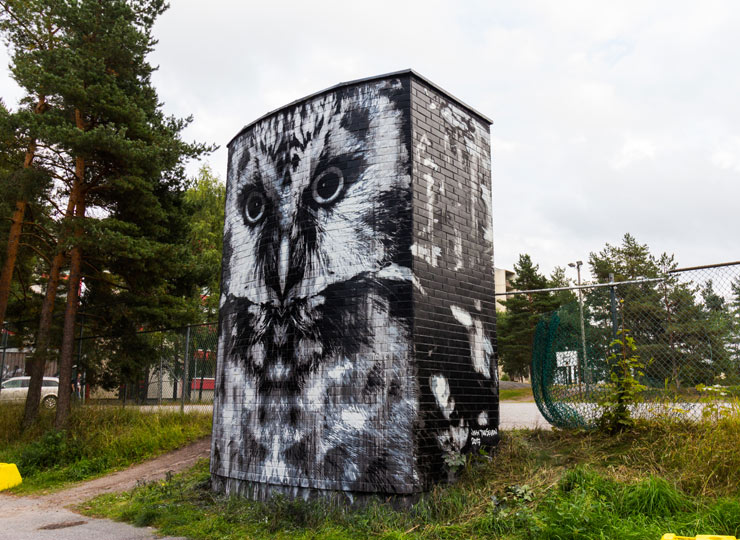
Jussi27. UPEA Festival 2017. Finland. (photo © Anssi Huovinen)
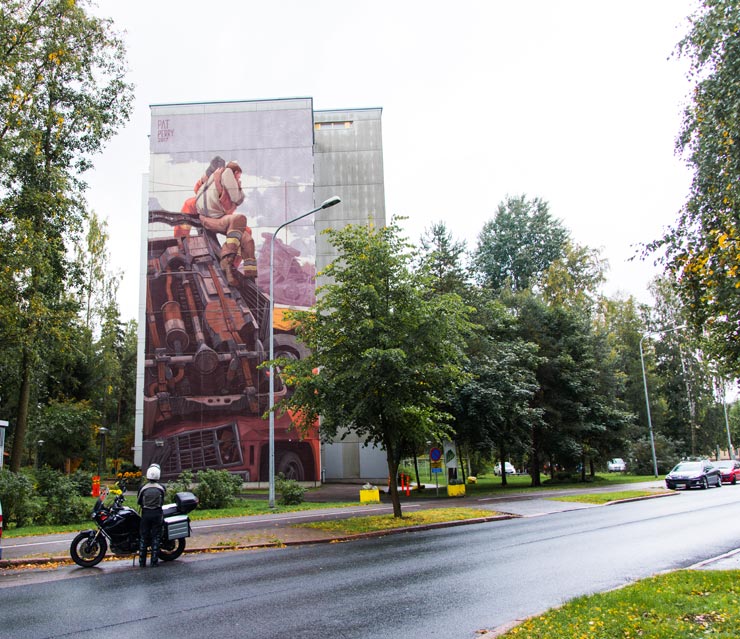
Pat Perry. UPEA Festival 2017. Finland. (photo © Tomi Salakari)
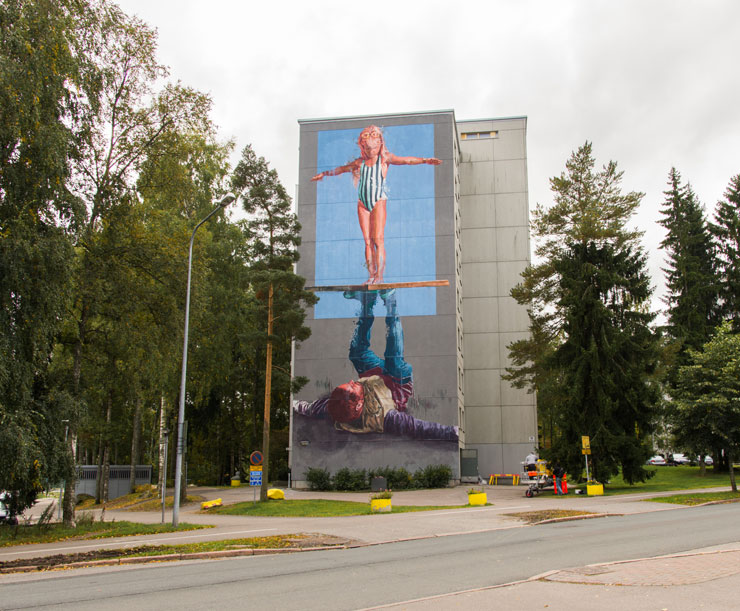
Fintan Magee. UPEA Festival 2017. Finland. (photo © Tomi Salakari)
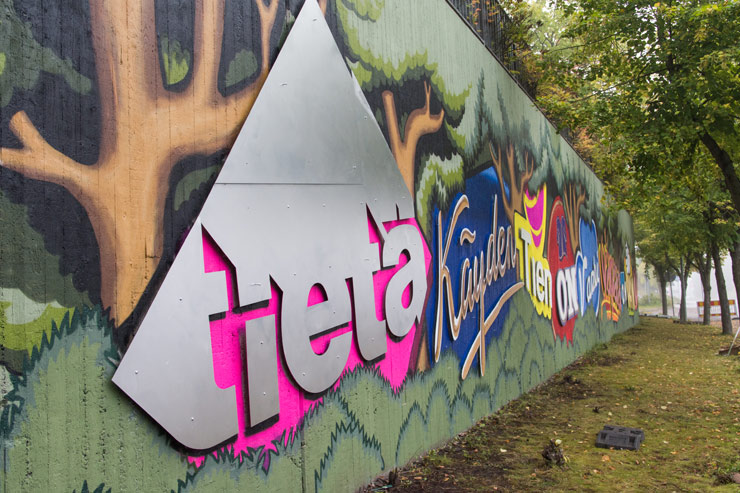
Jani Leinonen. UPEA Festival 2017. Finland. (photo © Tomi Salakari)

Logos or graffiti tags? Jani Leinonen. UPEA Festival 2017. Finland. (photo © Tomi Salakari)


Read more
An Abandoned German Factory and the Free-form IBUG Festival

An Abandoned German Factory and the Free-form IBUG Festival

Travel blogger and writer Giulia Blocal is sightseeing and living in new places as an independently minded explorer and observer. She has lived in Slovenia, London, Madrid, and Dublin in recent years, discovering their character and cultures and contrasting them with her native city of Rome. Today Giulia shares with BSA readers her late summer trip to Germany for IBUG, a Festival für urbane Kunst (Urban Art Festival) in an abandoned factory.


~ by Giulia Blocal 

I’ve just gone through one of the most exciting weeks of the year.

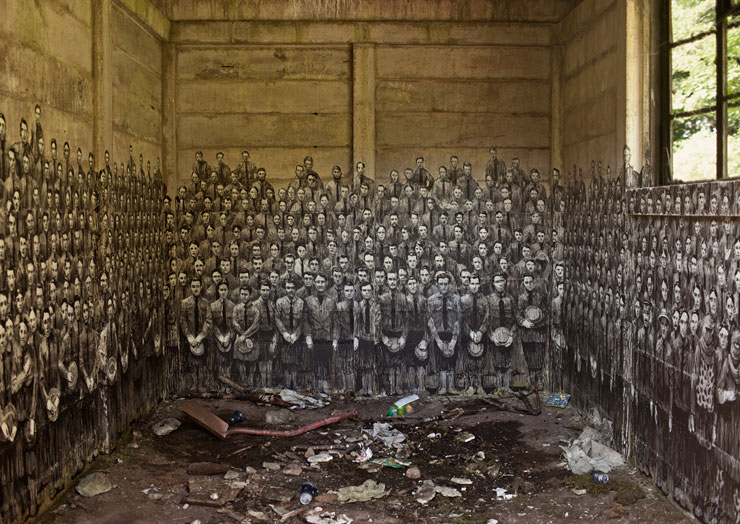
Wartin Paintois. IBUG 2017. Chemnitz, Germany. (photo © Giulia Blocal)

I arrived in Chemnitz, a former industrial town in Saxony (Germany), on the same day of the first group of artists that was invited to paint over an abandoned factory of meat processing machines.

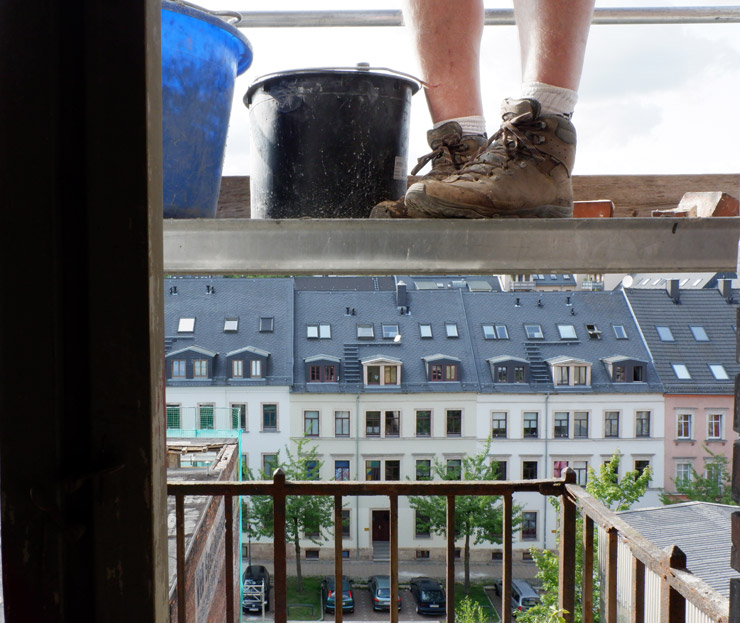
The VEB Spezialmaschinenfabrik shut down in 1992 and when I first entered it, it was just a huge empty building made of red bricks and raw concrete. Windows panes were broken, and here and there some water was dipping from the ceiling.

Wasp Elder. IBUG 2017. Chemnitz, Germany. (photo © Giulia Blocal)

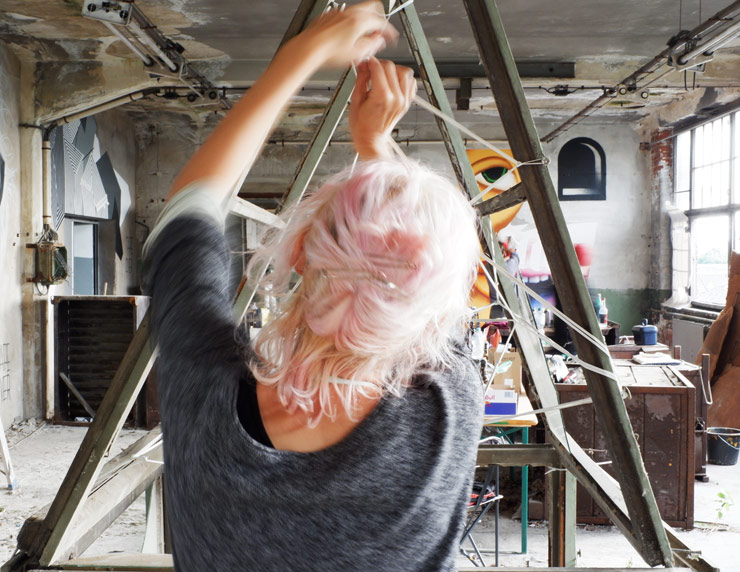
On the first afternoon the artists roamed around the former industrial space to claim their walls – fully in line with the spirit of IBUG, which is an especially grassroots and spontaneous urban art festival where the staff doesn’t assign walls nor require artists to submit sketches.

At IBUG, art grows spontaneously and in an experimental way. As many artists told me, IBUG isn’t meant for you to do something well executed; IBUG is meant to experiment with new things and to encourage you to push yourself out of the comfort zone.

Plus Minus3. IBUG 2017. Chemnitz, Germany. (photo © Giulia Blocal)

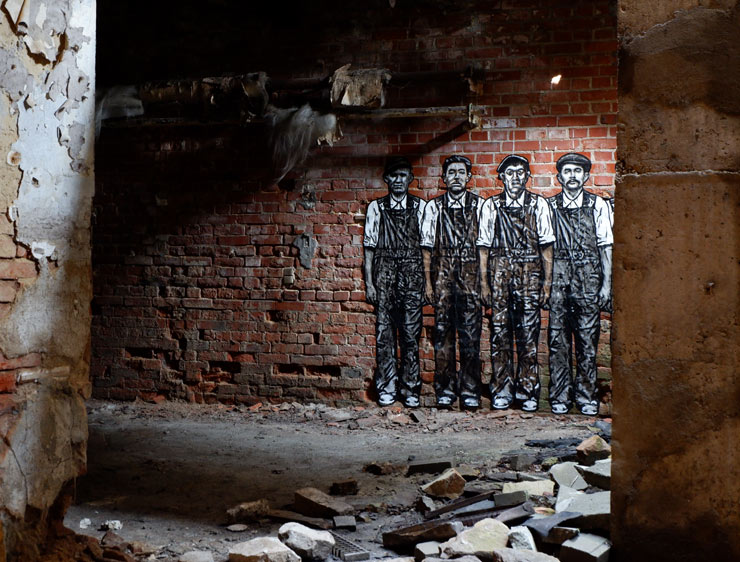
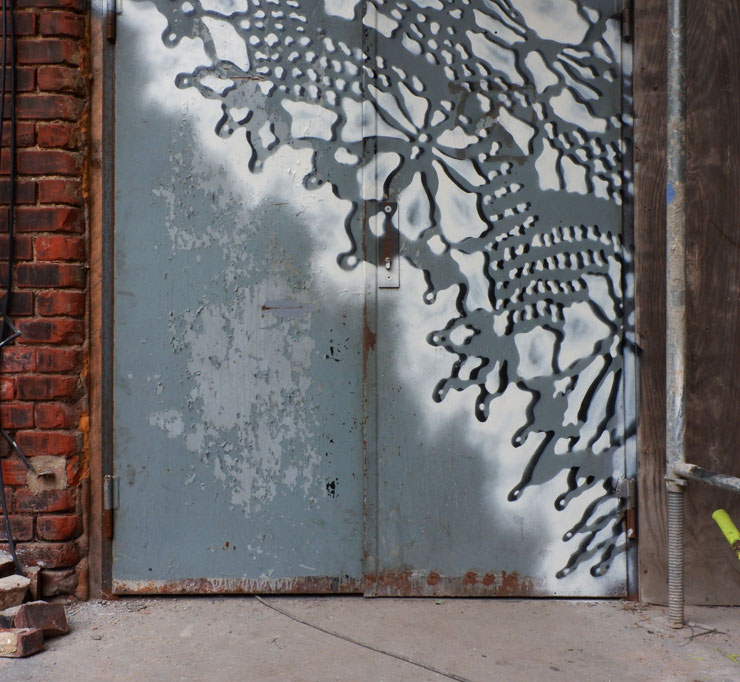
Many works were inspired by the location itself, such as Wartin Paintois’ paste-ups depicting the former workers of the factory, all different but all equal to the eyes of the owner who just needed manpower.

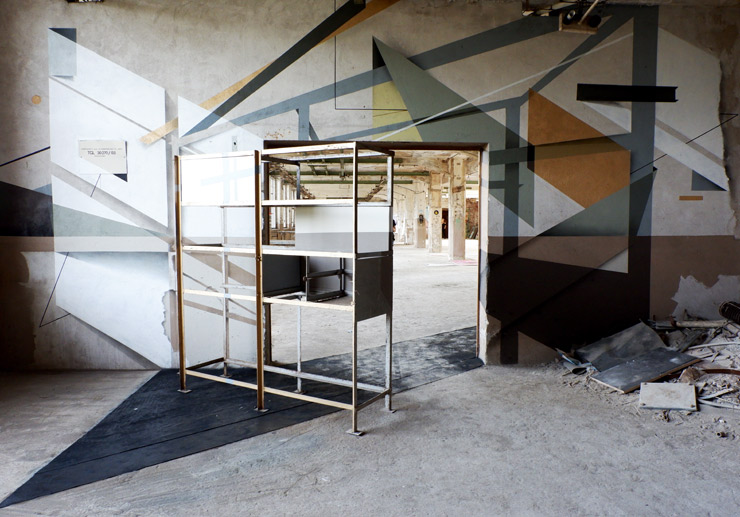
Still site-specific, but in a completely different way, is the room painted by PlusMinus3, a Berlin-based group of designers who used the shadow of a former shelving unit as a starting point for their iconic geometrical patterns.

Nespoon. IBUG 2017. Chemnitz, Germany. (photo © Giulia Blocal)

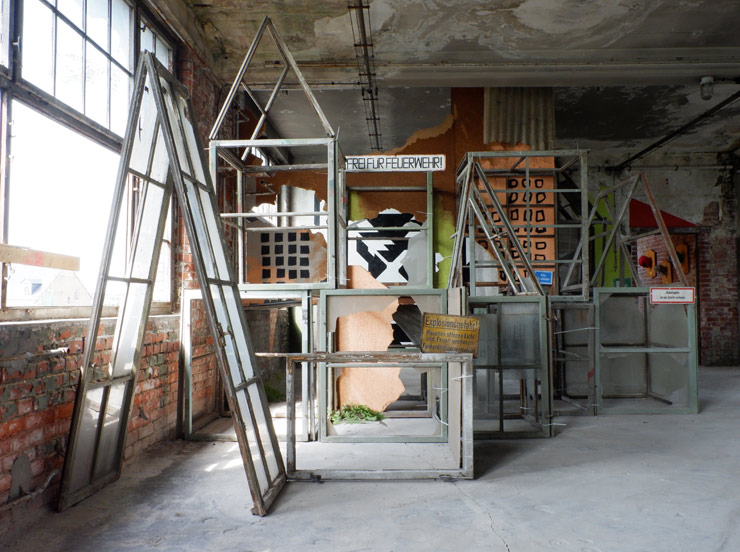
Every time I entered the factory, I could spot something new and yet more artists bustling around – painting, building, welding and experimenting. Although every artist has worked at their corner, they were all working at the same artwork, which turned out to be way more impressive than the sum of its parts.

The courtyard of the former factory got a makeover too. Now, the cooperative mural by the Mexican Eva Bracamontes and the Spanish Koctel dominates the garden. This collaboration -which is a first- arose spontaneously, simply because they both fancied the same wall. This huge wall was in a pretty bad condition (it took them three days just to prepare the wall), so the optimal solution was to join forces and face the big wall together.

Nespoon. IBUG 2017. Chemnitz, Germany. (photo © Giulia Blocal)

Collaborations aren’t unusual at IBUG. From the ‘Wall of Fame’ at the entrance of the factory, where everybody has drawn something or – at the very least – left their tag, to more thought-out pieces, collaborations arose spontaneously, while checking each other’s sketchbooks over a bottle of beer.

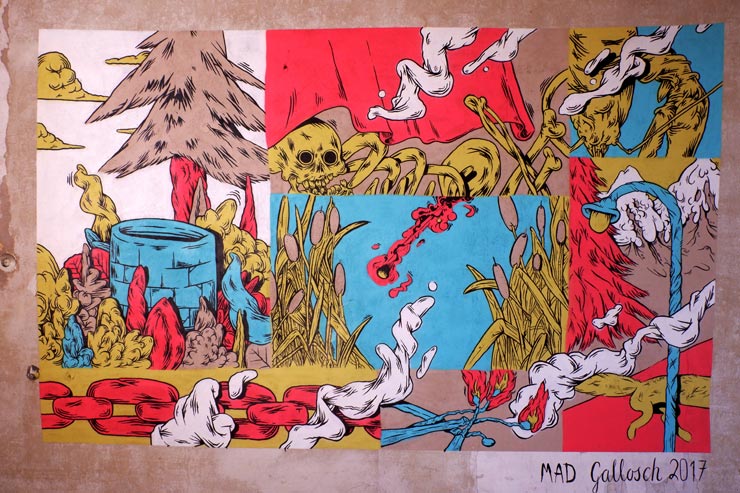
Some collaborations worked out so amazingly that the final piece looks as if painted by just one artist. That’s the case of the IBUG-born duo MAD Gallosch, which painted a bright-colored, comic-like piece.

Nespoon. IBUG 2017. Chemnitz, Germany. (photo © Giulia Blocal)

Artists love this festival because at IBUG there is plenty of space to collaborate and experiment. Once they have done their ‘main piece’, they just roam around to find a second, a third and a fourth wall to paint. When the pressure of the first piece is gone, they feel free to paint whatever and however they want.

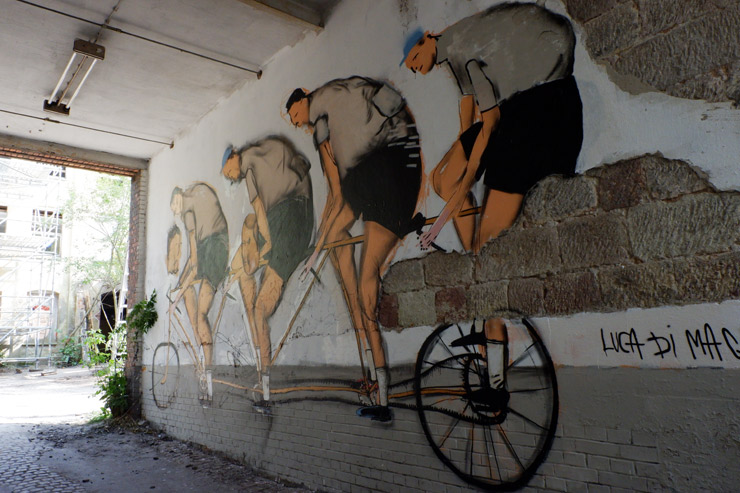
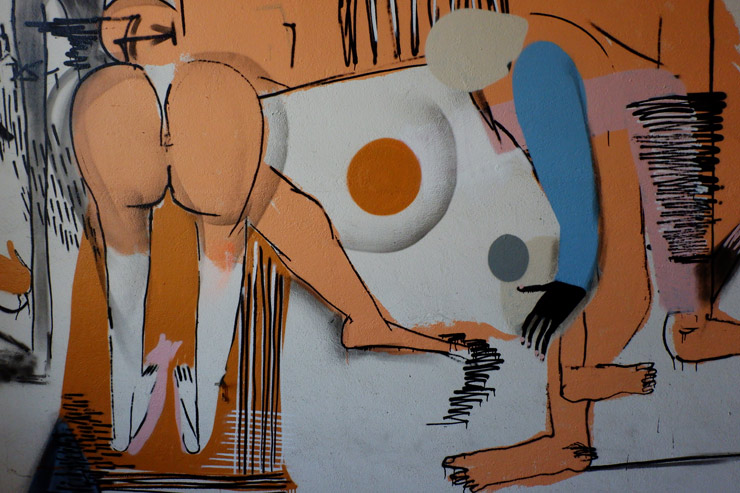
An artist who felt especially free to treat the former factory as his own playground is the Italian Mr. Di Maggio. He didn’t even wait to finish his first piece, the one depicting his iconic cyclists at the entrance of the building, before going around the factory armed with spray-cans to scatter his typical faces throughout the whole building, as well as painting a couple of more experimental pieces inside the factory.

IBUG 2017. Chemnitz, Germany. (photo © Giulia Blocal)

The most interesting aspect of his rediscovered freedom is that, after a week of free-style painting, he came back to his initial piece fuelled with new ideas and he made something really special out of it.

This feeling of ‘nothing is done, everything is a work in progress’ is what makes IBUG so special. The Dutch artist Kenneth Letsoin kept painting even after the opening of the festival on a side building that visitors would have not seen – just for art’s sake. I was really impressed by how prolific he is: he simply couldn’t stand a few hours in a row without painting. Actually, his creative vibe was an inspiration for many artists who collaborated with him throughout the week.

Kenneth Letsoin. IBUG 2017. Chemnitz, Germany. (photo © Giulia Blocal)

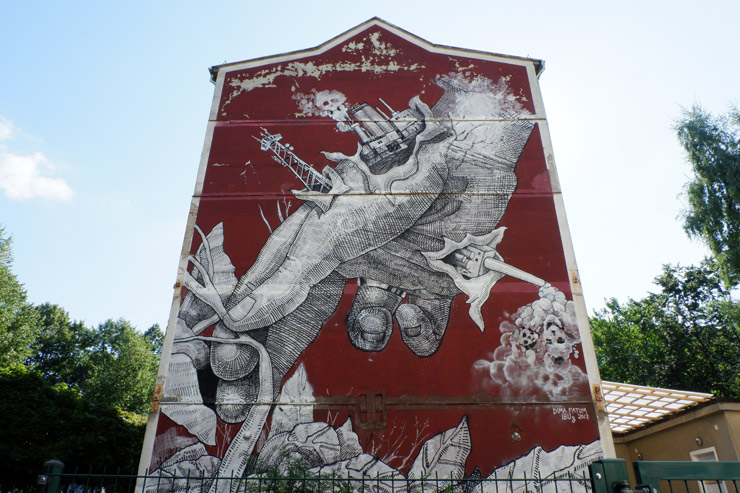
All this creative energy is so overflowing that it even spilled outside of the factory. The Ukrainian duo made up of Dima Fatum and Maria Uvarova painted a wall on a residential building in downtown Chemnitz.

This piece is majestically executed, with a lot of amazing details. They made it in just two days, as they were eager to come back to the factory to enjoy the IBUG creative vibe.

Dima Fatum mural in the city proper. IBUG 2017. Chemnitz, Germany. (photo © Giulia Blocal)

Eventually, this rusty-and-dusty caterpillar turned into a colorful butterfly.

At the opening weekend thousands of people came to enjoy the artworks and the party in the former VEB Spezialmaschinenfabrik factory.

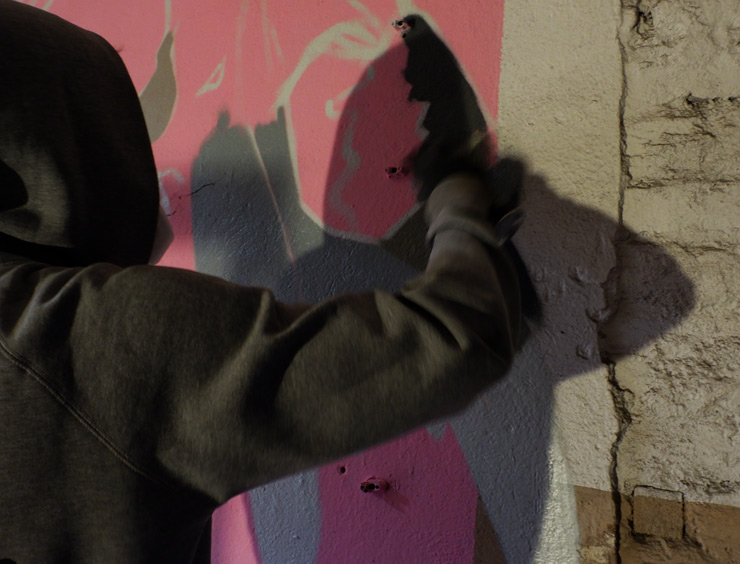
While the sound system was spreading around its vibes, some artists took the leftover paints to do a bit of healthy bombing on their last night together.

Mr. Di Maggio. IBUG 2017. Chemnitz, Germany. (photo © Giulia Blocal)

Mad Gallosch. IBUG 2017. Chemnitz, Germany. (photo © Giulia Blocal)

Mr. Di Maggio. IBUG 2017. Chemnitz, Germany. (photo © Giulia Blocal)

Koctel. Eva Bracamontes. IBUG 2017. Chemnitz, Germany. (photo © Giulia Blocal)

Dima Fatum. IBUG 2017. Chemnitz, Germany. (photo © Giulia Blocal)

IBUG 2017. Chemnitz, Germany. (photo © Giulia Blocal)

IBUG 2017 participants included: 

  • Tasso (Meerane)
  • Quintessenz (Berlin)
  • Kera (Berlin)
  • Guido Zimmermann (Frankfurt)
  • Zonenkinder (Hamburg)
  • Hifi (Dortmund)
  • Julia Humpfer (Stuttgart)
  • Nespoon (Poland)
  • Chromeo (Switzerland)
  • Taina (Switzerland)
  • Madame Moustache (France)
  • BenjAMIN Duquenne (France)
  • Sanne Maloe Slecht (Netherlands)
  • ZZNNArt (Netherlands)
  • Koctel (Spain)
  • Necko (Spain)
  • Koz Dos (Italy)
  • Luca di Maggio (Italy)
  • Kid Crayon (Great Britain)
  • Wasp Elder (Great Britain)
  • Malarko (Great Britain)
  • Dima Fatum (Ukraine)
  • Maria Uvarova (Ukraine)
  • Said Dokins (Mexico)
  • Eva Bracamontes (Mexico)
  • Stephen Swartz (USA)
  • Wartin Pantois (Canada)
  • Robolito (Brazil)

Our special thanks to Giulia Blocal for sharing her observations with BSA readers. To learn more about her and to follow her travels please visit:

Giulia Blocal, www.blocal-travel.com

Facebook @GiuliaBlocal

Instagram @giulia_blocal_blog

Twitter @Blocal_

Read more
BSA Images Of The Week: 11.05.17

BSA Images Of The Week: 11.05.17

BSA-Images-Week-Jan2015

Welcome!

Here’s our weekly interview with the streets, this week featuring BK Foxx, City Kitty, Dain, Jucer, Nick Walker, Praxis REVOK, Sam Himer, Sheryo, Skount, Smells, The Yok, Turtle Caps, UFO 907, WRDSMTH.

Top image: Praxis (photo © Jaime Rojo)

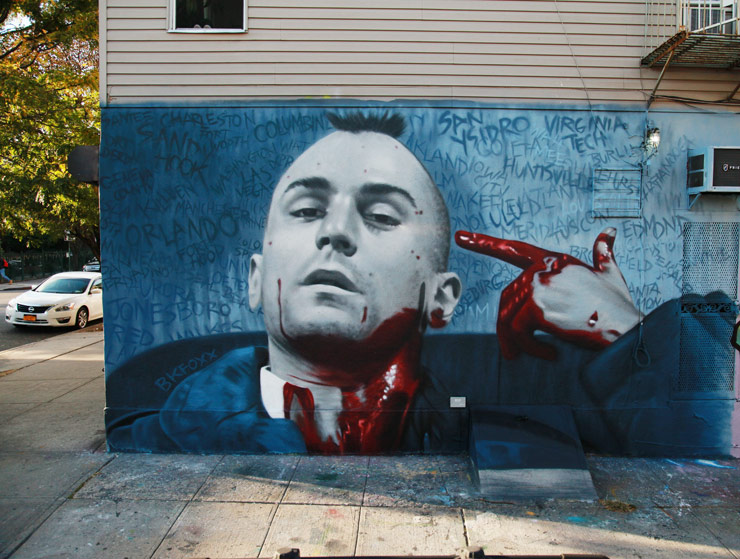
BK Foxx creates this new mural on gun violence in our country, which glamorizes guns and violence in its movies, TV programs, games, and music videos. (photo © Jaime Rojo)

Unidentified artist (photo © Jaime Rojo)

Nick Walker (photo © Jaime Rojo)

Revok (photo © Jaime Rojo)

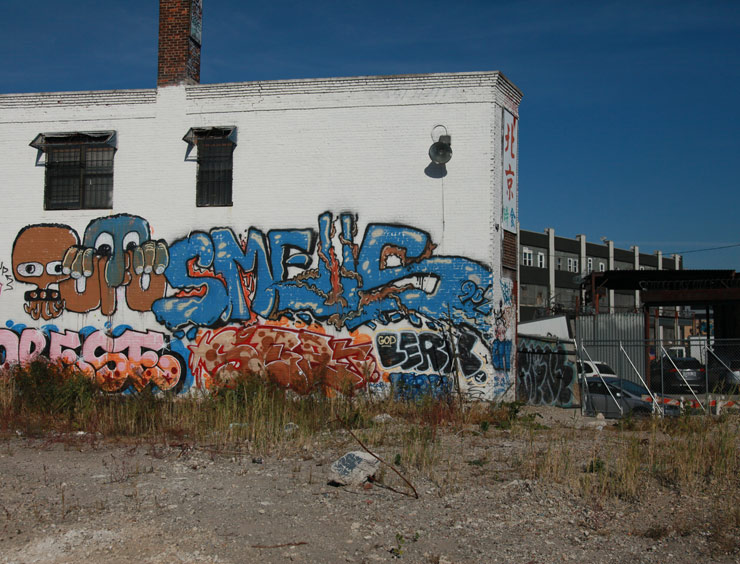
UFO907 . Smells (photo © Jaime Rojo)

The Yok . Sheryo (photo © Jaime Rojo)

Dain (photo © Jaime Rojo)

Dain. This one is an ad…but it makes for a nice picture…so we made an exception. (photo © Jaime Rojo)

Graffiti…RULES!! (photo © Jaime Rojo)

WRDSMT (photo © Jaime Rojo)

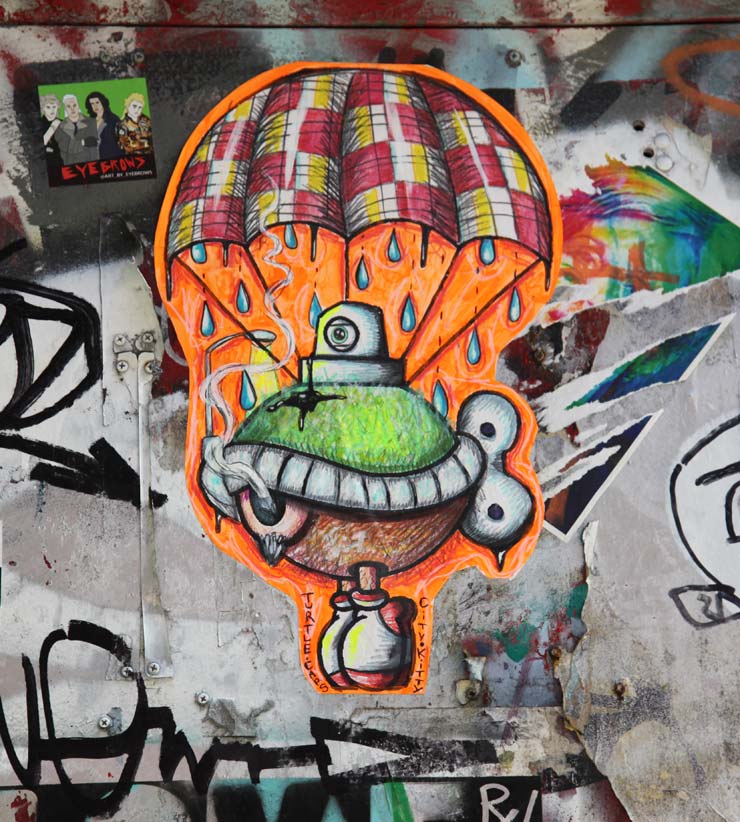
Turtle Caps . City Kitty (photo © Jaime Rojo)

Jucer (photo © Jaime Rojo)

Sam Heimer phone booth at takeover for Art In Ad Places. (photo © Jaime Rojo)

Skount in Amsterdam for Urban Art Festival. (photo © Skount)

Entitled “Home of the emotional flow”
~from the artist

“This mural depicts the search for a state of emotional flow. The background of our emotional life runs in a way, even to the flow of our thoughts. At the bottom of our consciousness there is always some state of mind although, generally, we do not realize the subtle moods that flow and reflux as we carry out our daily routine.

To achieve the Emotional Flow State, the development of qualities and abilities of emotional intelligence is required. These are; self-knowledge, empathy in order to understand the reactions of others, sympathy, balance, optimism and self-control. The state of flow, is a state in which alone, the person manages to surpass himself in situations that generate internal conflict, and this allows him to develop more activity, thus boosting enthusiasm.

In short, to find a state of emotional flow it is necessary first to delve into the deepest of our inner self, strive to understand the situations and states that generate internal conflicts, in order to achieve a state of harmony with ourselves and our environment.”

Untitled. Sunset over the East River. NYC. November 2017. (photo © Jaime Rojo)

Read more
Bunnies, Birds, Sexuality and VINZ Feel Free’s “Innocence” in Brooklyn

Bunnies, Birds, Sexuality and VINZ Feel Free’s “Innocence” in Brooklyn

It’s been a typical New York autumn week for Vinz Feel Free, the wild-life street surrealist from Valencia.

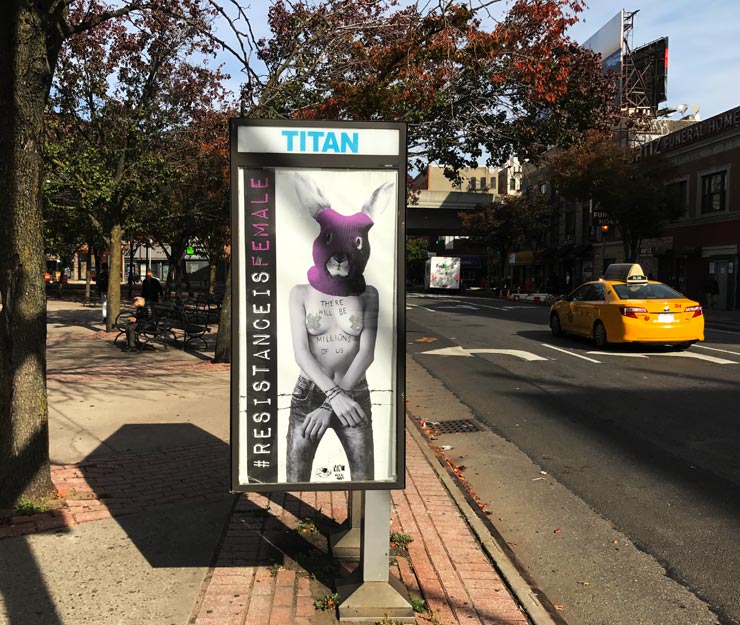
Vinz Feel Free contributes his phone booth ad takeover for the growing and influential  #resistanceisfemale campaign (photo © Jaime Rojo)

His freshly painted birds-on-a-wire on the gallery door and legal wheat pastes on the street are contiguous with the 20 piece collection of photo-painting collaged works inside The Marcy Project in Williamsburg.

The gallery itself doubles as a community center for locals who like to play on three ping-pong tables and listen to music and share a story or a joke, but excitement builds  today as the fresh crisp sunny fall air has been sweeping through the cavernous space to prepare for tonight’s’ solo Brooklyn debut.

Vinz Feel Free. “Innocence” The Marcy Project. Williamsburg, Brooklyn. November 4th. 2017 (photo © Jaime Rojo)

Well-read and politically astute about local and world affairs, the genial and curious artist quickly shares with you his firm observations regarding incursions on freedom by state actors and private corporations and the myriad hypocrisies of the self-ordained pious.

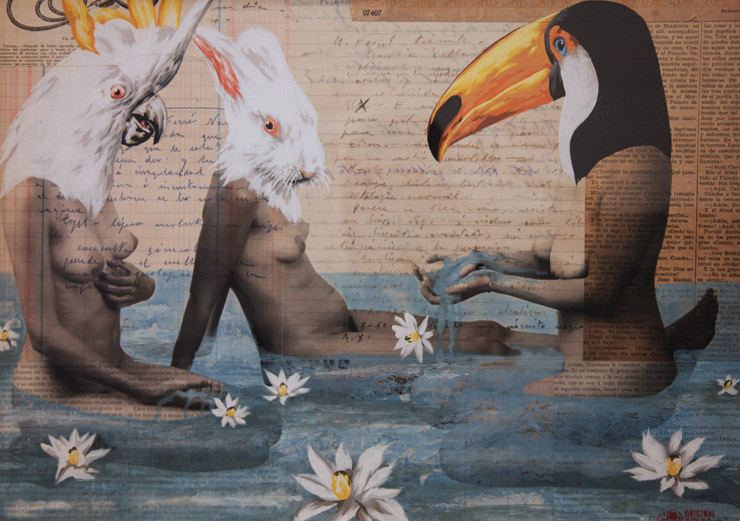
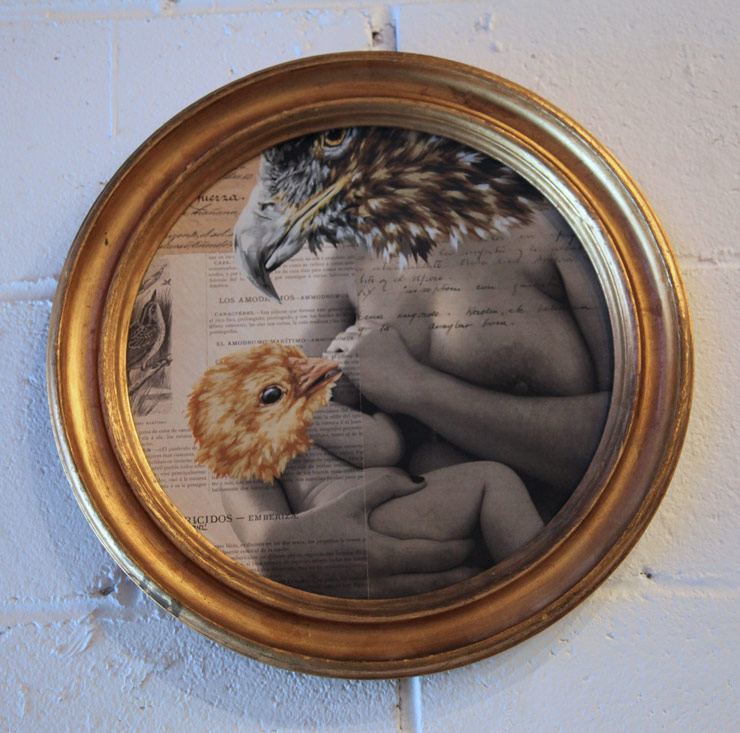
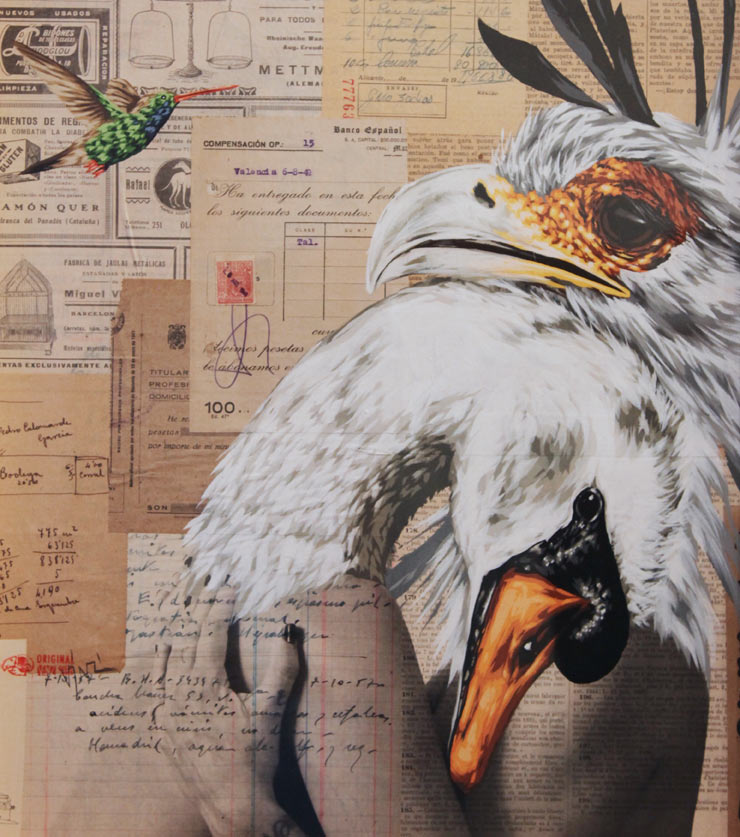
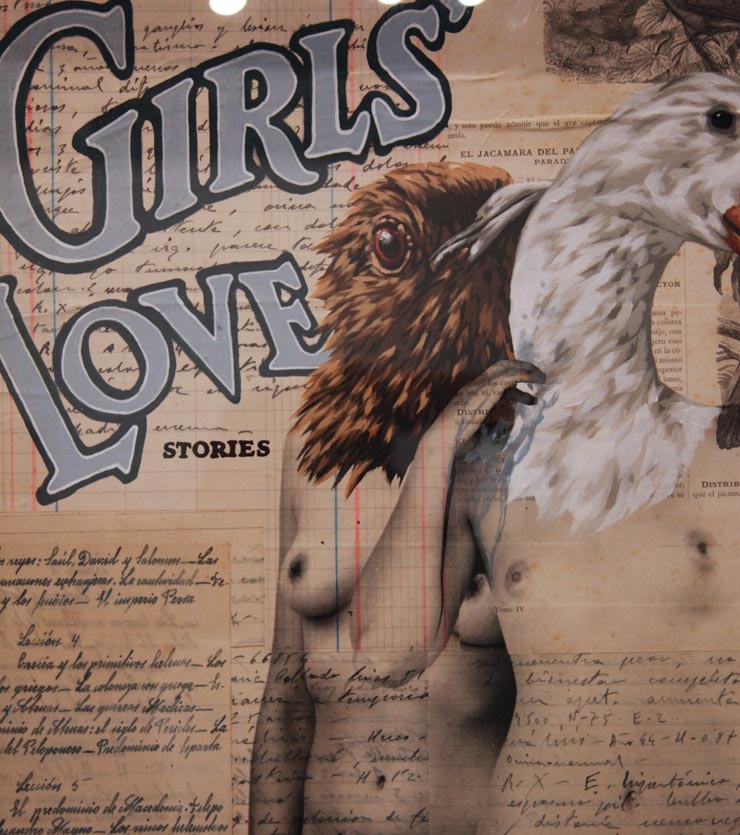
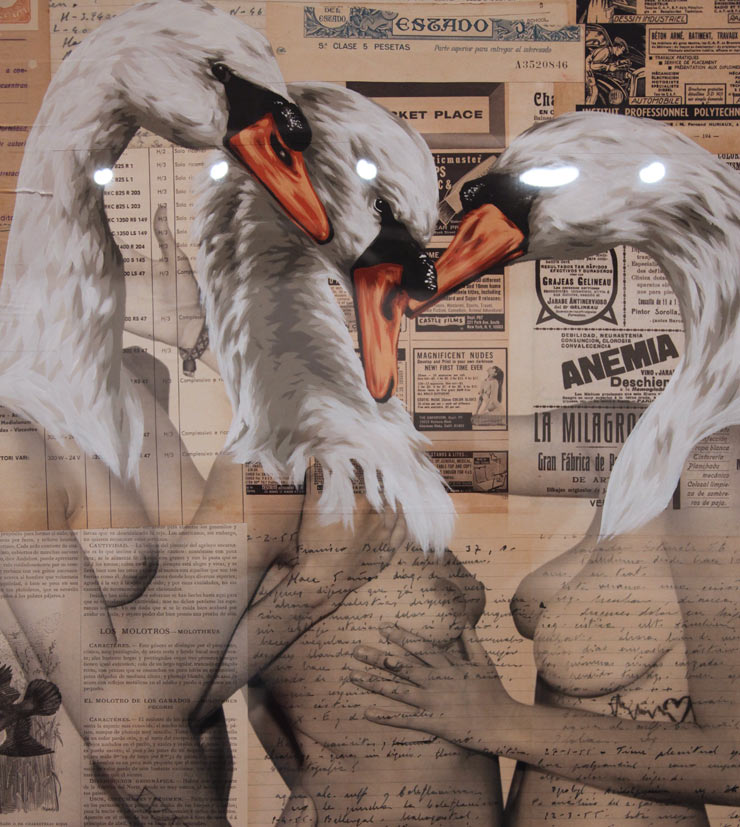
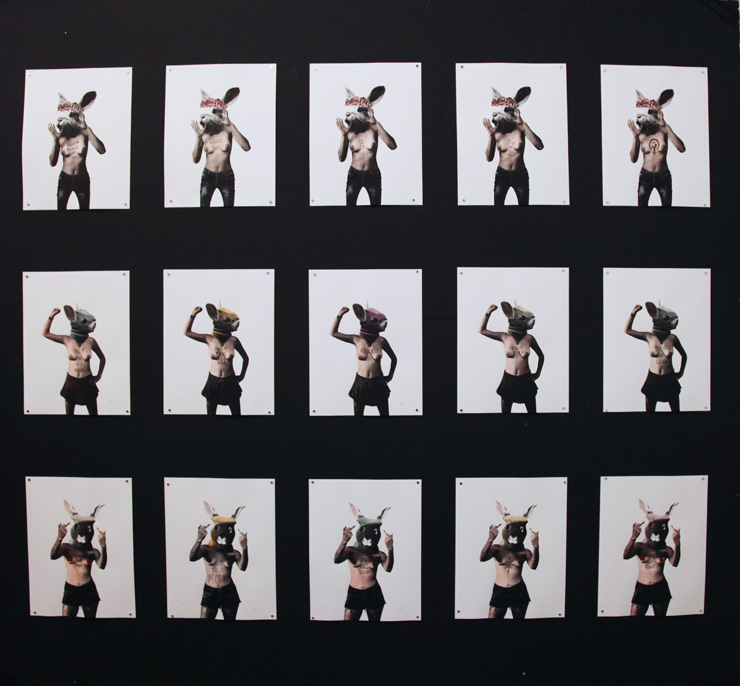
His own libertine escapades in the studio environment have brought arresting images to the street since 2011 that combine intimate nude metaphorical relationships topped by hand painted heads of the furry or plumed animal world – themselves representing an increasingly complex series of assigned roles and meanings.

Vinz Feel Free.  Detail. “Innocence” The Marcy Project. Williamsburg, Brooklyn. November 4th. 2017 (photo © Jaime Rojo)

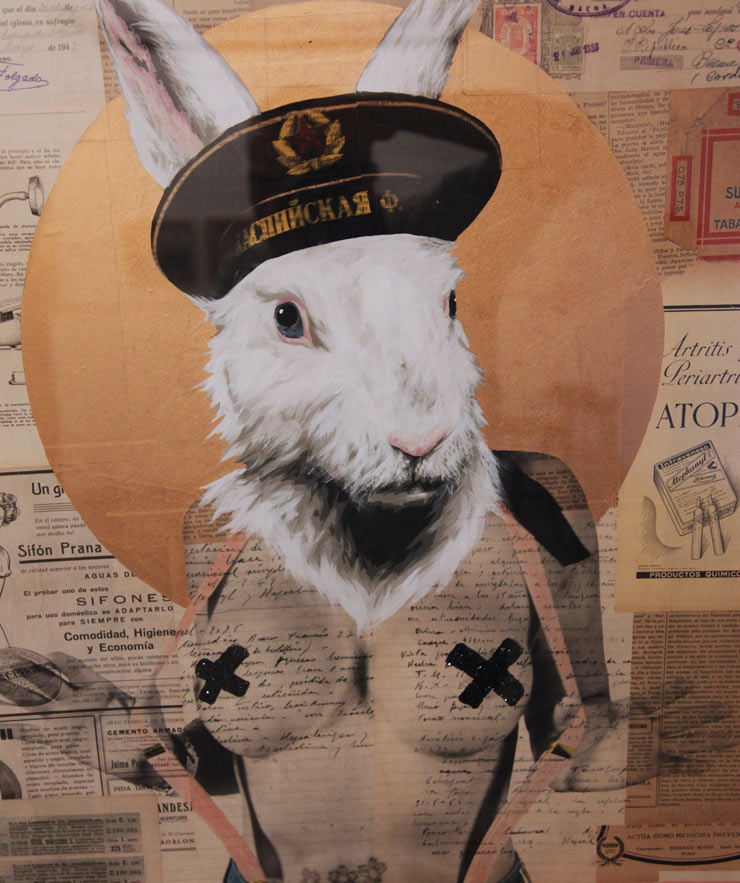
Birds are associated with freedom, fish remind him of mindless consumerism, and frogs convey authority. He reserves reptiles for soulless soldiers of capital and authoritarian types. And the sudden preponderance of rabbits? Why sexuality and innocence of course.

“Innocence” is the name of the exhibition here curated by BSA and DK Johnston, and Vinz Feel Free has been preparing these works for many months. A project that has included his study of innocence, the show is meant to demarcate such shadings of the concept as to appear only subtly different from one another. To wit:

1. The quality or state of being innocent; freedom from sin or moral wrong.
2. Freedom from legal or specific wrong; guiltlessness.

Vinz Feel Free.  Detail. “Innocence” The Marcy Project. Williamsburg, Brooklyn. November 4th. 2017 (photo © Jaime Rojo)

“The birds were my first character and they represent freedom and this is why I chose naked people with birds heads. It’s not just the freedom but also the fragility and the tenderness.”

He often points to activism and public displays of protest when describing inspiration for his models poses, including his inspiration from the activists FEMEN, who disrobe at inopportune times for the powerful in public while the cameras are rolling. For this show he combines their handwritten slogans across bare chests and cloaks their rabbit heads with the knitted masks, or balaclavas, that the Russian musicians/activists Pussy Riot use in their surprise public demonstrations.

“When I began the Feel Free project in 2011 they were a lot of people in Valencia going into the streets fighting for rights for anyone to choose any kind of sexuality and against all the cuts in education and the repression that we are subject to,” he recalls, and you can begin to see that his fascinations for public activism, individual freedom, and the display of sexuality are intertwined.

Vinz Feel Free.  Detail. “Innocence” The Marcy Project. Williamsburg, Brooklyn. November 4th. 2017 (photo © Jaime Rojo)

“After the birds I started every year to introduce a new character into my own imaginary worlds and the latest one is the rabbit,” he explains, “that represents the sexuality and also the curiosity. It’s like they are taking the relay race baton from earlier demonstrations. The rabbits are not always naked sometimes they are dressed and sometimes they’re half naked and they are fighting for new things.”

The baton in this case is the move from one or two kinds of sexuality to a gender fluid approach. Although the preponderance of relationships he depicts is between females, a wall in the exhibition of photo-collaged scenarios mixes genders and relationships.

“I think of nudity and naked people as something that happens between friends and lovers. Here we are taking a little step beyond with curiosity between girls and girls, and girls and boys, and boys and boys; bisexuals, pansexuals, transsexuals.”

Vinz Feel Free.  Detail. “Innocence” The Marcy Project. Williamsburg, Brooklyn. November 4th. 2017 (photo © Jaime Rojo)

But this is the so-called western world, and these are art-gallery pieces. When it comes to other locations and illegal or quasi-legal street art, the artworks in public may be reconsidered… or abandoned altogether. With shows, fairs and street in New York, Los Miami, Munich, Berlin, Vienna, London, Milan, he discovered different responses to nudity and sexuality in African and Asia.

“I was in Malaysia in 2015 and in Bangkok but people told me that at that moment it was a military government in control and the punishment for doing graffiti or interventions in the city was 15 years in prison,” he says with utter seriousness.

“And they told me that if I plan to do nudity on the street the prison sentence would most likely be longer. So I came back home to Valencia and said, ‘forget about it’.”

Vinz Feel Free.  Detail. “Innocence” The Marcy Project. Williamsburg, Brooklyn. November 4th. 2017 (photo © Jaime Rojo)

What about putting up his double height wheat-pasted hybrids in his home city of Valencia, we wondered. How long do they remain untouched?

“It’s really difficult to say – it can be two or three weeks,” he says. “They remove the genitals – the vagina and penises are the first things to be removed. Later the nipples. There are some of them that partially remain after five years but usually the lifespan is less than one month depending on where they are. It really depends on the area and the neighborhood and the kind of people who live there – if they feel empathy with the work and if they like it.”

It’s interesting that he speaks of empathy, perhaps evidence of his own desire for connection with the audience. Ultimately his interest is the conversation as a Street Artist acting in the ever-bubbling rhythm of an active city, a call waiting for your response to his paper and paint entreaty.

“For me it is not a problem if it does not last – it is not my wall. I am not the owner. I don’t mind if another artist comes and paints over it because that means the city is alive. I have the old romantic idea about ephemeral art. If something remains forever that means the city becomes old and you want it to be alive, it must change.”

In New York and Brooklyn anyway, there is little doubt of that likelihood. Vinz Feel Free now momentarily changes it a little bit, before it carries on its sometimes innocent way.

Vinz Feel Free.  Detail. “Innocence” The Marcy Project. Williamsburg, Brooklyn. November 4th. 2017 (photo © Jaime Rojo)

Vinz Feel Free.  Detail. “Innocence” The Marcy Project. Williamsburg, Brooklyn. November 4th. 2017 (photo © Jaime Rojo)

Vinz Feel Free.  Detail. “Innocence” The Marcy Project. Williamsburg, Brooklyn. November 4th. 2017 (photo © Jaime Rojo)

Vinz Feel Free.  Detail. “Innocence” The Marcy Project. Williamsburg, Brooklyn. November 4th. 2017 (photo © Jaime Rojo)

Vinz Feel Free.  Detail. “Innocence” The Marcy Project. Williamsburg, Brooklyn. November 4th. 2017 (photo © Jaime Rojo)

Vinz Feel Free.  Detail. “Innocence” The Marcy Project. Williamsburg, Brooklyn. November 4th. 2017 (photo © Jaime Rojo)


Vinz Feel Free “Innocence” Opens today at The Marcy Project. Click HERE for details.

We wish to extend our deep gratitude to Kathy and Erwin of Bed-Stuy Art Residence (BedStuyartresidency.org) for their support and generosity, always.

Read more
BSA Film Friday: 11.03.17

BSA Film Friday: 11.03.17

bsa-film-friday-JAN-2015

Our weekly focus on the moving image and art in the streets. And other oddities.

Now screening :
1.“Collective Heartbreak” KNOW HOPE at Nuart 2017
2. Igor Ponosov “Too Far, Too Close”
3. UNIQA Art Łódź project in Łódź, Poland
4. Agostino Iaurci for Parees Fest.

bsa-film-friday-special-feature

BSA Special Feature: “Collective Heartbreak” KNOW HOPE at Nuart 2017

Loquacious street poet Know Hope usually has a lot to say and the Isreali Street Artist’s somewhat cryptic text interludes often accompany imagery on walls and his indoor studio works. Custom made verses, sometimes heart rendering, contemplate isolation, unresolved miscommunications, aspiration, gnawing fears; interstitial vagaries that channel political as personal emotional drama, a suspended state of limbo.

For his interactive installations at Nuart this year Addam Yekutieli aka Know Hope spent time listening. He collected stories from Stavanger locals about their experiences of heartbreak and hand painted fragments from those stories in austere urban . For the outdoor part of the project, Addam extracted fragments of words from their stories and placed them around the city, drawing a common story that he hopes strikes universal truths.


IGOR PONOSOV “Too Far, Too Close”

“ ‘Too far, Too Close’ is a project by the Russian artist Igor Ponosov which sees a typical Stavanger sailing boat transformed into an abstract mural for Nuart Festival 2017.

The project is meant to symbolizes the distance or disconnect between the public and the vast majority of state-sanctioned public art. The piece was supplemented by Ponosov’s second outdoor art work, titled ‘No signal’, which critiques the growing use of projectors in street art mural production.”


UNIQA Art Łódź project in Łódź, Poland.

Regular readers of BSA will recognize almost every one of these sculptures from Łódź, Poland as we have published stories on them previously. Here is a quick round-up of the last couple of years’ worth of public sculptures featured in the UNIQA project, exploring another in-between strata of semi-autonomous Street Art/Public Art involvement that requires permissions (usually) and yet is not choked to death by bureaucratic committee.


Agostino Iacurci for Parees Fest. Oviedo, Asturias. Spain. Video Titi Muñoz

A process video of the creation of a new mural by Italian Street Artist/Muralist Agostino Iacurci done last month in Spain for the Parees Fest. Aside from the impressive result, it is notable to see that he has an ongoing daily audience sitting comfortably before the enormous wall, sipping a coffee.


Read more
Robbbb and Spidey Question Idealized Heroes in Beijing

Robbbb and Spidey Question Idealized Heroes in Beijing

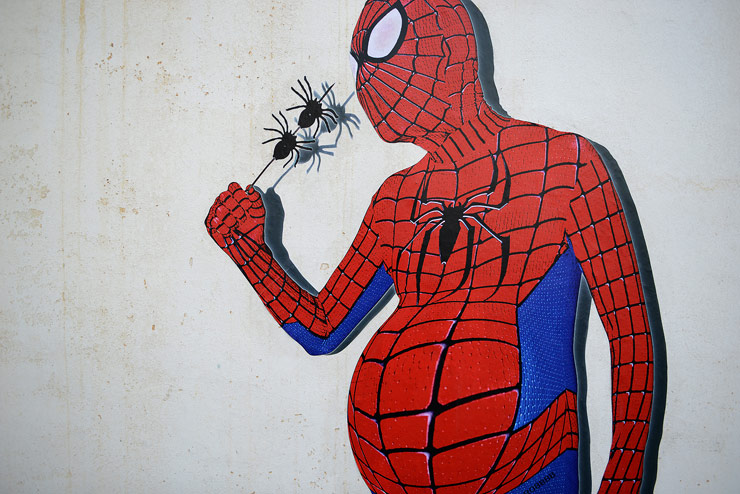
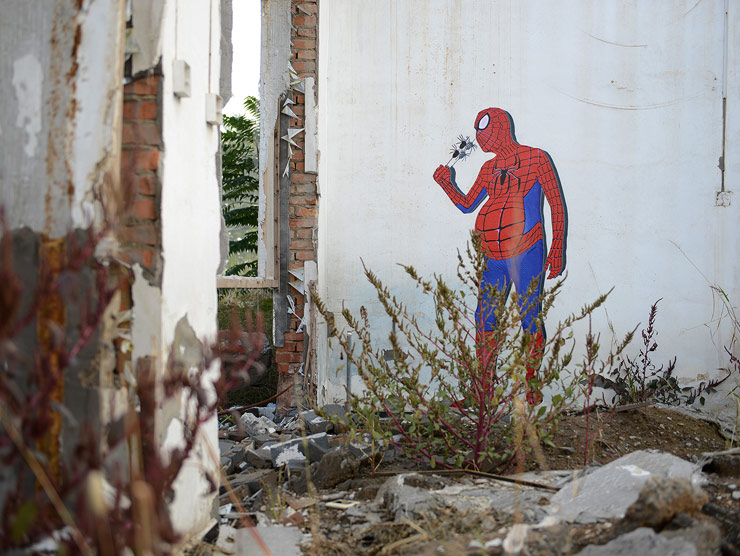
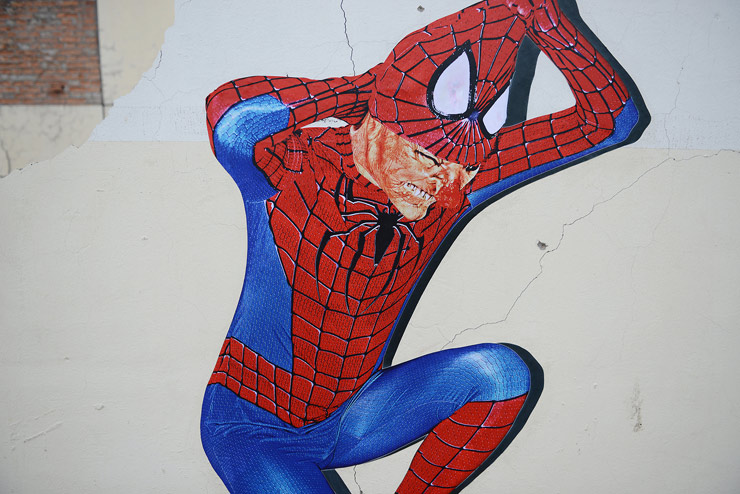
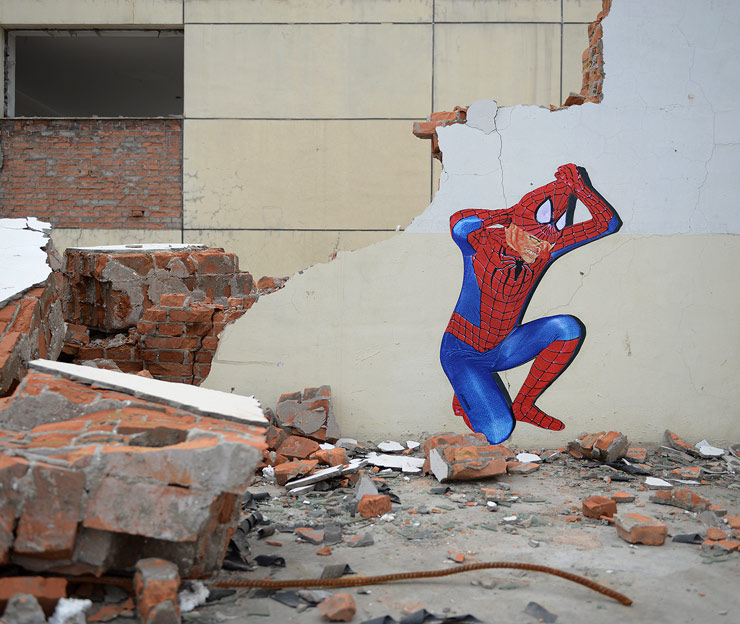
A few new painted wheat-pastes in the urban rubble from Street Artist ROBBBB in Beijing, China today, including this thoughtful, reflective and paunchy Spiderman who may not be able to scale walls quite as readily as he has in the past.

Robbbb. Beijing, China. October 2017. (photo © Robbbb)

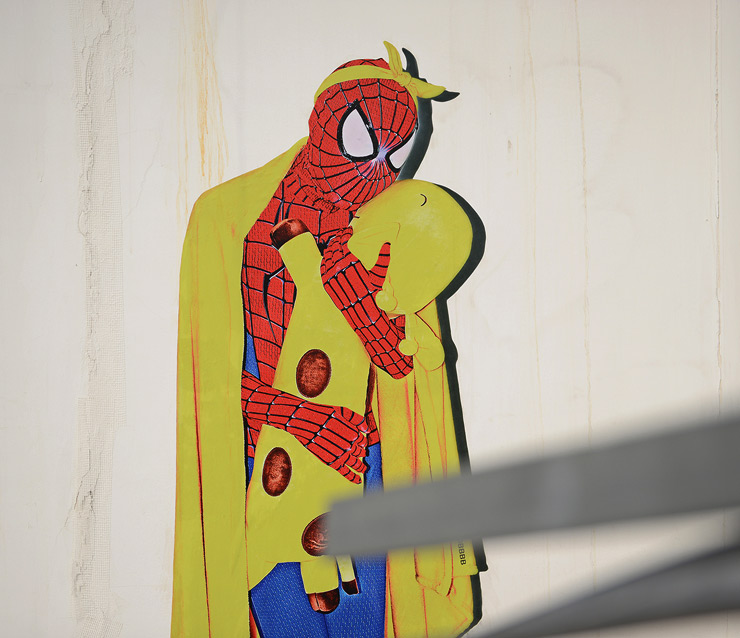
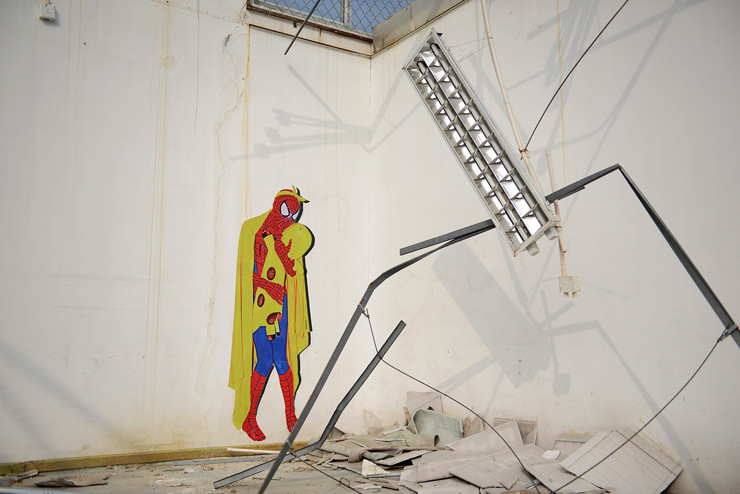
It almost looks like these superheroes are having various existential dillemas, ready to fly into a rage of frustration or simply break into hot firey tears. The whole infallibility thing is overrated anyway Spidey, we get what you are saying.

I’m trying to discuss the contradiction between the ideal and the reality from the point of view of human nature,” says ROBBBB, and that is a worthwhile pursuit. It may make you wonder why we need heroes in the first place and examine what need they are filling.

Robbbb. Beijing, China. October 2017. (photo © Robbbb)

Robbbb. Beijing, China. October 2017. (photo © Robbbb)

Robbbb. Beijing, China. October 2017. (photo © Robbbb)

Robbbb. Beijing, China. October 2017. (photo © Robbbb)

Robbbb. Beijing, China. October 2017. (photo © Robbbb)

Read more
Street Artist OLEK and Volunteers Create NINA SIMONE Tribute in Raleigh, NC

Street Artist OLEK and Volunteers Create NINA SIMONE Tribute in Raleigh, NC

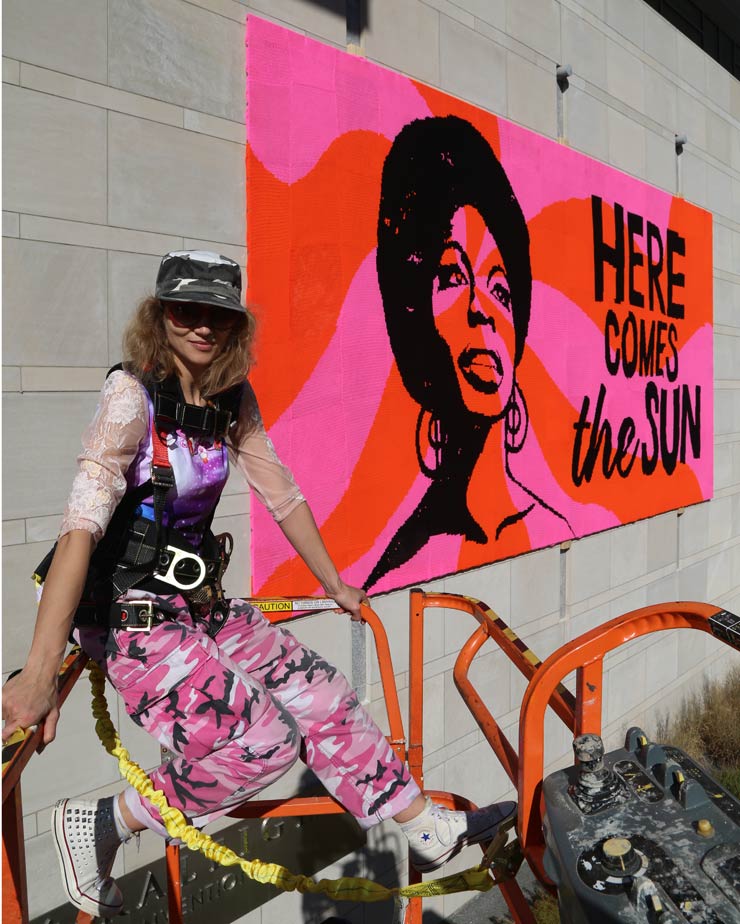
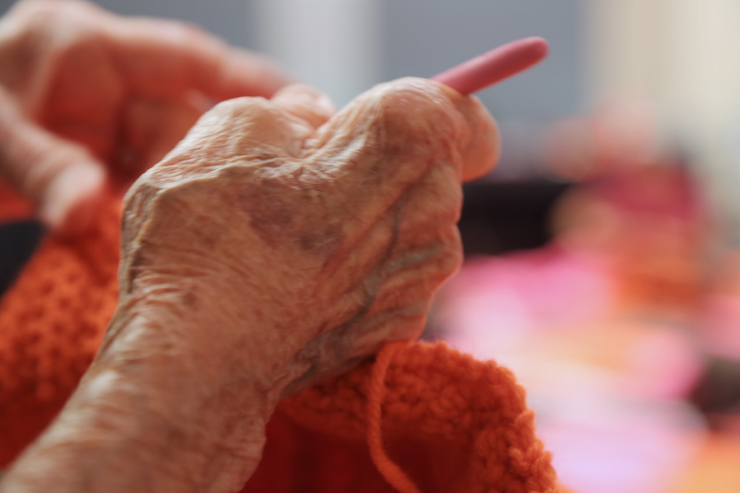
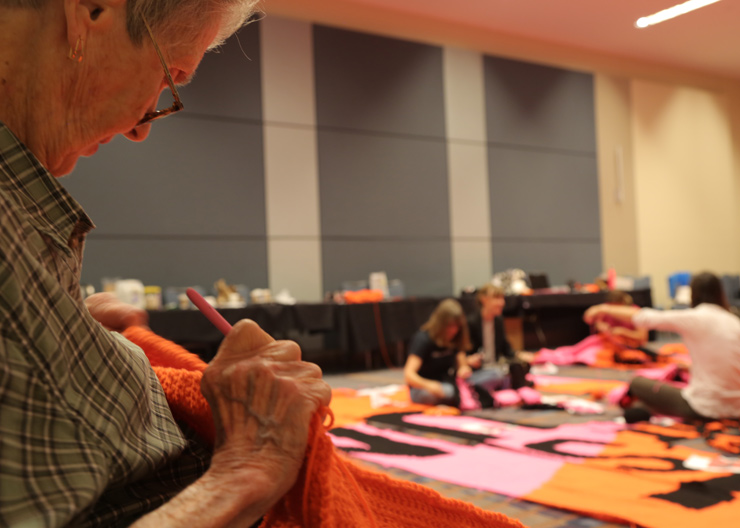
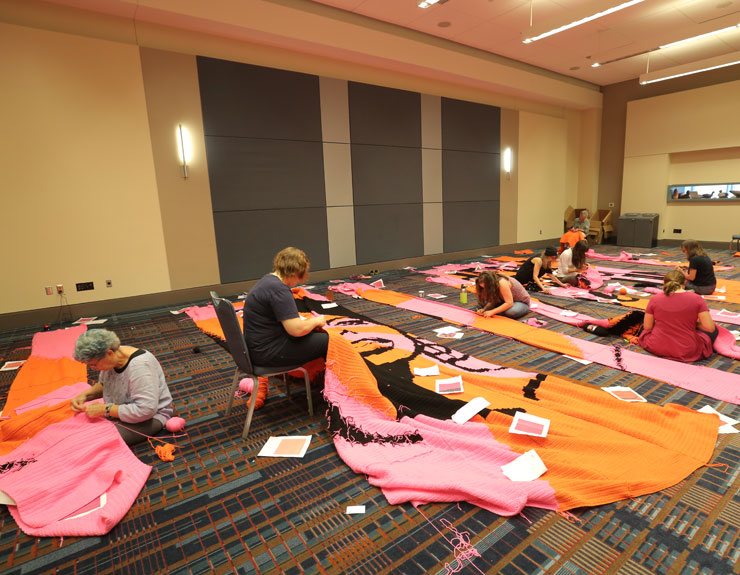
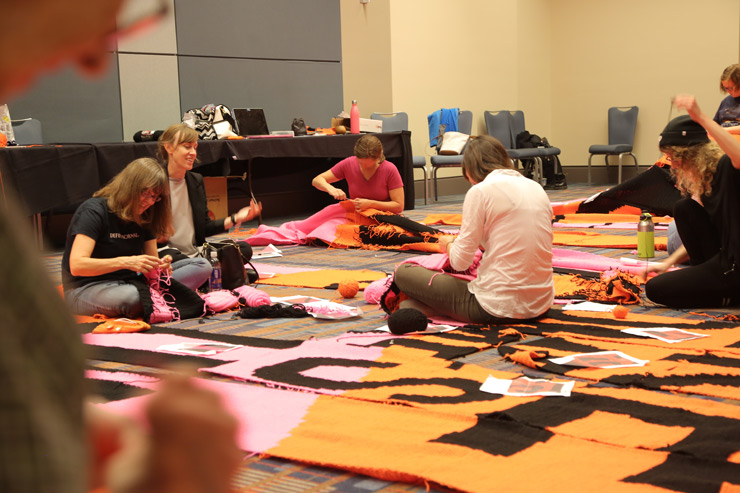
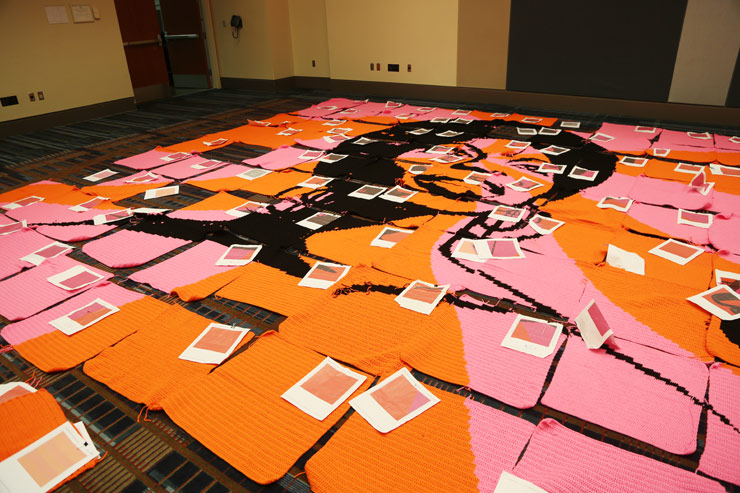
Susan B. Anthony, Harriet Tubman, Nina Simone; Three of the women whom Street Artist Olek would like us to remember from U.S. history, and who have been recently featured in public crochet portraits. Her most recent portrait done with help from the community brings art made by the public to the public in a country-wide project called “Love Across the USA”.

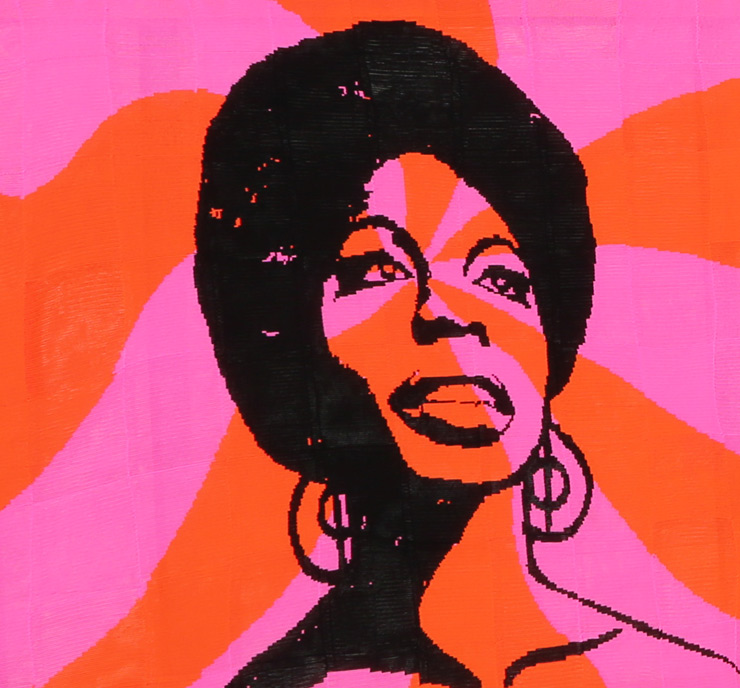
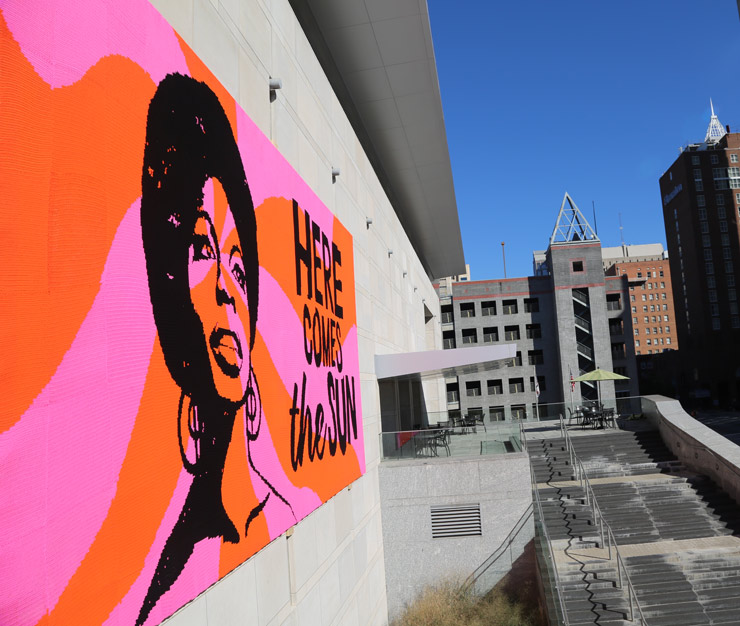
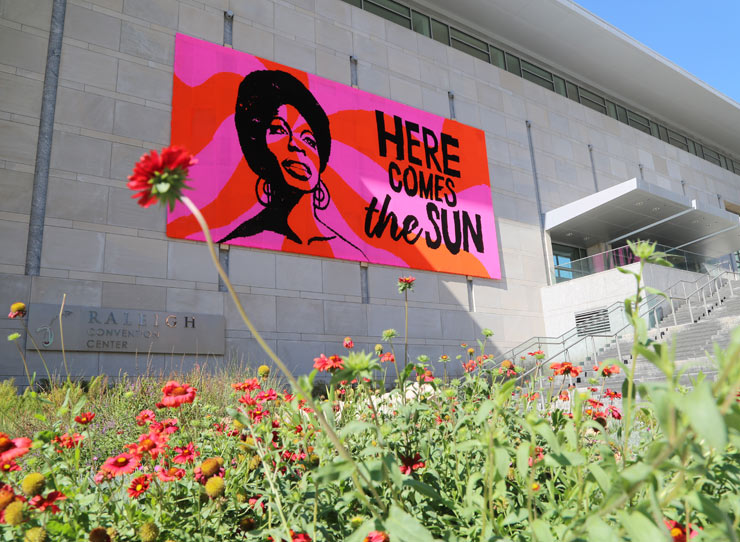
Olek. Nina Simone “Here Comes The Sun” Love Across The USA. Raleigh, North Carolina. October 2017. (photo © courtesy Olek)

Sparked a year ago leading up to the US national election where a woman was on the ballot, Olek says that despite the negativity that followed, “it inspired me to create a project that would celebrate the accomplishments of women, many of whom had been forgotten throughout U.S. history.”

Today we go to Raleigh, NC to see the most recent banner of Nina Simone crocheted by Olek and a small army of volunteers. https://en.wikipedia.org/wiki/Nina_Simone, the American singer, songwriter, pianist, arranger, and activist in the Civil Rights Movement.

We spoke with Olek about this selection of Ms. Simone, who coincidentally has been nominated this year in the Rock and Roll Hall of Fame.

BSA: Nina Simon fought hard battles, she lost some and won many. She won her right to be recognized as an artist in the USA after having to prove herself in European capitals first. With this portrait you elected to highlight the bright side of her and her art. Is it because you also want to be optimistic about our future even during these dark times we are all experiencing?
Olek: Why, with Nina Simone, do we always have to think about the battles she lost?  I prefer to think about the positive things she accomplished both as an artist and an activist. I remember when I was in elementary school I was given one of her tapes. I had no idea who she was and didn’t understand a word, but I loved the music.

Later, when I learned her name and more about her story, I hated how the media tended to focus on the negatives.  As a black woman living in that time, fighting for what she believed in, she was exhausted and had little help.  Her husband, who was also her manager, exploited her and gave her drugs instead of helping her.  Despite everything, she positively influenced so many people around the world.

Olek. Nina Simone “Here Comes The Sun” Love Across The USA. Raleigh, North Carolina. October 2017. (photo © courtesy Olek)

BSA: What kind of inspiration did you learn from Nina Simone and her feminist take with her music especially with her song “Four Women” which is considered by many to be a very influential song with the black feminist movement in the 60’s?
Olek: The song “Here Comes the Sun” has accompanied me through many difficult installations.  I played the song on loop while in Rochester, NY working on the Susan B. Anthony mural for Love Across the USA.  We worried the installation would be delayed because of bad weather, but after listening to the song all morning, we arrived at the site and the sun was shining.
Nina Simone has been so well known in Europe and is finally starting to gain the recognition she deserves in the U.S. with her nomination for the Rock and Roll Hall of Fame.  We had no idea about the nomination when we first began working on the piece, but when we found out a couple weeks ago, we hoped that this mural would help her to earn the votes needed to be inducted.

Olek. Nina Simone “Here Comes The Sun” Love Across The USA. Raleigh, North Carolina. October 2017. (photo © courtesy Olek)

Olek. Nina Simone “Here Comes The Sun” Love Across The USA. Raleigh, North Carolina. October 2017. (photo © courtesy Olek)

Olek. Nina Simone “Here Comes The Sun” Love Across The USA. Raleigh, North Carolina. October 2017. (photo © courtesy Olek)

Olek. Nina Simone “Here Comes The Sun” Love Across The USA. Raleigh, North Carolina. October 2017. (photo © courtesy Olek)

Olek. Nina Simone “Here Comes The Sun” Love Across The USA. Raleigh, North Carolina. October 2017. (photo © courtesy Olek)

Olek. Nina Simone “Here Comes The Sun” Love Across The USA. Raleigh, North Carolina. October 2017. (photo © courtesy Olek)

Olek. Nina Simone “Here Comes The Sun” Love Across The USA. Raleigh, North Carolina. October 2017. (photo © courtesy Olek)

To learn more about Love Across The USA click HERE

Read more
Boston’s “Underground Mural Project” Opens With 11 Artists

Boston’s “Underground Mural Project” Opens With 11 Artists

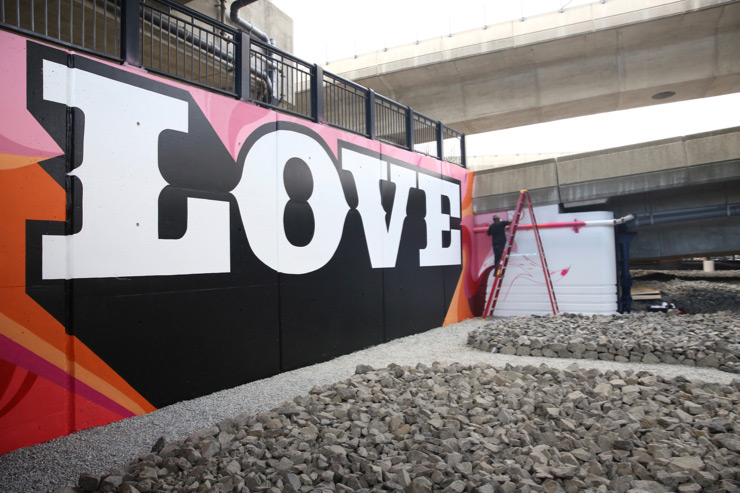
“I love transforming a raw space for everyone to discover. It’s the best feeling to see people enjoying themselves in front of my art,” says artist Cey Adams in Boston as he finishes his “LOVE” mural in a letter style recalling the funky late 70s.

Cey Adams. Urban Art Park. Beantown, Boston. September 2017. (photo © Todd Mazer)

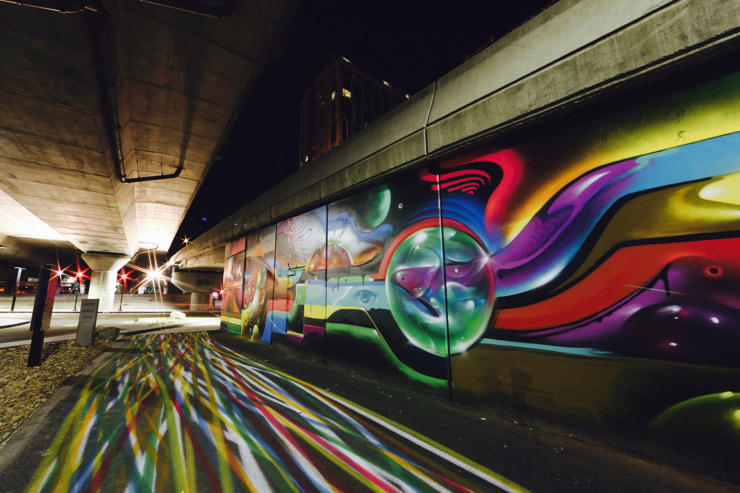
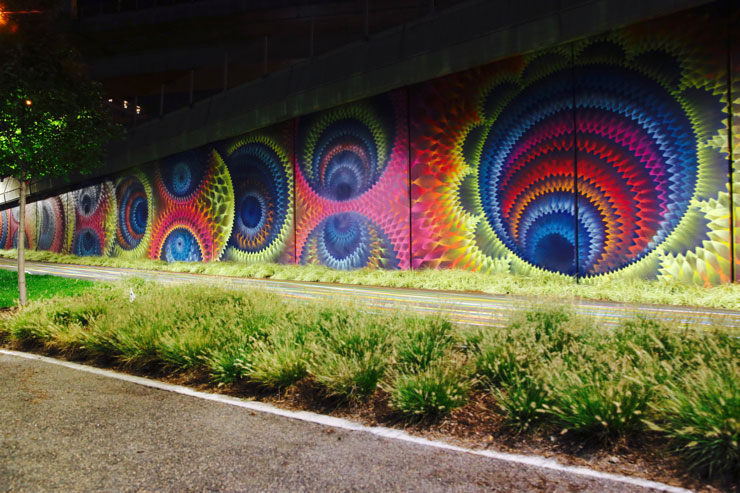
At the start of September Adams and 10 other artists joined the Underground Mural Project to transform 150,000 square feet of walls and pavement in a park here, curated by Street Theory Gallery, a creative studio founded by Liza and Victor ‘Marka27’ Quiñonez. The 8-acre public underpass located between Boston’s South End and South Boston neighborhoods has been leased to a privately owned company that has turned it into “an active urban park, cultural attraction and parking amenity”, now named Underground Ink Block.

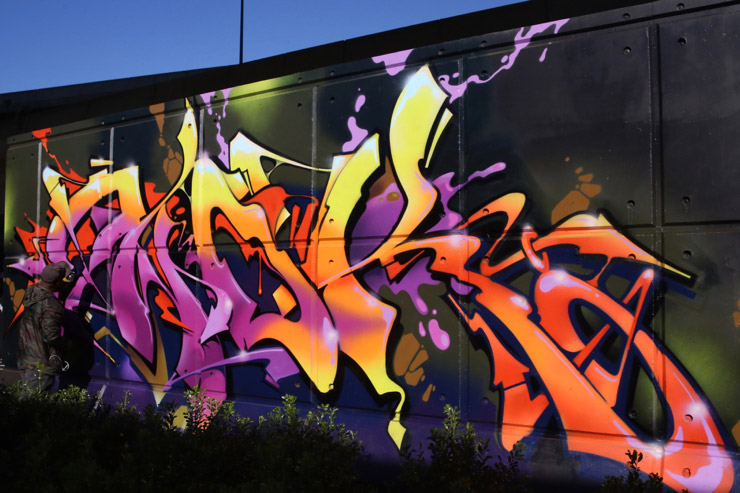
Ewok-MSK. Urban Art Park. Beantown, Boston. September 2017. (photo © Todd Mazer)

Our thanks to photographer Todd Mazer who shares some of his images with BSA readers today from the event. Todd also conducted an interview with painter, muralist and graffiti artist Rob “Problak” Gibbs, a native of Roxbury, a neighborhood in the southern part of Boston. As participant in the project, community arts advocate, and a lifetime Boston citizen who believes strongly in the power of public art, graffiti, and HipHop culture, Poblak offers a unique perspective to the Underground Mural Project.

Todd Mazer: In your origins as a writer you have spoken about the importance of outdoor classrooms like Peters Park what are your hopes that a place like the Underground at Ink Block can be a catalyst for?
Problak: I hope that the Underground at Ink Block can be a catalyst for the next generation of graffiti writers, muralist and landscape artist to be inspired to take what we contributed to the space and add on to the practice. If our times are documented the stories can be told better through a variety of disciplines artist come to the table with.

When a place like the Underground exists, up and coming artist can work on creative ways to contribute towards a venue that exhibits community art for the people of greater Boston at a world wide scale. The Underground can be a bridge that takes anyone (young or old) on an adventure through the creative process of an artist that may have work in that space.

VyalOne. Urban Art Park. Beantown, Boston. September 2017. (photo © Todd Mazer)

Todd Mazer: As an artist, activist and architect/educator how have you discovered the importance to expand your skill set in order to create opportunity for your own and others artistic endeavors?
Problak: I discovered how important it is have to have a variety of ways to tell your story. Pose2 always told us “your only as good as your last piece” and Kem5 added “ and the people you place yourself around” When that whole phrase is combined positioned my mind in a place to have my skill set be in a good position to always grow.

“Walking the talk” confidently comes from paying dues. Dues that range from humble beginnings to bad experiences that I learned the greatest lessons from. Expanding my skill set opened up new doors to meet and build a variety of relationships with other artist who too are skilled and tackle tasks through creative problem solving. The more skill you have the less you’ll find yourself saying NO to a majority of the challenges you’ll get approached with.

HOXXOH. Urban Art Park. Beantown, Boston. September 2017. (photo © Todd Mazer)

Todd Mazer: As a follow up more specifically could you offer some insight from 91 til infinity… in other words how has your involvement in AFH (Artists For Humanities) shaped your actions and given you perspective on the importance of this new space?
Problak: LOL from 91 til………..

My involvement with AFH is very instrumental to what I do because the creed we practice in our studio has become the DNA to my life’s work. I grew up around a small nit of artist who are gifted and who challenged me along our journey. That small crew grew into the organizations leadership. The ethos has evolved and revolved off of our actions. We took responsibility for our own learning and shared that practice with a large amount of youth for the past 25 years.

Don Rimx . Problak . Marka27. Urban Art Park. Beantown, Boston. September 2017. (photo © Todd Mazer)

The importance of this new space is that concept of giving space and opportunity for a genre that is powered by energy in this city that is untapped. An energy that has the interest of the youth and the ability to challenge them to think, digest, seek their own truth and hopefully contribute. Sometimes you have to be exposed to or shown the examples to develop your voice. This space could serve as a megaphone to help project it. The examples are the trailblazers who show everyone in the space what’s possible.

Todd Mazer: Why is it so important to artistically reclaim overlooked spaces?
Problak: It’s important to “Add to” vs. reclaim because with all due respect to the city’s architecture, I view these spaces as a series of blank canvases embedded inside of what I would compare to the city’s respiratory system. The work we do would breathe life into these spaces so that the city would not have to hold its breath and encourage others to do the same. These spaces can be landmarks and spark the next mind to be great or be that picture worth a 1000 words that would speak to the generations to come.

The participating artists include: Vyal One, Imagine, Cey Adams, Don Rimx, Marka 27, Problak, Ewok MSK, Thy Doan, Upendo, Percy Fortini-Wright and Hoxxoh. Our thanks to Todd Mazer for sharing his photos and interview with BSA readers.

Marka27. Urban Art Park. Beantown, Boston. September 2017. (photo © Todd Mazer)

Ewok-MSK . Thy Doan. Urban Art Park. Beantown, Boston. September 2017. (photo © Todd Mazer)

Thy Doan. Urban Art Park. Beantown, Boston. September 2017. (photo © Todd Mazer)


Perci Fortini-Wright. Urban Art Park. Beantown, Boston. September 2017. (photo © Todd Mazer)

Perci Fortini-Wright. Urban Art Park. Beantown, Boston. September 2017. (photo © Todd Mazer)

Imagine876. Urban Art Park. Beantown, Boston. September 2017. (photo © Todd Mazer)

Upendo. Urban Art Park. Beantown, Boston. September 2017. (photo © Todd Mazer)

Problak . Vyal . Marka27. Urban Art Park. Beantown, Boston. September 2017. (photo © Todd Mazer)

Having fun at the block party. Urban Art Park. Beantown, Boston. September 2017. (photo © Todd Mazer)

Having fun at the block party. Urban Art Park. Beantown, Boston. September 2017. (photo © Todd Mazer)


Underground at Ink Block from National Development on Vimeo.

Read more
12 Finalist Artists Announced for Contorno Urbano Mural in Barcelona

12 Finalist Artists Announced for Contorno Urbano Mural in Barcelona

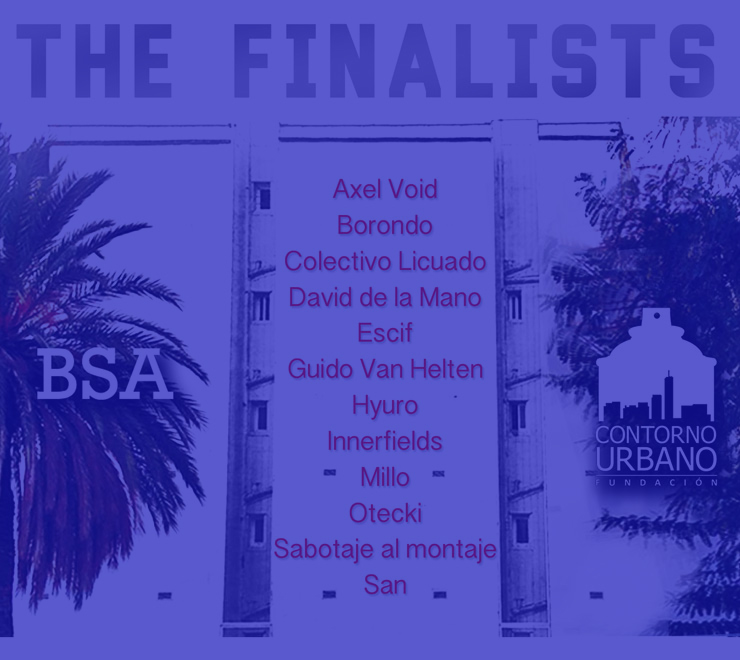
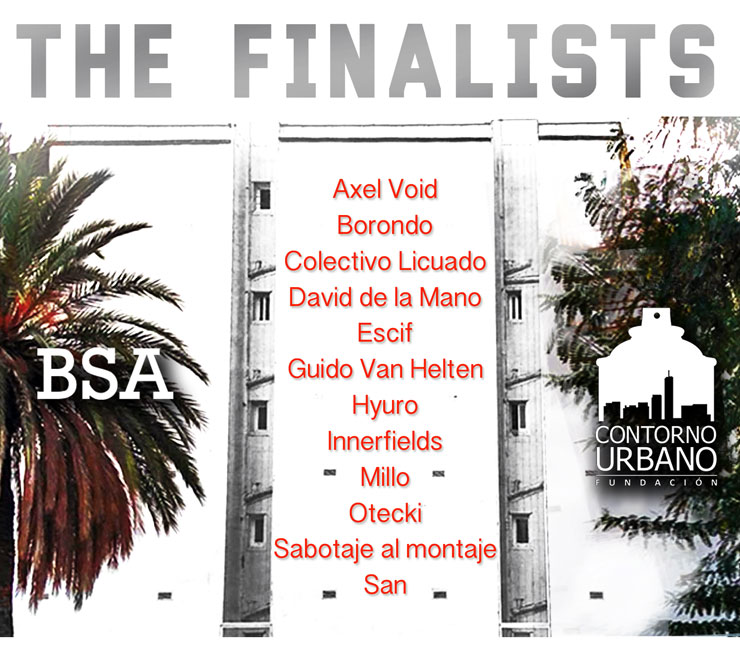
Almost 300 artists and collectives from around the world (42 countries) have entered the 2018 Contorno Urbano competition for this wall/residency/7000€ prize in Barcelona! It is astounding how many high caliber artists are at work today in cities everywhere, bringing innovative new techniques and unique perspectives to public space like never before.

After reviewing all applications and submitted materials during a process begun this summer, today we are excited to announce that this list has been narrowed to just 12 finalists. Next month their names will go to the final stage of selection in Barcelona with esteemed co-jurors from organizers and creators in the areas of art academia, mural art, public art, and Street Art to narrow the list to one.

The 12 premiere finalists for the Mural de la Salut in Sant Feliu de Llobregat (Barcelona, Spain) are:

Axel Void
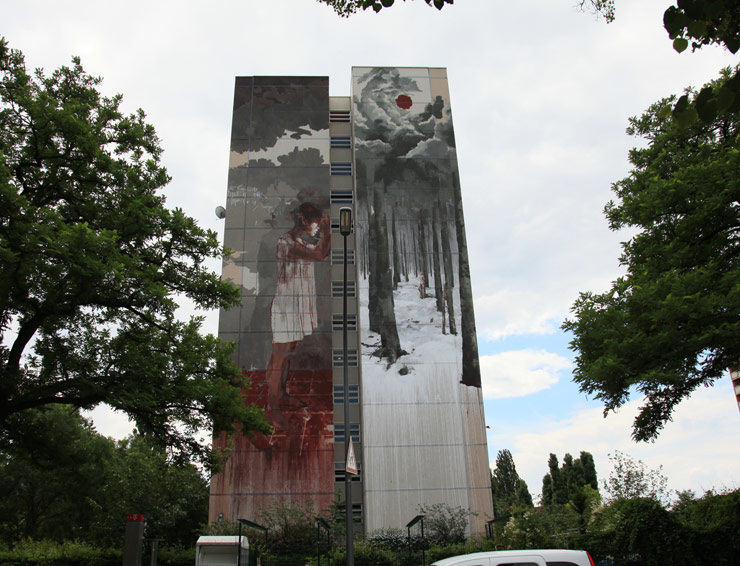
Borondo
Colectivo Licuado
David de la Mano
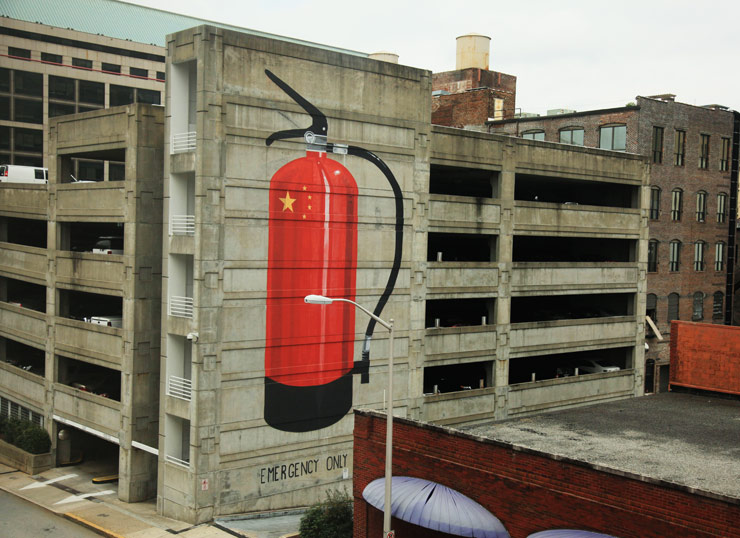
Escif
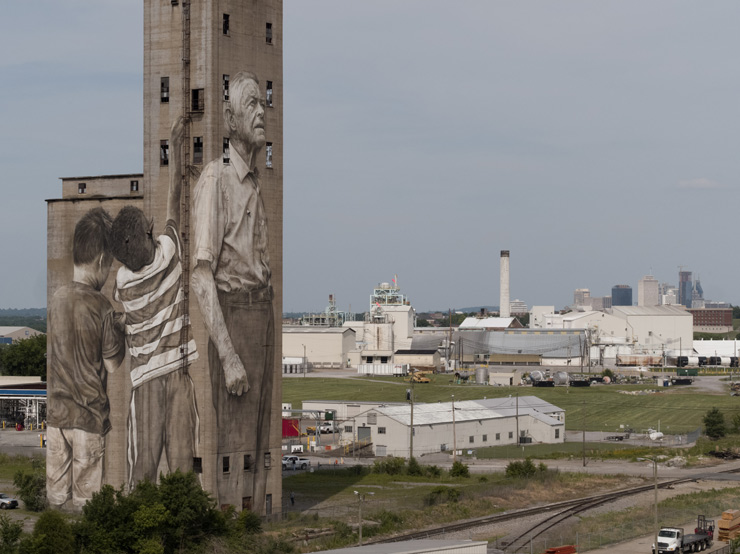
Guido Van Helten
Hyuro
Innerfields
Millo
Otecki
Sabotaje al Montaje
San

Congratulations to each artist! It wasn’t an easy task for the pre-selection committee to decide the best from 300, but your work rose to the top 4% of the applications according to the selection criteria.

#MuralSalut: Finalistas – Finalists from Contorno Urbano on Vimeo.

Among the considerations for selection were academic studies, experience and history creating murals in public space, previous internships or residencies, and suitability of artwork style to the central purpose of this 400 square meter mural.

Each of the 12 finalists will be asked to submit a sketch and a written proposal.

The final stage of the selection will be on November 15th and 16th, with the following professionals travelling to Sant Feliu de Llobregat:

Monica Campana (Cofounder of Living Walls and project manager for the urban art exhibition Open Source),
Fernando Figueroa (PHD in History of Art and independent researcher specialized in graffiti and urban art),
Esteban Marin (President of Contorno Urbano and mural artist),
Jaime Rojo (co-founder of Brooklyn Street Art and curator), and
Veronica Werckmeister (painter and muralist, curator).

The mural will commemorate the neighborhood’s fight 30 years ago to have this public square created for the neighbors instead of building a gas station. After meeting with the Association La Salut and the neighbors who live in the area, members of the jury will review previous artworks and experience of the 12 finalists to help them to select the artist who is best suited for painting the mural.

The winner will receive an artistic residence beginning in Spring 2018 and will receive a 7000€ prize. The wall will be painted after an artistic residency in order for the artist to become acquainted with the historic context of the project and the city itself.

The project is a collaboration between the municipality (Ajuntament) of Sant Feliu de Llobregat, Fundacion Contorno Urbano and Kaligrafics.

Kaligrafics: Founded in 1999, it’s the oldest non-profit organization dedicated to graffiti and street art in Cataluña, and a significant record of experience in Spain.

Contorno Urbano: The first Foundation in Spain to be fully dedicated to street art and graffiti. The team has over 10 years’ experience organizing murals and urban art dissemination locally and internationally.


Following in no particular order are the 12 finalists:

Guido Van Helten / United Kingdom

Guido Van Helten for Nashville Walls Project. Nashville, TN. June 2017. (photo © Eric E Johnson)

Borondo / Spain

Borondo for Urban Nation this spring (UN) in the Tegel section of Berlin. (photo © Jaime Rojo)

Escif / Spain

Escif. Living Walls Atlanta. (photo © Jaime Rojo)

Daniel “SAN” Muñoz / Spain

Daniel Muñoz. The curtain ( 983 followers). The Highlands, Scotland. (photo © courtesy of the artist)

Axel Void / USA

Axel Void. Los Muros Hablan. El Barrio/Spanish Harlem. NYC. (photo © Jaime Rojo)

Hyuro / Spain

Hyuro. What In The World PM/12. Urban Nation Museum For Urban Contemporary Art. Berlin, May 19, 2017. (photo © Jaime Rojo)

Colectivo Licuado / Uruguay

Colectivo Licuado. Lisbon, Portugal. (photo © courtesy of Colectivo Licuado)

Millo / Italy

Millo in Kiev for Mural Social Club Festival/NGO Sky Art Foundation. (photo © Maksim Belousov)

Innerfields / Germany

Innerfields for ArtUnitedUs in Kiev, Ukraine. (photo © @dronarium)

David De La Mano / Spain

David De La Mano. Urban Nation Musuem For Urban Contemporary Art. Berlin. September 2017. (photo © Jaime Rojo)

Sabotaje Al Montaje / Spain

Sabotaje Al Montaje. Los Alcazares. Murcia, Spain. (photo © Lluis Olive Bulbena)

Otecki / Poland

Otecki. Urban Forms. Lodz, Poland. (photo © Courtesy Urban Forms)


Read more
BSA Images Of The Week: 10.29.17

BSA Images Of The Week: 10.29.17

BSA-Images-Week-Jan2015

Halloween this year is on a Tuesday so its hard for people to know when exactly to celebrate it – we had 20 or so Trick-or-Treaters Saturday night so that tells you the kids vote in this part of Brooklyn.

Of course with the folks we have running the White House, every day feels like Halloween. “Here, I’ll trick you with this POPULIST costume, and my treat will be to take whats left of your middle class chocolate.”

Trick or Trick!

It doesn’t help that Tabloid TV loves the “Zombies on Parade” – they are like sugar addicts dancing for eyeballs and advertising dollars.

But from a Street Art and public performance perspective, New York is a thrill, a regular monster mash! The East Village parade 2017 on Tuesday will have puppets, 53 bands performing different types of music, dancers, artists, and thousands of New Yorkers in costume. Be safe out here ya’ll.

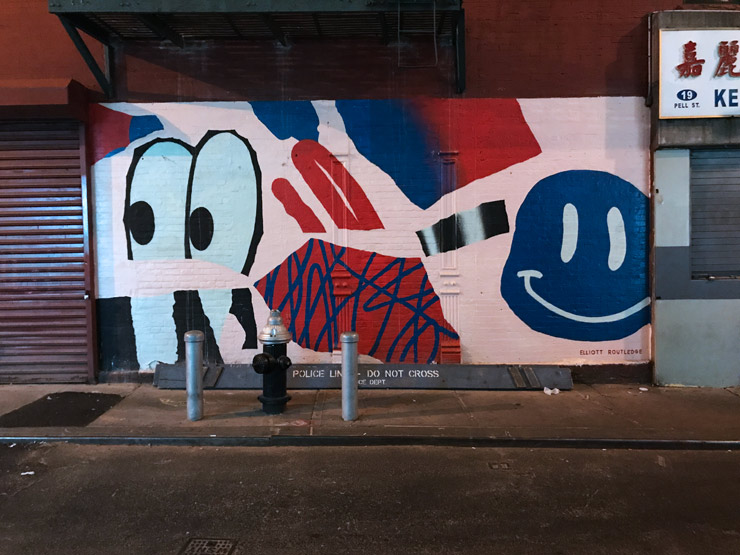
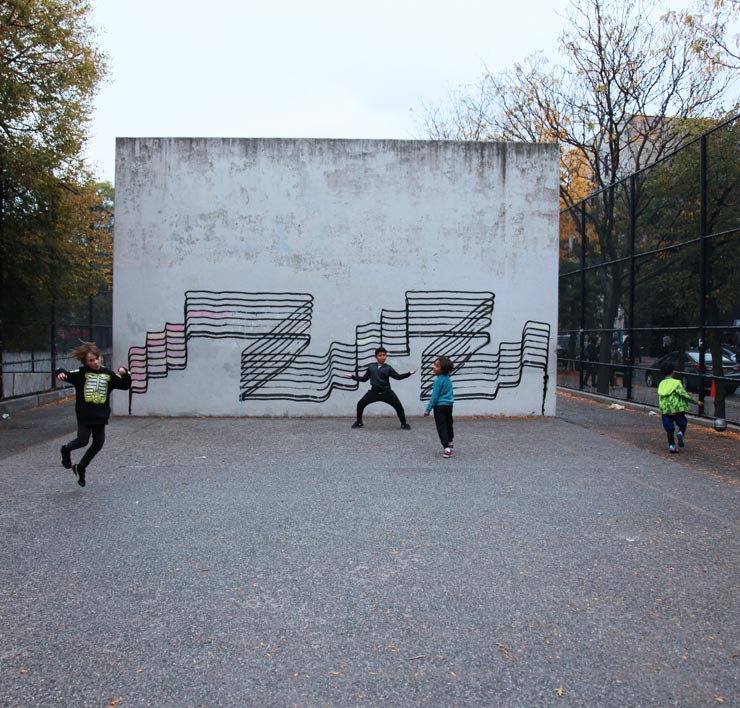
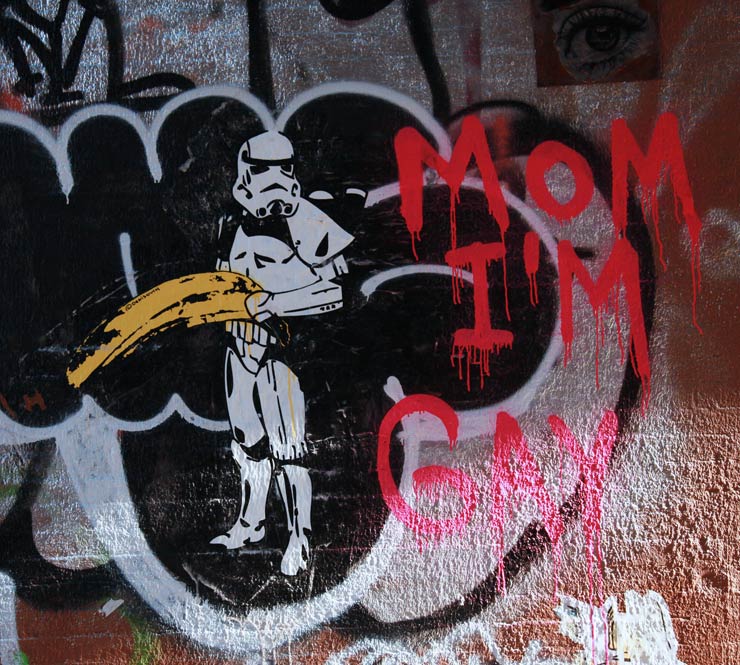
Here’s our weekly interview with the streets, this week featuring Karl Addison, Bifido, City Kitty, Denis Ouch, Don Rimx, Elliott Routledge, Julien de Casabianca, Julieta, Lungebox, Nevercrew, Outings Project, Revok, Sipros, Strayones, and TurtleCaps.

Top image: Elliott Routledge (photo © Jaime Rojo)

Revok – MSK (photo © Jaime Rojo)

Denis Ouch (photo © Jaime Rojo)

Portraits of a clown king. Denis Ouch (photo © Jaime Rojo)

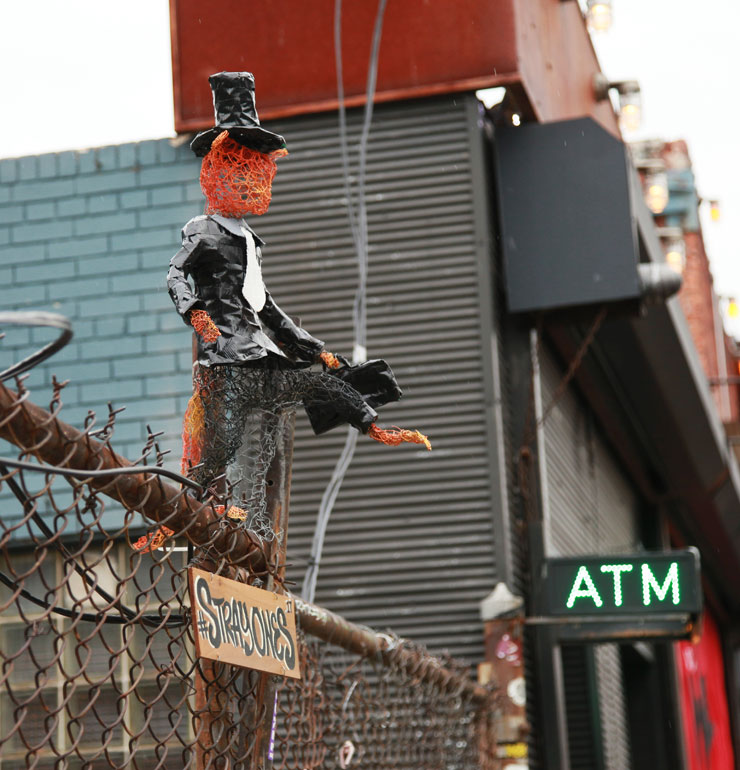
Strayones brings out Cat In The Hat. (photo © Jaime Rojo)

Sculptural Street Artist Strayones tells us that the story represented here is a critique of “how business people and wealthy men are making us step over the edge into the abyss”.

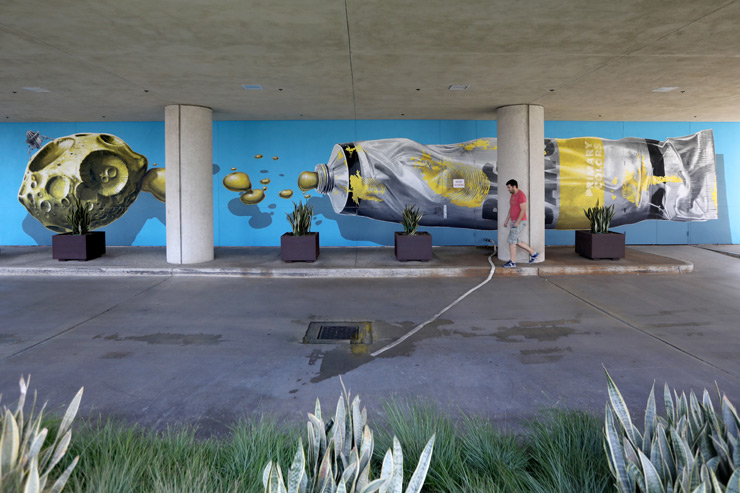
Nevercrew. “Dimensional recipe”. Los Angeles. Part 1 (photo © Nevercrew)

“Dimensional recipe” is a series of three interconnected mural paintings realized in Los Angeles (USA), curated by Anne­Laure Lemaitre (FatCap), 2017.

About the work:

This is a work about mankind’s relation with creation, about the mutual influences between creativity and reality and the anthropological loop
that originates from this continuous correlation. It is about the feeling of being part of a system, of being a participant and being able to view it from a certain point of view, for what it is and for what it could be.”

Nevercrew. “Dimensional recipe”. Los Angeles. Part 2 (photo © Nevercrew)

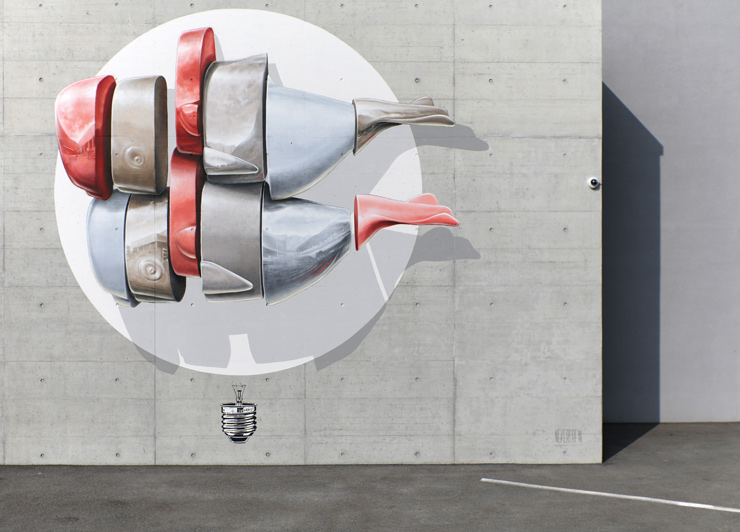
Nevercrew. “Diposing Machine”. Melano, Switzerland. Part 1 (photo © Nevercrew)

“Disposing Machine” is the new mural from Nevercrew in Melano, Switzerland for Artrust. Their statement:

“Habits, attitudes, principles and awareness are conditioned by reality, and reality is conditioned by the perception everyone has of it. The position of humankind in its environment, in its World, is at the same
time part of its nature and a point of view from which to perceive it.

Systems are then interpretations, a way to give human shape to
something that’s not necessarily made for it, as well as a way to decide
which shapes to give and how to read them. As reality could be built and
altered by systems, so nature could then risk to be detached from
human sensing; an human reconstruction of something that exists
outside this given shape but that still is directly subjected to each action
that’s made on it.”

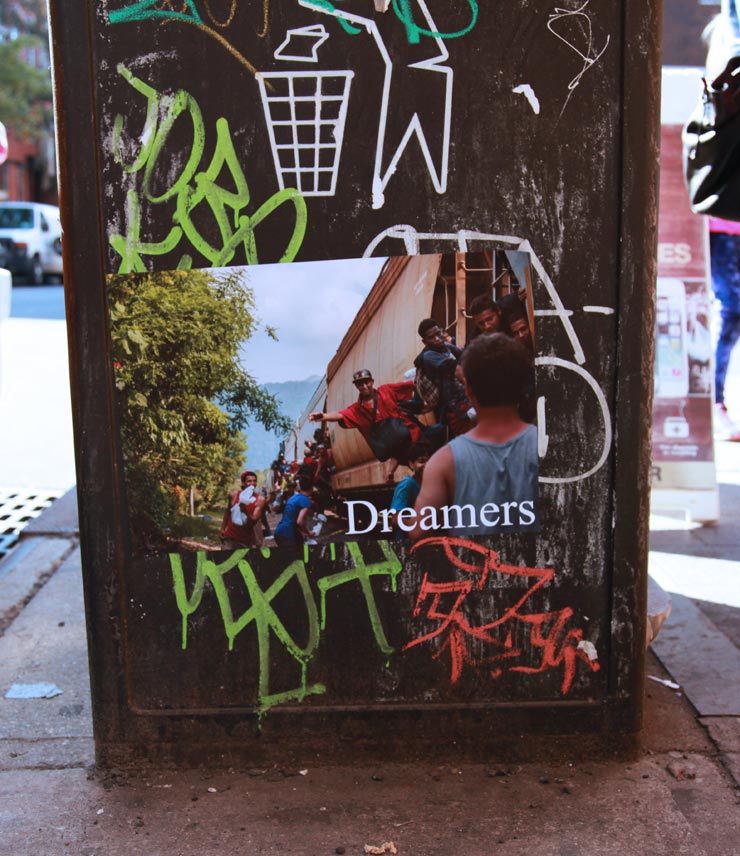
This image of Dreamers reminds us of our grandfathers and grandmothers and the stories of refugees all over the world overcoming obstacles to make a better life.  (photo © Jaime Rojo)

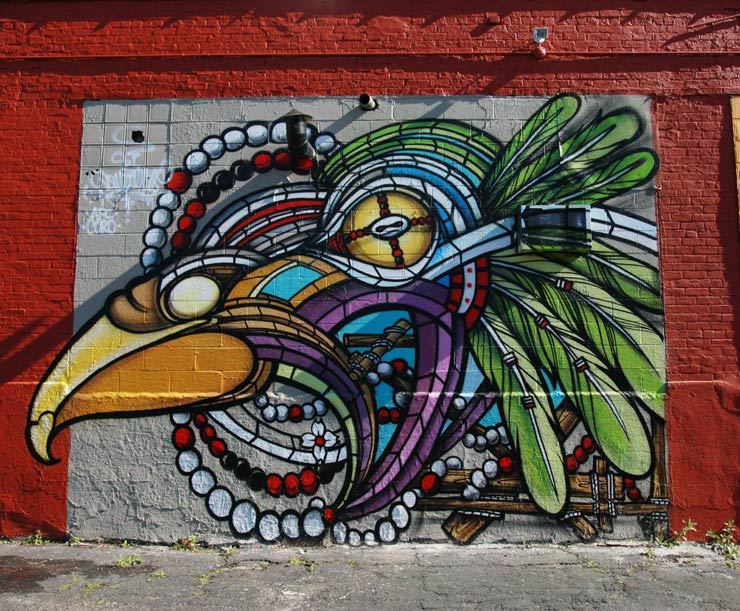
Dom Rimx (photo © Jaime Rojo)

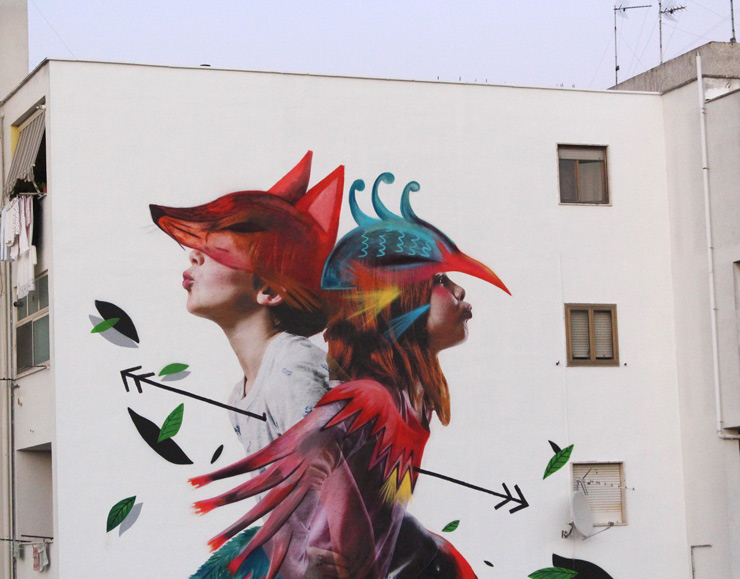
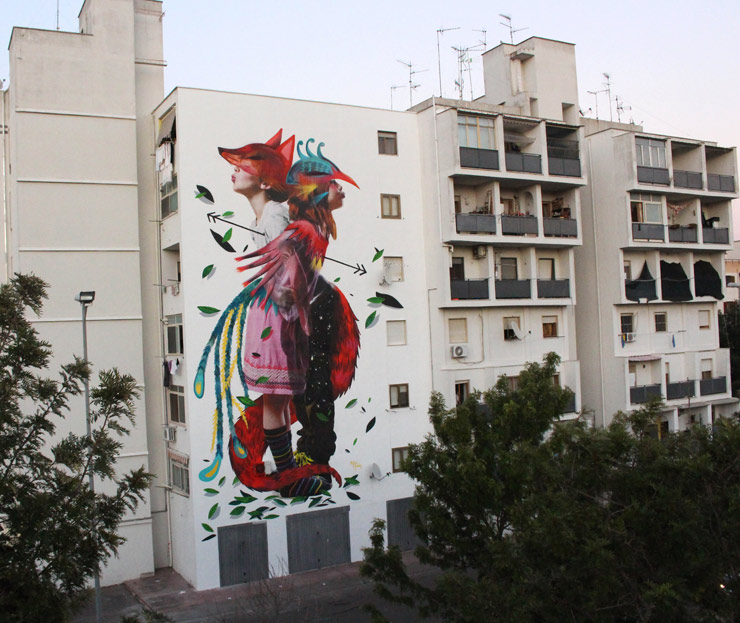
Collaboration between Bifido and Julieta in Lecce, Italy. (photo © Bifido)

The Italian Street Artist Bifido and Spanish artists Juelieta completed this fantastical work in Lecce, Italy this week for the 167 Art Project. Bifido tells us that the title is “First Fire” and it “talks about the possibility to love each other in a fantastic way, and it focuses on the importance of play in our lives.”

Collaboration between Bifido and Julieta in Lecce, Italy. (photo © Bifido)

Turtlecaps . City Kitty (photo © Jaime Rojo)

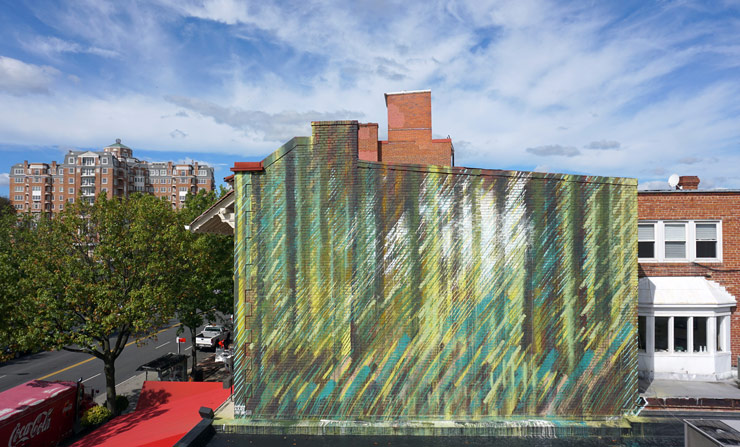
An atmospheric Addison Karl . “Okchamali Nebulae”. Washington, DC. (photo © Addison Karl)

Lungebox (photo © Jaime Rojo)

One question: what is a furring channel? Sipros for The Bushwick Collective. (photo © Jaime Rojo)

Outings Project in Paris. (photo © Julien de Casabianca)

Outings Project in Paris. (photo © Julien de Casabianca)

Unidentified artist (photo © Jaime Rojo)

Untitled. Brooklyn, NY. October 2017. (photo © Jaime Rojo)

Read more