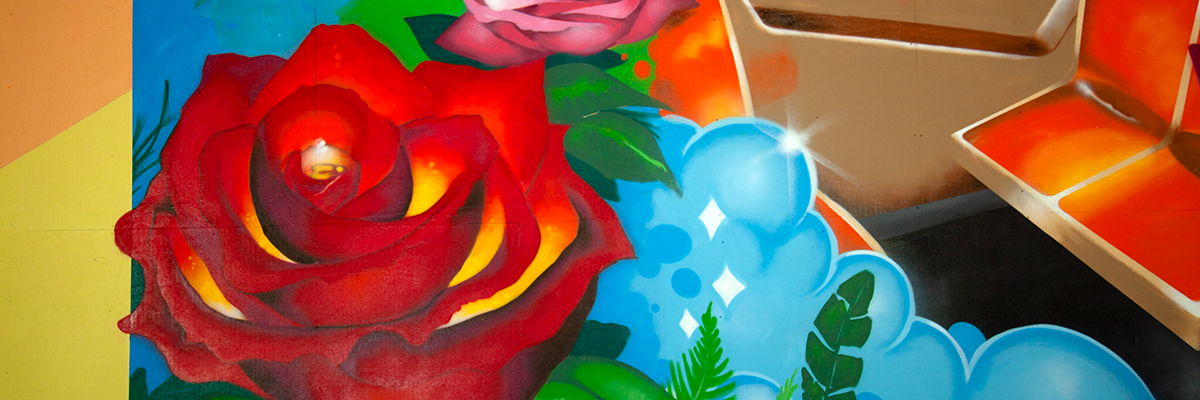
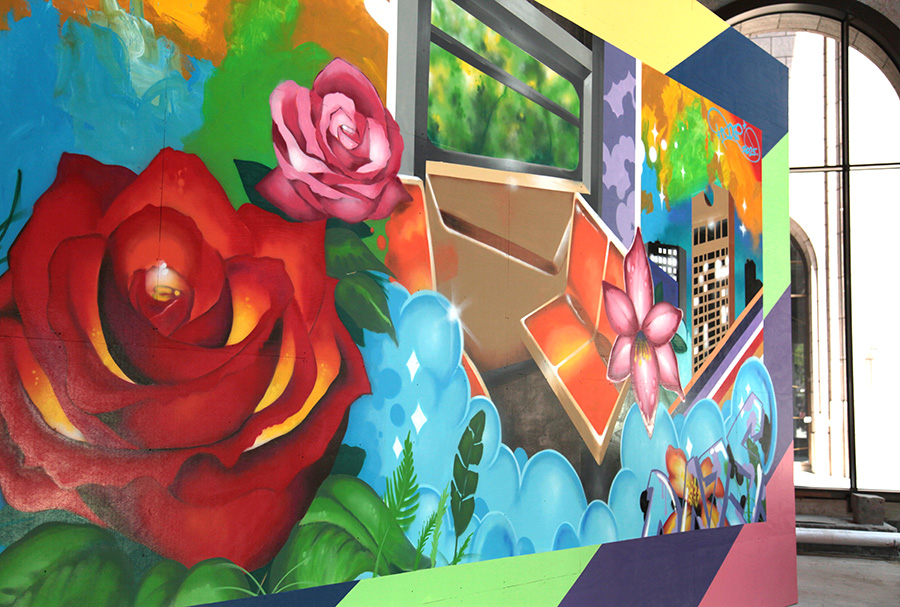
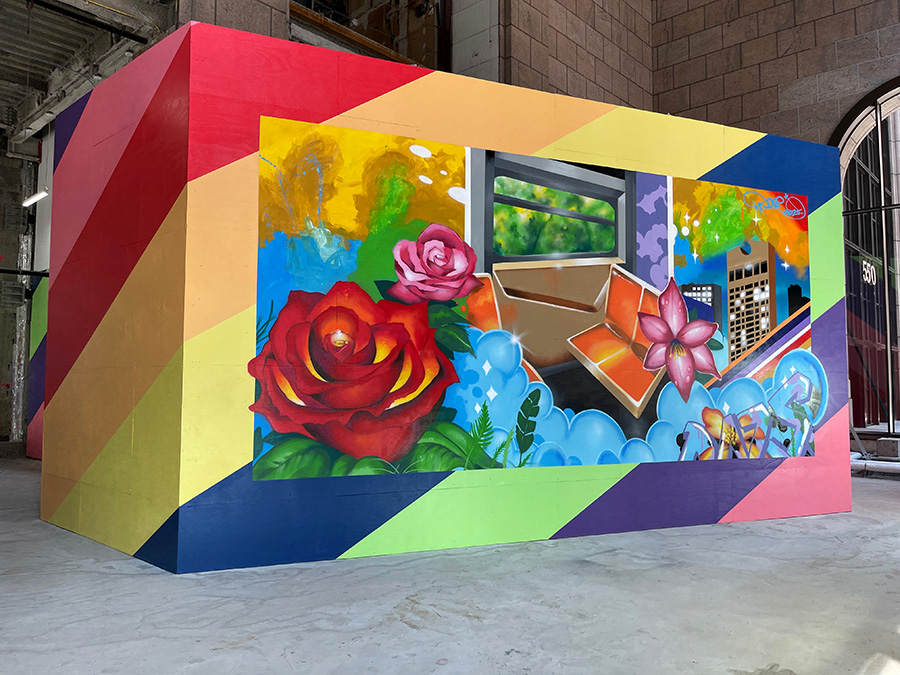
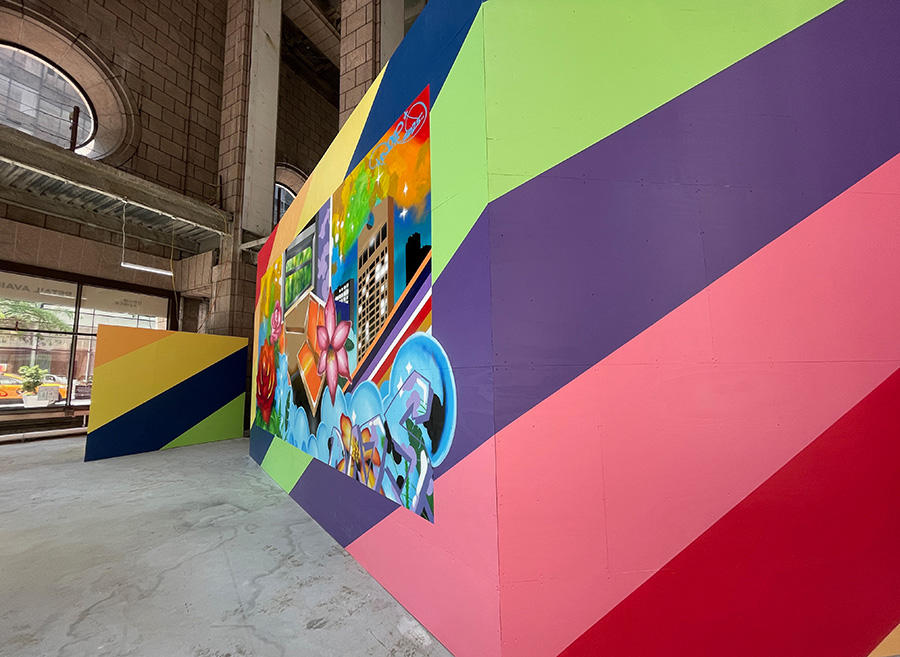
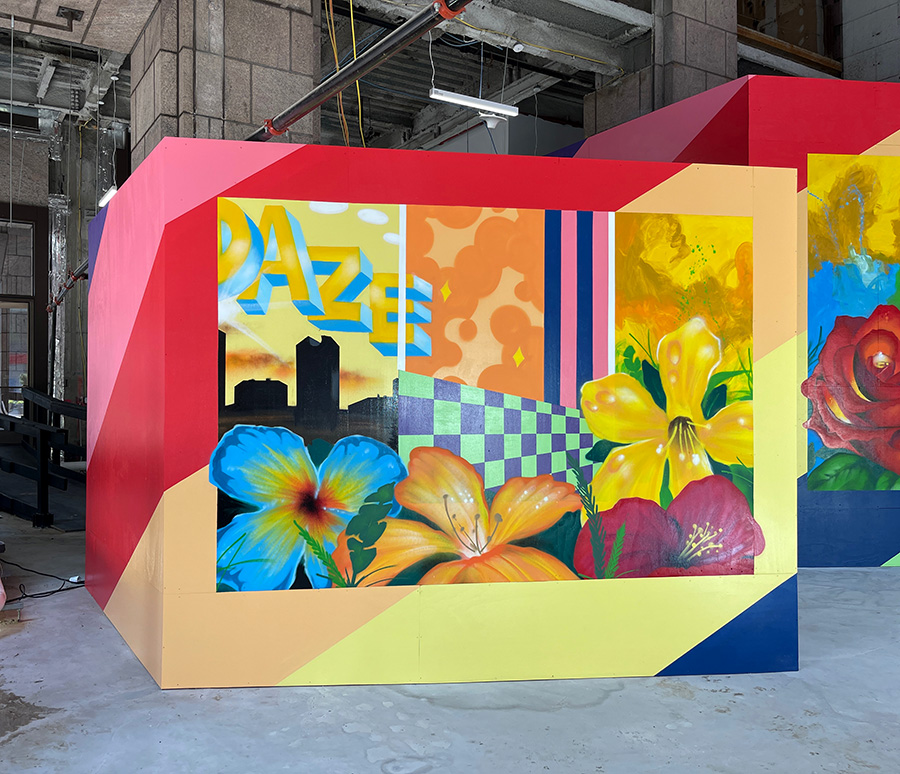
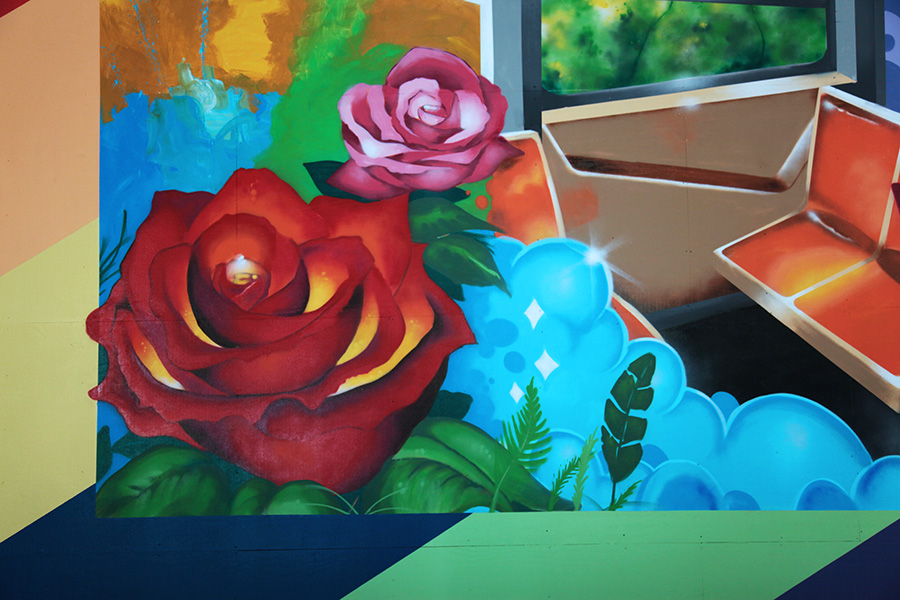
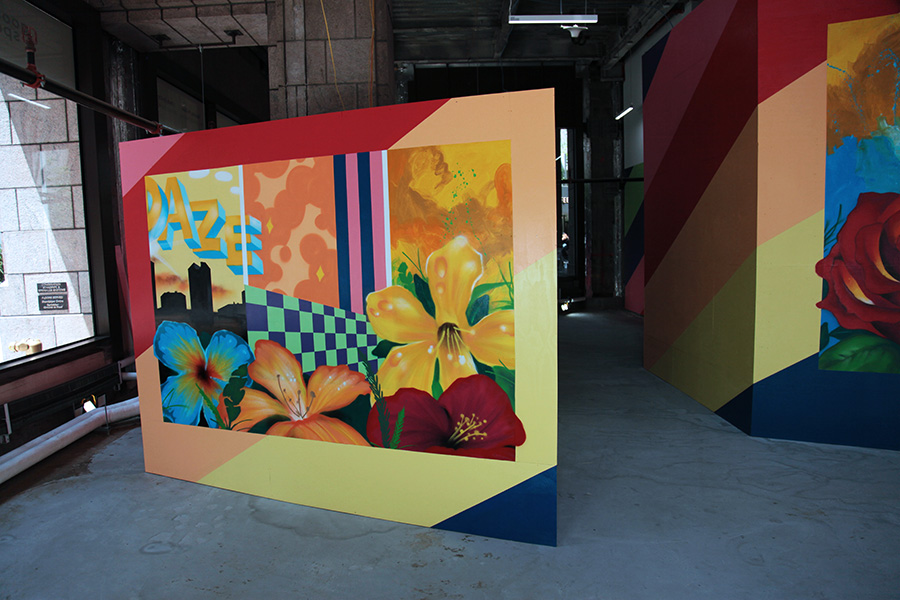
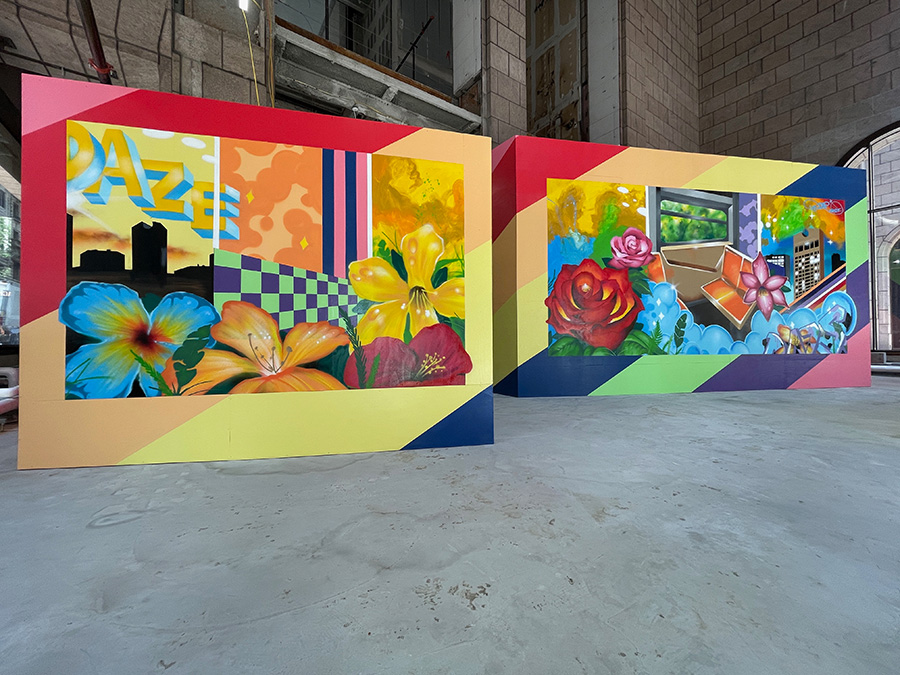
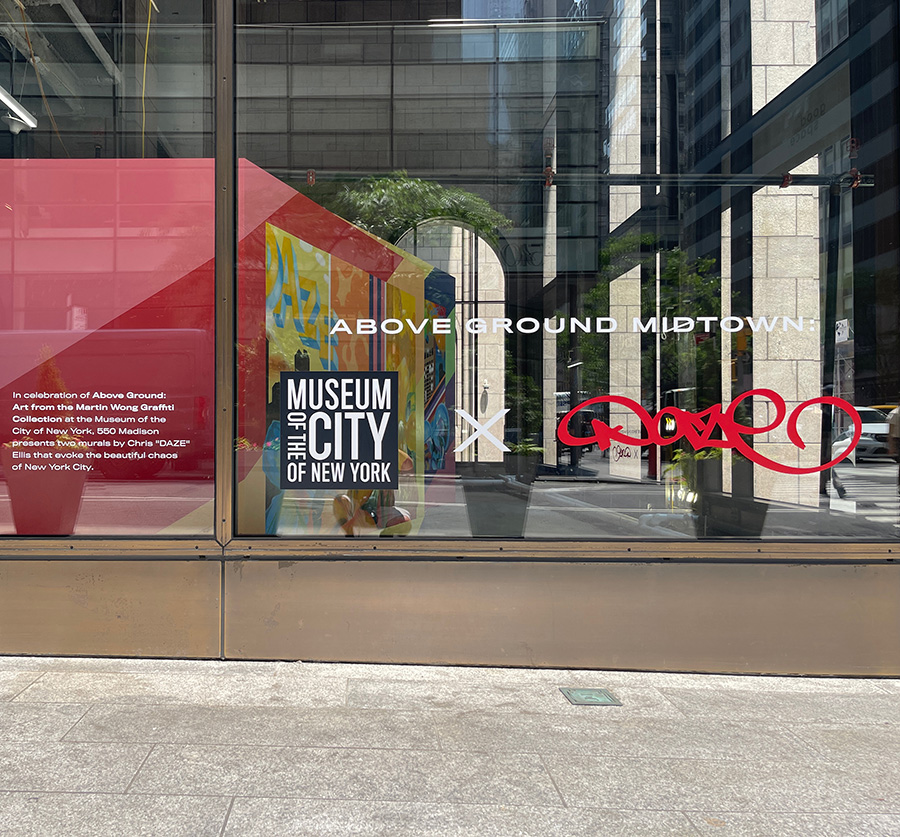
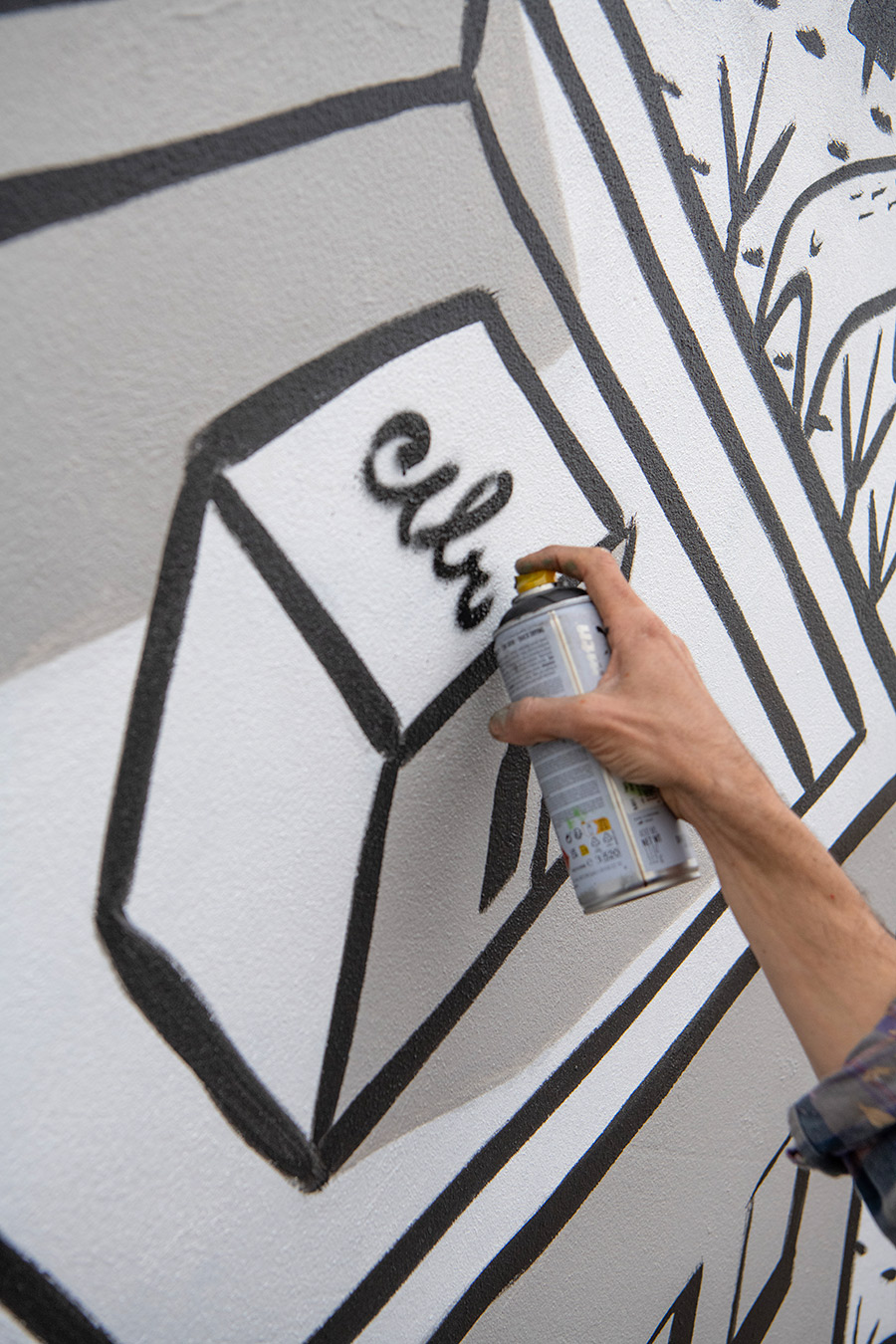
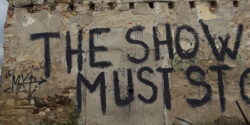
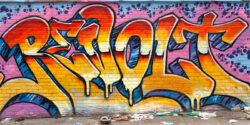
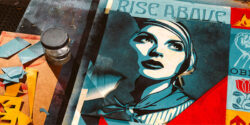
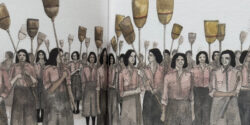
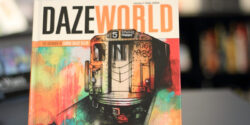
In a decisive nod to the city that shaped him, legendary graffiti artist DAZE (Chris Ellis) has unveiled two new large-scale murals at 550 Madison Avenue, transforming the building’s soaring street-level space into a canvas that bridges worlds. Painted live in public view, these works are part of “Above Ground Midtown: MCNY x DAZE.” With their vibrant forms, layered textures, and intuitive energy, DAZE’s murals draw from the pulse of New York City, the geometry of Philip Johnson’s iconic building design, and the surrounding garden oasis that gently appears in midtown Manhattan.
To fans of New York graffiti and street art, DAZE needs no introduction. A member of the second wave of graffiti writers in the late 1970s and early ’80s, he began painting subway trains as a student at the High School of Art and Design, developing a signature style marked by wildstyle lettering, surreal characters, and a painterly sense of movement. Over the decades, he has nurtured a career, evolving into a fine artist while continuing to honor the raw urban energy of his roots. “I think of these pieces as a continuation of a language I started developing underground,” DAZE tells us. “Only now, we’re bringing it out into the light—quite literally.”
Curator Sean Corcoran of the Museum of the City of New York sees this installation as an extension of the museum’s current exhibition, Above Ground: Art from the Martin Wong Graffiti Collection, which includes early works by DAZE and many of his contemporaries. “This project is about visibility—making sure the public understands graffiti not just as something from the past, but as a living, evolving art form with deep ties to the city’s history,” he says. “Having DAZE create these murals in real time, for anyone to see, reinforces the idea that this movement was always meant to be in dialogue with the street—and with the people of New York.”
BSA asked DAZE and Corcoran a couple of questions about the project:
Brooklyn Street Art (BSA): DAZE, these new canvases feel like they’re in direct conversation with the city itself — its architecture, movement, street energy, and natural elements. How do they reflect your biography as a New Yorker and a writer who came up in the 1970s and ’80s?
DAZE: In creating these two paintings I wanted to capture the feeling of someone somehow say, in a taxi, going uptown and watching how the cityscape changes from one neighborhood to the next. At the same time I wanted to inject certain natural images within the painting. Even though we all live in a city that is noisy and congested, there are still areas where one can find a nice park to sit and have a quiet moment. I felt like that side of the city had to be represented too.
BSA: You created these pieces live, in a high-visibility Midtown space, a far cry from painting trains in the dark. What does it mean to you to create something so public and above-ground in the heart of a city you’ve been documenting and writing a visual diary for over 40+ years?
DAZE: I was very aware of the architecture of the building and its history. One of the unique things about the space is that the ceilings are so high. It’s an interior space, however, you feel as if you’re outside, which is quite unique.
It was amazing to create something large scale in an area of New York City that receives both many tourists and people who are working there. It exposes my work to a new audience.
BSA: Sean, DAZE’s career spans the early days of illegal train writing to significant institutional recognition — how does his presence here at 550 Madison, and possibly in the Martin Wong Collection, help tell a fuller story of graffiti’s evolution in New York?
Sean Corcoran: Daze’s career is an excellent example of the trajectory of a number of the artistically ambitious writers who emerge from the “train writing”’ era movement that developed a long and impactful studio career that helped export the regional subculture to a worldwide phenomenon. Martin Wong, the Lower East Side painter and generous donor of the majority of the Museum’s collection of more than 300 paintings and 60 black books, was interested in telling the story of this a youth culture that largely sprung up in New York City.
He wanted to trace the youthful rebellion of you people painting on subway trains and public spaces, but he was equally interested in the communication and artistic inclinations as well, and he actively encouraged and supported this by not only buying canvases, but by being a friend and sometimes mentor.
BSA: The title Above Ground for the Martin Wong Collection—and this above-ground exhibition by a writer known for his work on underground trains—suggests a subculture being brought into the light. In curating this collection today at the MCNY, what conversations do you hope it sparks about the place of artists like DAZE in both the art world and the cultural history of the city?
Sean Corcoran:Above Ground is intended to loosely trace the early efforts of train writers as they moved out of the tunnels and layups and into the studio. The exhibition notes the importance of several transitional moments in this history – The United Graffiti Artists (founded in 1972), Sam Esses Studio in 1980, the advent of East Village galleries like Fun and 51X soon after in the early 1980s, and then the jump to blue chip galleries, including Sidney Janis, and opportunities in Europe. These are all examples of the long road these artists took in developing their careers. The paintings in the gallery reflect both Martin’s collection and the various paths the artists took, from maintaining a letter-based art to moving into abstraction and figuration. The exhibition ends in the early 1990s just as the “train writing era” ends, but we all know that that was just the end of the beginning of the story…..
Interview with Doug Gillen | Video Feature from Fifth Wall TV
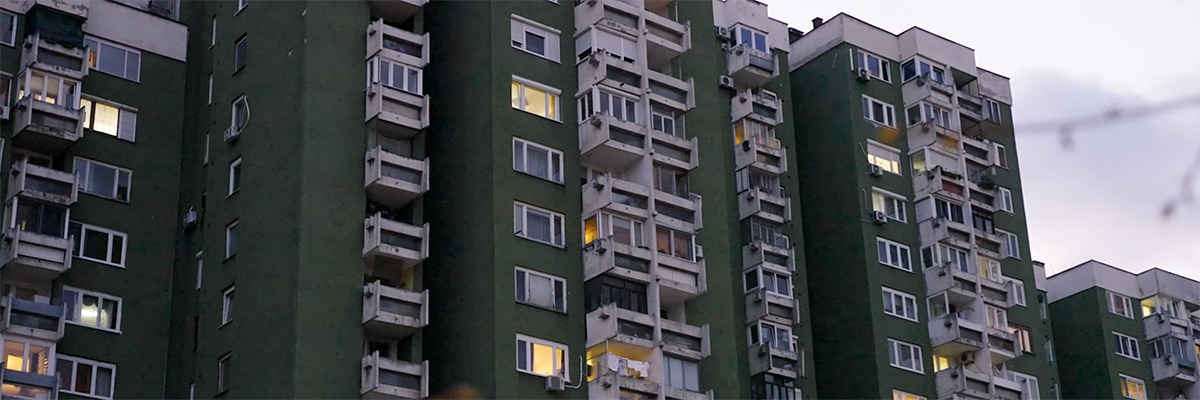
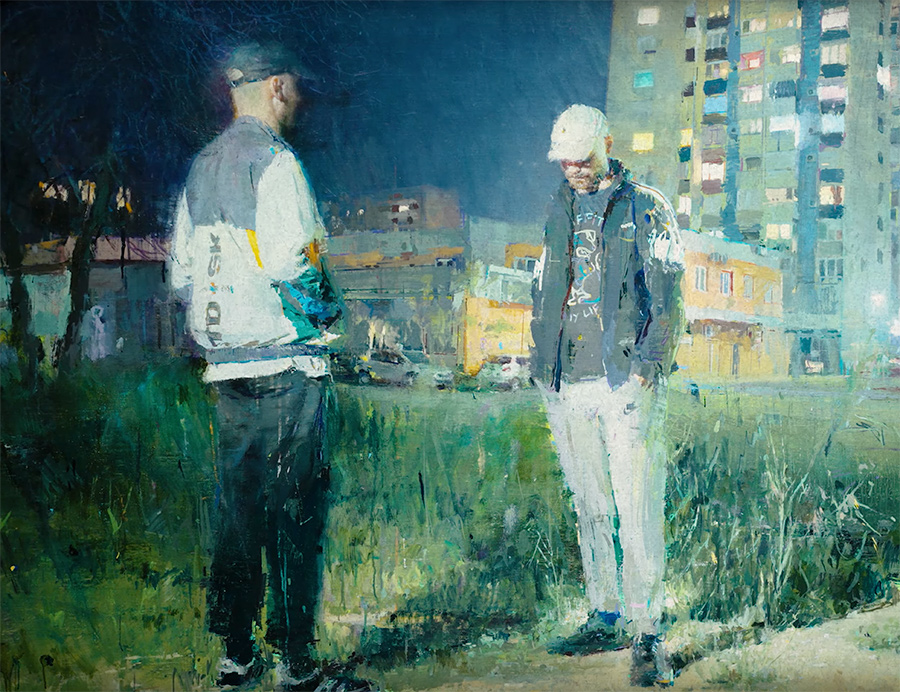
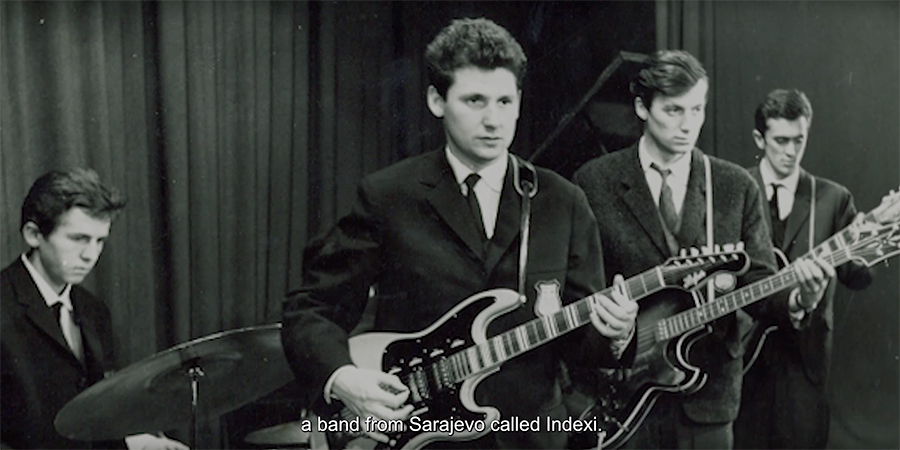
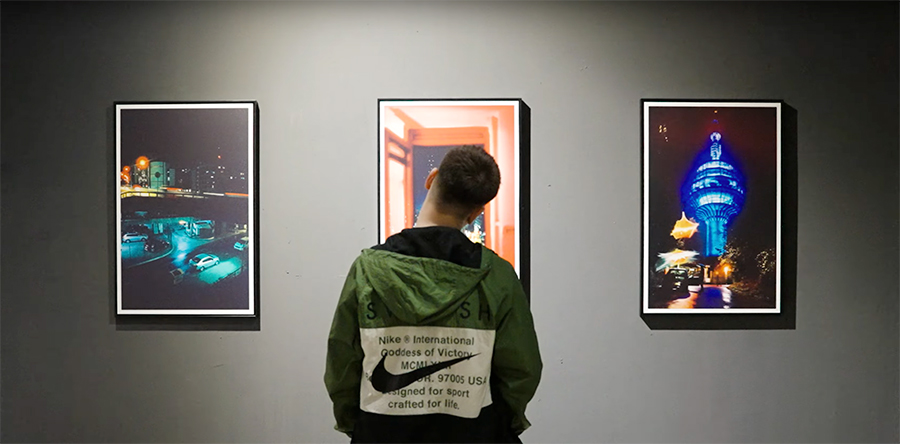
Ghosts of concrete modernism and whispered nostalgia drift through “The Morning Will Change Everything,” the first solo museum exhibition by Spanish artist Sebas Velasco, now on view at the History Museum of Bosnia and Herzegovina in Sarajevo. In this new video interview, filmmaker and art observer Doug Gillen sits down with Velasco to unpack the layers of emotional and political weight carried in these oil-painted nocturnes—each a meditation on memory, architecture, and the complex afterglow of Yugoslavia’s post-socialist present.
Sebas Velasco. The Morning Will Change Everything. (image still from the video by Doug Gillen for Fifth Wall TV)
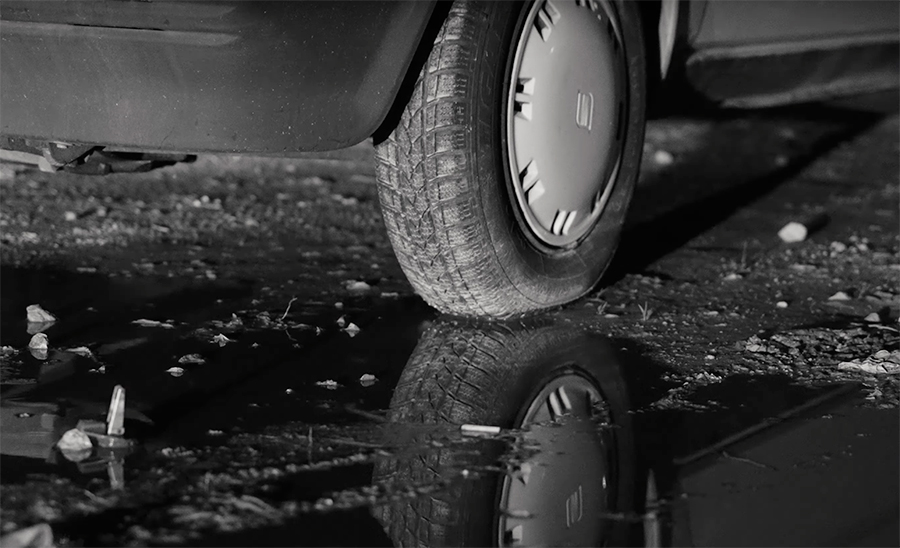
The conversation reflects Velasco’s realism, influenced by photography – reinterpreted by hand and heart. “It’s a love story with the region, for sure,” he tells Gillen, reflecting on years of travel and a growing personal bond with Sarajevo and its surrounding cities. His works hum, layering light, concrete, shadow, and silence to capture what it feels like. “Maybe the nostalgia I paint is for something I’ve never really known,” he says.
Sebas Velasco. The Morning Will Change Everything. (image still from the video by Doug Gillen for Fifth Wall TV)
Set inside the former Museum of the Revolution—a hulking modernist edifice now asserting its cultural relevance—the exhibition includes Velasco’s paintings alongside films, photographs, and collaborations that stretch across borders and disciplines. It’s an act of giving back to a city that continues to inspire. “We wanted this to be more than paintings on a wall,” he explains. “To feel like home—for other artists too.”
Watch the full interview below to hear from Velasco in his own words, and to feel the atmosphere of a show that makes the past present—and personal.
Sebas Velasco. The Morning Will Change Everything. (image still from the video by Doug Gillen for Fifth Wall TV)Sebas Velasco. The Morning Will Change Everything. (image still from the video by Doug Gillen for Fifth Wall TV)
If you’ve ever wandered down Frost Street and caught a whiff of turpentine, weed, and burned toast, you may have walked right past the unmarked doorway where Williamsburg still quietly seethes and happily bubbles with creative resistance.
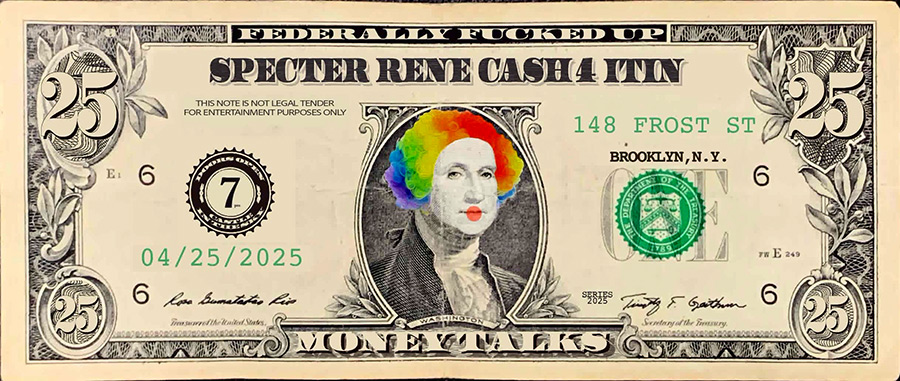
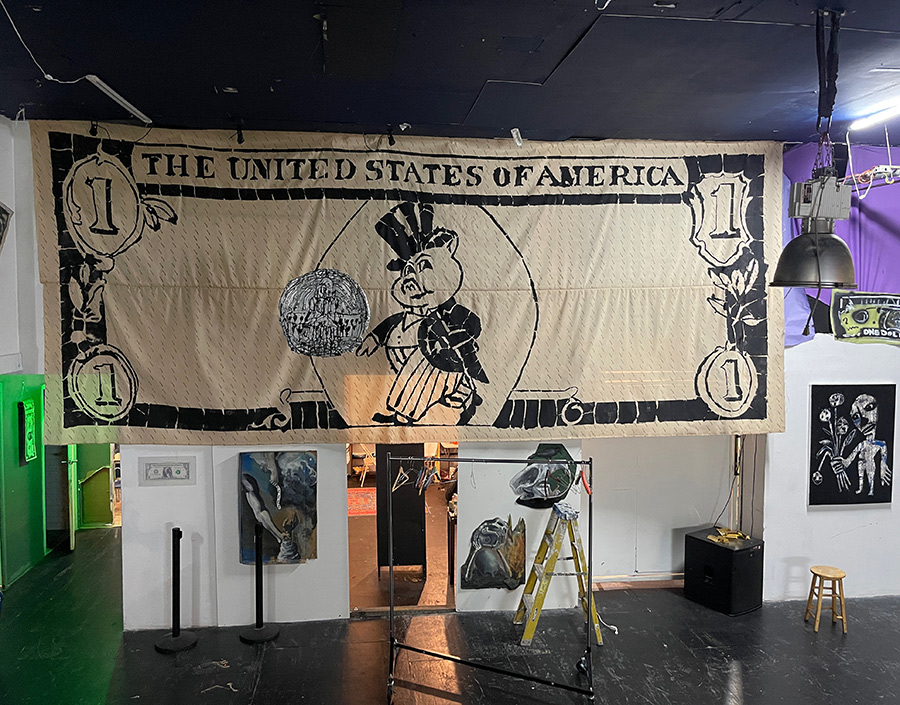
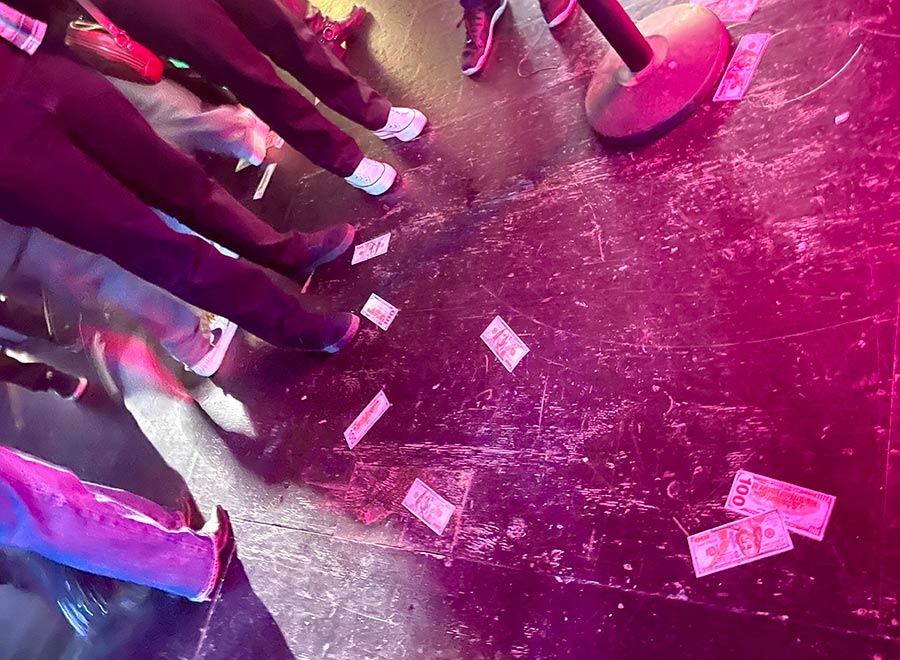
A community center, performance space, art gallery, flea market hybrid, the space welcomes you to the latest show, “Money Talks,” which doesn’t need an opening reception flier. It has its gravity and pull — the kind that draws a packed audience into a labyrinth of rooms, exhibition spaces, and performances. A sign of success, it spills onto the spring Friday night sidewalk, where smokers and sharp talkers hold court between sets by a shaggy 70s rock band that might or might not be ironic.
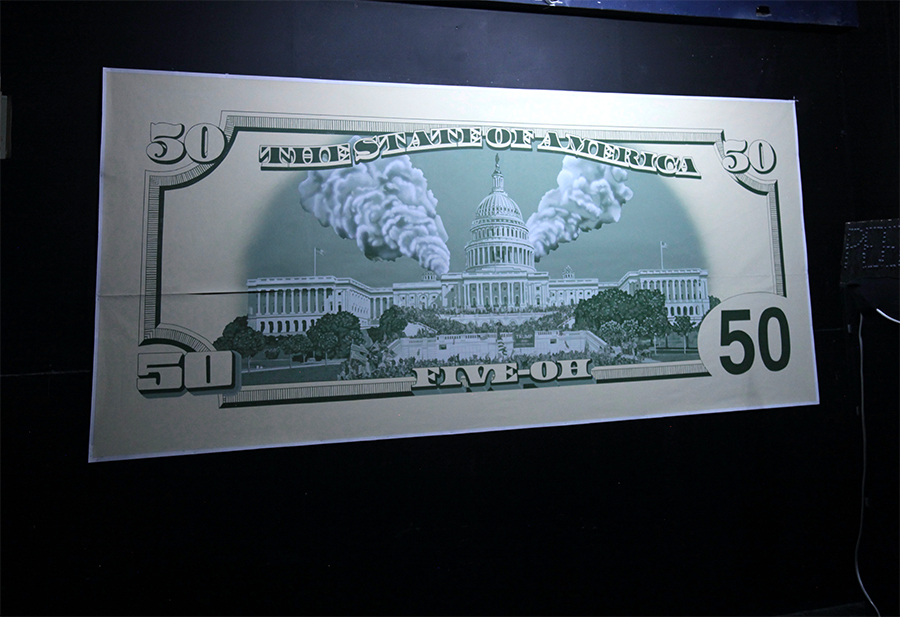
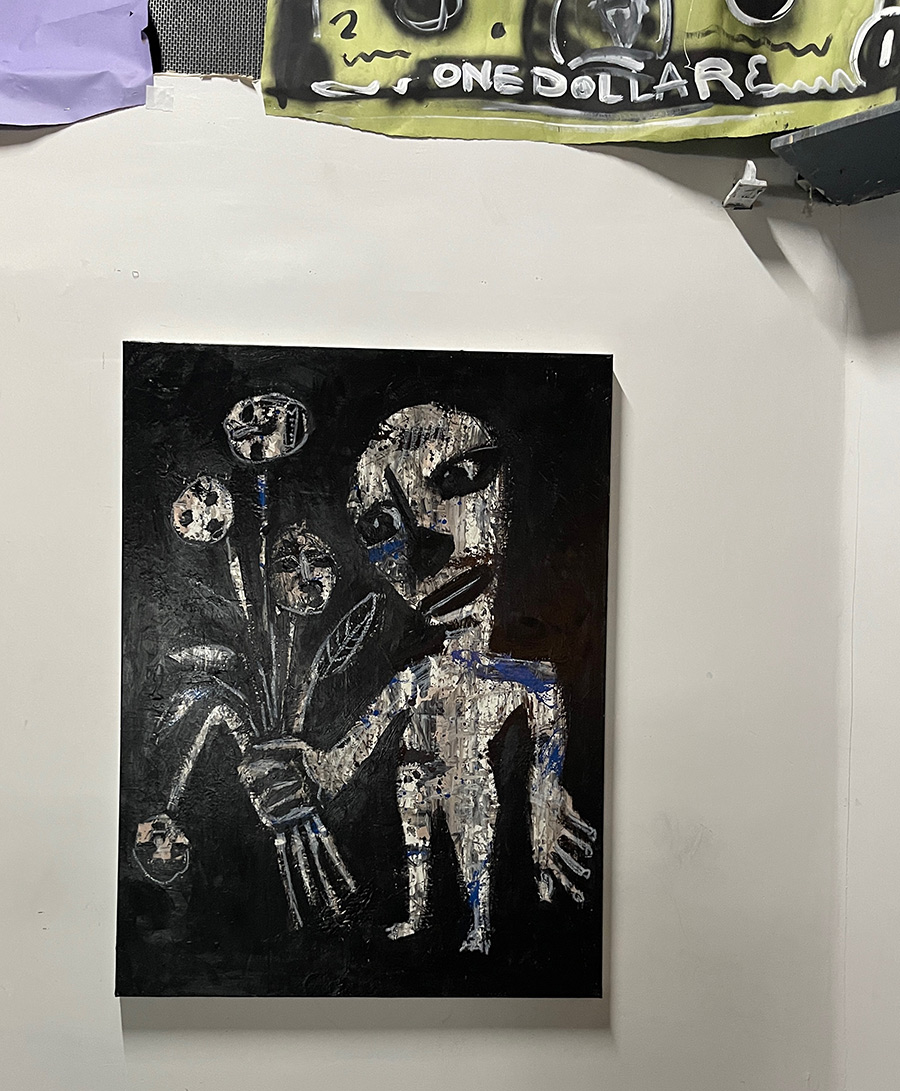
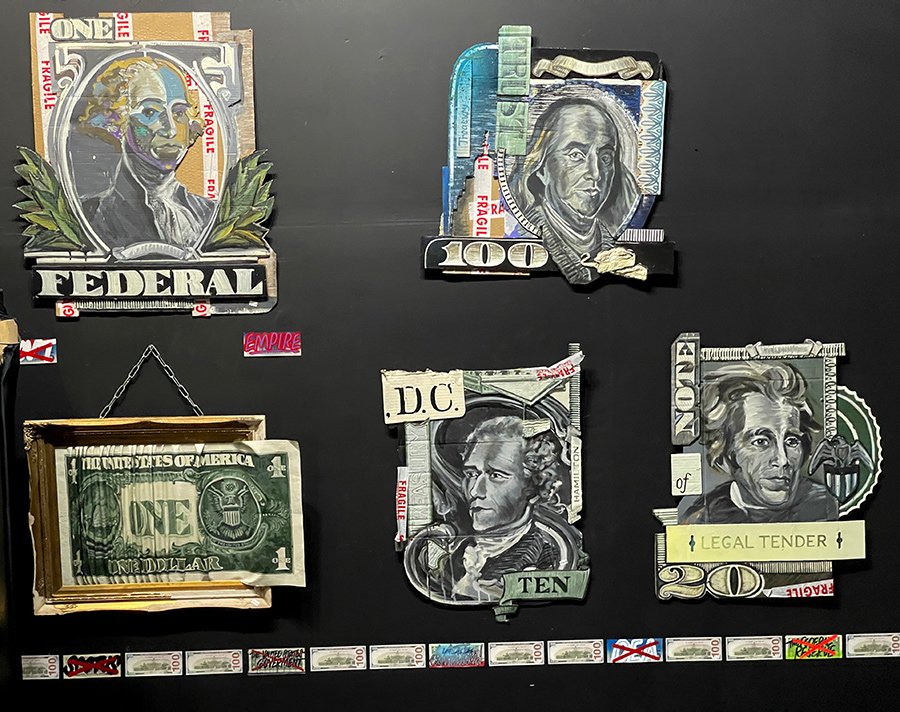
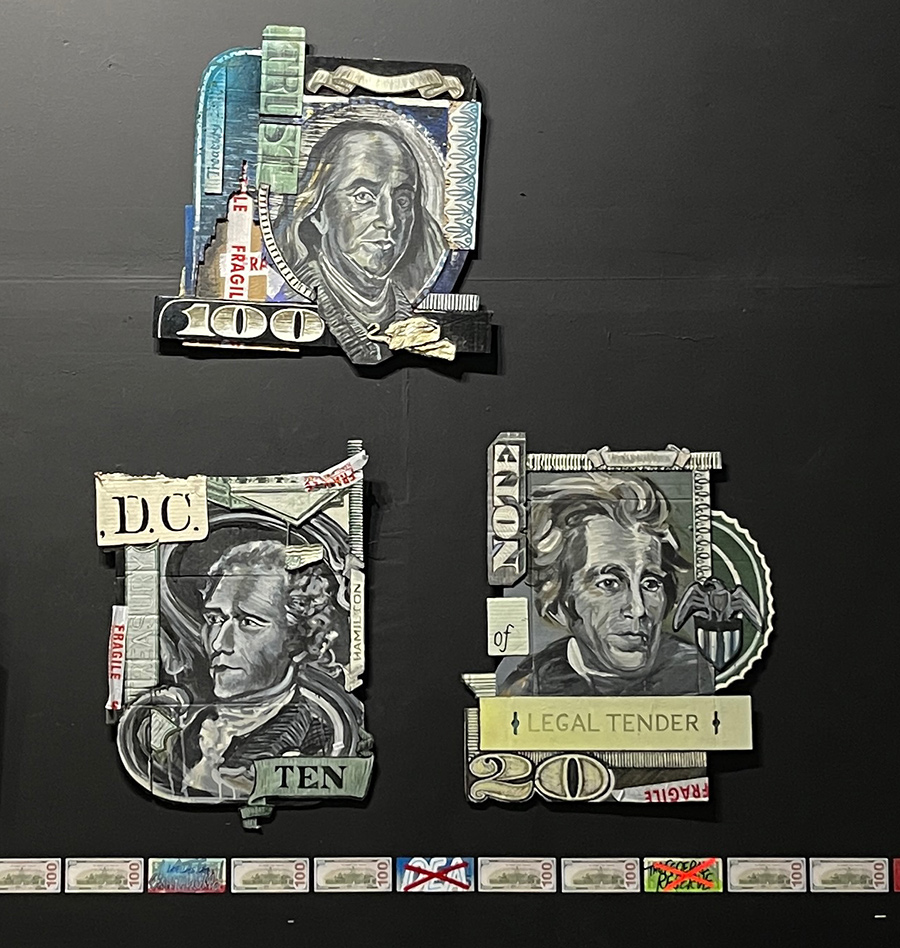
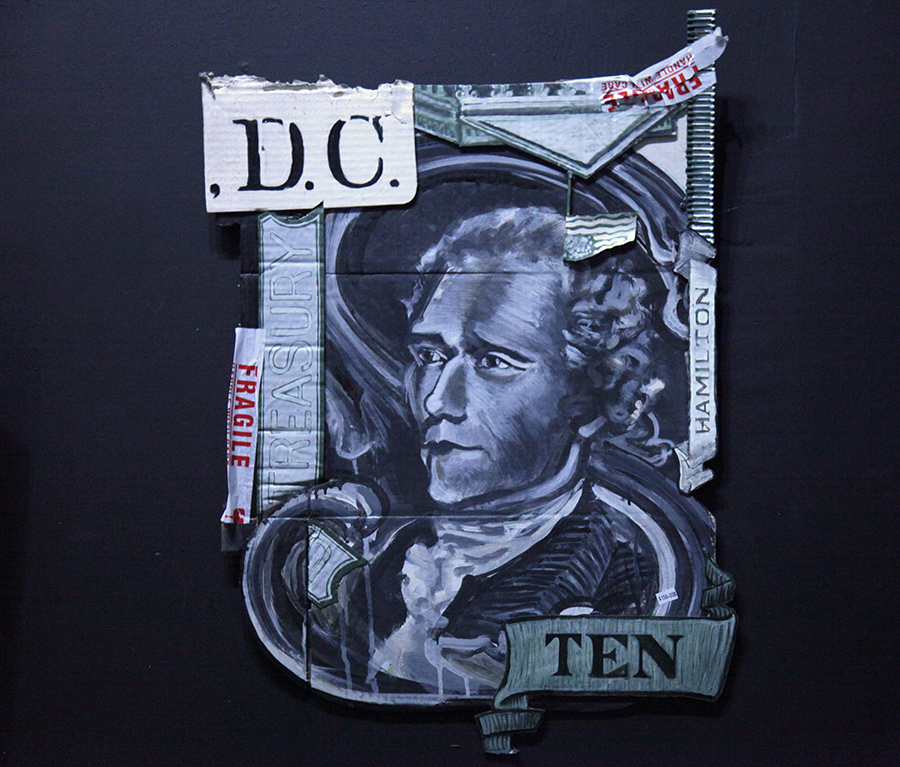
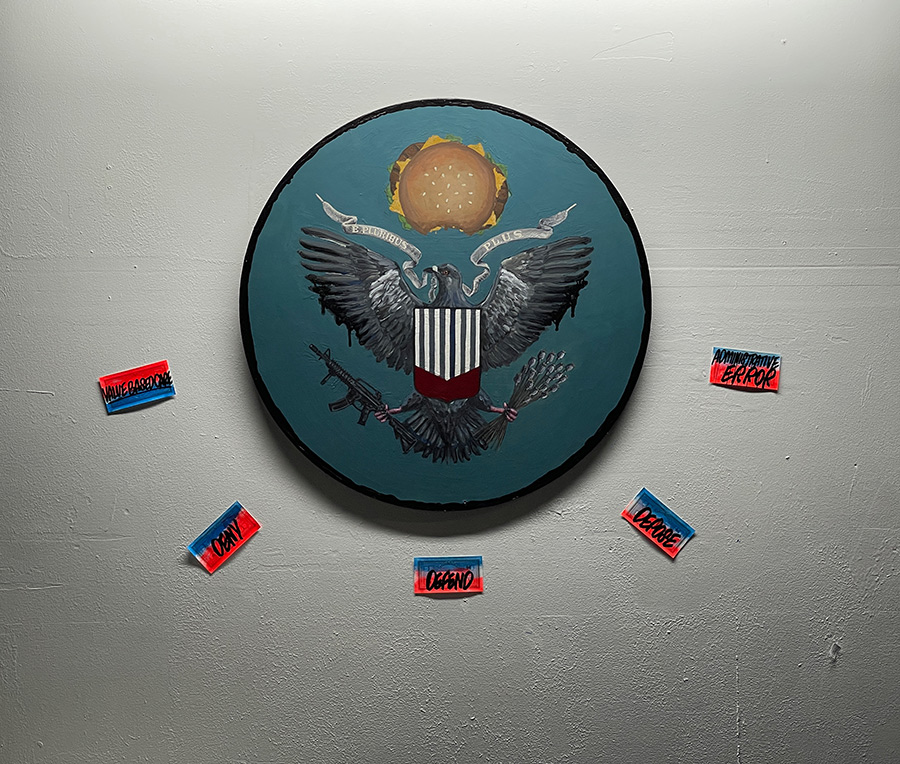
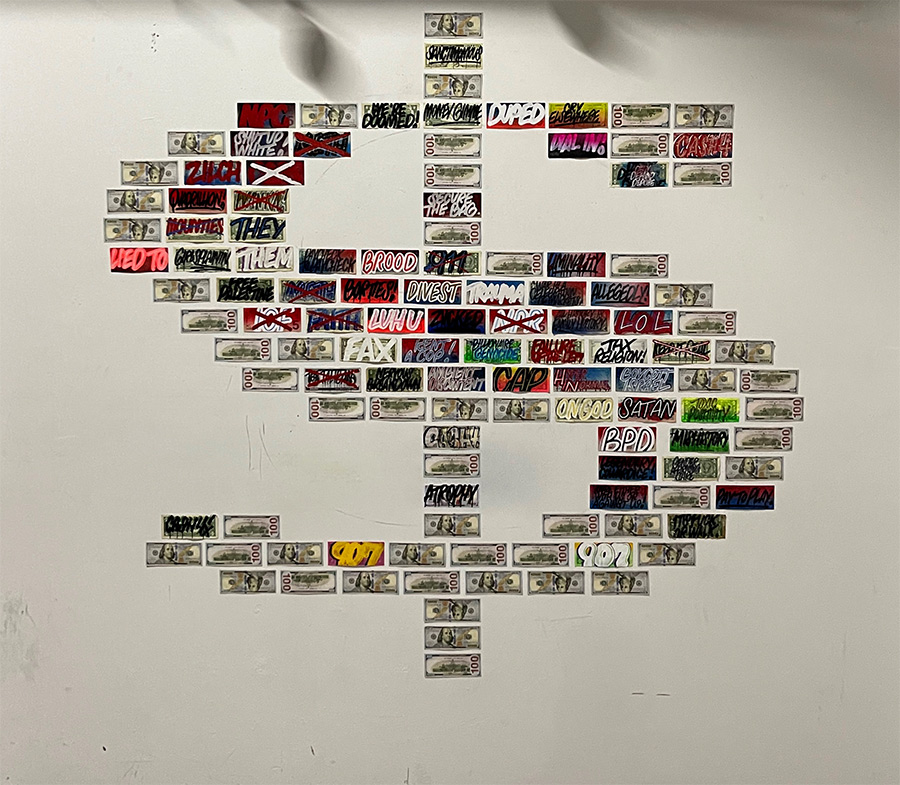
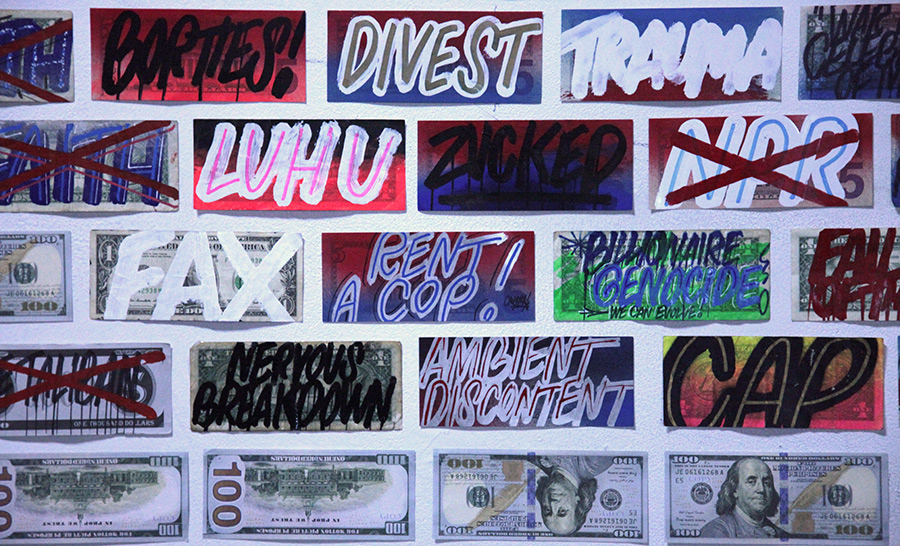
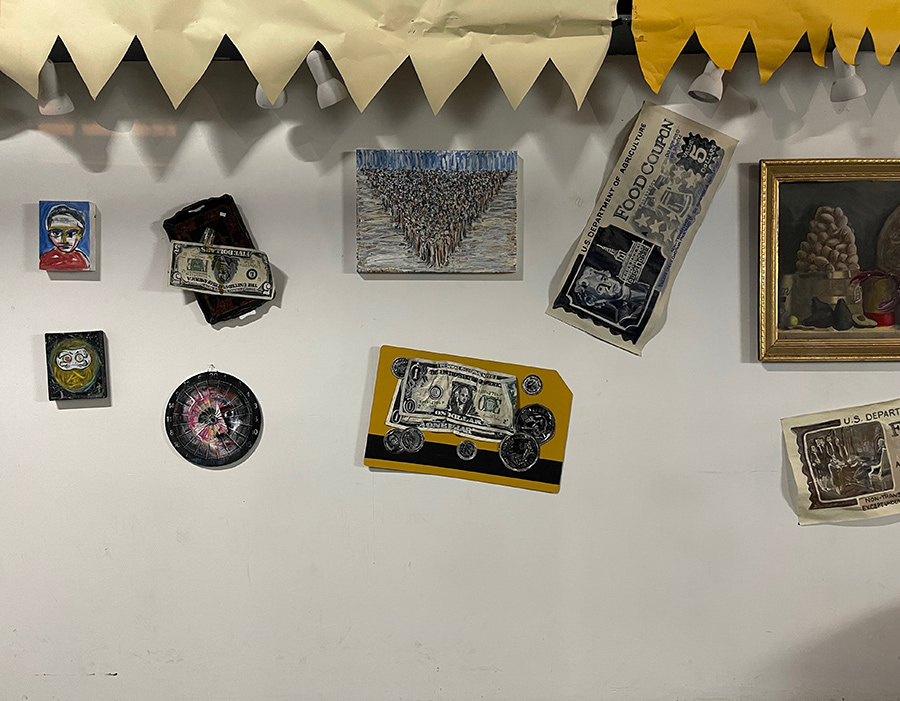
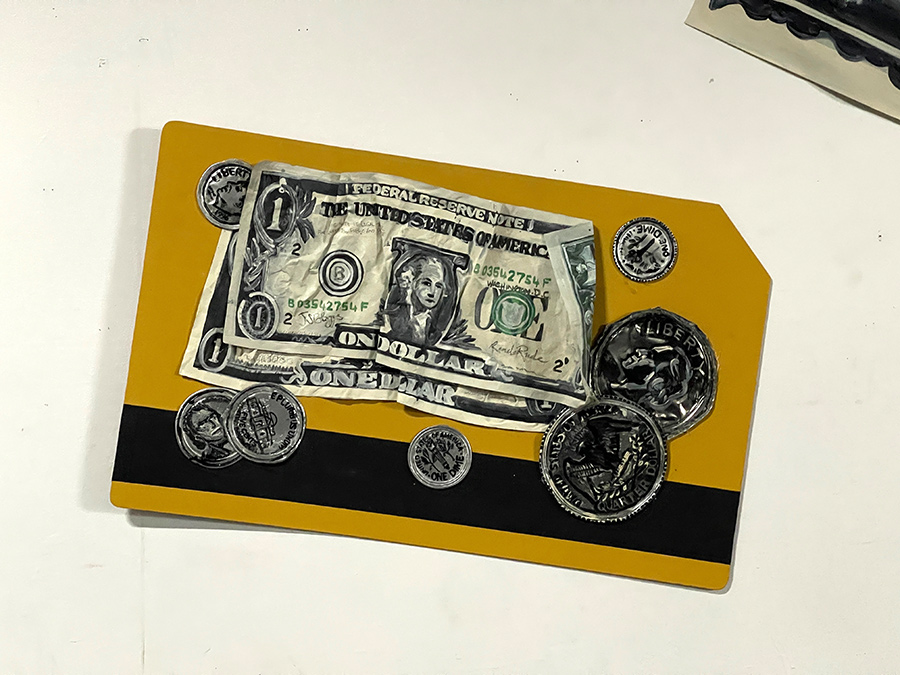
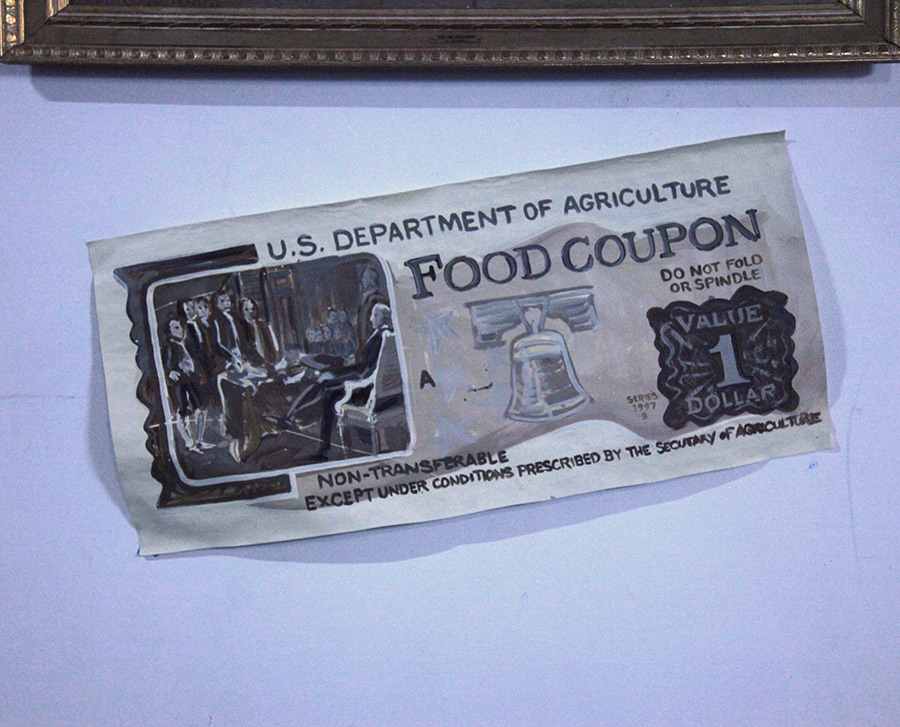
Inside, four artists — Specter, Rene, CASH4, and ITIN — served up a visual demolition of American currency and its cultural metaphors. It wasn’t bitter, but it wasn’t sweet. Like the Williamsburg of old, before the glass condos, this was salty, smart, funny, blunt. No manifestos on the wall, just wry, sharp-tongued critique told in paper pulp, paint, and political memory.
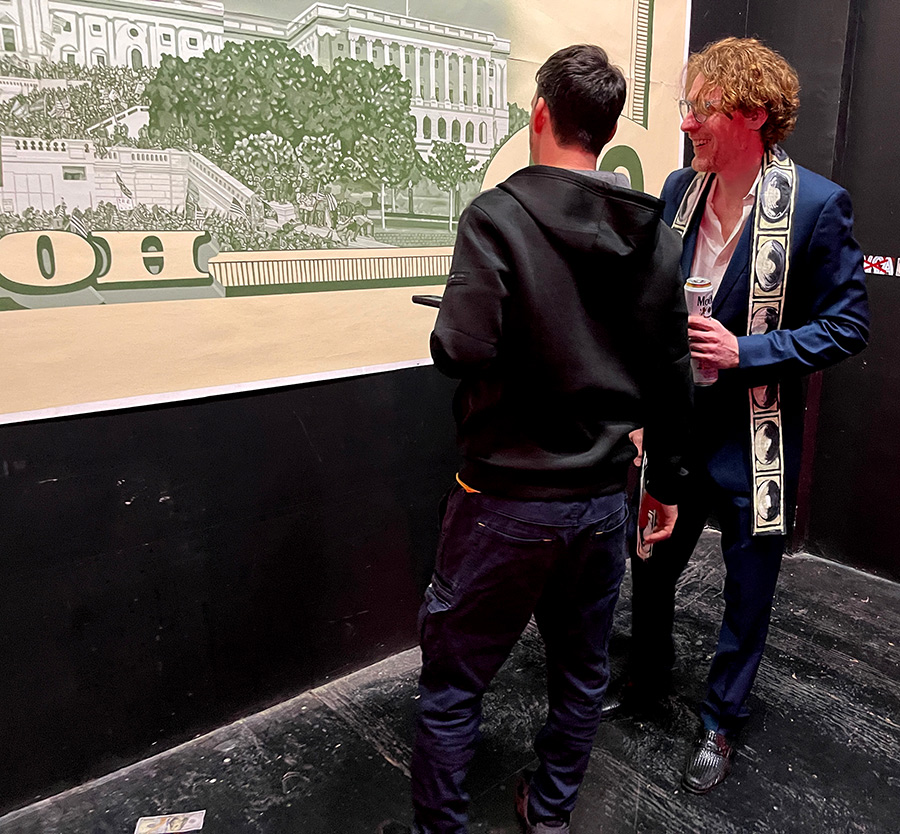
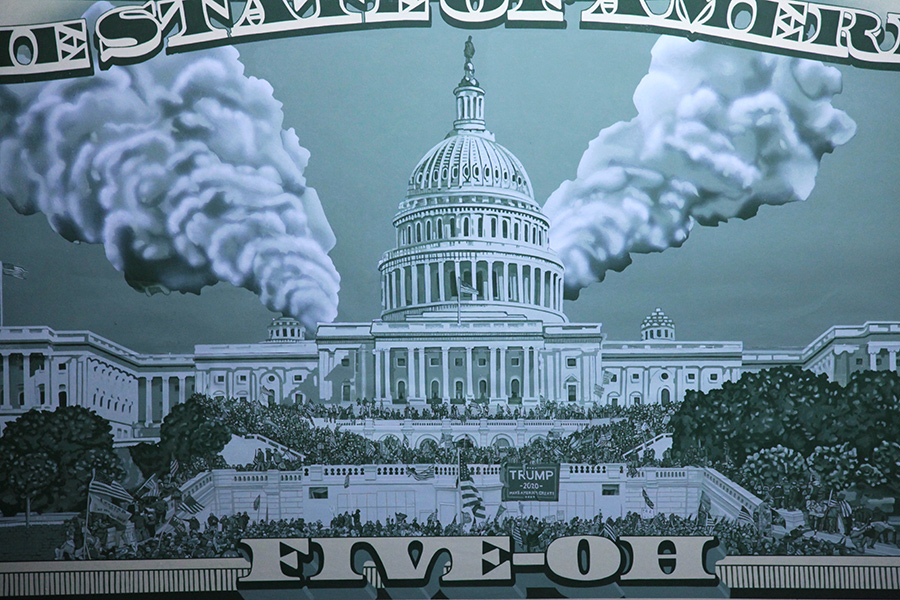
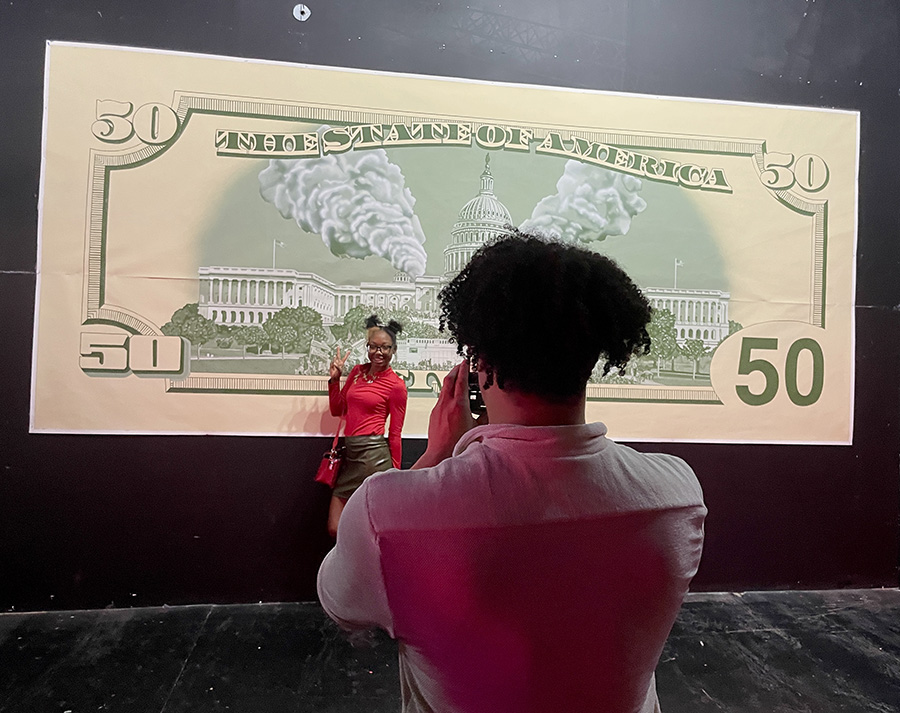
The anchor piece? Gabriel Specter’s massive currency-redesigned The State of America. A redux of the reverse of a dollar bill — if it had lived through January 6. The Capitol dome smokes like a symbol under siege, while foregrounded rioters pose in shades of government green. It’s beautifully executed, deeply personal, and visibly furious — a portrait of patriotism cracked in half. The loft is loud, the floor sticky, the ideas sharp. Money Talks doesn’t have a social media campaign, instead you feel like it has conviction. It doesn’t need a QR code. The rent may be high, but the spirit here is still gloriously low-rent — and unbought.
Specter, a visual bard of the 2000s and 2010s Brooklyn scene, known for work that didn’t just decorate the streets but spoke to social realities, talked to us about this piece — and about the spirit of a space that still knows how to host shows that mean something.
BSA: How would you characterize the space where “Money Talks” took place — not just physically, but in terms of its function as a creative platform? Is it more of a cultural incubator, a performance venue, or a kind of underground laboratory for dissent?
GS: The best way to describe the space is talking about the people who occupy it. Each person coming in and out of the studio, the workshop, performance and gallery space shapes it into a one-of-a-kind arts venue. To answer whether it is a cultural incubator, performance venue, or underground laboratory of dissent, I would say all three apply. We’re inclusive of all forms of expression but we have an anti-establishment edge. Respect and kindness overrides difference of opinion.
BSA: Your painting The State of America, featuring figures from the January 6th Capitol riot, was a powerful centerpiece. What emotional or psychological space were you in while creating it, and how did the act of painting become a way to process or confront that moment in history?
GS: Because of the amount of detail required to execute the work, I had to focus on the rendering of each figure in the painting. I was physically trying to individualize them, an accurate representation of what was happening. My brain was not focused on anything other than the actual painting of it. It put me in a meditative state creating it.
As I would take breaks from the laborious rendering, I would take a step and look at what I’d completed so far. Because I was trying to be so accurate about representing each individual, the stepping back and seeing them altogether, it honestly brought up a lot of hatred. For what they represented, and what they did on that day. In doing this painting, I was painting a lot of patriotic things and my version of patriotism is a lot different than what the scene depicts.
BSA: The exhibition seems to grapple with money not just as currency, but as a symbol of power, manipulation, and social fracture. Was the show intended as a direct critique of American capitalism, or are you also exploring more personal or ambiguous relationships to money and value?
GS: Each artist in the exhibition has their own take and I can only speak to my own. So yes, my work was a critique of money as a tool for manipulation, and how this has seeped into societal values. But as I said, every artist contributing took Money Talks as a way to take back power with money.
BSA: You’ve been making work since the 2000s, including street pieces that captured daily city life and the people who live here. How has your perspective — and your medium — evolved in response to the widening economic divide and the political climate of recent years?
GS: I think my work has evolved to the times we are living in. I feel more than ever that my work needs to draw a line in the sand and represent my values as a human. I don’t try to take sides but I express what I think is right and I feel there is a sickness in our society at the moment.
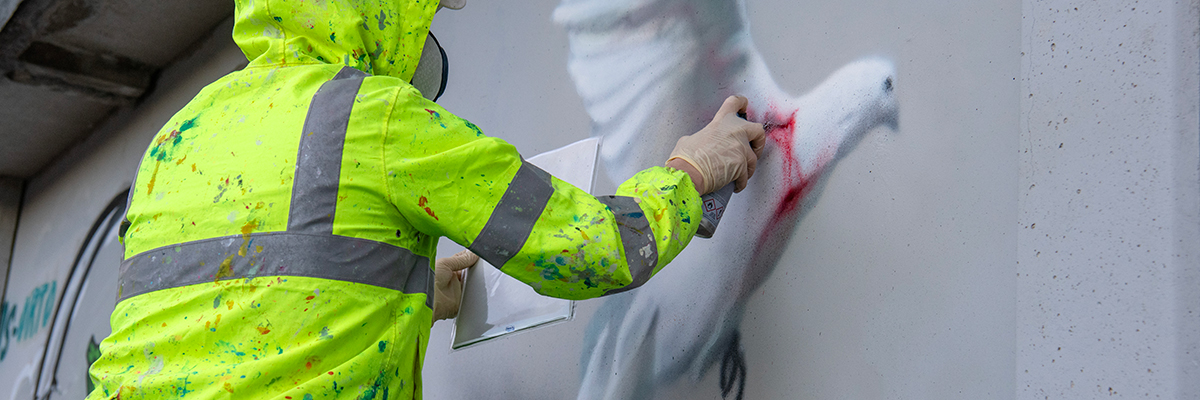
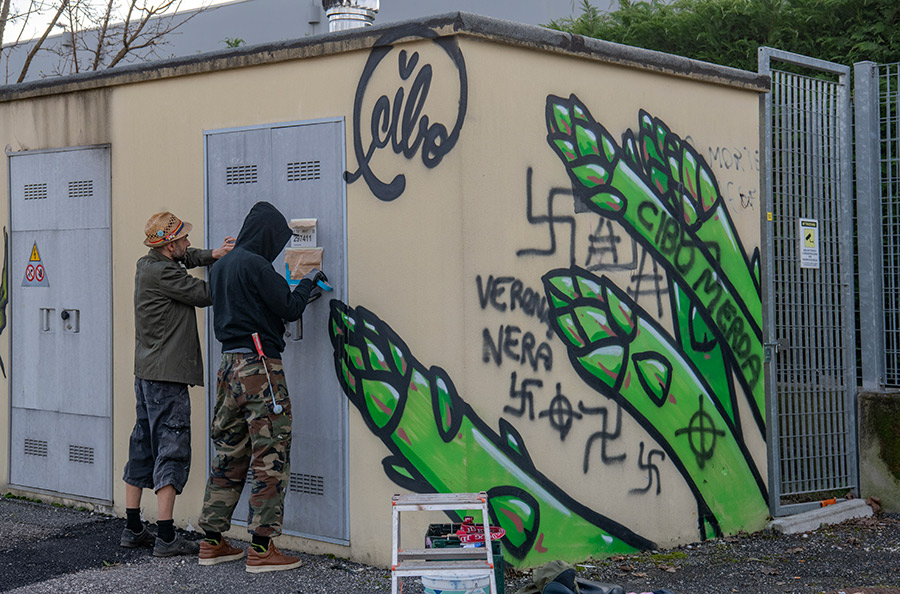
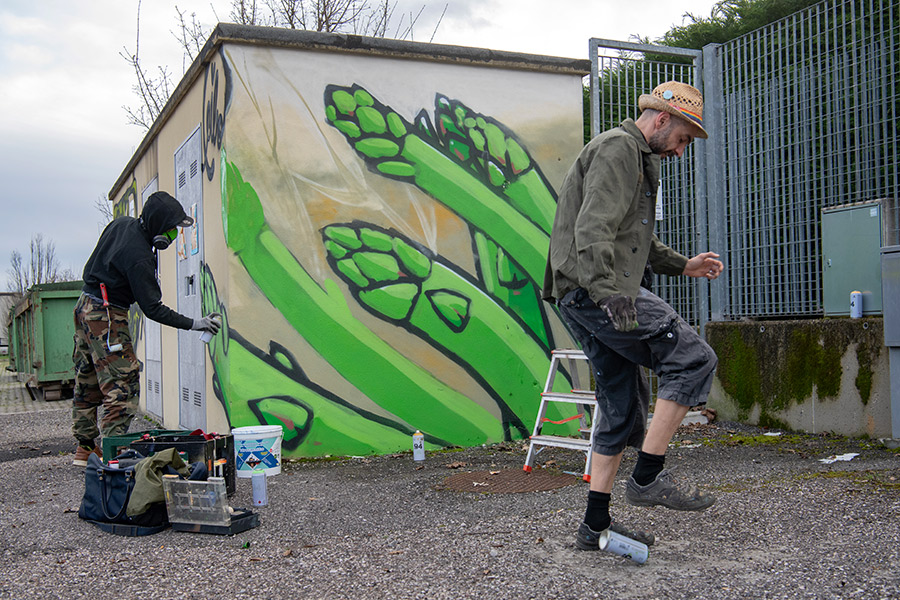
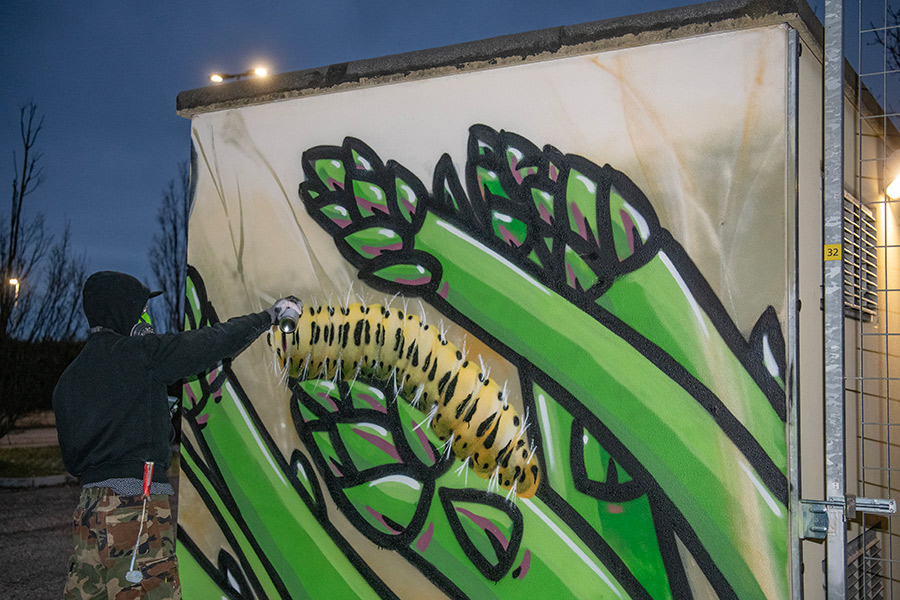
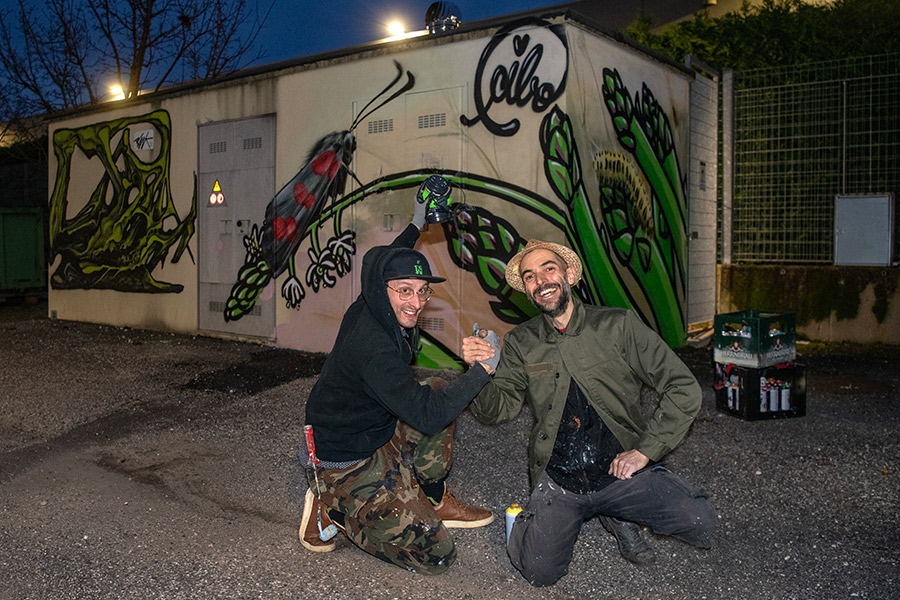
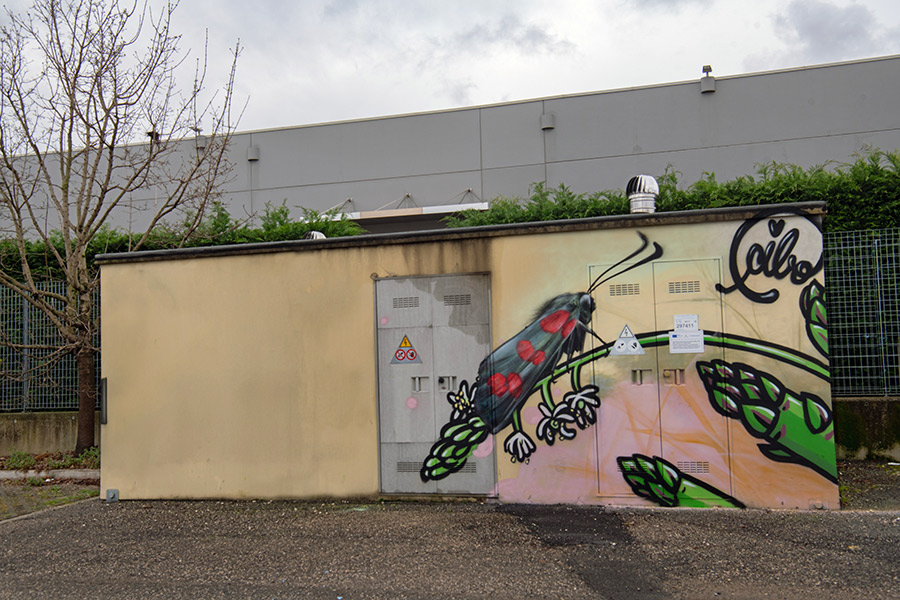
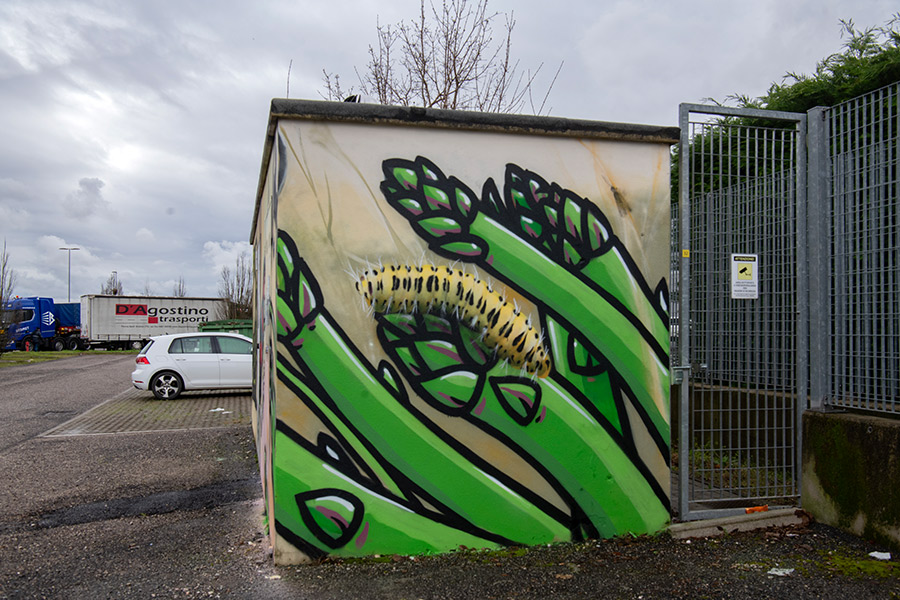
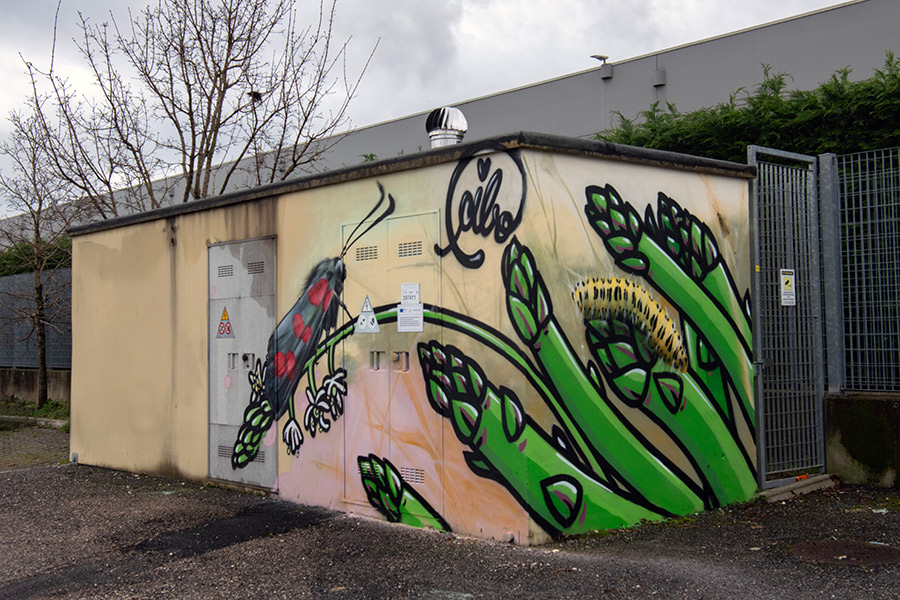
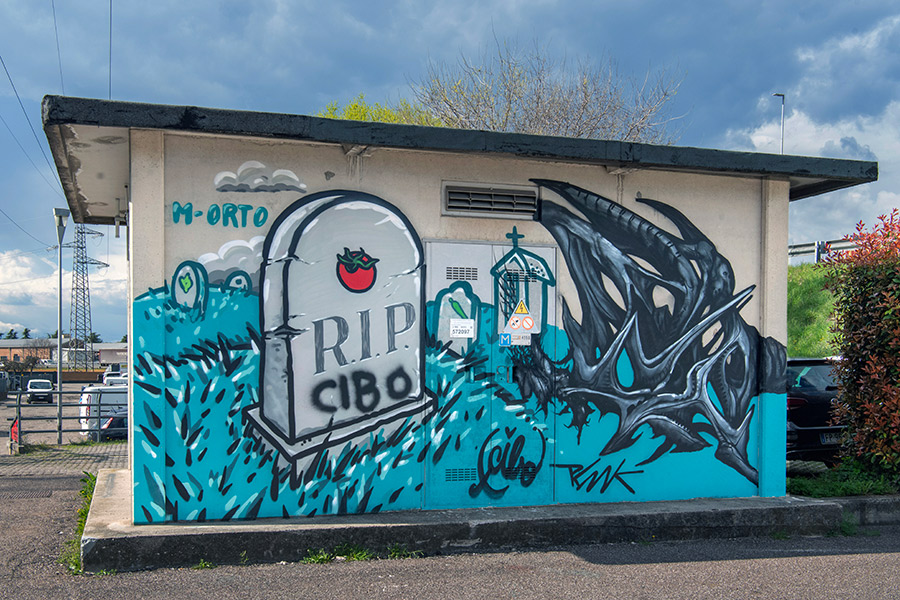
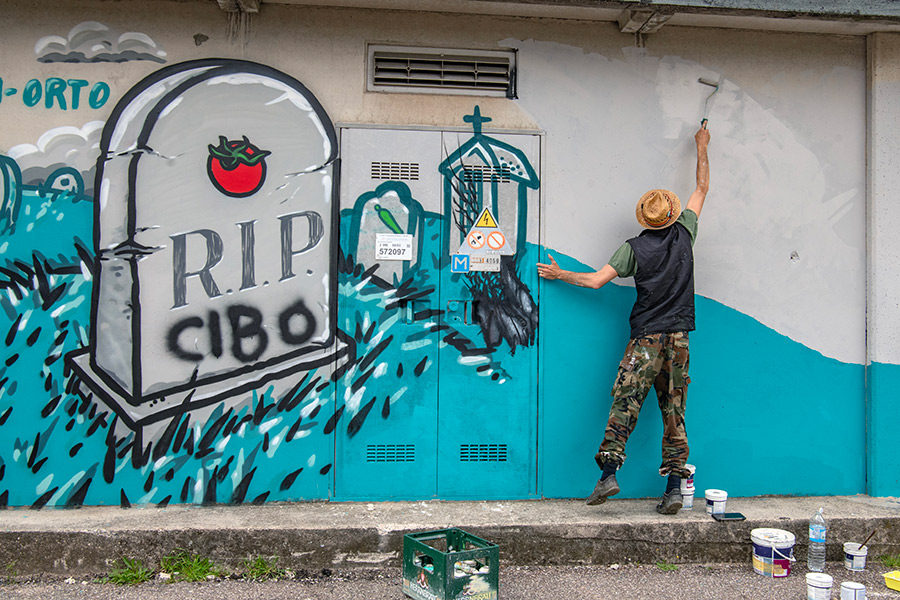
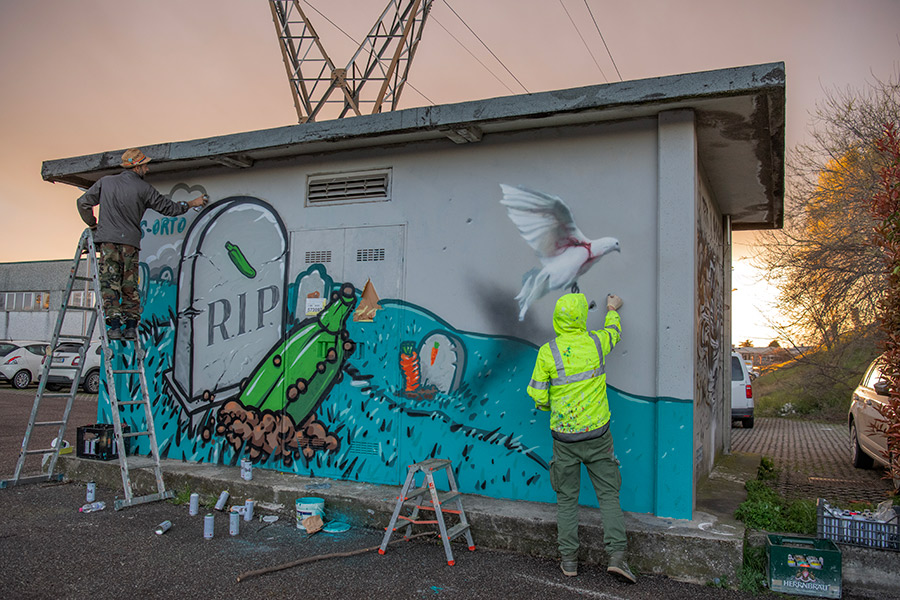
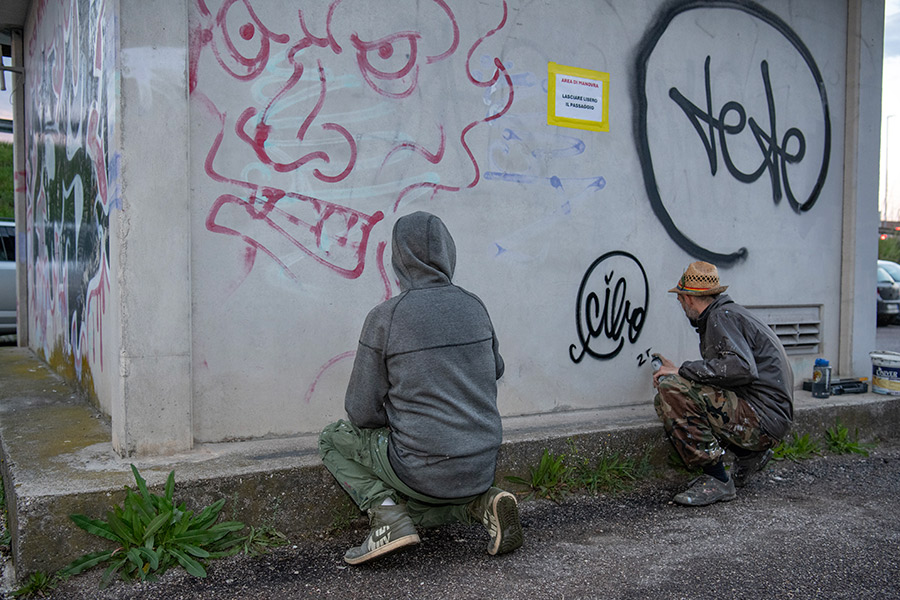
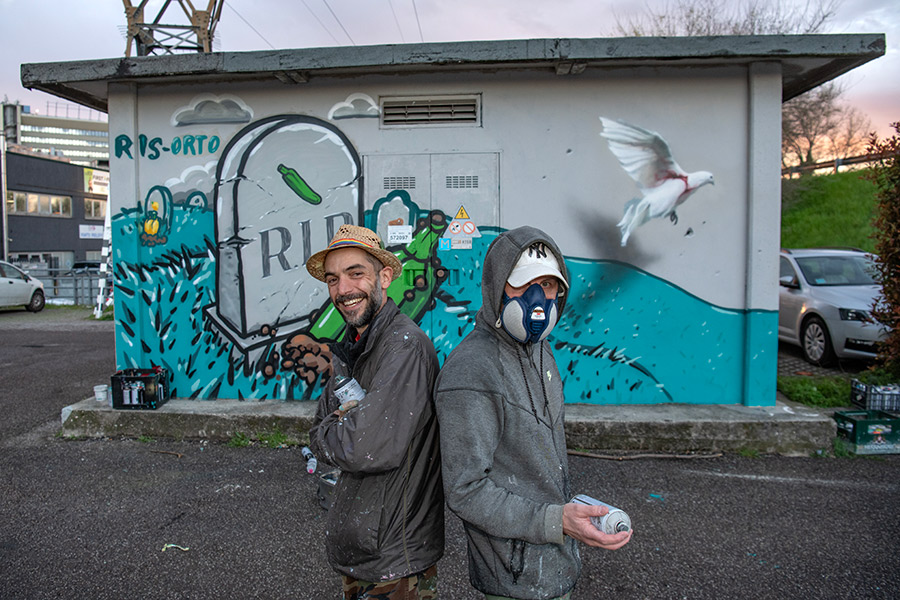
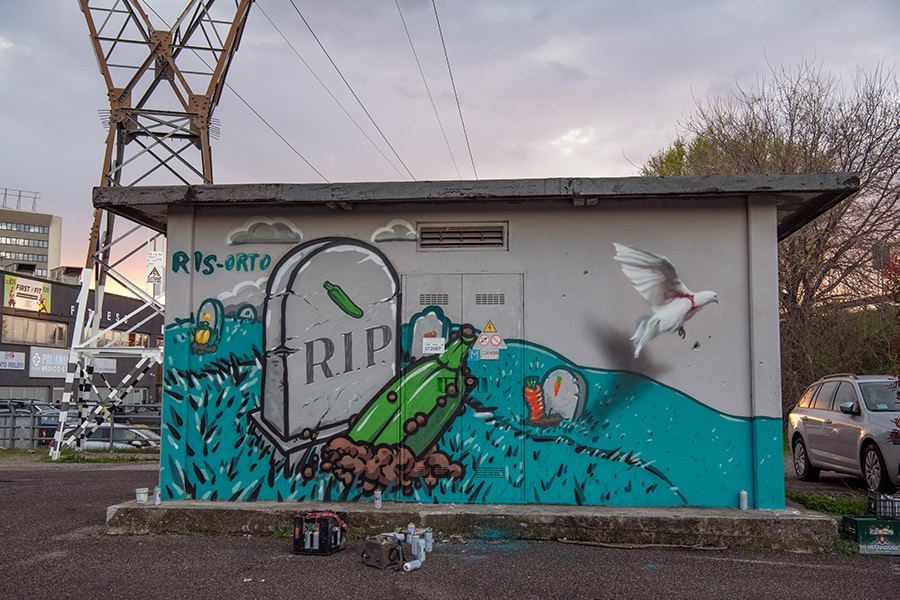
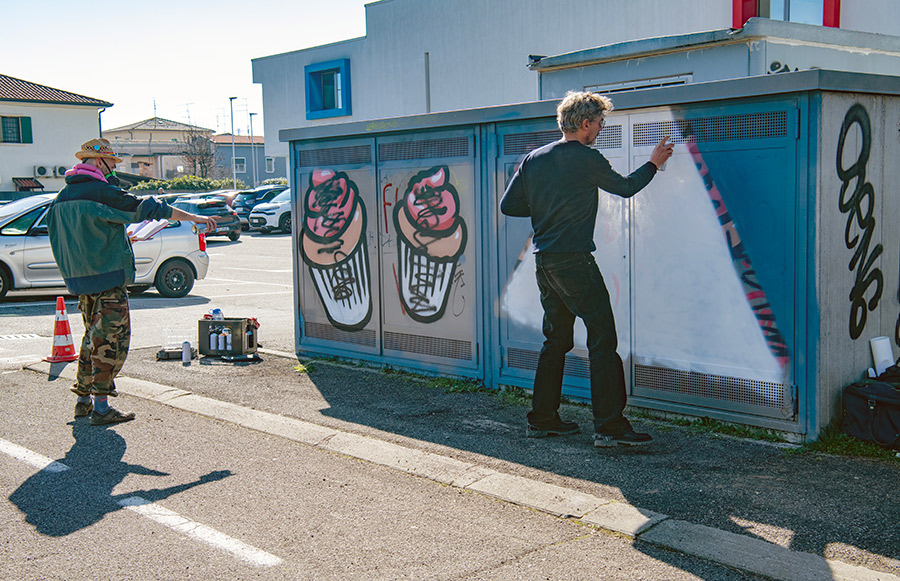
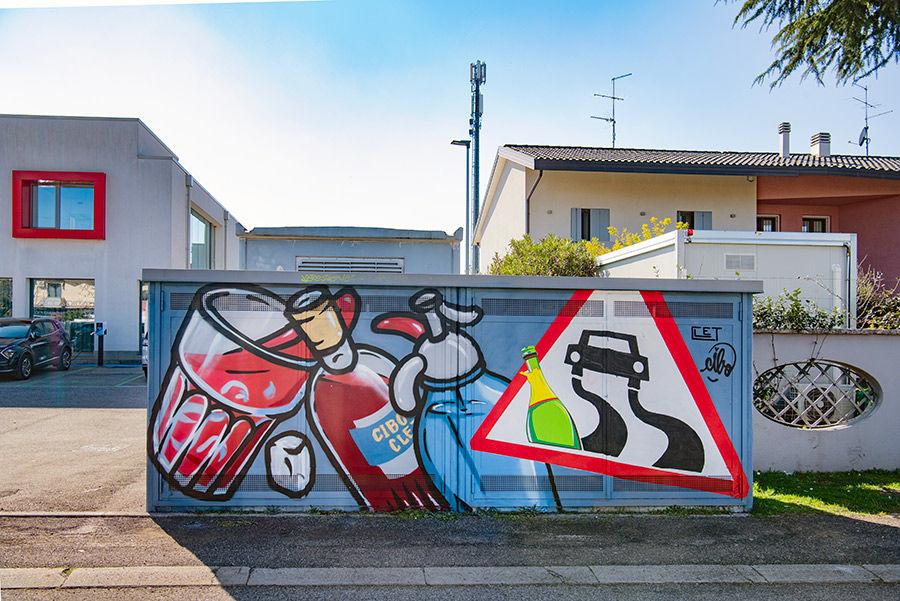
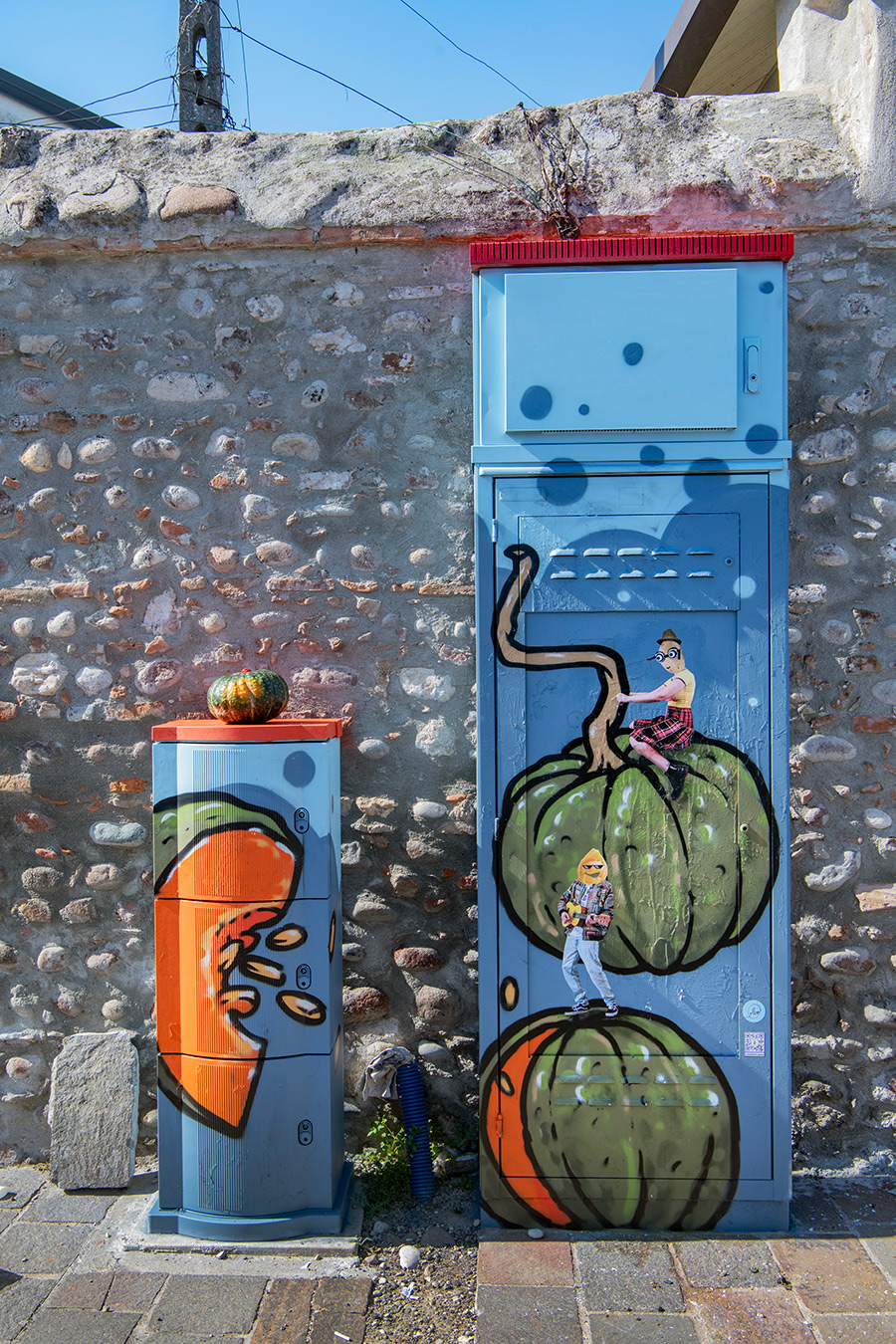
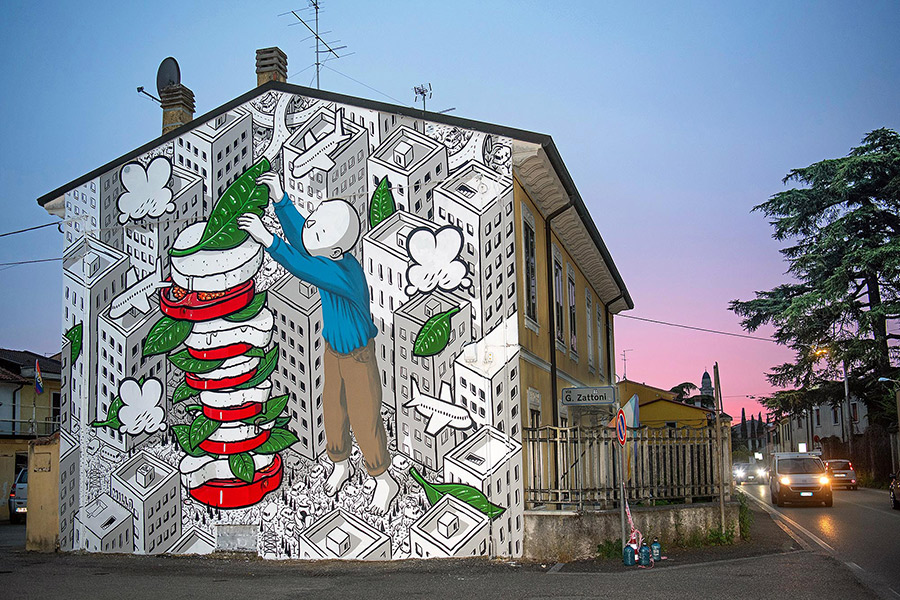
Verona, Italy—known for Romeo and Juliet—is now also home to a very different kind of love story: one between food, public space, and antifascist resistance. At the center is CIBO, a street artist whose name literally means “food,” and who has made a career of turning hate speech into visual comfort food. His murals cover neo-fascist graffiti with pizza slices, cheesecakes, and bundles of asparagus, using humor and everyday symbols to defuse toxic ideology.
CIBO’s approach is clever—and disarmingly effective. Since he began his “recipe of resistance” over a decade ago, he’s been turning Verona’s walls into a living, evolving archive of antifascist art. Where others argue or censor, he paints tortellini. When fascist slogans reappear, he adds another layer—often building his murals like dishes, one ingredient at a time. It’s personal too, he will tell you: after neo-Nazis murdered a friend, CIBO says he doubled down, embracing public art as a peaceful yet persistent form of defiance.
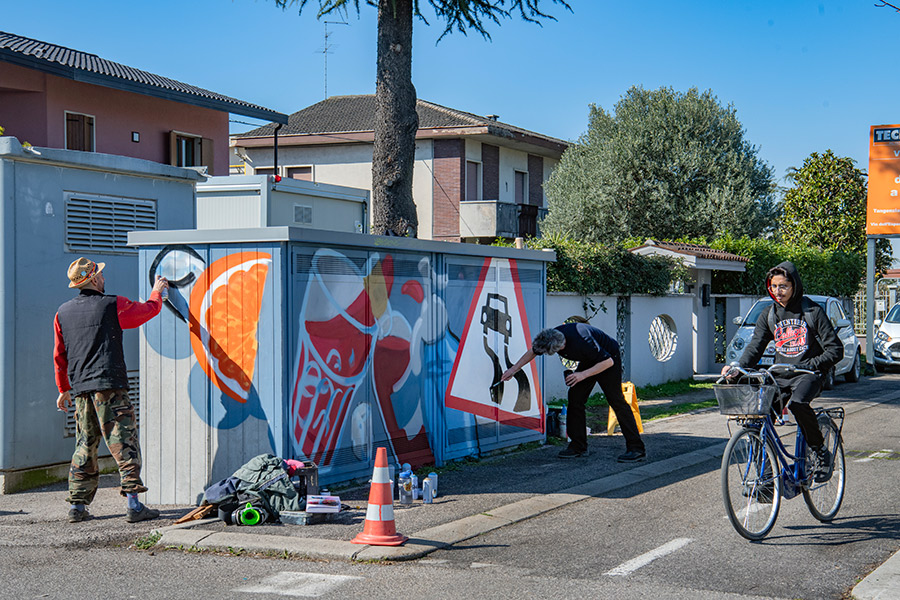
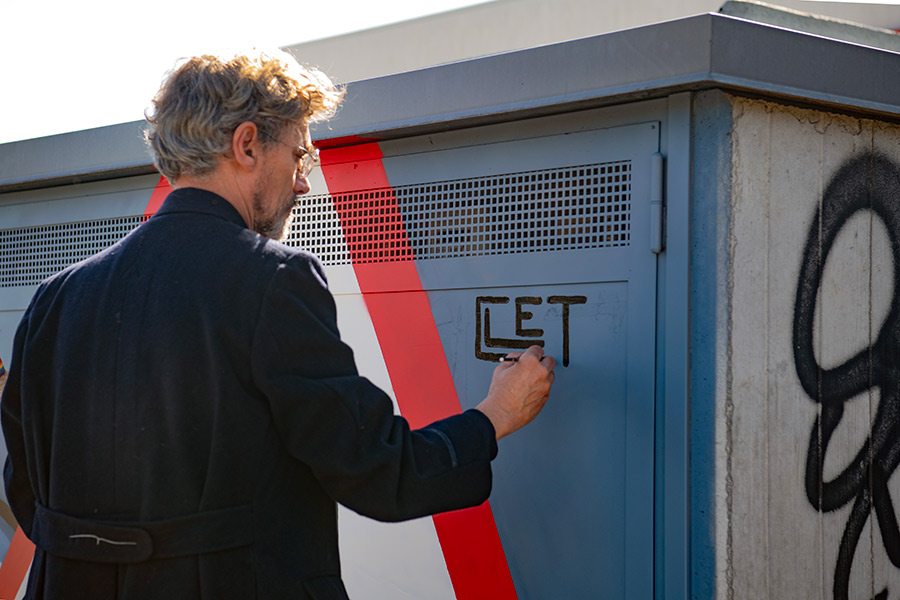
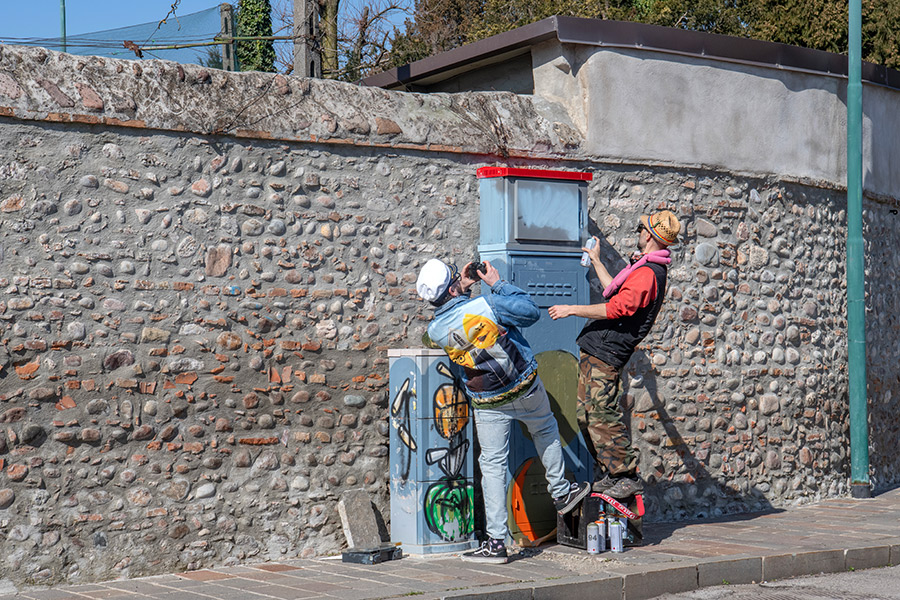
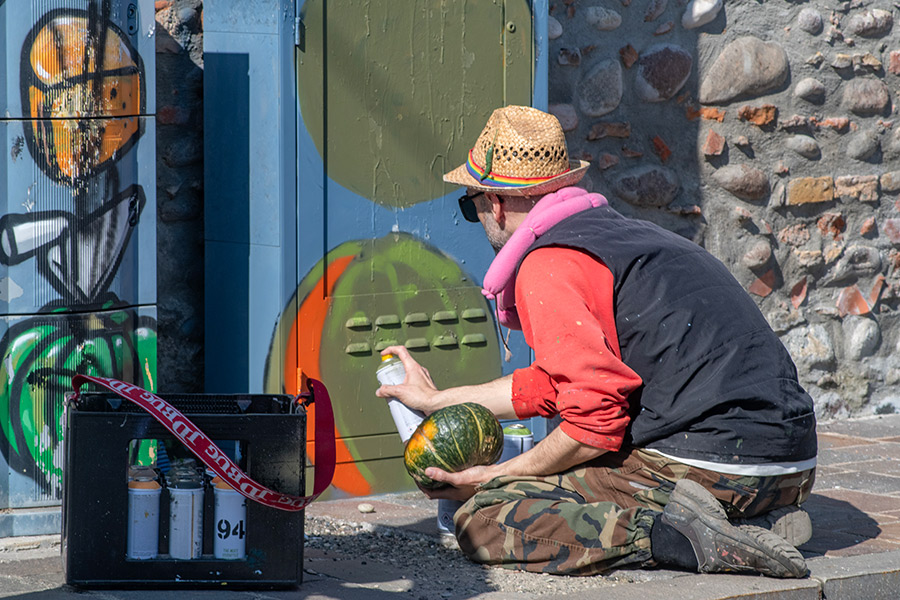
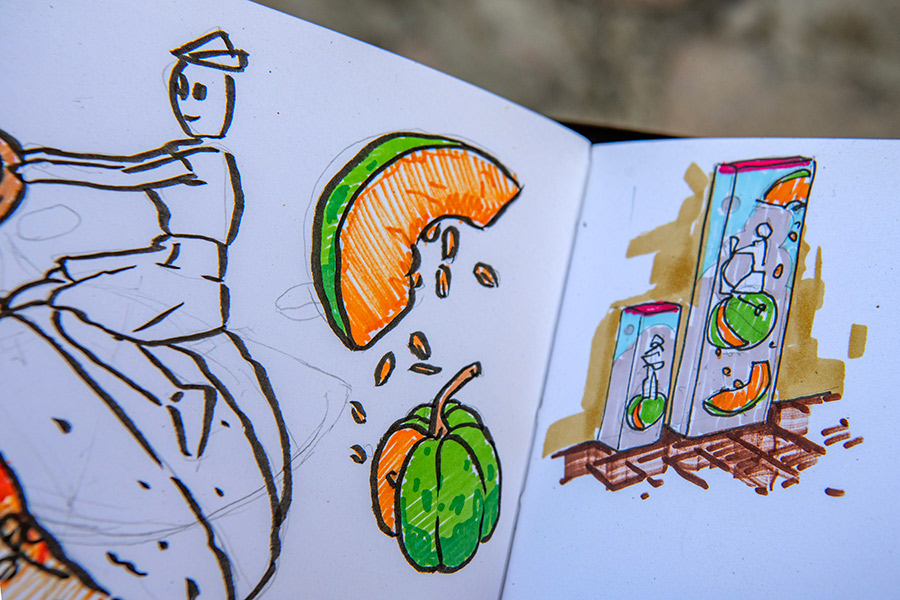
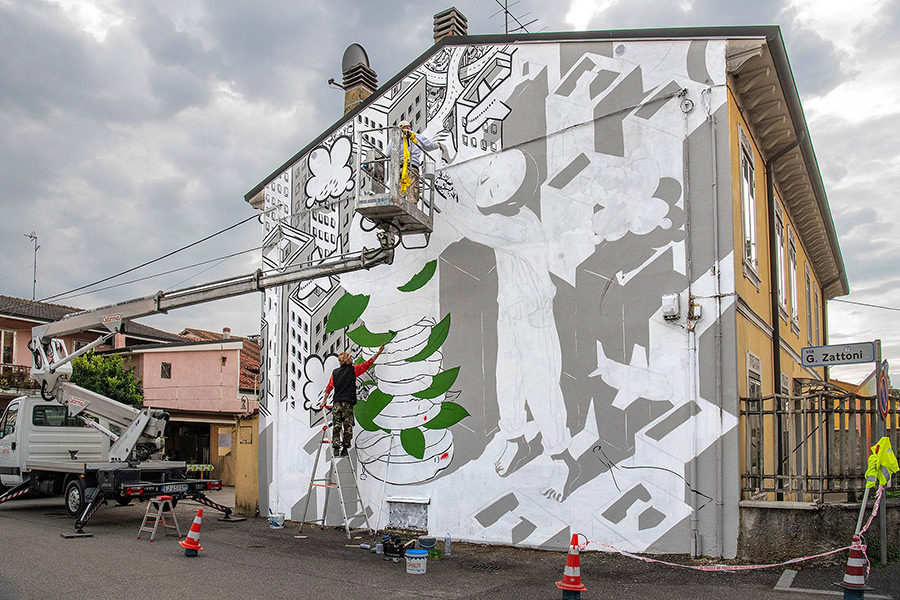
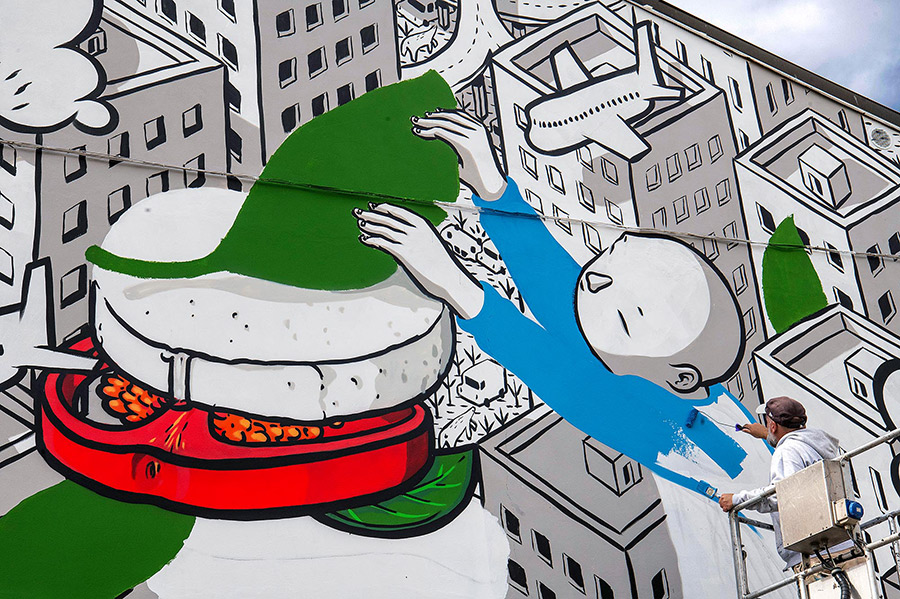
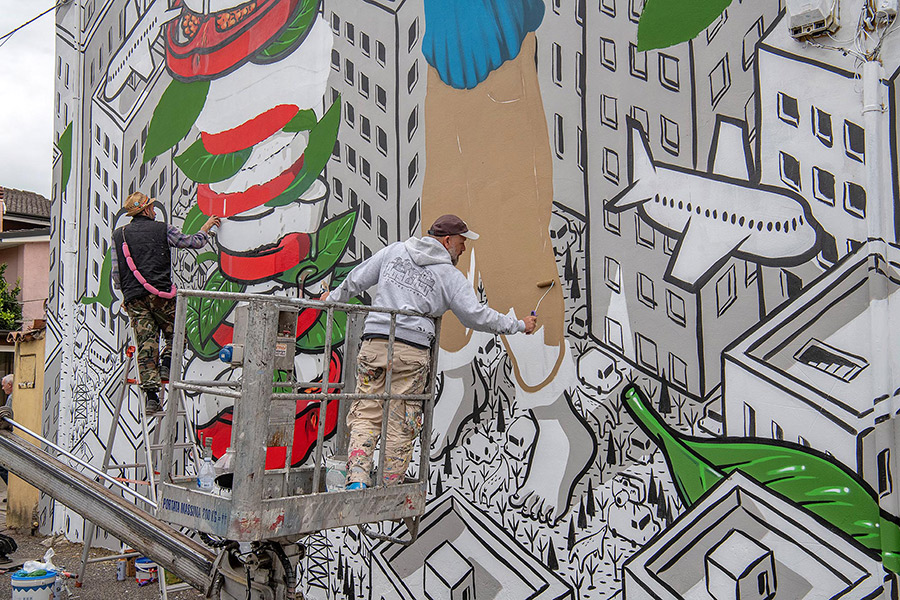
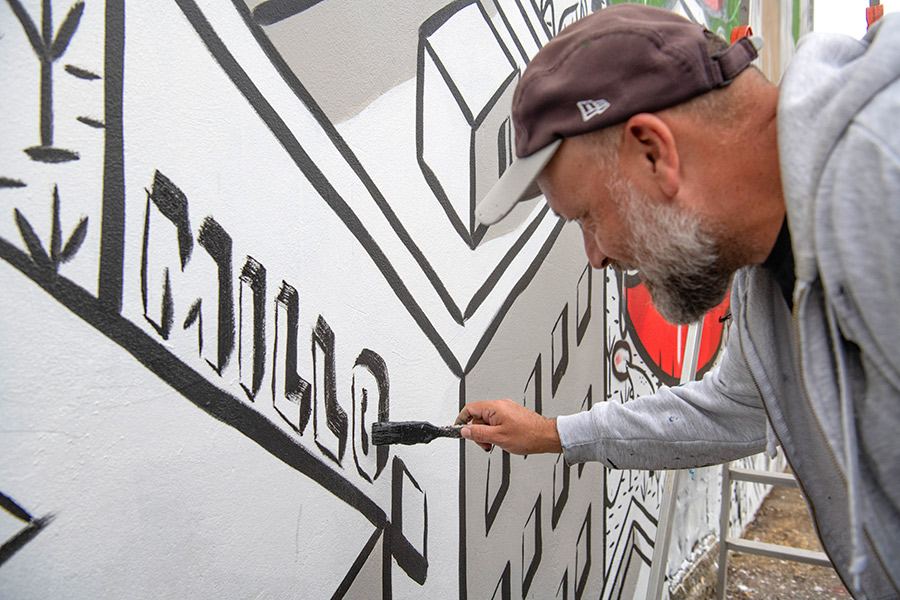
This March, that individual mission became collective action. In an unsanctioned street art festival titled “Best Before. Street Art Against a Rancid Future,” CIBO invited 11 fellow artists—Claudiano.jpeg, Clet, Eron, Mantra, Millo, Ozmo, Pablos, Pao, Pixel Pancho, Plank, and Zed1—to collaborate on murals that replaced hate with imagination. The name? A cheeky reference to food expiration dates—reminding us that our tolerance for racism, nationalism, and repression should’ve expired long ago.
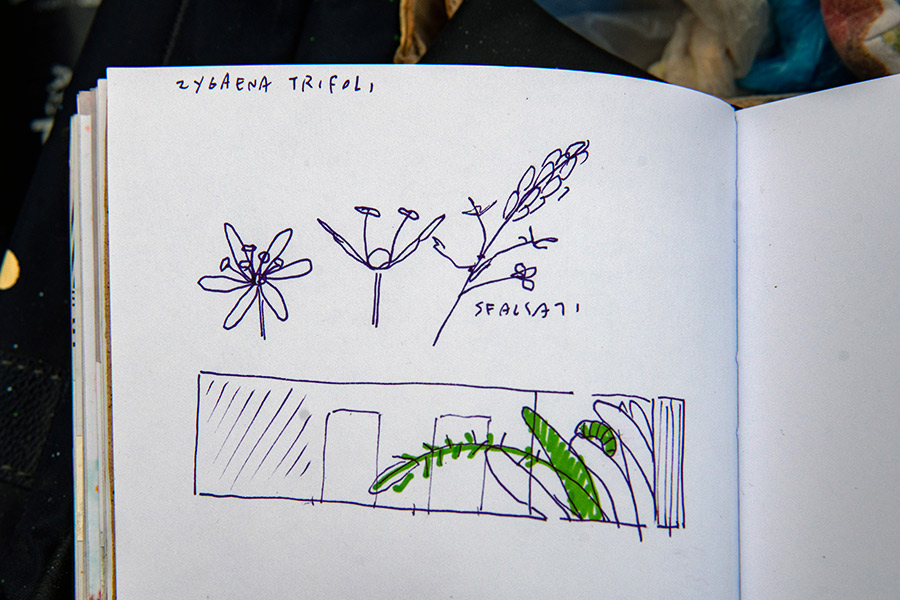
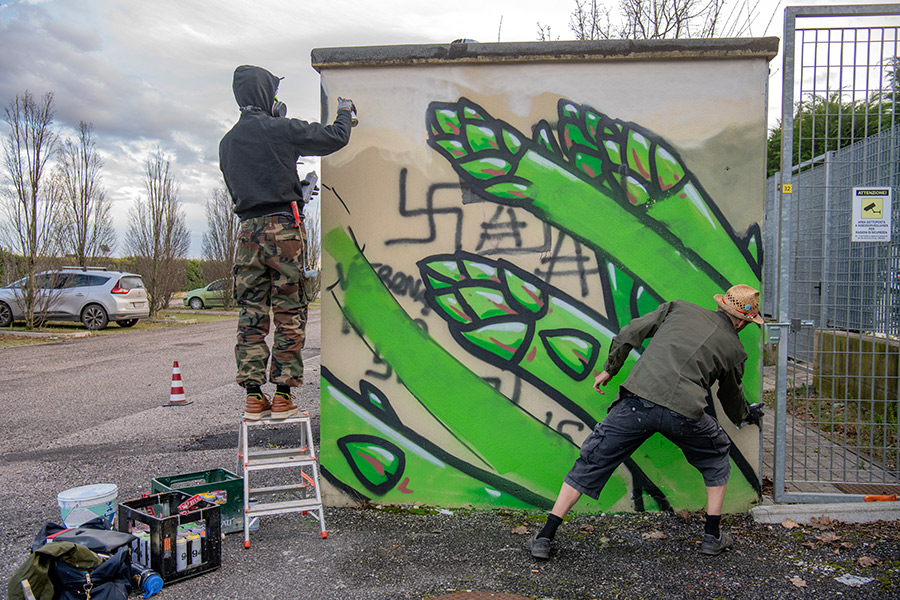
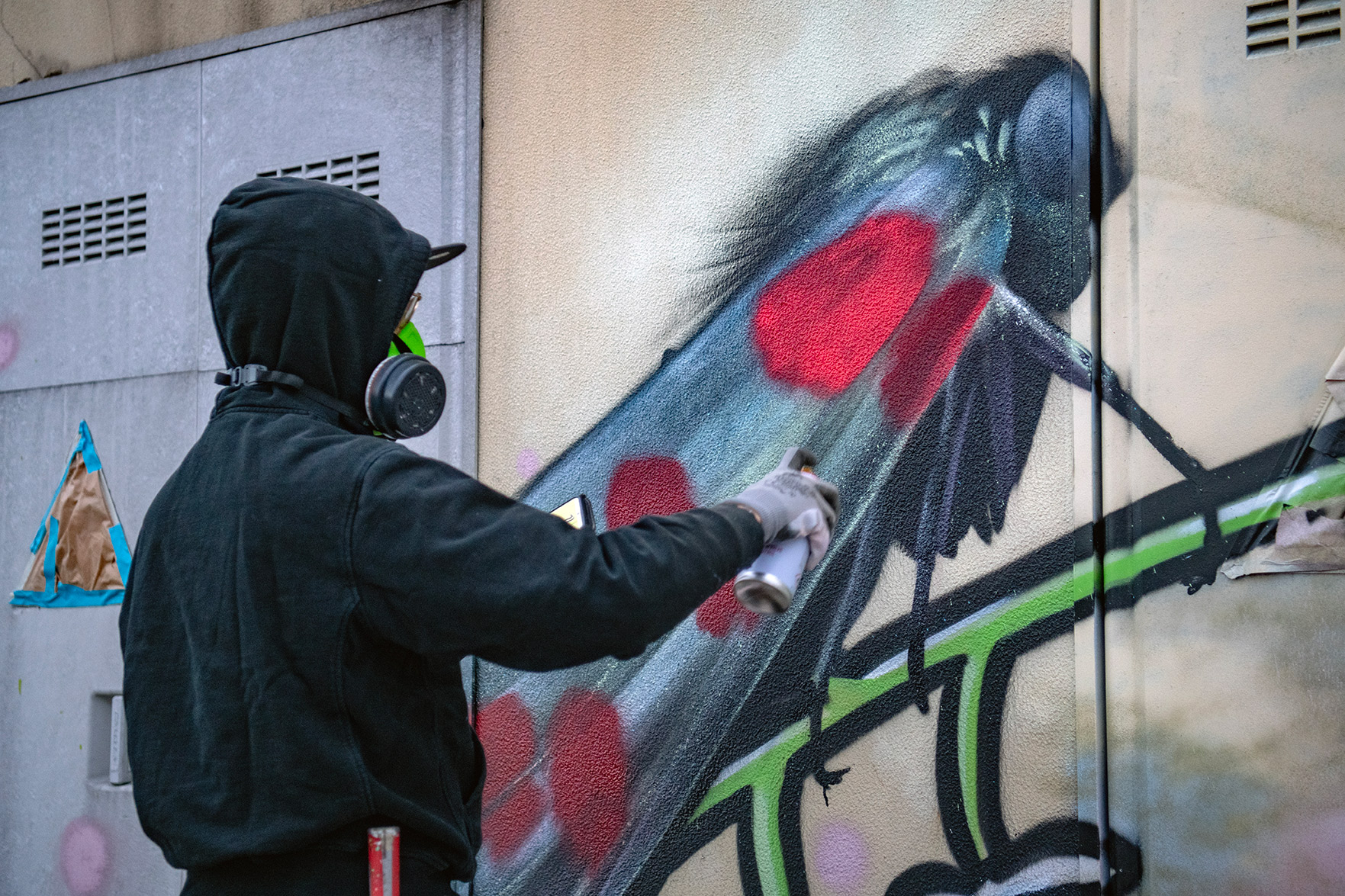
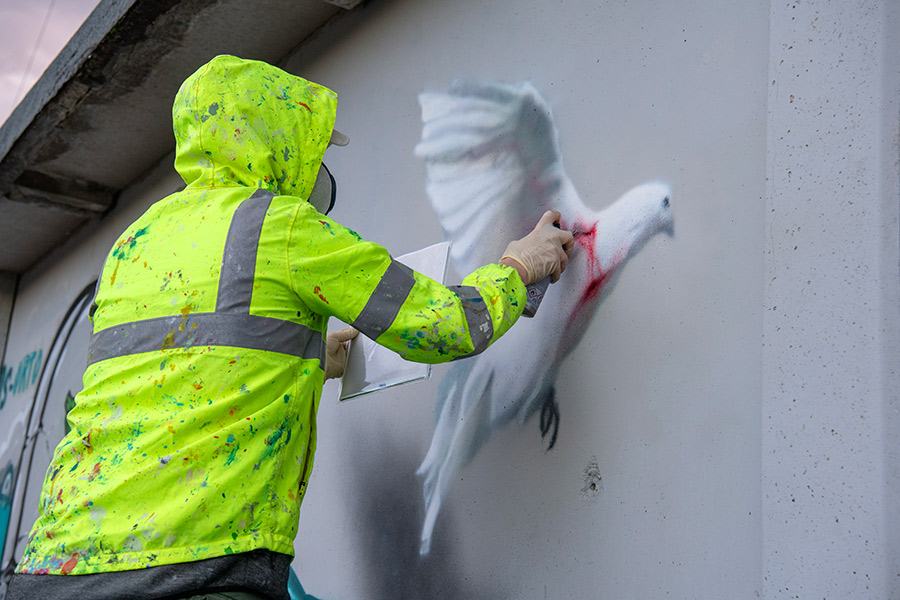
The result: a high-energy, low-profile intervention across San Giovanni Lupatoto and other Verona suburbs. These weren’t “art walks”—they were tactical takeovers. Artists painted four-handed pieces over vandalized walls: CIBO’s flying pizzas alongside Zed1’s surreal characters; asparagus stalks layered with Mantra’s naturalist flourishes. This wasn’t nostalgia—it was public protest, humor, and heart in action.
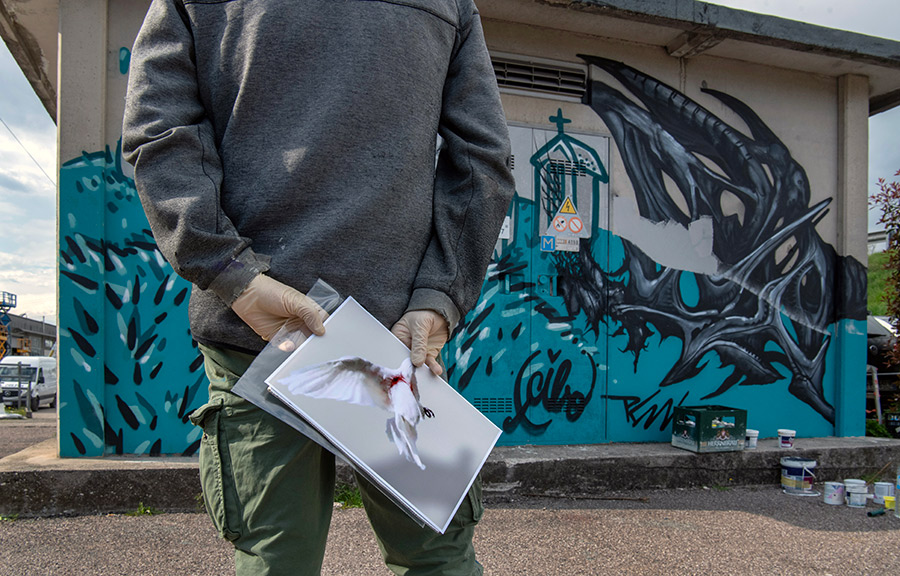
To ensure the work wouldn’t disappear unnoticed, Martha Cooper—the well-known NYC photographer who helped canonize graffiti with Subway Art—flew in to document it all. Her lens captured not just murals, but the camaraderie, tension, and resilience behind them. Now, over 50 of those photographs are on view at Forte Sofia, Verona, through June 29. Curated by Sara Maira—art strategist and activist—the exhibition is a powerful retelling of a grassroots moment turned collective memory.
We spoke with curator Sara Maira about the festival and the work of CIBO.
BSA: Please tell us about the name of the festival where CIBO collaborated with other artists in Verona?
Sara Maira: The festival and its current exhibition in Verona is called “BEST BEFORE. Street art against a rancid future.” It’s a call to action for the public—an act of artivism initiated by CIBO with the goal of inspiring people to stand up against closed-minded politics, nationalism, and obscurantism before it’s too late.
This is an artivist performance made possible through donations CIBO received over the years from patrons who supported his social commitment against fascism, racism, and hate.
BSA: What attracted CIBO to paint food on public walls? Why choose food as a subject instead of something else?
SM: “CIBO” in Italian is also a nickname for food, so it started as both a joke and a necessity. When he was young, he didn’t have much money to buy paint, so he used leftover colors that other artists didn’t want. Since food comes in almost every color, it became a practical solution. That’s how it began.
As he matured, so did his message. Food evolved into a metaphor—his way of talking about some of the most urgent problems we face today: the rise of neo-fascism and neo-Nazism, nationalism, discrimination, environmental collapse, short-sighted politics, and the widespread social regression we’re seeing worldwide.
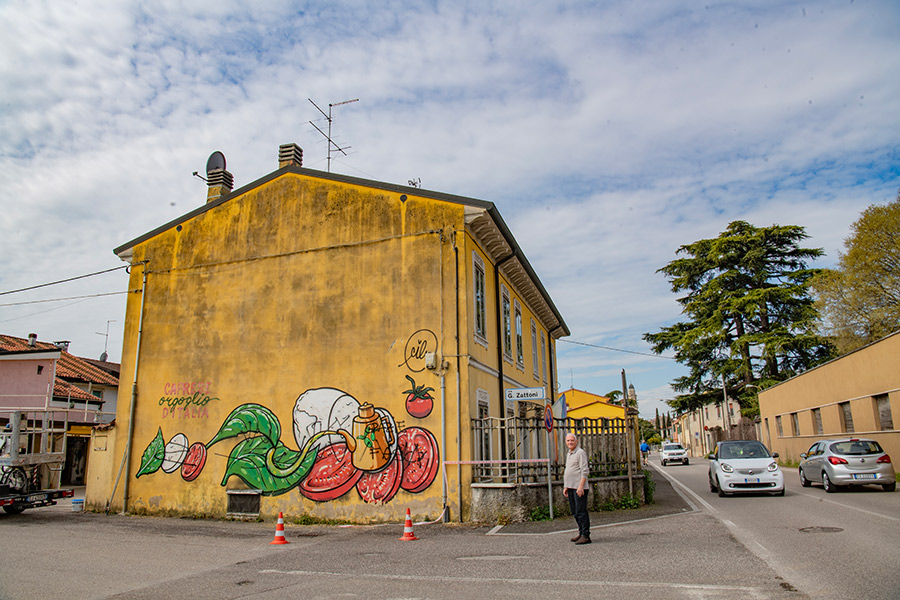
He often uses this example: the Caprese salad has the colors of the Italian flag and is considered a traditional Italian dish. But if you examine the ingredients, none are originally Italian. Tomatoes come from Western South America and were first cultivated by the Aztecs. Spanish explorers brought them to Europe in the 1500s. Basil comes from India, and if you add olive oil—as Italians do—it’s originally from Syria. So what we now call “tradition” is actually a product of cultural exchange, migration, and cooperation. If we close our borders and minds, we risk losing that richness.
Every mural CIBO paints contains hidden messages like this. On the surface, it may look like a simple plate of food, but often it’s layered over a swastika or other hate symbol—visually erased but symbolically challenged. What looks colorful and inviting at first glance reveals itself to be part of a much deeper conversation.
BSA: What’s the significance of CIBO painting over hateful or racist messages on public walls?
SM: For him, it’s both an act of resistance and a form of public service. Covering up hate is just one part of his practice, but he sees it as one of the most essential—especially if you consider street art to be public art. This is where public art can make an immediate difference.
CIBO lives in Verona, a city in northern Italy that has long struggled with fascist ideology. That ideology never completely disappeared after WWII, and in recent years it has made a disturbing comeback—not just in Verona, but around the world. At first, CIBO simply responded to what he saw. He had spray cans in hand, he saw hateful messages on walls, and he began covering them up.
Then it became personal. Fifteen years ago, one of his friends was murdered by neo-Nazis. Since then, his work has become a mission—a colorful and peaceful revolution. It’s voluntary activism: an artist giving back to his community, trying to change the world one spray can at a time.
These people are violent; their language is violence. But CIBO’s language is beauty and art—and they’re not prepared for that. Usually, swastikas are covered with opposing political symbols, and the fascists are ready for that. They expect confrontation. But when they’re met with a painted piece of cheese or a slice of pizza, they don’t know how to react. They still come back and vandalize the murals, but CIBO has learned to use their hate as part of his art. He now plans his murals like recipes—every time they come back, he adds an ingredient. Over time, his walls become layered “recipes of resistance,” evolving performances in public space.
In the beginning, people walking by didn’t even notice the hidden messages—there was a sort of visual blindness. But after a few years, people caught on. They realized there was a problem and started sending him photos, asking him to restore or repaint walls. Eventually, some of them started taking action themselves.
BSA: Does CIBO get threatened by the people whose graffiti he covers with food murals?
SM: Yes, he receives threats often. People have sent him death messages. Once, a small bomb was placed on his car. He’s found swastikas painted on his door, and he’s no longer able to move around freely. That’s why he chooses to paint during the day, in public, with people around him. Visibility is his protection. Showing his face is part of his defense strategy.
BSA: Has CIBO gotten into trouble with the police for painting on illegal walls?
SM: Yes, that’s why he works with a lawyer. He’s been reported many times by politicians and law enforcement. But because he’s a recognized artist—and because he’s covering hate symbols—he has never been arrested or convicted.
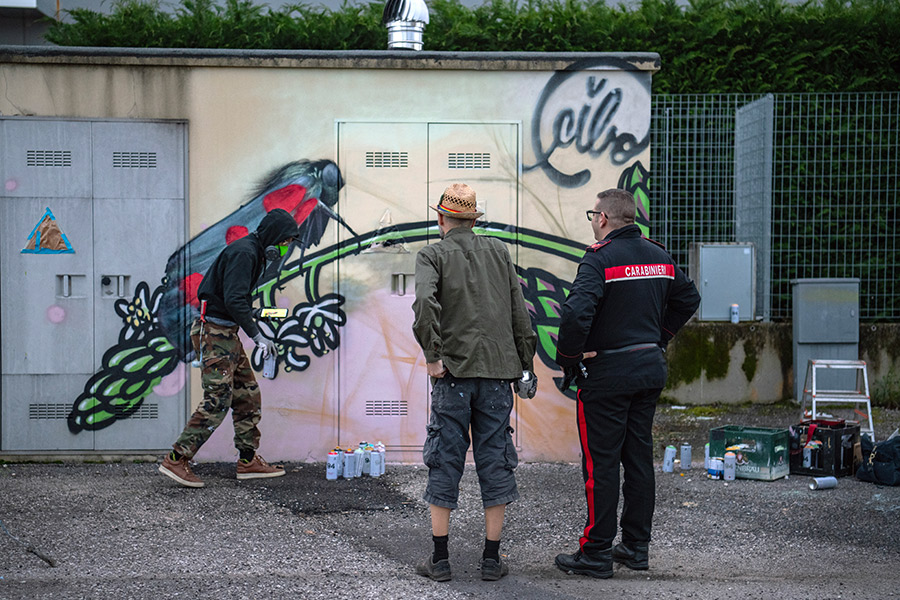
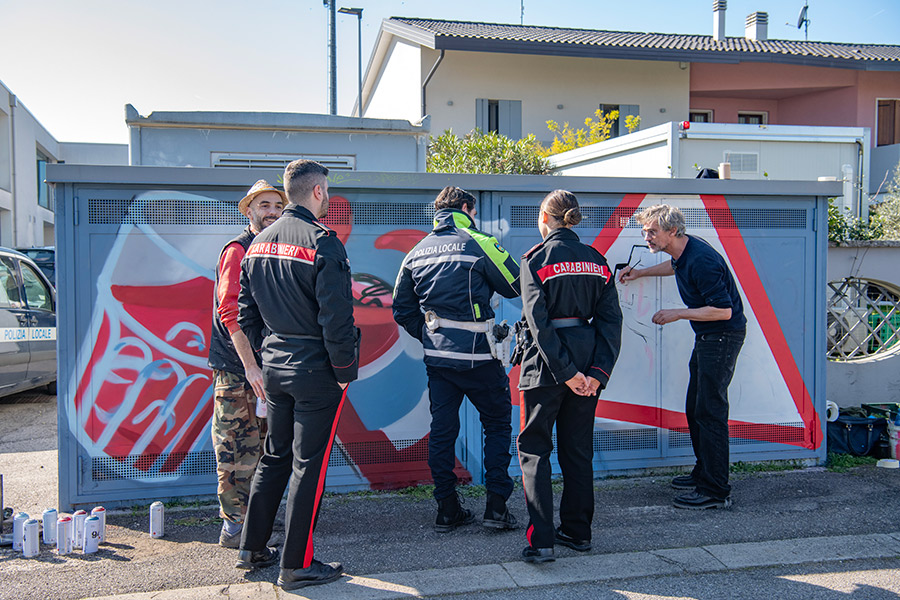
While going through your CIBO/Verona photos, we noticed that the police showed up a couple of times while he was painting with Mantra, and again while he was painting with Clet. Were the police officers hostile to him? Did the officers show up as a routine or were they responding to a complaint from a citizen?
MC: Not sure if the cops showed up because of a complaint or if they were passing by or what. They questioned the artists but allowed them to continue. They weren’t particularly hostile but not exactly friendly. I tried not to let them see I was taking their picture because I wasn’t sure if I was allowed. Cibo is well-known in Verona but he is mostly painting illegally. As I remember, only one of the walls was a permission wall but I don’t remember which one. Almost all of the walls were ones that Cibo had previously painted which had been gone over. One wall says something like “Thank you Fascists” painted by Cibo but I’ve forgotten what the story was. Sometimes the fascists leave Cibo notes. Attached are photos of him peeling off a note which reads “Tu aisegni noi roviniamo!” which, according to Google Translate means “You draw, we ruin”.
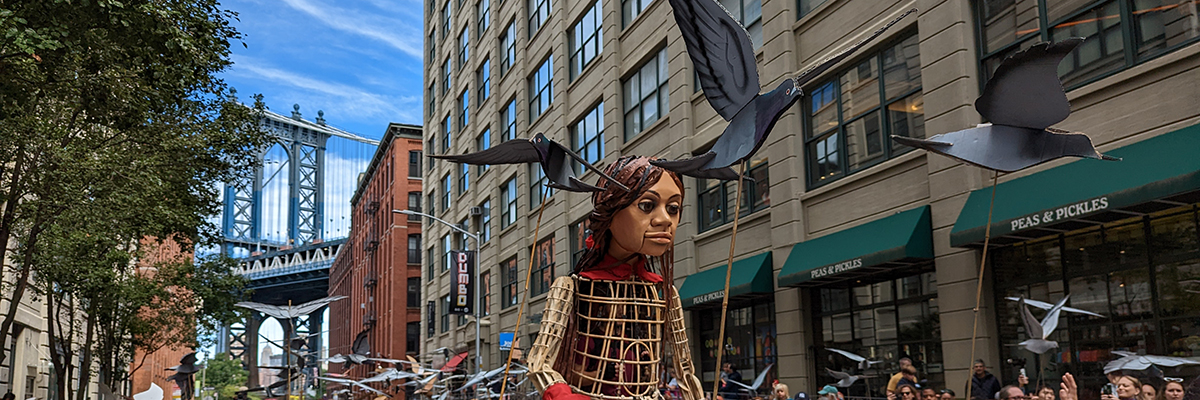
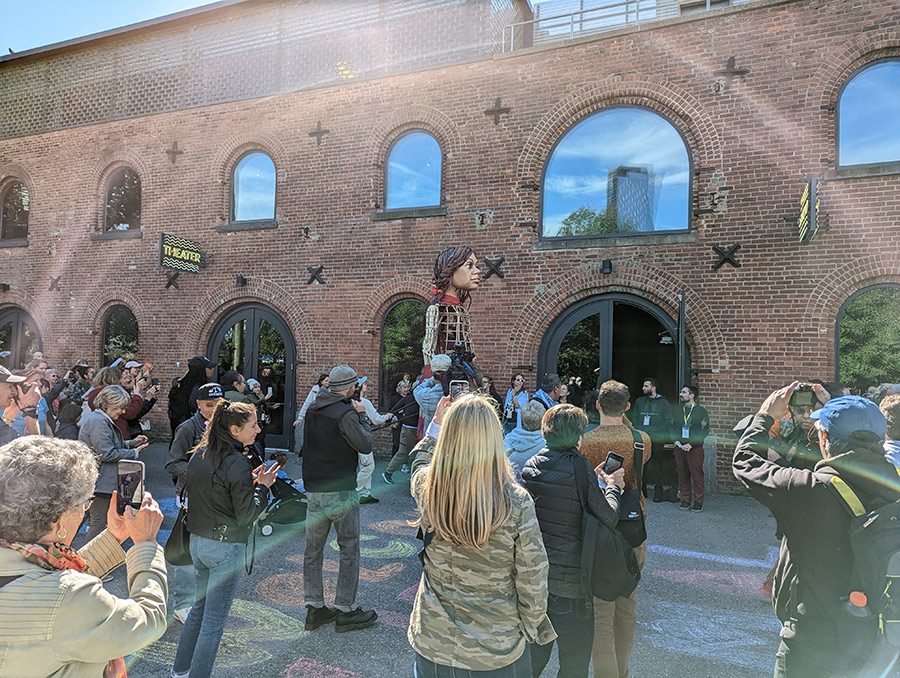
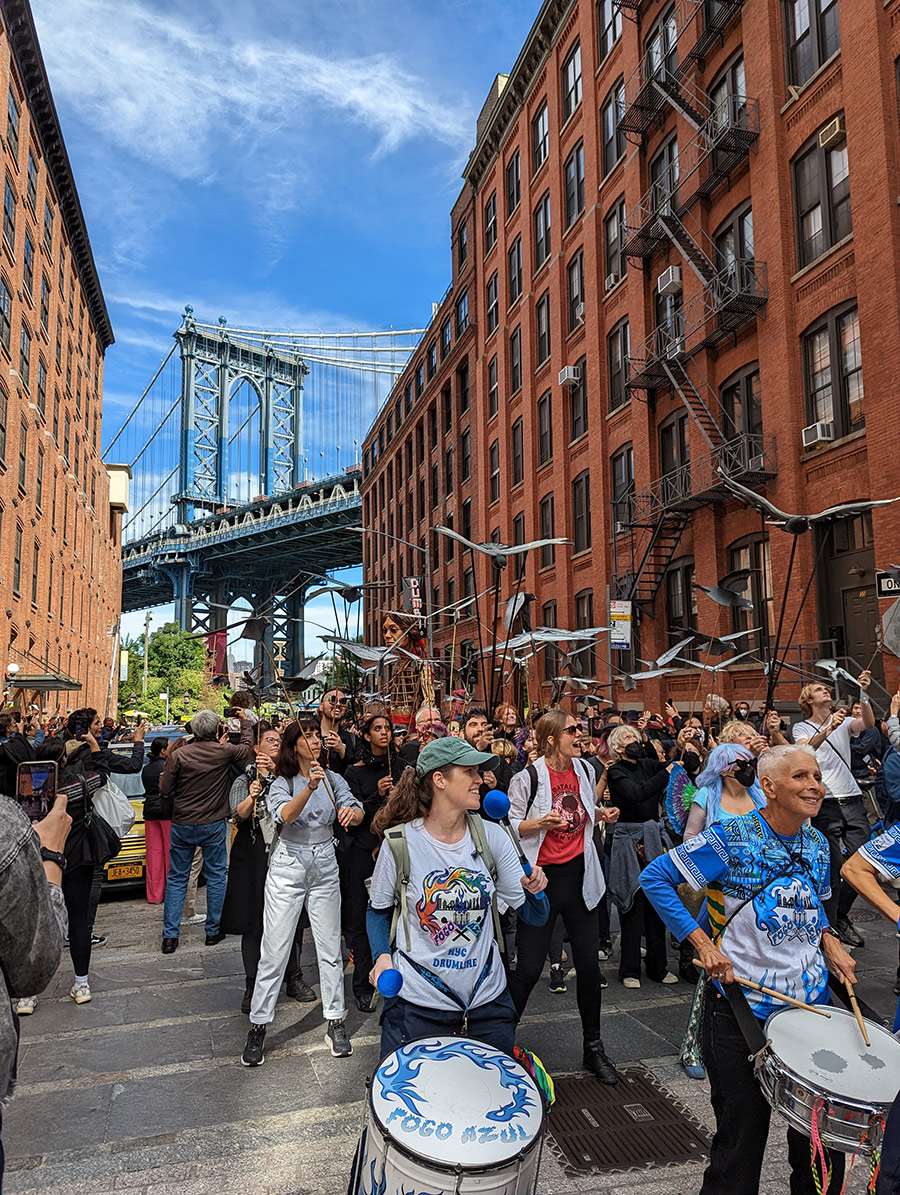
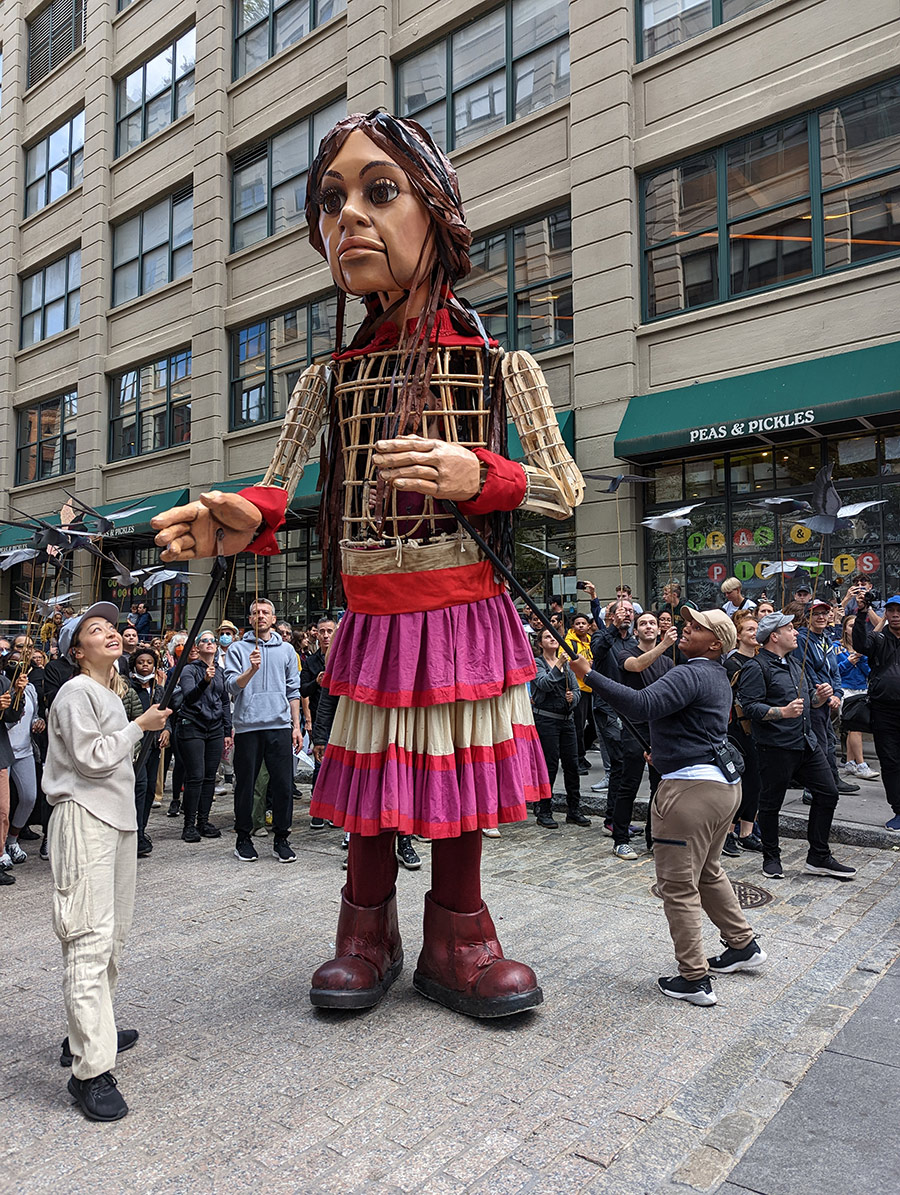
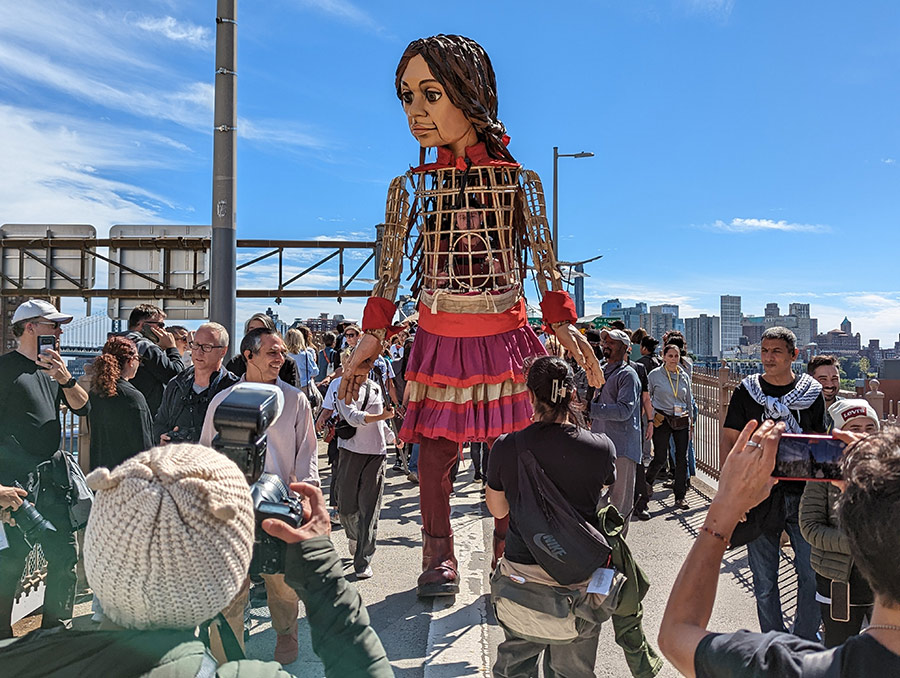
‘Interactive’: an overused buzzword today, much like ‘engagement’ and its derived forms. Regardless, nothing replaces true community engagement like well-planned and executed public performance. This fall, one of the most interactive puppet performances worldwide has been traveling through New York, and thousands of people have participated.
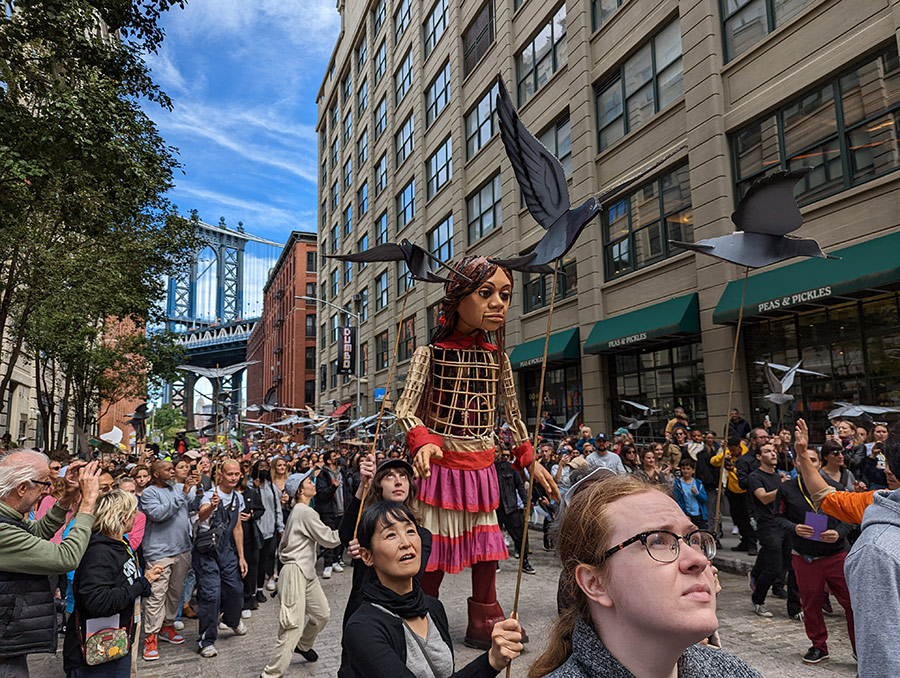
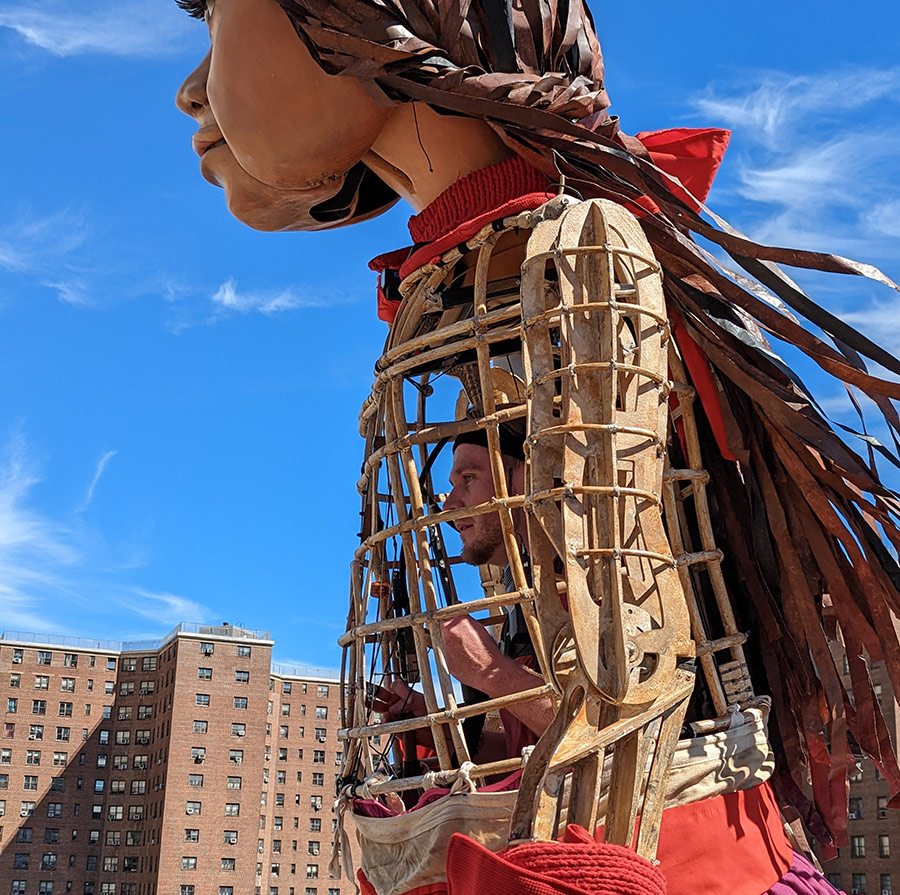
Meeting thousands of people in the streets as a way to educate us about the plight of people around the world who have become refugees, the 12-foot-tall puppet of a young Syrian girl named Little Amal is fulfilling a mission begun many months ago on the border of Syria. According to the website of Handspring Puppet Company, the South African team which made her, Little Amal has already traveled 5,000 miles in the two years preceding her New York visit.
Little Amal has traveled “from the Syrian border through Turkey, Greece, Italy, Switzerland, Germany, Belgium and France” through more than 70 towns, villages, and cities in search of her mother. She even met the Pope.
Now in New York, organizers say she isin search of her Uncle Samir. Planned events in all 5 of the boroughs mean that she is being welcomed by hundreds of artists, cultural organizations, community groups, schools, and colleges during a 55-event, 17-day traveling festival.
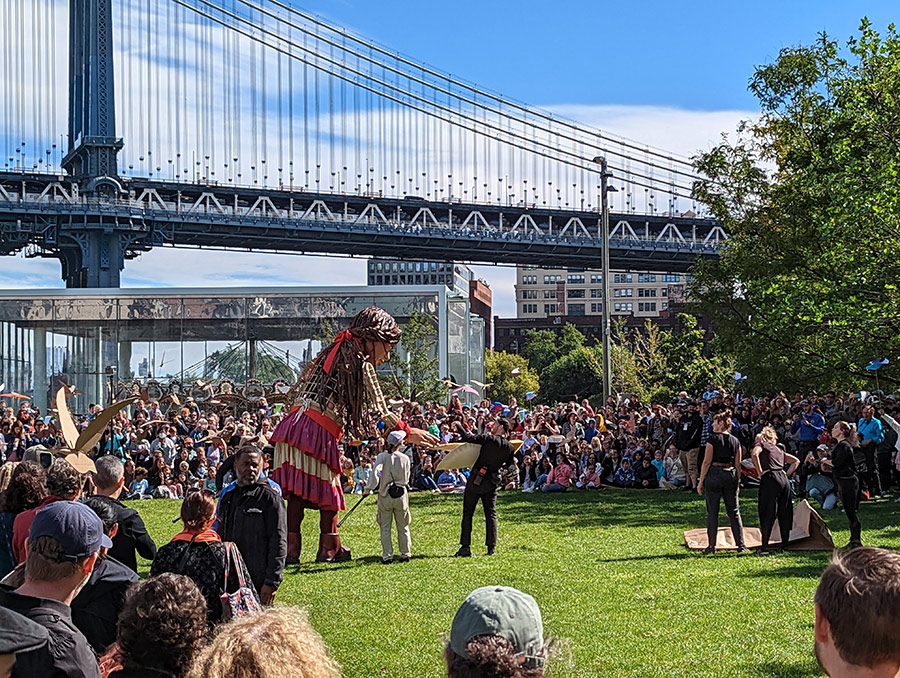
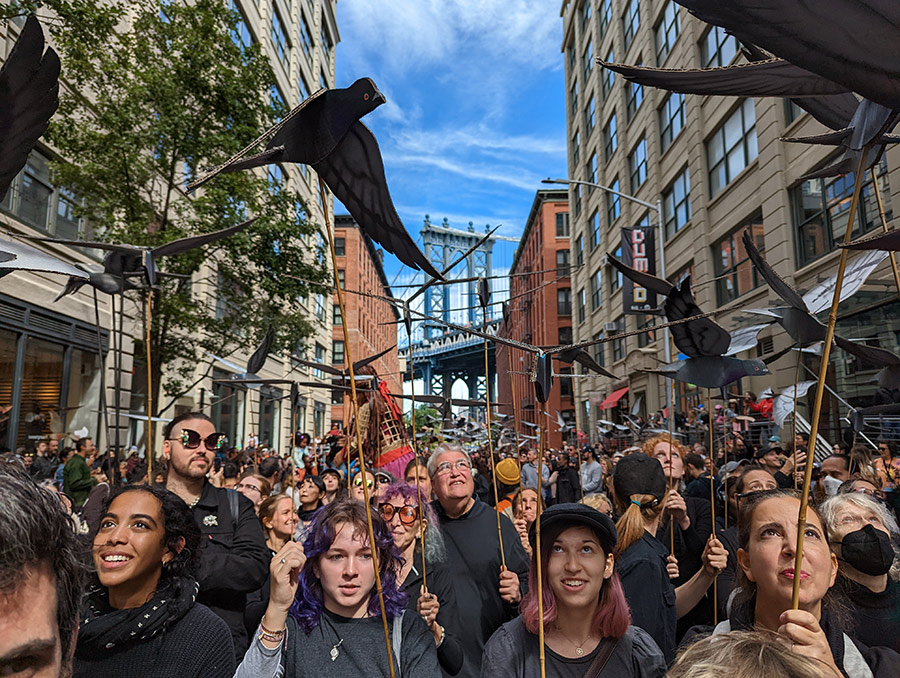
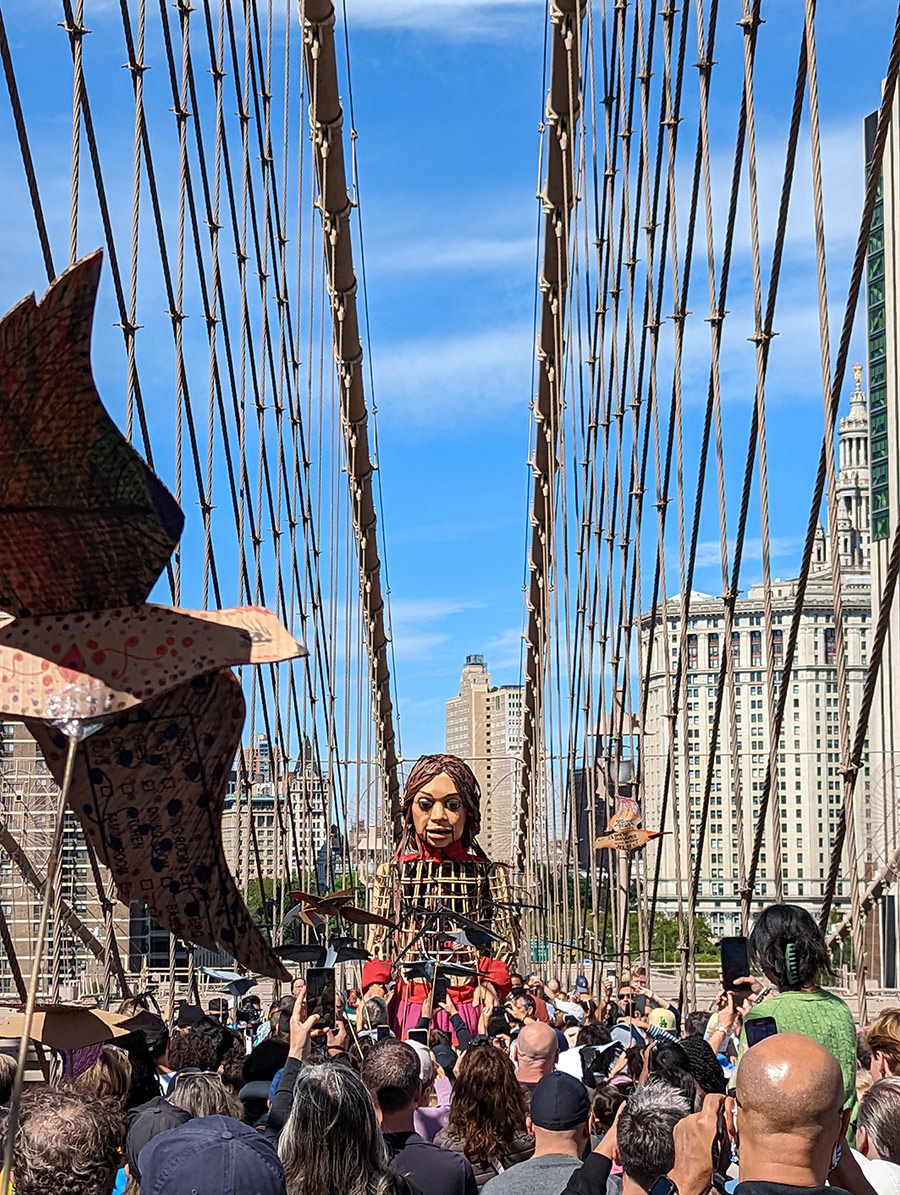
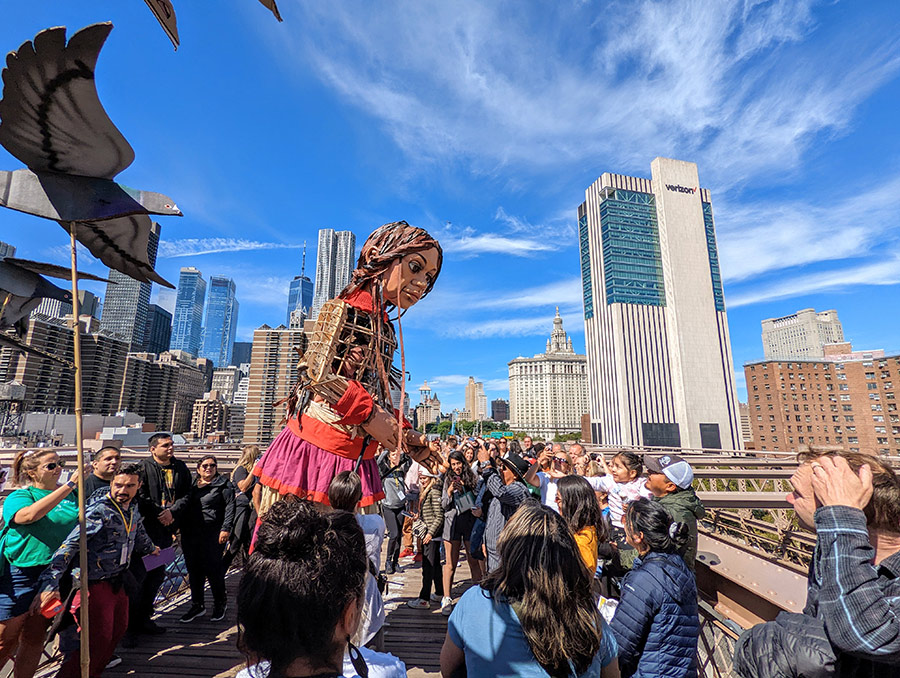
We share with you today images from photographer Chris Jordan, who attended one of the recent interactive performances in the DUMBO neighborhood in Brooklyn. We also spoke with transdisciplinary artist Heather Alexa Woodfield, who has created, produced, and performed pieces for various festivals and events, including at Chashama, the Edinburgh Fringe Festival, FIGMENT NYC, the High Line, and The New Museum’s Ideas City. Woodfield tells us that The Little Amal project deeply touched her as an artist and performer, and she attended many of the performances.
Brooklyn Street Art:How did you hear about this project and what attracted you to it?
Heather Alexa Woodfield: I saw an article in the Guardian about The Walk with Amal in the fall of 2020. When I read that it was created by Good Chance Theatre, I knew I had to see it as their play The Jungle is one of the all-time great theatrical experiences. Since I went to Bread and Puppet every year as a child, I naturally have a deep love of radical puppetry and participatory public art.
Brooklyn Street Art:How many times have you walked with Amal? Were there many others interacting with her?
Heather Alexa Woodfield: I’ve walked with Amal 10 times so far. While I’ve mostly been too busy following the puppet to estimate the size of the crowd, it always seems to fill the space she occupies whether that is a vast space like Brooklyn Bridge Park or something more contained like galleries at the Natural History Museum.
Brooklyn Street Art:What do you feel that she symbolizes to you? Do you think people who first meet her on the street grasp the intention?
Heather Alexa Woodfield: Amal is a refugee who is being honored and celebrated all across the city. She helps us imagine a world where immigrants and refugees are welcomed and respected. I don’t think people who see her randomly immediately understand that she is a refugee. However, the experience seems to make people more willing to talk to strangers. Then conversations start, and the message gets passed. I’ve heard and participated in this exchange multiple times.
Brooklyn Street Art: How does art like this engage people in the public square?
Heather Alexa Woodfield: The public has a vital role to play in this artwork that is beyond spectator. Whether carrying a puppet bird or holding a flashlight to illuminate her face or simply walking with her, audience members become co-creators. This experience elicits a profound sense of collective joy that is reciprocal between the people who have gathered and the Amal team. I love seeing the puppeteers smiling just as much as the children around them.
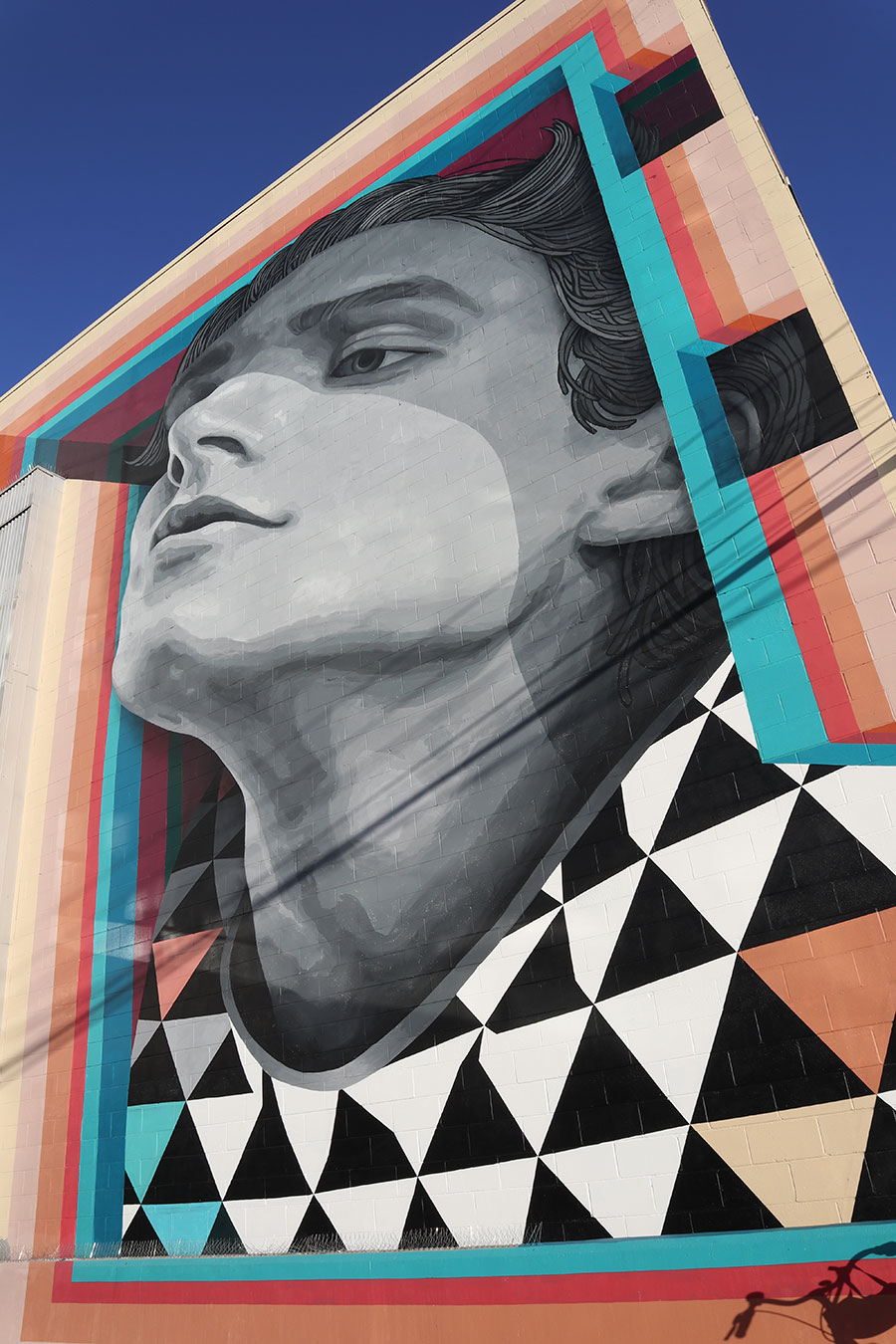
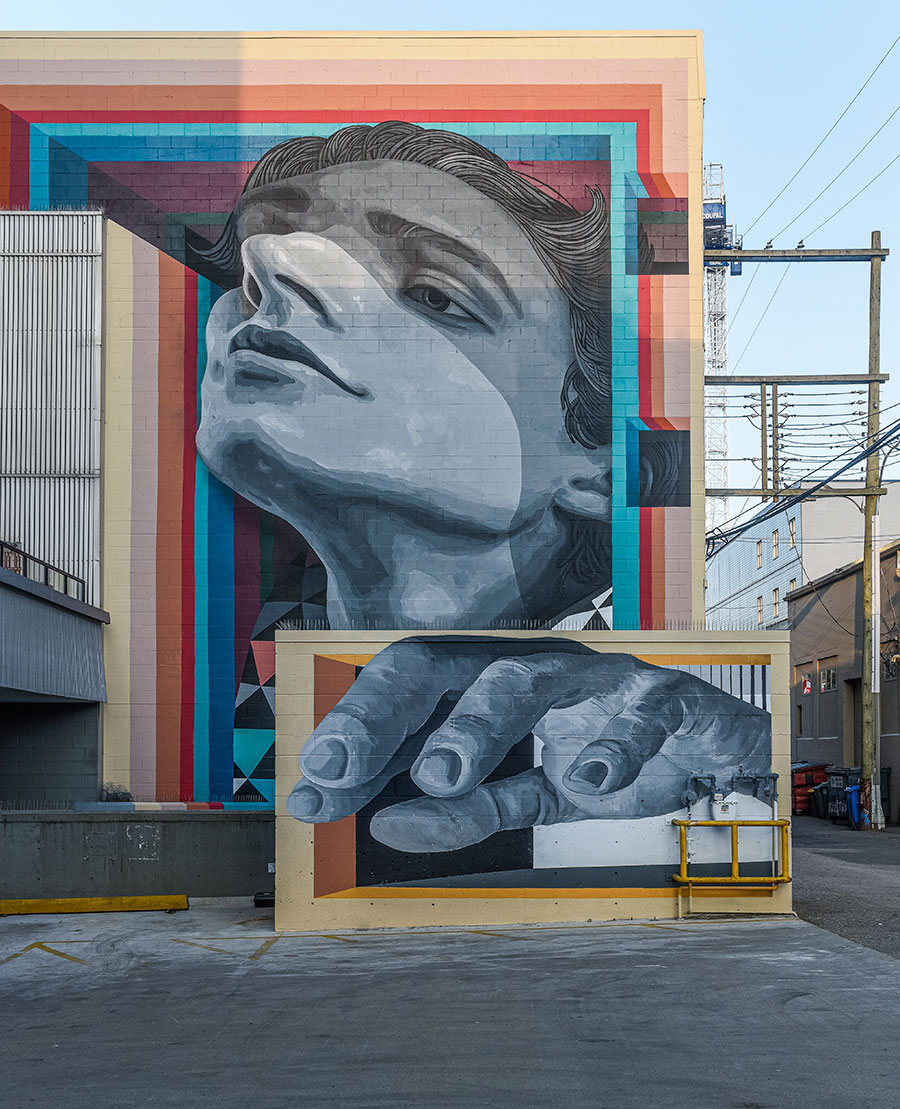
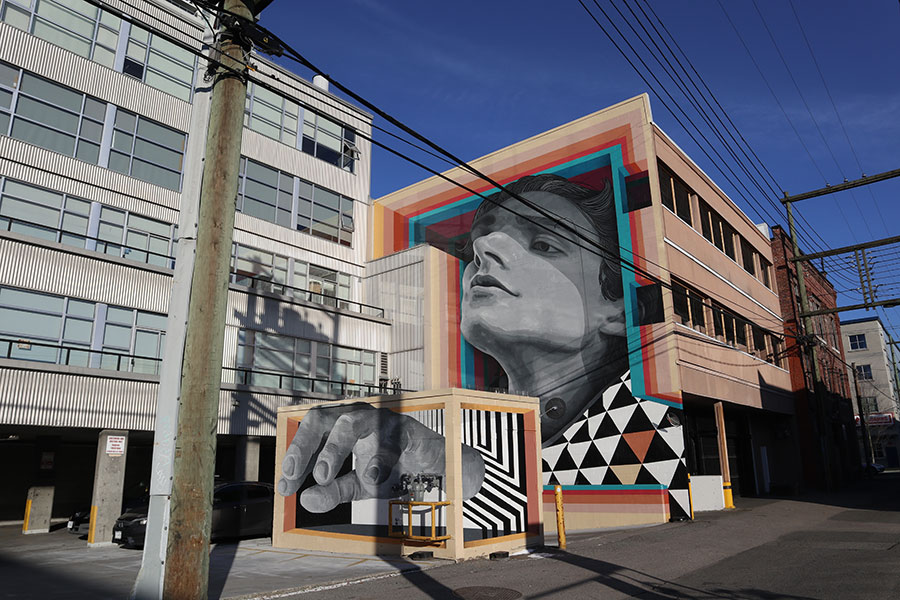
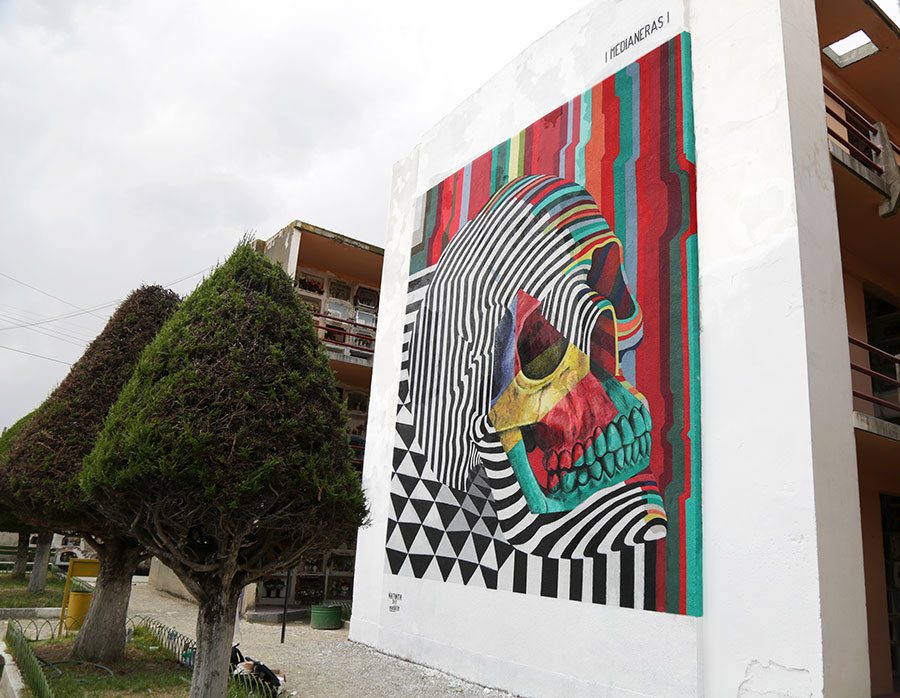
We continue today with our interview with Analí Chanquia and Vanesa Galdeano, who together are known professionally as MEDIANERAS. Today we talk about what it is like to travel the world painting, how they address concepts of gender in their work, street artists’ responsibilities to society, and how Social Media has affected their practice
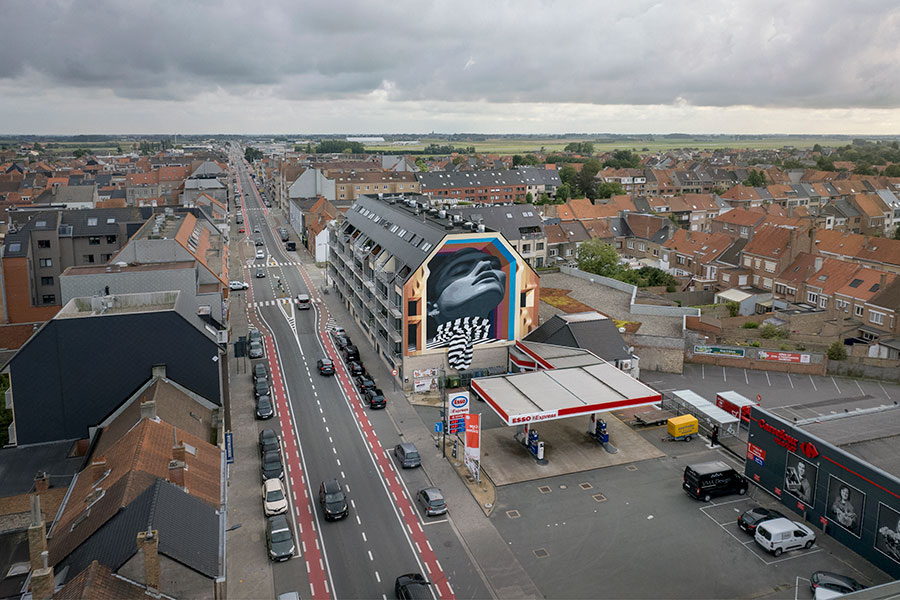
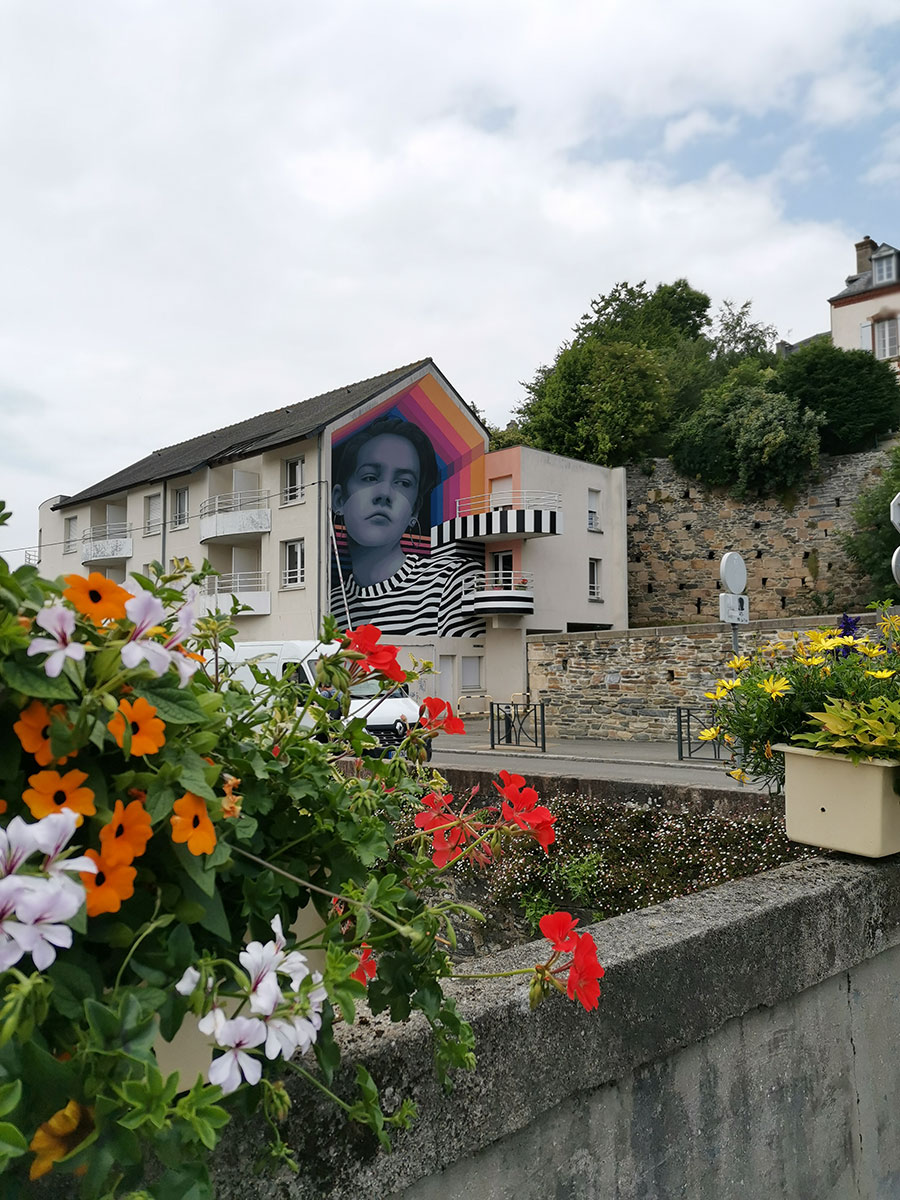
Medianeras. The Crystal Ship Festival. Ostende, Belgium. (photo courtesy of the artists)
BSA:Your work together has given you the opportunity to travel around the world participating in international street art festivals in numerous cities. What is the benefit of the existence of street art festivals to the artists and to the public? Is there a benefit?
Medianeras: International street art festivals have contributed to making street art mainstream. We do not criticize this fact, but we conceive it as a natural evolution of the activity. In our case, urban art festivals have allowed us to carry out our work in different cities and travel the world. Above all, they benefited us by providing us with the necessary infrastructure to carry out murals of murals in large dimensions in places that we would not have reached otherwise.
Medianeras. The Crystal Ship Festival. Ostende, Belgium. (photo courtesy of the artists)
BSA: Can you recall a specific experience when painting in a foreign city/country that made a deep impression on you, big enough that influenced your work and made you transform or change or modify your art in any way?
Medianeras: Each experience, each trip, and each new project is always a new challenge and therefore implies growth both in our work and in us as people. We have been growing with the activity, and we believe that it has changed us.
BSA: Since you began painting together have you seen any movement from institutions and organizations that favor including more female artists in their lineup? Was it difficult for you at the beginning of Medianeras to get work outside Argentina? Did moving to Barcelona make things easier for you in terms of getting commissions in Europe?
Medianeras. The Crystal Ship Festival. Ostende, Belgium. (photo courtesy of the artists)
Medianeras: Yes, we have witnessed how the number of female artists in street art festivals has increased over the years. We believe that there have always been many women who paint in the streets, but it has been in recent years that recognition and visibility of some more have been given. We are now somewhat appreciated for our work, but it’s been a difficult road for us. So many talented women have been painting on the street forever, but many of them did not have the visibility they deserved until a few years ago. Larger walls have gone primarily to men. We believe that this has to do with the prejudice toward women in stubbornly patriarchal societies. This situation has been changing in recent years, and now we are meeting more and more women who have been given an opportunity to grow with their works of art and the space to communicate their own vision.
Before moving to the city of Barcelona, we traveled every year to Europe and other countries to carry out our work. Although the geographical location was a bit far from some destinations and this meant longer and more expensive trips, we have always been able to do it despite the difficulties.
Moving to Barcelona facilitated access to commissioned works simply because it was closer.
BSA: In some of your paintings we experience a visual illusion of your characters coming from inside the building’s walls. You create an environment where the forms are in movement but also the characters strike a defiant pose. Is this a way in which you are challenging the public to interact with your work?
Medianeras: Yes, these characters are empowered and are in a challenging pose for a matter of scale since they are always bigger than the viewer and look at them from above. Conceptually, the representation of these characters is due to an intention to express an intention.
Medianeras. The Crystal Ship Festival. Ostende, Belgium. (photo courtesy of the artists)
BSA: You create portraits, sometimes with an abstract quality to them. Who are your subjects? Do you know the men and women depicted in your work? How do you choose them?
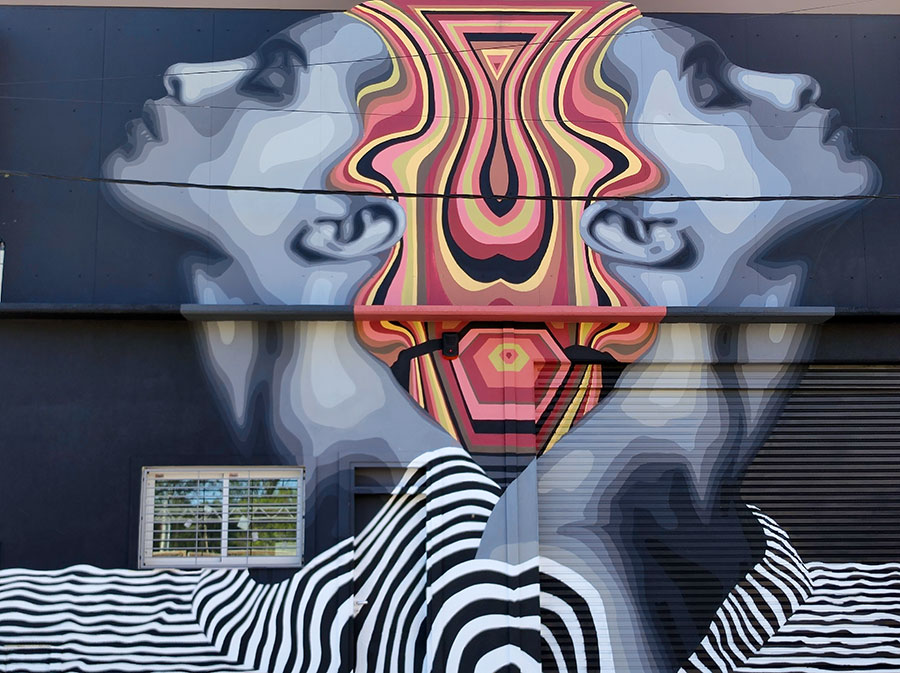
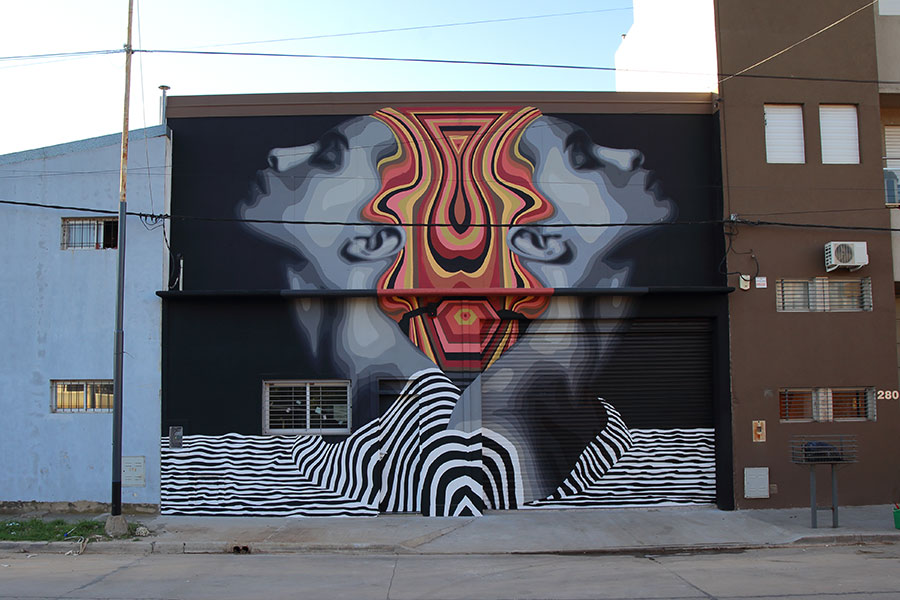
Medianeras: We don’t know the characters that we represent because they are created digitally. Basically what we do is distort or change the faces so that they look strange. Many times we mix faces from different photographs and in turn, divide them into color planes of different darkness.
We want our works to convey the message of a broad concept of gender. We believe that once the rigorous distinction between men and women comes to an end, we will see the development of freer social relations and generations of people who are less concerned with what they should be and more attentive to what they could be.
Medianeras. Villa Constitucion, Argentina. (photo courtesy of the artists)
BSA: Do you think artists have a social responsibility to address the problems affecting our society today with their art?
Medianeras: Not necessarily. Each artist decides whether or not they want to work to address these social problems. All individuals whether they are artists or not have certain social responsibilities when living in societies. Urban art is important as a tool for the appropriation of public space. It is also political action. It is very important for the communities to express themselves in their streets since these are the places that we inhabit as societies.
The objective that we have always shared was the need to make public art, whether it’s a mural, urban intervention, or mosaic because we believe that there is where it lies the right place for our work.
We consider that public art is the most honest way to create our artworks and that anyone has access to them. We are not interested in making art for an elite that understands or appreciates it or that handles certain codes. It is art for everyone. Medianeras was born with a shared desire to move and create our work in different places and for different communities.
The important thing about urban art is that it expands this offer, making it accessible to everyone and democratizing access to culture. The main goal is to live the experience of creating public work, of engaging a community. That’s what we’re looking for and what fully gratifies us.
Medianeras. Villa Constitucion, Argentina. (photo courtesy of the artists)
BSA: Do you think that Social Media has influenced the artistic output of street artists? Do you think that street artists have slightly changed their work in favor of a more welcoming and larger Social Media presence?
Medianeras: Yes, definitely. We believe that artists think about social media when making artworks since many times social media are a medium to show the work. Perhaps the media and the way you show your work is as important as the work itself. Many of these are created for these networks,
In general, we believe that the digital world has permeated the world of art and has changed the way artists work. We also believe that these modifications are not limited to the world of art but to the societies of the world in general.
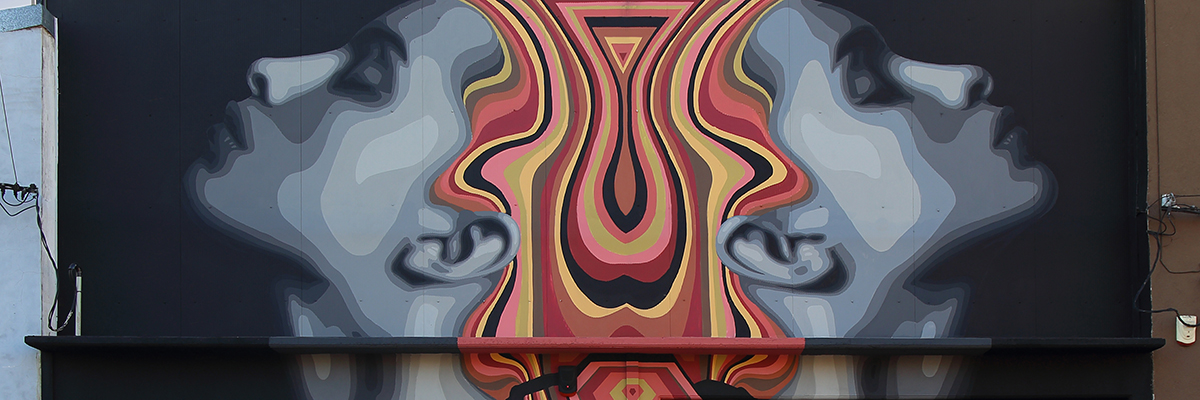
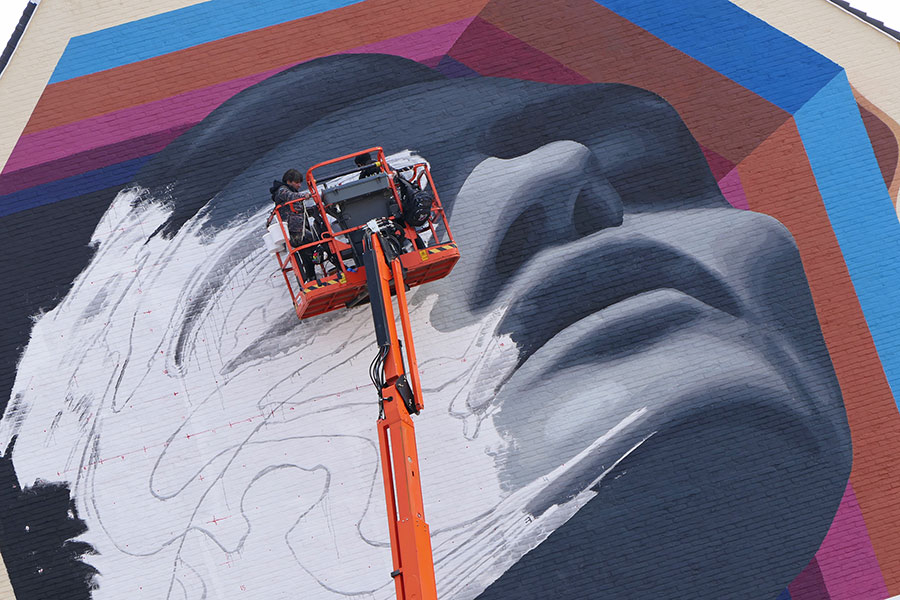
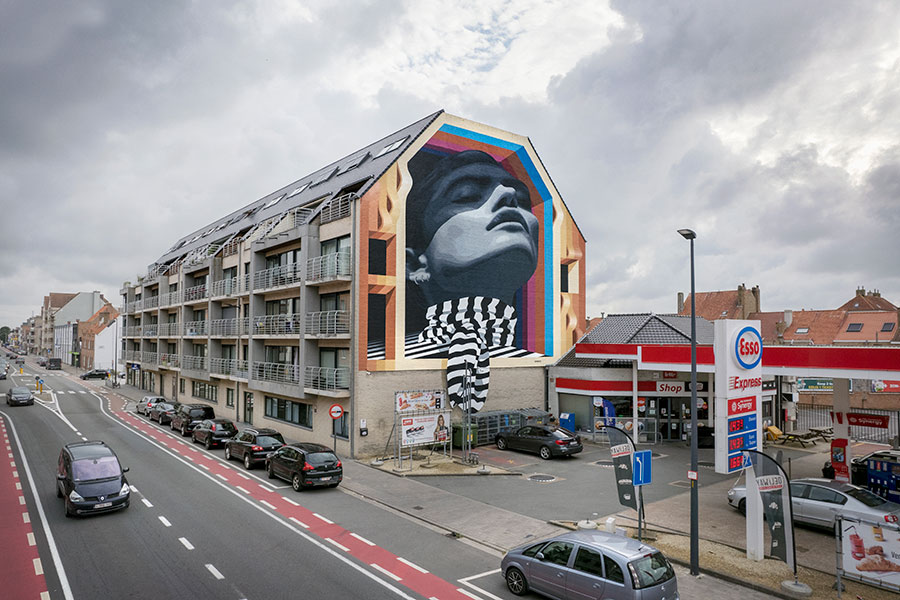
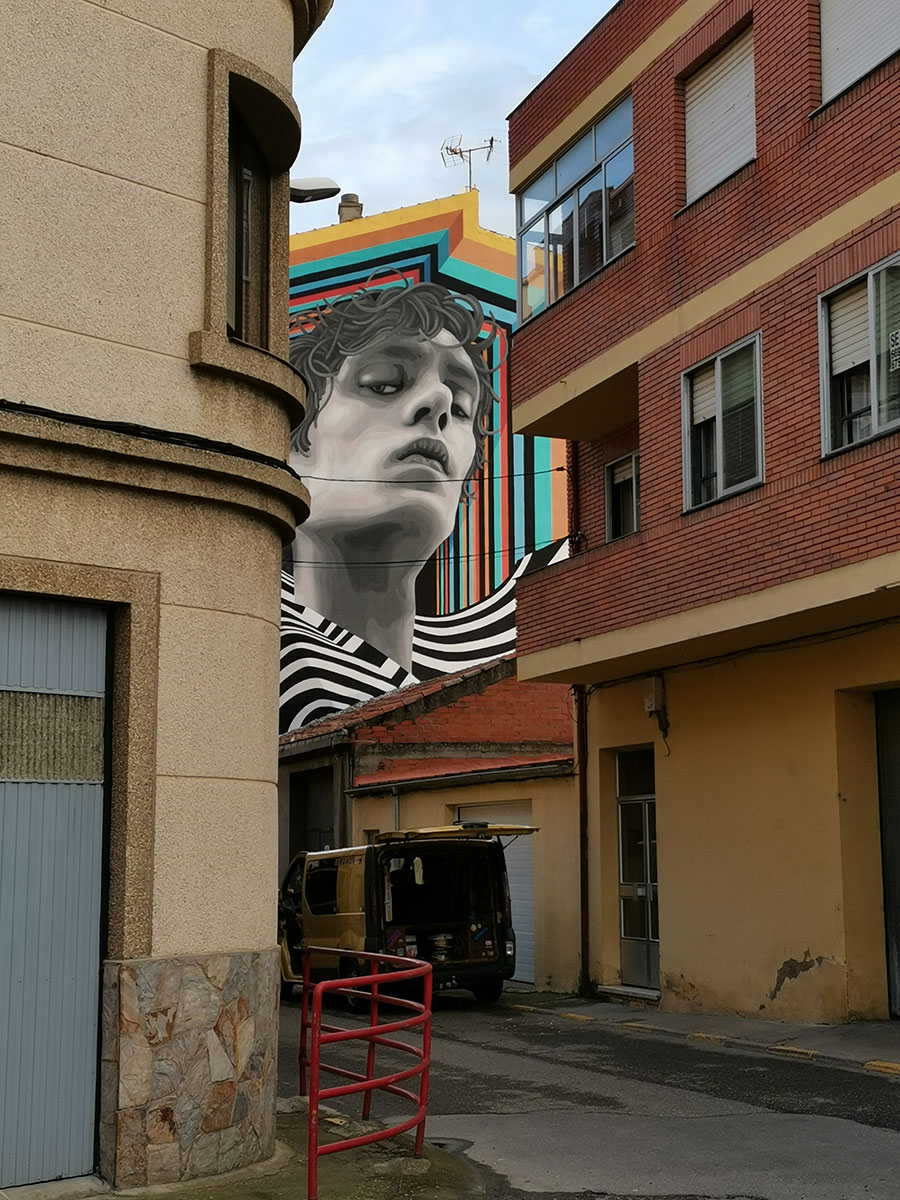
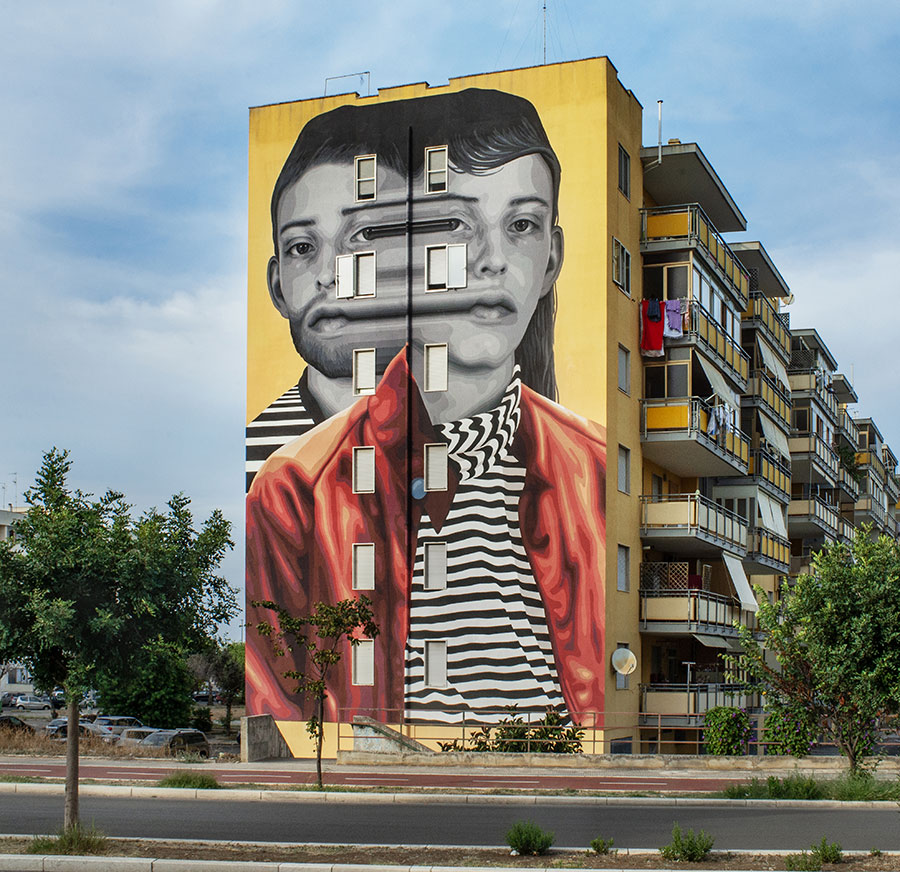
Today we speak with Analí Chanquia and Vanesa Galdeano, who are known professionally together as MEDIANERAS. They are originally from Argentina but presently they live in Barcelona; together they have been traveling around the world together for 10 years creating murals. They work as a couple developing a vocabulary of kinetic graphics and androgynous, anamorphosed portraits that are jarring, slickly virtual, and somehow transcendent. Each is of this moment in the environment it is painted, yet reminds us that we are entering a different age of interaction that is not necessarily physical. It is electric, accessible, and oddly, spiritual.
Medianeras. Cascais, Portugal. (photo courtesy of the artists)
BSA:How many years have you been painting together and where and how did you begin?
Medianeras: We have been painting together for about 10 years. Both Vane and I (Anali) were already dedicated to making works of urban art before founding MEDIANERAS. Vanesa is an architect and has directed a mosaic workshop in the city of Rosario since 2009, a workshop with which they carried out collective mosaic interventions around the city. More than 15 interventions can be found; some are murals others are urban furniture cladding, such as stairs or public benches. In my case, I painted my first mural at the age of 18, but I began to dedicate myself more specifically to urban painting around the year 2011 when I did my Fine Arts thesis. This was a theoretical-practical project called “artist looks for a wall “, which consisted of making murals on walls that the neighbors offered me when they found this stencil that I left as a signature on each work.
We met in 2012 at a mosaic street workshop in the city of Rosario. Vanesa, who at that time was directing the workshop, contacted several graffiti artists to make a collective artwork of mixed techniques. That’s how we met; we began a life of love, travel, and art together. Until today we continue to grow together and enjoy together what we like the most.
Medianeras. Cascais, Portugal. (photo courtesy of the artists)
BSA: Medianeras is your artistic name. Could you please tell us about it? How did you arrive at naming yourselves “Medianeras”
Medianeras: We are a couple in both life and art, and thus our day-to-day existence and our projects capture our mutual growth. We called our duo Medianeras because we cherish the concept and idea of sharing. In Spanish, this means ‘lateral walls,’ which are those shared by neighbors. There’s a difference between walls whose function is to separate spaces, and lateral ones, which, conversely, join them. We maintain that public art, aside from making cities more attractive, proclaims the idea of a place shared by all the individuals who pass through it. We teamed up with the idea of conceiving and creating public art together. At present we are dedicating ourselves to mural painting, but we have also worked on collective mosaic interventions in public spaces.
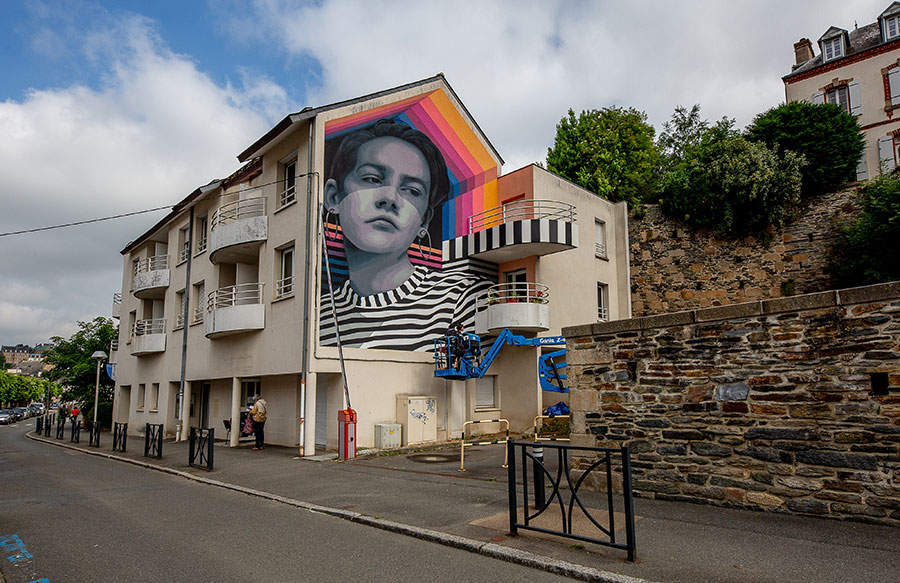
Medianeras. Morlaix, France. (photo courtesy of the artists)
BSA: Please tell us about your process for creating a mural from the idea to the sketch to the art on the wall.
Medianeras: The creative process is quite long. The idea that we are going to paint takes us more time than the days of painting the mural. We study the place a lot, the points of view, the architecture, and the surroundings; we take into account the culture of the place and the history. We draw the designs digitally, based on the photographs of the wall and its proportions and features.
The ideas to create the projects come mainly from certain characteristics of the town or city, the context, the proportions of the wall – width – height – unevenness – and the possible points of view. We mainly represent portraits, and we try not to necessarily define the gender of who we represent, giving rise to the viewer’s perspectives. The murals that we create considerably modify the urban space. In the case of the paintings that we make, they open a kind of window to artistic representation. However, it is important to remember that despite the fact that these murals are visually imposed, they are still ephemeral interventions in painting, linked to possible changes in the weather or any other.
Medianeras. Morlaix, France. (photo courtesy of the artists)
BSA: Please tell us about your background in art and what you were doing independently before you formed Medianeras.
Medianeras: As a child, I (Anali) loved creating things, drawing, and inventing new objects. I attended different art workshops and studied at the University of Arts in the city of Rosario. While I was studying, I made several murals, and in the last years of my career, I was already doing all the artwork on the street. I also studied digital design, a fact that allowed me to handle 3d tools and have a solid idea about space representation.
Vanesa studied architecture and also fine arts. She always had a predilection for urbanism in general but began to carry out collective urban interventions through a mosaic workshop that she directed after finishing architecture
We are both from Argentina. We grew up in a city named Rosario which is located near the Paraná river. Our country, located in South America, is incredible and beautiful as well as uncertain, unstable, and unpredictable. This makes its inhabitants constantly adapt to different types of changes, whether these changes are economic, political, social, or otherwise. In my opinion, in general, it makes Argentine citizens quite creative in the face of different types of difficulties. We are a society that is accustomed to improvising and adapting quickly.
In relation to our activity, Street art is characterized by appearing in all its forms in various parts of the city in a somewhat uncontrolled and deregulated way. The techniques that are used are those that are at hand depending on the stage that the country goes through. For example, the colors and spray brands that can be found in Rosario are very limited, and that makes the artists or graffiti artists use only the colors that they can find or even mix between the same cans of spray they have. In turn, the high costs of spray paint often lead to the choice of cheaper paints, often acrylic paints or even a mixture of several.
In Argentina, there are fewer formalities to intervene in the public space, and this has resulted in a somewhat more spontaneous, less regulated, more experimental urban art, perhaps even more sloppy. However many times we lack the necessary materials or budgets to make murals of large formats.
Although it is an activity that is penalized, we could venture that as there are problems of another kind, more urgent and important, urban art remains somewhat more out of the main focus. In this sense, we appreciate that freedom of expression is not expressly controlled, often allowing experimentation and growth of various artists on the street. We grew up in this context, where through dialogue with neighbors in our beginnings we were able to carry out our works. It can be said that we learned to paint on the street itself.
There was always something that called both of us to create public art. We even met each other working on the Street. The objective that we always shared was to make street art for everyone, whether in mural format, urban intervention, or mosaic because we believe that it is the right place for MEDIANERAS. We consider that public art is the most honest way to create our artworks and that anyone has access to them. It is art for everyone. Medianeras was born with a shared desire to move and create our artworks in different places and for everybody.
Medianeras. Morlaix, France. (photo courtesy of the artists)
BSA: The moment you paint on a wall on a building you’re immediately transforming the building and how the building is perceived by the people on the ground. How do the possibility of doing an intervention on any given building inform the theme and the execution of your work?
Medianeras: Our murals center on the representation of gender in its vast diversity. Although the works vary according to where they are located and how they are viewed, one of their standard features is faces whose gender is not necessarily distinct. Our theme corresponds closely to our way of thinking about gender. Throughout our education, we are taught what a man does and what a woman ought to do. However, in both our case as well as that of a broad range of human beings, gender is something that can change and be unable to adapt to this binary imposition. We want our works to convey the message of a broad concept of gender. We believe that once the rigorous distinction between men and women comes to an end, we will see the development of freer social relations and generations of people who are less concerned with what they should be and more attentive to what they could be.
In other words, we believe that by breaking these rigid and constrictive molds, we can overcome certain forms of discrimination, as well as roles imposed on us from the outside. Our works reflect individuals, poetically and visually transformed, who often struggle to break out of the molds in which they find themselves.
These molds are the architectures where they are found. That is why we like to make holes in the spaces, like breaking down the walls.
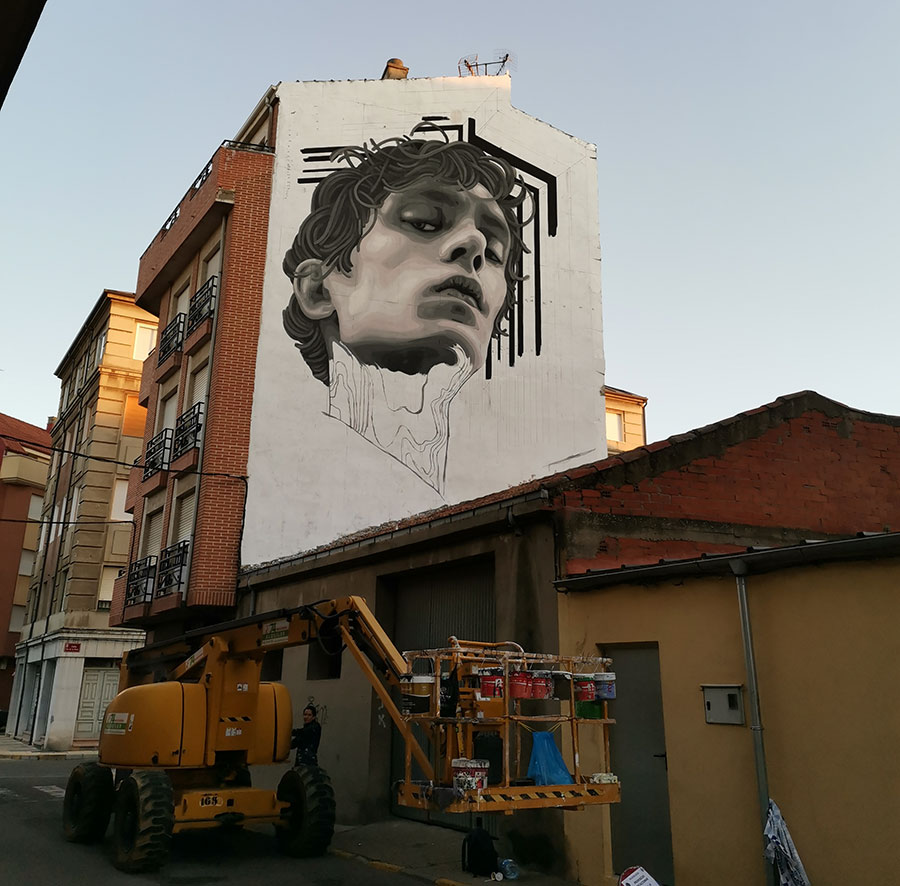
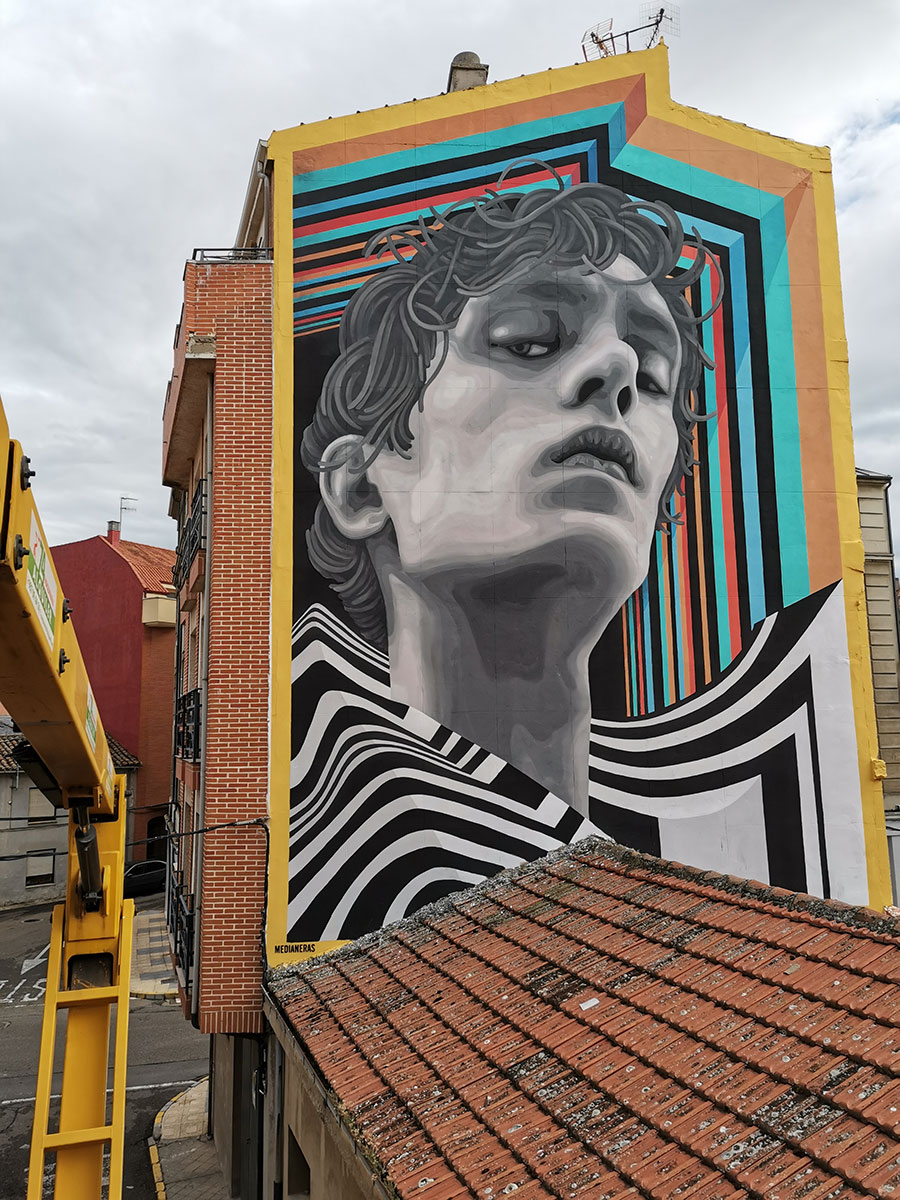
Medianeras. La Bañeza, Spain. (photo courtesy of the artists)
BSA: How do you view context when doing a mural? The context here includes not only the architectural structure that you are using as canvas but also the neighborhood where the said structure is located, as well as the city and indeed the country.
Medianeras: Before starting a design we try to inform ourselves as much as we can about society and the place such as the wall where we are going to paint the mural. In this research, we investigate the customs and characteristics of the culture and its history. We also make a virtual tour of the areas where the wall is located through google maps. This tool allows us to obtain some possible perspectives of the place. With a set of data that includes colors of the environment, the architecture of the place, or even stories, among many others, we create a sketch that is adjusted specifically for that particular surface (wall). That sketch can only be represented on that site since we think about it in relation to the architecture and the points of view from which it will be observed. Through our representations of diverse individuals, we convey an idea of inclusion and conviction about the ideals we stand for.
Medianeras. La Bañeza, Spain. (photo courtesy of the artists)
BSA: You are not afraid of color and geometry in your work. Your murals have almost a tri-dimensional depth, is this technique informed by your previous experiences in art making or was it born out from merging your talents together?
Medianeras: Both. We have enough knowledge to be able to bring to painting what we projected in the initial idea. Through the years, we have combined our styles in such a way as to arrive at what we currently do. Each project is a new challenge to integrate portraits into architectures, which are different in each case. We believe that we can achieve great complexities in the representation of depth thanks to the unification of our knowledge, both geometry and color and drawing.
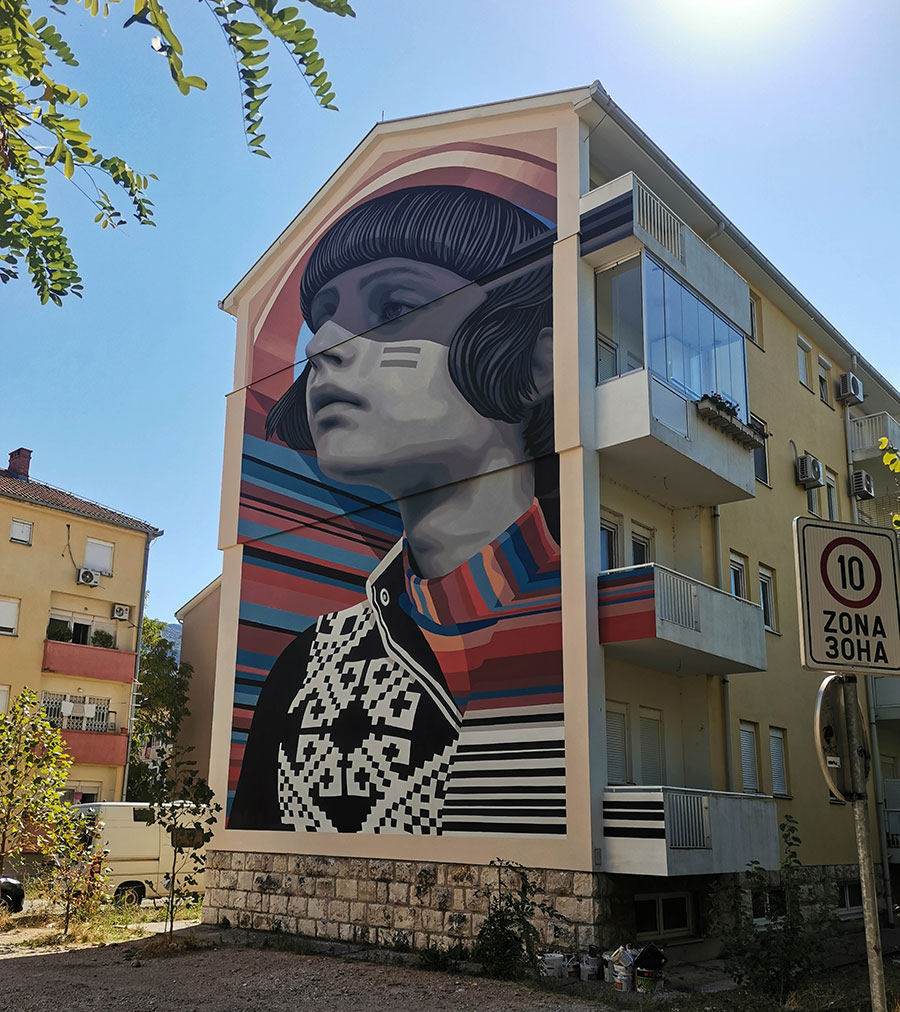
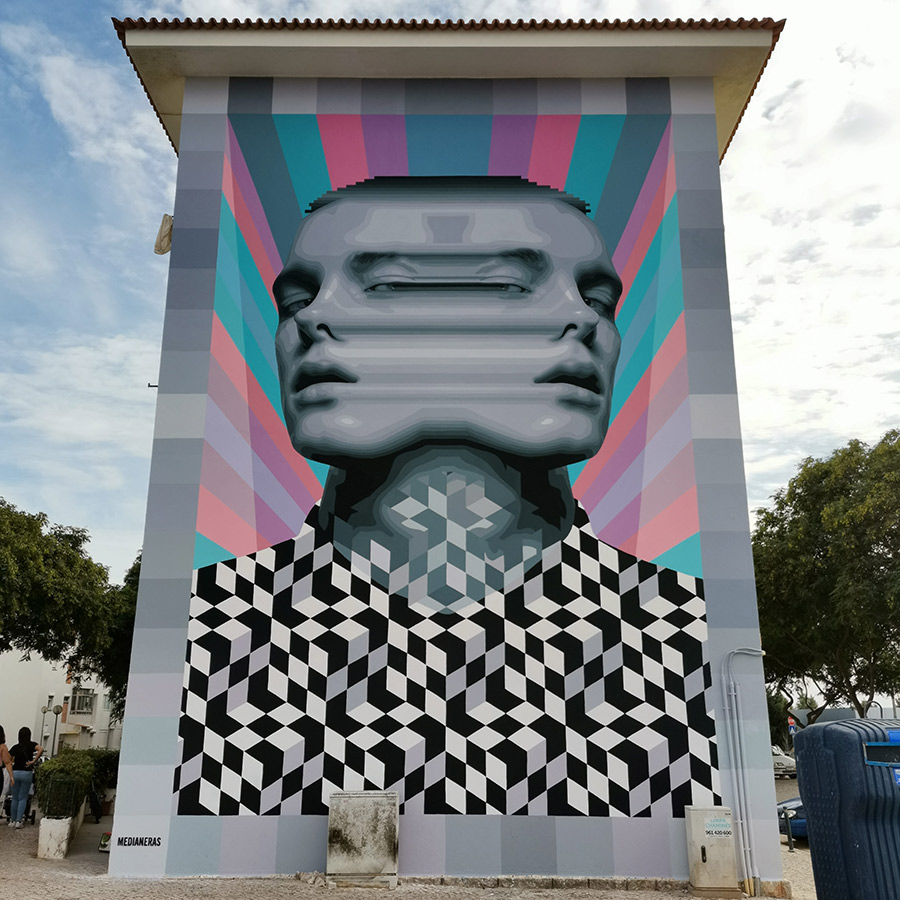
We like to use the technique of anamorphosis. From one angle, one sees images of faces while, from another, one sees the distortion of these faces—the images reveal that they are illusions, something we believe is real, but that is not necessarily so. This is why we study the area around as well as the points of view from which the wall will be perceived: the image is conditioned both by the wall on which it will be displayed and the environment it is in.
Medianeras. La Bañeza, Spain. (photo courtesy of the artists)Medianeras. La Bañeza, Spain. (photo courtesy of the artists)Medianeras. Lecce, Italy. (photo courtesy of the artists)
While New York has always been a melting pot of cultures and languages and people from all over the world, it’s also a fundamental responsibility to also keep our eyes and ears on the folks who are “born and bred” here as they say.
They hold a deeper sense of the DNA of an ever-evolving city and its history, its true nature; the lowdown of what it means to be from this place.
The economics and their implications of this Covid-19 disaster are devastating to many of us, but the mourning and human loss compounds our sense of sadness, even while we are resolute to overcome. If we are all metal in that melting pot of New York that explains how we create a powerfully strong alloy of humanity. We know how to triumph together in times of need and we are unbeatable and loyal allies, despite our sometimes aggressive side.
Artist Oliver Rios was raised in El Barrio of New York from Puerto Rican parents and grew up as an artist drinking in the color, sounds, smells, and style of late 70s Hip Hop culture. Shaped and formed by the beauty and the devastation that life can bring to us, he has channeled his spirit into memorial wall painting, illustration, photography, advertising, digital design.
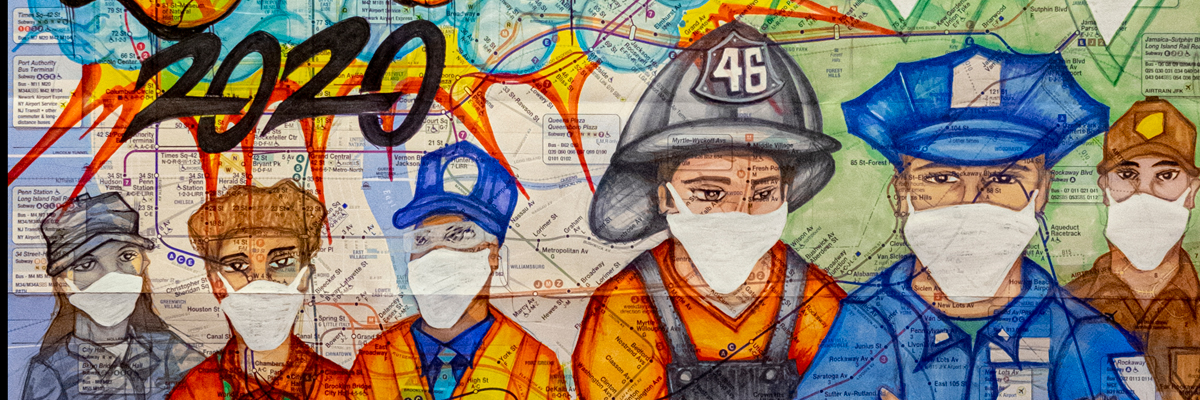
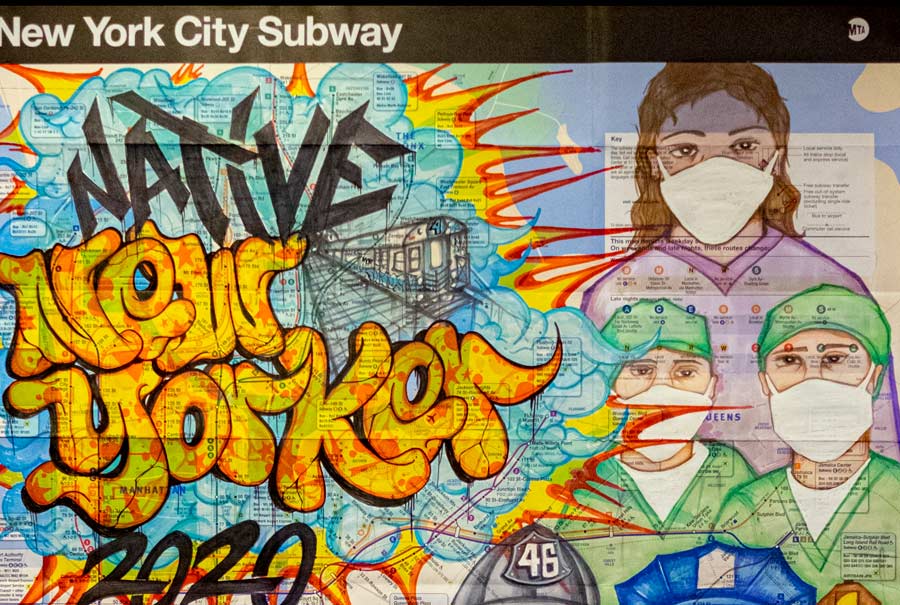
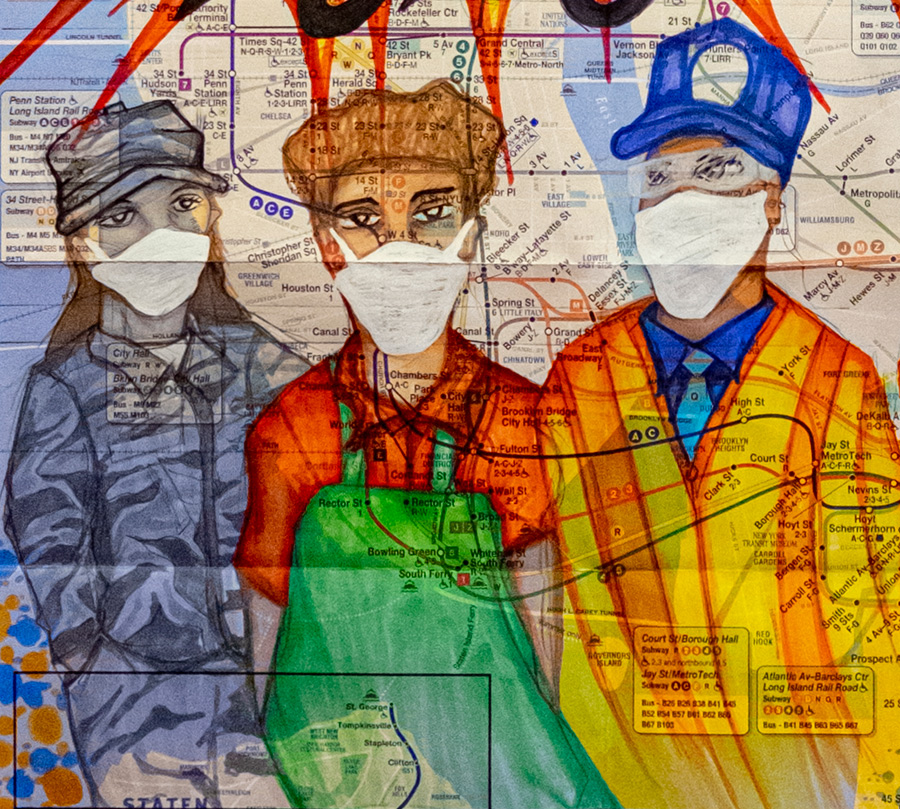
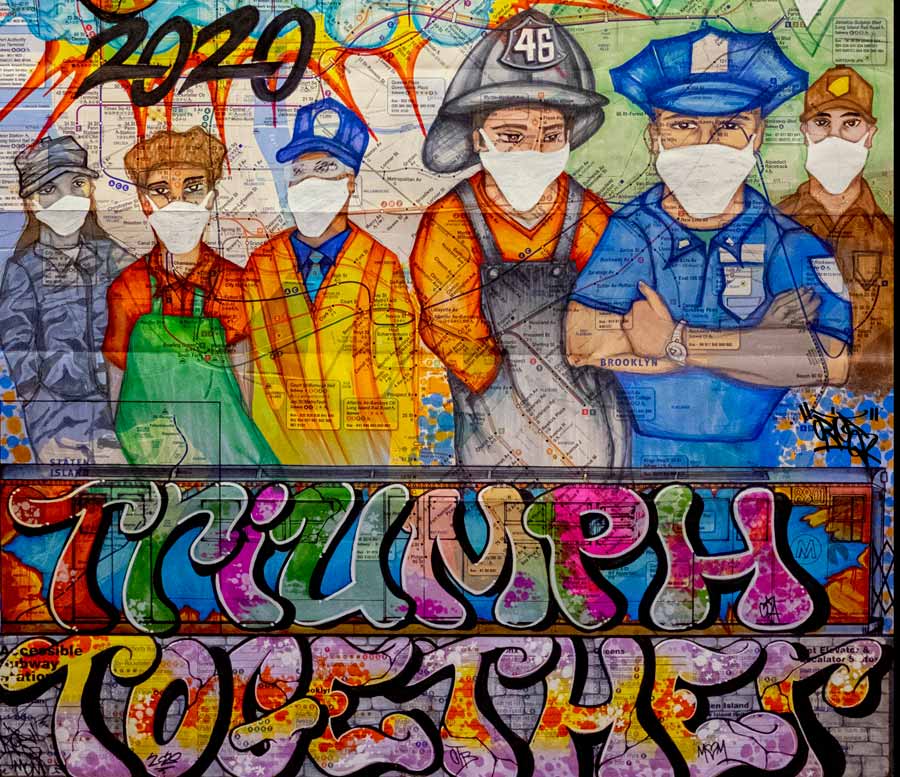
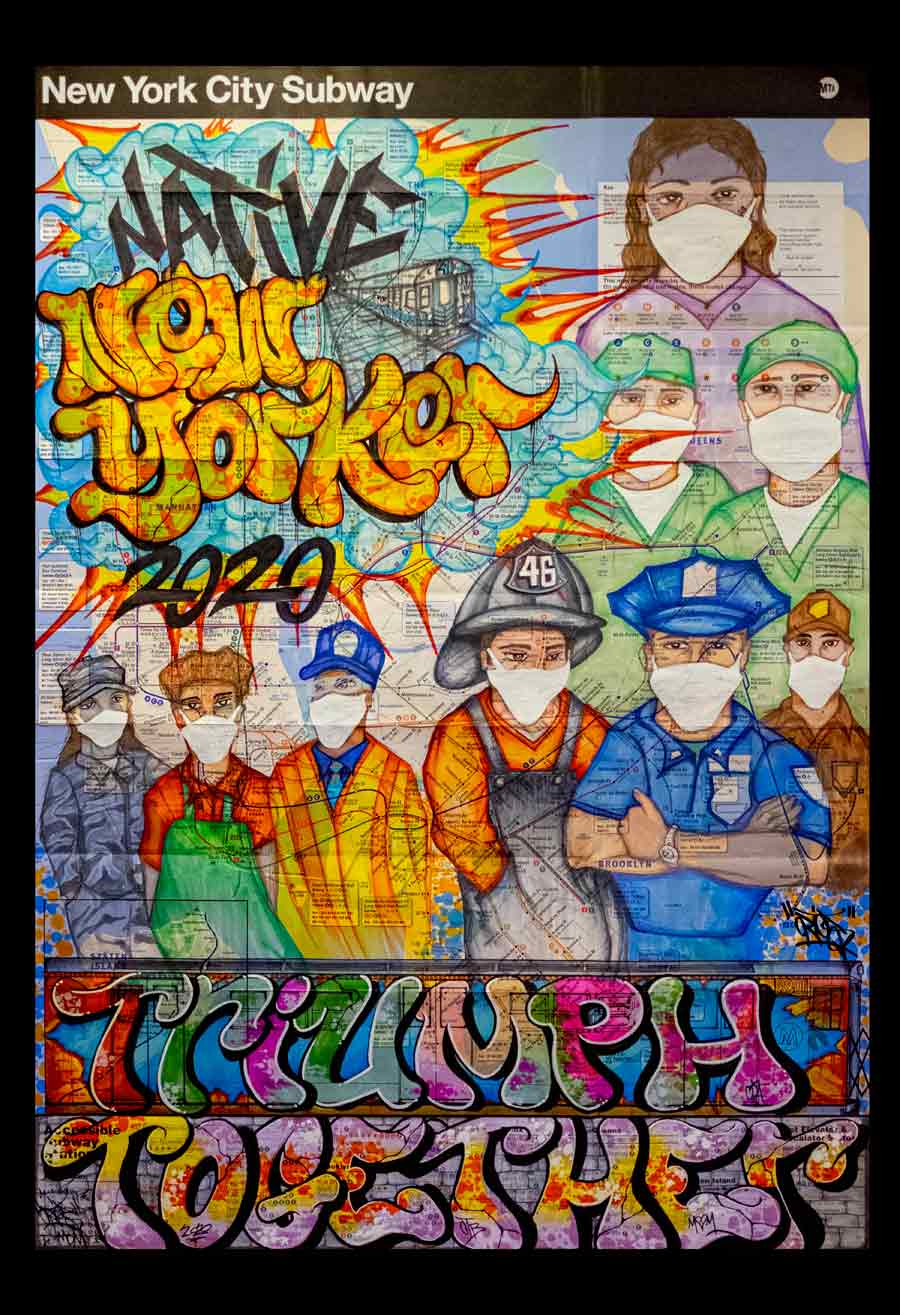
Profoundly moved by the events that Covid-19 has spun into existence here, Rios is sharing with us a dense and meaningful piece of art that speaks to his history, his heroes, his fears, and his passion for this city and the people in it. Using a subway map for canvas, he depicts first responders – in this case people he knows personally or admires sincerely.
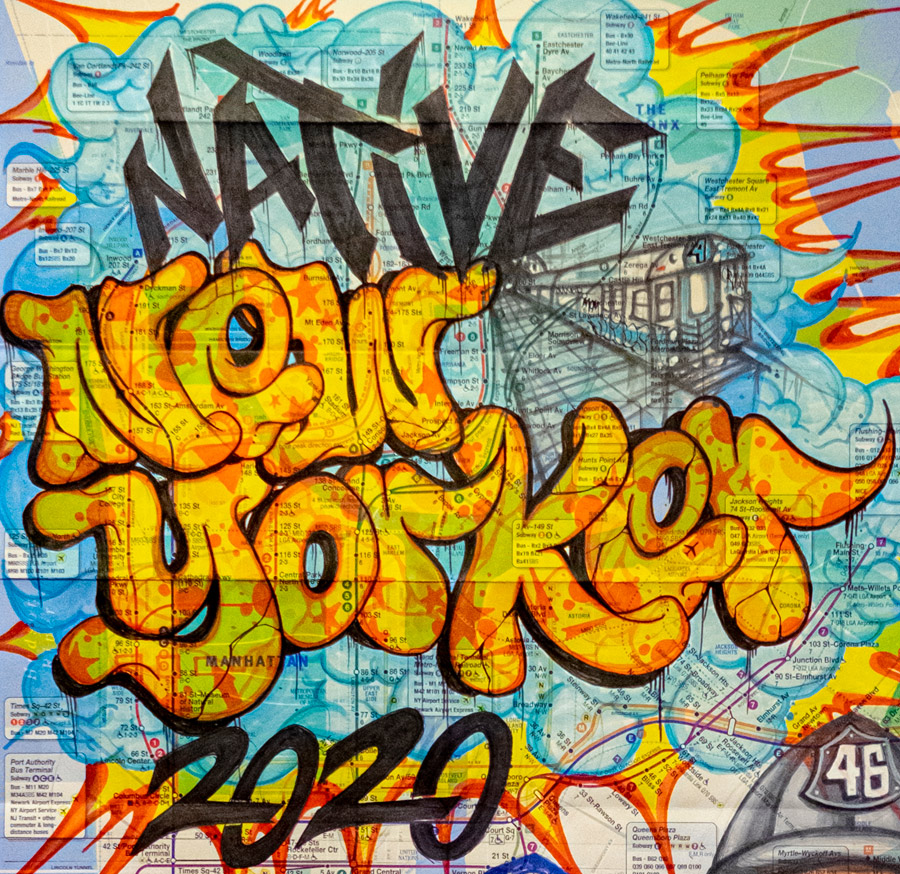
“The image of the nurse is my wife Carol Rios,” he tells us. “She is a Nurse Practitioner at the John Therur Cancer Center in Hackensack, NJ. The police officer is PO Ramon Suarez who perished in 9/11 and who was also my first daughters’ grandfather. The image of the fireman is inspired by a retired fireman and childhood friend from East Harlem who helped at Ground Zero in the days after 9/11. His name is Dennis Mendez. The subway train is an homage to the Late Great Dondi White.”
We asked him more about the creation of and motivations behind “Native New Yorker 2020”:
Brooklyn Street Art: As a Native New Yorker you’ve probably seen and experienced this city being hit hard by different crises while living here: Financial crisis, economic downturns, 9/11 etc…This pandemic is possible New York’s biggest crisis during our lifetimes. What do you think makes New Yorkers get up and fight every day? Oliver Rios: In order to survive you have to be “NY Tough”, to quote Governor Andrew Cuomo! It’s a different kind of toughness that not many people understand. To live in NYC you have to understand and go through the city’s everyday grind! Understanding the everyday hustle, the history, the diverse cultures, the crime, the rats, the pigeons, the parades, the clubs, the bars, the historical sites, the crowded subways, the cabs… everything. Once you live in NYC and understand that lifestyle – to overcome anything is possible.
Going out to party in the greatest city in the world also helps ease the daily stress. We as New Yorkers protect and love the city and that’s why we get up every day and fight!!
BSA: Your work on the poster sends a message of unity and perseverance while at the same time it honors those who are at the forefront of the pandemic. Can you tell us what was your inspiration to create this artwork? OR: This project was really about painting a piece on a subway map. As I tuned into Instagram and join DJ DNice’s “Club Quarantine”, I heard him play “Native New Yorker” by Odyssey , a favorite song of mine. I immediately started with the “Native New Yorker” theme and decided to give it a 2020 version. I wanted to really honor my wife Carol Rios who’s a Nurse Practitioner at the John Theur Cancer Center in Hackensack NJ, my Brother-in-Law who’s a Fireman/Veteran in Belleville, NJ, all the first responders and essential workers dedicating their lives to help fight this pandemic.
I started with my wife who is on the top of the poster and it evolved from there.
BSA: You mentioned that your wife is a nurse. How has it been for the family to see her every day going to work knowing the risks and dangers she will confront at the hospital? OR: It’s an uncomfortable feeling every day, knowing that your loved ones are heading out the door to face danger every day. I try to keep the kids busy with school work and video games as we wait for her to get home to have dinner, watch our favorite TV shows, or play board games. We appreciate all she does and her patients do as well.
BSA:By including some members of your family and friends in your artwork you are honoring them and their work, preserving and commemorating their memory, and at the same time you are persisting with your creativity. How does an artist find the motivation to create works like these in such challenging times? OR: For me, it’s never easy… the inspiration is around me every day in my studio; I have a framed photo taken by Martha Cooper of a memorial mural dedicated to my good friend Juan Anthony “TEE” Castro that I painted during 1993 in El Barrio (East Harlem). On the frame, I have prayer cards of family and friends who have passed away during the years. Next to it I have a photo of my brother who was murdered by gun violence in 1981. My oldest daughter’s grandfather PO Ramon Suarez is there too; He perished saving lives during the 9/11 attacks on the Twin Towers. The UPS worker is the guy I see driving up and down the street delivering packages. Fireman Dennis Mendez is a childhood friend from East Harlem who helped dig out debris at ground zero days after 9/11. The Subway train is an homage to the Late Great Dondi White.
I find that as artists we have to remind ourselves how we are all connected. This is my way to thank and connect to my Native New Yorkers. God Bless!
It involves taking advantage of a monstrous shock to our social and economic system while we are too preoccupied to stop them. People behind corporations actually “game” the future like this – methodically planning to force through changes to society that they always wanted but couldn’t find an acceptable justification for while you were looking. A crime committed right under your nose – while you are worrying about losing your job or paying your rent or your grandma getting sick from Covid-19.
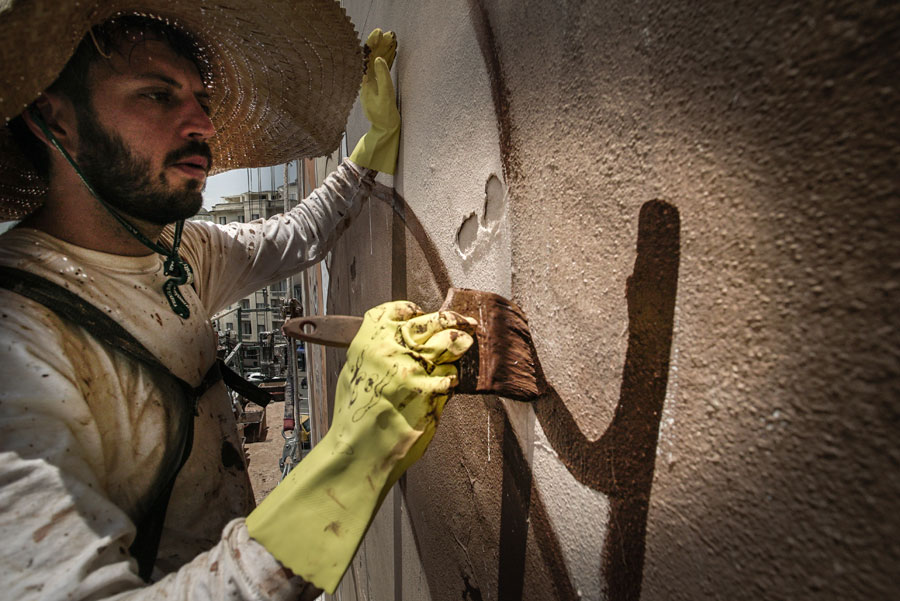
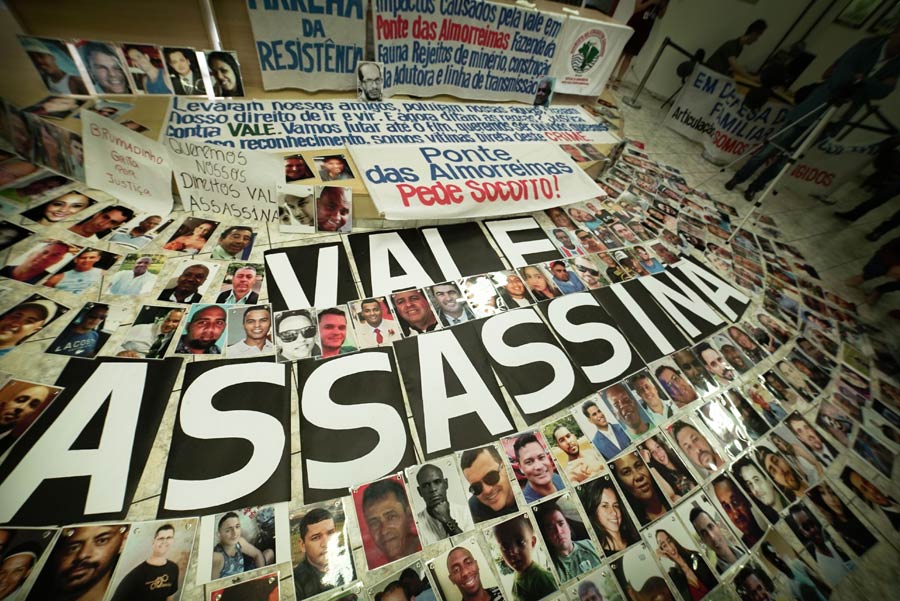
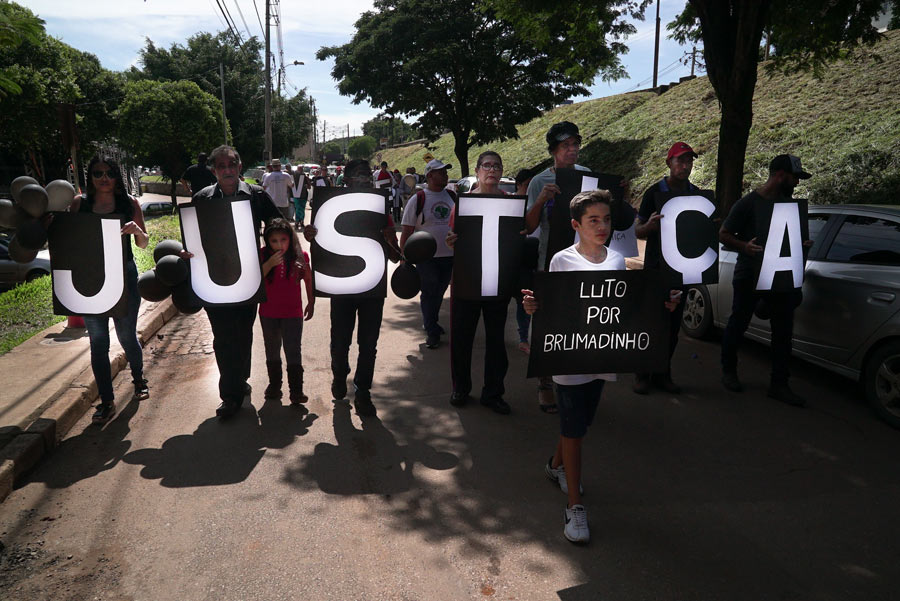
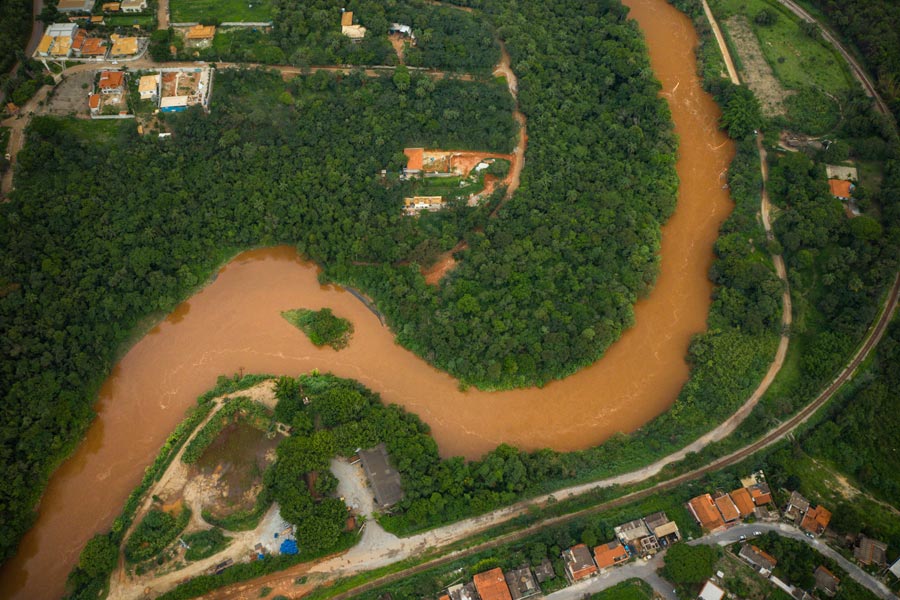
In the case of today’s story of a Brazillian Street Artist named Mundano, the earth, and soil that he used to paint his new mural comes from the region destroyed by a dam break of toxic sludge last January. With hundreds of townspeople and workers swept away by tens of millions of tons of toxic sludge and earth, the people of the area held searches for weeks after and had public meetings full of accusations and fury. They also had funerals.
A similar dam owned by the same company had failed only three years earlier, and many more dams like this are holding immense reservoirs, or poison underground lakes, across Brazil – each potentially breaking apart and poisoning land, water, wildlife, and communities for decades after.
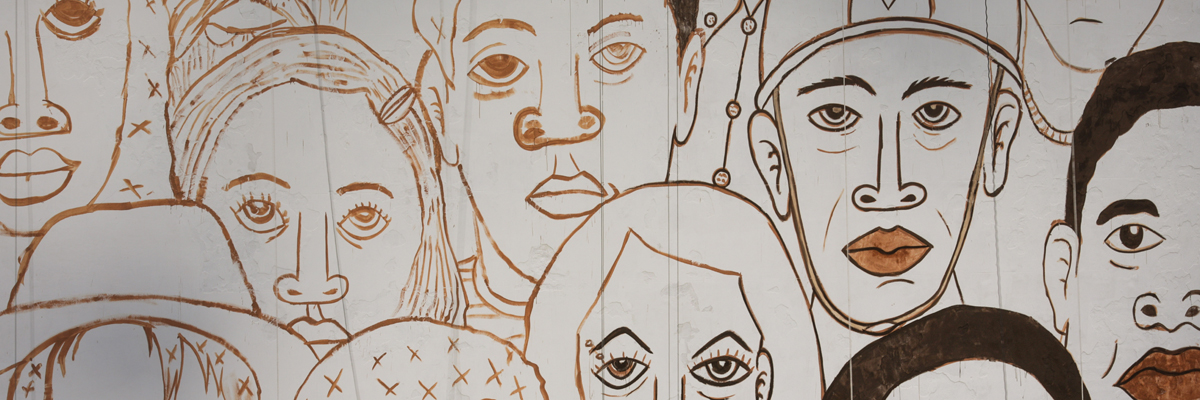
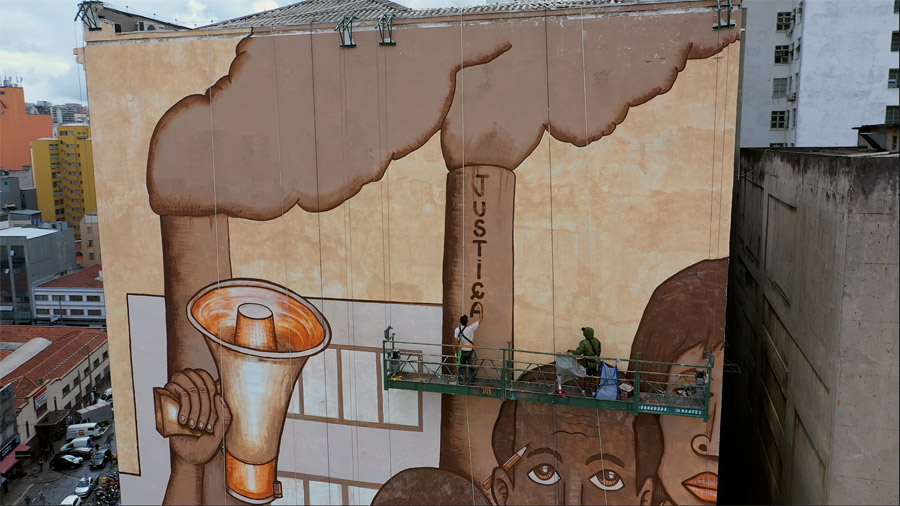
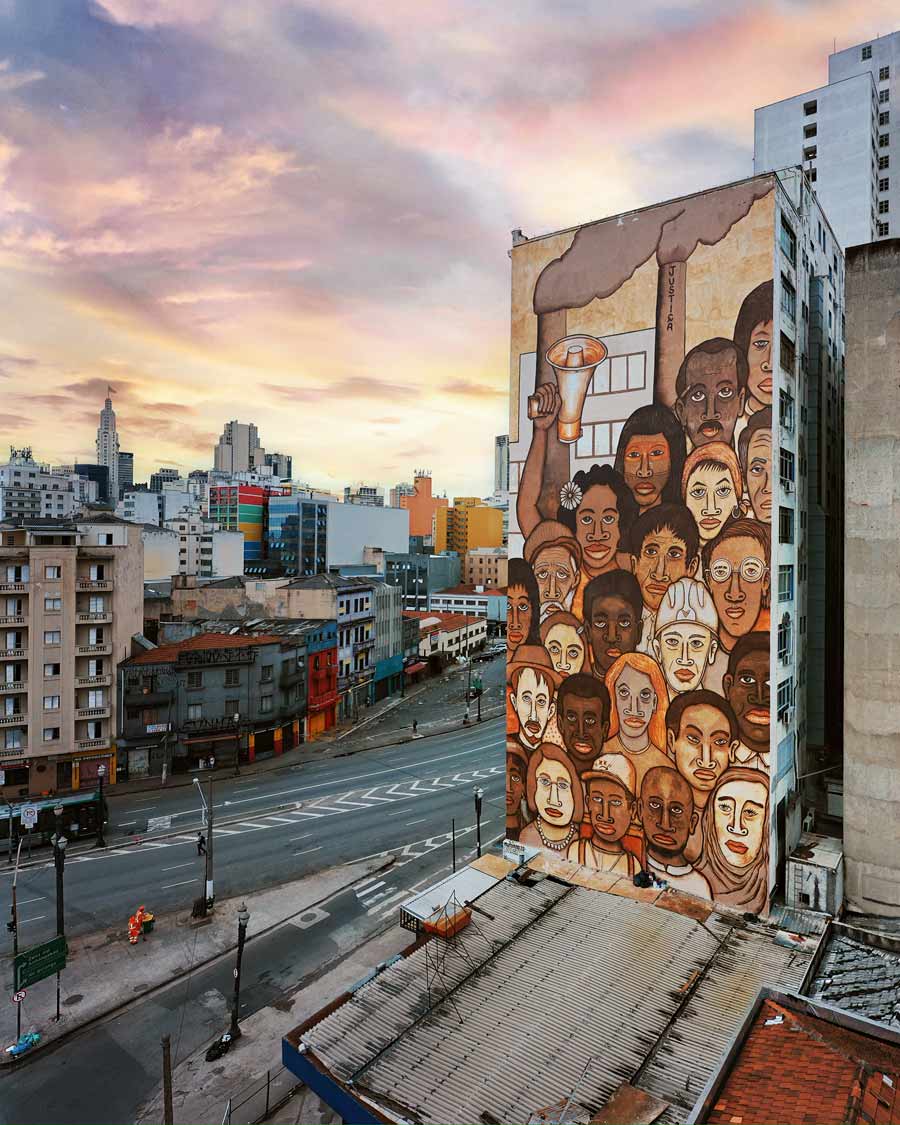
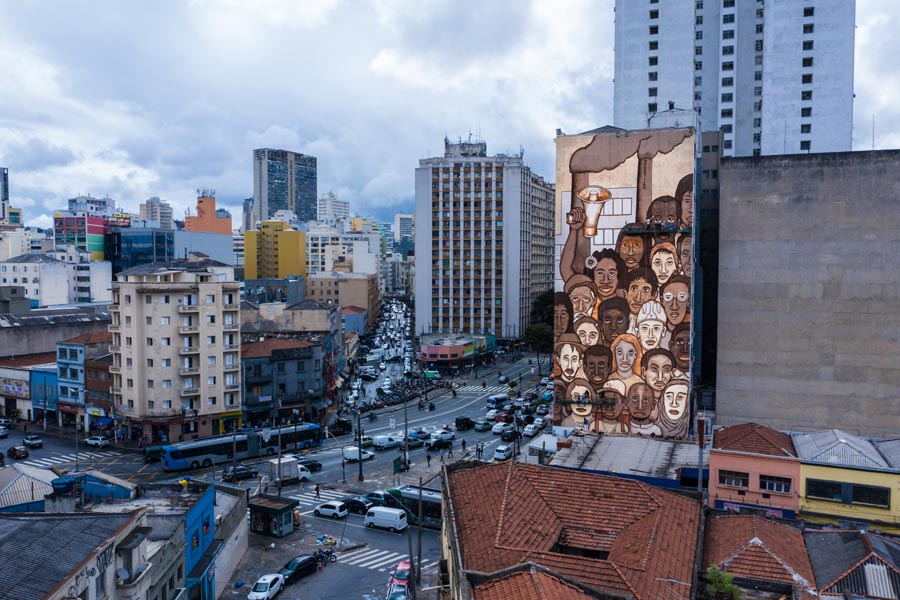
Mundano’s mural honors the workers killed in this man-made environmental disaster and he tells us that the 800 square meter piece references another painting Brazillian modernist called Tarsila do Amaral. Painted in 1933, her work titled “The Factory Workers,” depicts a sea of stern faces with gray clouds rising from factory smokestacks in the background. Mundano says he’s proud of his mural, of the mini-documentary here, and of his neighbors and country people who have raised attention to a situation that appears corrupt, and well, toxic to life.
“In January 2019, Brazil has suffered one of the worse environmental crimes of its history,” says Mundano, “when Vale do Rio Doce’s mining dam broke, contaminating the Paraopeba River with a sea of toxic mud, and killing everything that was in the way, including almost 300 people who lost their lives that day,” he tells us. We talk to him about artists using their work to educate and raise awareness to advocate for political or social change, a term often today called ‘artivism’.
Brooklyn Street Art:With reason, there’s a lot of anger against the government and the owners of the mine about this fatal catastrophe. How did you get involved? Mundano: The environmental and social causes are a big part of my activism or artivism, and I’ve always been a critic of the exploitation of lands for mining purposes. We have over 200 mining dams operating today in Brazil under the risk of breaking. In the last four years we had two of the biggest catastrophes of our country, both in the state of Minas Gerais; Mariana in 2017 and most recently in 2019 in the city of Brumadinho, where a “tsunami” of toxic mud contaminated the Paraopeba river with 12.7 million cubic meters of sludge, dragging everything that was on the way, including almost 300 people who lost their lives.
As an artivist it is really important for me to be present and see what happened with my own eyes, feel the pain of the victim’s families, follow closely to the inquiry and use the platform and reach that I have as an artist to help these people find justice, and most importantly to put pressure on governments and big companies so that they’re held accountable, preventing this from happening again.
Brooklyn Street Art:What is the role of an artist should be in his/her community? Should art respond to social needs? Mundano: For over 13 years now, I’ve been practicing artivism in several cities across the globe. My actions and the art I create need to have a bigger purpose. For me, art has the power of bringing reflection into society and impact people’s lives, make them think and reflect on their part in society. That’s how I see my art and how I believe I can contribute to bigger causes. I wouldn’t say it’s every artist obligation, but with these huge global challenges naturally we’re gonna need to become more artivists.
Brooklyn Street Art:The community felt betrayed and abandoned by those who were supposed to protect them. How did they get the strength to rise up and fight in the middle of their pain? Mundano: I can’t speak for them but I feel that they don’t have other options than to fight for their rights. Brazilians are quite resistant to adversities by nature. One of the main subjects of my work is the cactus, a plant that, like a big portion of our population, survives with little and still manages to share beauty with flowers to the world. It is hard to see a whole city and it’s people destroyed by such a horrible crime, yet, it was such a strong image to watch mothers, wives, sons, daughters, and friends united, marching a year later, screaming for justice, not giving up on the memories of their loved ones. That gave me strength and inspired me to create my biggest and most important work up until today to honor them.
Brooklyn Street Art:Your mural honors and remember those whose lives were lost. Yet there’s some poetic beauty in it with the pigments you used to paint it. You made the paint from the sediment in the river and the earth around it. What were your feelings as you were painting these people faces these materials? Mundano: The whole process of collecting the mud from the lakebed of Paraopeba River was delicate. I felt the need to talk to residents, local activists, and the families. It was important that I had their consent and that they understood my intentions. The mural was a way of keeping the subject alive, and to honor them in one of the biggest cities in the world, Sao Paulo. I believe that the respect I’ve shown was recognized as I started to receive messages from Brumadinho’s residents about the video, thanking me for the painting, and for me, that’s the biggest recognition of all, it made it all worth it.
“Sociologist,
psychiatrist, and anthropologist – probably in that order – DONT FRET is more
invested than you may appreciate at first, and the underside of American
division and inequality bubbles quickly to the surface when he is asked if the
country is beyond class.
“Whoever is saying that clearly has the luxury to do so.
Look at our cities,” he says.
~ Steven P. Harrington in the introduction to DONT FRET’s monograph, “Life Thus Far”
His Brooklyn residency has been a blur full of old buds from college, new bars in Bedstuy, and of course, sausage makers. He stands in the middle of an artist’s hazard zone of crumpled paper, opened pots of paint, and discarded laundry with brush poised in hand describing his recent quandary about finding a meat mecca in Bushwick and realizing that he couldn’t buy everything he saw once he spoke to the owner.
“She just started her own sausage company and we
definitely want to do collaborations,” he says. “There were so many sausages at
her place that I wanted to buy.” So you know he’s feeling comfortable here,
surrounded by fine meats.
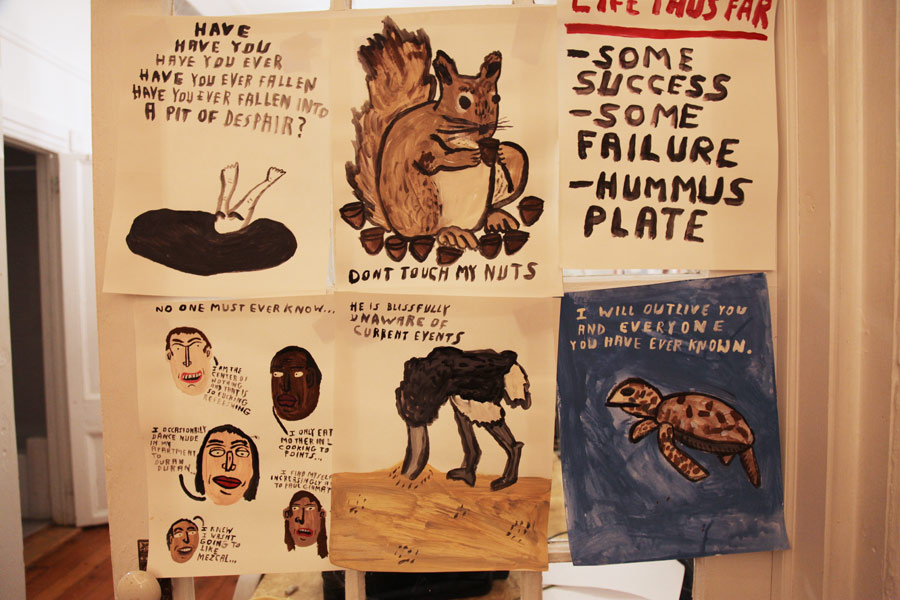
His characters are all here, wondering aloud about physical
insecurities and decoding social navigation; cryptically critiquing the
absurdities of our class system and the underlying savagery of corporate
capital and the perverting power of cloying advertising across the culture. In
so many words.
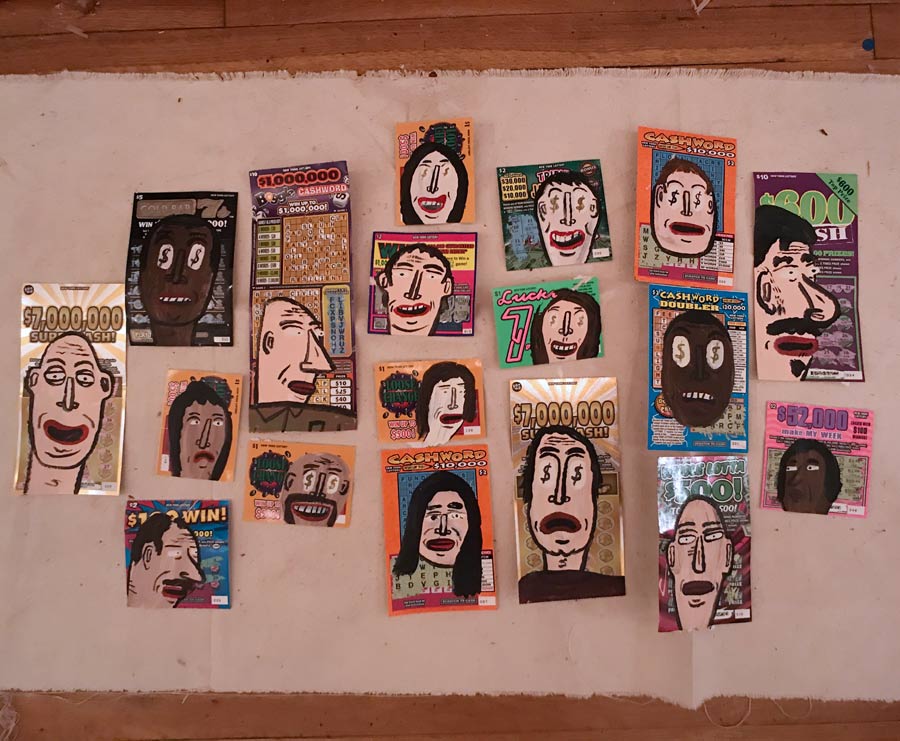
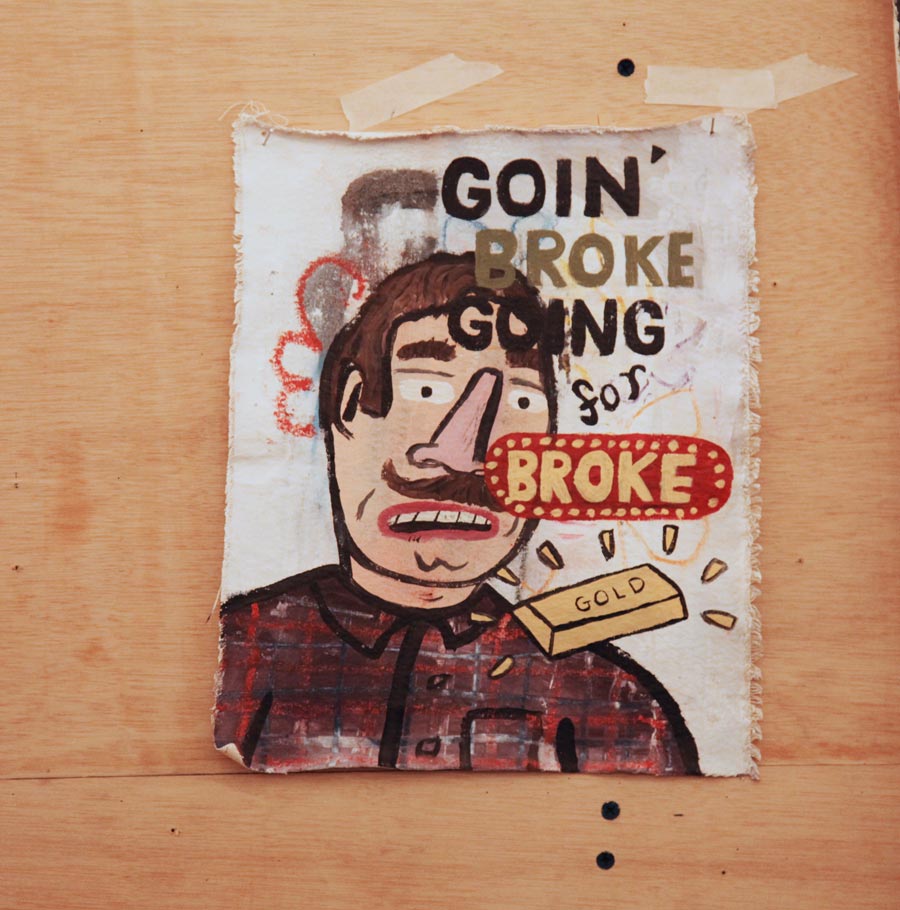
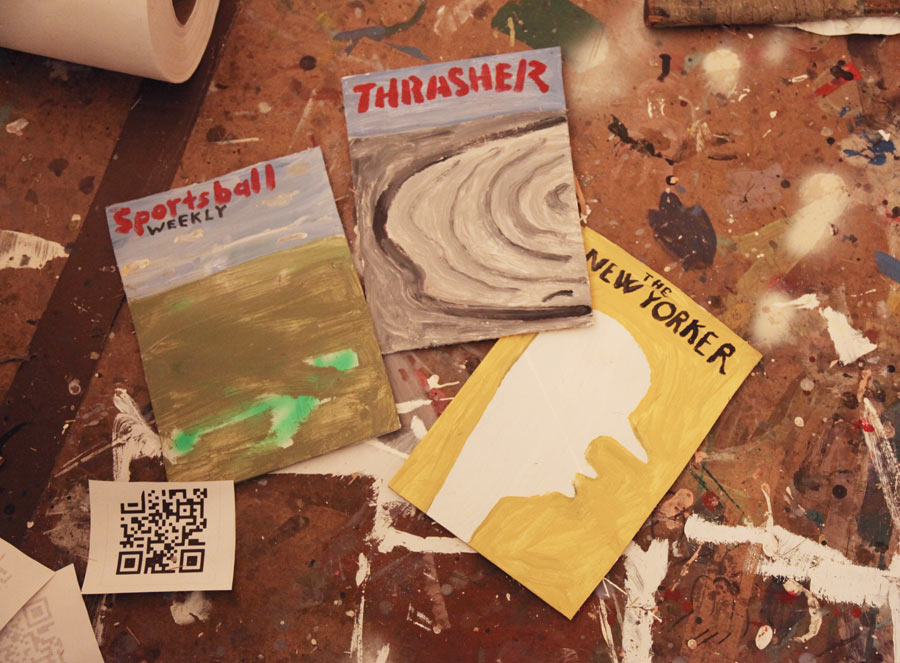
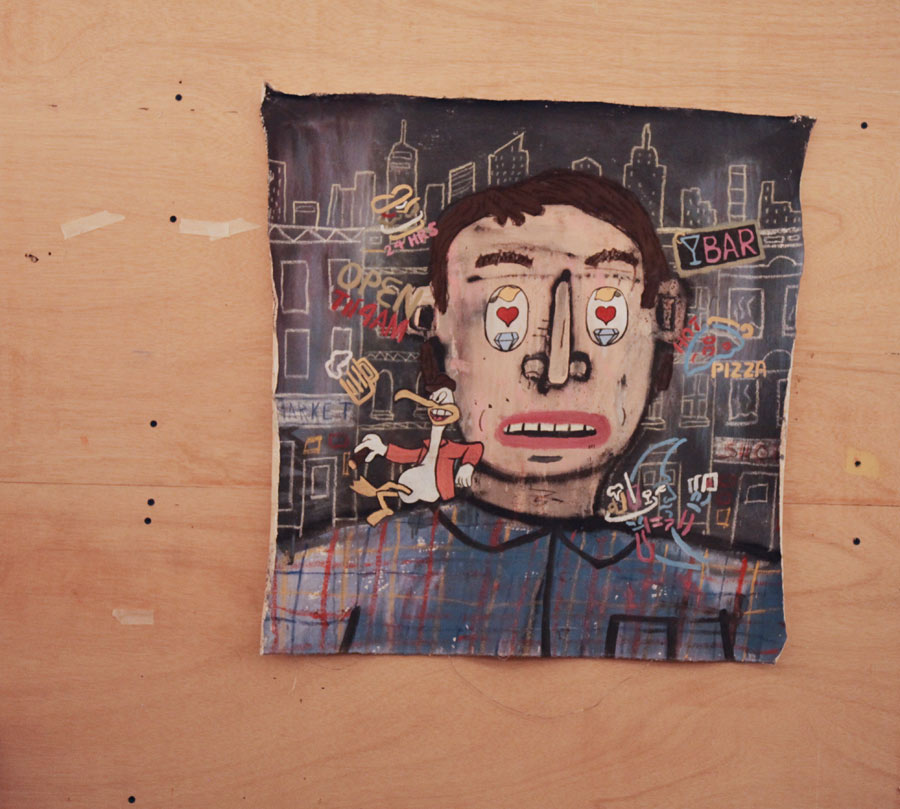
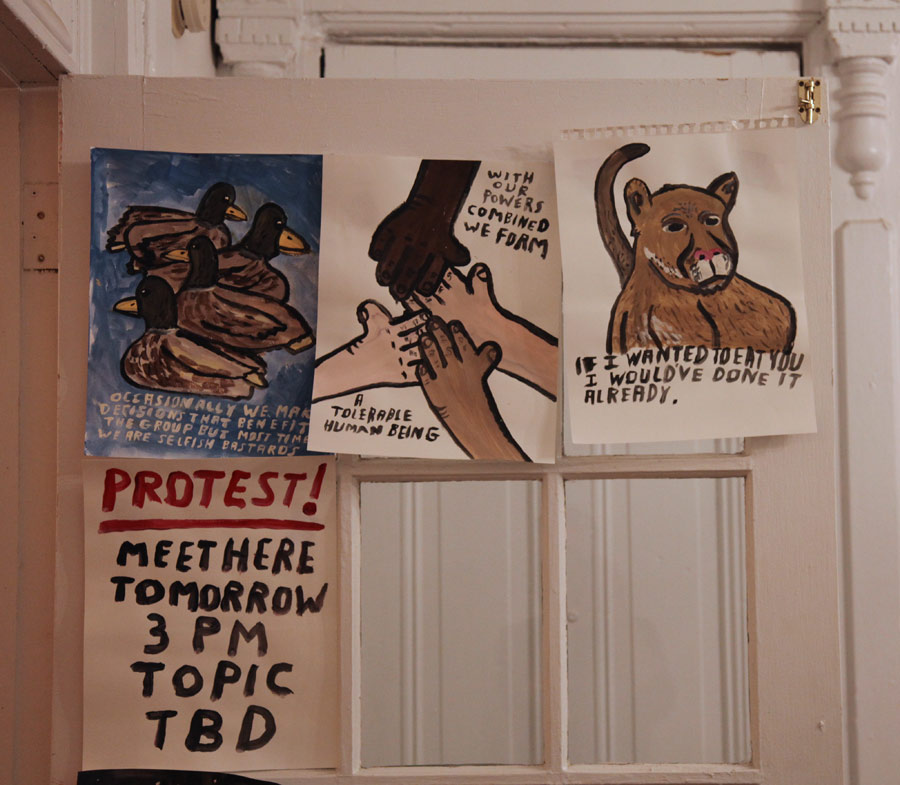
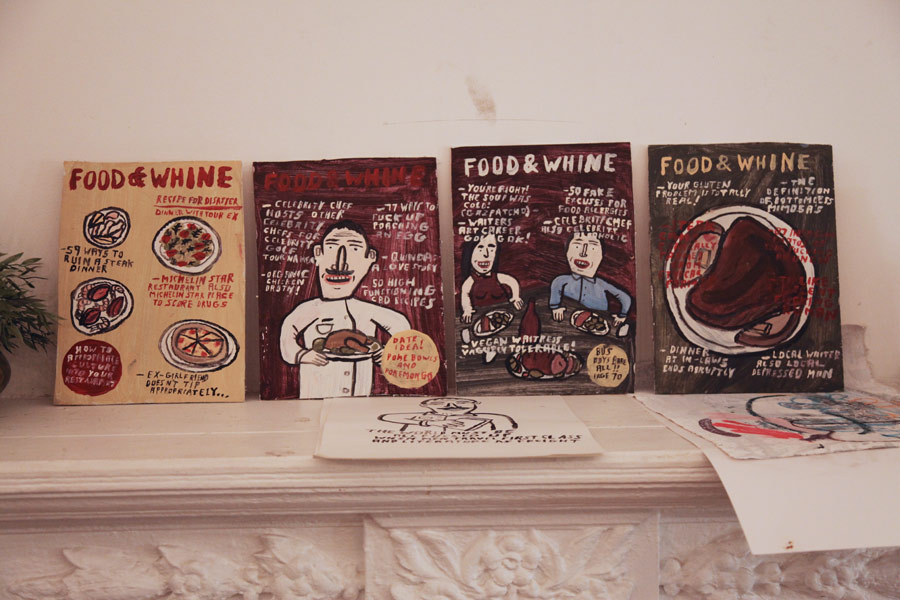
Some hand-painted posters are still wet, some boards for future magazine covers (Thrasher, Sportsball Weekly, The New Yorker) have backgrounds prepared for him to paint featured personalities, a scattered pile of painted lottery players are grinning gamely from shiny Lotto cards, and larger new canvasses are built up with dense color and swarming symbols that dance around the heads of his imagined sitters.
“In this kind of stuff I wouldn’t say it’s autobiographical but they are definitely my generation of people navigating the city, looking at life and nightlife,” he says as you look into the rolling eyes of figures that have transformed into slot machines, perhaps hoping to win the jackpot. He points to his enthrallment with “The Simpsons” as he grew up and sees the bewildered savviness of the players in himself and in most of his peers as they navigate “adulting”. It’s chaos, but an entertaining one.
“There are clips of the Simpsons that go around in my head
again and again,” he says. “There is one with Bart and Millhouse find twenty
dollars and they get a Super Squishy, which is basically a crack squishy, and
they go on this bender,” which makes him laugh. He turns to the blottoed bloke
on his new canvas and describes the scene.
“It’s like a song and dance. They’re singing (and he breaks
into singing) Springfield! Springfield! It’s a helluva town! – and there is
this scene of them wandering Springfield,” he says.
You can see this is a stand-in for this month in the BK in this case and DONT FRET’s active imagination about the lore of this dirty metropolis. “You see this neon popping up, and the animation just swirls. And then it just wakes up to Bart, hungover in bed.”
“I don’t know, I always just like those images. For me, these are like Brooklyn and Manhattan,” he says with glassy star-struck dizziness in his eyes.
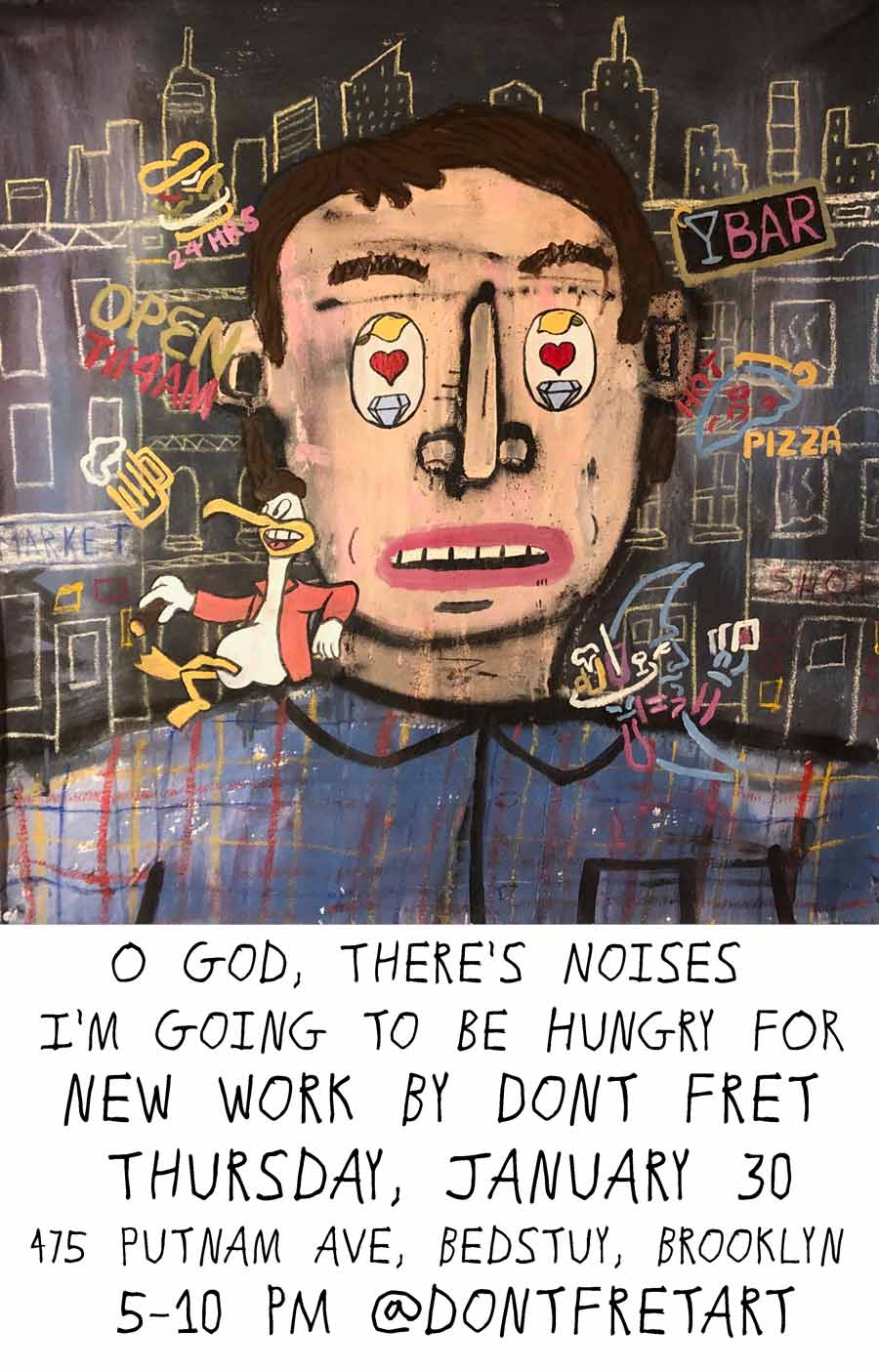
Catch DONT FRET tonight at his opening at the Bedstuy
Artists Residency, and you can swirl around colorfully with other symbols of
this time, and this electrified city full of promise. BSA co-founder will be there to sign his
introduction essay inside fresh copies of “Life Thus Far”, DONT FRET’s giant
new monograph.
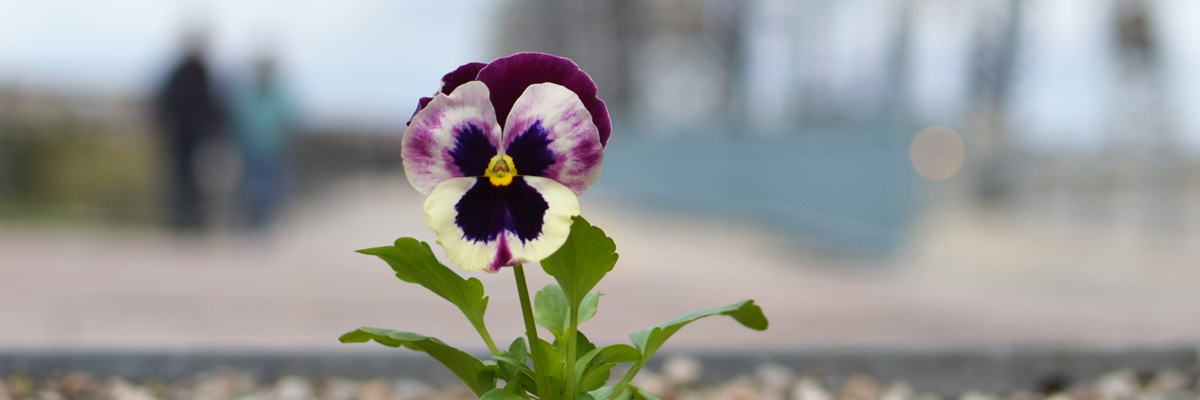
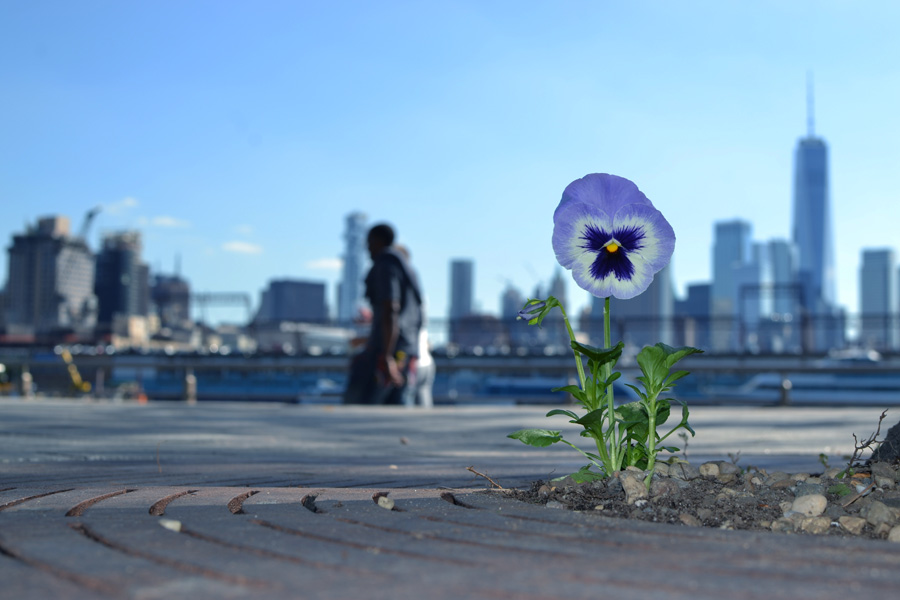
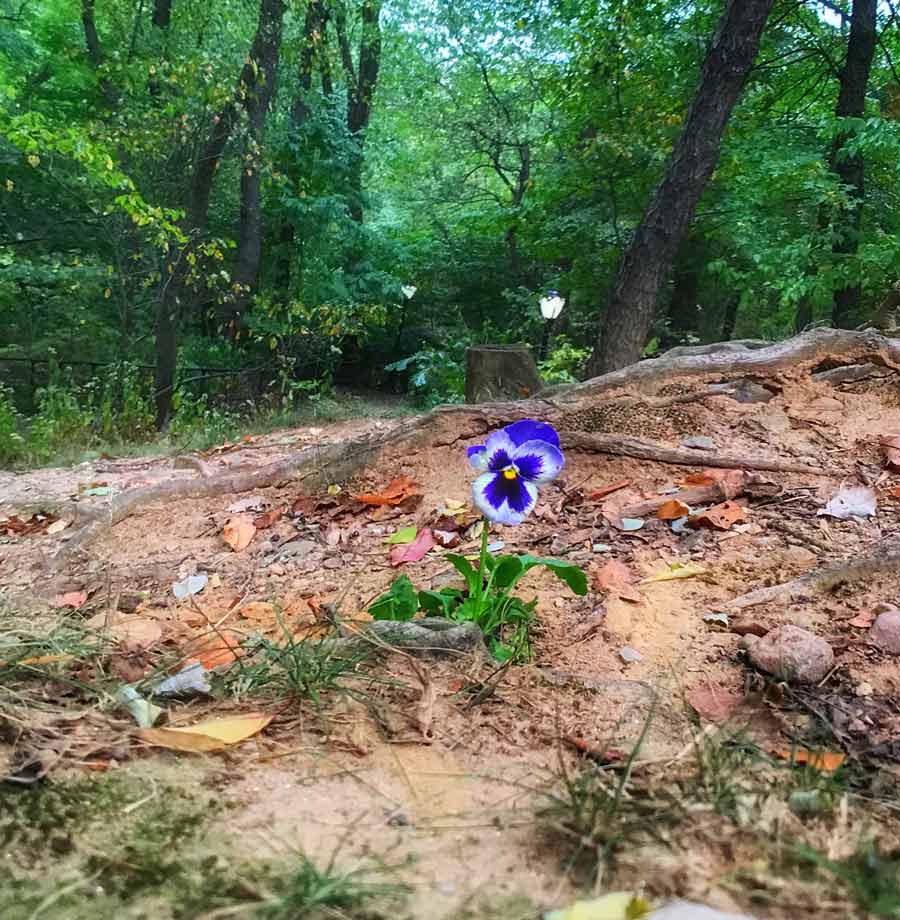
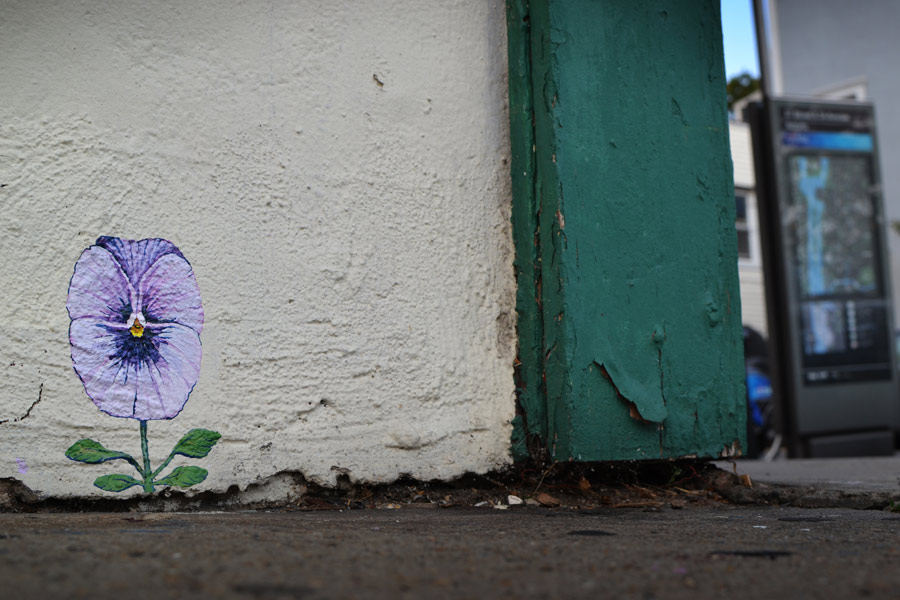
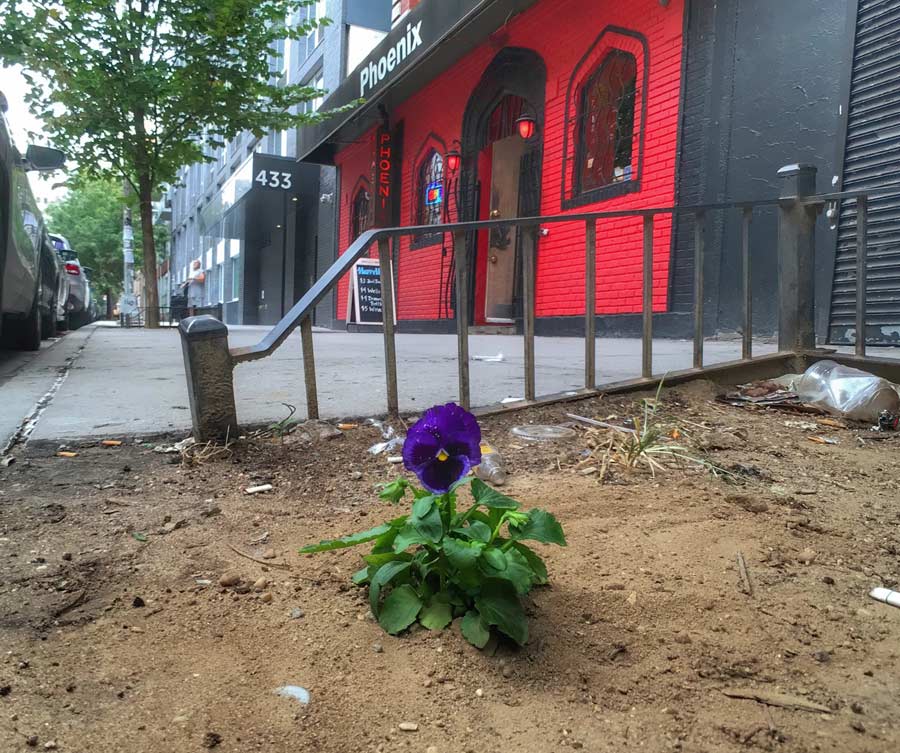
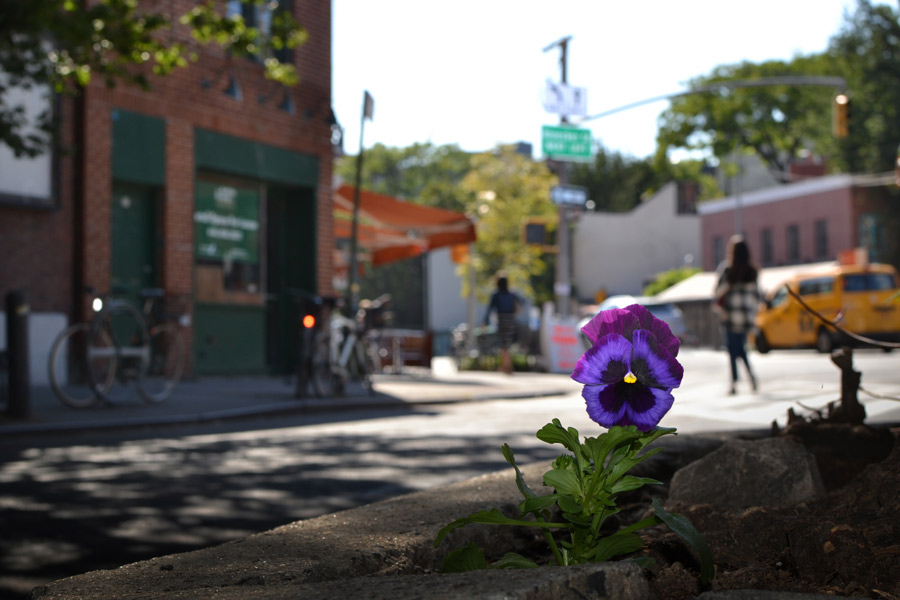
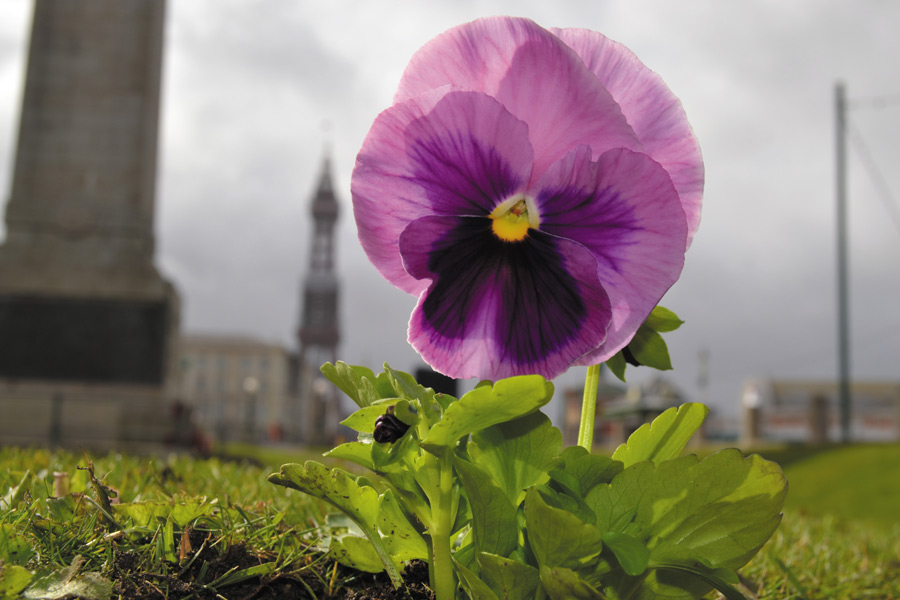
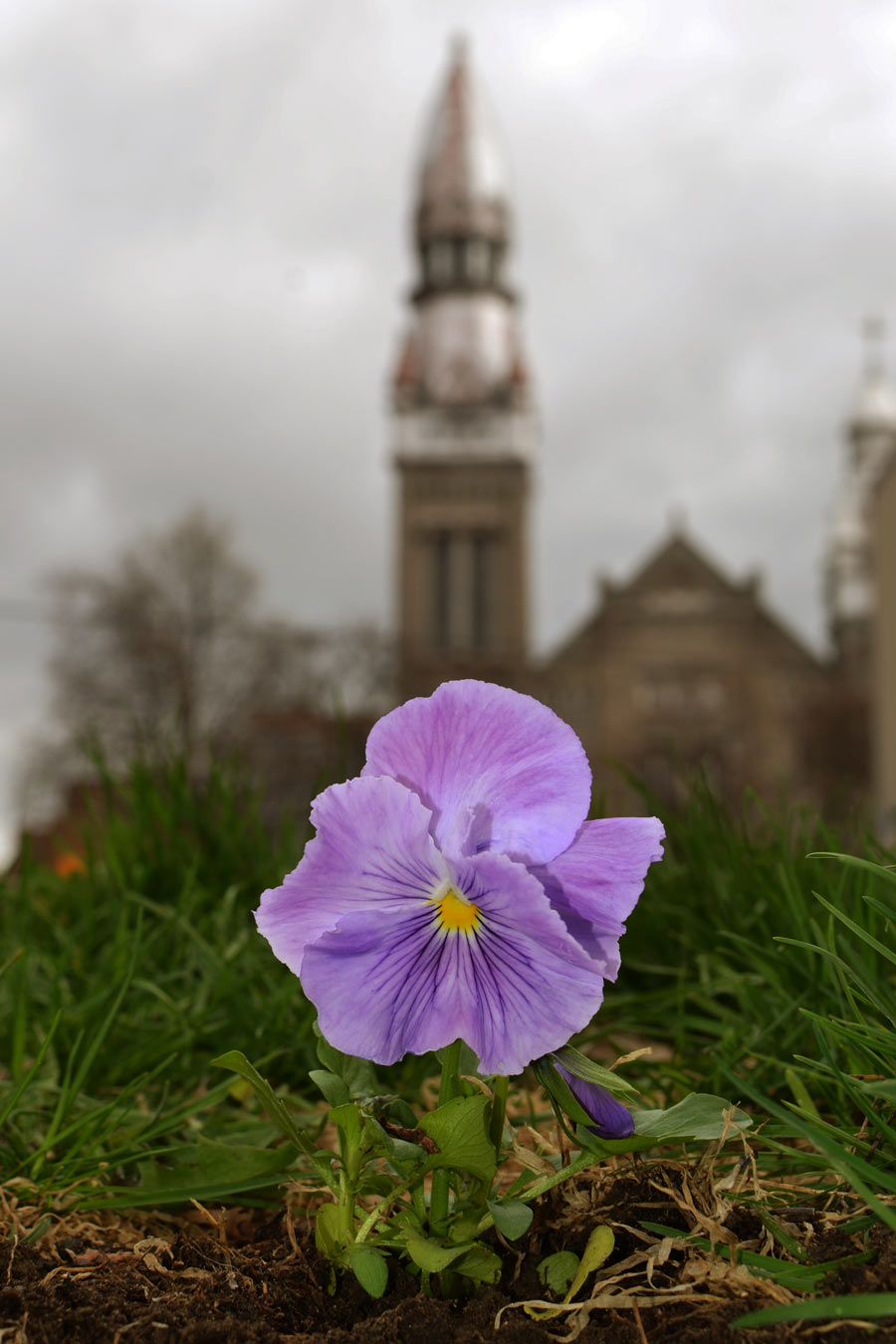
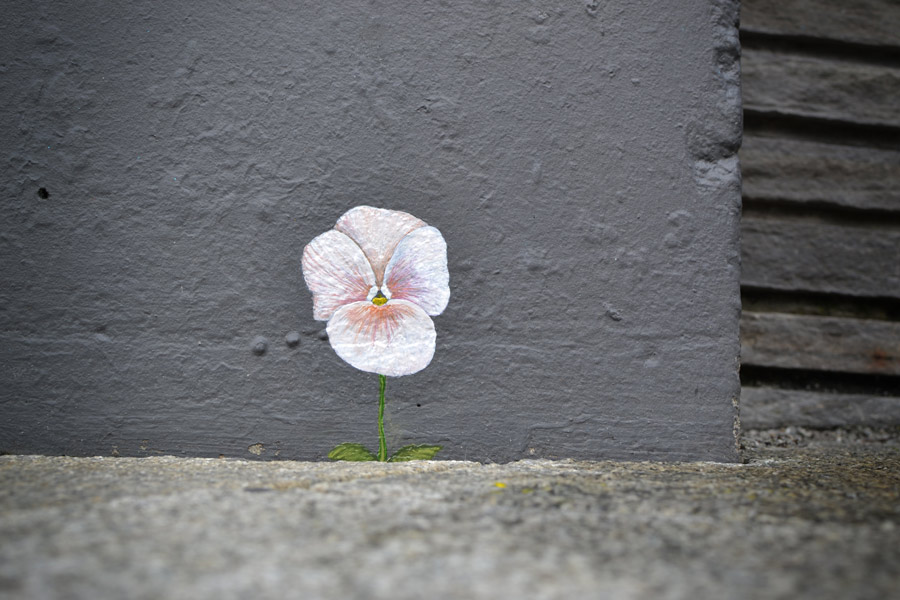
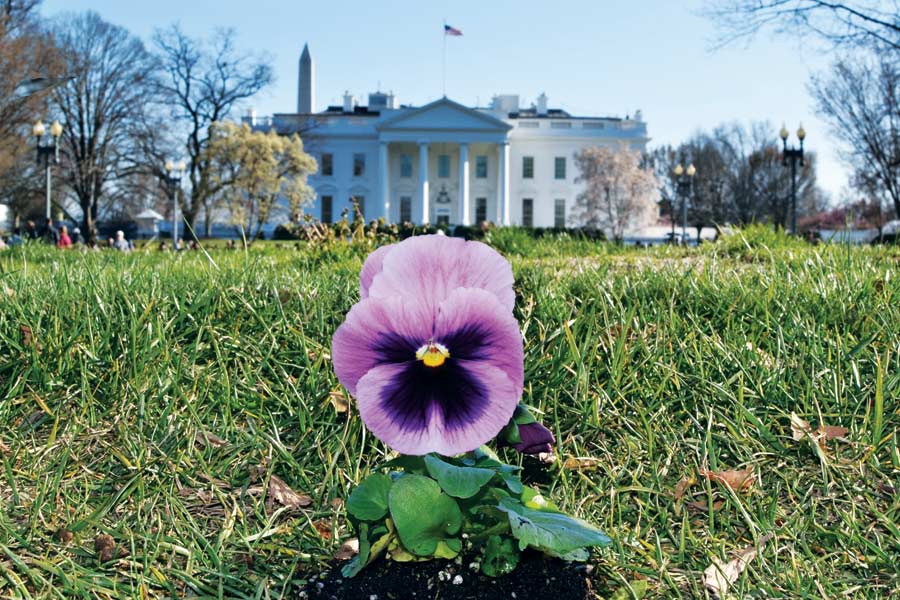
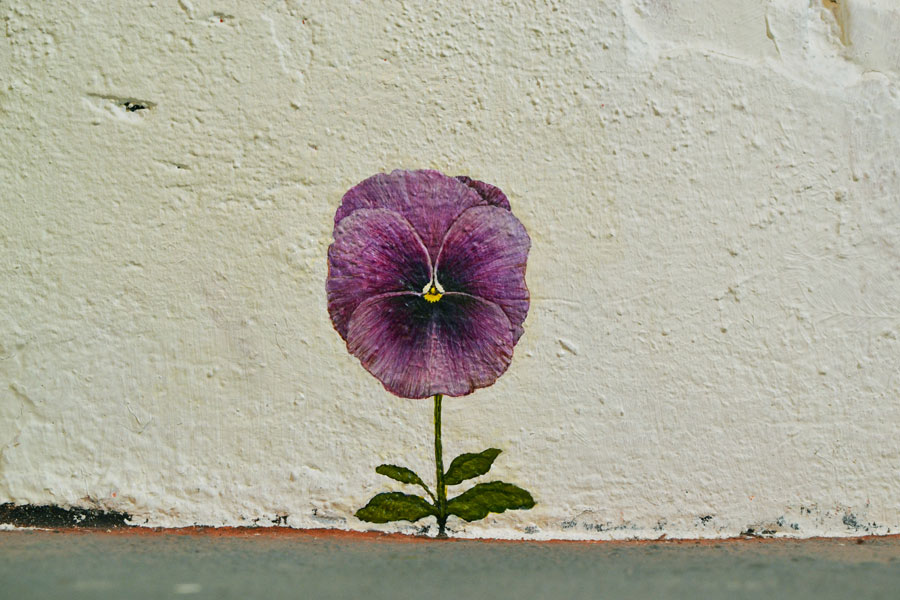
A unique private/public protest/memorial to raise awareness since 2005, the founder of The Pansy Project has planted the namesake flower, in some circles a pejorative term against gay boys and men, in thousands of locations around the world to commemorate a place where violence or intimidation toward LGBT people took place. Where it is difficult to find a good place to plant or to buy live pansies the gifted illustrationist simply paints one.
Understated and symbolic, the political and personal Street Art act bears witness to the brothers and sisters and others who society fucks with because they don’t fit traditional expectations of gender conformity. After nearly a decade and half, Paul says he will keep doing this work until it’s not necessary. You’ll probably need to help.
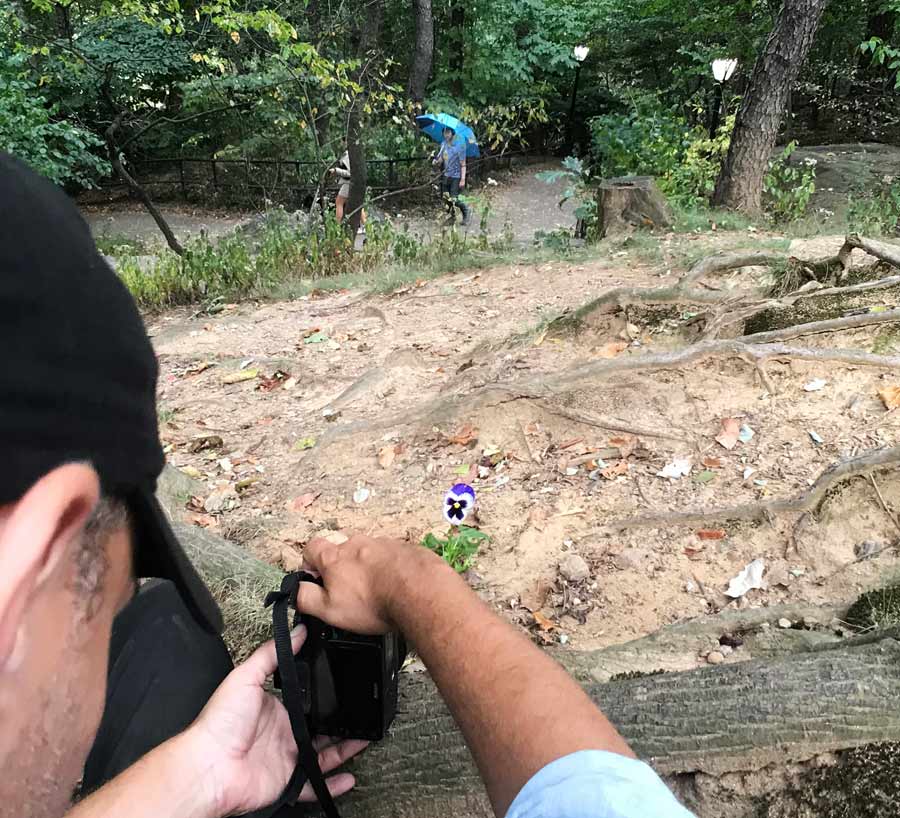
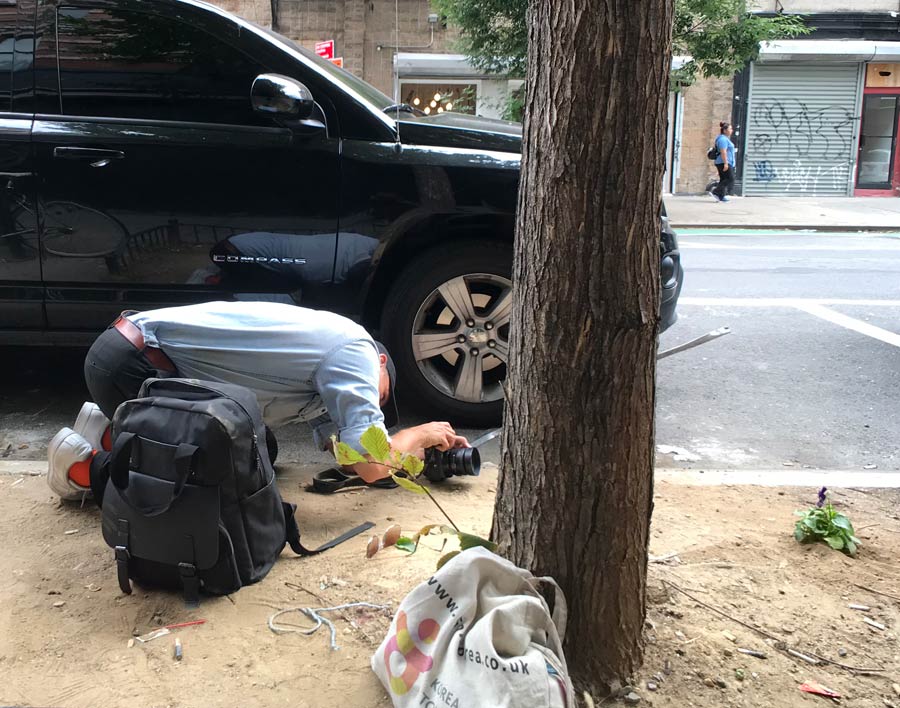
Recently we spent time with him on his visit to New York,
watching him plant pansies and asking him questions about his practice.
Brooklyn Street Art: When we think of monuments to historical events we often place them in locations that correlate with things that happened there. Can you talk about the similarities that this act of planting an ephemeral flower has to huge hulking brass statues in recalling our feeling and our memories?
Paul Harfleet: When I began to think about how to respond to my experiences of homophobia on the streets, I became interested in the particular nature of my memories of these attacks, they were rapid and fleeting and therefore I felt my response should be temporary and non-permanent. It felt archaic and overly municipal to begin making ‘permanent’ memorials to my own relatively minor attacks. A small unmarked living plant would add to the conversation, the flower could live and grow as I do through my experience. A tiny pop of color, unsanctioned by the city would reflect my own apparently illicit position in the urban environment.
I’m interested in how ‘permanent’ memorials became invisible over time*, their meanings sink into the fabric of the city, they become street furniture, their significance evaporates over time, unless they’re re-activated by an occasion or anniversary. Particularly when flowers are placed at war memorials, this and floral road-side memorials are echoed in The Pansy Project.
The
exact location was loaded for me, so it was essential that each place
should be altered by my intervention, it’s this that transformed how I
remembered the streets. The ritual of planting a pansy has become a
performative reparation on the street.
Brooklyn Street Art: Do you know of someone else who was inspired by your project and began a new one of their own?
Paul Harfleet: It’s difficult to know if and how my work has inspired others. I know that people have planted pansies to mark their own experiences of homophobia and I’m aware of some students that have made very different work that has been informed by The Pansy Project which is humbling.
I
am aware of other actions that explore homophobia, I was touched by the
work of Nando Messias, “Sissy’s Progress” is a performance where the
artist revisited the location they were attacked with a marching band,
though I don’t think they were informed by the project, I enjoy the
absurdity of the response to homophobia, which in itself is an absurd
reaction to difference.
Brooklyn Street Art: In the US we have had a serious and fiery debate about historical memorials that glorify a period of racism, a sort of glorification of figures who championed racism. How does our perception change when we learn about the significance of location and events that took place there?
Paul Harfleet:This has been an fascinating debate, it challenges the idea of a memorial becoming invisible*, this is an example of the memorial being re-activated by context. I think it’s invaluable to have these discussions. It’s a shame that the debate seems to be so binary; keep or destroy. As an artist I would be interested in reinvigorating these memorials rather than removing them.
The fact they celebrate the achievements of a racist society should not be forgotten, it should in my opinion be remembered and challenged through art and education, small additions or amendments to these memorials could re-contextualise their meaning, there is an opportunity here to allow these memorials to a racist culture to become something that acknowledges the behavior of previous generations and act as a warning to future ones. We only have to look at the fragility of human rights at the moment to know how important it is to retain knowledge of previous injustices.
Brooklyn Street Art: When one considers the long period that this campaign has persisted, you may wonder how Paul Harfleet continues to have enthusiasm for it. Do you ever lose interest? What inspires you to get back to planting pansies after you discontinue for a while?
Paul Harfleet: I’ve been working with The Pansy Project for almost fifteen years, for me the repetition is vitally important for how the work is read. Everyday someone is experiencing homophobia or transphobia, whether it’s micro-agression, government sanctioned or the most violent of murders, it’s always happening, so I feel I have a responsibility to continue using my art to highlight this injustice.
I’m not completely altruistic, I do have to maintain my own interest, through the project I’ve explored various ways of working from garden, jewellery and merchandise design to the writing and illustrating of a book; Pansy Boy that reveals The Pansy Project in a completely different way, most recently I’ve been exploring painting the pansies on walls where homophobia has happened.
All of these actions keep me interested. I am always trying to take the ‘perfect’ picture and document my work in new ways. I’m inspired by artists that work in very similar ways their whole careers, Sean Scully speaks about repetition; ‘I want to express that we live in a world with repetitive rhythms and that things are existing side by side that seem incongruous or difficult.’
Brooklyn Street Art: New York has an incredible story in the modern LGBTQ rights movement. Can you tell us about one of the places in New York where you planted a pansy that was particularly meaningful to you?
Paul Harfleet: My visit to New York was incredibly important for me, unusually I funded this visit myself. I usually wait until I’m invited by a festival or for an exhibition, though I wanted to be in New York during the fiftieth anniversary of Stonewall. I first came to New York in 2006 to plant pansies for the Conflux Festival.
These were the very early days of the project, some of the photos I took then were bad, since then I’ve gotten better at taking the pictures so I wanted to re-plant and document the pansy I planted at the Stonewall Inn to properly mark this historically significant location. Though I also planted new pansies, it was moving for me to plant one at Christopher Street Pier for Marsha P. Johnson, their life and death was complex and seeped in the injustices of time. This seems even more significant in America today when black trans women are so under threat.
As I write, we await the decision by the US Supreme Court on working rights for trans people, the fact that there’s even a discussion about this is an anathema to me. To quote the hashtags; Trans rights are human rights, we’re not equal until we’re all equal. In the US alone there has been 19 reported trans women murdered in 2019 alone – It’s staggering and heartbreaking.
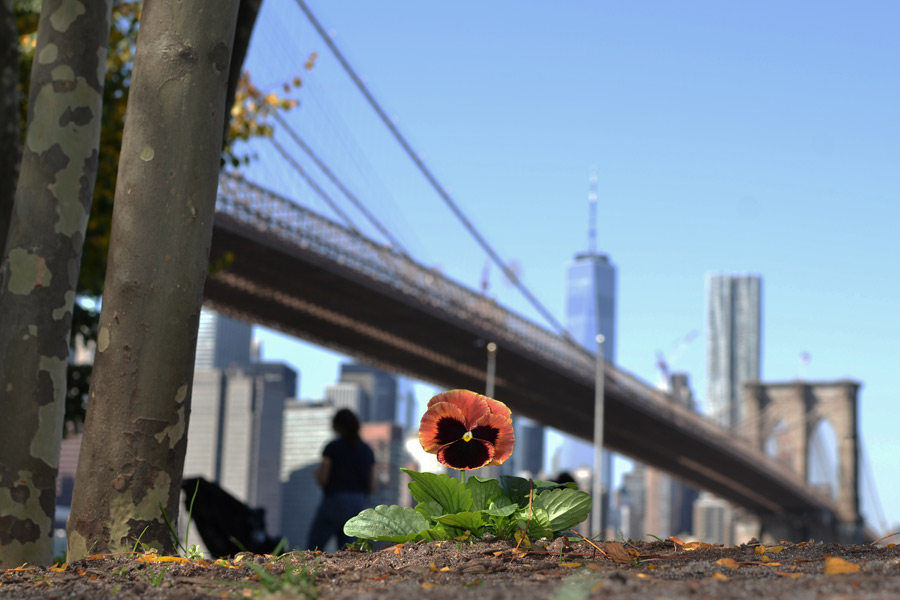
I
was also fascinated by the queer history of Brooklyn as described by
Hugh Ryan in ‘When Brooklyn Was Queer’. I love the picture I took of the
pansy I planted under the Brooklyn Bridge to mark the multiple stories
of homophobia I heard about in his book, the quote comes from the
complaints of local residents of how the Brooklyn Promenade was being
used by men for cruising; “Misbegotten Pansies” was just such a perfect
quote for this planting.
What
I do more now is make a film about the places I visit, this has the
ability to explore more of the story of each planting and helps share
the project to new audiences, I’m working on a New York film now.
Ultimatelty I adore each planting, they all mean so much to me as they
all contribute to the entire body of my work.
Paul Harfleet’s short film ‘The Pansy Project Canada’ will be shown at the Inside Out Film festival in Ottowa, Canada in October and his work will feature as part of the Homotopia Festival in Liverpool in November. For more information visit www.thepansyproject.com.
*In
a 1927 essay, acclaimed Austrian philosopher Robert Musil famously
declared, “The remarkable thing about monuments is that one does not
notice them. There is nothing in this world as invisible as a monument.”
Both celebrate the power and expressive ability of the letterform and
yet each appear as entirely separate pursuits. Uniting them requires
understanding both very well, contemplating their friction, their
possibilities, and a lot of negotiation.
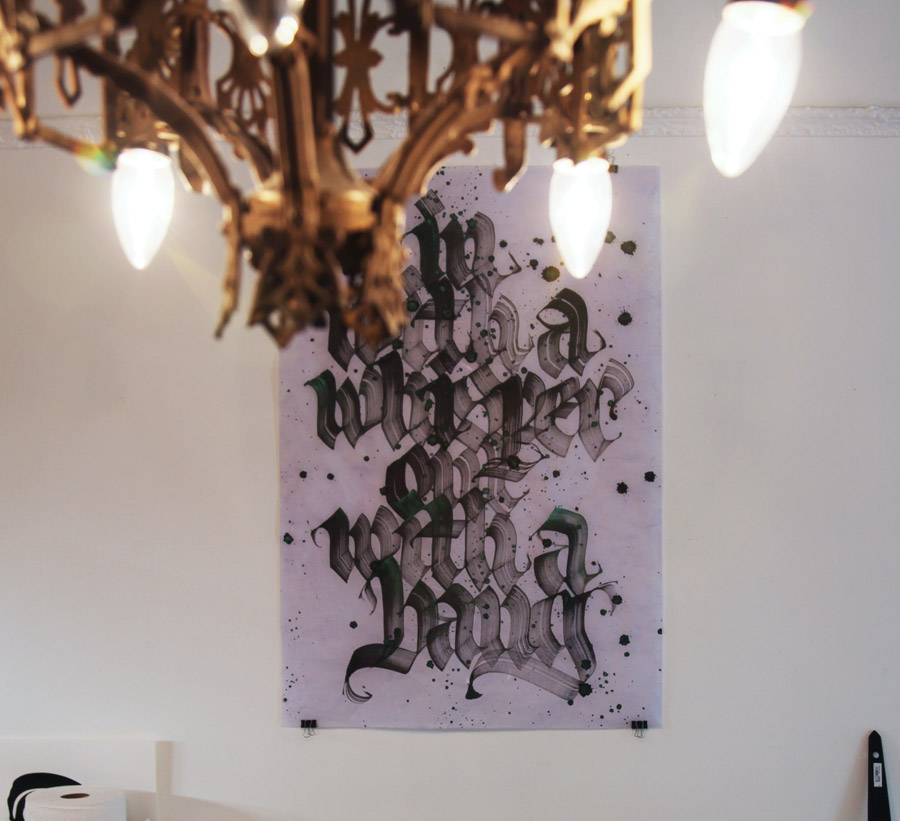
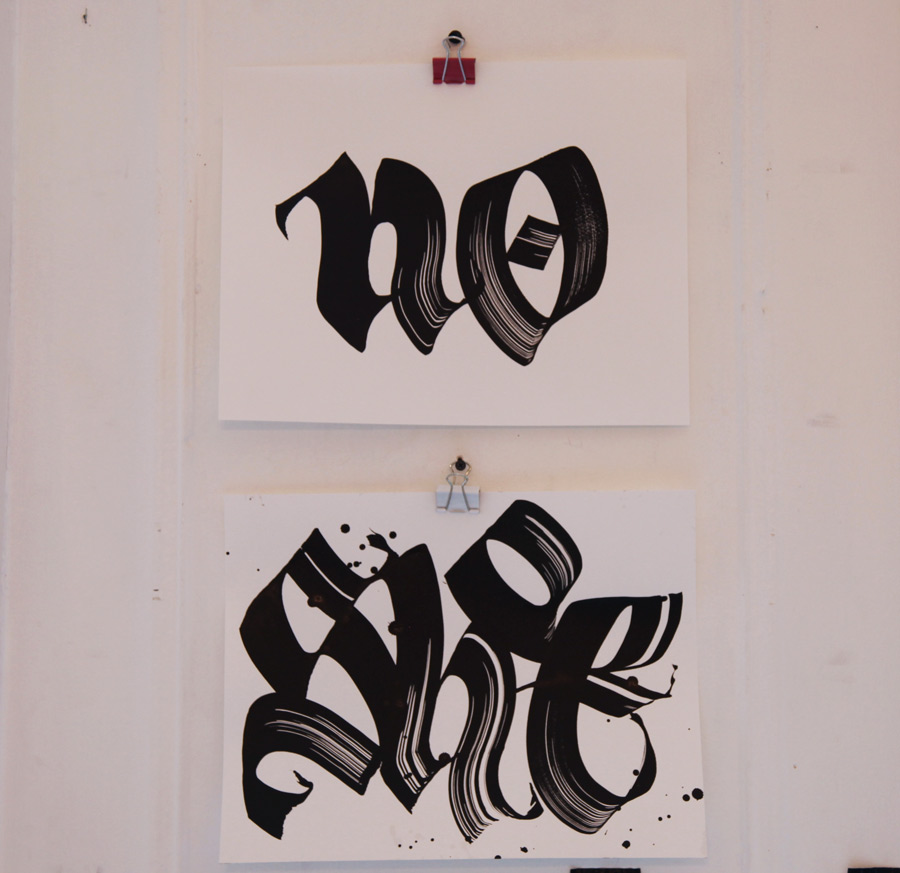
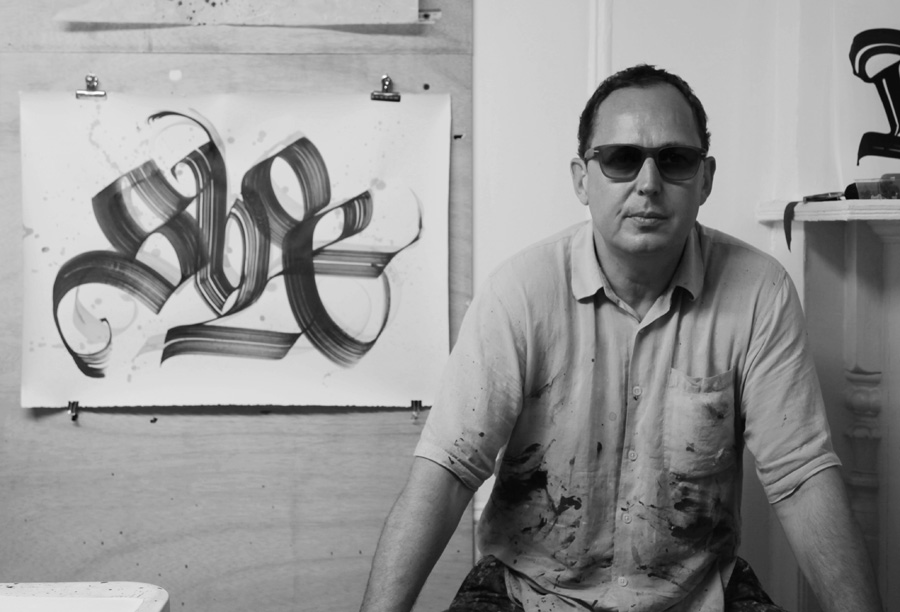
Since 2007 Niels “Shoe” Meulman has been investigating, experimenting
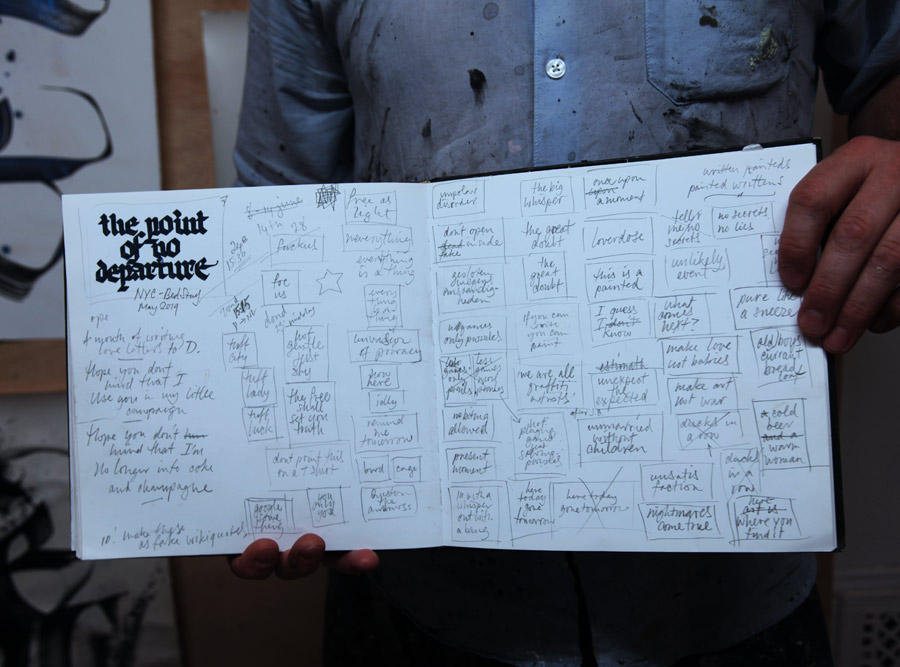
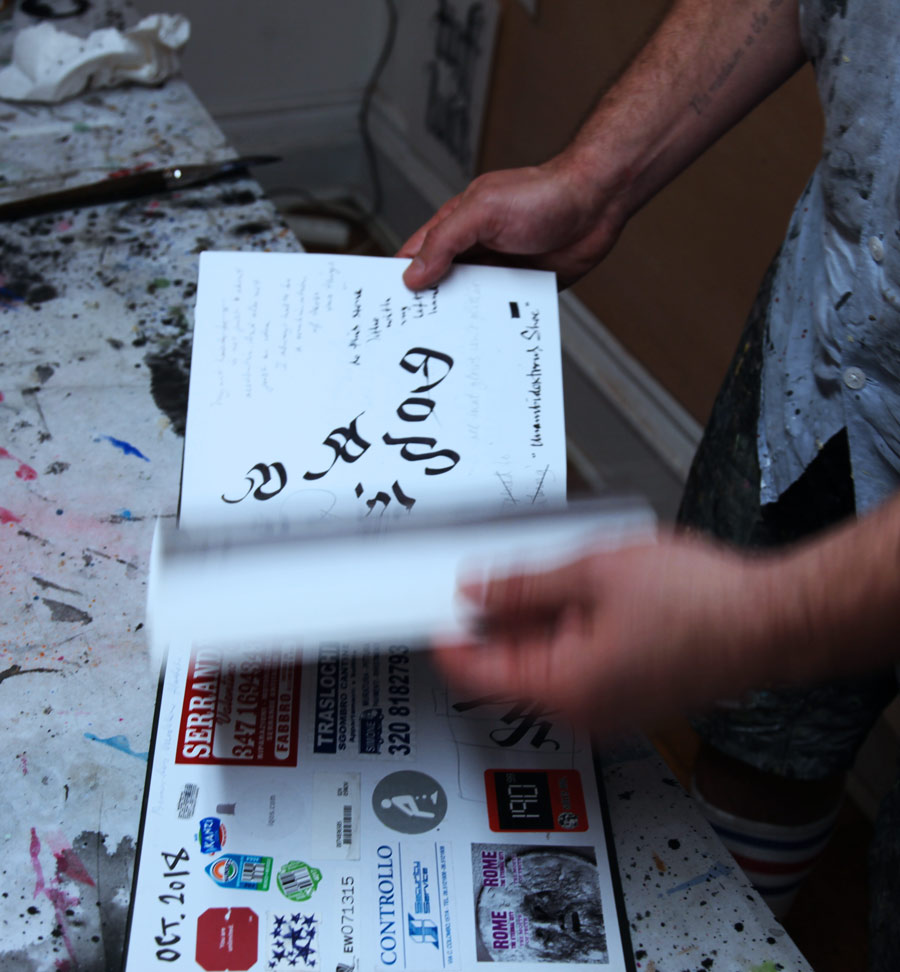
with, enraptured by this pursuit. From thousands of hand sketches in his black book
to the full-body immersion techniques of creating across large walls and
floors, using paint and brush by the gallon in premeditated/subconscious all-inclusive
gestural choreographies. Shoe knows how to stay in the moment.
It’s this elevating together of disciplines that reveals their contrasts;
awakening the inner conflicts and core strengths, parading them on view.
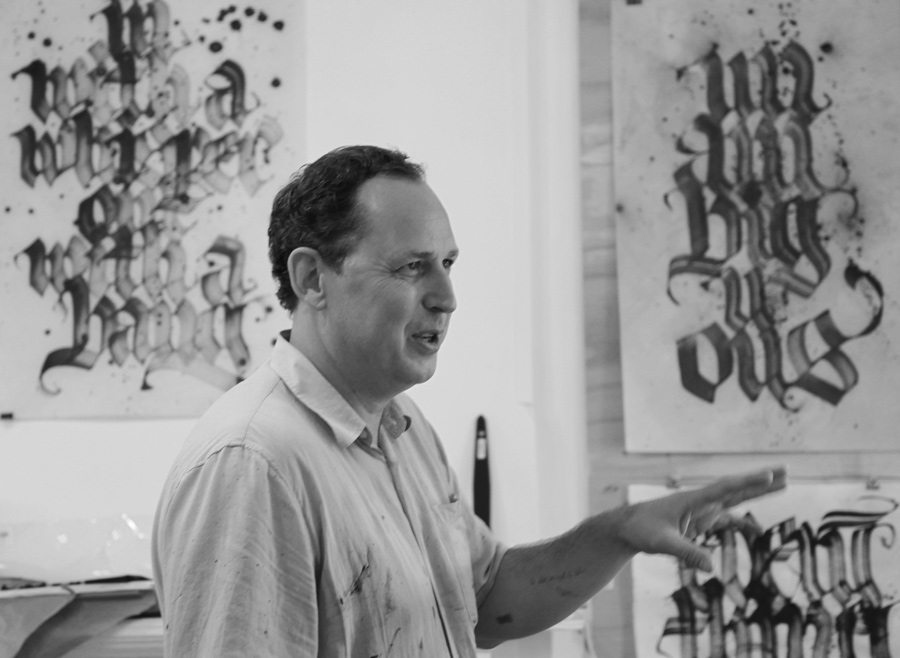
He discovered the perfect transmutation here in Brooklyn. It was that
night of art-making with Haze that was a turning point..
“We both decided to go to the art store and get a whole lot of tools and stuff and just started working to see what would come out,” he says as he glances out the 1st floor brownstone window at the pile of recycled cardboard in the tiny courtyard. 26 years as a writer from Amsterdam who had met his New York graffiti heroes like Dondi, Rammellzee, and Haring, Shoe had pursued a career in advertising, and was still in love with fonts and their power to communicate.
“Without a commission, without a brief,” he remembers. “And like that – my
old passion, calligraphy, mixing with graffiti, just came out!”
Shoe says he created “calligraffiti” and he ran with it: developing a
body of work around it, writing a book about it (Calligraffiti), collaborating
with a growing number of artists who also had an affinity for the penmanship of
an artful communication modality that spans centuries.
He has developed brushes, tools, techniques, opened a gallery in a
garage (Unruly), covered surfaces from cars to museum walls, finished three more
books (Painter, Abstract Vandalism and Shoe is my Middle name).
It was as if he had finally decided at 40 that it was okay to be an artist, and
he left advertising to dedicate himself fully to his craft.
“Because my dad is also an artist- maybe I was finding the right moment
to be an artist,” he says as he shows you a stack of many papers from the art
supply store, and he contemplates why he had hesitated for years. It’s not that
he was concerned about competing with his father, but the stakes were high. Speaking
of his father, he says, “I think he was thinking ‘if you’re going to be an
artist you better be a successful one’ – because being a struggling artist –
that’s the worst!”
Additionally, he thought that before he could call himself an artist, he
should have something substantial to show. “It also felt like there was
something more profound to it,” he says. “I always thought that to be an artist
you have to have life experience and have some knowledge and purpose to bring
to the table, you know?”
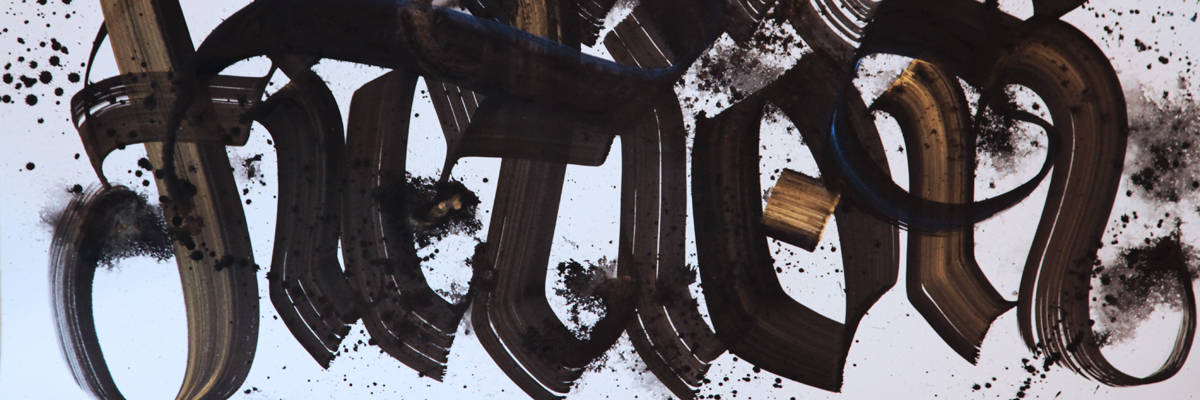
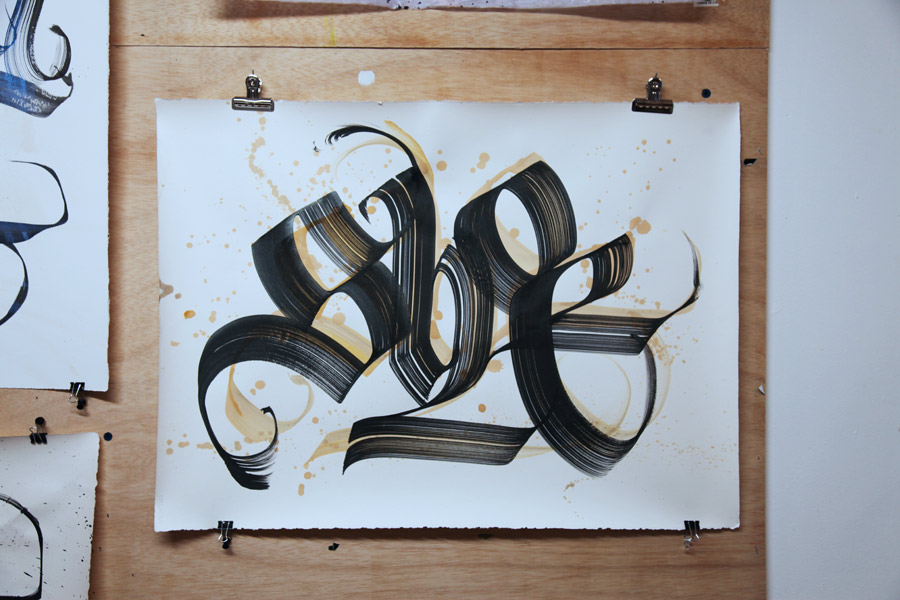
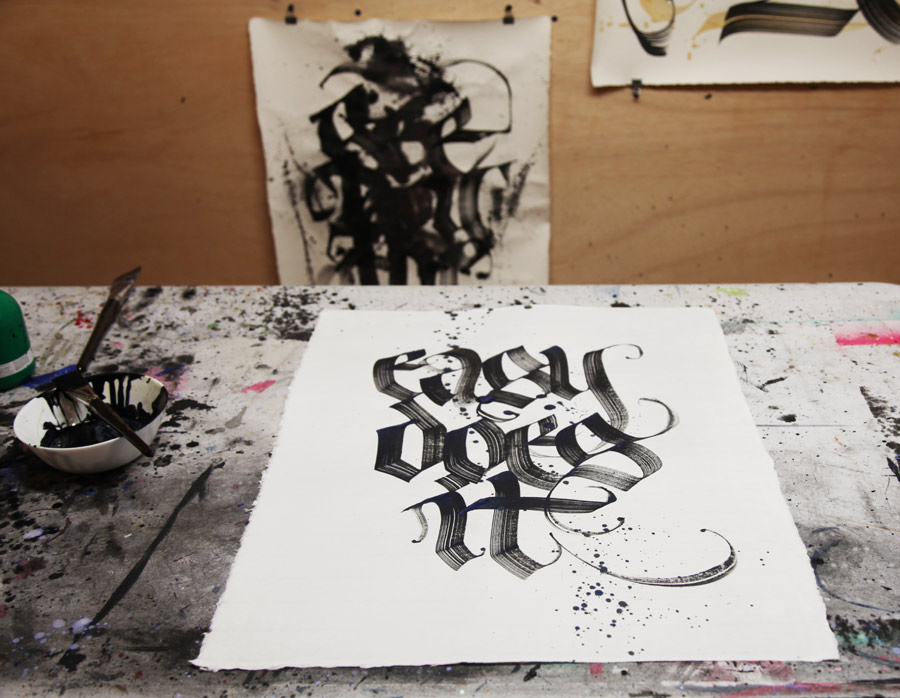
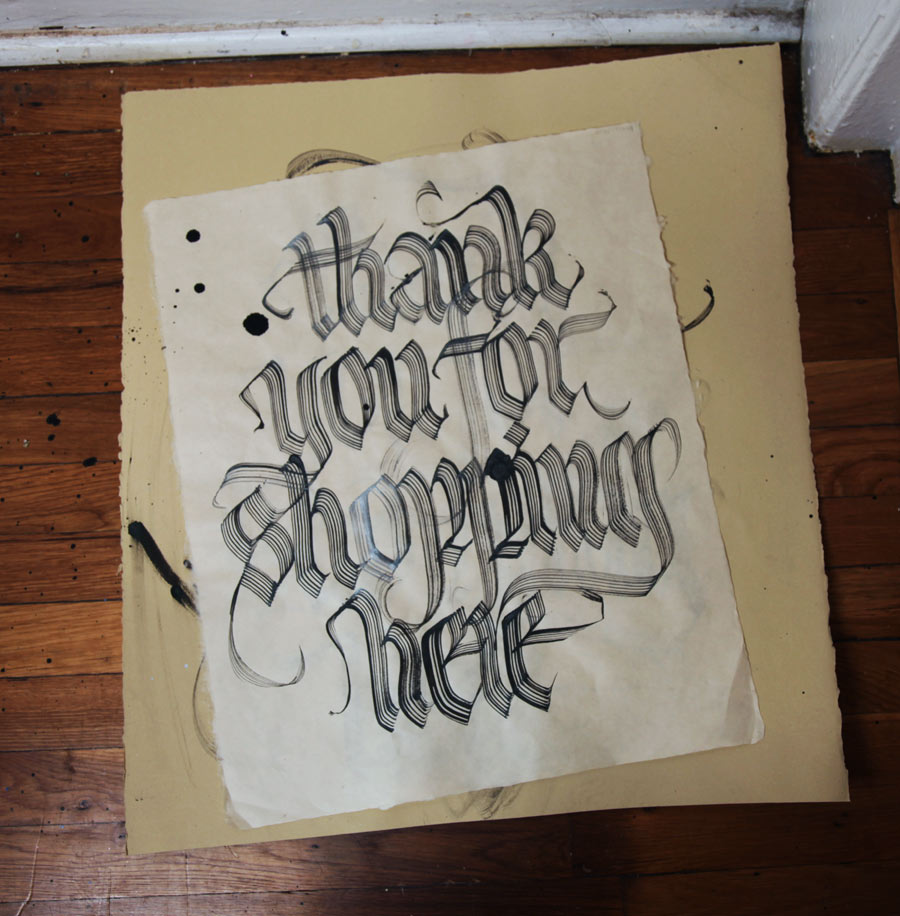
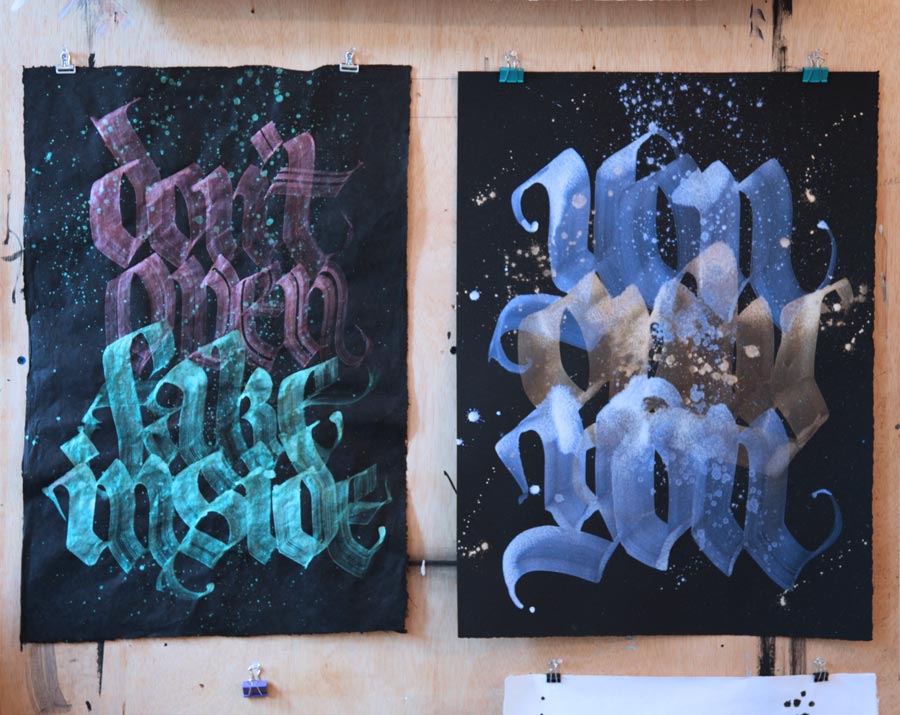
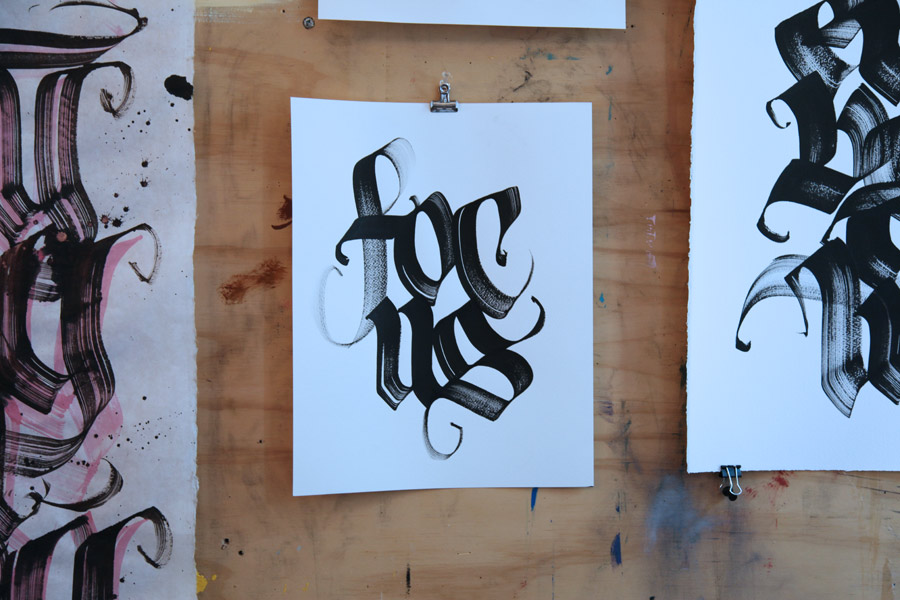
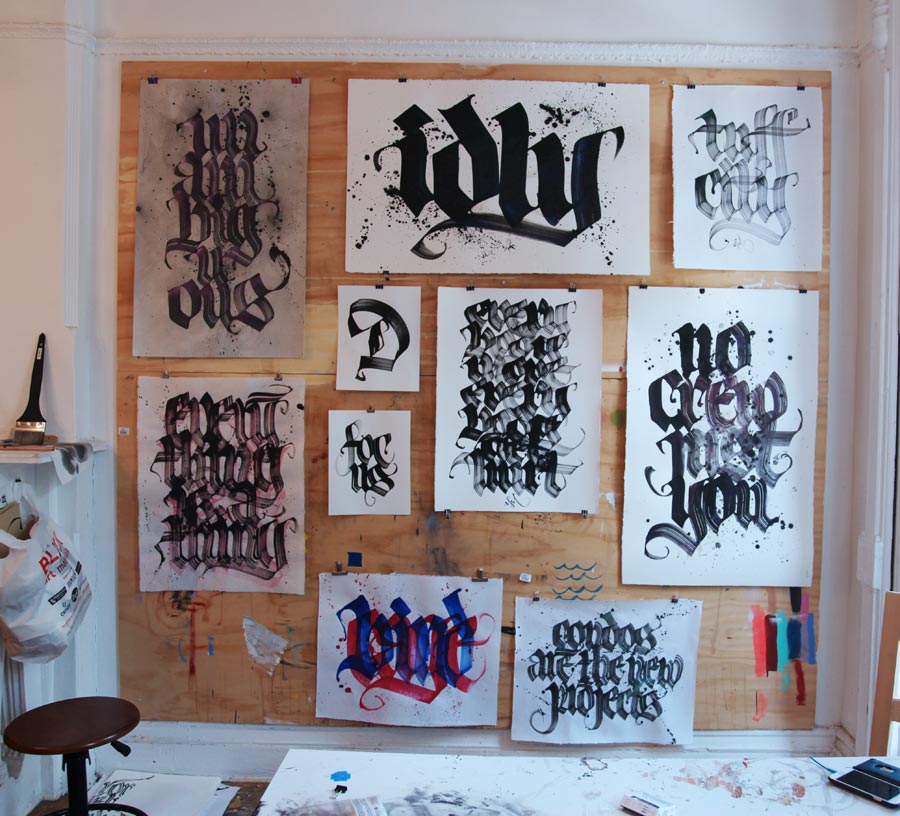
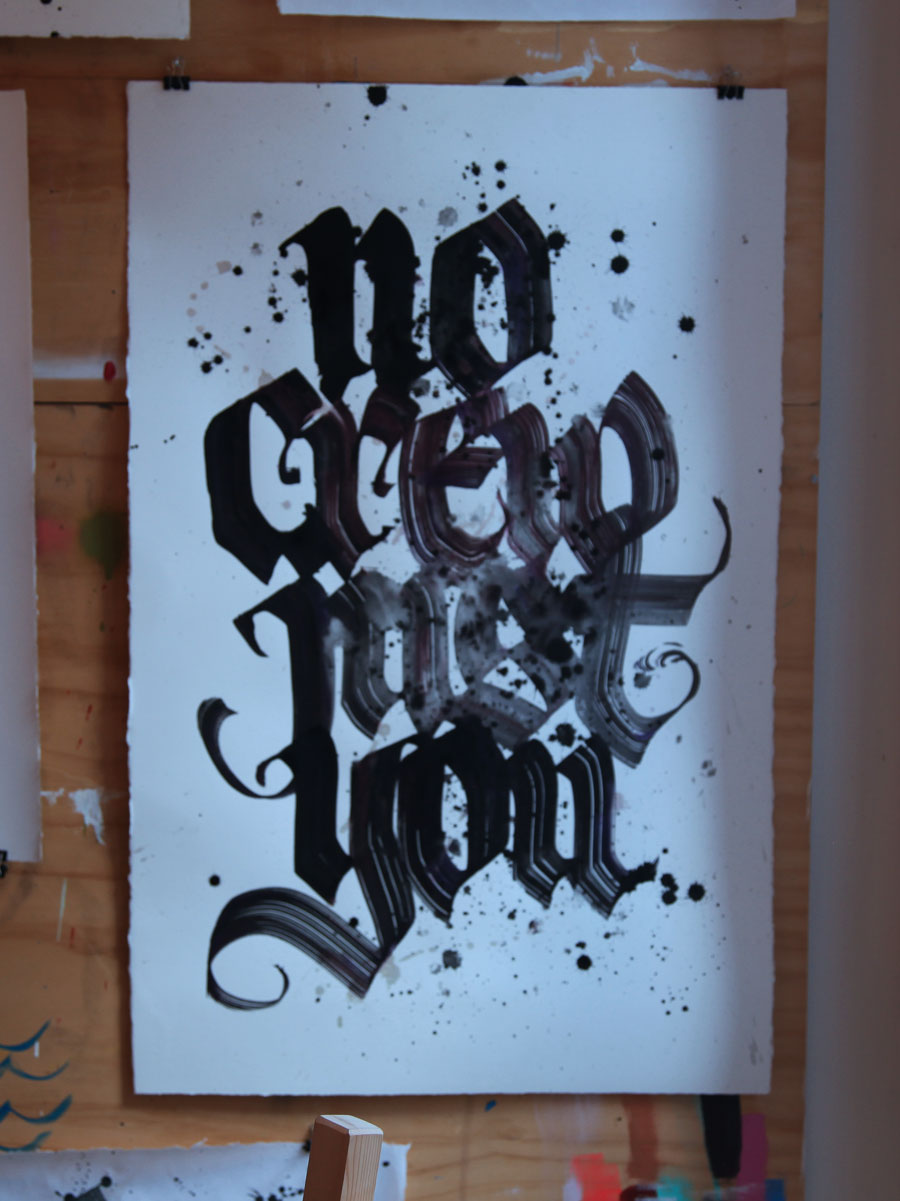
Whether wide tip, wide brush, or wide cap, the bending letters are cryptic and stern in their old-worldliness. Fluid and stilted, wild and ornate, gilded, in black, in iridescence, in silver and gold. The additional layers of ink burst violently with destructive force in the swipe, the slash, the bash. The splatters are sometimes built up like an aura that glows around the cavorting dark letters – as if bruised and pummeled, their damaged and moistened epidermis now sweating black blood, infusing the air with a miasma of industrial soot.
With broad interests that delve into abstract, into wordplay, even poetry, this moment is the clarity in early morning fog on a quiet street in old BedStuy, now rumbling with the sweet sickness of gentrification. The residency that brings him here is so named to recall history and to look forward, offering a respite for many a visiting Street Artist.
“I didn’t really have a plan when I came here but, like many times, I come up with something on the plane like the day before – and of course it’s brewing in my head.”
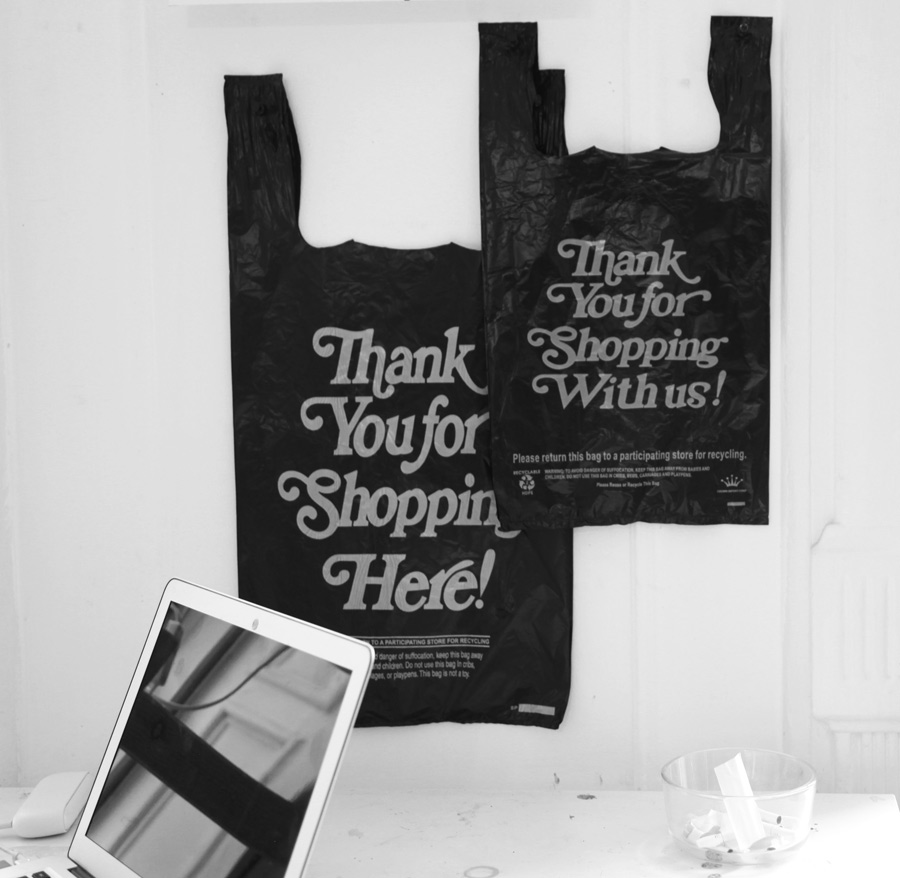
He points to a couple of handled black plastic shopping bags that he has tacked to the wall. With a capacity to recognize and understand his own emotions and the emotions of an era, he has connected to the pleasantry printed on them “Thank You for Shopping With Us!”. It’s not just the sentiment that captures the late 1970s design hand, for him, it’s the upbeat openness and lyrical bending of the letters and lines that attract him.
The letters are sweet like cherry lip-gloss on a rollerskater in hot
pants in Central Park. Suddenly you are flipping through the pages of Eros,
Fact, or Avant Garde, a relief of melodic line and sexual liberty.
“Thank you for shopping!” he exclaims like a fan. “That’s so New
York for me; that’s exactly graffiti – that 70s Herb Lubalin look,” he says of
a time when magazines were so head-over-heels in love with new type treatments
that they might feature a 2-page spread of it entirely just for you to salivate
over.
“It’s free,” he says, perhaps reflective of the liberal sway of social mores and the swinging romance that advertising had with the Baby Boomer’s ‘me’ generation of the seventies. It’s a phrase rooted in consumerism, cities were in the last throes of an ample middleclass America who had cash and credit to shop with. That fact contrasted with the suffering of a bankrupt NYC – a spirit that inspired train writers as well, even if used as critique.
“I think the whole graffiti scene that started here had something to do with this sort of lettering,” he says. “It came from that freedom that you could see in advertising. The type design was so good.”
For now, this month-long residency is a reprieve for Shoe, a time to
examine and relax into the spring that gradually warms New York and brings rose
blooms to the bush in the small front yard of this residential street. His new
sketches from his black book contain pithy barbs, hidden meanings, pop-culture
references, and life truisms drawn in what he might refer to as a monk-like
manner.
“I’m not religious. I don’t follow any religion and I don’t meditate but
I like this idea of knowledge and introspection,” he says. “This is where
Chinese calligraphy comes in and you are reminded of the medieval monks and all
kinds of calligraphers”.
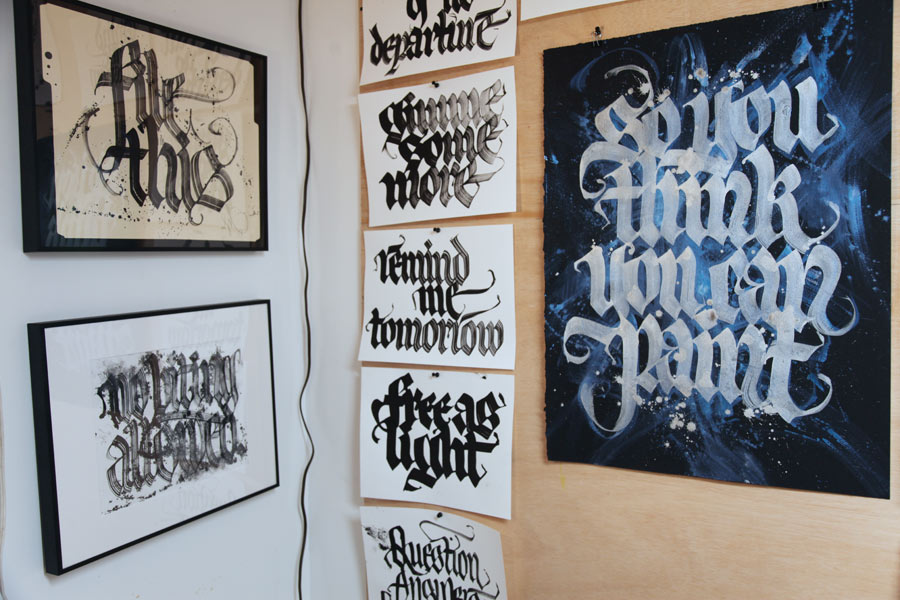
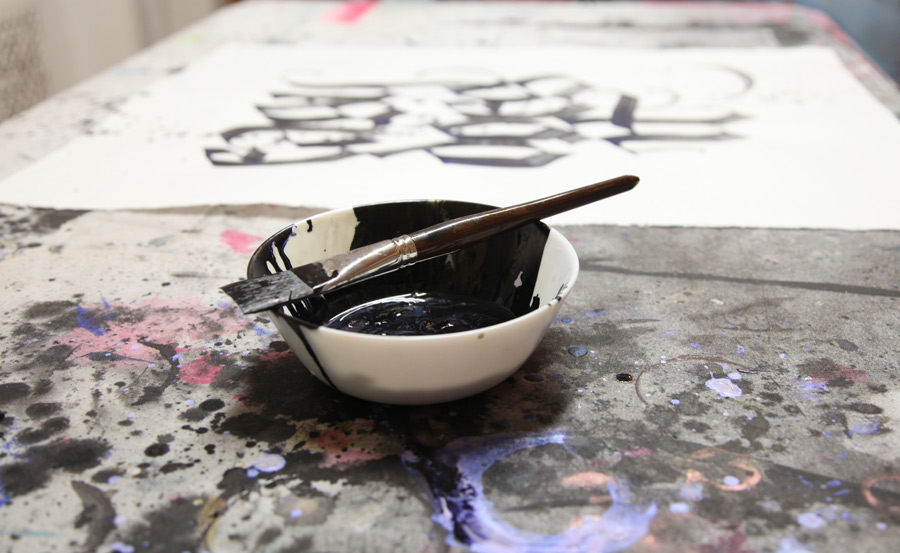
A congenial host, Shoe shows us walls full of new pieces, individual words or phrases on a large variety of papers, textures, and stocks. He describes his inks with as much enthusiasm as his personal relationships, which are sometimes as tumultuous as the intense splashes of midnight here. You can see there is definitely work being done.
“That knowledge comes from that kind of introspection. The influence of Japanese and Chinese calligraphy comes in because at that time if you were by yourself writing…. Those monks either wanted to be enlightened or were enlightened in some way; it’s a search,” he says.
 BROOKLYN STREET ART LOVES YOU MORE EVERY DAY