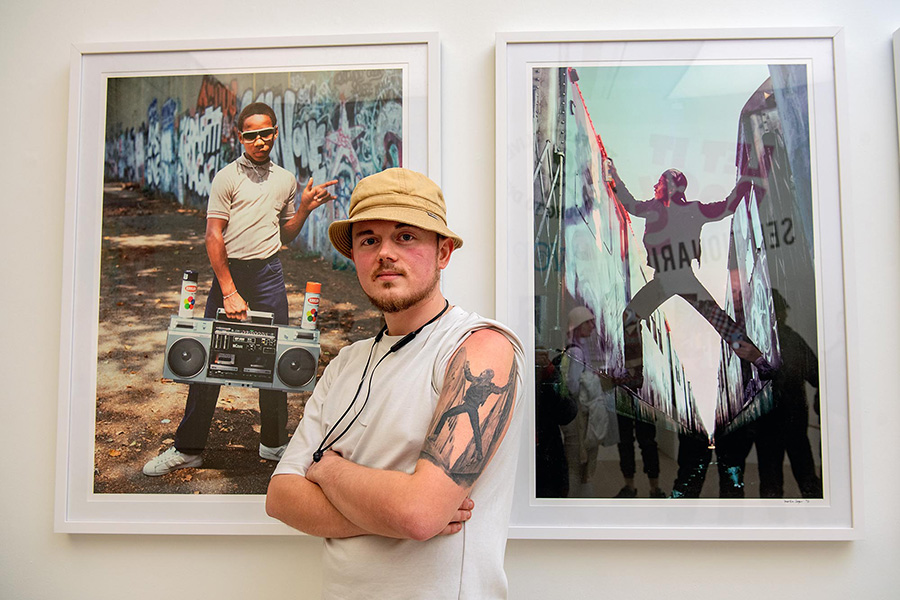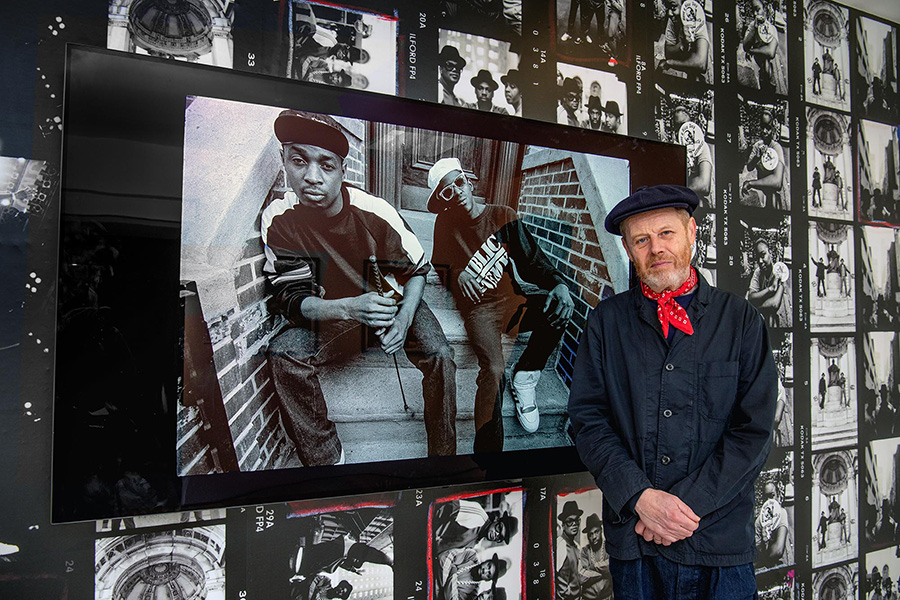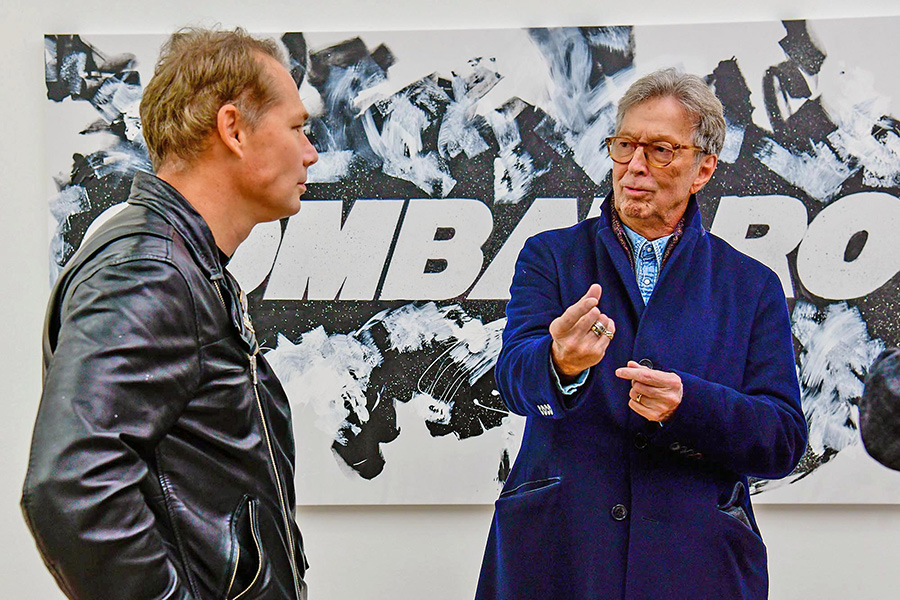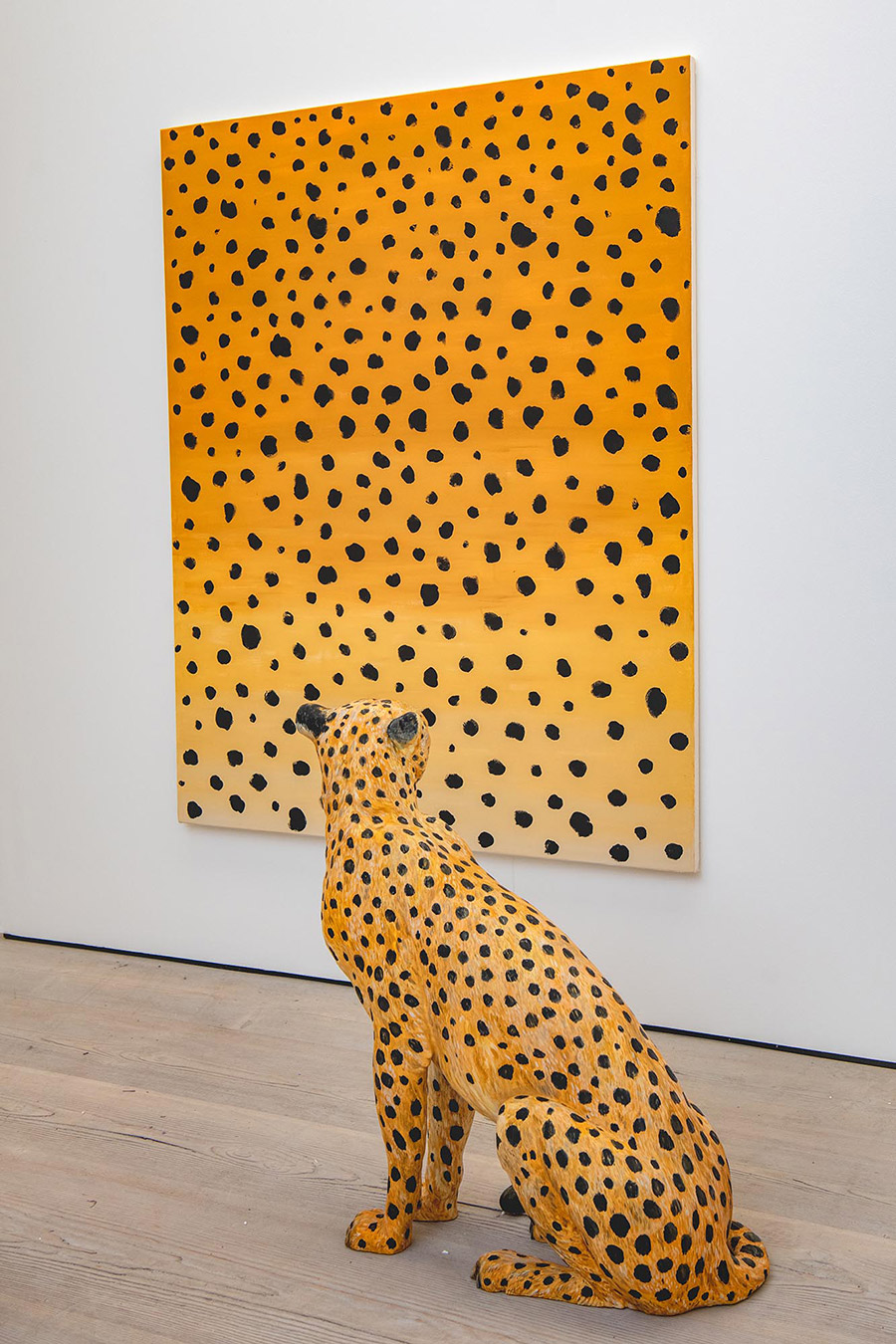
All posts tagged: Escif

“War & Order”, War Is a Racket: The Art of Profit and Power at Frost Gallery

“War & Order”, War Is a Racket: The Art of Profit and Power at Frost Gallery

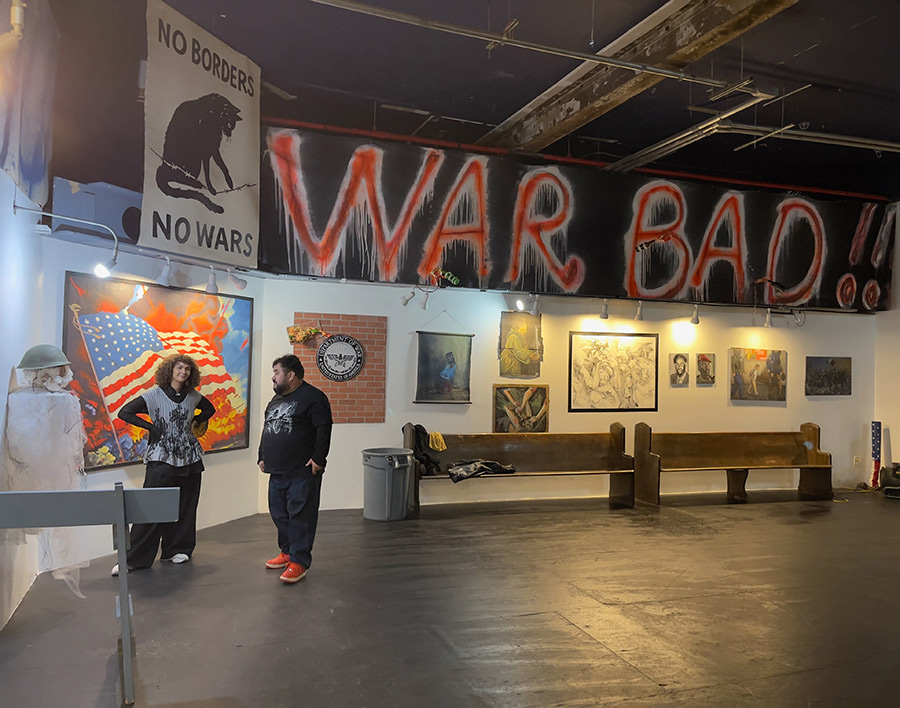
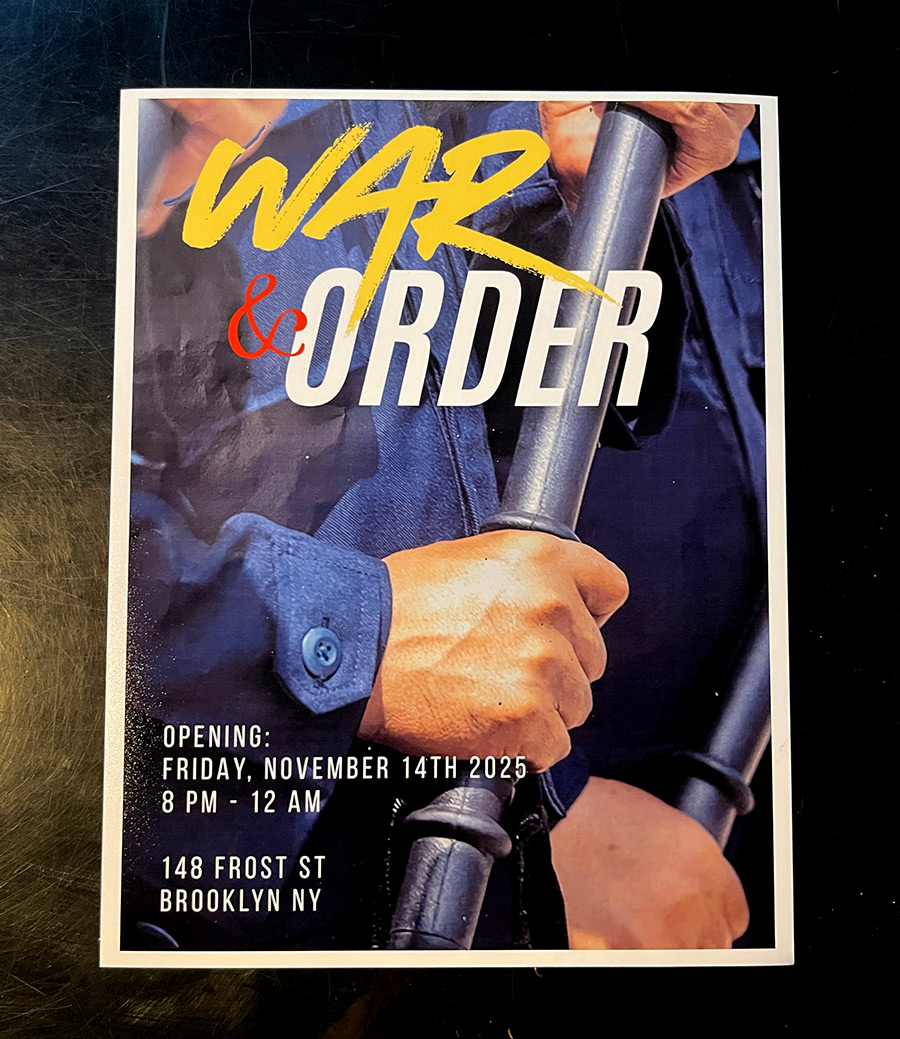
After a successful, painful, and funny take-down of the Dollar bill at their last group show, the artists-run collectivists at 148 Frost Gallery are smoking again with their newest installations and canvases related to the biggest money-maker of all time: War.

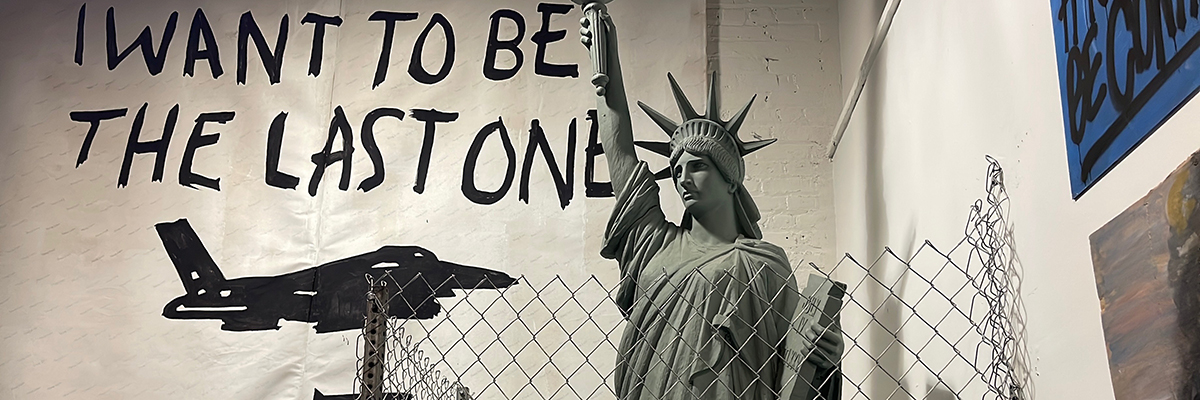
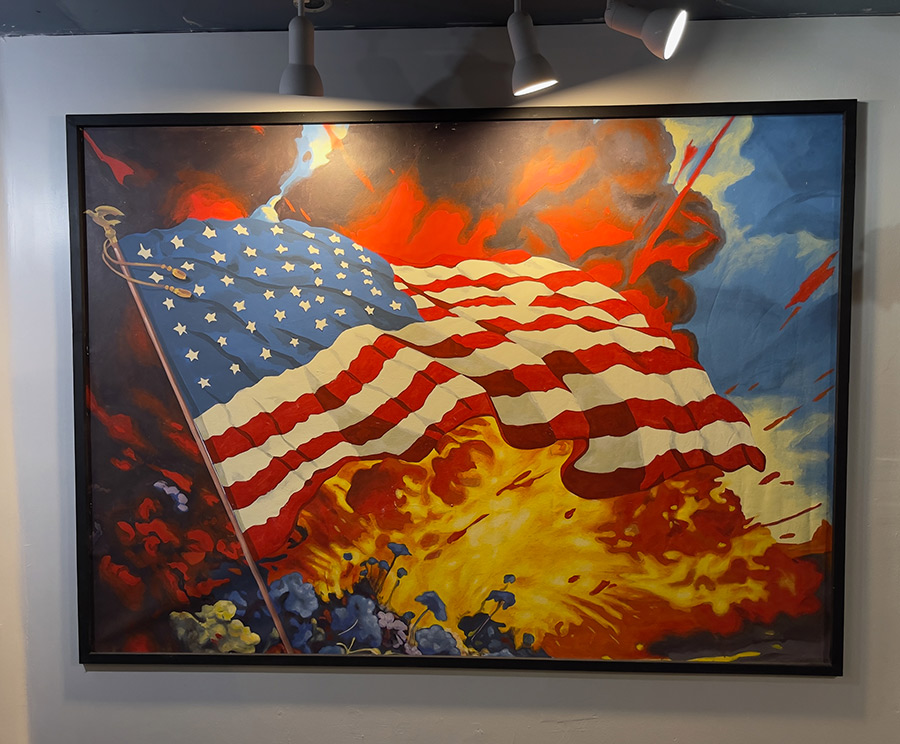
“War & Order” features street artists, contemporary artists, outside artists and those adjacent ruminating on the role and roll of the war machine in the 2020’s with Gabriel Specter, Renelerude, Escif, Dan Sabau, Kazuhiro Imafuku, M Shimek, and Cash4 on the march.
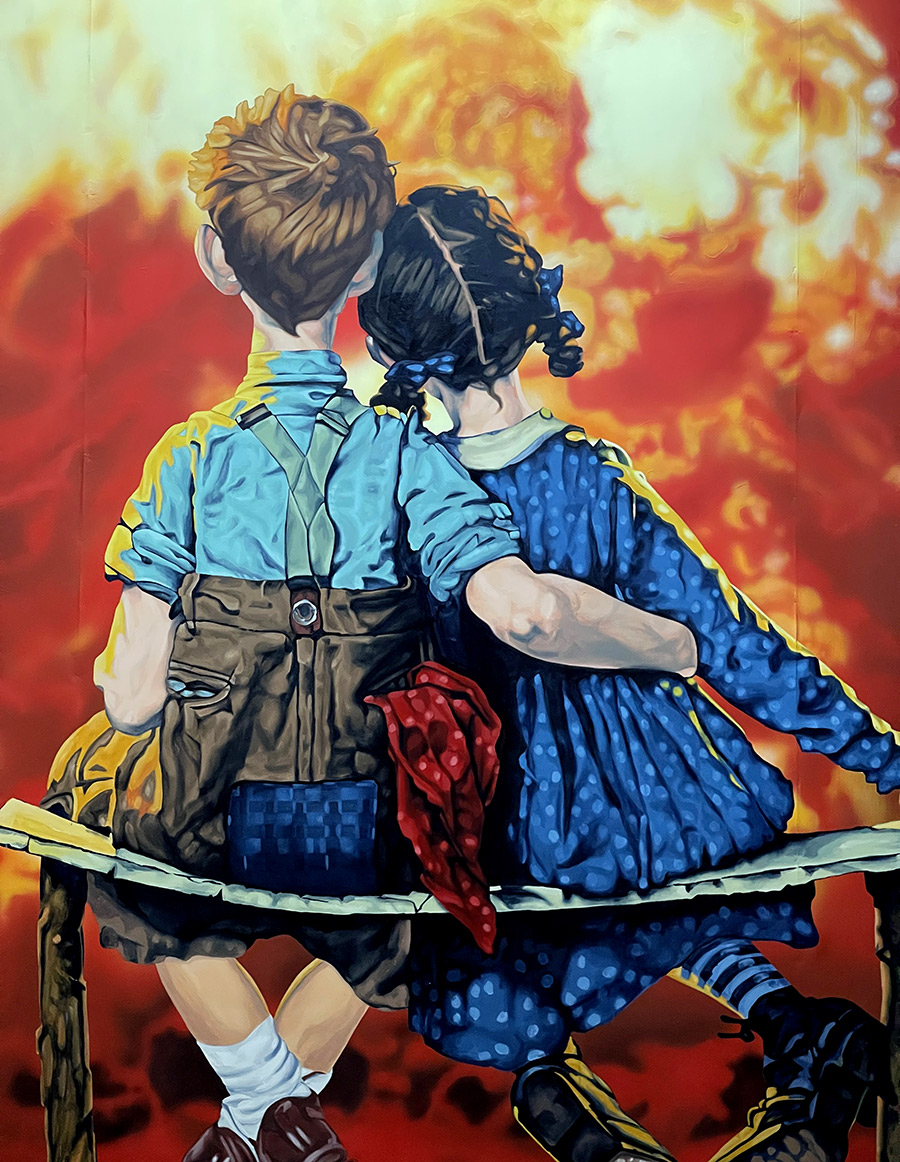
Specter. Detail. “War & Order” 148 Frost St. (photo © Jaime Rojo)

Between those two shows, this gallery may have captured the moment prophetically, like a seer in a storm, evaluating the past and anticipating what is next.

A century, at the rise of the so-called American Century, it had just become clear that undermining a nation’s currency through inflation was instrumental to eroding its economic and social order – Lenin is reported to have posited it as a beststrategy. Keynes agreed, and observed that a rampant inflation that debauches your currency secretly will  confiscate wealth, breed inequality, and shatter the trust that underpins society. Not that we’re headed toward rampant inflation, but the similarities of these days and those days leading to world wars are striking, including our own media’s consistent underreporting of the dollar’s loss of value and global influence.

During WWI, all major governments resorted to a programmed money printing. Whether by design or incompetence, the results were undeniable: economic destabilization, often hyperinflation, internal chaos, political upheaval, and war. For many decades people swore that we would never let that happen again. But most of those people are dead now, and the dollar today is worth a nickle, compared to a century ago.
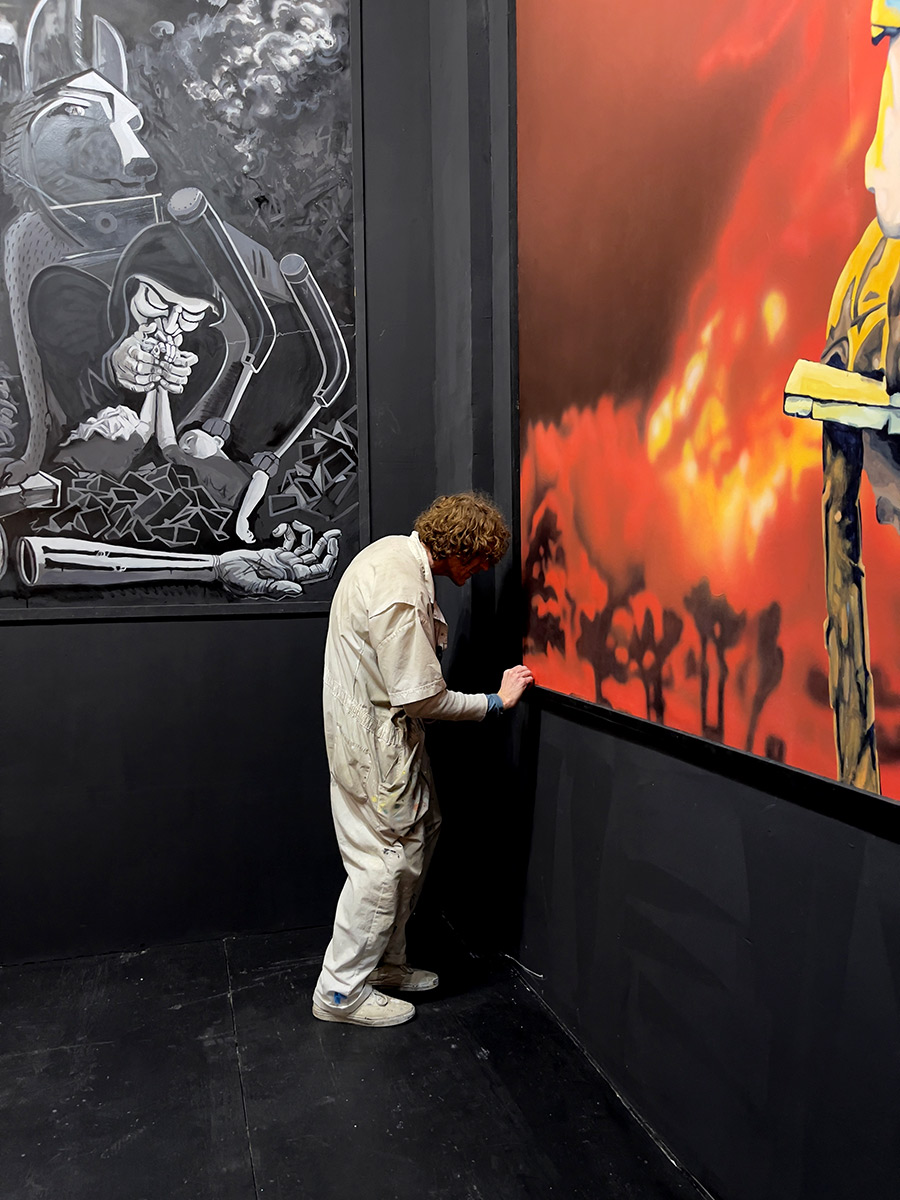
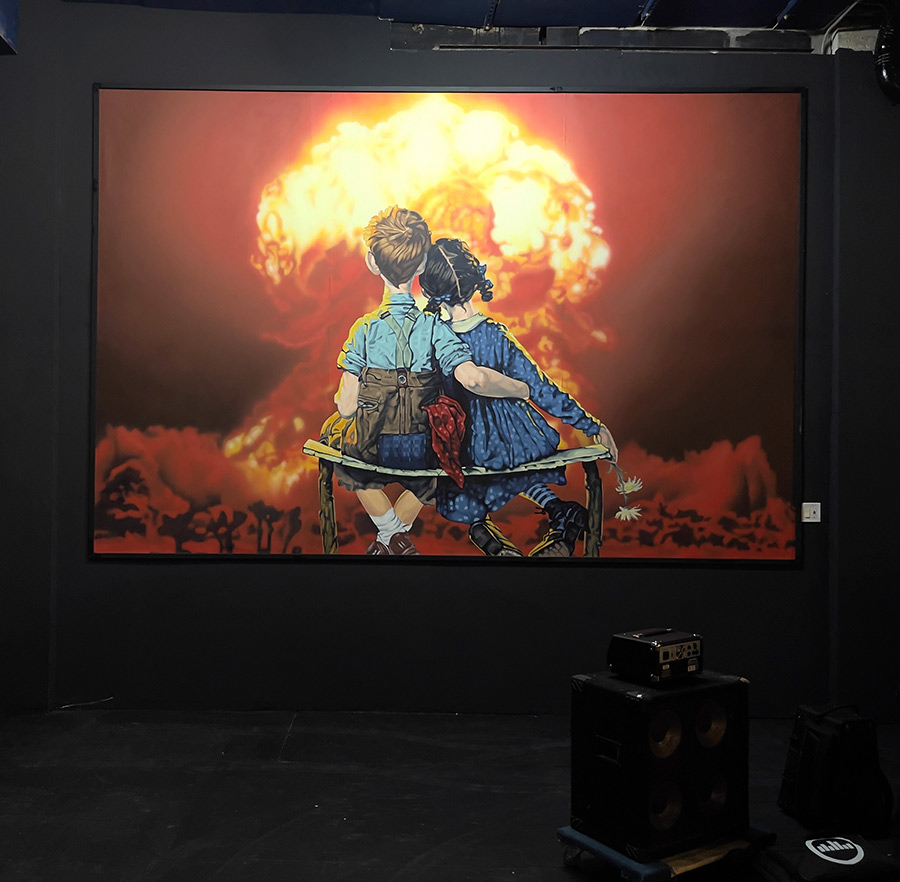
Specter. “War & Order” 148 Frost St. (photo © Jaime Rojo)

What is that saying, often paraphrased, “history doesn’t repeat, but it often rhymes.”?

“War and Order” enlists international and local artists for a pointed, and occasionally mischievous, look at the world we’ve managed to build for ourselves. It doubles as inquiry and needling social commentary, with each artist charting our tangled relationship with war, the creeping architecture of the police state, and the long shadow of militarism, surveillance, and planetary harm—all unfolding in an age where social media spins narratives and we scroll past catastrophe.

Rene Lerude. Detail. “War & Order” 148 Frost St. (photo © Jaime Rojo)

Murals, installations, paintings, and performances push these ideas, probe our past, and interrogate the present. It’s uncomfortable, for sure. What comes next, we have a dreadful guess. But there is a countenance of repairing the broken, correcting injustices, healing pain – even though this is not the focus. As the organizers put it, the exhibition is “our protest, our loud speaker to the world—an unedited, unsilenced voice.”

Rene Lerude. “War & Order” 148 Frost St. (photo © Jaime Rojo)
Rene Lerude. Specter. “War & Order” 148 Frost St. (photo © Jaime Rojo)

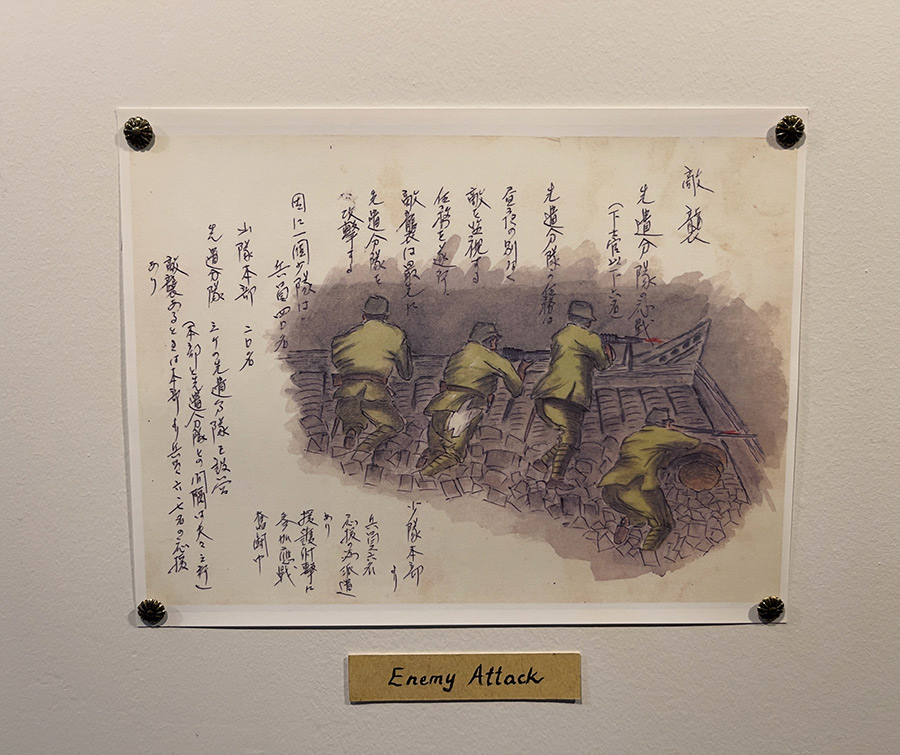
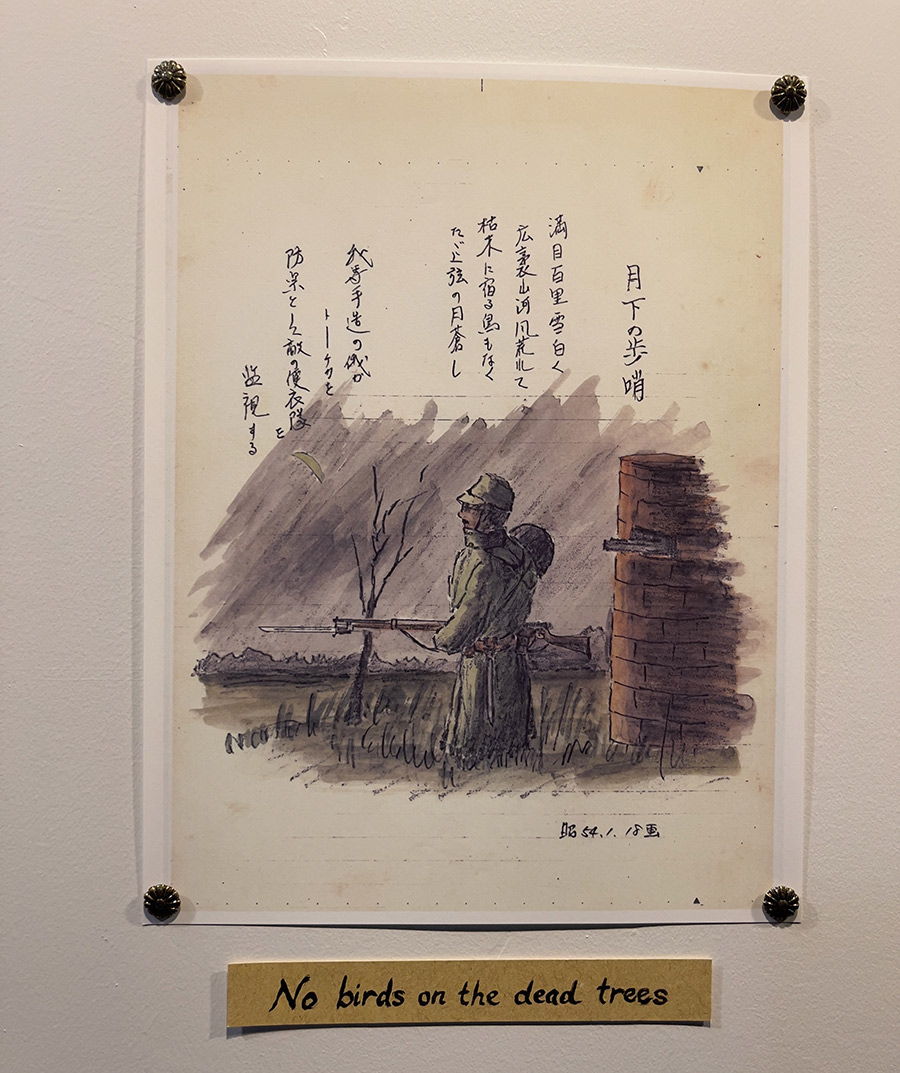
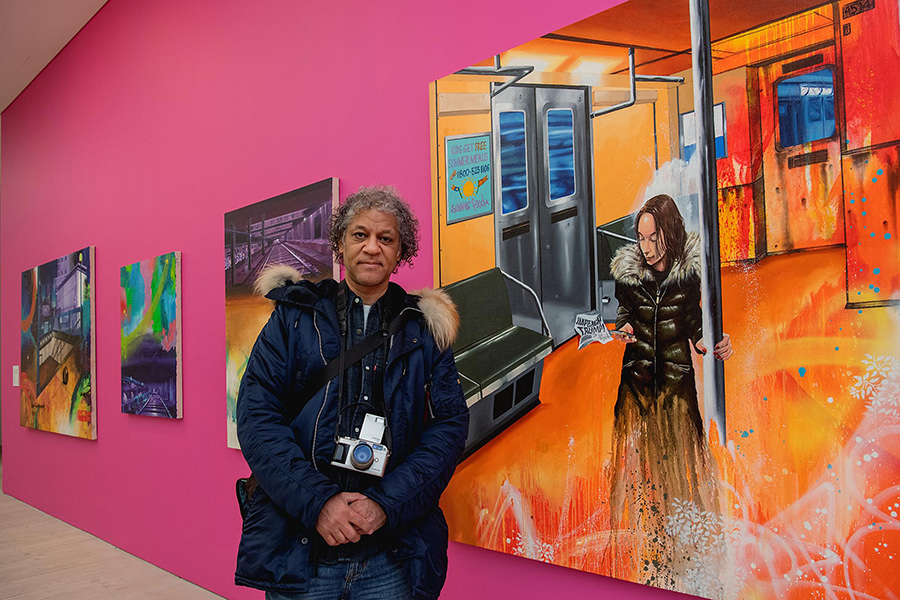
Kazuhiro Imafuku’s watercolors read like a plaintive diary of a soul under siege—an illustrated reckoning as he “displays and deciphers” his grandfather’s service in the Manchurian war. Though distant in time and culture, the story feels painfully familiar to the stories of soldiers here and abroad today. His grid of small works echoes the disarming clarity of Escif’s massive hand-painted banners hanging around the homemade gallery space, where the Spanish conceptualist delivers coded commentary in a deceptively plain voice, sharpened by deep critique. Elsewhere and throughout, artists confront imperial overreach, immigration persecution, and high-tech terror without flinching—perhaps daring us not to look away.

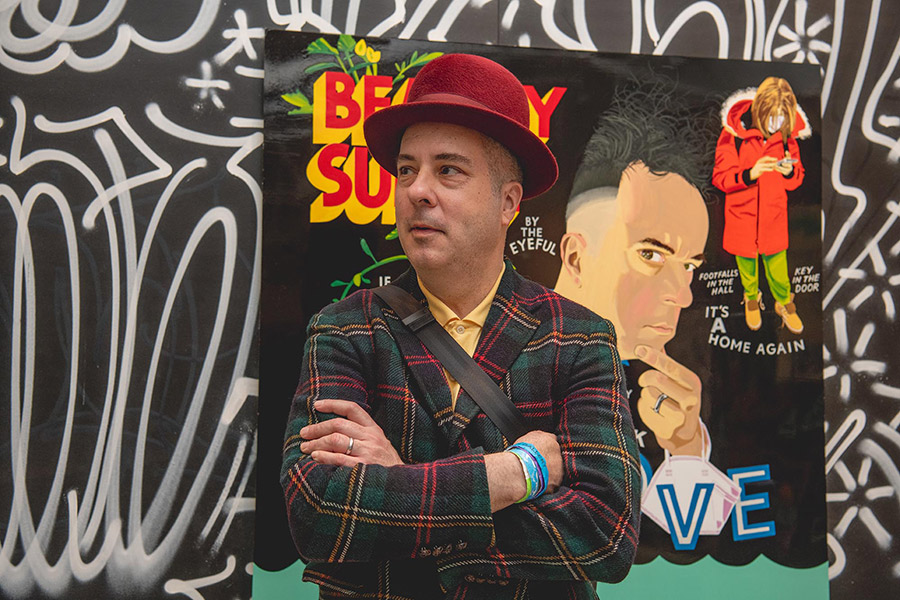
Specter’s opus “Expressive Love” calls to mind the glib narcissism of the 20th century westerner historically, a simplistic Norman Rockwell sentimentality that sees the ideal in spite of the truth. It also calls to mind the last enormous propaganda push that engulfed continents for the profits of a few, the fake ‘war on terror’ of the 2000s, when an Internet meme featured UK Prime Minister Tony Blair happily posing for a selfie before a hellfire scene from the oilfields of Iraq.

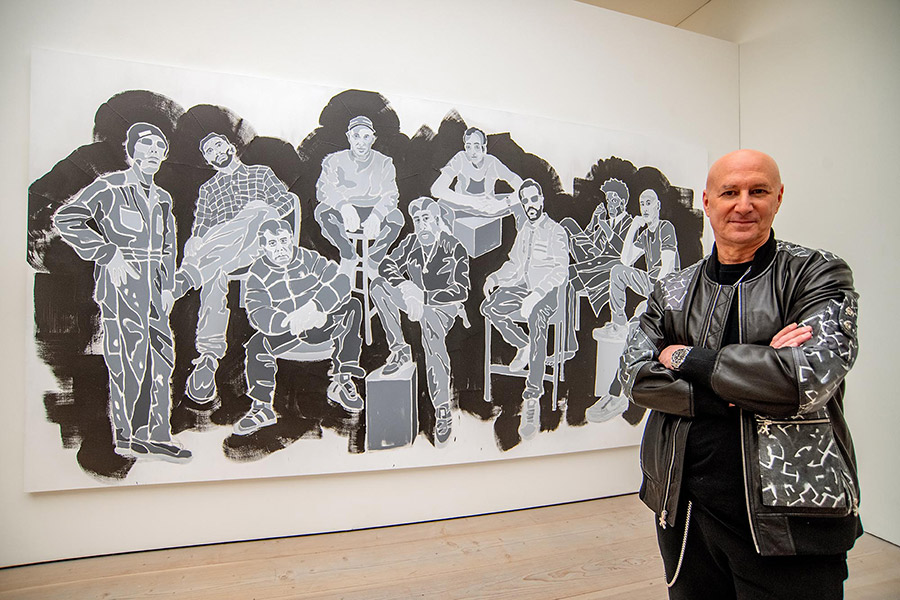
Adjacent to Specter, the French street artist Rene LeRude presents a disjointed monochrome macabre missive of winners and losers updated with dark tech, echoing the dimension, and disconnected field of vision of Guernica by Picasso – a phalanx of streaming cameras mounted to the wall next to it make sure the scene is monitored and broadcast for best effect. These are the suffering and distorted figures that Picasso was protesting, reported without humanity in black and white back then; atrocities committed against civilians; violence unleashed by authoritarian regimes. LeRude’s own neo-cubism strikes a similarly expressive distortion, his own moral indictment.
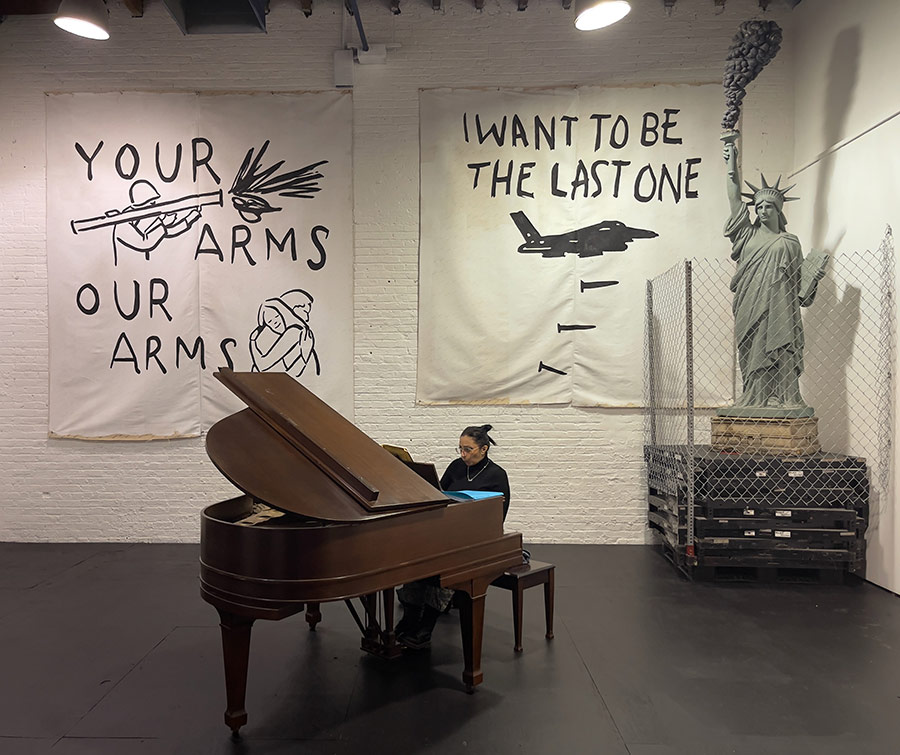
Escif. Specter. Plantina at the piano. “War & Order” 148 Frost St. (photo © Jaime Rojo)

This is the kind of work you can still encounter in Brooklyn today, in a warehouse space that brings together music, art, theater, and other forms that resist easy classification. Rooted in DIY culture, punk, activism, and inclusion, Frost doesn’t need to be idealized—only recognized for its commitment to fostering conversations that many would rather sidestep.
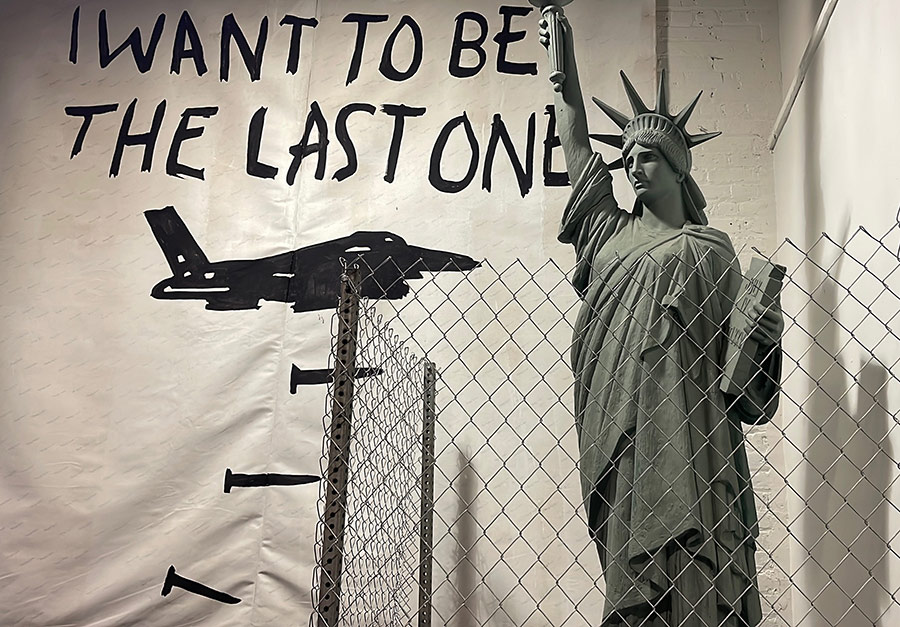
Escif. Specter. “War & Order” 148 Frost St. (photo © Jaime Rojo)

We spoke with curators and artists Gabriel Specter and Rene La Rude about the show,

Brooklyn Street Art: “War & Order” is described as both a social study and a critique of global affairs. What was the initial spark that inspired you and the other artists involved in the show to frame the exhibition around the tension between war and order, and did the original idea evolve as you and the rest of the artists began discussing the show?

Gabriel Specter: The initial spark was our current political state. Where freedom of expression and protest are being silenced. We wanted to make a show where the artist could speak their minds without censorship. Each artist added their voice, and through that, there was a natural evolution of the original idea.

BSA: The exhibition explores our “personal and collective relationships to war and the threat of the police state.” How do you balance your own perspective as an artist with the collective voices and experiences represented in the show?

GS: Part of having your own perspective is about respecting and listening to others perspectives at the same time so the show reflected that type of idea creating a nice balance.
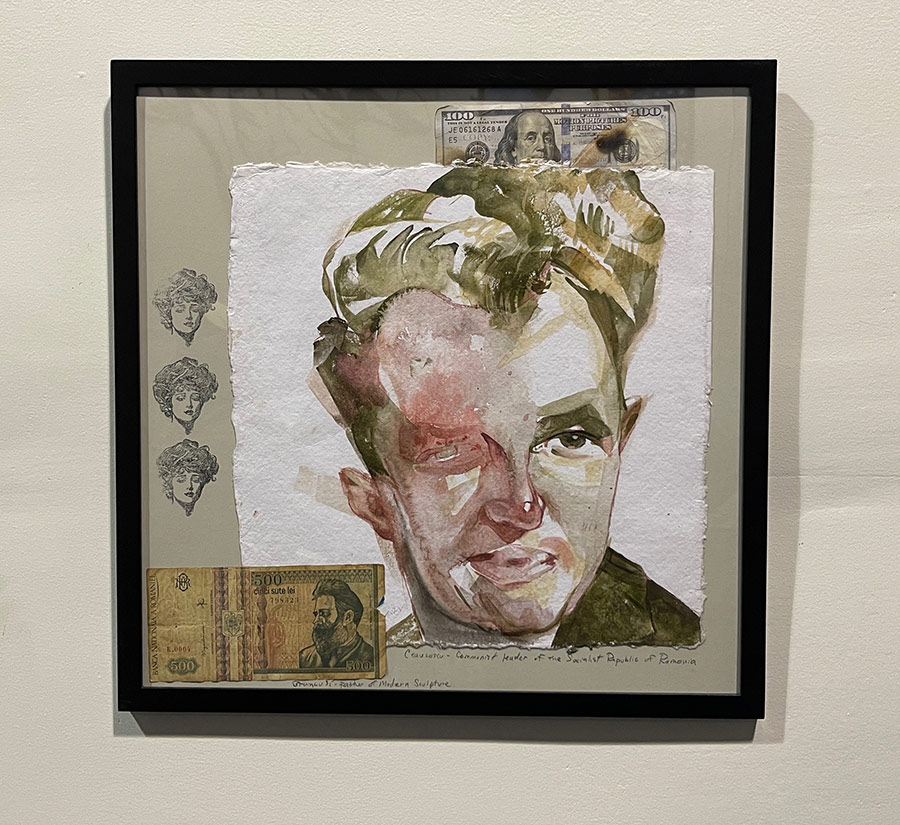
Dan Sabau. “War & Order” 148 Frost St. (photo © Jaime Rojo)

BSA: The show is described as “our protest, our loudspeaker to the world.” How do you see visual art functioning as a form of protest or resistance today—especially in an era dominated by social media and engineered narratives? 

GS: I feel like people are starting to value real interactions more and word of mouth is coming back in vogue so I believe the underground has a real power to effect change and as they say a picture tells a million words!

BSA: Since we have known you, and your work on the streets, you have been consistent with delivering messages highlighting a scope of social issues that are relevant to our society. When you began this practice social media and AI didn’t exist. Do you think these new digital tools are useful for you in the transmission of your work? If so how?

Dan Sabau. “War & Order” 148 Frost St. (photo © Jaime Rojo)

GS: New tools are always helpful, can save time, make you more self-sufficient and help you reach new audiences but they can also dilute a lot of your messages and take away the edge and reality of what you’re trying to get across.

BSA: The exhibition includes murals, installations, and paintings. How did you decide which mediums best convey the urgency and emotional weight of these themes? I think the combination of mediums gives an overall experience and that is what we were really trying to achieve. 

GS: We have the power of scale in the murals, the intimacy of the smaller paintings and the raw visceral nature of the installation.
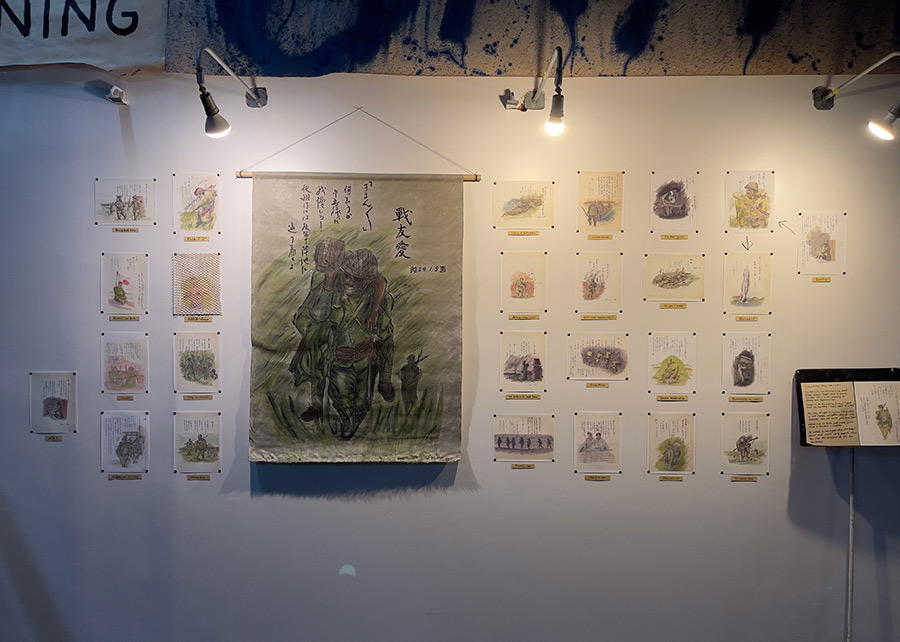
Kazuhiro Imafuko. “War & Order” 148 Frost St. (photo © Jaime Rojo)

BSA: In an age of “mass desensitization to violence,” what emotional or intellectual response do you hope visitors will leave with after experiencing War & Order? 

GS: I hope they care about people’s lives and recognize that life is important even the lives of those you disagree with. People are not pawns, they are flesh and blood and we should never forget this.
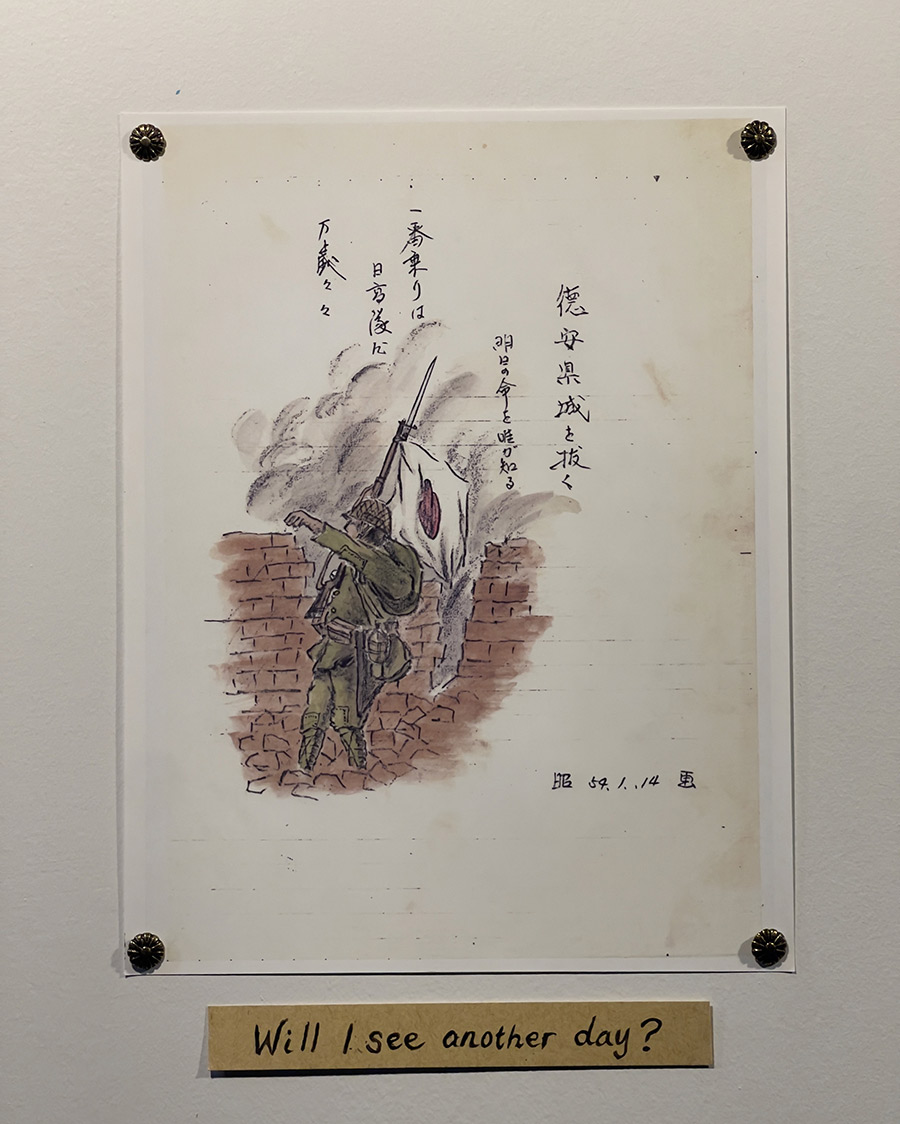
Kazuhiro Imafuko. “War & Order” 148 Frost St. (photo © Jaime Rojo)

BSA to Specter and Rene LaRude: The murals are compelling and powerful, with references to both Picasso and Rockwell. How did you decide to use these two paintings as inspiration for your murals? 

GS: I chose the work by Rockwell as inspiration exactly for this reason that it is revered as a romantic time in American history. The kids depicted would have been of “The Greatest Generation” 

We still cling to this American Iconography today. It is rebranded and used for promoting a xenophobic political message, so for me this iconography was the perfect tool to use to flip the narrative.

Rene LaRude: It wasn’t an easy decision given the impact the piece has had over the years. 

I wanted to make use of certain things from Guernica, narrative, composition, and of course colour (or lack thereof) to apply it to what is happening now.

The piece is about Gaza and the litany of war crimes that have been committed. I wanted to honor the original composition and change elements to stories relevant in Palestine. The use of greyscale is because Gaza has been turned into a land of rubble. even things which are not grey are covered in dust.

My effort is certainly overly dense and packed in but then again, that’s just what I wanted to get across in many ways. 
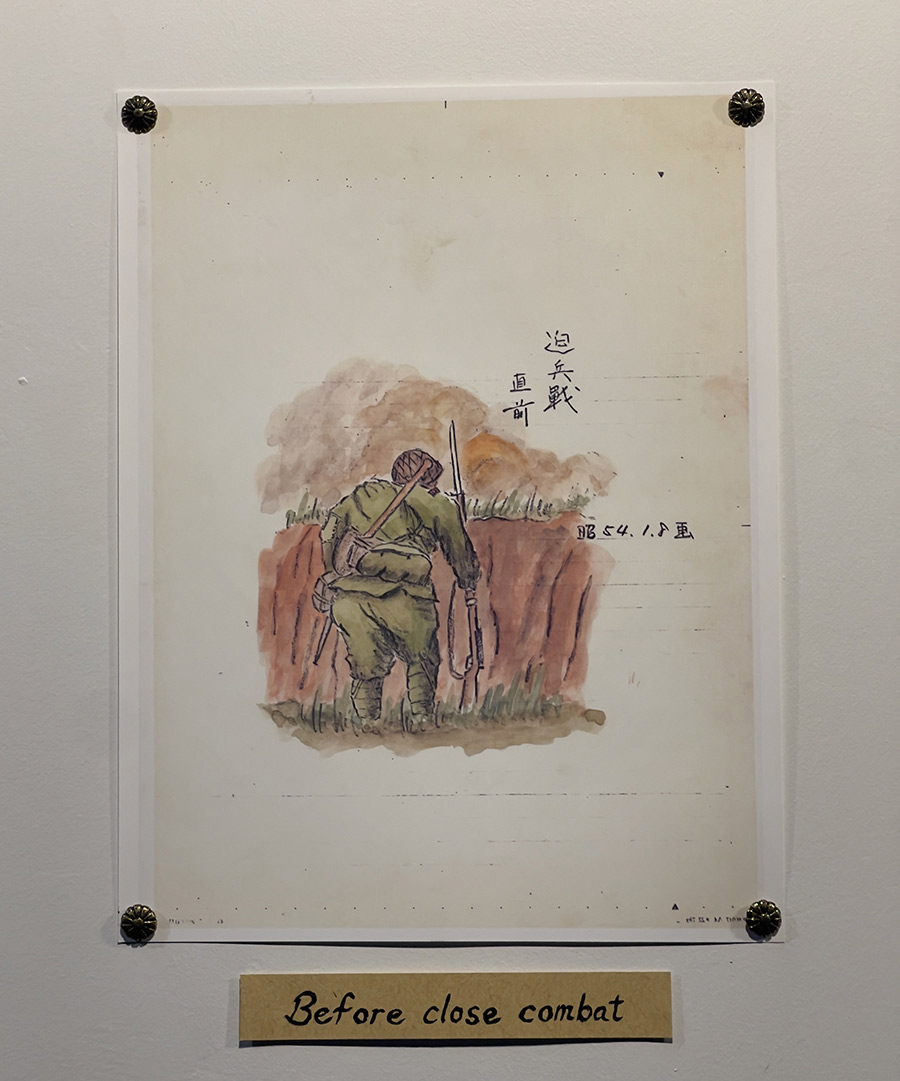
Kazuhiro Imafuko. “War & Order” 148 Frost St. (photo © Jaime Rojo)

All warfare is based on deception.

Sun Tzu (544–496 BC?) – Ancient Chinese Military Strategist
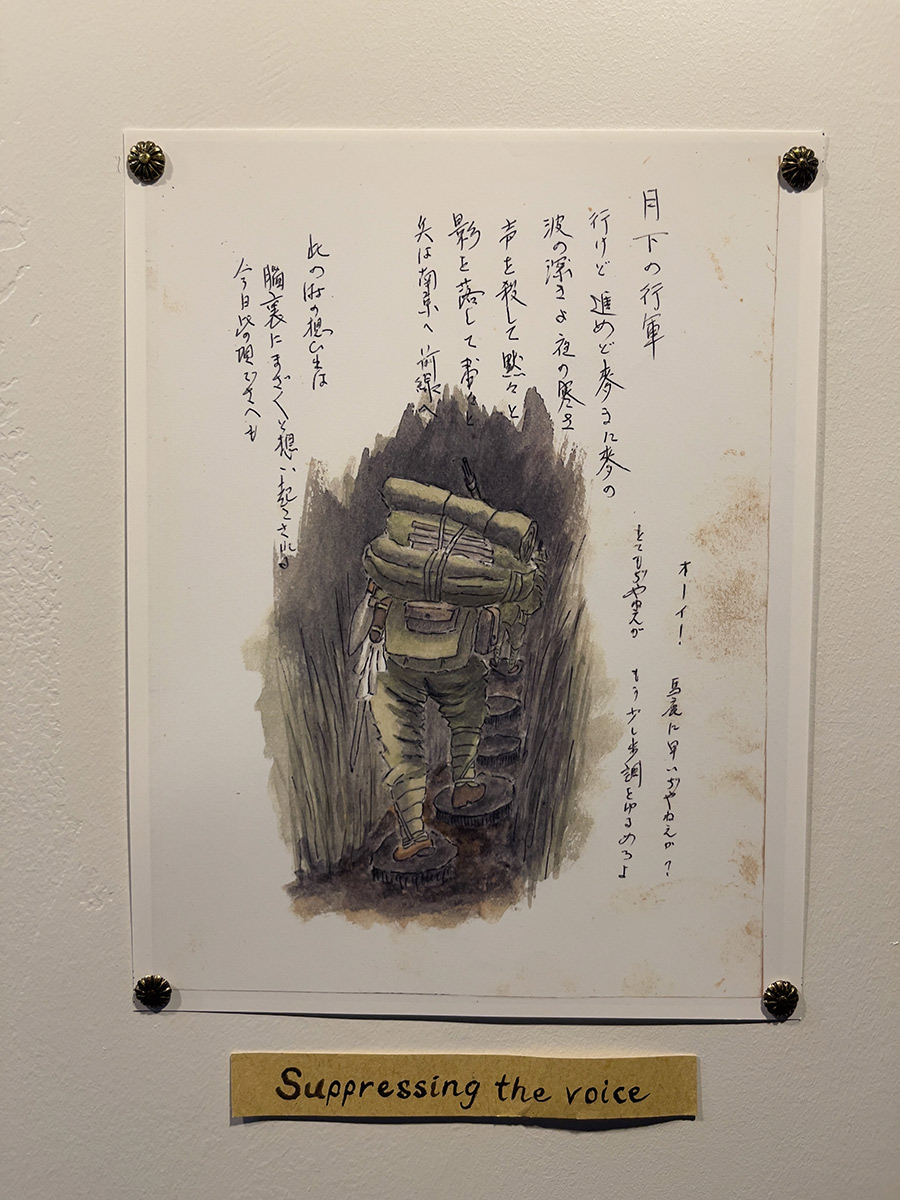
Kazuhiro Imafuko. “War & Order” 148 Frost St. (photo © Jaime Rojo)
Kazuhiro Imafuko. War & Order” 148 Frost St. (photo © Jaime Rojo)
Kazuhiro Imafuko. “War & Order” 148 Frost St. (photo © Jaime Rojo)
“War & Order” 148 Frost St. (photo © Jaime Rojo)

If my soldiers were to begin to think, not one would remain in the ranks.

Frederick the Great (1712–1786) – King of Prussia

Rene Lerude. “War & Order” 148 Frost St. (photo © Jaime Rojo)
Specter. “War & Order” 148 Frost St. (photo © Jaime Rojo)
Kazuhiro Imafuko. Specter. “War & Order” 148 Frost St. (photo © Jaime Rojo)
“War & Order” 148 Frost St. (photo © Jaime Rojo)
Specter. “War & Order” 148 Frost St. (photo © Jaime Rojo)
“War & Order” 148 Frost St. (photo © Jaime Rojo)
Read more
BSA HOT LIST 2024: Books For Your Gift Giving

BSA HOT LIST 2024: Books For Your Gift Giving

As the year comes to a close, we are pleased to present our 14th curated list of books—a reflection of our ongoing commitment to building a world-class library in Berlin. As co-founders of the Martha Cooper Library, our mission is to develop and maintain one of the most comprehensive collections dedicated to art books, photography archives, urban culture studies, street art monographs, graffiti history, and public art anthologies. These works serve as a vital resource for researchers, practitioners, and enthusiasts who engage deeply with these fields.

Looking ahead to 2025, we are thrilled to announce the inaugural Martha Cooper Scholarship, which will launch next year in collaboration with Urban Nation Museum, the Martha Cooper Library, and Martha herself. This scholarship will support outstanding achievements in photography, underscoring her and our dedication to fostering new generations of talent and scholarship in visual culture.

Numerous publications explore street art, graffiti, and related practices each year, adding valuable perspectives and insights to the field. While our focus for this year’s list includes some recent releases, we’ve also highlighted significant works from previous years that help us put today in a better context. We invite your suggestions for books you’d like to see featured or added to the Martha Cooper Library collection and featured here. Your recommendations are invaluable as we continue to expand and diversify our offerings.

Below is our selected shortlist – books that make meaningful additions to any library and thoughtful gifts for family, friends, or even yourself. We hope you enjoy them as much as we have.


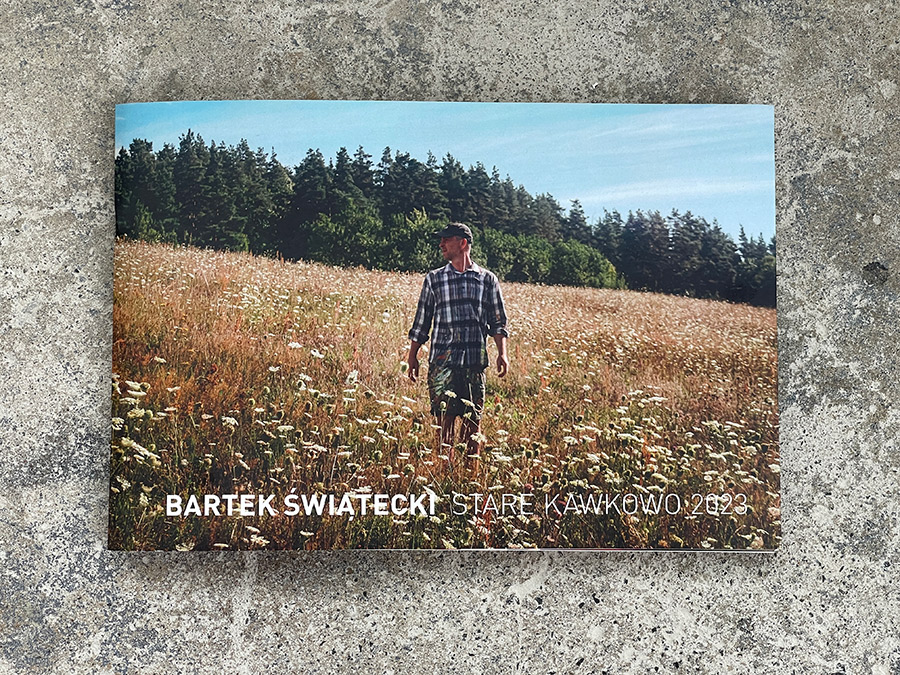
Bartek Świątecki / Stare Kawkowo


Bartek Świątecki / Stare Kawkowo 2023 / Printed in Poland © 2023 Bartek Świątecki

From BSA:

Bartek Świątecki, aka Penner, has a style that is a confidently defined blend of bold colors, geometric shapes, and abstract forms harmoniously intertwined. It’s a graphical minimalism that speaks volumes, with straight lines and pure colors forming complex, geometrical clusters. This unique visual language demonstrates his mastery of blending traditional graffiti with modern abstraction and reflects a deep engagement with high art and youth culture. His murals and canvas works, often large-scale, are known for their dynamic and vibrant nature, inviting viewers into a world where street art and fine art converge.

Bartek Świątecki: “The light vibrates under our eyelids”


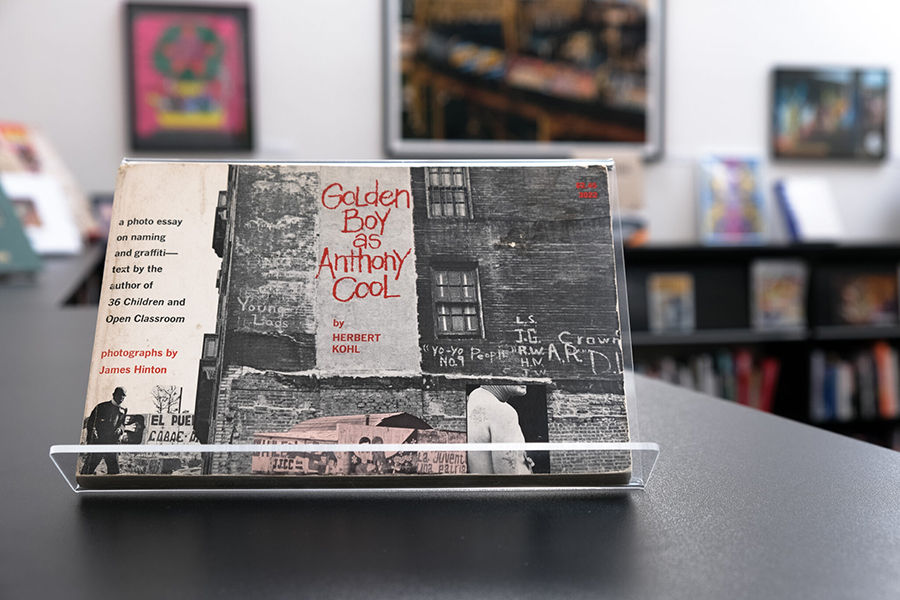
Books In The MCL: Golden Boy as Anthony Cool: by Herbert Kohl and James Hinton


From BSA:

Herbert Kohl and James Hinton’s “Golden Boy as Anthony Cool,” published in 1972, is a seminal work in the study of urban graffiti and street culture. Not only an academic exploration; it’s a journey into the heart of graffiti as a form of personal expression, rebellion, and cultural identity. Kohl’s insightful essays paired with Hinton’s evocative photographs provide a window into the lives of young people in the urban landscapes of New York City and Los Angeles as they simultaneously boil, wane and flourish in the late 60s and early 70s. These vibrant and vibrating communities are chronicled, whether affluent suburbs or struggling neighborhoods, each appears to brim with stories cryptically told through tags and murals on walls and doors.

“Golden Boy as Anthony Cool. Herbert Khol and James Hinton. 1972. MCL Library, Urban Nation Berlin.

Text Steven P. Harrington and Jaime Rojo Photos by Sebastian Kläbsch


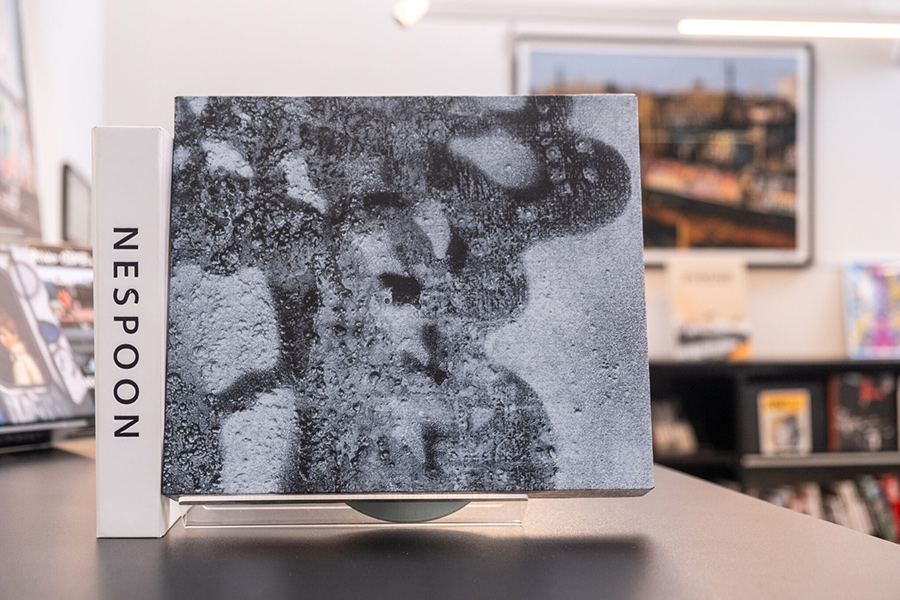
Books In The MCL: The Self-Titled “NeSpoon” by NeSpoon.


From BSA:

NeSpoon,” a monograph on the work of the Polish artist, provides a comprehensive examination of her unique integration of lace patterns into urban and natural landscapes. The book, limited to 111 copies, each spanning over 420 pages, showcases the artist’s extensive portfolio and delves into the anthropology, cultural, and historical significance underlying her chosen medium.

“Why lace? It just came to me. Lace chose me, not the other way around. I’ve never liked lace. Before I started working with it, I thought lace was something old-fashioned, from a grandmother’s dusty apartment. Today it seems to me that each lace harbors harmony, balance and a sense of natural order. Isn’t that just what we are all searching for instinctively?”~ NeSpoon

NeSpoon” by NeSpoon. 2024. MCL Library, Urban Nation Berlin.

Text: Steven P. Harrington and Jaime Rojo, Photos: Sebastian Kläbsch

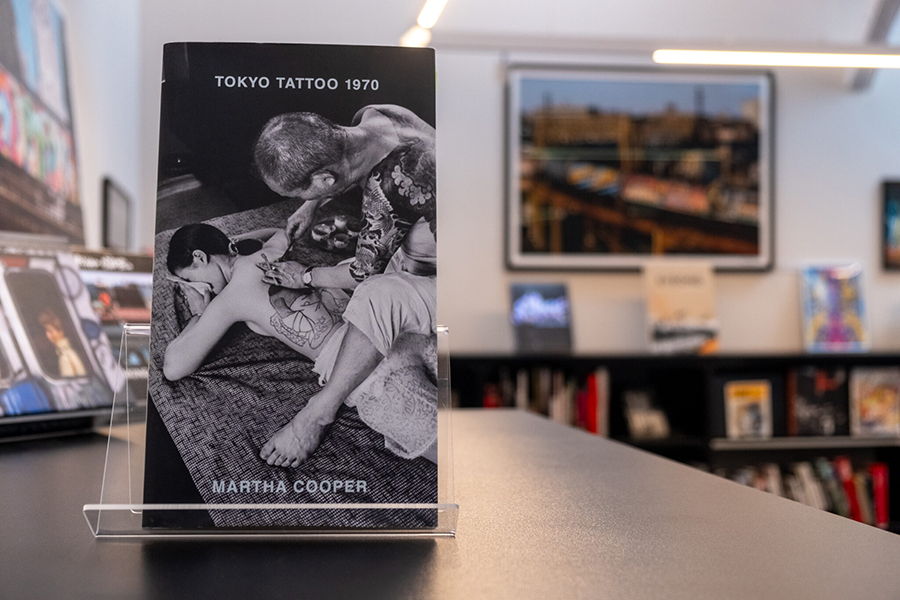
Books In The MCL: Tokyo Tattoo 1970. Martha Cooper. Stockholm, Dokument Press.


From BSA:

In “Tokyo Tattoo 1970,” photographer Martha Cooper, well-known for her definitive work on New York City’s graffiti scene, applies her ethnographic skills to document traditional Japanese tattooing. This book provides a clear and respectful portrayal of a secretive and highly specialized art form, preserved in black-and-white film photography. Through Cooper’s lens, readers gain access to the traditional techniques and cultural narratives embedded in Japanese tattoo art, offering insights into an art form that was largely inaccessible during the early 1970s.

Books In The MCL: Tokyo Tattoo 1970. Martha Cooper

Text: Steven P. Harrington and Jaime Rojo Fotos: Sebastian Kläbsch


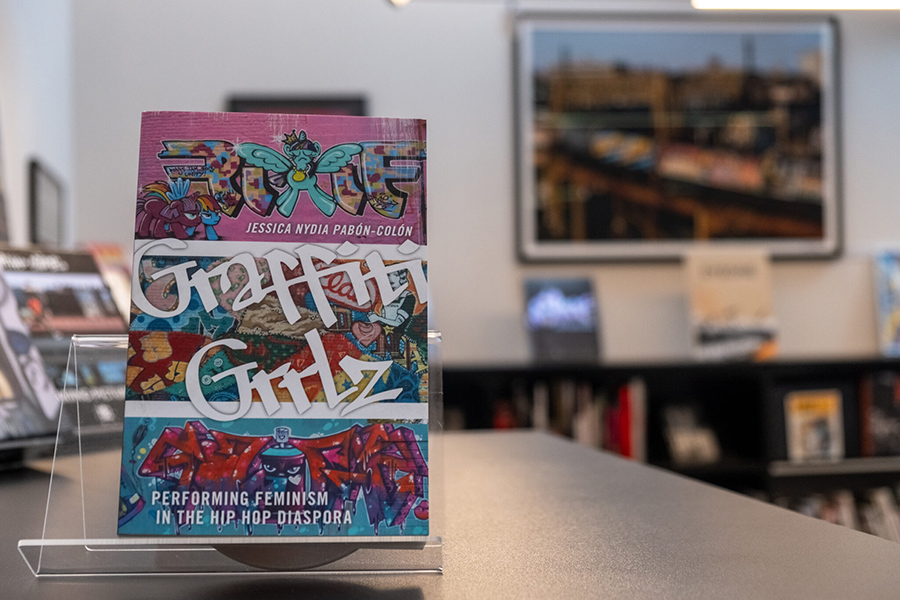
Books In The MCL: Performing Feminism in the Hip Hop Diaspora. Jessica Nydia Pabón-Colón.


Graffiti Grrlz: Performing Feminism in the Hip Hop Diaspora. Jessica Nydia Pabón-Colón. 2018. New York. New York University Press.

From BSA:

Graffiti Grrlz: Performing Feminism in the Hip Hop Diaspora” by Jessica Nydia Pabón-Colón provides an insightful look into the world of women graffiti artists, challenging the perception that graffiti is a male-dominated subculture. This book highlights the contributions of over 100 women graffiti artists from 23 countries, showcasing how they navigate, challenge, and redefine the graffiti landscape.

From the streets of New York to the alleys of São Paulo, Pabón-Colón explores the lives and works of these women, presenting graffiti as a space for the performance of feminism. The book examines how these artists build communities, reshape the traditionally masculine spaces of hip hop, and create networks that lead to the formation of all-girl graffiti crews and painting sessions. This aspect is particularly useful in understanding how digital platforms have broadened the reach and impact of women graffiti artists, facilitating connections and collaborations worldwide.

Graffiti Grrlz: Performing Feminism in the Hip Hop Diaspora. Jessica Nydia Pabón-Colón.
2018

Text: Steven P. Harrington & Jaime Rojo Fotos: Sebastian Kläbsch


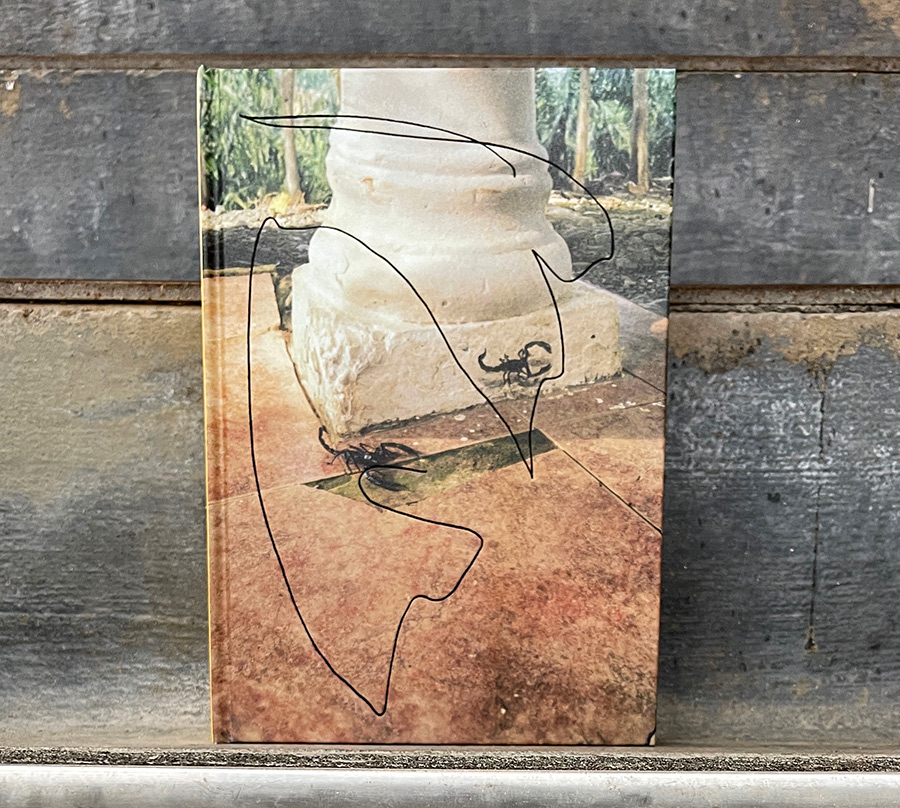
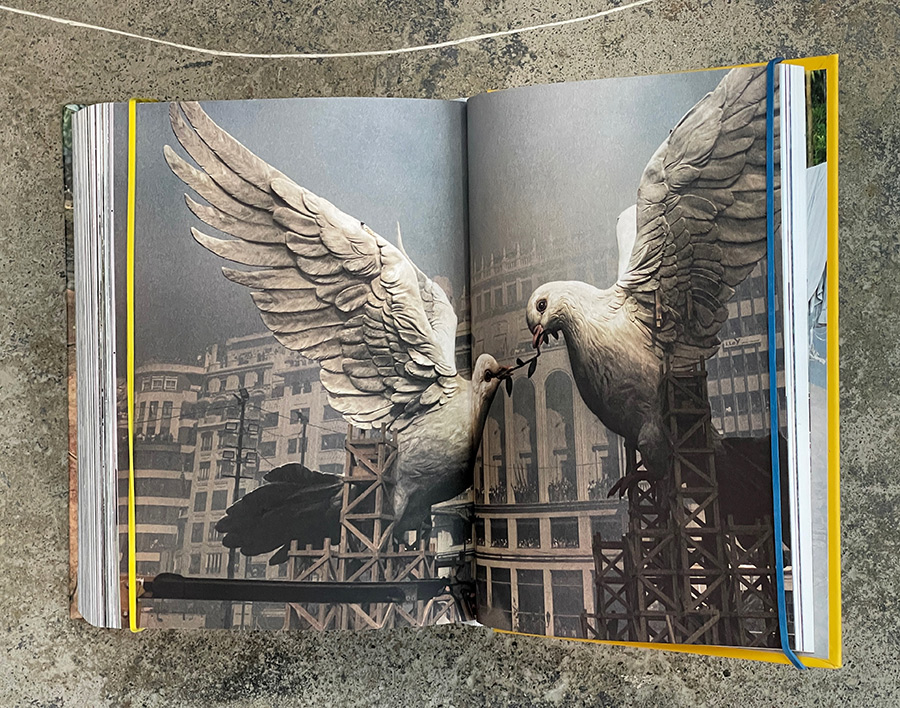
ESCIF / “The Foundations of Harmony and Invention”


FROM BSA:

It would be challenging to extricate Escif’s work from the city and its daily routines. The city, with its cacophonous soundtrack created by its inhabitants’ constant movement and the fluidity of their industry and agency, remains central to the artist’s focus and relevance.

For Escif, the city is not just a muse but the bedrock of his artistic inspiration, a canvas, and an outlet for addressing its contradictions and inequalities. In his work, the city is not an abstract subject but a perpetual, tangible, and knowable presence, manifested in myriad encounters, journeys, dreams, observations, and experiences, later reassigned onto paper, canvas, or concrete.

Escif’s Urban Manifesto: Art, Activism, and the Everyday / “The Foundations of Harmony and Invention”


BSA HOT LIST 2023: Books For Your Gift Giving

BSA HOT LIST 2022: Books For Your Gift Giving

BSA HOT LIST 2021: Books For Your Gift Giving

BSA HOT LIST: Books For Your Gift Giving 2020

BSA HOT LIST: Books For Your Gift Giving 2019

Read more
Escif’s Urban Manifesto: Art, Activism, and the Everyday / “The Foundations of Harmony and Invention”

Escif’s Urban Manifesto: Art, Activism, and the Everyday / “The Foundations of Harmony and Invention”

It would be challenging to extricate Escif’s work from the city and its daily routines. The city, with its cacophonous soundtrack created by its inhabitants’ constant movement and the fluidity of their industry and agency, remains central to the artist’s focus and relevance.

For Escif, the city is not just a muse but the bedrock of his artistic inspiration, a canvas, and an outlet for addressing its contradictions and inequalities. In his work, the city is not an abstract subject but a perpetual, tangible, and knowable presence, manifested in myriad encounters, journeys, dreams, observations, and experiences, later reassigned onto paper, canvas, or concrete.

Escif’s keen commentary on essential subjects—the environment, social injustice, human rights, humanity, and beauty—is profoundly intertwined with the city. He neither backs away from its battles and challenges nor sugarcoats his art with glossy, shiny distractions that ignore the habitat around him. His elegant compositions, stripped of noise and clutter, present ideas rooted in reality and the inherent beauty of urban life’s ever-present comings and goings.

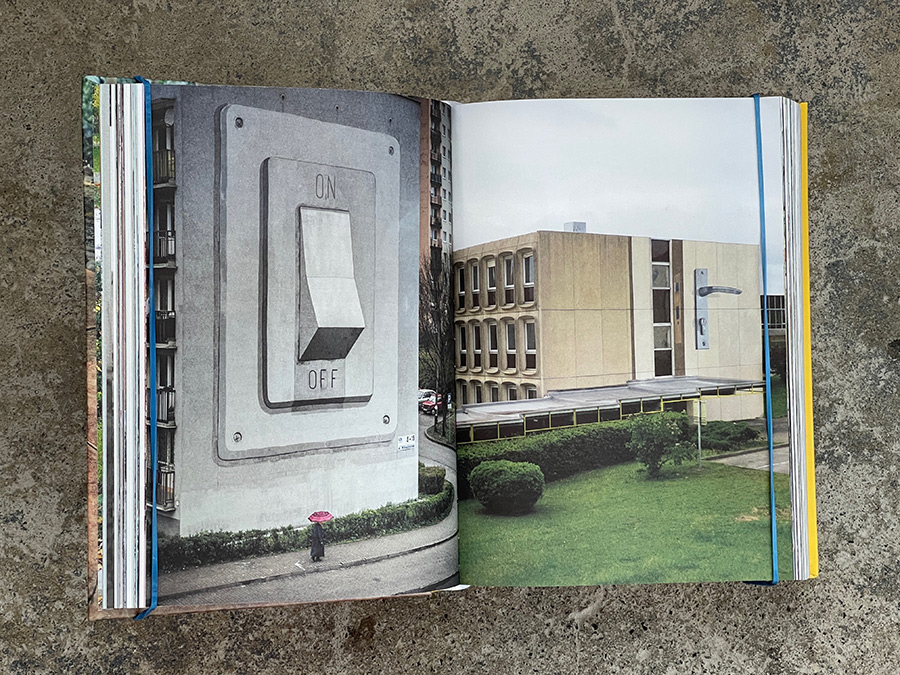
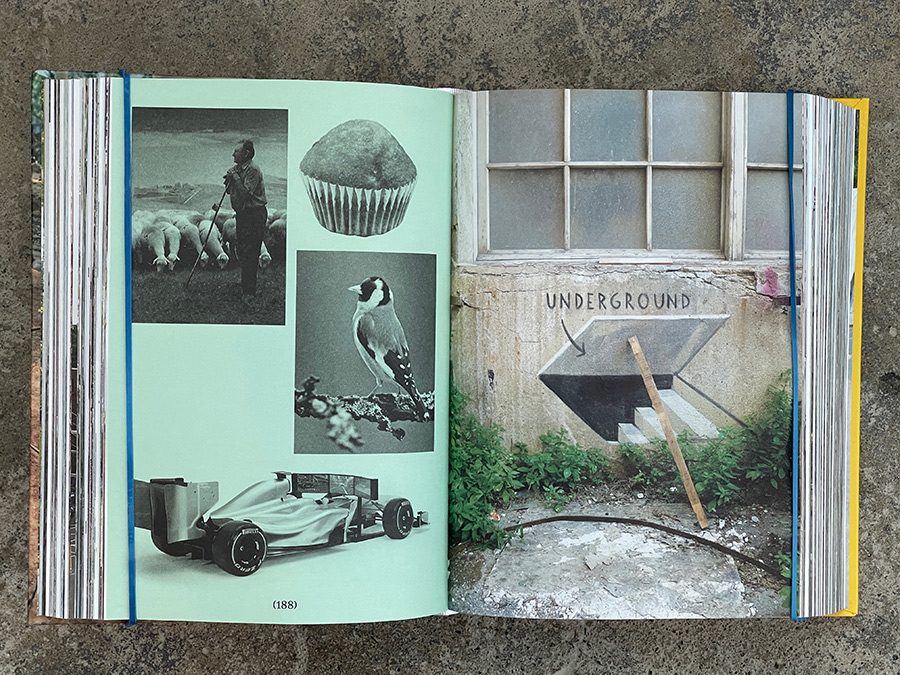
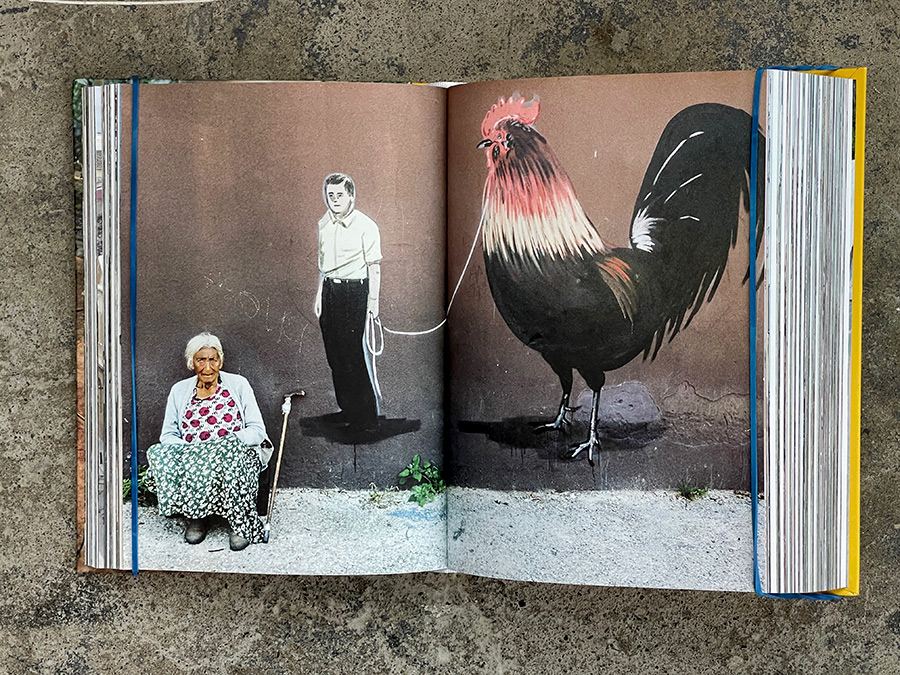
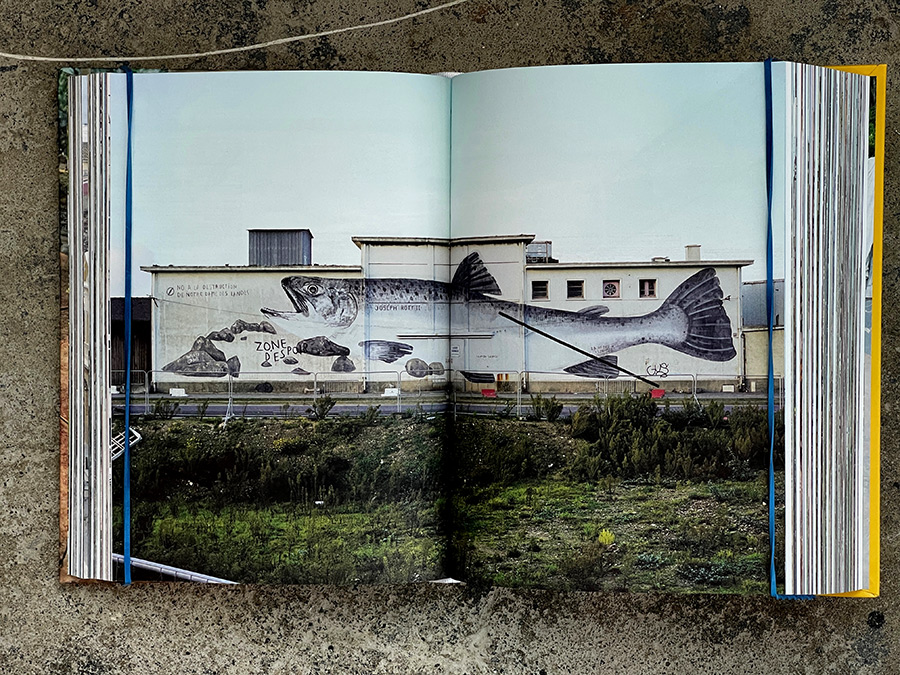
His new book, “The Foundations of Harmony and Invention,” is a 600-page tome compiling his work from the past 12 years. Crowd-funded, the project brings people together under a shared symposia of ideas and notes spearheaded by the artist. This spirit of collaboration is evident in the dozens of contributors featured in the book, including photographers, illustrators, artists, and writers.
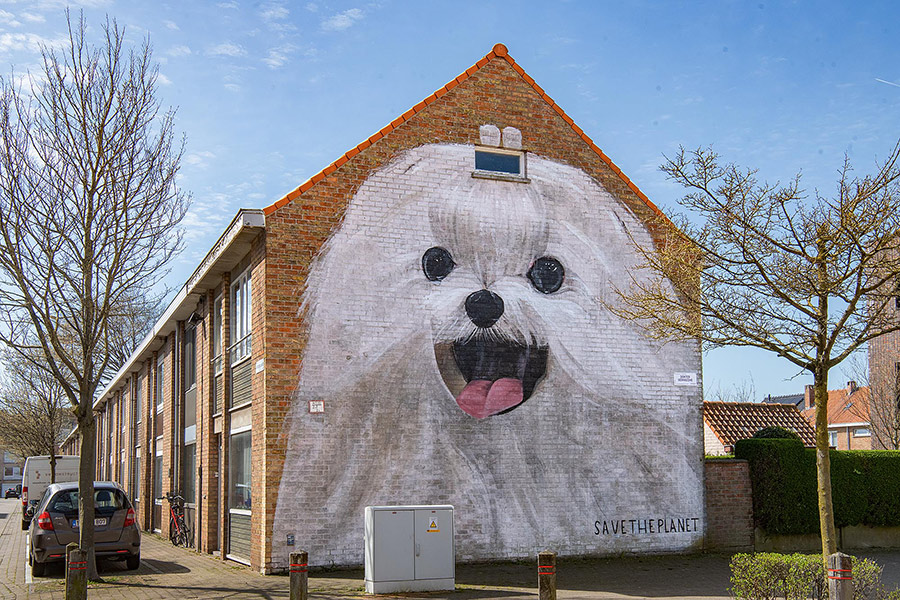
Structured non-linearly, the book resembles an orchestral symphony, with every instrument—some homemade—and voice at play. Against this backdrop, Escif’s visual works, such as paintings, sculptures, and photographs, are combined with written contributions—cogitations, observations, anecdotes, manifestos, lamentations, odes, and protests—from himself and others. The result is a nutrient-rich, rumbling, and vital river of ideas and propositions that evolve into an expansive dialogue between the artist and the world around him.

We found the book’s description in the press release particularly compelling and share an excerpt here:

“So, this book, in a rectangular shape and hardcover, could well serve as a wedge with which to block the revolving doors of the Central Bank; as a companion for pleasure and adventures; as a small step to lean on to jump over a fence; as a cushion to sleep under a tree; as a throwing-object directed against a shop window; and also—why not—as a book, claiming pause, silence, and timelessness against the dominant paradigm of productivity.”

Somehow, Escif captures the everyday serenity and absurdity of life in these times—caught somewhere between the industrialization era and the algorithmic age, the imagination economy. For a man who may spend much time in his head, it is impossible not to feel his heart in these pages.

Hard cover: 600 pgs. approx. 
Year: 2024
Language: English & Spanish
Edition: 900 copies

Click HERE to purchase ESCIF’s “The Foundations of Harmony and Invention”

Read more
“UNMUTE GAZA”: New Art from Escif and Zacharevic

“UNMUTE GAZA”: New Art from Escif and Zacharevic

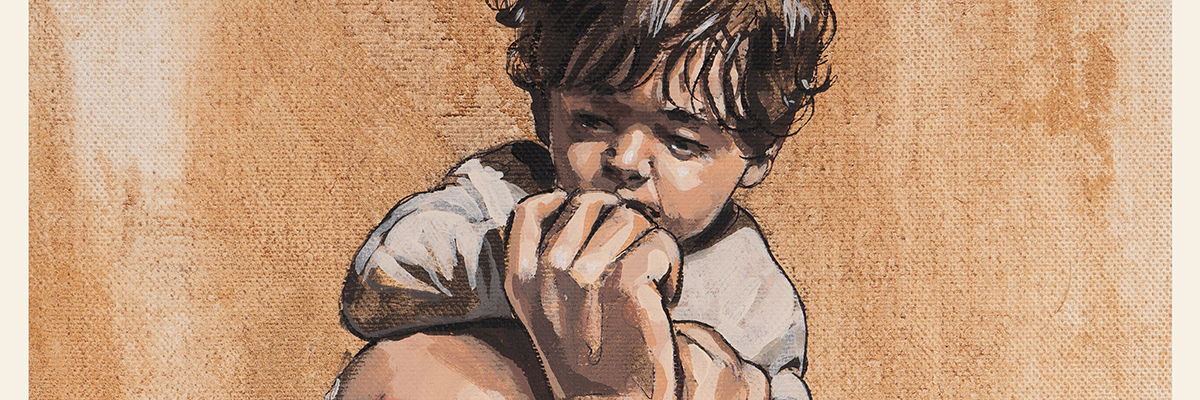
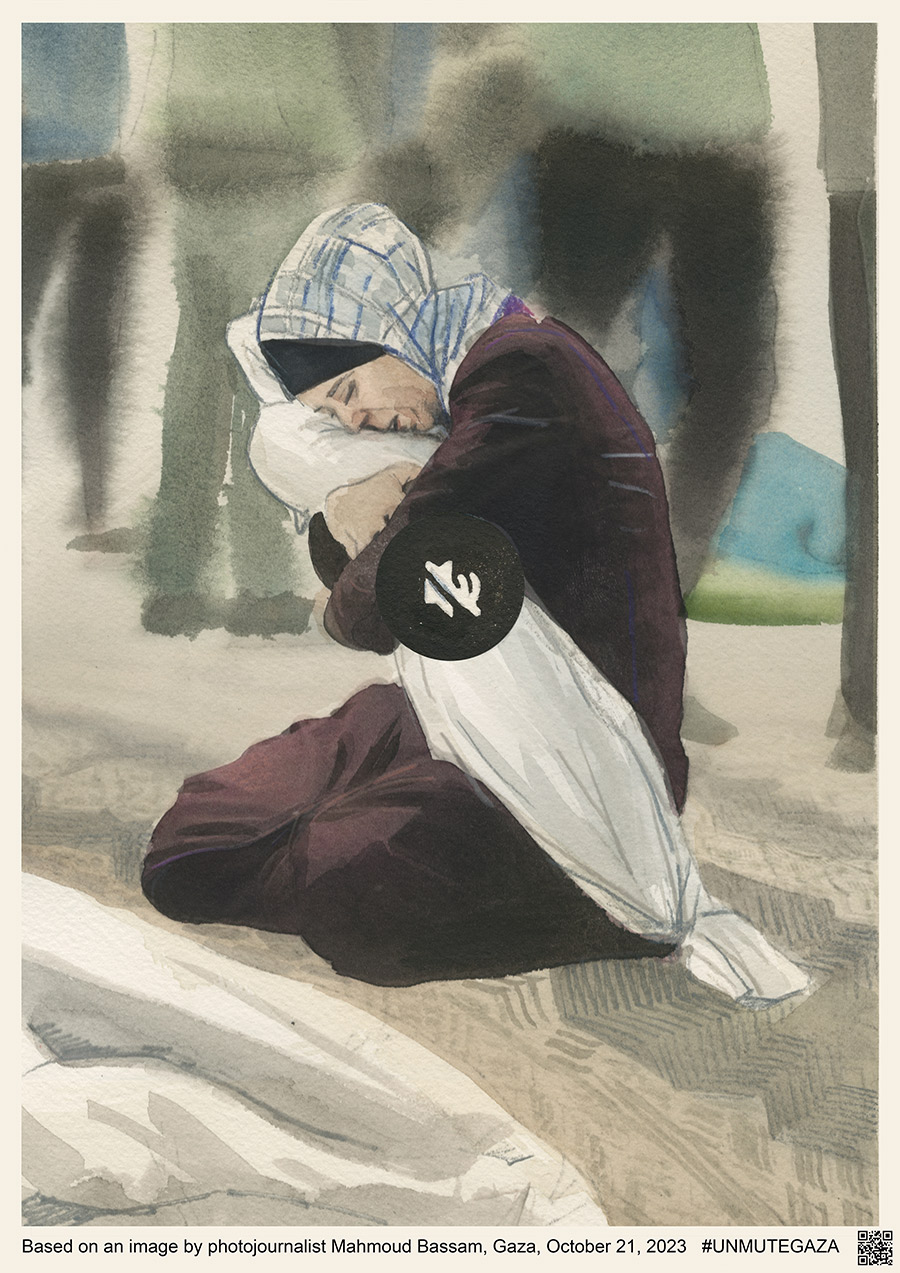
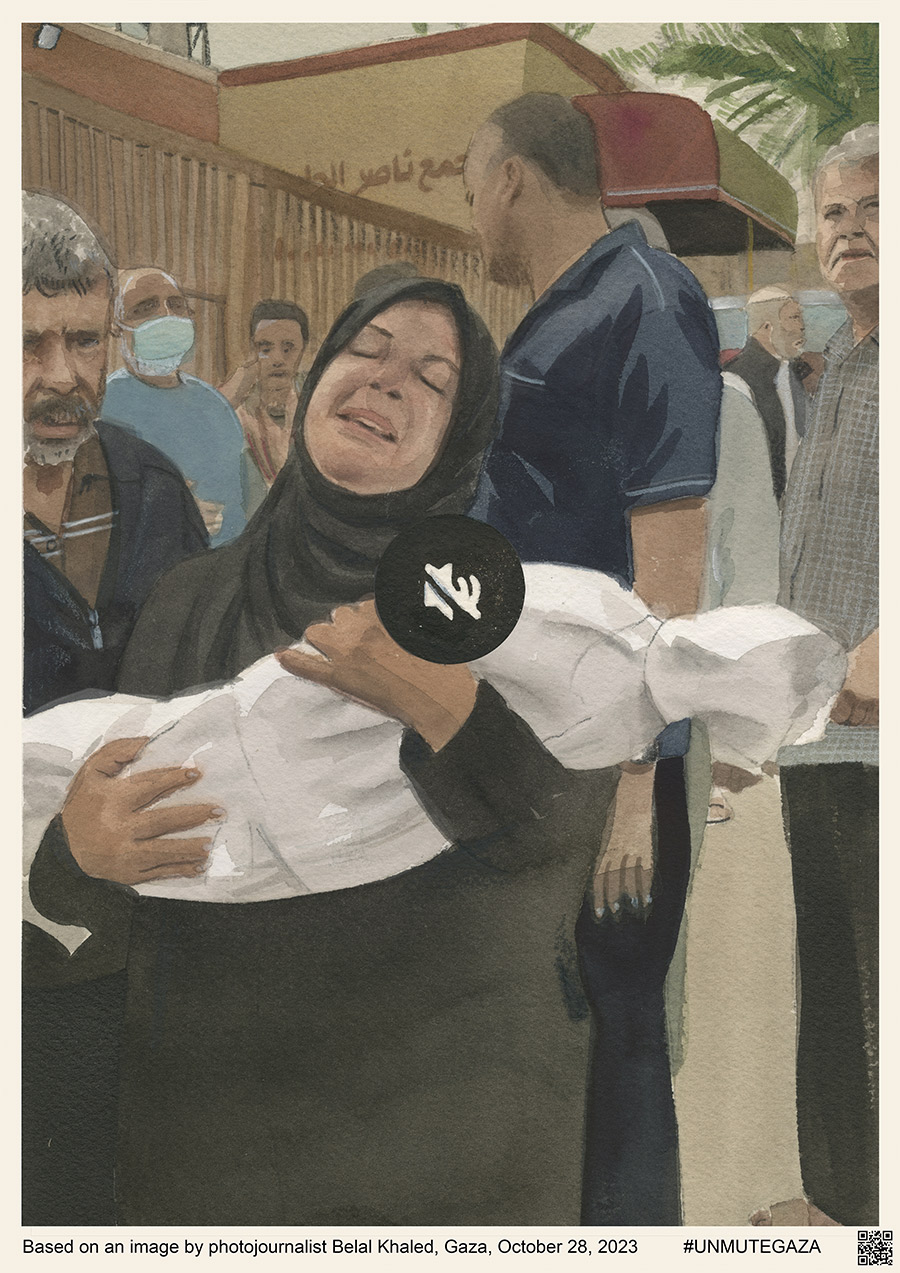
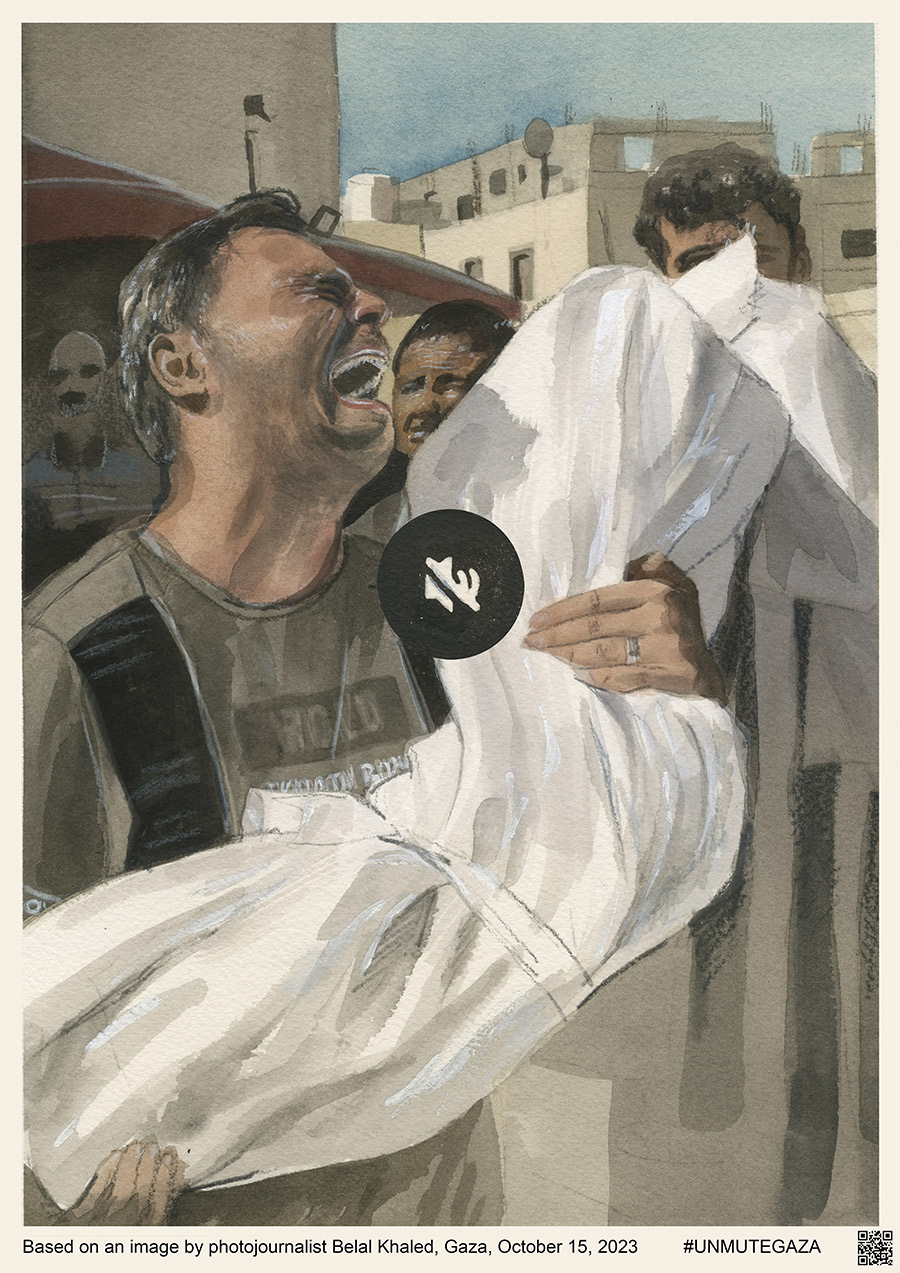
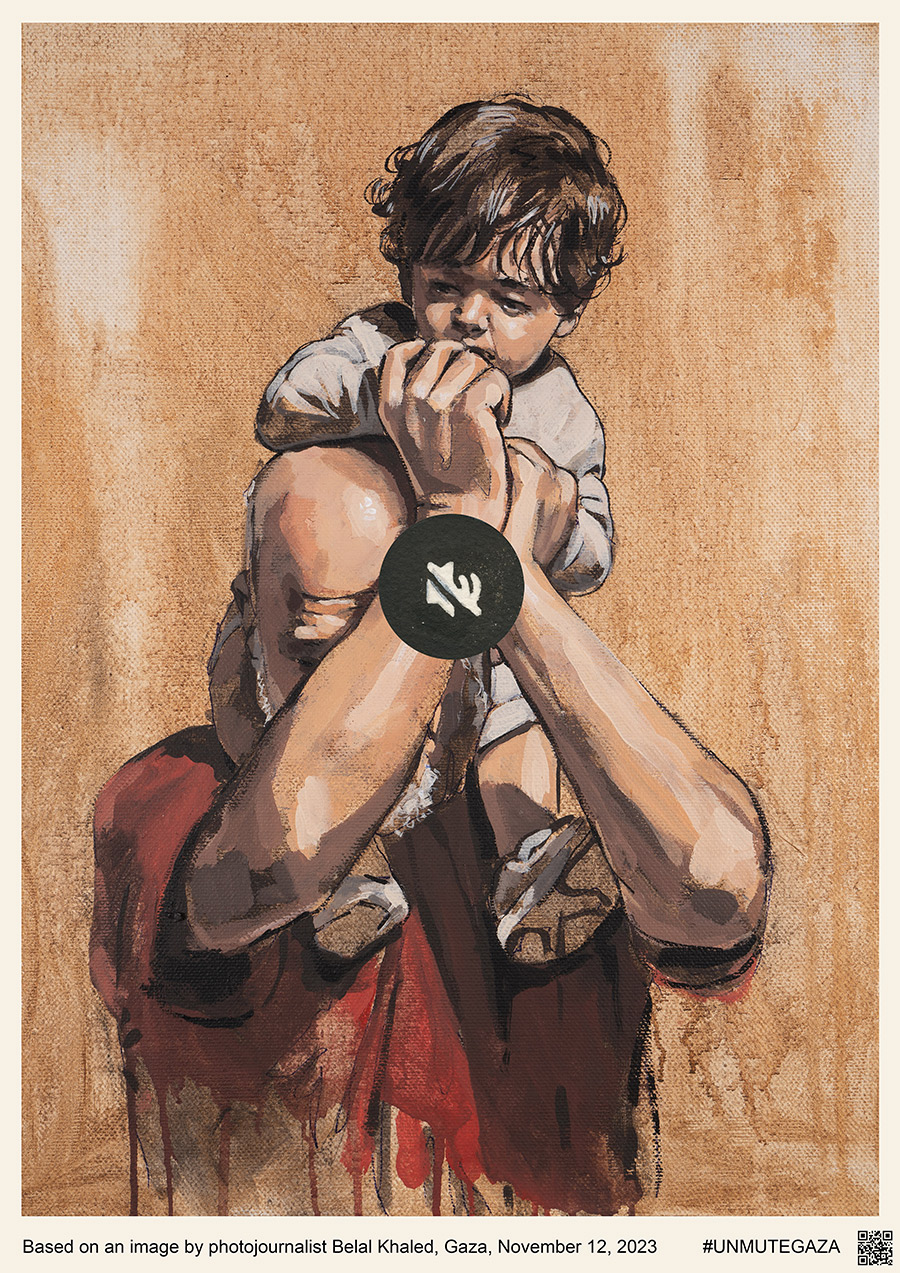
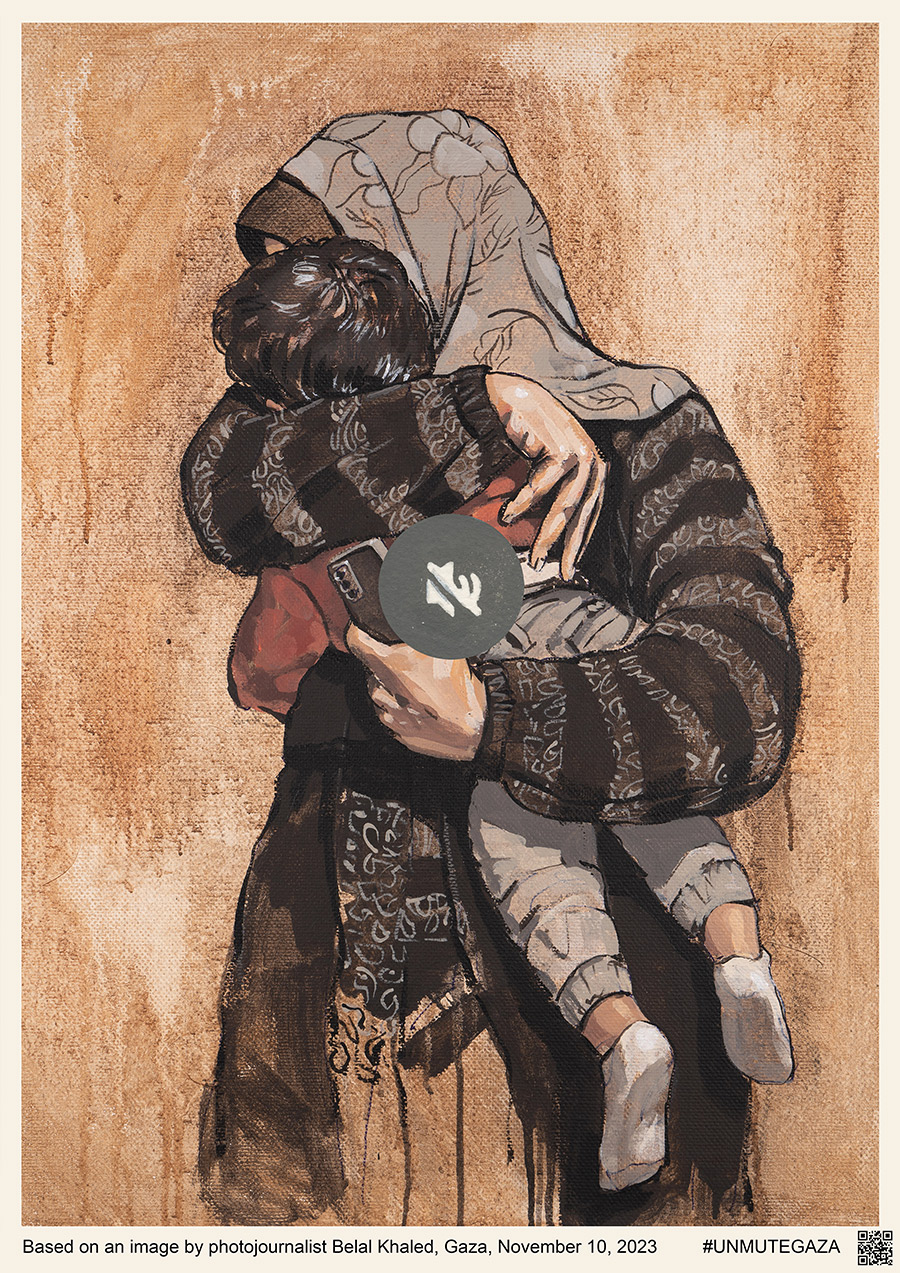
Today, we unveil new works from the Unmute Campaign, a dynamic and impactful movement supporting photojournalists in Gaza. This creative initiative transforms harrowing moments captured in conflict zones into evocative paintings and sketches. By doing so, the campaign plays a pivotal role in amplifying the voices of those who risk their lives to report the realities of these areas, no matter how dire. Joining the effort is a diverse group of international artists, including Ernest Zacharevic, Escif, and prominent figures such as Shepard Fairey.

Artist, Escif. Photojournalist, Mahmoud Bassam. (image © courtesy of Unmute Gaza)

This campaign represents a significant movement in the art world, where artists from across the globe interpret photo documentation from photojournalists on the ground in Gaza; the project partners with five active Photojournalists, Belal Khaled, Mahmoud Bassam, Sameh Nidal-Rahmi Saher Alghorra and Majdi Fathi. Their involvement in Unmute goes beyond artistic expression; it’s a testament to their commitment to raising awareness and fostering change in pressing global issues.

Artist, Escif. Photojournalist, Belal Khaled. (image © courtesy of Unmute Gaza)

Ernest Zacharevic draws upon his unique ability to blend art with its surroundings, creating pieces that resonate deeply within local and international communities. His environmental activism, mainly through his “Splash and Burn” campaign, highlights Indonesia’s urgent need for sustainable practices in palm oil farming. This initiative underlines his dedication to tackling environmental degradation and promoting a harmonious relationship between humans and nature.

Escif, on the other hand, is better known perhaps for his art on the street that challenges societal norms and provokes critical thought. For instance, his work during the coronavirus pandemic offered a fresh perspective on societal attitudes and governmental narratives. Escif’s participation in the Unmute campaign reflects his reputation for keen insight into the complexities of social and political issues.
As these new pieces from the Unmute campaign unfold, they remind us of the influential role that art can play in shaping societal perspectives and driving action.

CLICK HERE TO DOWNLOAD THE FILES FOR PRINT FREE OF CHARGE

Artist, Escif. Photojournalist, Belal Khaled. (image © courtesy of Unmute Gaza)
Artist, Ernest Zacharevic. Photojournalist, Belal Khaled. (image © courtesy of Unmute Gaza)

CLICK HERE TO DOWNLOAD THE FILES FOR PRINT FREE OF CHARGE

Read more
The Crystal Ship – Collection from Past Editions

The Crystal Ship – Collection from Past Editions

Yesterday, we shared with you the current edition of The Crystal Ship, a Belgian street art festival located in Ostend, which is located in the Flemish Region of Belgium. The collection of images that we presented was taken by photographer Martha Cooper, a frequent collaborator of BSA, during her recent trip to Ostend as a special guest of the festival.

Adele Renault. The Crystal Ship 2022. Ostend, Belgium. (photo © Martha Cooper)

In line with her usual practice, Ms. Cooper did not limit her work to capturing photos of the murals being painted for this year’s festival edition; she also endeavored to take as many photos of murals painted during previous editions of the festival. We are pleased to present a selection of these murals, painted over several years, with photographs taken by Martha Cooper herself.

Miss Van. The Crystal Ship 2019. Ostend, Belgium. (photo © Martha Cooper)

This selection of murals is an exciting representation of the diverse and captivating street art that has been featured at The Crystal Ship Festival throughout the years, much of it creating a gallery of contemporary artists whose work is arresting and appealing to a general audience. The dedication and hard work put forth by Martha Cooper in capturing these pieces in all their artistic glory is genuinely commendable. We hope you enjoy this glimpse into the festival’s vibrant history and the incredible art showcased in the public square in Ostend over the years.

BEZT. The Crystal Ship 2022. Ostend, Belgium. (photo © Martha Cooper)
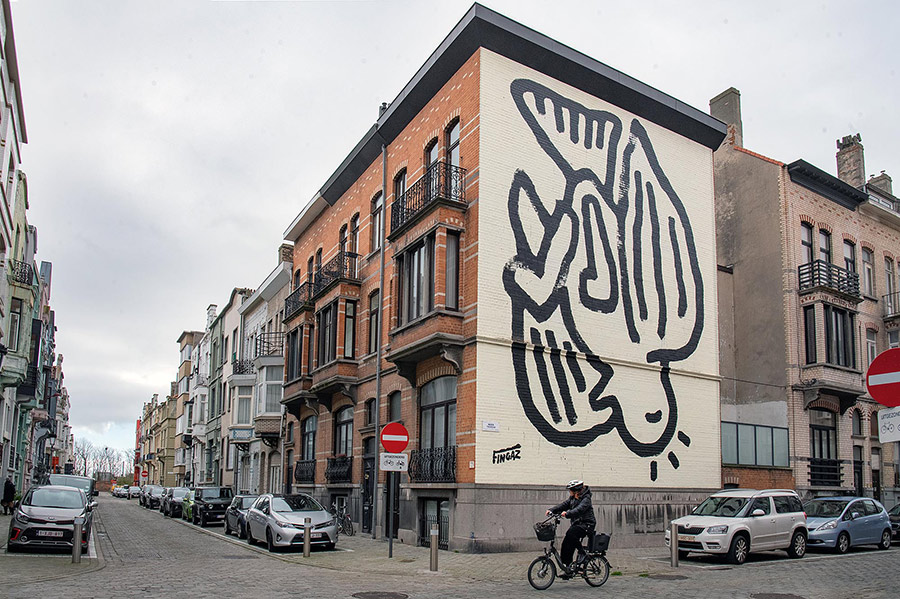
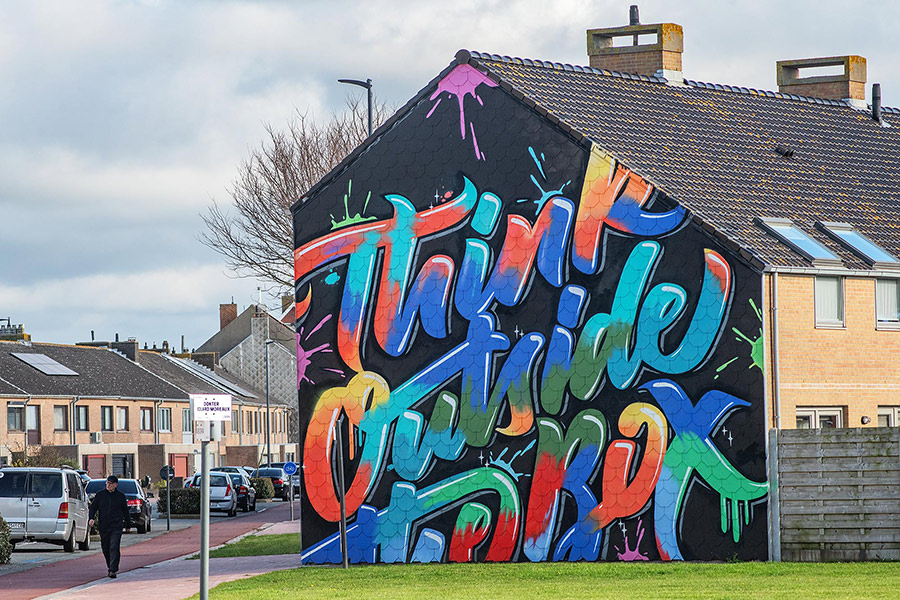
Escif. The Crystal Ship 2019. Ostend, Belgium. (photo © Martha Cooper)
BUCK. The Crystal Ship 2017. Ostend, Belgium. (photo © Martha Cooper)
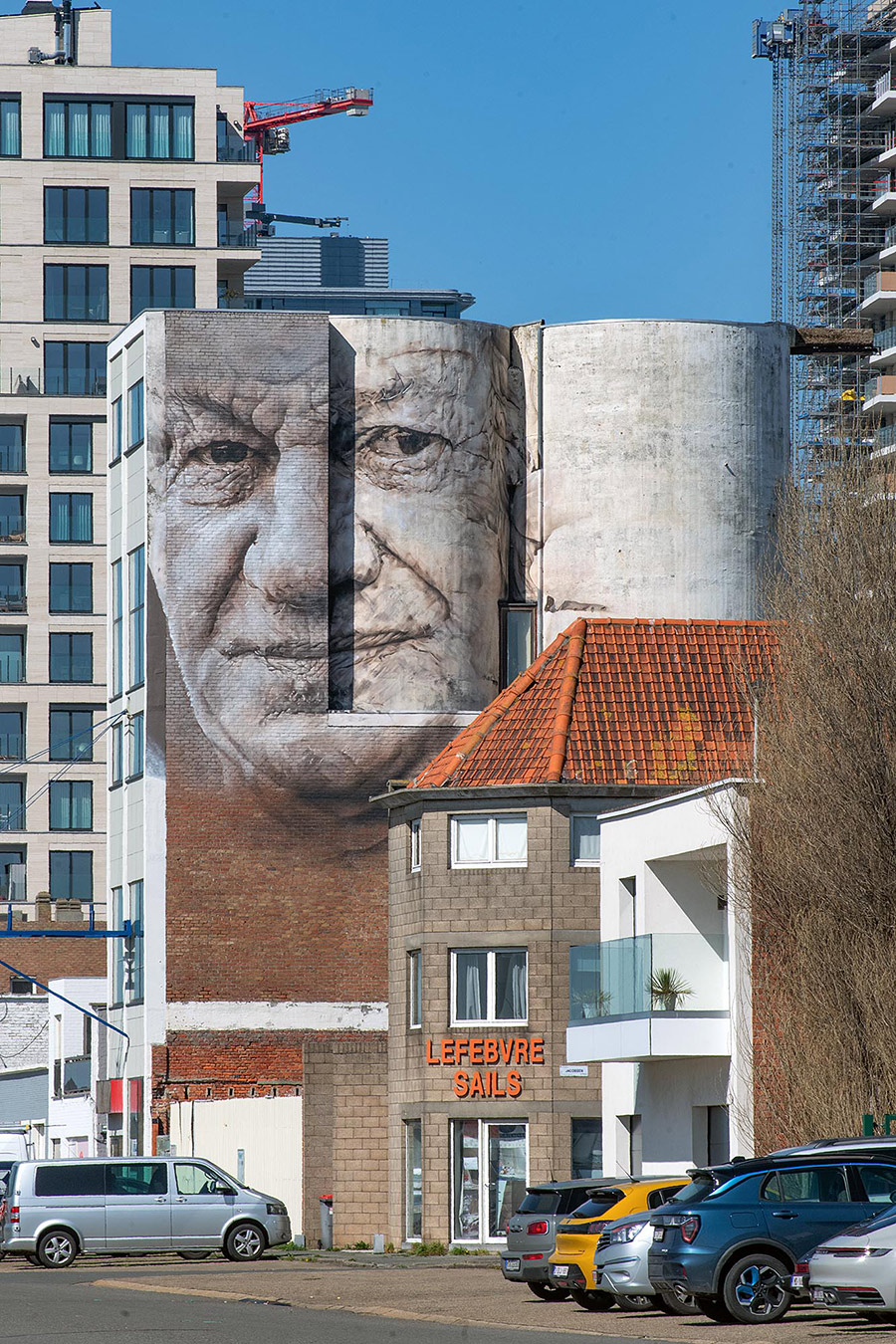
Guido van Helten. The Crystal Ship 2016. Ostend, Belgium. (photo © Martha Cooper)
C215. The Crystal Ship 2017. Ostend, Belgium. (photo © Martha Cooper)
Alex Senna. The Crystal Ship 2022. Ostend, Belgium. (photo © Martha Cooper)
Phlegm. The Crystal Ship 2017. Ostend, Belgium. (photo © Martha Cooper)
DZIA The Crystal Ship 2021. Ostend, Belgium. (photo © Martha Cooper)
Joachim. The Crystal Ship 2018. Ostend, Belgium. (photo © Martha Cooper)
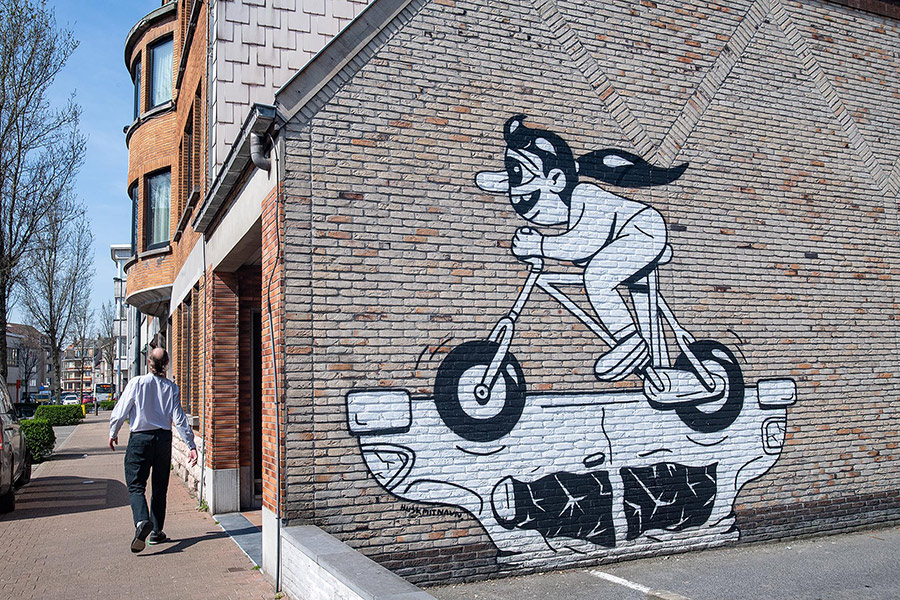
Husk Mit Navn. The Crystal Ship 2021. Ostend, Belgium. (photo © Martha Cooper)
Matthew Dawn. The Crystal Ship 2018. Ostend, Belgium. (photo © Martha Cooper)
Broken Fingaz. The Crystal Ship 2022. Ostend, Belgium. (photo © Martha Cooper)
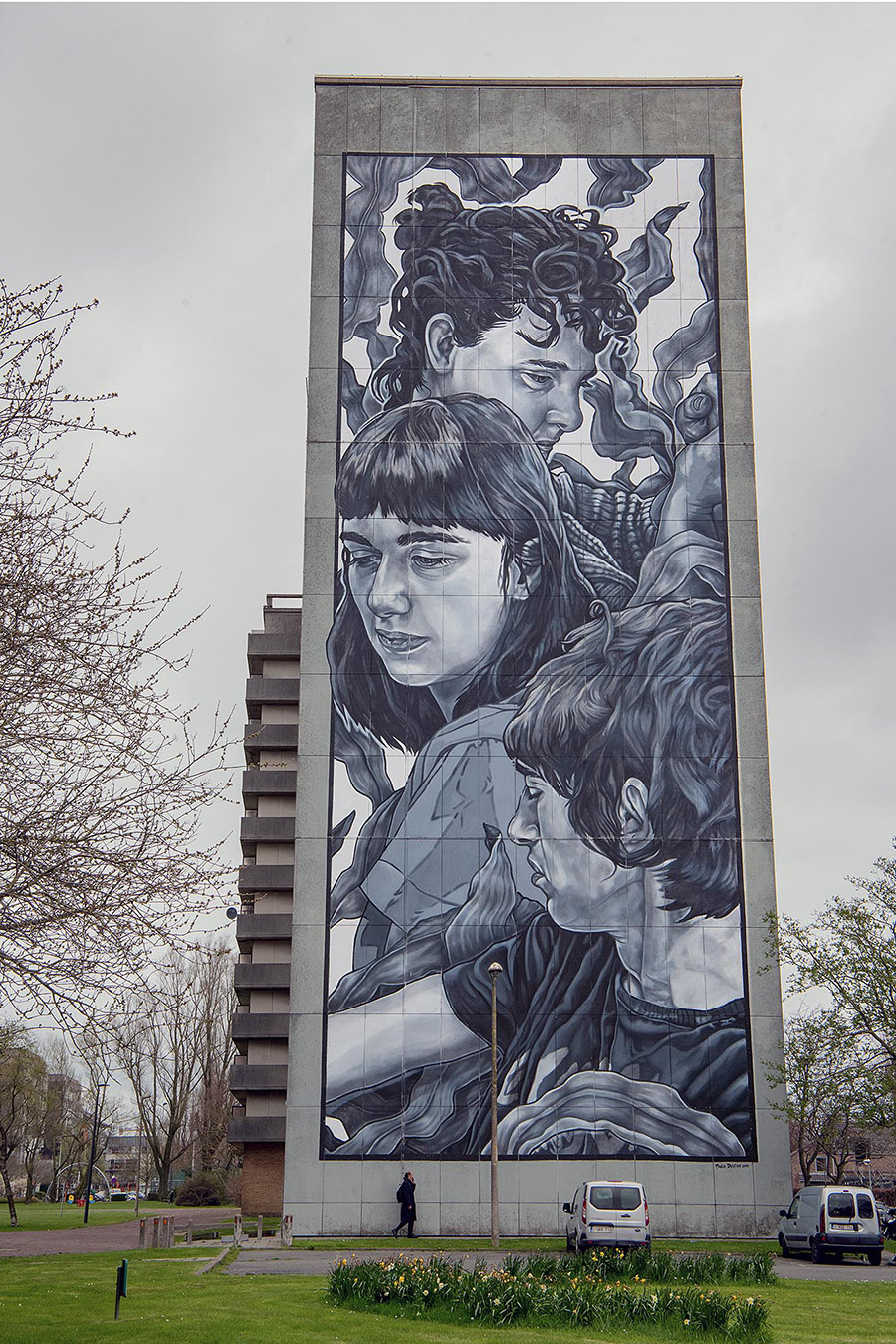
Paola Delfin. The Crystal Ship 2019. Ostend, Belgium. (photo © Martha Cooper)
Zenith. The Crystal Ship 2020. Ostend, Belgium. (photo © Martha Cooper)
Erin Holly. The Crystal Ship 2018. Ostend, Belgium. (photo © Martha Cooper)
Hyuro. The Crystal Ship 2017. Ostend, Belgium. (photo © Martha Cooper)
TelmoMiel. The Crystal Ship 2018. Ostend, Belgium. (photo © Martha Cooper)
Case Maclaim. The Crystal Ship 2020. Ostend, Belgium. (photo © Martha Cooper)
Colectivo Licuado. The Crystal Ship 2018. Ostend, Belgium. (photo © Martha Cooper)
Helen Bur. The Crystal Ship 2019. Ostend, Belgium. (photo © Martha Cooper)
Iñigo Sesma. The Crystal Ship 2022. Ostend, Belgium. (photo © Martha Cooper)
Leon Keer. The Crystal Ship 2019. Ostend, Belgium. (photo © Martha Cooper)
David Walker. The Crystal Ship 2019. Ostend, Belgium. (photo © Martha Cooper)
Franco Fasoli. Detail. The Crystal Ship 2022. Ostend, Belgium. (photo © Martha Cooper)
Franco Fasoli. The Crystal Ship 2022. Ostend, Belgium. (photo © Martha Cooper)
Maya Hayuk. The Crystal Ship 2022. Ostend, Belgium. (photo © Martha Cooper)
Aryz. The Crystal Ship 2021. Ostend, Belgium. (photo © Martha Cooper)

Read more
Behind the Scenes at Beyond The Streets London / Recap

Behind the Scenes at Beyond The Streets London / Recap

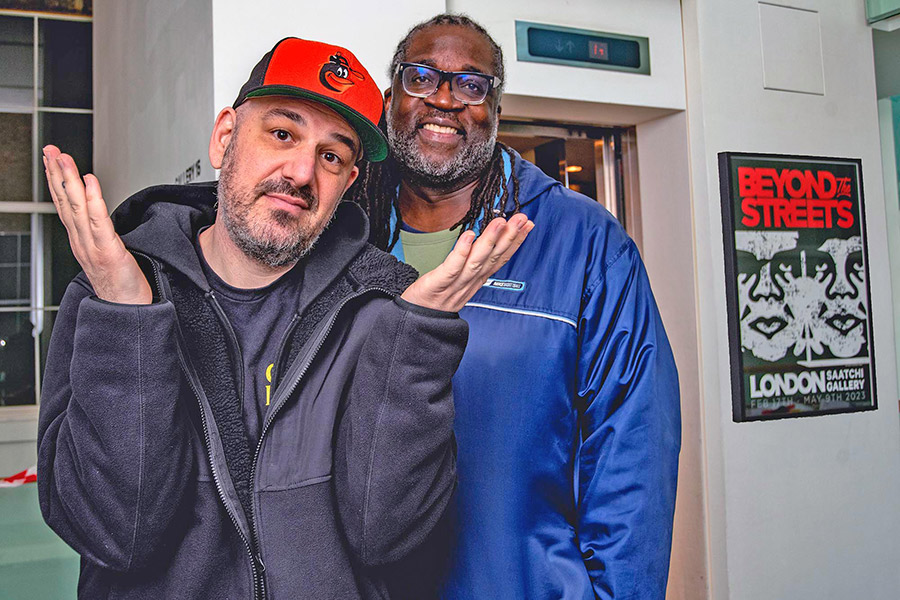
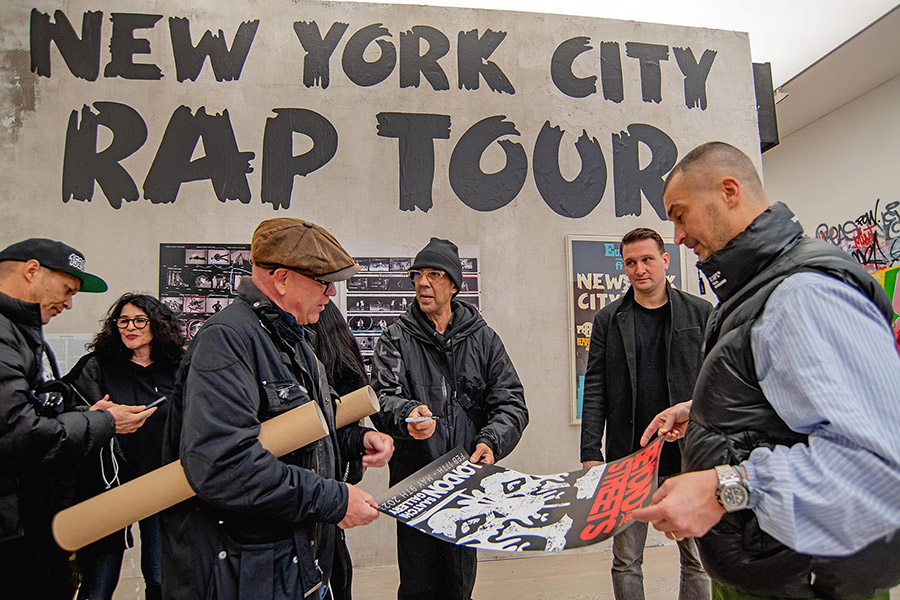
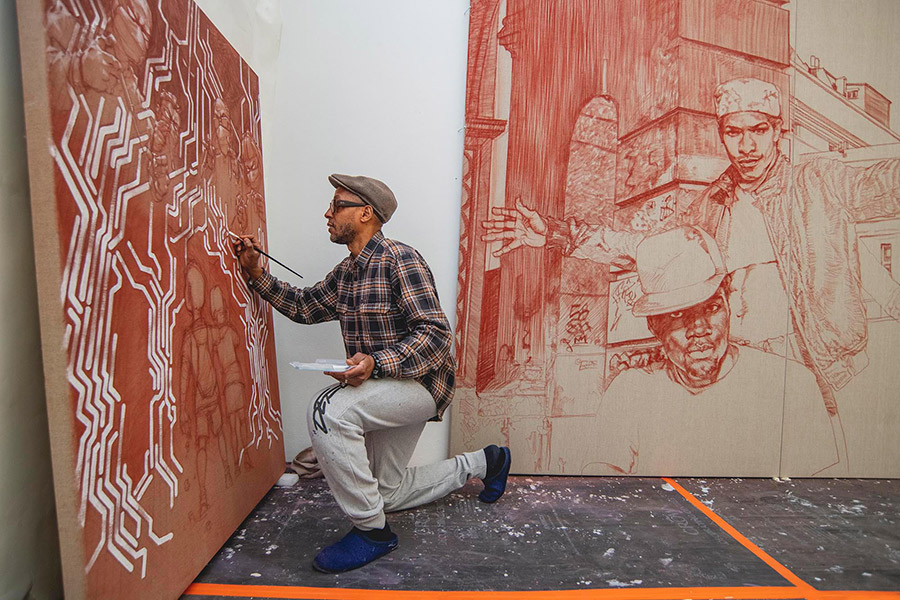
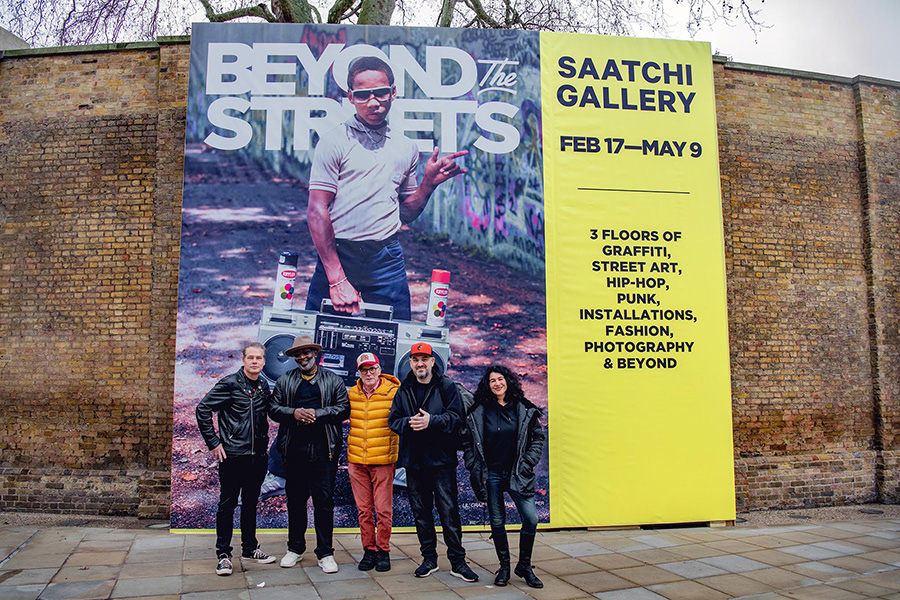
Behind the scenes at “Beyond the Streets London” is a hive of activity, with artists deeply focused on installing their work and seeking assistance with tools and equipment. Curators, organizers, and lighting professionals are bustling up and down the stairs, carrying props, or ladders, and communicating with vendors and artists via text message. Salespeople are diligently crafting wall texts to accompany the art pieces. It’s a few hours before showtime, yet everything is somehow accomplished just as the first guests arrive for the preview.
According to our sources, this subway installation included actual wires and security cameras were “nicked”. Beyond The Streets – London. Saatchi Gallery. (photo © Martha Cooper)

Photographer Martha Cooper is electrified by the activity at Saatchi Gallery. The event preserves the rich history of graffiti, street art, and commerce while pushing forward with new trends and directions. Cooper, who has documented this scene since the 1970s, has attended and exhibited in “Beyond the Streets” exhibitions in New York and Los Angeles – and we anticipate the next stop could be Shanghai. This particular iteration showcases an evolving mix of archetypes and invention, drawing on diverse influences from the US, UK, and EU.

Beyond The Streets – London. Saatchi Gallery. (photo © Martha Cooper)

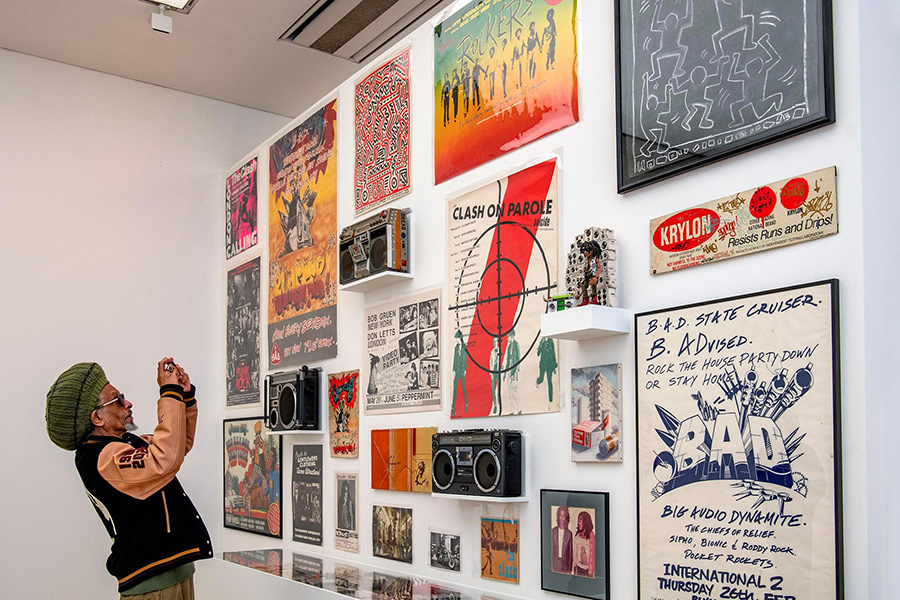
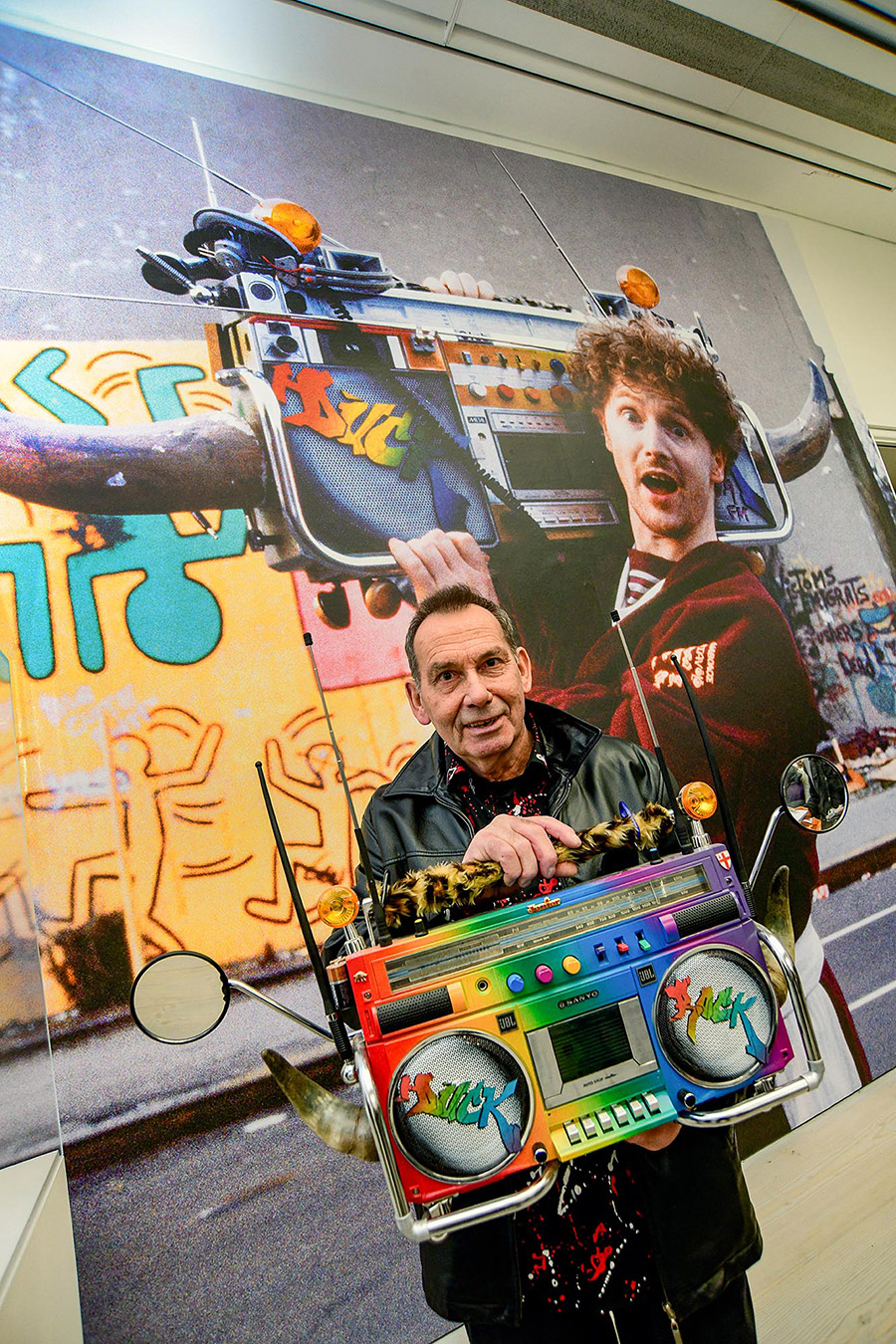
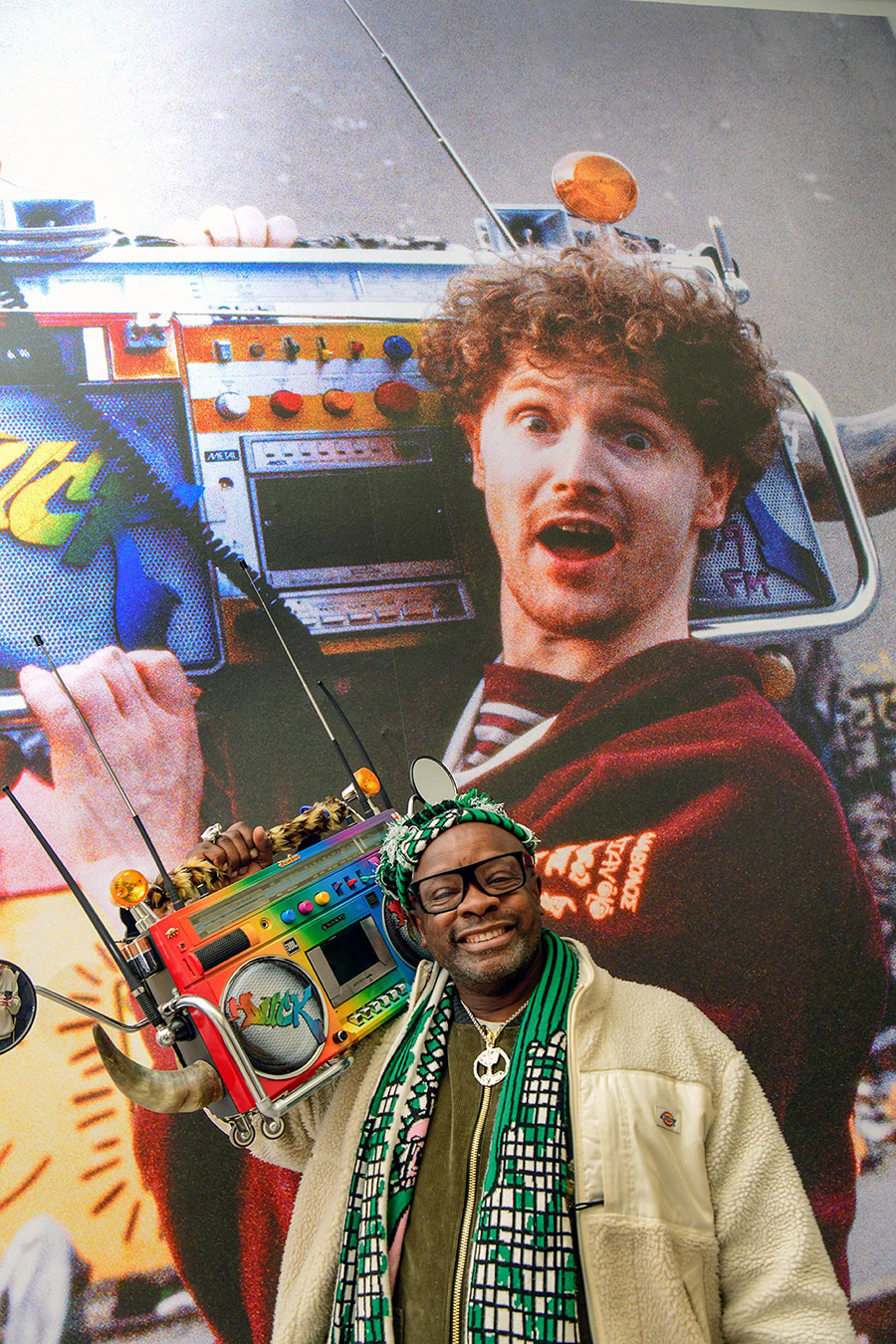
Cooper observed many surprising music references at the show. Rock icon Eric Clapton was at the opening admiring a photograph of text declaring him to be God while filmmaker, musician, and BBC radio host Don Letts had a personal collection of his memorabilia/ephemera on display. Ron West, designer of the “Duck Rock” boombox, also made a sudden appearance at the opening, allowing guests to pose with his creation. Among the standout pieces was a Bob Gruen photo of Malcolm McLaren holding that boombox in front of Keith Haring’s Houston Street wall, a masterpiece of intersectionality, if you will.

Overall, “Beyond the Streets London” offers a smorgasbord of colors, flavors, and influences that are difficult to encapsulate in one show. However, Gastman, the visionary, gives it a good try, with a respectful nod to the many artists who have shaped this worldwide people’s art movement. Enjoy these behind-the-scenes shots from Ms. Cooper.

AgnesB at Beyond The Streets – London. Saatchi Gallery. (photo © Martha Cooper)
Aiko doing the last minute touch-up. Beyond The Streets – London. Saatchi Gallery. (photo © Martha Cooper)
Aiko. Beyond The Streets – London. Saatchi Gallery. (photo © Martha Cooper)
NYC’s CES, a leader in characters with a streamlined and aerodynamic ‘wildstyleʼ, Beyond The Streets – London. Saatchi Gallery. (photo © Martha Cooper)
Conor Harrington. Beyond The Streets – London. Saatchi Gallery. (photo © Martha Cooper)
SoCal Stecyk artist known for writing and photographs documenting surfing and skateboarding culture, CR StecyK. Beyond The Streets – London. Saatchi Gallery. (photo © Martha Cooper)
CR StecyK. Beyond The Streets – London. Saatchi Gallery. (photo © Martha Cooper)
OG Daze extends the space of this subway car. Beyond The Streets – London. Saatchi Gallery. (photo © Martha Cooper)
Don Letts looking at an installation of items from his personal collection. Beyond The Streets – London. Saatchi Gallery. (photo © Martha Cooper)
Don Letts and BTS mastermind Roger Gastman. Beyond The Streets – London. Saatchi Gallery. (photo © Martha Cooper)
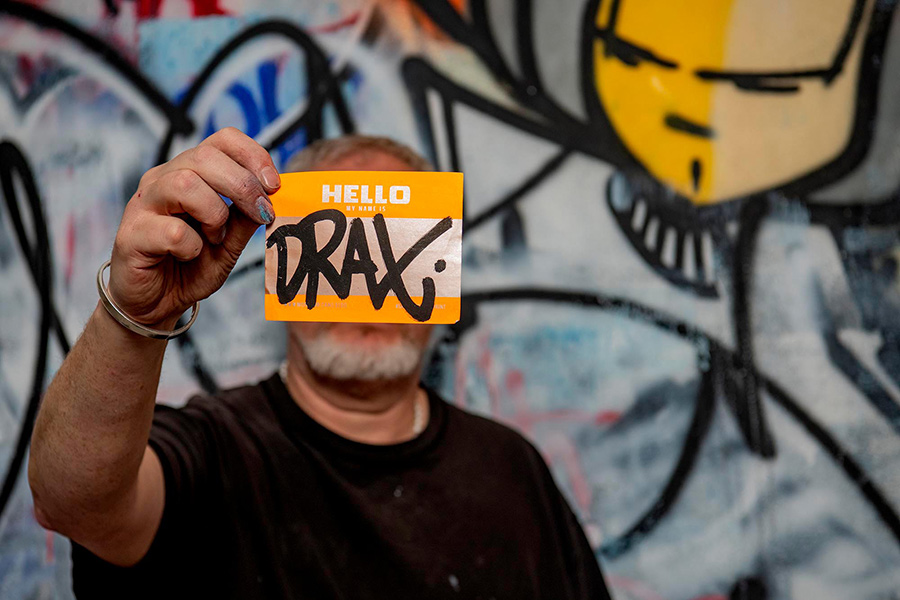
DRAX. Beyond The Streets – London. Saatchi Gallery. (photo © Martha Cooper)
Martha’s famous Dondi photograph shows up in the most surprising places. Martha Cooper. Beyond The Streets – London. Saatchi Gallery. (photo © Martha Cooper)
Lawrence Watson with his iconic shot of Chuck D and Flavor Flav of Public Enemy. His other well known photos include Jam Master Jay, DMC, Rev Run, Chuck D, Flavor Flav and “Cool” James Todd Smith. Beyond The Streets – London. Saatchi Gallery. (photo © Martha Cooper)
Clapton. Beyond The Streets – London. Saatchi Gallery. (photo © Martha Cooper)
Clapton with Shepard Fairey. Beyond The Streets – London. Saatchi Gallery. (photo © Martha Cooper)
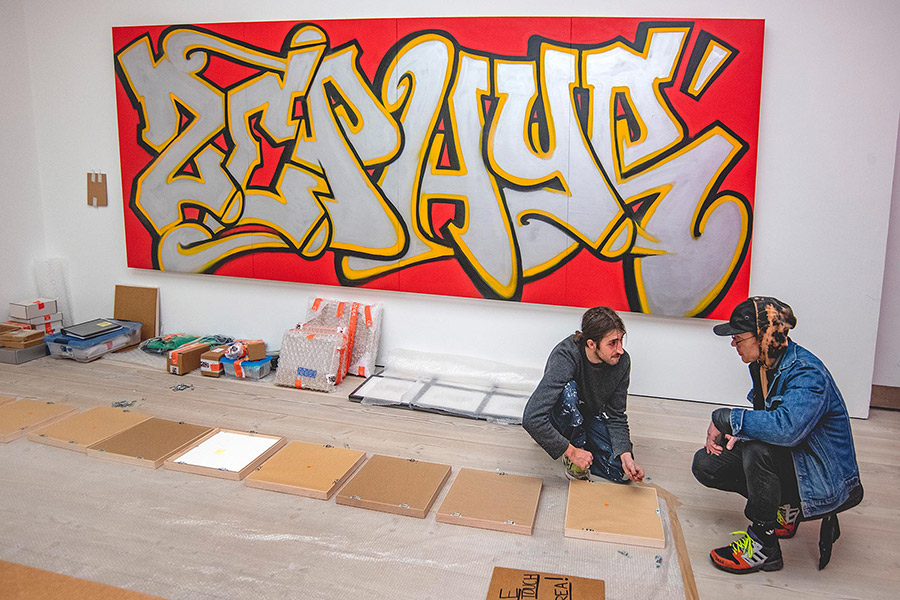
Escif. Beyond The Streets – London. Saatchi Gallery. (photo © Martha Cooper)
Espo. Beyond The Streets – London. Saatchi Gallery. (photo © Martha Cooper)
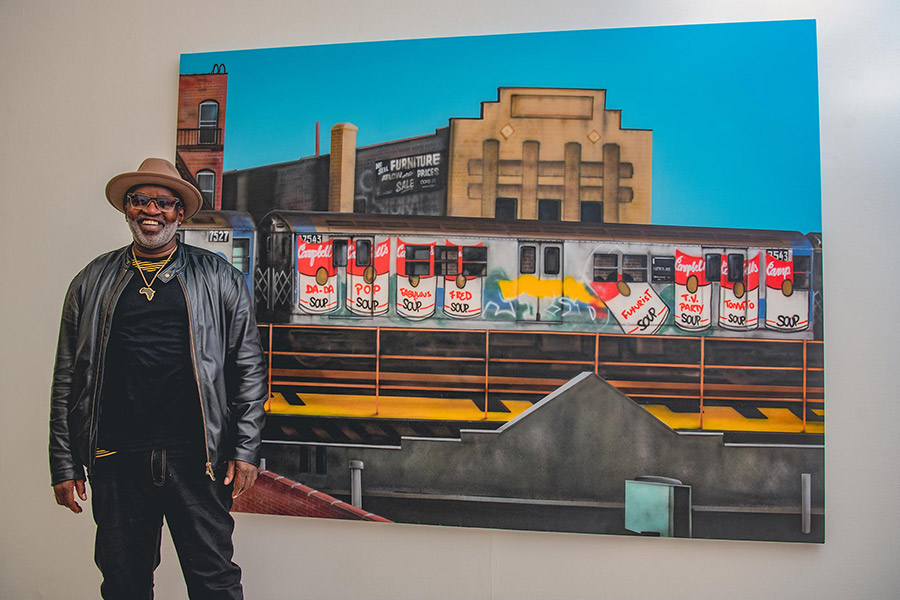
Fab5 Freddy with his painting based on Martha Cooper’s photo of his soup can car. Beyond The Streets – London. Saatchi Gallery. (photo © Martha Cooper)
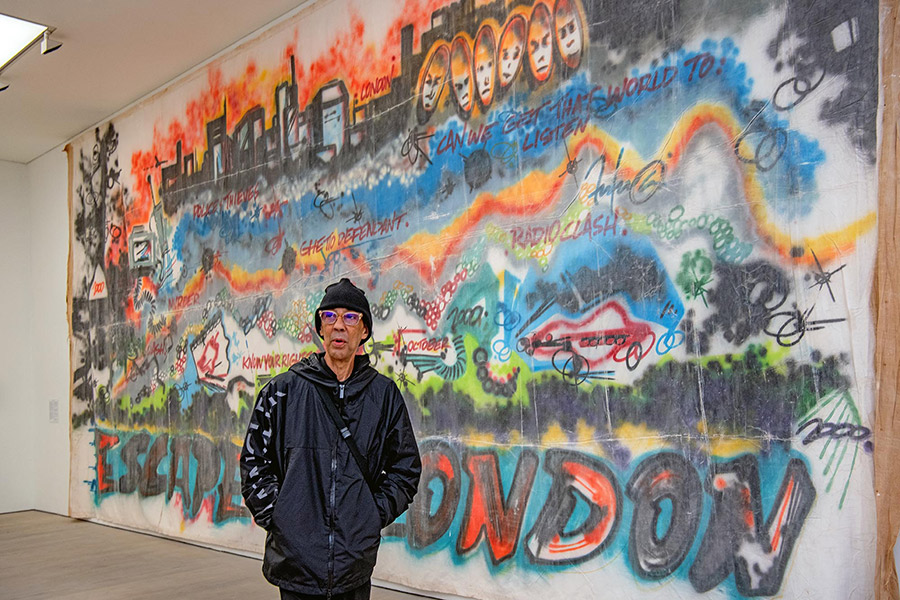
Futura standing before his large stage backdrop created during the Radio Clash tour at the Lyceum Ballroom, London (1981). Beyond The Streets – London. Saatchi Gallery. (photo © Martha Cooper)
Futura with a mystery friend. Beyond The Streets – London. Saatchi Gallery. (photo © Martha Cooper)
HAZE in front of his new piece. Beyond The Streets – London. Saatchi Gallery. (photo © Martha Cooper)
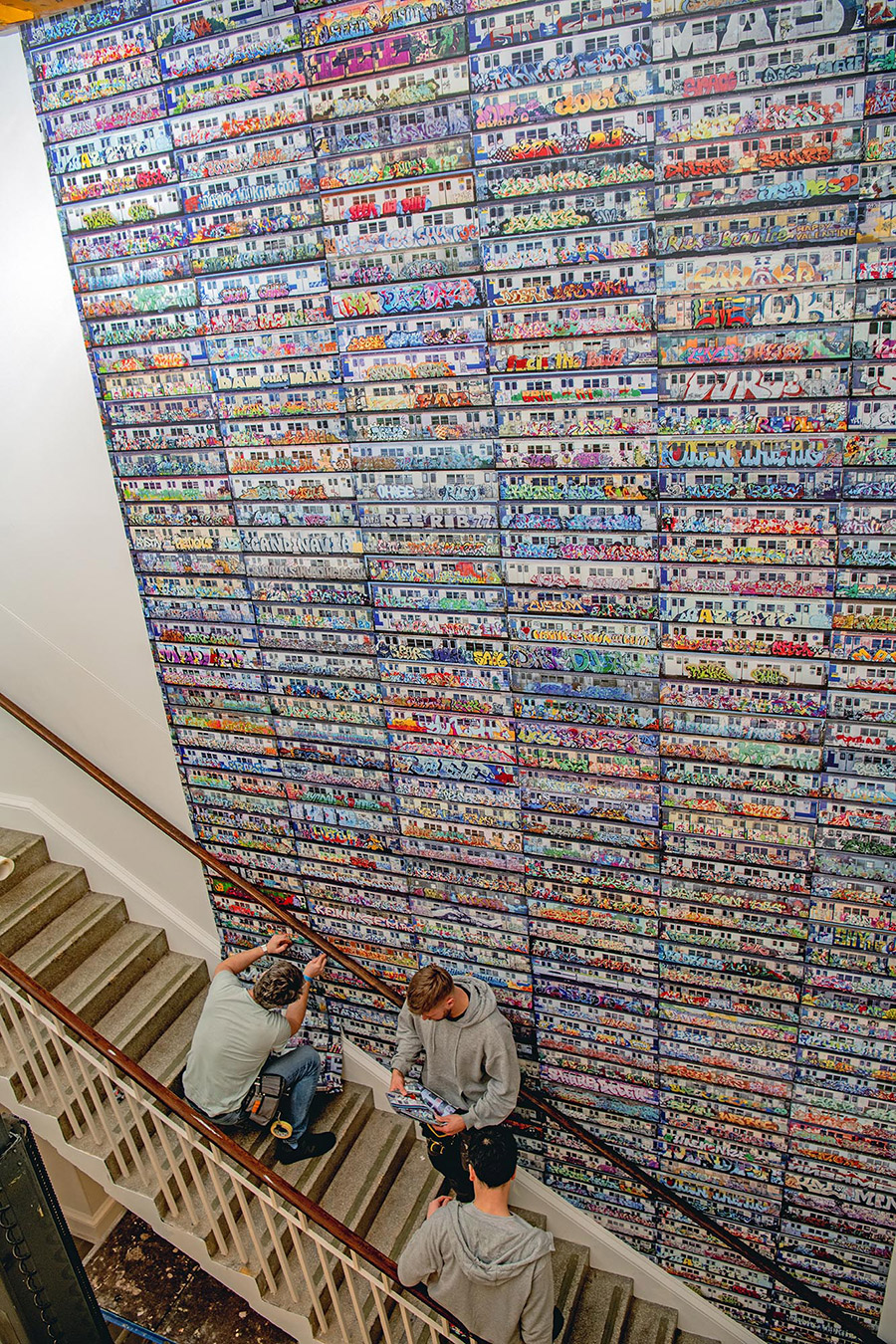
Henry Chalfant’s wall of train car sides was massive. Beyond The Streets – London. Saatchi Gallery. (photo © Martha Cooper)
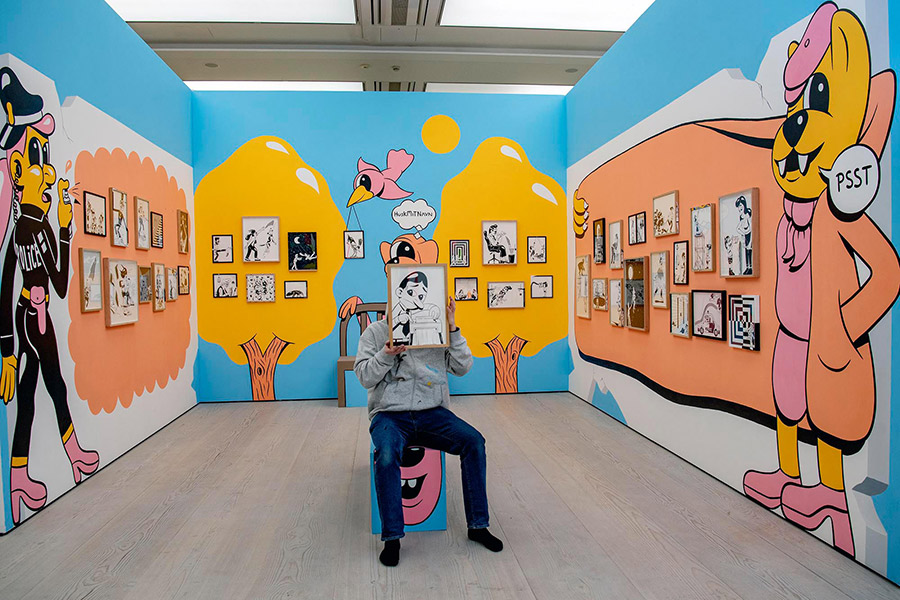
Husk Mit Navn. Beyond The Streets – London. Saatchi Gallery. (photo © Martha Cooper)
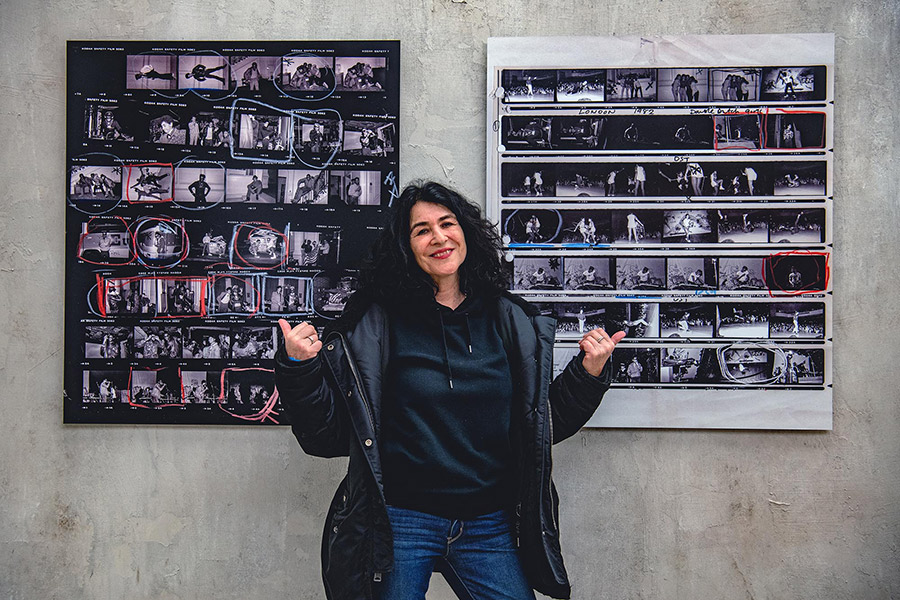
Janette Beckman has helped you make selections with her red marker. Beyond The Streets – London. Saatchi Gallery. (photo © Martha Cooper)
John Ahearn in front of a poster for the seminal movie he directed. Beyond The Streets – London. Saatchi Gallery. (photo © Martha Cooper)
Kenny Scharf points the way at Beyond The Streets – London. Saatchi Gallery. (photo © Martha Cooper)
Kenny Scharf. Beyond The Streets – London. Saatchi Gallery. (photo © Martha Cooper)
Beyond The Streets – London. Saatchi Gallery. (photo © Martha Cooper)
Roger Gastman with old school graffiti writer “Pride”. Beyond The Streets – London. Saatchi Gallery. (photo © Martha Cooper)
Beyond The Streets – London. Saatchi Gallery. (photo © Martha Cooper)
Ron West, creator of the original Duck Rock boombox. Beyond The Streets – London. Saatchi Gallery. (photo © Martha Cooper)
A guest posing with Ron West’s boom box. Beyond The Streets – London. Saatchi Gallery. (photo © Martha Cooper)
Mode2 prepping his canvas. Beyond The Streets – London. Saatchi Gallery. (photo © Martha Cooper)
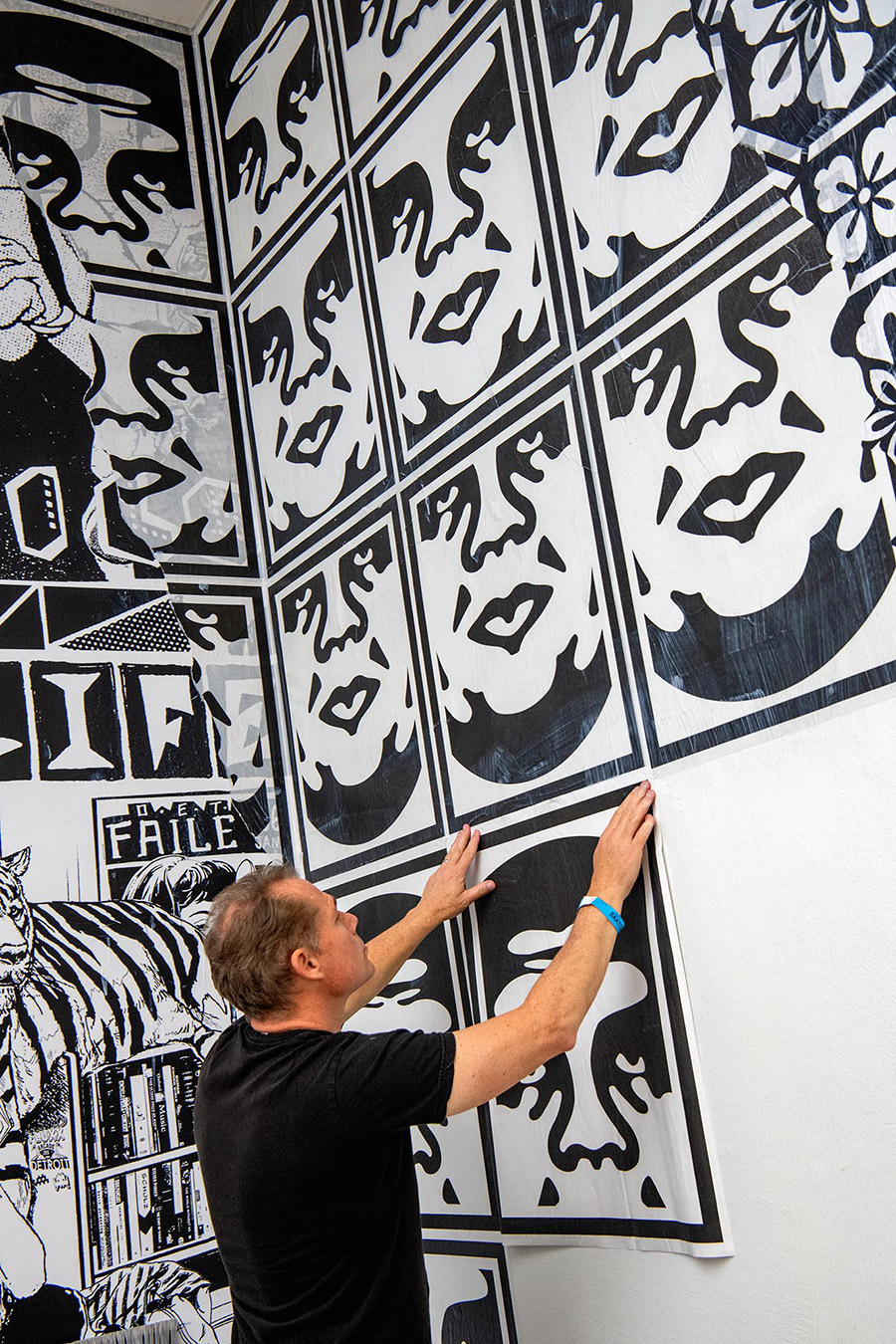
Shepard Fairey wheat pasting his iconic Obey image of Andre the Giant. Beyond The Streets – London. Saatchi Gallery. (photo © Martha Cooper)
Paul Insect. Beyond The Streets – London. Saatchi Gallery. (photo © Martha Cooper)
Niels Shoe Meulman. Beyond The Streets – London. Saatchi Gallery. (photo © Martha Cooper)
Installation of Toby Mott’s huge collection of punk ephemera (Mott not pictured). Beyond The Streets – London. Saatchi Gallery. (photo © Martha Cooper)
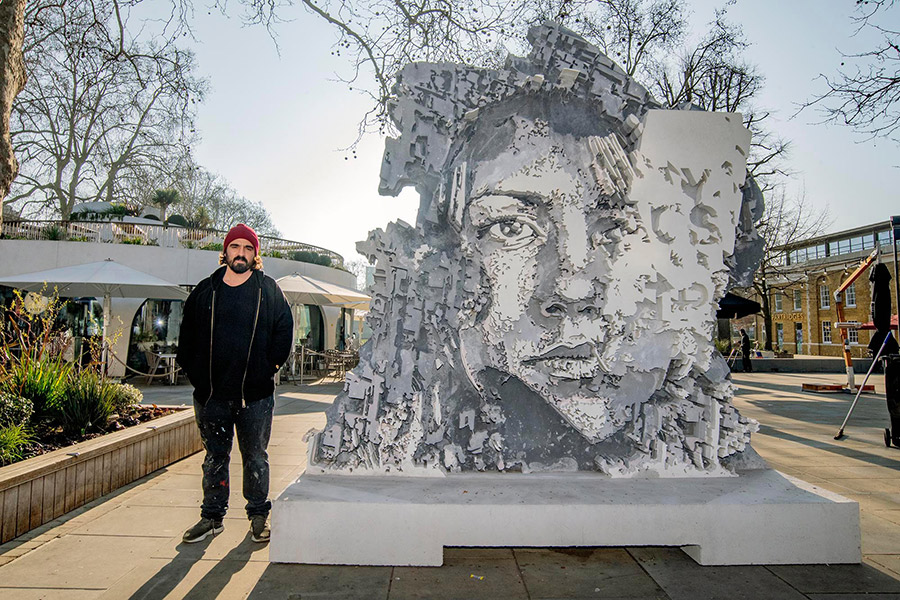
Vhils outside next to his sculpture for Beyond The Streets – London. Saatchi Gallery. (photo © Martha Cooper)
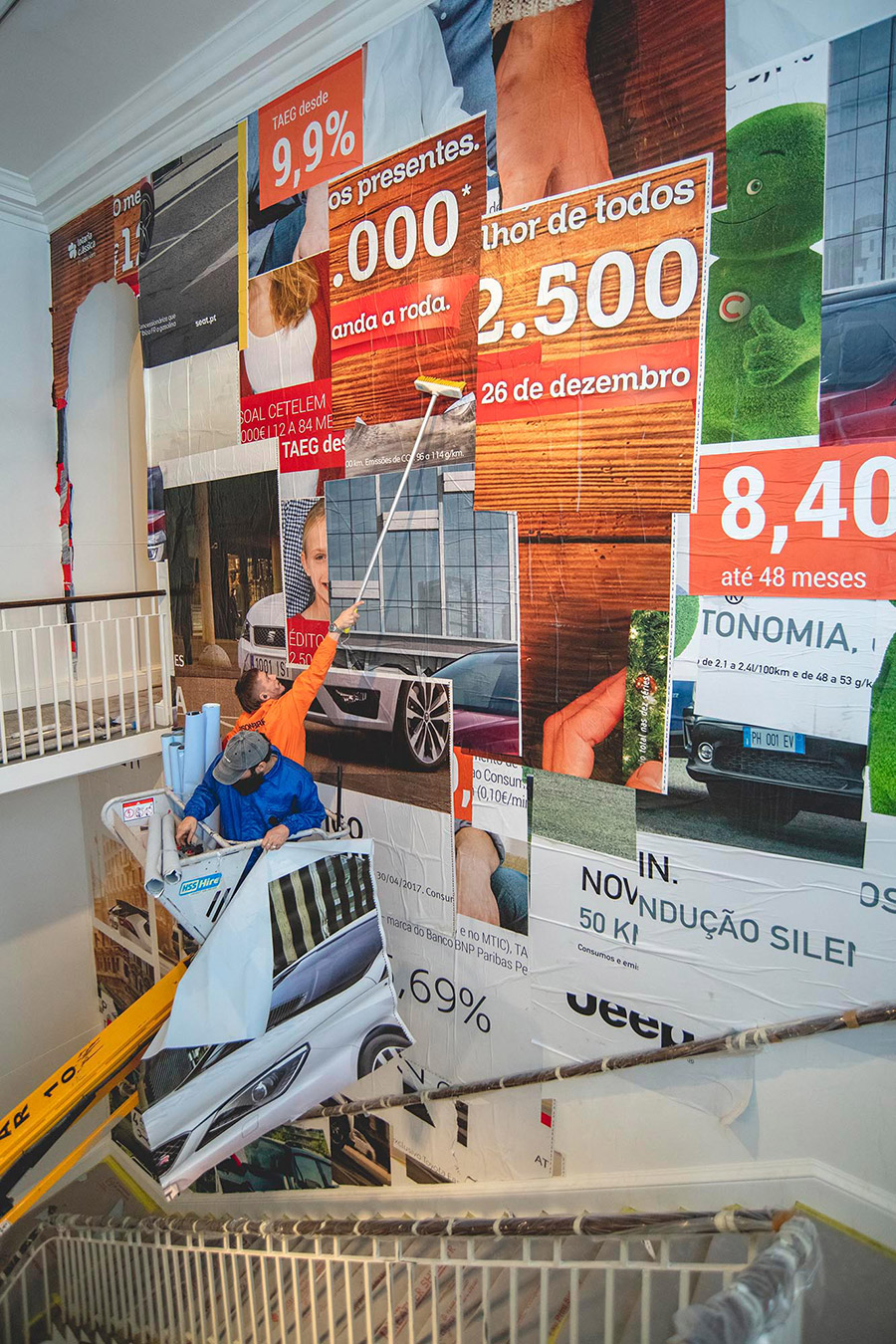
Vhils’ crew is pasting layers of posters on stairway in preparation for carving, which came later. Vhils. Beyond The Streets – London. Saatchi Gallery. (photo © Martha Cooper)
OG Zephyr in his clean wildstyle. Beyond The Streets – London. Saatchi Gallery. (photo © Martha Cooper)
Shepard Fairey, Fab Five Freddy, Charlie Ahearn, Roger Gastman, and Janette Beckman. Beyond The Streets – London. Saatchi Gallery. (photo © Martha Cooper)

Beyond The Streets – London. Click HERE for more details, the schedule of events, tickets, and exhibition times.

Read more
Poliniza-DOS Elevates the Intervention Art Form in Valencia, Spain

Poliniza-DOS Elevates the Intervention Art Form in Valencia, Spain

Festival d’Art Urbà Poliniza Dos may have an online presence that is difficult to access for the average street art fan. Still, the murals created for this ongoing urban art festival at the Polytechnic University of Valencia speak for themselves.
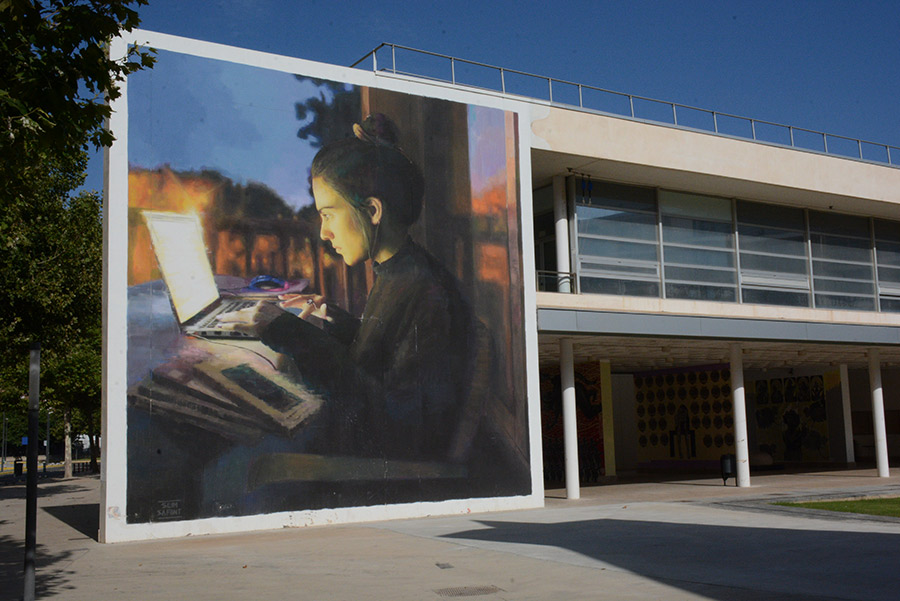
Slim Safont. POLINIZADOS Urban Art Festival. Polytechnic University of Valencia. Valencia, Spain. (photo © Lluis Olive Bulbena)

Brilliant productions and unusual investigations are created in and around the campus, engaging students and the local community to consider the role of art in the public sphere, its pertinence and meaning, and our relationship to it. Its direct and scholarly approach means that the public is invited, and artists are given an opportunity to share their practice with an appreciative and considered audience.

Slim Safont. POLINIZADOS Urban Art Festival. Polytechnic University of Valencia. Valencia, Spain. (photo © Lluis Olive Bulbena)

For more than a decade, this competition has selected from an open call for submissions and invited many of Spain’s curious thinkers, experimenters, interventionists, trouble-makers, street artists, and muralists to create new pieces for consideration, discussion, and appreciation. This program is where the work is done on the wall, inside the mind, and in the heart.
Recently photographer Luis Olive captured these murals from the 2021 and 2022 editions of PolinizaDos, and he shares what he found today with BSA readers.

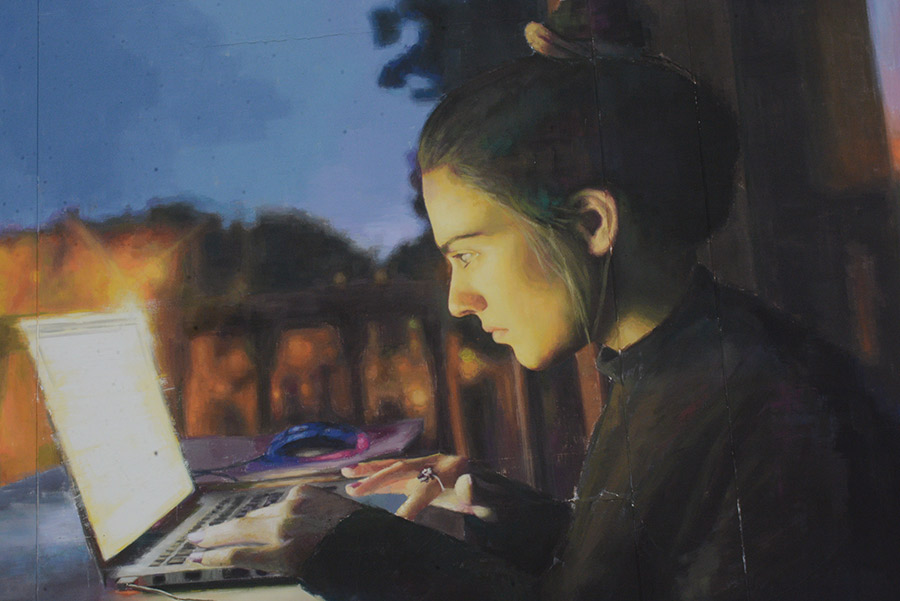
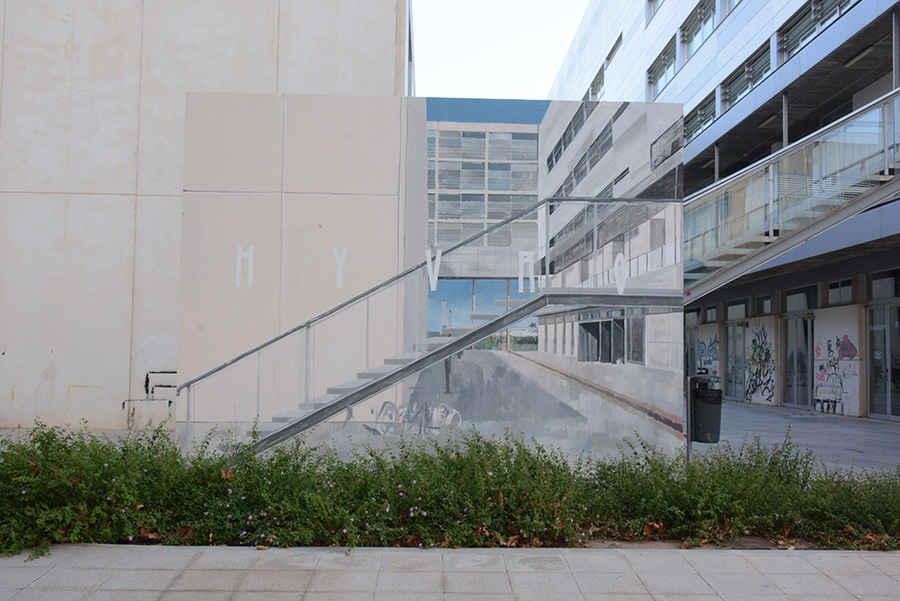
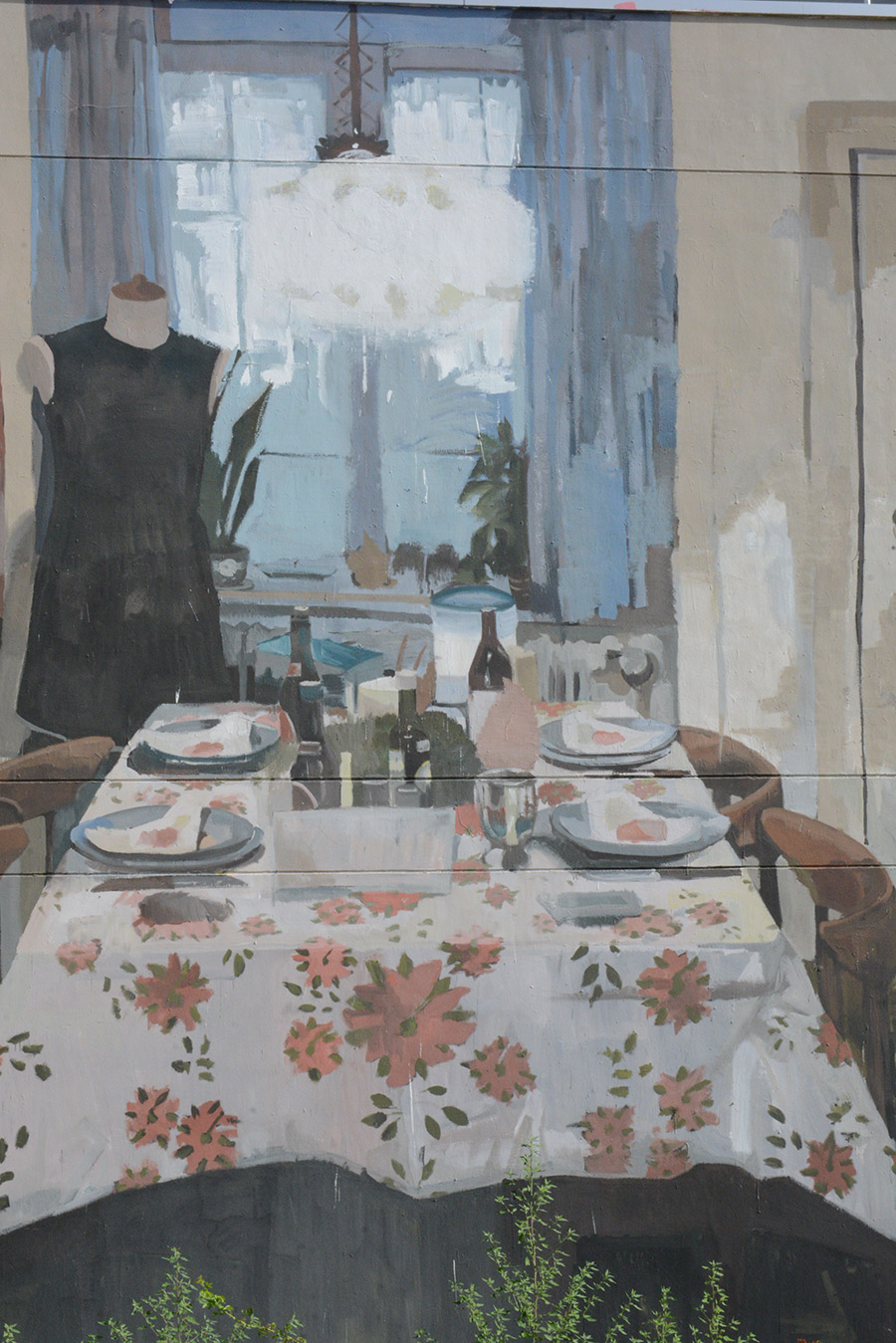
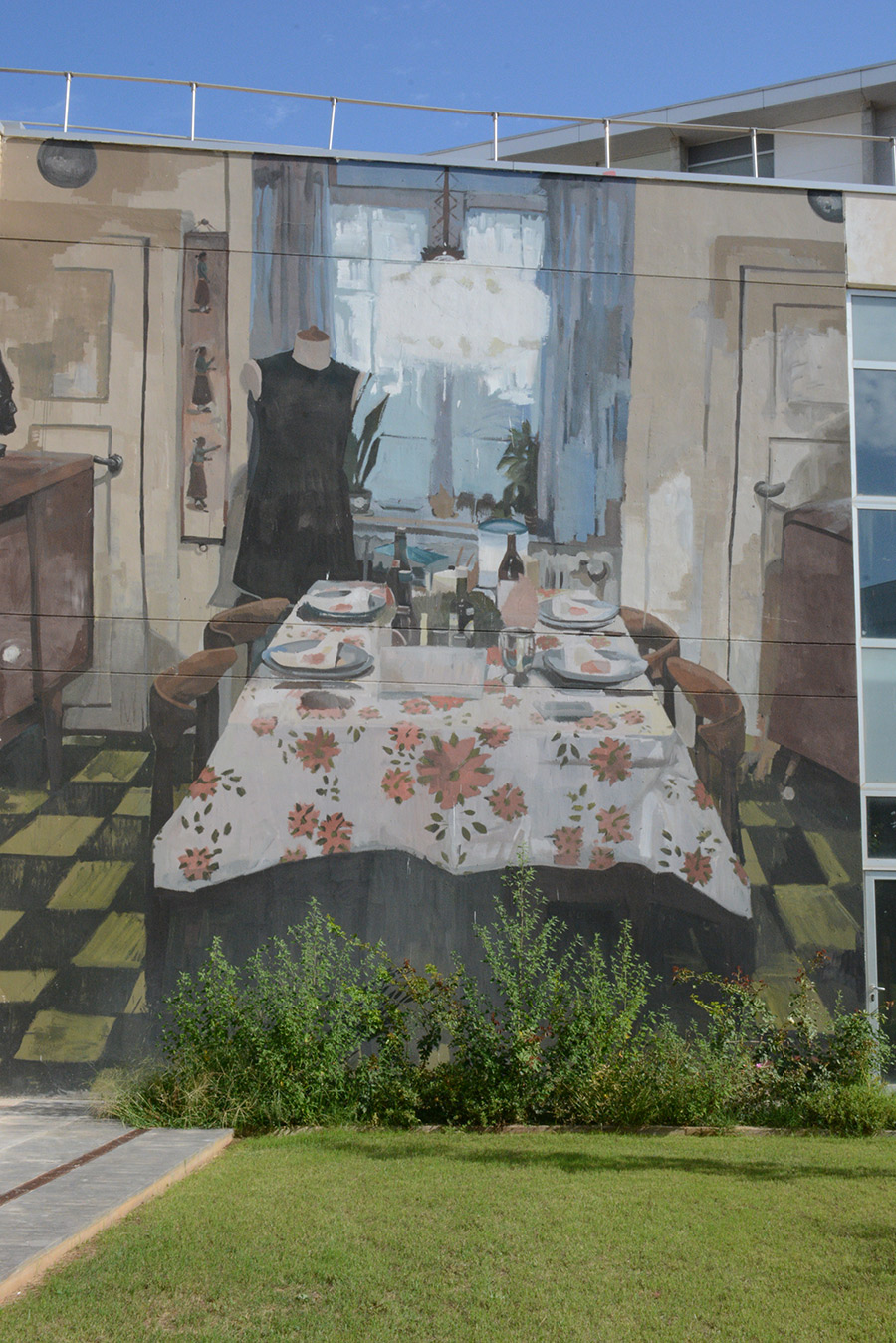
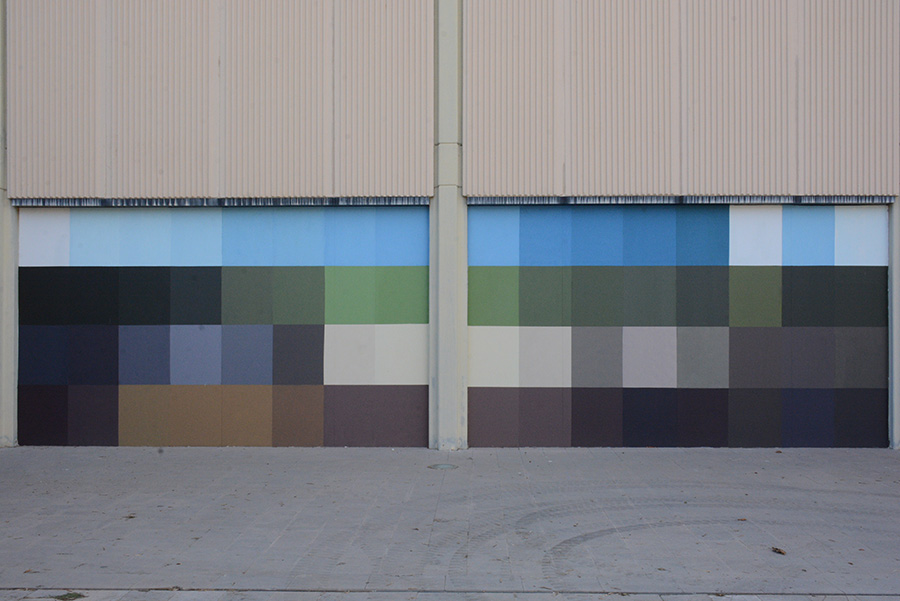
Escif and Axel Void. POLINIZADOS Urban Art Festival. Polytechnic University of Valencia. Valencia, Spain. (photo © Lluis Olive Bulbena)
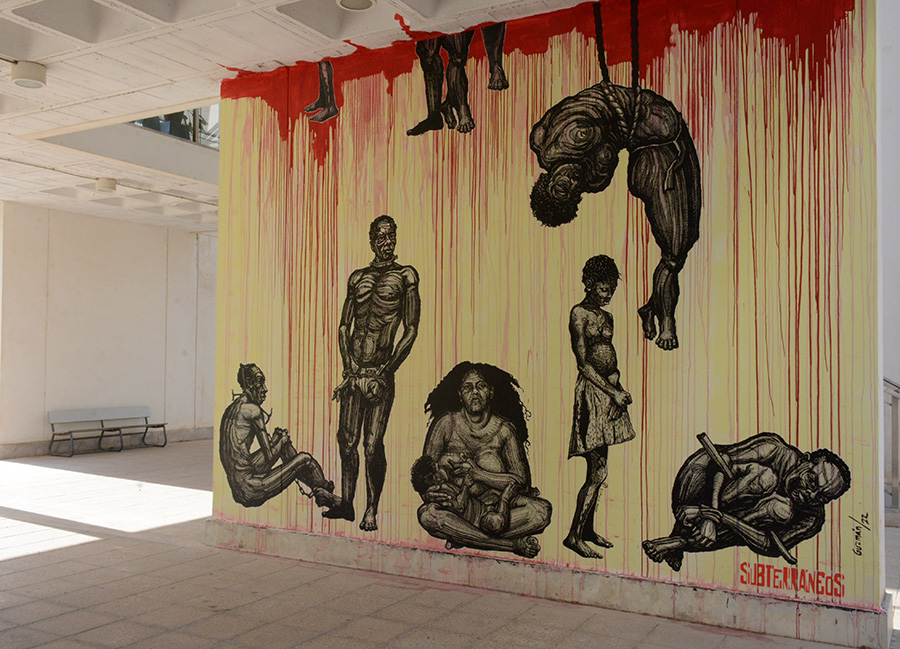
Guzman/Subterraneos. POLINIZADOS Urban Art Festival. Polytechnic University of Valencia. Valencia, Spain. (photo © Lluis Olive Bulbena)
Subterraneos. POLINIZADOS Urban Art Festival. Polytechnic University of Valencia. Valencia, Spain. (photo © Lluis Olive Bulbena)
Eddith Chavez. POLINIZADOS Urban Art Festival. Polytechnic University of Valencia. Valencia, Spain. (photo © Lluis Olive Bulbena)
Taller Burro Press. POLINIZADOS Urban Art Festival. Polytechnic University of Valencia. Valencia, Spain. (photo © Lluis Olive Bulbena)
Mari Mariel. POLINIZADOS Urban Art Festival. Polytechnic University of Valencia. Valencia, Spain. (photo © Lluis Olive Bulbena)
Sucri / Furyo. POLINIZADOS Urban Art Festival. Polytechnic University of Valencia. Valencia, Spain. (photo © Lluis Olive Bulbena)
Edoardo Ettorre. POLINIZADOS Urban Art Festival. Polytechnic University of Valencia. Valencia, Spain. (photo © Lluis Olive Bulbena)
MOHA. POLINIZADOS Urban Art Festival. Polytechnic University of Valencia. Valencia, Spain. (photo © Lluis Olive Bulbena)
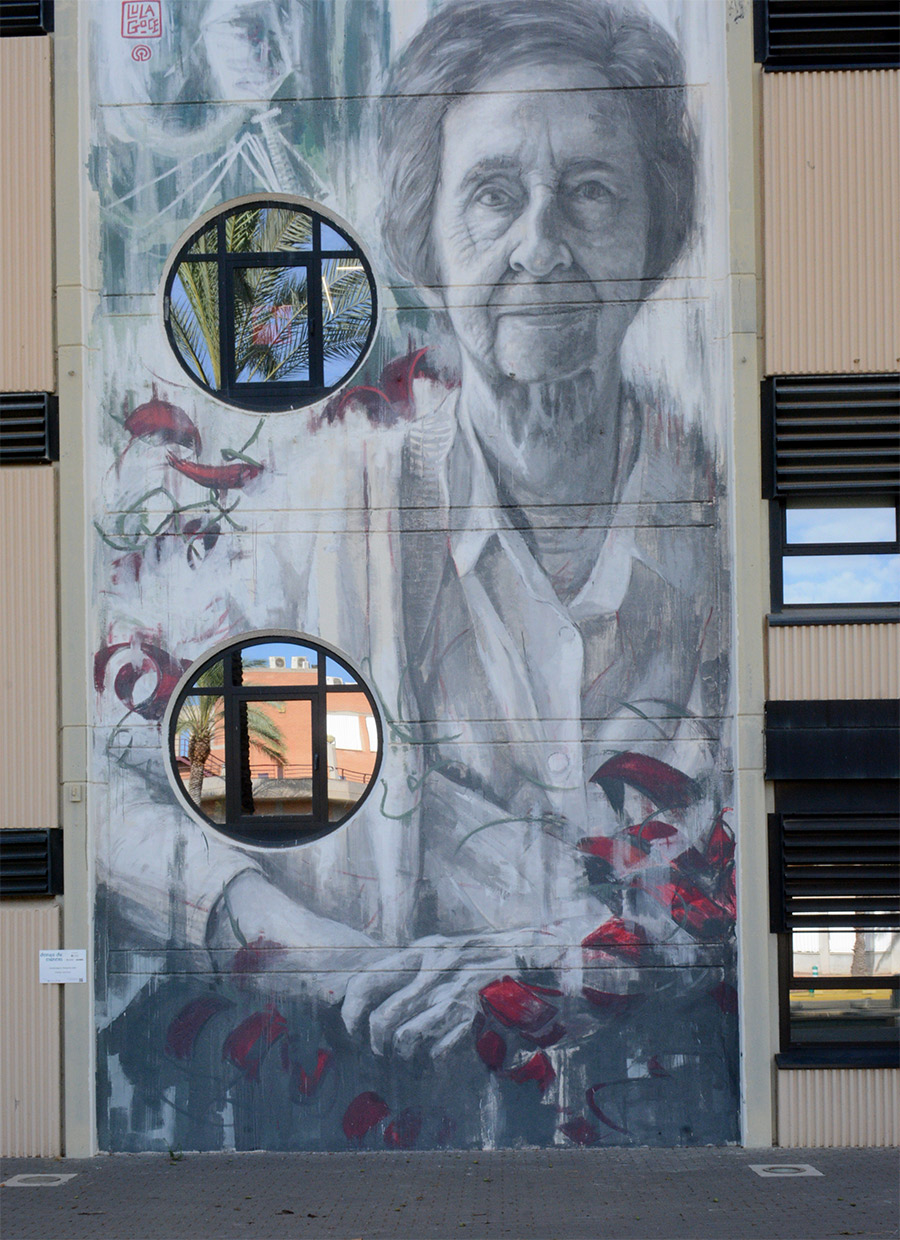
Lula Goce. POLINIZADOS Urban Art Festival. Polytechnic University of Valencia. Valencia, Spain. (photo © Lluis Olive Bulbena)
Berni Puig. POLINIZADOS Urban Art Festival. Polytechnic University of Valencia. Valencia, Spain. (photo © Lluis Olive Bulbena)

Learn more about Poliniza Dos on their Instagram account.

Read more
Escif: “The War Begins Here” in Valencia

Escif: “The War Begins Here” in Valencia

Positions and opinions about war and conflict can be “mainstream” or they may be “fringe”, and historically they can switch positions after the wars are over. One thing is nearly always assured: General Dynamics, Raytheon and Lockheed Martin will be there to cash in on the opportunity.

As just one data point, GD made $38,500,000,000 dollars in revenue last year.

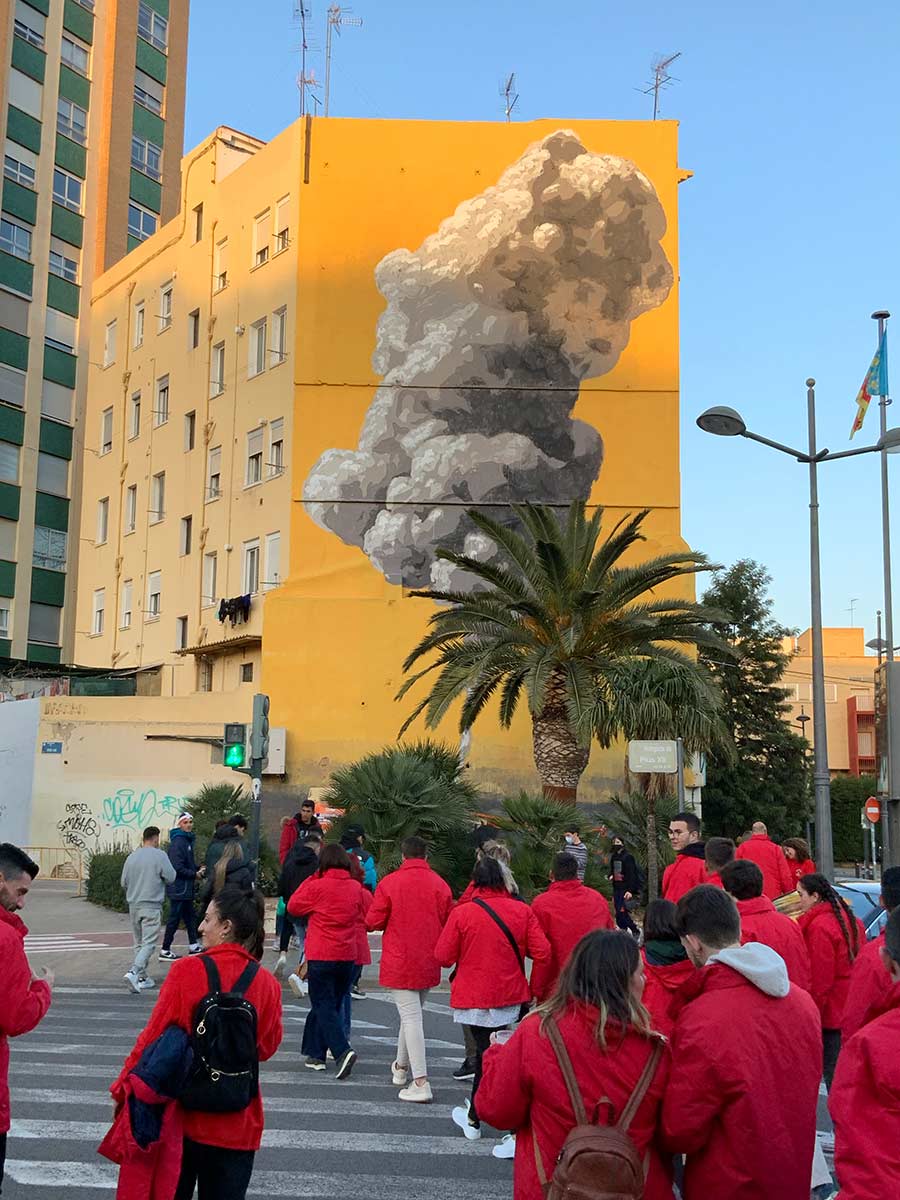
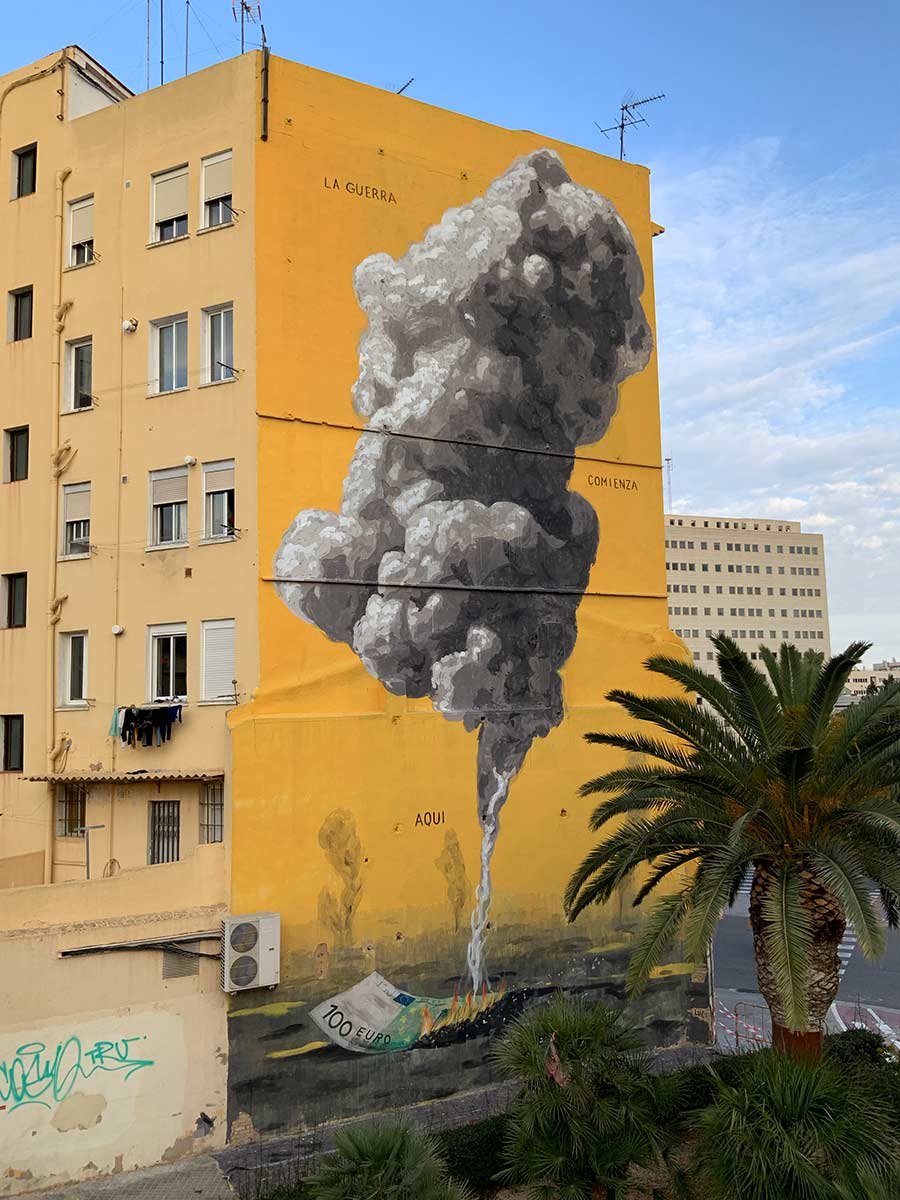
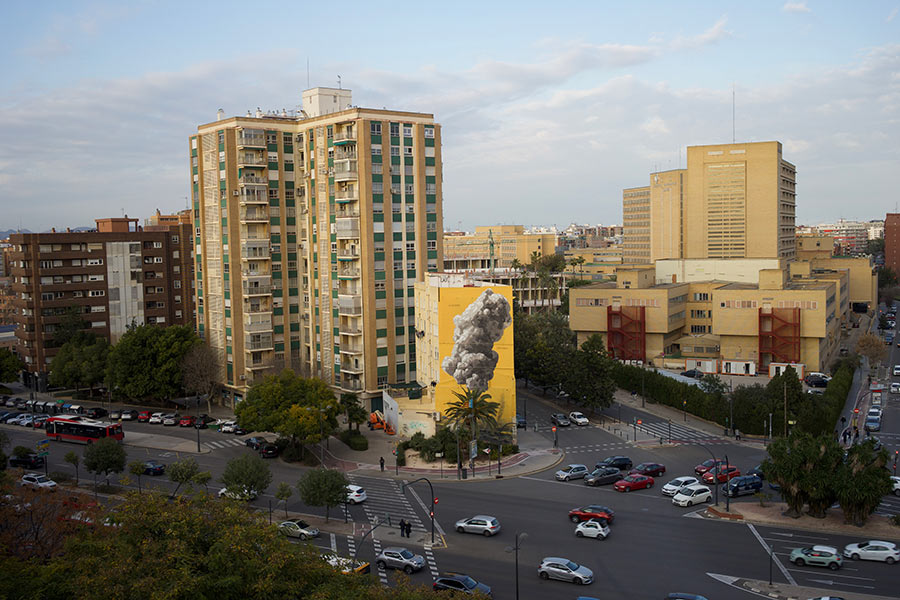
Today as weapons are flowing into Ukraine and reportedly thousands of people are being killed and parts of Ukraine are being destroyed, Spanish street artist Escif creates a giant plume of smoke that emanates from a 100 Euro note in his newest mural in Valencia, Spain. Follow the smoke, follow the money.

ESCIF. “La Guerra Comienza Aqui”. Valencia, Spain. March 2022. (photo courtesy of the artist)

“La Guerra Comienza Aqui (The War Starts Here)” is the name of the mural he painted in the last few days in collaboration with Center Delàs d’Estudis per la Pau.

Organizers and the artist say the new work is meant to illustrate the fact that the military industry has a lot to gain in a climate of conflict and armed violence and has the support of governments and financial entities to do so.

“That is one of the readings that can be made of this mural: there are always those who profit from conflicts like the one we are seeing in Ukraine,” says Escif about the painted work near the old Fe de València hospital. “In the last week, since the Russian invasion of Ukraine began, we have seen the stock price of the large arms companies, located almost entirely in Northern countries, rise”.

ESCIF. “La Guerra Comienza Aqui”. Valencia, Spain. March 2022. (photo courtesy of the artist)

Sensible people may be looking for an off-ramp right now to avoid further escalation in this situation – perhaps even a way for Putin to save face so we can stop this before it spirals into a world war, a nuclear war, or both. But hope dims as you see a never-ending parade of corporate television “news” analysts representing the arms industry, who are rarely identified as such.

The military path, continuing to spend on weapons and fueling the arms race between countries, can only result in war, never peace. As much as the opposite is repeated to us”, concludes Jordi Calvo, an economist who has a PhD in peace, conflicts and development, who researches the defense economy and is the coordinator of the Centre Delàs. One wonders if there is a path to peace in the current situation. The opposite, dearly beloved, is unthinkable.

ESCIF. “La Guerra Comienza Aqui”. Valencia, Spain. March 2022. (photo courtesy of the artist)
Read more
Escif: “The Fences Must Fall”; A Provocative Ljubljana Street Art Festival

Escif: “The Fences Must Fall”; A Provocative Ljubljana Street Art Festival

We’ve had the privilege to travel to many cities and cultures over the last decade and a half, from Russian to Chinese to North African to Tahitian and Norwegian, to witness the affecting power of street art on cities, communities, and everyday people. Regardless of the street author’s intent, however earnest or carefully considered, we’re often surprised by the variety of interpretations that can arise from a singular work of art or intervention.

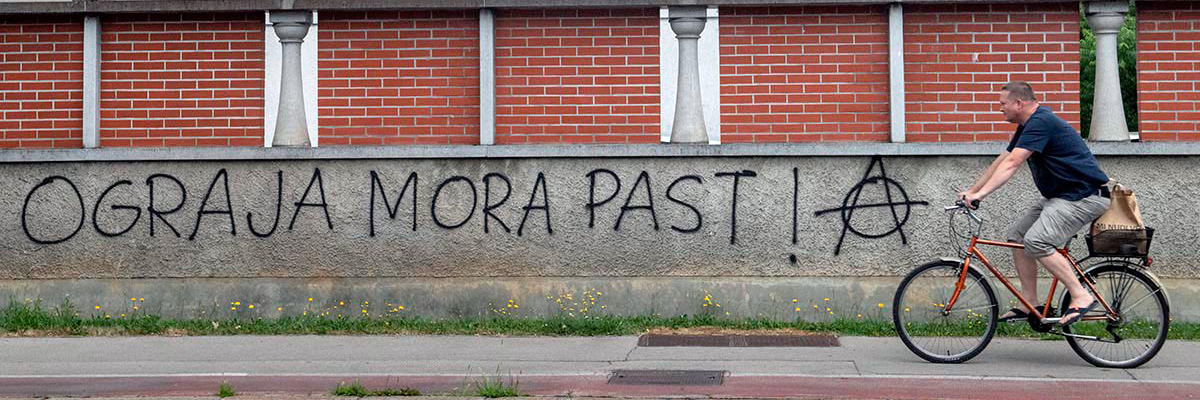
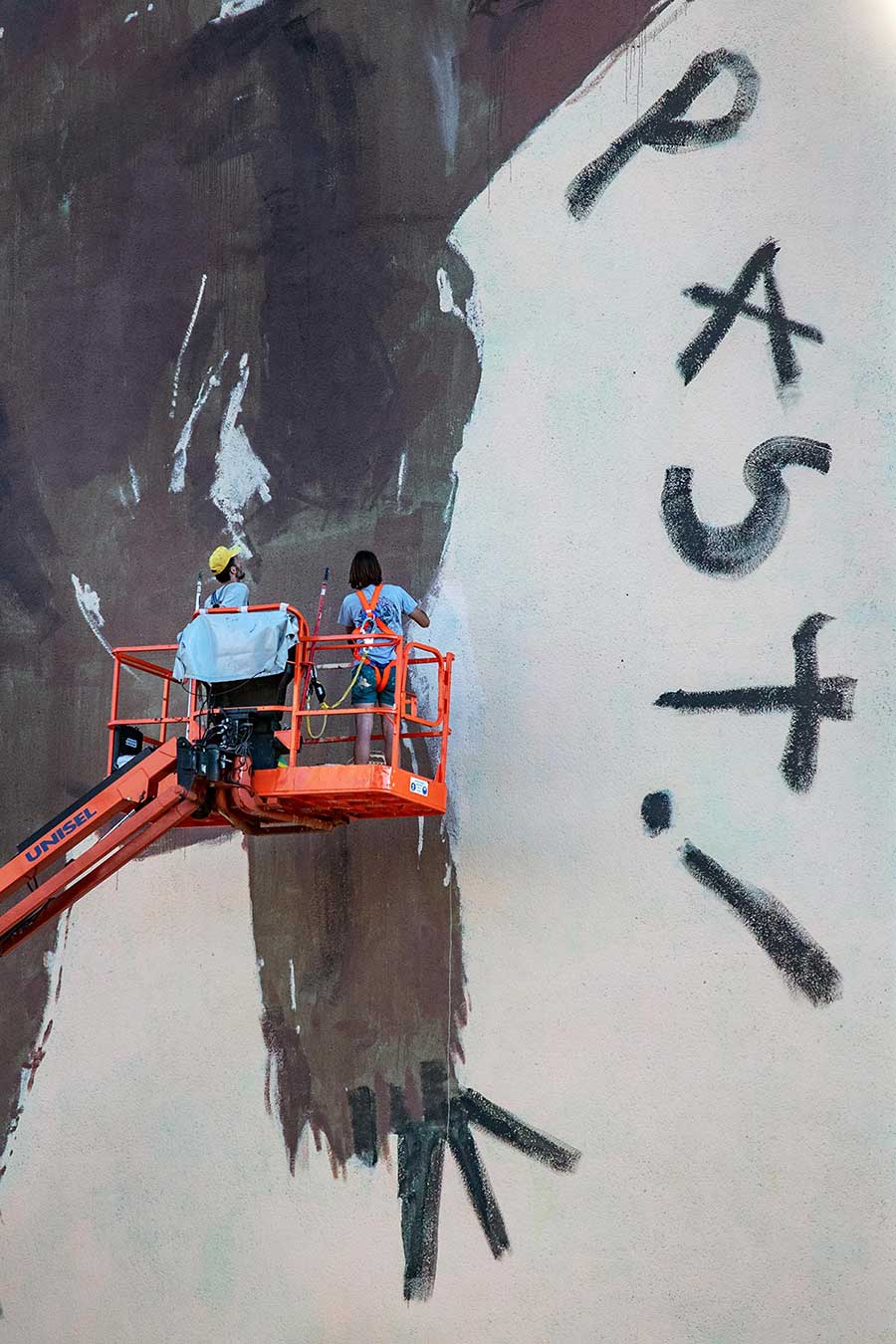
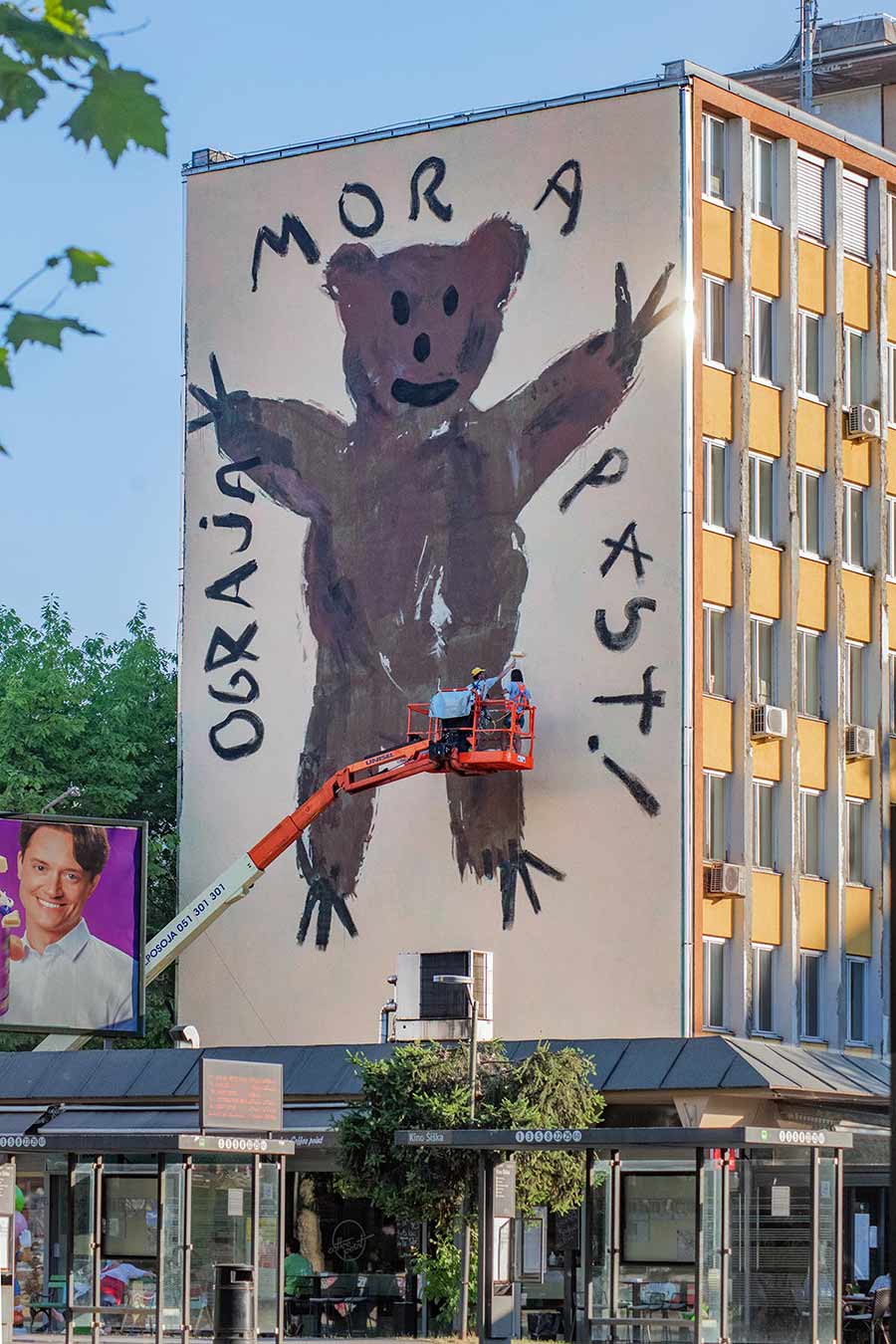
Escif. “The Fences Must Fall”. Ljubljana Street Art Festival 2021. Ljubljana, Slovenia. (photo © Martha Cooper)

This new mural by the Spanish conceptual artist and social philosopher Escif for this year’s Ljubljana Street Art Festival (LJSAF), begun in Slovenia’s capital in 2019, is just far enough removed from the obvious to have triggered myriad interpretations. In the race for capturing imagination, adoration, and vilification, his seemingly simple, if unconventional, mural has scored a stunning trifecta.

Our reporter on the ground, the renowned photographer and ethnologist Martha Cooper, one of the few who have stayed active on the graffiti and street art scene continuously for the last five decades, tells us that she keeps thinking that we are witnessing a more pronounced movement toward work like this on the global stage. Describing how the unique curation by festival director Sandi Abram and the program directors Anja Zver and Miha Erjavec strikes a balance, Cooper says they chose what may appear as a quirky selection of artists to participate, “with an emphasis more on conceptual, political work than on aesthetics.”

Escif. “The Fences Must Fall”. Ljubljana Street Art Festival 2021. Ljubljana, Slovenia. (photo © Martha Cooper)

“I’m wondering if this is a general street art trend or maybe just more prevalent in Eastern Europe,” she says. A veteran of the last decade’s evolution of street art festivals that may now appear as baldly commercial or trite “revitalization” efforts by moribund city councils, Ms. Cooper is fascinated by unusual festivals such as Ljubljana’s. It may be due to Abram’s pursuit of a Ph.D. in anthropology, but Cooper observes that her Slovenian experience was of a program “thoughtfully curated with some interesting and innovative twists.” Since this year’s festival theme centered on the preservation and documentation of street art, Cooper was an honored guest and speaker as well.

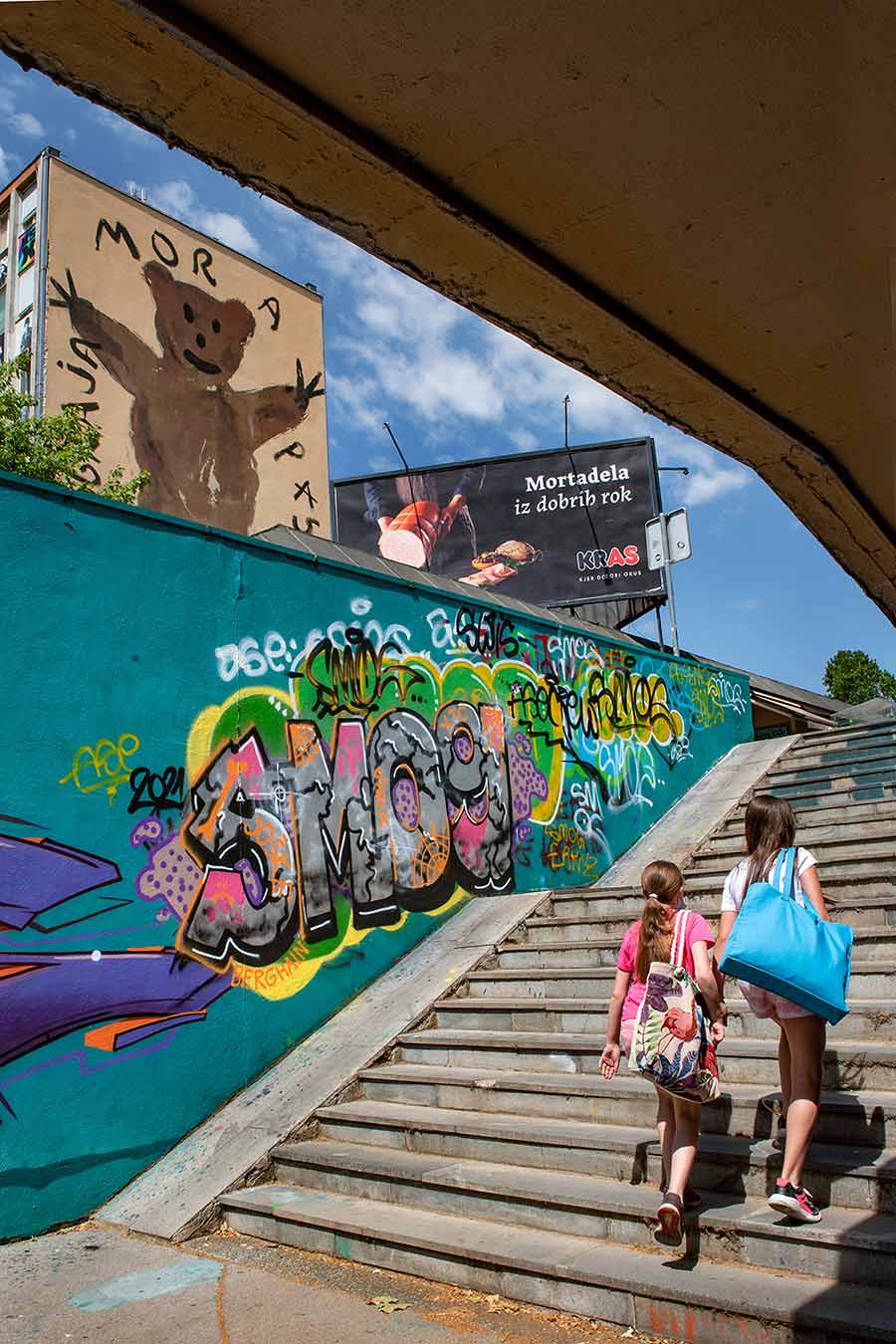
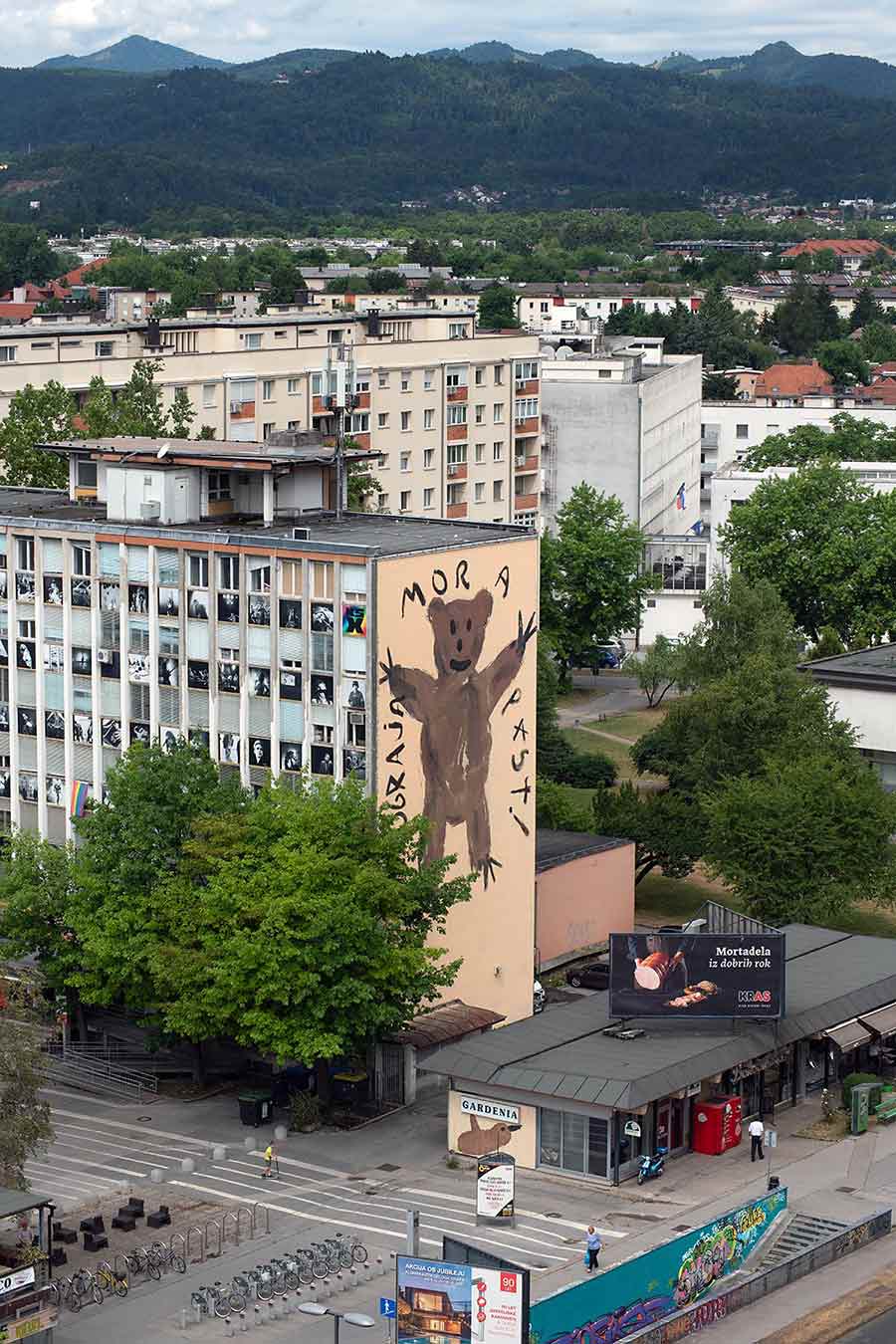
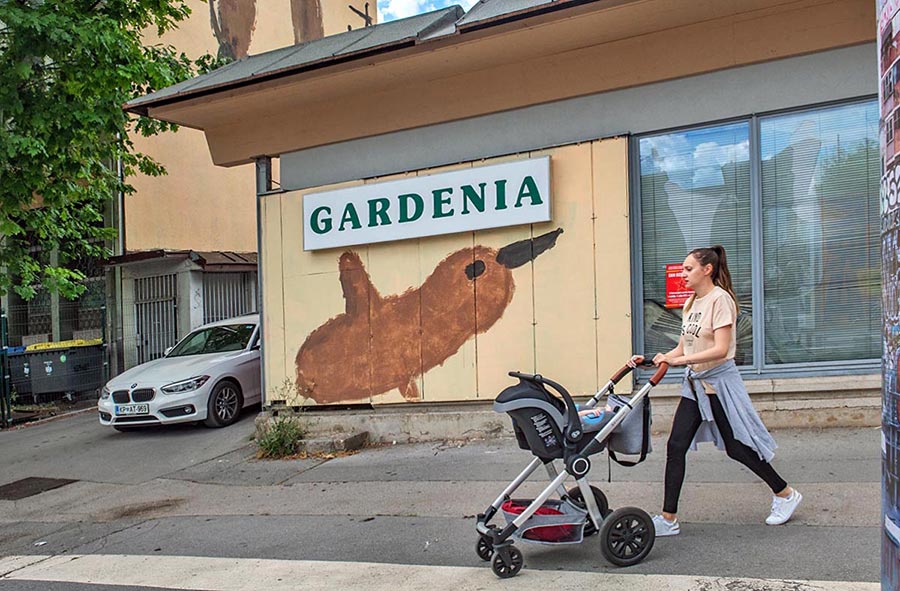
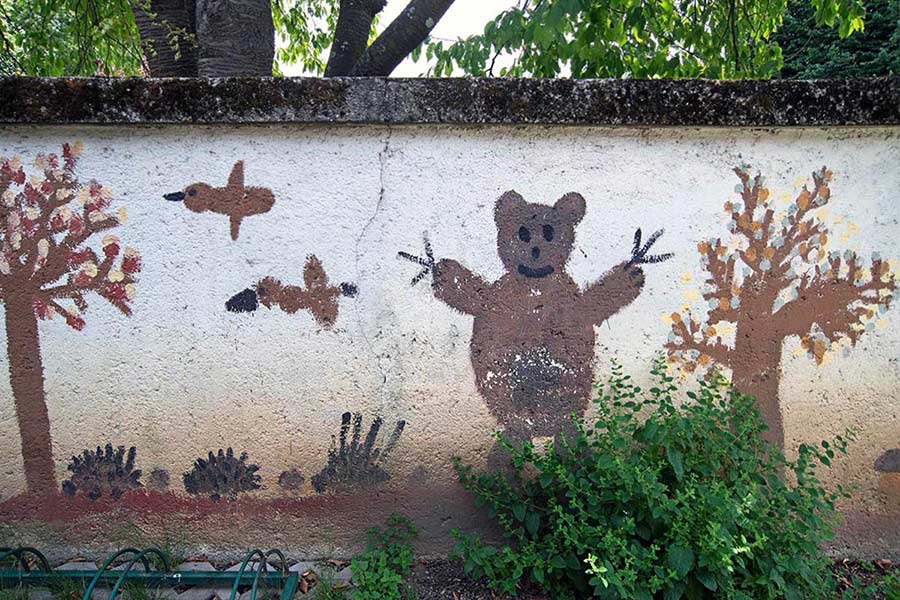
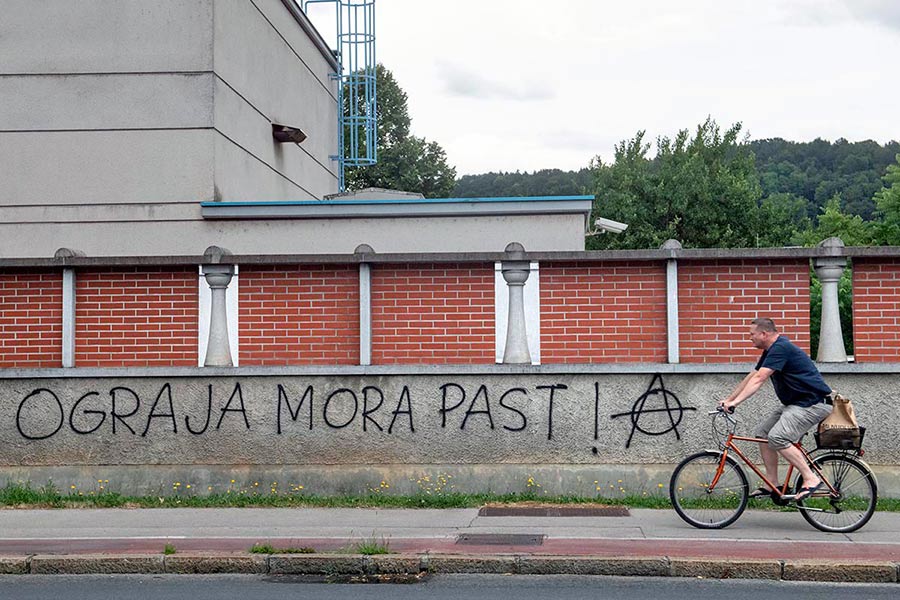
With a borrowed bear from a local school child’s wall painting, Escif created a re-contextualization of the original furry friend. Enlarging it to fill the wall of a two-story building and attaching a stolen slogan from a nearby graffitied wall, Escif declared that “ograja mora past” (the fence must fall). The reactions haven’t stopped since. Depending on the opiner, the deceptively simple mural is addressing the contentious issue of immigration with Croatia, the historical memories Slovenians have of Hitler, or the increasingly impeded flow of wildlife along historical natural routes through Europe.

Escif. “The Fences Must Fall”. Ljubljana Street Art Festival 2021. Ljubljana, Slovenia. SMOG on the wall. (photo © Martha Cooper)

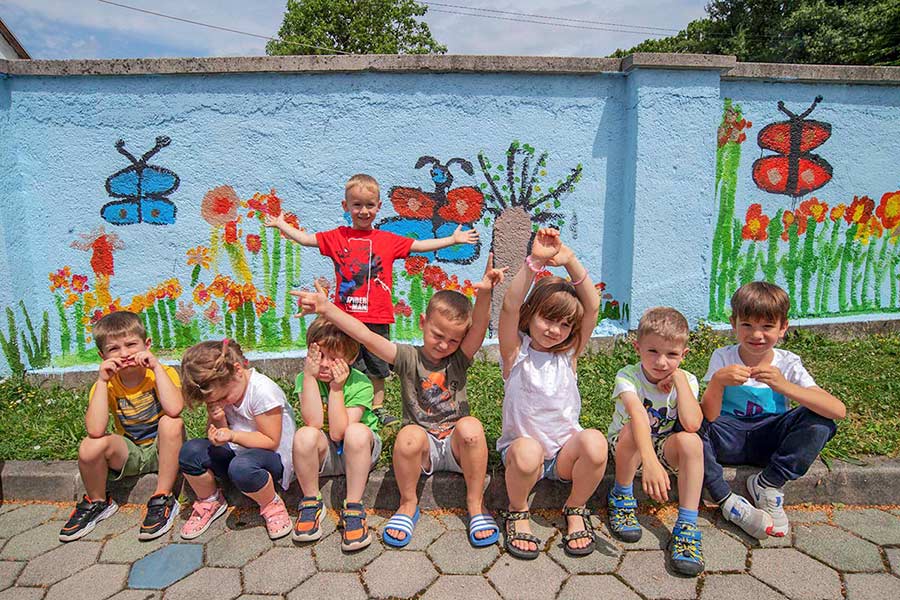
When Sandi took Martha to shoot the original bear painting, Mojca, a teacher in Vodmat Kindergarten, shared a sense of optimism she had by witnessing the resounding waves of impact that rippled outward from the original project. “The goal of the project was for the children to develop the heterogeneous language of art. If by painting this bear we have impacted society and the environment, then we have accomplished more than we could have ever imagined.”

The thoughtful and resolute Escif, as ever, developed and delivered a manifesto on his piece, “The Fences Must Fall”, where he states that “Painting a big wall in a big city is a firm and decisive position” for an artist.

Escif. “The Fences Must Fall”. Ljubljana Street Art Festival 2021. Ljubljana, Slovenia. (photo © Martha Cooper)

“I set out to find the truth that children paint on the walls of kindergartens. I cruised around the city streets, looking for the truth that crazy people spray paint on the walls. As I matched the truths of crazy people and children, of the walls of the former with the walls of the latter, the idea for the mural was born. An angry bear roaring ‘the fences must fall’.”

He continues, “As a foreigner, ignorant of the local reality, I couldn’t quite grasp what this mural was all about. Fortunately, it seems that the locals came to wise insights. Some seemed annoyed by the content. Others seemed happy and read it in a variety of ways. They spoke of the bears in Slovenia that the government wants to control. Of the cruelty of the border fence with Croatia, where refugees are harmed trying to cross it. Of the wild animals that can’t cross that fence either, locked in with no way to migrate. Of the fences that the government puts up to protect the National Assembly from protests. Of the problem of the privatisation of natural resources. And of many other fences that should be coming down everywhere.”

Escif. “The Fences Must Fall”. Detail. Ljubljana Street Art Festival 2021. Ljubljana, Slovenia. (photo © Martha Cooper)

The simplicity of the design and placement are undoubtedly what makes it most magnetic; If you don’t understand the slogan, you want to. If you do understand it, you may crave the opportunity to respond.

“I found Escif’s wall much more interesting after I understood the story behind it,” says Cooper.

Detail of the children painted mural that Escif took inspiration for his mural. Ljubljana Street Art Festival 2021. Ljubljana, Slovenia. (photo © Martha Cooper)

We spoke to directors Abram and Zver about the goals of this year’s festival and why they chose Escif to paint one of the larger, higher-profile walls of the Ljubljana 2021. We discussed how it became a somewhat emblematic piece that was at once surprisingly provocative and also caused dialogue in the streets. “To paraphrase what Escif said about his mural in Ljubljana: painting a mural is a political act, a responsibility, and a commitment,” they say.

“This is also true for the entire production of LJSAF – it is a commitment that requires the recognition that the festival is not a stable and fixed entity, but a heterogeneous and fluid mosaic of events, people, and creativity, operating at a micro and macro level. This is similar to Michel Foucault’s definition of heterotopias – a multiplicity of fragmentary spaces in a single place that allows for spontaneity. LJSAF is also about the experience as the essence of festivals – being part of the festival crowd means mingling with other creative bodies and forging new vectors of collaboration.”

Some of the kindergarten children who painted the mural that inspired Escif for his mural. Ljubljana Street Art Festival 2021. Ljubljana, Slovenia. (photo © Martha Cooper)

Escif appears pleased with the effect as well, perhaps occupying the ideal role of an artist working in public space today in a meaningful way.

“The etymological root of the word ‘politics’ is anything that directs, conditions, or modifies life in cities,” he says. “So painting a big wall in a big city is a big political act, as it directs, conditions, and modifies the urban landscape. Consequently, it also directs, conditions and modifies the lives of the citizens.”

In many cases, we’d have to agree that well-placed graffiti can have a similar effect.

“The streets of Slovenia are full of political graffiti,” says Martha Cooper. Graffiti protesting barbed wire anti-immigrant fence. Ljubljana, Slovenia. (photo © Martha Cooper)
Stencil protesting barbed wire anti-immigrant fence. Ljubljana, Slovenia. (photo © Martha Cooper)
Sticker protesting barbed wire anti-immigrant fence. Ljubljana, Slovenia. (photo © Martha Cooper)
Installation highlighting the government’s barbed wire anti-immigrant fence. Ljubljana, Slovenia. (photo © Martha Cooper)
Anonymous installation protesting barbed wire anti-immigrant fence. Ljubljana, Slovenia. (photo © Martha Cooper)

To read more about the history of Slovenia under Italian and German occupation during World Ward II and barbed wire fences click on the links below:

https://mgml.si/en/city-museum/exhibitions/30/ljubljana-encircled-by-barbed-wire-19421945/

http://www.muzej-nz.si/si/izobrazevanje/viri-za-ucence-in-ucitelje/1711

https://okupacijskemeje.si/exh01-ch09.html

To learn more about Ljubljana Street Art Festival click HERE

Read more
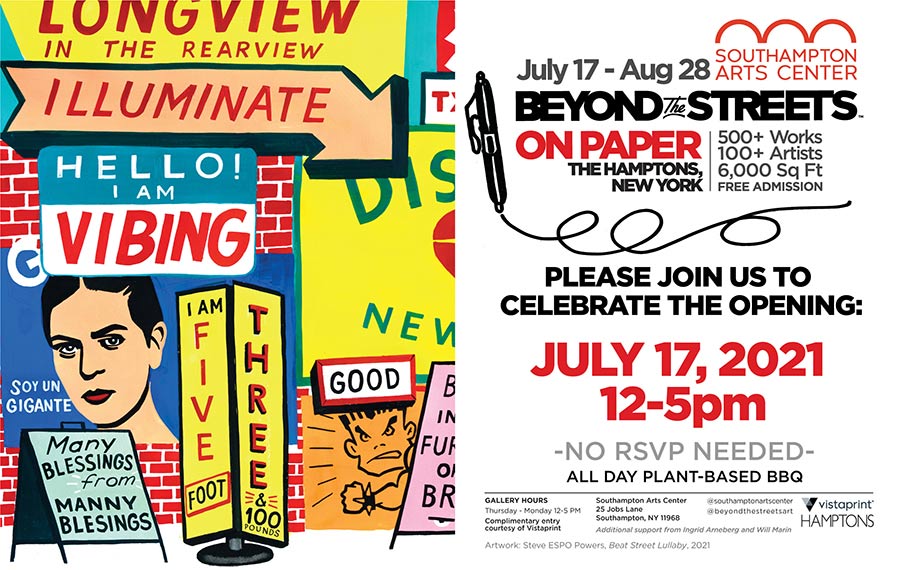
“Beyond The Streets” On Paper Opens in Southampton

“Beyond The Streets” On Paper Opens in Southampton

This time of year, it is hard to find people in Manhattan on the weekends – they’re “weekending” in the Hamptons, darling.

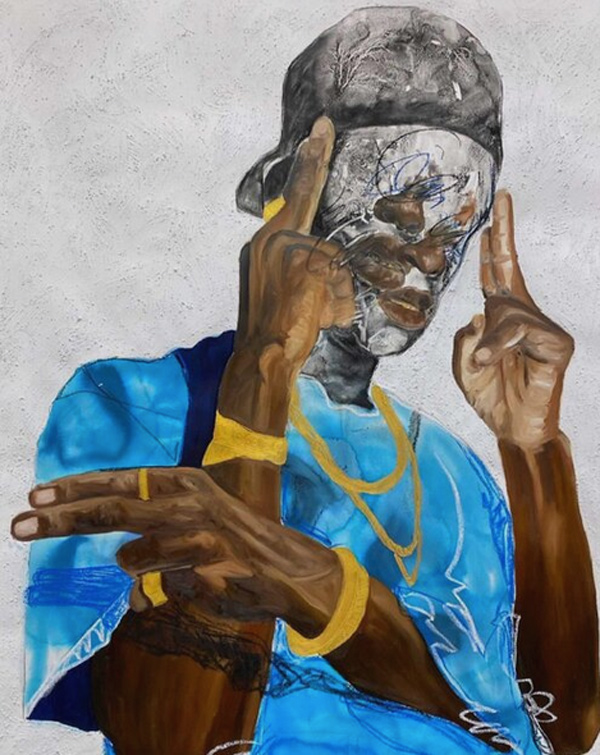
Khari Turner, Hands

Not exactly the original setting you might associate with graffiti, street art, hip-hop, punk rock, zines, and underground art culture but where else can curators Evan Pricco and Kim Stephens sell these works on paper while sipping cool drinks poolside?

“Beyond the Streets” carries the mobile party to Southampton Arts Center this Saturday with a wide swath of styles – 500 works from over 100 artists in an art fair-sized venue. It may remind you of the Urban Air Fair tried in Manhattan in summer 2017, but this one has something that one didn’t: Roger Gastman.

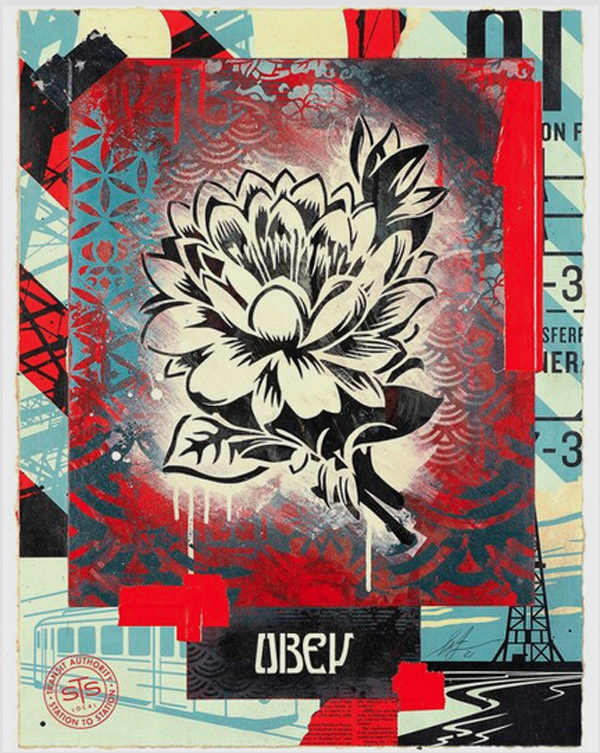
Shepard Fairey, Elysium Lotus

If it’s here, it’s because it is quality work and has a connection to the roots of these subcultural scenes usually as well. Expanding now to the more nebulous category of Contemporary, you may be surprised to see more accessible interpretive variations on the themes. Let’s see that paper, people. 

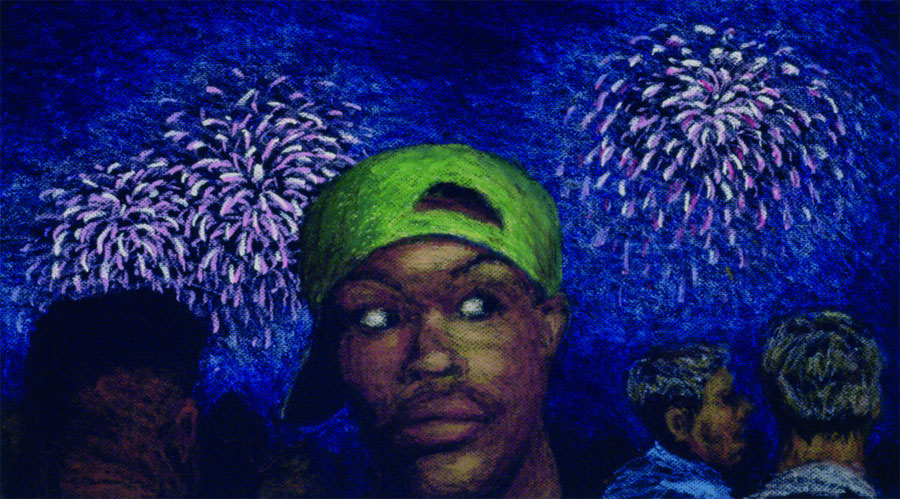
Jane Dickson, Fourth of July 2

Artists include: Action Bronson, Addam Yekutieli, agnès b, AIKO, André Saraiva, Andrew Schoultz, Andrew Thiele, Andy Rementer, Aryz, Bert Krak, Brandon Breaux, Broken Fingaz, Bryant Giles, Camille Walala, CES, Cey Adams, Charlie Ahearn, Chloe Early, Chris FREEDOM Pape, Clark Fox, Cody Hudson, Conor Harrington, Craig Costello, CRASH, DABSMYLA, Daniel Rich, David “Mr StarCity” White, DAZE, DEFER, Emily Manwaring, Eric Haze, Ermsy, Escif, FAILE, Faith XLVII, Fucci, Greg SPONE Lamarche, Gustavo Zermeno, Hilda Palafox, House 33, HuskMitNavn, Ian Reid, Icy & Sot, Jaime Muñoz, Jamilla Okuba, Jane Dickson, JEC*, Jeremy Shockley, Jillian Evelyn, JK5, John Konstantine, Julian Pace, KATSU, KC Ortiz, Kelsey Brookes, Khari Turner, Kime Buzzelli, LeRoy Neiman, Linas Garsys, Liz Flores, Lucy McLauchlan, Lujan Perez, Maripol, Mark Mothersbaugh, Martha Cooper, Marshall LaCount, Matt McCormick, Maya Hayuk, Michael Vasquez, MIKE 171, Mister CARTOON, Neena Ellora, Nehemiah Cisneros, Nettie Wakefield, NUNCA, Otto183, Paije Fuller, Paul Insect, POSE, Rebecca Morgan, Reko Rennie, Rello, Richard Colman, RISK, Ron English, Ryan McGinness, Sage Vaughn, Saladeen Johnson, Scott Campbell, Sean from Texas, Senon Williams, Shantell Martin, Shepard Fairey, SJK 171, Sofía Enriquez, SNOEMAN, Spacebrat, STASH, Steve ESPO Powers, SWOON, TAKI 183, The Perez Bros., Timothy Curtis, Todd James, Troy Lamarr Chew II, Umar Rashid, Victor Reyes, Wasted Rita, Wulffvnky, Yarrow Slaps, Yusuke Hanai, ZESER, ZOER and 45RPM.

BEYOND THE STREETS on PAPER
July 17—August 28, 2021
Southampton Arts Center, Southampton, New York, 11968

For more details, schedules, etc. click HERE

Read more
BSA Film Friday: 01.15.21

BSA Film Friday: 01.15.21

Our weekly focus on the moving image and art in the streets. And other oddities.

Now screening :
1. Escif: Greenpeace, For a Sustainable City.
2. Street Art in 2020
3. Mathieu Libman: The Moon’s Is Not That Great

BSA Special Feature: Escif: Greenpeace, For a Sustainable City.

Street Art in 2020

Doug Gillen of FifthWall TV reflects on the world of street art in the year of 2020.

Mathieu Libman: The Moon’s Is Not That Great

After an astronaut returns from her lunar mission to find that the public lost all interest in the moon, the stories of the astronaut, a film director, and a bear intersect.

Read more
Escif Burns in Empty València Public Square: “This Too Shall Pass”

Escif Burns in Empty València Public Square: “This Too Shall Pass”

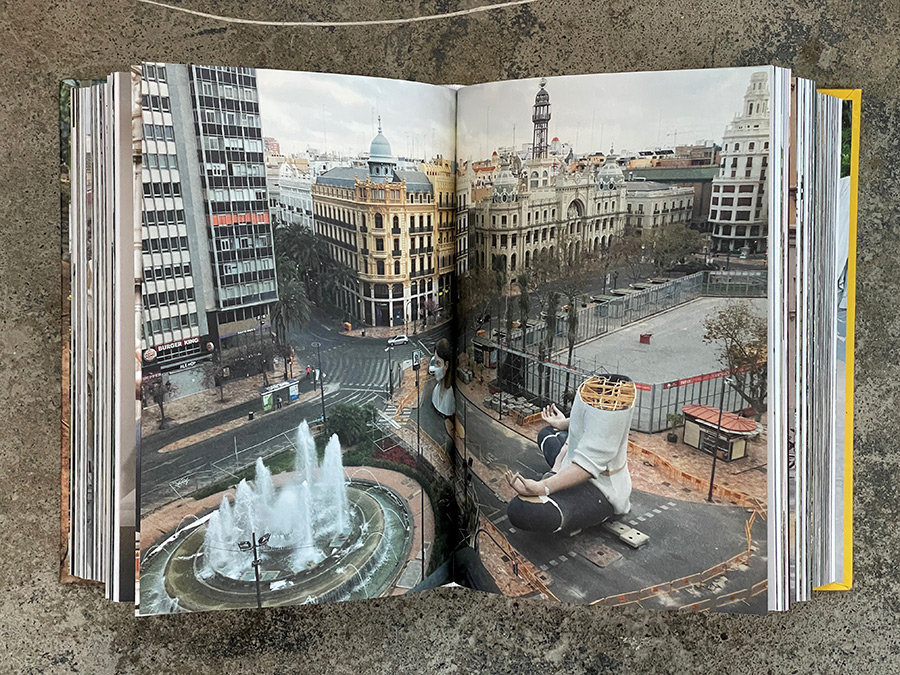
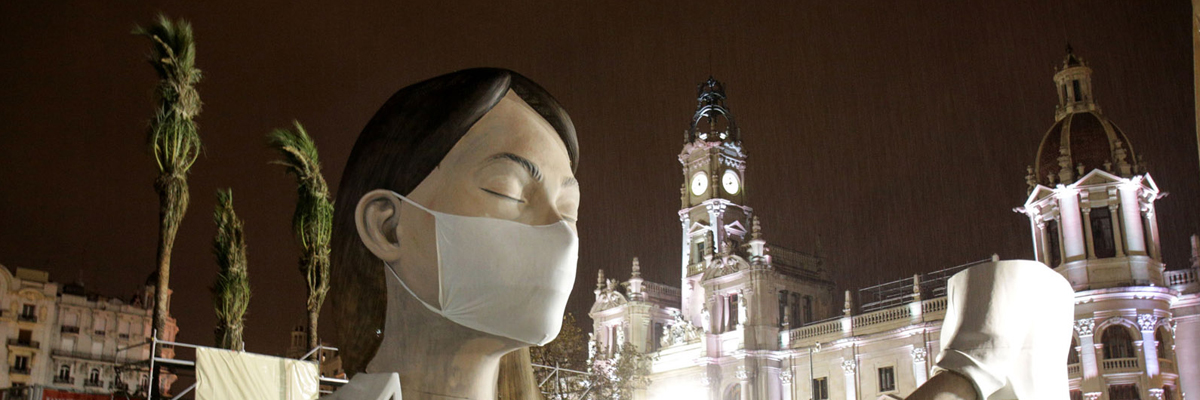
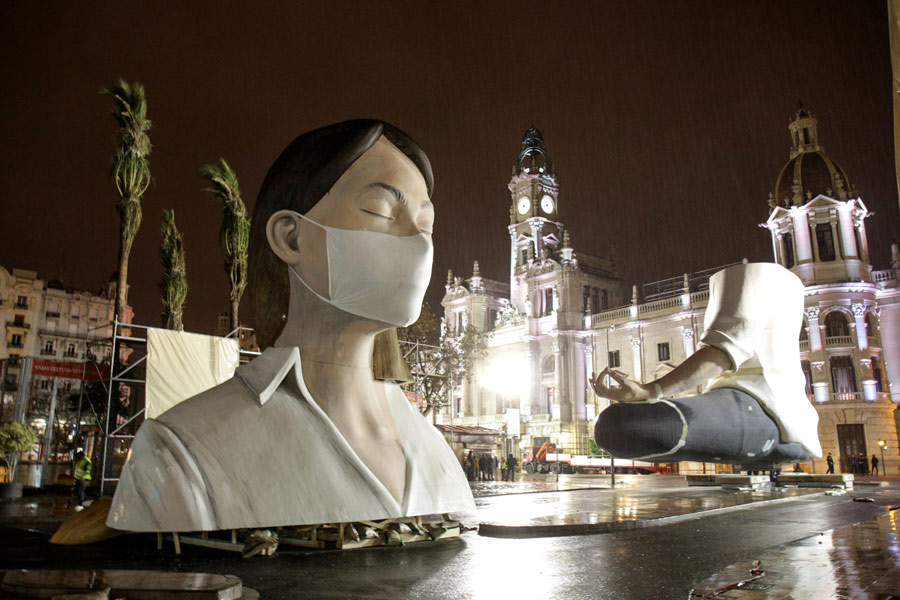
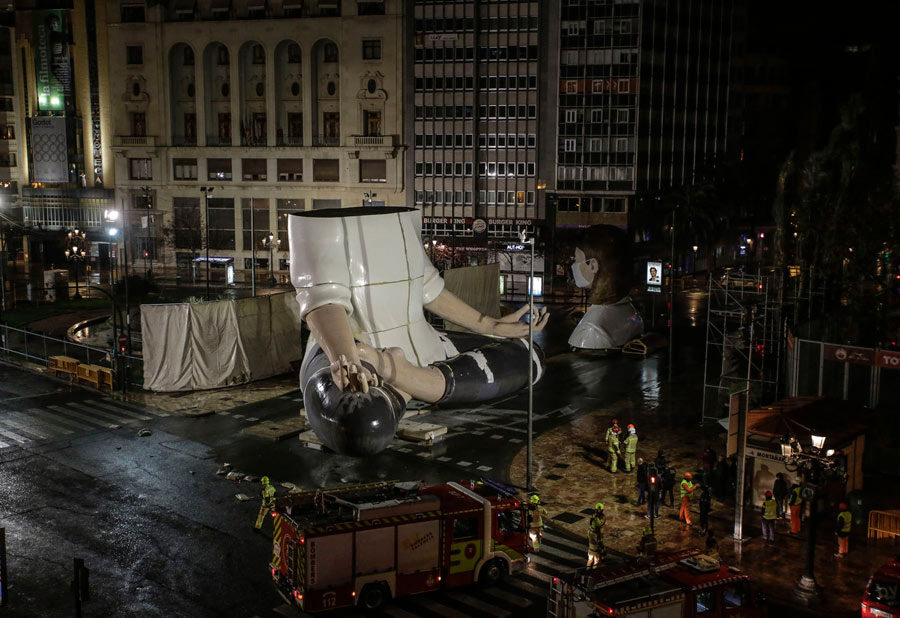
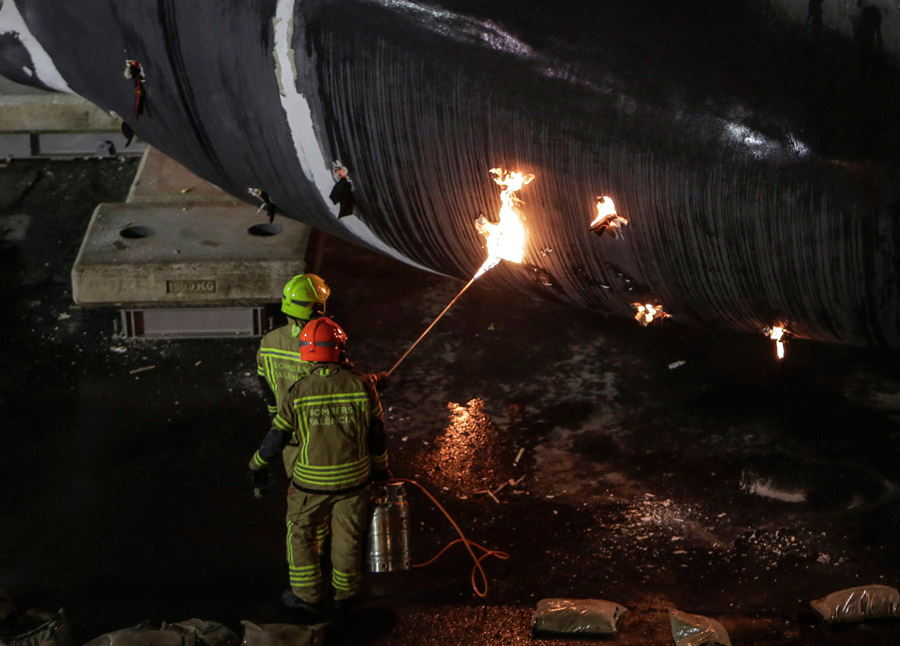
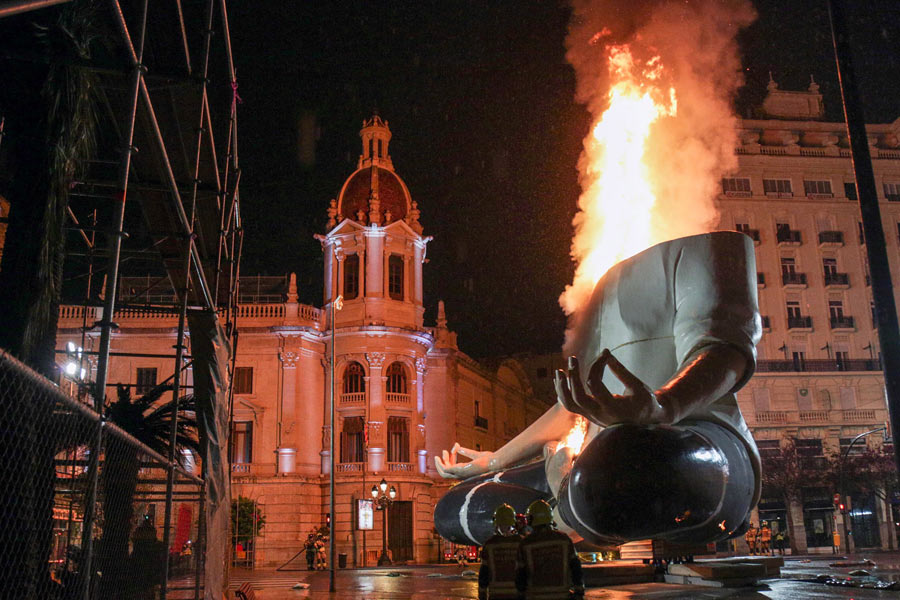
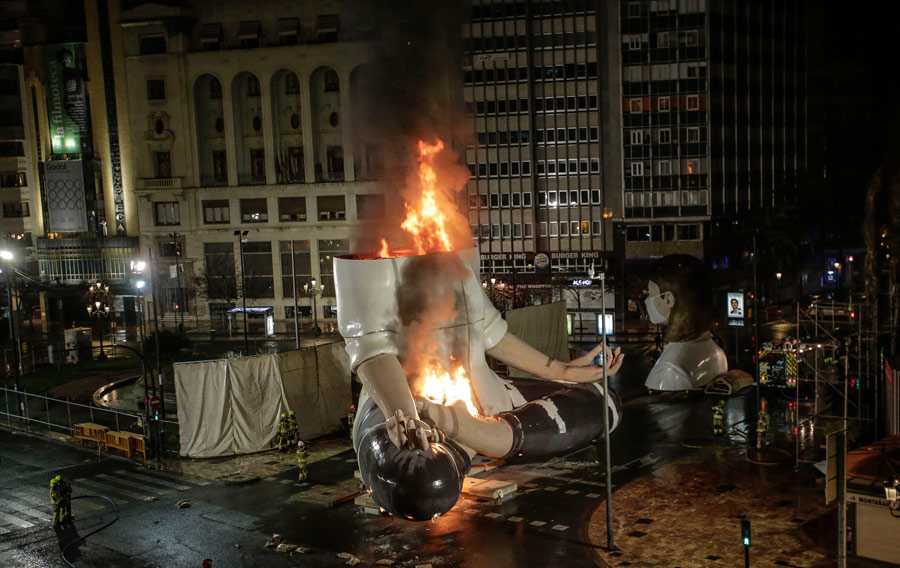
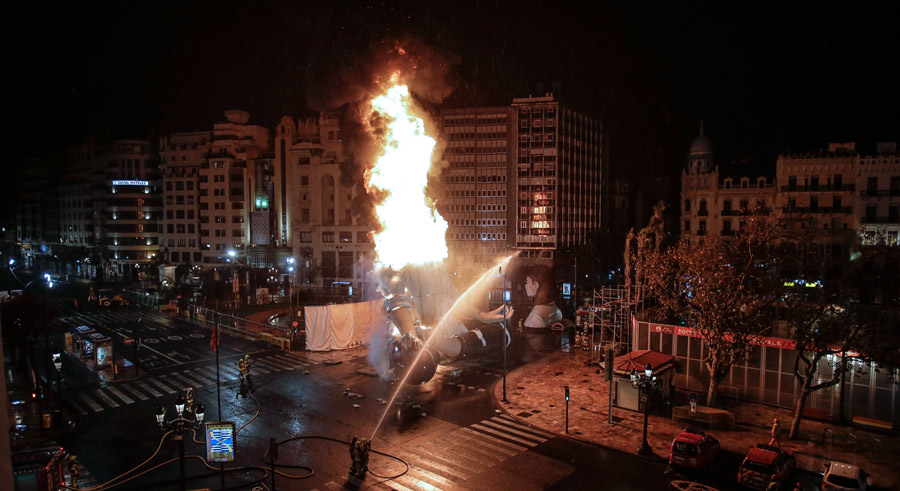
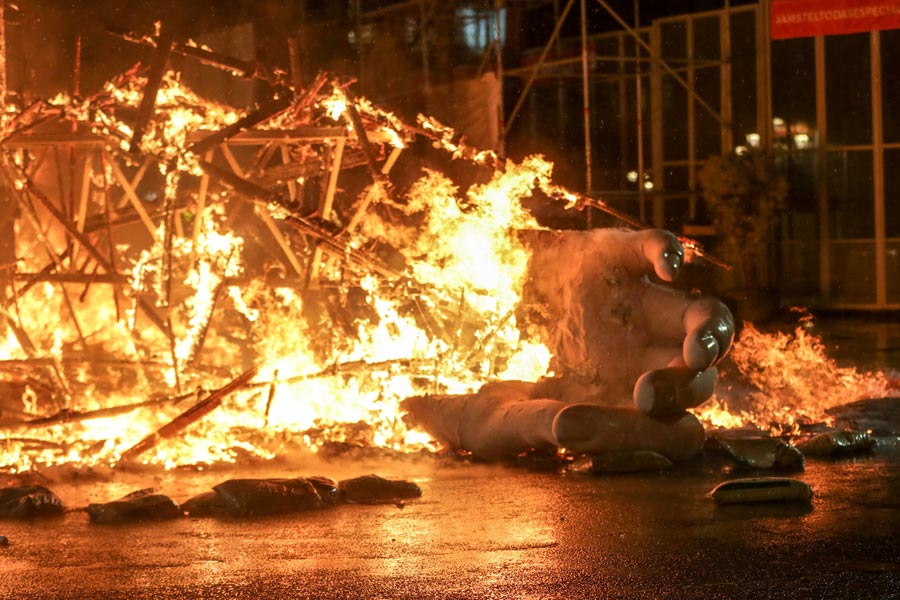
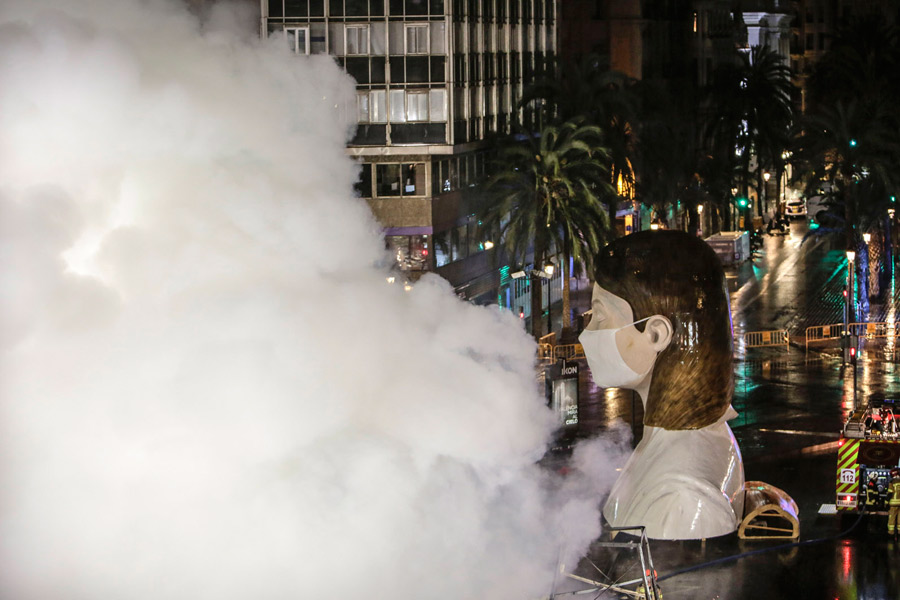
A spooky set of images today from València, where an enormous torso of a woman is set afire in the center of the city, billowing blackened smoke through its cut severed body upward hundreds of meters into the air.

Escif. “This Too Shall Pass”. Valencia Fallas, March 17, 2020. Spain. (photo courtesy Escif)

Only two years ago we gave you stunning photos by Martha Cooper of Okuda’s enormous geometric pop art sculpture aflame for this traditional festival (OKUDA Sculpture Engulfed in Flames for Falles Festival in València). The culmination of a city-wide street celebration that is enjoyed by hundreds of thousands in this city of 2.5 million. Now there is no one outside on Valencia streets.

Escif. “This Too Shall Pass”. Valencia Fallas, March 17, 2020. Spain. (photo courtesy Escif)

Spain and most countries in Europe are closing their borders, going into some version of a 24-hour lock-down curfew, encouraging people to self -quarantine to protect against the spread of coronavirus.

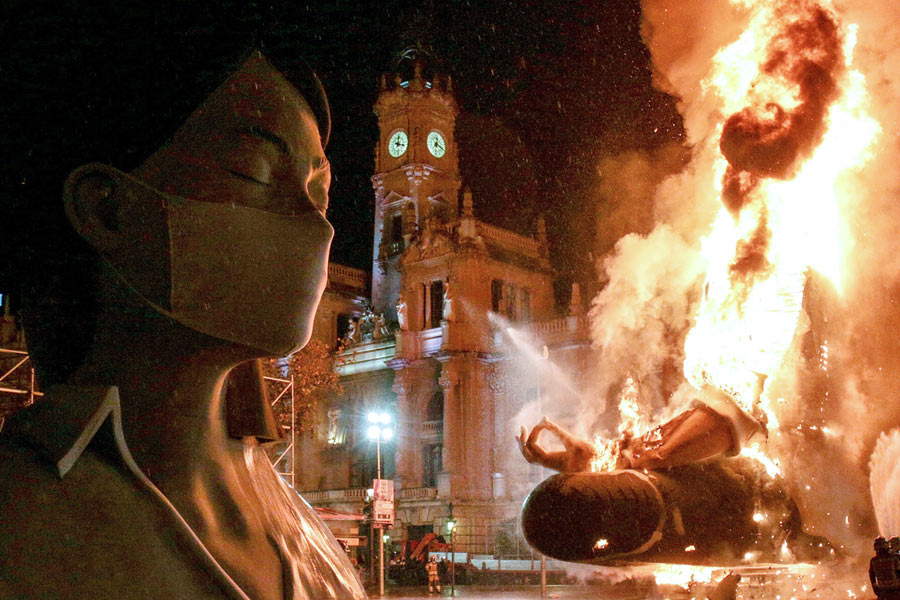
Look at the images of the yoga posed woman with a face mask, cut in two, lit on fire, only her shoulders and neck, and head remaining.  Is it violent? Is it poetry?

Escif. “This Too Shall Pass”. Valencia Fallas, March 17, 2020. Spain. (photo courtesy Escif)

Suddenly this image became a symbol of peace and calm, unity and solidarity,” says Spanish Street Artist Escif, the political sociologist who often infuses his figurative imagery with greater commentary on society.

Escif. “This Too Shall Pass”. Valencia Fallas, March 17, 2020. Spain. (photo courtesy Escif)

Escif tells us that the Valencia government decided to burn just the body of the sculpture and to keep the face with the mask in the square – until this crisis ends. Surrounded by firefighters, this fire goes up. Yet this serene woman will remain after the flame is extinguished, what is left of her.

“This too shall pass,” he says.

Escif. “This Too Shall Pass”. Valencia Fallas, March 17, 2020. Spain. (photo courtesy Escif)
Read more