All posts tagged: Berlin

BSA Film Friday: 09.14.17

BSA Film Friday: 09.14.17

bsa-film-friday-JAN-2015

Our weekly focus on the moving image and art in the streets. And other oddities.

Now screening :
1. “GIGANTES CERVECEROS” by Miquel Wert
2. Shepard Fairey and Johnny Cash on 50th Anniversary of “Folsom”
3. PasteUp Festival in Berlin
4. Yemeni Street Artist Murad Subay on Fifth Wall
5. Rocco And His Brothers Crash the the Party at The Police Station

bsa-film-friday-special-feature

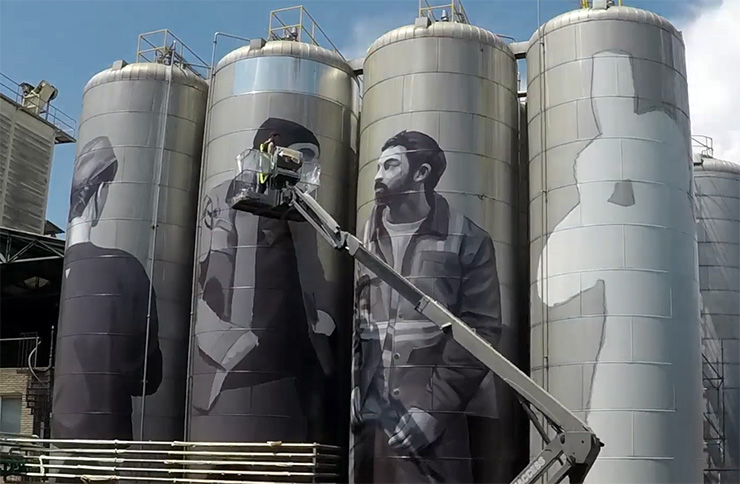
BSA Special Feature: “GIGANTES CERVECEROS” by Miquel Wert

A year ago we were watching artist Miquel Wert balancing awkward family dynamics in Barcelona and today he’s painting about beer.

We enjoy watching the progression of the portraiture across these vertical fermentation tanks over about 375 square meters of space. Part of a private gig with the client, the artist chose four tradespeople involved in the production of beer to adorn these tanks in Zaragoza, Spain.

Shepard Fairey and Johnny Cash go big in Sacramento, California.

“When I was just a baby, my Mama told me, ‘Son, always be a good boy, don’t ever play with guns.’ But I shot a man in Reno just to watch him die.” Johnny Cash sings with some bravado in Folsom Prison Blues on an album released 50 years ago this year. Street Artist Shepard Fairey honors the album and here in Sacramento, California to raise consciousness about the outrageously high rate of incarceration here. “The United States has 5% of the world’s population but 25% of it’s prisoners,” he says, making you question the system in the Land of the Free.

PasteUp Festival in Berlin

“PasteUp Festival” Brings 130 Voices to Berlin Walls is the article we wrote a few days ago about this streetside exhibition of international paste-up street art. Here is a full walk-by so you can see it all.


Yemeni Street Artist Murad Subay on Fifth Wall

Doug Gillen takes us to Yemen where Street Art takes on the politics of the region and the war-torn life that has been foisted upon its citizenry. A brief overview of geopolitics followed by an Internet interview with Murad Subay is accompanied by examples of his work and Mr. Subay’s own recounting of his experiences creating work on the public sphere – even while bombs are dropping.


Rocco And His Brothers Crash the the Party at The Police Station at Monumenta, Leipzig 2018

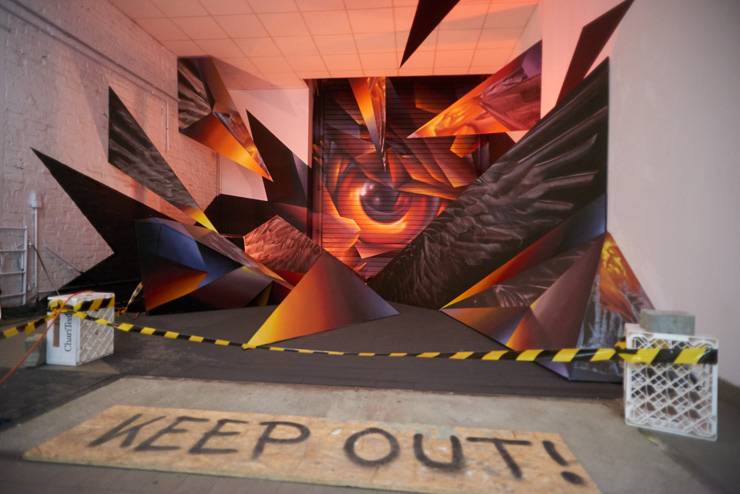
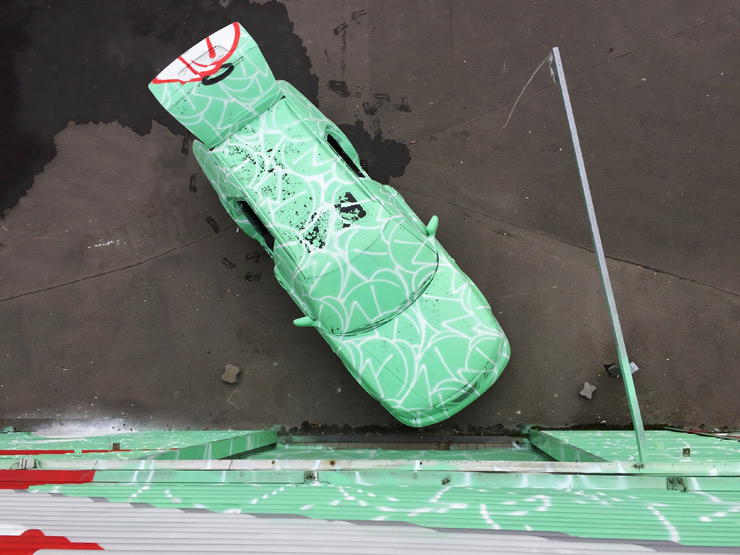
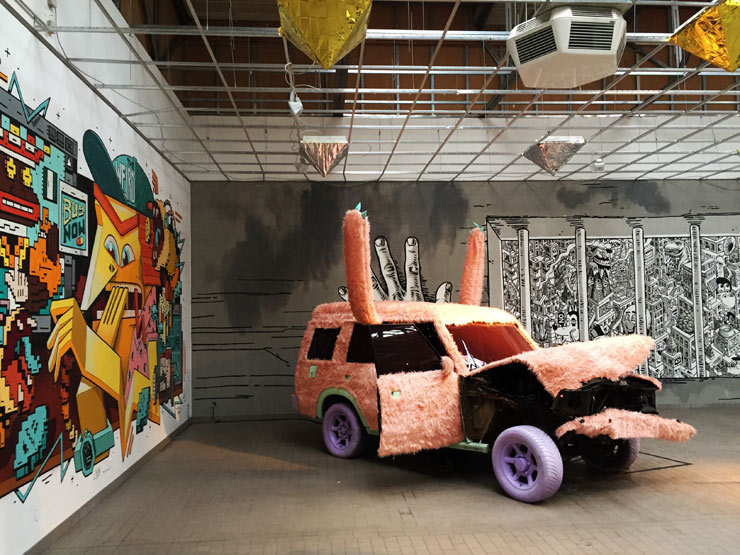
One of the installations in the new Monumenta exhibition in an old factory in Leipzig creates a car crash into a local precinct. The graffiti crew Rocco and His Brothers have mounted the scene and we were happy to capture it at the precise time that the building security alarms happened to go off – adding an additional audio track to the troubled scene.


Read more
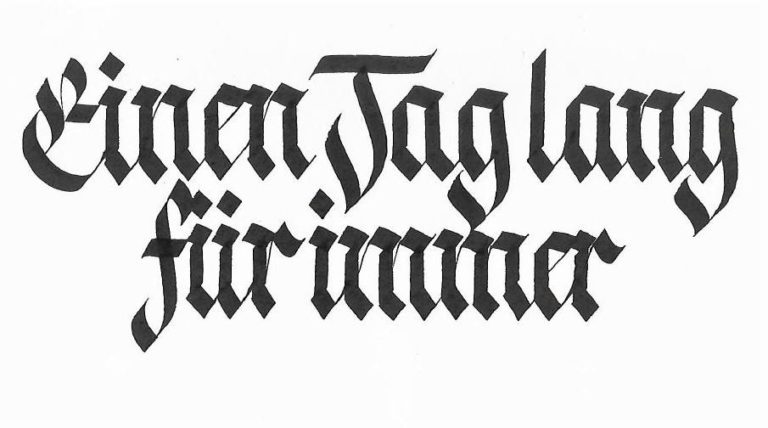
Calligraffiti Runs Through It : “Einen Tag lang Fur Immer” in Berlin

Calligraffiti Runs Through It : “Einen Tag lang Fur Immer” in Berlin

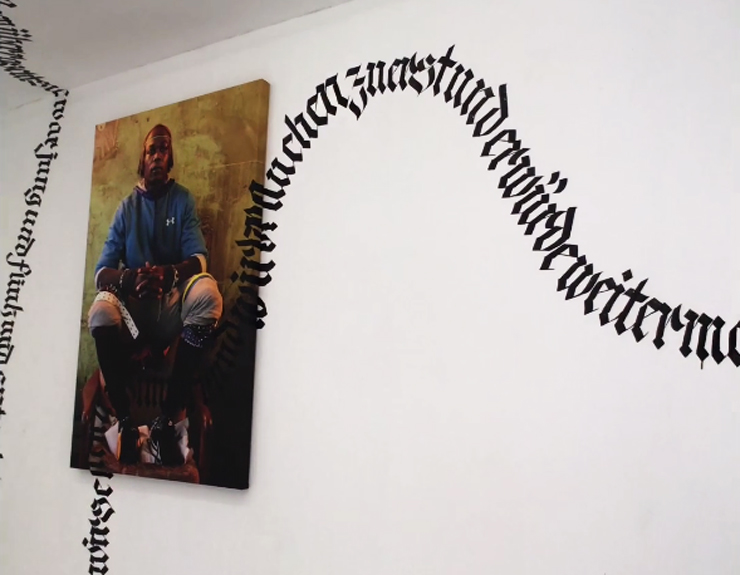
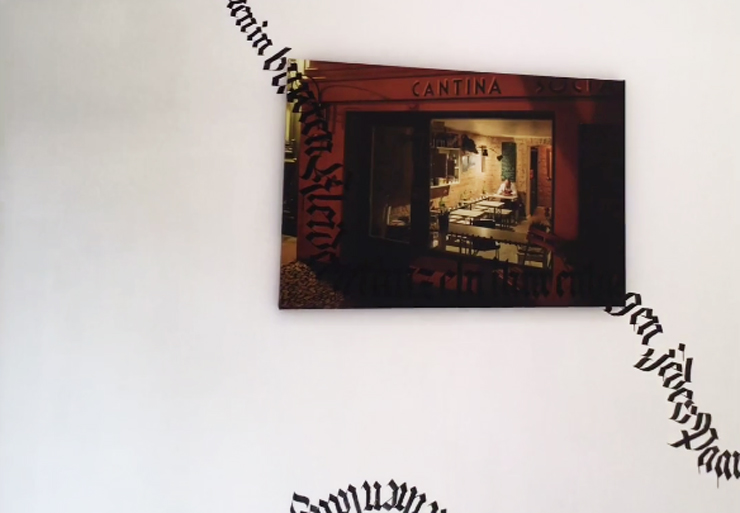
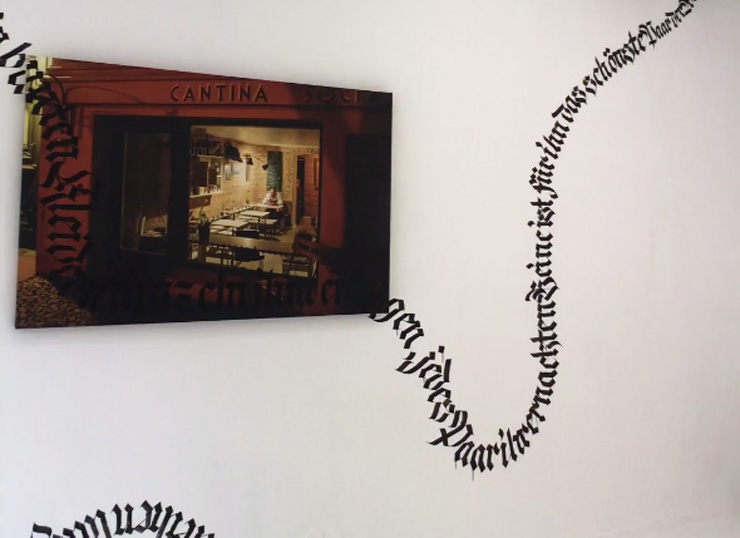
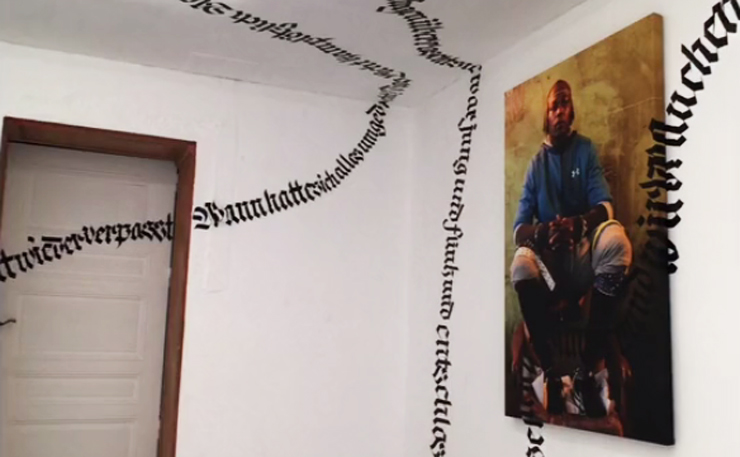
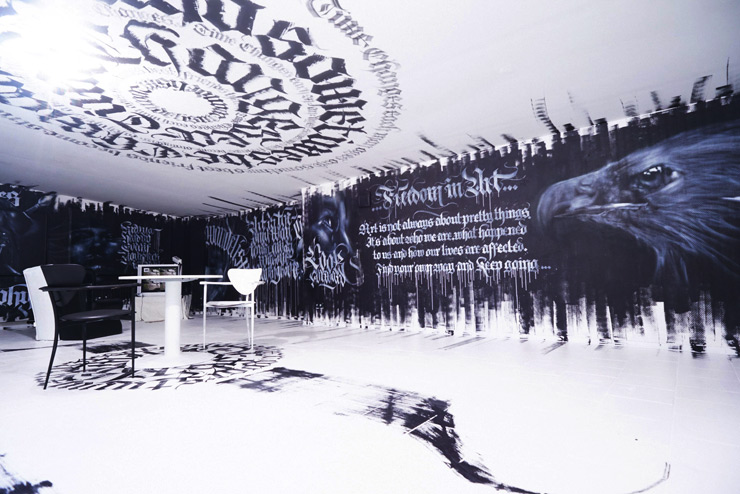
A tiny gallery pop-up show at Zwitxhermaschine Gallery in Berlin quickly illustrates quite literally the narrative that is often on the street between different pieces and players.

In this case the photographs by Manfred Weber, the only two on display in this storefront space, were entirely unconnected until author Nora Linneman joined them in her mind and her imagination.

The calligraffitist Parisurteil literally tagged the story across the two pieces, a painted tattoo of text that wends across the walls, ceiling and floor of the space in such a way that you may become dizzy standing in the all-white box as you follow the narrative thread around the space.

The photographer, the writer and the urban calligrapher all come together to create “Einen Tag lang für immer” (roughly translated as “For one day forever”) – an uncommon story told by many.


“In very few circumstances do you get this kind of mix of people together,” says Michelle Houston, who co-curated the show with Denis Leo Hegic. “We were looking to make a collaborative piece and we think that bringing different disciplines together is quite unusual.”

If you are in Berlin this weekend and would like to hear Nora Linnemann’s enchanting story read by the author at 4 pm Sunday September 9th.

Einen Tag land für immer is organized by Denis Leo Hegic and Michelle Houston at the Zwitschermaschibe Galerie in Berlin. The exhibition closes on September 12th, 2018.


BERLIN ART SOCIETY @ Zwitschermaschine

Eröffnung: Do 16.08.2018, 19 Uhr
Ausstellung: 17.08. – 12.09.


Read more
“PasteUp Festival” Brings 130 Voices to Berlin Walls

“PasteUp Festival” Brings 130 Voices to Berlin Walls

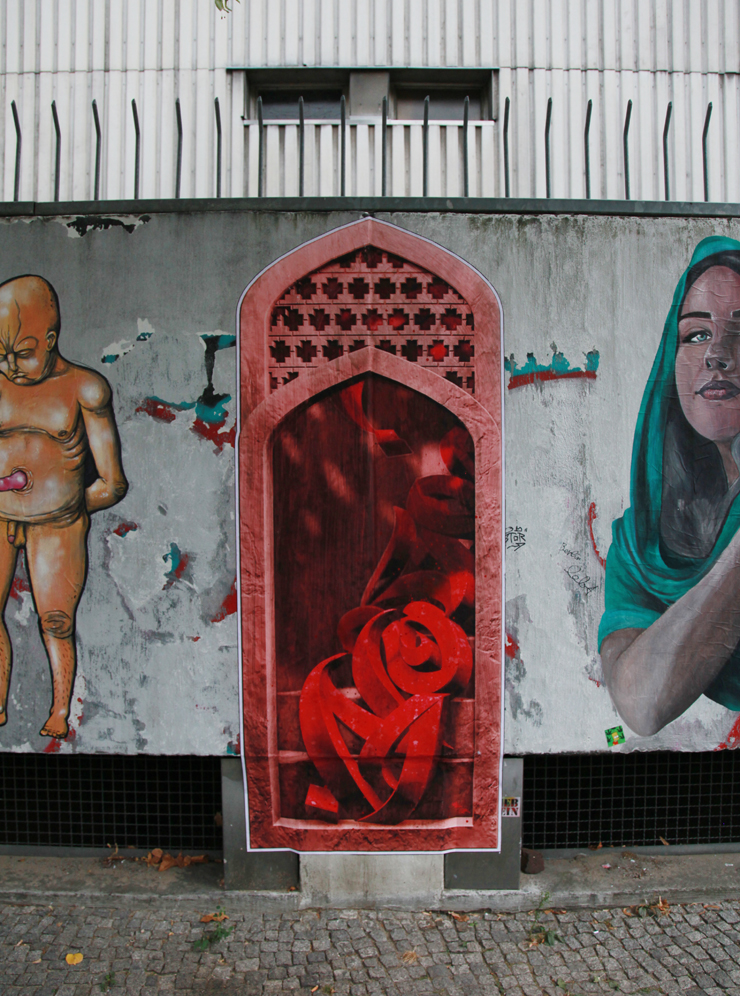
We start here with a fresh paste-up directly from Iran. It depicts the entrance to a mosque bathed in a jewel reddish haze. The lower half of the door contains a cryptic message in the three-dimensional wildstyle graffiti that captured the imagination of New Yorkers, Europeans, and Middle Easterners over time. Descending the stairs and coming out to the street it reads, “Nothing”.

From an anonymous Iranian artist. The letters in Arabic read: ………. Paste Up Festival Berlin / September 2018. (photo © Jaime Rojo)

“If they would paste this in Iran,” says the Berlin Paste-Up Festival organizer Moritz Tonn from the artists collective Wandelism. “It would probably be considered blasphemy and the government would most likely go after the artist”. Here in the so-called “western” world the ability to criticize all institutions, including religious ones, is still officially preserved and honored – so it is interesting that a theocracy could judge this as possibly flammable piece and it has to stay anonymous here inside very permissive Berlin.

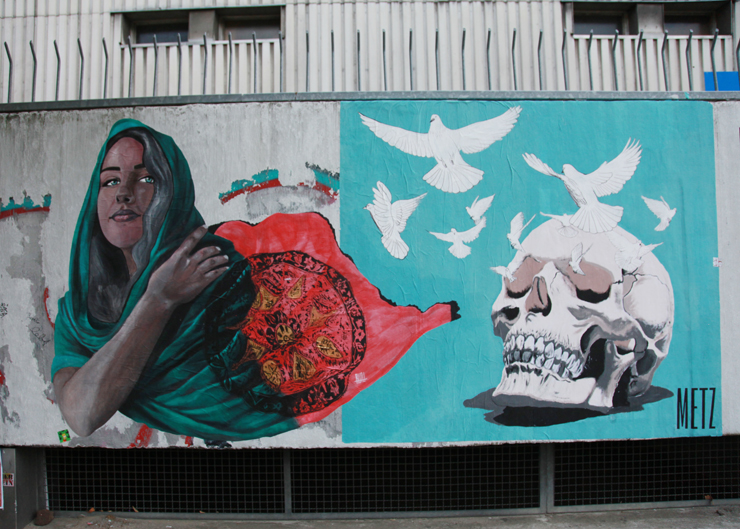
RUN . METZ. Paste Up Festival Berlin / September 2018. (photo © Jaime Rojo)

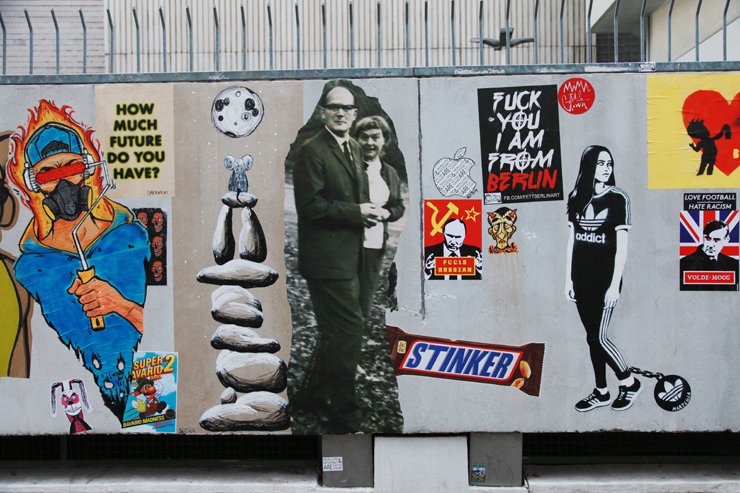
And that is only one of the reasons why exhibits like this are so crucially important to the dialogue on the street and to our collective awareness. Political, social, comic, pop, photographic, illustrative, painted, drawn, copied, figurative, immature, sarcastic,international, local, cryptic, explicit, inventive, verging on profound- these are the vox populi from many cities around the world stuck alongside one another. The mix is unusual, even odd. But the sound of the voices can be quite clarion.

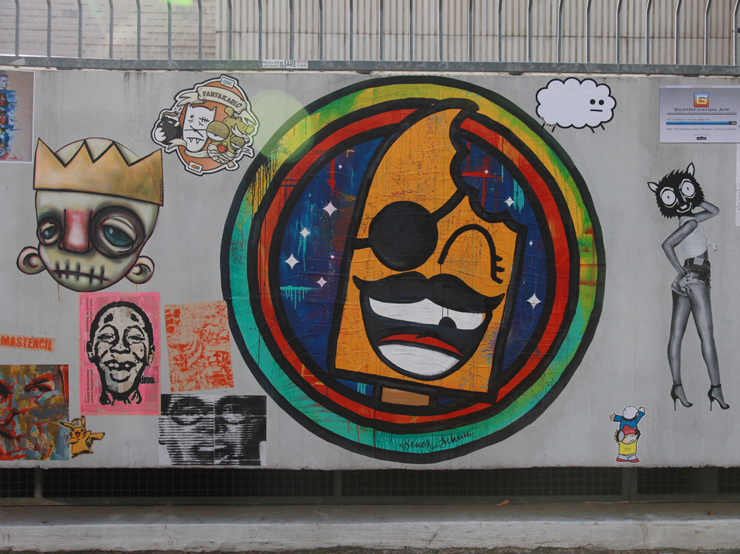
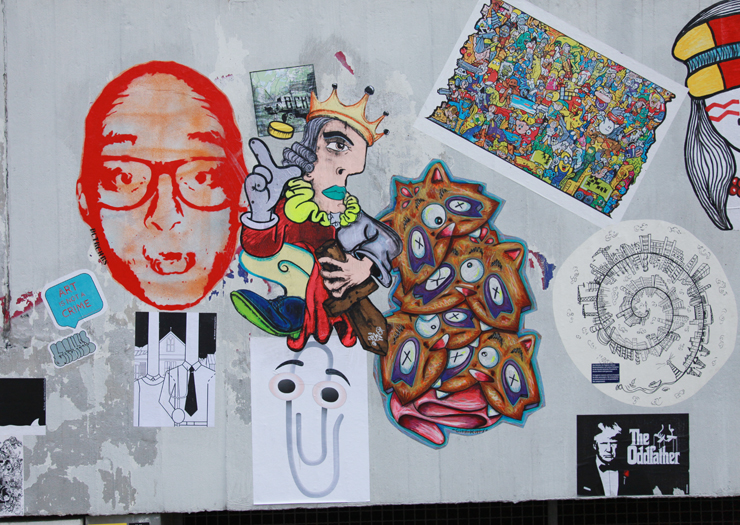
Senor Schnu (center) . Stenandol (figure with crown on left). Paste Up Festival Berlin / September 2018. (photo © Jaime Rojo)

“We got submissions from 130 artists, one to five paste-ups each,” says Moritz. “We have run out of room so we asked some of the the artists if we could put their art in the streets elsewhere around the neighborhood.”

Truthfully, there is a lot of space here that hasn’t been slapped with stickers or slathered with wheatpaste, and you can imagine that with time there will be a lot of organic growth in the massive piece that will bring the walls to full maturity/immaturity.

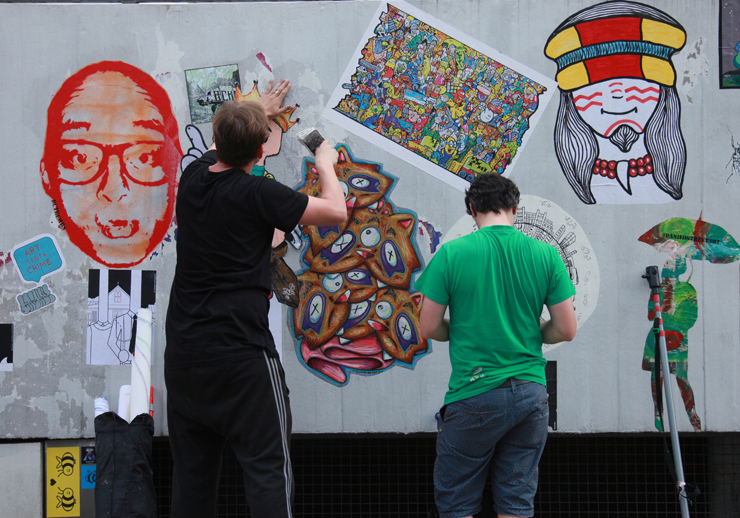
Members of the festival helping with the pasting up of the works. Paste Up Festival Berlin / September 2018. (photo © Jaime Rojo)

If one really is interested on experiencing the full scope of what’s happening with art in the streets one really must pay special attention to the artists whose practice is small. At the moment it may be that stickers and paste-ups are getting lost amidst the hurricane of mural festivals – But big murals don’t paint the whole picture.

The small stickers, the stencils, the wheat pasted posters attached to walls in back alleys, on post lamps and street furniture are a fundamental component of this truly democratic art movement. So we’re satisfied to see a large spot like this one solely dedicated to paste-ups in all their glorious incarnations.

City Kitty . Gasky Graffiti . DCTRCHBS . Subdude. Paste Up Festival Berlin / September 2018. (photo © Jaime Rojo)

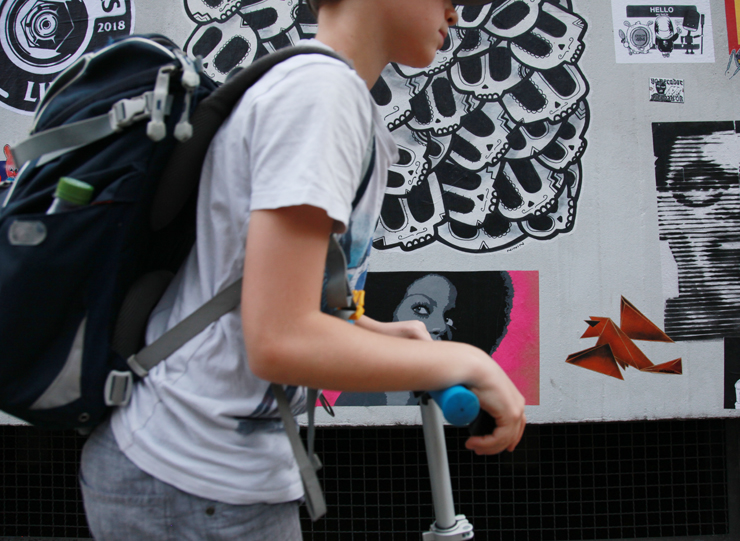
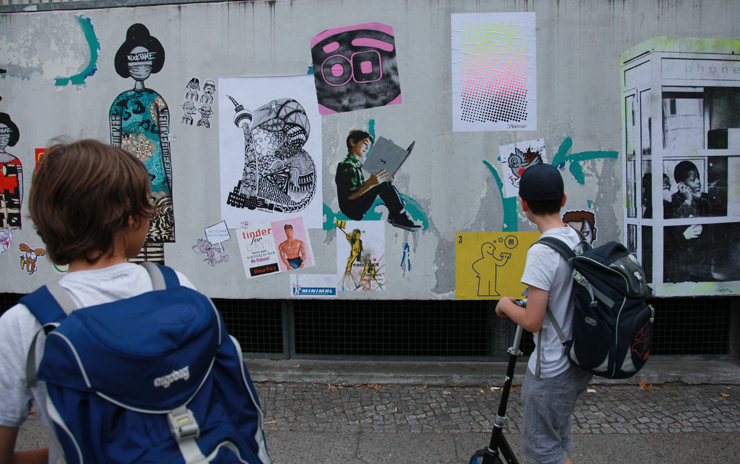
Young boys pausing on their scooters to take a look at the art works. Paste Up Festival Berlin / September 2018. (photo © Jaime Rojo)

Anna Dimitrou. Paste Up Festival Berlin / September 2018. (photo © Jaime Rojo)

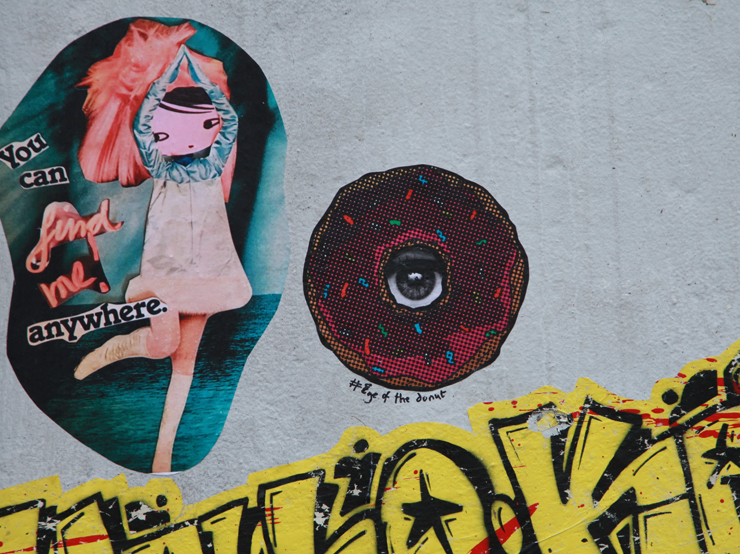
Eye Of The Donut signing his piece. Paste Up Festival Berlin / September 2018. (photo © Jaime Rojo)

Eye Of The Donut . Phobe NY. Paste Up Festival Berlin / September 2018. (photo © Jaime Rojo)

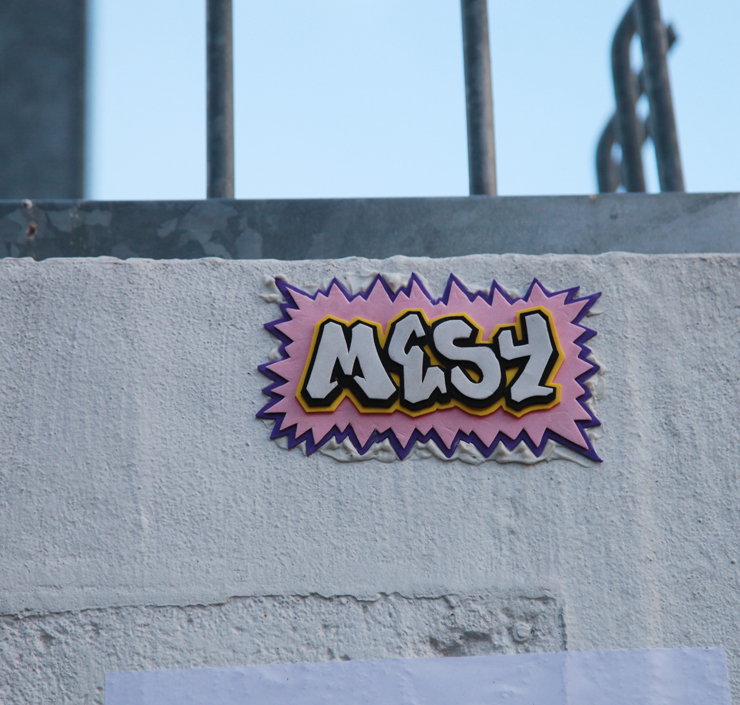
Mesy. Paste Up Festival Berlin / September 2018. (photo © Jaime Rojo)

Ron Miller. Stec. Paste Up Festival Berlin / September 2018. (photo © Jaime Rojo)


Snik . Beatsen . Not Pinky . Mary Cula . Subdude. Paste Up Festival Berlin / September 2018. (photo © Jaime Rojo)

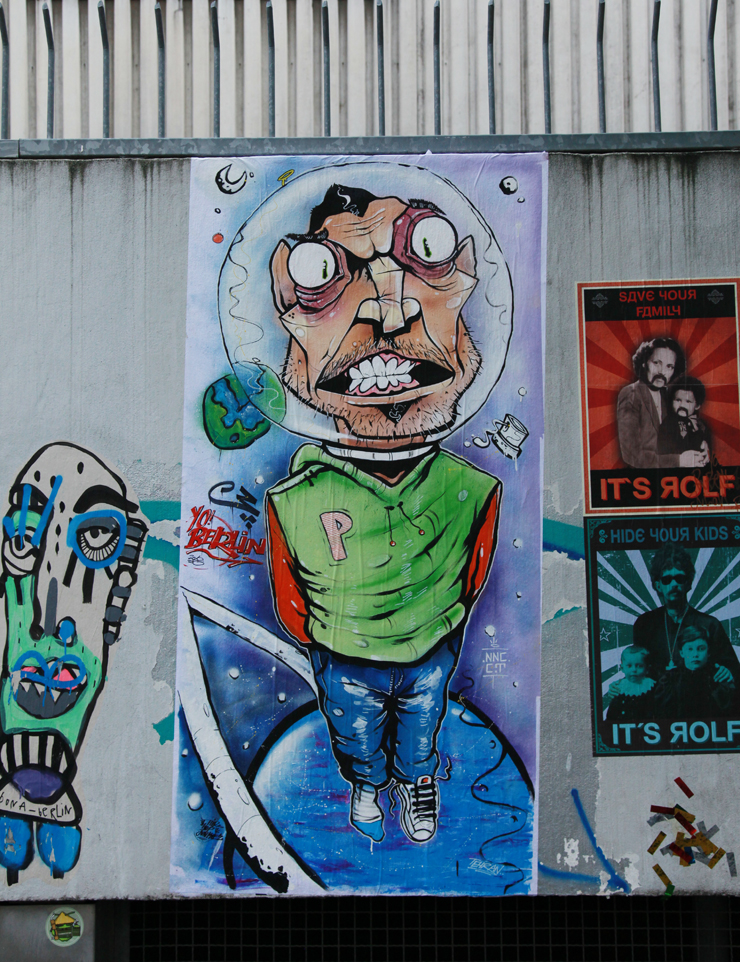
NNC CT Theran . Bona Berlin . It’s Rolf.  Paste Up Festival Berlin / September 2018. (photo © Jaime Rojo)

Not Pinky. Paste Up Festival Berlin / September 2018. (photo © Jaime Rojo)

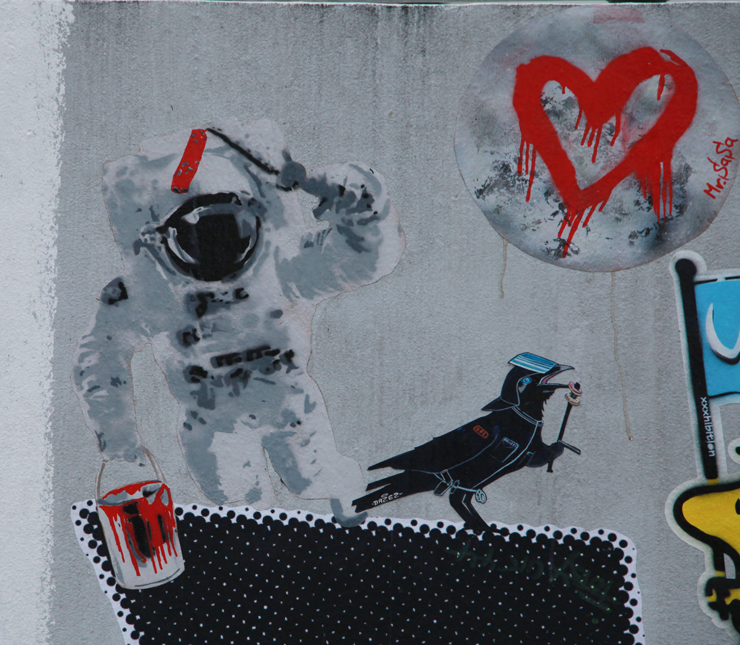
Mr. Sasa . Dazez. Paste Up Festival Berlin / September 2018. (photo © Jaime Rojo)

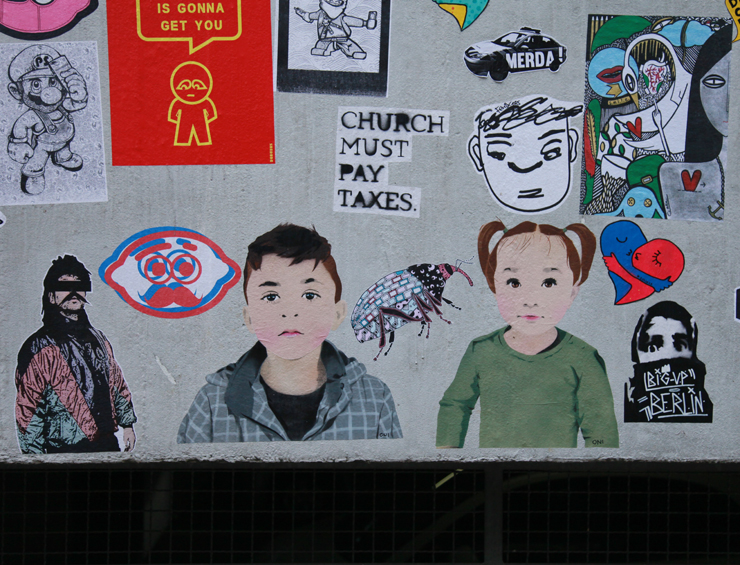
ONI . SKA. Paste Up Festival Berlin / September 2018. (photo © Jaime Rojo)

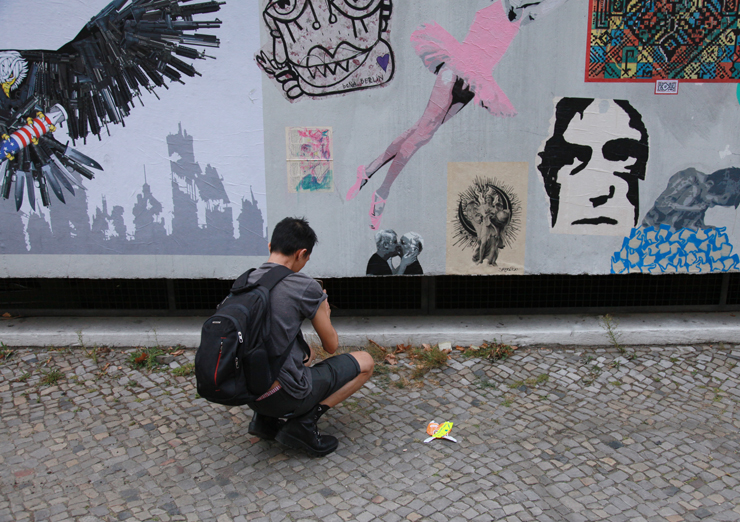
Paste Up Festival Berlin / September 2018. (photo © Jaime Rojo)

Otto OSCH Schade. Paste Up Festival Berlin / September 2018. (photo © Jaime Rojo)

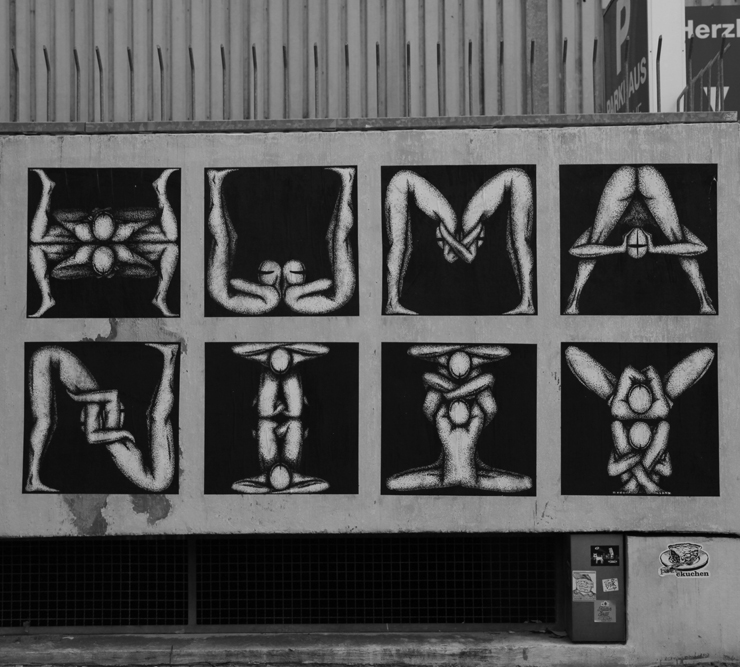
Paste Up Festival Berlin / September 2018. (photo © Jaime Rojo)

Read more
Nevercrew Reifies on “One Wall” in Berlin

Nevercrew Reifies on “One Wall” in Berlin

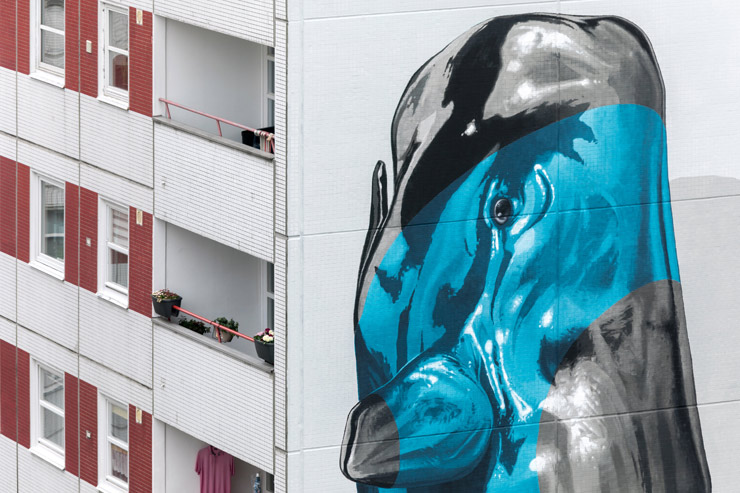
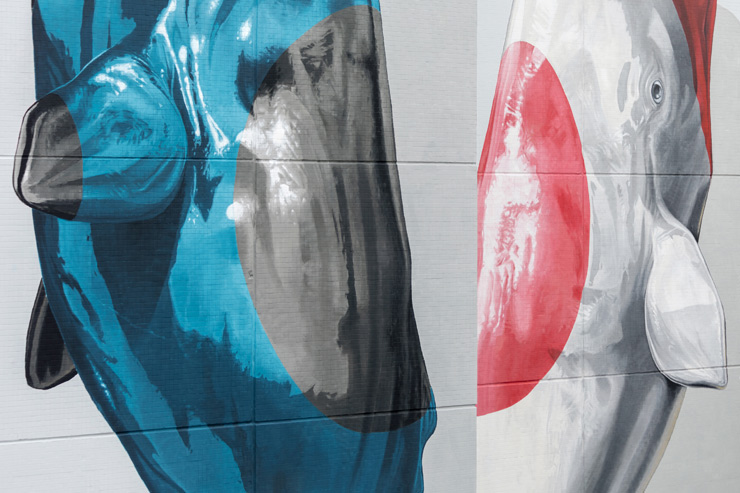
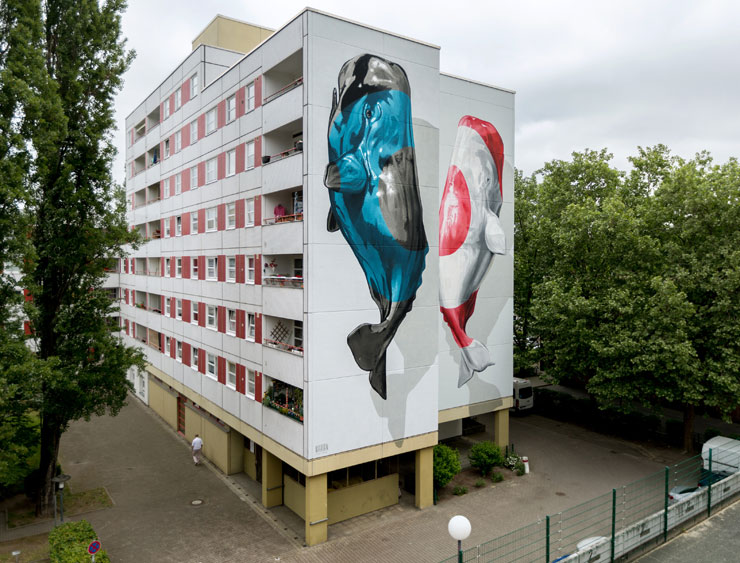
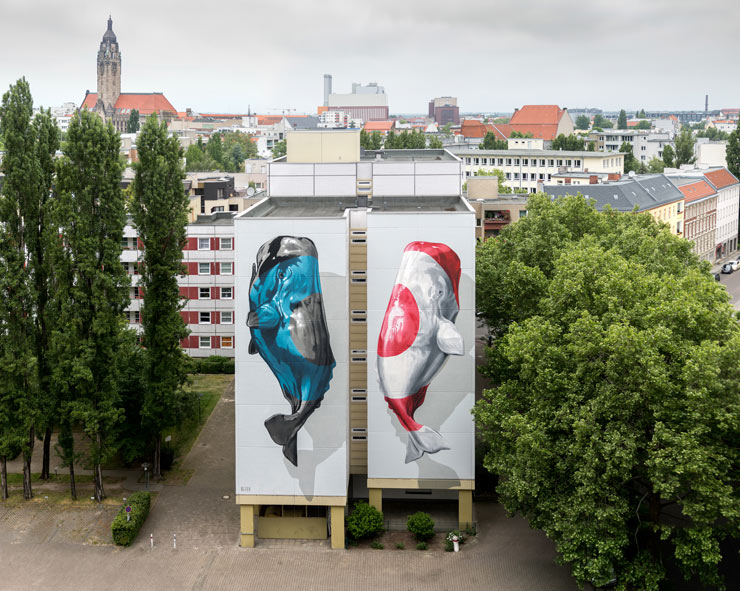
Nevercrew is unifying in Berlin with their new “One Wall” project with Urban Nation. The immense marine mammals depicted are not typical in their upright position in this reflective scene. Are they flying? Art they floating?

The artists tell us that they decided on the configuration based on the building walls themselves and are surprised by the opposite yet complementary pose the new mural creates.

Nevercrew. “Reification”. Urban Nation Museum For Urban Contemporary Art. Berlin, May 2018. (photo © Nevercrew)

Ironically by turning the subjects 90 degrees the scene is more disturbing: you may become more aware of the powerful forces of man and nature that are upending these magnificient beasts and appreciate their fragility.

“It is about common responsibilities and aims despite distances and differences: towards a lost balance between humankind and nature and with human nature itself,” Christian and Pablo say in a statement for this powerful painted piece of unity called “Reification” that suddenly makes it all real.

Nevercrew. “Reification”. Urban Nation Museum For Urban Contemporary Art. Berlin, May 2018. (photo © Nevercrew)

Nevercrew. “Reification”. Urban Nation Museum For Urban Contemporary Art. Berlin, May 2018. (photo © Nevercrew)

Nevercrew. “Reification”. Urban Nation Museum For Urban Contemporary Art. Berlin, May 2018. (photo © Nevercrew)

Nevercrew. “Reification”. Urban Nation Museum For Urban Contemporary Art. Berlin, May 2018. (photo © Nevercrew)

Read more
BSA Film Friday: 03.23.18

BSA Film Friday: 03.23.18

bsa-film-friday-JAN-2015

Our weekly focus on the moving image and art in the streets. And other oddities.

Now screening :
1.The Subconcious Art of Graffiti Removal
2. Bushwick Collective Block Party 2017
3. Street Art Berlin 2018 – Yasha’s Friends
4. Adnate: Indigenous Recognition in Sheep Hills – Silo Art Documentary
5. Alva Moca 12 + 1 Contorno Urbano

bsa-film-friday-special-feature

BSA Special Feature: The Subconcious Art of Graffiti Removal

“The artists creating it are unconscious of their artistic achievements”

Today an excerpt from an intellectually stimulating cogitation on the buff as art by Matt McCormick at the turn of the century. Looking glass perspective, scholarly rigorous investigation, humorous satire, art-speak laden skewering of pomposity – they all seem possible

“With roots in minimalism, abstract expressionism, and Russian constructivism graffiti removal is both a continuation of these movements and an important step in the future of modern art.”


“Hats off to Matt McCormick’s “Subconscious Art of Graffiti Removal,” an award-winning 16-minute film that wryly documents the antigraffiti campaigns in several northwest cities. Painting over graffiti yields public abstract painting that looks peculiarly modernist and brings to mind Rothko, Motherwell and even Malevich.”
Roberta Smith, The New York Times

Bushwick Collective Block Party 2017

Because we have just endured 4 snowstorms in March, let’s think about the Bushwick Collective Block Party and Film Festival last summer. Yaaaaaaaaaas.


Street Art Berlin 2018 – Yasha’s Friends


Adnate: Indigenous Recognition in Sheep Hills – Silo Art Documentary

“It’s not about feeling guilty, it’s about recognition.”

“In the remote country town of Sheep Hills, Australia, world renowned street artist Adnate brings the indigenous history of the region, and the country as a whole, back into the forefront of peoples minds. This short form documentary follows Adnate as he paints a huge disused grain silo, celebrating the lands first inhabitants and discussing the importance of recognition.”


Alva Moca 12 + 1 Contorno Urbano

“Organic patterning that verges on Op Art tumbled with flatly folk outsider aesthetics, commercial diagrammatics and Picasso cut-outs, Spanish artist Alva Moca has a lot going on in his head,” sayest we a few weeks ago when writing about this new mural. Today we see a video about it.


Read more
‘Wandelism’ Brings Wild Change for One Week in Berlin

‘Wandelism’ Brings Wild Change for One Week in Berlin

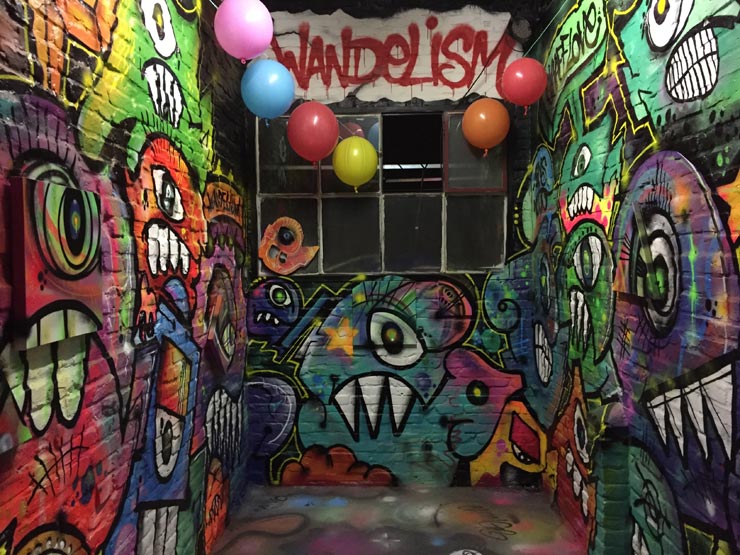
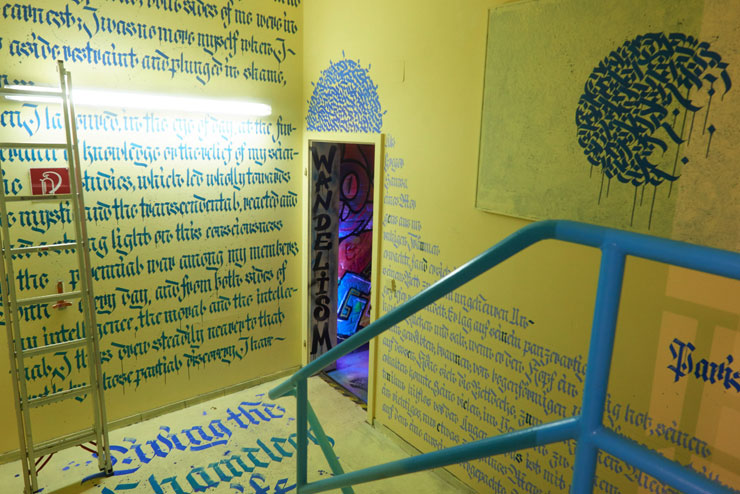
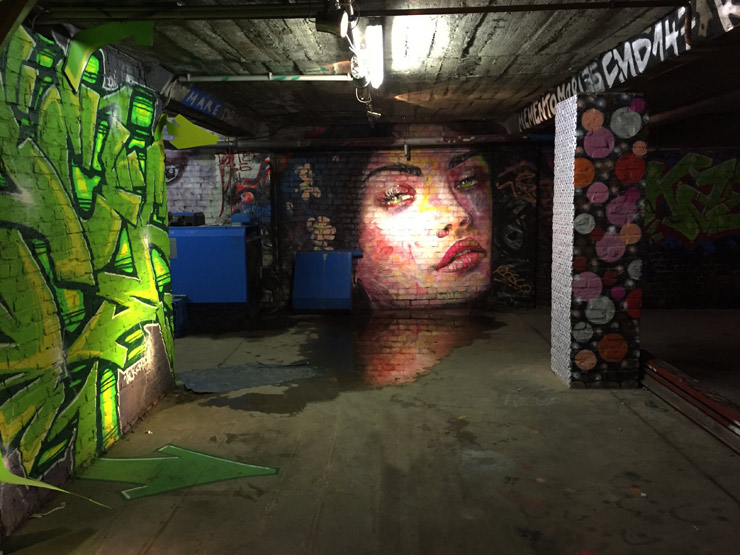
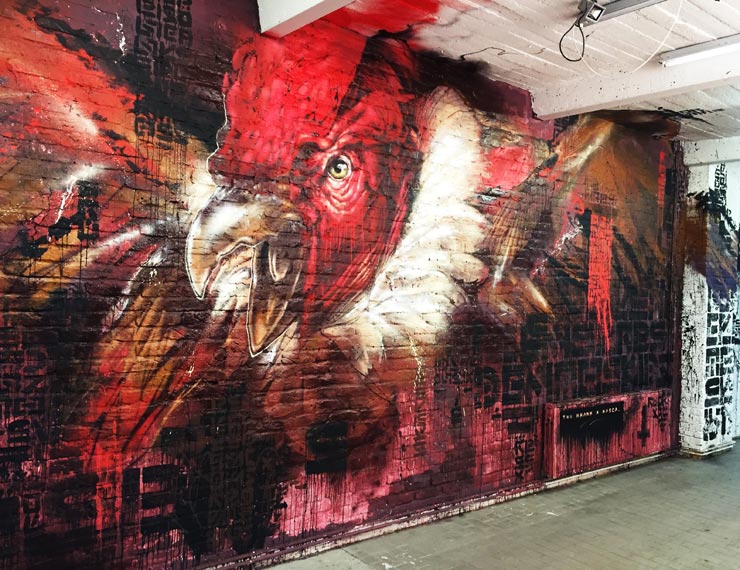
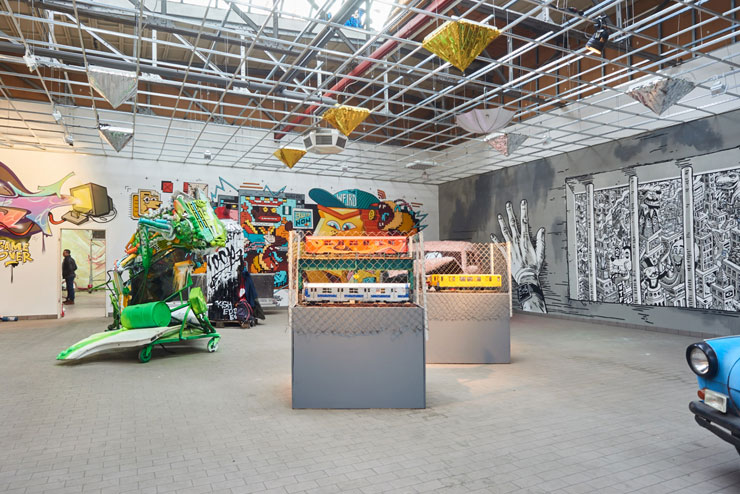
A partnership of artists, curators, and real estate interests is giving a seriously entertaining show this week to Street Art and Graffiti Fans with this site-specific exhibition of ingenious interventions of many disciplines. Primarily Berlin-based artists and spearheaded by organizers Señor Schnu, Baye Fall and Moritz Tonn, we’re pleased that we have a first-person account of the inspiration behind the show from the guy who came up with the name ‘Wandelism’, Denis Leo Hegic.


Wandelism – Spray Can Change

By Denis Leo Hegic

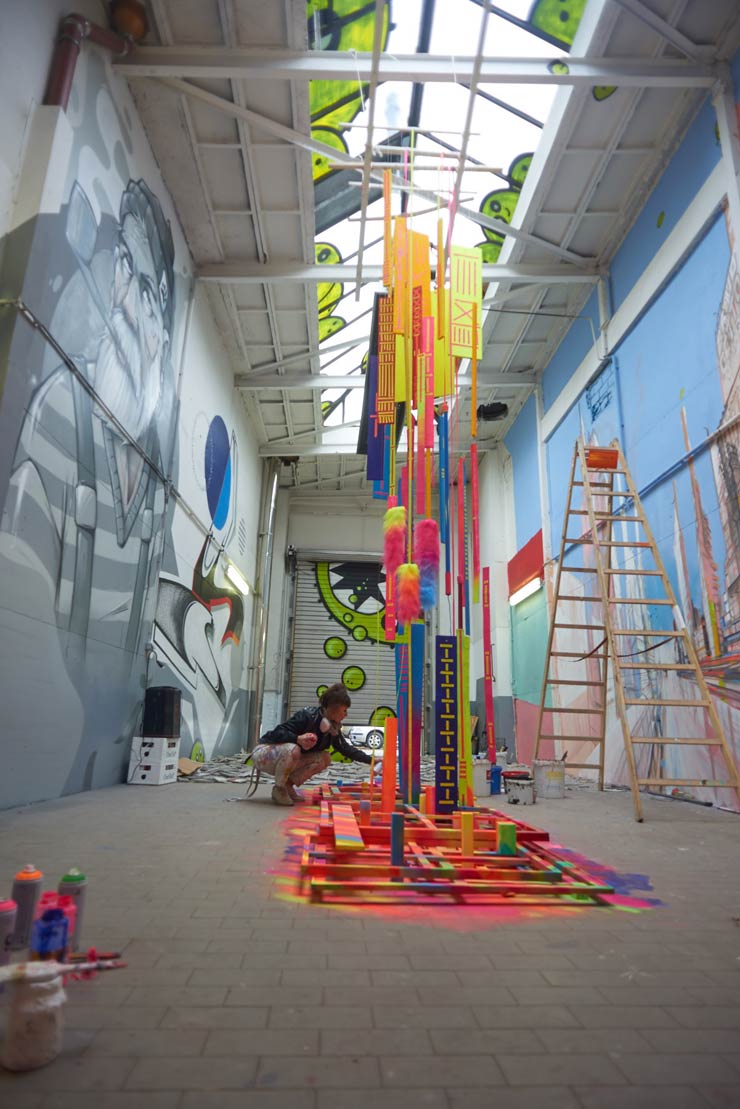
There we are, in the midst of a lively bustle at the production ground of the Wandelism exhibition in Berlin.

Dennis Gomez Herrmann. “Wandelism”. Berlin, Germany. (photo © Denis Leo Hegic)

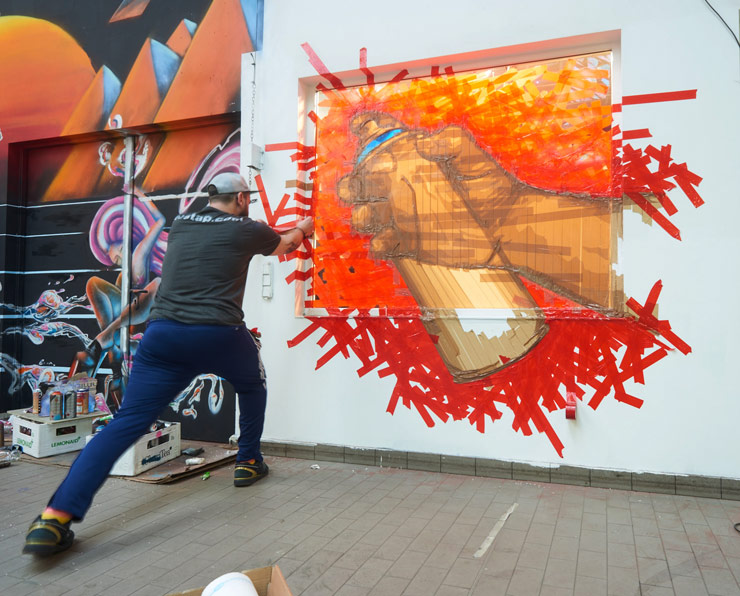
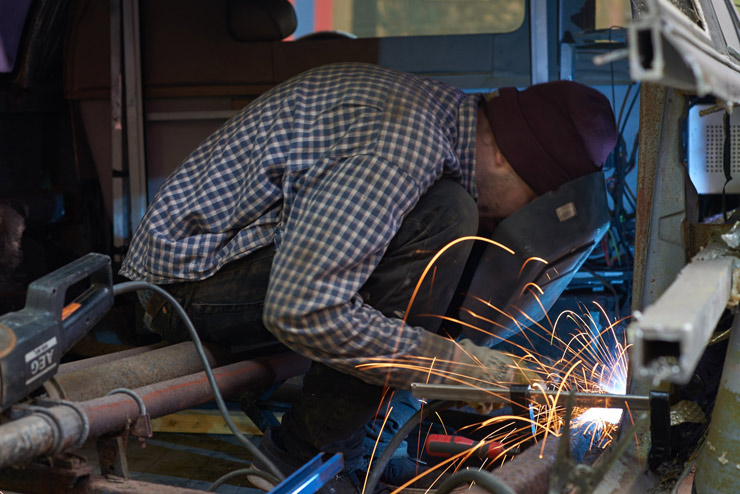
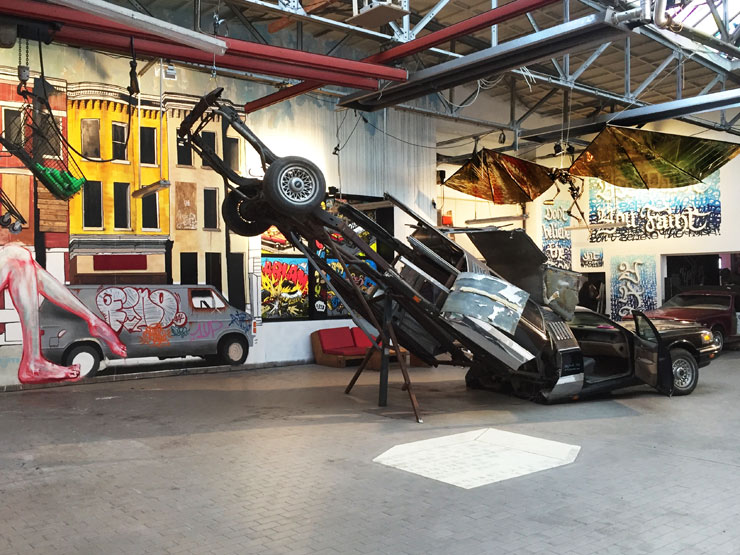
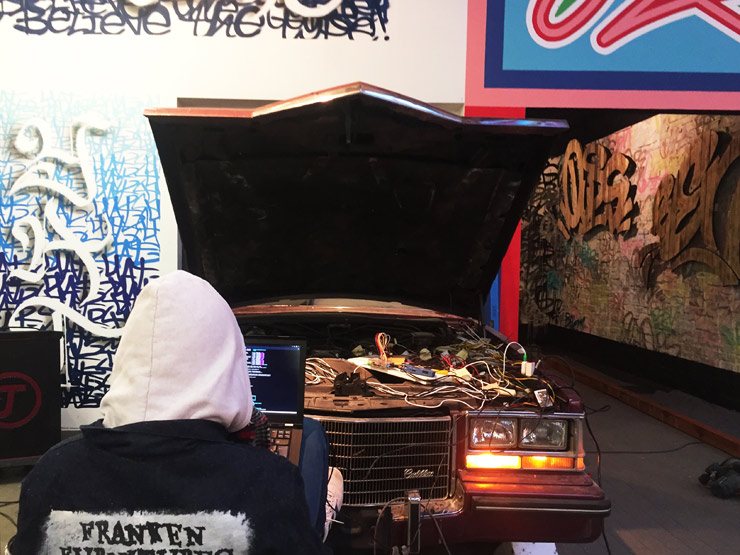
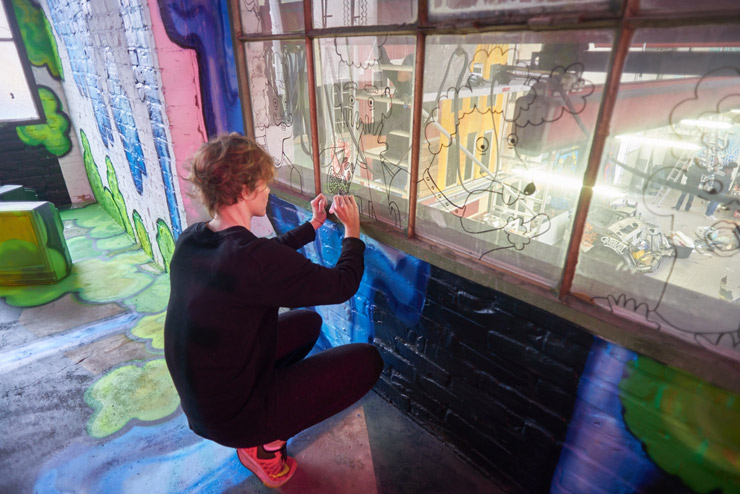
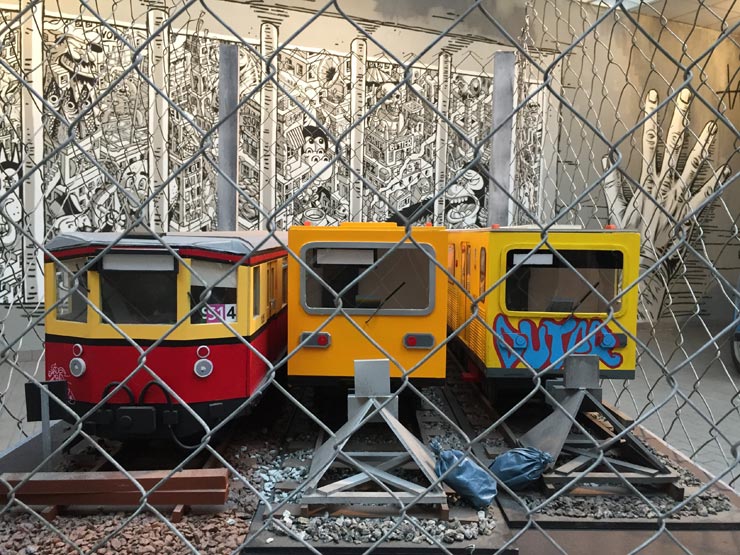
Sparks are literally flying around as Olly is about to cut open a stretch limo and hang it in the air. Behind the shower of sparks Jerome and Señor Schnu are working on their large scale mural while Kitra is about to create a giant piece on a wall, which actually consists more of void then wall surface. C0MPUTERJAN is transforming a half of a Cadillac into a computer-controlled DJ booth and Ostap is turning a window into a tape-art piece.

Ollyollyoxfordfreak at work in his installation. “Wandelism”. Berlin, Germany. (photo © Harald Geil)

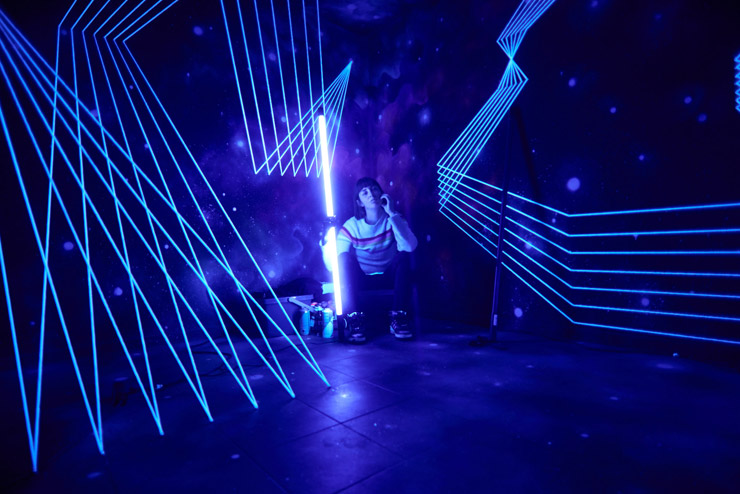
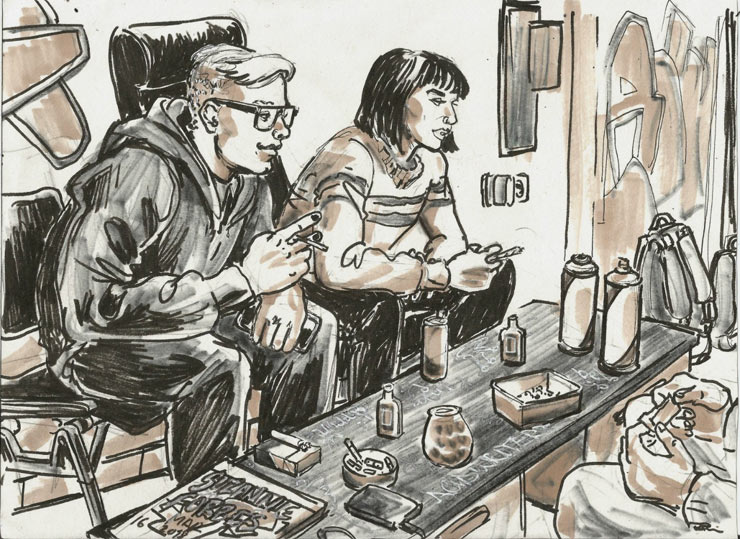
Marina Zumi, who is currently installing another of her new light works in the exhibition, joins me and Suzanne Forbes, who makes drawings of all of us in real time. There is some serious good energy in the air, and I’m not talking about welding and the aerosol, but about a group project that is truly created and lived in a spirit of a community.

Marina Zumi. “Wandelism”. Berlin, Germany. (photo © Harald Geil)

When I was asked how to name the exhibition few weeks ago, I merged the words “vandalism“ and “Wandel“ (the German word for “Change“). That’s how Wandelism (or Changeism) was born and how it started transforming itself into an exhibition, which is truly accepting, embracing and living CHANGE.

Ostap putting the final touches to his tape installation. “Wandelism”. Berlin, Germany. (photo © Harald Geil)

On the grounds of a former car repair shop that is soon to be demolished, one can literally feel the constant movement and transformation of the urban fabric we all live in. Everything changes. Constantly. Change is evolution. Change is progress. Change is also the DNA of the art represented in the Wandelism show.

Ollyollyoxfordfreak . Señor Schnu . Fabifa . Mika Sitter “Wandelism”. Berlin, Germany. (photo © Denis Leo Hegic)

Berlin is one of the worlds’ capitals and one which has experienced a tremendous change in the last three decades. The city, which was divided in two by a 156-kilometer-long wall for a time period of 28 years, was first unified in 1989 and then exposed to an incredibly rapid development ever since.

Interestingly enough, this very Berlin Wall has proven something that is still a valid topic at the Wandelism Show today: the importance of the freedom of expression.

Wandbrand. “Wandelism”. Berlin, Germany. (photo © Harald Geil)

For decades, one side of the wall was an open-air gallery of graffiti and street art while the other (clean) side of the wall was a death zone. The failed experiment of division is historic proof of the importance of creative participation in the urban space.

On the first day of the opening, Wandelism attracted more than 1,700 visitors who, despite a protracted winter in Berlin, waited in long queues to attend the opening. The following day, 2000.

C0MPUTERJAN. “Wandelism”. Berlin, Germany. (photo © Denis Leo Hegic)

Nevertheless, the exhibition does not present itself in the usual language of superlatives (“The largest”, “The biggest”, “The best”), which is sometimes peculiar to these types of art shows. Instead, Wandelism promotes the notion of a democratic coexistence, where everyone is welcome and where all the different curiosities can be explored.

Emma Rytoft at work on her installation. “Wandelism”. Berlin, Germany. (photo © Harald Geil)

“We are socially responsible and work with lot of local talents. That’s very important because not every exhibition of this format has a social aspect. Almost 90 percent of the entire exhibition is created by Berlin-based artists and we would love to pursue our vision in the future and transform more temporarily vacant spaces into art events like this” – Señor Schnu

1UP Crew. “Wandelism”. Berlin, Germany. (photo © Denis Leo Hegic)

Base 23 . Onur. “Wandelism”. Berlin, Germany. (photo © Harald Geil)

 “I like the speed. I paint graffiti-style but with dancers in public space. For that type of work you need to be really fast. And I like when you can feel the momentum in the painting.” – Herve Thiot

Herve Thiot at work on his installation. “Wandelism”. Berlin, Germany. (photo © Harald Geil)

“You can not have ‘change’ without a little bit of ‘vandalism’. The one concept can not exist without the other one. A change requires revolution and revolution sometimes needs vandalism.” – Carolina Amaya

Carolina Amaya at work on her installation. “Wandelism”. Berlin, Germany. (photo © Harald Geil)

Akte. “Wandelism”. Berlin, Germany. (photo © Denis Leo Hegic)

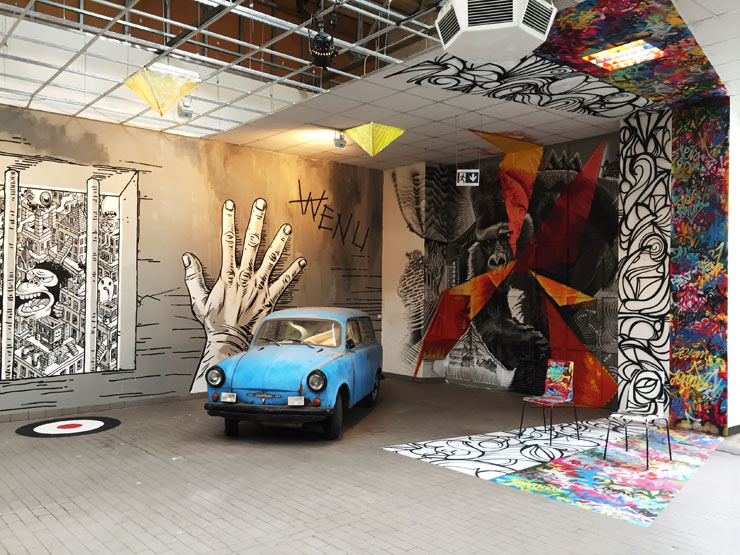
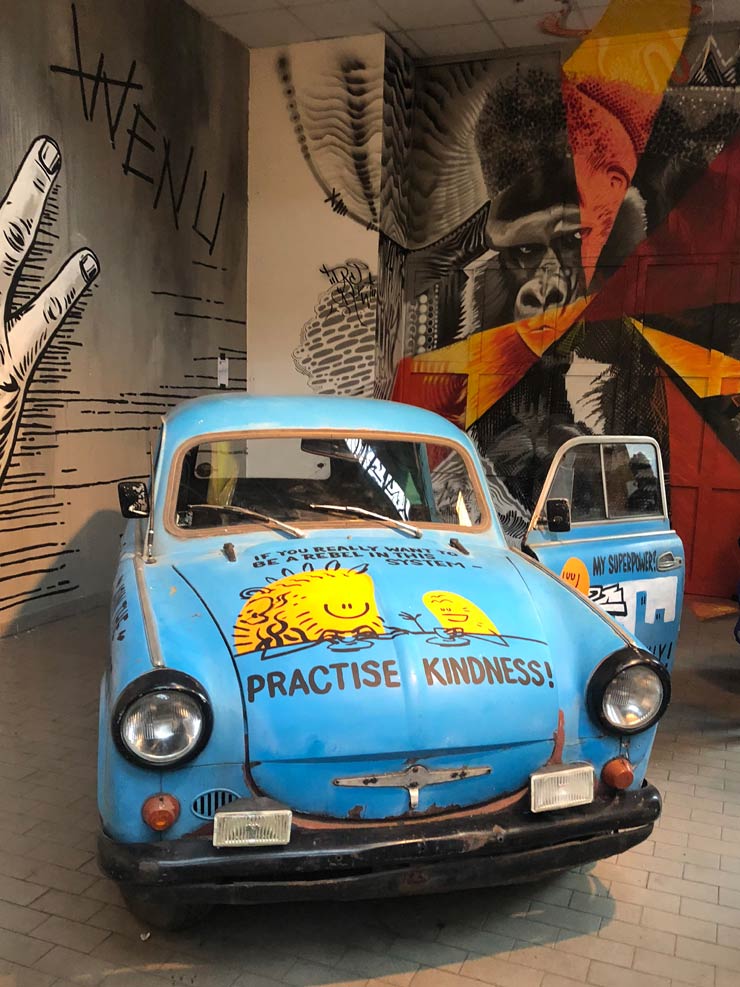
Wenu Crew, CokyOne, Jeron. “Wandelism”. Berlin, Germany. (photo © Denis Leo Hegic)

Dave The Chimp. “Wandelism”. Berlin, Germany. (photo © Stefanie Scherer)

Parisurteil. “Wandelism”. Berlin, Germany. (photo © Harald Geil)

Rosco. “Wandelism”. Berlin, Germany. (photo © Denis Leo Hegic)

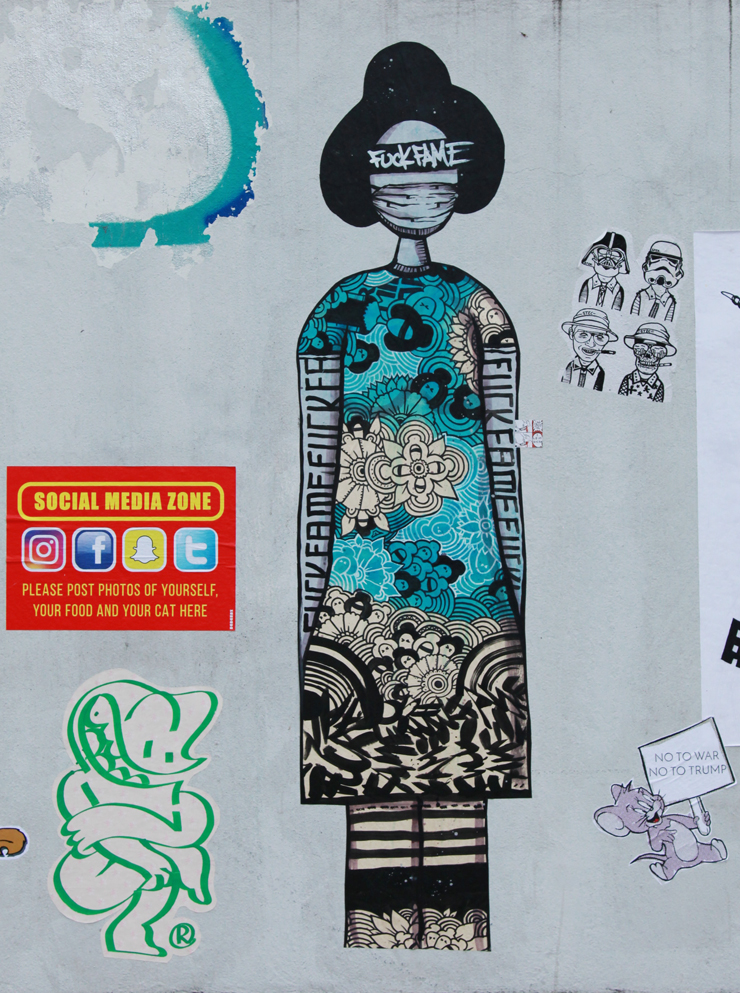
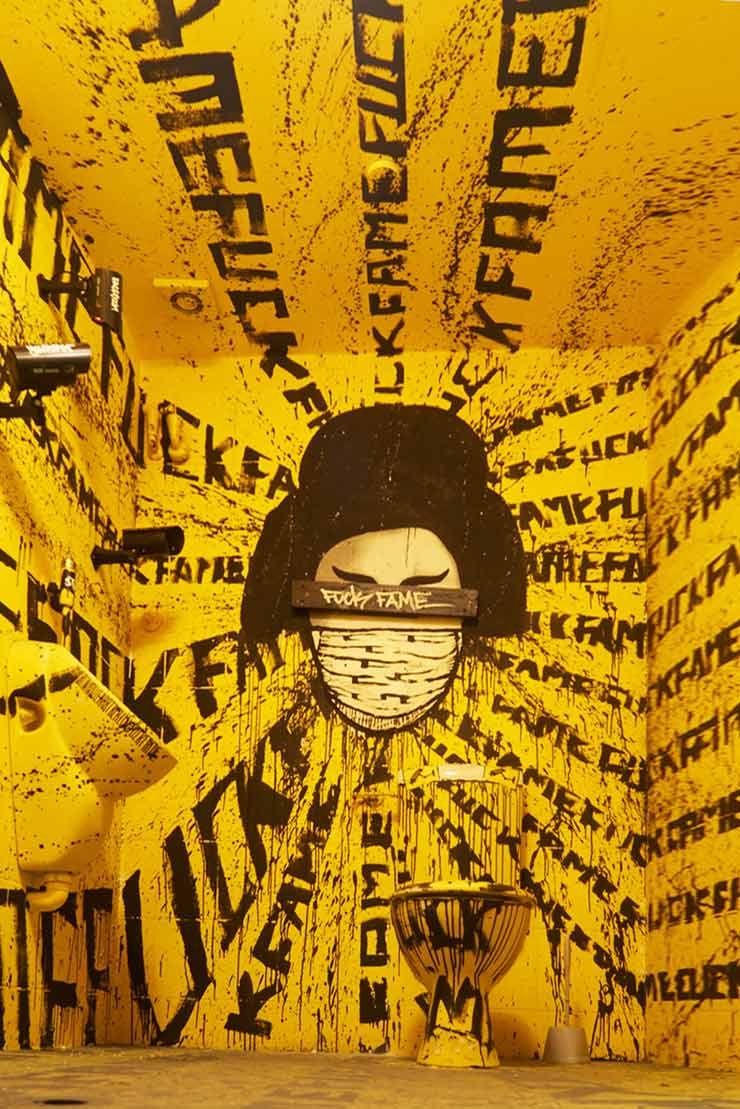
“Our ‘Fuck Fame’ toilet is a clear message. Just take a look at the whole social media and online addiction which is going on. Everybody is posting every single step of his life, and from other peoples’ lives; A public run for fame. Without thinking about it we are sacrificing our own privacy. As a reaction to that we decided to take even the last bit of privacy away and created the Fuck Fame toilet.” – Ron Miller Art Collective

Ron Miller Art. “Wandelism”. Berlin, Germany. (photo © Harald Geil)

Nasca . The Krank. “Wandelism”. Berlin, Germany. (photo © Denis Leo Hegic)

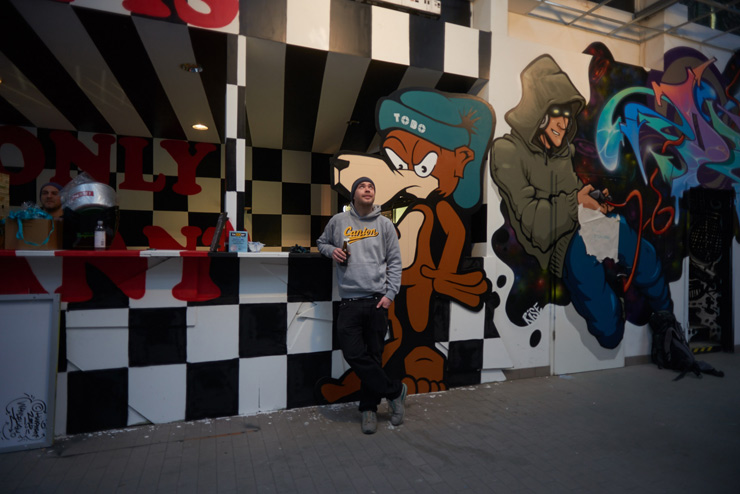
“Somehow I do see myself in process of change. I’m coming more from this graffiti scene but I am also developing more and more into a mass-compatible area, so yes, I do see myself in a process of change. But I also believe that it is the entire scene that is changing and transforming itself into a more recognized and accepted art.” – Tobo

Tobo takes a moment to ponder. “Wandelism”. Berlin, Germany. (photo © Harald Geil)

Hagen Schönfeld. “Wandelism”. Berlin, Germany. (photo © Denis Leo Hegic)

Felix Hülpüsch AKA HÜLPMAN. “Wandelilsm”. Berlin, Germany. (photo © Denis Leo Hegic)

Scon75 . Paindesignart “Wandelism”. Berlin, Germany. (photo © Harald Geil)

Canion Berlin . Wenu Crew. “Wandelism”. Berlin, Germany. (photo © Denis Leo Hegic)

Oskar .  Kish . Canion Berlin .  DXTR . The Weird . WENU Crew. “Wandelism”. Berlin, Germany. (photo © Harald Geil)

“I am in this business for such a long time already. I am doing this now for 35 years. I know that this place will be gone, but lot of people will see it. And nothing can be contained forever. The awareness that the art which you can see here will be there just for a certain limited time, which you have to experience now and can not wait until next year, because it will be gone – that’s part of the deal and I quite like that.” – Loomit

Loomit. Wandelism. Berlin, Germany. (photo © Denis Leo Hegic)

Melissa Lee . Flo de Producer . Theodor Robinson. Wandelism. Berlin, Germany. (photo © Denis Leo Hegic)

Kitra. Wandelism. Berlin, Germany. (photo © Denis Leo Hegic)

Catherine Lupis Thomas and Bill Knospi. “Wandelism”. Berlin, Germany. (photo © Denis Leo Hegic)

Suzanne Forbes’ live drawings of Denis Leo Hegic and Marina Zumi. “Wandelism”. Berlin, Germany.

You can visit the Wandelism exhibition until March 24 and is located in Wilhelmsaue 32, 10713 Berlin.

Www.wandelism.com


Read more
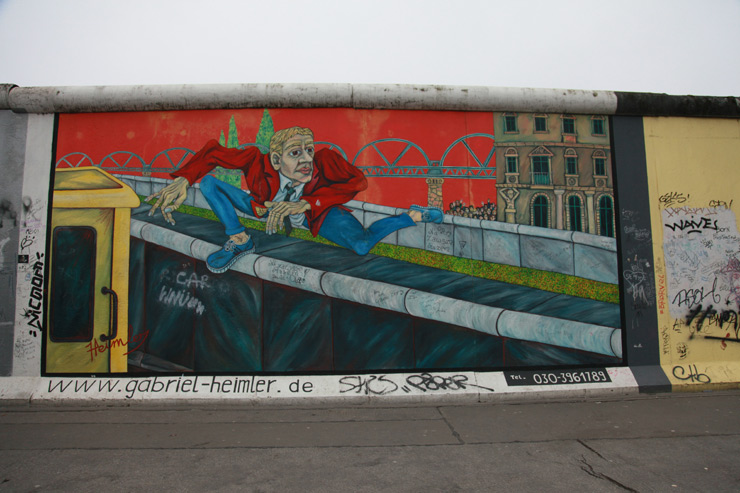
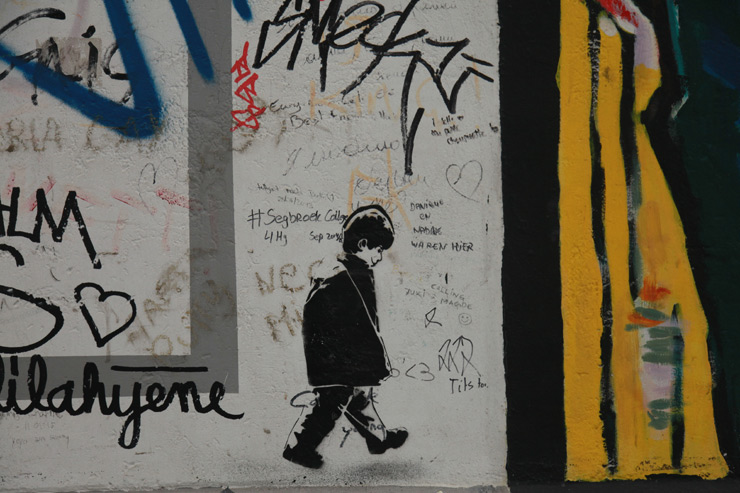
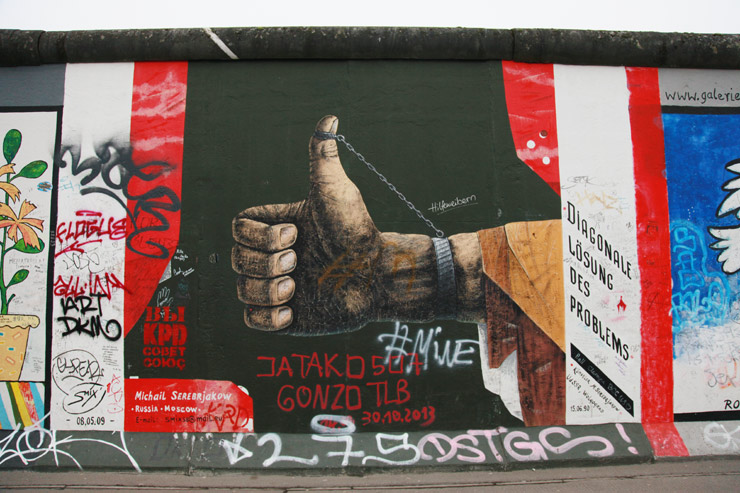
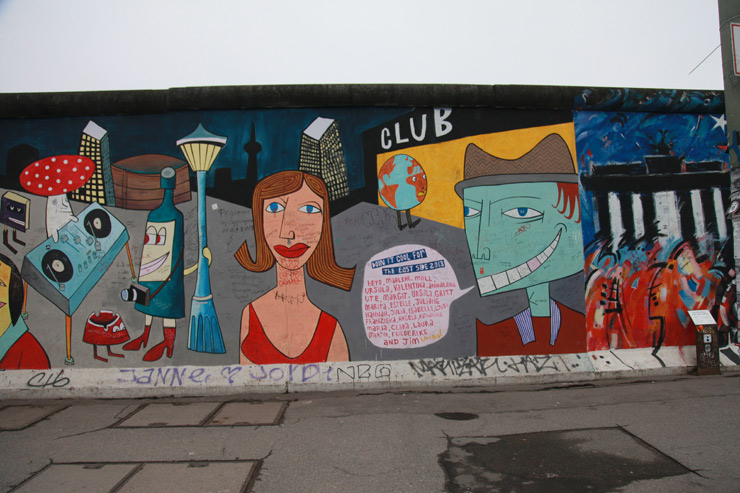
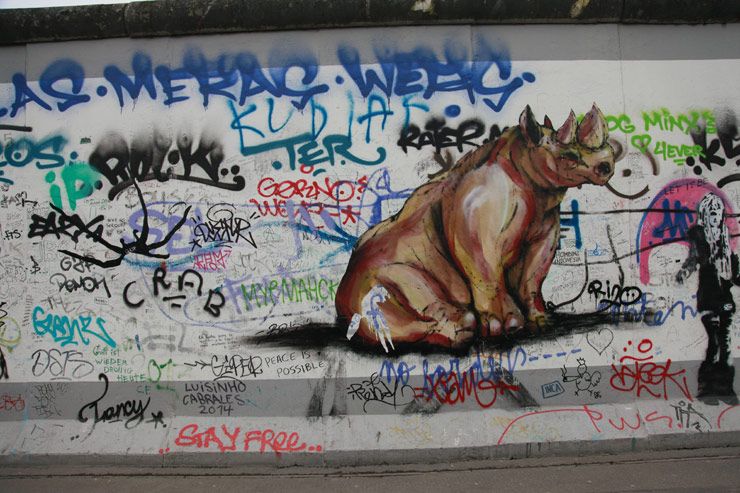
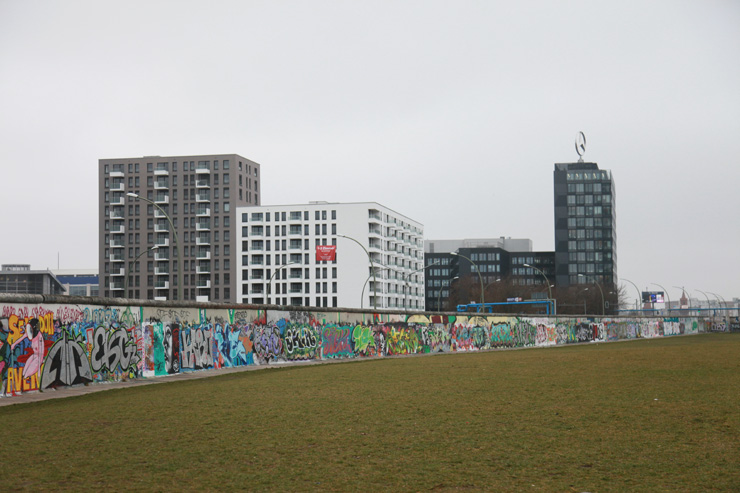
Berlin Wall Milestone : Down as Long as It Was Up

Berlin Wall Milestone : Down as Long as It Was Up

The Berlin Wall has now been down as long as it was up. 28 years, two months and 27 days passed in both cases, and we are still looking for sane global policy about the freewill of people to prevail.

Ronald Reagan, a Republican president lauded by the right, once intoned while standing in front of the wall,

“We welcome change and openness; for we believe that freedom and security go together, that the advance of human liberty can only strengthen the cause of world peace. There is one sign the Soviets can make that would be unmistakable, that would advance dramatically the cause of freedom and peace…Mr. Gorbachev, tear down this wall!”

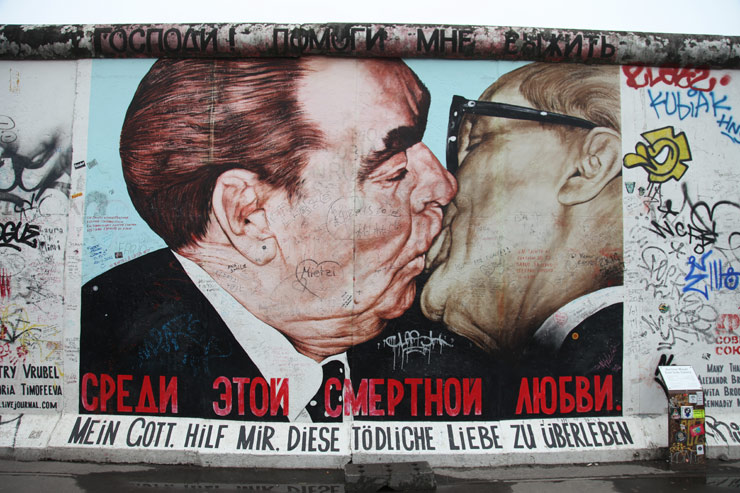
Dimitry Vrubel mural “My God, Help Me to Survive This Deadly Love” first painted in 1990 and restored in 2009 is based on the iconic photograph by Régis Bossu of the Fraternal Kiss in 1979 between Soviet Leader Leonid Brezhnev and East German Leader Erich Honecker on the occasion of Brezhnev’s visit to East Germany. (photo © Jaime Rojo)

Also interestingly in that same speech Reagan referred to the graffiti on it;

“As I looked out a moment ago from the Reichstag, that embodiment of German unity, I noticed words crudely spray-painted upon the wall, perhaps by a young Berliner, ‘This wall will fall. Beliefs become reality.’ Yes, across Europe, this wall will fall. For it cannot withstand faith; it cannot withstand truth. The wall cannot withstand freedom.”

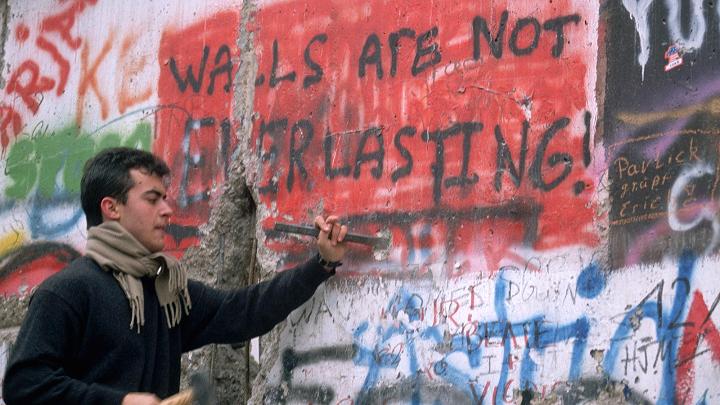
Chiseling the Berlin Wall (photo ©Owen Franken)

Mr. Reagan saw the hypocrisy of building walls, separating people, restricting freedom. Yet we today have another president so far to the right of Reagan that he has even threatened to shut down the government in order to secure funding to build a wall along the border with Mexico.

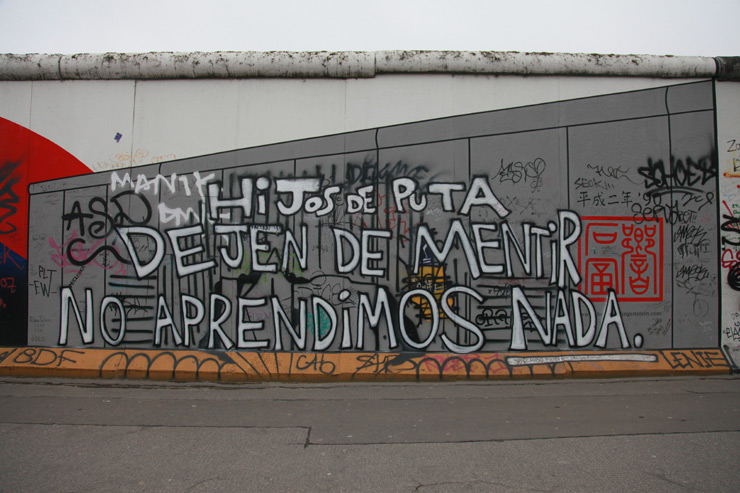
Fiodi Frede “Sons of Bitches. Stop Lying. We Learned Nothing.” (photo © Jaime Rojo)

Which brings us to a more recent sentiment on part of the remaining wall, written in Spanish;

“Hijos de puta dejen de mentir no aprendimos nada”, or “Sons of bitches stop lying we did not learn anything.”  No kidding.

As we mark this mathematical marker, we present a few images of that wall that once stood unbroken for 10,316 days

Gabriel Heimler (photo © Jaime Rojo)

Icy & Sot (photo © Jaime Rojo)

Andrej Scharow (photo © Jaime Rojo)

Michail Serebrjakow (photo © Jaime Rojo)

Jim Avignon (photo © Jaime Rojo)

Rhino (photo © Jaime Rojo)

Photo © Jaime Rojo

Read more
A Street View From Inside the Doors of Mexico City ; Galleries, Studios, Museums, and the Metro

A Street View From Inside the Doors of Mexico City ; Galleries, Studios, Museums, and the Metro

Street Art and graffiti and their relatives often go inside these days, including in Mexico City, where we recently found some interesting new intersections between urban art and contemporary art when we wandered off the streets into studio, gallery, and even museum spaces.

Here we’ll show you images from a few of these places, including; a versatile gallery and performance space that happens to serve pizza, a toy museum and the Street Art visionary who runs it who has facilitated some of the best installations around the city that you’ll see, a visit with a Mexican mural/fine artist who has made serious waves on the Street Art stage as well as museums, three Argentinians setting up a temporary art-making studio in preparation for a gallery show, and a serendipitous run-in with Keith Haring on a train in a metro station.
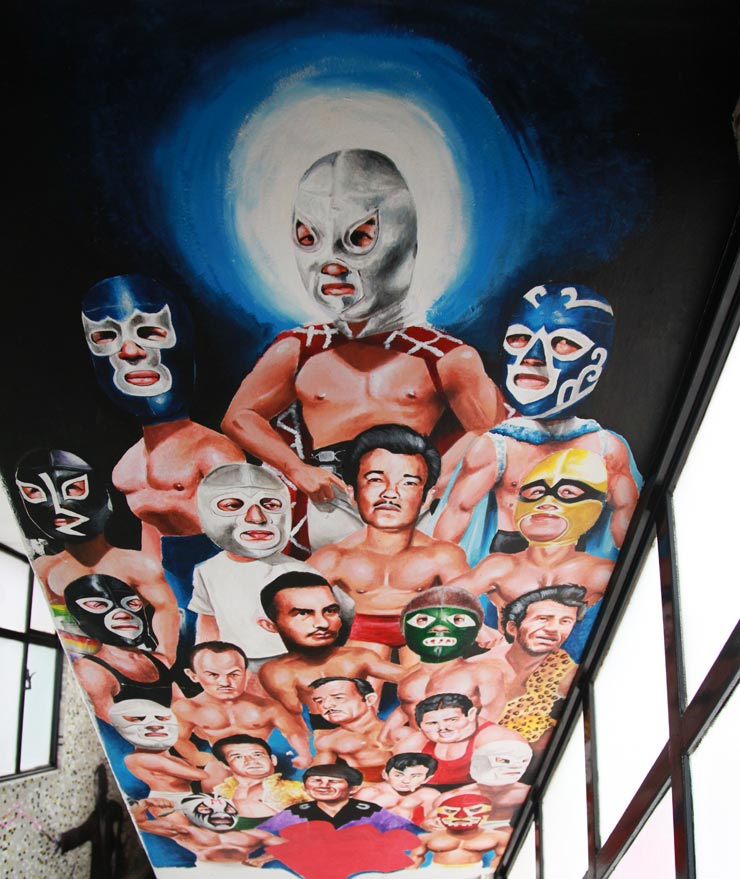
Bernardo Flores pays tribute to Mexican Luchadores on the walls, ceilings in the Antique Toy Museum (MUJAM) that features murals and tags by Street Artists throughout the exhibitions and up on the roof. Mexico, City. (photo © Jaime Rojo)

Perhaps taking its name from the largest cemetery in the city, or simply the Pantheon, the Roman temple with its multiple galleries leading off the grand rotunda, this Panteón opened in spring 2017 and is funded by Mexican pizza chain scion.

Inside a finely appointed 200 year old colonial mansion and former headquarters of the Mexican Academy of Language on Calle Donceles, one of the oldest streets in the city, the spacious two story building is now hosting a live concert stage with a bar off the pizza restaurant court on the first floor. Climb the winding stairs to discover an open balcony ringed with well-curated shows of current art movements that break your expectations in their diversity and quality, hung with care and well-lit in high-ceilings former libraries and entertaining salons, replete with hardwood floors and articulated cream and oak mouldings.
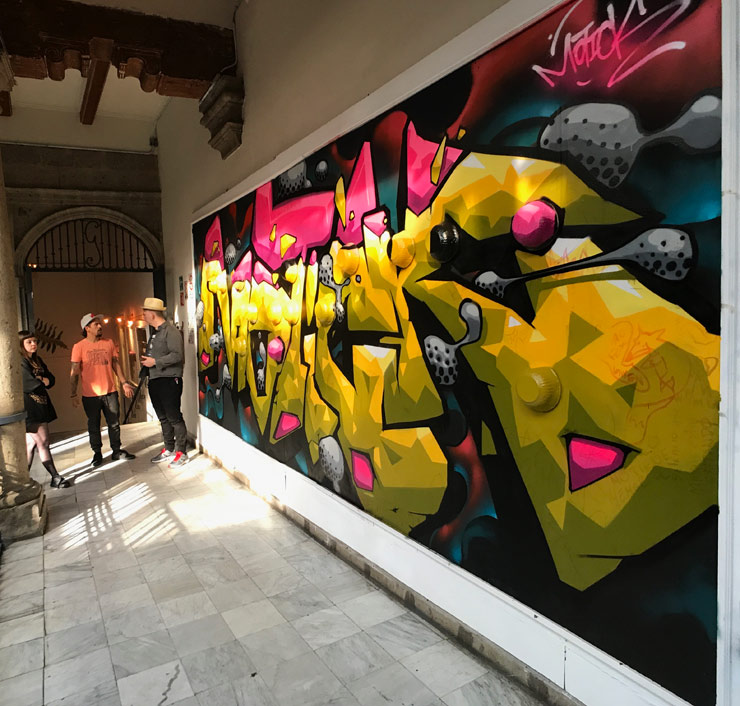
Motick. Centro Cultural Panteón. Mexico, City. (photo © Jaime Rojo)

“I think frontiers are breaking apart across the world,” says director and curator Andres Medina, who is creating a blended focus on graffiti writers, Street Artists, master screen printers, illustrators, and painters whose work is informed by elements of street culture like tattoo, dark pop, skater culture.

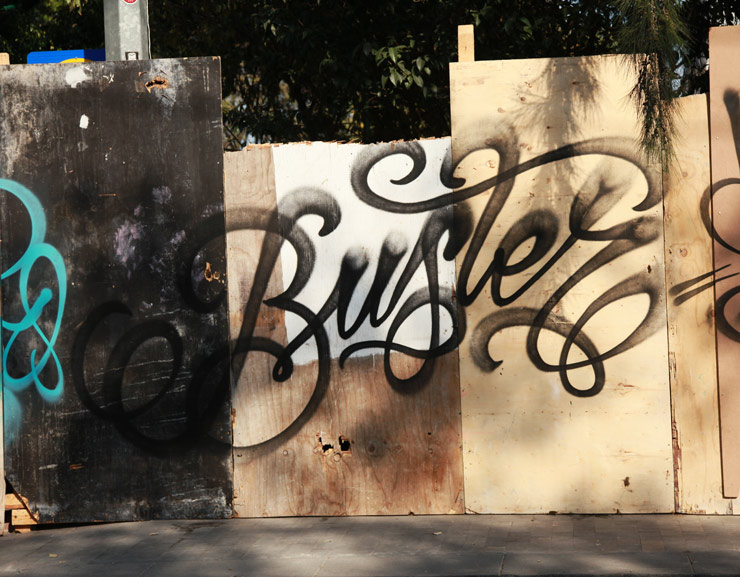
The 9 month old series of exhibitions and shows have included group shows, installations, and pop up shops by Mexican street heavyweights like Street Artist/muralist Smithe, original 90s stencilist Watchavato, and modern stylemaster Buster Duque, who has helped out with some selected burners on the roof. The tight vision of the shows is quietly bringing inquisitive fans as well.

“So we are getting at least one international visitor per week who wants to know more about our projects,” he says. As an editor of zines and a student of films, he gradually has been defining his focus on curation with themes that have an almost personal touchstone that he develops with the artists along with curator Mariela Gomez, and they both speak about a need for gallery exhibitions to evolve.
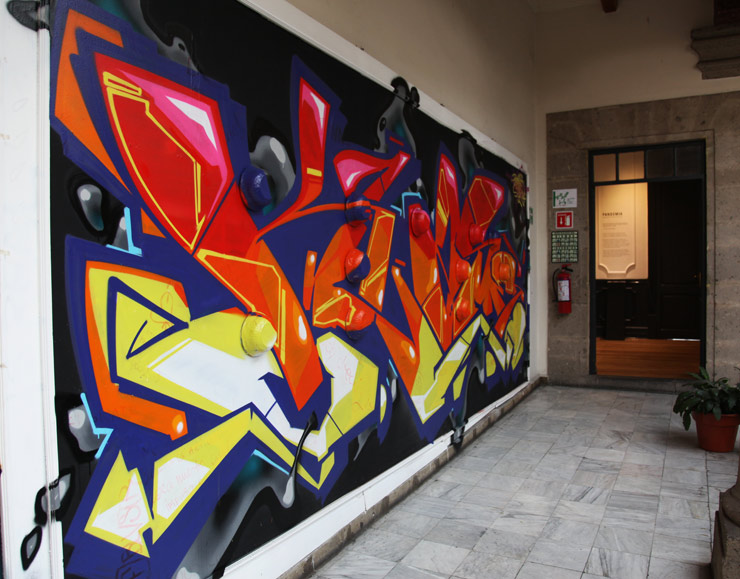
KlaseOne. Centro Cultural Panteón. Mexico, City. (photo © Jaime Rojo)
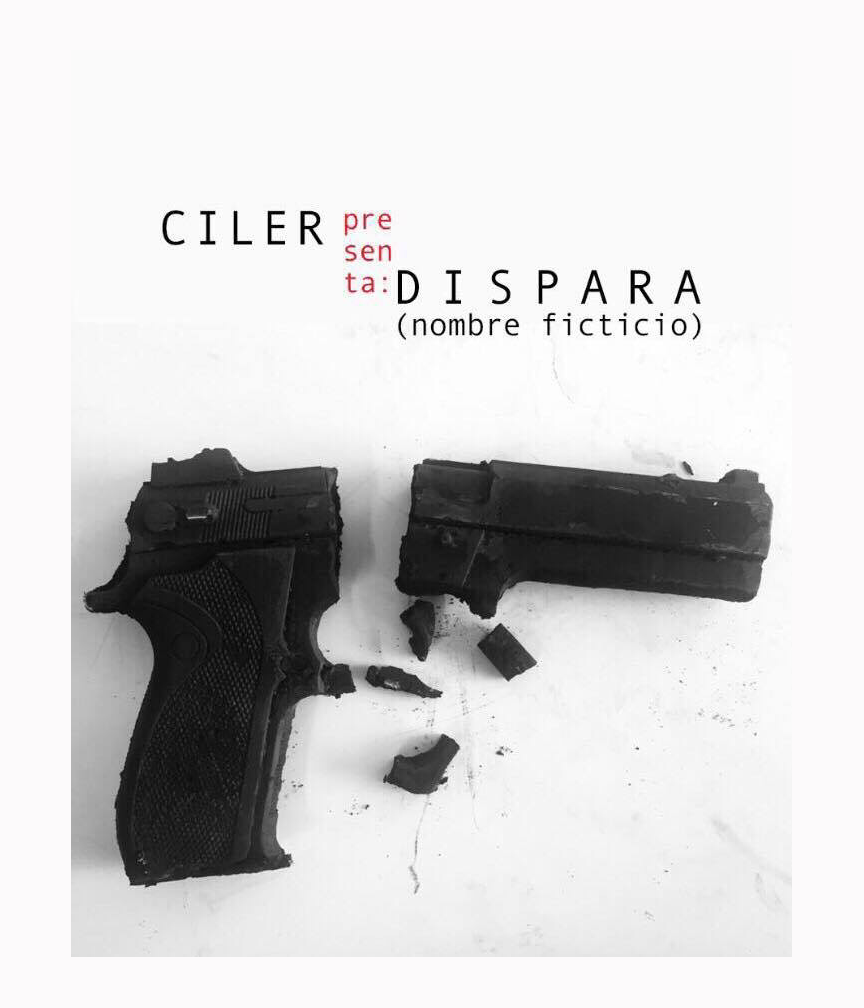
“One of the things that excites us the most is the idea of an exhibition as more of a ‘happening’. We want there to be a part that is graphic and a part that is an experience,” he says as he leads us to a separate white walled colonial space where handguns are made from molds in black wax and guests at the opening scrawled missives across makeshift walls related to violence in society. “It’s meant as an interactive critique,” he says, “these are guns that shoot ideas.”

Attendees are not typical art patrons interested only in collecting – for this show about violence and terror, “Dispara” by the Mexico City artist Ciler, the invited guests were policy makers, elected officials, journalists, even Tito Fuentes the lead singer of the popular rock band Molotov, as well as people directly affected by gun violence. “It was a pretty emotional night,” says Mariela Gomez, who recounts the fiery conversations that began when guests realized that they could express their thoughts about gun violence and organized crime, which is more-or-less openly terrorizing certain neighborhoods and cities in the country.
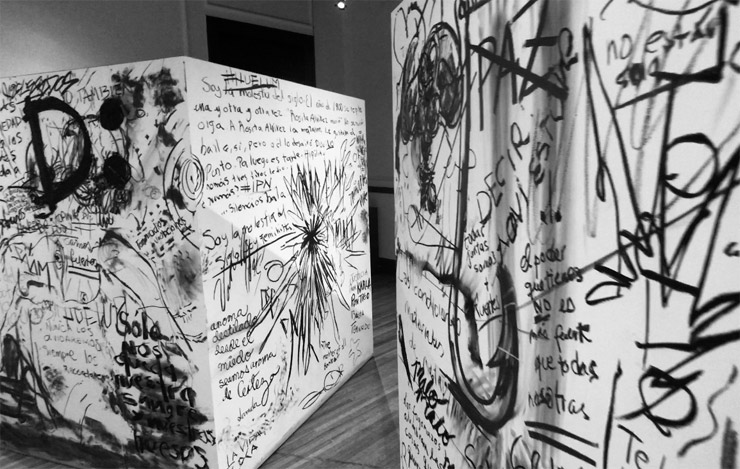
Ciler. “Dispara (nombre ficticio)”. Centro Cultural Panteón. Mexico, City. (photo © Jaime Rojo)
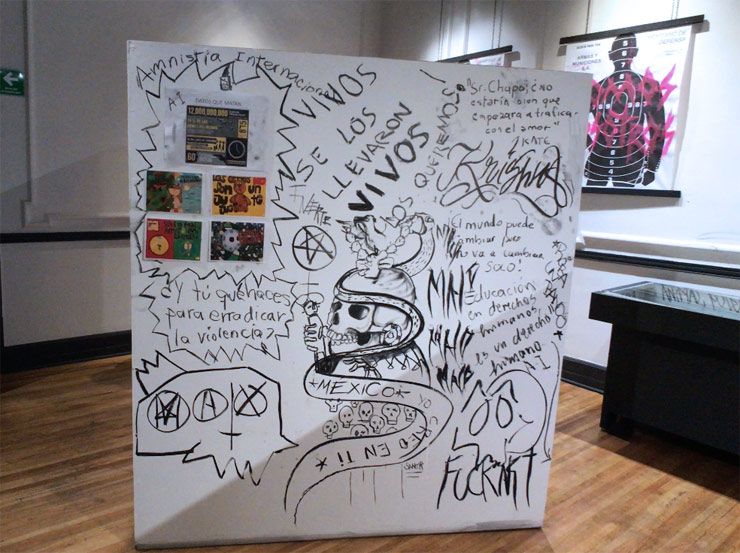
Ciler. “Dispara (nombre ficticio)”. Centro Cultural Panteón. Mexico, City. (photo © Jaime Rojo)
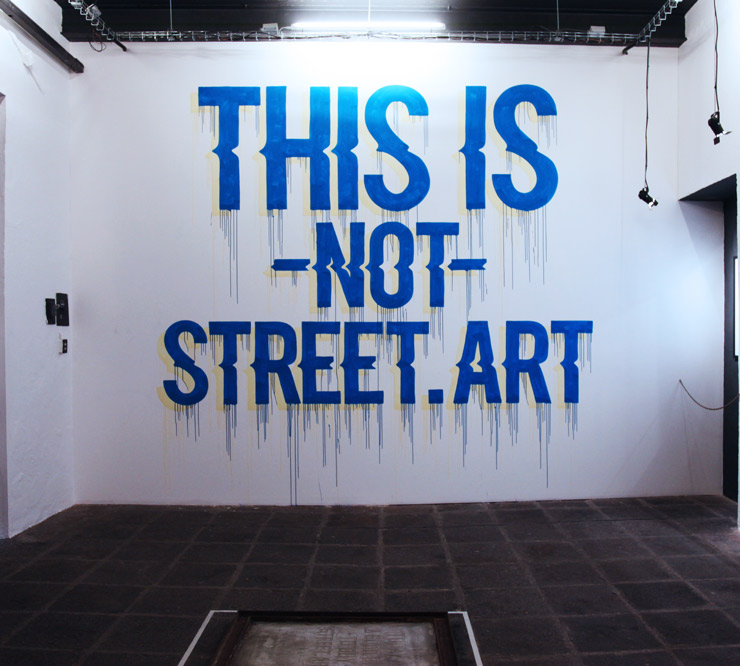
Wachavato. “No Esto No Es Lo Que Fue” Centro Cultural Panteón. Mexico, City. (photo © Jaime Rojo)
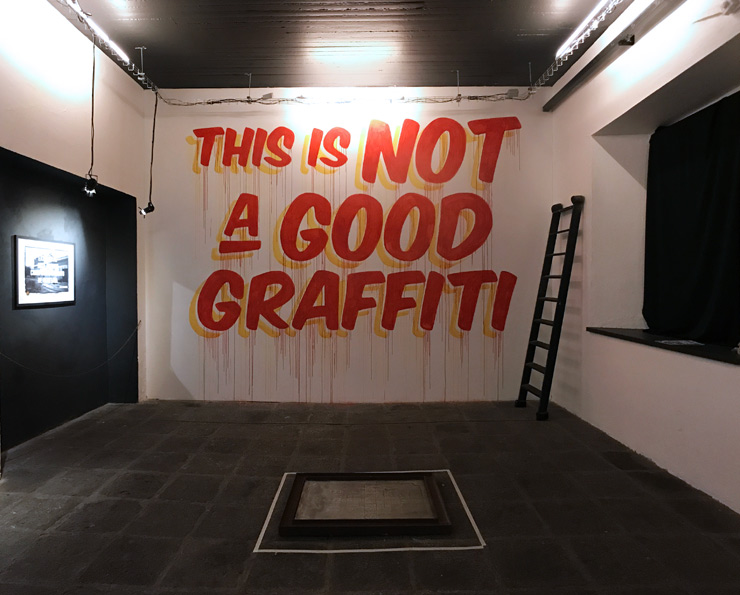
Wachavato. “No Esto No Es Lo Que Fue” Centro Cultural Panteón. Mexico, City. (photo © Jaime Rojo)

“Once everyone was here we found that everyone wanted to make art as well; so they all became part of ‘the happening’,” she says. Guests broke the guns, wrote screeds across the walls, even blasted black paint with a power tool “Everyone was covered in black dust and wax, were breathing some of it” she says,” which goes along with the concept of violence in society – no one can escape it really.”

Still young and at the behest of a fast food business, it’s unclear what kind of mandate Panteón has, but the owner has long term leased the historic building next door to further the show, which will now include his brother’s burger café and a freshly poured concrete mini-skate park and we climb a tattered yet elegant staircase to tour through grand raw spaces that will house martial arts, yoga training and yes, the occasional sports branded pop-up store. It’s a formula attempted before – life-style and entertainment intermixing with the plastic arts – and it will be good to see the integrity of the art game supported here. The balance is hard to strike, but it can be done.
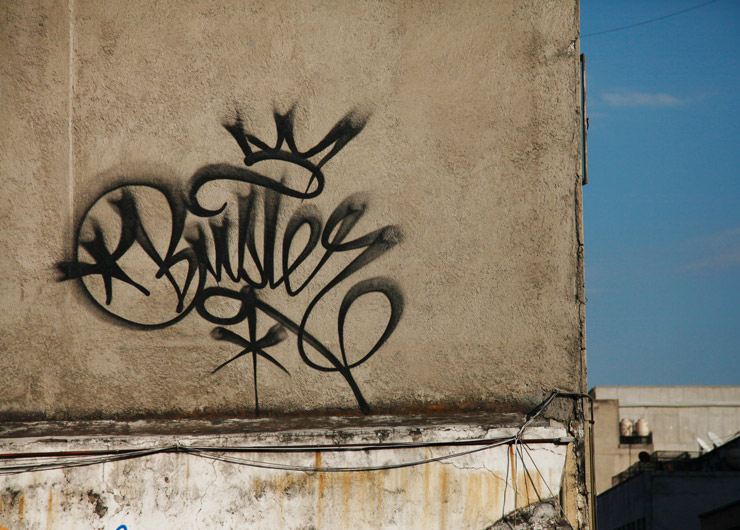
Buster. Centro Cultural Panteón. Mexico, City. (photo © Jaime Rojo)

Museum of Toys and Art on the Streets

A Street Art proponent and personal brand champion, Roberto Shimizu is the second generation 30-something who is running the five-story, decade old Museo Del Juguete Antiguo (Antique Toy Museum) aka MUJAM with his ever-curious and professional collector father in the Colonia Doctores neighborhood. A stylistically unremarkable structure in the thick of this middle class eclectic cluster of cantinas, mechanics garages, and a hospital, most of the streets are named after famous physicians and many of the initial Street Artists who painted his parking lot and roof have also gone on to make names for themselves.
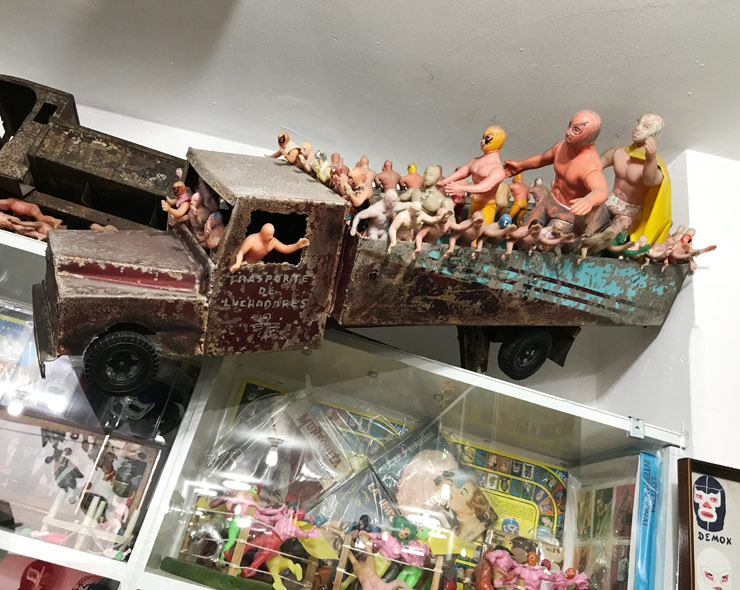
Antique Toy Museum (MUJAM). Mexico, City. (photo © Jaime Rojo)
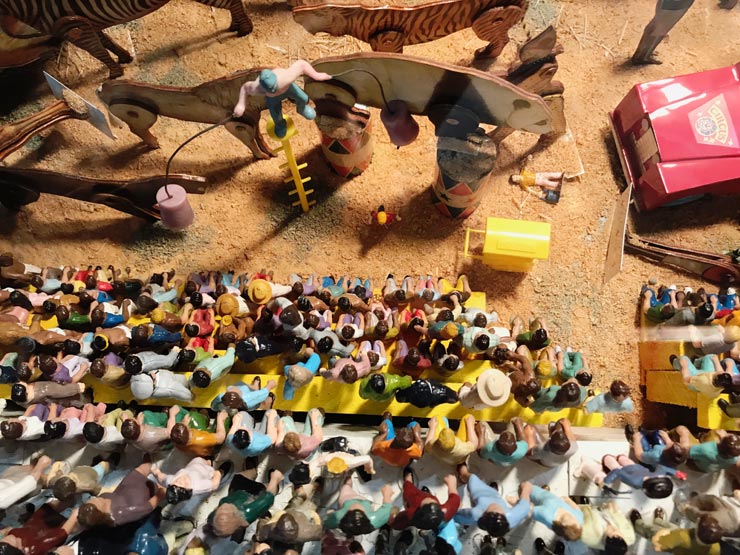
The Circus. Detail. Antique Toy Museum (MUJAM). Mexico, City. (photo © Jaime Rojo)
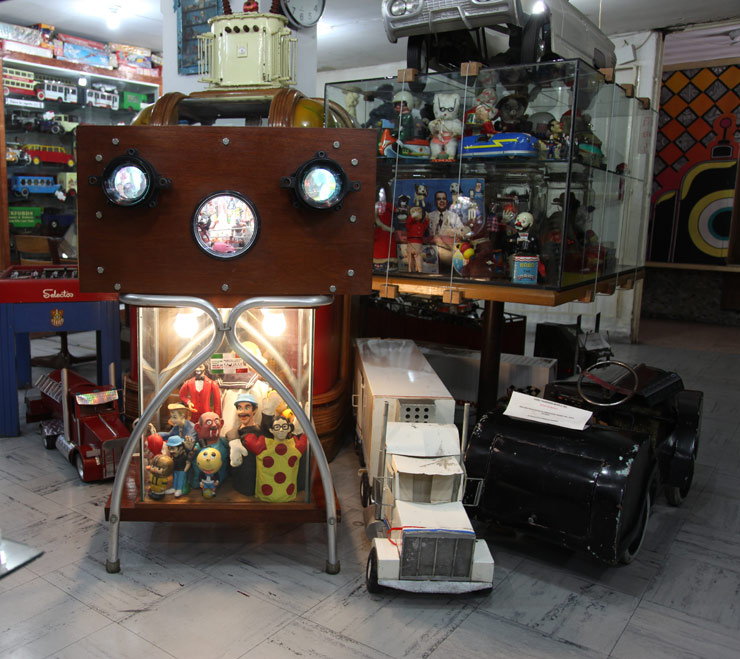
Antique Toy Museum (MUJAM). Mexico, City. (photo © Jaime Rojo)

With a few hundred thousand toys carefully arranged in “toy environments” customized from industrial machinery and unusual found items, these surreal scenes may move animatronically or glitter under rotating lights – or get pinched and refracted through specialized viewers. If you are not high on something, there will be no need to do so before entering the meandering homemade and hand-loved MUJAM. Just unbutton your childhood imagination and you’ll find complete display cases of original illustrations and figures of Mexican comedic character Cantinflas, or an arrangement of stuffed bunnies dancing erotically, or a colorful parade of luchador dolls with Shimizu-customized fashions that play with proportions and sometimes reverse their genders – getting married to each other.
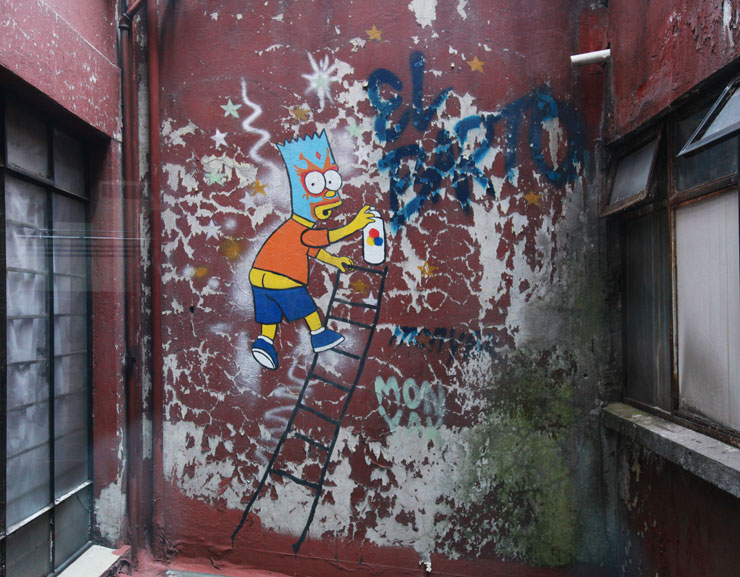
Pavel Ioudine. Antique Toy Museum (MUJAM). Mexico, City. (photo © Jaime Rojo)

The beyond eclectic collection, estimated at only 5% of the total 60-year collection that has been hand-archived and warehoused, is only enhanced by large paintings by ROA or M-City that have graced the walls outside and the 75 or so intermediate and medium sized murals sprinkled through rooms, hallways, pillars, ceilings, stairwells throughout the museum, including a by-invitation-only rooftop gallery.

The younger Shimizu (and new father) weaves in and out of neighborhood streets with us in his truck the same way he navigates the museum, brooding and swerving and pulling aside to hold forth with bits of historical fanfare and numerical details, peppered by behind-the-scenes stories of intrigue and dalliances – all set off by his own striped and checked slim-waisted sartorial selections that effect an elegant carnival barker, a sixties mod rocker, or the mysteriously aloof millionaire in a family board game.
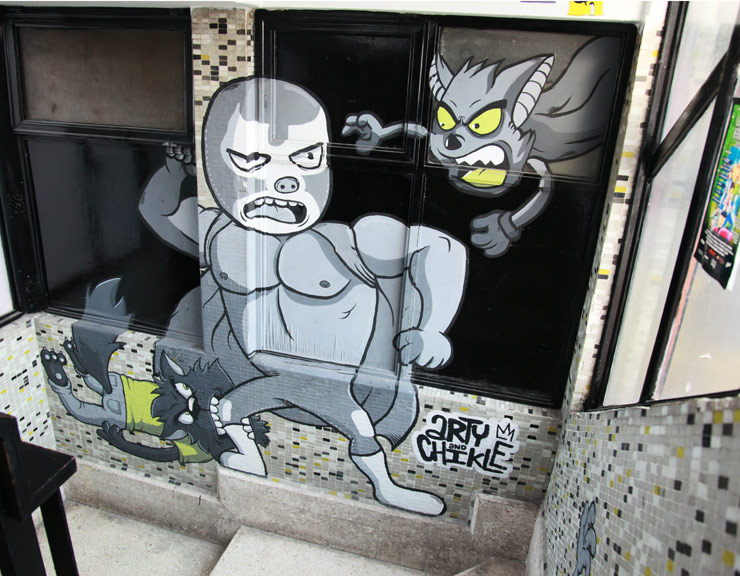
Arty & Chikle. Antique Toy Museum (MUJAM). Mexico, City. (photo © Jaime Rojo)
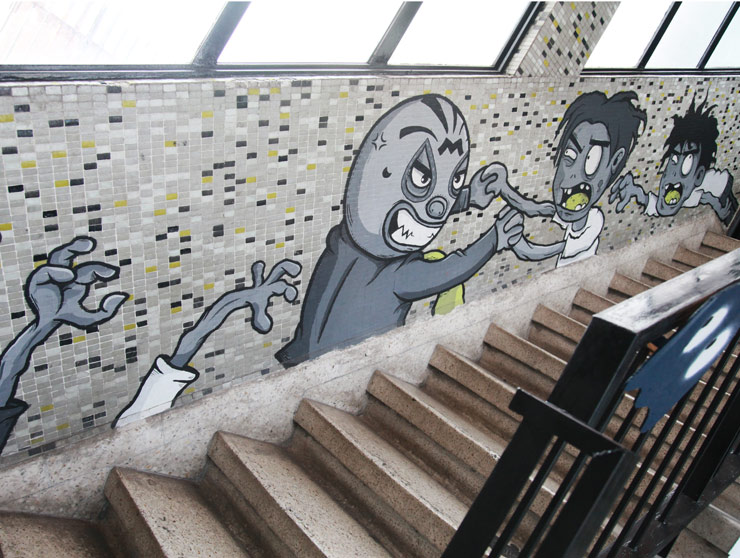
Arty & Chikle. Antique Toy Museum (MUJAM). Mexico, City. (photo © Jaime Rojo)
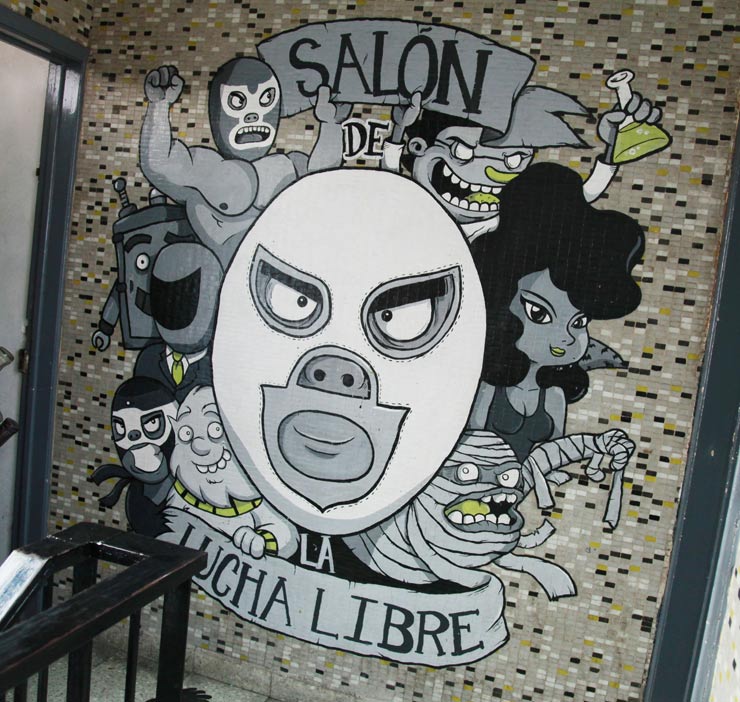
Arty & Chikle. Antique Toy Museum (MUJAM). Mexico, City. (photo © Jaime Rojo)

Aligned with more commercial partners in the past when bringing appreciable Street Art names to Mexico City, Roberto says he prefers the organically grown festivals and exhibitions that have taken root in a few cities to the brand-flogging lifestyle-delivering “influencers” who are Snap-chatting their way through a Street Art tour. His own public/private collection of walls that he has organized over the last decade or so is rather impossible to categorize stylistically, veering from the cartoon to folkloric, photorealistic to abstract, magical-mystical to wildstyle bubbles.

With all these participants it is a come-one-come-all collection that reminds you of the vast reenactment of a circus that is under glass on the second floor, a menagerie of strongmen, tigers, lions, bearded ladies, and assorted crowds of various configurations lined up on the periphery of the big show.

Saner in Studio
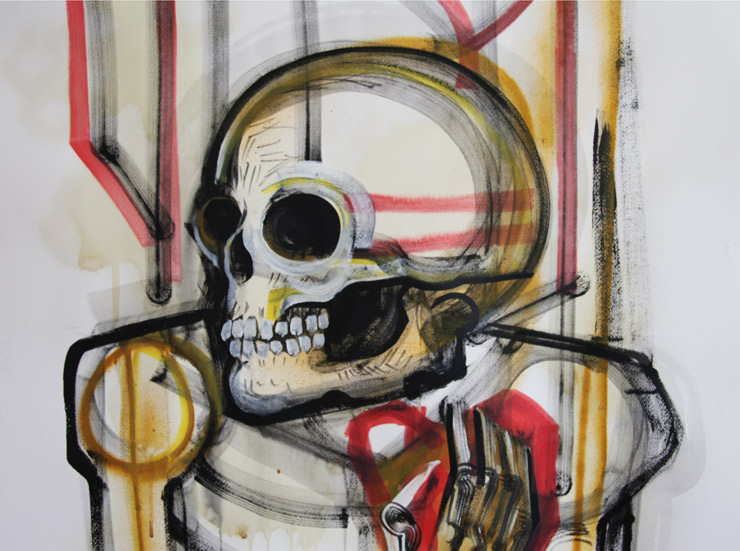
Saner. Work in progress. Studio Visit. Mexico, City. (photo © Jaime Rojo)

In a gated, if worn but serene, community of two story ranch houses built in the 1960s and 70s, the painter Saner has his studio and home. He meets you at the ornate iron gate to his concrete patio and invites you in while speaking on his phone to see the sun-sharpened shapes inside, a personal welcome replete with mask-painted characters interacting on the dining room wall, two large sculptural facsimiles of him and his wife and bright back deck.

A meteorically-rising yet not flashy spirit on the Street Art circuit, Saner is enjoying steady success with a carefully selected path of public walls, gallery shows and even museum representation in the last decade. Sitting in the small front living room while his beige retriever and muse chews through a basket of dog toys and vies for his masters attention, you can see that Saner’s art world accomplishments haven’t distracted him from a grounded view of Mexican socio-political history, his deep love for its people, and his almost mystical, darkly emotional storytelling.
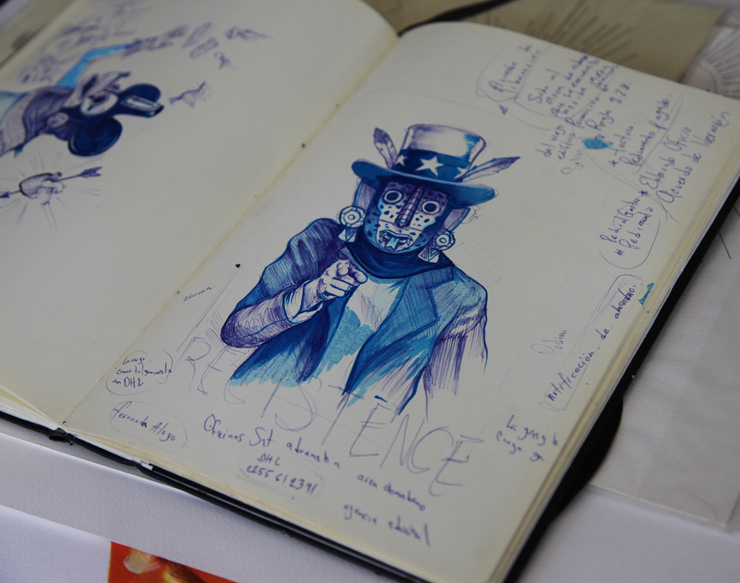
Saner. Studio Visit. Mexico, City. (photo © Jaime Rojo)

In his studio you see his latest sketchbook that he is slowly building page-by-page with details of figures overlapping and radiating and sometimes dancing in warlike poses among the fern and fauna. His crossed-arm stance while leaning on his worktable tells you that he’s waiting for your ideas to help propel the conversation, partially because he is shy, partially as a challenge. A graffiti writer here during the explosive 1990s scene on the streets and trained as a graphic designer, his identity as a Mexican painter became more important to him as he grew older and he began to be less concerned with emulating European or American visual and cultural language.
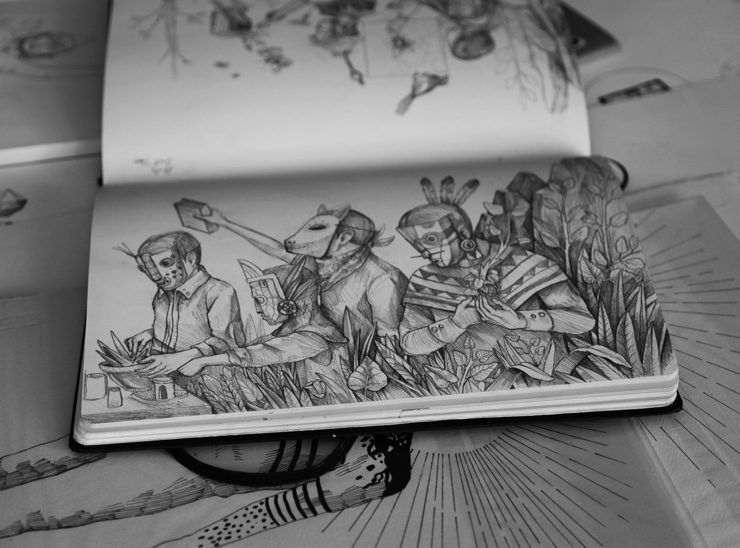
Saner. Studio Visit. Mexico, City. (photo © Jaime Rojo)

You look at the hand-illustrations of figures and costume, weaponry, instruments, flowers, feathers, and wild animals, and you realize that any of these could be the paintings you have seen on walls in neighborhoods and canvasses in galleries – suddenly perhaps a little awed to be in this artists sacred studio space. Then the talk turns to his dog and his recent travels across the world and you know that its just one guys’ greatness, that’s all.

3 Argentinian Street Artists in Studio
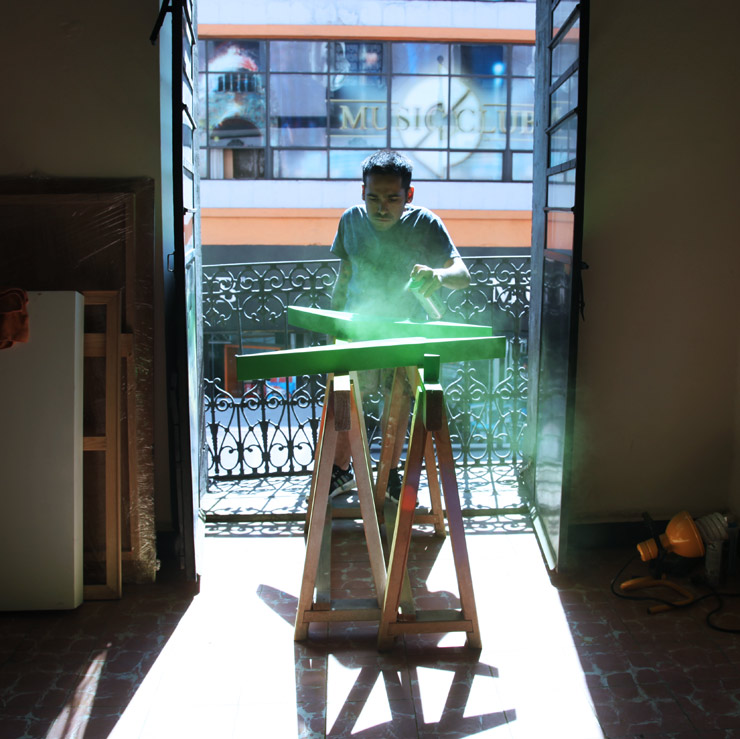
Elian. Studio Visit. Centro Historico. Mexico City. (photo © Jaime Rojo)

The thick air is thumping with a live-performance of a 1980s Judas Priest song by the house band in a musical instrument store across the street here in the crowded old central district of the city at lunchtime. With French doors flung open over your head from the second floor, a cloud of green aerosol envelopes the body of Street Artist Elian and creates a silhouette as he coats an organic form carved from wood on the worktable before him. The shape will join others mounted on a wall next week in Toba Gallery as a smaller 3-D interpretation of his abstract compositions that he sprays across massive walls on buildings and even parking garages for festivals and private clients across Europe, the US, Russia, and his native Argentina.
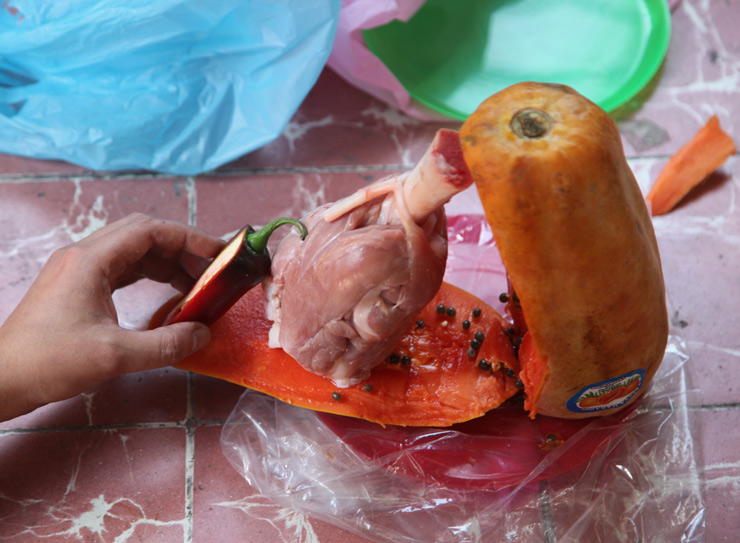
Ever. Studio Visit. Centro Historico. Mexico City. (photo © Jaime Rojo)

In this raw colonial former home with chipping paint and rusted hinges, the rooms serve as studios for a number of artists who pass by the small news stand with lottery-tickets and cigarettes before jogging up the central steps that are lit by an open sky. Also readying for the 3-artist show called “Deforme¨ are two Street Art brothers from the scene who have often painted in the same city with him, JAZ and Ever Siempre. Together the three are pushing their creativity beyond the work they are each known for in murals at festivals, each saying they are a little tired of the way the organic and illegal Street Art scene morphed into legal and often approved murals, even though they appreciate being paid by these events that are partially funded by municipalities or commercial interests. A symbol of mobility and fraternidad in the scene, local Street Art/graffiti artist Smithe, who is loaning the studio space to the artists as they prepare, also owns Toba.

JAZ. Studio Visit. Centro Historico. Mexico City. (photo © Jaime Rojo)

Speaking of galleries, the Celaya brothers have begun a number of commercial enterprises and spaces in the last half-decade, looking for the right formula for capitalizing on the Street Art zeitgeist and partnering with corporate brands. Not far from an enormous mural by the London-based D*Face, their most recent contemporary art gallery in Colonia Roma Norte was featuring a solo show “Trompe L’oeil” by the Italian born, Berlin-based Street Artist/ fine artist Agostino Iacurci as he adds a third dimension to his ornately synthetic forms and sophisticated bright palette. Curated by Vittorio Parisi, the room is spare, the sculptures pleasantly innocent, and slyly humorous.
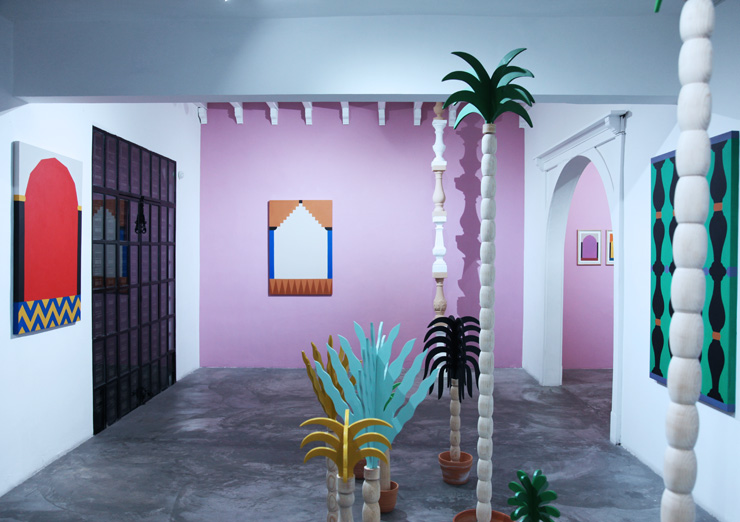
Agostino Iacurci. “Trompe L’oeil” solo exhibition at Celaya Brothers Gallery. (photo © Jaime Rojo)

Keith Haring on a Train

The metro train system in Mexico City, like many aspects of public life over the last two decades, is a faded shade of its previous zeal. It may also be the damage from a large earthquake three months earlier that shook this city, which adds to a feeling of insecurity as you navigate the swarming crowds and watch packed trains pull away while you wait your turn to board. You may also get a bit forcefully pick-pocketed in the middle of the day on one of these trains, as did your author, so you may favor zippers inside your clothing the next time you return.
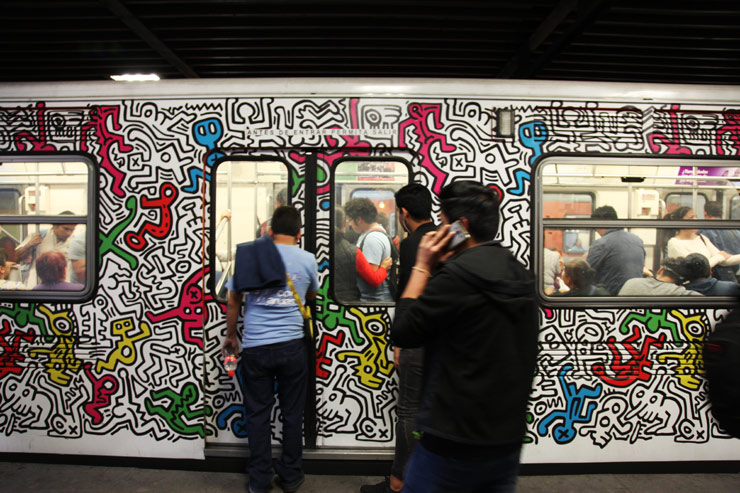
Keith Haring on a whole car on the Metro. Mexico City. (photo © Jaime Rojo)

Hearkening back to the lack of public services in New York’s when it was fiscally broke in the 70s and 80s and Street Artists Keith Haring wrote freely on empty ad-spaces in the subway, it felt a little like the spirit of the Street Artist appeared unexpectedly in front of us while we waited for our next underground connection in this magic city. A swath of colorful characters jumping every which way across the full cars, the familiarly active Haring symbols of figures herked and jerked into place while the cars went through a series of starts and sudden stops. The riders slid back and forth, clutching their straphangers, and we quickly fumbled for a shot of this Mexico City train covered with the welcoming sight of a New York Street Artist who sparkled at the dawn of the go-go portion of the 80s, soon taken in the sadness of the AIDS-panic portion that struck the city.

Undoubtedly, the Street Art and graffiti scene continue to expand and morph into other scenes and venues – many now inside. For some, this is anathema to the true spirit of the mark-making practice that first took root in unsanctioned acts in illegal places, often in open defiance of accepted norms. For others, this route indoors only strengthens the appeal of voices that are now speaking inside the organizational structures we build, and it is remarkable to see such a diverse and lively number of examples throughout this doorway to Latin America aided by very gracious and friendly Mexican hosts at every stop we made.


Below are more images and video from the Antique Toy Museum, MUJAM – Mexico City
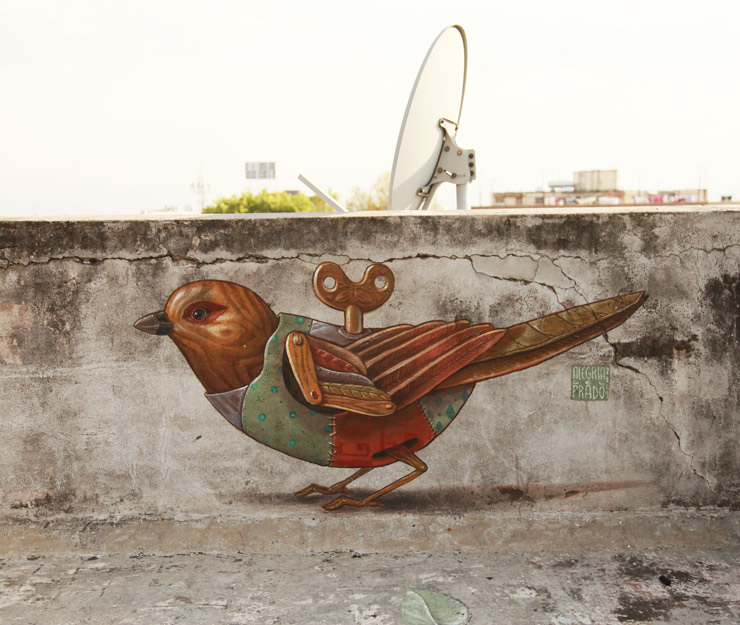
Alegria Prado. Roof top. Antique Toy Museum (MUJAM). Mexico, City. (photo © Jaime Rojo)
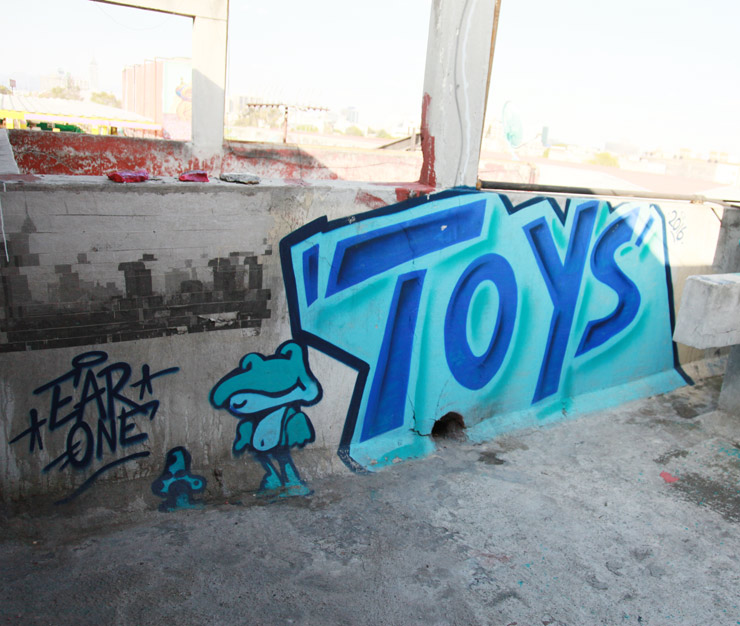
Ear One has a good play on words here, and a nod to cartoonist Vaughn Bodē, whose work inspired a generation of graffiti writers on the Roof top. Antique Toy Museum (MUJAM). Mexico, City. (photo © Jaime Rojo)
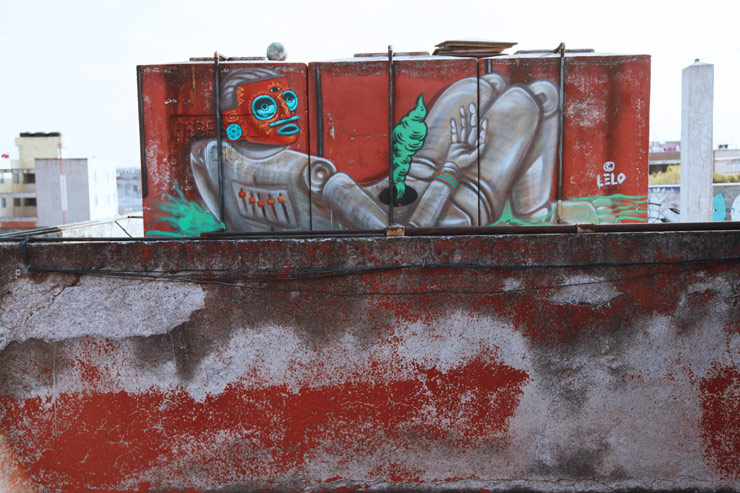
LELO. Roof top. Antique Toy Museum (MUJAM). Mexico, City. (photo © Jaime Rojo)
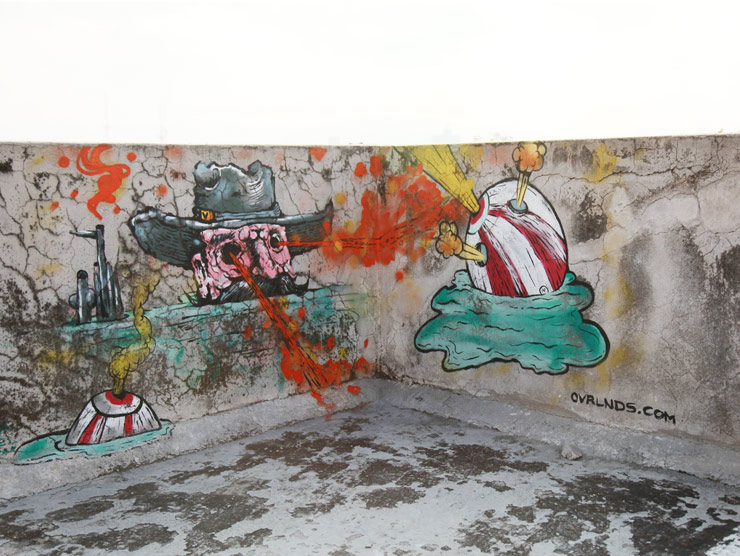
Ovrlnds. Roof top. Antique Toy Museum (MUJAM). Mexico, City. (photo © Jaime Rojo)
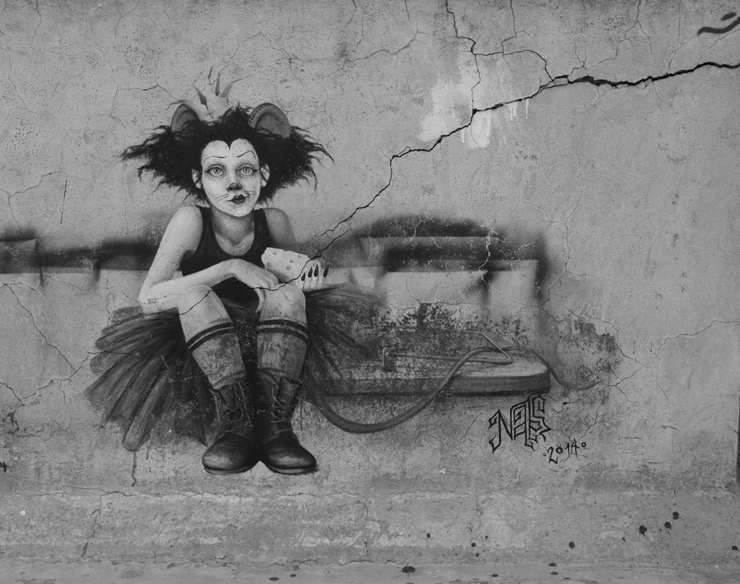
NAS. Roof top. Antique Toy Museum (MUJAM). Mexico, City. (photo © Jaime Rojo)
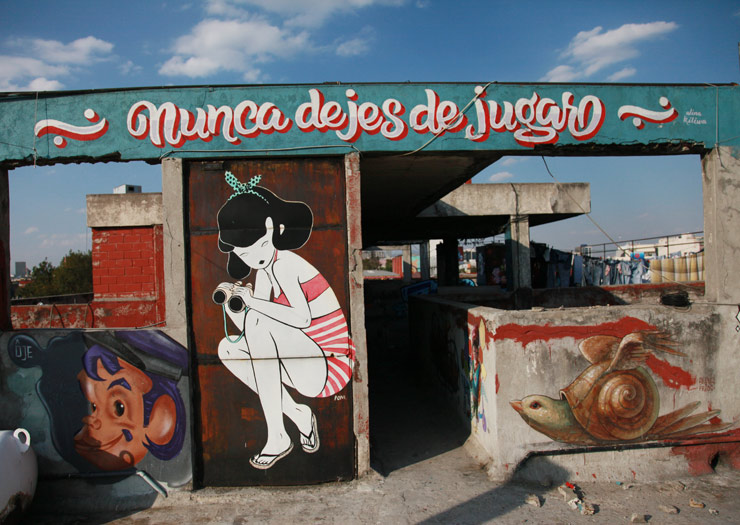
Alina Kiliwa . OJE . Alegria Prado. Roof top. Antique Toy Museum (MUJAM). Mexico, City. (photo © Jaime Rojo)
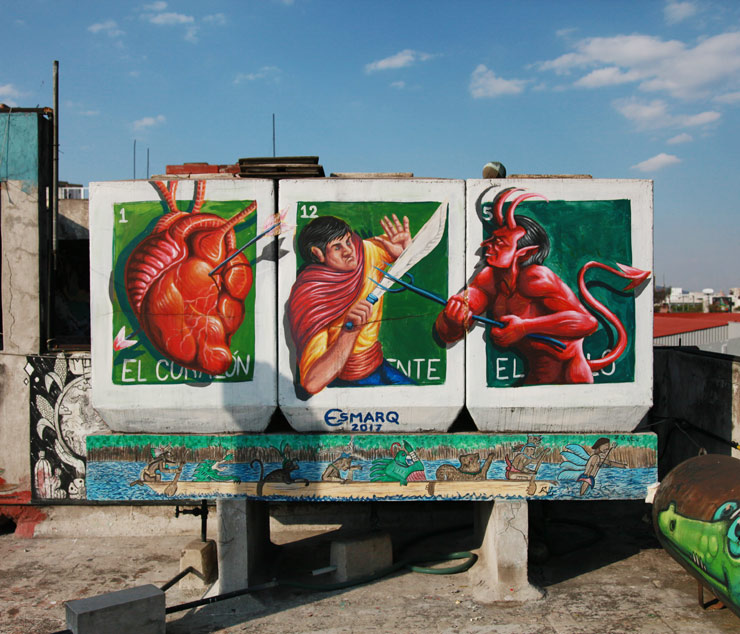
EsMARQ. Roof top. Antique Toy Museum (MUJAM). Mexico, City. (photo © Jaime Rojo)
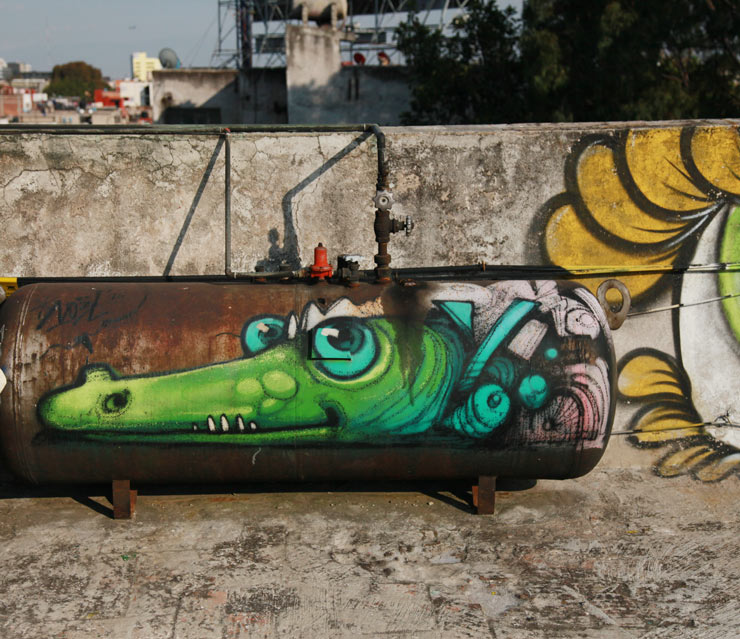
Noel. Roof top. Antique Toy Museum (MUJAM). Mexico, City. (photo © Jaime Rojo)
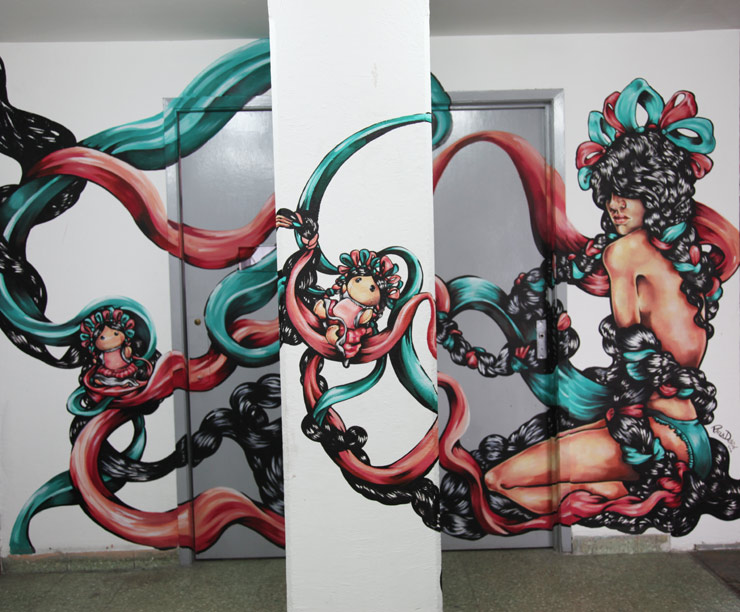
Paola Delfin. Antique Toy Museum (MUJAM). Mexico, City. (photo © Jaime Rojo)
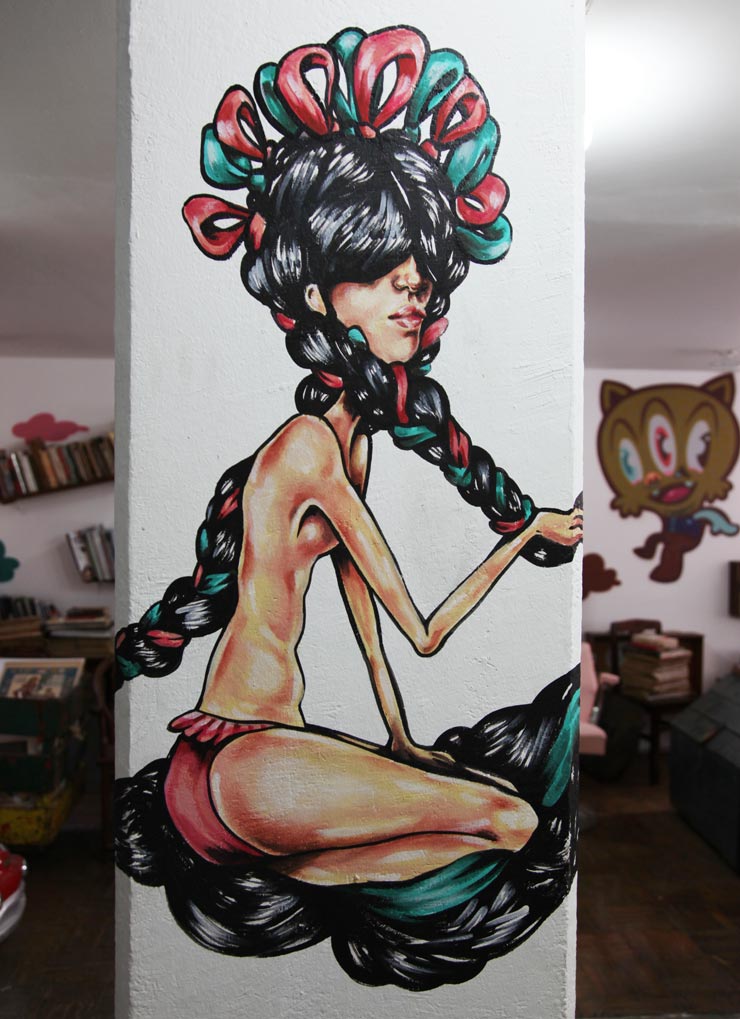
Paola Delfin. Antique Toy Museum (MUJAM). Mexico, City. (photo © Jaime Rojo)
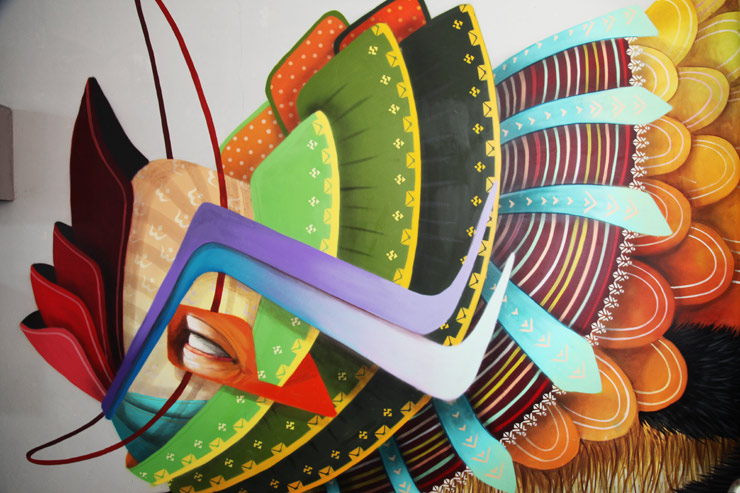
Curiot. Detail. Antique Toy Museum (MUJAM). Mexico, City. (photo © Jaime Rojo)
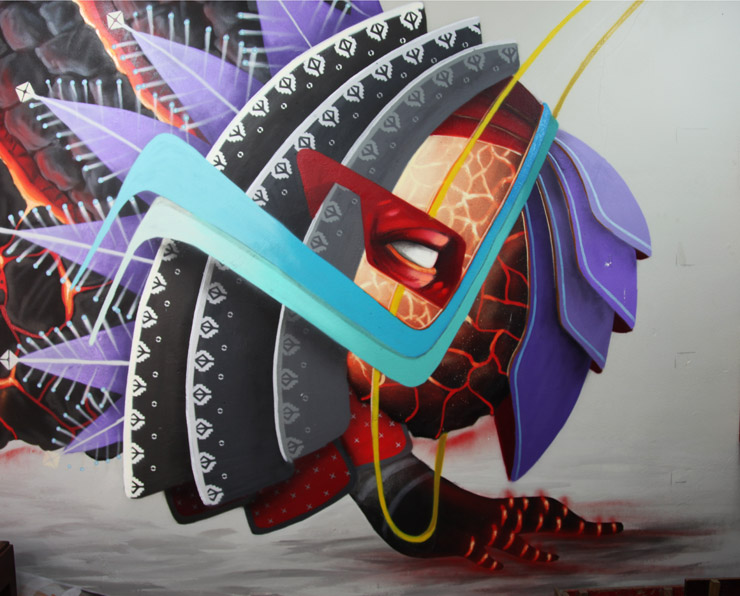
Curiot. Detail. Antique Toy Museum (MUJAM). Mexico, City. (photo © Jaime Rojo)
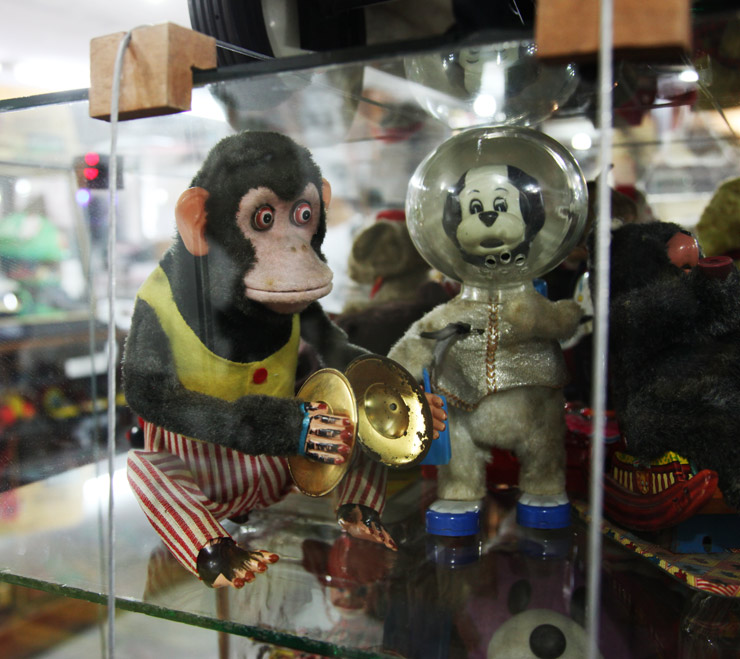
This toy monkey served as the inspiration for a political mural by artist Erica Il Cane a few years ago visible to the street. See A Mexican Mural “Manifesto”, Blackened Flag Colors, and Censorship. Antique Toy Museum (MUJAM). Mexico, City. (photo © Jaime Rojo)
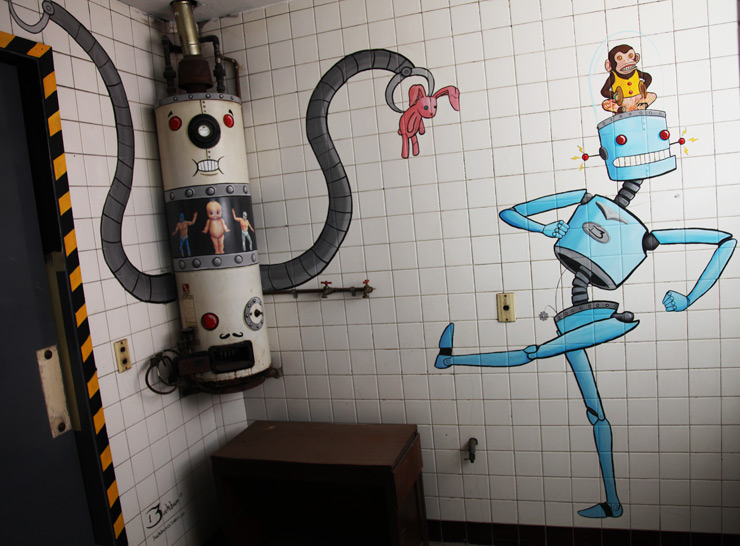
Daniel Bauchsbaum. Antique Toy Museum (MUJAM). Mexico, City. (photo © Jaime Rojo)
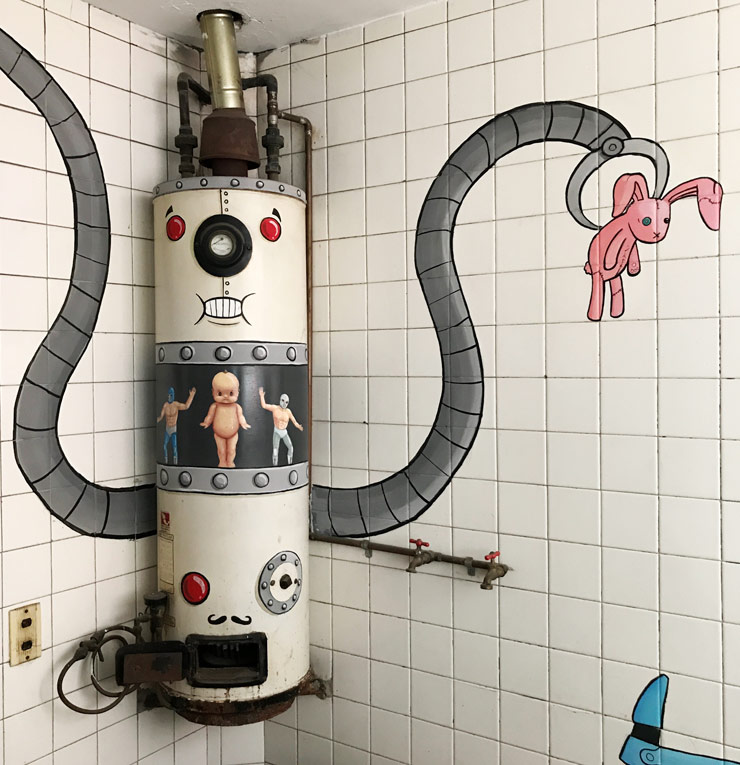
Daniel Bauchsbaum. Antique Toy Museum (MUJAM). Mexico, City. (photo © Jaime Rojo)



This is the second of two articles with BSA in Mexico City in collaboration with UN Berlin, it was originally published on the Urban Nation website, and the project is funded in part with the support of Urban Nation Museum for Urban Contemporary Art (UN) in Berlin.


Additional coverage by BSA in Mexico City:

An Unlikely Museum for Street Art? MUJAM is in the MX MIX : BSA X UN X Mexico City: Day 1

Saner, Mexican Muralist and Painter, Studio Visit. BSA X UN X Mexico City: Day 2

Panteón and Watchavato “No Esto No Es Lo Que Fue” Opens In Mexico City

Exploring New Techniques and Processes with Elian, Jaz and Ever in Mexico City

BSA Images Of The Week: 11.26.17 Mexico City Special

This article is also published on the Urban Nation museum website:

Read more
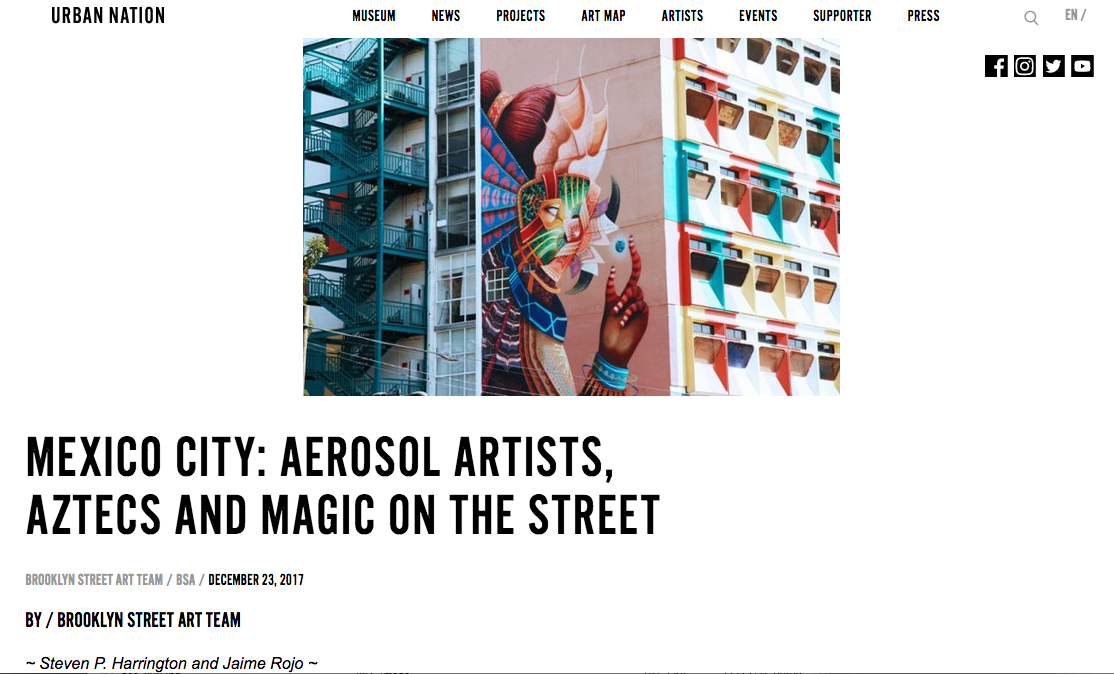
Mexico City: Aerosol Artists, Aztecs and Magic on the Street

Mexico City: Aerosol Artists, Aztecs and Magic on the Street

Every city has its own particular energy; it’s own articulated rhythm, its own unique chaos.

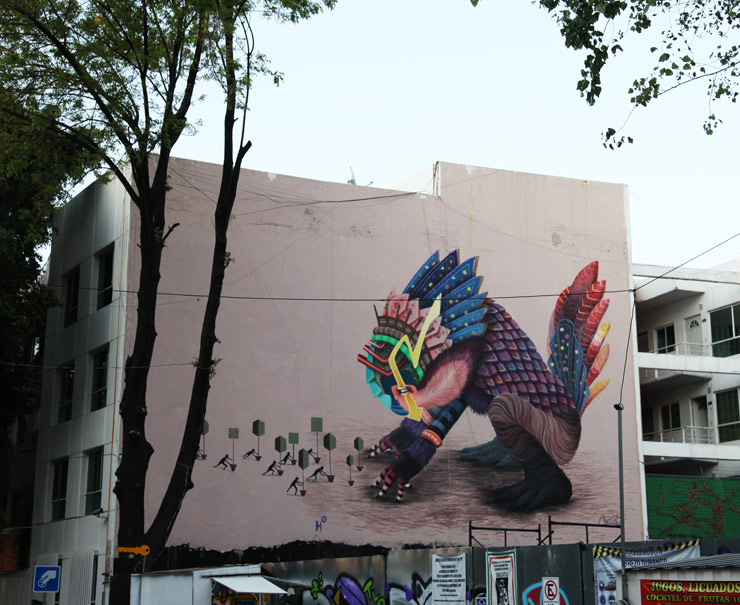
Mexico City’s is full of flourish and aspiration and fascination for the international new, while firmly rooted in respect for the past. When it comes to Street Art, murals, graffiti and discordant sub-cultural art movements that can disrupt the norm, this city shows the capacity to absorb and adapt and to continue moving forward, providing meaningful insights into the true nature of its people.

Curiot. Detail. For Lienzo Capital Project with Street Art MUJAM. (photo © Jaime Rojo)

This magic city of more than 20 million is often referred to as a gateway to Latin America: economically, socially, and politically. With high tech industry, banks, multi-national companies, a university system that serves 300,000 students, 150 museums, three UNESCO World Heritage sites… you can see why. With heavy traffic despite a subway system and many forms of public transportation, it can take hours for you to cross Mexico City (Distrito Federal (D.F)) and you can be assured that you’ll probably never see all 16 boroughs.

El Mac. Detail. All City Canvas 2012. (photo © Jaime Rojo)

As Street Art and its associated movements move through Central and South America, invariably D.F. appears as an important tierra cultural to traverse. From an active graffiti scene and occasional mural festivals to a growing gallery representation and increasing museum interest, urban artists are capturing the attention of the Americas, making heads spin in public space. With Mexico City capturing nearly all the aspects at once, today we take a look at the city and give you only a few examples of the art in the streets here.

El Mac. All City Canvas 2012. (photo © Jaime Rojo)

The September 19th earthquake of 2017 shook Mexico City exactly 32 years after 10,000 lost their lives in a larger one, the largest. With broken sidewalks and taped off buildings still as physical evidence, you can hear in the voices the trauma that rocked tall buildings back and forth like huge ships on the sea. In addition to these more physical shocks, the city has been rocked in recent years by a rising evidence of frightening power shifts relating to drug traffickers, accusations of institutional corruption, and a sharply rising economic inequality that is transforming developing/developed societies across the globe.

Built upon the ruins of the Aztec city called Tenochtitlán, which was one of the worlds largest in the 15th century, Mexico City appears persistently ebullient when banding together against adversity. Determined to excel beyond the horrors of conquest by the Spanish that decimated an entire indigenous culture, still the ruins rise above the ground and this multi-hued global city rumbles forward with determination.

Unidentified Artist (photo © Jaime Rojo)

Sleek high rises and brightly patterned folkloric art and aerosol sprayed graffiti tags next to massive murals all blend and swirl like the jarabe Tapatío hat dance from block to block – a decisive commixture of the “brand new” with a heritage of indigenous/invader cultures that ruled here hundreds of years before. Today it’s a hybrid of purposeful optimism and wizened survival instincts that pushes the city forward, despite the shocks endured.

SEGO. All City Canvas 2012. (photo © Jaime Rojo)

The magic and realism so famously combined by authors like Garcia Márquez and Esquivel along with the brutal honesty of Mexican filmmakers like Inarritu, del Toro and Cuaron is fused onto the bricks of colonial mansions and cinderblock industrial neighborhoods like Roma-Condesa and Centro Histórico. These colonias and others like Xochimilco and Coyoacán are historic, commercial, somehow always in transition.

Buster (photo © Jaime Rojo)

As you walk and weave over the chunks of disrupted sidewalks, the local mechanic’s car-repair taking place on the curb is complimented by the smell of stacks of fresh tortillas from the tiny tortilleria. The booming tented markets of witty pop-culture t-shirts, knock-off sneakers, and decorative phone cases are sharing your memory space with the eye-popping magenta, sea foam green, and lemon sherbert yellow hues of huge layered toile netting as quinceañera skirts plumped full of Dior and displayed regally behind full glass windows, shop after shop.

The narrow street in old Centro Historico surges with the sound of a live heavy metal band demonstrating the equipment at a music store at lunch time, and three Argentinian Street Artists (Ever, Elian, and Jaz) are creating plumes of aerosol paint from the opened second floor veranda doors across the street while home-made Judas Priest reverberates over and around the slowly moving bumper-to-bumper traffic.

Arty & Chikle. “Only Love”. Street Art MUJAM in collaboration with the Mexico City National Youth Institute for Young Adults. (photo © Jaime Rojo)

Of Mexico, “it’s always high noon and what glows is fuchsia and what’s dead is dead,” said author Henry Miller in his book Black Spring, and some spirit of that rings true here where so many objects and situations you encounter can be amazing and revelatory and yet locals simply roll them in a tortilla and toss it on a hot oiled comal for dinner.

The music options alone can be illustrative of the variety here: Las Madrigalistas are performing holiday classics in the Palacio Bellas Artes, Ricky Martin just played free for 100,000 in the Zocalo, there is an active punk scene that rivals many, a hiphop scene that draws fans from nearby cities, and a reverence for 1980s artists like Depeche Mode and The Misfits, and an almost religious devotion to Morrisey.

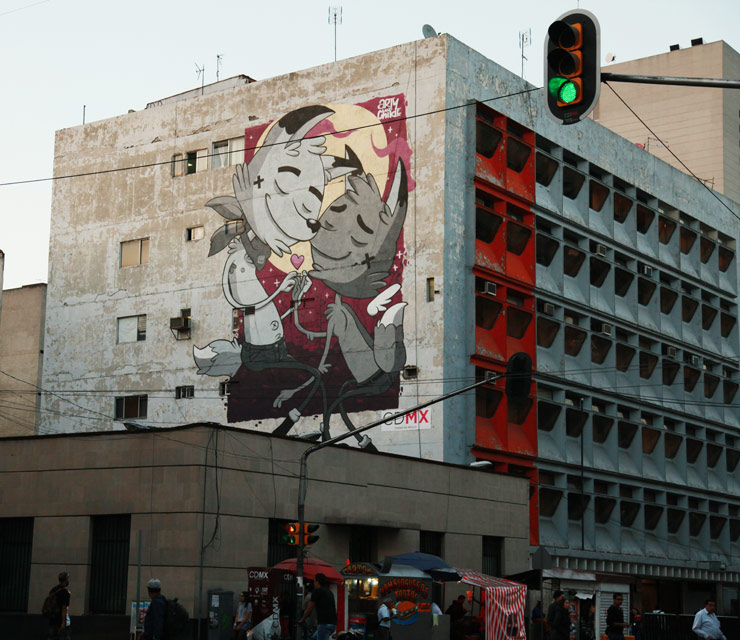
D*Face (photo © Jaime Rojo)

The scale of the murals can be as vast as the city, equally eclectically handmade and warm. Thanks to a rich heritage of mural-making and artists like Orozco, Rivera, and Siqueiros in the last century, the new generation of Mexicanos are interpolating the currents that ripple and wave through a society wedded to fierce independence and tradition. Today it is again rocked by our instant access to information and a global sense of modernity.

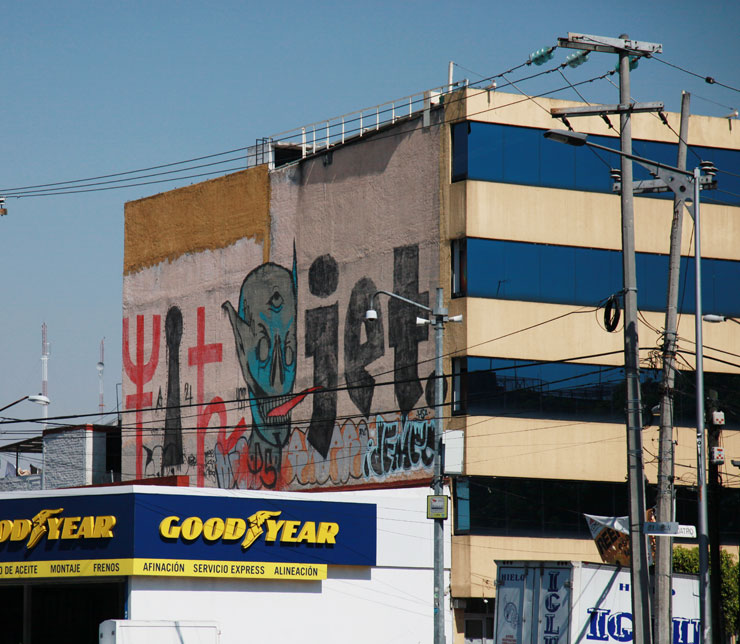
JET (photo © Jaime Rojo)

Interezni Kazki. All City Canvas 2012. (photo © Jaime Rojo)

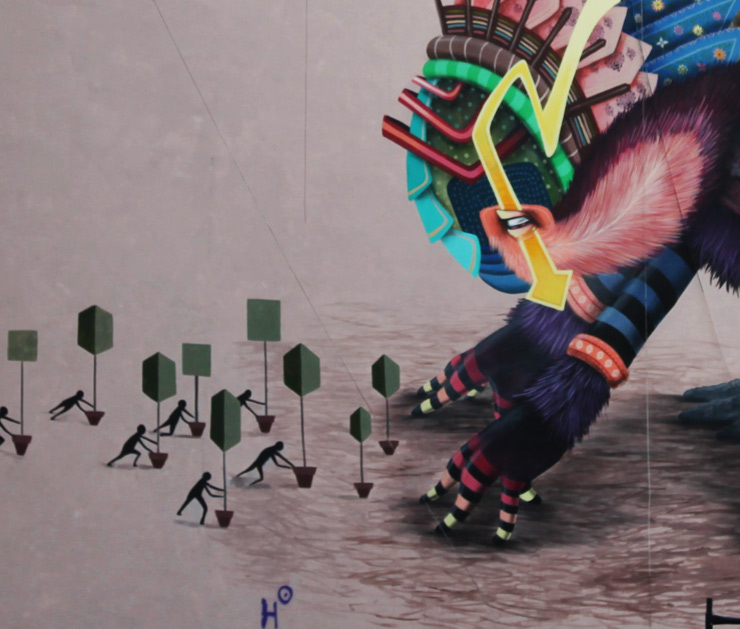
This means that an international Street Art scene in D.F. features not only Mexican alchemists like Saner, Curiot, Farid Rueda, Lesuperdemon, Dhear and Sego (among others) but also invites the English D*Face, Italians Ericailcane and BLU, Belgian ROA, Los Angelianos Retna and El Mac, Polish M-City, Argentian JAZ and German duo Herakut to influence the voice of the street. With a visual wealth of inspiration and disruptive or unusual imagery in play on the street, this still  jittery city smiles and confronts you as the year turns, a response that is in flux and fiesta, sorrow and memory, outrage and magic.

ROA. All City Canvas 2012. (photo © Jaime Rojo)

While traveling through the city with Roberto Shimizu, a central figure in the modern Street Art/mural scene here, and by visiting Street Artists and critical curators and organizers in studios and alternative spaces inside and outside the city, we garnered a greater appreciation for the complexity of the story here. It is distinctly different from the model we’ve seen elsewhere and explains the less showy trajectory that this still organic ecosystem has taken.

Unidentified Artist (photo © Jaime Rojo)

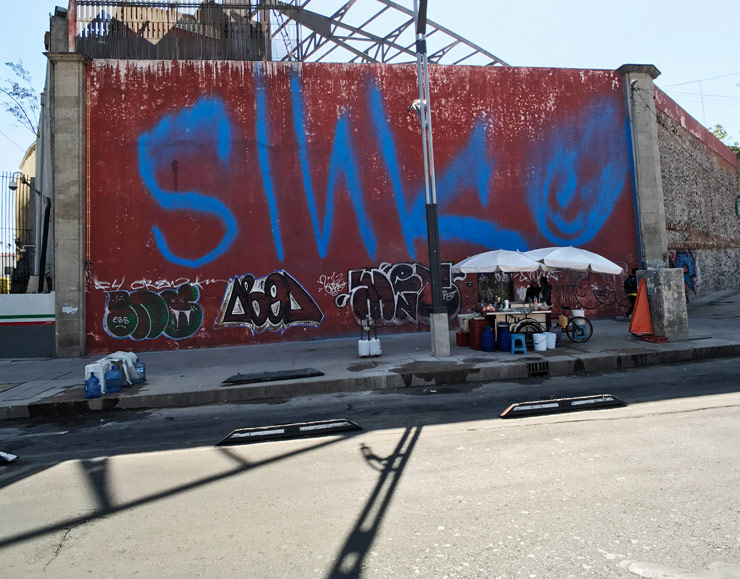
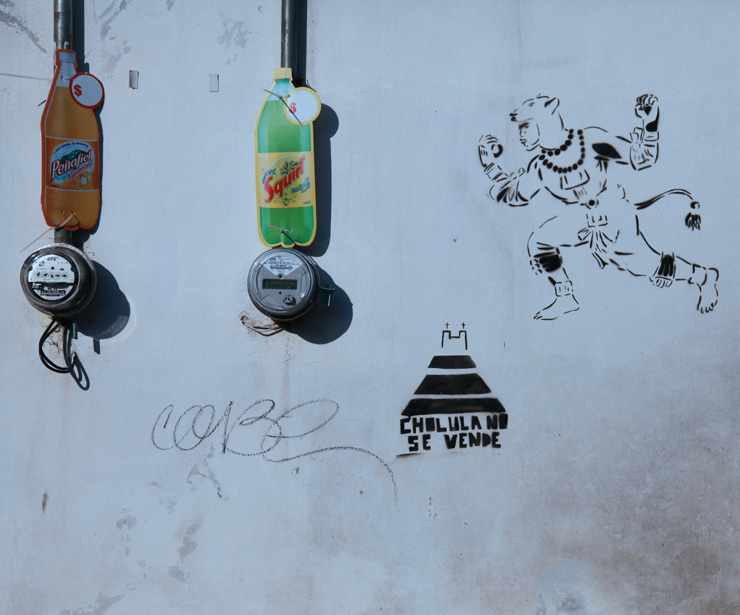
As in most cities today you’ll find the organic and autonomous quality of works is best represented by one-off, handmade individual pieces of art and stickers throughout neighborhoods, many anonymous. These are not the large scale legal murals that unfamiliar observers sometimes refer to as Street Art. These are still the lifeblood of any real Street Art scene and are often indicators of its truer eclectic nature.

Unidentified Artist (photo © Jaime Rojo)

Maybe because there isn’t a large collector base for this work, or because some brands/marketers have already cheapened its image a bit, but Street Art hasn’t blossomed in the gallery world here to a great extent. Instead, true cultural curators like Shimizu have consistently led it directly to his festival programs or his family’s Mexico City’s Antique Toy Museum (MUJAM), and professors at the Universidad Nacional Autónoma de México (UNAM) are teaching about it to students .

Milamores and El Flaco. La Linea Street Art. Cholula, Puebla. 2012. (photo © Jaime Rojo)

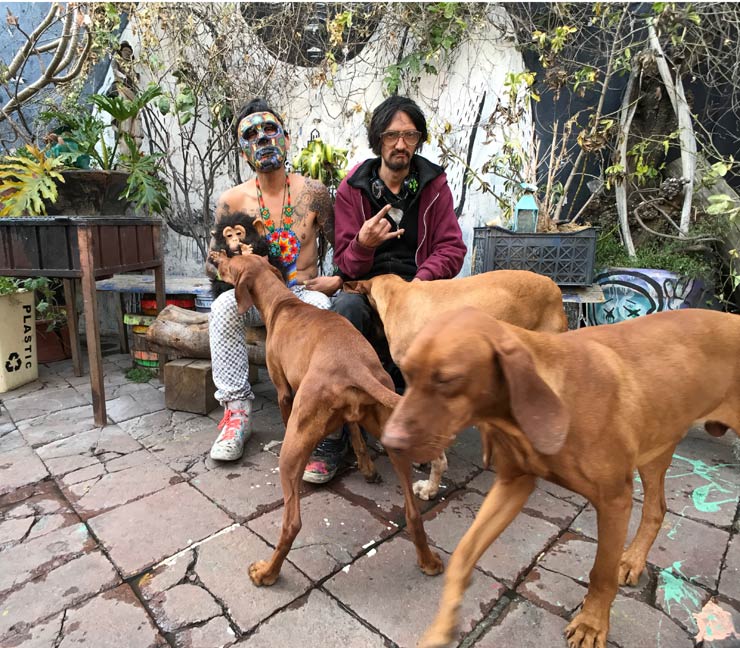
We usually find the true nature of Street Art here is still in the streets – and in the artists community. In the Chulula area of nearby Puebla outside Mexico City, the mysterious renaissance seer named Milamores has quietly curated walls of many local and international artists over the last half decade, offering his compound and dogs for rest and companionship in a supportive artists space. Together with video animation artist Flaco he is presenting Street Art via Virtual Reality experiences that are in tandem with his organically grown mural program. Built on the site of a collapsed building from the 1985 earthquake, the artist/activist collective and community garden Huerto Roma Verde provides classes and workshops on art, sustainable architecture, gardening, and theater and has helped many artists to with mural opportunities as well.

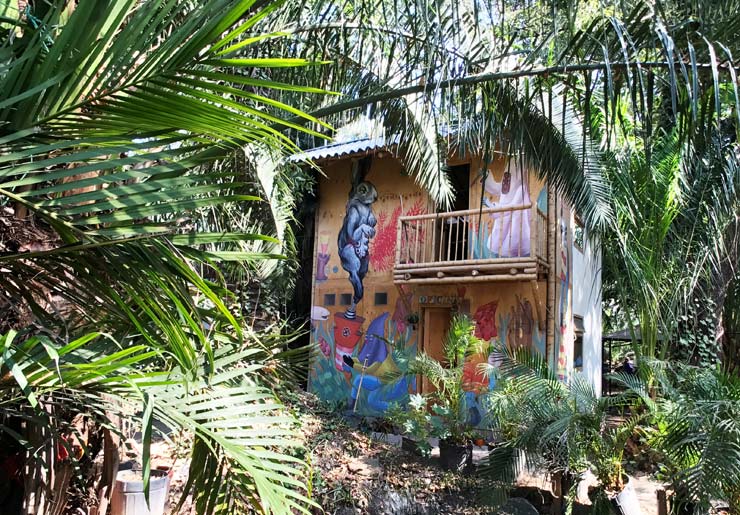
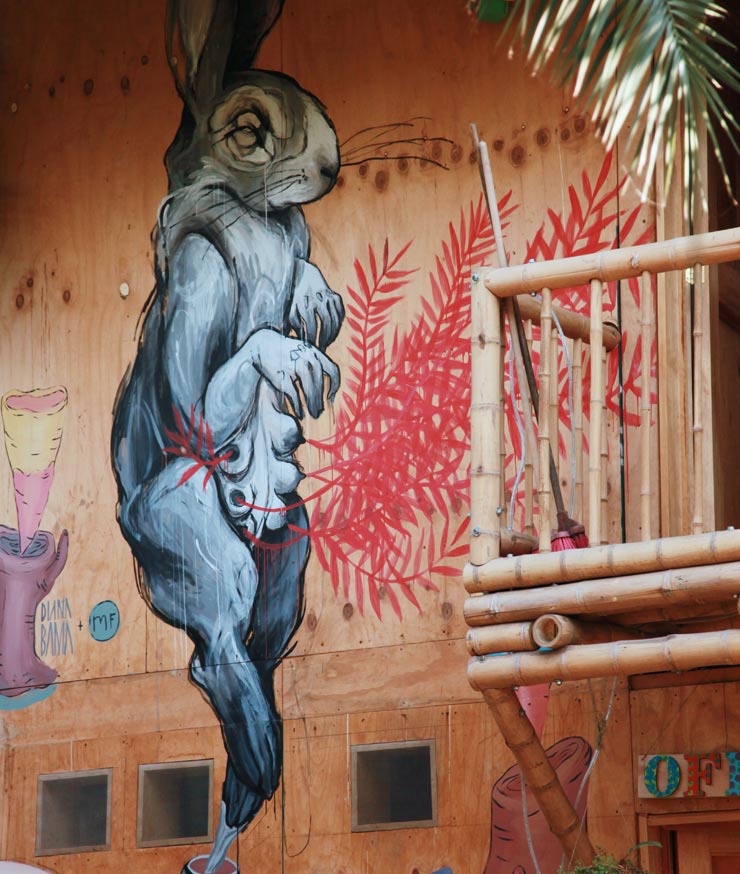
Diana Bama . Martin Ferreira. Huerto Roma Verde. (photo © Jaime Rojo)

Diana Bama . Martin Ferreira. Huerto Roma Verde. (photo © Jaime Rojo)

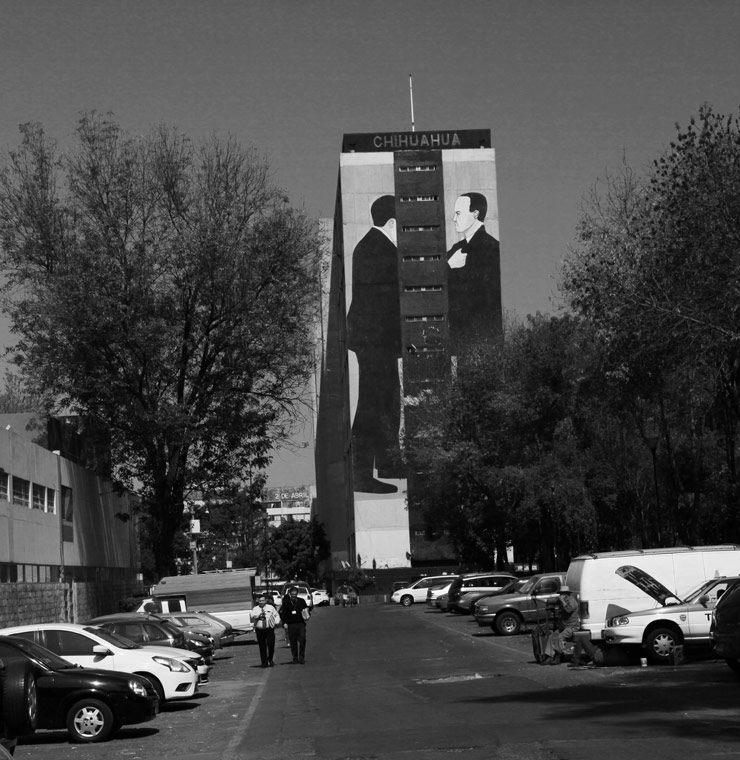
As an emblem of the conflicting and harmonious forces at play, we cite the relatively recent mural painted by the Spanish Street Artist Escif on the wall of the Chihuahua housing complex on the Plaza of Three Cultures just north of the city center. Illustrating the privately funded public projects that Street Artists are doing now throughout cities, this one plumbs the unhealed wounds and still unanswered questions of a shocking event of political repression almost 50 years ago here in the plaza designed by Mario Pani.

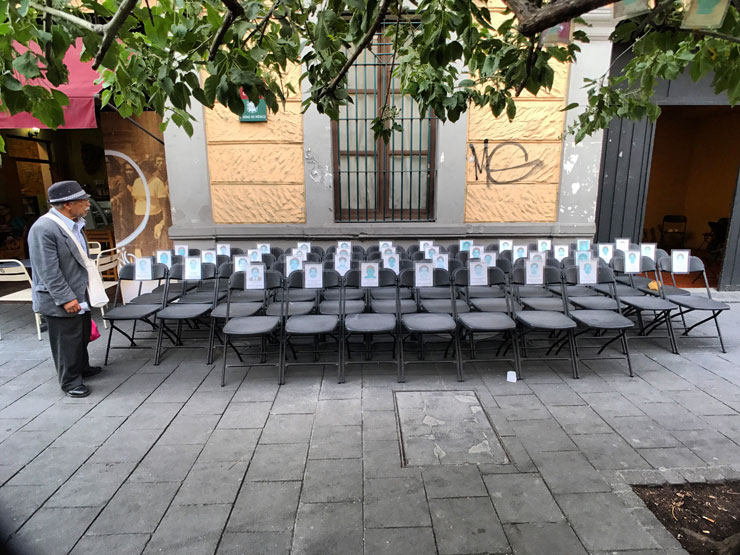
Not only does the plaza physically join together a Spanish colonial church and the remains of a pre-Columbian Aztec temple with the 13 story housing complex, the square is most known today for the October 1968 suppression of a student movement where troops ran directly over the ruins and fired on a peaceful rally and secret police captured and tortured student leaders who were speaking from the balcony. Protest art and public installations about the 2014 Iguala mass kidnapping of 43 disappeared students recall the stories from 1968 today, and many make connections between the events.

Unidentified Artist. Installation in El Centro Historico for the 43 Desaparecidos. (photo © Jaime Rojo)

Some academics have said the crushing of the student movement was part of a secret “dirty war” by the government to quiet dissent and present a unified Mexico image to the world ahead of the upcoming Olympics, but Shimizu tells us that visiting politicians to Escif’s new wall are pleased with the mural and made a tour by bus with guests to admire it. A monument to the Tlatelolco massacre stands in the plaza memorializing the events, and Escif made a few statements about his interpretation of his mural.

“As in my previous works, there is not a limited meaning in the ‘Chihuahua Mural’, but as many meanings as people try to approach it with,” said Escif to us recently about the two suited figures. He discusses his research into the events that took place, but ultimately he leaves the painting more open to interpretation. “Those two guys painted on the wall can be secretive executives, military officers, corporate people or anybody. That will depend on who sees the wall and his previous experiences.”

Unidentified Artist (photo © Jaime Rojo)

For visitors to Mexico City looking for the local Street Art or graffiti scene it is helpful to recognize that this moment for a near-global fascination for art in the streets is here also intertwined with a national and local history, cultural pride, and the treasured heritage of indigenous peoples.

While so-called “western” countries may see a rebellious disaffected rage or critique as an overarching narrative for the graffiti and Street Art scene in New York, London, or Berlin, it may be that Mexico City, and Latin America by extension, is also very cognizant of its roots, in love with them even, always infusing new work with a certain respect for their progenitors. For an art practice that is characterized in part for its ephemerality the context of this particular urban environment reminds you of its often remarkable resilience.

Dueke . Miss1 Guette for MUJAM. (photo © Jaime Rojo)

RETNA. The Beauty Project, 2017. (photo © Jaime Rojo)

ROA. La Linea Street Art. Cholula, Puebla. 2012. (photo © Jaime Rojo)

ROA. La Linea Street Art. Cholula, Puebla. 2012. (photo © Jaime Rojo)

ROA. La Linea Street Art. Cholula, Puebla. 2012. (photo © Jaime Rojo)

ROA. La Linea Street Art. Cholula, Puebla. 2012. (photo © Jaime Rojo)

Curiot (photo © Jaime Rojo)

Curiot. Detial. (photo © Jaime Rojo)

SINKO (photo © Jaime Rojo)

Unidentified Artist (photo © Jaime Rojo)

Interezni Kazki. La Linea Street Art. Cholula, Puebla. 2012. (photo © Jaime Rojo)

Interezni Kazki. La Linea Street Art. Cholula, Puebla. 2012. (photo © Jaime Rojo)

Unidentified Artist (photo © Jaime Rojo)

Kill Joy . Mazatl. La Linea Street Art. Cholula, Puebla. (photo © Jaime Rojo)

Unidentified Artist (photo © Jaime Rojo)

Fusca .  Blast. La Linea Street Art. Cholula, Puebla. (photo © Jaime Rojo)

Erica Ilcane. (photo © Jaime Rojo)


This is the first of two articles with BSA in Mexico City in collaboration with UN Berlin, it was originally published on the Urban Nation website, and the project is funded in part with the support of Urban Nation Museum for Urban Contemporary Art (UN) in Berlin.

Read Part II here:

A Street View From Inside the Doors of Mexico City ; Galleries, Studios, Museums, and the Metro


Additional coverage by BSA in Mexico City:

An Unlikely Museum for Street Art? MUJAM is in the MX MIX : BSA X UN X Mexico City: Day 1

Saner, Mexican Muralist and Painter, Studio Visit. BSA X UN X Mexico City: Day 2

Panteón and Watchavato “No Esto No Es Lo Que Fue” Opens In Mexico City

Exploring New Techniques and Processes with Elian, Jaz and Ever in Mexico City

BSA Images Of The Week: 11.26.17 Mexico City Special


This article is also published on the Urban Nation museum website:


Read more
1UP Crew: Wishes And Hopes For 2018

1UP Crew: Wishes And Hopes For 2018

As we draw closer to the new year we’ve asked a very special guest every day to take a moment to reflect on 2017 and to tell us about one photograph that best captures the year for them. It’s an assortment of treats to surprise you with every day – to enjoy and contemplate as we all reflect on the year that has passed and conjure our hopes and wishes for 2018. This is our way of sharing the sweetness of the season and of saying ‘Thank You’ to each of you for inspiring us throughout the year.

*******

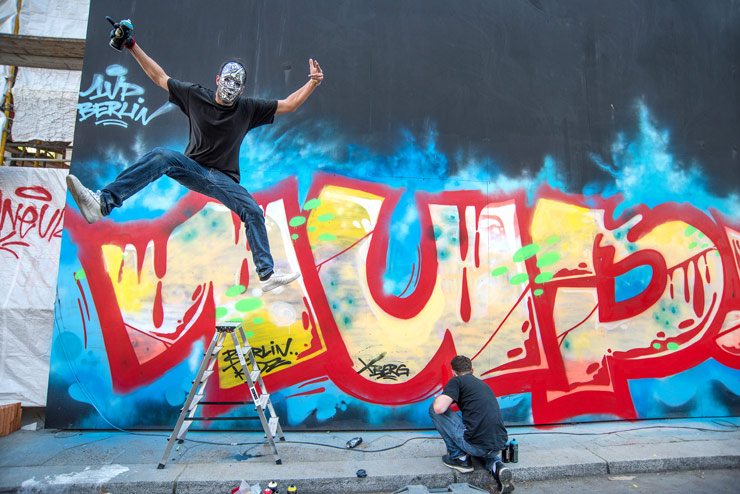
The ubiquitous graffiti crew 1UP is amorphous and shape-shifting but their work is easily spotted in their hometown of Berlin, one of the graffiti capitals of the Western World. With many members and a variety of handstyles and influences represented on roofs, risers, tunnels, trains, and even legal walls, the overall collection of 1UP tags has wide influence on other writers – with some of the work taking it up a level, two levels. Here they share a photo with BSA readers that represents a highlight of 2017 as they look forward to 2018. We were there that day in May at the UN construction site as well, and the scene will stay in our minds for a long time.


1UP CREW

We chose this photo because we had a very intense, wild, special and heartwarming time with Marty this year. The last summer was full of crazy actions, and doing them together with Marty was just the top of the pie! Only good memories that we will hopefully remember forever! Stay tuned for news of our project together that will be hitting you next year!

Stay healthy everybody and have a colorful 2018!

One Love! One United Power!

1UP CREW


1UP Crew. Berlin, Germany. May 2017. (photo © Martha Cooper)


1UP Crew

Read more
Various & Gould: Wishes And Hopes For 2018

Various & Gould: Wishes And Hopes For 2018

As we draw closer to the new year we’ve asked a very special guest every day to take a moment to reflect on 2017 and to tell us about one photograph that best captures the year for them. It’s an assortment of treats to surprise you with every day – to enjoy and contemplate as we all reflect on the year that has passed and conjure our hopes and wishes for 2018. This is our way of sharing the sweetness of the season and of saying ‘Thank You’ to each of you for inspiring us throughout the year.

*******

Intellectual adventurers with a penchant for public experimentation, the Berlin-based duo Various & Gould anchor their vivid-hued dada-pop hybrids in study and observation – and a willingness to actively question conventional assumptions. Originally predicated on the language of poster graphics, in periodic forays in public space, V&G become performers, clue-givers, even academic re-skinners of existing sculpture when their new idea takes fullness. Today we learn how their own natural observational practice and innate creative curiosity about art on the streets leads them to new discoveries and sources of inspiration.


VARIOUS & GOULD

When we discovered this work, we thought at first it was a nicely cracked window of an empty storefront.

We were on our bikes and just after we had already passed it and were waiting at the red light, we glanced back: ‘Did you see that window? What was it: broken, scratched, painted? Let‘s have a second look!’

When we turned around we saw these delicate graphic lines. And we understood this was an artwork. Now the detectives in our curious artist minds awoke and we were wondering how this was made.We came to the conclusion it might be the left over borders from stickers, applied to the window stripe by stripe.

We really enjoy the intriguing yet unobtrusive appearance of these works, of which we have discovered more since. It took us a while to find out the artists name: Birgit Hölmer.

We haven’t met her though. It‘s so striking that public art can still appear in new forms and surprise you!

Various & Gould. Art work by Birgit Hölmer. Berlin, Germany. March 8th, 2017. (photo © Various & Gould)


Various & Gould

Read more
Vermibus: Wishes And Hopes For 2018

Vermibus: Wishes And Hopes For 2018

As we draw closer to the new year we’ve asked a very special guest every day to take a moment to reflect on 2017 and to tell us about one photograph that best captures the year for them. It’s an assortment of treats to surprise you with every day – to enjoy and contemplate as we all reflect on the year that has passed and conjure our hopes and wishes for 2018. This is our way of sharing the sweetness of the season and of saying ‘Thank You’ to each of you for inspiring us throughout the year.

*******

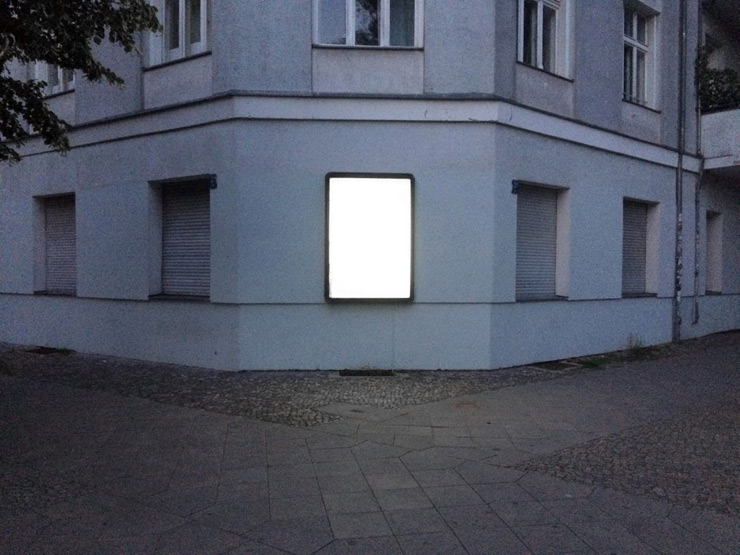
Spanish Street Artist and fine artist Vermibus has been re-rendering posh pictures of fashion poses on public ad spaces for a handful of years now. His insight into how emotions and self image are impacted by advertisements is now concise and his rendering of opinion is clarion. More than 600 installations later, not only has his work become a powerful critique of twisted class and beauty standards, it’s a reclamation of public space and mindspace that we have allowed to become privatized. Today Vermibus shows us a photo he took in Berlin this year and tells us about revisiting one of his original lightbox spots and discovering something new that he wasn’t expecting.


VERMIBUS

This year I came across an empty lightbox and this one immediately caught my attention.

Many years ago, when I was just starting as Vermibus, I did an intervention in this spot but I didn’t realize until this day how beautiful and full of meaning this space was. Maybe it was the blue light from the moment, the empty street, or the closed windows from the building but they all together made some kind of poetical meaning for me, and I was touched by it.

This silent box gave me more than I was expecting, it gave me peace.

I never felt so connected with any campaign in the way I felt connected with the absence of it; this lack of message was stimulating my imagination and my reflection. I couldn’t tell if this was an intervention or it just happened naturally, who the person was who did it, or what was the aim of it – if there was an aim at all.

I end up realizing that in fact all this didn’t really matter, the information was there for the ones who could read it, and I was one of them.

My wish is that more people can see the message that is hidden in those empty shiny spaces in the same way I did.

Vermibus. Berlin, Germany. July, 2017. (photo © Vermibus)


Vermibus

Read more