BSA Images Of The Week: 09.28.25

BSA Images Of The Week: 09.28.25

Welcome the BSA Images of the Weeeeeeeek!

First, some housekeeping: over the past few weeks, you’ve probably noticed we’ve been publishing less—and the site’s been buggier than Mayor Adam’s re-election campaign, the MTA’s subway announcement system, or a 2025 White House policy rollout. You’re right. BSA is in the middle of major technical upgrades, and it’s been a lift. Thanks for your patience. We’re entering our 18th year—more than 7,000 articles, 60,000 images, thousands of artists across six continents—and we’re focused on making our next chapter faster, cleaner, and steadier.

Keeping street art’s genesis years in view as we look at today’s evolving scene, the New York Times arts section declares the ’80s are back!—although a mostly privileged, mostly white version of the ’80s. “Downtown/Uptown: New York in the Eighties,” staged in a Beaux-Arts townhouse at 19 East 64th Street, packages art-school cool, downtown interdisciplinarity, and a confident graffiti-adjacent chic for polite Upper East Side viewing. It wasn’t thoroughly subversive at that time; the scene was perpetually status-signaling, and getting your name on the list at the door was paramount. Yet that mid/late-Boomer, budding cappuccino crowd could still be transgressive and forward-leaning, incorporating new tech and future-minded theory. The labels arrived in a rush: Neo-Expressionism, Appropriation, Neo-Pop/Commodity art, Simulationism (Neo-Geo), photo-conceptual work, street-adjacent practice, and graffiti, – or would that be neo-graffiti?

Someone once said of the ’60s, ‘If you remember them, you weren’t there’—and everyone laughed. Bowie said he barely remembered recording Station to Station in the 70s, and a similar collective bemusement winked at the excesses of that time as well. So as we wind up the wooden banister on the Upper East side we wonder how many memories of the cocaine-ecstasy-fueled Downtown 80s club scenes still remain. With a lot of elbow room, you are welcome to gaze upon these paintings, sculpture, photos, and works on paper by Jean-Michel Basquiat, Ross Bleckner, Francesco Clemente, Eric Fischl, Guerrilla Girls, Peter Halley, Keith Haring, Jeff Koons, Barbara Kruger, Louise Lawler, Sherrie Levine, Sally Mann, Robert Mapplethorpe, Cady Noland, Ricky Powell, Richard Prince, David Salle, Kenny Scharf, Julian Schnabel, Andres Serrano, Cindy Sherman, Haim Steinbach, Tseng Kwong Chi, Andy Warhol, David Wojnarowicz, and Christopher Wool. Also, another question, if we may: Where were Uptown and Downtown specifically located at this time?

This new show shares a zip code with a collector base, a certain moneyed nostalgia, but little DNA with the scrappy, cross-pollinated Times Square Show of 1980, which actually mixed uptown and downtown with gusto, drawing from born-and-bred New Yorkers and informed by the street. A few artists, such as Haring and Basquiat, were also featured in that show, but the selected significance of the decade is presented with a different focus here. Fittingly, the paper of record just ran a valentine for the new show titled “New York’s Art Stars of the ’80s, Curated by One of Their Own.”

Ever clubby, and somehow, always away with friends this weekend.

As a related corollary, it was a pleasure to hear this week a panel led by one of the original ‘Downtown’ art critics, Carlo McCormick, in what was once SoHo—the late-’80s/’90s crucible where clubs bled into galleries, DIY shows met the street, and performance tangled with protest. Sorry, it is still Soho. At Great Jones Distilling Co., a short walk from the old Tower Records, and smack in the middle of a ghostly cloud of SAMO poetic missives, McCormick underlined that “street art” is a broad field with many lineages and methods, usually without permission or gallery contacts. His guests traced that arc: Ron English, an early subvertising billboard hijacker; Lady Aiko, a later-generation artist working stencils and character-driven iconography; and DAZE, an original NYC train writer from the late ’70s/early ’80s who carried yard energy into studios and the city. The talk acknowledged a period of collaboration and volatility—experimentation, AIDs related grief, fear and rage, thumping hedonism, hip-hop and punk, a rebirthed bohemia—and a city that has drifted steadily over decades toward finance-first priorities, even as artists kept testing the edges of public space and fought to stay here.

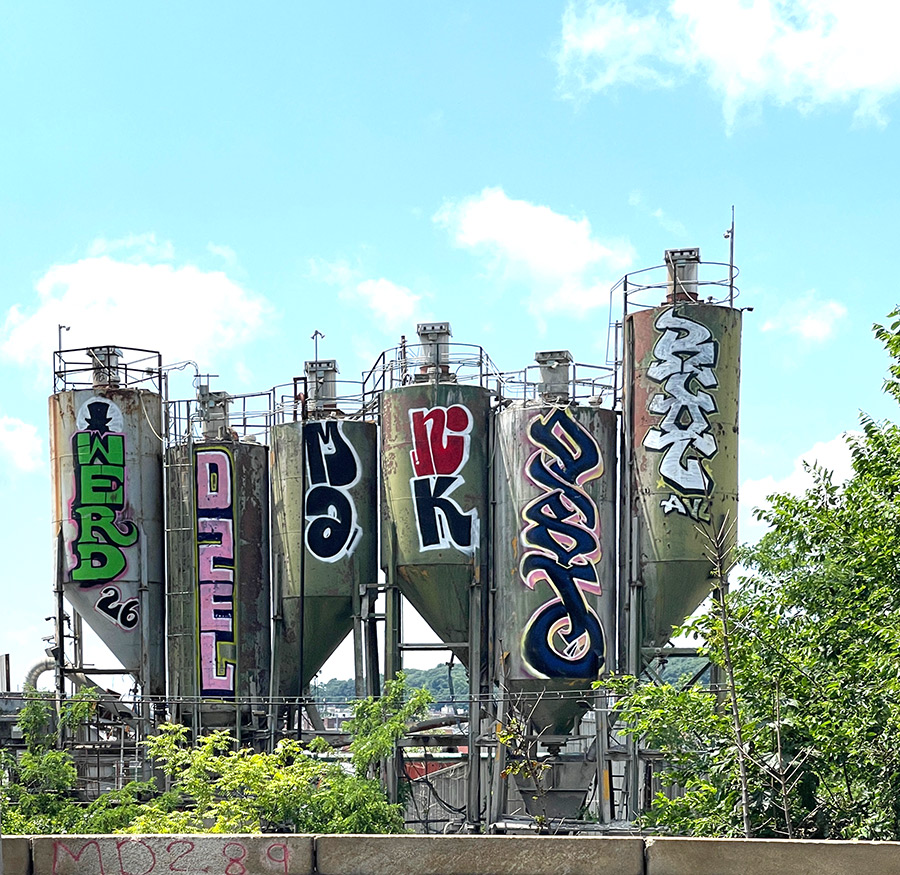
Here is our weekly interview with the street, this week featuring A Presidential Parody, Adam Dare, Bunny M., Captain Eyeliner, DZEL, EXR, Fer Suniga, HekTad, HOMESICK, MACK, Mario P, MR KING15, NO MORE WARS, RATCHI, SPAR, VES & Friends, and ZWONE.

NO MORE WARS. Unidentified artist. (photo © Jaime Rojo)
GAZA. Unidentified artist. (photo © Jaime Rojo)
Unidentified artist in the style of Hiero Veiga. Detail. (photo © Jaime Rojo)
Unidentified artist in the style of Hiero Veiga. (photo © Jaime Rojo)
Bunny M. Detail. Detail. (photo © Jaime Rojo)
Bunny M (photo © Jaime Rojo)
RATCHI (photo © Jaime Rojo)
HekTad. Adam Dare. (photo © Jaime Rojo)
Captain Eyeliner (photo © Jaime Rojo)
EXR. ZWONE. DZEL. (photo © Jaime Rojo)
VES & Friends. (photo © Jaime Rojo)
A Presidential Parody (photo © Jaime Rojo)
Fer Suniga (photo © Jaime Rojo)
HOMESICK (photo © Jaime Rojo)
Mario P. (photo © Jaime Rojo)
MR KING157. Detail. (photo © Jaime Rojo)
MR KING157 (photo © Jaime Rojo)
SPAR (photo © Jaime Rojo)
MACKS (photo © Jaime Rojo)
Untitled. Morning Glory. Summer 2025. (photo © Jaime Rojo)
Read more
The Endless River: Bartek Świątecki’s Olsztyn Current

The Endless River: Bartek Świątecki’s Olsztyn Current

As seasons turn in both hemispheres, one element binds them: water. Rivers, streams, and creeks carry our shared memory of motion—flowing, churning, glinting—and, as Whitman urged, “Flow on, river! flow with the flood-tide, and ebb with the ebb-tide!” In that spirit, Bartek Świątecki’s abstract color compositions read like water finding its course: geometry loosens into current, planes slip into eddies, edges catch light and blink it back to you.

Bartek Świątecki. The Endless River / Olsztyn / Poland / 2025. (photo © Arek Stankiewicz)

Świątecki, working from Olsztyn, Poland, brings this language to walls most often, but just as readily to a canvas planted in a cow field when the site calls for it. His newest piece, finished in September and titled “The Endless River,” extends that vocabulary across a hometown façade—color moving like a surface of water through the city.

Bartek Świątecki. The Endless River / Olsztyn / Poland / 2025. (photo © Arek Stankiewicz)

“I managed to finish a new wall in my hometown Olsztyn. I named it The Endless River / Olsztyn / Poland / 2025,” he says. The result is a clear invitation: stand at the bank, watch the composition flow, and let the city meet the river it suggests. And to end our swim, contemplate the rolling, gentle undulations of Philip Glass performing his “Opening.”

Bartek Świątecki. The Endless River / Olsztyn / Poland / 2025. (photo © Arek Stankiewicz)

Read more
When Street Art Goes Off-Trail: Sea162’s Earth-Pigmented Murals

When Street Art Goes Off-Trail: Sea162’s Earth-Pigmented Murals

When graffiti and street art lace up hiking boots and head into rural or fully natural settings, some feel conflicted about the potential harm to plants, soil, and water. Naturalists argue that human hands should leave no trace—certainly not one out of harmony with the site. In the built environment, on the other hand—cities, towns, suburbs, strip malls, fast-food restaurants, roller rinks, bowling alleys, factories, condos, lawyers’ offices, hospitals, laundromats—the conversation around street artists and graffiti writers tends to focus on property and real-estate value, less on our impact on the Earth.

SEA162 (photo © SEA162)

Sea162 (Alonso Murillo) is a Spanish graffiti/mural artist from the Madrid region, long associated with Collado Villalba north of the city. He began writing graffiti in the 1990s, later moving from classic graffiti into large-scale murals; his current approach merges graffiti know-how with site-responsive painting in natural or semi-natural settings.

He is known for a kind of “nature street art”: fauna and flora rendered on quarry faces, walls, and outdoor structures, frequently using earth-based pigments he gathered and developed from sites across Spain (including the Canary Islands). His compositions often integrate the rock’s relief to create volume, capitalizing on the site’s natural features.

SEA162 (photo © SEA162)

Sea162’s approach has led him down paths street-art fans don’t typically associate with the culture, yet his evolution feels organic—especially as he has developed a practice with natural pigments. He has competed in Spain’s Liga Nacional de Graffiti in multiple editions (2021–2024). This year the Museo Nacional de Ciencias Naturales (MNCN-CSIC, Madrid) presented his 90×7 m mural “Evolución,” made with natural pigments and accompanied by a museum display about its materials and process.

He has participated in Spanish and European street-art initiatives, including painting a wolf at an outdoor rock-art event in France and multiple municipal or regional projects in Spain. His 2023 mural “El Tritón Miguelón” on the circular La Palla irrigation pond in Garcibuey (Salamanca) was selected “Best Mural of the World – April 2023” by Street Art Cities.

SEA162 (photo © SEA162)

We asked Sea162 about his practice and this new installation:

Brooklyn Street Art: Can you tell us about the setting, the placement of the art? Is it a natural swimming “pool” somewhere in a forest?
SEA162: It’s an old stone quarry in the village where I live northwest of Madrid. It is inside the mountains.

BSA: The objects depicted on the mural appear to be seashells. What can you tell us about the different species of shells you painted on the rocks?
SEA162: It does look like seashells, but these are organic forms that connect with the forms of the rock in a free manner of expression.

BSA: You mentioned you used natural pigments collected from different places in Spain. What can you tell us about your process of collecting and making the pigments? Do you use plants, flowers, soil, and rocks?
SEA162: I usually use rocks and pigments made from minerals.

BSA: Can you describe your process of planning and selection when you paint in a natural environment?
SEA162: At the beginning, I try to find a way to connect with the place and the environment. After I select the location, I begin to work on the idea and its design

BSA: By using natural pigments, is it your intention for the artwork to be washed by rain and other natural elements?
SEA162: I find it essential to take care, to protect the environment and the work for the future, by natural, yet resistant materials.

SEA162 (photo © SEA162)


Read more
BSA Images Of The Week: 09.21.25

BSA Images Of The Week: 09.21.25

Welcome to BSA Images of the Week! Fall is here today, and summer’s crop of graffiti, street art, and murals has been a bounty in New York City this year. You’ll see it on your way to the park to lie under a tree.

This week’s news includes a $100K price tag slapped on H-1B visas, the Fed cutting rates before the economy keels over, D.C. squabbling like it’s auditioning for a shutdown reality show, Democrats re-thinking blank checks to Israel, and New York’s governor backing a socialist for mayor – just to keep things spicy.

All in all, America’s playing tug-of-war with itself, while New York shrugs, sprays another mural, and proves you can cram the whole world into one city block without it blowing up.

Here is our weekly interview with the street, this week featuring Allison Katz, Bikismo, Dattface, Hehuarucho, Joe Iurato, Low Poly, Manfo, Muck Rock, Sandman, and Shelby and Sandy.

Muck Rock. Detail. (photo © Jaime Rojo)
Muck Rock (photo © Jaime Rojo)
Joe Iurato. Detail. (photo © Jaime Rojo)
Joe Iurato (photo © Jaime Rojo)
Allison Katz. Don’t ASK. Detail. (photo © Jaime Rojo)
Allison Katz. Don’t ASK. (photo © Jaime Rojo)
Hehuarucho. Detail. (photo © Jaime Rojo)
Hehuarucho (photo © Jaime Rojo)
Sandman. Detail. (photo © Jaime Rojo)
Sandman (photo © Jaime Rojo)
Bikismo (photo © Jaime Rojo)
MUCK (photo © Jaime Rojo)
Mango (photo © Jaime Rojo)
Dahface (photo © Jaime Rojo)
Unidentified artist (photo © Jaime Rojo)
Low Poly (photo © Jaime Rojo)
Shelby and Sandy (photo © Jaime Rojo)
Untitled. Brooklyn, NY. Summer 2025. (photo © Jaime Rojo)
Read more
Biancoshock and Deep States, Stakes

Biancoshock and Deep States, Stakes

“A psychological atlas drawn on a crumbling wall”.

Sometimes the artist’s description of their project is all you need to know. In the daily battering of your brain by the oligarchal media machine, you question your own judgment and perception, and shift the blame down the food chain, instead of up where it belongs. No wonder you are in such a state.

Biancoshock. STATES. Somewhere in Italy. (photo © Biancoshock)

It’s nice to have Biancoshock back, after some time without news about him. He says he was lying low, but nonetheless, “I have more or less 50-60 unpublished projects.”

So here’s one, and if you see your brain in the mirror, it’s because the propaganda is raining so dang hard now. “The lands are arid surfaces, no longer capable of producing anything natural,” he tells us, “while all around, an Ocean of Pessimism engulfs everything.”

Biancoshock. STATES. Somewhere in Italy. (photo © Biancoshock)

An Italian (born 1982 in Milan) conceptual street artist, known for his ironic and provocative public art installations, Biancoshock keeps his identity hidden, as usual. He first cut his teeth in the graffiti scene in the mid-1990s, spending nearly a decade tagging walls and exploring the underground world of street writing. In 2004, he shifted gears and launched what he calls an “Urban Hacking” practice – treating the city itself as a canvas for witty interventions using everyday objects.

Biancoshock. STATES. Somewhere in Italy. (photo © Biancoshock)

Here, we see that the interventionist has also carried out his practice by hiking in the neglected urban landscape. Here we find his discussion about nation-states and psychological states is in full view, under deconstruction.

“The five continents outline a universe fragmented into smaller emotional states, coexisting and feeding off one another,” he says. “We are flooded with facts and images depicting a world in constant decline, often without realizing that what deteriorates the most, day by day, is our inner world.

This is my world, with its own states.”

Biancoshock. STATES. Somewhere in Italy. (photo © Biancoshock)
Read more
Beyond: Seth Globepainter and Millo Merge Worlds in Miami

Beyond: Seth Globepainter and Millo Merge Worlds in Miami

You have seen them separately in cities around the world; now see them combine their imaginations in Miami at Goldman Global Arts Gallery this fall. Street artists and muralists Seth Globepainter (Julien Malland) and Millo (Francesco Camillo Giorgino) have developed the vocabulary of their respective styles over more than two decades, each influenced by illustration, surrealism, and a graphic clarity that often feels close to animation or children’s storybooks.

Beyond. Millo and Seth. Goldman Global Arts Gallery. Wynwood, Miami. (photo © GGA Gallery)

The mystery of each scenario is painted there before you on multi-story buildings in major metropolitan areas. Still, no two are exactly alike, and each requires you to engage your imagination to complete the story. Perpetually on tour for commercial jobs, commissioned murals, or personal adventures, the Frenchman and the Italian say they have overlapped one another 18 times in the last decade, from Shanghai to Buenos Aires, and decided to formalize that long-running dialogue in this collaborative exhibition, “Beyond,” opening September 10, 2025.

Millo is at work for the exhibition. (photo © GGA Gallery)

A signature mural by Seth Globepainter depicts a child peering into a swirl of vibrant color, symbolizing the imagination that children — and former children — rely upon to explain the world or escape from it. Since beginning his global travels in 2003, Seth has drawn on local cultures, myths, and social realities everywhere he works, using the child as a messenger for the community’s stories. Steering clear of cynicism, his color-rich characters remain hopeful, even amid the most difficult social or political contexts. Millo, by contrast, renders entire cityscapes in crisp black and white, often anchored by a playful giant figure who might be a child or perhaps someone who has refused to grow up. His architecture, grounded in his training as an architect, becomes a stage for adventure, where urban density is made approachable, even humorous, by oversized, childlike explorers.

Seth is at work for the exhibition. (photo © GGA Gallery)

Together, their collaboration in Miami shows how cleanly and boldly the two vocabularies can work in unison. Seth’s dreamlike reveries and Millo’s urban dreamscapes click together in colorful/black-and-white precision, amplifying one another’s humor, tenderness, and sense of scale. Beyond the novelty of seeing two internationally recognized muralists merge their visual languages, the show also speaks to the friendships and connections formed through years of painting walls around the globe — a reminder that, in a scene as transient as street art, some conversations endure.

Beyond. Millo and Seth. Goldman Global Arts Gallery. Wynwood, Miami. (photo © GGA Gallery)
Beyond. Millo and Seth. Goldman Global Arts Gallery. Wynwood, Miami. (photo © Millo)
Beyond. Millo and Seth. Goldman Global Arts Gallery. Wynwood, Miami. (photo © Seth)
Beyond. Millo and Seth. Goldman Global Arts Gallery. Wynwood, Miami. (photo © Millo)
Beyond. Millo and Seth. Goldman Global Arts Gallery. Wynwood, Miami. (photo © Seth)
Seth. Beyond. Millo and Seth. Goldman Global Arts Gallery. Wynwood, Miami. (photo © GGA Gallery)
Millo. Beyond. Millo and Seth. Goldman Global Arts Gallery. Wynwood, Miami. (photo © GGA Gallery)
From left to right: Seth, Jessica Goldman Srebnick, and Millo. Beyond. Millo and Seth. Goldman Global Arts Gallery. Wynwood, Miami. (photo © GGA Gallery)

Exhibition

Beyond. Millo and Seth
Goldman Global Arts Gallery, Wynwood Walls, Miami
On view through November 16th, 2025
GGA Gallery at Wynwood Walls
266 NW 26th Street
Miami, FL 33127
Gallery Hours
Monday – Sunday: 10:30 AM – 6:30 PM

Read more
BSA Images Of The Week: 09.14.25

BSA Images Of The Week: 09.14.25

Welcome to BSA Images of the Week! New York’s streets are in overdrive—diplomats and protesters jostle around the UN, teens climb a tree outside a storefront to chase FakeMink’s latest haircut on the Bowery, fans mob Cardi B as she perches on an SUV outside a deli in the Bronx, throngs pour through the 99th San Gennaro Festival in Little Italy, and a sudden storm of black-windowed SUVs swarms with cameras at the Soho Grand—just as a double-decker tour bus lumbers onto the block, because of course it does. You skip the spectacle, grab a sour pickle from the Pickle Guys on Grand Street, and pedal home on your e-bike to the cat.

Re: the latest sniper shooting in the US that tears hearts and inflames passions; Fox News says, ‘America is divided and headed for civil war.’ What they should admit is, ‘We’ve spent 25 years programming division—and now we’re congratulating ourselves for the results. Pay no attention to the man behind the curtain.’

The sun is warm and bright, like that fateful New York day 24 years ago. It’s a shame that a generation of New Yorkers has grown up since then, and there is more war than ever.

At least we still have bodegas open at 3 a.m., subway preachers who bark and yelp, and the Mets breaking our hearts! Aaron Judge and the Yankees are still keeping the World Series on the perennial wish-list.

Oh yes, and Anna Wintour is leaving Vogue. For some, that will feel like the end of an era. Others will ask, “Anna who?”

On our weekly interview with the street, we feature new stuff from De Grupo, Divock Okoth Origi, Eternal Possessions, Faile, Fumero, ICU463, IMK, Neko, Ollin, Turtle Caps, and ZamArt.

IMK. Detail. (photo © Jaime Rojo)
IMK (photo © Jaime Rojo)
Unidentified artist (photo © Jaime Rojo)
Zamart for the L.I.S.A. Project NYC. (photo © Jaime Rojo)
OLLIN NYC (photo © Jaime Rojo)
TurtleCaps (photo © Jaime Rojo)
ICU463 (photo © Jaime Rojo)
Unidentified artist. (photo © Jaime Rojo)
Unidentified artist. Detail. (photo © Jaime Rojo)
Fumero (photo © Jaime Rojo)
FAILE. Detail. (photo © Jaime Rojo)
FAILE (photo © Jaime Rojo)
TARA (photo © Jaime Rojo)
NEKO (photo © Jaime Rojo)
Unidentified artist (photo © Jaime Rojo)
Degrupo (photo © Jaime Rojo)
Eternal Possessions (photo © Jaime Rojo)
Untitled. Hudson River, NY. Summer 2025. (photo © Jaime Rojo)
Read more
Borrowed Images, New Stories: FKDL at Galerie Taglialatella

Borrowed Images, New Stories: FKDL at Galerie Taglialatella

FKDL, “Figures of Style”, September 5 – October 4, 2025

French street artist and studio artist Franck Duval, better known as FKDL, has always approached the street with a different set of tools. Where most writers leaned on spray paint and stencils, he built images out of fragments—magazine clippings, advertising spreads, press photos—that carried the ghosts of another time. He collects, trims, and reassembles, distilling hours of scavenging into figures that shimmer with nostalgia and aspiration. These are stories you may recognize, yet they arrive altered, re-framed, and suddenly more mysterious. Stumbled upon in the street, they create a fleeting jolt of recognition; encountered in the gallery, they unfold into enveloping icons, polished until they appear almost too pristine to be real.

FKDL at his studio. (photo © FKDL)

In his new exhibition Figures of Style at Galerie Taglialatella (September 5 – October 4, Paris), FKDL sharpens his vocabulary again. This time, the discarded pages of books—the blanks, the forgotten openings and endings—become fertile ground for his heroines. Onto these silent surfaces, he layers the saturated clippings of his archive, introducing simplified backdrops for women who feel both familiar and freshly conjured. They gaze back, figures carrying their own authority, commanding you to meet them on equal terms. Their presence is not quite nostalgic nor decorative: it’s assertive, charged, animated.

FKDL. Figures of Style. Setting up for the exhibition. Galerie Taglialatella. Paris, France. (photo © FKDL)

The daydream is cinematic and literary. FKDL’s compositions function like visual rhetoric, drawing on metaphor, image, and allegory. A hemline can suggest an entire character; a posture can signal resilience or restraint. He treats the female figure not as a symbol to be consumed but as a protagonist who shapes the narrative. At the same time, he broadens his scope to another love —introducing images of automobiles; dreamlike vessels of freedom and speed, their abstraction hinting at motion and desire rather than horsepower.

What separates FKDL from the familiar grammar of street art is his re-invention, his devotion to his archive as much as to the wall. His romance with the popular culture of another era elevates it into something aspirational, iconic, and just out of reach. By trusting the image to lead, FKDL creates art that sits between collective memory and personal imagination. The canvases of Figures of Style carry that duality: clean, singular, and mysterious—icons that seem to step forward from silence, asking to be remembered.

FKDL. Figures of Style. Setting up for the exhibition. Galerie Taglialatella. Paris, France. (photo © FKDL)
FKDL. Figures of Style. Galerie Taglialatella. Paris, France. (photo © FKDL)
FKDL. “One Way”. Figures of Style. Galerie Taglialatella. Paris, France. (photo © FKDL)
FKDL. “El Dorado”. Figures of Style. Galerie Taglialatella. Paris, France. (photo © FKDL)
FKDL. “La Doceour”. Figures of Style. Galerie Taglialatella. Paris, France. (photo © FKDL)
FKDL. “Rita Hayworth, la diosa del amor”. Figures of Style. Galerie Taglialatella. Paris, France. (photo © FKDL)

Galerie Taglialatella

FKDL

« Figures of Style »

September 05 to October 04

2 Pl. Farhat Hached, 75013 Paris

Read more
Downtown Alternatives: 1980s Art in 3 Short Videos

Downtown Alternatives: 1980s Art in 3 Short Videos

Marc H. Miller is the kind of New Yorker who knows how to save the scraps. Posters, flyers, zines, and announcement cards that most people folded into back pockets and forgot — Miller kept them. Out of those boxes came Gallery 98, a living archive of downtown’s unruly art history, told through the paper that passed hand to hand.

The period that is most alive in this collection spans from the 1970s into the 1990s, when the city was both falling apart and brimming with invention. Cheap rents and abandoned buildings drew in art school kids, squatters, and the first waves of graffiti writers moving beyond the train yards. You see Blade, Lee, Daze, Crash, Lady Pink, LA II — writers who set the pace before names like Haring and Hambleton followed with their own vocabularies on the street.

Blade: From Subway Trains to International Galleries. Via Gallery 98. (image screenshot from the video)

The streets and clubs were full of crossings: drag performers, punks, hip-hop DJs, and young artists finding each other downtown. Groups like Colab squatted buildings and staged wild exhibitions; ABC No Rio opened as an outpost for confrontation and community. Ephemera from those nights — an invite, a Xeroxed flyer — is what Gallery 98 specializes in, proof that the most disposable things sometimes carry the longest shadows.

L.E.S. Sculpture Garden 1985. Via Gallery 98. (image screenshot from the video)

By the 1990s, the energy pushed into new corners. Ad Hoc Gallery, Skewville, Bast, Shepard Fairey — the next wave of artists who kept the mix alive, printing, pasting, and staging in ways that bent art back toward the street even as it was pulled into galleries. Gallery 98 carries these moments forward too, charting how one generation’s walls became another’s starting point.

Miller’s project isn’t nostalgic so much as archival. It’s about memory, about how the downtown scene keeps resurfacing through its paper trail. Some get nervous seeing counterculture artifacts priced and sold — but without this kind of attention, much of it would be lost entirely. Gallery 98 reminds us that history is often fragile, and sometimes the only way to keep it is to hold onto what was once throwaway.

Here are a few new clips that work both as a lesson and a showcase. All videos: written, edited, and narrated by Cole Berry-Miller. Text in quotes by Marc H. Miller

BLADE the Legend

“The rise of graffiti in the 1970s and 80s radically challenged many aspects of the mainstream art world. Blade (Steven Ogburn) was an early pioneer whose innate sense of color, scale and design earned him international recognition. Much of the material used in this video comes from a large collection of Blade material that Gallery 98 recently acquired from his longtime Bronx friend, Ronnie Glazer. “

Blade: From Subway Trains to International Galleries. Via Gallery 98. (image screenshot from the video)

L.E.S. Sculpture Garden 1985. Via Gallery 98. (image screenshot from the video)

Rivington School Sculpture Garden: Making Art Out of Junk Metal Found on The Street, 1985 – 1987

“In 1985, sculptors hanging out at No Se No, a Lower East Side artist-run bar, began using an adjacent empty lot to create a bizarre sculpture garden made up of pieces of junk metal found on the streets. The city would soon demolish its work, but it has lived on in photographs by Toyo Tsuchiya (1948 – 2017), who, in the year before he unexpectedly died, collaborated with Gallery 98 in creating a portfolio tracing the garden’s history.”

L.E.S. Sculpture Garden 1985. Via Gallery 98. (image screenshot from the video)

Breaking Into an Abandoned City-Owned Building to Mount an Exhibition About Real Estate, 1980


“When the artist group Colab wanted to present an exhibition about real estate abuses, they decided that the best way to get attention was to break into an empty city-owned building and mount it there. The exhibition was quickly shut down, but in a surprising twist, the Real Estate Show gave birth to the alternative art space ABC No Rio Dinero, which continues to thrive 45 years later.”

COLAB. Illegal Real Estate Show. Manhattan, NYC. 1980. Via Gallery98. (image screenshot from the video)
Read more
BSA Images Of The Week: 09.07.25

BSA Images Of The Week: 09.07.25

What kind of monopoly money do you need to offer your CEO $ 1 trillion to incentivize him to stay? What power does an everyday person have in the face of such wealth? The national minimum wage, not updated since 2009, is $7.25 an hour. How stable can you expect the economy to be when a family’s two-month grocery bills are equivalent to one day’s yacht parking bill for others?

For Mr. and Ms. Everyday, there is a feeling of being financially trapped, with no relief in sight. Remember the Princeton study from a decade ago that stated average people have almost no voice in making change?

“The preferences of the average American appear to have only a minuscule, near-zero, statistically non-significant impact upon public policy.” (Read the full PDF here.)

Street artists often aim their spray cans at social and political fault lines, wielding invective and knife-sharp wit. Yet this week’s BSA interview with a pair of artists questions whether today’s practitioners still have the conviction to confront society’s social and economic ills. “One of the things I was playing with was the overly positive, banal affirmation-type quotes you see in a lot of street art,” says artist Alex Itin. “I see the country in a dangerous place, and positive bromides are not as important as anger and cogent analysis of our present state. So I wanted a bit of salt and burn… while still being funny.”

If the Princeton study still holds—and it does—then maybe it makes sense that artists confront this swilling morass of a kleptocracy and turn walls into soapboxes. After all, when billionaires and hedge funds treat your society like a yard sale and Congress keeps playing cashier, we could at least point out the absurdity. A stencil or mural won’t topple the problem, but it can cut through the haze, sharpen the joke, and remind us that resistance still has a voice—even if it has to shout from a brick wall.

This week, we have a lot of new stuff, particularly in the graffiti vein, from the Boone Avenue Festival in the Bronx a few weeks ago. Boone Avenue Walls is an artist-led, community-rooted street art festival in the Bronx, founded by renowned graffiti writer WEN C.O.D.. Organized by the Boone Avenue Walls Foundation, the event features large-scale murals and public art installations. Local and international artists are invited to paint in neighborhoods such as West Farms, Mott Haven, Foxhurst, and Hunts Point—often directly reflecting local pride and cultural touchstones of resilience and creativity. Many of these refer to music stars and reflect our fascination with celebrity. Some of these pieces were under production when we stopped by, while others were so fresh that you could still smell the fresh paint.

On our weekly interview with the street, we feature AESOP ONE, Albertus Joseph, Busta Art, Call Her Al, El Souls, EWAD, MELON, Miki Mu, NEO, Pazzesco Art, Persue, Pyramid Guy, Sue Works and Tony Sjoman.

Pazzesco. Detail. Boone Avenue Walls Festival (photo © Jaime Rojo)
Pazzesco. Boone Avenue Walls Festival (photo © Jaime Rojo)
Busta Art. Detail. Boone Avenue Walls Festival (photo © Jaime Rojo)
Busta Art. Boone Avenue Walls Festival (photo © Jaime Rojo)
Call Her Al. Boone Avenue Walls Festival (photo © Jaime Rojo)
Ales Del Pincel. Boone Avenue Walls Festival (photo © Jaime Rojo)
Unidentified artist (photo © Jaime Rojo)
Wagner Wagz. Detail. Boone Avenue Walls Festival (photo © Jaime Rojo)
EL SOULS. Boone Avenue Walls Festival (photo © Jaime Rojo)
Morazul. Detail. Boone Avenue Walls Festival (photo © Jaime Rojo)
Morazul. Below Key. Boone Avenue Walls Festival (photo © Jaime Rojo)
EWAD. Boone Avenue Walls Festival (photo © Jaime Rojo)
Miki Mu. Boone Avenue Walls Festival (photo © Jaime Rojo)
SUE WORKS, AESOP ONE. NEO. Detail. Boone Avenue Walls Festival (photo © Jaime Rojo)
SUE WORKS, AESOP ONE. NEO. Boone Avenue Walls Festival (photo © Jaime Rojo)
NOTICE. DZEL. (photo © Jaime Rojo)
Tony Sjoman. Detail. Boone Avenue Walls Festival (photo © Jaime Rojo)
Tony Sjoman. Boone Avenue Walls Festival (photo © Jaime Rojo)
Pyramid Guy. Boone Avenue Walls Festival (photo © Jaime Rojo)
PERSUE. Boone Avenue Walls Festival (photo © Jaime Rojo)
MELON. Boone Avenue Walls Festival (photo © Jaime Rojo)
Albertus Joseph and a new Cardi B portrait. “Am I the Drama?” she may ask. Detail. Boone Avenue Walls Festival (photo © Jaime Rojo)
Albertus Joseph. Detail. Boone Avenue Walls Festival (photo © Jaime Rojo)
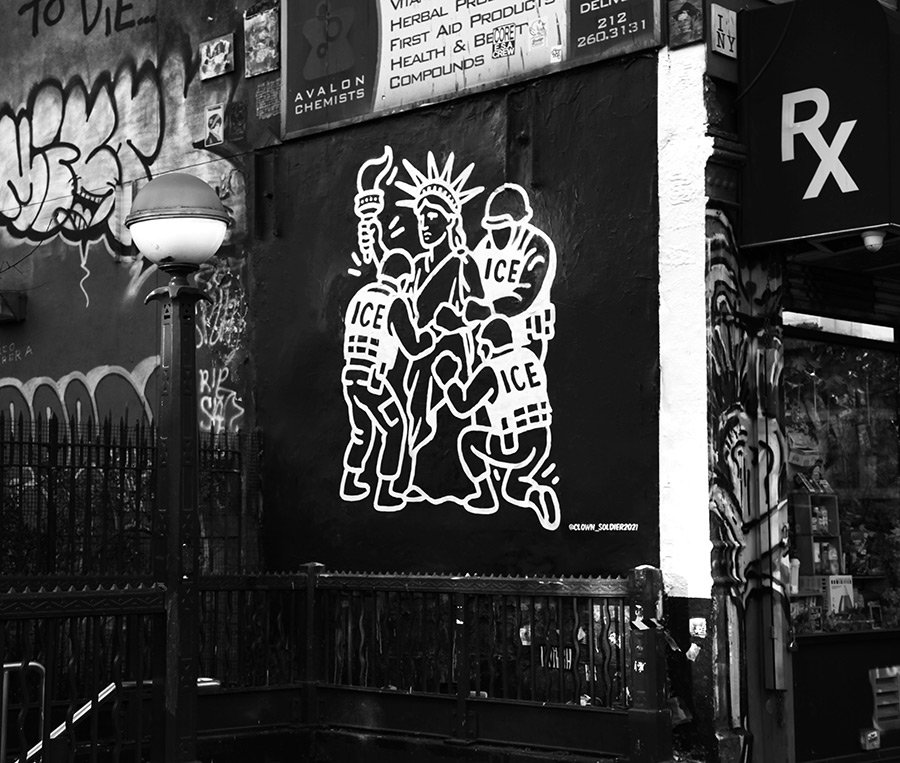
Liberty sweating ICE. Unidentified artist. Detail. Boone Avenue Walls Festival (photo © Jaime Rojo)
Unidentified artist. Detail. Boone Avenue Walls Festival (photo © Jaime Rojo)
Untitled. Summer 2025. Albany, NY. (photo © Jaime Rojo)
Read more
Alex Itin & Rene Lerude In the Streets: Contrarians, Punchlines, and Miles Davis

Alex Itin & Rene Lerude In the Streets: Contrarians, Punchlines, and Miles Davis

Rene Lerude & Alex Itin aren’t populists chasing the lowest common denominator with their hand-rendered one-off posters and stickers. As street artists, you might call them intellectual pranksters: observers who like their wisdom salted with cynicism, their philosophy dressed in humor, and their politics wrapped in that oily fish paper called irony. Look at the company they keep — literary heavyweights, satirists, philosophers, and contrarians. Instead of quoting hip-hop pioneers, political activists, or contemporary street philosophers, they platform Wilde, Bierce, Carlin, Vidal, and Burroughs onto that empty boarded-up lot you just trudged past.

Alex Itin. Rene Lerude. (photo © Jaime Rojo)

Their words are colorfully tinted weapons, cutting through hypocrisy and mocking social pretensions. Their figures are caricature, maudlin, murky, and nearly masterfully messy. The style and understatement are of the moment, yet it carries a timeless skepticism — a stoic philosophy rooted in reason, rationality, and inquiry.

Popping up on the street often enough to grab your attention, the bards and seers they quote give you a good sense of where their heads are at: Oscar Wilde, Seneca, James Joyce, Junot Díaz, Laurence J. Peter, William S. Burroughs, T.H. Huxley, Francis Bacon, Ambrose Bierce, Gore Vidal, and George Carlin. It’s a crew of contrarians, cynics, and truth-tellers — a reminder that Rene & Alex are carrying these voices into the street not as decoration, but as conversation starters, provocations, and the occasional punchline.

Alex Itin. Rene Lerude. (photo © Jaime Rojo)

Naturally, we had to talk with them, to see how they plug into the current street art scene and the fiercely independent energy of the artist-directed 17 Frost Gallery in Brooklyn that has been mounting shows by various curators over the last decade or more. That space has had more lives than a stray cat — raw, investigatory, and, when you least expect it, collaborative in a magpie sort of way. Are all the real artists today disillusioned, disgusted and absurdly darkly funny? Maybe. Or maybe every generation of free-thinkers has simply been awake, willing to poke at sore spots, willing to question conventional wisdom. With language that performs as much as it provokes, Rene & Alex show a respect for the long arc of human thought — always filtered through the grin of a trickster.

Alex Itin. Rene Lerude. (photo © Jaime Rojo)

Brooklyn Street Art: When did you decide to collaborate with your art?
RENE: I started making stickers to put up in bars relating to alcohol, amusing insights, quips, etc. This was around 2016. I ran out of good ones fairly quickly, so this just opened up to any topic I found interesting. Originally, these were just markers on the white stickers. I then decided to make backgrounds that looked like surfaces I was working on — paint-splattered and marked from years of use. Essentially, an abstract mess. One late evening at the Frost Gallery, Alex saw a bunch which had room under the text and went to town. That was that.

ALEX: While curating at 17 Frost Gallery, I became inspired by the open-mic Sundays we were running that attracted mostly musicians and stand-up comedians, and the odd poet. I wondered if you could do a similar thing with visual artists, street artists, and graf people. We started doing Tuesday sticker nights. One could work on any media, but the sticker game was the unifying concept: low cost, popular, public, and open for low-stakes creative collaboration… but mostly it was an excuse to hang out and meet lots of like-minded artists.

One of the things I always like to talk with artists about is money — how to make it, keep it, shake it out of trees, etc. It’s an interesting thing as a bill is about the size of a sticker. Surviving as an artist is brutal stuff, so educating yourself and your community about legal and financial questions is just good practice.

Alex Itin. Rene Lerude. (photo © Jaime Rojo)

“One of the things I always like to talk with artists about is money — how to make it, keep it, shake it out of trees, etc. Surviving as an artist is brutal stuff, so educating yourself and your community about legal and financial questions is just good practice.” — Alex

In one such conversation, I was ranting about music, copyright laws, and how people in a band get or don’t get paid. I said something like Miles Davis got paid, the band usually didn’t (unless they brought the song with them). And I think I pretended to be an angry bassist ranting about Miles. A friend walked in the door and announced with great authority that Miles Davis owes him money. That joke sort of stuck and Rene wrote down the quote, and I drew a trumpet. For a while, it was just “Miles Davis owes me money,” signed by any of his many collaborators. Eventually, we started looking for other quotes.

BSA: What’s your collaboration process? Do you pass the artwork back and forth, or do you work on it together in the studio?
RENE: I start the process by producing a couple of hundred stickers and posters from newsprint. Then comes the lengthy task of going through one of dozens of aphorism books and writing them all out. I pass this on to Alex and wait. He gives them back to me, I archive them, then we split them amongst ourselves.

Alex Itin. Rene Lerude. (photo © Jaime Rojo)

“I see the country in a dangerous place, and positive bromides are not as important as anger and cogent analysis of our present state. So I wanted a bit of salt and burn… while still being funny.” — Alex

ALEX: The first collaborations were done together at 17 Frost, but eventually we were passing them back and forth in envelopes, often between London and New York.

BSA: How do you choose the spots in the street to place the final work?
RENE: If it’s a sticker, somewhere in the cut where it won’t get taken over, but still in decent reading distance. Posters just anywhere that might rock a while.

ALEX: Placement is for me just part of putting up stickers. It’s usually a walk and improvised art installation. I try to hug up to artists I like or to try and interact with text or image. Rene hangs most of the posters, so I’m not sure how he chooses spots for those.

Alex Itin. Rene Lerude. (photo © Jaime Rojo)

BSA: Alex, do you draw the characters before or after the words are given to you by Words on the Street?
ALEX: Rene usually does the background and text, and I work into that.

BSA: Are the characters based on real humans? Are they portraits of people you know or see in public space?
ALEX: Some of the drawings are just cartoons with broad archetypes, but also there are a lot of portraits of the various quoted people. These are drawn from photos — a thing I never do in my own studio practice. There are also a lot of Trump portraits.

BSA: Rene, you use quotes from famous people, politicians, and literature. Do you sometimes write your own thoughts and use them in collaboration with Alex?
RENE: I have done a few myself, though I’ll check to make sure it hasn’t been said before — in as much as you can. Alex does more frequently than me, so we have done quite a few of those over the years.

ALEX: I have written a few quotes attributed to -itin. “Branding is for cattle” is a favorite.

Alex Itin. Rene Lerude. (photo © Jaime Rojo)

BSA: Many times the messages and drawings are funny, salty, biting, and poignant. Is it hard to keep a balance when doing the art? Do you even think about keeping a balance?
ALEX: One of the things I was playing with was the overly positive, banal affirmation-type quotes you see in a lot of street art. I see the country in a dangerous place, and positive bromides are not as important as anger and cogent analysis of our present state. So I wanted a bit of salt and burn… while still being funny.

BSA: The current political atmosphere must be a bonanza for your creativity and productivity in your art. Do you feel overwhelmed by the dangerous path the country is going? If you feel angry at the current administration’s actions and policies, do you use your art to channel the anger?
RENE: Oddly enough I haven’t made any new posters or stickers in a couple years. Most quotes worth their salt are in some way timeless — vernacular can be different, but the sentiments always come to relevancy as time passes. That said, it’s come to a point where more of them are becoming relentlessly applicable as the weeks and months pass.

ALEX: The second term has created a quandary. I got okay at doing Trump, but I just don’t want to see his face or give any more attention to that narcissist. So it’s a quandary.

Alex Ititn. Rene Lerude. (photo © Jaime Rojo)


Read more
Marina Capdevila Paints “Forever Gold: The Glorious Age” in Pforzheim

Marina Capdevila Paints “Forever Gold: The Glorious Age” in Pforzheim

Beauty and relevance are often measured by youth; street artist/muralist Marina Capdevila flips the script with humor, intelligence, empathy, and her own style of caricature. From Falset to Barcelona to walls across continents, her work has always carried a certain irreverence toward cultural clichés, replacing them with something both slyly funny and disarmingly affectionate. In “Forever Gold: The Glorious Age,” she brings that sensibility to Pforzheim, a city with a long history of craft and refinement, transforming its legacy of jewelry and watchmaking into a meditation on age, resilience, and the sparkling currency of a lived experience.

Marina Capdevila. Forever Gold: The Glorious Age. Pforzheim, Germany. (photo courtesy of the artist)

Capdevila has built her reputation by making elders her heroes—those often overlooked in many Western cultures. Here, two older women share a private, playful moment: one fastening earrings onto another, their laughter and conspiratorial glances are charged with dignity and warmth. It’s an image that appears deceptively simple but operates on multiple levels. A gesture of care. A nod to adornment as ritual. A reclamation of style and vitality that refuses invisibility. In Capdevila’s hands, it becomes both portrait and proclamation.

The mural settles into Pforzheim’s streetscape not as an ornament but as a conversation with history. Gold, the city’s calling card, is reimagined not as metal but as metaphor—character, wisdom, a glow that will not dim. Like the best of public art, Forever Gold speaks to its place while widening its lens.
Marina Capdevila. Forever Gold: The Glorious Age. Pforzheim, Germany. (photo courtesy of the artist)
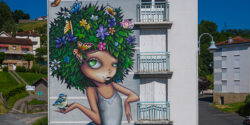
Capdevila’s humor keeps the piece buoyant; her palette keeps it alive. People are people, wherever you are. Beneath the surface wit, there is a serious critique of our collective assumptions about beauty, femininity, and time. In celebrating aging not as decline but as an ascendant force, she joins a lineage of muralists who transform city walls into stages for new myths. And in Pforzheim, her protagonists gleam as vivid, indispensable figures of the now.

Marina Capdevila. Forever Gold: The Glorious Age. Pforzheim, Germany. (photo courtesy of the artist)
Read more