BSA Film Friday 04.03.15 – SPECIAL “Persons of Interest” Videos Debut

BSA Film Friday 04.03.15 – SPECIAL “Persons of Interest” Videos Debut

Brooklyn-Street-Art-Film-Friday-040315-Persons-Interest

bsa-film-friday-JAN-2015

Our weekly focus on the moving image and art in the streets. And other oddities.

Now screening :

1. BSA PM/7 “Persons Of Interest” Documentation by Dario Jurilli, Urban Nation, Berlin.

SONG:
“Pipedream“ feat. Tok Tok by PARASITE SINGLE

2. Urban Nation Berlin and BSA: PM/7 “Persons Of Interest” by Talking Projects


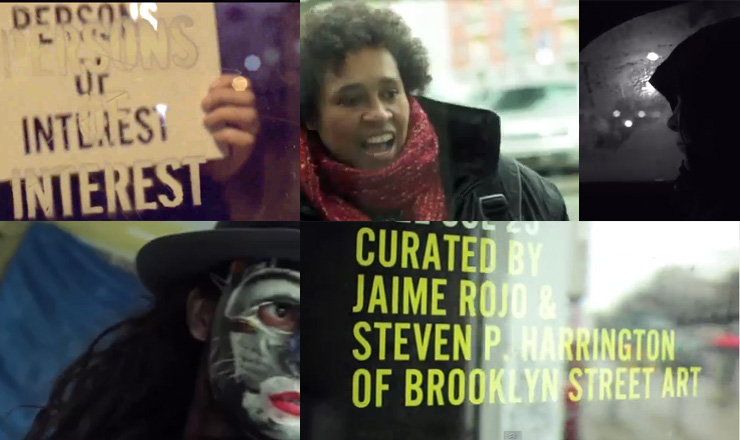
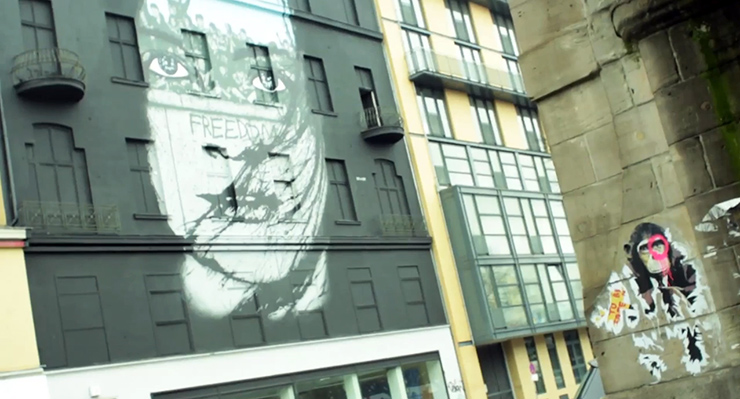
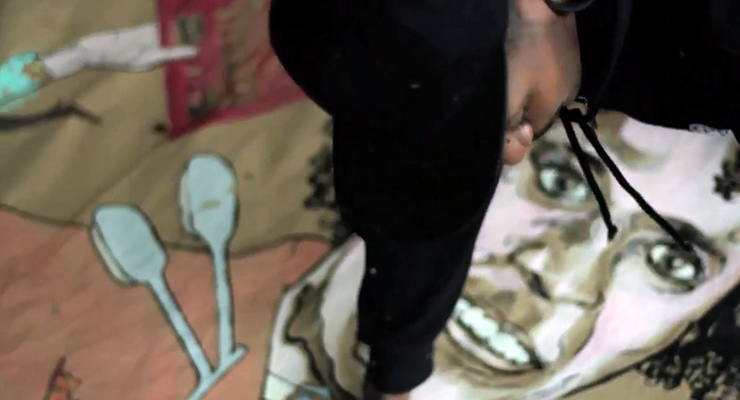
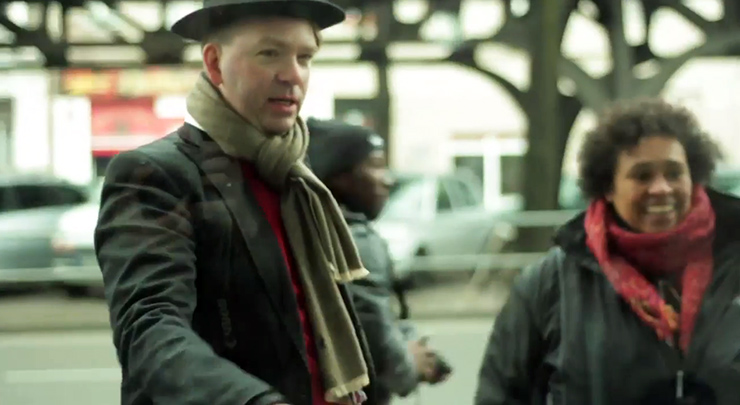
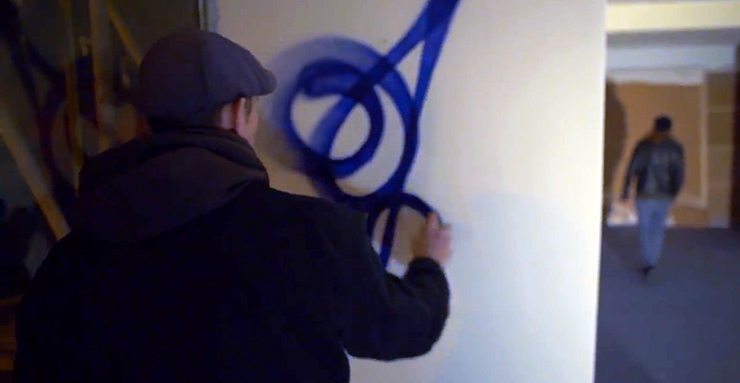
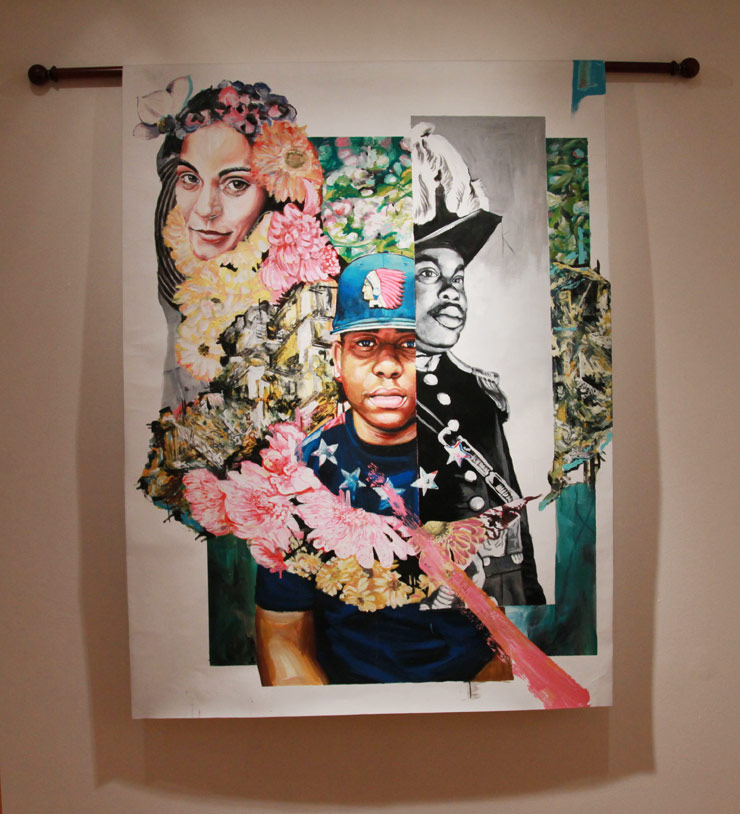
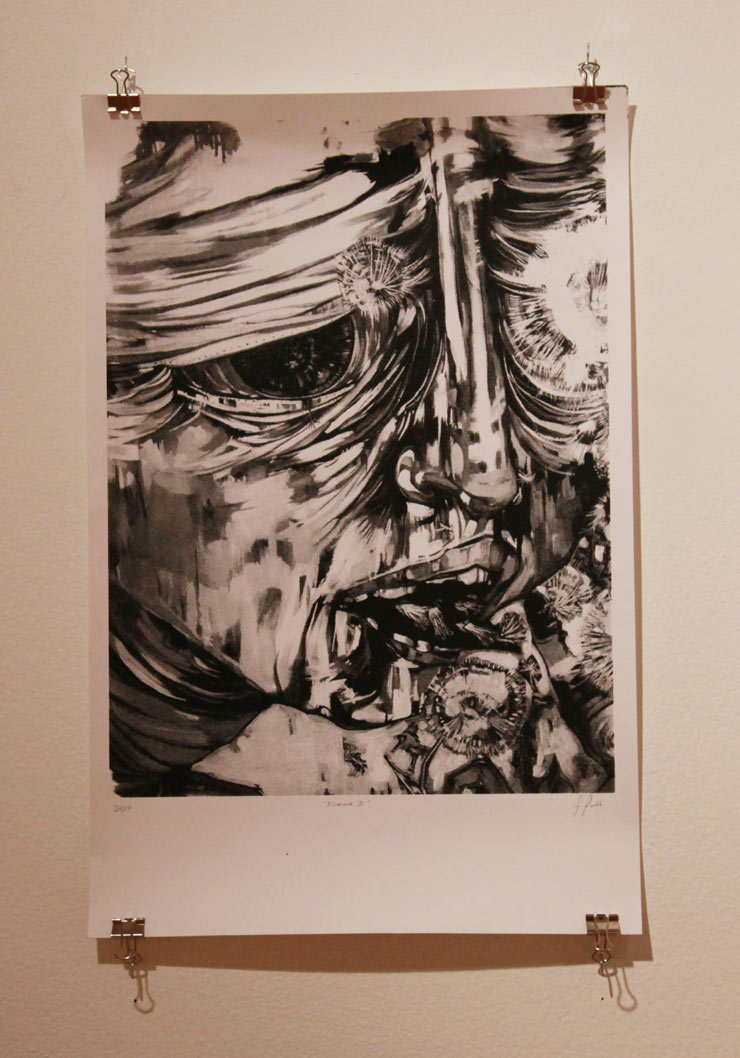
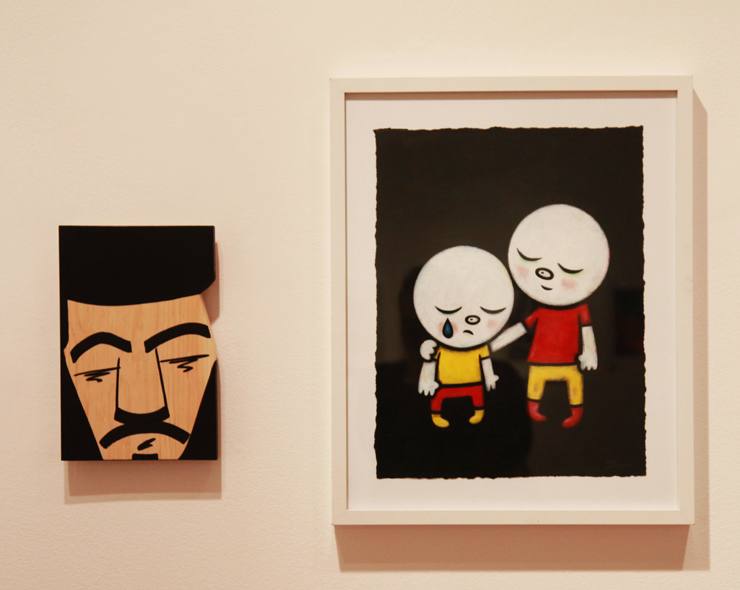
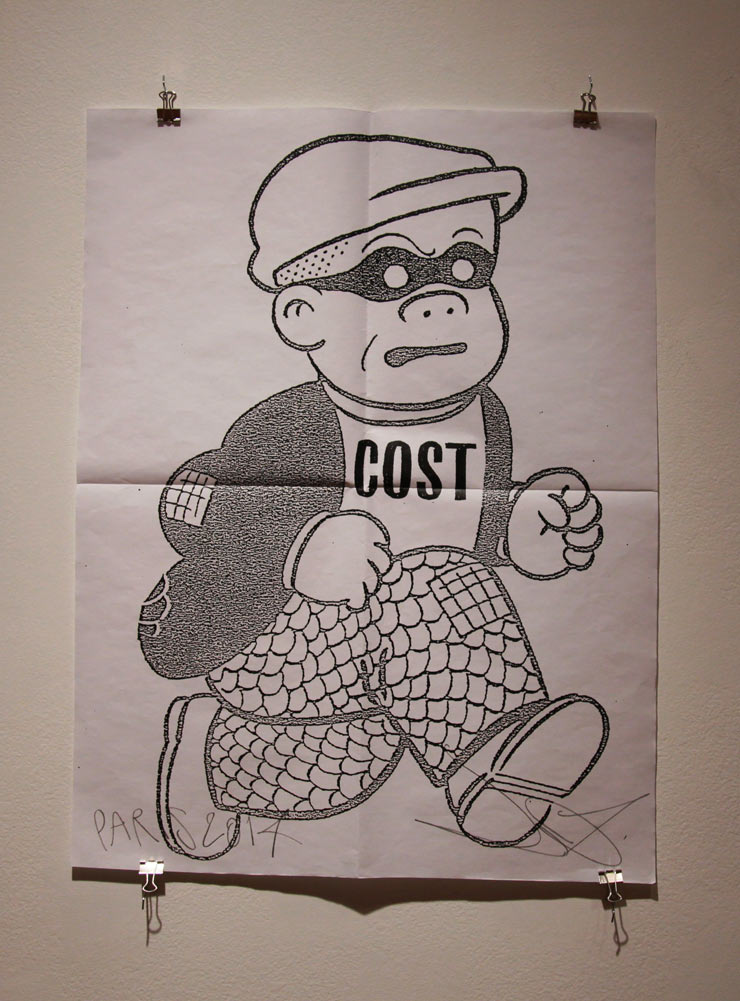
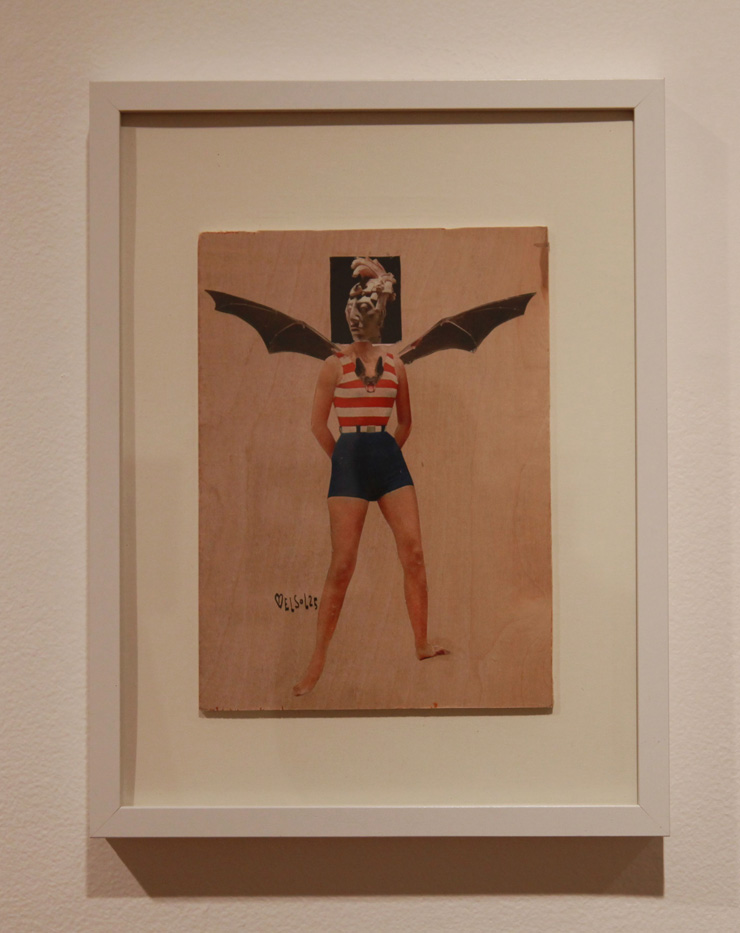
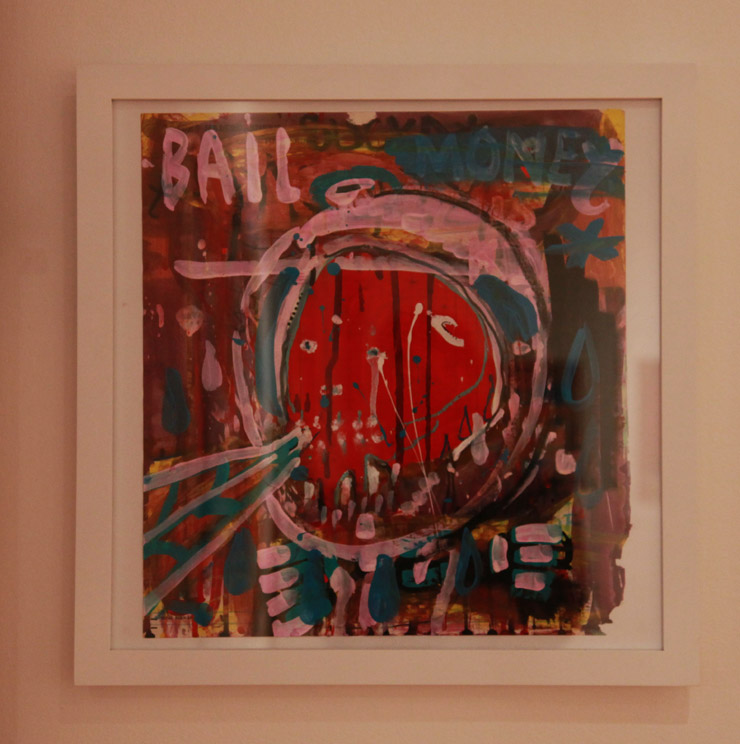
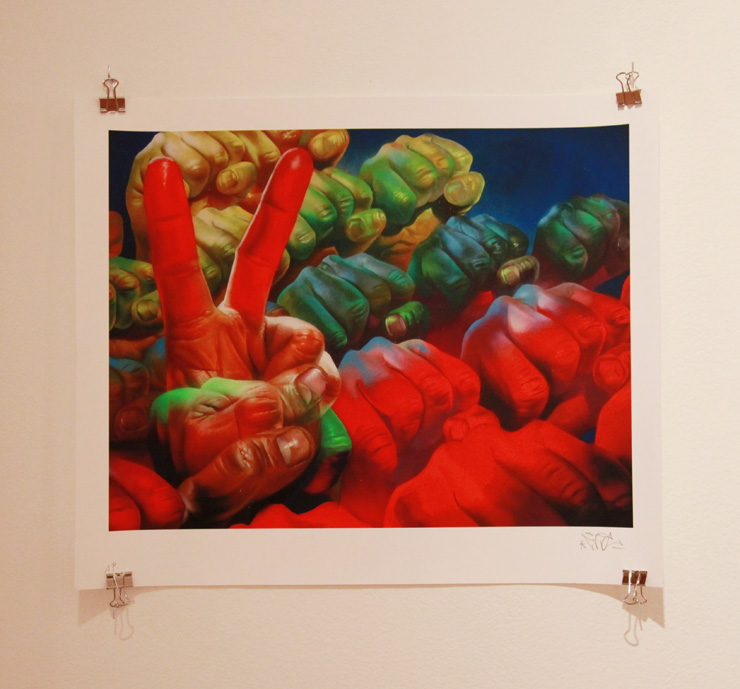
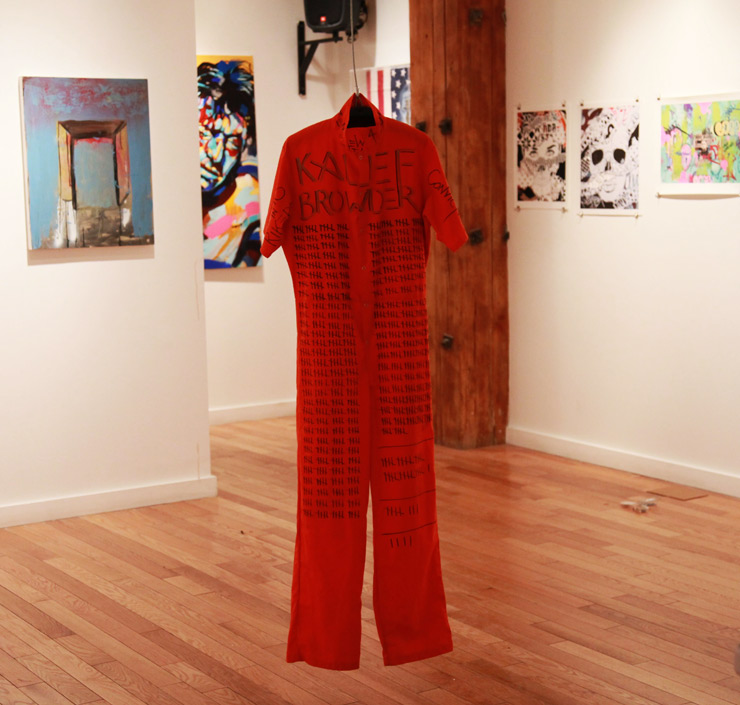
Today we debut two videos on BSA Film Friday that have just been released in support of PERSONS OF INTEREST, our curated program for Urban Nation last month in Berlin. The Project M/7 was all about honoring the practice of cultural exchange between the borough of Brooklyn and the City of Berlin.

Brooklyn-Street-Art-Video-Still-UN-Persons-Of-Interest-Berlin-6Brooklyn-Street-Art-Video-Still-UN-Persons-Of-Interest-Berlin-7Brooklyn-Street-Art-Video-Still-UN-Persons-Of-Interest-Berlin-13

Artists from both cities have been collaborating and influencing each other for years and we were honored to work with such a talented and varied group of Brooklyn-based artists who each came at the project from very different perspectives. We follow a philosophy that says “honor the creative spirit in each person” first and great amazing things will follow.

Brooklyn-Street-Art-Video-Still-UN-Persons-Of-Interest-Berlin-8

While it is challenging the structures that have codified art through centuries, we deeply regard the art that took root on the streets as democratic and idiosyncratic and as something that is given to all of us. This movement doesn’t necessarily require or benefit from gatekeepers and exclusivity to prove its value to a culture – we see it every day.

Brooklyn-Street-Art-Video-Still-UN-Persons-Of-Interest-Berlin-9

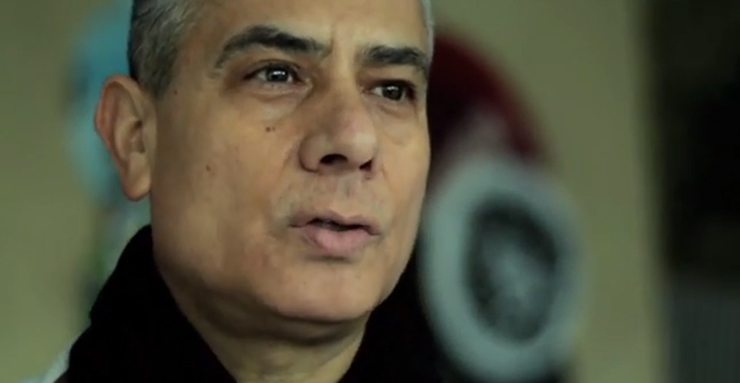
And speaking of talent, our hats off to the driving forces behind these two videos which tell different stories about the same program. Our partners at Urban Nation augmented the program with ideas of their own and grew the scope of our original ideas further. We admire the point of view taken by the documentary style video that appears first because it captures the message and the atmosphere we had hoped to engender – one of mutual support and respect. PERSONS OF INTEREST honors the artist and the muse. As artists and directors we know that this kind of thinking actually goes a long way – and art can save lives and hearts and minds – we’ve been lucky to see it.

Brooklyn-Street-Art-Video-Still-UN-Persons-Of-Interest-Berlin-5

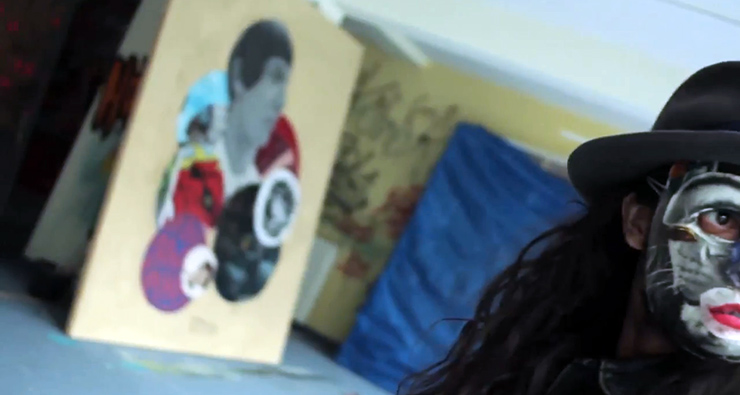
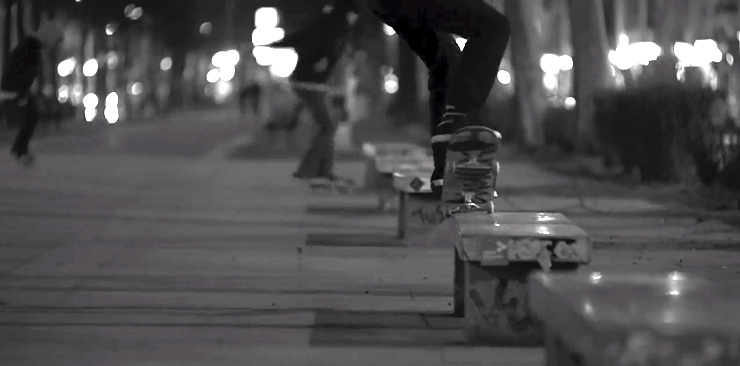
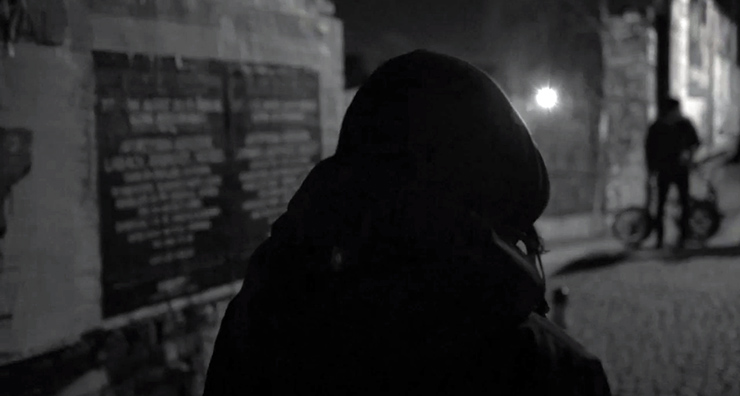
The second video is styled more as a music video, an atmospheric pastiche that plays on the second meaning associated with the words “Persons of Interest” – one where graffiti and Street Art overlap with the darker aspects of a subculture that is transgressive. Carefully not dipping into cliché territory, the stories woven here give a serious nod to the graffiti/skater/tattoo/BMX cultures – which among many other influencers are in the DNA of, have given birth to today’s art in the streets.  Its a cool concept and it produces a few surprises.

Brooklyn-Street-Art-Video-Still-UN-Persons-Of-Interest-Berlin-1

Brooklyn-Street-Art-Video-Still-UN-Persons-Of-Interest-Berlin-3Brooklyn-Street-Art-Video-Still-UN-Persons-Of-Interest-Berlin-2Brooklyn-Street-Art-Video-Still-UN-Persons-Of-Interest-Berlin-12Brooklyn-Street-Art-Video-Still-UN-Persons-Of-Interest-Berlin-4

We hope you dig both of these works.

Our sincerest thanks to the videographers, musicians, stylists, performers, technical experts, participants, administrators, artists, marketers, directors, poets, captains and dreamers who make this stuff happen.


URBAN NATION PROJECT M/7
“Persons of interest” curated by Jaime Rojo & Steven P. Harrington of Brooklyn Street Art

ARTISTS:
DAIN
GAIA
DON RIMX
SWOON
SPECTER
ESTEBAN DEL VALLE
CHRIS STAIN
NOHJCOLEY
CAKE
EL SOL 25
ICY&SOT
ONUR DINC
KKADE
NEVERCREW
DOT DOT DOT
ANDREAS ENGLUND

Read more
Basquiat Through The Eyes Of Fellow Artists on the Street

Basquiat Through The Eyes Of Fellow Artists on the Street

The response to our pieces on BSA and Huffpost yesterday has been sort of overwhelming – with people writing to us and commenting and sharing the article in large numbers on social media. Last nights pre-opening party at the museum was also enthusiastic, and although we don’t do the name-dropping thing much, we were gobsmacked to see members of his family at the dinner as well as many of the “Downtown” crowd from that era who were charming and celebratory as we listened to Director Arnold Lehman and the two curators describe the show and the process of putting it together.

brooklyn-street-art-jeff-aerosol-basquiat-jaime-rojo-04-15-web

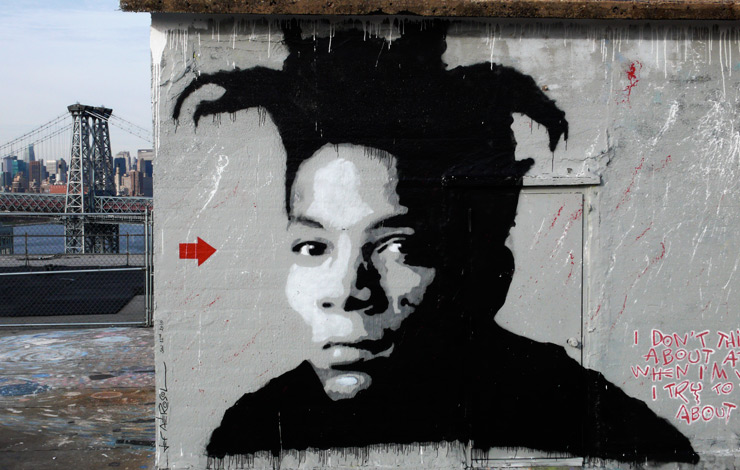
Jeff Aerosol on a rooftop in Brooklyn. January 2010 (photo © Jaime Rojo)

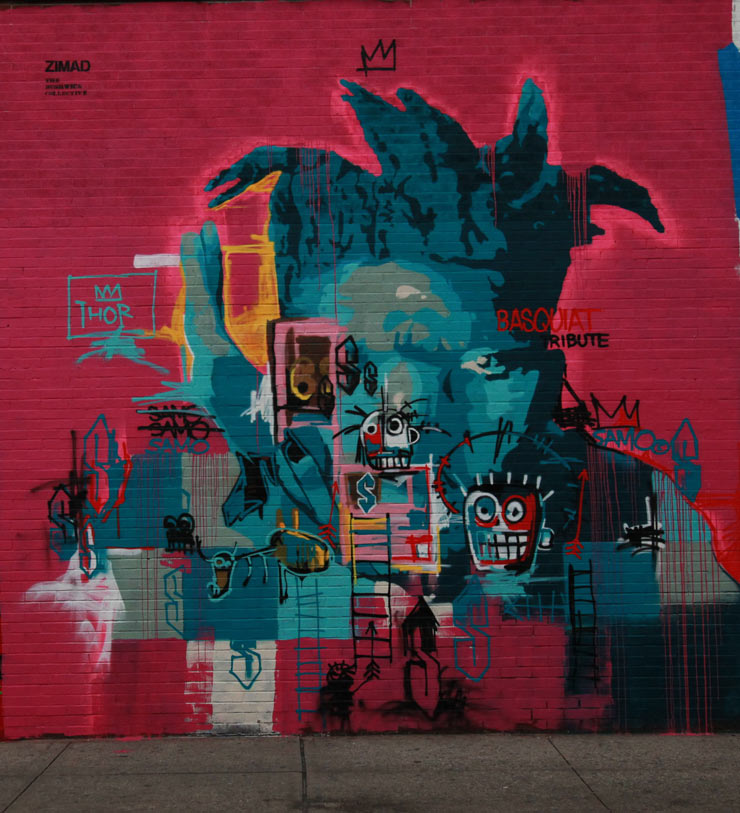
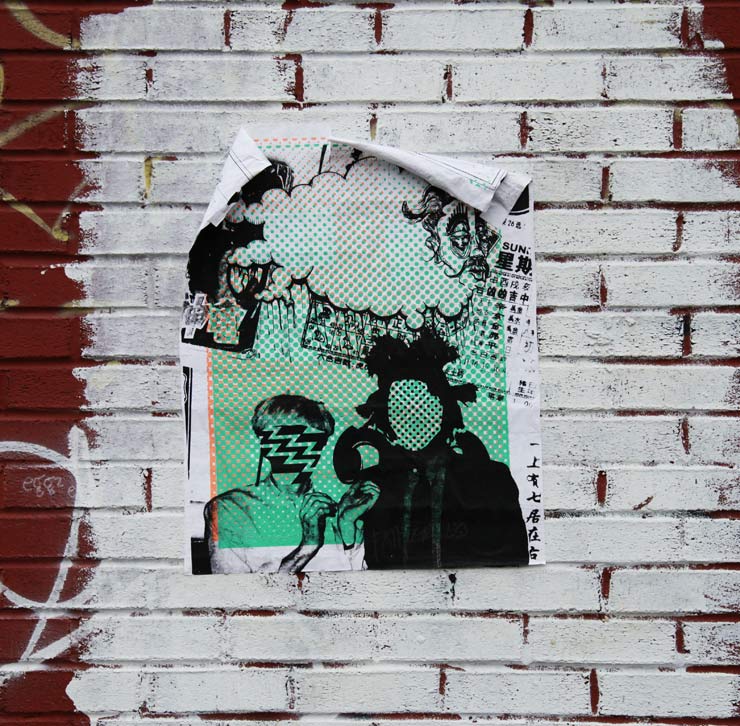
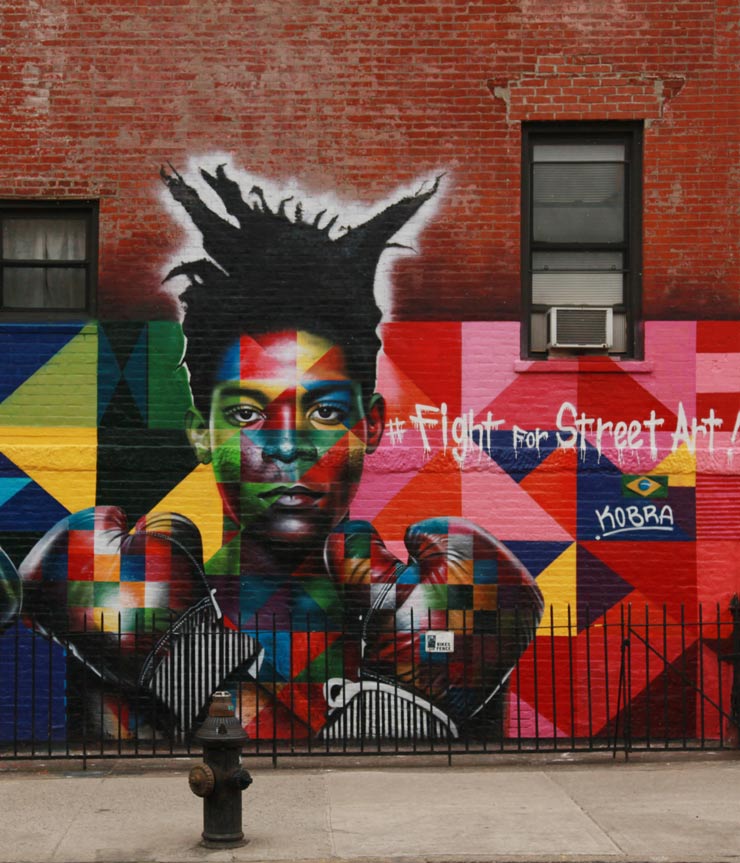
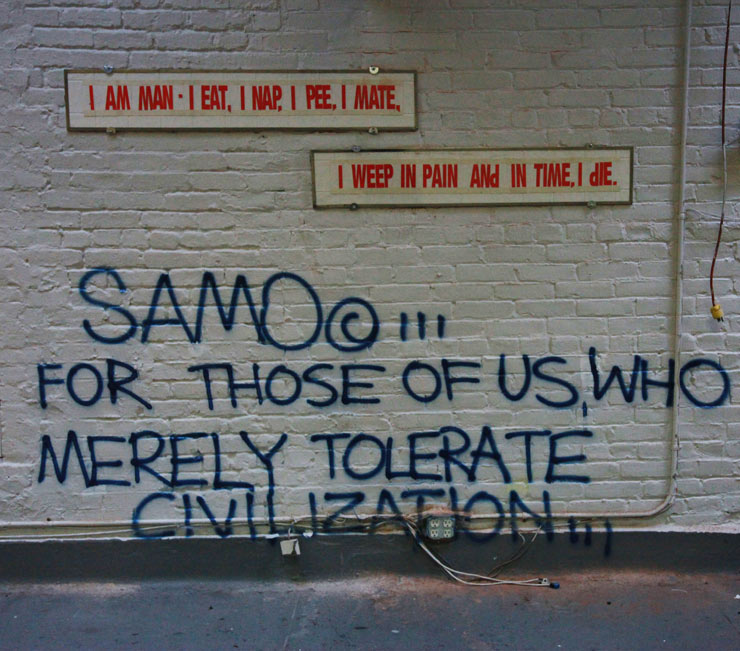
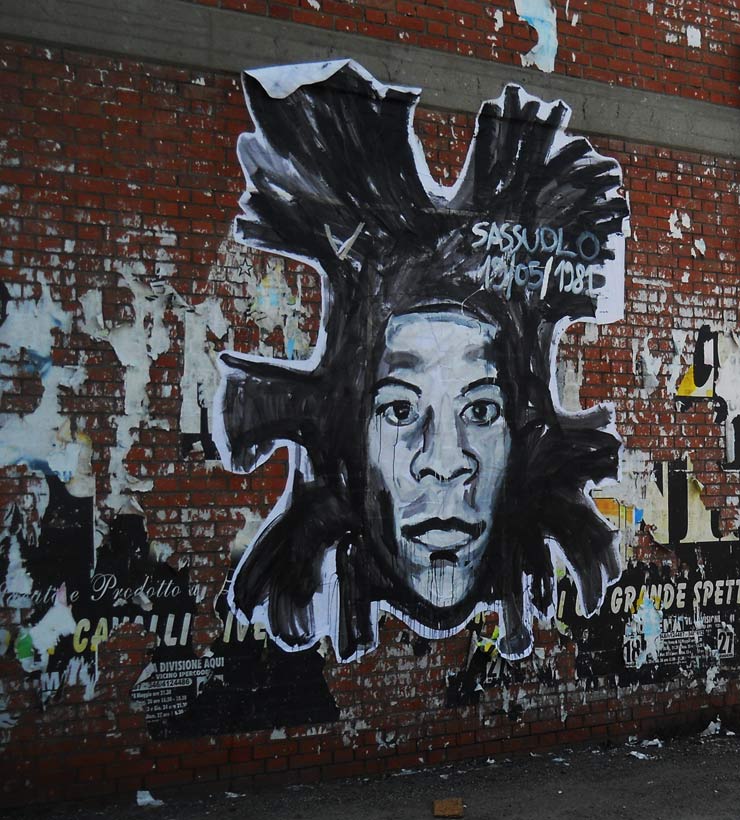
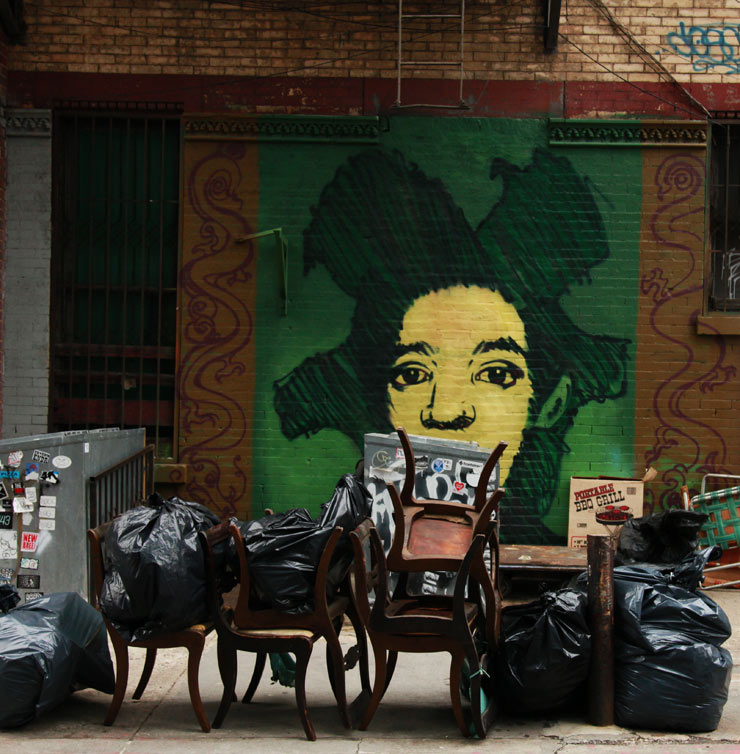
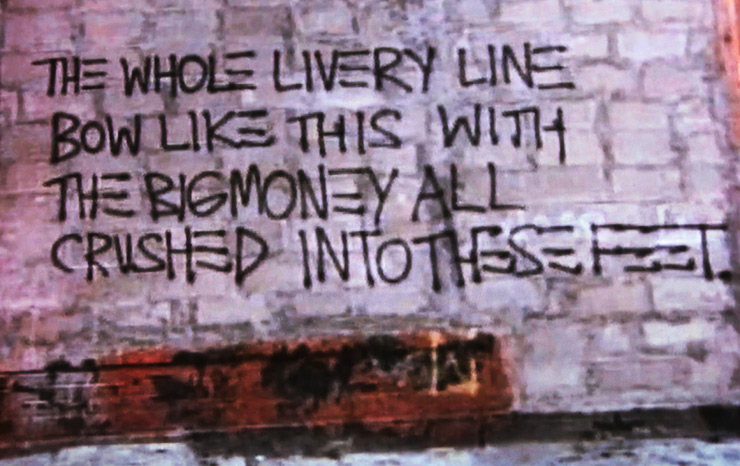
If this personal and virtual traffic is any indication, the new Notebooks show is already a huge hit. Of course Jean-Michel Basquiat AKA ©SAMO AKA Basquiat continues to be an inspiration to a number of artists on the street as well. To mark the upcoming exhibition at the Brooklyn Museum Basquiat The Unknown Notebooks officially opening tomorrow April 3rd, here we present you with a handful of images from our archives with tributes to the influential Brooklyn graffiti writer/ street artist / contemporary artist.

brooklyn-street-art-zimad-basquiat-jaime-rojo-12-14-14-web

Zimad in Bushwick, Brooklyn. December 2014. (photo © Jaime Rojo)

brooklyn-street-art-samo-warhol-jaime-rojo-04-13-14-web

Tomoo Gokita on the streets of Brooklyn. April 2014 (photo © Jaime Rojo)

brooklyn-street-art-kobra-basquiat-jaime-rojo-04-15-web

KOBRA on the streets of Brooklyn. October 2014 (photo © Jaime Rojo)

brooklyn-street-art-al-diaz-samo-jaime-rojo-08-14-web

Al Diaz remembers his writing partner as SAMO© at “21st Precinct”. Manhattan. August 2014. (photo © Jaime Rojo)

brooklyn-street-art-collectivo-fx-Sassuolo-italy-basquiat-web-1

Collectivo FX. Sassuolo, Italy. September 2013 (photo © Collectivo FX)

brooklyn-street-art-tynk-basquiat-jaime-rojo-04-15-web

TYNK. Manhattan. March 2015. (photo © Jaime Rojo)


<<>>><><<>BSA<<>>><<<>><><BSA<<>>><><<>BSA<<>>><<<>><><BSA

Please note: All content including images and text are © BrooklynStreetArt.com, unless otherwise noted. We like sharing BSA content for non-commercial purposes as long as you credit the photographer(s) and BSA, include a link to the original article URL and do not remove the photographer’s name from the .jpg file. Otherwise, please refrain from re-posting. Thanks!

<<>>><><<>BSA<<>>><<<>><><BSA<<>>><><<>BSA<<>>><<<>><><BSA

Read more
Basquiat’s Notebooks Open at The Brooklyn Museum

Basquiat’s Notebooks Open at The Brooklyn Museum

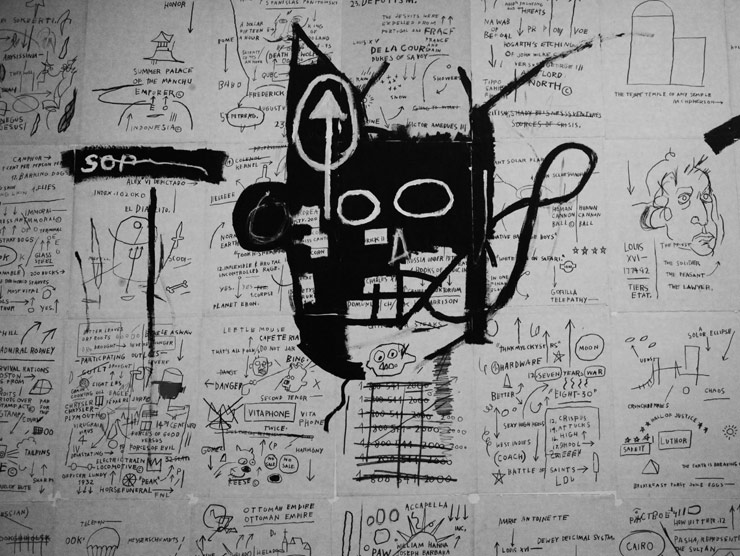
As lines continue to blur in fields of art and technology (and everything else) it is easier to see Street Art as an online/on-street diary, a forum for speech making, a laboratory for testing ideas, a publishing platform for the dispersing of truths and lies and theories and maxims and slogans and aphorisms. A timely new exhibition of personal notebooks by the artist Jean-Michel Basquiat further affirms the direct relationship between the personal and the public voice of one New York expressionist, revealing lesser-known aspects of him as artist and individual.

A teenage poet on New York streets, Basquiat used his own brand of graffiti to pursue his own brand of fame. His text was intended in part as a visual element but unlike graffiti writers who produced ever more expressive tags during that heated moment in New York graffiti history, Basquiat also sought an audience who may be hip to his cerebral wordplay of poetry that puzzled and enticed – a foxy style of William Burroughs-inspired automatic writing he adapted for his own uses.


brooklyn-street-art-basquiat-brooklyn-museum-jaime-rojo-04-15-web-2

Basquiat: The Unknown Notebooks. Brooklyn Museum. April 2015. (photo © Jaime Rojo)

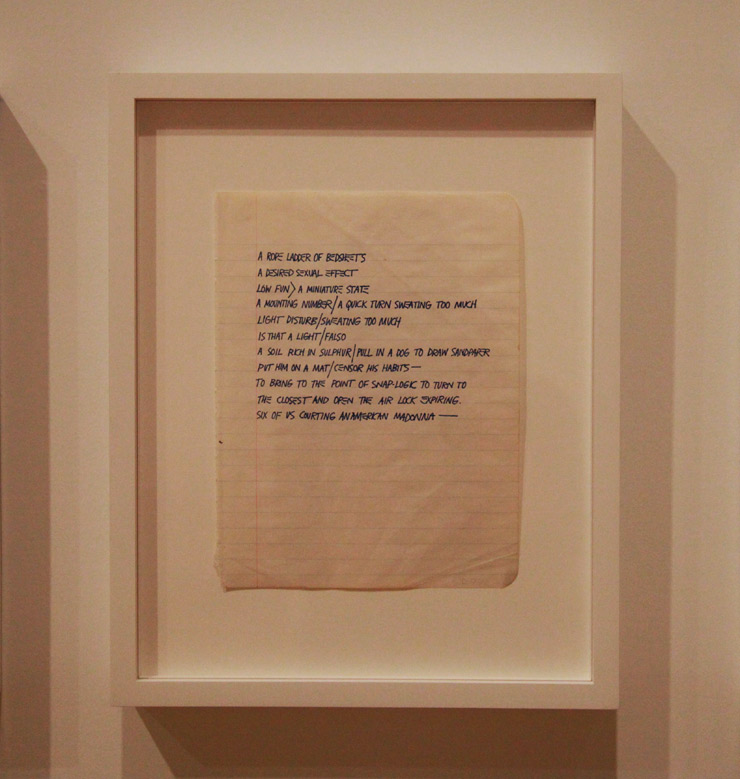
In Basquiat: The Unknown Notebooks, now running at The Brooklyn Museum until August 23rd, the genius of his fragmenting logic is revealed as a direct relationship between his private journals and his prolific and personally published aerosol missives on the streets of Manhattan’s Soho and Lower East Side neighborhoods in the late 1970s and 1980s.

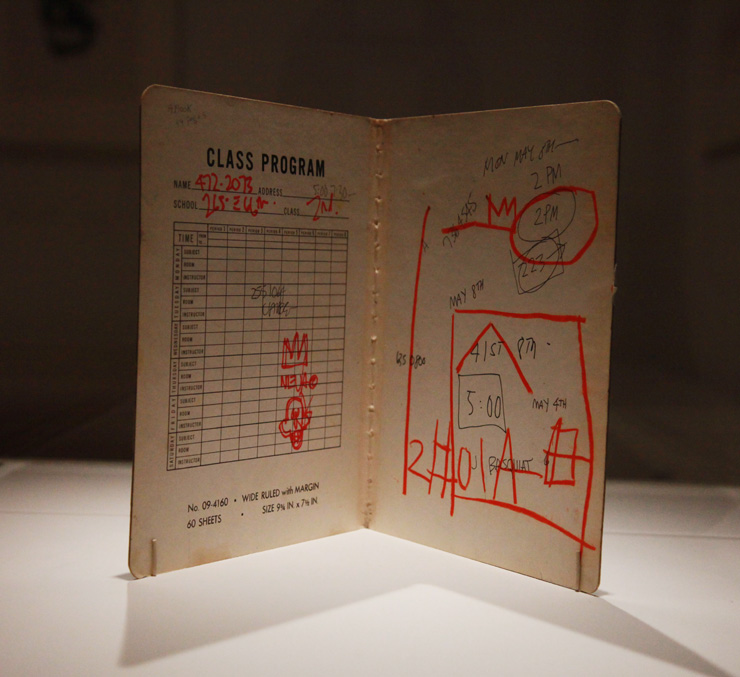
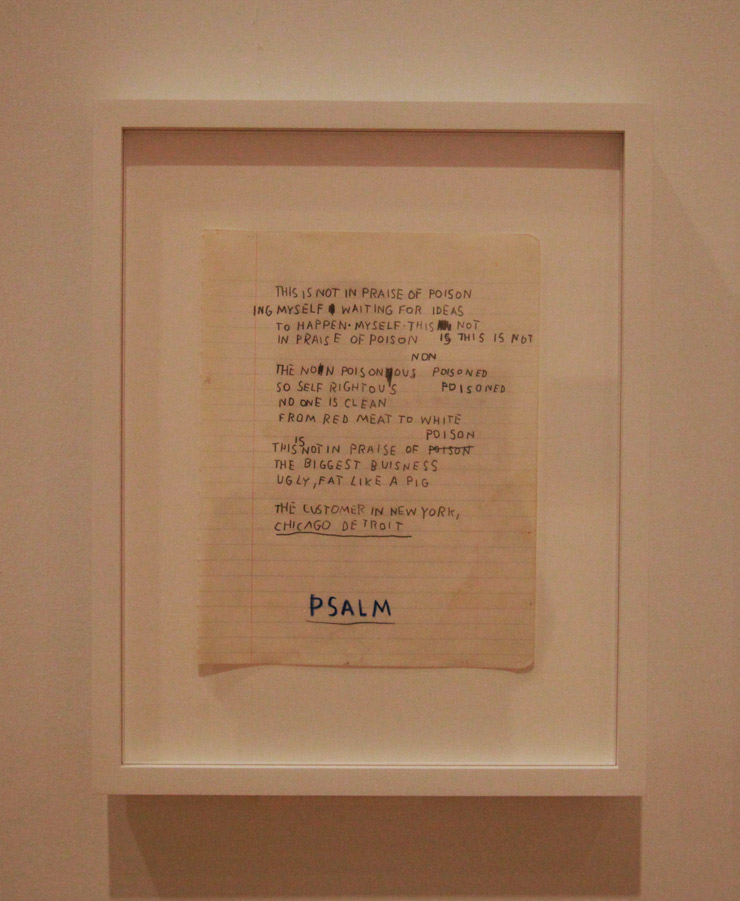
These notebooks were for capturing ideas and concepts, preparing them, transmuting them, revising them, pounding them into refrains. In the same way his text (and glyphic) pieces on the street were not necessarily finished products each time; imparted on the run and often in haste, these unpolished missives didn’t require such preciousness.


brooklyn-street-art-basquiat-brooklyn-museum-jaime-rojo-04-15-web-11

Untitled. Circa 1987. Basquiat:The Unknown Notebooks. Brooklyn Museum. April 2015. (photo © Jaime Rojo)

The art collector Larry Warsh lends these eight notebooks that span 1981-1987, 160 pages in all, for you to scan and contemplate. New to most audiences, they also feel familiar. While they do not provide a play-by-play account of his daily affairs, they do provide insight into his state of mind, interests, and creative process. Knowing his reputation for being very aware of his public perception, you may wonder how private these were in his mind if he was at least partially writing for a greater audience here sometimes as well.

But these are definitely his voice. Even in lengthier poetry pieces, Basquiats’ reductive approach to writing produces the same clipped cadences that appeared on walls and gallery paintings, a process of addition and subtraction that he could eventually pare down to one word that would command a canvas.

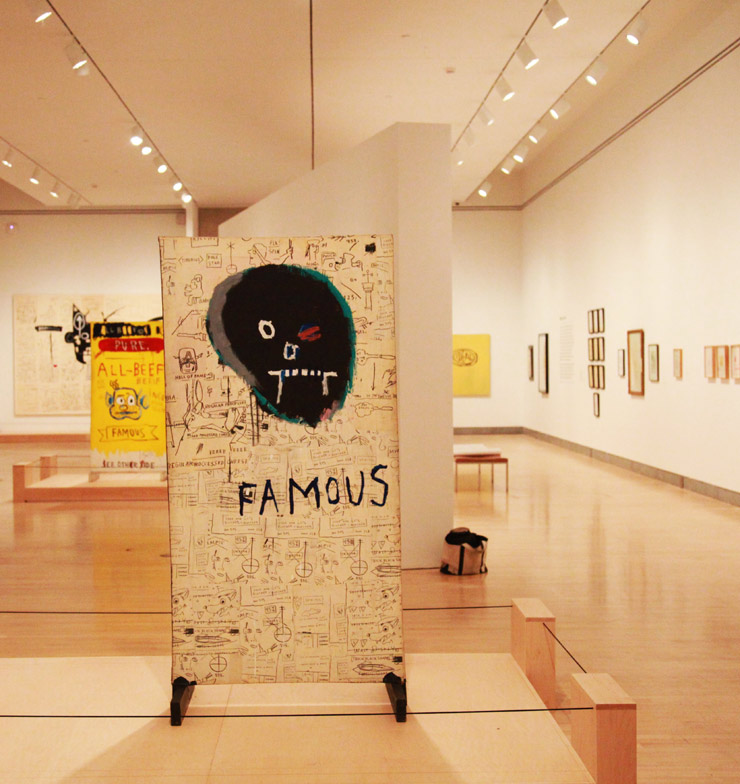
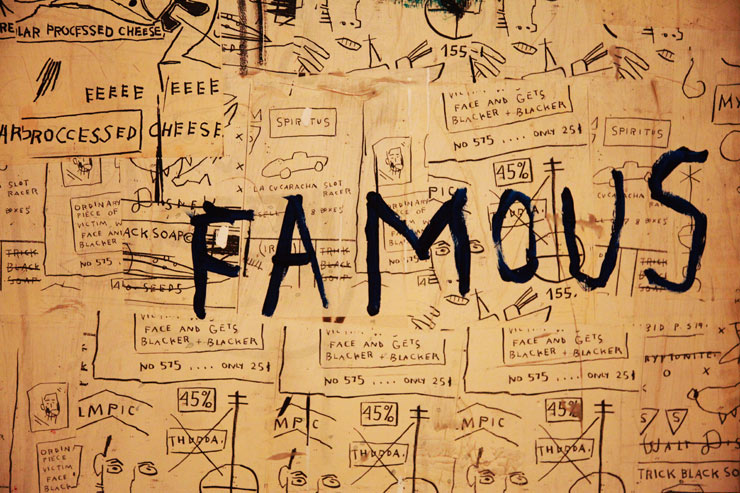
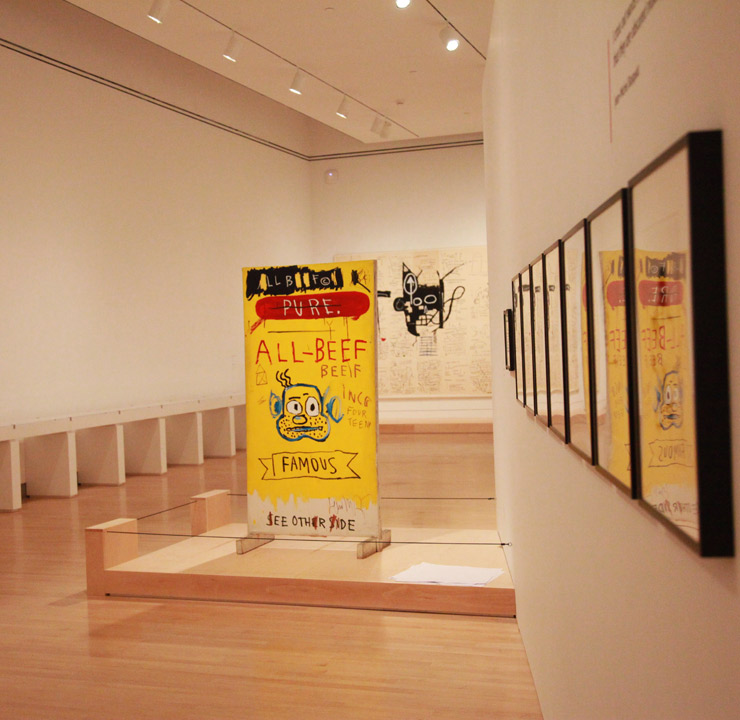
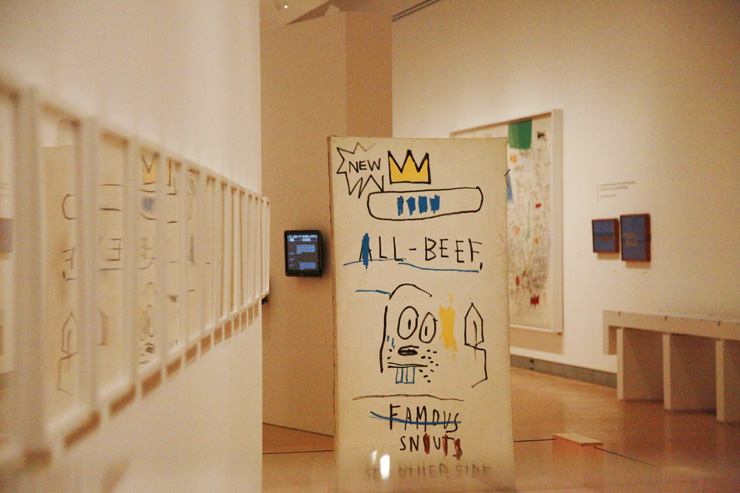
“Famous”.


brooklyn-street-art-basquiat-brooklyn-museum-jaime-rojo-04-15-web-4

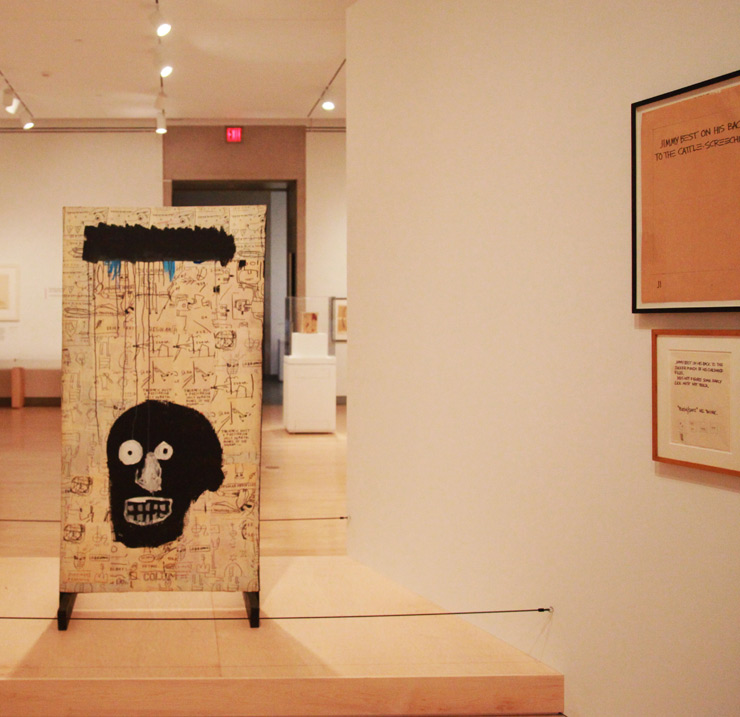
Famous. 1982. Basquiat:The Unknown Notebooks. Brooklyn Museum. April 2015. (photo © Jaime Rojo)

A two sided, free standing piece from 1982 midway through the gallery space gives a bittersweet focus to one of his aspirations, as well as to his application of photocopies of his own work in multiples on the canvas – a replication/repetition technique from commercial wildposting that was popularized on walls and lamp posts by graffiti writer/street artists like Revs and Cost in New York in the 90s.

“I think this show points out that the conceptual and poetic side of JMB’s work is central to and integrated with his more overtly visual and expressionistic paintings,” says Tricia Laughlin Bloom, who worked in collaboration with Dieter Bucchart, Guest Curator in organizing this exhibition. “He enjoyed exploring the play between text as visual sign or symbol and the layers of historical, sociological, personal meaning that words activate.  Some of the very restrained word drawings and notebook entries are intensely expressionistic, for instance, without the use of gesture or color.”


brooklyn-street-art-basquiat-brooklyn-museum-jaime-rojo-04-15-web-7

Famous. 1982. Detail. Basquiat:The Unknown Notebooks. Brooklyn Museum. April 2015. (photo © Jaime Rojo)

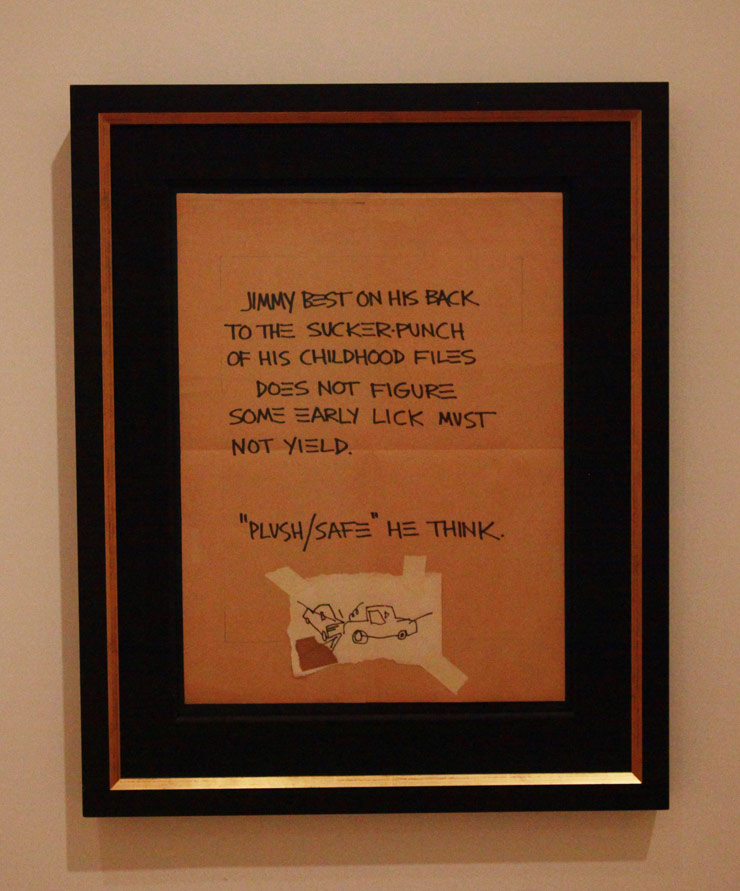
The notebooks are part of a larger offering of paintings, drawings, and moving image in this well balanced show that keeps the focus on the writer and painter of text while placing it in the greater context of all his work. Included here are drawings of his fictional character Jimmy Best, for example, who appeared in early SAMO© street writings and elsewhere as an ongoing and developing narrative that hinted at his self image.

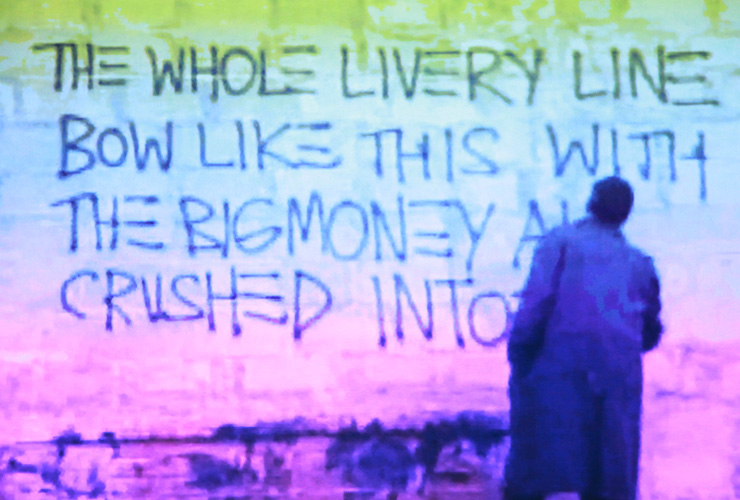
Most riveting for the new generation of writers may be the film clips shot in 1980-81 during the filming of New York Beat (released in 2000 as Downtown 81). Not true documentary footage, it nevertheless captures the artist outside mark-making in a determined, self-aware, sometimes hesitating manner across walls with letters and lines of simple black aerosol.

brooklyn-street-art-basquiat-brooklyn-museum-jaime-rojo-04-15-web-3

Famous. Verso. 1982. Basquiat:The Unknown Notebooks. Brooklyn Museum. April 2015. (photo © Jaime Rojo)

Moving into “the City” from his middle class Brooklyn home as a teenager in the late 70s, you have to wonder how or if his street practice with friend Al Diaz had been influenced by the students and workers who wrote slogans, epigrams, maxims, in black aerosol letters during the Paris uprisings of 1968. Quick passages on the street then like “Sous les paves, la plage” (under the paving stones, the beach) also played with text and sometimes cryptic meaning in ways similar to his on city walls and in these notebooks. Neatly penned, his was a deliberate meditation and experiment with words – a process that allowed you to see the deletions and additions, fully part of the finished product.

“We were presented with the rare opportunity to exhibit Basquiat’s notebooks, which offer fascinating access to his thoughts and process,” says Sharon Matt Atkins, Vice Director for Exhibitions and Collections Management, when talking about the decision to mount Notebooks.


brooklyn-street-art-basquiat-brooklyn-museum-jaime-rojo-04-15-web-18

Untitled. 1980. Basquiat: The Unknown Notebooks. Brooklyn Museum. April 2015. (photo © Jaime Rojo)

Of course its not the first time Street Artists have been featured meaningfully here. Under the guidance of Director Arnold L. Lehman the Brooklyn Museum has shown a serious and committed interest in highlighting the contributions of artists whose practice comes directly from the streets of New York and its graffiti/Street Art traditions; including the huge Basquiat show a decade ago, the Graffiti show in 2006, the more recent Keith Haring show, Swoon’s Submerged Motherlands last year, Olek’s display at the annual Artist’s Ball, and the upcoming Faile exhibit this July, which will also feature their collaboration with Bäst. For Matt Atkins, this show is in perfect alignment.

“The Brooklyn Museum has had a commitment to showing artists whose work embraces contemporary culture. Basquiat seamlessly synthesized the world around him in his art, including elements culled from the streets, music, literature, history, and more,” she says.

brooklyn-street-art-basquiat-brooklyn-museum-jaime-rojo-04-15-web-12

Untitled. 1986. Basquiat: The Unknown Notebooks. Brooklyn Museum. April 2015. (photo © Jaime Rojo)

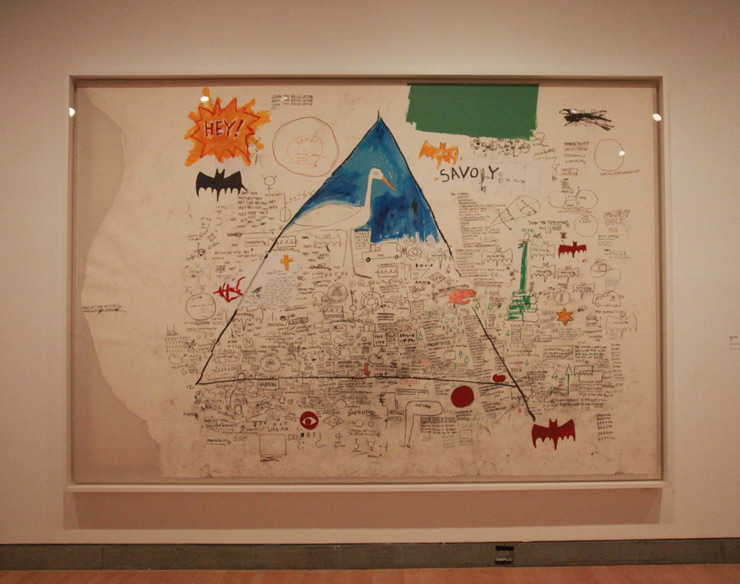
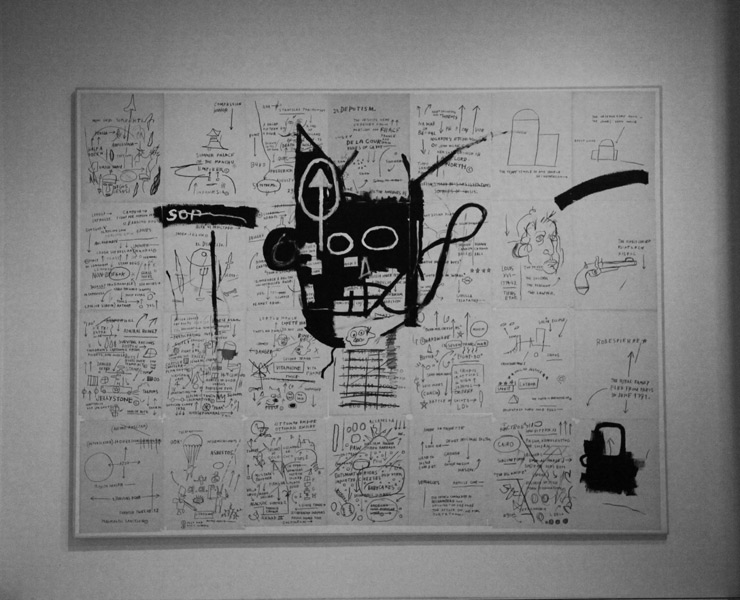
It has been 27 years since Basquiat died at the age of 27. Somehow you can imagine that mathematical equation appearing here on one of the larger canvases; dense with symbols, sentence fragments, lists and formulas. Sifting through the tenuously connected word constellation it occurs to you that people like Basquiat and Burroughs and the Beats were forebears of the post-Gutenberg dislocation of text from its moorings  one that we all swim in  with passages and words and texts floating to us and past us from multiple screens of varying sizes throughout each day.

As this stream of messages blurs from the intensely personal to the public spheres, this show confirms how the art-making process for the street has always been rich with storytelling, even if not evident at first. A show of this moment, seeing these notebooks first hand will complete a cycle for many.

brooklyn-street-art-basquiat-brooklyn-museum-jaime-rojo-04-15-web-14

Untitled. 1986. Detail.. Basquiat: The Unknown Notebooks. Brooklyn Museum. April 2015. (photo © Jaime Rojo)

We had an opportunity to speak further with one of the curators, Tricia Laughlin Bloom, about Basquiat: The Unknown Notebooks.

Brooklyn Street Art: Often we think of the work we see on the street as part of a continuum, a conversation back and forth between the artist and the passerby. How does this exhibition illustrate the continuum that extends from private neatly penned journals to public aerosol missives?
Tricia Laughlin Bloom: Going through the exhibition you find a lot of similarity between the voice he used in his street writing and in his notebooks, that also extends to his word paintings. Fragments of SAMO text recur in larger scale works that we have included, and many of his notebook passages read like they could have been SAMO texts.

brooklyn-street-art-basquiat-brooklyn-museum-jaime-rojo-04-15-web-10

Untitled. 1986. Detail. Basquiat: The Unknown Notebooks. Brooklyn Museum. April 2015. (photo © Jaime Rojo)

Brooklyn Street Art: Can you describe the dynamic between yourself and the guest curator Dieter Buchhart and how it informed some of your joint decisions for presenting the work?
Tricia Laughlin Bloom: Dieter brought the initial checklist together as Guest Curator, and we shaped it together from there. We both felt it was important that the show be about the notebooks—that the paintings and drawings should be carefully selected to compliment the notebooks and not overwhelm, and to highlight Basquiat the poet and thinker AND visual artist. Getting the right number of works and the precise balance was a long process, and many conversations.

Brooklyn Street Art: How has preparing this exhibition changed or affected your perception of his work in the intervening ten years since the “Basquiat” exhibition at the Brooklyn Museum, if at all?
Tricia Laughlin Bloom: I was always a fan, and I loved the 2005 show, but I feel I understand him better and my admiration has deepened after the opportunity to work with the notebooks. It’s more intimate in scale and the whole experience feels more personal.

brooklyn-street-art-basquiat-brooklyn-museum-jaime-rojo-04-15-web-5

All Beef. 1983. Basquiat: The Unknown Notebooks. Brooklyn Museum. April 2015. (photo © Jaime Rojo)

brooklyn-street-art-basquiat-brooklyn-museum-jaime-rojo-04-15-web-8

All Beef. 1983. Verso. Basquiat: The Unknown Notebooks. Brooklyn Museum. April 2015. (photo © Jaime Rojo)

brooklyn-street-art-basquiat-brooklyn-museum-jaime-rojo-04-15-web-9

Untitled. 1982-83. Basquiat: The Unknown Notebooks. Brooklyn Museum. April 2015. (photo © Jaime Rojo)

brooklyn-street-art-basquiat-brooklyn-museum-jaime-rojo-04-15-web-15

Untitled. 1982-83. Detail. Basquiat: The Unknown Notebooks. Brooklyn Museum. April 2015. (photo © Jaime Rojo)

brooklyn-street-art-basquiat-brooklyn-museum-jaime-rojo-04-15-web-13

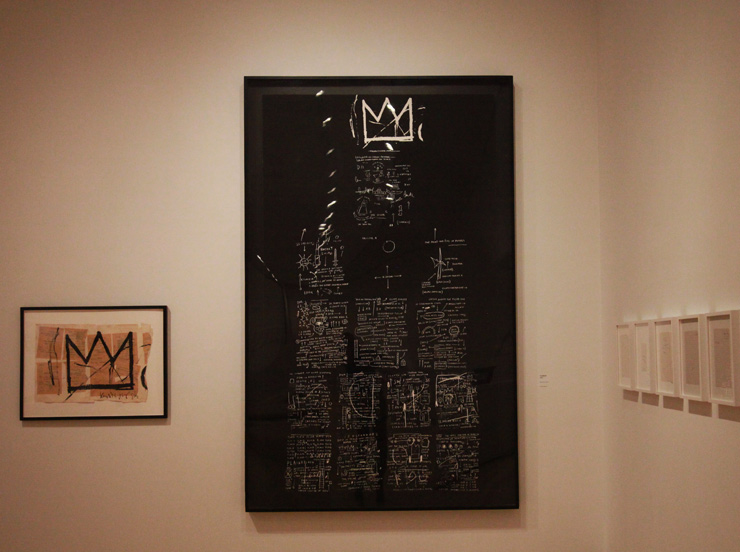
From left to right: Untitled (Crown) 1982. Tuxedo. 1982. Basquiat: The Unknown Notebooks. Brooklyn Museum. April 2015. (photo © Jaime Rojo)

brooklyn-street-art-basquiat-brooklyn-museum-jaime-rojo-04-15-web-17

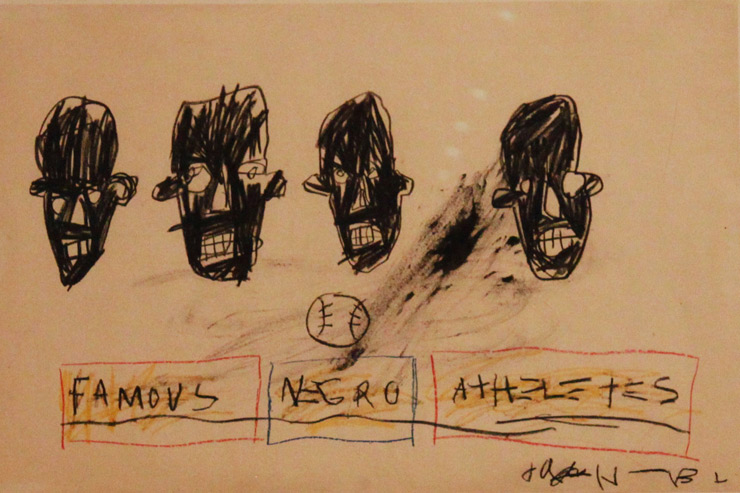
Famous Negro Atheletes. 1981. Basquiat: The Unknown Notebooks. Brooklyn Museum. April 2015. (photo © Jaime Rojo)

brooklyn-street-art-basquiat-brooklyn-museum-jaime-rojo-04-15-web-6

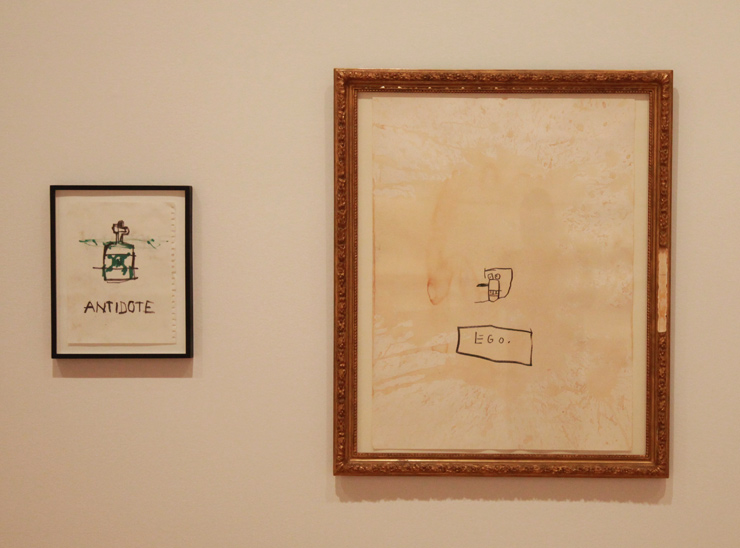
Antidote. 1981. Untitled (Ego) 1983. Basquiat: The Unknown Notebooks. Brooklyn Museum. April 2015. (photo © Jaime Rojo)

brooklyn-street-art-basquiat-brooklyn-museum-jaime-rojo-04-15-web-21

Photo taken from the video Downtown 81 Outtakes. 2001. Basquiat: The Unknown Notebooks. Brooklyn Museum. April 2015. (photo © Jaime Rojo)

brooklyn-street-art-basquiat-brooklyn-museum-jaime-rojo-04-15-web-1

Photo taken from the video Downtown 81 Outtakes. 2001. Basquiat: The Unknown Notebooks. Brooklyn Museum. April 2015. (photo © Jaime Rojo)

Basquiat: The Unknown Notebooks is organized by Dieter Buchhart, Guest Curator, with Tricia Laughlin Bloom, former Associate Curator of Exhibitions, Brooklyn Museum and current Curator of American art at the Newark Museum.

With special thanks to Tricia Laughlin Bloom, Sharon Matt Atkins, and Sally Williams.

Basquiat: The Unknown Notebooks at the Brooklyn Museum opens on April 3, 2015 to the general public. Click HERE for further details.


<<>>><><<>BSA<<>>><<<>><><BSA<<>>><><<>BSA<<>>><<<>><><BSA

Please note: All content including images and text are © BrooklynStreetArt.com, unless otherwise noted. We like sharing BSA content for non-commercial purposes as long as you credit the photographer(s) and BSA, include a link to the original article URL and do not remove the photographer’s name from the .jpg file. Otherwise, please refrain from re-posting. Thanks!

<<>>><><<>BSA<<>>><<<>><><BSA<<>>><><<>BSA<<>>><<<>><><BSA

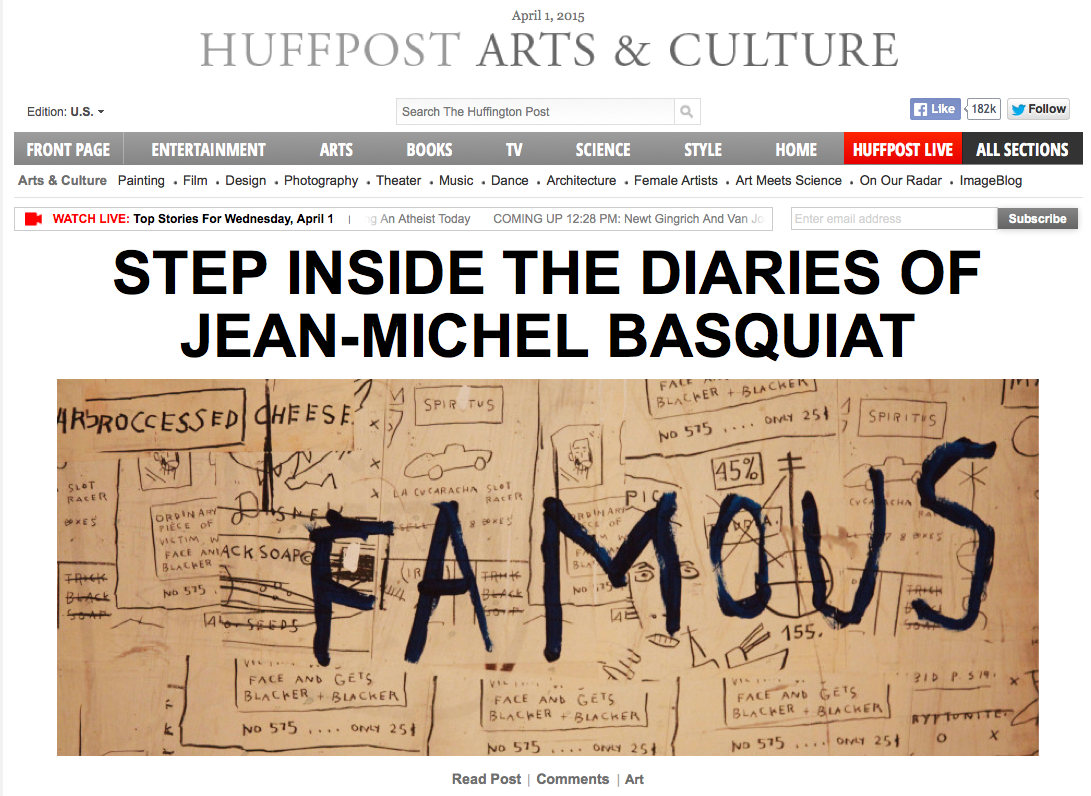
This article is also published on The Huffington Post

Brooklyn-Street-Art-Huffpost-Basquiat-April-1-2015-Screen Shot 2015-04-01 at 10.08.05 AM

Read more
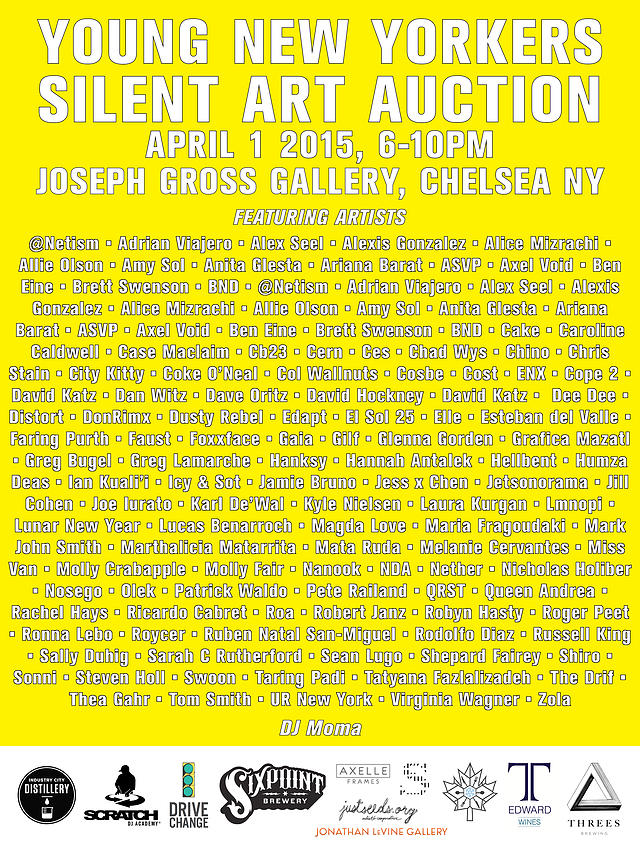
Young New Yorkers – A Preview of the Auction Benefitting NYC Youth

Young New Yorkers – A Preview of the Auction Benefitting NYC Youth

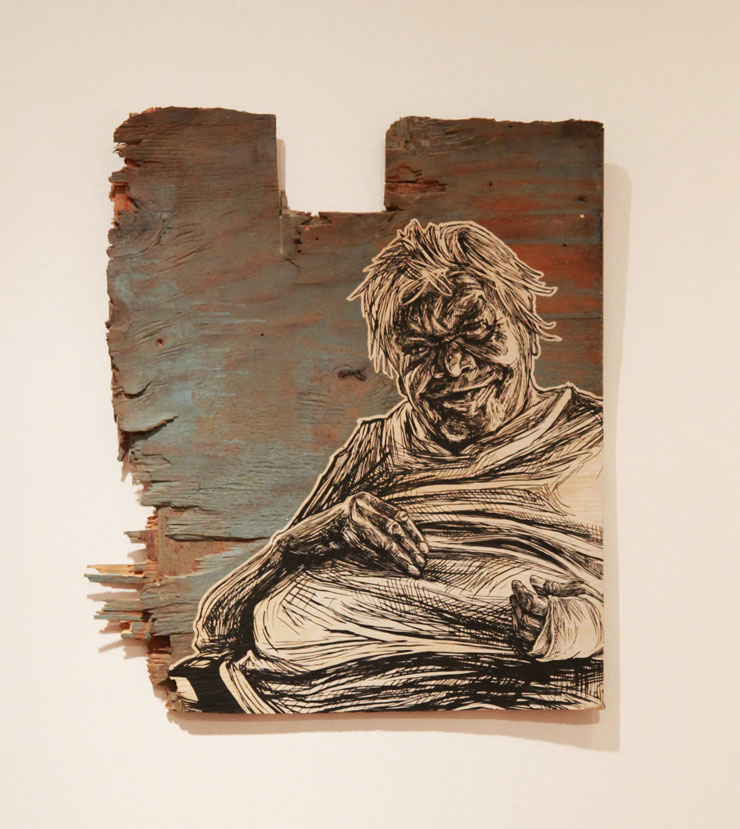
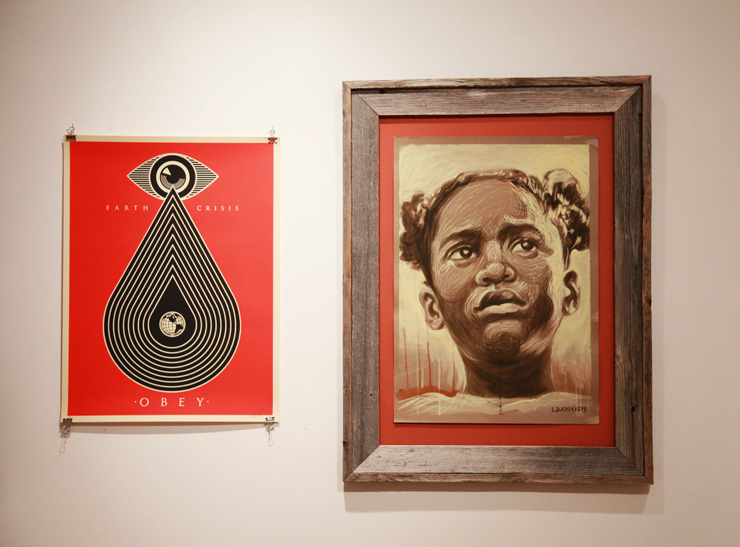
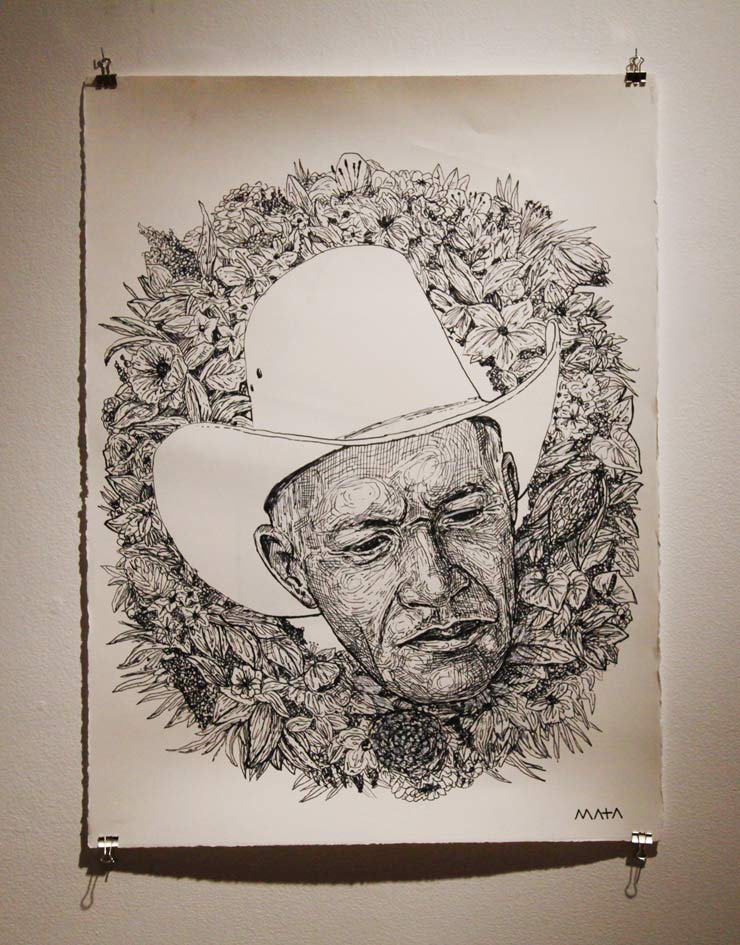
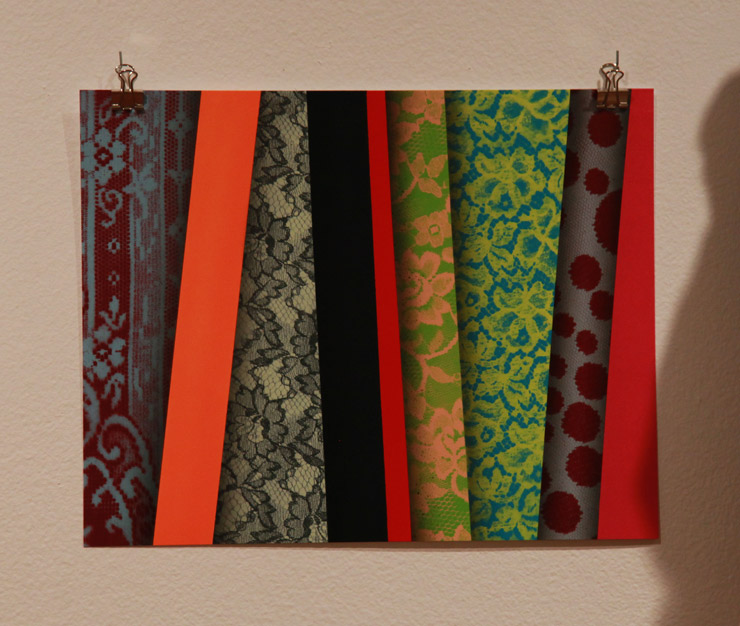
Don’t miss this cool auction of work by many of today’s Street Artists on the New York scene, and some other folks you might have heard of!  Young New Yorkers works with 16 and 17 year-old kids who have been caught in the criminal justice system, giving them a second chance. This is your opportunity to support this non-profit organization that is doing good work for your neighbors and our neighborhoods and to add art to your collection.

Here are some brand new shots of pieces that will be available. For a full listing and to bid on the auction progress online, click here on Paddle8.

brooklyn-street-art-olek-young-new-yorkers-jaime-rojo-03-15-web

Olek (photo © Jaime Rojo)

We had the opportunity to speak with Rachel Barnard, Executive Director and Co-Founder of Young New Yorkers about the event and their programs. We asked her to explain how the programs work.

“Art exercises in our programs are collapsed with restorative justice exercises and they give our participants a way of exploring the impact of their choices while empowering them to make wiser ones in the future. We work with photography, video, collage and illustration. More importantly, in the second half of the program art allows our participant’s to step into their own leadership and self expression,” she explains.

As the participants explore their creativity, they also examine it through a greater lens. “They explore a social issue that is important to them and develop a public art project around that. This is then presented at the final exhibition – one which the criminal court judges, acting district attorneys, social workers and other members of the criminal justice system, attend. It’s a way for everyone to re-meet our extraordinary participants as more than just their rap sheets. So in this way we use art to meet our main goal; which is to empower our young New Yorkers to transform the criminal justice system through their own creative voices.”

Here are some of the pieces that will be up for auction on April 1st.

brooklyn-street-art-swoon-young-new-yorkers-jaime-rojo-03-15-web

Swoon (photo © Jaime Rojo)

brooklyn-street-art-lmnopi-obey-young-new-yorkers-jaime-rojo-03-15-web

Obey . LMNOPI (photo © Jaime Rojo)

brooklyn-street-art-mata-ruda-young-new-yorkers-jaime-rojo-03-15-web

Mata Ruda (photo © Jaime Rojo)

brooklyn-street-art-icy-sot-young-new-yorkers-jaime-rojo-03-15-web

Icy & Sot (photo © Jaime Rojo)

brooklyn-street-art-miss-van-young-new-yorkers-jaime-rojo-03-15-web

Miss Van (photo © Jaime Rojo)

brooklyn-street-art-hellbent-young-new-yorkers-jaime-rojo-03-15-web

Hellbent (photo © Jaime Rojo)

brooklyn-street-art-gaia-lny-mata-ruda-young-new-yorkers-jaime-rojo-03-15-web

Gaia, LNY and Mata Ruda collaboration. (photo © Jaime Rojo)

brooklyn-street-art-faring-purth-young-new-yorkers-jaime-rojo-03-15-web

Faring Purth (photo © Jaime Rojo)

brooklyn-street-art-cb23-sonni-young-new-yorkers-jaime-rojo-03-15-web

CB23 . Sonni (photo © Jaime Rojo)

brooklyn-street-art-cost-young-new-yorkers-jaime-rojo-03-15-web

COST (photo © Jaime Rojo)

brooklyn-street-art-el-sol-25-young-new-yorkers-jaime-rojo-03-15-web

El Sol 25 (photo © Jaime Rojo)

brooklyn-street-art-cosbe-young-new-yorkers-jaime-rojo-03-15-web

Cosbe (photo © Jaime Rojo)

brooklyn-street-art-case-maclaim-young-new-yorkers-jaime-rojo-03-15-web

Case Ma’Claim (photo © Jaime Rojo)

brooklyn-street-art-gilf-young-new-yorkers-jaime-rojo-03-15-web

Gilf! (photo © Jaime Rojo)


Brooklyn-Street-Art-Young-New-Yorkers-Fairey-Mar-2015899-1426775886-P8_AUCTION_Poster_Detail

Young New Yorkers provides arts-based programming to court-involved young people. The criminal court gives eligible defendants—all of whom are 16- and 17-year-olds and who in New York are tried as adults—the option to participate in Young New Yorkers rather than do jail time, community service, and have a lifelong criminal record. With the ultimate goal of empowering participants to transform the criminal justice system through their own creative voices, all of YNY’s programs culminate with a public exhibition where members of the Criminal Justice System are invited to re-meet the graduates as creative and empowered individuals. In most cases, upon successful completion of the program, the participants’ cases are sealed; so far, 100% of participants have graduated from YNY’s programs.

We look forward to seeing you at Joseph Gross Gallery on April 1 for the Silent Art Auction. Get your advance tickets for only $35 here.

Brooklyn-Street-Art-Young-New-Yorkers-Fairey-Mar-AUCTION_with names

Read more
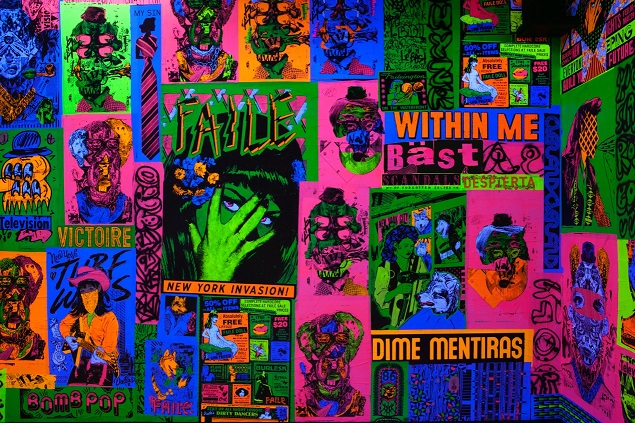
FAILE & BÄST Come to Brooklyn Museum This July

FAILE & BÄST Come to Brooklyn Museum This July

FAILE: Savage/Sacred Young Minds

BSA is pleased to announce this great event for fans of Brooklyn Street Artists FAILE as the Brooklyn Museum once again shows vision and unequivocal support for the artists who have made the streets of this city a foundational part of the contemporary Street Art scene. They will be showing both their TEMPLE and their DELUXX FLUXX ARCADE, a collaboration with another important player on New York streets, BÄST.

Both FAILE & BÄST hold important roles in the development of the scene on the streets and it is great to see a major cultural institution such as The Brooklyn Museum give such an important honor to them.

From the Press Release
<><><><><><><>

Brooklyn Museum Presents FAILE: Savage/Sacred Young Minds, Including Two Major Installations by FAILE; Exhibition to Open July 10, 2015

The Brooklyn Museum will present

FAILE: Savage/Sacred Young Minds, including two major installations by FAILE, collaboration between the Brooklyn-based artists Patrick McNeil and Patrick Miller, from July 10 through October 4, 2015. The exhibition includes Temple and The FAILE & BÄST Deluxx Fluxx Arcade–two immersive environments that invite visitors to engage actively with the work, prompting viewers to ask questions about their relationship to consumer culture, religious traditions, and the urban environment.

cbba0eb1-4469-4236-9734-d0955d16cb82

Since 1999, McNeil and Miller have created multimedia installations, large-scale paintings, and sculptures that blur the lines between fine art, street art, and popular culture. The exhibition unites The FAILE & BÄST Deluxx Fluxx Arcade and Temple, both from 2010, alongside new paintings and sculptures that highlight FAILE’s evolving practice. Drawing on a long art-historical tradition of appropriation, both as an homage to their sources and as subversions of stereotypes, these works are inspired by material as varied as American quilts, folk art, Native American art, religious architecture, pulp magazines of the mid-twentieth century, comic books, sci-fi movie posters, adult entertainment advertisements, and storefront typography.

The FAILE & BÄST Deluxx Fluxx Arcade, created in collaboration with the Brooklyn artist Bäst, is an interactive installation that includes retrofitted video games, pinball machines, and foosball tables that are simultaneously sculptures and functioning games. A nostalgic nod to video arcades as well as to punk rock and graffiti culture, this is the fifth iteration of the project and the first time it will be installed in a museum context, following earlier versions in London, New York, Miami, and Edinburgh. Featuring the artists’ signature characters and imagery, these programmed games are twists on classic examples such as wrestling matches, road races, water-based challenges, tile-matching puzzles, and audio-visual manipulations.

FAILE’s Temple, originally installed in Praça dos Restauradores Square in Lisbon for the Portugal Arte 10 Festival, is reminiscent of religious architecture that has fallen into ruin. Temple is fabricated with components such as iron gating, ceramic relief work, and painted ceramics. Measuring 16½ feet high by 28¾ feet long by 16 feet wide, Temple will be installed in the Museum’s Iris and B. Gerald Cantor Gallery, a large rotunda space. The life-size work features FAILE’s customized prayer wheels inspired by Tibetan Buddhist structures, vernacular imagery culled from Brooklyn streets, and popular-culture sources. The interior imagery of Native American figures, borrowed from mid-twentieth-century movie and comic book sources, imagines a reaction against commercial development and consumer greed with a return to traditional values. Blurring the boundary between art and architecture, Temple amplifies the fluid integration of visual culture and the built environment in FAILE’s art.

For this exhibition, the artists have also created several new works. Among them are two triptychs, both mural-size paintings created in their “ripped canvas” style. Inspired by the gritty, worn layering of street posters, these canvases, with their surface gaps, simultaneously reveal and conceal subject and meaning.

FAILE is the Brooklyn-based artistic collaboration between Patrick McNeil (born in 1975 in Edmonton, Alberta) and Patrick Miller (born in 1976 in Minneapolis, Minnesota). After meeting as teenagers in Arizona, they attended Northern Arizona University. They later both studied graphic design–Miller at Minneapolis College of Art and Design, and McNeil at Fashion Institute of Technology. In the late 1990s, the duo reconnected and joined with Aiko Nakagawa (born in 1975 in Tokyo, Japan) to form FAILE: the name is an anagram of their first project, A Life. In 2006, Nakagawa began making work on her own as “Lady Aiko,” while McNeil and Miller continued pushing the limits of their imagery. They have since worked in a wide range of materials and styles and are best known for their prints, paintings, and mixed-media installations, which have been presented in numerous solo exhibitions. They have also completed major commissions for the New York City Ballet’s Art Series (2013); and for the Mongolian Arts Council, in UlaanBaatar, Mongolia (2012); as well the Houston and Bowery Mural, New York (2011); and the first commissioned mural on the building façade of Tate Modern, London (2008). Inspired by the visual tapestry of their Brooklyn environs, their work is characterized by a vibrant weaving of abstraction, mass culture, and commercial typography.

Bäst has been creating work for the past decade, both on the street and for gallery exhibitions. His work borrows from a range of popular-culture references and incorporates collage elements, often resulting in seemingly whimsical characters that reveal more menacing layers.

FAILE: Savage/Sacred Young Minds is organized by Sharon Matt Atkins, Vice Director of Exhibitions and Collections Management, Brooklyn Museum.

This exhibition is supported by Allouche Gallery, The Dean Collection, and Geoff Hargadon and Patricia LaValley.

Read more
Sunday Morning Wheat Pasting with Various & Gould

Sunday Morning Wheat Pasting with Various & Gould

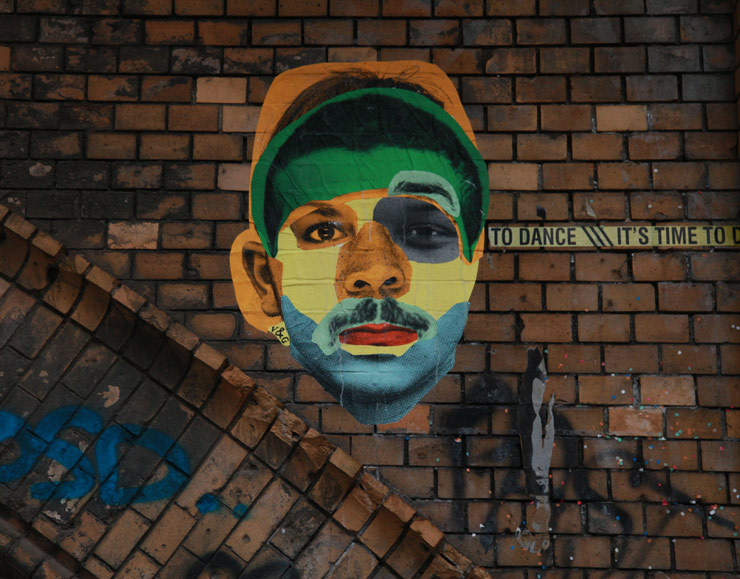
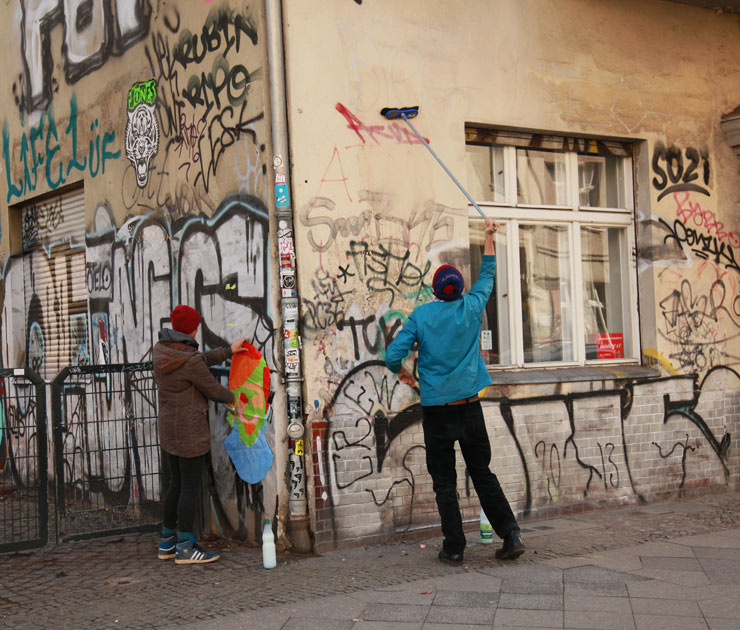
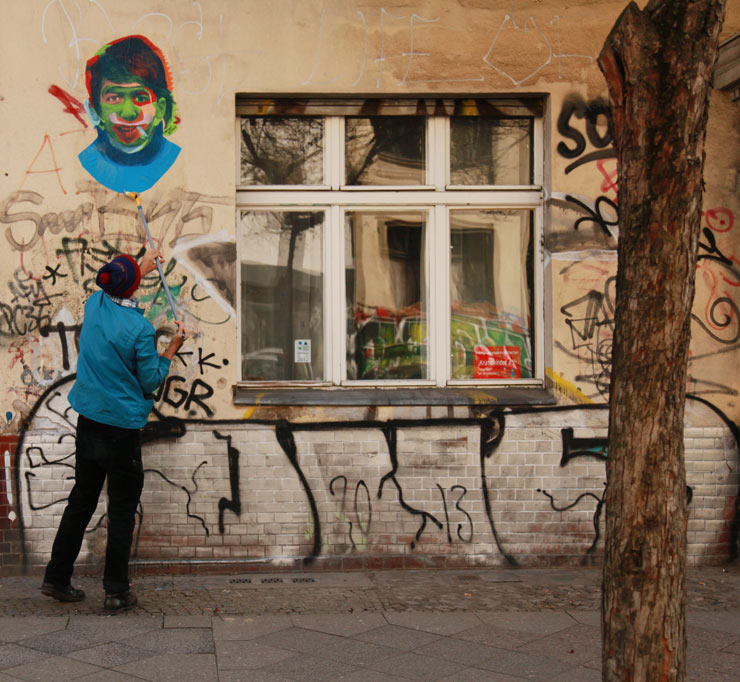
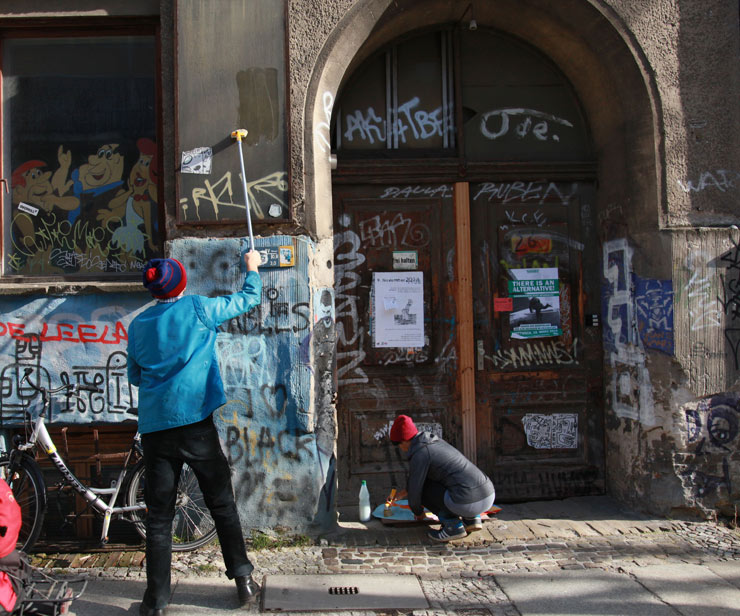
The best cure for jet lag is to jump on a bicycle and weave through the streets trolling Street Artists while they work. At least, that was the theory two hours after we landed early on a Sunday morning in Berlin, and Various and Gould agreed to lead the tour!

brooklyn-street-art-various-and-gould-jaime-rojo-berlin-03-15-web-14

Various & Gould. Berlin. March 2015. (photo © Jaime Rojo)

With eyes a bit bleary and balance rather suspect, our intrepid photographer happily trailed the friendly duo who took him to see THE WALL as well as many other more scrappy, hidden, dodgy walls to shoot images of. They even watched in bemusement as he got assistance from a random passerby to hoist him atop an electrical box to get his shot. Dude always gets his shot.

brooklyn-street-art-various-and-gould-jaime-rojo-berlin-03-15-web-1

Various & Gould. Berlin. March 2015. (photo © Jaime Rojo)

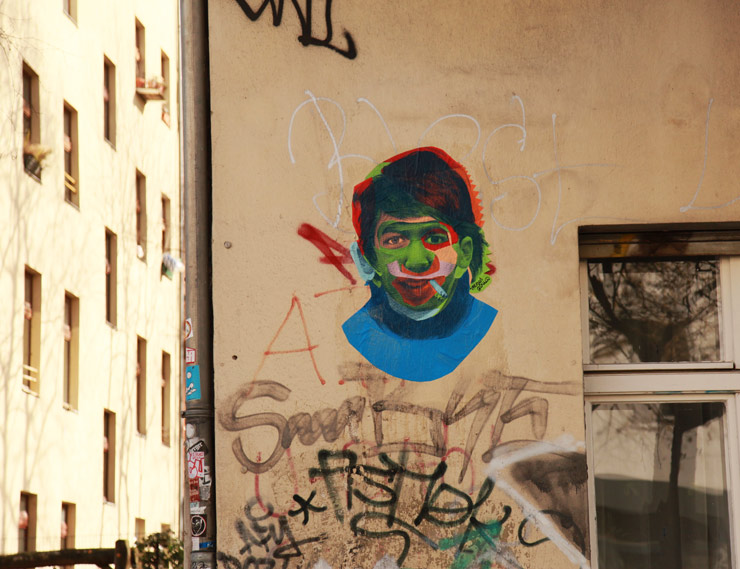
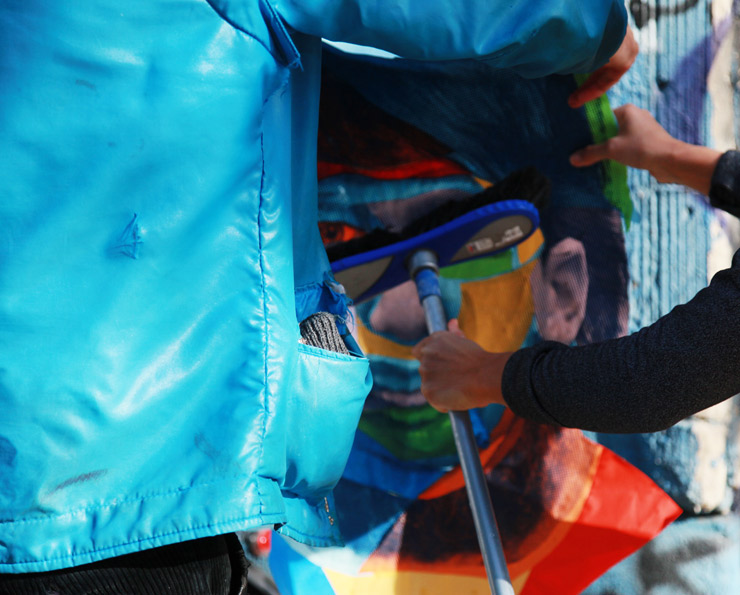
Naturally they brought wheat paste in their backpacks, and a few newly painted pieces to smack up. For those of you familiar with the mix-n-match limbs, torsos, and heads that V&G have used previously, you can see that the innovative experimenters have evolved their collage style to something new. It’s exactly the same, but completely different.

brooklyn-street-art-various-and-gould-jaime-rojo-berlin-03-15-web-2

Various & Gould. Berlin. March 2015. (photo © Jaime Rojo)

You’ll also notice that all these pieces are going up in broad daylight – Berlin is very chill about street art, no joke. Judging by the zillions of people who you see posing for pictures with the art all over the city, they seem to like it.

Our very special thanks to Various and Gould for their hospitality.

brooklyn-street-art-various-and-gould-jaime-rojo-berlin-03-15-web-3

Various & Gould. Berlin. March 2015. (photo © Jaime Rojo)

brooklyn-street-art-various-and-gould-jaime-rojo-berlin-03-15-web-4

Various & Gould. Berlin. March 2015. (photo © Jaime Rojo)

brooklyn-street-art-various-and-gould-jaime-rojo-berlin-03-15-web-5

Various & Gould. Berlin. March 2015. (photo © Jaime Rojo)

brooklyn-street-art-various-and-gould-jaime-rojo-berlin-03-15-web-6

Various & Gould. Berlin. March 2015. (photo © Jaime Rojo)

brooklyn-street-art-various-and-gould-jaime-rojo-berlin-03-15-web-7

Various & Gould. Berlin. March 2015. (photo © Jaime Rojo)

brooklyn-street-art-various-and-gould-jaime-rojo-berlin-03-15-web-8

Various & Gould. Berlin. March 2015. (photo © Jaime Rojo)

brooklyn-street-art-various-and-gould-jaime-rojo-berlin-03-15-web-9

Various & Gould. Berlin. March 2015. (photo © Jaime Rojo)

brooklyn-street-art-various-and-gould-jaime-rojo-berlin-03-15-web-10

Various & Gould. Berlin. March 2015. (photo © Jaime Rojo)

brooklyn-street-art-various-and-gould-jaime-rojo-berlin-03-15-web-11

Various & Gould. Berlin. March 2015. (photo © Jaime Rojo)

brooklyn-street-art-various-and-gould-jaime-rojo-berlin-03-15-web-13

Various & Gould. Berlin. March 2015. (photo © Jaime Rojo)

brooklyn-street-art-various-and-gould-jaime-rojo-berlin-03-15-web-15

Various & Gould. Berlin. March 2015. (photo © Jaime Rojo)

brooklyn-street-art-various-and-gould-jaime-rojo-berlin-03-15-web-12

Various & Gould. Berlin. March 2015. (photo © Jaime Rojo)


<<>>><><<>BSA<<>>><<<>><><BSA<<>>><><<>BSA<<>>><<<>><><BSA

Please note: All content including images and text are © BrooklynStreetArt.com, unless otherwise noted. We like sharing BSA content for non-commercial purposes as long as you credit the photographer(s) and BSA, include a link to the original article URL and do not remove the photographer’s name from the .jpg file. Otherwise, please refrain from re-posting. Thanks!

<<>>><><<>BSA<<>>><<<>><><BSA<<>>><><<>BSA<<>>><<<>><><BSA

Read more
BSA Images Of The Week: 03.29.15

BSA Images Of The Week: 03.29.15

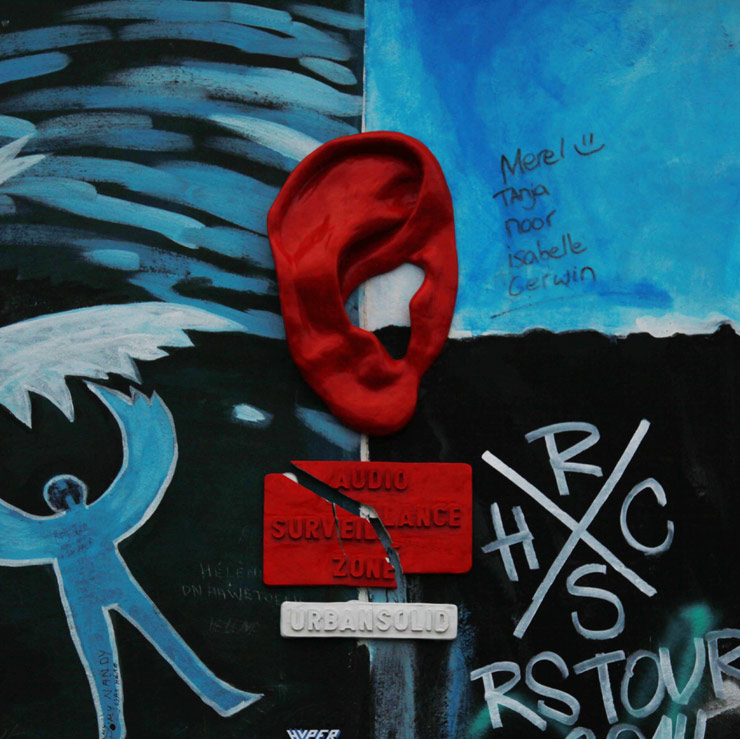
brooklyn-street-art-urban-solid-jaime-rojo-03-29-15-web
BSA-Images-Week-Jan2015

BSA again proudly shouts out Young New Yorkers this week as they offer you works by many Street Artists on the scene today at auction. Check out the auction on April 1st of some of New Yorks’ finest (and generous) Street Artists whose work will benefit the programs of “restorative justice” which YNY offers to 16 and 17 year olds in NYC who have become entangled with the law. (Video at bottom)

Also our hearts go to the neighbors who lost homes and were hurt (some very badly) in the explosion and fire that destroyed two buildings on the Lower East Side this week. Meme-making selfies by callous bimbos aside, stories of strangers and neighbors reaching out to help out remind us why we love NYC.

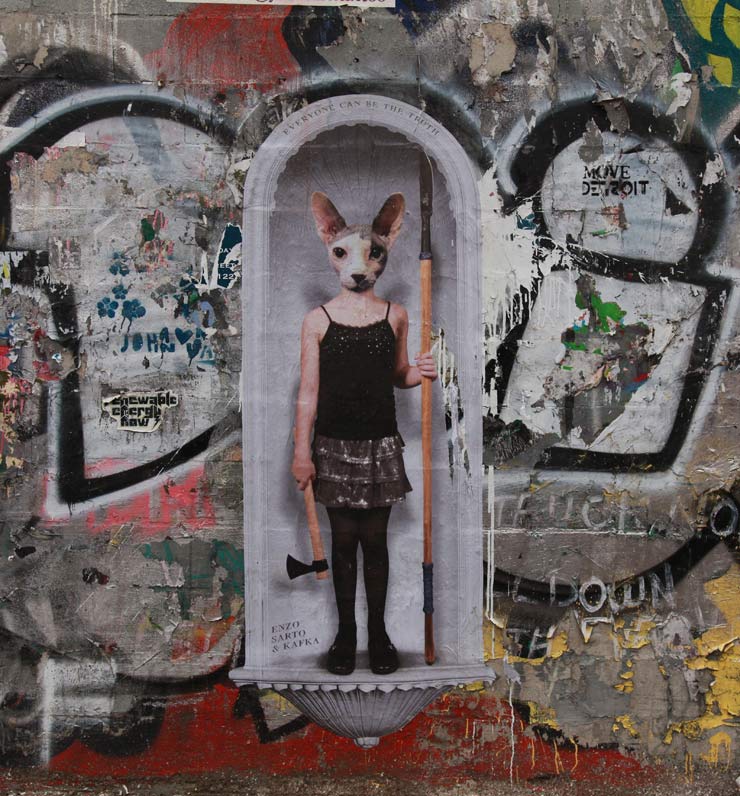
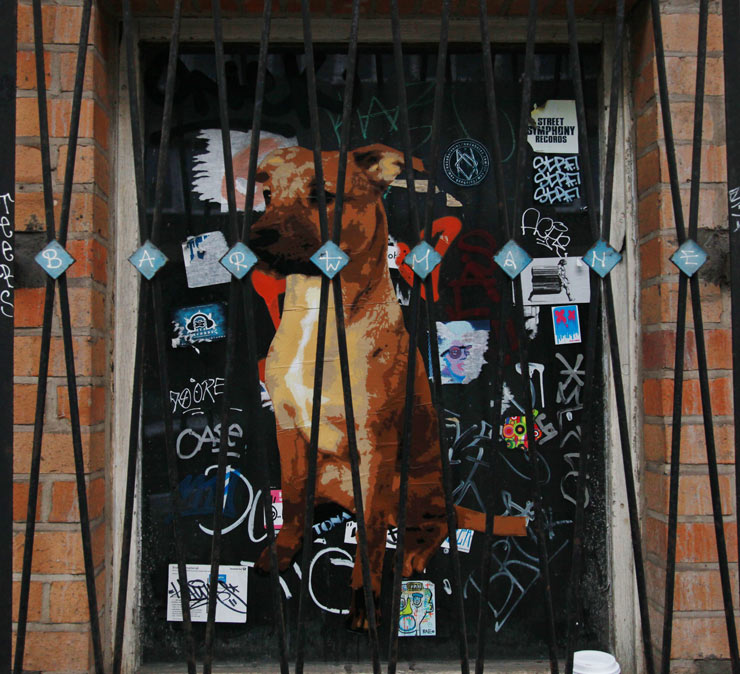
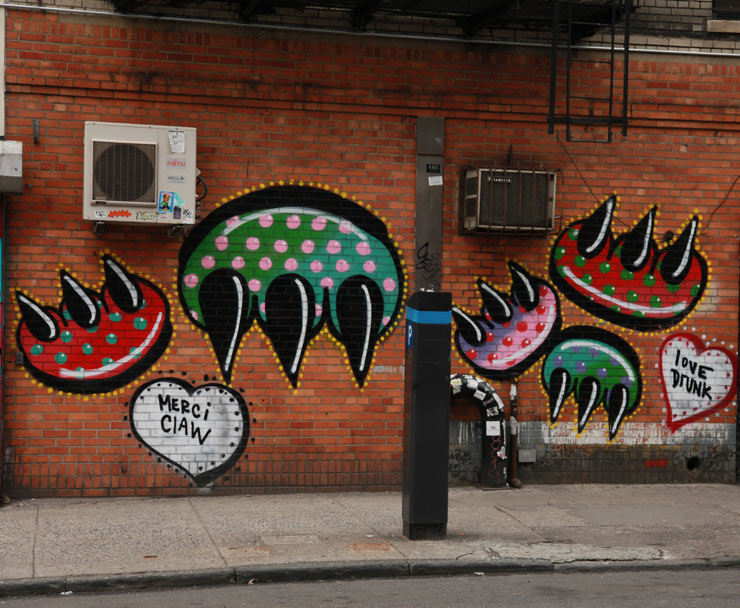
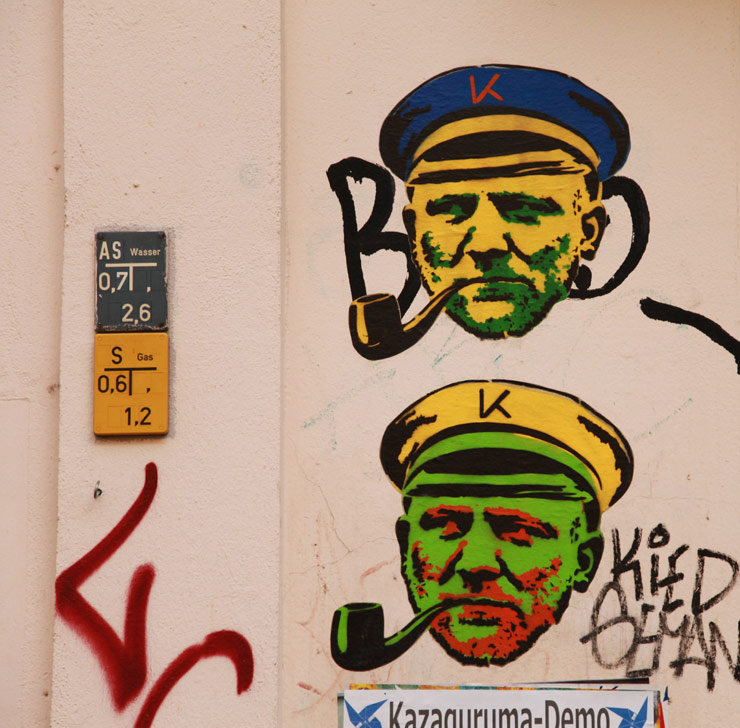
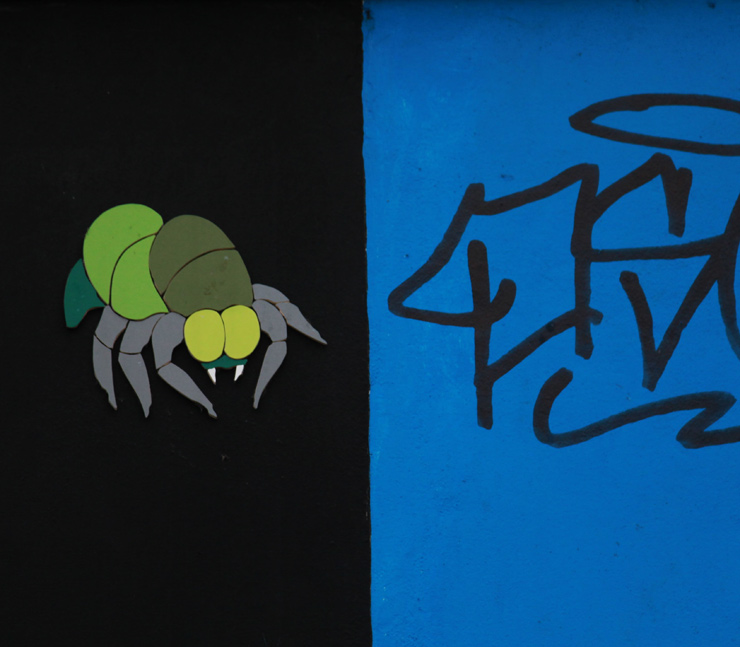
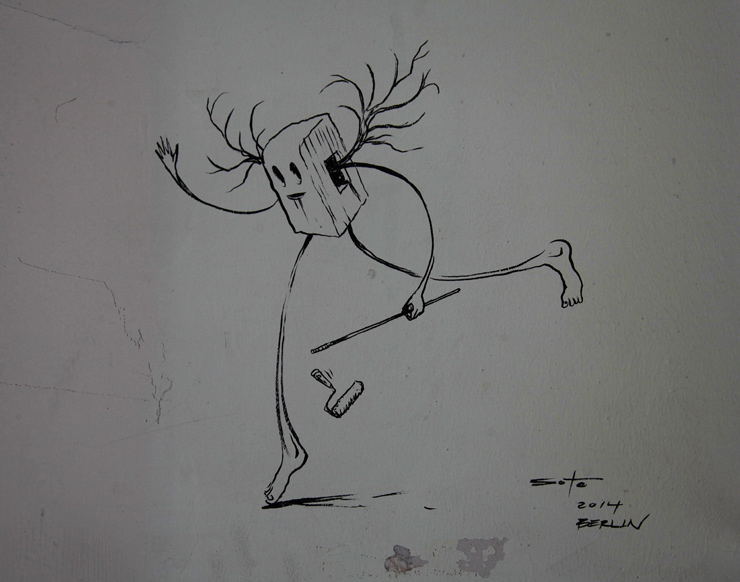
Here’s our weekly interview with the street, this week featuring B.D.White, City Kitty, Claw Money, Enzo Sarto, Hot Tea, Jeff Soto, Philippe Vignal, Rhino, Sbagliato, Sobr, Stikman, Tona, Urban Solid, and VK .

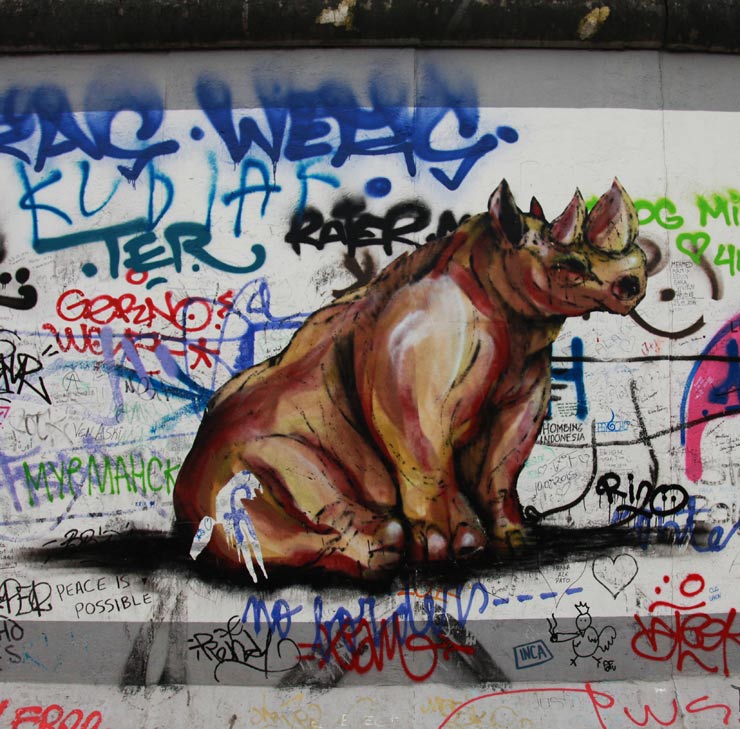
Top Image >>Urban Solid on Berlin’s East Side Gallery AKA Berlin Wall. (photo © Jaime Rojo)

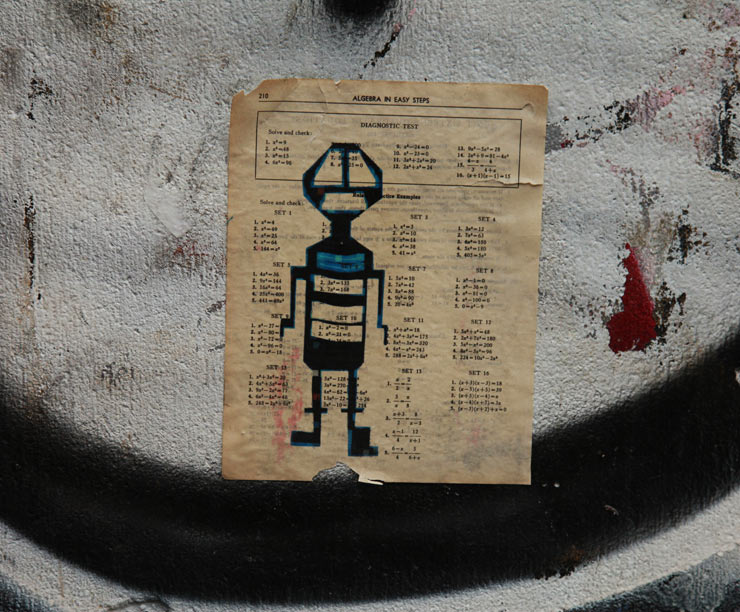
brooklyn-street-art-stikman-jaime-rojo-03-29-15-web

Stikman (photo © Jaime Rojo)

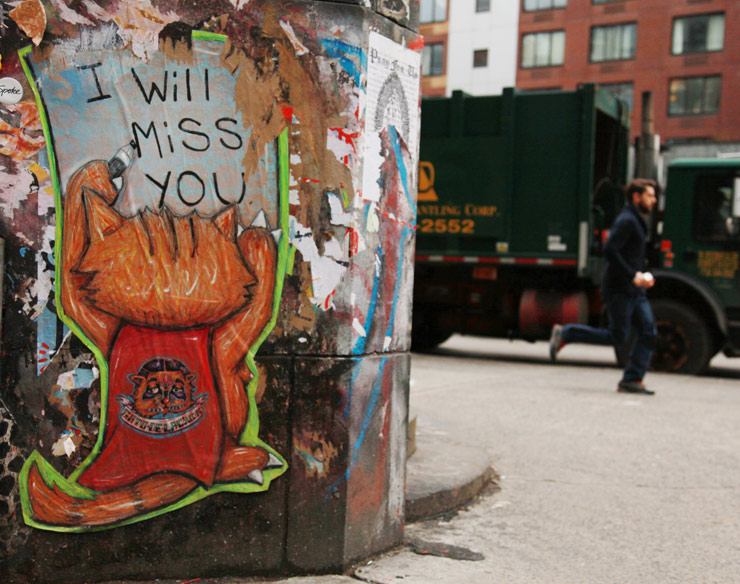
brooklyn-street-art-city-kitty-jaime-rojo-03-29-15-web

City Kitty bidding farewell to his prominent spot on the soon to be renovated Maisel building on the Bowery. Photographer Jay Maisel paid 102K in 1966 for the former Germania Bank building built in 1898. He sold it last year to developer Aby Rosen for 55 million. True story. (photo © Jaime Rojo)

brooklyn-street-art-rhino-berlin-jaime-rojo-03-29-15-web

Rhino Berlin on Berlin’s East Side Gallery AKA Berlin Wall. (photo © Jaime Rojo)

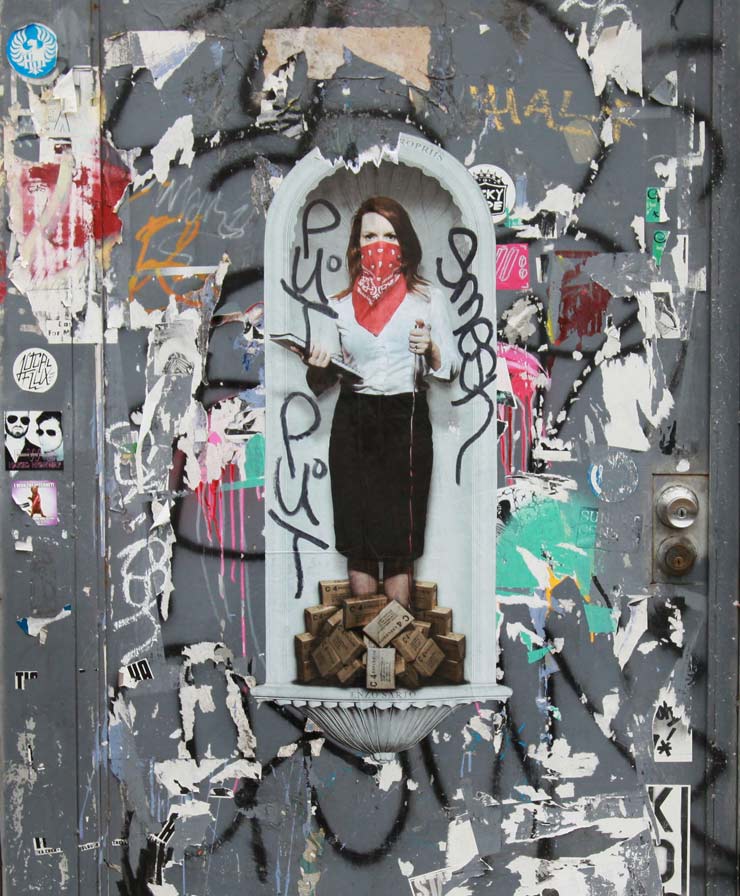
brooklyn-street-art-enzo-sarto-jaime-rojo-03-29-15-web-1

Enzo Sarto (photo © Jaime Rojo)

brooklyn-street-art-enzo-sarto-jaime-rojo-03-29-15-web-2

Enzo Sarto (photo © Jaime Rojo)

brooklyn-street-art-sobr-jaime-rojo-03-29-15-web

Sobr in Berlin. (photo © Jaime Rojo)

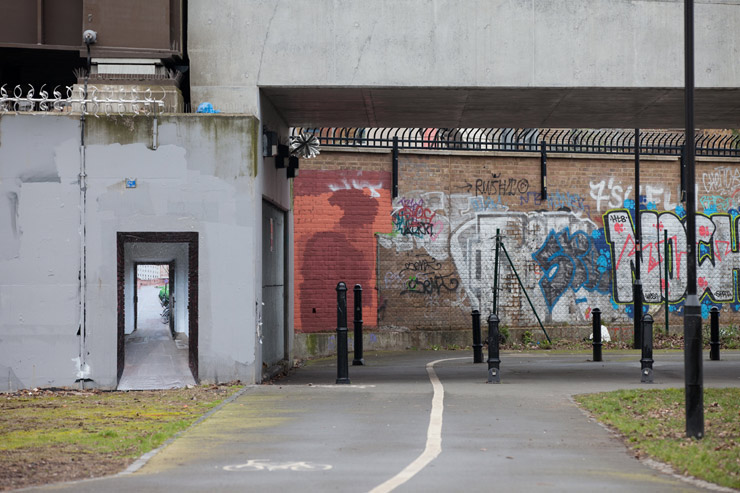
brooklyn-street-art-sbagliato-blind-eye-factory-london-03-29-15-web

Sbagliato in London. In case you were wondering the art is the passageway on the left. That’s not real. It is an optical illusion created with a photograph wheat-pasted on the wall. (photo © Blind Eye Factory)

brooklyn-street-art-tona-jaime-rojo-03-29-15-web-1

These bars in Berlin provide a number of great image making opportunities – like this pooch from Tona. (photo © Jaime Rojo)

brooklyn-street-art-claw-money-jaime-rojo-03-29-15-web

Claw Money (photo © Jaime Rojo)

brooklyn-street-art-vk-jaime-rojo-03-29-15-web

VK in Berlin. (photo © Jaime Rojo)

brooklyn-street-art-philippe-vignal-jaime-rojo-03-29-15-web

Philippe Vignal in Berlin. (photo © Jaime Rojo)

brooklyn-street-art-hot-tea-jaime-rojo-03-29-15-web

Hot Tea gets fancy. (photo © Jaime Rojo)

brooklyn-street-art-jeff-soto-jaime-rojo-03-29-15-web

Jeff Soto in Berlin. (photo © Jaime Rojo)

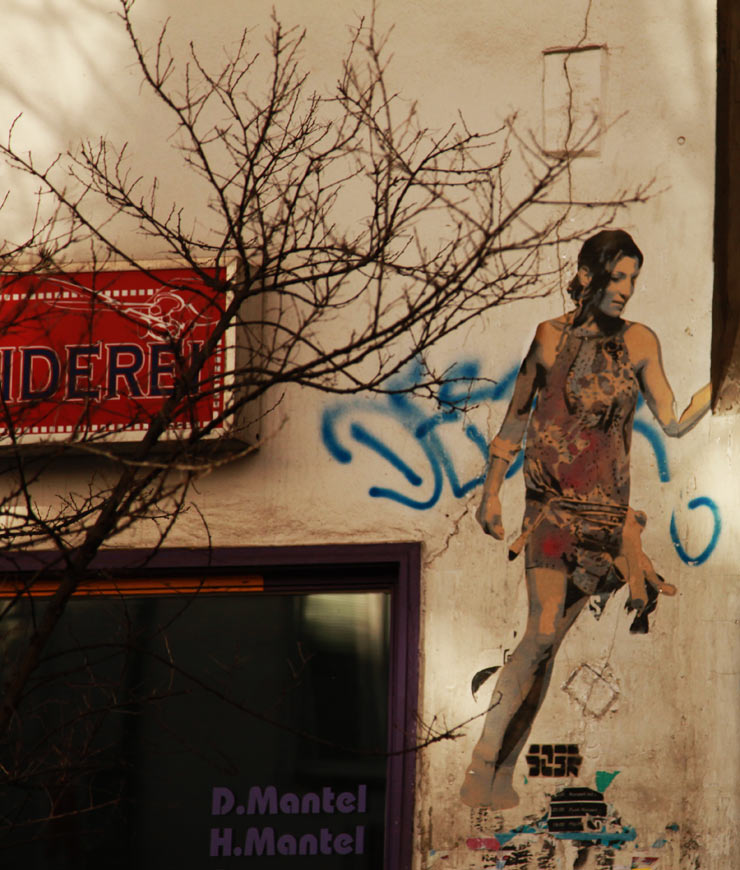
brooklyn-street-art-various-artist-jaime-rojo-03-29-15-web

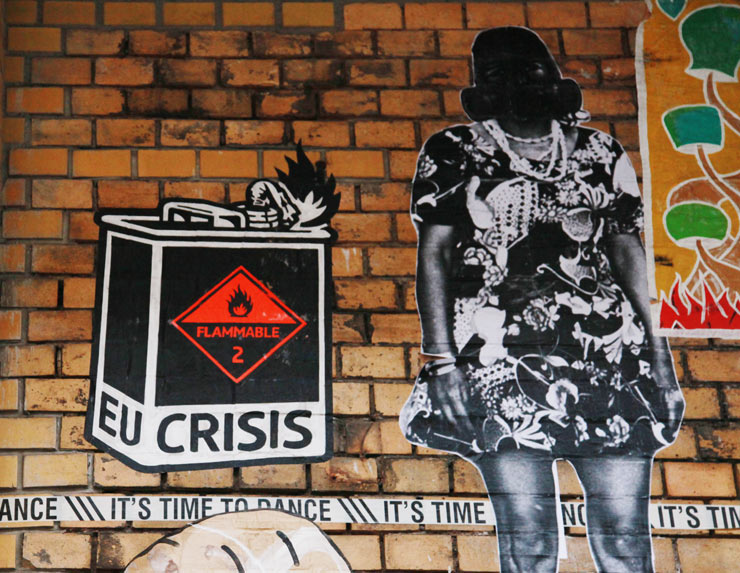
Which is more flammable, the EU crisis or this polyester dress? Various Artists on a “magnet wall” in Berlin. (photo © Jaime Rojo)

brooklyn-street-art-bd-white-jaime-rojo-03-28-15-web

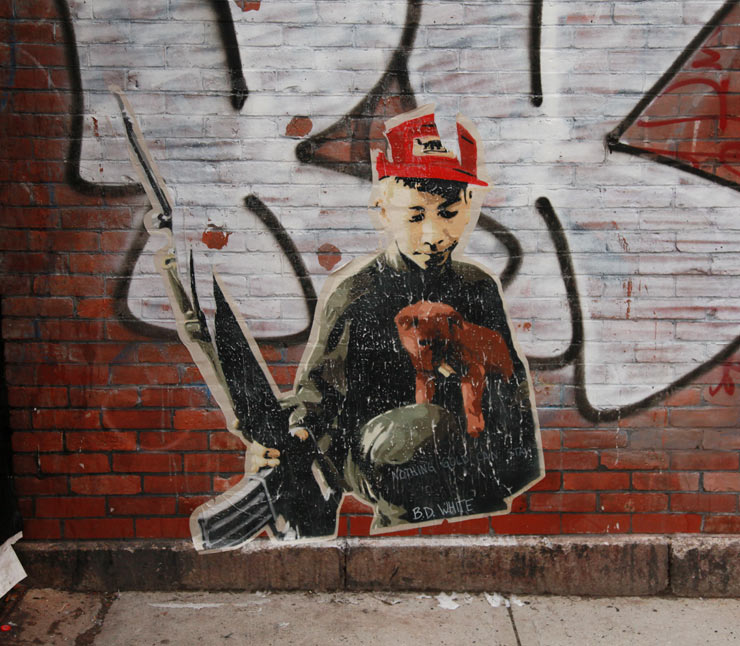
B.D. White (photo © Jaime Rojo)

brooklyn-street-art-jaime-rojo-03-29-15-web

Untitled. Let the right one in. Berlin. March 2015. (photo © Jaime Rojo)


<<>>><><<>BSA<<>>><<<>><><BSA<<>>><><<>BSA<<>>><<<>><><

BSA Please note: All content including images and text are © BrooklynStreetArt.com, unless otherwise noted. We like sharing BSA content for non-commercial purposes as long as you credit the photographer(s) and BSA, include a link to the original article URL and do not remove the photographer’s name from the .jpg file. Otherwise, please refrain from re-posting. Thanks!

<<>>><><<>BSA<<>>><<<>><><BSA<<>>><><<>BSA<<>>><<<>><><BSA


Read more
Hitnes Hits Piazza San Basilio for SANBA in Italy

Hitnes Hits Piazza San Basilio for SANBA in Italy

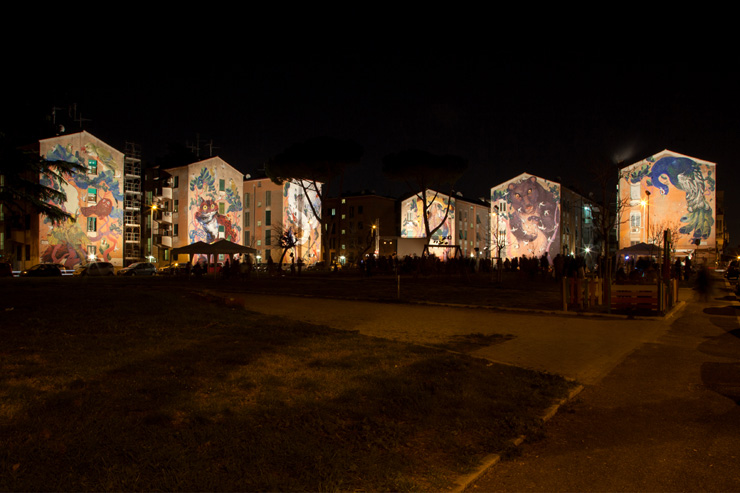
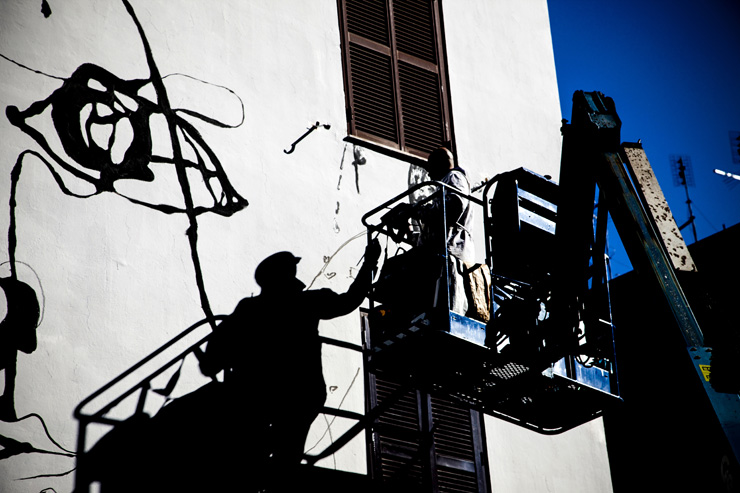
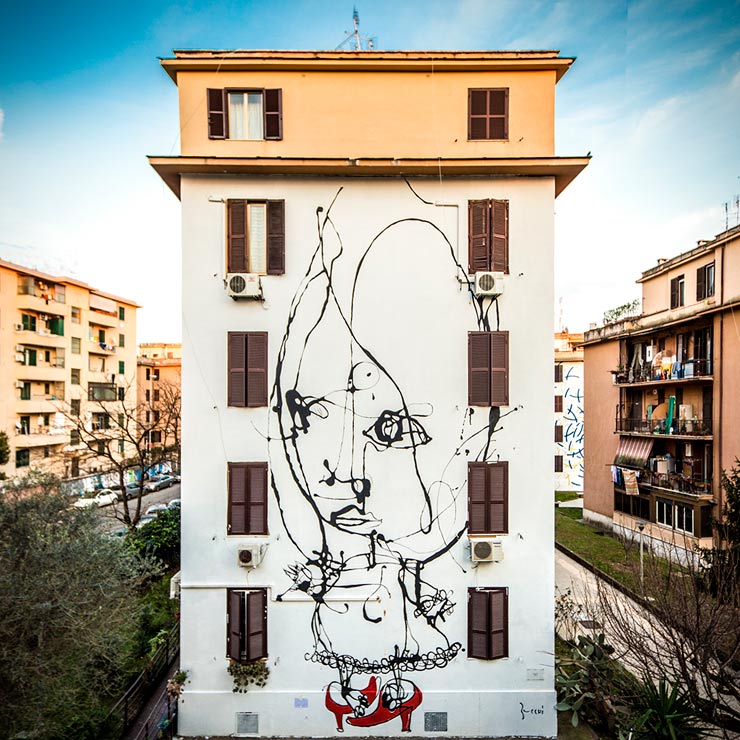
Sanba is a program engaging the built public environment of suburban Rome with the aesthetics of the modern Street Art and muralism movement. For the last two years under the curation of Simone Pallotta, Sanba has found new locations for painting in the public sphere and engage in the cultural and civic building senses as well, with a goal toward engaging community. The large facades painted by international artists are not just a “Street Art event”, hopefully, says Pallota.  “The murals are a light bulb, a figurative outpost to a daily commitment made of culture and participation,” he says.

brooklyn-street-art-hitnes-blind-eye-factory-san-basilio-rome-03-15-web-2

Hitnes (photo © Blind Eye Factory)

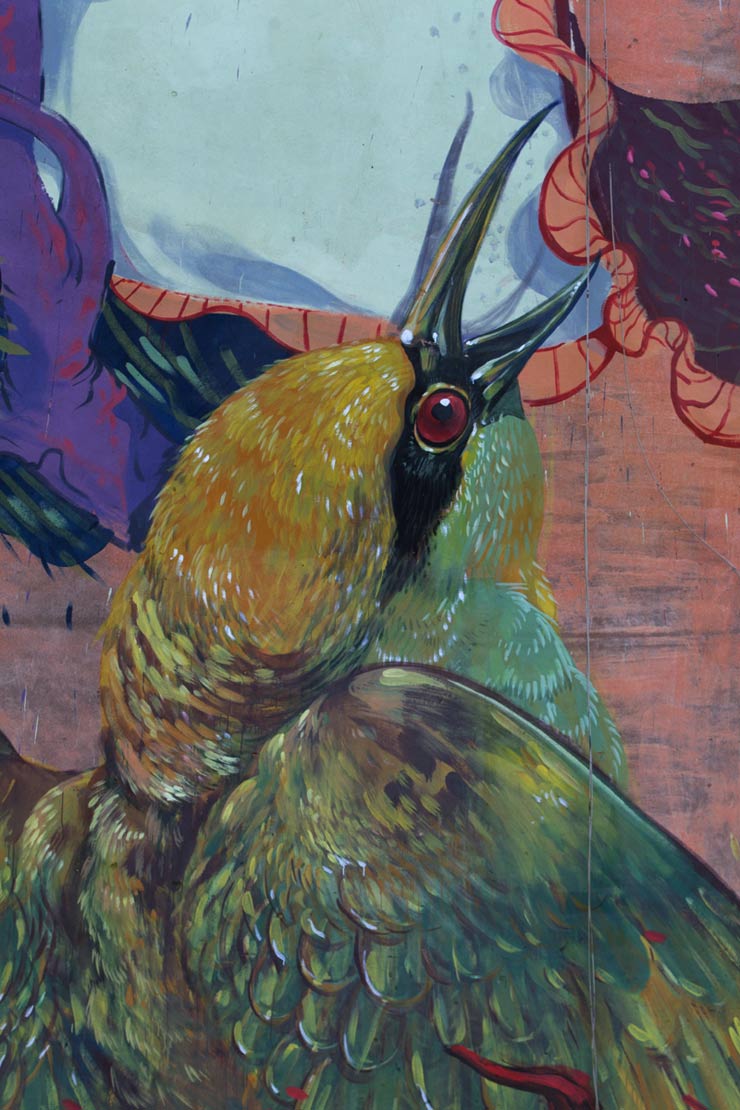
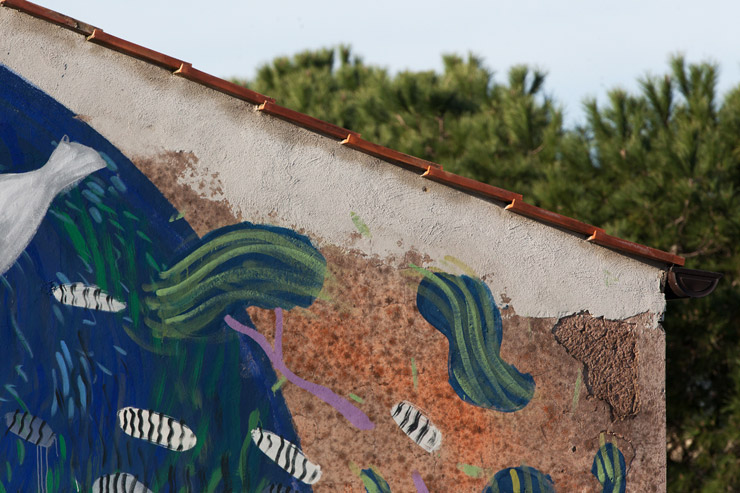
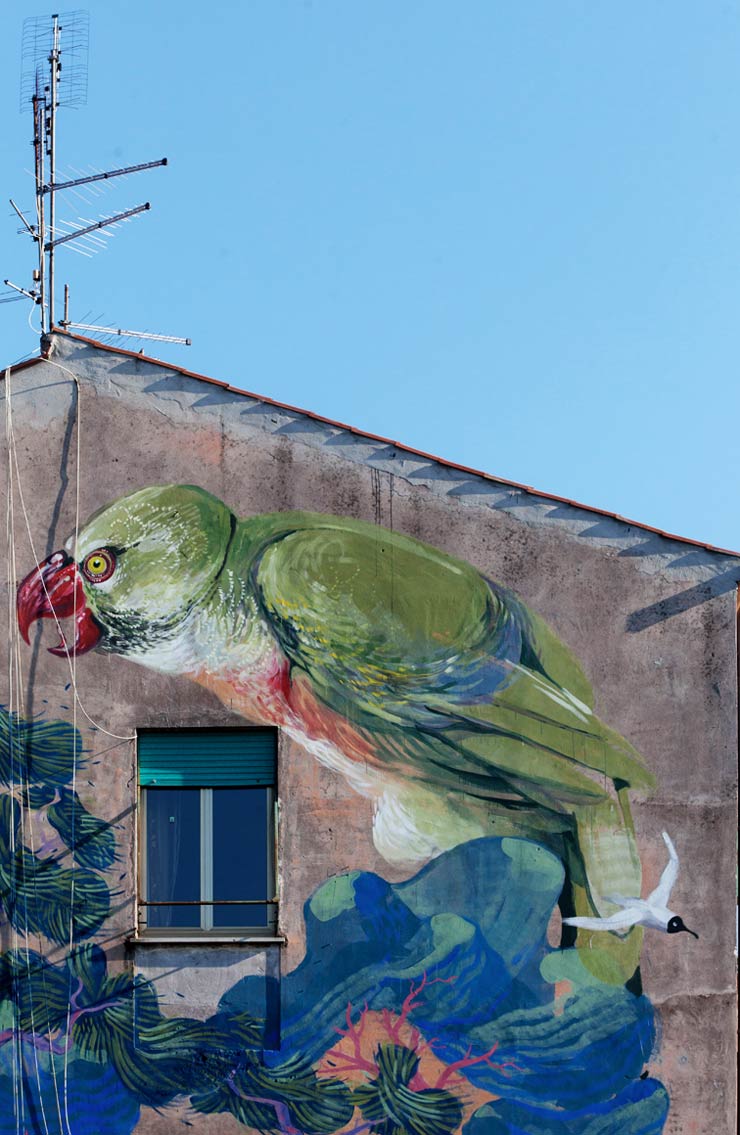
Here are five huge walls facing a public square that long ago began its decline. The artist Hitnes created works that would engage the neighbors, including young and old, to stand together and discuss the works – in effect bringing the outside space alive rather than simply one you pass through.

“The animals and the plants of his work live with the colors of the buildings, pink shades of an old red that is there from the 1950s. Animals, both terrestrial and marine, are hovering and flying all around the  trees with thin trunk, the marine pines that cover the neighborhood and that Hitnes uses to contextualize his work,” says Pallotta.

brooklyn-street-art-hitnes-blind-eye-factory-san-basilio-rome-03-15-web-1

Hitnes (photo © Blind Eye Factory)

brooklyn-street-art-hitnes-blind-eye-factory-san-basilio-rome-03-15-web-3

Hitnes (photo © Blind Eye Factory)

brooklyn-street-art-hitnes-blind-eye-factory-san-basilio-rome-03-15-web-4

Hitnes (photo © Blind Eye Factory)

To learn more about SANBA Walls please click HERE


<<>>><><<>BSA<<>>><<<>><><BSA<<>>><><<>BSA<<>>><<<>><><BSA

Please note: All content including images and text are © BrooklynStreetArt.com, unless otherwise noted. We like sharing BSA content for non-commercial purposes as long as you credit the photographer(s) and BSA, include a link to the original article URL and do not remove the photographer’s name from the .jpg file. Otherwise, please refrain from re-posting. Thanks!

<<>>><><<>BSA<<>>><<<>><><BSA<<>>><><<>BSA<<>>><<<>><><BSA

Read more
BSA Film Friday 03.27.15

BSA Film Friday 03.27.15

Brooklyn-Street-Art-Kashink-Screenshot-Video-March-2015

bsa-film-friday-JAN-2015

Our weekly focus on the moving image and art in the streets. And other oddities.

Now screening :

1. Kashink in Miami and her OUTSIDE / INSIDE project
2. Hold On, Just Going to Post This Letter – Почта России
3. Nuart 2014 via Hypebeast TV
4. Tost Films: Emigrantes en Yola
5. ROA teaser for Jonathan LeVine Gallery “Metazoa”

bsa-film-friday-special-feature

Kashink in Miami and her OUTSIDE / INSIDE project

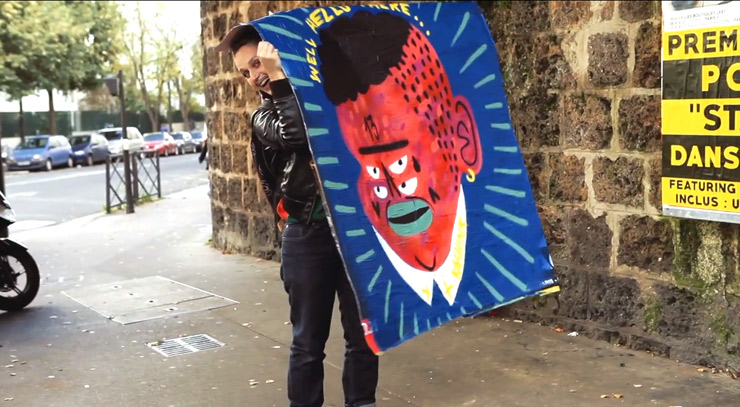
Experimenter and Street Artist hailing from France, Kashink observes the absurd and reports what she has found. A brainy badass, Ms. Kashink uses vivid color, cartoon, and calculated critique to a scene, whether scripted or organic. Part painter/ part matinee idol, Kashink helps us to question the paradox of our art and creativity classification systems.


Hold On, Just Going to Post This Letter – Почта России

A social experiment with Russian post office boxes, here is a simple way to discourage the remaining 5 people who still mail letters.

Nuart 2014 via Hypebeast TV

A nice recap of the events at Nuart via HypeBeast.

Tost Films: Emigrantes en Yola

ROA teaser for Jonathan LeVine Gallery “Metazoa”

“ROA views the beaver, the state animal of New York, as a metaphor for the idea that nature has the ability to reclaim itself. The recovery of the beaver in New York City after it was previously thought extinct is exemplary of how humans and animals affect each other and reflects the artist’s interest in how animals evolve within urban landscapes.”


Read more
“Big City Life Rome” Part II

“Big City Life Rome” Part II

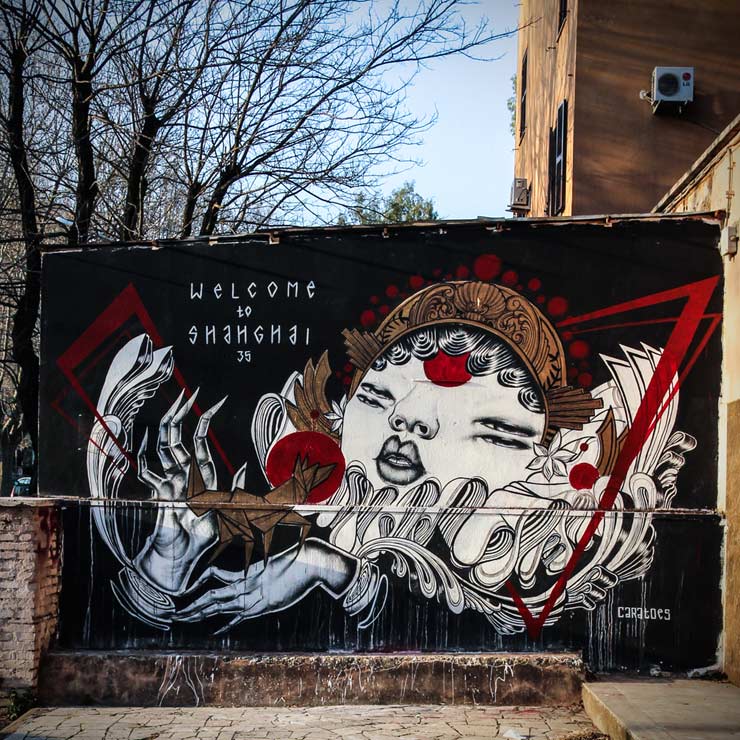
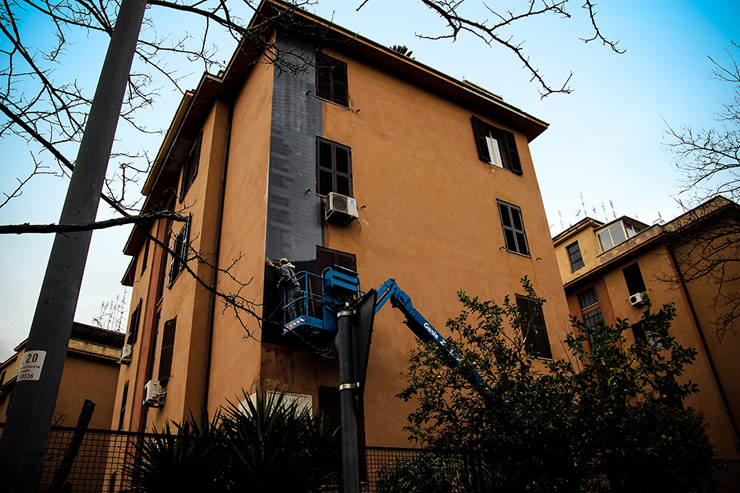
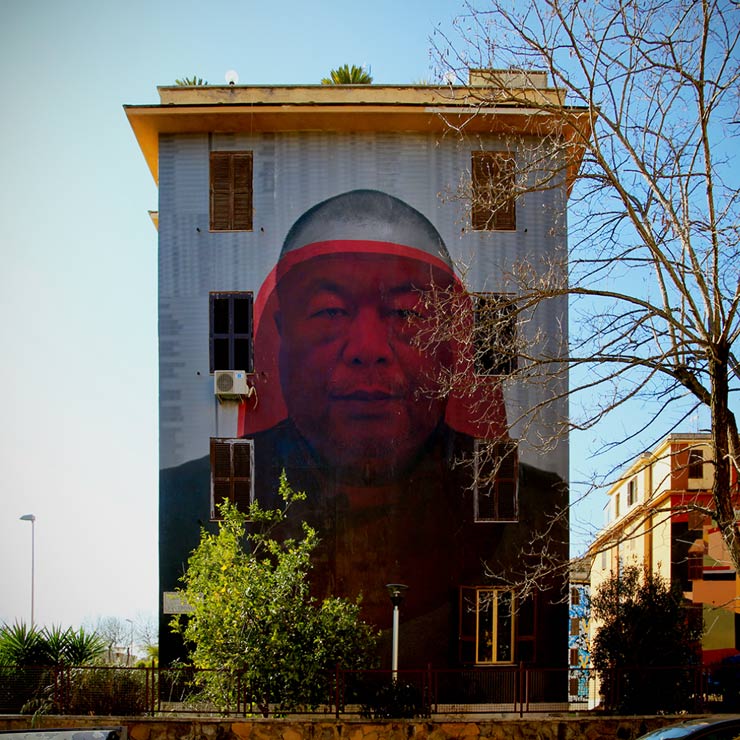
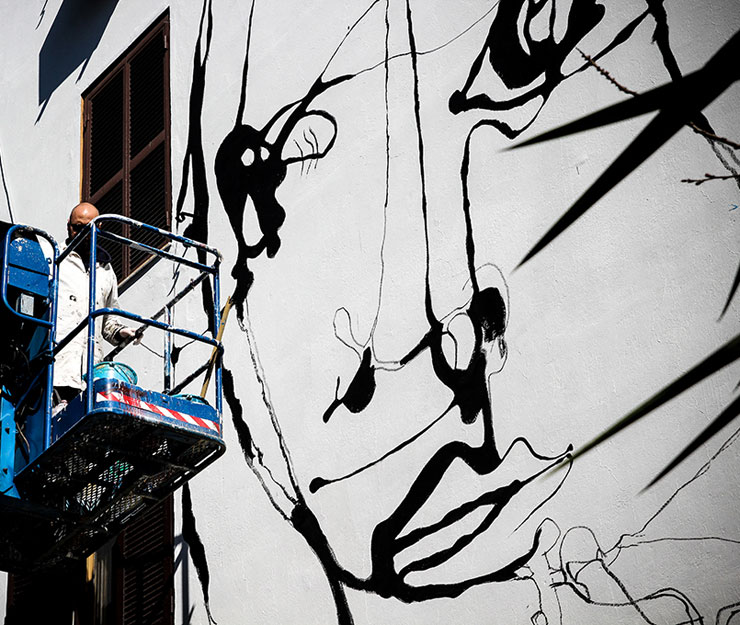
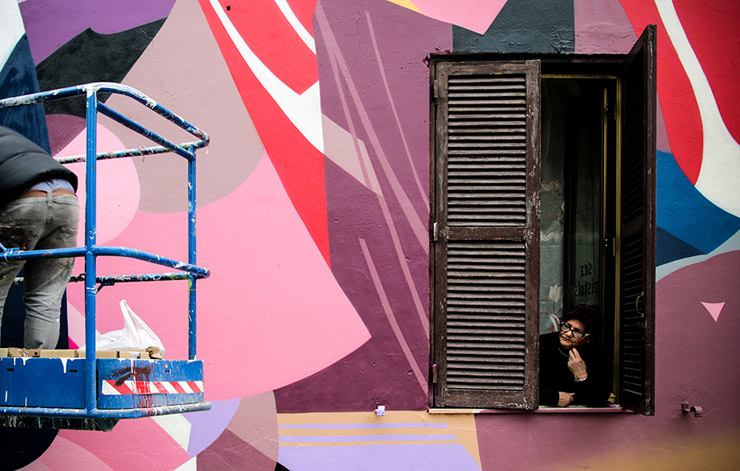
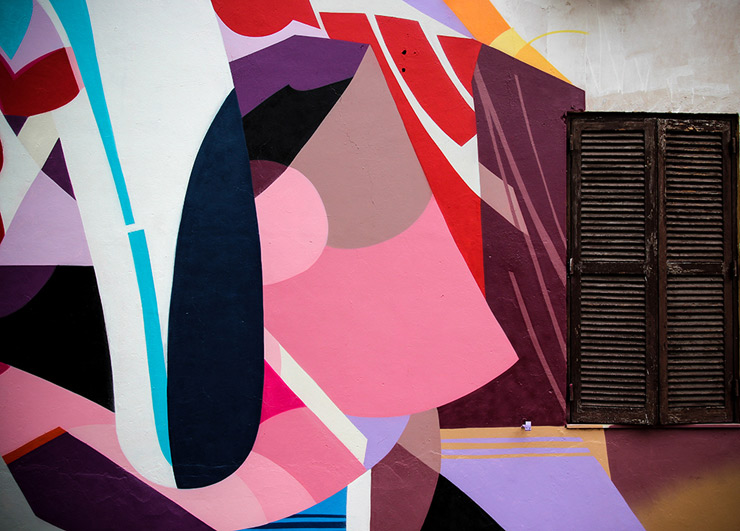
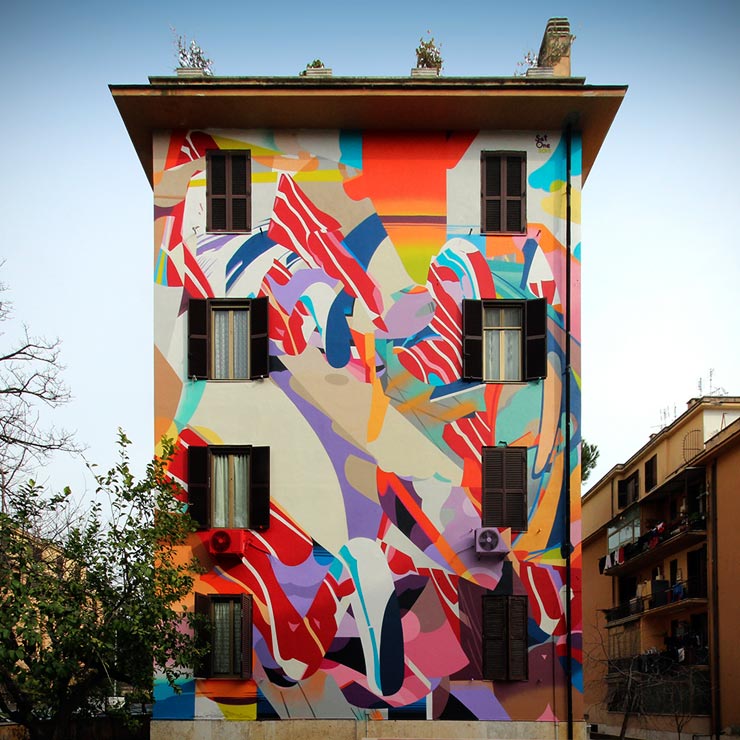
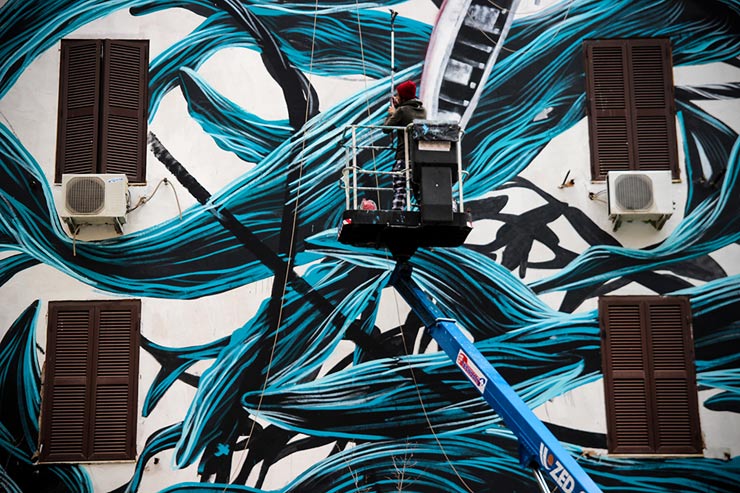
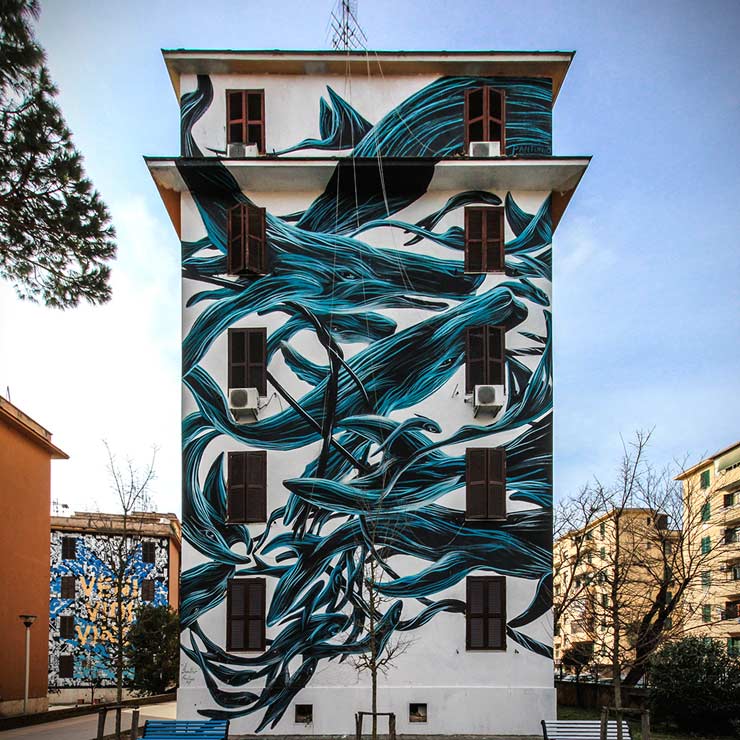
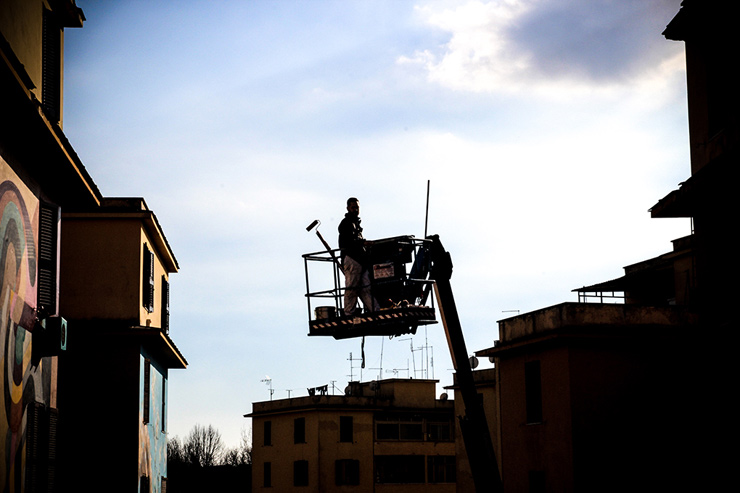
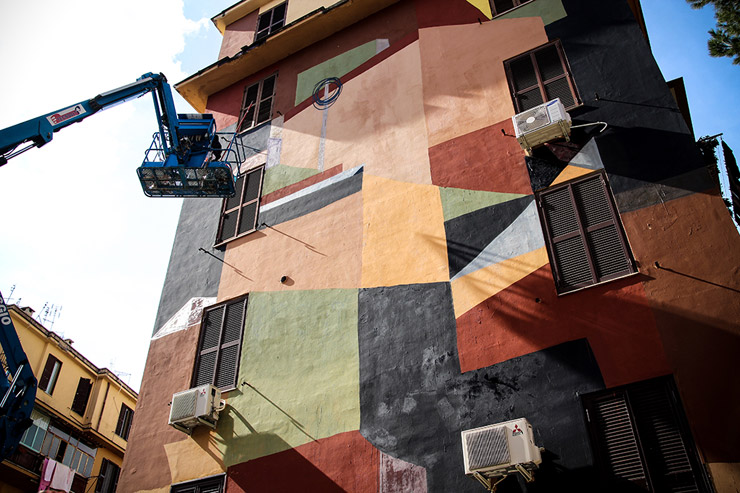
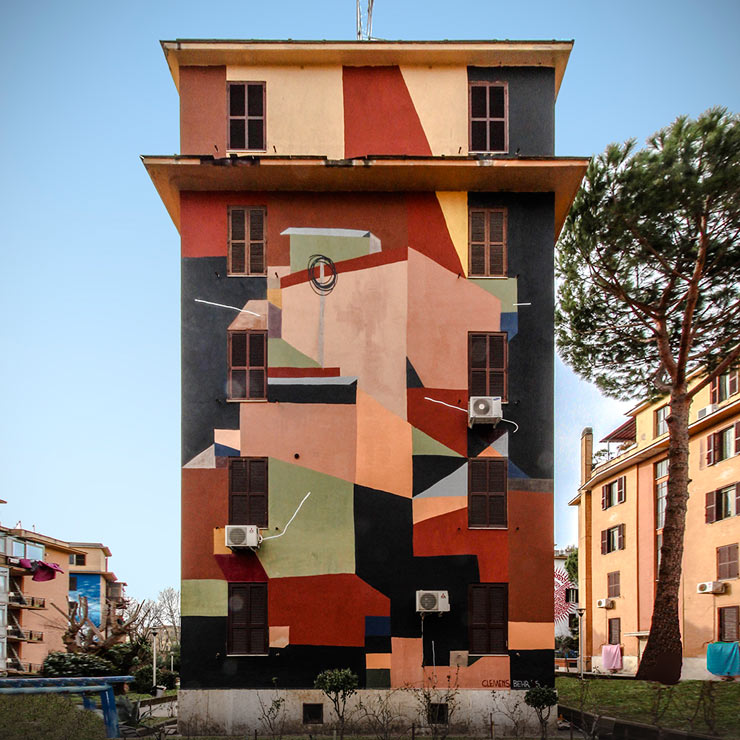
An update to the “Big City Life Rome” posting in February, here are the remaining murals in the neighborhood of Tomarancia. Produced and curated by 999Contemporary Gallery, these March walls are of equal size and dimension as the previous ones, bringing to mind the swatches of cloth sometimes used to create a quilt. Included here is new work from Caratoes, Jericho, Matteo Basile, Danilo Bucchi, SatOne, Pantonio, and Clemens Bher. The international group of artists have diverse styles, but the quality is high!

brooklyn-street-art-jerico-big-city-life-rome-02-15-web-2

Jerico (photo courtesy © 999 Contemporary Gallery)

brooklyn-street-art-jerico-big-city-life-rome-02-15-web-3

Jerico (photo courtesy © 999 Contemporary Gallery)

brooklyn-street-art-jerico-big-city-life-rome-02-15-web-1

Jerico (photo courtesy © 999 Contemporary Gallery)

brooklyn-street-art-CARATOES-WELCOME-TO-SHANGAY-big-city-life-rome-02-15-web-3

Caratoes (photo courtesy © 999 Contemporary Gallery)

brooklyn-street-art-CARATOES-WELCOME-TO-SHANGAY-big-city-life-rome-02-15-web-2

Caratoes (photo courtesy © 999 Contemporary Gallery)

brooklyn-street-art-CARATOES-WELCOME-TO-SHANGAY-big-city-life-rome-02-15-web-1

Caratoes (photo courtesy © 999 Contemporary Gallery)

brooklyn-street-art-matteo-basile-big-city-life-rome-02-15-web-2

Matteo Basile (photo courtesy © 999 Contemporary Gallery)

brooklyn-street-art-matteo-basile-big-city-life-rome-02-15-web-3

Matteo Basile'(photo courtesy © 999 Contemporary Gallery)

brooklyn-street-art-matteo-basile-big-city-life-rome-02-15-web-1

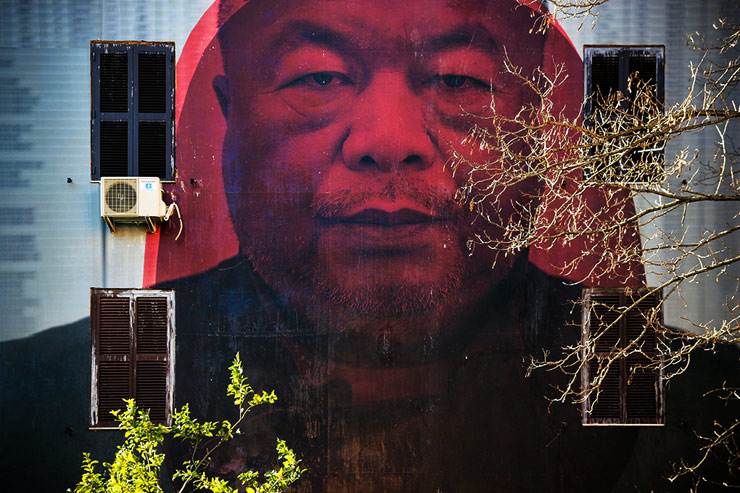
Matteo Basile does a red faced portrait of Ai Weiwei (photo courtesy © 999 Contemporary Gallery)

brooklyn-street-art-danilo-bucchi-big-city-life-rome-02-15-web-3

Danilo Bucchi (photo courtesy © 999 Contemporary Gallery)

brooklyn-street-art-danilo-bucchi-big-city-life-rome-02-15-web-2

Danilo Bucchi (photo courtesy © 999 Contemporary Gallery)

brooklyn-street-art-danilo-bucchi-big-city-life-rome-02-15-web-1

Danilo Bucchi (photo courtesy © 999 Contemporary Gallery)

brooklyn-street-art-satone-big-city-life-rome-02-15-web-3

SatOne (photo courtesy © 999 Contemporary Gallery)

brooklyn-street-art-satone-big-city-life-rome-02-15-web-2

SatOne (photo courtesy © 999 Contemporary Gallery)

brooklyn-street-art-satone-big-city-life-rome-02-15-web-1

SatOne (photo courtesy © 999 Contemporary Gallery)

brooklyn-street-art-pantonio-big-city-life-rome-02-15-web-2

Pantonio (photo courtesy © 999 Contemporary Gallery)

brooklyn-street-art-pantonio-big-city-life-rome-02-15-web-3

Pantonio (photo courtesy © 999 Contemporary Gallery)

brooklyn-street-art-pantonio-big-city-life-rome-02-15-web-1

Pantonio (photo courtesy © 999 Contemporary Gallery)

brooklyn-street-art-clemens-behr-big-city-life-rome-02-15-web-2

Clemens Bher (photo courtesy © 999 Contemporary Gallery)

brooklyn-street-art-clemens-behr-big-city-life-rome-02-15-web-3

Clemens Bher (photo courtesy © 999 Contemporary Gallery)

brooklyn-street-art-clemens-behr-big-city-life-rome-02-15-web-1

Clemens Bher (photo courtesy © 999 Contemporary Gallery)

Click here to see our Part I of the coverage.

We wish to thank Stefano Antonelli at 999Contemporay for his diligence on getting us the material to make this article possible. To see all the completed walls and more details on the project and the participating artists click HERE.

Read more
Gender, Caste, and Crochet : OLEK Transforms a Shelter in Delhi

Gender, Caste, and Crochet : OLEK Transforms a Shelter in Delhi

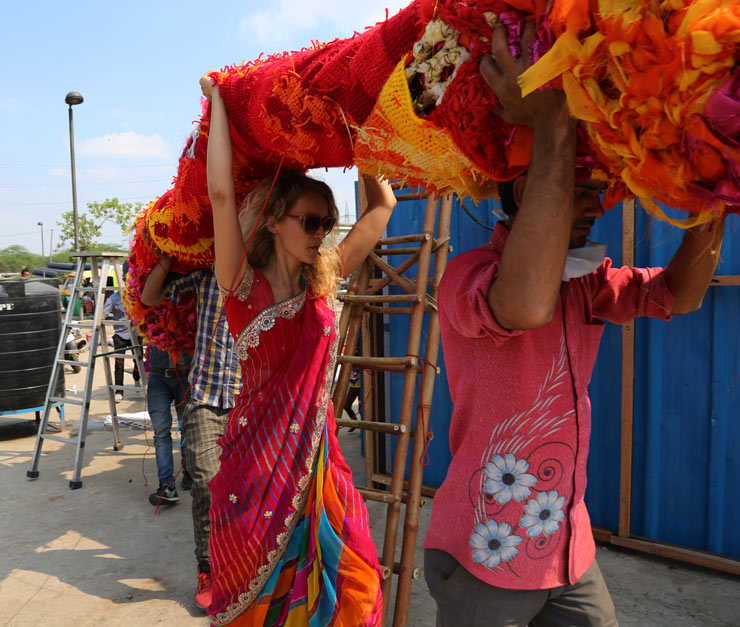
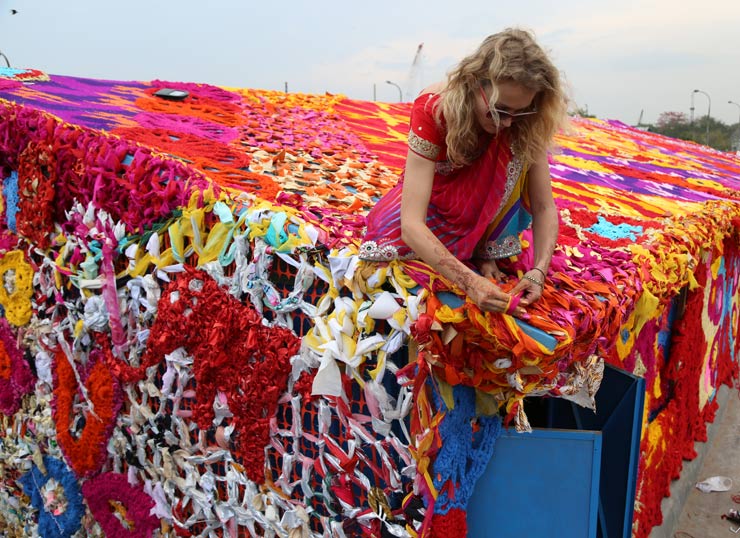
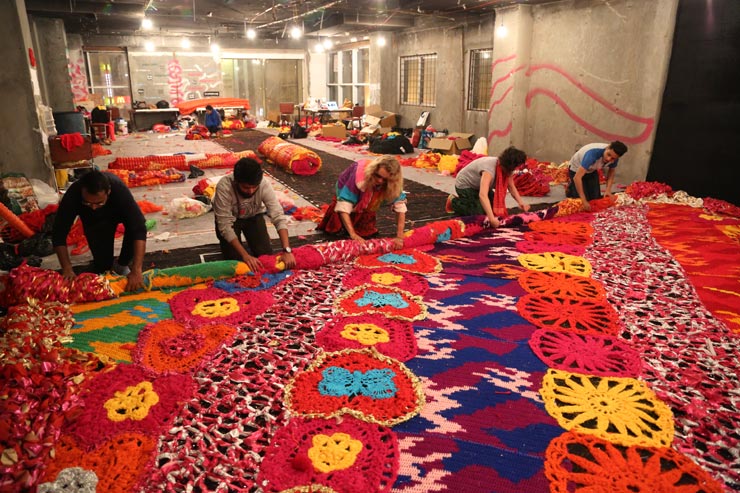
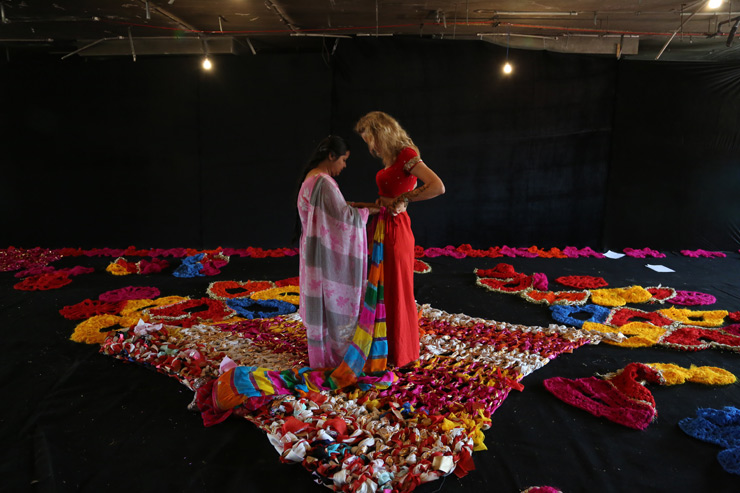
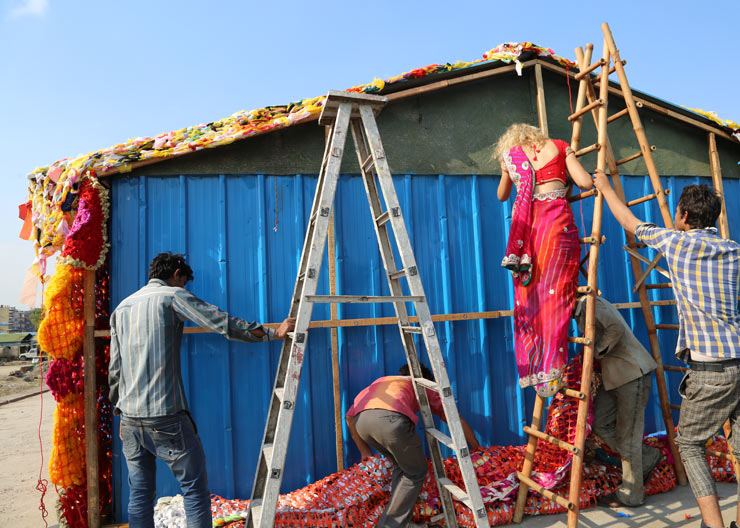
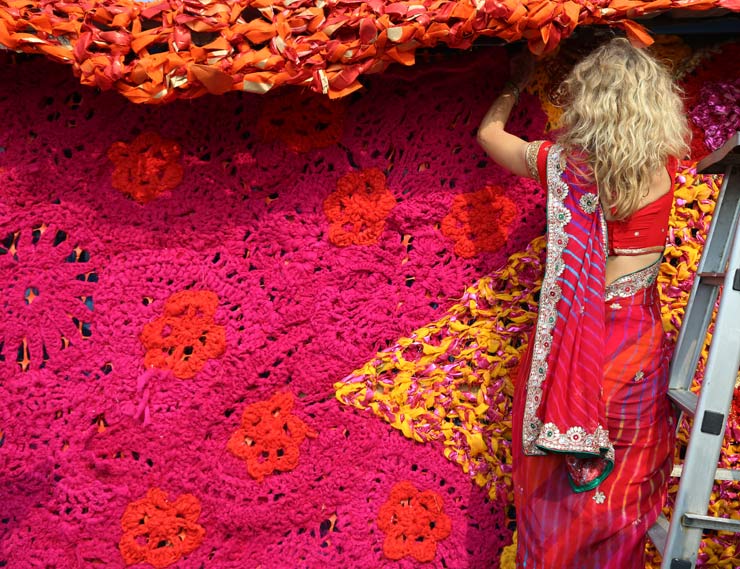
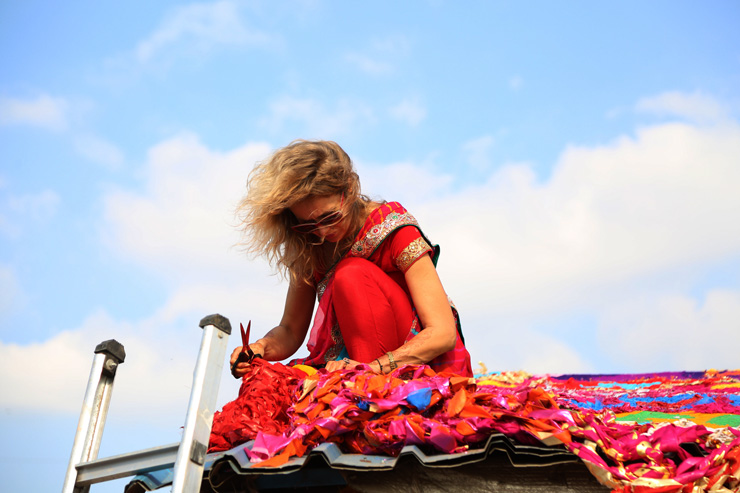
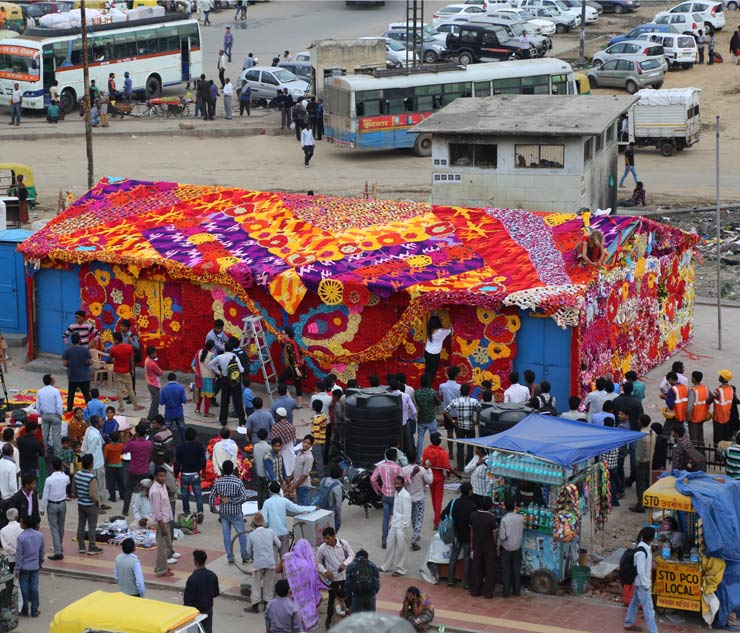
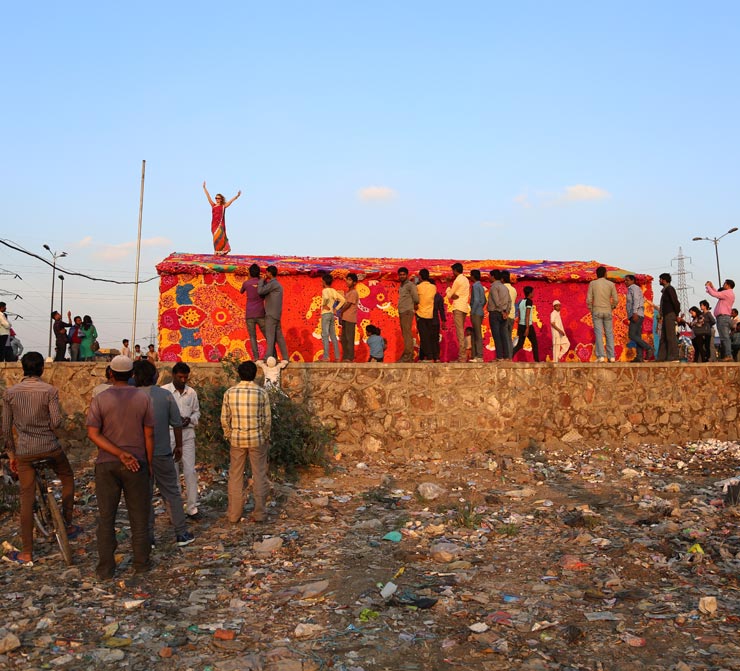
The fluorescent pink and orange sari skims the svelte frame of Brooklyn’s Olek as she glides across the dirt lot in Delhi’s South Extension with bags of yarn, needles and fabric slung over arms and shoulders.

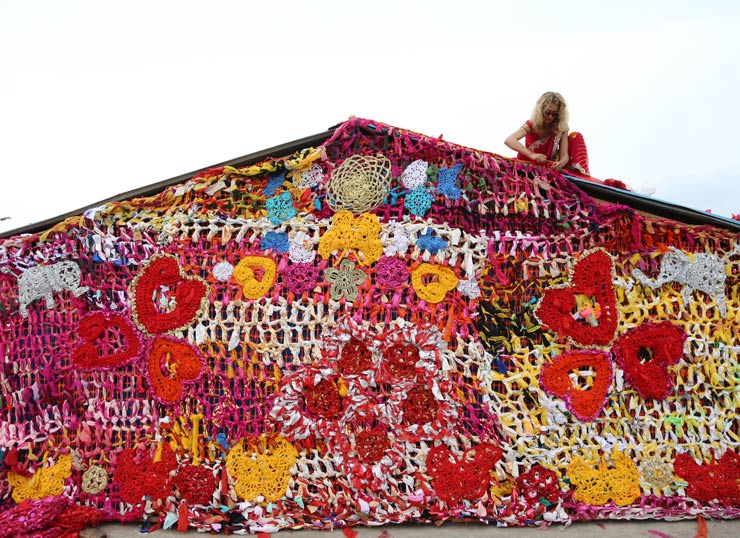
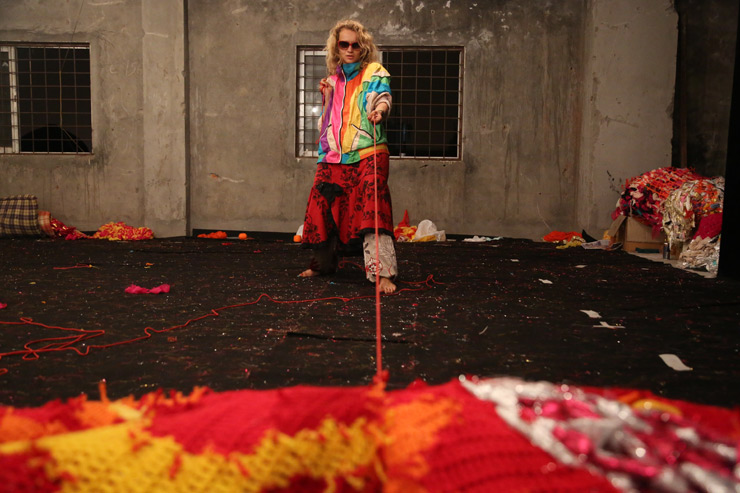
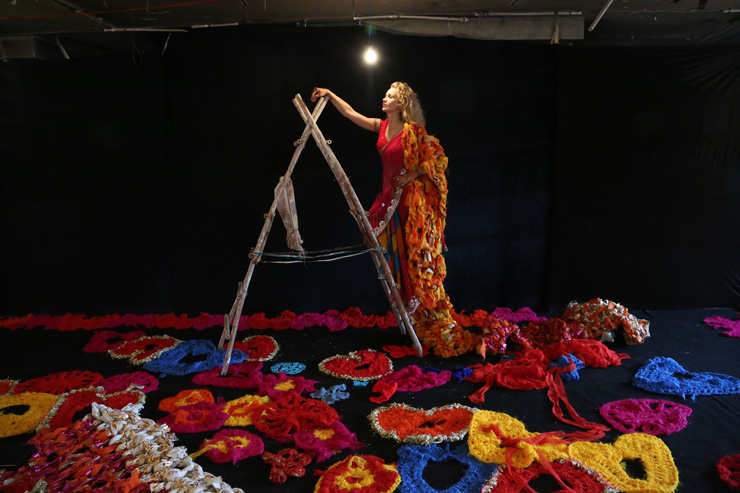
The massive new acid fluorescent epidermal transformation has taken a week to complete and the street artist is keeping her head while managing the many hands who are helping, but under the eclectic glamour is always raw labor – and a generous dollop of drama.

brooklyn-street-art-olek-new-delhi-street-art-india-03-15-web-10
Olek (photo © Pranav Mehta/St+ARTIndia)

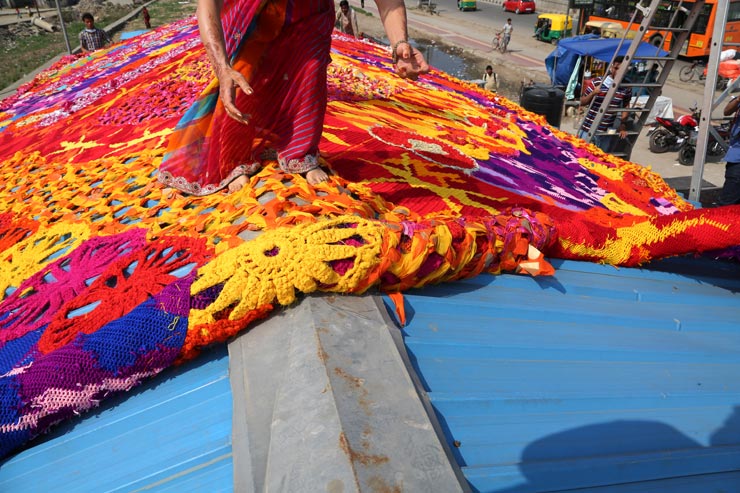
“It felt like I gave a birth to an oversize baby without any pain killers. I had to pull the black magic to make it happen. Physically and emotionally drained. Was it worth it? Absolutely YES,” she types onto her Facebook page to let friends and fans know that she has finished the seven-day marathon of crocheting and directing a full team of volunteers and St+Art Delhi organizers. Triumphant, she stands atop the woman’s shelter, a one story structure of corrugated metal and concrete 40 ft long and 8 foot high, with a fist in the air, a symbol of celebration as well as a show of solidarity with the sisterhood of those who helped her make it and those will seek refuge here when other options have been exhausted.

brooklyn-street-art-olek-new-delhi-street-art-india-03-15-web-14

Olek (photo © Pranav Mehta/St+ARTIndia)

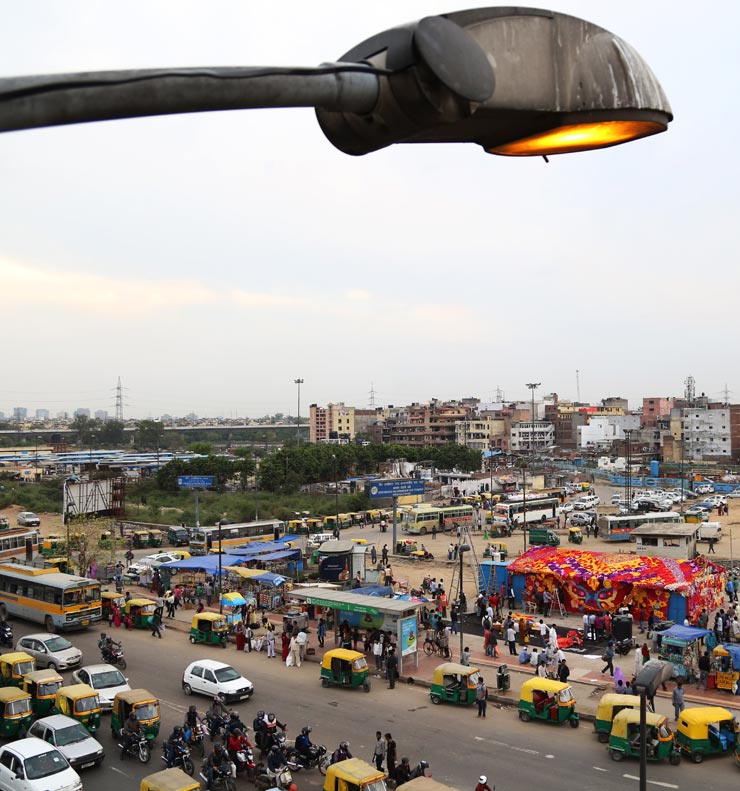
“Raine Basera”, a night shelter for homeless women lies just off Sarai Kale Khan here in New Delhi and it is not far from some industrial parks, surrounded by buses and noise from the traffic and temporary markets. A part of the festival called St+Art Delhi 2015 this particular project is conceived to raise awareness of the shelter and its very existence to those families who need it. Given the chaos of color and decorative motifs that have characterized many of Olek’s street works, this is one more that will be hard to miss. In this city of about 11 million, there are actually 184 night shelters in the city of Delhi, and 10 Indian artists will be working with the Urban Shelter Department to paint more.

Speaking with Olek you learn that this was a joyful, painful project – made possible with the help of a number of people, but mostly because of the steely determination of the Street Artist who is defining and re-defining what it means to be an artist in public space, as well as a woman in the art world. Her vigor and her vision is genuine and her struggles with issues regarding poverty, gender, and empowerment were brought to the fore on a daily basis during this project. As usual, we are of the opinion this is still the beginning of what Olek will accomplish in the Street Art world and in the lives of others – for her the goals are multitudinous.

brooklyn-street-art-olek-new-delhi-street-art-india-03-15-web-9

Olek (photo © Pranav Mehta/St+ARTIndia)

We spoke with Olek about the experience in her first trip to India in the interview below. Following that is a short interview with one of the organizers from the St+Art India Foundation and the curator of this project, Giulia Ambrogi. Both help us position the work of Olek into a greater context in Indian society during this relatively new festival effort, now in its second year.

OLEK

Brooklyn Street Art: Was there a motif that you added to your repertoire of hearts and butterflies that was specific to this project?
OLEK: You know how when you write for a newspaper or a blog you always have to keep your audience in mind so you use a specific language to describe your ideas and thoughts. So for this project I had to think about my specific audience. There were the people in the shelter and the neighbors around it. Many of them are are simple people without education and maybe even illiterate so I wanted to create a visual work that was accessible and meaningful for them.

So for this project I drew from the basic Indian Iconography such as the elephant, the butterfly and flowers. Of course I have crocheted these motifs before in my work but this time I kept an Indian aesthetic with the shapes and forms and they were more visible within the context of the overall piece. In the case of the butterfly I see it as having a special connection with women.

brooklyn-street-art-olek-new-delhi-street-art-india-03-15-web-3

Olek (photo © Pranav Mehta/St+ARTIndia)

BSA: Was it easy to bridge the gaps between cultures when working with the women who assisted in the project?
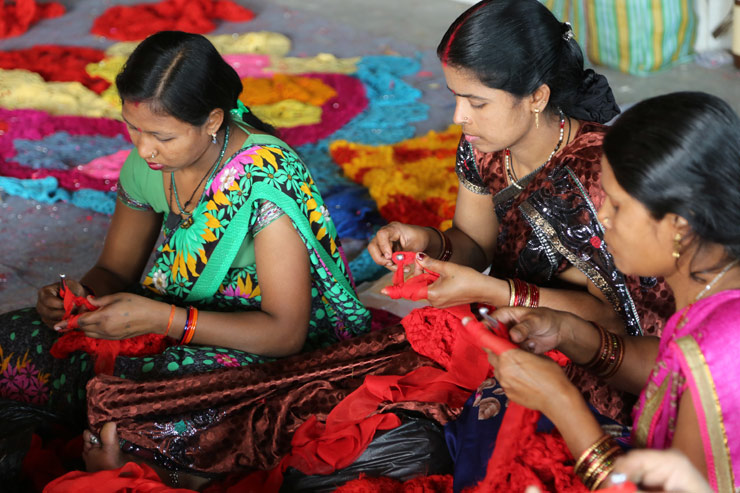
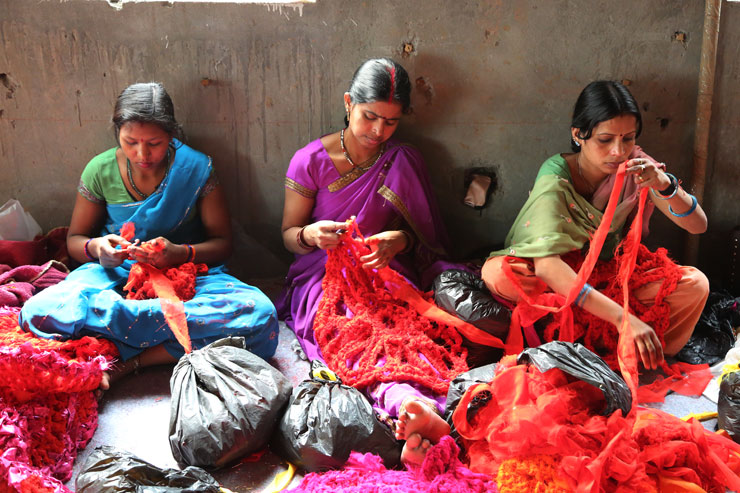
OLEK: Well the women I was working with found me to be fascinating. Here comes this woman with tools and yarns and crochet and I think they are used to seeing men doing most of these things – who come and boss them around and tell them what to do. In my case I was sitting with them crocheting together and we were part of a team and at some point I was also wearing Indian clothes and making things happen. They were happy to see me telling the men around us that I was in control and that things were getting done. So due to my experience working with so many different people around the world in small villages in Poland, China and Hong Kong this aspect of the project was the easy part.

The crochet was our language. Once you show them how it all works and explain the project to them you get the respect right away. They liked seeing me working so fast and were shocked that it was actually possible to do this so fast. So once you get their respect it is actually quite easy to work with them. The language of making and producing art is beautiful and universal and you get the connection right away. Some of the women were volunteers but most of them we hired to work on this project. Of course there were other elements in this project that were more difficult but I have never in my life had a problem working with women.

brooklyn-street-art-olek-new-delhi-street-art-india-03-15-web-4

Olek (photo © Pranav Mehta/St+ARTIndia)

BSA: In addition to its aesthetic nature, how do you think about your work when you consider that it is literally sheltering women tonight as they sleep?
OLEK: The most shocking thing for me in India was these massive amount of people who are born in poverty and under a lower class or caste and they are convinced that they will never ever see or experience anything different from what they are accustomed to and people with a higher status in their society see them as “untouchables” and inferior. They were born poor they should die poor – that is the mentality. So for the time where we were working on this project they felt that the spotlight was on them and for once they weren’t invisible as cameras and people and noise was all around them and I think they felt that there was something special about them.

Maybe when they come to the shelter at night to sleep and see it transformed they will feel different and maybe they will be inspired to do something else with their lives. My intention as an artist was to show them that there might be a chance to change what was supposed to be in their lives to what it can actually could be. That of course is too little of a contribution from my part.

brooklyn-street-art-olek-new-delhi-street-art-india-03-15-web-5

Olek (photo © Pranav Mehta/St+ARTIndia)

BSA: What did you learn about these shelters that you would like people to know?
OLEK: Right now there are more shelters opening around Delhi than before. It is important for people to know that if they are homeless they have the shelters at night to sleep with a roof over their heads. But the sad part to me is that the conditions in the shelters are not so great. I saw them wearing their same clothes every day and I realized that what they had on them is all they have in their lives. Yet I didn’t see sadness on their faces. They are used to living under these conditions and they see it as their life. So all this time I was thinking how actually the project should be about getting them out of the shelters and provide them with education. Access to education is important everywhere. It changes everything. The beautiful kids I think don’t even go to school. They spend all day on the streets.

So I felt that the project was only half done and I didn’t have the time or resources to do the next step with them and spend more time with them. It was devastating to me to see the amount of pollution and garbage and dirt and in some cases I have this impression that some of them didn’t want to be helped because they believed that that was their lot in life by divine decree. I couldn’t understand that and the whole trip was confusing. So the experience left me half empty in way with a sense that the project was done – but only half done.

brooklyn-street-art-olek-new-delhi-street-art-india-03-15-web-7

Olek (photo © Pranav Mehta/St+ARTIndia)

BSA: When you were a teenager you read a biography of Jerzy Grotowski and his various travels, including his descriptions of India. How did that writing affect your experience visiting the country for the first time?
OLEK: I studied theater for a while in Poland when I was a teenager and I would go to theater festivals and that really influenced who I am right now. Grotowski had a brilliant mind and was an influential theorist and when I read that he went to India and that the trip totally changed him I was very impressed and I thought India must be a special land. I’ve been wanting to visit India for a long time but I was also waiting for the right time to visit – when there was a purpose for the trip and the right project.

brooklyn-street-art-olek-new-delhi-street-art-india-03-15-web-6

Olek (photo © Pranav Mehta/St+ARTIndia)

But the land that he saw with his eyes was during the 1970’s. I wish I had more time and I will have more time, to go back and travel and re-visit and really see the country more fully. But I think that what influenced me wasn’t necessarily about the religion, the colors, the textures, the beauty of the country. What influenced me the most was the poor India. I have never seen so much plastic and garbage in my life on the streets. I saw cows eating plastic on the street. The garbage and pollution is just growing and growing and it is insane. So this was my influence from this trip and I think I could never compare it to Grotowski’s trip during the 70s. But I can see how the trip to India changed him and influenced his life in theater.

brooklyn-street-art-olek-new-delhi-street-art-india-03-15-web-8

Olek (photo © Pranav Mehta/St+ARTIndia)

BSA: Tell us about your sari. We don’t remember seeing you making one of those for yourself before.
OLEK: I bought a sari because I was invited to attend a wedding while I was in India and I wanted to feel appropriate. I probably don’t fit in most places but when I’m invited I like to pay respect to the local customs. So together with my assistant we went to the store full of saris and took in the whole experience. You buy a sari then you have to hire someone to put it on you and I loved it. From the beginning I told people that I wanted to wear a sari while working instead of wearing western fashions. People noticed how comfortable I was wearing a sari for the first time and when they remarked about that I told them I’m around so much fabric all the time that I can easily wear a sari.

brooklyn-street-art-olek-new-delhi-street-art-india-03-15-web-1

Olek (photo © Pranav Mehta/St+ARTIndia)

It is interesting because to me a sari is a sexy dress. Your body is so exposed so it was confusing to me to see all the women wearing such a dress in such a conservative country. It is a very comfortable dress and nothing falls off of you. They pinned everything to keep it all in place. You go to get fitted and out of the same fabric a tailor makes the top and the underskirt and you can choose from many designs for the top. The tailor is not in the store where the sari is purchased. You have to leave and go someplace else for the fitting. But they can make it all in two hours. I loved seeing the women in India being very comfortable with their bodies. Women of all shapes and sizes wear the saris with the utmost comfort.

brooklyn-street-art-olek-new-delhi-street-art-india-03-15-web-2

Olek (photo © Pranav Mehta/St+ARTIndia)

<<>>><<>>>

A brief interview with Giulia Ambrogi from the St+art India Foundation:

BSA: For her installation Olek was assisted by a number of diverse volunteers whom she first taught about the crochet needs of the project. What was the incentive that motivated all these people who helped her?
Giulia: Actually most of the women were already trained because they belong to the “Indian crochet community”, a reality that we were pretty surprised to discover. All of them knew Olek’s work and were extremely enthusiastic to have such an occasion to be together and to practice their passion for a wider cause. This big community doesn’t have many initiatives dedicated to crochet so this project, by being so ambitious, public and based on a social cause was per se the main incentive  for all of them.

Many other volunteers instead have been with us since the day 1 of St+art Delhi 2015. They are mostly really young and they just love urban art and what all we are bringing in the city. Thus, they are keen to be part of the project, to be in a stimulating environment and to give their contribution. It was amazing to see how all these people from different backgrounds and different ages (from 18 to 60) collaborated together and how strong was the feeling to be a big family.

brooklyn-street-art-olek-new-delhi-street-art-india-03-15-web-11

Olek (photo © Pranav Mehta/St+ARTIndia)

BSA: Women in India are often at huge disadvantage financially and socially when compared to the status that men hold in society. What is the significance of bringing women artists to install their work on the streets of India?
Giulia: First of all realize artworks in the streets is already a sort of revolution. Public spaces, especially if peripheral, are most of the time neglected and are crowded mostly by lower social classes. The process of creating huge artworks for everybody’s eyes and the attitude of the artists and the team of involving everyone and gathering people under the signs of art-making and artworks – which is absolutely new in India, is an empowering breakthrough or a certain kind.

brooklyn-street-art-olek-new-delhi-street-art-india-03-15-web-13

Olek (photo © Pranav Mehta/St+ARTIndia)

By calling women artists we enhanced this prolific dynamic. It meant that we introduced a  change, showing both to men and women that no matter the gender and the class, everyone has the same strength and rights of living, appropriating and positively acting in  public spaces. Olek’s work brings back to the streets a tradition that is usually practiced by women in the private and closed environment of their homes. Also, this work highlighted the power of people, especially women, when they cooperate together. Aiko’s work celebrates the most dangerous and powerful woman in Indian history, Rani Lakshmi Bai, who became and still is the symbol of women empowerment.

Many things are changing in India and it is a transitional moment in which we try and hope to give our contributions by designing artistic interventions based on critical and current topics.

brooklyn-street-art-olek-new-delhi-street-art-india-03-15-web-12

Olek (photo © Pranav Mehta/St+ARTIndia)

BSA: We have written before about Aiko’s participation in St+ART Delhi. We wrote that her contribution was a departure from her highly sexualized iconography. Would it have been impossible for her to paint her sexually charged women in India? Can you tell us about the character whom she chose to paint and why she selected that character within the context of the festival?
Giulia: By painting her characteristic women in very sexualized scenes, her work would have been meaningless within the Indian environment. Not just deeply disrespectful it would have been totally sterile because it would not have been in dialogue with the cultural context. Since the beginning of the project Lady Aiko asked about Indian culture with the intention of creating a powerful and empowering work in relation to the country.

After some brainstorming she fell in love with both the story and the iconography of Rani Lakshmi Bai. She was the most dangerous leader in Indian history, a symbol of resistance to the rule of the British Company. In her brief time she cast aside many conventions to unite peoples of all castes and religions in her cause.

She encouraged other women to do the same and trained them to fight and support the army. She cut across the social norms of the time, refusing to accept her fate ‘as a woman’. So in this case Aiko’s piece was mainly the symbol of women empowerment…and much sexier than pin ups in this sense!

brooklyn-street-art-olek-new-delhi-street-art-india-03-15-web-15

Olek (photo © Pranav Mehta/St+ARTIndia)

brooklyn-street-art-olek-new-delhi-street-art-india-03-15-19-web

Olek (photo © Pranav Mehta/St+ARTIndia)

brooklyn-street-art-olek-new-delhi-street-art-india-03-15-web-17

Olek (photo © Pranav Mehta/St+ARTIndia)

brooklyn-street-art-olek-new-delhi-street-art-india-03-15-web-16

Olek (photo © Pranav Mehta/St+ARTIndia)

brooklyn-street-art-olek-new-delhi-street-art-india-03-15-web-18

Olek (photo © Pranav Mehta/St+ARTIndia)


<<<<>>>>

The organizers would like to thank fashion companies Tarun Tahiliani and Manish Arora for contributing materials and labor, Allkraftz & Usha Sewing Machines, The Polish Culture Institute, the Delhi Urban Shelter Improvement Board (DUSIB), and all the volunteers and participants who helped make this project happen.

We would like to thank the organizers of ST+ART Delhi; the curator Giulia Ambrogi and Pranav Mehta for the photos. And of course to Olek for taking the time to answer our questions.


<<>>><><<>BSA<<>>><<<>><><BSA<<>>><><<>BSA<<>>><<<>><><BSA

Please note: All content including images and text are © BrooklynStreetArt.com, unless otherwise noted. We like sharing BSA content for non-commercial purposes as long as you credit the photographer(s) and BSA, include a link to the original article URL and do not remove the photographer’s name from the .jpg file. Otherwise, please refrain from re-posting. Thanks!

<<>>><><<>BSA<<>>><<<>><><BSA<<>>><><<>BSA<<>>><<<>><><BSA


Read more
MOMO Paints Massive Work Across Lobby in Boston

MOMO Paints Massive Work Across Lobby in Boston

Corporate Space, Happy Universal Shapes, and Additive Averaging

Two unusual aspects distinguish todays’ posting. One is that the featured project by the remarkable street artist MOMO is not actually on the street, rather it is in a corporate lobby – a quasi public/private place far removed from the origins and ethos of most Street Artists’ work. Secondly, the interview is conducted by our guest Kate Gilbert rather than us. An artist, curator, and creative strategist, Kate directs a Boston non-profit that curates and produces independent public art projects. We really enjoyed the conversation that she and MOMO had while he was in the midst of a two week installation – and we knew you would like it too.

~ by Kate Gilbert

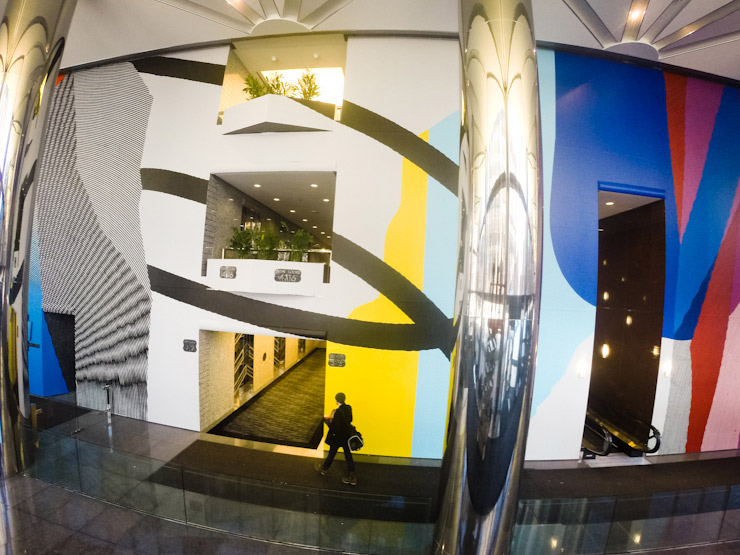
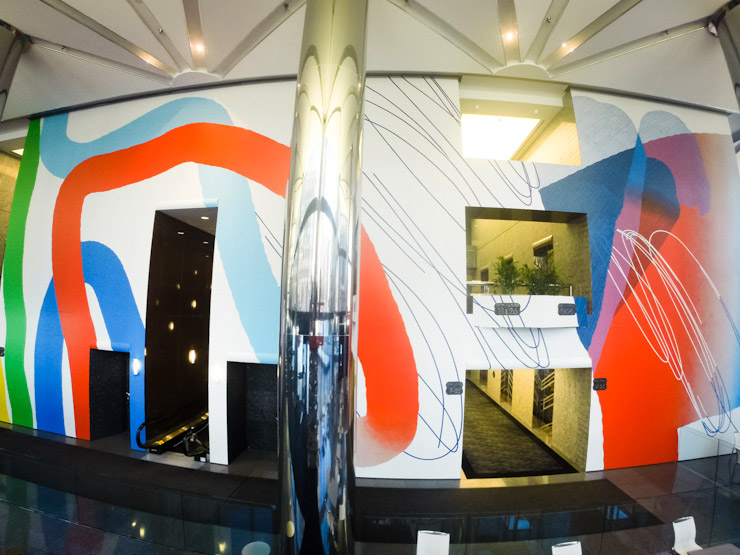
In February the Brooklyn/New Orleans street artist MOMO arrived in Boston in the midst of Snowpocalypse ‘15, an unrelenting series of snowstorms and freezing temperatures that left Boston under 93” of snow. Undaunted by it all, MOMO completed a massive 250’ x 34’ mural over eighteen nights in the lobby of Boston’s iconic John Hancock Building bringing his signature combination of blending techniques, harmonious colors and universal forms to warm up the austere lobby and its wintery surrounds.
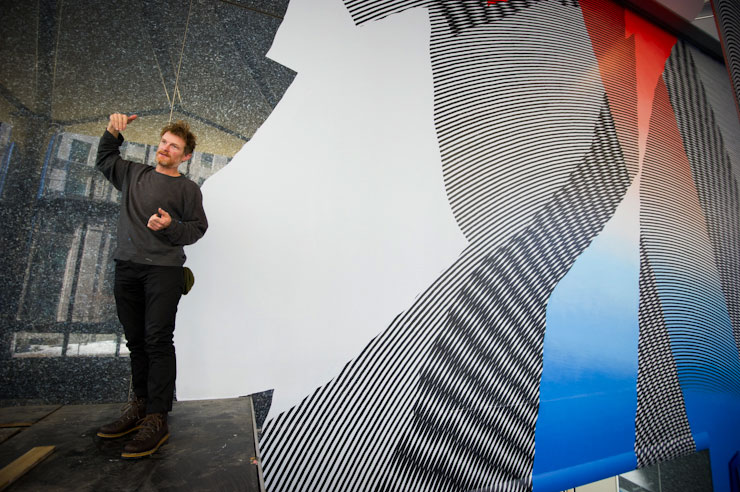
brooklyn-street-art-MOMO-geoff-hargadon-boston-02-15-web-11

MOMO (photo © Geoff Hargadon)

The following is an excerpt from an interview I had with MOMO on his fourteenth night of painting, which followed a brief talk he gave with project curator Pedro Alonzo.

Kate Gilbert: So it’s 20 degrees in Boston tonight and the thermometer is stuck at 20 degrees. The snow isn’t melting, and there’s ice everywhere; it’s permanent. So first of all I want to thank you for bringing this to us. It’s great color and smart design.
MOMO: Cool, I’m glad you like it.

KG: One of the things I wanted to bring back from your conversation with Pedro is this idea of universal shapes and appealing colors. That’s something we don’t usually hear coming out of the mouth of an artist who originally started in the street.
MOMO: Pedro’s first question took me off guard because I hadn’t quite heard that from anyone. He said the murals made him feel good, and why was that. I didn’t quite have an answer ready then but I’ve thought a lot about it since and it reminds me that I have this great love for David Hockney’s swimming pools. A sunny landscape has a certain key of colors and mix of shadows and this variety of things that feels like it’s at the peak spectral combination of all these formal things like shade and value, and it lets us know it’s a sunny landscape.

Something about that really appeals to me. At different moments I’ve wished my art could be associated with swimming pools, cabanas, and beach towels – those things that are, for me, a godsend in terms of mood and inspiration.

I spent a lot of time in the south and I love a tropical climate and things like that feel really alive and vital. It’s no coincidence that I take so much inspiration from Jamaica. Not just the nature there but also their culture seems to respond to this vivid set of conditions. I want to put that in the paintings and I hope that is what’s coming through in what Pedro mentioned about being happy.
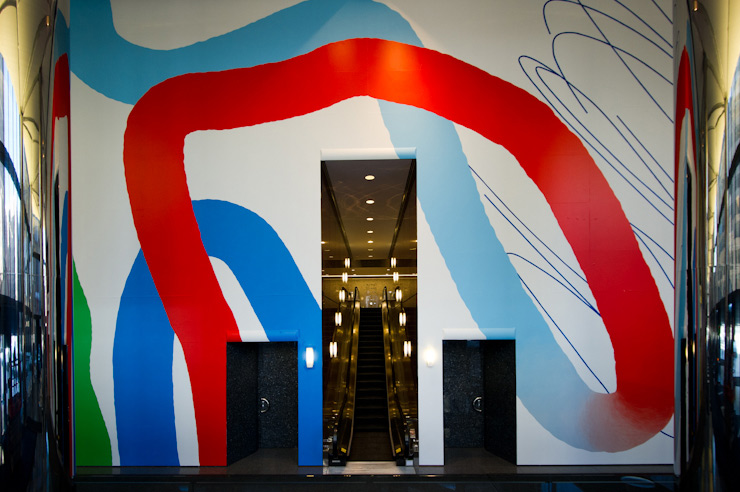
brooklyn-street-art-MOMO-geoff-hargadon-boston-02-15-web-7

MOMO (photo © Geoff Hargadon)

KG:  I think so. It’s happy and, especially at this time of year in Boston, we’re all keyed in to anything that’s happy.
MOMO: Good. I realized quite late that I respond well to warm climates and it’s why I stay in the South primarily. And I do think a majority of these forms keep repeating. They’ve come up in different ways through the years.

KG:  Are they forms that you’re testing on the street? When you say universal, are they universal in your artistic vocabulary, or do you think for they’re universal for all of us?
MOMO: They’re meant to be simple and universal so the audience might enjoy these as their own, being just colors and lines, spectrums and harmonies.

For instance I’m relying heavily on just the impact of red. Or the right orange-red which I feel is lit by sunlight. It’s not so much a narrative or a meaning implied on top, it’s the concrete materiality of the work that has to carry the oomph.

brooklyn-street-art-MOMO-geoff-hargadon-boston-02-15-web-6

MOMO (photo © Geoff Hargadon)

KG: Picking up on this idea of materiality, the space has this well, let me just say, it’s pretty unique. Have you ever worked in a space like this before?
MOMO: No, this is the best architectural chance I’ve ever had to do something, indoor or outdoor.

KG:  What are you responding to in this space?
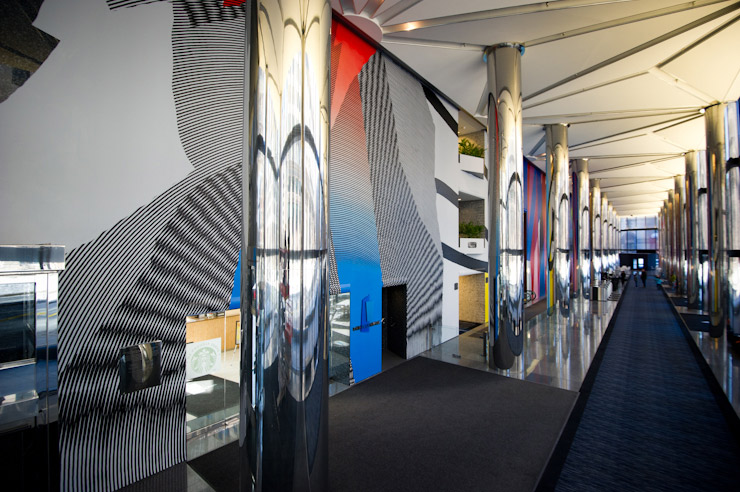
MOMO: The chrome columns are undeniably weird and fun and that’s led me to make the fat lines somewhat in scale with them, or in-and-out of scale with them. There’re a lot of vertical bands. Down there [pointing to the NE side] there’re a lot of noodly ones that are just going their own way. It struck me that having a conversation with those floor-to-ceiling forms was an obvious way to respond.
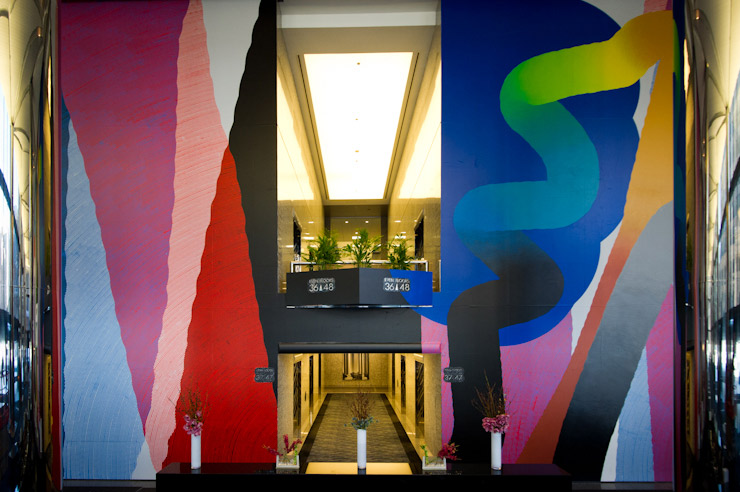
brooklyn-street-art-MOMO-geoff-hargadon-boston-02-15-web-5

MOMO (photo © Geoff Hargadon)

KG:  There’s this sort of forest effect going on.
MOMO: Yeah, there’s a forest! They have a gesture. Everything in here is real straight lines and clean and feels like it’ll last for the ages. But the columns do have a gesture and it’s right in front of the painting.

Besides the columns, everything in the lobby is a super straight, flat surface. I’ve tried to play off of that with soft forms so the building can show off. I’m doing something complementary in a way.
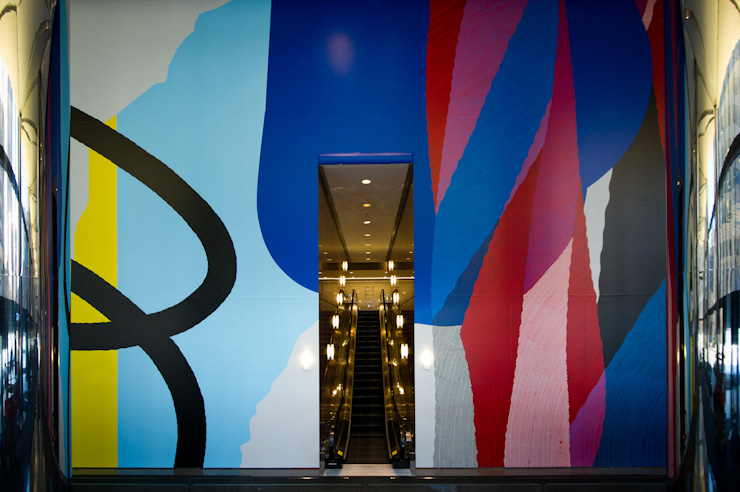
brooklyn-street-art-MOMO-geoff-hargadon-boston-02-15-web-4

MOMO (photo © Geoff Hargadon)

KG:  You’re creating a visual conversation with the architects. I’d love to see you in a room with I.M. Pei’s office. What would you say to them?
MOMO: I’d be interesting to see how this building has grown or developed on its own because it’s probably not the way the architect left it. They’ve designed security in a way that wasn’t part of the initial pedestrian flow.

KG:  There’s this great performance going on here with people entering and leaving through the security desk, even now at 6 pm.
MOMO: And cleaning crews! It takes a huge staff to keep the building up to its standards.
brooklyn-street-art-MOMO-geoff-hargadon-boston-02-15-web-10

MOMO (photo © Geoff Hargadon)

KG:  So did you consider this audience or who’d be coming and going when you were making the work?
MOMO: Yeah, of course. First thing, I tried to identify was where people would see the wall the most frequently, or where they’d spend the most time. Because the wall is framed by the columns, you get a grouping of available vignettes.

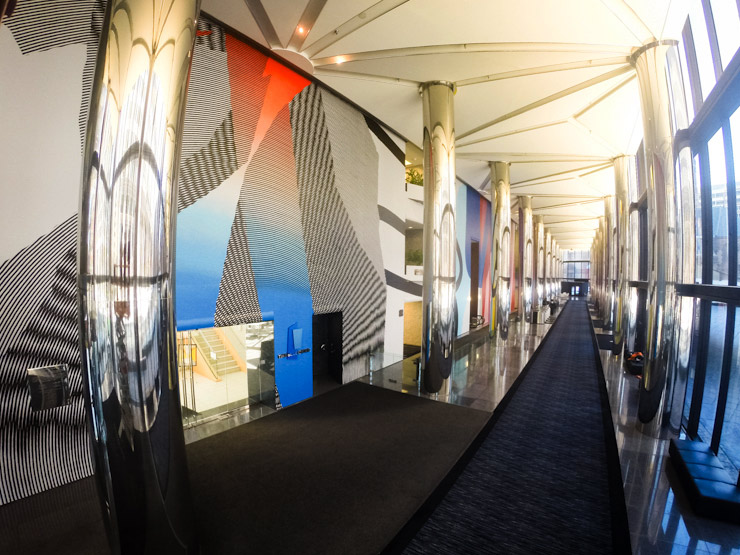
I took the ends to have special significance. At one end there are tables and chairs where you can relax in a communal café area. I thought those areas should be dressed up in a way so you could look at them for longer periods of time. Then the center, I kept things more serious and somber because it has this stately serious pretense with the check-in desk and security being there. I tried to look at the space anthropologically.

KG:  So the painting in the center is more serious? Is that represented in the darker, gray pinstripes created through…what do you call it, additive averaging?
MOMO: Yes, the particular color theory we’re working with when we add these gray tones is called additive averaging. I guess they just happened in the center by chance. The center is where subtle mixes are happening and the darker colors are coming through. In general, I want the whole thing to feel light but it needed to be grounded somewhere, especially there, so it didn’t seem silly.
brooklyn-street-art-MOMO-geoff-hargadon-boston-02-15-web-3

MOMO (photo © Geoff Hargadon)

KG: I don’t think your work could ever be interpreted as silly.
MOMO: Oh that’s good because I want to take it right to the edge like a dance performance. Certainly dance can be seen as flippant or pure whimsy. But if it is balanced and well done, somehow it can go right to the edge and still be serious.

KG:  Your work is serious and I get the sense everything is very thought-out and methodical. Were there any surprises when you got here?
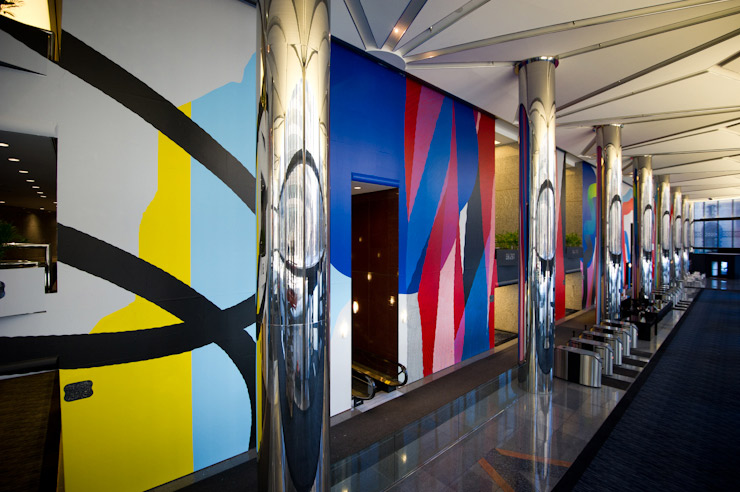
MOMO: We changed everything! It’s been so much work! Struggling, redesigning, you know, minutes before we go. Part of that is because we weren’t able to use the sprayers. That was my mistake in understanding how much dust they were going to dump into their surroundings. We struggled a few days trying to make it work with a spray tent and it was not possible. So without the sprayers we couldn’t do the giant sweeping color gradations.

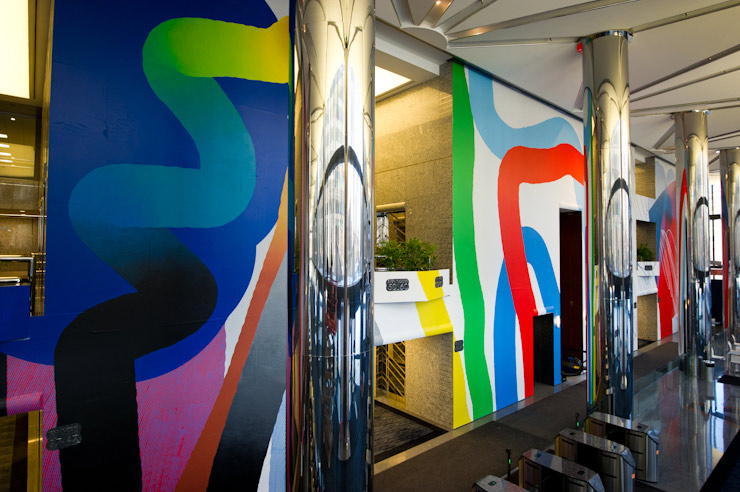
That meant things had to be redesigned so they’d still be exciting while staying unblended. I tried to break up the backgrounds that the stripes are going over, so there’d still be a number of colors changing. It wasn’t a solution just to switch fades for single colors, because I had to break things up in a way that’d keep them interesting.
brooklyn-street-art-MOMO-geoff-hargadon-boston-02-15-web-9

MOMO (photo © Geoff Hargadon)

KG:  That sucks.
MOMO: No, it’s okay actually. Somehow the sprays that I do outdoors are a rough thing. I don’t even know if they were working that well in this refined space. It has a texture that would be a little out of step with the high-polish feeling here.

KG:  As a result, have you invented any new techniques while working here?
MOMO: Oh, that’s a good question! I’m doing this thing between all of my helpers where I’m taking screenshots off of the computer where I’m designing, sending them in emails, and then we’re all following the sketches on our phones. I feel like there’s a big potential there to synch everyone up in a detailed way. I used to print everything out and keep it in a laminated pocket which is good so you don’t drop your phone in a bucket of paint, but this is kinda better.
 

brooklyn-street-art-MOMO-geoff-hargadon-boston-02-15-web-8

MOMO (photo © Geoff Hargadon)

KG:  So maybe there’s a MOMO app in your future?
MOMO: Or maybe I need a phablet – a phone tablet where I can do all my Photoshopping and it hangs off my neck.

KG:  All right, let’s get you a sponsor! I did want to get back to that audience question. When you’re working outside doing your posters between 3 and 6 am I assume you don’t want to interact with anyone. When you’re here, are you interacting with people? Or are you just trying to get your work done?
MOMO: We’re interacting and keeping our ears open. It’s fun to just feel what the response is like. We hear a lot from the security guys because they’re here all night. It’s been really positive from those people and other people who’ve come by and have an interest in art.
brooklyn-street-art-MOMO-geoff-hargadon-boston-02-15-web-2

MOMO (photo © Geoff Hargadon)

KG:  It is really hard to take in the mural all at once. Even from the outside because of these crazy columns, multiple doors and reflections. The most similar project you’ve done might be the Living Walls project because you could only see it all from within a car. Is there a way to see this mural? A narrative?
MOMO: I think it’s a sequential piece of artwork. Because you see pieces at a time and sorta have a chance to forget the first one that you saw by the time you get to the end. There’s not a way to see the whole composition all at once. That doesn’t exist. It’s like changing panels on any other media.

The thing in Atlanta has this opportunity for foreshortening. I tried to make it interesting if you were to stand in front of it, but also it collapsed all 1,000 feet into an instant image. Here you can’t really see everything collapsed.

It’s been fun to see how much it’s reflecting on the glass inside at night. I hadn’t seen that other times I’d checked out the spot. The chrome columns cast and catch all kinds of parts in new weird ways.

KG:  Yeah, it’s going to be a really fun challenge for someone to photograph! Is there anything else you’d want Boston and beyond to know about this work?
MOMO: I feel really privileged to be working here in such a great, high-level type community and given such an amazing piece of architecture to explore. I’m just extremely grateful to everyone that made this possible and extended the necessary faith. The support has been great and Pedro’s been amazing.
brooklyn-street-art-MOMO-geoff-hargadon-boston-02-15-web-1

MOMO (photo © Geoff Hargadon)

Our special thanks to photographer Geoff Hargadon for sharing his shots of this hard-to-shoot mural for BSA readers.

<<>><<>>><<><><><><<<>><<>>>

MOMO’s mural is the first in a three-part series of temporary public projects commissioned by Boston Properties and curated by Pedro Alonzo. It is on view at the John Hancock Tower (200 Clarendon Street, Boston MA 02116) now through May 31, 2015.

<<>><<>>><<><><><><<<>><<>>>

Kate Gilbert is an artist, public art curator, and the director of Now and There, a new start up dedicated to creating impactful temporary public art projects in Greater Boston. When she’s not buried in snow she’s Tweeting as @kgilbertstudio and @now_and_there.

<<>>><><<>BSA<<>>><<<>><><BSA<<>>><><<>BSA<<>>><<<>><><

BSA Please note: All content including images and text are © BrooklynStreetArt.com, unless otherwise noted. We like sharing BSA content for non-commercial purposes as long as you credit the photographer(s) and BSA, include a link to the original article URL and do not remove the photographer’s name from the .jpg file. Otherwise, please refrain from re-posting. Thanks!

<<>>><><<>BSA<<>>><<<>><><BSA<<>>><><<>BSA<<>>><<<>><><BSA

 

Read more