New Mural for ConectArte & United Nations World Food Programme in San Salvador

New Mural for ConectArte & United Nations World Food Programme in San Salvador

At its core, the community mural performs a very important role in unifying a neighborhood by focusing attention and coalescing around a common sentiment. Whether social, political, or poetic, they give a public voice to memories, aspirations, philosophies, agendas.
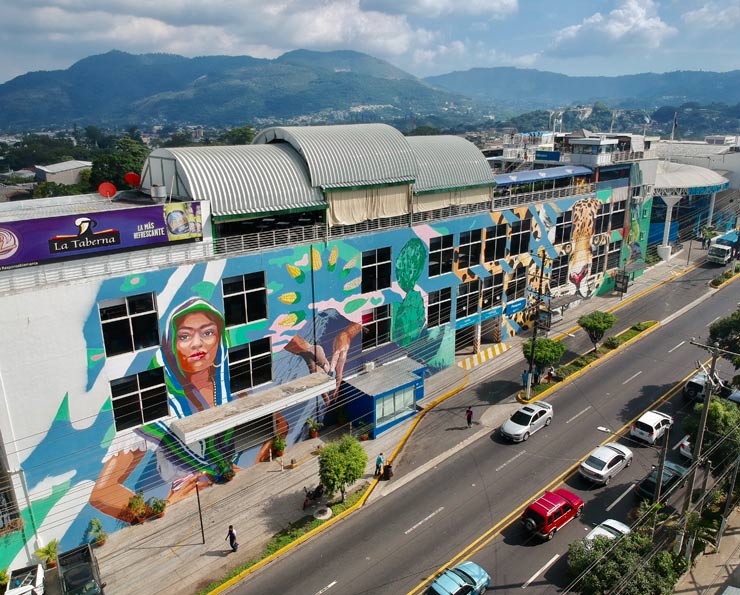
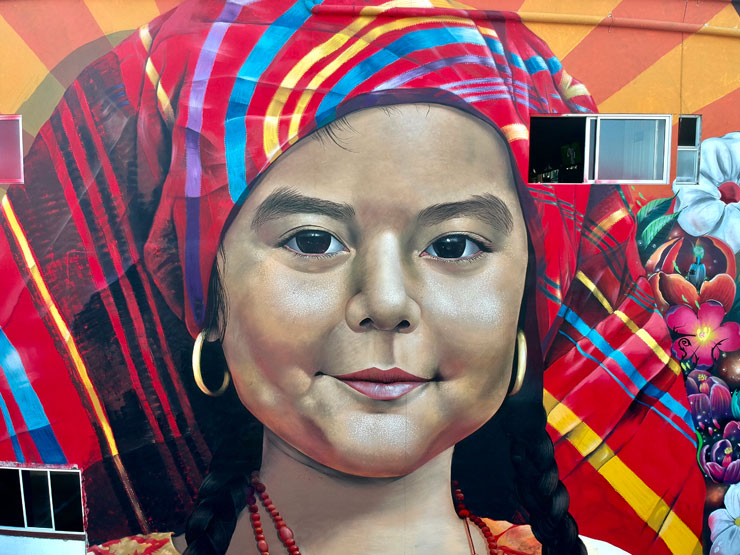
Collaborative mural in San Salvador with Layqa Nuna Yawar, Mata Ruda, Rafael Osorio, Lolipop, Cristian Lopez and Issac Martinez. ConectArte / United Nation’s World Food Program. (photo © Courtesy of ConectArte)

By highlighting the dominant sentiments about a particular event or topic, community murals in cities and towns also serve as a physical location where people meet in the public context to discuss weighty matters, to share stories, to pass on history, to trade gossip, to organize, to celebrate or mourn individually and collectively.

The United Nation’s World Food Programme worked again this year with a number of Street Artists in San Salvador to create a mural that scrutinizes the nature of a people’s history and the fundamentals of its social, political, economic strengths.
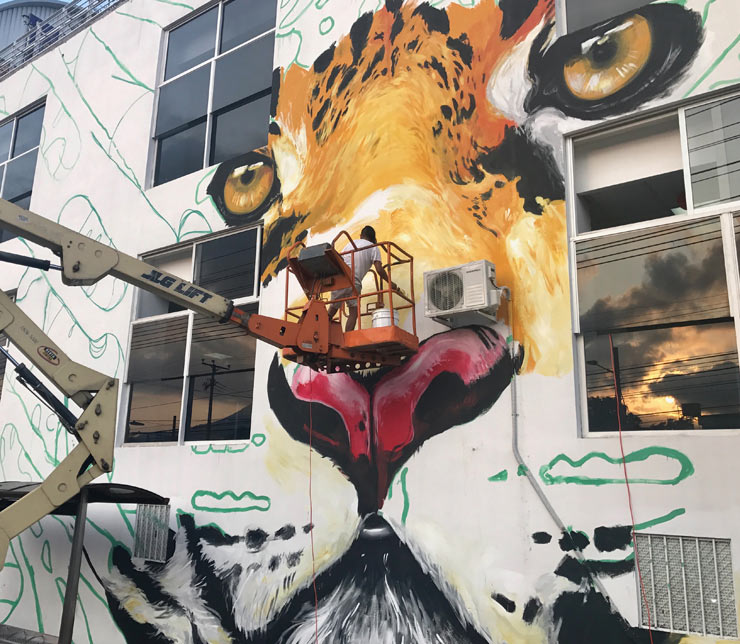
Collaborative mural in San Salvador with Layqa Nuna Yawar, Mata Ruda, Rafael Osorio, Lolipop, Cristian Lopez and Issac Martinez. ConectArte / United Nation’s World Food Program. (photo © Courtesy of ConectArte)

“The mural itself speaks of the market as a place to exchange goods and that creates community and has done so since El Salvador was a country, when it’s people already cultivated the grains and vegetables that continue to be sold at this market today,” says New Jersey based Street Artist and muralist Layqa Nuna Yawar, originally from Ecuador. He painted side by side his homeboy Mata Ruda along with history student Rafael Osorio and local artists Lolipop, Cristian Lopez and Issac Martinez for this mural on the facade of Mercado Cuscatlan, a public market and Library complex.

“The murals also show us traditional culture, dresses, games, poets, geography and flora and fauna that all have local meaning and importance to the people of San Salvador,” LNY says. “The mural on the library side speaks of knowing your history in order to grow and move forward to a better future. It does so by depicting a young woman, one of the local artist’s family members, reading a book on history. In this book the same girl is depicted in traditional colonial garb reading a book on national history, meanwhile her mind is filled with imagery of the cosmos.”
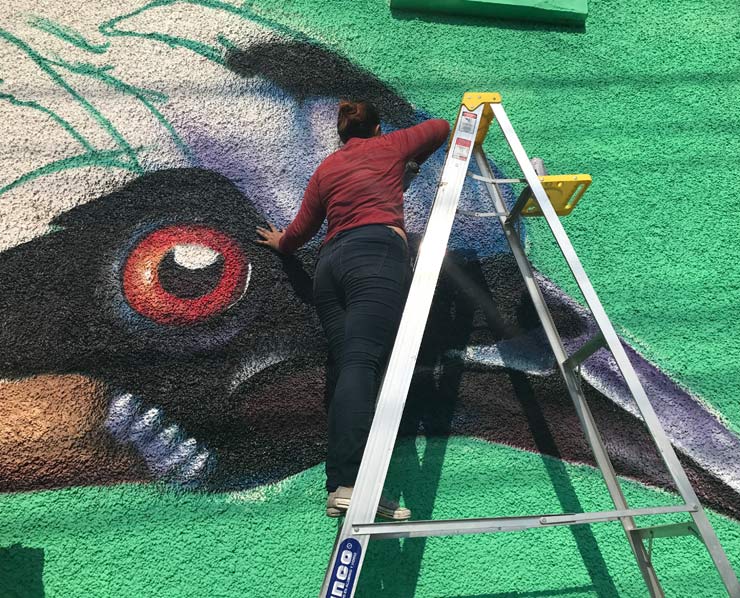
Collaborative mural in San Salvador with Layqa Nuna Yawar, Mata Ruda, Rafael Osorio, Lolipop, Cristian Lopez and Issac Martinez. ConectArte / United Nation’s World Food Program. (photo © Courtesy of ConectArte)

Part of the ConectArte program in cooperation with San Salvador mayor’s office and the United Nation’s World food program, Layqa Nuna Yawar and Street Artist/organizer Jamie Toll say that the collective process that goes into a community mural is necessary to produce a collective narrative. They say they wanted the artists to function as amplifiers for the ideas as well as the aesthetics.

“We spent time developing the design for the mural collectively without having this be a single authored project but a product of actual exchange and conversation with proper credit going to those involved,” says Layqa Nuna Yawar. “This exchange continues as our relationships with these artists grow beyond the project itself.”
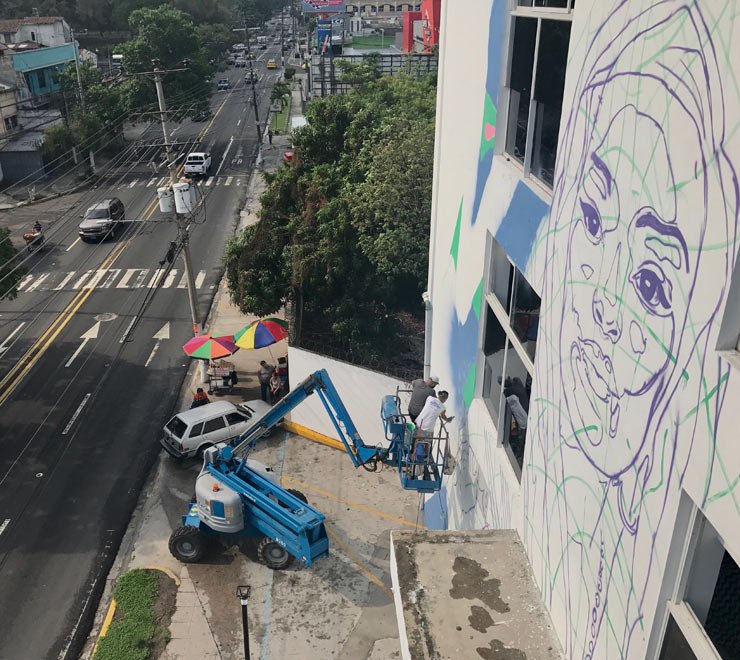
Collaborative mural in San Salvador with Layqa Nuna Yawar, Mata Ruda, Rafael Osorio, Lolipop, Cristian Lopez and Issac Martinez. ConectArte / United Nation’s World Food Program. (photo © Courtesy of ConectArte)
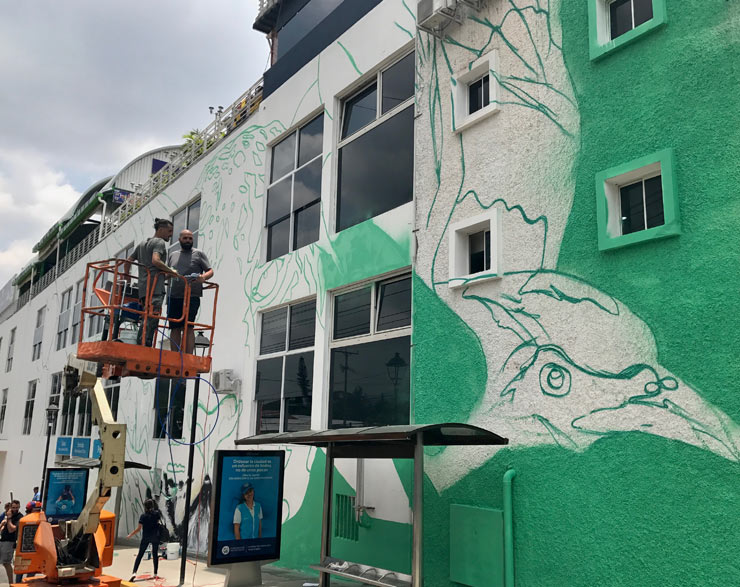
 

Collaborative mural in San Salvador with Layqa Nuna Yawar, Mata Ruda, Rafael Osorio, Lolipop, Cristian Lopez and Issac Martinez. ConectArte / United Nation’s World Food Program. (photo © Courtesy of ConectArte)
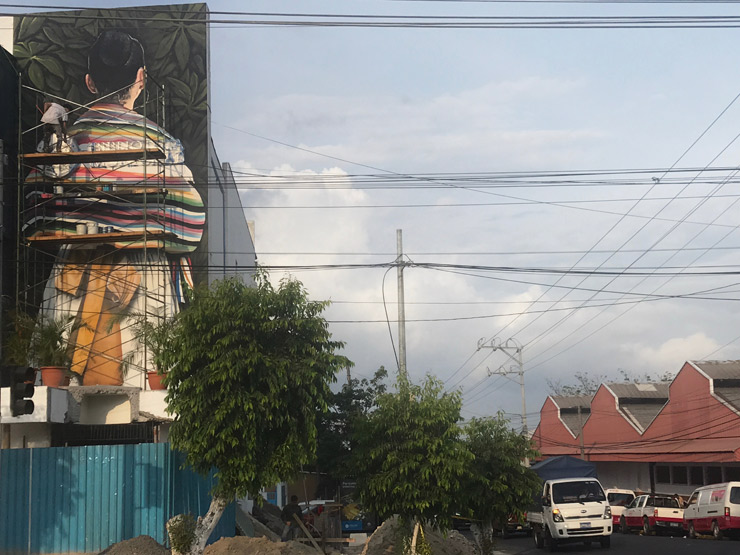
Collaborative mural in San Salvador with Layqa Nuna Yawar, Mata Ruda, Rafael Osorio, Lolipop, Cristian Lopez and Issac Martinez. ConectArte / United Nation’s World Food Program. (photo © Courtesy of ConectArte)
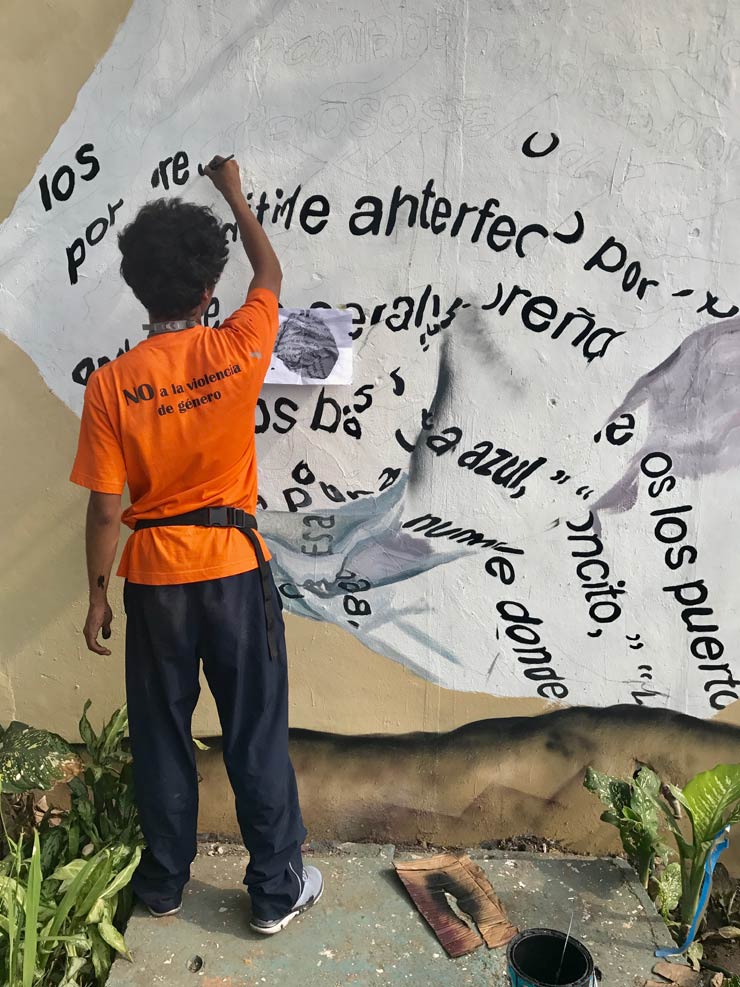
Collaborative mural in San Salvador with Layqa Nuna Yawar, Mata Ruda, Rafael Osorio, Lolipop, Cristian Lopez and Issac Martinez. ConectArte / United Nation’s World Food Program. (photo © Courtesy of ConectArte)
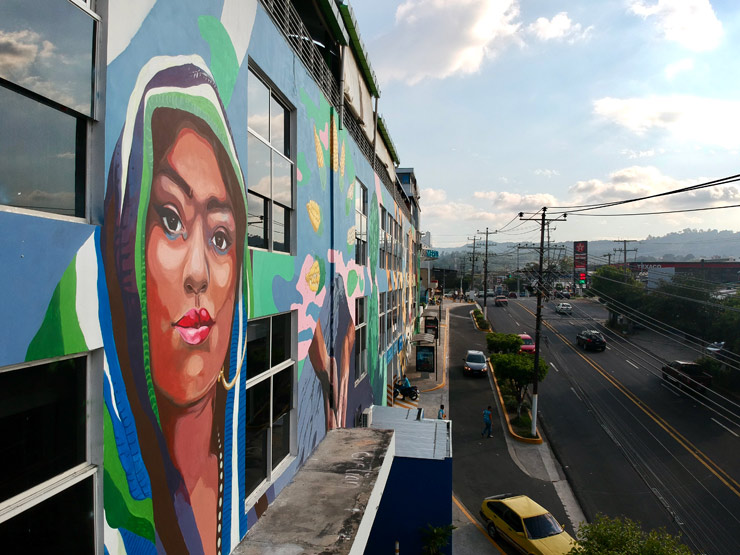
Collaborative mural in San Salvador with Layqa Nuna Yawar, Mata Ruda, Rafael Osorio, Lolipop, Cristian Lopez and Issac Martinez. ConectArte / United Nation’s World Food Program. (photo © Courtesy of ConectArte)
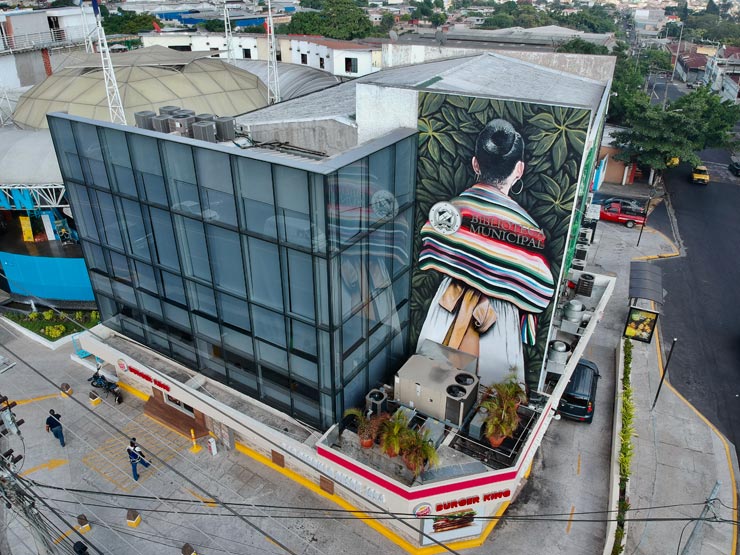
Collaborative mural in San Salvador with Layqa Nuna Yawar, Mata Ruda, Rafael Osorio, Lolipop, Cristian Lopez and Issac Martinez. ConectArte / United Nation’s World Food Program. (photo © Courtesy of ConectArte)
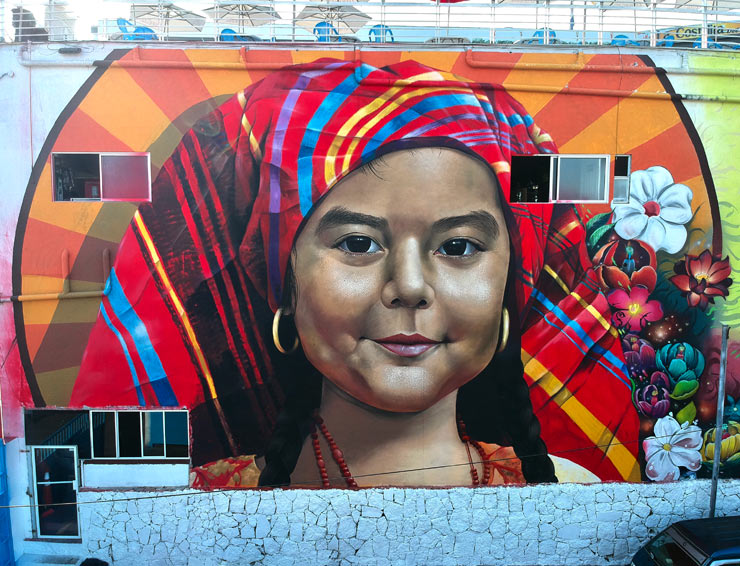
Collaborative mural in San Salvador with Layqa Nuna Yawar, Mata Ruda, Rafael Osorio, Lolipop, Cristian Lopez and Issac Martinez. ConectArte / United Nation’s World Food Program. (photo © Courtesy of ConectArte)
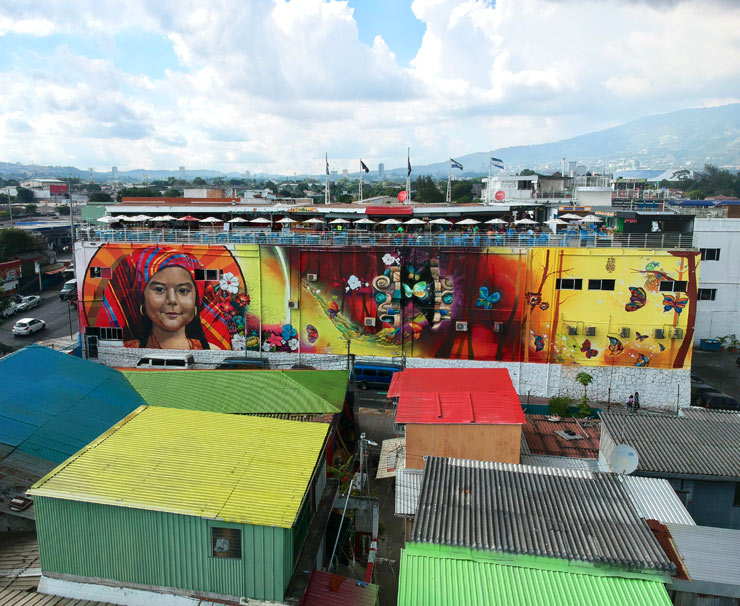
Collaborative mural in San Salvador with Layqa Nuna Yawar, Mata Ruda, Rafael Osorio, Lolipop, Cristian Lopez and Issac Martinez. ConectArte / United Nation’s World Food Program. (photo © Courtesy of ConectArte)
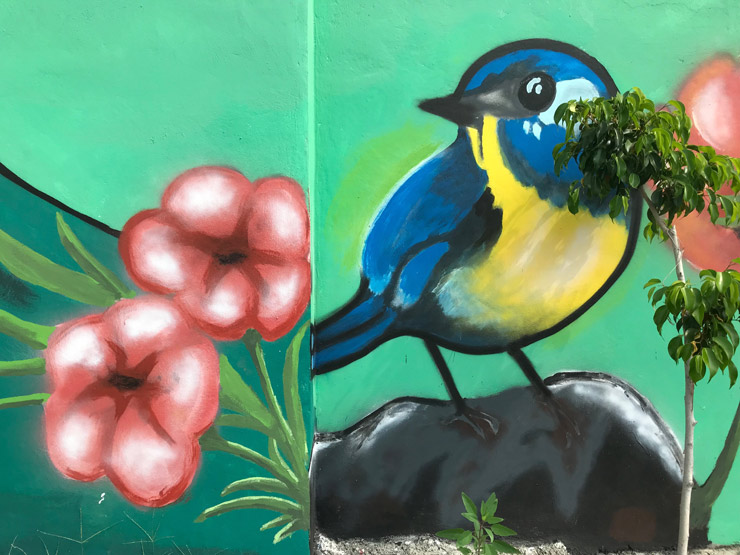
Collaborative mural in San Salvador with Layqa Nuna Yawar, Mata Ruda, Rafael Osorio, Lolipop, Cristian Lopez and Issac Martinez. ConectArte / United Nation’s World Food Program. (photo © Courtesy of ConectArte)
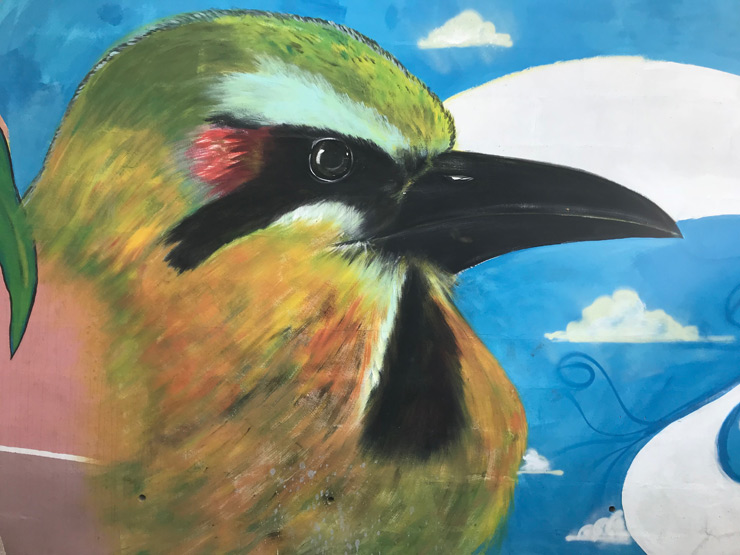
Collaborative mural in San Salvador with Layqa Nuna Yawar, Mata Ruda, Rafael Osorio, Lolipop, Cristian Lopez and Issac Martinez. ConectArte / United Nation’s World Food Program. (photo © Courtesy of ConectArte)
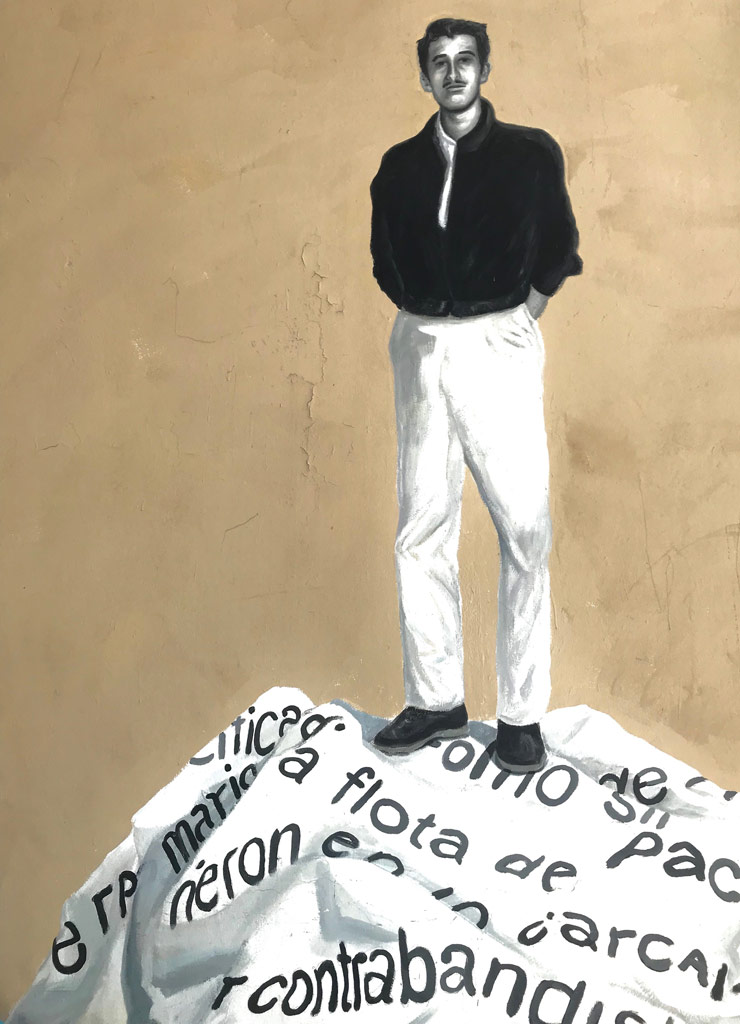
Collaborative mural in San Salvador with Layqa Nuna Yawar, Mata Ruda, Rafael Osorio, Lolipop, Cristian Lopez and Issac Martinez. ConectArte / United Nation’s World Food Program. (photo © Courtesy of ConectArte)
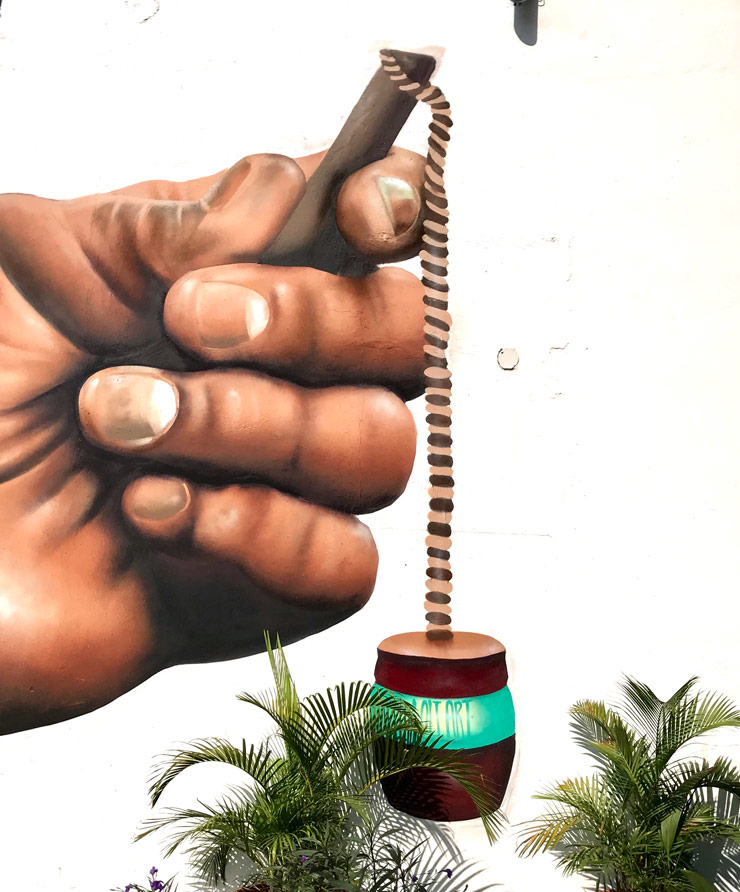
Collaborative mural in San Salvador with Layqa Nuna Yawar, Mata Ruda, Rafael Osorio, Lolipop, Cristian Lopez and Issac Martinez. ConectArte / United Nation’s World Food Program. (photo © Courtesy of ConectArte)
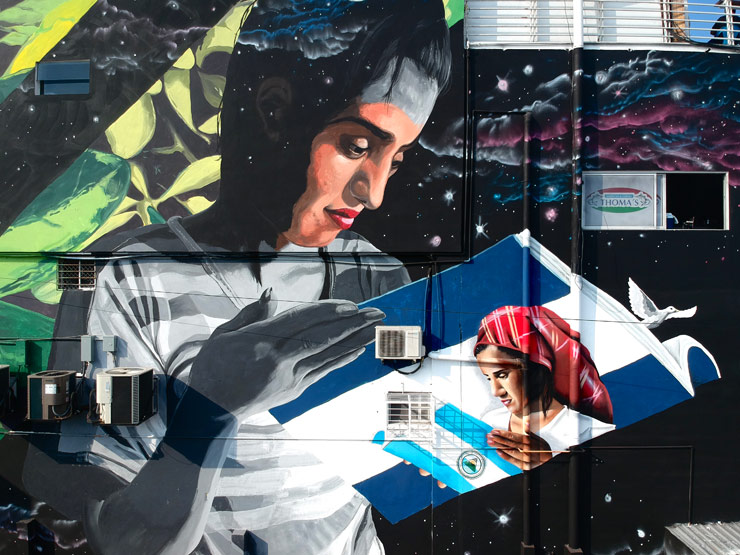
Collaborative mural in San Salvador with Layqa Nuna Yawar, Mata Ruda, Rafael Osorio, Lolipop, Cristian Lopez and Issac Martinez. ConectArte / United Nation’s World Food Program. (photo © Courtesy of ConectArte)
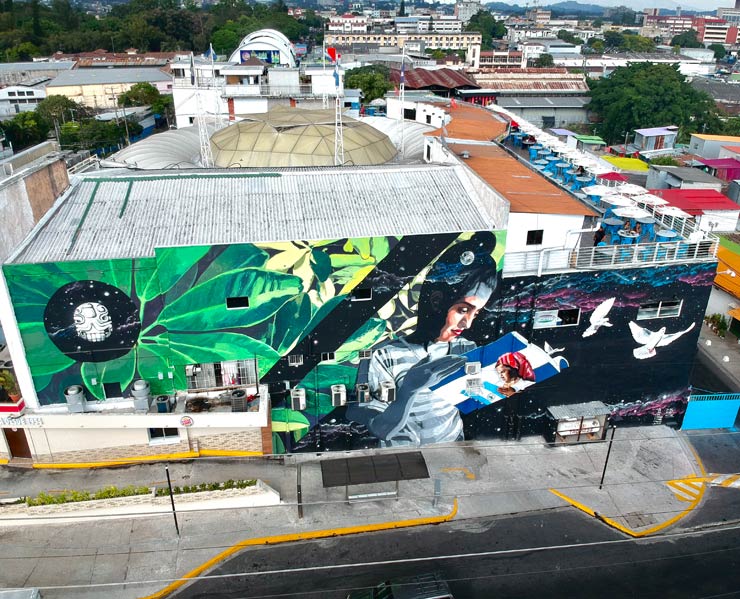
Collaborative mural in San Salvador with Layqa Nuna Yawar, Mata Ruda, Rafael Osorio, Lolipop, Cristian Lopez and Issac Martinez. ConectArte / United Nation’s World Food Program. (photo © Courtesy of ConectArte)

Collaborative mural in San Salvador with Layqa Nuna Yawar, Mata Ruda, Rafael Osorio, Lolipop, Cristian Lopez and Issac Martinez. ConectArte / United Nation’s World Food Program. (photo © Courtesy of ConectArte)
 

Read more
BSA Images Of The Week: 12.03.17

BSA Images Of The Week: 12.03.17


BSA-Images-Week-Jan2015

While You Were Sleeping is a Korean TV series about a woman who can see the future in her dreams, and a prosecutor who fights to stop these future events from happening. The title also makes us think about the scam of a Tax bill passed while you were sleeping in the middle of the night between Friday and Saturday.

The servants of the rich, these wolves, are facilitating the largest transfer of wealth from the poor and middle class up to their masters for well into the future, and it appears that few are awake to see it. It also pulls health insurance out from underneath 13 million sleeping people. The majority of the country was against this but the servants pushed it through anyway when you weren’t stirring. Good night!

When the US had its largest growing middle class and economic expansion in the 1950s the top tax rate was more than 90%. Did you know that? Reagan lowered it to 39%. This bill lowers the top rate to 20%. Since as a group, hundreds of corporations paid an effective federal income tax rate of just 21.2 percent over a recent eight-year period because they’re working the system, that means many won’t pay any taxes soon, joining GE, Priceline.com, PG&E – who already pay absolutely nothing. Just you will pay the taxes. Congratulations!

Street Art better be dope ya’ll, because that’s where many of us will be living soon – the street.

But we are wide awake for sex scandals, by golly. Powerful men are being accused by past alleged victims from every sector in society right now. We are keeping our fingers crossed that Santa Claus can stay above the fray!

Meanwhile, the tree got lit this week in Rockefeller Center, a lot of people are going to get lit this month at their office holiday party, many NYC art denizens are heading to the Miami Basel Circus this week, and apparently there is supposed to be some Street Art thing happening there too.

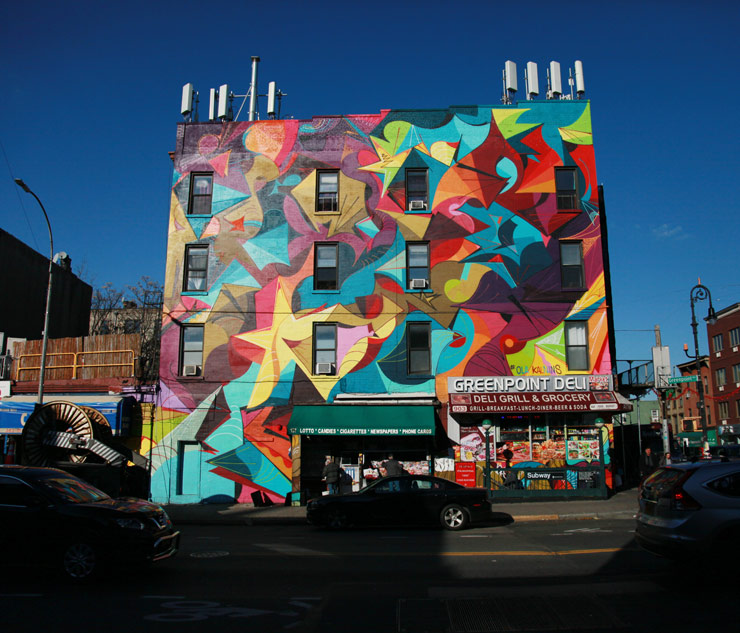
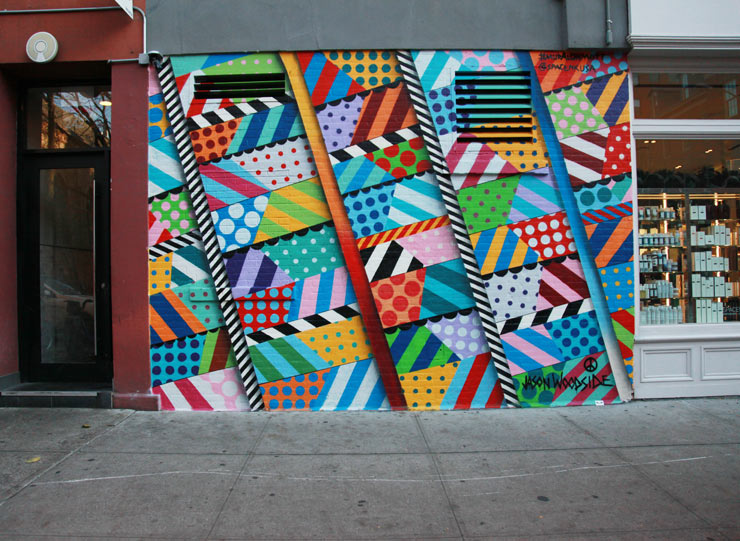
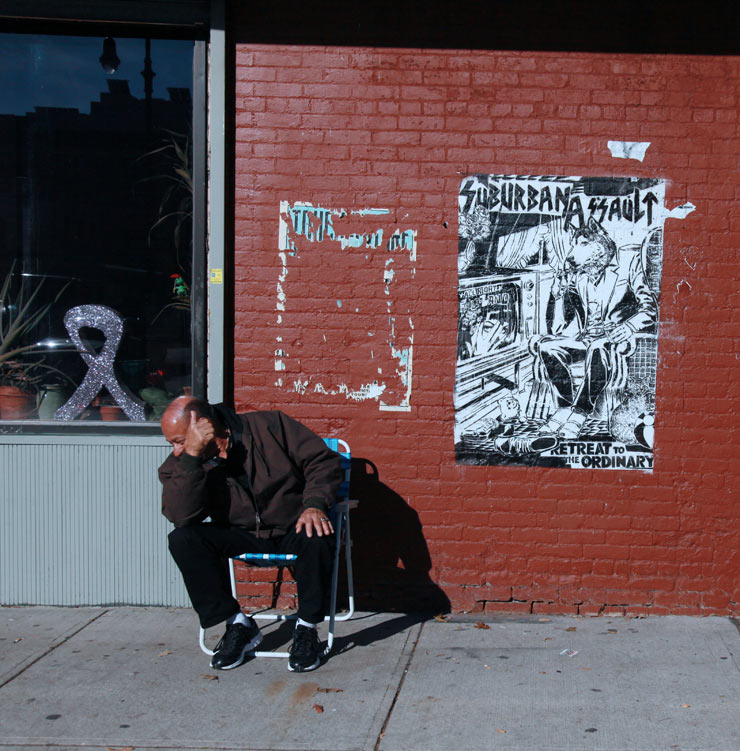
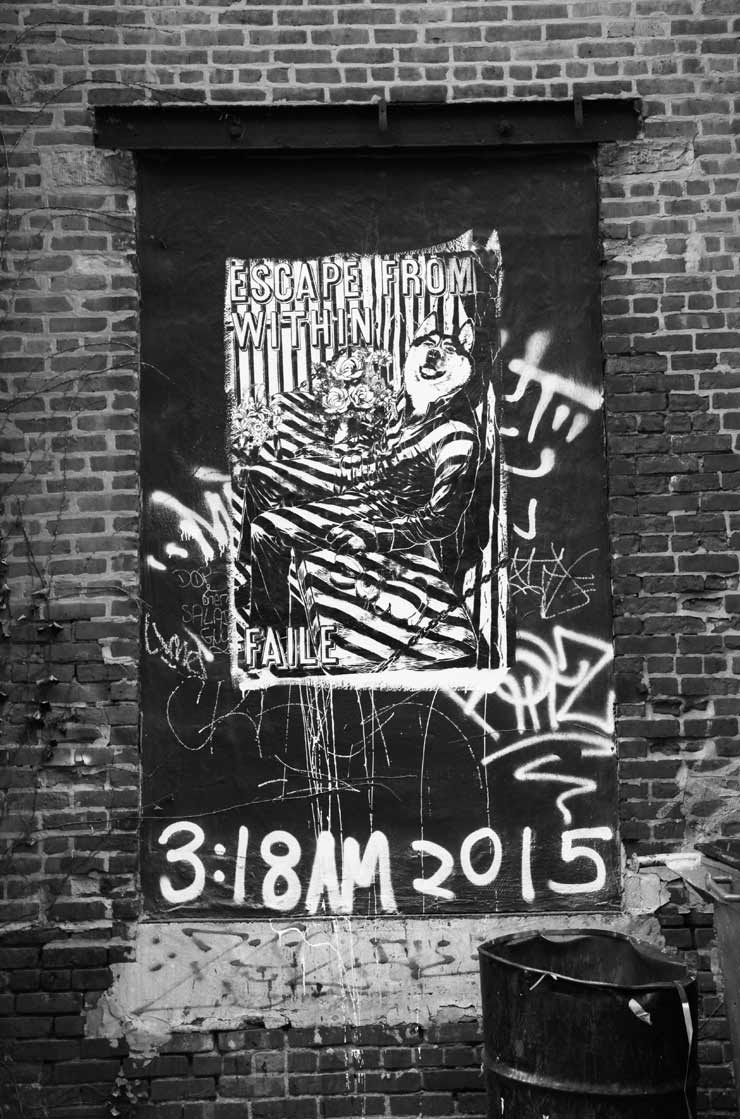
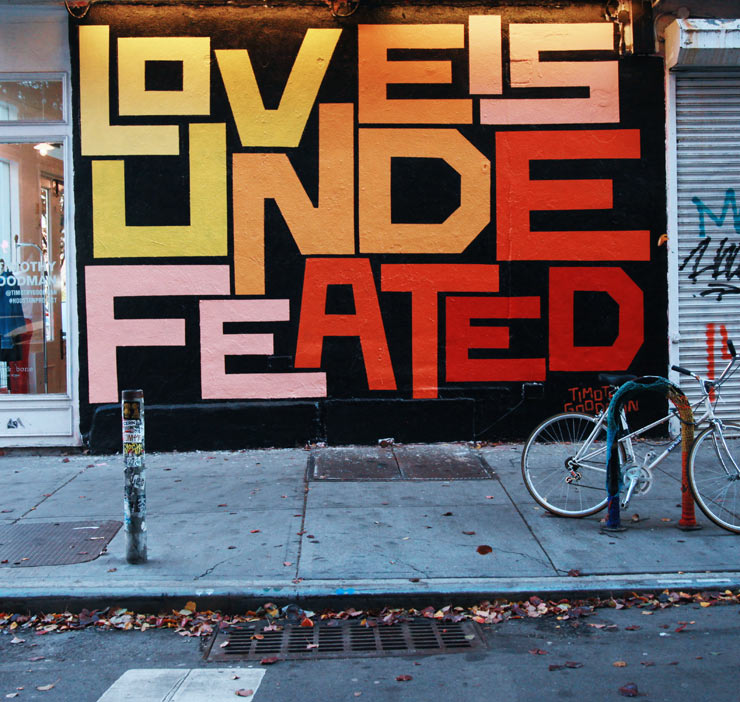
Here’s our weekly interview with the streets, this week featuring BD White, Daek, Elbi Elem, Elisa Capdevila, Faile, Jason Woodside, Jerkface, Kai, Killjoy, Magda Love, Mazatl, Mr. Toll, Ola Kalnins, Praxis, Timothy Goodman, and Sonni.

Our top image : Timothy Goodman (photo © Jaime Rojo)

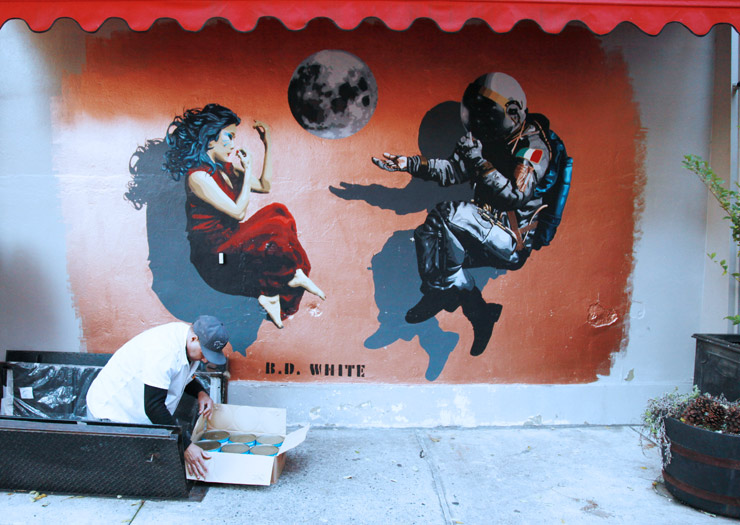
B.D. White for The L.I.S.A. Project. (photo © Jaime Rojo)

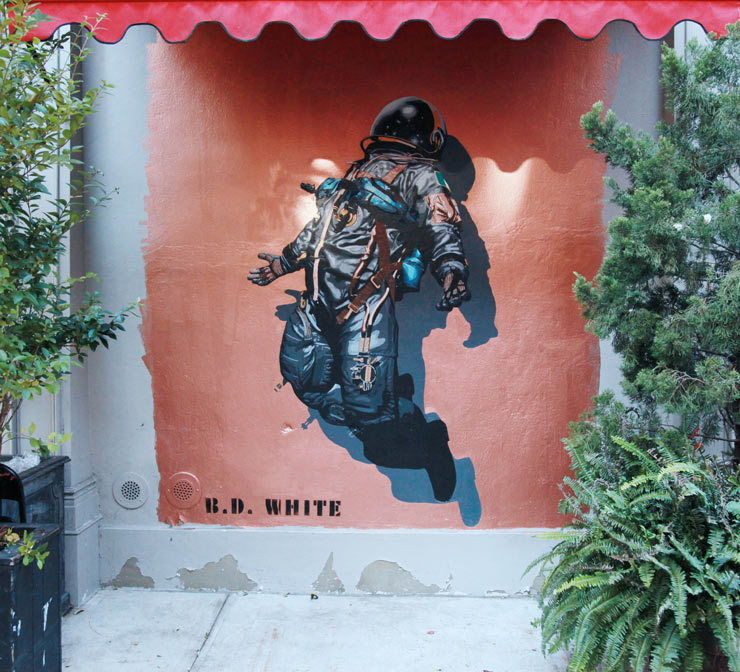
B.D. White for The L.I.S.A. Project. (photo © Jaime Rojo)

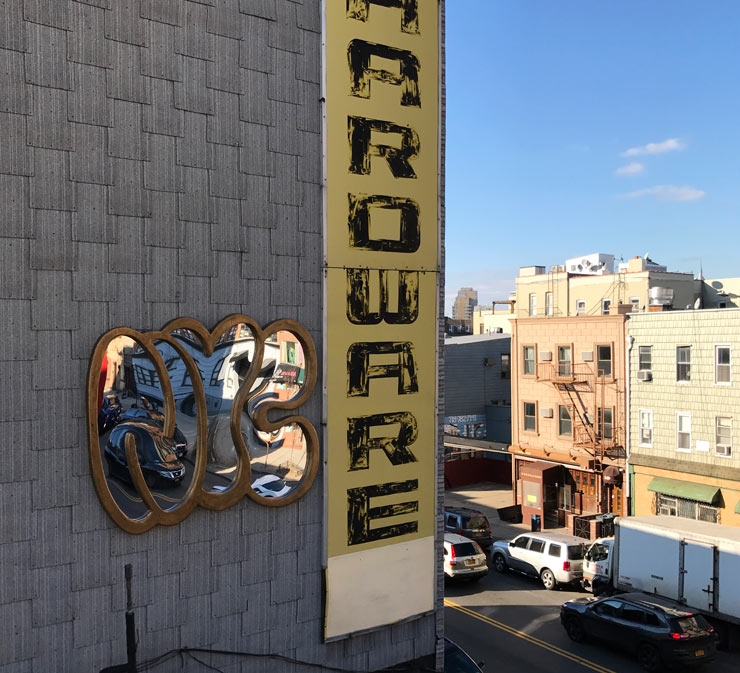
Mr. Toll. Vanity Project. This piece is visible from the street level in front of Crest Hardware in Williamsburg. (photo © Jaime Rojo)

Elisa Capdevila for Contorno Urbano in Sant Feliu de Llobregat. Barcelona. (photo © Jaime Rojo)

Elbi Elem for Contorno Urbano in Sant Feliu de Llobregat. Barcelona. (photo © Jaime Rojo)

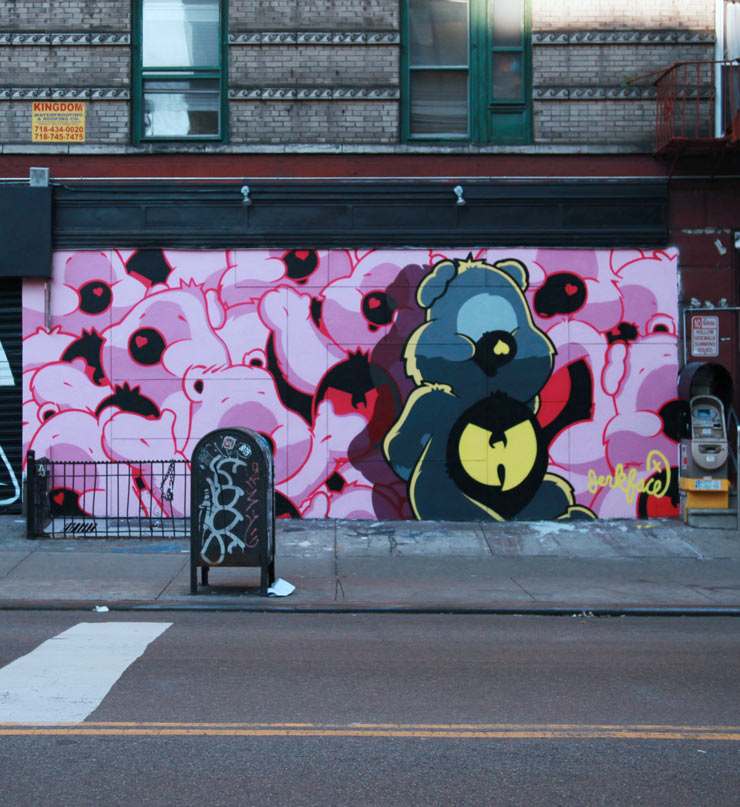
Jerkface (photo © Jaime Rojo)

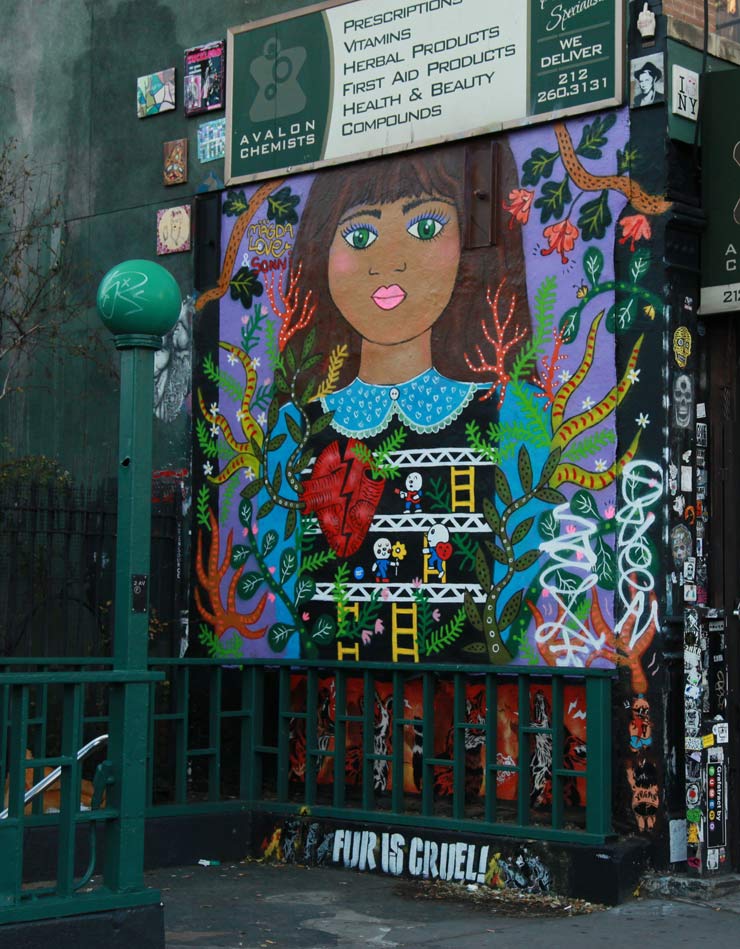
Magda Love and Sonni (photo © Jaime Rojo)

Praxis (photo © Jaime Rojo)

Praxis. Detail. (photo © Jaime Rojo)

Praxis. Detail. (photo © Jaime Rojo)

Kai (photo © Jaime Rojo)

Unidentified artist in the NYC Subway. (photo © Jaime Rojo)

Ola Kalnins (photo © Jaime Rojo)

Jason Woodside (photo © Jaime Rojo)

Faile (photo © Jaime Rojo)

Faile (photo © Jaime Rojo)

Killjoy collabo with Mazatl in Cholula Puebla for La Linea Street Art. (photo © Jaime Rojo)

Unidentified artist (photo © Jaime Rojo)

Daek (photo © Jaime Rojo)

Untitled. Lower East Side of Manhattan, NYC. December 02, 2017. (photo © Jaime Rojo)

Read more
INO and “Broken” in Fortaleza, Brazil

INO and “Broken” in Fortaleza, Brazil

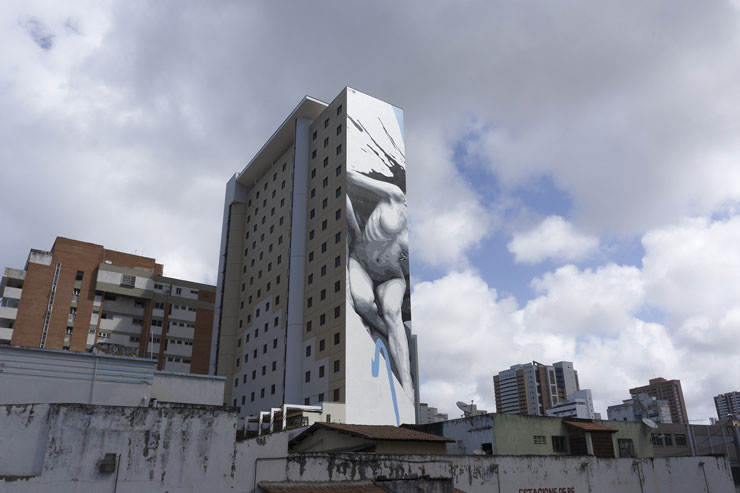
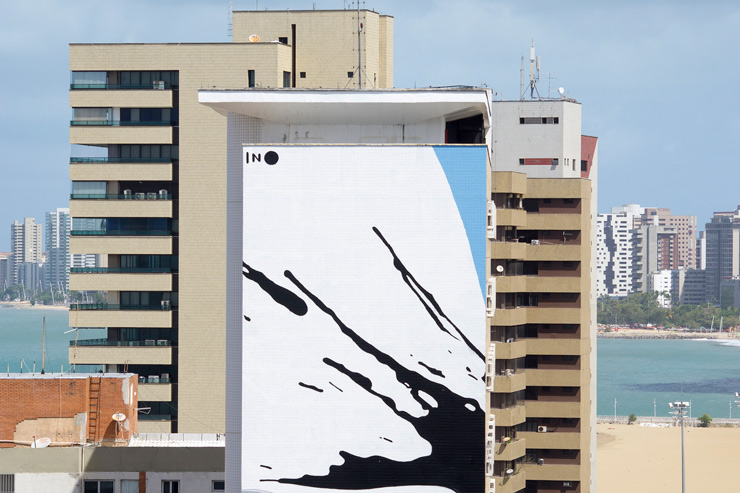
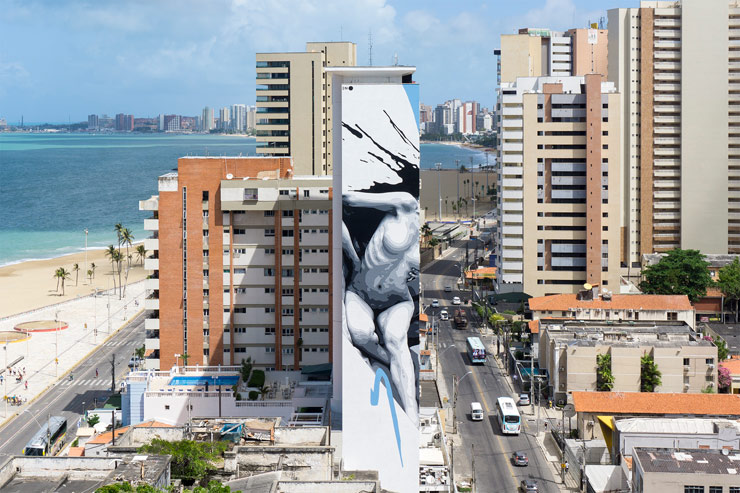
The Greek Street Artist INO has been consistently observing the social and political factors that are at play in modern society and has been addressing these themes through his work painting large murals in more cities around the world. This week in Fortaleza aside the Atlantic in northeastern Brazil, INO created a headless female form that for him is evocative of a socio-political order that is “Broken”.

INO. “Broken”. Festival Concreto. Fortaleza, Brazil. November, 2017. (photo © INO)

“This is a place where someone can see very big contradictions,” he tells us, “the poverty in the street, people begging for food – while you eat in the restaurant, the prostitutes every night in the streets.”
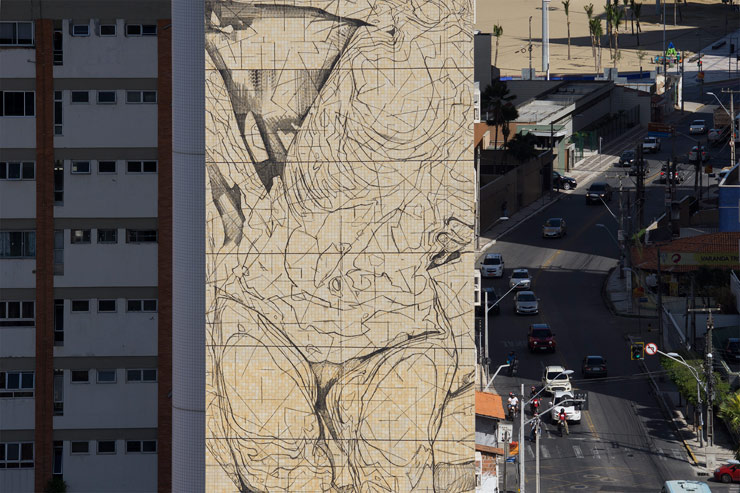
He shows us a photo of a street scene where  women are being questioned by the police that he took at night while he was painting his wall from the vantage point of his lift up above. His imagination is activated by the scene, and he thinks of the frightening circumstances that women in the sex trade are put in that exploit them repeatedly.

“All of this, together with the rich people, the expensive apartments in huge luxury buildings that look empty, surrounded by barbed wire fences in each condominium yard…” It all is disturbing to him, and a scene repeated in many cities in so-called developed nations where the stratification between rich and poor is getting more pronounced than ever before in the modern era, leaving more feeling powerless and easily victimized.

For his new mural entitled “Broken”, completed here during the 4th Concreto Festival, the anonymous form is an obvious reference to people caught in a de-humanizing system. “The piece is depicting a naked thin woman in a position of offering her body, with a black splash coming from the head,” he says.

INO. “Broken”. Festival Concreto. Fortaleza, Brazil. November, 2017. (photo © INO)

INO. “Broken”. Festival Concreto. Fortaleza, Brazil. November, 2017. (photo © INO)

INO. “Broken”. Festival Concreto. Fortaleza, Brazil. November, 2017. (photo © INO)

INO. “Broken”. Festival Concreto. Fortaleza, Brazil. November, 2017. (photo © INO)

INO. “Broken”. Festival Concreto. Fortaleza, Brazil. November, 2017. (photo © INO)

Read more
BSA Film Friday: 12.01.17

BSA Film Friday: 12.01.17

bsa-film-friday-JAN-2015

Our weekly focus on the moving image and art in the streets. And other oddities.

Now screening :
1. Rough Cut of Haring on Train in Mexico City (DF)
2. Niels Shoe Meulman in Magic City
3. Carlo McCormick talks about ROA at Magic City
4. Miquel Wert / 12 + 1 Contorno Urbano
5. “Awareness, Optimism, Commitment” by GEC Art

bsa-film-friday-special-feature

BSA Special Feature: Rough Cut of Haring on Train in Mexico City (DF)

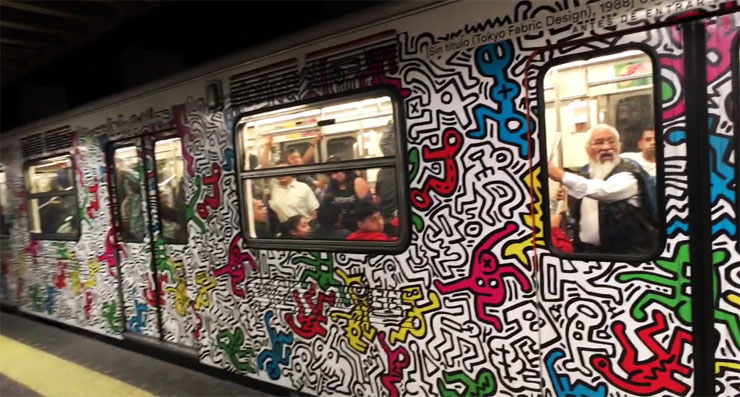
It all took us by surprise last week in Mexico City when suddenly a whole train covered on both sides with Keith Haring’s work approached while we were waiting at the platform to catch the Linea 2 of the Metro. He made his name in part by illegally doing drawings like these in NYC subways and here now they are crushing a whole train. The name of the project is “Ser Humano. Ser Urbano” or “Being Human. Being Urban” and it aims to promote human values and human rights. The pattern you see is from “Sin Titulo (Tokyo Fabric Design)” – now stretched across these whole cars, if you will.

The train itself is inexplicably having brake troubles, so we get some jerky spur-of-the-moment footage but all week on Instagram and Facebook we’ve received tons of comments from people reacting to this little bit of Keith video by Jaime Rojo on BSA.


Niels Shoe Meulman in Magic City – The Art Of The Street :

Niels Shoe Meulman spent some nights in a Munich jail thirty years ago for mucking about on the walls. This year he was paid to do it in Munich for Magic City, the travelling morphing exhibition (now in Stockholm) where Street Art is celebrated along with all its tributaries – including a film program and a number of photographs by your friends here at BSA.

Born, raised and based in Amsterdam, The Netherlands, Shoe shares here his new improvisational piece and some of his reflections on his process and his evolution from being in advertising as an art/creative director and reclaiming his soul as a graffiti/Street Art/fine artist. As ever, Martha is in the frame, putting him in the frame.


Carlo McCormick talks about ROA at Magic City – The Art Of The Street / Dresden-Munich-Stockholm

The urban naturalist ROA gets the Carlo McCormick treatment here as the chief curator of Magic City does the talking for the anonymous Ghent-based artist who has globe-trotted for almost a decade with his marginalized animal parade in monochrome. Here you get to see the inside/outside of his practice, a genuine master as work – with the delicious insight of Carlo to guide your appreciation.


Miquel Wert / 12 + 1 Contorno Urbano

In studio with Miguel Wert we get to see him sifting through a pile of black and white photos, assessing the scene, the sitters, the psychological-emotional dynamics of families, lovers, haters.

“In most family photos the interpersonal dynamics are more subtle,” we wrote when the wall was first unveiled in Barcelona, “but a close reading of posture, body language, and facial expressions all give unconsciously a lot of information about the true nature of the relationships officially on display.”

See more in “Miquel Wert Brings Awkward Family Dynamics From the Shadows in Barcelona”

“Awareness, Optimism, Commitment” by GEC Art

Young gymnast takes the opportunity to practice and perform for a moment atop this traffic barrier in Torino.

And why not?


Read more
Tic Tac No: Leon Keer and Team at Venice Chalk Festival in Florida

Tic Tac No: Leon Keer and Team at Venice Chalk Festival in Florida

TIC TAC NO

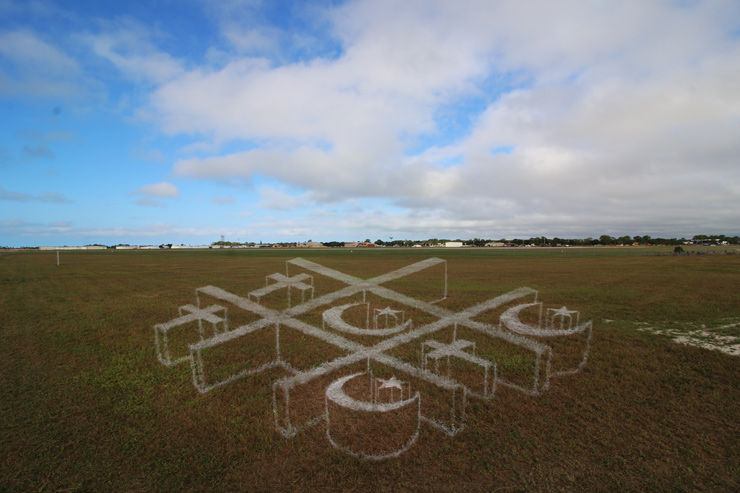
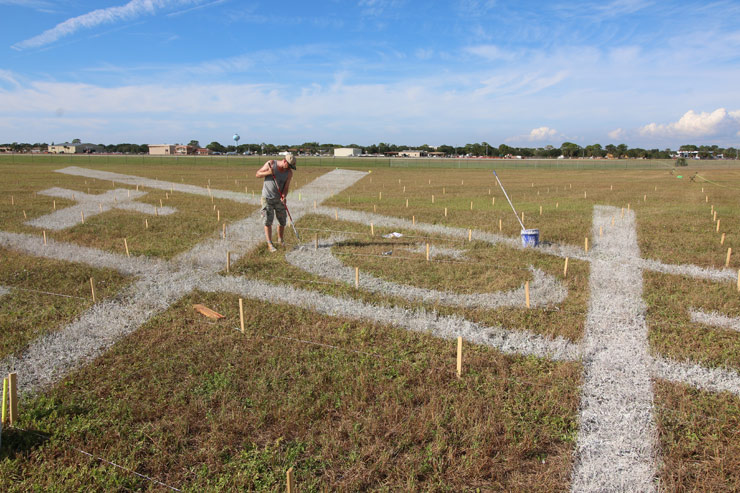
Anamorphic Street Art has been a parallel universe to the illegal Street Art scene for years, and Dutch pop-surrealist Leon Keer is one of the most ingenious on the scene and well travelled; having been to Europe, The United States, The United Arabic Emirates, Australia and several Asian countries with his work.

Leon Keer. Tic Tac No Chalkfestival. Venice, Florida. November, 2017. (photo © courtesy of the artist)

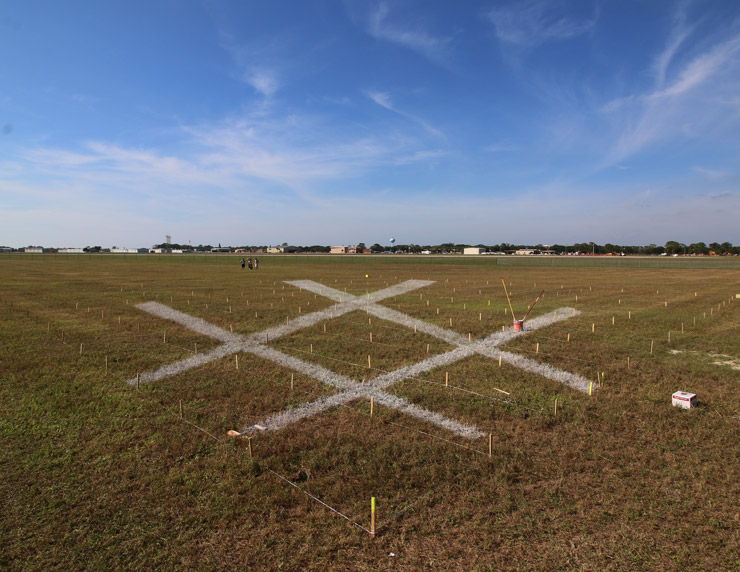
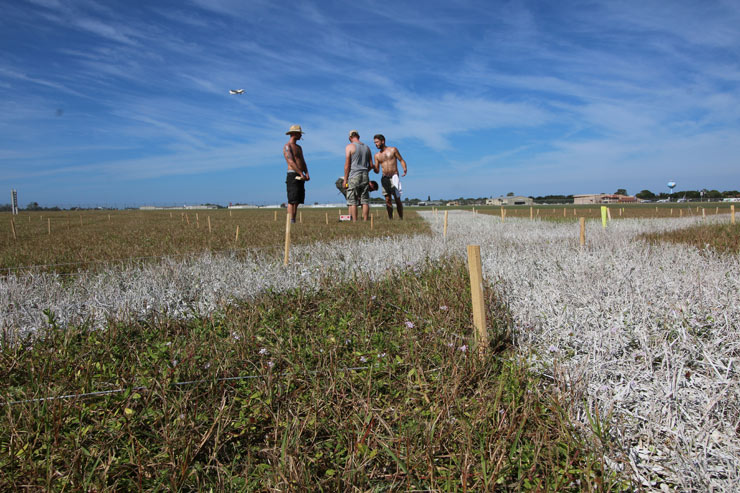
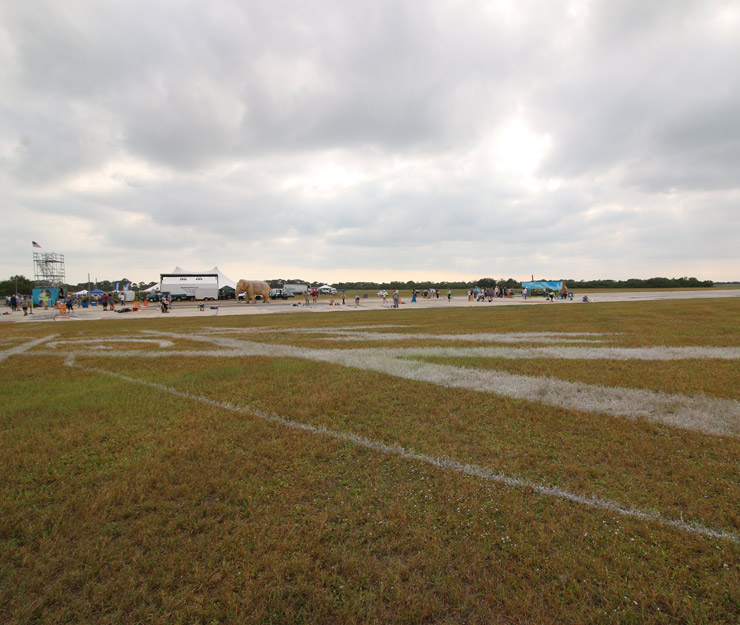
Here in Venice, Florida before heading to Miami for Art Basel he worked with four other artists to create a huge piece of anamorphic land art in a grass field at the airport grounds for the 10th anniversary of the Chalk Festival during the second week of November.

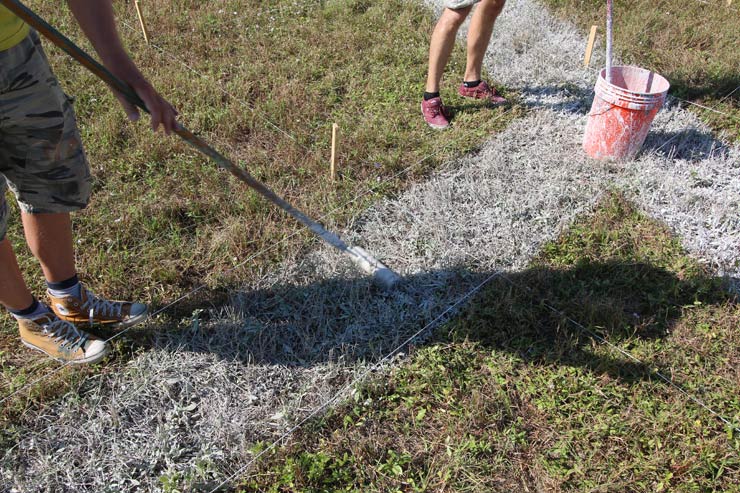
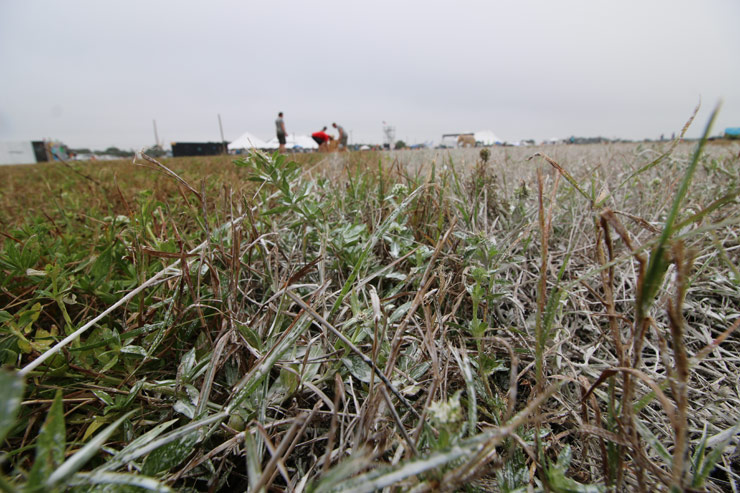
Using symbols of some of the world’s religion in a 3-D game of tic tac toe, Keer designed an environmentally friendly chalk piece that required the work of 5 artists over 4 days painting with rollers and a handheld garden sprayer. Also, the field had to be mowed. With the longest line in the artwork at 300 feet, you can begin to appreciate how difficult this game is.

Lead artist and design: Leon Keer.

Other artists: Massina, Sjem Bakkus, Ives One and Eric Keer.

Leon Keer. Tic Tac No Chalkfestival. Venice, Florida. November, 2017. (photo © courtesy of the artist)

Leon Keer. Tic Tac No Chalkfestival. Venice, Florida. November, 2017. (photo © courtesy of the artist)

Leon Keer. Tic Tac No Chalkfestival. Venice, Florida. November, 2017. (photo © courtesy of the artist)

Leon Keer. Tic Tac No Chalkfestival. Venice, Florida. November, 2017. (photo © courtesy of the artist)

Leon Keer. Tic Tac No Chalkfestival. Venice, Florida. November, 2017. (photo © courtesy of the artist)

Leon Keer. Tic Tac No Chalkfestival. Venice, Florida. November, 2017. (photo © courtesy of the artist)


Read more
Castellers, Correfocs, and Stencil Art in Barcelona Streets

Castellers, Correfocs, and Stencil Art in Barcelona Streets

We always say that Street Art reflects us back to ourselves and during a recent trip to the streets of Barcelona we found some great examples of regional traditions that build community and celebrate culture, even strengthen it. Of course we also found some great stencil art that we hope you’ll enjoy.

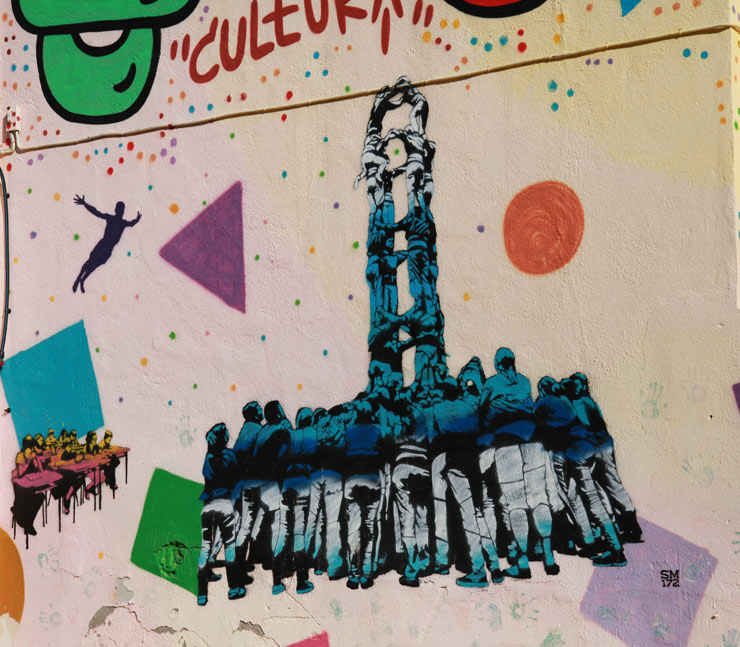
Ceaser Baetulo. Barcelona, Spain. (photo © Jaime Rojo)

The above stencil is a part of a larger wall where multiple artists have gone up over the years. It depicts a human tower or Castellers a tradition unique in Catalonia that dates back to the 18th century. In today’s Barcelona the Castellers perform in competitions, usually in the Town Hall Square during the traditional holidays of the particular town or city.

Unidentified artist. Barcelona, Spain. (photo © Jaime Rojo)

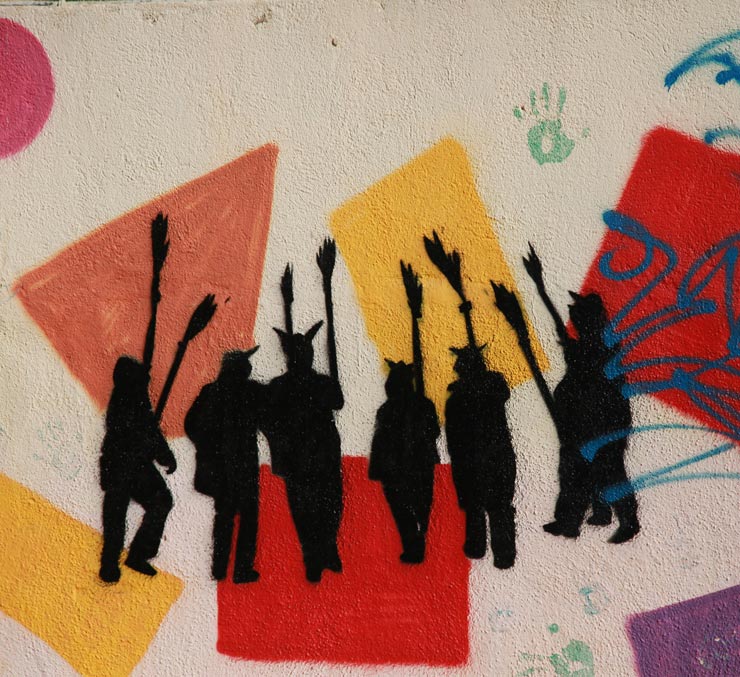
The stencil above is also on the same wall as the Castellers. This stencil depicts a Catalan tradition as well called the Correfoc. The Correfocs are a group of individuals dressed as devils playing with fire, mostly fireworks. As the Correfocs light their fireworks they get near the crowds, many spectators choose to participate by getting very close to the devils while others decide to watch the festivities from afar.


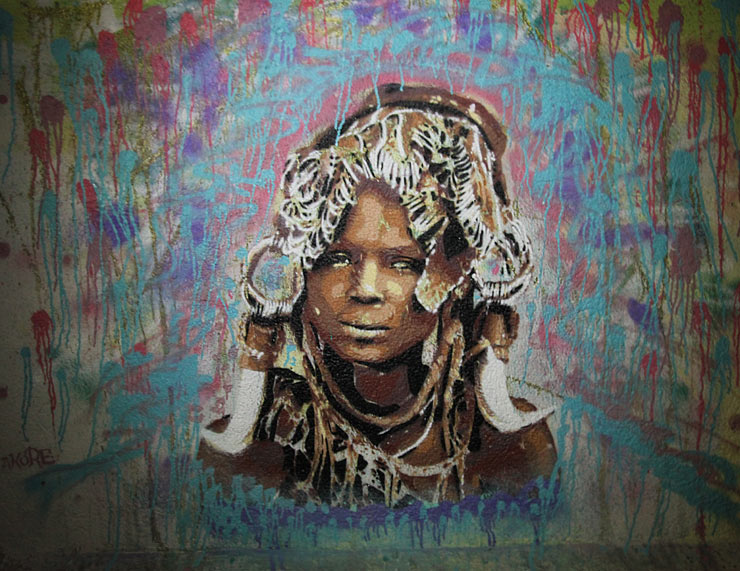
Akore. At La Escocesa in Barcelona, Spain. (photo © Jaime Rojo)

AKORE does Run DMC at The Hangar in Barcelona, Spain. (photo © Jaime Rojo)

BToy in Barcelona, Spain. (photo © Jaime Rojo)

Rice in Barcelona, Spain. (photo © Jaime Rojo)

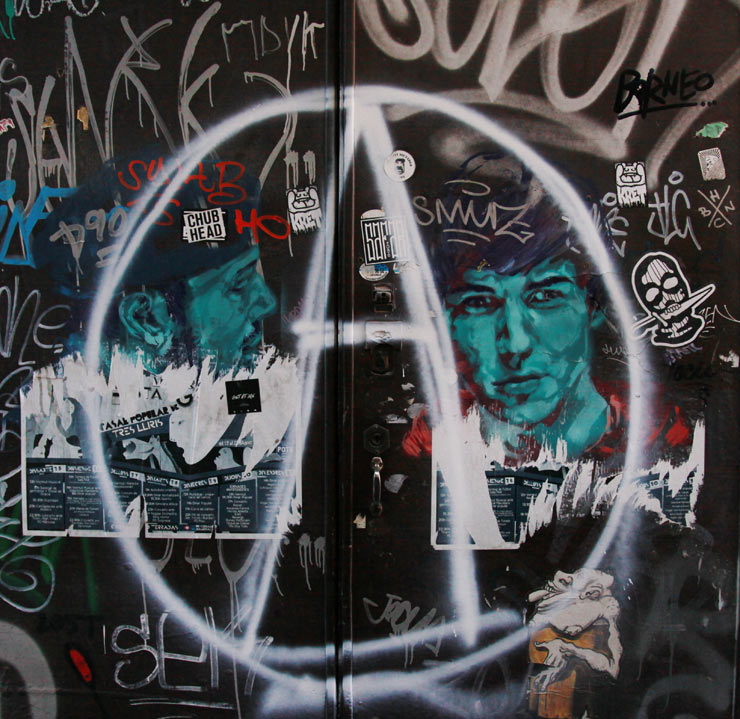
Rice in Barcelona, Spain. Also, anarchy. (photo © Jaime Rojo)


Read more
Nafir & FRZ in Milan: Mandalas to Stop War

Nafir & FRZ in Milan: Mandalas to Stop War

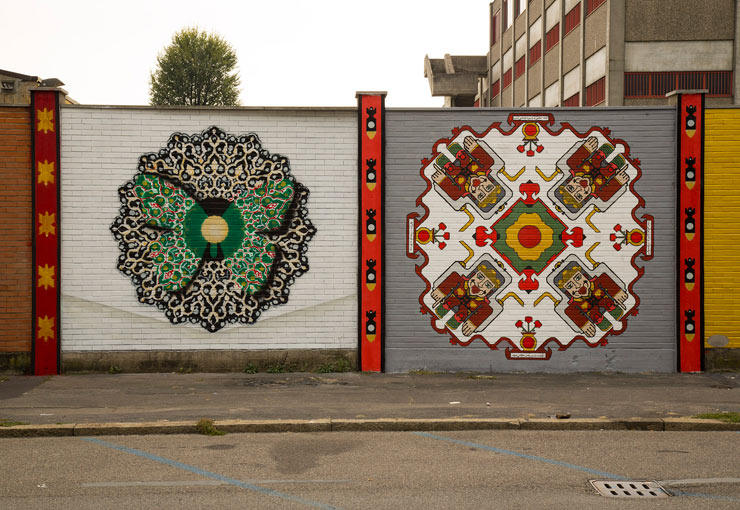
Nafir (left) “Flight of Eslimi” and FRz (right) “Fa Kingz” recent collaboration in Milan, Italy. (Photo © Andrea Fortis)

Two new street mandalas here in Milan, Italy from two Street Artists from Iran, Nafir and FRZ. Not surprisingly, the theme is peace, something that feels very endangered in certain parts of the world due to oil, natural resources, banking, private profits, and sometimes geopolitical rancor. The side by side pieces, one based on natural and traditional Iranian decorative patterning, the other more folkloric in motif, each take a different route to the same goal.

Nafir. “Flight of Eslimi”.  Milan, Italy. (photo © Andrea Fortis)

“This piece is called ‘Flight of Eslimi’ and it is a statement about changing for the better,” says Nafir, who is originally from Tehran and whose work on the street is usually darker in mood and outlook than this one. “It talks about our ability to become a new form of existence, like the worm (idea) that can change to a butterfly (gold).”

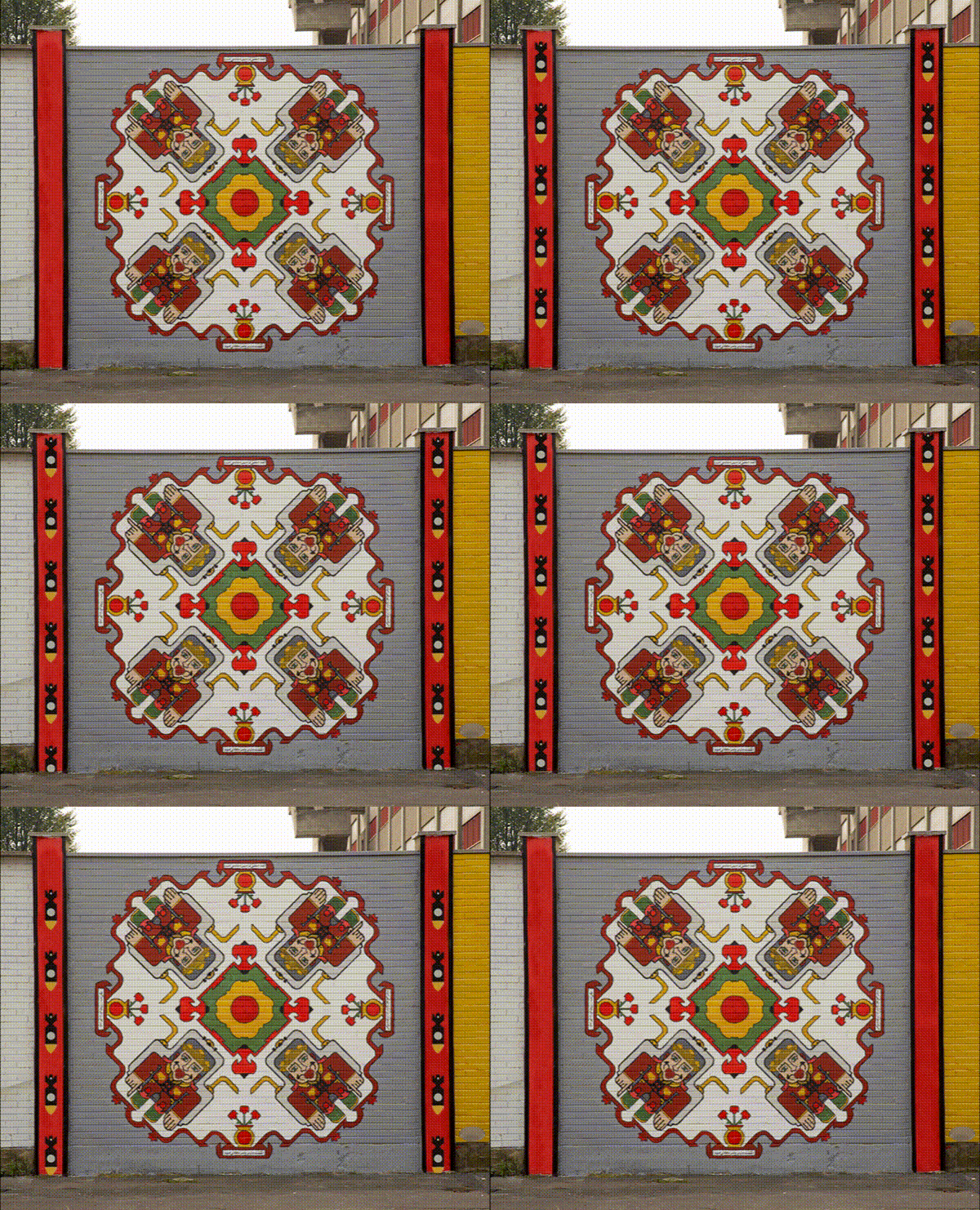
FRz. “Fa Kingz” Milan, Italy (Gif courtesy of the artist)

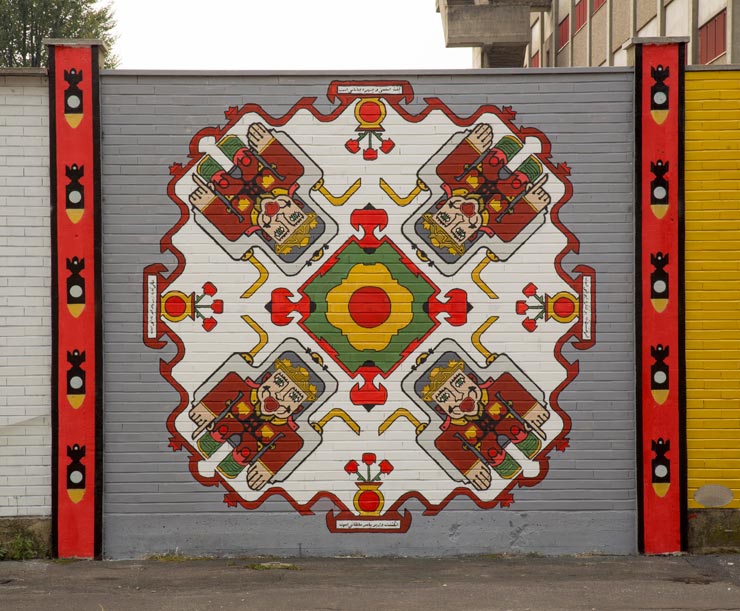
Tabriz based FRZ creates his mural (and GIF) “Fa kingz” as perhaps a colorful condemnation of the people who are using war and violence to steal and destroy lives and cultural heritage. “It is about the ambitions of those who have power and their unreasonable demands for governing the world,” he says. “Those human beings demolished priceless lives and homes of others just to prove their power and wealth are showing us the selfishness of those who say they are searching for immortality – but for them it does not exist.”


FRz. “Fa Kingz” Milan, Italy (Photo © Andrea Fortis)


Read more
Canemorto X Studio Cromie Salute this “Golden Age” in Famed Grottaglie

Canemorto X Studio Cromie Salute this “Golden Age” in Famed Grottaglie

“Angelo, you’ve brought many oafs here,” says his mom at the dinner table, “but these guys… ”

“They really look like rabid dogs,” remarks his father.

Yo Daddy, you’re closer to the truth than you may realize.

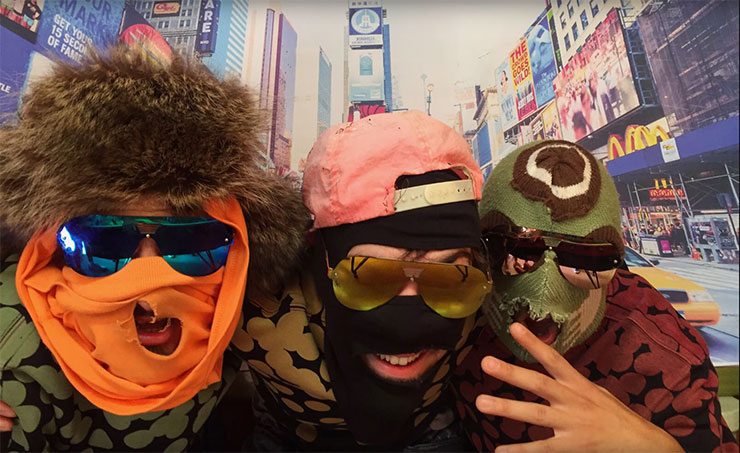
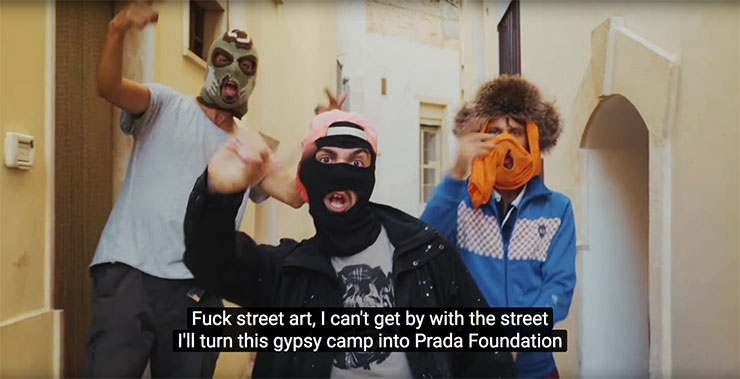
Canemorto rapping through the winding streets of Grottaglie, Italy in Golden Age.

Everyone’s favorite Italian trio of graffiti-writing, Street-Art-painting, canvas-painting, rapper-pizza-makers are back on the big screen! And they are still failing successfully.

It’s a running joke now that these witless brothers-in-art are tormented by myriad intertwined demons about their insecurities and conflicts with seeking/avoiding commercial “success” and the mainstreaming/authenticity of the Street Art scene in street culture.

Golden Age, their solo show this fall, is hosted by Studio Cromie and Angelo Raffaele Milano, the owner of the 11-year-old gallery and impresario behind the FAME festival.

FAME, of course, was one of the first so-called Street Art festivals, far before the current onslaught of festivals in cities and towns everywhere. FAME was underground and seemingly authentic before Milano halted it after five years for many of the same conflicting feelings Canemorto has expressed about the commodification of the counter-culture. You’ll see an ad for his now-touring “FAME” movie embedded within this one.

Fake it till you make it—Canemorto sporting slick New York shades in Golden Age.

Golden Age is the new partner video to the show, and the Marco Prosperpio directed film follows the hapless trio through the streets of Grottaglie, Italy, or as one Canemorto calls it in their rap, a “historic shithole.”

“It represents a sort of sequel of our previous video Toys,” Canemorto tells us, “this time the infamous trio has to fool both a crazy gallerist and a gloomy record producer in the desperate hope of getting rich and famous.” Ever brutal and ever witty, this is an ingenious way to fail.

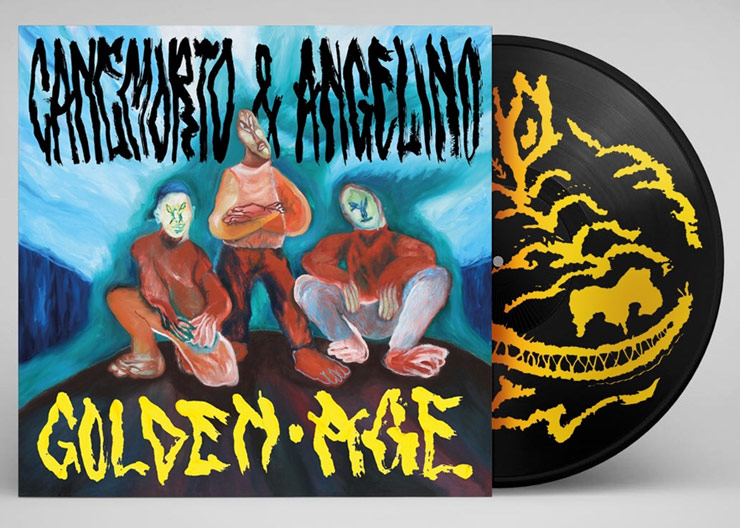
Together with the video, Canemorto is publishing Golden Age EP, a vinyl record (12” – 30×30 cm) with 4 of their jams on side A and a silkscreen print on side B.

Alongside the standard edition, there is also a special edition of 10 copies with handpainted covers, all different from each other.

CANEMORTO

CANEMORTO & ANGELINO – GOLDEN AGE LP

12″ vinyl one-sided record, screen printed on the other side.
4 tracks recorded by CaneMorto & Angelino. Only 100 copies available. Click HERE for more information.

Read more
BSA Images Of The Week: 11.26.17 Mexico City Special

BSA Images Of The Week: 11.26.17 Mexico City Special

BSA-Images-Week-Jan2015

This week BSA is in Mexico City in collaboration with Urban Nation Museum of Urban Contemporary Art (UN) to see what is steering the scene on the street, meet artists, visit artist compounds, museums, galleries, and studios – and of course to capture the wild and dynamic Street Art and graffiti scene here. Where Mexico City goes in art and culture makes big waves elsewhere in Latin America, and its Street Art scene has been quickly evolving in the last decade. Join us as we investigate the character and players in this modern/traditional city of more than 21 million people.


Mexico City this week was full of graffiti tags, large murals oozing with character, astral techno hippie dudes, strong women, slick talkers, traffic jams, street protests, stories about the 43, couples kissing on park benches, rooftop tours, men in suits, professional ladies in really high heels, smoothly running buses, sustainable community gardens, pick-pockets, indigenous people selling crafts, police with high pitched whistles, wannabe hipsters, live rock bands, tacos, craft beer, poinsettias, quesadillas, chille rellenos, pulled pork, nopales, avocados, tortas, Frida Kahlo, babies, Bohemia, marijuana smoke, and ultimately, Ricky Martin singing for hundreds of thousands of people free in the Zócalo.

We’ll catch you up on on the details soon.

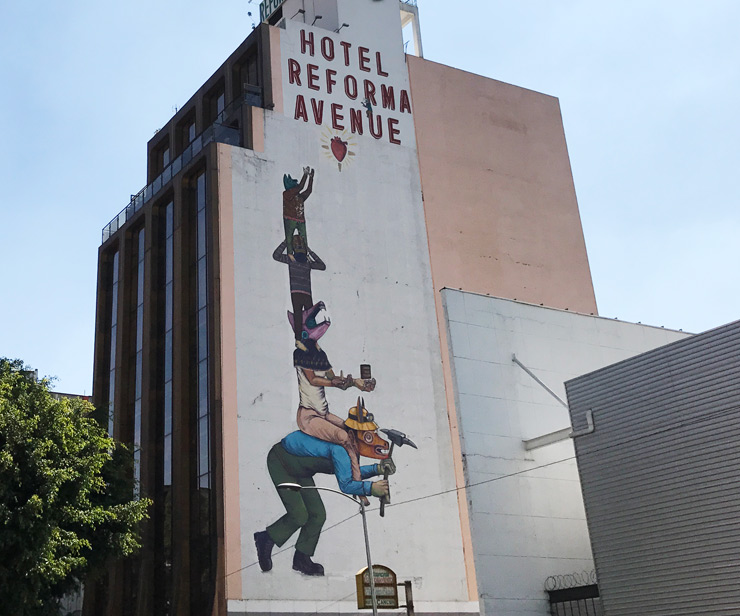
Here’s our weekly interview with the streets, this week featuring Arty & Chickle, Blu, Curiot, DFace, El Mac, Erica Ilcane, Escif, Herakut, Interesni Kazki, Maria Guardado, Retna, ROA, Saner, and Sego.

Our top image : Erica Ilcane. Detail. (photo © Jaime Rojo)

Erica Ilcane. (photo © Jaime Rojo)

Erica Ilcane. Deatail. (photo © Jaime Rojo)

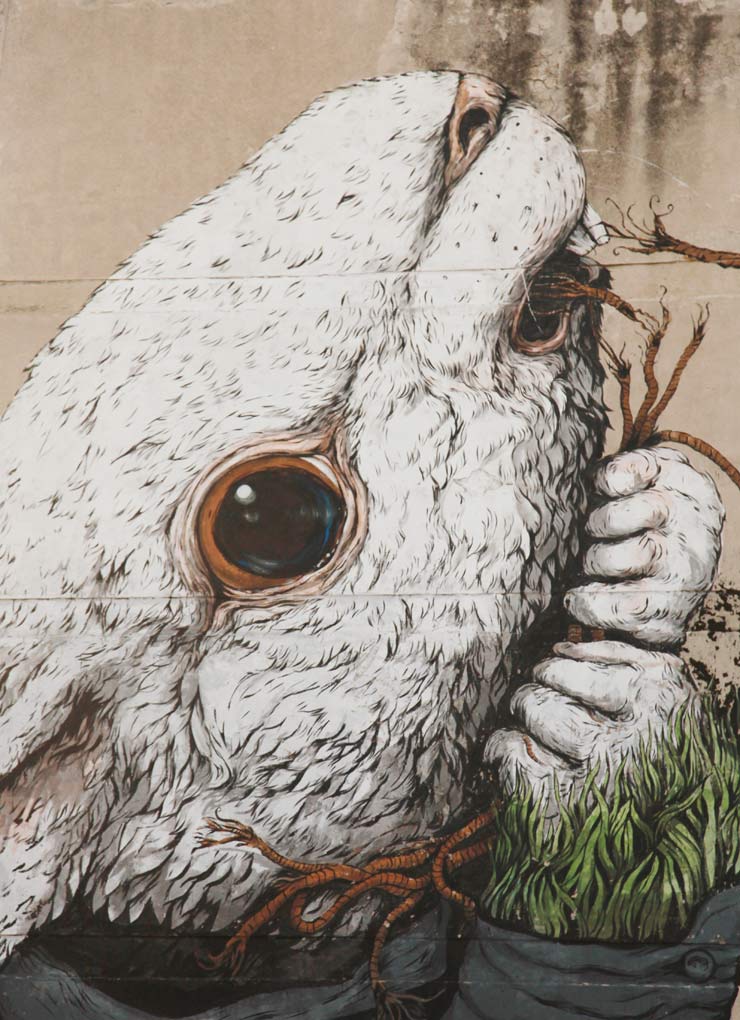
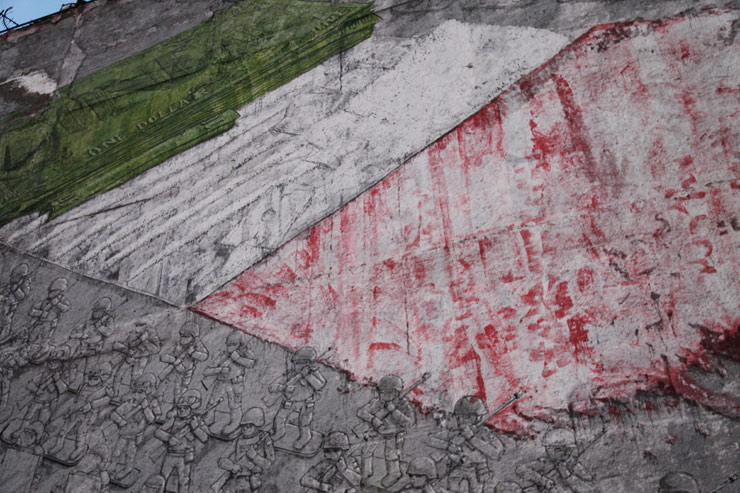
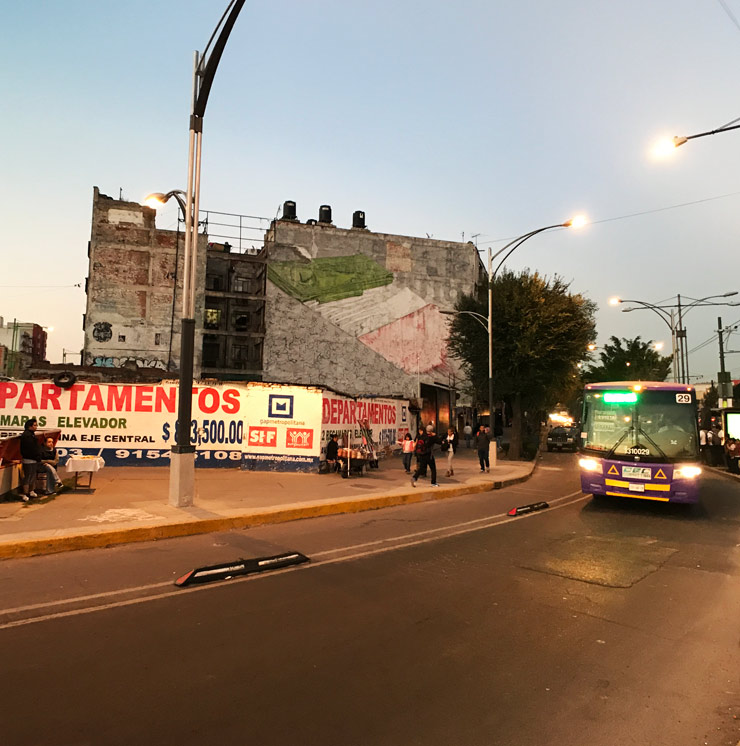
Blu. Detail. For All City Canvas 2012. (photo © Jaime Rojo)

Blu. For All City Canvas 2012. (photo © Jaime Rojo)

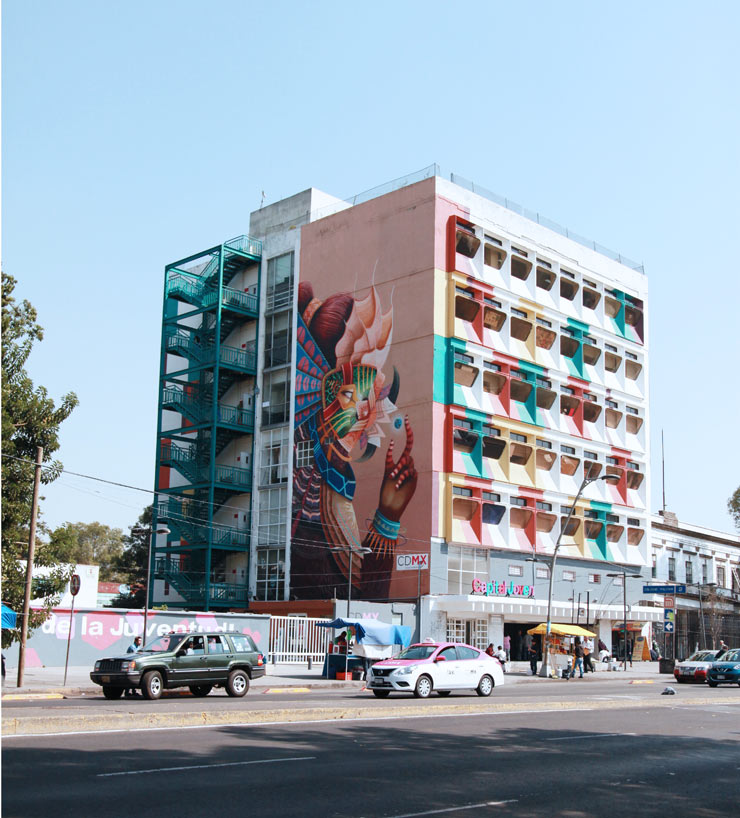
Curiot. Detail. For Lienzo Capital Project with Street Art MUJAM. (photo © Jaime Rojo)

Curated by Roberto Shimizu with the collaboration of the Mexico City Goverment on the Metro and the official building of The Nation Youth Institute

Curiot. Detail. For Lienzo Capital Project with Street Art MUJAM. (photo © Jaime Rojo)

Curiot in Roma neighborhood for Capital Mural. (photo © Jaime Rojo)

D*Face (photo © Jaime Rojo)

Escif. For All City Canvas 2012. (photo © Jaime Rojo)

Retna. For All City Canvas 2012. (photo © Jaime Rojo)

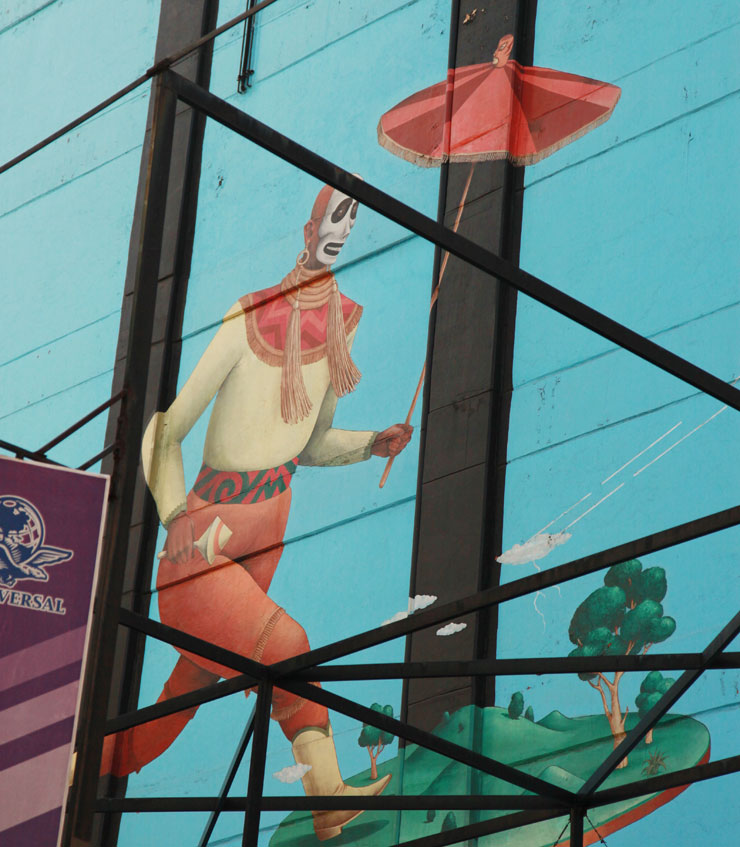
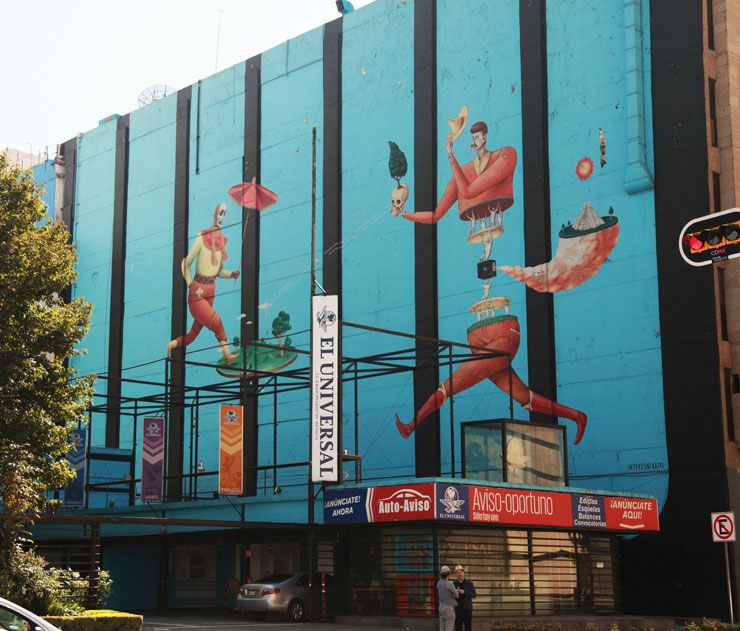
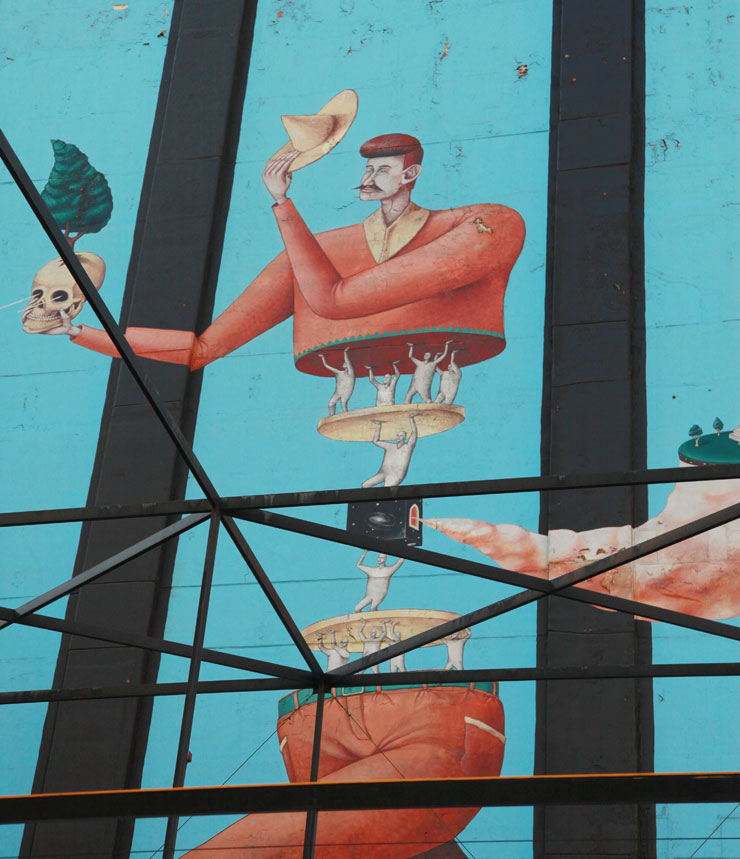
Interesni Kazki. Detail. For All City Canvas 2012. (photo © Jaime Rojo)

Interesni Kazki. For All City Canvas 2012. (photo © Jaime Rojo)

Interesni Kazki. Detail. For All City Canvas 2012. (photo © Jaime Rojo)

Saner. For All City Canvas 2012. (photo © Jaime Rojo)

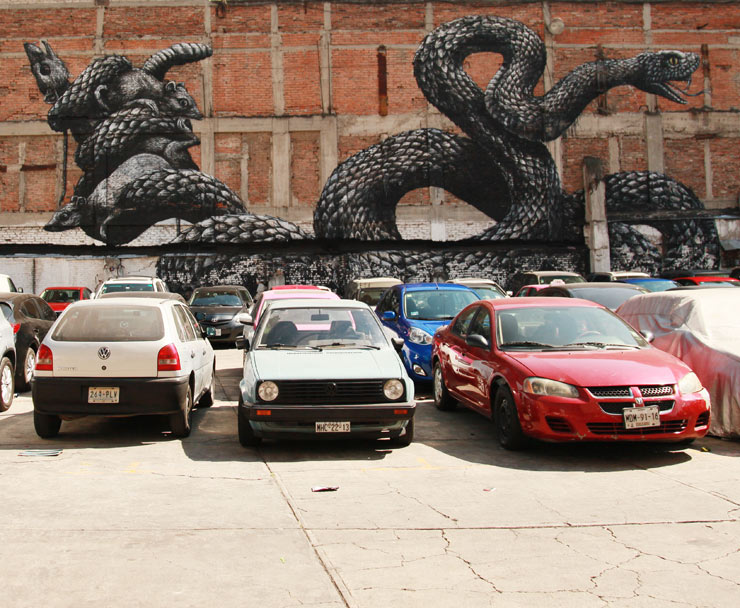
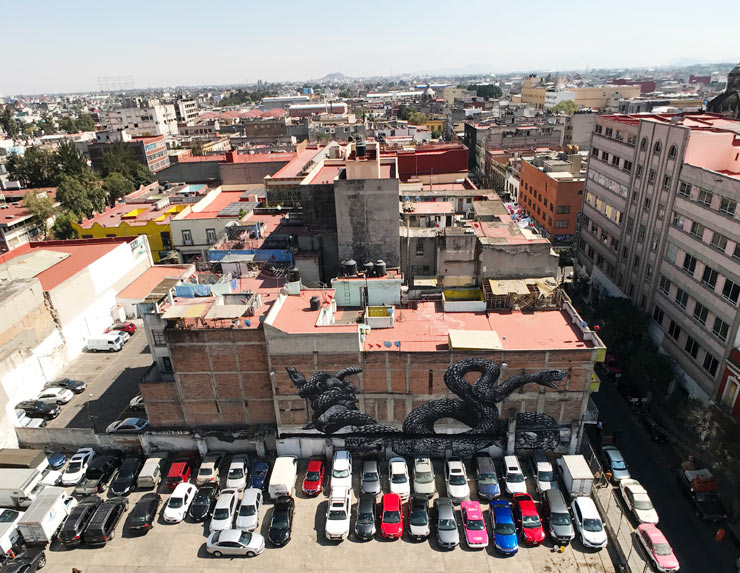
ROA. For All City Canvas 2012. (photo © Jaime Rojo)

ROA. For All City Canvas 2012. (photo © Jaime Rojo)

Sego. For All City Canvas 2012. (photo © Jaime Rojo)

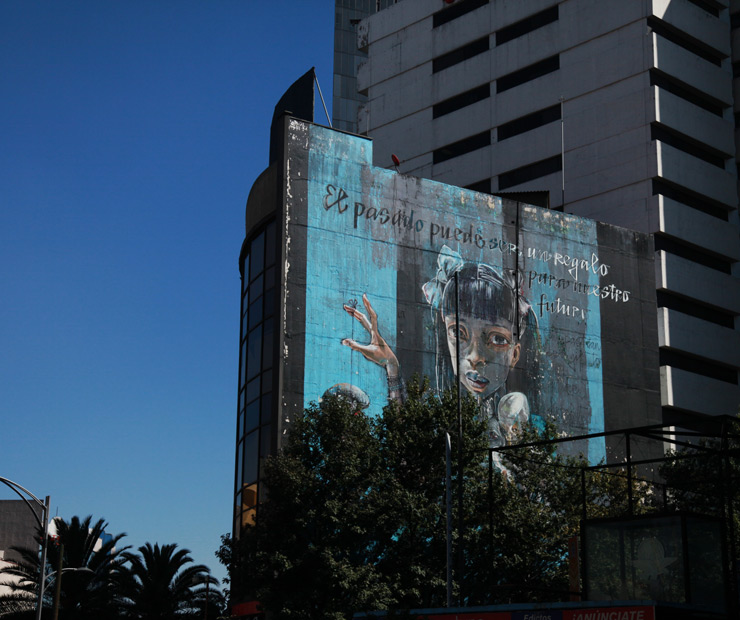
Herakut. For All City Canvas 2012. (photo © Jaime Rojo)

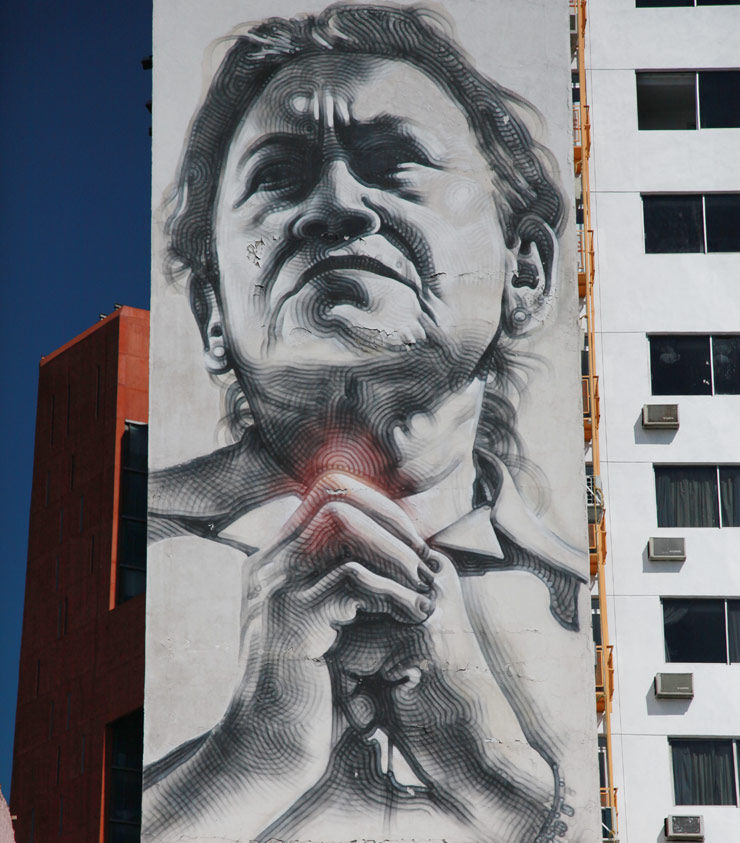
El Mac. Detail. For All City Canvas 2012. (photo © Jaime Rojo)

Portrait of Maria Guardado, a social activist and poet from Guatemala. Ms. Guardado was tortured and killed by the Guatemalan army during the bloody civil war in 1980.

El Mac. For All City Canvas 2012. (photo © Jaime Rojo)

Arty & Chikle. “Only Love”. Street Art MUJAM in collaboration with the Mexico City National Youth Institute for Young Adults. (photo © Jaime Rojo)

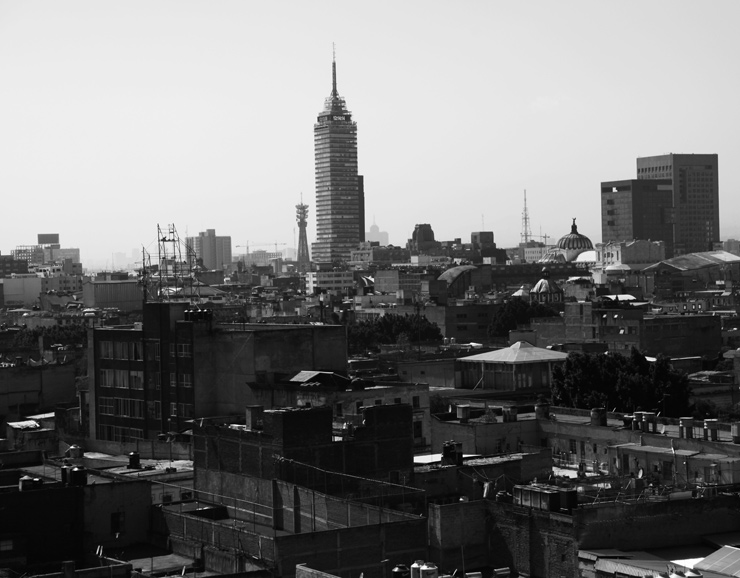
Untitled. Torre Latino Americana. Mexico City. November 2017 (photo © Jaime Rojo)

Read more
Exploring New Techniques and Processes with Elian, Jaz and Ever in Mexico City

Exploring New Techniques and Processes with Elian, Jaz and Ever in Mexico City

This week BSA is in Mexico City in collaboration with Urban Nation Museum of Urban Contemporary Art (UN) to see what is steering the scene on the street, meet artists, visit artist compounds, museums, galleries, and studios – and of course to capture the wild and dynamic Street Art and graffiti scene here. Where Mexico City goes in art and culture makes big waves elsewhere in Latin America, and its Street Art scene has been quickly evolving in the last decade. Join us as we investigate the character and players in this modern/traditional city of more than 21 million people.


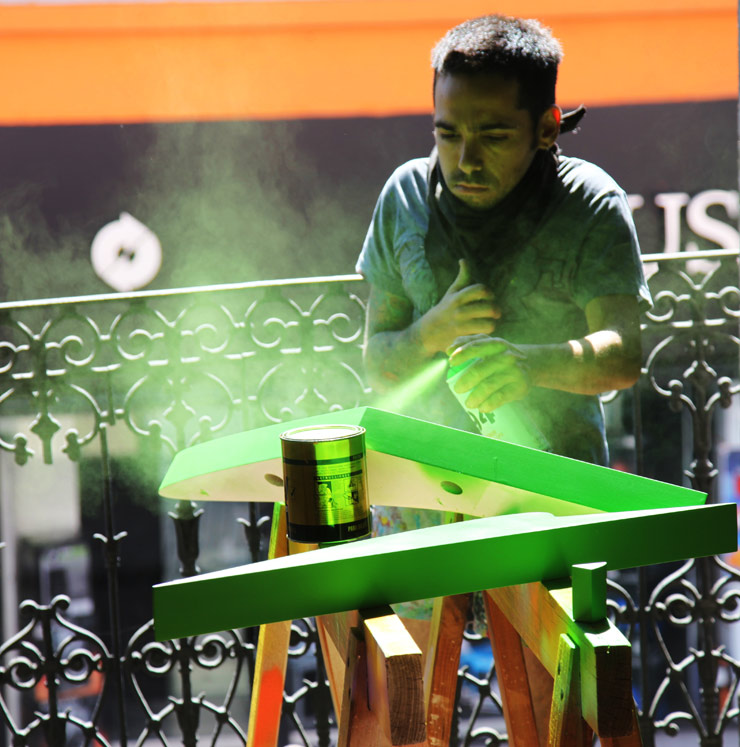
In a cacophonous neighborhood in downtown Mexico City that sells musical instruments and equipment the second floor verandas are emitting an aerosol fragrance, a cloud of lime green to mix in the air. Some how it mixes well with the honking cars and roaring live rock and roll concert across the street in a musical equipment store where they are performing covers of 80s metal bands like Mötley Crüe and Judas Priest.

Elian. Process shot. (photo © Jaime Rojo)

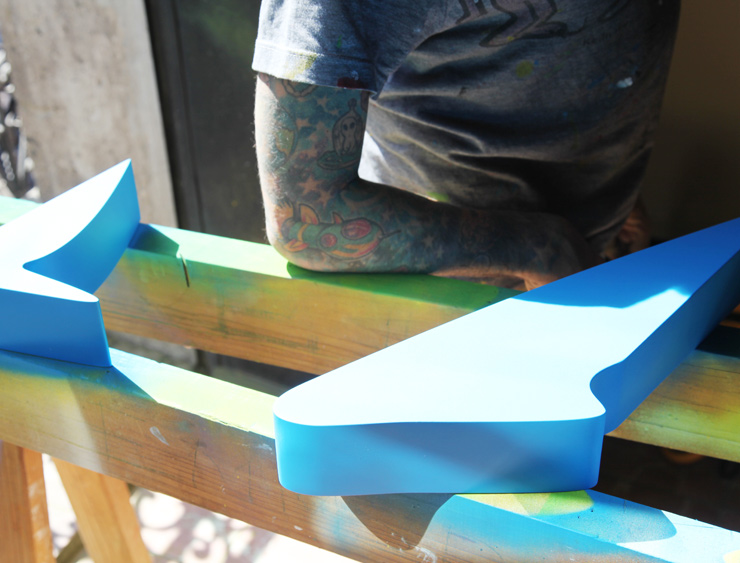
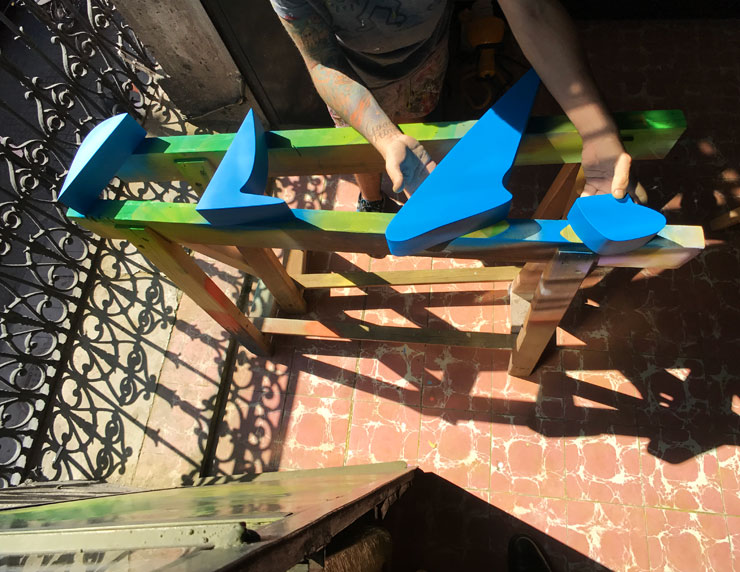
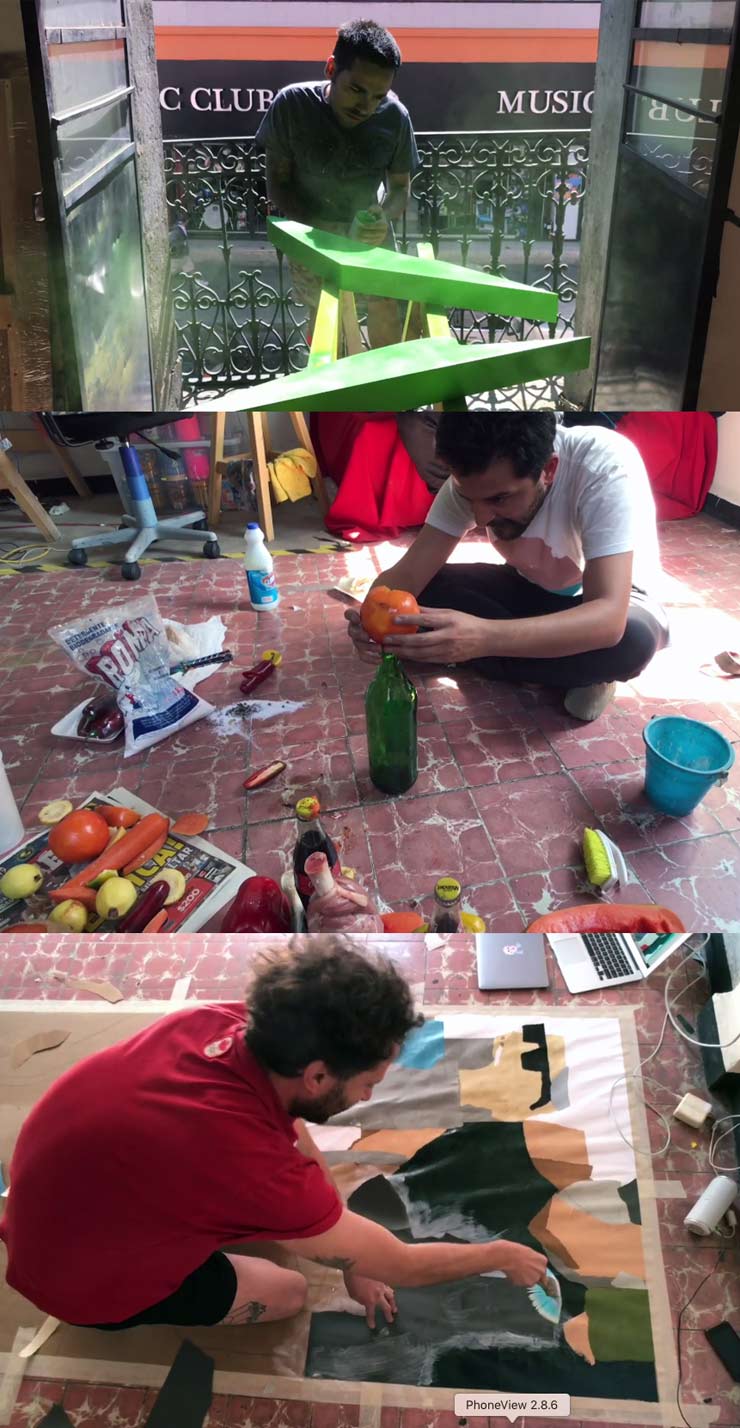
Elian is balancing his new pieces on saw horses and fumigating them with bright paints which he normally might be covering a huge mural wall with.

“I’m trying to break with my tradition of being a painter do you know,” he says, one of three close friends on the Street Art scene from Argentina here in this studio.

Elian. Process shot. (photo © Jaime Rojo)

Each of the artists say they are taking a little break from the work they normally do to experiment for their upcoming show at Toba Gallery here at the beginning of December.

The year-old gallery is owned by a local Street Art celebrity named Smithe, who still pursues his own art career while choosing artists from his peers to show at this location in el Centro de la ciudad.

Elian. Process shot. (photo © Jaime Rojo)

“I want to build these kinds of objects and to create a dialogue with the space by changing the focus of attention by placing them around the gallery,” Elian says, pointing to imaginary spots in the air above and punctuating with his pointed index finger.

“Sort of like tick-tick-tick, like acupuncture needles, and I will mount all these pieces try to mix with the pieces of the guys.”
Elian. Process shot. (photo © Jaime Rojo)

The guys are Franco “JAZ” Fasoli and Nicolas “EVER” Romero, who each have their own small room in this artists’ studio enclave that is sort of hidden, requiring you to look carefully for an entrance hall behind a lottery ticket vendors signage on the street.
All three have often travelled and work together with a fourth Argentinian named Pastel in festivals and exhibitions over the past half decade, and these three consider this a happy reunion to work again with one another.

Ever. Process shot. (photo © Jaime Rojo)

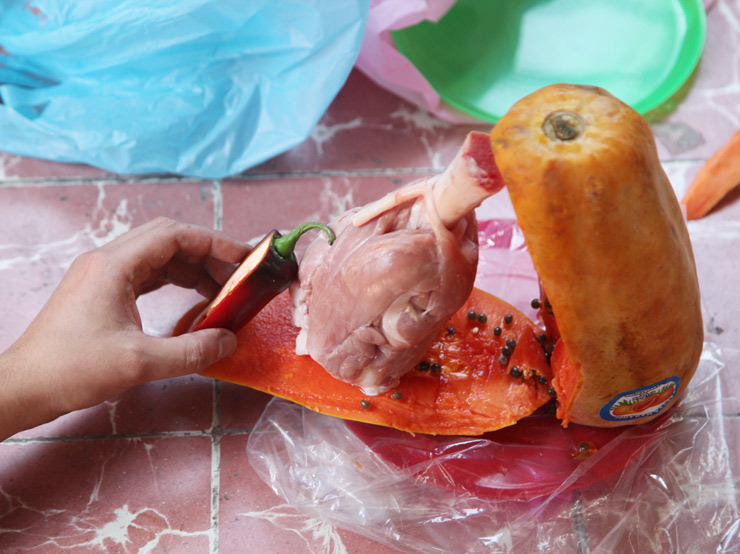
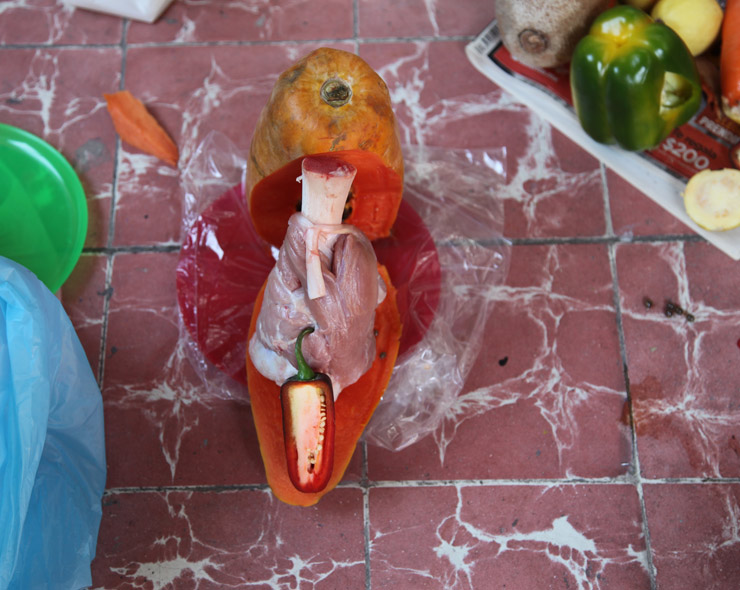
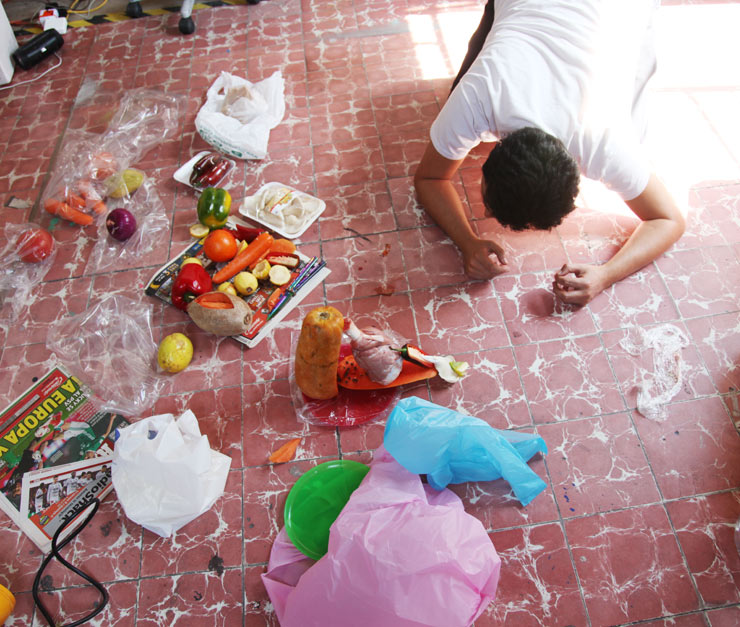
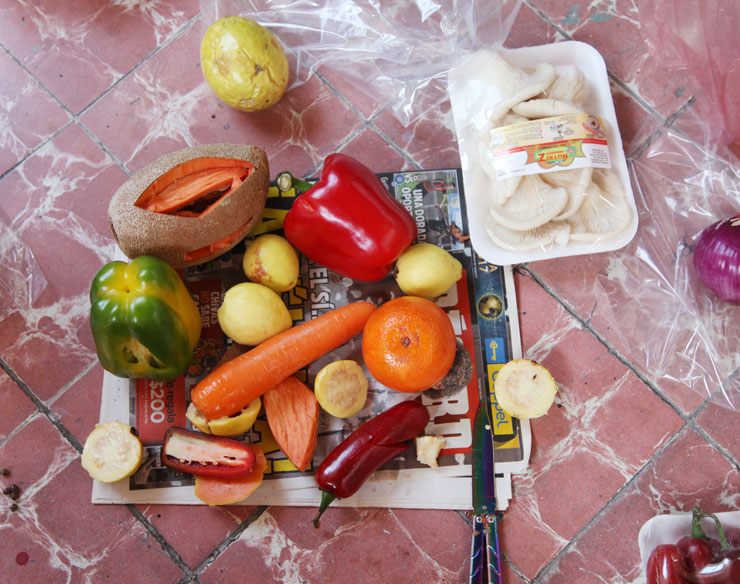
Nicolas “EVER” Romero is next door sitting cross-legged on the floor trying to balance a chunk of raw meat inside a papaya, accented by a jalepeno pepper. Around him are various tropical fruits and everyday vegetables teetering upon each other and bottles of sugary sodas.

He says his newest still-lifes are mixing traditional subject matter with pieces of modern life to draw attention to the contrasts and as a critique of the commercialized consumer culture that is eroding our connection with history.

Ever. Process shot. (photo © Jaime Rojo)

“I feel like Mexico has the combination of ancient roots like the Mayan and Incan culture,” he says, “and their culture of cultivation of fruits and vegetables edit is in huge contrast with the modern world.” He blames a lot of the commercial junk food that has come into the country on the neighbor to the north, the United States.

“You can go to this store chain called Oxxo, like the 7-Eleven of Mexico, and you can see what the Mexican People are being offered to eat,” he explains.

Ever. Process shot. (photo © Jaime Rojo)

“Basically they have tacos and tortillas and basically shitty food like Lays or Bimbo – super unhealthy foods.”

“That, for me, is a metaphor for Mexico. This super amazing strong food history and then you have this stuff – for me working with these real foods is part of the description for what is happening in Mexico today.”

Ever. Process shot. (photo © Jaime Rojo)

The still-lifes are a departure for EVER from his figurative work as well, and he is enjoying concentrating on craft in this way.

Free from the large walls and magic surrealism of his street murals, he says he can also hide his identity in this kind of painting that is a respected practiced thought to help artists “warm” their hands.


Jaz. Process shot. (photo © Jaime Rojo)

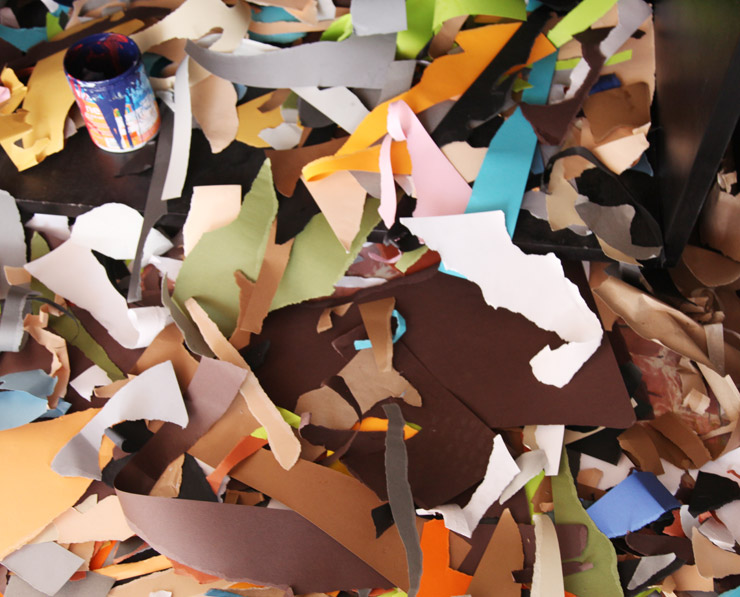
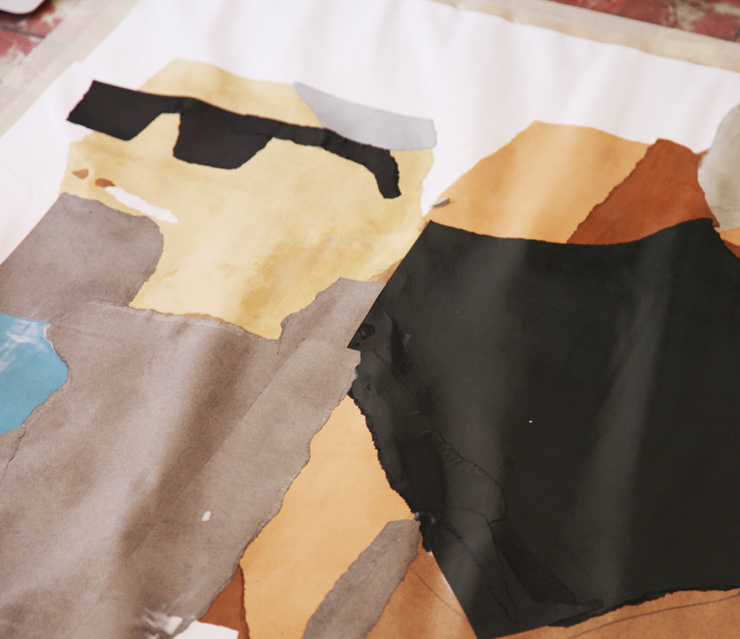
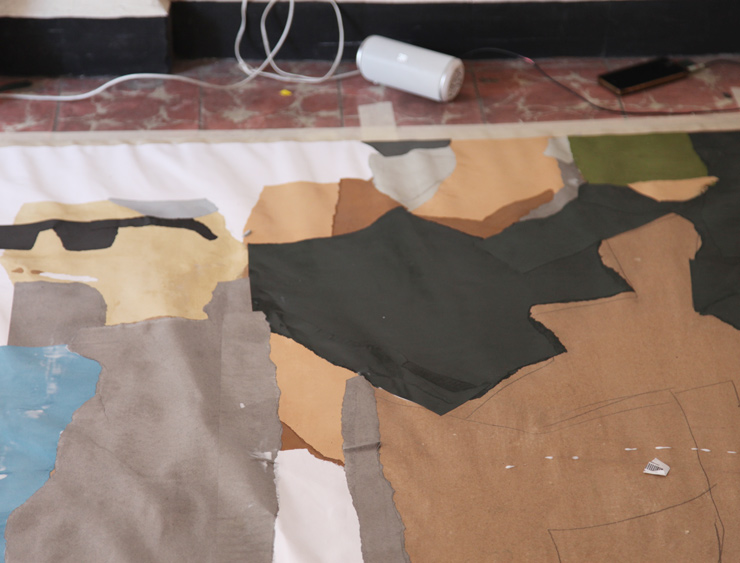
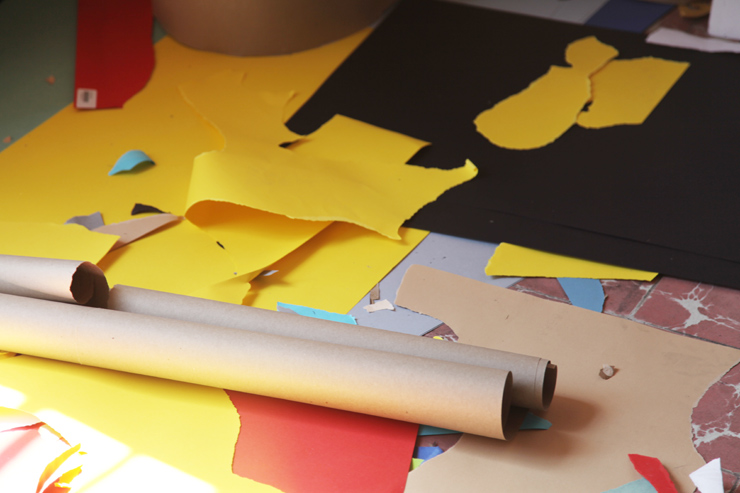
Another figurative painter known for his muscular strong characters and people, JAZ is taking a few steps back from realism to abstract. His studio features a large pile of ripped papers that he is gluing onto a sketch on brown paper.

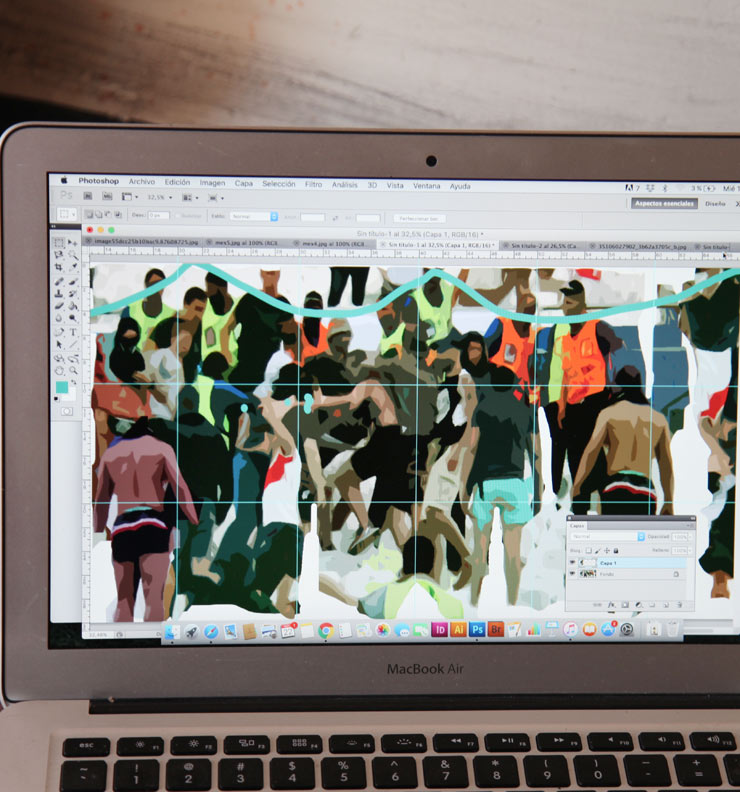
The sketch comes from a digital collage on his laptop. He says he needed to separate himself from direct painting by creating a multi-step process like this. “I am kind of forcing myself into more abstract in a very artificial way because if I try to do it by myself.”


Jaz. Sketch shot. (photo © Jaime Rojo)

The 10 meter long fragile piece will hang from wires in the gallery and it reminds you that he was a sceneographer before he was know for graffiti or Street Art.

The finished rolls feature figures running with backs to the viewer in a jumbled, violent chaos of hooligans in the street. Strung overhead across the ceiling is a colorful fiesta decor, denoting a sarcastic overlay to the lawlessness. It’s contrast he enjoys.

Jaz. Process shot. (photo © Jaime Rojo)

“This is a typical hooliganism that happens in South America but I also mixed up with this idea of a party or a celebration so I’m going to have these decorative streamers papers hanging from above,” he says. “It may be difficult to understand because it looks like it’s a party but at the same time there’s this clashing and it is in a sort of carnival environment in a formal way – it’s more of scene in a cinematic way.”

Having lived in Europe for the last couple of years, JAZ talks about his home town of Buenos Aires and his new ability to have perspective on some corrupt behavior and social structures that he has been examining.

Jaz. Process shot. (photo © Jaime Rojo)

“Argentinian hooliganism is also a very strong political force,” he says. “It is not just about the activities related to the sport, it’s the mafia. It is 100% connected with politicians and drugs and crime all under one roof or protection of the sport.”

“It is a very social tool used for manipulation… extortion. It is very integrated into our society you can talk with any of us three Argentinians and talk about how deep inside our society it is. I do a kind of x-ray of how the society works by looking into just that particular segment of society.”

Jaz. Process shot. (photo © Jaime Rojo)

With Mexico City considered as a doorway to the Americas, it is interesting to note that these three Street Artists all express a certain admiration and solidarity with Mexico and are very familiar with the cultural traditions, heros and artifacts of the history and society; a pronounced departure from the neighbor to the north.

It is good to see again the maturation and evolution of these thirty-something artists as they dare themselves to try new techniques in pursuit of an art practice apart Street Art, and to witness the network of support that they create for each other regardless of their stylistic differences.


PROCESS: Elian, Jaz and Ever in Mexico City

Read more
BSA Film Friday: 11.24.17

BSA Film Friday: 11.24.17

bsa-film-friday-JAN-2015

Our weekly focus on the moving image and art in the streets. And other oddities.

Now screening :
1. PROCESS: BSA Raw Video with Tres Gauchos Elian, JAZ, Ever Siempre
2. “See Her” by Ann Lewis
3. The Grifters. RAGE DFS
4. Yoko Ono: Imagine Peace

bsa-film-friday-special-feature

BSA Special Feature: PROCESS: BSA Raw Video with Tres Gauchos Elian, JAZ, Ever Siempre

The process of making art in the studio is a privilege to see and be a part of. This week in Mexico City we have been invited into that sacred space where three Street Artists from Argentina are working in rooms of an old building in the central part of the city as they prepare for an upcoming show.

Here are a few minutes of creativity in the moment as we watch Elian, Franco JAZ Fazoli, and Nicolas EVER Romero each work in mediums that they were not originally known for. Each is stretching themselves creatively- JAZ is working on ripped paper collage instead of sculpture or painting, Elian is creating extruded shapes and objects to hang rather than painting geometrics, and EVER is constructing “still lifes” to paint with oil on canvas instead of surreal figures.


“See Her” by Ann Lewis

Formerly GILF!, now Ann Lewis, the activist Street Artist and fine artist completed a mural called “See Here” this summer in Boston as part of the Now and There program.  A compelling image raises awareness of women incarcerated and the route to inclusion in society and the many challenges that accompany that route. For our part, it is important to see her.


The Grifters. RAGE DFS

Commemorating 20 years of hitting up trains with RAGE, here is graffiti bombing as action movie, courtesy of Boris and the Grifters and RAGE DSF.


Yoko Ono: Imagine Peace

Every Christmas season we look forward to Yoko Ono and John Lennon’s “War is Over (If You Want It)” sign in Times Square. A few weeks ago we were fortunate to see in person Yoko’s latest project withCreative Time’s Pledges of Allegiance program. Here is a bit of video showing the flag flapping in the wind in Manhattan.

Yoko Ono has been talking about and advocating peace for half a century and with her husband John Lennon she asked us first to imagine it.

Is it the absence of something, or the presence of it?

“Think Peace. Act Peace. Spread Peace. Imagine Peace.”

Read more
Panteón and Watchavato “No Esto No Es Lo Que Fue” Opens In Mexico City

Panteón and Watchavato “No Esto No Es Lo Que Fue” Opens In Mexico City

This week BSA is in Mexico City in collaboration with Urban Nation Museum of Urban Contemporary Art (UN) to see what is steering the scene on the street, meet artists, visit artist compounds, museums, galleries, and studios – and of course to capture the wild and dynamic Street Art and graffiti scene here. Where Mexico City goes in art and culture makes big waves elsewhere in Latin America, and its Street Art scene has been quickly evolving in the last decade. Join us as we investigate the character and players in this modern/traditional city of more than 21 million people.


Newly opened Panteón in the very historic part of Mexico City features pizza, live music, and a series of open spaces for public programs and well appointed galleries – all inside a 400 year old colonial Spanish-style building on the cities’ oldest street. Architecturally registered as part of the cultural heritage of the city and country, these spaces are being preserved in their original splendor, and Street Artists/graffiti artists/contemporary artists are being carefully selected to breath new life into them.

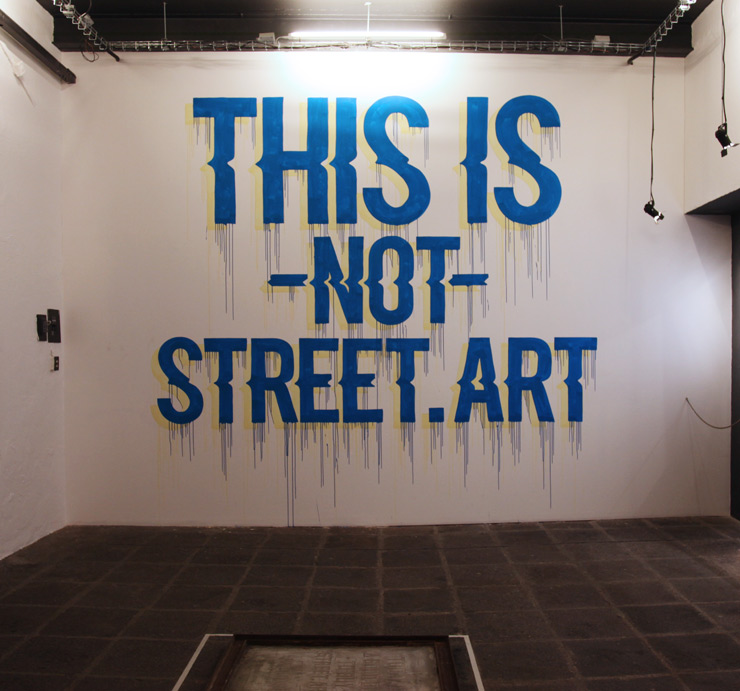
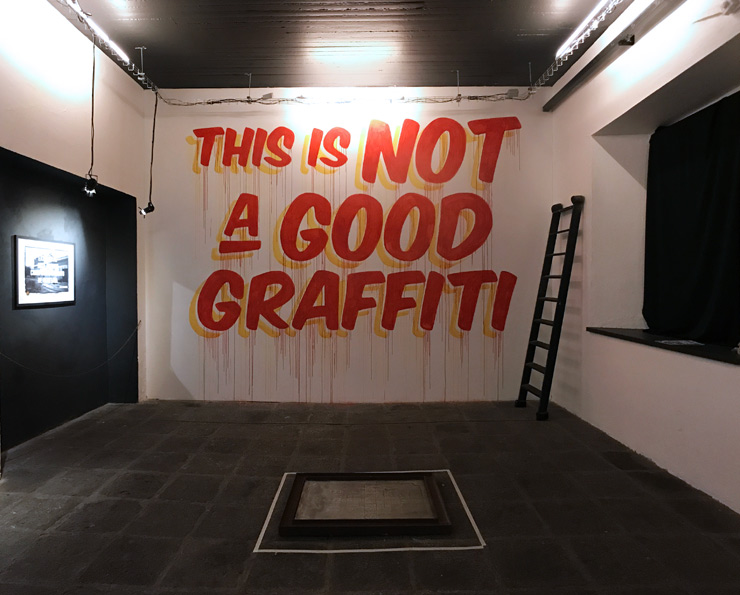
Watchavato. NO ESTO NO ES LO QUE FUE. Centro Cultural Panteón. Mexico City. November 2017. (photo © Jaime Rojo)

Intended as a cultural meeting place where exhibitions, panel discussions, artist talks, community participation, screen printing facilities, and even “happenings” around social issues can co-exist, you can feel a positive inclusive vibe here, and you can imagine a number of new partnerships blossoming at Panteón going forward.

Watchavato. NO ESTO NO ES LO QUE FUE. Centro Cultural Panteón. Mexico City. November 2017. (photo © Jaime Rojo)

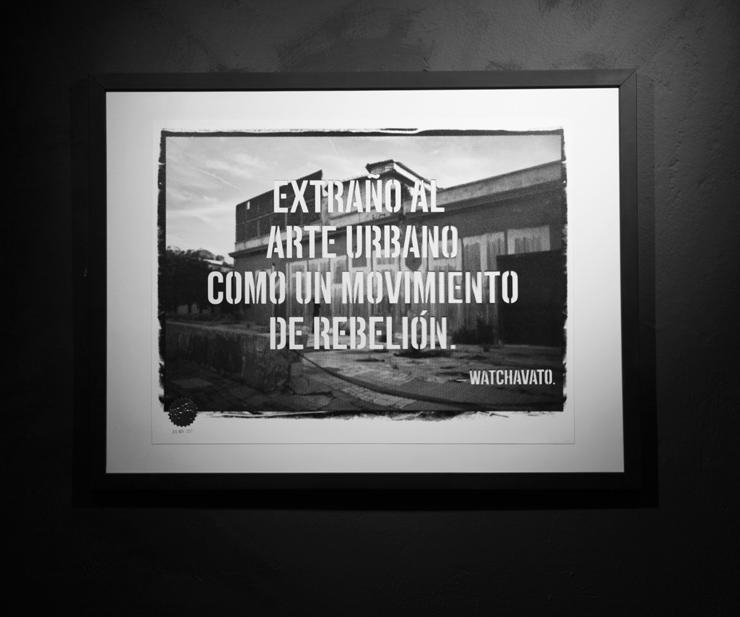
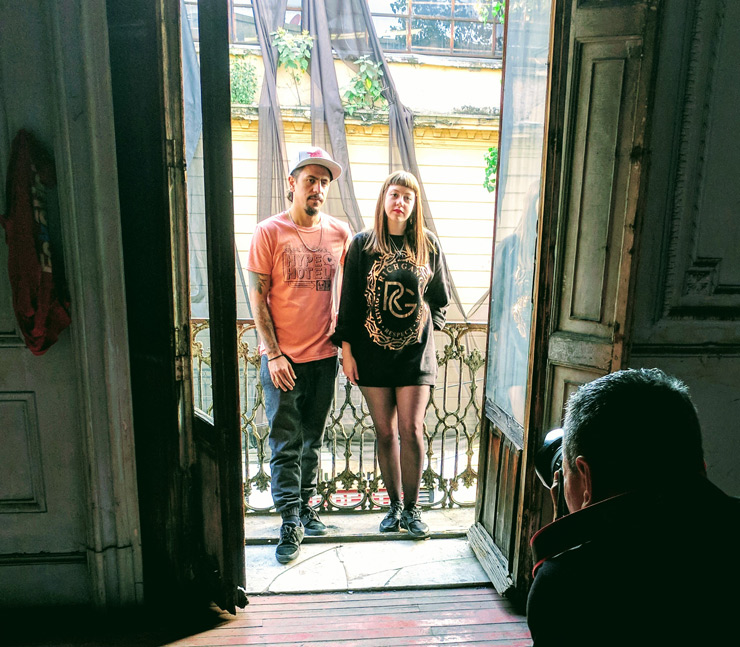
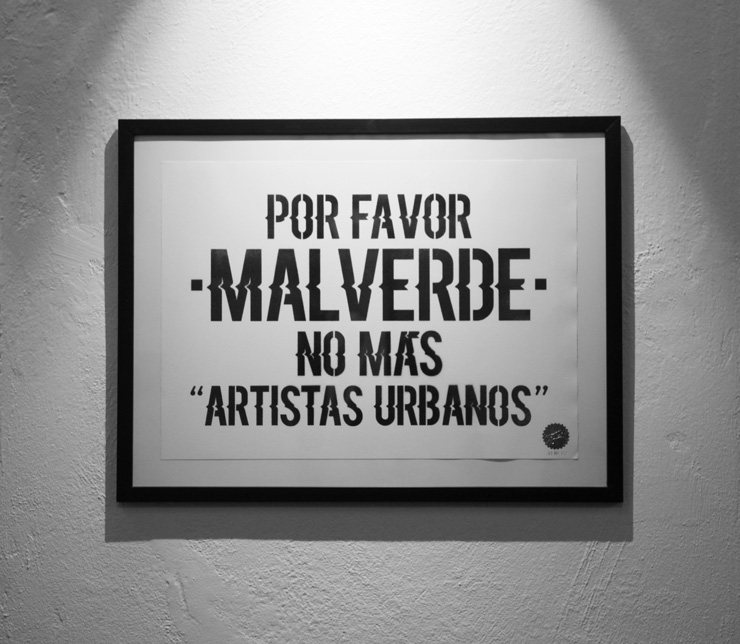
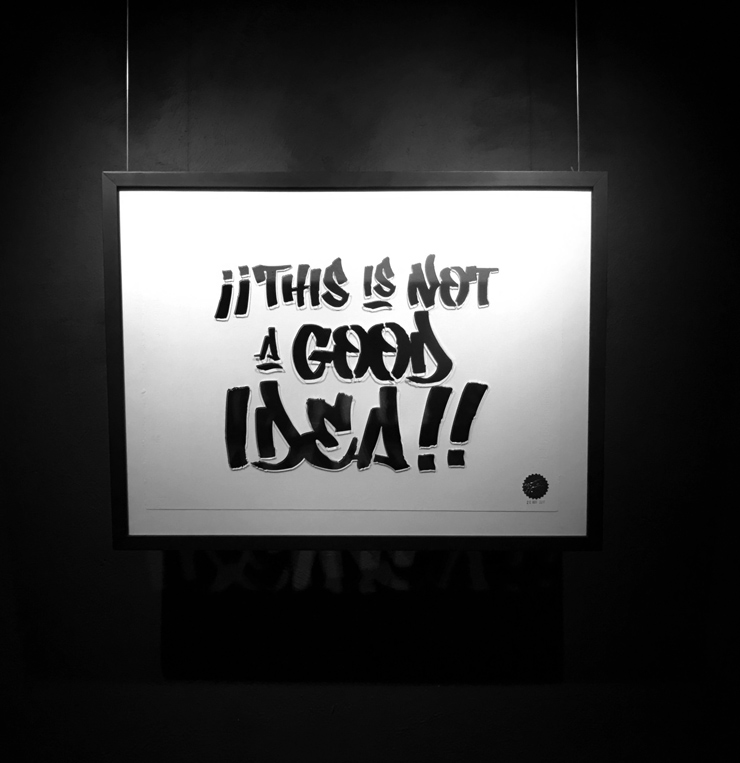
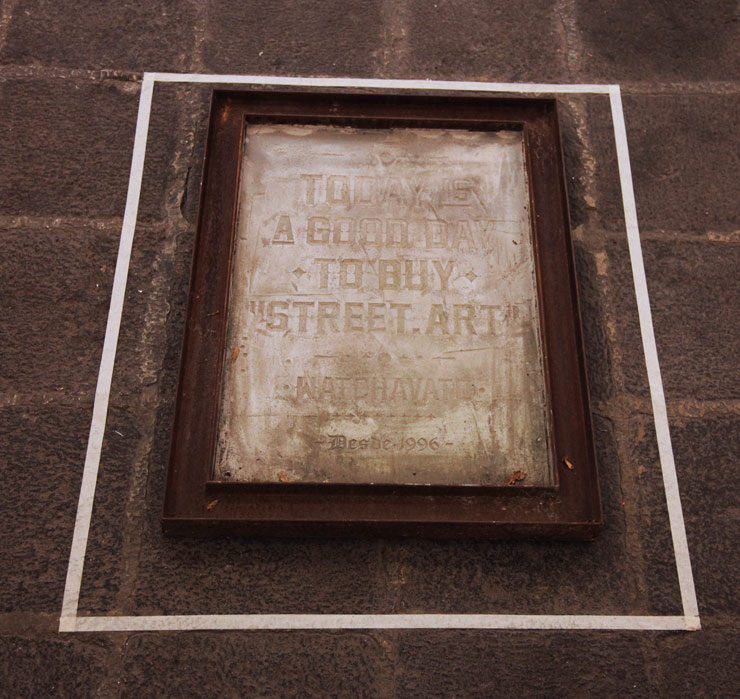
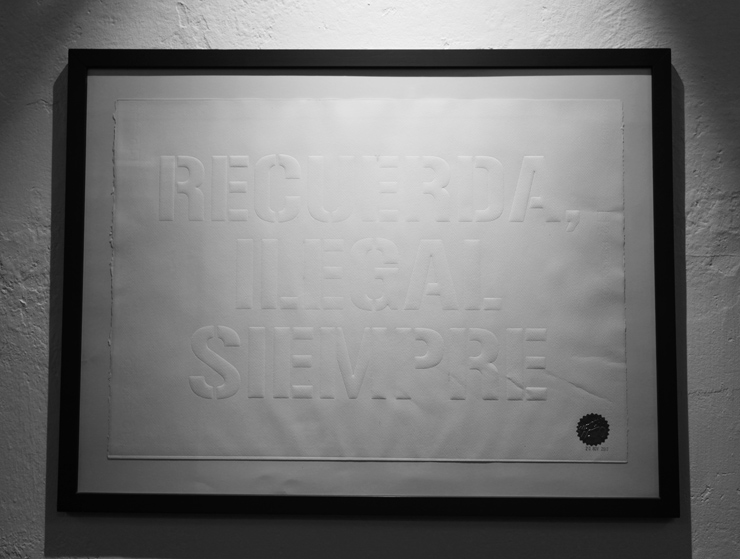
Thursday night features a much anticipated opening by a Mexican Street Artist Watchavato, who many here point to as a pioneer in the local Street Art scene of the mid-late 1990s’s. Known for his stencils, his devoted fans, and his insightful sarcasm in sign-making messages, the Sinaloa-based artist has incorporated sideways critiques of drug traffickers (“narcos”), by playing with the image of Jesús Malverde, a folklore hero of his home state who sometimes known as an angel of the poor, or the “narco-saint”.

Visitors to the show will see again a reference to Malverde here at the show as well as what can only be described as pieces expressing Watchavato’s existential feelings about graffiti and Street Art culture two decades after he began.

Watchavato. NO ESTO NO ES LO QUE FUE. Centro Cultural Panteón. Mexico City. November 2017. (photo © Jaime Rojo)

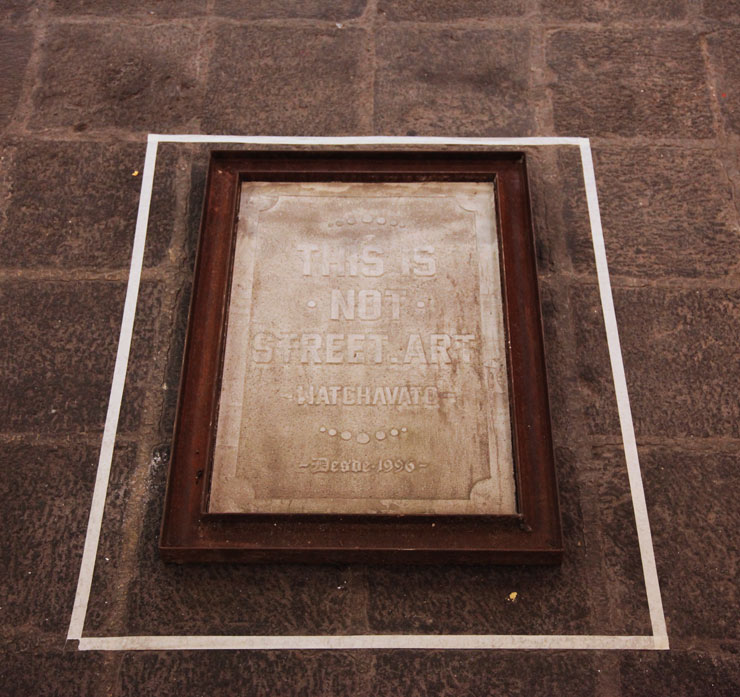
The sharp wit is not lost on us, as we have crossed paths with many an old-skool graff writer or early phase Street Artist who laments what they see as a loss of edge, rebellion, or even the transgressive nature of the early scene. The entire room can be taken into account as one installation, rather than individual pieces. Most notable of course are the gravestones, the most literal announcement of the death of Street Art we’ve seen.

Mourn not, we say, the future is unwritten.

We were incredibly fortunate to receive a full tour of every space (and future space) in Panteón by two of the curators of these newly opened art galleries, Andrés Medina who also serves as Director of the space and Mariela Gómez and the quality of concept and research that has gone into exhibits since opening this spring is already remarkable. Our sincere thanks to them.

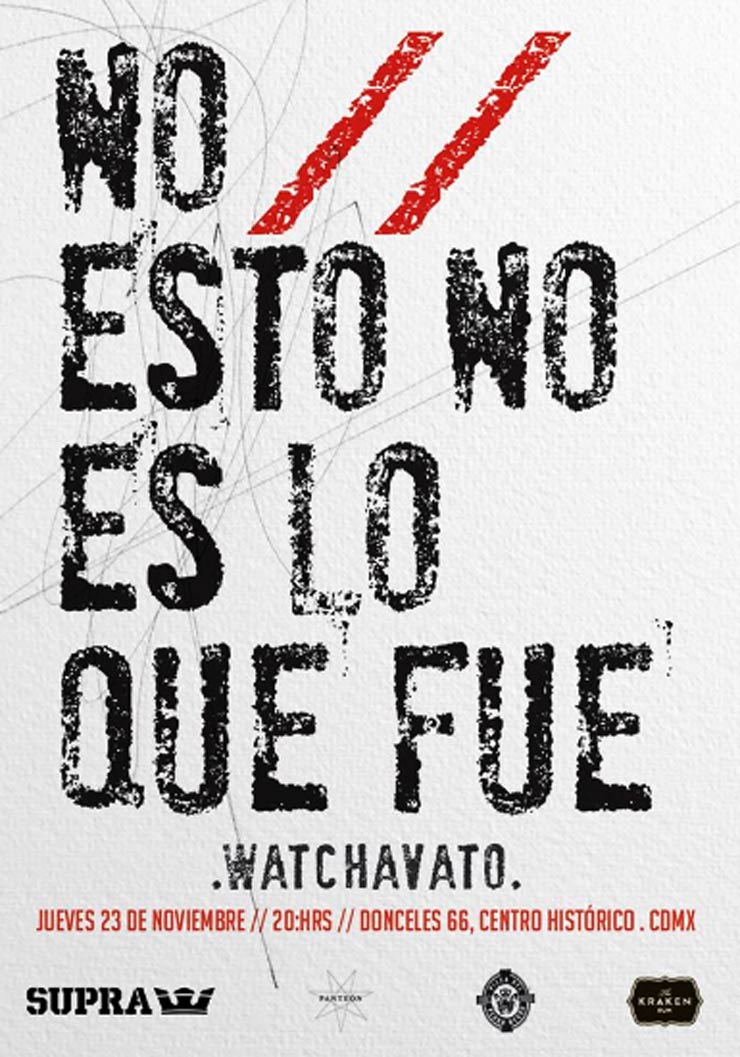
Here are some of the images of the new show, NO ESTO NO ES LO QUE FUE (NO THIS IS NOT WHAT WAS).

Watchavato. NO ESTO NO ES LO QUE FUE. Centro Cultural Panteón. Mexico City. November 2017. (photo © Jaime Rojo)

Watchavato. NO ESTO NO ES LO QUE FUE. Centro Cultural Panteón. Mexico City. November 2017. (photo © Jaime Rojo)

Watchavato. NO ESTO NO ES LO QUE FUE. Centro Cultural Panteón. Mexico City. November 2017. (photo © Jaime Rojo)

Watchavato. NO ESTO NO ES LO QUE FUE. Centro Cultural Panteón. Mexico City. November 2017. (photo © Jaime Rojo)

Watchavato. NO ESTO NO ES LO QUE FUE. Centro Cultural Panteón. Mexico City. November 2017. (photo © Jaime Rojo)

Watchavato. NO ESTO NO ES LO QUE FUE. Centro Cultural Panteón. Mexico City. November 2017. (photo © Jaime Rojo)

Watchavato NO ESTO NO ES LO QUE FUE opens today at the Centro Cultural Panteón in Mexico City’s Centro Historico. Click HERE for more information.

Read more