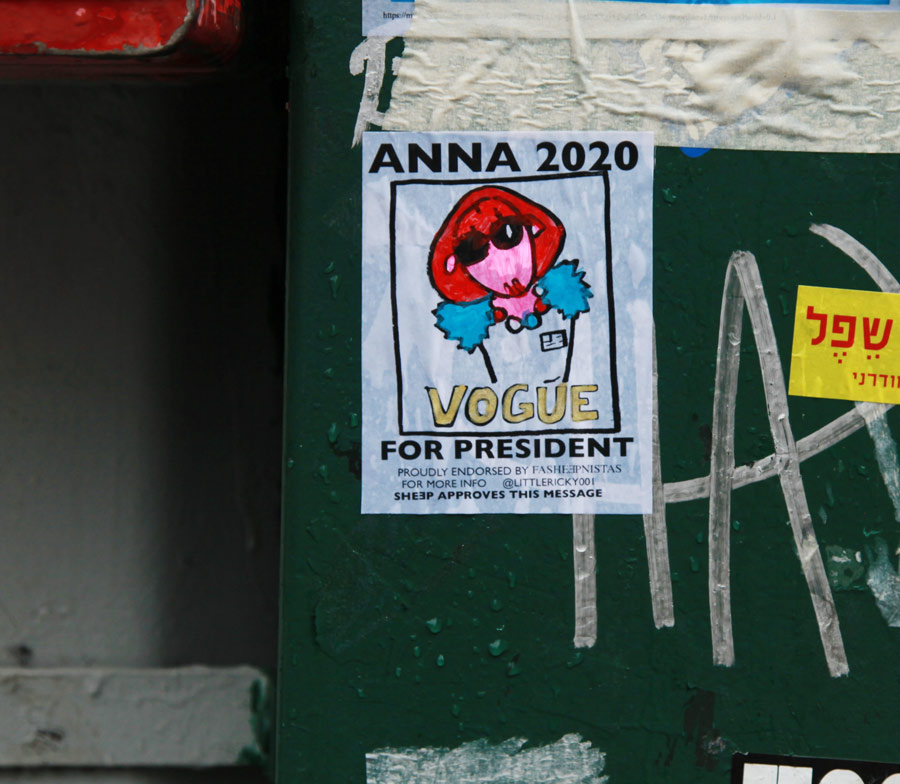
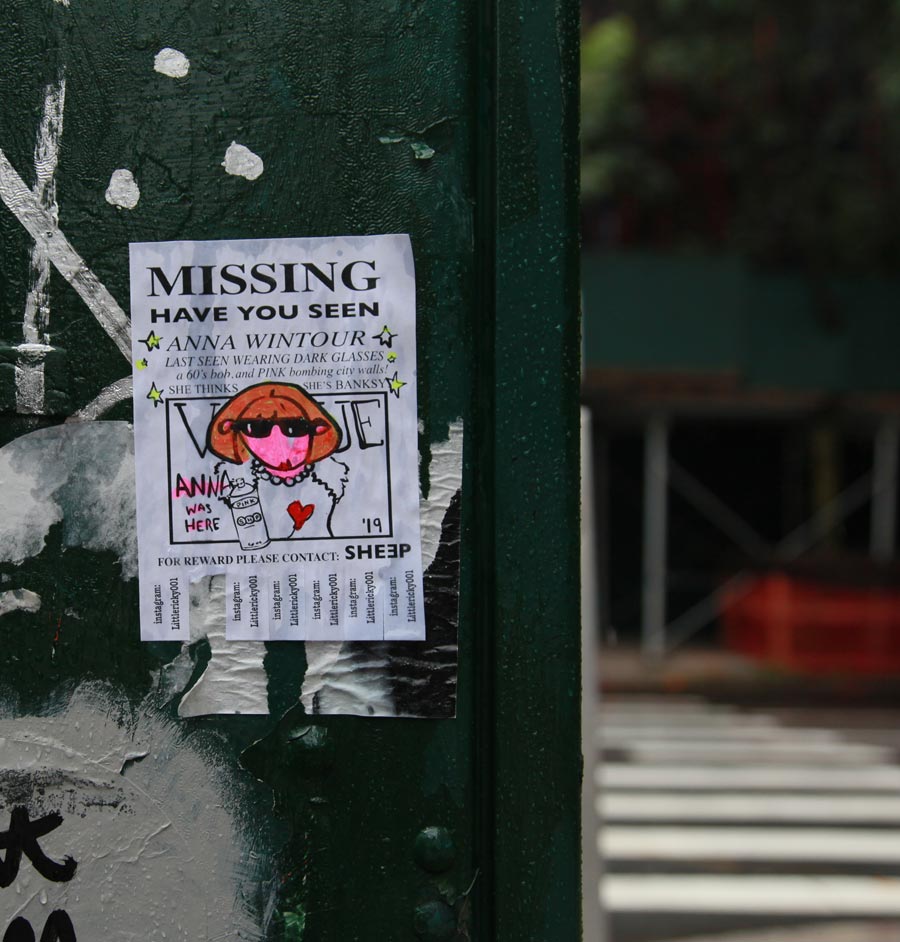
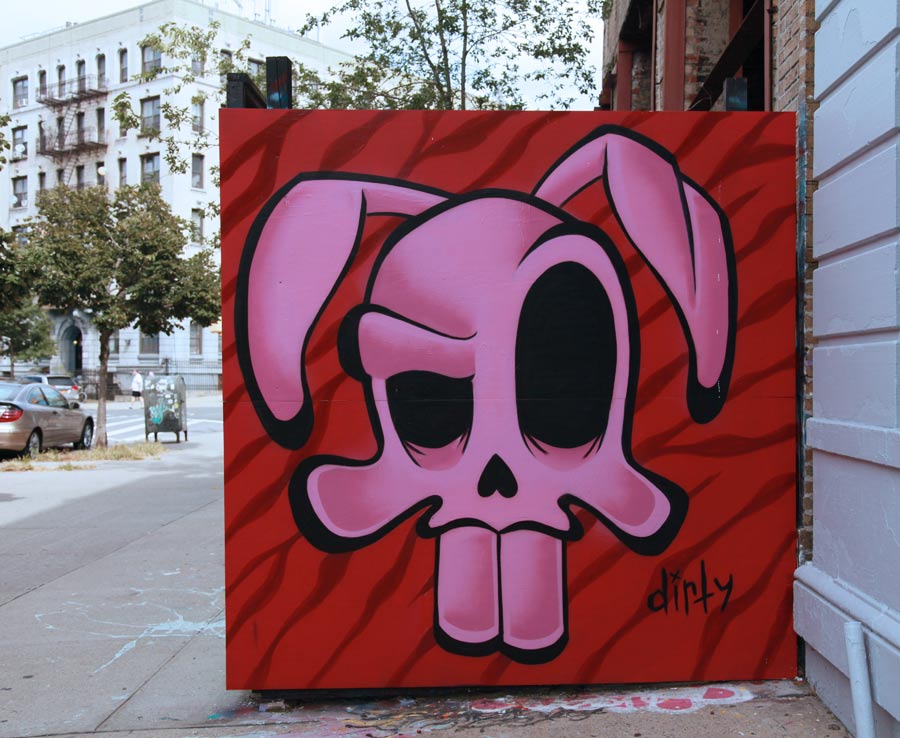
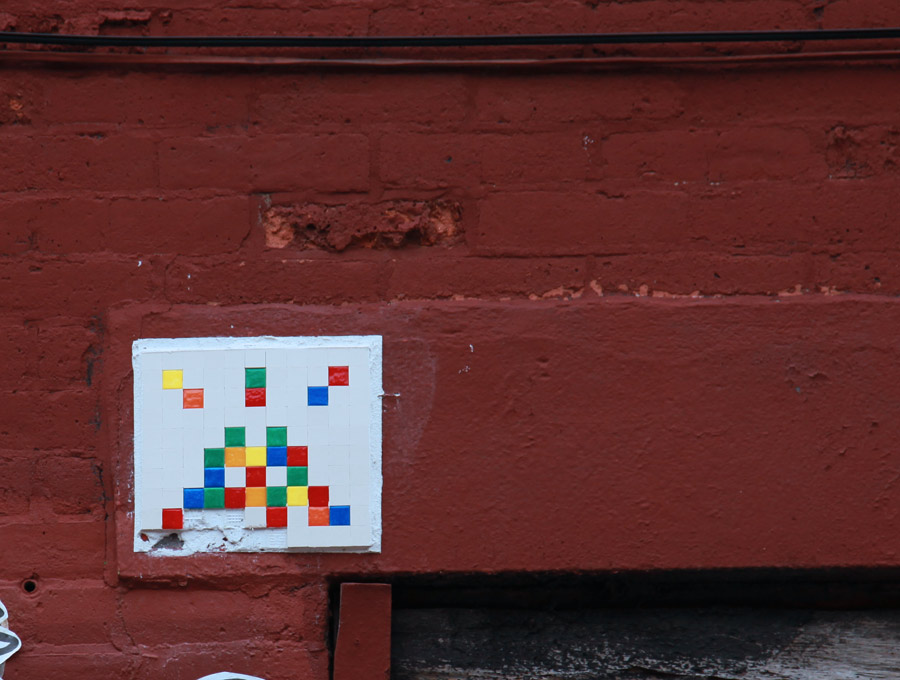
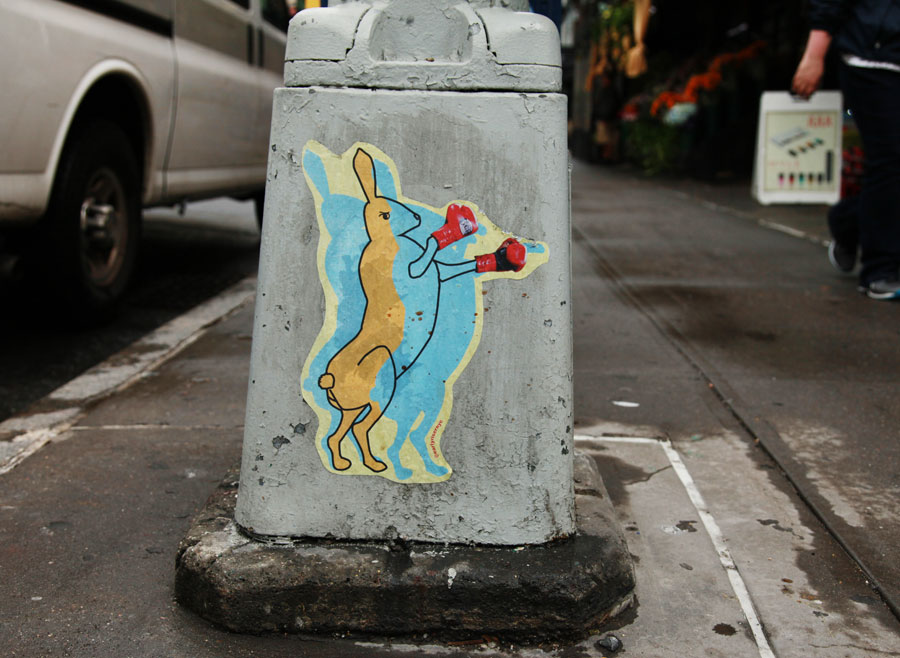
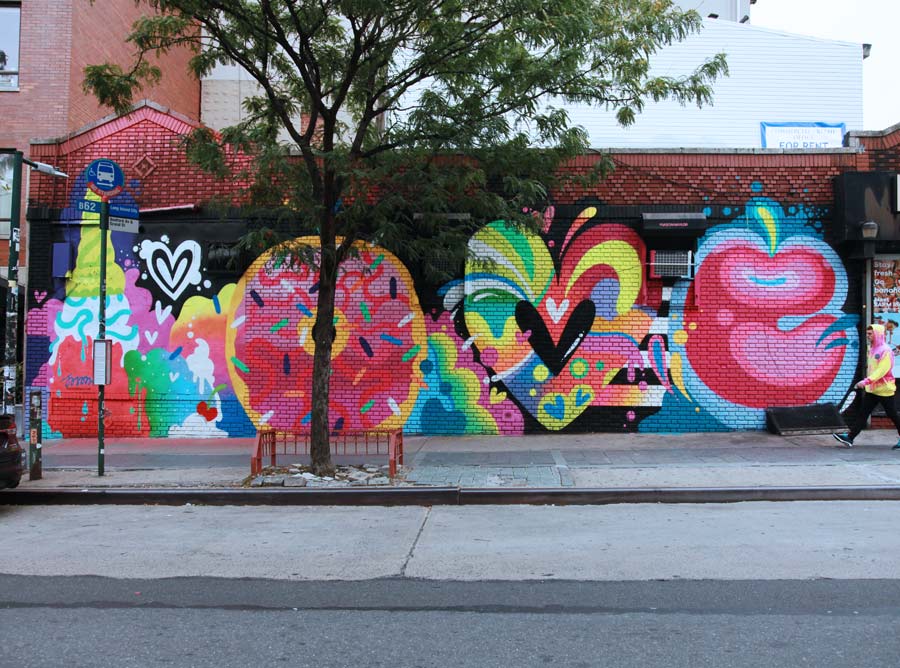
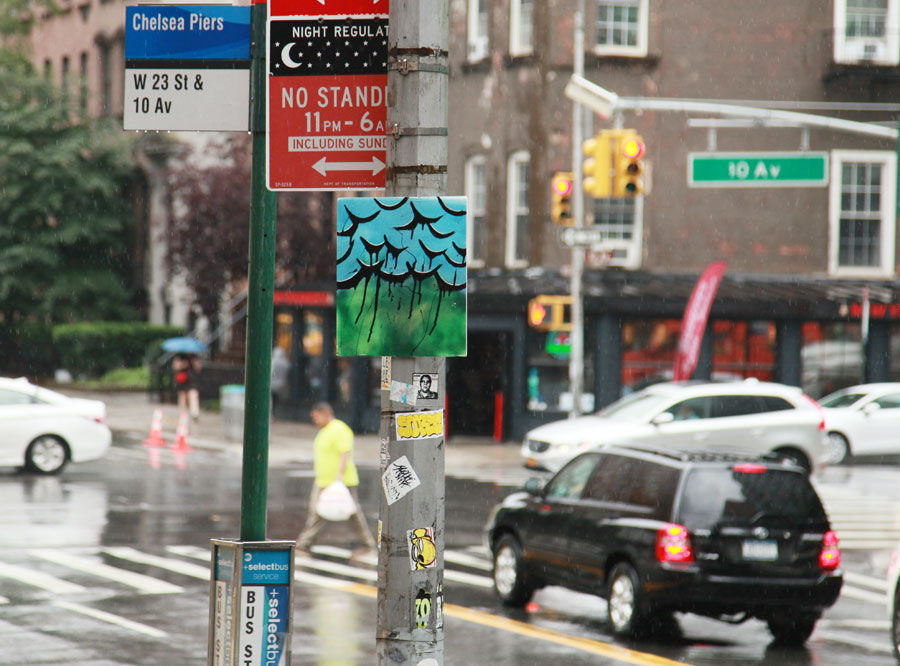
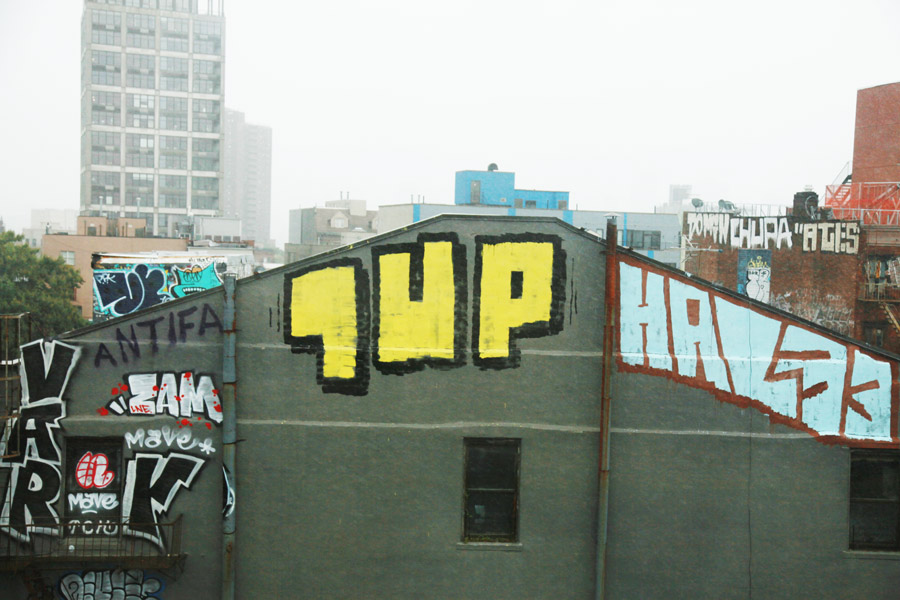
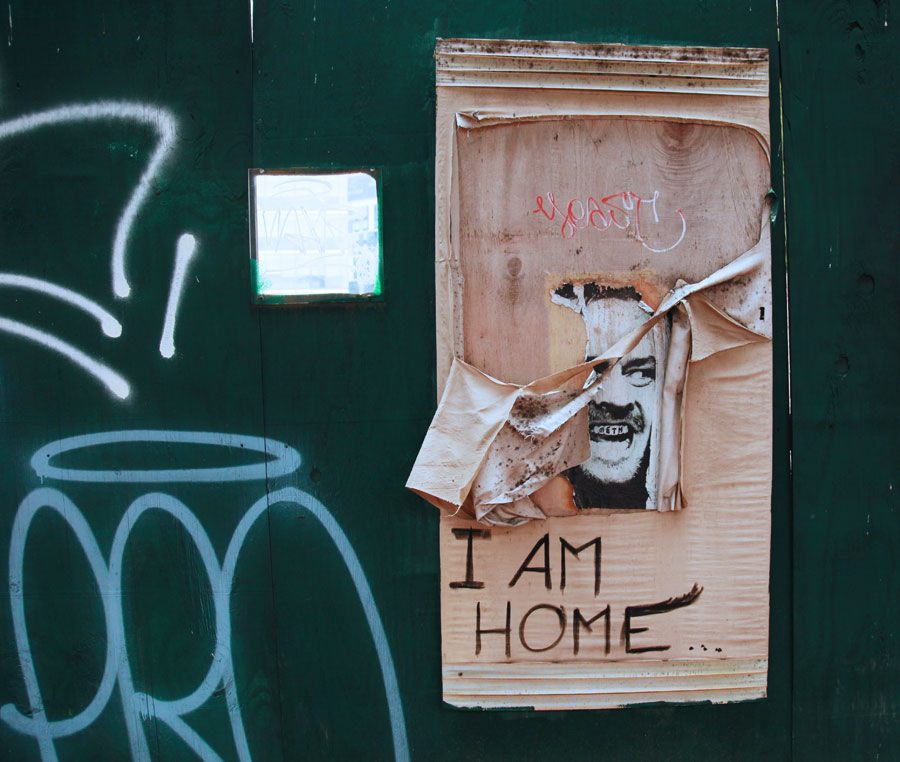
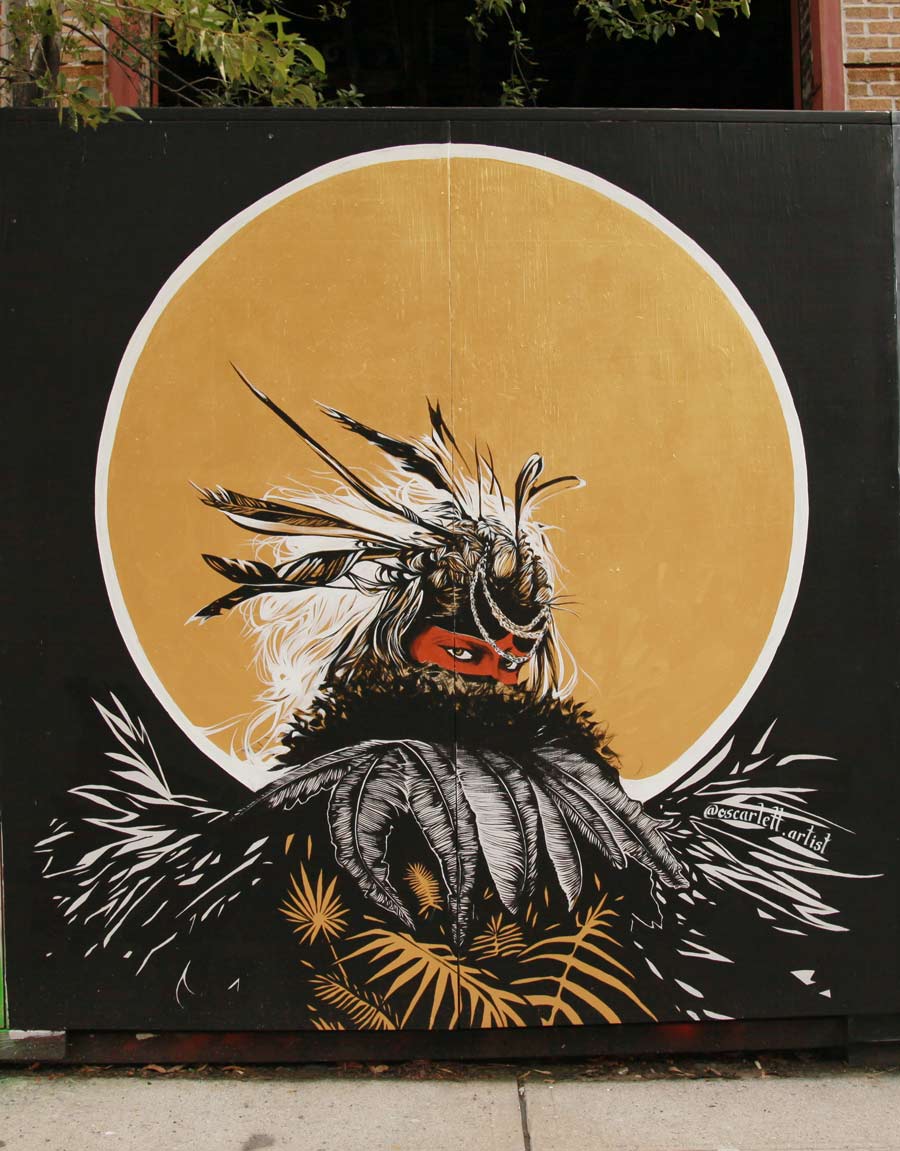
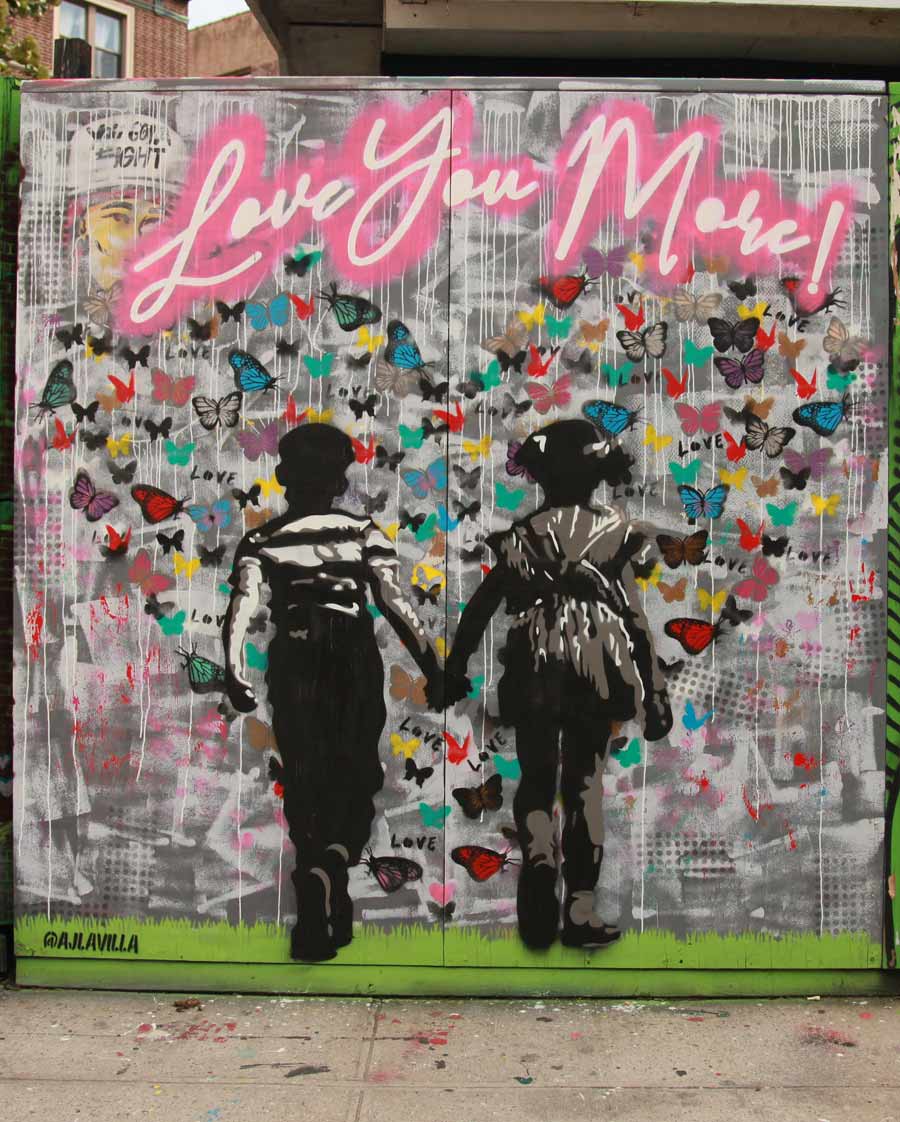
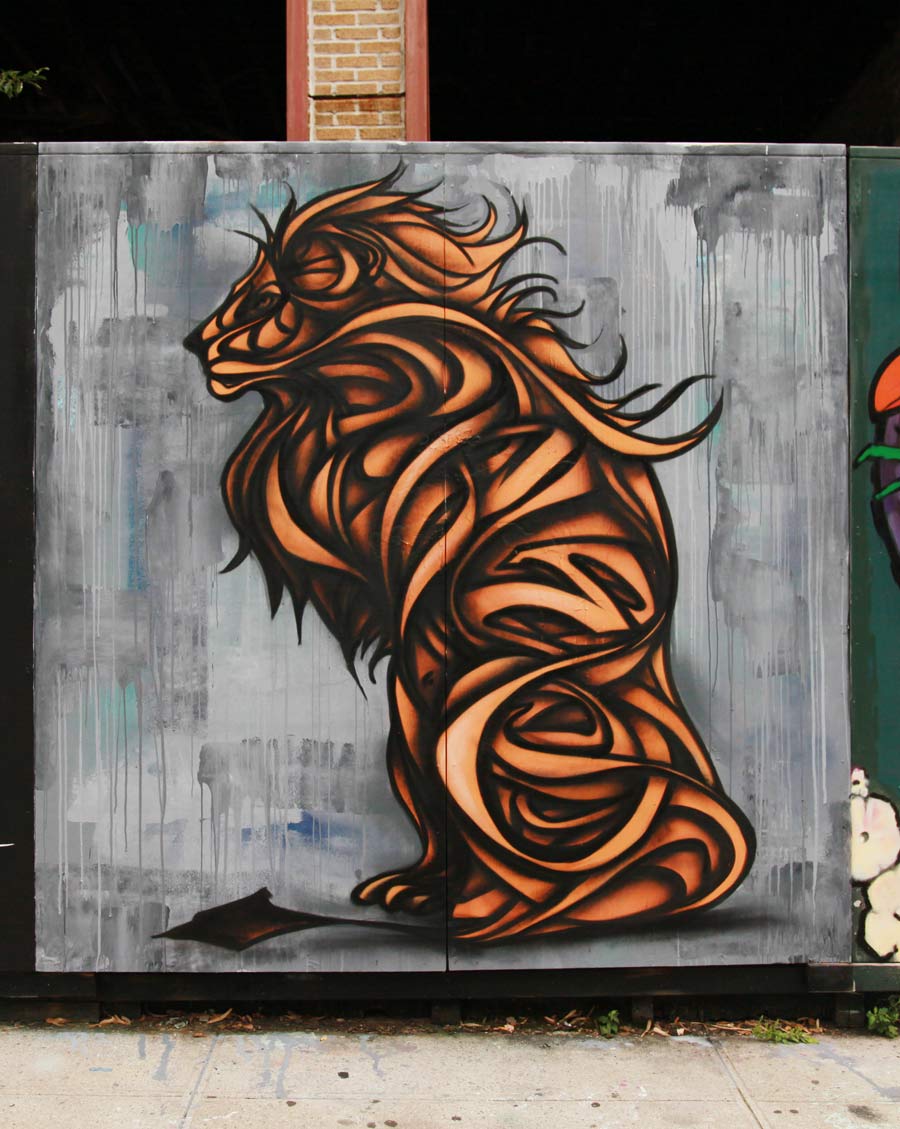
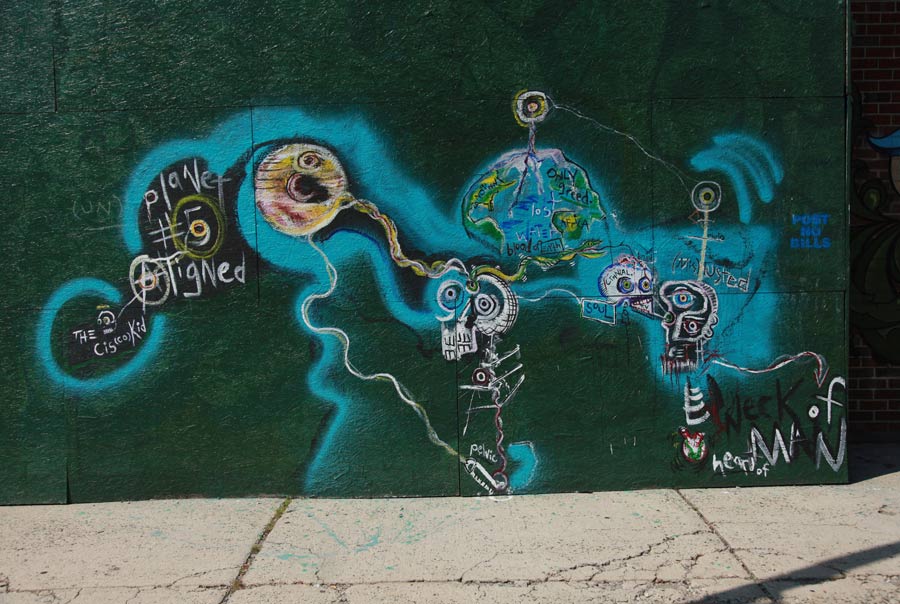
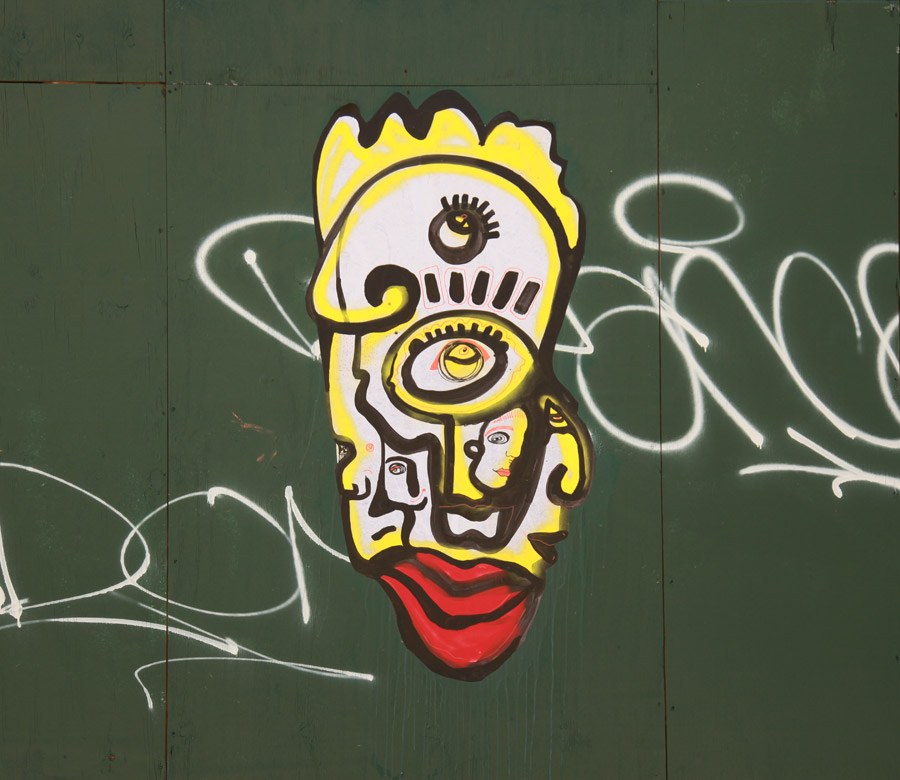
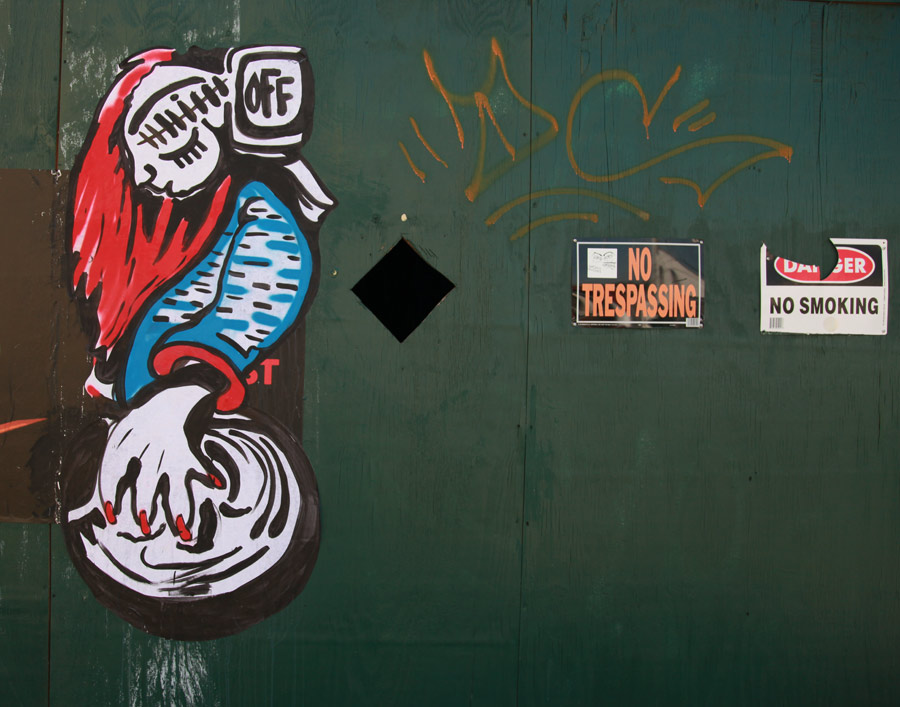
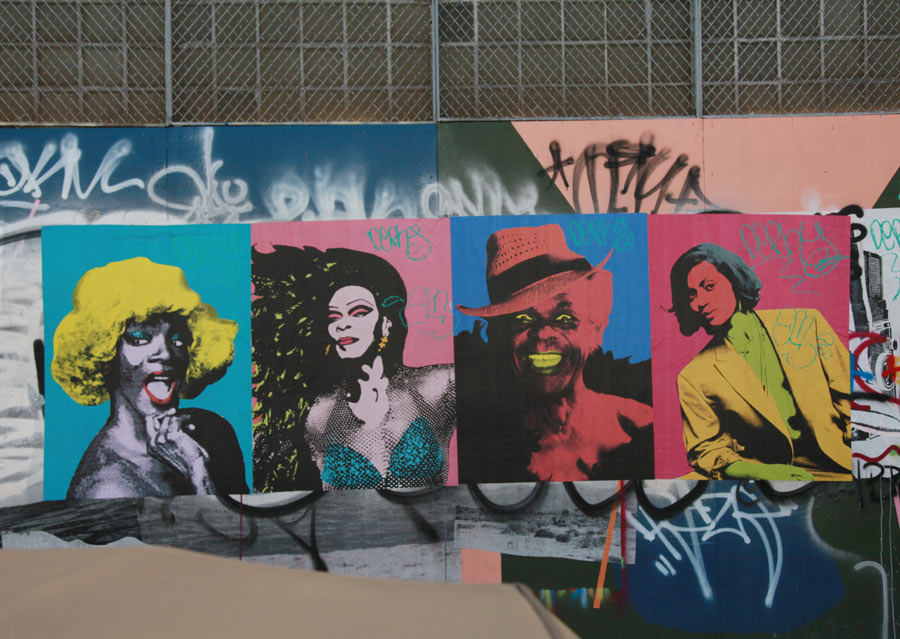
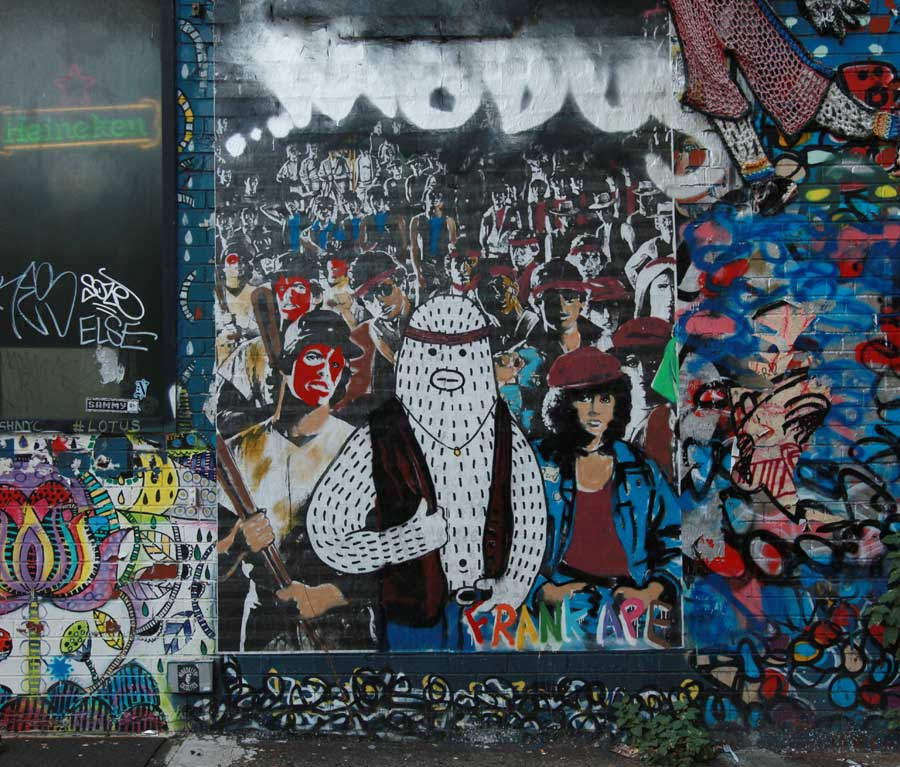
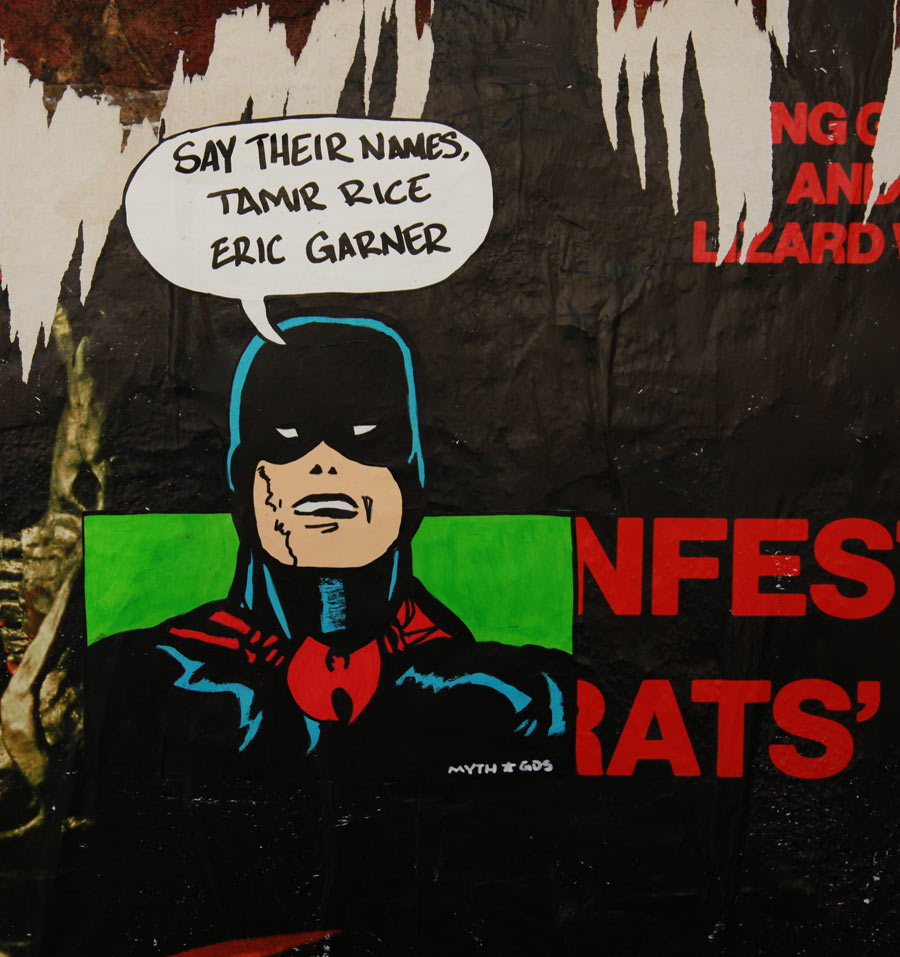
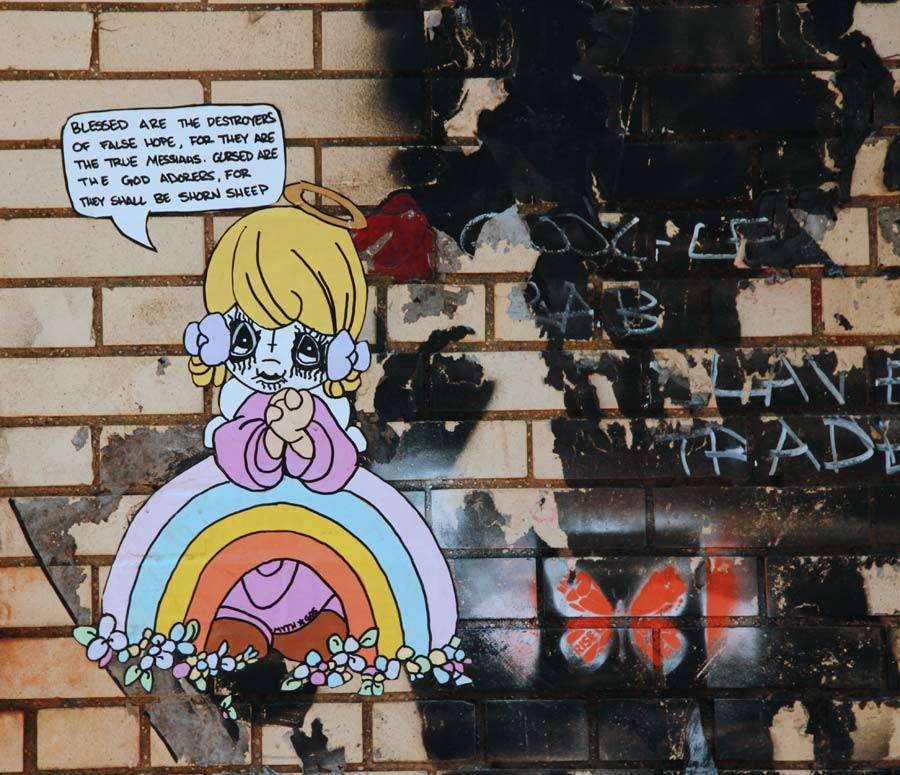
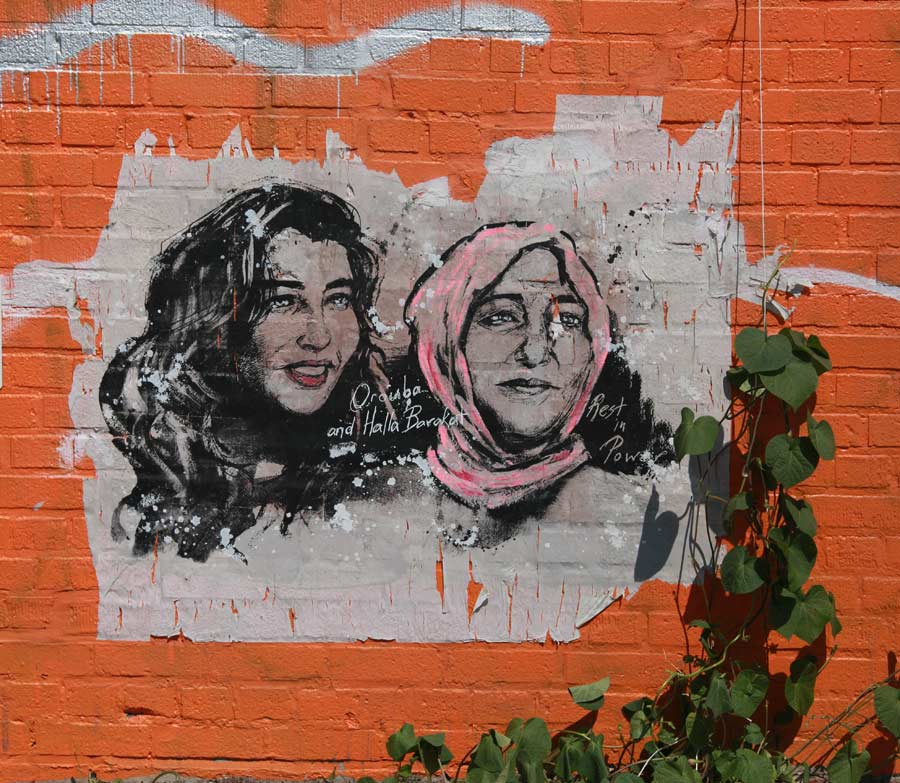
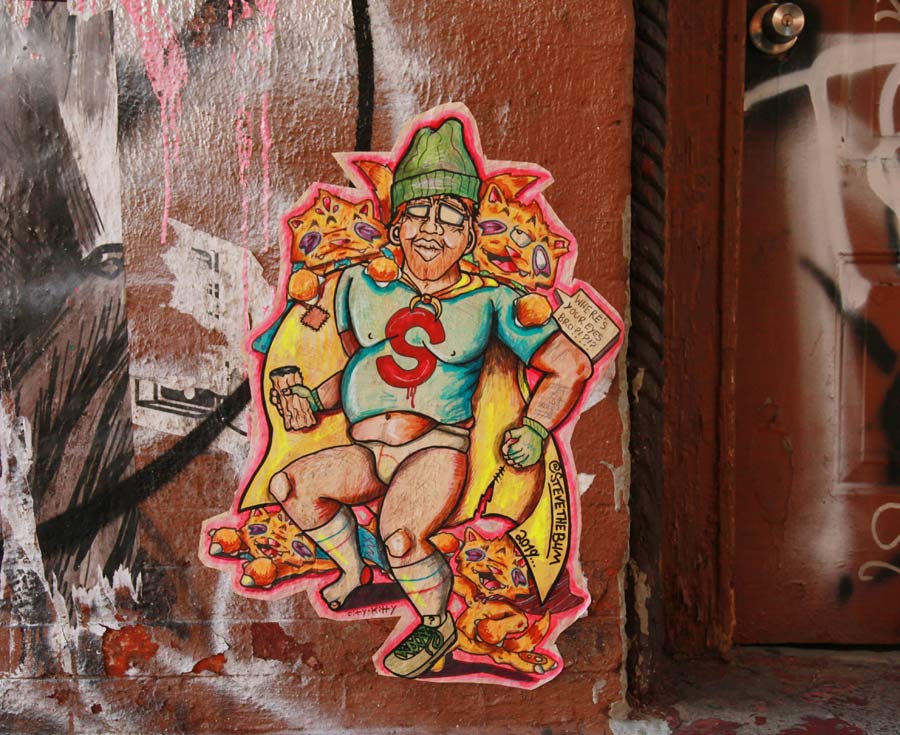
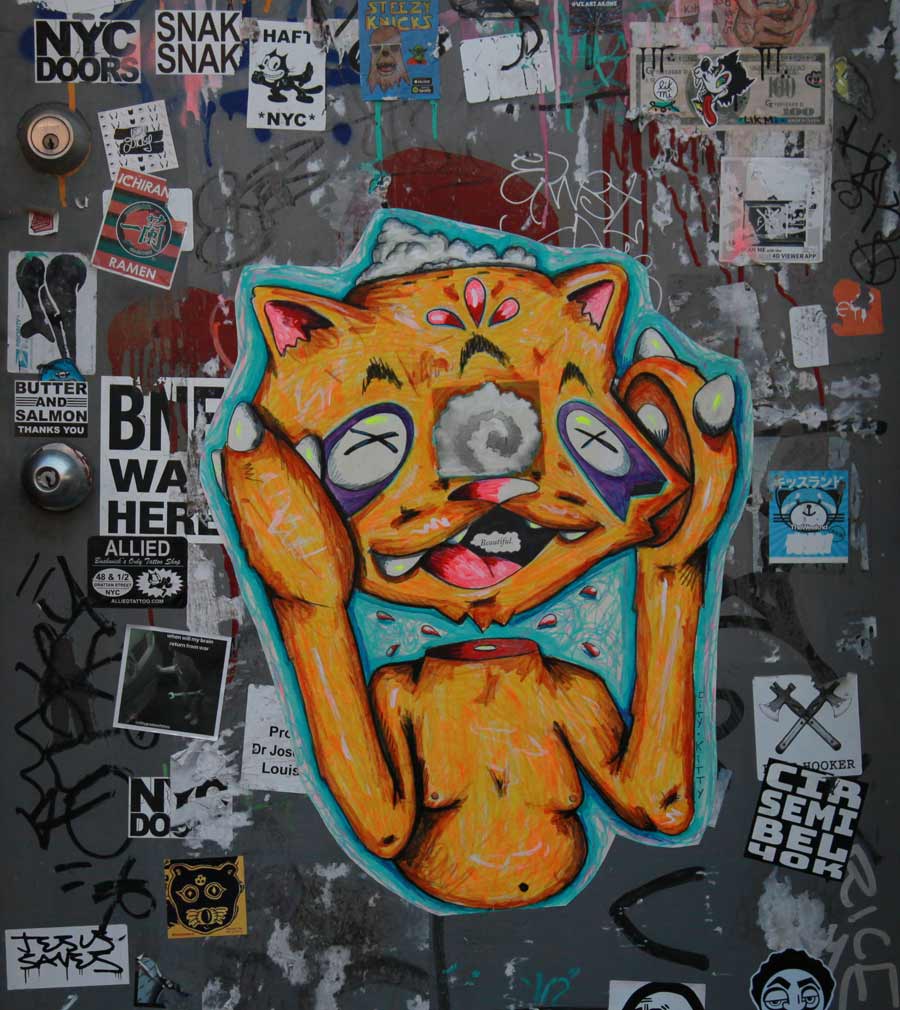
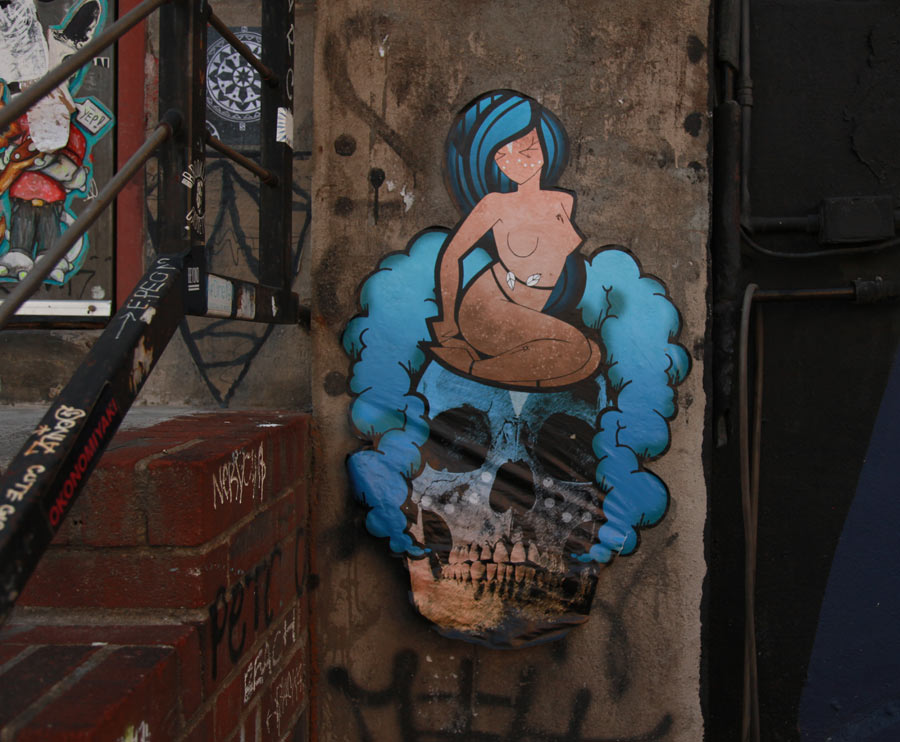
Surreally yours! The art on the streets this week appears to reflect the times. It’s going to take all this creativity and force to turn the tides!
Here’s our weekly interview with the street, this time featuring 1Up, AJ LaVilla, Android Oi, Cern, Dark Clouds, Dirty Cobain, Early Riser, Invader, Jason Naylor, Little Ricky, Lubaina Himid, Lucas Blalock, Oscar Lett, Robson, SacSix, Subway Doodle, Zimer .
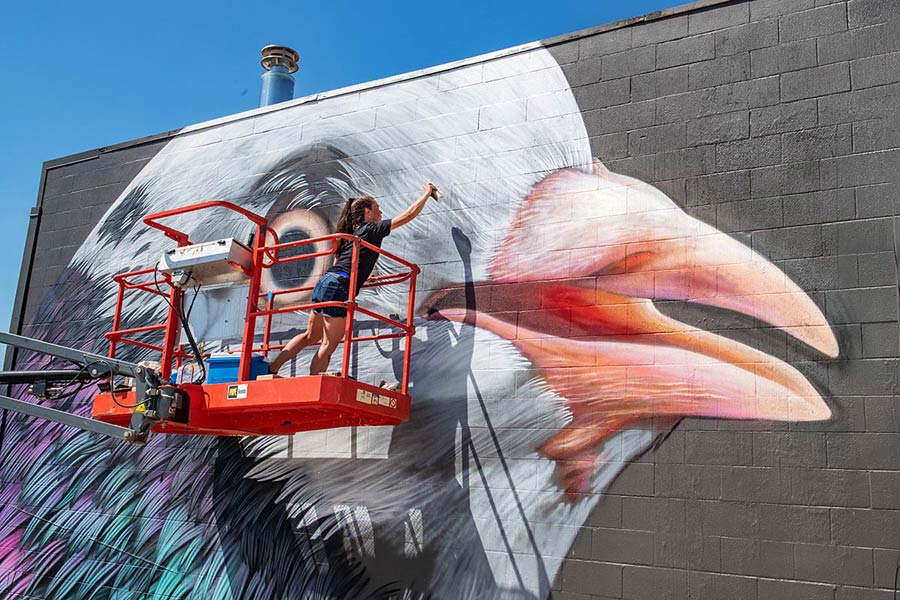
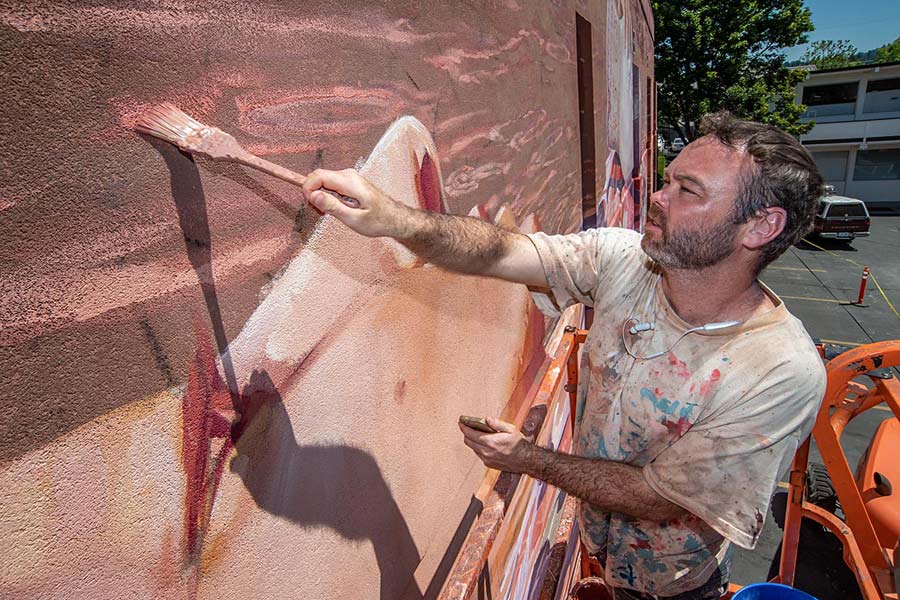
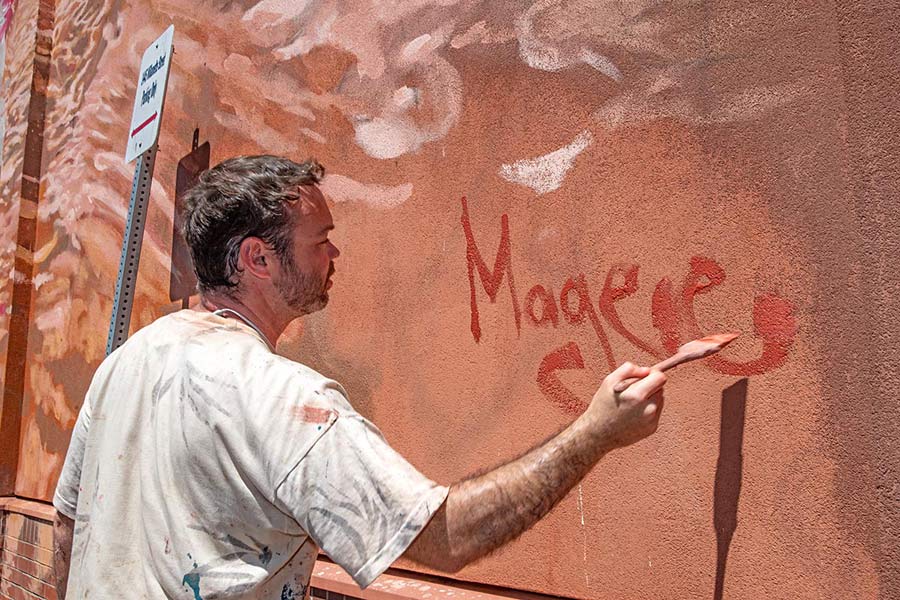
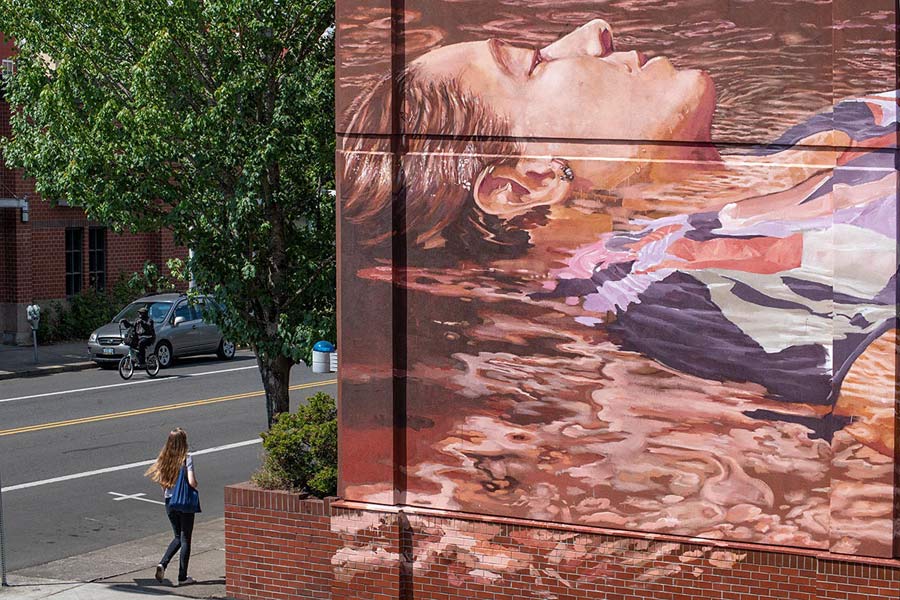
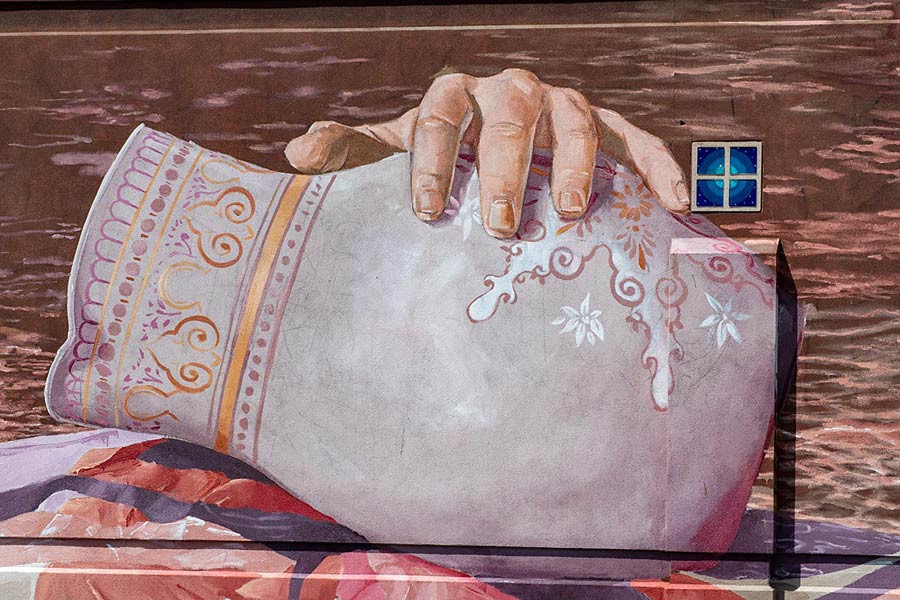
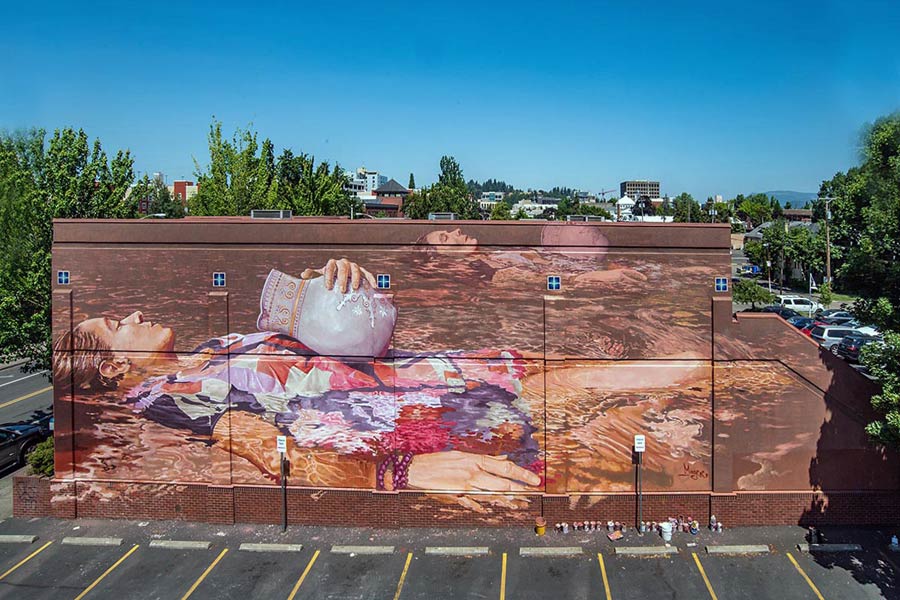
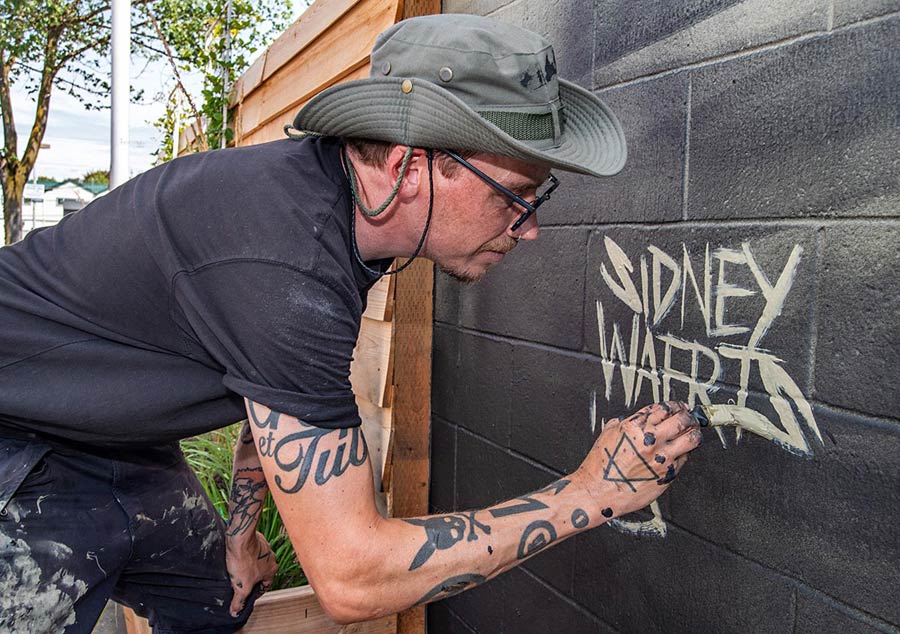
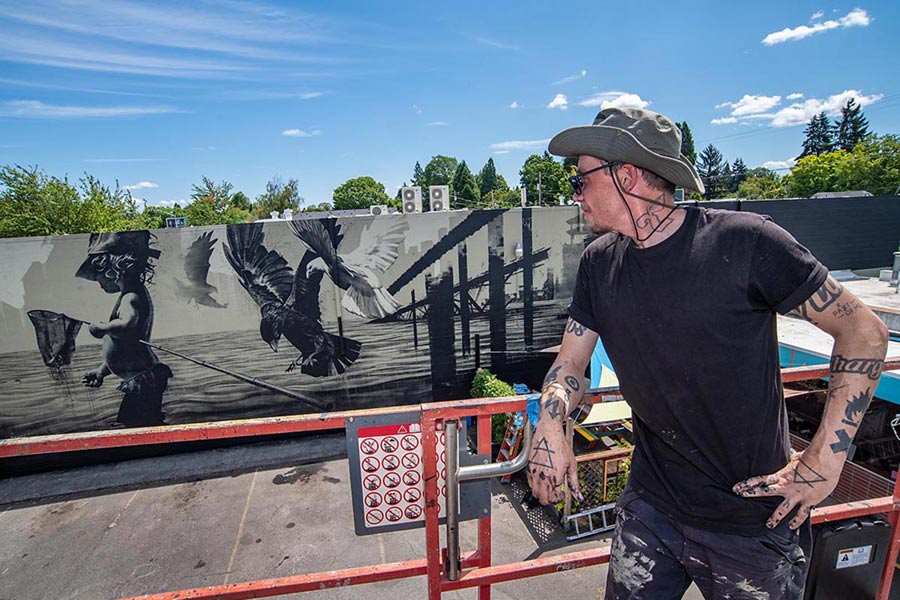
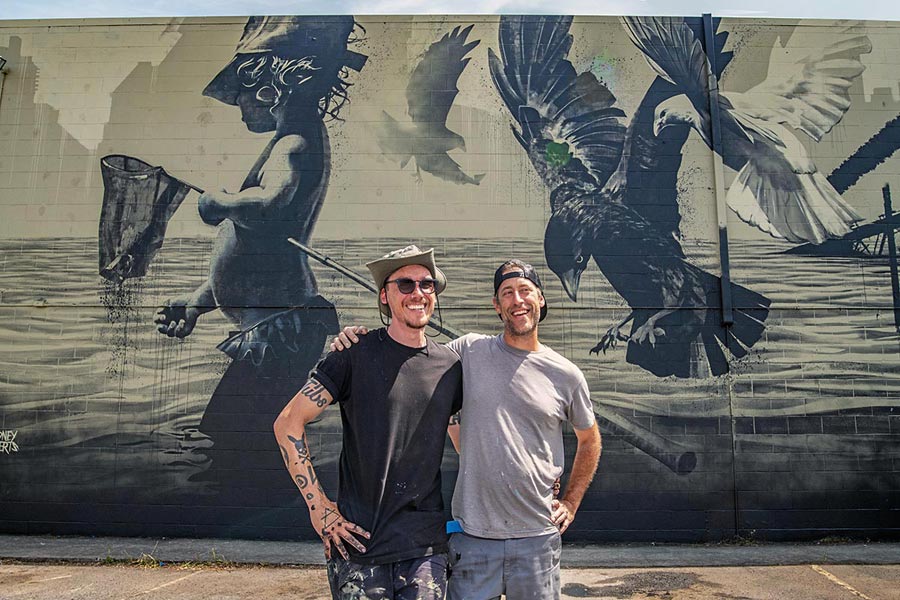
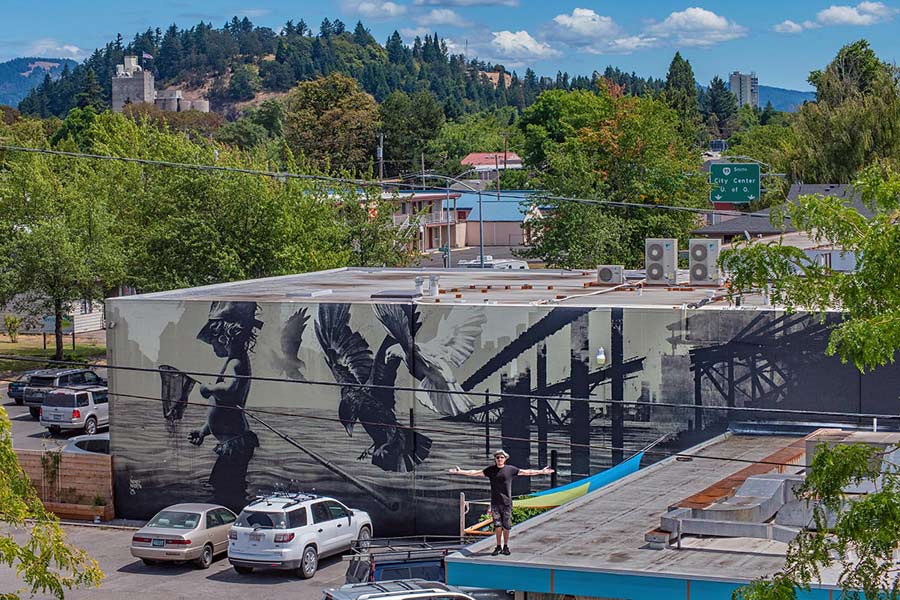
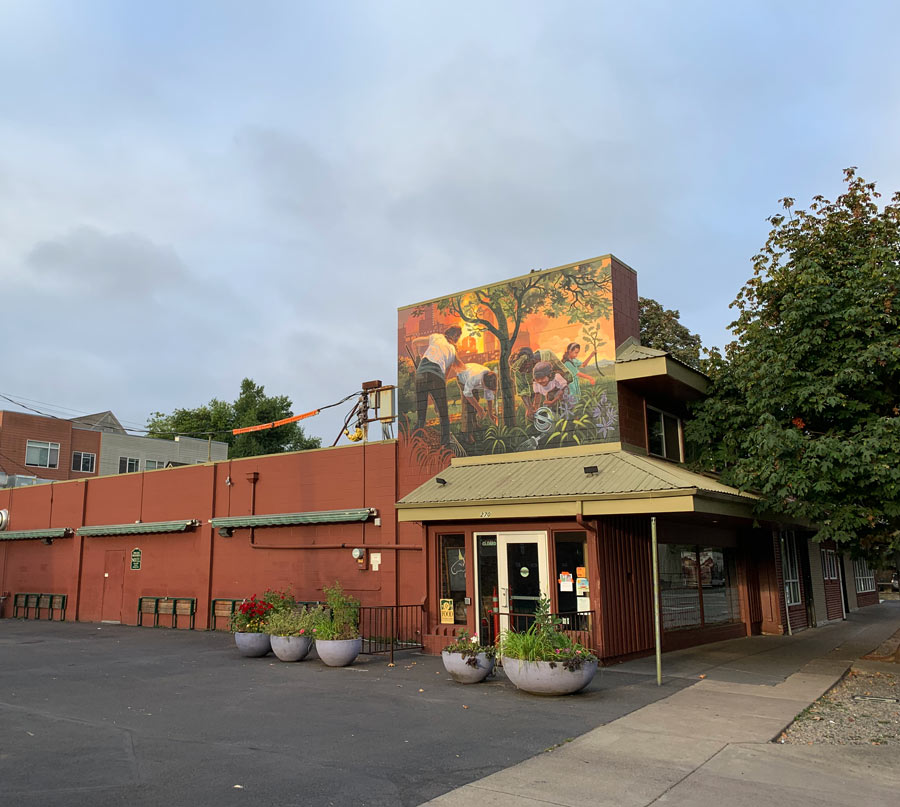
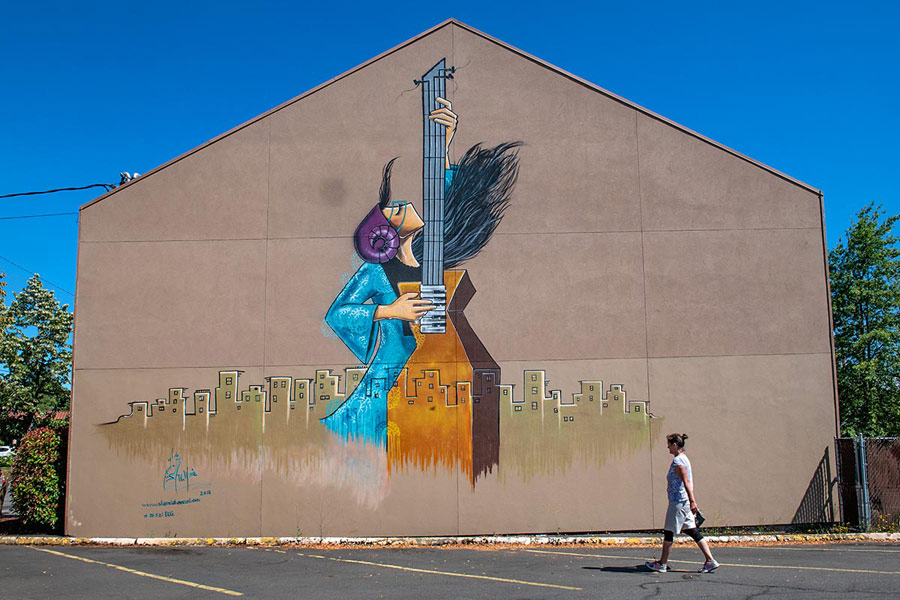
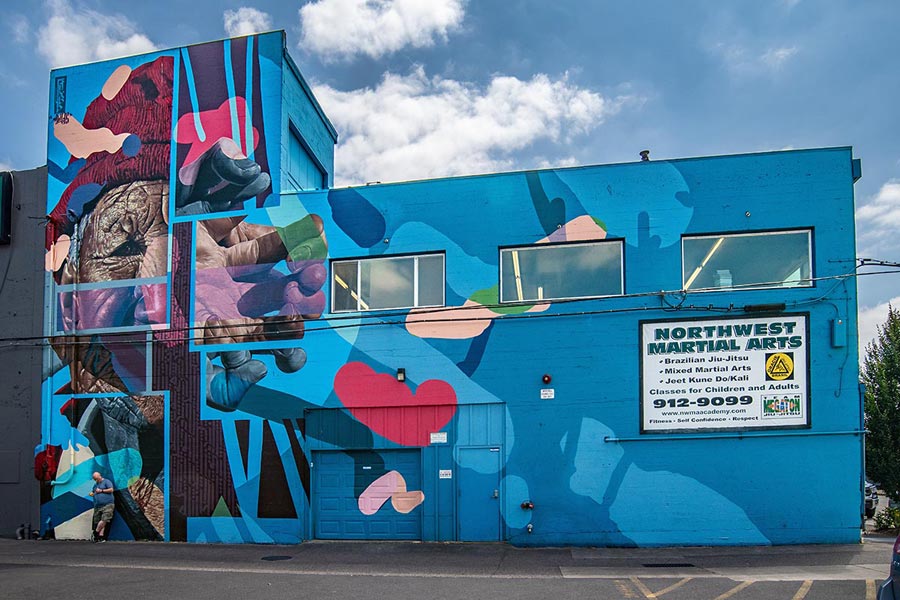
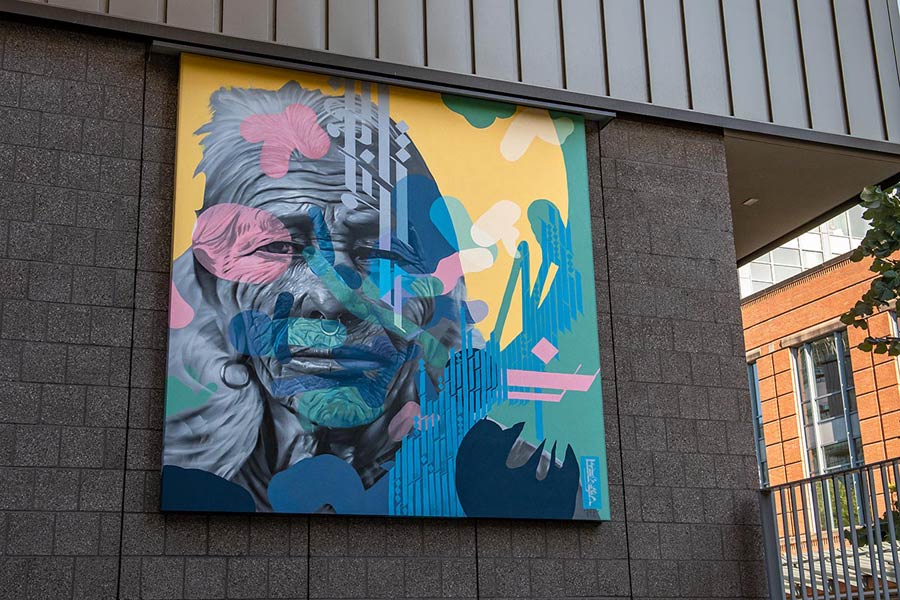
Photographer Martha Cooper again rules the roost at BSA with her new photos of the 20×21 EUG Festival in Eugene, Oregon. Organized and funded by the City of Eugene’s Cultural Services Public Art Program, the citizenry is invited to be a part of events and symposia – an intimate affair with this years select list of invited artists.
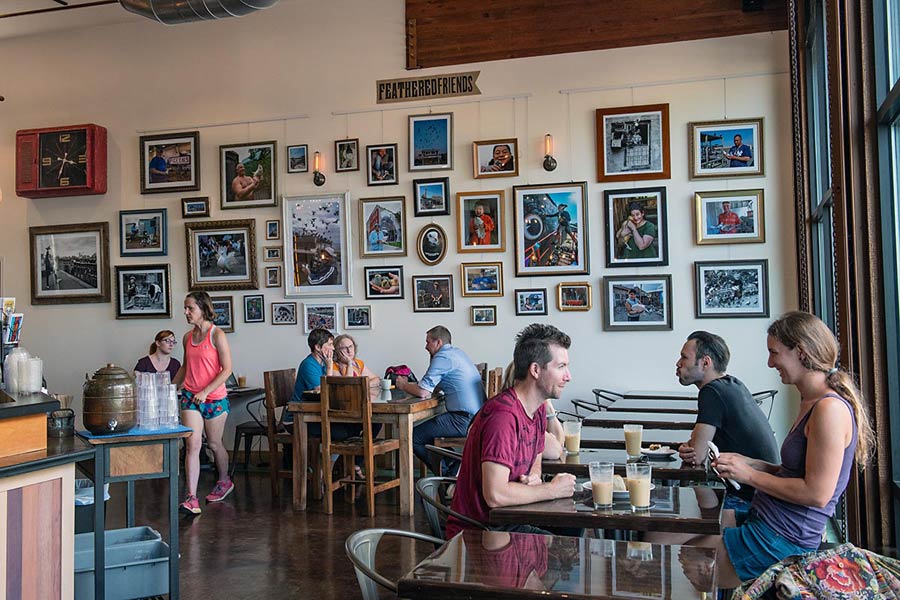
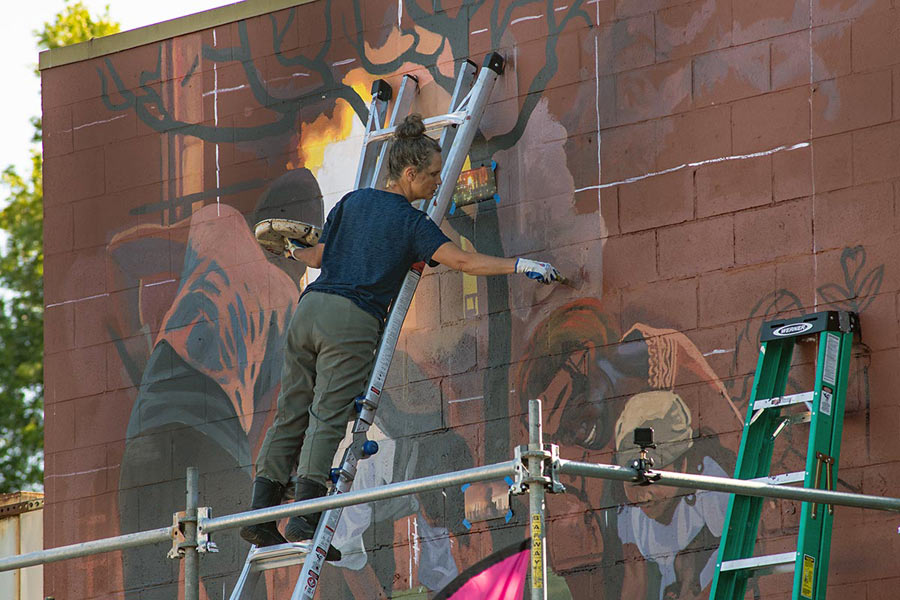
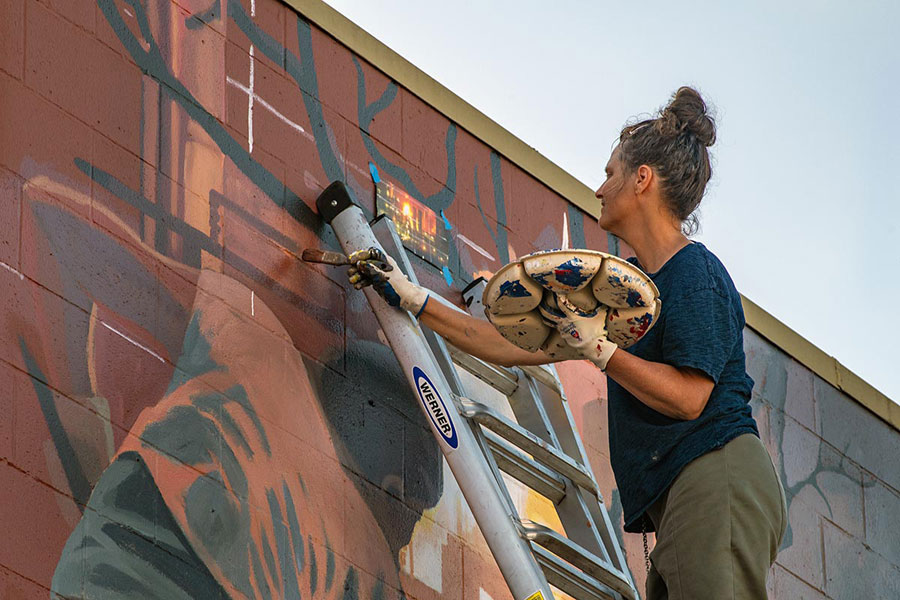
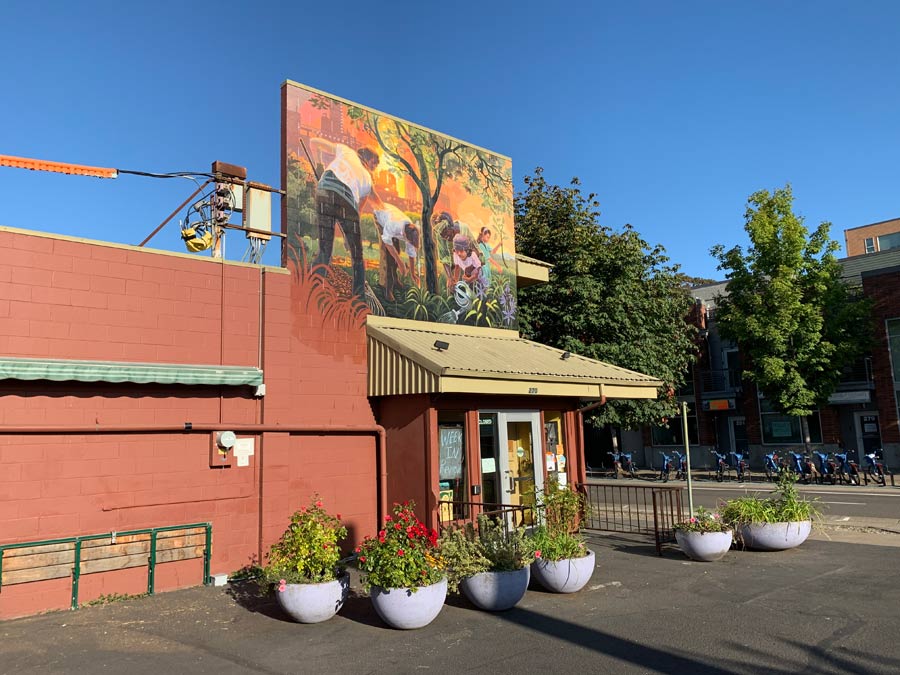
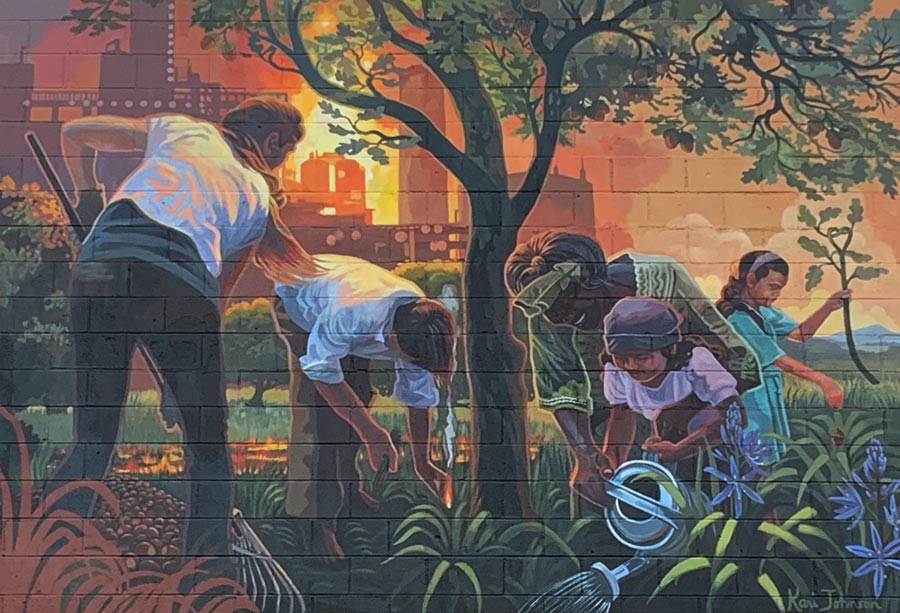
“This year 20×21 organized ‘viewing parties’ at the walls to give the community an official chance to meet and socialize the artists at their walls,” says Ms. Cooper about the 10 day series of events. You could meet Fintan Magee at his wall, or talk to Sidney Waerts aka SIT at Well Balanced (center for integrative care), consort with local muralist Kari Johnson at Lane County’s Dining Room, or see a new show of incredibly framed artworks at Coffee Plant Roaster with painter Adele Renault and photographer Ms. Cooper.
Blending
small family owned businesses, the chamber of commerce and cultural
organizations together with the artists and artworks is a finely balanced
effort, and according to people we spoke with Eugene is careful to get the
balance right. For example the combination of Adele’s mural and Ms. Coopers
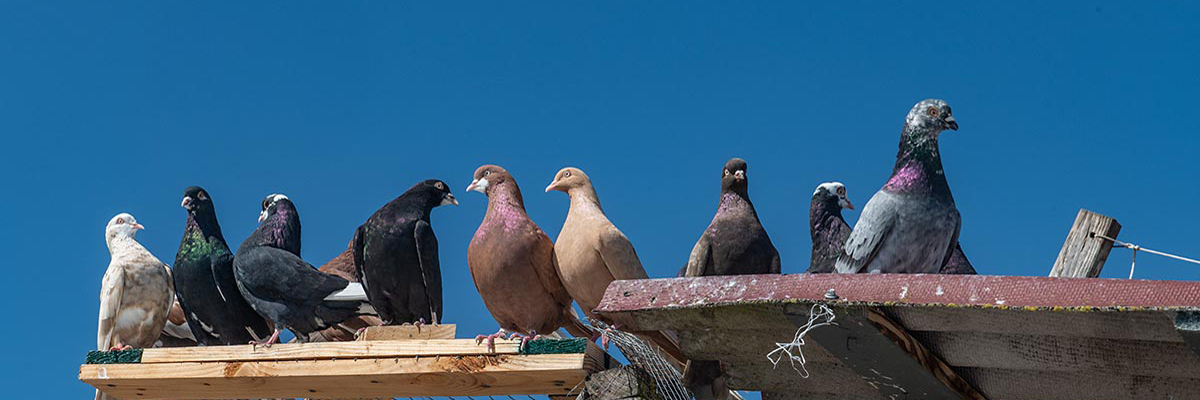
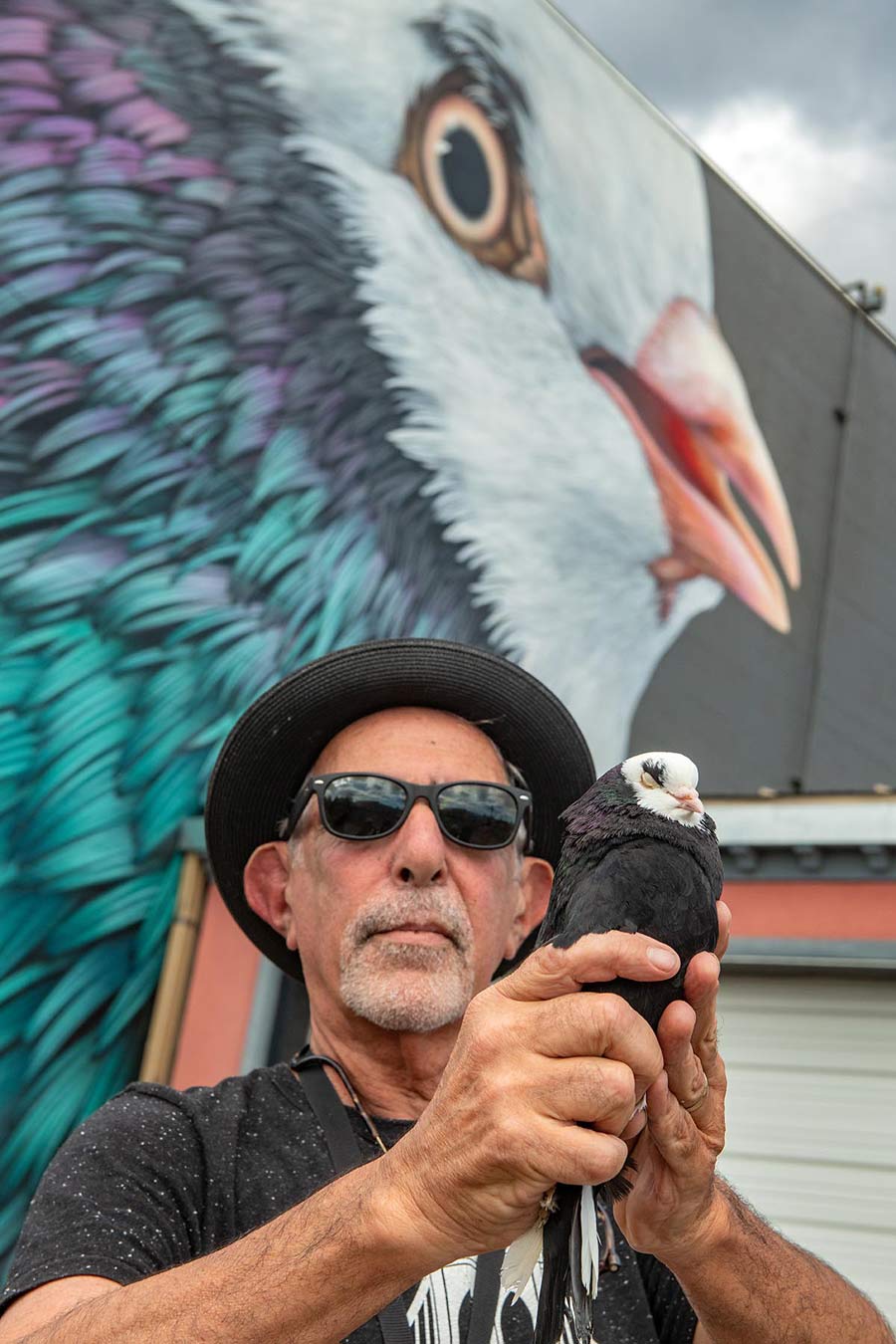
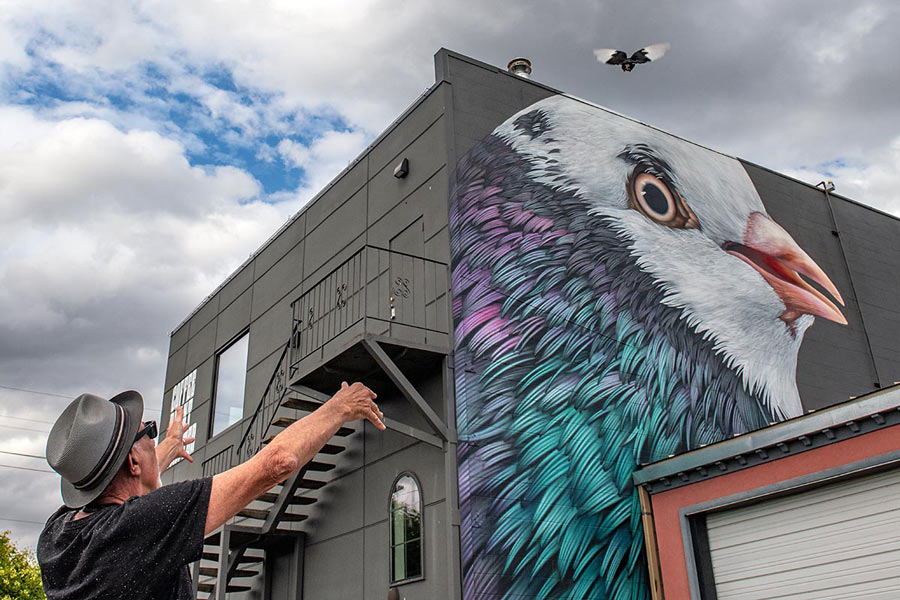
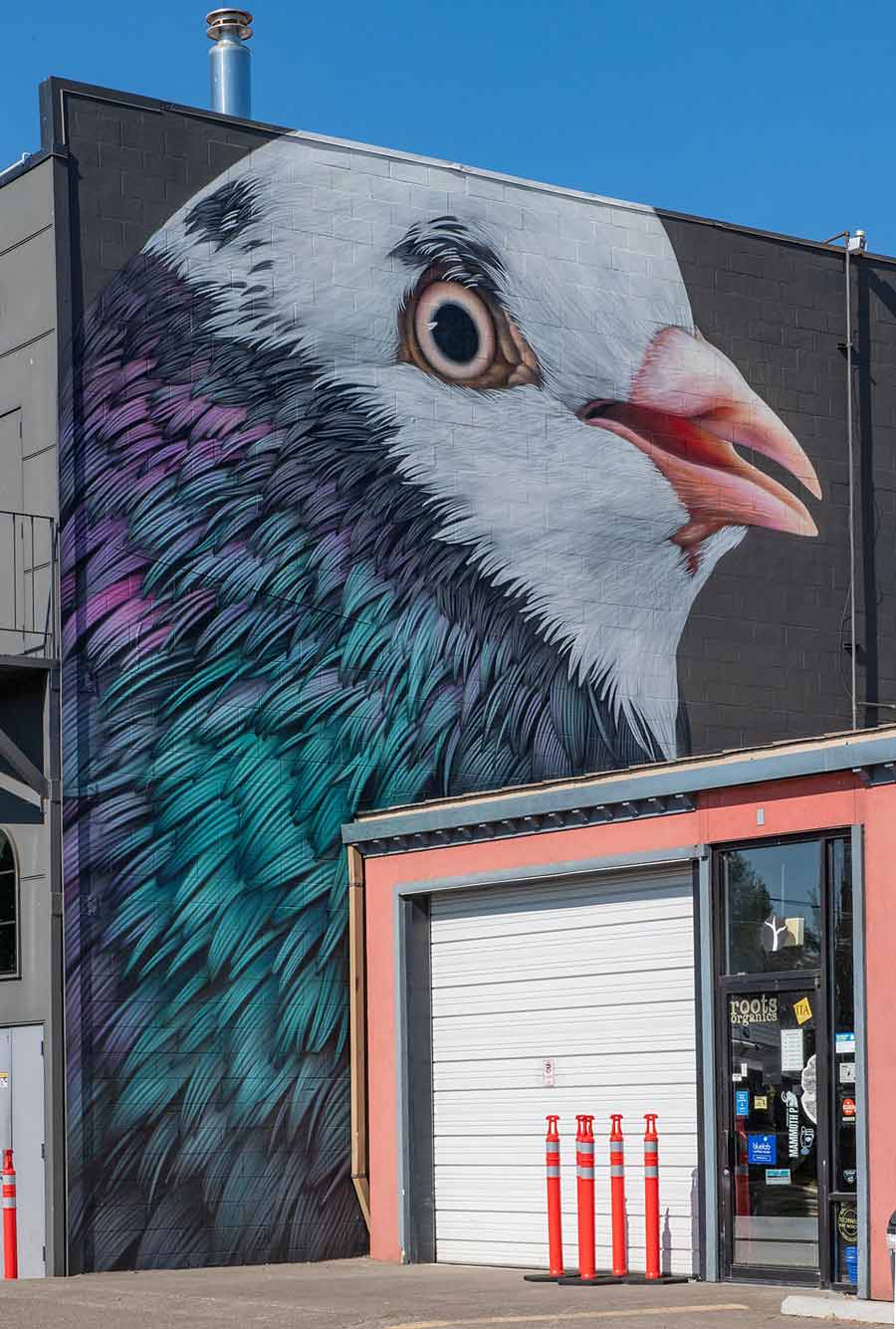
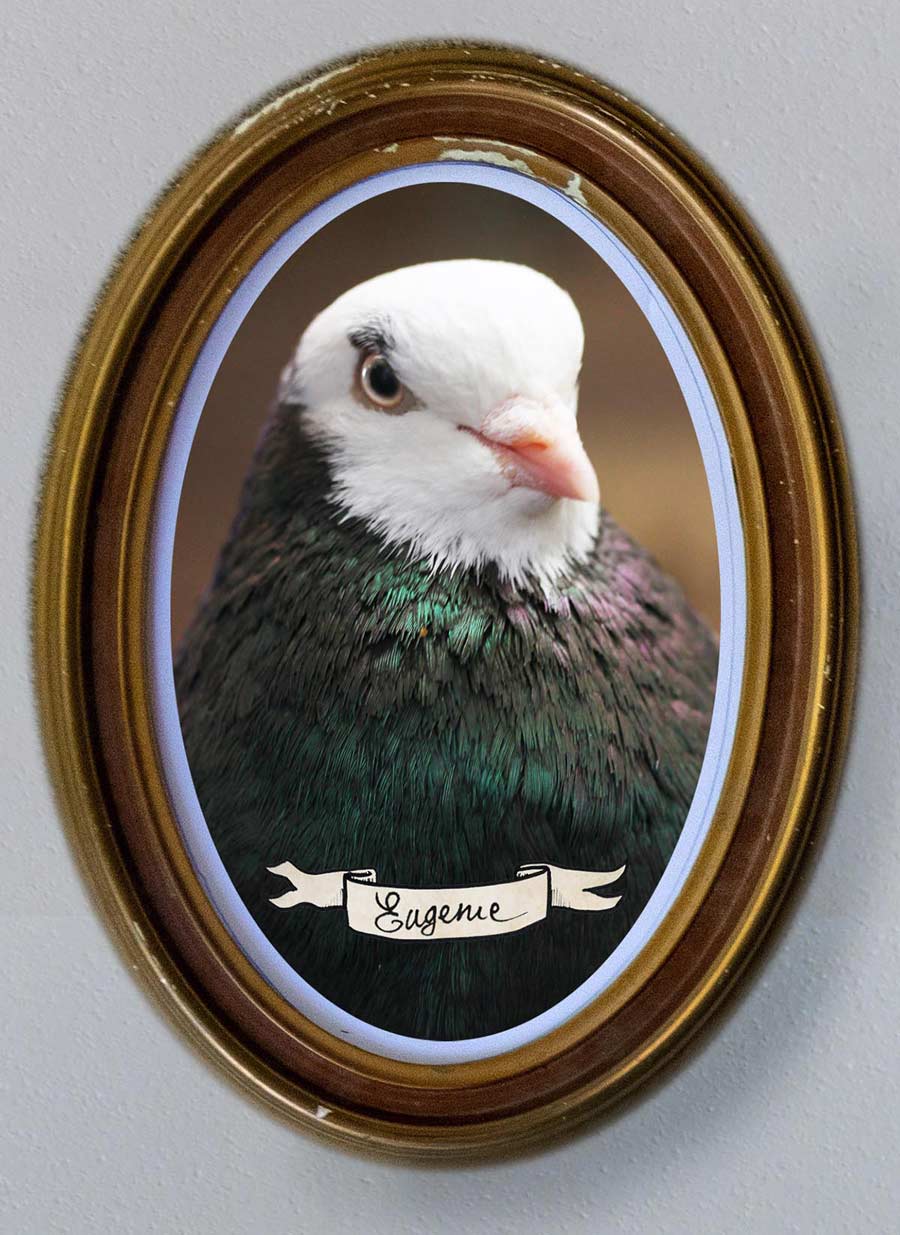
photo installation was in a coffee shop owned by Irv Weiner, who is a pigeon
flyer/fancier originally from New York.
“His
coop is on top of the building with the pigeon mural and the coffee shop is
inside,” says Martha of the interconnectedness of programming. Now Mr. Weiner
has added to his list a cannabis growing supplies business; a rather normal development
in this city that has become known for its marijuana-related economy during the
last decade.
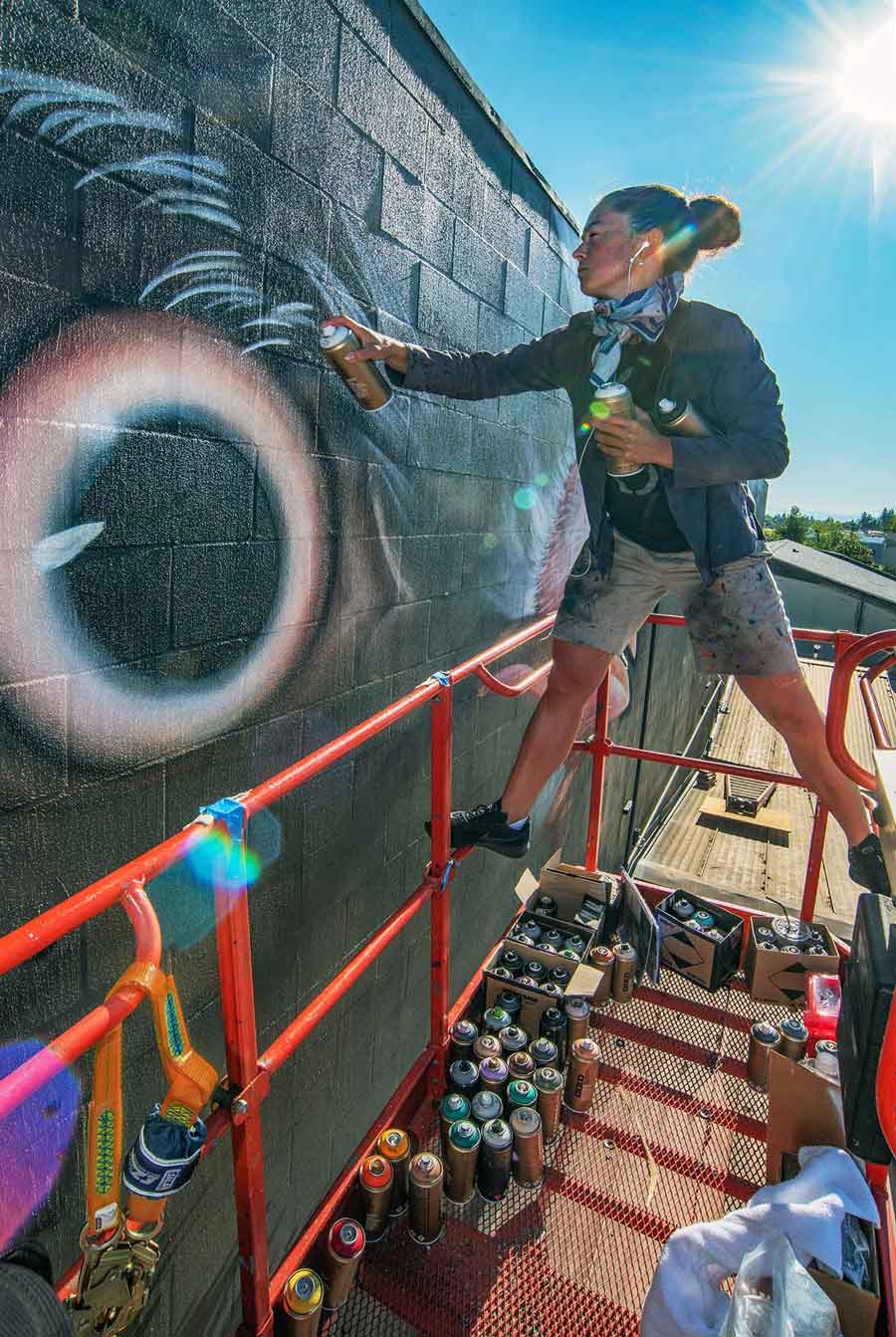
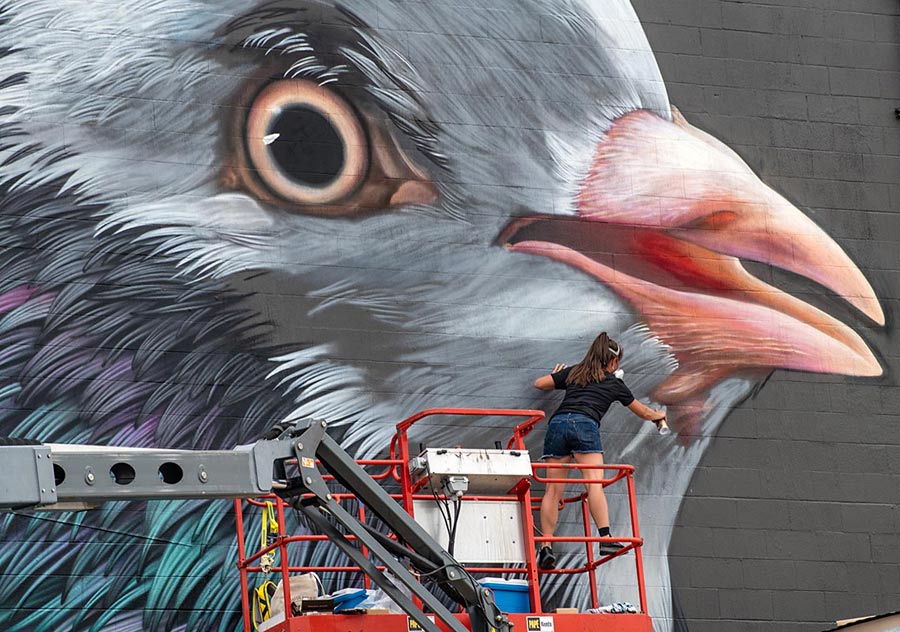
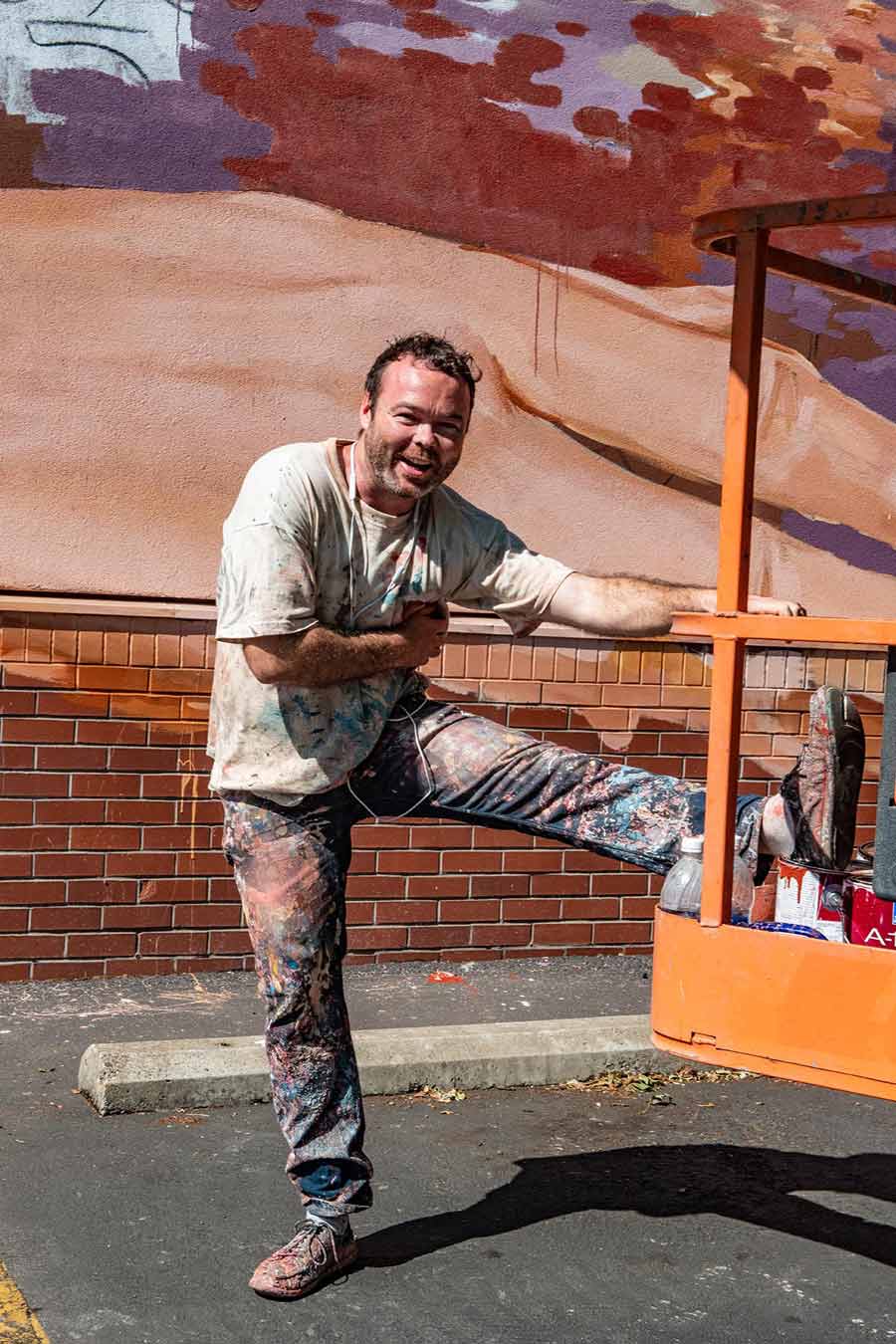
Here are exclusive images of the artists at work, as well as some additional interesting details and local color about this mural-centric cultural event in Eugene.
Eugene was first recognized as good mural festival location perhaps because of the work done here by activist, performer, storyteller, and public artist Kari Johnson. Her dedication to her work as social mission and communication inspires her peers and is emblematic of what Eugene is.
“Both of my grandmothers were painters named Ida. They managed to paint landscapes and still lifes in spare moments while raising big families during the Great Depression and WWII. Continuing where they left off I began painting when I was 14 and completed my first mural 10 years later. Other than learning how to make prints with potatoes at a summer fair, I am self-taught.
I feel the most inspired when I’m making public art. Being a public artist is like being an architect of mood, stirring feelings and inspiring connection, helping to anchor and identify a place. In my art I particularly care about promoting social justice, harmony between humans and our plant and animal relations. I want my art to invite individuals to belong to the place, join community, and help shape our human story.”
Our weekly focus on the moving image and art in the streets. And other oddities.
Now screening : 1. Swoon and The Heliotrope Foundation: A Catalyst For Local Change 2. One Minute Dance: Petites Deambulations Sur “Paradis Perdus” 3. Festival Concreto #5 – Narcelio Grud in Fortaleza, Brazil 4. Murfy Paints Mural for La Fiesta de los Corremayo
BSA Special Feature: Swoon and The Heliotrope Foundation: A Catalyst For Local Change
Long
term economic development? From a Street Artist? Sustainable homes? Jobs?
Schools?
Yes,
if the question is about Cormiers, Haiti and the answer is Street Artist Swoon
with her Heliotrope Foundation. You can draw a direct through-line from her
earliest wheatpastes of people on the street to the earthquake surviving Haitians
whom these buildings and programs are for and from. By listening, sharing, and
working alongside, the volunteers and foundation have been building community. And
you thought it was all about vandalism, didn’t you?
One Minute Dance: Petites Deambulations Sur “Paradis Perdus”
Nadia Vadori-Gauthier, the performance artist behind the project One Minute of Dance Per Day, has teamed up with other dancers for a new project titled Petites deambulationssur “Paradis Perdus”
Festival Concreto #5 – Narcelio Grud in Fortaleza, Brazil
For 6 years artist, professor, and organizer Narcelio Grud has gradually
grown the Concreto Festival in Forteleza. As he and the team prepare for
November’s new edition, he tells BSA readers about this video recap of Concreto
5.
“In the timespan of 9 days, downtown Fortaleza received more than 40 artists from Brazil and all over the world to participate in the 5th edition of Festival Concreto – International Festival of Urban Art. Great names from the urban art scene, such as Mônica Nador, Guto Lacaz, Inti Castro, Sabek, SatOne and others, met between November 16 and 24 to color and democratize art in the city.
In the year of 2018, the Festival brought interventions and other activities
to Downtown neighbourhood in Fortaleza, Brazil, called ‘Centro’. The idea was
to occupy and reestablish the connection with an area of the city that was once
a great place of cultural movement, especially in the city’s ‘Belle Époque’. All
this brought color and movement to the local landscapes, realigning the
neighbourhood to a greater valorization of urban culture.
In the video, you can watch most of the activities and artworks that took place in the Festival, as well as participant artists, staff members and the general public talking about their experience within Concreto.”
Murfy Paints Mural for La Fiesta de los Corremayo
Muralist Murfy was in the south of Spain to paint this four-story portrait of a child on the street. “This is a girl dressed in a harlequin costume,” he says of the outfit, “a typical feature at a party in southern Alhama de Murcia, which is where this is.” The La Fiesta de los Corremayo is at the end of April and beginning of May and features bands, music, food, and lots of dancing in the streets by people wearing variations of the harlequin.
It’s
true, Athens is still in the throes of austerity, but not for everyone,
darling.
The severe financial austerity imposed on Greece’s government and people by the international bankers was never meant for everyone – vulture capitalism is designed with winners in mind.
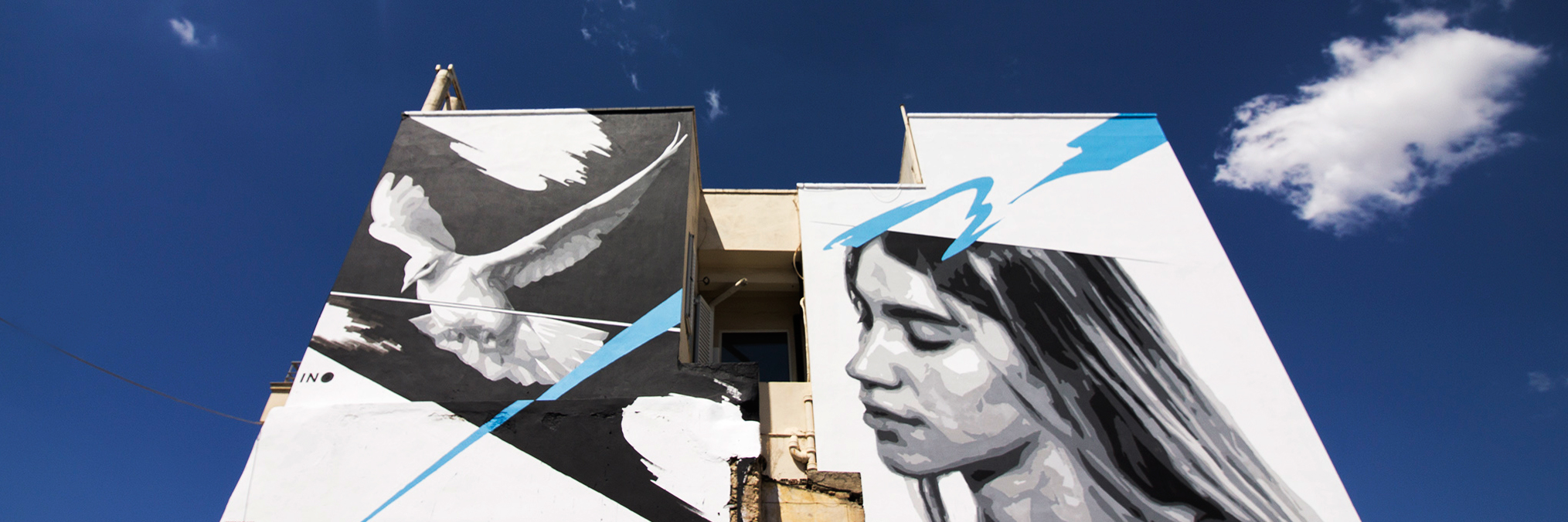
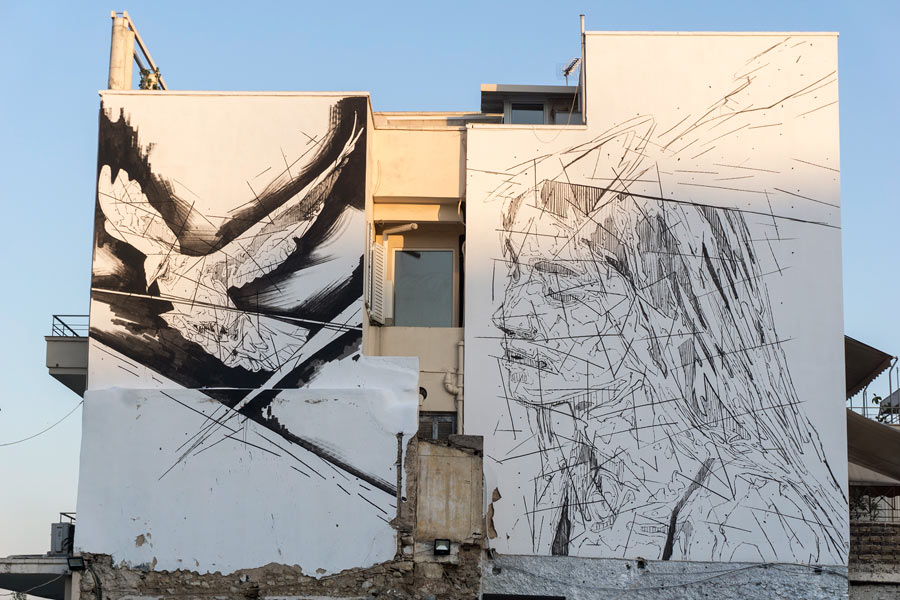
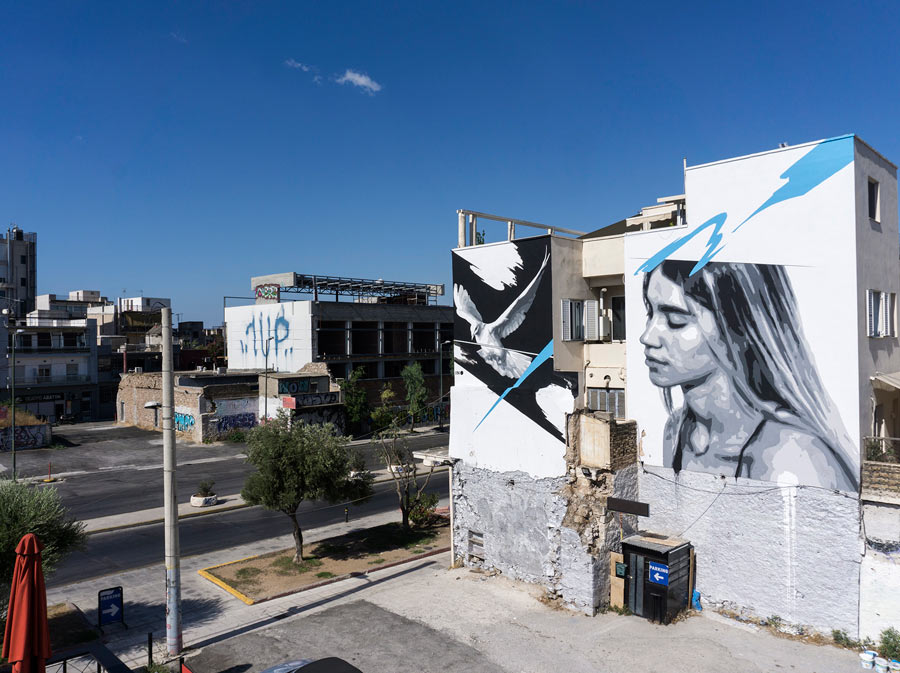
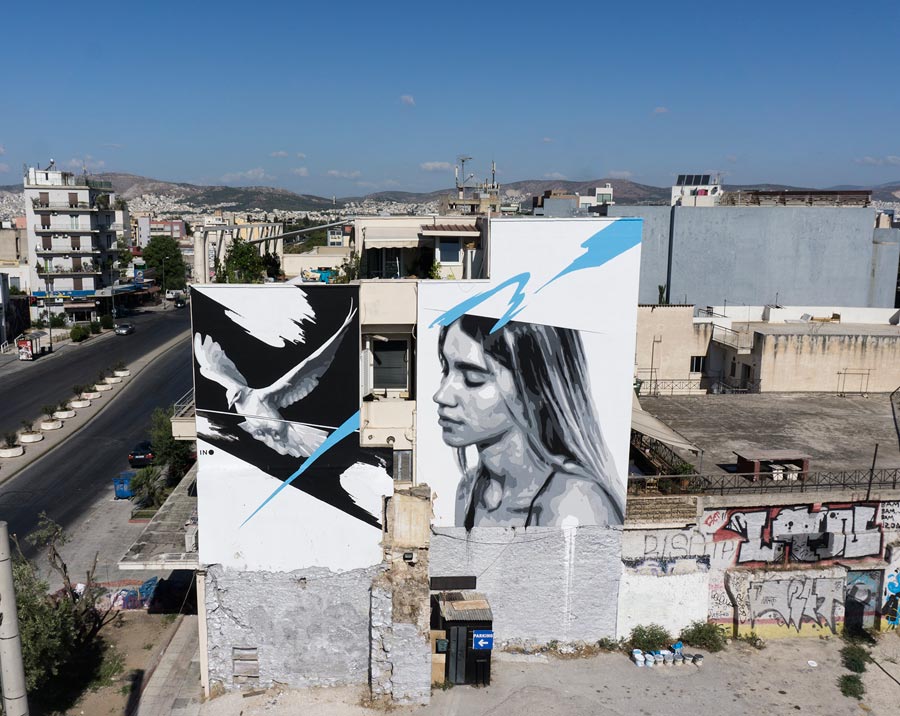
Just check out the clubs and nighttime entertainment near Kolonaki Square where this new INO mural is.
Once you pass the phalanx of security, you are welcomed into the party – preferably wearing designer labels – the men are in blazers and “casual cool” as they watch barely dressed women in high heels dancing on the stage, sometimes acting out fantasies to the aural euphoria and plumes of smoke blown skyward. In these thumping houses of free-market hedonism, you can feel free while waving your hands and glow sticks in the air at the DJ booth, but for a comparably hefty price.
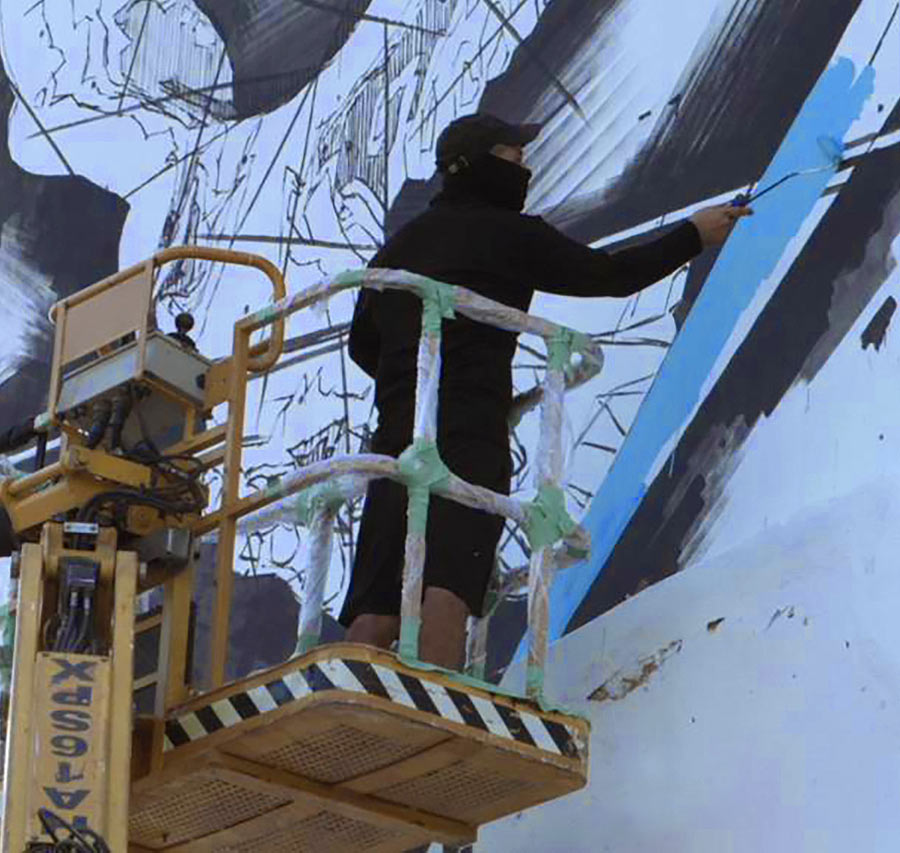
This financial inequality may have been on his mind when INO painted this new mural. “They did not give me a specific theme and I chose to create an image that from the first point of view may look optimistic but it is not,” he says. The title is “Freedom for Sale”.
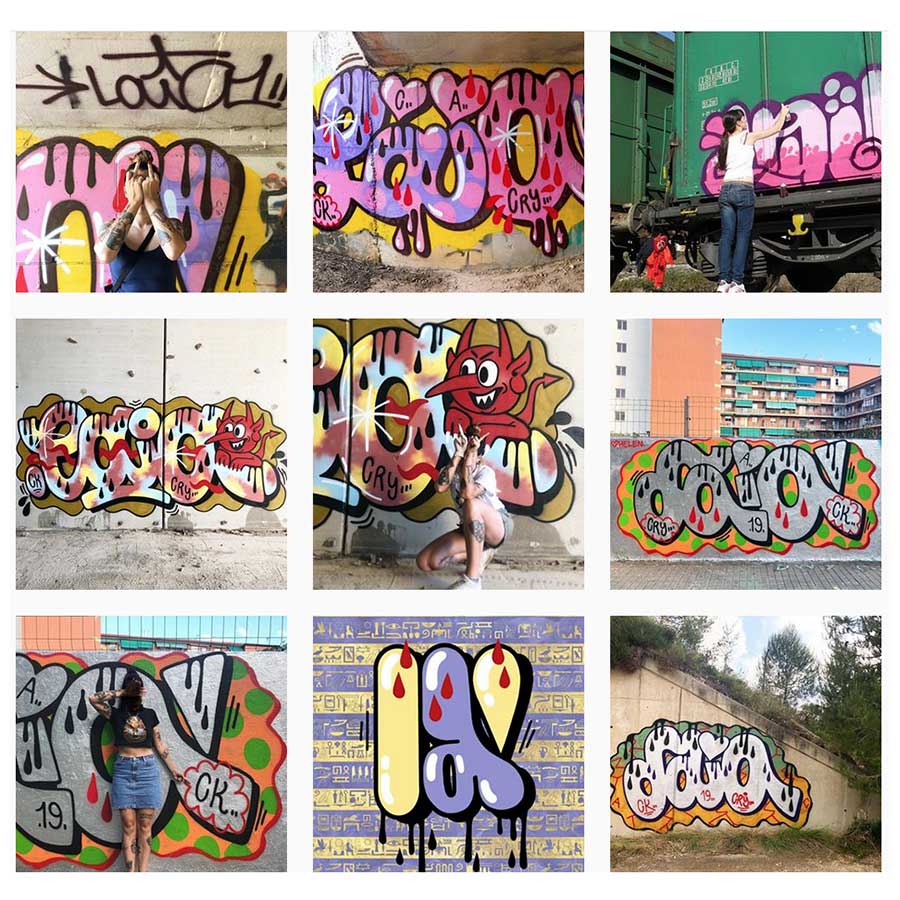
Today we return to community murals for a minute, just to check on the progress of Barcelona based artist Laia. She says she started as a graffiti writer in ’99 at age 14, eventually gaining respect from peers for her serious skillz with tags, pieces, and style on underpasses, trains, walls, and freights.
Two decades later, she’s redefining her style, she says. Here you may think more of street art motifs and when you look at her new wall for community group Contorno Urbano in her hometown Barcelona.
She says she’s looking for positivity these days for herself, and she wanted to create something that reflects it to the neighborhood of Civic Center Cotxeres Borrell. Maybe something kid-friendly.
She’s calling it “Magic Avenue”. “There is no negativity, no sad colors, no violence!,”
says Laia.
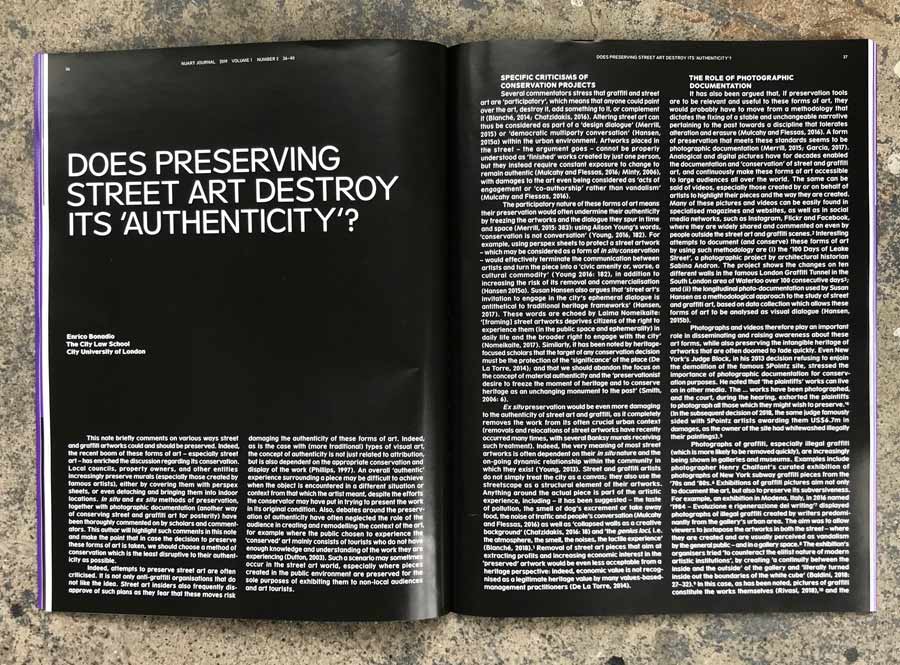
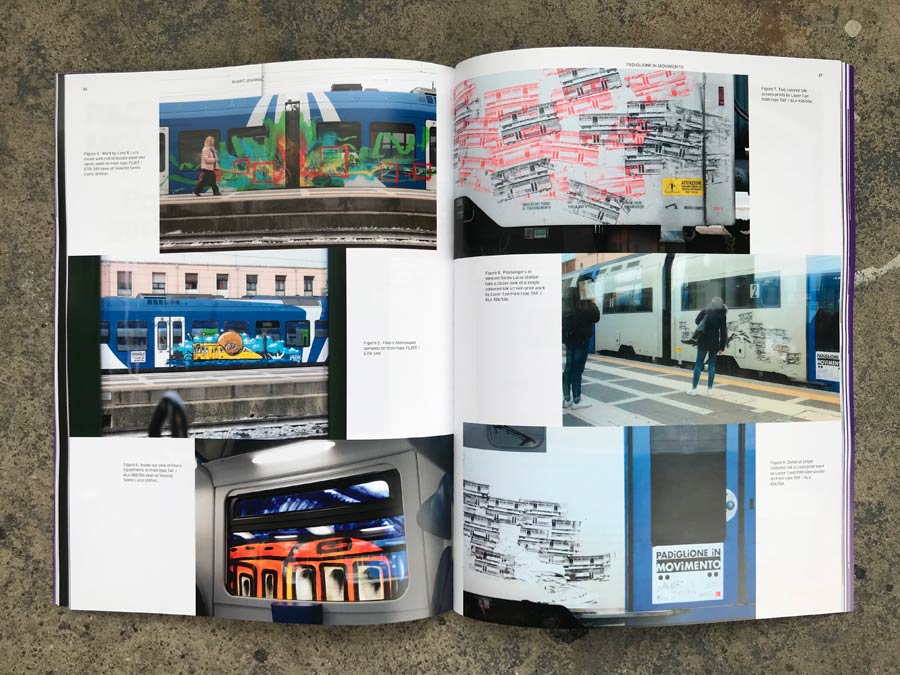
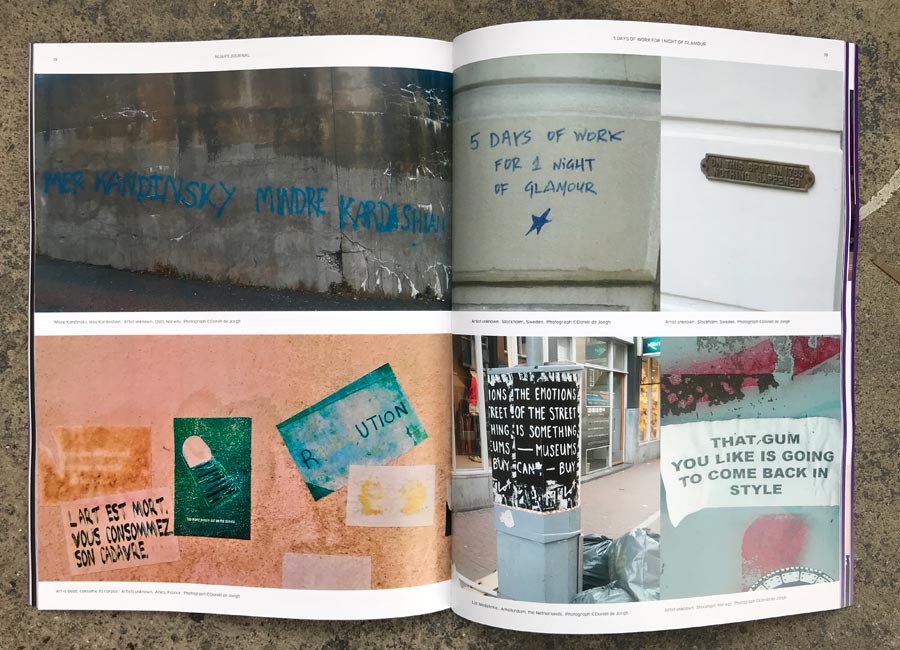
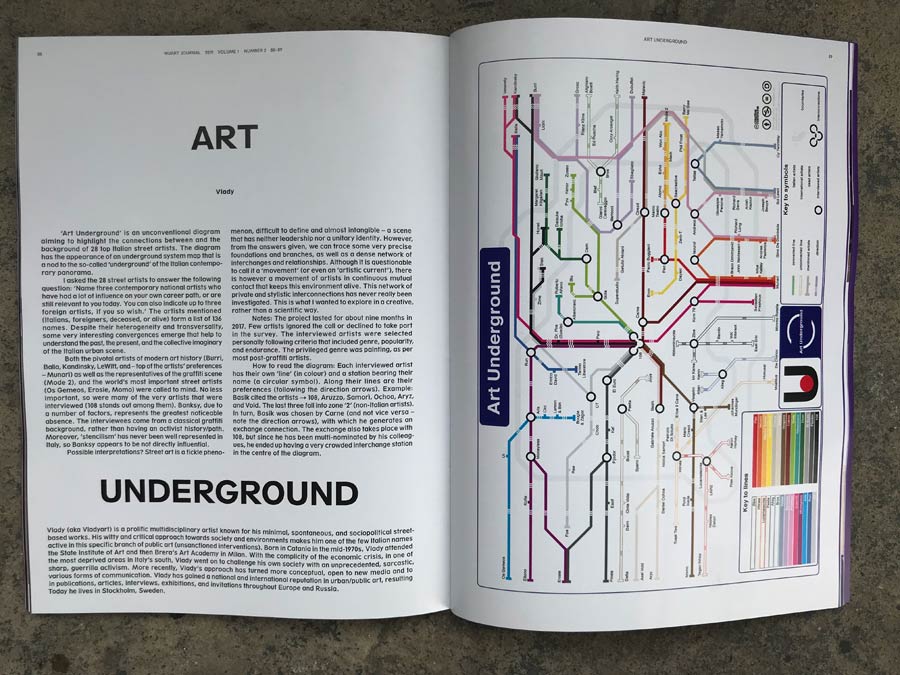
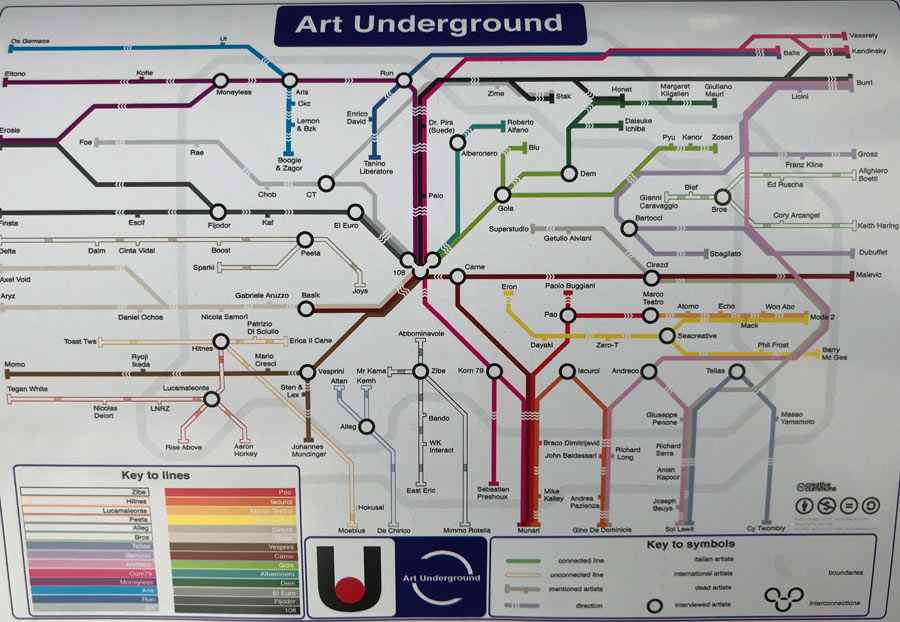
The nascent voyage of ‘Nuart Journal’ comes slowly into view as a softly bound Street Art/graffiti cultural preservation document; its glossy cover is purple for issue Number 2, like a thick royal-court velvet, or a bruised eye.
Editor-in-Chief Martyn Reed opens this forum to a hand-selected series of thought leaders, artists, organizers, academics and friends who are invited to impart, illustrate, confound and inspire. It is an extension of what he has endeavored to do with his annual invitational public art/commercial art festival Nuart- the newest edition which commences this week in Stavanger, Norway.
An impossible goal; to track the precise movement of the dancing tentacles of this scene as it grew – as it grows – much less to assign motivation or significance or measure impact. A mutational march of interconnected disconnectedness, no amount of pontification will ever fully capture the width of this circle, but Nuart Journal is beginning to take its measure and introduce a sense of order if only to better examine it. The theme is “Eloquent Vandals”, a reference to Nuart’s 2011 self-survey in hardcover. Themes range from colorless black street bombing to definitions of place and authenticity, to Street Art’s movement into conceptual, and decolonizing artivism.
The layout is the new utilitarian modern; clean-framing articles, essays, interviews, inquisitions – text-based and visual. Editor and academic Suse Hansen is nimble, streetsmart, and canny in her guiding of contributors. Hopefully, she can continue to steer confidently through these choppy waters, guiding a forward-moving course of enlightening observations – as the ship passes icebergs of false intellectualism, pirate boats of one-eyed tribalist gatekeepers, or the occasional showboat. Anglers ahoy!
Here’s the lineup of contributors for “Eloquent Vandals”, Nuart
Journal Volume 1 Number 2, 2019;
Jeff Ferrell, Oskolki, Jens Besser, Georgios Stampoulidis,
Daniel de Jongh, Jaime Rojo, Vlady, Alison Young, Reuben Woods, Lindsey
Mancini, Christian Omodeo, Vittorio Parisi, Faith XLVII, and Milu Correch.
Nuart Journal, Stavanger, Norway. Editor@nuartjournal.com Click HERE for more about Nuart Journal.
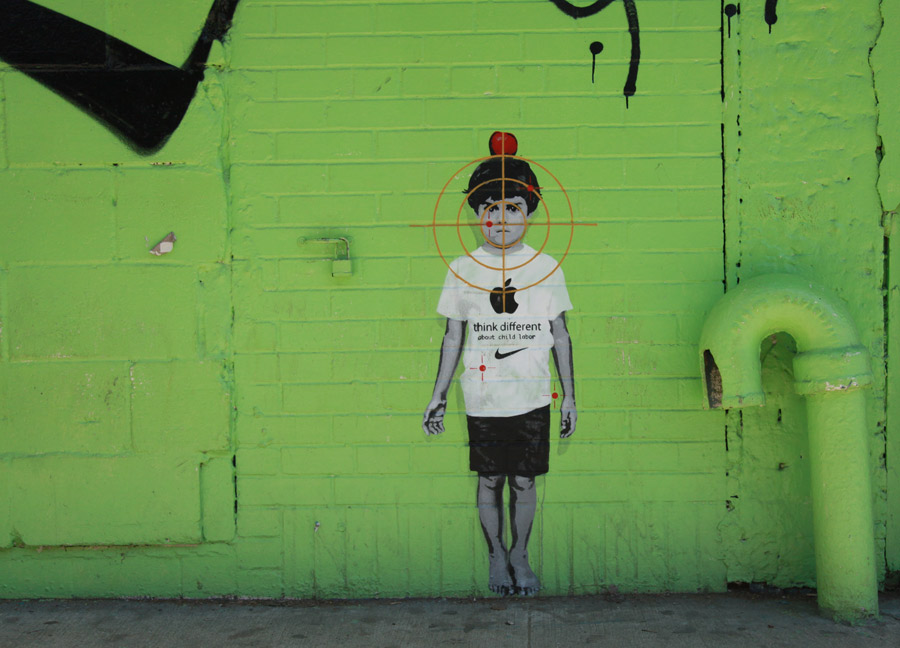
Labor Day in the US and around the world draws our attention to the rights of workers. A compounding topic is the fact that 265 million children are working around the world, according to the International Labour Organisation.
Because of our collective neglect as human
society, children are being forced to work to provide for their families in
countries all over the world. In many poor countries, children must work to
provide for their families otherwise their families will go hungry.
Why do children have to work? Shouldn’t they be free to enjoy their childhood, be fed and clothed, go to school? This is a problem that needs to be condemned as much as it needs to be understood. Simply advocating for universal children’s rights to education, housing, and health care isn’t enough. For as long as greed and unchecked capitalism run amok, families are pushed into poverty – and some children are forced into labor, exploited, and abused under a constant threat of violence.
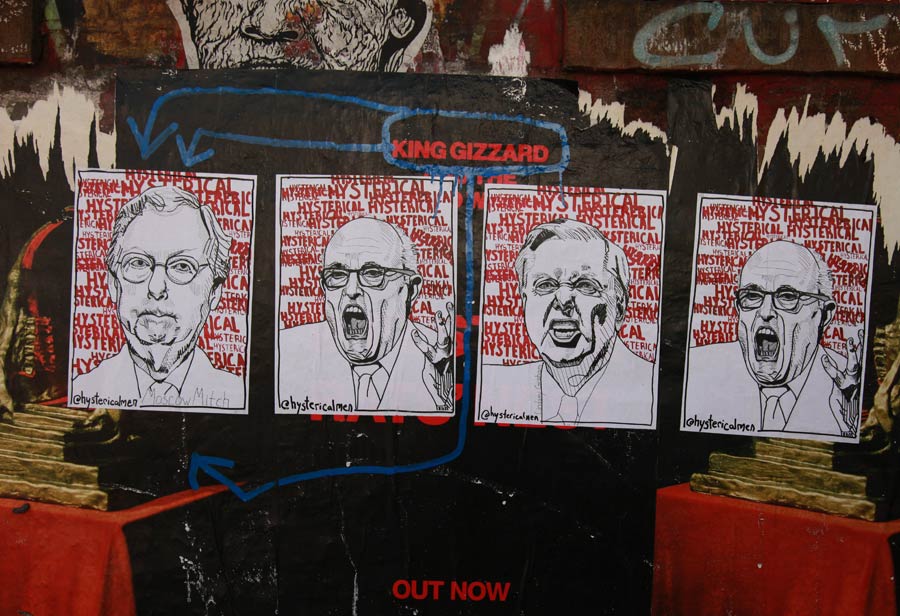
The fires of summer still burn, as do their romances. Yet September 1 brings news of the racing teams of muscular autumn artworld horses just beyond the next valley, thundering their way through the streets of New York to the galleries and museums. Among the cries, “Hail Henry!” “Hail JR!” “Hail Roger!”
And the streets! As inspiring and perplexing and exciting as ever, providing the ultimate exhibition.
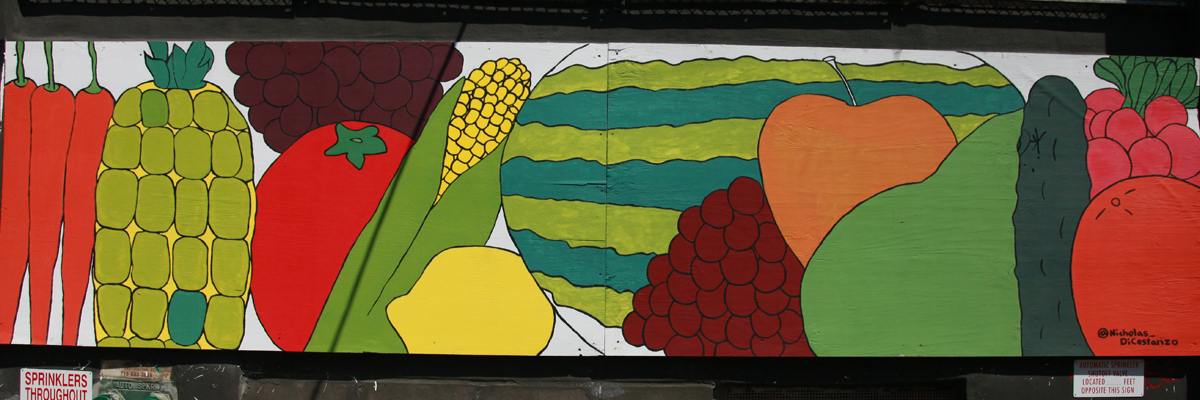
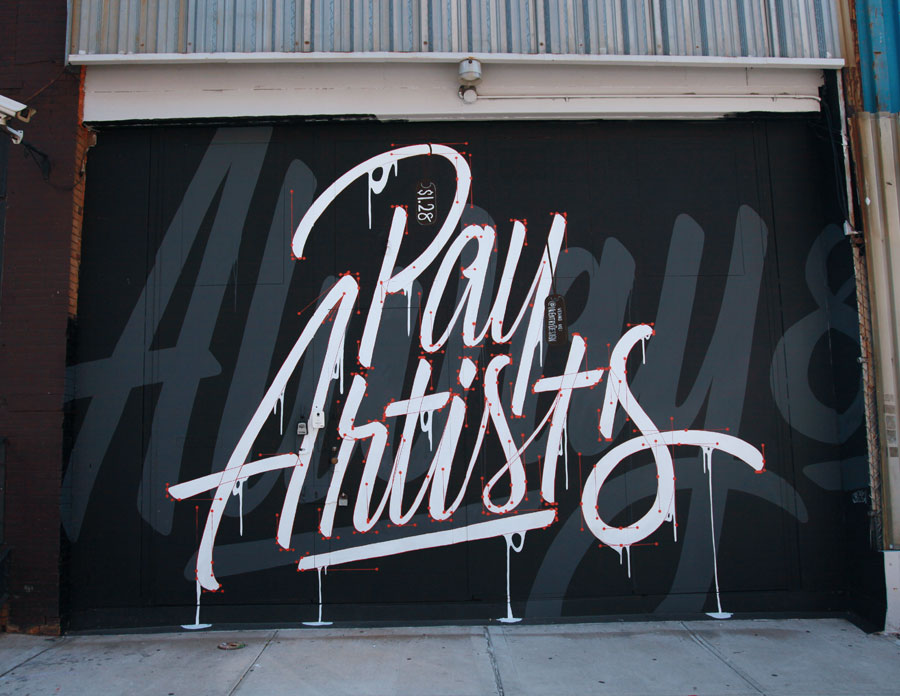
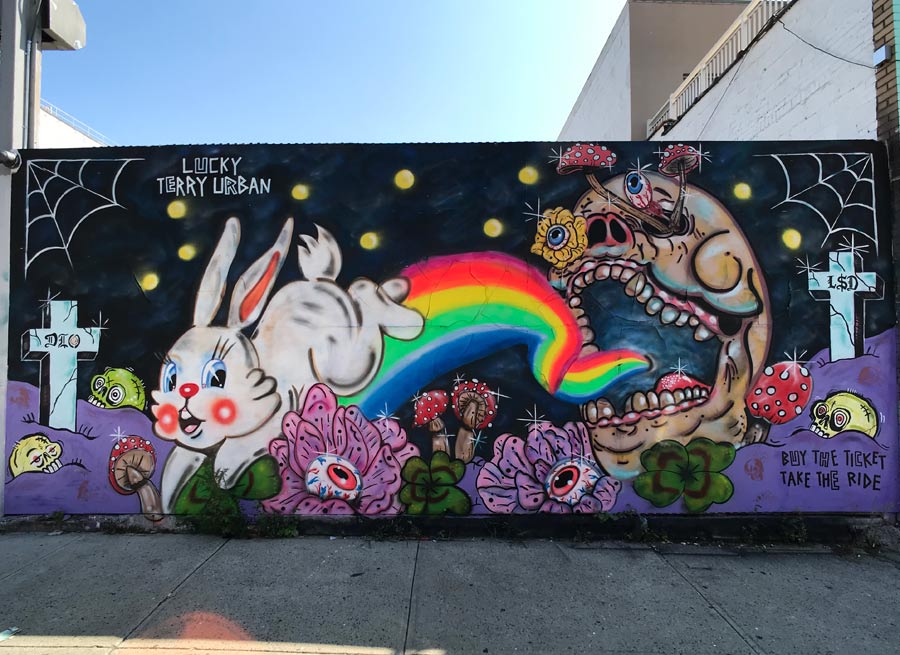
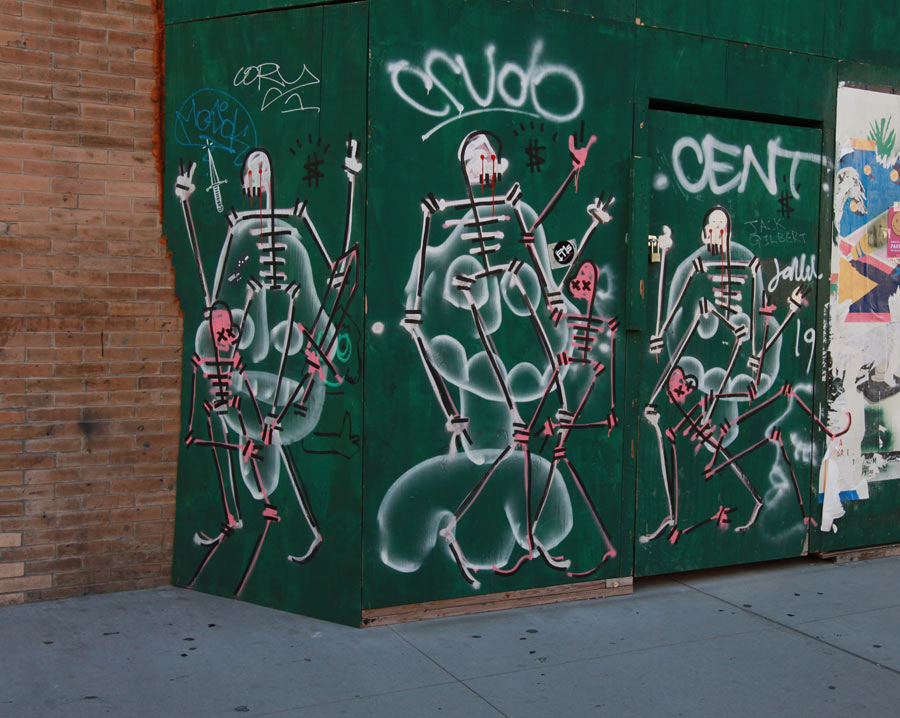
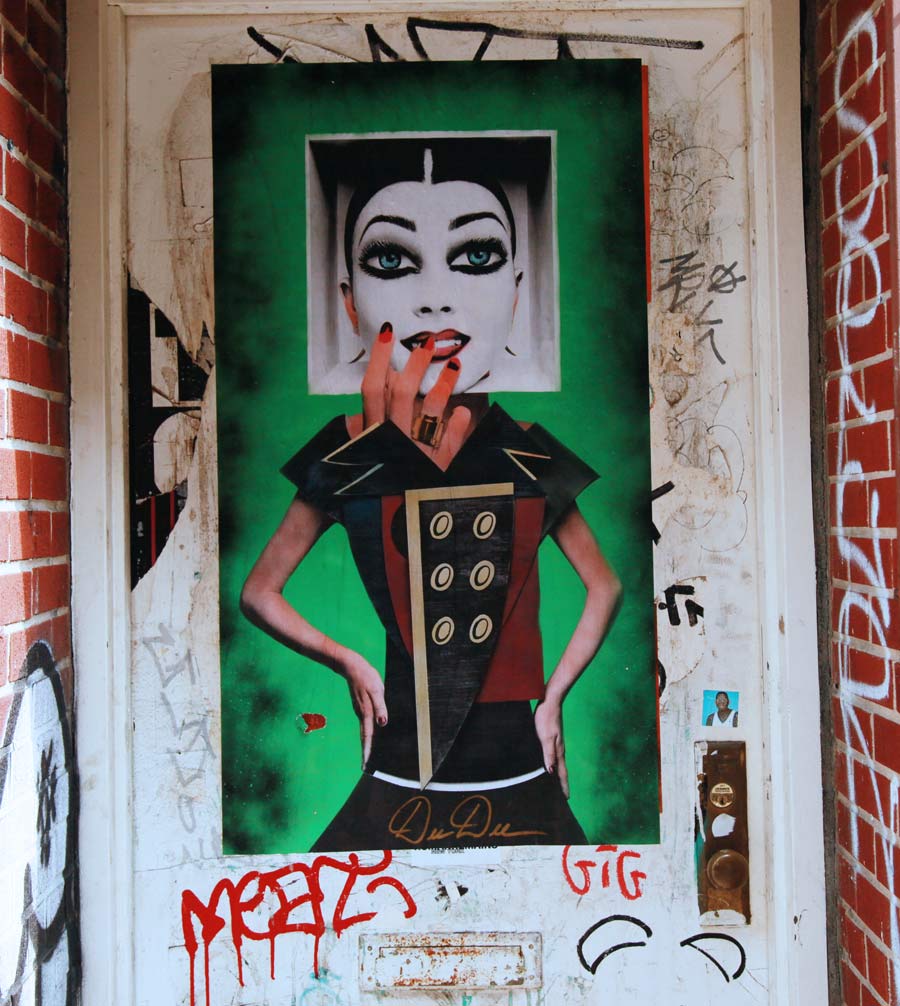
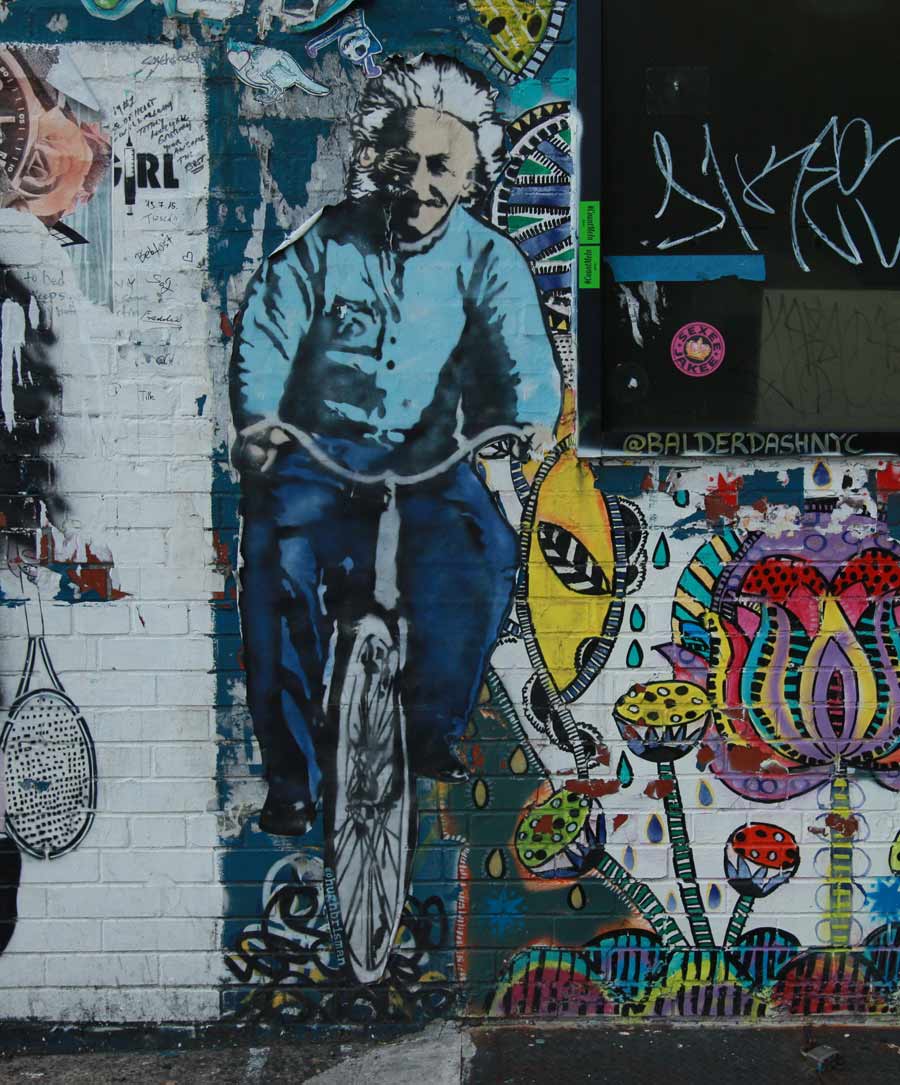
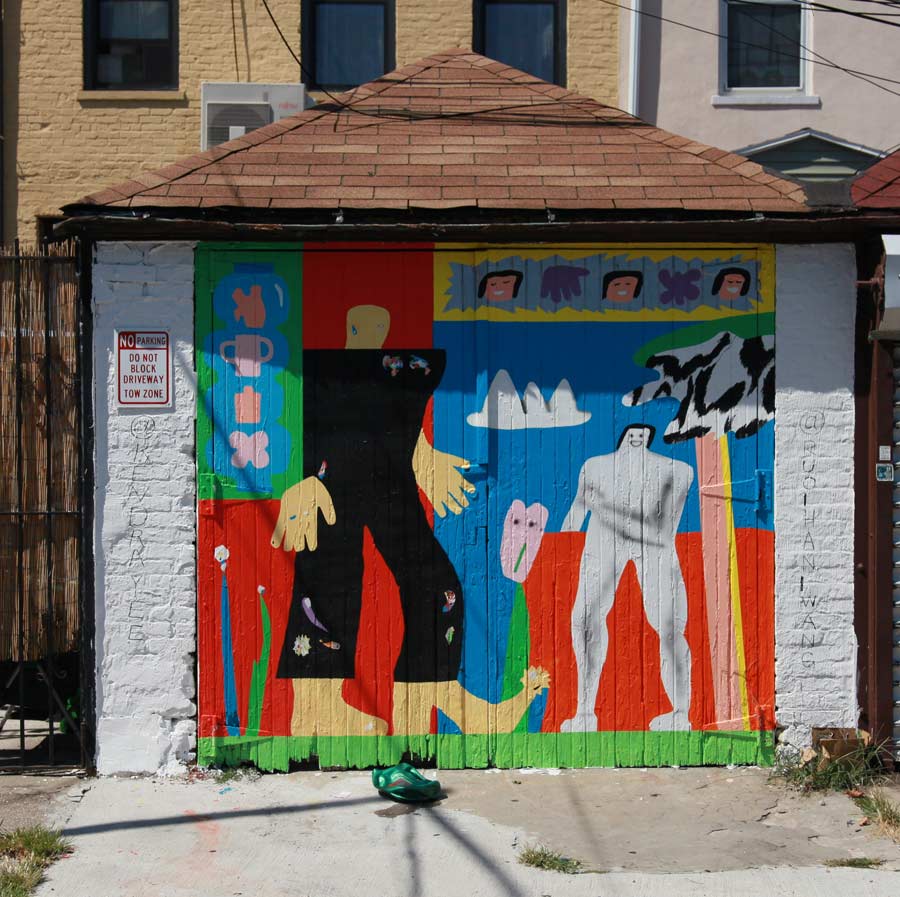
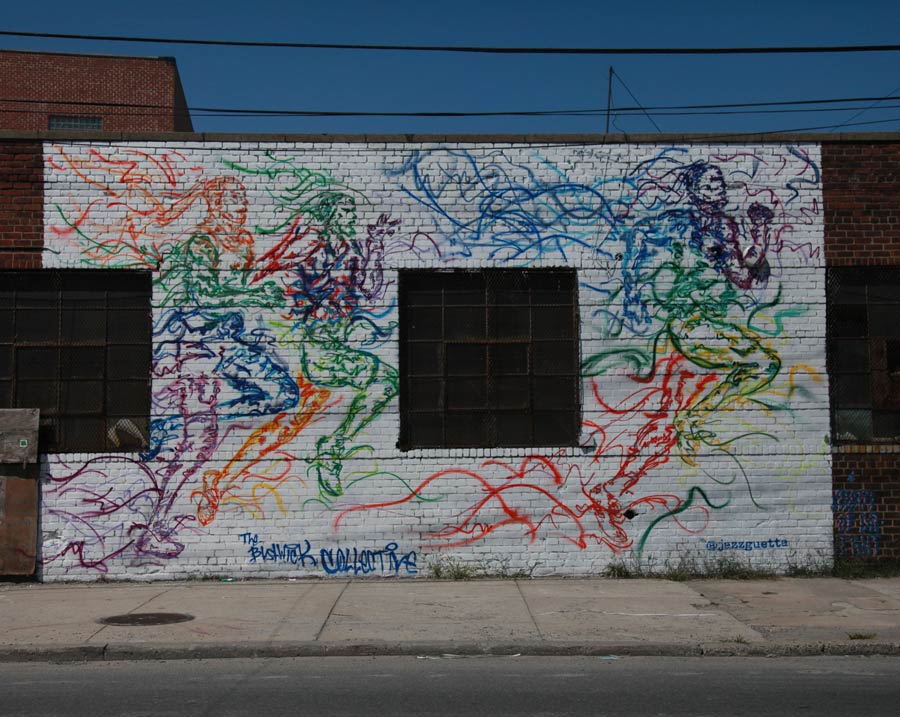
Here’s our weekly interview with the street, this time featuring Dee Dee, Hugh Brisman, Hysterical Men, Jazz Guetta, City Kitty, Steve The Bum, De Grupo, Frank Ape, Gianni Lee, Never, Kendra Yee, Ruo Han Wang, Jazz Guetta, Nicholas Di Constanzo, Myth, Terry Urban, A Lucky Rabbit, Molly Crabapple, Ms Saffaa, and Vy.
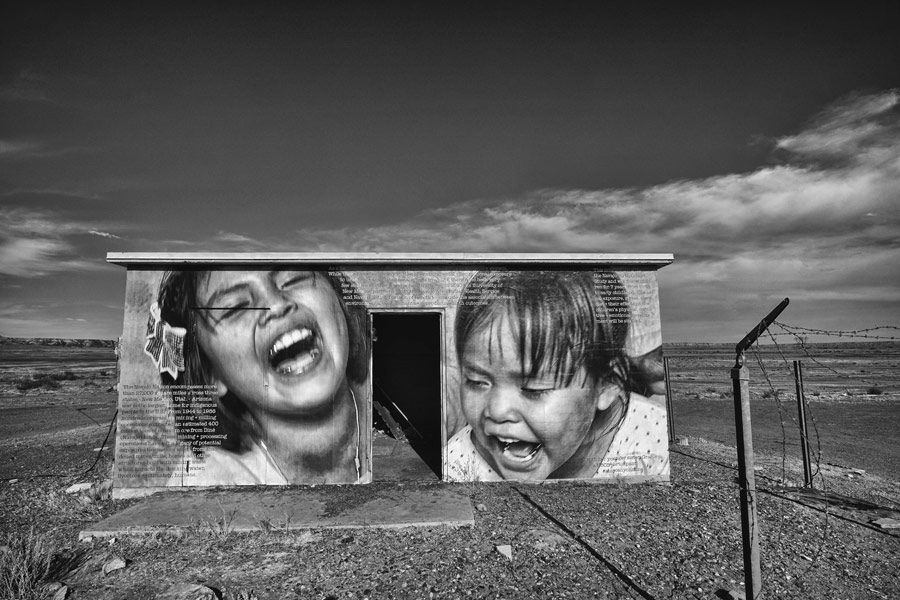
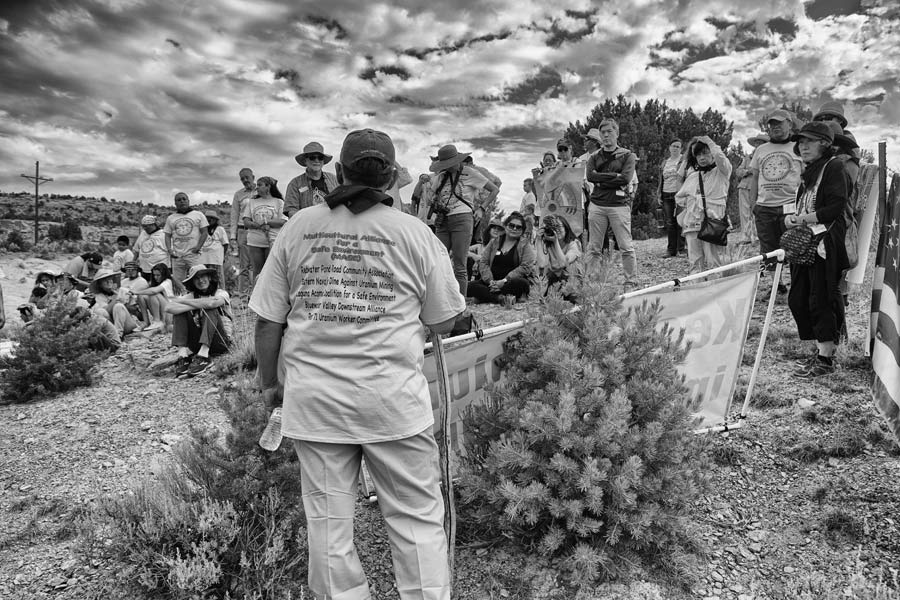
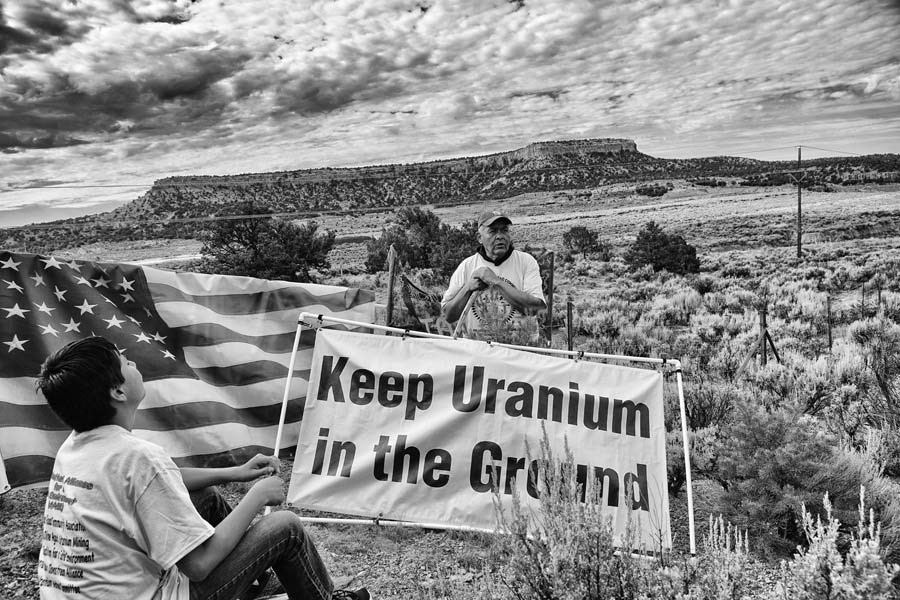
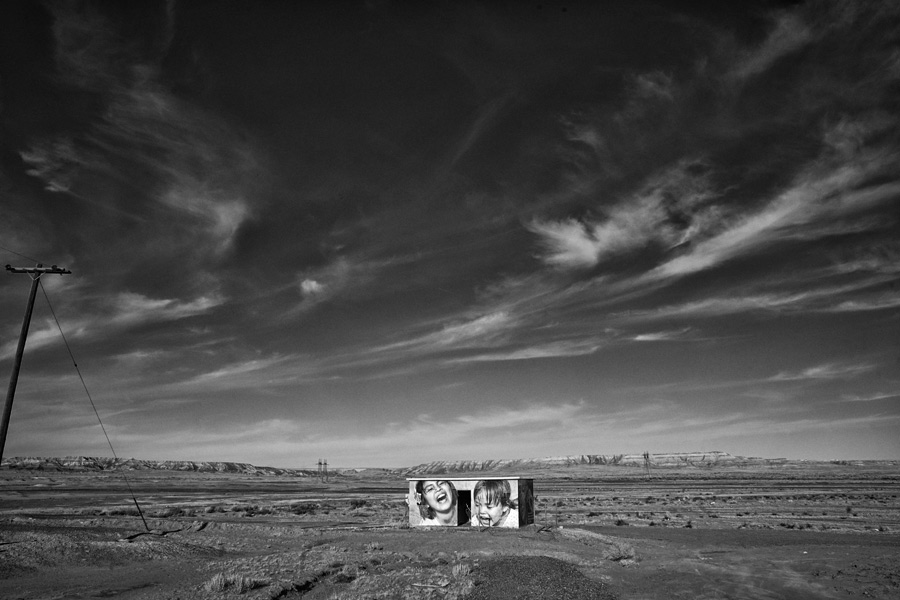
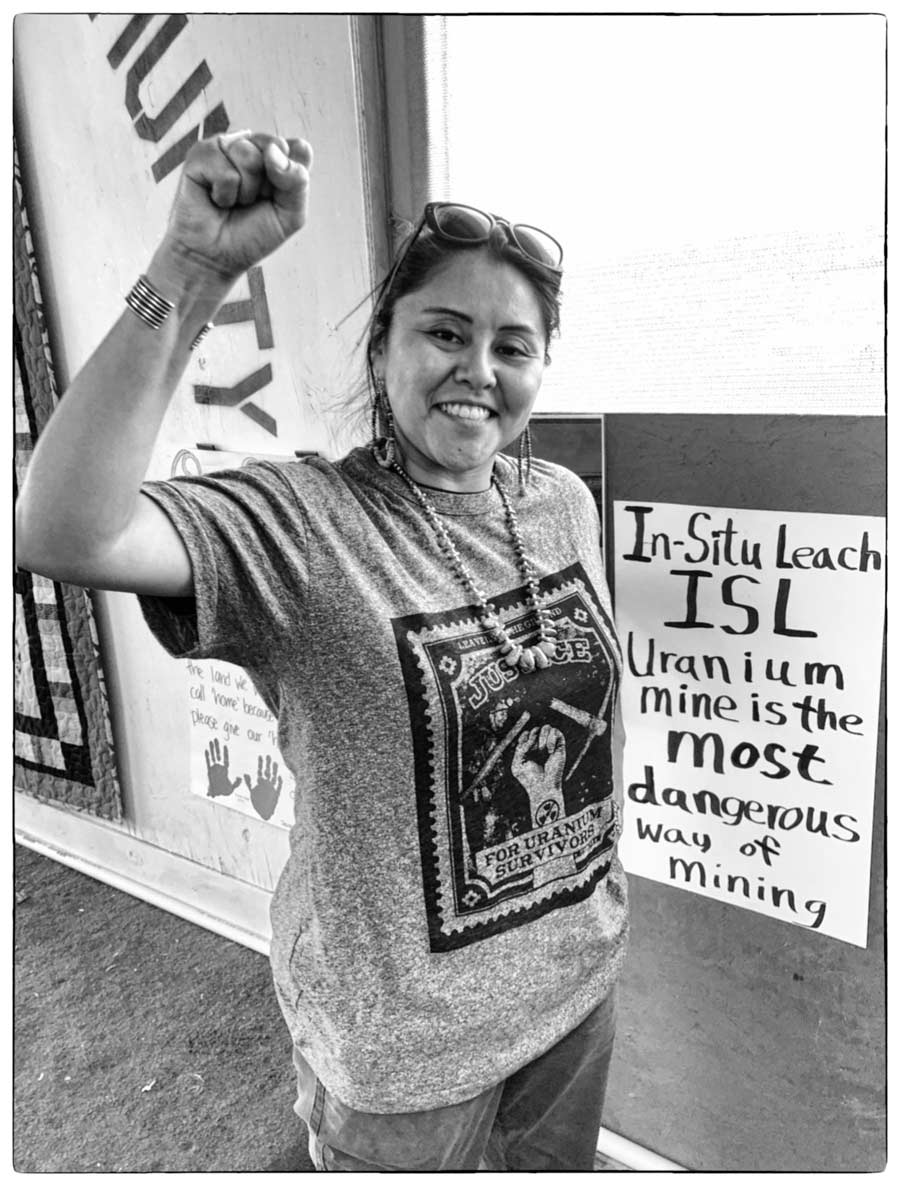
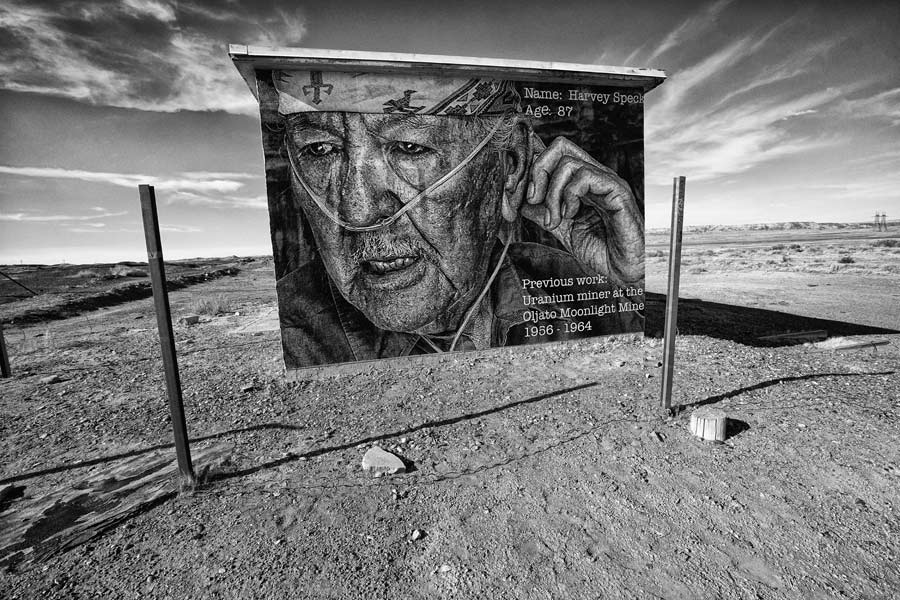
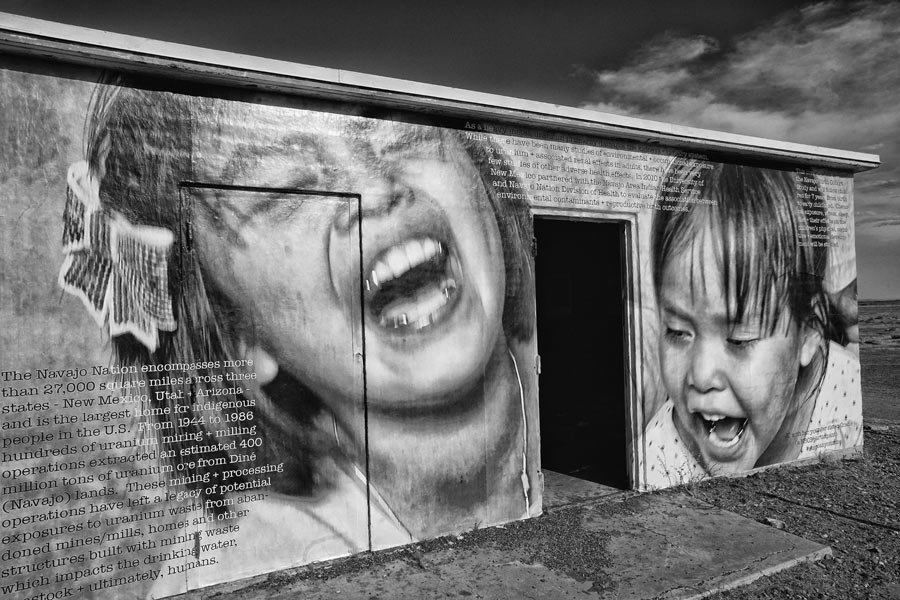
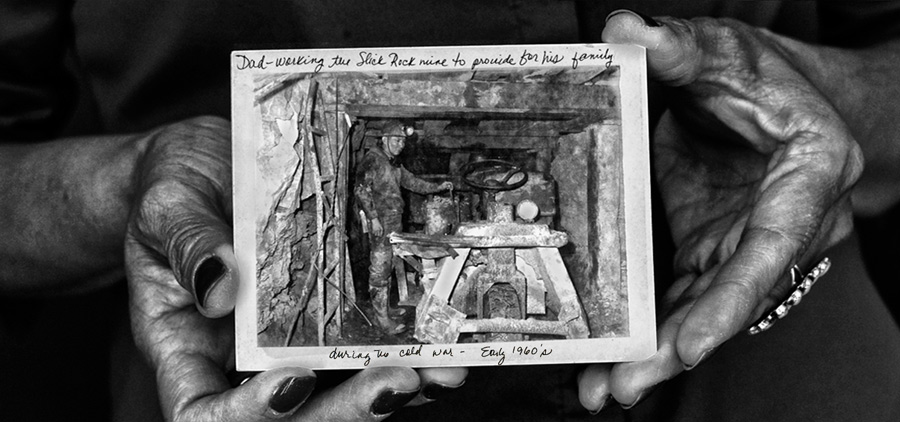
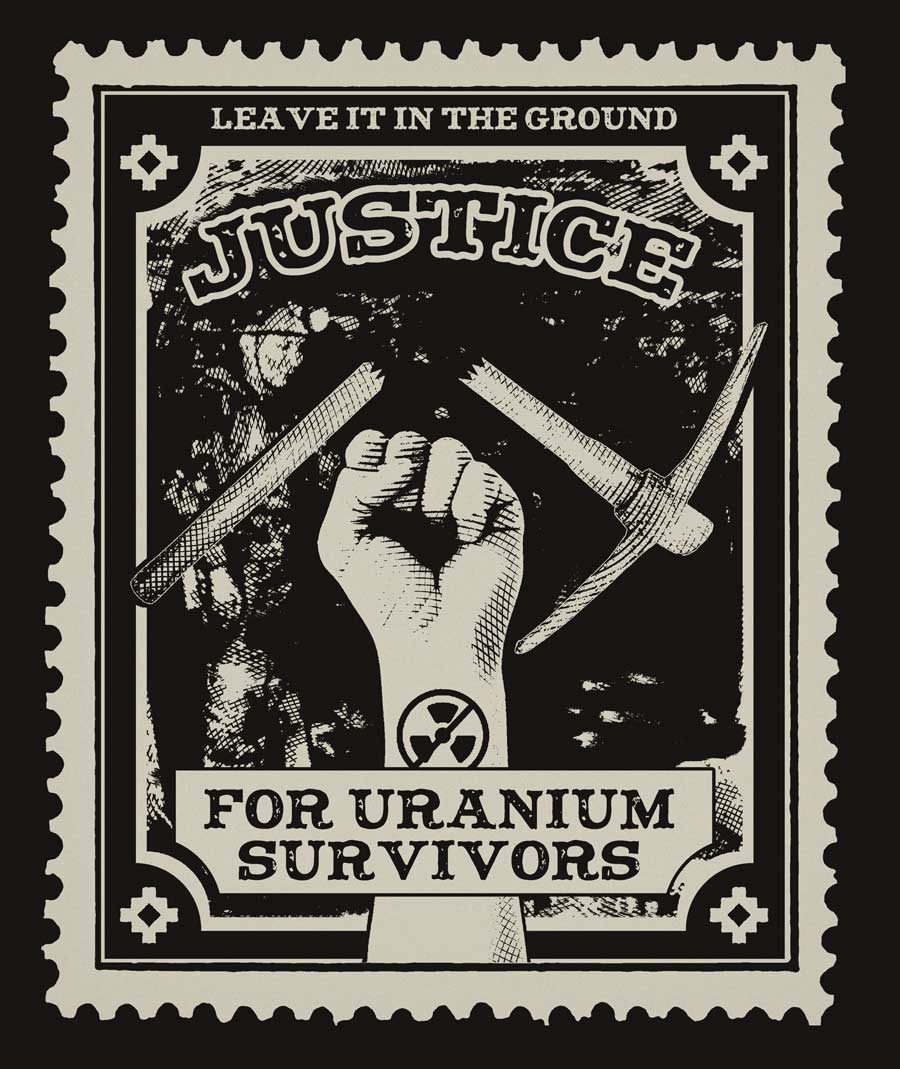
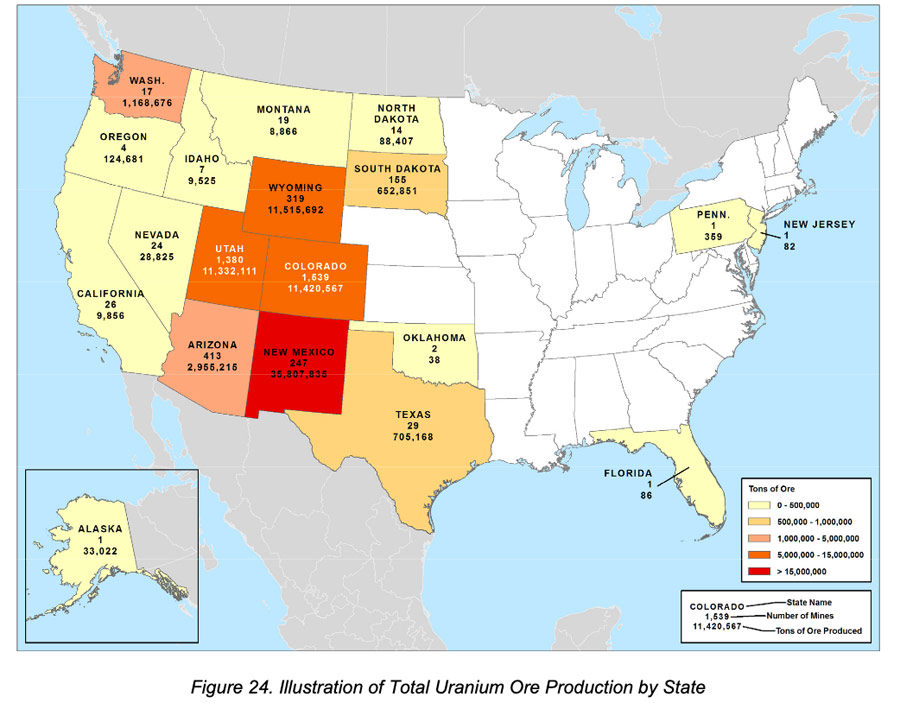
This spill and these events did not happen in San Diego, or Palm Beach. The story doesn’t affect wealthy white families and cannot be used to sell shampoo or real estate. That’s probably why we don’t see it in the press and never on the talking-head news. Street Artist Jetsonorama is not only a photographer who has been wheat-pasting his stunning images of people and nature on desert buildings for over a decade, he is also a doctor on the Navajo reservation, a human-rights activist, andan erudite scholar of American history as it pertains to the poisoning of this land and these people. Today we’re pleased to bring you this long-form examination from Jetsonorama’s perspective on a complicated and tragic US story of environmental poisoning and blight that affects generations of native peoples, miners, military personnel, and everyday people – and has no end in sight.
Most alarming is the news that current White House administration is endeavoring to mine uranium here again.
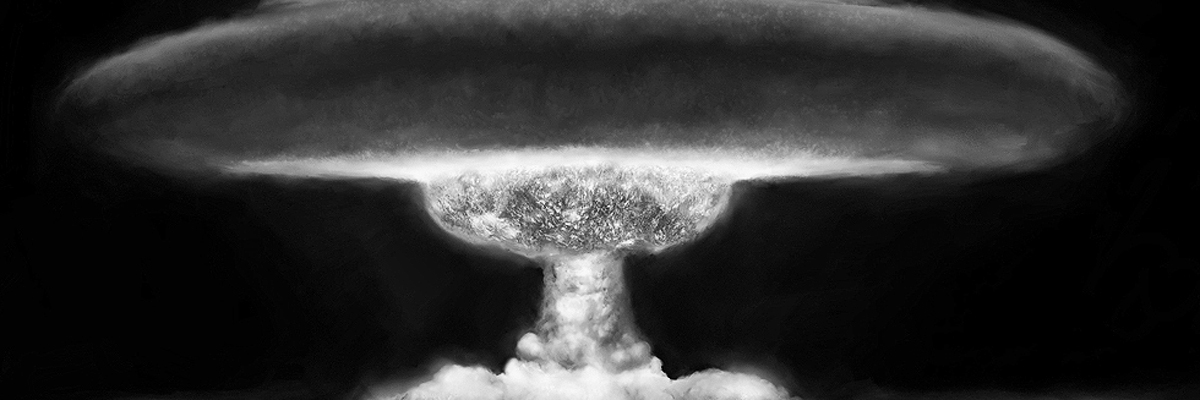
July 16, 1945 was an auspicious day in the history of
humankind and the planet as the US Army’s Manhattan Project detonated Trinity,
the first atomic bomb, in Jornada del Muerto, NM. (“Jornada del
Muerto” fittingly translates as “Journey of the Dead Man” or “Working Day of
the Dead.”) July 16 is also the day of one of the worst nuclear
accidents in US history with the Church Rock, NM uranium tailings spill in 1979
on the Navajo nation (occurring 5 months after the nuclear reactor meltdown at
Three Mile Island).
An earthen dam holding uranium tailings and other toxic waste ruptured releasing 1,100 tons of uranium waste and 94 million gallons of radioactive water into the Rio Puerco and through Navajo lands. Sheep in the wash keeled over and died as did crops along the river bank. According to a Nuclear Regulatory Commission report the levels of radioactivity in the Rio Puerco near the breached dam were 7000 times that of what is allowed in drinking water.
In an effort to end WWII and to beat the Soviets in developing a hydrogen bomb, uranium mining under the Manhattan Project began on Navajo and Lakota lands in 1944. Two years later management of the program was transferred to the US Atomic Energy Commission. The Navajo nation provided the bulk of the country’s uranium ore for our nuclear arsenal until uranium prices dropped in the mid 80s and is largely responsible for our winning the Cold War.
However, environmental regulation for mining the ore was nonexistent in the period prior to the founding of the Environmental Protection Agency in 1970. During this time uranium mining endangered thousands of Navajo workers in addition to producing contamination that persists in adversely affecting air and water quality and contaminating Navajo lands with over 500 abandoned, unsealed former mine sites.
Private companies hired thousands of Navajo men to work the uranium mines and disregarded recommendations to protect miners and mill workers. In 1950 the U.S. Public Health Service began a human testing experiment on Navajo miners without their informed consent during the federal government’s study of the long-term health effects from radiation poisoning. This study followed the same violation of human rights protocol as the US Public Health Service study on the long-term effects of syphilis on humans by experimenting on non-consenting African American men in what is known as the Tuskegee Syphilis Experiment from 1932 – 1972.
In
May 1952 the Public Health Service and the Colorado Health Department publish a
paper called “An interim Report of a Health Study of the Uranium Mines and
Mils.”
The
report noted that levels of radioactive radon gas and radon particles (known as
“radon daughters”), were so high in reservation mines that they recommended
wetting down rocks while drilling to reduce dust which the miners breathed;
giving respirators to the workers; mandating daily showers after a work shift,
frequent changes of clothing, loading rocks into wagons immediately after being
chipped from the wall to decrease time for radon to escape and for miners to
receive pre-employment physicals.
Sadly, the recommendations were ignored.
By 1960 the Public Health Service definitely declared that uranium miners faced an elevated risk of pulmonary cancer. However, it wasn’t until June 10, 1967 that the Secretary of Labor issued a regulation declaring that “…no uranium miner could be exposed to radon levels that would induce a higher risk of cancer than that faced by the general population.” By this time, it was too late. In the 15 years after the uranium boom the cancer death rate among the Diné doubled from the early 1970s to the late 1990s while the overall U.S. cancer death rate declined during this same interval.
As high rates of illness began to occur workers were frequently unsuccessful in court cases seeking compensation. In 1990 Congress passed the Radiation Exposure Compensation Act which seeks to make compensation available to persons exposed to fallout from nuclear weapons testing and for living uranium miners, mill workers or their survivors who had worked in Utah, Colorado, New Mexico and Arizona between January 1, 1947 and December 31, 1971. An amendment to this bill is awaiting Congress after its recess that will expand years of coverage from 1971 to the mid 1990s as well as expanding the regions of the US covered.
At the other end of the life spectrum
the Navajo Birth Cohort Study is the first prospective epidemiologic
study of pregnancy and neonatal outcomes in a uranium-exposed
population. The goal of the Navajo Birth Cohort Study (NBCS) is to
better understand the relationship between uranium exposures and birth outcomes
and early developmental delays on the Navajo Nation. It started in
2014 and has funding through 2024.
Efforts to mine uranium adjacent to the
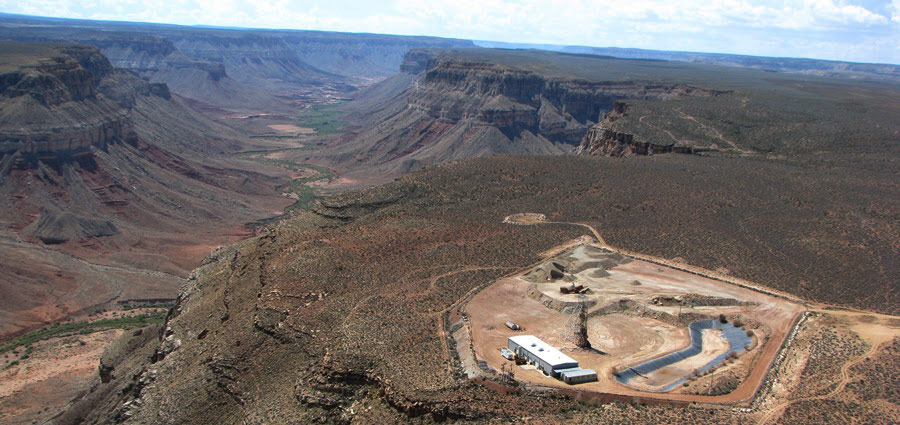
Grand Canyon have accelerated during the Trump administration. The most pressing threat comes from
Canyon Mine located closely to the South Rim of the Grand Canyon. Because of the plethora of abandoned
mines on the reservation the Navajo Nation banned uranium mining on the
reservation in 2005.
However, it’s possible still to transport ore from off the reservation across the reservation. Approximately 180 miles of the Canyon Mine haul route would cross the Navajo Nation where trucks hauling ore had 2 separate accidents in 1987.
Our weekly focus on the moving image and art in the streets. And other oddities.
Now screening : 1. Don Rimx x Owley “Olor A Azucenas El Perfume Del Barrio” 2. Street Art Singapore (VICE) 3. LATINO Legends STREET ART in my BACKYARD! | Los Mendozas 4. Kitt Bennett “Sleeping Giant”
BSA Special Feature: Don Rimx x Owley “Olor A Azucenas El Perfume Del Barrio”
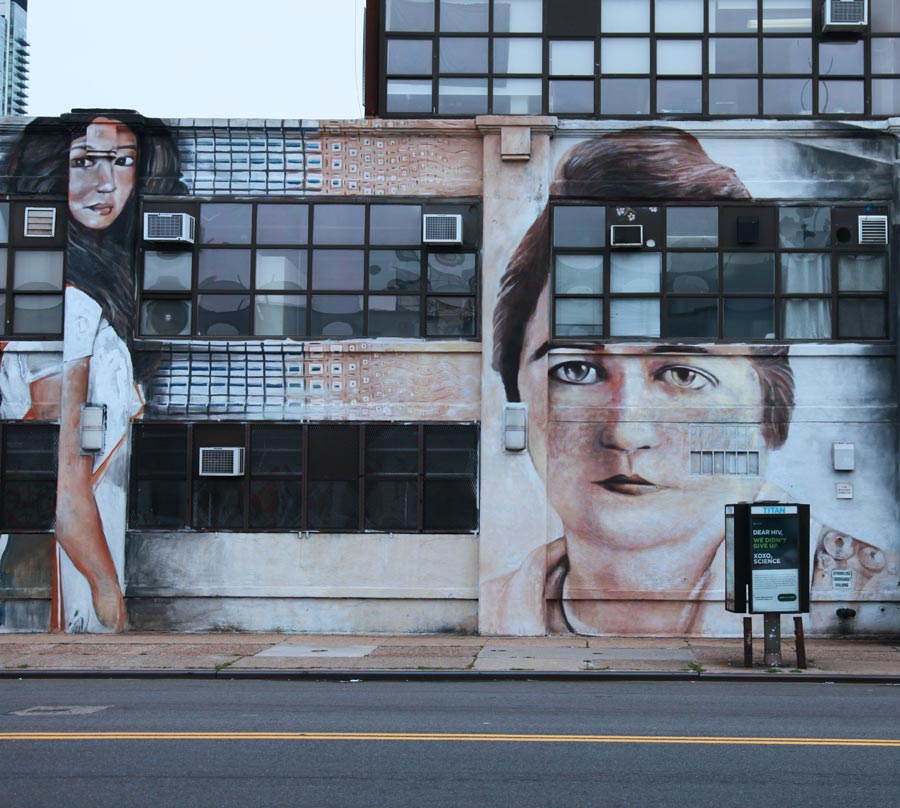
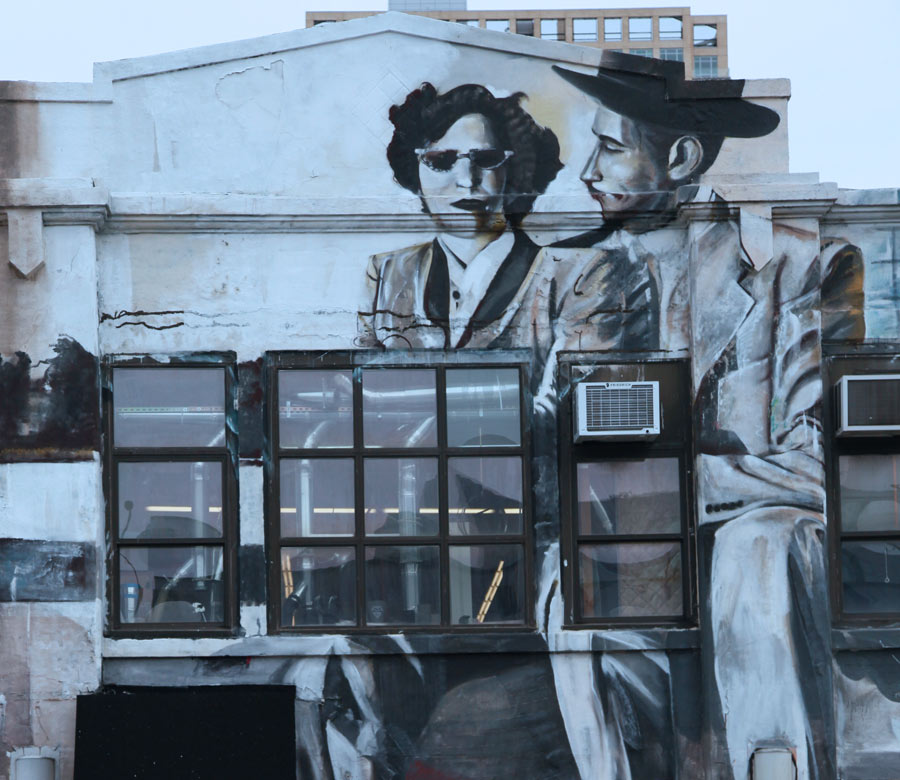
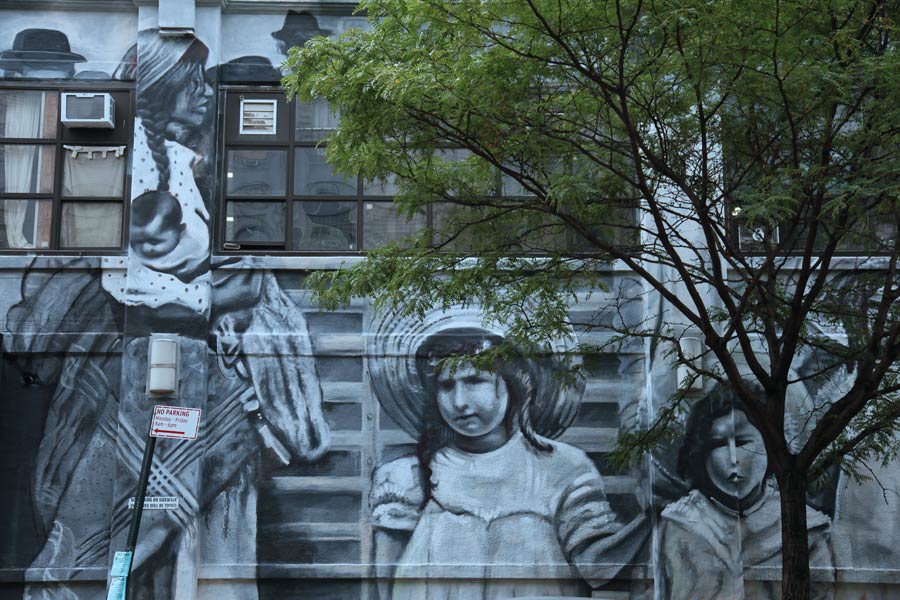
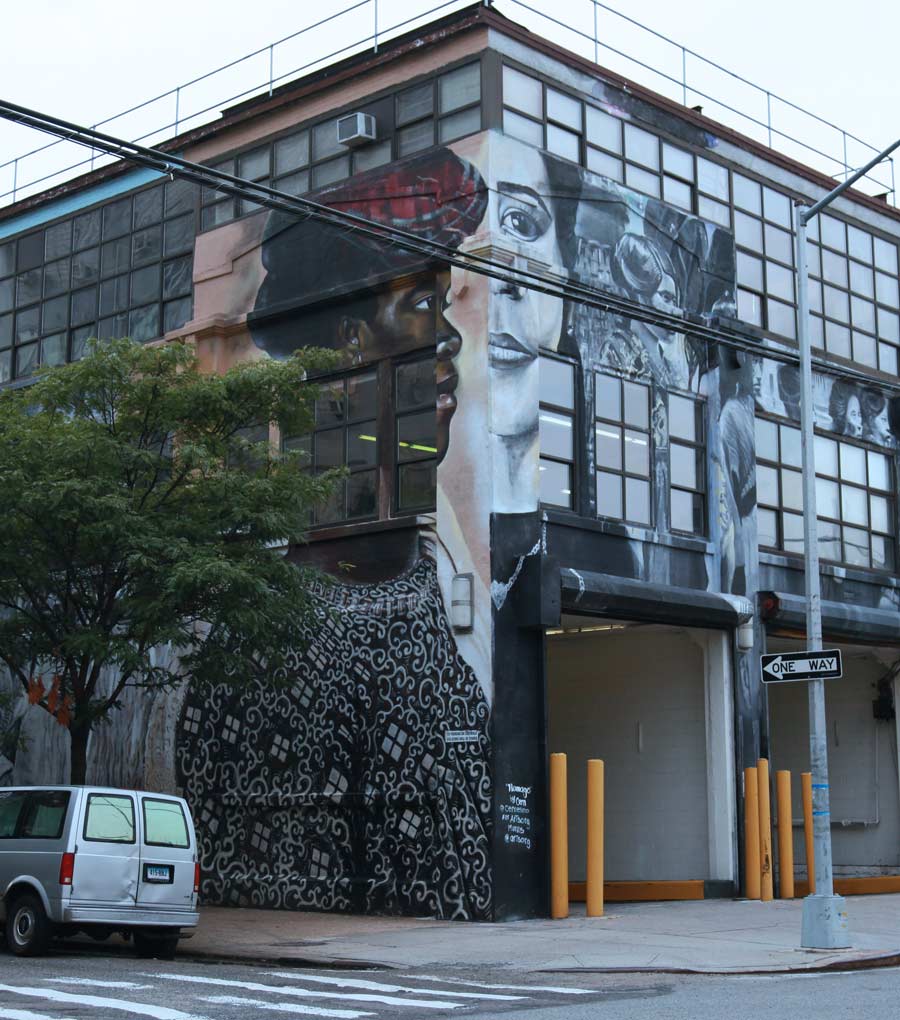
New Yorker/ Puerto Rican Street Artist Don Rimx illustrates his world and ours with his historical people, characters, and archetypes. For this recent piece in Brooklyn he focused on the guy who sells flowers, and the perfumeric effect he has on summer streets.
The mural symbolizes “a cultural bridge”: a flower vendor famous to San Juan, Puerto Rico. As Owley continues to develop his film-maker craft, his own personality is also beginning to emerge; a certain warmth and appreciation for his subjects readily apparent.
Street Art Singapore (VICE)
A quick study of the scene in
Singapore at the moment, featuring a graffiti group of style writers and
illustrators called RSCLS and a more traditional muralist named Yip Yew Chong.
The vandalism laws are strict and violent, yo! So how do you get around them.
Carefully. Also heavier topics like institutionalized racism, the surveillance
state, and censorship are all hit on.
Respect to Vice for capturing these folks and their stories.
LATINO Legends STREET ART in my BACKYARD! | Los Mendozas
Santana, Selena, Vicente Fernandez, and Frida?
They are all heroes of Hispanic heritage in the house of Instagram comedian Jay Mendoza in Los Angeles. With the help of muralist Gustavo Zermeño Jr these neighbors get together to paint in Jay’s backyard.
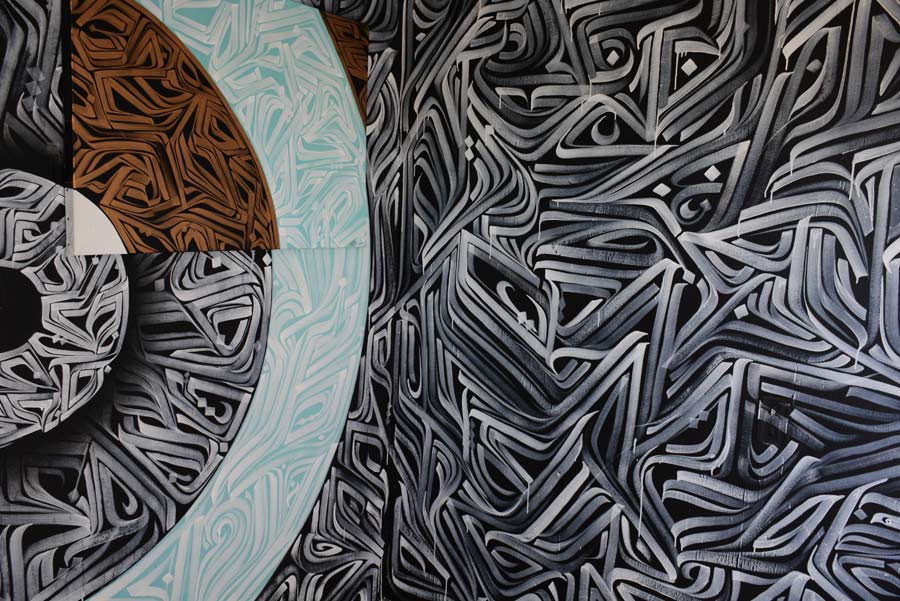
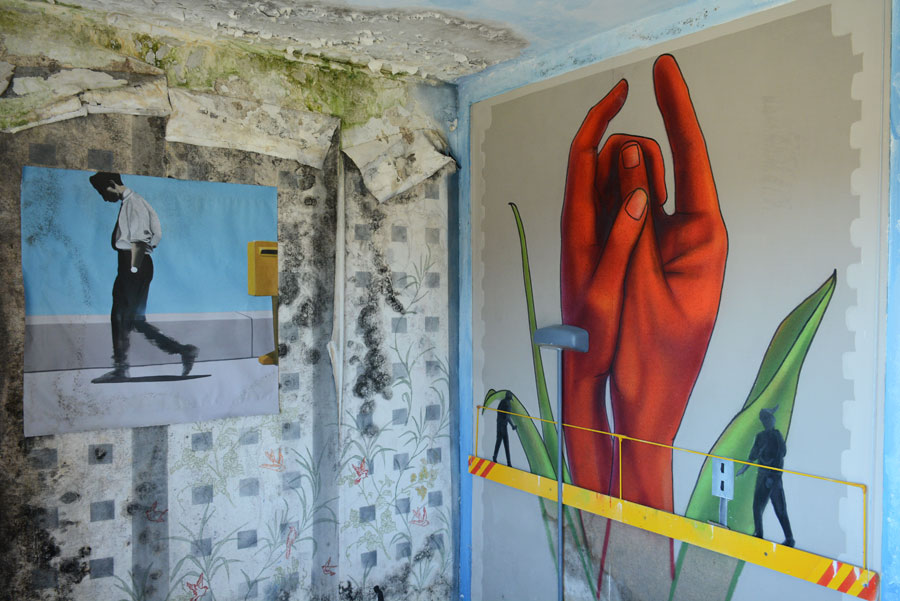
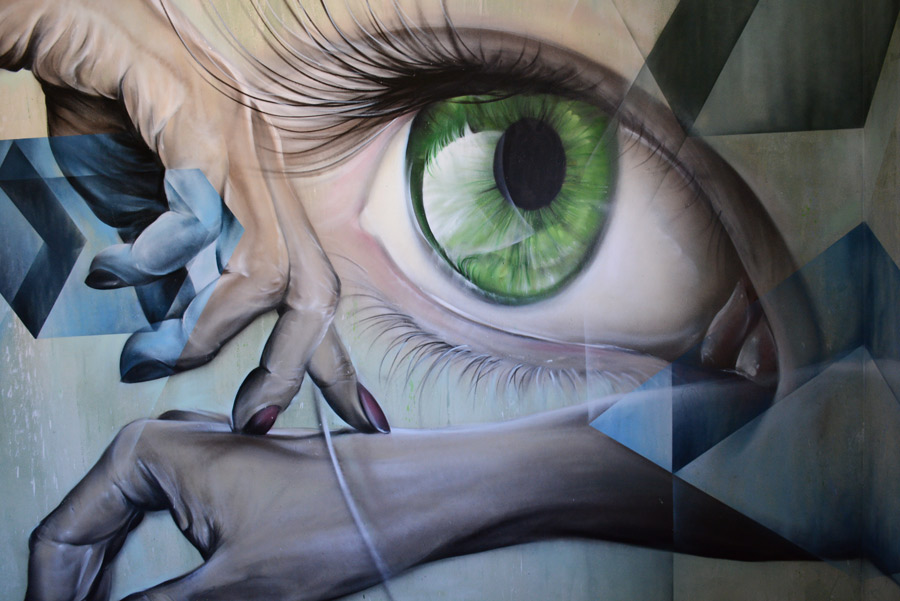
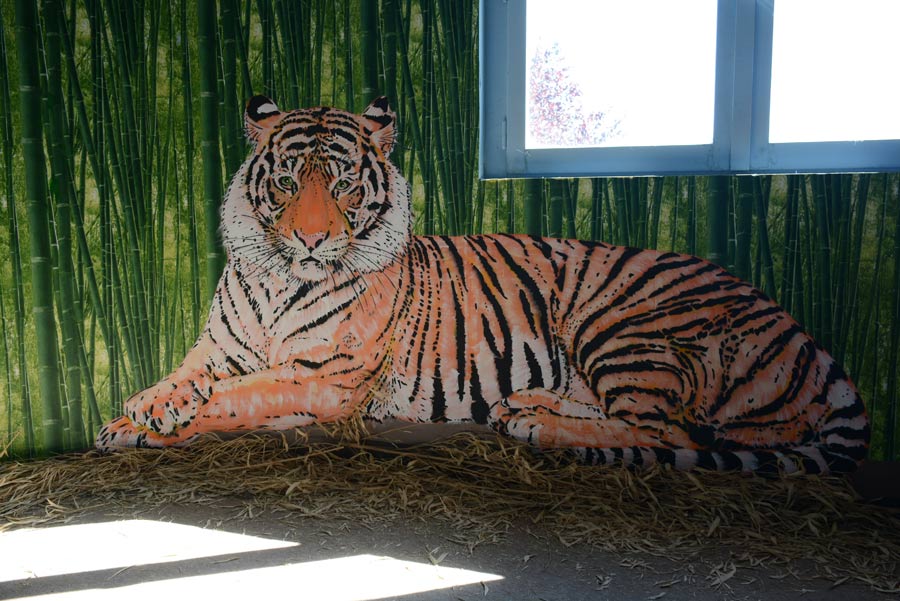
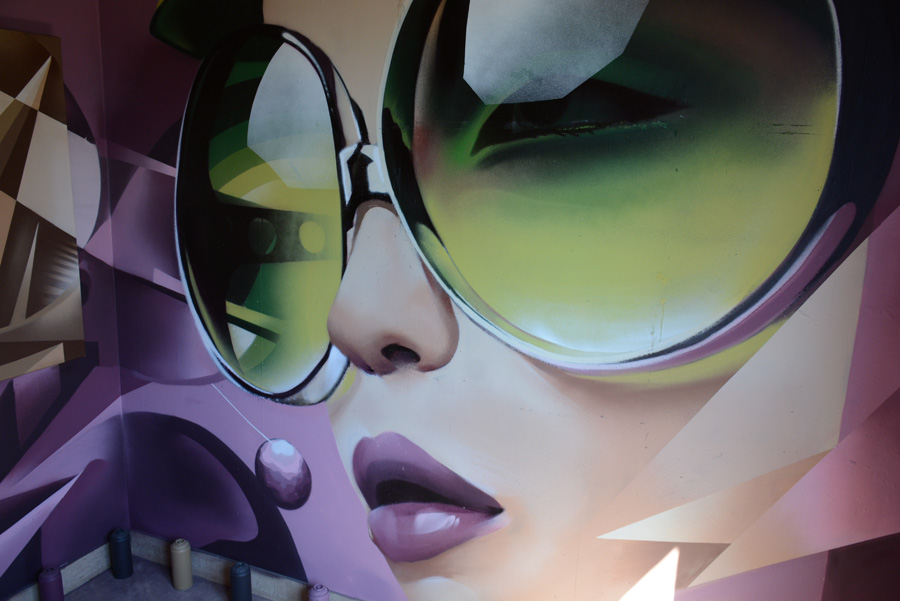
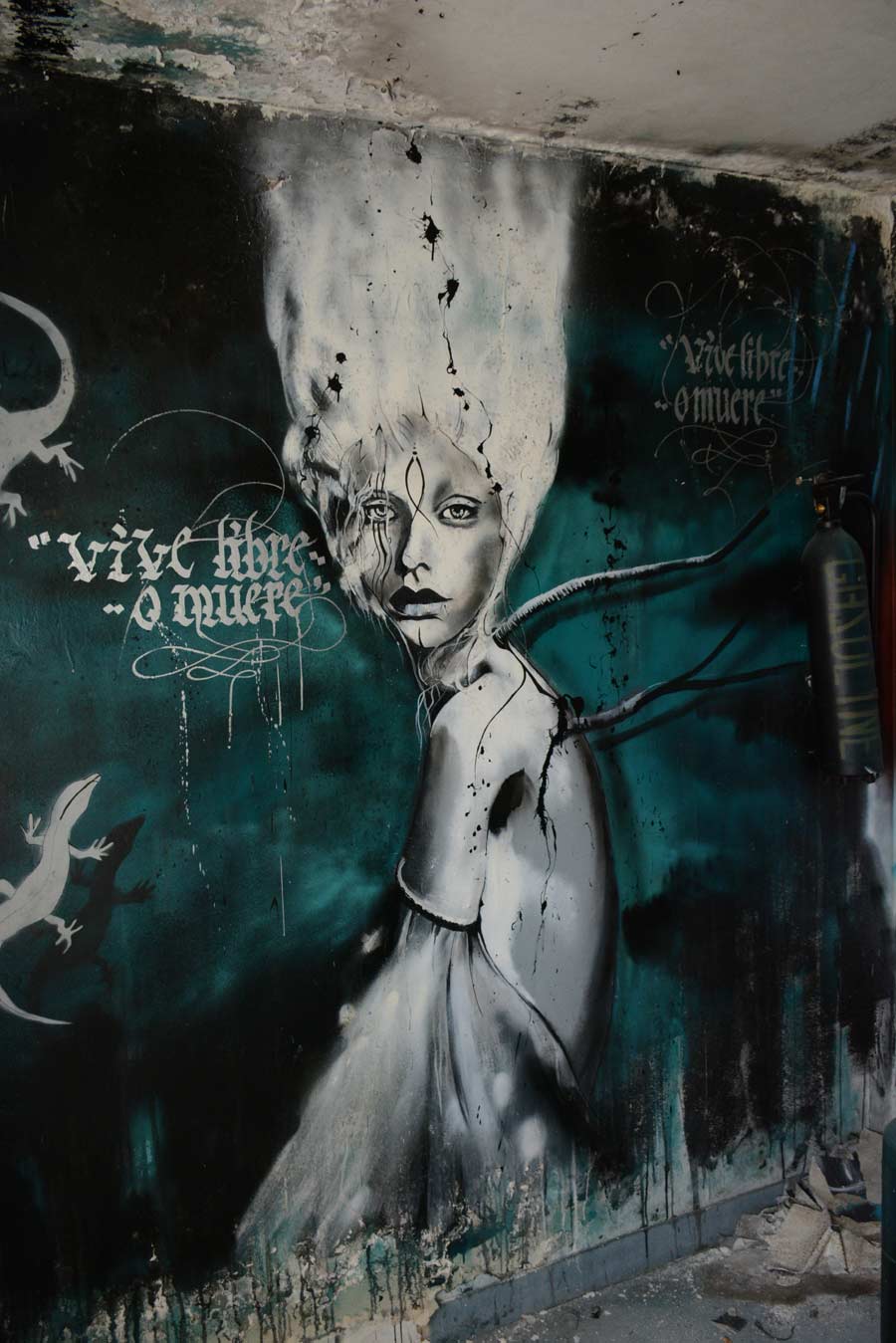
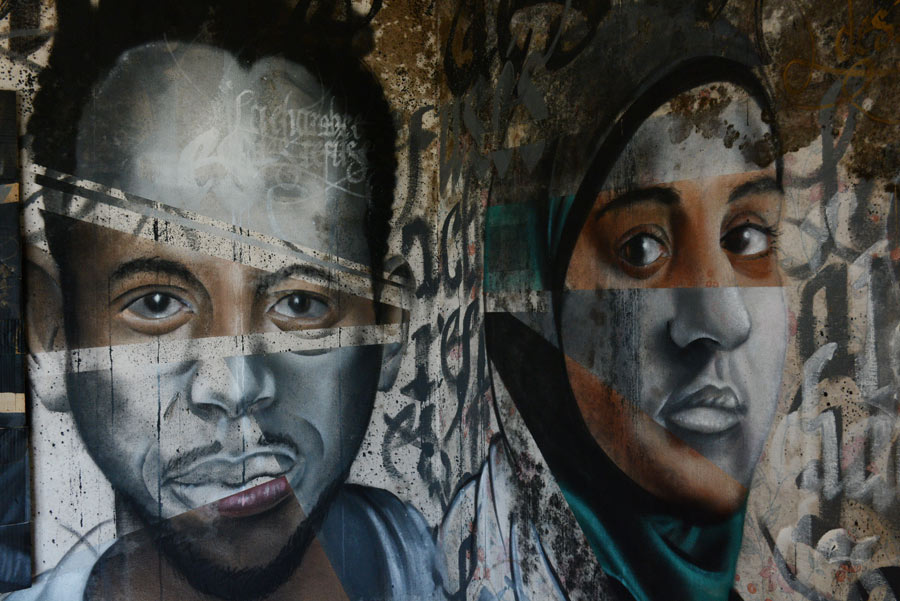
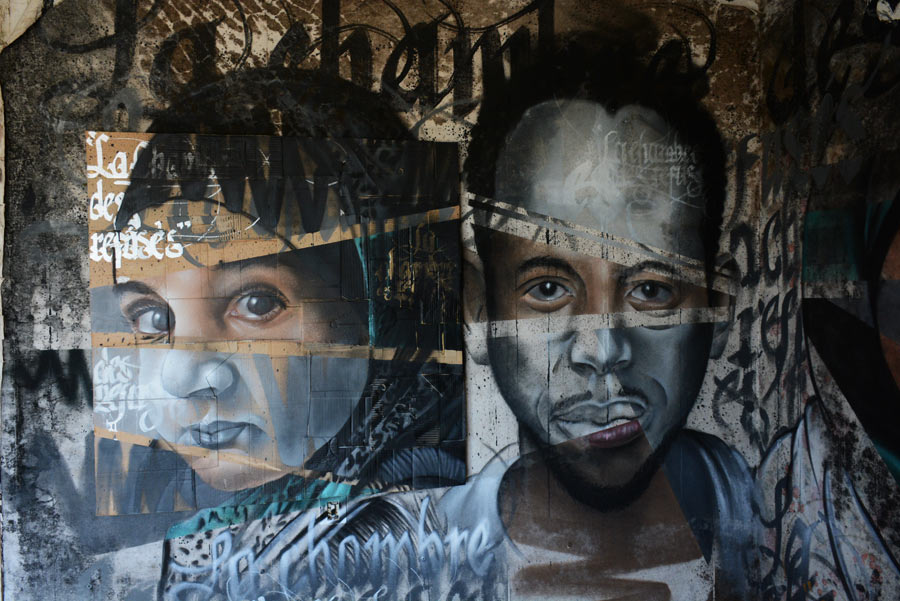
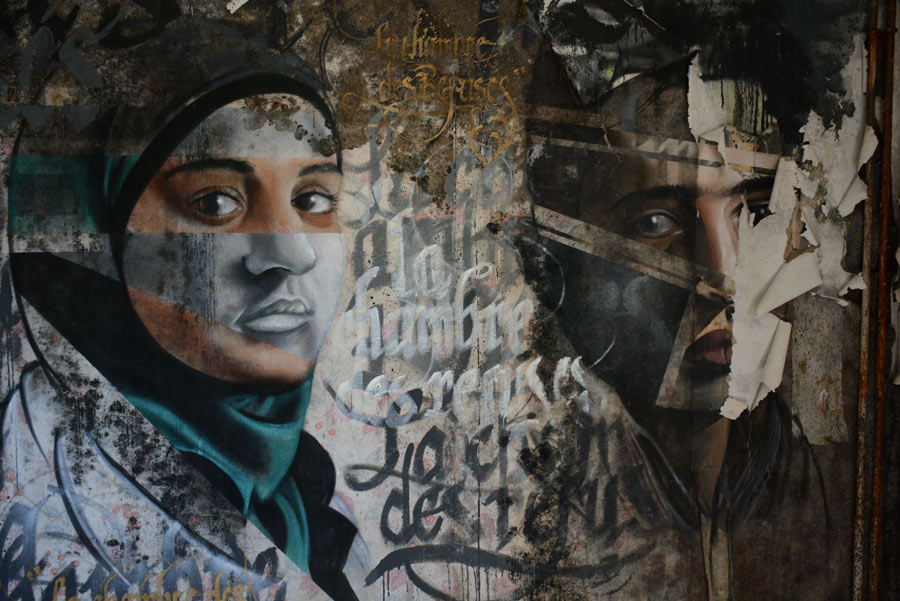
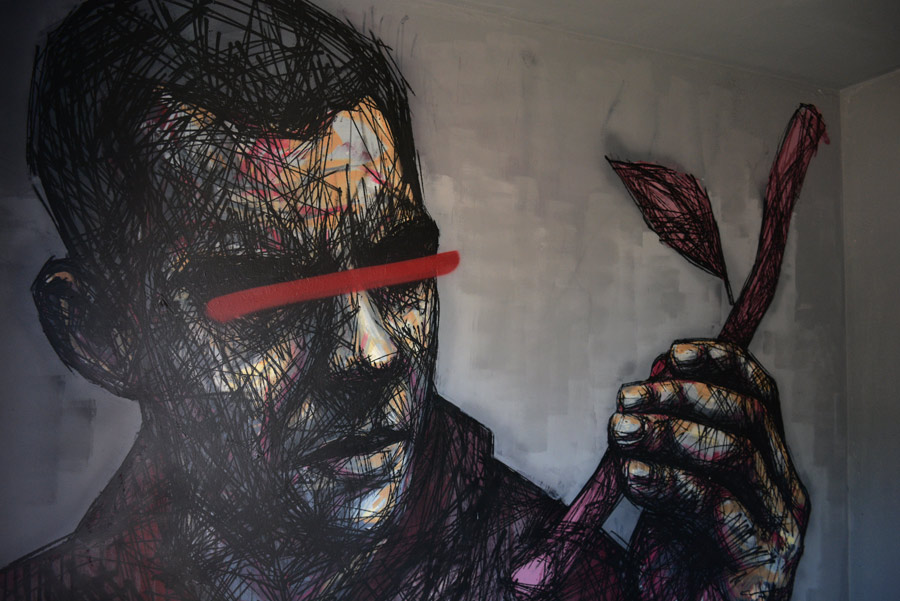
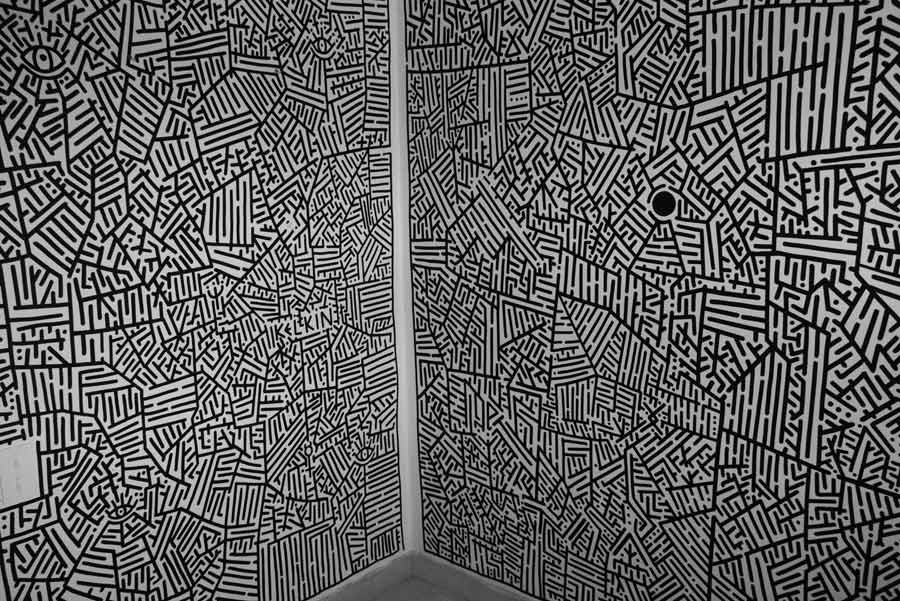
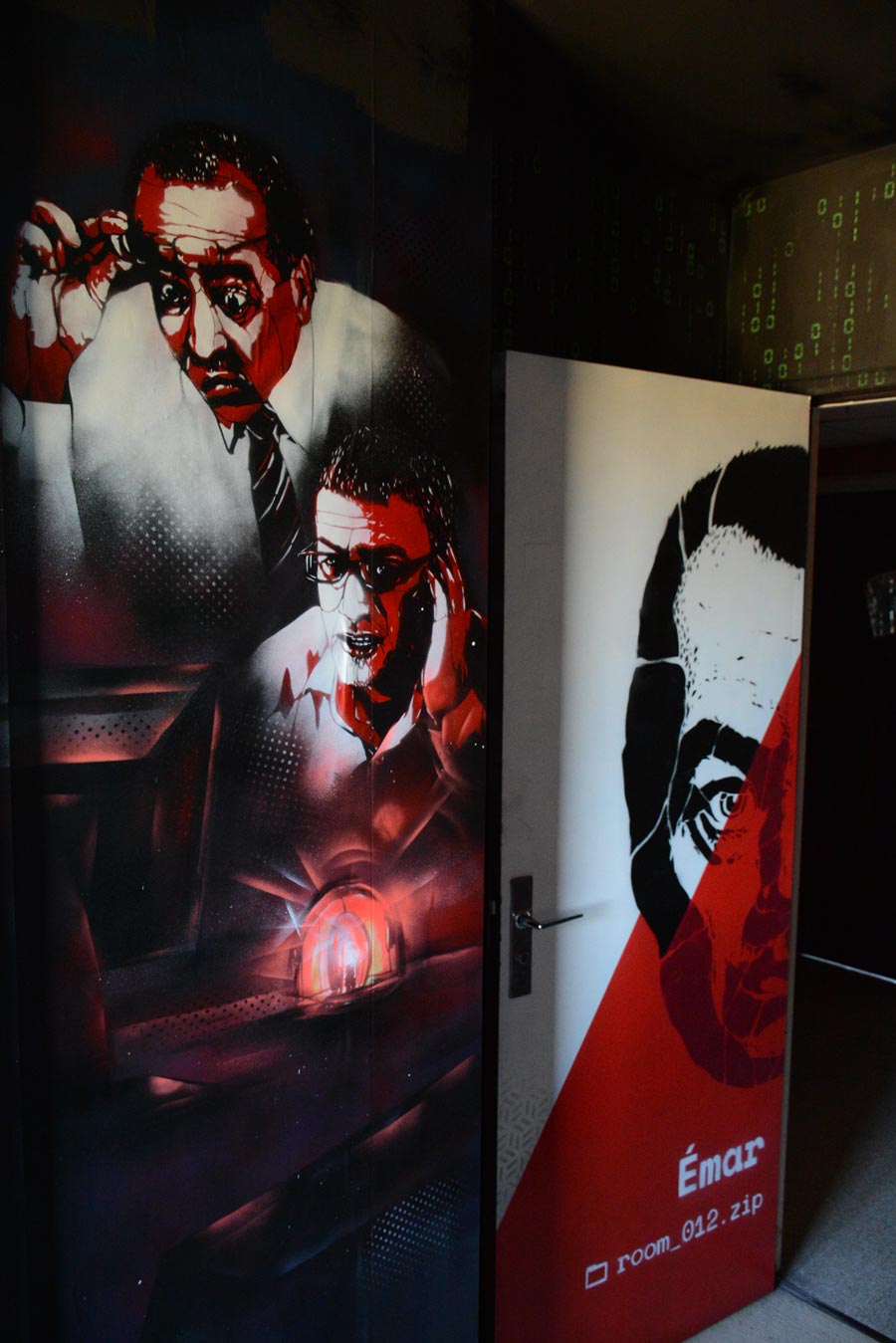
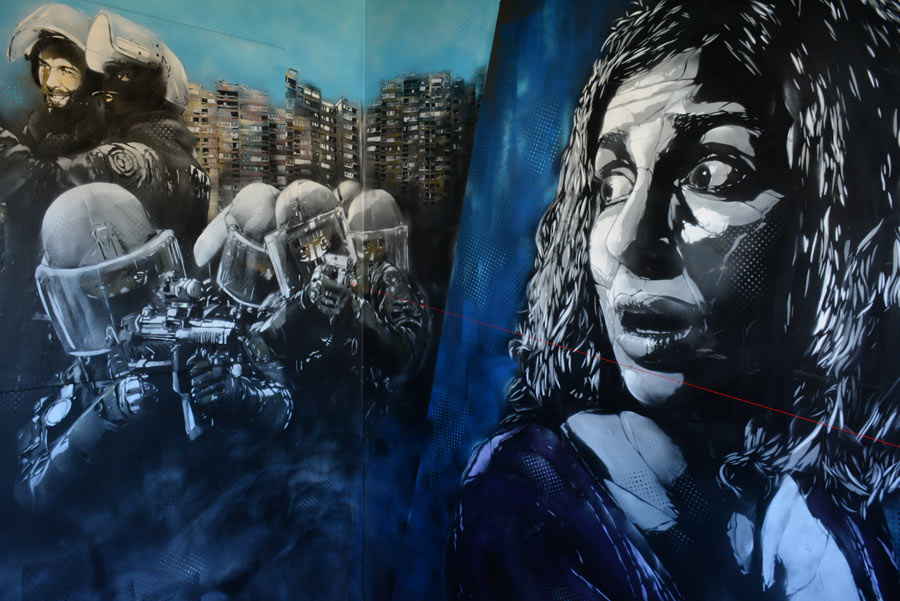
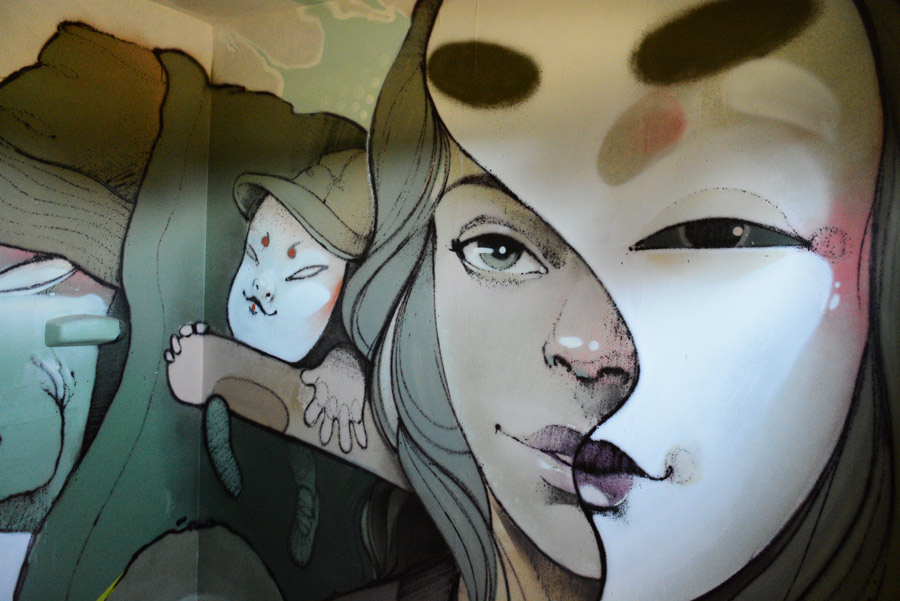
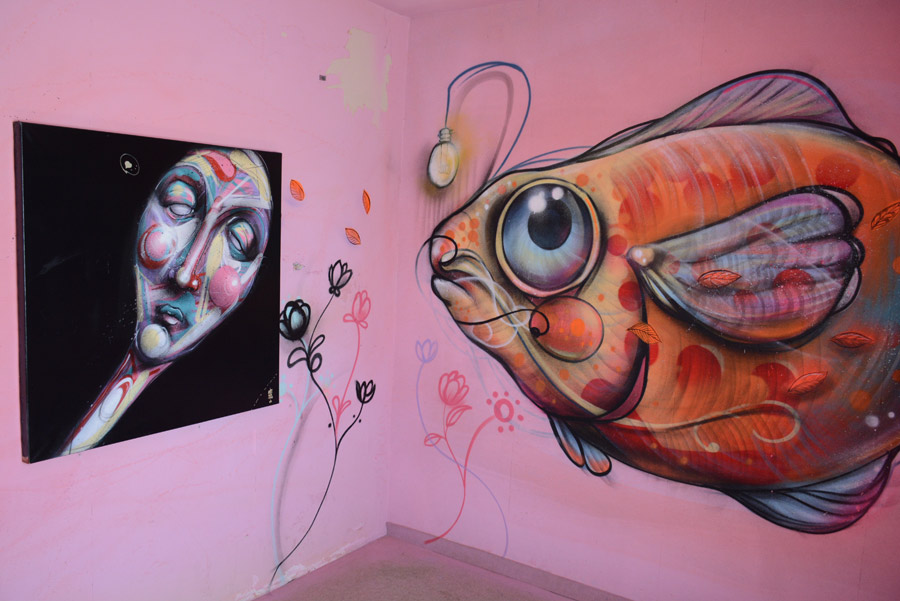
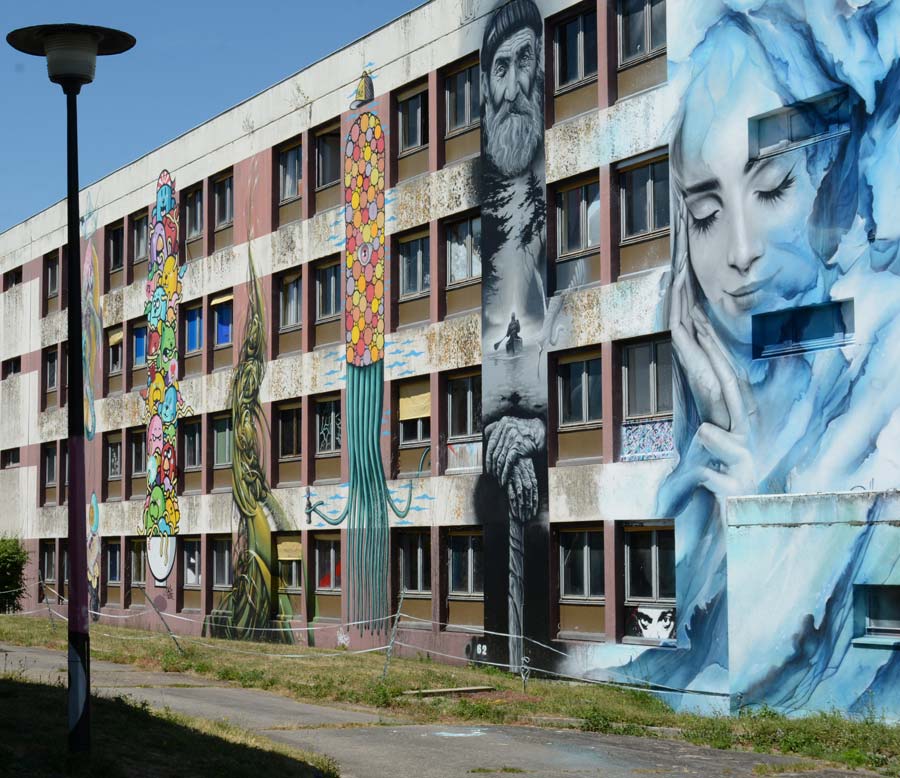
The 4-story building, 14 meters high, 53 meters long, 11 meters wide, is home to 128 rooms – thus the name. A derelict structure reserved for fulsome installations all individually painted by an international roster of artists invited in residency to paint by the co-founders Gilles and Sylvie.
Paid tours are
available, artists are invited, and some programming happens on the grounds
just to keep the conditions of the property cared for. Unlike many “artist
takeover” buildings, none of these are slotted for destruction any time soon,
so the artists are going to continue to explore their ideas for the foreseeable
future and you are welcome to check-in anytime.
Here are some detail
shots from a selection of rooms from BSA contributor Lluis Olive Bulbena.
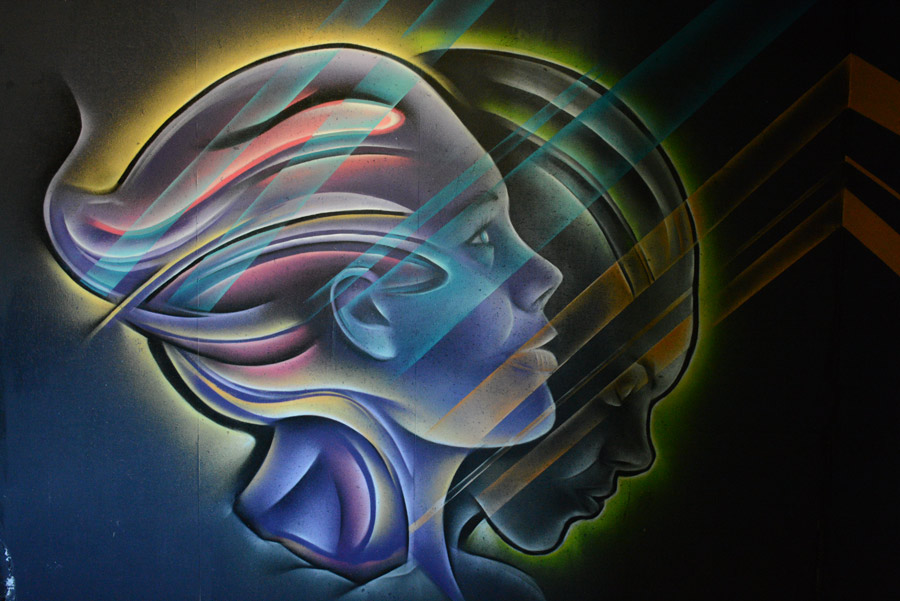
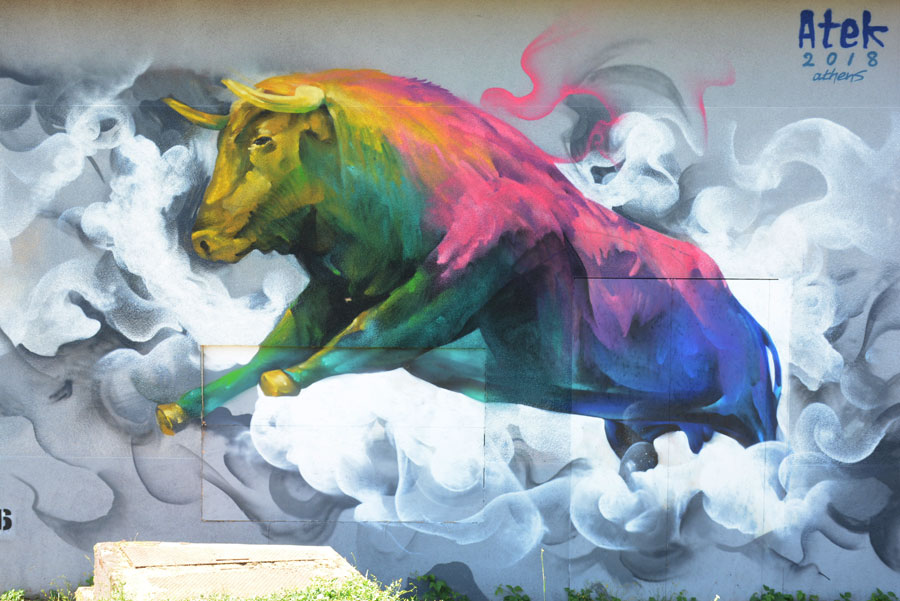
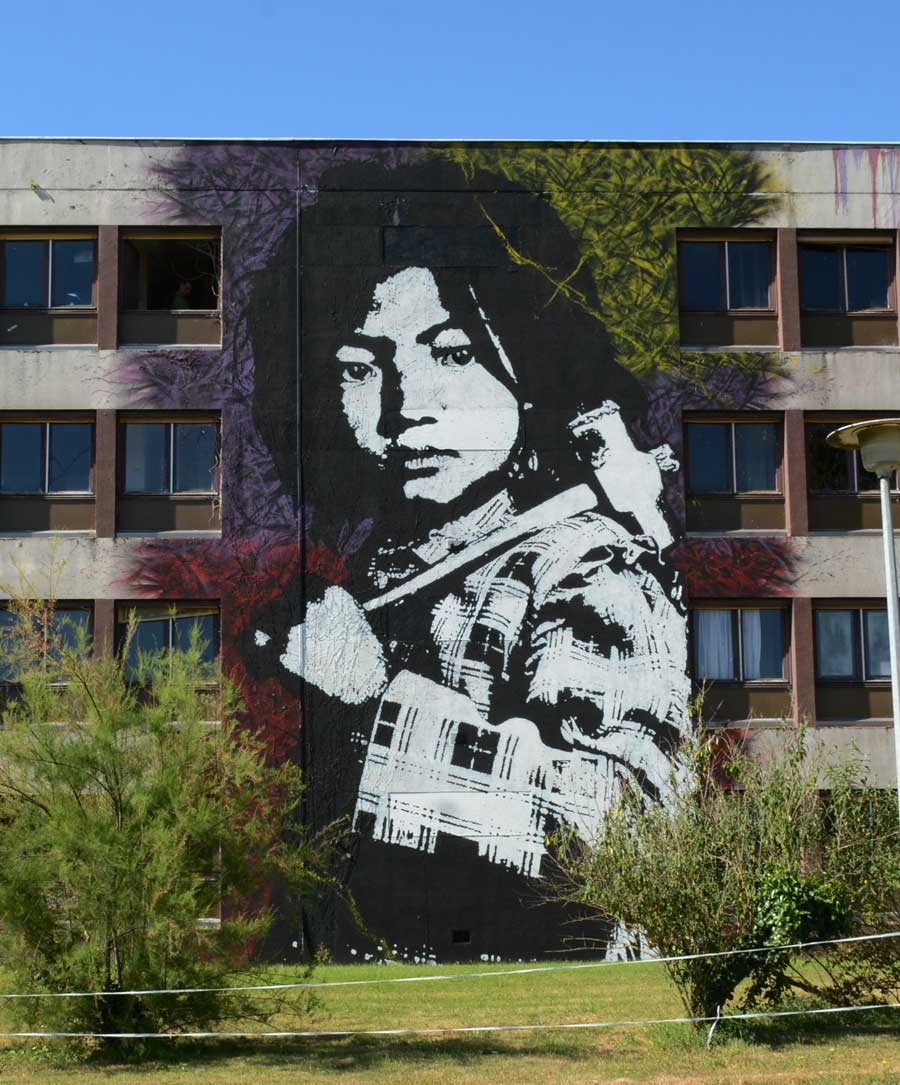
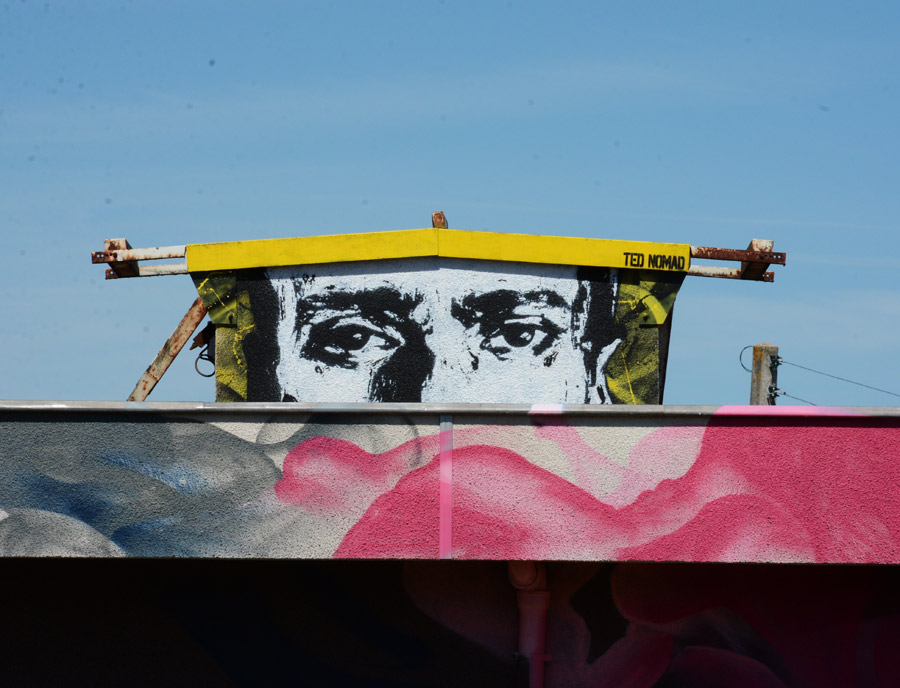
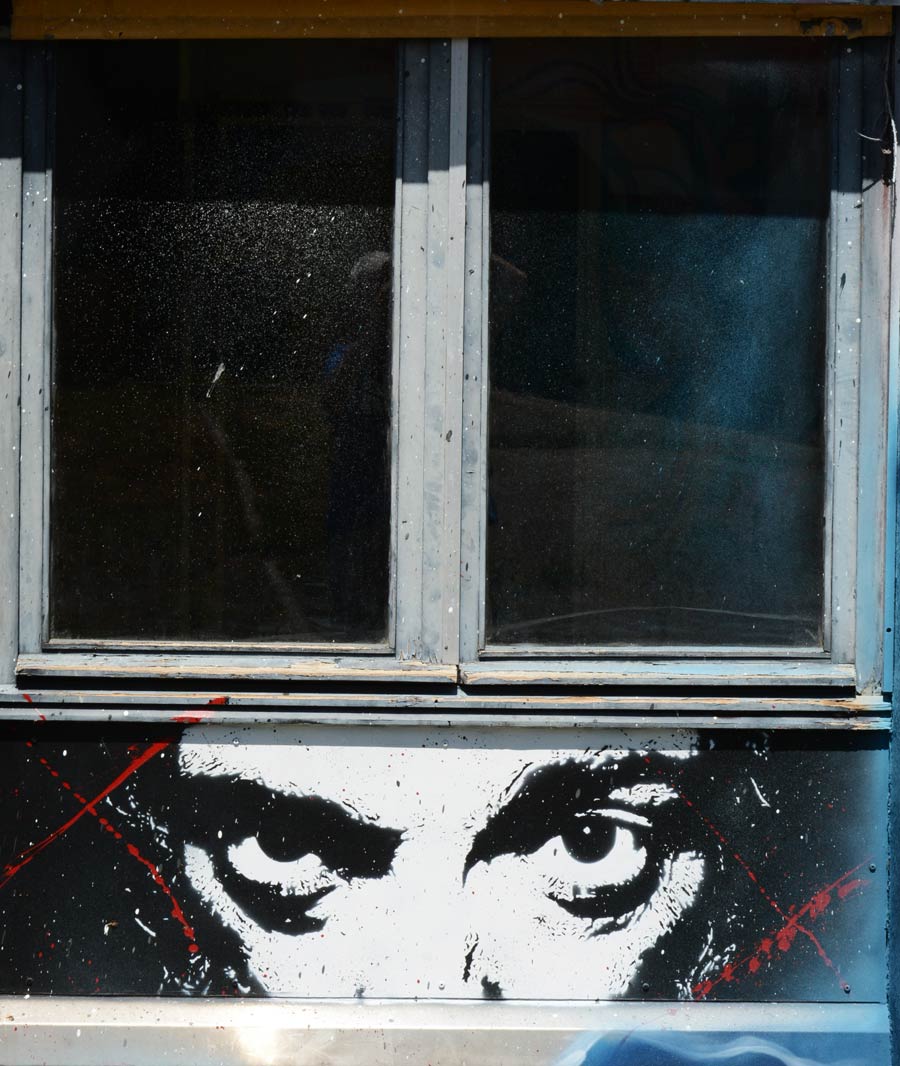
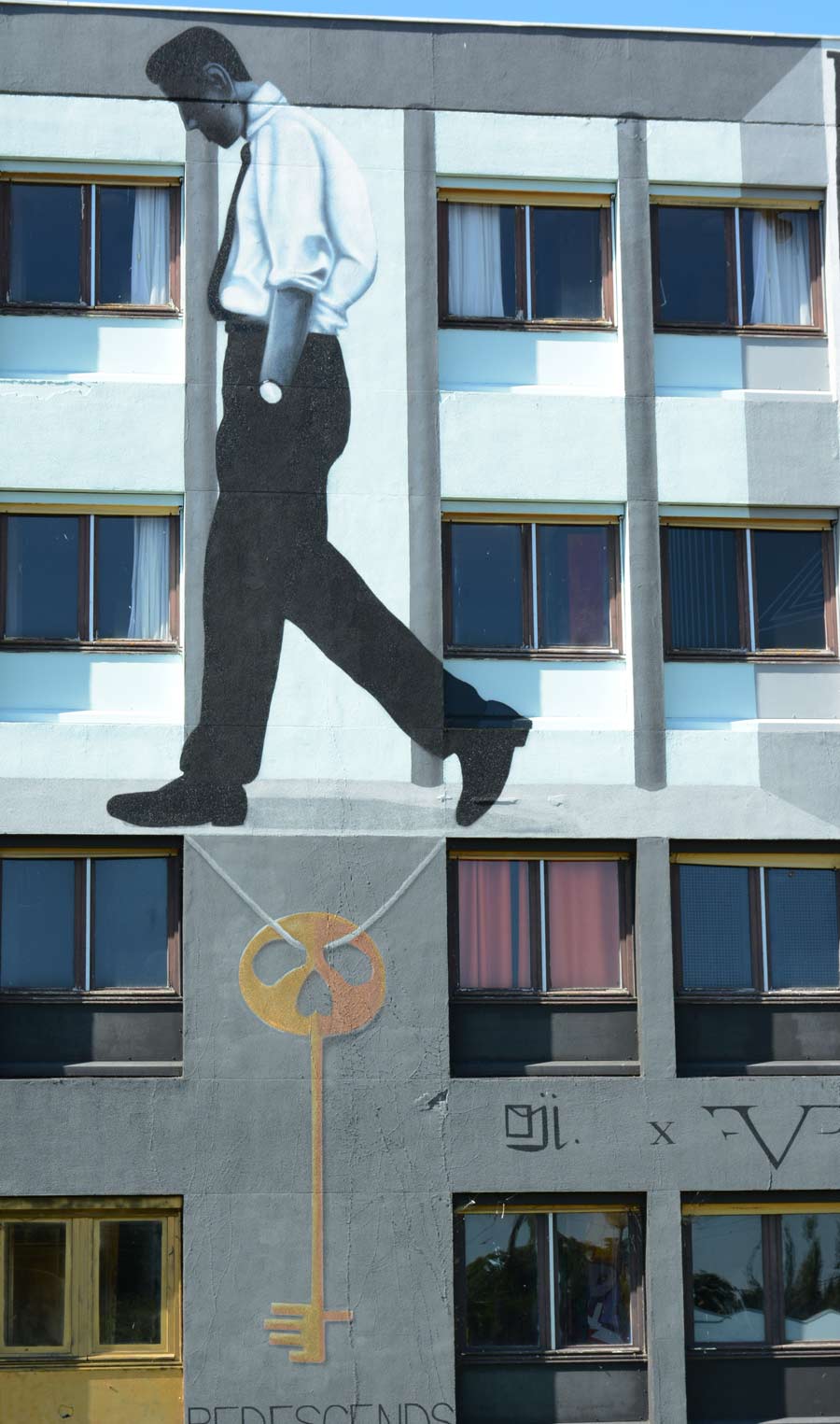
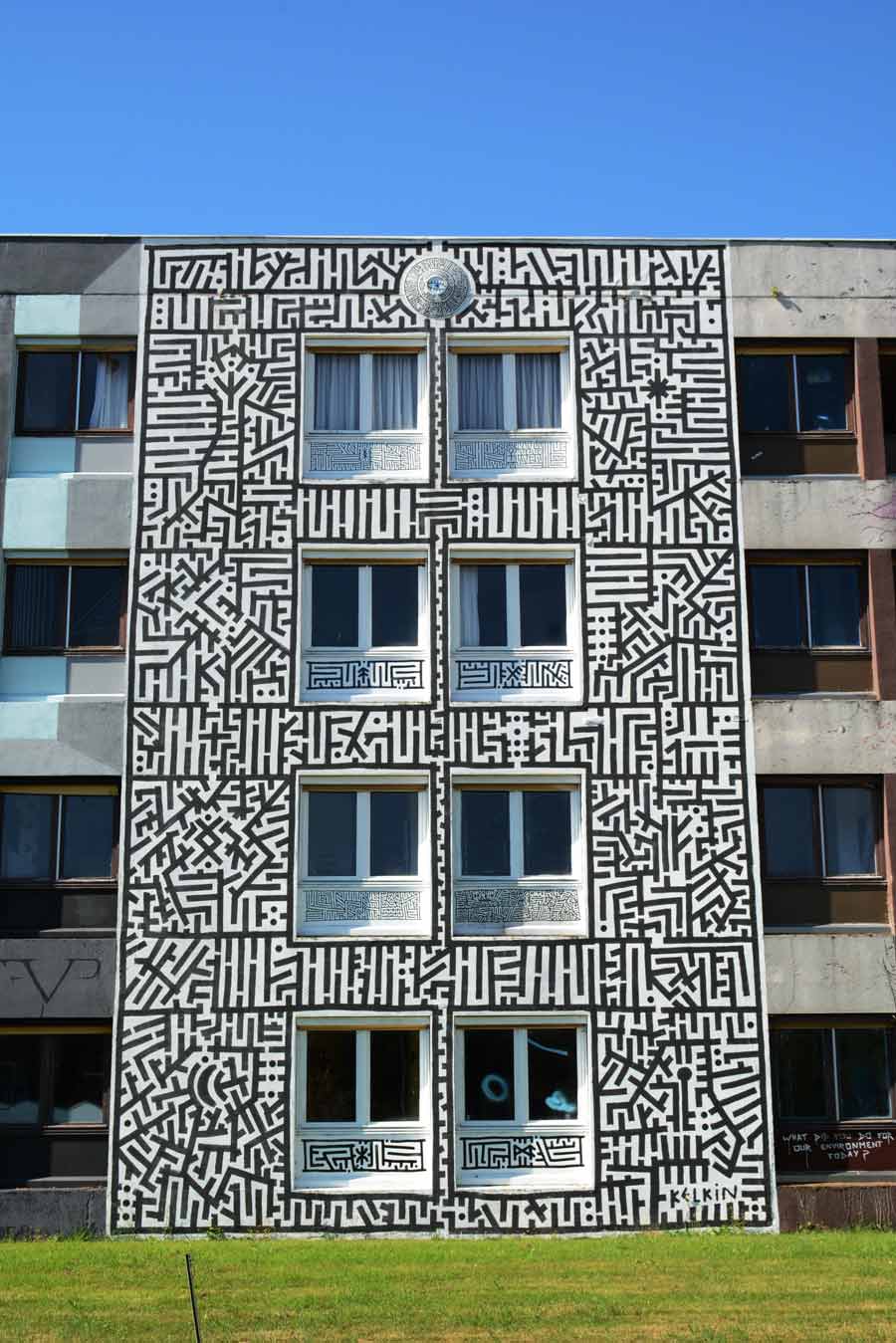
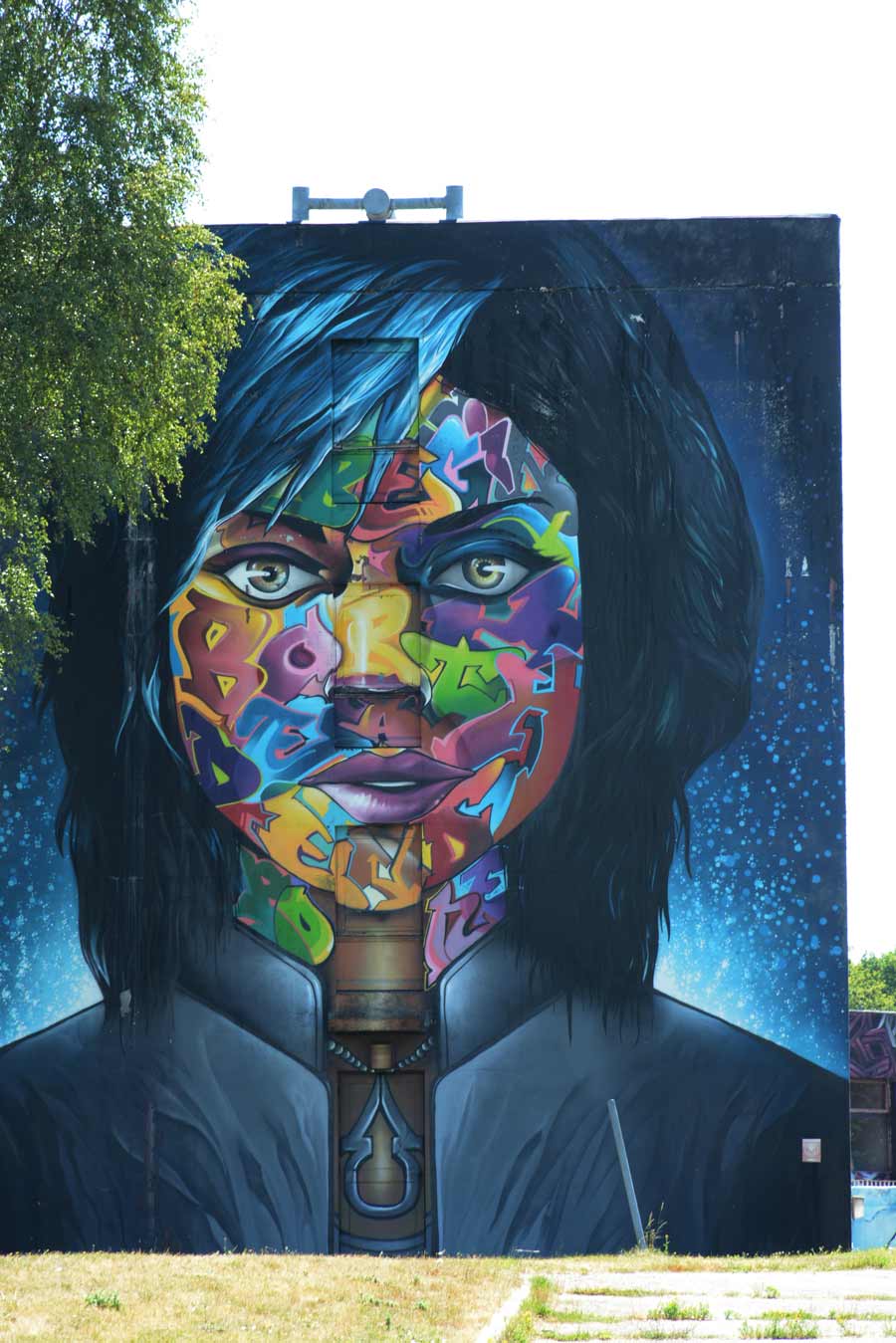
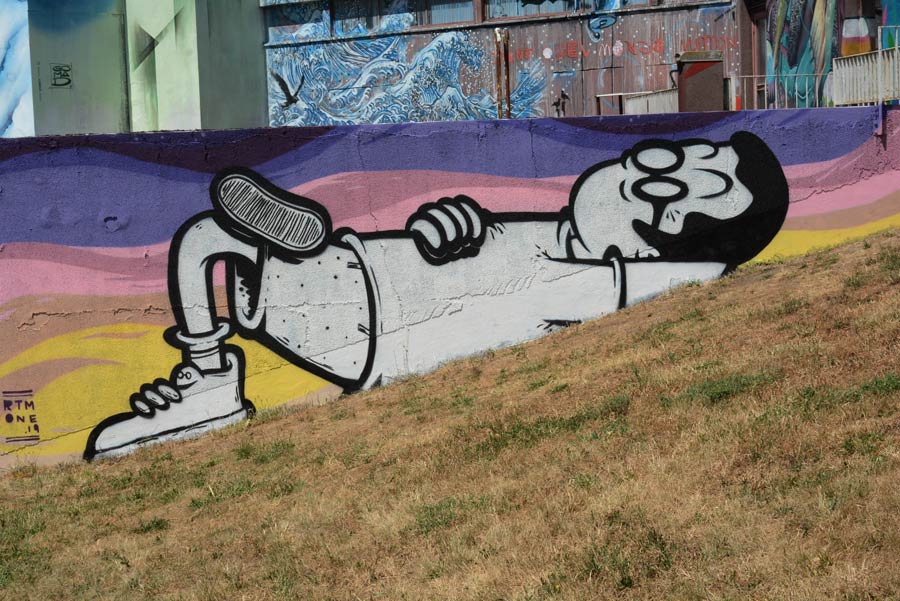
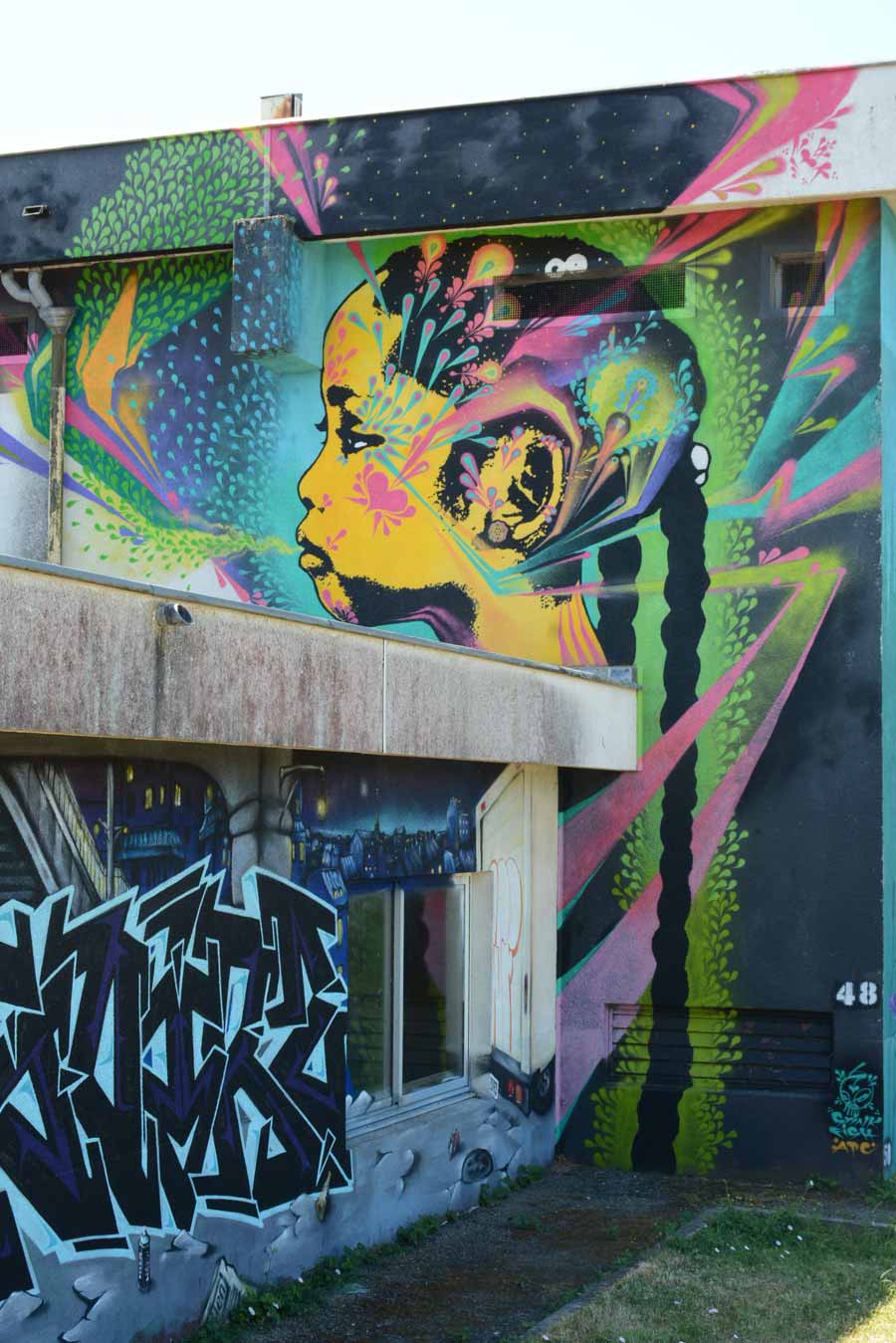
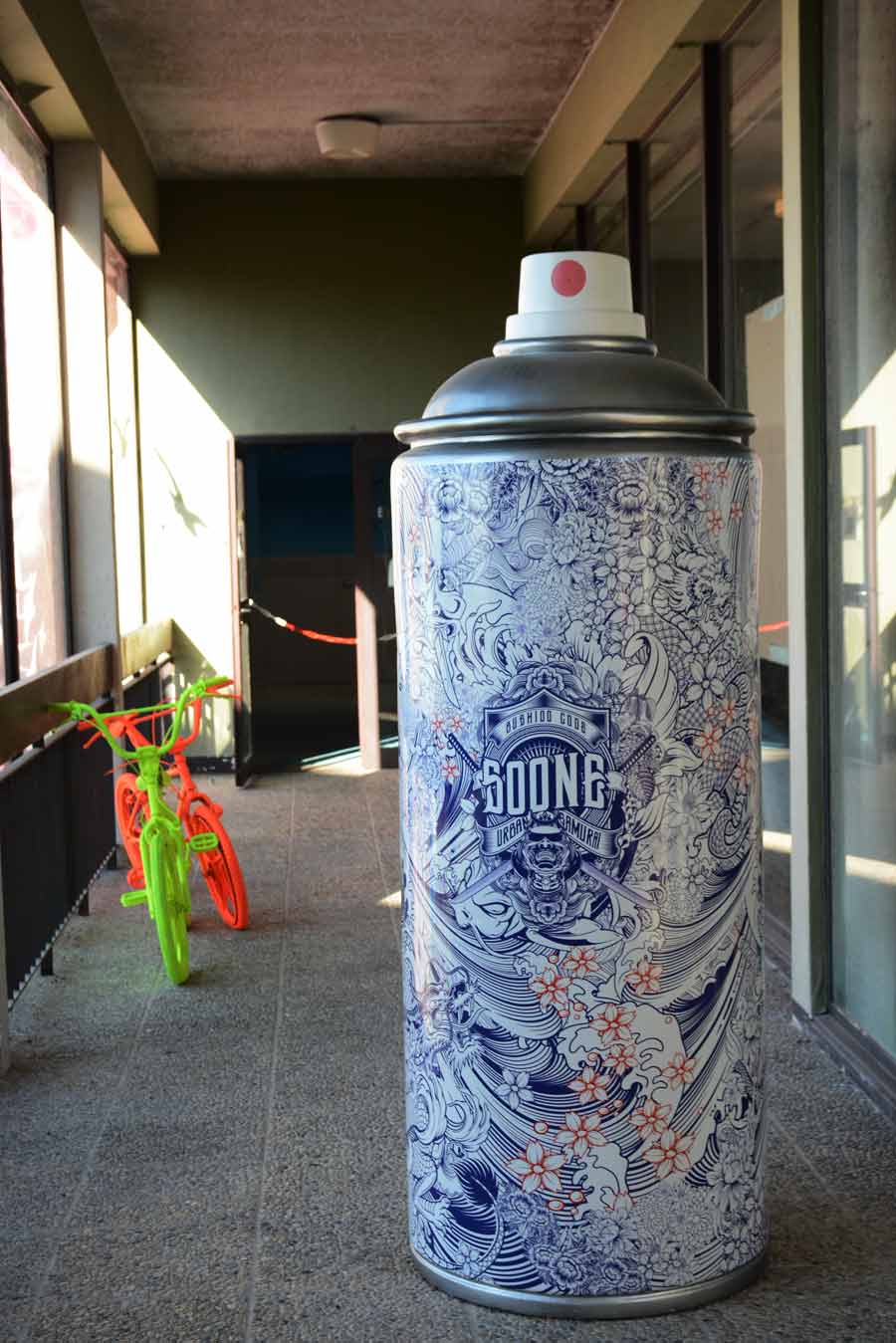
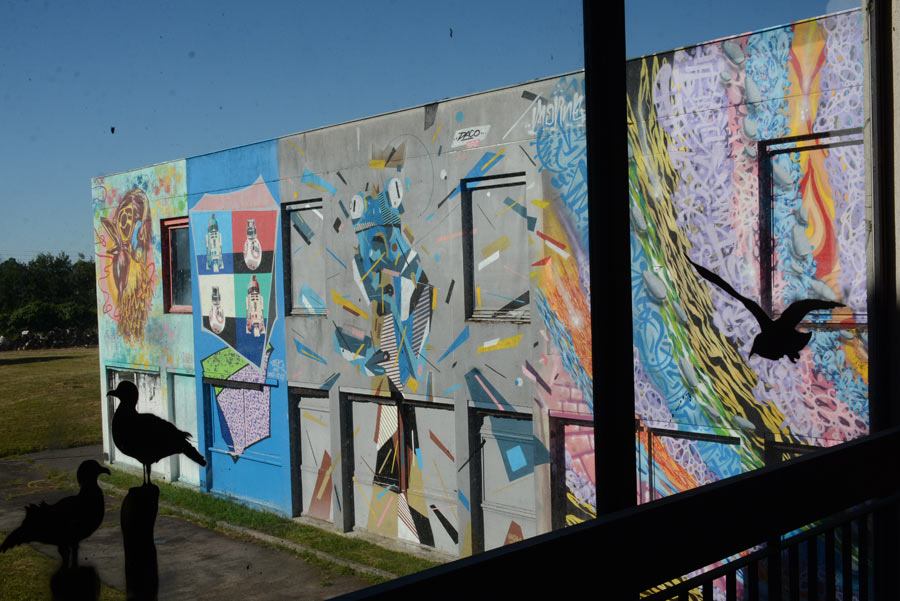
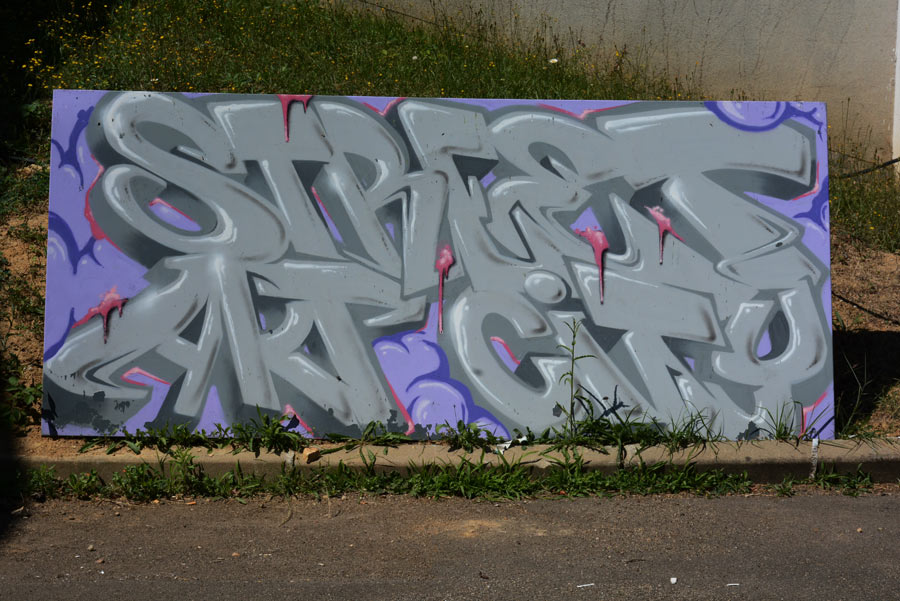
Summertime spray-cations are as popular for the jet-setting aerosol explorer as much as your local graffiti and Street Artist. Grabbing your bicycle, taking a bus, or simply hiking with a backpack full of cans, many writers make a full day of it, or decide to camp out at the abandoned factory, hanging with friends and listening to music.
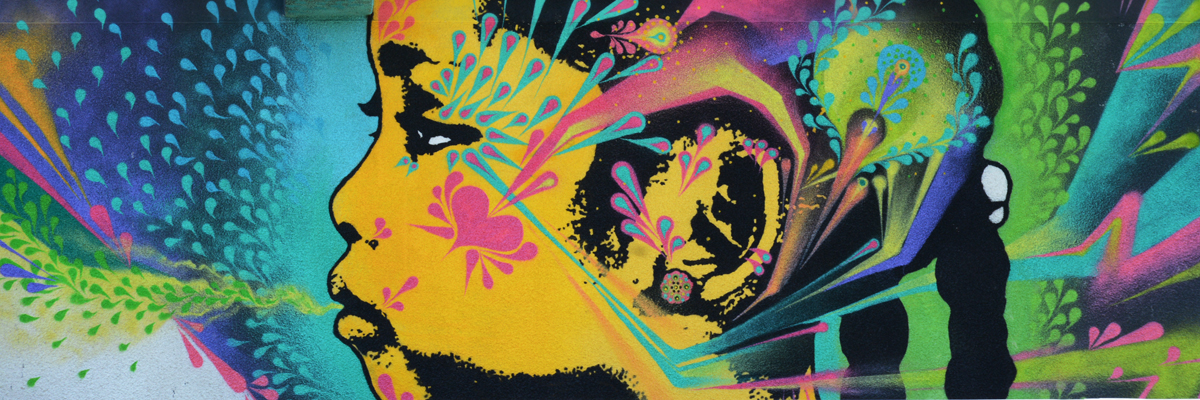
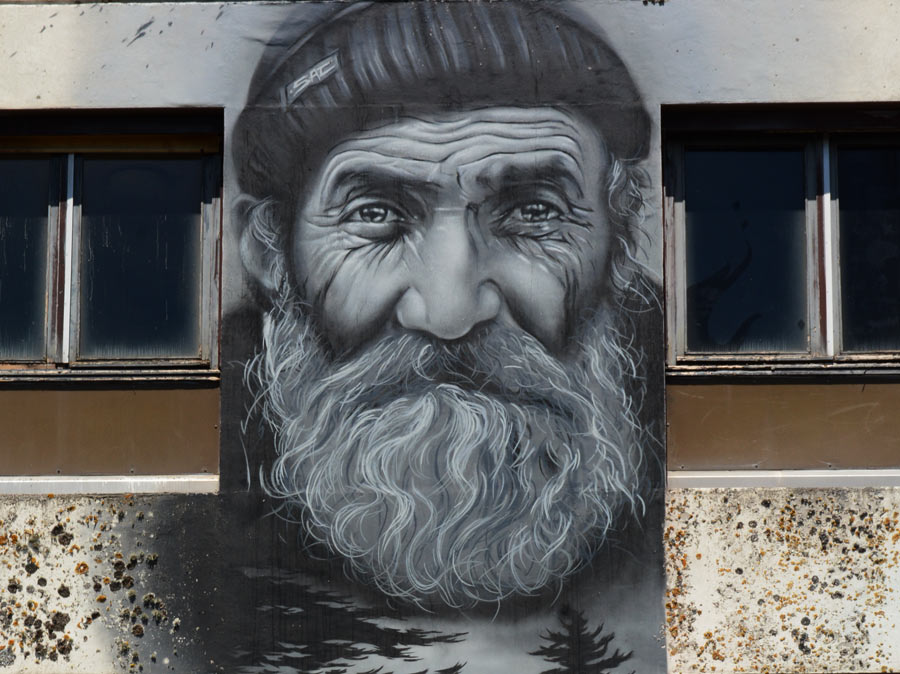
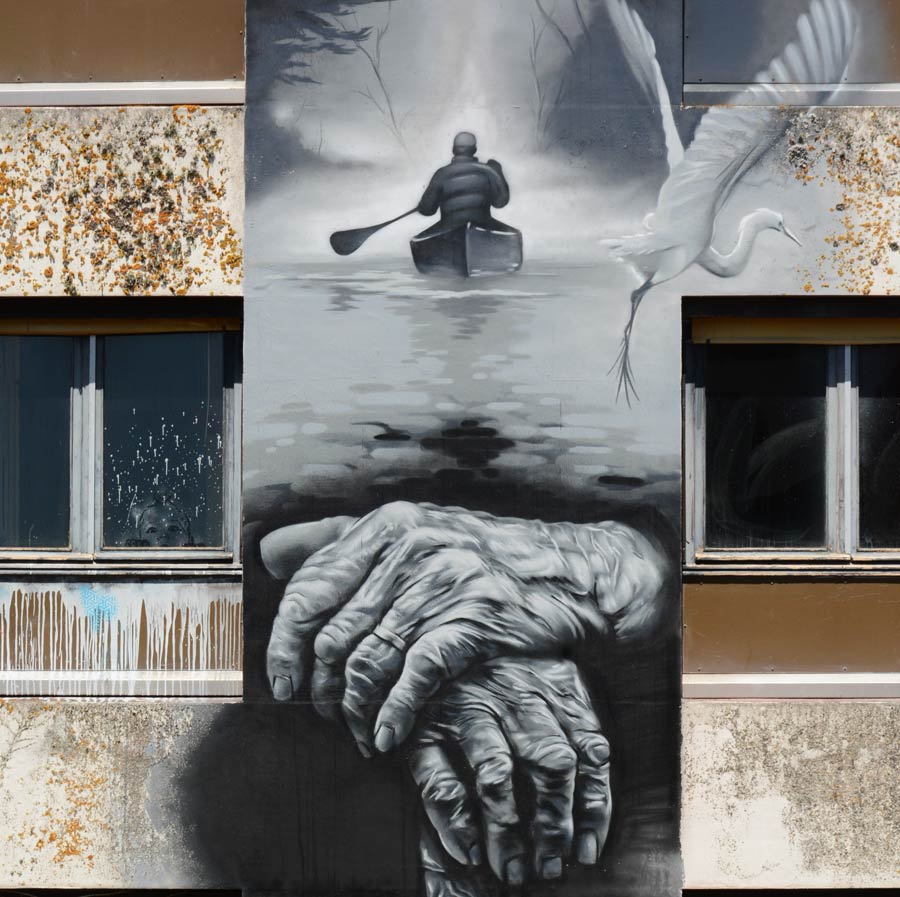
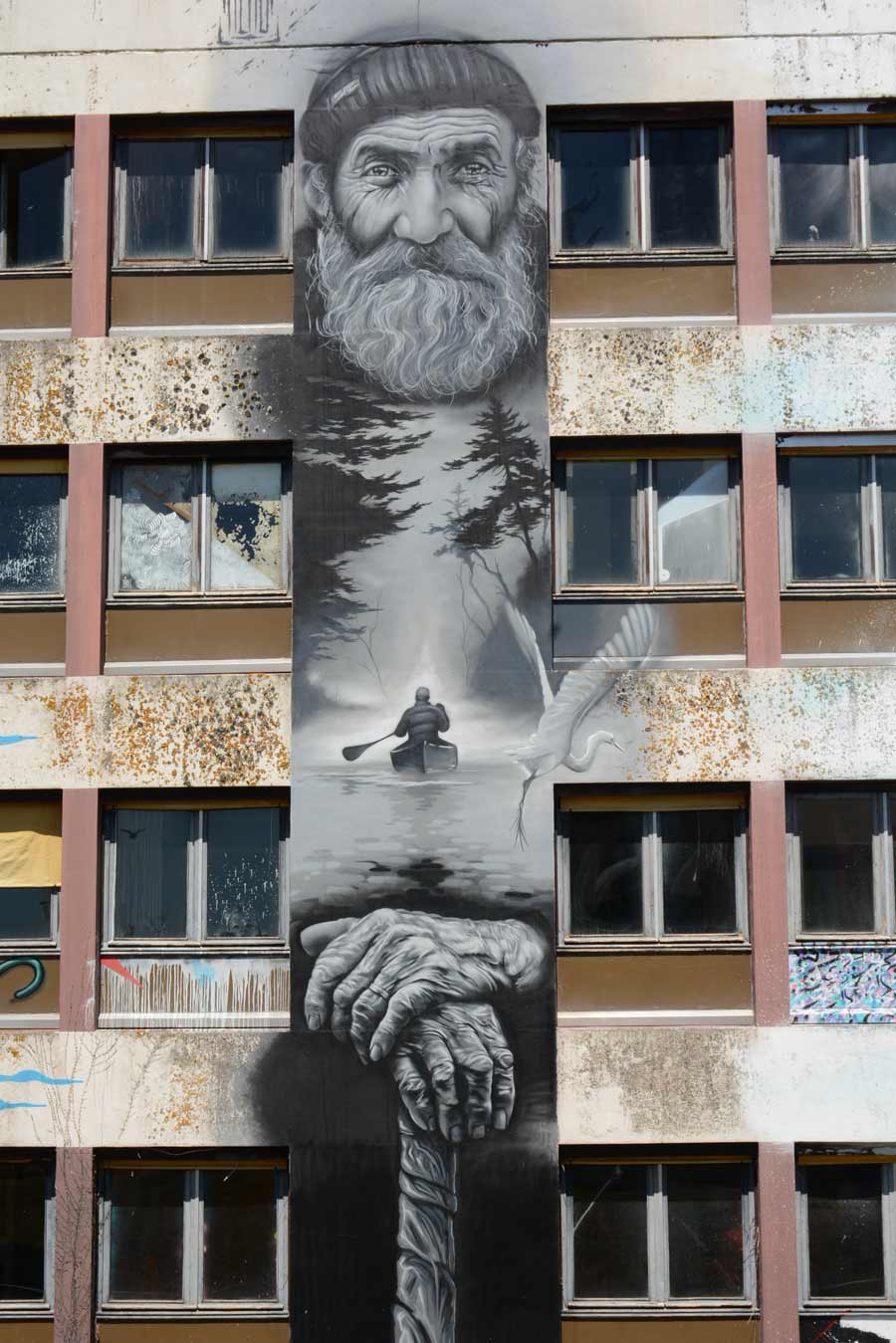
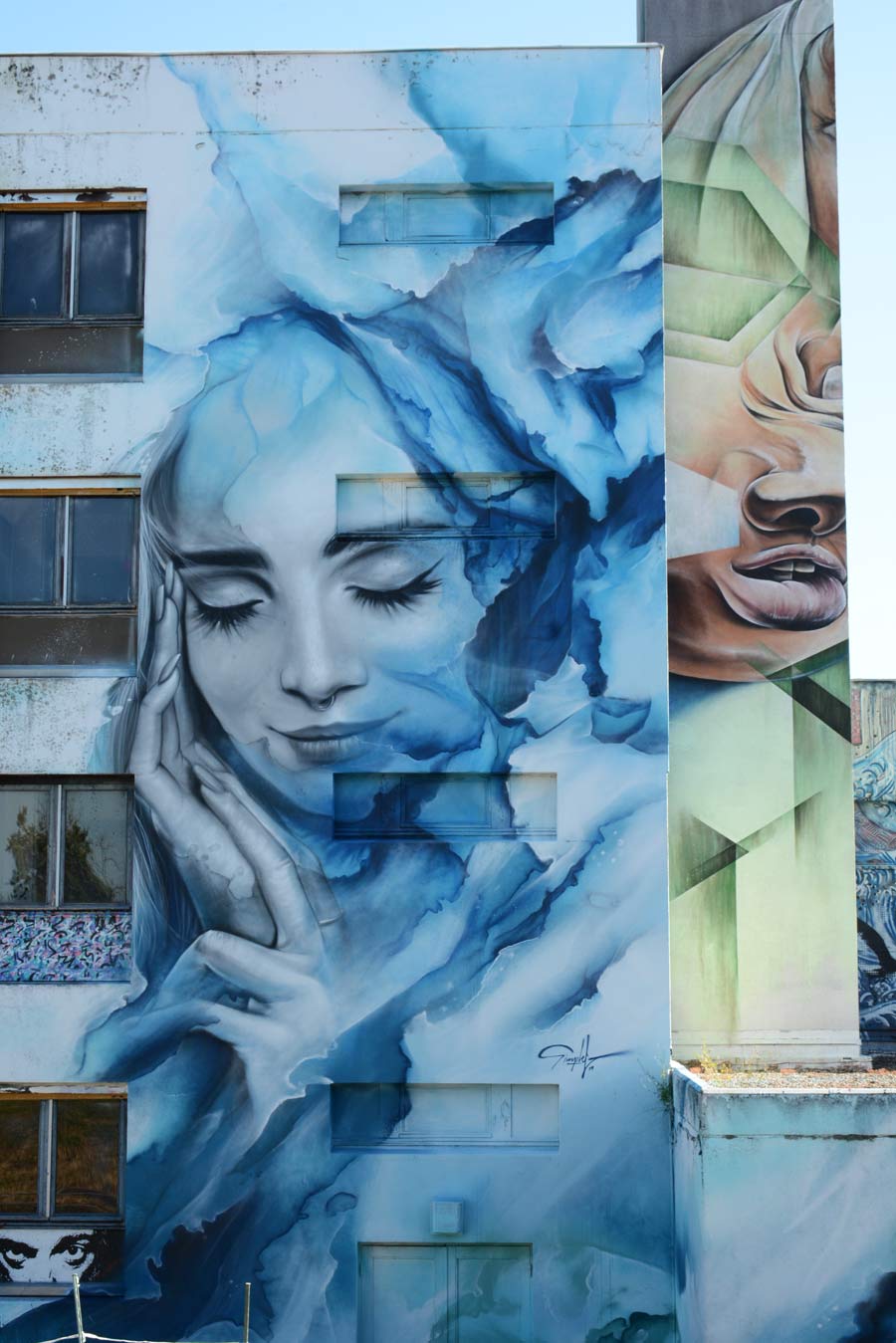
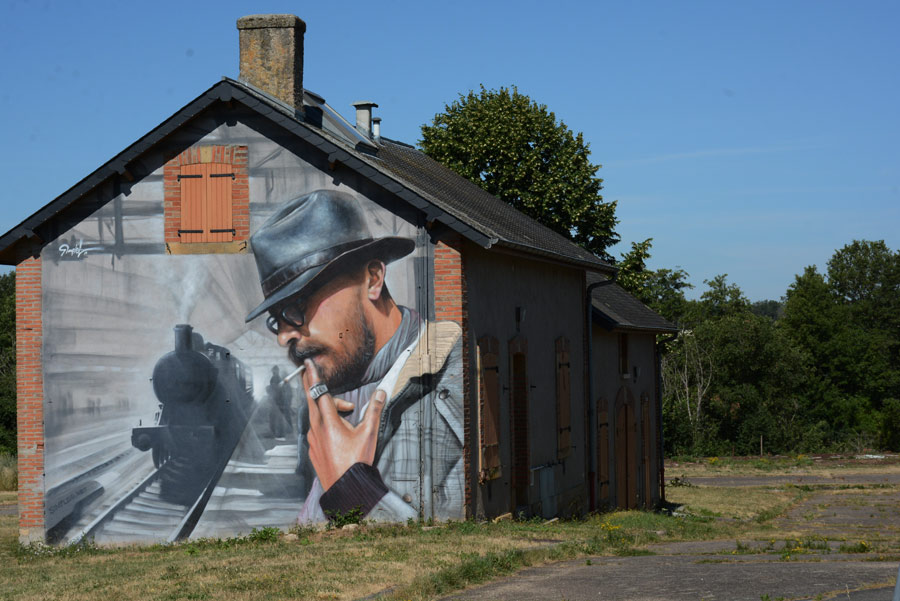
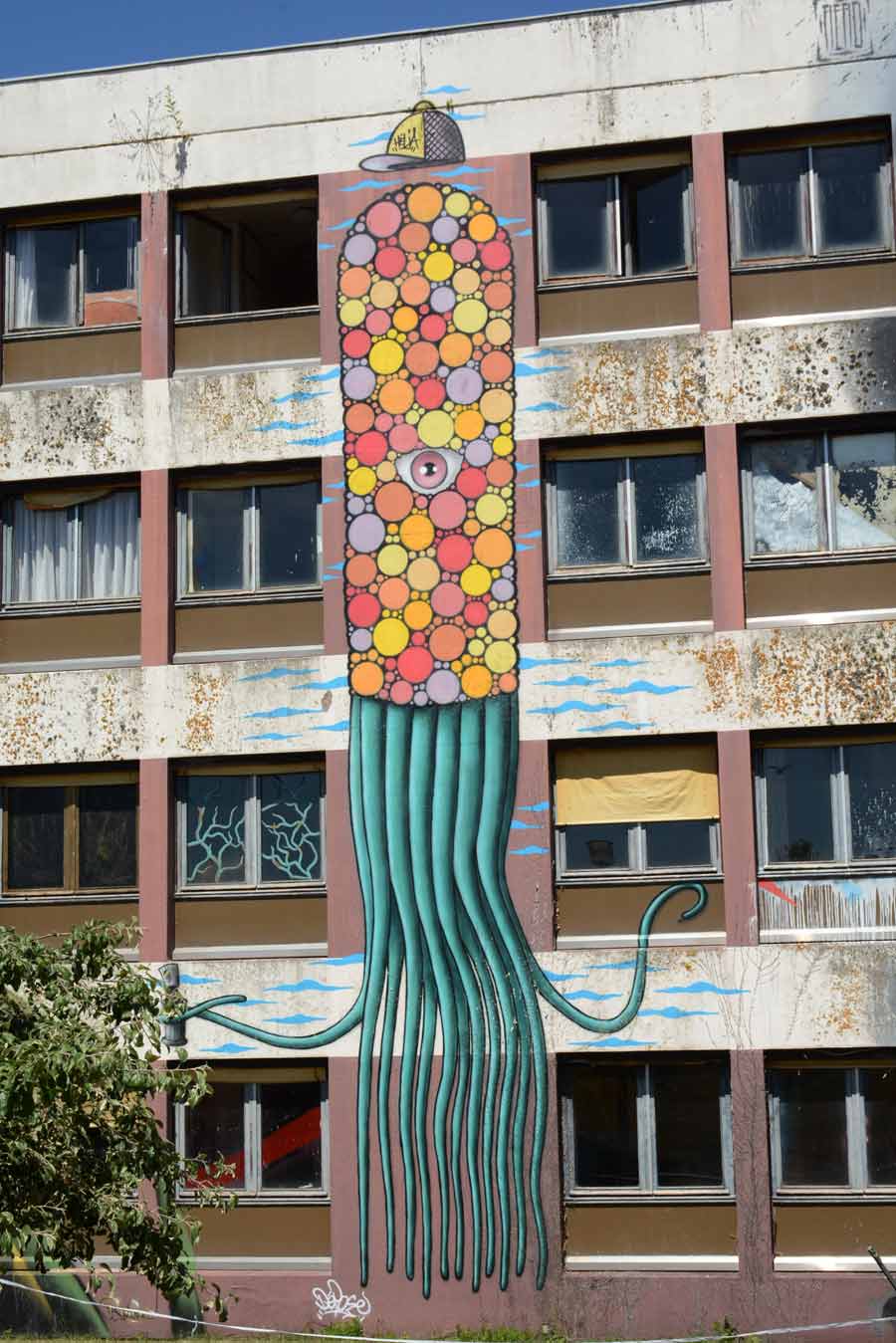
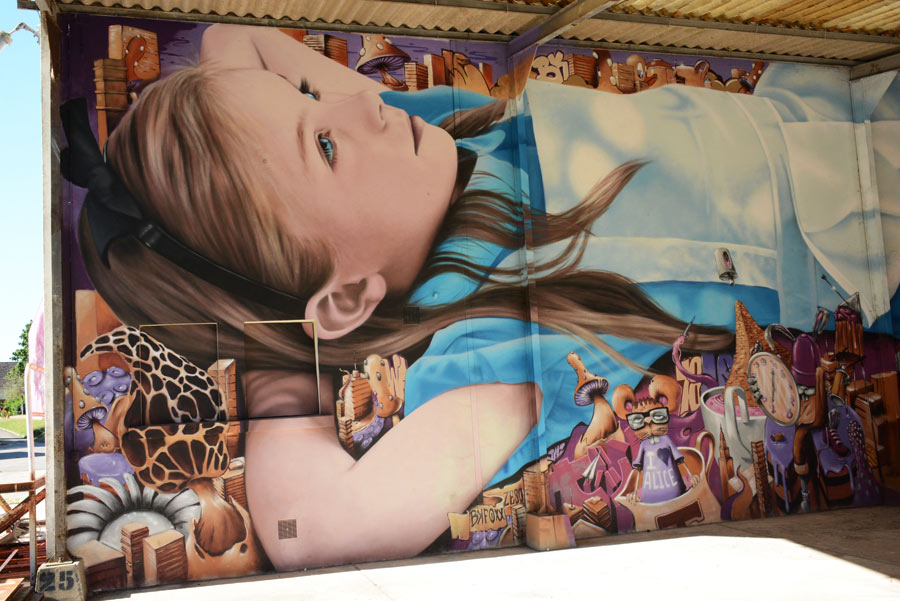
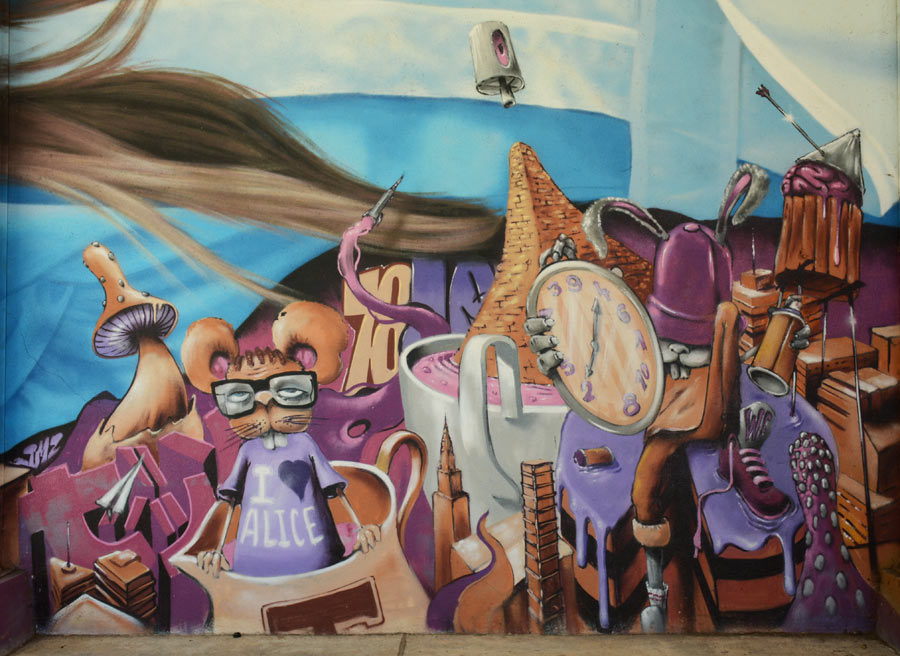
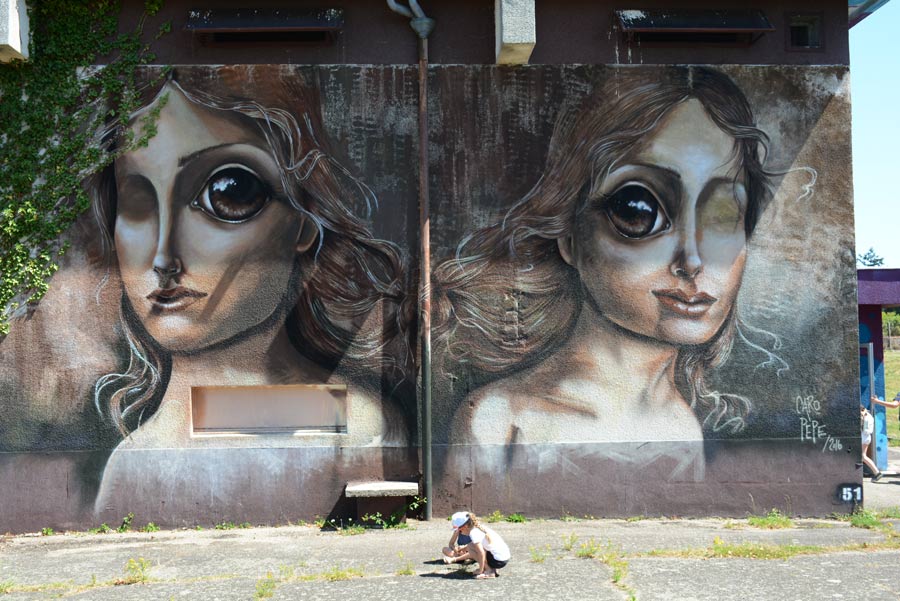
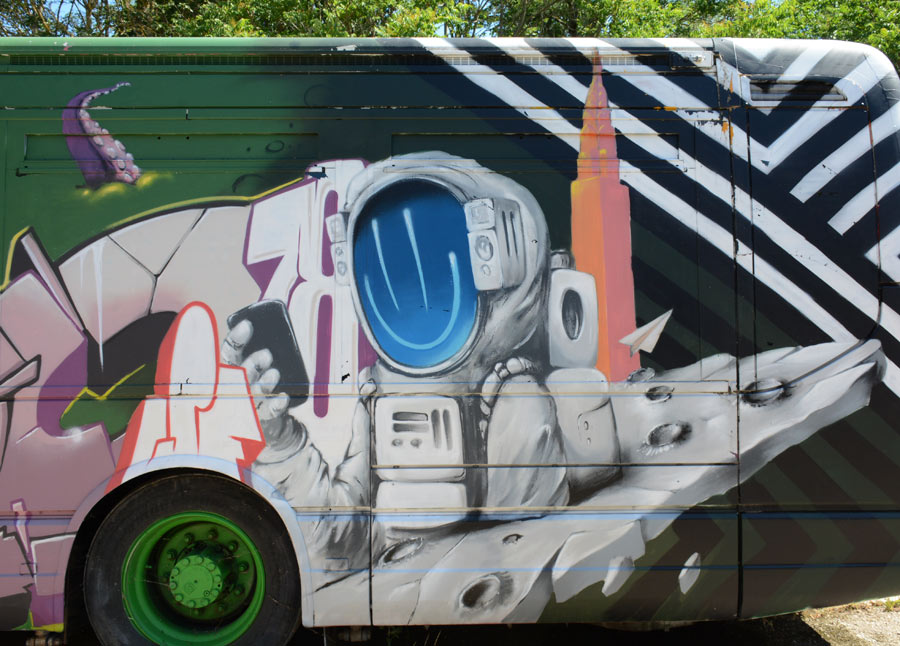
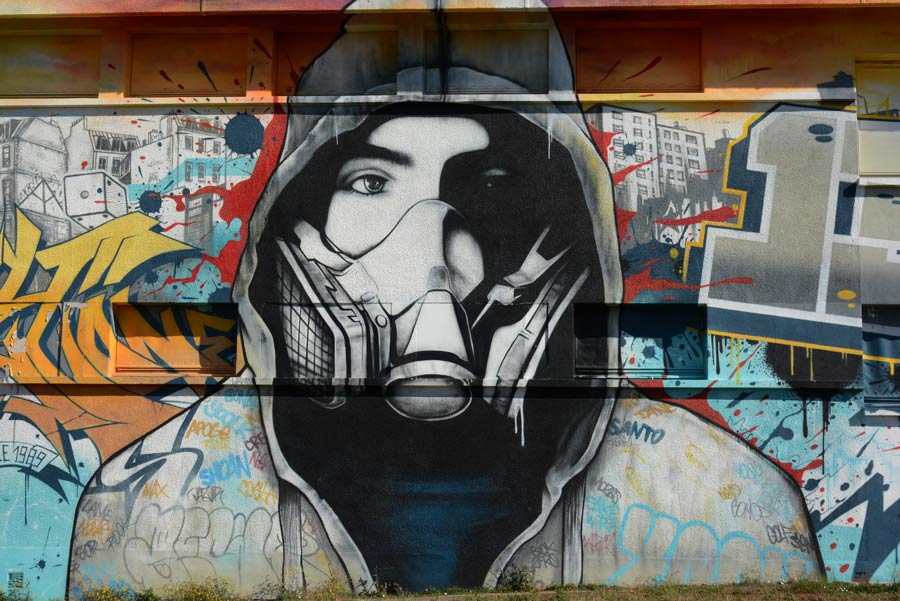
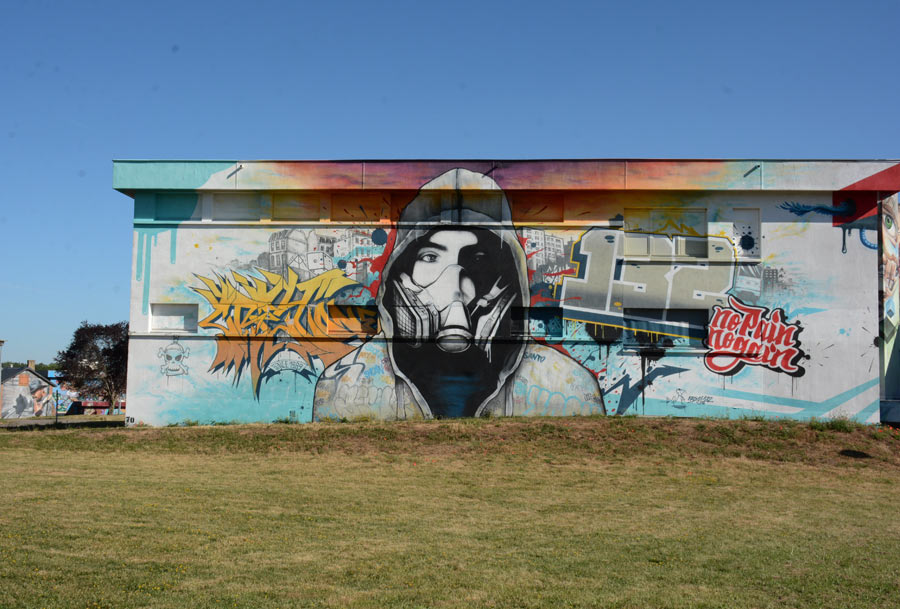
For a photographer of Street Art and murals, its possibly just as much entertainment – just ask BSA contributor, Lluis Olive Bulbena. On vacation with his wife and grandkids between Lyon and Clemont Ferrant (about 250 km south of Paris) he discovered a compound filled with new paintings on the commune of lurcy-Lévis. Informally known as Street Art City, the project is the brainchild of Gilles Iniesta and features hundreds of works on facades out in the open and others in hidden locations – including many who have made the pilgrimage to leave their marks on the walls or inside the dilapidated rooms of Hotel 128 (more about the hotel tomorrow). .Thanks to some good crops of visiting artists this summer, it looks like rural France has a good selection of painting styles to choose from this season.
 BROOKLYN STREET ART LOVES YOU MORE EVERY DAY