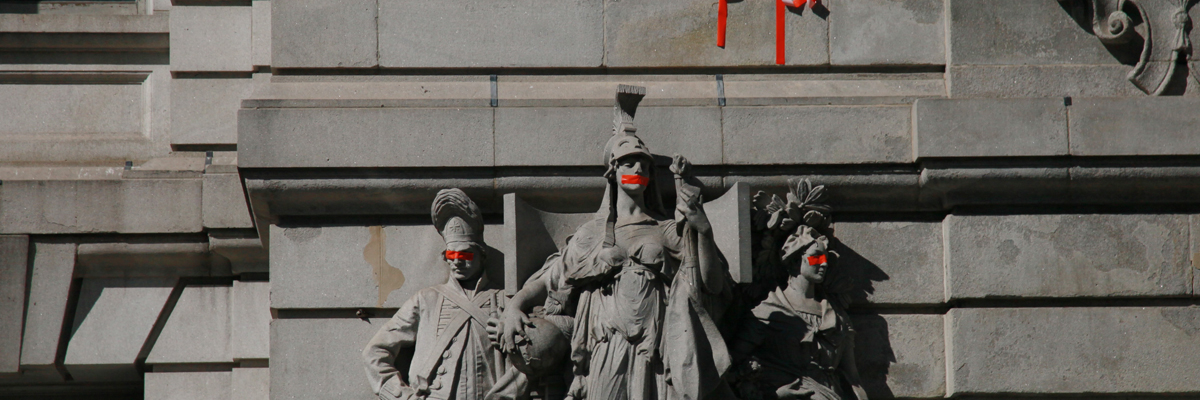
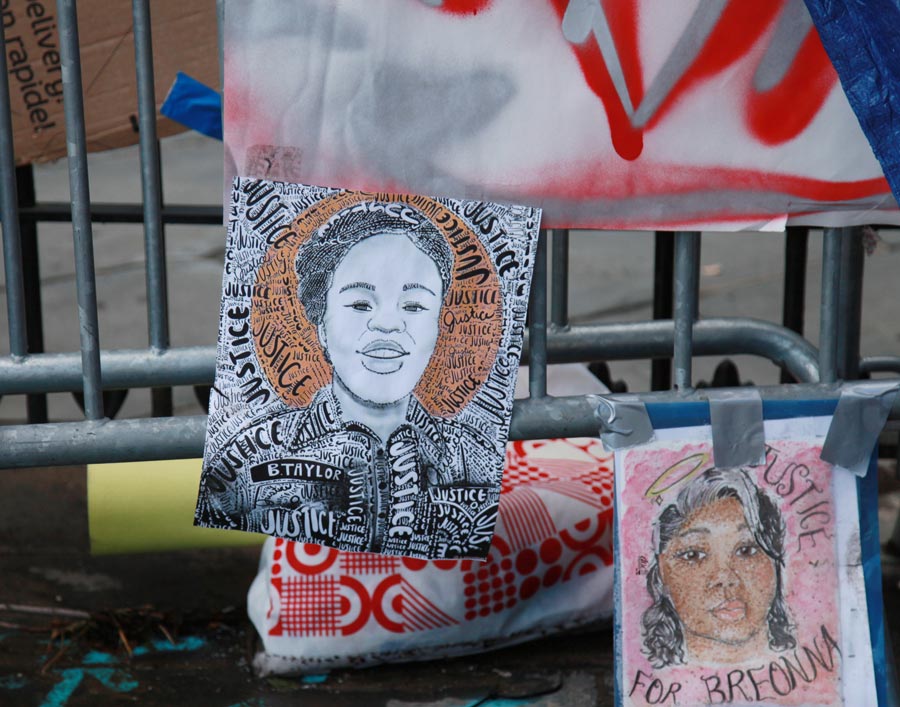
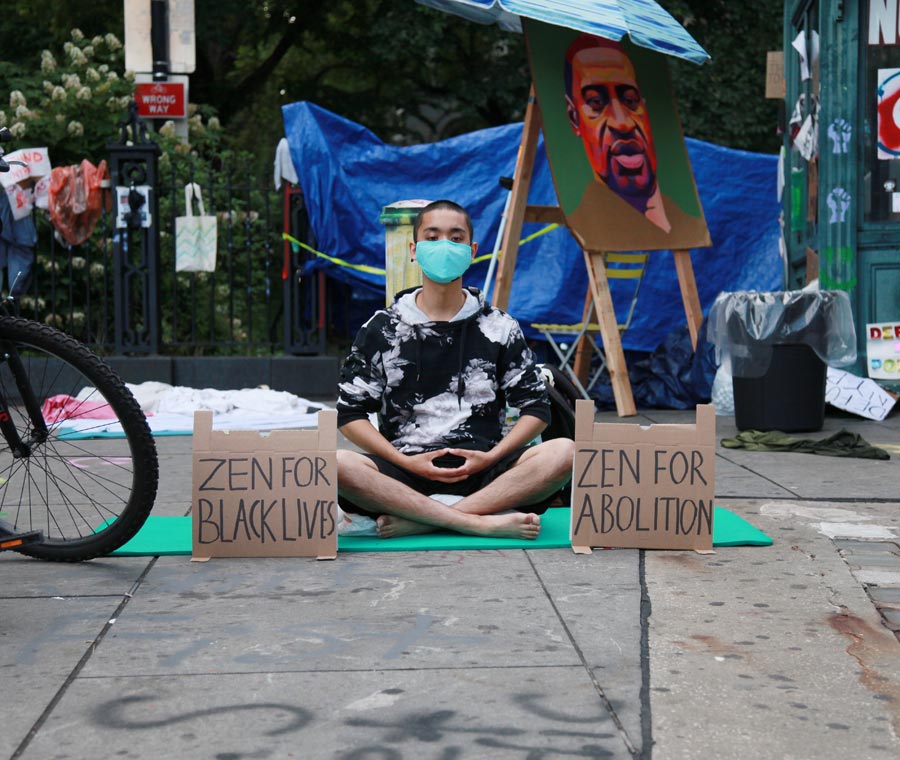
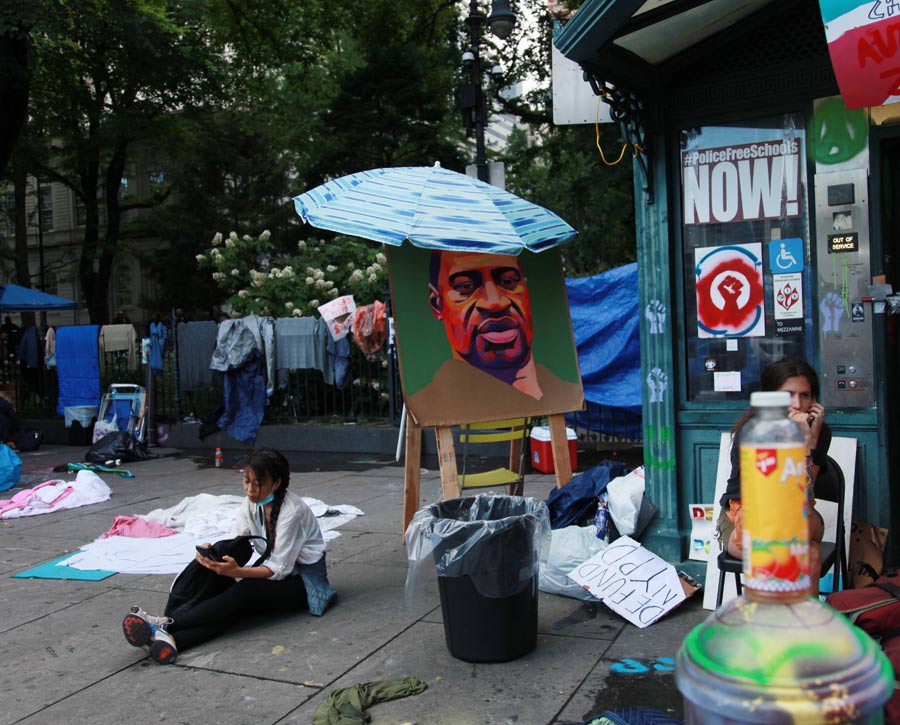
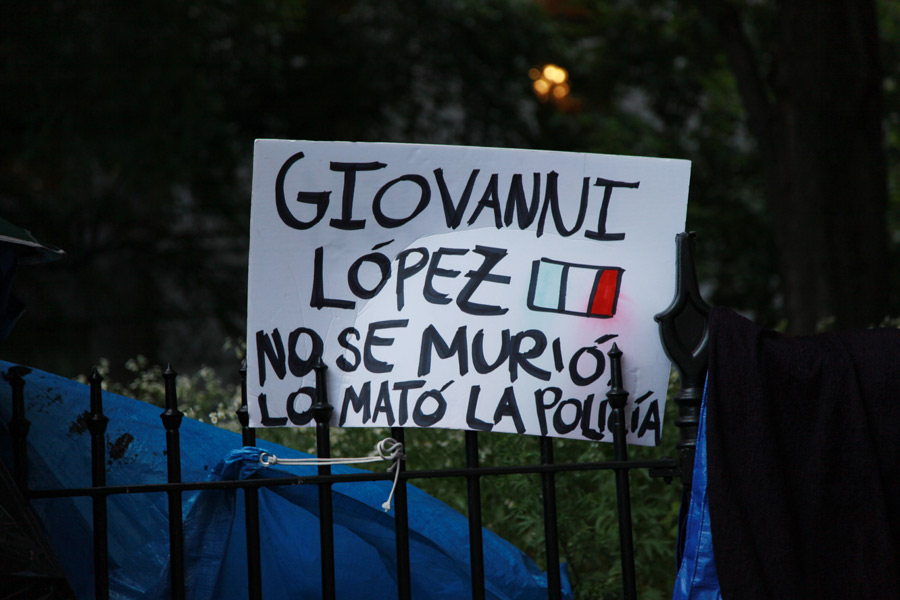
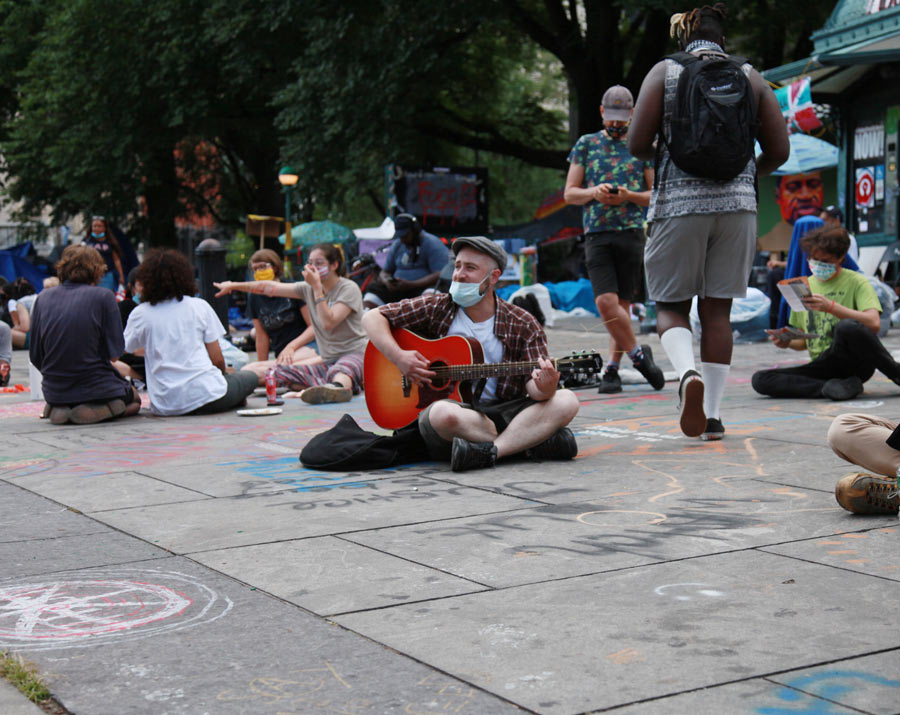
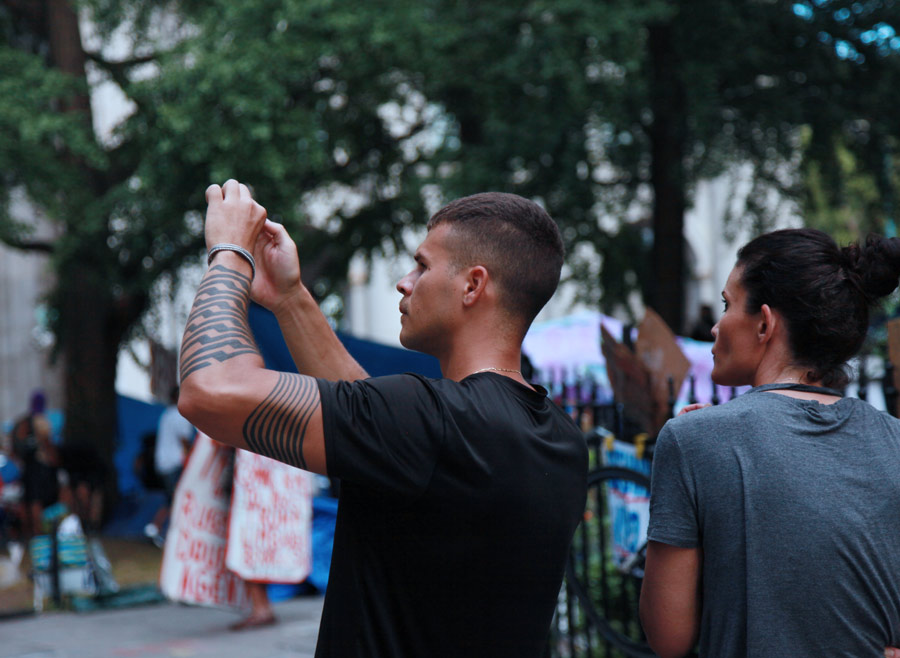
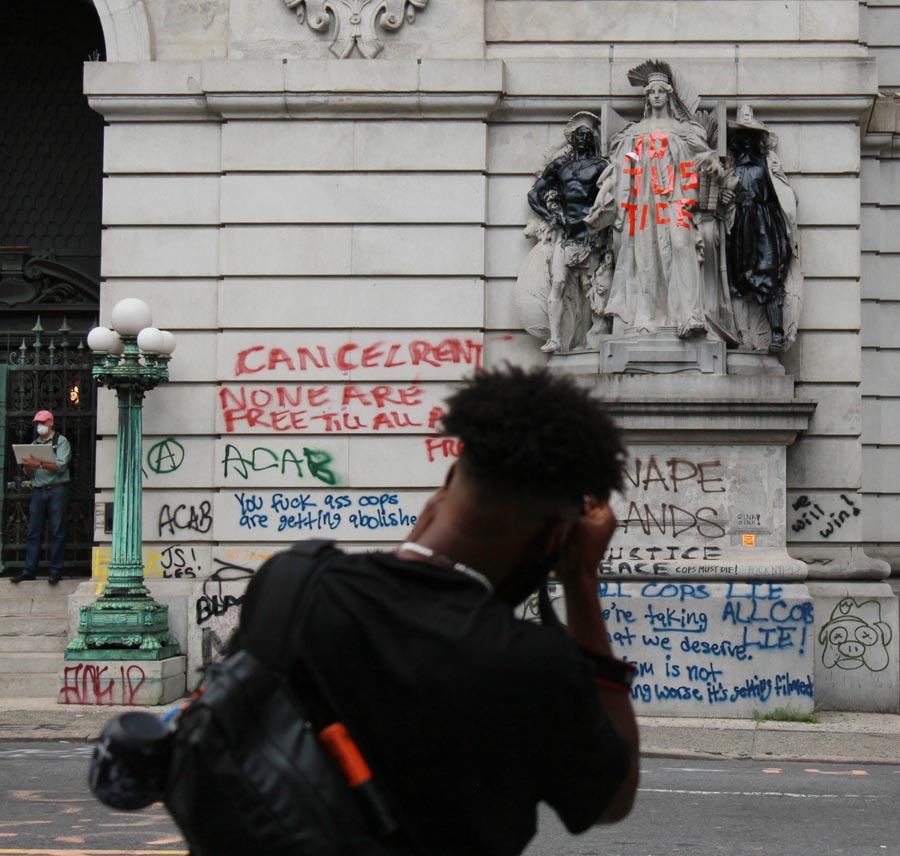
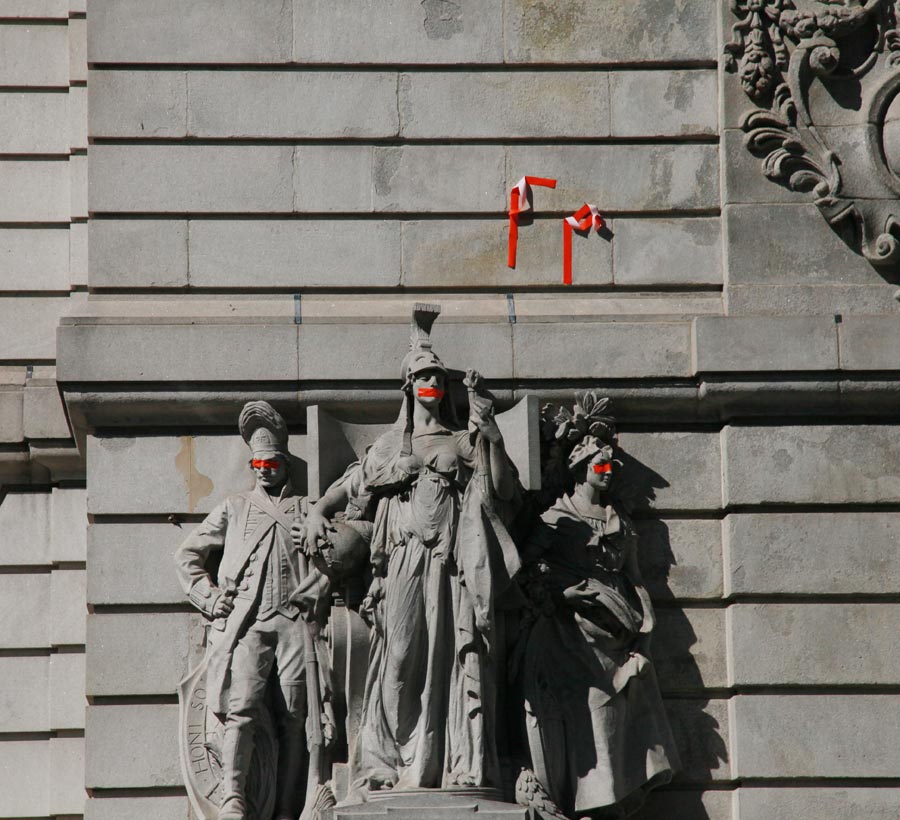
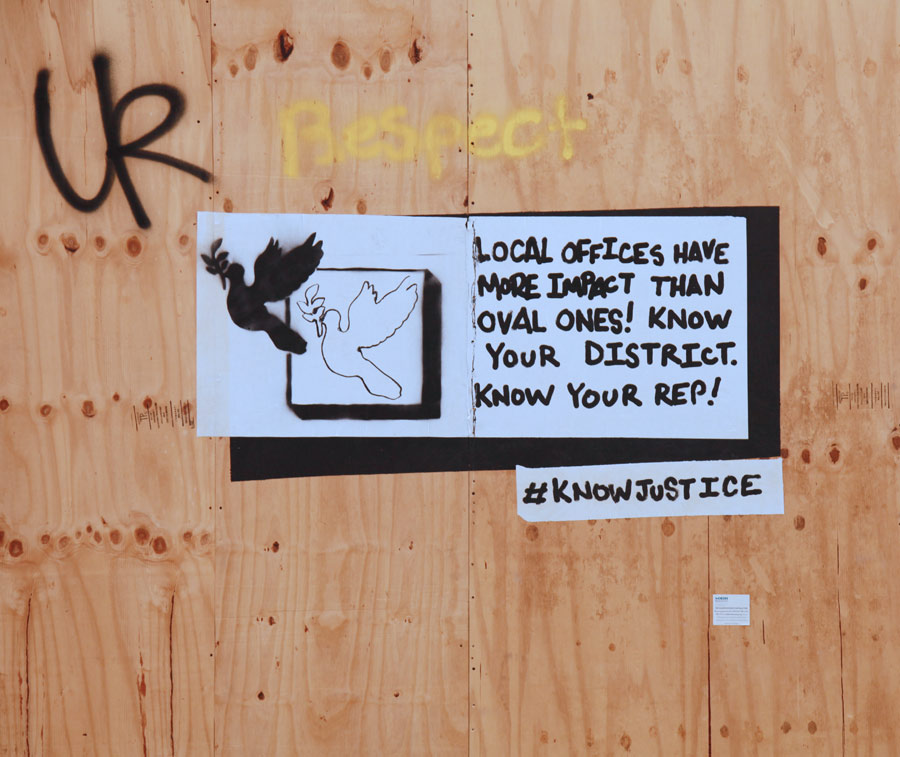
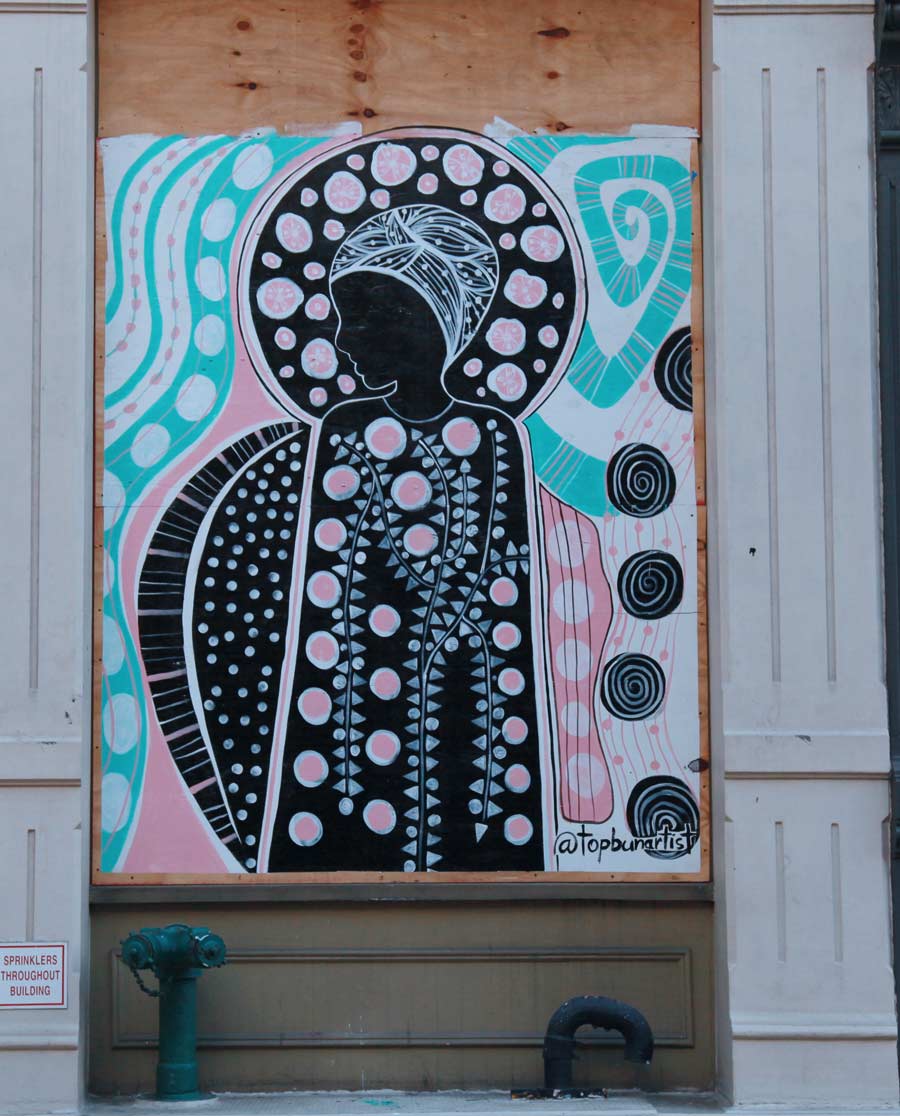
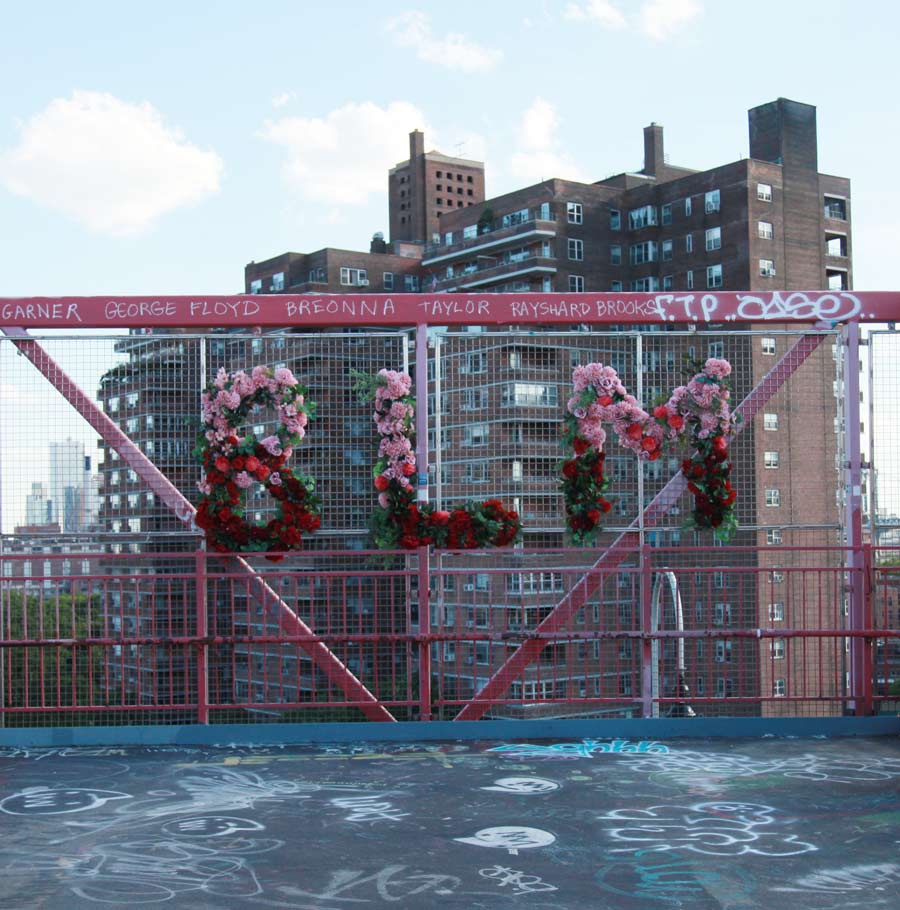
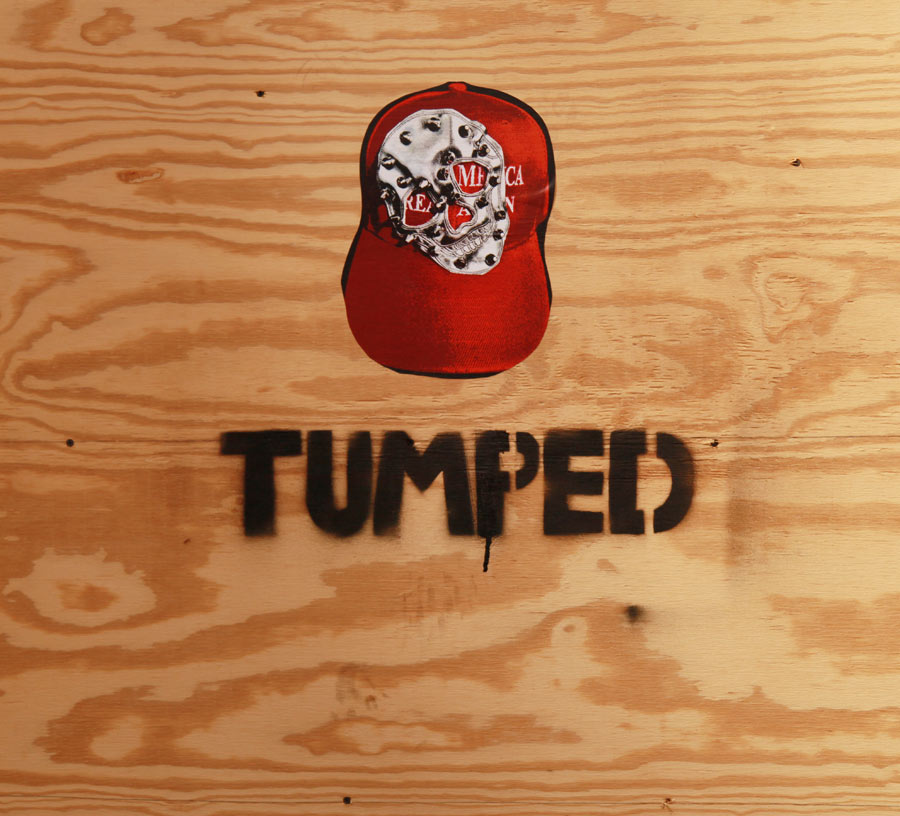
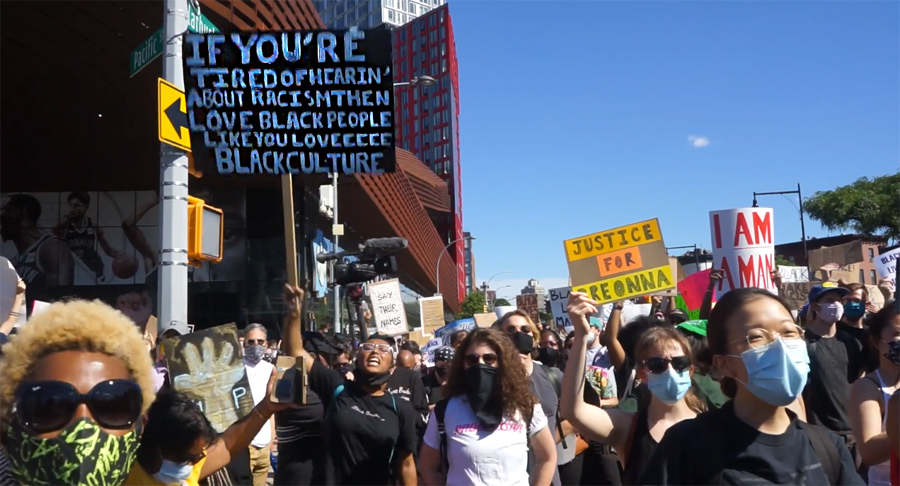
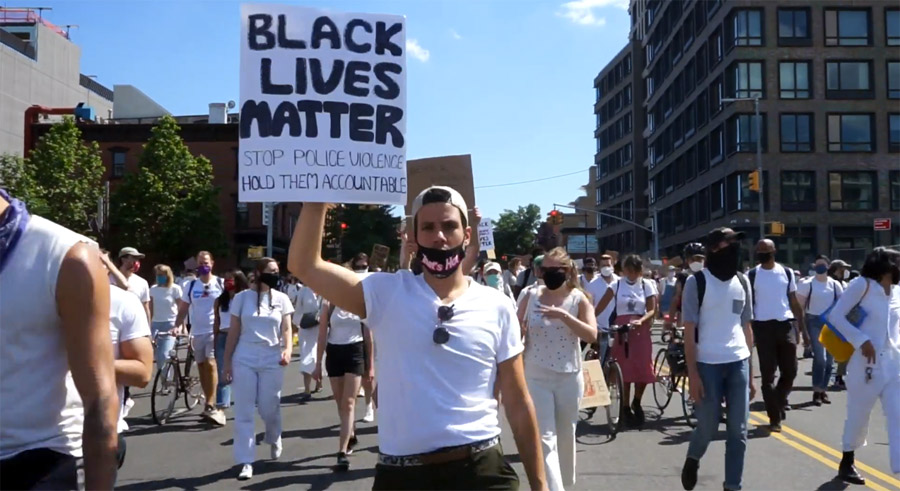
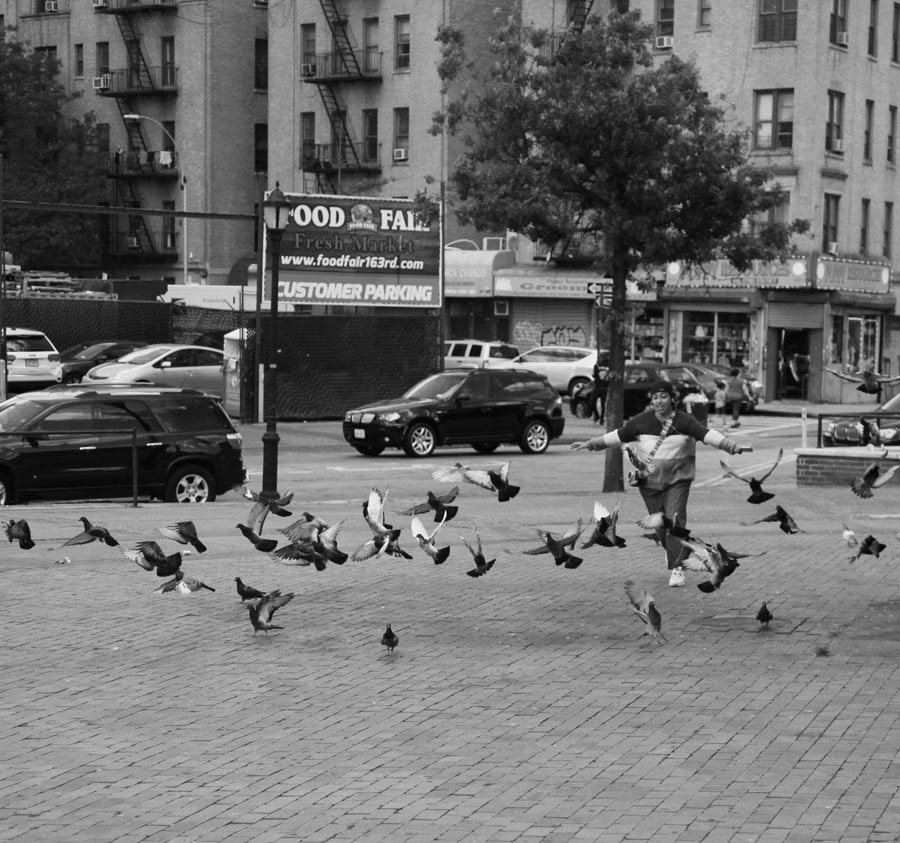
Occupy City Hall is a movement that appears to bear a very close resemblance to the Occupy Wall Street movement nine years ago. Born with the protests against police brutality and the murder of George Floyd, this movement created an encampment located on Centre Street next to City Hall Park and near The David N. Dinkins Manhattan Municipal Building, named after the 1990s mayor.
Occupy City Hall is open 24 hours a day and at the height of the protests it drew hundreds of people who joined the activists with their demands to trim the NYPD budget at least $1 billion from the police department’s current $6 billion budget. During the debates and passing of the new budget at the beginning of July the City appeared to have cut a billion, but critics say it was some fancy footwork that gave the appearance of giving citizens what they demanded.
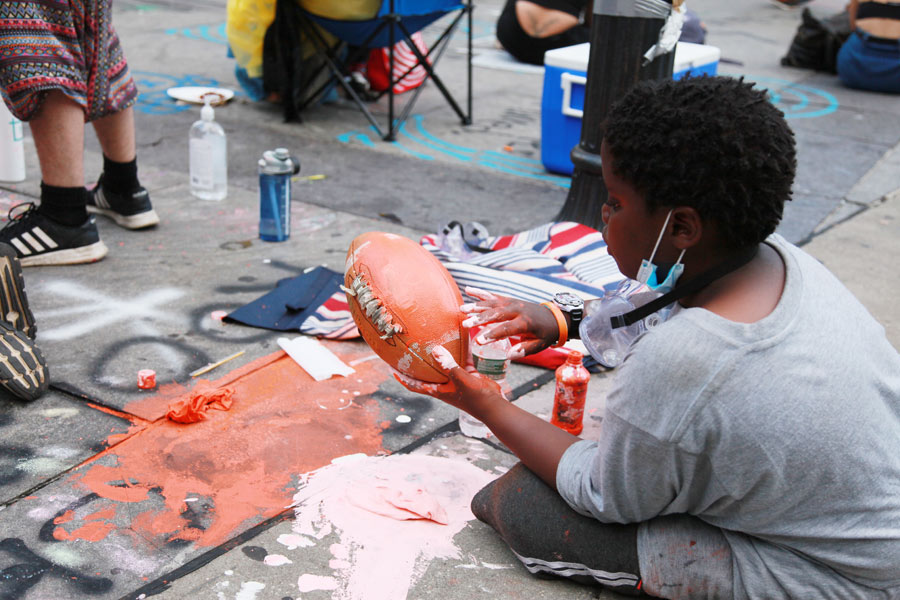
We went to the camp on a day just after the encampment had experienced heavy rains and suffered an early morning raid by the police. It had an unsettled atmosphere, with some raging outbursts and some quietly warm generosity exhibited among the primarily young crowd. Guess everyone needs a sense of balance these days. The encampment has a communal library, a space for drinking tea, room for meditation and, a sign-making workshop. Most people are welcomed and it also provides a safe space for homeless people in need of a hot meal, a place to rest, and clean clothes.
Now these New Yorkers are calling the location “Abolition Park” and as the encampment evolves it continues to be a very well organized community of people with volunteers serving hot meals, distributing protest kits, water, and first aid for those in need of it.
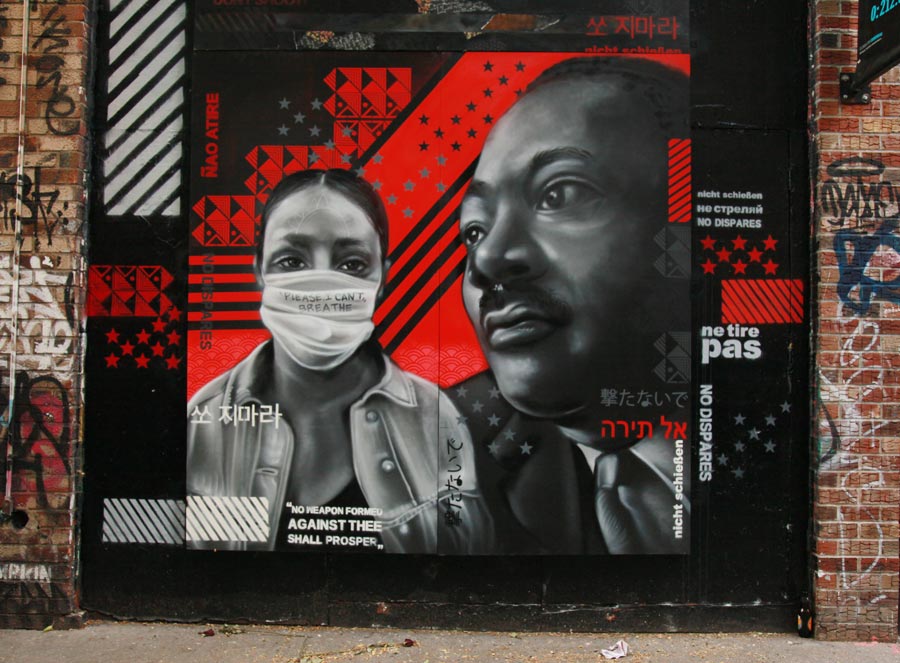
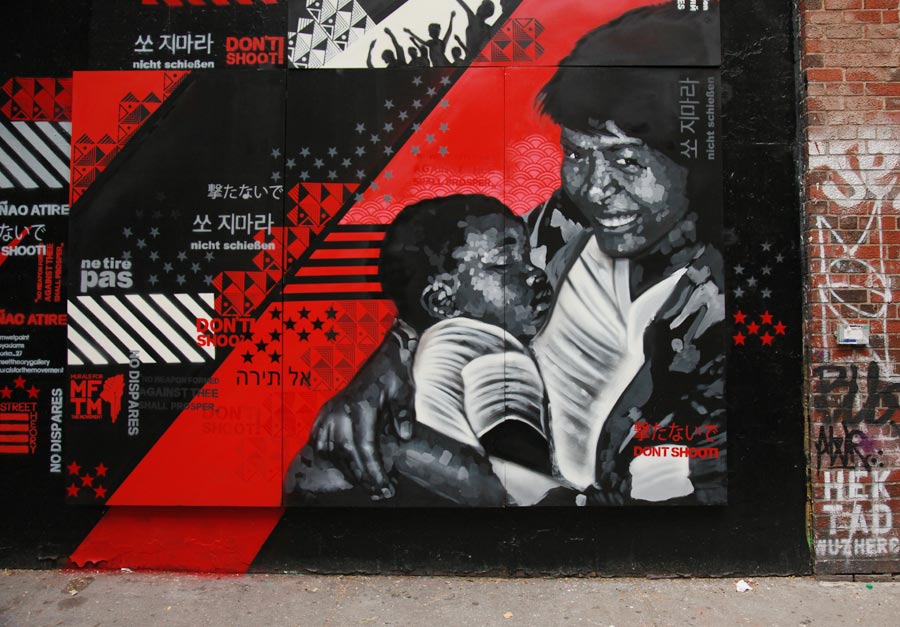
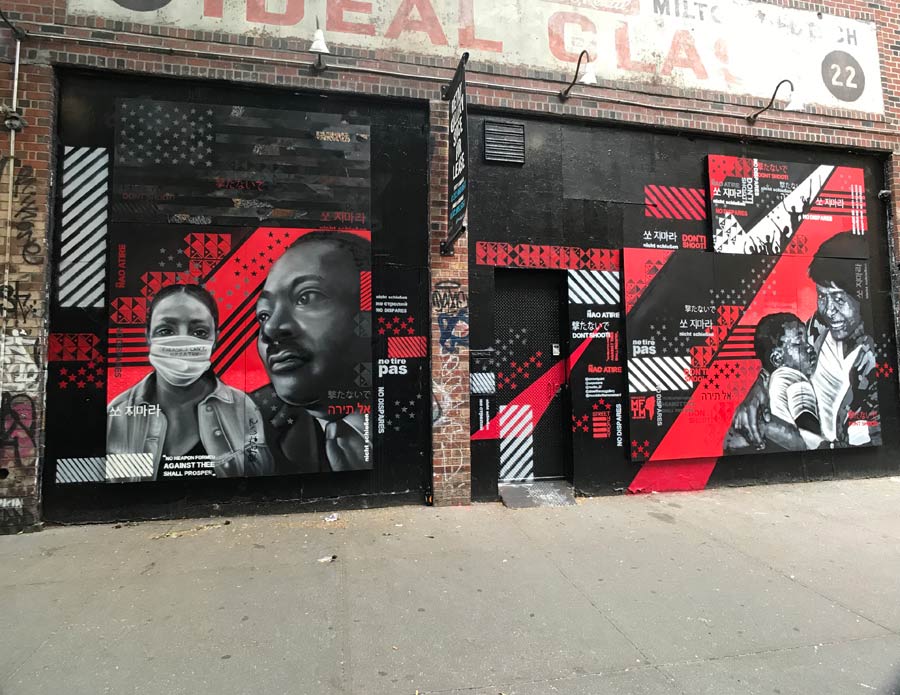
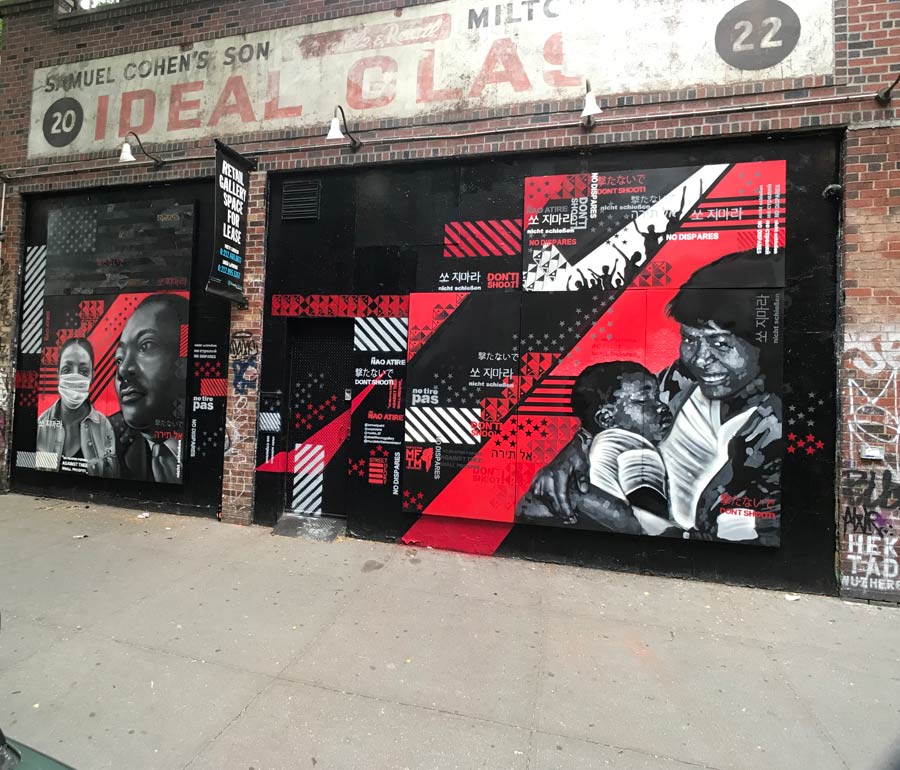
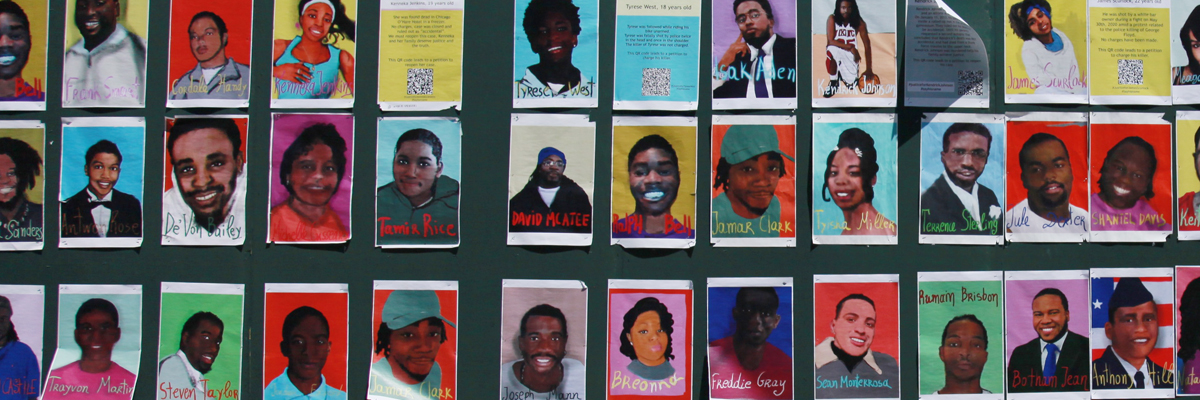
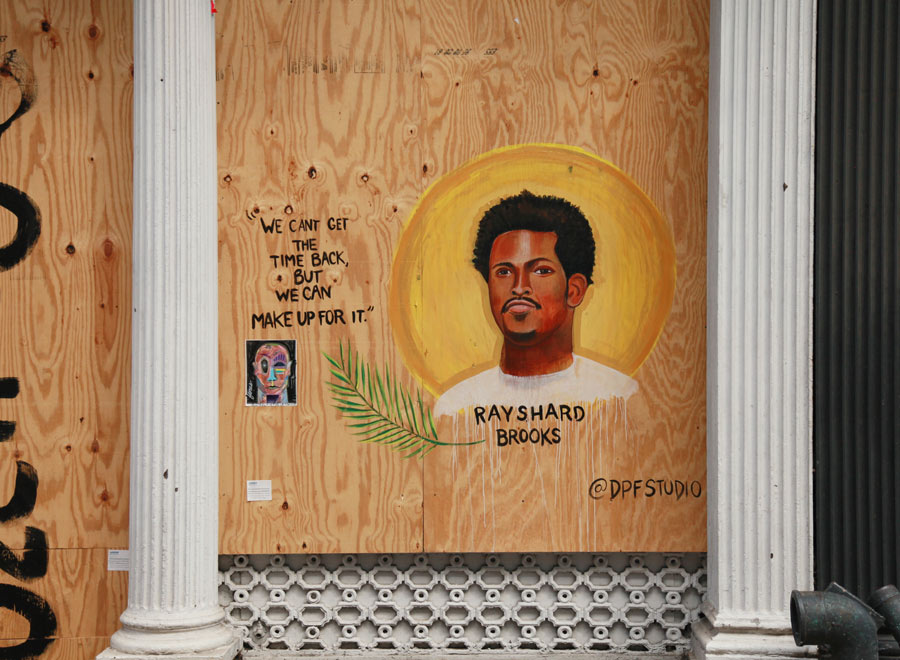
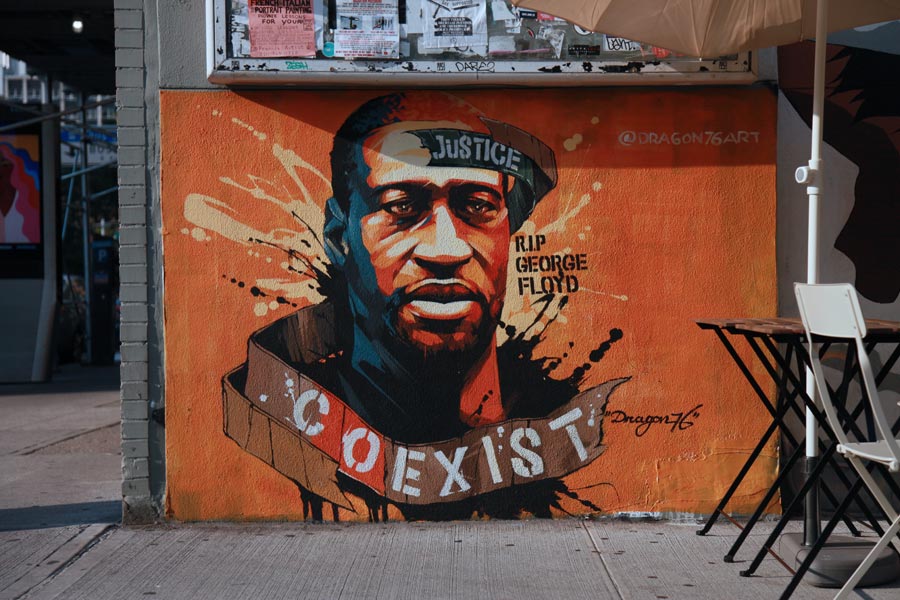
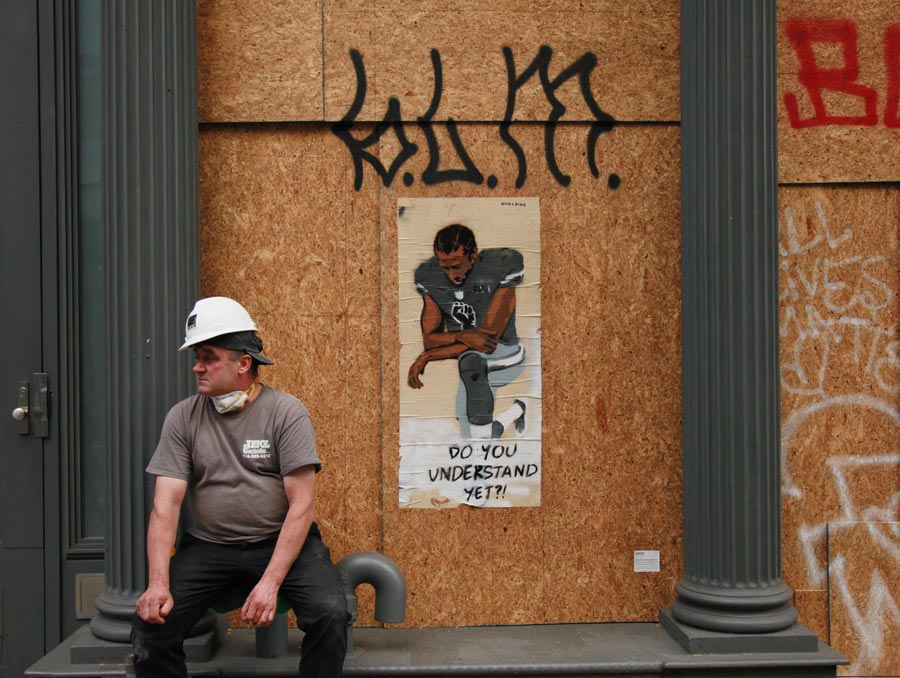
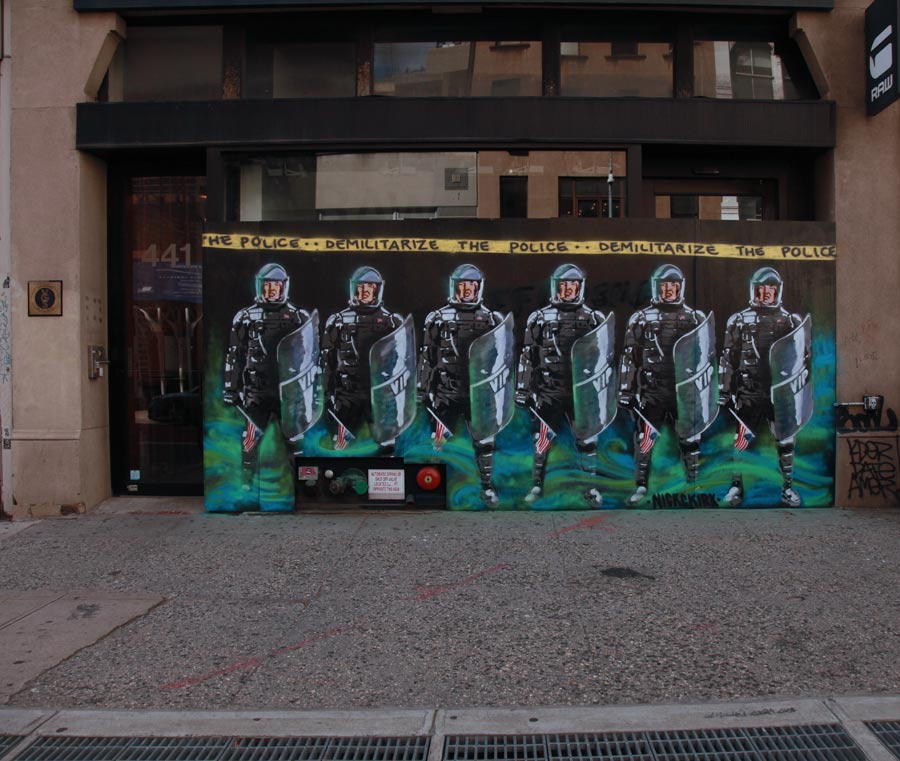
It’s when you have an opportunity to see a piece of art on the street in person. The combination of portraits, graphic design, and text treatments may spring more from the imagination of those in the design fields but up close you can get an appreciation of the warmth and vulnerability of the figures as well. The stories that are told are down to earth, universal, and here for you to bear witness to.
“Quoting Isaiah 54:17 in the Bible, this mural inspires us and girds us and reminds us that when it comes to systemic racism the battle is not for the faint of heart. Can we get an ‘Amen’?”
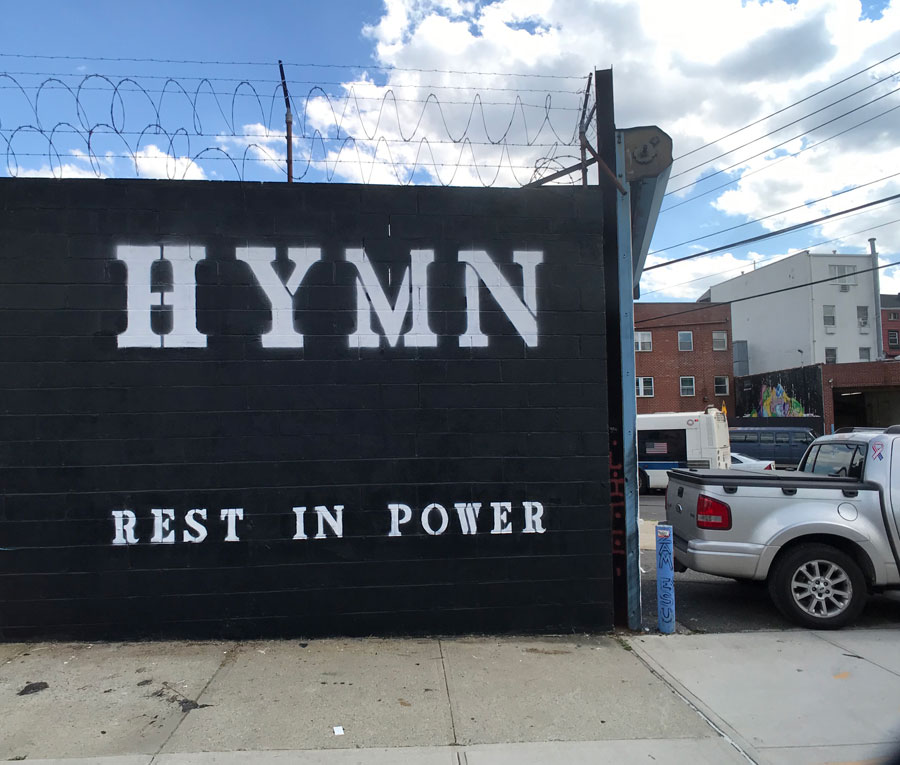
A recent street stencil work by John Fekner, Don Leicht, and Brian Albert is a reprise, a sad reminder that the legacy of racism in the country has been with us for what seems like forever. During another chapter of Fekner’s creative life on New York streets he sang a visual HYMN to the civil rights leader Martin Luther King Jr. in the wake of the murderous brutality of white New York teens in Queens. Now thirty three years later the viciousness of police violence against black citizens on display can make you think nothing has changed fundamentally, even though we know it has.
We asked the artist how this HYMN at the Welling Court Mural Project this summer is a counterpart to the HYMN project more than three decades ago – a collaboration by John Fekner and Brian Albert.
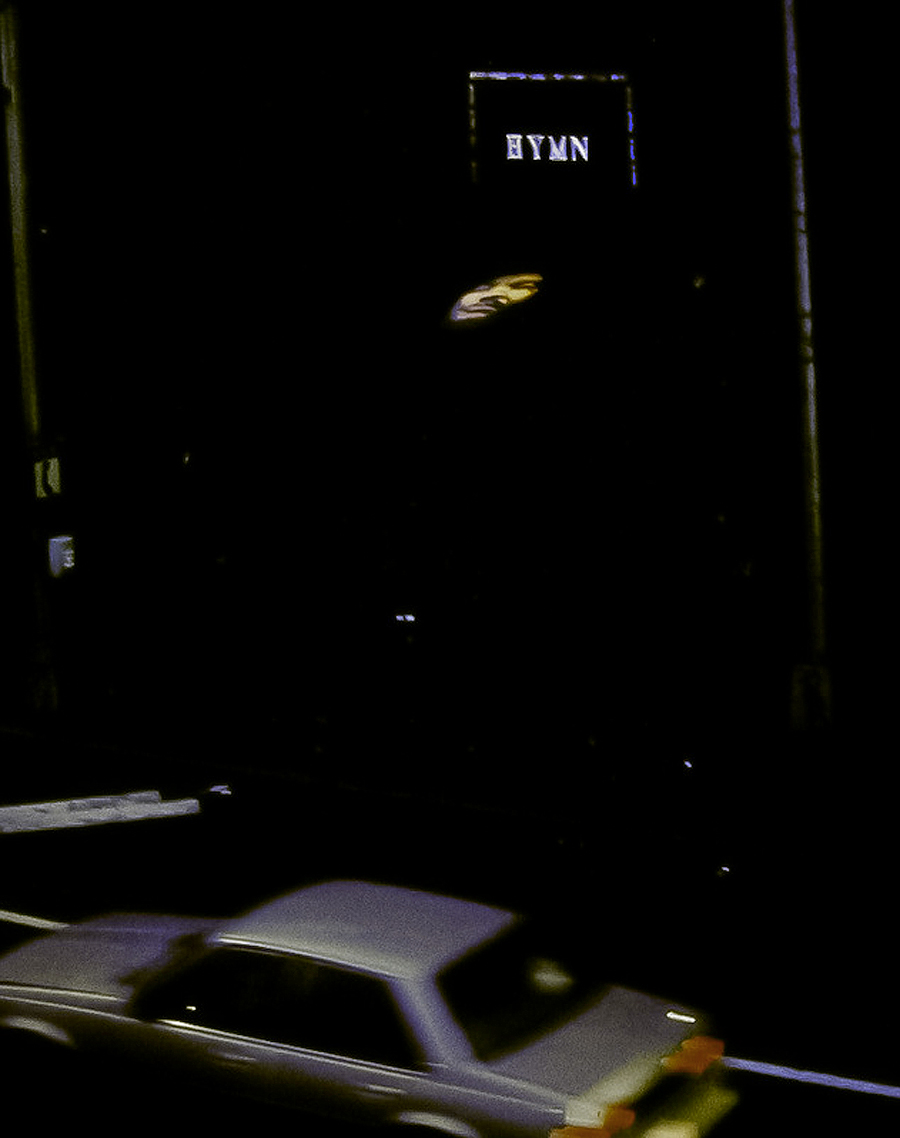
John Fekner and Brian Albert. Hymn. Queens, New York. 1987. (photo courtesy of John Fekner)
“HYMN was a collaboration by John Fekner and Brian Albert. The project constructed on an embankment overlooking the Grand Central Parkway in Queens was intended as a call for peace, an immediate response to the growing racial tensions over the death of a young black man in New York City. A gang of white youths in the Howard Beach neighborhood of Queens brutally beat three black men whose car had broke down in the neighborhood, chasing one of the three, 23-year-old Michael Griffith from Bedford-Stuyvesant, to his death when he was hit by a car crossing the Shore Parkway on December 20th, 1986.
The piece consisted of a tombstone-shaped concrete electrical power box painted black with the word “HYMN” stenciled in 12-inch high white letters. Flush with the ground, in front of the ‘tombstone’ was a translucent 40” x 50” photographic print portrait of Martin Luther King, Jr., illuminated from a light source in the ground. The electricity necessary for the underground lighting was tapped from a streetlamp, which switched on at sunset.
Hymn was installed for Martin Luther King Jr. Day on January 19th, 1987. Passing motorists could see the work both during the daytime and at night when it transformed into a subtle glowing image of harmony and peace. The illegally sited work remained for a few weeks and was eventually removed from the parkway embankment.”
John Fekner (with Don Leicht and Brian Albert) Hymn 2020 (Rest In Power) (above) is intended to be a solemn reflective message to show empathy and compassion to the local community and beyond, during this time of protest, police reform and positive change.
(Installation by Dante, Roman & Dave Santaniello at Welling Court Mural Project NYC)
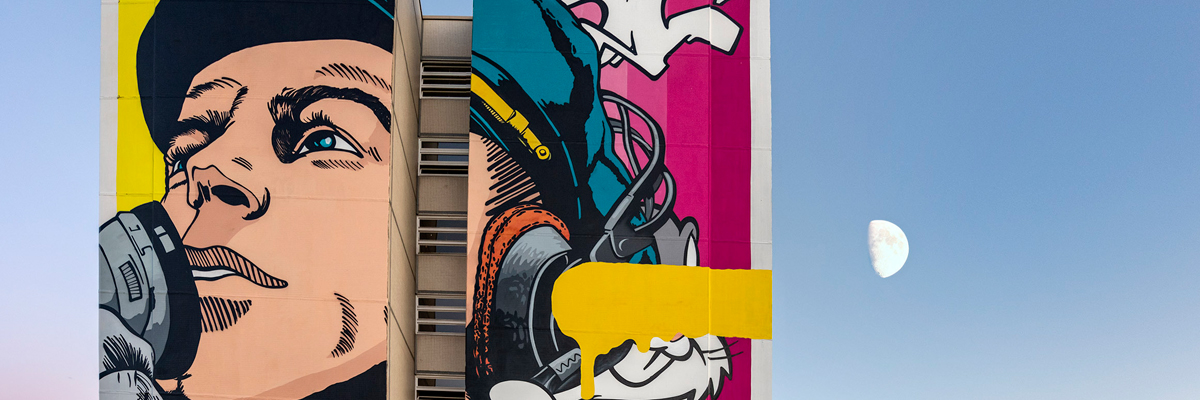
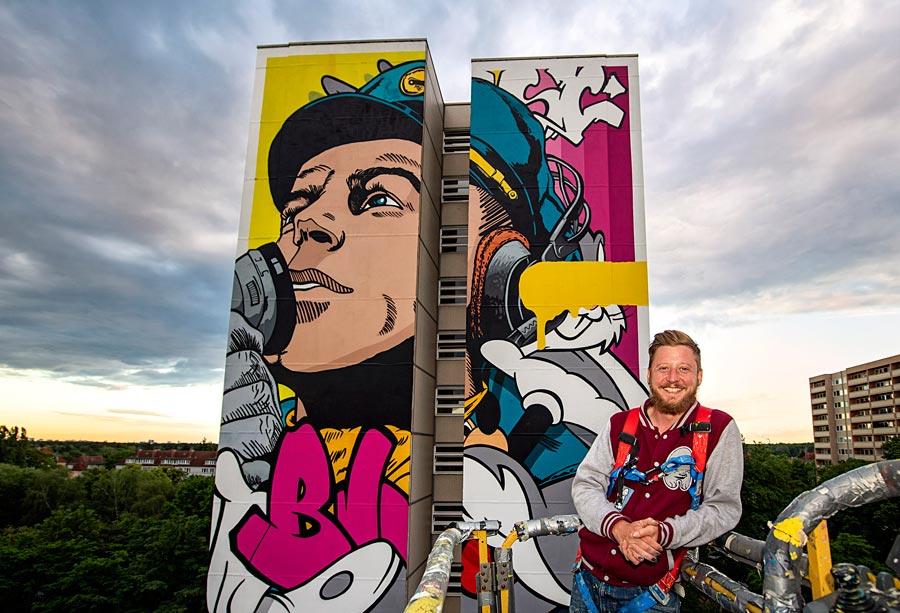
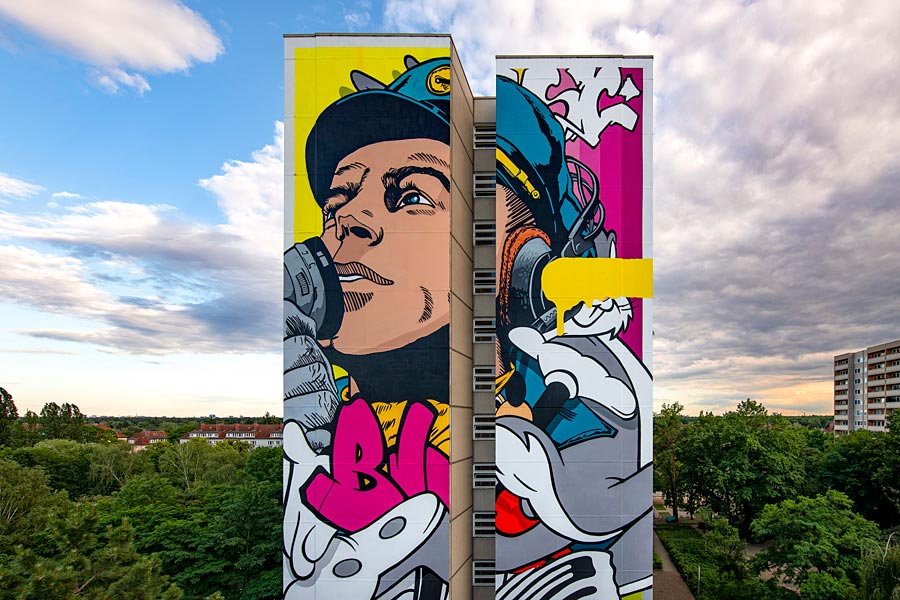
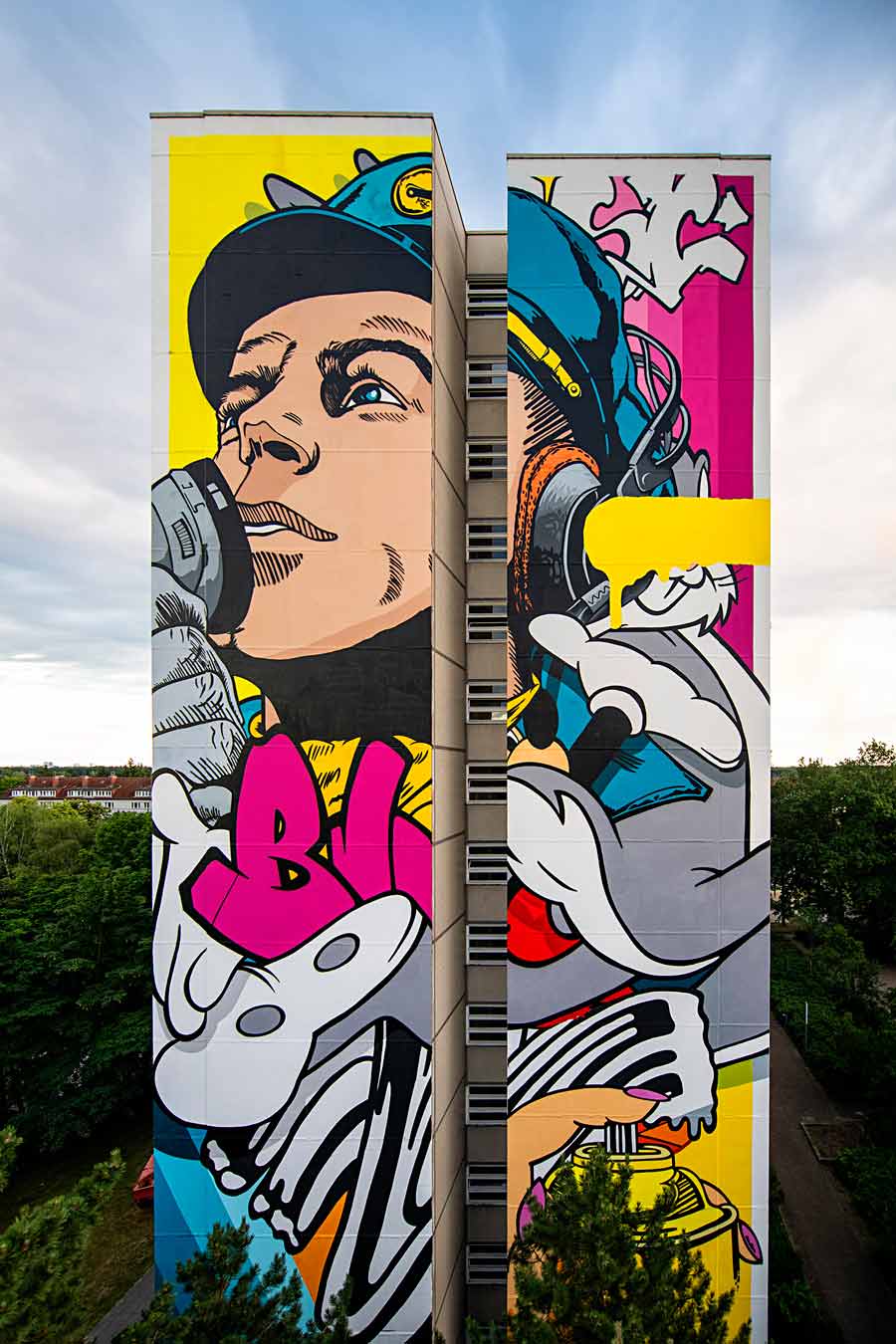
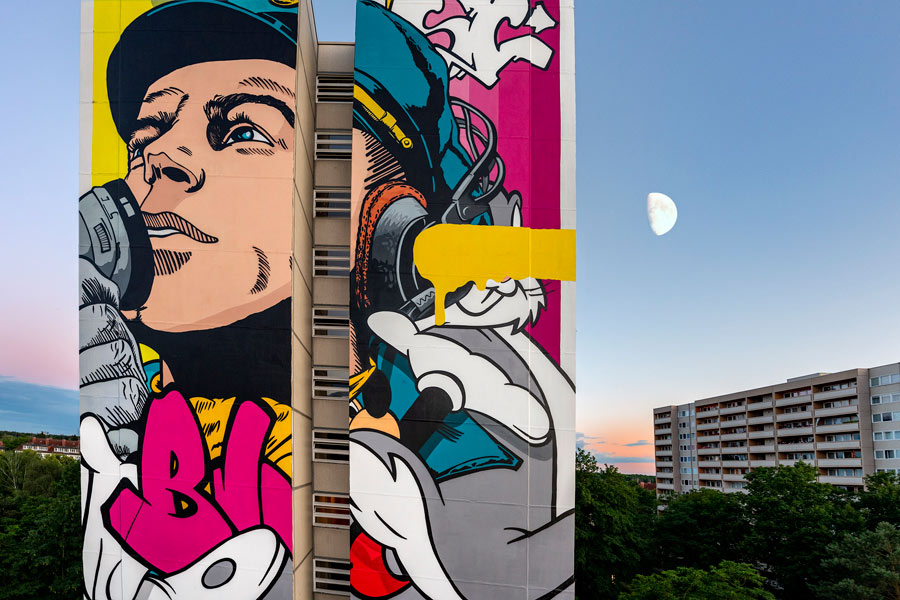
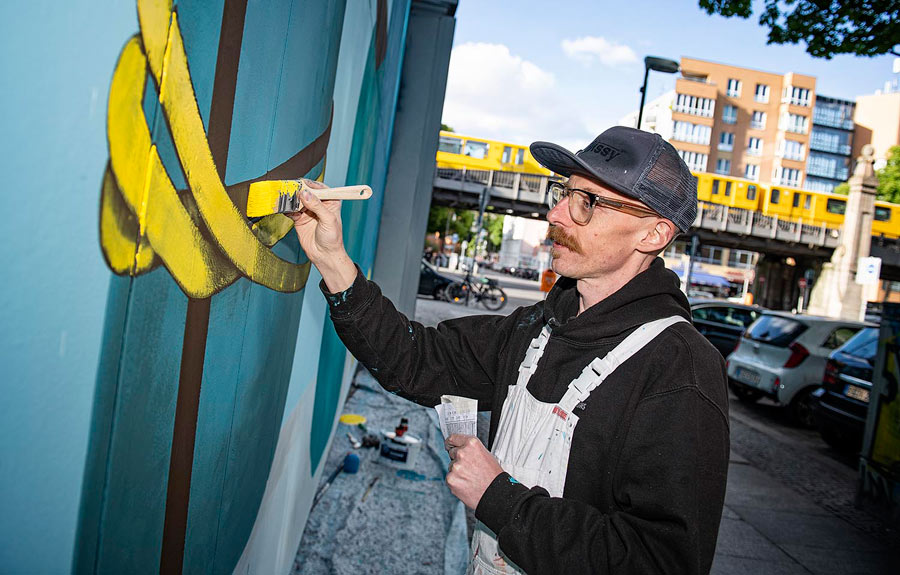
Massive
and bright and staring at the summer sky, the new mural in the Tegel area of
Berlin is quintessential BustArt. Two decades after starting his mark-making as
a Swiss graffiti writer, his style borrows elements from that classic graffiti
mixed with cartoons, pop art, and perhaps an eye toward others like Crash and
D*Face who themselves point to the Roy Lichtenstein.
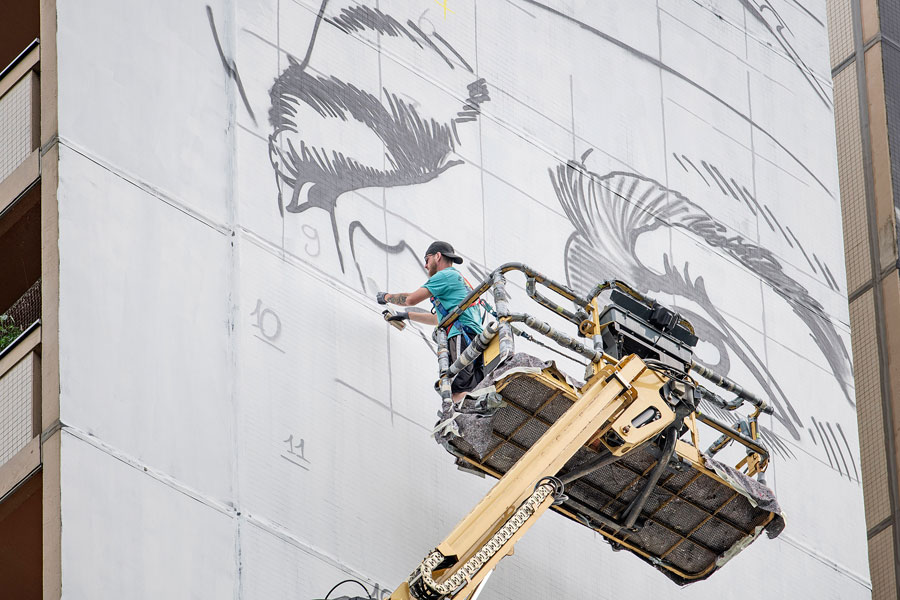
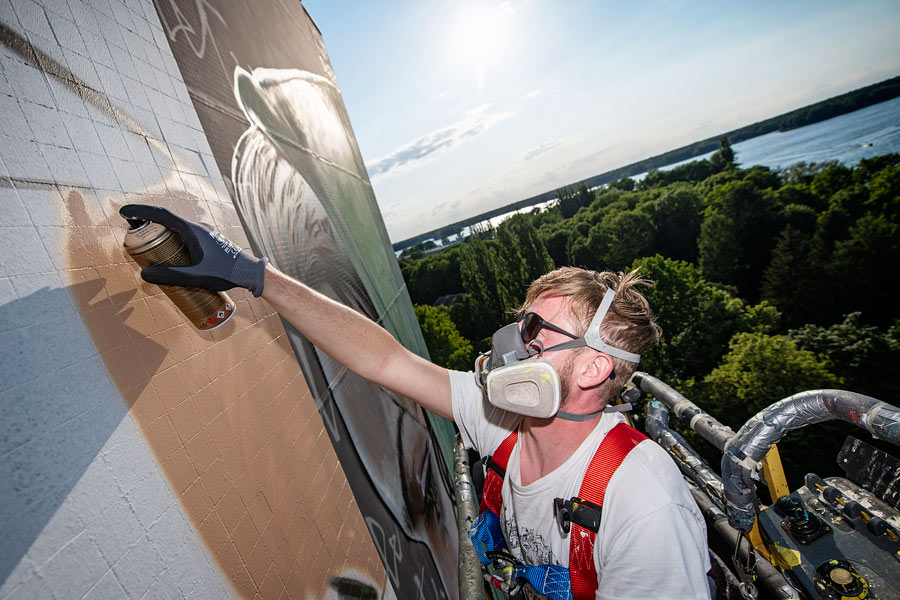
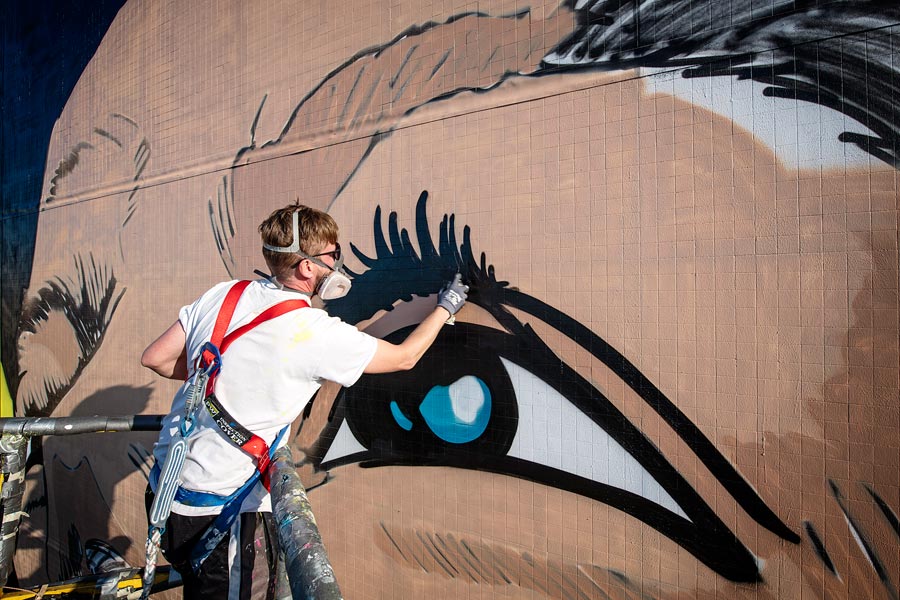
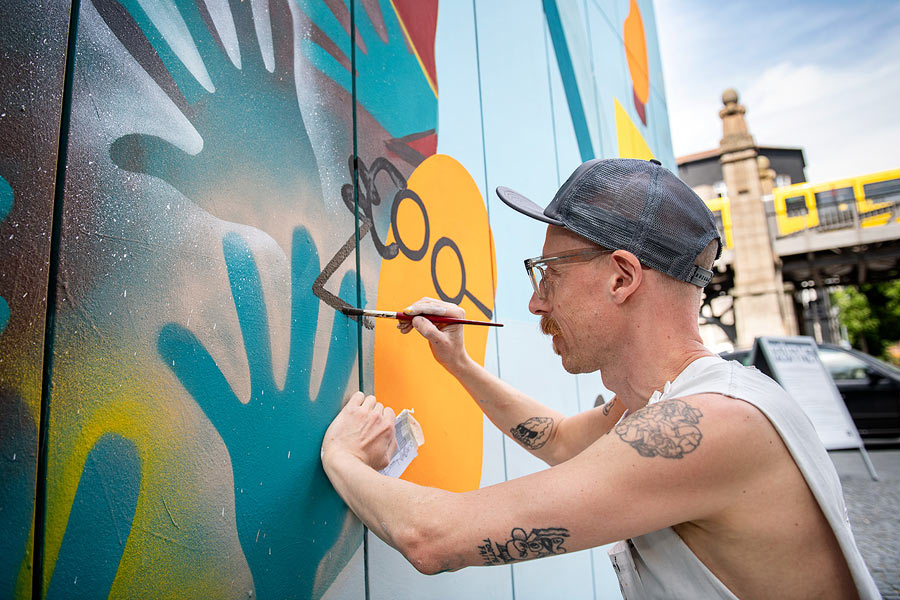
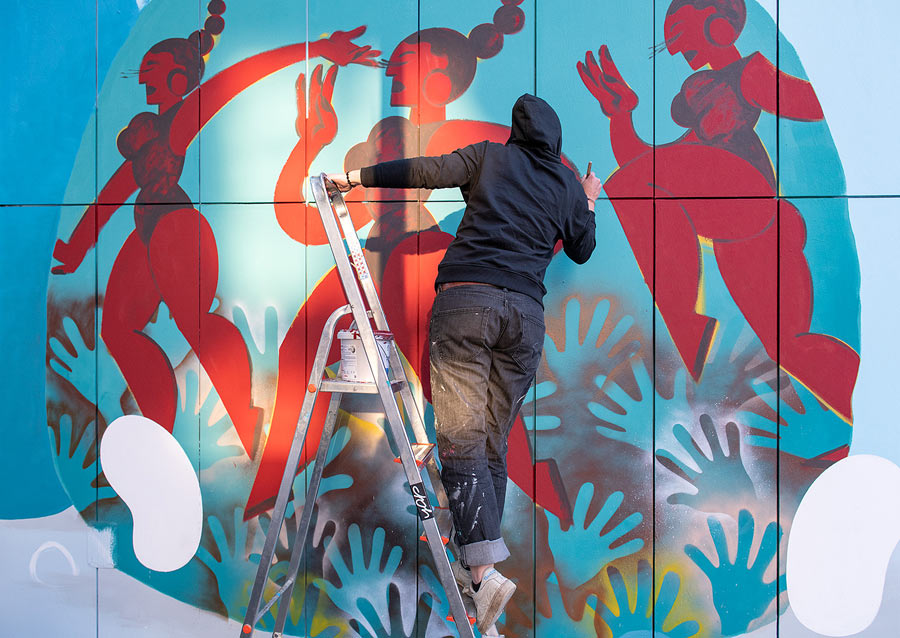
His brand of ‘neopop” mixology is unique to him of course, and the tireless effort, scale of work (40 meters x 16 meters), and relative speed that he works sets him in a category of his own.
“This is the biggest wall I have painted so far and I could not be more happy with the outcome,” he says of the two week gig. The confident command of visual vocabulary, character and line work tell you that this new mural is a challenge BustArt was more than ready for.
Bustart also
wants to shout out his mate @sket185 for the enormous help, the folks at @yesandpro who orchestrated along with Urban Nation, and we all
give thanks to photographer Nika Kramer for sharing her work here with BSA readers.
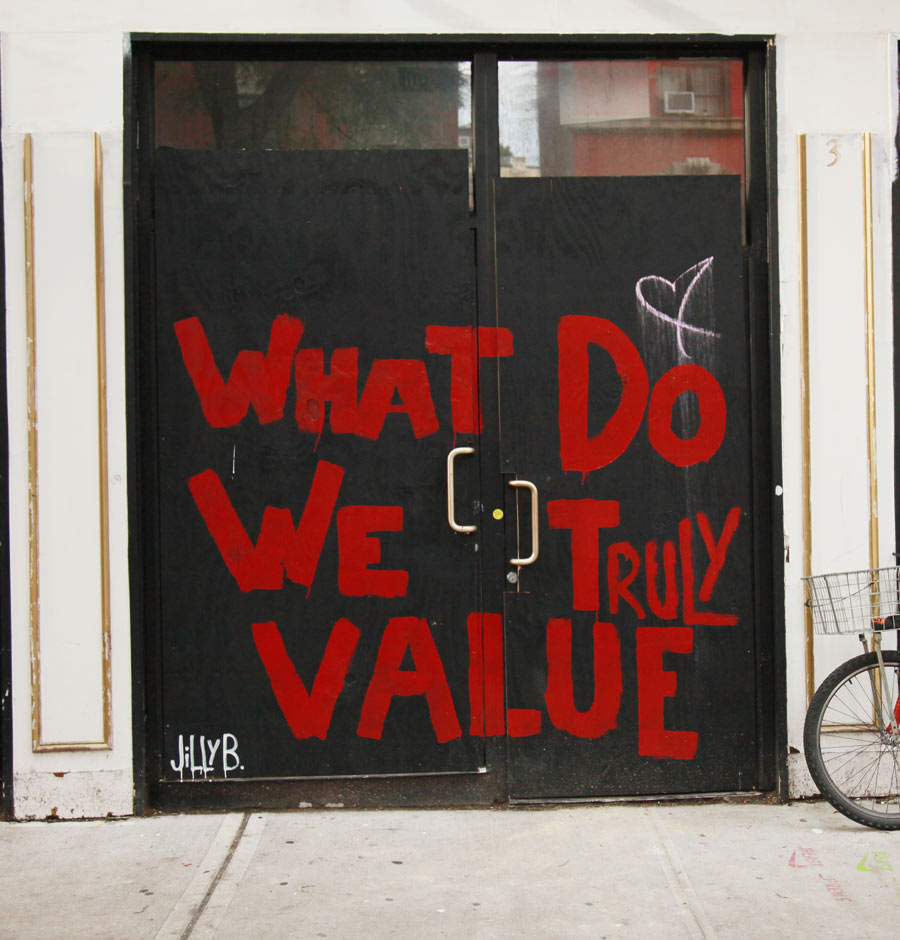
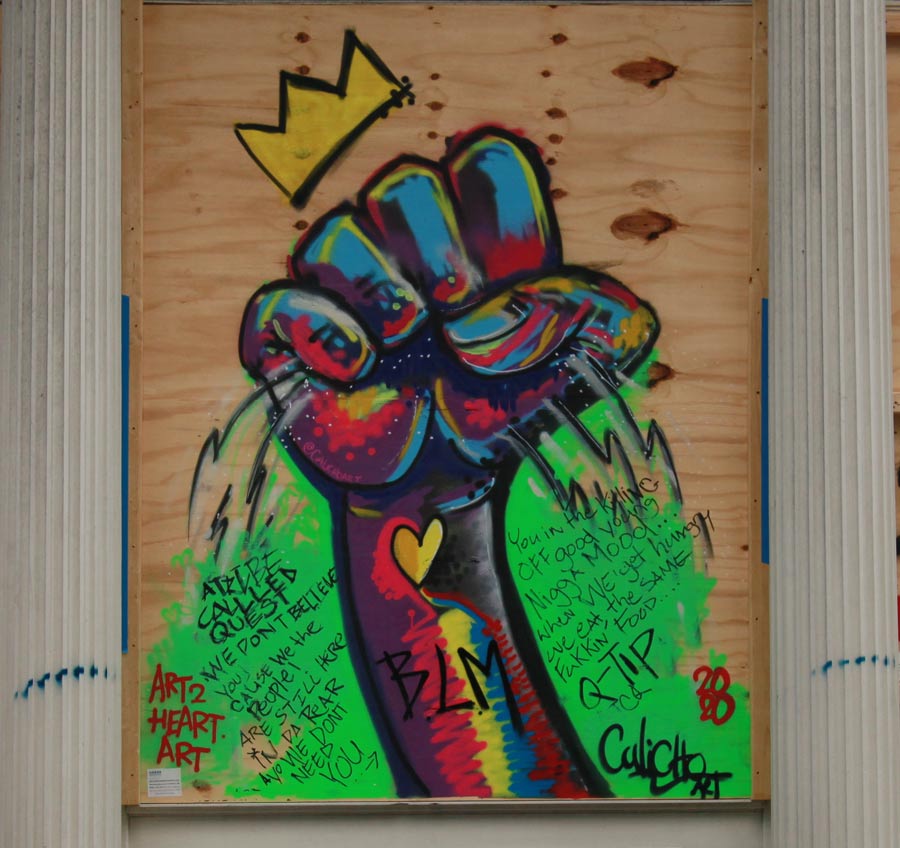
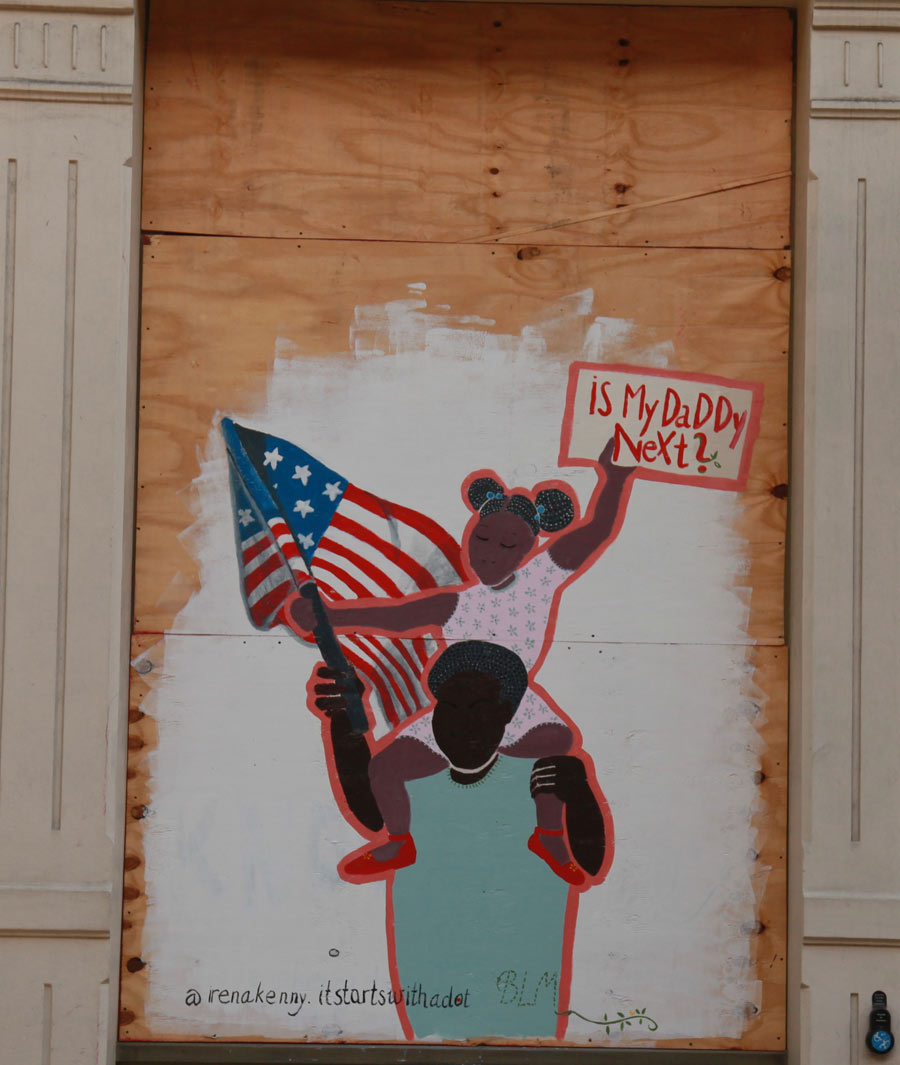
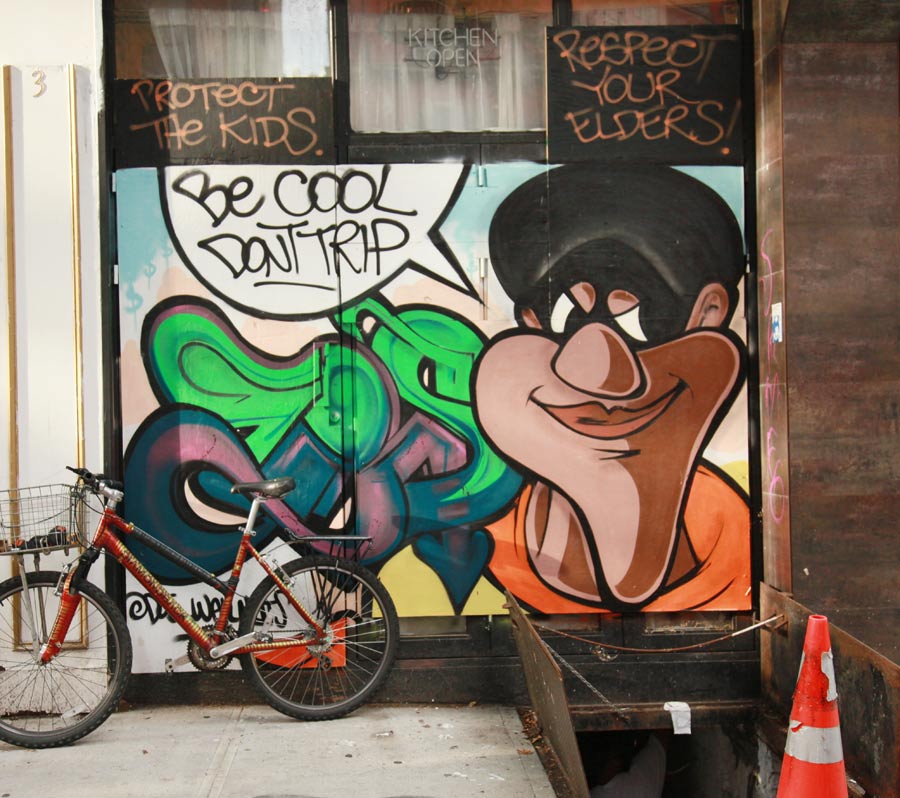
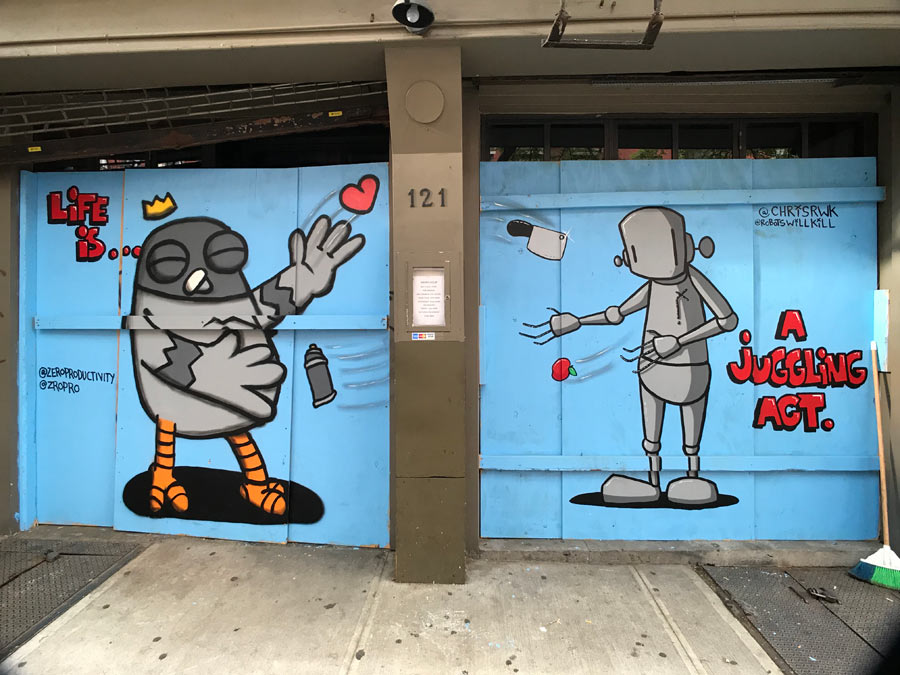
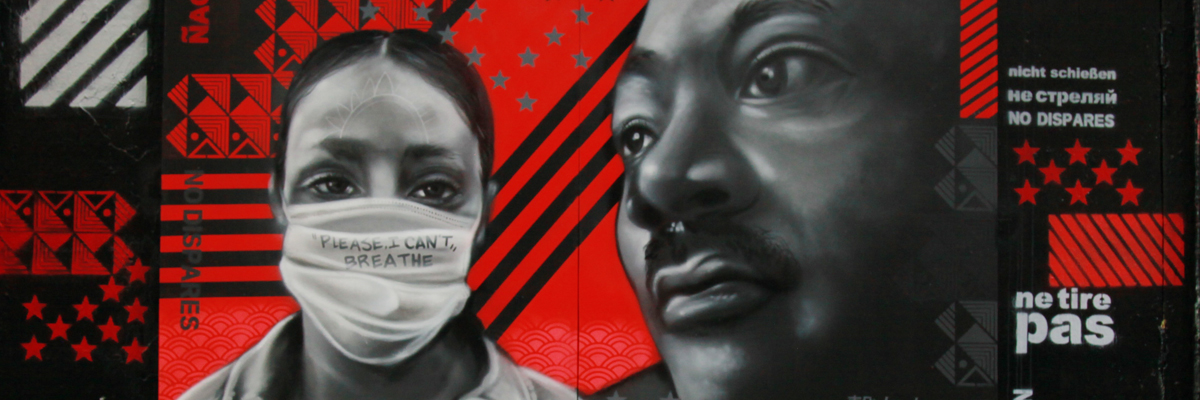
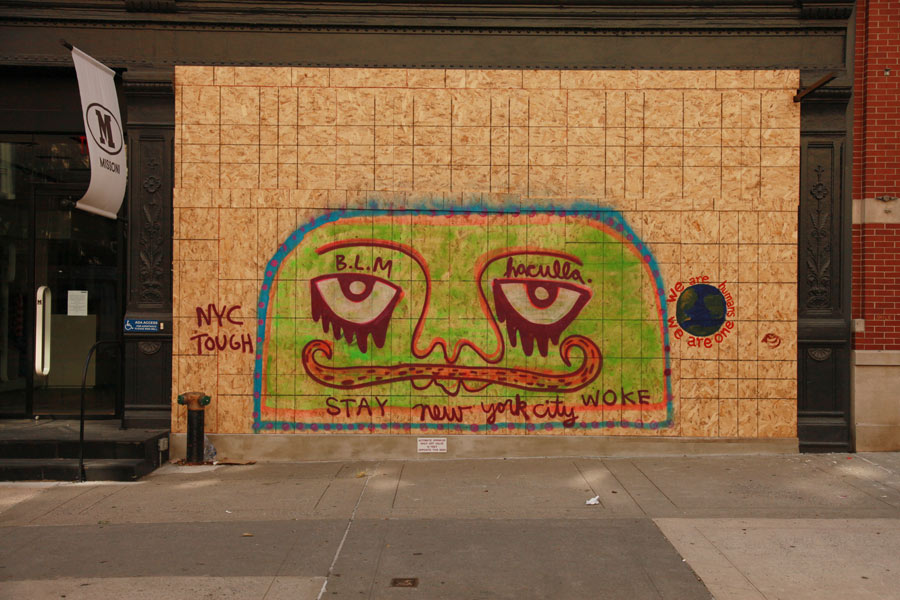
Hanging tough is what New York does, and the art in the street is 10X more potent than six months ago. It’s almost cliche to say that Street Art and graffiti are about a conversation on the street, but the words and sentiments being expressed right now on monuments, edifices, and in doorways are a direct reflection of the high-emotion, high-stakes conversations that we must have about the true state of race, freedom and social mobility in 2020 US.
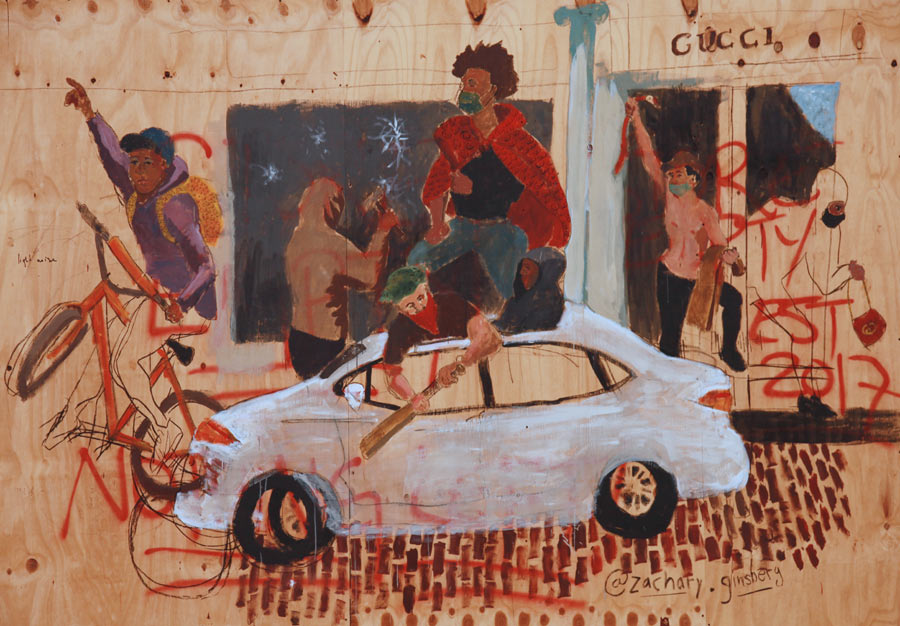
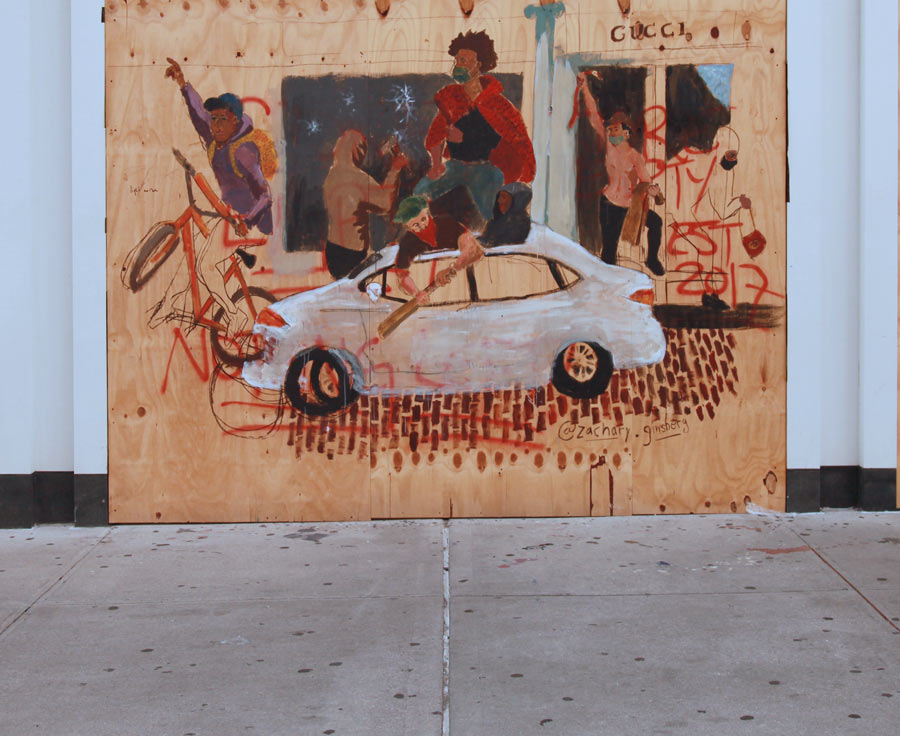
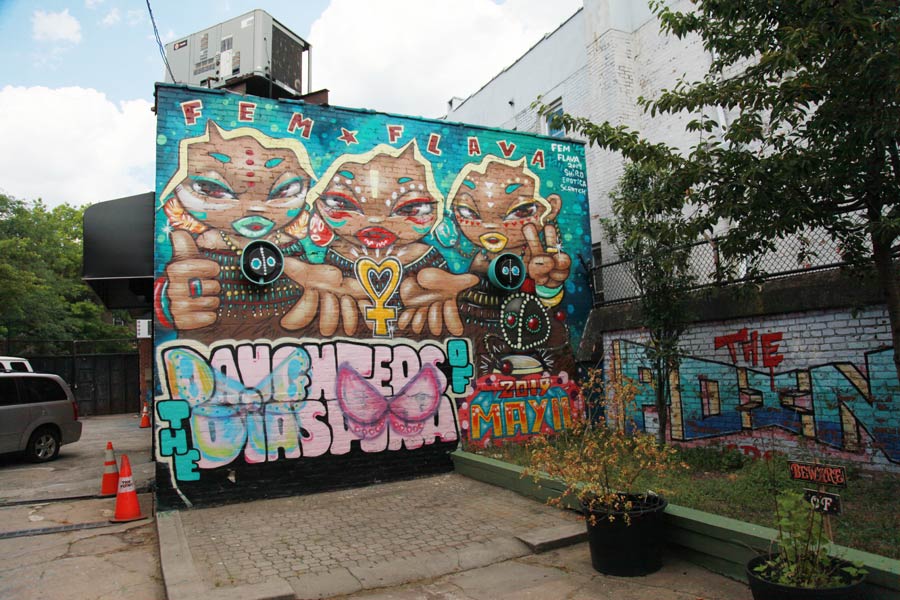
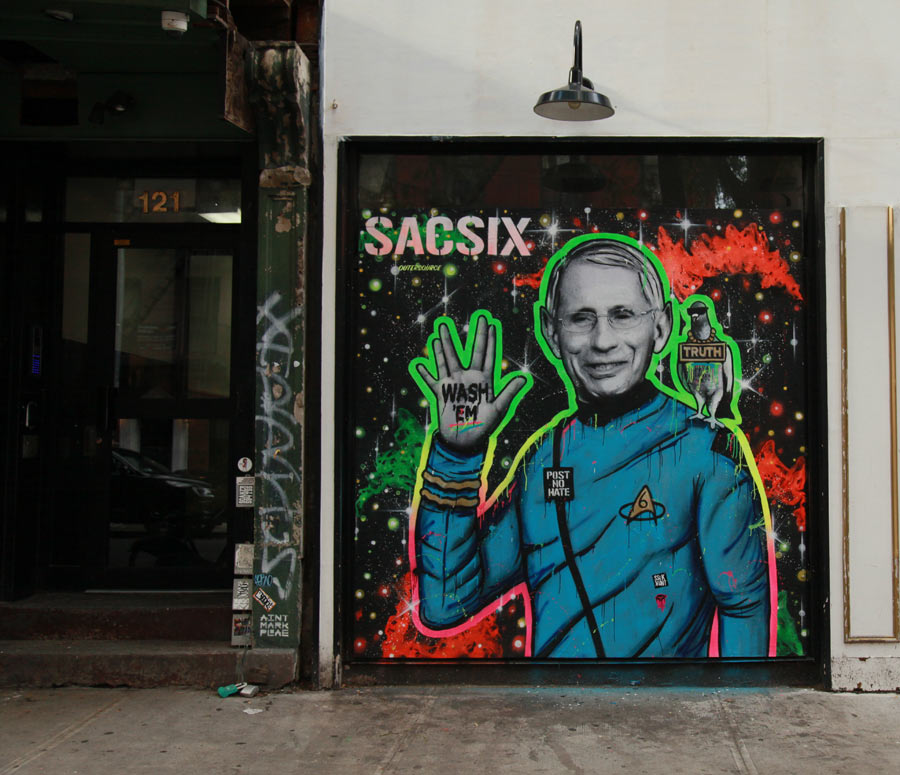
Here’s our weekly interview with the streets, this week featuring Art 2 Heart Art, Calicho Art, Chris RWK, Col Walnuts, Eortica, Irena Kenny, Jilly Ballistic, John Ahearn, Know Justice, Sac Six, Scratch, Shiro, Top Bun Artist, Zachary Ginsberg, and Zero Productivity.
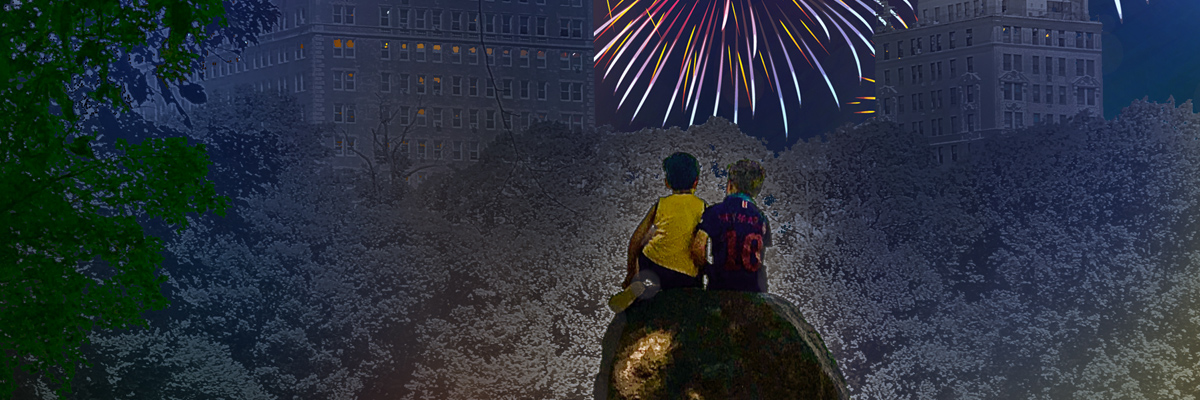
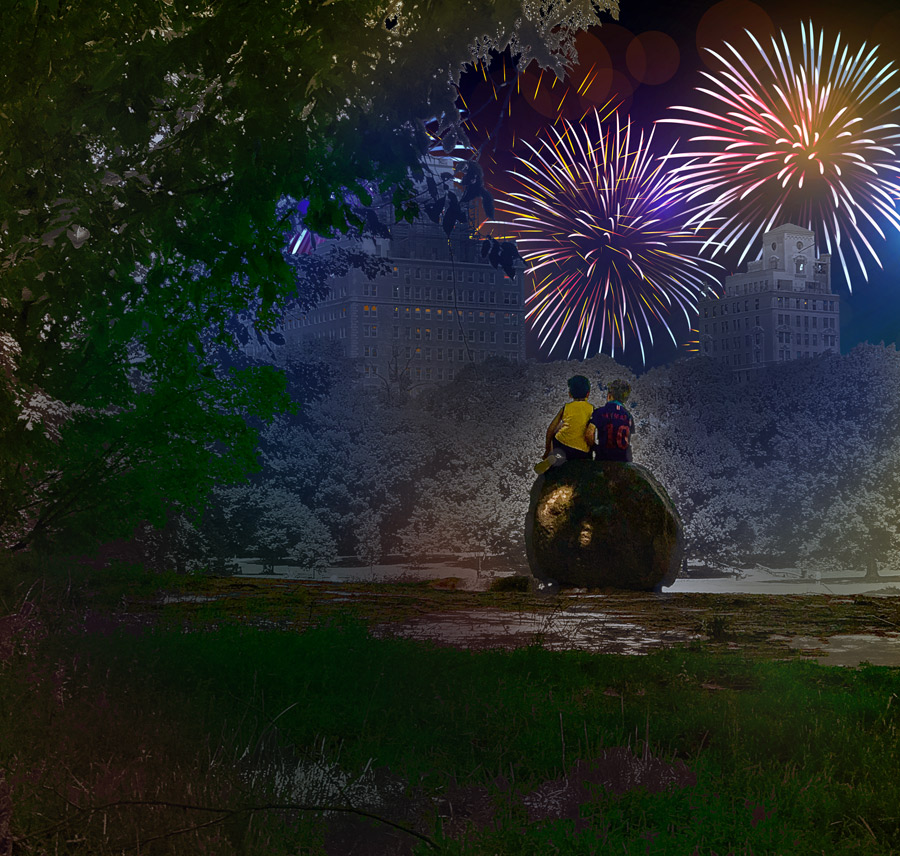
We’ve been hearing fireworks for weeks in Brooklyn and across New York City. That is not unusual activity to see leading up to this holiday celebrating the start of the country, but the quantity and quality of fireworks available on the black market (fireworks are largely illegal in NYC) and the duration of the explosions into the night has been wearing down already frayed nerves of people in some neighborhoods, spawning rumors and conjecture.
Have you ever noticed that every conspiracy theory appears to involve black SUVs? Or maybe black helicopters? Dude, what do you think that means?
Tonight we’ll expect a cavalcade of illegal fireworks to light up the sky all over the city nonetheless. In the morning we’ll expect that none of our social and political problems will have disappeared overnight because of a patriotic holiday. We know that none of us are free until all of us are free, so there will still be work to do.
Our weekly focus on the moving image and art in the streets. And other oddities.
Now screening : 1. “No Weapon Formed Against Thee Shall Prosper” Cey Adams, Sophia Dawson, and Marka 27
BSA Special Feature: “No Weapon Formed Against Thee Shall Prosper” Cey Adams, Sophia Dawson, and Marka 27
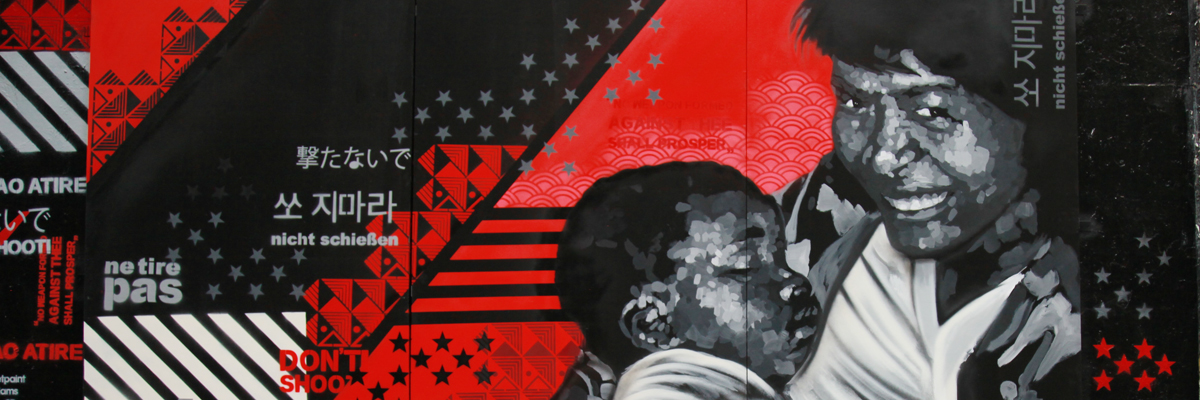
Quoting Isaiah 54:17 in the Bible, this mural inspires us and girds us and reminds us that when it comes to systemic racism the battle is not for the faint of heart. Can we get an ‘Amen’?
“No Weapon Formed Against Thee Shall Prosper” By Murals For The Movement, Cey Adams, I’m Wet Paint and Marka 27 is dedicated to the victims of police brutality and mass incarceration.
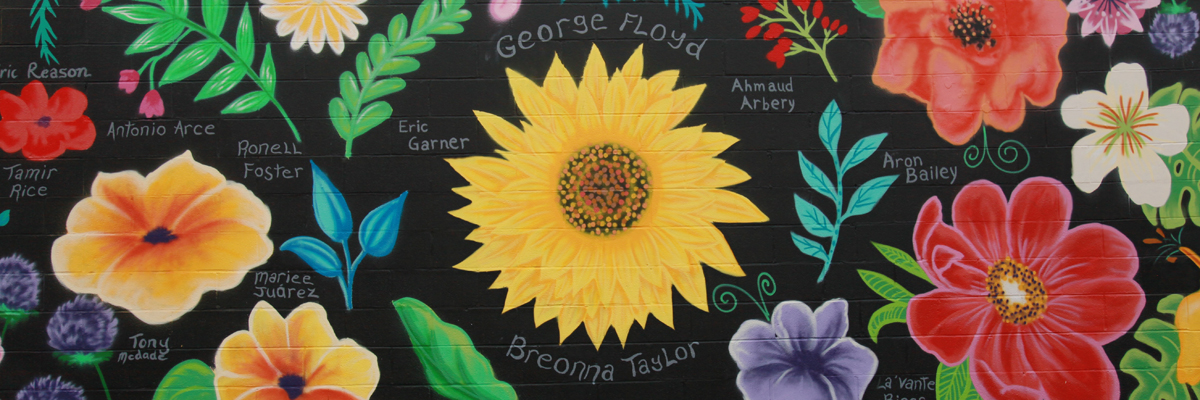
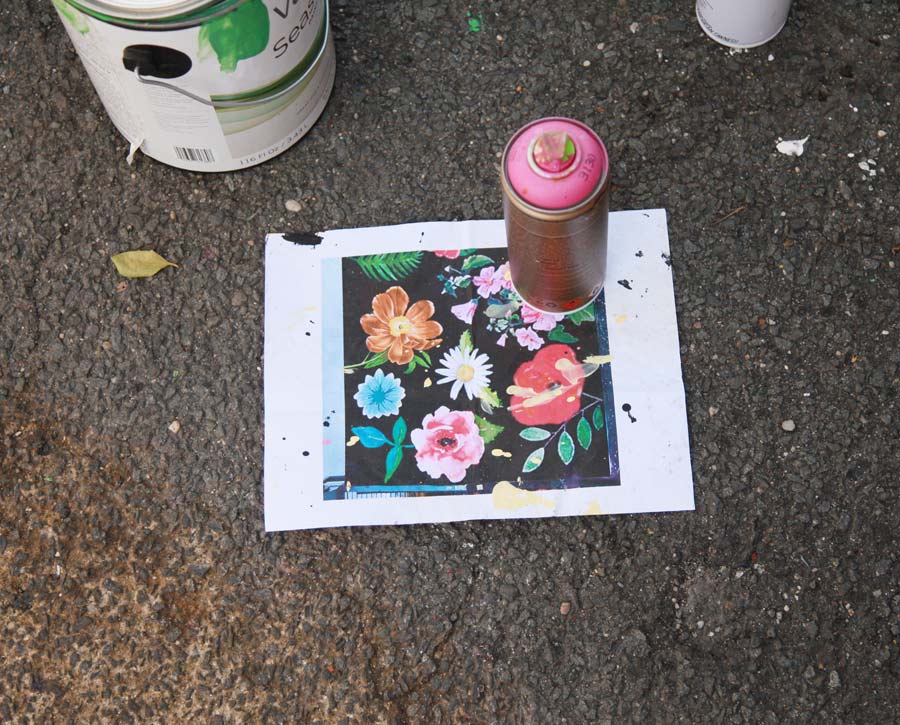
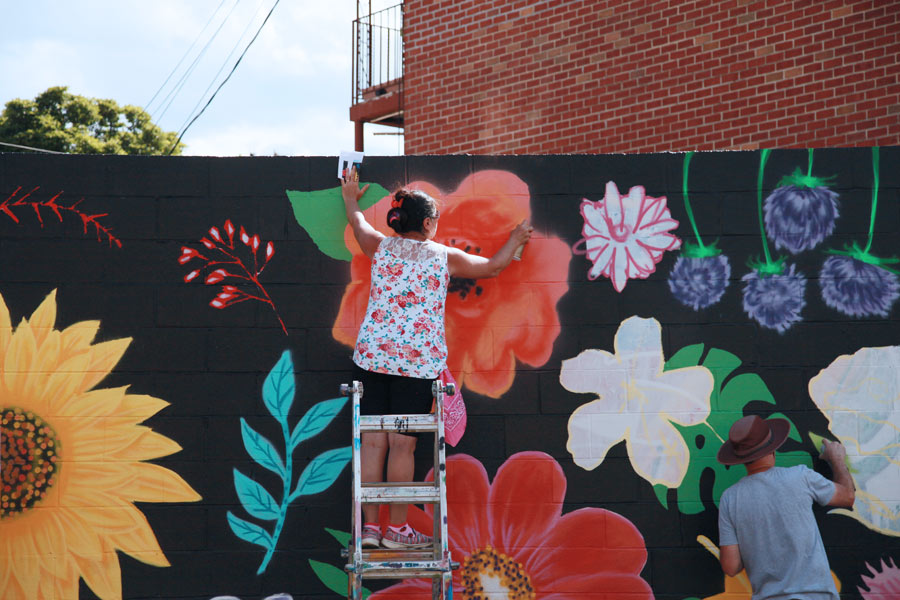
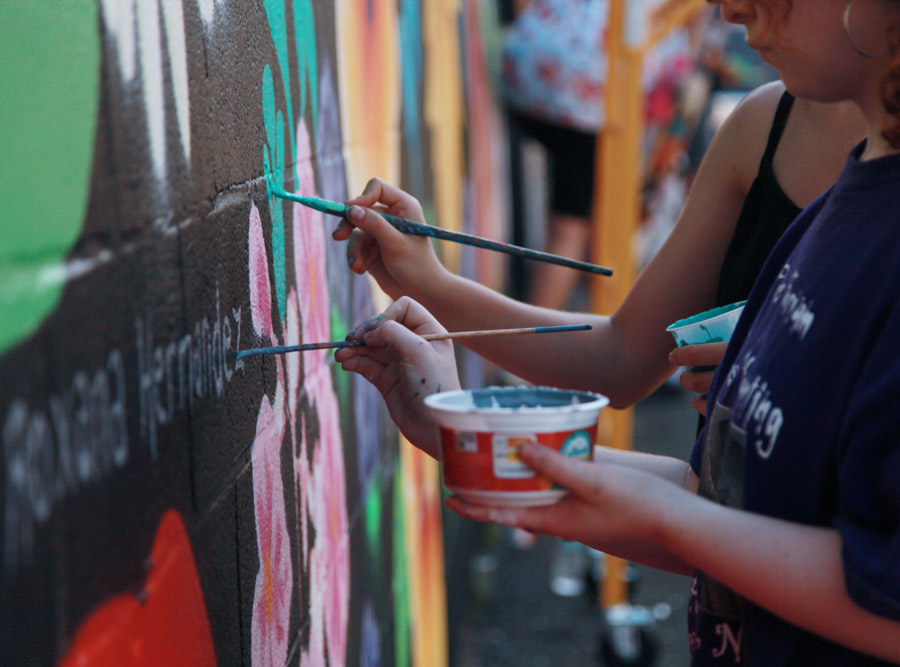
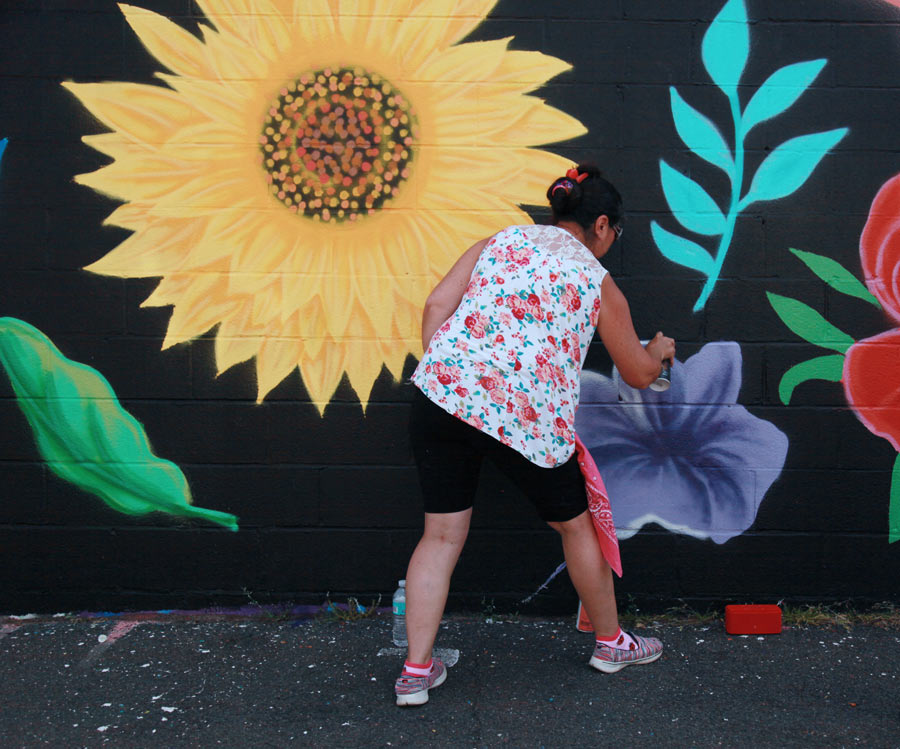
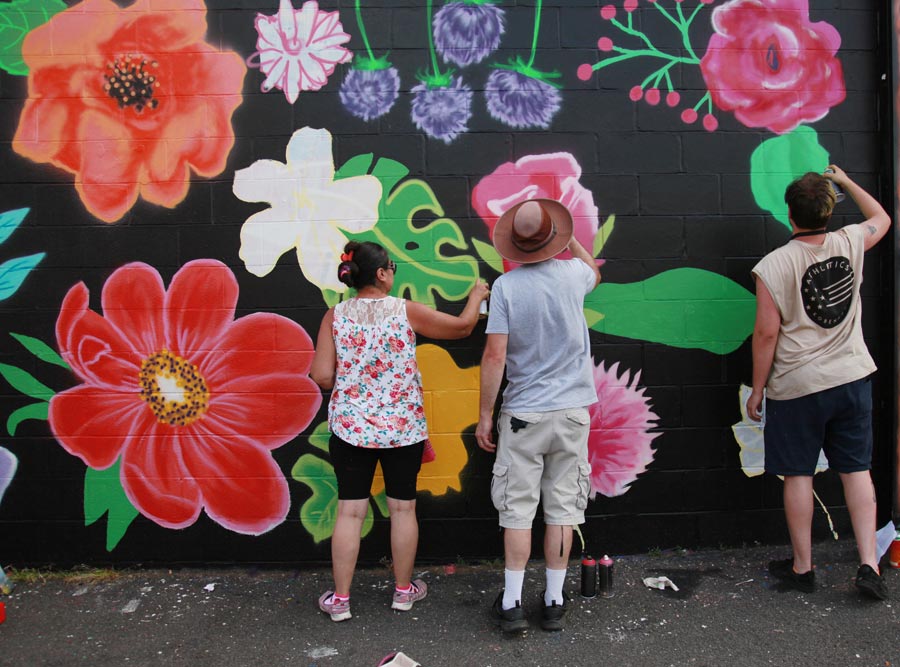
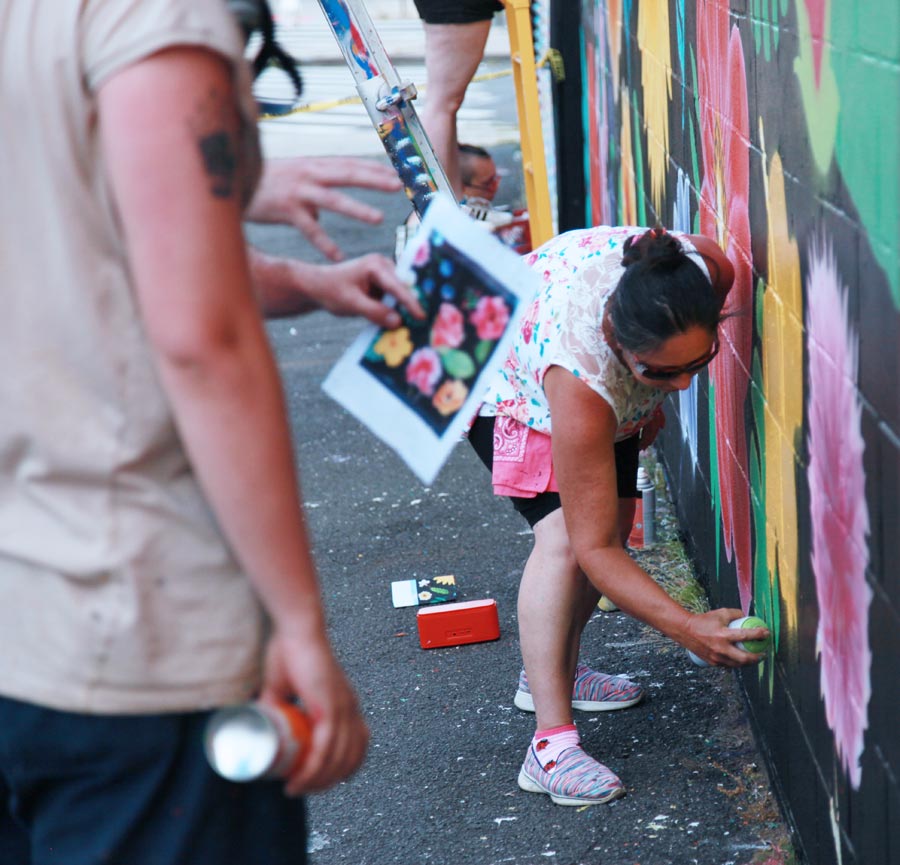
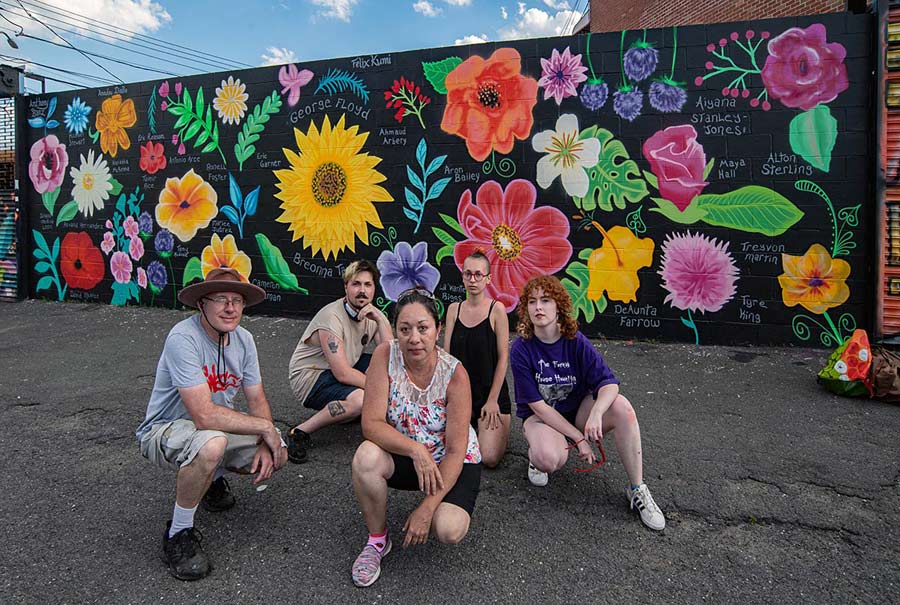
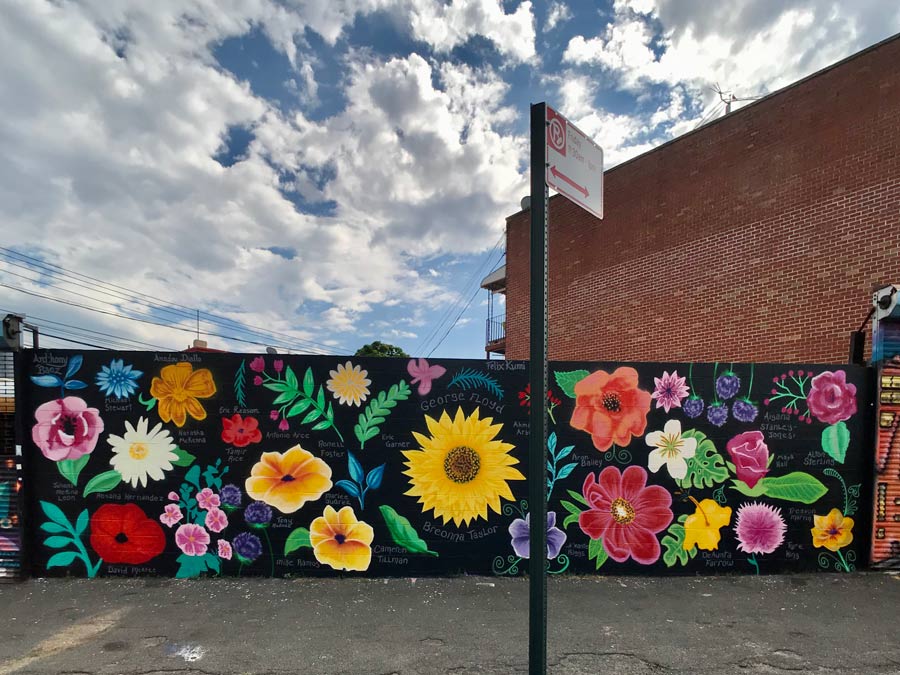
Free spirit Lady Pink has sprinkled a summer bouquet across a wall here with friends in Queens for the Welling Court Mural Project this year. The Ecuadorian-American artist is known by many for her graffiti writing on trains in the 1970s and 1980s and her latter day murals empowering women, exploring the cityscape – and themes of rebellion or self-expression.
Here she has decided to keep it simple for summer 2020, perhaps in the face of the complexity of our lives at the moment. These colors and motifs of flora are reassuring and soothing – possibly to give a salve for our collective wounds as she subtly pays tribute to those names of black and brown people brutalized by our system.
The city is hurting, black people are hurting, poor folks are hurting. In times like these, Lady Pink and her painting family know what you need, because they need it too.
Shout out to Alison Wallis for organizing this years Welling Court Mural Project, despite the challenges of Covid-19. Read more about the project at wellingcourtmuralprojectnyc on Instagram.
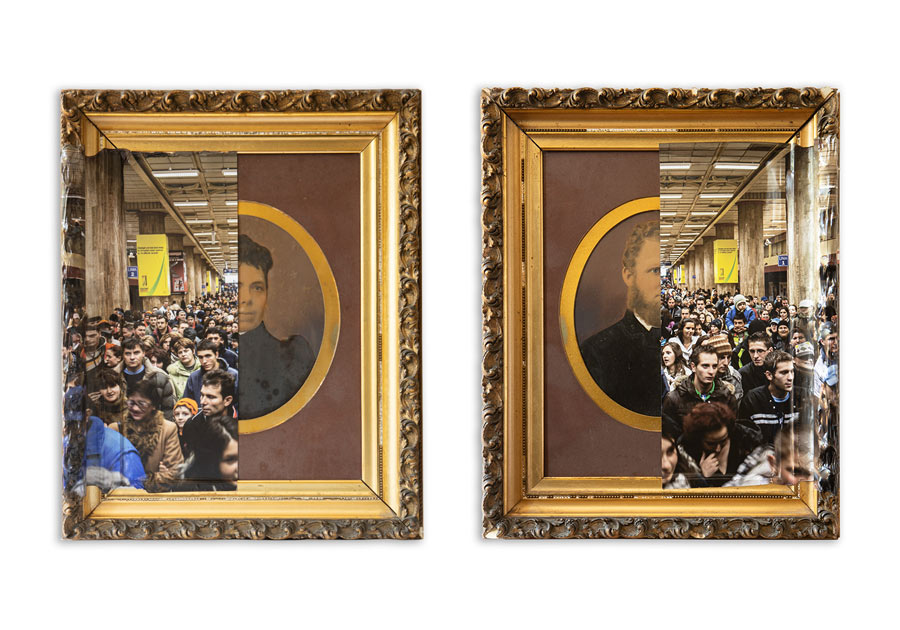
The marauding crowd, faceless and multi-podel, rumbling with half ideas and mislead missions. If you have lived in cities you know the feeling of being swept along inside one as it hurtles down the stairs, up the escalator, through the lobby, across various stadia.
We like it because we feel like we are part of something bigger, something that must have a logic of its own. In losing yourself, in becoming one with these others, we are reassured for that moment that there is something larger and of consequence, if only to break apart again into one once more.
Isolation
and pandemic have scarred many minds in the last few months because they’ve been
couple with fear, but these events have opened a few minds as well because we’ve
had time to examine, correlate, critique, observe our own impulses and needs
and wants.
Artist Alex
Fakso tells us that he used to be an avid traveler for his work, relying perhaps
on incessant movement for his sanity – moving from city to city sort of
mindlessly. He says he may have taken some things and people for granted,
including himself. and the current world crisis has allowed him to reflect on
what was left for granted by many people including himself.
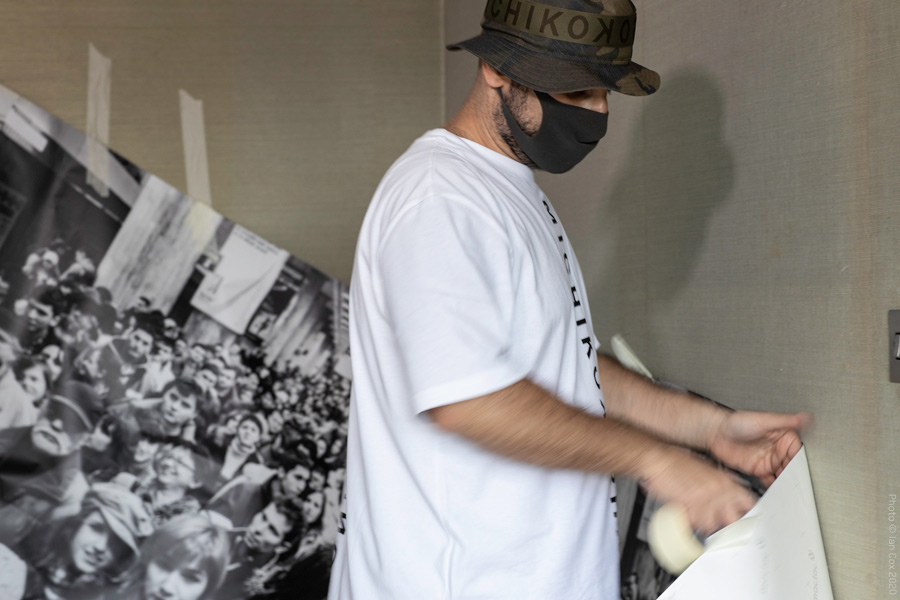
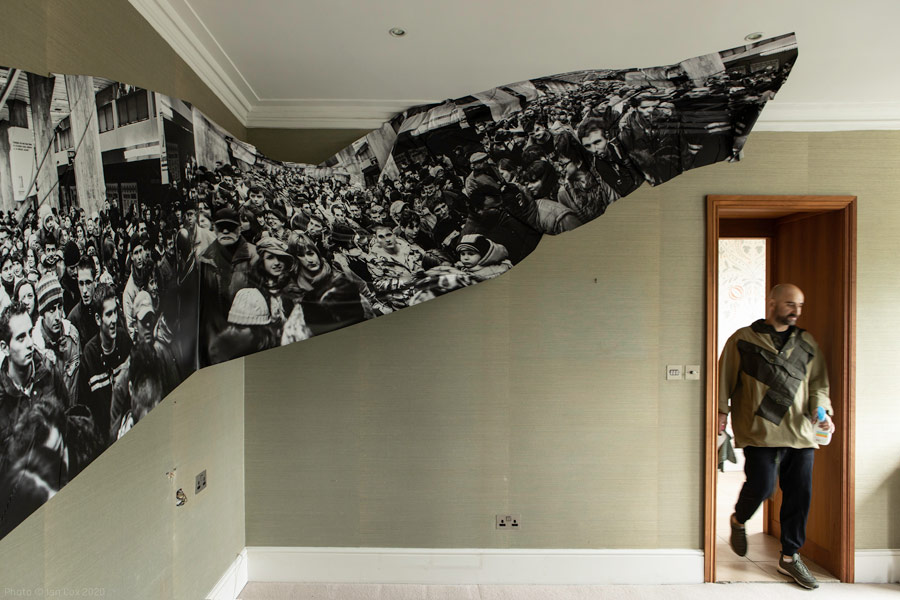
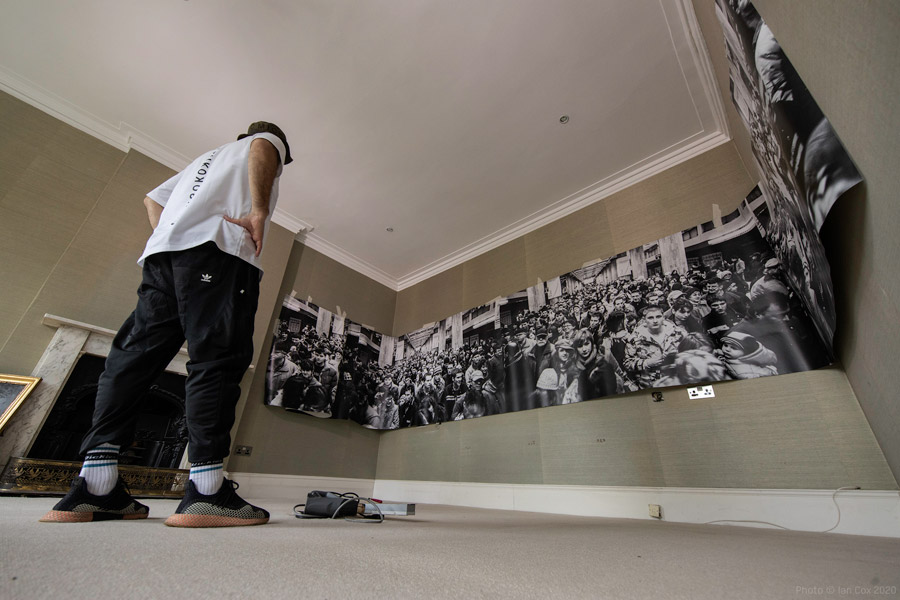
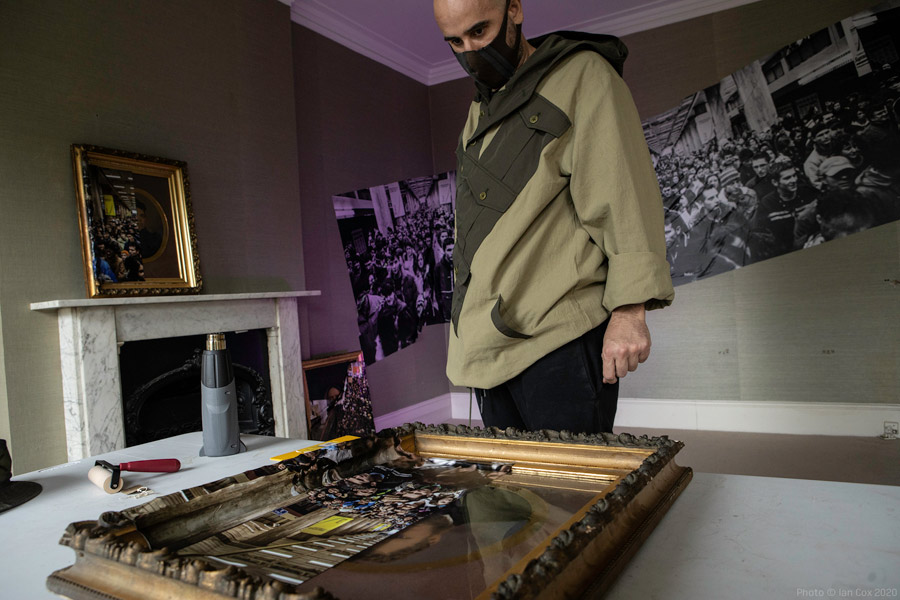
In his installation
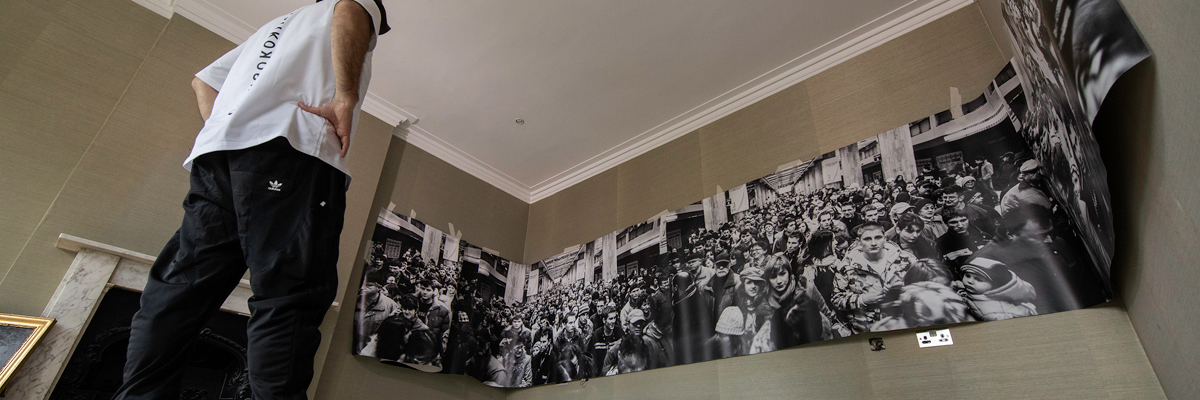
for the disconnect exhibition in London, he says these ideas of panic and isolation
are at the core. A distanced exhibit, he’ll be happy to see you contemplate the
images of crowds placed here. He hopes it will be “a dive into a world which
has dramatically changed,” he says, and one in which, “as individuals, we
currently long to belong again.”
Adam Neate (UK) Aida Wilde (Iran) Alex Fakso (Italy) Mr.Cenz (UK) David Bray (UK) Herakut (Germany) Icy and Sot (Iran) Isaac Cordal (Spain) Vhils (Portugal) ZOER (Italy)
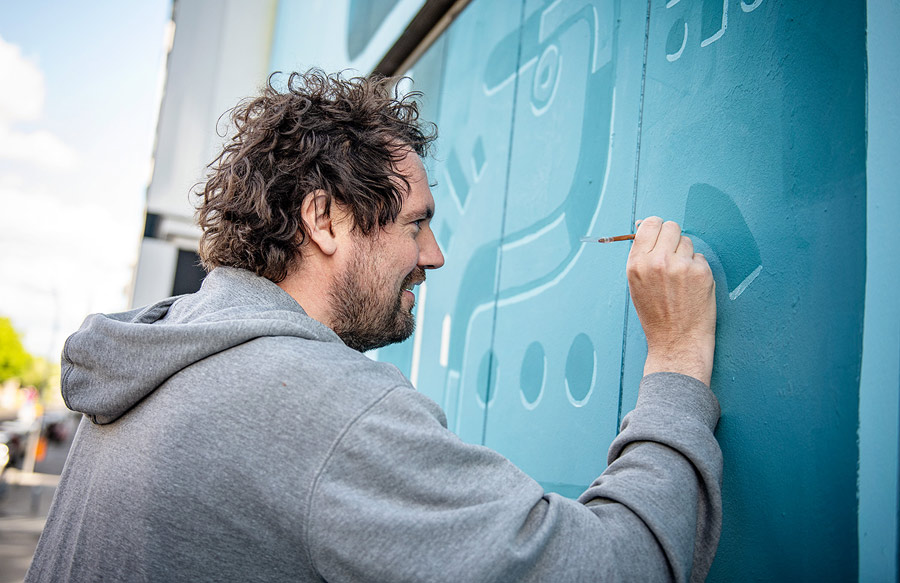
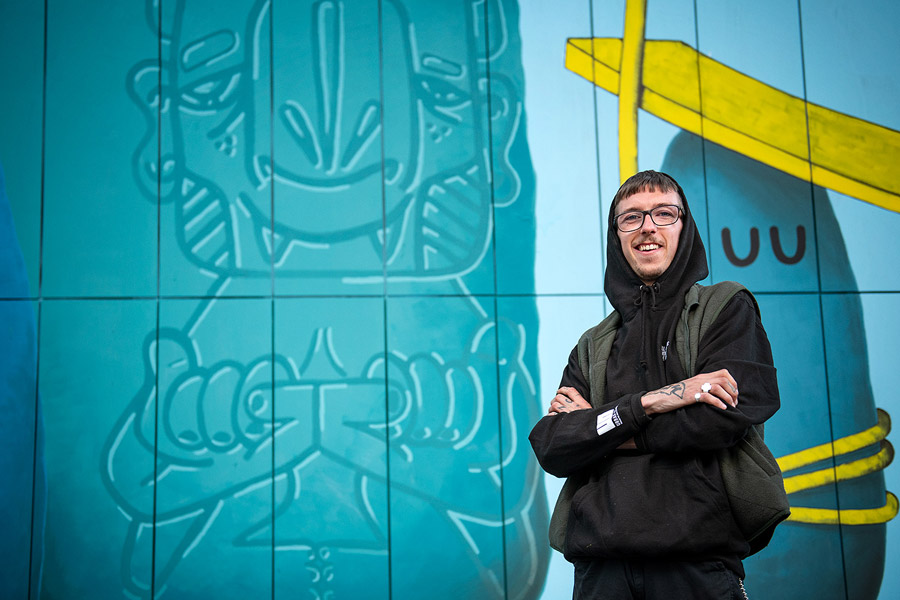
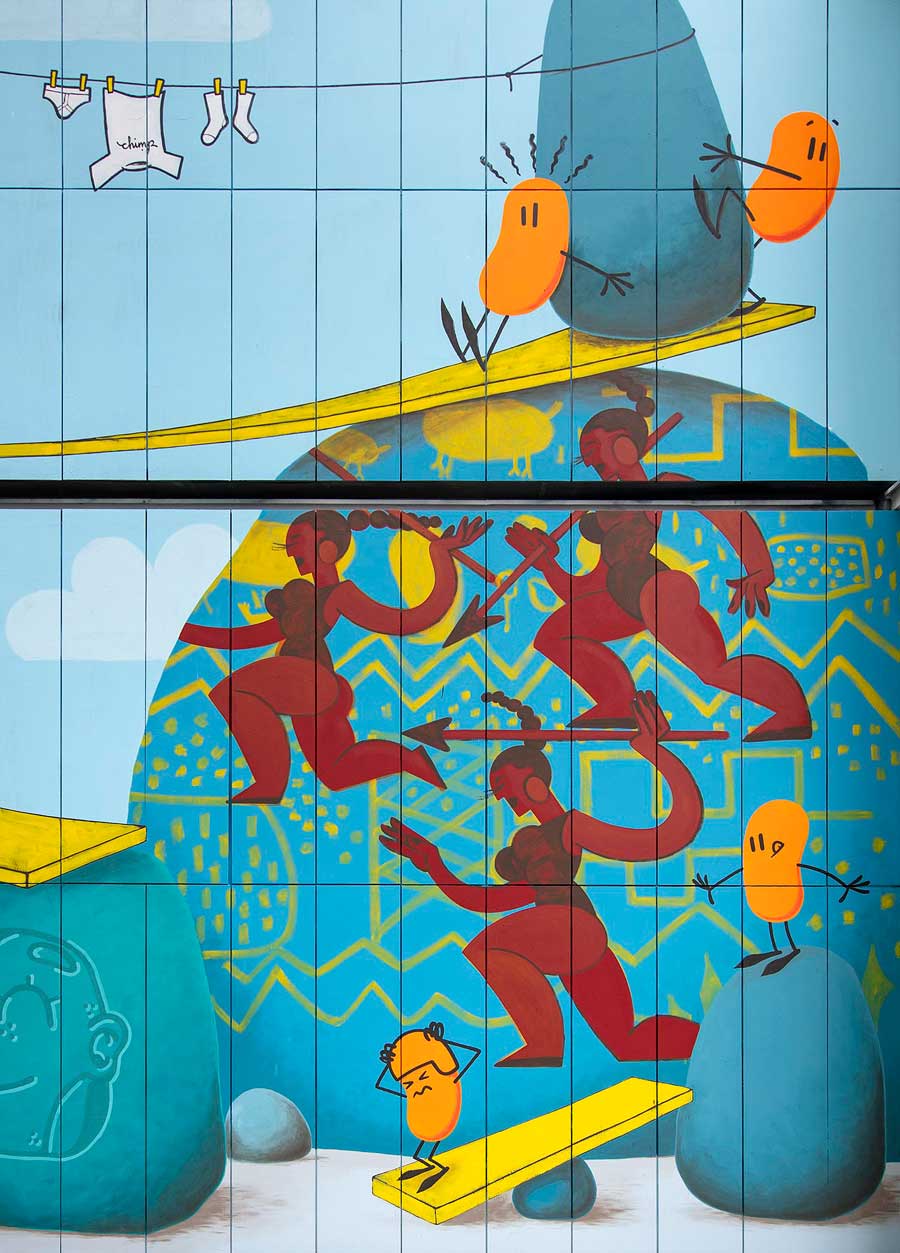
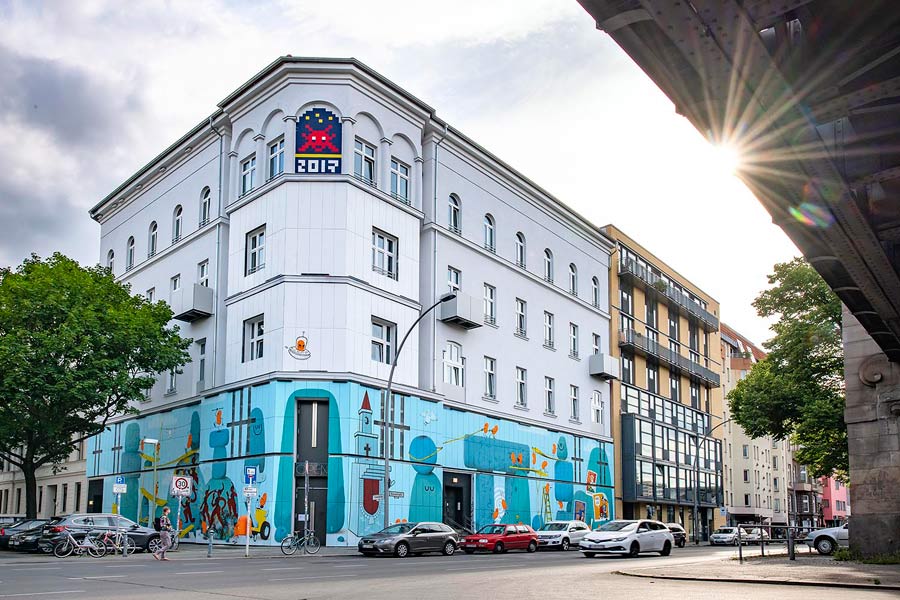
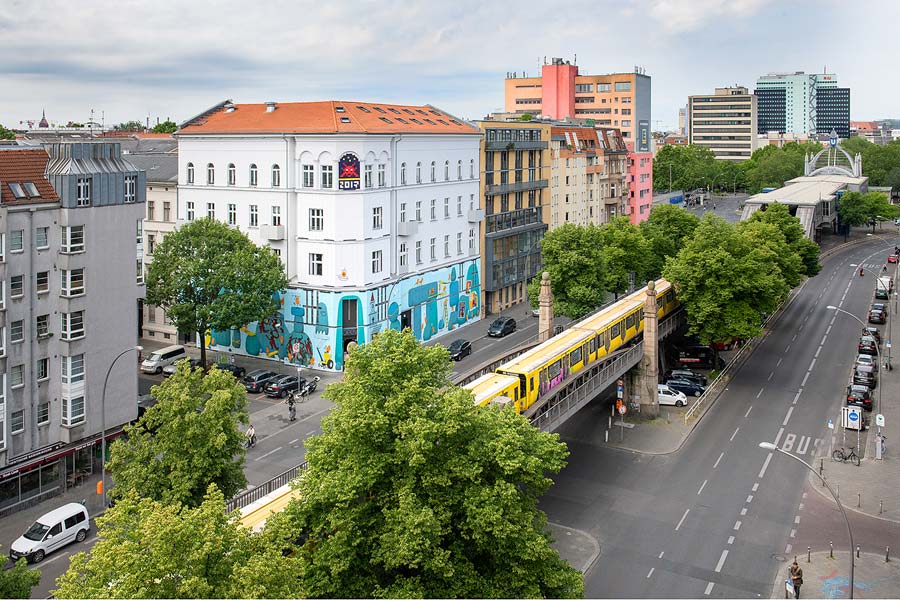
When Jan Sauerwald, Urban Nation’s Artistic Director, began making plans in earnest for the new facade for the museum, he was pondering what the art on the walls should convey. Given the difficult Covid-inflicted times we are living in he thought that possibly something fun and humorous was what Berlin needed. Indeed, humor has the power to provide levity, but humor is also an exceptionally effective vehicle to impart knowledge and spread a positive message without appearing to be lecturing.
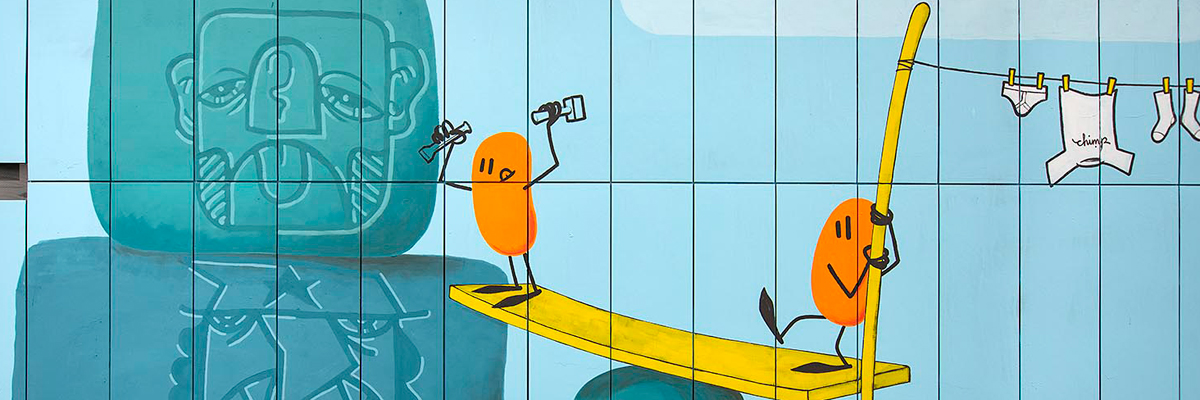
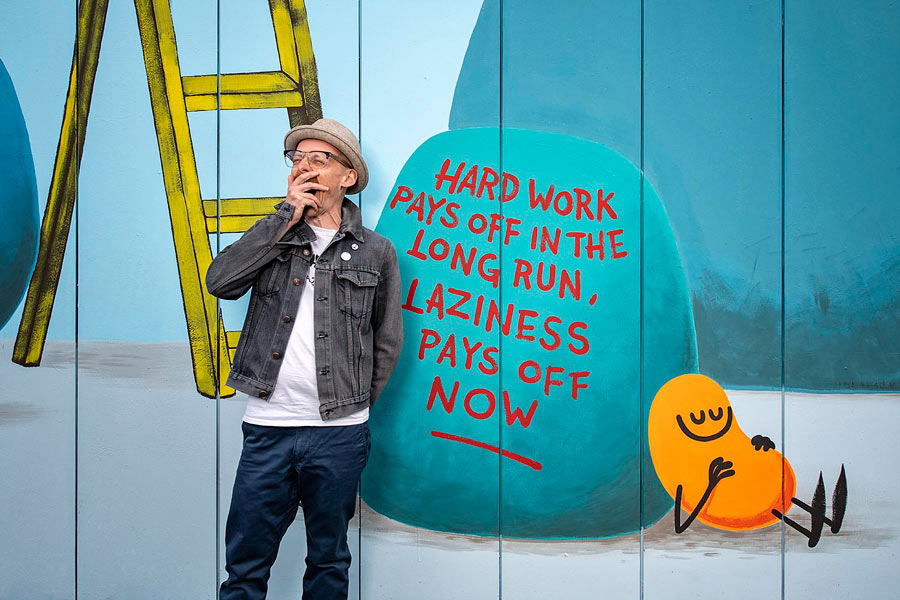
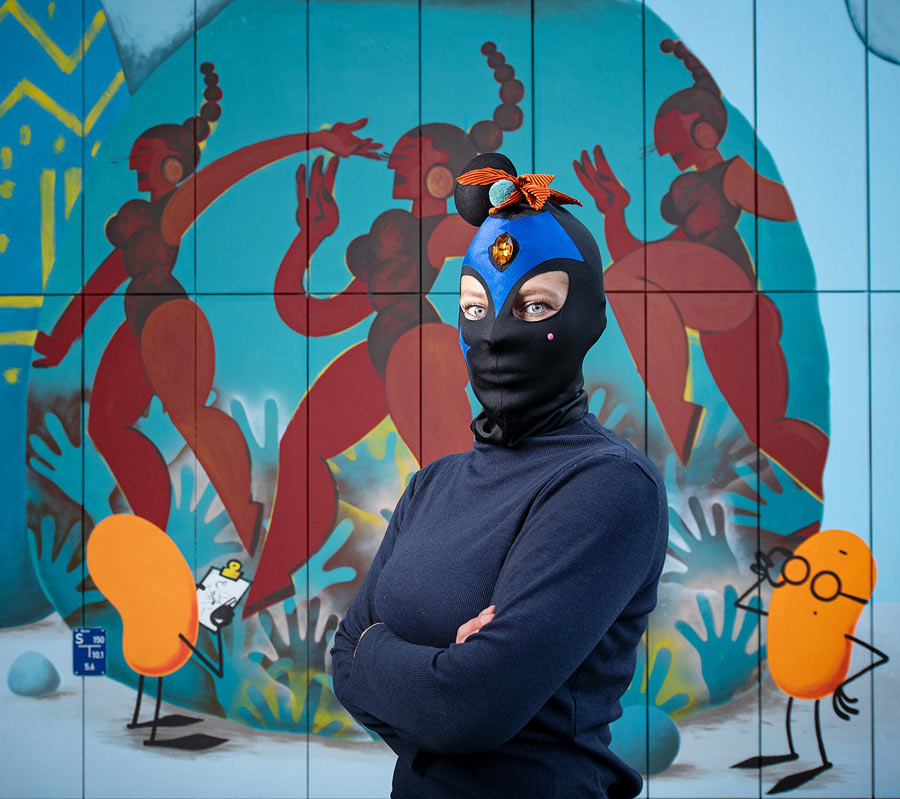
So it seemed most appropriate to gift the denizens of Berlin a fresh, humorous new mural, especially considering that collectively, the whole city had just endured months of lockdown, and they are just now slowly coming out to play outdoors and drink some beers with friends in the parks. Luckily Sauerwald knew who to call. Dave The Chimp. A Berlin-based artist, illustrator, and skateboarder who is known on the streets of Berlin for his simple but street-smart orange characters shaped like a bean. He calls them “Human Beans”.
We reached out to Dave The Chimp and asked him a few questions about the artists he invited to paint along with him and about his experience being able to get up and to get dirty again on the streets.
BSA: How did it feel to get up after the lockdown? How was the experience of working outdoors for the first time in many weeks?
DtC: I don’t work outside often. My work practice is constantly changing, sometimes painting, sometimes drawing comics or creating skateboard graphics, writing the text for zines, and in the past, I’ve organized costumed wrestling parties, played in a punk band, directed pop videos and tv commercials, compiled books… painting outside is just one of a constantly changing set of fun problems to solve!
I personally enjoyed the lockdown. I started meditating again, I was stretching and doing yoga and working out almost every day. Sitting on my balcony in the April sun, reading, catching up on all the movies I don’t have time to watch, helping plug the gaps in my son’s education, trying new recipes. All my projects and exhibitions were canceled so I figured “ok, guess I’m on holiday for a few months, so let’s forget about work”. I realized that this was a very unusual time, so why would I try and carry on with my usual life?
Germany locked-down early. Berlin was quick to organize an emergency fund for freelance workers, so most were able to receive money that meant they could survive a few months without worry. This lessened the fear. Fear shuts down the immune system, and during a pandemic, the one thing you need is a strong immune system!
It was great to come out of the lockdown here and be straight on a worksite, mingling with people, getting dirty, laying in the street. After two months of washing my hands constantly, it was fascinating to feel just how grimy I get just living a normal life! We’re a bunch of filthy little monkeys!
BSA:UN invited you to paint the UN facade for the first time. In turn, you invited four artists to join you. What were your criteria for inviting the other artists?
DtC: Due to Corona, the new museum exhibition had to be delayed until September. They had planned to paint the facade for this exhibition with other artists, so had the city permit to put the lift in the street at the end of May. The crisis has meant that all government offices are running slowly, and a new permit wouldn’t be possible until early 2021. Jan called me and asked me if I could paint the facade two weeks before work had to begin!
The first idea was for me to paint it with Flying Fortress, but unfortunately, he wasn’t available. This sowed the idea of working with others in my mind and I figured “if it would have been fun painting with one friend, why don’t I invite four?” I chose people I like, and whose work I like, and that I could see working with the theme I wanted to portray on the wall.
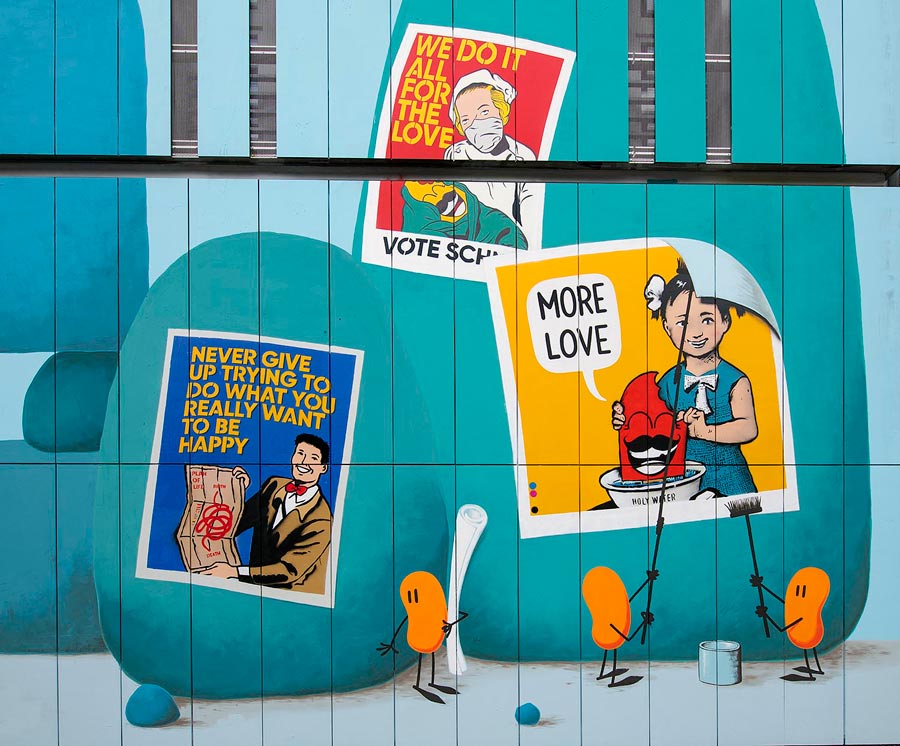
Originally I had a team of two boys and two girls, but one of the girls wasn’t available, and I couldn’t find another making the kind of thing I needed. Luckily my friend Matt Jones had recently sent me a zine of his doodles, and I saw how some of these could work as a kind of ancient alien language etched into my Stone Henge “stargate”. I invited Mina to paint her powerful females as prehistoric rock paintings, got my skateboard buddy Humble Writerz to chisel the faces he bombs in the streets into stone columns, and had Señor Schnu paste his posters onto boulders. And then I added my own characters so it looked like they were doing all of this work! 😉
BSA: The mural has a playful tone to it which goes well with your character but it also has a message of a team effort in order to build a better world. Is that right?
DtC: I’m pretty sure we don’t need to use fear and anger to change the world. As PiL said, anger is an energy, but I’ve learned that it’s one that is soon burnt out. Much better to try and make the world a better place with love as your fuel. There’s an endless supply of love in all of us. Political action doesn’t need to always be a raised fist, a black, red, and white stenciled shout at the world. Why can’t protests be a fun day out, just like a festival, a carnival of change?
BSA: Can you tell us about the genesis of the concept for the mural? Did you have a brainstorming session with the other artists or did you know what you wanted and just told them your idea and they jumped into action?
DtC: I pretty much see complete ideas in my head. I knew I wanted to paint rocks, and I knew the work of the artists I wanted to paint with. And I had a week to work out the design of an 8 meter high by 50-meter long wall, with three doors, six windows, various corners, and parts inaccessible by the lift! I didn’t have time for brainstorming! I came up with concepts, told the artists what it was I’d like them to do, and then trusted them to do their thing. I had way too many things to think about – five artists with different schedules, a lift that took 20 minutes to move each time, and three days when we were not allowed to use the lift, created an organizational nightmare! Plus I had to try and paint huge structures that I’d never painted before, and 25 characters, all doing different things. But that’s kinda what I like. Painting is setting myself problems, then trying to solve them. It’s fun! If I know what I’m doing, how exactly to do something, and how it will turn out, in advance, then it just becomes work. Better to keep yourself on your toes, make it play!
BSA: Where do you see public murals/outdoor murals going after Covid-19 and the worldwide protests about racial injustice, racism, and police brutality?
DtC: I’ve always thought of graffiti and street art as a political act. It is a reclaiming of the commons. In our cities only those with the money to buy the walls around us – public space – get to have a voice. Advertising is designed to make you require more, to feel like what you have, who you are, is not enough. This is psychological oppression and we are exposed to it thousands of times a day. If we can use walls to make people feel less than, can’t we also use them to feel greater than, to inspire, to cheer, or just simply to help people be satisfied that they are ok? Like Picasso, I believe art can be a weapon to wage war. Bad people win when good people stay silent.
I have been known to make political work and to use a lot of slogans and messages in my work, but right now, in 2020, I find that I am overwhelmed with things that need to be spoken about, with things that are being spoken about, and, frankly, I don’t feel able to speak. Things are changing so quickly. It’s all too confusing. So I am trying to keep my use of words to a minimum, and to try and communicate on a more subtle level. The rocks in this mural represent our belief in the human-built structures and systems of life. The scaffolding, the planks and ropes, represent just how fragile all these systems are, as we have been seeing, and show our need to work together to make life function.
A mural like this couldn’t have been made without a huge network of people. The group of artists I worked with, the production crew at YAP, the lift hire guys, the factory workers that made the brushes, the chemists who brewed the paint, the people that built the wall, the people that cooked our lunch, the people that farmed the food for our lunch, the people that made the bikes we rode to the site every day, that built the roads we rode on… thousands of people are involved in every single human action.
The world is a crazy place right now, and it’s important to remember that we’re all in this together. Maybe it’s better we stop finding ways to divide ourselves, and instead unite.
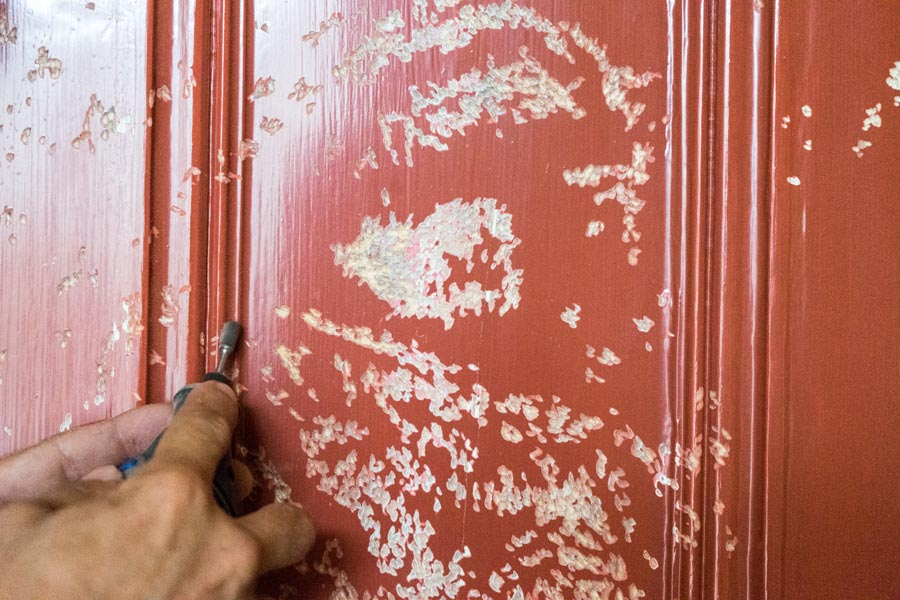
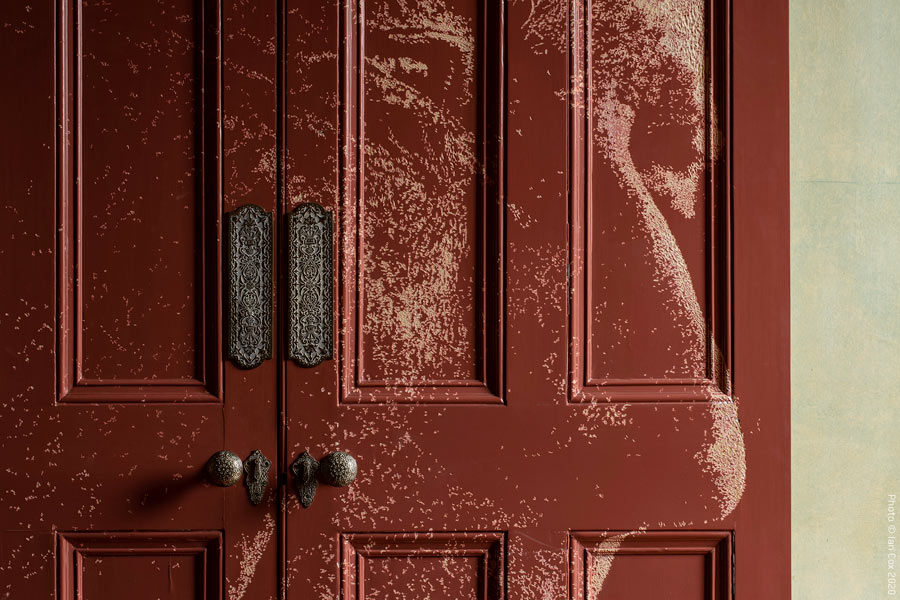
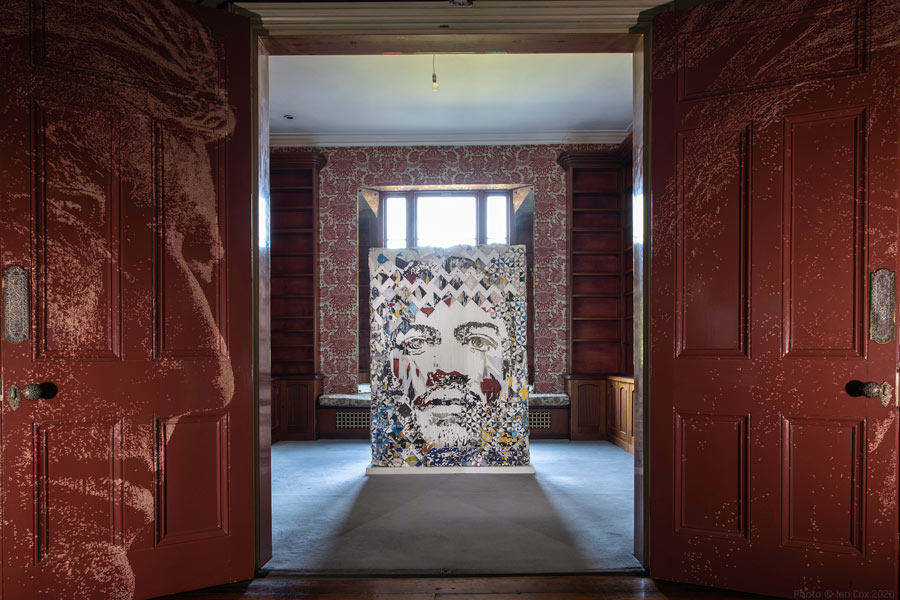
The folks organizing the disCONNECT exhibition in this Victorian townhouse in South West London can confirm that this sensation of anticipation and discovery is exciting indeed, for anyone who has been watching the street artists’ work over the last decade.
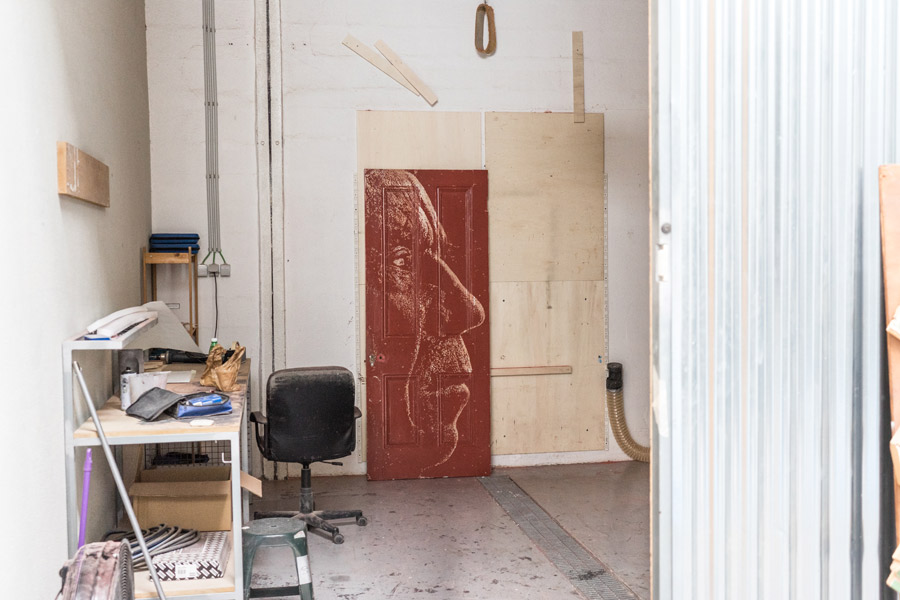
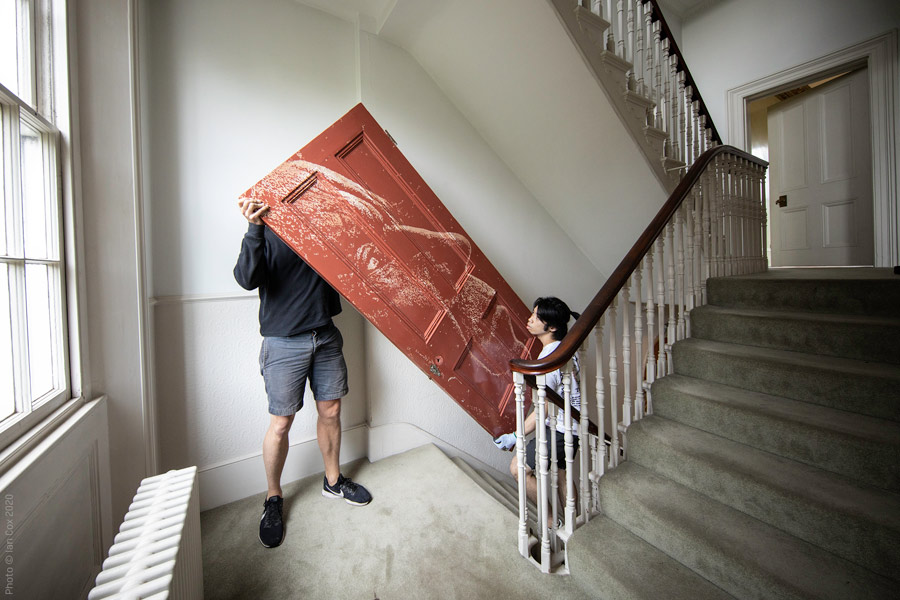
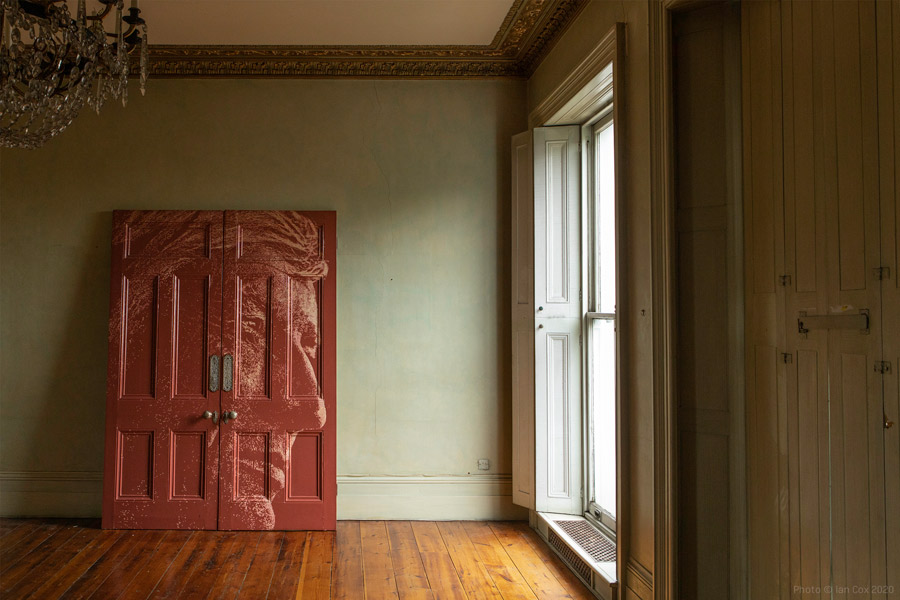
Named disConnect because of our communal feeling of disconnection during quarantine these last few months, the unconventional art exhibition is breaking some new ground. Pulling the doors off the hinges in the library and popping them in the mail is one.
The pandemic show opens in a few weeks with the bas-relief works re-installed for the socially distanced attendees who can see it in person. It is also “accessible to online audiences through Matterport software, (with) each work further activated through an accompanying programme of digital initiatives, including downloadable artworks, online videos, virtual tours and an Instagram Live interview series.”
Adam Neate (UK) Aida Wilde (Iran) Alex Fakso (Italy) Mr.Cenz (UK) David Bray (UK) Herakut (Germany) Icy and Sot (Iran) Isaac Cordal (Spain) Vhils (Portugal) ZOER (Italy)
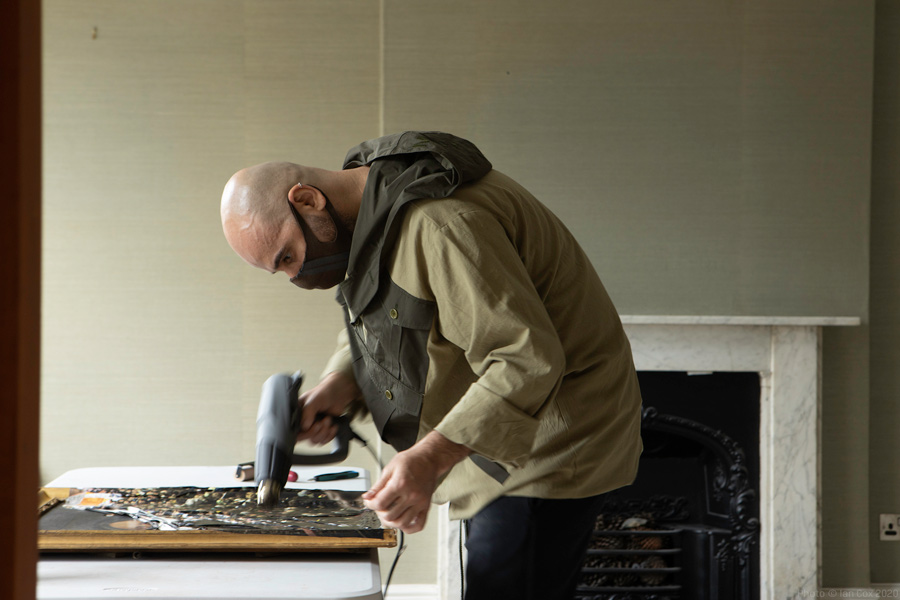
We’re thankful to show you these
exclusive images of the new Vhils work to BSA readers today.
Welcome to BSA Images of the Week and Happy Pride NYC.
No pride parade today, not that New York needs a special day for LGBTQI parades – that’s simply called walking on the catwalk, err, sidewalk.
The US is officially a pariah on the world stage – banned to travel to Europe. Because, you know, masks. But dude, we’re like in totally good company with other countries like Brazil and Russia. It’s a race to be number 1.
A special shout-out and respect today goes to the creater of the I (heart) NY logo and campaign, Milton Glaser, who passed away this week at 91. Many artists on the street today are aware of his other contributions to graphic design and illustration in the last fifty years or so. Rest in Peace.
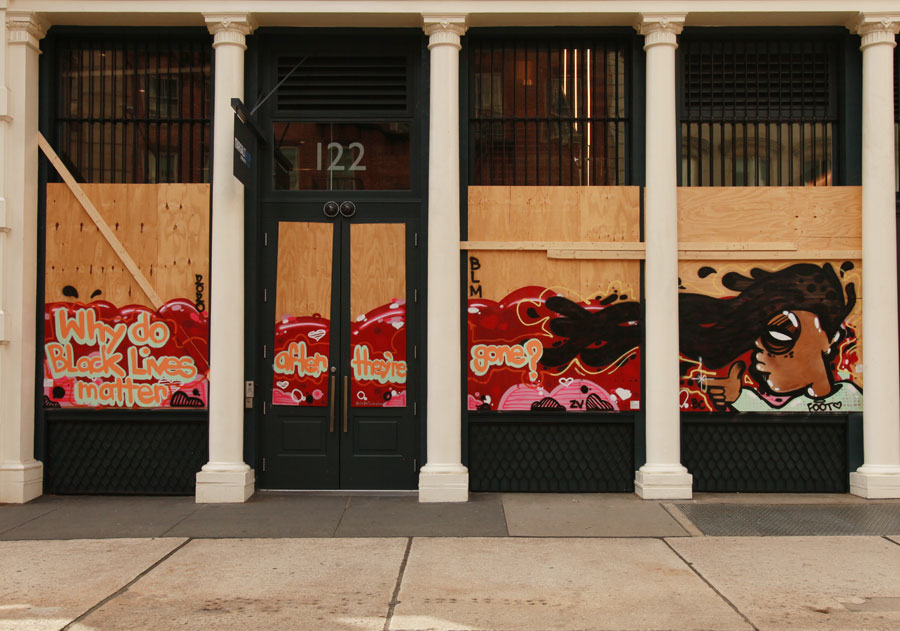
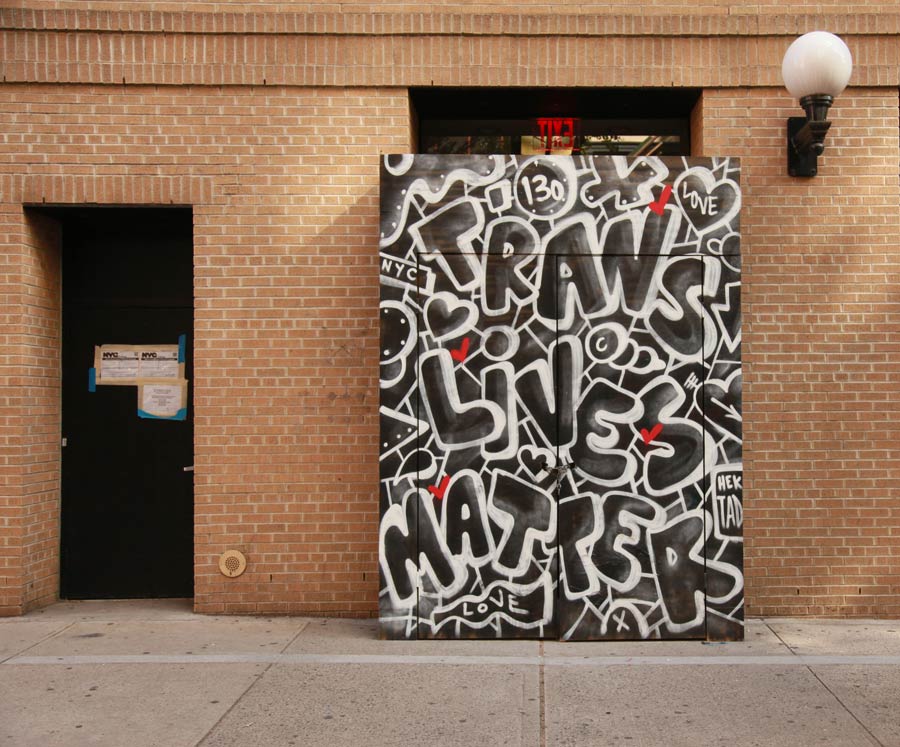
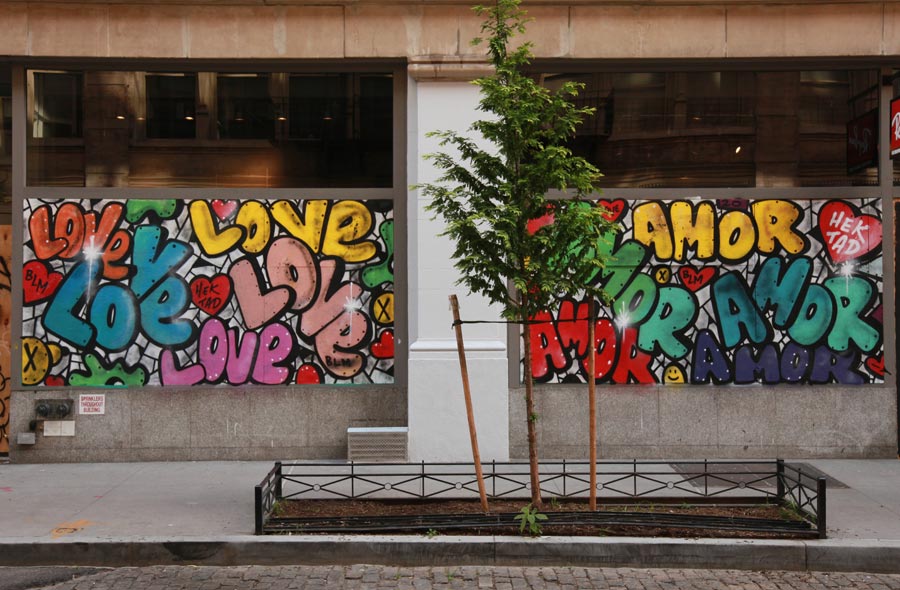
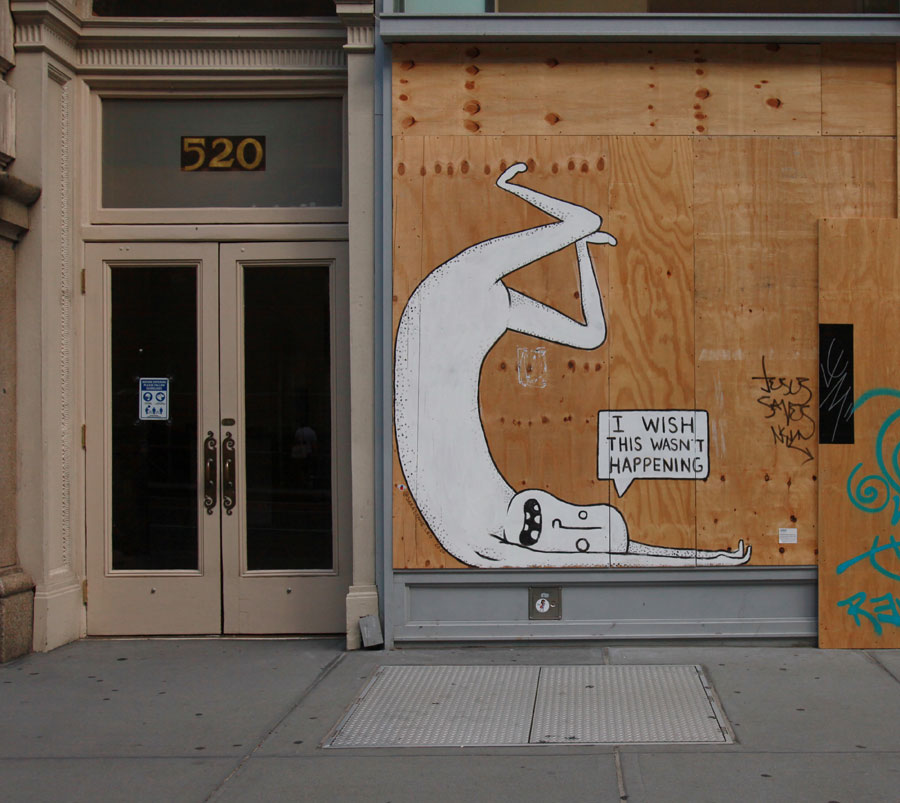
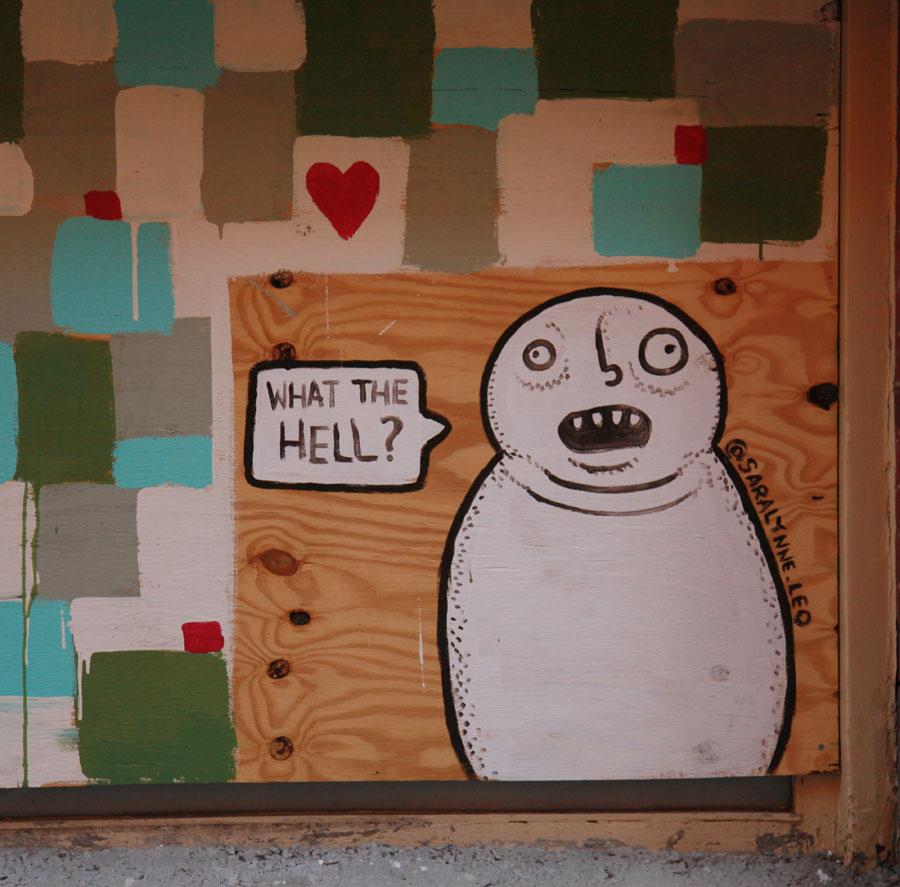
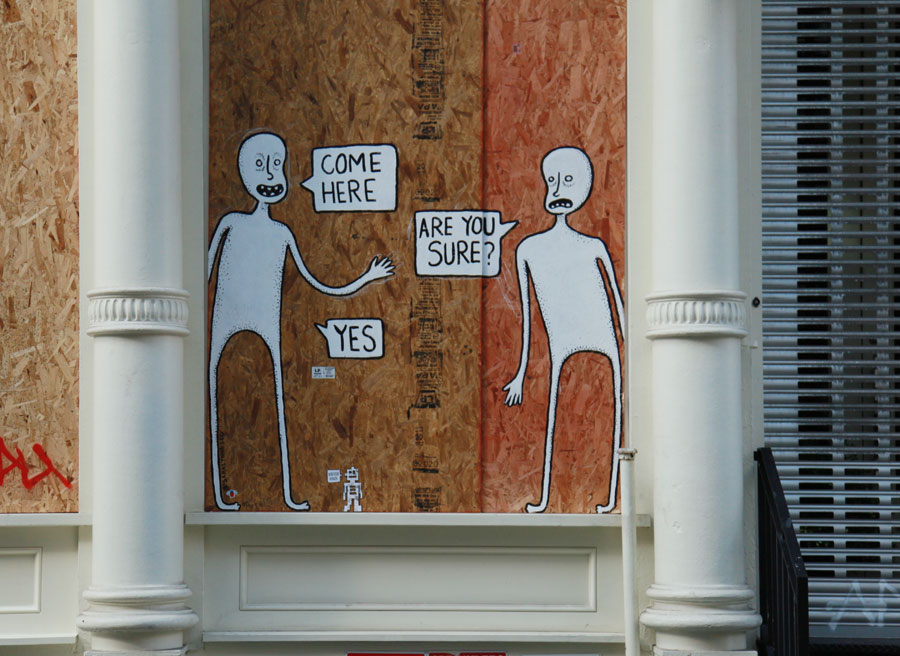
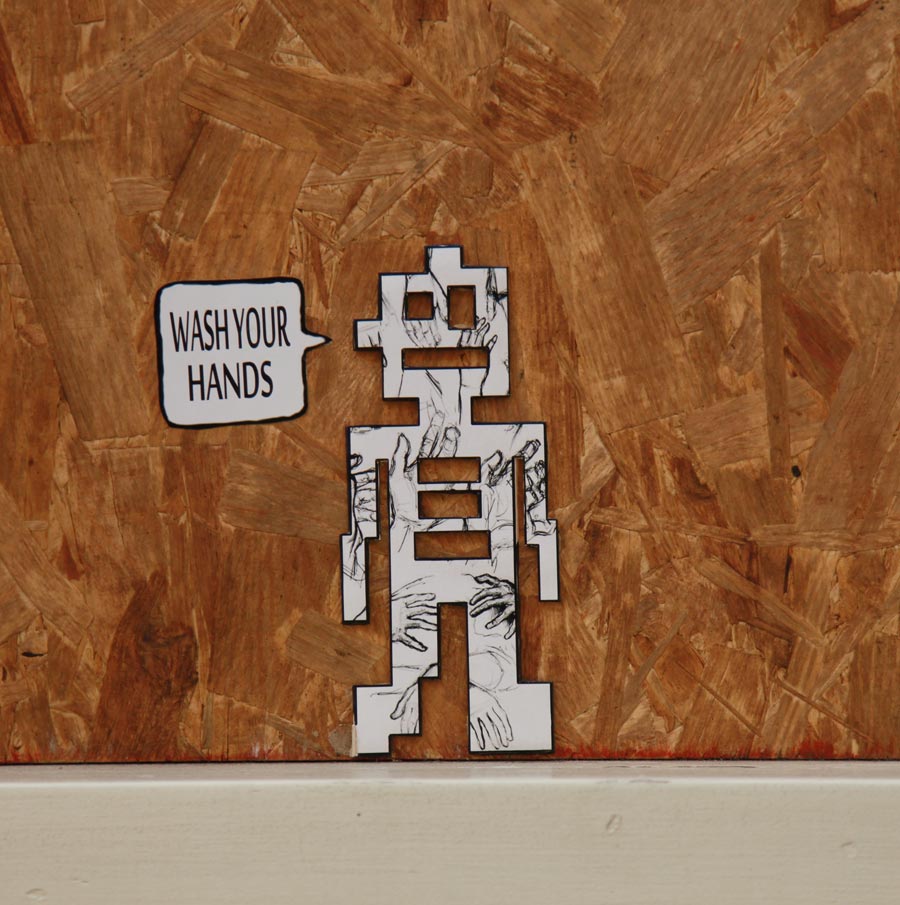
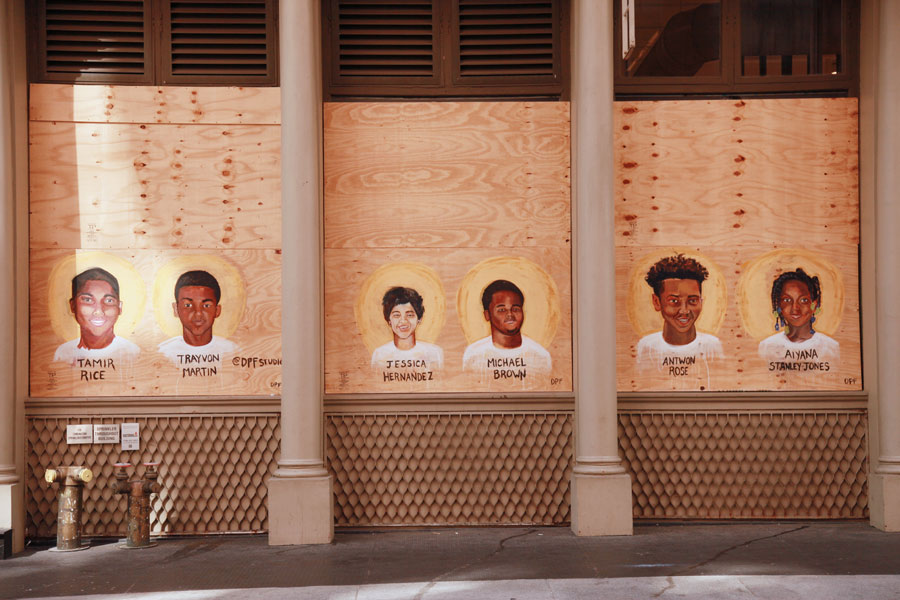
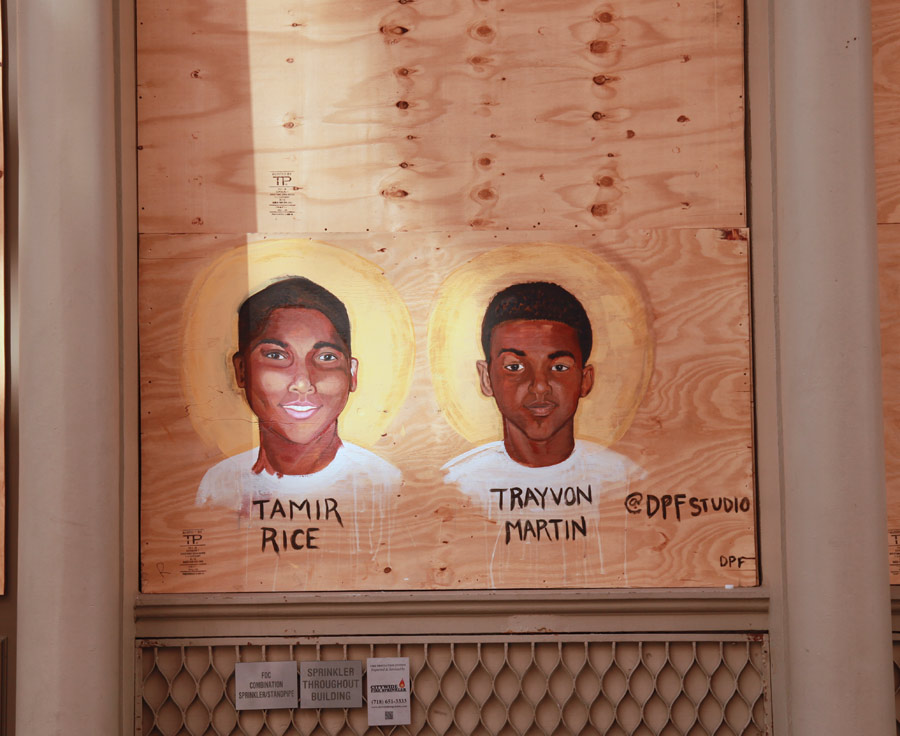
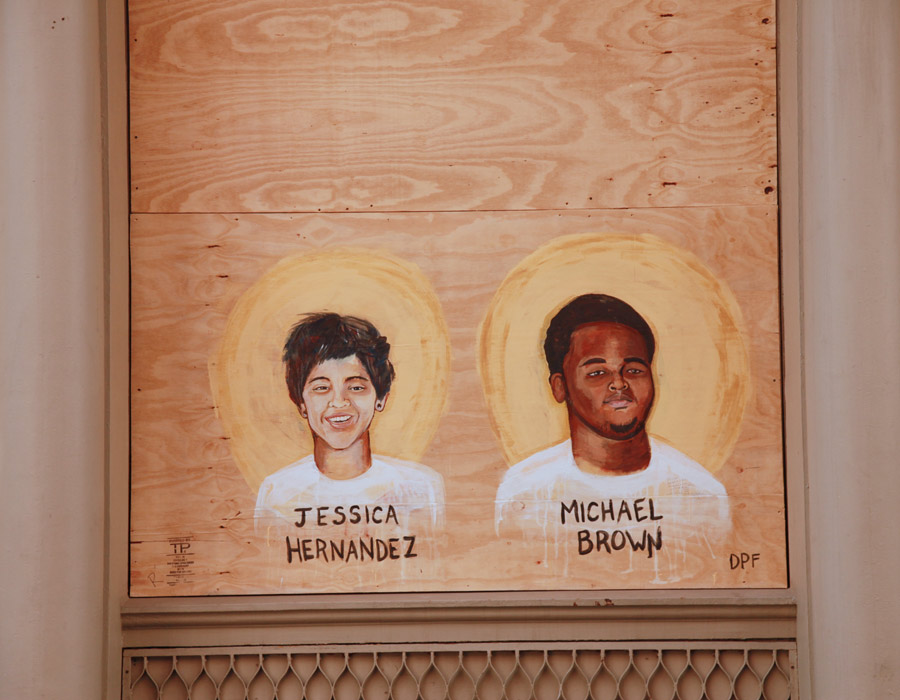
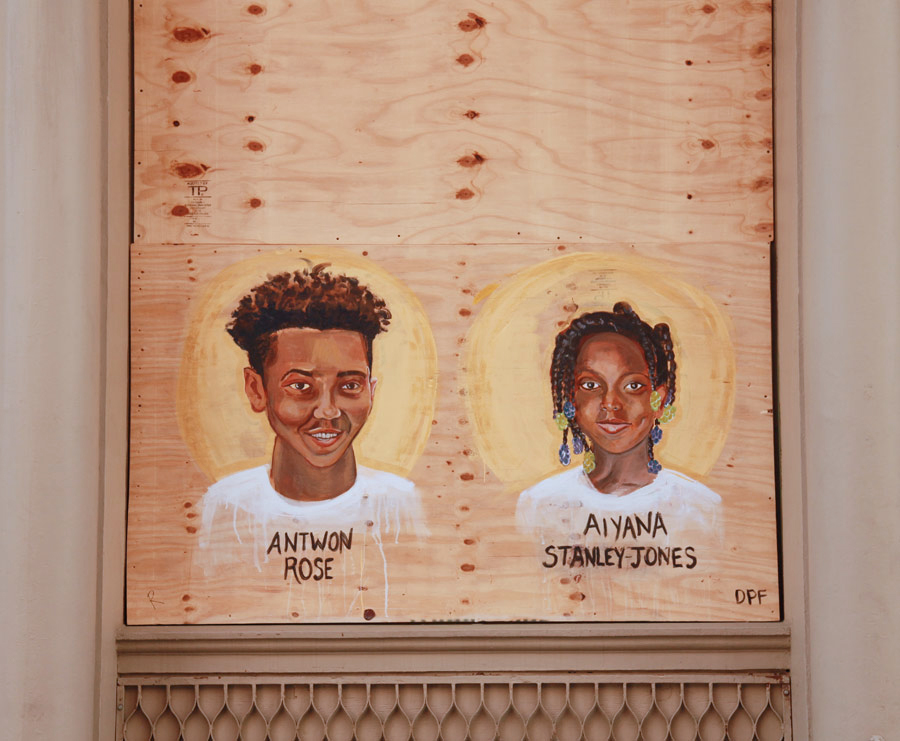
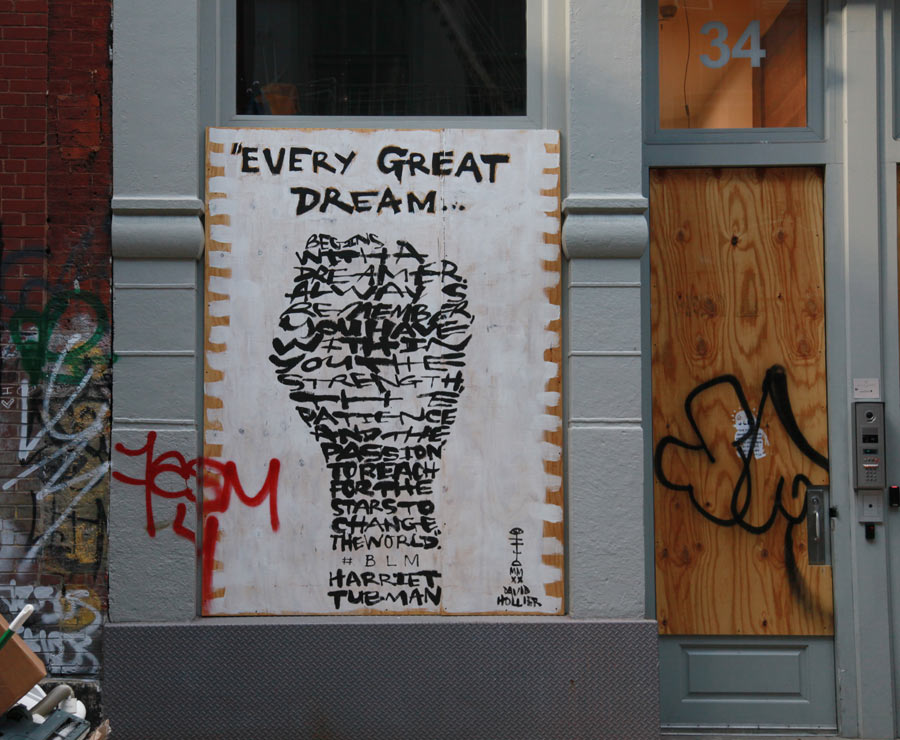
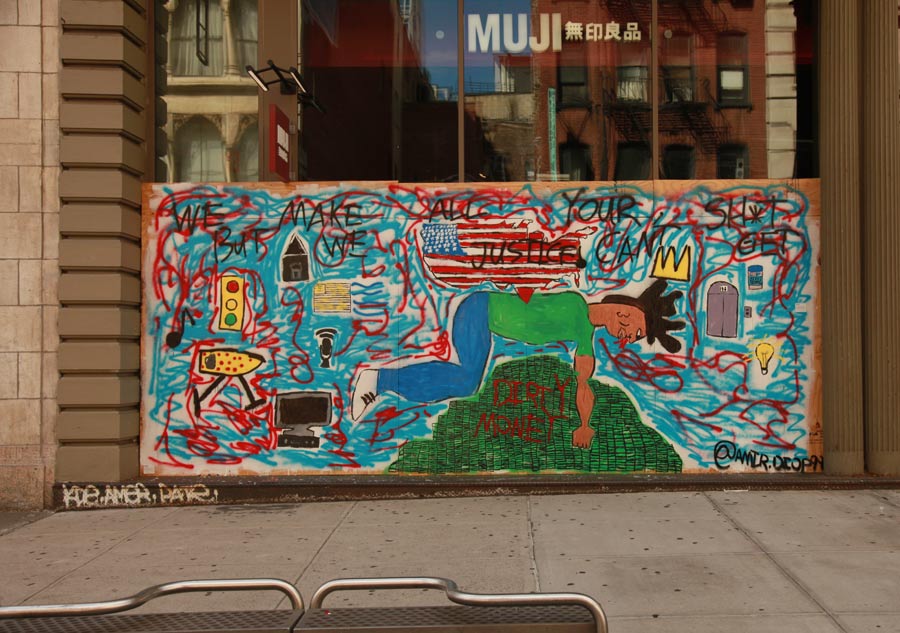
In street art news, downtown Manhattan is still largely boarded up, so artists are taking advantage of the new canvasses. You see, there is a silver lining to everything if you look for it. Or a plywood one.
Here’s our weekly interview with the streets, this week featuring Daze, DPF Studio, Dragon 77, Hek Tad, Sara Lynne Leo, and Stikman.
 BROOKLYN STREET ART LOVES YOU MORE EVERY DAY