Some hard news seems to great us every day, yet New Yorkers don’t give up so easily. And by the way, banging bright and crispy fall weather we’ve been having, right?
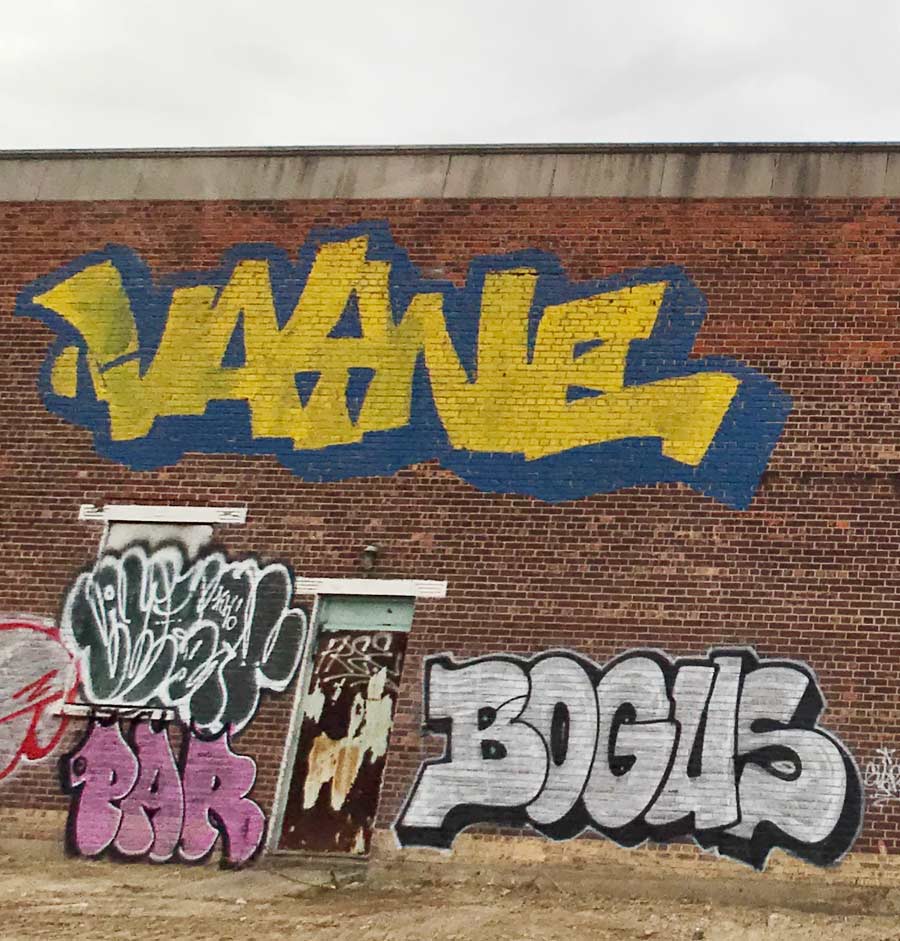
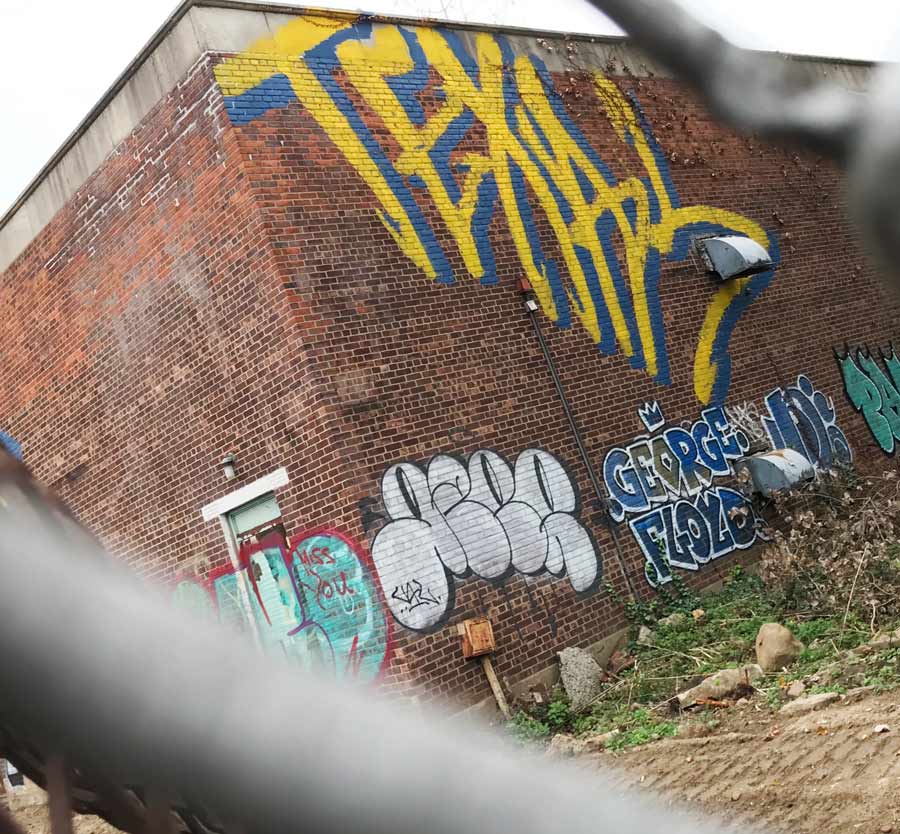
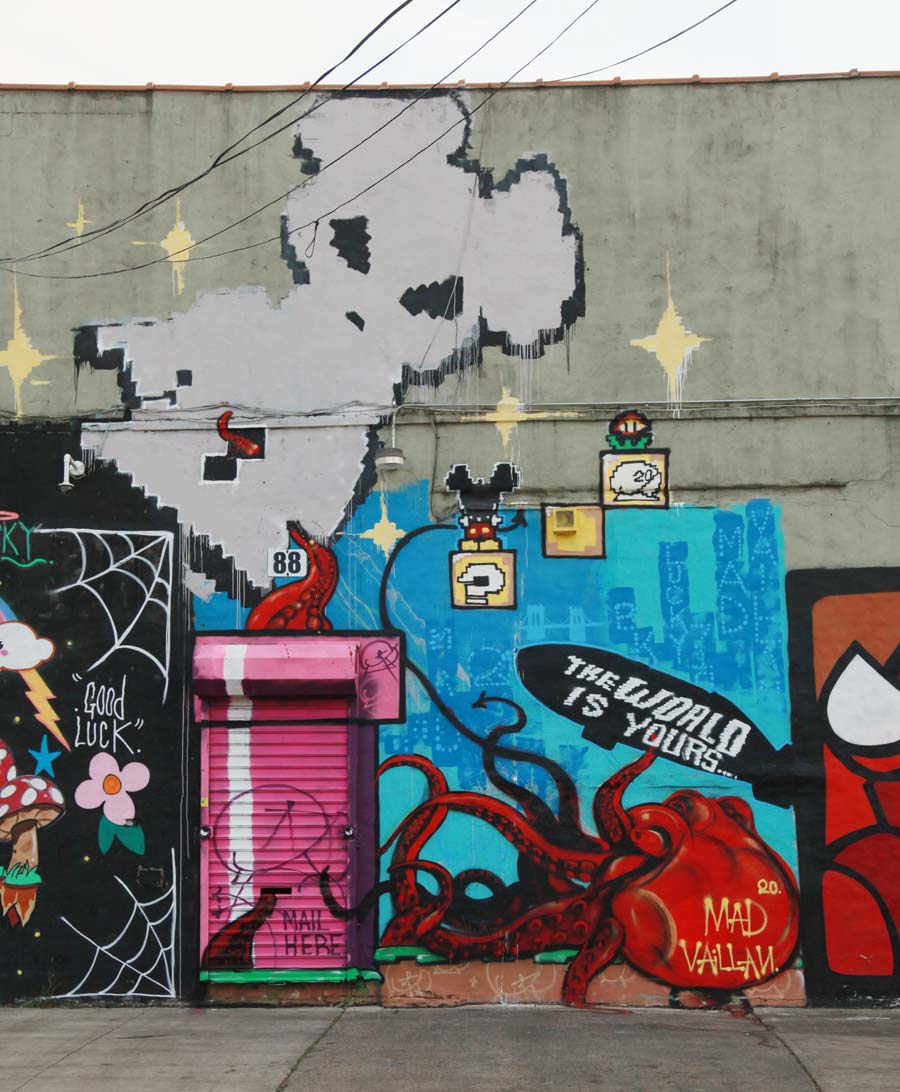
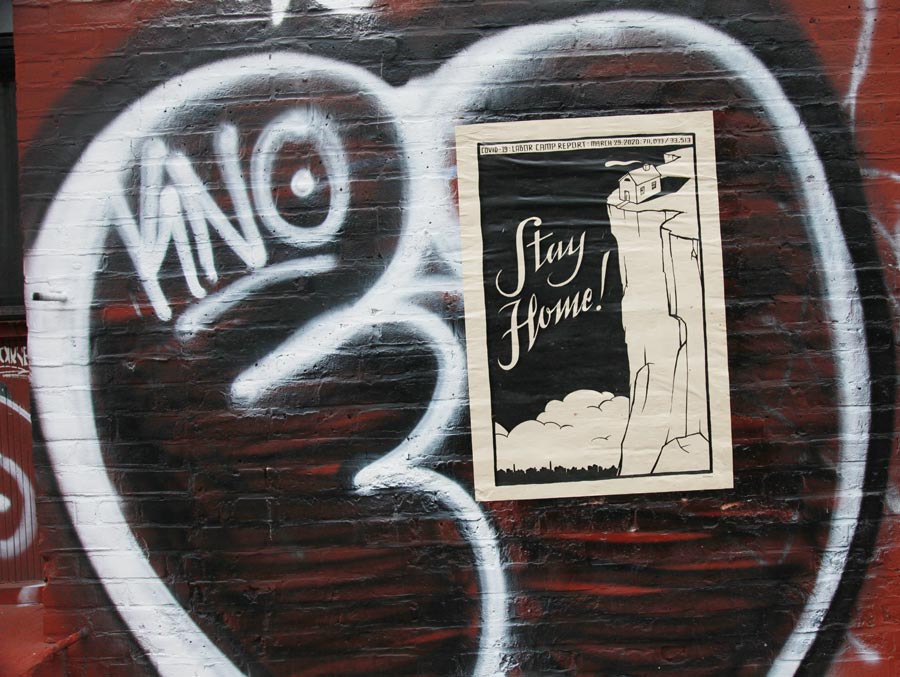
Here is our weekly interview with the streets, this week including Adam Fujita, Crash Floor, Disgusting is Good, Drop Dead Grace, Eye Sticker, Labor Camp, Mad Vaillan, Par, Save Art Space, Server Up, Specter, Texas, and Vayne.
Saturday projects around the house or
apartment as the seasons change? Why not paint your steps?
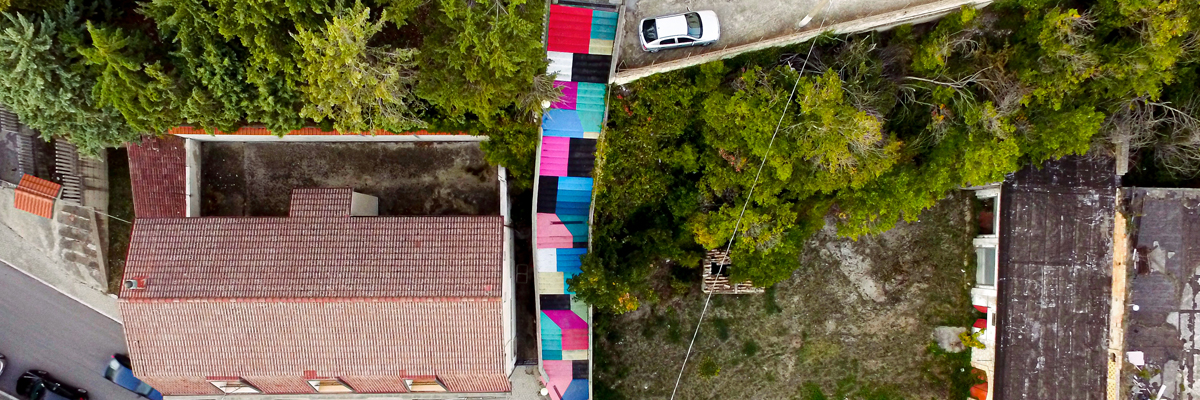
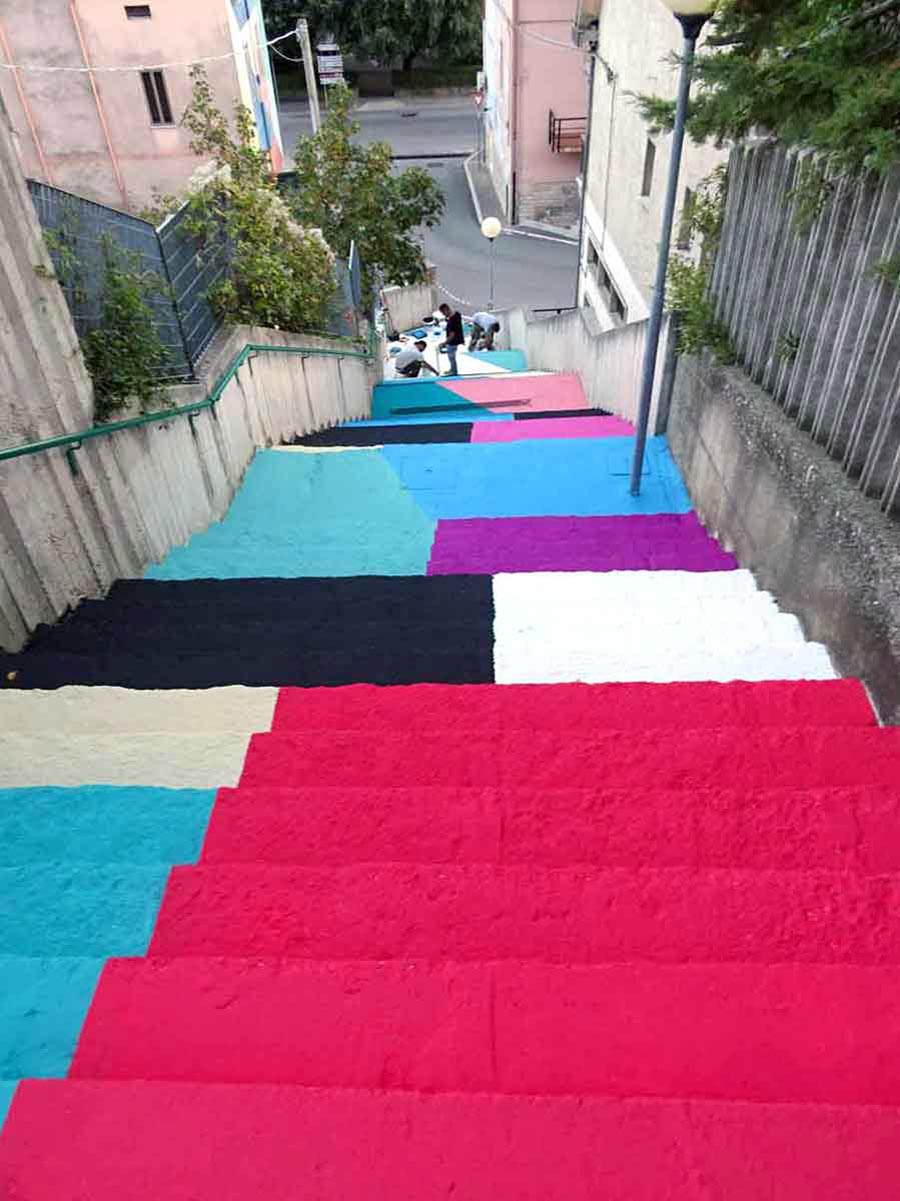
Nico Skolp. Antonio Giordano Urban Art Award. 7th Edition. Santa Croce di Magliano, Italy. (photo courtesy of Antonio Giordano Urban Art Award)
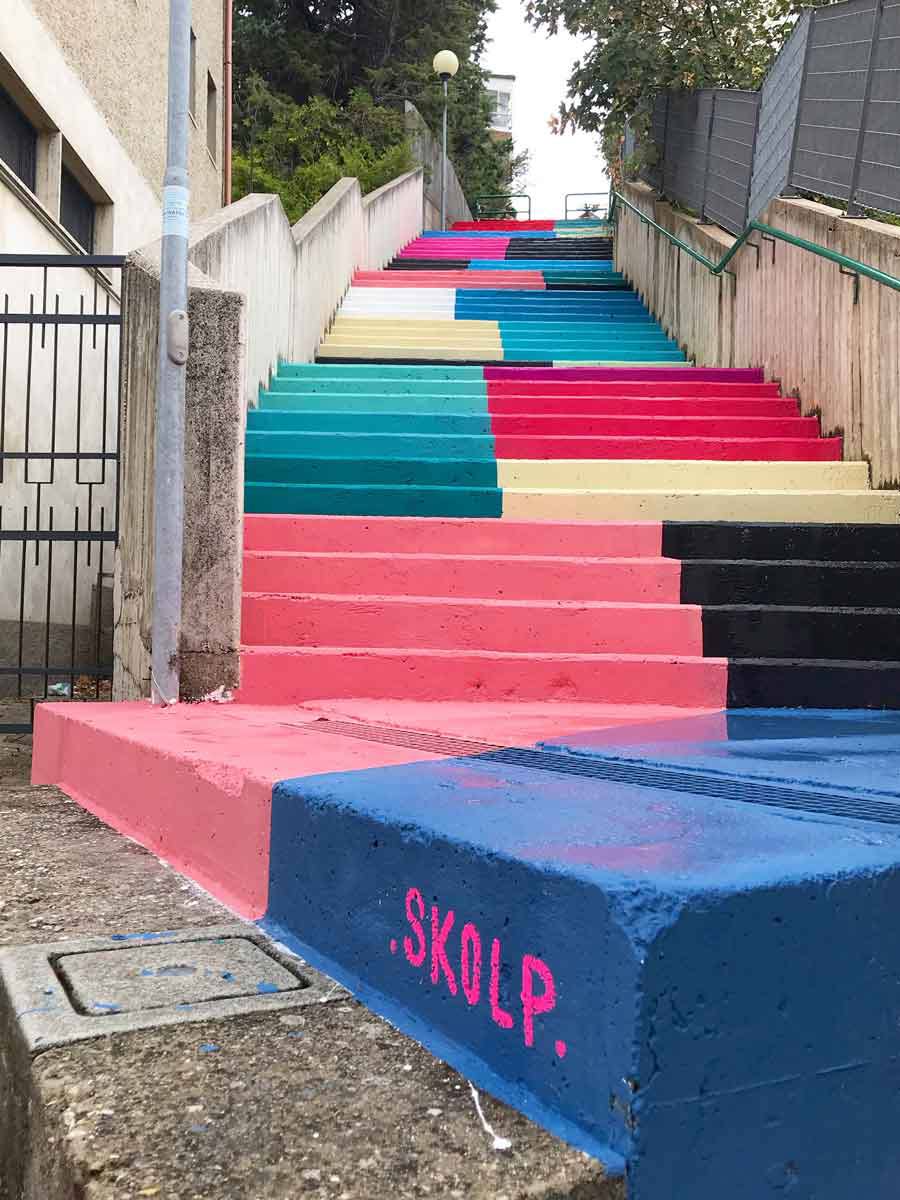
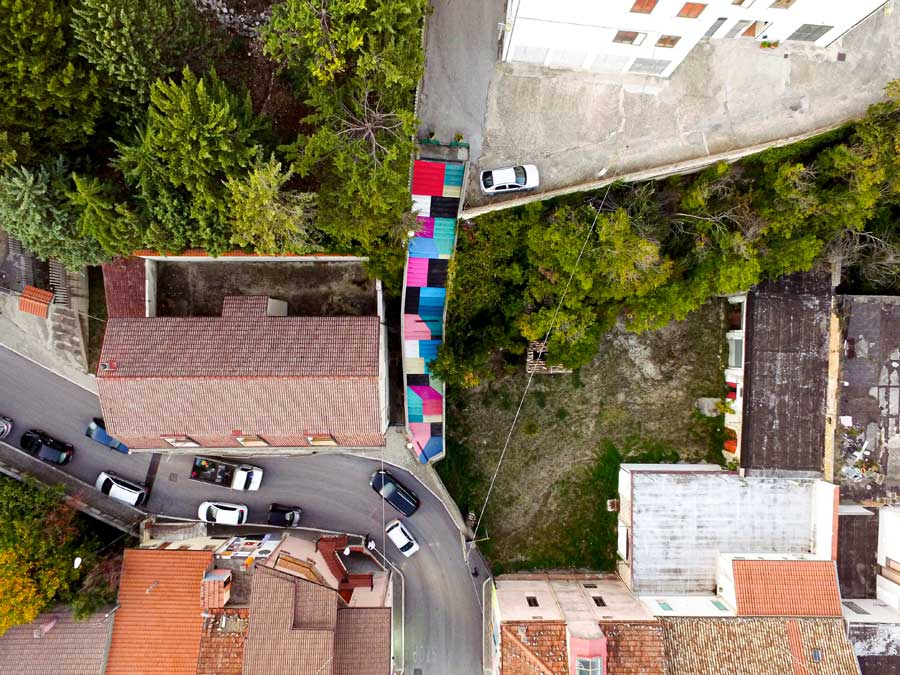
Italian designer, muralist, and graffiti writer since the 1990s, Nico Lò (Skolp) shows us his style on the elevated art of painting a public stair in Santa Croce di Magliano (Italy). The color blocking is more intentional and scientific than you may think, however, and the artist tells us that he used a software tool to determine the composition in collaboration with a San Franciscan machine learning expert named Piero Molino.
Nico Skolp. Antonio Giordano Urban Art Award. 7th Edition. Santa Croce di Magliano, Italy. (photo courtesy of Antonio Giordano Urban Art Award)
“Much attention has been given to
the use and perception of colour,” says Nico. “The observer perceives two
coexisting paths on the staircase: the one with softer colours makes it easier
the upward path; the other one, with more saturated and bright colours, marks
the easier downward path.”
Since being a graffiti writer, Nico
has gone through many personal and professional stages in development of his
art – including starting a design firm with two friends in 2008 specializing in
visual communication and graphic design. Now he’s more attracted to something many
are calling “Post Graffiti”, a deconstruction of the letter-based vocabulary in
a way that tumbles into abstraction and geometric movements of many directions.
Nico Skolp. Antonio Giordano Urban Art Award. 7th Edition. Santa Croce di Magliano, Italy. (photo courtesy of Antonio Giordano Urban Art Award)
“For years he focused on the study
of the letter in all of its forms,” says a publicist. “Until overcoming the
concept of “tag” and taking the path of a new approach called
post-graffiti. His artistic language is characterized by geometric shapes,
grids and shades, an abacus of elements and compositional rules that refer to
the concept of generative design.”
Our weekly focus on the moving image and art in the streets. And other oddities.
Now screening : 1. CURA 2020 – Daiara Tukano, Lídia Viber, Diego Mouro e Robinho Santana. 2. CURA 2020 / Jaider Esbell “Entidades” 3. CURA 2018 / HYURO
BSA Special Feature: CURA and their 5th Festival in Belo Horizonte, Brazil
A community powered consortium of public, private and corporate interests have been sponsoring the CURA festival in Belo Horizonte since 2017, producing some of the most massive murals you will see in festivals around the world. It is an interesting mix of local and international artists, many with social messages. Additionally they produce small workshops and panels, and sometimes large parties for attendees.
Today just a taste of the artists from CURA
CURA 2020 – Daiara Tukano, Lídia Viber, Diego Mouro e Robinho Santana.
CURA 2020 / Jaider Esbell “Entidades”
Are they kissing? This 17 meter installation features two serpentine creatures adorning the bridge here with “Entidades” CURA says that “Jaider Esbell is the first indigenous artist to present a sculpture in a public art festival”.
We continue to see a dissolving of previous tensions between the worlds of graffiti writing and mural artists and other disciplines of art-making as we travel around cities around the world. Artificial divisions have persisted, and indeed the lived experience of graff and street art and mural making are distinctly different in certain respects, but the piece is the piece, regardless of style, and each creator can be an ambassador with a message.
Our own philosophy is if art is going to have the transformative power that we believe it can have on all of our societies, families, and institutions we need to dissolve artificial divisions in the creative community as well – as they serve little constructive purpose. As art in the street usually reflects society at large, we have our own challenges with classism, sexism, and racism as well.
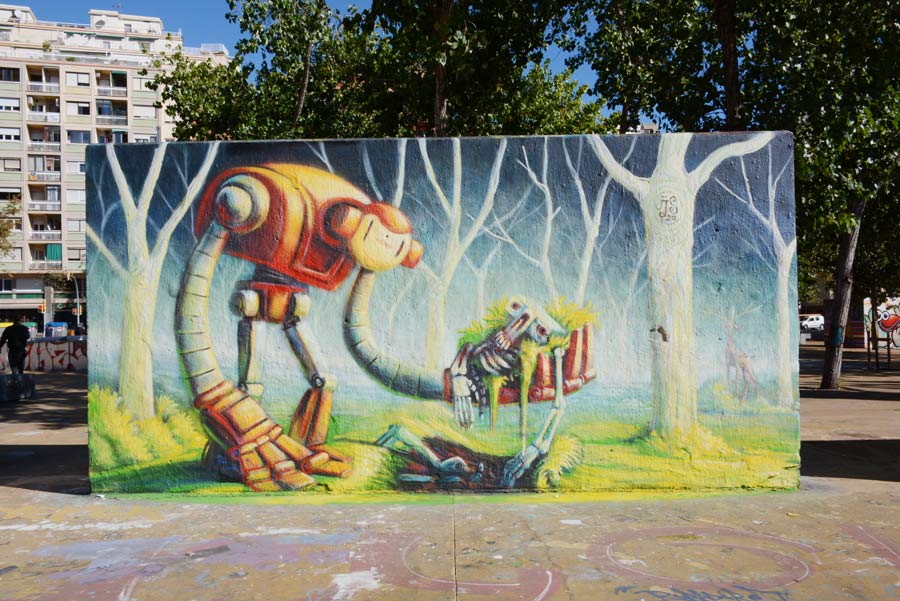
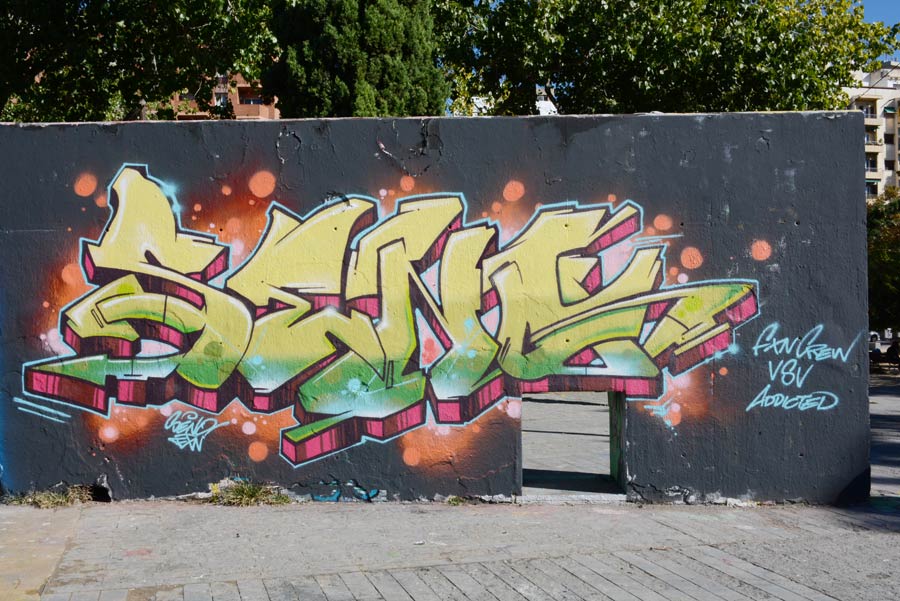
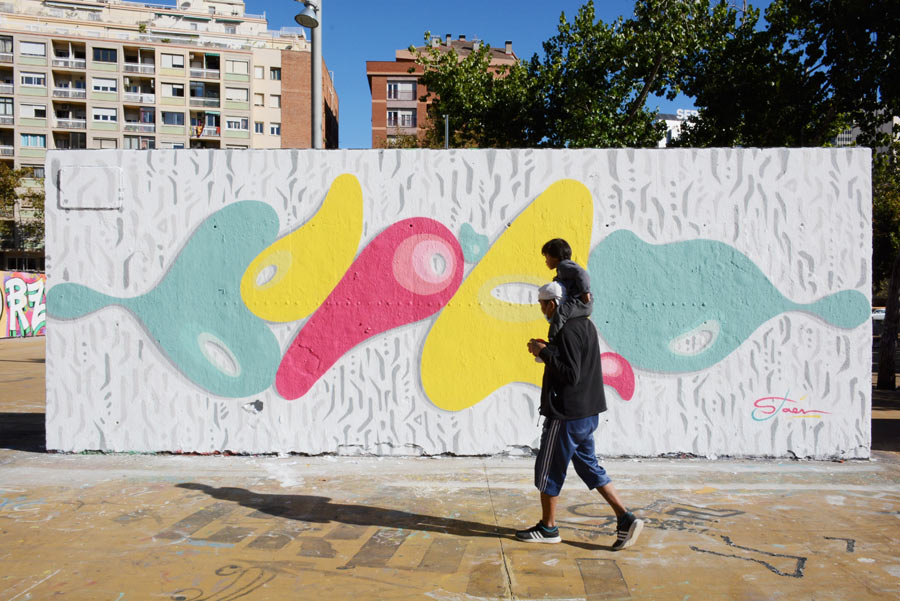
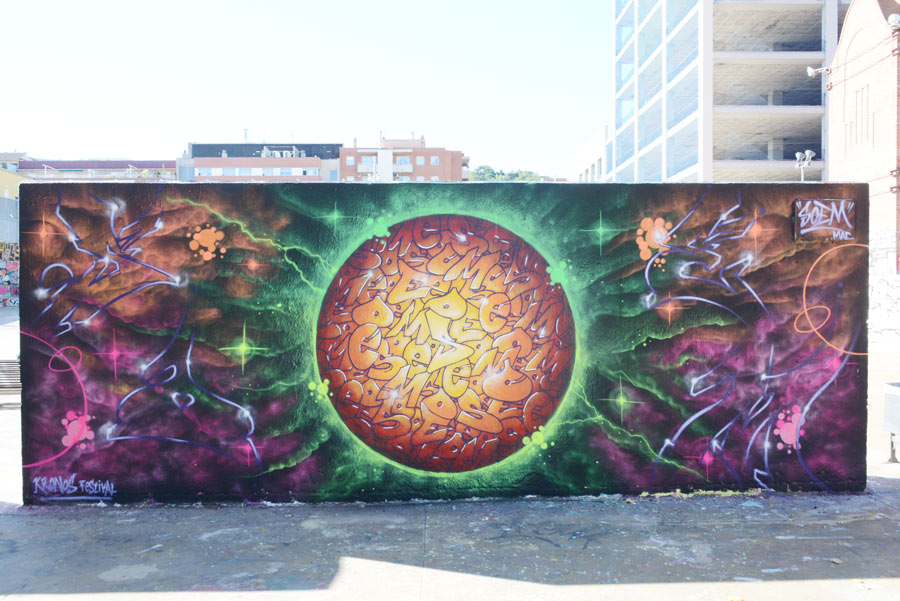
So it’s great to see the continuance of brotherhood and sisterhood at small neighborhood festivals like the 3rd Edition of the Kronos Art and Arts Santa Mònica here in an area of Barcelona during the third week of October. One core philosophy at this festival this year was to re-consider the future of art and its role by actively consulting kids in defining what art is, and what it could be.
“Be aware of the role of ARTIST and his work in our PRESENT, without
judging, without imposing criteria, with the sole conviction that what we are
creating is the prologue of the FUTURE in the ART”
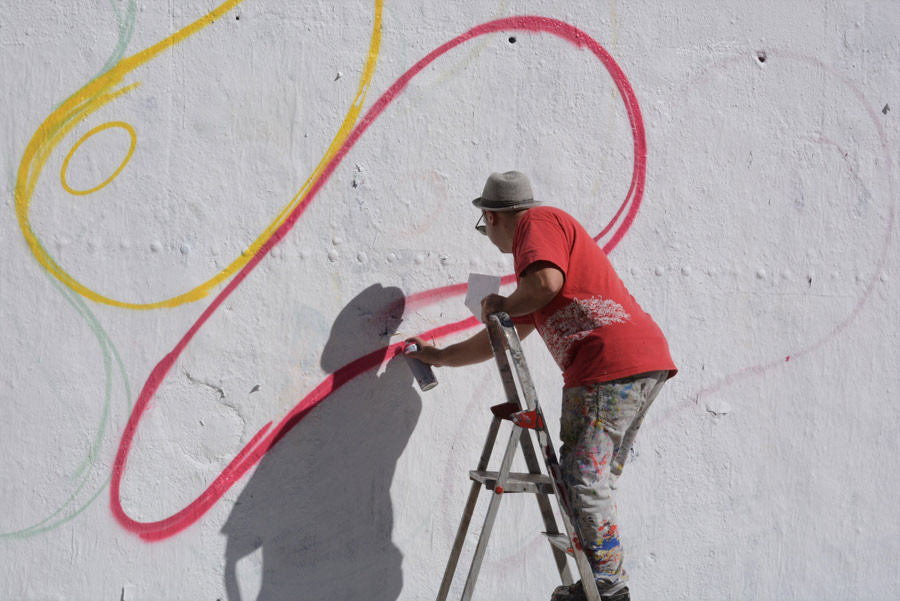
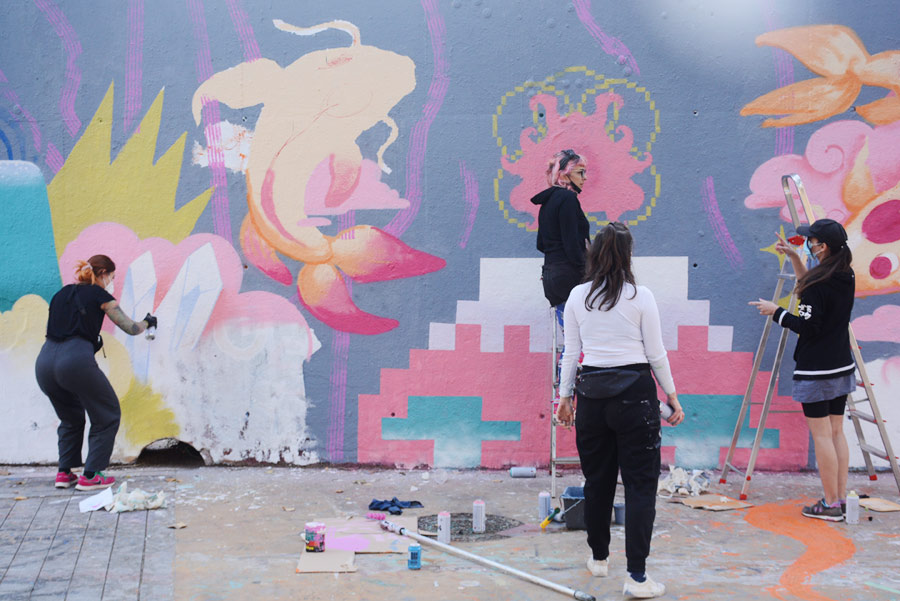
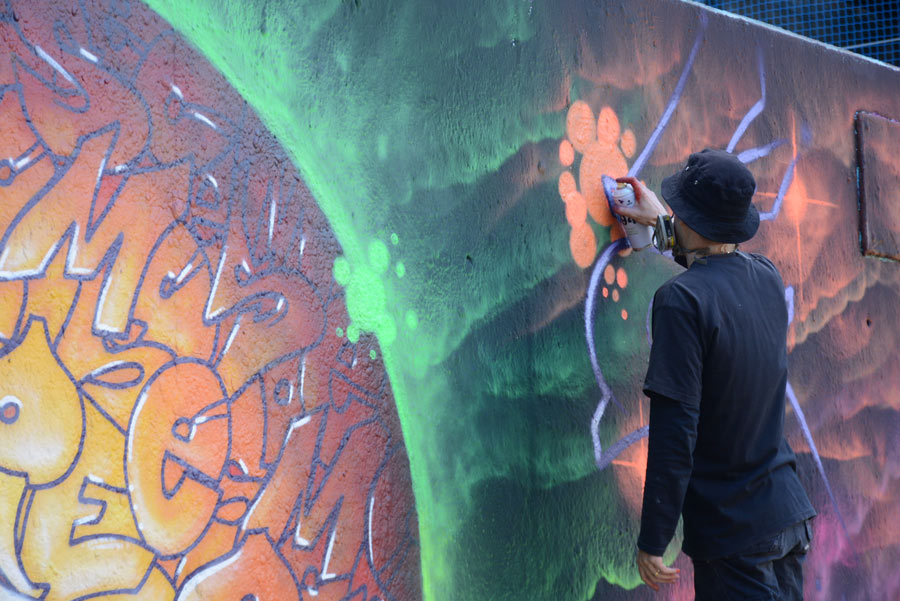
During their ‘live painting’ events at 3 Chimney Plaza (Plaza de las 3
Xemeneies) it was the men and women, graffiti writers and street artists – all working
side by side. Part of a much larger group of events that included 70+ artists,
photography, sculpture, performance, music, video art, cinema, talks, and workshops,
these painters just did their thing and had a good time.
“Becoming cultural activists, taking the reins of how to express ourselves and about what to express ourselves through art; and by doing so becoming key pieces for the freedom of creation, we become aware as spectators, as thinkers, as artists, as a species. KRONOS ART BCN 2020 is a wager to the freedom of society through the freedom of the artist; free to catch everything that interests and surrounds them, without fear of being judged and without judging the protagonists of their artwork. Free to BE in all the aspects that make us human, thus turning the PRESENT into the prologue of a FUTURE world full of diversity.”
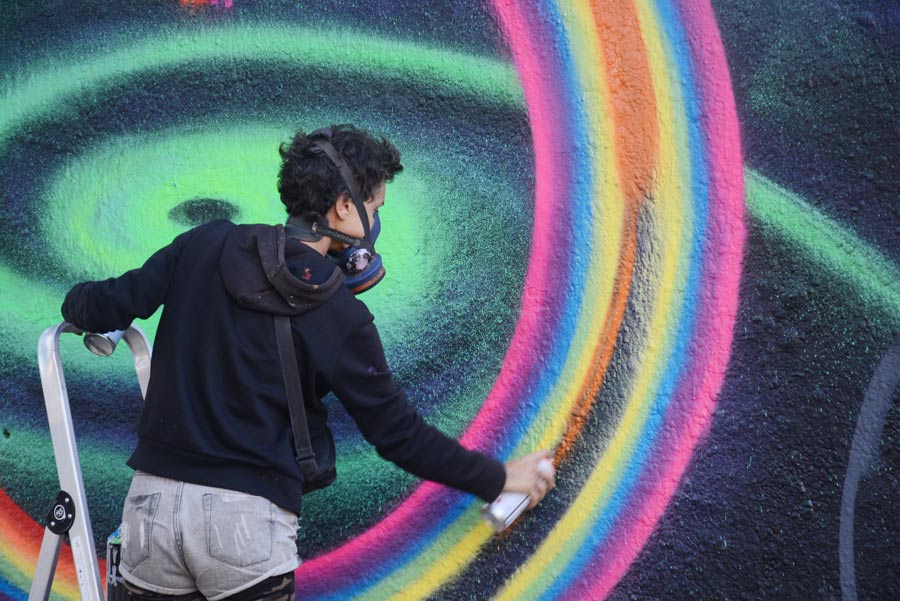
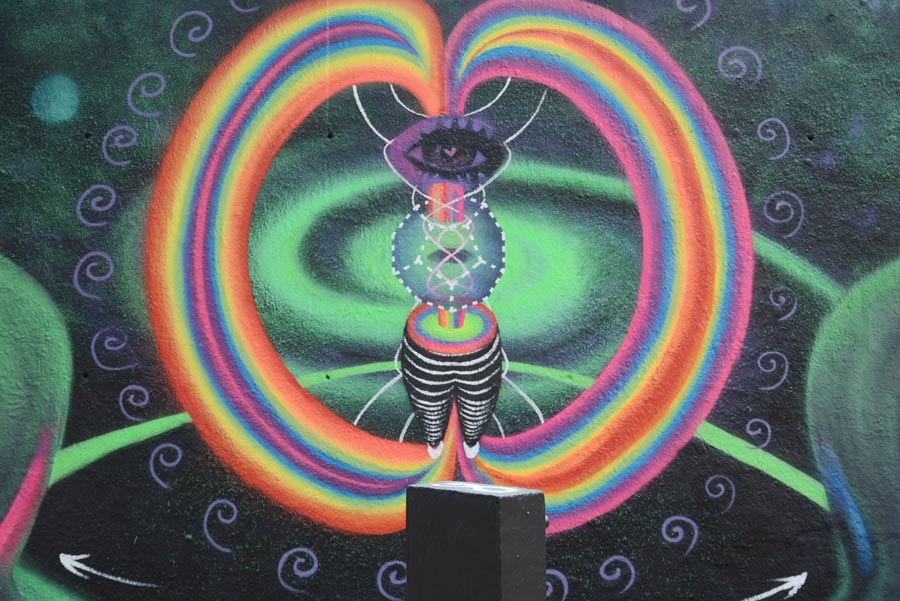
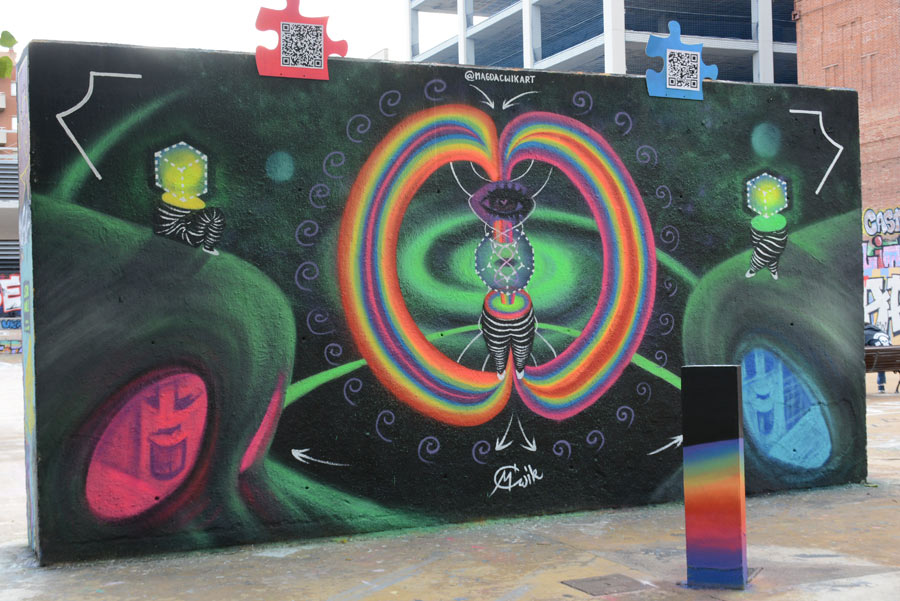
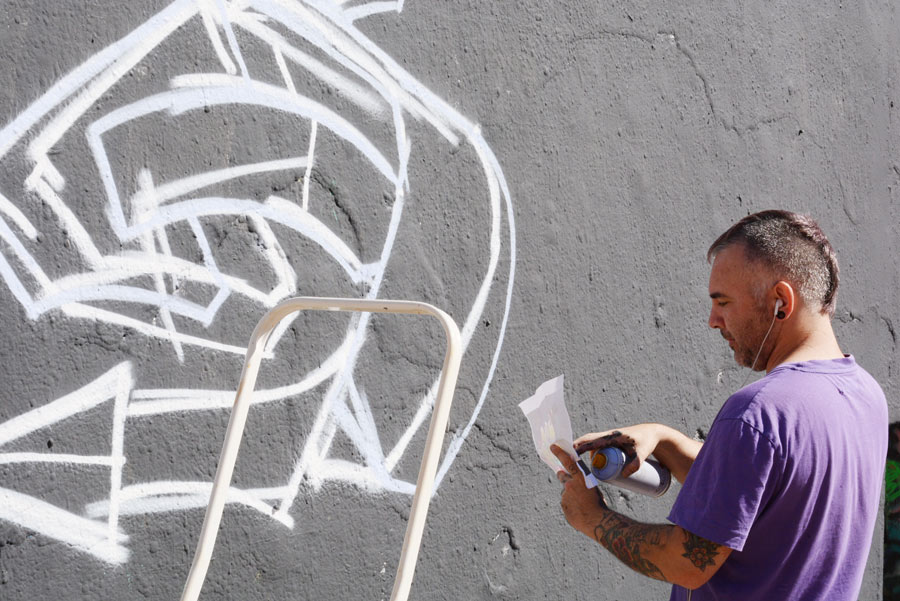
Our thanks to photographer Lluis Olive Bulbena for capturing a few of the artists at work at the plaza.
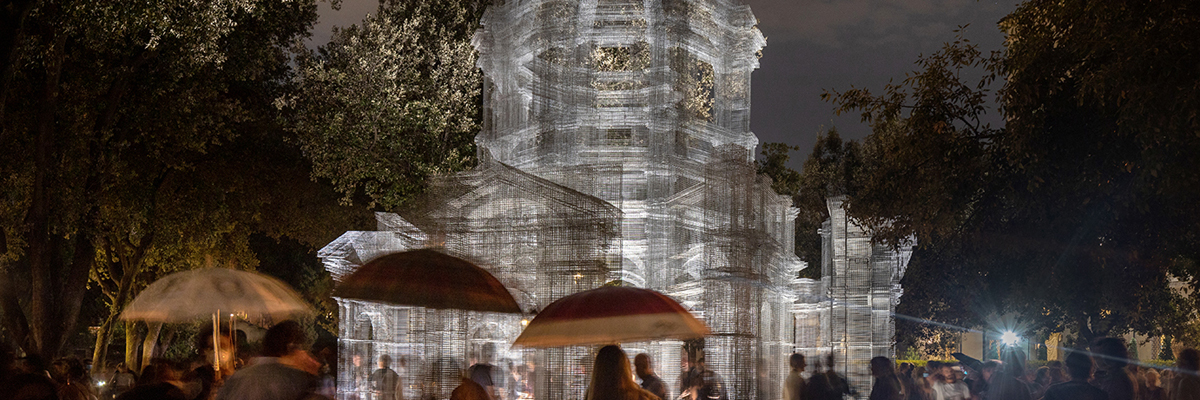
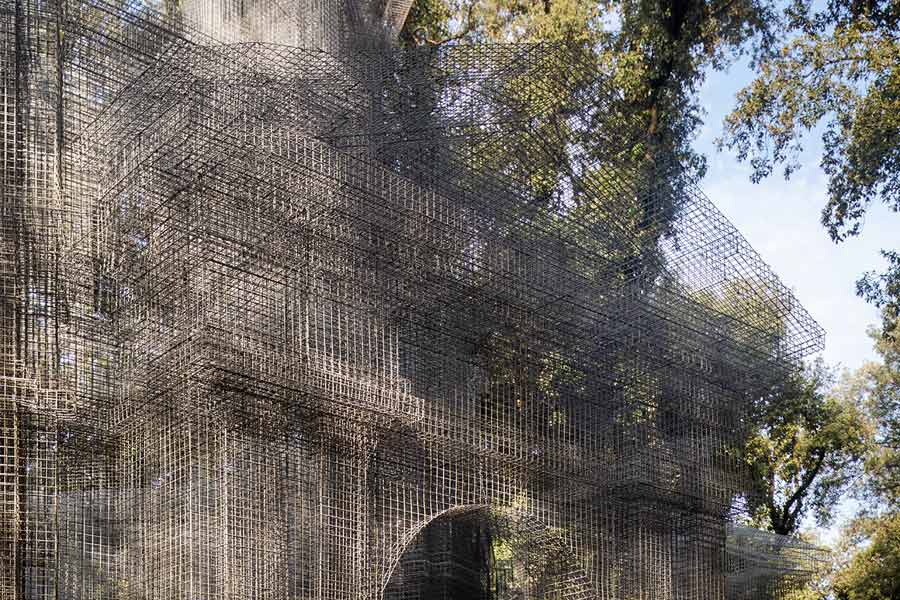
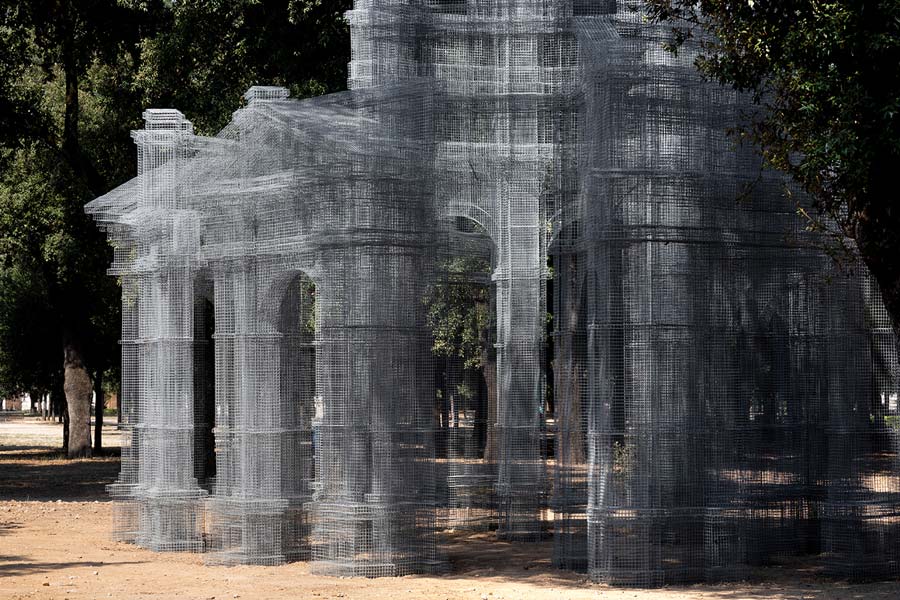
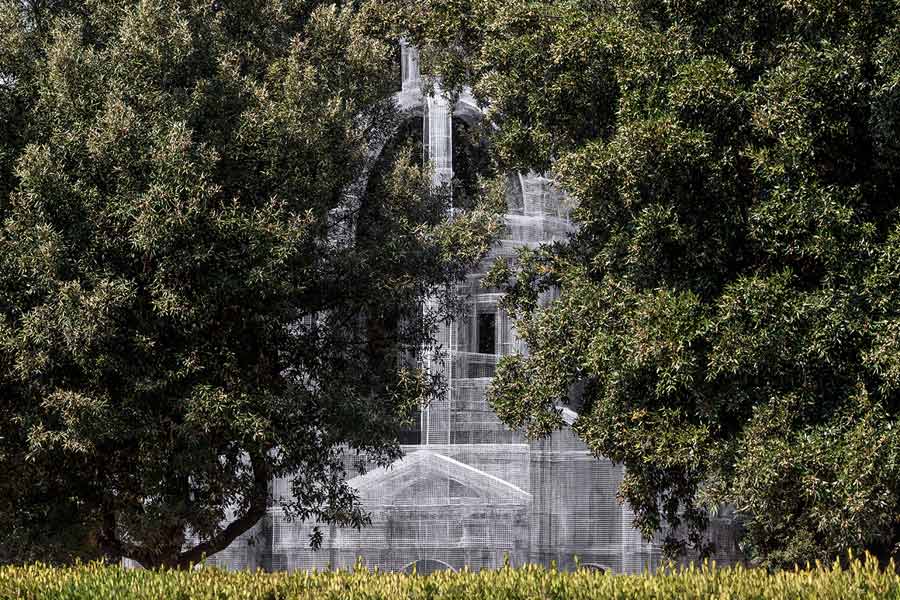
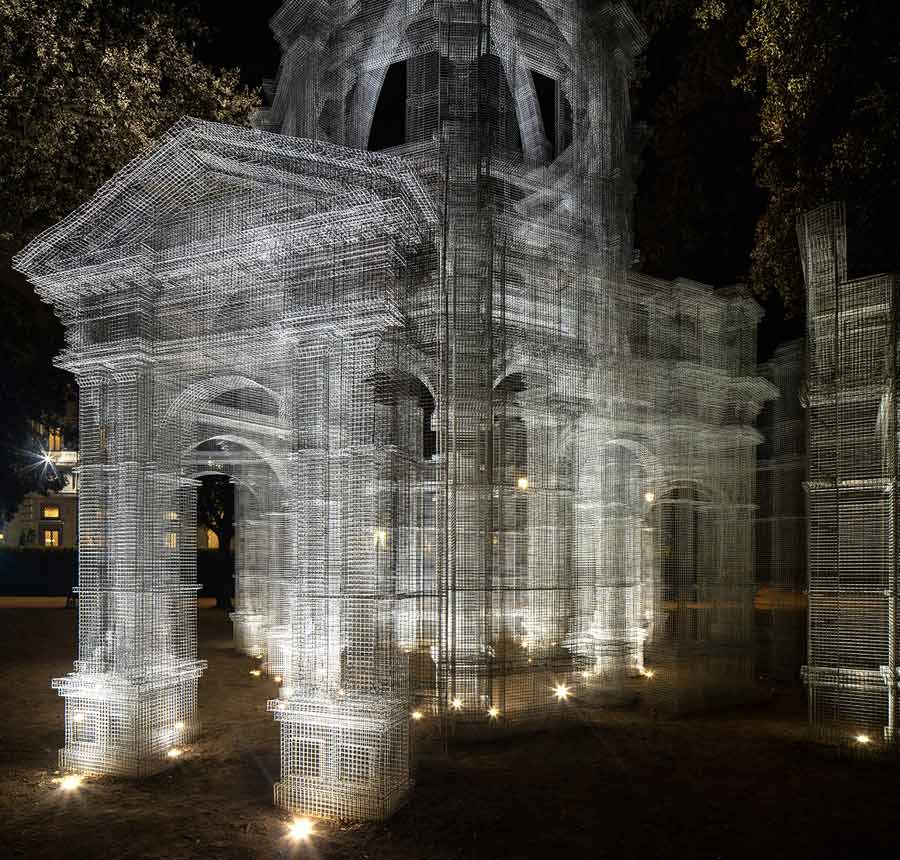
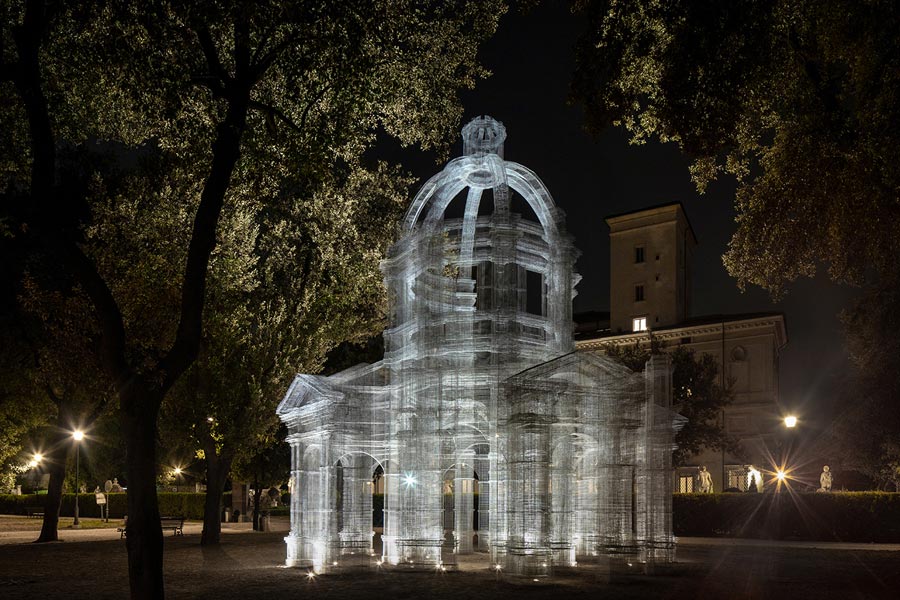
That is especially true when the work is at the typical scale of Italian artist Edoardo Tresoldi, whose massive mesh sculptures wowed the privileged guests at Coachella a couple of years ago in Indio, California. Those Neoclassical and Baroque architectural ghosts transported the imaginations of attendees there, but now they physically have been transported to Rome. Given a second life in Parco dei Daini, Villa Borghese, the show will run this autumn until mid-December.
Calling the installation Etherea, Tresoldi has entered it
into participation for “Back to Nature”, a new exhibition project curated by
Costantino d’Orazio. The artist says the works have been redesigned and
rearranged for the occasion and are meant to be part of a dialogue with the
trees of Villa Borghese. It’s good to see these works in a new context and
finding they have a similar character, still triumphant but more subdued
perhaps.
BACK TO NATURE Parco dei Daini, Villa Borghese, Rome Promoted by Roma Capitale, Assessorato alla Crescita culturale – Sovrintendenza Capitolina ai Beni Culturali Until December 13, 2020 Free entry
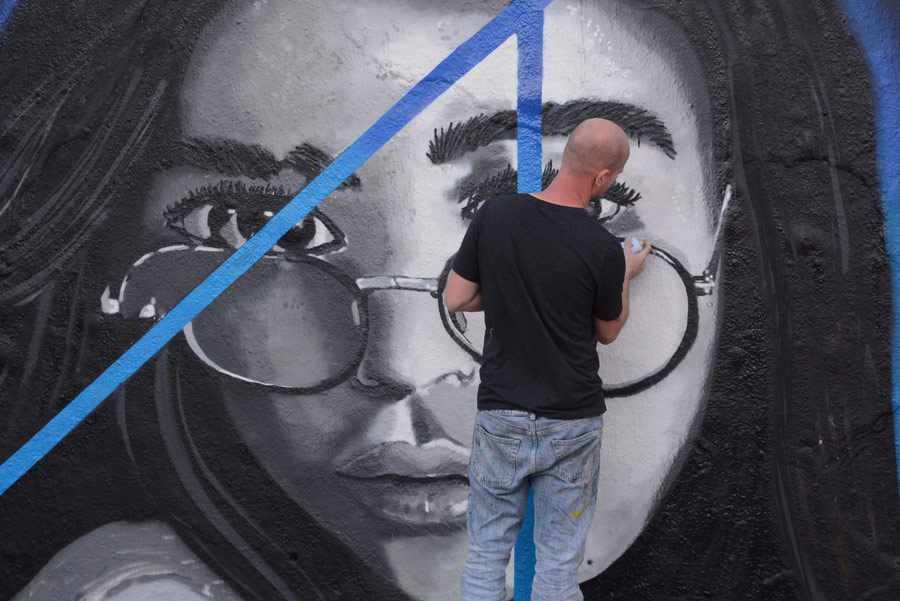
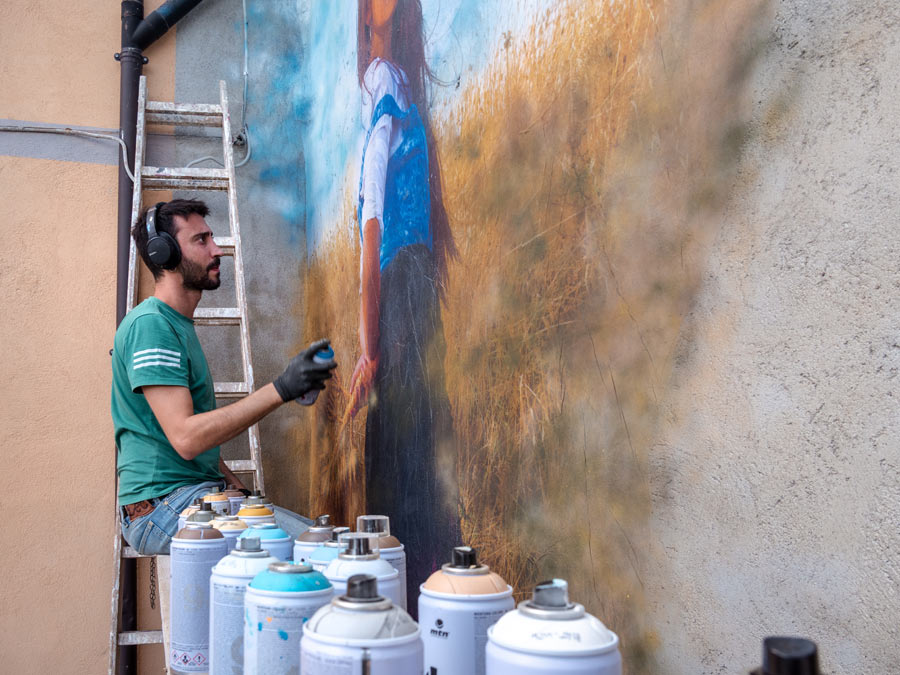
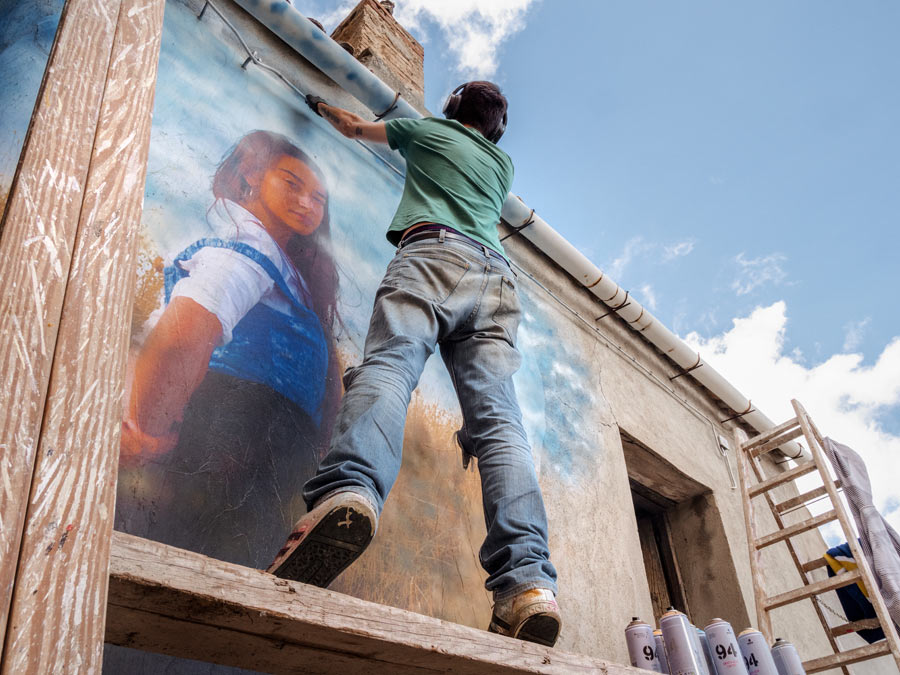
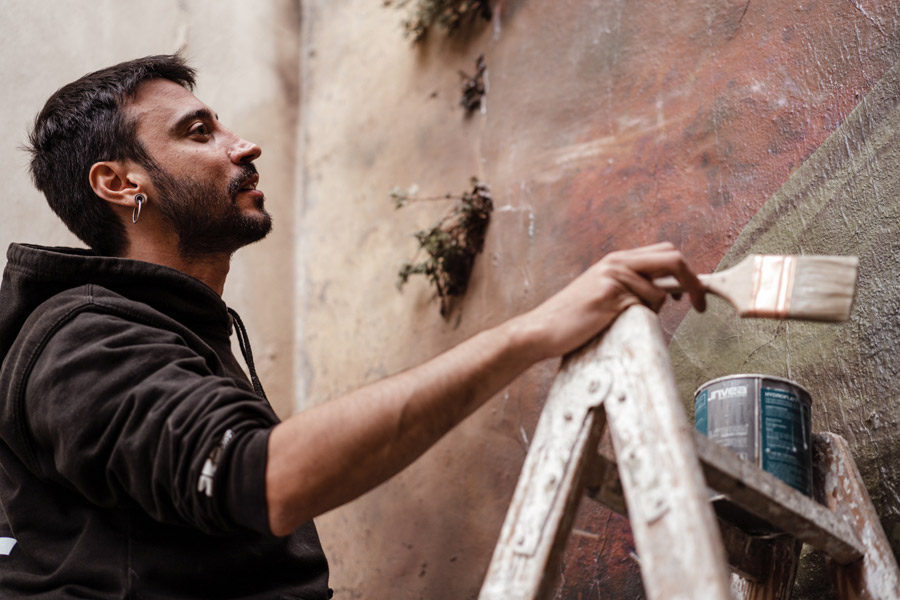
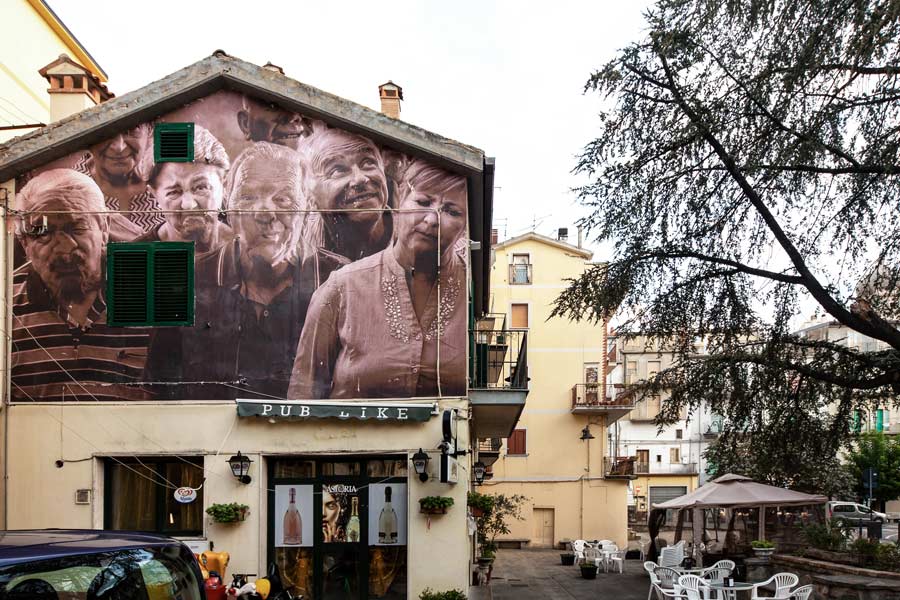
IItalian Street artist Bifido has perfected his technique of dissolving his wheat-pasted photography into aerosol painting on the street, producing a seamless atmospheric story that leaps from the wall; evocative of oil masters but somehow with hyper real people living presently in a surreal tableau. Narrative also has been sharpened and emerges as being intently purposeful.
In this new series of artworks we learn about folks who are living in a modest sized town here that, like many towns in Italy, is being quietly and radically transformed by its shrinking population of aging citizens.
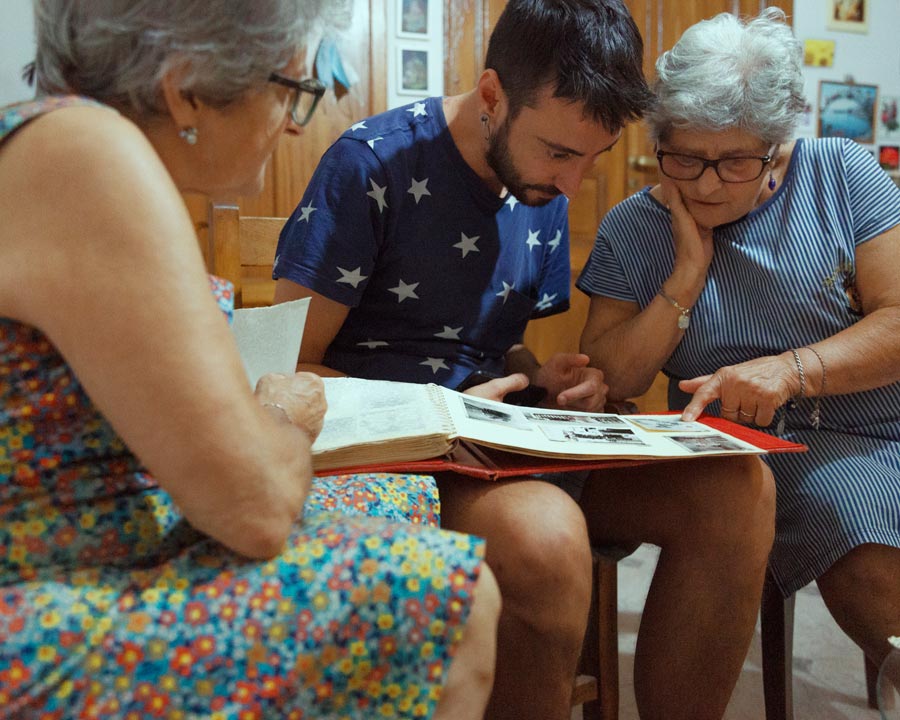
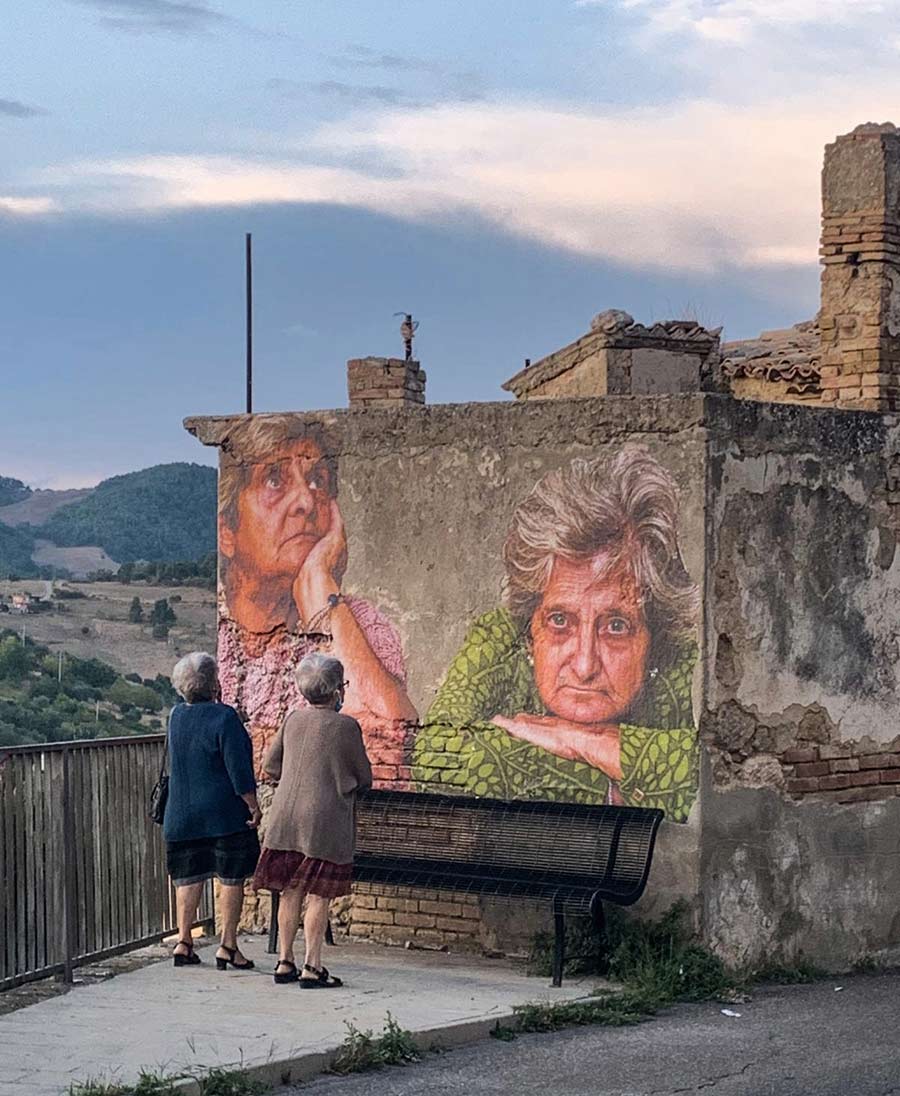
By interviewing the inhabitants and becoming familiar with this small interconnected community, sometimes intimately so, he is determined to help tell their stories, their histories. A collaborative practice, Bifido is there when they see the finished piece in public space.
Today we’re pleased to present Bifido’s newest works in Stigliano, accompanied by his own words to describe the process of creating them.
I spent a month in Stigliano, a small town, in an equally small and remote region of southern Italy. I was able to immerse myself totally in the reality of the people who live there, learning incredible stories. During this time I worked on 4 murals around the village. Stigliano rises to 1200 meters above sea level and you can see a boundless landscape. The feeling of isolation is very strong.
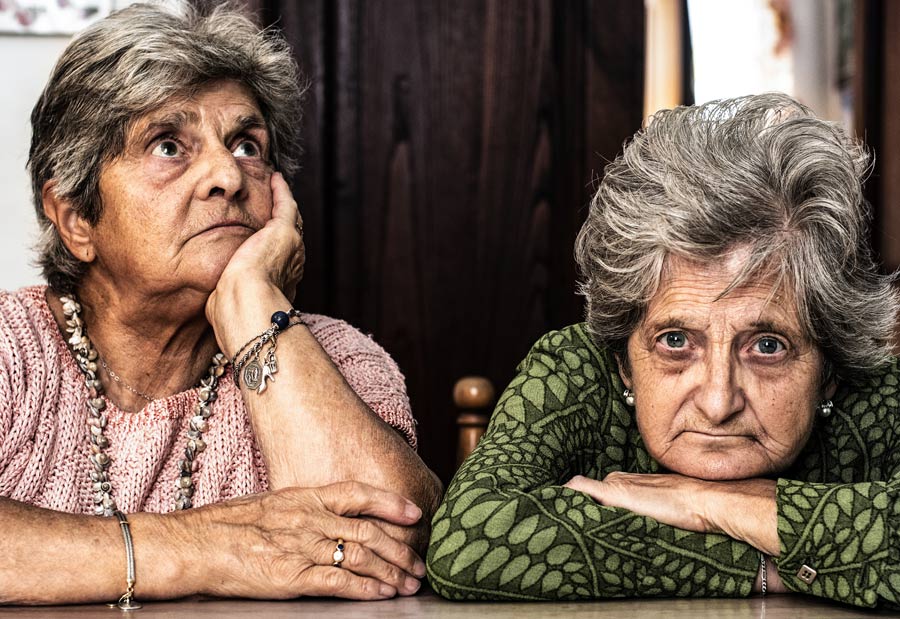
The work that most involved me is on two eighty-year-old sisters. Giulia and Filomena. They were locked in the house by a jealous father for nearly 40 years. They could only go out with their mother and only go to church. No school, no friends. They could not even see their relatives, because they had studied and this could negatively affect them. Their father said: “A woman can leave the house 3 times in her life, at baptism, marriage and funeral ”. Obviously because they could not go out, they’ve never had a chance to meet someone and fall in love.
They were not very familiar with either watching television or listening to the radio. Every February there is an Italian song festival. During the time of their isolation they tell me that they would sneak past the windows trying to listen to the songs of the neighbors’ radios. Being able to hear only the melody and not the words, they rewrote the lyrics according to their life.
After a life of repression and isolation, these two sisters are two women full of life, curiosity and empathy. They are very different, but they belong together. They sleep in the same room, on cots separated by a bedside table, and in the darkest nights they shake hands “giving courage”. But if the dark nights are truly haunted, they snuggle together in the same bed. And if you look at them from above they look like strong roots stuck in the mattress.
you have to be a rock to roll fast you have to be a rock to be shaped by the wind you have to be a rock to withstand the blows you have to be a rock to look into the abyss you have to be a rock to laugh at life (Giulia, Filomena and Bifido)
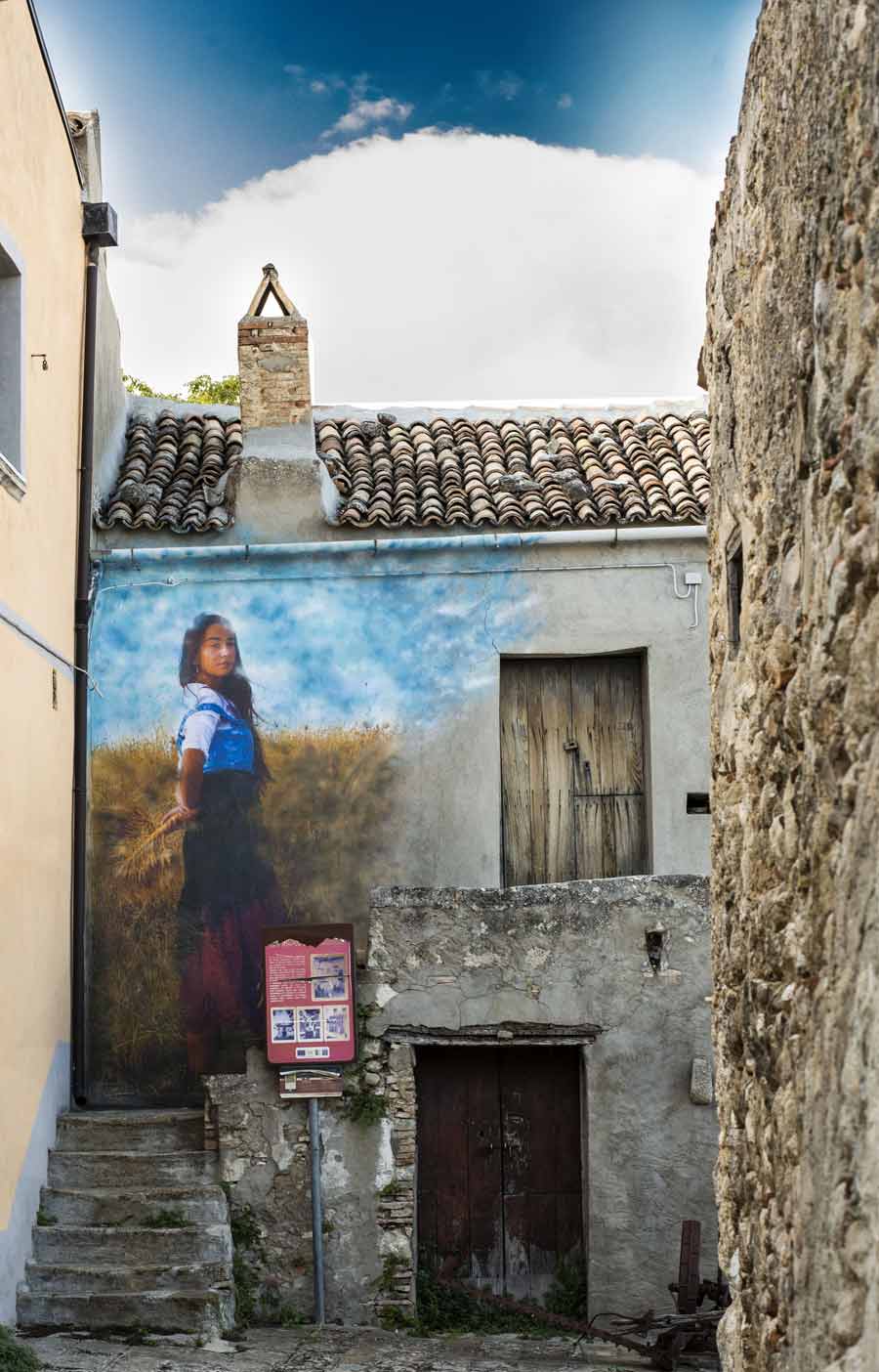
I made two interventions in the historic center of the town, now almost completely uninhabited. A wonderful and desperate place. Full of silence and beauty. Stigliano has lived for years thanks to the wheat harvest and peasant life has characterized the town throughout its history.
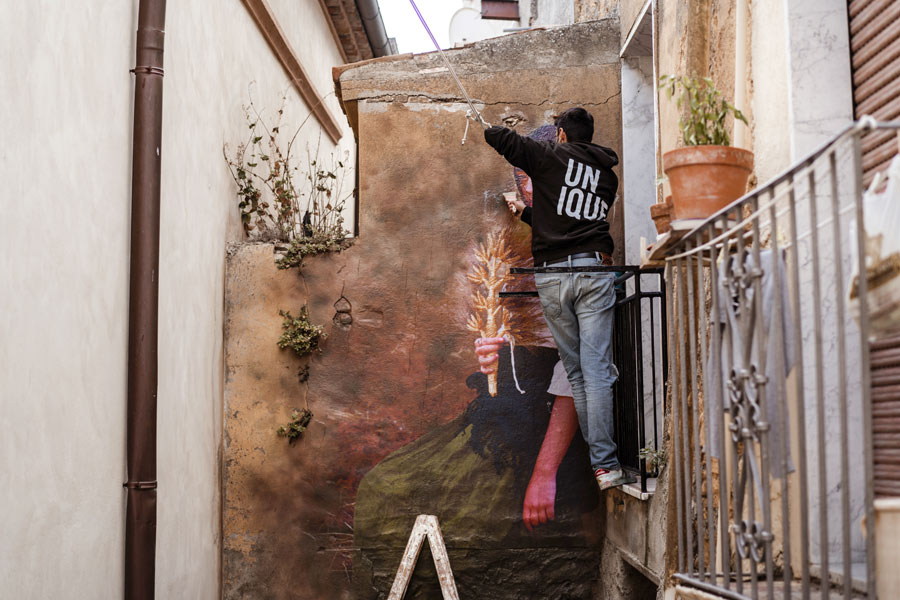
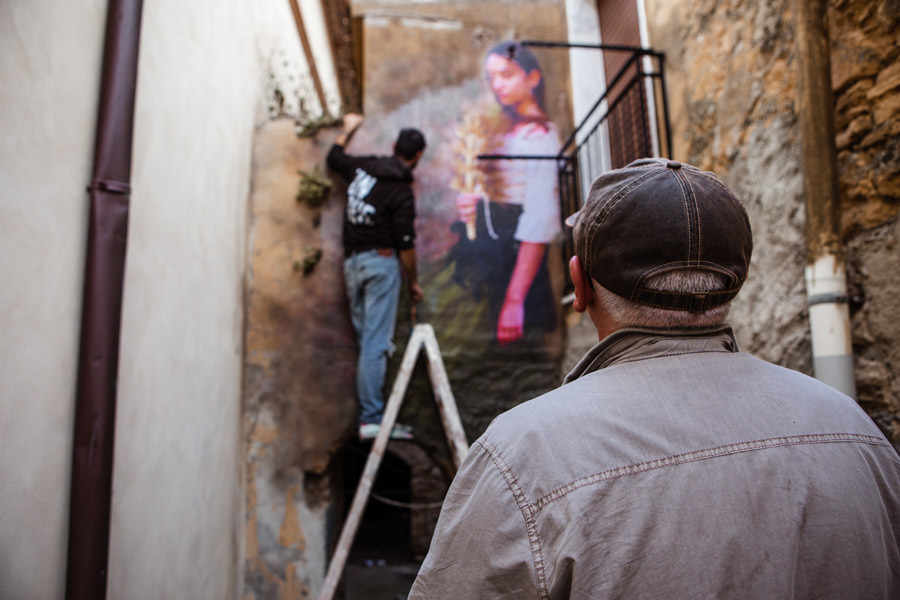
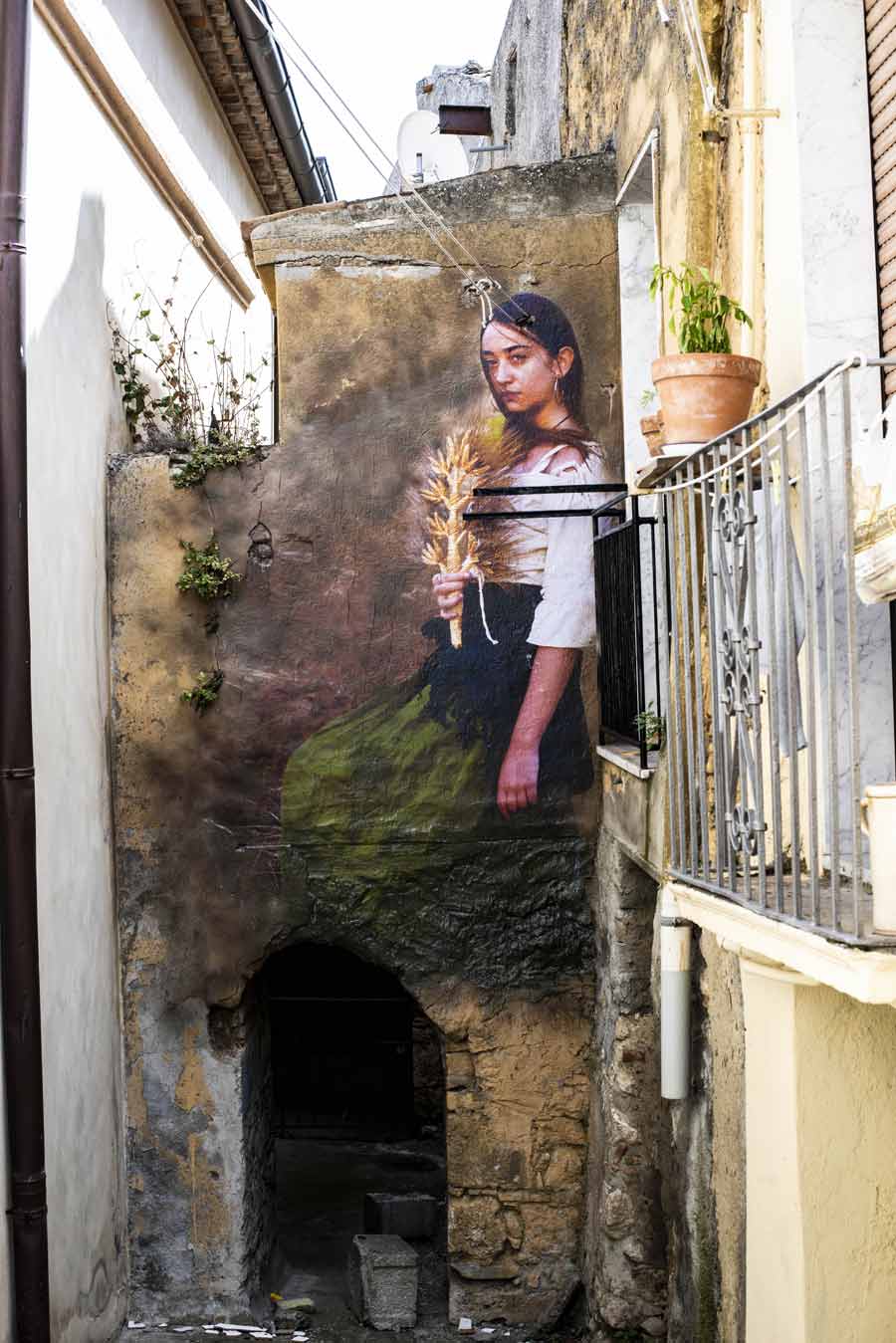
I portrayed a peasant woman with wheat. Symbol of the city. And I installed it in one of the dark and forgotten alleys of the city and on a real farm. I wanted to give prestige to something noble and beautiful, but also to make the walls of this semi-abandoned town remember the souls who lived there. The peasants were also carriers of revolt. I want to remember the memory and tell people not to forget and fight for survival.
This is a little poetry that I wrote for the mural of the farmer in the street:
I am the fallen stone The empty house with a torn roof They are the endless fields Dry of life The rain and the hawk Between the steady gazes Between the vanished faces I am the crack The lair of remembrance I am the unknown day And you?”
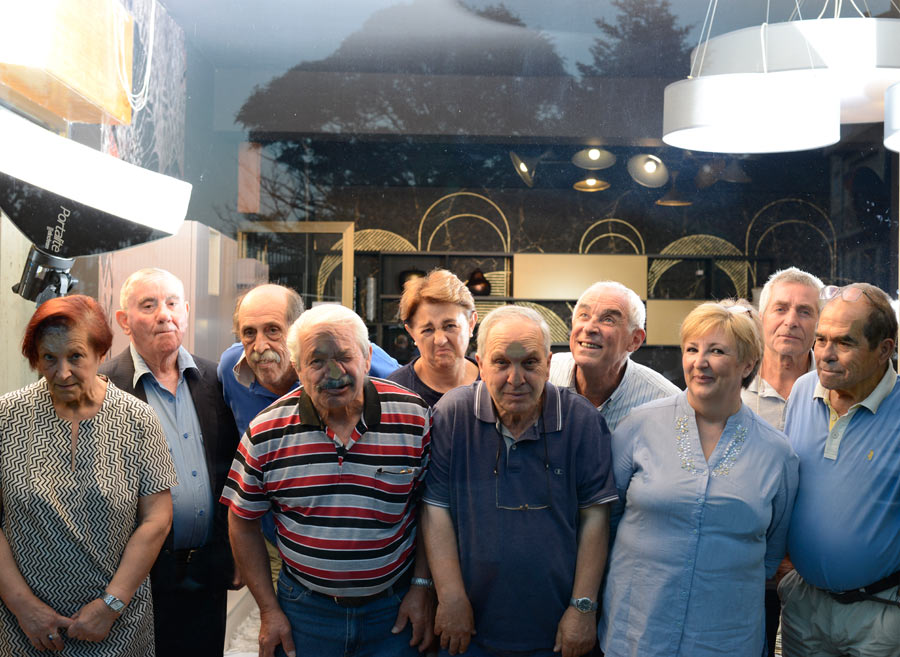
This work talks about the problem of depopulation. In 10 years Stigliano has lost almost all of its population, from 12,000 to 3,000 inhabitants. I used the verses of the poet Pio Rasulo, a native of Stigliano, who had already foreseen the depopulation of the town in 1961.
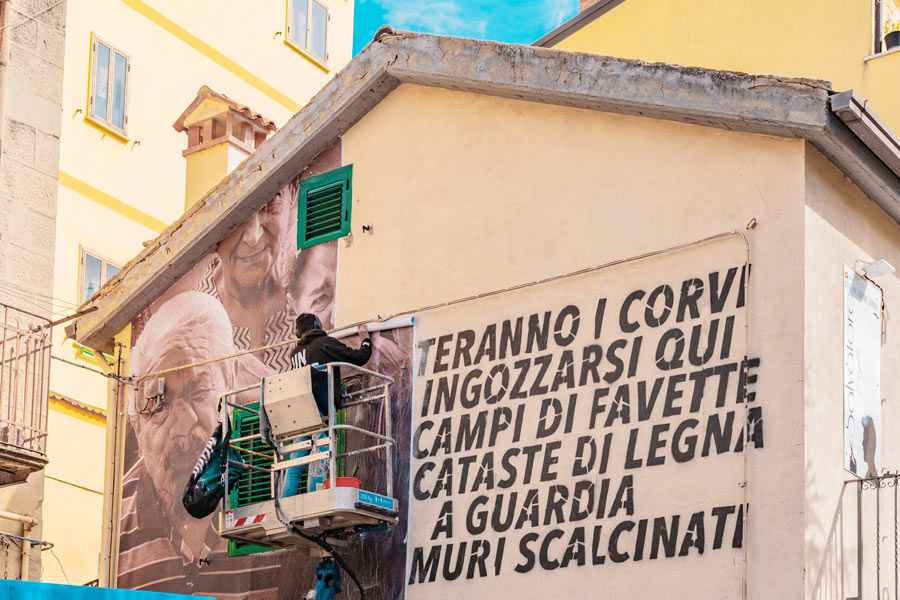
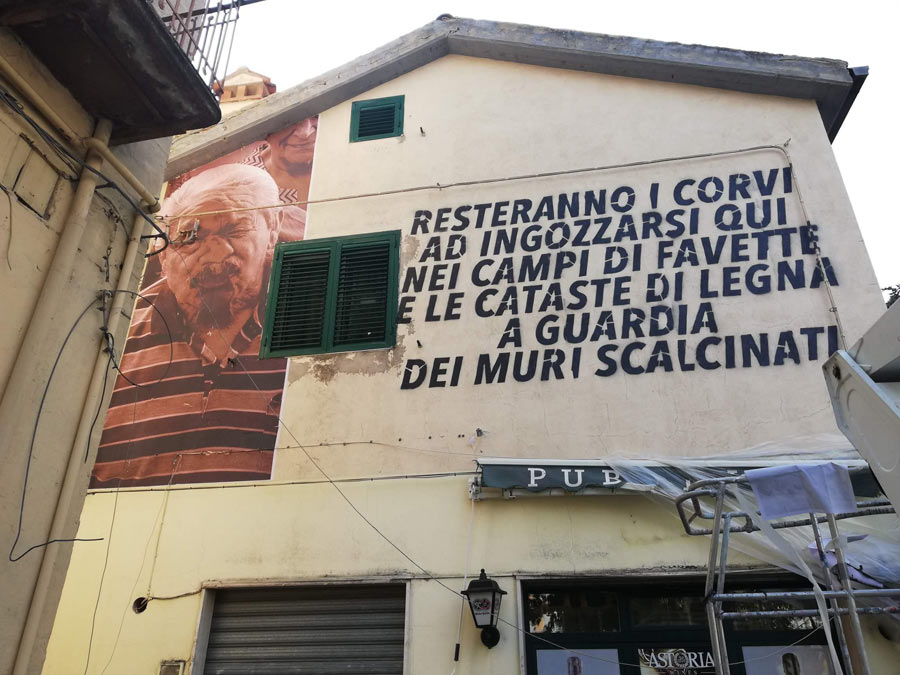
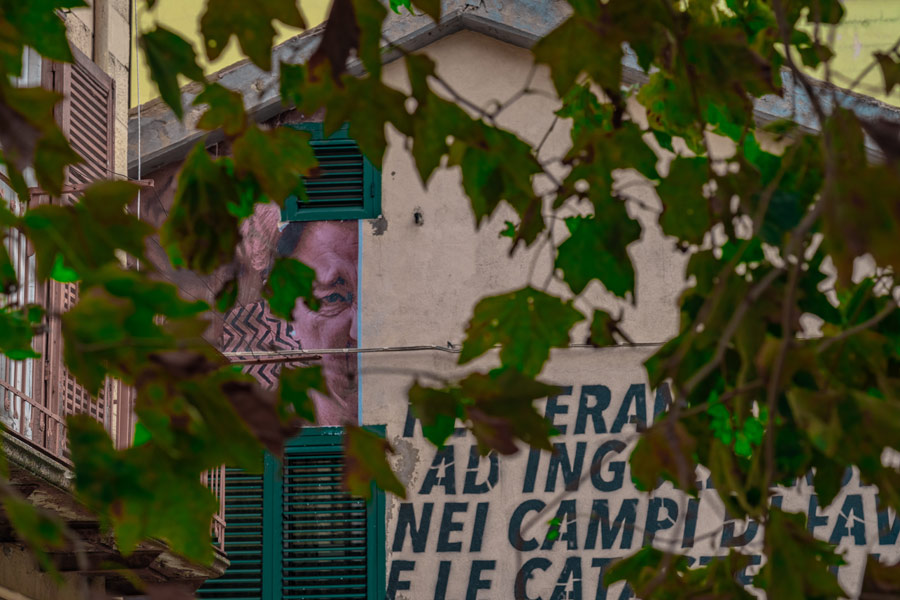
“Only the crows that gorge themselves here, in the bean fields, and the piles of wood guarding the crumbling walls will remain”.
I wrote this sentence on the wall and then covered it with a photo I took of the locals. Over time the card will be destroyed as the poetic verse appears. Just like the depopulation phenomenon, people will disappear and only crows will remain.
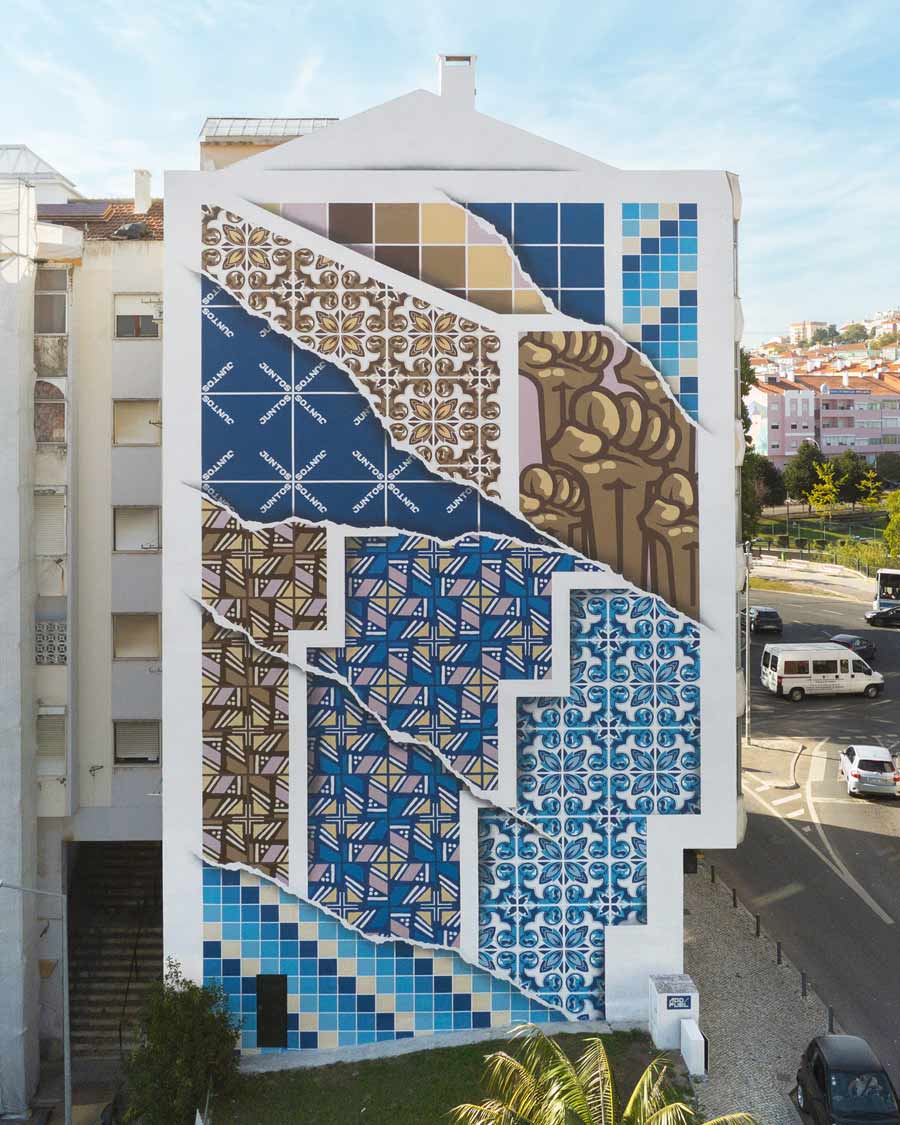
Today we
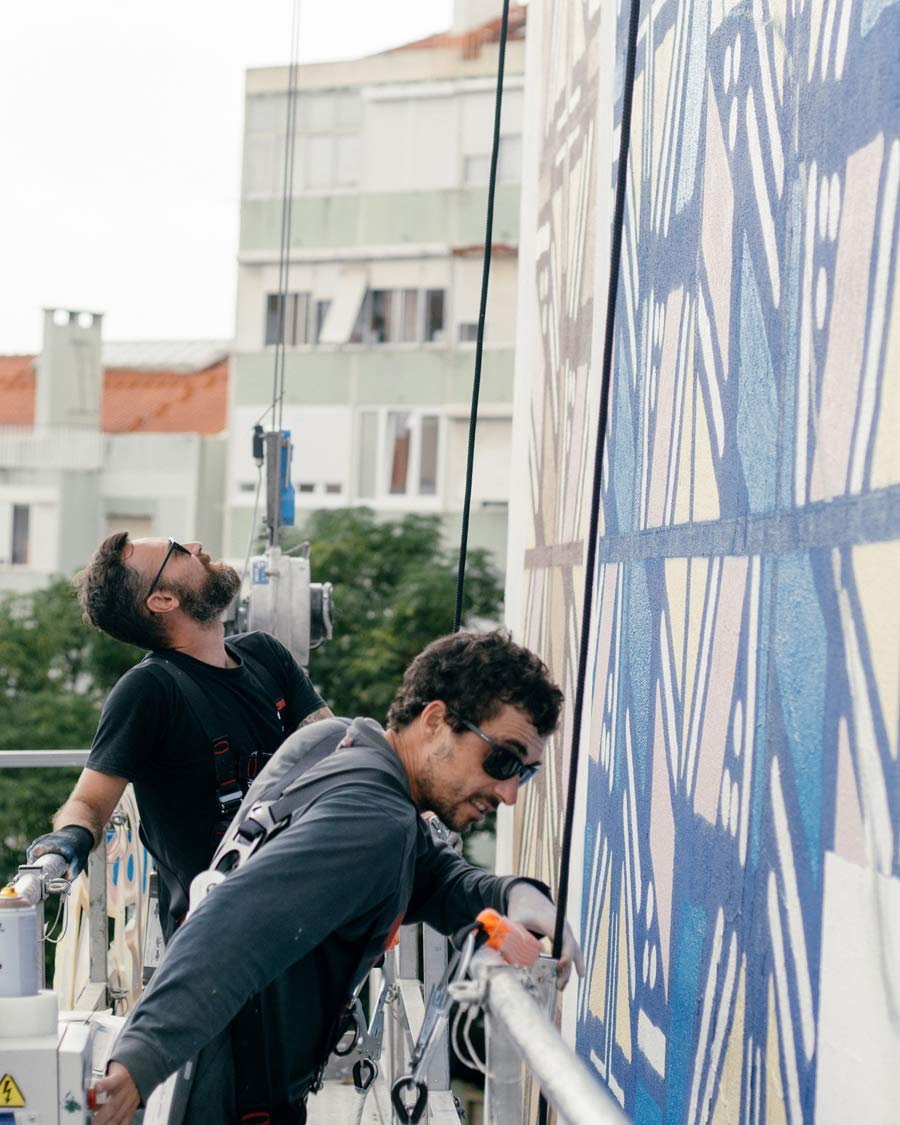
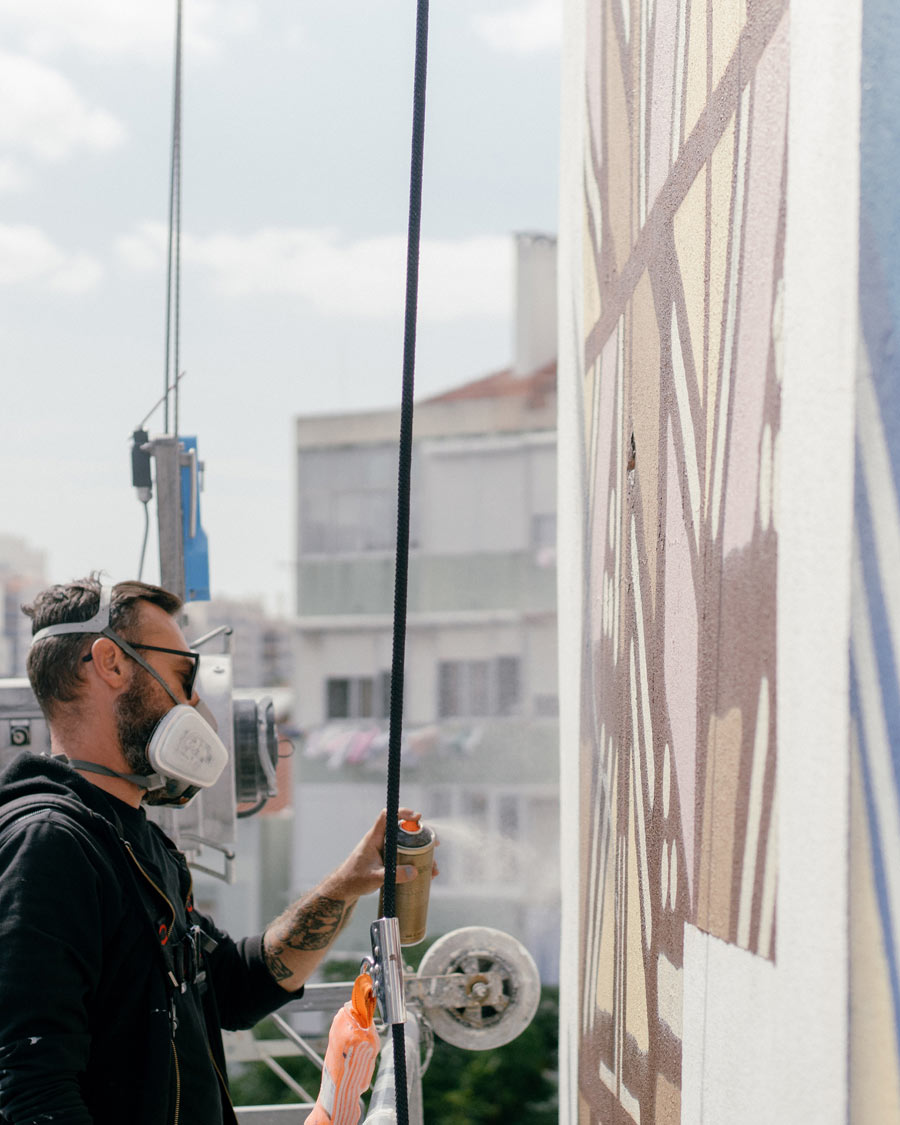
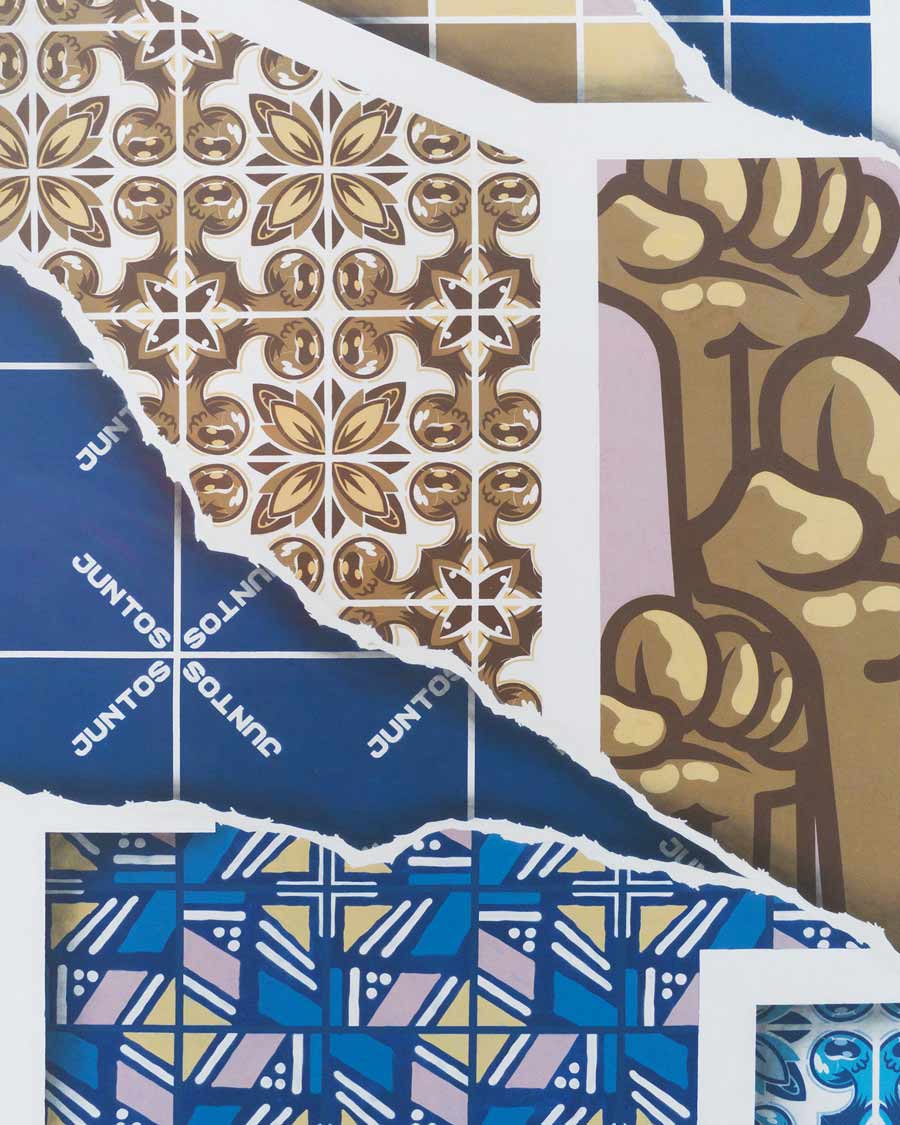
have a look at the new wall by Portuguese mural artist Add Fuel, who likes to
peel back the historical layers of a community to reveal traditional tile
making patterns as well as new hybrids that he develops. Part of a municipally
funded public mural project, much like the Nuart Aberdeen project the artist
participated in a few years ago, Add Fuel commandeers a large multi-story
building on which to regale the layers.
Add Fuel says the layers and colors are an oblique reference to the social ills fueled by corporate capitalism that we see across Europe and the US today, calling his mural JUNTOS (‘together’). “At a time when words such as racism, indifference and hatred are, unfortunately, increasingly part of everyday life, it is important to be part of the discussion and contribute in some way to change this,” he says.
“In a multicultural city like Amadora, JUNTOS calls for unity in a visual composition of multicultural, aesthetic and chromatic influence, that wants to celebrate the diversity of races, cultures and skin tones that make the world a more beautiful place.”
10
kilometers northwest of central Lisbon, this is a project organized by the Amadora Municipal Câmara, which has plans
to annually do this “Conversas na Rua” until the area is well-covered
with murals. Should be great for the community, tourism and real estate.
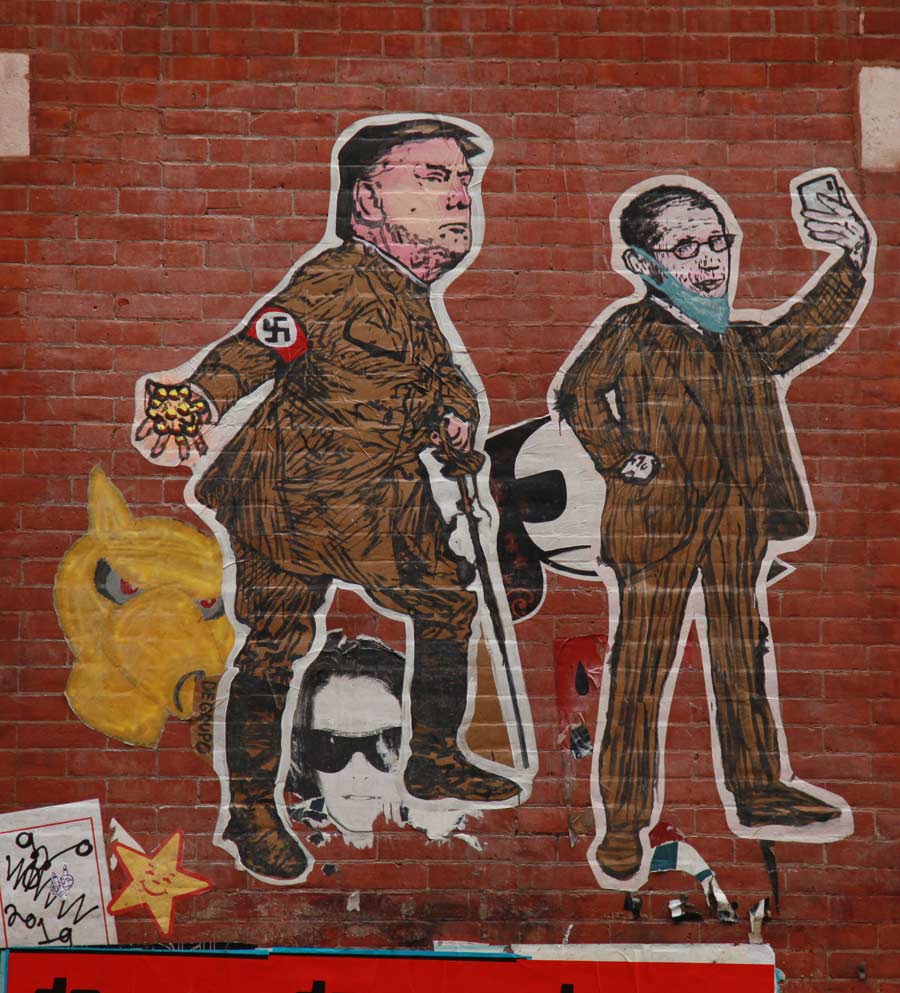
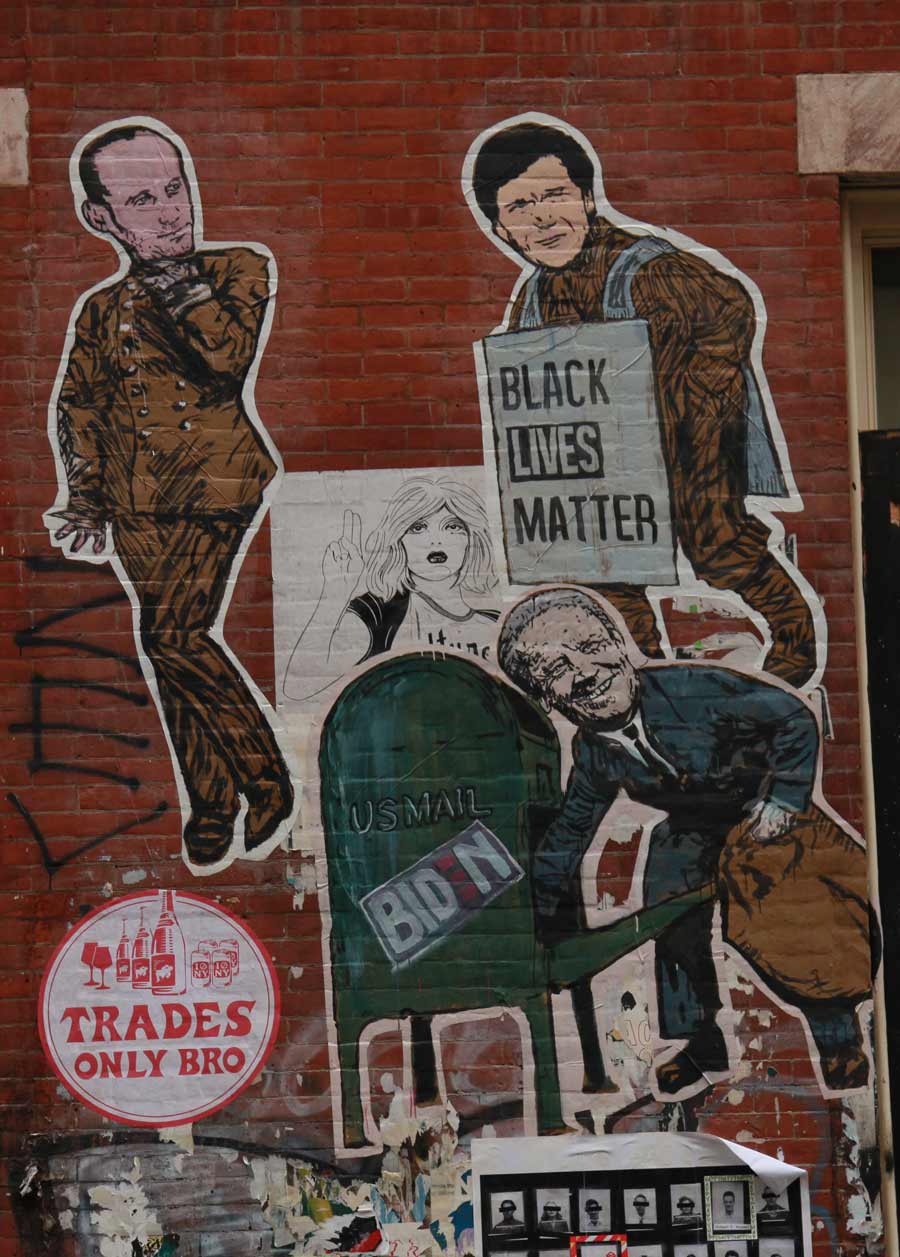
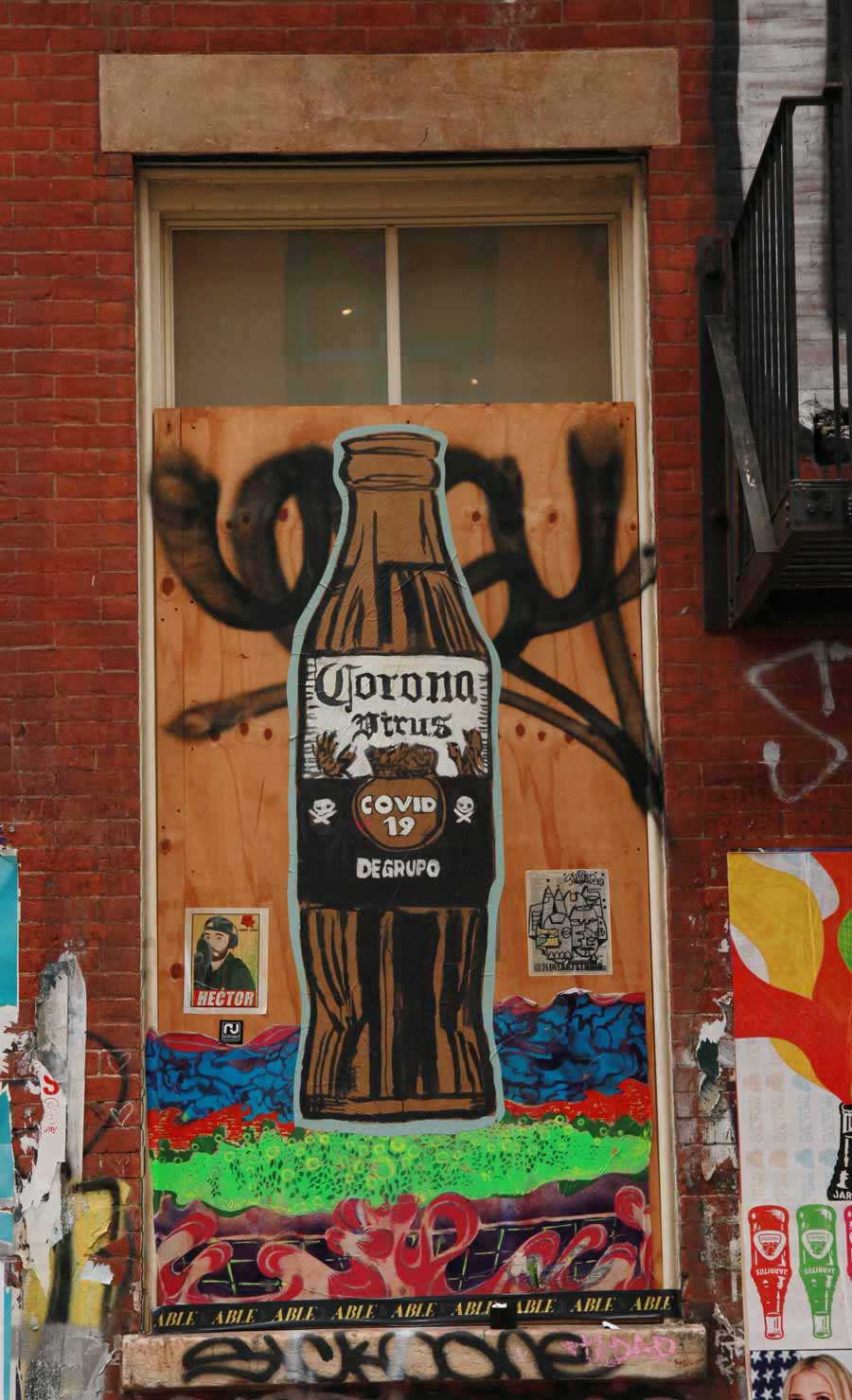
Welcome to BSA Images of the Week. We’re midway through the month and every one is puzzled by this surge of new corona cases – although the New York mayor says the numbers are plateauing. The presidential race, if you can call it that, has many people worried about which bad direction we’re likely to go. But then the presidency itself has been a four year open sore. Regardless of who wins – you won’t be getting healthcare, or a jobs program, or an infrastructure program.
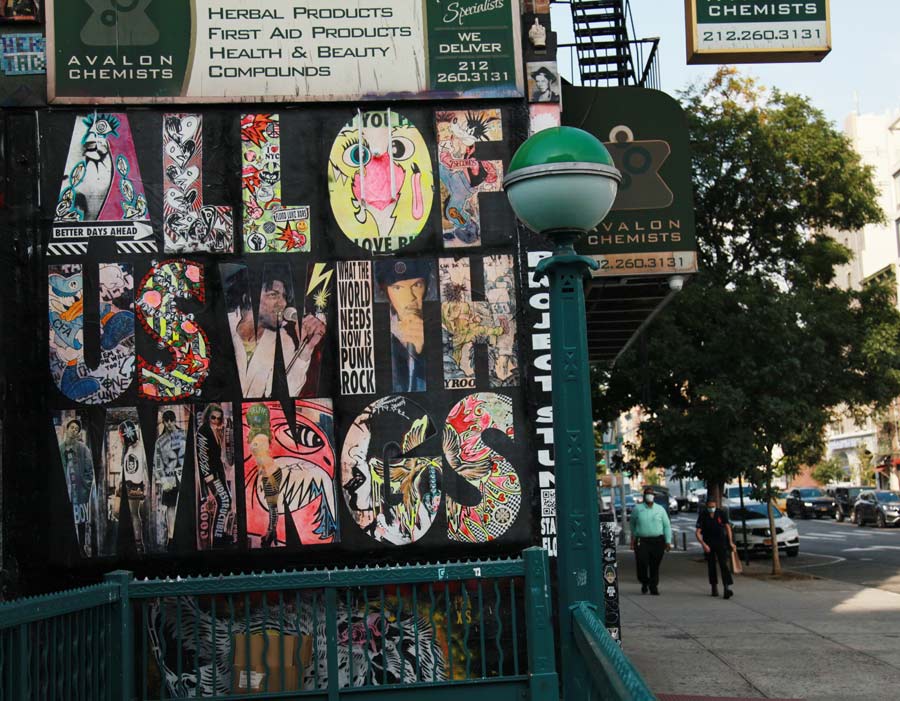
But crisis always pushes artists to dig deeper, and there are lively, funny, entertaining, strident, wacky people and signs wherever you walk.
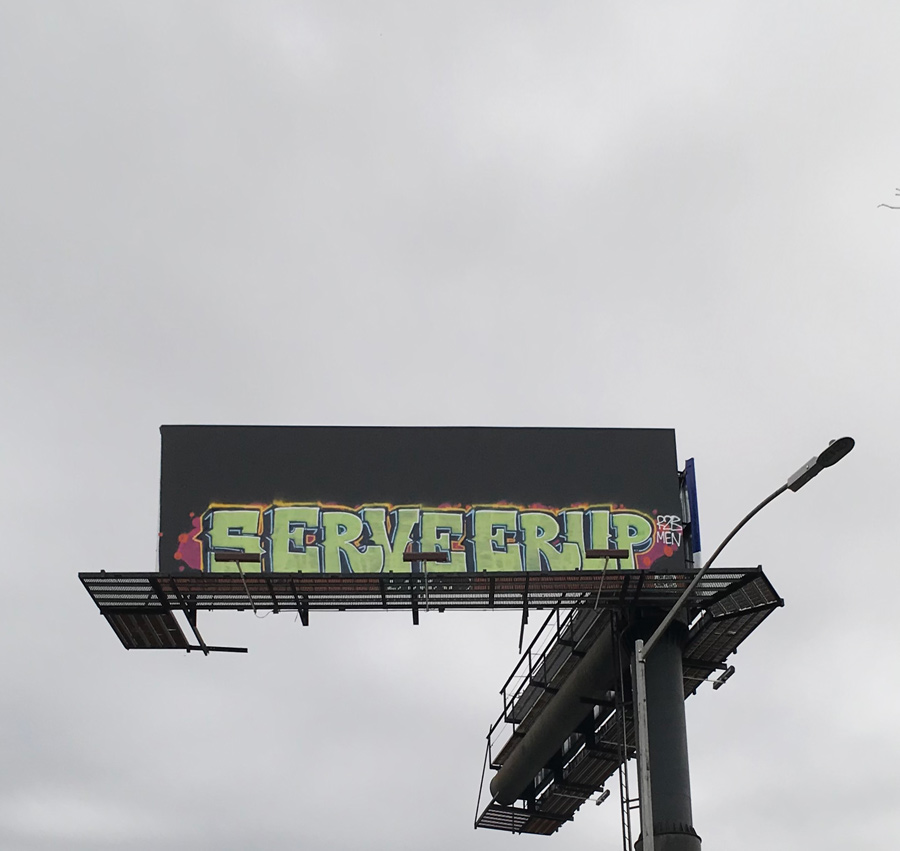
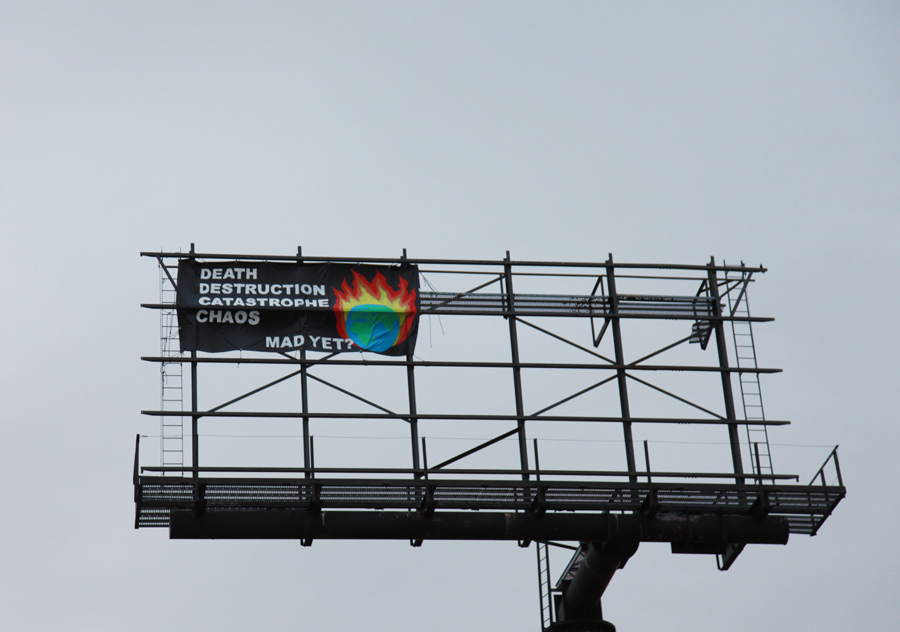
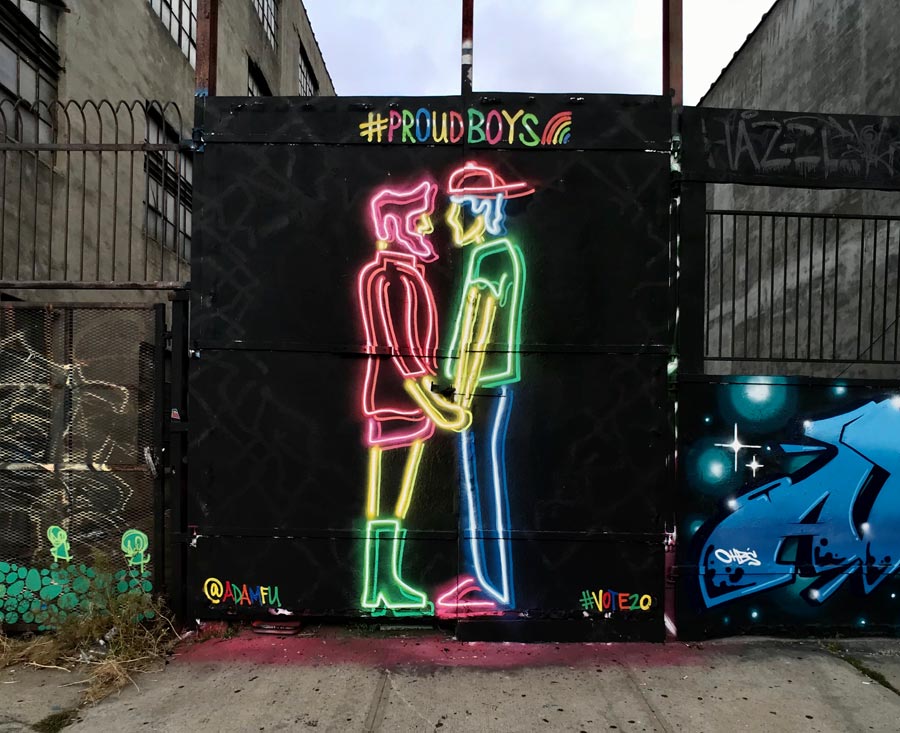
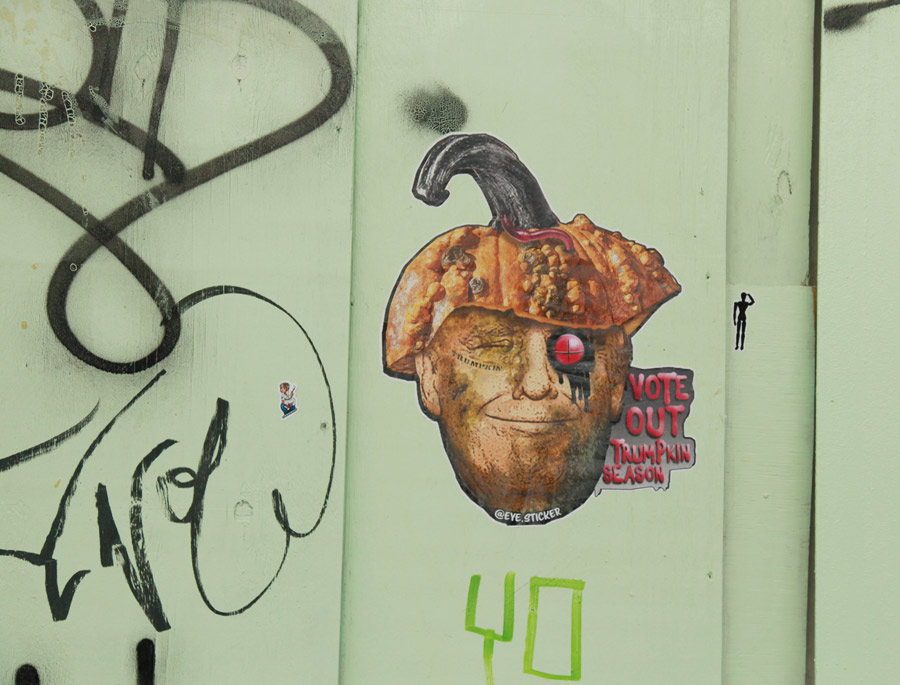
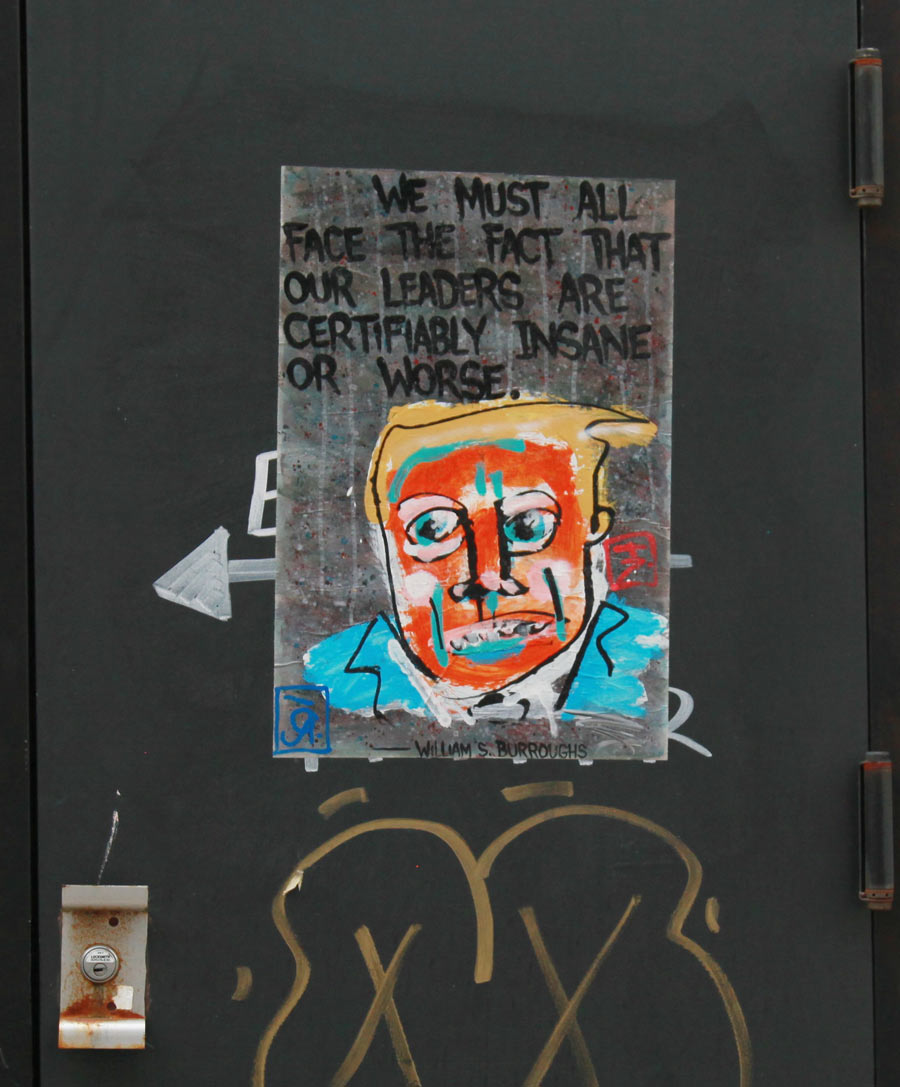
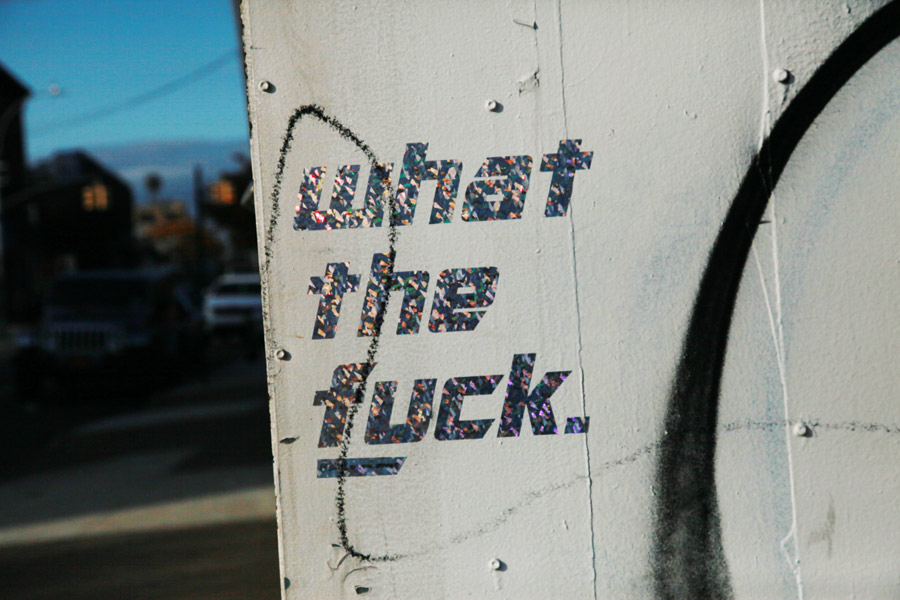
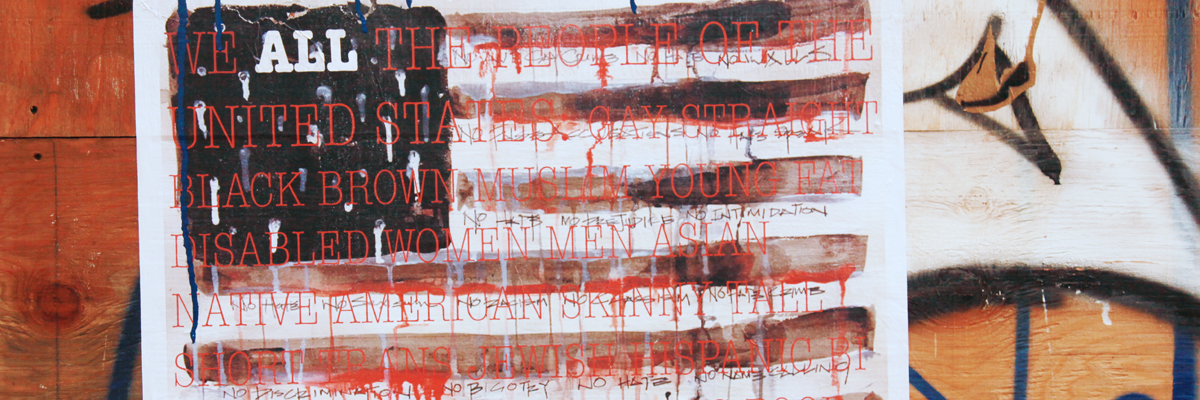
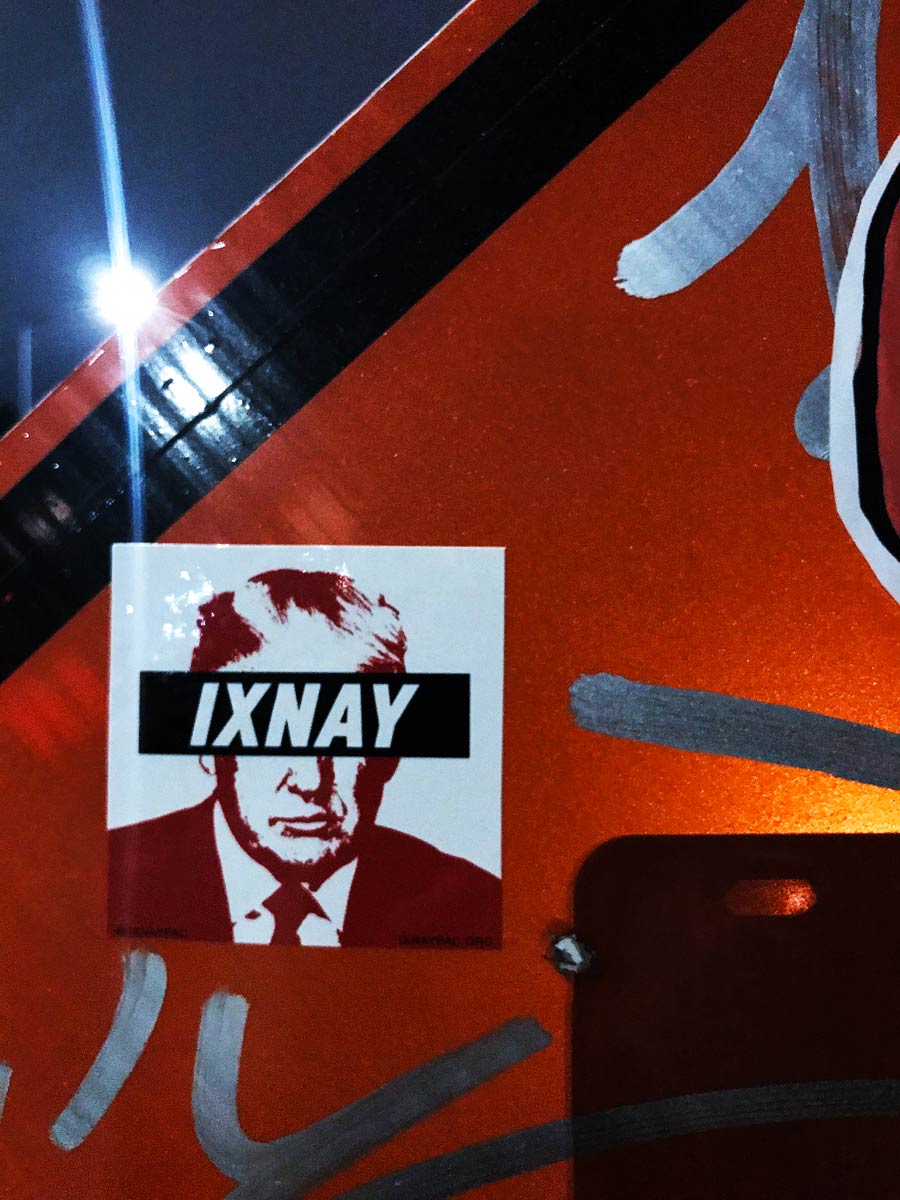
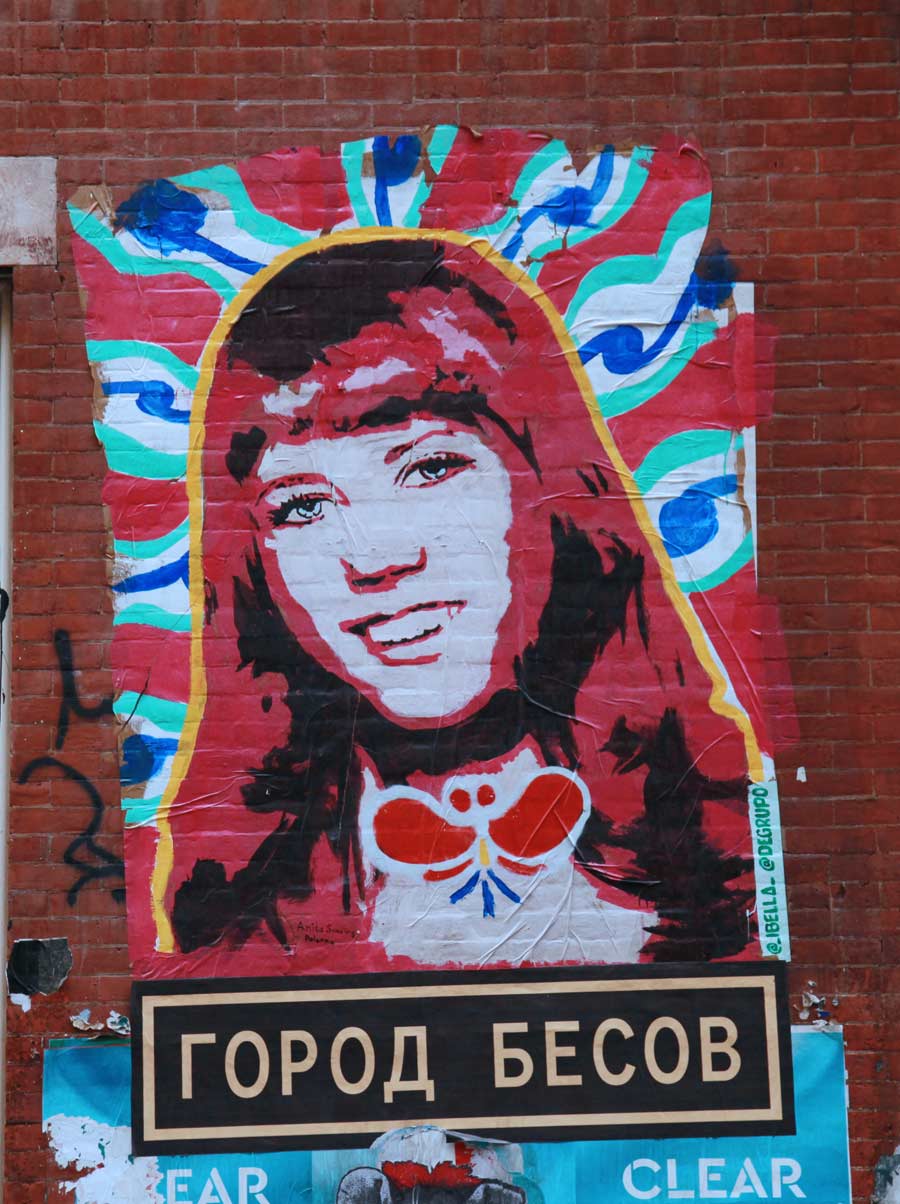
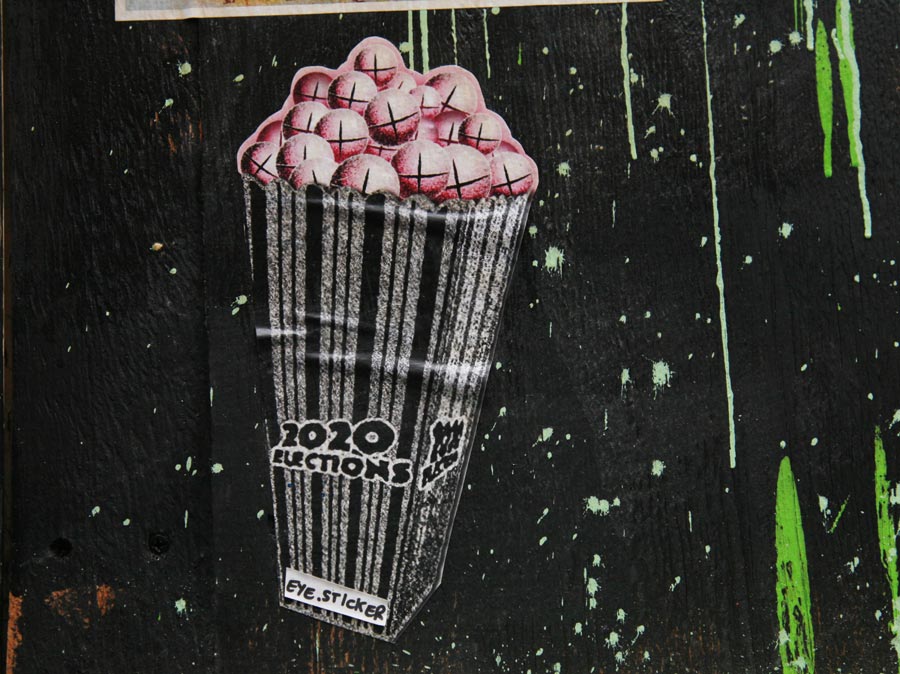
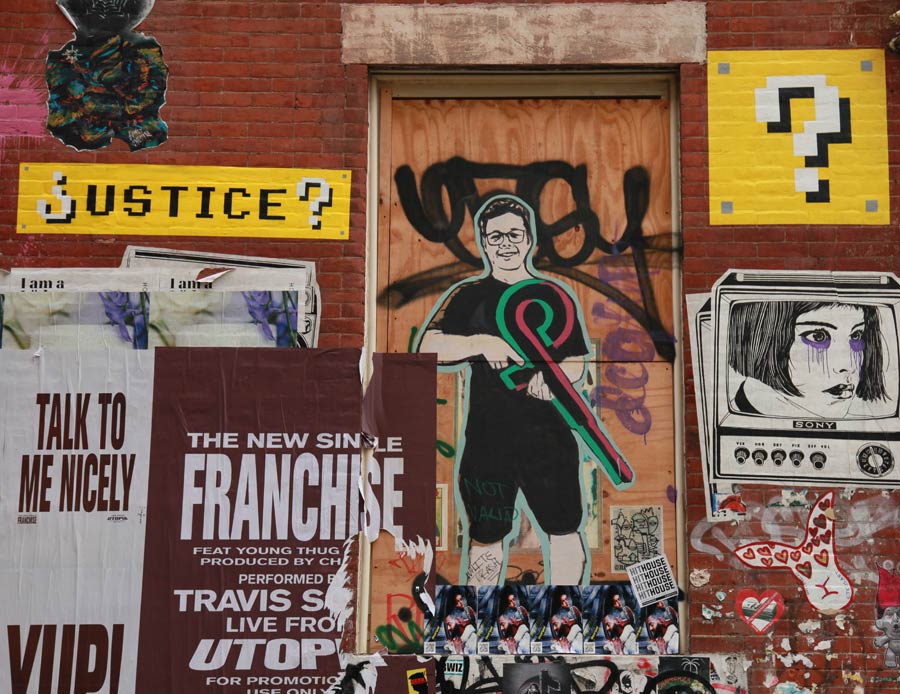
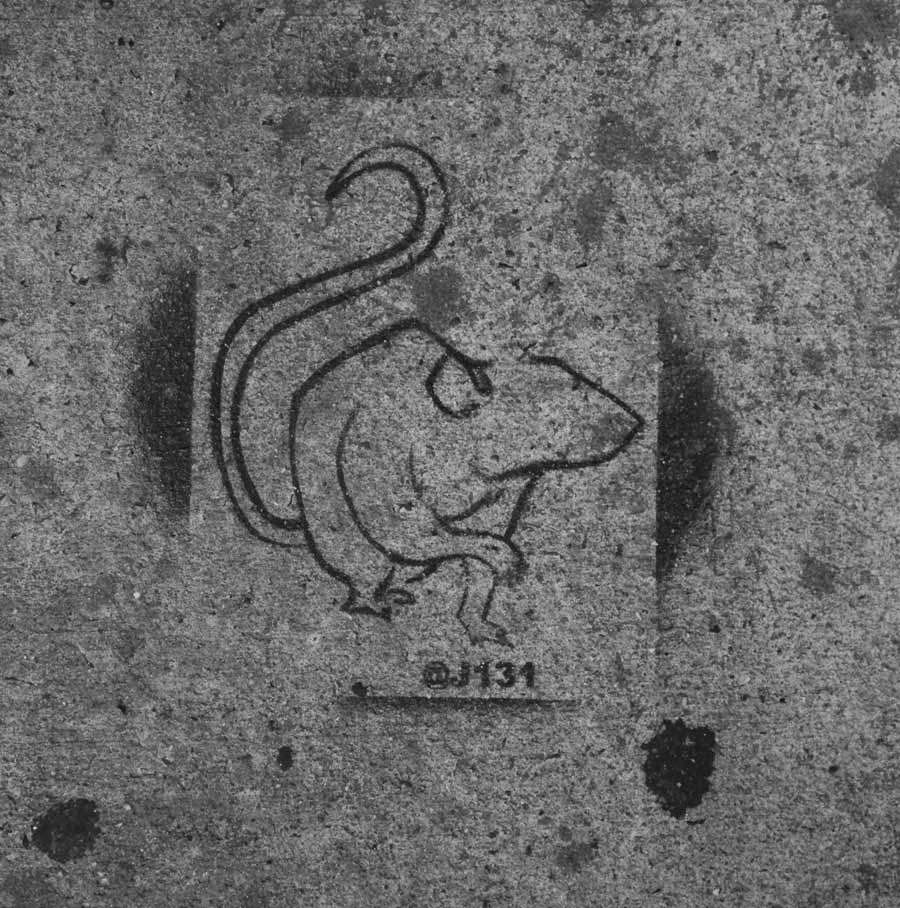
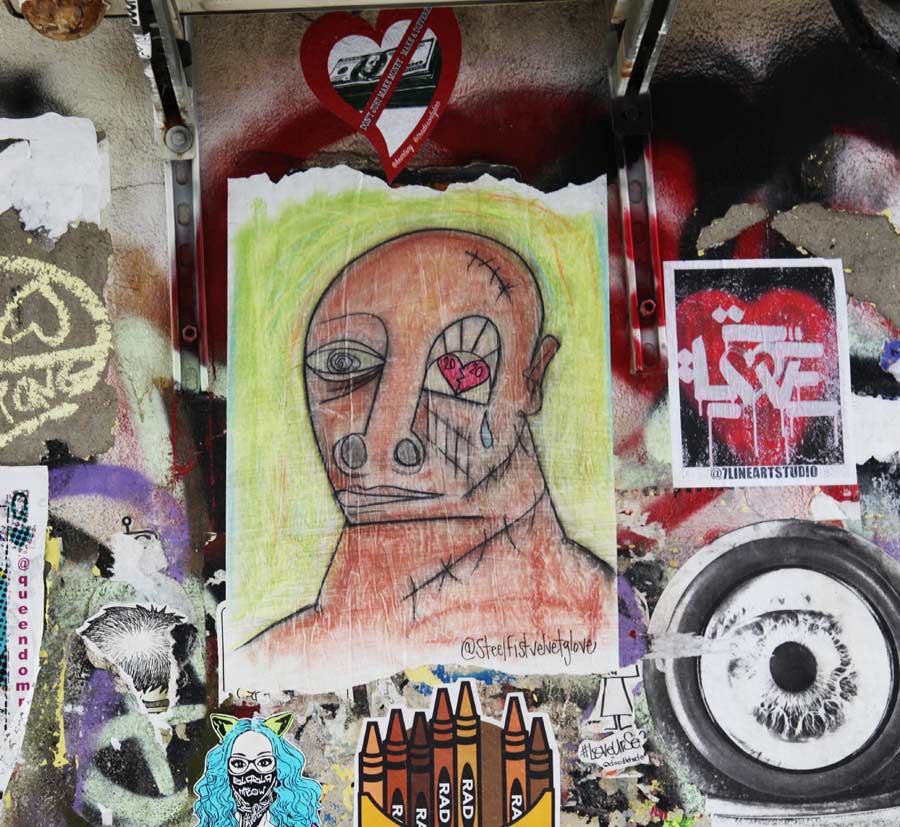
Here is our weekly interview with the streets, this week including D7606, De Grupo, Eye Sticker, Flood, I Bella, Individual Activist, J131, Secret Photo Cabal, and Steel Fist Velvet Glove.
Saturday is a great day to
spend indoors at a video arcade, right?
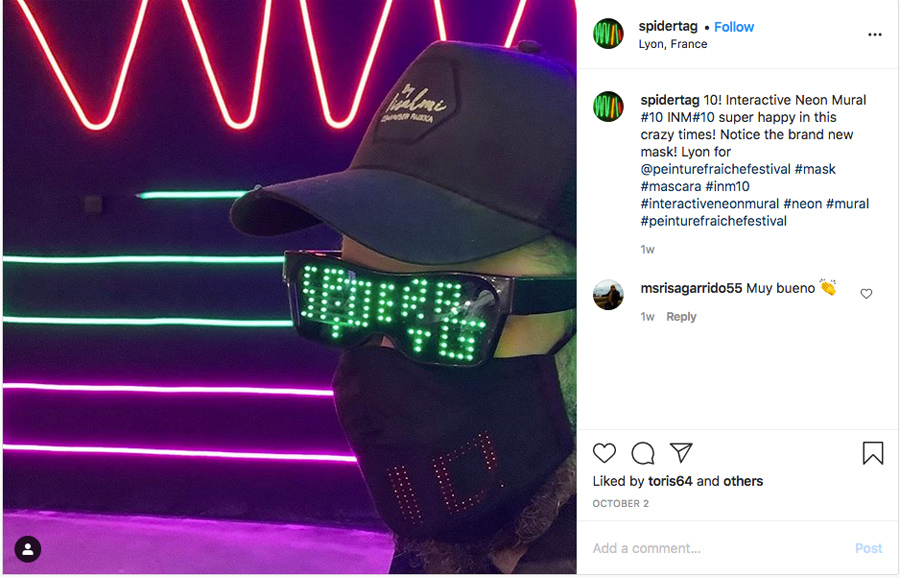
If arcades had interactive
installations like this new one from SpiderTag, it would be packed. Unfortunately
Covid-19, people can’t get packed into the Peinture Fraiche Festival in Lyon,
France.
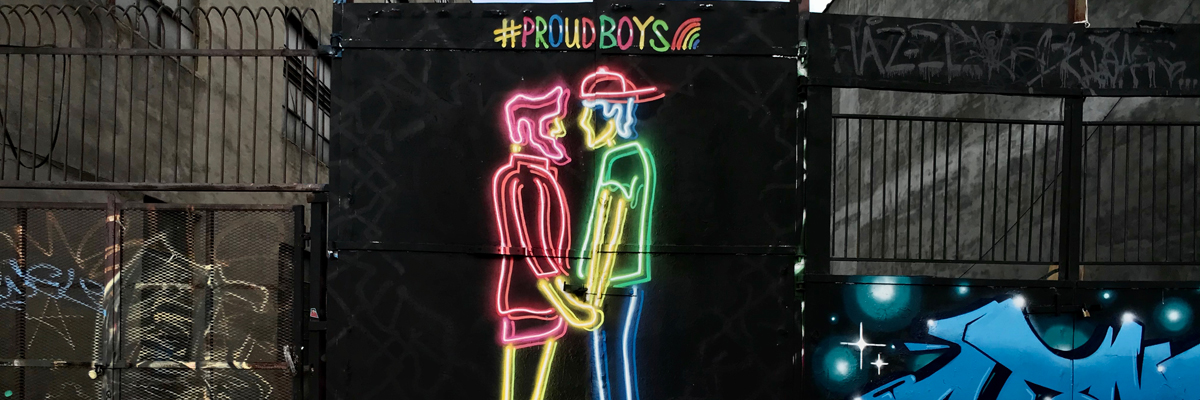
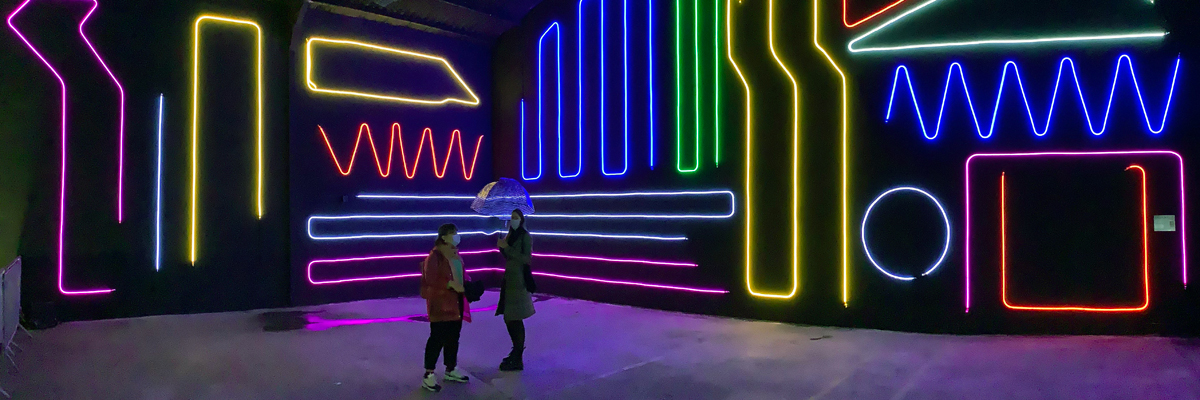
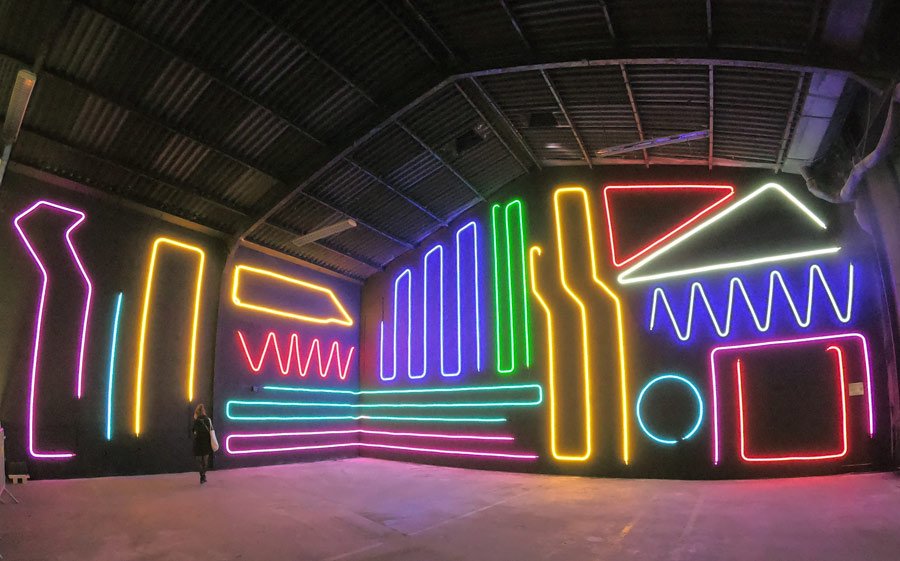
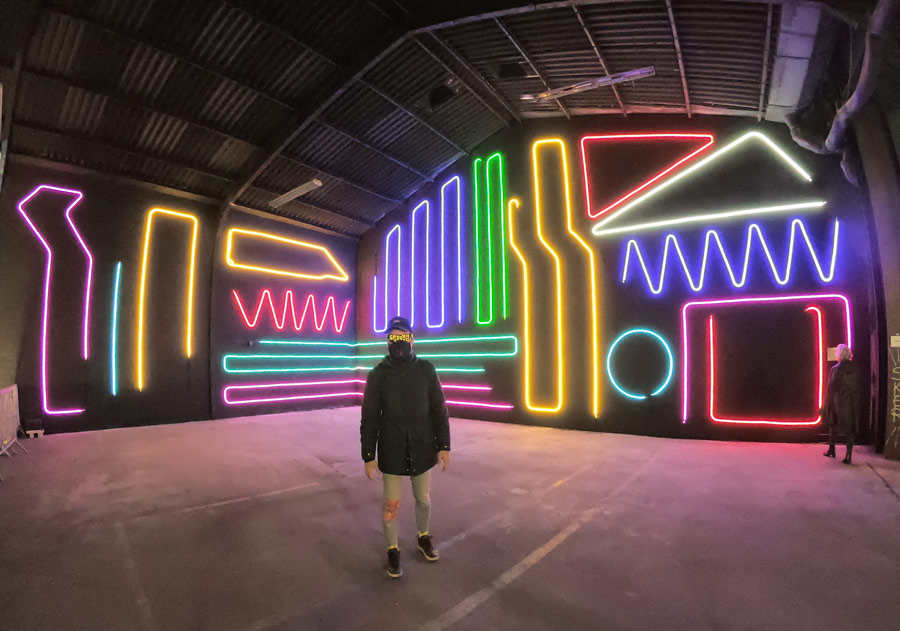
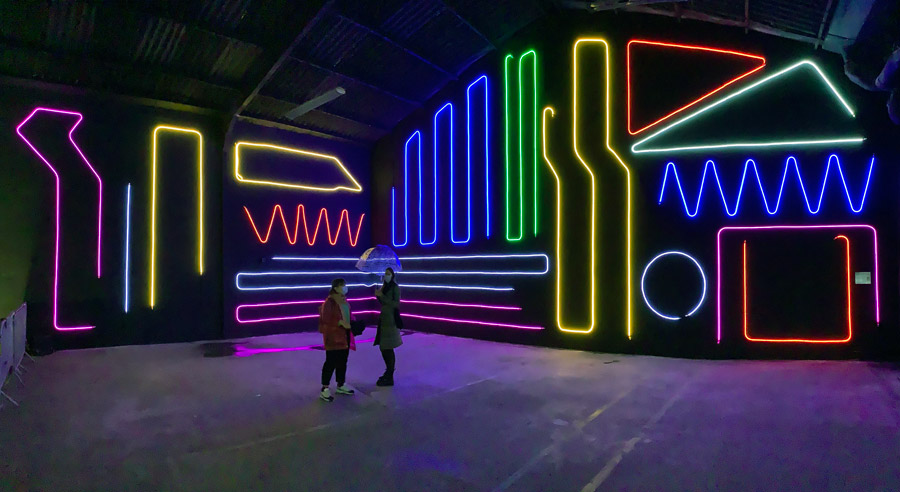
The festival features 50 French and international artists at La Halle Debourg operating loosely under the theme of innovation in urban art as a concept. Here we see the Spidertags new installation while he continues his explorations with Neon, transforming and mediating the thick dark night. He calls this his Interactive Neon Mural #10.
Our weekly focus on the moving image and art in the streets. And other oddities.
Now screening : 1. PAREES FEST 2020 / Manolo Mesa / Video by Titi Muñoz. Homage to the porcelain factory of San Claudio 2. Traz by Stéphane_Koyama-Meyer: Global Warning – Mobiles 3. Cosplay for Pets? Cospets!
BSA Special Feature: Manolo Mesa and His Homage to a Porcelain Factory in San Claudio
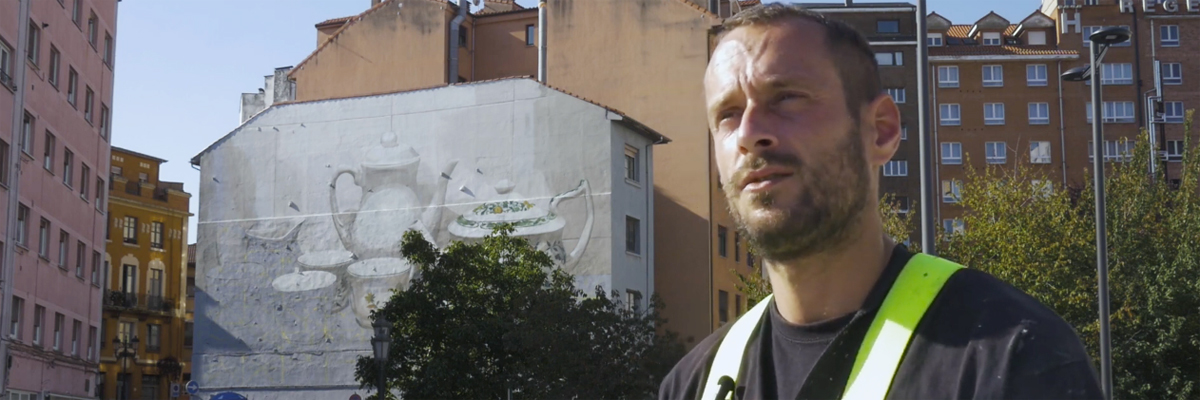
With his new mural dedicated to the pottery of San Claudio, Manolo Mesa finds time for the forgotten stories that are hosted within the family china. A most unusual topic to feature at a mural festival, he brings the unique perspective of our relationship with the quotidian and elevates it to a public discussion here in Oviedo, Asturias for Parees Festival.
The video tells
it with insight, letting you observe the artist at work, following his body
language as he shoots his source images tells you all you need to know. He had
wanted to paint this topic since got to see an abandoned pottery factory in San
Claudio; deeply impacted by its ruins, its molds – like the pyramids.
Traveling here from Bilbao, Manolo arrived in Oviedo a few days early to educate himself about regional history through various collections of tableware in houses in this city.
He learned that the pottery factor had provided many jobs throughout this region with its molds, glazes, tracings, and hand-painted decorations in a time when popular painters from the area were counted on to represent in very collections. He found postwar pieces that were inherited and preserved and he saw the tableware of a lifetime preserved from the middle of the century.
The resulting mural speaks to our knowledge of our own everyday objects, their provenance, and their true significance in the culture.
PAREES FEST 2020 / Manolo Mesa / Video by Titi Muñoz. Homage to the porcelain factory of San Claudio
Traz by Stéphane_Koyama-Meyer: Global Warning – Mobiles
Not quite as common as aerosol and wheatpastes and stencils, the smartly placed sculpture on the street can leave a lasting impression. Somehow, even though they can be just as illegal as other works of street art, these pieces are often afforded a wider berth in the patience of the public and law enforcement, as if their extended permanence makes them somehow not vandalism. Maybe it’s the sense of commitment and the sheer physical effort required to create. Here is a closeup on the work process of text-lover Traz- a homemade sort of video without sound that catches him in the creative zone creating and installing his mobiles.
Cosplay for Pets? Cospets!
Undoubtedly you’ve been scratching your head and wondering what kind of costume your dog should wear to that upcoming Halloween party. Here are some outstanding sources of inspiration for theatrical and fashionable costumery for both cats and dogs from the designers who know their muse.
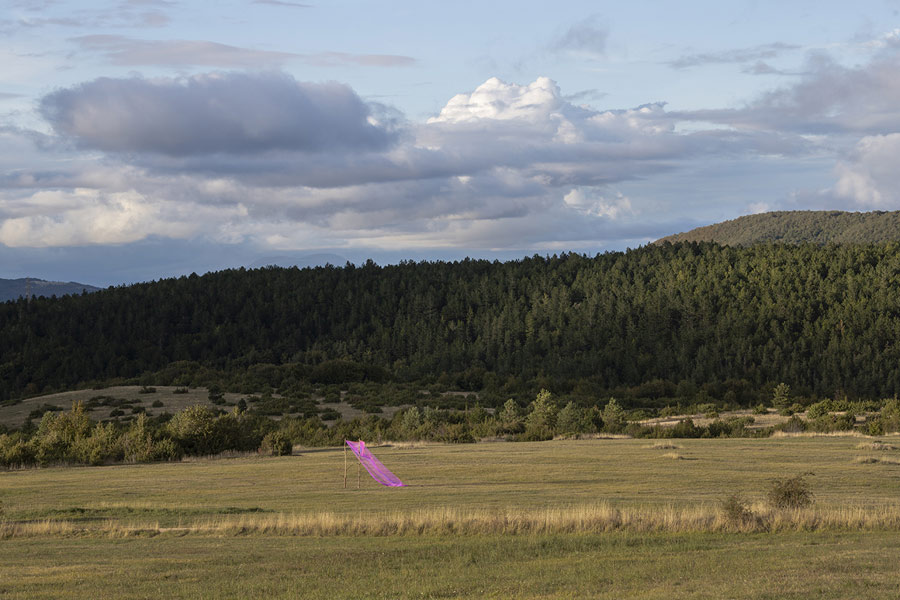
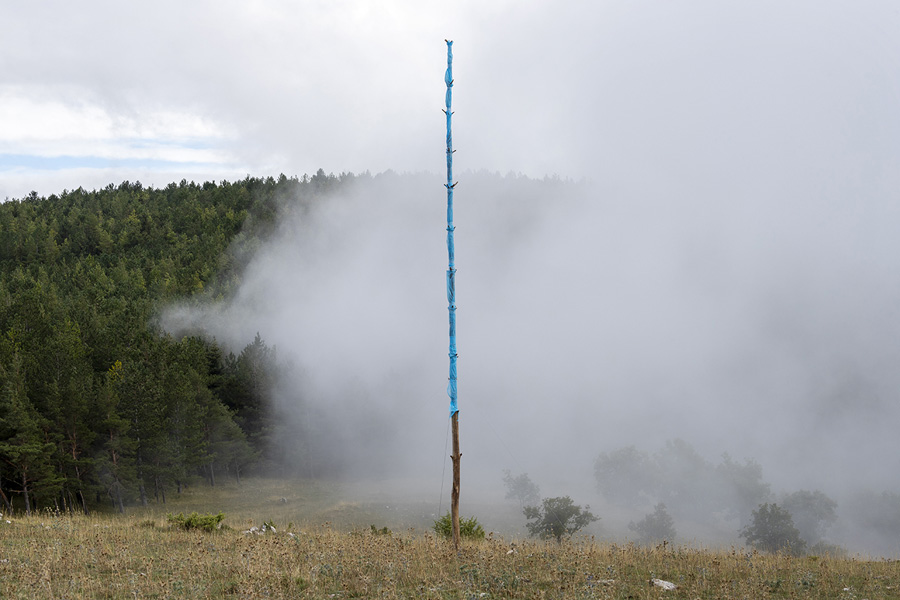
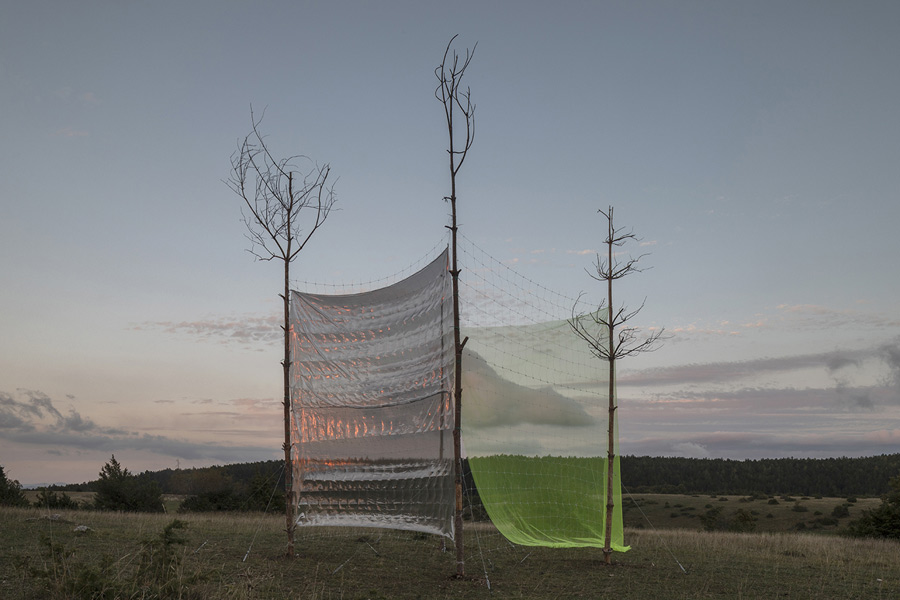
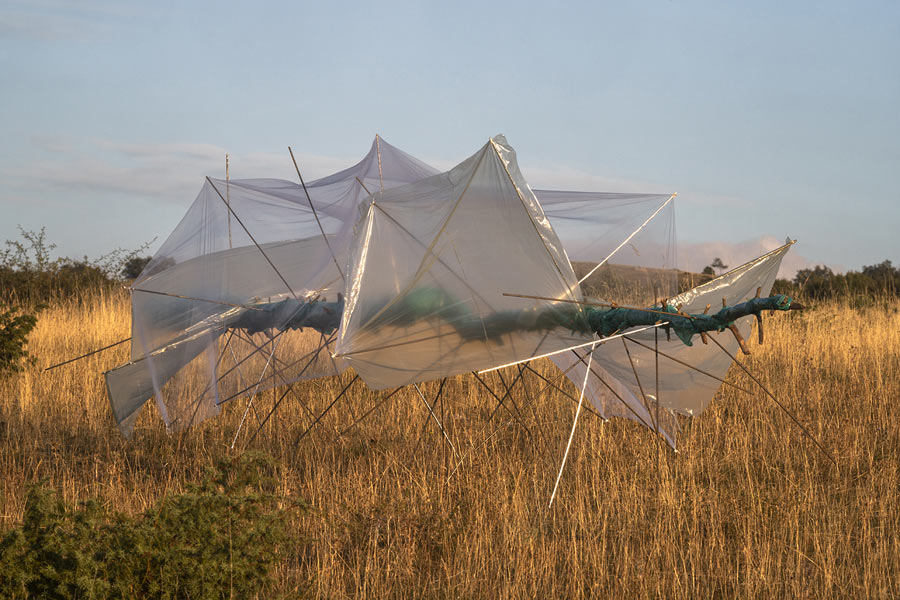
Land art can be so satisfying sometimes because you merely need nature to be your willing collaborator and your idea can take flight. It’s the sensation of serendipity when you first made a cape for yourself merely by wrapping your blanket over your shoulders. One minute ago it was a blanket. Suddenly, you may fly. That’s how I discovered that I was actually Batman.
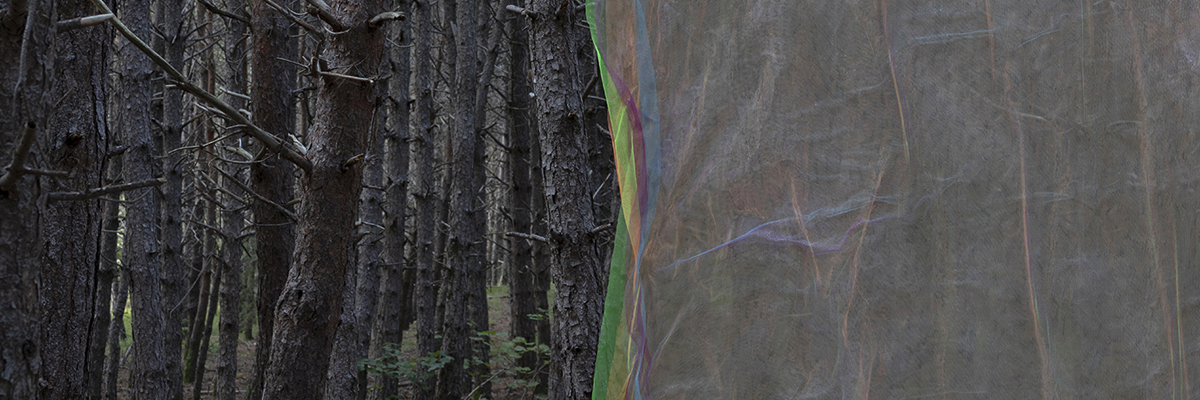
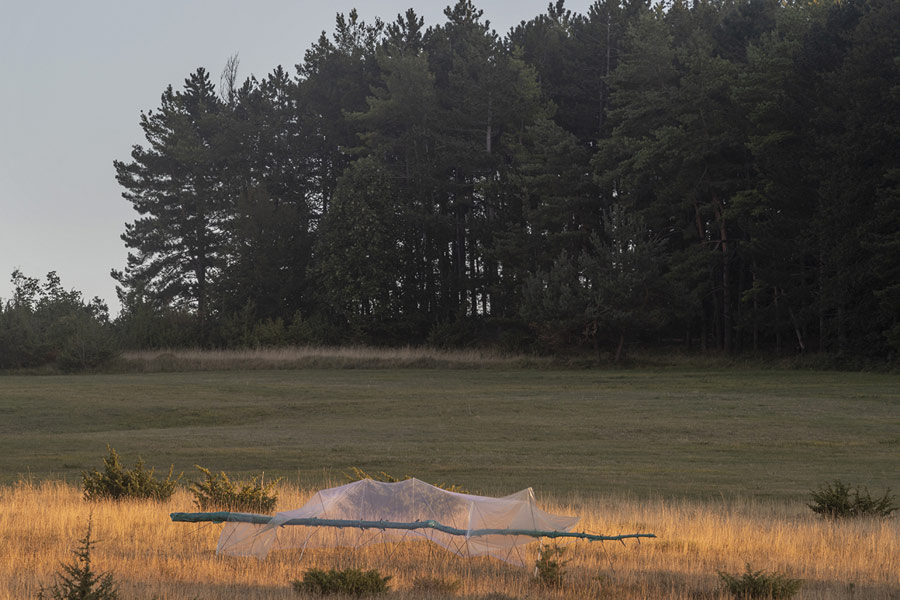
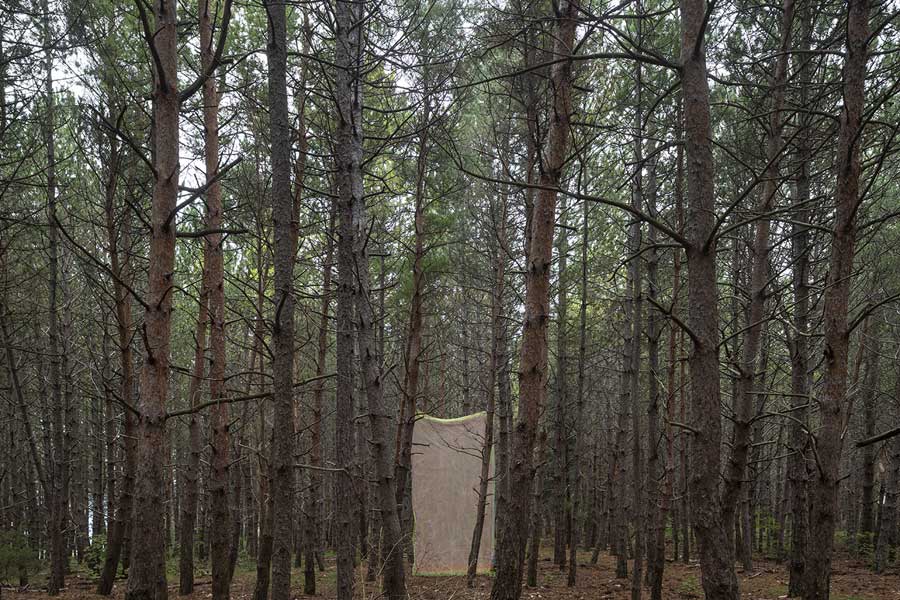
The Italian land artist Alberonero says that he discovered this project October 2nd only by totally immersing himself in his environment here in Central Italy’s Vallo di Nera area. He says he is interpreting the natural elements also as moments – necessarily so because the world is in constant motion, despite the static state in which we may imagine it to be.
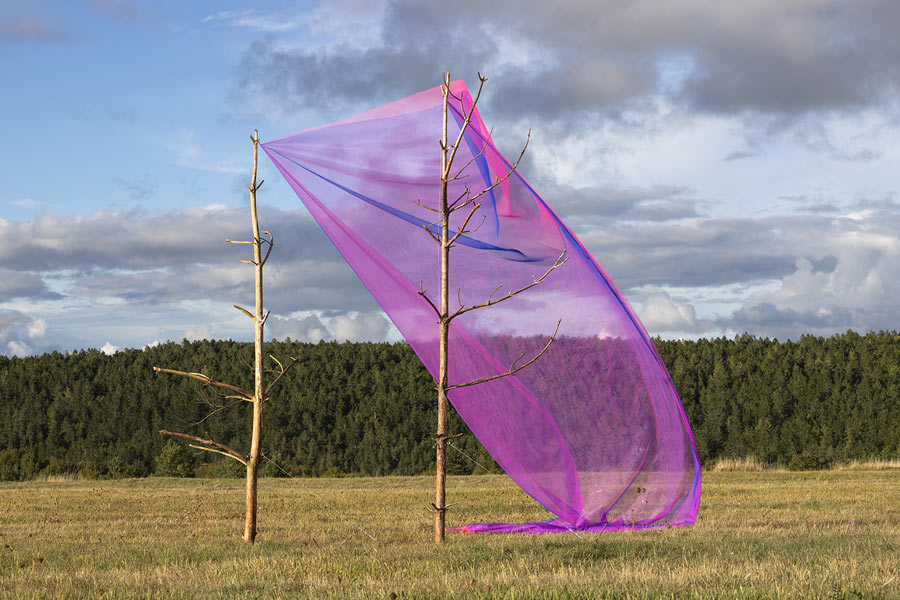
The temporary environmental installation that he conceives of here is called Monte Immagine, and he says that it “consists of five installations within a single clearing made up of natural materials found in the local woods – such as tree trunks and branches – resins and colored fabrics that interpenetrate with the physical and atmospheric elements of the surrounding landscape. All the works use trees as pillars: raw materials that, in each installation, experience the site through different suggestions.”
With this spirit of interaction, with this willingness of your observatory powers, everything becomes an actor, and something that can be acted upon. With the participation of clouds, of breezes, one is more aware of fragility.
He speaks of the natural actors as “apparitions that temporarily inhabit the area before their dialogue with nature gets absorbed by the atmospheric agents.”
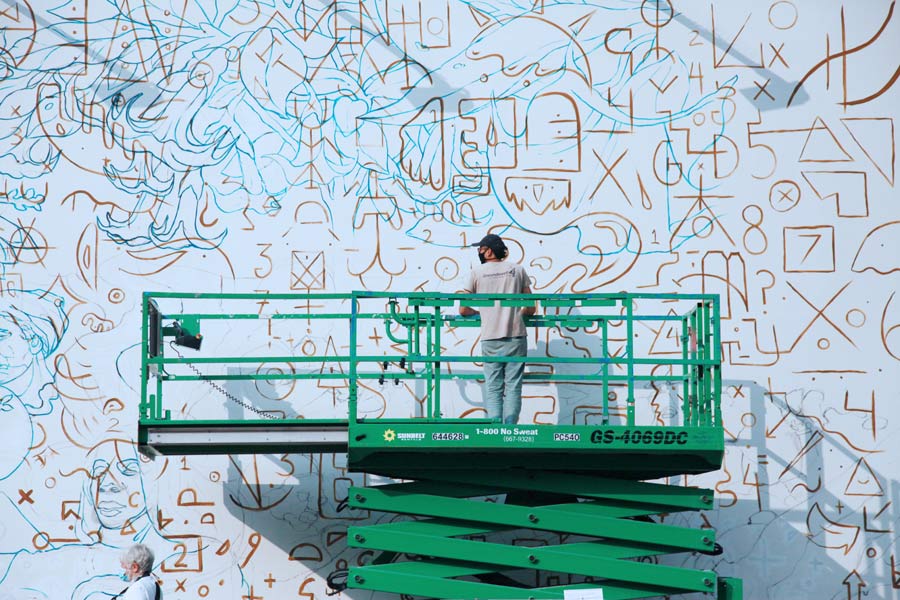
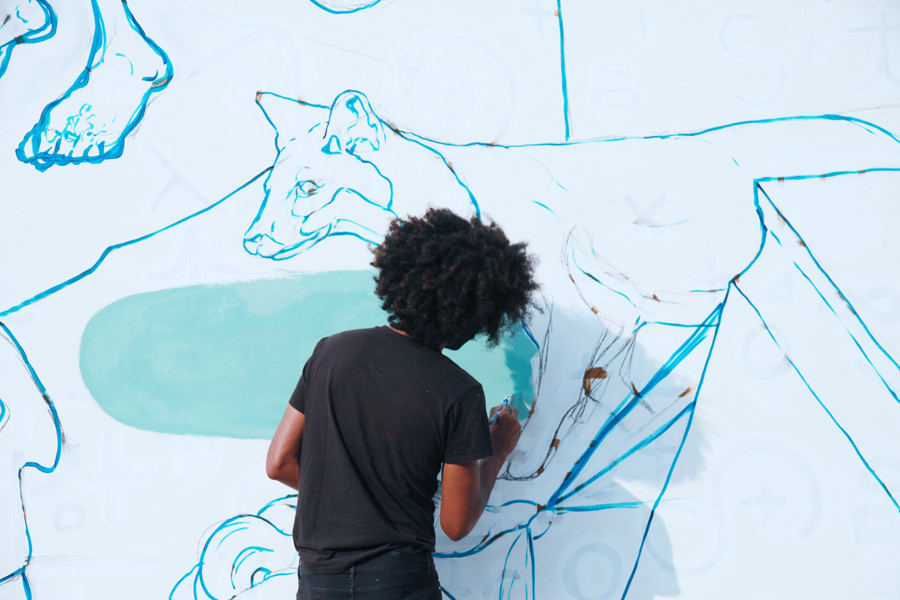
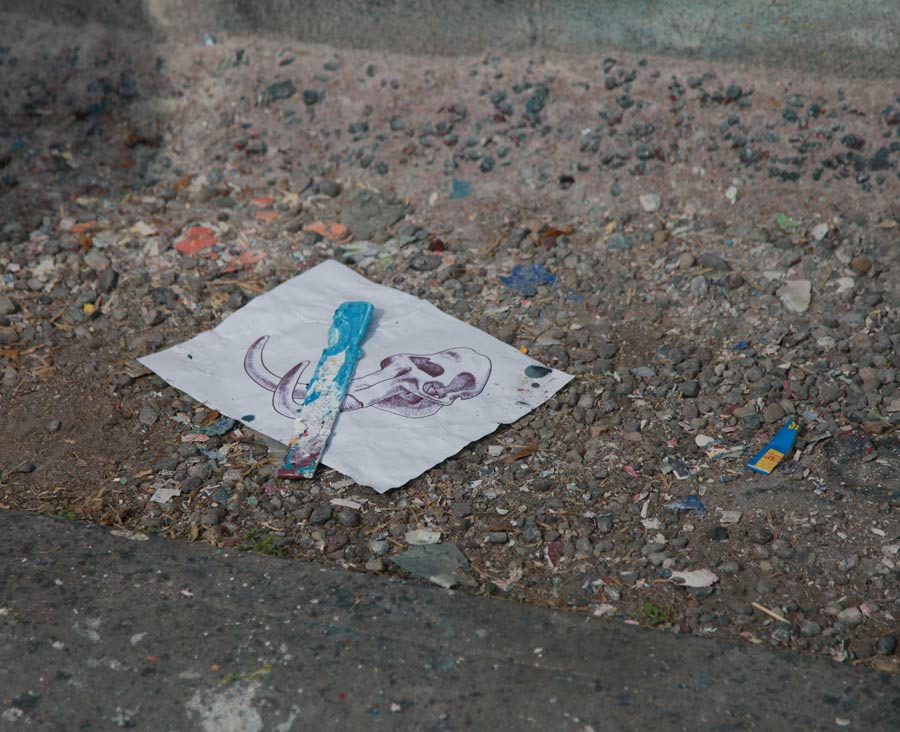
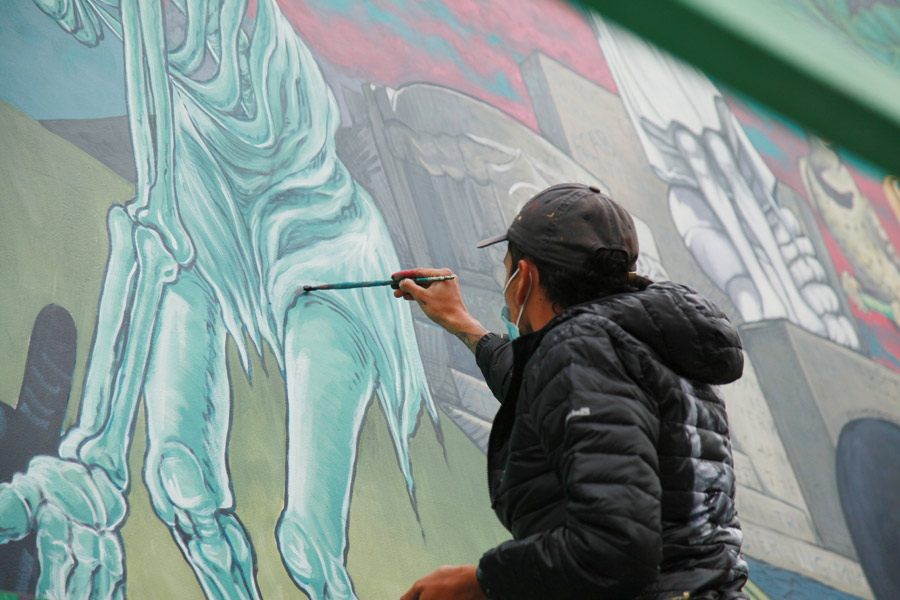
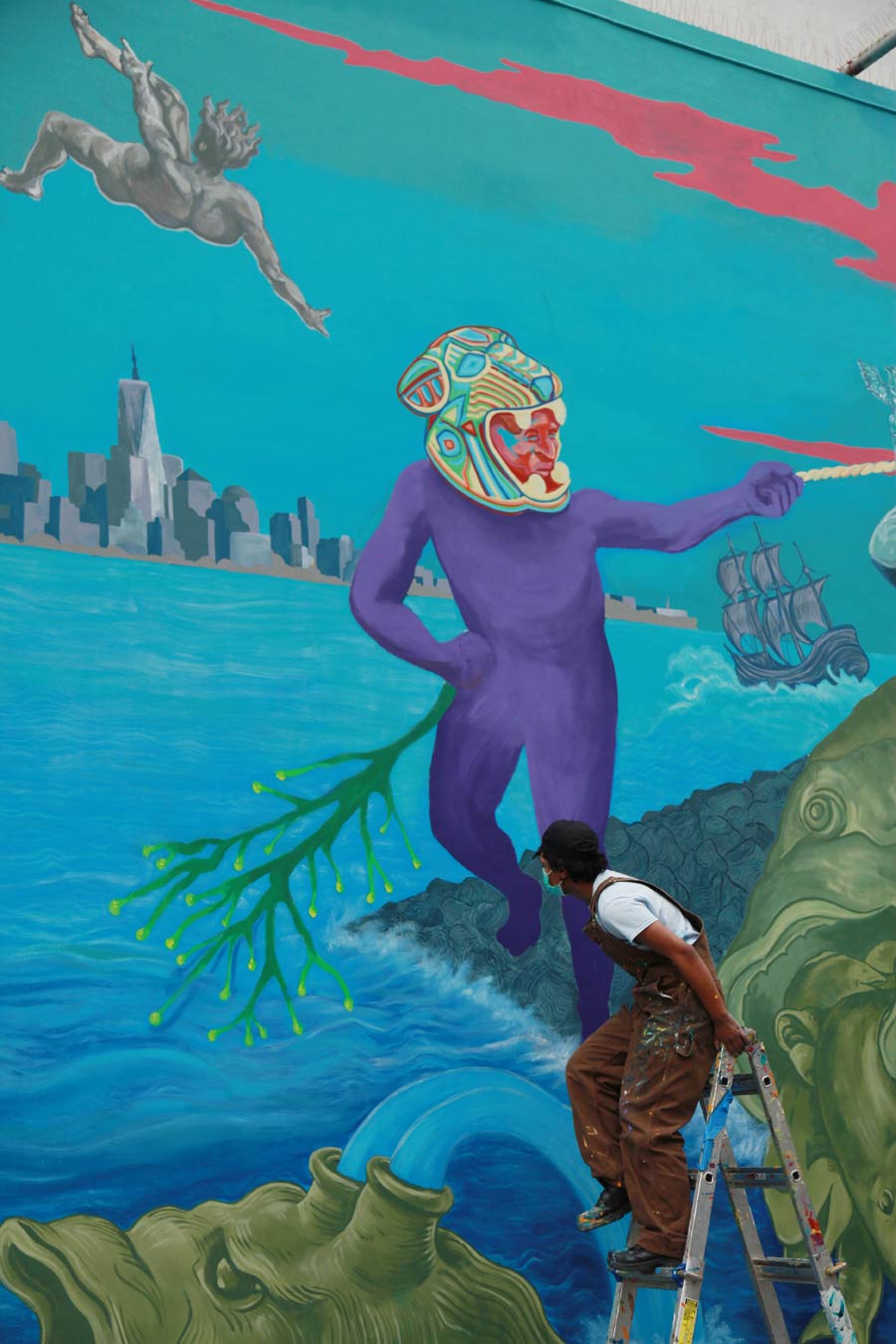
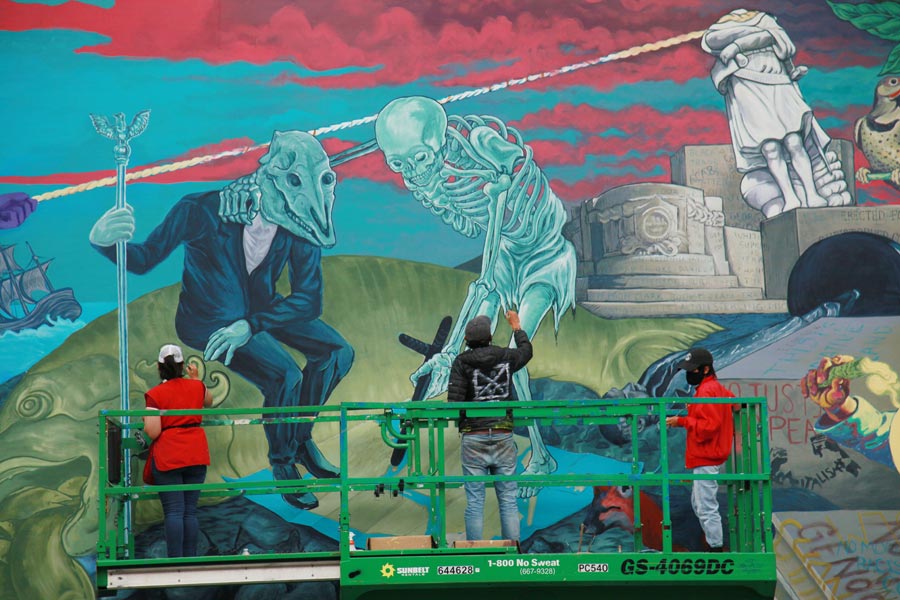
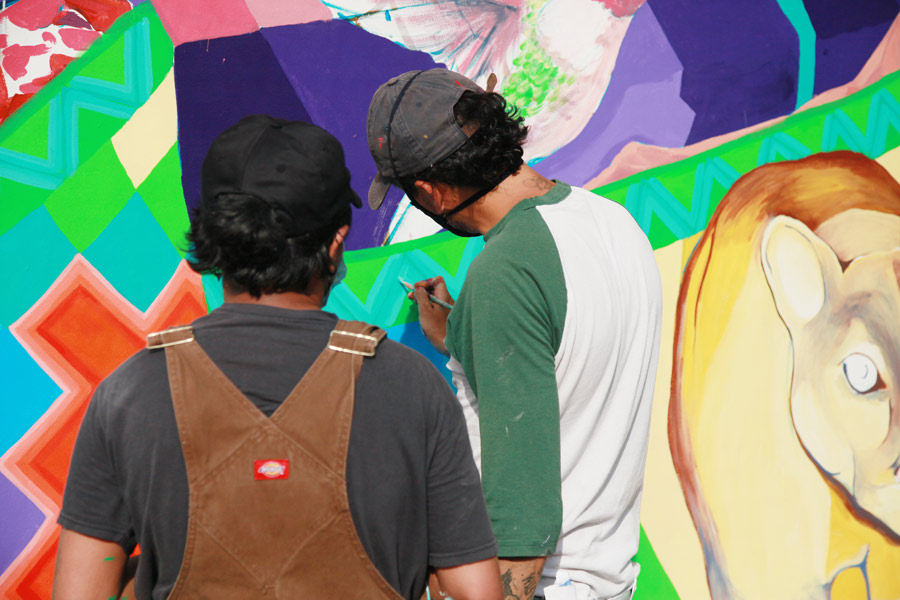
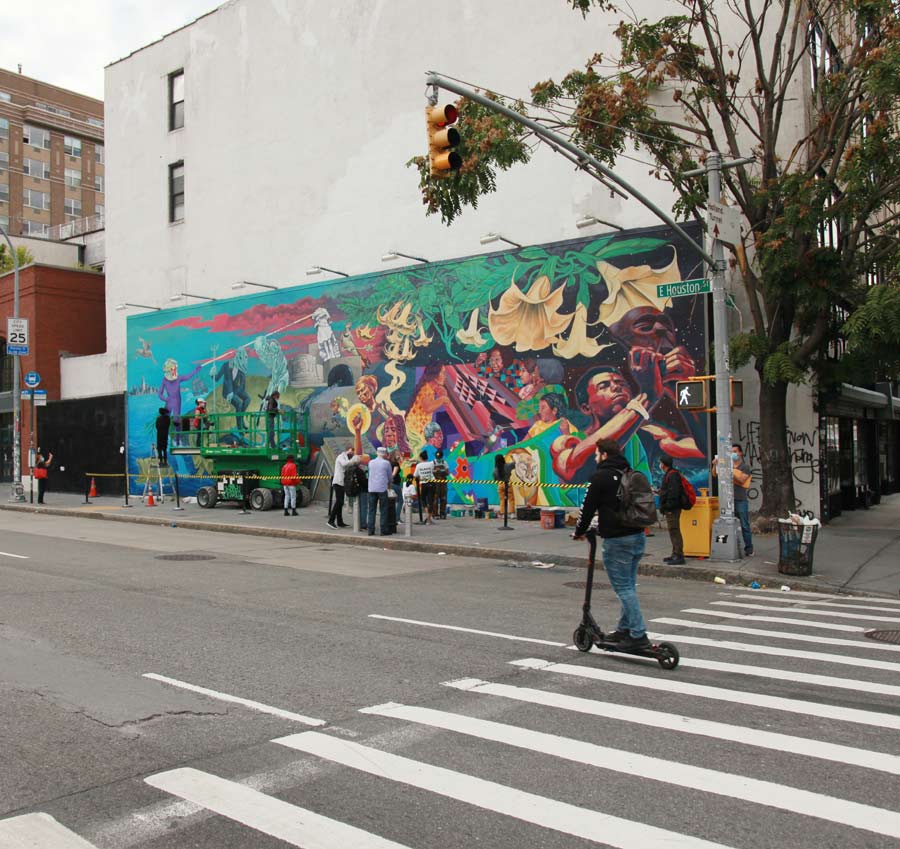
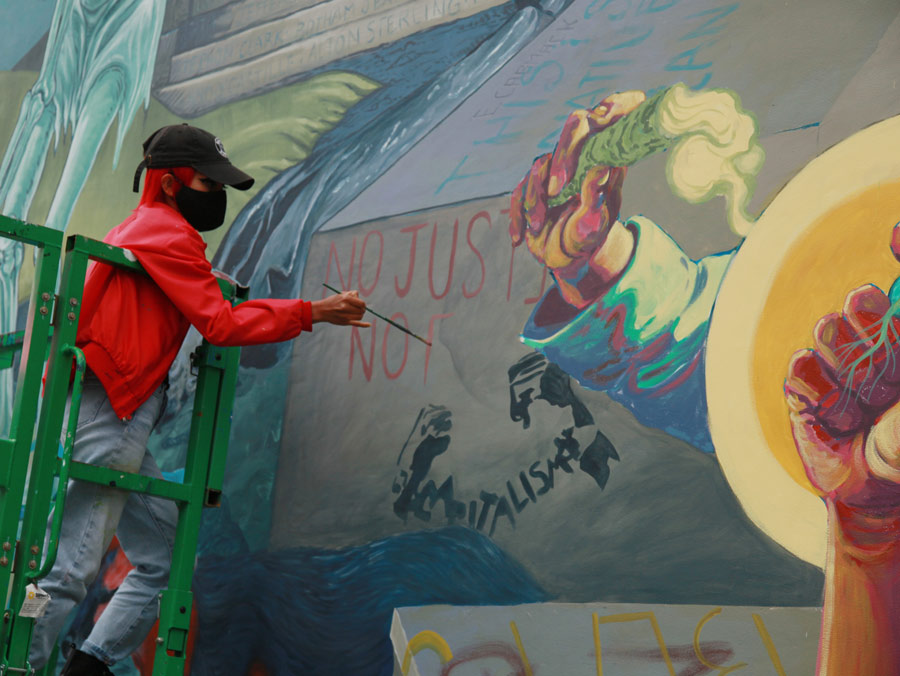
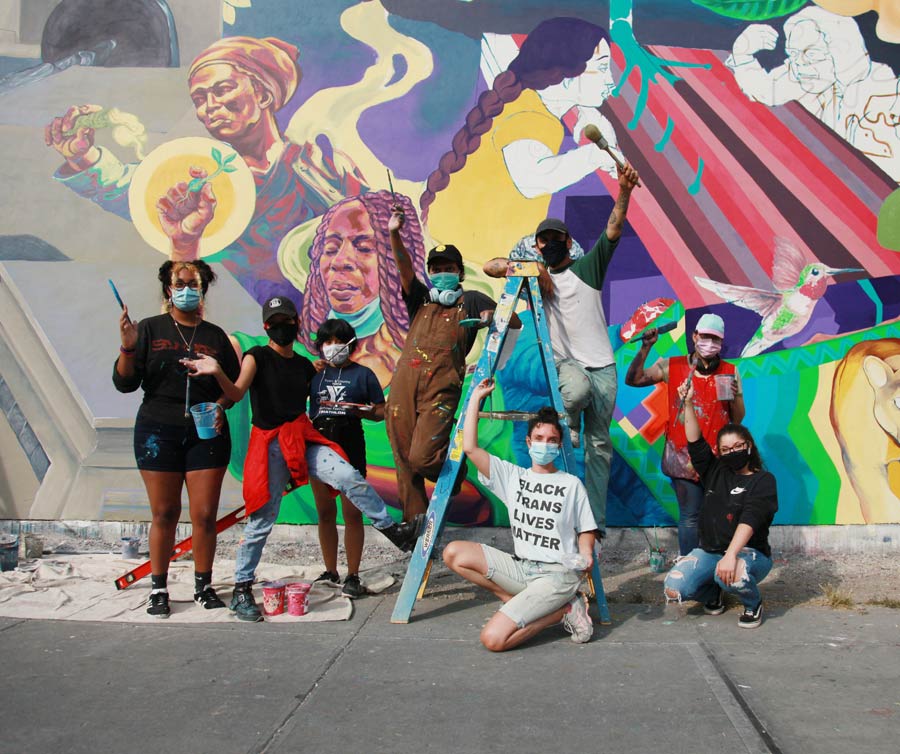
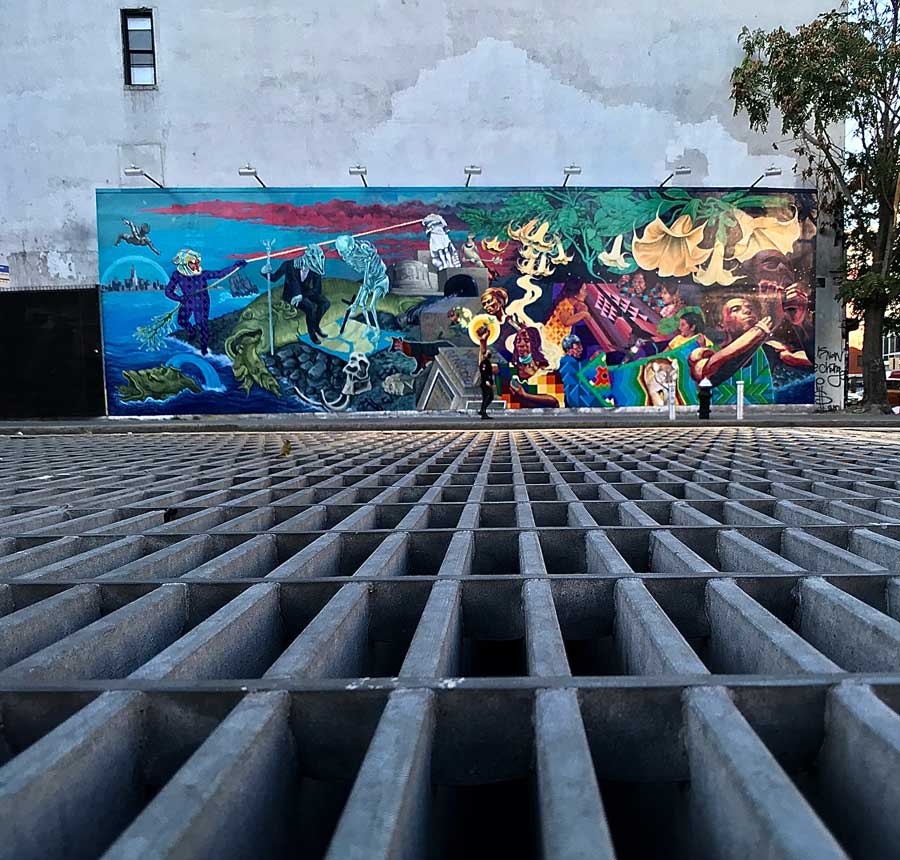
Steering away from potentially inflammatory political content or street beef of the past on this high-profile wall with a New York street art/graffiti history, the current occupants of the Houston Bowery Wall are more focused on allegory, and community. Featuring a fleet of volunteers and a mural full of history and aspiration, Raul Ayala thinks of this wall as a teachable moment. The artist employed many of the 21 days that this mural took to complete to do just that: teach.
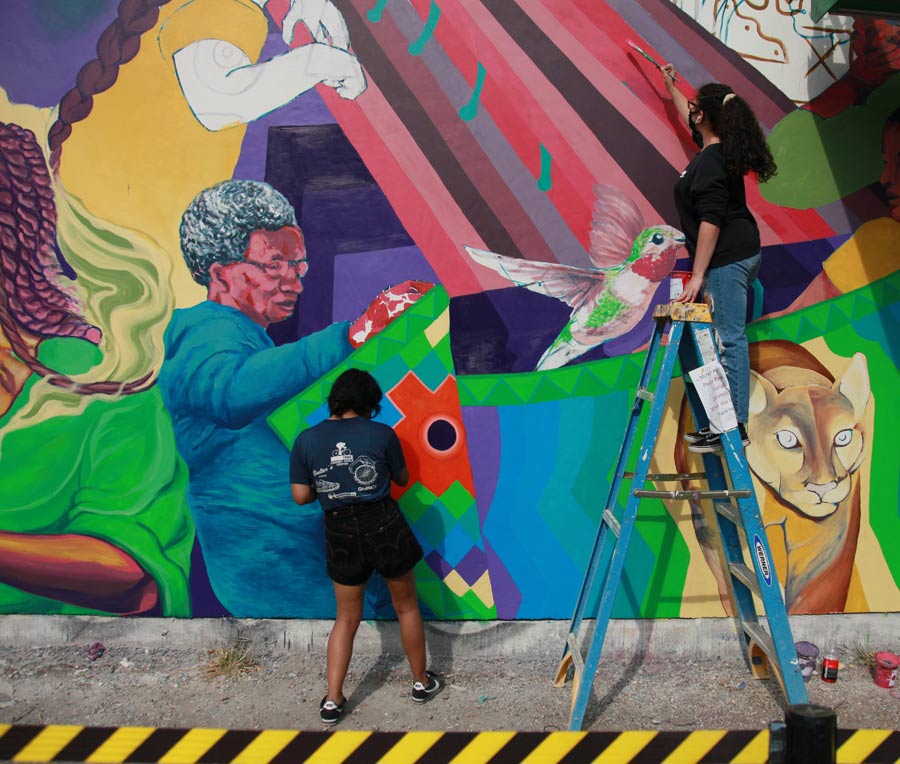
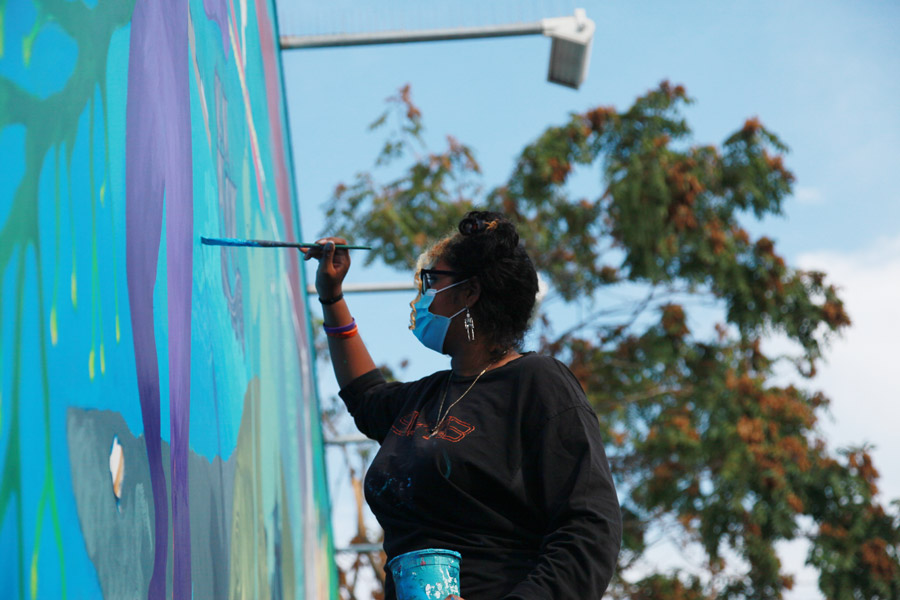
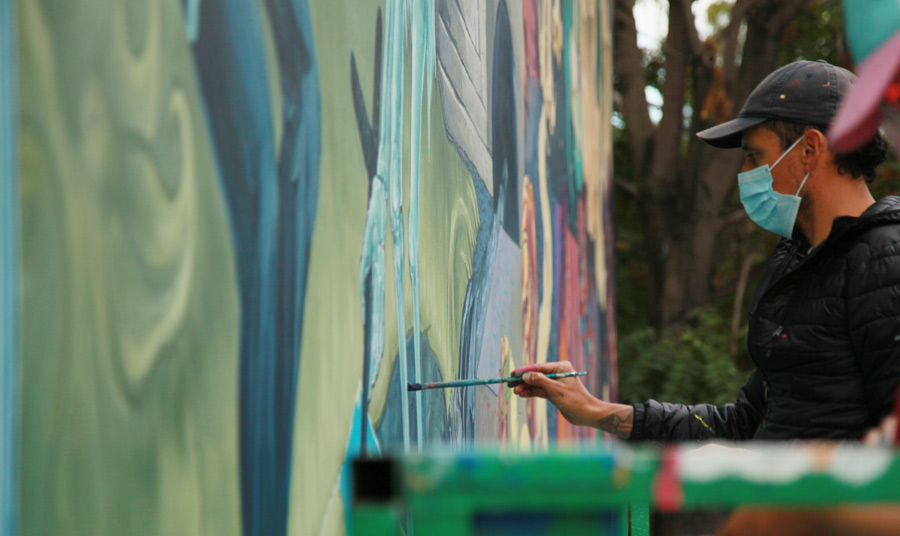
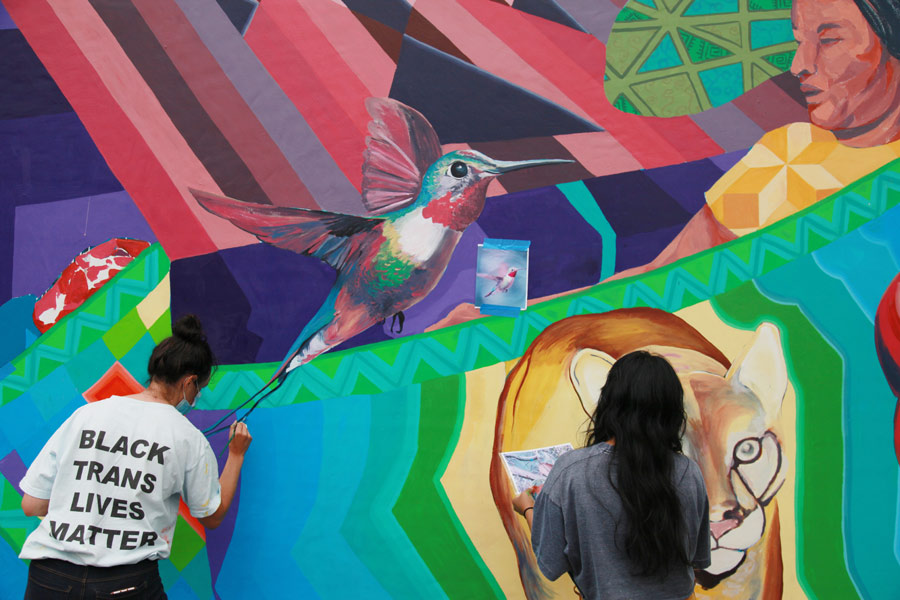
With ten talented young artists/activists from the locally-based Groundswell NYC community organization, Ayala planned and painted various phases of the mural together while under the gaze of curious New Yorkers who paraded by hour after hour while the artists painted. Included in that team were Gabriela Balderas, Charlize Beltre, Brandon Bendter, Junior Steven Clavijo, Jennifer Contreras, Maria Belen Flores, Hafsa Habib, Cipta Hussain, Karina Linares and Gabriel Pala.
Ayala describes the piece as “opening a portal,” and you quickly realize that it is a portal of the mind to imagination and inspiration. “For me, building imagination and sharing knowledge alongside a younger generation of artists is a great manifestation of the fruits of this shift,” he says. “With this mural, we are also bringing inter-generational participation into a future that honors our past while actively creating a different path of existence.”
BSA talked to Raul about the mural and his experience painting it. Below is the interview:
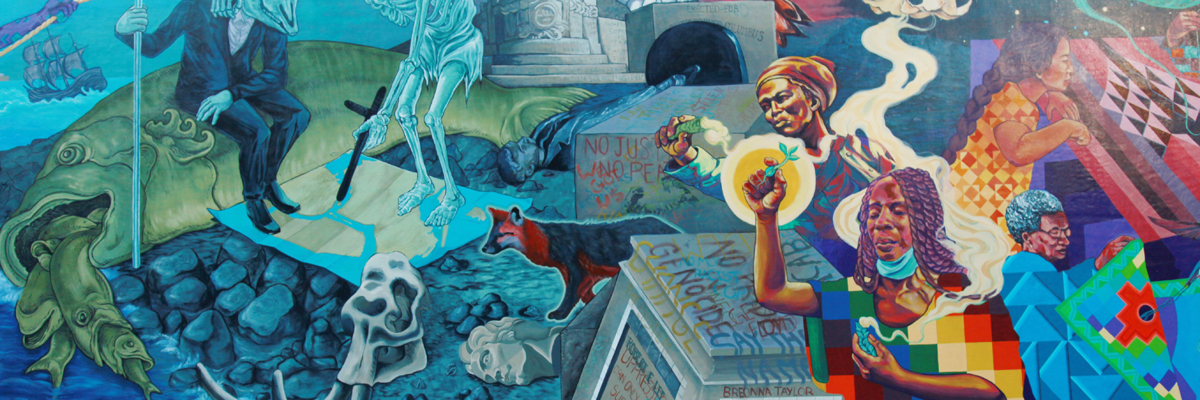
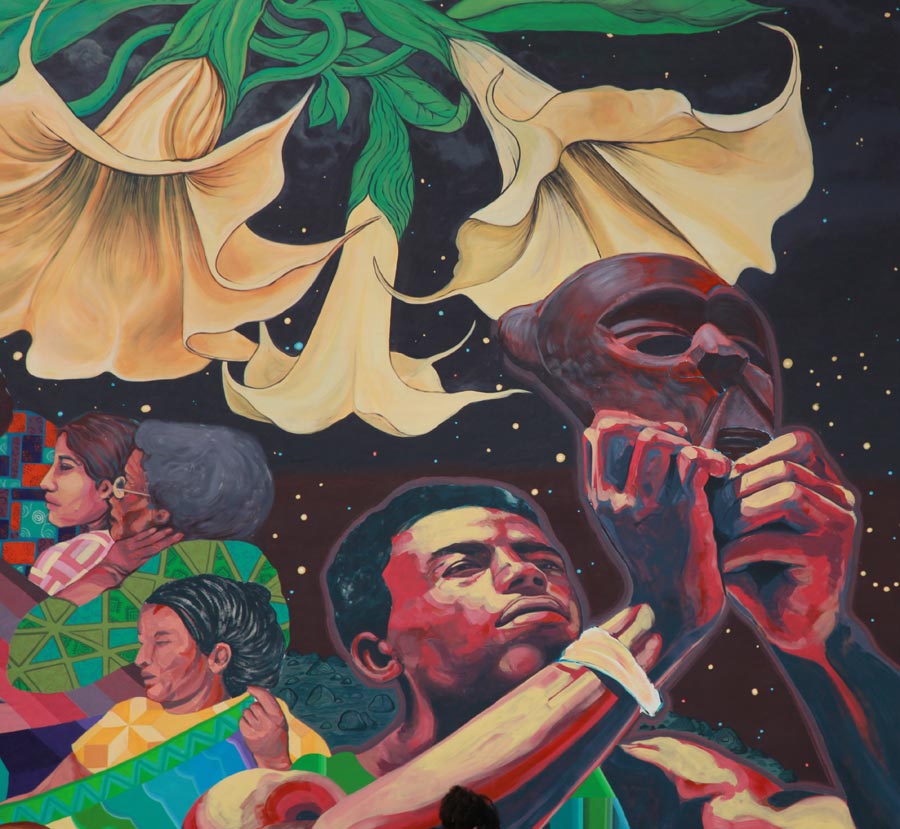
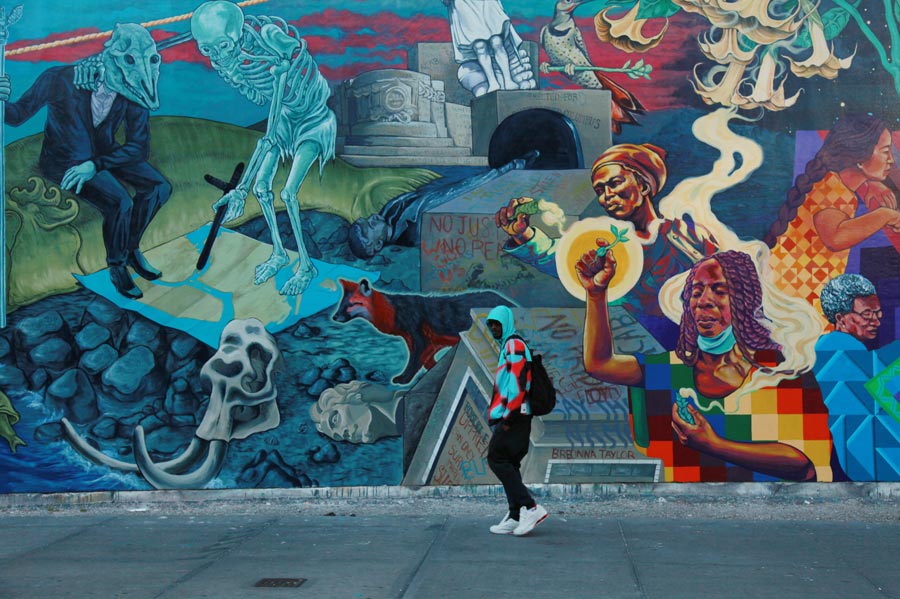
BSA: At both ends of the mural you have depicted two masked characters. One on the left is wearing what seems to be an Aztec mask with the skyline of Manhattan in the background as he pulls down a monument. The one on the right is a black man at the moment when he is either about to put an African mask on or at the moment when he’s taking it off. Could you please describe the significance of both characters and how they relate to each other in the mural?
RA: Masks have always been a part of culture and are the recipients of many powerful archetypes; they are a space of connection to different realms of existence. In recent times, due to the pandemic, the mask has become necessary protective gear and is part of the current cultural landscape. With the masks depicted in the mural, I wanted to drive the conversation towards a more ample understanding of the mask as it relates to specific cultural heritages. Black, brown and indigenous solidarity is a constant effort in my practice. I strive to practice solidarity in the themes I paint and also in the way a lot of my murals are made. I think of mural-making as a learning space, where I get to have conversations with my peers and my students. African and Indigenous (Wirarika/Huichol) inspired masks have a lot in common, as one of the proposals for the idea of “opening portals” that is the overarching theme of the mural.
There is
also a symbolic connection. In the Andes, where I come from, the Jaguar is a
very powerful spirit animal related to water. The Black Panther as a representation
of Black Power has a lot of cultural relevance as well and I wanted to hint to
those connections. Many passersby have referenced one of the masked people as
Chadwick Boseman. Even though it was not necessarily my intention, I love that people
-especially younger generations- read that on the mural.
BSA: There’s a skeleton with his arm around a skull character in a suit holding what seems to be a scepter. What are these two doing in the mural and who are they?
RA: The whole mural is an allegory of our current times. For me, part of the work that needs to happen is to address systemic oppression and white supremacy as prevalent forces that are endangering our relationships to each other, to our ancestry, and to the natural world. The two characters represent these forces. There are also a lot of symbols relating to these structural powers: There is a big fish eating small fish and an Icarus falling, both as cautionary tales of a late capitalist society and its extractive, individualistic strategies.
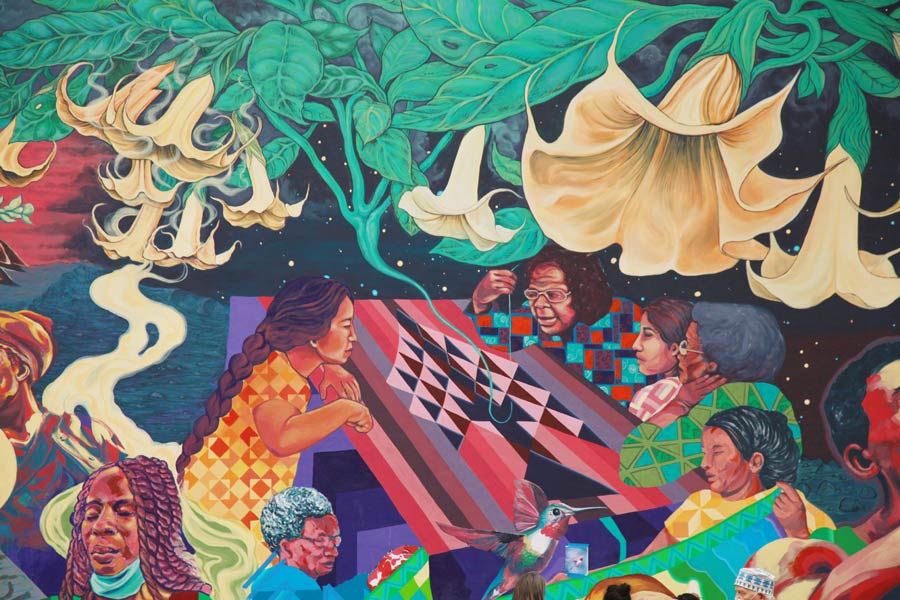
BSA: Can you talk about the women that are making a quilt? Who are they? What do they represent? Why are they making a quilt?
RA: Textile arts at large, including practices like Quilting Bees have been spaces not only of resistance and resilience but also spaces to pass on knowledge between generations. I wanted to depict a pluricultural, multigenerational circle of women. I believe these are great examples of the kind of relationships that will sustain and create health in these times. Additionally, the designs are another type of “portal.” They are traditional symbols in different cultures; the women in the back are creating a “tree of life,” a traditional African American quilting design. The women at the fore are holding a Chakana, which is a very important symbol of the Andean cosmogony.
The central character is dressed in a Whipala, an emblem that represents indigenous peoples from the Andes. The animals that are coming out of the designs (with the exception of the hummingbird, which is a migratory bird) were part of the ecosystem of that very location before colonization. I took the information from the Welikia Project, a map that overlays the city with the ecosystem of Mahannata before 1609. I would also like to acknowledge that my partner Fernanda Espinosa, an oral historian and cultural organizer has been a great help in imagining this side of the piece, and with who I often collaborate.
BSA: The flowers on the mural are very similar to the Moon flowers one sees in NYC in full bloom at night during the summer. Are these Moon Flowers?
RA: It is great to hear all the different readings the public has. In the end, it is about what people take and interpret themselves, I love that the flowers can also be Moon Flowers. I wanted to bring the idea of passing on traditional knowledge through generations. The plant depicted is Guanto, a plant that has been used as medicine in the Americas for millennia.
BSA: The female character holding a seed or a seedling. Can you talk about her and the seed she is holding?
RA: This is another allegorical character that is both using plants as medicine and holding the seed as a symbol. For me, it talks about the idea of the future. The title of the piece is “To Open A Portal,” this seed may be seen as a sort of key to that portal; a key that requires sustained care so the fruits of the labor can be enjoyed in a possible future.
In Kichwa, one of the indigenous languages of the Andes, we can say that we are living through a Warmi (female) Pacha (time/space) Kuti (shift). These seeds also represent that Warmi Pachakuti. In a way, this speculative approach to the future that has a strong female character at the center is an homage to Octavia Butler’s oeuvre. The figure above is also a historical character, Harriet Tubman. These are proposals to enter a new monumental landscape, not necessarily to depict one main person, but the sets of relationships and changes they have created through their actions.
BSA: How
was your experience painting in such a prominent spot with so much noise and
traffic?
RA: I really enjoy working in public space! The conversations that I witnessed and that the mural and activity sparked were very interesting. A lot of people told me that they see themselves in the characters and that was one of the biggest compliments I have received. There were also some people triggered by what was perceived as an attack on “white culture.” For me to question white supremacy and celebrate protests in the midst of an unprecedented pandemic, allow us to place this shift in the context of History. When monuments are brought down, a sort of portal to a different reality is being created. I see this seemingly aggressive act also as an opportunity to manifest different futures: when a symbol that stands for the values of civilization is put into question, domination and power imbalances are being contested too. This portal allows us to walk through the pain and find futures where we consider the way in which we are not only connected but also dependent on each other.
BSA: Your assistants were also your students. Where do you teach?
RA: While I am a visual artist, teaching has always been an important part of my practice and one that I center often. I started first teaching art in a project I started in detention centers in Quito many years ago. Since then, I have taught with multiple projects and organizations. With Groundswell, I have had the pleasure to teach for about 7 years. This project was in collaboration with them and it really was the only way it made sense for me to do this wall. I have been witnessing the growth of these young artists for some time now and I feel very proud of them and what we have done together. My responsibility as an artist is also to educate the younger generations of artists of color.
 BROOKLYN STREET ART LOVES YOU MORE EVERY DAY