The world is slowly making movements toward the door as if to go outside and begin living again in a manner to which we had been accustomed before COVID made many of us become shut-ins. Parisian street artist FKDL was no exception, afraid for his health. However, he does have a very attractively feathered nest, so he made the best of his time creating.
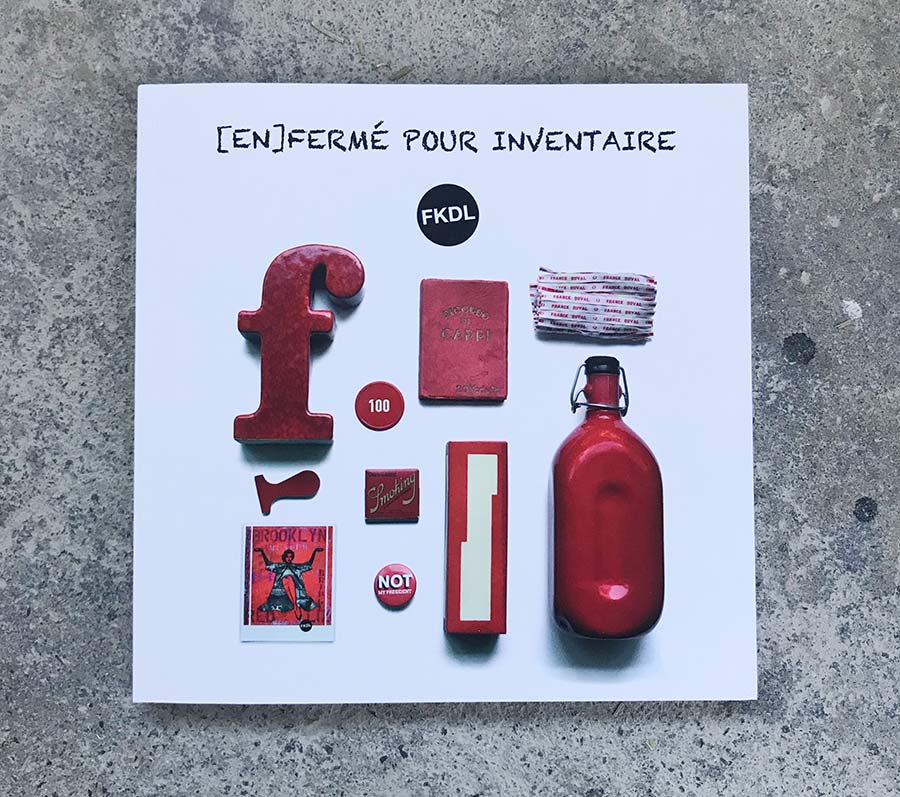
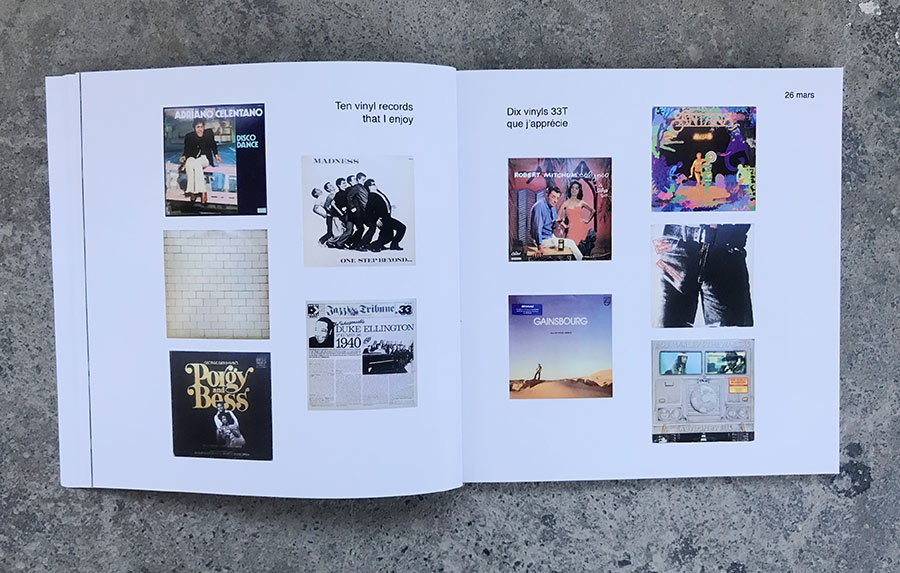
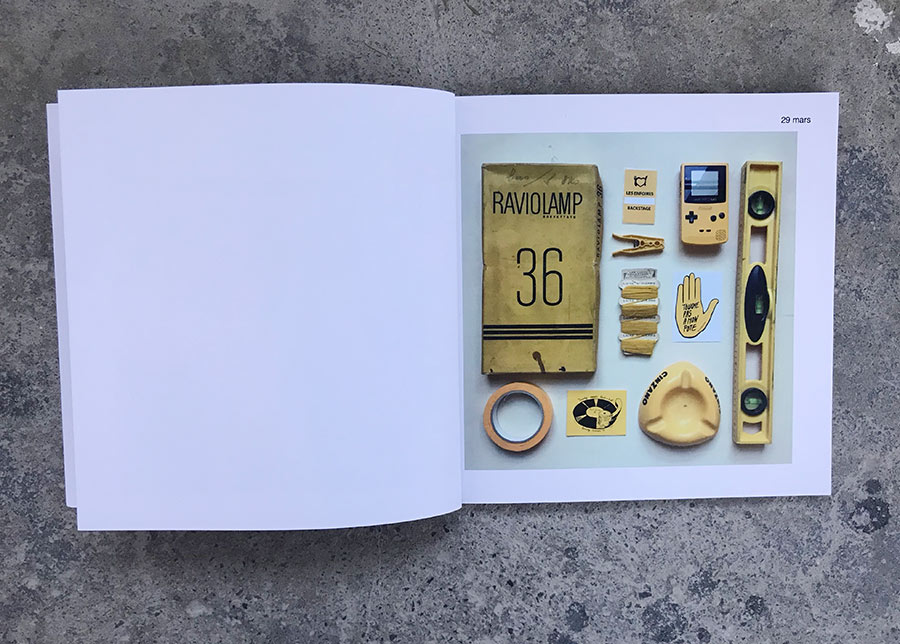
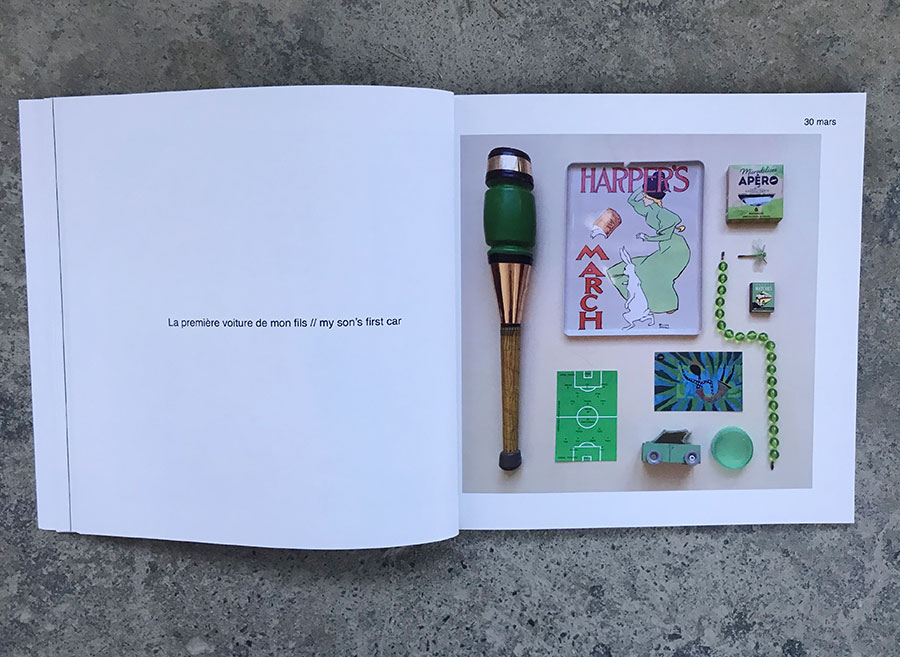
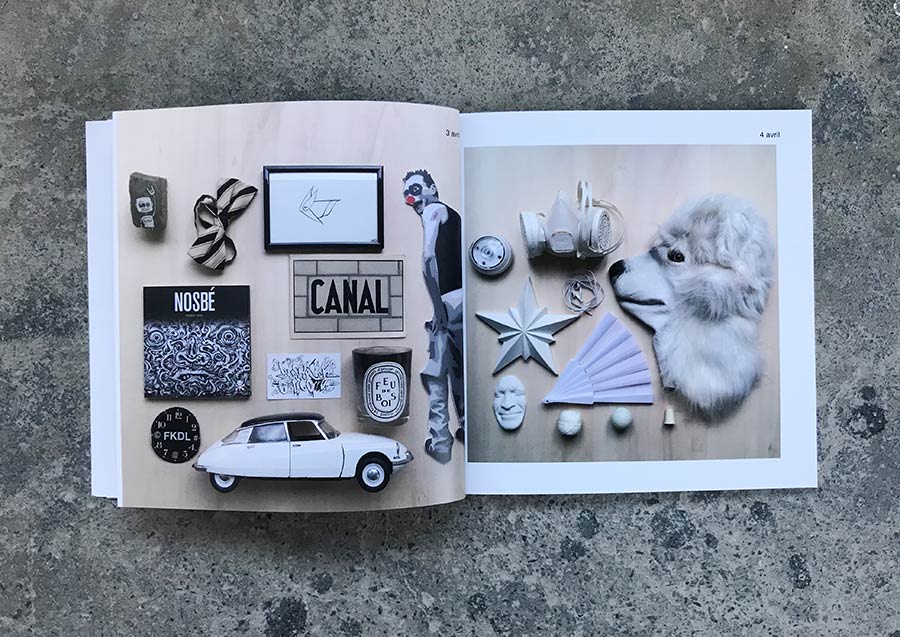
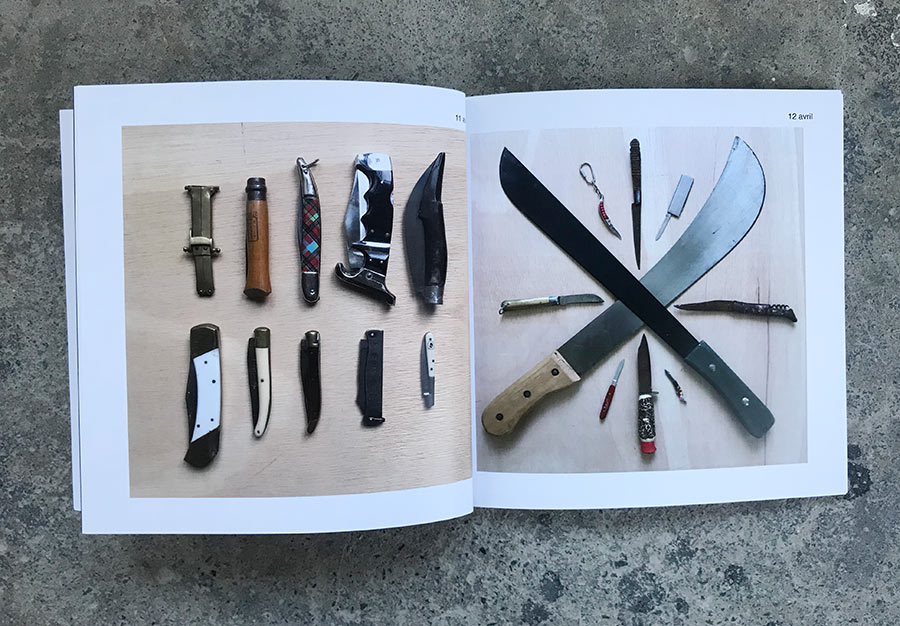
(EN) FERME POUR INVENTAIRE (Closed (In) for Inventory) by FKDL
On the first anniversary of his 56-day confinement, we look at what art project he made for himself, using items he had collected. A serious gatherer of magazines, photographs, record albums, and objects that capture his attention, his studio is a small personal museum and archive – full of boxes and shelves and music from the era of his mid-century birth. It’s a golden age that he happily gains entrée to, especially when commanded by a global virus.
“March 17, 2020, the unprecedented experience of confinement begins in France,” writes Camille Berthelot in the introduction to Closed (in) for Inventory, “Time that usually goes so fast turns into a space of freedom, and everyone has the leisure or the obligation to devote himself to the unexpected.”
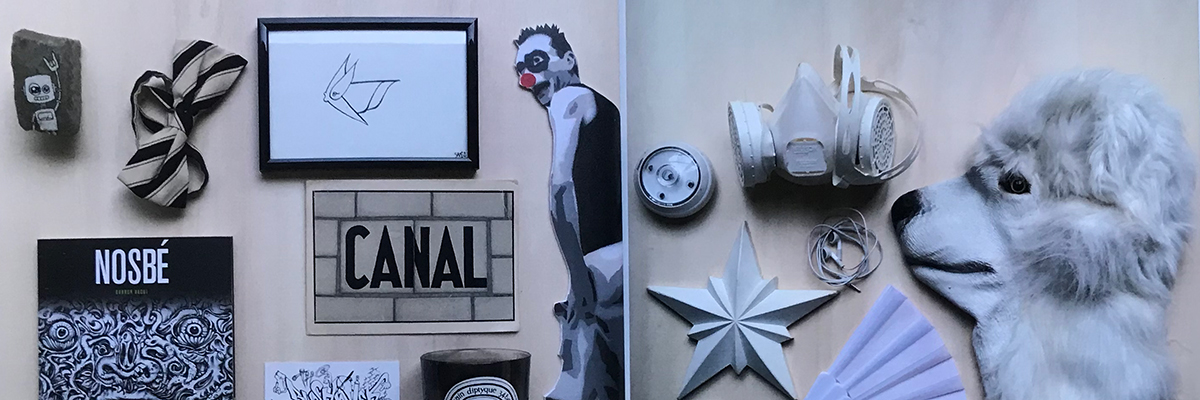
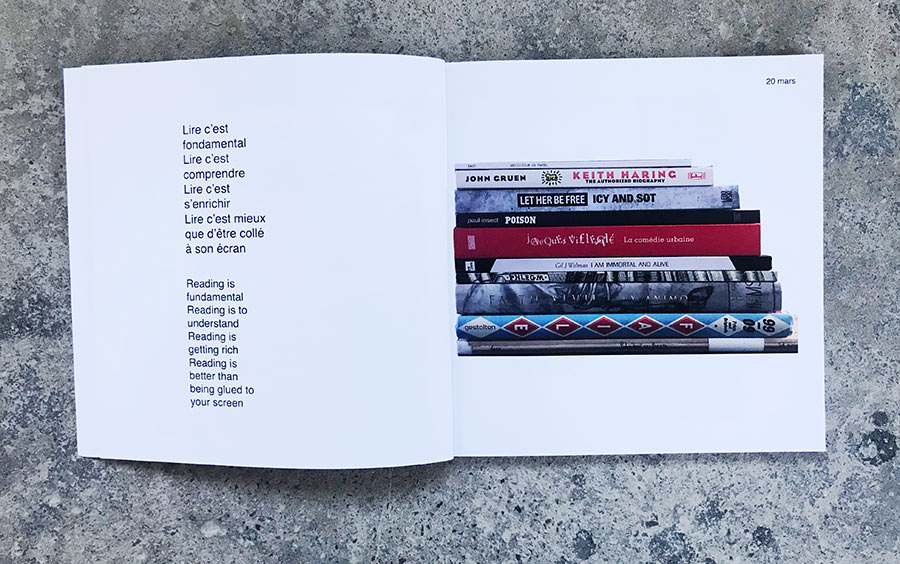
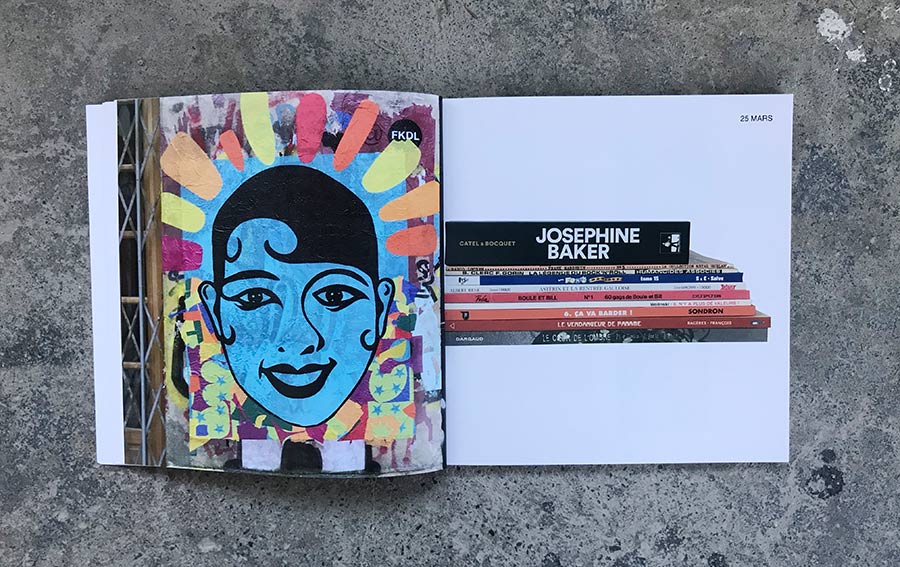
FKDL quickly began a project daily, sorting and assembling 10 items and photographing them. He posted them to his Instagram by mid-day. Eventually, he saved the photographed compositions together and created this book.
“My duty of tidying up and sorting out turned into a daily challenge. I dove like a child into the big toybox my apartment is to select and share my strange objects, my banalities, my memories, my creations, and those of others,” he writes. “I gather these treasures, valuables or not, in search of harmony of subject, forms, materials, and nuances.”
(EN)FERME POUR INVENTAIRE by Les Editions Franck Duval. Paris, France.
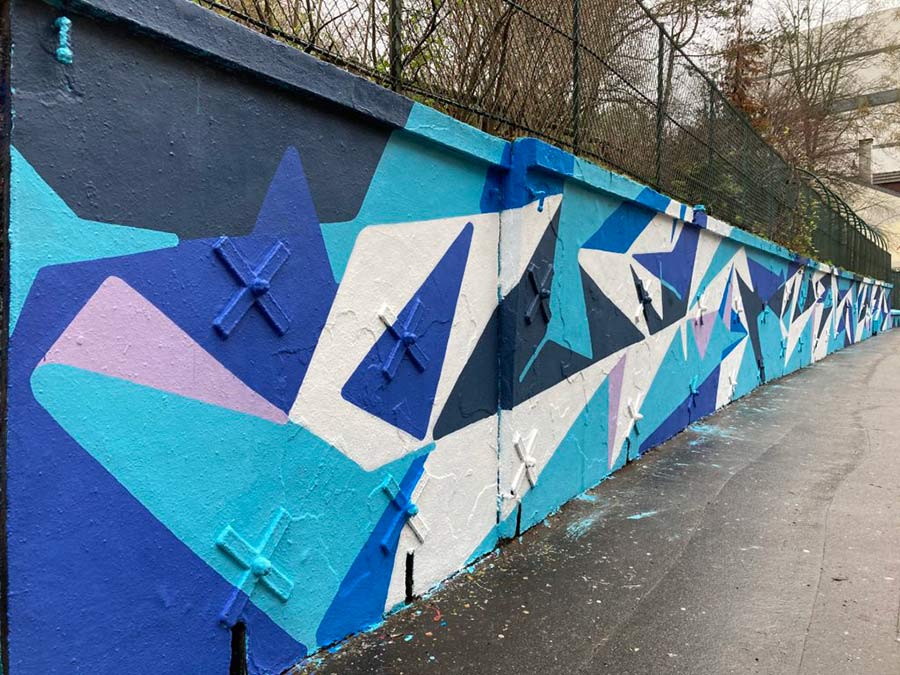
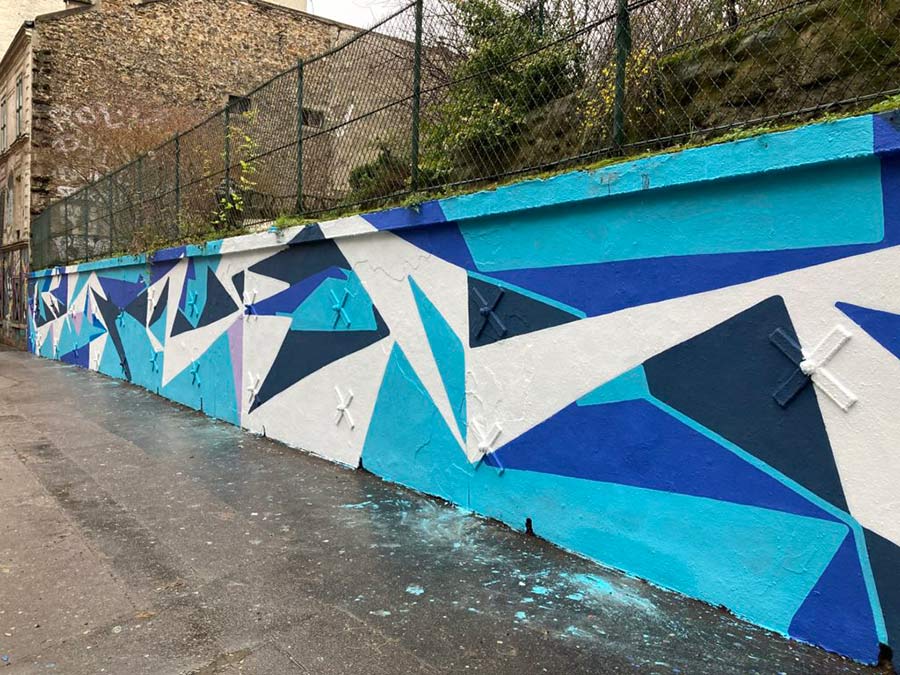
Parisian OG Lek has been working on the streets for the last three of his five decades, growing up close to the Mecca of European graffiti in the 1980s, Stalingrad. By the 90s he was ready to experiment with abstract and futuristic, with a balancing influence from the rigid uncompromising Bauhaus. Today he easily contemplates the illegal and legal, commissioned and commercial, and his compositions are not always easily categorized as graffiti, street art, or mural.
But he is easily called a pioneer among peers, having been one half of Lek and Sowat, as well as a member of Da Mental Vaporz, French Kiss, LCA, GNS, RAW, and 1984. Here we present a brand new gig he scored with Art Azoï last month in his hometown.
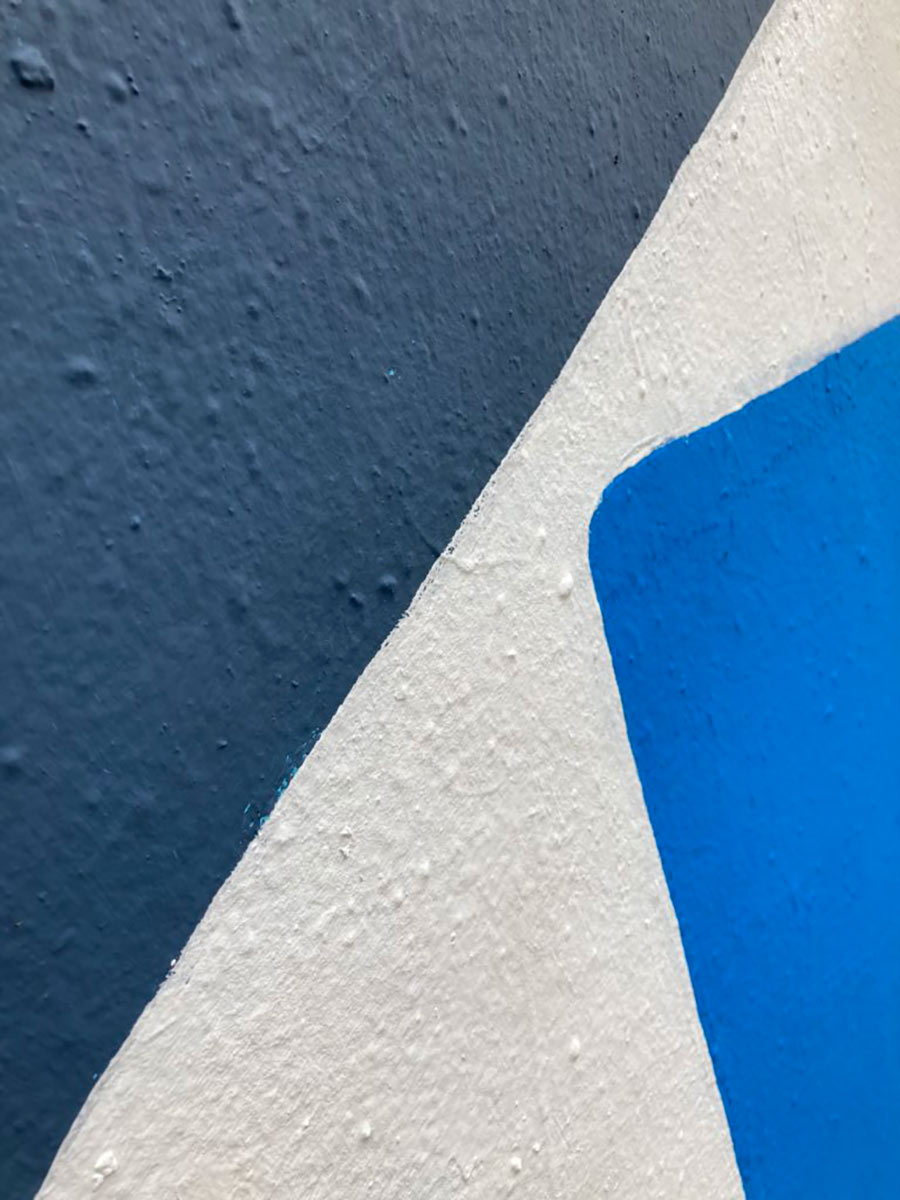
LEK in collaboration with Art Azoï. Paris. (photo courtesy of Art Azoï)LEK in collaboration with Art Azoï. Paris. (photo courtesy of Art Azoï)LEK in collaboration with Art Azoï. Paris. (photo courtesy of Art Azoï)LEK in collaboration with Art Azoï. Paris. (photo courtesy of Art Azoï)LEK in collaboration with Art Azoï. Paris. (photo courtesy of Art Azoï)
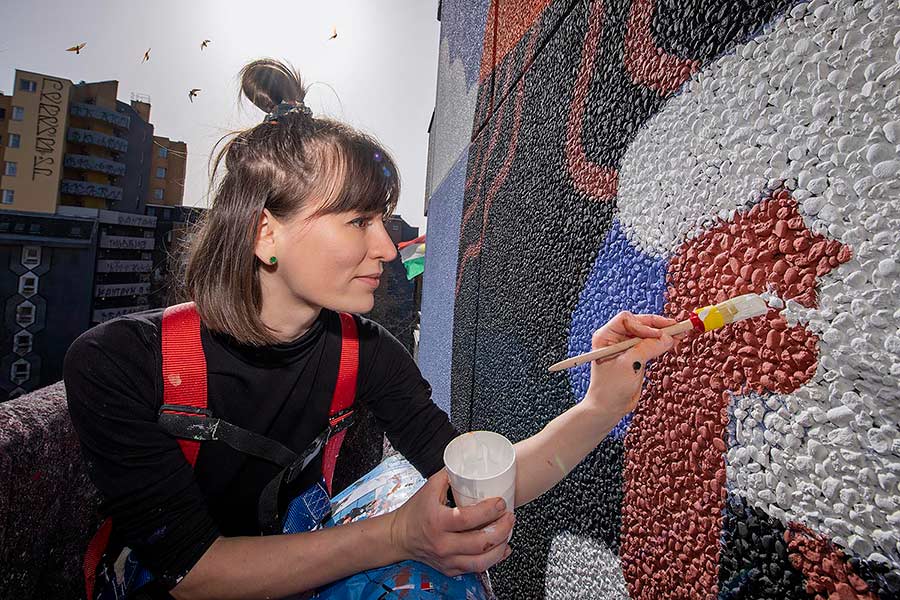
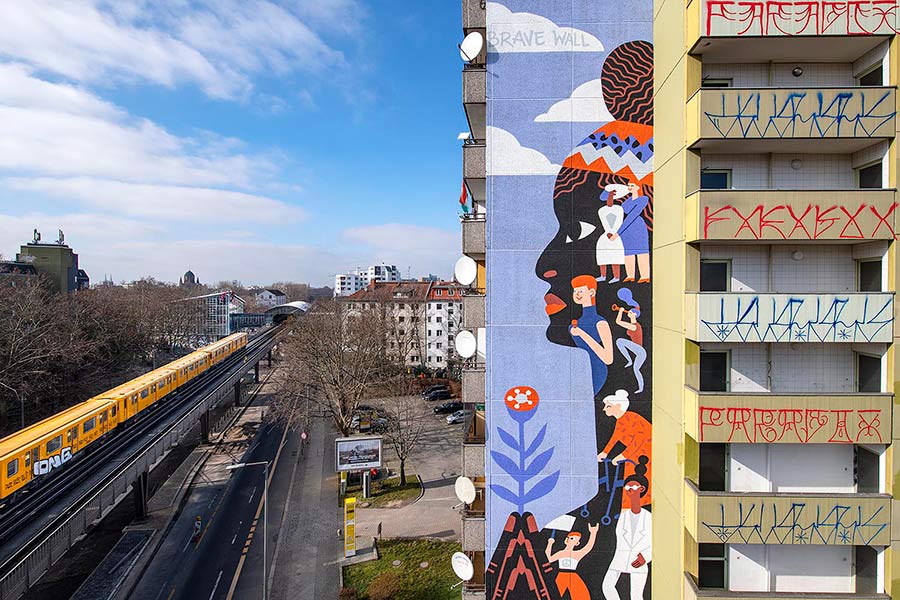
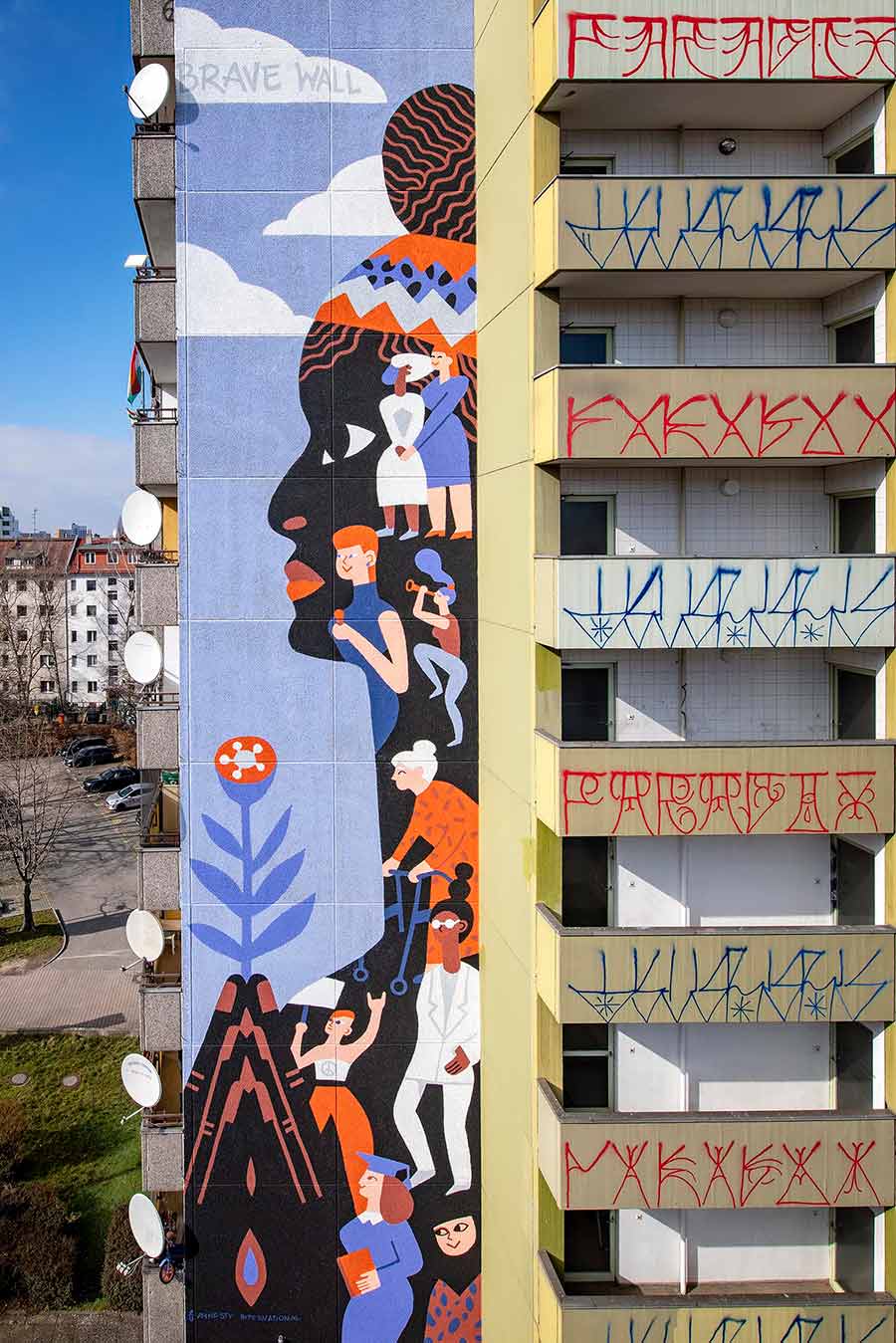
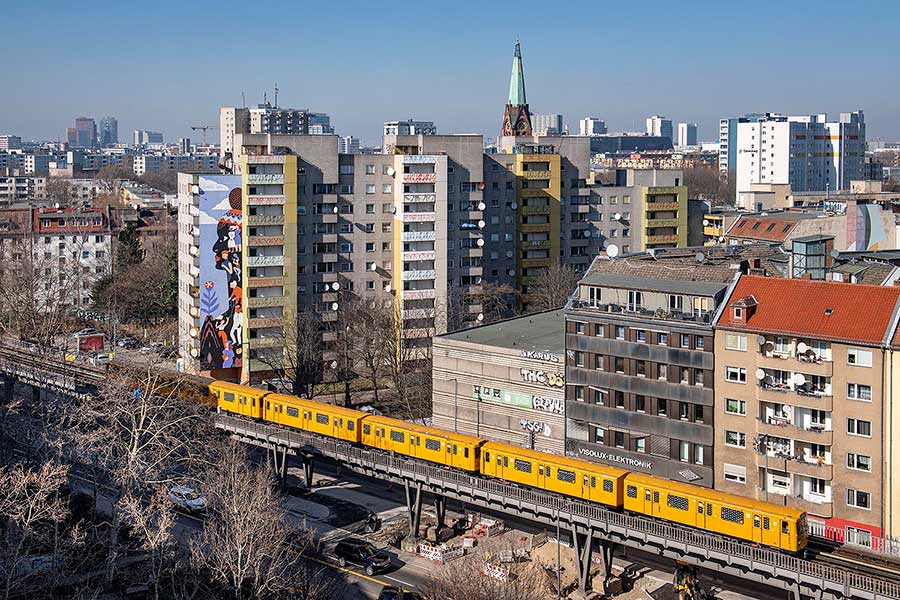
Over the last few spring-like days in Berlin, her portrait rose slowly about the streets, reminding us that her moral courage continues to have an impact today on International Women’s Day. It’s only been a recognized holiday in this German city for a year, says Urban Nation museum director Jan Sauerwald. Franco’s visage is the first to occupy what has been officially identified as the museums’ ‘Brave Wall.’
“Realizing this political mural on the theme of women’s rights together with artist Katerina Voronina is a special moment for the URBAN NATION Museum program,” he says, “To present the first ‘Brave Wall’ in Berlin and Germany on this day in cooperation with Amnesty International puts the project in a fitting context.”
The artist was chosen by a panel made of an equal number of Urban Nation and Amnesty International participants, along with journalist Miriam Davoudvandi. The joint goal on International Women’s Day is clear.
“Women’s rights are human rights and therefore an important part of our human rights work. I am very pleased that the first ‘Brave Wall’ in Germany was designed by a woman, Katerina Voronina, and honors the impressive commitment of human rights defender Marielle Franco,” says Dr. Julia Duchrow, Deputy Secretary-General of Amnesty International in Germany, in a press release.
An illustrationist and motion designer, Katerina Voronina successfully evokes the resolute spirit of fighting for human rights in the portrait of Franco, “With the realization of this ‘Brave Wall’ I had the opportunity to bring a special and courageous woman into focus.” she says.
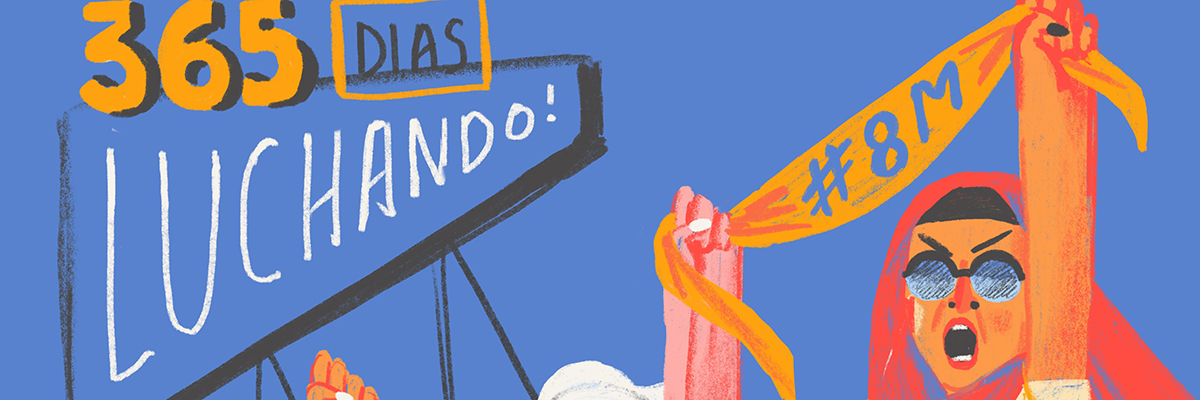
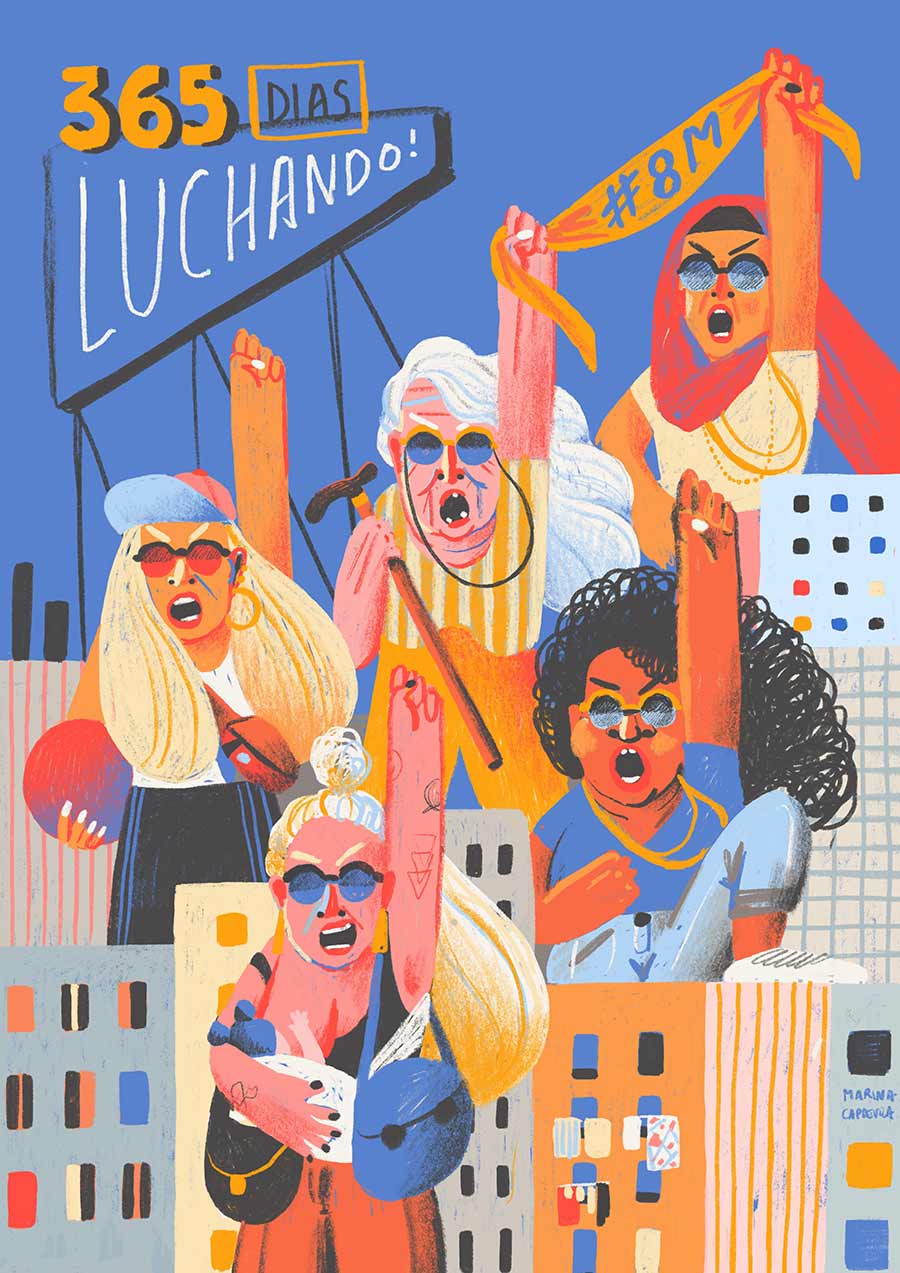
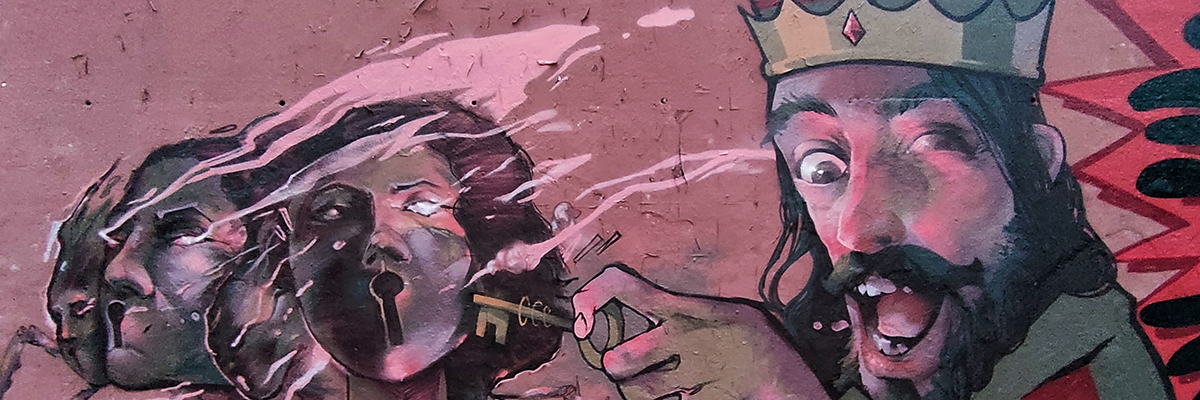
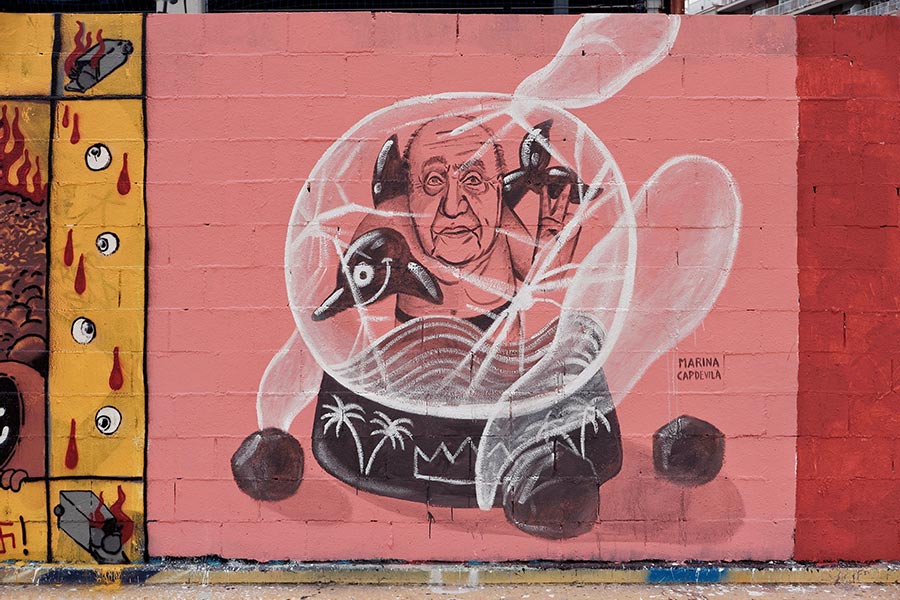
Meanwhile, in Spain, artist and muralist Marina Capdevila identifies an obvious question about saving only one day to pay tribute to women in this new piece.
“Today, we still are fighting and working nearly every day to be listened to, to be taken seriously,” she laments, reflecting on the sly kind of dismissiveness she feels about her art practice sometimes. “I’m tired of receiving 8 million emails with proposals that offer to ‘give visibility to women,’ ” she says.
“If we continue like this, will we also eventually only work one day a year?”
Until such a day, she’s loving life as a painter and savors the sisterhood that brings her support and opportunity. “I am fortunate to have wonderful women in my life who inspire me, help me, and above all, make me laugh.”
Marina Capdevila. “365 Dias Luchando” (photo courtesy of the artist)
Remember that time when your best friend’s boyfriend was installing a towel rack in the bathroom of their apartment, and he clumsily busted a hole through the wall, revealing a hidden room – which subsequently released a ghost who regularly appeared at the foot of their bed and slammed doors throughout their dwelling? We do. That’s why it was/was not shocking when a New York woman investigated the breeze emanating from her bathroom mirror. She took the mirror off the wall and discovered a portal to a three-room apartment.
Dude, if that happens to us, we’re not putting it on Tik Tok. We’re heading to Bed Bath and Beyond. In a space-starved city, newly discovered square footage is like finding gold bullion or bitcoin between couch cushions.
In other New York news, some street art neighborhoods are devoid of new works these days – perhaps because January and February are a frozen, mischievous purgatory that chases you inside in a normal year – doubly so when you’re on your 37th consecutive month of pajamas, Minecraft, and Chef Boyardee Beefaroni. Have faith; the next tumultuous 8 weeks of winter-spring-winter-spring weather will eventually coax the street artists and graffiti writers outside in a perennial sign of spring like the appearance of a robin on your windowsill.
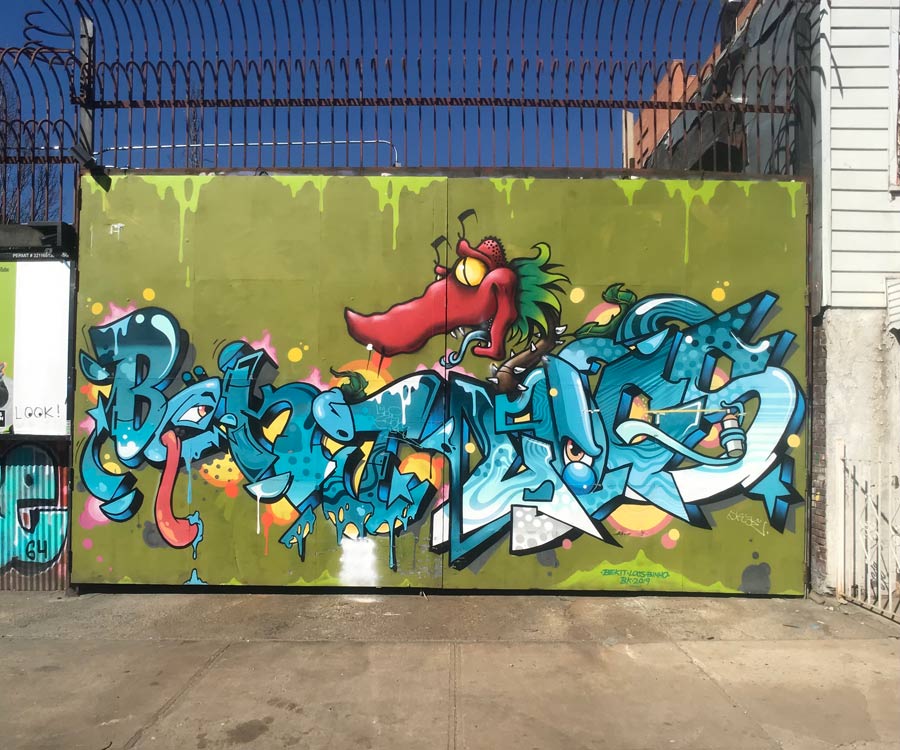
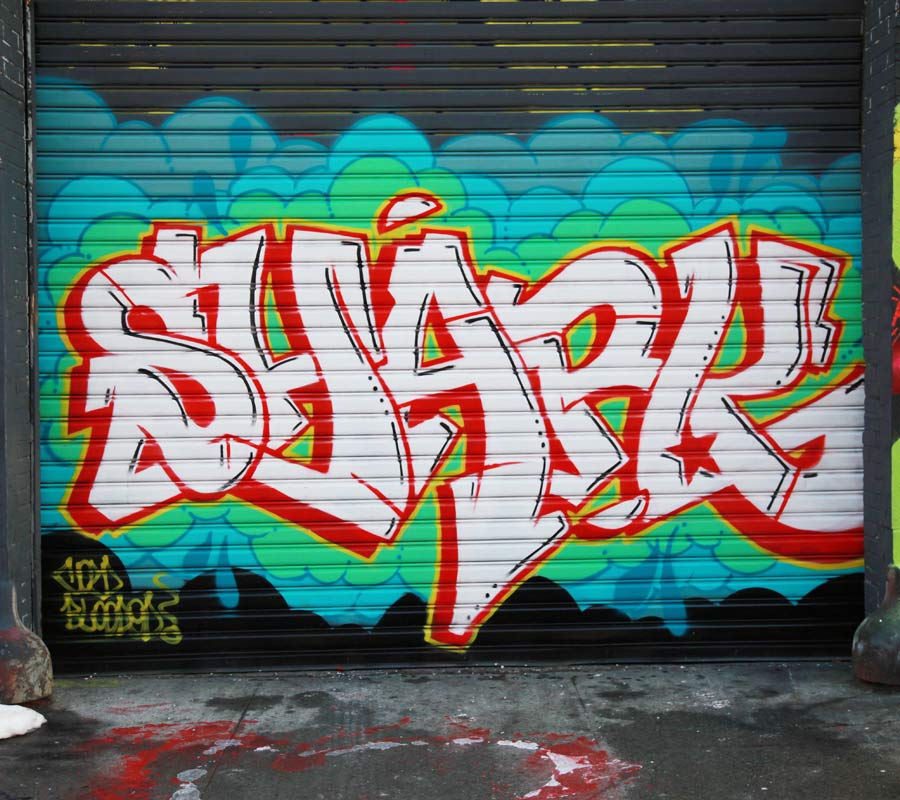
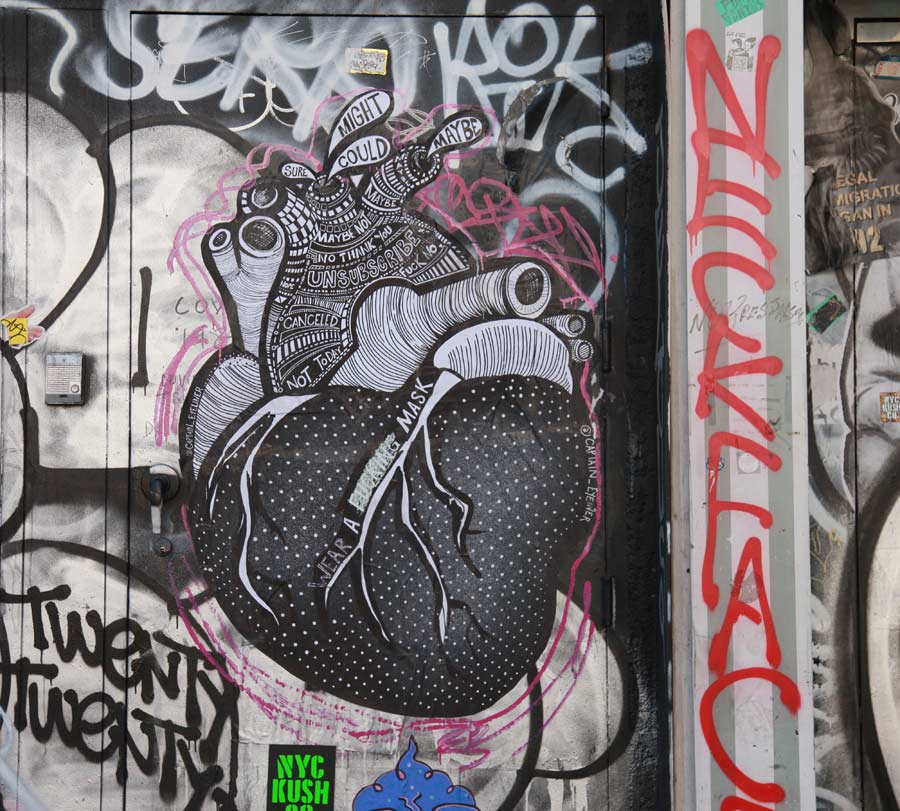
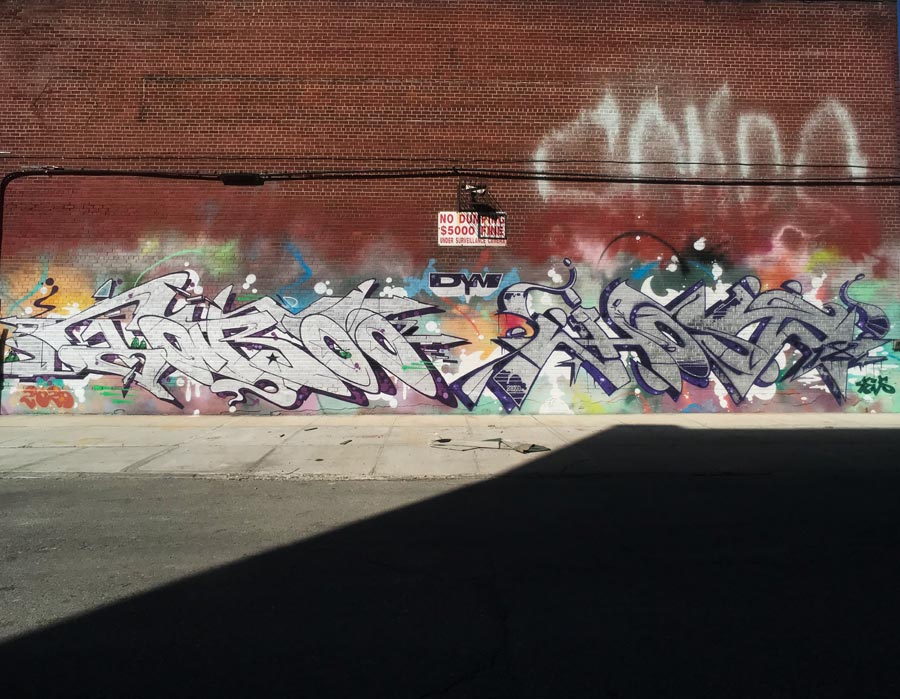
Despite the paucity of prancing vandals at the moment, our Editor of Photography, Jaime Rojo, still managed to capture new art in the streets this week in Red Hook, Bushwick, Chelsea, and Bushwick – amongst the scores of closed restaurant huts that have besieged sidewalks citywide. Movie theaters will open for 25% capacity now, and perhaps the moribund restaurants will be coming back to life in this city that never quite sleeps.
Here’s our weekly interview with the streets, this week featuring Adrian Wilson, Berkit, Binho, Blur, Captain Eyeliner, Colin Capernick, Comik, DYM Crew, Ethan Minsker, Know Your Rights Camp, Locs, Matt Siren, Paolo Tolentino, Sara Lynne Leo, Shark, Taboo, The Monks, and Tony De Pew.
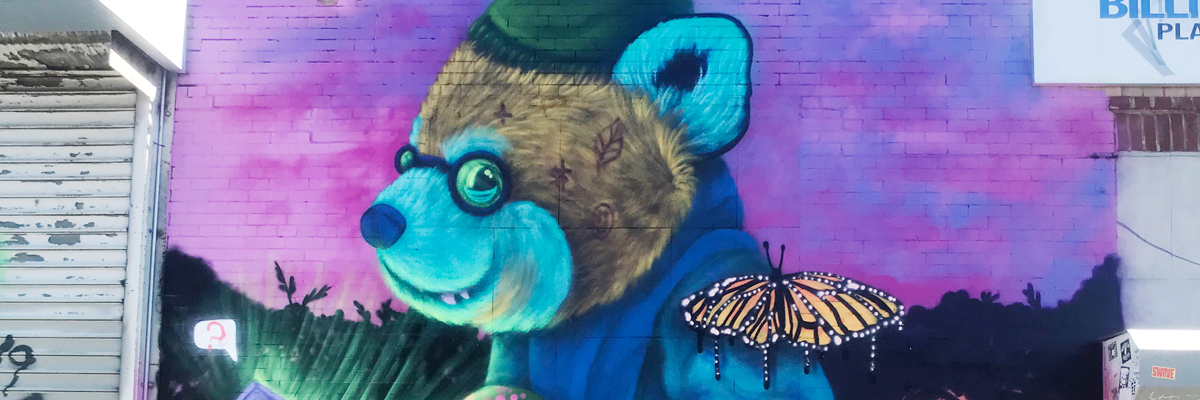
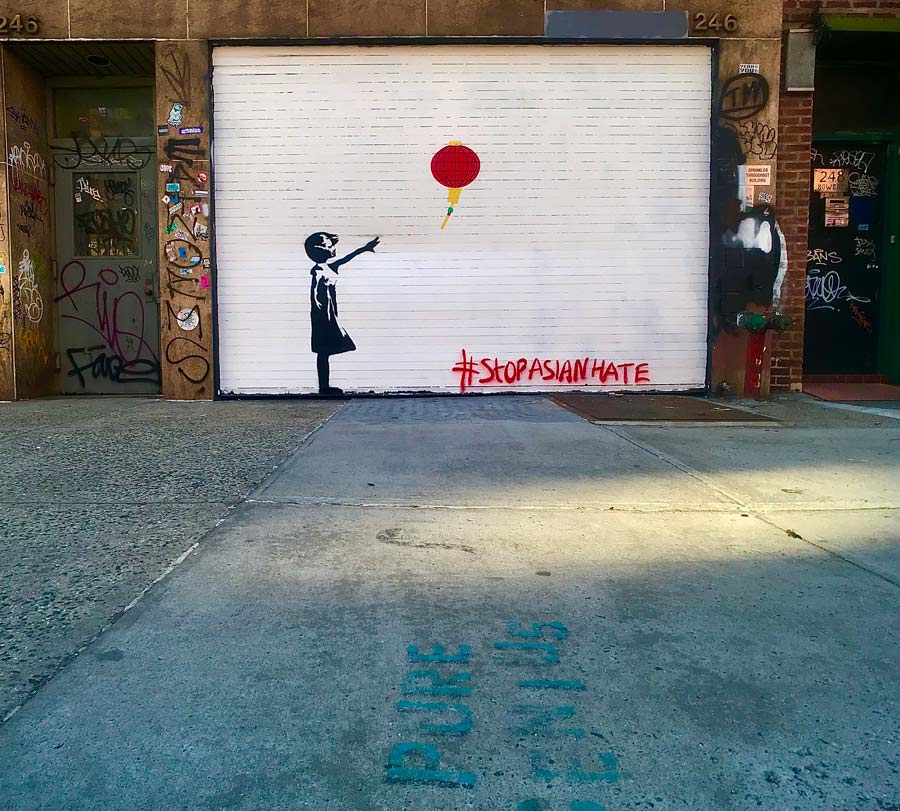
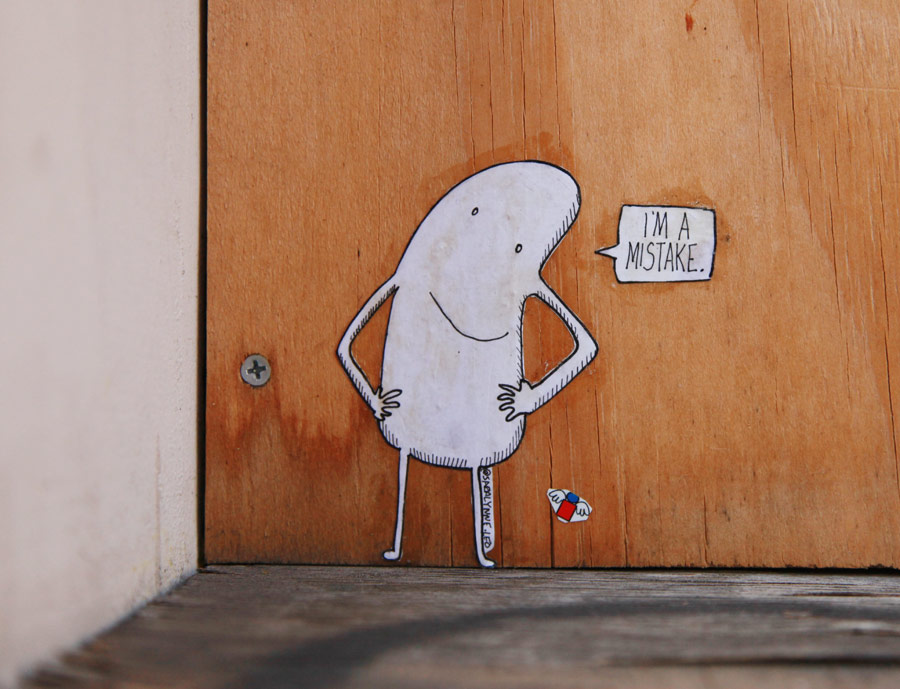
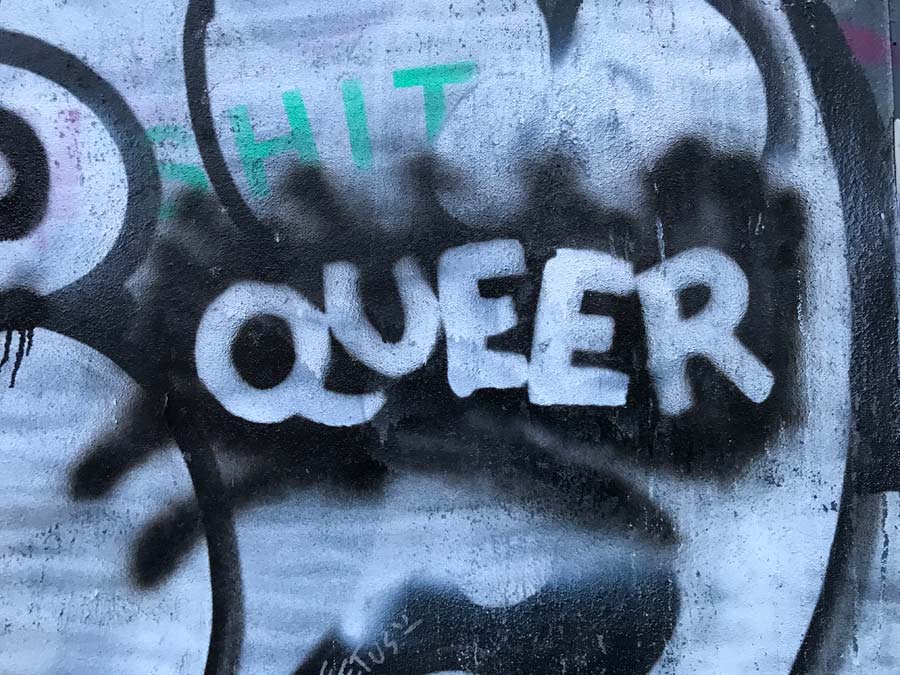
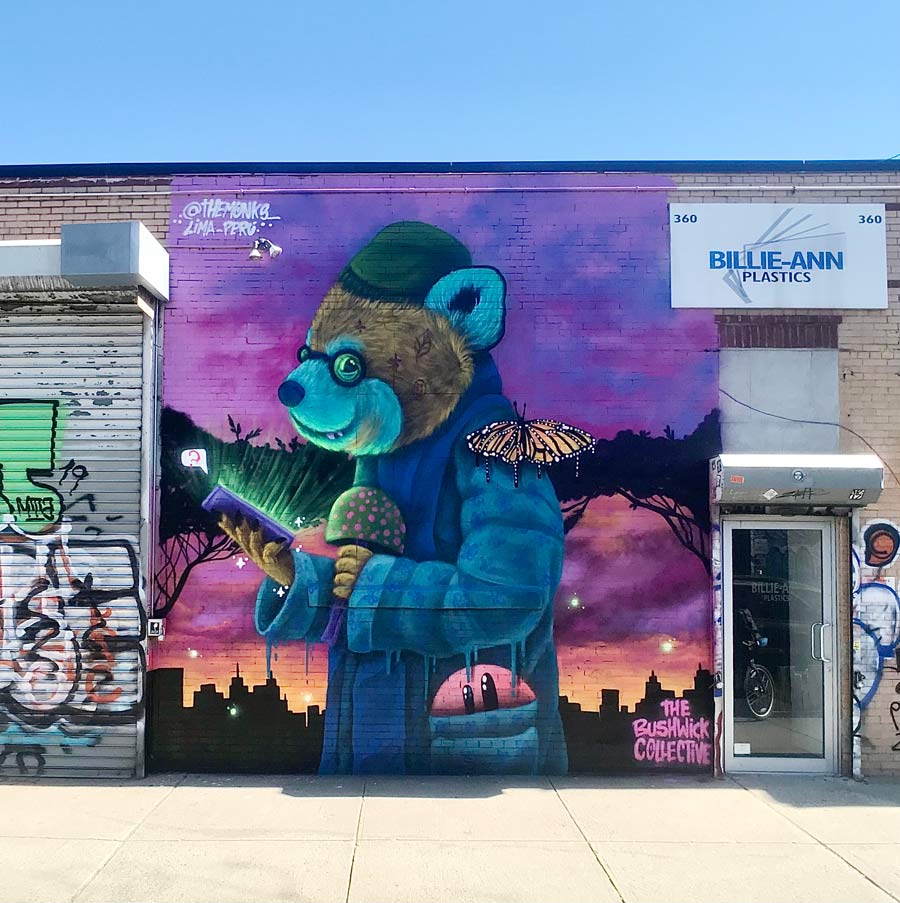
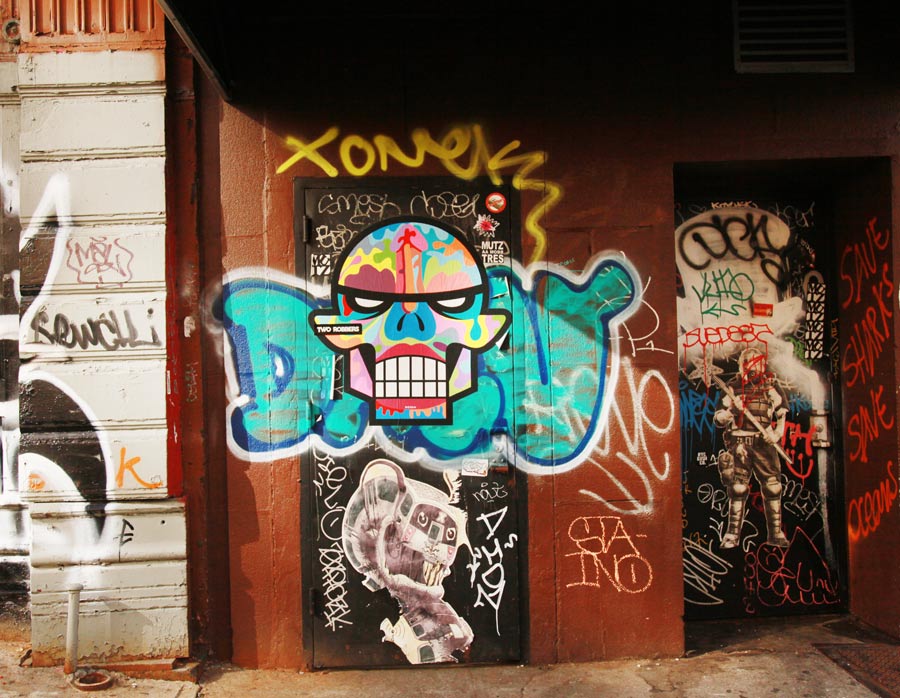
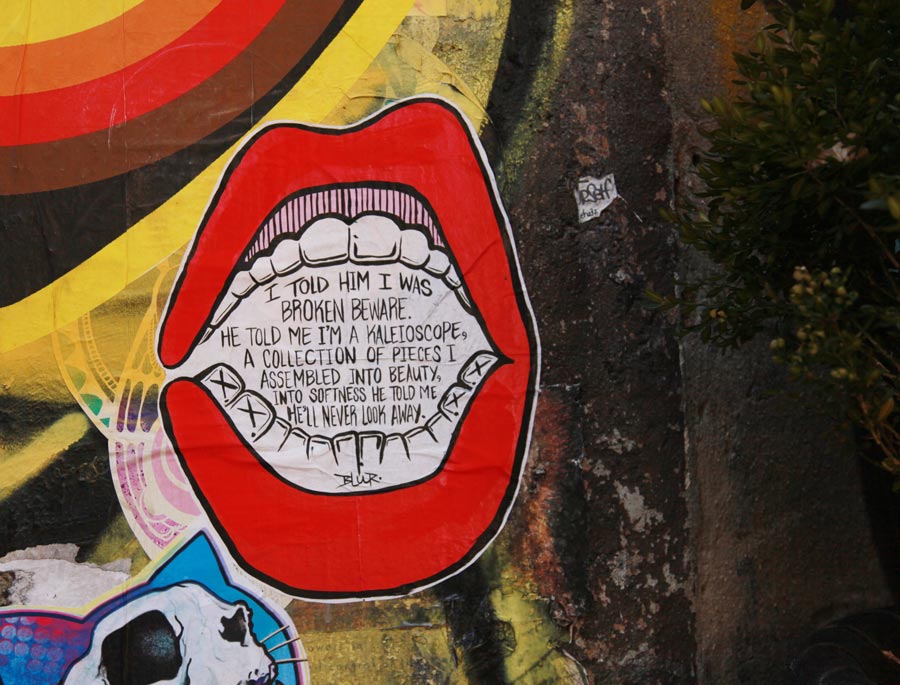
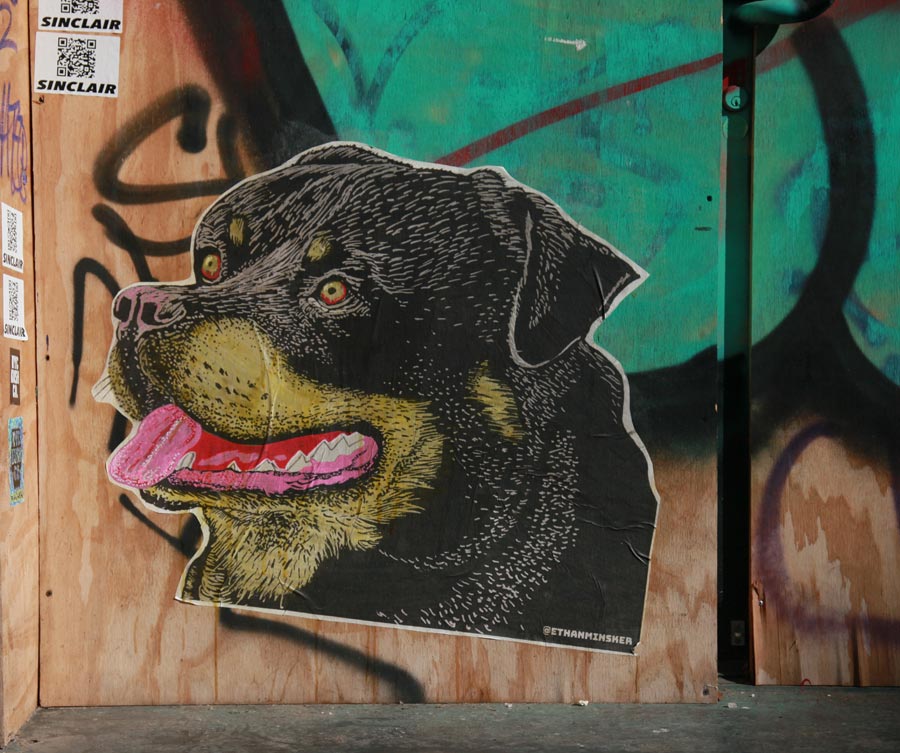
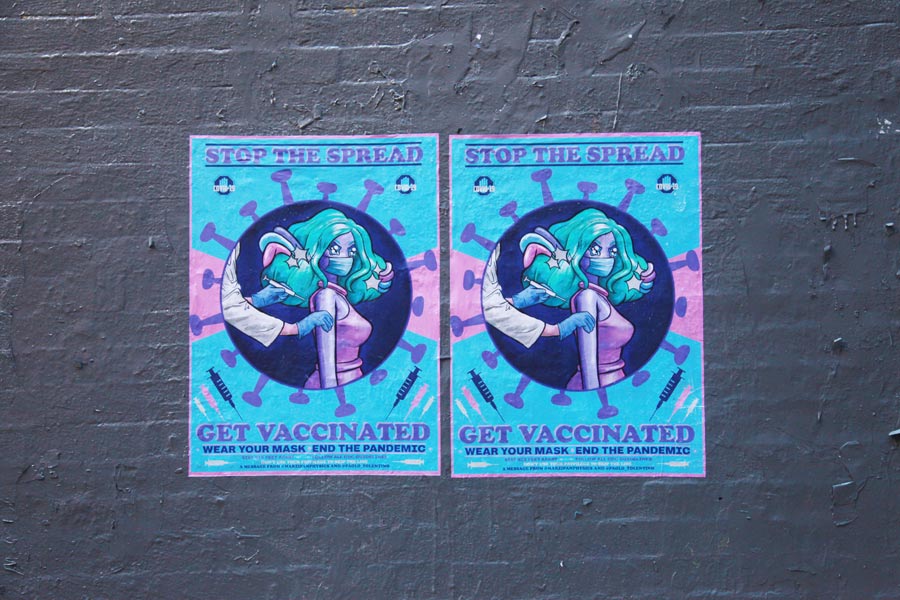
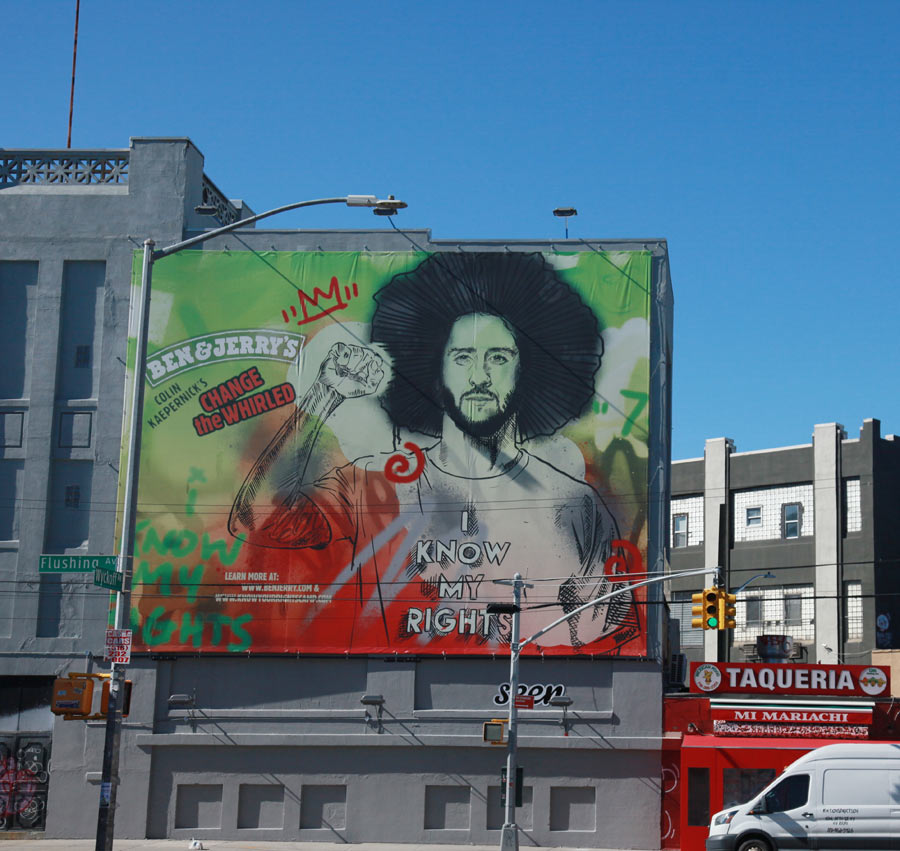
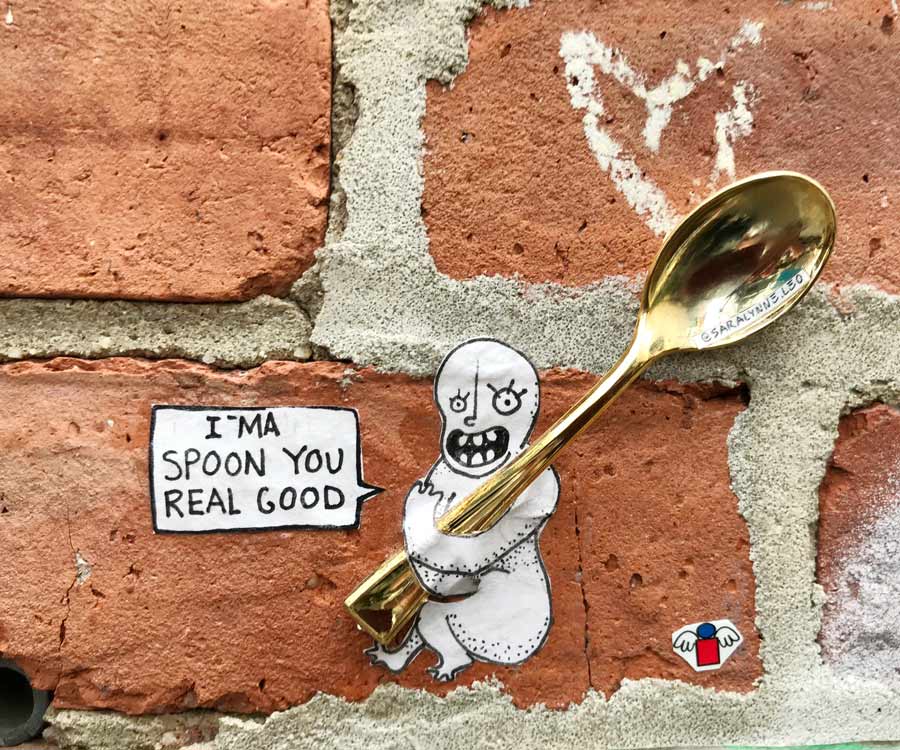
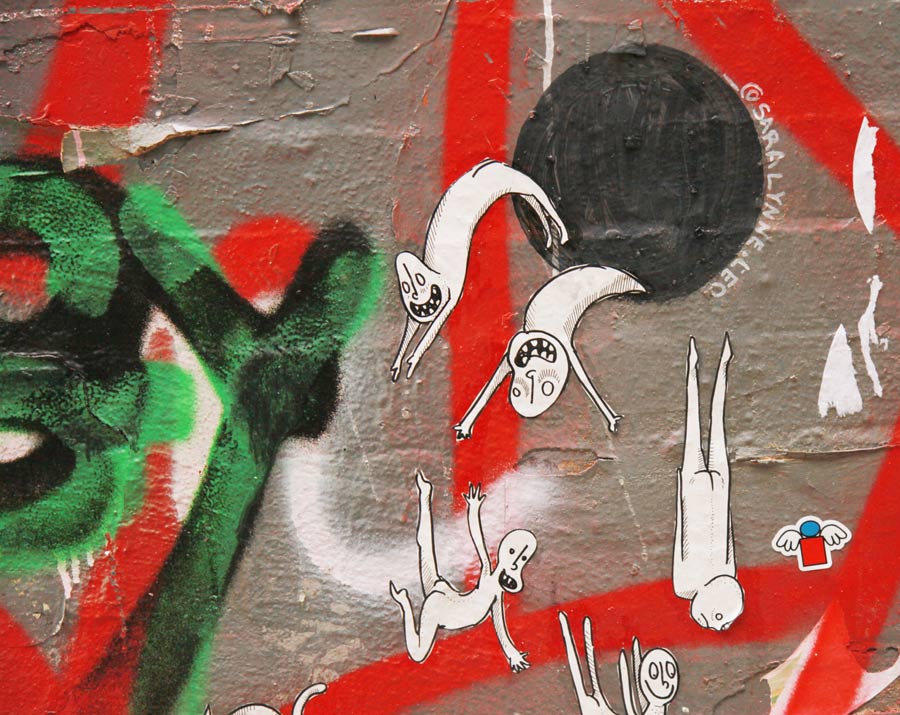
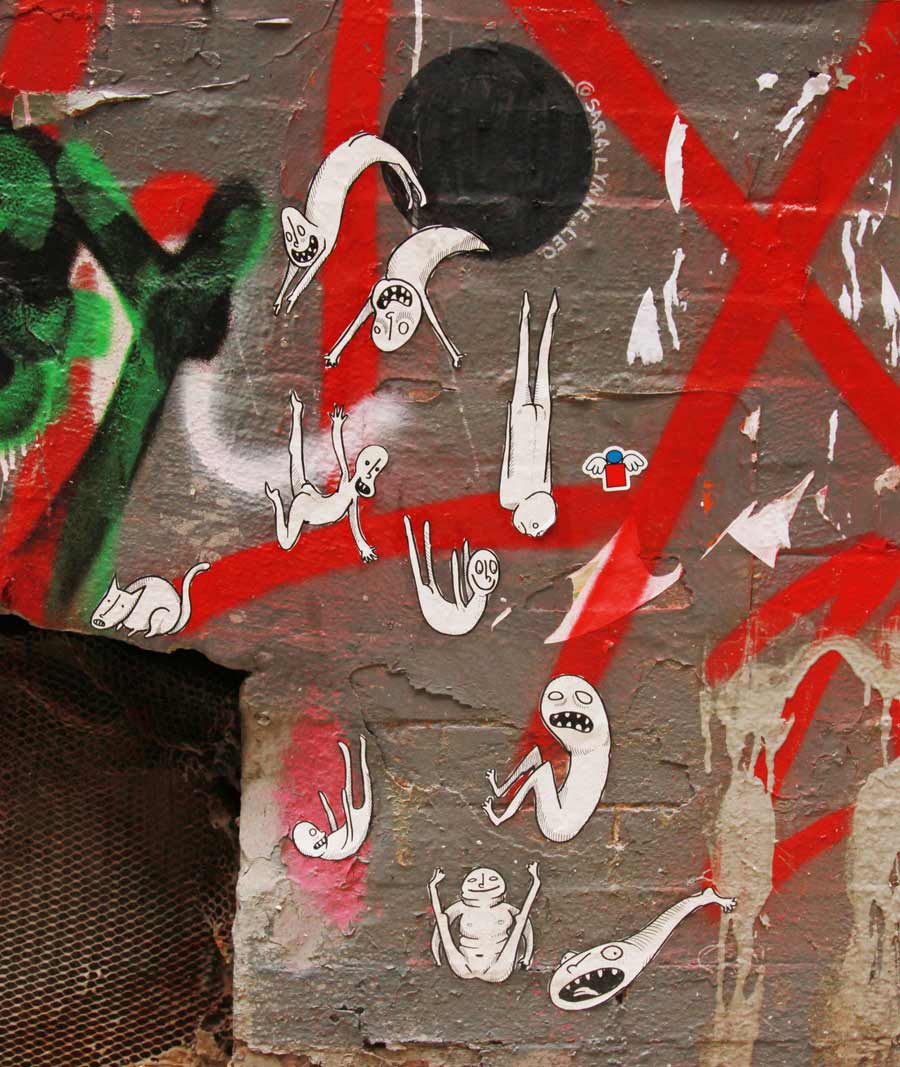
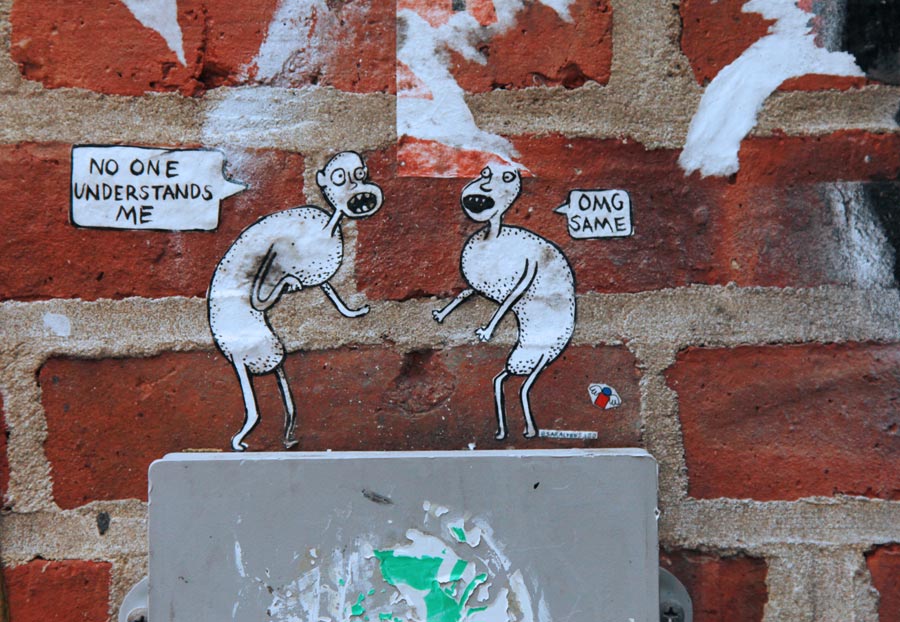
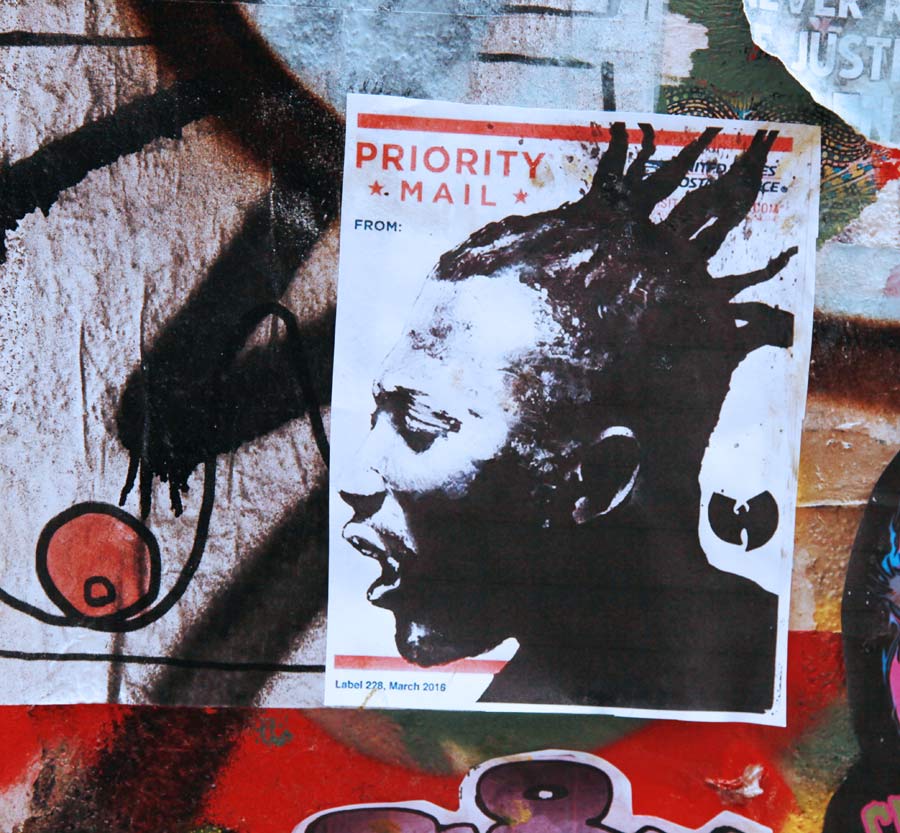
Adrian Wilson in collaboration with The L.I.S.A. Project NYC draws our attention at the increase of hate speech and violent acts against the Asian Community – spearheaded by none other than our former Hateful-in-Chief. Why the GOP continues to make this pact with the Devil is a mystery, or is it? It alerts people’s darkest, most odious traits and keeps us fighting with each other. As a true melting pot, we believe New York is better than this. (photo @ Jaime Rojo)Now, now, Sara Lynne-Leo. Remember what the minister’s wife/organist at church always says; “The Good Lord doesn’t make mistakes.” (photo @ Jaime Rojo)Unidentified artist (photo @ Jaime Rojo)The Monks for The Bushwick Collective (photo @ Jaime Rojo)Psychedelic reimaginings by Tony De Pew in collaboration with Matt Siren. (photo @ Jaime Rojo)Comik. DYM Crew. (photo @ Jaime Rojo)Blur (photo @ Jaime Rojo)Berkit, Locs and Binho (photo @ Jaime Rojo)Shark (photo @ Jaime Rojo)Captain Eyeliner (photo @ Jaime Rojo)Taboo, Host. DYM Crew. (photo @ Jaime Rojo)Ethan Minsker (photo @ Jaime Rojo)Public service messages from Paolo Tolentino (photo @ Jaime Rojo)#knowyourrightscamp This is a form of advertisement, and we recognize it, despite its graffiti/street art vernacular. Even so, we admire Mr. Caepernick as one of the few brave sports figures of immense relevance and influence who was and still is willing to forgo fat checks in exchange for being free to speak his mind on social and racial justice issues that are close to his heart and to his home. Untitled. Manhattan. Winter 2021. (photo @ Jaime Rojo)
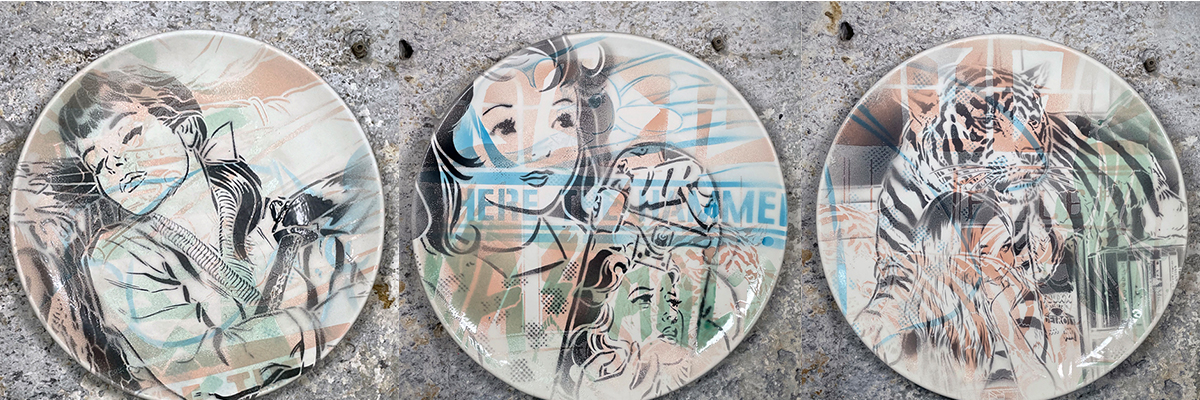
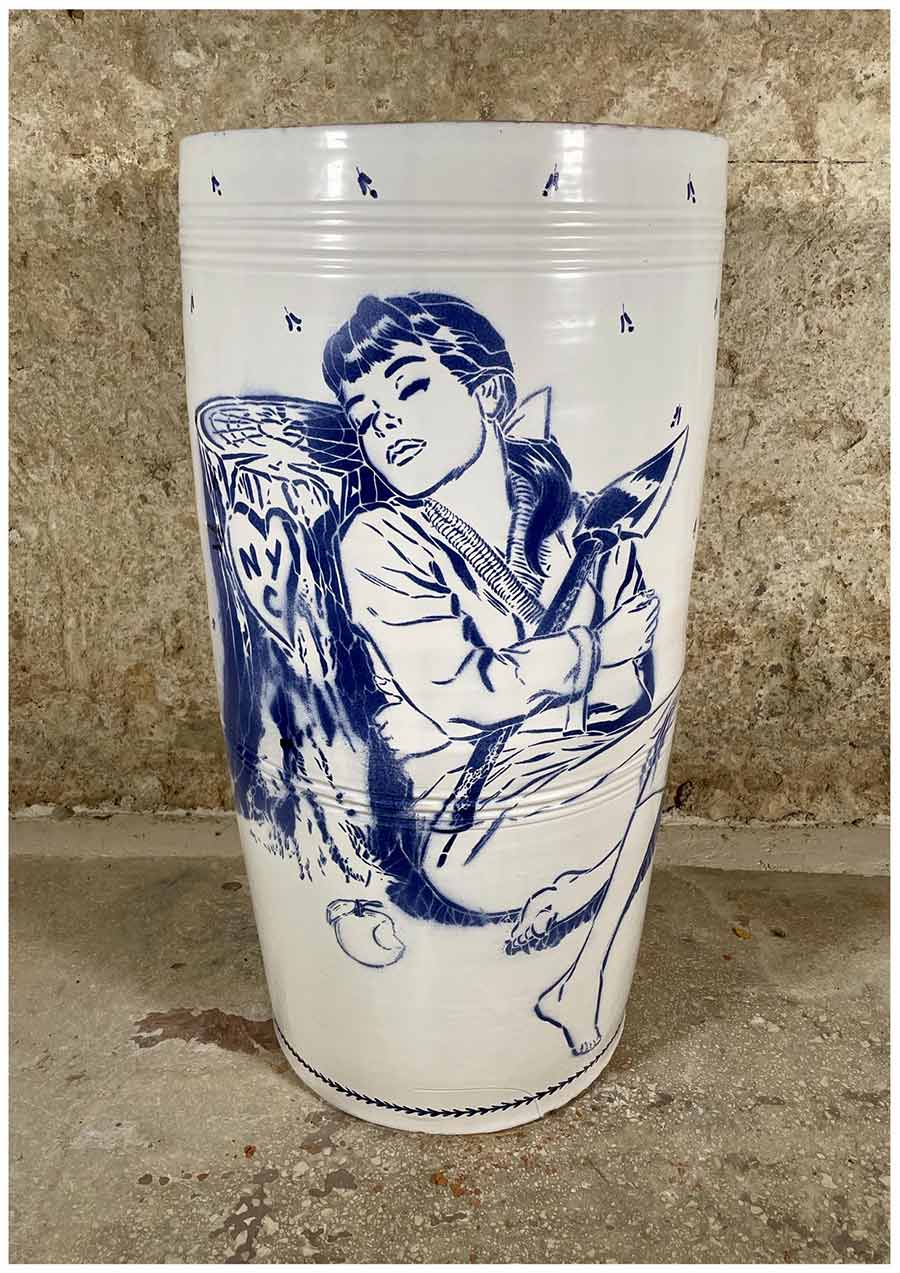
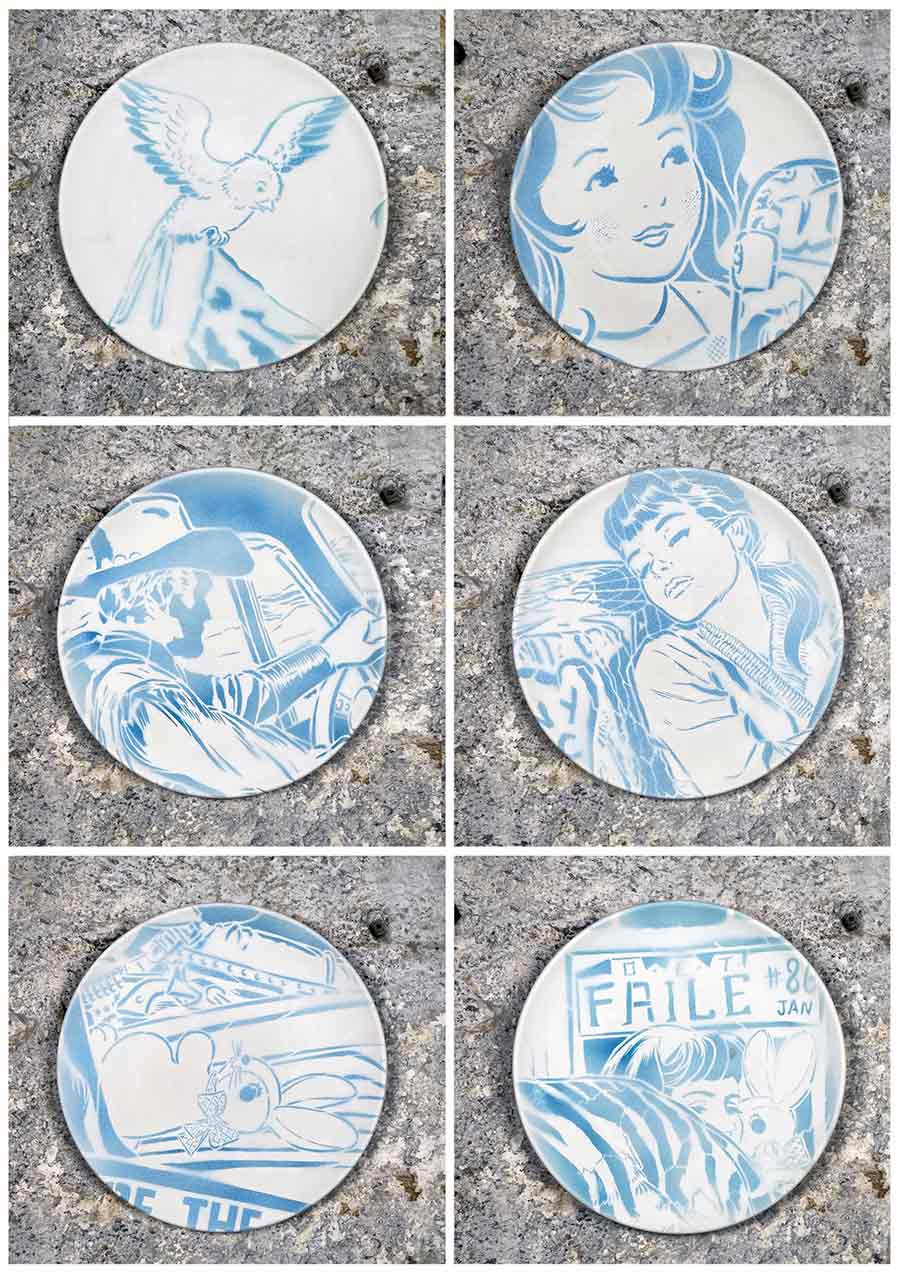
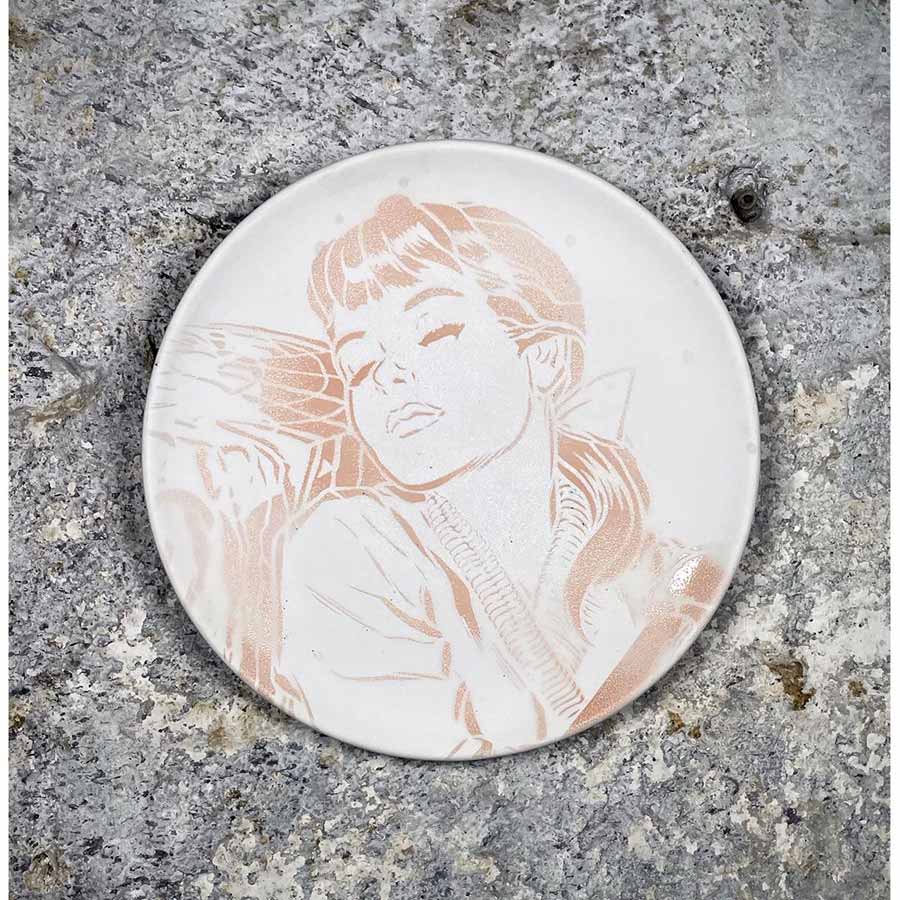
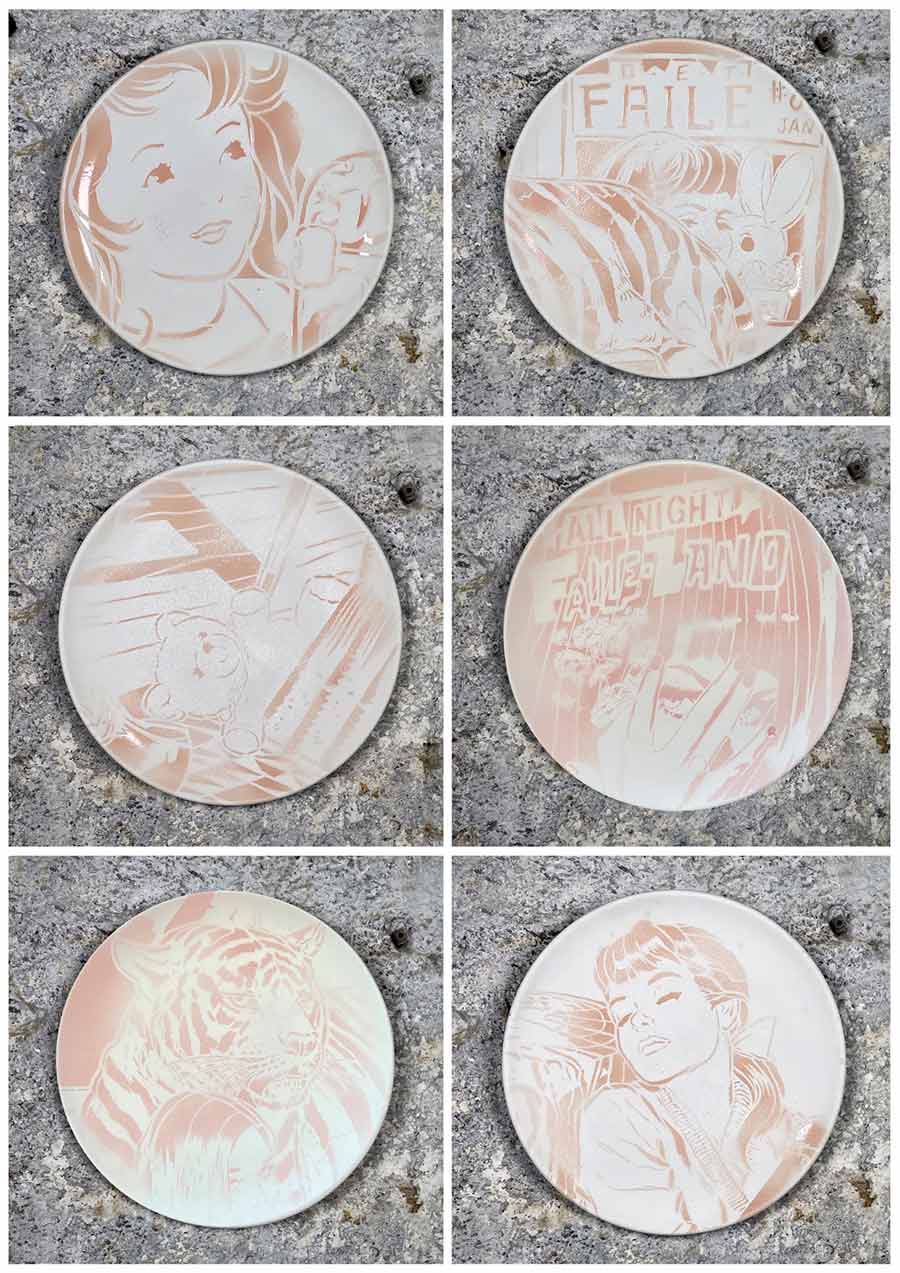
Angelo Milano, the founder of Studiocromie and FAME Festival, has been courting Brooklyn artist duo Faile for more than a decade, and they finally created a series of ceramics together for his studio art business in Grottaglie under the tutelage and traditional expertise of the centuries-old Ceramiche Nicola Fasano’s workshop.
Faile. Large Vases. Stenciled and Glazed Terracotta. (photo courtesy of Faile)
The model of hosting artists for a variable length of time and offering them cooperation with local artisans to create commercial products was part of the original concept of FAME, in addition to the well-curated placement of stunning murals on walls by artists including Erica Il Cane, Vhils, Interesni Kazki, Conor Harrington, Cyop & Kaf, Momo, Lucy McLauchlan, Bastardilla, and Ted Moneyless. Since the mural festivals’ dissolution by Milano a half dozen years ago, he’s hosted a growing list of talents mirroring his eclectic fine eye for quality, and devil-may-care philosophical stance – the solo show and rap album with the Italian trio Canemorto both come to mind, for example.
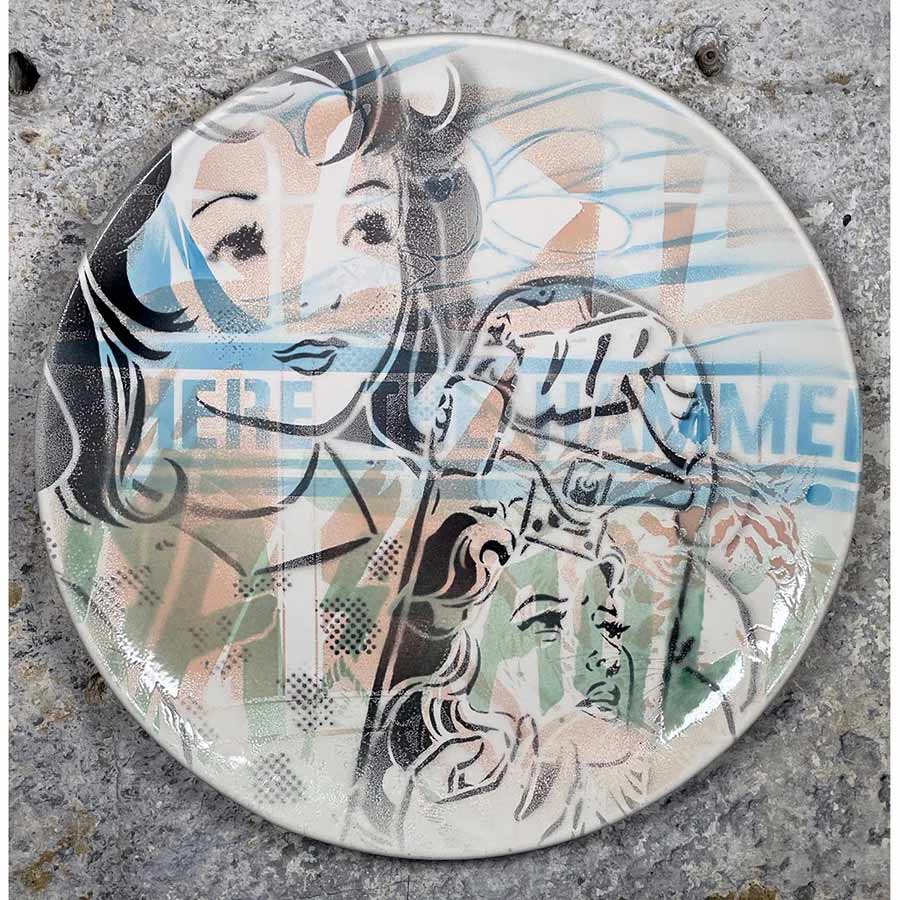
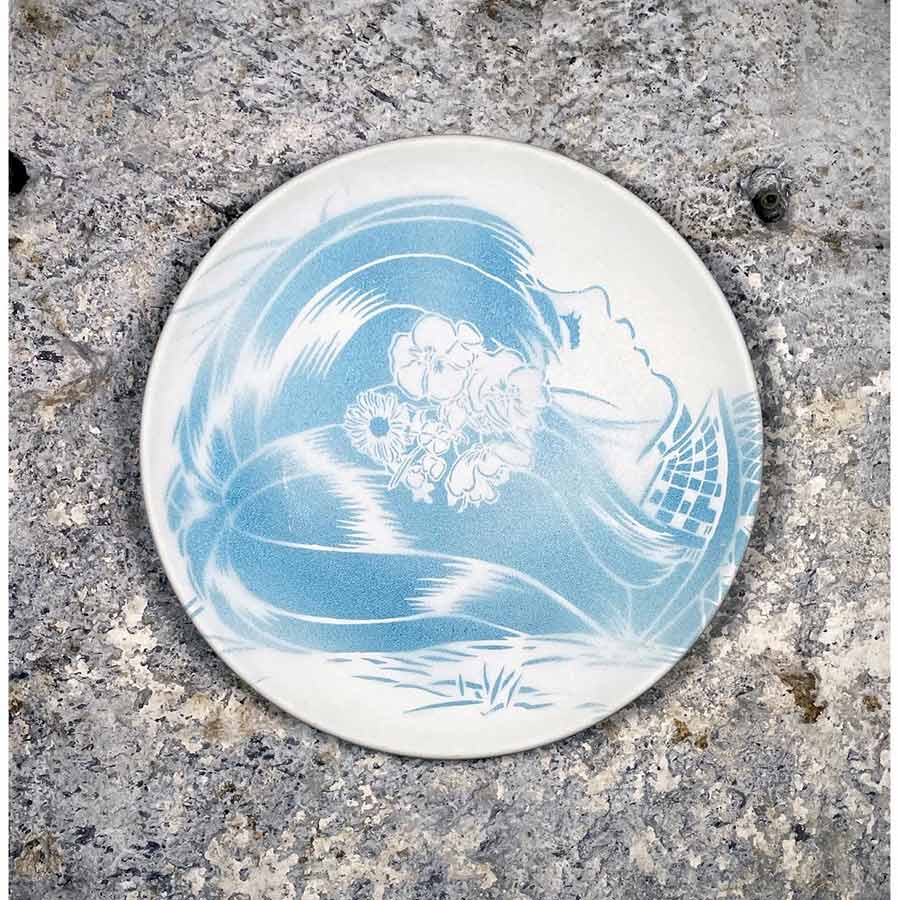
“Exploring a mix of our stencil processes and combining it with a variety of their methodologies,” says Faile (Patrick McNeil and Patrick Miller), “we created a small collection of unique ceramic plates and vases.”
Faile. Multilayered Large Plate Collection. Stenciled and Glazed Terracotta Plate. (photo courtesy of Faile)
The pieces incorporate the familiar pop and pulp imagery and visual vocabulary of canvasses, collaged media, wheat-pasted posters, and street art stencils on a plate. Now you can enjoy your Friselle bread and tomato salad with your favorite stenciled skateboard girl in pink while looking at a vase that may recall prayer wheels.
Faile. Small Plate Collection in Blue.Stenciled and Glazed Terracotta Plate. ( Photo courtesy of Faile)
Faile. Small Plate Collection in Red. Stenciled and Glazed Terracotta Plate. ( Photo courtesy of Faile)
Collection available now via the StudioCromie Shop. Click HERE to see more.
Our weekly focus on the moving image and art in the streets. And other oddities.
Now screening participants at Festival Asalto 2020: 1. FAITH XLVIII 410 BC – 340 BC 2. Ozmo / “La visión de Tondalo” via Urban Art Field 3. SOFLES / Geometric
BSA Special Feature: FAITH XLVIII 410 BC – 340 BC
You knew FAITH XLVIII was OG, but did you imagine she dipped back to the 4th century? In this newly unveiled clandestine scene, the South African street artist paints among the decay in Lexington.
She says it is part of her “7.83Hz Series”
FAITH XLVIII 410 BC – 340 BC, Lexington, Kentucky
Ozmo / “La visión de Tondalo” via Urban Art Field
Ozmo in Turin finds inspiration here from a Renaissance panel from the Bosch school and interprets it for Urban Art Field. In it, we find the journey of a dreamer in hell beneath the power of the Mole Antonelliana, the major landmark building that serves as a symbol of Turin.
SOFLES / Geometric
Professor Sofles takes us to school again with this brand new 3D-style graffiti piece he painted in a gym. He says he took inspiration from the interior wall design and climbing equipment.
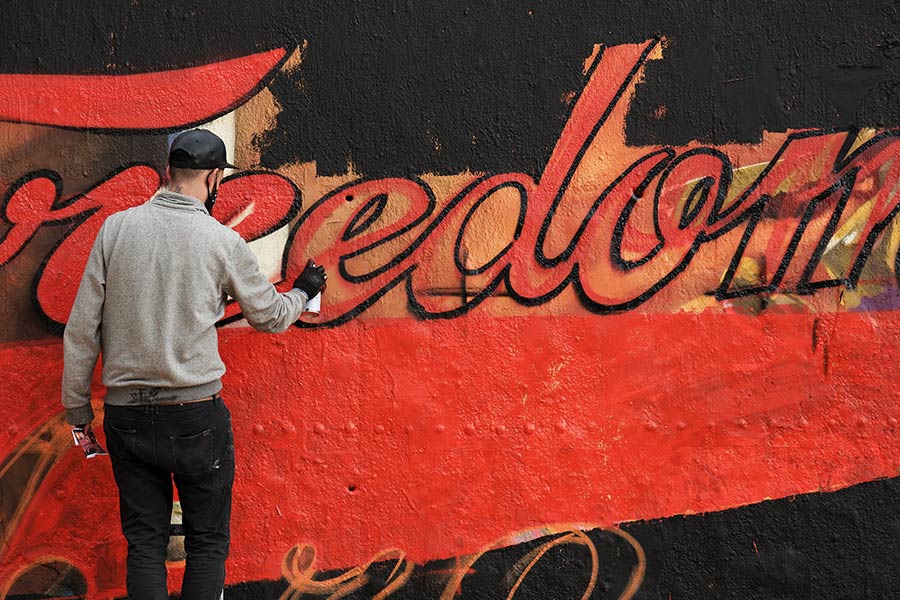
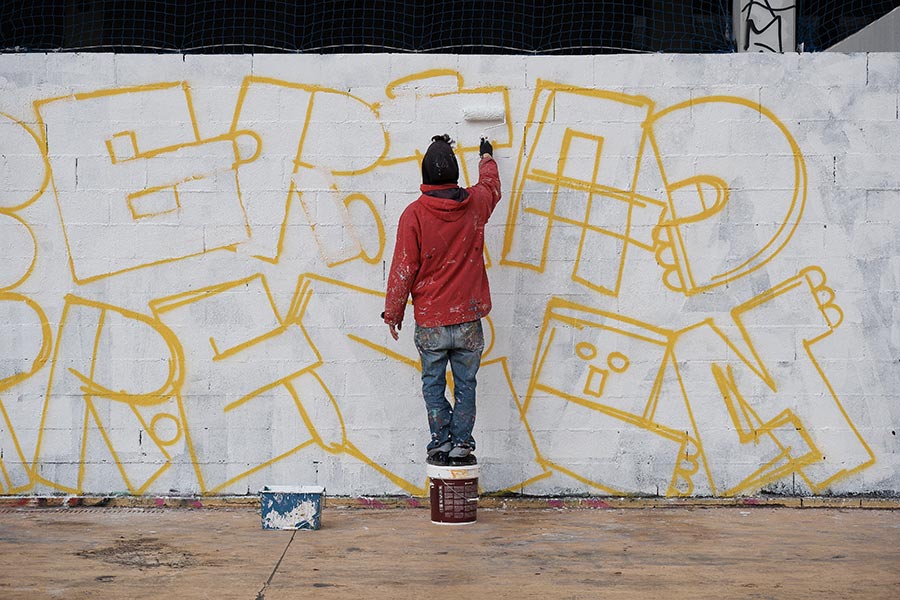
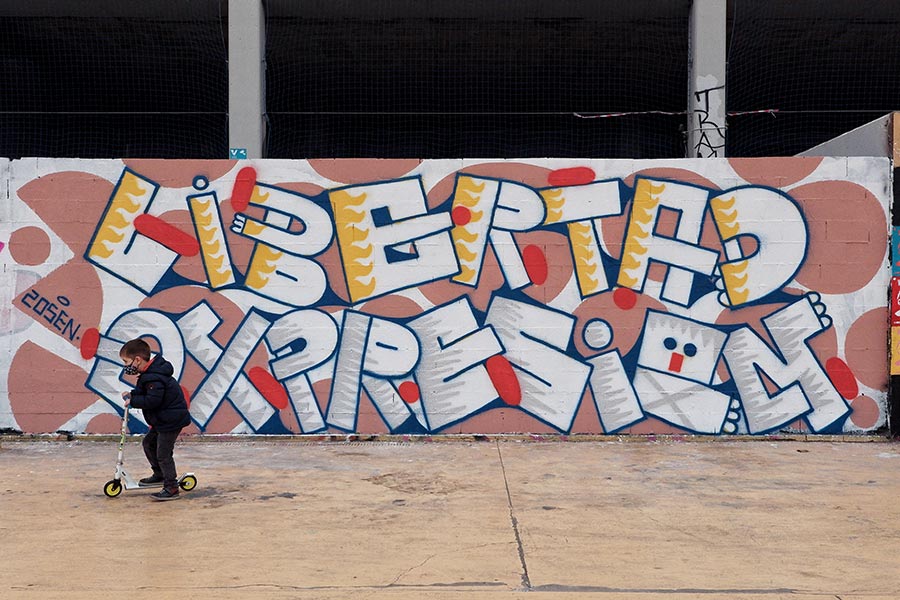
In the US, families of military veterans say, “Freedom isn’t free.” It refers to the enormous amount of sacrifice people have to make – military and civilians alike – to guarantee that societies provide a fulsome measure of freedom and autonomy to their citizens. Likewise, free speech has to be fought for periodically to ensure that people have it – because it can be so swiftly taken away if we are not vigilant.
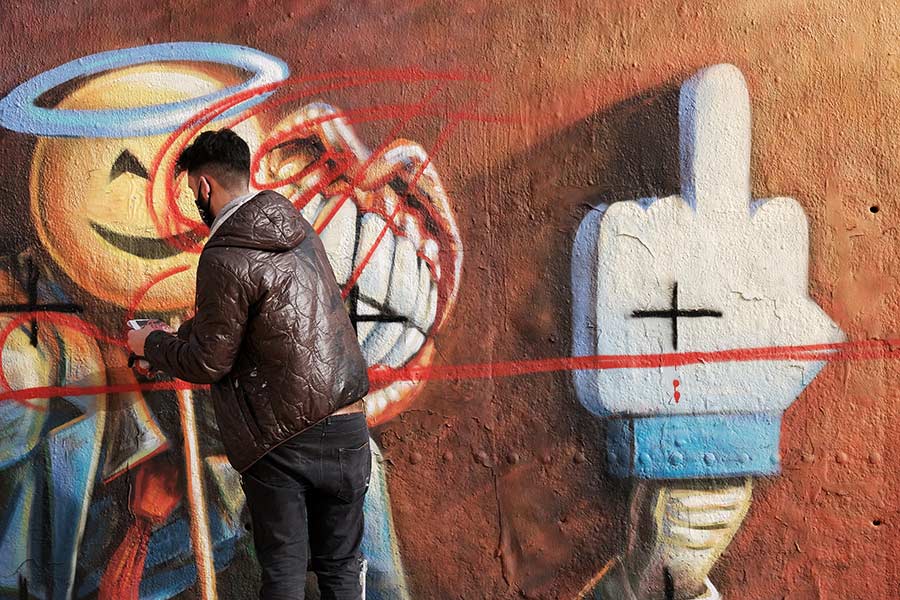
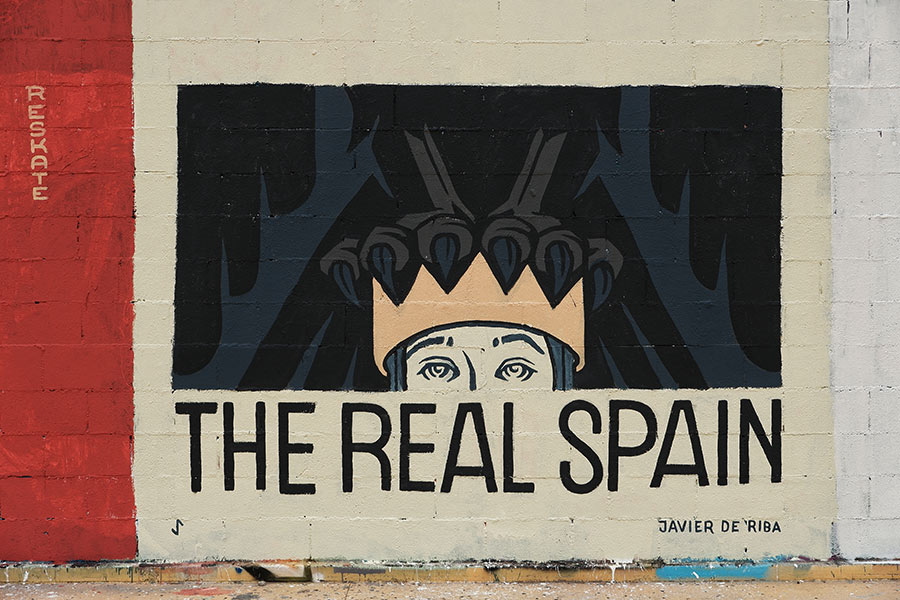
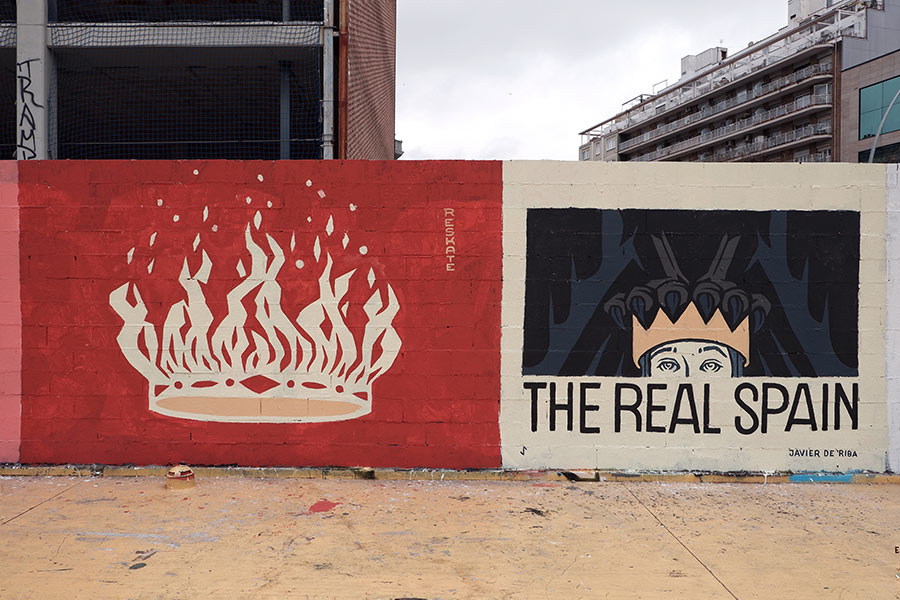
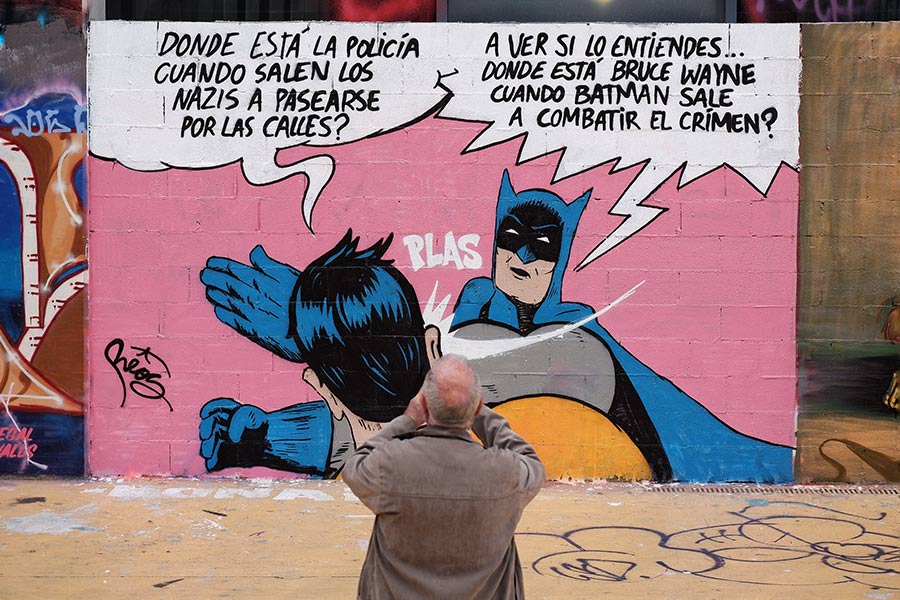
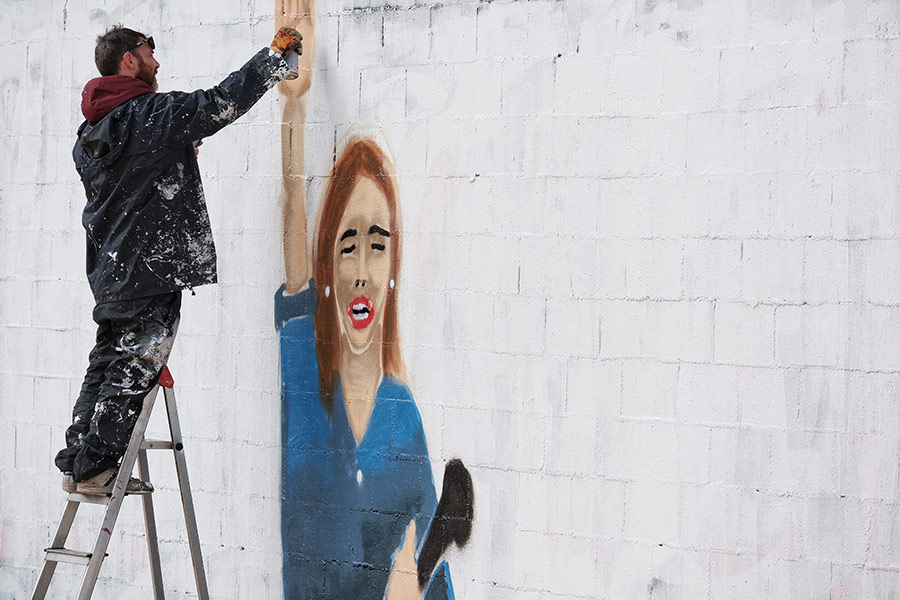
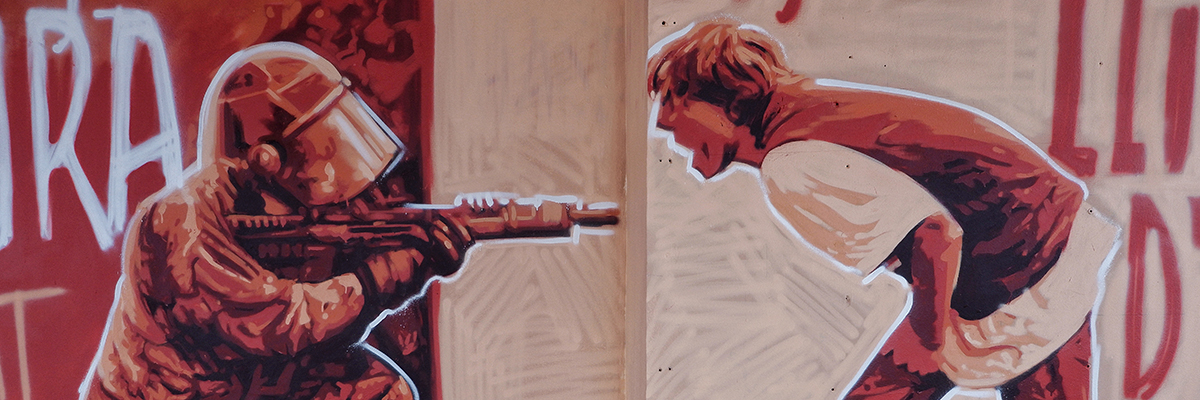
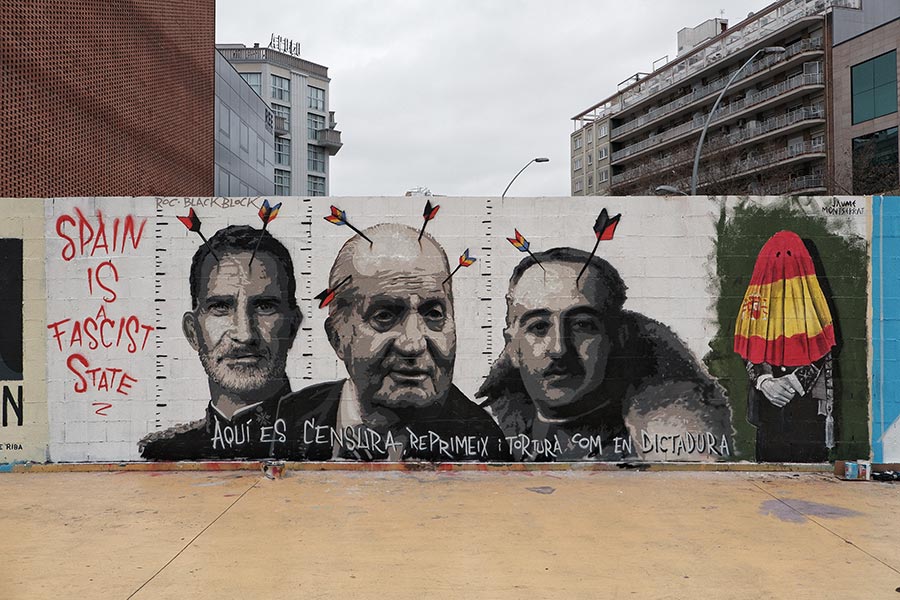
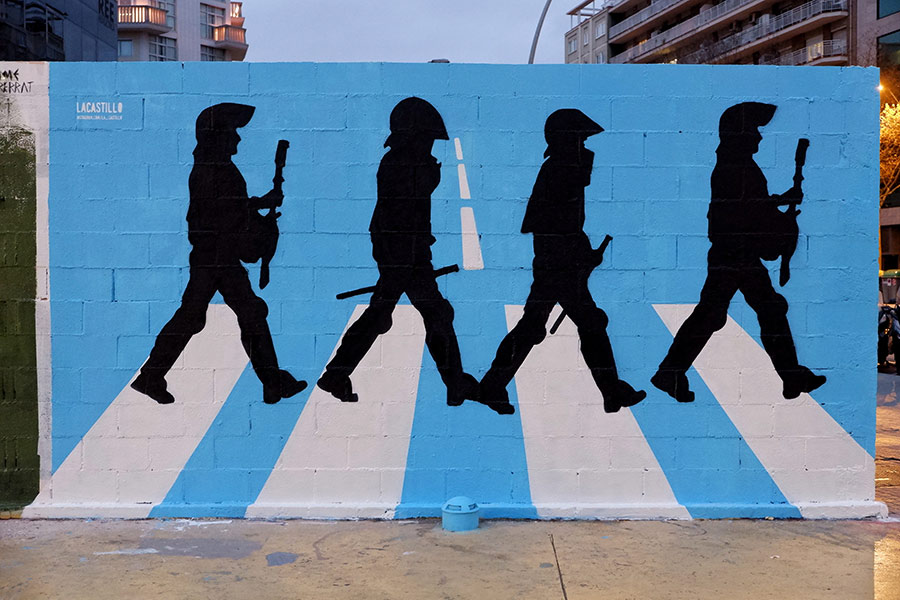
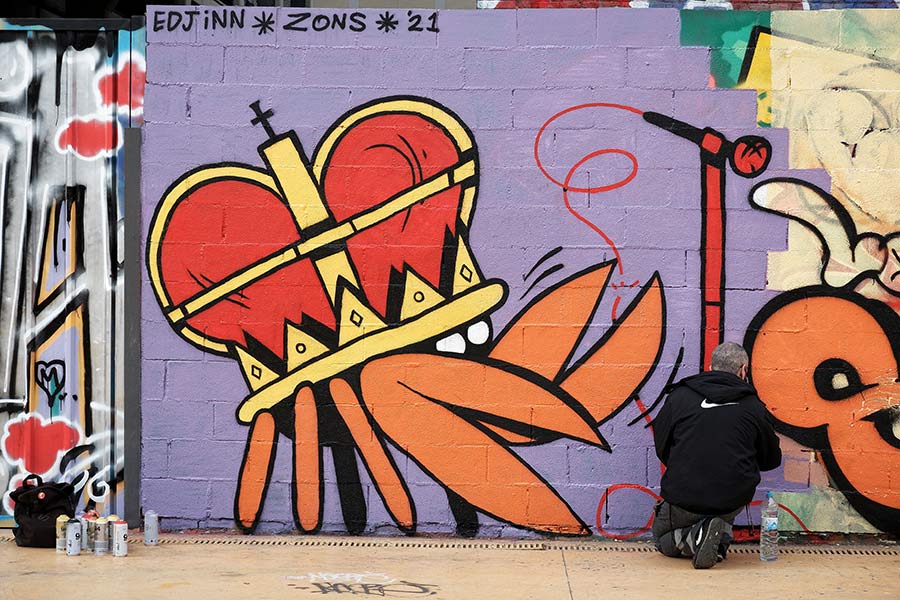
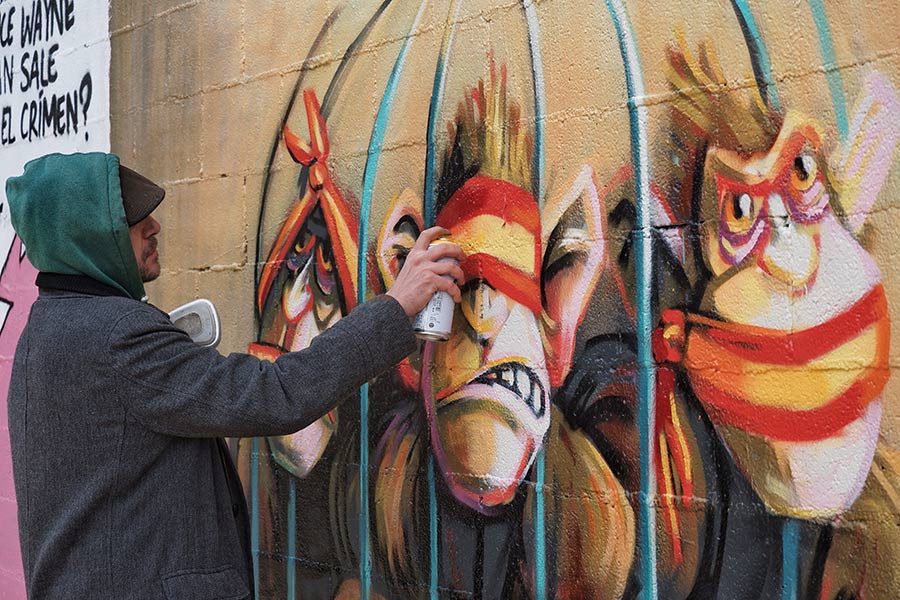
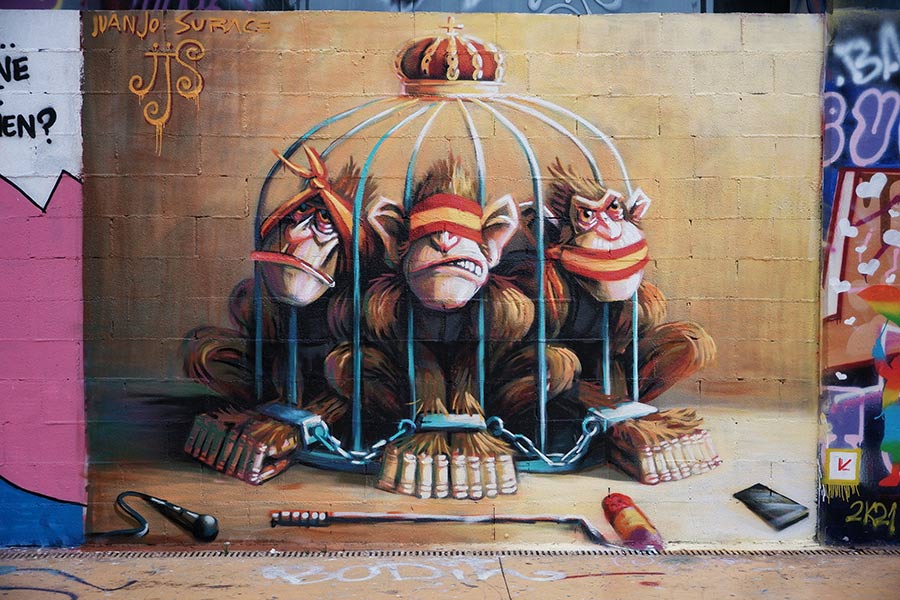
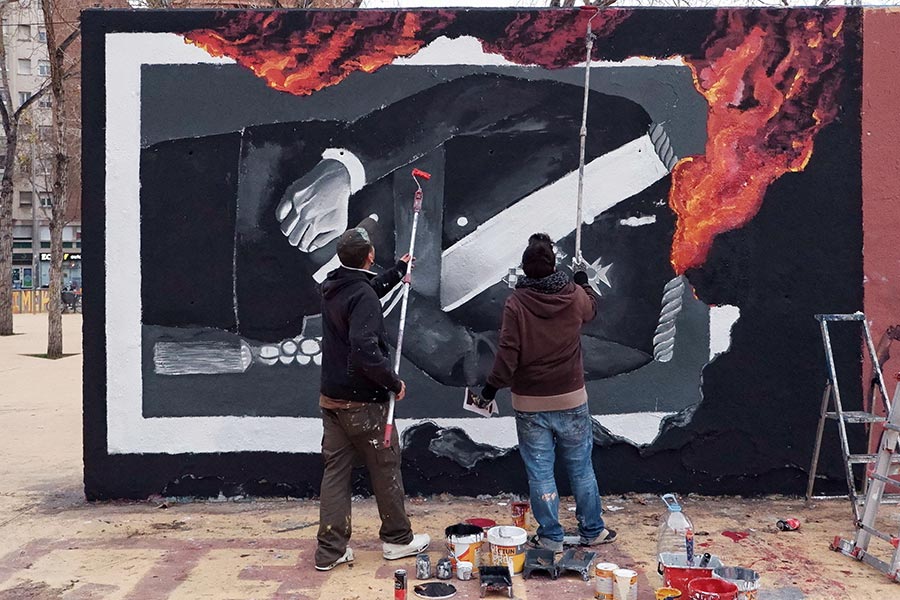
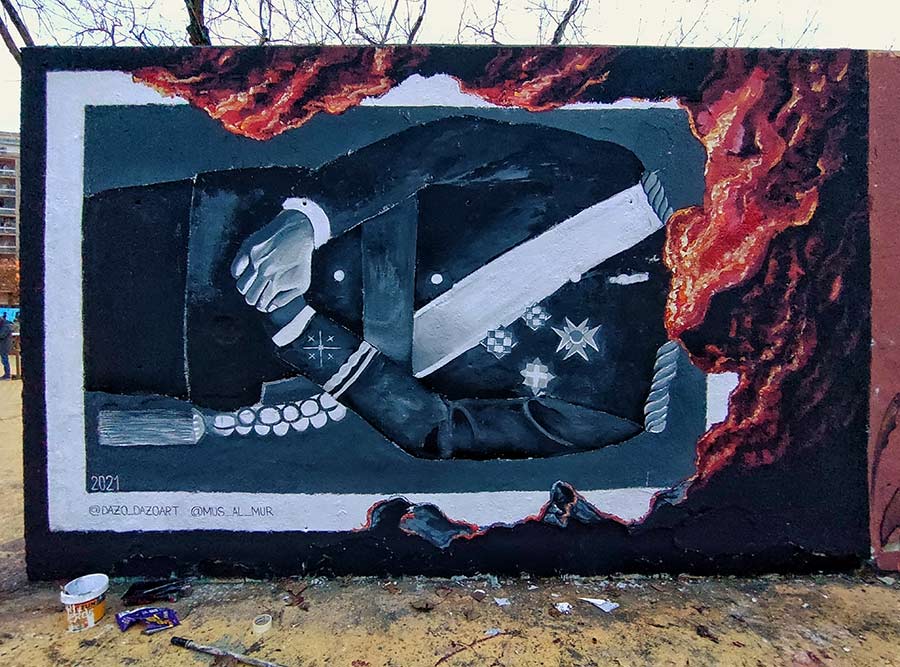
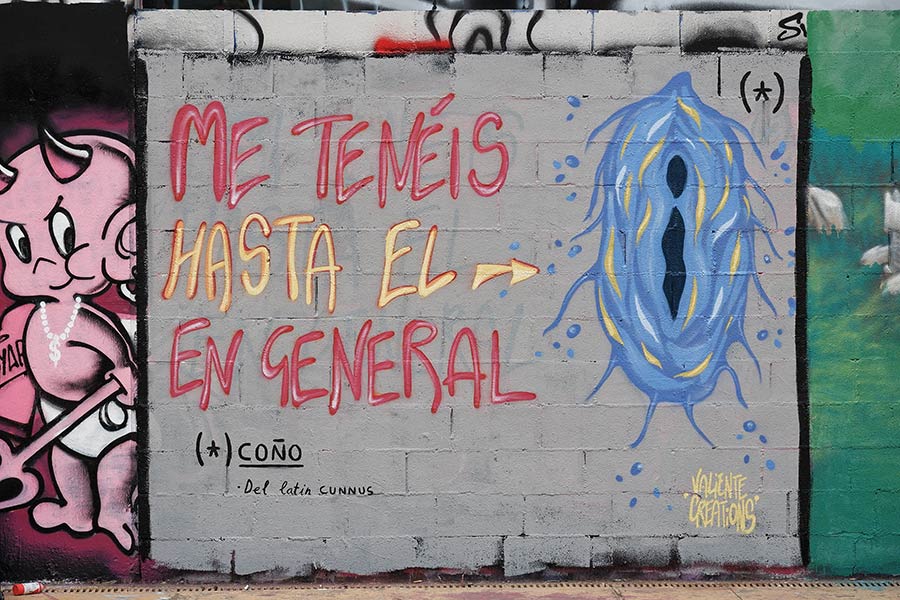
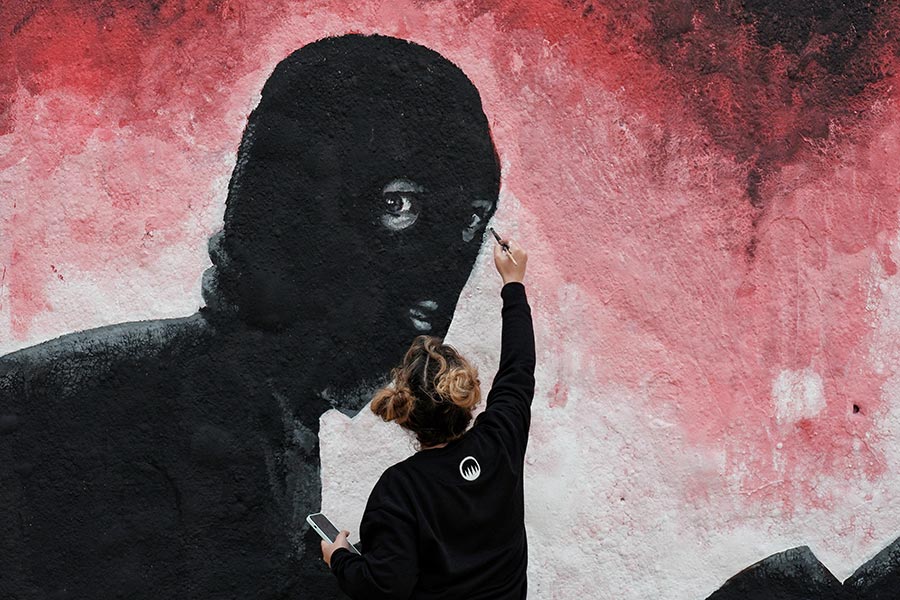
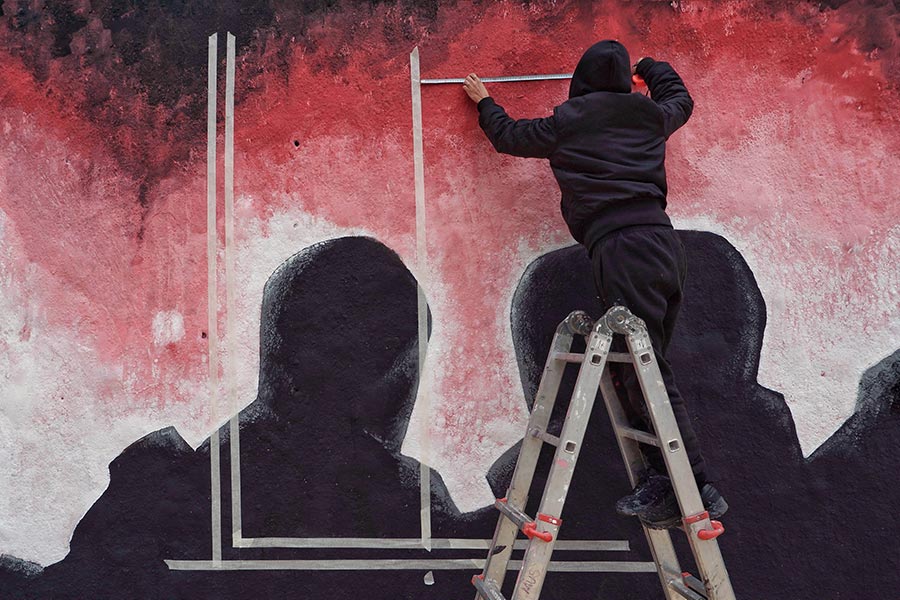
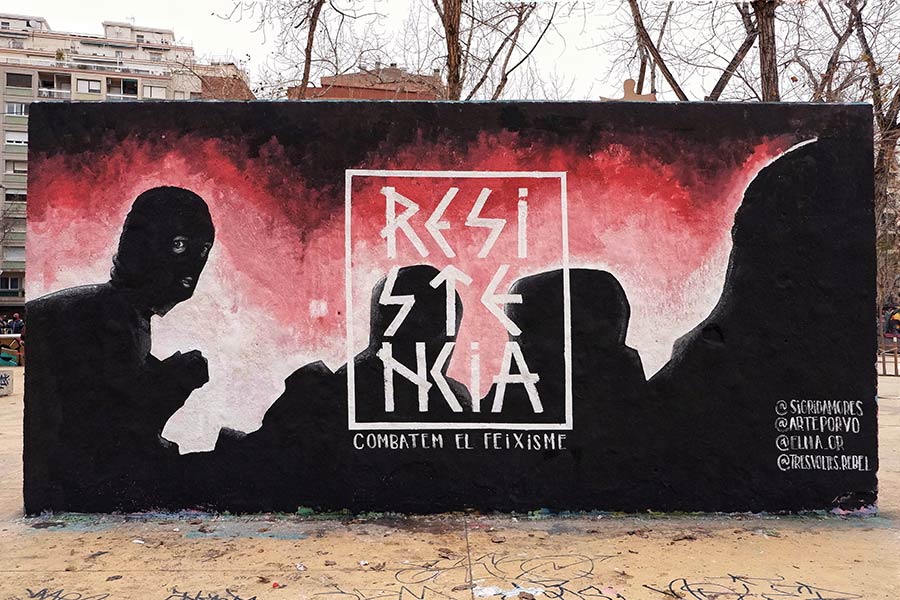
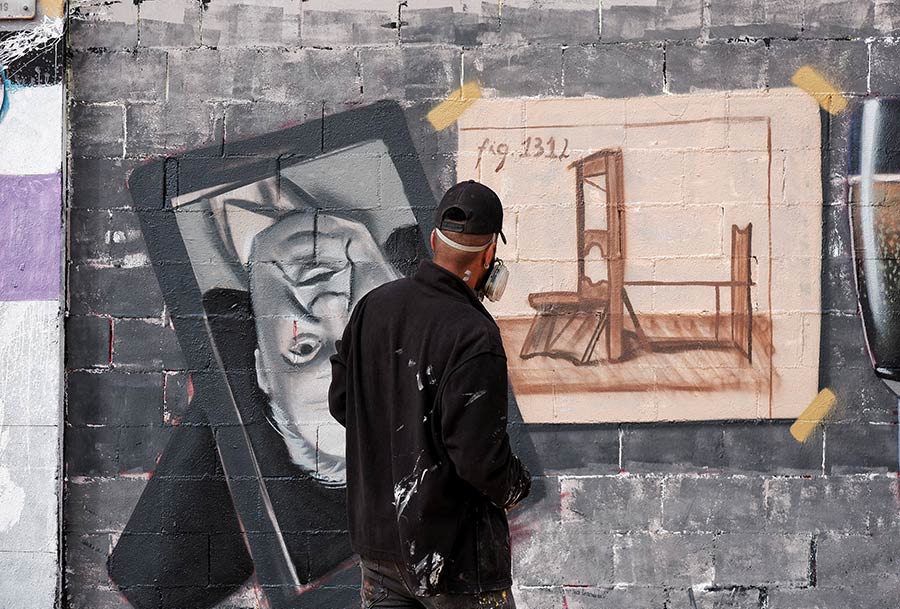
In our third installment of the murals painted in February in Barcelona, Spain, we are reminded that historically, the artist is often one of an oppressive government’s targets. It is somewhat sequential, the positions and stations in society who gradually are targeted for slurring and silencing. Academics, clergy, the press – a building degradation of respect for institutions and trust across the board.
These artists express their opinions in defiance of silencing because, inherently, they fight for everyone’s right to freedom of speech and expression, regardless of our comfort or discomfort with the ideas expressed. Because they must.
It is notable when an organized gang of aerosol-wielding vandals protests your protest against censorship with censorship.
It’s also odious.
Everyone knows that it is normal for graffiti writers and street artists to expect that their ephemeral work may be buffed by a municipality or crossed out by a rival painter. This is a different matter entirely.
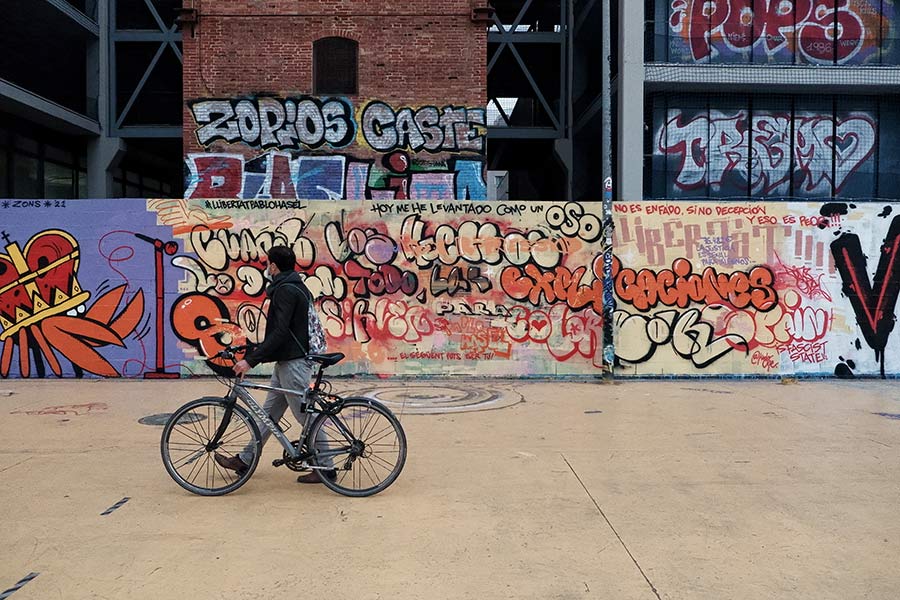
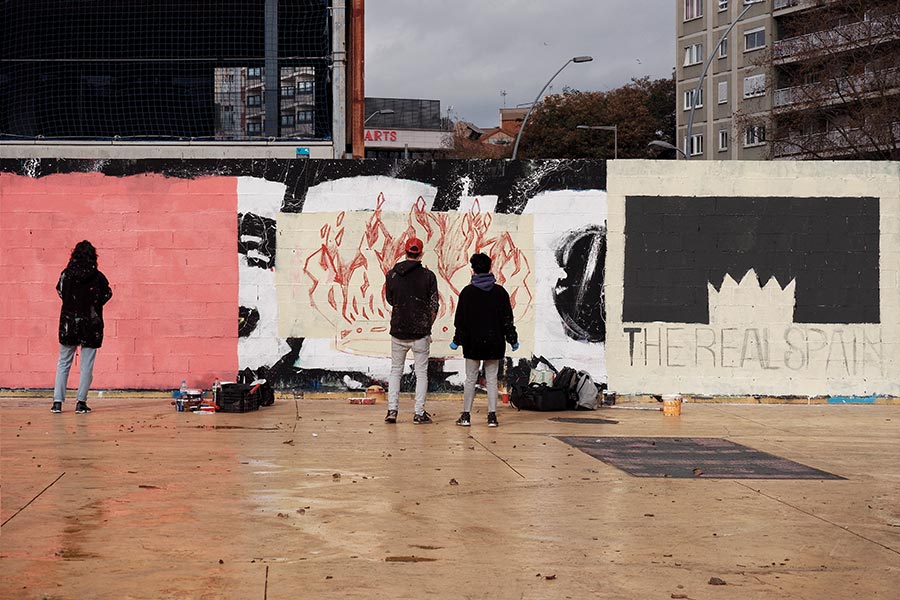
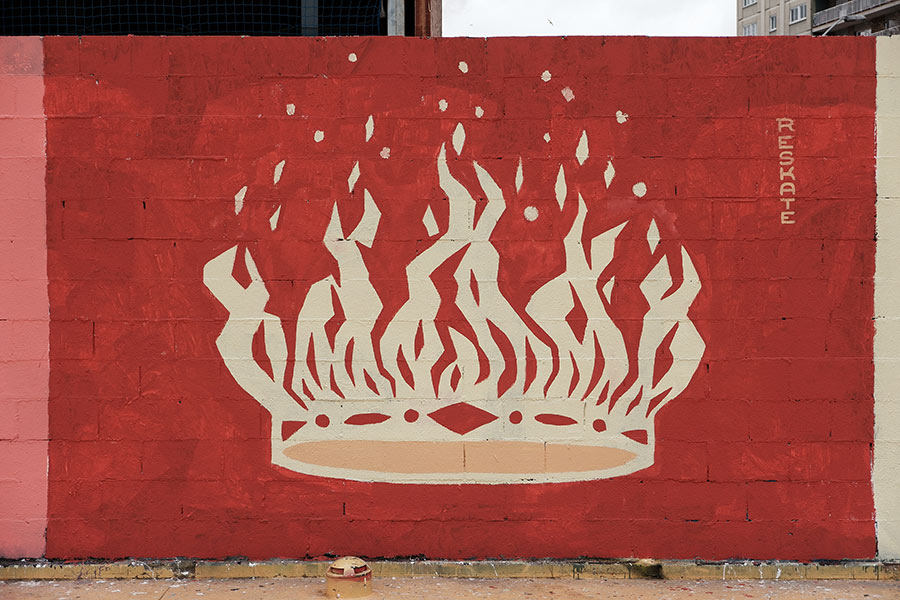
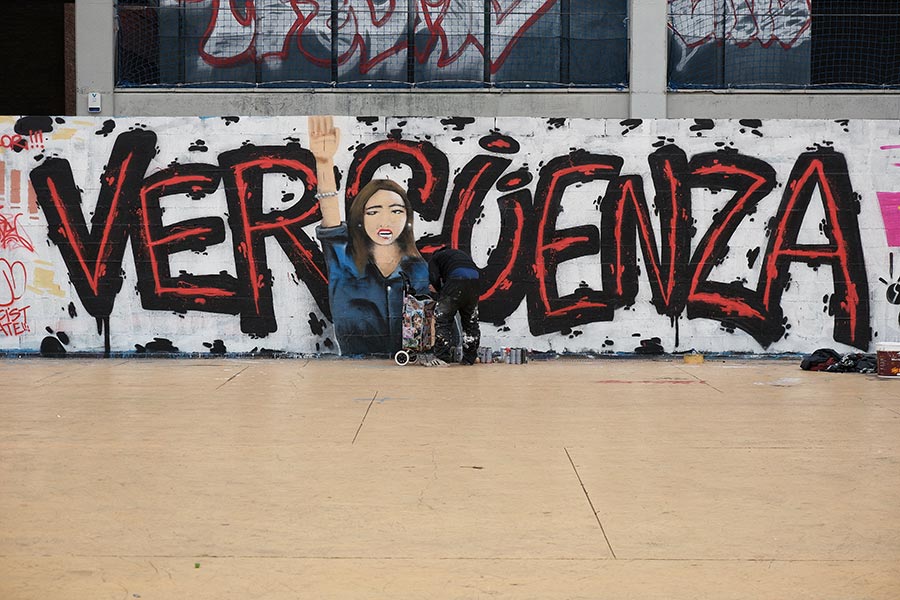
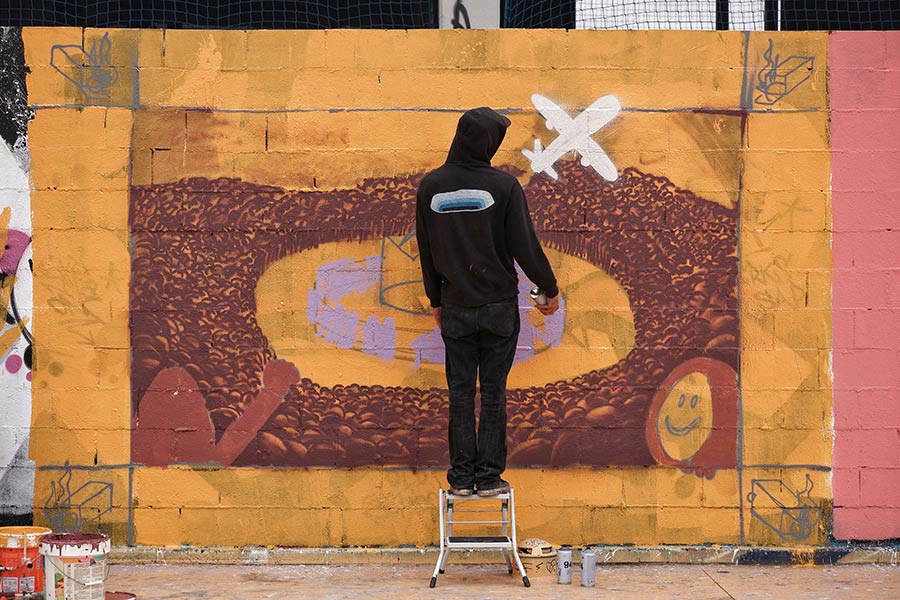
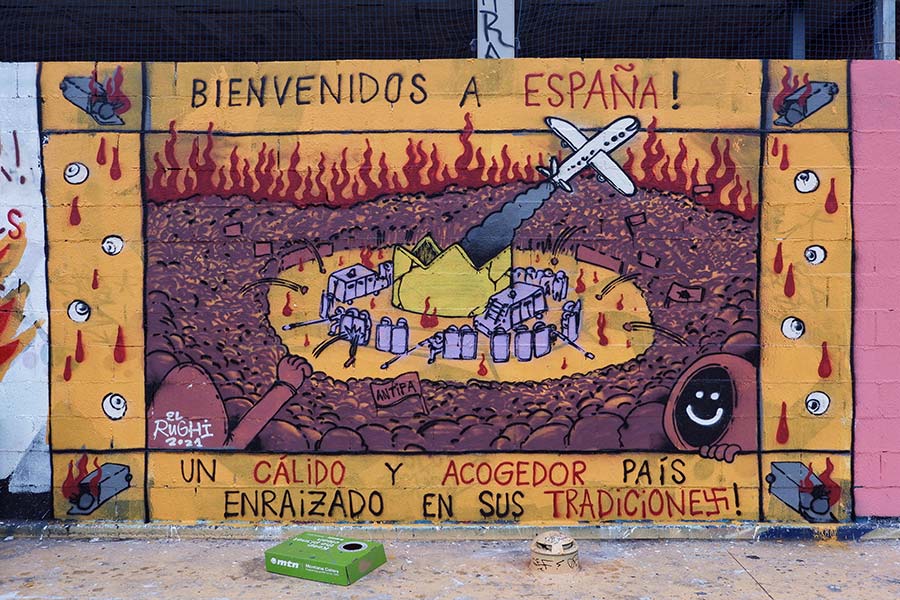
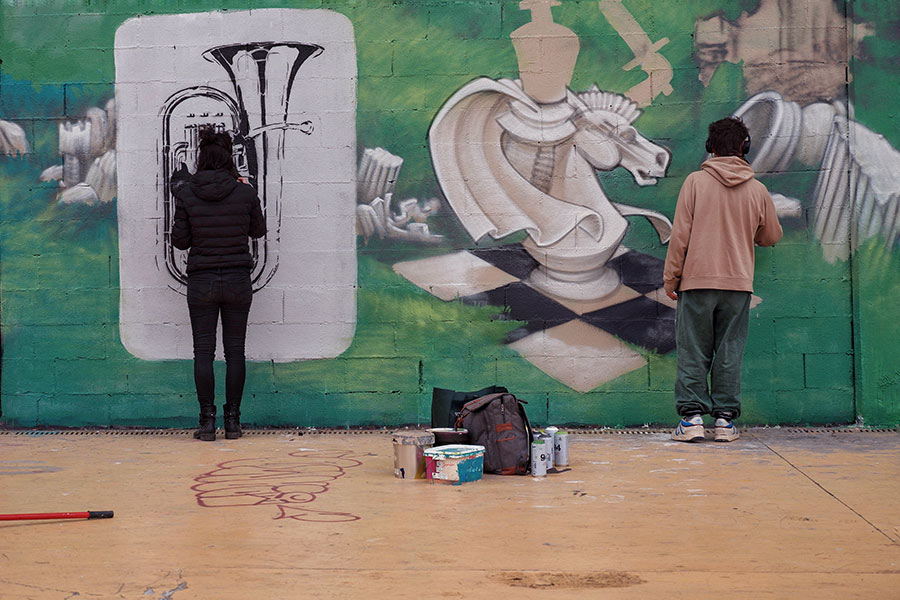
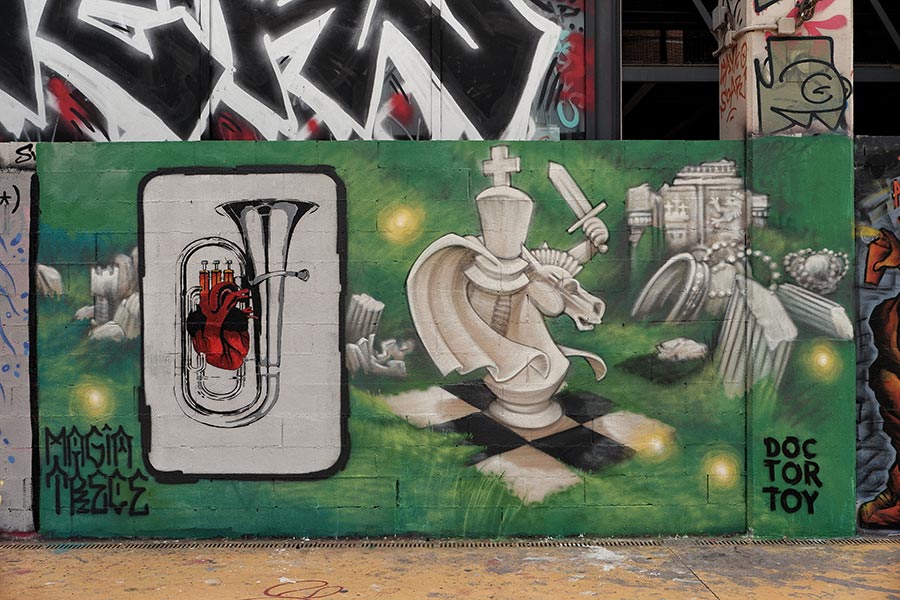
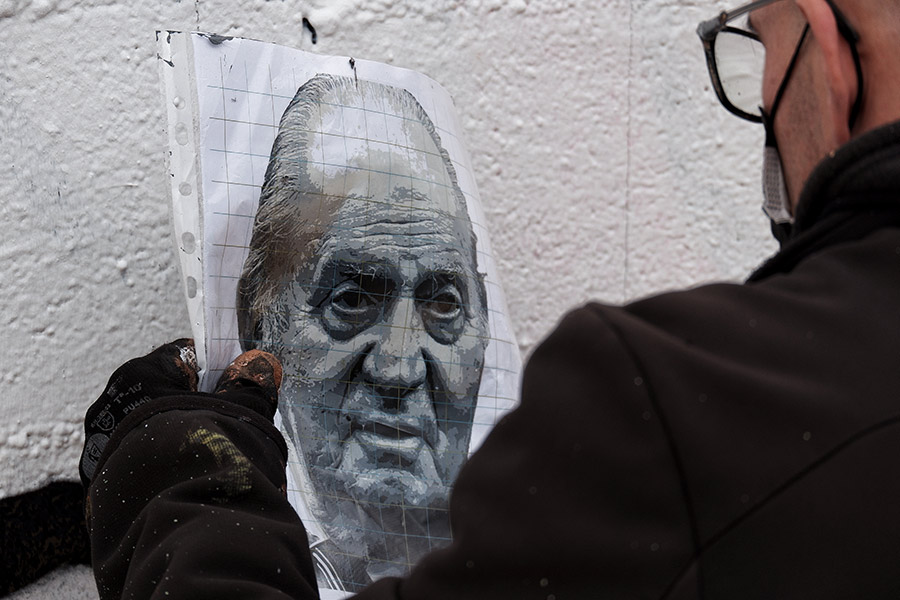
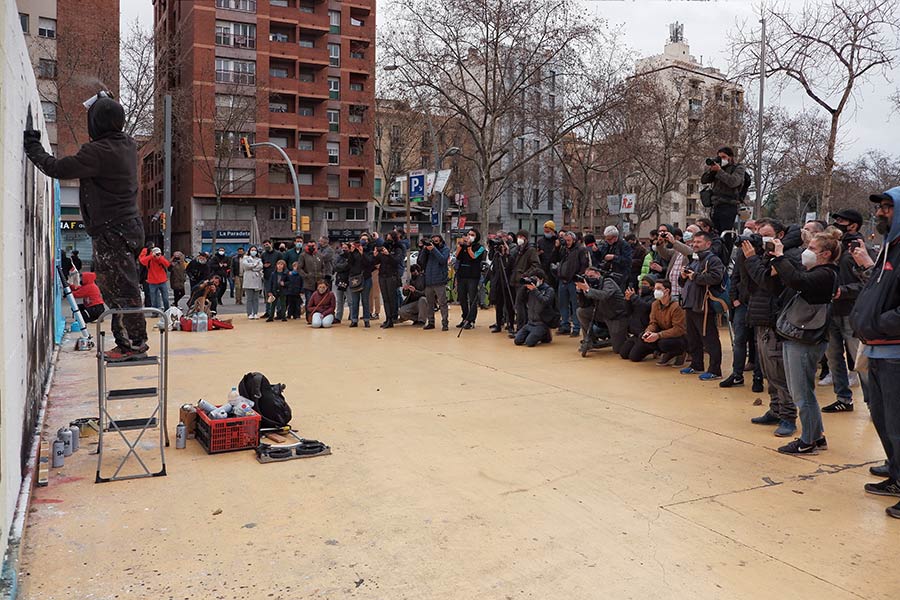
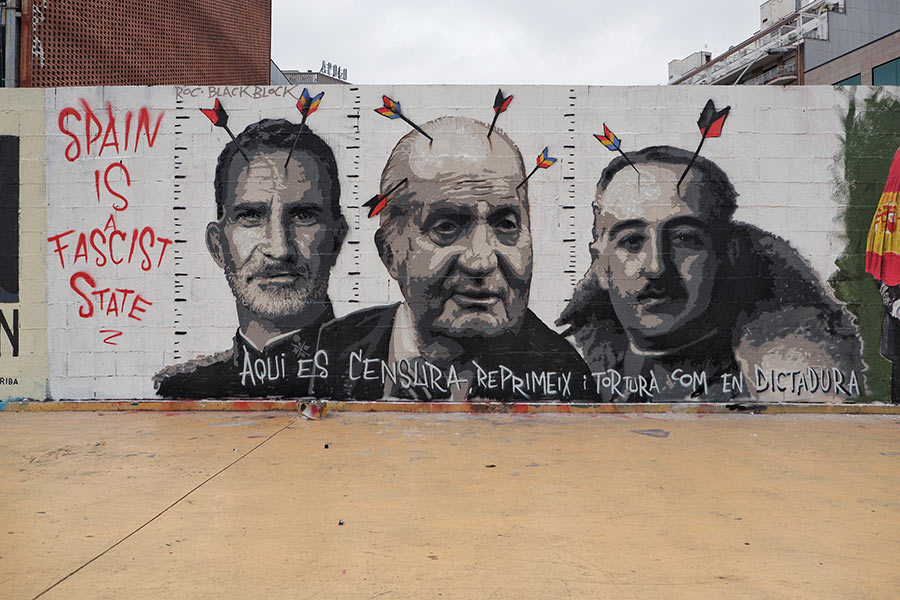
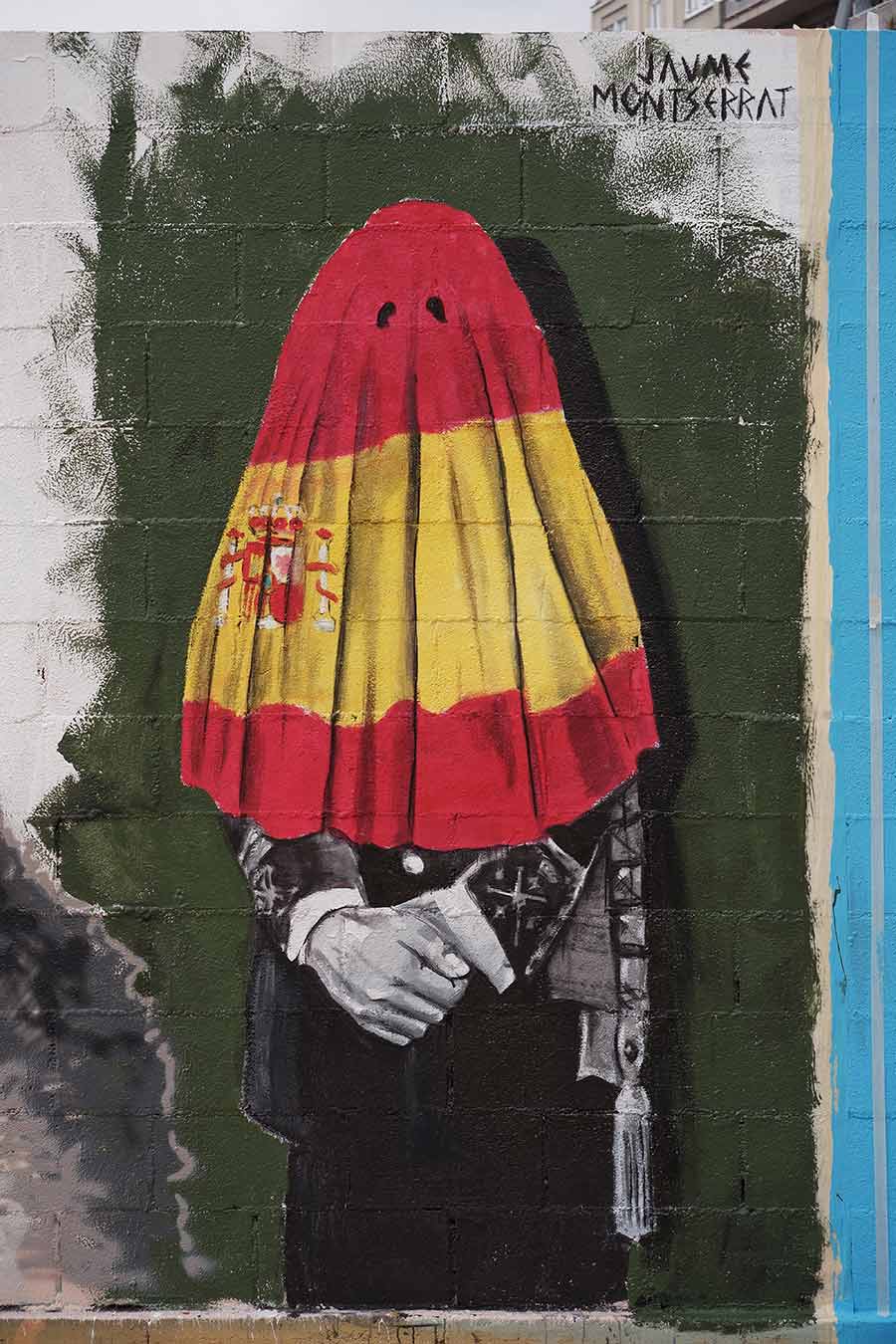
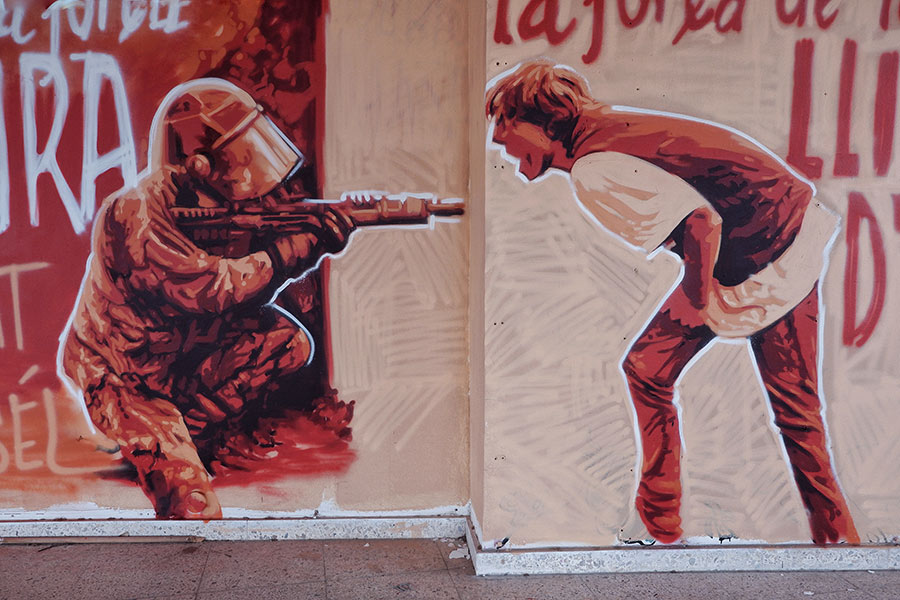
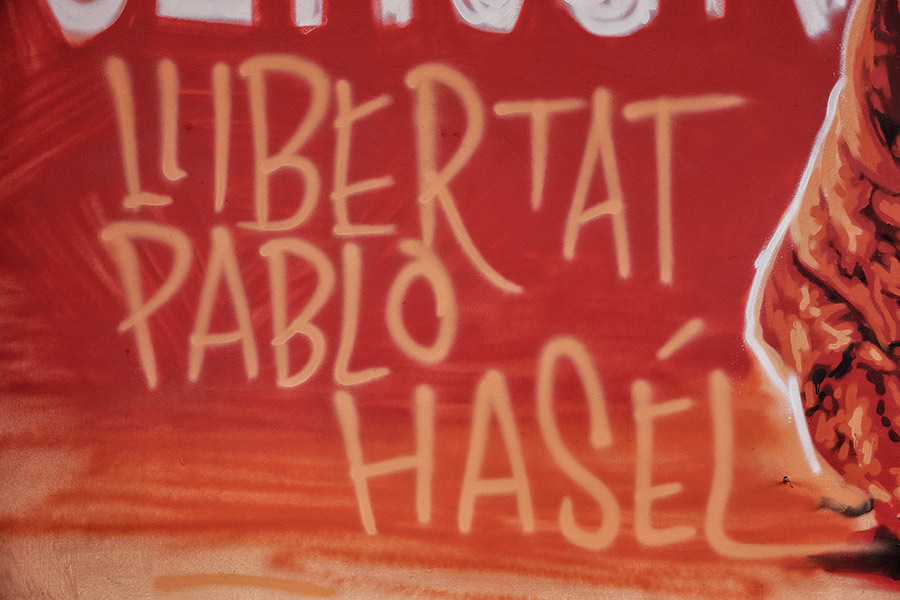
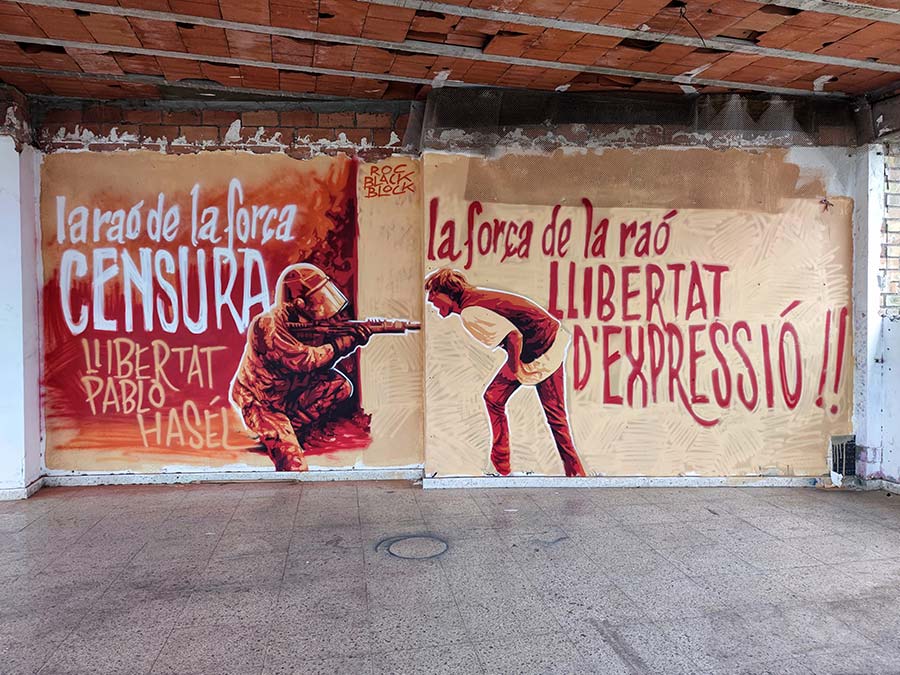
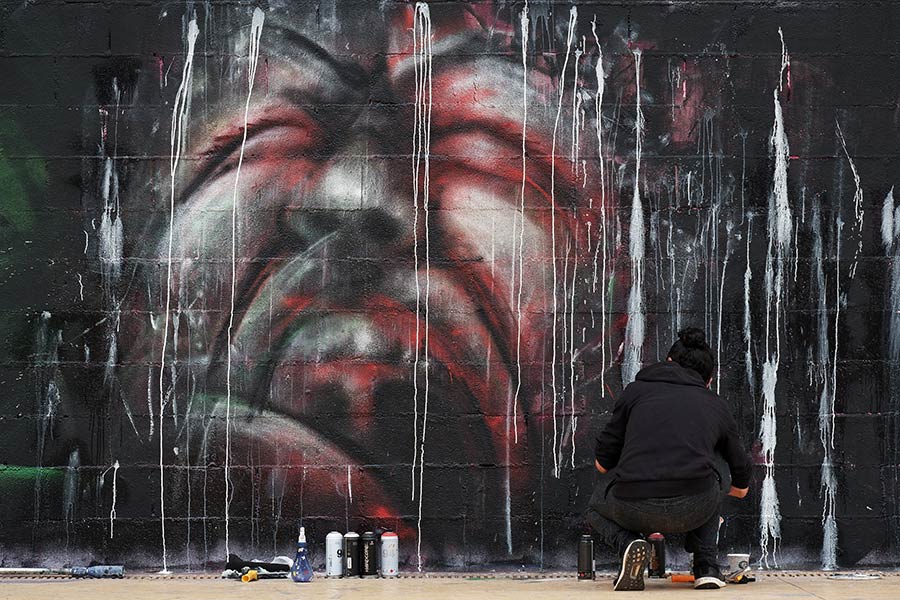
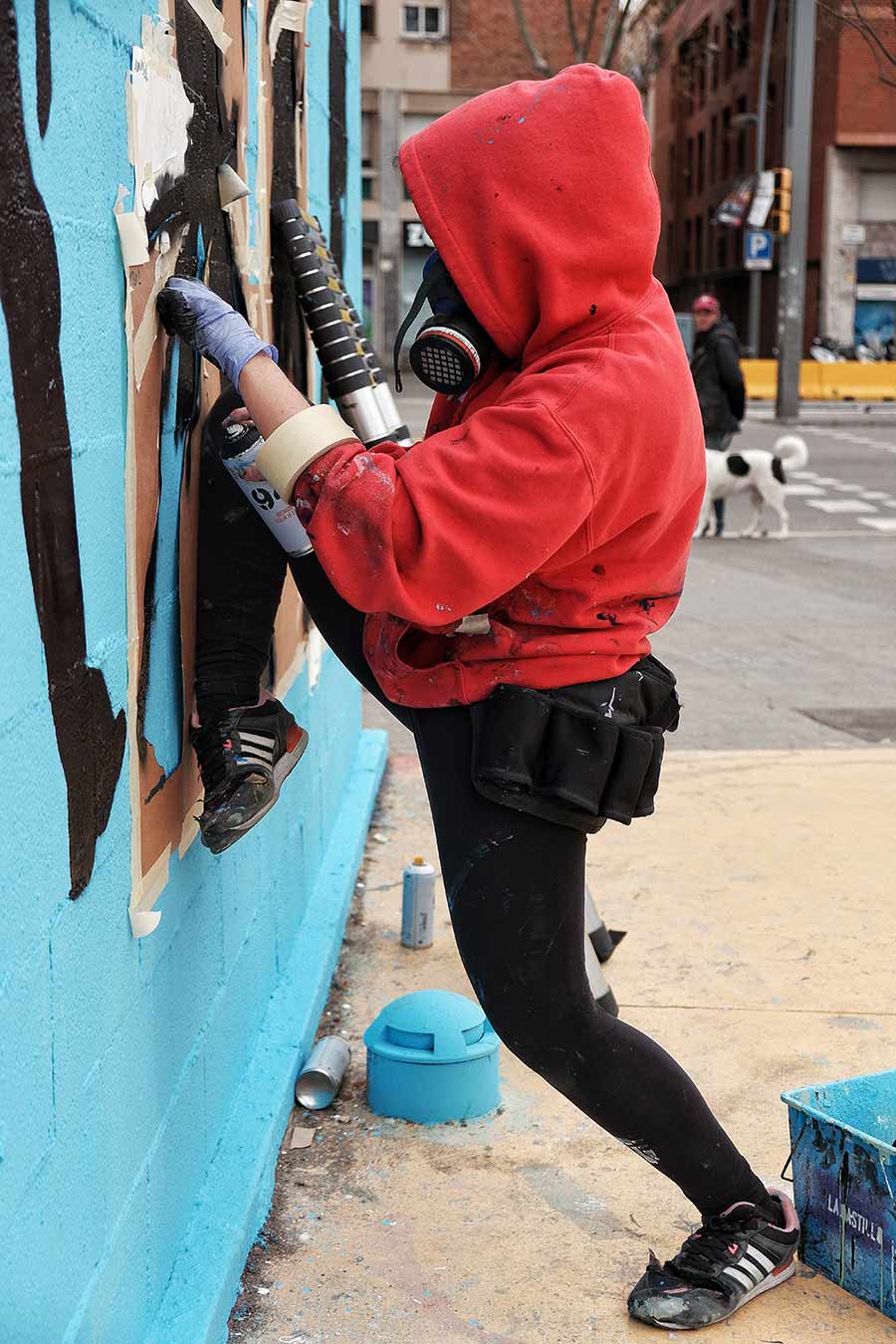
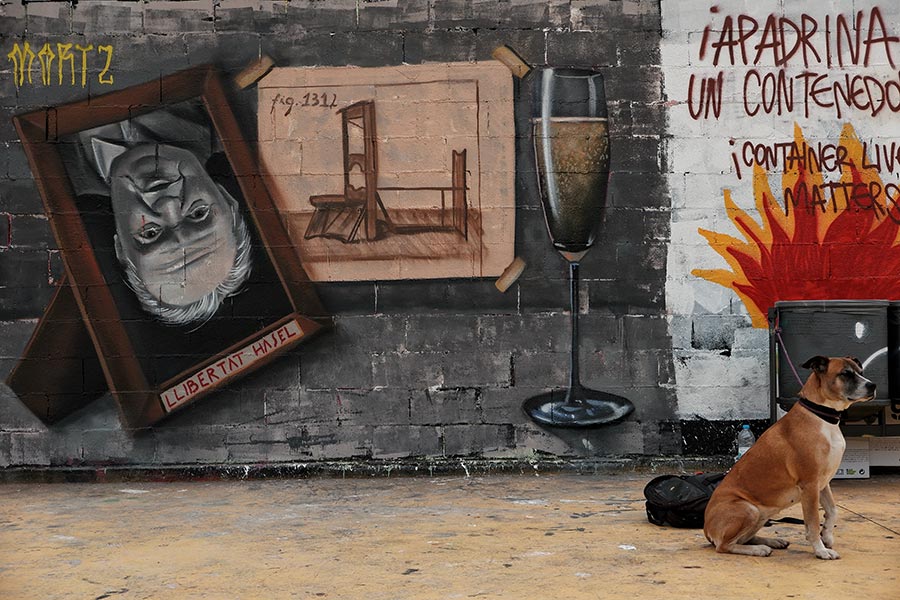
This is our 2nd time to bring you this story from a paint jam in Barcelona’s Plaza de las Tres Chimeneas where a collection of artists gathered to paint works addressing what they see as an unjust attack on the freedom of a citizen to express opinions in lyrics and writings. Taken together, these works are a passionate rejection of censorship and a colorful act of free speech by a community.
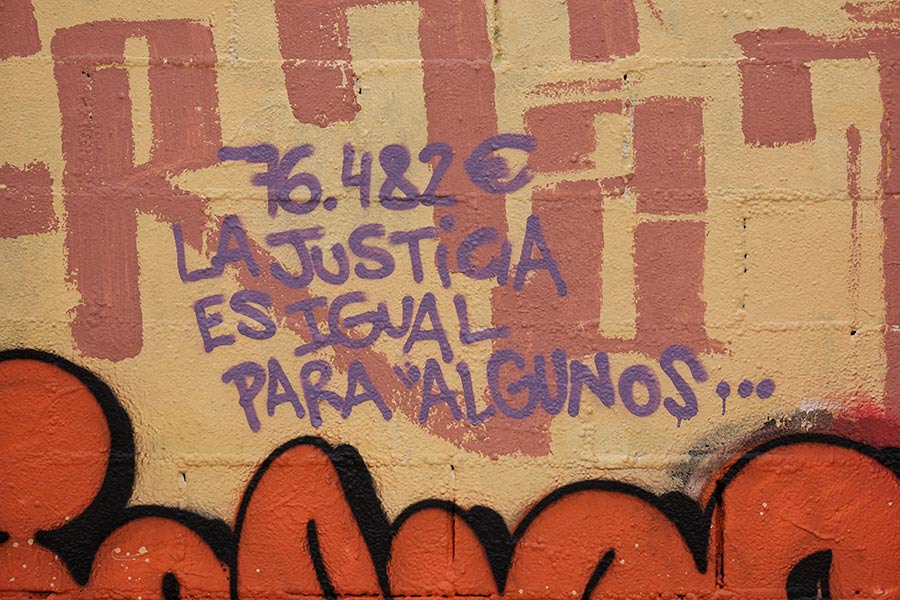
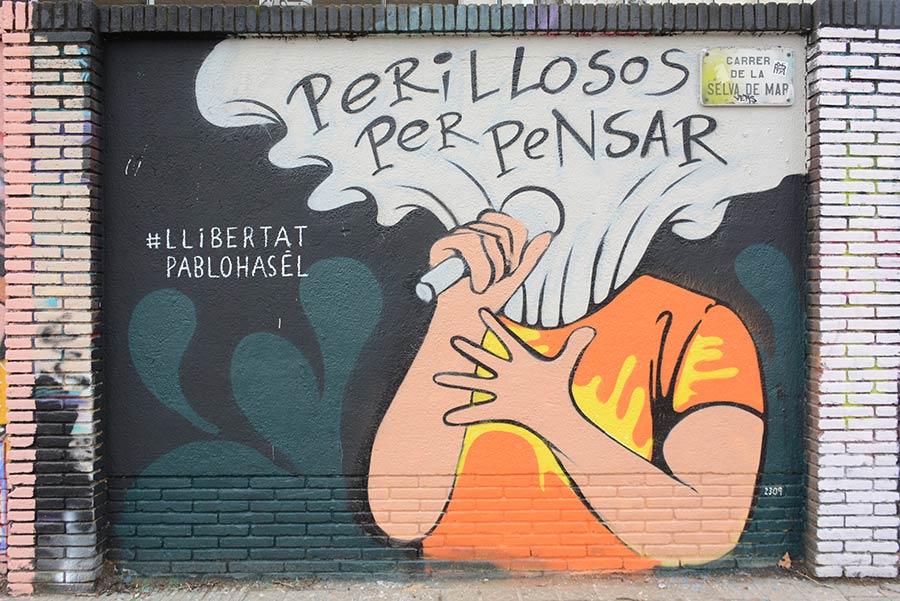
It made international news last month when Pablo Hasel, a Spanish rapper/singer/artist/musician from this city, was imprisoned under a Supreme Court ruling, which found his lyrics about King Emeritus Juan Carlos De Borbon to be offensive.
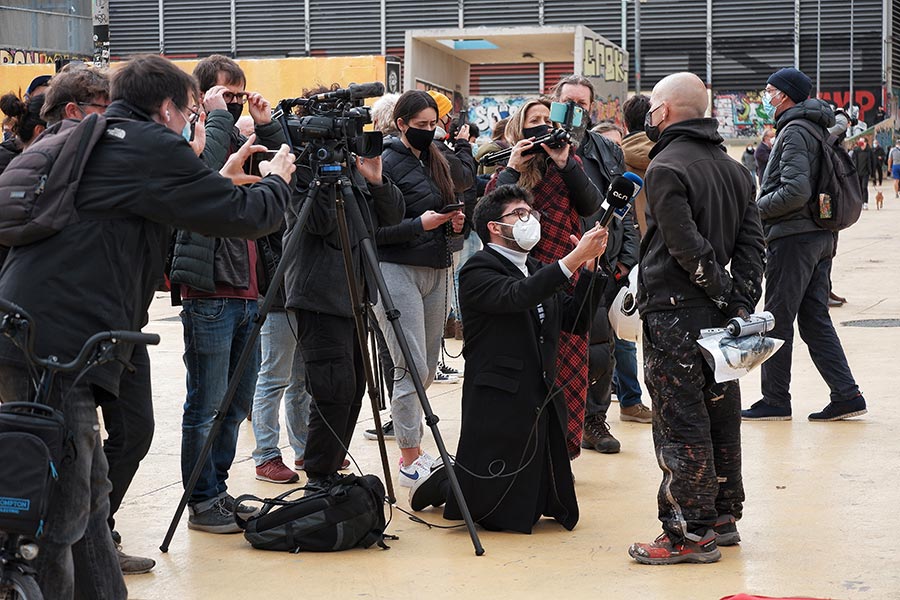
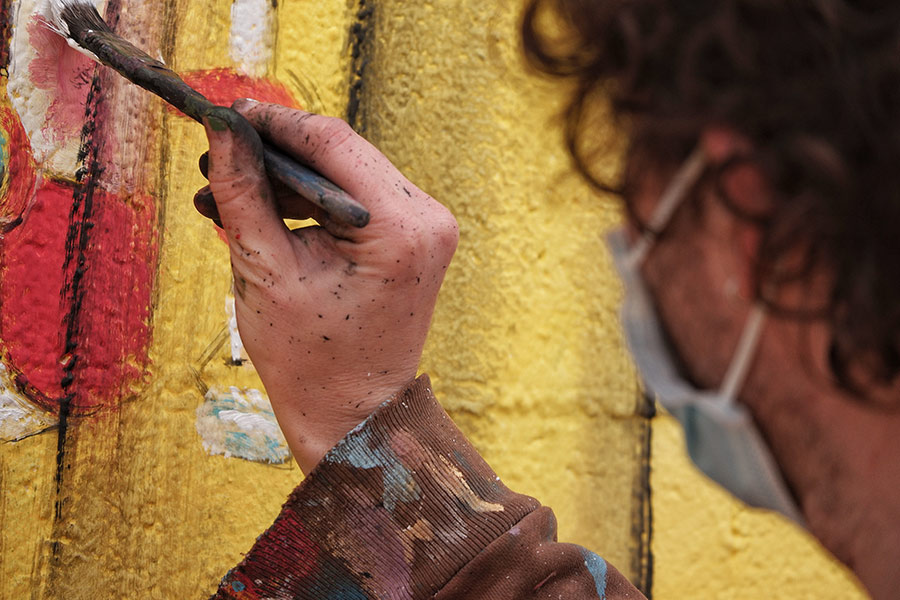
Artist Roc Blackblock was surrounded by a tight semi-circle of scrutinizing journalists and citizens as he painted. This was his second mural since his first had been immediately censored and ordered removed at the action in mid-February by an NCNeta brigade who a Barcelona Urban Guard escorted. He didn’t appear to mind the pressure.
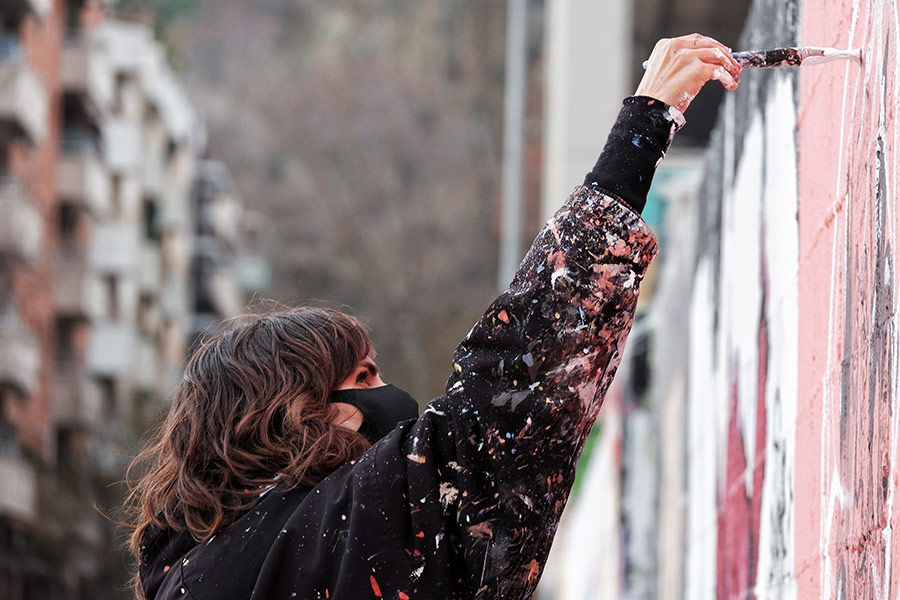
Because there have been demonstrations in various cities and because modern media drools over scenes of destruction and violence, it’s easy to forget the many peaceful artists who paint their opinions, says documentary photographer Fernando Alcalá, who shares his work here.
“I think it’s important to keep speaking about the artistic actions when, after days of riots and looting, the media has forgotten about freedom of speech, and they just talk about burnt trash cans,” he says.
We’re happy that he captured these before they were destroyed by ‘Union de Brigadas,’ who recorded their censorious actions proudly and shared them on Twitter and YouTube.
I think it’s important to keep speaking about the artistic actions when, after days of riots and looting, the media has forgotten about freedom of speech and they just talk about burnt trash cans.”
Like graffiti writers sharing black books and styles, BSA Writer’s Bench presents today’s greatest thinkers in an OpEd column. Scholars, historians, academics, authors, artists, and cultural workers command this bench. With their opinions and ideas, we expand our collective knowledge and broaden our appreciation of this culture ever-evolving.
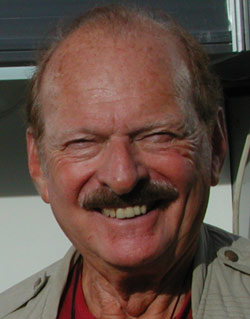
by James Prigoff
Graffiti Documenting and Divinity
A writer once shared with me the following observation concerning the early documentation of modern graffiti, if stated in religious terms.
He said:
Henry Chalfant would be God. Martha Cooper would be the Virgin Mary. Jim Prigoff would be Jesus Christ, Jack Stewart the Holy Ghost.
Subway Art would be the Bible. Spraycan Art the New Testament.
I’m no savior, but I’m proud to have saved some incredible and iconic images of this culture while they were painted and to have met so many talented artists.
My Background
Graduating from M.I.T. in 1947, I set out with my wife and on an eleven-week camping journey to visit the U.S. and Western Canada’s natural wonders. It was then that I became interested in photojournalism to record and share my experiences.
I enjoyed documenting archeological site ruins around the world as a member of the Explorers Club during the 1950s. Still, it was the periods of a geopolitical upheaval of the 1960s, 70s, and 80s that undeniably informed my work. Being a very political person, these events and movements became a strong part of my documentation.
Discovering Tags
It was only natural when I attended a mural slide show in the early 1970s that I became fascinated with the political nature of the art in the streets. I began to seek and document murals all over the world with my camera. While combing the streets of NYC searching for painted murals, tags of all varieties kept getting in my face and grabbing my attention. After seeing enough Taki 183’s, Bio’s, Med’s, IN’s, a few PRAYs on subway platforms, an early Futura of arrows and stars in the west side train tunnel, and a T-Kid 170 on a curb, I took a few pictures of tags. In Philadelphia, I likewise began noting tags of writers, like those by Cornbread, for example.
As I observed the markings, it didn’t take long to realize that something important was happening on the streets. Living in a celebrity culture, how could youth be heard? They couldn’t put their tag on a vanity license plate and very few had the skills to become famous athletes or movie stars, but they could “get up” on the walls of their neighborhood. Pretty soon, they figured out that they could tag subway cars and, as the culture developed, actually do pieces on the outside of subway trains. Not traveling more than a few blocks from the Bronx, they could send their names all the way to Canarsie. Years later, advertisers would take cues from these youth with their ads mounted on trains’ sides.
A Graffiti Timeline
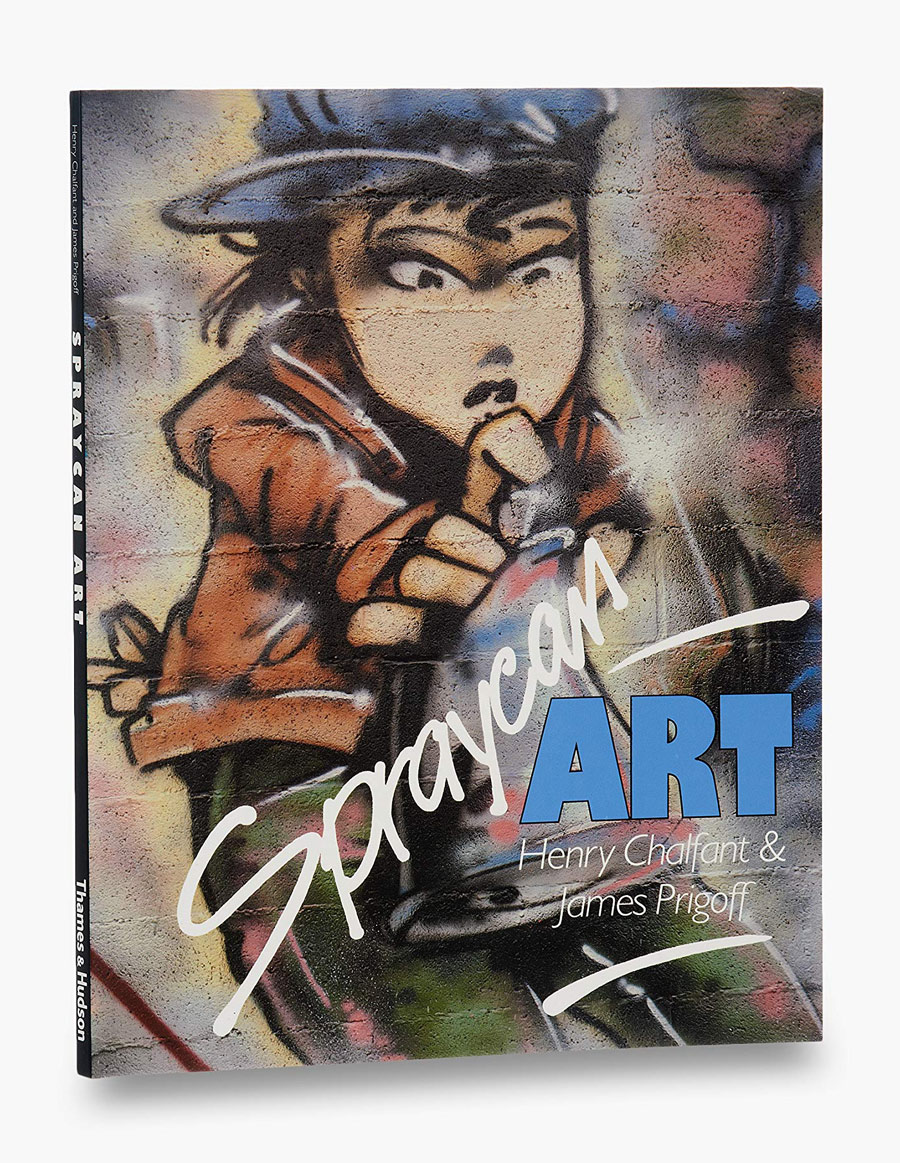
A quick, very minimal timeline sets the stage for worldwide exposure; Taki 183’s notoriety from the New York Times article in 1971 was a wake-up call. Guzman Cesaretti’s “Street Writers” (1975) and Mervyn Kurlansky and Jon Naar’s “Faith of Graffiti” (1975) with Norman Mailer’s essay, listed some 750 tag names. Not always noted, but essential was Craig Castleman’s “Getting Up” in 1982. Martha Cooper and Henry Chalfant’s “Subway Art” (1984), chronicled the New York trains, and Chalfant’s and my “Spraycan Art” (1987) went around the world – those last two books collectively sold over one million copies and were shared with millions more.
Spraycan Art by Henry Chalfant and James Prigoff and published by Thames & Hudson on September 1, 1987.
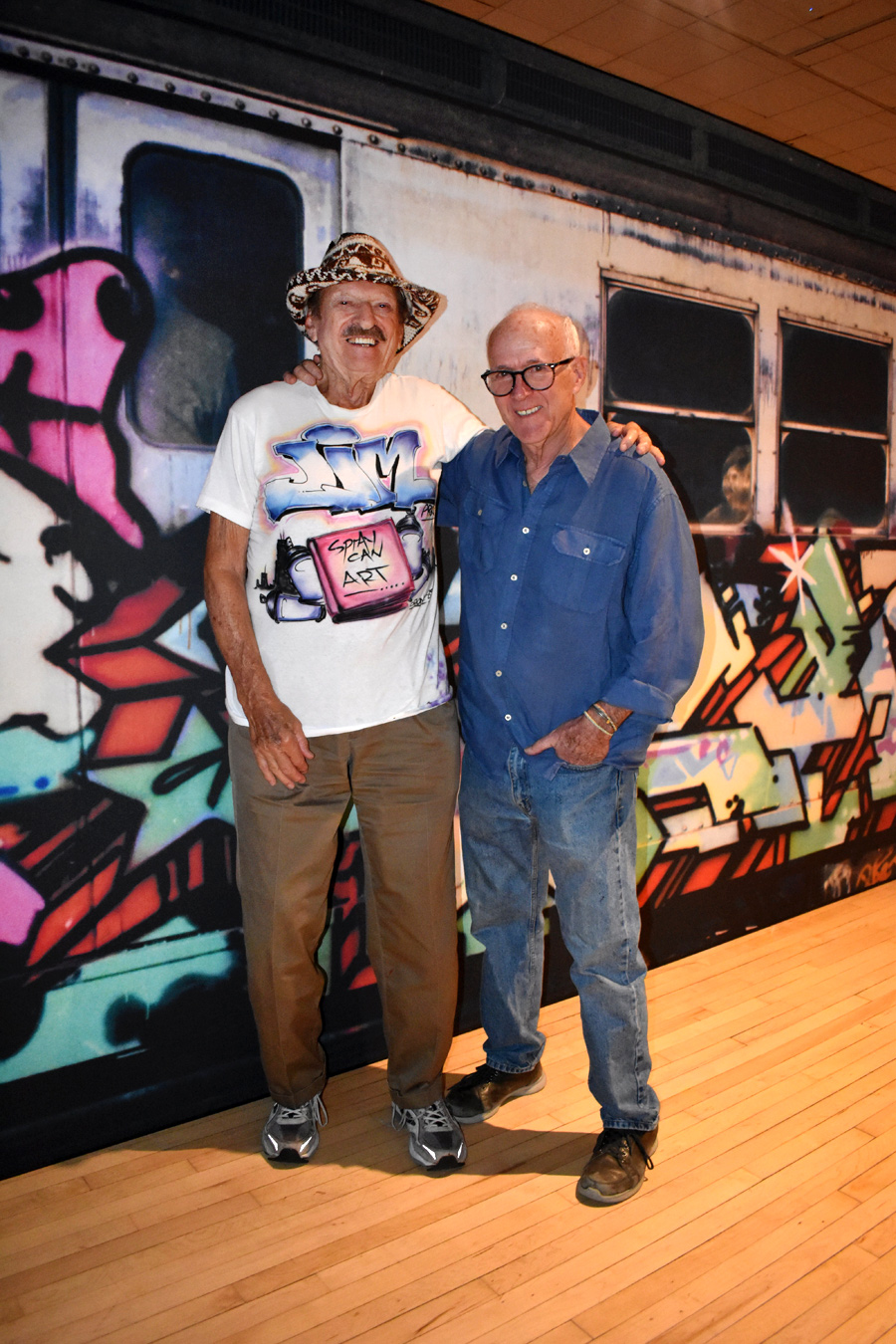
Jim Prigoff and Henry Chalfant at Chalfant’s retrospective Henry Chalfant: Art Vs. Transit, 1977-1987 at the Bronx Museum, 2019
When Tony Silver came to see me in San Francisco to talk about raising money for his iconic film “Style Wars” (1983), I wasn’t much help. But he suggested that the next time I visited NY I should meet his partner Henry Chalfant. That became a life-long friendship. By that point, I had done substantial documentation of the art form, and I wrote to Henry to suggest that he join with me to create a book about how the art produced in the tunnels had come to the walls and handball courts of NYC and then traveled across the country.
Henry’s response was simple. “My brain is Graffitied out” – but – “let’s do it”. It didn’t take long to determine we should go around the world. When working on the book in New York, I would sleep in Henry’s SOHO studio. From time to time there would be a knock on the door at 2 or 3 a.m. The writers would tell me they just happened to be in the neighborhood and they were stopping by to see if anyone was up!
During that time, Graffiti culture also came to the big and small screen: Tony and Henry’s film documentary “Style Wars” (1983), Charles Ahearn’s “Wild Style” (1983), and the more commercial “Beat Street” (1984) directed by Stan Latham each appeared, having a significant impact in terms of educating the public about the scene.
Greater Documentation, Artworld Interest, and Proliferation on the Internet
There appears to be a lapse regarding documentation for much of the 1990s. Still, beginning in the early 2000s, there appeared to be a near over-saturation of graffiti books and films produced from all over the world. “Graffiti World” by Nicholas Ganz and “The History of American Graffiti” by Roger Gastman and Caleb Neelon stand out for me. Also notable are Alan Ket’s many graffiti and Street Art titles, which I believe number into the teens. Alan, Carlos Mare, and Allison Freidin opened the Museum of Graffiti in Wynwood, Florida, in 2019, and it has become a world destination to visit.
Artist and documentarian Jack Stewart captured the very early trains, but not many people knew of him because he only wrote a Ph.D. thesis on the topic, and the information wasn’t widely shared. It wasn’t until the late 2000s, after he had passed that his wife finally had his important work published, Graffiti Kings: New York Mass Transit Art of the 1970s.
In the 1980s, major art dealers’ efforts in the US and Europe to move the art form indoors to canvases eventually fizzled as writer’s hours and art dealers’ working days were greatly at odds. But during that decade, Patti Astor’s FUN GALLERY had a major impact along with Fashion Moda in the Bronx, and Sydney Janis began showing the art as early as 1984 at his uptown gallery on 57th street.
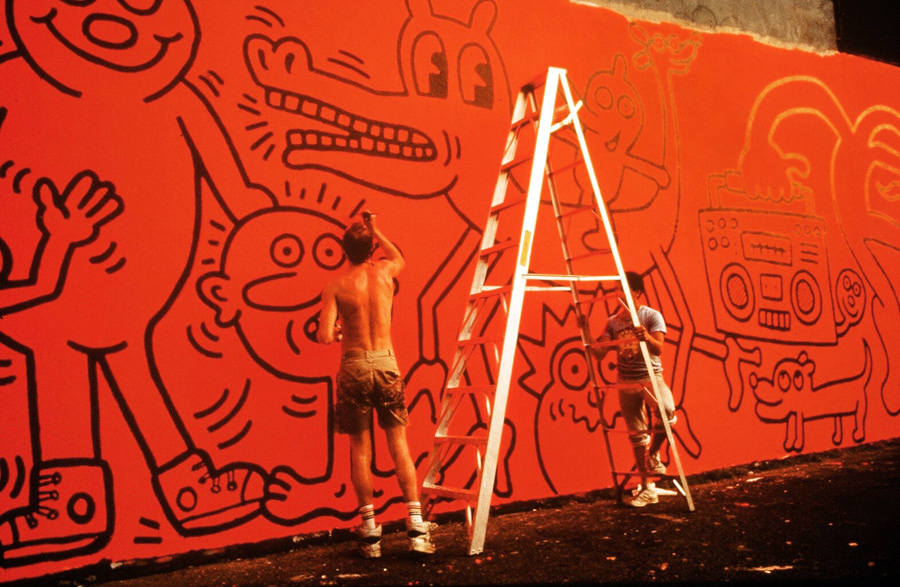
The elite Artworld is always looking to find “stars,” and the eighties produced two who would enjoy the accolades and collectability of many of the famous pop-artists. Through their association with Andy Warhol and their own outstanding talent, Keith Haring and Jean Michel Basquiat became the focus of the collectors, in a way that was overshadowing to many other very talented spraycan artists.
And then there was the Banksy phenomenon.
The Internet changed everything. No longer printing pictures and exchanging them by snail mail, there arrived emails, Tumblr, Facebook, Instagram, Graphotism, at 149TH st., Aerosol Planet, and a thousand websites that gave instant access to everything that was happening worldwide. Susan Farrell’s “Art Crimes” was the granddaddy of such sites.
An ever-shifting ecosystem of Graffiti and Street Art websites like BSA have assumed an integral role in analyzing, collecting, and disseminating images, stories, history, and context for hyper-local and more international scenes as they continue to evolve now. Add to all of this the writers who became Graffiti magazine publishers, numbering hundreds if not thousands, and the exposure has become enormous.
From Tags to Throw-ups, to Pieces – to Masterpieces – to Murals – to Street Art; Now it is being referred to as Urban Art, even Urban Contemporary Art.
Commercial Interest, Murals, Museums, and Art vs. Vandalism
Today, cities around the world hold week-long events painting the walls with artists both local and international. Murals convert towns into destinations, often replacing lost industries. Today the number of these events appears countless.
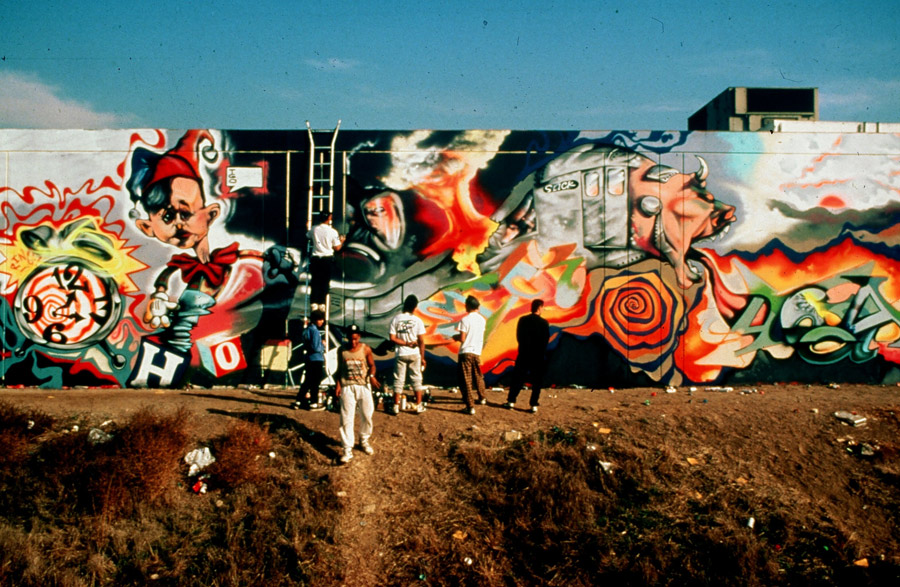
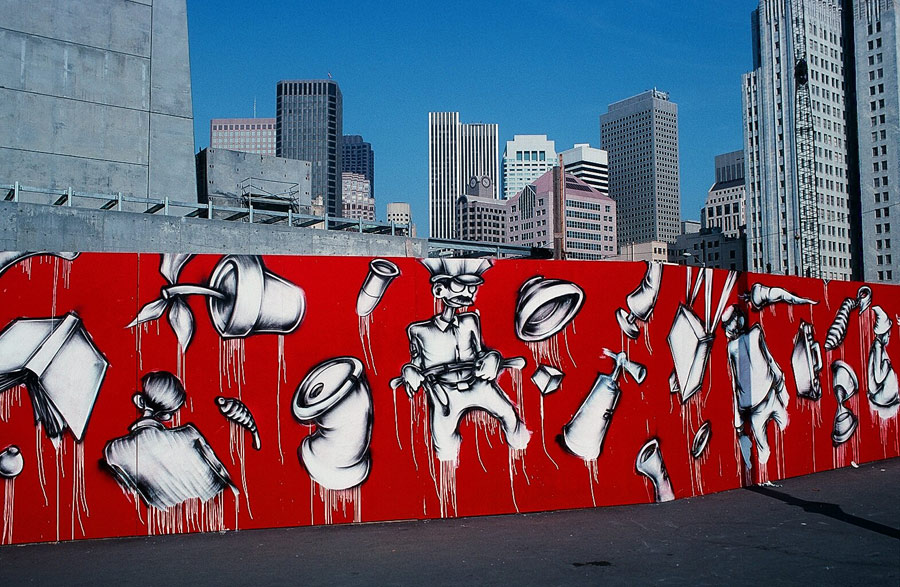
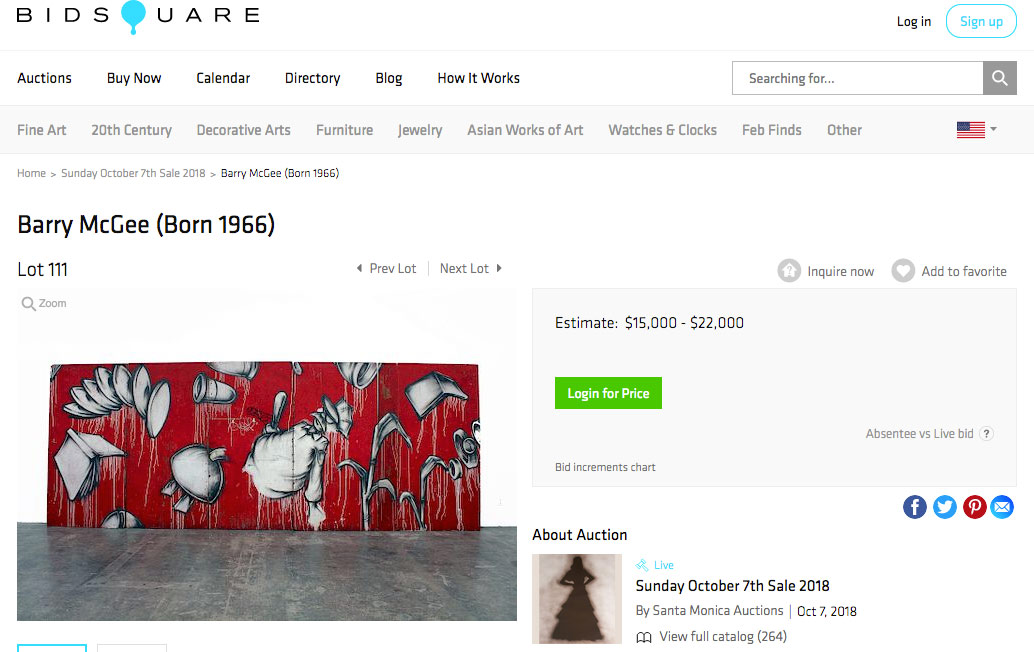
In recent years major exhibitions have moved the art form to a new level of institutional recognition; “Beautiful Losers” (2004) at the Yerba Buena Museum in SF, The Tate Modern’s “Street Art” in (2008), L.A. MOCA’s “Art in the Streets”(2011). The Wynwood Walls project in Miami got its start as a new mecca for Graff in (2009), Shepard Fairey’s (2010) one-person show at Boston’s ICA, Basquiat at the Musee d’Art Moderne in Paris, Haring in multiple exhibits and cities, Barry McGee as well, and JR got a Ted award. Banksy’s “Exit Through the Gift Shop” film found a broad audience and was nominated for an Academy Award. (2011). In 2018 Roger Gastman curated “Beyond the Streets” in Los Angeles and followed that show in 2019 in Brooklyn. The Bronx Museum had a retrospective of Henry Chalfant’s train documentation and his many other involvements in the Hip Hop movement (2019)
In Europe, collectors have been acquiring the early art as Art Curiel in Paris has held many highly successful auctions that fetch high five-figure bids and even six figures for canvases. A Kaws in Hong Kong recently sold for $14 million, and a Basquiat went for $110 million at a Sotheby’s. While thinking historically about the earliest tags, I coined the phrase “From Tags to Riches.” It seems very appropriate now. Another of my favorite sayings is “Commercialism Co-opts Oppositional Culture.” Nothing could be truer as images of spraycan art have been used to promote many commercial products.
At one point, the title of many discussion panels was “Is it Art or Vandalism,” or a variation of it. I stopped participating in such forums back in the eighties because I was not too fond of the simplistic characterization. Vandalism, yes. However, some of the works and the culture that was created contributed significantly to what would become the most important art form of the last fifty years. Writers liked the term “illegal” because it was more daring. For me, in lectures, I always referred to the art as permissioned and non-permissioned.
A Few Other Observations
Who Gets to Write on the Bus?
If you are an advertiser, it’s no problem. If you are Jerry Brown running for President with a marketing war chest, you can hire Frame from LA to paint a whole bus with your name on it and have it driven around Washington. But if you are a graffiti tagger, it would be a $10,000 fine and six months in jail if you were caught.
This Practice Has a Long History
Modern graffiti is said to have started around 1969, but humans have been decorating walls in places like Lascaux in France and Altimira in Spain in 17,000 B.C. Recent finds in Madagascar go back to perhaps 60,000 B.C. Yanomami tribes-people in the Amazon left their handprints on walls, Graffiti on the lava covered walls of Pompei, conquistadors wrote their names outside of Gallup, New Mexico in 1624, and French soldiers wrote on walls at Angor Wat in Cambodia in 1804. More recently, “Hi Mary from Des Moines” was tagged on the Berlin Wall.
Artists Whose Work Impacted Me
I focus primarily on the US and its writers here, leaving the rest of the world for future in-depth commentary by those who live abroad and have greater expertise. The practice of naming names is disastrous when you have limited space but since I have named a few already, let me take the risk of a few more who have been important connections for me along the way – with apologies to all those whose names I believe deserve to be here:
BLADE, who claims 5,000 trains, FREEDOM and his famous NYC tunnel, HOW/NOSM, who have painted giant murals in over 70 countries, SEEN, LEE, LADY PINK, THE TATS CRU, DAZE, CRASH, BRETT COOK AKA DIZNEY, MARK BODE, TWS and TMF CREWS SF, APEXER, CHAZ BOJORQUEZ, the Godfather of Graffiti, RISK, HEX, SLICK, RETNA, MARKA 27, CALEB NEELON – SONIC, BILL DANIELS.
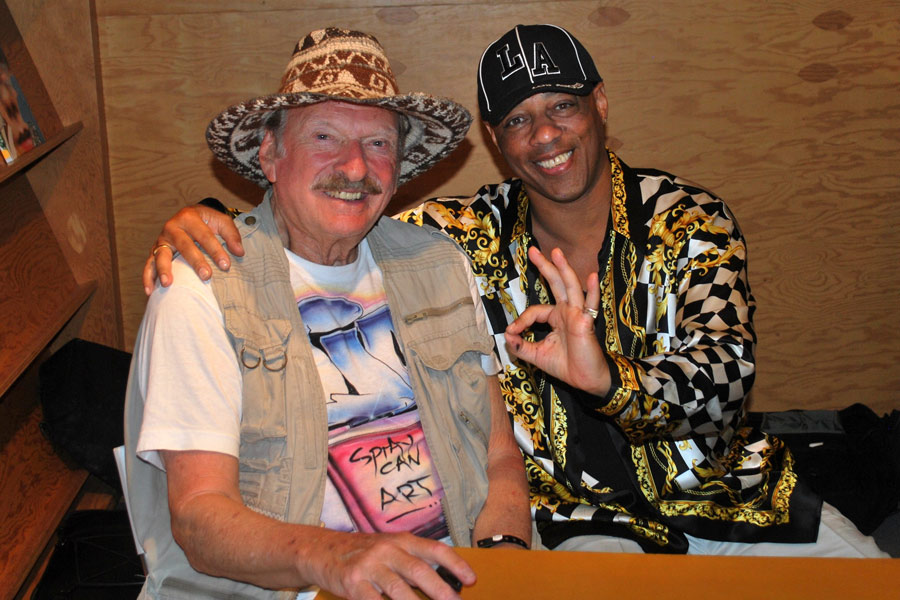
Jim with Blade, 2019
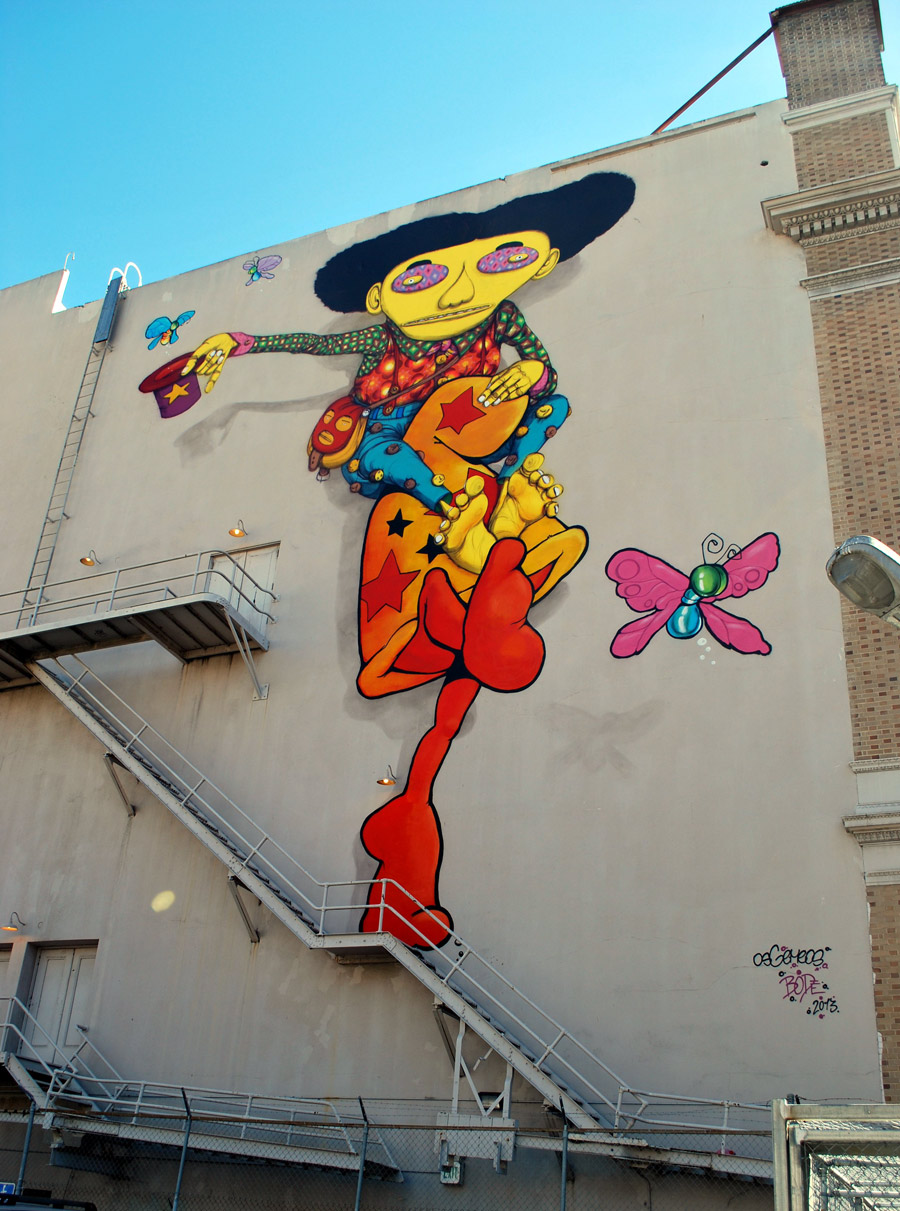
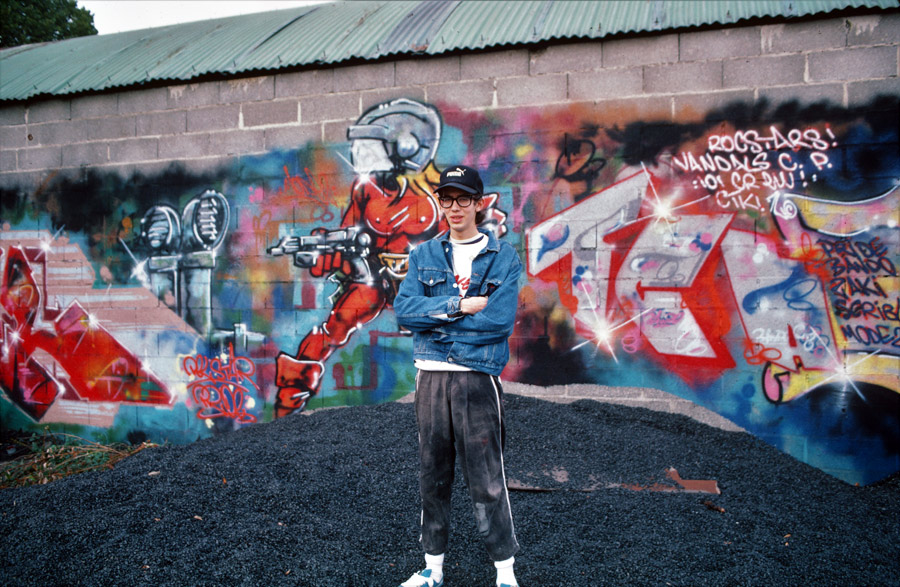
I also want to mention a few writers who came to the states to paint. The Os Gemeos twins from Sao Paulo, Loomit from Germany, D’Mote and MAD C from Australia, ASKEW from Auckland, Herakut from Germany, BEN EINE from London, BLEK LE RAT from Paris, ROA from Belgium, Bando and Mode2 from Paris, and SHOE from Amsterdam.
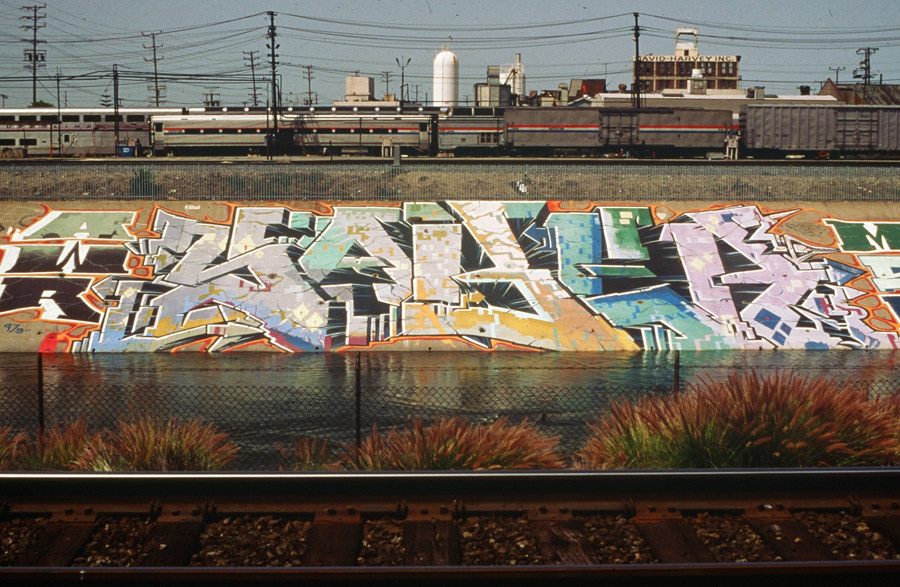
In my years documenting the scene, the only close call I had was a result of my own misjudgment. I was on the Pelham Amtrak tracks with SAR and SACH, and suddenly someone shouted “train coming!”. I ran to the wall instinctively, without thinking about the spatial requirements that the train would occupy – it would overhang the track, and I would be crushed against the wall. My companions began shouting at the top of their lungs that I should reverse course. That forceful and timely guidance perhaps helped me set a broad-jump record: I leaped across the tracks to safety while the train rushed by. I thank them for that.
James Prigoff is co-author of Spraycan Art with Henry Chalfant (1987), Painting the Towns: Murals of California with Robin J. Dunitz (1997), and Walls of Heritage, Walls of Pride: African American Murals with Robin J. Dunitz (2000).
His photographs have been exhibited in galleries and museums, including: Art and Design Museum (LA), Brooklyn Museum, Cambridge Arts Council, Crystal Bridges Museum of American Art (Arkansas), de Young Museum (San Francisco), Los Angeles Museum of Contemporary Art (LA MoCA), Museum of Graffiti (Miami), Oakland Museum, Smithsonian Museum (Washington, DC), Tate Modern (London), and The Broad Museum (LA)
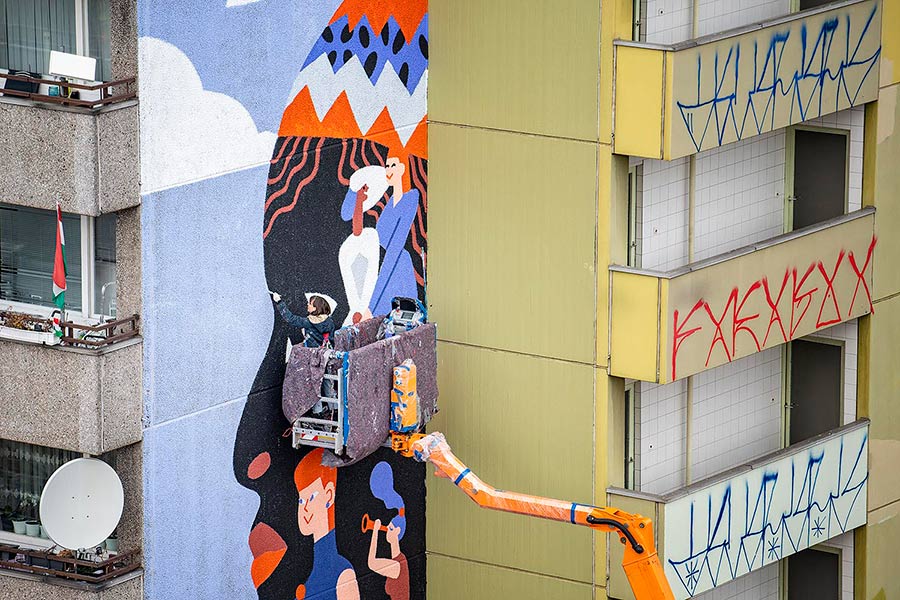
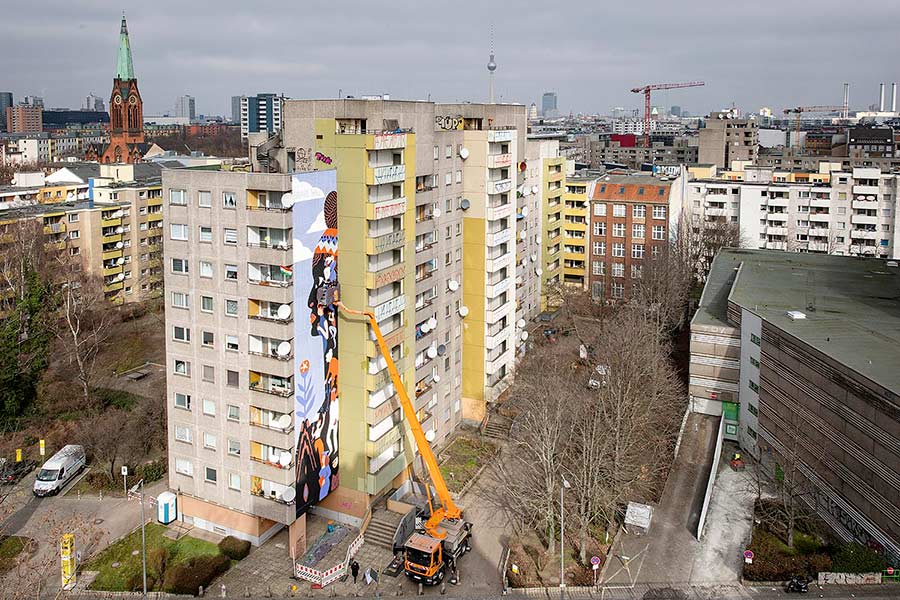
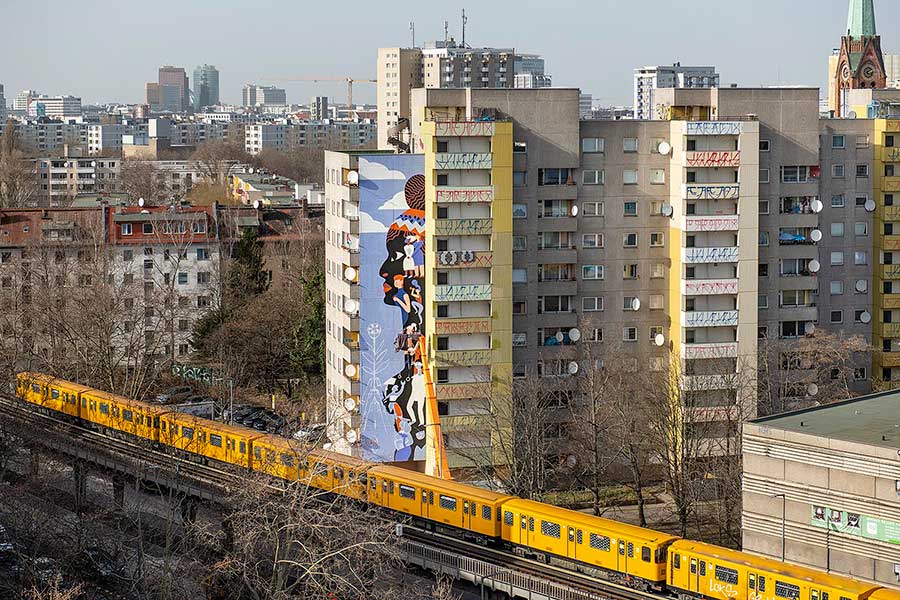
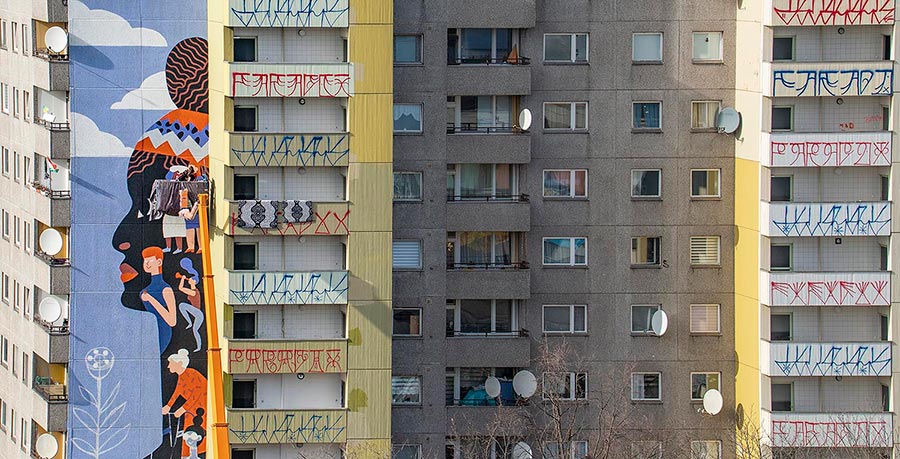
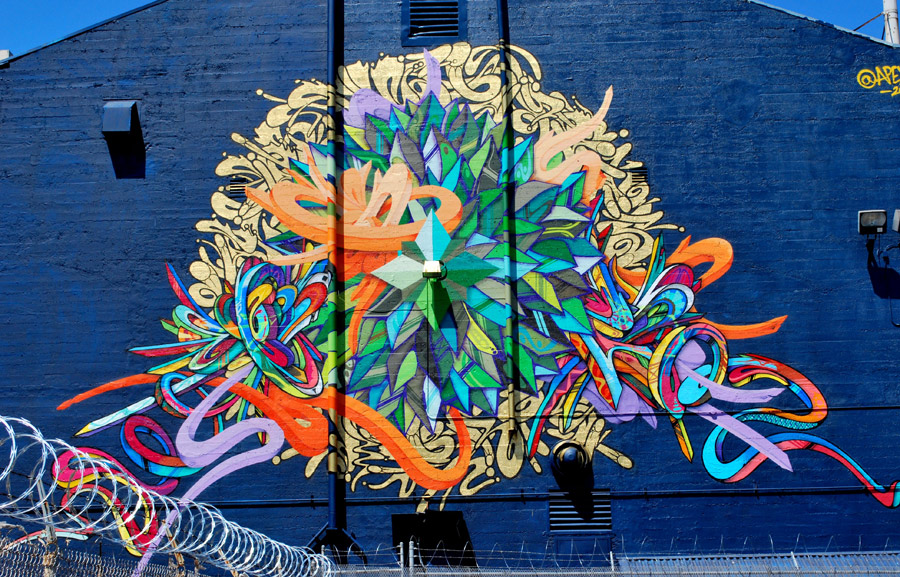
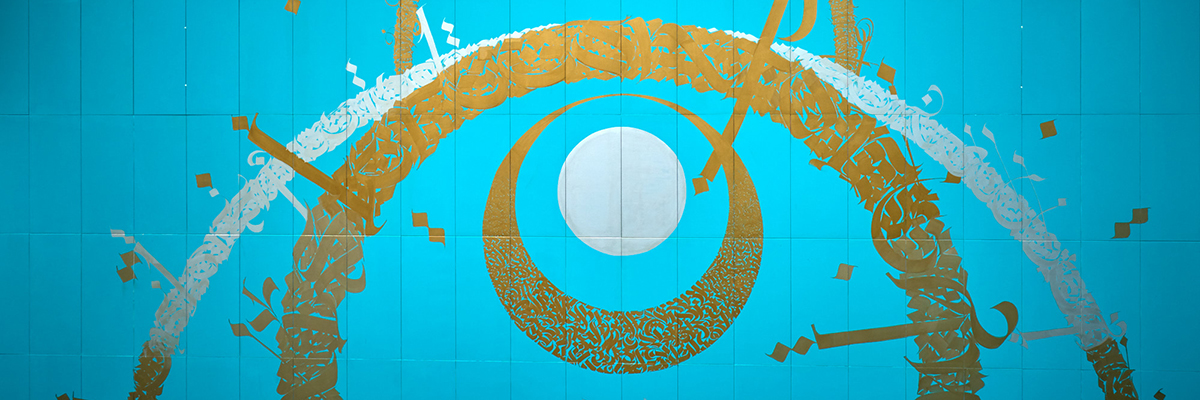
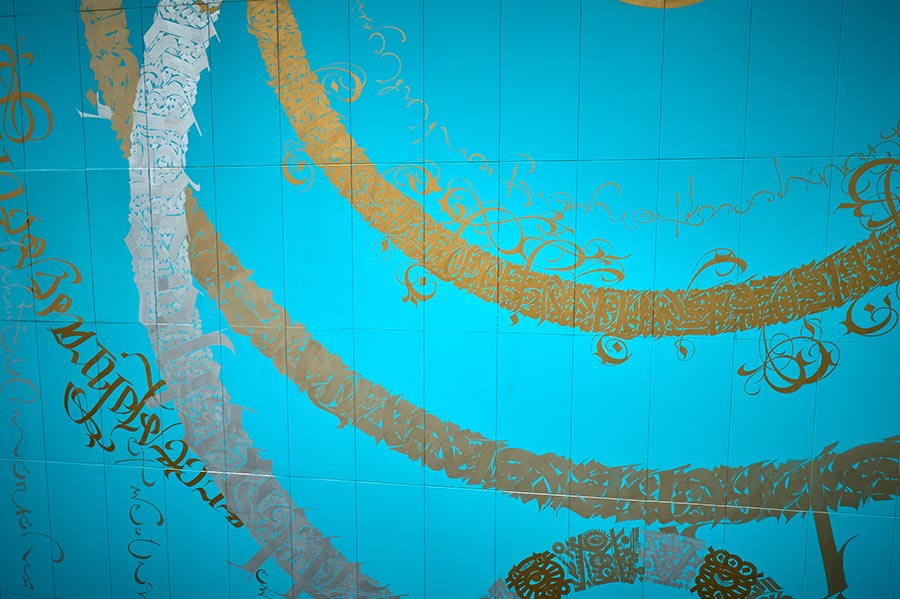
Calligraphist and decorative painter Tarek Benaoum has Algeria, Italy, and French in his blood, but it’s all gold when he writes across walls. A graffiti writer who studied script formally in his early twenties, his hybrid of Arabic and gothic takes him from wall to canvas in both hemispheres.
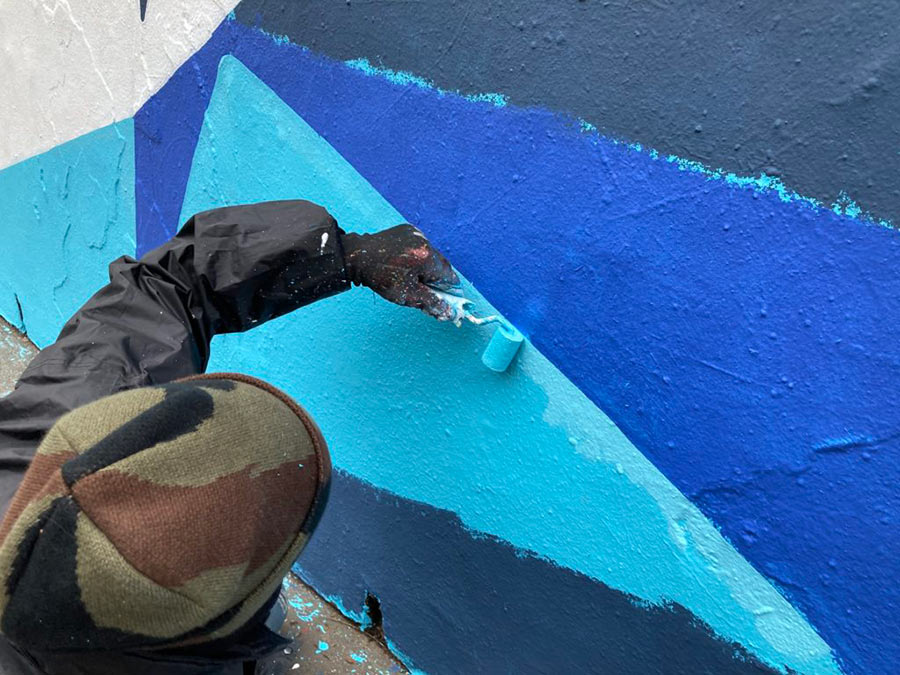
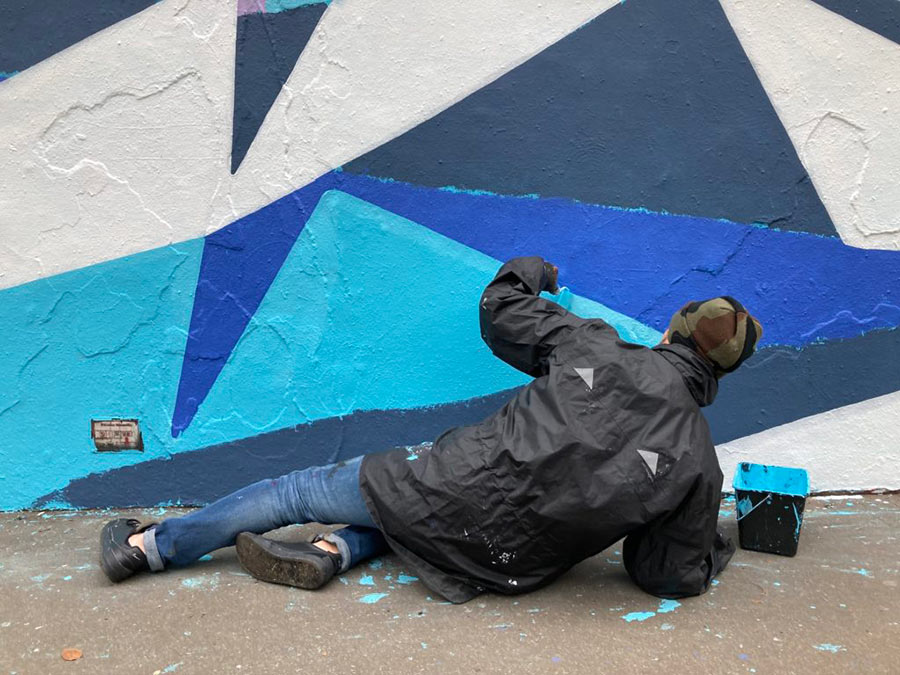
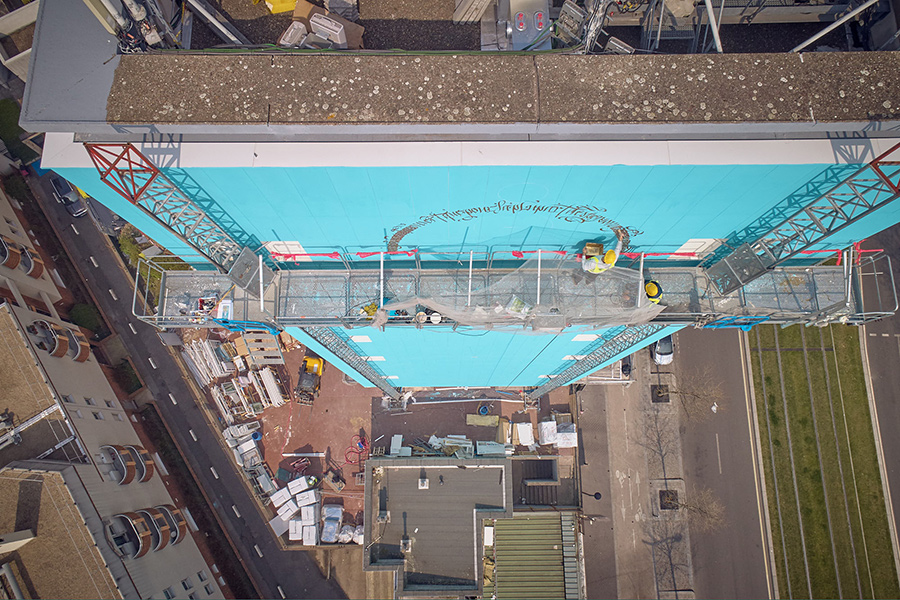
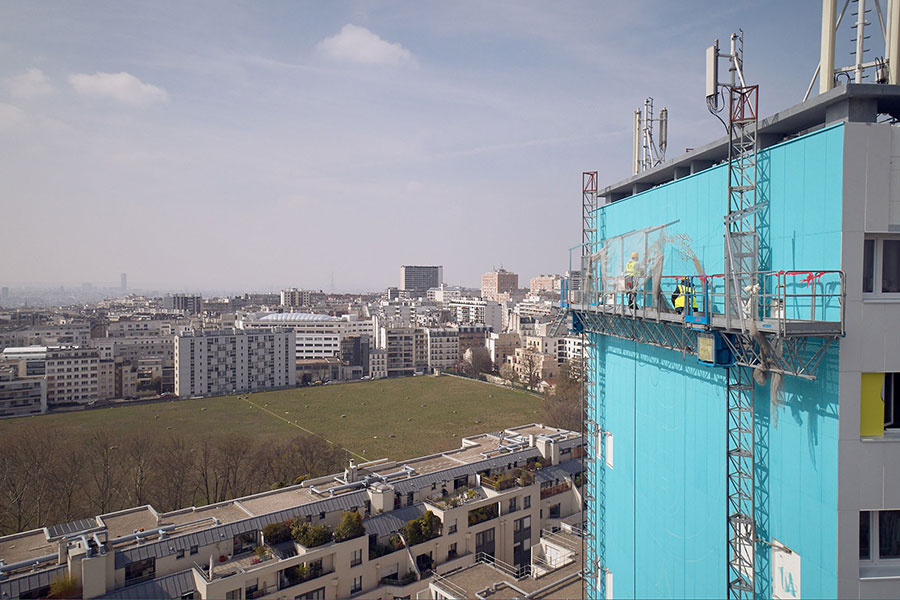
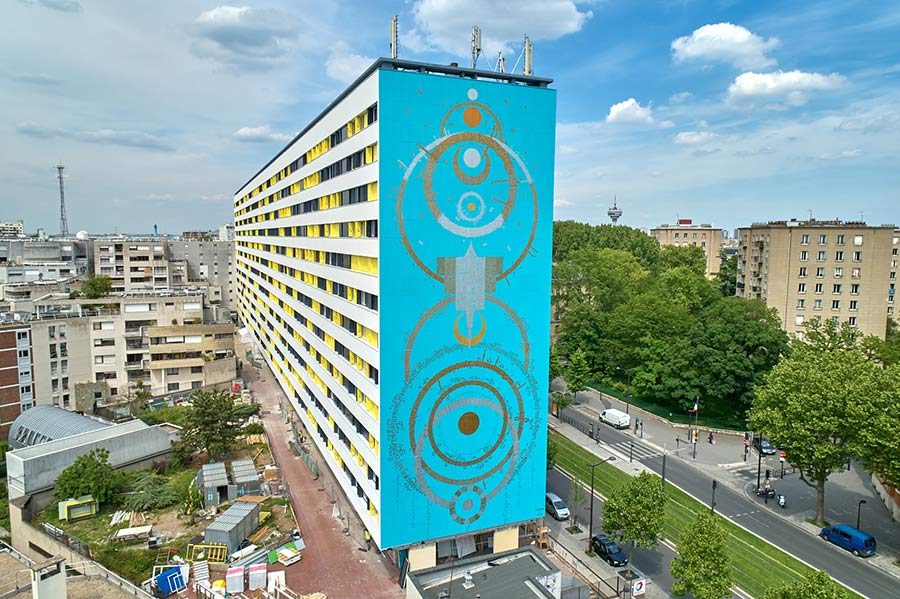
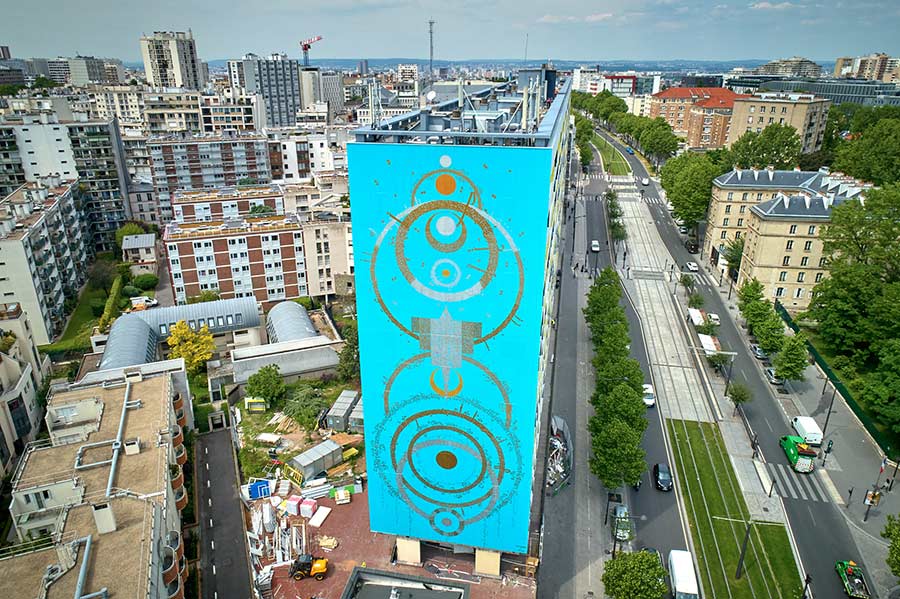
At the request of the Parisian public housing agency Régie Immobilière de la Ville (RIVP), Art Azoï conjured a solution to rehabilitate this massive structure with a mural that would resonate with the locality and its residents. The Salé-born Benaoum rose to the challenge with a 40 x 15 meter mural in his signature blue and gold on the south gable of this building on the boulevard Mortier in the 20th arrondissement.
Standing at the outer rim of these circular motifs are texts by the Indian philosopher Jiddu Krishnamurti from his 1969 book Freedom from the Known (Se libérer du connu), a treatise on the only worthwhile revolution: inner liberation.
Among the famous quotes often remembered from the book is this one, “To be free of all authority, of your own and that of another, is to die to everything of yesterday, so that your mind is always fresh, always young, innocent, full of vigor and passion.”
Welcome to BSA Images of the Week. Happy Purim! Streets in Brooklyn were wild with Hasidic Jews in funny costumes the last couple of days, accompanied by loud music and seemingly drunk men weaving through the streets.
“The efforts of underpaid artists and arts professionals have always powered NYC, but in an ongoing crisis, NYC is turning its back on them,” Nuyorican Poets Cafe Executive Director Daniel Gallant told the Daily News this week, referencing job losses that have affected 2/3rds of New York’s creative community. We are in crisis. And national leaders have been quibbling over a $1,400 check – which is only the third check for poor and middle-class people in a 1 year period. One month’s rent can be that much.
Thanks to the hate speech of many, including Donald Trump during the last year, there has been an increase in violence against members of the Asian community on the streets in New York and across the country. Yesterday hundreds rallied in NYC to protest attacks on Asian Americans. Clearly, it’s time for us to stand up and protect our brothers and sisters and to shame those who would harm them in any way. “We will not allow them to thrive. We will not allow them to succeed,” said Attorney General Letitia James.
Meanwhile on the street we have been seeing a boon of new creative displays by artists – with a broad sweep of themes and techniques.
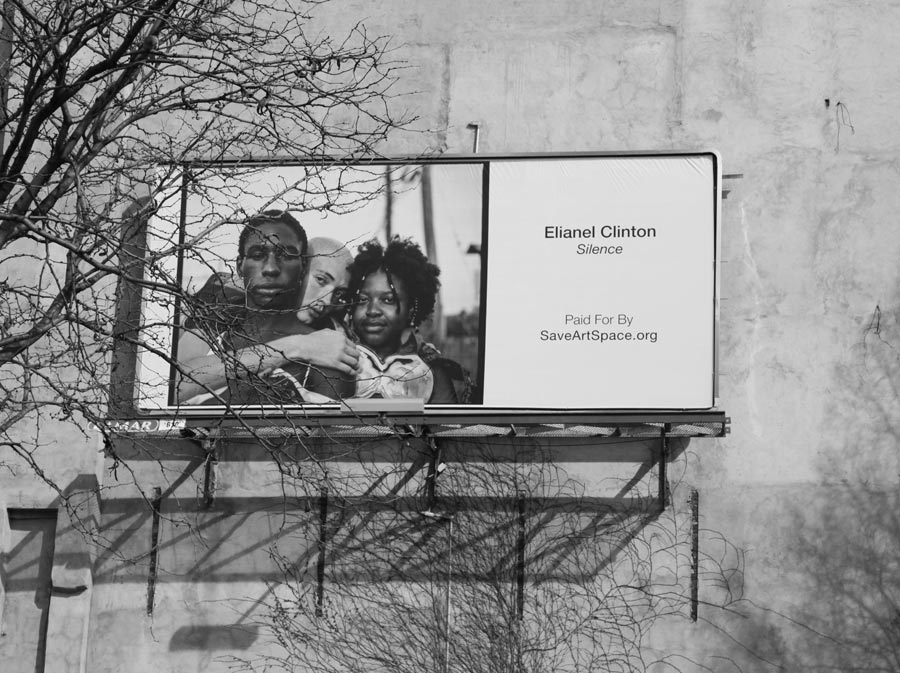
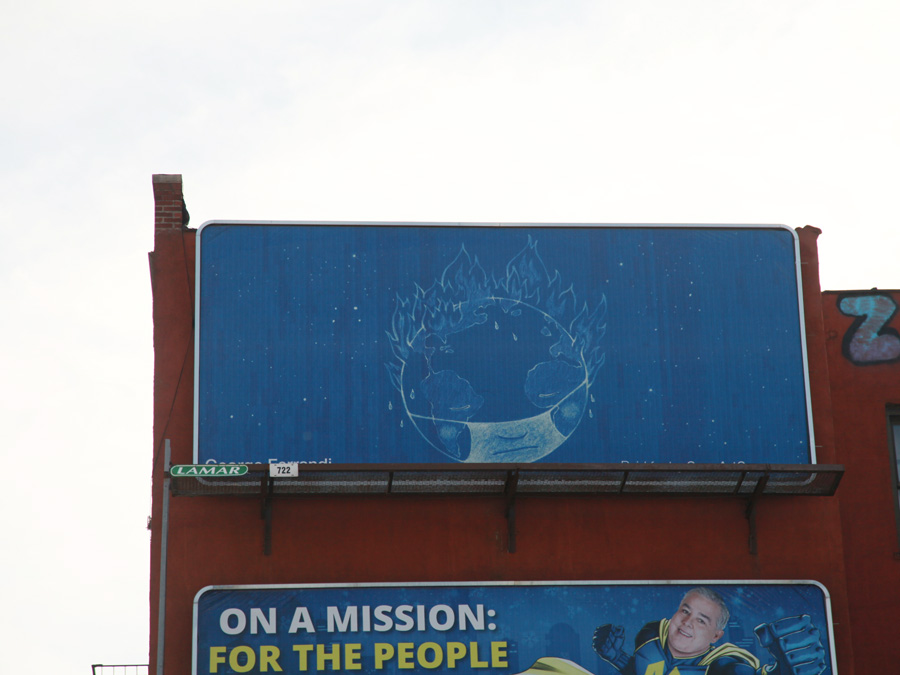
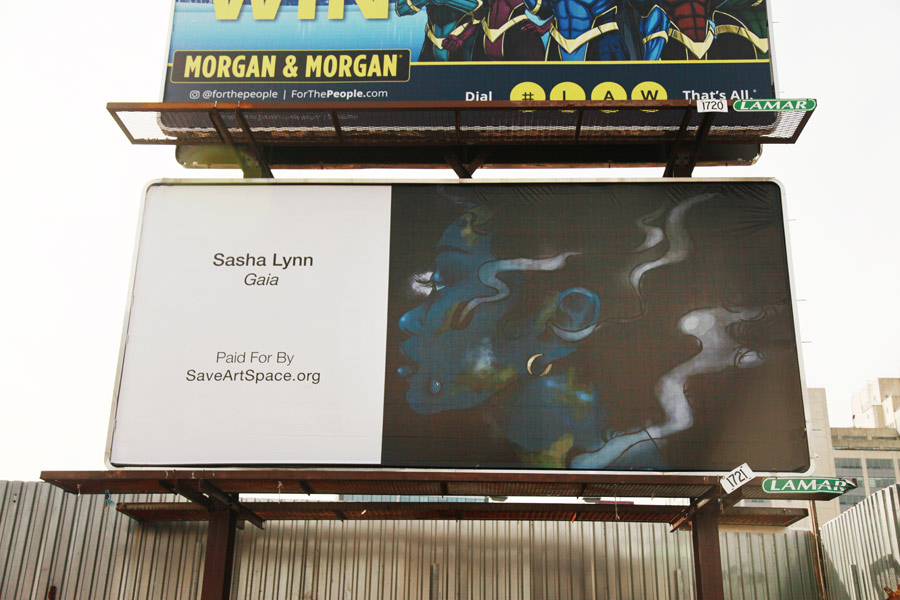
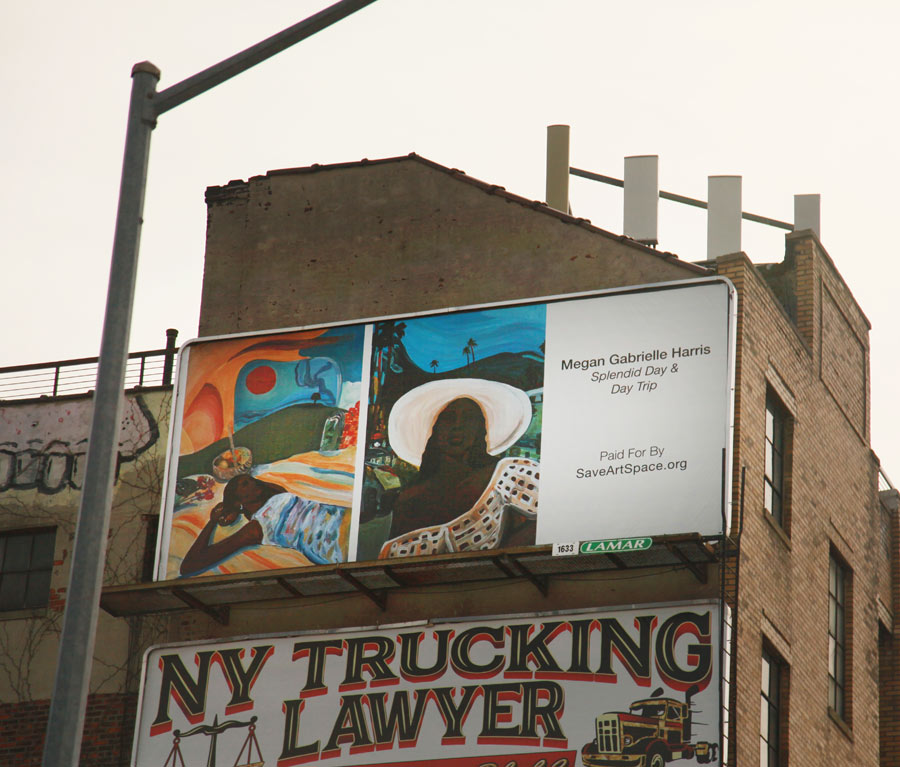
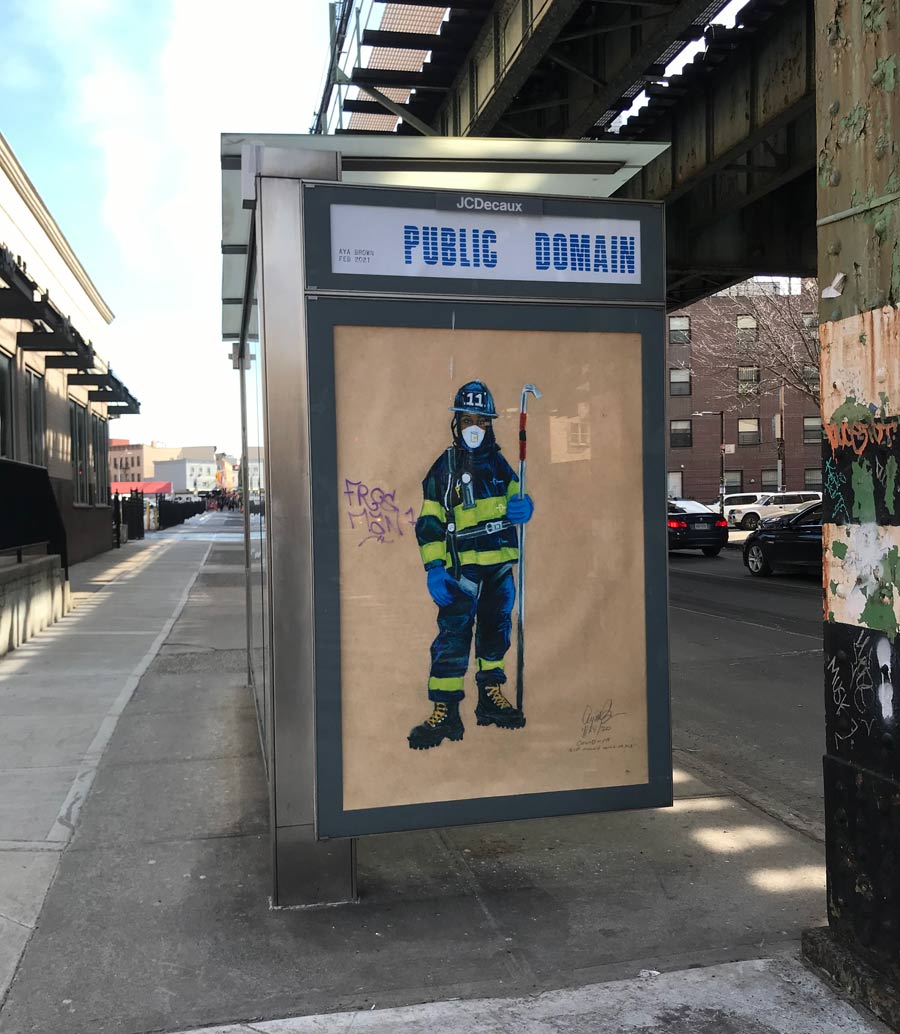
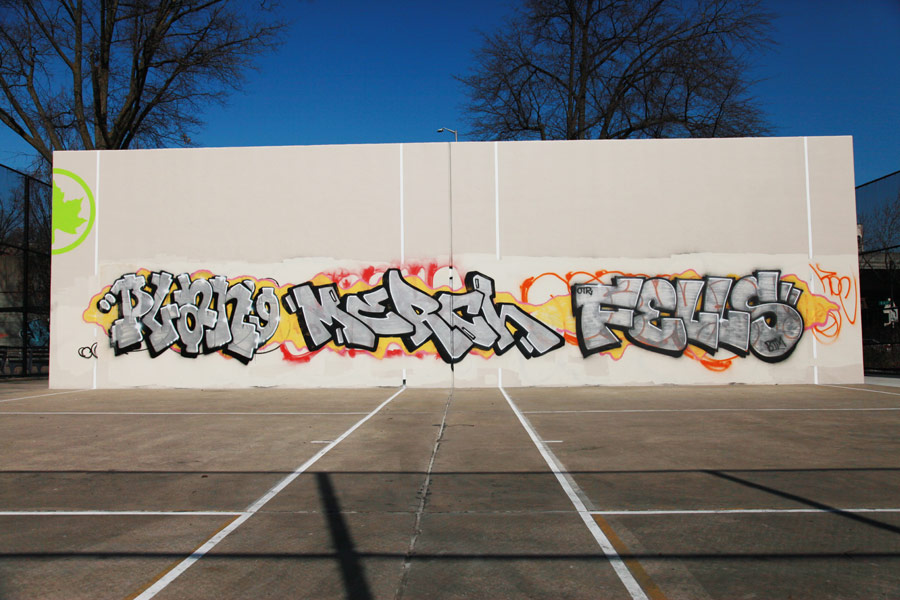
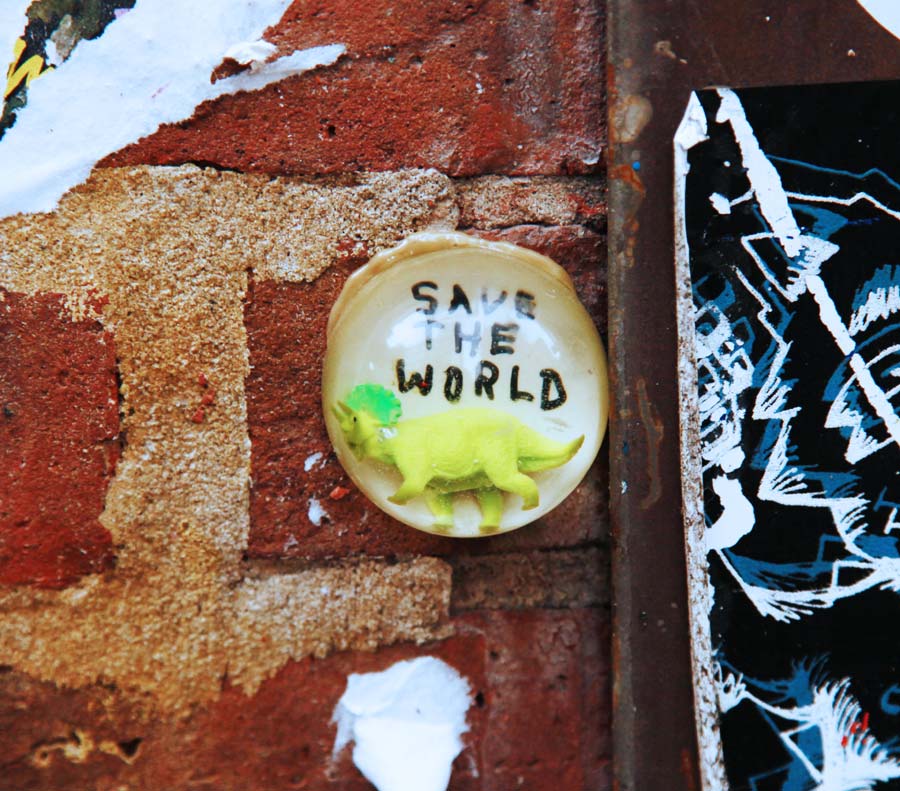
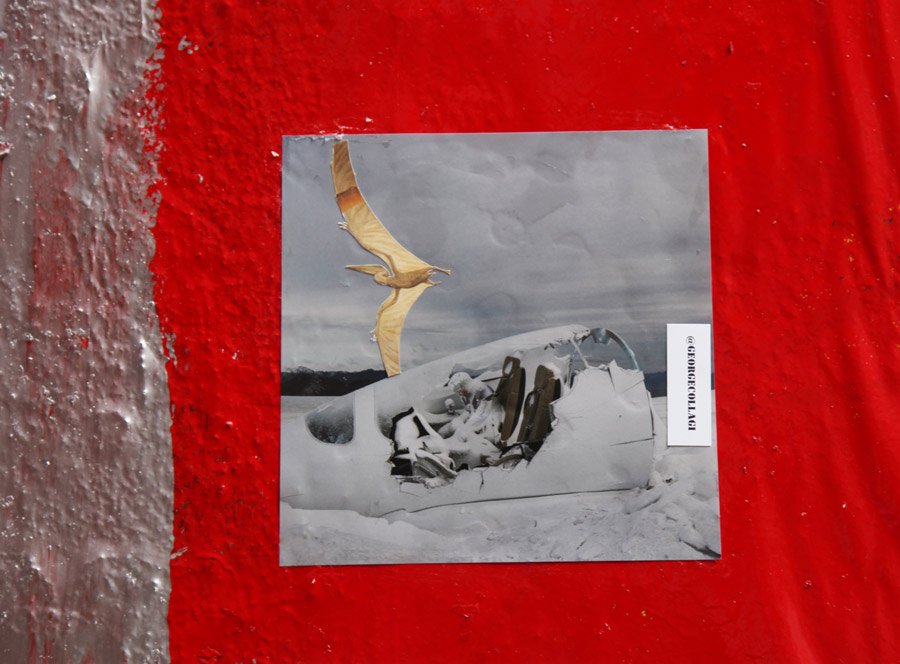
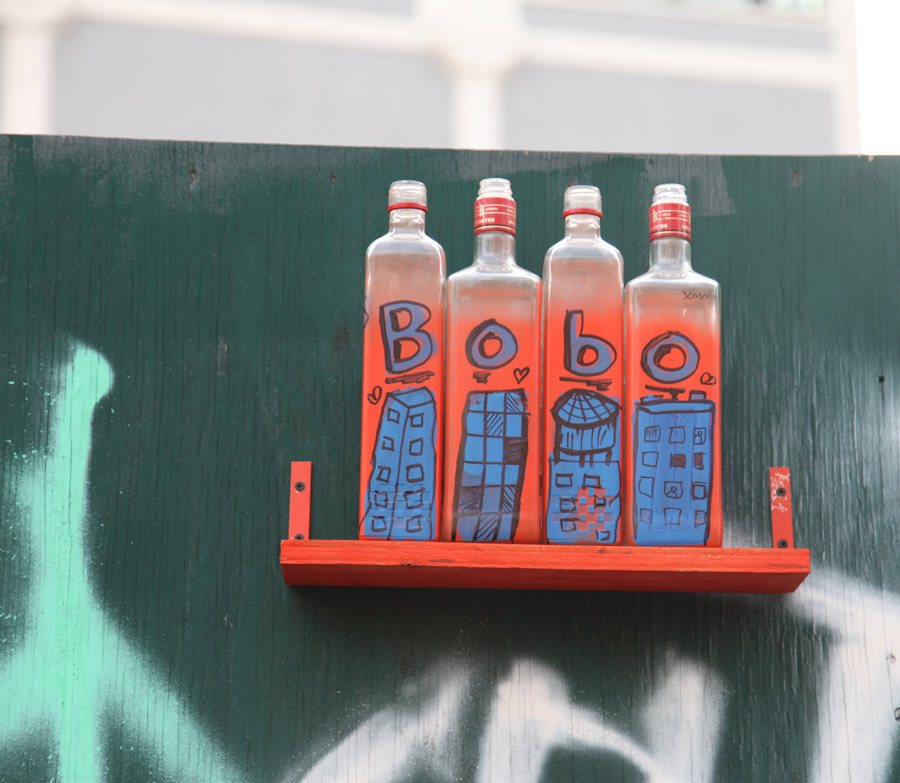
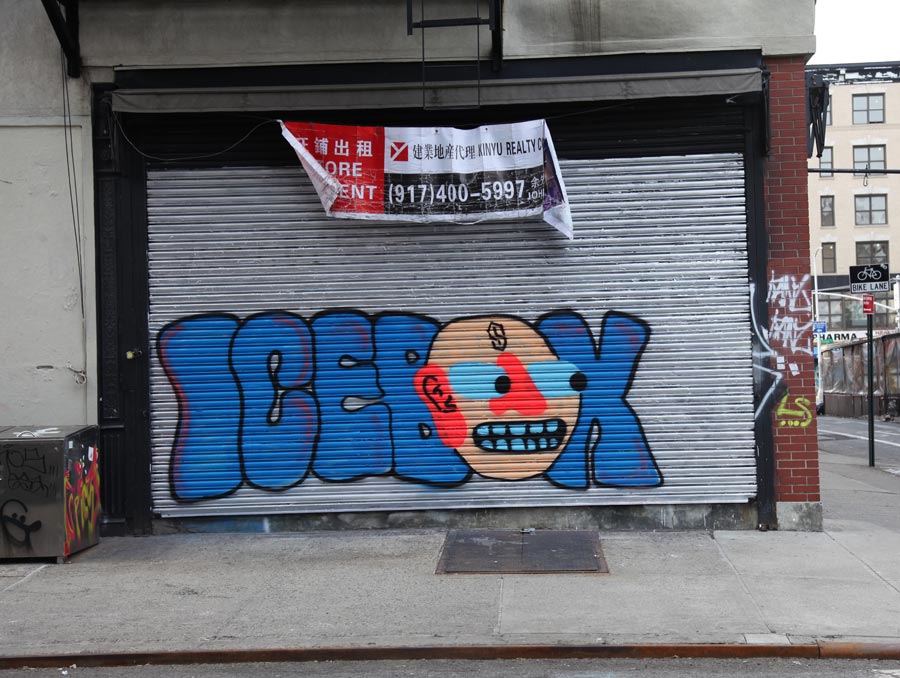
Here’s our weekly interview with the streets, this week featuring Allie Kelley, Aya Brown, Billy Barnacles, Bobo, Elianel Clinton, Fells, George Ferrandi, George Collagi, Gianni Lee, Icebox, Megan Gabrielle Harris, Merch, Plan9, Sara Lynne-Leo, Sasha Lynn, Shoki San, and Swoon.
In collaboration with SaveArtSpace.Org Swoon and Giani Lee curated a series of billboards in NYC and In Los Angeles asking the artists involved to focus on the themes of climate change, racial justice and the places where those concerns intersect. Below we share with you some of the billboards we found in NYC.
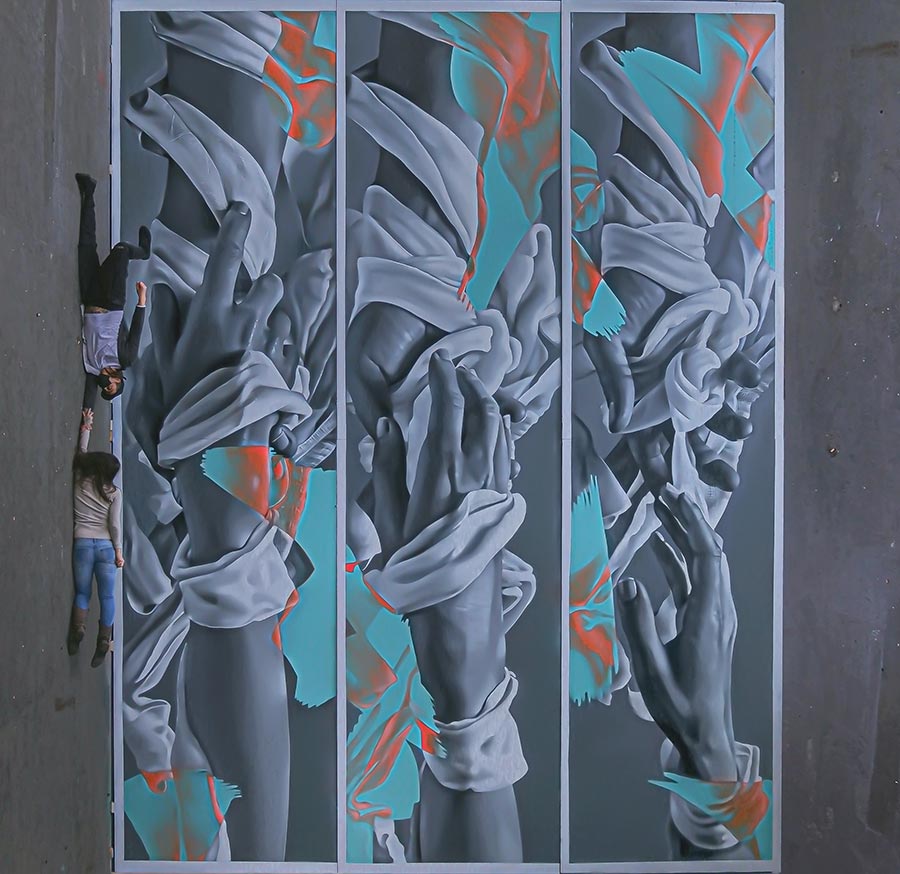
When you are in trouble, reach out! You don’t have to do it alone. That is the sentiment you may think of when regarding this new mural by JDL (Judith de Leeuw) in Amsterdam.
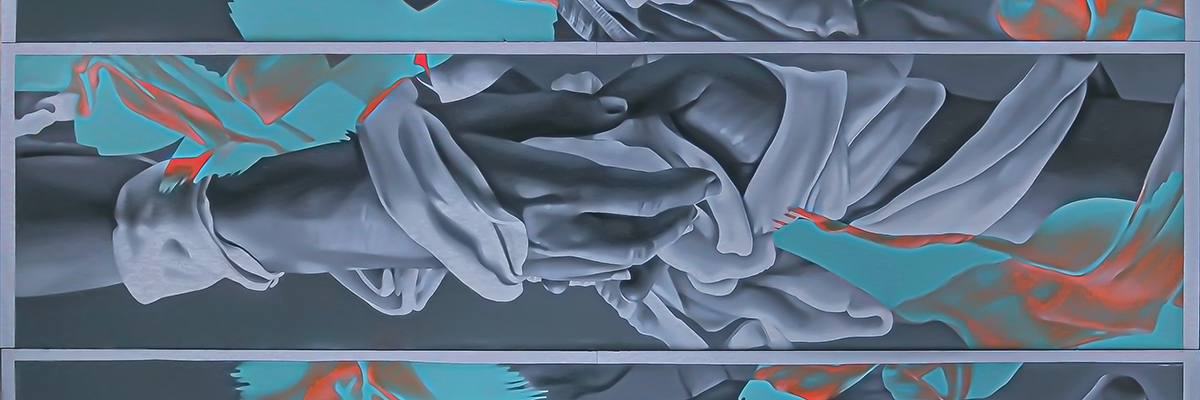
The three frame story reads like stills in an animation, with two hand gradually getting closer to one another, loosely wrapped in bandage.
JDL. “Closer in distance”. Amsterdam, The Netherlands. (photo courtesy of the artist)
Intended as a temporary placeholder for the new HIV/AIDS monument that will be installed soon at Amsterdam Central Station, JDL says that she’s depicting the relationships between people who are ill and their loved ones.
“Illness often isolates, but also brings people closer together,” says the artist. “This piece is a symbol and a celebration of the love that grows at the edge of the abyss.”
The three separate frames will be placed around the station at the projects’ end.
JDL would like to thank her assistant painter on this project, James Jetlag.
This one caught our eye for the merging of classic graffiti nerve, blunt style execution, sentimental velvety roses, inspirational verses, …Read More »
Join the BSA Newsletter!
Subscribe to our newsletter for occasional updates, special announcements, and exclusive content.
 BROOKLYN STREET ART LOVES YOU MORE EVERY DAY