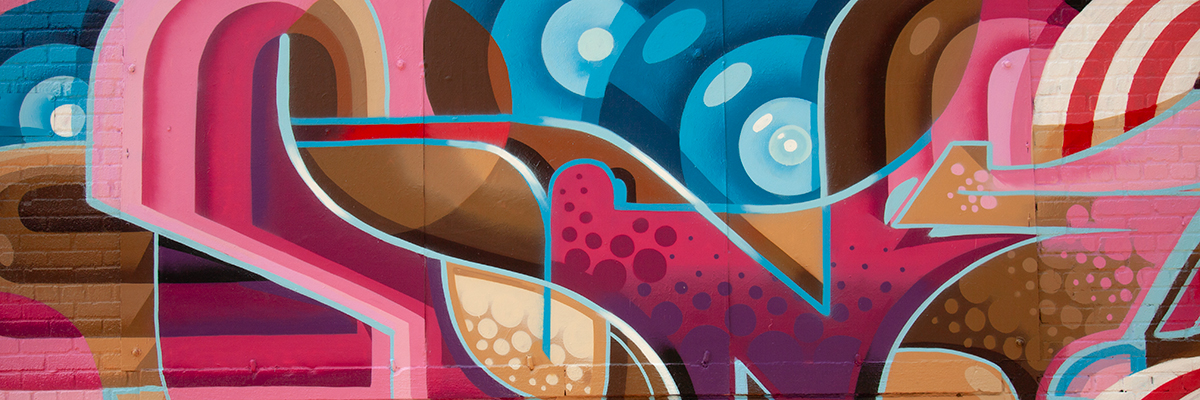
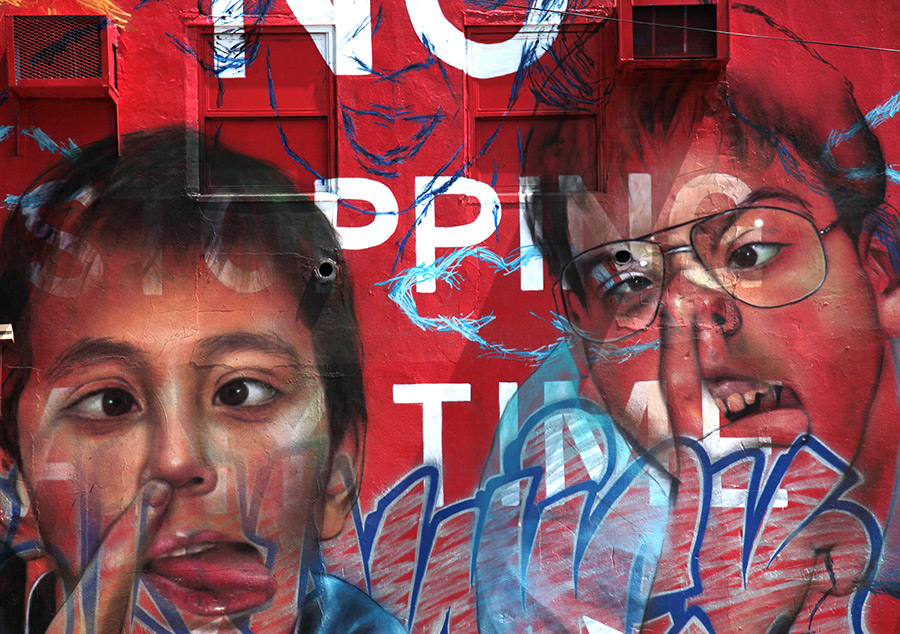
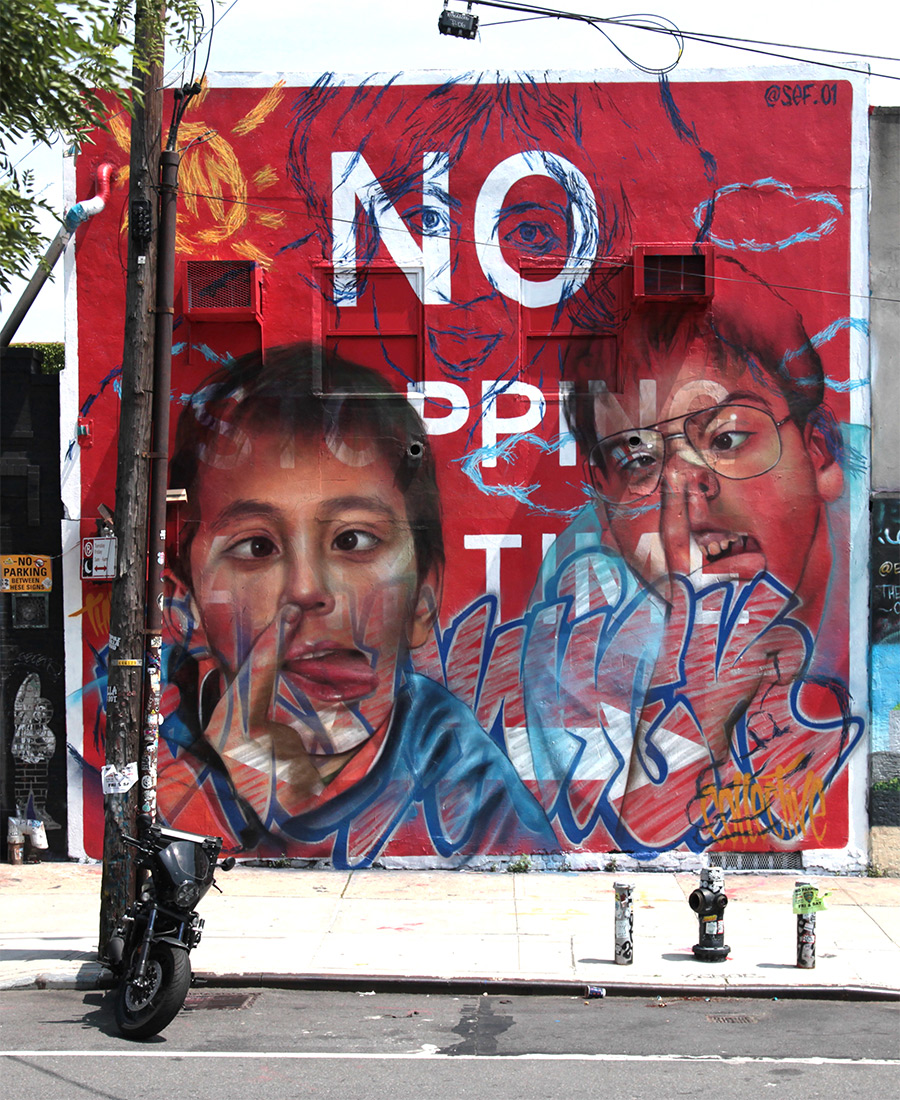
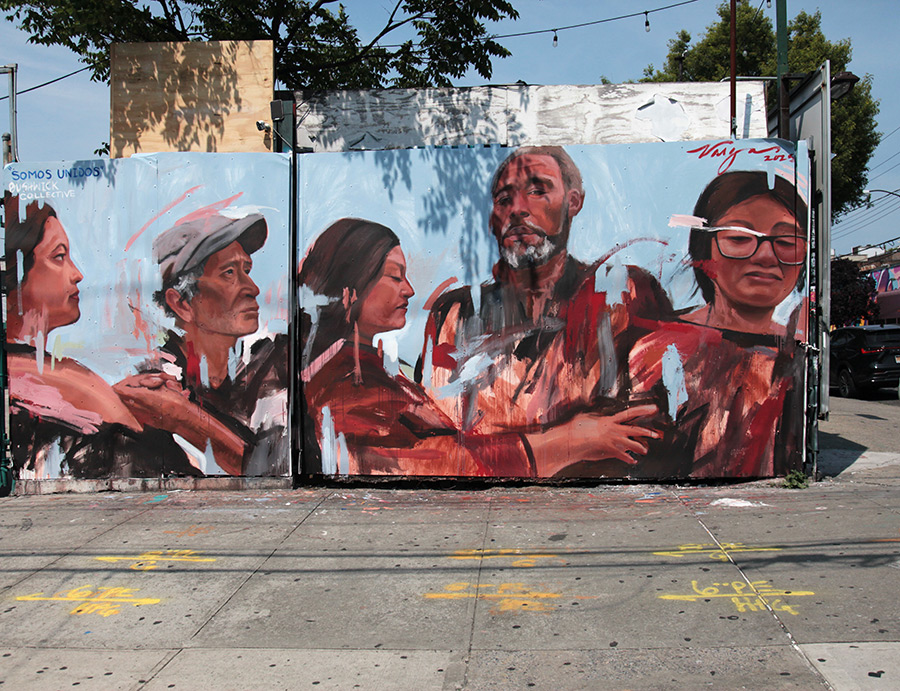
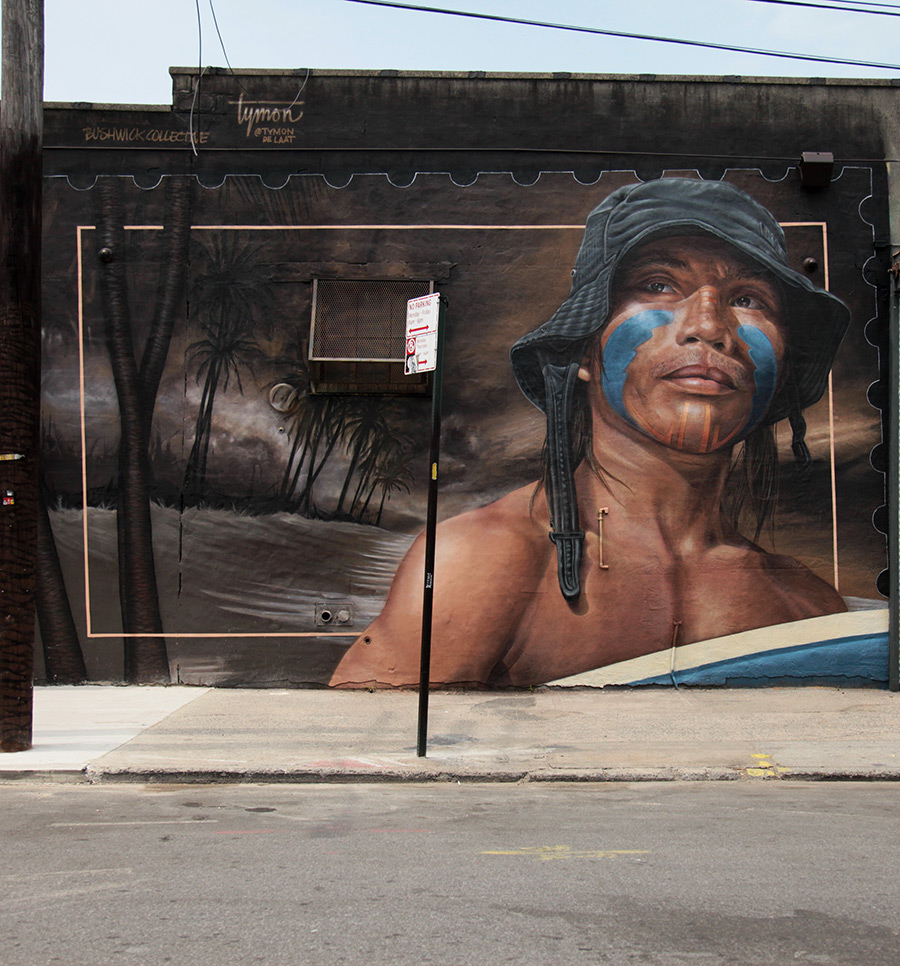
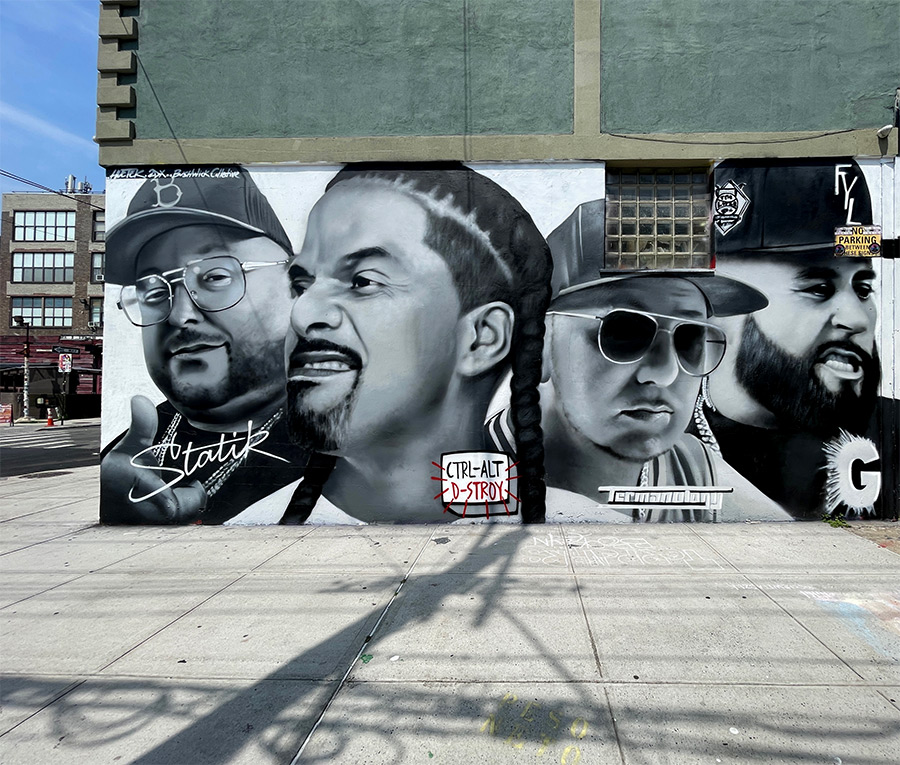
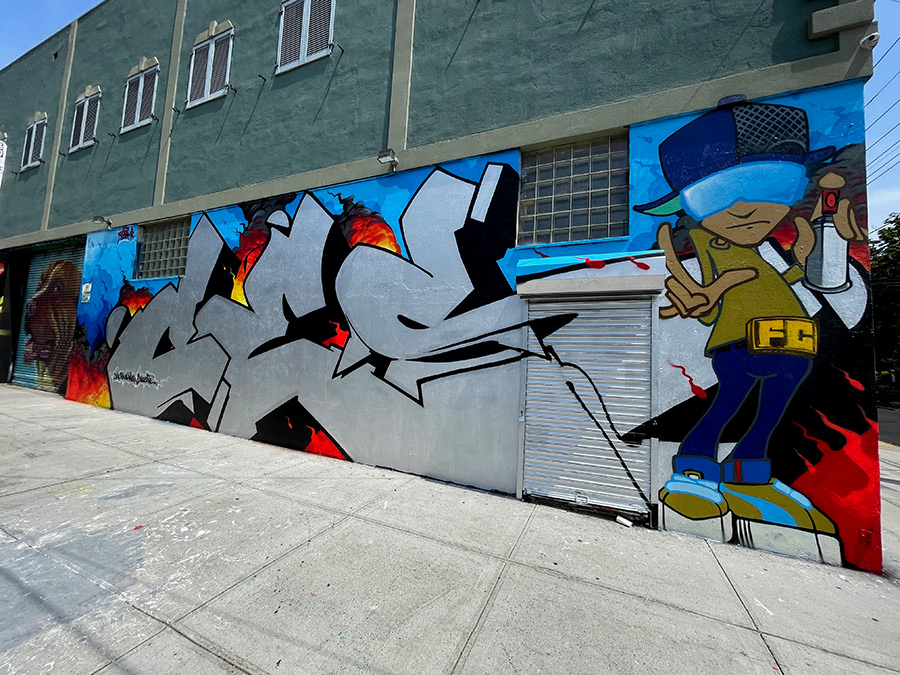
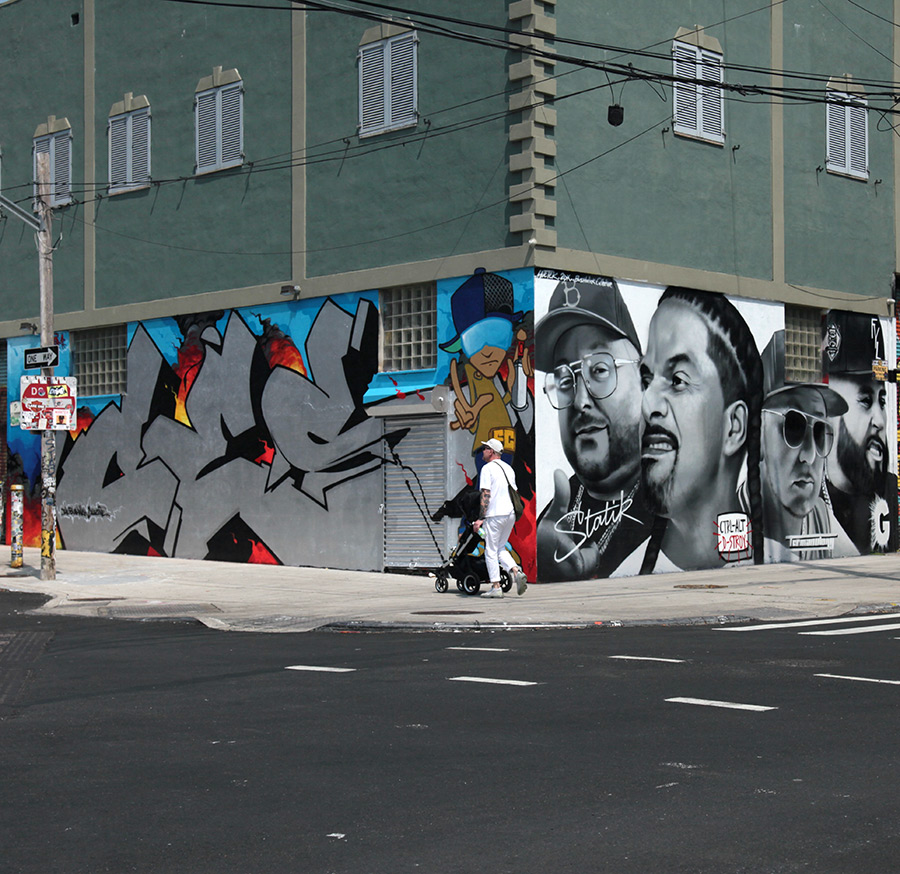
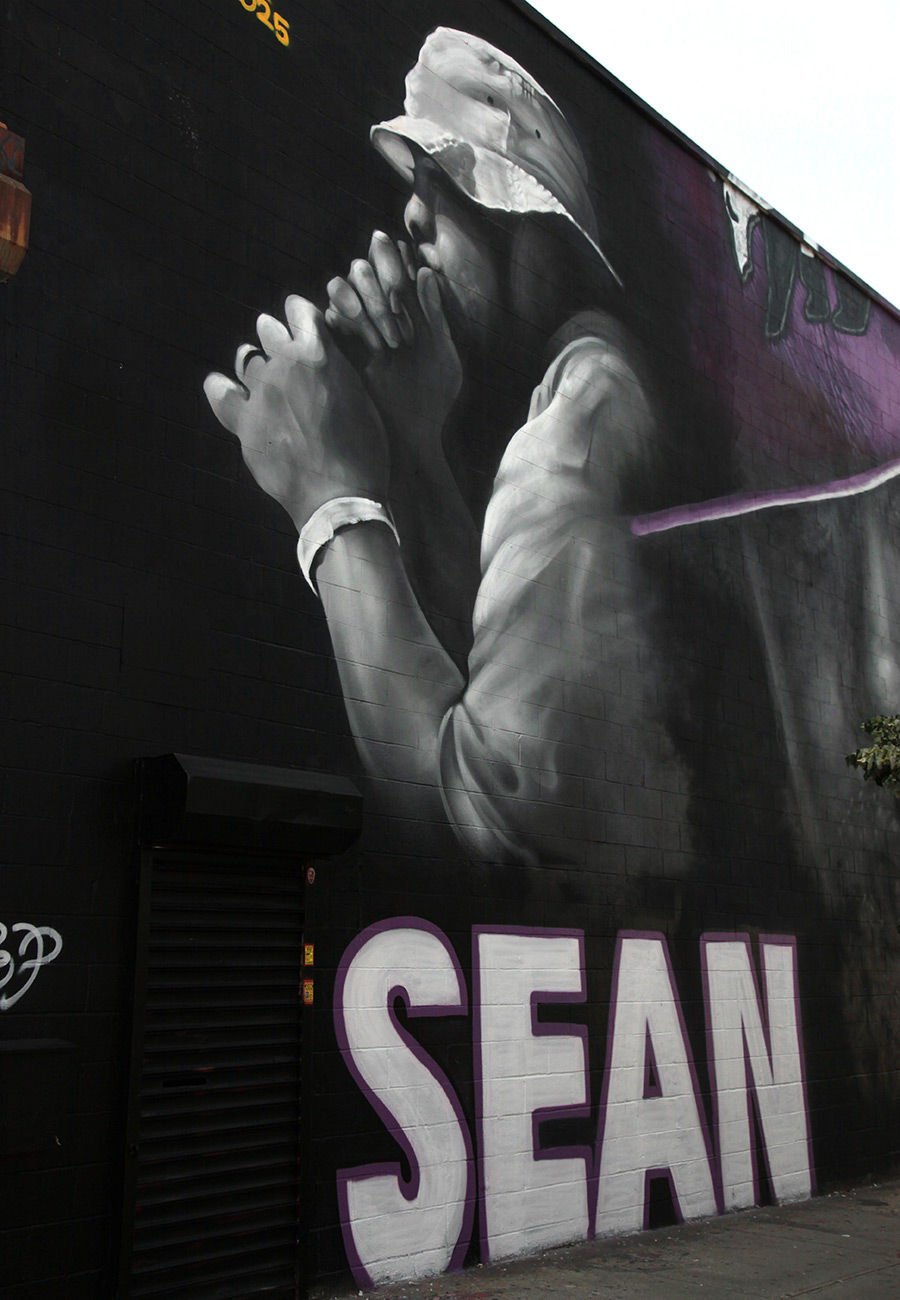
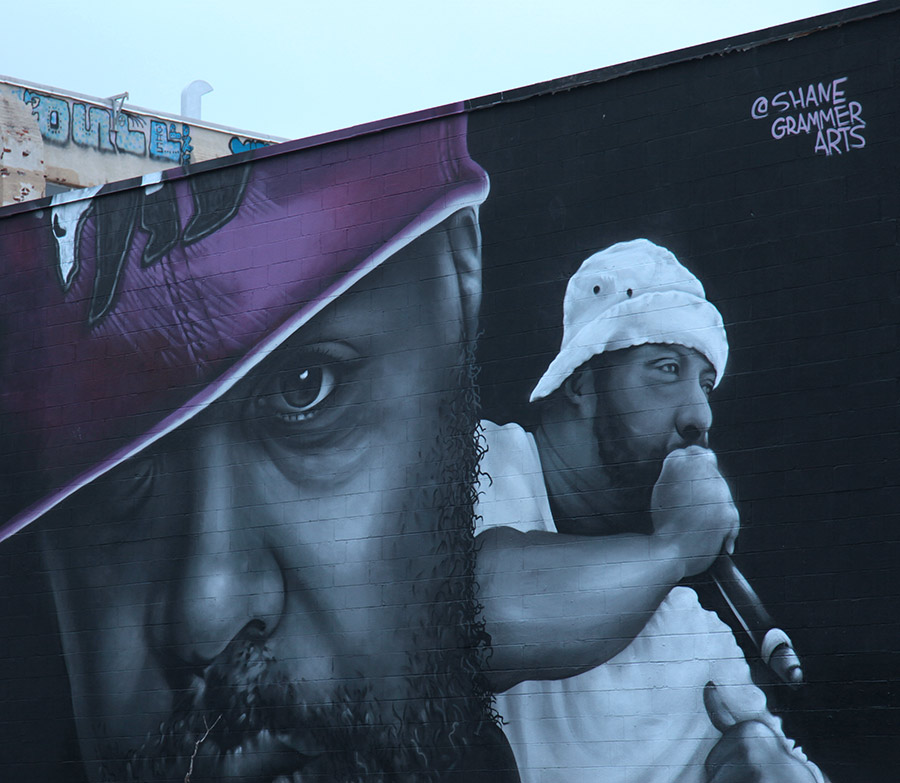
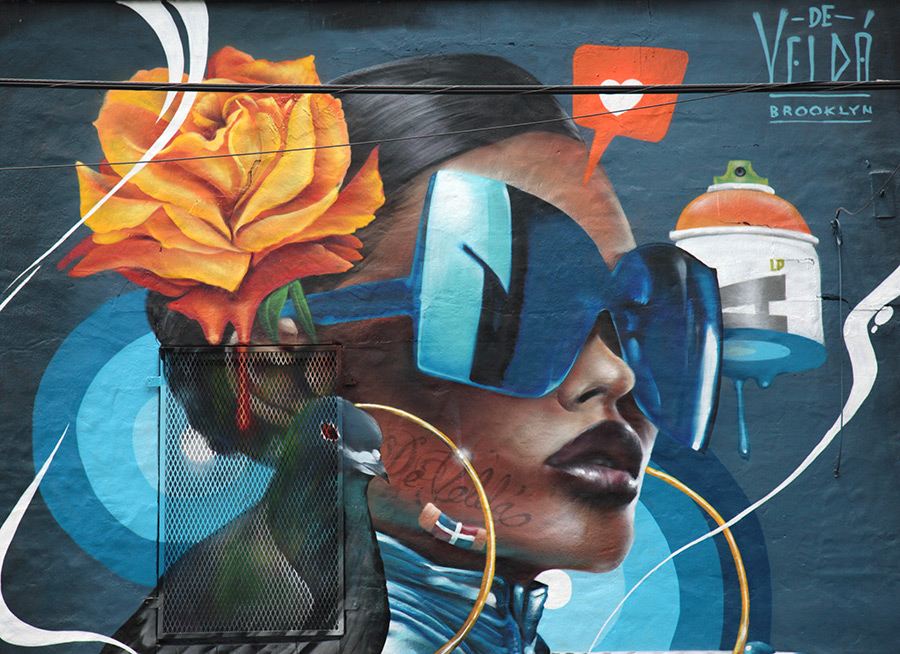
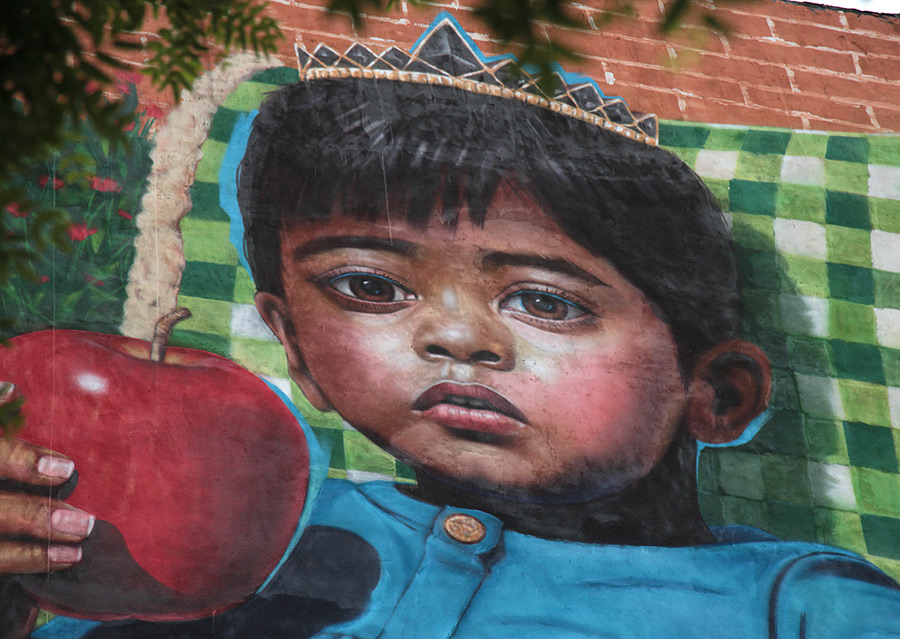
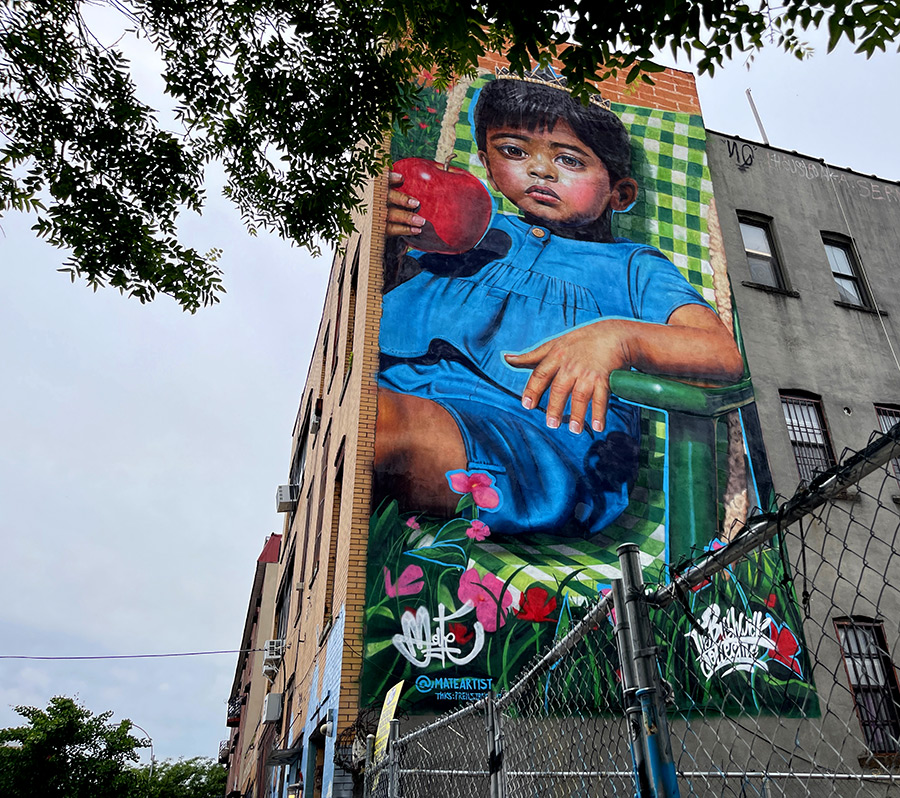
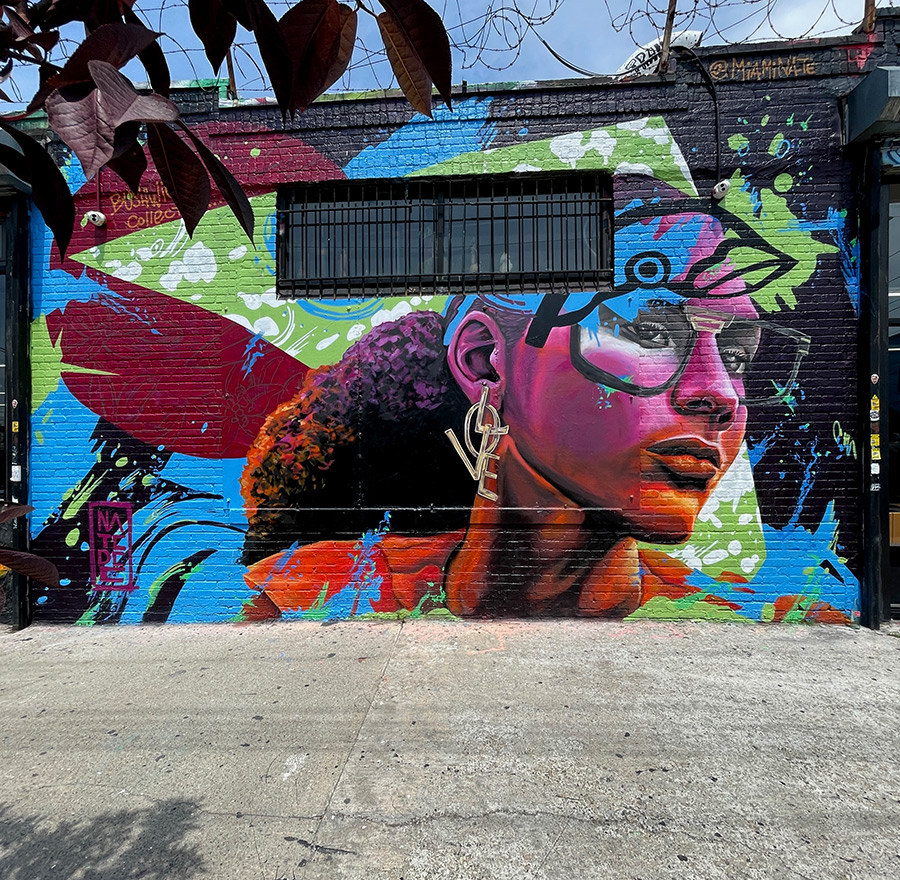
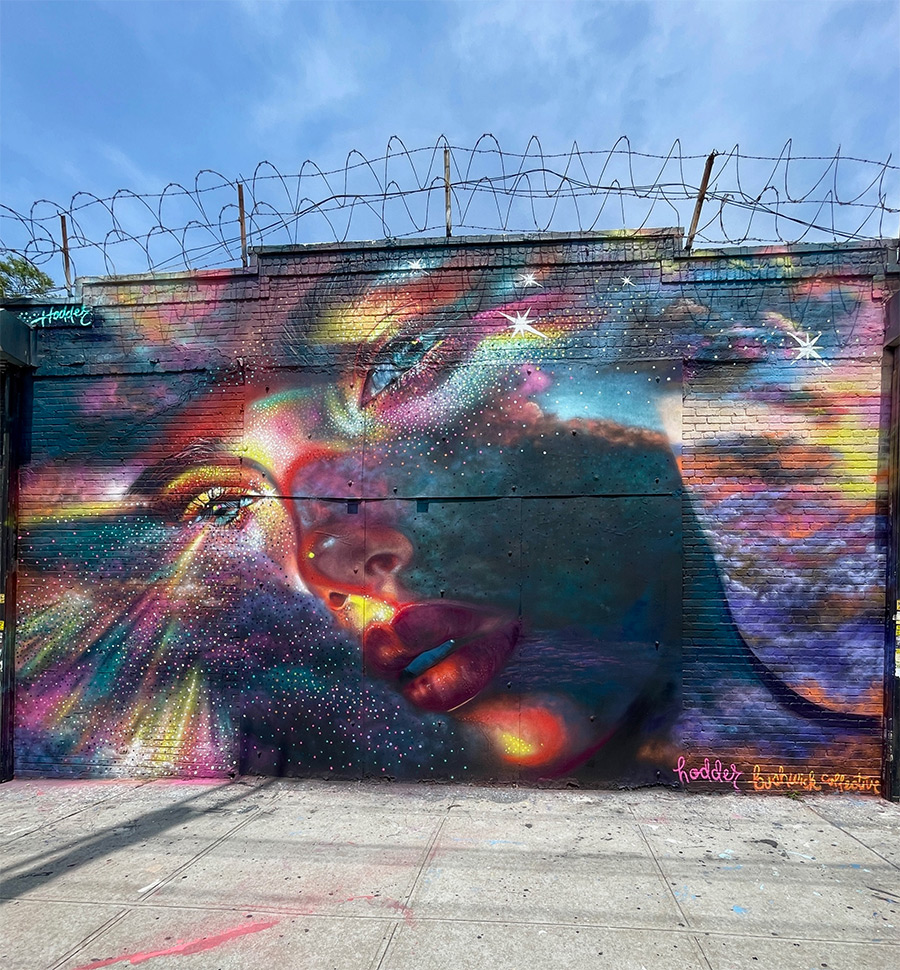
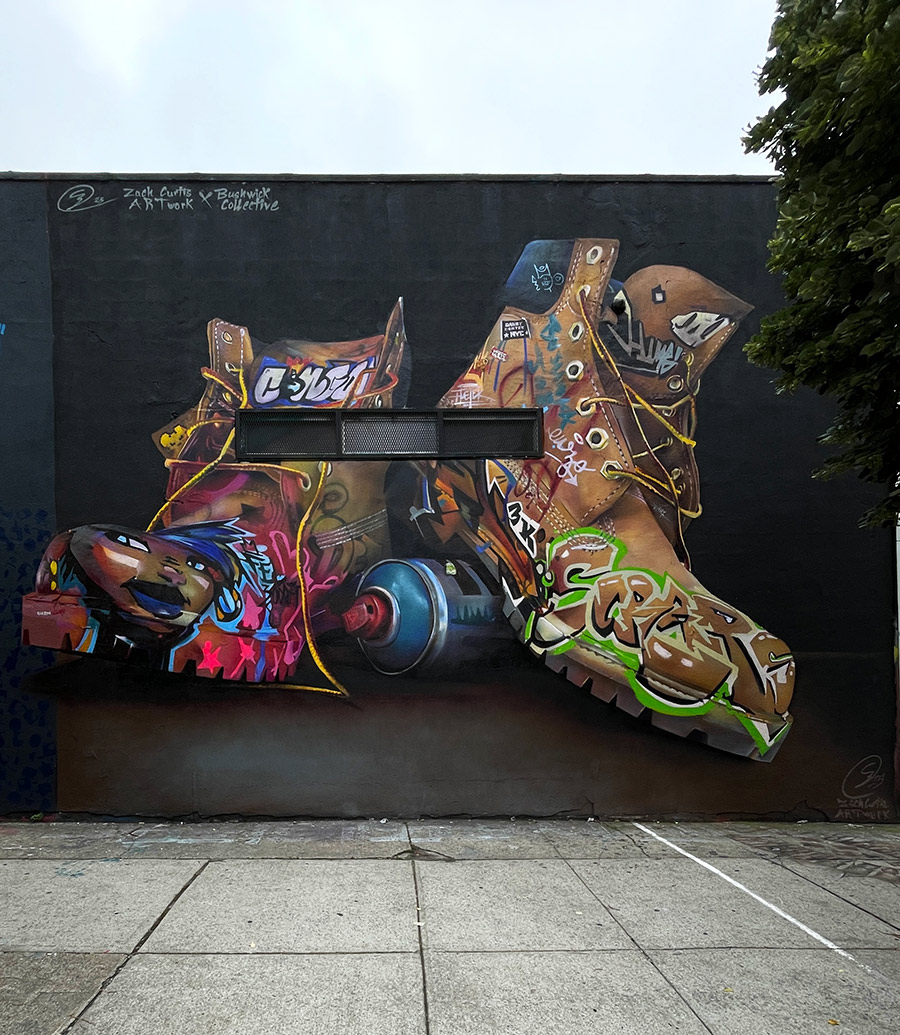
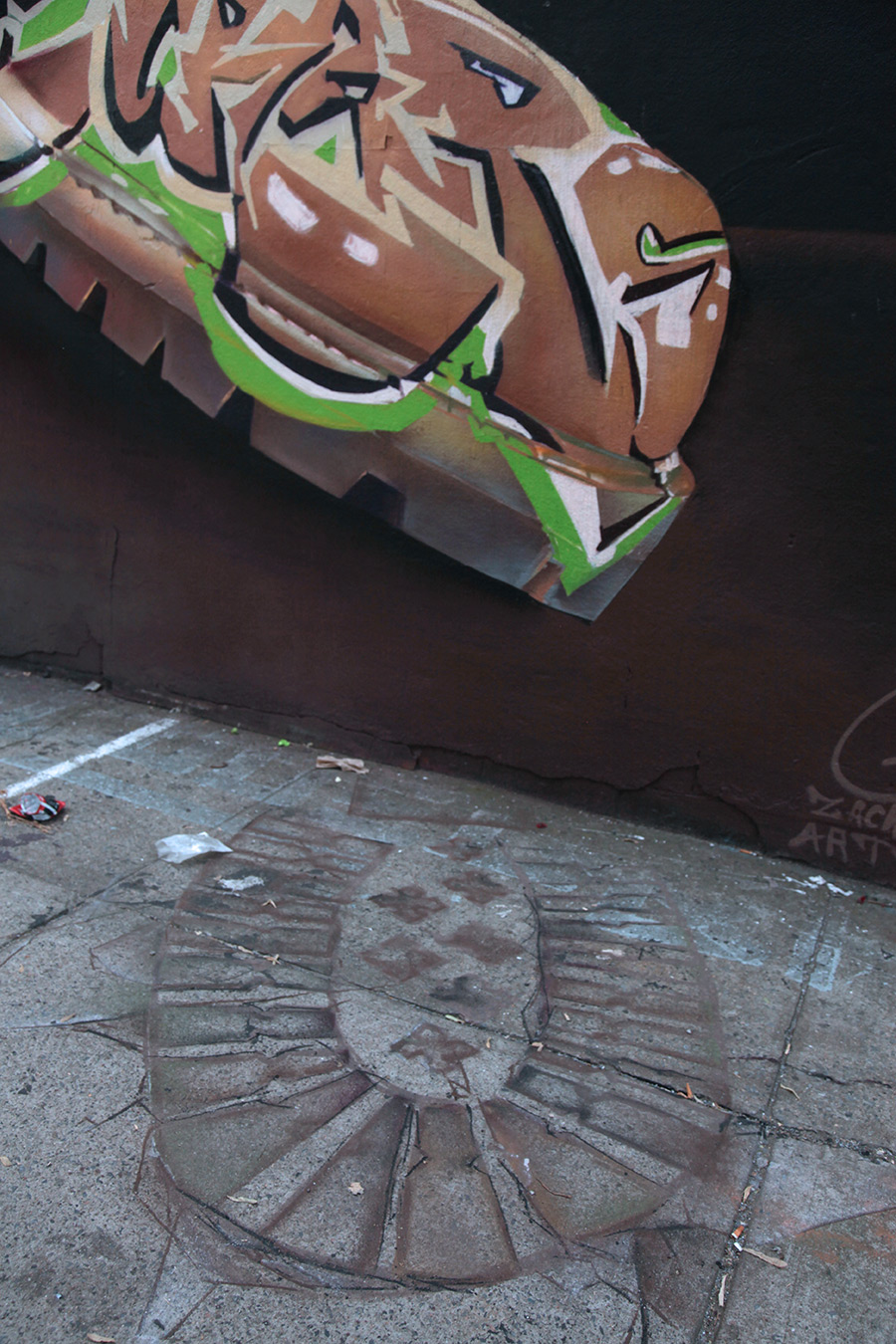
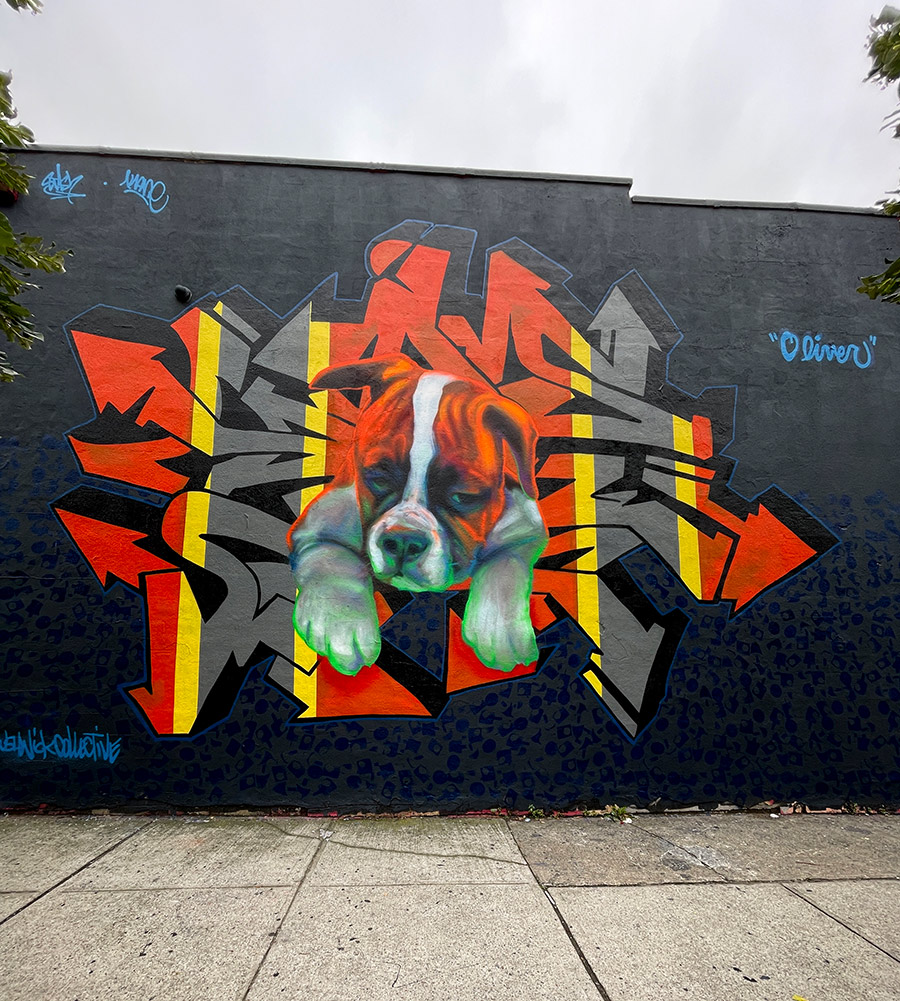
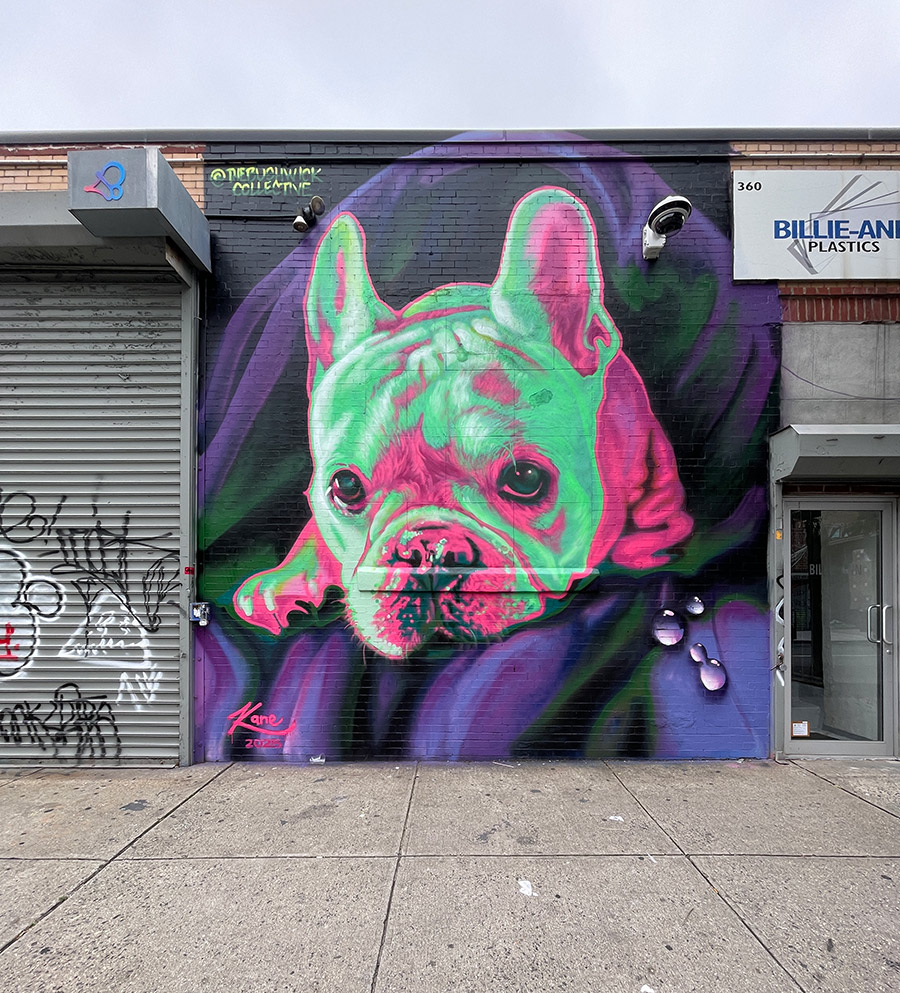
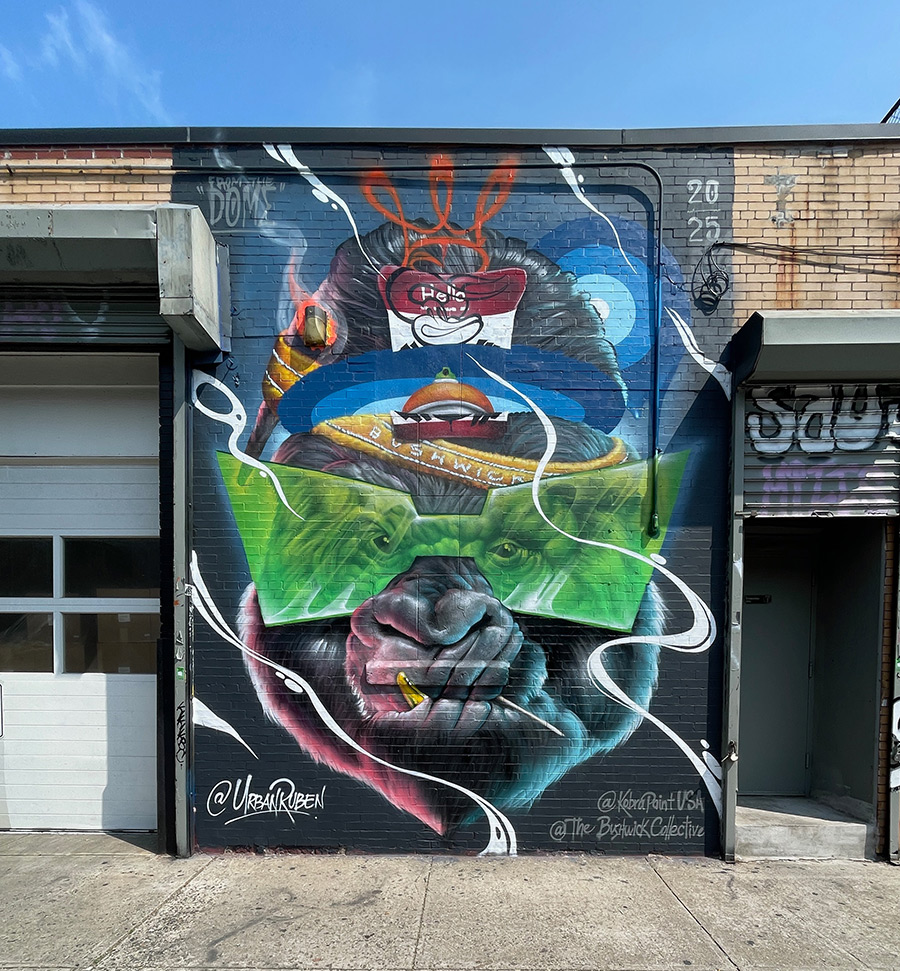
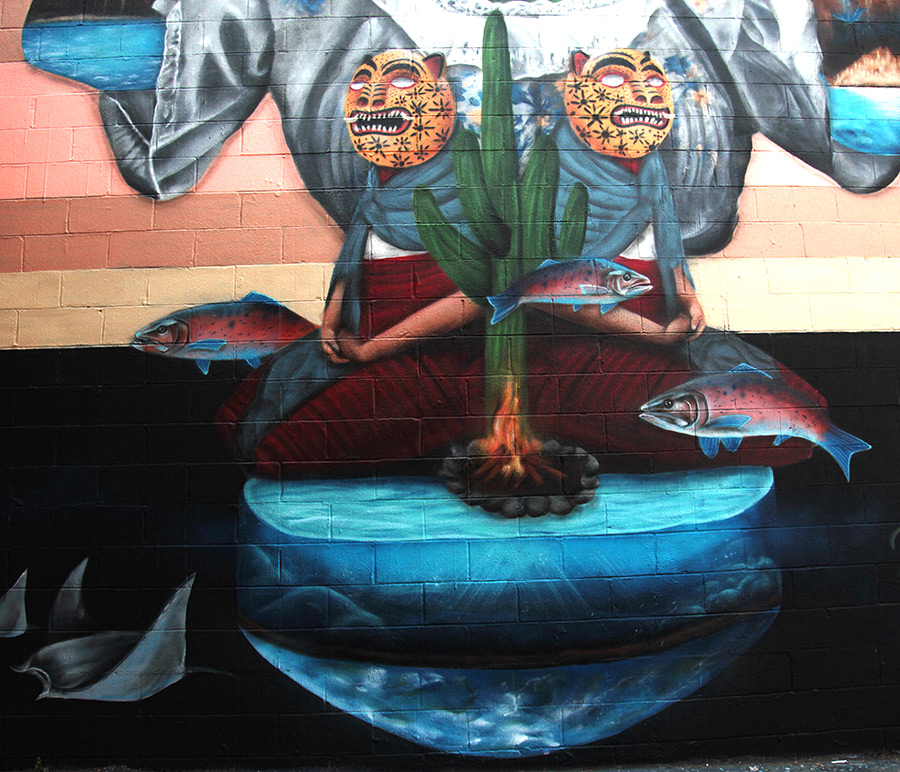
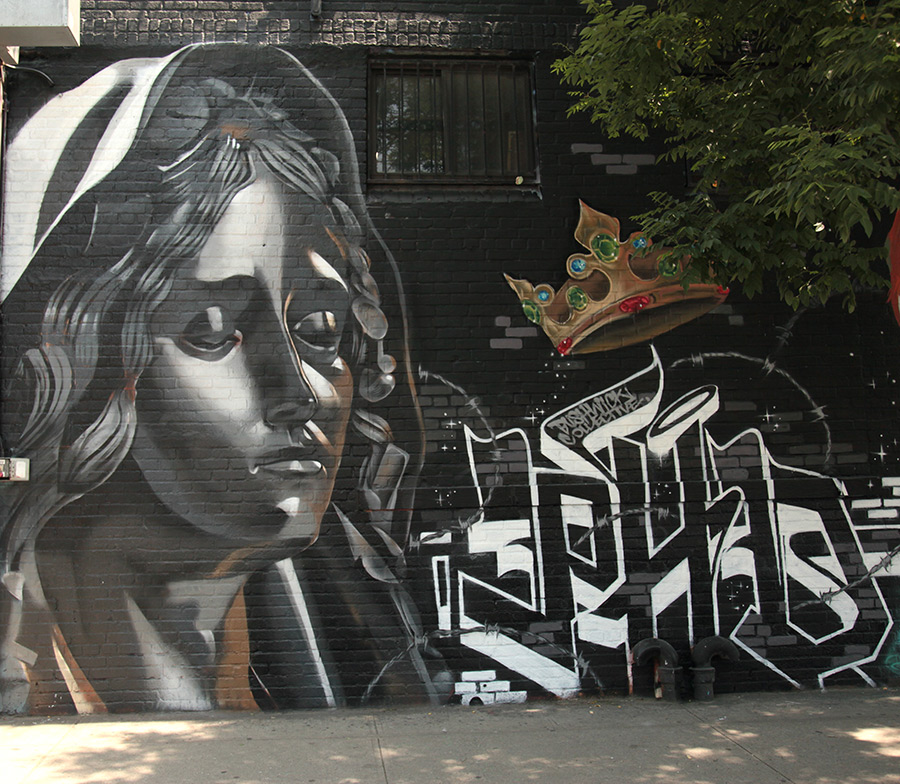
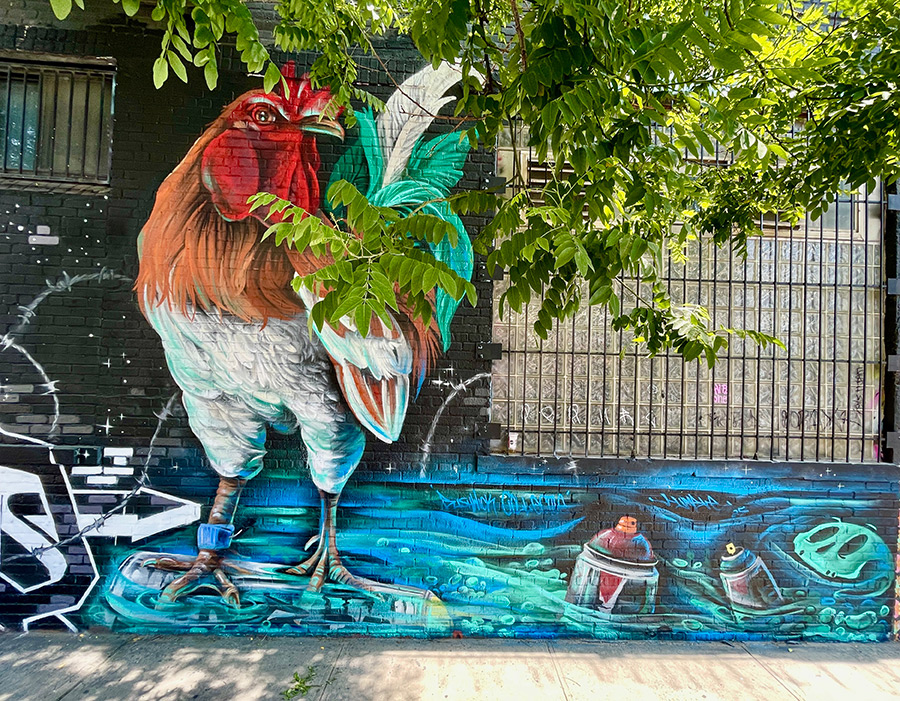
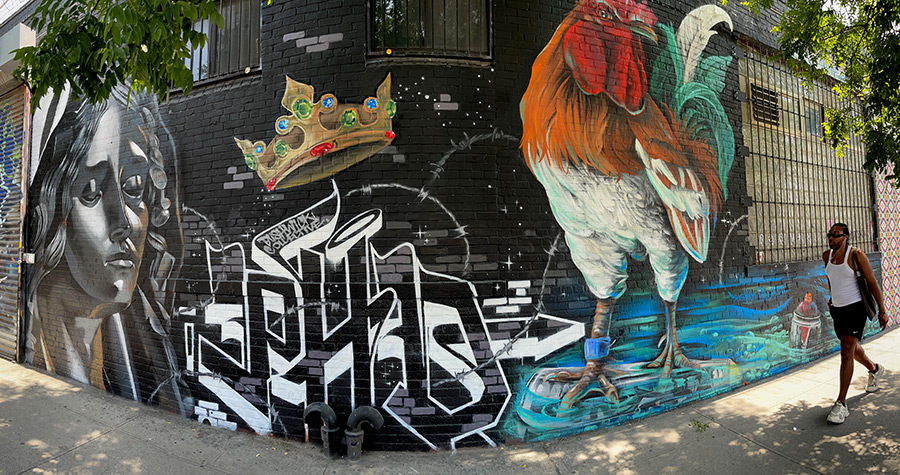
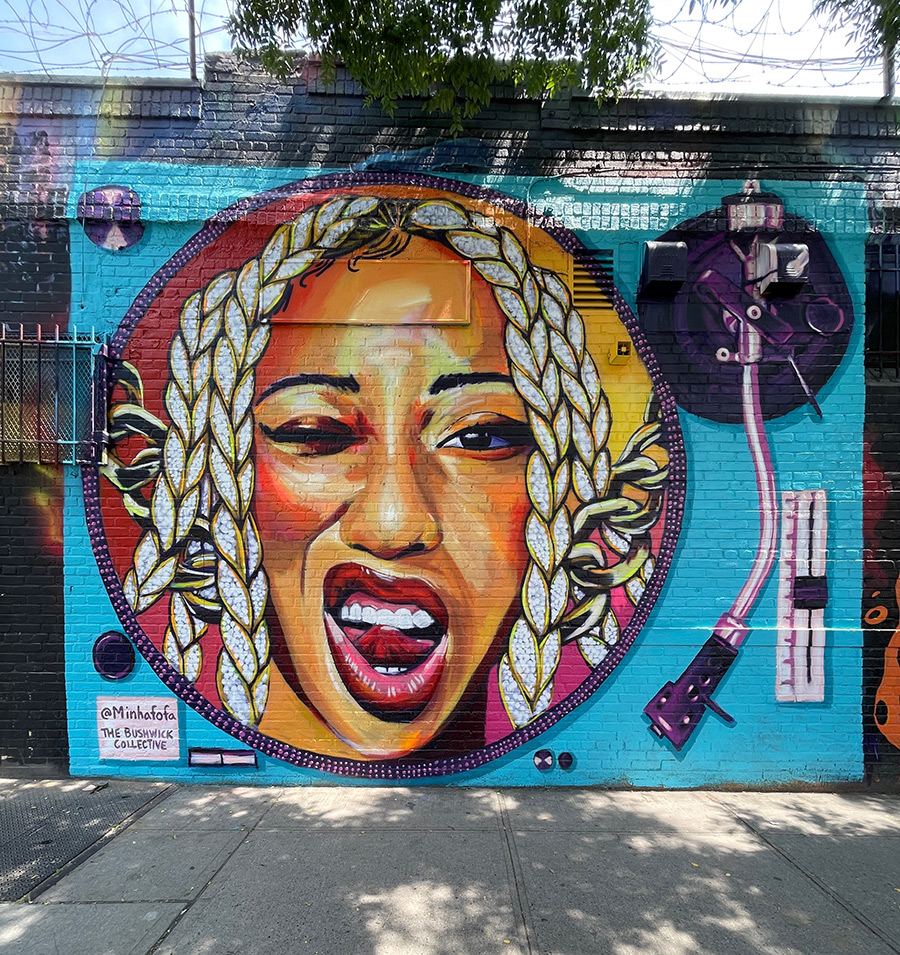
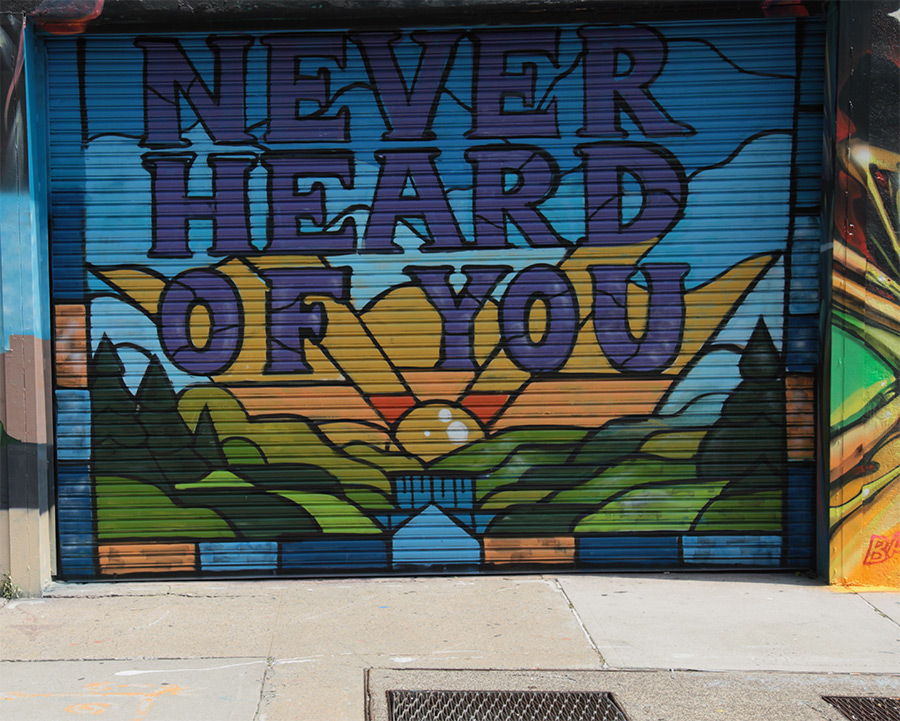
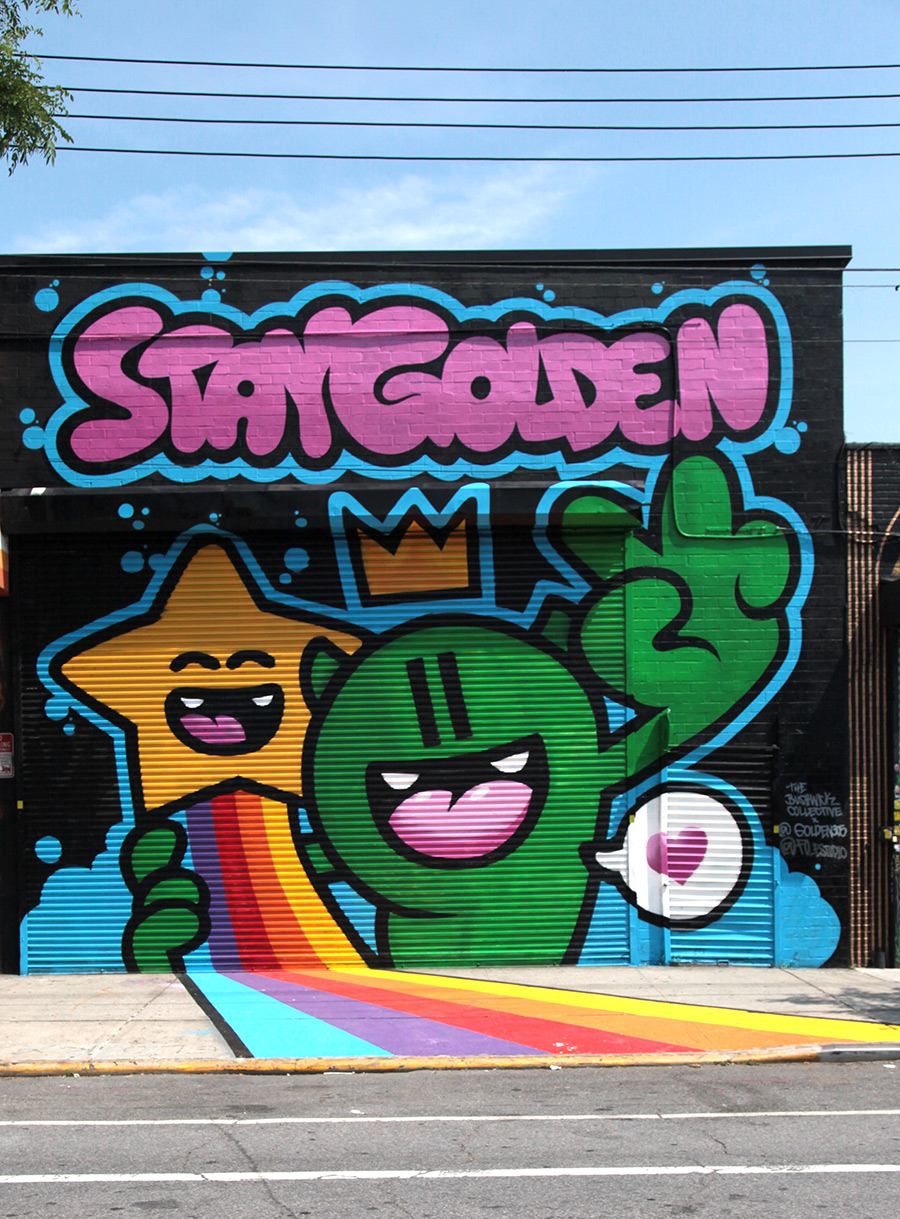
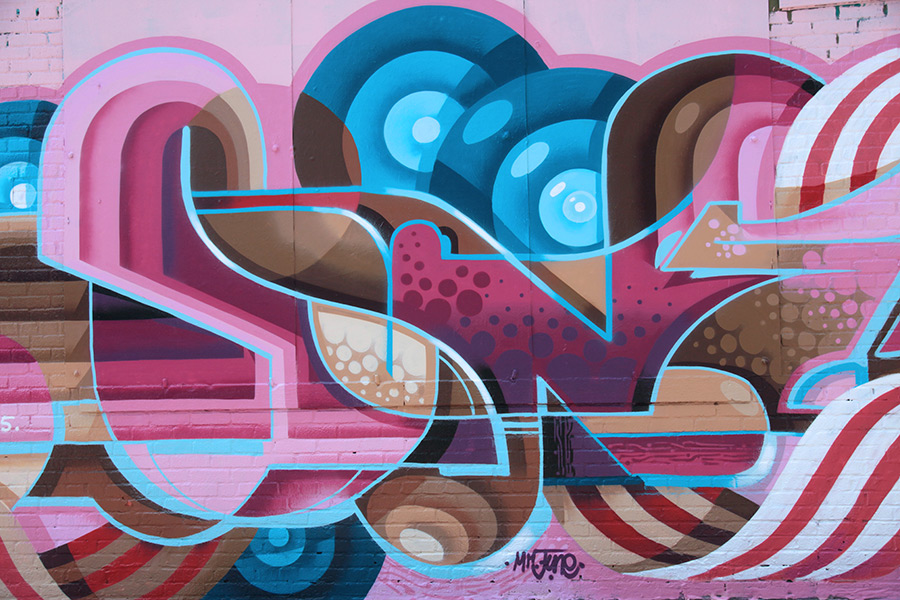
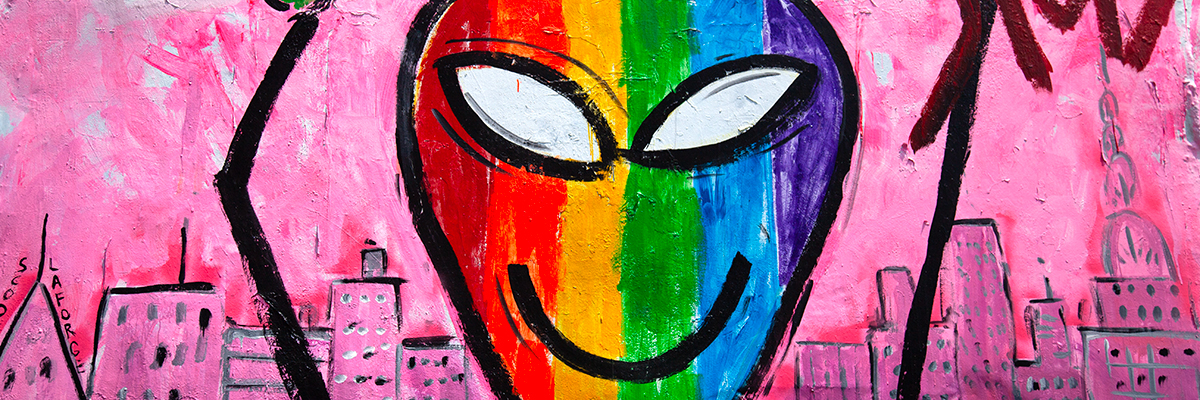
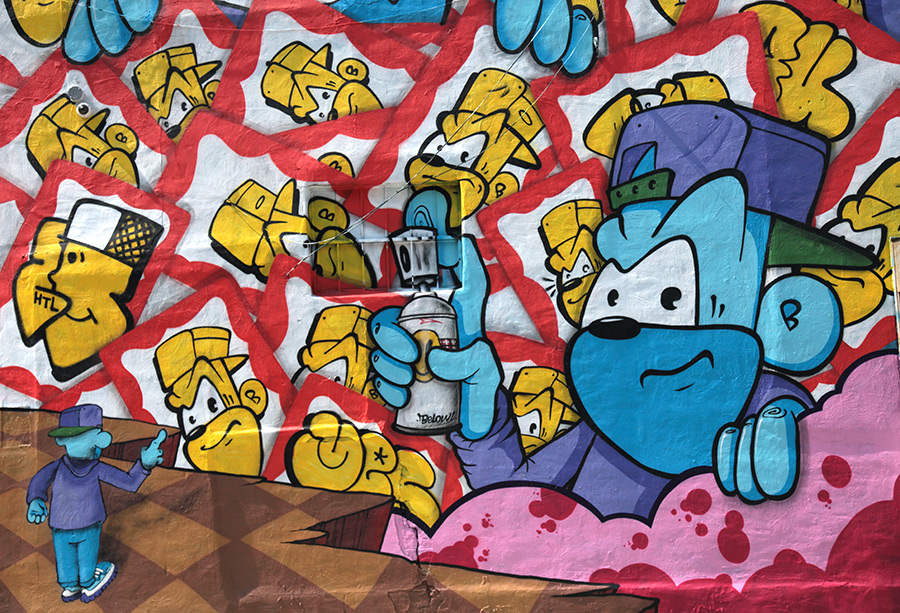
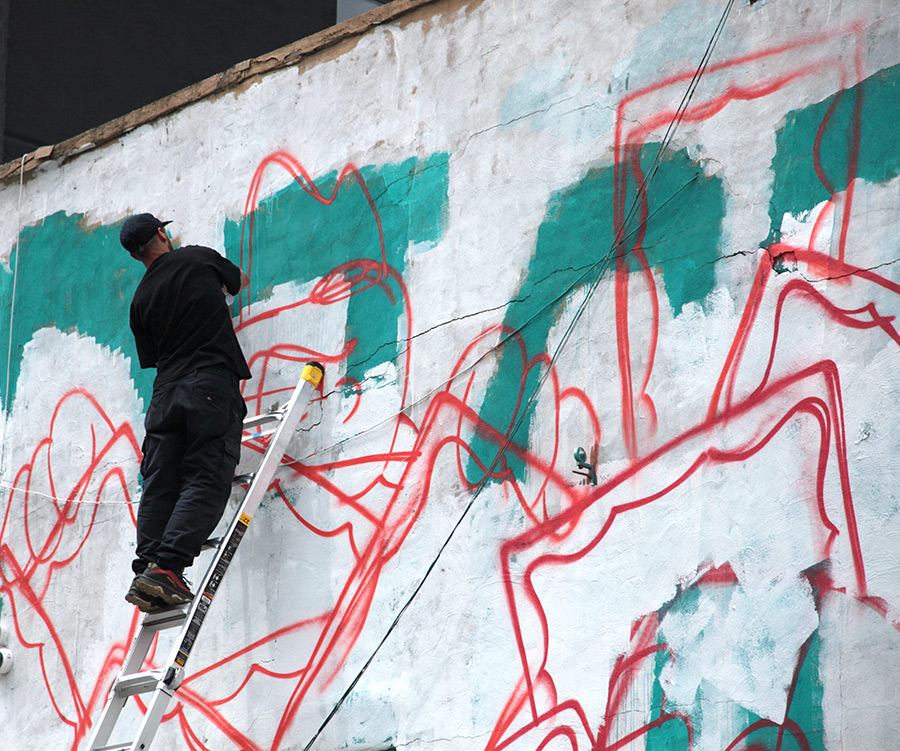
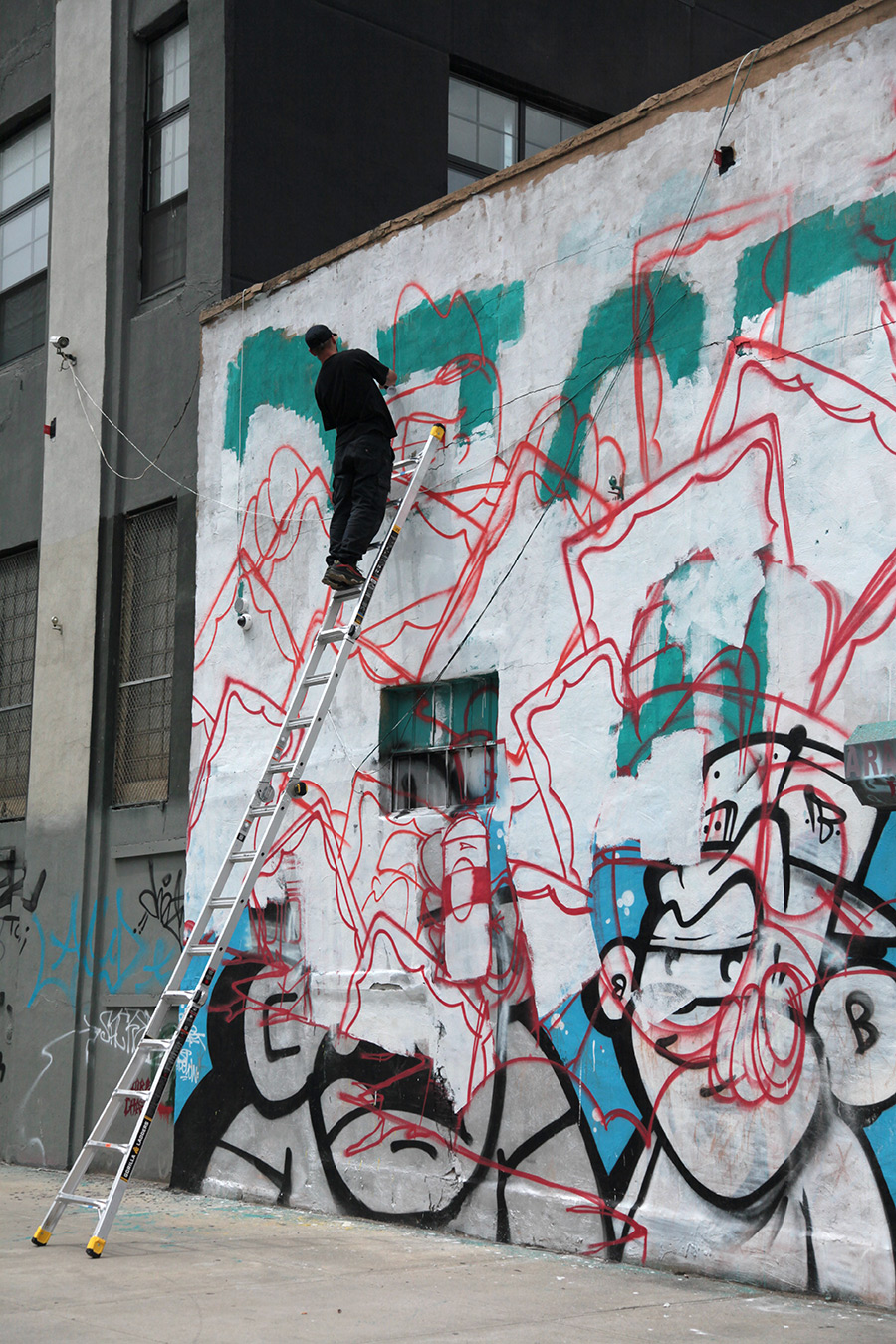
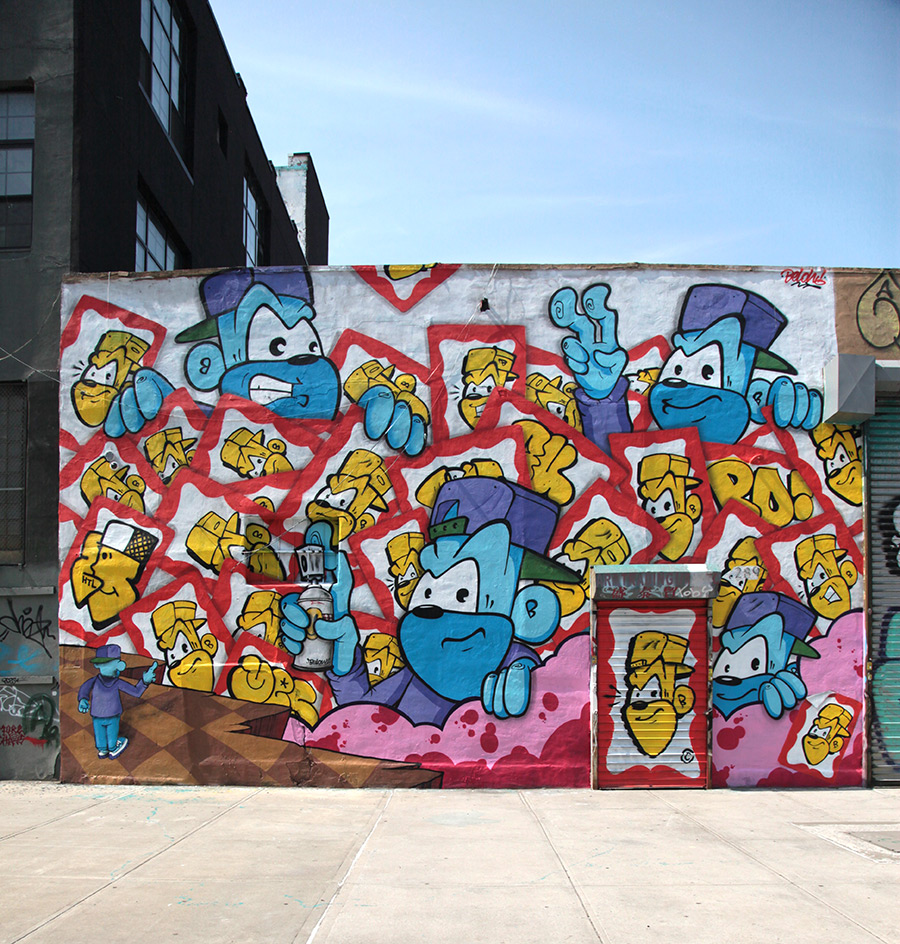
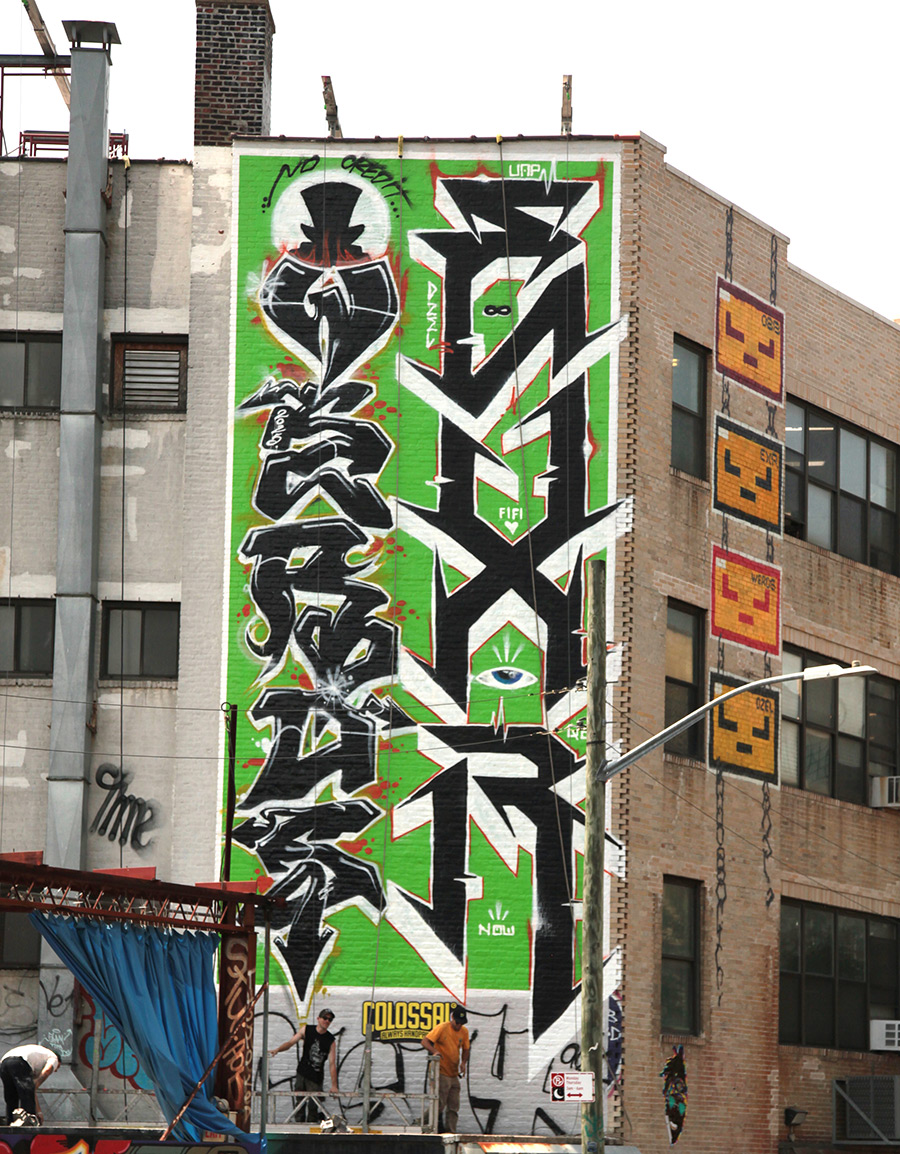
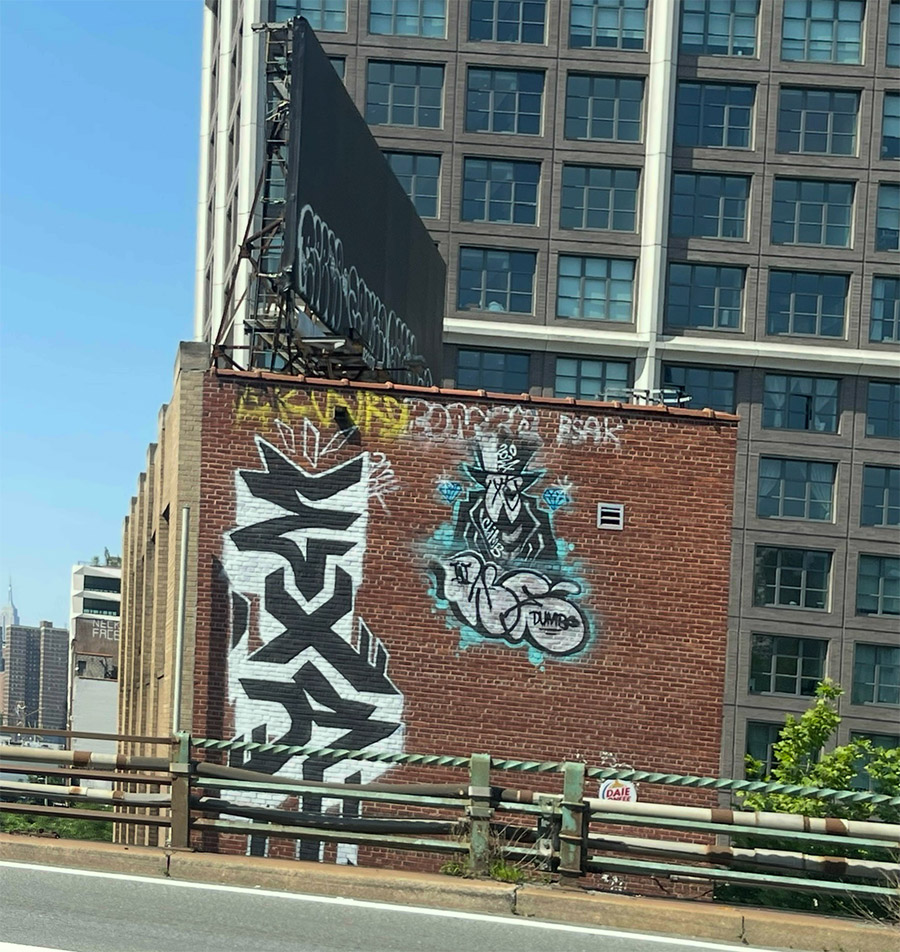
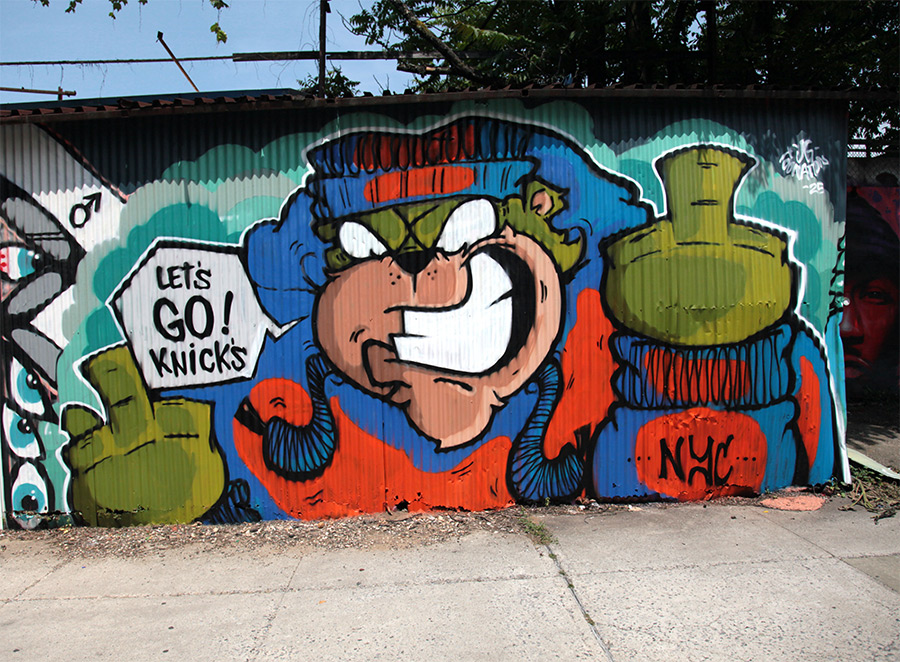
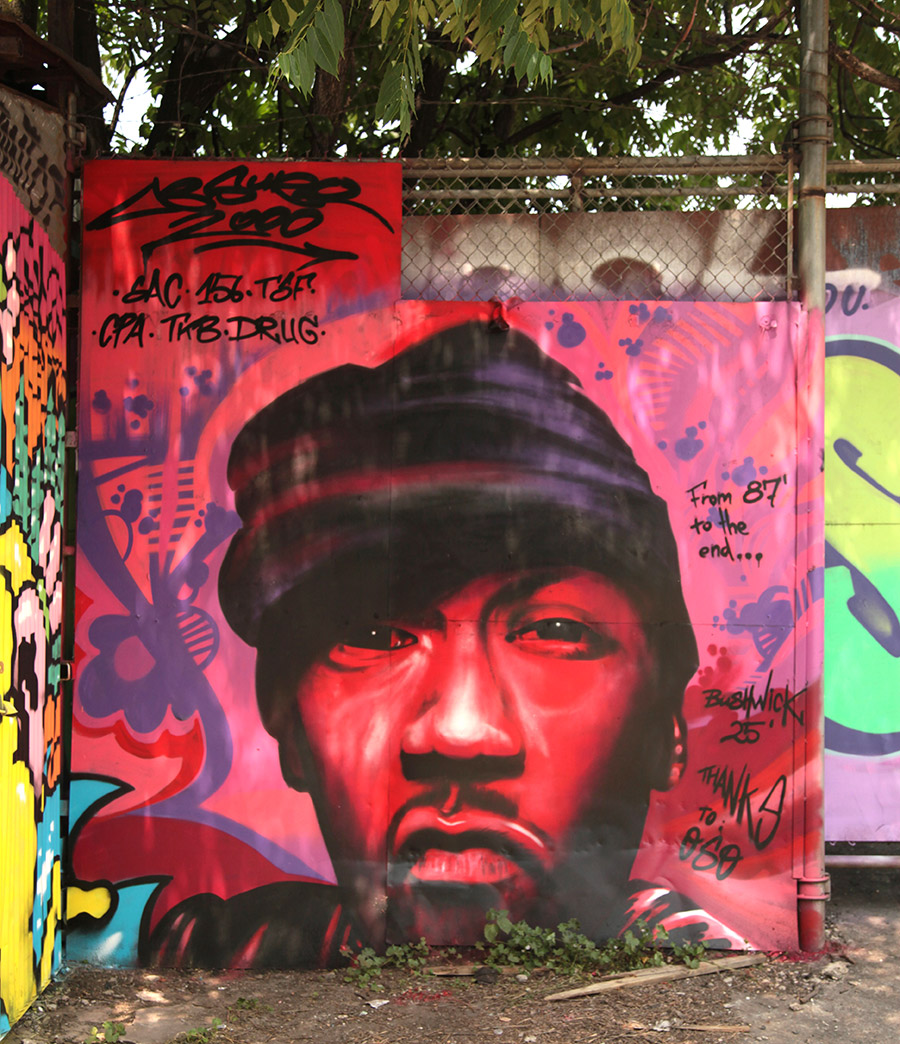
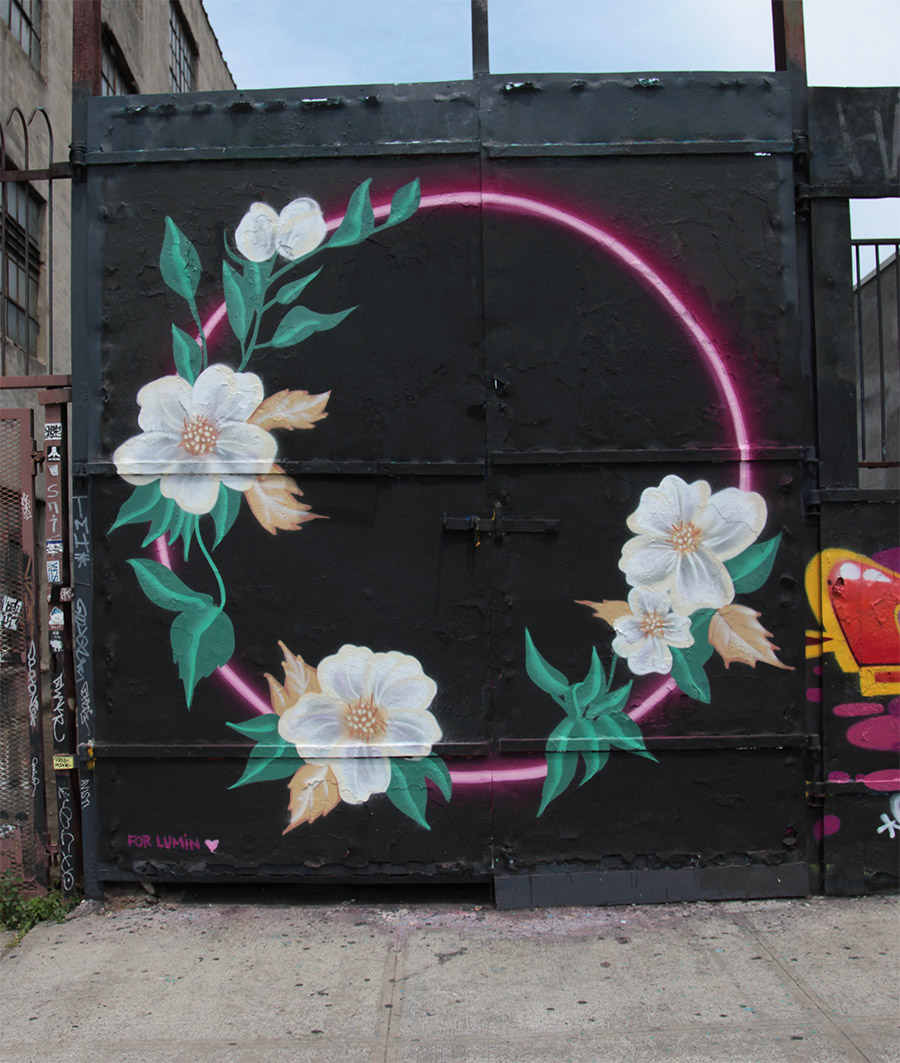
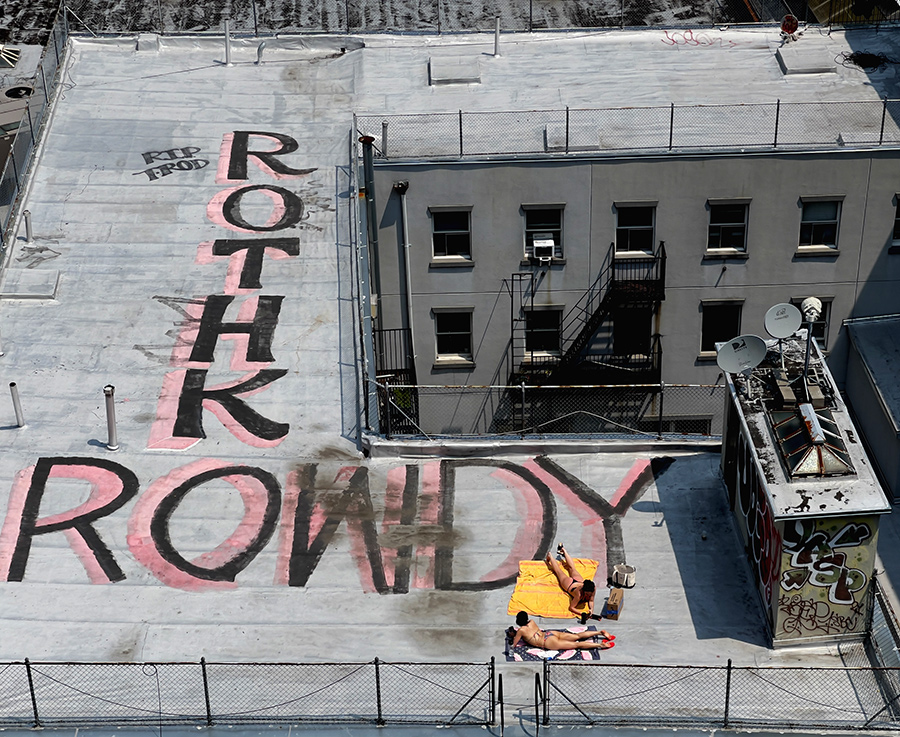
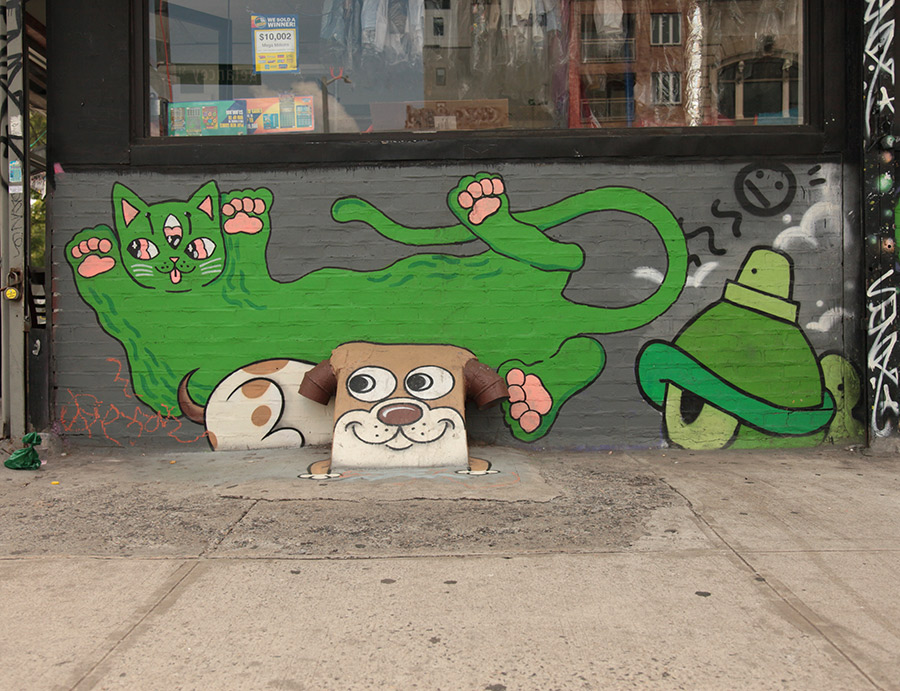
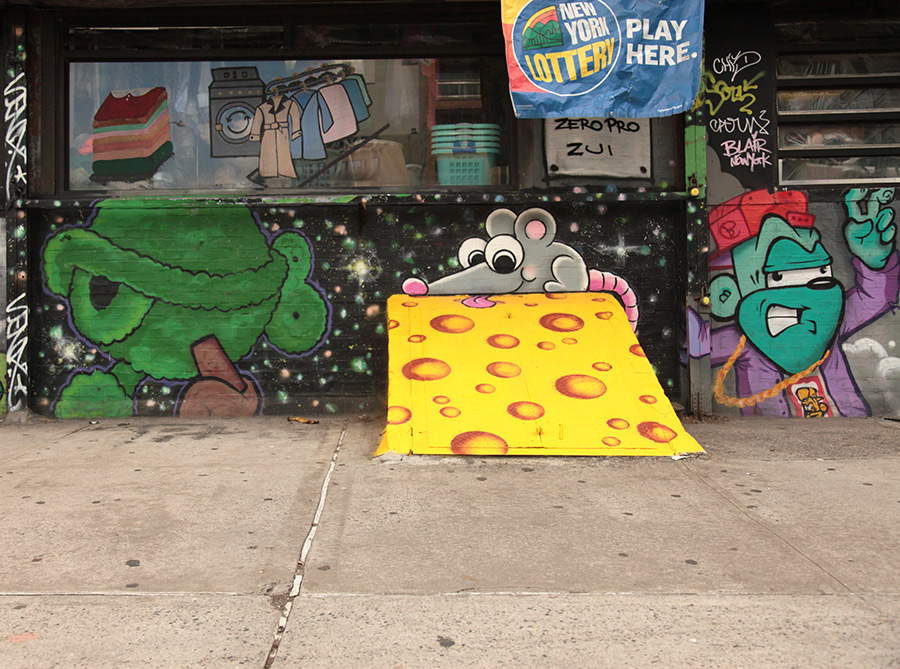
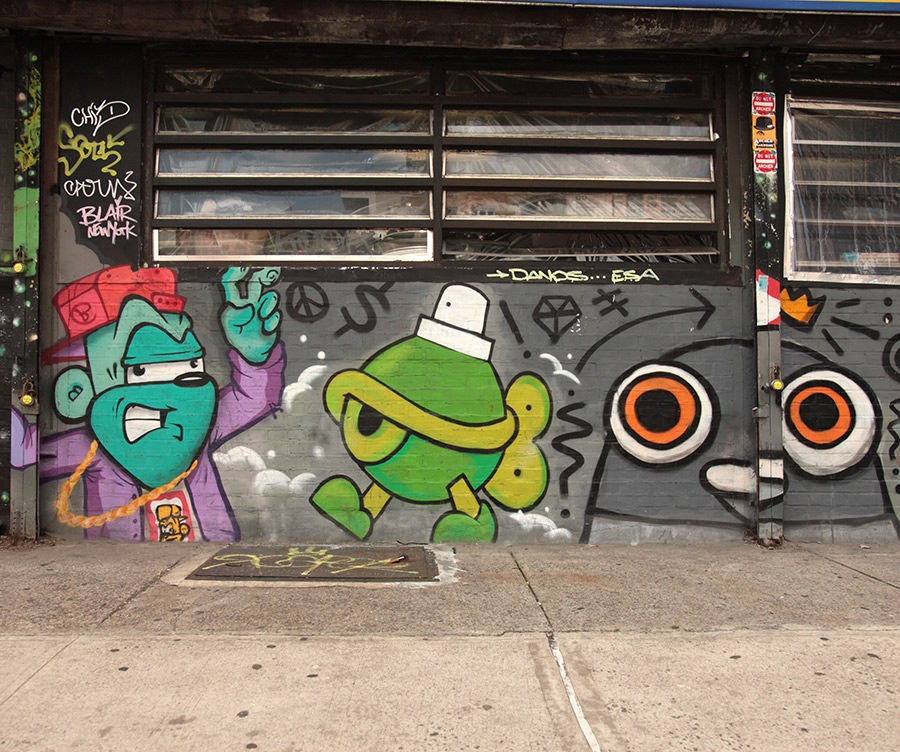
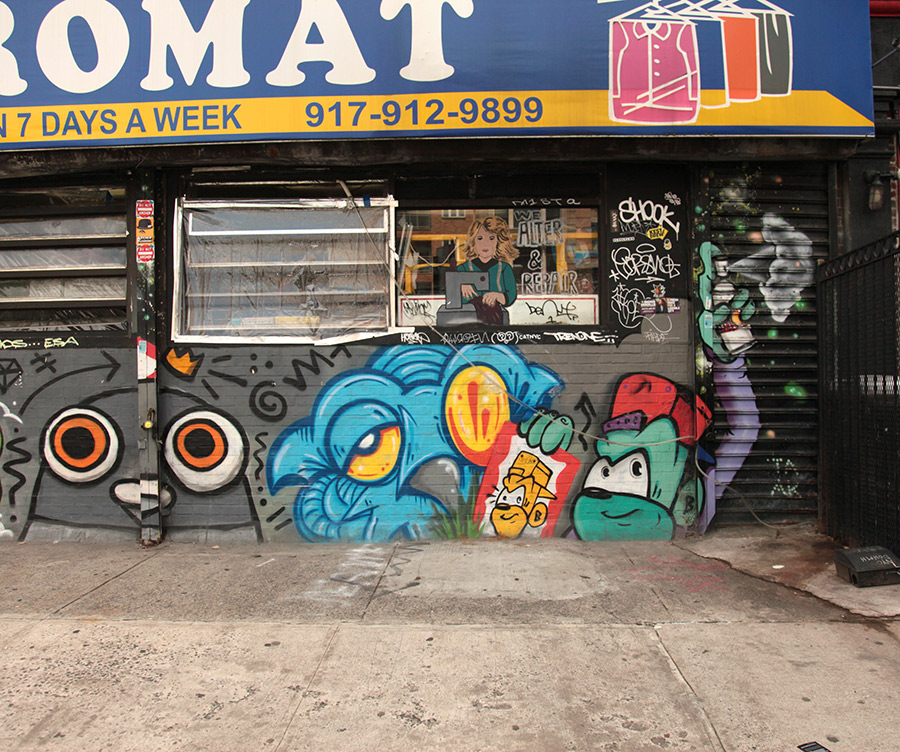
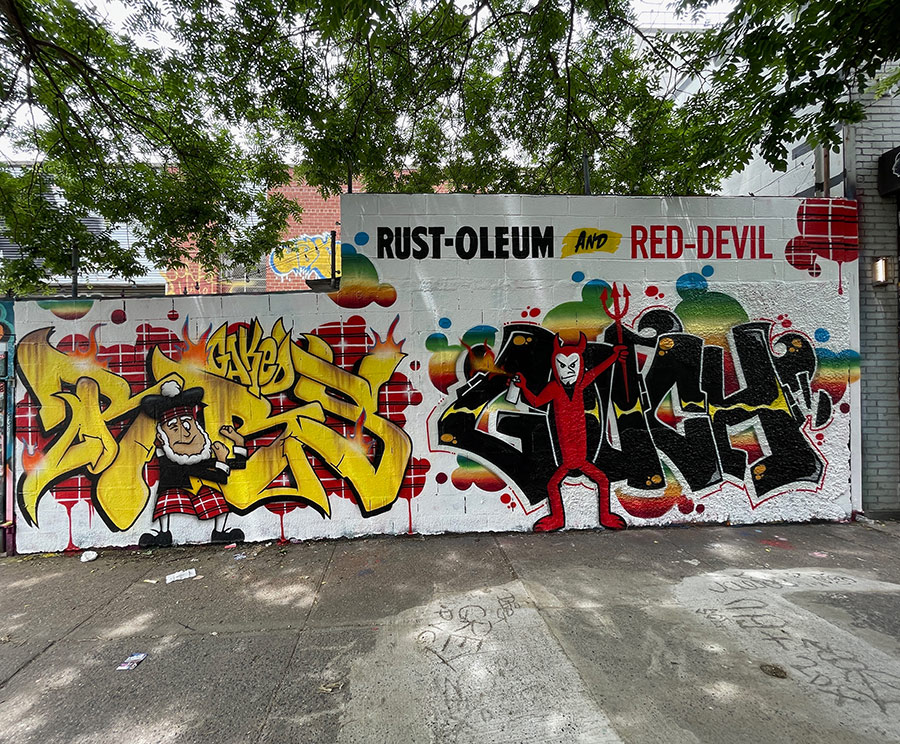
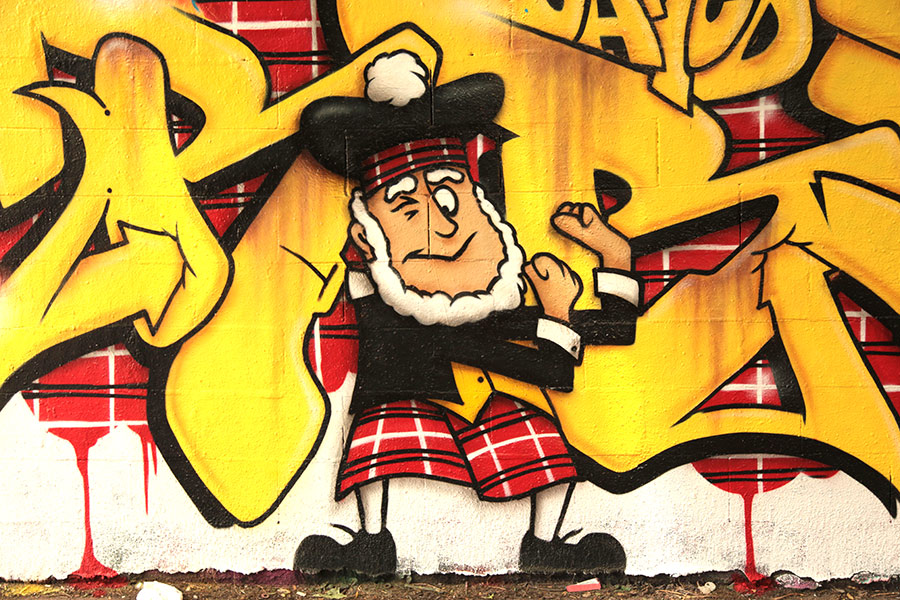
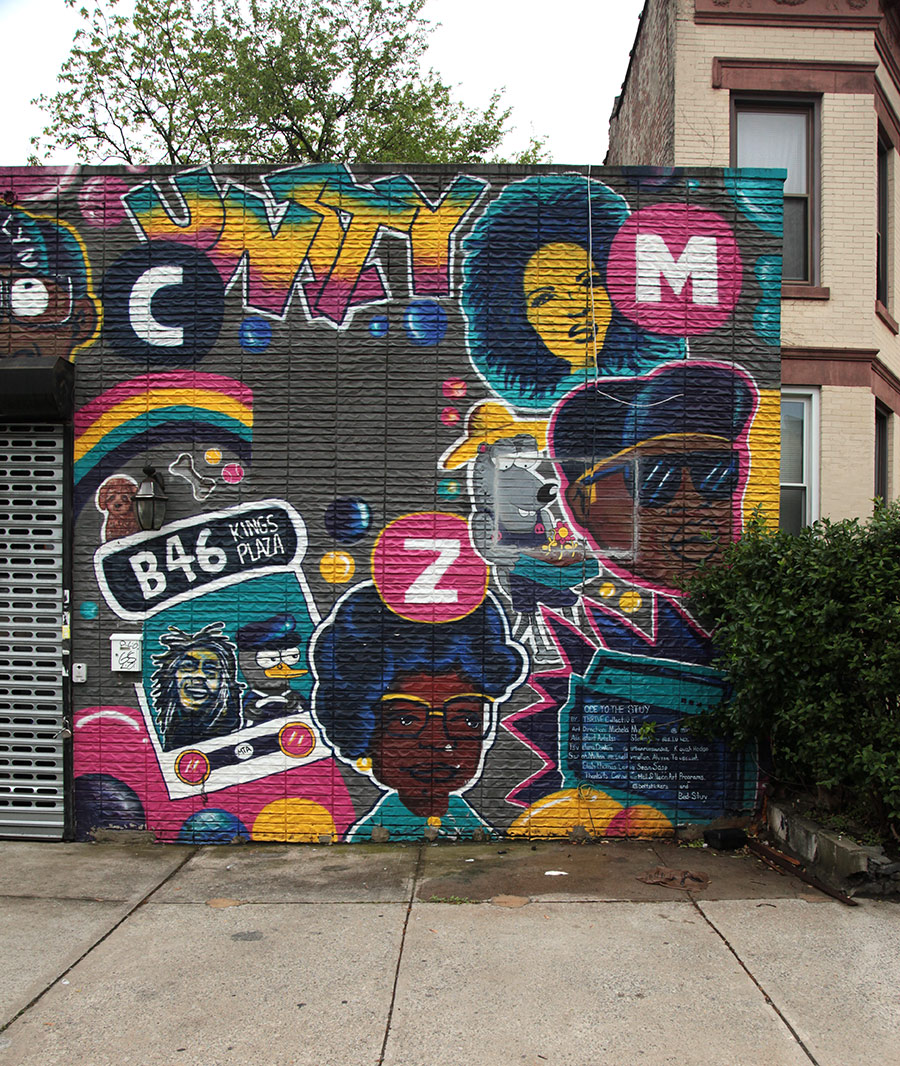
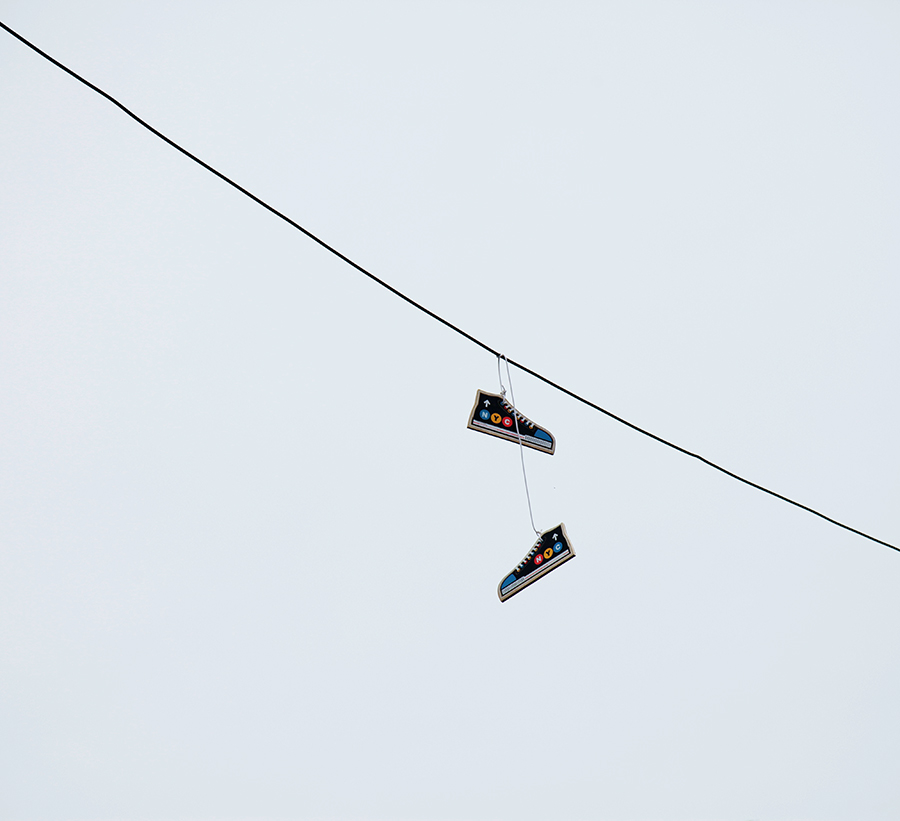
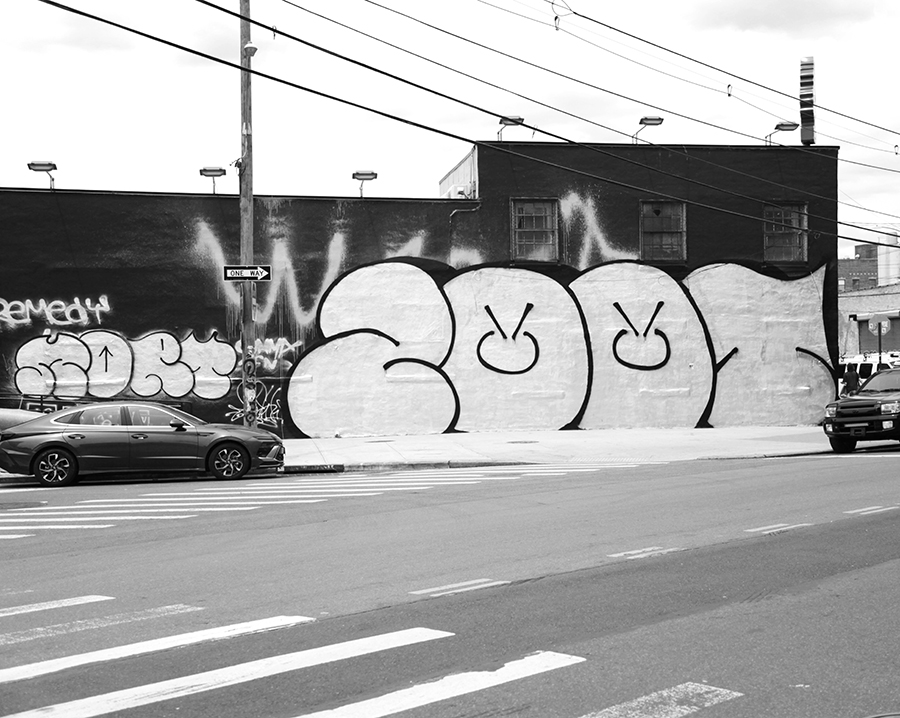
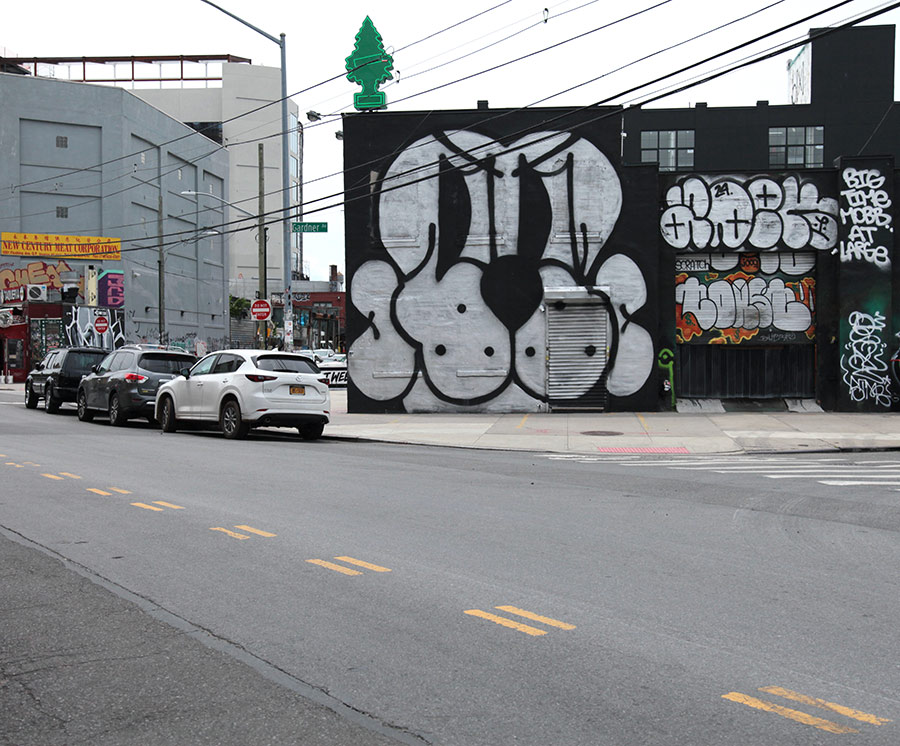
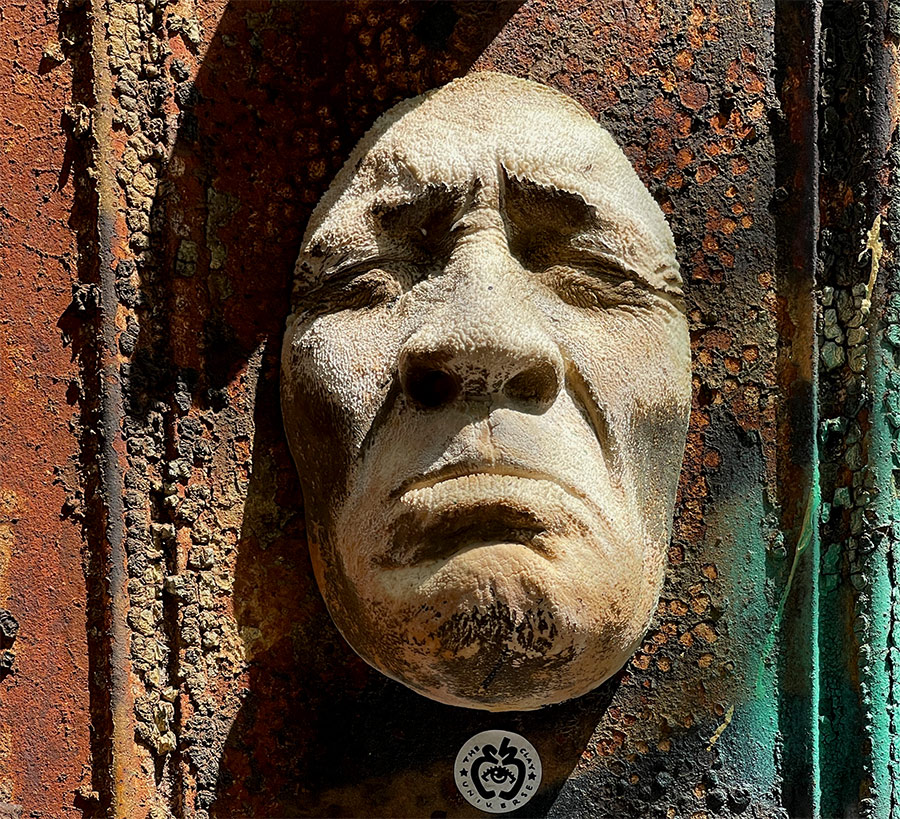
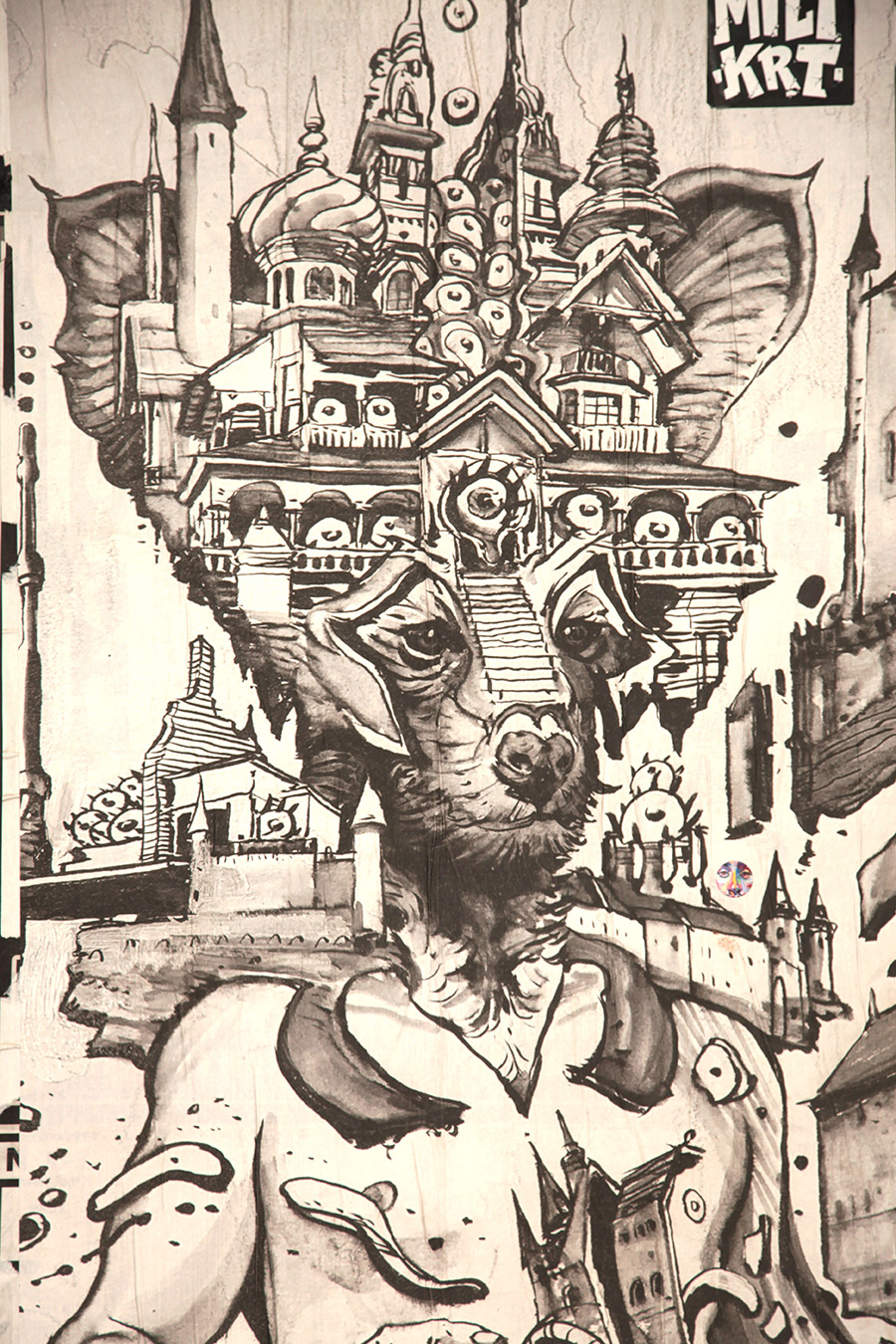
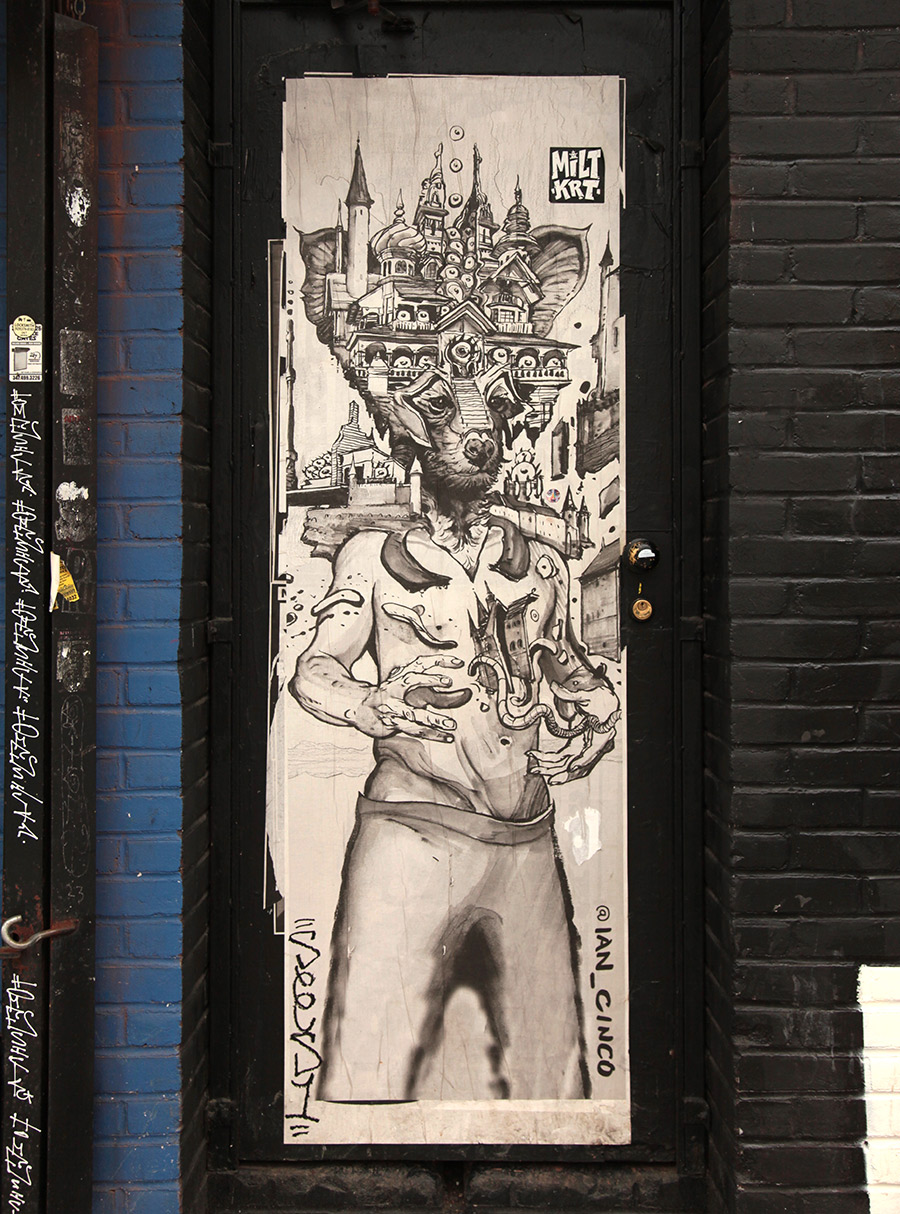
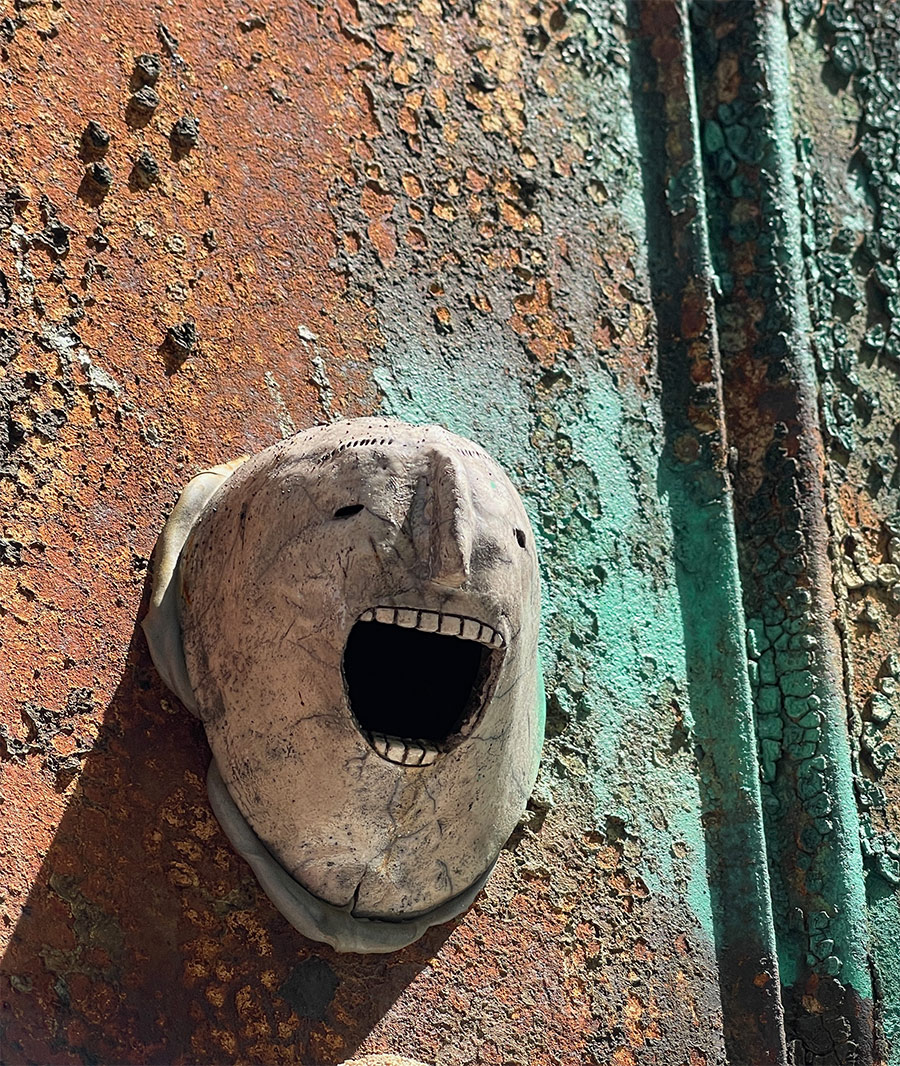
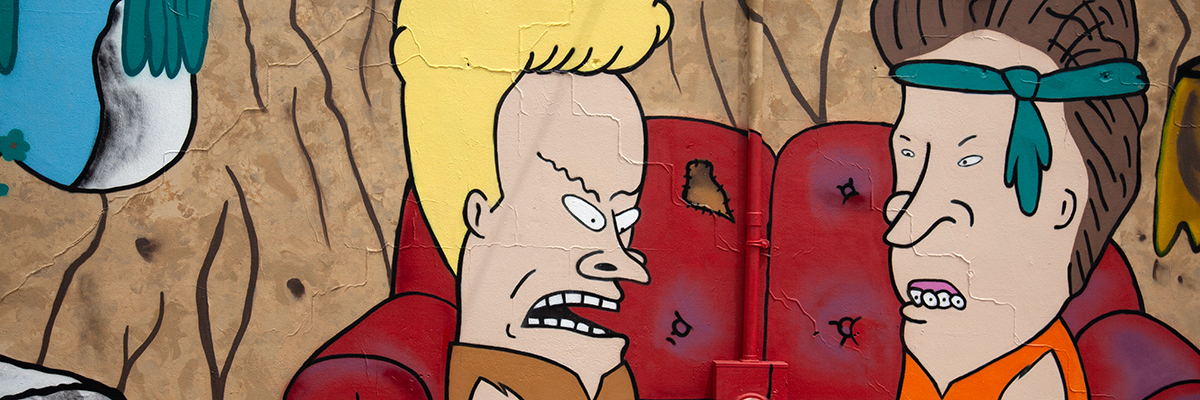
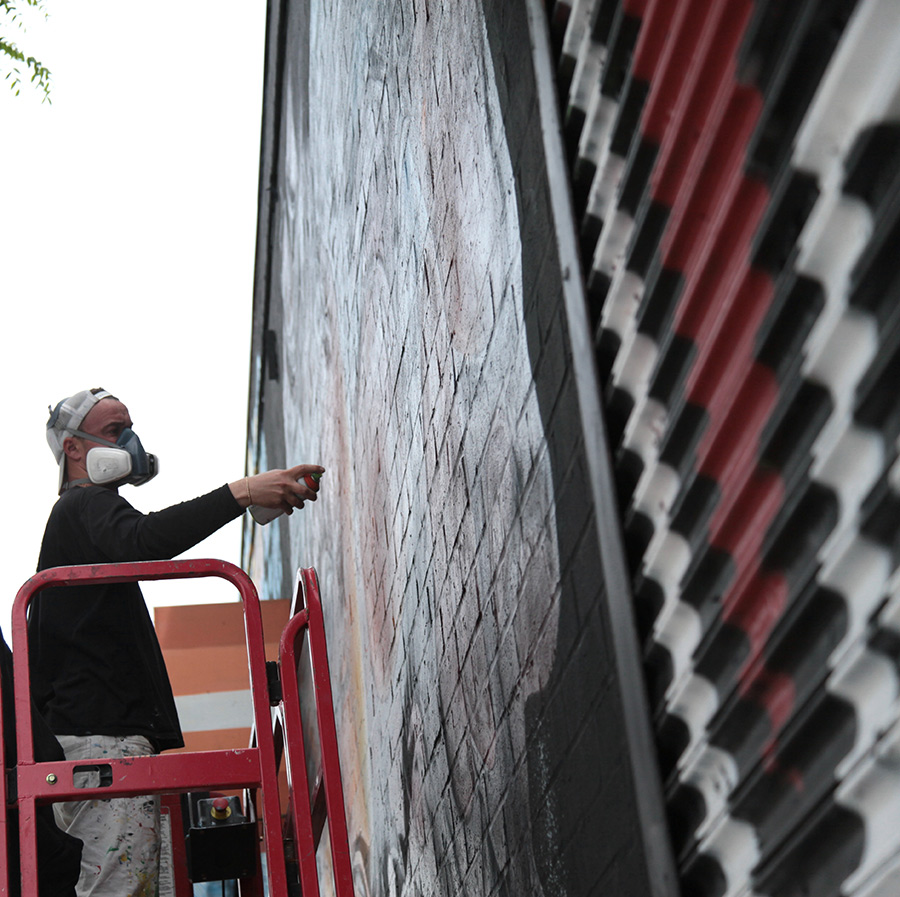
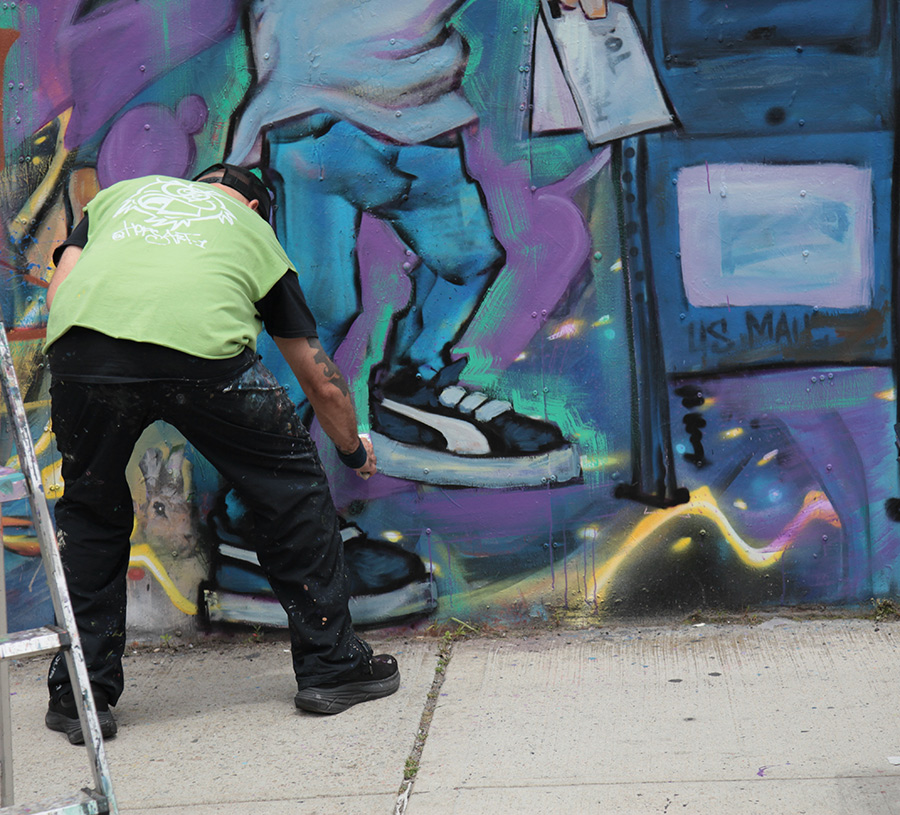
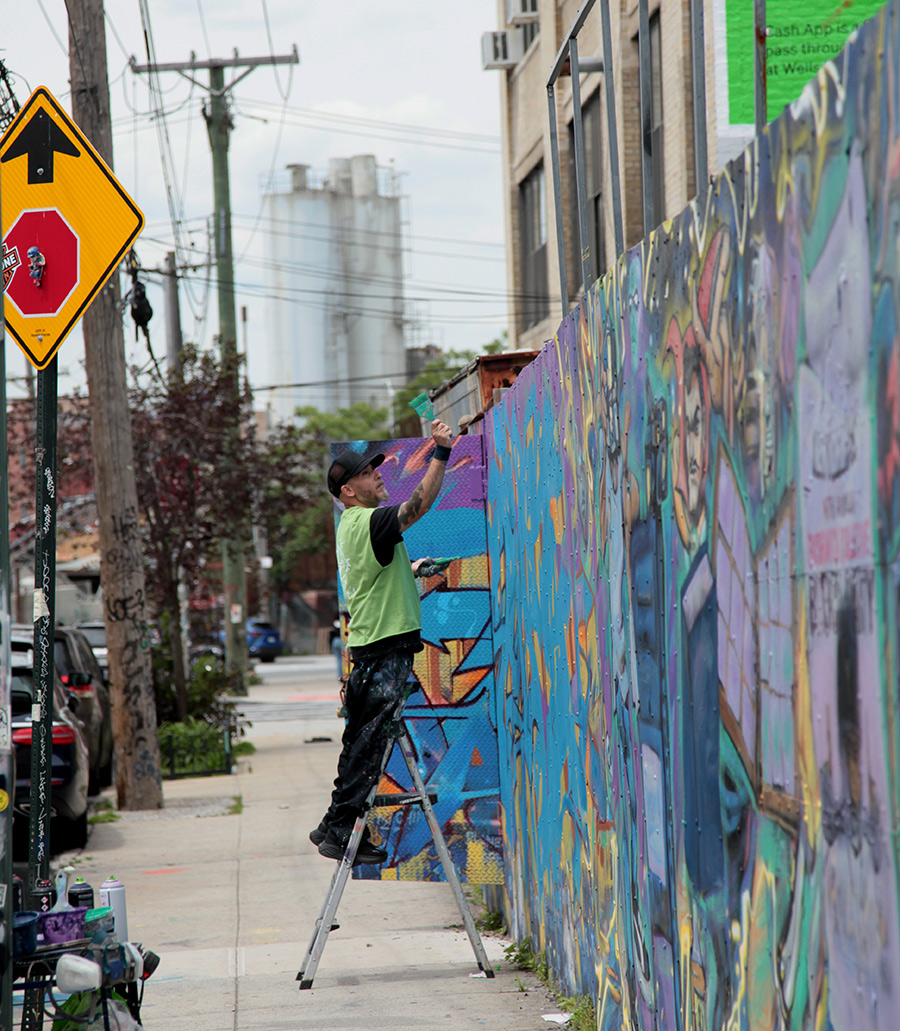
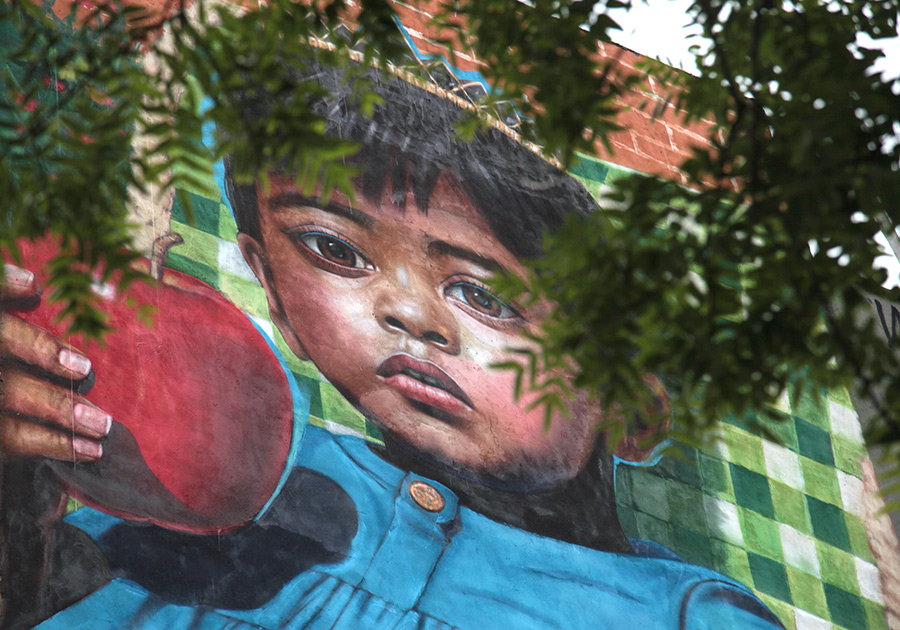
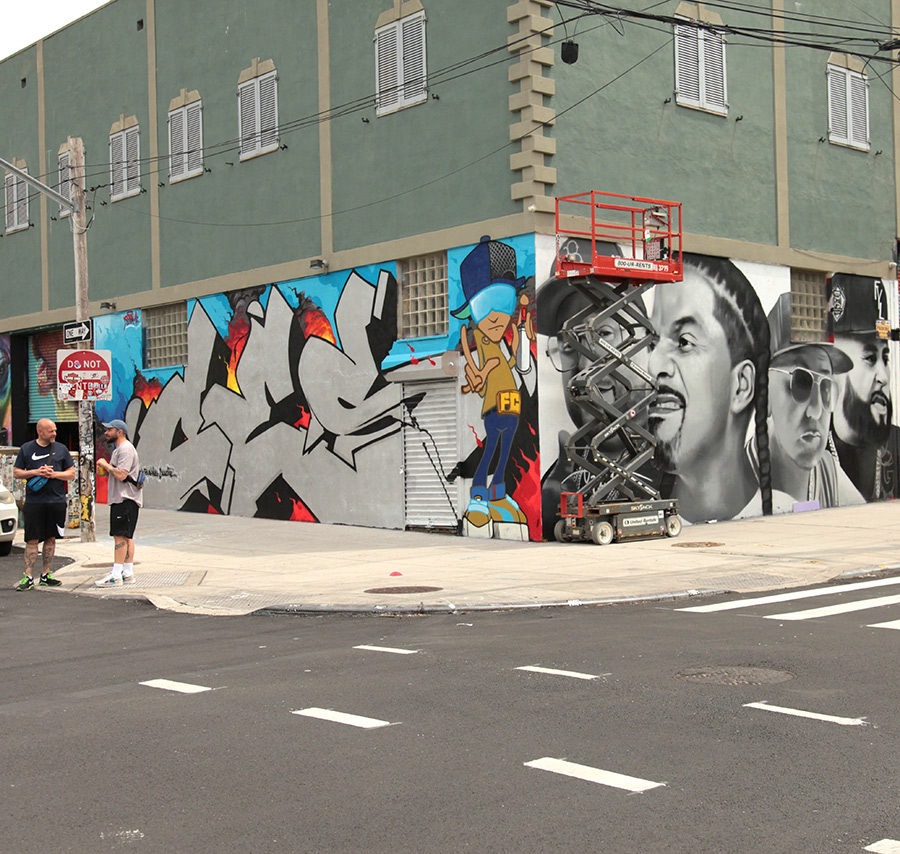
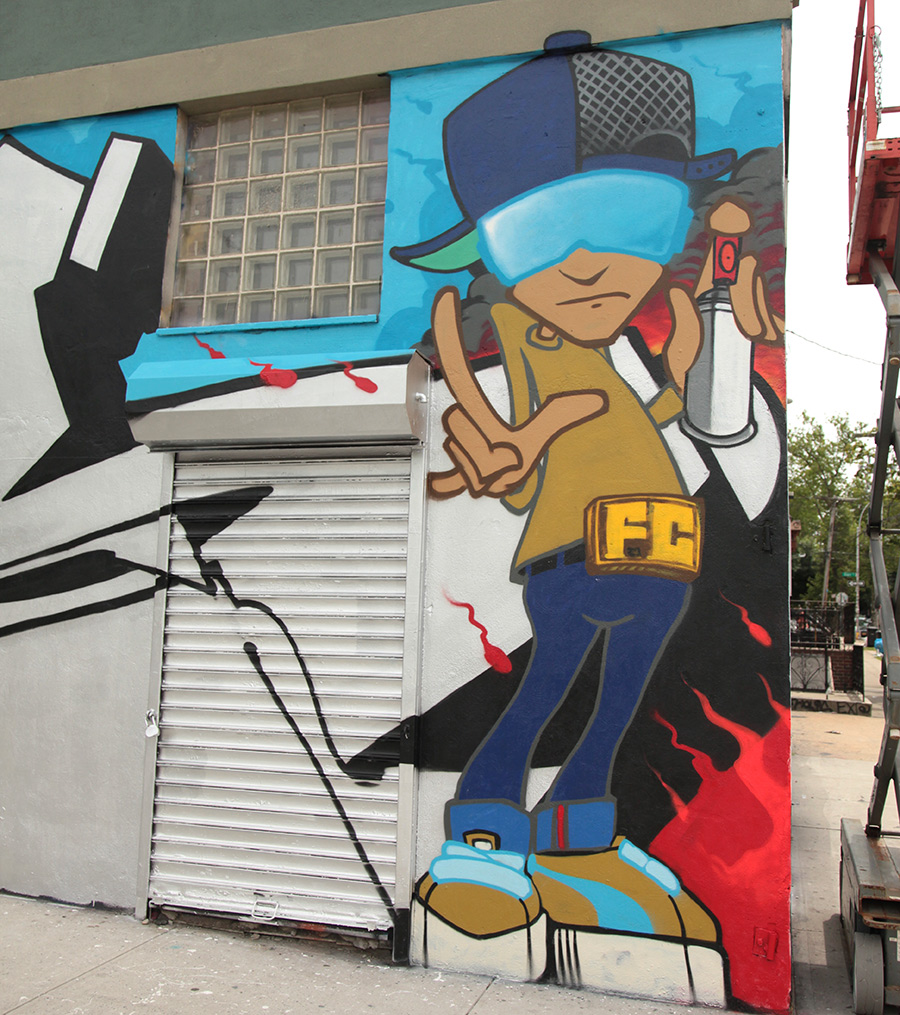
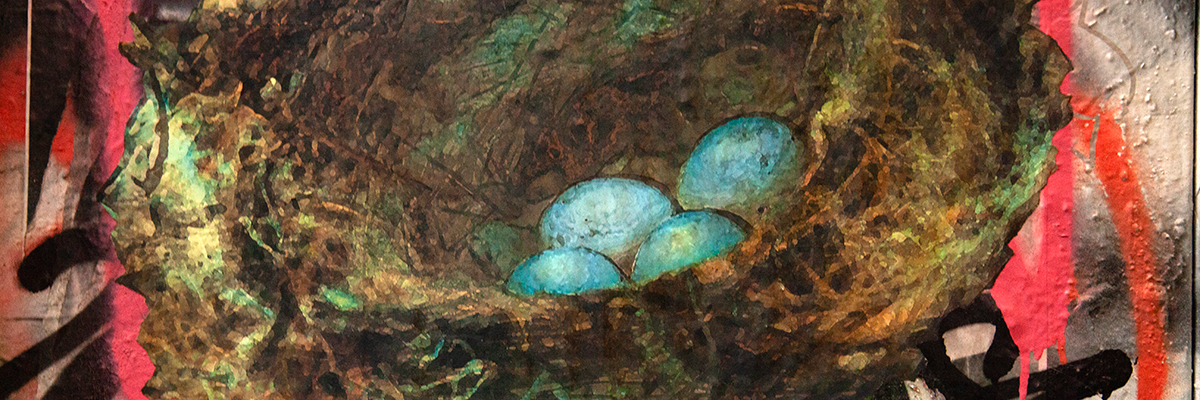
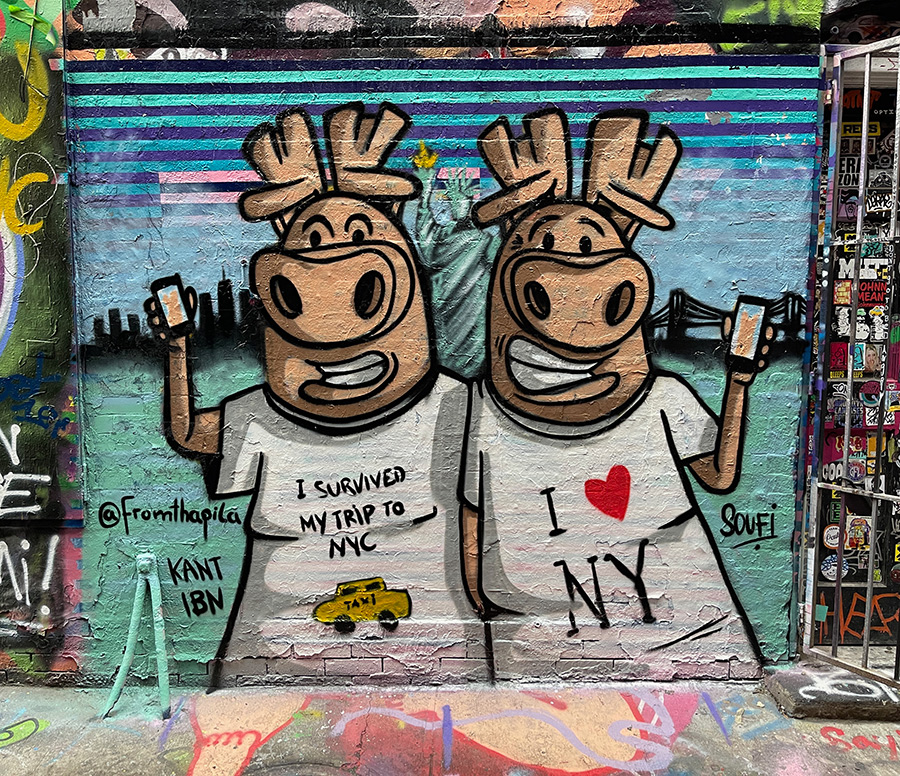
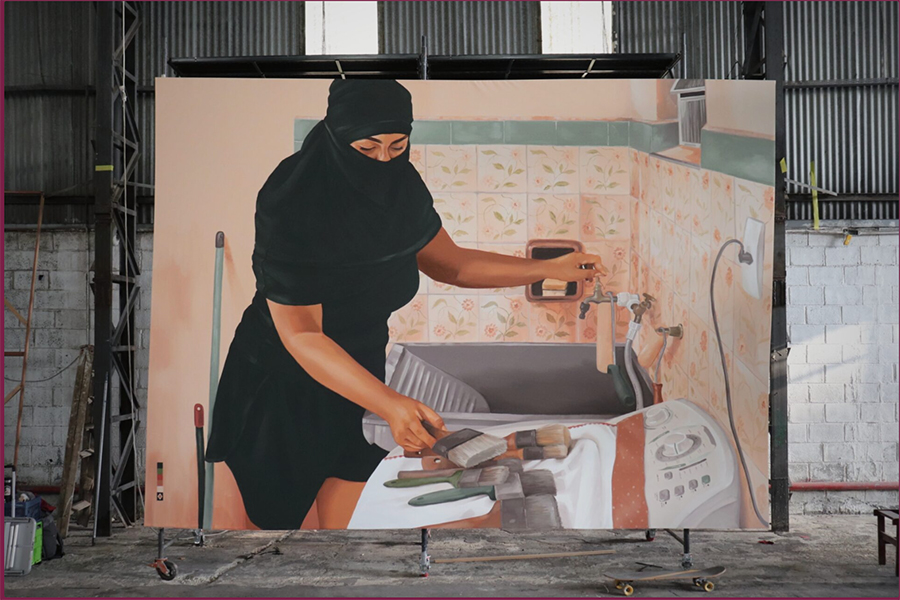
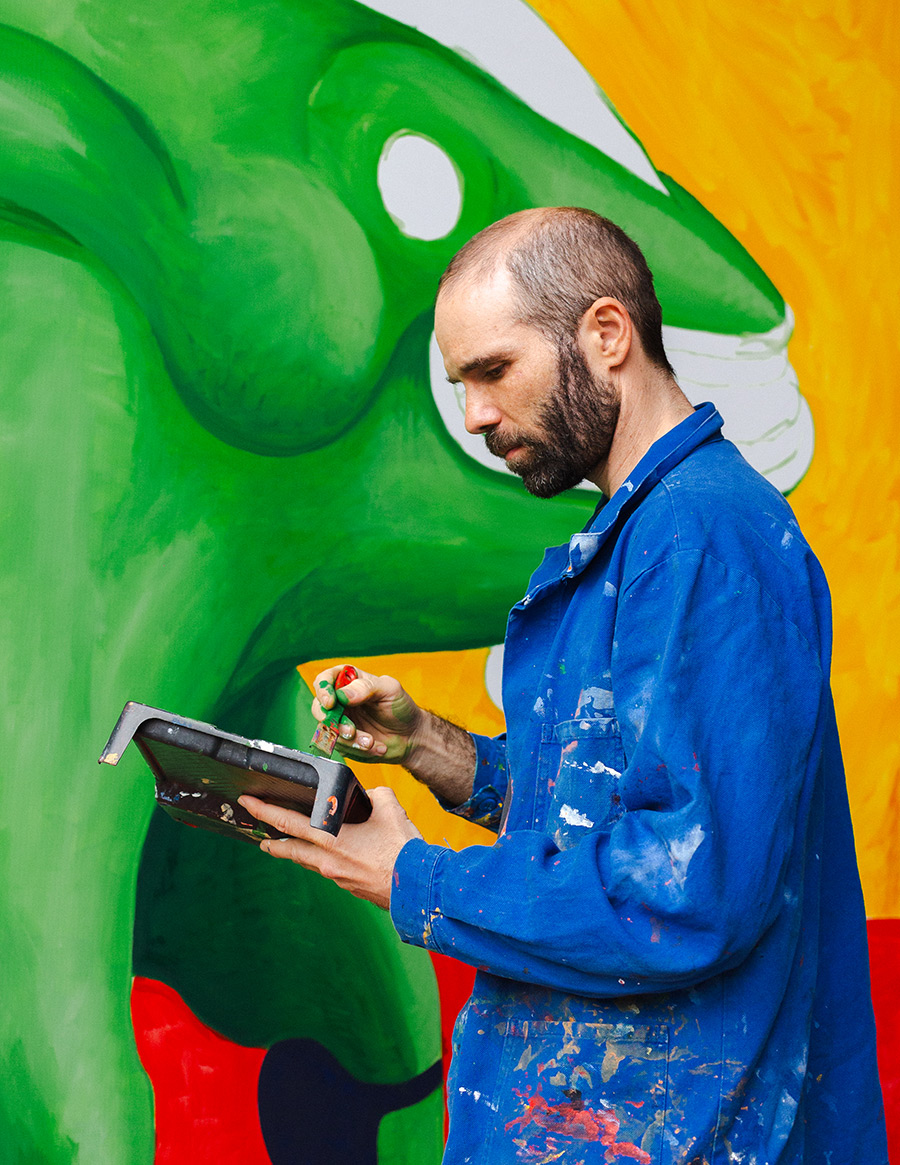
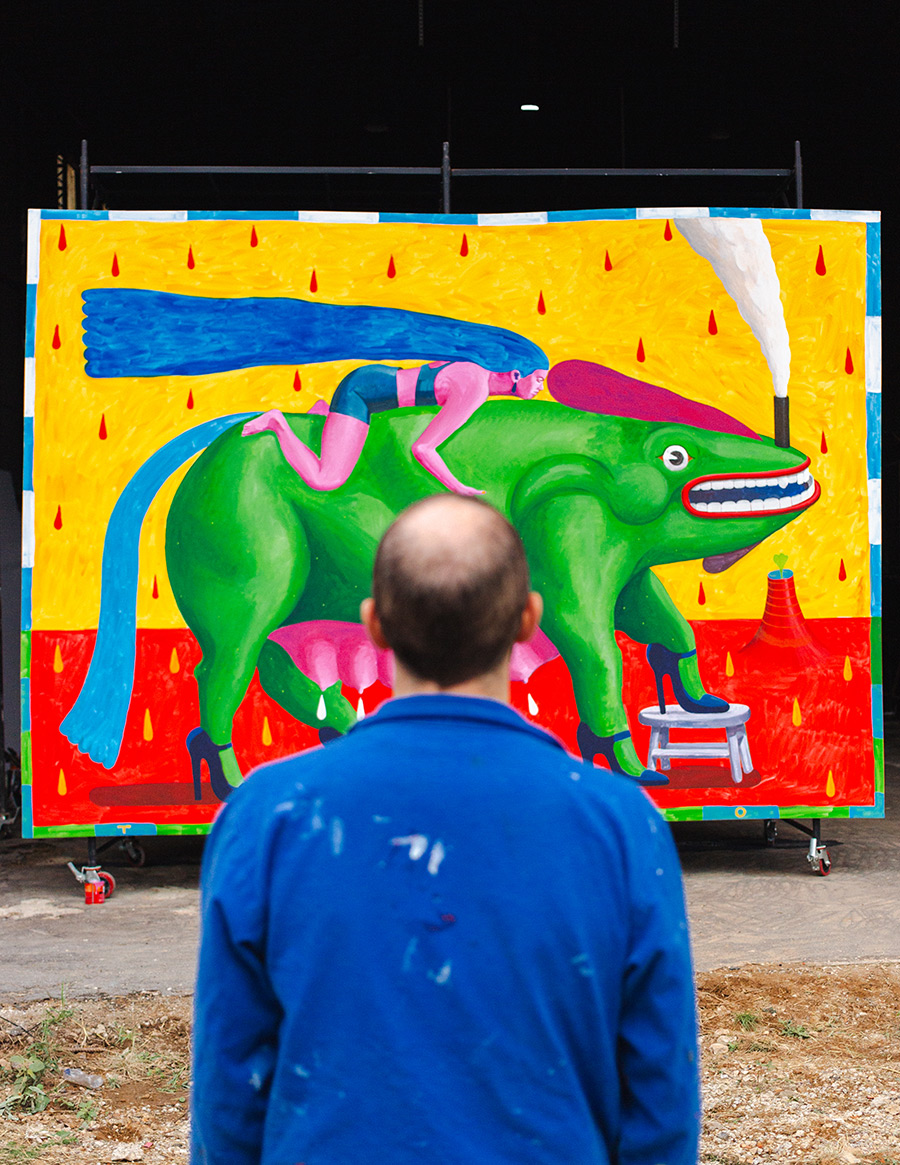
Welcome to Part I of II of our photo collection from the 14th Annual Bushwick Collective Block Party. This year’s edition, held on May 31, 2025, brought together a powerful fusion of beats, paint, and community spirit—just the kind of vibrant energy we at BSA love to celebrate.
The day’s star performer, hip-hop legend Rakim, set the stage alight with an electrifying set that fused old-school authenticity with Bushwick’s forward-thinking street culture – an intelligent merging of underground and old-school. Sharing the spotlight were dynamic artists Statik Selektah, Gorilla Nems, Termanology, and Evil Dee, among others.
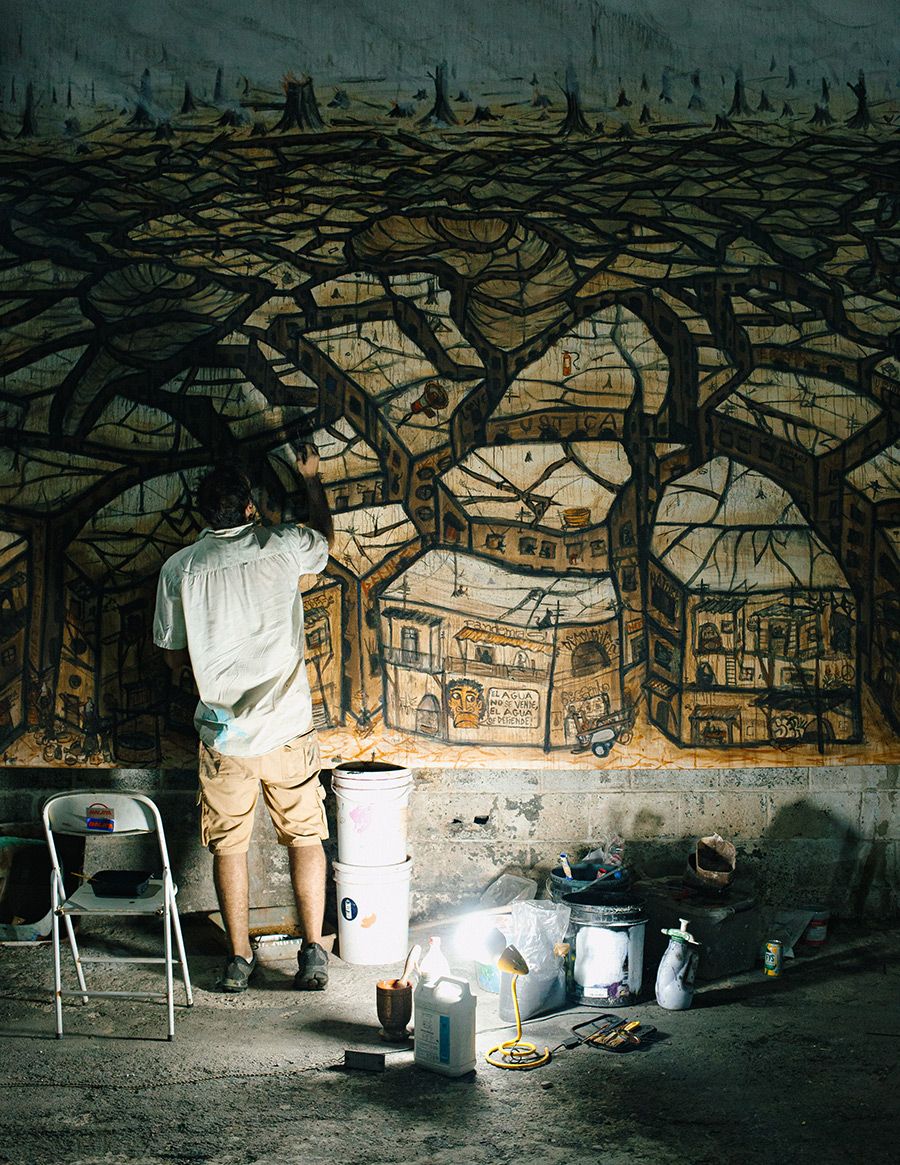
On the mural front, the Block Party again transformed Troutman Street into a living gallery. This year’s visiting muralists included Sef1, Contrabandre, Huetek, Gigstar & Minus One, Tymon de Laat, Ashley Hodder, and Enzo a psychotropic summer stew that again sampled from acrss the graffiti and street art spectrum.
It was a weekend where paint met poetry, beats met brushstrokes, and each corner of Bushwick told a fresh story. We hope these images capture the creative dialogue that unfolded. Stay tuned for Part II, where we continue to explore more of this year’s murals and moments.
Welcome to BSA Images of the Week! Eid Mubarak to all observing today. Happy Puerto Rican Parade to todos nuestras hermanos y hermanas. We’re grateful to live in a city that celebrates many traditions with such heart. That’s why it’s always perplexing to see Ken and Barbie-types on the national stage vociferating about DEI as if it were a mold on the back wall of your refrigerator. Equality has always been the point.
Banksy’s recent mural in Marseille, France, continues the Bristol artist’s tradition of indirect yet emotionally charged communication. Painted on Rue Félix Frégier, the black-and-white stencil depicts a lighthouse, accompanied by the phrase “I want to be what you saw in me.” Cleverly integrated into its environment, the mural uses the shadow of a nearby street bollard to serve as the lighthouse’s beam—an understated but remarkable visual device.
Interpretations vary, but we’ll venture one: it reads as an oblique critique of nations or institutions once seen as guiding lights—sources of moral or cultural leadership—that now appear directionless or diminished. The lighthouse, in this reading, becomes a symbol of lost purpose. Aware that no one looks to it for guidance anymore, it expresses a quiet resignation, perhaps even grief. Poor lighthouse. The Smithsonian magazine says its just a straightforward plea for attention from the artist. The view may seem surprising, but more astonishing is that the Smithsonian weighed in at all.
Now it’s your turn to be the armchair psychologist or social analyst.
This week in break-up news, the U.S. President and the Twitter tycoon who would be king took their grievances public, trading jabs on social media in a battle to tarnish each other’s image. Each was presumably trying to damage the other’s perception in the public eye, although that hardly seemed necessary. As George Clooney’s Edward R. Murrow put it last night, live on Broadway and live broadcasted on network television: ‘Good night, and good luck.’ As ever, it’s more about control and good money than anything else. It makes you wonder if either one of these guys could be sworn in as president in January ’29. Has a certain ring to it, no?
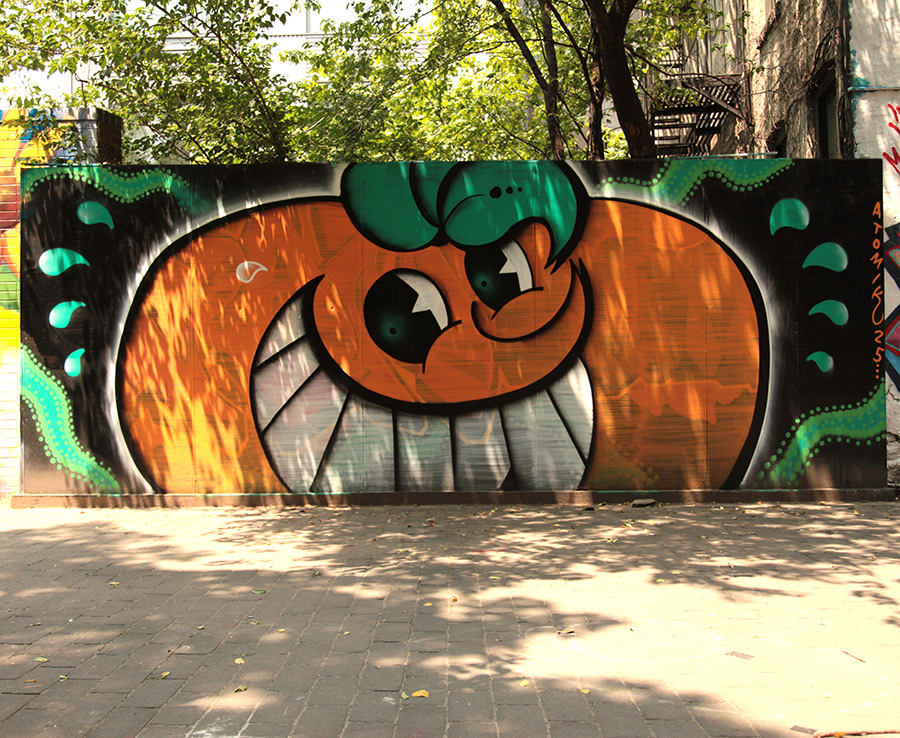
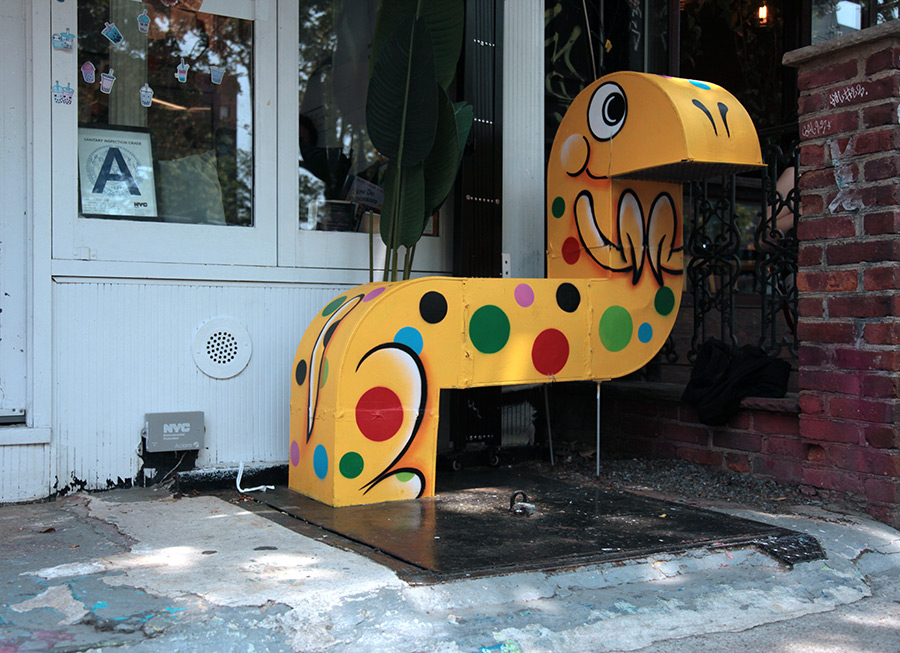
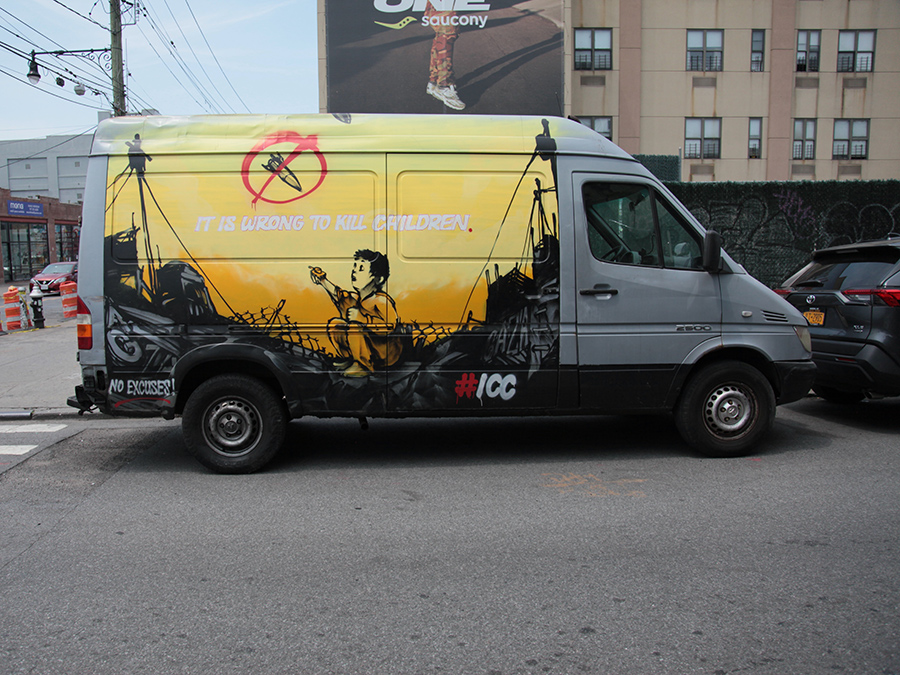
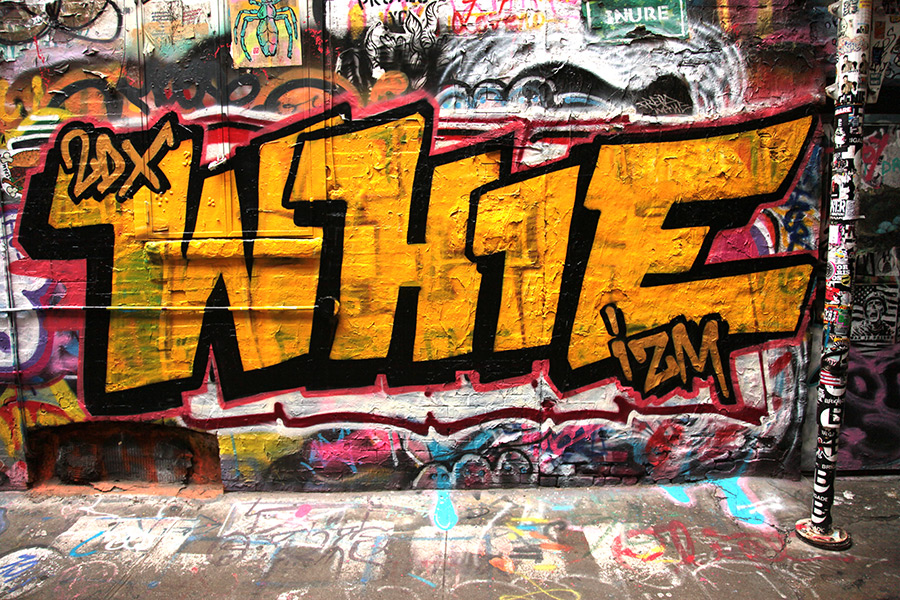
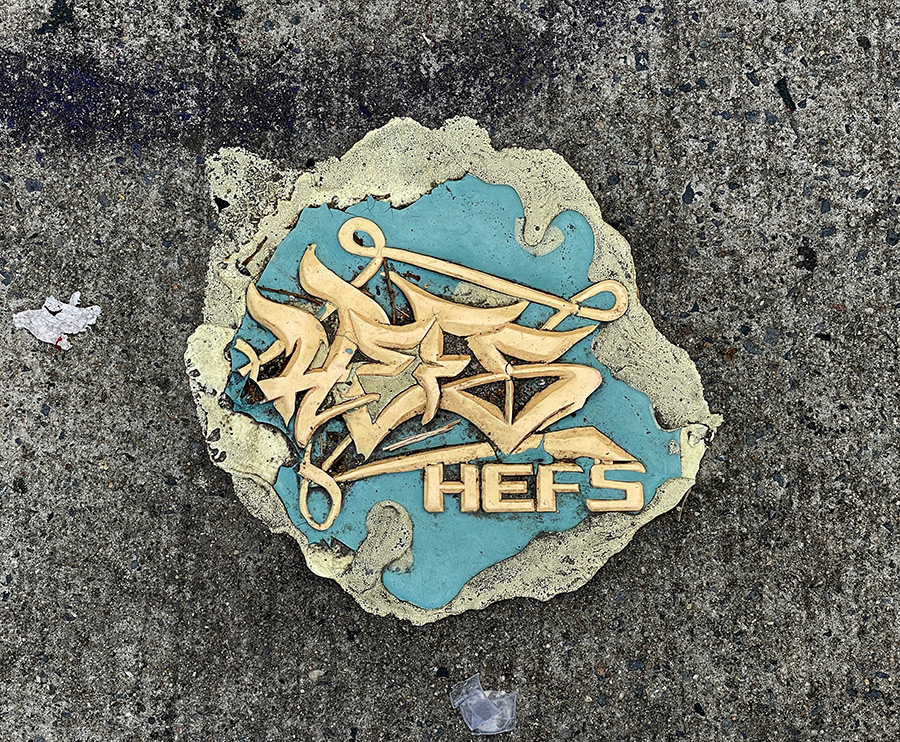
And here’s our weekly interview with the street, this week featuring 2DX, Adam Fu, Atomiko, Below Key, Chris Haven, EXR, HEFS, Jason Haaf, Quaker Pirate, Scoote LaForge, Tom Bob, and Werds.
In the charged aftermath of 1960s protest movements, artists began taking their practices beyond galleries and into the streets, forging a new relationship with public space and everyday materials. The Situationists, for example, sought to interrupt the routines of daily life by wandering the city without a plan, using these aimless drifts to reveal the city’s hidden psychological and political layers. Around the same time, Gordon Matta-Clark carved literal voids into abandoned buildings, turning architecture itself into sculpture and critique. It was during this fertile moment, when early graffiti writers were claiming walls and conceptual artists were transforming the urban landscape, that Masao Gozu began his own quiet, obsessive project in New York. Though not street art in the conventional sense, Gozu’s decades-long practice of photographing and reconstructing building façades from the Lower East Side resonates with the same spirit: using the city itself as subject, surface, and raw material. In the essay that follows, artist and curator Ted Riederer—who first met Gozu while directing Howl! Happening—offers an intimate portrait of an artist who transforms dereliction into devotion, and time itself into sculpture.
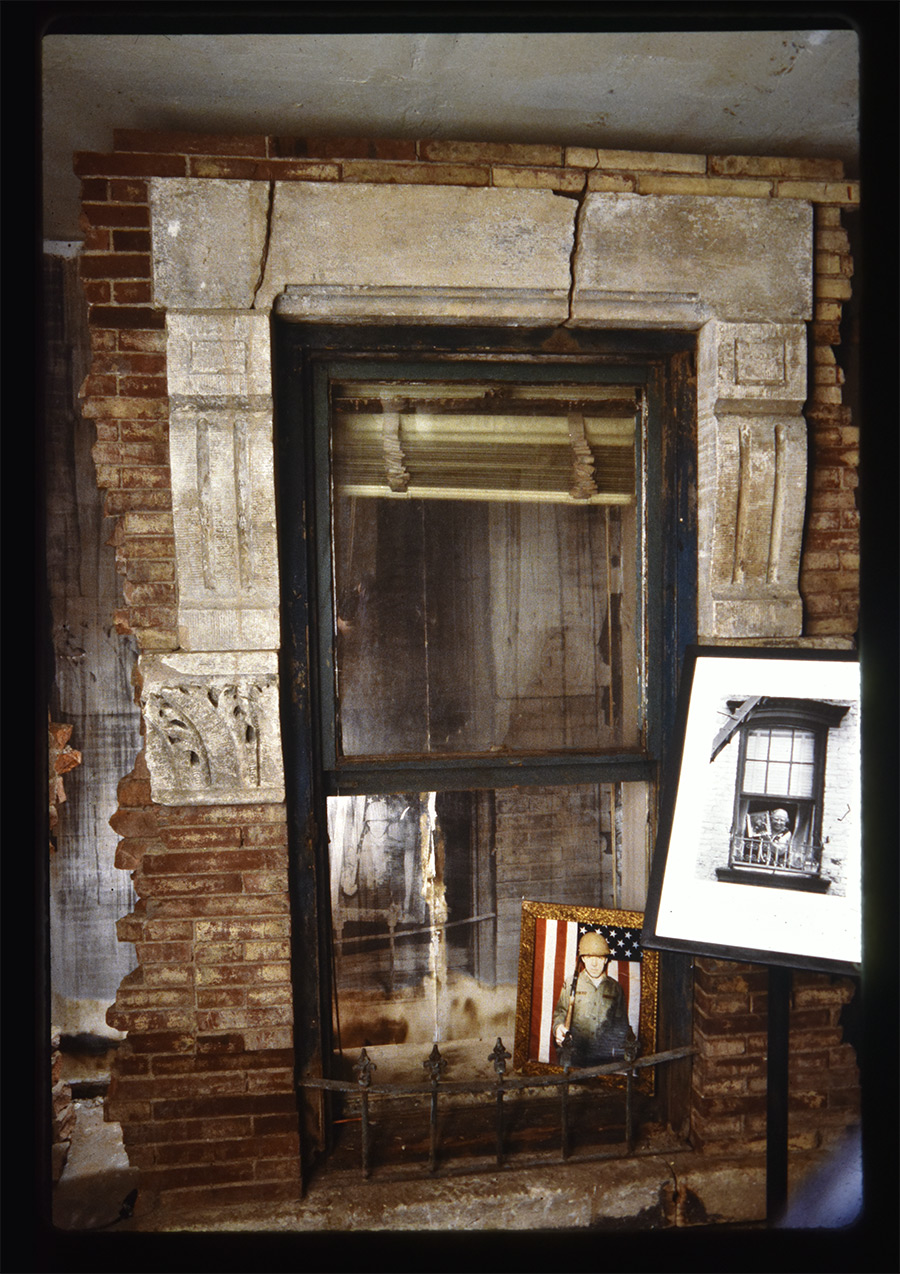
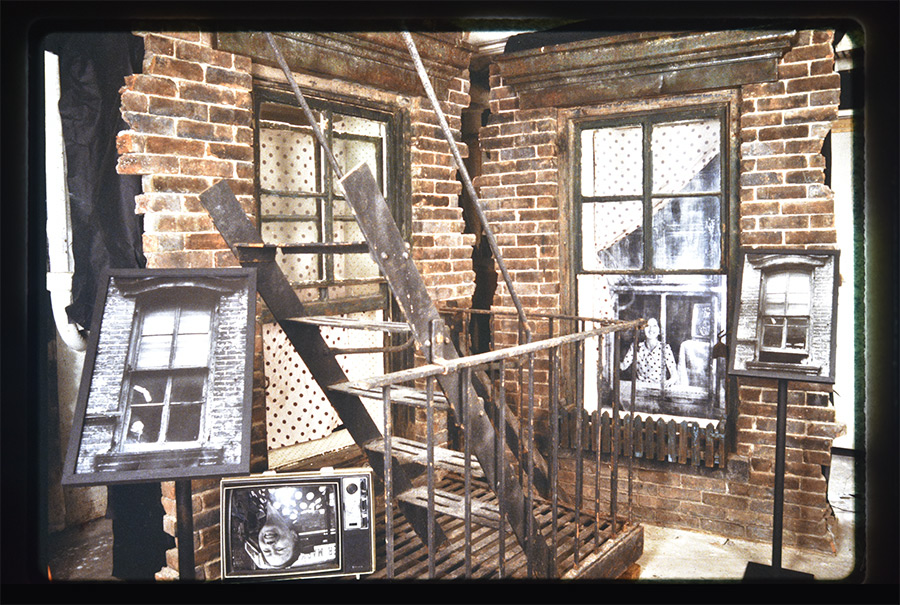
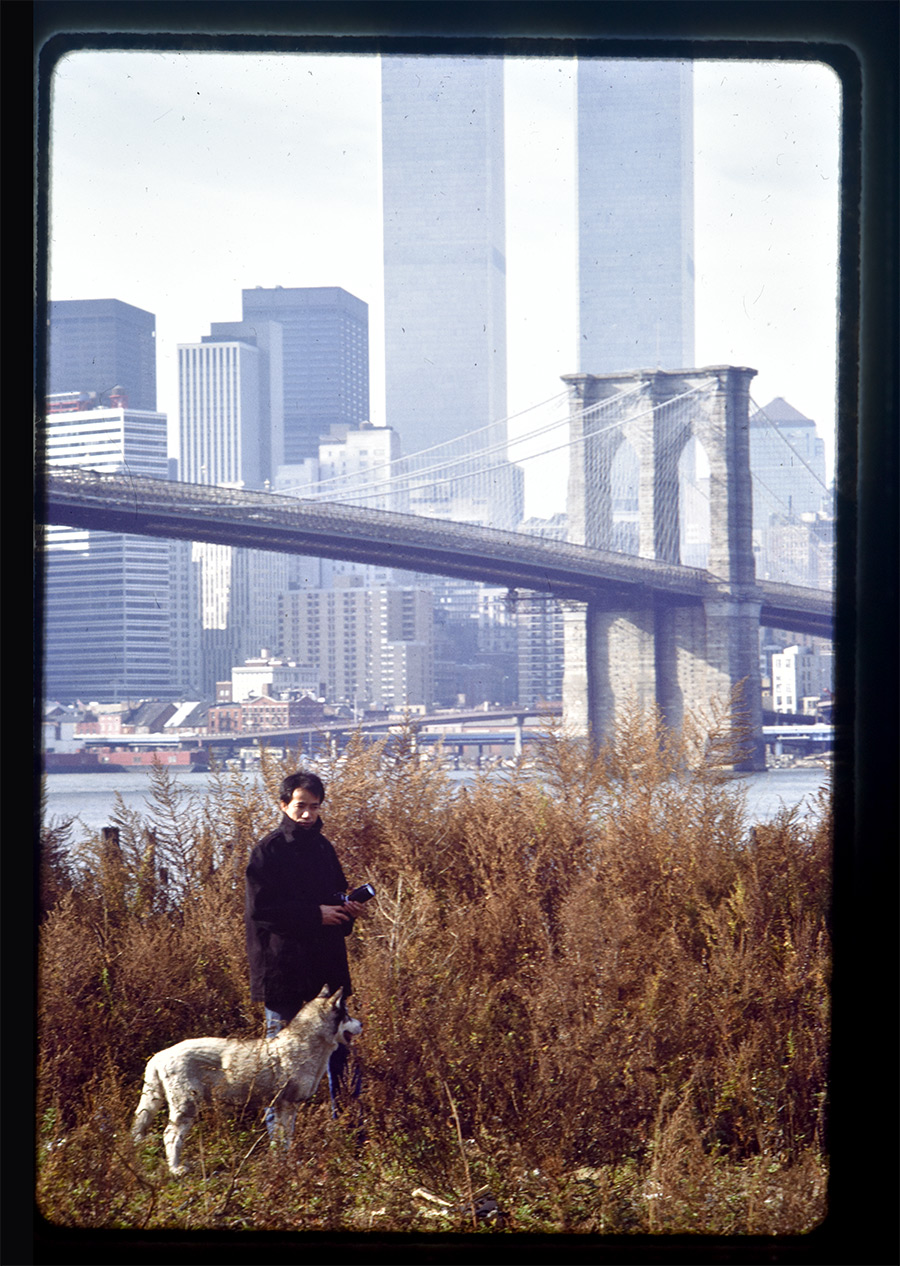
During the Pleistocene 1970s and 80s, New York street art culture coalesced into a variegated art form. What began with simple tags ended with museum exhibitions. In the early 80s, when East Village street artists were painting and posting on derelict buildings, Masao Gozu was disassembling them and reconstructing them into monuments. I first met Gozu when I was the artistic director of Howl Happening: An Arturo Vega project. We mounted his exhibition Timeframe in the Fall of 2017. I was awestruck by his all-encompassing quasi-spiritual devotion to his work. Piece by piece he dismantled abandoned buildings. Piece by piece he methodically rebuilt them in his studio. In disassembling and reassembling a puzzle of bricks, he was in search of a fleeting moment in time. His work is not street art, rather art made with the streets.
Born at the end of WW2, Masao Gozu grew up in rural Nagano, Japan, where his family had lived for ten generations. Like many other artists his age, Gozu was discouraged by what he perceived as a lack of opportunity in the reconstruction and occupation of post-war Japan. He applied to art school in the United States as an escape and was accepted into the Brooklyn Museum Art School.
There is an under-reported history of Japanese artists contributing to the vibrant downtown art scene in New York during the 1970s and 80s. Artist and friend Toyo Tsuchiya, who moved to New York in 1980, attributed his own immigration to an enticing article about the New York art scene published in the Japanese art magazine Bijutsu Techo. Unable to relate to the stiff, formal academic art world reigning in Japan during these years, Tsuchiya described arriving in New York and being quite surprised to find an established and thriving community of avant-garde Japanese artists on the Lower East Side, centered for the most part, around Kazuko Miyamoto’s Gallery Onetwentyeight.
Penniless and alone, Gozu had moved to Brooklyn in 1971. At the Brooklyn Museum Art School he studied under Reuben Tam, a landscape painter. Through this community, Gozu found other artists who helped him find work and housing. 1971 is also the year he began taking pictures of windows.
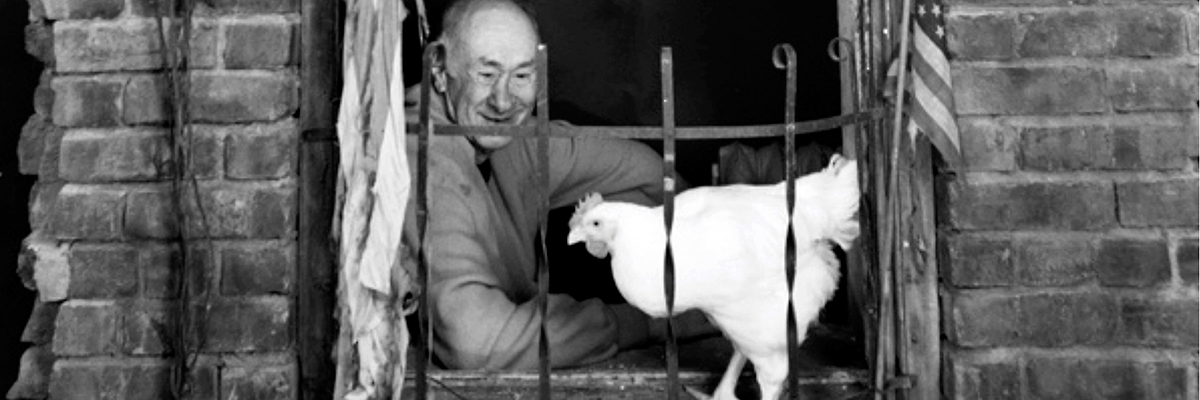
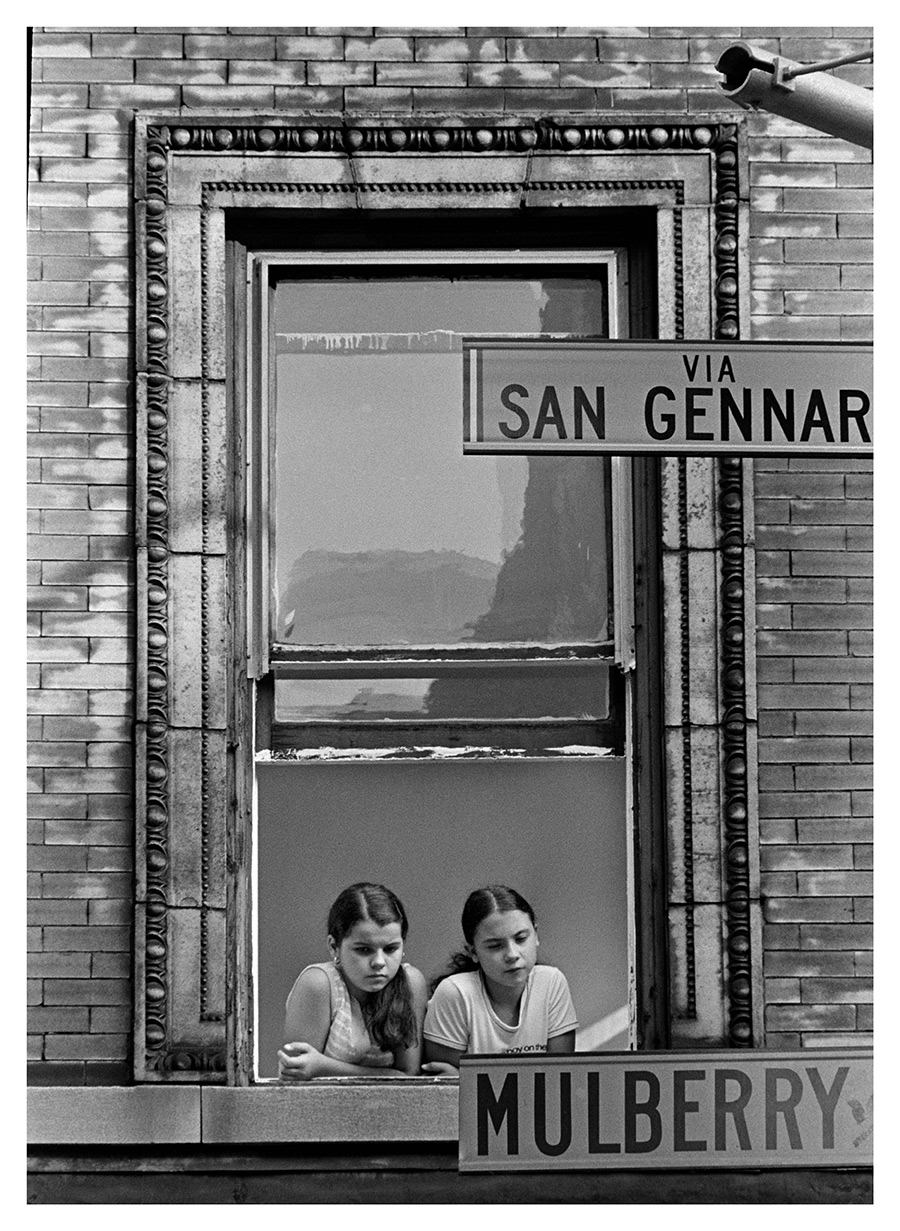
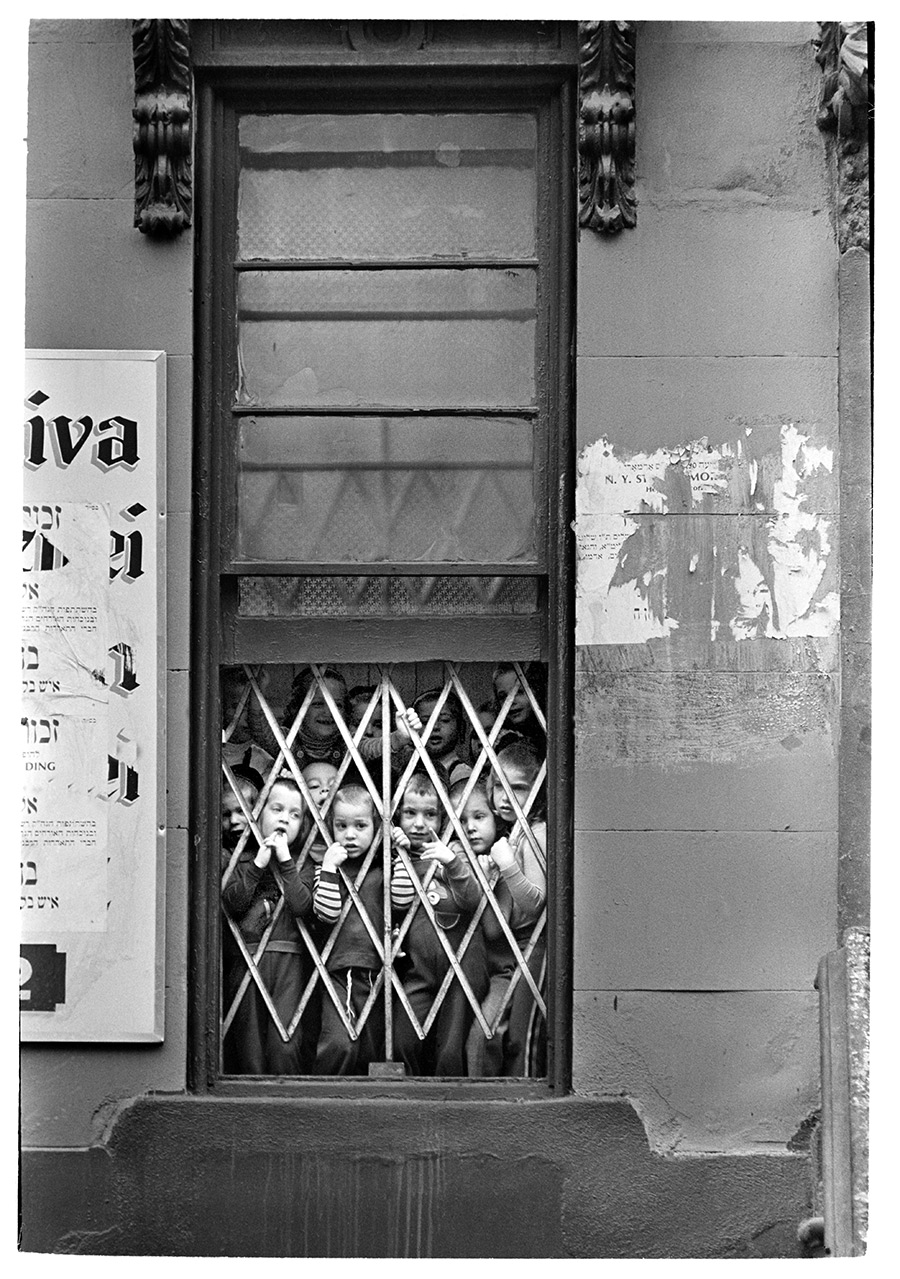
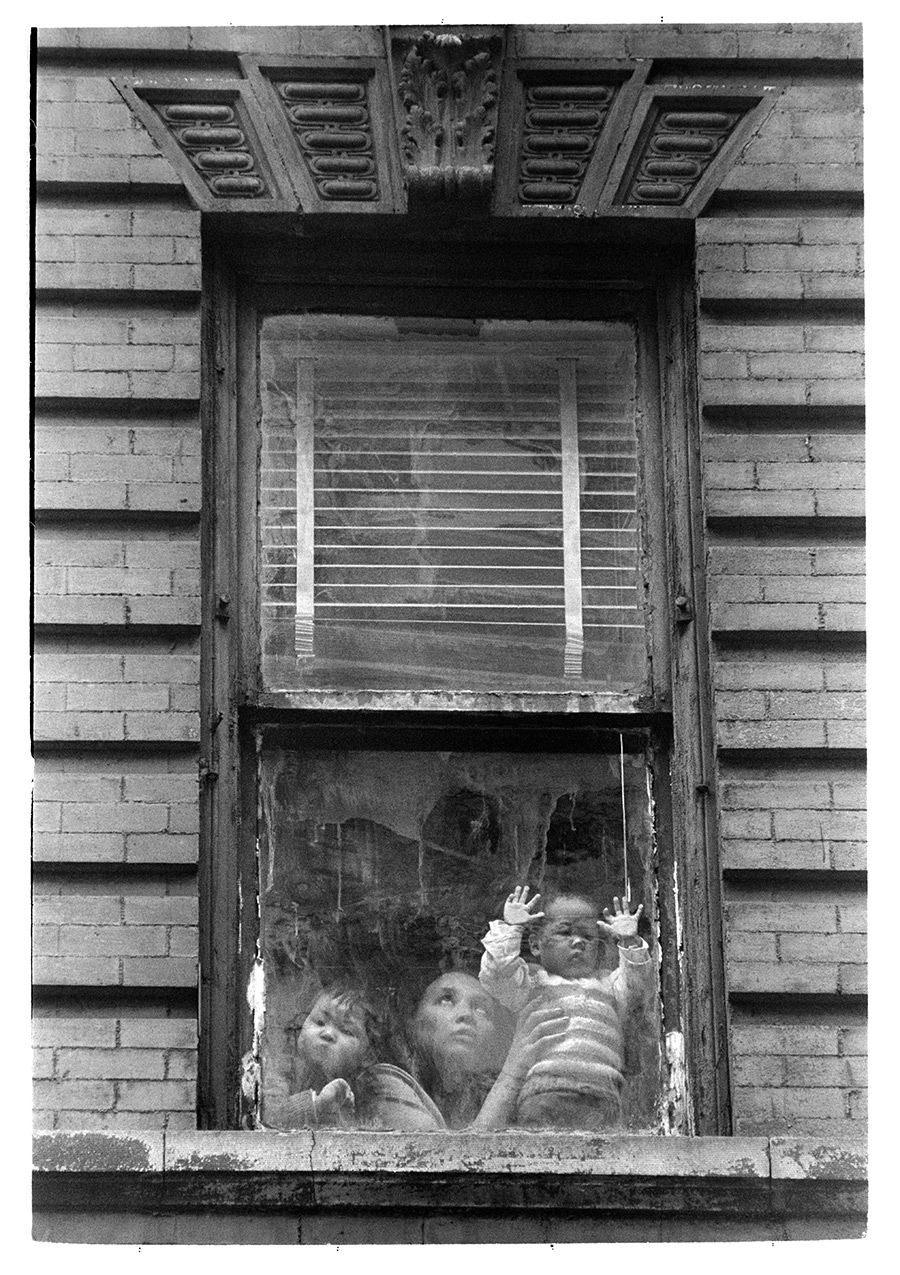
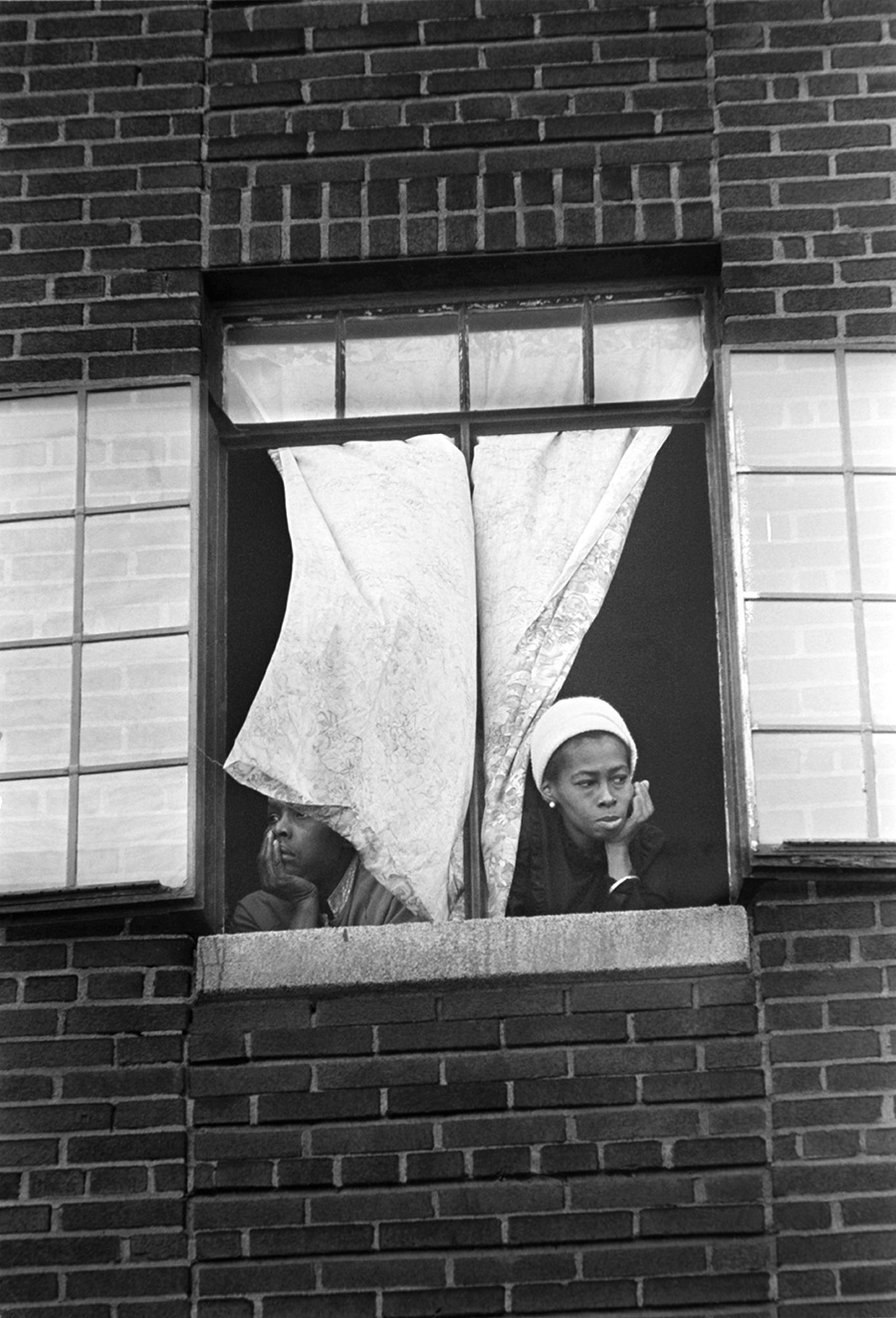
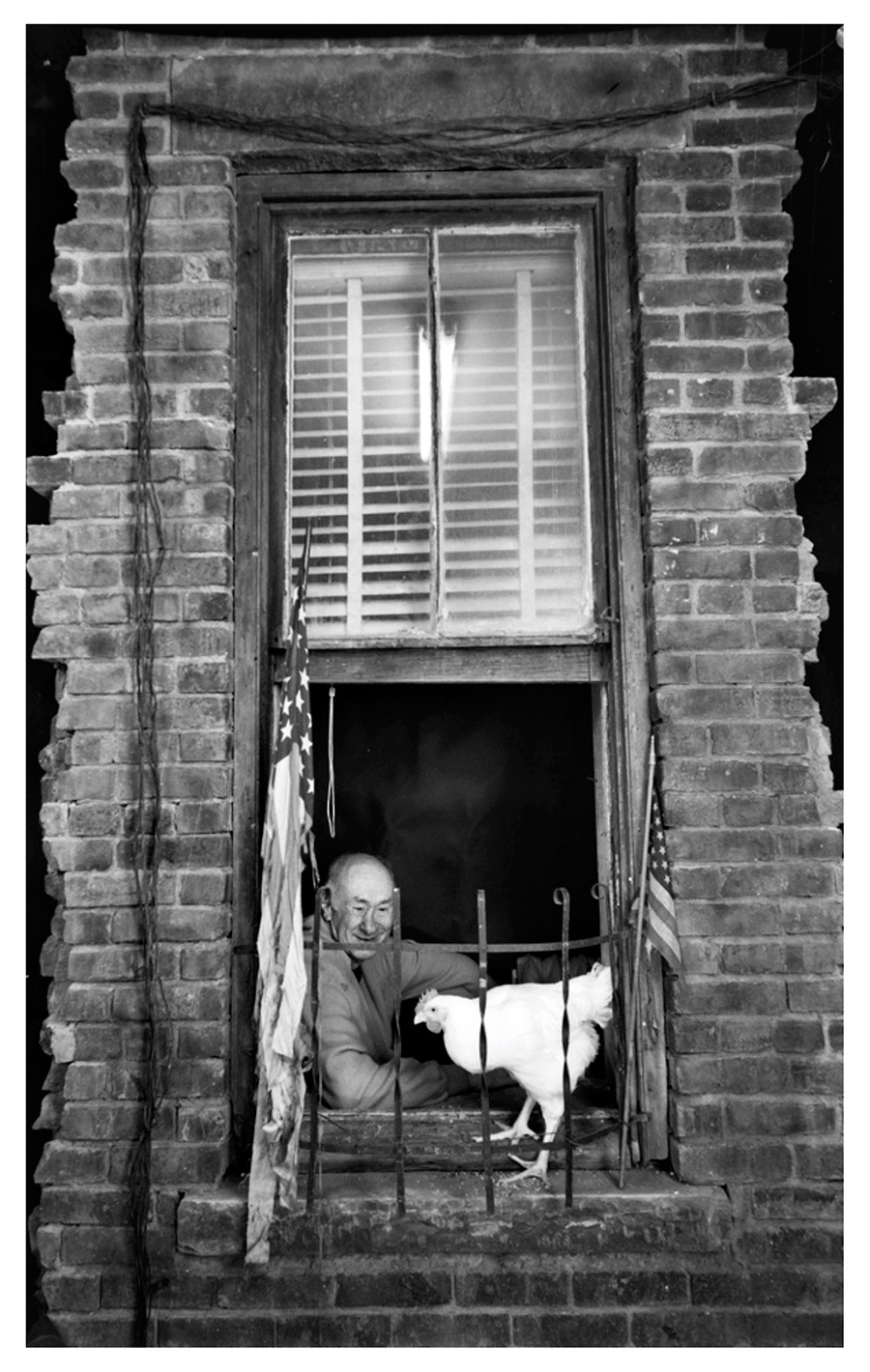
Stalking parades, street fairs, and feast days, Masao Gozu photographed the diverse residents of New York’s immigrant neighborhoods peering out apartment window frames. In almost all of the photographs of windows, the subjects are gazing at some action outside the frame of the window, either on the street below or up in the sky above. This series entitled 33 Windows references the number 33 which in Buddhism is a sacred number representing infinity.
Gozu’s Window Series captures the “zeitgeist” of New York in the 70s and 80s with as much aesthetic appeal as some of the storied photographs of the city such as those by Robert Frank, Diane Arbus, and Alfred Stieglitz. There is, however, something distinct and unique in Gozu’s artistic vision. Through the repetition of his formal composition in which the window frame is always centered in the photograph, Mazao Gozu’s pictures represent less of a documentation of everyday life, and more of an investigation into time and form.
This conceptual nod to the architecture of the window is reminiscent of the work of Bernd and Hilda Becher whose pictures of industrial structures from the same time period evade the categorization of traditional landscape photography. Their “tableau-like arrangements …always created and conceptualized according to the same parameters, inscribe themselves in the presentation space.” The Bechers label their work as Anonyme Skulpturen or Anonymous Sculptures.”¹
In his other photographic series 264, and Harry’s Bar, the practice and discipline of taking repetitive photographs over the course of years from the same position again and again hints that photography was a tool in part of a much larger conceptual practice. In Harry’s Bar, Gozu hunted the precise moment when a bar patron appeared in the exact position in lower left windowpane of a bar at 98 Bowery. To produce a series of 20 photographs, Gozu spent five years rigorously tracking and hunting the absolute image.
I asked Gozu how he transitioned from taking pictures of buildings to making sculptures with buildings. He answered that, “It started with Harry’s Bar.” Masao writes, “When it closed, I saw a sign that said ‘Everything for Sale’ and had the idea of buying the entire window and exhibiting it at a photo exhibition with photo. I tried to negotiate with the bar, but it didn’t work out.”
Masao continues, “Then, around 1983, I came across a destroyed building near Wall Street area and tore off the bricks and window frames from the surface, carried them to my apartment, and rebuilt them. It was an ordinary apartment, so the living room floor sank, so I quickly secured space in the basement of a nearby East village apartment and started assembling the windows.”
In his quest to capture the fleeting images he chased, Masao methodically marked, numbered, and then removed the bricks, glass panes, and mortar from the window frames of abandoned buildings in the East Village, reconstructing them in his studio. He enlisted his neighbors as models and dressed the windows with taxidermy, curtains and flowers. By staging the photos, he could have more control over the subject and composition, yet it’s clear that, in the process of making these pictures, Gozu’s persistence and meticulous rebuilding allude to the fact that his use of photography belied his affinity for sculpture.
It’s difficult to imagine anyone attempting to steal entire sections of buildings in today’s New York, but the East Village was lawless during the 1970s through the early 1990s. Heroin addiction and then crack were endemic to the East Village. In October of 1975, the city was hours away from bankruptcy as mayor Abraham Beame announced to the press, “I have been advised by the Comptoller that the City of New York has insufficient cash on hand to meet its debt obligation due today… Now we must take immediate action to protect essential life support systems of our city to preserve the well-being of all our citizens.”²
Robbery and assaults were reported at all-time highs, and as middle-class families abandoned the city so did landlords abandon and neglect buildings. Squatting was rampant up until the late 1980s.
Artists like Gozu were taking advantage of the city’s demise. Dismantling buildings is reminiscent of the work of Gordon Matta-Clark who staged a series of actions in the early 1970s in abandoned buildings in the Bronx and in piers along Manhattan’s waterfront which exist today only in photographs. Masao says he was not aware of Gordon Matta-Clark at the time.
During this period photography expanded sculptural practice, “It permitted the sculptors of the 1960s and 1970s to emerge from their studios and the white cubes of galleries and museums, and to make remote desert zones, downtrodden urban districts, indeed the entire social environment, the venues of their spatial/sculptural interventions. The expansion of the sculptural field as we know it from Earth Art and Street Art was based essentially on the authenticating, indexical character of the photographic image.” ³
Masao Gozu staged 8-10 of these photographs. They were laborious, physically strenuous, and time-consuming. These actions were also physically dangerous. One night, he recounted, he was carrying pieces of a building and a tripod back to his studio when he was surrounded by police who had been tipped off that someone matching Gozu’s description was carrying a shotgun. Later, in an abandoned building in the Bronx, two men threatened to shoot him.
Reconstructing the windows as set pieces planted a sculptural seed. As he constructed these windows, Gozu realized that the solemnity of an empty window frame without the human figure was the embodiment of the ephemeral state that he had long sought to capture through his pictures. By removing the figure from the window, Gozu, as he recently described, now saw the empty frames as mirrors, “empty windows are now the stage that can reflect me.”
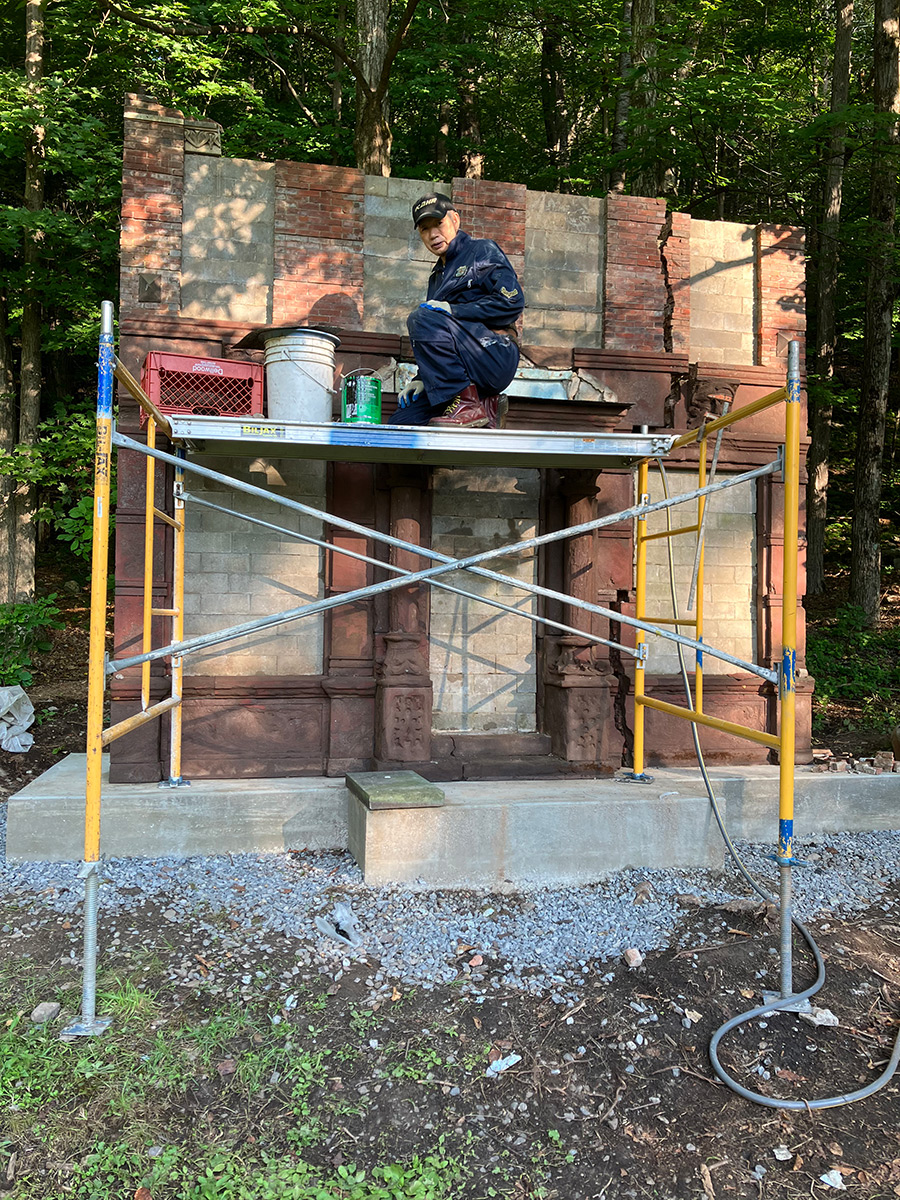
During the installation of his show Time Frame, I marveled as he hoisted section upon section from his perch atop metal scaffolding. The determination, rigor, and discipline that Gozu demonstrates in his work is inspirational. He will spend five years taking photographs from the same spot, and thousands of hours assembling tons of rock to create a sculpture which is a monument to the fragility of time, a concept that he calls “Nagare” or stream, in which he sees himself as an ephemeral moment in the span of eons.
As I write about Masao, I can conjure a 3 am Bowery moment in the 1980s when, with a cart full of bricks, Masao passes Keith Haring painting his first large-scale mural on the corner of Bowery and Houston. ___________________________________________
¹ Bogomir Ecker, Raimund Kummer, Friedemann, Malsch, Herbert Molderings(ed.), Lens/ Based Scuplture, The Transformation of Sculture Through Photography, exhibition catalog, Academie der Kunst , Berlin, and Kunstmuseum Lichtenstein, Vaduz, 2014, 86. ² Jeff Nussbaum, The Night New York Saved Itself From Bankrupcy, The New Yorker, October 16, 2015. ³ Roxana Marcoci(ed.) The Original Copy. Photography of Scultpure, 1839 to Today, With essays by Roxana Marcoci, Geoffrey Batchen and Tobia Bezzola, exhibition catalog, Museum of Modern Art, New York, 2010, 154.
About the Writer:
Ted Riederer is a multidisciplinary artist and curator whose practice merges punk ethos with poetic interventions. A former band member and the Founding Artistic Director of Howl! Happening: An Arturo Vega Project in New York’s East Village, Riederer has exhibited widely, from PS1 and the Liverpool Biennial to galleries in Berlin, Lisbon, and Bangladesh. His international project Never Records blends performance, vinyl, and community engagement.
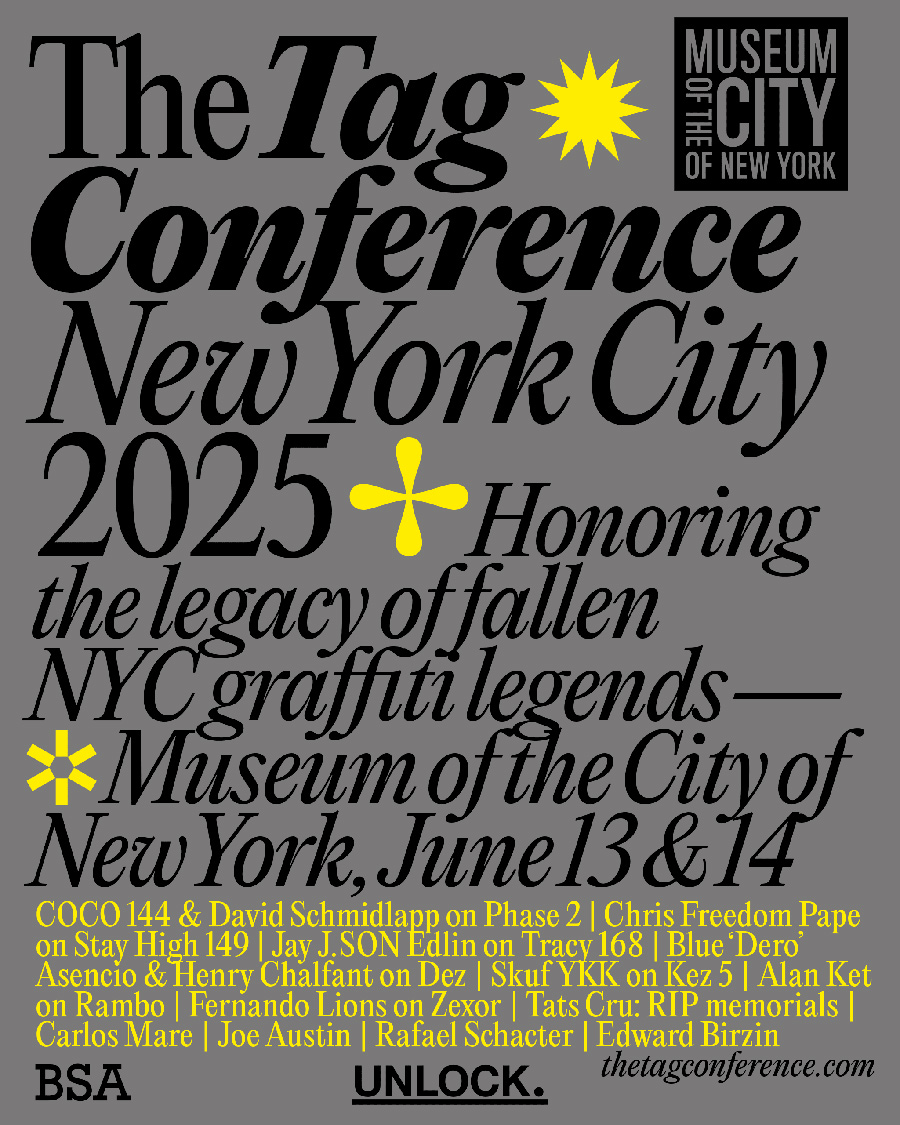
After a landmark debut in Brooklyn in 2023, the Tag Conference returns to New York City this June with sharpened purpose. Hosted at the Museum of the City of New York — where Above Ground: Art from the Martin Wong Graffiti Collection currently holds court — this year’s program centers on legacy: specifically, the lasting influence of writers who’ve passed, but whose marks, names, and styles helped shape graffiti as a global culture.
More than a memorial, this is a reckoning for some who want to preserve memory — a gathering of voices from across generations who contemplate the urgency of honoring those whose stories often slip through the cracks of institutional history. What emerges is a rare confluence: practitioners, historians, documentarians, and artists sharing the mic to uplift the names and contributions of pioneers like PHASE 2, Stay High 149, Tracy 168, Dez, Kez 5, Rambo, and Zexor.
The lineup reads like a blueprint of lineage and loyalty: COCO 144 and David Schmidlapp speak on PHASE 2; Chris “Freedom” Pape reflects on Stay High 149; J.SON brings us closer to Tracy 168; Henry Chalfant and Blue “Dero” Asencio illuminate Dez; Skuf YKK on Kez 5; Alan Ket on Rambo; and tributes from Fernando Lions, Tats Cru, Carlos Mare, and scholars Joe Austin, Rafael Schacter, and Edward Birzin. With such a strengthened focus on this lineup — these are acts of cultural preservation.
At a time when graffiti is increasingly archived, exhibited, and sold — and its imagery absorbed into mainstream culture — the Tag Conference stays grounded in the complexities of its origins: memory, dissent, and street-level scholarship. In the same city that once deployed harsh policies to scrub these names from trains and walls, their stories now resurface — not without controversy, but with clarity. Here, they are not simply lionized or condemned, but understood as originators whose marks challenged norms, claimed space, and left a visual legacy still celebrated and debated today.
CLICK HERE TO CONTINUE READING AND FOR MORE INFORMATION ABOUT EVENTS & SCHEDULES
THE TAG CONFERENCE MUSEUM OF THE CITY OF NEW YORK NEW YORK CITY JUNE 13 & 14, 2025
CLICK HERE TO CONTINUE READING. MORE INFORMATION ABOUT EVENTS & SCHEDULES
Welcome to BSA Images of the Week! Love you to the moon, June!
In New York yesterday, gamers marked the launch of the city’s first annual Video Game Festival, where esports battles, indie demos, and retro arcades spilled into real life like the final boss stage. With its mashup of pixel nostalgia and future-forward tech, the festival echoed the spirit of underground subcultures — not unlike street art — where DIY worlds are built, rules are rewritten, and creativity levels up with every move.
You may prefer experiences in the actual physical world, so Bushwick Collective had a flood of in-person opportunities for visitors to their 14th block party this weekend. Thousands of people from around the city and many parts of the world were there to see hundreds of murals, live artists painting, and a showcase of rapping firebrands of the underground scene – ending with a performance by hip-hop architect Rakim, who was, of course, paid in full.
At BEYOND THE STREETS, curator and publisher Roger Gastman sat down with graffiti artist RIME for an intimate conversation and book signing highlighting RIME’s raw, unfiltered sketchbook—a personal and psychedelic blend of graffiti, visual journaling, and spiritual reflection created entirely in pen during his travels across the U.S.
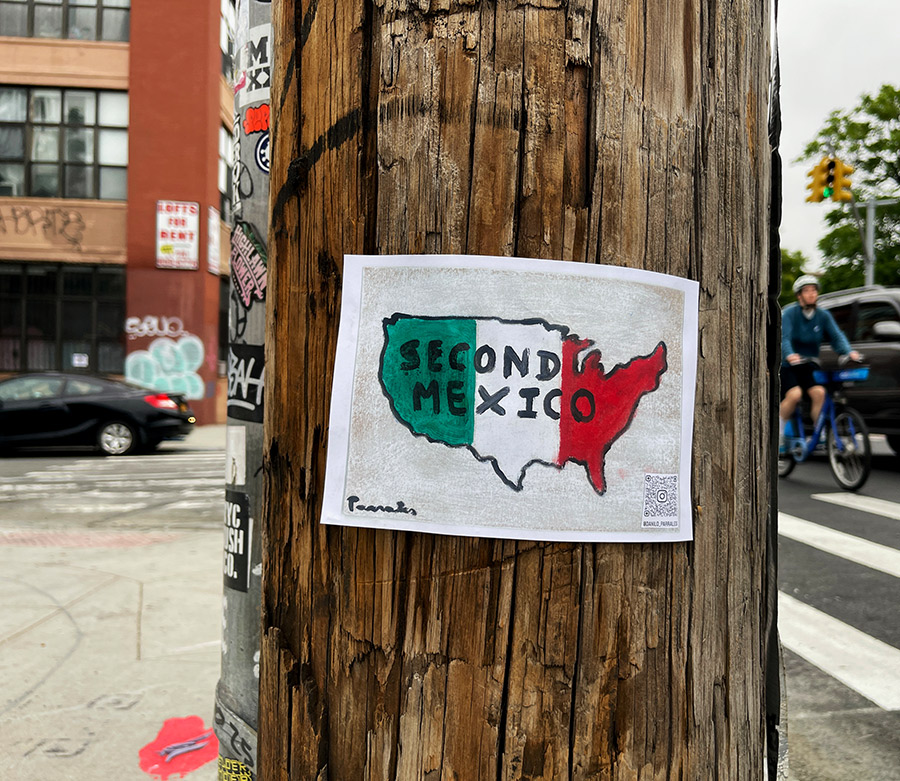
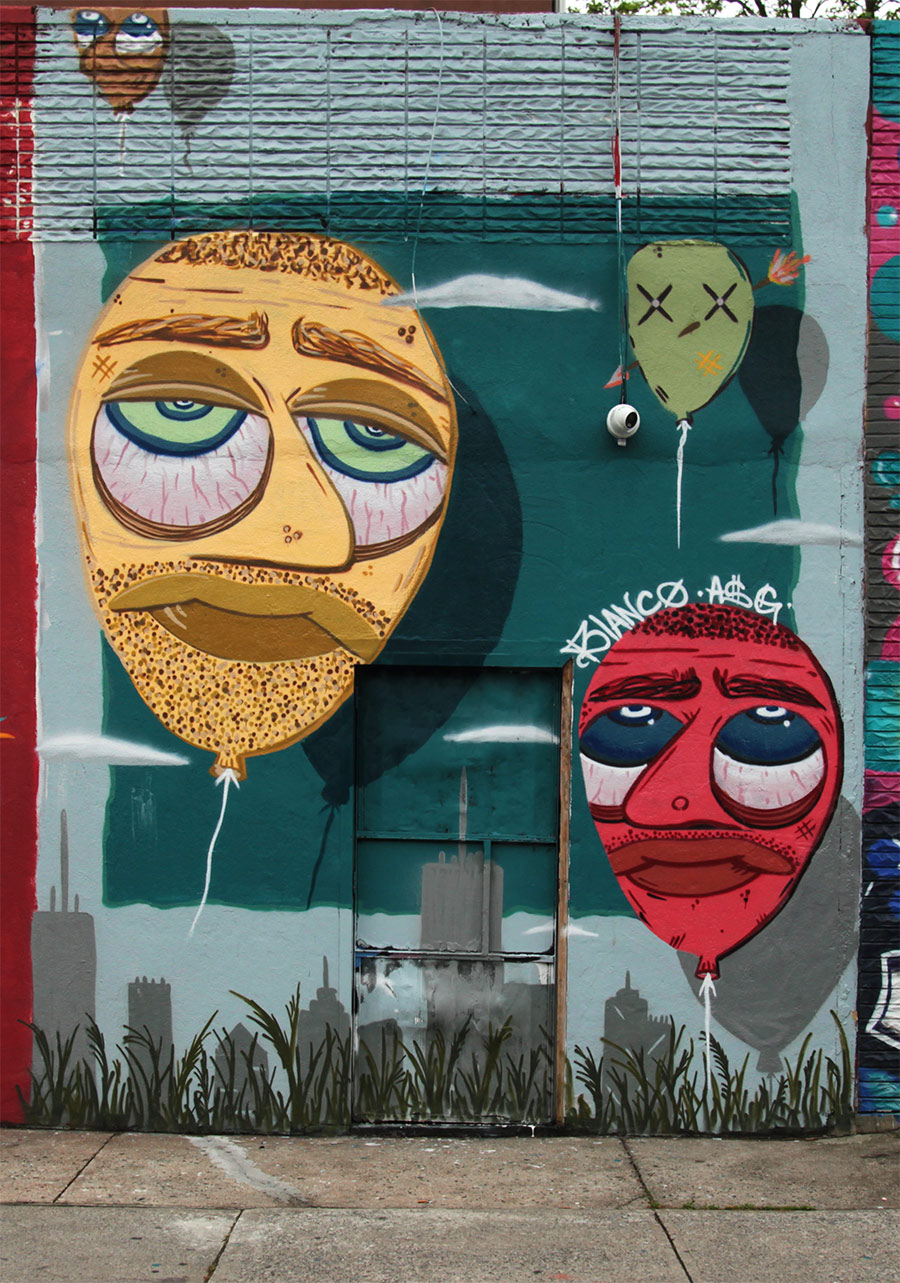
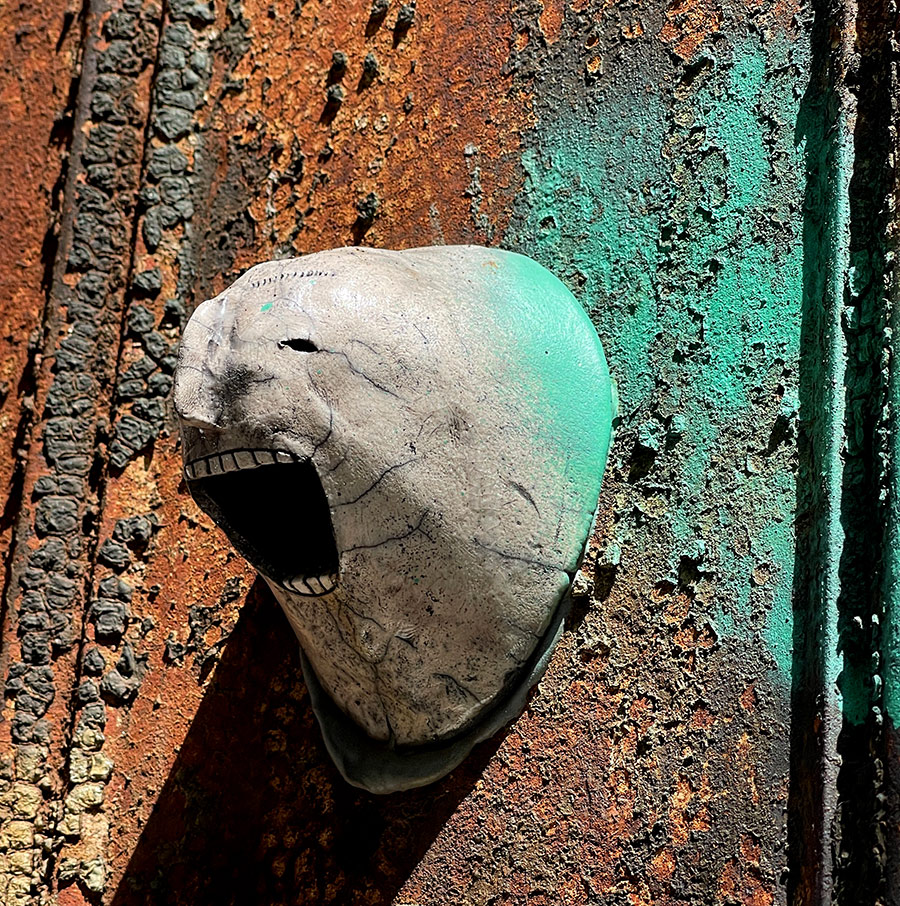
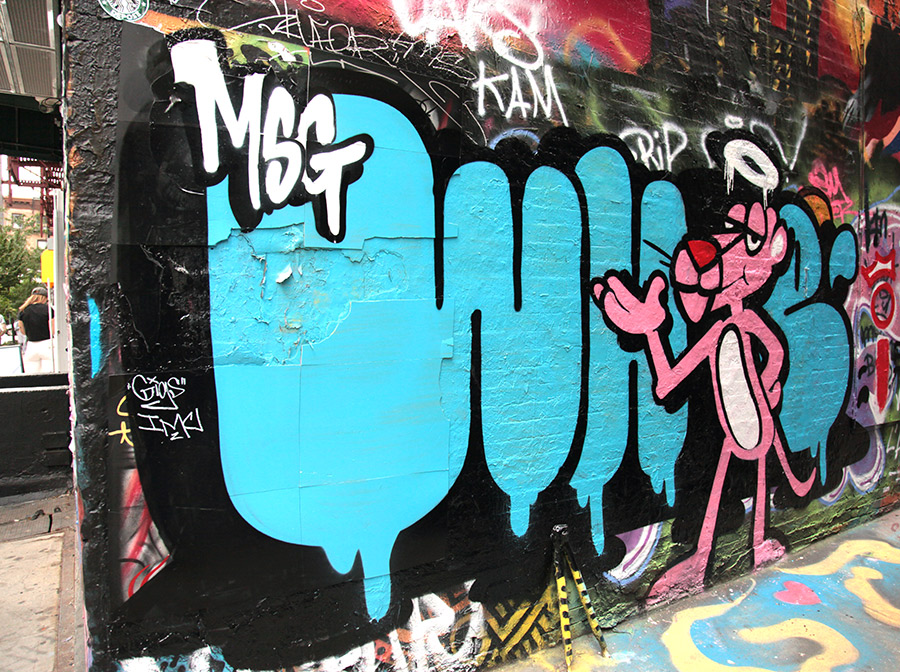
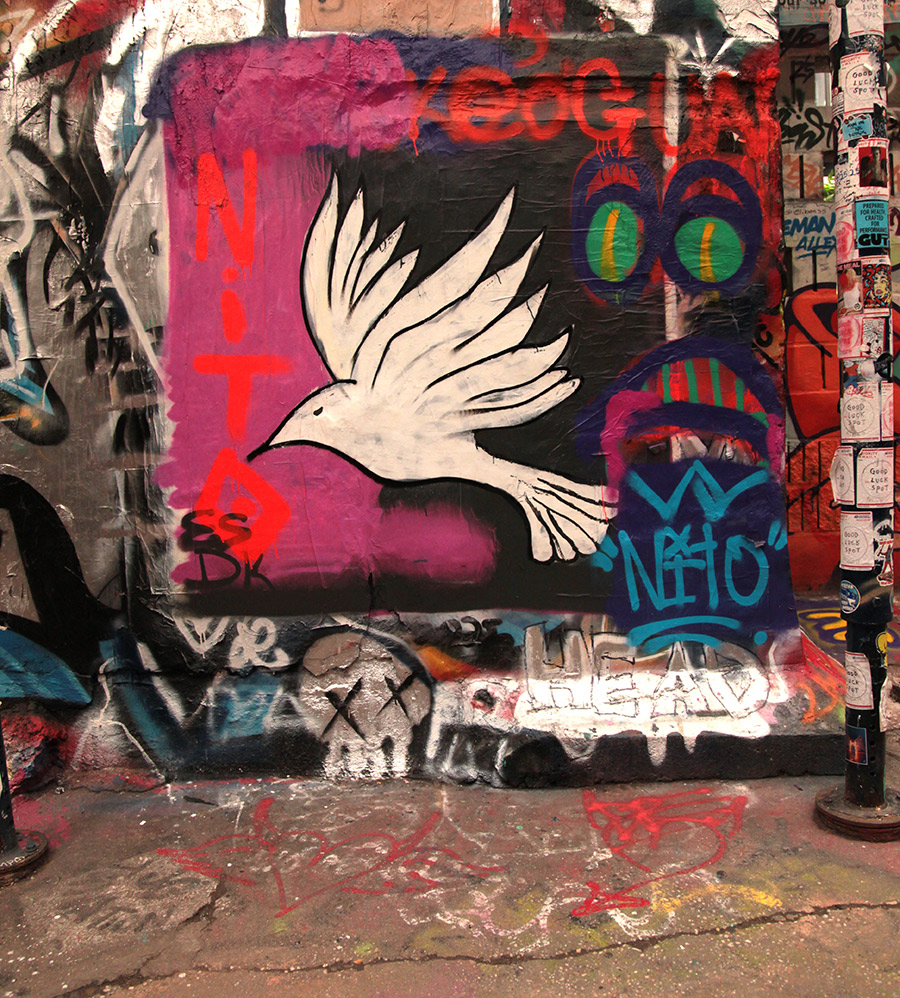
And here’s our weekly interview with the street, this week featuring Below Key, Blanco, Bisser, Danilo Parrales, Detor, Gouch NKC, Gregos, Kosuke James, MSG Crew, Nite Owl, Nito, Skewville, Tom Bob, Turtle Caps, Zero Productivity, Zoot, and ZUI.
Interview with Doug Gillen | Video Feature from Fifth Wall TV
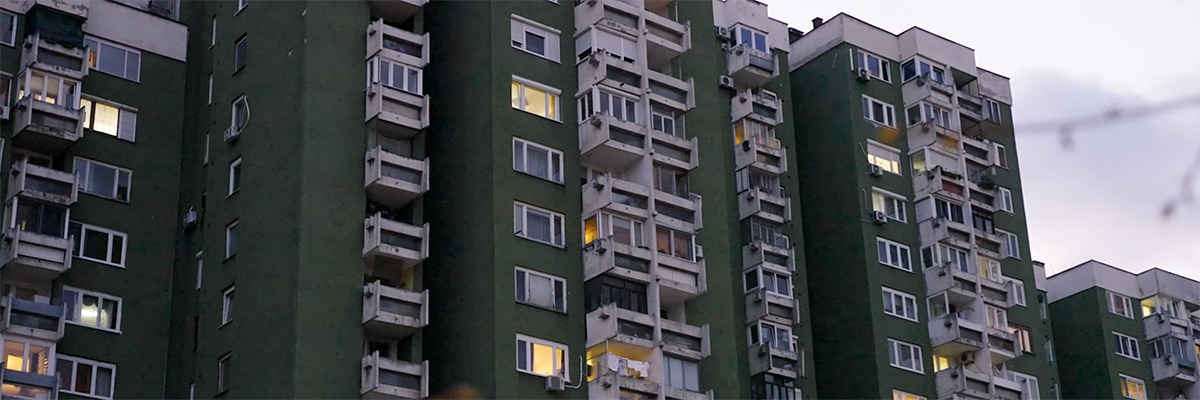
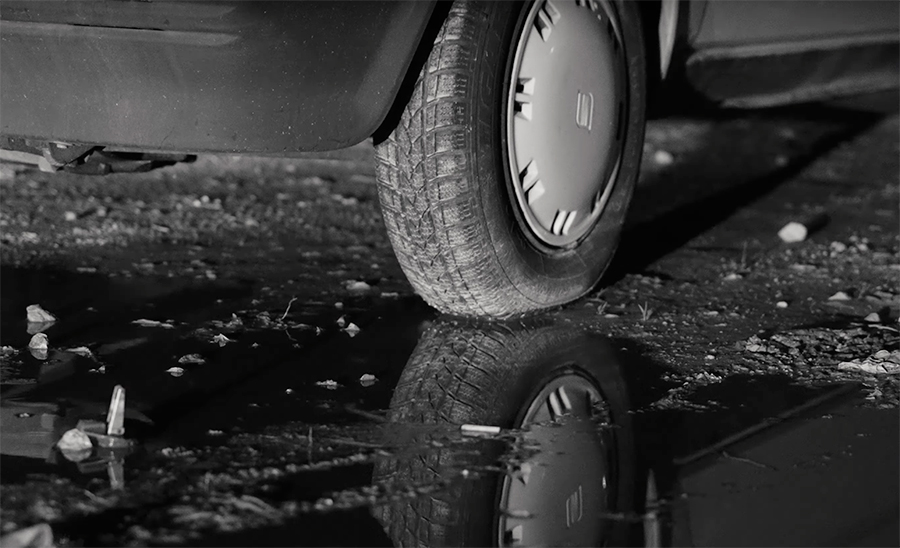
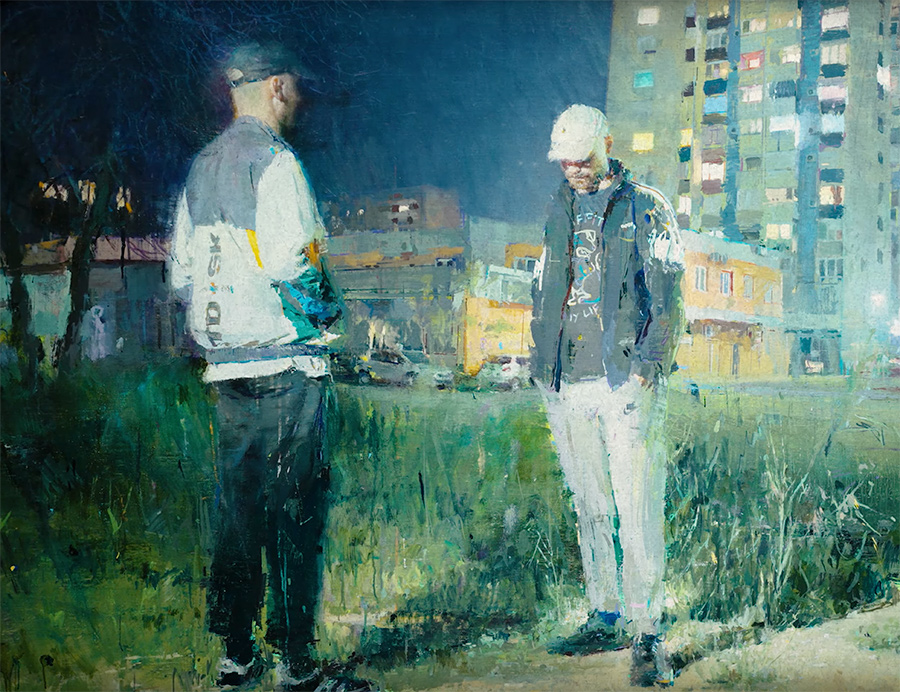
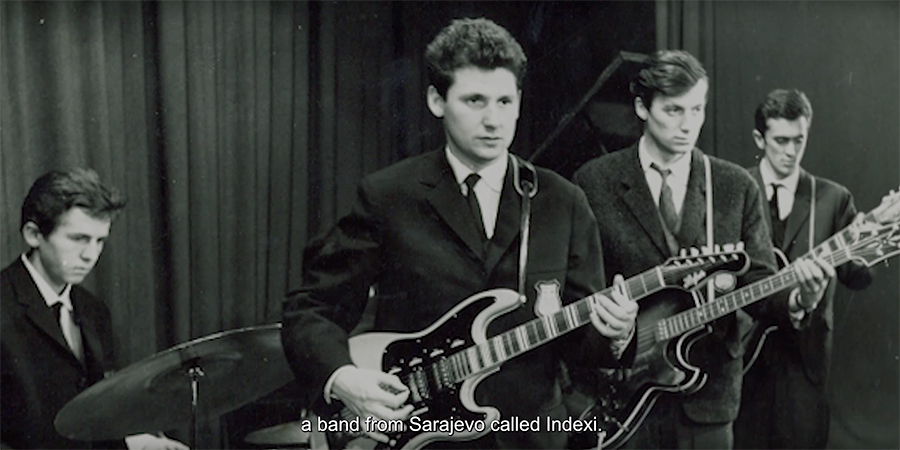
Ghosts of concrete modernism and whispered nostalgia drift through “The Morning Will Change Everything,” the first solo museum exhibition by Spanish artist Sebas Velasco, now on view at the History Museum of Bosnia and Herzegovina in Sarajevo. In this new video interview, filmmaker and art observer Doug Gillen sits down with Velasco to unpack the layers of emotional and political weight carried in these oil-painted nocturnes—each a meditation on memory, architecture, and the complex afterglow of Yugoslavia’s post-socialist present.
Sebas Velasco. The Morning Will Change Everything. (image still from the video by Doug Gillen for Fifth Wall TV)
The conversation reflects Velasco’s realism, influenced by photography – reinterpreted by hand and heart. “It’s a love story with the region, for sure,” he tells Gillen, reflecting on years of travel and a growing personal bond with Sarajevo and its surrounding cities. His works hum, layering light, concrete, shadow, and silence to capture what it feels like. “Maybe the nostalgia I paint is for something I’ve never really known,” he says.
Sebas Velasco. The Morning Will Change Everything. (image still from the video by Doug Gillen for Fifth Wall TV)
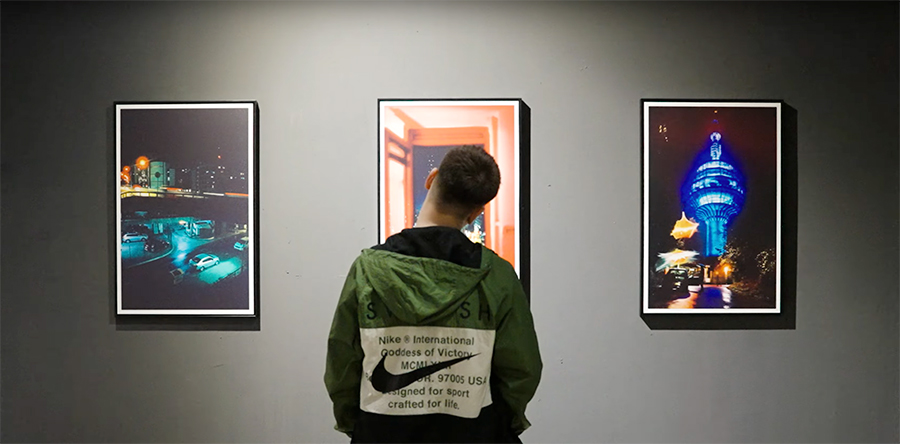
Set inside the former Museum of the Revolution—a hulking modernist edifice now asserting its cultural relevance—the exhibition includes Velasco’s paintings alongside films, photographs, and collaborations that stretch across borders and disciplines. It’s an act of giving back to a city that continues to inspire. “We wanted this to be more than paintings on a wall,” he explains. “To feel like home—for other artists too.”
Watch the full interview below to hear from Velasco in his own words, and to feel the atmosphere of a show that makes the past present—and personal.
Sebas Velasco. The Morning Will Change Everything. (image still from the video by Doug Gillen for Fifth Wall TV)Sebas Velasco. The Morning Will Change Everything. (image still from the video by Doug Gillen for Fifth Wall TV)
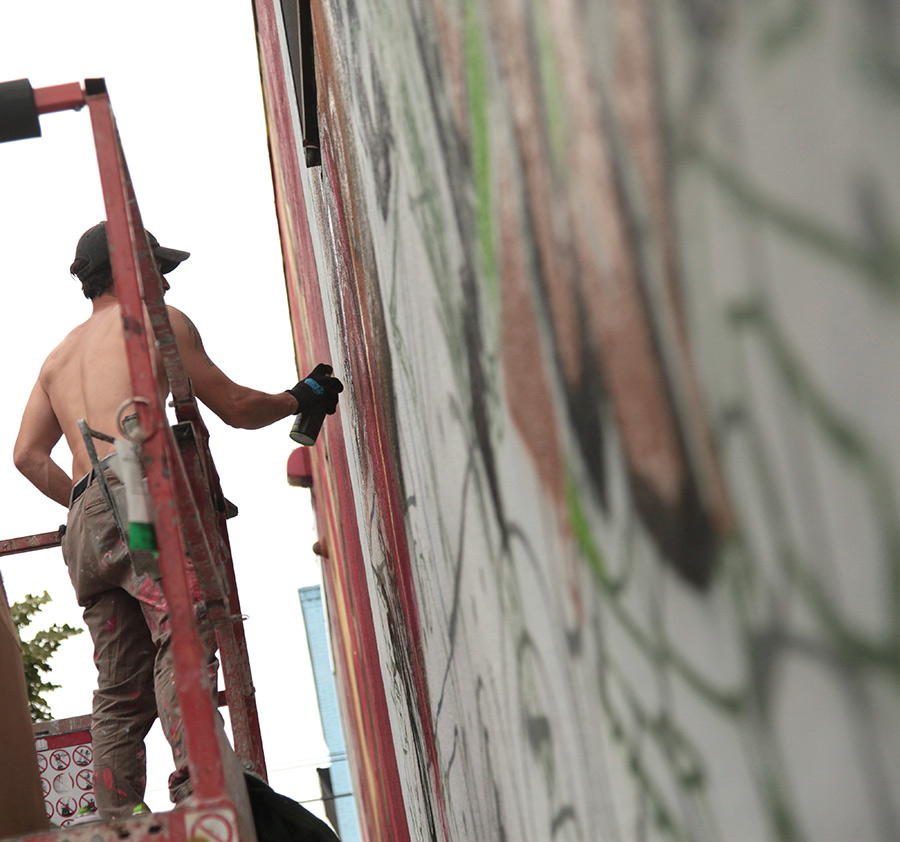
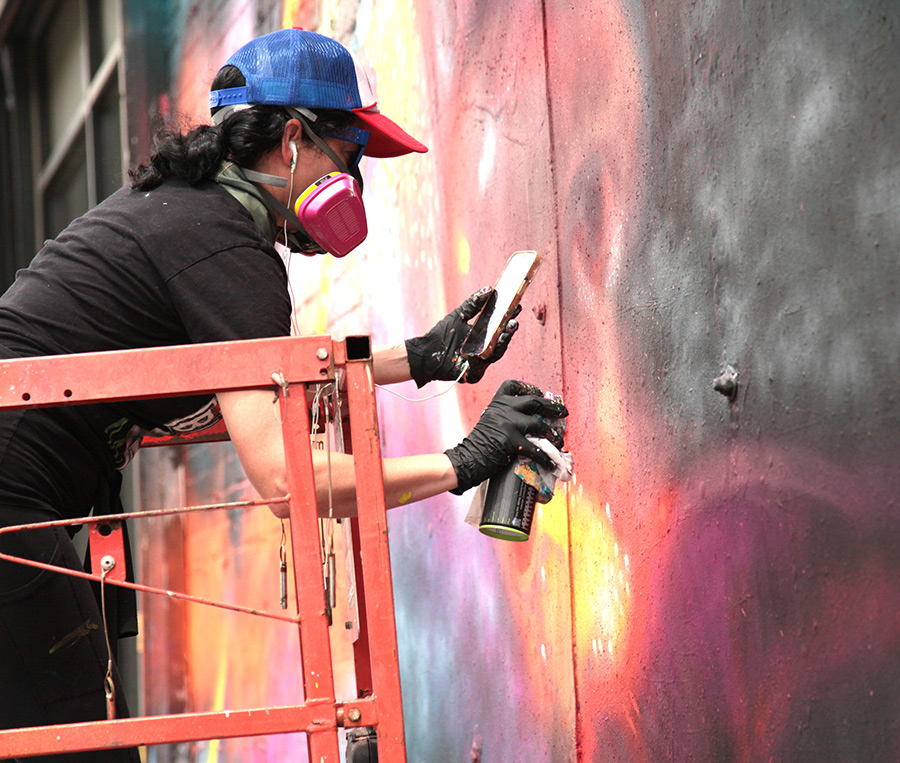
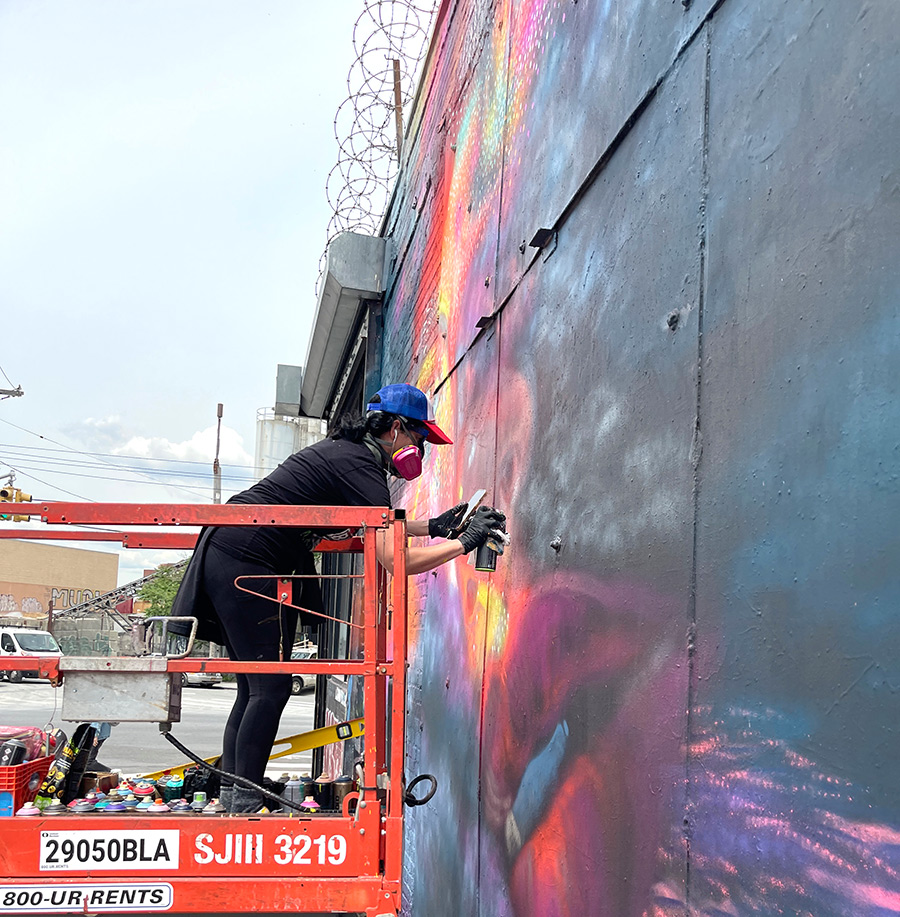
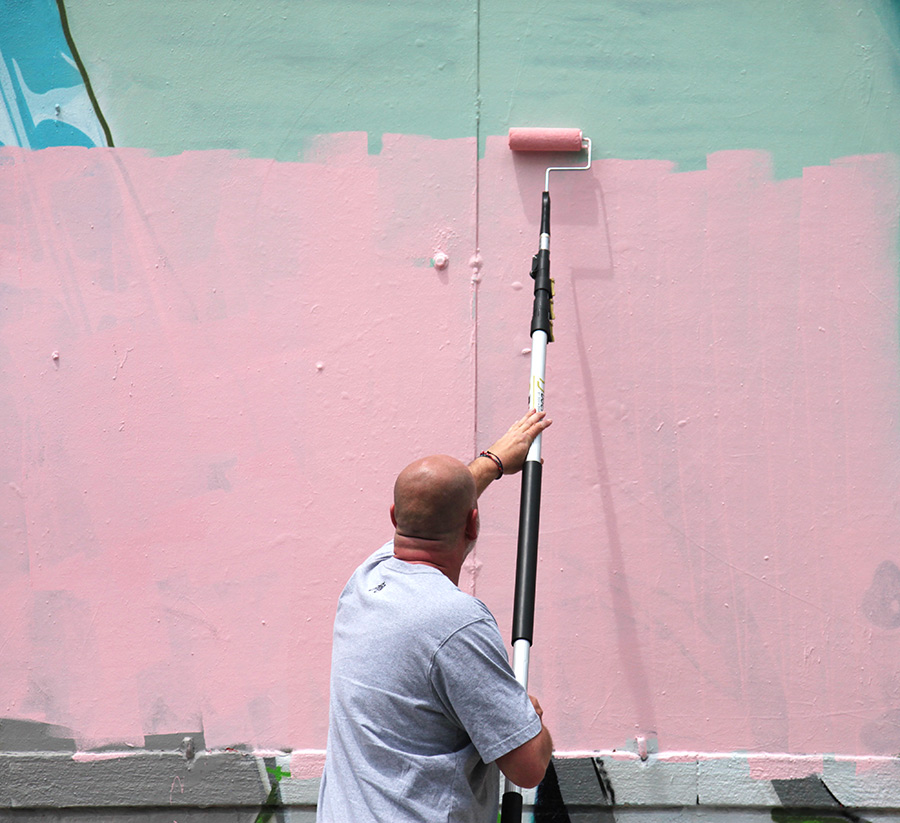
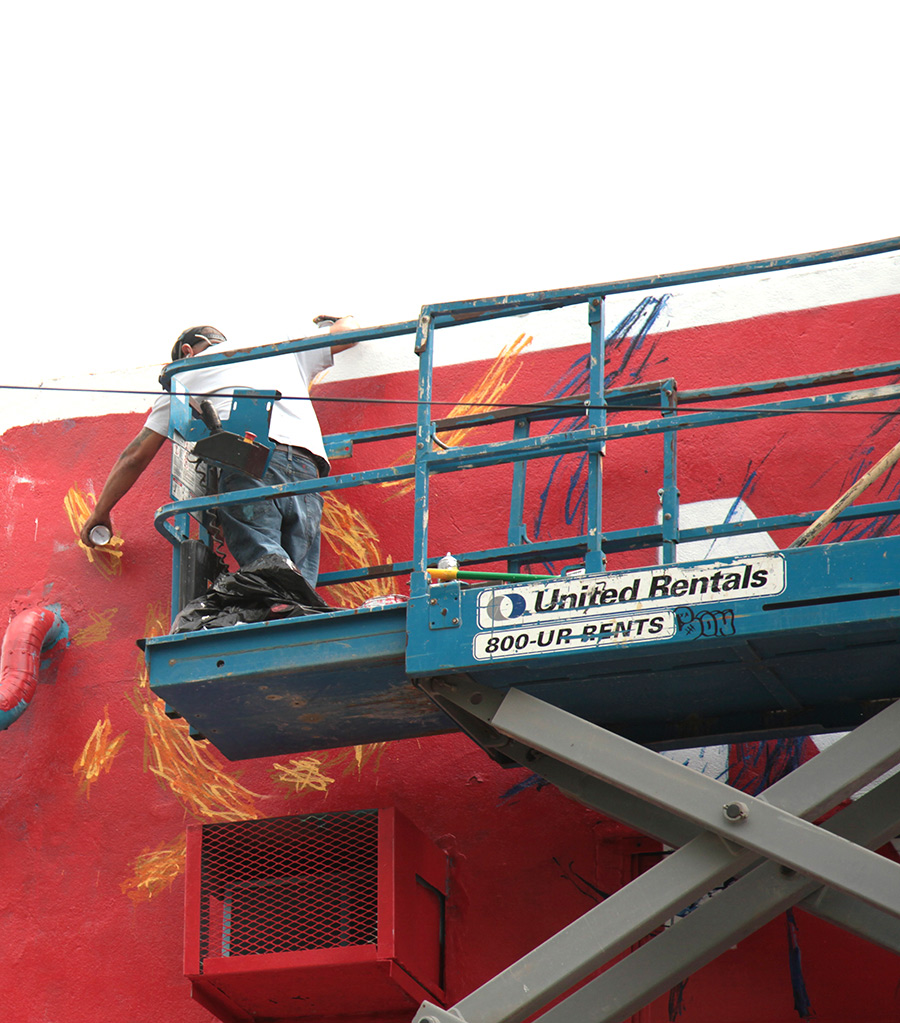
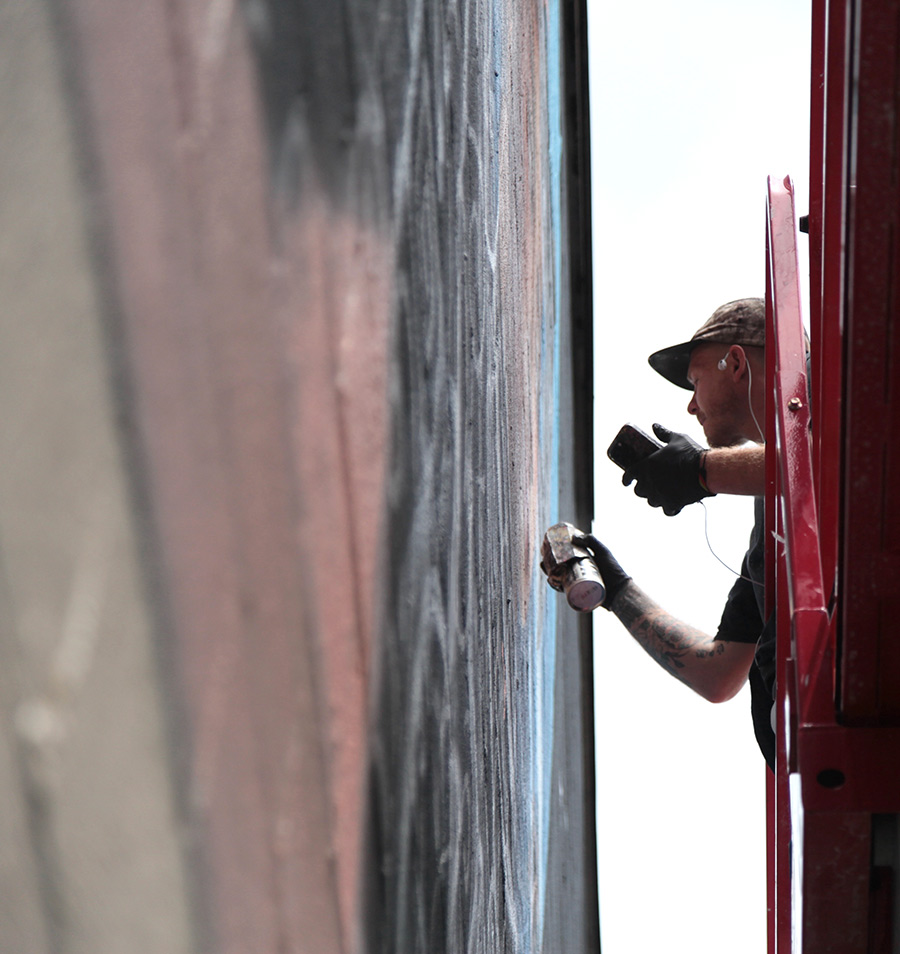
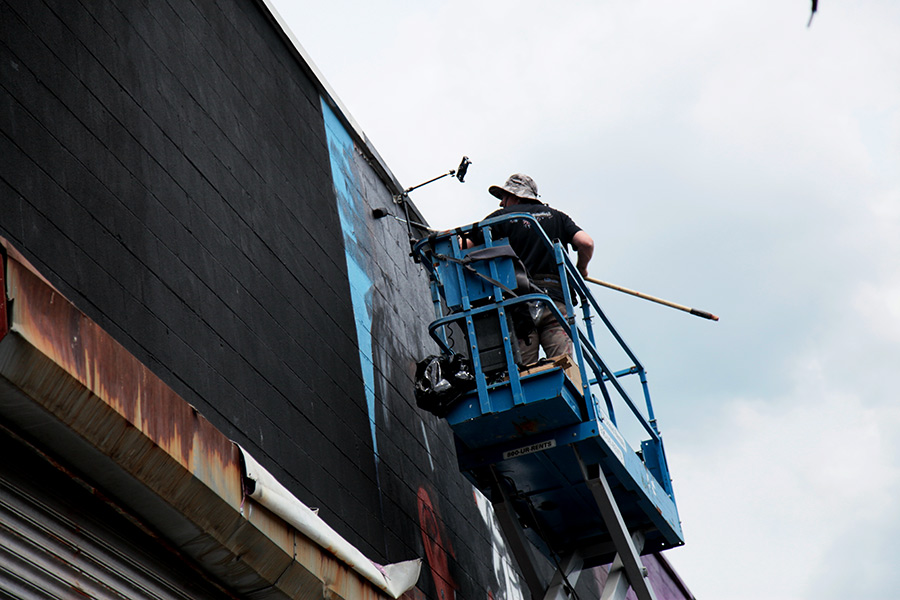
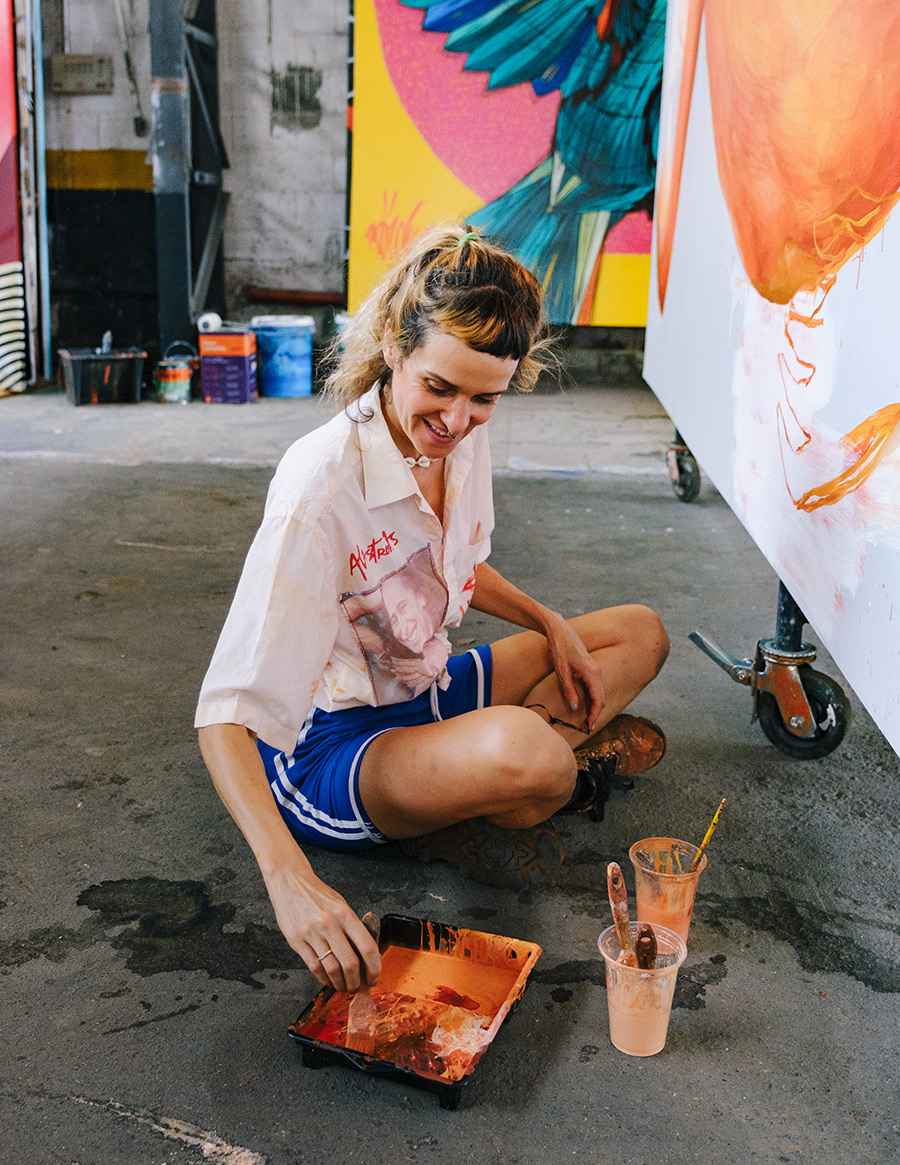
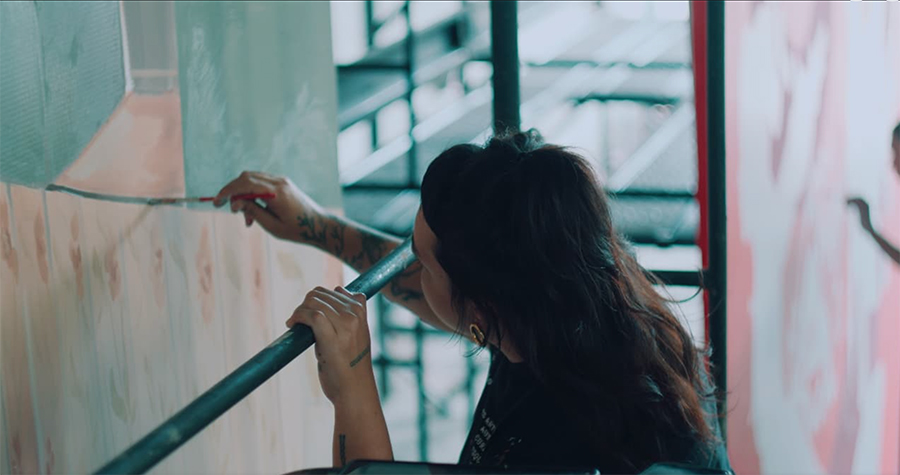
The streets of Bushwick, Brooklyn right now are one sprawling open-air studio—artists from around the world balanced on cherry pickers, ladders, and step stools, bending brushes, tilting rollers, and waving aerosol cans like conductors directing an urban symphony of color. Thick lines, fine mists, reflections, textures, letterforms in every handstyle—they’re building volume and vibe, layering stories and style one gesture at a time.
Since transforming this once Dutch “town in the woods” into a global destination for graffiti and street art over a decade ago, Joe Ficalora has brought hundreds—more likely thousands—of pieces to these Brooklyn walls. A working-class, heavily industrial neighborhood with a strong immigrant presence for the last century, the new neighbors may not always understand the street culture that this movement grew from – often arriving with a whiff of suburban sensibility, but let’s be honest—they wouldn’t be here if the Bushwick Collective hadn’t turned the place into a magnet.
Graffiti writers know how to thrive in hostile environments. It’s built into the DNA. Street artists, too, have evolved with ingenuity and hustle since this worldwide boom began hitting walls in the ’90s. Ficalora’s no different—he’s stayed the course, taken the hits, and kept the engine running.
As tradition now demands, the Collective kicks off summer with a Brooklyn-style block party this weekend—thousands pouring into the streets to celebrate the visual feast. Our photographer. Jaime Rojo has been out documenting the latest wave of mural-making, capturing the energy before the crowds flood in.
What’s always set this apart is Ficalora’s instinct to unify. He’s given room to both graffiti kings and street art innovators, encouraging them to work side by side—and sometimes shoulder to shoulder. The hard lines between the two have softened over the years anyway; many street artists still tag graffiti as their first love, and plenty of writers have flexed into new directions. Cross-pollination is the norm, not the exception.
Add DJs, food trucks, neighborhood vendors, and this thing becomes more than a party—it’s community. Fourteen years deep, and like Joe says, it’s the journey, not the destination.
Although if you’re into street culture, this weekend in Bushwick is your destination, without doubt.
The George Floyd mural at Elgin and Ennis in Houston’s Third Ward has been quietly demolished — a move that caught many off guard, especially as the fifth anniversary of his death approached. More than a painting on a wall in the margins of the city, it was a community’s act of remembrance, a public reckoning, and a visual anchor for a moment when the country seemed to shift. To awaken.
And yet, here we are. Five years later, and it’s hard to say what lasting change took root. In some camps, being ‘woke’ is a pejorative, and going back to sleep is encouraged. The arc of justice bends, but it bends slowly. Or maybe it bends into circles.
Meanwhile in New York, a Banksy mural on a six-ton wall hit the auction block and… nothing. Not a single bid. Cue speculation: are we finally past the Banksy-buoyed street art boom that’s defined the last two decades? Or was the opening price just too steep? Maybe the rollout was sloppy. Maybe it was the economy. Whatever the reason, the silence in the salesroom is rare — and could signal a shift in the so-called urban contemporary art market.
And yet, the Banksy machine rolls on. At this point, there may be more Banksy museums than Starbucks — none sanctioned by the artist, of course, but still packing in the crowds. There’s The Banksy Museum in NYC, The World of Banksy in Paris, Museu Banksy in Barcelona and Madrid, and the touring Art of Banksy show, rolling through Jakarta, Melbourne, and Vancouver. It’s a brand now — maybe not quite as big as Mickey Mouse, but it’s definitely what cultural tourists reach for when they want a little edge with their museum day. What this says about the artist, the audience, or the architecture of commodified rebellion… you draw your own conclusions.
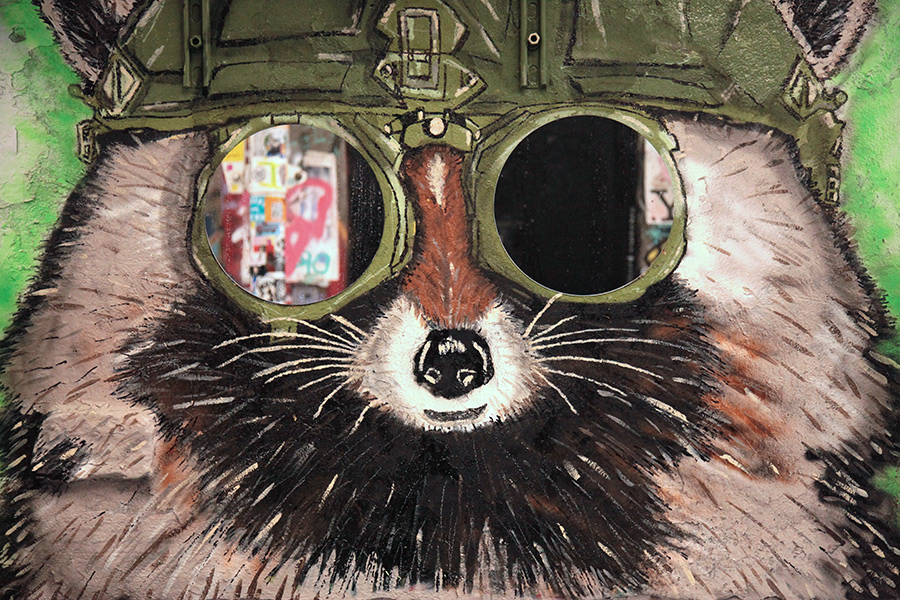
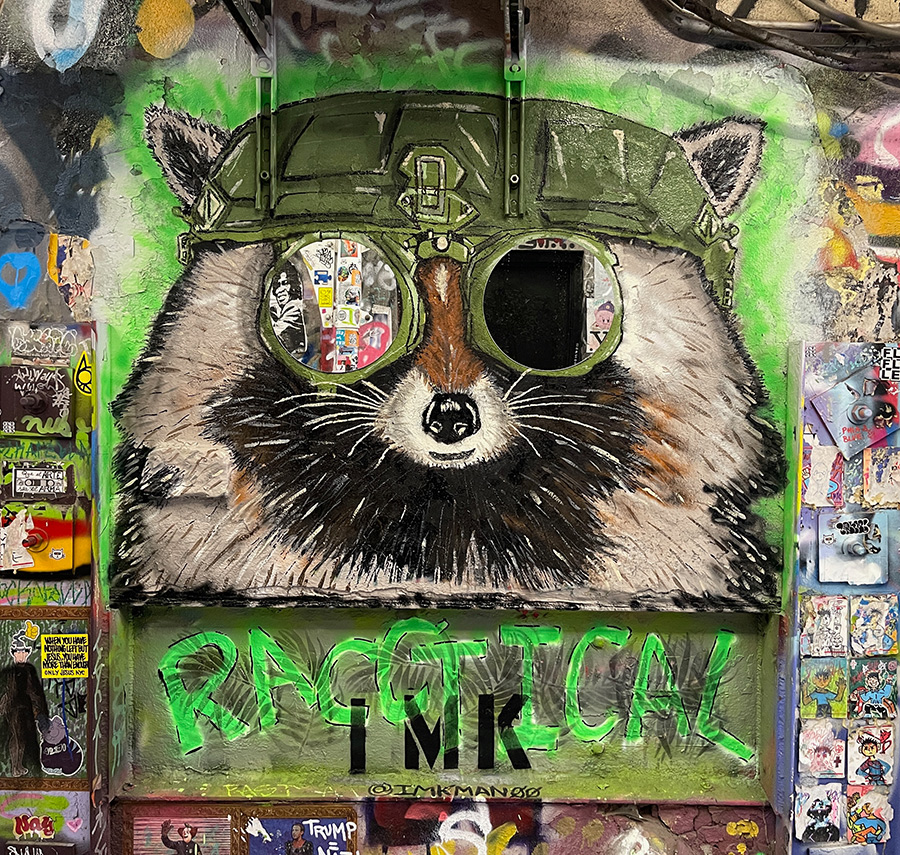
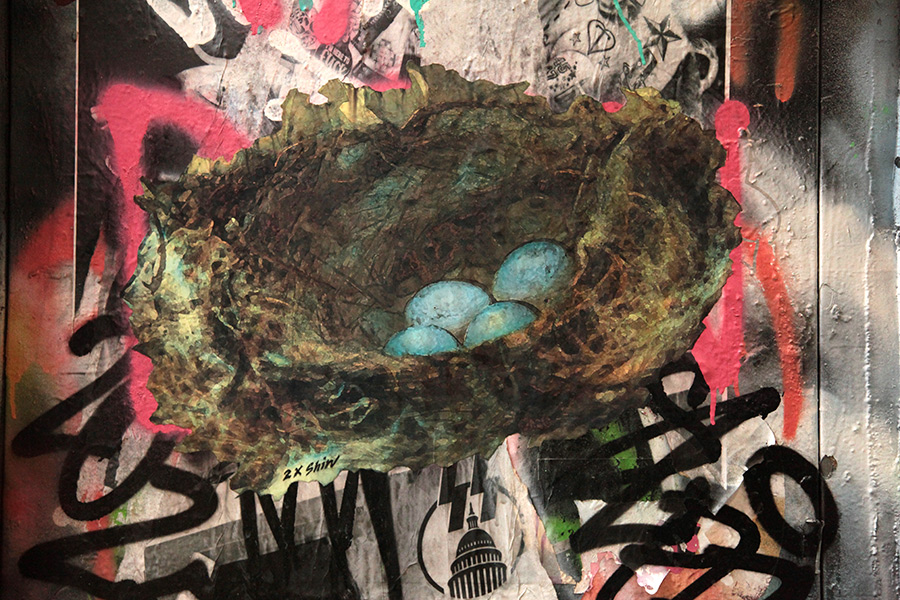
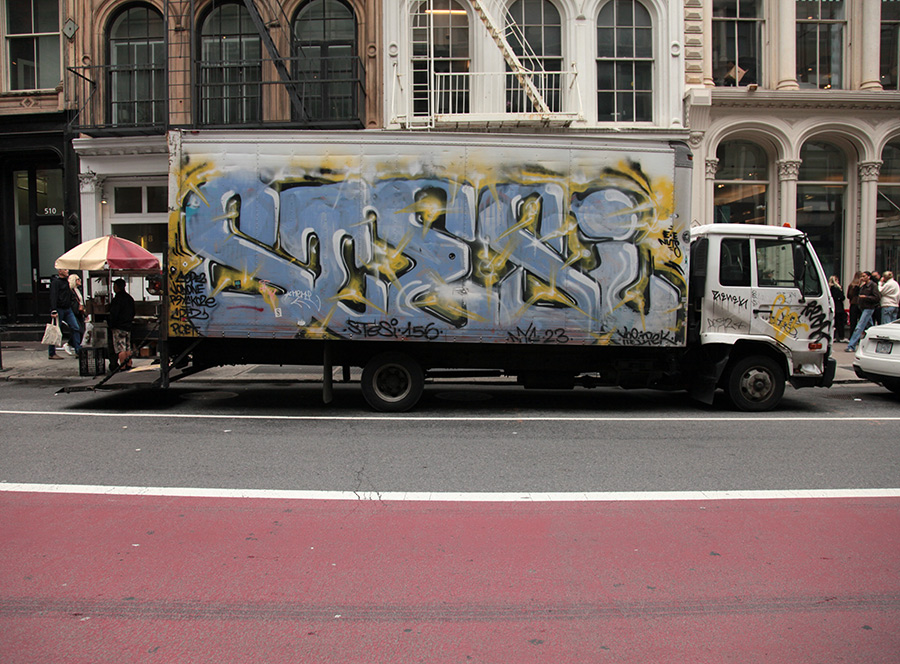
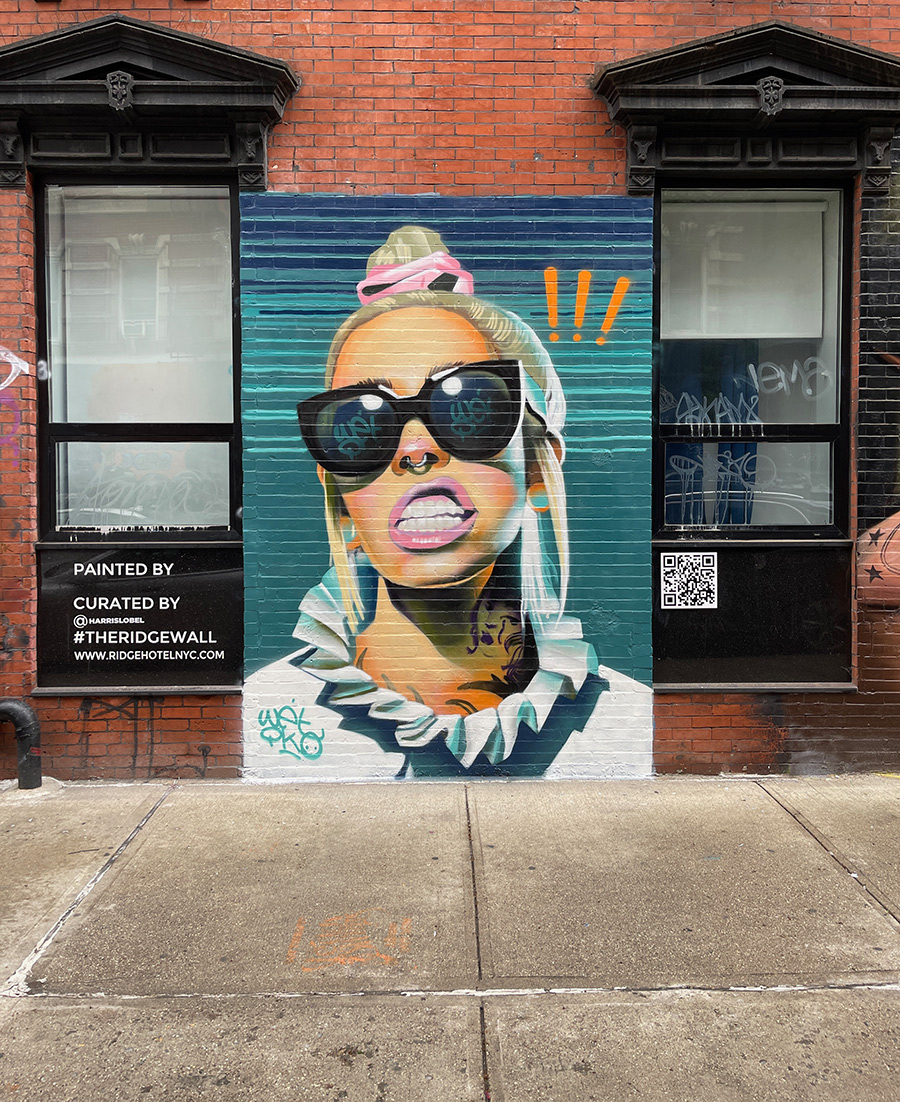
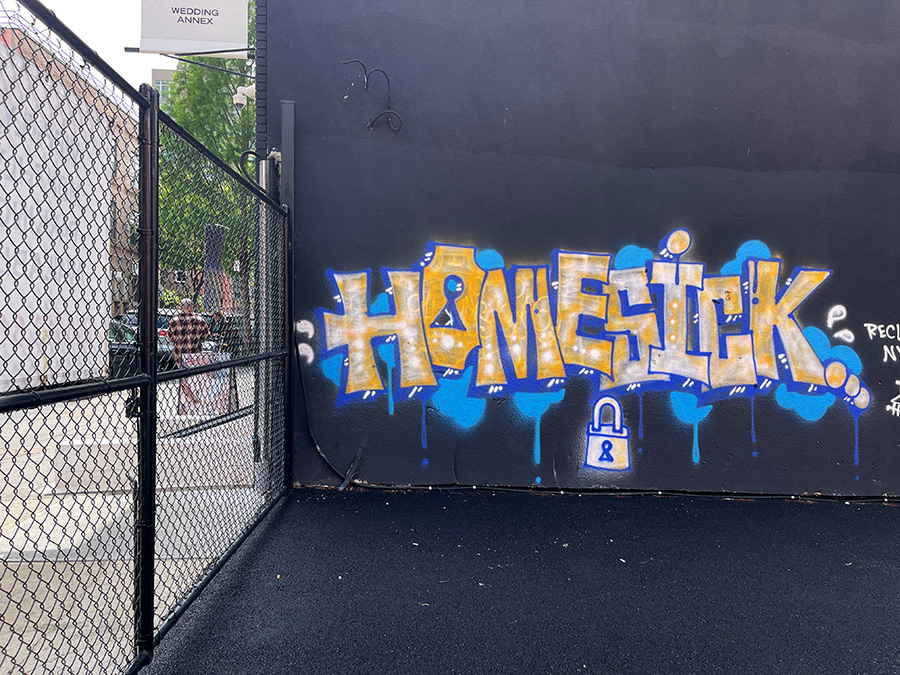
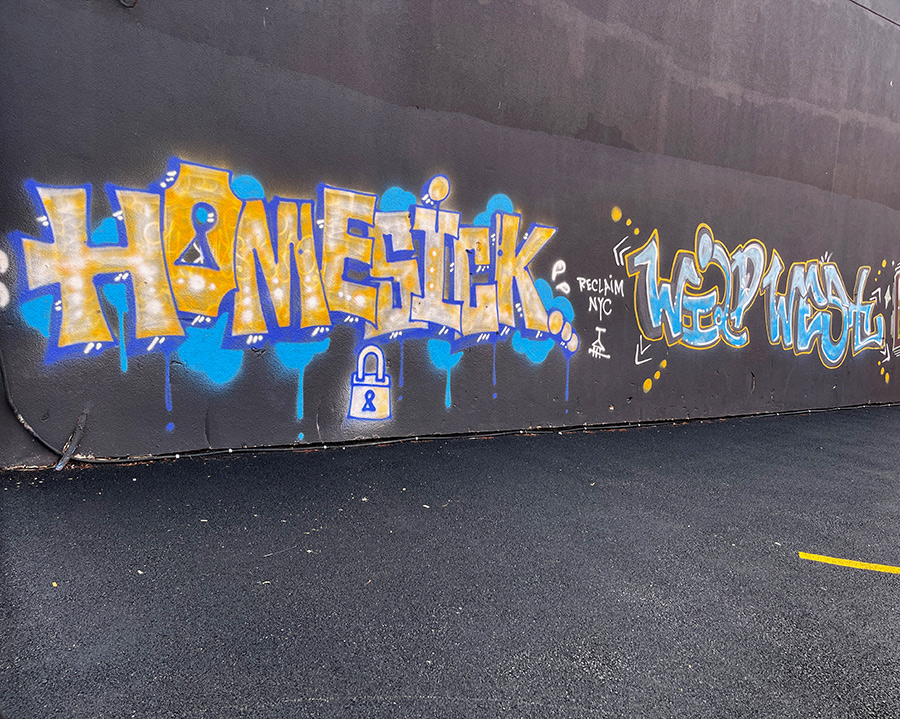
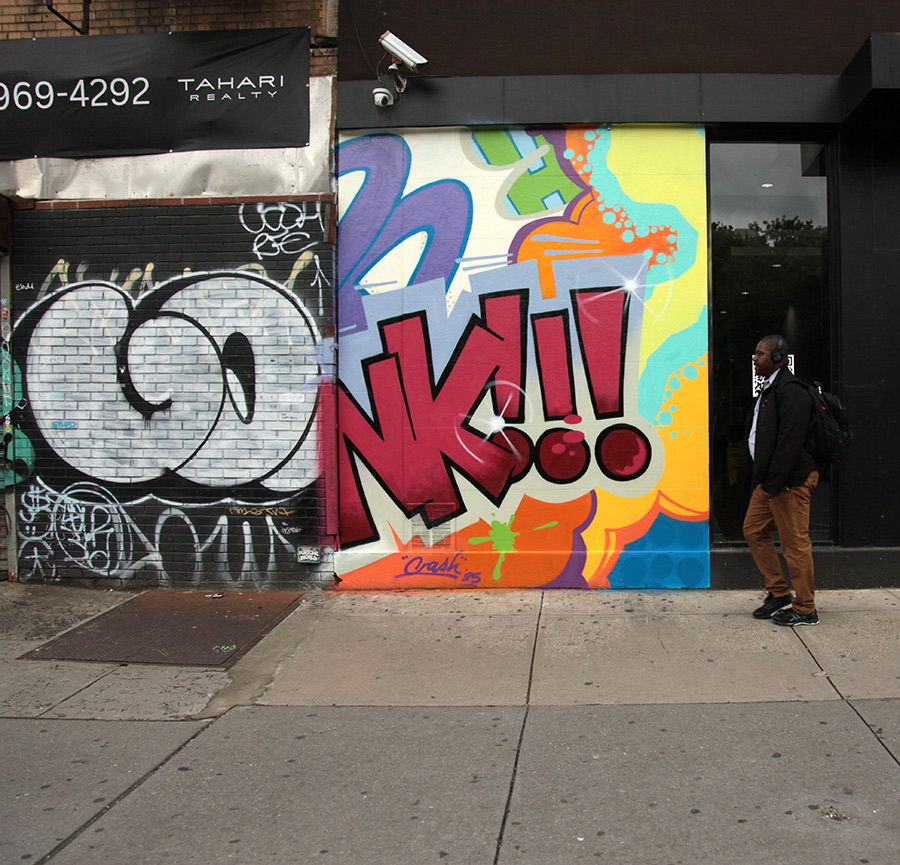
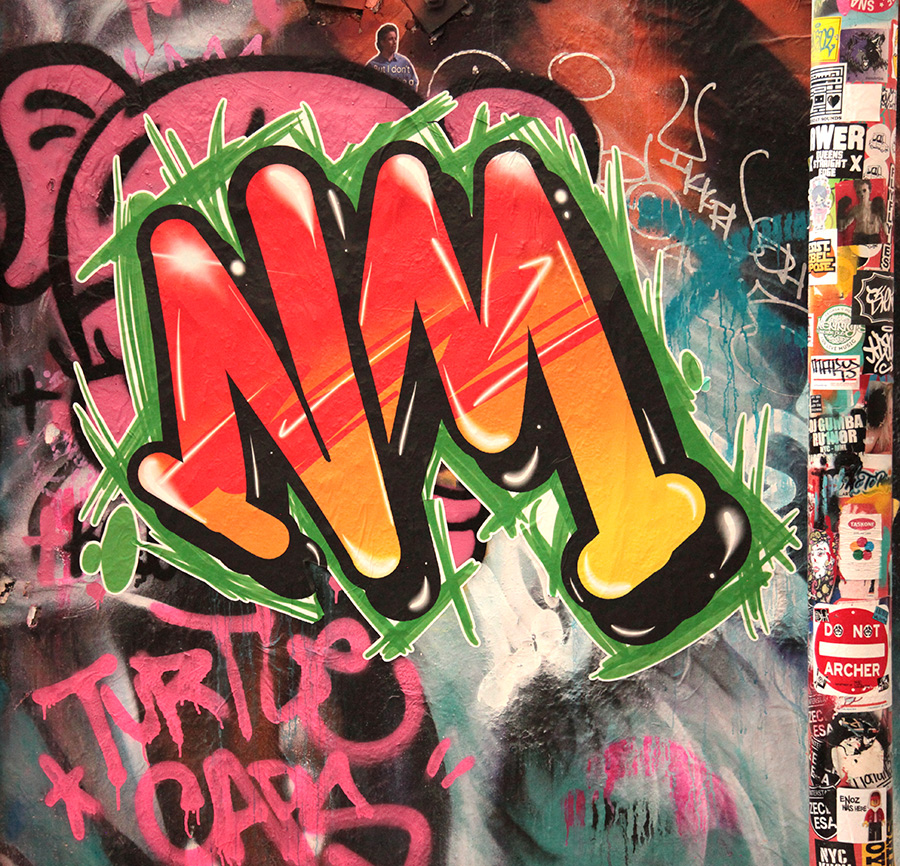
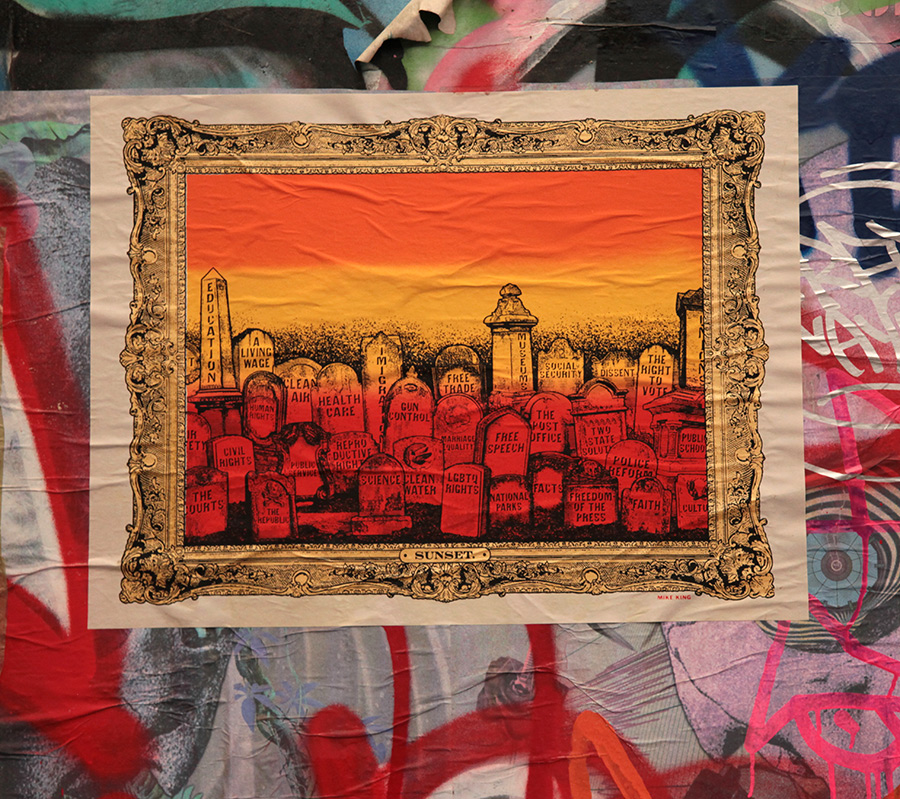
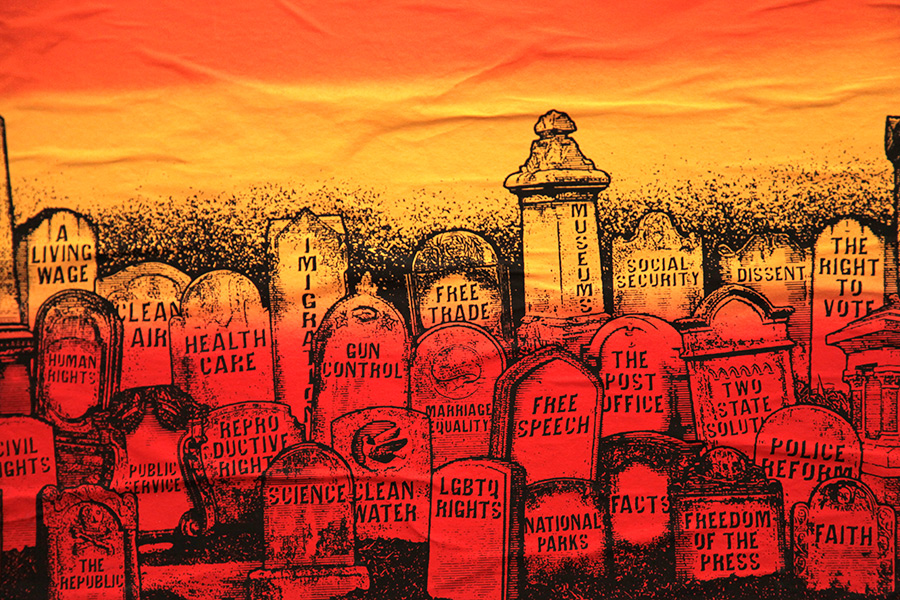
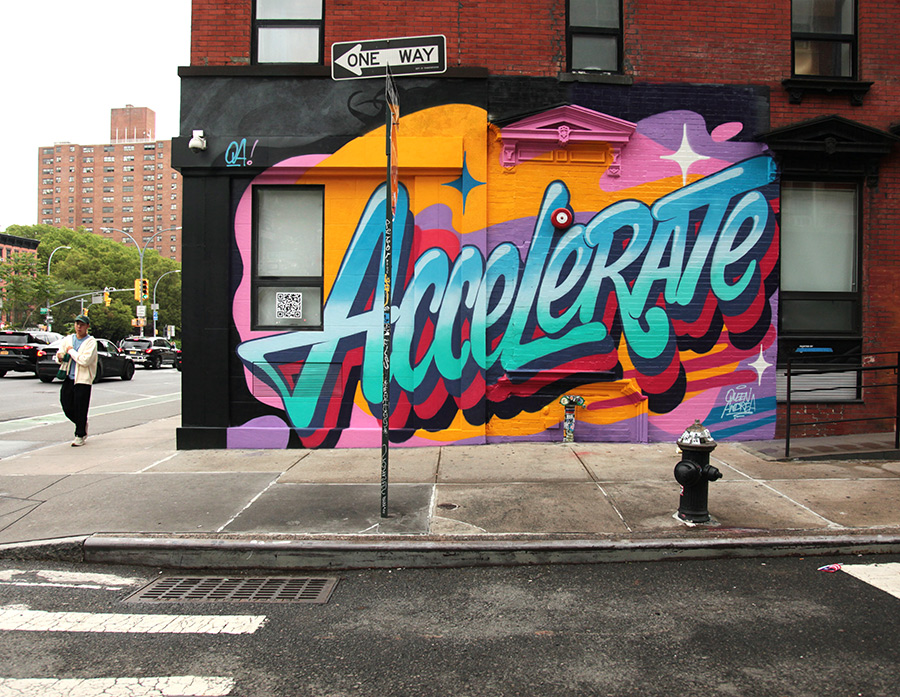
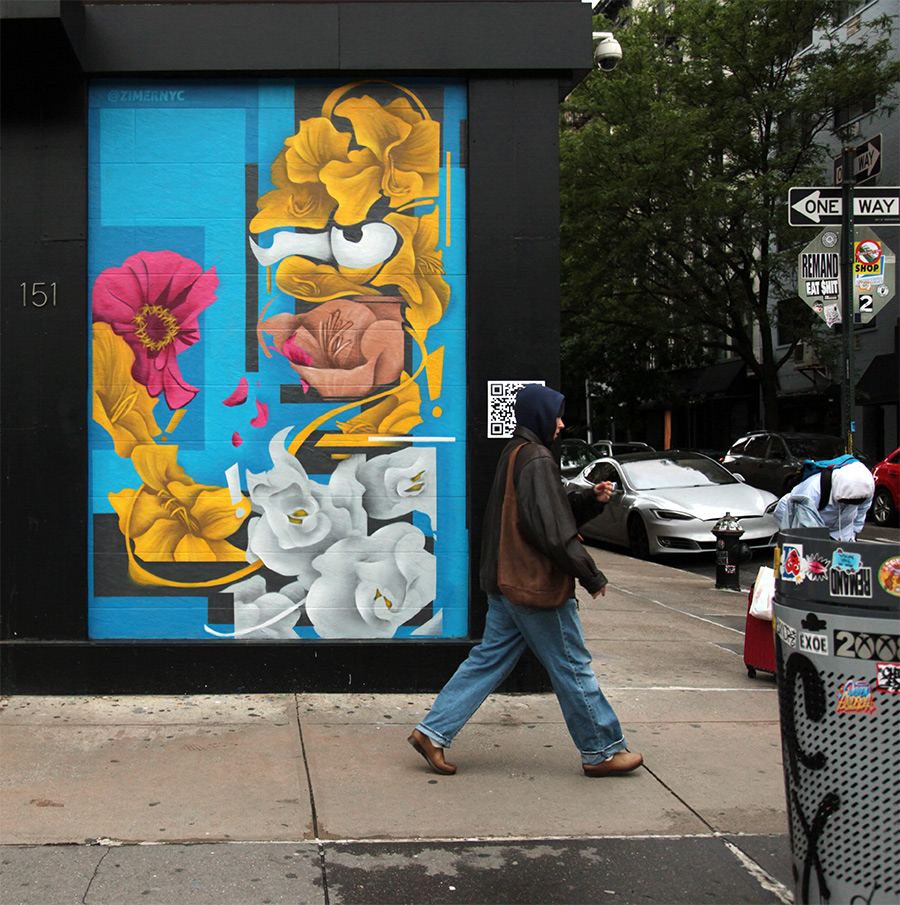
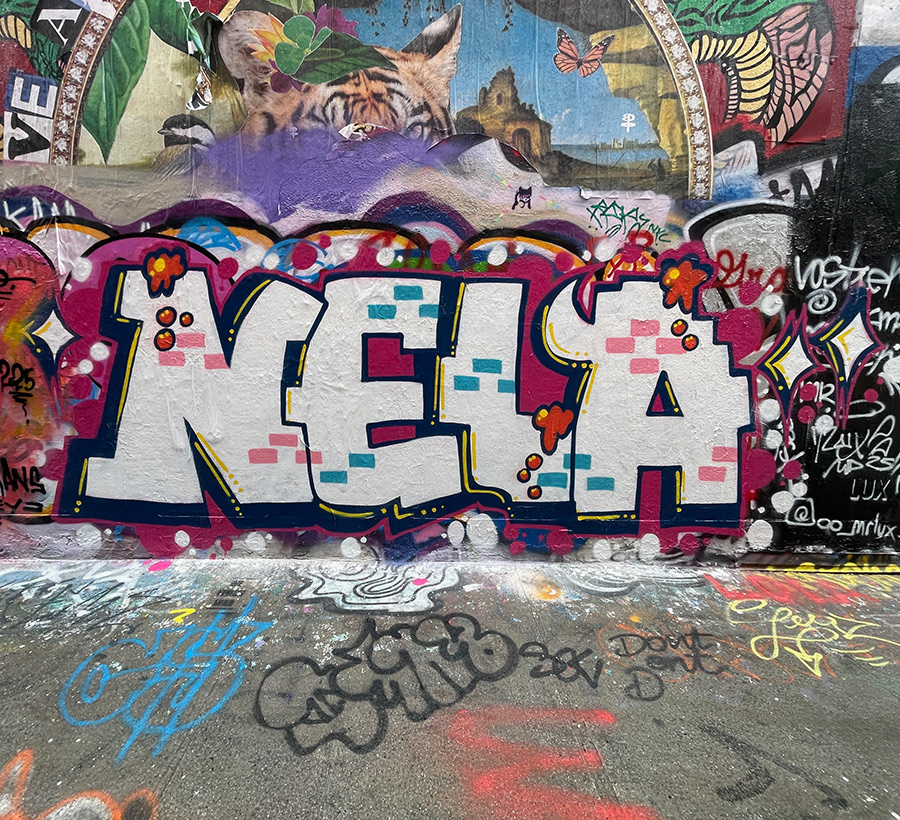
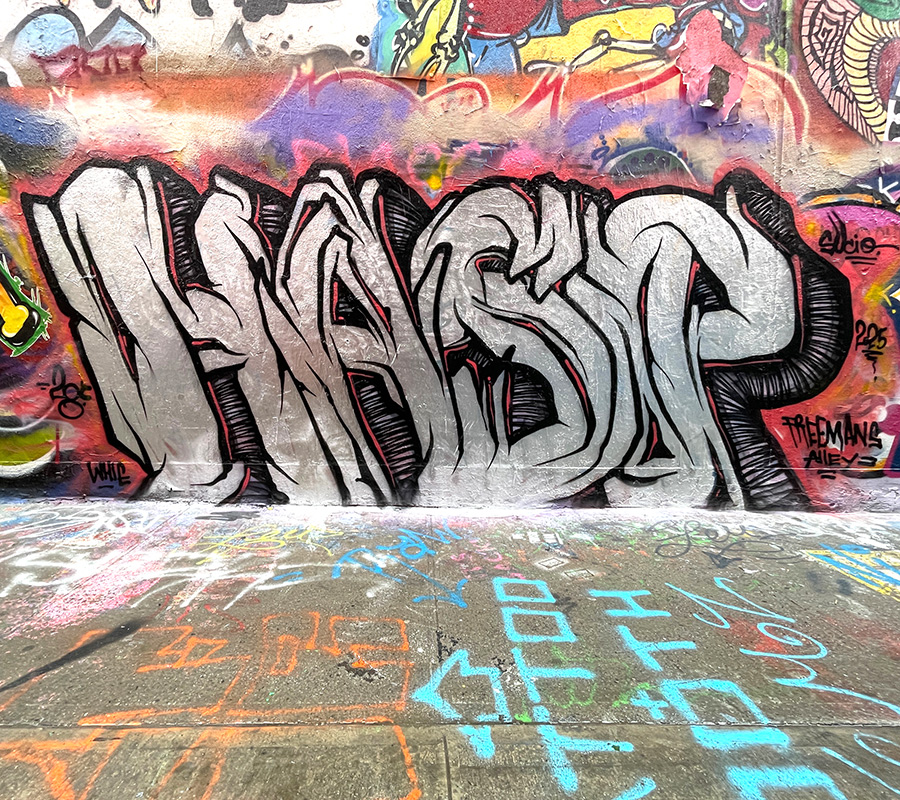
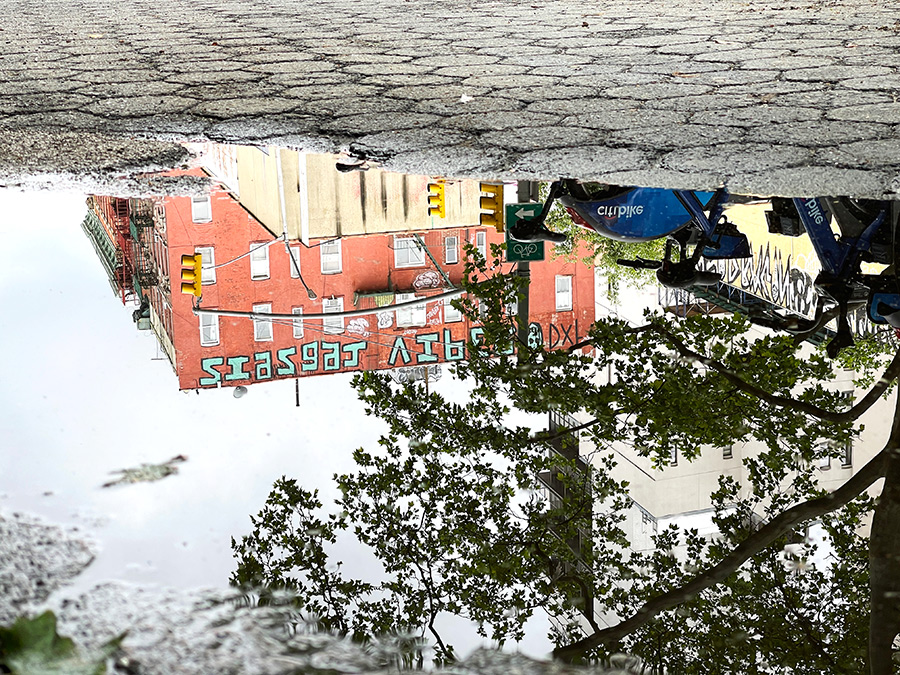
So here’s some of this week’s visual conversation from the street, including works from Shin, Crash One, GO, Ham, Hasp, Homesick, IMK, Jeff Henriquez, Mike King, Nela, Piggie the Pig, Queen Andrea, Stesi, Wetiko, Wild West, and Zimer.
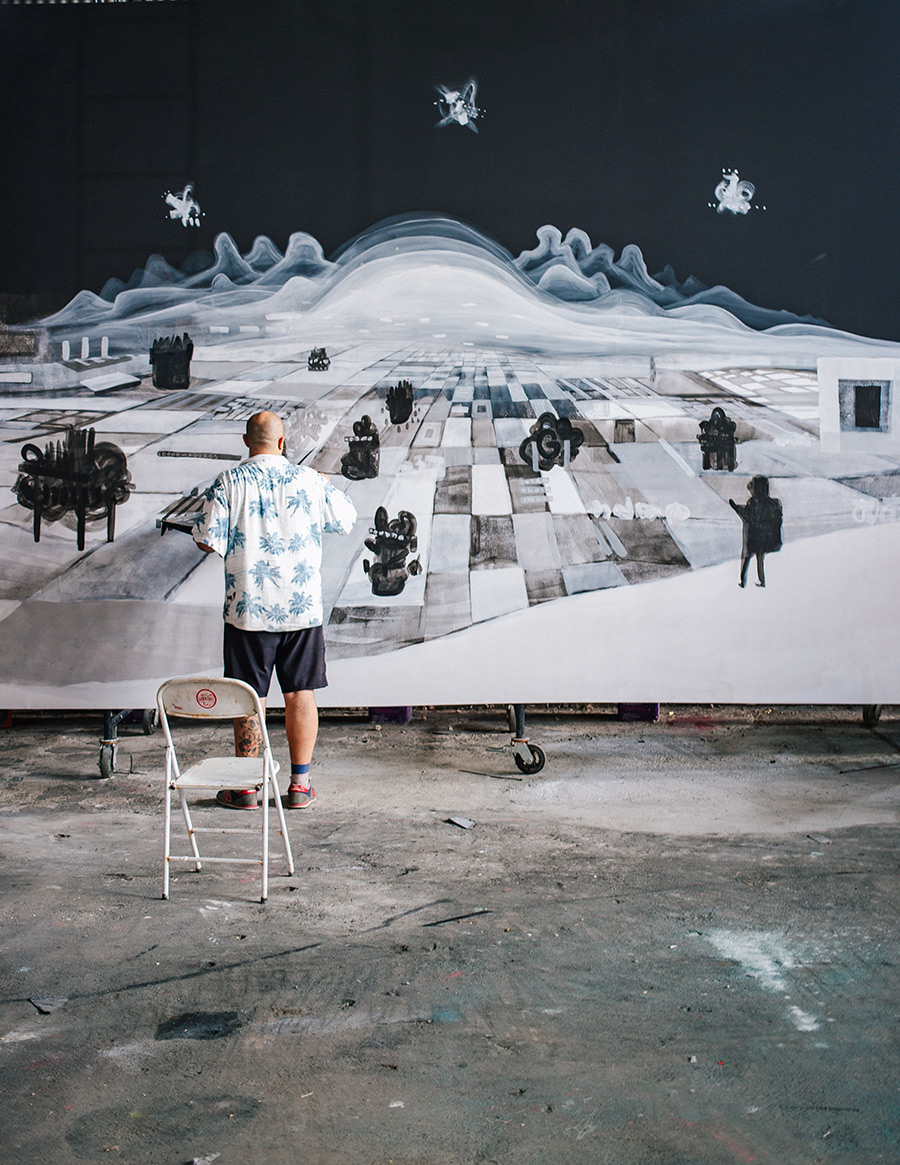
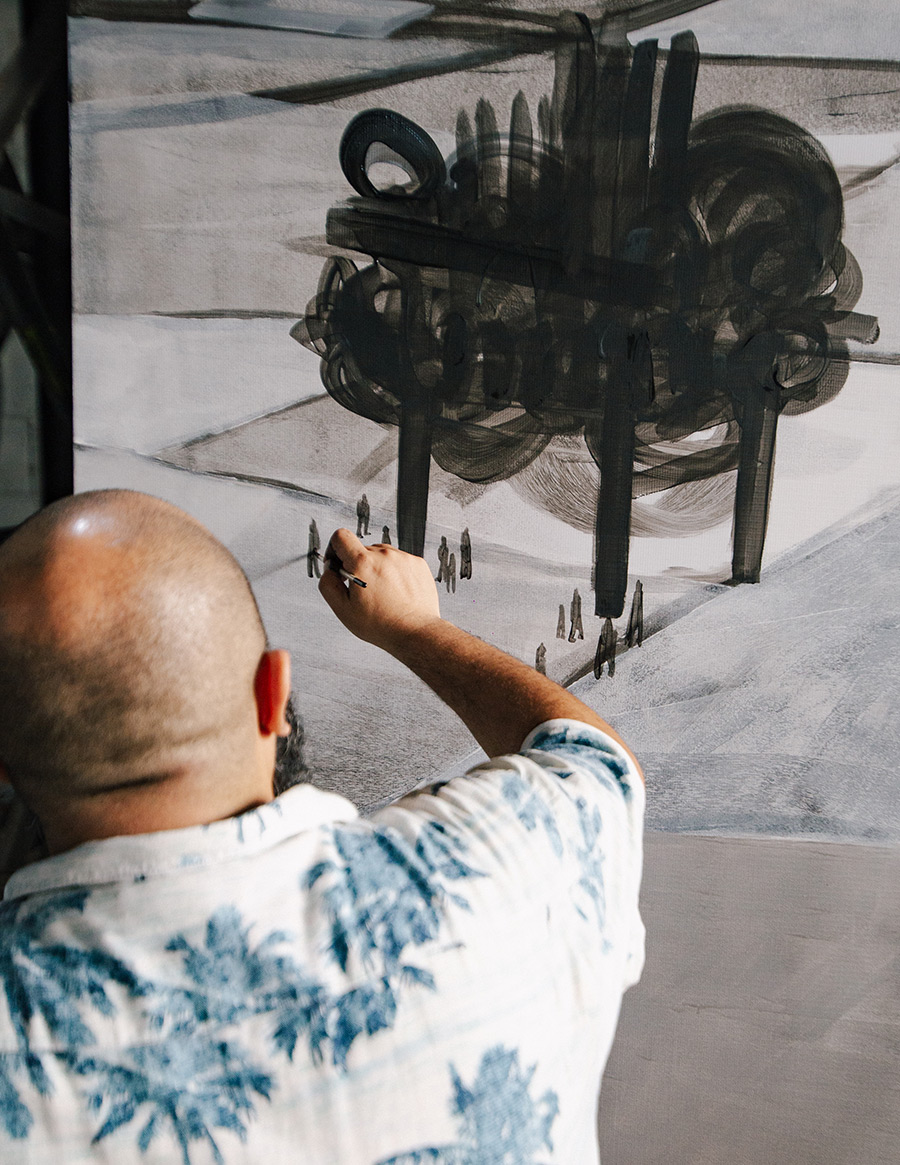
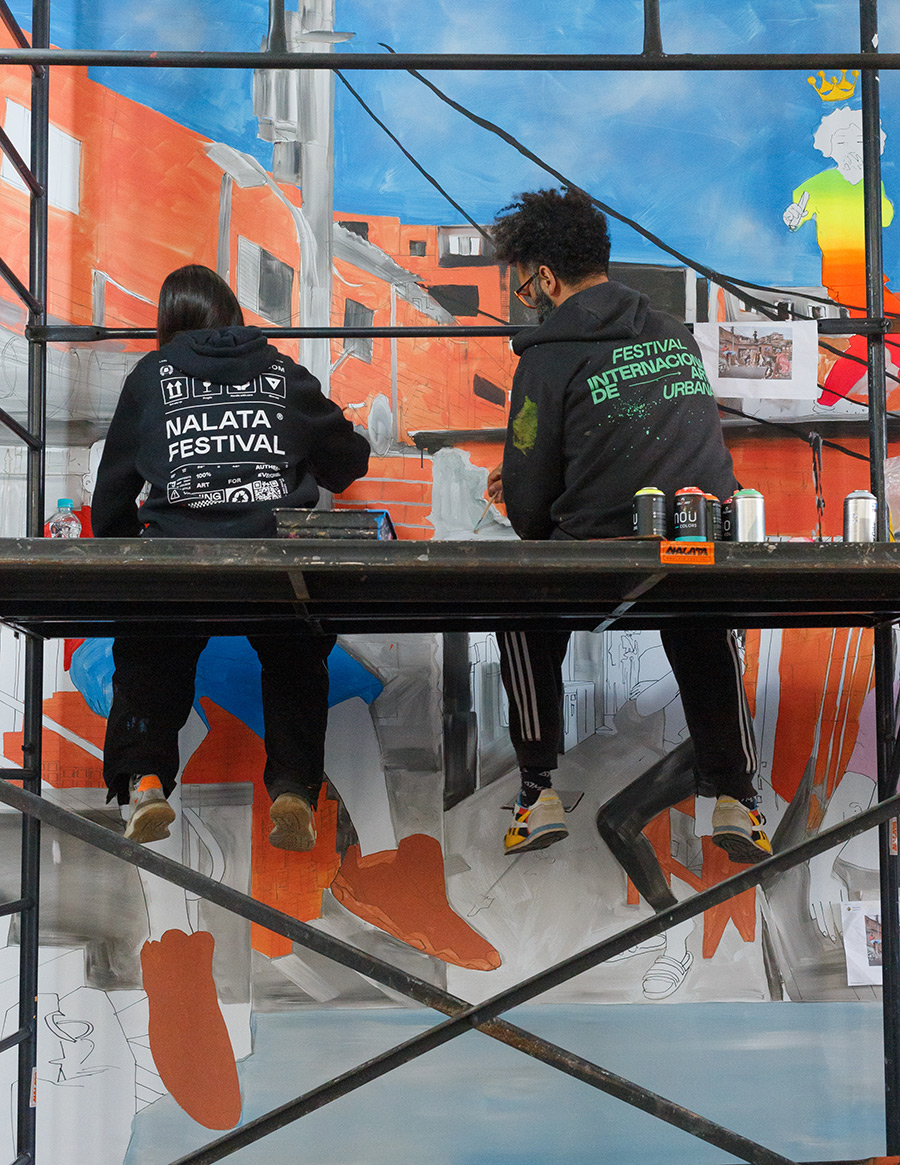
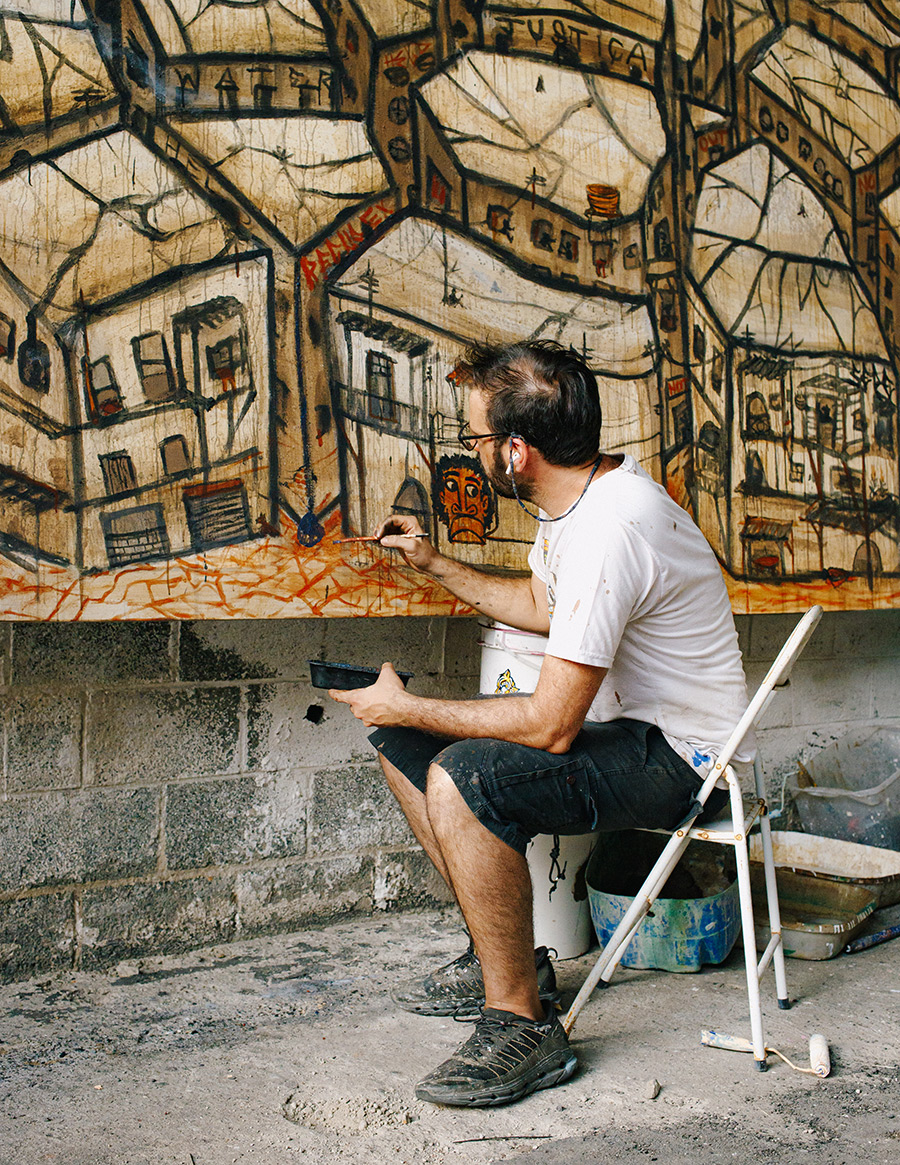
In the evolving global dialogue of street art, it’s not often that two hemispheres collide with this much color, conviction, and cultural force. This summer in Amsterdam, STRAAT Museum hosts a rare and vital encounter: a comingling of Brazilian street expression in two distinct but interconnected exhibitions — Pixação: Resistance and Rebellion and NaLata X STRAAT. It is a vivid, timely lens on one of the world’s most influential street art cultures, bringing political urgency, spiritual depth, and unfiltered humanity into focus.
Born from the informal laboratories of public space, Brazilian urban art has long pushed boundaries — formal, legal, aesthetic — and nowhere is this more pronounced than in the uniquely raw language of pixação. The exhibition Pixação: Resistance and Rebellion opens a door onto this homegrown form of dissent, of visual style, and socio-political act. Featured artists like Cripta Djan, Eneri, and LIXOMANIA!.zé carry the weight of a movement that refuses erasure, climbing the vertical concrete of Brazil’s cities to inscribe messages in the margins, on the margins. Stark texts, monochrome, often illegible to outsiders, declare existence in a society rife with inequality.
Using archival photographs, personal ephemera, and newly created large-scale canvases now added to the STRAAT collection, this show documents and transmits a living code of resistance, still pulsing.
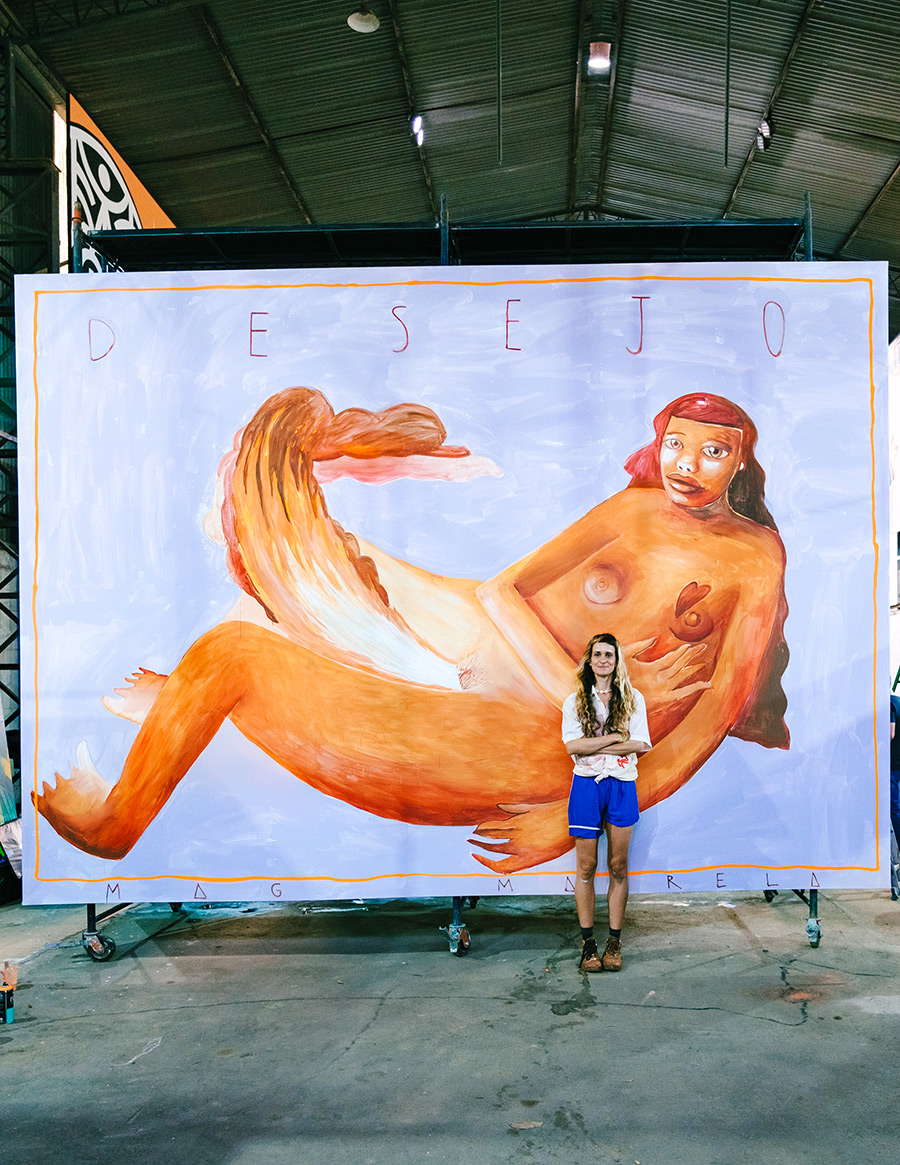
Later in the season, NaLata X STRAAT will aim the lens toward the international scope and creative exuberance of Brazil’s broader street art scene. Originating from the NaLata Festival in São Paulo, often described as a sprawling celebration of muralism, community, and expression — this collaboration brings works by Enivo, Magrela, Dolores Esos, Priscilla “Pri” Barbosa, Deco Treco, Lobot, and Mundano to the museum’s monumental walls, alongside new commissions from well-known and respected artists Speto and Tinho. These are paintings and dispatches — narratives from favelas and city squares.
At a moment when the world reckons with crumbling institutions and questions of equity, environment, and voice, these artists remind us that the public wall remains a crucial platform, not of power, but of people. Their color palettes burst with optimism, even as their messages carry critique. They are playful, poetic, personal, and political — sometimes all at once.
If you’ve ever wandered down Frost Street and caught a whiff of turpentine, weed, and burned toast, you may have walked right past the unmarked doorway where Williamsburg still quietly seethes and happily bubbles with creative resistance.
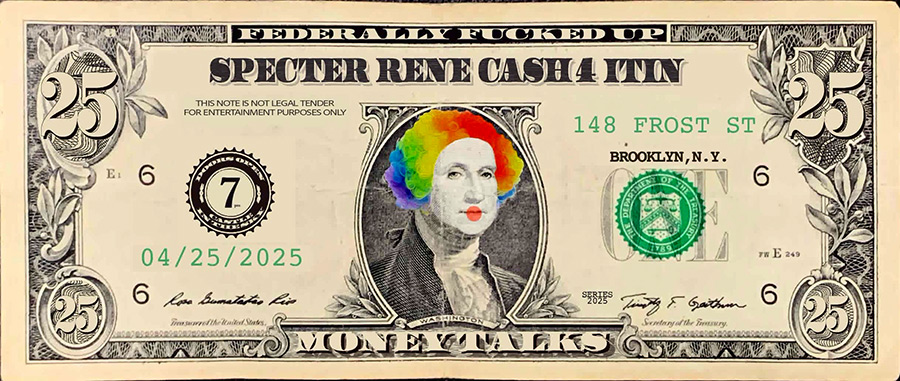
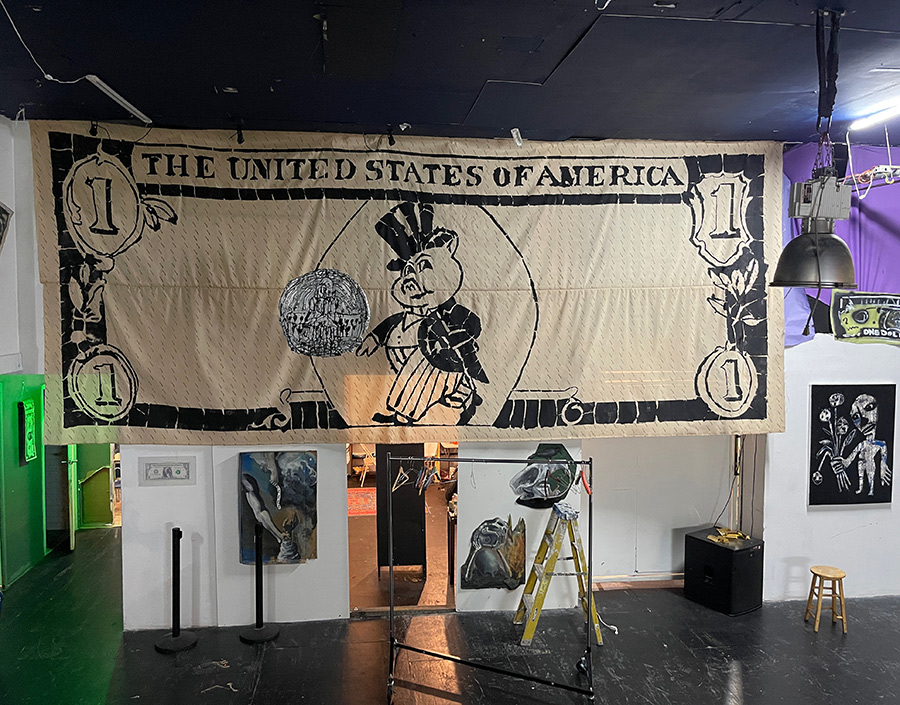
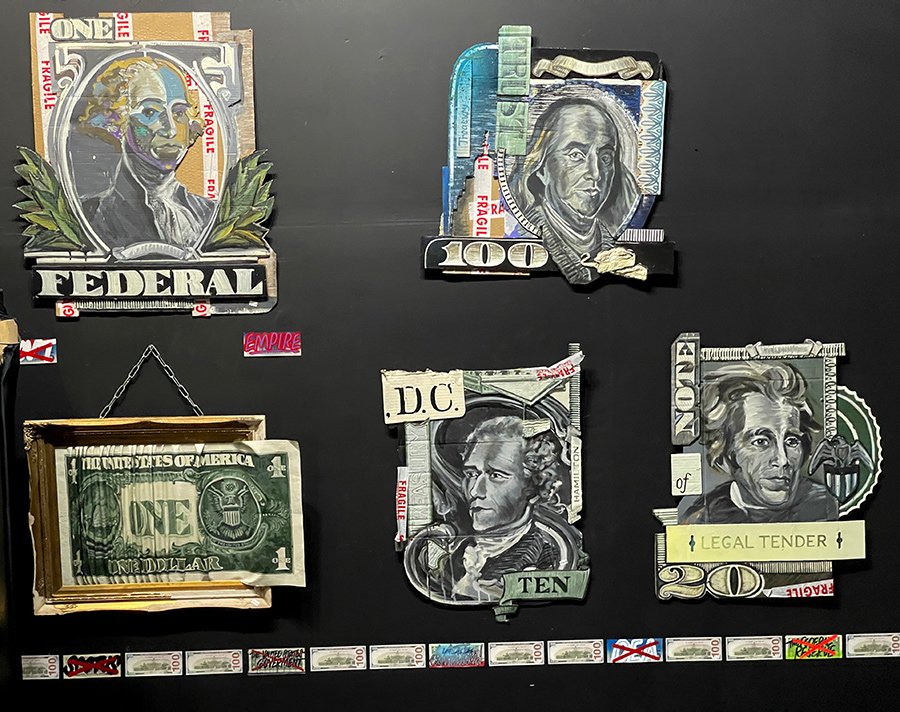
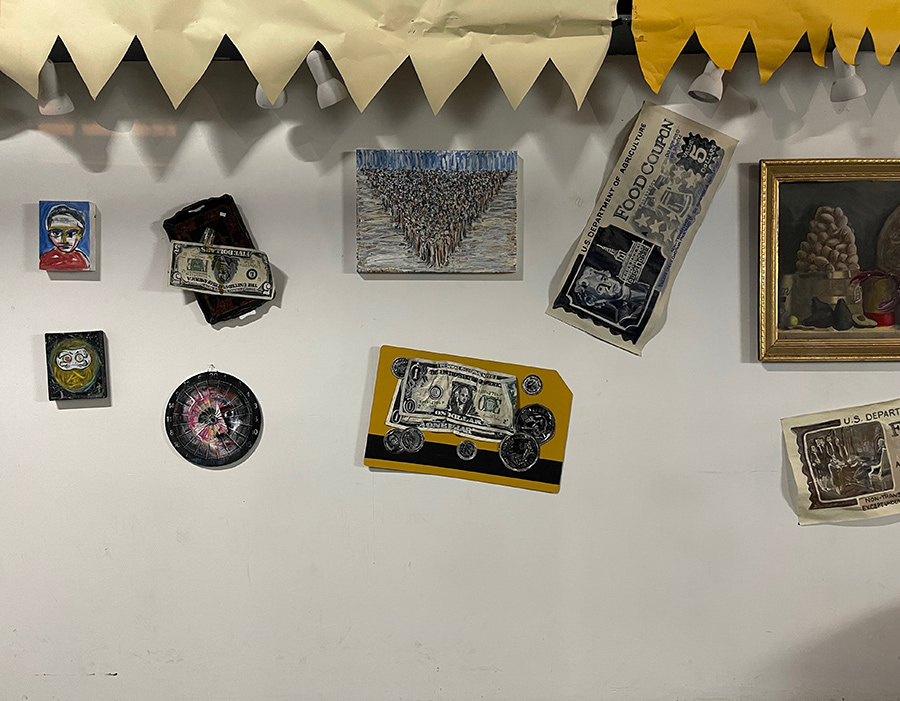
A community center, performance space, art gallery, flea market hybrid, the space welcomes you to the latest show, “Money Talks,” which doesn’t need an opening reception flier. It has its gravity and pull — the kind that draws a packed audience into a labyrinth of rooms, exhibition spaces, and performances. A sign of success, it spills onto the spring Friday night sidewalk, where smokers and sharp talkers hold court between sets by a shaggy 70s rock band that might or might not be ironic.
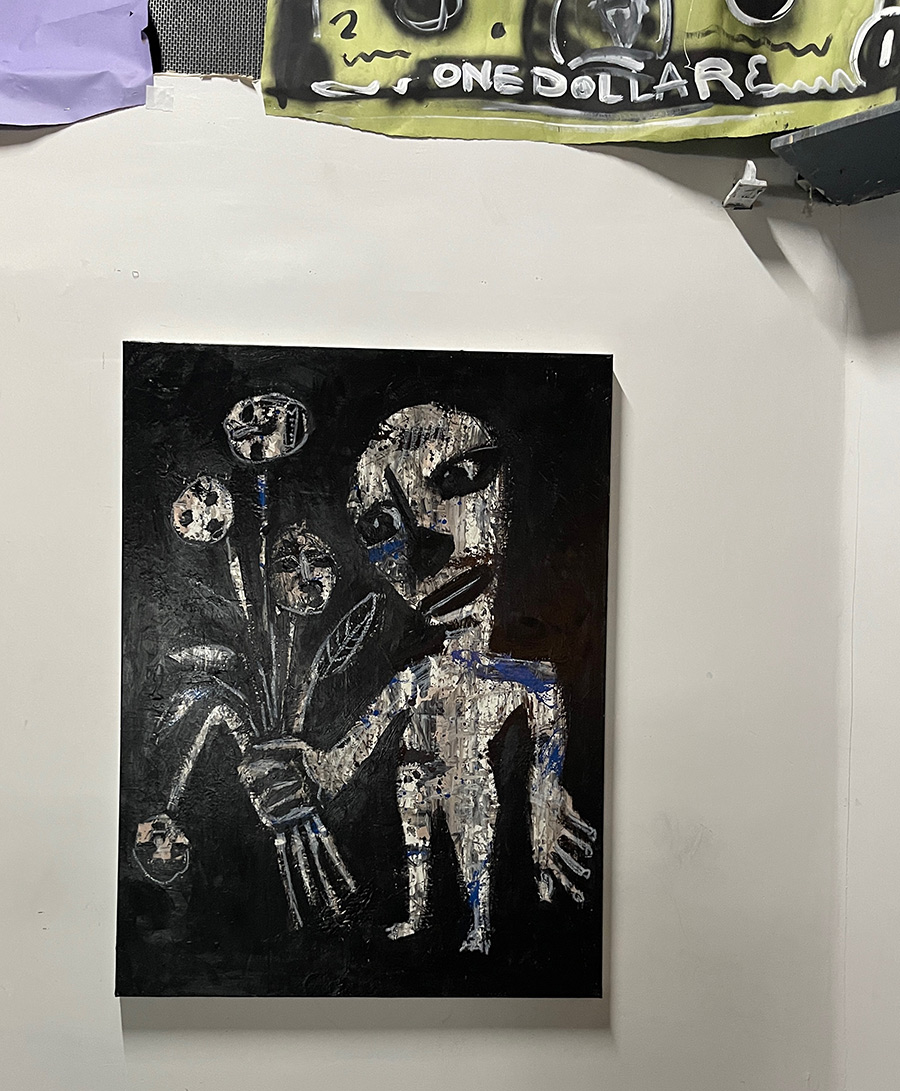
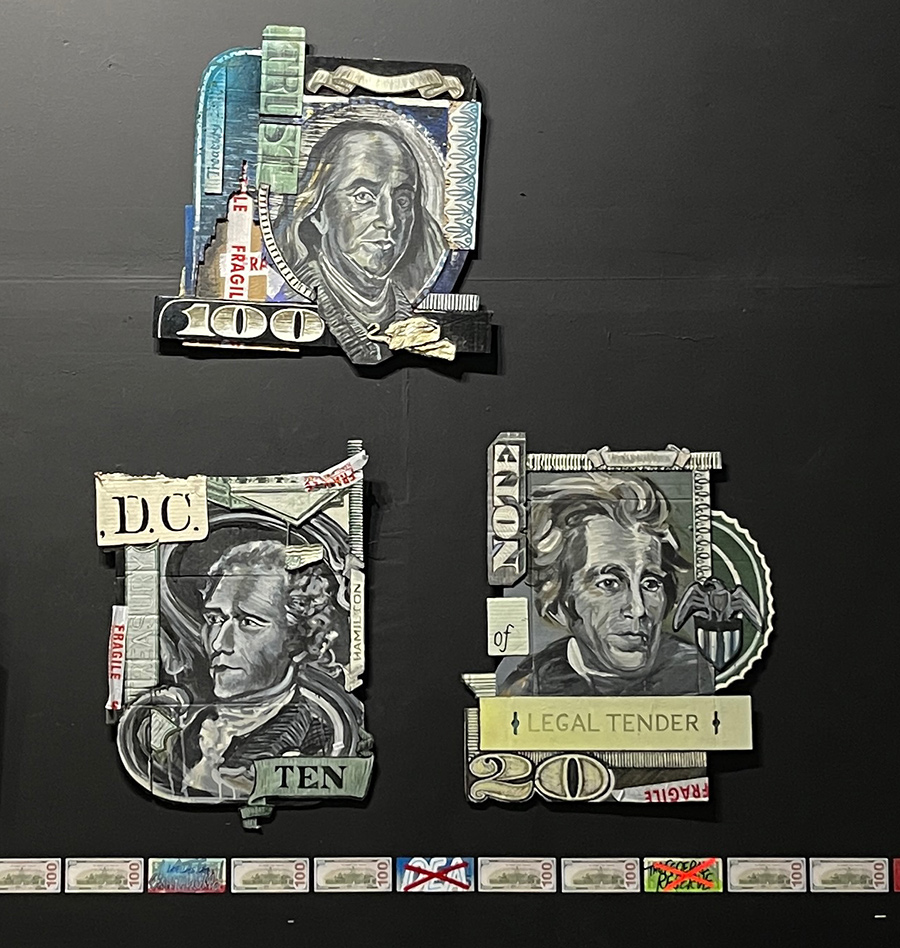
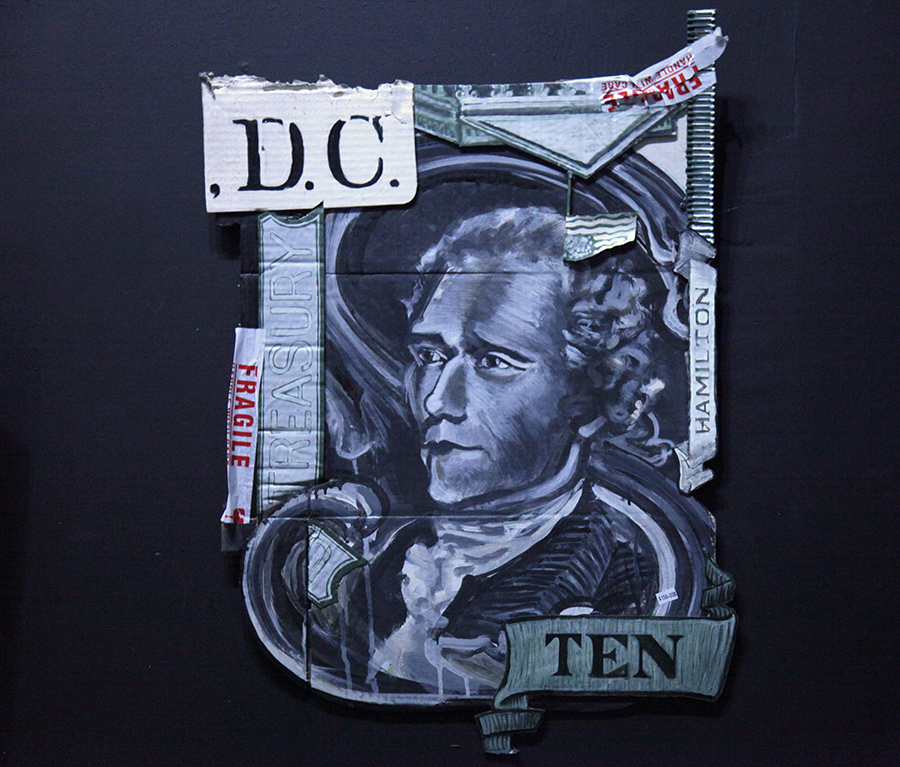
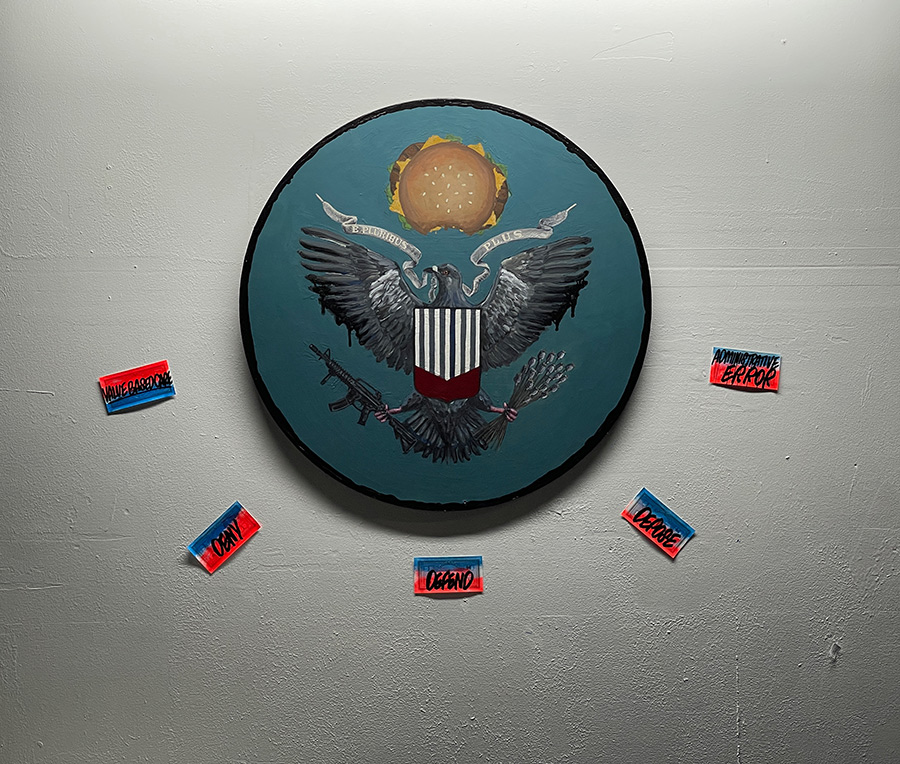
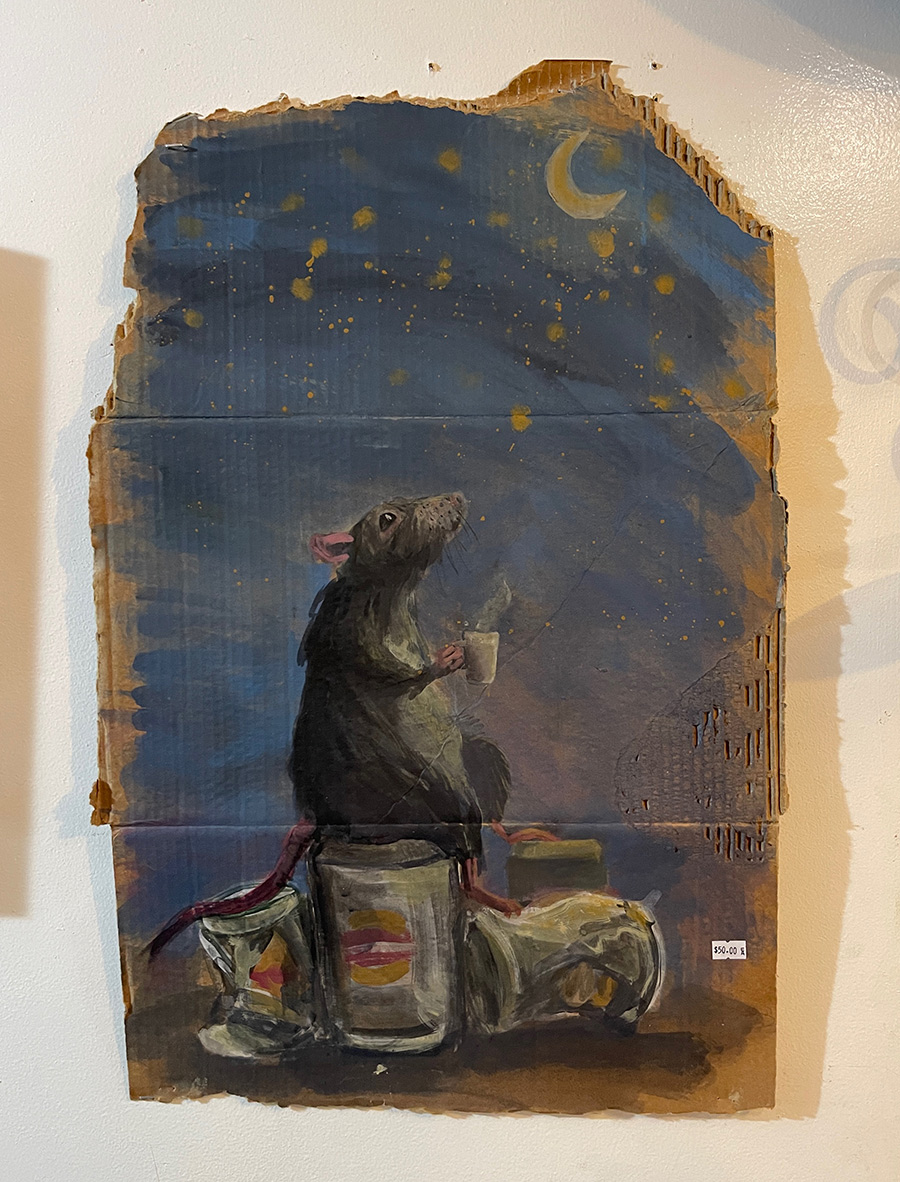
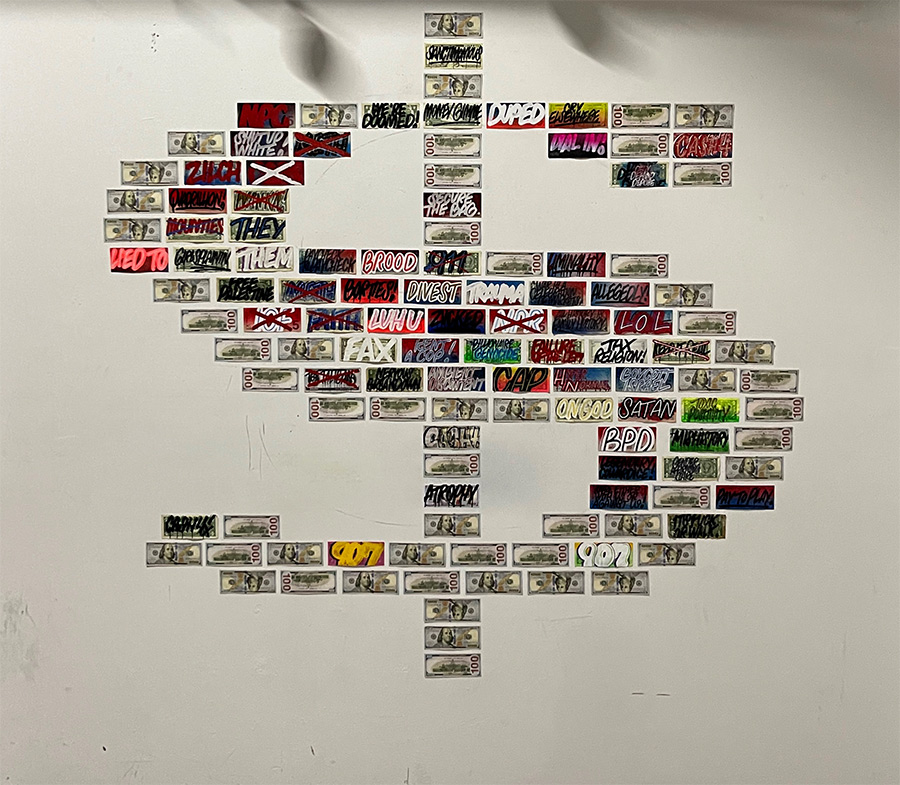
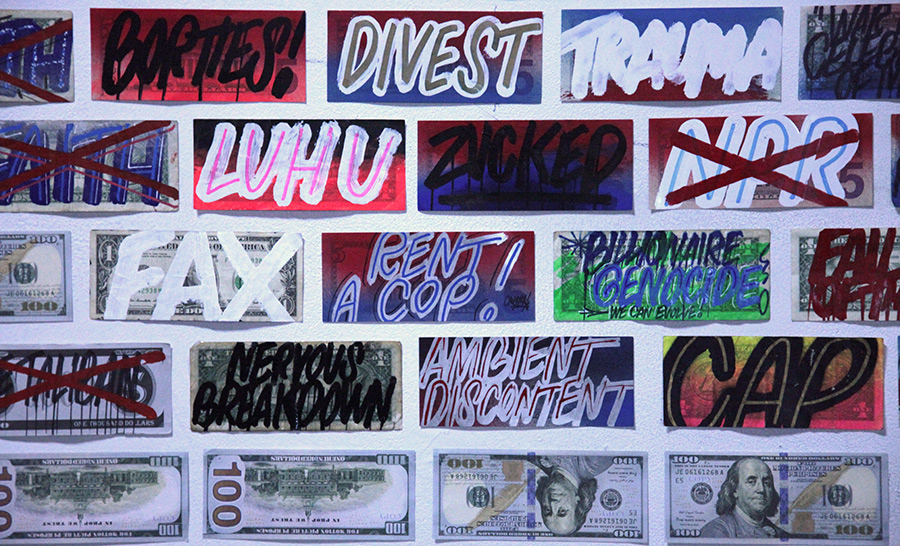
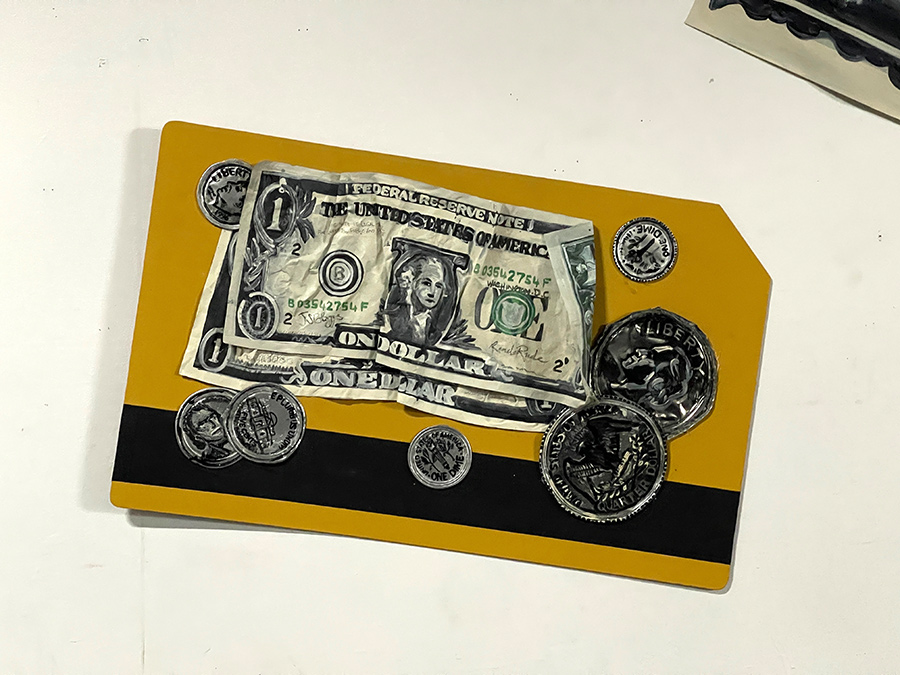
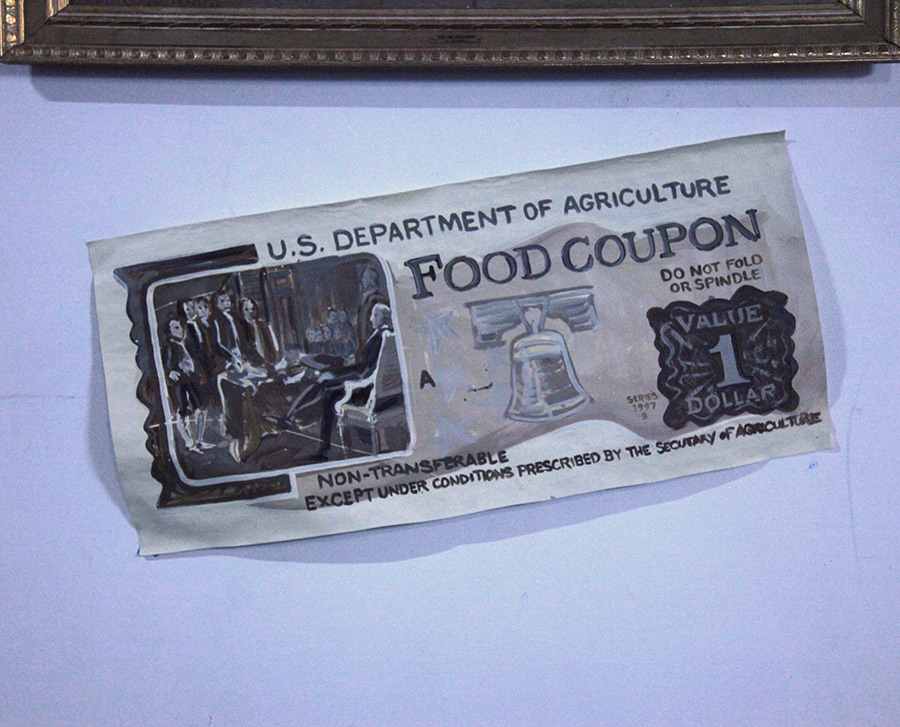
Inside, four artists — Specter, Rene, CASH4, and ITIN — served up a visual demolition of American currency and its cultural metaphors. It wasn’t bitter, but it wasn’t sweet. Like the Williamsburg of old, before the glass condos, this was salty, smart, funny, blunt. No manifestos on the wall, just wry, sharp-tongued critique told in paper pulp, paint, and political memory.
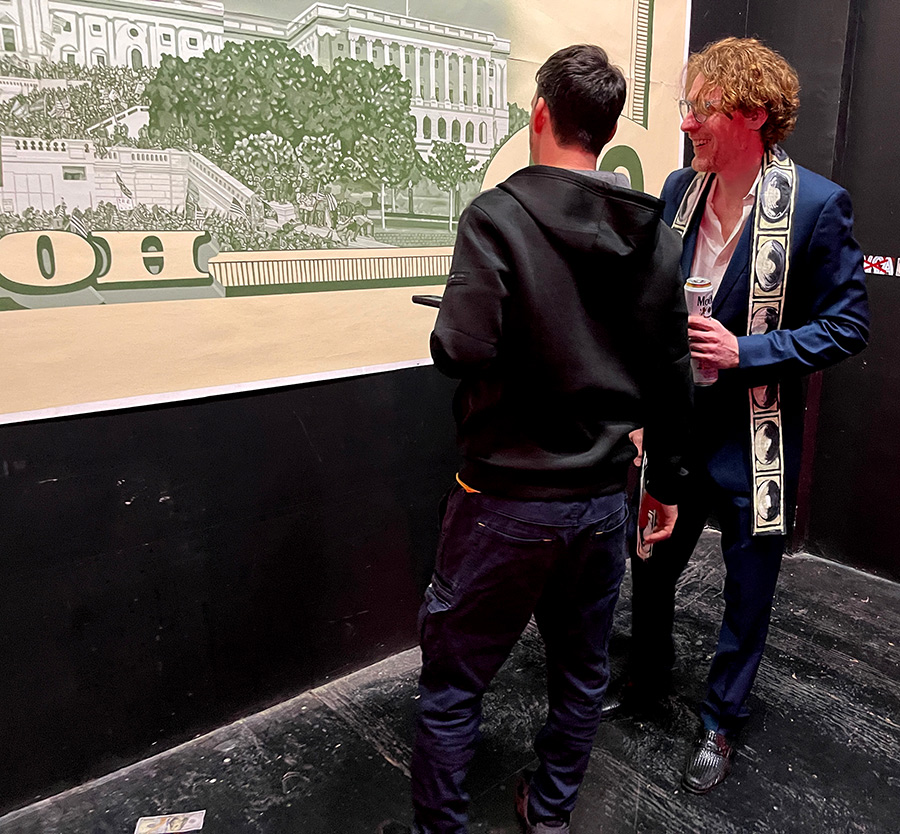
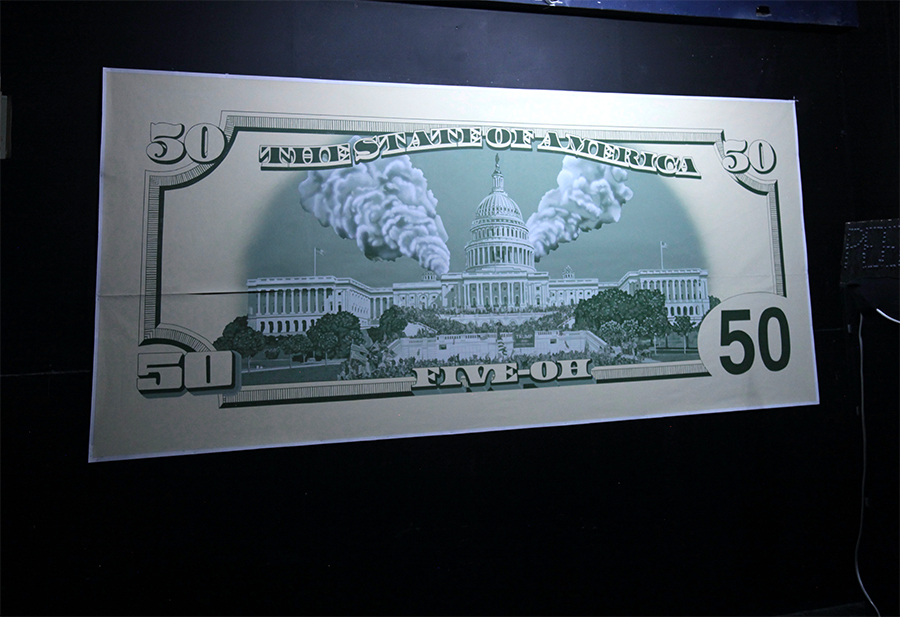
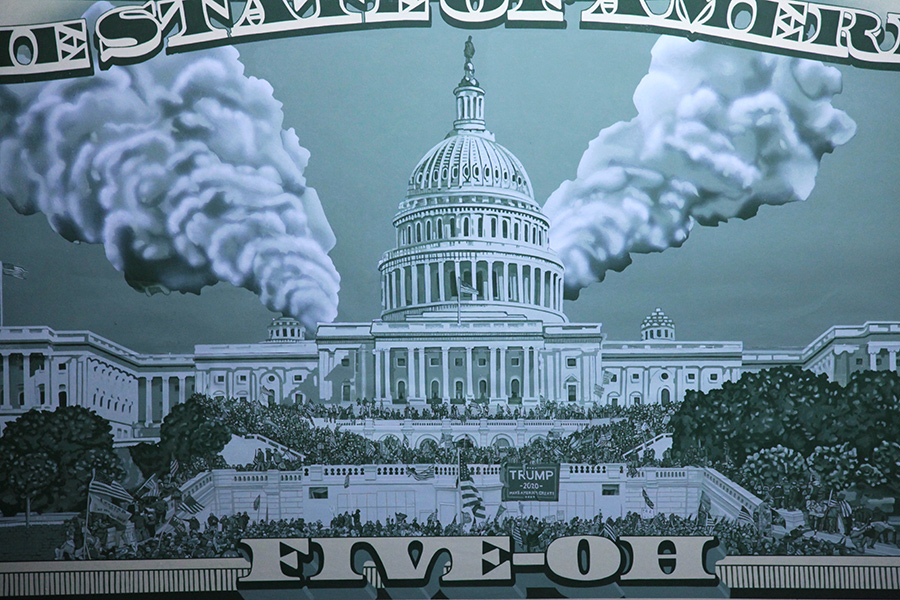
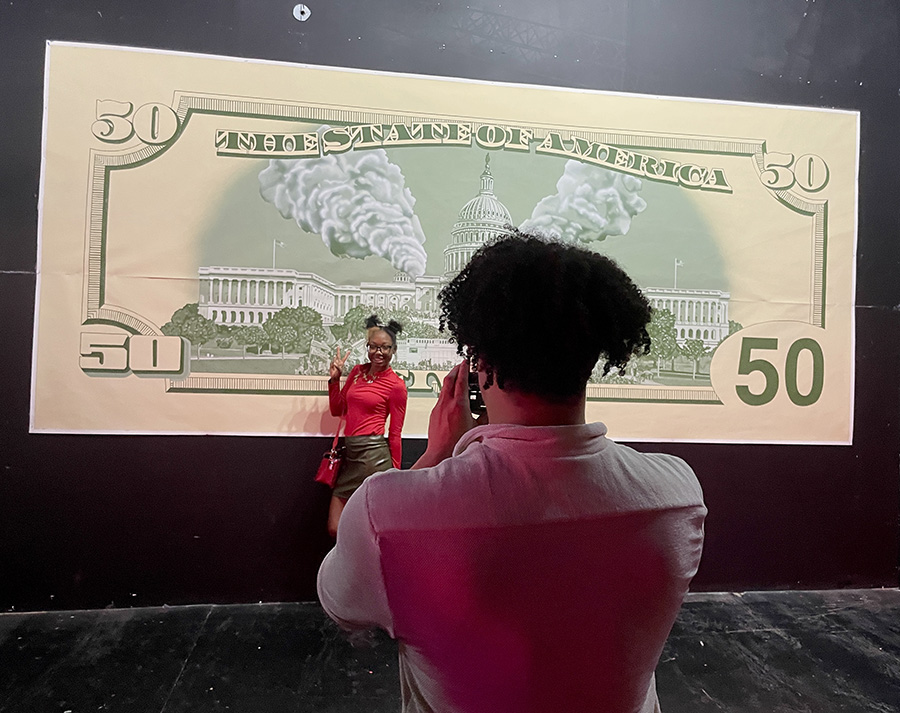
The anchor piece? Gabriel Specter’s massive currency-redesigned The State of America. A redux of the reverse of a dollar bill — if it had lived through January 6. The Capitol dome smokes like a symbol under siege, while foregrounded rioters pose in shades of government green. It’s beautifully executed, deeply personal, and visibly furious — a portrait of patriotism cracked in half. The loft is loud, the floor sticky, the ideas sharp. Money Talks doesn’t have a social media campaign, instead you feel like it has conviction. It doesn’t need a QR code. The rent may be high, but the spirit here is still gloriously low-rent — and unbought.
Specter, a visual bard of the 2000s and 2010s Brooklyn scene, known for work that didn’t just decorate the streets but spoke to social realities, talked to us about this piece — and about the spirit of a space that still knows how to host shows that mean something.
BSA: How would you characterize the space where “Money Talks” took place — not just physically, but in terms of its function as a creative platform? Is it more of a cultural incubator, a performance venue, or a kind of underground laboratory for dissent?
GS: The best way to describe the space is talking about the people who occupy it. Each person coming in and out of the studio, the workshop, performance and gallery space shapes it into a one-of-a-kind arts venue. To answer whether it is a cultural incubator, performance venue, or underground laboratory of dissent, I would say all three apply. We’re inclusive of all forms of expression but we have an anti-establishment edge. Respect and kindness overrides difference of opinion.
BSA: Your painting The State of America, featuring figures from the January 6th Capitol riot, was a powerful centerpiece. What emotional or psychological space were you in while creating it, and how did the act of painting become a way to process or confront that moment in history?
GS: Because of the amount of detail required to execute the work, I had to focus on the rendering of each figure in the painting. I was physically trying to individualize them, an accurate representation of what was happening. My brain was not focused on anything other than the actual painting of it. It put me in a meditative state creating it.
As I would take breaks from the laborious rendering, I would take a step and look at what I’d completed so far. Because I was trying to be so accurate about representing each individual, the stepping back and seeing them altogether, it honestly brought up a lot of hatred. For what they represented, and what they did on that day. In doing this painting, I was painting a lot of patriotic things and my version of patriotism is a lot different than what the scene depicts.
BSA: The exhibition seems to grapple with money not just as currency, but as a symbol of power, manipulation, and social fracture. Was the show intended as a direct critique of American capitalism, or are you also exploring more personal or ambiguous relationships to money and value?
GS: Each artist in the exhibition has their own take and I can only speak to my own. So yes, my work was a critique of money as a tool for manipulation, and how this has seeped into societal values. But as I said, every artist contributing took Money Talks as a way to take back power with money.
BSA: You’ve been making work since the 2000s, including street pieces that captured daily city life and the people who live here. How has your perspective — and your medium — evolved in response to the widening economic divide and the political climate of recent years?
GS: I think my work has evolved to the times we are living in. I feel more than ever that my work needs to draw a line in the sand and represent my values as a human. I don’t try to take sides but I express what I think is right and I feel there is a sickness in our society at the moment.
Spring 2025: Growth creeps in — leaf by leaf, blade by blade, decree by decree. You barely notice the buildup, but gradually it gathers, until suddenly, you’re surrounded.
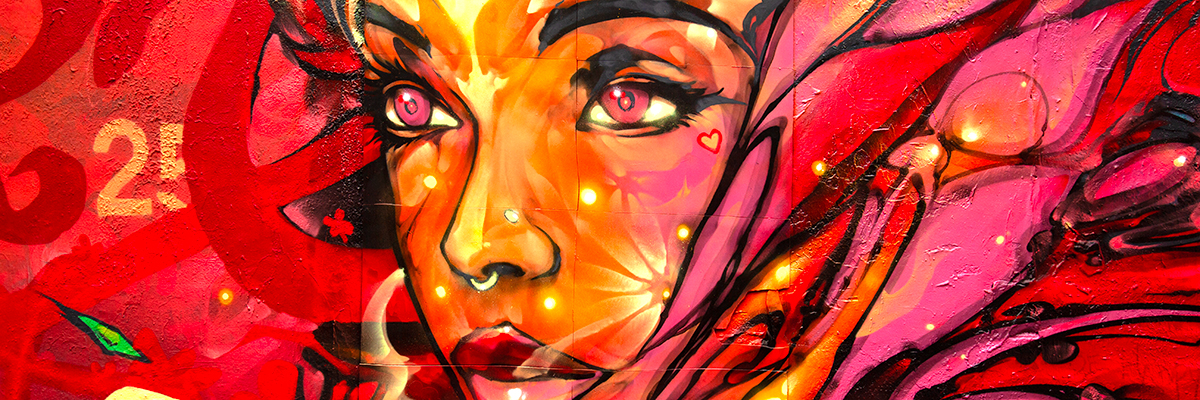
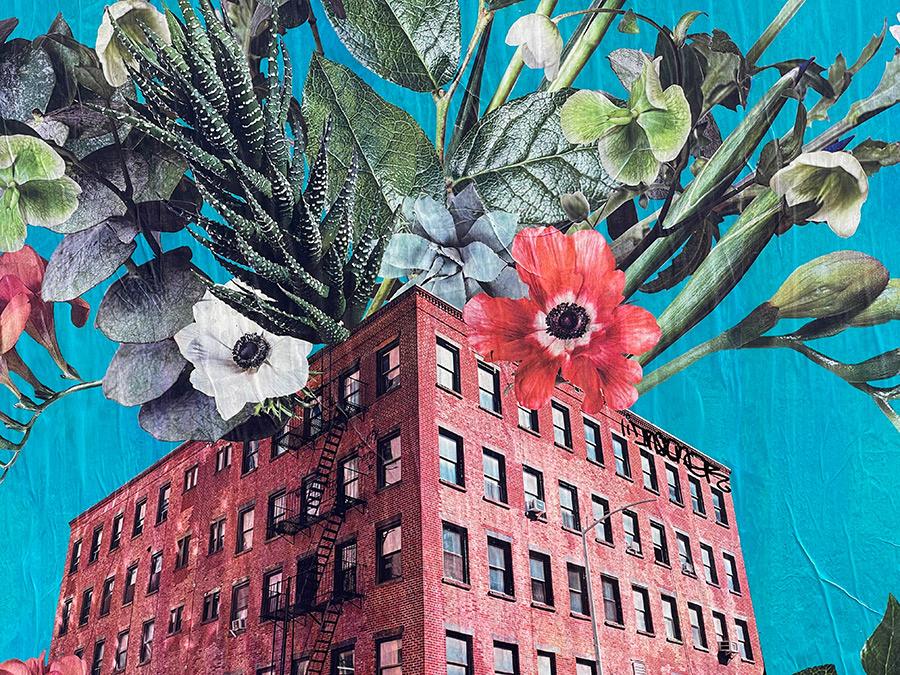
On New York walls right now, you’ll spot a mix of collage-style cut-and-paste work, aerosol rendered full fantasy – and a surge in vertical graffiti done while hanging from ropes. This high-risk approach echoes Brazil’s Pixação scene, where writers have been scaling buildings since the ’80s to get their monikers out there running north to south; a technique later amplified by crews like 1UP and Berlin Kidz in Europe. Now, numbers of New York graffiti writers are embracing this daring vertical style — a radical shift that some see clearly, while others barely register. Across styles and mediums, there often appears a recurring presence of scarlet, crimson, rose, magenta, purple, pink, and fuchsia. These grab attention an resonate at deeper undercurrents — power, sacrifice, passion, and perhaps even the stirrings of revolution.
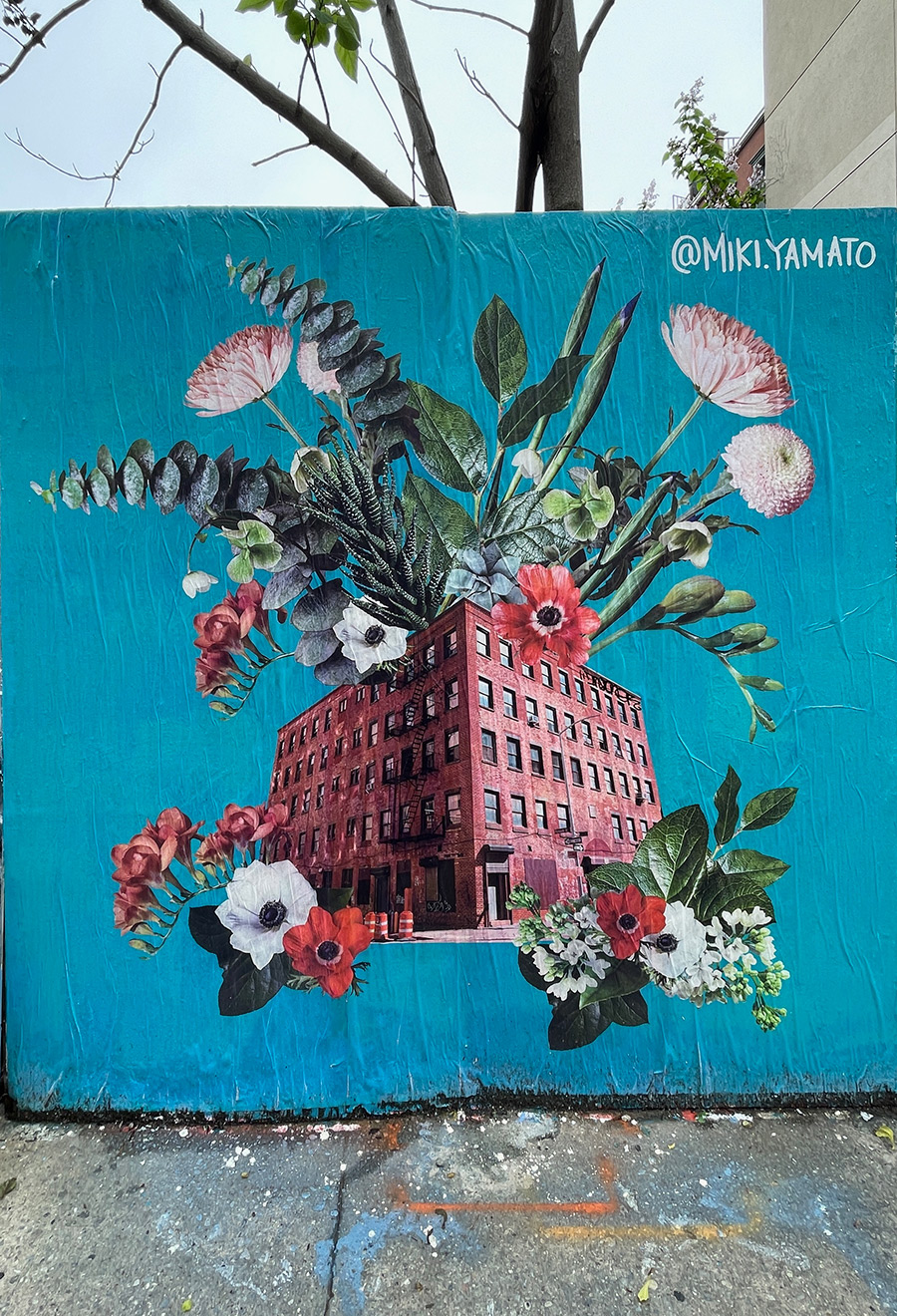
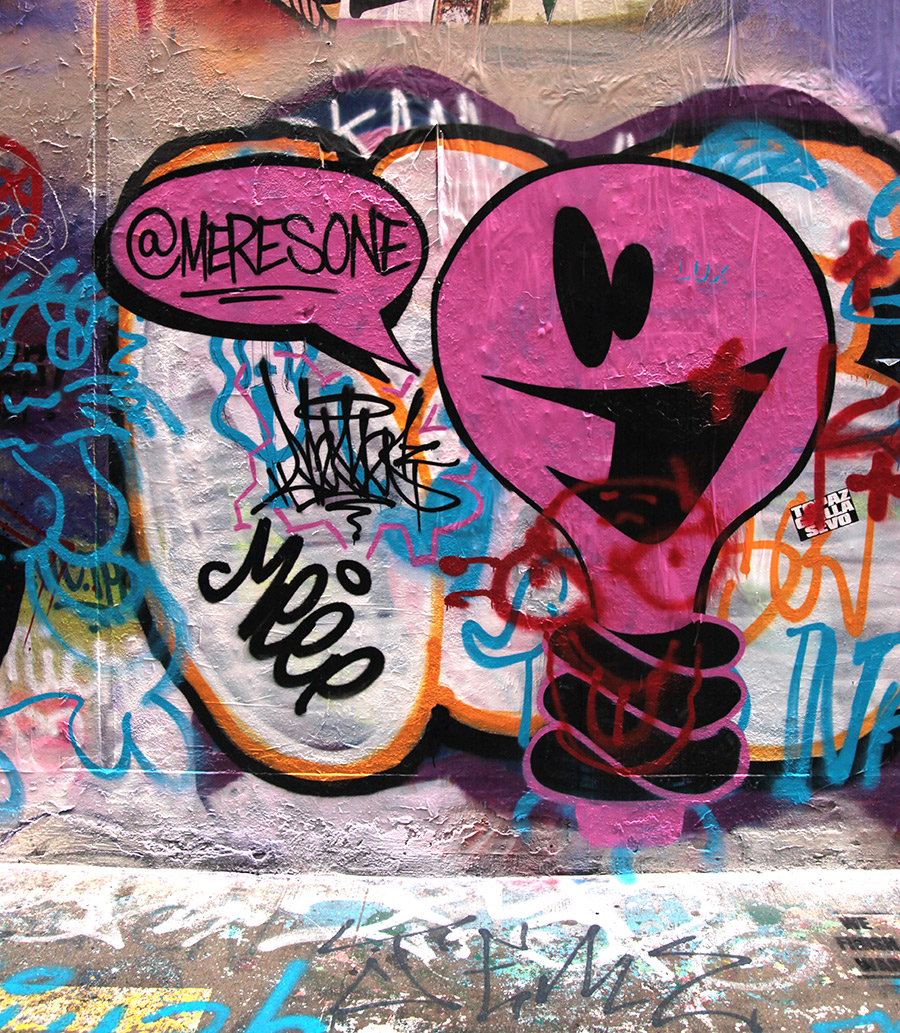
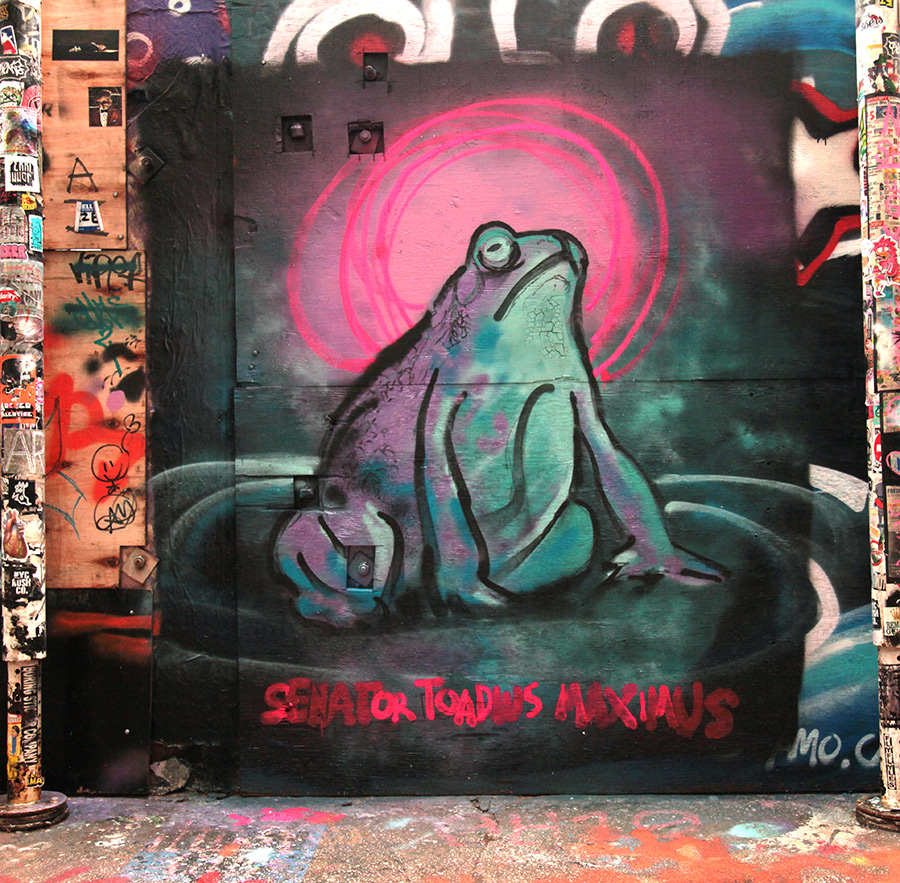
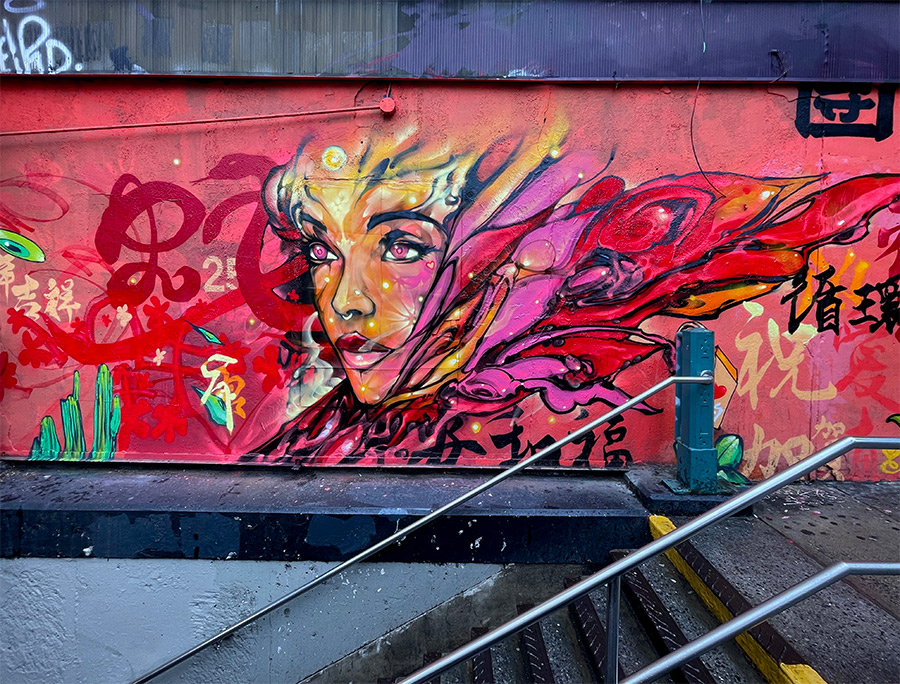
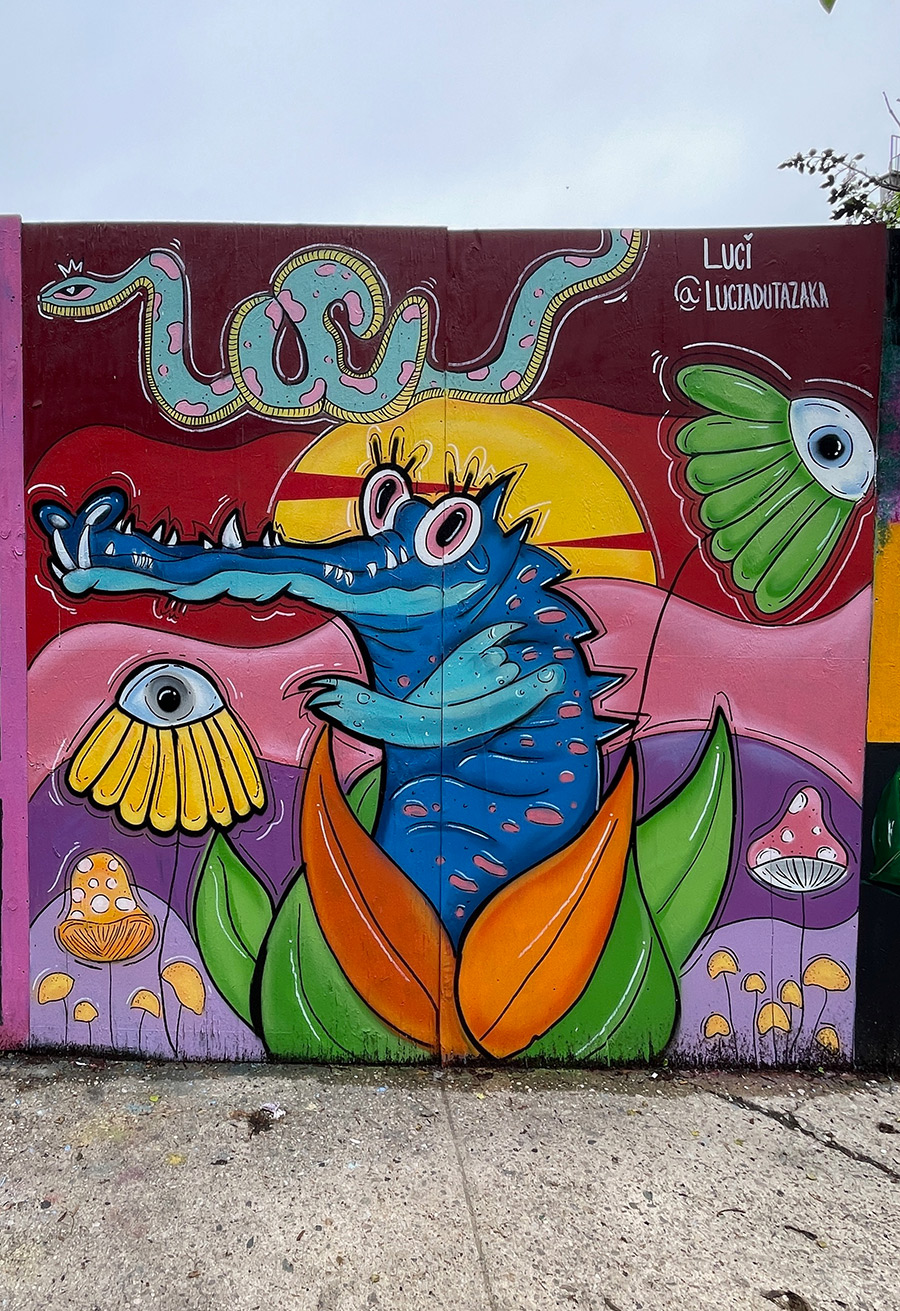
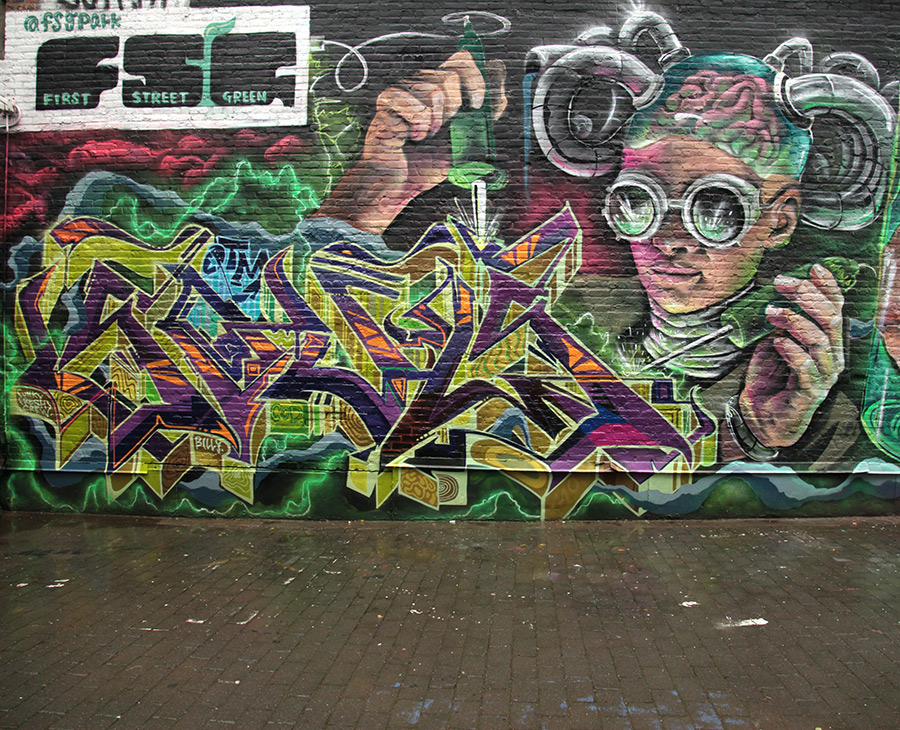
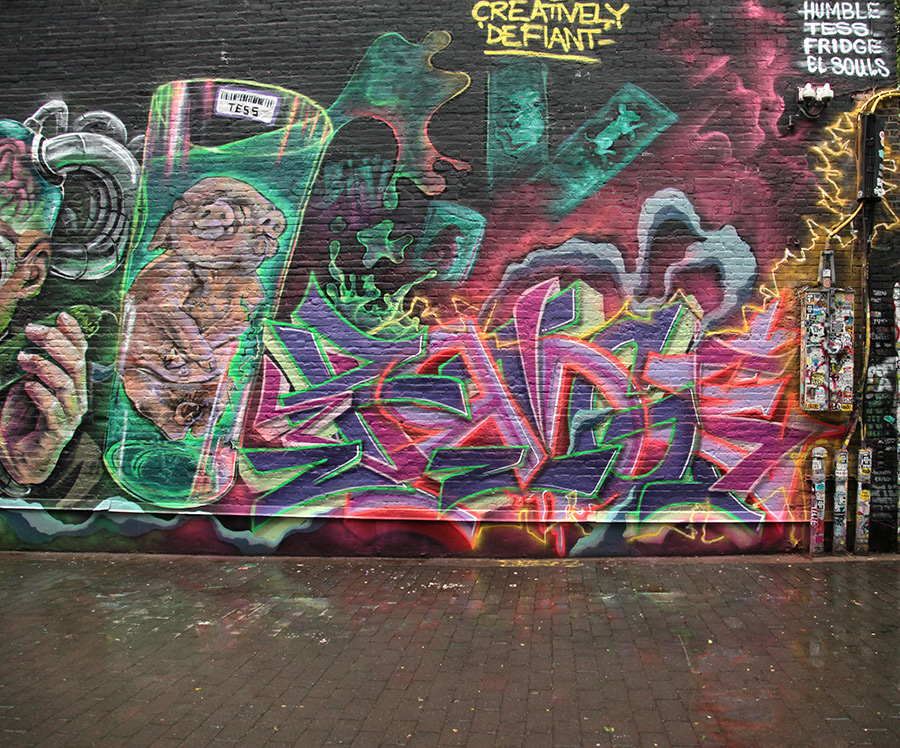
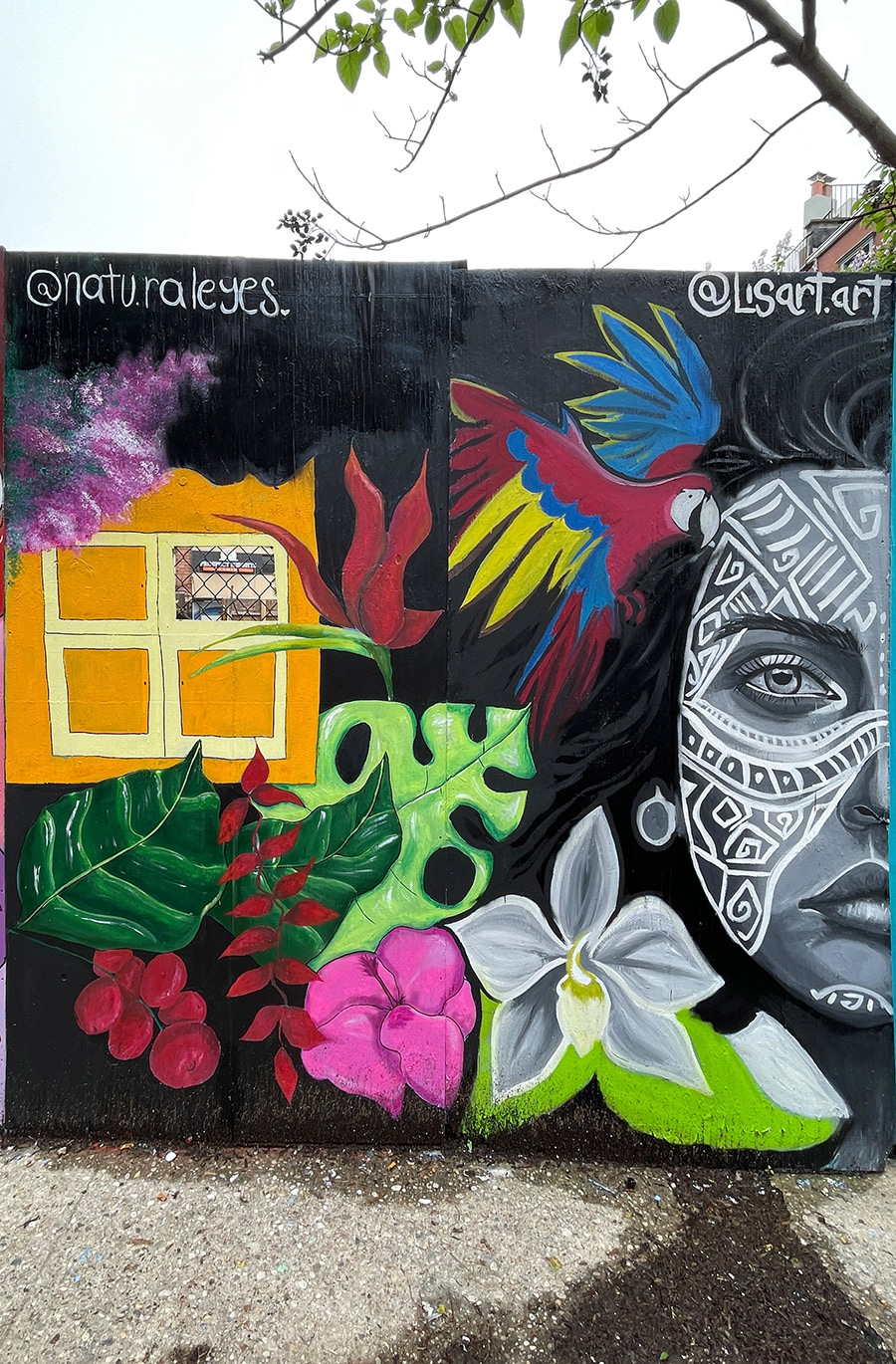
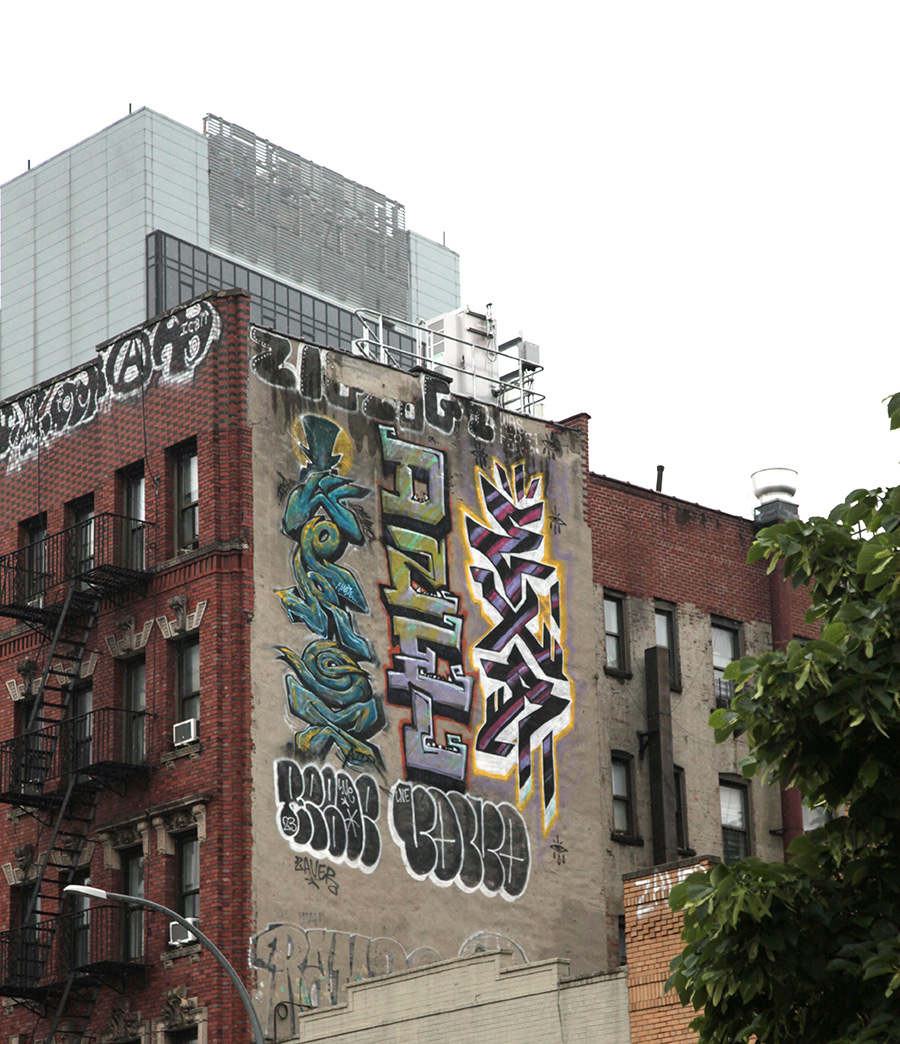
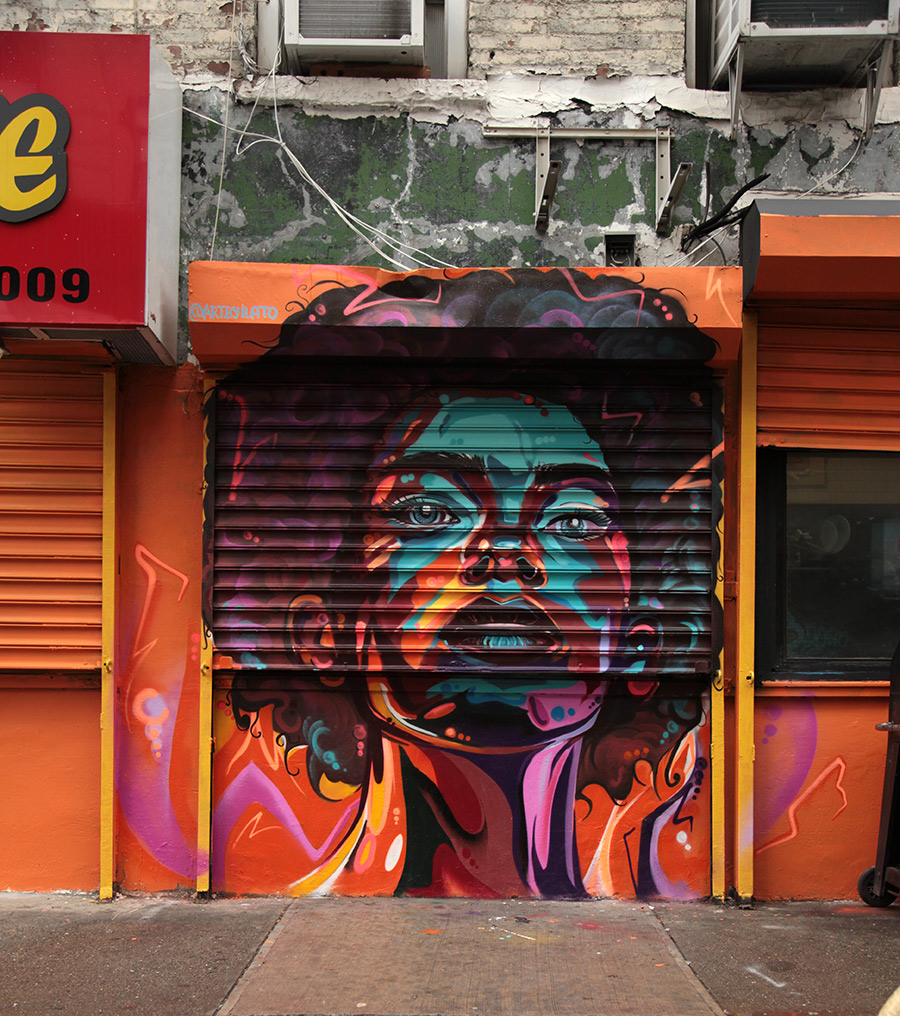
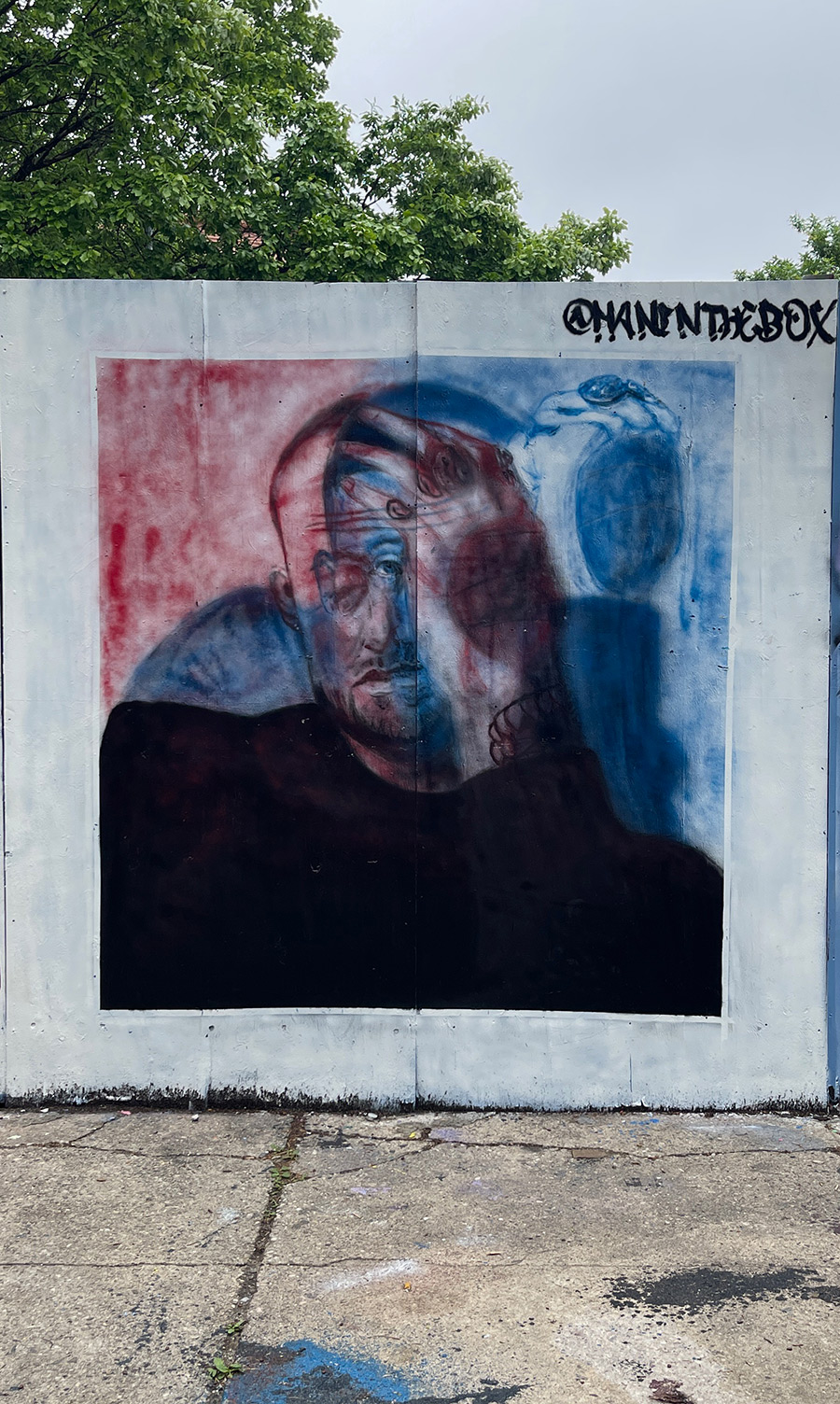
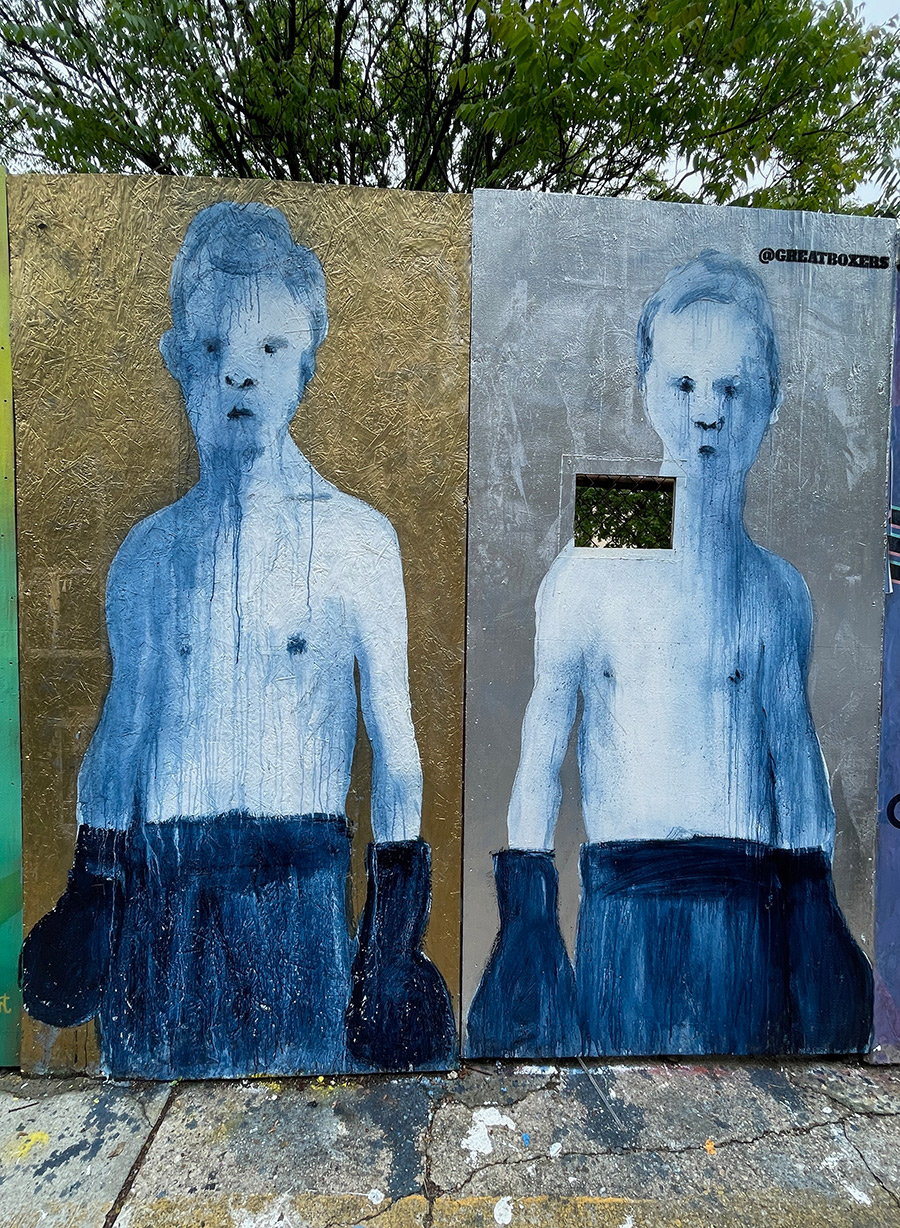
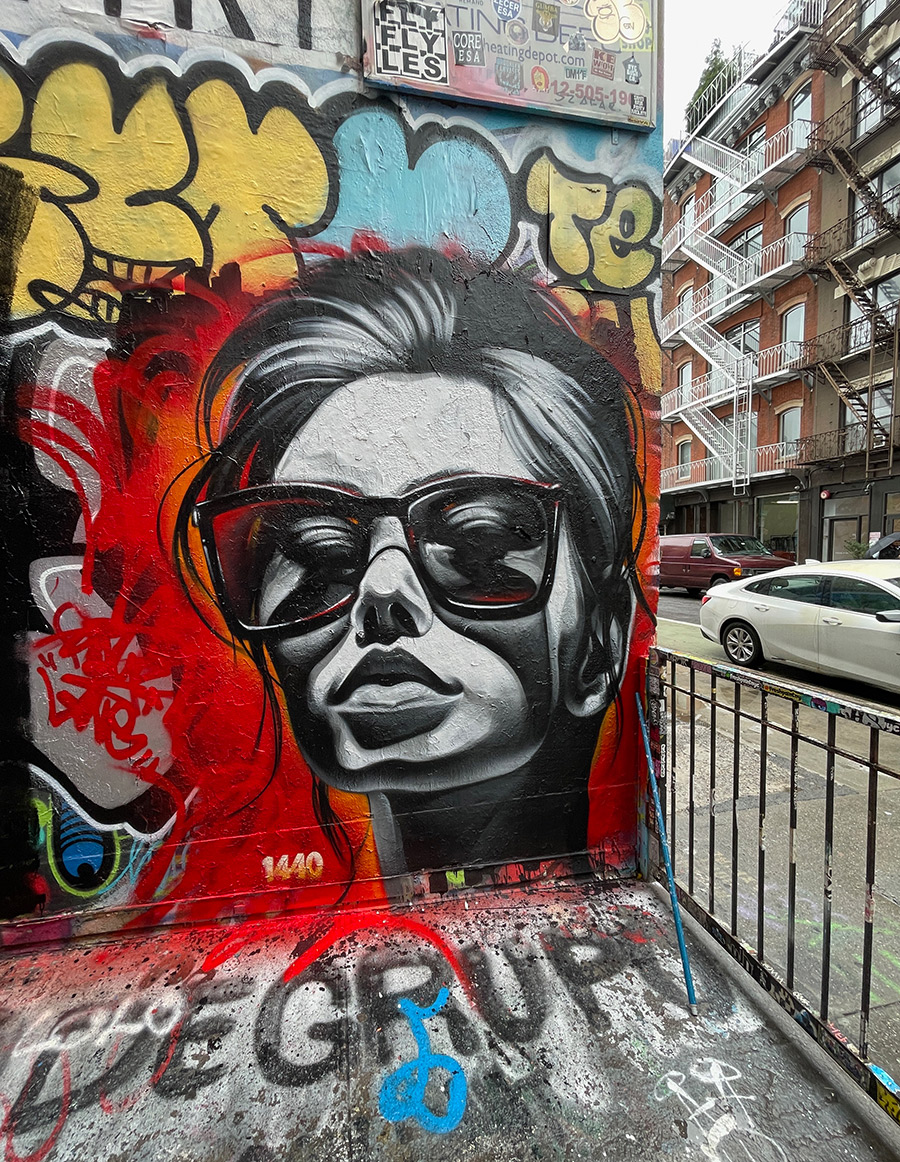
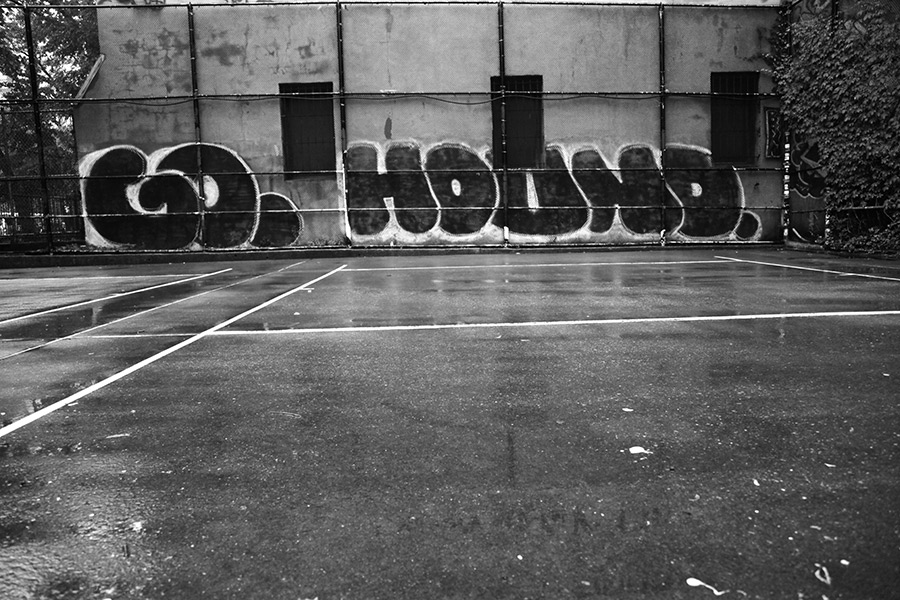
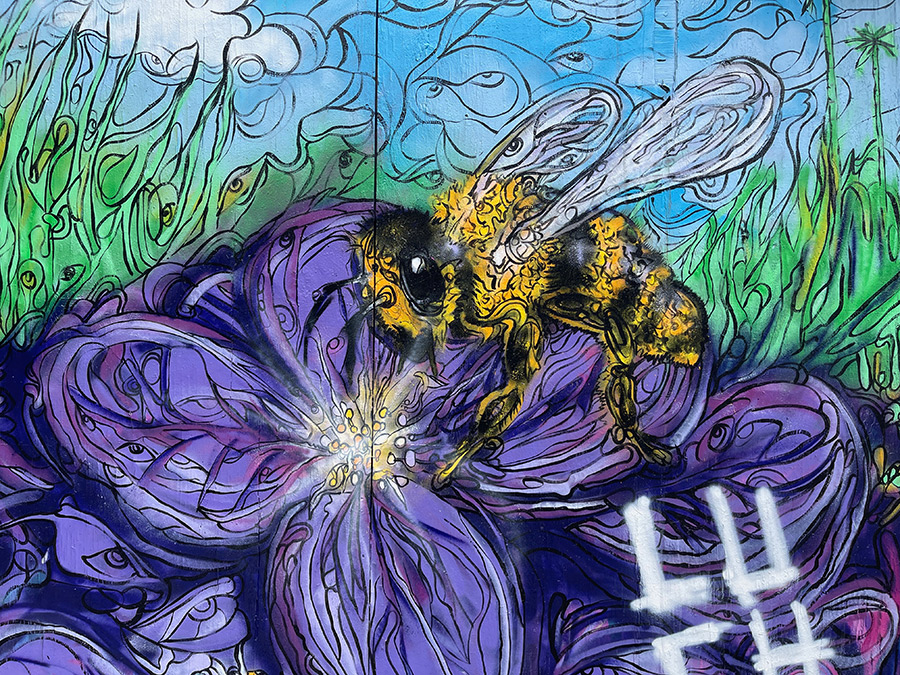
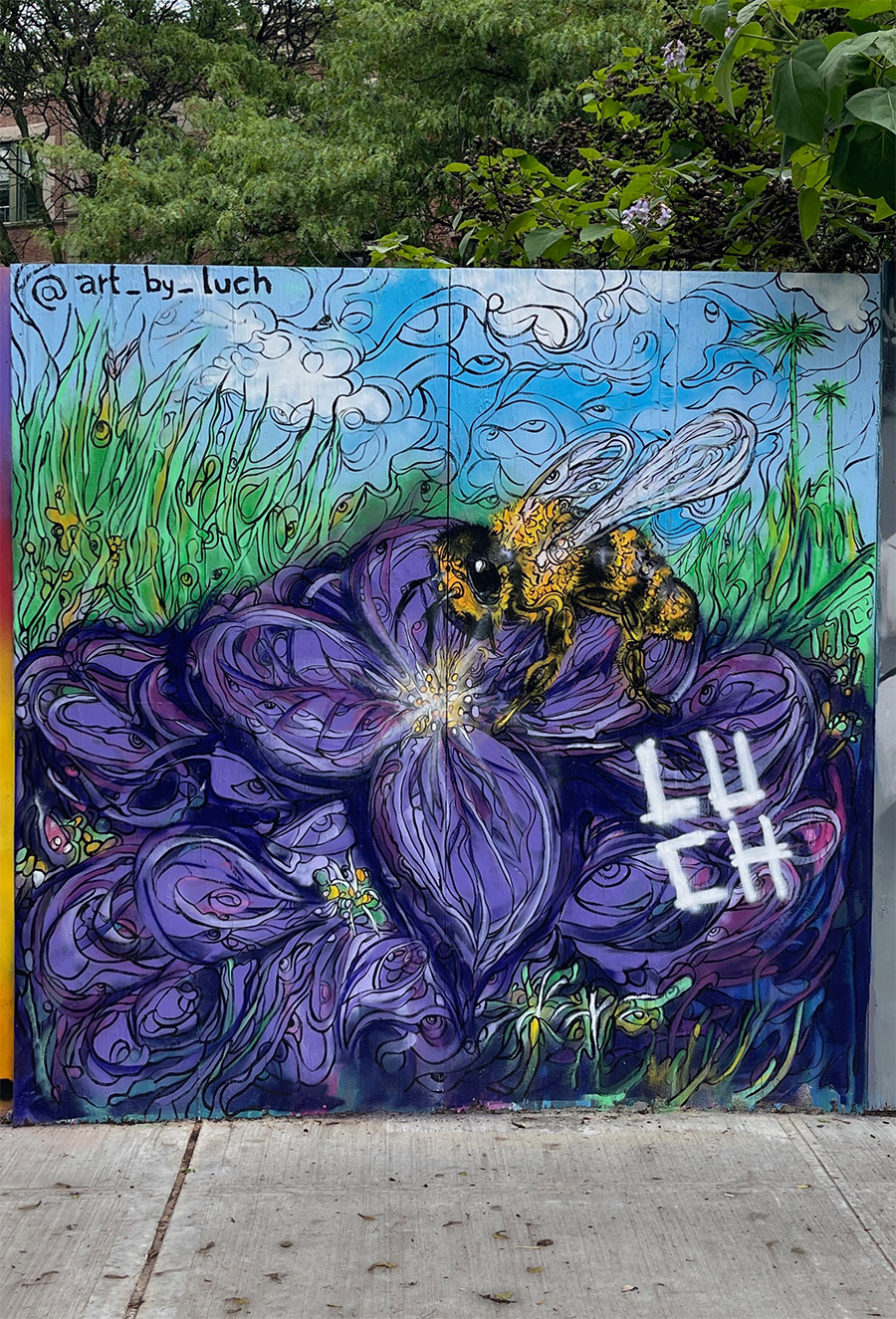
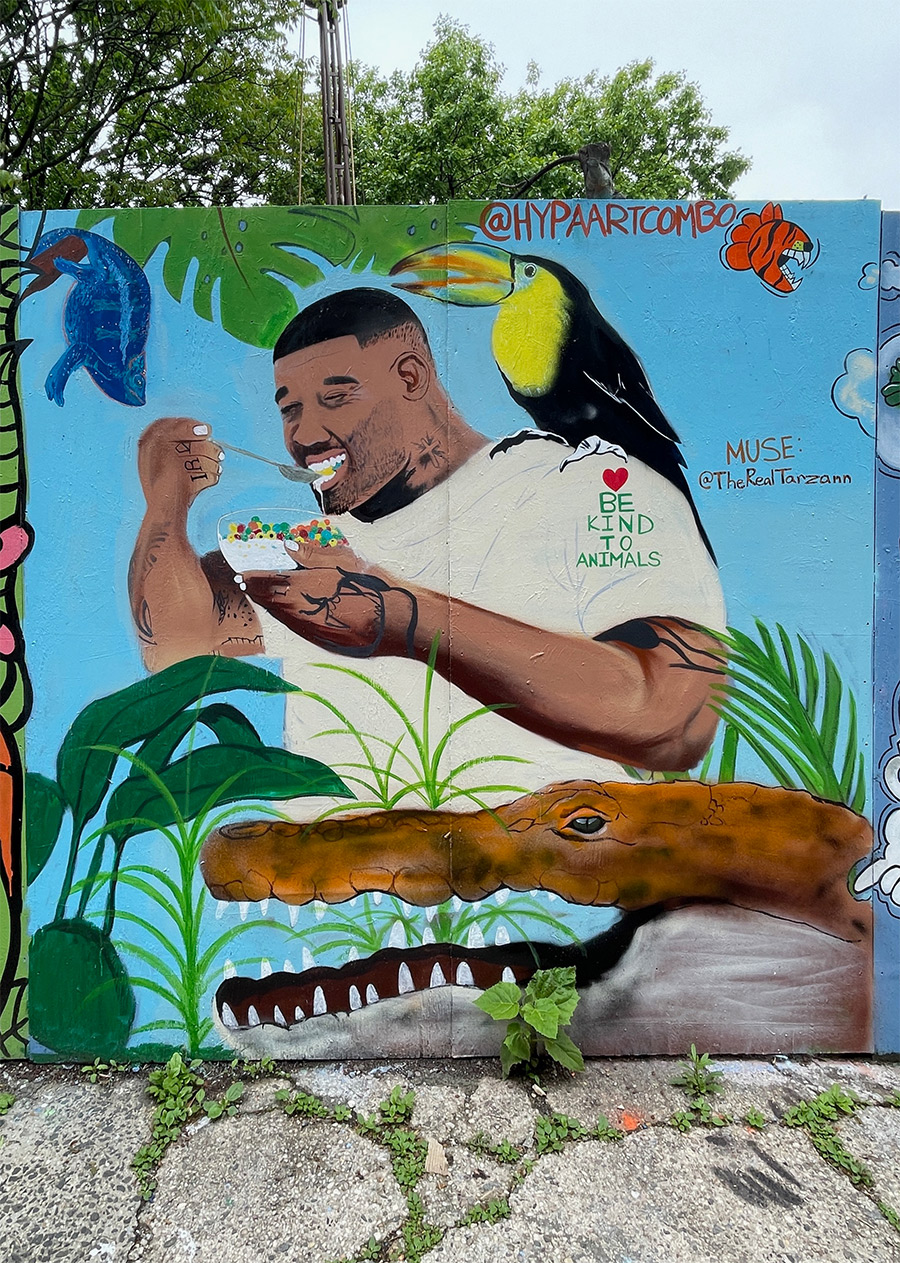
Here are some images from this week’s visual conversation from the street, including works from Werds, Humble, EXR, Great Boxers, Dzel, Meres One, Go, Man in the Box, DK, Luch, 1440, Fridge, El Souls, Natural Eyes, Lisart, Ilato, YOSE, Miki Yamato, HypaArtCombo, Senator Toadius Maximus, HOH22, Hound, Mr. Must Art, Lucia Dutazaka, and Tess.
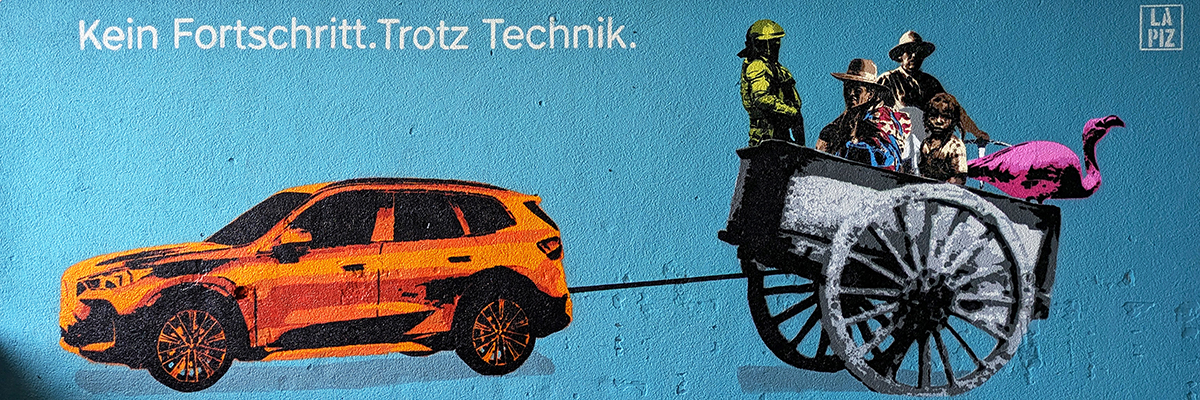
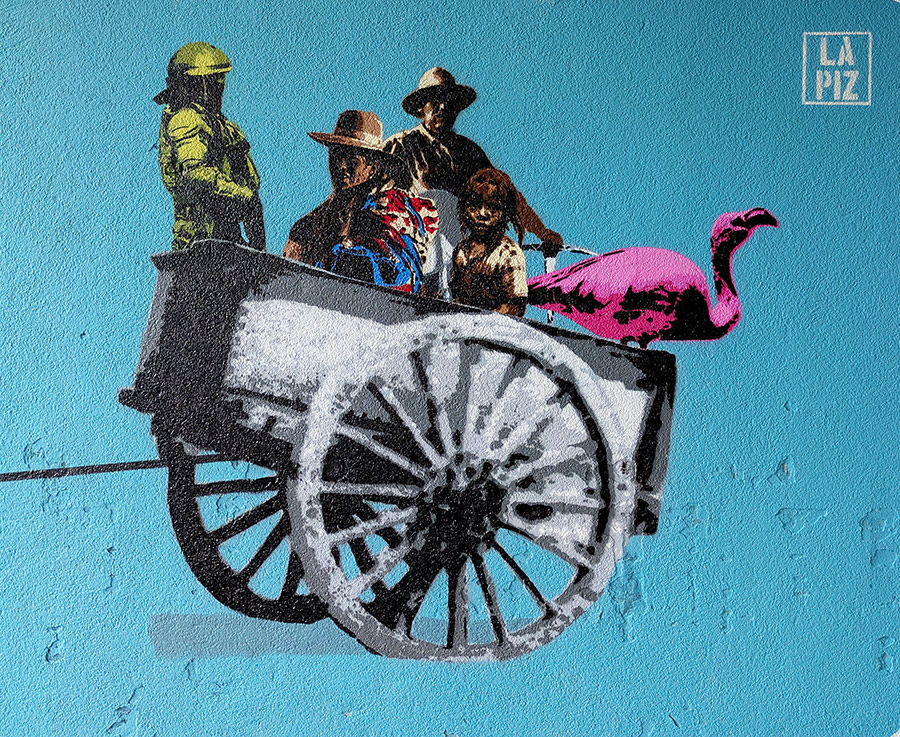
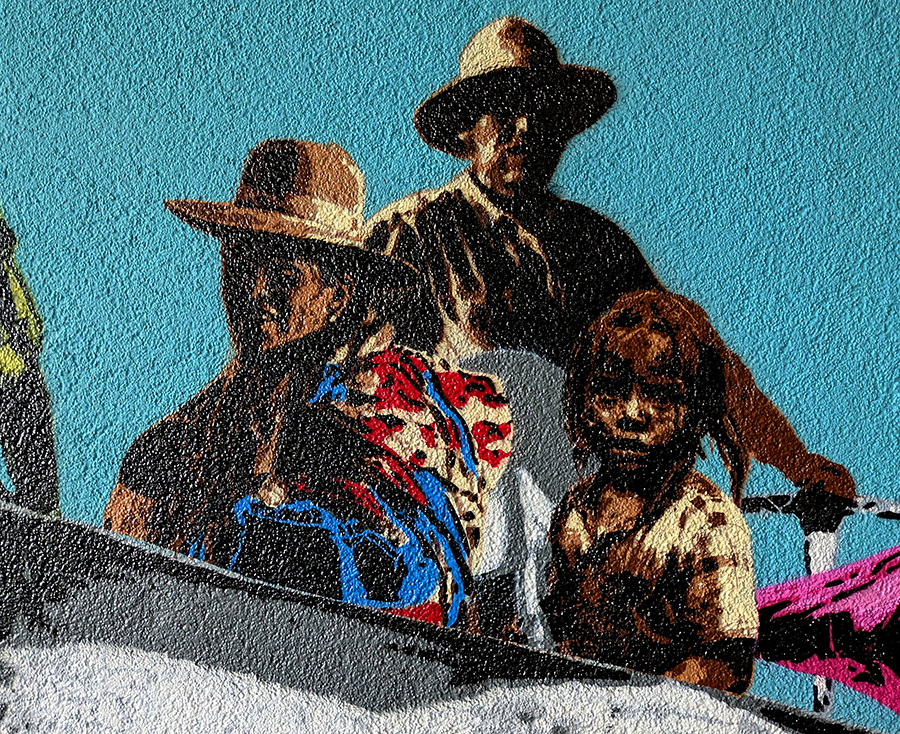
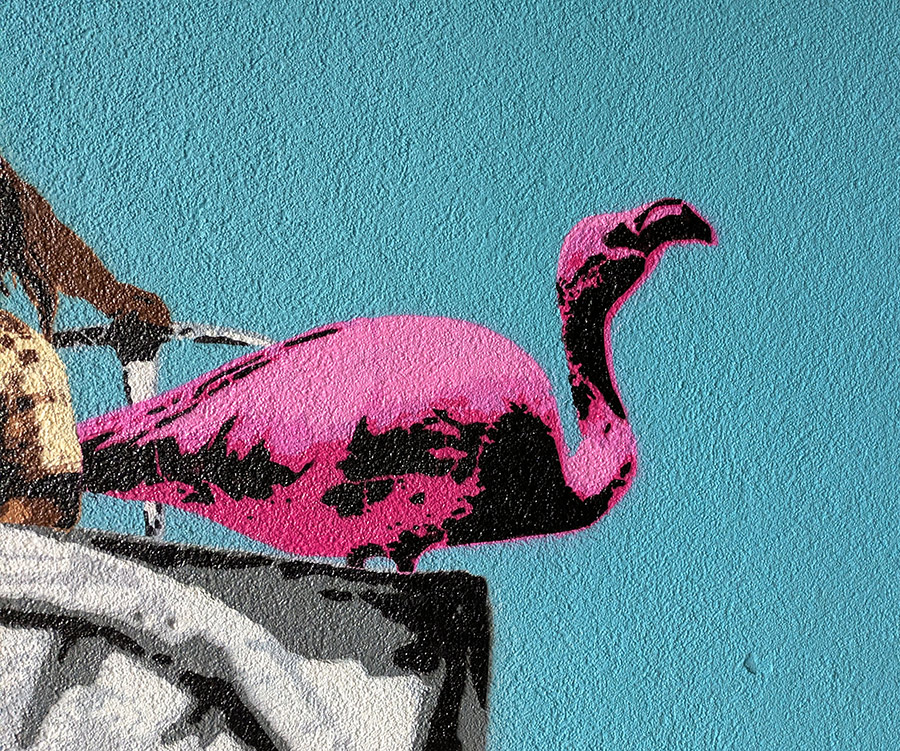
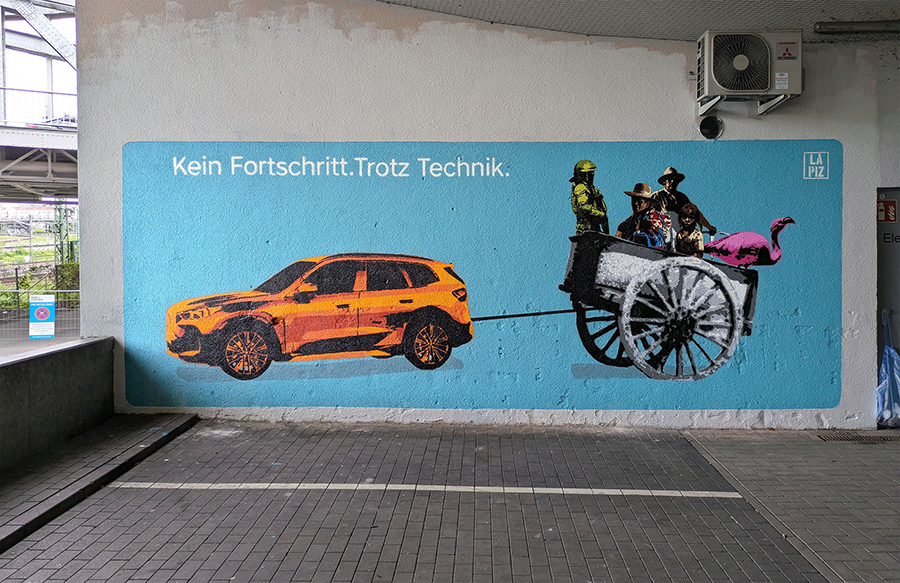
Hamburg-based street artist Lapiz has brought his sharp wit and political edge to Berlin with a new stencil mural for the Urban Canvas Parkhaus Wedding project, curated by Emily Strange and Liebe zur Kunst. Painted on the concrete wall of a parking garage, the piece shows a sleek modern car towing a rickety wooden cart packed with what appear as indigenous figures, soldiers, riot police, an endangered pink flamingo. It’s a wry take on what Lapiz sees as the illusion of our progress: technology moves forward, but systemic problems like inequality, militarism, and overconsumption keep tagging along.
The artist tells us that the work is partly inspired by an exhibition at the former ethnology museum in Hamburg about the colonial-era extraction of saltpeter in South America. This exploitative practice echoes today’s lithium mining in the name of “green” technology. Lapiz sees this pattern repeating: local environments destroyed, communities displaced, all so consumers in the Global North can feel good and ‘green’ about their electric cars.
Lapiz, who started painting on the streets of Dunedin, New Zealand, has lived and worked in Africa and Argentina. He is known for his colorful, intelligent stencils with a political bite. In an email, he wrote: “I strongly believe that now is the time to raise our voices, now is the time for political action and political art.” With this latest work in Berlin’s Wedding district, he delivers that message clearly—satirical, visual, and timely.
 BROOKLYN STREET ART LOVES YOU MORE EVERY DAY